Illustrations from Photographs taken for U. S. Government.
Large 12mo. Cloth. Price $1.50 each.
THE BOY WITH THE U. S. SURVEY
THE BOY WITH THE U. S. FORESTERS
THE BOY WITH THE U. S. CENSUS
THE BOY WITH THE U. S. FISHERIES
THE BOY WITH THE U. S. INDIANS
THE BOY WITH THE U. S. EXPLORERS
THE BOY WITH THE U. S. LIFE-SAVERS
LOTHROP, LEE & SHEPARD CO., BOSTON
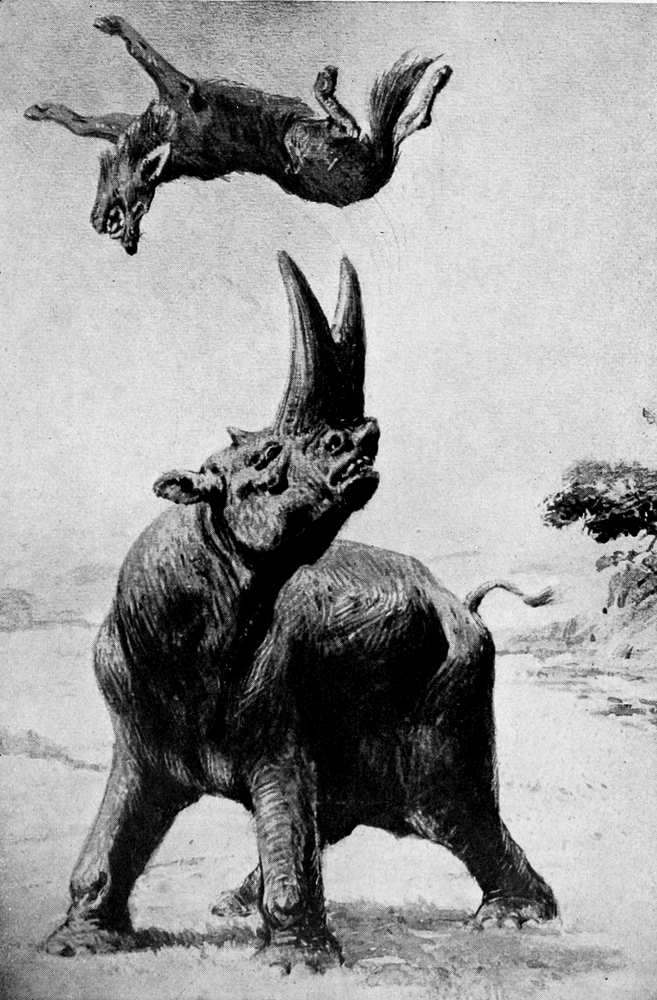
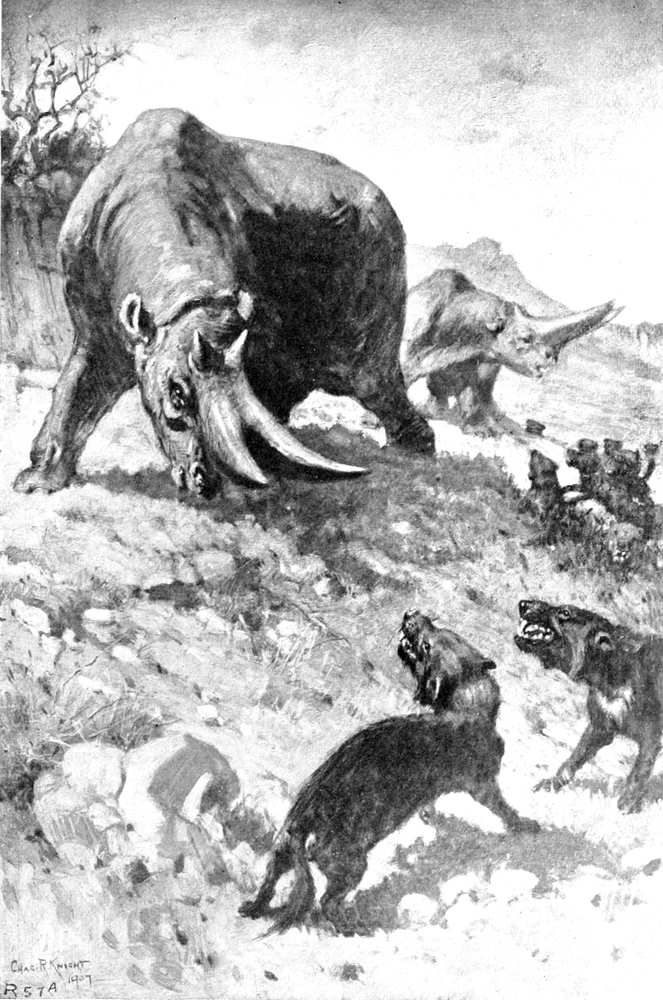
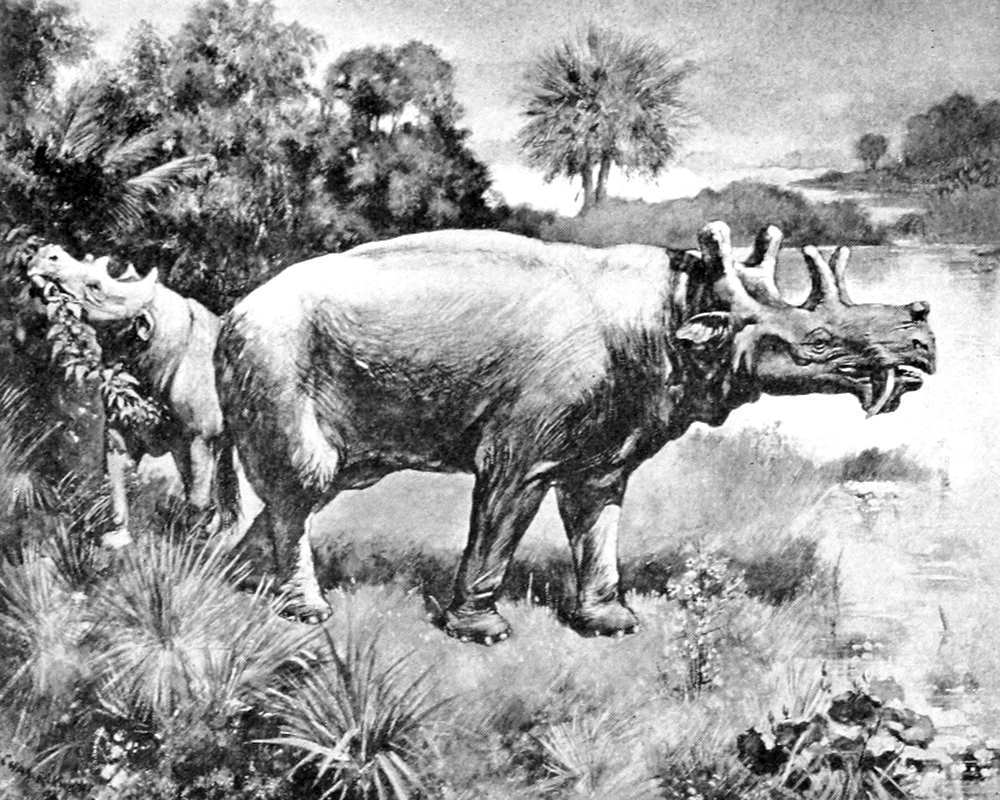
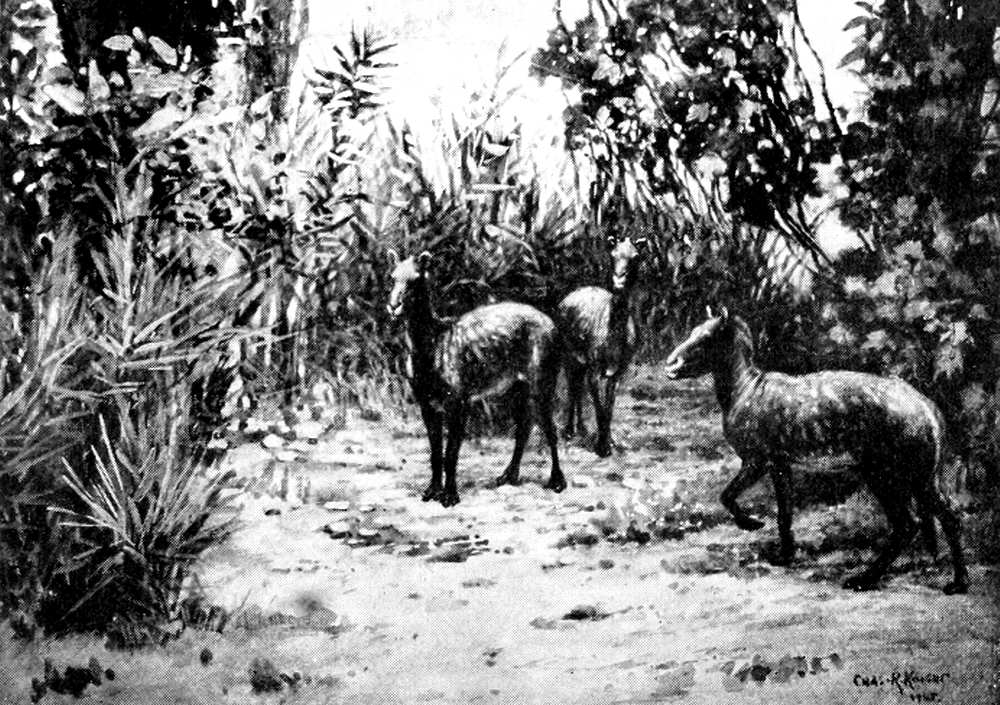
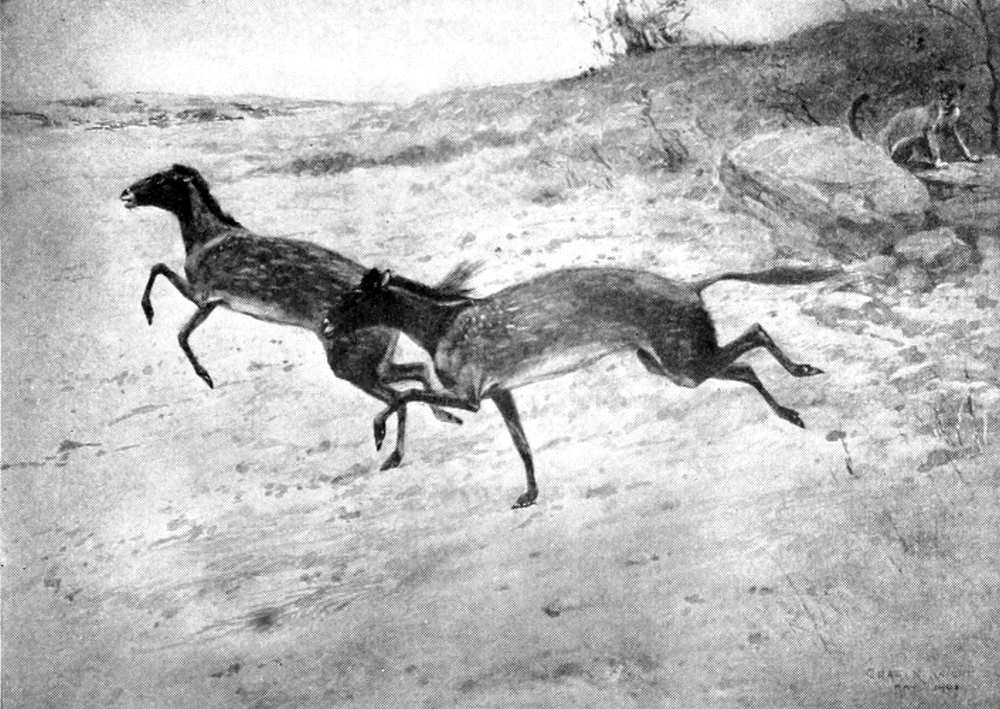
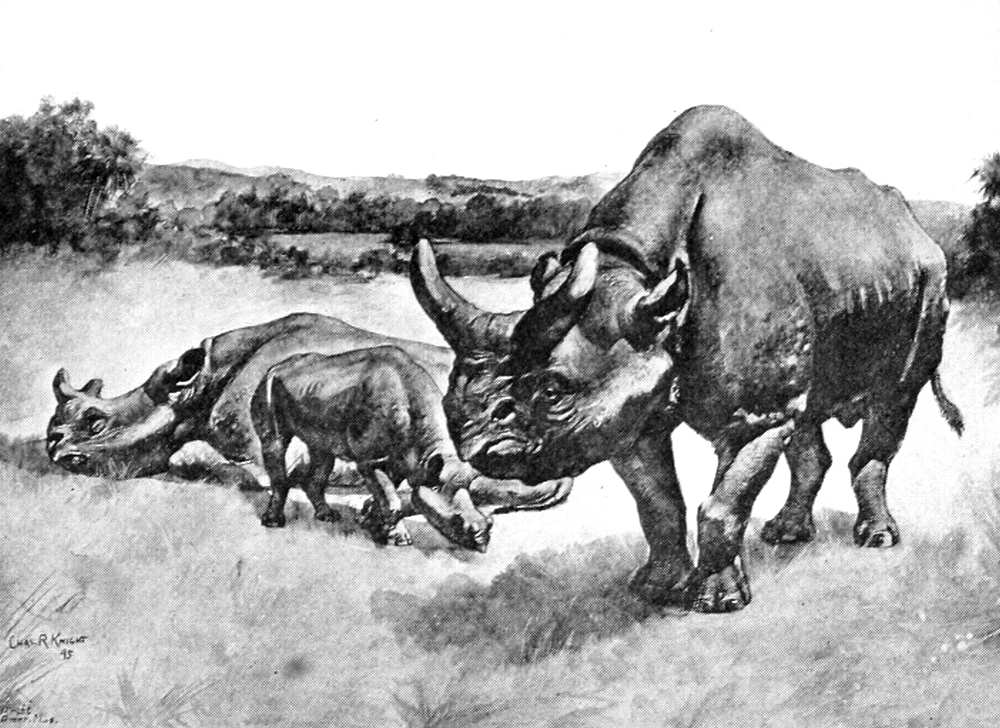
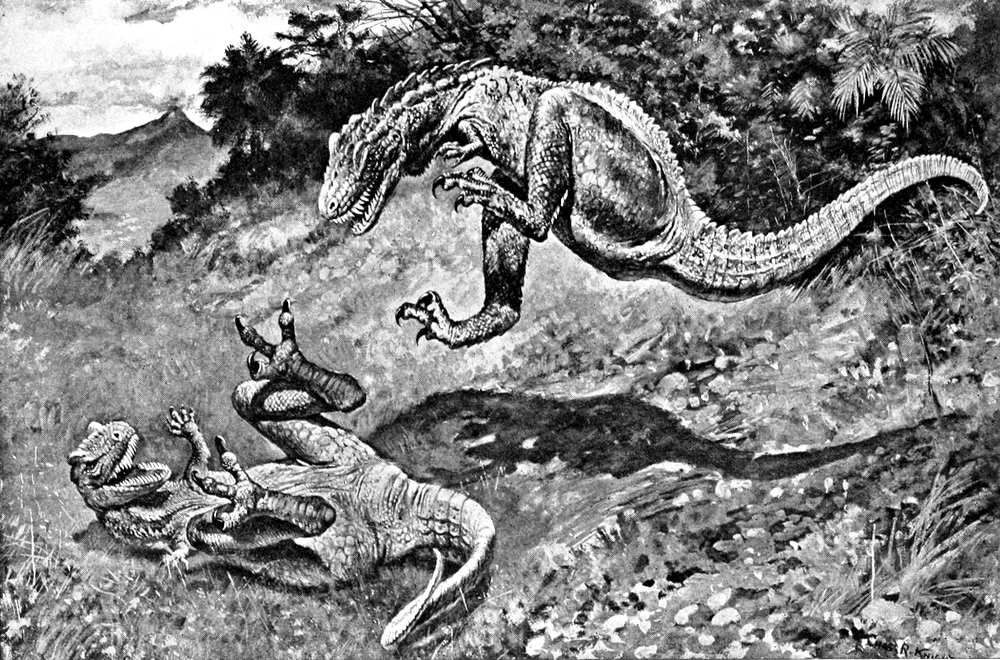
Courtesy of American Museum of Natural History.
A Battle to the Death.
Arsinothere of three million years ago impaling a carnivorous creodont,
somewhat resembling a hyena.
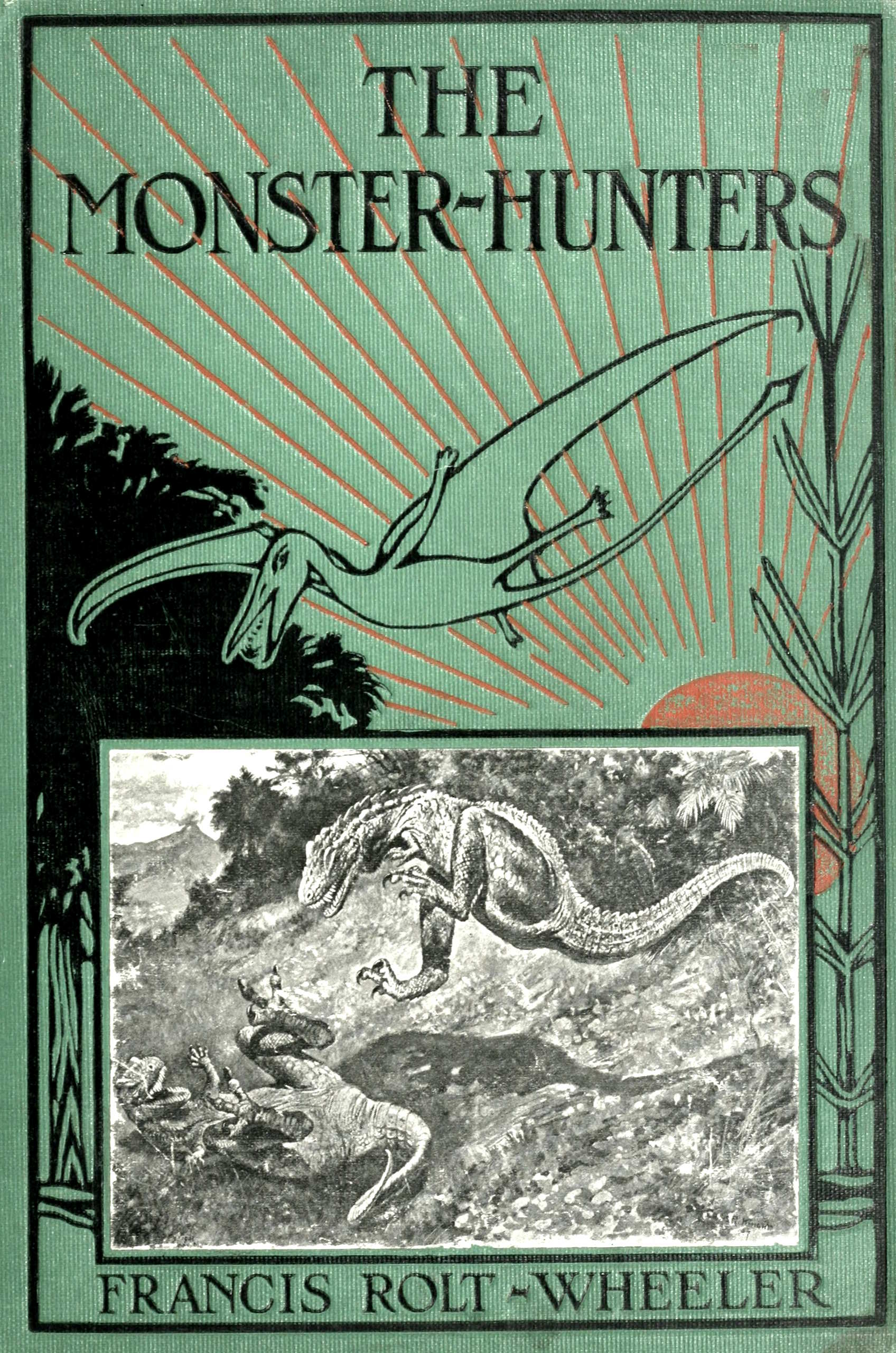
THE MONSTER-HUNTERS
BY
FRANCIS ROLT-WHEELER Author of “U. S. Service Series”
WITH FIFTY-THREE ILLUSTRATIONS, MOSTLY FROM
PHOTOGRAPHS LOANED BY THE AMERICAN
MUSEUM OF NATURAL HISTORY
BOSTON
LOTHROP, LEE & SHEPARD CO.
Published, June, 1916
Copyright, 1916, By Lothrop, Lee & Shepard Co.
All Rights Reserved
THE MONSTER-HUNTERS
Norwood Press
BERWICK & SMITH CO. NORWOOD, MASS.
U. S. A.
ACKNOWLEDGMENT
The Author desires to express his appreciation
of the consultation and assistance of Professor
Henry Fairfield Osborn, President of the American
Museum of Natural History, New York City,
and of the members of the Scientific Staff of the
Museum, especially: Dr. Frederic A. Lucas, Director;
Dr. W. D. Matthew, Curator of Vertebrate
Paleontology; Mr. Walter Granger, Associate
Curator of Vertebrate Paleontology (Mammals);
and Mr. Barnum Brown, Associate Curator of
Vertebrate Paleontology (Reptiles). The Author
further wishes to express appreciation for
the use of illustrations provided by the Museum,
naming especially the restorations of Mr. Charles
R. Knight.
PREFACE
Mystery and marvel are the gates to that wild
world where the Monsters of the past lived out
their monstrous lives. Adventure that carries
one into those steaming coal forests, into those
black and reptile-haunted swamps, that sets one
face to face with the sprawling brood of giants,
terribly menacing and terribly true, holds a thrill
peculiar to itself. So startling, so madly strange
seem the conditions that we scarcely dare to believe
the adventure true, and then, the slow processes
of Time turn one by one the pages of that
age-old book, and the most extravagant flight of
the imagination is outdistanced by facts.
Out to the waste and desert corners of the earth,
men go to read these stories. They find the bones
of the colossal gladiators still locked in their Titanic
struggle, though that struggle ended in
death ten million years ago; they find a ruthless
war of tooth and claw made tenfold more ferocious
than any combat of living beasts of prey by the
huge bulk, and the terrible offensive and defensive
weapons of those vast animals that the Earth
could no longer tolerate.
There is scarcely a place in all the world where
a boy cannot find for himself some tokens of this
Age of Monsters, where he cannot himself be the
hunter and the captor of strange things. In this
book all that is told of that grim past is true and
every statement may be taken as scientifically accurate.
To show to the boys of the United States
the thrill of discovery in their own country, and
the splendor of the work that their scientists and
museum experts are accomplishing, is the aim and
purpose of
The shrewd old merchant lowered the evening
newspaper he was diligently reading, and looked
over it at his son.
“All right, my boy,” he said with a smile; “go
ahead and get one.”
“But I mean a real dragon!”
“About how big, Perry?”
“I’d like one about a hundred feet long, if I
could find it.”
“You don’t want much,” was his father’s half-humorous
reply, as he folded the newspaper so
that he could read the next column with more
ease. After a few moments, pursuing the subject,
he continued,
“Is there any particular breed of dragon that
you’re after?”
“What I really want,” the boy answered, “is
one of those spiny ones—the sort Uncle George
discovered out West.”
The keen old financier looked thoughtful, then
deliberately took off his reading-glasses, laid
down the paper and turned to the boy.
“You’re talking about fossil monsters, then,”
he said.
“Yes, Father, that’s it exactly. And I do hope
you’ll let me do it!”
The boy’s earnestness was evident, and he
knew he could count on his father, for they had
always been close friends.
“Let you do what?” the merchant queried in
response. “I suppose all this preamble about a
dragon means that you have some crazy notion in
your head. Come along, son, tell me all about it.”
This was the chance for which Perry Hunt had
long been waiting, and he snatched eagerly at it.
“There’s a chap I know,” he sputtered,
“who’s going ’way out to the South Dakota Bad
Lands to prospect for fossils. He’s a freshman
at Princeton, and it’s their expedition. He told
me he was sure he would be able to take me along,
if I could fix things up at my end. I’ve always
been wild to go fossil-hunting, Father, and this
is a real chance. Can’t I go?”
Mr. Hunt tapped the ash from the end of his
cigar and looked inquiringly at his son.
“What in thunder do you know about fossils?”
he asked, abruptly.
Perry colored. He was inclined to be shy about
the things for which he really cared, and he had
never before talked to his father about his hobby.
The great secret of his boyhood had been a passionate
interest in the strange creatures which
used to wander over the earth, millions of years
before the first man. Mr. Hunt had a sharp,
quizzical tongue, and Perry was afraid of being
misunderstood and ridiculed. Now, however, the
time for concealment was past and he spoke up
valiantly.
“I’ve read nearly everything I could get hold
of, along that line,” he replied, “and I’ve hung
around our little Museum a lot. The curators
and everybody have been bully to me down there,
and they’ve let me putter about in the workshops.
I really have learned quite a bit about fossils,
Father, and Mr. Cavalier has shown me how to
draw. I’ve drawn heaps!”
“The deuce you have!” the other commented.
“Got any of those drawings still?”
The boy nodded.
“Let me see them, Perry—that is, if you don’t
mind.”
Still a little flushed with confusion, the boy went
to his own room and came back a few minutes
later with a sketch-book. His father turned over
the pages. The drawings covered a period of
several years, and though the first were crude,
the later ones were quite well done. Those dated
during the last year showed the results of real
study. There was no doubting that the lad had
picked up a fair knowledge of gross anatomy in
following his hobby.
Most of the pictures were copies from illustrations
in scientific books or were drawn from
models in the Museum. But there were a few,
here and there, that were just fancy, idle sketches
drawn for amusement’s sake. Over one of these—a
picture-book dragon with scales and a snaky
tail—the old merchant paused, smiling. Several
minutes elapsed before he turned the page. He
went through the book twice without saying a
word. At last he spoke.
“In the second drawer from the bottom, in that
cabinet,” he said, pointing to an old cupboard
which Perry had never seen unlocked, and at the
same time handing a key to the boy, “you will
find a large book bound in faded green leather.
Bring it here.”
Although rebuffed by his failure to get a direct
answer to his appeal for permission to go on the
expedition, Perry took the key. He felt that, in
some way, his present quest was connected with
the question he had raised, and as he unlocked
the cupboard, the boy wondered. In the drawer
he found the faded book, with its cover of green
Russian leather all dry and crumbling to the
touch, and brought it to his father. Still without
comment, the old merchant slowly untied the
string that held the covers of the ancient book together,
and opening it carefully, turned to the first
page.
There, drawn with childish detail, was a picture
of a dragon such as men in the Middle Ages
believed that creature really to be, with two legs
armed with claws, spiked wings, a long powerful
tail, scales, and a ferocious-looking head with
jaws wide open, disclosing pointed teeth, while
from the throat, flames and smoke were pouring in
volumes.
The boy looked up.
“Why, Father—” he began.
With a faint smile, the old merchant pointed
to the date at the bottom of the drawing, its pencil
marks so faint as to be almost indistinguishable.
“I must have been nine years old, then,” he
said. “I can remember well when I drew that
beast. Father had a queer old Latin book, a sort
of mediæval natural history, and it gave a drawing
of every supposedly known beast in the world.
This was one of them. At that time I believed
that a dragon was as real as a lion or an elephant.
To tell you the truth, Perry, I’ve never quite got
away from the feeling of that old book of Aldrovandus,
his beasts were so much a part of my
childhood. When I was a youngster I was convinced
that any adventurous boy could find plenty
of dragons like this one, if he only went to the
right place to look for them.”
“And did the book tell you where to look?”
“It did, exactly. It described a region south
of Ethiopicus—that was Upper Egypt—where a
vast region was uninhabited by men because of
the presence of three or four of these monsters.
I was determined to go there some day and kill a
dragon.”
“And you took it all in, Father?”
“Why not? Only a couple of years before,
Stanley rescued Livingstone in the first great exploration
across Africa. The region that Aldrovandus
wrote about, north of the Victoria Nyassa,
in my day was still an absolutely unexplored territory.
Anything might be there, even dragons.”
“I should think you’d have known there
weren’t any real dragons,” protested Perry, with
the cocksureness of a boy.
“I had sense enough to know that I didn’t
know it all,” said his father with a snort, emphasizing
the personal pronoun. “Why even in your
lifetime, boy, scientists have found an animal that
no one had ever heard of before, still living in the
African forests.”
“What was that, Father?”
“The okapi, a sort of giraffe with daggershaped
horns and striped on the legs something
like a zebra. And that discovery is a good example
of the sort of thing I mean.
“Naturalists once used to laugh at some of
the old pictures on the Egyptian temples which
showed a beast like a cross between an antelope
and a zebra, with stripes. One of the heads of
the god Set, too, was unlike any animal known
in the world. But when, in 1901, the first okapi
was caught by Sir H. H. Johnstone in the Semliki
forest in Uganda, it was found that the old Egyptians
of three thousand years ago were right, and
that the modern naturalists were wrong in their
disbelief. So you see, Perry, lots of things are
possible that one would never expect.”
“But a dragon, Father! It’s such a made-up
sort of beast—wings, teeth, snake’s tail and all
that sort of thing!”
“Don’t trouble yourself about that,” his father
answered, “there are plenty of dragons with
wings, teeth and a snake’s tail, and, what’s more,
Science calls them dragons. Draco volans, the
flying dragon, that’s their real name, my boy.
But they are all small, none of them more than
ten inches in length, including the tail.”
“Never heard of them,” said Perry, incredulously.
“If you don’t want me to think you a born
idiot,” his father answered sharply, “don’t let
me catch you taking that tone, suggesting that a
thing doesn’t exist because you don’t know about
it. There are a few million things that you don’t
know now, and when you get older and have more
sense, you’ll find a few million more things that
you don’t know.”
“I’m sorry, Father,” the boy said, in a milder
tone. “I didn’t mean to be uppish. Won’t you
tell me about the ‘flying dragon’?”
“They are small lizards,” his father answered,
“living throughout Malasia and in Madagascar.
They have a long lizard-like tail, four inches in
length, a fierce-looking head with a frill around
it to make them look ferocious, and the skin from
the body to the four legs is stretched out like that
of a flying squirrel. If they were bigger, they
could play the dragon’s part well enough. But,
as I was saying, in my young days there wasn’t
any good reason why I should disbelieve the
dragon. Aldrovandus said he possessed the skin
of one, and that seemed good enough proof for me.
Yet I think I would have said less about my belief
in dragons, if I had any idea where it would
land me. I don’t think I ever told you the story
of my fight with a dragon, did I?”
“A real sure-enough fight?”
“An actual fight with an actual dragon,” said
his father, with a smile.
“But how could you?”
“I did have one, just the same.”
“I don’t understand you a bit. Won’t you tell
the story, Father?”
Without answering directly, the old merchant
turned over page after page of the drawing-book,
its pages browned and the pencil-sketches faded
with age, but all filled with dragons—every kind
of dragon that the boy of forty years ago had
been able to discover or invent. At last he
stopped before a picture of a weird beast, that
looked like a cross between a man-eating tiger, a
Chinese dragon, an alligator, and a boa-constrictor,
which was breathing out fire and smoke as
though it had a gas-works in its inside. In front
of the dragon was represented a small boy, about
as tall as the dragon’s claw was long, and the
youngster was sticking a knife as big as himself
into the monster’s breast. In the near distance,
quite out of perspective, were a number of people
running away in terror.
“There,” the old merchant said, with a mixture
of amusement and complaisance, “that was
the beast I fought. Isn’t that a sure-enough
dragon for you?”
After his former rebuke, Perry was a little dubious
about seeming too skeptical, but he could not
help saying:
“Well, that’s hardly a photograph, is it, after
all?”
“No,” his father answered, “it’s not. I suppose
I’ll have to admit that it is partly imaginative.
But the dragon I fought was something like
that.”
“You’ve got me guessing,” the boy admitted.
“Won’t you tell me the story, Father? It ought
to be a great yarn.”
“I suppose I’ll have to,” the other agreed,
“since I’ve led you on so far.” He reached out
for a new cigar, clipped it, lighted it, and when
sure that it was drawing properly, leant back in
his chair and began.
“I suppose I was about thirteen years old,”
he said reminiscently, “when this famous combat
was held. At that time my folks were living at
a small place called Proctor’s Cave, on the Green
River, in Kentucky, not far from the Mammoth
Cave. As you probably know, Perry, that whole
section is just riddled with caves, made by the
gradual dissolving of the limestone rock through
the action of underground rivers. Most of them,
too, are full of stalactites.
“Proctor’s Cave, right on the river, was quite
a growing town, and though it was small, there
was a right smart heap of children in proportion
to its size. About thirty-five boys around my age
went to the school there. I can remember the
number because we were divided into two gangs.
Ours had fifteen members and the other had
twenty.”
“I suppose you were ‘boss’ of your gang,
Father?”
“I was the ‘War-Chief,’” was the smiling response.
“Our gang was called the ‘Indians’
and the others were the ‘Pioneers.’ You can see
that it was natural for us always to be ready for
a fight. Everything was taken in good part,
though, until one day we caught one of the chaps
in the other gang and scalped him.”
“You didn’t really scalp him!”
“No, not exactly. There were limits, Perry,
even in my young days. But the victim thought
it was genuine. That’s where the trouble came
in.”
“How was it, Father?” pleaded the boy, fairly
wriggling with excitement.
“As I remember,” the old merchant continued,
musingly, “a week or so before, the ‘Pioneers’
had got hold of one of our gang and had
given him the ‘third degree.’ They said that
if he was an ‘Indian’ he ought to look like one.
To make sure of it, they gave him a coat of war-paint
with some stuff they got from a drug store,
and the war-paint wouldn’t wash off. It wouldn’t
even scrape off. It was nearly a month before
it wore off.
“Our turn came when this ‘Pioneer’ was delivered
into our hands. We told him we were going
to have our revenge, and I tell you, he was
scared stiff! We brought the youngster to our
own private ‘Indian’ cave, and there we discussed
tortures, so that he could hear what was being
said. Each one of us had some kind of torment
more excruciating than the last.”
“It sure must have been blood-curdling to the
chap who was listening,” put in Perry, with an
appreciative grin.
“I haven’t a doubt of it,” his father agreed.
“Finally, we came to a formal decision and informed
the victim that he was to be scalped alive.
You should have heard him yell! However, yelling
didn’t do any good, for the cave was half a
mile from town and a couple of hundred feet
underground, and he would have had to hoot like
a Mississippi River steamboat in order to be heard
at all. So we went ahead and scalped him.”
“How, Father?” queried the boy, eagerly.
“We made quite a ceremony of it,” was the
reply. “First of all, we gathered a lot of stinging
nettles that grew outside the cave and mashed
them up with vinegar in an old tin can. The
vinegar, you know, holds the sting; it even seems
to make it stronger. Then, in an old iron pot
we had, we mixed up a lot of corn syrup and red
ink—we always used that in our initiation powwow,
and it certainly did look and feel like blood.
“Next we blindfolded the unfortunate ‘Pioneer.’
We dipped a piece of string in the nettle
juice and tied it loosely round his head, and
sprinkled his head with the nettle vinegar, knowing
that it would only take a minute or two before
it began to sting. Then we took his cap,
dipped it into the red ink and syrup, and clapped
it—not boiling, but still fairly hot—on his head.
At the same instant, one of the ‘braves’ stuck a
bit of stick in a loop of the nettle-soaked string
and twisted it tight, also running his thumbnail
around, as if it were a knife. The cap and the
blindfold were then yanked off together.
“The youngster gave just one look. He saw
the cap, all blood, in the other fellow’s hand, and
jumped to the conclusion that it was his scalp.
The tight string around his forehead felt like a
cut and the nettles began to sting like blazes.
He put his hand up to his head, felt the sticky
wetness, looked at his hand, all red, let out an earpiercing
screech, and started to run. That was
forty years ago, but I believe he’d have been running
yet, if he hadn’t bumped into some one on
the road.
“Help! I’ve been scalped!’ he yelled.
“I reckon he must have given the farmer a
jolt, for while we were a good way from the Indian
country, still there were plenty of ‘hostiles’
about, and any day there might be a raid. This
was about the time of the Little Big Horn Massacre.”
“You mean Custer’s last stand?”
“Yes. So, you see, the farmer had reason
enough to be startled. As soon as he had a good
look at the boy, though, he saw that the youngster
was only frightened. He cut the nettle string
from the lad’s head, washed off in the nearest
brook as much of the red ink and corn syrup as
he could, and started for town.
“I thought we were in for real trouble, but
to do that boy’s father plain justice, I’ll admit he
was a good sport. Though he was as mad as a
hornet, he was fair. He gave me a good tongue-lashing,
and told me—which was true—that I
ought to have had more sense, as the boy might
have been killed with fright. He repeated to me
the old story of the man who was ordered to be
beheaded, and who died when a cup of cold water
was dashed on his neck in joke. Still, he said
it was a boys’ row, he remembered when he was
a boy himself, and it wasn’t his business to interfere.
He added that he hoped I would get my
medicine from the other gang, twice as hot as I
had given it.”
“That was fair enough, Father.”
“Indeed it was. But even he was satisfied
with what I got in return.”
“What was it?”
The old merchant rolled up his sleeve to the
shoulder, and showed his son a white scar running
down almost the whole length of the upper arm.
The wound had evidently been a deep one.
“I got that from the dragon,” he said.
“You’d a real fight, then?” ejaculated Perry,
surprised at this evidence of an actual encounter.
“I was laid up for nearly a month,” was the
reply. “But they didn’t build any statues to me
as they did to St. George, when he slew the
dragon, and no one gave me a triumph, as the people
of Rome did to Regulus over his combat with
a monster.”
“I never heard of the Regulus story,” Perry
said.
“It wasn’t a story,” his father corrected him,
“it was a real fight, like mine. Or at least it was
said to be a real fight. Regulus sent home the skin
of his dragon, and it was carried before him in his
triumph.”
“But I thought all those dragon fights were
just fairy tales!”
“Most of them are,” his father answered.
“With the exception of mine, I think Regulus’
fight with the dragon is the only one that is supposed
to be attested by history. Do you want to
hear about it?”
“I’d rather hear yours,” Perry replied.
“I’ll come to that presently,” the merchant
assured him, “and the story of Regulus may put
you in the right frame of mind to hear about my
prowess.
“Marcus Atillius Regulus, almost the only historical
character to have fought with a dragon,”
he began, “bore one of the noblest names in
Rome. You may have learned in school, Perry,
how he ravaged the shores of Africa and brought
Carthage into subjection, but that, at the last moment,
he was defeated. As a prisoner, he was sent
by Carthage on an embassy to make peace, upon
his own honorable promise to return to his foes
to die by torture unless his embassy of peace was
successful. On arriving at Rome, Regulus gave
the message with which he had been entrusted by
the Carthaginians, but ended with a patriotic appeal
to Rome not to let their affection and loyalty
to him overtop their honor.
“‘Let the prisoners be left to perish unheeded,’
he said, ‘let war go on till Carthage be
subdued.’ His counsel prevailed, the offers of
peace were refused, and Regulus returned voluntarily
to Carthage. The Romans have enshrined
the name of Regulus high in the pages of honor,
but the Carthaginians had little understanding of
valor and good faith. They cut off his eyelids,
placed him in a barrel spiked with nails, knocked
the head of the barrel out and fastened him there
so that he was immovable. Even his hands were
tied. Then they exposed him, naked, to the glare
of an African sun, to die by the slow agonies of
thirst, fever, the scorch of the sun upon the unprotected
eyeballs, and the stinging insects of the
desert.”
“But Rome got back at them?”
“Yes,” his father answered, “Scipio Africanus
captured Carthage, leveled every house to ground,
sowed salt on the ruins and in the name of Rome
forbade any building to be erected there again.
But I’ve told you the story of Regulus, son, so
that you might see that such a man was scarcely
likely to invent a story about a dragon to help
his reputation.”
“Where did he fight the dragon? In Africa,
too?”
“Not very far from Carthage. It was in the
year 256 B.C., after the first Punic War had been
raging for eight years, that Regulus captured the
city of Utica, about sixty miles northwest of Carthage,
near the modern city of Tunis. Between
Utica and Carthage flowed a river, then called the
Bagrada, difficult to cross except at one ford.
When Regulus and his soldiers came to this ford,
they found the passage disputed by an enormous
dragon, one hundred and twenty feet long.”
“A real monster!” ejaculated the boy.
“Wasn’t he? And, so the old Roman historian
tells, the skin of the monster was so tough that
the Romans could not pierce his hide. Several
times Regulus led the attack upon the dragon, but
each time the beast killed and devoured several
of the soldiers. At last Regulus brought up the
artillery, the ballistæ and catapults, and bombarded
the dragon. Supported by the artillery,
Regulus plunged across the river alone, fought
the dragon single-handed and slit his throat. The
skin was carried to Rome and graced Regulus’
triumph.”
“What do you suppose it really was?” queried
the boy.
“I think,” his father answered, “it must have
been a huge crocodile. That would explain why
the Roman swords could not pierce the so-called
dragon’s hide, and why the combat seems to have
taken place at the ford of a river.”
“But a hundred and twenty feet long, Father!”
“Possibly that was worked out from the skeleton.
In those days it would be quite easy to put
the backbones of several animals together. That
trick was done only thirty years ago, when Dr.
Albert Koch collected the bones of two or three
Zeuglodons or primitive whales and made a monster
which he called ‘Hydrarchus, the Water
King,’ and which he exhibited all over Europe.
Regulus’ dragon, carried in his triumph, might
have been something of the kind. As for the Zeuglodons,
I’ve often thought that the discovery of
skeletons of antediluvian beasts might have been
one of the reasons for popular belief in dragons.”
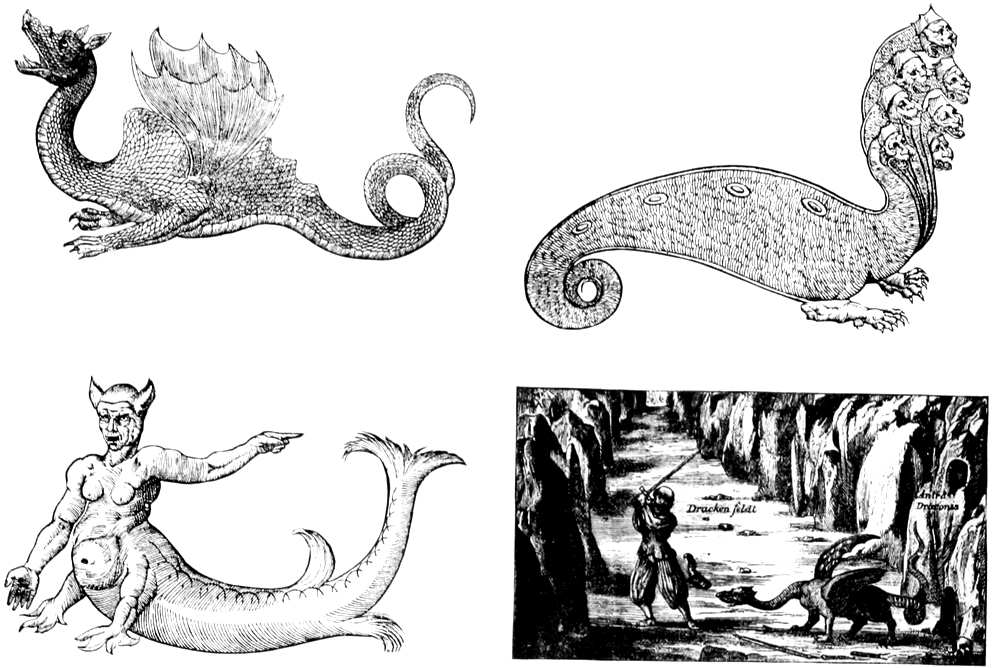
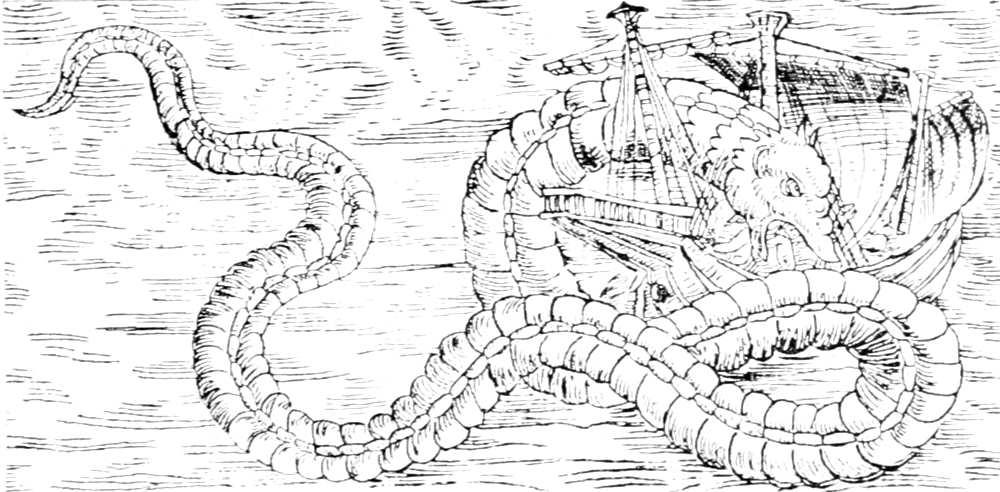
DRAGON SLAIN BY REGULUS. (upper left)
SCYLLA OF THE SEVEN HEADS. (upper right)
MERMAN FROM THE MEDITERRANEAN. (lower left)
THE DRAGON OF THE DRACHENFELS. (lower right)
Monsters Thought Real by the Ancients.
These pictures are taken from professedly scientific works of the Middle Ages.
“Was yours one of that kind?”
“Mine,” said his father, with a twinkle in his
eye, “was a real dragon.”
“But it couldn’t be, Father. You said the other
gang had something to do with it!”
“They unearthed him from his lair,” the other
answered. “I suppose I’ll have to tell you just
how it all happened, Perry, and then you’ll see if
you don’t think I deserve a triumph, just as much
as Regulus did!”
The boy waited expectantly, and, in a moment,
his father continued:
“All that summer, the summer after the scalping,
I was on the lookout for squalls, but nothing
happened. The ‘Pioneers’ didn’t seem to be
trying to get their revenge, or if they were trying,
we were too much on the alert. I afterwards
found out that they had been laying plans all
summer, but that none of them had worked. It
was not until the autumn that their plot came
to a head.
“One evening, late in October, when it was already
beginning to get dark early, I was delayed
in going to the cave. It was one of the regular
evenings for a meeting and we had something
very important to do—I forget what, now—so I
was running at a good clip. Just as I struck
the little hidden path that diverged toward the
cave, I heard the fellows talking loudly, in excited
tones. Wondering what could have happened,
for it was one of the rules always to approach
the hiding place in silence, I quickened
my run still more, and in a minute or two, burst
upon the fellows who were gathered in a clump
not far from the entrance to the cave. The second
I appeared, three or four of them shouted,
in a breath:
“‘Chief! There’s a dragon in the cave!’
“I told you, Perry, that I’d always done a lot
of talking about dragons, and this ought to have
made me suspicious. But I’d been reading, a day
or two before, about Regulus, and all my early
interest had been suddenly awakened. As I look
back on it now, I don’t think doubt even entered
my mind. The gang was evidently so scared that
the scare got into my bones, too.
“I found out that one of the smallest of the
boys had come early and gone into the cave, and
that he had rushed out again, screaming to another
fellow, who was just coming up the path, that
in the cave there was a huge dragon, with a shining
tail, breathing out flames. He said it had
roared at him and that it was as long as a barge.
“The older boy, he was ‘Chief Brave’ and
second in command of the gang, had laughed at
him, picked up a chunk of wood for a club, and
started for the opening. Half-way down, he heard
the growling of some beast and his courage oozed
out. Without going in to see what it was, he
bolted out again as promptly as the little lad had
done. He was afraid the dragon would follow
him, but nothing appeared. None of the rest of
the gang had volunteered. They waited for me
to show up, and tell them what to do. It wasn’t
that I was any bigger, son, but, after all, I was
‘War Chief’ and it was my part to lead them on.
“If there had only been the little fellow’s
story,” the old merchant continued, “I don’t
think I’d have felt the same way about it. But
the ‘Chief Brave’ was not only a plucky sort,
but I depended a good deal on his judgment. As
I saw it, there was only one thing to do, and that
was—to face the monster and find out what could
be done. If I could really slay a dragon, I thought,
I should go down in history with Siegfried and
Beowulf and all the rest of them. So I loaded
an old horse pistol that we had, and, more for
show than anything else, stuck a bowie knife in
my belt and started into the tunnel-like opening
of the cave, the gang following cautiously behind.
“I tell you, my boy, it was mighty uncomfortable,
creeping through that long, black passage,
hearing nothing but the hard breathing of the
frightened fellows behind. And when, about halfway
down, the silence was suddenly broken by a
savage, whining snarl, I had a feeling that ice was
being rubbed down my spine. It wasn’t quite my
idea of a dragon’s roar, it was worse, there was
such an evil relish in the sound that the flesh under
my hair just crawled.
“If I had been alone, I’d have done the same
thing as the others did, I’d have turned tail and
got out of that place as quickly as I could. But
the gang was behind me. I was afraid, afraid
to death, of that snarl in front, but the fear of
ridicule was even stronger. I would rather be
clawed to death by a dragon than be guyed as a
coward. So, gripping the pistol closer, I crawled
forward.
“I think I could have walked with more confidence,
but on hands and knees, it was ghastly.
I could put my hands out without difficulty, but
the fear sent a spasm into my knees so that it
was hard to move them. Still, foot by foot, ever
hearing that malignant whine grow closer, I
groped my way through the opening. It was only
fifty feet long, but it seemed interminable. At
last I saw the light and, with a huge sense of relief,
leaped from the narrow tunnel into the cave
itself.
“I leaped almost into the monster’s jaws. For,
facing the mouth of the tunnel, not six paces away,
was the dragon, growling and snapping, while
every few seconds he followed the clash of the
gnashing teeth with that long whining snarl that
had so scared me during that endless crawl in the
dark.”
“What did he look like, Father?”
“In the half-dusk of the cave he looked fearful!
In my excitement he looked every inch a
dragon. The front part of him was like a wolverine,
and his body all glittered with silver scales.
Behind him he dragged a thick tail, something
like an alligator’s, only round, all covered with
shiny scales.”
“How about the fire-breathing business?”
“I didn’t stop to notice. I was too excited
and too frightened to bother myself with thinking
what breed of dragon he was. I aimed the
old pistol and fired. The ‘kick’ of it nearly broke
my wrist. At the same instant, the dragon lifted
himself heavily, dragging his hinder part, and
launched full at me. I shrank back, flat against
the wall of the cave, and his spring fell short.
The hot froth and blood on his fangs slathered
on my coat, and I knew that the monster was
badly hurt. There was little room to dodge in
that cave, but I jumped sideways.
“He turned jerkily, and I saw that his huge
tail was injured. For the first time, my spirits
rose. It was his tail I had feared. I had been
afraid that he would lash out with it, crushing
me to pieces. If, however, he were already hurt,
I might be able to dodge about him, and get the
best of him yet. But he could move quicker than
I thought.
“Before I realized it, he was on me. Again
he sprang, with that curious dragging of his hinder
parts as though they were paralyzed. I had no
room to dodge away, for the wall of the cave was
behind me. In desperation, I pulled out my bowie
knife. Before I could lunge, however, a paw with
curved claws like Turkish daggers flashed out and
laid my left arm open to the bone.
“Reeling from pain and the loss of blood, I
struck forward with the knife. I hit some kind
of a bone, I remember, then felt the curious sense
of the blade piercing through living flesh. Again
the monster reared. I swayed back, too far gone
to move my feet, which seemed fastened to the
floor of the cave. But as I stared, almost fascinated,
into the green light of the creature’s eyes,
I saw a glaze pass over them. He reared, wavered
and fell over in a heap. Almost I collapsed upon
him myself, but as I tottered, one of the fellows
sprang out from the mouth of the cave and caught
me. He snatched the bowie to give another blow,
but the dragon never moved again. My knife had
reached the heart.”
CHAPTER II THE MONSTERS THAT NEVER WERE
“But, Father,” cried Perry, “you haven’t told
me what the dragon really was!”
“I didn’t know, myself, for a few minutes,”
was the reply. “I dropped in my tracks, right
there. A couple of the fellows picked me up,
though, as soon as I began to feel a little less
faint, and the three of us, waiting until we were
sure that the monster was quite dead, went up
close to him. I had noticed, in a dim kind of
way, that the dragon’s scales looked queer and
that some of them had been scraped off on the
floor of the cave. But when we got right up to
him, what do you suppose we found those scales
were?”
“I haven’t the ghost of an idea,” the boy answered
expectantly.
“They were made of the silver paper that comes
wrapped around bars of chocolate.”
“What?”
“Just plain silver paper.”
“It was the other gang, then—” suggested
Perry, seeing a clue.
“That’s just what it was, the other gang.”
“Then it was a fake dragon!” cried the boy,
disappointed. “You said it was alive!”
“Does my arm look as if the beast hadn’t been
alive?” retorted his father. “It was a mighty
lucky thing for me it wasn’t any more alive than
I found it!”
“What was the dragon, really, Father?” the
lad persisted.
“It was a lynx, or bob-cat,” was the reply.
“The ‘Pioneers’ had trapped the beast in the
woods and brought it to our cave, with the trap
still fastened to the bob-cat’s hind foot. The
other hind paw had been tied to a heavy log.
“Then the fellows had gone to work and made
a long tail of sacking, stuffed with shavings, and
fastened this tail tightly around the lynx’s
haunches, so that it would trail behind. They’d
dusted it all over with mustard and red pepper,
so that the animal wouldn’t chew at it and tear
it off. After that, they chucked a couple of pailfuls
of carpenter’s glue, almost boiling hot, over
the beast, head, tail and all, and stuck the silver
paper on, when the glue was wet. I don’t wonder
the bob-cat was savage!”
“They must have had a picnic doing it!” exclaimed
Perry.
“I’ve thought of that many times since,” his
father agreed. “But they made a good job of
it. They even took the trouble to cut all the silver
paper in shapes so that it would look like real
scales.”
“They took an awful chance, though, Father.
Suppose the tail had come off? What would have
happened to you?”
“I don’t think the tail saved me,” the other
answered. “After all, the bob-cat was badly
crippled, with both hind legs out of commission.
You see, Perry, a lynx leaps for his prey, grips
with teeth and fore-claws and tears with the hind
claws. With the trap on one foot and a log on
the other, the other gang knew I was fairly safe.
So far, they had been right enough. Where they
went wrong was in not knowing the animal. They
all thought the creature was just a big domestic
pussy that had got a bit wild running around in
the woods. It was a true lynx, though, and a big
one.”
“Did you send the skin home for a ‘triumph’?”
the boy quickly asked. “Where is it?”
“When that combination of glue and silver
paper got thoroughly dry,” the old merchant commented,
“there wasn’t much value to the skin.
We kept it as a trophy, of course, but we kept it
in the cave. For all I know, it’s there yet. If
you’re so keen to find a dragon, Perry, I’ll tell
you exactly where to go for it.”
“I’m afraid even our own local Museum
wouldn’t take it,” the boy objected, smiling.
“Maybe they wouldn’t, but, so far as I know,
it’s the only genuine dragon that has put up a
genuine fight for the last couple of thousand years.
So, my son, if you ever do go dragon-hunting,
don’t forget that your father was the last of all
the champions of valor who fought and defeated
a dragon single-handed.”
“Then you really will let me go dragon-hunting
with the Princeton crowd?” Perry interjected,
returning to his first plea.
“I’ve been thinking about it,” his father answered
meditatively, “and I don’t think I will.
Wait a bit—” he continued, as he saw the bitter
disappointment in the lad’s face, “I haven’t
finished. I don’t say that I won’t let you go on
a search for fossils some time, but I don’t think
this Princeton expedition is the right thing for
you. And I’ll tell you why.”
“I’m sure it would,” burst out Perry.
“I’ll tell you why,” his father said again, with
that calm repetition from which the boy knew of
old there was no appeal. “You would simply go
as a helper, you wouldn’t have any real share in
the plan, and you would only have a lot of dirty
and laborious work to do without any real chance
to learn.”
“But, Father,” interrupted the boy. He
caught the glance of reproof and stopped.
“If you interrupt me again, Perry, I shall not
say what I was going to say—and you’ll be the
loser.”
Distinctly set back, Perry straightened himself
and sat still. After a pause, his father continued:
“That book of drawings you showed me, son,
which covered several years of work, looks to me
like fairly good evidence that your interest is
genuine. I want to be sure that it’s not just a
fad, that you’ll tire of in a month or two.”
“Oh, it isn’t, Father!”
“You’d say that, Perry, of course, in any case.
Just the same I rather think you mean it. Now,
what I want to say is this: Since you really so
seem to have an interest in these dragon-forms of
old times, and as I suppose you’ve inherited it,
to a certain extent, it seems to me that I ought
to give you a chance to find out if that’s the sort
of thing you want to take up for your life-work.
“So far, I haven’t made any special plans for
your future, Perry, because I haven’t known just
how your desires would run. I wanted to see
which way the cat would jump, first. Do you
really think that you would like to give your whole
time to paleontology, or do you want to keep it
as a hobby? Answer carefully, now, because
quite a stretch of your life may hang on the reply.”
Perry thought for a minute or two, then answered
slowly:
“I think I’d rather try to find the monsters
that no one has ever seen. I’d like to dig up
secrets in all the queer corners of the world. I’d
rather find a new kind of creature, such as no one
had even dreamt of before, than be a multi-millionaire!”
“Very good,” his father answered, “if that’s
your feeling, my boy, you shall have your chance
and you shall have it in the best way possible.
I suppose you know that your Uncle George is
going to take out an expedition for the American
Museum of Natural History in New York, this
year?”
“No, Father, I didn’t know it,” Perry replied.
“Out West?”
“I think not,” his father answered. “If I
remember rightly, when he was here a month or
two ago, he said something about going to Egypt.”
“And I could go?”
“That depends on a number of things,” the
old merchant answered, guardedly. “Still,
there’s a possibility that I might persuade him to
take you along. You see, Perry, if I were to pay
for your part of the expenses out of my pocket,
the New York Museum wouldn’t lose anything and
perhaps you might do something to help.”
“But that would cost a heap, Father.”
The financier smiled.
“You don’t imagine that you’re not an expense,
do you?” he queried. “But I don’t mind
footing the bill for anything that will give you a
real start in the world at the kind of work you
want to do. I don’t believe in wasting money on
things you don’t need—that’s why I wouldn’t buy
you that two-cylinder motorcycle—but I’ll keep
my wallet open, any time that you want something
that is really worth while. Now trot along, son,
and I’ll write to Uncle George and see what he
thinks about the whole project.”
“Thanks ever and ever and ever so much,
Father,” the boy said, heartily, getting up from
his chair, “and I do hope I can go! Oh, and say,
Father,” he continued, pointing to the faded green
book which lay on the table, “can I take this along
and go over it a bit more thoroughly? I’ll be ever
so careful.”
“All right, son,” the other answered, “but
don’t take what you see in there, literally. There
are enough weird creatures in that book to make
the fortunes of a dozen Barnums, if they could
ever be found and put under a circus tent. Watch
out that they don’t give you a nightmare!”
“I’ve dreamt about fossils, heaps and heaps
of times, Father,” said Perry grinning, as he
opened the door. “Some of these days, I’m going
to make all those dreams come real, too!”
As, in his own room, the boy turned over the
pages of that book of his father’s childhood, the
fascination of the monsters of the past crept over
him more and more. There was no doubt that
Perry had inherited this interest, for every leaf
of the volume before him was indelibly stamped
with the eagerness of a boy absorbed in the subject.
Although Perry was more or less familiar with
the three-horned Triceratops, the twenty-ton
Brontosaurus and the gaunt-winged Pterodactyl,
the still stranger creatures in the faded green book
were unknown to him. The Roc, the Griffin, the
Chimæra, the Phœnix, the Basilisk—they were
like characters in a fairy tale. Still, as he looked
at the pictures of them limned by the boy of forty
years ago, a strange feeling came over Perry that
perhaps—in some remote corner of the world—these
creatures might be living still.
There was an air of expectant reality in their
pose, and, not only had his father drawn them
in the book, but he had also—in a round immature
scrawl—copied upon the opposite page the
words of the old naturalists who claimed to have
seen the monsters with their own eyes.
One page showed (in red and yellow chalk) a
blazing fire in an Egyptian temple courtyard, the
flames of which shot higher than the pylons of
the temple gateway. Full in the center of the
flames, wearing a peaceful look as though enjoying
the process of being burned alive, was a large
bird, with a crest of yellow feathers on its head,
like an imperial crown. Under the picture was
written “The Phœnix,” and on the page opposite,
the story read:
“Sir Thomas Browne says: ‘There is but one
Phœnix in all the world, which after many hundred
years burns herself, and from the ashes
thereof riseth up another, is a conceit (belief) of
great antiquity, not only delivered by humane
(learned) writers but frequently expressed by
holy writers.’”
Perry’s father—then ten years old, had added:
“Swan says this can’t be right because the animals
had to go two by two into the Ark, and if
there was only one Phœnix, Noah wouldn’t have
let him in till he got another, and as there wasn’t
another to get, he had to stay out, and everything
that stayed out, died. For feathers of the Phœnix,
see next page.”
Wondering what in the wide world the feathers
of the Phœnix could be like, Perry turned eagerly
to the next page. There his father had drawn
two long feathers and under them had written:
“Feathers of the Phœnix. In Tradescant’s
Museum, in Italy.”
“But,” said Perry aloud, “I know what those
feathers are! They’re from the Japanese Longtailed
Fowl! I don’t wonder that those old fellows
thought a feather eight feet long must come
from a queer kind of bird! I think I’d do some
guessing myself!”
Old Sir John de Mandeville, that joyous traveler
of the fourteenth century, was responsible
for the next weird beast. This was a combination
of an eagle and a lion. Perry’s father had evidently
drawn it from a crest and labeled it “The
Griffin,” while opposite was de Mandeville’s description:
“Some men say that they have the body upward
of an eagle and beneath, of a lion; and that
is true. But one Griffin has a greater body and
is stronger than ten lions, and greater and stronger
than a hundred eagles.”
“I should think,” commented Perry to himself,
“Father could have seen that this was a
fake, because a Griffin with a body as heavy as
ten lions would have to have wings the size of
an armored aëroplane.”
The boy had hardly framed the words, when
turning the page, he saw some birds pictured,
which made the largest modern flying machine
seem small. In the distance was one of these huge
birds flying away with an elephant in its beak.
Near by, a man in turban and robe was tying himself
to the claw of one of the birds, the creature’s
leg being as thick as the trunk of a big tree. This
was “The Roc,” and Perry’s father had copied
out in his smallest handwriting, all that happened
to Sindbad the Sailor and the Third Calendar in
the land of the Roc, as told in the Arabian Nights.
“I suppose,” mused Perry, “the Roc is just
the Æpyornis exaggerated. After all, it’s only
the other day that somebody found an Æpyornis
egg bobbing up and down on the waves off Madagascar
after a hurricane and that egg was nearly
seven times as big as an ostrich egg. You can’t
blame a fellow in Madagascar several centuries
ago figuring that a bird to lay an egg like that
must be seven times as tall as an ostrich. My
eye, wouldn’t a bird over fifty feet high be a bogey!
And yet they told me down at the Museum that
an Æpyornis was really only about eleven feet
high.”
The Basilisk or Cockatrice was the next wonder
that struck the boy’s gaze. Evidently his father
had found some difficulty in securing a picture of
the creature, for under the fantastic drawing were
the words:
“The Basilisk. This one I made up.”
The monster resembled a serpent walking on
its tail, in grand and imposing style, with two
searchlights for eyes. On the opposite page was
a quotation from John Swan, the author of the
curious old book “Speculum Mundi” (A Mirror
of the World), which was written in the first half
of the seventeenth century. It read:
“The Cockatrice is the king of Serpents, not
for his magnitude or greatness, but for his stately
pace and magnanimous mind. Among all living
creatures there is none perisheth sooner by the
poyson of a Cockatrice than a man; for with his
sight he killeth him. His hissing is likewise said
to be bad, in regard that it blasteth trees, killeth
birds, etc., by poysoning the aire.”
Perry turned over page after page. He saw
the picture of the Humma, the bird without feet,
that was supposed never to alight on the ground.
There was a drawing of the Wak-Wak tree which
had beautiful women for fruit. The Chimæra
was not forgotten, with its head of a lion, body
of a goat, and tail of a serpent.
A whole section of the faded green book was
given to the monsters who were half men, half
beasts. There Perry saw his old friends the Centaurs,
and among them Cheiron, “wisest of beasts
and men,” human to the waist, with a horse’s
body. Pan, playing on his pipes of reed, was
sitting on a fallen tree-trunk, while goat-legged
Satyrs and Fauns danced to his piping. One particularly
creepy picture showed the Gorgons, with
writhing poisonous snakes in place of hair, whom,
the Greeks believed, it was death to look upon,
and none of the monsters that were slain by Hercules,
Theseus, and Perseus was forgotten.
Little by little the spell of the old-time wonderland
began to creep over Perry. At first these
childish drawings of monsters had seemed impossible,
but earnest belief in the artist always reveals
itself in the picture, and Perry’s father,
when a boy, had believed in these creatures just
as did the ancient Greeks. The spirit of the boy
who had fought the lynx, believing it to be a
dragon, stirred on those pages and quickened
Perry’s blood.
At last he came to Unicorns. Page after page
of unicorns! The boy read the story of Vertomannus
who measured two unicorns that had been
presented to the Sultan of Mecca in 1503. He
learned how Father Lobo, a missionary, had
chased a unicorn in Abyssinia in 1622. He saw
the drawings of one-horned asses in China sent
to Rome by Grueber, the Jesuit Father, in 1661.
From utter disbelief, he passed to doubt, and his
doubt received a sudden shock when he read that
the Russian naturalist Prjevalsky, in his book
“Mongolia,” published in 1876, had declared that
the orongo, in northern Thibet, sometimes, though
rarely, has one horn, though not in the center of
the forehead. To this picture there was a note,
in his father’s handwriting, evidently made after
he was grown up. It read:
“Personally, I see no reason to deny the existence
of the unicorn. It is quite likely that occasional
specimens of a two-horned animal should
only have one horn. The narwhal often has two
tusks, but generally only one. If the one-tusked
narwhal is a natural development, why not a one-horned
antelope? The Nepalese unicorn sheep
has one horn, and a rhinoceros, as well.”
The faded green book dropped into Perry’s lap,
as he leaned back in his chair, thinking. He recalled
the finding of the okapi, only a few years
before, and his mind pictured an adventurous trip
into Central Thibet where the one-horned orongo
of Prjevalsky, the unicorn, might still be found.
Deeper and more profound grew the day-dream,
more and more real the vision, until, with a start,
the boy found himself riding at full speed over
a coarse-ferned swampy plain.
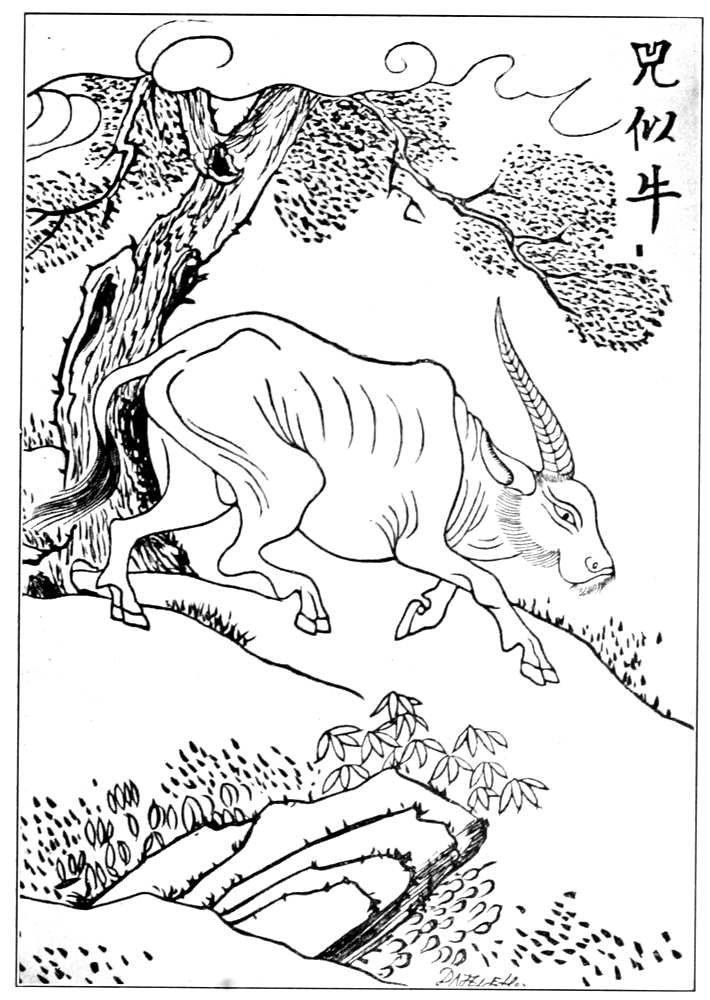
The Unicorn in China.
The Sz, or Malayan Rhinoceros, as pictured by a Chinese artist in the
’Rh Ya. The Indian Rhinoceros is one-horned. The African
square-lipped rhinoceros, or “white rhino,” though possessing
two horns, one behind the other, has the forward horn
so long and powerful as to be truly unicorn-like,
though it is nasal and not frontal.
A warm and steaming mist hung with a dull
purple haze over a landscape that seemed familiar,
though the boy knew that his eyes had never seen
it before. Huge monkey-puzzles thrust their
spiny arms into the heavy air, ferns a hundred
feet high swayed their livid green tracery against
the lowering sky, and here and there a leafless
pillar twenty feet in height showed where still
remained a struggling horsetail of the weird
forests of the age before. Over all hung the red
ball of the sun, unable to pierce the low-hung curling
wreaths of mist which held the landscape like
a bowl.
The glow of the half-obscured sun shone dully
on the quaking bog and deepened the shadows
of huge black forms, monstrous and menacing,
which seemed to be sprawling in the ebon water.
To these, there was no shape, although their gross
inertness breathed of life. In the distance there
was a stir, and Perry, gripping his knees hard
upon the Thing he rode, cried aloud in the somber
stillness—
“What moved!”
No sound answered. Silence held that flowerless
world like a vise, that world that had never
heard the song of a bird, but a rumbling vibration
in the distance seemed to the boy like some vast
leviathan stirring in its sleep. Sure was he that
he saw one of those sprawling shapes—which, near
by, seemed like stone—heave itself upward and
sway a monstrous neck. Straight in his path, one
of the murky masses lay, huge as though the earth
had spawned a creature vaster than a whale. In
panic, Perry forced the Thing that carried him to
swerve to the left. As he raced by, the boy forced
himself to look at the sprawling bulk. Shapeless
and moveless as a block of stone it lay. But
when, a second later, some impulse moved the lad
to turn his head back to look again, the seeming
stone had lurched itself across his path as though
to bar any returning way.
With a shiver, the boy’s glance turned to the
creature that he rode. Its horse-like head and
short, coarse mane gave a clue that its light limbs
and four spreading toes seemed to deny.
He was nearly thrown to the ground as the
Thing shied, then reared, nearly on its haunches.
And Perry, looking to see the cause of fear, distinctly
saw a quiver run over another monstrous
mass immediately before him, like the rippling
muscles on the back of a black panther about to
spring. He drove his heels into his steed.
“They’re waking,” he cried hoarsely. “I’ve
only got until the sun goes down!”
Through the humid swamp, spotted with its
foul giant brood, that moved, yet never seemed
to move, he rode, panic knocking at his ribs. The
sinking sun bore down with it his hopes, and as the
shadows grew more slanting, the sense of silent
life around him grew more threatening. A breeze
with a tang of cold in it swept over the swamp
and the grip of danger tightened. Now, in the
distance, the masses could be seen to drag their
slow length along, but near at hand, all was still.
“They’re only waiting,” he thought, “waiting
for the dusk.”
From under a huge flat block that bore a fair
resemblance to a giant tortoise-shell, a wicked
head with lidless green eyes and a turtle beak
darted out.
The animal he bestrode leaped as though a snake
had struck. And, with the leap came a new thing.
Even as the boy watched, the rough mane dwindled
and a smooth red-brown coat glinted in the darkening
sun. The neck grew longer and more pliant
and the swift lumbering gallop gave place to the
leaping bounds of some creature that man had
never ridden before. Perry’s only thought was
to go on—on—no matter what he rode, to go on—and
out of that swamp where the monstrous
reptiles were. But the strangeness of the marvel
held him when he saw in the center of the forehead
of the Thing, just in front of the ears, a
gleam of white like a milk-tooth.
“It’s—it’s a horn,” he muttered.
The sun touched the rim of the horizon. At
the same instant, with a sucking sound, the vast
bulk of a Diplodocus squirmed up from the slough
and poised its ungainly head, as though to see.
A leaping Compsognathus loomed black against
the sky. Noiseless, but menacing, a winged Pteranodon,
twenty-one feet from tip to tip of wing,
soared heavily above him. A pigmy in a world of
giant monsters, the boy raced on, speeding from—he
knew not what, to—he knew not whither.
The sense of terror from the monstrous brood
became more keen as a closer peril grew. His
knees ached almost beyond endurance from the
strain of trying to keep his seat, for no horsemanship
could avail upon such a steed as that which
he was riding. The long jerking leaps, though
they covered ground amazingly, seemed to drag
him inside out at every stride. The red-brown
neck stretched far ahead, and gleaming in the dull-red
dusk jutted the single horn, spirally twisted
like a kudu’s and lengthening even as he looked
at it.
Suddenly, without an instant’s warning, the
beast threw back his head. The gleaming horn
jerked to within a few inches of the boy. The lad
paled.
“Next time—” he said.
What could he do next time?
Without pausing, the Thing sped on, racing like
the wind over a mountainless world, so that Perry
did not dare throw himself off its back. Lower
sank the sun, till only one-half of its orb was seen,
its beams lying level over the plain that saw never
a hill over its thousand miles of length. Worst of
all, instead of the kinship between steed and rider
that gives strength in the most desperate pursuit,
he felt the malevolence of the evil thing he bestrode,
and tried to brace his nerve against an
attack from his sole means of escape from this
browsing ground of swollen reptiles.
He had not long to wait. In mid-leap, the creature
checked its speed, plunging stiff-legged, at
the same time tossed back its now long and
twisted horn to pierce him to the vitals. Tense
for the spring, Perry thrust himself upwards from
the knees, the sudden stoppage throwing him over
the creature’s head. Well he knew that if he fell
on the ground sharp hoof and sharper horn would
pin him to the earth. He grabbed the horn as
it slid under him, and clung to it like death.
In fury, the unicorn tossed him as a terrier
does a rat. The boy felt his hold weakening, but
he clung desperately. Sight and hearing failed
him, yet he clutched blindly, till with a wrench
the strained finger-clasp gave way and he found
himself flying through the air. Fortune favored
him. He landed on his feet, and though he staggered,
he did not actually fall. The second’s recovery
sufficed to clear his wits, and he dodged
as the vicious creature lunged. Before him
loomed the vast bulk of a Brontosaurus and behind
this he ran, trusting for safety to the small
brain and sluggish movements of the giant.
The ruse almost landed him into the jaws of
the nose-horned lizard, the carnivorous Ceratosaurus,
twenty feet in height, and he doubled back,
actually under its fore-limbs, as its large head
and formidable flesh-tearing teeth threatened the
unicorn, which reared and refused the combat.
The moment’s respite as the monsters faced each
other, gave Perry a chance to breathe.
“Where now?” he gasped, glancing round
wildly for some place to hide.
But, in that flat expanse, with the araucarias
and tree-ferns only a green blur in the distance,
there was no cover. The unicorn saw him and
charged again. Some strange instinct told him
what to do. Again doubling around the huge
dinosaur, the boy cast himself despairingly on
the back of a creature browsing a few feet away.
“Up!” he yelled.
As though impelled by the terror in the boy’s
voice, or by the still greater terror of sound in
that silent world, the light-limbed Anchisaurus
rose to its kangaroo-like attitude and began clumsily
to run. Some twenty feet of start was gained
before the unicorn caught sight of him and then
the chase began. The Anchisaurus, more terrified
even than the boy by this strange creature
clinging to its neck, and driven on by the gleaming
horn behind, leaped into full stride, covering ten
feet at every step. If the gallop of the unicorn
had been hard to bear, this swaying run was worse,
for, as the Anchisaurus swung first one foot then
the other, the neck and tail rolled to the opposite
side to maintain the creature’s balance. No
cockle shell on a stormy sea ever tossed as did
Perry on the Anchisaurus’ neck. But it was his
only chance of safety from that gleaming horn
behind, and tightly with arms and legs he gripped
the creature’s neck above the shoulder.
The sun was nearly down, but a slight, a very
slight rise in the ground gave firmer footing, both
to unicorn and Anchisaurus, so the speed of both
increased. Little by little the lumbering saurians
began to grow fewer and at last were seen no
more. In their place came spiny lizards, at first
few in number, then more and more, huge and
monstrous, until in the dim twilight and the silver
glow of the rising moon, their threatening
shapes seemed like a world of jagged rocks heaving
as the billows of a tempest-whipped lake.
Then, as though determined to give battle to
its strange pursuer, the Anchisaurus stopped, and
Perry, fearing that his strange mount would find
some swift accounting for his temerity, slipped
off, again to face the unicorn.
There was no need.
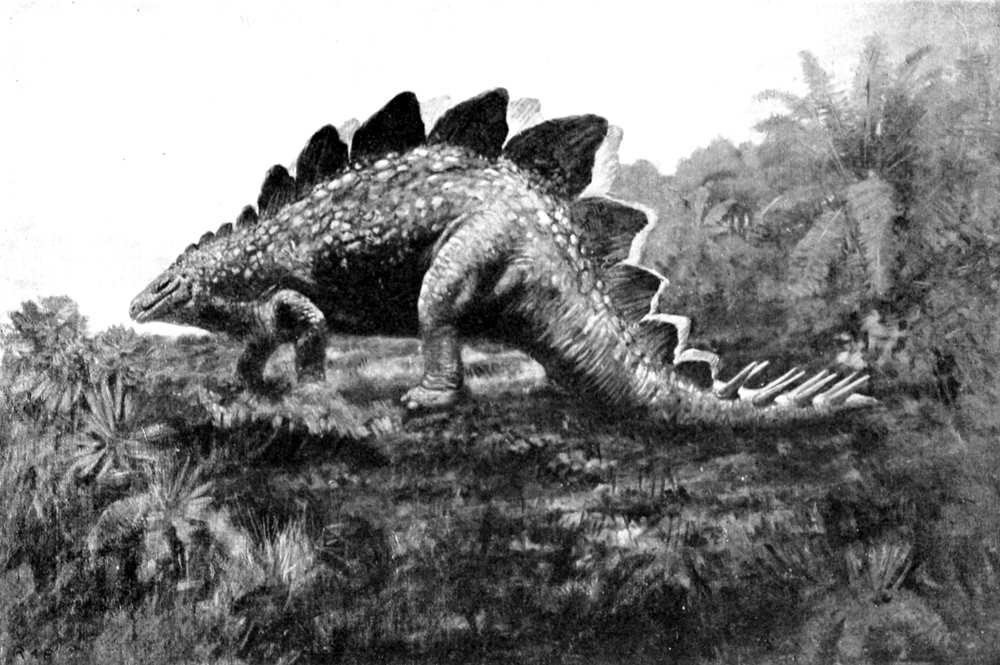
Courtesy of American Museum of Natural History.
Stegosaurus, the Super-Dreadnought of Old.
Huge armored monster of the reptile world, thirty-five feet long, as tall as a modern elephant to the top of
the spines, protected by sharp horny plates against the attacks of flesh-eating giants.
Between him and the savage beast that had
chased him for miles over the swamp stood an old
battle-scarred Stegosaurus, fully twenty feet in
length, its spines jutting into the air far above
the boy’s head. As he looked, the armored tail,
with its jagged, horny plates, lashed out at the
unicorn and felled it to the ground. The beast
half tried to rise and lunged its horn, white in
the moonlight, at the throat of its terrible foe.
But no weapon could pierce that living fortress
of defense and the horn slipped uselessly over the
scales.
The head of the Stegosaurus—so tiny for so
great a bulk of body—bent as though to smell the
wounded creature that the blow of his tail had
crushed, but, not being an eater of flesh, the huge
living fortress turned scornfully away.
Injured, but not mortally, the unicorn half rose,
when Perry, seizing his chance, drew from his belt
his hunting-knife and slit the creature’s throat.
Then, placing one foot on the body of the animal,
he cried aloud—the faded green book fluttering
from his lap as he sprang up—
“I’ve caught a unicorn!”
CHAPTER III PIRATES OF THE AIR
Perry’s father, whose entrance had awakened
the boy, looked quizzically at the lad as he stood
rubbing the sleep out of his eyes.
“I don’t know about catching a unicorn,” the
old merchant said, with more than a trace of
amused understanding in his tone, “but there’s
a big chance that you’ve caught a cold! You’d
better get to bed, son, just about as quickly as you
know how. Then you can go ahead and catch all
the unicorns you want.”
The boy looked a little shame-faced at having
disclosed the fact that he had fallen asleep and
had dreamed of the monsters on which his mind
had been set, but his father put his hand on the
lad’s shoulder, and said kindly:
“We’ll talk about this again some other time,
Perry, and if you really feel that you want to
take up a fossil-hunter’s life, I’ll not put anything
in your way. I had hoped—” he added regretfully,
“that you would come right into my
business, but after all, every tub must stand on
its own bottom. If you do go into the scientific
work, I’ll at least have the satisfaction of seeing
some of my own old dreams coming true, even
though at second-hand. Slip along to bed, now,
lad.”
Still only half-awake, Perry made some indistinct
reply, undressed and in a few minutes was
fast asleep, this time too soundly even to dream
of monsters, until the light of a morning that had
forgotten those ancient times, woke him to the
interests of a new day. It did occur to him,
though, as he was dressing, that the sun as it rose
that morning had risen just the same, thousands
of years ago, and would rise the same way hundreds
of thousands of years hence, and he wondered
what kind of creatures would be living on
the earth then.
By tacit consent, nothing was said at the breakfast
table concerning the subject that had been discussed
the night before, for Perry’s mother was
inclined to jump to conclusions and it was an
understood thing in the household that the best
time to inform her about anything that was new
was after it had been decided and settled. So
Perry started off for school, just as usual, and
for over a week he kept his ambitions to himself.
One Saturday morning, however, at breakfast time,
his father said to him:
“Perry, if you’ve nothing better to do, you
might walk down with me to the office this morning.”
“Sure!” the lad replied gladly, for these Saturday
morning walks were a great pleasure to him.
The old financier always had his car come round
to the door sharp at 8:30 in the morning, but if
the day were fine, it was his custom to dismiss
the chauffeur and to take the three miles to his
office at a brisk walk. He was a good walker and
had trained Perry to keep up a lively pace. This
morning, as soon as they had struck their gait,
the merchant said to his son:
“I had a letter from your Uncle George last
night.”
“Uncle George?” repeated the boy, questioningly.
“Yes.”
“Was it—” Perry hesitated.
“About you?” interpolated his father. “Yes,
it was.”
“Oh, Father, what did he say?”
“I had asked him about his proposed expedition
to Egypt, and especially I wanted to find out
when he planned to start.”
“And he’s going soon?”
“Two weeks from Monday.”
The boy was aching to hurl a series of questions
at his father, to bombard him with them,
but experience had taught him not to show impatience.
Trying to hold himself in check, therefore,
he said, only:
“Is he going for the Museum?”
“Yes. He wrote me that he is anxious to trace
the ancestry of the elephants. It appears that
we don’t yet know where the elephants came from,
and we don’t know exactly from what kind of a
beast the elephant developed. The British have
done a little work along that line in lower Egypt,
but for the time being, they have given up excavating
and the Museum has secured permission from
the British Government to explore the Fayum.”
“Uncle George will find whatever there is to
find,” Perry asserted confidently.
“Perhaps,” his father rejoined, smiling, “you
may be the one to do the finding.”
“Me?”
“Why not?”
“Oh, Father, then I’m really going?”
“Do you want to go so much?”
For an instant the boy was tongue-tied, for it
came over him with a rush that all his boyhood
dreams were about to be realized. Then he burst
out with:
“Want to go, Father? I’m wild to go!”
“Well, then,” the other answered with mock
resignation, “I suppose we’ll have to arrange it.
It’s true, son, that your uncle seems to think the
idea of your joining the expedition is a bit foolish.
He says you’re too young to know what
you’re about and not strong enough to be of any
use to the expedition.”
“But—” began Perry, interrupting.
“On the other hand,” continued his father, not
heeding the interruption, “he says he’ll give you
every chance to learn, though he appears to discount
nearly everything I said about your knowledge
of fossils and of paleontology in general.
I don’t know, but perhaps I did lay it on a bit thick.
So it’ll be up to you, son, to make good my
words.”
“You bet I’ll do everything I can,” declared the
lad excitedly. “Have I got a regular appointment,
Father?”
“You have not,” was the emphatic reply.
“Museum authorities don’t appoint boys to official
positions on a scientific expedition, even when
they’re as lanky and overgrown as you. A man
has got to be a simon-pure expert before he can
get a Museum appointment, and even then, he’s
got to work up through an assistantship. No, my
boy, you’re just accompanying your uncle and
I’m footing the bill.
“I’ve always been willing to hand out cash freely
for the scientific work of the Museum and I had
sent a cheque for five thousand to the fund for this
very expedition, before you had said anything to
me about your Patagonia idea. That subscription
helped, to a certain extent, but even so I don’t believe
I could have persuaded the Director to let
you go along unless he was convinced that you
were a promising young paleontologist. You
know I was away last week?”
“Yes.”
“I went to New York to see the Director of
the American Museum about you. One of your
friends—an assistant curator, who knows our Director
down here—spoke up in your favor.”
“I can guess who that was!”
“Maybe, but you won’t find out from me.”
The financier laughed. “The American Museum
director had to have his little joke, of course,” he
continued. “Do you know what he told me—
“‘Mr. Hunt,’ he said, and his eye had a twinkle
I’ve seen there several times, ‘a precocity in
paleontology is a species new to me.’
“Of course, Perry, I had to back water a bit.”
“You needn’t have, Father,” protested Perry.
“I don’t want to brag, but I’ll just show him!”
“That’s the right spirit, my son,” replied the
other, “but you’ve a long road to travel. I went
just far enough along that road myself to see what
a long journey it is.” For a moment the counting-room
and the figures and the complexities of
modern business life faded away from the old
financier’s mind and he looked forward unseeingly
and reminiscently. “I’d have liked to have gone
on with it,” he added, “but other things came between.”
Perry kept silent a minute or two, then said,
with boyish gentleness:
“We’ll be in on it together, Father, anyway.
And I feel great about it, really.”
“Of course we’ll be in on it together, as you
put it,” the other said, shaking himself free of
memories, “and you’ll have to make a record for
yourself out there. It’s a good thing for you that
you’re so far ahead in your school work.”
Perry looked up surprisedly.
“How’s that?” he asked.
His father smiled quietly.
“I saw your headmaster the other day,” he
answered. “You don’t suppose you’d have had
any chance to go if I found that you had been
neglecting your school work during the winter,
do you?”
“But the exams?”
“Are all arranged. The headmaster said your
term marks were high enough to let an average
examination pass you easily. The questions are
to be given me in a sealed envelope, I shall hand
them to your uncle, and at some convenient time,
probably on board ship, you’re to do the exams
and your uncle will forward them to the school
with a letter saying that they were done in his
presence and without any assistance from him. A
certain percentage is to be taken off for irregularity,
but unless you fall down hopelessly on the
papers, I feel sure that you will pass for the year.”
“You’ve thought of everything, Father,” rejoined
the boy, gratefully.
“Well, son,” was the response, “it’s up to you
to make the most of it. The arrangements are a
little sudden, but you can be ready in a couple
of weeks, can’t you?”
“I could be ready in half an hour,” Perry exclaimed
enthusiastically.
“That’s rather precipitate,” his father commented,
as they turned into the street leading to
the office, near the corner where the two generally
parted, “we won’t ask anything as rapid as that.
But two weeks from to-day, you’re to start for
New York, and there you’ll board the steamer for
the Mediterranean. It’s a great chance for you,
my boy.”
During those two weeks Perry walked on air.
He was the envy of all his boy chums and by the
time he was ready to start he had been asked for
so many fossil remains by his boy friends (who
didn’t know whether a Mosasaurus was the size
of a sparrow or a whale) that he would have had
to discover a prehistoric cemetery in order to fulfill
all the requests. But the boy had been thoroughly
trained not to make promises he could
not keep, and thus he saved himself from many an
awkward refusal later.
When the fated day came round, when he had
seen his pith helmet and other parts of his tropical
outfit safely packed, Perry was so excited that
he could hardly talk, and his farewells were little
more than stammering interjections. His mother
was disappointed, for she expected some evidence
of emotion, but the old merchant knew boy nature
better and was well pleased over the lad’s eagerness
to be off. Indeed, despite his years, the
financier envied his son and would have liked nothing
better than to have been able to jump aboard
the train with him. But he contented himself
with a hearty handshake—quite a grown-up one,
purposely—and stepped into his motor-car resignedly,
as the departing train rounded a distant
curve.
As the through express thundered past station
after station, Perry had one swift pang of regret
to think of the school commencement and the
games he would miss, but when he thought of what
was ahead of him, the thrill of doing real things
came over him like a tornado and swept aside all
thoughts of school. That his learning was not
over, but only just beginning, he thoroughly
realized, for along this line had been his father’s
parting words:
“In some fields, son,” he had said to Perry,
“you can succeed by making a bluff, but in scientific
work you’ve got to know, and to know that
you know. Science is real and big, all the way
through.”
Dr. Hunt met the boy at the New York terminal.
Although uncle and nephew knew each other in
the vague way that relatives do, neither had ever
thought of the other as taking a place in his life,
and each anticipated the meeting with great interest.
The professor’s first thought was that the boy
looked rugged and sturdy, and Perry’s first
thought was that there was far more of command
in his uncle’s manner than he remembered. Recalling
his father’s advice against “bluffing,”
Perry was careful in his statements as he chatted
with his uncle on the way to the steamer and consequently
gave a favorable impression.
“Your father tells me you know considerable
paleontology,” said the leader of the expedition.
“I’ve always been keen on fossils,” the boy
replied, “and so I’ve managed to pick up little
bits about it. But of course I haven’t really studied;
not the way I hope to, some day.”
“You know your geological periods, I suppose?”
“Backwards!” replied Perry confidently, for
he knew that he really did know them, and his
friend in the Museum had taught him to see how
important was this groundwork in any fossil studies
that he might do. So, when his uncle, in a few
sharp questions, put him on the rack, Perry came
out of the ordeal well, because he had only claimed
to know exactly the things he did know. As a result,
he won from the accurate and careful scientist
the golden opinion:
“I shouldn’t be surprised, lad, if we made a
paleontologist out of you, after all.”
To an inland boy, such as Perry, every detail
of the steamer was of interest. Some of the members
of the expedition, who had rather dreaded
the idea of a boy as a member of their party,
were most cordial to the lad when he showed himself
at the same time quiet and eager to learn.
To one of the younger men, Antoine Marcq, a Belgian
scientist, Perry was especially attracted, and
they chummed up right away. Antoine told him
that he had a young brother, about Perry’s age.
The Belgian proved a most delightful companion,
full of stories and with a true scientific imagination.
Until the steamer drew clear of the harbor
and began to meet the bobbles of a choppy sea,
he regaled the lad with adventures from ports
all over the world, all of which, it seemed from
his yarns, he had visited at some time or other.
But the afore-mentioned bobbles gave the ship a
wriggling motion of which the boy, at first slightly,
then seriously, disapproved, and for the next couple
of days even Antoine’s yarns lost their interest.
It was the lad’s first sea voyage.
The first morning that he got over his sea-sickness
sufficiently to eat a hearty breakfast, which
was the third day out, the lad’s attention was attracted
to a large gull which was swooping in circles
about the masthead. He pointed to it.
“What is that, Antoine?” he asked. “A
booby?”
For he remembered having read somewhere
about a booby having been the name of a sea-bird
and the word had stuck in his memory.
“A booby, oh no, oh no,” said Antoine, with a
doubling of the negative that was a marked characteristic
in his speech, “no booby as far north
as this! It is one of the sea-gulls, a black-backed
gull.”
“I thought all birds that flew over the sea were
sea-gulls,” remarked Perry.
“Not at all, not at all,” replied the other. “I
show you in a minute.” He paused. “See?”
he added, pointing to a bird a little smaller than
the gull that had attracted Perry’s attention.
“That is a cousin of the ‘booby.’ It is a gannet.
If you look, you can see that his neck is longer
and that his chest looks different from the black-backed
gull. That is because he has a long breastbone
and the ribs are set in at a different angle, so,
when he plunges into the water with a big splash
after a fish, he does not hurt himself when he hits
the water. You can dive?”
“Oh, yes,” answered Perry, “I’m quite a decent
swimmer.”
“You know that when you dive, if you hit the
water ‘smack,’ it hurts?”
“You bet it does.”
“The gannet drops suddenly, and so the pointed
breastbone does for the diving bird what you do
when you put your hands in front of you. It
divides the water.”
“That ought to make them good fish-catchers,
I should think.”
“The very best, the very best,” agreed Antoine.
“The gannet is a relative of the cormorant,
and you know the Chinese train the cormorants
to go and fish for them.”
“And bring back the fish?”
“Yes, yes.”
“I should think the cormorant would eat the
fish himself.”
“No, no, he cannot. The Chinese put a ring
around the bottom of his neck so that he cannot
swallow.”
“That’s a great scheme,” the boy commented.
“But why doesn’t the cormorant fly away?”
“He is trained. Why doesn’t your dog run
away?”
“Training, I guess,” agreed Perry after a moment’s
pause. “But a big bird seems different,
somehow. How do they train them, Antoine?”
“This way. They take the eggs of the cormorant,
and set them to hatch under a hen.”
“The ordinary hen—” interrupted the boy.
“Yes, yes, the hen. As soon as the little
cormorants are big enough to feed, they take them
to a pond where there are a lot of small fish. They
tie a string to one leg of the bird. When a cormorant
catches a fish, the trainer whistles very loudly
and then pulls in the bird by the string. He takes
the fish and lets him go again. After a little time,
when the bird hears the whistle, he comes back
to the boat. It is pleasanter to swim back or
to fly back than to be tugged by a string.
“When the bird is big, they take him to the
sea and he catches the fish, returning to the boat
at the whistle. He cannot swallow the fish because
of the ring. At the end of the day the cormorant
gets all the fish he has caught that are
not good for the market, and he keeps on catching
all the day long because he is always hungry.”
“Somebody ought to start a Society for the
Prevention of Cruelty to Birds,” put in Perry
with a grin.
“Why? It does not hurt the cormorant. He
gets plenty to eat. It is not cruelty to make a
bird work, any more than to make a horse work.
But if you want to see something in Nature that
is like a bully, look there!”
The young scientist pointed over the port quarter
of the steamer, where a flock of terns was
wheeling and dipping.
“What are those?” the boy queried.
“Terns,” the other answered. “Very much
like gulls, only that they are slenderer and have
forked tails.”
“I don’t see anything wrong there,” continued
Perry after he had observed the merry bustle and
excitement. “They seem rather jolly little
chaps.”
The other pointed a long accusing finger a little
to the right of the flock.
There, flying as straight as an arrow shot from
a bow, with a steady swift flight came a dark and
resolute-looking bird. Into that flock of terns he
plunged, like a rakish pirate schooner cutting her
path amid a fleet of white-sailed pleasure boats.
In the center of the flock of birds he stopped,
poised. The whirling of the terns had become
more agitated and their hoarse shrieks betrayed
their terror. Then, it seemed that the intruder
had picked out a victim, for with a sudden swirl
he darted at a tern that had wheeled up from the
surface of the ocean a minute before. The tern,
light and agile, dodged and sped hither and
hither, gliding, mounting, doubling, with the dark
stranger ever behind him, apparently eager to tear
him to pieces. At last, believing that the vengeful
creature behind him could not be shaken off,
in one last final effort to escape, the tern lightened
his flight by disgorging the contents of his
gullet.
Instantly, with a movement so quick that Perry
was hard set to follow it, the pirate caught in midair
the fish that the tern had dropped. Pouncing
upon it from above, like a falling thunderbolt, his
powerful bill seized the fish. A quick upward jerk
of the head sent the silver thing gleaming above
him, and, as it whirled, he caught it in the proper
position for swallowing, head first. Then, gliding
back toward the middle of the flock, the frigatebird
poised, ready to pounce upon the meal that
the next tern would catch.
“The grafter!” exclaimed Perry, when the
whole plan was clear to him. “Why doesn’t he
catch fish for himself?”
“He cannot, he cannot,” Antoine answered.
“He is made to live that way. He cannot dive,
no, nor can he plunge into the water. Some one
else must catch fish for him, or he will die.”
“That’s the limit!”
Antoine shrugged his shoulders.
“Man is just as bad,” he said. “The cow
makes milk for the calf, Man takes it; the bee
makes honey, Man takes it; what’s the difference?”
“I suppose it’s so, when you put it that way,
we do manage to sneak a lot of stuff that animals
have planned for their own little savings. It
seems a shame, somehow, and yet it seems right,
too.”
“It is Nature’s law, yes,” the young Belgian
replied, “always the more powerful creature
preys upon the less.”
“It’s a good thing,” said Perry, thoughtfully,
“that the frigate-bird isn’t any bigger. A five-foot
span is big enough, anyway. Suppose he
were as big as an albatross, Antoine, why, the
terns would never get anything to eat at all.”
“If he were as big as an albatross,” retorted
the other, “the little birds could dodge him.”
“Isn’t the albatross about the biggest thing
that ever flew?” asked the boy.
Antoine made a gesture of negation.
“No, no,” he said, “he is the biggest bird,
the biggest thing with feathers that has ever been,
but the Pteranodon—the Pteranodon was more
than half as big again and would look twice as
big.”
“Pteranodon,” said the boy thoughtfully.
“Let’s see, Antoine, that was some kind of lizardbird,
wasn’t it?”
“Not a bird, not a bird,” replied the other,
“but it was a lizard that flew.”
“Didn’t it have wings?”
“No, no, it had aëroplanes,” was the astonishing
answer. “Hold out your hand!”
Wondering what was coming, the boy did so.
“Double your thumb under, put the three fingers
close together but not quite touching, and
spread the little finger out,” ordered his friend.
Perry obeyed.
“Now, imagine you have claws on the three
fingers, and make your little finger four feet long.
Next picture to yourself a skin like a bat’s
stretched from the tip of the finger to your feet
and you have a Pteranodon.”
“Just like a big bat!”
“No, no. The bat has five fingers. The bat’s
thumb is a claw, and the membrane that makes
the wing is like a big web between the long, long
fingers. Quite different. Then the bat is a mammal.
The Pteranodon, like all the flying lizards,
was a reptile. The first bat was not born until
thousands of years after the last pterodactyl or
flying lizard died. There were lots of different
kinds, but all their flying planes, or wings, were
stretched from one finger. That’s the reason of
the name, Perry, ptero—dactyl, wing—finger.
Some were smaller than a sparrow, others were
big. The Pteranodon was the biggest. Some had
teeth, some had beaks like birds. There was the
Ramphorhyncus—”
“Oh, I know him,” said the boy eagerly, “he
had a tremendous long tail with a rudder at the
tip.”
“Yes, yes,” agreed his friend. “And do you
know the Dimorphodon Macronyx?”
“Big-headed thing, looks like a nightmare,
with a rat’s tail, teeth sticking up on the outside,
and eyes that look as if he’d been in a fight? Is
that the one?”
Antoine laughed at the description.
“It is not quite scientific, worded that way,”
he answered, “but you have the idea. That is
‘him,’ as you say. None of these really flew.
They aëroplaned.”
“I don’t quite understand,” said the boy.
“How do you mean they aëroplaned?”
“See,” said his friend, “a bird flaps his wings
and rises. Some birds can glide for hours and
hardly ever flap their wings. But many of the
flying lizards could not flap their wings at all.
They had to climb up a tree or a cliff with their
claws and then throw themselves into space.
Then, with the start they thus got, they could
swoop and glide and swirl for quite a long time.
When the spurt was over, they would have to
find some new place up which to climb. Some of
them, if they were on a flat plain, would die.”
Courtesy of American Museum of Natural History.
The Largest Creature That Ever Flew.
Pteranodon, the flying reptile, twenty-one feet from tip to tip of
“wings,” the last of a giant race, soaring over the Cretaceous ocean.
Courtesy of D. Appleton & Co.
A Flying Nightmare of Olden Time.
Dimorphodon Macronyx, size of a small dog, one of the minor terrors
of the air, ten million years ago. Restoration from Seeley, in
“Dragons of the Air”; pose of restoration questionable,
as fore-legs could not be used for walking.
“Even the Pteranodon?”
“No, no,” his friend answered. “Pteranodon
was so big. From tip to tip of the planes or
wings was nearly twenty feet. And his body was
very small. Even the bones were tiny. A Pteranodon
bone over two feet long and two inches
in diameter, was like a piece of heavy cardboard
rolled into a tube.”
“Hollow?”
“Quite, quite hollow. And he had very little
weight to carry. We know he could not have
flapped his wings very much.”
“How can you find that out?” queried Perry.
“No one was there to see him.”
“No, no. But it takes muscle strength to flap
wings, and it needs a strong breastbone to attach
the muscles. The flying lizards did not have this.
Then, too, the bones were too thin to flap such
big wings. It was nearly all gliding. So you can
see why the birds were the winners in the fight.”
“I surely do,” the boy answered. “But if the
bird plan won out, and the pterodactyl didn’t, why
has the bat plan worked?”
“The bat’s wings are four times as strong as
the pterodactyl’s, because all four fingers are
there,” was the reply. “Then, too, the bat is
a mammal and warm-blooded. Besides which,
most bats are small. The big bats fly slowly, flapping
their wings like a crow.”
“Were there any birds to set up in competition
with the flying lizards?” asked the boy.
“Not at first,” the other said. “But when
the pterodactyl failed, Nature had to start on
something else. So she tried birds. Still, the first
ones were more than half reptiles. They even
had teeth.”
“Birds with teeth?”
“Great long teeth,” said his friend. “I suppose,
Perry, in all the history of fossil discoveries
in the rocks, one of the greatest events was the
day when the first bird was discovered in a rock
in Bavaria which was being quarried for lithograph
stone. That rock is made from a fine kind
of mud, which was laid down in the Jurassic Period.
One of the very first birds in the world
had evidently got stuck in that mud, hundreds of
thousands of years ago, and although he had struggled
to get away, he was stuck fast. He had
drowned and died there.
“Then, day by day, week by week, the mud settled
around him, until finally it reached his body
and his head, and entombed him absolutely. The
mud must have been coming down quite fast, for
all his body was covered even before the feathers
had rotted. For years and years, for centuries
and centuries, mud had been deposited on top of
him, thousands and tens of thousands of years
had put other rock strata above the mud and then,
in a later age, there had been a rising of the earth
and it was all dry land once more.
“Still more hundreds of thousands of years
passed, and then Man came. A workman, digging
out stone, saw this dead bird, even the marks
of his feathers on the stone. Even then, no one
could believe it was really a bird, and the jaw,
which was lying a few feet away from the marks
of the feathers, was thought to be the jaw of a
fish.
“Some day, perhaps, Perry, you may be lucky
enough to find one still earlier! Think of a
Triassic reptile heralding a bird! That would be
a triumph, for there must have been some small
leaping dinosaur which gave signs of bird-like
development. Just think, Perry, if you should be
the one to make the grand discovery!”
“It would be great,” cried the boy.
“That’s the excitement of paleontology,” went
on the other, enthusiastically. “You’ve read of
the gold-fever, and how men will spend their lives
alone in the mountains, hunting for nuggets.
Then, when they find them, the gold is just like
all the rest of the gold in the world. But when
we find something new, it’s something that no human
eye has ever seen before, it’s the gateway into
a new world. Any day, if we were on an expedition
among Triassic rocks, we might find the bird
that lived before the Archæopteryx and learn for
the first time exactly how the birds first came to
be.”
“There aren’t any birds living to-day that are
like those old primitive ones, are there, Antoine?”
“Not really alike,” the other answered, “because
those early birds were still half reptiles.
For example, the Archæopteryx had a long tail
like a lizard, with a feather on each side of each
joint. Then, too, he had claws on the joints of
his wings. Now, there is still one bird living that
has claws on the end of its wings when young,
and climbs around the trees with them before it
learns to fly. That’s the—”
“Hold on!” cried Perry. “I’ll tell you the
name. Wait a bit!” He thought hard. “It’s
the—the—Hoactzin, isn’t it?”
“Right, right,” said Antoine, “you have read
your books well. The first birds were not highly
developed, and probably they were not as good
flyers as the flying lizards. Most likely they only
took short flights. Still, the future was theirs,
for they were built upon a better plan.”
“Because of the wing-flapping?”
“Yes, for one reason. But the pterodactyls
might have developed that. Indeed, some of the
little ones may have been able to flap. It was
the cold that first gave the birds their real start.”
“The Ice Age?”
“Not the one you mean, Perry, but the second
Ice Age, at the end of the Age of Chalk. It makes
the geological history of the world a great deal
easier to remember, if you divide it into the three
great Ages of Ice. The first came at the end of
the Coal-Forest time or the Carboniferous Period
and closed the Empire of Fishes and Amphibians;
the Second Age of Ice came at the end of the
Age of Chalk, or the Cretaceous Period, and it
closed the Empire of Reptiles; the Third Ice Age
came at the end of the Pliocene Period and it
closed the Empire of the Beasts. As the Ice-sheet
of the Glacial Epoch slowly drew back toward the
North Pole, Man took his place as the leader of
Life.”
The boy looked up quickly.
“That’s a dandy division, Antoine,” he said;
“it’s heaps easier to remember that way. And
you say it was the Second Ice Age that shoved
the birds ahead?”
“Yes, yes. During the Age of Chalk, nearly
all Europe was under a warm sea. There were
millions of little sea-creatures with shells, in those
tepid waters. Sea-shells, you know, are made out
of the lime that is dissolved in the sea, but after
that lime has been made into a sea-shell it does
not dissolve. These billions of microscopic shellfish
lived, made their homes and died, so that their
shells rained continually through the water to the
ocean floor, and, inch by inch, the accumulated
shells made deep beds of lime or chalk. Some beds
are hundreds of feet thick.
“Slowly, slowly, the bed of the ocean rose, until
it came near the surface of the sea. Still it rose,
throwing off the water that had covered it. The
oceans rushed into a new bed, and Western America,
Southern Europe and Southern Asia rose
above the water for the last time, much in their
present outlines.
“The changes of the earth’s crust made numberless
volcanoes, especially in those parts of the
earth that had just appeared above the surface.
In the glare of eruptions that never stopped, amid
the thunder of vast explosions, the hissing of great
geysers and the unceasing growl of earthquakes,
the land grew higher and higher above the sea,
and the world grew colder and colder. It was the
end of the Empire of Reptiles.”
“Ah!” exclaimed Perry, remembering his
dream.
“As the world grew colder,” Antoine continued,
“the soft vegetation died away and
harder grasses and trees and shrubs took its place,
needing creatures with better teeth to chew the
stronger fibers. And still the grip of the cold increased.
“In that time of miserable frigidity, the flying
lizards suffered terribly. Their thin wings of
membrane had no resistance to the biting blasts
that whistled over the ever-rising land. Their
cold blood afforded no store of vitality against the
frost.
“The birds, their rivals, protected with feathers,
with warm blood in their veins, with deep
breastbones giving them muscles enabling them to
fly long distances, got the pick of the food. One
by one the shivering pterodactyls disappeared,
and perhaps the great specimen of Pteranodon in
our Museum was the very last of the giant flying
reptiles.
“We can almost see him, half-starved, half-frozen,
gliding over the waters of the sea, his
gaunt ungainly frame growing weaker and more
feeble as numbness stole over him, only, at last,
to fall into the ocean that once flowed over what
is now the State of Kansas. And so he died, the
great Pteranodon, the last of his kind, and, for
size, the crested monarch of all that flew in any
age that had been or was to come.”
CHAPTER IV SEEING THE SEA-SERPENT
For the next two days Perry was kept busily
at work on his examinations, for, as his father had
suggested, it was on ship-board that the boy’s
uncle felt the time to be most opportune for getting
that work done. He was deep in one of his
examination papers, when, suddenly, his uncle
called to him:
“Here’s a sea-serpent, Perry!”
The boy came out of his deck-chair with a jump,
tripping over his steamer rug and nearly pitching
headlong in his hurry. He scrambled to the
rail and followed with his glance his uncle’s pointing
finger.
There, not more than seventy-five feet from the
vessel’s side, were the moving and undulating
coils of what, at first sight, appeared to be a huge
snake. Just for a moment, and then a picture that
he had seen flashed back to the boy’s remembrance,
and he turned to his uncle with a look of reproach.
“Uncle George, that’s only a school of porpoises!”
“Fooled you for a minute, didn’t they?”
queried his leader.
“Yes,” the boy admitted, “they certainly did.
But only for a minute.”
“Supposing you had never heard of porpoises,
that you had seen them just once and that on a
misty morning, seen them the way you saw them
just now, heaving themselves clear out of the
water, one after the other in a long wavering line,
don’t you think you might have reported that you
had seen the sea-serpent?”
“Likely enough,” the lad agreed. “But about
the sea-serpent, Uncle George, I’ve often wondered.
Do you suppose that there was ever any
real reason for the yarn?”
“Why do you call it a yarn?” queried the scientist
sharply.
“Why not?” was Perry’s astonished answer.
“There isn’t any sea-serpent, is there?”
“You seem pesky sure about it,” his uncle retorted,
with a distinct trace of irritation in his
manner.
“But I thought every one knew it was a fake!”
“That what was a fake?”
Courtesy of Pall Mall Magazine.
Sea-Serpent Attacking a Pirate Ship.
Fanciful sketch, but the red flowing mane may have been suggested by an
oarfish, of which specimens fifty feet long have been found.
“The sea-serpent yarn.”
“You persist in calling it a ‘yarn,’” his uncle
warned him. “Get out of that habit, Perry, it
won’t do you any good. It’s never safe to say
that a certain thing does not exist, until you have
absolute proof that it cannot exist. No one would
have expected to find birds with teeth or lizards
with wings, yet, as you know, there were plenty
of these, and we have found many specimens. As
for your way of talking about a sea-serpent
‘yarn,’ don’t forget that millions of sea-serpents
swam in the oceans of long ago.”
“Could there be an Ichthyosaurus still living
in the bottom of the sea?” hazarded the boy.
The professor wheeled on him in an instant.
“What was an Ichthyosaurus,” he asked
sharply, “fish or reptile?”
“Reptile,” answered the boy promptly.
“Do true reptiles have gills?”
The question staggered Perry, for he did not
know. He thought for a moment, and then remembered
that all water-dwelling reptiles came up
to the surface to breathe, so he answered:
“I’m not sure, Uncle George, but I don’t think
any of them have.”
“They haven’t,” was the crisp correction.
“How, then, could any of them be living in the
bottom of the sea?”
The scientist snorted impatiently and paced the
deck.
“There’s a lot of foolish talk,” he continued,
after a few minutes’ pause, “about some race of
fossil monsters having continued to the present
time, as though, at almost any time, one might
happen to come across an Agathosaurus at sea,
or a Tyrannosaurus on land. There are, of
course, a few survivals, such as the shrimp-like
Nebalia, which goes back to the Cambrian Period,
to the very beginning of life, but all these survivals
are small and inconspicuous. And Agathosaurus
of the Cretaceous Period certainly wasn’t
inconspicuous!”
“Just how big was the Agathosaurus?” queried
the boy.
“Big enough to satisfy any sea-serpent-hunter,”
was the reply. “The Agathosaurus
had a neck thirty feet long and a body as large
as that of a small elephant, with powerful limbs
turned into swimming paddles. This long neck,
with its small head and sharp-toothed jaws, must
have worked havoc with the fish of the Jurassic
seas.”
Courtesy of American Museum of Natural History.
The Fiercest Monster That Ever Lived.
Tyrannosaurus, the tyrant saurian, greatest of flesh-eating giants, about to attack a family of Triceratops,
“they of the three-horned face.”
“Weren’t there any fish big enough to give him
a fight?”
“H’m, hardly,” the scientist replied meditatively.
“Still, there was the Portheus Molossus,
of course.”
“The what?” asked the boy. “I haven’t ever
heard of him.”
“The bulldog fish,” his uncle explained. “Oh,
Portheus was able to give a good account of himself.
He had a head a little larger than that of
a grizzly bear, with jaws even deeper than a bear’s
in proportion to their length. The teeth stood
about three inches above the gums, tiger-like, but,
of course, they were fish teeth, much more slender
and a great deal sharper. He had two rows of
teeth which crossed each other, and even an Agathosaurus
would have had trouble shaking off a
Portheus if the fish took a fast hold on his snaky
neck.”
“I wish I could see a scrap like that now,” exclaimed
Perry regretfully.
“You were born about three million years too
late,” was the reply, “for it’s fully as long ago
since the saurians left. They were the strangest
army, Perry, that ever trod the earth, some of
them monsters of ferocity and terrible to look on,
such as the Tyrannosaurus, which, as you can see,
means the Tyrant Saurian, but most of them were
slow, lumbering, and inoffensive. Of true quickness
and agility they had none.
“Over earth and air and sea, they were the
masters. In the shallow seas they ruled with an
iron hand; they filled great shells like turtles with
a bulk vaster than has been seen since; they reared
themselves on towering hind limbs like colossal
kangaroos, their monstrous tails swinging free behind
them; they donned fantastic armor, with
spikes and horns, and living saws upon their backs,
such as outdid the wildest imaginations of man;
they even rose into the air and filled it with the
flying dragons, as though to make fairy tales believable.
“From Australia to the Arctic Circle the whole
world was in their grip, and one can almost
picture two of the great monsters thinking, in
their sluggish way, of the impossibility that their
mighty lordship should ever come to an end. I
say ‘almost,’ Perry, for you know that these creatures
had very little brain. A monster weighing
thirty tons, like the Brontosaurus, had only
one-quarter as much true brain as an ape of to-day.
They could hardly think at all. Yet, in some
brute way, they knew that they had nothing but
each other to be afraid of. The enemy that should
conquer them they did not know.
Courtesy of American Museum of Natural History.
The Sharp-Toothed Death.
Thirty-foot Tylosaurus pursuing Portheus, the six-foot bulldog fish,
in the Jurassic ocean.
Courtesy of American Museum of Natural History.
The Jurassic Sea-Serpent.
Elasmosaurus, the scourge of the primitive ocean, seventy feet in
length, ravaging the bottom of the shallow sea. Neck
less flexible than shown in restoration.
“Then came the cold, the awful cold that drove
the Pterodactyls from the earth. The warm seas
of the Age of Chalk grew chill, the land rose, the
water ran into the deep beds of what is now the
Atlantic and Pacific Oceans, the continents as we
know them took their shape, the ever-rising earth
grew impatient of its slow-brained huge inhabitants,
and shook them off. The Tyrannosaurus
and all the flesh-eating dinosaurs had found easy
prey on the huge vegetarian monsters, but as these
decreased they began to prey upon themselves.
Their heavy shapes and their slow brains, however,
made them unfit for the great battle of life,
and quicker and more alert animals took their
place.
“When, a hundred thousand years later, the
climate relaxed and began to grow warmer again,
in the Eocene Epoch, at the beginning of the Tertiary
Period, the mighty monsters and the strange
dragons were all gone, and a ragged regiment of
crocodiles, turtles, and serpents in the tropics,
with a swarm of smaller creatures, such as lizards,
in the fringes of the warm zone, was all that remained
of the world-conquering hosts of the Mesozoic
reptiles.
“There are none left now, Perry, and you will
wear out your eyes with watching over the sea before
ever you will see any of the sea-snake-lizards—the
Dolichosaurs and the Mosasaurs, or the fish-lizards—such
as the Ichthyosaurus. The Plesiosaurus,
too, have gone. Not one of those big sea-reptile
forms has sought its prey in the waters
of the earth for at least three million years.”
“Yet lots of people claim to have seen sea-serpents,”
protested Perry.
“Plenty of them. But no one has ever made a
photograph of one, nor has a single specimen of
one ever been put into a Museum,” remarked the
professor.
“Do you think they were all fake—I mean mistakes?”
corrected the boy, hastily.
“Not at all,” was the reply. “Some of them
were hoaxes, of course. But I’m not the man to
believe that other people are lying because I don’t
happen to agree with them. It’s easy to make
errors in a subject on which you’re not an expert—and
few of the people who have claimed to have
seen sea-serpents were expert naturalists. Now,
if a sea-serpent presented himself for examination
to a scientific expedition, such as the Challenger,
or the Michael Sars, it would be a different matter.
That has never happened.”
Combat Between Ichthyosaurus and Plesiosaurus.
One of the most famous of the early restorations. Modern discovery has shown that the long neck of the
Plesiosaurus was almost stiff, and that the Ichthyosaurus had not a whale-like spout.
The latter also bore a triangular shark-like fin on the back.
“But you think the people who reported a sea-serpent
saw something?”
“I’m sure of it,” was the scientist’s instant
reply. “The very difference in all the reports
shows that.”
“What do you suppose they saw?”
“Some of them saw porpoises, without a doubt,
like those you saw this morning. But, myself, I
believe that most of the stories have started from
appearances of the giant squid or calamary. You
know, Perry, the squid has been known to reach
fifty or sixty feet in length, from the tip of the
broad arrow-like tail to the end of the longest
tentacle. As squids swim tail first, and as their
method of propulsion is by expelling water in
little jets from a siphon which is situated near
the head, and, moreover, as they often allow the
tail (which might look like a head) to project half
out of the water, their huge bulk would easily
lead an observer to make a false estimate of their
size. If you add to this the peculiar bubbling
ripple caused by the squid’s curious method of
swimming, the wake would give the effect of the
animal forty or fifty feet longer than its true size.
Squids are not at all uncommon, though they seldom
stay long at the surface, and their appearances
may be the basis of many sea-serpent
stories.”
“But you do think that all the stories are a
bit high, don’t you, Uncle George? I mean, you
think they’re not just right?”
“I may be a little partial to the sea-serpent,”
the scientist answered with a quizzical smile, “so
I should never declare that there may not be some
monster of the deep that is occasionally seen.”
“But there have been some awfully queer
stories,” put in Perry, incredulously.
“Yes, there have been,” the professor admitted.
“The early ones, particularly, seem more
or less fabulous. For example, Perry, there was
the story of the island found by the old Swedish
bishop-explorer, Olaus Magnus. Do you know
that one?”
“You bet I do,” said the boy emphatically.
“Father’s got a picture of it in an old sketch-book
of his at home. Wasn’t that the one in which the
old explorer said he landed on an island, took possession
of it in the name of the King of Sweden,
had a church service there, and then decided to
wind up with a feast? After a bit, when the fire
really got hot, they smelt a smell of burning skin,
the ‘island’ began to move, and the bishop and
the sailors hardly had time to scramble back
aboard the ship and cut the rope fastened to the
grappling anchor they had cast ‘ashore,’ when
the huge beast plunged down to the bottom of the
sea. I know you think a good deal of sea-serpent
stories, Uncle George, but I’m leery about that
one.”
“I’ll confess,” the professor answered, laughing,
“that even the fact that the explorer was a
bishop doesn’t quite convince me. Yet Svere,
King of Norway, claimed to have seen a similar
creature, just as large, which he called a husguife.’
If you don’t believe a bishop, how about
a king?”
“I think he fibbed, too,” was the boy’s ready
answer.
The professor’s eyes twinkled.
“If you do sometime become a paleontologist,
my boy,” he said, “you’ll have to learn to comment
on other people’s reports in language that
is—well, we’ll call it a little more scientific. It is
safer, as well as more courteous.”
“But they were fibs,” insisted the lad, with all
the uncompromising attitude of boyhood. “How
would you put that ‘scientifically,’ Uncle
George?”
“They were—inaccuracies of description consequent
upon insufficient opportunity for the development
of correct observational methods,” was
the reply. “That’s saying the same thing in
another way, Perry.”
The lad laughed.
“Tell me some more of the ‘inaccuracies,’
Uncle,” he said.
“Most of them were Norse,” the professor continued.
“Just in the same way that all English-speaking
people believed in the dragon, and all
the Greeks believed in nymphs and fauns, and all
the Irish believed in fairies, so the Norse world
pinned its faith to the Kraken, or the Warrum or
Sea-Worm of Iceland.”
“I don’t remember the Kraken,” put in the
boy. “Just what was that supposed to be?”
“It was described as being a creature of the
deepest parts of the sea. It was supposed to be
a mile and a half in circumference, and its horns
were as high and as large as the masts of small
vessels.”
“Did any one ever claim to have seen such a
beast?”
“Several people,” the scientist replied. “In
1680, a Lutheran minister, the Rev. Anson Friis,
reported the discovery of a small Kraken,
stranded in a fjord near Alstahoug. He described
the creature as almost round, with a head something
like that of a parrot and a long tail divided
into four round swimming paddles. He went on
to say that it took him nine minutes of sharp walking
to walk round the carcass. Baron Grippenhjelme,
the local magnate, was more moderate in
his estimate, but even he declared it to be sixty
fathoms (300 feet) across. With a better perception
than the minister who had first discovered
the carcass, he hazarded the guess that the strange
creature was a polyp.”
“What do you suppose it really was?” queried
the boy.
“That’s a little difficult to say,” was the
guarded reply. “There’s not much evidence to
go on. There seems no doubt that Friis and Grippenhjelme
found something. The remarks about
a parrot’s beak by one, and the other’s reference
to a polyp suggest that perhaps a giant squid and
an octopus were washed ashore together, and if,
as probable, their flesh already was decaying, examination
would be apt to be very brief. Don’t
forget, Perry, that the size was only an estimate.
Even the most conservative guesses shrink under
the application of a two-foot rule.”
“Yet you seem to think, Uncle George, that some
of the sea-serpent reports might have something in
them?”
“All of them are based on something,” was
the reply, “and there are a few that one hesitates
to deny. It would almost seem certain that there
are some large creatures in the sea, in addition
to the whales, though probably nothing as large
as a full-sized sulphur-bottom whale. It is equally
certain that, whatever these creatures may be, they
are not serpents, though they may possess snakelike
features. One has to be careful about denials,”
he went on, taking a battered old note-book
out of his pocket, and turning over the
leaves, “because some reports are quite circumstantial.
The most famous of them was the report
once made by the captain and officers of a
British man-o’-war, the frigate Dædalus, in 1848.
I thought I had that note in here. Yes, here it is.
“Listen to this, Perry,” he went on, “and perhaps
your disbelief will have a jolt:
“‘I have the honor,’” he read, “‘to acquaint
you for the information of my Lord Commissioners
of the Admiralty, that at 5 o’clock P. M. on
the 6th of August last, in latitude 24° 44´ S. and
longitude 9° 22´ E. (1,000 miles west of the coast
of South Africa) with the weather dark and
cloudy, wind fresh from the NW, with a long ocean
swell from the SW, the ship on the port tack heading
NE by N, something very unusual was seen
by Mr. Sartoris, midshipman, rapidly approaching
the ship from before the beam. The circumstance
was immediately reported by him to
the officer of the watch, Lieutenant Edgar Drummond,
with whom and Mr. Wm. Barrett, the
master, I was at the time walking the quarterdeck.
“‘On our attention being called to the object,
it was discovered to be an enormous serpent, with
head and neck kept about four feet constantly
above the surface of the sea, and, as nearly as we
could approximate, by comparing it with the length
of what our main-topsail yard would show in the
water, there was, at the very least, 60 feet of the
animal, à fleur d’eau (flush with the surface of
the water), no portion of which was, to our perception,
used in propelling it through the water
either by vertical or horizontal undulation. It
passed rapidly, but so close under our lee quarter,
that had it been a man of my acquaintance,
I should easily have recognized his features with
the naked eye, and it did not, either in approaching
the ship or after it had passed our wake, deviate
in the slightest degree from its course to the
SW, which it held on at the pace of from 12 to
15 miles per hour, apparently on some determined
purpose.
“‘The diameter of the serpent was about 15
or 16 inches behind the head, which was, without
any doubt, that of a snake, and it was never, during
the twenty minutes that it remained in sight
of our glasses, once below the surface of the water;
its color a dark brown, with yellowish-white about
the throat.
“‘It had no fins, but something more like the
mane of a horse, or rather, a bunch of seaweed,
washing about its back. It was seen by the quartermaster,
the boatswain’s mate and the man at
the wheel, in addition to myself and officers above
mentioned.
“‘I am having a drawing of the serpent made
from a sketch taken immediately after it was seen,
which I hope to have ready for transmission to
my Lords Commissioners of the Admiralty by to-morrow’s
post.’
“‘Peter M’Quhae, Capt.’”
Sea-Serpent Swallowing Sailors.
From the records of the Swedish bishop-explorer, Olaus Magnus.
Courtesy of Illustrated London News.
The Most Authentic Sea-Serpent.
This drawing was made on the British man-o’-war Daedalus, and the
captain and officers, men of high naval rank and standing, signed
an official statement that the creature closely resembled this
drawing, made at the time. The monster was observed
for more than twenty minutes and came close to
the vessel. Science has never been able to
explain this sea-serpent, and it is still
one of the mysteries of the ocean.
“What on earth can that have been?” queried
Perry, in surprise. “It sounds almost real,
somehow!”
“It was real enough,” was the reply.
“There’s no doubt of that. The only question
is: What was it that they saw? The sketch—I
copied it in my book, here it is—shows that it
wasn’t a serpent. The captain thought it was a
serpent, because it was long and thin. A worm
is long and thin, but it isn’t a serpent; an eel is
long and thin, but it isn’t a serpent; and a ribbon-fish
may be fifty or sixty feet long, but it’s
not in the least like a snake. Look at the head
in the sketch, Perry, and you’ll see that it isn’t
like a snake’s head, at all.”
Perry took the note-book and looked at the drawing
with the intensest interest.
“It doesn’t look like anything in particular,”
he said, “it’s more like a cross between a seal
and a whale.”
The scientist nodded approvingly.
“Once in a while, Perry,” he said, “you show
a whole lot of good sense. Professor Owen, the
great naturalist, when the Dædalus sketch was
shown him, wrote a long article suggesting that
what Captain M’Quhae had seen was a sea-elephant,
of which specimens have been found nearly
thirty feet in length. And a sea-elephant is of
the family of the seals.
“Personally, I rather question whether Professor
Owen was right, because so conspicuous a thing
as the trunk-like prolongation of the nose, at least
a foot long, would not have escaped the attention of
sailors. Seamen’s eyes are keen for objects in the
water. Some of the supposed sea-serpents probably
have been squids, some have been schools of
porpoises, some have been ribbon-fish, but I think
the monster seen from the quarter-deck of the
Dædalus probably some aged and patriarchal
creature of the seal variety, a mammal and not a
reptile, a creature of this age, not of an age of two
million years ago.”
The porpoises had passed far out of sight long
before this conversation was ended, but his uncle’s
belief that there was some huge creature still
swimming in the seas quickened the lad’s interest,
and he scanned the waters with the professor’s
field-glass eagerly and often. He thought
of the phrase “beginner’s luck” and his hopes
continued unabated.
Two days later land was sighted, and the
steamer came to the great gateway of that sea
which has formed the basin of civilization, that
great Mediterranean Sea on which Venice, Rome,
Greece, Egypt, and Phœnicia have played their
part. To the right, lay mysterious Africa; to the
left, frowning and sheer, rose the great rock of
embattled Gibraltar, Great Britain’s guardian of
the straits. The boy was enjoying the sight of
land and picturing to himself the scene if the dogs
of war were loosed and that front of rock should
suddenly belch forth a flame curtain of fire and
death before which no vessel could live for a moment.
“No signs of Scylla and Charybdis,” said a
voice behind him.
“That’s so, Uncle George,” the boy said, turning,
“this is where the old Greeks believed
Scylla to be, isn’t it? But I’d rather tackle that
six-headed monster, in spite of all her appetite,
even though each head took a man from the crew,
as it did from Ulysses’ ship, than I would run the
gauntlet of the guns of Gibraltar let loose on us.
Still, even Scylla might be uncomfortable. What
do you suppose was the basis of that old story,
Uncle George!”
“Personification of the peril of adventure,”
was the reply. “That is why Scylla and Charybdis
were first said to hold guard over the Straits
of Messina, between Sicily and Italy, while afterwards
the twin terrors of the ravening whirlpool
and the six-headed man-eating woman monster
were located at Gibraltar. As the Straits of Messina
became more familiar, the terror had to be
put farther away, where only the most daring
would venture.
“Remember, Perry, that the Greeks believed
they saw a god or a goddess or a demon in all
the forces of Nature. The sea was under the
rule of Poseidon, or Neptune, as the Romans called
him; the dawn goddess Eos, or Aurora, was the
mother of the Winds, such as Boreas, the North
Wind and Zephyr, the West Wind. So, you see,
the Greeks felt sure that every point of danger
must be guarded by some kind of demon or monstrous
form, while beautiful places were inhabited
by fair maidens. After all, Perry, it’s not so
very long ago since people believed in mermaids.
So far as that goes, some people believe in them
still.”
“Uncle George,” exclaimed the boy in surprise,
“surely they don’t!”
“Oh, yes, they do,” the professor replied. “In
the year 1903—that’s not so long ago—two girls
who lived on the Island of Sark, one of the Channel
Islands, off the north coast of France, came
hurrying to the house of the village clergyman,
telling him that they had found a baby with a fish’s
tail on a beach, and that it was swimming in a
pool of water. They were going to pick it up,
they said, but when one of the girls put her hand
down toward it, the supposed baby opened its
mouth and showed a row of sharp teeth like a
fish.”
“But they couldn’t have seen any such thing!”
declared the boy. “I know enough for that.”
“Wait a bit,” came the warning answer; “you
haven’t heard all the story yet. The minister
or abbé, who seems to have been an inquisitive
fellow, hurried to the place with the two girls.
There, in a rock pool, as he described it in a communication
to some local scientific society, he
found a mermaid, a little creature not quite three
feet long, but looking more like an old woman than
a baby, as the girls had described it. He remarks,
in his letter, in a certain naïve way, that the mermaid
did not seem to understand either English
or French. Thinking that she might be bewitched,
he baptized her, then and there.”
“Baptized her!” said Perry, in surprise.
“What for? Did he think she could go to church
on a tail?”
“Perhaps he thought it best to be on the safe
side,” was the reply. “Now here is a point that
gives a curious twist of apparent truth to the story.
The abbé added that the christening did not seem
to make any difference. If he really wanted to
color the tale, there was his chance to make a
miracle out of it.
“In his half-scientific account of the occurrence,
the abbé stated that the mermaid breathed like a
woman, not a fish. Although warned by the girls,
he tried to pick up the strange creature, but she
fastened her teeth savagely in his arm, and when
he tried to shake her off, she hung on, letting go
her hold suddenly when free from the rock-bound
pool in which she had been a prisoner. Falling
on the flat ledges of the rocks, she shuffled rapidly
to the sea, plunged in and was gone. The doctor
who cauterized the abbé’s arm added a statement
concerning the unusual character of the bite.”
“That’s a fishy tale!” exclaimed the boy derisively.
“It does sound a bit queer,” the professor admitted,
“and yet, it’s not so long ago since Harvard
University had in its museum a ‘specimen’
of a mermaid.”
“What was it?”
“It was a mummied young monkey down to the
waist sewed on to the tail of a fish, the monkey’s
body being all covered with fish scales. It was a
marvelous piece of Japanese workmanship, and
the naturalists accepted it as truth.”
“What a fake!” exclaimed the boy. “I wonder
if there’s anything like that in our Museum at
home.”
“Probably not. I doubt if a hoax like that
could be worked nowadays,” the professor responded,
rising from his deck-chair as the bugler
blew the call to dinner.
All through their trip along the Mediterranean,
Perry became a howitzer of questions and kept
Antoine and his uncle busy every moment that
they were on deck. One of the things which especially
caught the lad’s imagination was his friend
Antoine’s picture of the constant risings and fallings
of the great sea on which they were traveling,
so that Perry began to think of the Mediterranean
as a huge pond which came and went with
changes in geology, being sometimes like a puddle
in the roadside on a showery day, and sometimes
a vast ocean which linked together the waters of
the world. Antoine had whiled away many hours
of the trip modeling in clay, while the boy watched
his skillful fingers—the Belgian was an excellent
sculptor—and so, when one day, he undertook
to explain to Perry the geological changes in the
Mediterranean, he brought up one of his modeling
boards. Spreading on it a lump of clay, he
smoothed it out and began the story of the formation
and changes of the great inland sea.
“At first the world was all fire, all fire,” he
said, spreading his hands above the board, “thick
hot mists, so dense that the sun could not shine
through, so hot that the rain could not fall as
water, but was turned to steam as it came near
the white-hot earth. There was no land, and no
sea, then. The earth was without form, and void.
So hundreds of millions of years went by.
“After a long time, so long a time that we cannot
even guess how long, the earth began to get
a little cooler, and a crust was formed. This was
the beginning of land. As yet it was only a shell
that vibrated like a boiler-skin, a land bordered on
every side by oceans that hissed and steamed.”
Antoine swept his hand across the clay, until
only the thinnest layer lay on the surface of the
board.
“So land began,” he repeated. “But the
crust was very thin. Even the attraction of the
moon, which causes the tides, would rip the crust
across, the molten rock would well up through the
fissures, and the whole world was a glare with fire
shining red and reflected on the low-hung clouds
of swirling steam. Every century the skin of land
grew slightly thicker, though wrinkled and crumpled
by the constant wrench and cleavage, first
by the daily tides, then by the spring tides, and
at last it remained steadfast, save when the frequent
volcanic eruptions and earthquakes cracked
the crust across.”
“It must have been awfully thin!” exclaimed
the listener.
“Compared with the size of the earth, that
first crust was thinner than a tissue made of spiders’
webs around a baseball,” was Antoine’s reply.
“Little by little it grew thicker, however,
until parts of it were strong enough to resist the
tides. Over these stretches of land, which were
the first continents, the radiation of heat grew
less, and when the mist from the upper air condensed
into rain, it was allowed to fall, instead
of being turned into steam, and reached the earth
at last, to lie there a bubbling and seething body
of water, almost boiling hot. These were the first
river and lake systems of the world. All, of
course, have gone; the world has been made over,
many, many times.”
“There was no life then, I suppose?” hazarded
the boy.
“Not at first, no, no. But, even to-day, tiny
one-celled plants have been found living in hot
springs (170°) that are not far from boiling point,
and it must have been at some early time in that
ocean, as it grew cooler, that life began.”
“And whereabouts was that first continent?”
“No one knows, no one,” was the answer.
“The largest outcrop of the oldest or Archæan
rocks is in Canada, where the great Laurentian
Range tells the story of the fire-made earth in
its granite and gneiss deposits. All that had been
deposited upon those rocks has been washed away
and the old formation is laid bare. Then, as the
land and seas cooled further, the hot steaming
mists condensed the water that for so many millions
of years had hung in clouds of vapor over
the earth and torrential rains began to fall. Thus
the huge shallow oceans spread over the globe,
leaving very little land. This was the Cambrian
Period, the oldest of the six divisions of the Paleozoic
Era. You know what ‘paleozoic’ means,
Perry?”
“Sure,” answered the boy, “the oldest life.”
“Right, right. Now, in the Cambrian Period,
all the present Mediterranean was upheaved,
part of an early continent that included all of
Africa, Eastern Europe and Asia. Western
Europe was a shallow sea. In the next Period,
the Ordovician, there was a further change and
leveling. The Atlantic reached as far as what is
now Italy, while Greece and Asia Minor were its
coast lands. Siberia was sea, then, Perry, and
the Indian Ocean was land.”
The lad passed his hand in a puzzled way across
his forehead.
“It’s hard enough to remember geography
now,” he said, “but it would be fierce if a chap
had to know all that ancient stuff as well!”
Antoine laughed and swept his hand again
across the clay.
“You wouldn’t have to learn much geography
around this part of the world during the next
stage, the Silurian Period,” he said, “because it
was all sea. But,” and his fingers modeled a
plateau, “at the end of the Silurian Period the
land rose again, and when all these changes were
complete, two things had happened. Fish had
evolved in the sea, and plants had appeared on
the land.
“Then,” he continued, “came the Devonian
Period, when the Old Red Sandstone was laid
down under the sea. Curiously enough, Perry,
except for a small range of hills in Scotland and
for parts of Norway, the only high land in Europe
was the part that is now the bed of the
Mediterranean Sea, the very land over which we
are at present sailing,” and he pointed over the
vessel’s side.
“All through the Devonian Period and the
next, that of the Coal Forests or the Carboniferous,
the sea ate steadily into the land, the big
Mediterranean island was cut in two, and nearly
all the world became a dull, hot, dank marsh, with
mosses a hundred feet high and huge horse-tails
five feet in circumference. There were no seasons
then, summer and winter were the same.
There was no movement except the sluggish
crawling of a giant salamander or the flight of
a large primitive insect. Not a spot of color existed,
not the song of a single bird. The Carboniferous
Period ended with the whole of Europe
one sinister and gloomy marsh, the giant vegetation
of which became the coal we use to-day.”
“Is that why we sometimes find things that
look like fern-leaves in coal?” queried Perry.
“Yes, yes, they are fern leaves, for in the Coal
Forests were many kinds of primitive ferns.
“Then came the Permian revolution,” and Antoine’s
nimble fingers began to put the clay in
great masses on his board. “Real mountain
ranges began. The swamps awoke from the dark
sleep of the Coal-Forest time and reared themselves
into plateaus, the shallow seas were hurled
into deeper beds, and though the Mediterranean
again became a sea, yet there was even more land
surface then than there is to-day.
“With this upheaving, came the First Age of
Cold. The coal-forests died, the pine-trees took
their places. The marshes became plains.
Nearly all species of life belonging to that warm
age died. The Empire of the Fishes and Amphibians
ended. The Mediterranean slowly diminished
in size and again became an inland sea,
while in Europe to the north, Africa to the south
and in America, beyond the Atlantic, the Empire
of the Reptiles began.
“The Middle Ages of the Earth had come,
known as the Mesozoic Era. The Mediterranean
held its place as an inland sea, as one might well
expect, since it was sea during the Permian times
when most of the world was high, but all through
the Triassic—which is the first Period of the Mesozoic
Era—the land began to fall, and before it
was over, the Mediterranean joined the Atlantic
once again. Slowly the land fell further, the sea
spread out vast arms of warm water; plants and
animals increased. By the Jurassic Period there
was marsh again from Norway to Africa and the
huge dinosaurs became the masters of the world,
living on the islands and peninsulas in the midst
of that shallow tropical sea.
“Yet the slow death of cold which had awaited
the Fishes and Amphibians in the Permian Revolution
was awaiting the Reptiles also. The Second
Age of Cold was near. After the Cretaceous
Period, the land began to rise, until, when hundreds
of thousands of years had elapsed, the northern
part of Europe was elevated, the Mediterranean
lost its opening to the ocean, and became
once more an inland sea. Then came the Second
Ice Age, the second cataclysm of want and death.
The Pterodactyls died away completely, the huge
reptile monsters fell by thousands and all the
giant Saurians had to give place to the warmer-blooded
mammals.
“So came the Age of New Life, the Cenozoic
Era, of which only the first portion or the Tertiary
Period concerns us now. During the
Eocene Epoch began the leveling and wearing
away of the land raised at the end of the Age
of Chalk. Almost to the Equator, Africa was
flooded. Italy, Turkey, Southern Russia and Asia
Minor sank. The Atlantic and the Pacific joined
then, as they would not be joined again for millions
of years to come, when Man should pierce
an isthmus at Panama.
“Then, after the Oligocene Epoch, the mountains
of to-day began to rise. Through the
Miocene and Pliocene Epochs, the Atlas Mountains,
the Alps, the Pyrenees, the Apennines and
the Caucasus rose above the plain, and the floor
of the Eocene ocean is found to-day ten thousand
feet above sea-level in the Alps, fifteen thousand
feet above sea-level in the Himalayas, and twenty
thousand feet above sea-level in Thibet. And,
Perry, as the land rose at the end of the Pliocene
Epoch, and the Pleistocene Epoch began, tropical
beasts and plants fled to the Equator, snow
gathered on the newly made mountain ranges,
glaciers glittered on their flanks. The Third Ice
Age had come, the beginning of the Quarternary
or Modern Period. Nor is the Third Ice Age yet
past, for it is only recently that the shrinking
of the ice has allowed Man to stand on the North
and South Poles of the globe.”
“Perry!” suddenly rang out a cry, with a note
of strident urgency, “get me my field-glass,
quick!”
Wondering, but realizing the note of haste in
the command, the boy jumped into full stride
along the deck and down the companion way.
He was back in half a minute, taking the glass
out of the case as he ran. Already the rail was
crowded with figures, but they made way for him.
He handed the field-glass breathlessly to the professor,
and looked, with an intensity that made
his eyes burn, in the direction whither the binocular
was pointing.
“It’s a boat,” he said, “a little boat; no, two
boats; no, three—”
He clutched his uncle’s arm.
“Those aren’t boats—” he began, and stopped.
About a quarter of a mile away, the even blue
ripples of the great inland sea were broken by
something black that seemed to be advancing on
the ship, moving on a line that converged upon
the vessel’s course. Excitement sent the boy’s
heart thumping like the engines of the steamer,
and when, a moment later, without a word, his
uncle handed the glass to him, his hands shook
so much that he could hardly focus the instrument.
There leaped into view, in the field of the glass,
a broad head, something like that of a seal, but
poised upon a thick, long neck. He could have
sworn there were long coils behind, but he could
not see them.
“The Dædalus—” he half panted.
“My camera!” came a second crisp order.
Perry handed back the glass, which the professor
almost snatched from his grasp.
If the boy had hurried the first time for the binocular,
he made the decks burn on his second trip.
He knew that the professor’s big camera would
take valuable time to unpack, so he fairly raced
along the stateroom corridors to his own cabin for
his own small camera, and he thanked his lucky
stars, as he ran, that he had put in a new roll of
film that morning.
He could not have gone faster, but, when he
returned, his uncle was sweeping the horizon with
the glass in a way that showed all too plainly that
the object of search was no longer in view.
“Gone!” he cried, in apprehension.
“Yes,” said the professor, “gone!”
“But it must be there! We both saw it!”
“I thought I saw—”
“There! Uncle George! Over there! There
it is again!”
Perry pointed almost directly abeam of the
vessel.
The scientist looked, and shook his head.
“You try,” he said, and handed the glass to the
boy.
The lad rested his elbows on the rail to steady
his shaking hands, but whatever the object was
that he thought he had seen, he could not find in
the glass.
“If I’d only had my camera with me!” he
mourned.
“It was too far away for anything to have
shown on the plate,” his uncle responded, “and,
perhaps, there was nothing there to show. Light
plays some strange tricks sometimes. The records
of the sea are full of just such appearances
as this. But they are never near enough, or exact
enough, for science to use. Still, you’re beginning
young, Perry, and maybe you’ll be the
first to catch him.”
“He might come up again,” the lad cried
eagerly.
“He might,” was the guarded reply.
But, though from that time Perry scarcely left
the ship’s rail, even for meals, until the ship was
docked, and though he slept with field-glass and
camera within his grasp, the sea-serpent, if such
it was, was seen no more.
CHAPTER V THE MAD ARTIST AT THE SPHINX
“One of the Seven Wonders of the World stood
there, Perry,” said the lad’s uncle, as the steamer
came into the port of Alexandria, pointing to a
small mosque with lofty pointing minarets, on the
little island of Pharos. “That is where the
Pharos was built, the first of all the large lighthouses
of the world.”
“I’ve seen pictures of it, Uncle George,” responded
the boy; “it didn’t seem so very wonderful.”
“Yet it was the first,” the scientist reminded
him, “and in those days, the Mediterranean was
as much dreaded as Cape Horn waters are to-day,
and more. Upon that little island stood Man’s
initial challenge to the elements. Before it was
erected, a sailor could only reach harbor in daylight
and when the elements were kind, but after
the building of the Pharos, Man’s will blazed high
above the fury of the storm. It was the fiery sign
that Man was greater than the tempest and
flaunted his defiance to the angry waves.”
“The first to dare—” said the boy, feeling his
pulse quickening; “yes, that does make it great.”
“To me, that is the spell of Egypt,” continued
the scientist. “Everywhere, in this old land, one
has a feeling of a world which dates back so long
ago that to the dwellers of that time, the simplest
things were a reckless adventure. They blazed
the trail for civilization, those ancient Egyptians,
and the thrill of the Valley of the Nile lies in the
fact that one can see those blaze-marks still.”
“Where?”
“Everywhere. Not only in the temples and
the pyramids, but in the people themselves. It
is a haunted land, Perry, haunted by Pharaohs as
other lands are haunted by fairies, and the spell
always holds fast. I have been here before, and
still I am almost as eager as you can be to step
ashore in Egypt once again.”
“It’s all so new to me,” the boy said, hungrily.
“It won’t seem new,” his uncle rejoined.
“Once you have known the call of Egypt, you
will feel as though you were returning to a long-forgotten
home. You will see. But you will not
feel it in Alexandria. You must wait.”
The warning not to expect too much of Alexandria
came in time to save Perry from a grievous
disappointment, for, as he confided to Antoine, a
few hours later, during all the yelling bustle of
docking and customs examination, commercial
Alexandria was not an Egyptian city at all.
“It’s like Genoa,” the boy remarked, half-indignantly,
recalling that busy port at which the
steamer had stopped for a few hours on the way
down the Mediterranean, “and I haven’t heard a
word of anything but Italian since we landed!”
His tone implied that he was being cheated, and
his friend laughed.
“Yes, yes, Alexandria isn’t Egyptian,” he said.
“It wasn’t built until long after Egypt’s glory
had decayed. The time of Alexandria’s greatness
was when she was a Roman colony, and Rome is
Italy.”
“Well, I want Egypt!” declared Perry, with
the characteristic insistence of his years.
“You’ll get plenty of ‘Egypt,’ as you call it,”
his friend cautioned. “I shouldn’t be at all surprised,
Perry, if, in the desert, you didn’t wish
many a time for this climate of Alexandria, where
it can be cool and rainy and where even wildflowers
grow.” He pointed to some flowering
weeds. “You’ll be hungry for a sight of something
fresh and full of life like that before you’ve
finished this trip.”
“P’raps! But I don’t care how soon the desert
comes,” insisted Perry. “I don’t think
much of this!” And he awaited with impatience
the starting of the train to Cairo.
Soon, however, his mood changed. As the
train cleared the villas of the suburbs of Alexandria,
skirting the coast, curved round the northern
edge of Lake Maryut and struck across the
Delta, his momentary peevishness at the non-Egyptian
character of Alexandria vanished. A
glimpse of a stream with a forest of masts and
yards that looked like things of a dream, so slender
were they, wrung from him an exclamation
of astonishment.
“Look, Antoine,” he said, “there’s the old
Nile!”
“No, no,” answered the other, “that’s the
Mahmoudieh Canal. And it’s not old, it’s quite
new, not a century old yet. It is the canal that
has made Alexandria the principal port of Egypt
instead of the old Egyptian ports of Rosetta and
Damietta. The traffic on the canal is exceedingly
heavy.”
“And are those spidery things the masts of
ships on the canal?”
“Why not?”
“They look as if the first puff of wind would
snap every one of them.”
“Yet they are masts, Perry, the spars of the
gyassas or barges. They do look as though they
were made of spider webs, but I suppose they
must be strong. All the Nile barges are built that
way.”
The tall gyassas partly comforted Perry for
the noisy bustle of the Alexandrian wharves, but
his content was complete when, as the train turned
to the southward, he saw in the distance a camel
outlined against the sky-line. He felt that at last
he really was in Egypt.
The train was bowling along rapidly over the
outer stretches of the Delta and its alternate
patches of desert, marsh and cotton field, with a
few mud huts here and there, when, even above
the clatter of the train, there came a hideous
squeaking rattle.
“What in the wide world is that racket!” he
ejaculated.
“Probably a sakiyeh,” was the reply.
“What’s a sakiyeh?”
“An old water-wheel. You’ll see it in a second.”
Then, a moment later, his friend added,
“I thought so,” and pointed to where a fellah,
or laborer, in his blue galabeah—which Perry inelegantly
declared to be a nightshirt—stood beside
the creaking water-wheel while a water-buffalo
toilsomely trod round to raise the water to irrigate
the land. The fellah looked up as the train
sped by, and thus Perry caught his first glimpse
of peasant labor.
“When Joseph was sold by his brethren into
Egypt,” remarked Antoine, “he probably saw
sakiyehs being worked just that way. Very little
has changed since.”
“And those mud huts?”
“The Children of Israel made bricks without
straw,” the other reminded him. “Bricks are
only baked mud.”
Perry stared out of the window, thinking.
What the professor had said, came back to him—“blaze-marks
along the trail to civilization.”
That was the trick of Egypt.
The landscape was flat and uninteresting. As
the train sped on, there was less desert and less
marsh, the cultivated cotton fields grew thicker,
there were more mud huts. Here and there a
cluster of huts centered around a small mosque,
with its graceful minaret. Occasionally small
structures—which Antoine told him were saints’
tombs—broke the level, but aside from these, the
lands of the Nile delta were level and monotonous.
Yet, in spite of all, they were curiously vibrating,
and after a while Perry realized that this was
due to the sun, which flooded the country with a
light so intense that it seemed brighter than sunlight.
The train roared across a sluggish stream, with
a gyassa in full sail upon it.
“The Rosetta branch of the Nile,” said Antoine.
Perry had nothing to say. It was not the picture
he had formed in his mind of the Nile, but
there was something about it, something incalculably
old, as though the river were very aged
and had fallen asleep. On the other side of the
Rosetta branch, all the land was under cultivation.
Cotton-cleaning mills, dotted here and
there, took away even the quiet romance of the
first part of the journey, and Perry was glad when
at Bulak they crossed the Nile proper and the
train sped swiftly on its way to Cairo.
“Don’t get disappointed in Cairo right away,”
said Antoine to him, as they neared the suburbs.
“Cairo is one of the most picturesque cities in
the world, but not around the railway station, nor
near the hotel. We’re going to be in Cairo several
days, so you will have a chance to see all you
want of it.”
But this time Perry was not disappointed.
The railway station could not be other but modern,
but in the throngs about it there was so much
movement, so much color, so much flavor of the
East that the boy breathed a great sigh of relief.
It was all true. He was not dreaming. The
world of the Orient was not all made new. The
City of the Arabian Nights was still full of mystery.
He climbed into a two-horse Arabian with
Antoine, all a-quiver with excitement, was driven
to the hotel, and, after the four-hour journey in
the train, was eager to be up and doing.
At lunch his uncle said,
“Perry, I am going to be busy all this afternoon,
and if you want to do some sight-seeing,
now’s your chance. I’ll leave you in Antoine’s
charge, and you’d better stick close to him, for
Cairo’s the easiest city to get lost in that I know.”
He turned to Antoine.
“You know Cairo, I think?”
“Many years ago I knew it well,” the other
answered.
The professor smiled.
“If you had known it well many hundred years
ago,” he said, “it would do just as well. The
places worth seeing haven’t changed.”
Once out of the European section, and in the
Arab quarter, Perry found the real city of his
imaginings, with its queer crooked streets, blind
walls and a maze of windows masked with wooden
trellis-work through which one could look outside
from within, but not inside from without. Perry
plied Antoine with questions almost without ceasing,
and it was a very weary guide who safely deposited
a much-excited boy in the hotel shortly
before dinner-time. The lad was eager to go out
again in the evening, but sleep took precedence,
and he rioted in dreams till morning.
The next day, again with Antoine, Perry went
to see the great citadel, which had been built by
Saladin, the Saracen conqueror immortalized in
“The Talisman.” He visited the great Mohammedan
university, entered a score of mosques, in
every case leaving his shoes outside as is required
by custom, and took particular delight in one old
place known as the “Needle’s Eye,” which had
been walled up recently.
“Why was it closed, Antoine?” he asked.
His informant smiled.
“There was a tradition,” was the reply, “that
although it was quite narrow, every one who was
honest could squeeze through. Ismail, one of the
governors, was very stout, and, evidently having
more faith in the laws of physics than in superstition,
decided that he would not put his reputation
for honesty to the test of his bulk. Accordingly
he had it walled up.”
Under Antoine’s guidance, Perry quickly saw
most of the worth-while parts of Cairo, and his
cup of delight brimmed over when his guide secured
permission for him to see Cairo at night,
and took him through the old bazaars, agleam with
light and merriment. Antoine skillfully guided
him through the unspoiled native quarters, and
avoided the half-and-half tourist section where a
forced and unnatural gayety gives strangers a
false idea of the old capital of Egypt under the
caliphs.
“Perry,” said his uncle to him the following
morning, “you’d better come along with me to-day.
I’ve had good news. The Survey is going
to lend me much of their equipment and one of
their experts will accompany us. The Viceroy has
been exceedingly kind and given me every opportunity
I could have wished, and instead of being
compelled to spend a week in Cairo, we’re going
to start over the desert to-morrow.”
“How are we going, Uncle George?”
“On camels.”
“On camels!” Only the fact that he was attached
to a Museum expedition kept Perry from
doing a war-dance on the spot. “And am I going
to ride on a camel?”
“You’re certainly not going to ride on anything
else. What do you suppose you’re going
to ride, a broncho? You seem to forget that this
is Egypt, my boy.”
“But a camel, a real, live camel. Gee!”
“Maybe you won’t like it so well after a while,”
retorted his uncle with a grim smile. He had ridden
camels before.
“Oh, won’t I!”
“We’ll see to-morrow night.”
“Why, Uncle George? Do they buck?”
“I never saw a camel try to buck,” the professor
answered. “On the whole, I think it’s
fortunate they’ve never learned the trick. Here’s
the camel market now. Tell me what you think
of them, Perry.”
It might have been the camel market, but it
sounded like Bedlam. No sooner did the professor
appear than the camel-drivers were round
him like a swarm of flies, and the Egyptian Survey
expert, who had arranged to meet him there,
had to shoulder the natives away like sheep in
order to get through to his friend.
A nearer view of the camels decided Perry that
the Ship of the Desert did not look nearly as
peaceful in real life as in pictures. The beasts
had an ugly trick of lifting the upper lip and
showing big teeth that was quite disconcerting.
Nor did the boy fail to note that a number of the
camels were strongly muzzled.
“Do camels bite, Uncle George?” Perry asked,
as soon as the palaver was over, and the Survey
expert had not only chosen the camels he wanted
but also driven off the men who had not been
hired—a much harder task.
“Some of them do,” was the reply. “A
camel can be one of the most vicious beasts of
burden in the world. You remember Kipling’s
famous verses about the ‘’oont, the commissariat
’oont?’”
“No,” honestly answered Perry, “I don’t.”
“Learn them when you get home,” advised
the professor, “there’s probably a copy in the
hotel library. It’ll give you something to say to-morrow,
when you want to express your feelings.
I know camels!”
“Never you mind, Perry,” said the government
survey expert, who was to join the expedition,
a keen young fellow named Arnold Wyr,
“I’ve picked out a bunch that won’t give much
trouble. But your uncle’s right about camels.
As a general rule, they’re a jolly mean beast to
handle. Still, desert work is impossible without
them.”
“Couldn’t donkeys do instead?”
The other shook his head.
“A donkey can get along on poor pickings,
when it comes to food, but he’s got to have water,
you know. No, for desert work, the camel is the
only creature that can stand it. A day without
water doesn’t hurt a camel, but it will cripple a
donkey and kill a horse. The camel is well-enough
suited to his job, but he’s not a bally armchair.
I hope you’re jolly well seasoned.”
“Why?” asked the boy.
“Because you need to be, in order to stand
your first few hours on camel back. You’d better
take a jolly good rest to-day.”
“I wasn’t planning to rest to-day at all,” responded
Perry. Then, turning to the professor,
he continued,
“Uncle George, when are we going to the
Pyramids?”
“I’m sure I don’t know, now,” was the reply.
“I had planned to give to-morrow to sight-seeing,
but as we shall be able to start for the desert
to-morrow, thanks to the courtesy of the Egyptian
Survey, I think I’ll give up the idea of visiting
them now. Perhaps we’ll have time on the way
back.”
“Are we going to be anywhere near the Pyramids
to-night?”
“Right at them. We’re leaving this afternoon
for the hotel close by. The caravan will meet us
there in the morning.”
The boy looked impatiently toward the expert,
who was still wrangling with a camel-driver.
“I wish Mr. Wyr would hurry,” he confided
to his uncle in a low tone. “I want to get out
and see the Pyramids.”
In spite of the lowering of the tone, however,
the other heard him.
“Sorry, but there isn’t even any word for
‘hurry’ in Arabic,” he said good-humoredly.
“You’re like the rest of the Americans, Perry,
you jolly well want everything done at once. In
the East, you know, you’ve got to use the methods
of the East.”
“I didn’t mean to intrude,” said the lad, flushing,
“but I do so want to go. It’s all like feeling
a dream come true.”
“There is a great deal of that feeling, I think,”
said his uncle, coming to the boy’s aid. “I know,
I, for one, feel strange. I suppose if this were
merely a pleasure trip, the hiring of camels and
so forth might seem more or less natural. But,
after all, this is an American Museum expedition
for fossil-hunting, and I’ve equipped a score of
expeditions for just such purposes, out West.
There, Mr. Wyr, it would seem quite natural to
hire cow-ponies or mules in some little jerk-water
town, where there would be nothing but a bunch of
frame houses, a general store, a couple of churches
and half a dozen saloons. Two or three cowboys
riding in from the range, shooting up the town,
wouldn’t surprise me a bit, I’m more or less used
to that. But these bazaars of Cairo are so far
removed from that picture that I can hardly believe
that I’m really equipping a paleontological
expedition.”
The Englishman smiled understandingly.
“I should feel the same way if I were out in
your Wild West,” he said, “and a few ‘cowboys,
shooting up the town,’ as you call it, would seem
to me jolly well like a circus performance. I
should be as much out of it making arrangements
there, as you feel here. But I think you’ll find,
Dr. Hunt, that the men and animals I have hired
will be satisfactory, that is, as satisfactory as
can be expected in the East. We’re not what you
call ‘hustlers,’ in Egypt, you know.”
“I think you English have done wonders,” the
scientist replied, “look at the Assouan Dam,”
and the talk drifted into the ever-important question
of the irrigation problems of the Nile.
Perry was impatient, but he did his best not to
show it, and in the meantime was thinking hard.
As soon as the party returned to the hotel, he
slipped away and had an earnest conversation
with one of the hotel guides. He turned up at
lunch half an hour later, with a suspiciously innocent
look. His uncle, who had begun to understand
the lad, said to him suddenly,
“What have you got up your sleeve, Perry?”
“I was thinking,” the boy answered, “that,
if you didn’t mind, I’d like to go over to the Pyramids
this afternoon.”
“With Antoine? Certainly. Why not?”
“Antoine’s busy,” Perry responded. “I
wanted to go alone.”
The professor shook his head dubiously.
“But, Uncle George,” pleaded the lad, “I
could take the trolley right there. It’s quite an
easy trip and I can join you at the hotel for dinner.”
“What do you think, Antoine?” queried the
leader of the expedition, and Perry felt easier,
for he knew that Antoine always was on his side.
“He cannot get lost, Dr. Hunt,” said the other,
“it is a straight, broad road all the way.”
“All right, then,” said the professor. “Antoine
knows this part of the world. Go ahead!
I wouldn’t like to let you roam around alone in
the Arab quarters of the city, but aside from that,
you’re old enough to go where you please. Only,
don’t forget that you’re to join us at dinner at
six-thirty.”
The rest of Perry’s lunch took but a few moments
to swallow and he excused himself from the
table in a hurry. He had hardly unpacked anything
in Cairo, so it was only the work of a minute
or two to put back in his suit-case the few
articles that had been taken out. He took it to
his uncle’s room, left it with the other luggage
that was to be sent that afternoon to the hotel
beside the Pyramids, and was off. He boarded
a trolley car for Ghizeh, but left the car after
crossing the Nile, at the opening of the great road
bordered with shade-giving lebbek trees that leads
straight from Cairo to Ghizeh. One of his fellow-passengers
remarked that it wasn’t considered
wise in Egypt to walk when there was a
chance to ride, but Perry, with American independence,
decided that he would go ahead in spite
of any advice, however well-meant, and set out
alone along the road.
There is, perhaps, no well-trodden road in the
world more picturesque than the road between
Cairo and Ghizeh. From all the deserts to the
west come the caravans to Cairo, the old capital
of Egypt throughout the centuries of Mohammedan
rule. This was the first time that Perry
had been alone since his arrival on the shores
of Africa, and the spirit of adventure was strong
upon him.
There came towards him a long train of camels,
heavily laden, bringing loads of dates from some
oasis far beyond the horizon. He longed for a
knowledge of Arabic that he might be able to
question the white-robed leaders of the camels
concerning their lives beyond that waste of sand;
and started, with a sudden shock, as a loud “honk
honk” behind him caused him to turn and see
a motor-car of the very latest model come racing
by.
He met itinerant cooks, carrying their kitchens
with them, ready to squat on the roadside and
cook a meal for a hungry passer-by, and the boy
had to rub his eyes when he looked from them
to the gleaming metals of the trolley-car line. An
Egyptian cavalry officer, resplendent in gold lace,
cantering towards the town, smiled at the trudging
lad, while fellahs in tarboosh and galabeah
stalked by unheeding. Here and there a hadj or
holy pilgrim passed, his green turban showing
that he had made the pilgrimage to Mecca, the
place of Mohammed’s death. For quite a space
the road seemed to be the highway of the orient
alone, and then there came towards him a carriage,
with two prettily gowned women, probably,
Perry thought, the wife and daughter of some
English Government official, and these, too, smiled
at the lithe American lad swinging along with
eagerness and wonder in his step.
The shafts of white light, as they pierced between
the interstices of the trees were dazzling,
so bright, indeed, that the light seemed to hide
rather than to reveal. Perry overtook an old
man, evidently an artist, with portable easel and
canvas, who was walking slowly, very slowly,
along the road. He had not passed him more
than five minutes, when, before him, at the end
of the road, seen through the long line of trees,
a faint blue object shimmered against the deep-blue
sky. In the hot and wavering air it seemed
to float. The boy stopped dead.
Little by little, as his eye took a steadier focus,
the Great Pyramid of Cheops revealed itself to
him, as do scenes in misty pictures. He stood
rooted to the spot.
A hoarse voice, that yet seemed to have a child’s
eagerness in its tones, spoke over his shoulder.
“What does it make you think of?” said the
voice.
“It’s like Euclid turned into music,” responded
Perry, half turning to the old artist, who had
overtaken him as he stood gazing at his first sight
of the Pyramid.
“H’m,” said his new friend, looking at the
boy. “That’s quite an intelligent reply.”
He walked on, and Perry, struck by something
very likable in the old artist, fell into step beside
him. For at least ten minutes neither spoke,
and then the artist repeated,
“Euclid turned into music! H’m.”
He turned to the lad suddenly.
“You paint?”
“Not a scrap,” answered the boy, “I can’t
draw for sour apples.”
“American!” ejaculated the artist, noticing
the turn of the expression. “H’m.”
A trolley-car whizzed by.
“Why aren’t you on that rattle-bang tram?”
he demanded.
“Didn’t like the idea,” the boy replied simply.
“Too much like going to church on rollerskates.”
“H’m,” was the artist’s only reply, but the
boy could see that he was pleased.
“Are you disappointed?” was the artist’s
next query.
“In Egypt?”
“No. In it!”
He pointed to the pyramid at the end of the
road before them, its outlines shining clearer as
the sun sank, lengthening the shadows of the trees
before them.
“It looks smaller than I expected,” Perry replied
truthfully, although he suspected any criticism
would hurt the artist’s feelings.
“That’s because of its shape. You’ll find it
seem huge, near by.”
The two walked on together in silence.
“Are you going to do a picture of the Pyramid?”
Perry asked, after a long pause.
“Perhaps,” the other answered. “I am waiting.”
He did not seem to want to talk, and, as they
tramped along the avenue of lebbek trees, Perry
fell silent also. His companion was one of those
men whose friendship is felt as much in silence
as in speech, and the two went forward happily
together.
Half a mile further on, an Arab stopped the
artist, and spoke gravely in Arabic. Hearing
that the reply was also in Arabic, Perry strolled
on slowly. The artist caught up to him again
before long.
“You speak Arabic?” queried the boy.
“H’m, yes,” the other answered. “I have
to speak it; none of them speak the old Egyptian
here.”
“Do you?”
“Yes. H’m. It is necessary. I am waiting.”
Perry wondered what it could be for which the
old artist was waiting, and he realized that his
neighbor was eccentric, if not, indeed, a little
queer. But he liked him tremendously, just the
same.
As the lebbek trees stopped, the road swerved
round and led to a big building which Perry at
once recognized to be the hotel, but the artist
struck off by a path to the side, out toward a clump
of date-palms. There he stopped. Before them,
now sharply outlined, stood the three great and
the six smaller pyramids of Ghizeh, and silhouetted
against the sky, near the Second or Cephren
pyramid, was the bold block of the sphinx. A
feeling stole over Perry that the artist was praying,
and he wondered. But it was not a question
that could be asked.
For at least half an hour, the artist stood there,
motionless. Perry fidgeted, impatient to press on,
but he could not find the heart to leave his new-found
friend. At last the artist picked up the
canvas that he had leant against one of the palms,
and started on. Following a path that the boy
could hardly trace, he skirted to the southward
of the group of pyramids and halted at last, beside
a flat boulder, about two hundred paces from
the Sphinx. Stooping, he drew from under the
boulder a tattered blanket which he laid on the
stone, set up his easel, a little to his left, not as
though he were going to work, and fell into a
brown study. Twice Perry spoke to him, but received
no answer. At last, deciding that his presence
was no longer welcome, he said:
“Good-bye, and thank you.”
“H’m,” replied the artist, breaking the long
silence. “Euclid turned into music. H’m. I
shall be here to-night,” and relapsed into contemplation.
By this time the afternoon was drawing on and
Perry realized that if he wanted to see anything
of the Pyramids, he had better hurry. As soon
as he came near, he was assailed by a hideous outcry
of guides and donkey boys, clamoring for employment
and for baksheesh—in other words, begging—to
all of which Perry turned a deaf ear
until an athletic young Arab, with snapping eyes,
said in good English,
“Want to go to top?”
“You bet,” replied the lad, then, seeing that
this was not understood, continued, “Yes.”
“Twenty piastres,” the guide demanded.
As Perry had learned that a piastre was worth
only a trifle less than a nickel, he did not deem a
dollar too much, and promptly agreed. Whereupon
the guide called, and another equally athletic
Arab joined them.
“Twenty piastres,” he said in a mournful
voice.
Perry protested. For all he knew, the whole
tribe might come around demanding the same
twenty piastres, and the lad’s purse was slim.
His father had given him enough spending money,
but by no means too much.
“Twenty piastres to this one,” he said, pointing
to the first Arab who had spoken to him.
“No go alone,” was the reply. “Always
two.”
Perry hesitated. After all, was there anything
he wanted to do more than climb that Pyramid?
He decided that there wasn’t, and let go his second
dollar with a good grace.
And then they started.
It had never occurred to Perry to think what
climbing a pyramid would be like. In the distance,
truly, the blocks seemed like large steps.
But no sooner was the lad fairly on the ledge
from which the pyramid rises, and looked upward,
than his heart gave a bound. The Pyramid
seemed miles high! He turned hesitatingly
to the guide.
“I’ve got to be back by—” he began, when
each of the Arabs grasped him by an arm and
jumped upwards.
The first leap was nearly five feet high!
As the Arabs dragged him up the face of the
stone, the boy felt as though his arms would come
clear out of their sockets. A final jerk brought
him on the stone. Again a swing and a leap, and
he found himself scrambling up another block,
again almost five feet high. A third stretch,
which he tried to open his legs to reach, as though
he were a pair of scissors, felt as if it were going
to split him in half, and he found himself already
out of breath.
“Wow!” he said, feeling that he would give
a good deal to have a hand free to rub himself.
“Eoie!” cried the Arabs and swung him up
another of the great boulders.
“But look here—” began Perry, seeking to
gain a moment’s breathing space.
“Easier by-’n-by,” answered the Arab who had
first spoken to him. “Eoie!”
And up he went again.
Perry remembered that he had read how,
throughout all the ages, people had wondered in
what way the builders of four thousand years
ago, who had no machinery, had managed to raise
these huge stones, for the lower courses were four
feet ten inches high and sometimes eight feet long.
Even the upper stones were little less than three
feet.
“Eoie!” cried the Arabs, and he took another
flying leap.
“That’s only six out of two hundred and
three,” said Perry, half aloud, and he wondered
whether he would get to the top as a complete
boy or as two half boys. But, after another dozen
jerks, which made Perry feel as though he were
a cross between a grasshopper and a kangaroo,
they reached the part of the pyramid where the
steps were only three feet high. As his eye
caught sight of them, the boy felt easier in his
mind. Now he could get his breath.
Did the Arabs spare him? Not a bit.
“Eoie!” they cried, and increased their speed
amazingly.
“I’m—I’m not trying for—any—record!”
panted the lad.
Much the Arabs cared what he said.
“Eoie!” they cried, and their lithe brown legs
flashed upwards.
Perry set his teeth and said no more until they
reached the top.
The ascent took less than twenty minutes and
when at last the Arabs let go his arms and the boy
had a chance to breathe, he felt quite satisfied that
his guides had earned every cent of their twenty
piastres. The top was a platform about thirty
feet square, caused by the loss of the old apex
of the pyramid. The view was magnificent, and
Perry, looking down, four hundred and fifty feet
below and a quarter of a mile away, saw, looking
not much bigger than an ant, the old artist in
contemplation before the Sphinx.
The descent was even more sensational. Perry
counted himself in good training and had a nervy
head. In spite of that, a dozen times he was sure
the Arabs would lose their footing and roll on
down, smashing from ledge to ledge. Realizing
that they had an athletic patron, and eager to get
down again in the hope of finding other customers,
the Arabs took that fearful stairway in a series
of leaps that would not have disgraced a delirious
chamois, but they delivered Perry safe and sound
at the bottom, out of breath, wild with excitement,
and unfeignedly glad to get back to solid earth
once more. Yet, as he turned back for one last
look at the Great Pyramid of Cheops, before entering
the hotel, Perry knew that he would like
to climb it again next day.
“Uncle George,” said the lad at dinner, after
telling of his pyramid climb, “I met a queer old
artist to-day, on the road. I liked him heaps,”
and he proceeded to tell of his meeting and of
the way in which the artist had settled down to
meditation on a boulder in front of the Great
Sphinx.
“That must have been Quinward, Mad Quinward,
they call him here,” said Wyr, who was to
accompany the expedition. “I’m surprised that
you liked him. He’s usually jolly wrathy when
people disturb him.”
“He was as nice as pie to me,” said Perry.
“Why do you call him ‘Mad Quinward’? He
didn’t seem the littlest bit mad to me. I did think
him queer, but heaps of worth-while folks are
that.”
“But he’s jolly odd, you know, Perry,” said
the other. “He’s lived in Cairo for twenty or
thirty years, perhaps more, and he’s always going
to paint a picture of the Sphinx. He goes
there, every day all these twenty years, and he’s
never painted a line yet.”
“Perhaps he can’t paint, Mr. Wyr,” suggested
the boy.
“Oh, yes, he can. He’s one of the very best
we’ve got. Some of his work on the old rock-mosques
can’t be equalled by anybody. But, you
know, he can’t be bribed into doing a picture of
the Sphinx or the pyramids. He’s been offered
some jolly big sums, quite a pot of money, you
know, for an artist chap. But he always makes
the same reply—”
“‘I am waiting,’” queried the boy, “is that
it?”
“That’s it. But what it is that he is waiting
for, no one knows, unless it’s inspiration. And
I should jolly well think he ought to know, after
twenty or thirty years, whether he can get an inspiration
or not.”
“He seemed mighty interesting,” rejoined
Perry. “He told me he knew Ancient Egyptian.”
“He does,” Wyr responded. “Oh, yes, there
aren’t many people around Cairo who know more
about Egypt than Quinward. But you must have
touched him in a tender spot, Perry, for generally,
he’s awfully like a bear.”
“P’raps it was because I didn’t bother him
an awful lot,” said Perry. “Anyhow, he half
suggested that I should go to see him this
evening.”
“Well, why not?” said the professor. “If
this artist friend of yours is as well-informed as
Mr. Wyr seems to think, get him talking about
Egypt and then you can tell us all about it.”
“Won’t you come along, Uncle George?” suggested
Perry.
“No, lad,” the professor replied. “I’m sorry
to say that I’ve got to get back to Cairo to-night.
Two or three things have come up that I want to
look after, in order to have everything clear before
starting off in the morning. I’ve been over
the Pyramids before, Perry, you know, and it’s
an old story. What I want to see is fossil elephants!
Compared with those, my boy, the Pyramids
are very young.”
“Oh, we’re going to find heaps of fossils that
no one ever saw before,” asserted Perry, with a
buoyancy so infectious that the two men laughed.
“But just now, I’m after Pyramids. Fossil elephants,
later.”
“Put your heavy coat on, then, Perry,” the
Survey expert advised him, as they rose from the
table. “If you’re going to sit on the sand with
Mad Quinward, you’ll find that it gets jolly cold
here at night.”
A lurid glow as of a volcano’s reflection was all
that the sky still held of the sunset when Perry
reached the boulder where he had left the artist.
Mad Quinward, as the boy had come to know him,
was still sitting on the rock, but he, also, had
been having dinner, for he was putting into one
of his capacious pockets a flat tin food-box, and
into another a flask. Seeing the boy, however, he
unhooked the lid of the box, sprinkled some salt
over a crust that remained, and gravely handed
it to Perry.
“Bread and salt,” he said.
The boy took it gravely, remembering the old
custom that whosoever has accepted bread and
salt at your hands has thereby cemented friendship,
and munched the crust in silence, feeling
something very fitting in this ancient oriental rite
in the presence of the Sphinx as the day died
down.
The crimson faded out of the sky with the last
crumb of the little ritual meal, and then Perry
saw, for the first time in his life, the up-coming of
a night in Egypt. The darkness hurled itself
after the sunset like a battle-charge, and within a
few seconds, the palm-trees that had been dark
green in the glowing sunset, loomed like black sentinels
against the sky. The stars, as though in
panic at the darkness, leaped into full brilliancy,
and a bright star-shine gleamed where the sunset
had been but a moment before. The transformation
was so sudden as to seem almost theatrical.
The artist unfolded the tattered blanket on
which he had been seated and threw one-half of
its length upon the sand, motioning to Perry to
sit down. The boy did so, feeling the heat of the
sun-warmed sand beneath him and, taking his cue
from the artist, lapsed into silence. It was some
time before Mad Quinward spoke.
“Nearly five thousand years ago,” he said, in
a low, thoughtful voice, “there came a wise man
to the old city beside the Nile.”
He stopped, and in the pause Perry felt himself
slide into a reverie of life as it was in the days
of the Pyramid-builders.
“A Chaldæan mage he was, of the land where
the seven-storied towers stood wherefrom men
watched the stars.”
And Perry, answering nothing, looked at the
constellations. From where he lay, the studded
belt of Orion gleamed directly over the Sphinx,
and, as he watched the slow circling of the stars,
he thought how they circled in the same path thousands
of years ago.
And so, through the evening, and into the night,
artist and boy sat there, sat there till the sounds
from the hotel died down; sat there till even the
barking of the Egyptian dogs was stilled; sat there
silently, save for a sentence now and then from
the slowly-moving lips of the old artist. And
gradually, by word and influence, Perry slipped
his own aggressive personality and became at one
with Egypt and the night. Little by little, the
story wove itself into his brain, while the Sphinx
and the Pyramids stayed moveless and the restless
stars swung on.
“He saw the follies of the temples and prophesied
their fall—he stayed the Pharaoh in his
chariot and mocked his power—he laughed to
scorn the colossi of the gods—he flung in every
face the eternal question: ‘What is Man sent on
earth to do?’”
Again came silence.
“And Pharaoh led him to a mass of rock upon
the desert—‘Carve there a Sphinx!’ he said,
‘with face like to mine own. Thou wert sent here
to build my greatness, in spite of all thy wisdom.’”
The stars swung slowly on.
“For years he toiled— A thousand workmen
quarried and labored at the body—the face was his
alone— Always it was covered with a veil—Behind
that veil he worked—within that veil he
slept—and no man saw the graven face behind the
veil.”
Midnight had long gone by and the chill of a
night half turned to morning numbed Perry to his
bones, but he hardly dared to move, lest he should
break the spirit that had gripped the watcher—the
watcher who for twenty years and more had
never failed to see the stars circle above the
Sphinx. Almost an hour passed before the artist
spoke again.
“There came a day that all was finished— A
runner went to Pharaoh, and the Pharaoh came— Over
the figure’s face was still the veil— The
sun shone pitilessly and the desert shimmered with
the heat.
“They tore away the veil—”
Upon the dark desert settled an expectant
hush.
“Over Great Pharaoh, the Greater Sphinx
smiled in a splendid mockery.
“‘Great Pharaoh,’ cried the sculptor, ‘I was
sent here to mock thy little greatness, not to
build it.’
“The Pharaoh raised his finger— The spears
struck home— And over the dying sculptor, the
mocking Sphinx smiled still.”
The glint as of a black pearl over the East told
of the approach of day.
The artist clutched the boy’s arm.
“It speaks,” he said, in an awed whisper, “at
last it speaks!”
The dawn trembled closer, and, in the utter distance,
a bird’s faint notes were heard.
“You hear—”
Not for the world would the boy have said that
the sound the artist heard was but a bird singing
to the morning.
“I hear,” he answered.
The sun thrust up a beam of welcome, and with
the first long, level ray, the artist sprang to his
feet. He snatched the canvas that for twenty
years had never known a brush and feverishly,
madly, began to paint.
Color and line grew like a swifter life upon the
canvas, strokes so rapid and so sure that the eye
could scarcely follow them as they gave birth to
form. The day was not yet an hour old when the
artist laid down his palette.
“It is done!” he said. “It was well to wait.
There is the message of the Sphinx!”
And, dropping his brushes on the boulder, the
artist threw himself upon the ground, and, in a
moment, was asleep.
Cramped and stiff, Perry rose and stretched
himself. The sun rose over the lebbek-trees, warm
and comforting.
Two tourists, early risers, coming from the
hotel, strolled over to where the boy was standing.
Seeing that they were about to speak, Perry held
up his hand.
“Please!” he said softly; “he’s asleep.”
The first looked at the artist, recumbent on the
sand.
“Why, it’s Mad Quinward!” he exclaimed.
The second looked at the picture. He removed
his helmet, as though entering a shrine.
“That will be deemed one of the world’s great
masterpieces,” he said reverently. “You saw
him paint it?”
Simply, the lad replied:
“I have been here all night.”
CHAPTER VI ACROSS THE DESERT ON CAMEL-BACK
The sun was high before Mad Quinward awoke,
Perry staying beside him faithfully. The news of
the great picture had spread, and when the artist
roused himself, he found himself the center of a
crowd. Many people pressed forward with congratulations,
but the painter seemed dazed and
silent. The boy urged him to come to the hotel
for breakfast, an invitation warmly seconded by
Dr. Hunt, for the professor, as fully as any one,
had realized the wonder of that canvas, painted
in an ecstasy during the first flush of an Egyptian
sunrise.
But Quinward, never again to be called “Mad”
Quinward, strapped up his little easel, took the
canvas—which had been blank for twenty years,
and now had blossomed into so marvelous a work,
and with a word here and there, turned to the
lebbek-bordered road and trudged back to Cairo.
Though less than a day had elapsed since Perry
first met him, the boy had a pang of loneliness
when he saw the artist go.
“You’d better get a nap,” said the professor
to Perry, when Quinward’s figure had disappeared
along the sun-lit road. “We’ll be going soon.”
The boy shook himself into reality.
“What time do we start?” he asked.
“At ten-thirty,” was the reply, “so that you
can get a bite of breakfast and forty winks, at
least.”
The scientist had little sympathy with what he
considered the lad’s foolishness in staying up all
night with Quinward, but he knew that nothing
would be gained by saying so, and, besides, he
realized that this persistence on the lad’s part was
a sign of character. To Perry, the whole night
had been too wonderful even to talk about, and he
tumbled into a sleep so profound that when his
uncle wakened him, an hour and a half later, it
took the lad a minute or two to decide whether he
was in old Egypt or in the new.
Rubbing his eyes, and yawning, for he was still
fearfully tired, as much from the reaction as the
fatigue, he walked over to the window, to look out
over the Pyramids. There, immediately in front
of the hotel, was a caravan of fourteen camels,
and among the drivers, directing operations, was
Arnold Wyr.
“Oh!” cried Perry, “is that our caravan?”
His uncle nodded.
“Say!” ejaculated Perry, and splashed cold
water on his face, “we’re really off!”
“Just waiting for you,” the leader of the expedition
responded. “I gave you the chance to
sleep right to the very last minute.”
The rest of Perry’s dressing operations resembled
a motion picture film run at full speed, and in
little more than a minute he was in full kit and
a-tiptoe with eagerness to be away. He took the
stairs two at a stride, far too excited to wait
for the elevator, much to the amusement of the
residents of the hotel, enervated by the Egyptian
climate.
“Oh, Mr. Wyr,” he cried, as he dashed out,
“which is my camel?”
The Englishman turned to the head camel
driver.
“Which is the wickedest, Michawi?” he said in
English, for the boy’s benefit, and then translated
into Arabic.
Michawi smiled, showing his strong white teeth,
and said, in his broken English:
“The camel with a hurt on his neck, he is a
bad one. He fights.”
He pointed to one of the camels which had a
small wound on the side of his neck.
Perry would not have backed down for the
world, but he had not bargained for this.
“All right, I’m game,” he answered.
His uncle laughed.
“Never mind, Perry,” he said, “that happens
to be Mr. Wyr’s own beast. We’ll give you something
easier for a beginning. This is yours here.”
“Do I get on him now?”
“I only hope you won’t be more anxious to
get off than you are to get on,” was the answer.
“Yes, you can mount now, if you’re ready.”
“I’m ready,” the boy responded, and, as directed,
clambered into the saddle, putting his feet
on the cross-bar, and awaited the word to proceed.
Michawi gave a shout, and the boy felt the great
hump sway beneath him, giving him a queer feeling
of insecurity.
“Look out as he gets up!” warned his uncle.
Not knowing what to expect, Perry curled his
toes under the cross-bar, getting a grip as though
a camel were a bucking horse. This was nearly
his downfall, for Perry did not know that a camel
rises on his hind-legs first. As the beast rose, it
pitched the saddle at such an angle that the lad
felt sure he was about to be thrown over the
animal’s back. He had just time to uncurl his
legs and put a foot on the cross-step to brace himself,
when, after a distinct pause, the camel gave
a muscular jerk and came up on its fore-legs also,
and the boy settled back into his seat. The beast
stood still for a moment, and then began to move.
“Is—is this camel double-jointed, Uncle
George?” asked Perry, the words being jolted
out of his mouth, as he ranged up beside the professor,
who meanwhile had mounted his animal
nonchalantly.
“I don’t suppose so,” was the answer.
“Why?”
“The way he walks,” replied the boy. “It
feels as though his nigh and his off sides had become
unhitched, somehow.”
The leader of the expedition laughed at the description,
although realizing that it did give an
idea of the loose, racking gait of the camel.
“They all walk like that,” he said. “You get
used to it, after a time.”
“It’s sure queer,” said Perry, “but it’s rather
fun.”
WAITING FOR THE LOAD. (upper left)
ROARING AT THE WEIGHT. (upper right)
RISING, STILL PROTESTING. (lower left)
READY FOR DESERT MARCH. (lower right)
Courtesy of American Museum of Natural History.
A Camel Being Loaded With Half-Ton Fossil Cases.
“Tell me, after the halt, if you think it’s as
much fun,” the scientist warned him.
For the next half-hour the lad was silent, watching
the caravan tune up to start. At last the long
line was ready, Michawi took the lead, the soft-padded
feet of the camel shuffled on the beaten
road to the south, along the western bank of the
Nile, and the trip toward the desert was begun.
In single file, there was little chance for speech,
and Perry’s desire for questioning grew gradually
less as the camel swung into that long, slouching
walk, which at the never-changing pace of two
and a half miles an hour, eats up the desert miles.
So absolutely regular is this pace that distances
on the desert are measured by caravan hours, and
the average day’s journey is six caravan hours or
fifteen miles. Racing camels, however, which are
an Arabian breed, specially bred for speed, have
been known to carry a traveler as much as a hundred
miles a day, but these are seldom used in
caravans.
Perry had not been in the camel-saddle more
than about half-an-hour before he began to feel as
though he were sea-sick. He choked down the
feeling, but it made him miserable and unhappy.
His back, too, was beginning to hurt from the motion,
and when, after what seemed an age, the caravan
halted for lunch, it was a stiff and weary lad
who stepped off gladly from his camel when the
beast knelt down.
“How are you feeling?” asked his uncle.
“I’m stiff,” confessed the boy; “that sideways
wiggle seems to catch me in the small of the back.”
“It catches me, too,” the professor said, comfortingly,
“and almost every one else in just the
same way.”
“Doesn’t one ever get used to it?”
“The Arabs do, and people who travel in a
camel-saddle a great deal. But one caravan trip
won’t toughen you, my boy, and you needn’t expect
it. Camels are not ideal beasts for riding,
but they are so highly specialized for desert work
that nothing can take their place.”
“I should think,” said Perry thoughtfully,
“they could be useful on the alkali plains of our
Southwest.”
“Especially since camels originated there,”
said the professor.
“Camels did? In America? You’re joking,
Uncle George!”
“Certainly they did. The camel is an American
citizen.” The scientist smiled. “If coming
over in the Mayflower gives the right to be considered
one of the old American families, how
about the camel? We’ve found his ancestors in
the Uinta formation in Utah. What period is the
Uinta, Perry?”
“Upper Eocene,” the boy answered promptly.
“Right,” the professor answered. “And
about how long ago?”
“Two million years, according to that scale you
gave me on shipboard.”
“Well, about two million years ago, there were
four different families of camelids in America
which were destined to develop. The earliest of
them seems to have been a small creature called
Protylopus, about a foot high.”
“Weren’t there any of them in Africa or
Asia?”
“None have been found. No, so far as we
know, the camel family is pure American. All
through the Eocene they remained quite tiny creatures,
no bigger than a cat. They grew a little
larger during the next period, the Oligocene, becoming
about the size of a sheep-dog, but of course
they were much more slenderly built. It was in
the age after that, however, Perry, that the ancestors
of the camels spread all over America. During
the first part of the Miocene, vast herds of
long-necked camels, known as Alticamelus, or the
giraffe-camel, roamed over the western plains, and
their bones are found by thousands in the Miocene
deposits of Colorado.”
“Why giraffe-camels, Uncle George?” asked
Perry. “A camel hasn’t anything to do with a
giraffe, has it?”
“Not a thing,” was the reply, “although the
giraffe’s scientific name, Camelopardalis, seems to
give color to the idea. No, Perry, in certain ways
a giraffe is an intermediate between a deer and an
antelope. Don’t forget that a giraffe always has
horns, although they are only small bony growths
which correspond to the bony core of a deer’s
horns, and the giraffe’s male ancestors had long
horns, as in deer. But the giraffe-camel of the
American Miocene was just plain camel, or rather,
he was on the road to cameldom. He was called
a giraffe-camel because he had a long thin neck
like a giraffe. He carried it straight, too, so far
as we can determine, not in that bended loop effect
of the modern camel.”
“What happened to them?”
“One branch turned into the llamas, which are
now the beasts of burden in the Andes, and which
were used by the Incas of Peru for the same purposes
that we use horses. The llamas used to be
in Colorado, too, and we have found their bones,
fossilized. The other branch of the camelids
crossed by the Behring Sea bridge, and developed
into the modern camel in Asia, naturally reaching
Africa in the latter part of that period before the
coming of the European Ice Age.”
“But what happened to our American giraffe-camels?”
“They died out. In the late Pliocene Period
they were all gone from the East and only browsed
on the vegetation of California and the plateaus of
the Southwest. Then the cold of the Ice Age
struck North America and the North Pole ice covered
half the United States. The giraffe-camels
were not rugged enough for this, and as but one
baby camel was born a year, they could not live.
“The llamas had found their way to South
America, over which the ice-sheet did not creep;
the true camels had found their way to tropical
Asia and Africa. These species survived those
thousands of years of terrible cold by hugging
the equator and so passed on into modern life,
hardy and secure, while their North American
ancestors, the giraffe-camels, failed in the Battle
of Life. So, you see, Perry, although we always
think of the camel as a foreign animal, he really is
an emigrant from our own United States.”
“We ought to get him back, then,” said Perry.
“Why couldn’t we?”
“It was tried,” replied the professor, “during
the California gold-rush of ’49. Some camels
were imported for the purpose of carrying supplies
to the army posts in the arid regions, but for
some reason or other, they never flourished. I
suppose the herd was not large enough to keep
the animals from inbreeding. So the camels were
turned loose.”
“Are there any still left?”
“I doubt if there are any, now. Once in a long
while, there is a report of a camel having been
seen in Arizona. But the Indians killed most of
them during the first twenty years after they were
set free, and mountain lions disposed of the remainder.
After all, Perry, a camel is an inoffensive
ruminant, depending only on his speed for
escape from any powerful carnivore. He is protected
in the desert, for no heavy creature, such
as tigers, live there, and hyenas and jackals eat
dead flesh. But a mountain lion would easily kill
him in a fight, and a camel would have to come
to the wooded country for food and water. I
don’t think camels will ever be plentiful in America
again. The broncho and burro need fear no
rival.”
“So far as that goes,” rejoined Perry, wincing
as he rose up at the signal that the caravan was
about to move on again, “I’d sooner try to sit
the worst bucking horse that ever was foaled than
have my back twisted like a double-back-action
corkscrew by this queer-jointed beast.”
Past thirteen pyramids the caravan trod, following
the ancient road beside the Nile, sometimes
on the summit, looking over the broad cultivated
region where the Nile had overflowed and left its
deposit of fertilizing mud; at other times over the
edges of the cotton fields themselves, always at
that one unswerving rate of two and a half miles
an hour.
Perry sat frontwards, then sideways, then put
his whole weight on the cross-piece, then wriggled
around to some other pose. But it made very little
difference. No matter what position he assumed,
that corkscrew-like racking walk from side
to side nipped the base of his spine. Toward the
end of the day, he got off and walked. His uncle
did the same, but the Englishman, who had spent
months at a time in a camel-saddle, seemed quite
content. The road was firm at this place, lying in
the valley of the Nile at the base of the sandstone
terraces, peppered with graves, where for six thousand
years Egypt has buried her dead, high above
possible flooding from the waters of the Nile. The
sandstone was laid down when the southern part
of Africa was an island and all the Sahara desert
was the bed of a great sea.
After five caravan hours of travel, the long line
of camels halted near Sakkara, not far from the
ancient step-pyramid. Though the day was still
young, Perry was stiff and sore from riding, and
tired from missing his sleep the night before.
None the less, under Antoine’s suggestion, he
walked two miles to the ruins of the ancient city
of Memphis, the capital of Egypt in the dawn of
history. Wonderful and impressive as were the
old temple of Ptah and the colossi, it was with
readiness that Perry turned his steps homewards
to the caravan, and when he reached his tent he
fell asleep without even realizing the fact that
this was his first night on a caravan halt.
It was almost a different lad, however, who
jumped up briskly when the call to wake the camp
was made at sunrise. He was out and busy with
his camera half an hour before breakfast was
ready, and when he sat down, his appetite whetted
by the open air, he tucked away a meal that made
a serious inroad on the provisions.
“You’ll have to go easier on the grub than
that when we get out on the desert,” his uncle
warned him jokingly, “or we’ll have to build a
railroad as we go to keep you in supplies.”
Perry grinned appreciatively.
“I wish I could eat enough at one sitting to
make me so fat that I wouldn’t feel the camel,”
he said, “but as I can’t, I suppose I’d better quit
now.” He winced as he got up from his cross-legged
position on the floor. “I just feel like
one big bruise.”
“Cheer up,” said Antoine, “you’ll feel worse
to-night.”
The caravan started past Sakkara, following
the same general character of road as the day
before. To the left, lay the Nile, flowing between
the cultivated fields, and beyond, the high, bare,
rocky escarpment of the eastern plain; to the
right, frowned the sandstone bluffs, from the top
of which to the westward stretched the interminable
leagues of desert.
“That’s really the plan of all Egypt, isn’t
it, Antoine?” asked Perry, at the evening halt,
pointing across the cultivated stretch. “Desert
on either side, and that two-mile strip between. I
hadn’t ever thought of Egypt merely as a single
narrow strip of land, at least, not as narrow as
that.”
“That is just what it is,” Antoine replied.
“Except for the delta and Lower Egypt, for the
Fayum, where we are going, and for the oases in
the desert, that narrow valley is all. Yet Egypt
has played a great part in the world.”
“I don’t see that it does now,” declared Perry,
with American opportunism. “It’s all tombs.
We’ve seen the tombs of Ptah-hotep, Ti, Mera,
and a whole lot of others to-day and yesterday.
Those chaps seem to have done big things. They
sent out armies all over the map. They built huge
temples and pyramids. I don’t see that modern
Egypt is doing anything at all. What’s the matter?”
“Nations die out, like people,” said Antoine.
“There is no longer any Egypt. It is England,
and England only, that lives in the present, here.
Yet, Perry, you must not forget that the great dam
at Assouan, which was built less than ten years
ago, is a much bigger work than the Pyramids and
a million times more useful. Egypt now grows
two crops instead of one, doubling the wealth of
the entire country.”
“Good,” said Perry emphatically; “that’s
worth while. But, Antoine, why don’t the English
modernize the entire business? Look at that
chap over there, raising water with a shadouf.
Instead of swinging that pole and that weight, just
to bring up a small bucket full of water, he could
put in a force-pump and get as much water in ten
minutes as he can get now in half a day.”
“Perhaps,” said his friend. “But what would
he do the rest of the day? Sleep in the shade?
To save his time would only increase his idleness.”
“I don’t wonder that he sleeps,” said Perry,
stretching himself. “I notice I want to sleep just
as soon as the caravan stops.”
“That’s the strong sunlight on your eyes,” declared
Antoine. “You’d better turn in now.”
“I guess I will,” the boy replied, and in a few
minutes he had curled up on the rugs within his
tent, looked up sleepily at the Arabic quotations
from the Koran sewn in colored strips to the inside
of the canvas walls, and, rightly judging these
to be piously designed to bless his slumbers, he
blinked twice and fell asleep.
The next day was very similar to the two that
had preceded it. Another short day of five caravan
hours brought them past the pyramids of
Dashur to the excavations at Lisht where there
was a large party at work securing old vases and
objects of art for the Metropolitan Museum of Art,
New York.
There, next morning, with the old crumbling
pyramid of Usertesen I in the distance, a half an
hour was spent in securing a series of photographs
of the entire caravan and then the party turned
its face to the west and struck out across the
desert. Loaded with heavy fantasses or steel
tanks of water, the baggage camels brought up the
rear, the line, strung out in the customary single
file, reaching an eighth of a mile in length.
Now, Perry thought, for the great sand waste
of the Sahara. He had expected billowing sands,
like huge waves, vast hillocks and dunes. Yet he
saw nothing of the sort. The ground over which
they were traveling was not sand-color at all, but
like a mosaic of brown and black, level and hard.
The whole surface of this part of the desert was
paved with small pebbles, quartzites, the boy afterwards
found them to be, weather-worn and absolutely
sunburnt by the terrific and pitiless blaze
of the desert sun. It was very different footing
from the level beaten road beside the Nile, which
they had traveled for the past couple of days, but
that seemed to make no difference to his camel,
for it swung along at the same even two-and-a-half-mile-an-hour
pace, as disregardful of the pebbles
as it was of the twinges of pain that its every
motion caused the boy.
The noon halt was made clear out on the desert,
without a tree in sight. To the westward
stretched the blackened and pebbly waste, far as
the eye could see, to the east could be seen the
outlines of the Lisht pyramids, small, but clear
against the sky, and Perry knew that below them
lay the valley of the Nile. The meal, of which
dates formed a principal part, was washed down
with tepid water from one of the fantasses, and already
the boy found himself aching for a good
glass of iced water in the American fashion. Ice-cream
would have seemed like a fairy wish, and,
indeed, it would take a fairy godmother or a genie
from the Arabian Nights to materialize ice-cream
on the Libyan Desert.
Suddenly Perry turned to his friend.
“Antoine,” he said, “what’s the idea of camping
here?”
His friend sleepily turned over on one elbow.
“Why shouldn’t we camp here?”
“I should have thought,” Perry retorted,
“that it would be better to camp near water.”
“Yes, yes, but we are near water. Tamia is
only ten miles away.”
“There’s water not half a mile away,” declared
the boy. “What’s the use of fooling that way?”
“How do you know there is?” queried Antoine,
still failing to betray any real interest.
“I can see it!”
“How far away?”
“Less than half a mile, I should say.”
“Mr. Wyr,” called Antoine, “how far away
is that village that the lad sees?”
“To the southwest, you mean?”
“Yes.”
“About forty miles, you know. That’s in the
Fayum.”
“What?”
“Yes, yes, Perry, that is a mirage. You don’t
see the village at all, you only see the reflection
in the sky.”
There was an instant’s pause, and then the boy
said slowly:
“Well, I can see, now, how any one would get
lost on the desert in a hurry. I’d have started
off to walk to that village without even stopping
to think.”
“There are a jolly lot of skeletons of people
who have done that, and the jackals have picked
them clean,” the survey man replied. “Take my
tip, Perry, and don’t start for any oasis that you
don’t see clearly marked on a map. I’ve been
puzzled many a time by seeing to my right or left
a village that I knew by compass to be straight
ahead. So, I think, instead of trying to reach
that village you see there in the sky, we’ll keep
straight on and be content with reaching Tamia
to-night.”
The afternoon march was a long one, five caravan
hours, and when at last the camels reached
the village which is the last source of water for
the Libyan desert, Perry’s back felt as if it were
a jig-saw puzzle that had been wrongly pieced
together.
So much had been said about Tamia as a base
of supplies, the expedition had manifestly counted
so much for its success on the utilization of its
resources, that Perry had expected it to be quite
a sizable town. Instead of that, he found Tamia
to be a settlement of low flat-roofed mud-brick
houses, situated on the edge of a green plain,
dotted with palm-trees, while on the other side it
faced the desert.
It was late when the caravan halted, but no
sooner had it come to a standstill and the tents
pitched than it became the center of a vast amount
of attention. Perry had disposed of a very satisfactory
supper and was busily engaged in trying
to find some particularly soft part of a rug
to sit on, when, with a great deal of pomp and
ceremony, an old Arab rode up, with ten attendants,
and paid his respects to the party with much
palaver.
“Who was that, Mr. Wyr?” asked the lad,
when the camp had settled down.
“That’s Sheikh Harun Talasun,” the survey
expert answered; “he’s one of the really big men
of the village.”
“What was wrong? Are we going to be held
up?”
“Not a bit of it. No, he just came to welcome
us and to say he was sending a fat sheep as a
present, for a feast.”
“We’d think it queer,” put in the professor,
“if the mayor of one of our western cities should
send a fat sheep for a feast because some ‘bone-diggers’
or bug-hunters happened to come in his
neighborhood, wouldn’t we, Antoine?”
“It would seem strange,” the Belgian agreed.
“But it is common here.”
“Don’t you suppose it’s all a bluff,” queried
Perry, “one of these ‘everything of mine is
yours’ sort of businesses?”
“I don’t think so,” was the reply, “but the
morning will show.”
Next morning, sure enough, the Sheikh returned
with a donkey, led by a slave, and bearing on its
back a fine fat sheep. Suitable greetings were exchanged
and, a couple of hours after sunrise, the
caravan was off. Tamia was left behind, the last
point of civilization was broken with, and during
the rest of the stay in the desert only a constantly
moving line of camels could keep the expedition
in water and supplies.
“It’s like the commissariat of an army,” said
Perry, when he realized this; “if our line of communication
was cut, we’d be starved out.”
“Yes, yes,” Antoine agreed, “it is a serious
matter to be out of reach of water, but we can
depend on Mr. Wyr; he knows all that is necessary
to do in Egypt.”
The march out from Tamia was over very different
country than the road over the small stretch
of the Libyan desert passed on the westward march
from Lisht the day before. It was low and
shingly, with little scattered tufts of vegetation;
and seemed to be part of a huge saucer-like depression.
“Is this the Fayum?” asked Perry.
“This is the very site of Lake Moeris,” the
professor answered, “an artificial lake made by
Amenemhat III. It used to be quite a famous
resort in Greco-Roman times, Perry, and almost
anywhere around you might find Roman coins if
the Roman boys used to play pitch-and-toss, as
Juvenal and some of their writers say the urchins
did.”
“Right here?”
“Right on this very spot.”
“But where has the lake gone?”
“Dried up,” was the answer. “A great deal
more land is irrigated in the Fayum than used
to be the case, so that the water from the old
canal of Joseph, the Bahr Yusuf, has more work
and less overflow. That canal, by the way,
Perry, was made so long ago that even tradition
has forgotten about it, and it was supposed to
be a natural river until recently.”
“Who do you suppose made it, Uncle George,
was it Joseph?”
“It must be much older than the Joseph you
mean, the Joseph of the Bible,” his uncle replied.
“It may be almost as old as the Pyramids. Lake
Moeris has shrunk to that lake you see in the distance,
the Birket-el-Qurun. We’re going to camp
on the other side of it to-night.”
“But I thought there was no water in the desert!”
cried Perry, feeling in some way that the
trip would not have to be as heroic in endurance
as he expected.
“You’re welcome to all of that water you can
drink,” was the reply. “Even a thirsty camel
won’t drink it, not on the northern side, at least.
And what a thirsty camel won’t drink must be
mighty bad water, you can make quite sure of
that.”
“Does anything drink it?”
“Some of the wild life of the desert comes
down,” was the reply. “I’ve seen gazelle, quite
often, the little Dorcas Gazelle, especially. That’s
a tiny beast, Perry, not more than three feet high
and usually even smaller.”
“With horns?”
“Pretty lyre-shaped horns a foot long. You
often see them around the western end of Birket-el-Qurun,
and occasionally at this end.
“I’d like a head for a trophy!”
“Can you reach your rifle easily? If you can,
there’s no reason why you shouldn’t get a gazelle
if you have a chance. I’m not much of a believer
in mere shooting for the sake of shooting, but I
don’t go to extremes, and a gazelle more or less
won’t make much difference to the desert fauna.
There is such a thing as sport. What I hate is
the kind of so-called sportsman who takes a delight
in seeing how many he can ‘bag.’”
“I can get at my rifle in a second, Uncle
George,” said the boy eagerly, “but we’re not
going near the shore of the lake, are we?”
“Not so very close,” the professor replied.
“The road keeps well to the east.”
“Could Antoine and I break away from the
trail, on the chance of getting a shot?”
“I’ll see,” his uncle replied, and called Michawi.
With Wyr as interpreter a few minutes
of animated conversation occurred and then the
scientist said:
“Very well, Perry, as long as you promise
not to go along the shore to the south at all, I
don’t see that you can get lost. We’ll be on the
ledge above, and probably can see you, any way.”
“Bully!” cried the lad, and went to get his
gun.
Branching away from the main caravan, Perry
and Antoine turned their camels’ heads away from
the upward slope out of the valley of the Fayum
and turned westwards towards the lake. They
scared up a large pale-colored Egyptian hare, but
with his uncle’s warning against unnecessary
slaughter, the lad did not shoot it. He asked just
one question:
“I suppose we have a specimen of that rabbit
in the museum, Antoine, haven’t we?”
“Oh, yes, yes, quite common,” said the other,
and the hare was allowed to jump away unmolested.
A little desert fox, or fennec, which had
been lurking near by, evidently with designs upon
the hare, also was frightened by the approach of
the camels and darted away in a different direction.
But Perry was after gazelle and nothing
else would serve.
At last, towards the end of the afternoon, when
already they had reached the reedy edge of the
Birket-el-Qurun, Perry heard a low whistle from
Antoine, and saw a small object streaking like
the wind along the shore. He jumped off the
camel, without waiting for it to kneel, nearly falling
on his nose as he did so, and though the gazelle
was going so fast that it seemed foolish to
try, raised the rifle to his shoulder and fired.
“By jiminy, I hit him,” cried the lad, as he
saw the little creature roll over and over in the
sand.
He ran up to it. The shot had been well placed
and the gazelle had died without pain and without
a struggle.
“Yes, yes, good shooting,” said Antoine, as he
came up. “Good horns, too.”
There was regret as well as triumph in the boy’s
glance as he looked down at the graceful, slender
creature, which a moment before had been full
of life. But he was no sentimentalist and recognized
the difference between shooting for a definite
purpose and wanton slaughter.
Short though the digression had been, it had
led Antoine and Perry a little distance from their
course, and had taken up time. Perry’s camel,
too, had gone on walking without his rider and
had to be overtaken and turned. The ground
skirting the edge of the lake, was rougher, and
the sun was sinking toward the horizon.
“We’d better hurry,” said Antoine, after he
had helped Perry to secure the little gazelle on
the camel saddle beside him, “I don’t know this
country well enough to travel in the dark.”
“But it doesn’t really get dark,” said the boy,
remembering his night before the Sphinx with the
artist, “one could almost read by the stars here,
they’re so bright.”
“You think so,” was the other’s reply. “But
I’ve tried finding desert trails before. How about
it, Perry; are you feeling all right?”
“Fine,” answered the boy, “if my back didn’t
hurt so. You know, Antoine, when I fired, the
kick of the rifle made me think I’d got the bullet
in my own spine, it gave such a jolt.”
“You’ve only got one more day’s riding,” his
friend assured him, as he walked over to his kneeling
camel, “and on the way home you’ll be toughened
up a bit.”
Passing from the northern border of the lake,
the camels started to climb. Then it was that
Perry realized that no matter how good a camel
may be on sandy level, or for that matter on
undulating sand dunes, a really sharp slope, such
as the first hundred foot pitch from the lake level
up to a ledge on which stood the ruins of an old
temple was more than his beast could manage.
Following Antoine’s example, he slipped out of
his seat, none too sorry to get a change, and, taking
the camel’s rope, led the animal up the slope.
It took an hour’s scrambling, and Perry was almost
breathless when they reached the first of
the ledges.
“Stiffish pull,” he remarked, as Antoine halted
beside him.
“Yes, yes,” the other answered. “But I think
that one is the worst.”
The light was falling in long slanting shadows
over the ledge and Perry, kicking idly at a white
object in the sand with his feet, saw that it was
a bone. More in curiosity than with any other
idea, he scooped the sand from around the bone
with his foot.
“Some poor camel foundered after the climb—”
he began, then stopped suddenly.
“Antoine,” he said, with a curious note in his
voice, “hasn’t a camel got sharp teeth on the
lower jaw?”
“You would think they were sharp if they
nipped you,” was the answer. “Why?”
For answer Perry dropped down on the sand
and began scooping away the sand from around
the bone he had uncovered as if he were a terrier
digging for a rat. Antoine watched him with
growing interest.
“What have you got there?” he queried.
“I don’t know,” replied the boy, stuttering in
excitement, “it looks like the skull of a seal!”
“Whatever it is, I’m ready to wager that it
isn’t a seal,” said Antoine, but hurrying over,
none the less. “If you thought for a minute,
Perry, you’d see that it couldn’t be a seal. It’s
more likely—”
He had reached the lad and looked down. He
gave a long, low whistle.
“Let’s get it out!” cried the boy and reached
down to grab the bones.
His hands were just closing on them when Antoine’s
grip caught him by the shoulder and hurled
him backwards.
“What the—” began the boy.
But Antoine paid no heed. His head was down
in the hole that the boy had made, and he was
blowing the sand away with his breath as though
the bone were made of feathers. Then he looked
up.
“I think it’s an Eosiren,” he said. “If it is,
Perry, it’s a bully find.”
“Let’s take it to camp!”
“How?” queried the other. “Pick it up the
way you were going to?”
“Why not?”
“You haven’t learned the first thing about fossil-collecting
yet,” the other replied. “In the
first place, before a bone is moved, it must be
studied just in the position in which it lies. Quite
often the position of the bones may be of tremendous
help in restoration. For example, Perry,
the legs of the great fossil swimming bird Hesperornis
were supposed for years to be attached
to the skeleton in a way that we now know to
have been entirely different. And, for another
thing, you can’t tell just how fragile fossilized
bones may be. You might smash them all to
pieces, just by picking them up the way you started
to do.”
“That’s why you collared me,” exclaimed
Perry, “I was wondering.”
“Of course. Now hurry, Perry, and gather a
lot of stones. We’ve got to make a heap so that
we can easily find the place again, and get Dr.
Hunt to come down to-morrow. I’ll take the bearings.”
Pulling from his pocket a note-book and pencil,
Antoine noted with extreme care the exact
bearing of as many different points as he could.
Meantime Perry, first alone, and afterwards with
Antoine’s aid, built up a small heap of pebbles,
on the top of which they spread a white handkerchief,
weighting this down by a stone at each corner.
It was nearly dark when they were finished,
and Perry clambered back into his camel-saddle
eagerly.
Along the ledge they traveled, not knowing just
where the rest of the caravan might be, and, as
time went on, Antoine began to look a little
troubled.
“How do you hurry up a camel?” Perry
shouted to his companion.
“You don’t,” was the reply. “A camel can’t
be taught to hurry. He’ll walk and carry a load.
That’s about all.”
Perry clucked to his beast, reached over and
slapped it on the hump, and did everything he
could to suggest speed. He might as well have
tried to influence the desert sand, the camel went
walking steadily along, not changing its double-jointed
walk by a hair’s-breadth.
Just as the sun was disappearing on the edge
of the horizon, one of its last rays caught and
illumined a spot of color on the ledge just a little
above them.
“No chance of getting lost now,” called Perry,
cheerily, “there’s the Stars and Stripes.”
CHAPTER VII FINDING THE ELEPHANT’S GREAT-GRANDFATHER
It was with great excitement and not a little
pride that Perry came racking up to the camp.
He held up the Dorcas gazelle as he approached,
and even in the dusk the slender horns could be
seen. As soon as he drew near, moreover, he
shouted,
“Uncle George, I’ve got an Eosiren!”
“That’s a gazelle, not an Eosiren,” said the
professor, smiling. He had been a little anxious
and was unfeignedly glad to see the boy safe, and
in good spirits.
“I don’t mean this,” said the boy. “What
nonsense, Uncle George! No, but really, I did
find one!”
“Did it bite?”
“Please don’t tease,” protested Perry.
“Honest, I did!”
The leader of the expedition looked inquiringly
at the boy’s companion, as the latter dismounted
and came up.
“He’s right, I think, Dr. Hunt,” responded
Antoine, in answer to the look. “I knew we were
late and it was getting so dark that I didn’t have
much chance to examine it, but it looked to me like
Eosiren Andrewsii.”
“You don’t suppose it was Eotherium?” the
professor asked, hopefully. “I’m very anxious
to take home to the Museum a good Eotherium.
What level was it on?”
“On this one, sir,” the younger paleontologist
answered, “in the estuarine deposit, not in the
Birket-el-Qurun level. That was why I thought
immediately it must be Eosiren. There’s not
much chance of finding Eotherium as high as this
level, is there?”
“Very little, I should say; almost none,” was
the reply.
“Is there such an awful lot of difference,
Uncle George?” the boy asked. “That is, between
this level and the one underneath. I know,
of course, the under one is the oldest, but are the
fossils so different?”
“Very different, my boy,” was the reply.
“They would have to be, for almost a million
years passed between the deposits of this level
and that. The stratum of which Antoine is speaking,
just above the level of Birket-el-Qurun, is a
marine limestone. This level is estuarine, that
is to say, it is a deposit of material brought down
by the great river that flowed through this valley
millions of years ago, and like most estuarine
deposits, the fossils found in this stratum are of
the land as well as of the sea.
“You can understand, Perry, that in a true
marine or sea deposit you wouldn’t find land animals.
It would be as foolish to look for land
animals in a marine deposit as it would be to go
dredging in the middle of the North Atlantic now
for the bones of a modern rhinoceros, or to scour
the surface of the western prairies in the hope of
finding a modern whale left high and dry.”
“So mine isn’t one of the oldest,” said Perry,
disappointed. “I’d been hoping I’d found something
that nobody had ever seen before.”
“You’re greedy,” his uncle said, smiling;
“many an old fossil-hunter has worked for years
before finding a specimen of a species new to science,
and yet you expect to kick one up on the very
first day.”
“I don’t know that I really expected to, Uncle
George,” the lad replied, “but I would like to
collar a new one sometime.”
“You probably will, and meantime, in the morning
we’ll hustle over to the place of your discovery
and find out what it is that you’ve really
got.”
“I hope it’s the one you want—the Eotherium!”
“If you found the bones on this level, it’s not,”
rejoined the leader, “you can make your mind
easy about that. A dead Eotherium wouldn’t
work its bones up through a hundred feet of rock.
But if you want to go with us in the morning to
help prepare this specimen of yours, you’d better
make a bee-line for your pillow now, for there’s
a long day’s travel to-morrow and I won’t delay
the start of the caravan for a dozen Eosirens.
Sunrise for you, Perry, if you want to come.”
“All right,” the boy replied, and being tired
and backsore from the camel-riding, he started
off for the sleeping-tent and was soon fast asleep.
He had no difficulty in waking. The sense of
expectancy brought him out of the tent even before
the rim of the sun was above the horizon,
and the dawn brought vividly back to him the
vigil he had spent before the Sphinx. Early as
he was, he was no more prompt than his uncle and
Antoine, and in a few minutes the party was off,
followed by a couple of laborers with shovels and
one fellow carrying plaster-of-paris, canvas, and
glue.
The white handkerchief, spread out on the little
cairn of stones, made a conspicuous object, and
no time was lost in reaching it. To the trained
eye of the professor, the tangled heap of bones
contained no mystery. He gave them just one
glance.
“You’re right, Antoine,” was all he said, “it’s
Eosiren Andrewsii.”
Under the scientist’s expert directions, the laborers
were set at work. Almost every movement
of the shovels was watched with closest attention,
and Perry was surprised at the extreme
care that was taken. At last the bones were fully
uncovered and Antoine made a detailed drawing
of the exact position in which they lay.
“How could you tell at once that it was a certain
species of Eosiren, Uncle George?” asked
Perry, while Antoine was busy with his sketch-block.
“One gets accustomed to fossils, my boy,” was
the reply, “and can tell a great many of them
almost at sight. Then, Perry, any time that you
want to try and determine for yourself what fossil
bones may be, remember that there are only
a certain number of animals which they can possibly
be. You know from the stratum, for example,
that the bones are not likely to be those
of a creature which developed in later times, nor
of one belonging to an earlier stage of development.
You’ll see just what I mean if I say that
you couldn’t find a Pteranodon in this stratum because
all the Pteranodons were dead before this
layer of rocks was laid down.
“But I thought Sirens were sea-cows, things
like the manatee and dugong,” protested the boy.
“They are,” said the scientist, “what about
it?”
“This beast has got four legs.”
The professor nodded approvingly at his
nephew.
“Very good, Perry,” he said, “I’m glad to
see that you tell bones so clearly. The Eosiren
did have hind legs. Both the manatee of Florida
and the dugong of the Red Sea have lost their
hind legs. The Halitherium of the Oligocene
Period had only a rudimentary hind leg, so that
you can see how far back in the history of Sirenian
development this Eosiren comes. But what makes
him especially interesting to us on this trip, Perry,
is that he’s distantly related to the ancestor of
the elephant, and, as you know, we’re hot on the
trail of elephants.”
“I don’t see how a sea-cow can be on the road
to the elephants,” ejaculated Perry in surprise.
“It looks a heap more like a seal.”
“Looks don’t count for a great deal in paleontology,
my boy,” warned the scientist. He
turned to Antoine, who was putting up his pencils.
“Have you finished?”
“Yes, sir,” answered the younger man, showing
his sketch to the leader of the expedition, who
scanned it closely.
“H’m, yes,” he said, “that’s about it. Now
we’d better get up the bones.”
The fragility of the Eosiren skeleton made this
a more difficult task than Perry had expected, and
he inwardly blessed Antoine a dozen times that
his friend had kept him from trying to pull the
bones out of the sand by main force. First, by
carefully hardening them with glue, and then by
wrapping them with canvas and plaster-of-paris
bandages, finally all the bones were got ready for
removal, and, for the time was wearing on, the
party hurried back to the camp, snatched a hasty
breakfast and gave word for the caravan to start.
As they moved away, Perry and his uncle turned
for a last look over the level which had given the
boy his first paleontological prize, and the scientist
drew his nephew’s attention to the ruined temple
of Qasr-el-Sagha, visible in the distance.
“That’s an easy place to remember,” said the
scientist, and plunged into the history of the
temple when it stood on the very banks of Lake
Moeris and was the center of a busy Roman colony,
“easy to remember because it has given its name
to the giant coney of Eocene times. If you did
a little digging here, you would find many of his
bones. Think a minute and see if you can’t guess
the name.”
“‘Therium’ means beast,” said Perry, meditatively,
“and the name of the temple is Qasr-el-Sagha.
Oh, I know!” he said, eagerly, “the
Saghatherium! We’ve got him at home in the
Museum.”
“Exactly,” said his uncle. “Now you know
where he comes from.”
“I never thought Saghatherium was just a
coney,” said the boy. “I saw a coney in the
Zoo at Cairo, when you were arranging about
this trip. He was a fierce little chap, but nothing
like as large as our fossil at home.”
Courtesy of American Museum of Natural History.
At the Temple of Qasr-el-Sagha.
Museum Expedition in Egypt, starting out for camp, two days’ camel
journey from water.
Courtesy of American Museum of Natural History.
Across the Libyan Desert.
The Museum party on the sunburned stony plain. Note four pyramids
in distance, at extreme right.
“He isn’t as large,” was the reply. “The
Saghatherium was bigger, and he was a fighter,
too. Herds of them ran over this plain in Eocene
times, and with their fighting tusks, a pack of
them would have been an ugly foe to meet. Do
you remember the tusks, Perry?”
“I think I do,” answered the lad truthfully,
“but I’m not quite sure. I didn’t pay much heed
to them, when I was in the Museum. But I will
when I get back, you bet.”
“You needn’t go to the Zoo to see a coney,”
said the professor, squinting in the bright sunlight.
“If I’m not mistaken, there’s one off
there amid the rocks. See him?” and he pointed
to a crevice.
Perry shaded his eyes with his hand.
“Oh, yes,” he said, “I spot him. He’s hard
to see, though, against the rock. Looks a little
like a rabbit.”
“And yet he’s more nearly related to an elephant
than a rabbit,” the professor commented.
“As I was telling you, Perry, looks don’t count
for a great deal.”
Conversation dropped as the ascent became stiffer.
The caravan was going up the steep ravines
which form the only way between the level on
which the ruined temple stands and the next bench,
atop of the great cliff rising four hundred feet
above them. One of the baggage camels, which
had a pair of weak hind-legs, refused at first to
try to make the climb and had to be pushed from
behind by all the drivers together, while its bubbling
roar filled the ravine with hideous noise.
The steep slopes also put a strain on the loads
and many of them came off.
“Seems to me these camel-drivers ought to
learn to throw the diamond hitch,” suggested
Perry, as the second load fell to the ground.
His uncle looked at him quizzically.
“Did you ever throw one?” he asked.
“Never,” the lad replied.
“I thought not,” commented the leader of the
expedition, “or you wouldn’t talk so glibly about
doing it over a camel’s wobbly hump. You’ve
got to have something solid, like a mule’s ribs,
if you want to tighten cinches to that extent.”
“I suppose the Arabs know best, at that,” the
boy admitted. “After all, these Egyptian chaps
have been loading camels for a good many thousand
years.”
“Exactly. And besides, Perry, this climb is
unusual traveling for camels. They’re accustomed
to the level or to the slopes of sand dunes.
Except for the Egyptian Survey, which discovered
this bone deposit a few years ago, probably no
one has taken the trouble to climb this cliff since
the days that Lake Moeris occupied a large part
of the valley below.”
On the next tier above, Perry suddenly found
a vast change in the character of the rock and
saw thousands of beautiful sea-shells in the solid
limestone scattered on every side.
Off his camel he jumped again, and filled his
pockets with bits of stone containing the shells.
They were heavy to carry in the intense heat, when
every extra ounce counted, but he simply could
not pass them by.
“This must have been the bed of the sea for
a long time,” said the lad to Antoine, “this limestone
deposit is so thick.”
“Yes, yes,” his friend answered. “The Mediterranean
came down south of this. Of course, the
shore has changed many times.”
“What has built up all the north coast of
Africa,” queried Perry, “just the rising of the
land?”
“Partly; but a great deal of it was caused by
the discharge of the mud of rivers and streams,
making new land, in the same way that the Mississippi
is making new land in the Gulf of Mexico.
But you see, Perry, as fast as the new land was
made, the continent sank, so that the filling and
sinking went ahead at about the same rate. Sometimes
the sea won out, and we find a layer that
is marine; sometimes the land won out, and the
layer is a river or fresh-water deposit. When
we start to dig out fossils, you’ll probably find
land and sea creatures close together. That’s because
when it was a shallow sea, the marine creatures
died and their bones sank to the bottom,
and when it was marsh, the land animals died
in the swamp and the bones became covered with
mud. Then the sea took the upper hand again,
as the continent sank.”
“It’s beginning to look as though we were getting
into the time when the land was ahead,” remarked
Perry, examining the soil.
“Yes, yes,” said Antoine, “you are right.
And see!”
He pointed to the face of the escarpment, up
which they were toilsomely climbing.
“Fossil trees!” cried Perry.
“Yes, yes. All petrified. All these trees
floated down that river millions of years ago.
There were floods. There will be animals here,
too, that were carried down by the floods.” He
pointed to one of the many bones that could be
seen. “The crocodiles were here,” he said, “so
the bones are likely to be all separated, the dead
animals having been pulled apart when they were
eaten. It will not be easy, Perry. There must
have been a sand-bar at the mouth of that old river
somewhere about here, and when the animals came
drifting down with the river gravel and sand,
they were stopped and piled up at the sand-bar.”
“Hello—” interrupted the boy, “what’s happening?
It isn’t sunset yet!”
The whole caravan had halted, as if at the
time of Mohammedan prayer, and the men and
boys fell on their knees. But, this time, the camels
and donkeys crowded in and the lad saw that a
few small rain-pools had been discovered. This
unexpected supply of water cheered everybody,
and it was only a little more than two hours later
that the tents of the advance party came into sight.
This party, carrying supplies and the heavy tools,
had gone from Cairo to Tamia by train and hence
had arrived three days earlier.
Late that evening the tents were reached and
the permanent camp pitched. It was on the widest
of these ledges or tiers of rock, a ledge varying
from one to two miles wide and stretching
in an almost even line sixty to seventy miles long.
The level of the Libyan desert was six hundred
feet higher still, a stiff climb.
“I don’t know how you feel about it, Antoine,”
said Perry, confidingly to his friend, as they
turned in for the night, “and I wouldn’t say so to
Uncle George for the world, but I’m sure glad to
have a rest from that camel. I was just beginning
to think that my backbone never would come
straight again.”
Antoine smiled sympathetically.
“I think it is the worst animal that man has
ever used as a beast on which to ride,” he admitted.
“I’m stiff, too.”
“It’s the worst I ever want to ride,” rejoined
the boy, and yawning, fell asleep.
At sunrise the next day, the work of excavation
was begun in earnest. Daoud and the laborers
had been eagerly awaiting the arrival of the rest
of the party, especially that of Dr. Hunt, who
was known as “El Mudir” (the governor) by all
the natives. Perry was assigned the duty of supervising
the work of the laborers at one of the
excavations and he had his hands full, for the
Egyptians were as excitable as children, and at the
slightest sign of a bone wanted to pull it out in
triumph. They had been working with the Art
Museum explorations, and it was difficult to explain
to them that while a vase or a statuette was
a thing in itself, a bone was of special value chiefly
when its relation to other bones was clearly shown.
Besides which, Perry had received a good lesson
as to the perishability of bones, in connection
with the Eosiren and this caused him to be careful.
“Hey!” he shouted suddenly to one of the
men, who was walking off with a basket of sand
on his shoulder, from the top of which a small
piece of bone was protruding, “What are you
doing with that?”
The tone, rather than the words, halted the man,
and he stopped. But his knowledge of English
was not much greater than the few words of
Arabic that Perry had picked up in the week he
had been in Egypt and matters were at a deadlock
when Daoud came along. Perry explained
his point and a brief colluquy in Arabic ensued.
“He says some one told him that we were looking
for elephant bones, and so he didn’t think a
little bone like that would be any use.”
“Tell him, then, Daoud,” said the boy, “that
the kind of elephants we’re looking for were sometimes
as small as cats.”
Even Daoud’s impassive face could not hide the
fact that he thought this a fib—as it was undoubtedly
a gross exaggeration, but he translated it as
bidden.
Immediately the laborer put down his basket,
and taking out the small bone, handed it dramatically
to Perry, saying in Arabic:
“Elephant!”
Everybody laughed and the excavation proceeded,
but the fellaheen had learned the importance
of every bone, no matter how tiny, and
several small but important finds were made.
The amount of sand to be removed, however,
proved greater than Dr. Hunt had anticipated,
and it was with great pleasure that the expedition
saw the arrival of a party of twelve men from
Kuft, coming to ask for work. They had walked
the two days’ distance into the waterless desert,
and it was evident, as soon as they arrived, that
they were already regretting the loss of the cooler
and more grateful valley of the Nile. Also, they
speedily saw that the distance of the camp from
the base of supplies might mean scanty rations.
“I’m glad to have those extra men,” remarked
the professor at dinner that evening.
“Are you?” queried Wyr pointedly.
The scientist looked at him inquiringly.
“Why not?”
“I rather fancy there’s trouble ahead,” he answered.
“They didn’t come up in the sort of way
those beggars usually do when they’re looking for
work. They may be all right, you know, but, personally,
I thought them a bally discontented-looking
lot.”
The truth of this guess was apparent less than
half an hour later. Daoud, accompanied by the
leader of the twelve men from Kuft, came to the
tent and asked to see El Mudir. He made a demand
of ten piastres (fifty cents) a day, or all
the men would quit work immediately. The professor
heard them and sent them away without an
answer.
“You know I can’t pay it,” he said to the members
of the party, after the natives had gone.
“If I do, it’ll upset the labor market along the
Nile, everywhere, and every government party will
have to pay that price forever after. I suppose
I can give them a little more than the average,
because this work is on the desert and a long way
from everything. What do you think, Mr. Wyr?”
“I’ll try to handle them, if you like,” was the
reply.
“Only too glad,” said the professor, and the
leaders of the natives were sent for.
Perry, of course, could not understand a word,
but, knowing the subject under discussion, he was
able to follow a good deal of that long conference.
It lasted for three hours under the black
and starlit sky of Egypt, a battle between capital
and labor, out in the naked desert, a day’s journey
away from water. Inside the tent, reading
by the light of one candle, the professor sat, in
full view of the native bargainers, immovable.
At last the men began to waver, and with a look
of satisfaction as he turned to the members of
the expedition, but which the contestants did not
see, the Egyptian Government expert announced
that the laborers had agreed to accept a contract
of eight piastres a day, with the promise of a
holiday once a fortnight at which there should
be given a present of a fat-tailed sheep.
The professor was a man with a great deal
of dignity and presence, but this was equaled
by the gravity and poise of the leader of the laborers,
Ibrahim Salim. When at last the agreement
was made, the Arab drew a seal from the
inner folds of his robe and signed a contract for
his laborer gang with an air that suggested the
signing of a treaty to decide the destinies of
nations.
With this added number of laborers, the work
of excavation went more rapidly, and prizes began
to appear. On the tenth day, in the pit which
was supervised by the professor, an excellent
skull of a young Arsinotherium was found, a curious
creature with four horns, two of them huge,
and which, as Perry was told, is a puzzle to paleontologists,
for it was the lord of its age in Egypt
and yet its ancestry is quite unknown. Four
days later Antoine had the honor of unearthing
the first skull of a paleo-mastodon discovered by
the expedition.
It was at the very close of the next day’s work
that Perry, overseeing the work of the men in
the pit to which he had been assigned, saw part
of a skull exposed. He called away the workmen
to another corner of the pit, for he knew that only
two or three minutes of the working day remained.
No sooner were they gone than he jumped into
the pit himself and began to scoop away the sand
with his hands.
Gradually the particles of sand began to fall
away, little by little the white gleam of bone became
more and more apparent, and a skull, such
as the boy had never seen in his life before,
seemed to stare through its eyeholes at him out
of the reddish sand and gravel that had been the
sand bar of that ancient river millions of years
before.
What could the strange skull be?
Only the day before, when Antoine had found
the paleo-mastodon, Dr. Hunt had said:
“If only we could find a Moeritherium, now!”
Could this be the Moeritherium?
Summoning to his help every scrap of his knowledge,
Perry scanned the skull eagerly for something
that would seem to remind him of an elephant.
If only there had been tusks! But there
were only two large cutting teeth. Still, no one
yet in the expedition had found a skull like the one
before him and his hopes for a Moeritherium
would not down.
“Uncle George!” he cried, “can you come
here a minute?”
The ring in his voice suggested a discovery, and
the professor hurried over. In the evening light
he cast a look at the protruding skull and leaped
down in the pit to make sure. Then, suddenly,
he cried:
“It is a Moeritherium! By the powers, Perry,
you’re the luck boy of this expedition!”
CHAPTER VIII THE VALLEY OF FOSSIL WHALES
Triumph beamed from every corner of the boy’s
face at dinner that evening, as the professor,
usually so subdued, fairly gloated with delight
over the finding of the Moeritherium skull. Together
with the paleo-mastodon skull, discovered
only the day before by Antoine, the principal object
of the expedition was secured.
“I couldn’t tell exactly what beast it was,”
said Perry, in the course of the conversation, “because
I couldn’t see that the skull looked anything
at all like an elephant’s.”
“You’re right, it doesn’t,” his uncle agreed.
“I couldn’t see how it was an ancestor, then.
I don’t quite see, even yet. An elephant has tusks
and a trunk. This little Moeritherium hasn’t
either, so far as I can make out.”
“That’s because the animal is so far back in
the line of development,” the scientist reminded
him. “He isn’t in a direct line, but more like a
first cousin of what the ancestral elephant must
have been, although we haven’t found any specimens
of him yet. As for the trunk—well, it’s true
there isn’t any sign of that, the eyes are too far
forward. But the tusk question is interesting.
Do you know, Perry, which are the teeth that the
elephant has developed into tusks?”
The boy thought for a moment.
“No, Uncle George, I don’t,” he said. “Until
this minute I never stopped to think that an elephant’s
tusks were teeth.”
“What did you think they were? Horns?”
“I—I hadn’t ever thought,” stammered Perry,
confused. “I just thought of them as tusks.”
“They are the incisors,” the scientist replied.
“Now, in Moeritherium, you can see that the second
incisors are developed both in the upper and
lower jaws.”
He held out the skull to the boy.
“Yes,” Perry answered, “that’s easy enough
to see.”
“Now in the skull of Paleo-mastodon, as I explained
to you fully last night, there were rudimentary
first incisor teeth. You remember
that?”
“Yes,” answered the boy.
“And the elephant hasn’t any first incisors at
all.”
“Oh!” exclaimed Perry, “I’m beginning to
get hold of the idea. The Moeritherium shows
how the tusks started.”
“In a way, though not directly. Moeritherium
never developed tusks from his teeth. Now you
get Antoine, sometime, to show you the details
of the teeth of a typical mammal. You’ll find that
there ought to be forty-four. Although he had
little tusks, Moeritherium kept a fairly complete
set of teeth, while Paleo-mastodon, in order to get
real solid tusks, was compelled to sacrifice all his
incisors but four. You’ll find that the important
things in paleontology are teeth and feet.”
“That’s what I always strike in books. Just
why is that, Uncle George?”
“Think a bit, and figure it out for yourself.”
Perry stared at the Moeritherium skull, and
tried to picture the development of life in primitive
times, millions of years before the first man
walked the earth.
“I suppose,” he said, after quite a long pause,
“it’s because the two main things an animal had
to do was to eat and to avoid being eaten. Animals
with weak teeth had to give place to animals
with better teeth when the food got harder to
chew, and animals that were likely to be eaten
had to find ways of escape. The ones with poor
feet were caught and eaten, the swift ones got
away.”
“You see the importance of slight differences
in teeth, then?” the scientist said. “Some of
these days, when you think that the details of an
animal’s bones or teeth are dry learning, remember
how here, on the Libyan Desert, you saw for
yourself the dawn of the elephant’s tusk suggested
in the slight extension of the second incisor of the
Moeritherium, or the beast of Lake Moeris.”
“And were his feet like elephants’ feet, too?”
“Yes, in a measure, but with one great difference.”
“What was that?”
“Moeritherium was a marsh animal, Paleo-mastodon
was not.”
“How can we tell, Uncle George?”
“By the feet. Then, the later animal had a
trunk and the former did not.”
“How does that show up?”
“By the length of the legs and the neck. There
is reason to think that the legs of Moeritherium
were fairly short and his neck long enough to
reach the ground, certainly long enough, when
he was standing in water, to enable him to eat
marshy vegetation. There is no sign of a long
upper lip, like that of a tapir, nor a trunk like that
of an elephant. Now in Paleo-mastodon, his legs
were longer and his neck shorter. Therefore,
even if we had no other signs, we could be sure that
he must have had a trunk.”
“Oh, I begin to see now,” said Perry. “If
an elephant had a long neck, he wouldn’t need a
trunk. A trunk is a scheme used by a long-legged
and short-necked animal to get food to its mouth.
But I always thought a tapir was on the way to
an elephant because of the long upper lip.”
“And now you see that the upper lip of the
tapir and the trunk of the elephant are the result
of the same principle operating on two entirely
different kinds of animals, for if you just
looked once at the feet of a tapir and at those of
an elephant you’d never make the mistake of supposing
them to be even distantly related. The
teeth are different, too, everything’s different, except
the lengthening of the lip. It never occurred
to you to think that an ostrich and a giraffe were
related because they both have long necks?”
“Of course not.”
“Or a hump-backed salmon and a camel because
of the hump?”
Perry laughed.
“Then don’t get led astray by superficial resemblances.
Remember the importance of the
feet as a means of telling on what kind of soil an
animal lived, and the teeth in telling what kind
of food he ate, and that will help you more in
paleontology than anything I know. You’ll trace
some queer relationships by feet and teeth, Perry,
between pig and hippopotamus for example, and
between goats and oxen.
“I suppose that every man thinks his own line
is the best, but I tell you, my boy, I’ve never found
anything one-half so interesting as the piecing
together, bit by bit, bone by bone, of a life that
was lived a million years ago, on a world on which
no human eye has ever looked. Books of travel
will give you pictures, Perry, of things that there
are in this world only a few hours’ or a few days’
journey away, but the books of travel that you
and I are reading, my boy, will give pictures of
scenes that no railway train can reach, and will
reveal oceans that no steamship or sailing craft
can cross.”
That evening when they were sitting around
the tent, vainly trying to keep away the flies that
buzzed perpetually around their heads, Perry
asked suddenly:
“Uncle George, how far back in geology did
flies begin?”
“Carboniferous Period,” the professor answered.
“We find their wings in the seams of
coal, but probably early forms lived long before
that. Those flies, however, belonged to the group
that have an imperfect metamorphosis, such as the
dragon-flies and cockroaches. Cockroaches, you
know, Perry, are very ancient. But the house-fly,
the kind that seems to be annoying you, my boy,
isn’t so very old, certainly not much before the
middle of the Age of Reptiles.”
“I wish their teeth or feet or something hadn’t
developed properly,” the boy replied savagely,
swatting at one that persisted in trying to settle
on his nose. “Something ought to happen to
make them die out.”
“Not much chance, I’m afraid,” the scientist responded
wearily, “the fly isn’t particularly likely
to die out soon. He squats on a baking rock in the
equator and he perches on an ice-floe in the Arctic
Circle. There’s not an inhabited island—no matter
how far from all other land, that hasn’t got
some kind of a fly on it. He’s been on the job
for fourteen million years, and there are over two
hundred thousand different species of fly still. I
believe that when the last man lies down for his
last sleep on some summer evening, there will be
a fly buzzing around to settle on his nose.”
“One wouldn’t think there was much attraction
to bring flies out to this desert place,” put in
Perry, “but they’re like a plague here now.”
“Flies were one of the ten plagues of Egypt,
weren’t they,” suggested Antoine, “and I suppose
they will plague Egypt to the end of time.”
“There are no mosquitoes here, at least,”
Perry’s uncle reminded him, “not unless you
bring some up from Birket-el-Qurun. There are
plenty of them around the lake. But as long as
the only water we get is what is carried here in
fantasses by the camels, we’re safe from mosquitoes,
because, as you know, those pesky little insects
have got to have stagnant water in which to
breed.”
“I’d almost be willing to swap this swarm of
flies for a few mosquitoes,” declared the boy, waving
his arms around him frantically. “They’re
in the sleeping-tent; they’re everywhere.”
“Well, my boy,” his uncle said, “if you’re planning
to go with me to Zeuglodon Valley to-morrow,
you’d better cheat the flies and take a good
long sleep. You think your backbone—over which
you made such a howl—is sufficiently straightened
up to tackle a long camel-back ride?”
“It’s a little sore still, even after two weeks’
rest,” the boy admitted honestly, “but I’d want
to go if it were twice as sore.”
“No use reasoning with a lad when he’s set,”
his uncle commented, shrugging his shoulders.
“All right, then, be ready early in the morning.”
An hour after sunrise the party of three started
off, Dr. Hunt, Perry and the chief camel-driver,
with two camels carrying water and provisions.
It was not until the party was well on its way
that Perry realized that this was no idle and easy
jaunt. The best and the fastest camels had been
picked for the trip. Seventy-six miles had to be
covered, thirty-eight each way, and there was
nothing remotely resembling a trail.
By lunch-time the party had descended over the
various benches and declivities to the level of the
lake of Birket-el-Qurun and the noon-day halt was
made near the western border of the lake. Rough
stony country with numerous sand dunes then confronted
the party. Traveling at forced speed, one
of the camels dropped and had to be sent back.
This reduced the amount of water that could be
carried on the trip and made it necessary to put
every one on short rations. Somehow the very
knowledge that the supply of water was scant
seemed to make Perry all the thirstier. His
tongue got thick and seemed to fill up the whole
of his mouth. As the afternoon wore on, the torment
from thirst became so great that the lad actually
forgot the pain in his back, due to the racking,
staggering gait of the camel. The slightly
cooler air of evening helped him a little, but his
tongue was far too swollen for him to be able to
speak clearly when at last camp was pitched for
the night on a rock waste flecked with patches of
sand.
“How do you feel, Perry?” said his uncle.
“Bully!” answered the boy.
“Don’t want to take up camel-driving as a profession,
eh?”
“Not quite, Uncle George,” was the response.
“Still, this isn’t a fair sample of a trip, is it?
It’s harder than most caravan routes, surely.”
“Not to a true son of the desert. Michawi,
there, seems perfectly content. So far as I’m
concerned, I’m willing to admit that it’s about all
I care for and I think the natives were wise to
name this region what they did.”
“What is its name?”
“The Gar el Gehannem, or, as we should call
it in the States, Hell Butte.”
“Have we much more of it?”
“The worst is still ahead, Michawi says. But
we’ll strike the valley before noon.”
An hour’s travel the next day brought them to
what was undoubtedly “the worst of it.” The
entrance to the valley was blocked with high,
sharp-ridged dunes, of a loose shifting sand.
Even the camels with their soft cushiony feet had
much ado to keep from sinking deeply into it, and
as there was no possibility of getting them over
with the riders remaining in the saddle, Perry
had to get off and lead his beast over the ridges.
Into the blistering sand he sank, even more deeply
than the camel. There was a light but hot wind
blowing, and as this breeze topped the crest, it
blew what might almost be called a thin spindrift
of sun-heated sand into the faces of the travelers.
The effect was like that of putting one’s face on
a heated emery wheel. The camels didn’t like it,
either, and said so, their harsh bubbling roar being
most rasping to the temper.
“Keeping up all right, lad?” his uncle asked
him once, after they had crossed a particularly
vicious bit.
“Oh, sure, I’m all right,” Perry answered
cheerily. “But I think they hit it off when they
named this place.”
At a few moments after eleven o’clock, the party
topped the last of the ridges and looked down into
Zeuglodon Valley below.
Bones, bones everywhere.
Skull, ribs, and the backbones of the Zeuglodons
or primitive whales lay scattered on every side.
Clear to the horizon, the gleam of white here and
there amid the sun-burned rocks and patches of
sand, told of the world’s greatest burying place
of fossil whales. Ten thousand monsters lay
around them. A day’s search would have produced
enough skeletons to supply all the museums
of all the countries in the world.
“The sea must have swarmed with Zeuglodons,
Uncle George,” said Perry, breaking silence
when at last the sand-dunes were crossed and they
were in the famous valley itself.
“Apparently it did,” was the reply, “for
Zeuglodons had a wide distribution. Thousands
of specimens have been found in our Southern
States, showing that, in those times, the Gulf of
Mexico was a great deal larger than it is to-day.
So thickly scattered were these bones on southern
farms that foundations—for example like those
of corn cribs—have been made of the vertebræ
of Zeuglodons.”
“They must have been whacking big,” said
Perry, looking at the section of a backbone that
protruded above the ground. “Bigger than anything
we’ve got to-day.”
“No, not as big as whales,” the scientist corrected
him. “Few Zeuglodons were more than
fifty feet long.”
“Still, fifty feet isn’t bad.”
“Fifty feet is a good length,” the professor
agreed. “And Zeuglodon was a queer-looking
beast. It’s hard to realize that he could have had
so large a proportion of tail to so small a body
and head. The Zeuglodon’s head was only about
four feet long, the body wasn’t over ten, and it
lugged forty feet of tail behind.”
“Regular sea-serpent,” commented the boy.
“I don’t suppose the tail was very big through?”
Courtesy of American Museum of Natural History.
Zeuglodon, the Primitive Whale.
The masters of the ocean in Eocene times, whose skeletons are found in many parts of the world,
America included.
“Even the body was only about seven feet
thick,” the scientist replied. “With those sharp
teeth,” he stopped and picked one from the
ground, “yoke-shaped, as you see; with powerful
paddles like those of a fur seal and with that
tremendous tail, Zeuglodon must have been able
to get around pretty lively.”
“Mammal, of course?”
“Certainly.”
“How about its hind feet, then?” asked the
boy. “I know the whales have lost theirs; did
their great-great-great-grandfather who left his
bones here have any hind legs?”
“He did,” said the scientist, “but they were
rudimentary and he kept them tucked away under
his skin. Some skeletons show them plainly. In
the still earlier form, Prozeuglodon, these rudimentary
forms are a little more distinct.”
“Why do you suppose the Zeuglodons died
out?” queried the lad.
“Hard to say,” his uncle replied; “possibly because
they had too much tail for the head. So
big a tail needed a lot of feeding and so small a
head made it necessary for him to dine off small
fish. He may have dived deep for squid, the way
whales do, but, even so, the Zeuglodons seem to
have been driven out by the fossil sharks.”
“Were they bigger than modern sharks?”
“They were,” answered his uncle dryly.
“One of these sharks, who has been christened the
Carchadodon Megalodon, or the great-toothed
shark, may have been over a hundred feet long,
and certainly was not less than seventy-five, and
his teeth were three times as big and as long as
the teeth of the biggest man-eating shark in the
seas to-day. They had a few score of these teeth
each.”
“I should think they would have made it hot
for the Zeuglodons.”
“They probably did. Those shark teeth are
found everywhere. They must have made the seas
a terror during Miocene times.”
“And then what happened?”
“Who knows? Probably, like the Kilkenny
cats, after they had eaten everything else in sight
they started to eat each other up, and either were
eaten or perished for lack of food. At least it is
sure that after the Miocene sharks came on the
scene the Zeuglodons disappeared. And their
greatest burying-ground is here.”
“I’ll take a bunch of their teeth home,” said
Perry, filling his pockets, “but what are you going
to do about full-sized specimens, Uncle
George?”
“I shall not try to take any,” the scientist answered
him. “This is a difficult place from which
to transport a large complete skeleton. There is
no need. The National Museum at Washington
has a very perfect example of Zeuglodon. We’ve
already got a few score tons of fossil material imbedded
in plaster and strongly boxed for shipment
at the camp, and I hardly feel like bringing a caravan
here to try to transport an entire Zeuglodon
away. I shall be satisfied to make sure that there
is not some species showing up above the ground,
heretofore unknown to science.”
For three long hours in the very midmost heat
of the day, in that broiling valley, the scientist and
his young follower worked hard examining the
thousands of skeletons that littered the expanse,
and then Dr. Hunt gave the word to return.
Perry was tired, the heat had made him dizzy,
and his back felt as if he had a sore on each and
every vertebra, but his pockets were full of Zeuglodon
teeth, and he gloated over the fact that he
had been one of the very few people in the world
to visit the great Zeuglodon Valley where the
bones of ancestral whales lie buried, and he was
well content. Exactly three hours after the halt,
the party started home for the camp.
Back they went over those sand dunes, with the
camels slipping and sprawling in every direction,
back against the hot flying sand; back with the perspiration
oozing at every pore and the tongue so
parched that it licked up greedily such sweat as
ran into the corners of the mouth; back with the
lungs aching and the breath coming in quick, short
gasps; back through the hot afternoon and until
the great globe of fire dipped below the horizon,
and darkness and coolness had come. On, then,
still over the rough and stony approach to the
Gar el Gehannem, or Hell Butte, using a slightly
different route, until at last came camp, near the
village of Qasr Qurun, where water, indifferent
but possible to drink, was to be had.
A score of village dogs barked as though each
had a score of throats, yowled in loud welcome,
and bayed the whole night through. It mattered
little to Perry. He was tired to exhaustion, and
lay asleep completely happy, while in the pockets
of the coat that lay beside him in the tent, were a
couple of dozen Zeuglodon teeth, that he had
brought from Zeuglodon Valley with his own
hands.
The next day saw the party climbing homewards,
up again to the raised beaches far above the ancient
lake, up past the level where the Eosiren
was found, up past the level of the ancient temple,
up the great cliffs which marked the ages during
which the sea had rolled over them, up to the levels
of the ancient river deposits and then over the
long miles to where the peaked outline of the distant
tents held out the promise of a welcome. Yet
it was the evening of the third day before they
reached it, fifty-eight hours since they had left the
camp, of which thirty hours had actually been
spent on camel-back.
“You’re a seasoned traveler now, Perry,” his
uncle said, as the camel sank to its knees and the
boy clambered painfully out of the saddle,
“seventy-five miles in fifty-eight hours is quite a
feat.”
“It was great,” said Perry, “and I wouldn’t
have missed it for the world. What’s a little ache
in one’s bones compared to doing a stunt like
that!”
“After the work comes the fun,” put in Antoine.
Then, turning to the leader of the expedition,
he continued:
“Dr. Hunt, Mahmud Abd-el-Baqui, one of the
chief Arab Sheikhs, is in the neighborhood. He
sent a messenger this morning and when I told
him that you were expected home to-night, he said
that he would call. Mr. Wyr says that he is quite
an important chieftain and that we ought to receive
him with some ceremony.”
“I feel more inclined for a rest than for ceremony,”
the scientist replied frankly, “but of
course we’ll do whatever is the proper thing on
such occasions. Will you do me the favor of giving
me your advice, Mr. Wyr? I am quite uninformed
as to the procedure in such matters in
Egypt.”
The Government Survey expert smiled.
“I jolly well knew you’d want me to look after
such questions in your absence,” he answered,
“and I’ve made arrangements for a feast.”
“Do you suppose he will bring a party, then?”
“Rather!” the other answered. “Mahmud
Abd-el-Baqui wouldn’t stir without an armed escort.
He’s a Bedouin, remember.”
“One of the chaps who rob caravans?” queried
Perry excitedly.
“I haven’t a doubt in the world,” said the Englishman,
smiling, “that the very gentleman who
is coming to see you has plundered many a caravan
in times past.”
“Then he’s a real robber chief!”
“I fancy he wouldn’t call it robbery,” was the
reply. “I was talking with one of the most noted
Bedouins once, when we were on a punitive expedition
into the desert, and he said that the occasional
plundering of a caravan was just the
same as the actions of civilized nations in taking
customs duties on all cargoes coming into their
ports. He jolly well took the ground that the
Sahara belonged to the wandering tribes and that
they had a right to levy tribute.”
“There’s something in that idea,” admitted the
boy. “Is that why the chief never travels without
an escort?”
“Not only that, but one Bedouin tribe is very
often at war with the other. See, Perry, here
they come now!” He pointed with his finger.
“Wouldn’t you rather that they came in peace
than in war?”
The boy looked over the wide ledge and there,
sharply outlined against the evening sky, was a
small band of horsemen, all armed with lances
and dashing along at a speed which could be compared
to nothing but a charge. Long white cotton
mantles covered the Arab horsemen, each had
a striped cloak made of camel’s hair cloth floating
behind him in the wind, and a yellow and black
striped handkerchief, folded somewhat turbanwise
over their heads. The chief was accompanied
by two of his brothers and the whole party came
on at a full gallop.
It seemed as though they were going to charge
straight through the tents, and Perry prepared
to jump. But he kept his eye on the Survey expert,
and seeing that Wyr remained motionless,
the boy did not stir. The Bedouins were within
ten feet of the party when they halted suddenly,
so suddenly that the boy expected to see the fine-drawn
legs of the Arab horses snap under the sudden
shock. Such magnificent horses the boy had
never seen.
With the Egyptian Survey expert as translator,
greetings were exchanged, and then the Sheikh
called certain of his escort to come up with a sheep
and some turkeys, which were formally presented
to “El Mudir.” In return, the Arabs were invited
to a banquet, which was prolonged far into
the night.
In the course of the conversation, El Mudir
happened to speak in terms of praise of the Arab
horses, and the next morning, to the surprise of
every one in the camp, three were sent as a gift,
with the Sheikh’s compliments.
Courtesy of American Museum of Natural History.
Climbing to the Fossils.
Advance members of the Museum expedition arriving at one of the
broad “benches,” where three-million-year-old
bones were found.
Courtesy of American Museum of Natural History.
Finding a Sea-Cow Skeleton.
A broad bench in the Fayum, Egypt, with a fossil exposed. The top of
the butte in the distance is the level of a later geologic period.
“Antoine,” said Perry to his friend later in
the day, for it was one of the fortnightly camp
holidays, “I’ve never been up on the level of the
desert. Let’s go!”
“Yes, yes,” his friend answered, and soon after
breakfast the 600-foot climb began. As they
climbed higher and higher, the whole saucer-like
depression of the Fayum spread before them, and
the bed of the old Lake Moeris could be clearly
seen. Perry realized to the full why this, of all
places on the desert, should be the point for fossil-finding,
for six hundred feet of modern deposits
lay above the exposed strata in which the
fossils lay. At last, the final bench was surmounted,
and Perry looked over the blackened
pebbly waste. In spite of his former experience,
the trip over the dunes to Gar el Gehannem had
made him think that the heart of the desert might
really prove to be the mass of billowing sand familiar
to him in pictures, and he was again disappointed.
In the far distance, however, a golden
light glinted across the wind-swept pebbled waste.
“Are there sand dunes over toward the horizon,
Antoine?” he asked.
“Yes, yes,” was the reply. “That is a fearful
place. How many miles of sand dunes it is,
no one knows.”
“You mean it has never yet been crossed?”
cried the boy, with a sudden hope that there might
be a piece of exploration work that sometime
he might do.
“It has been crossed many times by caravans,
but only from north to south. There is an oasis
at Kufra and camel trains reach there from the
north and from the hills to the south—from east
to west, never. No one has dared that journey.”
“But from here, Antoine; if a chap should try
to go straight across there from here?”
“Over the Libyan Desert?” The other shook
his head. “Never! Most of the Sahara is stone
and rock, as here, but the Libyan Desert is sand,
sand like the pictures you see of the desert, dunes
from fifty to two hundred feet high, no water, no
life, no vegetation. It is a waste as large as
France and Germany together, where not a blade
of grass grows, and where the only living things
are creatures like the jerboas that have learned
to do with so little water that a really good drink
might kill them, and even they only live on the
edges of that desert. No, Perry, you cannot explore
that place, there would be no way to live.”
The boy looked longingly at the southwestern
horizon.
“I’d awfully like to try,” he said.
A slight and very hot puff of wind reached them,
and, shading his eyes, Antoine looked anxiously at
the distant dune hills. A thin curl of dust was
rising from them.
“The sand is blowing,” he said warningly;
“we’ll go back.”
It was a false alarm, however, for the wind
died down, and before Antoine and Perry reached
the camp again, the slight orange light that had
overspread the sky had died away. The boy’s
uncle greeted him with relief.
“Glad to have you back,” he said, “I thought
we were going to have a sand-storm, and that’s
a thing it’s best not to be compelled to face.
We’ve escaped so far; I hope our luck holds.”
To himself Perry thought differently, he felt
that he would not have had a real taste of the
desert unless he had a chance to see one of the
sand-storms of the Sahara, but, as the time drew
near when the expedition was scheduled to return,
he almost lost hope.
The very week before the day set for leaving,
Perry’s laborers unearthed the skull of a second
Arsinotherium, a young bull, that must have stood
nearly six feet at the shoulders, carrying four
horns, one pair a foot in diameter at the base and
three feet long.
“Must have had some neck-muscles to carry
those horns,” exclaimed Perry, gloating over his
find, and watching the long and difficult job of
packing the bones in plaster and huge wooden
cases so that they might be loaded on camels and
so that they might withstand transhipment across
the sea.
“Not only to carry them, but to use them,”
commented his uncle. “Even Arsinotherium, big
as he was, didn’t have everything his own way.
There were Creodonts, such as the Pterodon, to
worry him. They traveled in packs like jackals
and the sharpest horns would be none too sharp
for defense against a pack of those.”
“Were they bigger than jackals, Uncle
George?”
“Yes, a little. But of course the biggest of
the Creodonts were not as large as the great ‘sabre-tooth’
tigers of America and of Europe.
Those are not found in this ancient African fauna.
But you’ll have a chance to get acquainted with
the sabre-tooths, Perry, when you come to do fossil-work
in the States. There’s no lack of fossil
beds there.”
Courtesy of American Museum of Natural History.
The Four-Horned Giants at Bay.
The rhinoceros-like Arsinotheres of Egypt in the Eocene Period,
attacked by a pack of hyena-like Pterodons.
“I hate to leave here, Uncle George,” said the
boy, looking around him regretfully, “it’s all
been so jolly and everything has seemed so new.
But,” he added, with the action of brushing insects
away from his eyes which had become habitual
after the weeks spent on the edge of the desert,
“I admit I’ll be glad to get away from the flies.”
Two days later, the caravan was once more
upon the move. Back again over the trail to
Tamia they went, passing by the ruined temple
of Qasr el Sagha, seeing the ruins of Dine in
the distance; not far from the place where Perry
had found the Eosiren, and on through the little
village of Kom Mushim, a mere cluster of huts
on the edge of an ancient Egyptian city. Thence
through fields of roses, from which the famous
attar of roses is made, the camels passed and on
to the headquarters of the expedition at Tamia,
where an Arab entertainment was given by the
Mamour of the district in honor of the expedition.
Next day the homeward journey was begun.
Up through the Fayum hollow, again, the camels
climbed and out on the desert beyond. Not skirting
the edge of the Nile this time, but striking
boldly over the waste, Michawi led the caravan,
and the noon halt came in the open blaze of the
sun, the pyramids of Ghizeh showing faintly in
the distance.
The party had hardly traveled more than an
hour’s journey after the halt, when a queer hot
whiff of air reached Perry’s nostrils. He remembered
the smoking sands that he had seen from
the crest of the cliff above the camp, when looking
over the Libyan desert, and glanced over his
shoulder. The camel drivers had noted it, too, but
there was no gain in urging the camels onwards,
even if the animals could have been persuaded,
safety was too far away.
In front of them was a line of low sand-dunes,
and before they reached this, Michawi halted the
caravan. The camels knelt down, laid their necks
along the ground and closed their nostrils with the
special protection Nature has given them. Every
one dismounted, and the Arabs threw themselves
upon the stony ground, to leeward of their camels,
covering their faces with their garments.
“Lie down, Perry,” said his uncle, who was
following the Arabs, “you can’t stand up and
defy a Sahara sand-storm that way!”
But the boy wanted to see all that there was to
see, and stood upright, facing the quarter from
which the storm was coming. Imperceptibly the
wind seemed to grow hotter and still more hot, and
the fine particles of sand tingled against the lad’s
face. The sky slowly turned gray with a tint of
orange-color, but as yet the breeze was not strong.
A moaning sound was in the air, very faint, like
the whine of the sea in a shell.
Then, without the slightest warning, with a
screech the sand-storm struck. Perry went down
like a nine-pin and rolled over and over, as a tumble
weed rolls upon the prairies, until he fetched
up against one of the kneeling baggage camels.
To the screech of the storm overhead was added a
deep vibrant tone from the sand-dunes ahead.
Perry remembered that Mr. Wyr had told him that
in a sand-storm all the dunes begin to move, and
he knew the noise was caused by the rapid action
of the particles of sand grinding over each other.
The wind was terrifically hot. Sand was in the
boy’s eyes, his nose was so full of sand that he
could not breathe through it, and he scarcely dared
to open his mouth for fear that he would choke.
Following the Arabs, he grabbed his linen pocket-handkerchief,
and breathed through the folds of
it. In an instant he felt better. He was breathing
air that was not full of the particles of sand.
But, with his nostrils choked and with the air
coming but slowly through the linen, he felt that
he would burst.
Once he took away the handkerchief to get a
deep breath, but as soon as he began to inhale, he
stopped. The air felt as though it were full of
needles and pricked at his lungs like living fire.
Straightway he put the linen back, almost to suffocate
again.
Then—silence.
The Arabs rose from the ground, the camels
opened their nostrils, and in the second it took
for Perry to get on his feet again, the storm was
gone, gone so absolutely that there was not a trace
of it on the horizon. Only, in the distance, the
peaks of the Pyramids of Ghizeh which marked the
end of the Egyptian expedition, glinted nearer
than before.
CHAPTER IX THE MARCH OF THE MASTODONS
Almost two years to a day from the time that
the sand-storm struck the caravan on its way home
from Ghizeh, Mr. Hunt, the old merchant, looked
up from his morning mail at the breakfast table
and said to his son:
“Perry, your Uncle George is back from Patagonia.
He writes me from Washington that he
has had a marvelous trip in a long search for
a still-living specimen of the giant ground-sloth
and that he will come out here to pay us a visit.”
“When’s he coming, Father?”
“In about two weeks, he says.”
“My word! I wish I could get that Pteranodon
mounted before he comes!”
“Well, can you?”
The boy thought for a moment.
“I might be able to, at that. You know, Father,
that Pteranodon of ours is going to be far and
away the best Pteranodon in any museum in this
country. The American Museum of Natural History
in New York will envy us. I wondered, when
you bought the specimen from that Kansas chap,
that you didn’t send it to New York.”
“I wanted to give our own little museum a
start,” the old merchant replied, “and it seemed
to me that if it had on exhibition at least one
thing that was the best of its kind in the world,
that exhibit would help its reputation more than
anything I knew. I figure that the Pteranodon
will put our local museum on the map.”
“It sure will,” agreed Perry.
“How are you getting along with the mounting
of it?”
“Mighty well, I think,” the boy answered,
“seeing that I’m doing it nearly all alone. But
I’d never have been able to tackle it so well if you
hadn’t invited Antoine here last summer. He
taught me more about preparing museum specimens
in a month than I’d have found out from
our chaps here in a year. Why don’t you come
over and see it now, Father? I’ve got all the
plaster off, and the bones are laid out on a table
ready for setting together.”
“Very well, I’ll go with you now,” the merchant
said, looking at his watch. “I’m quite keen
to see how the thing shapes up. After all, I
bought those bones on faith. I haven’t even
looked at them yet.”
“It’s a crackerjack,” the boy assured him,
“the best that’s ever been got hold of. We’re
all tickled over it. The skeleton is pretty well
cleared away from the chalk rock now, and I’m
having heaps of fun making the model.”
“If you can manage to get the mounting of the
Pteranodon finished,” his father rejoined, as they
stepped into his car, “I’d be glad. I’d like to
have it ready to show your Uncle George when he
comes.”
In response to questioning about flying reptiles
from his father, Perry, during the ride, chattered
steadily about pterodactyls of every shape and
size, until they stopped at the Museum building.
The boy took his father to the top floor, which
was used as a workshop. Running along one
whole side of the building was a long table, and
there, spread out upon it, were a number of blocks
of pinkish chalky stone. None of these blocks was
more than a couple of feet long, and most of them
were only a few inches in length, but from each of
them protruded a brown substance which, on close
examination, displayed itself as bone. The merchant
looked at the fragments with interest, but
also with a puzzled air.
“Is that all there is to it, just those little bits
of stone?” he asked.
“Why, Father, what did you expect?”
“I thought you had almost a whole skeleton!
That collector fellow told me there were very few
bones missing.”
“There aren’t many of them lost, as a matter
of fact,” the boy responded. “No, really, Father,
it’s a bully specimen.”
“It doesn’t look it.”
“Wait just a second,” the boy rejoined, “and
I’ll show you!”
He hurried to another part of the workshop and
came back with a curiously shaped frame on which
was stretched a piece of brown oiled-silk.
“What’s that?”
“One of the wings for the model,” the boy
answered. He laid the frame down upon the table
over the blocks that contained the bones, and, as
though by magic, the whole shape of the great
Pteranodon seemed to spring into view. The missing
bones presented themselves to the imagination
as though they were there, for the spread of
the wing showed exactly how they would fit in.
A group of little claws, that had been chiseled entirely
free from the chalk, were carefully placed
by Perry at the ends of the wing-fingers.
“So that’s what he looked like!” exclaimed
the old merchant.
“I can give you a better idea yet. Hold on a
bit,” said Perry, and he hurried away again.
Back he came, carrying in one hand the companion
wing, and in his other hand a wax model of the
head and towering crest of the great flying reptile.
As soon as this latter was placed beside the scattered
array of bones on the table that represented
the skull, their relation to each other was shown
at once. Perry then laid the other wing on the
table, the two great brown membrane-like wings
stretching their whole spread of twenty-one feet,
and making it seem as though that giant of the
air had just glided down upon that workshop
table.
“Great guns,” said the financier, “what a
monster!”
“Doesn’t that give you an idea of his size,
though!” exclaimed the boy.
His father looked thoughtfully at the bones of
the skeleton lying embedded in the pieces of Kansas
chalk in which they had been found, and at
the model with its semi-transparent wings that
lay upon it, and said thoughtfully:
“It’s too bad we couldn’t make an entire hall,
Perry, containing huge life-size models of all the
kinds of trees that lived at that time, with perhaps
a cliff and sea-shore and a few of those
Pteranodons—models of course—flying around.
I believe in that way people would get the idea of
archaic life much more easily than they would
from specimens in a glass case.”
“Oh, Father!” cried the lad excitedly, and
stopped.
“Well?”
“It would be bully,” the boy agreed, “but
you’d need such miles of space! The tree ferns
would have to be a hundred feet high, and the
cliff two hundred feet, so as to get the perspective
right; the hall would have to be a couple of hundred
feet square, and we’d need a different hall
for each of the important periods.”
“About how many?”
“Seven or eight, I should think.”
The old merchant shook his head.
“I’m pretty well fixed,” he said, “but I
couldn’t stand for anything like that. Those halls
would cost half a million apiece.”
Courtesy of American Museum of Natural History.
Into the Heart of Mexico.
Museum expedition leader in the Tree Cactus
Country.
Carrying Shell of Glyptodont
Eight Mexican peons bearing armor of giant
armadillo.
“If you wanted to, Father—” the boy began,
and stopped.
“Well?”
“You can get pretty nearly that effect by making
models on a small scale, say, an inch to the
foot. Then the tree ferns would be ten feet high,
the Pteranodons would be two feet and all the
other animals would be to scale. If you worked
in the perspective and did the lighting the way
that it’s done on the stage, people could get almost
the same effect as by a big hall.”
The merchant looked thoughtfully at his son.
“That’s a good idea of yours, Perry,” he said.
“It’s not my idea,” the lad rejoined, “there’s
a chap who’s worked it out for the Children’s
Museum in Brooklyn and the Metropolitan Museum
in New York. His stuff is great!”
“I wouldn’t mind spending a little money for
a thing like that,” the financier answered.
“Models like the ones you’re talking about are
just what the small museums ought to have.”
“Big ones, too,” put in Perry.
“Of course. But a considerable part of the
funds of the larger museums must be spent on expeditions
and scientific work on a broad scale.
That’s their main work. But in order to get the
public interested—which I think is an important
part of a museum’s duty to the people—that
model idea catches me about right. Why don’t
you have that fellow come on and spend a couple
of days with us? I’ll see that it’s worth his
while.”
“I’ll ask him like a shot, if you’re willing,”
Perry replied. “I’d enjoy it heaps! I’ve never
had more fun than I did last summer when you
asked that American Museum artist down here.
Jumping Jehu, couldn’t he paint!”
“Yes,” his father agreed, “when it comes to
restorations of fossil monsters, he’s about the best
ever. You picked up quite a bit about painting
from him, too.”
“I certainly did. And I’d like to know a little
more about modelling,” the boy added shrewdly,
well knowing that his father was always willing
to help him in every way.
“All right, then, Perry, if you want to drop
a note to that sculptor-modeller, go ahead.”
The financier started to go and then turned
back.
“I’ve been thinking about the missing parts of
that Pteranodon,” he said. “Don’t you suppose,
Perry, that the rest of those bones ought to
be somewhere around? If I sent the collector
another check, do you think he could dig around
and find some more? I’d like to see that skeleton
absolutely complete.”
The boy shook his head.
“I don’t believe it would be any use, Father,”
he said. “You see, that Pteranodon was found
in chalk.”
“Well?”
“That means that he must have died and
tumbled into the water and sunk to the bottom.
The floor of the sea is pretty flat, especially when
it’s made up of those microscopic shells floating
down, so that the bones, when they reached the
bottom, must have been spread out on a level.
They’re too light to sink in much, and as the chalk
shells steadily rained down, they covered the old
monarch of the air like a sheet. Then the bottom
of the sea rose and became dry land. When, millions
of years later, and probably not long ago,
rain and wind and all the rest of the things that
make erosion, washed away the chalk that had accumulated
on top of the Pteranodon, he lay there
just as flat as ever, flatter, because his hollow bones
were crushed by the chalk that once had lain on
top of him.”
“Yes, that’s true,” said the merchant thoughtfully,
“the bones would be on a level.”
“Sure. So if the collector who found those
bones cleared away a space a little larger than
the spread of the Pteranodon, say a stretch thirty
feet square, and worked that down to a level, he’d
really be looking at the bottom of the ocean as
it was when the Pteranodon sank down. If he
explored that stretch for a few inches further
down, he’d certainly find all the bones he would
be likely to find, for even an inch of chalk would
mean a thousand-years’ deposit.”
“That may be all right, son,” said his father,
“and you’ve made a good case for the collector.
But just the same, the bones must be somewhere.”
“Sure, but where? See, right here, Father,”
and the lad put his finger on the skeleton, “there’s
the place where the sternum ought to be, one of
the biggest bones of the whole Pteranodon. It
wasn’t found at all. Yet you’d think that the biggest
bone would be the easiest to find.”
“That’s just what I’m saying. It must be
somewhere. A bone from a dead bird can’t get
up and walk off by itself.”
“No, but a big primitive fish or a crab, or something,
could have pulled away the bone when making
his dinner on the dead Pteranodon at the bottom
of the sea. Anyway, it’s a rare thing when
there aren’t some bones missing in a fossil. In
the Fayum, it used to seem to me an awful shame
that the skeletons were so often broken up into
little bits. But we had to take them as they
came.”
“You’ll make up the rest of the skeleton in
plaster, I suppose?”
“That’s nearly done, Father,” the boy replied.
“But we’re not going to take the skeleton free
from the chalk and mount it.”
“Why not?”
“Couldn’t be done successfully. As I was telling
you, the bones are crushed. See, Father, a
Pteranodon’s bones are hollow, like a thin pasteboard
tube, and the pressure of the overlying chalk
has squashed them flat, and splintered them. It
would be an awful job to rebuild that tubular bone.
No, we’re going to chisel away the chalk for about
an inch below the level of the bones, soaking them
meanwhile in shellac until they won’t absorb any
more and cementing together the pieces that are
cracked and broken. Then we’ll make a plaster
model of the whole base, fitting in the bits of chalk
we have, and we’ll color that pink like the rock in
which the bones were found. On that model,
which will be exactly to scale, we’ll be able to see
exactly where the missing bones come and we’ll
mold them on the model. We’ll color them
slightly different from the true bones, so that an
expert can see right away which are the restored
parts, but the public will get the idea of the beast
as a whole.”
“And your restoration will be of wax?”
“We’ve got a regular composition for that,
and I’m molding it over a steel frame so as to
give it strength. Then I’ll paint it up to look as
much like life as possible.”
“How do you know what color to paint it?”
queried his father. “There wasn’t any artist in
existence to take notes when Pteranodon was flying
around.”
“No,” Perry replied. “But there isn’t any
reason to suppose Pteranodon was in bright colors
and a blackish-brown is the usual thing in Nature,
so I’m going to make it that.”
“Where are you going to put the exhibit?”
queried the old merchant, as he went to the door.
“Right in this main hall,” the boy answered.
“It’s our biggest prize, thanks to you, Father,
and we’re going to make the most of it.”
His father laughed at the lad’s confident manner.
“I hope you occasionally consult the Director,”
he said. “You talk for all the world, Perry, as
though you were the only person in the building.”
The boy colored to the roots of his hair at the
implied rebuke of boasting.
“I didn’t mean to,” he said, “but—but I have
got the sort of idea that the Pteranodon is my
pet, and they’ve let me work it all out, almost by
myself. The Director’s in and out all the time,
of course.”
With the goal before him of having both the
skeleton prepared and also the model finished and
hung before the arrival of his uncle, Perry worked
night and day. The director of the small museum
helped him, for he too was anxious to have the
museum’s richest treasure on display before the
coming of Dr. Hunt. Between them, they accomplished
wonders, and the day before the expected
visit of the scientist, the skeleton of the Pteranodon
was safely affixed against the wall of the main
hall, while above him, swooping downwards, was
the 21-foot model of the giant flying reptile. He
looked every inch his size, and the actual bones
themselves, immediately below, showed how exactly
true to reality was the restoration that had
been made.
When, next day, his uncle came, Perry could
hardly restrain his impatience until a visit to the
Museum had been arranged. He was proud of
his work, as proud in completing the preparation
of the skeleton and the model as he had been when,
one evening two years before, in the red sand of
the Eocene river bed in Egypt, he had shown his
uncle the skull of the Moeritherium. But, at the
same time, he was a little anxious, for the director
of the local museum, though a scholar, was not an
expert in paleontology.
The lad was on pins and needles, therefore,
when, with his father and his uncle, the car slowed
up at the Museum. Perry led them into the main
hall and pointed to the wall.
“There!” he said.
The professor cast a quick glance at the model
overhead, but, as Perry knew well, it was not the
restoration, but the actual skeleton itself that interested
the scientist and he walked up to the case.
Carefully, with an examination of details that
amazed Perry, for even he did not realize how
much importance might attach to a small groove
in a joint, the scientist scrutinized every bone, and
every fragment of the plaster.
Courtesy of J. B. Lippincott & Co.
Pteranodon, Climbing for a Swoop.
The great flying reptile, twenty-one feet long, clawing his way up the
cliff to get a start for his soaring flight; restoration from
Gregory, in “Geology of To-day.”
“Excellent,” he said heartily, “excellent piece
of work! Very well handled indeed, Perry.
You’ve got a real specimen there, and the preparation
is first class.”
The director, who had hurried out of his office
on the approach of the car, heard the last couple
of sentences and smiled at the boy.
“Of course,” the professor continued, “there
are one or two small points, quite small points,
that I think might be changed.”
“What?” queried Perry.
“That crest, for one thing,” the scientist replied.
“There is every reason to think that the
Pteranodon developed that large crest sticking out
the back of his head as a balance. As the genus
grew in size, the toothed beak of the Pteranodon
became longer in order to enable him to get food
easily. Judging from the bones of his neck,
which you see are small, Perry, it is unlikely that
he could have carried heavy enough muscles to
support the one-sided weight of a heavy jaw, and
the crest acted as a balance. Now, you have the
crest standing up from the skull at an angle of
forty-five degrees. That would put more weight
on the top of the skull and diminish the balancing
effect. If you draw a straight line along the upper
jaw to the skull and project that backwards, you
will have the right line for the crest.”
“So that’s why he had that crest!” exclaimed
Perry. Then turning to the director, he added,
“Mr. Thompson, neither of us thought of that
reason, did we?”
“Then,” continued the professor, “I think you
have the stretch of the wings a little too straight.
The wing-finger of nearly all the Pterodactyls was
curved.” He also mentioned one or two smaller
matters, but turning to the director of the local
museum, concluded:
“I think, Mr. Thompson, if you will make those
trifling changes, you will have in your Museum
here without question the finest specimen of a
Pteranodon extant.”
“Very well, Dr. Hunt,” the director answered,
“I’m obliged for the suggestions. I think I’ll
let Perry carry them out, since you think he’s
done so well so far.”
“He has done a first-class piece of work,” the
scientist said, quite enthusiastically, “one that
would do credit to any museum. If you’ll let me
have a photograph, Perry, and the exact dimensions
of all the bones, I’ll write a short scientific
paper on it and give you the credit for the restoration,
under Mr. Thompson’s direction.”
“Oh, Uncle George,” he said, “that would be
great, but it was Mr. Thompson who showed me
what to do.”
“No,” remarked the director, “Dr. Hunt is
speaking of the restoration, and I let you go ahead
on that in your own way. If Dr. Hunt writes a
paper on it, the credit for the restoration is all
yours. Mounting the skeleton, of course, is a different
matter.”
The scientist was distinctly pleased with the
lad’s work and reverted to it more than once in
the course of the day. At the same time, the
genuine scientific interest shown by the professor
in the Pteranodon was grateful to the old merchant,
who, as he said himself, had bought the
bones “on faith.”
The third day of Dr. Hunt’s visit, at dinner,
the scientist turned to his nephew and said quite
unexpectedly:
“Perry, do you know the famous poem about
the Eohippus?”
“No, Uncle George,” the boy replied. “I
don’t believe I do.”
“You are acquainted with our little friend, the
Eohippus, I suppose?”
Perry grinned.
“In books and in bones,” he said, “but I
haven’t ever met him in real life.”
Then, for he never missed an opportunity of
trying to persuade his uncle to take him on another
expedition, he added:
“I’d be awfully glad to meet him, though,
Uncle George, if you’re going to pay him a visit.”
“I am,” the scientist replied. “But if you
don’t know that little bit of verse, which was written
by a clever and quite well-known woman after
a visit to our New York Museum, part of your
education as a paleontologist has been seriously
neglected, and I’m going to make up for that neglect
at once.” And, without further preamble, he
began:
“There was once a little animal
No bigger than a fox,
And on five toes he scampered
Over Tertiary rocks;
They called him Eohippus,
For he certainly was small,
And they thought him of no value
When they thought of him at all;
For the lumpish old Dinoceras
And Coryphodon so slow,
Were the heavy aristocracy
In days of long ago.”
“Except that the Dinoceras didn’t live at the
same time as the Eohippus,” put in Perry, “he
came along later.”
“Poetic license,” replied his uncle. “I didn’t
write the verse. Shall I go on?”
“Oh, sure!” answered Perry eagerly.
So his uncle continued:
“Said the little Eohippus,
‘I’m going to be a horse!
And on my middle finger-nails
To run my earthly course!
I’m going to have a flowing tail,
I’m going to have a mane,
I’m going to stand fourteen hands high,
On the psychozoic plain.’”
“He got away with it, too,” commented Perry,
“but I don’t wonder that the Coryphodon couldn’t
see it coming.”
“Not only couldn’t he see it coming,” said
his uncle, “but the poet represents him as being
quite annoyed about it.” And he continued:
“The Coryphodon was horrified,
The Dinoceras was shocked,
And they chased young Eohippus,
But he skipped away and mocked;
Then they laughed enormous laughter,
And they groaned enormous groans,
And they bade young Eohippus
Go view his father’s bones.
Said they, ‘You always were as small
And mean as now we see,
And that’s conclusive evidence
That you’re always going to be.’
‘What! Be a great, tall, handsome beast,
With hoofs to gallop on?
Why, you’d have to change your nature!’
Said the Loxolophodon.
They considered him disposed of
And retired with gait serene,
That was the way they argued
In the early Eocene.”
“Loxolophodon isn’t early Eocene, either,”
protested Perry. “It’s a bully rhyme, Father,
but it has got scientific kinks.”
“How?”
“Well, take the line, ‘On five toes he scampered.’
Eohippus didn’t have five toes, if I’ve
got it right. I know when I stopped at New York,
on the way home from that great trip we had in
the Fayum, I spent over an hour in that alcove
of the horses in the American Museum, and
I’m just as sure as I can be that the Eohippus
skeleton they exhibited there had only four toes
on the forefeet and three on the hind feet.”
Courtesy of American Museum of Natural History.
Finding the Eobasileus.
Haystack Mountain, in the Bad Lands of Wyoming: the museum
explorer is standing at spot where the skeleton was discovered.
Courtesy of American Museum of Natural History.
The Eobasileus or Loxolophodon.
A four-horned amblypod (blunt-feet) the largest and last of his race, of
which vast herds roamed over the United States
three million years ago.
The scientist looked across the table at his
brother.
“We’re going to make a paleontologist out of
this chap after all, I believe,” he said. “Now,
Perry, was there any horse earlier than the Eohippus?”
“There’s one awfully like Eohippus that they
found in the London Clay,” the boy answered.
“Let’s see if I can remember what he’s called?
He isn’t a ‘Hippus’ anything!”
There was a moment’s silence.
“Hyra—Hyratherium,” he said at last.
“Hyracotherium,” the scientist corrected him,
shaking his head.
“That’s it. But I could never quite make out,
Uncle George, whether he was much different from
Eohippus. He didn’t have five toes, did he?”
“No one knows,” was the answer. “Some of
these days we may find a complete skeleton of
Hyracotherium in that big stretch of clay under
London, but, so far, there’s only a skull known.
Personally, I think he’s the same as an Eohippus.
Of course there are rudiments of the fourth and
fifth toes on the hind feet of that type. But was
there ever a true five-toed horse?”
“I don’t know.”
“It seems to me,” said his uncle, “that you’d
better come along with me and try to find out.
I don’t know, either.”
Perry almost jumped from his chair.
“Oh, Uncle George,” he said, “you’re going
off on another expedition!”
“Yes.”
“Where?”
“Wyoming.”
“And am I going?”
“That’s for your father to say. I’d like to
have you along.”
The lad looked appealingly to the old merchant
at the head of the table. The latter caught his
son’s look and smiled.
“I think we’ll have to let the boy go with you,
George,” he said, “if it’s only to give us a rest.
I pledge you my word that there’s been so much
paleontology talked in this house ever since Perry
came back from that Egyptian trip, that half the
time, when a bird comes on the table at dinner
time, I hardly know whether I’m carving a modern
chicken or an Archæopteryx.”
The scientist smiled broadly.
“In that case,” he said, “you’d better let him
come with me.”
“Oh, Father,” cried Perry, “can’t I go?”
The boy’s mother began some protest from the
other end of the table, but the old merchant paid
no heed.
“Yes,” he answered thoughtfully, “I don’t see
any reason why you shouldn’t go.”
Perry wriggled in his chair with eagerness.
“Uncle George,” he began excitedly, “when
are we going to start? And just whereabouts in
Wyoming are we going? And what are we going
to look for? And—”
The professor put up his hand in protest.
“Easy, easy there, Perry,” he said. “I’ve a
lively remembrance of what you’re like when you
start asking questions. Spare me now. I’ll take
a walk with you after dinner and you can spring
anything that you want to know, then.”
Accordingly, as soon as the meal came to an
end—and Perry had never thought a dinner could
seem so long and slow, he handed his uncle his
hat and the big ironwood stick that the professor
always carried, grabbed his own cap and half-pushed
him out of the door.
“Now, Uncle George,” he said. “Please,
quick, tell me all about it! When are we going
to start?”
The professor took out his watch with an assumption
of intense hurry and consulted it.
“The last Eohippus sank quietly to sleep about
two and a quarter million years ago,” he said,
“and somehow I seem to think that he’ll stay
there and wait for us a little while longer. But
of course, if you’re in such a tremendous rush—”
“Please don’t joke, Uncle George, I really want
to know when we’re going to start. I’d like to
make those corrections on that Pteranodon that
you told me about before I go, any way.”
“You can probably do that,” the scientist replied.
“I had planned to start for the west in
a couple of weeks.”
“Whereabouts?”
“I want to correlate some horizons,” was the
reply.
The boy looked puzzled.
“You don’t see what I mean?” the professor
asked.
“I don’t, quite,” the lad replied.
“Well, Perry, I want to visit three or four
points in Wyoming where different strata of rock
are exposed, working from the Upper Eocene
downwards. You remember, at the Fayum, there
were rocks belonging to the Oligocene Period right
up at the top of the cliff, Upper Eocene on the
next layer, Middle Eocene where we had our camp,
and Lower Eocene down near that Birket-el-Qurun
lake?”
“You bet I remember,” said Perry, “why,
Uncle George, just for fun I made myself a model
of it.”
“Good thing to do, it’ll help you to remember.
Now, in the States we haven’t any one place where
all these various strata show up clearly one above
the other, with great ledges exposed for exploration
and working, as they are in the Fayum. But,
all over Wyoming, in different valleys and at different
parts of the Bad Lands, there are these
same strata exposed for miles and miles. At one
place, Perry, such as the Washakie formation,
where I’m going first, all the rocks deposited since
the time of the Upper Eocene Period, have been
washed or weathered away, so that the Upper
Eocene layers are exposed. It’s a Bad Land
country, too, where the rocks are soft, where there
is no fertile soil and no steady rainfall. So, when
the cloudbursts come, the rain eats easily into the
soft rocks and carves them into buttes and ravines.
The sand-bearing winds cut them away still further,
so there are hundreds of thousands of square
feet exposed to the weather and erosion is always
going on.”
“Gee, what a chance!” cried Perry. “Why,
you could go over a country like that every year
and find something.”
“You can travel over it after every rainstorm
or windstorm, for that matter. Then, after I’ve
spent a day or two at the Washakie, I’m going
to the Bridger Bad Lands. They’ve been cut
down a little further, so that all the Upper Eocene
has been eroded and the Middle Eocene is exposed.
So you see, Perry, in the Washakie formation
we have a chance of finding the fossils of
animals that lived in the Upper Eocene Period;
and, a few miles away, in the Bridger Bad Lands,
we can find the fossils of half a million years
earlier. Then, in the Wasatch, there are two
places I’m going to visit, the Wind River Valley
and the Gray Bull River country; the Wind
River exposes the top of the Lower Eocene Rocks
and the Gray Bull the bottom layers. Then, if I
can get time, I’ll go to New Mexico, where there
has been more erosion and the rocks are cut away
down to the Basal Eocene, and, after that, I plan
to come back to Wyoming for the famous Laramie
formation, which is cut down to the Cretaceous
Period, or the Age of Chalk, and which has been
our great hunting ground for the Dinosaurs.”
“My Pteranodon was from the Age of Chalk.”
“Certainly, Perry, but it was from a marine
formation, earlier than the Laramie. You see
the Cretaceous Ocean covered Kansas, but did not
cover Wyoming. I want to make an exact map
of the relations of these strata to each other so
as to show clearly the way in which the rocks
were laid down and to give a continuous picture of
the life of the animals that lived during those
times. You know well, Perry, that I’m always
more interested in fossils for the sake of the ideas
of primitive life that they give, than for fossils
themselves.”
“Same here,” said the boy. “And where are
we going to strike first, Uncle George? You said
the Washakie formation. Whereabouts, at Haystack
Mountain?”
Again the scientist looked approvingly at his
nephew.
“You’re really doing quite well, Perry,” he
said. “What made you think of Haystack Mountain?”
“I’ve been interested in Eocene deposits ever
since that Fayum trip,” the boy replied, “and I
found out that Haystack Mountain was the same
age as the beds we worked in Egypt, where I found
the Moeritherium. That’s sort of made me feel
that Eocene fossils were my particular end.”
“Do you expect to find another Moeritherium
in Wyoming?”
“No, of course not. The Moeritherium isn’t
found anywhere except in Africa. You said so.”
“Are the elephants found anywhere else?”
“Oh, sure. They went everywhere.”
“Why didn’t the Moeritherium go everywhere?”
“Because—because; oh, I suppose, Africa
wasn’t connected by land with Europe or Asia.
Yes, that’s right. Africa was an island in the
Eocene Period.”
“How about Zeuglodons, then? Would you
find them in Haystack Mountain? The fact that
Africa was an island wouldn’t matter to primitive
whales.”
Perry rubbed his forehead in perplexity.
“I’ve a feeling,” he said slowly, “that there
aren’t any there, but why?” He thought for a
moment, then catching sight of a twinkle in his
uncle’s eye, a sudden thought struck him. “Why,
of course not,” he said, laughing at himself,
“that’s inland. We’ve got Zeuglodons in the
marine Eocene deposits in Florida.”
“I was wondering,” his uncle said, “if you
were going to have whales walking all over the
land. I just wanted to remind you that you’ve got
to think of the conditions of the deposit as well
as the age. One other thing, Perry. If, during
the Eocene Period, Africa was an island, do you
suppose America was connected with Europe and
Asia or not?”
“N—no,” answered Perry doubtfully. “I
think probably not. If it was a time when the
land was depressed in Africa, it probably was depressed
here.”
“Then if Africa had her own types of animals,
like the Moeritherium, that we didn’t have, you
might expect us to have some types that Africa
and Europe and Asia didn’t have.”
“Like the giraffe-camels?”
“Exactly,” the professor agreed, “like the
giraffe-camels. But in later deposits, the types
mixed. Now, Perry, if you think you really want
to come with me, you can either join me in three
weeks at the Museum Camp near Haystack Butte,
or you can join me a few days earlier and go
with me to the Loup River formation in Nebraska.
It’s on the way, and the Museum received a letter
the other day from a ranchman, who seems
to have found a fine specimen of the Columbian
mammoth. They want me to go and look it over.
I thought you might like to see a mammoth embedded.
As I understand, this chap has had the
sense to leave the skeleton untouched, so it may
be in good shape.”
“I’d awfully like to go there,” said the boy,
“but I do think I ought to finish up the Pteranodon
first, and it’ll take me all of two weeks. I’ll
join you out at Haystack Butte, if I may. I’d
like to go with you to see that mammoth, though,
’cause I’ve never seen one really in the ground.
And just what sort of a beast was the Columbian
Mammoth, Uncle George? I’ve never got clearly
in my head the differences between a mastodon
and a mammoth.”
“It’s a thing you ought to know,” his uncle
said, “particularly as you found the Moeritherium
for us. You remember the Paleo-mastodon
skull that Antoine found the night before you made
your discovery, don’t you?”
“Of course!”
“And you remember that while the Moeritherium
skull was found in an Upper Eocene bed,
the Paleo-mastodon skull was found in a lower
Oligocene.”
“Of course.”
“And you just now told me that Africa was
an island during the Eocene period and that it
gradually rose, making land bridges across the
Mediterranean during the later Oligocene.”
“Yes,” Perry agreed.
“Very good. Then, when the land bridges
were made, and the mammals from Africa first
had the chance to make their way into Europe
and Asia and so on to America, the ancestors of
the elephants were a little more advanced than
Paleo-mastodon. That’s clear?”
“Quite.”
“And so you might find the descendants of
Paleo-mastodon in Europe in the Miocene Period,
after the land bridges were made, but not earlier.”
“Yes, I see.”
“That’s exactly what happened. In the Lower
Miocene of Europe is found the Trilophodon or
four-tusked Mastodon. The European form is
older and less developed than the four-tusked Mastodon
of America, but the little fellow traveled
from Africa to China, going through Arabia, and
from Africa to Florida by way of the Behring
Straits land bridges. They weren’t straits, then,
of course.
“So, in that warm corner of Africa, the elephants
slowly began to develop until the time of
Paleo-mastodon and later, going on their own way
without any interference from others. They managed
to defend themselves from the creodonts
and, little by little, developed trunks and tusks.
Then came the land opening into Europe and Asia,
and, like a stream bursting through a dam, the
four-tusked Mastodons scattered to the four corners
of the earth, trumpeting as they went.
“They grew more and more powerful. Soon
the little four-tusked fellow decided to give all his
attention to the development of his upper tusks
and to let the lower ones go. One type, which
we call the Beaked Mastodon, had a short jaw and
his lower tusks turned down. It wasn’t a very
good arrangement and his kind became extinct.
The other two types are distinguished by a difference
in the teeth—”
“Teeth again!” exclaimed Perry.
“Exactly. One had four crests on the second
molar, the other had three, but it was the three-crested
type that had the first success and the
three-crested style that led to the modern Mastodon.
The first big Tertiary two-tusked Mastodon,
who is called Dibelodon, had the three-crested
tooth, and he spread everywhere. All the South
American Mastodons were of his race.
“Meantime, another of the family decided to
develop the lower tusks, instead of the upper, and
they stuck downwards at right angles to the lower
jaw. If you can imagine an exaggerated walrus
tusk effect, only coming from the lower jaw, instead
of from the upper, you can get some idea
of it.”
“What a queer-looking brute! What would
be the use of tusks like that?”
“For roots,” his uncle replied. “It worked
fairly well, for the family succeeded for a long
time, too. The biggest specimen of Dinotherium,
which was found in Roumania, was bigger than the
largest Mastodon. But the Dinothere didn’t have
the real emigration spirit. So far as we know, he
never came to the New World.
“At last came the true American Mastodon,
developed from the three-crested tooth type. He
lived during the Age of Man. Primitive Man
hunted the Mastodon and the Mammoth, and has
even left pictures of the chase engraved on reindeer
horn. When you stop to consider the crude
types of stone weapons that Man used at that time,
it looks like long odds against the Man. Yet the
Mastodons have all gone from the earth and Man
remains.”
“There were living Mastodons not so long ago,
weren’t there, Uncle George?”
“Quite recently,” the professor answered,
“but the stories you hear about Mastodons having
been seen within historic times are untrue.
Still, their skeletons are never deeply buried.
They are generally found in bogs and swamps.
A great many have been found in New York State
and their fossil remains are plentiful all over the
Middle West. You know that big swamp about
twenty miles south of here?”
“You mean Jackson’s Bog?”
“Yes.”
“Sure. I’ve often gone after wild duck,
there.”
“I wouldn’t be at all surprised if there were
Mastodons in that swamp. I don’t mean for
shooting purposes,” and the professor laughed,
“but buried there. Some of these days, if the
swamp is drained, possibly many Mastodon skulls
and tusks will be found. The animals swarmed
all over this part of America. One skeleton, even,
which was found in New York State, was so well
preserved that masses of golden-brown hair were
found still attached to the withered skin.”
Courtesy of American Museum of Natural History.
The American Mastodon.
The ancestor of the modern elephants; note the extreme heaviness of
body and the sloping head. The mastodon was heavier
than the modern elephant, though not as tall.
Courtesy of American Museum of Natural History.
The Siberian Mammoth.
A near relative of the Indian elephant, and like the mastodon, a contemporary
of Primitive Man. Note the greater height due to
length of limb, the thicker and coarser hair, and the
straighter shape of skull; the tusk formation, also, is
characteristic, and longer than in modern elephants.
The boy looked eagerly to the southward over
the countryside.
“You’d like to go and start digging in Jackson’s
Bog right now, wouldn’t you?” his uncle
asked.
“Yes,” Perry answered with a laugh, “I
would. I never thought that there might be a Mastodon
so near home.”
“You don’t have to get far away from home
to do fossil hunting,” his uncle reminded him.
“I remember once I was talking to a group of
young fellows in New York, bright working lads,
and one of them said to me:
“‘Oh, Professor, if only those Wyoming-Texas
places you talk about weren’t so far away!
I’d mighty well like to do something like fossil-hunting
on Sunday afternoons and holidays, but
there isn’t any chance.’
“‘Nonsense,’ I said to him, ‘there are the Palisades,
right across the river from your home.
You can get there for a nickel and a half an hour’s
ride. I miss my guess if that isn’t a good fossil-hunting
ground.’
“Less than a month after that, Perry, the famous
skeleton of a Phytosaurus was taken out of
those very rocks.”
“By one of those chaps?”
“By a group of Columbia College boys,” was
the reply. “They were interested in geology
and had gone over there one Saturday to do a
little field work ‘on their own.’ Getting hungry,
they sat down on a flat rock to eat lunch, and while
lunching, one of them noticed some brownish stain
on the rock. Half idly, he said:
“‘This looks like a vertebra!’
“One of the others laughed, but the third, examining
the stains, suggested:
“‘It might be bone, at that. Let’s take a bit
home and find out!’
“But when they tried to chip it out they found
the bone as hard as the rock. Still, they got a
small piece and tested it in the laboratory for
phosphate, because they knew that if the sample
were rich in phosphate it must have come from
some living thing. Sure enough, they found phosphate
and decided it was bone. They telephoned
to the Museum, and as soon as our men went to
the find, we recognized at once that it was part
of a skeleton. We chiseled away the rock and
found what became known as the ‘Fort Lee Reptile.’”
“And it was a Phytosaurus?” the boy asked.
“What does a Phytosaur look like?”
“There were a lot of different Phytosaurus,
Perry, but most of them resembled crocodiles,
though more lizard-like than a modern crocodile.
The Fort Lee specimen was christened Rutiodon
Manhattanensis, and it’s the only one of that kind
ever found.”
“Wasn’t that great for those college chaps!”
exclaimed Perry.
“Any one, trained or untrained, can find fossils,”
the scientist reminded him. “I tell you,
Perry, there’s not a corner of the United States
from which a fellow couldn’t drive to a fossil-bearing
locality, and not many places where a fellow
couldn’t reach fossils in a day’s walk.”
“You mean big beasts like the giant reptiles?”
“Not only those, of course. No. I’m speaking
about fossils of all ages. For example, the
Fort Lee Reptile was of the Triassic Period,
Perry, so you see he belongs to a long time ago.
“In some places, the rock deposits are marine,
and one might find fossil fishes. Some rocks were
deposited near great forests and one might only
find fossil leaves and ferns, with, perhaps, primitive
insects something like dragon-flies, called
Meganeura, a foot and a half long. In many
places the rocks hold sea creatures from five to
fifteen million years old. If every youngster in
the United States would look around for fossils
when he got the chance, we’d probably find more
new species in a year than we find now in ten
years.
“I wish I had the opportunity that school-teachers
have in country schools! There isn’t a
little red schoolhouse in all the country that
couldn’t have a splendid local museum, if only the
boys would get together.”
“I’ll get a gang together just as soon as I get
back,” cried Perry.
“Do that,” said the professor, “tramp the
banks of streams and railroad cuttings, everywhere
that the soil has been cut away. First thing
you know, you’ll drop on some rare prize that
science might never have heard of otherwise.”
“All right, Uncle George,” said the lad, “I’ll
remember that and I’ll see if I can’t get a Mastodon
for our little museum out of Jackson’s
Swamp. How about a Mammoth? Could I get
one there, too?”
“Not so likely,” was the scientist’s answer.
“The Mammoth only came south with the ice
sheet. He was distinctly a winter-loving beast.
That’s why we have better fossils of the Mammoth
than of any creature. Explorers have found
him mummied and almost whole, the entire carcass
frozen stiff and preserved with the hide and
flesh. Two complete specimens were found in Siberia
and only a few years ago (1908) one of our
museum men secured the larger part of a carcass,
with hide and hair, from the edge of the frozen
tundra in Alaska.”
“What’s the difference between Mammoths and
Mastodons?”
“Teeth,” was the succinct reply. “The Mastodons
had chopping teeth, the Mammoths had
grinding teeth. You can tell them apart at once.
The tusks of the Mastodon were more often
straight, those of the Mammoth frequently curved
inward.”
“Which was the bigger?”
“The biggest of the Mastodons was heavier
than the biggest of the Mammoths, but more
stockily built. The Mammoth was taller. The
most imposing of them all was the Imperial Mammoth
of North America, thirteen feet six inches
at the shoulder, with huge incurving tusks. But
if it came to fighting, I would place my faith on
the American Mastodon.”
“A scrap between those two would be worth
watching,” cried Perry, his eyes sparkling.
“They wouldn’t be likely to meet,” said his
uncle; “one lived in the north on the frozen plains,
the other preferred warmer climates and forested
lands.”
“Talking of fighting, I was in the Museum the
other day,” said Perry, “when a terrific thunderstorm
came up, and it got almost as dark in there
as if it were night. A terrific flash of lightning
came, and in the blaze, I had a sudden start, as
though one of the skeletons had moved. The
crash of thunder that followed seemed like a thousand
beasts roaring all together. And I had a
quick feeling of wonder as to what would happen
if all those monsters should suddenly become alive
and start ructions with each other.”
“It would be exciting, certainly,” said the professor.
“I’d want my camera,” rejoined Perry eagerly.
“Would you?” said the professor. “I’d
run!”
Courtesy of American Museum of Natural History.
The Mammoth Tusk He Found.
Courtesy of American Museum of Natural History.
Uncovering a Frozen Mammoth.
Scene on Museum expedition to Alaska, where, near Eschscholtz Bay,
a carcass was found, with some skin, masses of hair and wool,
and of flesh and fat preserved. Note heavy
mosquito veil worn by excavator.
CHAPTER X THE THREE-TOED HORSE
“Which it’s none o’ my funeral,” said a voice
over Antoine’s shoulder, as he stood on the platform
of a small station in Wyoming, waiting for
Perry’s arrival, “an’ if you turns me down cold,
I won’t shoot none, but what in thunder do you
want with a buck-eyed, fly-eaten pinto like that?”
“To ride him,” said Antoine, laconically.
The cow-puncher snorted.
“Ride him! Why, pard, I’ve seen horned toads
that could wiggle their legs a tarnation sight faster,
an’ any self-respectin’ Gila Monster c’d beat him
at a beauty show. Which I ain’t criticizin’ none,
you understand, I’m just expressin’ my feelin’s.”
Antoine looked quietly at the broncho beside
which the cowboy was standing.
“I would not enter yours at a beauty show,”
he retorted.
“An’ I s’pose you’d be ekally scornful about
him in a race? You might like to make a little
bet on it?”
“No, no,” Antoine replied. “I would not bet
against him in a race. He would run too well.”
“What makes you opine he can run?”
“I know he can run,” the young paleontologist
answered. “He must run. A horse with a pelvis
placed as high as that, small body well tucked in,
and those long, sloping pasterns must be a racer.
There is Arabian blood in that horse.”
The cowboy deftly rolled a cigarette with one
hand and eyed the speaker with considerable respect.
“This is pre-cisely the nine-millionth time I’ve
acted like a locoed mule,” he admitted with candor.
“I had you all doped out as tenderfoot,
an’ when it comes to pony talk, you’re holdin’ a
straight flush against my pair o’ deuces.”
“Yes, yes, I am a tenderfoot, as you call it,”
admitted Antoine, “that is, I have never been
in this part of the country before.”
“Then how, in the name of a pea-green, six-toothed
rattle-snake, did you get the inside rail
on this little bronc’ o’ mine?”
“That is quite easy,” the young paleontologist
answered. “One of the things that I know is the
bones of a horse. You can tell a plow horse from
a cow-pony?”
“They don’t make any liquor with kick enough
in it to make me that blind,” was the reply.
“Yet the only difference is that the bones of
one are heavier than those of the other,” Antoine
remarked. “My eye is more trained to small differences
than yours, that is all. You know
horses?”
“In straight cow-country fashion, I ain’t no
slouch,” the range-rider declared. “I c’n pick
the best pony out of a jammed corral quicker’n a
scared jack-rabbit c’n make three jumps.”
“How do you tell?”
The other thought for a moment.
“I jest takes a look at ’em an’ knows right
off,” he answered. “A real cow-pony shapes up
right.”
“But the shape is merely muscle and skin over
the bones,” the other reminded him. “Suppose
the skeletons of half a dozen horses were all
mixed up in a heap, you couldn’t put them together?”
“I pass,” was the reply. “Which I’ve never
made what you might call a side-partner of a skeleton.”
The paleontologist smiled.
“I have,” he said. “I have spent many years
with skeletons as my best friends. It is my
‘game,’ as you call it.”
“How’s that?”
“You round up the cattle that are alive, I round
up the animals that are dead, that have been dead
millions of years. I dig them out of the rocks
where they are buried.”
“Oh, I sagatiate!” the cowboy exclaimed, nodding
his head comprehendingly, “you’re a bone-hunter!
There’s a bunch of ’em out the other side
of Blue Goose Gully.”
“Yes, yes,” the young scientist answered, “I’m
one of that ‘bunch.’”
“Now I’ve got your brand,” the range-rider
declared, with satisfaction. “You don’t hold
nothin’ against me, pard, for not bein’ wise?”
“No, no, of course not,” Antoine retorted,
“why should I?”
“Havin’ made myself look like a tumble-weed
for sense,” said the other, with an air of self-disgust,
“I got to get square. But I opine I c’n
break even with you, after all.”
“How’s that?”
The cowboy lighted a cigarette from the ashes
of his former one, and began:
“’Bout a couple o’ weeks ago, when I was
ridin’ down a maverick heifer that wanted to take
a bite out o’ the horizon, I turned the corner of
a draw, an’ right over my head was the skull o’
some kind of critter, skull an’ a hoof. Which I
ain’t superstitious none, but it did look like that
ornery critter was walkin’ out o’ the rock to chase
me, same as I was chasin the heifer.”
Antoine turned eagerly, but the rumble of the
incoming train drowned his answer, and, a moment
later, Perry jumped out, all enthusiasm and excitement.
He rushed up to his friend.
“You here, Antoine! Oh, bully! The professor
hadn’t told me that you were one of the
party!”
Antoine replied with equally cordial greetings,
for the two had remained good friends ever since
the Fayum trip and had corresponded occasionally.
Then the young paleontologist, turning to his new-made
cowboy acquaintance, said as an introduction:
“Meet another ‘bone-hunter,’ won’t you?
This is Perry Hunt.”
“Put it there!” said the Westerner, reaching
out his hand. “‘Round-up Dick,’ they call me on
the range.”
“Fine,” said the boy, shaking hands heartily.
“I’ve always wanted to know a real cowboy.
You are one, aren’t you?”
The lad’s interest was so genuine and so thoroughly
boyish that the range-rider smiled broadly.
He seldom smiled, but his weather-beaten face
brightened marvelously when he did so.
“I’ve punched cattle since I was a shaver seven
years old,” Round-up Dick answered, “an’ I’m
hopin’ to wear spurs as long as there’s a township
o’ range without barbed wire.”
“When your train came in, Perry,” put in Antoine,
eager not to lose the chance of learning
more about a possible fossil find, “I was just
hearing about a bone outcrop.”
He turned to the range-rider.
“Won’t you tell me some more about that?”
he asked.
“I was remarkin’,” the cow-puncher repeated,
“that up to the head o’ No Wood Draw, as I
was eatin’ dust to try an’ head off a maverick
heifer that was headed for China, I run across a
critter that looked as if it had been buried in the
rock an’ was just workin’ its way out. It was
standin’ straight up like as it was alive. I c’d
nigh have touched the hoof with my hands as I
rode by.”
“How big?” the boy queried eagerly.
The Westerner looked at the boy’s enthusiastic
face and repeated his slow smile.
“The mere idee gits you all worked up, son,
doesn’t it?” he said. “You looks like Hard
Mouth Bill when he first prospects a faro lay-out
after a couple o’ months on the range. How big,
you asks? ‘Bout as big as a yearling.”
“What did it look like?”
“Looked same as any bones would. Hold up
your cards a minute!” The speaker knitted his
brows in perplexity. “Which I’m seemin’ to remember
I did see three toes.”
“Size of a yearling! Three toes!”
The lad turned to his comrade in wild excitement.
“Oh, Antoine,” he said, “that must be a Mesohippus,
the three-toed horse!”
The cowboy listened in astonishment.
“Say them words over slow,” put in Round-up
Dick. “Did you remark a three-toed horse—a
bronc’ with three hoofs on each foot?”
“Sure,” said Perry, “why not? There are
horses with four toes, too.”
“Which I’ve got a pressin’ appointment at
another part o’ the range,” said Round-up Dick,
“an’ my pardner’ll be madder’n a Greaser
cheated out of a cock-fight if I don’t adorn the
landscape in his vicinity, but I’m tellin’ you right
now that if there’s any chance o’ that critter bein’
a three-toed horse, I’ll point this bronc’s head for
that spot an’ heat up that trail like it was bein’
fried. Will you ride?”
“Yes, yes,” said Antoine. “But, Mr. Round-up
Dick, it may not be a three-toed horse, it may
be a rhinoceros.”
The cowboy looked at him for a moment, first
with a puzzled air, and then with disgust.
“Now I got the drop on the fact that you’re
playin’ me along,” he said sourly, rolling another
cigarette. “You c’n call it a nine-legged giraffe,
if you like. For a minute there I thought you
was playin’ with a straight deck.”
The Belgian looked puzzled at the phrase, but
Perry burst out indignantly:
“We are playing with a straight deck, Dick,”
he said. “There was a rhinoceros about the size
of a big ram, and it had three toes, like all rhinoceroses
have, and there were hundreds of them on
the plains a million years ago.”
The cowboy looked at him shrewdly.
“You sound some like a Sioux medicine man
after a dose o’ fire-water,” he said, “but I’ve got
a trustin’ nature, an’ maybe I’ll play the hand
out after all. You’re willin’ to swear that there
was a critter o’ that kind?”
“Word of honor,” said the boy.
“I’m satisfied,” the other replied, “I’m always
willin’ to gamble an’ I push in my stack o’ chips.
If that critter I saw is what you’re romancin’
about, I’ll lay one over on old Doc Gumshoe so
heavy that he won’t ever have the nerve to
talk again. I’ll make him look like a paralyzed
stingin’ lizard. A rhino a million years old!
Gents, let us amble forth!”
And, putting one toe in the stirrup, Round-up
Dick floated into the saddle, while the broncho began
to pirouette on his hind legs.
“We’d better follow him while he is in the mood
to guide us,” said Antoine hurriedly to the boy.
“Here’s your pony, Perry. I’ll tell the station
agent to look after your baggage till we get back.”
Perry swung into the saddle and loped up beside
the cowboy, whose pony was dancing around
while Round-up Dick sat quite unconcerned.
“You’re sure a rider, Dick,” the lad said admiringly.
“I wish I could sit a bucking horse
like that!”
“This is no buckin’,” the other answered, “it’s
jest a little playfulness. No graveyard plug for
mine, thanks. Where’s your side-partner?”
“Coming right now,” answered Perry, as Antoine
came round the end of the depot at a smart
pace.
Round-up Dick gave a whoop, loosed his reins,
and the broncho broke into a full run. The other
two horses followed, and Perry, wild with delight,
found that the queer-looking pinto that Antoine
had brought for him was well able to keep up with
the others. If anything, it was a trifle faster than
his comrade’s mount, though the cowboy’s mare
undoubtedly had the better stride. After a few
minutes of the swift pace, the town was out of
sight, and Round-up Dick pulled his pony down
to a loping gait.
“You said a million years?” he queried.
“Three million would be nearer the mark,” the
lad replied.
“You chuck millions o’ years around like a
sport would chuck dimes to a bunch o’ Greaser
kiddies,” he remarked. “Jest drive a shaft into
this thick skull o’ mine an’ show me how you c’n
tell about three-toed horses an’ the rest o’ the
layout.”
Perry looked at Antoine, but the young paleontologist
replied, in answer to the look:
“You tell him, Perry, you can make it plainer
than I can.”
The boy pulled his ear meditatively.
“All right, Antoine,” he said, “I’ll do my
best.”
He turned to the range-rider, and began to explain
how the rocks were made, either by deposits
under the sea, or by the mud carried down by
rivers, or at the bottoms of lakes, or by dust carried
in large quantities by the wind, or by ashes
from volcanic eruptions. He showed that different
kinds of animals lived at various ages, and
since they all had to die, the skeleton of one kind
would be found in one layer of rock, of another,
in a different formation.
“Look here, Dick,” he continued, thinking out
some way to make the idea clear, “suppose for
a minute that you were a carver, whittling toy
animals out of wood. We’ll suppose that the thing
you like to carve best is a horse.”
“Happens that I do whittle,” said the cowboy,
“an’ you hit the bull’s-eye first time—what I
like best to whittle is ponies.”
“Good,” said Perry, feeling that his illustration
would carry successfully. “My next ‘supposing’
won’t be as easy.”
“Shoot!”
“Supposing you lived to be a thousand years
old.”
“Don’t expect to,” said Round-up Dick; “still,
I c’n pipe-dream as good as the next man. All
right, I’m goin’ to live a thousand years. I’m
to be whittlin’ steady all the time?”
“All the time,” said the boy.
“I’d be neck-deep in shavin’s,” said the rider.
“Fine,” said Perry, “that was just the idea
I wanted you to get. Now, we’ll suppose that
when you started whittling you had a jack-knife,
a good one, of course, sharp and all that sort of
thing, but still a jack-knife. And we’ll suppose
that the only kind of wood you could get hold of
was pine.”
“Pine an’ a jack-knife,” agreed the cowboy.
“I’ve got your trail so far.”
“You whittled these horses out of pine with a
jack-knife for two hundred years straight ahead,”
suggested Perry, “and any one of them that
you didn’t think good enough you chucked on the
floor, where it soon got buried by the shavings
that came showering down. Don’t forget, Dick,
you’re working like a son of a gun all this time.”
“Don’t I ever get a day off for a bust-up?”
queried Dick.
“Never,” the boy replied.
“Say, pard,” the range-rider protested, “don’t
ride a good horse to death, even in a pipe-dream!”
Perry laughed and continued:
“After you had whittled straight ahead for two
hundred years, you’d have a pile of shavings.
The only way that you could handle them would
be to stamp them down, every once a while, and,
if the roof leaked, the shavings would get wet when
it rained and cake down on the floor pretty solidly.
Maybe, after a couple of hundred years, you’d
get a solid layer of trampled shavings and dust
about a foot thick. And scattered through this
layer would be all the poor carvings that you
hadn’t thought worth saving. You get that idea
all right?”
“Pat hand,” agreed the cowboy. “Go ahead.”
“Then at the end of the two hundred years, a
chap comes along and looks at your work. He
thinks it’s fine, but tells you that pine is so soft
and the grain is so big that you can’t carve the
horses as delicately as you’d like. He shows you
how oak would be a heap better. So you get hold
of some oak and start whittling with oak.”
“For another two hundred years?”
“Yes,” agreed Perry. “Because the wood is
harder and your knife is getting blunt—”
“Lead me to a knife that’ll whittle steady for
two hundred years! Why, Bub, it would have to
be a diamond! But I forgot, we were just ‘supposin’.’”
“An’ while you’re doing the best you can with
that blunt knife,” the lad went on, “a fellow
comes along and tells you that you’ll do a lot
better if you use a chisel instead of a jack-knife.
So you buy a chisel from this chap, and go ahead
with your work. Now the chips from the chisel
are going to be a little different from the shavings
you made with the jack-knife, but they’ll be
oak shavings still. Then, too, Dick, the oak being
so much harder than the pine, you’ll only
have half as many shavings, so it’ll take all of the
four hundred years, two hundred with the jack-knife
and two hundred with the chisel, to make
another trampled-down layer of shavings a foot
thick.”
“I see how you’re headin’,” said the cowboy,
nodding wisely, “an’ in the lower six inches o’
that oak stuff will be animals I whittled with the
knife, and in the top half, the ones I worked out
with the chisel. Is that the idee?”
“To a hair!” exclaimed Perry. “By now
you’re making corking good carvings—”
“I’d be a looney if I didn’t, after six-hundred-years’
tryin’,” the cowboy interrupted.
“And then along comes another man.”
“Busy trail that,” Round-up Dick put in, who
was obviously enjoying the tale thoroughly,
“that’s three men in six hundred years. Not
what you’d call crowded! What brilliant idee
did this stranger have?”
“Boxwood,” answered the boy, “harder than
oak. And for the next two hundred years you
worked in boxwood.”
He paused.
“An’ after that?” queried Round-up Dick.
“Then you take a rest,” the boy suggested.
“I thought I had somethin’ comin’,” the range-rider
declared, with mock relief in his voice.
“Painted Pinto! Wouldn’t I make a town hum
after eight hundred years without a blow-out!
An’ what happens after I’m gone? Another man
comes, eh? Don’t get reckless with your population,
Bub!”
“Not a stranger this time,” Perry went on,
“but a cyclone.”
“Which I’m feelin’ grateful you let me get
away first.”
“This is a real cyclone,” the boy continued,
“and we’ll suppose that it tore the shanty in half,
cutting it clean across the floor, the way cyclones
often do, taking half of it away in a cloud of
dust, but leaving half of it as straight cut as
though you’d passed a knife through a layer
cake.”
“And I returns to that scene of desolation?”
“You do,” Perry assented. “And there you
see the half of the shanty and the floor, which is
in three layers, the bottom one of pine shavings,
the next one of oak, and the top one of boxwood.
Then, since you remember how you used to work,
you know that there are pine animals carved with
a jack-knife in the bottom layer, oak animals
carved with a jack-knife in the lower part of the
oak layer, oak animals carved with a chisel in
the top part of that layer, and boxwood animals
in the top boxwood layer.”
Antoine nodded his head approvingly.
“That is a very good figure,” he said, “I think
Mr. Round-up Dick can follow that.”
Courtesy of American Museum of Natural History.
Finding the Eohippus.
The Wasatch formation, in the Bad Lands of Wyoming, in which
lie skeletons of the Dawn Horse.
Courtesy of American Museum of Natural History.
Eohippus, the Four-Toed Horse.
The Dawn Horse, the earliest horse so far known, size of a large fox,
adapted to low-lying and wooded ground.
“Clear as the barrel of a six-shooter a foot from
your nose,” agreed the cowboy.
“Now, Dick,” Perry went on, “the real thing
was a good deal that way. When Nature first
started to make a horse, it came out like a four-toed
creature not much bigger than a fox. The
rocks that Nature was making at that time, which
we call Lower Eocene, we can liken to the pine
shavings. So you see, wherever you find Lower
Eocene rocks you’re likely to find skeletons of
that little four-toed horse, just the same way as
any place in that layer of pine shavings you’d
be apt to find the horses whittled out of pine. We
call that horse an Eohippus.”
“That’s a whole lot of handle for a critter no
bigger’n a fox!”
“‘Hippus’ means ‘horse,’ and ‘eo’ means
‘dawn,’” explained the boy, “so the Eohippus
is the Dawn Horse, or the Dawn of the Horse.”
The cowboy rolled a cigarette.
“Which I’m admirin’ your lay-out a heap,” he
said, “you’ve sure got a double cinch-strap on
that horse stuff.”
“I ought to have,” said Perry, “it’s what I
want to work at, though I haven’t had much chance
in the field yet. Well,” he continued, “after a
few hundred thousand years had gone by, Nature
improved on the horse. She found she could make
a better horse, if he was a little bigger, and that
he could run quicker on three toes than on four.
So in the next layer of rocks, which we call Oligocene,
and which we can liken to the lower layer
of the oak shavings, you’re apt to find skeletons
of that three-toed horse, which is called Mesohippus,
same as you’d find a knife-whittled oak horse
in the lower layer of oak shavings.”
“And ‘Mesohippus’ means a ‘what-horse’?”
queried Round-up Dick, remembering that ‘hippus’
was a ‘horse.’
“A middle-horse,” the boy answered, “halfway
between the dawn horse and the modern horse.”
“Deal again,” said the cowboy.
“Another few hundred thousand years went
by, a different series of rocks came and Nature
again improved on the horse. She saw that he
would be better if he were still larger, and swifter
if only one toe reached the ground. So in the
next layer, which corresponds, Dick, with the top
part of the layer of oak shavings, we find a horse
called the Protohippus. He had three toes, but
only one of them touched the ground, the other
two hung useless on either side.”
Courtesy of American Museum of Natural History.
Finding the Mesohippus.
The Oreodon formation, in South Dakota, with the Museum
expedition in the foreground.
Courtesy of American Museum of Natural History.
Mesohippus, the Three-Toed Horse.
The swifter Middle Horse, the size of a coyote, adapted for hard
ground: threateningly watched from a distance by Dinictis,
the light-limbed sabre-tooth cat.
The range-rider nodded sagaciously.
“An’ what’s the face value o’ ‘Proto-hippus’?”
he queried.
Perry puzzled for a moment.
“The ‘Before-Horse,’ I suppose; it’s really almost
a true horse.”
“An’ the boxwood layer is the ponies o’ to-day?”
“No, Dick,” said the boy. “The next layer,
which the geologists would call Pleistocene, has
true horses, with a single hoof, and with the other
two toes reduced to small splints of bone that
don’t appear outside the skin. These are called
horses. There were vast herds of them roaming
over the plains.”
“An’ this little bronc,” said Round-up Dick,
slapping his pony’s neck, “has come down from
them, eh?”
“No,” answered Perry. “All the American
horses went out, bang! Why, no one knows.”
“Where did we get the broncs, then?”
“From the Spaniards and early colonists of
America.”
The cowboy looked incredulous.
“How about the Indian mustang?”
“Same thing,” asserted Perry.
“Then what did the Indians ride on before the
Spaniards came?”
“They didn’t ride.”
The cowboy turned to Antoine for confirmation,
and the young paleontologist nodded in support
of Perry’s assertion.
“Yes, yes, he is right, Mr. Round-up Dick,”
he answered. “The Indians did not have horses
before the white man came. You will remember
that even among the Sioux, all their early means
of transport was with a dog travois, two poles
dragging along the ground. When the Sioux did
get horses, they merely made a longer travois.”
“What killed off all the horses?”
“It’s a mystery,” Perry answered, “no one
really knows. We’ve found fossils of insects like
the tse-tse fly—that’s the one that causes sleeping-sickness
among the cattle in Africa—and maybe
there was a plague of these flies which started an
epidemic that killed off all the wild horses.”
Perry was about to plunge into a talk over the
different reasons why some of the older types of
animals became extinct, when suddenly, the cowboy
gave a whoop and spurred his horse to the
gallop. As they were riding down a gully, where
the ground was very uneven, the boy was only
too glad to pay full attention to his mount. But
the cow pony, though going at full speed, picked
his way perfectly. In full career, Round-up Dick
swerved round the corner of a cliff and stopped
dead. Perry had just time to brace himself
against being thrown over his pony’s head, when
the cowboy, pointing with his finger, said:
“Give it a handle!”
Perry looked up.
There, standing out from the cliff as though it
were one of the ancient bulls of Assyria, was part
of the skull and the foot of an animal, the hoof
pointed downwards as though the creature were
going to gallop right out of the cliff.
Perry slapped his pony’s neck in the exuberance
of his delight and had a few moments of
unexpected war-dance.
“Antoine! Antoine!” he cried, clinging to the
saddle as best he could, “do you see it?”
As the young paleontologist had been looking
at the fossil steadily all the time that the lad’s
pony was prancing around on its hind legs, the
question was quite unnecessary, but the boy had
to blow off steam.
“It is a Mesohippus!” he cried excitedly, “it
is, it is, it is!”
Antoine shook his head.
“It is a Hyrachyus,” he said. Then, turning
to the cowboy, he continued, “this is the three-toed
rhinoceros that I told you about, Mr. Round-up
Dick. And,” he added, his eyes kindling, “it
may be a perfect specimen.”
“A Hyrachyus!” chanted the boy. “Gee!
What a find!”
The cowboy shifted impatiently in his saddle.
“Let’s see the color o’ the cards,” he said.
Antoine shook his feet free of the stirrups, and
with an ease that surprised the boy, raised himself
to his feet on the saddle. Standing, the Belgian
could just see into the jaw of the skull. He
examined the teeth carefully, then looked down
at the two eager questioners.
“It is a Hyrachyus,” he said, “an early kind
of cursorial rhinoceros. That means, Mr. Round-up
Dick, that he was a rhinoceros with light legs,
so that he could gallop like a horse. If you look
at the rock, you can see that once it was mud,
probably the bank of a small river. From the
position of the skeleton—of course I can see only
the skull and foot—the Hyrachyus must have got
stuck and was trying to pull his feet out. But
he was stuck fast then. That was three million
years ago and he is stuck fast still.”
The cowboy looked at Antoine with frank admiration.
“An’ you c’n spot the brand as quick as that!”
he said. “Which I’ve got to admit that you c’n
call the turn on me. What happened to those
beasts, since there aren’t any of ’em on the range?
Flies get them, too?”
“Sabre-tooth cats got them, I guess,” said the
boy. “Although the Hyrachyus could run some,
with his three toes he probably couldn’t get away
from the swift sabre-tooths. When you think
what a rhinoceros is like, Dick, don’t you think it
was a plucky stunt for them to get out of the
swamps and try to make good on the plains?
Plucky, but it didn’t go. For all we know, that
chap up there may have been the very last of his
race, and he not only died with his boots on, but
died standing up, at that.”
“What do you figure on doin’ with the bones,
now you’ve got ’em?”
“Cut them out,” declared Perry.
“Right out o’ the rock?”
“We’ll take rock and all,” the boy explained.
“That whole block of stone has got to be quarried
out, even if it weighs a ton. After it has got to
the museum workshop in New York, workmen
can spend several months carefully chipping
away the rock until they get at the bones. It’s
the hardest kind of work, Dick, and it has to be
done by experts. Then, when every littlest bit
of the rock has been chiseled away, the bones have
to be mounted. We can make complete skeletons
when the remains amount to at least two-thirds of
the animal.”
“Which I don’t yet hog-tie the idee how you
c’n tell a critter jest by his bones,” put in Round-up
Dick. “You declares that cayuse in the rock
is a rhinoceros the size of a sheep. There isn’t
nary a hide or a bit o’ wool to tell what it looked
like. So far as I can see that could ha’ been a
wolf the size of a sheep or a yearlin’ cow the size
of a sheep.”
“It is easy to tell by the teeth,” answered
Antoine. “Didn’t you see me look at the teeth?”
“I see you was spottin’ something.”
“Teeth,” the young paleontologist answered.
“It wouldn’t be a wolf, Mr. Round-up Dick, because
a wolf eats flesh and his teeth are made
sharp for tearing. A horse or a rhinoceros lives
on grasses and plants and he has flat teeth to
grind his food. You can tell almost any kind of
animal at once by one tooth, and if you have all
the teeth of the lower jaw, you can tell a great
deal about the animal. Suppose that I found a
jaw, I could tell by the teeth what food that animal
lived on. If I knew what food he ate, I could
tell whether he lived on the plains, or in a forest
or in a swamp. If he lived on the plains, I would
know that he must have been able to run fast;
if he was in the forest, that he would be heavy;
if in the swamp that he must have been able to
swim. You see, if I found a jaw alone, I could
give you a good idea of the animal.”
The cowboy stared at him in blank astonishment.
“And in this case,” Antoine continued, “I can
see the feet as well. And the foot tells all about
the animal’s habits. If I find teeth made to crop
grass, and light feet made to run quickly over the
grass, I do not have to be very clever to see that
such an animal lives on a grassy plain. And if
I find that in one part of the world the animal
with teeth for eating grass did not develop feet
to travel swiftly with, while in another part of
the world it did, I do not have to think very hard
to see that in the place where the animals did
not become swift they had no swift-running enemies,
while in the other place they did. So you
see, Mr. Round-up Dick, where the grass-cropping
animals had feet that did not make them swift, I
should not look for swift-running enemies, such as
the American sabre-tooth tigers.”
“It’s all so plumb easy when you talk,” said
the range-rider, “but I’d ha’ fought, bled, an’
died among a pile o’ bones before I’d ever ha’
thought it out.”
“Have you got pretty good teeth, Dick?”
Perry asked.
“I c’n bite nails,” the cowboy answered.
“All right,” rejoined the boy, opening his
mouth and pressing his thumb against his teeth.
“Suppose you count them. Begin in the middle.
You’ve got two teeth shaped like chisels, haven’t
you, and then comes a sharp one, like the long
teeth of a dog? And behind they’re all fairly
flat, eh?”
“You call the turn!”
“Now, Dick, a dog has three chisel-shaped or
incisor teeth, while a cow has three in the lower
jaw and none in the upper jaw. Then behind that
the dogs have jagged or sharp-cutting teeth, while
a cow’s teeth are all more smooth. If Antoine
says that’s a rhinoceros type, it can’t have any
sharp-cutting teeth like those of a dog; a rhinoceros
doesn’t eat flesh, and so he doesn’t need
flesh-tearing teeth to tear with. A rhinoceros
browses, and so his teeth are grinders to mash the
vegetation to a pulp.”
Courtesy of American Museum of Natural History.
Smilodon, the Sabre-Tooth Tiger.
One of the most ferocious of the animals against which Primitive Man had to fight his way.
“That outbids my pile!” the range-rider exclaimed.
“Which I’ve always been able to hand
out a pony’s age by lookin’ at his teeth, but when
it comes to followin’ a trail a million years old,
why, I can’t sit in for that game. But as long as
you like to talk I’ll keep my ears right up,
listenin’!”
Antoine looked at his watch.
“If we’re going to get to Blue Goose Gully,”
he said, “I think we’ll have to start. I’ve made
notes of my bearings.”
“C’n you find the place again?” queried the
cowboy.
“Yes, yes, easily,” the young paleontologist
answered. “It is east-south-east of that peak,
north and a half west of that butte, and due east
of that rocky spur. I can ride straight to it to-morrow.”
“Smooth as a card-sharp with a stacked deck,”
declared the range-rider. “Which if you’re
ridin’ back, gents, that’s my trail, too,” and without
further word, he wheeled his pony and started
up the gully.
“Say, Dick,” said Perry, half an hour later,
as the station came in sight in the distance, “it
was bully of you to come out here and show us
that Hyrachyus.”
The cowboy waved his thanks away with a gesture,
but the lad continued:
“I’ve been wondering, since you’ve got so interested
in that tooth idea, if you wouldn’t like
one. If you want to spin a yarn you ought to
have something to show!”
He put his hand to his tie and drew from it a
small scarfpin made from a Zeuglodon tooth; one
of those he had picked up in Zeuglodon Valley
two years before.
“Here’s one,” he said, “of a whale that lived
about three million years ago. Use it for a stick-pin!”
“But, pard—” the cowboy began.
“Never mind about that, go ahead,” urged the
boy. “If you don’t want to take it any other
way, take it just to remember this ride by. Honestly,
I’ve got lots of them, and you mightn’t
happen to see one again.”
The lad’s new friend protested vigorously, but
it was clear that the gift appealed to him, and,
just before they reached the station, Perry overcame
the last of his objections. The range-rider
took the stick-pin and thrust it into the band of
his sombrero, taking particular delight in the
little patent fastener that Perry also gave him,
to prevent the pin from flying out. He flourished
the sombrero with a “whoop!” and started his
pony on a series of antics that would have done
credit to a trick mule.
When Antoine and Perry lost sight of him, the
broncho was headed across the plains like a dustwhirl,
while the cowboy’s cheery “Adios!” rang
in their ears.
CHAPTER XI UNDER THE CLAWS OF A DINOSAUR
“It seems as though my coming had brought
good luck,” said Perry, joyously, when, all the
baggage question settled, he started with Antoine
on the trail that led to the camp at Blue Goose
Gully.
“Yes, yes, it did,” answered his friend. “I
should not have come into town unless it had been
to meet you, and it just happened that Mr. Round-up
Dick was there. We would have been most
unlikely to go to No Wood Draw, and if I had not
met our cowboy friend that specimen of Hyrachyus
might have been lost to science forever.”
“I hope I have that same Midas touch everywhere!”
the lad rejoined, exultantly.
“Perhaps yes, perhaps no,” the other warned
him. “If you find specimens too easily, you
will be disappointed when the months go by and
you discover nothing. I was very lucky on my
second day here, but I have not seen a single good
specimen for the last two weeks and we are in
the heart of the fossil country.”
“Cheer up, Antoine, you might drop on one
any minute!”
“It is that which makes me so eager for every
morning,” the young paleontologist replied.
“Every day is a new day and is full of promise.
And when, each day, I ride out from the camp
to a point in the Bad Lands where few people
have been, and where no white man has ever
walked, picket my horse and start out on foot, all
the spell of the explorer comes to me.
“All around is the utter silence and stillness.
There is no movement of clouds in the deep blue
sky, there is no leaf to rustle, no sound of falling
water. The sharply carved rocks, pink, red,
green and slate-gray, quiver in the sunlight.
There is no sign of a life, except perhaps, a lizard
darting to his hole from his basking-place on a
hot rock, or the black speck of a buzzard in the
sky.
“It is in a world so new and strange as this
that I am searching for a world still more new
and still more strange. And then, Perry, when,
in the evening, the shadows turn all those glowing
rocks to a deep purple and I ride home to
camp, the gleam of the white tents is a great discovery
that other people, too, are living in this
unfamiliar world. I have felt, on seeing the tents
in the distance, like Robinson Crusoe, alone on
his island, finding a footprint in the sand.”
“One does get a queer feeling about this kind
of country,” said Perry, glancing round him.
“In the Fayum, the real historic Egypt was so old
that it only seemed a step back to the older fossil
time, but here, the world seems unfinished,
some way.”
“There is an Indian legend that Dr. Hunt told
me,” said the Belgian, “which speaks of these
painted deserts. It tells that the Great Spirit
who made all the world found that men were
crowding everywhere and that there was no place
where he could walk in peace and solitude. So, in
this desert he dried the rivers and the springs that
none of his human children should wish to live
there; he painted the rocks that they might be more
beautiful and that he might have a place to brood
in during the evening of the day.
“And so, quite often, Perry, when I walk up
and down the silent canyons, round and round the
lonely buttes, as I go climbing and scrambling in
the sun, I stop and wonder if sometime I may not
see a shadowy figure such as the Indians would
have loved, stride across the sky.
Courtesy of American Museum of Natural History.
Museum Camp in Wyoming Bad Lands.
Courtesy of American Museum of Natural History.
The Largest of the Titanotheres.
Brontotherium, male, female and young, from the rocks of the Wyoming
Bad Lands. The largest Brontotherium was almost as
tall as an elephant and fourteen feet long.
“And then, Perry, a brown stain in a rock
changes the nature of the dream and the world
and the life of three million years ago comes surging
across my mind instead. It was when I was
thus dreaming on my second day here that I found
a wonderfully perfect specimen of the very first
dog in America, the Procynodictis. That was
worth finding.”
“Dogs as early as the Washakie formation!”
exclaimed Perry in surprise. “I thought dogs
were as new as bears!”
“Not in America,” Antoine answered. “The
bear is a very late arrival into this country. It
is possible that the Cave Man in America was here
as early as the Cave Bear, although there were
smaller bears in Europe long before. But Procynodictis
was almost a direct ancestor of the dog,
although, of course, he was a good deal like a cat,
too.”
“A cat and a dog at the same time,” exclaimed
Perry, laughing; “that’s mixing up the breeds,
sure enough.”
“There was a regular cat-dog,” the other remarked,
“and cat-dogs, such as Daphaenus,
were very plentiful in America during the Oligocene
Period. They had the teeth and jaws of
dogs or wolves, but their claws were like those of
a cat and could be drawn out and in, or partly, at
least.”
“How big was the one you found, Antoine?”
“My Procynodictis was just a little larger
than a domestic pussy, but with a smaller body,
and longer legs. That combination of dogs’
teeth and cats’ claws should have been very effective,
Perry, but I suppose it was too much of a
good thing. Anyway, the cat-dogs died out, when
the true cats and the true dogs came on the scene.”
“It’s queer,” said Perry thoughtfully, “how
that Eocene Period seems to have been a time of
mixtures.”
“It was a time of mammal branchings,” the
young paleontologist reminded him, “the time
when the types of to-day began to diverge. What
two animals look more unlike each other to-day
than a cat and an otter? Yet cat-otters, then, were
as plentiful as cat-dogs. They were as big as a
Hyrachyus, and considerably heavier.
“Patriofelis, who despite his name was not the
father of all the cats, since the latter came from a
different and smaller branch, must have been a
very ugly customer, Perry. There was a good
deal of the ruth of tooth and claw in those Eocene
times, Perry, and an animal that wanted to
escape being eaten had to keep a close lookout.
And, since keeping a close lookout is a matter of
brains, it is easy to see why those animals which
had the least brains were the most easily eaten,
and so the race became extinct.”
“Yes,” agreed Perry, “that’s true yet. If
you don’t use your brains, the other fellow gets
ahead of you.”
“He doesn’t exactly eat you for dinner,” said
the Belgian, smiling, “but he’ll eat your dinner,
or eat a dinner at your expense by making you
work for him. After all, that’s the whole story
of development, the quickest, the brainiest animals
survived; the heavy, sluggish ones died off. Look
at your friend Hyrachyus, the running rhinoceros.
He was just a little heavier than the three-toed
horse, so Patriofelis caught and ate him when he
couldn’t catch the Mesohippus.”
“It’s like the story of a battle,” the boy replied
musingly. “Here’s one small beast that
eats grass, and another small beast that eats flesh.
The carnivore will eat the herbivore if he can catch
him. So the whole family of herbivore has to
learn to run faster than his enemy. The enemy,
accordingly, gets bigger. Or, perhaps, the herbivore
gets arms, and the carnivore has to be more
powerful, with sharper teeth and claws. And so
it goes on, each developing something against the
other, until beast of prey or victim becomes so big
or so clumsy that he can’t develop any further.
Then, since neither can ever go backward over
the path of progress, either all the grass-eaters
get eaten up and their race becomes extinct, or
they learn how to escape from the carnivore and
that race dies off because it can’t catch its dinner.”
Antoine nodded his head.
“It is a story of battle,” he said, “a battle
against other animals or a battle against cold.
Look how many beasts have entered into the battle
with Man, Perry, and how most of them have
lost! The little wild cow was wise, and, as Kipling
tells, became Man’s Third Friend, and so,
to-day, the cow has developed and increased, so
that there is hardly a country on the globe where
the cow does not live in peace and comfort. But
the Buffalo of the Plains gave fight to Man, he
put down his horns and shaggy mane and bellowed
his defiance. And so, Perry, beneath an
inch or so of prairie soil lie the bones of hundreds
of thousands of buffalo, and a few half-tame herds
alone remain of the vast hordes that roamed the
plains and gave food and a livelihood to the Indians.”
Courtesy of the American Museum of Natural History.
Herd Crossing Red Deer River, Alberta.
Courtesy of American Museum of Natural History.
Museum Boat Camp on Red Deer River.
Canyon where specimens of the gigantic Albertosaurus, Saurolophus,
and many other forms of giant reptiles were found.
“But that’s a case all by itself,” the boy replied.
“No,” said Antoine, “exactly the same thing
happened in Europe. There, the great wild ox,
the aurochs—the urus that Cæsar speaks of—a
giant bovine six feet high at the shoulder, defied
man, certainly until the twelfth century, and probably
a few were still alive when Columbus sailed
for the New World.”
“Are there none left now?”
“Not one,” was the reply; “there are a few
European bison and a few wild cattle of another
species, kept in parks in Europe, but the true
aurochs is gone for ever.”
“I suppose, after a while,” said Perry, mournfully,
“there won’t be any wild animal left for us
to hunt. When all the open land is turned into
farms and all the forests are cleared and handled
for lumber, then all the bears and wolves and
mountain lions will be shot, and museums, a thousand
years from now, will be as keen for the
skeleton of a grizzly bear as we should be to-day
for an aurochs.”
“Undoubtedly,” Antoine answered, “and
when Africa is settled, lions and tigers, rhinoceroses
and hippopotami will all go. Man has created
a new age, Perry, the age of usefulness, and
the only chance of survival an animal has to-day
is to become a slave to Man. In order to do that,
an animal has to have a good enough brain to
learn. The primitive types are small-brained and
will die.
“Think, Perry, if a rhinoceros could be taught
to carry a load, how valuable he would be in the
African jungle! But he fights Man instead, and
so he must be killed. If a tiger could be trained
to guard a flock of sheep, as a collie is trained,
and a collie’s ancestors were wolf-like, how safe
that flock would be! But the tiger cannot be
trained, the whole cat tribe is treacherous. It is
the big-brained dog, and the big-brained horse,
and the big-brained elephant that become the
friends and the servants of Man and thus win a
new right to live.”
“That does seem to make Man the boss.”
“Man is the boss,” the young paleontologist
agreed. “He gives the word to live or die, because
his is the ruling brain of the world. Before
Man came, every creature that lived was the
slave to Nature, but Man is Nature’s master. I
think the fossils show that,” concluded Antoine,
as the tents of the Museum camp hove in sight,
“for we see the world of the olden time preparing
for the coming of Man.”
“And will Man, too, become extinct and some
other animal take his place?”
“Some races of men have gone already,” the
other answered. “The pygmies are dying fast,
the last of the giant Patagonians died less than
a hundred years ago, the last Tasmanian closed
his race in 1876, and the flame of the North American
Indian is flickering out. The skulls of the
men we find in the flint beds of the Ice Age are
greatly different from those of any man of to-day.
Suppose, Perry, a new Age of Cold should
come, all the negroes would die out. If the whole
climate of the world grew hotter, so that not even
the Temperate Zones were any cooler than the
tropics are to-day, the white race would die out
and the negro would take its place. In food
alone, Man is safe, for he eats both flesh and vegetable
food and has brain enough to hunt the one
and to cultivate the other.”
Perry waited until Antoine had finished the sentence,
then, standing on his stirrups, he waved his
hat and raised a “Hello!” to his uncle, who
was cantering toward the camp from another direction.
“Why, where have you been, you two rovers?”
queried the professor, cheerily, as they came
within speaking distance. “We expected you at
lunch time. I even came into camp for lunch to
be there when you arrived.”
“We met an awfully jolly cowboy and he took
us to a Hyrachyus, Uncle George!” the boy burst
out. “Oh, it’s a peach, standing up there in a
rock just as if it were going to gallop out!”
Antoine was just as excited as the lad, and
just as eager to tell the story, but his manner
was less exuberant.
“I think it really is a good specimen, Dr.
Hunt,” he said, “but I’m afraid it will be quite
difficult to remove.”
“You think the skeleton is complete?”
“Of course,” the Belgian answered, “it’s impossible
to say until the matrix is removed, but
I think, from the position of the bones, that the
Hyrachyus was mired, and so the complete skeleton
is likely to be in place.”
“Your discovery is almost an exact duplicate
of the manner in which the first known Hyrachyus
was found,” the scientist remarked, “the famous
specimen discovered by Cope. Evidently Hyrachyus
seems to have had poor judgment in telling
when a place was safe or not. A really good
Hyrachyus! Yes, that’s worth while. What was
the condition of the skull, Antoine?”
The younger paleontologist immediately plunged
into an exact description, while Perry marveled
at the amount of detailed information his friend
had secured during the few moments, when, standing
on the saddle, he had made a brief examination
of the skull.
As the party cantered into the camp, the professor
turned to his nephew and said:
“This find gives you a chance I hadn’t expected,
Perry. I thought that we would leave
here to-morrow, but, of course, you can’t imagine
my leaving a specimen like that without looking
it over! I’ll run over to-morrow with Mr. Gainman,
the leader of this expedition, and you’ll have
a chance to do a little riding around yourself, and
get the general characteristics of this Washakie
formation in your head.”
That evening after dinner, under prompting
from Perry, Dr. Hunt told of his adventures in
Tierra del Fuego and in the interior of Patagonia
in a search for a living specimen of the giant
ground-sloth, the great Megatherium, a monster
twelve feet in height.
“Did you think that there were any giant sloths
living still, Uncle George?” the boy asked.
“I hardly thought so,” the scientist replied,
“but I hadn’t sufficient reason to disbelieve the
report. All through South America there are legends
of the great ground-sloth having been domesticated
by Man. And, as you probably know,
every once in a little while, there are fantastic
stories of Mylodon, twelve feet in length, having
been domesticated like cows by Primitive Man.”
“You mean that Primitive Man milked the
sloth?” exclaimed Perry in amazement.
“So the story runs. But I don’t think it can
be regarded as true. In the first place, the Patagonians
were not very far advanced in civilization;
and in the second place, the sloths are notoriously
slow in brain, so that they would not
be teachable. Of course, one could say that the
stupidity of the sloth made them fit for domestication,
because they wouldn’t know enough to
resent slavery.”
“Then I should think they would have been
preserved instead of dying out.”
“Very well reasoned, Perry,” said his uncle,
nodding his head approvingly. “That is a most
important point. If the sloth could have been
domesticated like the cow, the Patagonians would
have had a better chance of survival, and if the
Patagonians could have raised sloths, the sloths
would have survived in herds also. No, Perry,
I think the South American natives must have
been more anxious to kill and eat the sloths than
to domesticate them, though it is almost as strange
to understand how a few scattered natives, with
stone-tipped spears, could have caused the extinction
of a race of giant animals that had survived
all the changes of several million years.
For you remember, Perry, that the ancestors of
the ground-sloths, such as Prepotherium, date
back as far as the Miocene Period.”
“But is there any record of those huge ground-sloths
having been found in South America except
as fossils?” queried Perry.
“No,” the professor replied, “there is not.
But that is not a sufficient reason for saying that
there never is going to be. Don’t forget the
okapi! And the reason that I joined that expedition
to Patagonia, Perry, was because one of
the universities received what seemed like sure
and accurate information about a still living
ground-sloth. The matter was worth investigating.
It might be true.”
“Then you think it is possible, still?”
“Quite possible, but unlikely. It is equally possible
that there may still be a small herd of mammoth
in the unexplored region west of Hudson’s
Bay, but the reports that are brought in by
travelers that they have seen a living mammoth,
have never been verified.
“Many scientists believe that there still may be a
few giant Moas in some of the interior regions of
New Zealand, but the most diligent search has
failed to find any.”
“Moas were like ostriches, only bigger, weren’t
they, Uncle George?”
“A very great deal bigger, and much heavier
in build. Yet, less than ten years ago, a missionary
reported that he had knowledge of a feast at
which the Maoris, or New Zealand natives, had
found, killed, and eaten a giant Moa. There’s no
doubt that the Maoris used to eat the Moa, as
recently as a century or two ago. Their remains
have been discovered in the charred remains of
camp fires. Their bones are found in thousands,
lying on the surface of the ground, hardly buried
at all, showing how recently they became extinct.
“In one morass, abounding in warm springs,
the bones of the Moa were found in enormous numbers,
layer upon layer. They are there in thousands,
and the only reason for that vast horde of
skeletons is, that in some terribly cold winter,
or, it may be, in one of the later cycles of the Ice
Age, the giant birds made their way to the warm
flowing springs in the hope that their feet, at least,
might be safe from the biting frost, and, undoubtedly,
the warm springs made the air less bitterly
cold. But there was no food there, and they perished
miserably from cold and want. That may
have been a long time ago. Yet, Perry, only a
few years ago, a Moa egg was found in a Maori
grave, tightly clasped in the bony fingers of
a skeleton. None the less, that doesn’t prove that
it was a new-laid egg!”
“It certainly wasn’t when it was found, if it
was in a grave,” ejaculated Perry.
“Exactly. Finding an egg is no proof of its
age. For example, a perfect egg of the Aepyornis—the
biggest egg in the world, six times as large
as an ostrich egg—was found after a hurricane,
bobbing serenely up and down on the waves near
St. Augustine’s Bay.”
“How in the world do you suppose it got
there?”
“Probably it had been buried in a swamp,”
the professor replied, “and, it may be, when the
hurricane uprooted a tree, the outbursting roots
tore up some of the soil and exposed an egg which
had been buried in the swamp muck. The egg
floated to the surface and so made its way down
to the sea.”
“You said the Aepyornis egg was six times as
big as the ostrich’s egg, but the bird wasn’t six
times as big, was it?”
“Hardly,” said the scientist, smiling; “that
would be like the Roc, that Sindbad the Sailor
spoke about. But I think that the huge eggs of
the Aepyornis were the things that started the
story about the Roc. You know, it was supposed
to have its home in Madagascar. There are several
of those eggs known, and one very fine one
is in America. As a matter of fact, the bird was
not very much bigger than an ostrich. When you
come to feathered giants, Perry, Patagonia must
take the lead, and when I was down there this
last winter, I found some splendid specimens.”
Courtesy of American Museum of Natural History.
Opening (rear tent) to Moropus Quarry.
Courtesy of American Museum of Natural History.
Inside the Moropus Quarry, Agate, Neb.
Museum expert uncovering bones of a Chalicothere, a strange creature
with the teeth of a rhinoceros and clawed feet, twisted
like those of an ant-eater.
“Oh, Uncle George, how big?”
“Well, I found a Brontornis, or Thunder Bird,
with leg bones bigger than those of an ox, standing
about eleven feet high. The drumstick was
thirty inches long! That would be a bird to serve
whole for a Christmas Dinner instead of a fourteen-pound
turkey!”
Perry looked thoughtful.
“I’ve got a pretty good appetite,” he said,
“but I think a drumstick nearly a yard long would
satisfy me!”
“Even that wasn’t the strangest of my finds
in Patagonia along the bird line,” his uncle continued.
“Together with one of the university
men I found a fairly good specimen of that queerest
of fierce birds, the Phororhacus. Imagine,
Perry, a bird seven feet high, with a head as big as
that of a horse, and a beak ten times as big and
powerful as that of an eagle. Conceive of that
head and beak poised on a heavy and densely muscled
neck that could strike like a thunderbolt, and
I think you would agree that a blow from that
ornithological pick-ax would be a good thing to
dodge! In addition, you must present to yourself
the idea of legs something like those of an
ostrich, but more powerful and heavier, and those
bore sharp tearing claws. Decidedly the Phororhacus
was a bird to let strictly alone. It is hard
to understand why a creature so well equipped
with beak and claw perished from the earth, leaving
no descendant to carry on the race.”
“None of those giant birds flew, did they, Uncle
George?”
“No,” was the reply, “they were all too big
for flight. About twenty feet span of wing or
fifty to sixty pounds in weight seems to be Nature’s
limit to the size of anything that flies.”
“That’s the size of the Pteranodon.”
“Exactly,” the professor answered, “and he
was the largest of the flying reptiles. Now a bird
as heavy as Phororhacus or the elephant-footed
Moa would have needed a sixty-foot spread of
wing. The giant birds were all flightless and they
all flourished in islands and isolated places where
they had few enemies. Thus, Perry, the ostriches
come from Australia, the Moas from New Zealand,
the Aepyornis from Madagascar and the Phororhacus
from Tierra del Fuego and from South
America in the period when it was isolated from
the North American continent. Now in Tasmania,
which is close to Australia, it happened that
two carnivorous animals developed, the Tasmanian
Wolf and the Tasmanian Devil. As a result,
in Tasmania there are no flightless birds. When
carnivores are around, the only place of safety
for a bird is in the air, and since there is a limit
to flight, all the successful breeds of birds are
small.”
At this point Dr. Gainman, the head of the camp
they were visiting and with which Antoine was
working, joined the party and the conversation
passed into a scientific discussion concerning the
effect of geographic isolation on the development
of birds, and, long before the subject had been settled,
Perry had made his way to his own tent and
was fast asleep.
Next morning, while Dr. Hunt and Dr. Gainman
rode over to No Wood Draw, with Antoine as
guide, to view the skeleton of the Hyrachyus and
discuss the best means of removing it and shipping
the block to New York, Perry started out
alone for Haystack Butte. His ride with Round-up
Dick and Antoine had given him a good idea of
the country, and, on the way from the station to
Blue Goose Gully, Antoine had pointed out to him
its geology. Still he was surprised, when, less
than an hour after leaving camp, he found himself
on a well-beaten trail. Half feeling that the
trail might lead in his direction, since it passed
close to Haystack Butte, he followed it for a little
distance. The skeleton of a horse, half buried
in the soil, and, a quarter of a mile further on, the
skull of an ox, made him wonder. Then, suddenly,
the lad remembered a diagram in one of
his old scientific books at home, showing a section
of Haystack Mountain and the surrounding
country, and on the diagram a winding road with
the old thrilling name:
“The Overland Trail!”
Unconsciously, Perry checked his pony and
looked to the westward. “The Overland Trail!”
Over that trail how many emigrant trains had
passed! On the long prairie stretches how many
bands of hostile Indians had been fought; over the
Bad Lands in which he was riding, how many emigrants
had died, the men gaunt and footsore, the
women weak and starved. “The Overland
Trail!” No three words in all the language tell
a grimmer story of American History, no three
words hold more gallantry or more adventure.
It was with a jerk that Perry pulled himself
back to reality again and turned to the left from
the old trail, towards the low slopes of that butte
which is dignified by the name of Haystack Mountain.
It took a sharp eye to distinguish between
the two levels of rock, of which the distinguishing
characters had been explained to Perry by
Antoine, but the boy read his way correctly.
Rounding one of the small erosion buttes he
reached the point where one of the parties from
the camp was engaged in uncovering an Eobasileus
or Loxolophodon skeleton that had been discovered
a week or two before.
Perry called to remembrance the rhyme his
uncle had told him quoting the scornful remarks
of the Loxolophodon to the aspiring Eohippus, and
he smiled. He tethered his pony, and boy-like,
clambered to the very top of Haystack Butte,
beneath the cap of which the Eobasileus skeleton
had been found. He spent the day happily roaming
around the country, learning the lie of the
rocks from the clues that had been given him by
Antoine.
Next day, with his uncle, the boy started north
for the Grey Bull River country to review the
Lower Eocene Beds. Perry thought he knew his
geology fairly well, but he had not the slightest
idea that there could be as much excitement in a
mere ride through that country with some one
who was as expert as the professor. The finding
of each new rock was like the finding of a new
wild animal, and Perry aptly described the ride
as “gunning for strata!”
The trip through the Puerco and Torrejon regions
of New Mexico was also a delight to the
boy, but as their researches took them further
and further down the rock levels and they grew
nearer and nearer to the level where the giant
reptiles could be found, all the great wonder revived,
and at night, in his tent, Perry dreamed
again and again that he was on the back of the
unicorn, speeding through that Jurassic world of
giant dinosaurs. At last, the New Mexico strata
sufficiently studied, the two took the train back
for Wyoming once more. They picked up their
ponies at the nearest station to the reptile beds
and a little later stopped at an abandoned sod
cabin that had been used by the Museum expedition
several years before when taking out specimens
from the Bone Cabin quarry.
“There, Perry,” said the professor, pointing
to the ruins of a small building on a hillock at
the end of the valley not far from the sod cabin,
“is the most marvelous fossil spot in the world.
It is famous to every scientist and will be famous
forever.”
Courtesy of American Museum of Natural History.
The Dryptosaurus, a Giant Carnivorous Reptile.
This form is closely allied to the Tyrannosaurus, of which several fine skeletons were discovered by the
Museum expeditions. The pose of the restoration is a little too
agile for a reptilian combat.
“Why, Uncle George?”
“That is Bone Cabin Hill, right at the end
of that ‘draw,’” was the reply, “and it is the
site of the greatest find of dinosaurs made in a
single locality in any part of the world. One of
our own Museum men made the discovery, in the
spring of 1897.
“We had been steadily working down all the
beds that hold the fossils of mammals, the beds
that you and I have seen, Perry, and in the spring
of 1897, the Museum decided to undertake the exploration
of the rocks that lay below them, rocks
of the Cretaceous and Jurassic Periods. We were
especially anxious to explore the rocks of the
upper Jurassic, which showed the first dawn
of the Mammal Age and so we made our way
here, to the Laramie Plains, but over towards the
base of the famous Como Bluffs.
“Marsh and Cope, the great pioneers of all
American fossil work, had explored these bluffs
thoroughly, so that we were not very sanguine of
success.”
“Still, Uncle George,” the boy suggested,
“weathering is always going on.”
“Of course,” the professor answered, “that
was what we counted on. When we reached the
bluffs, we found numbers of bones of giant reptiles
strewn along the base, tumbled from the rocks
above, as gradual weathering had exposed them,
but most of these were broken and so badly weathered
that other collectors had passed them by.
The outlook was not good, but after a few weeks
we found parts of the skeleton of the Diplodocus
and the Brontosaurus.”
“Let’s see,” said Perry thoughtfully, “the
Diplodocus was the long-limbed one and the Brontosaurus
was a heavy brute.”
“Fairly heavy,” agreed the professor, “the
one we found would have weighed at least thirty-eight
tons when alive. The skeleton was sixty-six,
nearly sixty-seven feet long. One of our men
discovered it and it took the whole of one summer
to extract the skeleton from the rock, here,
on the Laramie Plains, and ship it to the Museum.
In the New York workshops it took another two
years of steady work, all day long, every day, to
chip away the rock from the bones, to cement the
brittle and shattered petrified bone, so that it
would be strong enough to bear handling, and to
restore the missing parts of each of the broken
bones. And then, Perry, the mounting of the
skeleton had not been begun.”
Courtesy of American Museum of Natural History.
Unearthing a Saurolophus Skeleton.
Crested dinosaur of the Cretaceous period, allied
to Trachodon, skull seen in foreground.
Courtesy of American Museum of Natural History.
Unearthing a Diplodocus Hind Limb.
Amphibious dinosaur of the Jurassic Period, found
at Big Bone Cabin quarry.
“I can see how that would be,” the boy exclaimed,
“I didn’t cut my Pteranodon entirely
away from the rock, and just to get it partly
cleared away was an awful job.”
“Mounting that big skeleton was unbelievably
hard,” the professor continued. “No museum
had ever before attempted to mount so large a
fossil skeleton, and you see, Perry, the bones were
so fragile that they could not even bear their own
weight, much less the weight of the skeleton.
Nearly every separate bone had to be specially
treated and hardened so as to be rigid. Then
came the question as to the way in which the bones
were to be articulated together. No one had ever
seen a living Brontosaurus, of course, and so there
was no guide as to what he looked like. The bones
were there, but bones aren’t a safe guide by themselves.”
“I don’t see why not,” remarked Perry.
“Suppose you found the bones of a frog, but
no one had ever seen a frog or anything that
looked like one! You might set the animal up
with those long doubled-up legs quite straight,
so that he would look as though he were on stilts.”
“That would sure make a queer-looking beast,”
said Perry, laughing.
“Exactly. So, in order to get an idea of the
way the bones must have been during life, we dissected
and studied nearly every living reptile, especially
the alligators and the lizards, and worked
out the muscles of almost all of them. Then the
corresponding bones in the Brontosaurus were
compared, and the position and size of the muscles
worked out, as far as they could be judged from
the notches and grooves still preserved on the
bones.”
“My word, that’s real work!”
“You can be sure it was real work,” the professor
assured him. “Then, Perry, we articulated
the skeleton loosely, and the position and
size of each muscle were judged from strips of
paper we pasted on the bones to represent the
muscles. As we moved the joints, we watched
the paper move, and compared the movement of
the paper with the muscles of the living reptiles.
When we got the limbs into the proper places,
the whole question of the weight and pose of the
body, as it must have been in life, was worked
out, and finally the skeleton was mounted in what
must have been the characteristic position that the
Brontosaurus assumed during life. That took us
another three years. It was not until three years
later, or six years altogether, that the Brontosaurus
skeleton was finally mounted.”
Courtesy of American Museum of Natural History.
Brontosaurus in His Native Swamp.
Huge reptile of ten million years ago, weighing not less than 38 tons, seventy feet long, once a widely spread
American species.
“Meantime, Uncle George, I suppose you had
found the Bone Cabin quarry,” said the boy,
anxious to bring his uncle back to the story of the
discovery.
“We first found that quarry in the autumn of
the year we began work on the Como Bluffs,”
the professor replied. “One of our fellows was
doing a little prospecting over the plains, as we
felt we had exhausted the Como Bluffs specimens
that had been exposed so far. Now, if you remember,
Perry, as we rode out here this afternoon,
we sighted the Laramie Mountains and the
Freeze Out Hills and I pointed out to you that
they were quite recent in origin. As those ranges
were uplifted, they crushed together the surface
of the level plains and crumpled them into rock
waves. Erosion cut away the tops of those waves
and exposed the rock at the edges, though, of
course, the lower parts of these rock waves are
still underground and it will take the erosion of
many centuries to expose them. The bone-hunters
of the future will find more treasures waiting
for them on the Laramie Plains, just as we have
done.
“You remember, Perry, I showed you the irregularities
of the bone layer. At the place where
you started up that prong-horn antelope to-day,
the bone layer was level, and that little gully
where you retrieved that sage chicken you shot,
just before dinner, was the trough of one of those
rock waves. The Laramie Plains are like a huge
graveyard of the giant saurians which has been
crumpled like a sheet of paper. So, when we had
almost finished with the Como Bluffs, we decided
to prospect across the plains, watching carefully
for each place that might be the top of one of
these waves, and therefore might be an exposure
of the fossil-bearing fresh-water rock.
“As the second in command of our party was
riding over the plains, keeping a sharp lookout
for the characteristic lie of the land, he noticed a
little hillock. Not being a part of the usual wave
formation, it did not strike him forcibly, but, in
riding past, he noticed a number of brownish
masses that looked like sandstone concretions.
Brown sandstone is not plentiful in that region,
so he looked a little more closely.
“Suddenly he pulled up with a jerk. There,
at least, was something that was not sandstone!
A less experienced eye would have passed the
boulder by, but the Museum expert was too keen
a man not to have quick perception. Another,
and another and yet another! He hopped off his
pony, dropped the reins, and came to the hillock.
“The entire mound was made of dinosaur
bones!
“All the dark-brown boulders were the remains
of ponderous fossils which had slowly washed out
from a great dinosaur bed beneath. The bones
had been so thickly strewn that they had held
the soil together against erosion. The explorer
climbed the little hillock, and there, near the top,
was the abandoned dugout foundation of a shanty
that some Mexican herder had built there many
a year ago. It was a shallow cellar, only a few
feet deep.
“The foundation was lined with a wall of fossil
bones! These huge petrified blocks which the
herder had only thought of as stones and used as
a base for his shanty, were treasures that are now
of incalculable value to the scientific world. To
the trained eye, this hillock was like a sign-post
slowly erected by Nature during millions of years
to point the way to the great cemetery below where
the most gigantic of her children lay buried.
“It was in the late spring of next year that I
came on the scene. The hillock was a mass of
glowing color. Wild flowers were blooming everywhere.
The cacti were in full blossom, and the
dwarf bushes of the desert were in the few weeks
of their greenness. Half-hidden amid the flowers
and the cacti were these brown boulders which
had been found to be bones.
“All the three great kinds of dinosaurs were
there, Perry. The bones of the huge Brontosaurus
and Camarasaurus lay beneath that hillock
of the great army of Amphibious Dinosaurs,
those monsters with blunt pointed teeth and blunt
claw, with limbs and feet like elephants, unarmored
five toed, with long neck and small head;
only the most tremendous of them, the Brachiosaurus,
was missing. These Amphibious Dinosaurs
were the largest creatures that ever trod
the world, Perry, and their bulk was too great for
them to have lived any other than a marsh life,
when the buoyancy of the water in part sustained
the weight of their enormous bodies.
“The Beaked Dinosaurs were in that Bone
Cabin hillock and in the beds below by dozens.
There were two or three species of the Camptosaurus,
one quite small, only three or four feet
high, another six or seven feet high, but both of
them much smaller than their gigantic relative,
the Iguanodon, which lived about the same time in
Western Europe. There were those super-dreadnoughts
of the dinosaur world, the short-legged
Stegosaurus, built for impregnable defense, with
feet like elephants, short neck, small head, and a
body and tail armored with massive bony plates
and large spines.”
“Ah,” said Perry, remembering his dream,
“it was a Stegosaur that saved me!”
His uncle stared at him, not in the least understanding
the remark, but continued:
“Then, too, there were carnivorous dinosaurs of
two kinds, one a small agile beast, Ornitholestes,
some six feet in length, and the other the terrible
Allosaurus, a giant flesh eater, thirty-eight feet
long, with bird-like feet and huge jaws armed with
pointed teeth sharp as a knife and great curved
talons. Not only did we find the skulls and skeletons
of these beasts, but also significant evidence
of their habits. The bones of the herbivorous
dinosaurs, even of the Brontosaurus, were not uncommonly
scored with the tooth-marks of the Allosaurus,
whose broken-off teeth sometimes lay
beside them in the quarry. So you see that among
these Jurassic Dinosaurs there was the same division
into hunters and prey that one sees everywhere
in Nature. There, as everywhere else, the
hunters developed weapons for attack—teeth and
claws; while the hunted animals either developed
some kind of armor or weapons of defense; others,
again, developed means of speed for flight from
their foes, or retreated to some inaccessible place
for safety. The carnivora, in turn, were trying
out improvements in method of capturing and attacking
their prey.”
“Same old fight!” exclaimed the boy.
“You can see the fight even more impressively
in the Cretaceous Period, some millions of years
later than the Bone Cabin dinosaurs. By that
time the huge but clumsy and helpless amphibious
dinosaurs had become extinct. The unarmored
Camptosaurus, Iguanodonts and their relatives
had taken to the water as swimmers rather than
waders, and had become the Duck-billed dinosaurs,
with rows of small teeth behind a duck-like bill,
web feet and a powerful swimming tail.
Courtesy of American Museum of Natural History.
Trachodon, a Duck-Billed Dinosaur.
Reptile, sixteen feet high, alarmed by the approach of a huge carnivorous Tyrannosaurus, ready to plunge
into the water for safety.
“The armored dinosaurs had developed
stronger armor, while another group had devised
a novel and most extraordinary protection, a huge
buckler over the head and tremendous horns over
the eyes and on top of the nose. There were the
Horned Dinosaurs, with their huge heads. One of
these, Triceratops, he of the three-horned face,
had a neck with an enormous bony frill like the
spiked collar that some bulldogs wear, as well as
his threatening horns. He was a powerful beast,
Perry, this Triceratops, and must have been able
to hold his own against the terrible carnivorous
dinosaurs that threatened every moment of their
lives.”
“Were they as big?”
“Yes, bigger and far more menacing. Tyrannosaurus,
the Tyrant Saurian, was perhaps the
fiercest creature that ever drew breath upon the
earth. He reached a length of forty-seven feet
and stood twenty feet high, standing upon his
huge hind legs. His head was more than four
feet long and his deep jaws bore a grim array
of tearing six-inch teeth. The hind legs, though
larger than those of elephants, had feet like those
of birds, with sharp ripping claws, and the forefeet
were clawed like the talons of an eagle.”
“Not much chance if a thing like that got after
you,” the boy ejaculated.
“It would be a mistake, though, Perry,” his
uncle warned him, “to imagine even the Tyrannosaurus
as swift or active. An animal larger
than an elephant, with a tiny reptile brain, smaller
than a man’s clenched fist, could never have
leapt or sprung upon a foe, but must have advanced
with a heavy lumbering run. There came
the value, my boy, of the great massive defense
of Triceratops, the three-horned, for while that
heavy head with the neck collar of plates would
have been of little value against a small, swift
enemy, it might easily impale the ponderous Tyrannosaurus
as he ran fiercely though clumsily
onward to the fight. They were slow and deadly
fighters, Perry, those giant reptiles of old, and
probably, every meeting meant the death of one
or both, and was ended with the first or second
grapple.”
“I wish we could see one of those fights between
two scrappy monster Saurians, anyway,”
the boy said wistfully.
“That is past wishing for,” the scientist replied,
“all we can hope for is to study the way
they must have fought. Perhaps, Perry, if we
should find some specimens of the great carnivorous
dinosaurs, the Museum may be able to
mount them in the attitude of fighting, and thus,
ten million years after their death, they will thrill
the world of men, when, during all their lifetime,
they had no audience to applaud nor any spectators
to terrorize.”
The following day, and for many days thereafter,
Perry prospected with his uncle throughout
the Laramie Plains. He stood in the old Bone
Cabin Quarry, he saw the thousands of bones that
still lie at the base of the Como Bluffs, he followed
eagerly and anxiously the various rock waves of
the plains. Many and many a fossil he found.
Indeed, there was hardly a day that he did not
return to camp with news of some discovery, but
always the professor found that it was a common
specimen, or one of which there were more complete
skeletons known. Yet, as Antoine reminded
him, each day held new promise.
On the very last day but one of the time allotted
for their stay, Perry decided to ride out in a different
direction. His uncle had said that some
time in the future he intended to do some prospecting
near the Freeze Out Hills, and Perry, remembering
that the Bone Cabin quarry had been
found almost by accident, started out early that
morning for the longest ride he had undertaken by
himself. The day was hot and sultry, but the lad
had a curious elation.
“I feel it in my bones that I’m going to find
something to-day!” he had said to his uncle before
leaving.
Noon came before he had reached the desired
point, but the rock formations began to look familiar,
more like those in which he had been working
for the past three weeks, and so, though he
was far from camp, Perry went riding onward
still, knowing he would be late in returning, but
buoyed up by the feeling that the fates had something
good in store.
His senses were keenly awake, the green and
pink striped rocks seemed to beckon him on. He
felt as though the impossible might happen, as
though one of the great dinosaurs might stride
out, as in life, from behind some of the fantastically
carved buttes on either hand. A jack rabbit,
suddenly leaping along a dry ravine, brought his
heart in his mouth with a jump. A stumble of
his cow-pony changed the current of his thoughts
and made him realize that he had not stopped for
dinner, nor given his pony any water since breakfast.
Dismounting on the instant, he slung out the
canteen, and, finding a slightly hollowed rock in
a shadowed place where it had not been turned
to blister-heat by the sun, gave his pony a drink
and a handful of oats. He took out his own sandwiches
and idly tossed a crumb to a lizard basking
on a rock hard by. The little brown creature
snatched the crumb, and with a flicker of his tail,
disappeared. Idly, his lunch over, Perry followed
where the lizard had gone and stooped down to
look into the hole.
“If a chap could only multiply that lizard by
about a hundred times,” he said to himself, “it
wouldn’t be so awfully far from a Diplodocus.
A hundred times as long—”
He stopped.
“A hundred times—”
What was that queer exposure in the rock?
He rubbed his eyes. Remembering that Antoine
had warned him of the strange appearances
that seemed to come in the glare of those painted
rocks, he turned away and looked into the shadow.
Then, hardly daring to trust his eyes, he walked
over quietly and softly to a long, low mound, from
three inches to a foot above the surface, which
ran along the edge of a small gully.
A long broken line of weathered bone met his
gaze.
Feverishly, hardly daring yet to believe that
it might be true, he fell on his knees beside the
bones, and with his small geological pick, began
to clear away the rock, half hopefully, half fearfully
seeking to make sure. The rock was fairly
soft. Soon, at the end nearest to him, one of the
larger bones showed clear, as the sun and weather
had cracked the rock around it.
Chip, chip, chip!
The minutes and the hours passed, but the boy,
down beside the brown bones on the ground, knew
nothing of the time. Forty feet away, the pony
plucked at the scanty herbage, but Perry never
took his eyes off from the ground. The rock was
not hard, and was sufficiently rotted to break under
the pick, and by fractions of an inch the bones
grew clearer.
Chip! Chip! Chip!
Over the mountains to the westward the sun
began to fall, the shimmering heat of the desert
cleared and the distant buttes glowed purple.
But, though the boy’s arm was aching and his
back was stiff from long stooping, he was as unwitting
of the pain as of the waning light, and
the blows of the little hammer came down with
ceaseless regularity, telling the strokes of doom
that should bring some monstrous creature from
its ten-million-year-old grave.
Chip! Chip! Chip!
The rim of the sun had touched the further
hills, when, still in a daze, the boy straightened
up and looked at what he had uncovered. Small
though was the head, fragmentary as was the
amount of rock he had removed, he added hope
and imagination to knowledge and envisioned the
whole. The monstrous length of neck which he
felt sure must be the meaning of those slight outcrops
hinted a colossal story. He paced the whole
line of the skeleton.
One! Two! Three!—Thirty-four paces! One
hundred and two feet! It could not be!
But, returning his steps, the paces came to the
same.
Perry looked at the sky and knew that it was
evening. Carefully he had watched his landmarks
as he rode, but too many people had told
him of the dangers of being lost in the Bad Lands
for him to dare to try to make his way home.
Still, he might make a start.
Back to his pony went the boy, and, before
mounting, he looked round once again to see the
great mushroom-capped butte that was his homeward
guide. He could see it nowhere! And,
while he watched, he saw shapes that had been
quite familiar in the daylight change under the
quickly fading dusk. There was no help for it,
he must stay the night through and wait until the
morning to find his way back to camp.
But the giant skeleton lured him again, and, a
few moments later, he was on his knees again beside
that ancient saurian, and the strokes of the
hammer fell throbbing across the silence of a night
in the Bad Lands.
Chip! Chip! Chip!
Far away in the distance, where perhaps some
slight vegetation came down from the hills, for he
was on the very edge of the desert country, came
the long-drawn howl of a coyote. For a second
the hammer hung poised, then fell again, beating,
beating through the night.
He knew that to expose such a skeleton would
mean the work of a month or two for several men,
probably with the aid of dynamite, but he was determined
at least to bring an inch or two, clear.
The chill star-shine gave him light enough, but
though the day had been so hot, the night was
cold. He piled a heap of sage-brush and mesquite
and lit a fire. Then, unable to leave his find, back
he went to the skeleton again.
Chip! Chip! Chip!
Courtesy of J. B. Lippincott & Co.
A Brachiosaur, Largest of All Land Creatures.
Restoration of Gigantosaurus, from East Africa, closely related to the American genus Brachiosaurus (restoration
based on incomplete knowledge and is much exaggerated, since, though bulkier, it probably was not longer than
the Diplodocus, correct scientific restoration awaits setting-up of skeleton now in Berlin): a Diplodocus,
which previously held the record for size, shown to the left; also, for comparison, the figure
of a man is drawn in, though, of course, Gigantosaurus lived at least eight million
years before the first man. From Gregory, in “Geology of To-day.”
Little by little the form of the huge creature
began to appear to him. This tiny fragment of
rock grew huge to his tired eyes. Longer than a
Diplodocus, bigger than a Brontosaur, the hundred
feet and more of the mighty monarch of the past
stretched out upon the plain, stretched as it had
fallen for the last sleep on the borders of that lake
ten million years ago.
The cold stole into the boy’s bones, and his
fingers were so weary that he could scarcely hold
the hammer. He piled the fire high again, and
went back to his work. But the strokes fell slowly
now, and the beating of the hammer in the night
was labored and irregular. The high-heaped fire
sent its beacon gleam against the sky and showed
the shadow of the boy, striving the long night
through to bring the giant of the past to light.
Chip!... Chip!...
The hammer fell aimlessly. Ineffectively the
boy made an attempt to raise it, but his fingers
were nerveless. He swayed once, twice, then fell
forward on his hands across the Titan, sunk in
the sleep of exhaustion.
As the dawn broke, three riders, at full speed,
guided by the light of the fire, came dashing down
the ravine, and the first rays of the rising sun
showed them the boy asleep, pillowed on the outcrop
of a Brachiosaurus, which later quarrying
was to prove one of the finest of its kind.
“Some paleontologist!” said the professor,
and laid his overcoat over the sleeping boy.
THE END
U. S. SERVICE SERIES
By FRANCIS ROLT-WHEELER
Illustrations from photographs taken in work for U. S. Government
Large 12mo Cloth $1.50 per volume
“There are no better books for boys than Francis Rolt-Wheeler’s
‘U. S. Service Series.’”—Chicago Record-Herald.
THE BOY WITH THE U. S. SURVEY
This story describes the thrilling adventures
of members of the U. S. Geological
Survey, graphically woven into a stirring
narrative that both pleases and instructs. The
author enjoys an intimate acquaintance with
the chiefs of the various bureaus in Washington,
and is able to obtain at first hand the
material for his books.
“There is abundant charm and vigor in the
narrative which is sure to please the boy readers
and will do much toward stimulating their patriotism
by making them alive to the needs of conservation
of the vast resources of their country.”—Chicago
News.
THE BOY WITH THE U. S. FORESTERS
THE life of a typical boy is followed in all its adventurous detail—the
mighty representative of our country’s government, though young in
years—a youthful monarch in a vast domain of forest. Replete with
information, alive with adventure, and inciting patriotism at every step,
this handsome book is one to be instantly appreciated.
“It is a fascinating romance of real life in our country, and will prove a great
pleasure and inspiration to the boys who read it.”—The Continent, Chicago.
THE BOY WITH THE U. S. CENSUS
THROUGH the experiences of a bright American boy, the author shows
how the necessary information is gathered. The securing of this often
involves hardship and peril, requiring journeys by dog-team in the
frozen North and by launch in the alligator-filled Everglades of Florida,
while the enumerator whose work lies among the dangerous criminal
classes of the greater cities must take his life in his own hands.
“Every young man should read this story from cover to cover, thereby getting
a clear conception of conditions as they exist to-day, for such knowledge will have
a clean, invigorating and healthy influence on the young growing and thinking
mind.”—Boston Globe.
For sale by all booksellers or sent postpaid on receipt of
price by the publishers
LOTHROP, LEE & SHEPARD CO., BOSTON
U. S. SERVICE SERIES
By FRANCIS ROLT-WHEELER
Many illustrations from photographs taken in work for U.S. Government
Large 12mo Cloth $1.50 per volume
“There are no better books for boys than Francis Rolt-Wheeler’s ‘U. S.
Service Series.’”—Chicago Record-Herald.
THE BOY WITH THE U. S. FISHERIES
With a bright, active American youth as
a hero, is told the story of the Fisheries,
which in their actual importance dwarf every
other human industry. The book does not
lack thrilling scenes. The far Aleutian Islands
have witnessed more desperate sea-fighting
than has occurred elsewhere since the days of
the Spanish buccaneers, and pirate craft, which
the U. S. Fisheries must watch, rifle in hand,
are prowling in the Behring Sea to-day. The
fish-farms of the United States are as interesting
as they are immense in their scope.
“One of the best books for boys of all ages, so
attractively written and illustrated as to fascinate
the reader into staying up until all hours to finish
it.”—Philadelphia Despatch.
THE BOY WITH THE U. S. INDIANS
This book tells all about the Indian as he
really was and is; the Menominee in his
birch-bark canoe; the Iroquois in his wigwam in
the forest; the Sioux of the plains upon his war-pony;
the Apache, cruel and unyielding as his
arid desert; the Pueblo Indians, with remains of
ancient Spanish civilization lurking in the fastnesses
of their massed communal dwellings; the
Tlingit of the Pacific Coast, with his totem-poles.
With a typical bright American youth as a central
figure, a good idea of a great field of national
activity is given, and made thrilling in its human
side by the heroism demanded by the little-known
adventures of those who do the work of “Uncle
Sam.”
“An exceedingly interesting Indian story, because it is true, and not merely
a dramatic and picturesque incident of Indian life.”—N. Y. Times.
“It tells the Indian’s story in a way that will fascinate the youngster.”—Rochester
Herald.
For sale by all booksellers or sent postpaid on receipt
of price by the publishers
LOTHROP, LEE & SHEPARD CO., BOSTON
THE BOY ELECTRICIAN
Practical Plans for Electrical Toys and Apparatus, with an
Explanation of the Principles of Every-Day Electricity
By ALFRED P. MORGAN
Author of “Wireless Telegraphy Construction for Amateurs” and
“Wireless Telegraphy and Telephony” 300 illustrations
and working drawings by the author Net, $2.00
Postpaid, $2.25
This is the age of electricity. The most
fascinating of all books for a boy must,
therefore, be one dealing with the mystery of
this ancient force and modern wonder. The
best qualified of experts to instruct boys has
in a book far superior to any other of its kind
told not only how to MAKE all kinds of
motors, telegraphs, telephones, batteries,
etc., but how these appliances are used in
the great industrial world.
“Of all books recently published on practical electricity for the youthful
electricians, it is doubtful if there is even one among them that is more
suited to this field. This work is recommended to every one interested in
electricity and the making of electrical appliances.”
Popular Electricity and Modern Mechanics.
“This is an admirably complete and explicit handbook for boys who fall
under the spell of experimenting and “tinkering” with electrical apparatus.
Simple explanations of the principles involved make the operation readily
understandable.”
Boston Transcript.
“Any boy who studies this book, and applies himself to the making and
operating of the simple apparatus therein depicted, will be usefully and happily
employed. He will, furthermore, be developing into a useful citizen. For this
reason we recommend it as an excellent gift for all boys with energy, application,
and ambition.”
Electrical Record, N. Y. City.
“A book to delight the hearts of ten thousand—perhaps fifty thousand—American
boys who are interested in wireless telegraphy and that sort of thing.
Any boy who has even a slight interest in things electrical, will kindle with
enthusiasm at sight of this book.”
Chicago News.
For sale by all booksellers or sent postpaid on receipt of
price by the publishers
LOTHROP, LEE & SHEPARD CO., BOSTON
THE HANDY BOY
A Modern Handy Book of Practical and Profitable Pastimes
By A. NEELY HALL
Author of “The Boy Craftsman” and
“Handicraft for Handy Boys”
With nearly 600 illustrations and working drawings by
the Author and Norman P. Hall 8vo Cloth
Price, Net, $1.60 Postpaid, $1.82
A handy boy becomes a handy man—a
skilled mechanic, a practical business
man, a thorough, accurate worker. That is
why it is so important to encourage the boy to
become handy. “The Handy Boy” has been
written with a view to instructing the boy in
the ways of doing things handily, by applying
handy methods to the making and doing of
hundreds of worth-while things in which he is
intensely interested. Such instruction as it
contains can be put to immediate use; and
this naturally appeals to the boy’s sense of the
practical and is of infinitely more value to him
than instruction which cannot possibly be of
any use for years to come, because knowledge
once applied is not easily forgotten.
Besides developing handiness, “The Handy Boy” will encourage the
boy to think for himself and to use his ingenuity; and it will instill in him
an ambition to make the best possible use of his time so that he may grow
up prepared to do something and be something.
“Mr. Hall’s book is just the thing to put into the growing boy’s hand to keep
him successfully and happily employed.”—Des Moines Capital.
“The best book of its kind that has yet been published.”—Boston Transcript.
“There is scarcely any boy from twelve to sixteen or seventeen that will not be
delighted with such a book, and no one would fail to receive much valuable information
from it.”—Presbyterian.
“Here is a book that should be in the library of every healthy, ambitious
American boy.”—Buffalo Commercial.
“No other volume contains such a variety of wholesome, instructive, and entertaining
material, nor presents so many ways of making use of the things at hand.”—Chicago
Advance.
For sale by all booksellers or sent postpaid on receipt of
price by the publishers
LOTHROP, LEE & SHEPARD CO., BOSTON
HANDICRAFT FOR HANDY BOYS
Practical Plans for Work and Play with
Many Ideas for Earning Money
By A. NEELY HALL
Author of “The Boy Craftsman”
With Nearly 600 Illustrations and Working-drawings by
the Author and Norman P. Hall 8vo Cloth
Net, $2.00 Postpaid, $2.25
This book is intended for boys who
want the latest ideas for making
things, practical plans for earning money,
up-to-date suggestions for games and
sports, and novelties for home and school
entertainments.
The author has planned the suggestions
on an economical basis, providing for the
use of the things at hand, and many of
the things which can be bought cheaply.
Mr. Hall’s books have won the confidence
of parents, who realize that in
giving them to their boys they are providing
wholesome occupations which will
encourage self-reliance and resourcefulness,
and discourage tendencies to be extravagant.
Outdoor and indoor pastimes have been given equal attention, and
much of the work is closely allied to the studies of the modern grammar
and high schools, as will be seen by a glance at the following list of
subjects, which are only a few among those discussed in the 500 pages of
text:
Manual Training; Easily-made Furniture; Fitting up a
Boy’s Room; Home-made Gymnasium Apparatus; A Boy’s
Wireless Telegraph Outfit; Coasters and Bob-sleds;
Model Aeroplanes; Pushmobiles and Other Home-made
Wagons; A Castle Clubhouse and Home-made Armor.
Modern ingenious work such as the above cannot fail to develop
mechanical ability in a boy, and this book will get right next to his heart.
“The book is a treasure house for boys who like to work with tools and have
a purpose in their working.”—Springfield Union.
“It is a capital book for boys since it encourages them in wholesome, useful
occupation, encourages self-reliance and resourcefulness and at the same time
discourages extravagance.”—Brooklyn Times.
“It is all in this book, and if anything has got away from the author we do
not know what it is.”—Buffalo News.
For sale by all booksellers, or sent on receipt of
postpaid price by the publishers
LOTHROP, LEE & SHEPARD CO., Boston
Transcriber’s Notes
The Book of Athletics
Edited by PAUL WITHINGTON
With many reproductions of photographs, and with diagrams
8 vo Net, $1.50Postpaid, $1.70
Nearly thirty college stars and
champions, men like Dr. Kraenzlein,
Thorpe, Ketcham, “Sammy”
White, “Eddie” Hart, Ralph Craig,
“Hurry Up” Yost, Jay Camp, Horner,
Jackson, F. D. Huntington, R. Norris
Williams, “Eddie” Mahan, and many
more tell the best there is to tell about
every form of athletic contest of consequence.
In charge of the whole
work is Paul Withington, of Harvard,
famous as football player, oarsman,
wrestler and swimmer.
“Here is a book that will serve a purpose and satisfy a need.
Every important phase of sport in school and college is discussed
within its covers by men who have achieved eminent success in their
line. Methods of training, styles of play, and directions for attaining
success are expounded in a clear, forceful, attractive manner.”
Harvard Monthly.
“The book is made up under the direction of the best qualified
editor to be found, Paul Withington, who is one of America’s greatest
amateur athletes, and who has the intellectual ability and high
character requisite for presenting such a book properly. The emphasis
placed upon clean living, fair play and moderation in all things makes
this book as desirable educationally as it is in every other way.”
Outdoor Life.
“That Mr. Withington’s book will be popular we do not doubt.
For it contains a series of expert treatises on all important branches
of outdoor sports. A very readable, practical, well-illustrated book.”
Boston Herald.
For sale by all booksellers or sent on receipt of postpaid
price by the publishers LOTHROP, LEE & SHEPARD CO., BOSTON
pg 35 Changed: volume before him was indelibily to: volume before him was indelibly
pg 193 Changed: ejaculated Perry in suprise to: ejaculated Perry in surprise
pg 297 Changed: pony’s neck in the exuberence to: pony’s neck in the exuberance
pg 308 Changed: the real historic Egpt to: the real historic Egypt
pg 308 Changed: down the silent canons to: down the silent canyons
pg 324 Changed: Decidedly the Phororachus was a bird to: Decidedly the Phororhacus was a bird
pg 325 Changed: best means of removing it and shiping to: best means of removing it and shipping