Kerrigan, Doyle, and Kelly were already convicted of
the murder of John P. Jones, and on the fourth of February,
1876, Alex. Campbell, the originator of the plan and the
man for whom the assassination had been committed, was
509lodged in prison at Mauch Chunk. His trial commenced
the twentieth of June ensuing. By the twenty-first the following
jury had been obtained: Adam Meeker, Elias Berger,
R. J. Koch, Charles Horn, William Williams, Harrison Heinbach,
and Charles Zelner. A verdict of “murder in the first
degree” was returned July 1st. An attempt was subsequently
made to secure a new trial, an argument was heard
on the twenty-fourth of July, and a second trial granted,
which occurred on the twenty-first of January, 1877. He was
a second time found guilty of murder in the first degree and
sentenced by the court to be executed. He was also found
guilty in the Morgan Powell murder.
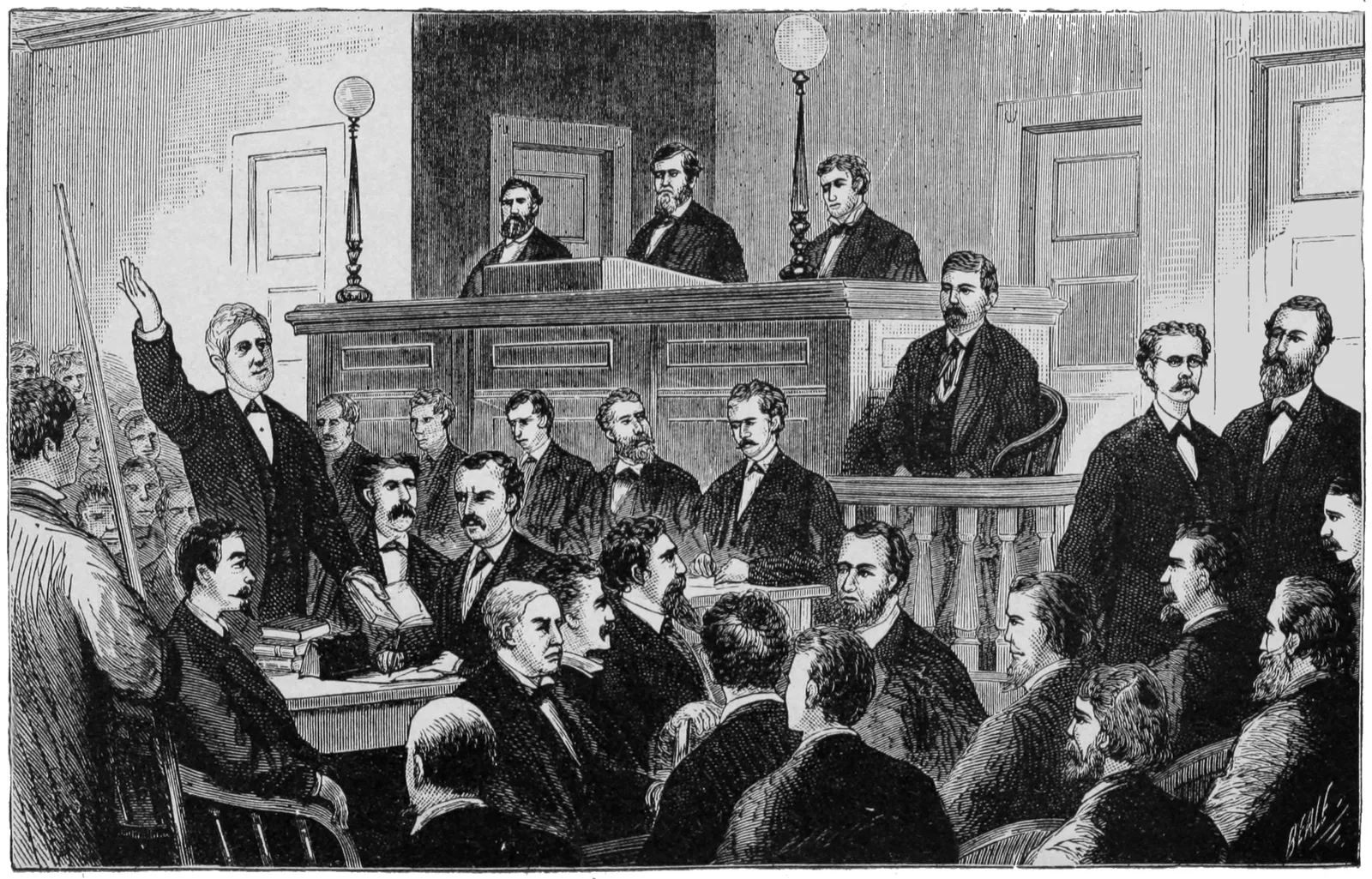
In June, 1876, at Pottsville, occurred the trial of Thomas
Munley and Charles McAllister, arrested Feb. 10th, in the
same year, for the Sanger and Uren murder. This capture
was made on the affidavit of R. J. Linden. The prisoner
was taken at his house in Gilberton. McAllister demanding
a separate trial, Geo. R. Kaercher, Esq., the District Attorney,
elected to try Munley first, and the case commenced
June 28th, before Judge D. B. Green, a jury having been
found on the preceding day, composed of the following
named persons: John T. Clouse, I. W. White, John Springer,
Benj. H. Guldin, Thomas Fennell, Sr., Emanuel Gehris,
Solomon Fidler, Daniel Zerbe, Frederick Alvord, Charles
Brenneman, Jefferson Dull, and Daniel Donne. A verdict
of “guilty of murder in the first degree” was returned on
the twelfth of July. It was in this case that Hon. F. B.
Gowen, assisting in the prosecution, made his memorable
address against the Mollie Maguires, which I give almost
entire. After alluding to the importance of the cause, the
gravity of the case, a man being on trial for his life, and disclaiming
any reflections as against the talented legal gentlemen
engaged in the defense, Messrs. Lin. Bartholomew,
John W. Ryon, M. M. L’Velle, and S. A. Garrett, he entered
upon a minute history of the crime, not differing materially
510from that furnished in these pages, calling attention to
the utterances of Mr. Sanger, while dying, and then said:
“What is the first defense? An alibi. That which
comes most readily at the beck and call of every criminal
who knows himself to be guilty; for, when every other defense
fails, the ever-ready alibi is always on hand to be
proved by a crowd of relatives and retainers, who come forward
to say that a man charged with the commission of a
particular offense, at a particular time, and in a particular
place, was, on that very day, engaged in some lawful and
legitimate calling many miles away. When established to
the satisfaction of a jury, an alibi is the very best defense
that can be offered, but, as it is always the defense that is
resorted to by the guilty, and as it is the defense that is most
easily manufactured, it becomes the duty of a jury most
carefully to scrutinize and examine its truth; and in this
case I am glad to say that I think you will have no trouble
in disposing of it. By whom is this alibi proven? In the
first place by Edward Munley, the father of the prisoner,
and by Michael Munley, the prisoner’s brother.”
After showing how signally the alibi had failed, he said:
“I dismiss these two witnesses from the case. There is
no palliation for such testimony, for there can be no palliation
for perjury; and it has become too serious an offense
in this county to be passed over, hereafter, in silence. But
if there ever was a palliation for perjury, if there should be
at the last great day, before the final Judge, any excuse for
the enormity of this crime, it will be urged on behalf of a
father who has striven to save his son from the gallows, and
on behalf of one brother, who seeks to shield another from
infamy and from shame.”
Addressing himself to the Mollie Maguires, he continued:
“I may say, however, before leaving this branch of the
case, that now that the light of day is thrown upon the secret
511workings of this association, human life is as safe in Schuylkill
County as it is in any other part of this Commonwealth;
that as this association is broken down and trampled into the
dust, its leaders either in jail or fugitives from the just vengeance
of the law, the administration of justice in this court
will be as certain as human life is safe throughout the whole
length and breadth of the county. The time has gone by
when the murderer, the incendiary, and the assassin can go
home reeking from the commission of crimes, confident in
the fact that he can appear before a jury and have an alibi
proved for him to allow him to escape punishment. There
will be no more false alibis in this county; the time for
them has gone forever. No more false alibis. No more
confident reliance upon the perjury of relatives and friends
to prove an alibi for him who was seen in the commission of
the act. No more dust thrown in the eyes of juries to blind
them from looking directly at the facts of a case; and I do
say that if there ever was anything to be proud of, to be glad
of, after the fact that we are enfranchised and disenthralled
from this despotism and this tyranny that has been hanging
over us, it is that the administration of justice will no longer
be polluted and disgraced by perjury and false swearing, for
the purpose of rescuing a criminal from the just vengeance
of the law.
“I now come to the testimony of McParlan. Many of
you know that some years ago I was the District Attorney of
this county. I am, therefore, not very much out of my old
paths, and not very much away from my old moorings, when
I am standing on behalf of the Commonwealth, in the Court
of Pottsville, demanding the conviction of a guilty man. It
was when I was District Attorney of this county, a young
man, charged with the prosecution of the pleas of the Commonwealth,
that for the first time I made up my mind from
what I had seen, in innumerable instances, that there then
existed in this county a secret organization, banded together
512for the commission of crime, and for the purpose of securing
the escape or acquittal of any of its members charged with
the commission of an offense.
“That conviction forced itself indelibly upon my mind.
A man, who for two years acts as District Attorney in this
county, prosecuting criminals who are brought before the
court, must be either very obtuse or wilfully blind, if he
could close his eyes to the existence of a fact as perceptible
as this was then to me. I left this county with that settled
conviction, and circumstances that occurred time and again,
long after I withdrew from the prosecution of criminals, still
more deeply fastened this conviction in my mind. Murder,
violence, and arson, committed without detection, and apparently
without motive, attested the correctness of that belief,
and when the time arrived that I became so much interested
in the prosperity of this county, and in the development
of its mineral wealth, that I saw that it was a struggle
between the good citizen and the bad citizen as to which
should obtain the supremacy, I made up my mind that if
human ingenuity, if long suffering and patient care, and toil
that stopped at no obstacle, and would confront every danger,
could succeed in exposing this secret organization to light
of day, and bringing to well-earned justice the perpetrators
of these awful crimes, I would undertake the task.
“I knew that it could only be done by secret detectives,
and I had had enough experience, both as a lawyer, and as
the head of a very large corporation, to know that the public
municipal detectives employed by the police authorities of
the cities, who operate only for rewards, are the last persons
to whom you could trust a mission and an enterprise such as
this. It was as important for us to know who was innocent
as it was to know who was guilty.
“The detective who operates for rewards, who is only
paid upon his conviction of the offender, has a motive to incite
him to action which I would be the last man in the
513world to arouse. I knew, for I had had experience before
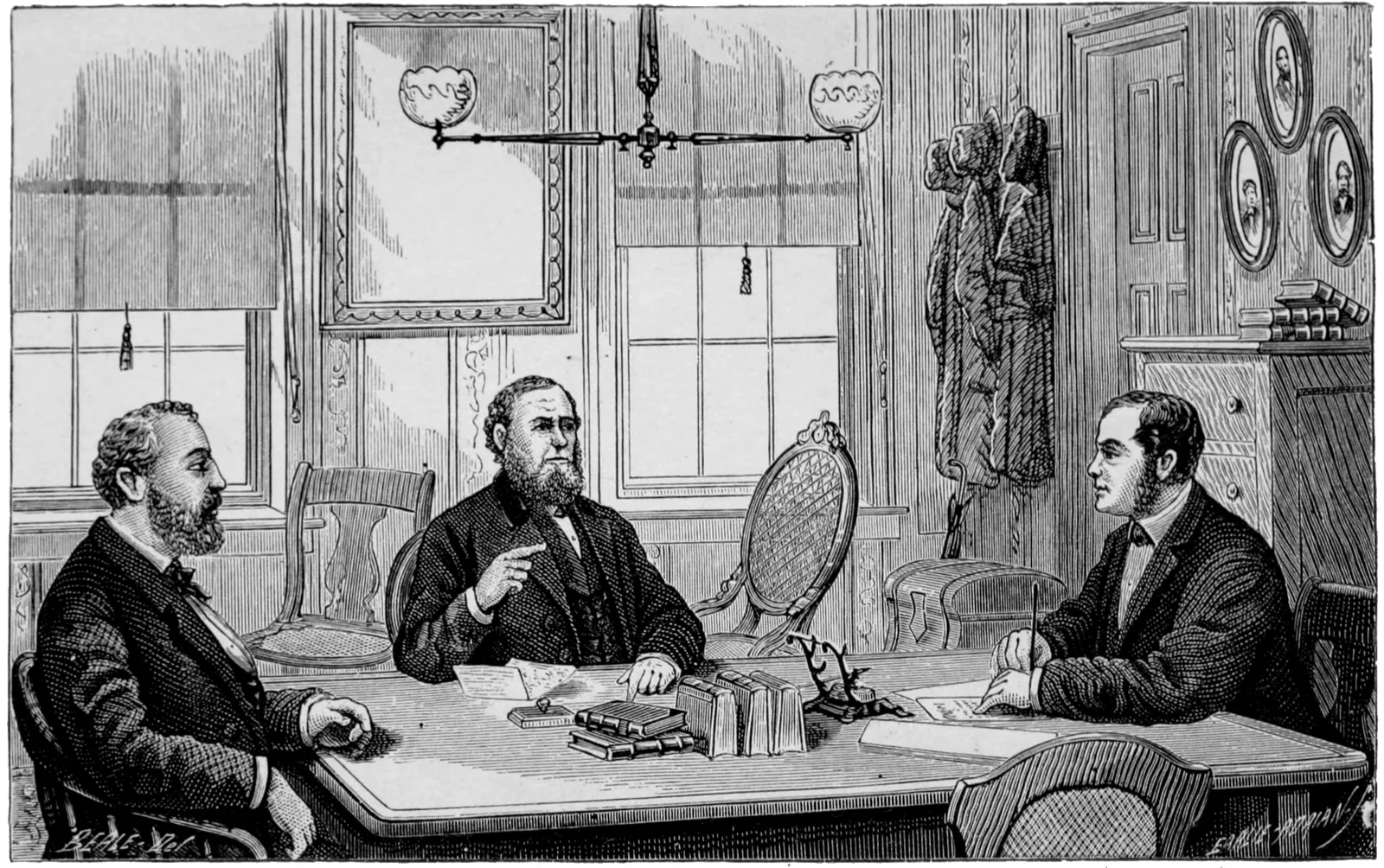
of the National Detective Agency of Allan Pinkerton, of
Chicago, which was established by an intelligent and broad-minded
Scotchman, established upon the only basis on
which a successful detective agency can be established, and
I applied to Mr. Pinkerton. His plan was simply this: ‘I
will secure an agent, or an officer,’ said he, ‘to ferret out the
existence of this society. Whoever I get is to be paid so
much a week, no matter if he finds out nothing. He is
bound to me, never, under any circumstances, to take a reward
for his services, from anybody, and, if he spends five years and
obtains nothing in the way of information, he must have
every month or every week exactly the same compensation as
if every week he had traced a new murder and every month
had discovered a new conspiracy. He is never to gain pecuniarily
by the success of his undertaking; but as a man
who goes into this organization, as a detective, takes his life
in his own hands, I will send no man on this mission of yours,
Mr. Gowen, unless it be agreed, beforehand, and I can tell
him so, that he never is to be known in connection with the
enterprise.’ Upon these terms this man, James McParlan,
was selected. A young Irishman and a Catholic, but six or
seven years in this country, eminently qualified by his peculiar
Irish accomplishments to ingratiate himself with those to
whom he was sent, he came here in the fall of 1873, and
within six months he had so far won the confidence of the
class of people who constituted this order that he was admitted
as a member. Remember, now, here—and I advert to it
lest I might forget it—that he came here pledged that he
should not be used as a witness. Therefore, the only object
of his coming was to put us upon the track, so that we could
discover the crime when it was being perpetrated, and this
is the best answer that can possibly be made to the charge
that he wilfully withheld his knowledge when he might have
saved human life. His only object here was to get knowledge.
514He never was to be used as a witness. His only desire
was to find out when a murder was to be committed, to be
with the perpetrators if he could, and to give notice to Captain
Linden, who had an armed police force ready, so that
they might be waiting at the very spot, and not only save
the life of the intended victim, but arrest every man engaged
in the perpetration of the offense, in order that there could
be abundant evidence of their guilt. That was his whole
object. Almost every night he made his report; and how
well he has performed his duty, the security of human life
and property in this county, to-day, as compared with what
it was six months ago, is the best commentary I can make
upon the subject.
“But Mr. L’Velle tells you that from the advent of Mr.
McParlan into this county have all these crimes been committed.
Remember the words: ‘From the advent of McParlan
into this county have all these crimes been committed.’
I fear that Mr. L’Velle has not been long among
you, or, if he has, his memory is sadly deficient, when he
says that all these crimes have been committed since the
advent of Mr. McParlan in Schuylkill County.
“Mr. L’Velle.—I antedated you in coming to Schuylkill
County.
”Mr. Gowen.—Then your memory is very defective.
Does the gentleman forget Dunne, who was murdered within
two miles of this town? Does he forget Alexander Rae,
who was stricken down near Mt. Carmel? Does he remember
the assassination of William Littlehales? If he does not
I am very sure that his colleague, Mr. Bartholomew, will not
forget it, for I remember that I stood here, just where I
stand now, some years ago, defending a couple of men for
murder, who, with other good citizens, when the house of a
boss had been attacked at Tuscarora by a mob intent upon
murder, had behaved, not like some of those at Raven Run,
but had sprung to arms, and had taken their old muskets,
515their rusty rifles, their pistols and their swords, some of them
with no time to load their muskets save with the marbles
with which their children had been playing, and had sprung
to arms to defend the house that was attacked, and had shot
down one of the assailants in his tracks, and were arrested
and brought here charged with the crime of murder; my
friend, Mr. Bartholomew, who was my colleague, joined with
me in contending that our clients had done that which they
ought to have done to protect themselves, and, as I was
standing here, arguing that case, there came over from Coal
Castle the news that William Littlehales had been murdered.
“Does the gentlemen forget all this? Does he forget
George K. Smith and David Muir? Does he forget the assassins
who made the attack upon Claude White? Does he
forget Morgan Powell, and Langdon, who were killed, and
Ferguson, who was beaten almost to death? Does he forget
Patrick Barry, who, living with his wife and children in
the house by the tunnel, when a band of assassins attacked
him at night, placed his wife and little ones in the middle of
the house and piled all the mattresses and blankets and pillows
around them, and, when he had sheltered them as best
he could, fought an angry horde of two or three hundred
men, keeping them at bay until daylight, when they fled,
leaving the long tracks of their blood behind them to show
how well he had avenged himself upon his assailants?
“These coal fields for twenty years, I may say, have been
the theatre of the commission of crimes such as our very
nature revolts at. This very organization that we are now,
for the first time, exposing to the light of day, has hung like
a pall over the people of this county. Before it fear and
terror fled cowering to homes which afforded no sanctuary
against the vengeance of their pursuers. Behind it stalked
darkness and despair, brooding like grim shadows over the
desolated hearth and the ruined home, and throughout the
length and breadth of this fair land there was heard the voice
516of wailing and of lamentation, of ‘Rachel weeping for her
children and refusing to be comforted, because they were
not.’ Nor is it alone those whose names I have mentioned—not
alone the prominent, the upright, and the good citizen
whose remains have been interred with pious care in the
tombs of his fathers; but it is the hundreds of unknown
victims, whose bones now lie mouldering over the face of
this county. In hidden places and by silent paths, in the
dark ravines of the mountains, and in secret ledges of the
rocks, who shall say how many bodies of the victims of this
order now await the final trump of God? And from those
lonely sepulchres, there will go up to the God who gave them
the spirits of these murdered victims, to take their places
among the innumerable throng of witnesses at the last day,
and to confront with their presence the members of this
ghastly tribunal, when their solemn accusation is read from
the plain command of the Decalogue, ‘Thou shalt not kill.’
“But we are told that in the commission of these crimes,
although Mr. Bartholomew admits that they existed long
years before McParlan came into the county, this man abandoned
his duty as a detective, and became an accomplice
in the crime. And upon whose testimony does this charge
rest? My friend invokes from you a careful attention to
the facts of this case, and properly endeavors to exclude
from it an examination of any other circumstances or any
other facts than those which have been proved in the case.
“But upon whose testimony is McParlan an accomplice?
Upon whose testimony is the charge made that McParlan
engaged deliberately in the commission of offenses and
secreted the offenders? Upon Ned Monaghan’s and Patrick
Coyle’s, alone. Upon Ned Monaghan, for whom the doors
of your jail open wide to-day, never probably to reopen
until he comes out in company with Jack Kehoe, and the
other murderers, to stand his trial for his life. Upon Monaghan,
the Molly Maguire, the man who was on the Ringtown
517Mountain helping to select the committee to kill William
Thomas. Edward Monaghan, who, to-day, is as guilty of
murder in the first degree as any other man now confined
within the walls of your prison.
“And who is Patrick Coyle? A man who saw McParlan
drawing a pistol and never heard him say or saw him do anything
else, and because he did not see him do and did not
hear him say anything, he swears he believes that McParlan
was inciting to murder.
“What need I say further? An accomplice! McParlan
an accomplice! Mr. Bartholomew tells you that he permitted
Thomas Hurley to escape, and that he permitted Michael
Doyle to escape. Neither Thomas Hurley nor Michael
Doyle have escaped; but the excoriating denunciation which
Mr. Bartholomew hurled against Thomas Hurley will effectually
prevent him from defending Hurley, when he comes
before this court for trial for murder. It will not be long
before he comes here. It is simply a question between the
Mollie Maguires on the one side and Pinkerton’s Detective
Agency on the other, and I know too well that Pinkerton’s
Detective Agency will win. There is not a place on the
habitable globe where these men can find refuge and in
which they will not be tracked down. Let them go to the
Rocky Mountains, or to the shores of the Pacific; let them
traverse the bleak deserts of Siberia, penetrate into the
jungles of India, or wander over the wild steppes of Central
Asia, and they will be dogged and tracked and brought to
justice, just as surely as Thomas Munley is brought to justice
to-day. The cat that holds the mouse in her grasp sometimes
lets it go for a little while to play; but she knows well
that at her will she can again have it secure within her claws;
and Pinkerton’s Agency may sometimes permit a man to believe
that he is free who does not know that he may be traveling
five thousand miles in the company of those whose vigilance
never slumbers and whose eyes are never closed in sleep.
518“They may not know that the time will come, but I say
that so surely as I am standing before you to-day, the time
will come, be it short or be it long, be it months or be it
years, when every single murderer then living on the face of
the earth, who has committed a crime in this county, since
April, 1874, will answer for that crime before the presence of
this court. ‘The race is not always to the swift, nor the
battle to the strong.’ Those who see what we are doing
now have seen but little; for it is only the opening of the
book of this vast conspiracy, and behind the meaner men
who shot the pistol there stand others far more guilty than
they who, with them, at some time will be brought to justice—
“‘For Time at last sets all things even,
And if we do but wait the hour,
There never yet was human power
That could evade, if unforgiven,
The patient search and vigil long
Of him who treasures up a wrong.’
“And now some words about this secret organization of
Mollie Maguires. My friend, Mr. Bartholomew, is not correct
in his statement of their history. If, after this case is
over, and when you are permitted to read, you will get a
little book called Trench’s Realities of Irish Life, written by
a relative of that celebrated Dean Trench, whose name is
well known wherever English literature is read, you will find
the history of this organization. It was known as the Ribbonmen
of Ireland. It sprang up at a time when there was
an organized resistance in Ireland to the payments of rents.
The malcontents became known as Ribbonmen, and they
generally made their attacks upon the agents of the non-resident
landowners, or upon the constables or bailiffs who
attempted to collect the rents. Their object was to intimidate
and hold in terror all those to whom they owed money
519or who were employed in its collection. As a branch of
this society, and growing out of it, sprang the men known
as Mollie Maguires, and the name of their society simply arose
from this circumstance, that, in the perpetration of their
offenses, they dressed as women, and generally ducked or
beat their victims, or inflicted some such punishment as infuriated
women would be likely to administer. Hence
originated the name of the Mollie Maguires, which has been
handed down to us at the present day; and the organization
of the Mollie Maguires, therefore, is identical with that of
the Ribbonmen in Ireland, who have terrorized over the
Irish people to so great an extent.
“How this association came into this county we do not
know. We had suspected for many years, and we know now,
that it is criminal in its character. That is proved beyond
peradventure. It will not do to-day to say that it was only
in particular localities in this county that it was a criminal
organization, because the highest officer in the society in
this county, the County Delegate, Jack Kehoe, the man who
attended the State Convention, and was the representative
of the whole order in this county, is at present, as you hear
from the testimony, in prison awaiting his trial for murder.
Whether this society, known as the Ancient Order of Hibernians,
is beyond the limits of this county a good society or
not I cannot tell; but I have believed at some times that it
was, and I am willing to be satisfied of that fact now, if there
is any evidence of it. But there has been an attack made
upon this organization, and up to this time we have not had
furnished to us any evidence that in any place its objects
were laudable or commendable. Criminal in its character,
criminal in its purpose, it had frequently a political object.
You will find the leaders of this society the prominent men
in the townships. Through the instrumentality of their order,
and by its power, they were able to secure offices for themselves.
You see here and now know that one of the
520Commissioners of this county is a member of this order.
You know that a previous Commissioner of this county was a
member of this order, convicted of a high offense, and pardoned
by the Governor. You know that another County
Commissioner, before that, was a member of this order, convicted
of an offense, and pardoned by the Governor. High
constables, chiefs of police, candidates for associate judges,
men who were trusted by their fellow-men, were all the time
guilty of murder.
“But in addition to the criminal and the political motives,
these people claim national characteristics. They
claim that they were, par excellence, the representatives of
the Irish of this country. They claim more than that, that
they represent the Irish Catholics of this country. I shall
say but little about the Irish, except that I am myself the
son of an Irishman, proud of my ancestry, and proud of my
race, and never ashamed of it, except when I see that Ireland
has given birth to wretches such as these! These men
call themselves Irishmen! These men parade on St. Patrick’s
Day and claim to be good Catholics! Where are the
honest Irishmen of this county? Why do not they rise up
and strike down these wretches that usurp the name of Irishmen?
If a German commits an offense, and engages in
murder, do all the other Germans take his part and establish
a false alibi to defeat the ends of justice? If an American
becomes a criminal, do the Americans protect him? Do they
not say, ‘Away with you! You have disgraced the country
that bore you?’ If an Englishman becomes an offender,
do the English nation take him to their arms and make him
a hero? Why, then, do not the honest Irishmen of this
county come together in public meeting, and separate themselves
widely from and denounce this organization? Upon
what principle do these men, outcasts from society, the dregs
of the earth, murderers and assassins, claim to be Irishmen
and arrogate to themselves the national characteristics of
521the Irish people? It is a disgrace to Ireland that the honest
Irish of this county, probably five or ten thousand in
number, should permit a few hundred wretches like these to
say that they are the true representatives of the Irishmen of
Schuylkill County.
“Does an Irishman wonder why it is sometimes difficult
to get a job in this county? Does he wonder why the boss
at a colliery hesitates to employ him, when these people
have been allowed to arrogate to themselves the Irish character
and have been permitted to represent themselves to
the people of this county as the proper representatives of
Ireland? The time has come when there must be a line of
demarcation drawn. The time has come when every honest
Irishman in this county must separate himself from any suspicion
of sympathy with this association. He must denounce
its members as outcasts from the land that gave
them birth. He must denounce them as covered with infamy
and blackened with crime. He must say that they are
not true Irishmen and that they are not representatives of
Ireland.
“But far beyond this attempt to invoke your sympathy
on account of their nationality is the attempt to invoke that
sympathy on the ground that they belong to a persecuted
religion. Was there ever such sublime, such tremendous
impudence in the world, as that a member of this secret
society, a society which has been denounced by its own
Church, and each member of which has been excommunicated
by the Archbishop of Philadelphia, and by the Pope himself,
outcasts from society, and from the communion of their
own religion, the door of the Church shut in their faces and
the gates of heaven closed against them by the excommunication
of their priests—these men, infidels and atheists,
caring for no church, and worshiping no God, set themselves
up in this community as the representatives of the Catholic
faith.
522“‘Just Allah! what must be thy look?
When such a wretch before thee stands,
Unblushing, with thy sacred book,
Turning its leaves with blood-stained hands,
And wresting from its page sublime
His creed of lust and hate and crime.’
“A few words more upon this subject of Irish Catholics.
I was born and am a Protestant, but I was partially educated
among the Catholics, and I have always had a kindly feeling
for them, and when these assassins, through their counsel,
speak of being Catholics, I desire to say to you here, in the
first place, that they have been denounced by their Church
and excommunicated by their prelates, and that I have the
direct personal authority of Archbishop Wood himself to
say that he denounces them all, and that he was fully cognizant
of and approved of the means I took to bring them to
justice. And, for myself, I can say that for many months
before any other man in this world, except those connected
with the Detective Agency, knew what was being done,
Archbishop Wood, of Philadelphia, was the only confidantconfidant I
had and fully knew of the mission of the detective in this
whole matter. So much, then, for the assumption of Mr.
L’Velle that these men claim sympathy on account of their
being Catholics. I can hardly reply calmly to such an argument.
I believe that there must be different sects in this
country, as there are in all countries, and I am one of those
who believe that a good Catholic is better than a bad Protestant.
”Mr. L’velle.—I repel that remark.
“Mr. Gowen.—Mr. L’Velle repels the remark! I cannot
help it, and I reiterate the fact that although I am a
Protestant, I have been taught to believe that a good
Catholic is better than a bad Protestant.
“I have been taught to believe that the eyes of Justice are
closed not only against individuals and corporations, but
523against nationalities and sects. I have been taught to believe
that he is the good citizen who is truthful and honest,
who is kind-hearted and affectionate, who lives in charity
with all men, who gives freely of his means to the poor, and,
whether he kneels before an altar or worships God in his own
chamber, he is entitled to the favorable consideration of his
fellow-men. And I do know, oh! so well, that when our
lives draw toward their close, and the opening portals of the
tomb reveal to our eyes some glimpses of the boundless
waters of that vast eternity upon which we will all embark,
that then, at that dread moment, it will be to the recollection of
the possessions of these simple virtues, this pure morality,
this unostentatiousunostentatious charity that I have named, that we will
all cling, in the sublime confidence that it will avail us most,
when the time shall come that each one of us, Catholic
and Protestant, Lutheran and Calvinist, Gentile and Jew,
shall be stripped of the thin garb of the sectarian, and
stand in equal favor before the great white throne of
God.
“And now one word more upon this subject, and I dismiss
it. Whenever you hear a complaint made against a man
because he is an Irishman, or because he is a Catholic; whenever
you hear any one, no matter who he may be, say that
the outrages of this county are due to the Irishmen, or due
to the Catholics do not, I beg of you, forget, in your secret
hearts, that the highest prelates of that Church have cursed
and excommunicated this order. Do not forget that whatever
little credit may be due to him who has conceived the
plan of exposing this association is due to one who is the son
of an Irishman; and do not forget that a greater honor and
a greater meed of praise than is due to any other is due to
Detective McParlan, who is an Irishman by birth, and a
Catholic by religion; and if those who profess to be Irish
Catholics in this county have brought their nationality and
their religion into disrepute, I beg of you to remember that
524both have been gloriously and successfully vindicated by an
Irishman and a Catholic, in the person of James McParlan.
“And now let us look to society in this county, as it was
three months ago, when men retired to their homes at eight or
nine o’clock in the evening and no one ventured beyond the
precinctsprecincts of his own door; when every man engaged in any
enterprise of magnitude or connected with industrial pursuits
left his home in the morning with his hand upon his pistol,
unknowing whether he would again return alive; when the
very foundations of society were being overturned, when
the administration of justice, which should always be regarded
with reverence, had almost sunk into contempt; when
men doubted whether it was in the power of organized
society to protect their lives and to secure their property;
and then reflect upon the change which a few weeks has
brought forth. To-day I give you notice that there is no
part of this county that is not as safe as the aisle in which
I stand here now.
“Is there a man in this audience, looking at me now, and
hearing me denounce this association, who longs to point
his pistol at me? I tell him that he has as good a chance
here as he will ever have again. I tell him that it is just as
safe to-day to murder in the temple of Justice as it is in the
secret ravines of the mountains, or within the silent shadows
of the woods. I tell him that human life is safe. I tell him
that the members of his society, whom we desire to convict,
all, save one or two, are either safely lodged within the walls
of your prison or are fugitives from justice, but almost within
the grasp of the detectives, who are upon their heels. I tell
him that if there is another murder in this county, committed
by this organization, every one of the five hundred members
of the order in this county, or out of it, who connives at it,
will be guilty of murder in the first degree, and can be
hanged by the neck until he is dead, not by vigilance
525committees, but according to the solemn forms of justice,
after being defended by able and experienced counsel; and
I tell him that, if there is another murder in this county by
this society, there will be an inquisition for blood with which
nothing that has been known in the annals of criminal jurisprudence
can compare. And to whom are we indebted for this
security, of which I now boast? To whom do we owe all
this? Under the Divine Providence of God, to whom be
all the honor and all the glory, we owe this safety to James
McParlan, and if there ever was a man to whom the people
of this county should erect a monument, it is James McParlan,
the detective.
“McParlan is a detective, engaged in the performance of
a professional duty, who enters upon his quest with the
avowed purpose of trying to make all those with whom he
was brought in contact believe that he is one of them. He
is not an accomplice. He went there for the purpose of
aiding the officers of the law in discovering and punishing
guilt, and even were he an accomplice, even if every particle
of testimony we have had during the last two weeks
from the lips of James McParlan had fallen on that stand
from the lips of Friday O’Donnell, or from the lips of Michael
Doyle, it would have been not only corroborated, but
strengthened and attested by the evidence of identification
alone.
“But suppose there was no evidence of identification, I
desire now to show you what corroborative testimony beyond
that of identification we have of the facts proved by
McParlan himself. I have taken the trouble, during the
time Mr. L’Velle was speaking yesterday, to go over, with
one of my colleagues, nearly the whole of the testimony in this
case, so that I might be able to point out to you the various
places in which and the manner by which McParlan is corroborated
by other witnesses. I will now call your attention
to this testimony, in detail, in the order in which it was given,
526and, having done so and fixed it upon your mind, I will
endeavor to make some few arguments based upon this corroborative
testimony, if any such were needed to enable a
jury of intelligent men to determine whether they will give
credence to the testimony of McParlan.
“McParlan says that Munley told him that McAllister and
O’Donnell, called for him, Munley, on the evening of the
thirty-first of August. Remember, McParlan says that Munley
told him at Michael Lawler’s that McAllister and O’Donnell
called for him the previous evening. How could McParlan
have known this if Munley did not tell it to him? Weigh
that in your minds for one instant. How could McParlan
have found this fact out, if Munley had not told him? Oh!
but our friends may say that McParlan swears that Munley
said so, but the statement is not true, and here comes in the
corroborative testimony. Frederick Hunniken, a witness produced
by the Commonwealth, says that on the evening of the
thirty-first of August a stranger came to Wiggan’s Patch and
talked with the O’Donnells, and that James O’Donnell and
the stranger went toward Gilberton together. Then James
Patton says that on the evening of the thirty-first of August,
Darcy and Munley joined a party near Gilberton, and Luke
Richardson says that on the evening of the thirty-first, Darcy
and Munley joined a party from Wiggan’s Patch; and Sarah
Ann Gessford and George Gessford both testified that they
saw Munley with Darcy and some other men between eight
and nine o’clock on the evening of the thirty-first, at the Cross
Roads, by the old Flour Barrel, near Gilberton. There are
now one, two, three, four, five witnesses, in different parts of
the county, who have testified to a state of facts of which
McParlan could have had no knowledge whatever, unless
informed by Munley. Where can you find better corroborative
evidence than this? How did McParlan know, if he
made up this story to tell, that the O’Donnells came for
Munley in the evening, and that they went off together?
527Did McParlan know Luke Richardson or Mr. or Mrs. Gessford?
Had he ever communicated with either of them?
And yet James McParlan comes forward and gives us a
statement which was told to him by Munley, and we produce
five witnesses to prove that when Munley made that statement
he told the truth.
“Again, McParlan says that Munley had on dark pantaloons
of a grayish color. How could McParlan describe
Munley’s pantaloons, if he had not seen him on that morning?
If he attempted to make up a story, is it likely that
he would have discovered exactly the proper kind of pantaloons?
James Williams and Roberts say that on that day
Munley was dressed in gray pantaloons; Robert Heaton
describes them as darkish; Melinda Bickelman says that
they were pepper and salt, and Munley’s family, themselves,
have to admit that they were of a grayish color—one of them
said of a brownish color, and still another said that they were
gray, but had a kind of a dark stripe in them. Here is
corroborative testimony again.
“Further on in his testimony McParlan says that Munley
told him that after O’Donnell began the attack, he ran up
and shot Sanger near the fence at the house, and that Charles
O’Donnell, Doyle, and McAllister fired shots to intimidate
the crowd. That is exactly as Patrick Burns describes it,
and as Melinda Bickelman describes it. The two men that
followed Sanger down the road and killed him were Friday
O’Donnell and this prisoner, Thomas Munley. McAllister
ran around to intercept Sanger, and the other two men fired
shots to intimidate the crowd. How, under heaven, did
McParlan know this, unless Munley told him. Where can
there be stronger corroborative testimony than this?
“Again, McParlan swears that after some conversation at
Lawler’s, when these five men came in on the morning of the
first of September, the two O’Donnells and McAllister left
for home. How did McParlan know that, unless he saw it?
528Our friends may say, where is the evidence of that? We
answer by saying that Edward Fox, a witness produced by
the Commonwealth, says that James O’Donnell, with two
men, came to his engine-house, on a path between Wiggan’s
Patch and Shenandoah, dusty and thirsty as if from traveling,
at eleven o’clock on the morning of the first of September.
It seems to me as if there was some almost supernatural or
divine agency pointing out to the officers of justice and the
agents of the Commonwealth the evidence that would corroborate
the testimony of this man McParlan. How could
McParlan make up a story of this kind, unless he had seen
the men? He swears these three men left together, and
these three men are found together, and separated from the
other two.
“Again, McParlan goes further, for he tells you what
became of the other two. He says that after Doyle had gone
to his boarding-house and changed his clothes, Doyle, Hurley,
Munley, and himself went to Tobin’s ball-alley, in Shenandoah;
and Philip Weissner and William J. Fulton, two
witnesses produced by the Commonwealth, testified that they
met Munley in Shenandoah, with some other men, at ten
o’clock on the morning of the first of September, at the corner
of Coal Street and Chestnut Street.
“McParlan also says that Munley left Shenandoah for
home about one o’clock in the afternoon on the first of September,
and Mrs. Smith, Mrs. Richardson, Mrs. Lambert,
and Mrs. Hayes, all saw Munley coming home to his house at
Gilberton between two and three o’clock, just about the
time at which he would have arrived if he left Shenandoah at
one o’clock.
“McParlan also swears that Munley returned to Shenandoah
in the evening, and attended a meeting of the Mollie
Maguires, when men were selected to murder John P. Jones.
Philip Weissner swears that he met Munley on the evening
of the first of September, about five o’clock, on his way to
529Shenandoah, and Mrs. Smith saw him leave his home, after
changing his clothes, on the evening of the first of September,
in company with Darcy, who was one of the Mollie Maguires,
and who was one of the men at the meeting in the bush on
the evening of the first of September. Where can you have
stronger corroborative testimony than this? Ask yourselves
the question: how could James McParlan have known this?
It is true, and it is proved by fifteen or twenty witnesses who
have placed these men just at the spot and just at the time.
How did McParlan know this, unless Munley told him? Ask
yourselves that question, and then ask yourselves whether, if
this man McParlan was Friday O’Donnell himself, and had
testified to this state of facts, would you as jurors require
any other corroborative evidence than that which has been
laid before you?
“The only other portion of the defense to which it is
necessary for me now to revert is the testimony of the men
around Raven Run, who saw some of this occurrence, but
could not recognize Thomas Munley. In the first place, we
believe, though we have no right to make charges, but we
do believe that there were a number of men on this stand,
who, from the manner in which they gave their testimony,
revealed the fact that they knew a great deal more than they
intended to tell; and when an Irishman from the same
county as this prisoner so testifies on cross-examination that
you must believe, notwithstanding his denial of the fact, that
he was a member of the same organization, and always prefaces
his testimony as to the prisoner’s being one of the
murderers by saying, ‘Not to the best of my opinion,’ you
will see the easy way by which he bargained with his conscience
for getting over the obligation of the oath which he
had taken to tell the truth.
“What does all this testimony amount to? Here were
four days taken up with the examination of forty or fifty
witnesses, and at the utmost all that each or any of them
530could say was that Friday O’Donnell was not Thomas Munley.
Why, we knew that before. Friday O’Donnell was
the leader of this gang. Friday O’Donnell was the man
who had the principal hand in it; he was the man who took
the prominent part in the murder; he was the man whom
nearly all the witnesses saw and described by his clothing
and by his stature; and every one of them swore, with great
vehemence, that Friday O’Donnell was not Thomas Munley.
God knows, gentlemen, we knew this before; we
knew that Friday O’ Donnell was not Thomas Munley, but
when they were questioned, they either had to admit that
they could not tell whether the prisoner was one of the
other four men, or that they had not seen the other four
men sufficiently to enable them to identify them thereafter.
“I have said to you before that it seems to me as if there
had been a divine interposition for the investigation and
punishment of crime in this county. Remember that McParlan
came here pledged that he should not be used as a
witness. We placed no reliance upon him as a witness.
We could not arrest a man because he told us anything
about him, because he was protected by the pledge
we had given him that he was not to be exposed, and was
never to be known in the investigation; and I tell you that,
no matter what the consequence would have been, when I
became an instrument to lead him into the danger to which
he was subjected when he took his life into his own hand and
entered into the secret councils of this order, I would have
been the last man in the world to have asked him to relieve
me from the pledge which had been made to him. You
have heard that his mission became known to this order,
how or by what manner I am not at liberty to tell you to-day,
for it is not in evidence. We have the fact, though,
that his mission became known to this society, and we have
the fact that those from whose vengeance he was to be protected,
by ignorance of his true character, acquired information
531that enabled them to know that he was playing a false
part in their organization, and that he was in reality a detective;
and he was compelled to leave the county. And then
I saw before me my path as clear as day. Then I saw that
some miraculous interposition of providence had been vouchsafed
to permit us to use the testimony and the knowledge
of this man McParlan. Then I breathed freer, and trod
with elate step; then I knew that I had within my hands the
power to crush these villains; then, and on the day when he
took his place upon the witness stand, I took my seat at this
table as counsel for the Commonwealth, and the warrants
were executed which consigned to the prison every one of
these criminals, with the exception of one or two and of
those who had run away when Jimmy Kerrigan turned State’s
evidence. When, in all the history of criminal jurisprudence,
did ever such a change of society come over a county as
that which came over this county on the morning that McParlan
first became a witness, and on the morning when
Jack Kehoe, the County Delegate, with twelve or fifteen
other men, handcuffed to a chain, were marched from the
high places they had occupied to take their solitary cells as
felons within the walls of your prison?
“When I came to this court-house, on that memorable
day, the court-room was crowded with the sympathizing
friends of these criminals, but where are they to-day? They
may be here, but they give no sign, and we know nothing of
them, and we care not if they are here. The whole county
sprang up like a giant unbound, and never, except in
dramatic literature, has there been revealed such an awakening
and such a change.
“There is an old drama called the ‘Inconstant,’ in which
the hero of the play is beguiled into a den of infamy, and
when he is confronted by miscreants he for the first time
realizes the danger in which he is placed. He feels that
his money is to be taken and that his life will be sacrificed.
532He has with him, however, a faithful page, and turning toward
the outlaws he addresses them as if he was unaware
of their true character. He shakes them by the hand, presents
one with his watch, and another with his purse; he is
‘hail fellow well met’ with them, and he invites them to join
him in a carouse, and offers to send his page for wine. The
outlaws hear it and consent, and he says to his page:
‘Bring me the wine—the blood-red wine marked 100.’ The
page departs, well knowing that the message refers not to
wine but to a company of soldiers numbering one hundred
and wearing a red uniform. After breathless suspense the
page returns, and in answer to the frantic demand, ‘The
wine, boy, the wine!’ answers: ‘Coming, sir,’ and the
tramp of armed men is heard. Then the entrapped man
grows bold. He pulls one outlaw by the nose, and cuffs
another on the ear, and the soldiers enter and march them
off to jail. So it was with us when McParlan came upon
the stand. He was the blood-red wine marked 100. Then
we knew we were free men. Then we cared no longer for
the Mollie Maguires. Then we could go to Patsy Collins,
the Commissioner of this county, and say to him: ‘Build
well the walls of the new addition of the prison; dig the
foundations deep and make them strong; put in good
masonry and iron bars, for, as the Lord liveth, the time will
come when, side by side with William Love, the murderer
of Squire Gwyther, you will enter the walls that you are now
building for others.’ Then we could say to Jack Kehoe,
the high constable of a great borough in this county: ‘We
have no fear of you.’ Then we could say to Ned Monaghan,
chief of police, and murderer, and assassin: ‘Behind
you the scaffold is prepared for your reception.’ Then we
could say to Pat Conry, Commissioner of this county:
‘The‘The time has ceased when a Governor of this State dares
to pardon a Mollie Maguire—you have had your last pardon.’
Then we could say to John Slattery, who was almost
533elected judge of this court: ‘We know that of you that it
were better you had not been born than that it should be
known.’ Then all of us looked up. Then at last we were
free, and I came to this county and walked through it as
safely as in the most crowded thoroughfares of Philadelphia.
“There is one other dramatic illustration which I remember
and to which I cannot help adverting, as it so clearly
paints the scene which has been enacted so lately in this
county. It occurs in Bulwer’s drama of Richelieu. You
remember that Richelieu, the Prime Minister of Louis XIII.
was threatened by a secret conspiracy, led by a great noble
man, dramatized as De Baradas, and headed in the army by
the very brother of the King himself. You will remember
that the statesman, realizing that his power over the King
was gone, and that the conspirators had acquired absolute
control over the mind of the monarch, set a page upon the
track to discover the evidence of the conspiracy, so that he
could lay it before the monarch in the presence of the conspirators
themselves. You will also remember, if you have
read the drama, the thrilling description of the manner in
which the page, at the point of the poniard, wrested the
parchment evidence of this conspiracy from one of the chief
conspirators, at a time when the monarch was holding court,
and when the prime minister, almost dead with rage and chagrin,
fear and disappointment, had almost ceased to hope
for success. It was at this moment that the page, wearied,
bleeding, and breathless, rushes in behind Richelieu and
hands him the parchment, which is laid before the monarch,
who, for the first time, learns that he has been betrayed, and
that the army of Spain is on the march to Paris. He says:
‘Good heavens, the Spaniards! Where will they be next
week?’ And Richelieu, rising up, exclaimed: ‘There, at
my feet!’feet!’ and issuing his orders for the arrest of the conspirators,
turns to the chief, and exclaims: ‘Ho, there,
534Count De Baradas. thou hast lost the stake,’ and that stake
was his head.
“So when we discovered the criminal nature of this organization,
and when the evidence of this conspiracy was brought
forward to us by McParlan, we issued our warrants for the
arrest of the conspirators, and we turned to these men, with
the Commissioner of the county at their head, and we said
to them: ‘Ha! you have lost the stake.’ They played a
deep game, and they played for a great stake. They played
to secure the property of this county, by endangering the
lives of their fellow-citizens. They had agents as chiefs of
police, and as constables and commissioners, and they had
one of their number almost on the bench itself. God alone
knows what would have happened to us if they had gotten
him there, and then elected a jury commissioner besides.
With Mollie Maguires as judges, and Mollie Maguires as
constables, and Mollie Maguires as commissioners, and Mollie
Maguires as witnesses, what would have been the history of
this good old county? Think of this for a moment! Can
you think where then we would have drifted, and to what it
would have led us? Can you imagine the condition of the
people of this county, with murderers upon the bench, and
in the jury box, and in control of all the principal offices of
the county. I lived in the apprehension of all this for two
years and a half alone, and God knows that when the time
comes that all I know may be told to the world, it will reveal
a history such as will make every American citizen hang his
head with shame. I have seen a society of murderers and
assassins having its members in the highest places of this
county. I have seen them elected to fill the positions of constables
and police officers. I have seen a trusted member of
that band of murderers a Commissioner of the county. I
have seen this organization wield a political power in the State
which has controlled the elections of a great Commonwealth.
I have received the information of meetings between some of
535the highest officers of the State, and the chief of the murderers,
at which large sums of money were paid to secure the
votes of this infernal association to turn the tide of a State
election. God knows, if ever in the world there was a revelation
as deep and as damning as that now laid open to the
people of this Commonwealth for the first time.
“I have one other allusion to make to a remark made by
my friend Mr. L’Velle in his argument yesterday. At some
time or other I thought it would be dragged into the case.
Mr. L’Velle, acting for the prisoner, and defending him as
his counsel, has said to you that it is the old story of capital
against labor. I think I have shown to you how impudent
is the claim that these men set up to be the representatives
of the Irish race. I am sure I have shown to you the
unblushing audacity of their claim that they are the representatives
of the Catholic religion; but I now stand here
on behalf of the laboring people of this county, the people
who have suffered more throughout the length and breadth
of this land by the actions of these men than any other—I
stand here to protest, with all the power that God has
given me, against the monstrous assumption that these villains
are the representatives of the laboring people of Schuylkill
County. You know very well in what estimation in the
public prints the laboring people of this county have been held
in consequence of the acts of this society. Two or three hundred
assassins have given a name to the whole people of this
county, and now, when they are put upon trial for murder,
they say it is the old story of capital against labor. On
behalf of every honest laboring man in this county, on
behalf of every man subjected to the primeval curse of the
Almighty, that by the sweat of his face he shall earn his
daily bread, I protest with indignation against the assumption
that these men are the representatives of labor. It is
too early in the history of what I have done in this county
to say aught of myself in connection with labor, but those
536who know me well will bear witness that on every occasion
in which I had to take any public part in the conflicts
between capital and labor, I have taken pains to assert my
belief that the laboring people of this county were as
upright, as honest, as law-abiding, and as moral as those of
any other community in the State. I took the pains to
show that there was a secret association banded together for
the purpose of committing outrages which had given a
notorious character not only to the laboring people of the
county, but to the whole county itself. Look abroad upon
this great county, diversified by a thousand industries and
beautified by nature to an extent such as few counties in the
Commonwealth enjoy. Why is not this a hive of industry,
and the chosen seat of the investment of capital? Why
do not people from all parts of the country come to these
mountains to enjoy the salubrity of the climate, and to revel
in the beauties which nature has spread before us? Why is
it that a curse and a blight has rested for so long upon this
county? Why is it that mothers and wives in far-distant
cities have shuddered when their sons and husbands have
told them that business led them to the mining regions of
Pennsylvania?
“Because, fostered and protected here in the mountains
of this county, was a band of assassins and murderers that
brought reproach upon the whole county itself. For the
first time now they are exposed, and we know where were
their secret places, and who were their chosen leaders, and
knowing this, we can stand up before the whole country and
say, ‘Now all are safe in this county; come here with your
money; come here with your enterprises; come here with
your families, and make this country your residence; help
us to build up this people and you will be safe,’ and by your
aid, gentlemen, we will show to the world that not by vigilance
committees, and not by secret associations, but by
open, public justice the name of the law has been vindicated,
537and the foul stain that had rested upon us has been
wiped out forever.
“A few words more, and I am done. I feel that I have
occupied more of your time than I ought to have taken, but
‘out of the fullness of the heart the mouth speaketh,’ and
if I have said aught which some of you might think had
better have been left unsaid, you must remember the strong
provocation that I have had. You must remember what I
have been doing for nearly three years. You must remember
what a seal I had to put upon my lips. You must
remember that it was only when Mr. McParlan consented
to become a witness that I could speak of that, the weight
of which was enough to crush me to the dust.
“I feel, indeed, that if I failed in my duty, if I should
shrink from the task which was before me, that if I failed to
speak, the very stones would cry out. Standing before you
now with the bright beams of victory streaming upon our
banners, how well I can recall the feelings with which I
entered upon the contest which is now so near the end.
Do not think it egotism if I say, with the hero of romance,
that
“‘When first I took this venturous quest,
I swore upon the rood,
Neither to turn to right nor left,
For evil or for good.
My forward path too well I ween,
Lies yonder fearful ranks between;
For man unarmed ’twere bootless hope
With tigers and with fiends to cope.
Yet if I turn, what wait me there,
Save famine, dire and fell despair?
Other conclusion let me try,
Since, choose howe’er I list, I die.
Forward lies faith and knightly fame,
Behind are perjury and shame;
In life or death, I keep my word.’
538“And when all had been discovered, and McParlan consented
to become a witness, I said that I would come up
into this county, where I first had learned to practice law,
that I would take my place among the ranks of the counsel
for the Commonwealth, and that I would stand side by side
with him in the prosecution of these offenses until the last
one was wiped from off the calendar of your criminal
courts. And let it take weeks, or let it take months, or let
it take years, I have buckled on my harness and entered for
the fight, and, God willing, I shall bear it out as bravely and
as well as I can, until justice is vindicated, and the county
of Schuylkill is free.
“My friend, Mr. L’Velle, makes a plea to you for mercy.
He pleads to you for the mother and the wife of this prisoner,
and he asks you to let mercy enter into your hearts,
and to restore this prisoner to his home. Are there no
others who plead for mercy? Have I no clients asking
mercy at your hands? Why is this young woman made a
widow in the early morning of her life? What crime had her
husband committed that he was shot down like a dog? Oh,
she pleads to you for mercy, more eloquently, even if more
silently, than any one on behalf of the family of this prisoner.
I plead to you on behalf of the whole people of this county.
I plead for mercy on behalf of the whole people of this State.
On behalf of the orphans, the fatherless, and the widows,
whose protectors have been stricken down before you, I
plead to you for mercy. I invoke the spirits of the dead, and
ask them silently to pass before you in this court-house. I
invoke the spirits of Dunn, of Littlehales, of Muir, of Smith,
of Rae, and the many victims of this foul conspiracy, to aid
me in pleading for mercy. I ask you to listen to the cries
of the wounded, to the shrieks of the dying, and the mournful
funereal wailings over the bodies of the dead. If I close
my eyes I hear voices against which you cannot close your
ears, and which are pleading for mercy, oh! so strongly, that
my poor words are but as the empty air.
539“‘I hear the dying sufferer cry,
With his crushed face turned to the sky;
I see him crawl in agony
To the foul pool, and bow his head into its bloody slime, and die!’
“Oh! think once more upon your own county, almost one
vast sepulchre, where rest the half-buried bodies of the victims
of this infernal order—victims whose skeleton hands,
bleached by the sun and by the wind, are stretching up from
out the thin covering of earth that wraps their bodies in all
the eloquence of silent prayer, beseeching you to have mercy
upon your fellow-men.
“Oh! gentlemen, I beg to you for mercy, but to this prisoner
let it be such mercy as the father, whose slaughtered
infant lies beside him, gives to the wolf that has mangled the
corpse; such mercy as the seed of the woman bestows upon
the serpent whose head is crushed beneath its heel; and
when you yield such mercy to assassins such as these, you
yield a mercy and grant a protection to society at large,
which looks to you now as its only refuge.
“And now the duty which I owe to this case is almost
performed, and I commit it to your hands. For three years I
have been engaged in an investigation, the result of which has
now become known to the community. Two or three days
after the commission of this offense I believed, from the information
which came to me, that Thomas Munley was one of
the assassins of Sanger. I had no evidence that I could use,
for it was not until McParlan consented to become a witness
that I could furnish the information that led to the arrest of
this prisoner. I believe I have done my duty; for God’s
sake, let me beg of you not to shrink from doing yours. Solemn
judges of the law and of the facts—august ministers in
the temple of justice—robed for sacrifice, I bring before you
this prisoner and lay him upon your altar, bound and fastened
by such cords of testimony as all the ingenuity of counsel
cannot unloosen, and, trembling at the momentous issues
540involved in your answer, I ask you, will you let him go? If
you perform your duty without favor and without affection,
if, in the pursuit of what appears to me to be your plain and
bounden duty, you will say, almost without leaving the box,
that this man is guilty of murder in the first degree, you will
do that which I believe to be just, and you will do that which
will protect society and save the lives of hundreds and thousands
of your fellow-men. But if you should falter—if, from
any false sympathy, you should unbind this prisoner and let
him go, I tremble for the consequences to society. Who
then would be safe? For you to do this would be to hold
up this prisoner’s hands, and the hands of all his fellows and
associates, to place the dagger and the pistol in their grasp,
and with the torch of the incendiary, to send them again
throughout this land to play their part of murder, of arson,
and of crime.
“I have done all that I could to expose the criminal character
of this organization. Laying aside all other duties, giving
up everything else that I had to do, I have tried to devote
myself to this cause, for I believe it to be the highest duty
that I could be called upon to perform. I am glad, at the
conclusion of this case, to return my thanks to the able gentlemen
who have been associated with me, and especially to
the District Attorney, under whose administration these crimes
have come to light. He was an old student of mine when I
was in this county, and I was glad to know that it was he
who filled the office when this conspiracy was first brought to
light. He has done his duty faithfully and nobly, in the face
of danger, without fear, or favor, or affection. I know that
we have a Court that will not shrink from whatever duty
may be imposed upon it, and I believe, from what I have
seen of you, that you will walk unshrinkingly in the plain
paths of duty that are opened before you. Do this, gentlemen,
and I am sure that, linked together with that of McParlan
and of others who have aided in this glorious crusade,
541your names will be enshrined for long coming years in the
grateful recollections of an enfranchised and redeemed
people.”
This remarkable address had its effect upon the jury and
upon the public feeling in the State, and such a demand was
there for it that a very large edition in pamphlet form
was quickly exhausted. It was read with avidity and greatly
commended wherever circulated. With Mr. Kaercher and
Mr. Gowen in this case were associated Hon. F. W. Hughes,
Gen. Chas. Albright, and Guy E. Farquhar, Esq.
Before the conclusion of the Munley case a jury was impaneled,
on the sixth and seventh of July, to try over again the
case against Hugh McGehan, James Carroll, James Roarty,
James Boyle, and Thomas Duffy, in the matter of the Yost
murder, the other defendants in the same cause demanding
separate trials. After a full and careful hearing the jury
rendered a verdict of “guilty of murder in the first degree,”
against the prisoners. The speeches of Gen. Albright and
Hon. F. W. Hughes—both very able and eloquent—were
also published and very widely read, the interest in the trial
as well as their own intrinsic value having created a demand
for them. The counsel for the defense and prosecution was
the same as in the Munley case. All the defendants named
above were sentenced to be hanged on the sixteenth of
August. Their cases were carried to the Supreme Court,
arguments held, and a nol. pros. finally entered, confirming
the sentence of the court below.
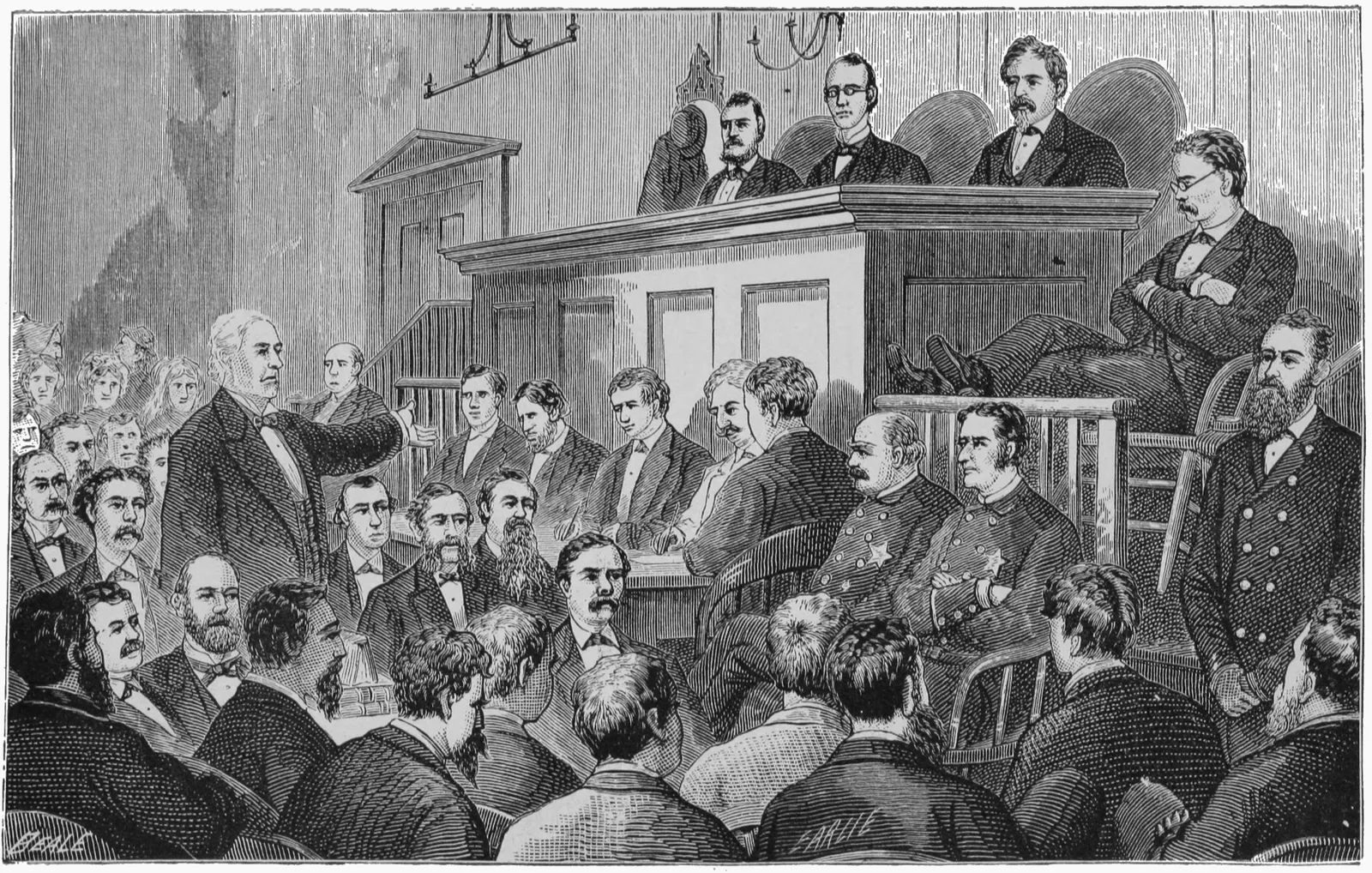
“The trial for conspiracy attracted the gentleman of the bar from all parts of the State.”
John Kehoe, Michael O’Brien, Chris Donnelly, John
Donahue, alias “Yellow Jack,” James Roarty, Dennis F.
Canning, Frank McHugh, John Gibbons, and John Morris
were arrested on the sixth of May, 1876, charged with conspiracy,
at the famous Mahanoy City Convention of the first
of June, 1875, to kill Wm. M. Thomas and Jesse Major.
They were tried at Pottsville before President Judge Pershing
and Associates Green and Walker, commencing August 9
and ending August 14, 1876. The trial for conspiracy attracted
542the gentleman of the bar from all parts of the State, and
during its continuance the court-room was daily crowded to
the point of suffocation with ladies and gentlemen, some of
them having traveled hundreds of miles to have a view of the
Mollies, the jury, the court and officials, and the witnesses for
the prosecution. McParlan’s testimony was intensely interesting,
and such a public call for its particulars was there
among the legal fraternity and the general reading public,
that the entire evidence of the trial was printed in a pamphlet
of nearly three hundred pages, and a very large edition quickly
exhausted. The newspapers had special correspondents on
the ground, and the illustrated journals of New York sent
their artists to Pottsville to make drawings of the court and
surroundings. The leading facts contained in this extraordinary
suit have been given in the course of the preceding narrative.
With the exception of the young man, Frank McHugh,
who gave evidence for the Commonwealth, the
defendants were all found guilty according to the counts in
the several indictments, and sentenced to seven years’ confinement
each in the penitentiary. McHugh has not been
sentenced, having been recommended to the mercy of the
court by the jury.
CHAPTER XLIX. CLOSING THE RECORD.
After this came the arrest of the murderers—or those interested
in the murder—of Gomer James. Thomas Hurley,
having for the time made his escape—though it is reasonable
to suppose that he will, with other fugitives from justice,
some day be caught and punished—Chris Donnelly, John
Donahue, Michael O’Brien, Pat Dolan, Sr., Pat Butler, and
Frank O’Neill were arraigned at Pottsville on the 17th of
August, 1876. James Roarty, charged with aiding and abetting
in the killing of Gomer James, was, with the others,
543found guilty. Chris Donnelly was given two years in the
penitentiary, while Patrick Butler, partly in consideration of
his having given State’s evidence, met similar leniency. John
Donahue, having already received sentence of death, was not
sentenced. Mike O’Brien was sent to prison for two years.
Patrick Dolan, Sr., was sentenced to eighteen months’ imprisonment.
Frank O’Neill also received two years.
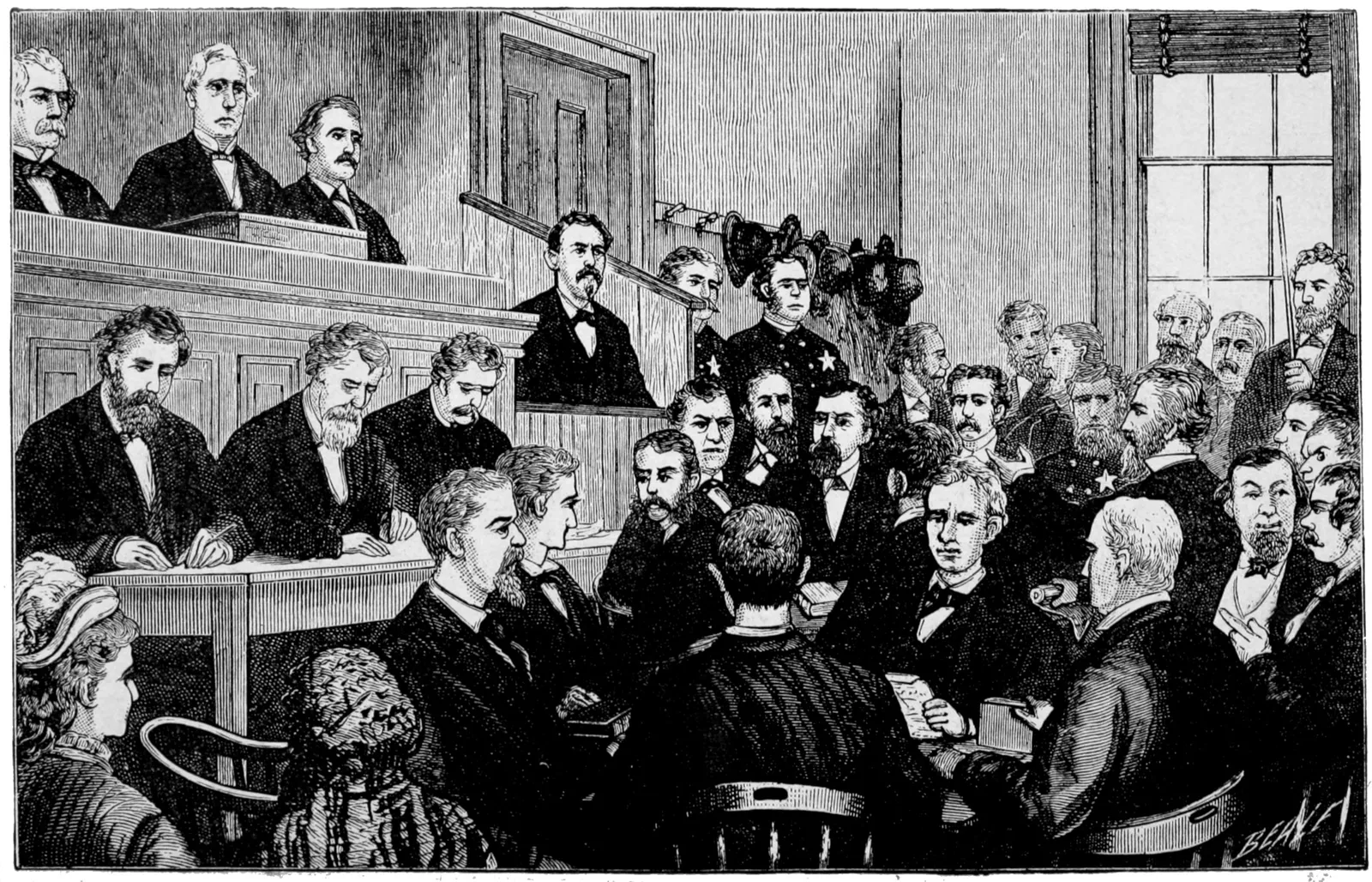
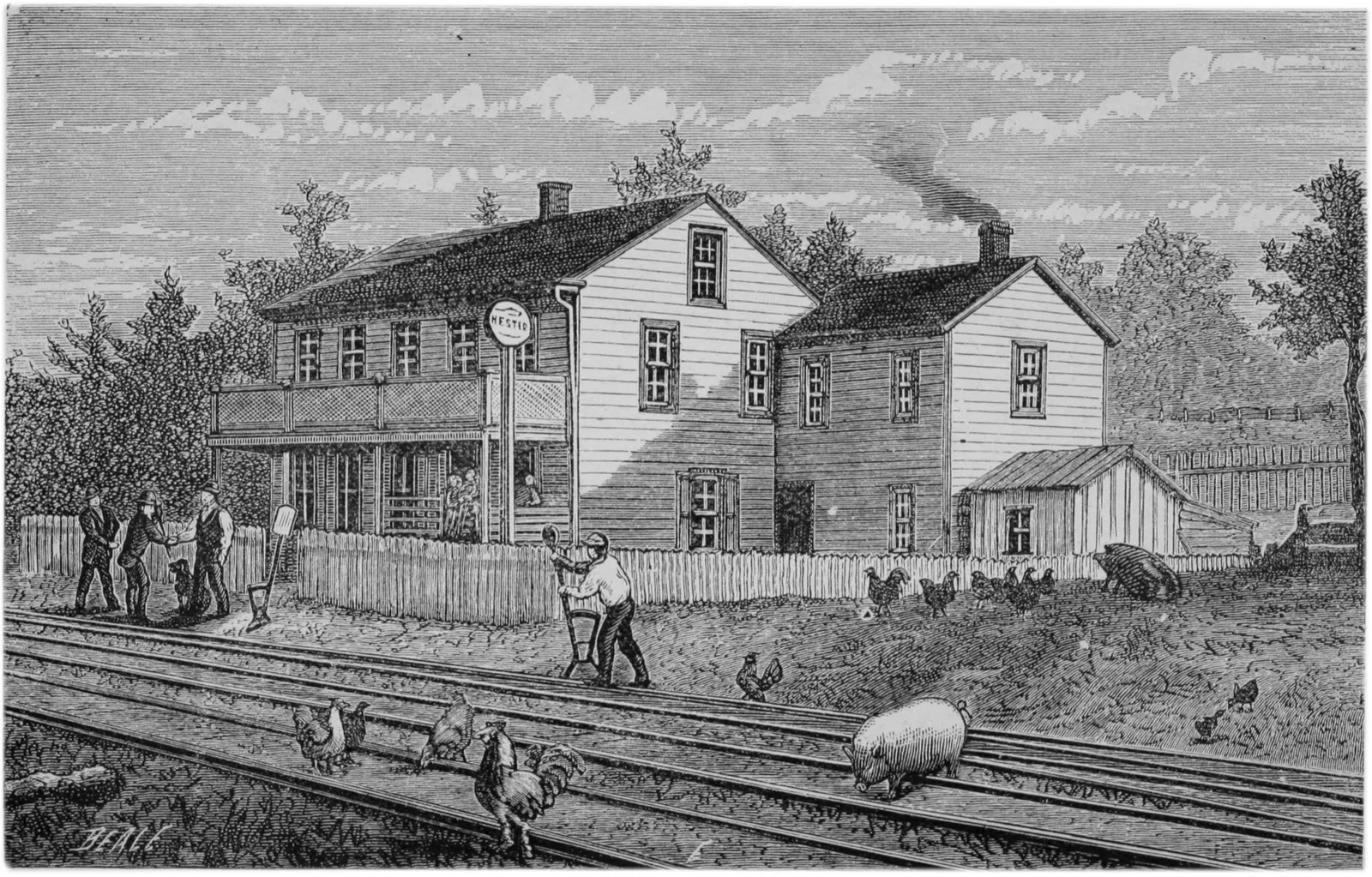
“Pat. Hester smiled when he saw Dan. Kelly, alias Manus Kull, alias ‘Kelly the Bum., in the witness box.”
September 23, of the same year, John Slattery, John Stanton,
Michael Doolan, Chas. Mullhearn, Ned Monaghan,
John Kehoe, Chris Donnelly, Dennis F. Canning, Michael
O’Brien, Frank O’Neill and Pat Dolan, Sr., were arraigned
for conspiracy to murder Wm. and Jesse Major, stood their
trial, and all but John Stanton were found guilty, and sentenced
to imprisonment as follows: O’Neill, five years;
O’Brien, five years; Canning, seven years; Donnelly, five
years; Kehoe, seven years, and Ned Monaghan, seven years.
At the same term of court, Thomas Donahue was sentenced
to two years’ imprisonment for aiding in the escape of
John Gibbons, one of the men assaulting Wm. M. Thomas.
September 22, 1876, Muff Lawler was brought to court,
as accessory after the fact to the murder of Sanger and Uren,
found guilty, but not sentenced, having enrolled himself
among those willing to aid the State in convicting men more
guilty. James Duffy was sent one year for perjury. Mrs.
Bridget Hyland, Bernard M. Boyle, and Kate Boyle, having
been rather too fast in swearing their friends clear, were
found guilty of perjury and given two and three years each at
the State prison.
The murder of F. W. S. Langdon, by the Mollie Maguires,
at Audenried, in Schuylkill County, committed July 14,
1862, implicated John Kehoe, County Delegate, John Campbell,
and Neill Dougherty. Campbell and Dougherty were
arrested, and with Kehoe brought to trial at Pottsville, January
2, 1877, found guilty of murder in the second degree
and sentenced, Campbell for nine, and Dougherty five years
to the State penitentiary. Kehoe was brought in guilty of
544murder in the first degree, and sentenced to be executed the
16th of April in the same year, but his cause was taken to
the Supreme Court, where it will doubtless be decided in accordance
with the testimony and its merits.
In November, 1876, Chas. McAllister was convicted of
an assault, with intent to kill, upon James Riles, at Shenandoah.
Sentence thus far has been deferred.
All of the above were Schuylkill County cases.
In Carbon County arrests were made almost simultaneously.
John Donahue, Thomas P. Fisher, Patrick McKenna,
Alex. Campbell, Patrick O’Donnell, and John
Malloy, were taken, charged with the murder of Morgan
Powell, at Summit Hill, December 2, 1871. The defendants
were tried, at different terms of the Carbon County
Court, at Mauch Chunk, James McParlan frequently appearing—as
in most of the suits in Schuylkill County—on
the witness stand and testifying to the confessions and admissions
of the Mollies. They were found guilty as follows:
Donahue of murder in the first degree; Fisher of murder in
the first degree, and sentenced to death; Pat McKenna of
murder in the first degree, and sentenced to nine years’ imprisonment;
Patrick O’Donnell, as accessory, and sentenced
to five years’ imprisonment.
In Columbia County, February 24, 1877, Pat Hester, Pat
Tully, and Peter McHugh, were arraigned for the murder
of Alex. Rae. The circumstances of the crime have been
related in these pages. The court was held at Bloomsburg,
the county-seat, and attracted a very large attendance.
McParlan was present, and his testimony was fully corroborated
by Dan Kelly, alias Manus Kull, and Mike, alias Muff
Lawler, was also a witness. An interview between McParlan
and the last-named personage is thus described by an
eye-witness:
“At about a quarter to ten this morning, February 12,
1877, the stage from Rupert Station rattled up the street,
into town, and disgorged its occupants in front of the Exchange
545Hotel. With Messrs. Hughes and Ryon, from Pottsville,
the redoubtable Muff Lawler made his appearance.
The meeting between Lawler and his old friend McParlan—Muff
once knew him as McKenna, and initiated him into
Shenandoah Division of the Mollies, a few years ago—was
particularly interesting. Stretching out his hand, McParlan
inquired of Lawler, as he indulged in a warm shake: ‘Have
you the “goods” for the last quarter?’
“‘I have not!’ was the blushing reply.
“‘Well, now, that’s a pity,’ said McParlan, ‘as I wanted
to get the quarreling toast!’”
Several witnesses of the scene were convulsed with
laughter.
I had at the time the “goods” for the quarter ending the
first of February, 1877, in my office, and at once sent them
by telegraph to McParlan, so that he might not have to
inquire about them of Muff Lawler. They were as follows:
“Day Words: Question—How does Erin stand?
Answer—The Russians will be victorious!
“Night Words: Question—The nights are getting short!
Answer—We’ll soon have the Spring!
“Quarreling words: Question—Don’t be outrageous!
Answer—I never was such!”
The sign of recognition was made as follows:
“Question—With the thumb and forefinger of the right hand, take
hold of the lapel of the vest between the top buttons, or button-holes.
“Answer—Draw the back of the left hand across the chin.”
The leaders of this society can make up their minds that
henceforth, as in the past, I will not remain in ignorance of
their most secret transactions. It is simply out of their
power to prevent this. As long as it is a society, and as
long as its signs, mummeries, and passwords are used for
purposes of murder and assassination, so long will its imported
“goods” remain my “goods” in the interests of
humanity and justice.
It was the ninth of February, 1877, that the trial at
Bloomsburg approached a crisis. Sitting in the prisoner’s
546dock, Pat Hester smiled when he saw Dan Kelly, alias
Manus Kull, alias “Kelly the Bum,” in the witness-box.
But his humor changed to dire dismay as he discovered
that there were still other witnesses, who fully corroborated
what Kelly made oath to. Dan Kelly’s story of the Rae
assassination was about as follows:
He met Pat Hester, Peter McHugh and Ned Skivington
at Big Mine Run, in Barney Dolan’s place, on the sixteenth of
October, 1868, the day preceding that of the murder. Hester
was on his way, he said, down the mountain with Skivington,
but had missed the train and returned to Dolan’s, where all had
something to drink. Afterward they walked to Ashland, and
entered Donahue’s saloon. There Hester informed the witness
that he had lost something by not going down the mountain
that day, adding, “But there is a good thing to be had to-morrow,
for Rae will go to Bell’s Tunnel, and there is money
in it for us!” It was then agreed that Hester, McHugh,
Tully, Skivington, Brian Campbell, Jim Bradley, Billy
Muldowney and Dan Kelly should go and rob Rae. Roger
Lafferty, alias Johnstone, went across the street and procured
some powder and bullets, returned and loaded the
pistols, each one of the persons named having a weapon.
After this they had more liquor and stayed there all night.
All but Lafferty went out in the morning to meet and rob
Rae. But when they got as far as Germantown, Muldowney
left, saying that he was too lame to keep on. After they
got above the toll-gate, Hester and Skivington left, and
Hester handed witness, Kelly, his pistol, saying: “Kelly,
your pistol is no good! Take mine! for I know it’s sure!”
And he remarked that he would go to Shamokin, to purchase
hair to mix with lime to make mortar for plastering. Skivington
was off also, wanting to go to work in the mine to
throw aside suspicion from the rest. All the others went as
far as the water-barrel, and remained there. They then
begun talking about Rae and his son, and finally concluded
that, if the lad should chance to be riding with his father that
547morning, as he often did, they would send the boy home
with the horse, if they had to shoot Rae. The object was
plunder, not murder, unless the latter was necessary to secure
the money. Bradley, who was not known in Centralia, went
and procured a quart of whisky and some crackers. When
he got back all hands drank and ate. Five of the number
present did not know Rae if they saw him, so Dalton, who
was acquainted with him, walked out on the road to signal
the others should their victim arrive. Soon a man came
along in a wagon, but as Dalton did not shake his hat the
person was allowed to pass. Still another man moved up
while the assassins waited in ambush, driving a horse attached
to a light wagon, and he was permitted to go his way
unharmed, as Dalton again failed to give the notice. He
presently stepped out into the road to see who was coming
and returned to his former position. Quickly afterward a
buggy hove in view and the assassins saw that Dalton was
standing in plain sight, shaking his hat, and they knew that
the driver was Alex. Rae. When the vehicle reached the
watering-trough, all jumped out upon their victim. Rae
alighted from the buggy when the men ordered him to, and
quickly handed his watch and pocket-book to Kelly, the witness,
but said nothing. He was confronted by a squad of
heavily armed ruffians. What was there for him to say?
Kelly asked McHugh what should be done with the man?
McHugh replied: “I won’t be hunted around the world by
any living man,” when the shooting began. Rae ran toward
the woods, and Tully went up to him, put his pistol
to his head, and shot him near the ear. Seeing that the
man was sure to die, all ran up the mountain, where
they divided the money, about sixty dollars, and the
witness remembered that Dalton received a ten dollar bill
with a corner torn off. Tully and McHugh and Kelly
got in at Graham’s some time that day, and in the afternoon
witness drove to Locust Gap with a beer-seller. He got home
at half-past three. They killed Rae at about nine o’clock.
548He struck the ground upon his face, and they left him where
he fell, after putting the horse and buggy out of sight in the
wood. Kelly acknowledged that he fired two shots, but
could not say how many the others fired. Dalton did not
shoot at all. All of the rest discharged their weapons at the
man. He was sure he saw Tully fire. One shot hit Rae in
the cheek. He left Hester’s pistol at Graham’s and had
given his own to Bradley. Hester’s weapon was a sort of
navy pistol and held five cartridges. It was loaded at Donahue’s
house. Dalton had a small pistol and McHugh’s was
not as large as Kelly’s. McHugh had a seven-shooter.
Hester met him the same night in Graham’s, at about nine
o’clock, when the rest were there. The next he saw of
Hester was three days later, when he rode in his wagon with
him from the Gap to Ashland. Hester received none of the
money taken from Rae. It was Hester’s idea that Ray
would have eighteen or nineteen thousand dollars with him,
but when he heard how small a sum had been realized he said
it was not worth dividing, so took none of it. About the
seventeenth of November, after Donahue and Duffy had
been arrested, Jack Smith told Hester of the capture, and he
remarked it was about time for him to go, and he did go,
without telling his confederates where he went. They all
separated, remained away a month or two, and returned.
When they got back Hester was in jail. He said he had
been to Illinois, but it would look better to go back, as he
might be taken there. A woman got Rae’s pocket-book.
The watch—a gold one—witness gave to Mike Graham,
to keep for him. He took it from him afterward and left it
with Con Garrah for ten dollars. Garrah restored it, when
Kelly gave it to McGuire for ten dollars and turned the money
over to Garrah. The watch was subsequently broken up with
rocks and thrown into a creek, for fear it might lead to trouble.
The attorneys for the defense were unable, after many
efforts, to shake Kelly’s testimony in the least. Despite his
bad character for truth and veracity, it was the conviction
549of everybody that he, for once in his checkered career, was
bent upon telling the straightforward truth. It had its weight
with the jury.
Judge Elwell presided at the session of court, and Hon.
F. W. Hughes assisted the District Attorney in the prosecution,
John W. Ryon, Esq., of Pottsville, and others, appearing
for the defendants.
On the 24th, the jury returned a verdict in the three cases
of “guilty of murder in the first degree.” This was not
unexpected by the general public, but formed a complete
surprise to Pat Hester and his Mollie friends. So confident
had Hester been of release, that, the day before the reception
of the decree, he sent word to Locust Gap, ordering a
grand supper prepared at his house in commemoration of his
discharge and triumphant acquittal. While he did not actually
fire the shot that killed Rae, he was virtually as guilty
as those who did, having originated the job, and justice will,
without doubt, be meted out to him.
Hester, Tully, and McHugh found that they had but one
course to adopt, and got a new trial; but all has failed, the
Supreme Court has affirmed the judgment against the prisoners,
and sentence of death is their doom.
While these trials were going on, the Mollies were not
idle. They moved every string possible to pull in money and
influence to defend their brethren in the coal region. Contributions
were levied by the National head of the order, in
New York, upon the subordinate divisions of the country
for a large amount of money—some place it as high as
$30,000—part of which was to be expended in clearing the
criminals, and the rest, I have reason to believe, in paying
assassins to go to Pottsville and take the lives of McParlan
and all of my employés in that section of country. But the
refusal of one of the Philadelphia lodges to respond to this
levy brought the matter to the notice of the public press and
stopped at least a portion of the funds from going forward
to the National officers. New Orleans and some other distant
550branches had sent their share without knowing exactly
the purpose for which it was to be employed, but it is presumable
that not more than one-half of the assessment was
ever realized, and that must have been expended in paying
for legal services.
During the session of court, at which occurred the trial
of Kehoe and others for conspiracy to murder Wm. M.
Thomas, I learned that an attempt would be made to assassinate
Mr. Gowen, McParlan, and the entire court. It
seems at first there was an informal meeting of the Mollies,
in Pottsville, and it was arranged that twenty-four men should
be chosen to go to the court-house, twelve to sit on the back
row of seats, and twelve on the front tier, near the prisoners.
All were to be armed with loaded revolvers. Those on the
front row of seats were, at a given signal, to rise and simultaneously
fire upon the judges, the attorneys for the Commonwealth—Mr.
Gowen especially—and the officers, including
McParlan and Capt. Linden, and the members of the Coal
and Iron Police. Those on the back seat were to kill off
those left by the first platoon, when all were to rush in, seize
the prisoners and with them fight their way out and make
their escape to the hills. An influential member of the
order, and a county official, hearing of this arrangement,
after the twenty-four men had actually been appointed, made
his appearance at their rendezvous and informed the ringleaders
in the movement that such an act was evidence of
sheer madness. “If you do this, boys,” said he, “there will
not be an Irishman left in Schuylkill County, and what is
more, if you persist in the plot, I shall consider it my bounden
duty to go at once and have every mother’s son of you
arrested! It can’t be done, and it shall not be done!”
This, for the time, broke up the conspiracy. Subsequently
a young Mollie Maguire made his boast, in the presence of
several friends, that he would go to the court-house, any time
when he could hear that Mr. Gowen was alone, and shoot
him down. He was soon told that the President of the Reading
551Railway, and the personal head of the prosecution of the
members of the bloodthirsty organization, was writing, all by
himself, in a jury room. The assassin walked into the apartment,
his hand upon his revolver, and was about to produce
it and fire, when an officer of the Coal and Iron Police,
having business with the gentleman threatened, unexpectedly
appeared on the scene. As the would-be murderer had no
reasonable excuse for remaining, he took his hand away
from his pistol, and, thwarted in his design, sneaked out of
the place. These and other equally foolish acts of the
Mollies were duly reported to Mr. Gowen, and he was
advised that he must take some precautions or his life would
pay the forfeit of criminal rashness. Up to that date he had
not as much as worn a pistol, or any other weapon, upon his
person, and it is questionable if he ever did subsequently.
He is a brave, frank man, but depended too much, I think,
upon the justness of his cause, for with the Mollie Maguires
the common instincts of human nature are outraged and
disregarded. Still he was not attacked. While there were
hundreds present thirsting for his blood, he turned upon the
Mollies the heaviest deluge of invective that they have ever
received.
But one New York newspaper, I believe, has ever openly
taken the part of the Mollie Maguires. That was the Irish
World. The animus of its article was contained in an attack
upon Mr. Gowen and James McParlan, calling one “the
head of a coal monopoly,” and the other his “hired informer.”
As the editor possibly had to do something to earn
his proportion of the $30,000 received for the defense of the
Mollies, and as his modicum of the labor was so insignificant
and trivial, I have not the heart to devote space to an answer.
He is sufficiently replied to, perhaps, by the verdicts
of the courts of justice, which point to something more serious
than the editorial writer in question had in mind at the
time of the preparation of his weak and idle philippic.
A well informed writer in the American Law Review, for
552January, 1877, seems to have taken a more sensible impression
of the matter, and found interest enough in the trials
of the Mollies to devote twenty-eight pages of valuable
space to the calm and dispassionate discussion of the subject
from a legal standpoint.
The work of several years is now nearly finished. About
seventy persons have been arrested in the coal region. Of
those twelve have been, by a jury of their countrymen, found
guilty of murder in the first degree; four of murder in the
second degree; and four of being accessory to murder;
sixteen of conspiracy to murder; six of perjury; one of
assault with intent to kill; eight of aiding and abetting a
murder; one of assault and battery; one for aiding in the
escape of a murderer, and several others of lesser crimes.
The sum-total of the time of these sentences to imprisonment
foots up one hundred and twenty-four years and eight
months. Eleven have received sentence of death.
On May 21st, 1877, Governor Hartranft issued warrants
for the execution of eight of the murderers, viz.:—Alexander
Campbell, convicted of complicity in the killing of John P.
Jones; James Carroll, Hugh McGehan, James Boyle, and
James Roarty, convicted of the murder of Benj. F. Yost;
Patrick Hester, Peter McHugh, and Patrick Tully, convicted
of the murder of Alexander W. RaeRae. Campbell
was hanged at Mauch ChunkChunk on the 21st of June,
in company with Michael Doyle and Edward Kelly, concerned
in the murder with him. Carroll, McGehan,
Boyle, and Roarty expiated their crime on the same day
on the gallows from which Thomas Munley was suspended
for the murder of William Sanger and James UrensUrens; and
Hester, McHugh and Tully will be executed at Bloomsburg
on the 9th day of August next, which will be the first executions
that have ever taken place in Columbia County.
Characters on the margins are very often missing or only partially inked, especially
punctuation, more particularly hyphens and periods. Where the context is clear, these lapses
have been addressed without any notice taken here. On occasion, an earlier 1877 edition
has been consulted to confirm the intent. Where punctuation has been restored in midline, the
lapse has been noted here.
(331.4 run away[.];
20.2 service[.];
259.30 Mine Hill Gap[.];
388.34 case[.];
483.35 delayed[.];
501.2 arrested[.])
When conversation employs dialect, the text is generally followed as printed.
The apostrophe in the contraction “it’s” is typically missing (pp. 34, 37, 64(2),
157, 165, 248(3), 263, 266, 314). The common contraction “an’” sometimes appears
without the apostrophe, which is supplied (295.7, 303.1,
322.33, 384.12, 384.32, 492.6).
At 62.12, the text employs “wrapped attention” in place of “rapt”. The
correct word appears only one other time. The odd phrase is retained.
A passage at 196.11 includes an odd use of the exclamation point
and does not re-open the ensuing speech: “Don’t stand here askin’ questions,”
answered Mrs. McIntyre! [“]Oh, why did I fall in....” The quotation mark
has been added, but the exclamation point is retained.
Other errors deemed most likely to be the printer’s have been corrected, and
are noted here. The references are to the page and line in the original.
| 17.19 |
it can be ac[c]omplished |
Inserted. |
| 34.28 |
[“]As an argument in favor |
Removed. |
| 36.1 |
Is that you, Tony[!/?] |
Replaced. |
| 62.29 |
the larger State penitent[i]aries |
Inserted. |
| 131.31 |
on a job load[ /i]n’ coal |
Restored. |
| 144.34 |
the right eye, thus:[”] and the Bodymaster |
Added. |
| 148.20 |
at a house w[h]ere he was acquainted |
Inserted. |
| 150.1 |
Since the authorit[i]es have been |
Inserted. |
| 150.15 |
regular war in S[k/ch]uylkill county! |
Replaced. |
| 155.10 |
passed of[f] smoothly |
Added. |
| 194.18 |
who stood no[r/t] far off |
Replaced. |
| 278.3 |
is General Superin[d/t]endent |
Replaced. |
| 292.30 |
in Schuy[l]kill County. |
Inserted. |
| 308.27 |
Faith, an[,/’[ I can think |
Replaced. |
| 311.28 |
at their different coll[i]eries. |
Inserted. |
| 319.14 |
incapable of physic[i]al exertion |
Removed. |
| 320.13 |
until [to morrow] |
sic |
| 320.14 |
back to ye![’/”] |
Replaced. |
| 327.24 |
Gen. Pleasant[s] |
Added. |
| 347.16 |
in favor of an antagonistic co[r]poration |
Inserted. |
| 347.34 |
from the city of Philad[a/e]lphia |
Replaced. |
| 354.18 |
but entirely u[n]seen |
Inserted. |
| 365.1 |
“Was not one Jimmy Kerrigan?[’/”] |
Replaced. |
| 381.5 |
many inquiries goin[’] on |
Added. |
| 387.1 |
saying he [“]had other fish to fry.” |
Added. |
| 435.27 |
Mr. Nicoll[’]s |
Removed. |
| 437.2 |
[“]Don’t stop for me |
Added. |
| 439.20 |
has plenty of pistols.[”] |
Added. |
| 451.6 |
Superintend[a/e]nt Geo. H. Bangs. |
Replaced. |
| 454.7 |
By this [time ]some fifteen |
Missing. |
| 461.7 |
Carroll, and Mul[l]hall |
Removed. |
| 477.5 |
with her child[r]en |
Inserted. |
| 489.17 |
he never inten[d]ed |
Inserted. |
| 507.11 |
Drown him![”] |
Added. |
| 522.20 |
was the only confid[e/a]nt |
Replaced. |
| 523.14 |
this unostentatio[n/u]s charity |
Inverted. |
| 524.7 |
beyond the precin[c]ts of his own door |
Inserted. |
| 532.33 |
[‘]The time has ceased |
Added. |
| 533.33 |
‘There, at my feet![’] |
Added. |
| 552.25 |
R[ea/ae] |
Transposed. |
| 552.26 |
Chun[c]k on the 21st of June, |
Removed. |
| 552.31 |
Uren[s] |
Added. |