§ 1. My subject this evening is not the physical
properties of crystals, not even their dynamics; it is
merely the geometry of the structure—the arrangement
of the molecules in the constitution of a crystal.
Every crystal is a homogeneous assemblage of small
bodies or molecules. The converse proposition is
scarcely true, unless in a very extended sense of the
term crystal (§ 20 below). I can best explain a homogeneous
assemblage of molecules by asking you to
think of a homogeneous assemblage of people. To be
homogeneous every person of the assemblage must
be equal and similar to every other: they must be
seated in rows or standing in rows in a perfectly similar
manner. Each person, except those on the borders of
the assemblage, must have a neighbour on one side
and an equi-distant neighbour on the other: a neighbour
on the left front and an equi-distant neighbour
behind on the right, a neighbour on the right front
and an equi-distant neighbour behind on the left. His
two neighbours in front and his two neighbours behind
are members of two rows equal and similar to the rows
consisting of himself and his right-hand and left-hand
neighbours, and their neighbours’ neighbours indefinitely
to right and left. In particular cases the nearest
of the front and rear neighbours may be right in front
and right in rear; but we must not confine our attention
to the rectangularly grouped assemblages thus constituted.
Now let there be equal and similar assemblages
on floors above and below that which we have
been considering, and let there be any indefinitely
great number of floors at equal distances from one
another above and below. Think of any one person
on any intermediate floor and of his nearest neighbours
on the floors above and below. These three persons
must be exactly in one line; this, in virtue of the
homogeneousness of the assemblages on the three
floors, will secure that every person on the intermediate
floor is exactly in line with his nearest neighbours
above and below. The same condition of alignment
must be fulfilled by every three consecutive floors, and
we thus have a homogeneous assemblage of people in
three dimensions of space. In particular cases every
person’s nearest neighbour in the floor above may be
vertically over him, but we must not confine our
attention to assemblages thus rectangularly grouped
in vertical lines.
§ 2. Consider now any particular person C (Fig. 1)
on any intermediate floor, D and D′ his nearest neighbours,
E and E′ his next nearest neighbours all on his
own floor. His next next nearest neighbours on that
floor will be in the positions F and F′ in the diagram.
Thus we see that each person C is surrounded by six
persons, DD′, EE′ and FF′, being his nearest, his next
nearest, and his next next nearest neighbours on his
own floor. Excluding for simplicity the special cases
of rectangular grouping, we see that the angles of the
six equal and similar triangles CDE, CEF, &c., are all
acute: and because the six
triangles are equal and similar
we see that the three pairs
of mutually remote sides of
the hexagon DEFD′E′F′ are
equal and parallel.
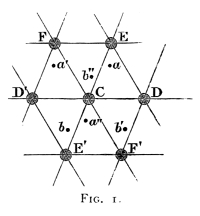
Fig. 1
§ 3. Let now A, A′, A″, &c.,
denote places of persons of
the homogeneous assemblage
on the floor immediately
above, and B, B′, B″, &c. on the floor immediately
below, the floor of C. In the diagram let a, a′, a″ be
points in which the floor of CDE is cut by perpendiculars
to it through A, A′, A″ of the floor above, and
b, b′, b″ by perpendiculars from B, B′, B″ of the floor
below. Of all the perpendiculars from the floors immediately
above and below, just two, one from each,
cut the area of the parallelogram CDEF: and they
cut it in points similarly situated in respect to the
oppositely oriented triangles into which it is divided
by either of its diagonals. Hence if a lies in the
triangle CDE, the other five triangles of the hexagon
must be cut in the corresponding points, as shown in
the diagram. Thus, if we think only of the floor of
C and of the floor immediately above it, we have points
A, A′, A″ vertically above a, a′, a″. Imagine now a
triangular pyramid, or tetrahedron, standing on the
base CDE and having A for vertex: we see that each
of its sides ACD, ADE, AEC, is an acute angled
triangle, because, as we have already seen, CDE is an
acute angled triangle, and because the shortest of the
three distances, CA, DA, EA, is (§ 2) greater than
CE (though it may be either greater than or less than
DE). Hence the tetrahedron CDEA has all its angles
acute; not only the angles of its triangular faces, but
the six angles between the planes of its four faces.
This important theorem regarding homogeneous assemblages
was given by Bravais, to whom we owe
the whole doctrine of homogeneous assemblages in
its most perfect simplicity and complete generality.
Similarly we see that we have equal and similar tetrahedrons
on the bases D′CF, E′F′C; and three other
tetrahedrons below the floor of C, having the oppositely
oriented triangles CD′E′, &c. for their bases and B, B′, B″
for their vertices. These three tetrahedrons are equal
and heterochirally1 similar to the first three. The consideration
of these acute angled tetrahedrons, is of
fundamental importance in respect to the engineering
of an elastic solid, or crystal, according to Boscovich.
So also is the consideration of the cluster of thirteen
points C and the six neighbours DEFD′E′F′ in the
plane of the diagram, and the three neighbours AA′A″
on the floor above, and BB′B″ on the floor below.
§ 4. The case in which each of the four faces of each
of the tetrahedrons of § 3 is an equilateral triangle is
particularly interesting. An assemblage fulfilling this
condition may conveniently be called an ‘equilateral
homogeneous assemblage,’ or, for brevity, an ‘equilateral
assemblage.’ In an equilateral assemblage C’s
twelve neighbours are all equi-distant from it. I hold
in my hand a cluster of thirteen little black balls, made
up by taking one of them and placing the twelve others
in contact with it (and therefore packed in the closest
possible order), and fixing them all together by fish-glue.
You see it looks, in size, colour, and shape,
quite like a mulberry. The accompanying diagram
shows a stereoscopic view of a similar cluster of balls
painted white for the photograph.
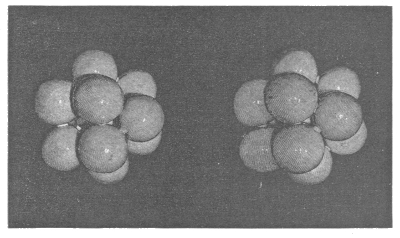
Fig. 2.
§ 5. By adding ball after ball to such a cluster of
thirteen, and always taking care to place each additional
ball in some position in which it is properly in
line with others, so as to make the whole assemblage
homogeneous, we can exercise ourselves in a very
interesting manner in the building up of any possible
form of crystal of the class called ‘cubic’ by some
writers and ‘octahedral’ by others. You see before
you several examples. I advise any of you who wish
to study crystallography to contract with a wood-turner,
or a maker of beads for furniture tassels or for rosaries,
for a thousand wooden balls of about half an inch
diameter each. Holes through them will do no harm
and may even be useful; but make sure that the balls
are as nearly equal to one another, and each as nearly
spherical, as possible.
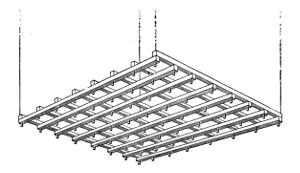
Fig. 3.
§ 6. You see here before you a large model which
I have made to illustrate a homogeneous assemblage
of points, on a plan first given, I believe, by Mr. William
Barlow (Nature, December 20 and 27, 1883). The
roof of the model is a lattice-frame (Fig. 3) consisting
of two sets of eight parallel wooden bars crossing one
another, and kept together by pins through the middles
of the crossings. As you see, I can alter it to make
parallelograms of all degrees of obliquity till the bars
touch, and again you see I can make them all
squares.
§ 7. The joint pivots are (for cheapness of construction)
of copper wire, each bent to make a hook
below the lattice frame. On these sixty-four hooks
are hung sixty-four fine cords, firmly stretched by
little lead weights. Each of these cords (Fig. 4) bears
eight short perforated wooden cylinders, which may
be slipped up and down to any desired position2. They
are at present actually placed at distances consecutively
each equal to the distance from joint
to joint of the lattice frame.
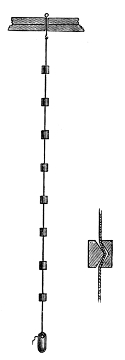
Fig. 4.
§ 8. The roof of the model is hung
by four cords, nearly vertical, of independently
variable lengths, passing
over hooks from fixed points above,
and kept stretched by weights, each
equal to one quarter of the weight of
roof and pendants. You see now
by altering the angles of the lattice
work and placing it horizontal or in
any inclined plane, as I am allowed to
do readily by the manner in which it
is hung, I have three independent
variables, by varying which I can show
you all varieties of homogeneous assemblages,
in which three of the
neighbours of every point are at equal
distances from it. You see here, for
example, we have the equilateral assemblage. I have
adjusted the lattice roof to the proper angle, and
its plane to the proper inclination to the vertical,
to make a wholly equilateral assemblage of the little
cylinders of wood on the vertical cords, a case, as we
have seen, of special importance. If I vary also the
distances between the little pieces of wood on the cords;
and the distances between the joints of the lattice
work (variations easily understood, though not conveniently
producible in one model without more of
mechanical construction than would be worth making),
I have three other independent variables. By properly
varying these six independent variables, three angles
and three lengths, we may give any assigned value to
each edge of one of the fundamental tetrahedrons of § 3.
§ 9. Our assemblage of people would not be homogeneous
unless its members were all equal and similar
and in precisely similar attitudes, and were all looking
the same way. You understand what a number of people
seated or standing on a floor or plain and looking the
same way means. But the expression ‘looking’ is not
conveniently applicable to things that have no eyes, and
we want a more comprehensive mode of expression.
We have it in the words ‘orientation,’ ‘oriented,’ and
(verb) ‘to orient,’ suggested by an extension of the idea
involved in the word ‘orientation,’ first used to signify
positions relatively to east and west of ancient Greek
and Egyptian temples and Christian churches. But
for the orientation of a house or temple we have only
one angle, and that angle is called ‘azimuth’ (the name
given to an angle in a horizontal plane). For orientation
in three dimensions of space we must extend our
ideas and consider position with reference to east and
west and up and down. A man lying on his side with
his head to the north and looking east, would not
be similarly oriented to a man standing upright and
looking east. To provide for the complete specification
of how a body is oriented in space we must have in the
body a plane of reference, and a line of reference in this
plane, belonging to the body and moving with it. We
must also have a fixed plane and a fixed line of reference
in it, relatively to which the orientation of the moveable
body is to be specified; as, for example, a horizontal plane
and the east and west horizontal line in it. The position
of a body is completely specified when the angle between
the plane of reference belonging to it, and the fixed
plane is given; and when the angles between the line
of intersection of the two planes and the lines of reference
in them are also given. Thus we see that three
angles are necessary and sufficient to specify the
orientation of a moveable body, and we see how the
specification is conveniently given in terms of three
angles.
§ 10. To illustrate this take a book lying on the table
before you with its side next the title-page up, and its
back to the north. I now lift the east edge (the top of
the book), keeping the bottom edge north and south on
the table till the book is inclined, let us say, 20° to the
table. Next, without altering this angle of 20°, between
the side of the book and the table, I turn the book
round a vertical axis, through 45° till the bottom edge
lies north-east and south-west. Lastly, keeping the
book in the plane to which it has been thus brought, I
turn it round in this plane through 35°. These three
angles of 20°, 45°, and 35°, specify, with reference to the
horizontal plane of the table and the east and west line
in it, the orientation of the book in the position to
which you have seen me bring it, and in which I hold
it before you.
§ 11. In Figs. 5 and 6 you see two assemblages, each
of twelve equal and similar molecules in a plane.
Fig. 5, in which the molecules are all same-ways
oriented, is one homogeneous assemblage of twenty-four
molecules. Fig. 6, in which in one set of rows the
molecules are alternately oriented two different
ways, may either be regarded as two homogeneous
assemblages, each of twelve single molecules; or one
homogeneous assemblage of twelve pairs of those
single molecules.
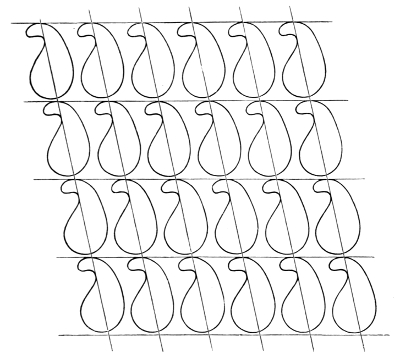
Fig. 5.
§ 12. I must now call your attention to a purely
geometrical question3 of vital interest with respect to
homogeneous assemblages in general, and particularly
the homogeneous assemblage of molecules constituting
a crystal:—what can we take as ‘the’ boundary or
‘a’ boundary enclosing each molecule with whatever
portion of space around it we are at liberty to choose for
it, and separating it from neighbours and their portions
of space given to them in homogeneous fairness?
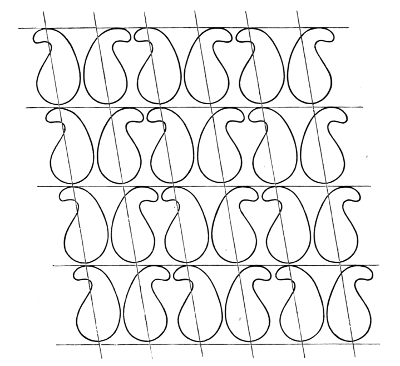
Fig. 6.
§ 13. If we had only mathematical points to consider
we should be at liberty to choose the simple obvious
partitioning by three sets of parallel planes. Even this
may be done in an infinite number of ways, thus:—Beginning
with any point P of the assemblage, choose
any other three points A, B, C, far or near, provided
only that they are not in one plane with P, and that
there is no other point of the assemblage in the lines
PA, PB, PC, or within the volume of the parallelepiped
of which these lines are conterminous edges, or within
the areas of any of the faces of this parallelepiped.
There will be points of the assemblage at each of the
corners of this parallelepiped and at all the corners of the
parallelepipeds equal and similar to it which we find
by drawing sets of equi-distant planes parallel to its
three pairs of faces. (A diagram is unnecessary.) Every
point of the assemblage is thus at the intersection of
three planes, which is also the point of meeting of eight
neighbouring parallelepipeds. Shift now any one of
the points of the assemblage to a position within the
volume of any one of the eight parallelepipeds, and
give equal parallel motions to all the other points of
the assemblage. Thus we have every point in a
parallelepipedal cell of its own, and all the points of
the assemblage are similarly placed in their cells, which
are themselves equal and similar.
§ 14. But now if, instead of a single point for each
member of the assemblage, we have a group of points,
or a globe or cube or other geometrical figure, or an
individual of a homogeneous assemblage of equal,
similar, similarly dressed, and similarly oriented ladies,
sitting in rows, or a homogeneous assemblage of trees
closely planted in regular geometrical order on a plane
with equal and similar distributions of molecules, and
parallel planes above and below, we may find that
the best conditioned plane-faced parallelepipedal partitioning
which we can choose would cut off portions
properly belonging to one molecule of the assemblage
and give them to the cells of neighbours. To find
a cell enclosing all that belongs to each individual, for
example, every part of each lady’s dress, however
complexly it may be folded among portions of the
equal and similar dresses of neighbours; or, every
twig, leaf, and rootlet of each one of the homogeneous
assemblage of trees; we must alter the boundary by
give-and-take across the plane faces of the primitive
parallelepipedal cells, so that each cell shall enclose all
that belongs to one molecule, and therefore (because
of the homogeneousness of the partitioning) nothing
belonging to any other molecule. The geometrical
problem thus presented, wonderfully complex as it
may be in cases such as some of those which I have
suggested, is easily performed for any possible case
if we begin with any particular parallelepipedal partitioning
determined for corresponding points of the
assemblage as explained in § 13, for any homogeneous
assemblage of single points. We may prescribe to
ourselves that the corners are to remain unchanged,
but if so they must to begin with either in interfaces
of contact between the individual molecules, or in
vacant space among the molecules. If this condition
is fulfilled for one corner it is fulfilled for all, as the
corners are essentially corresponding points relatively
to the assemblage.
§ 15. Begin now with any one of the twelve straight
lines between corners which constitute the twelve
edges of the parallelepiped, and alter it arbitrarily
to any curved or crooked line between the same pair
of corners, subject only to the conditions (1) that it does
not penetrate the substance of any member of the
assemblage, and (2) that it is not cut by equal and
similar parallel curves4 between other pairs of corners.
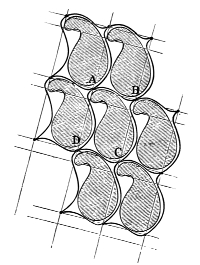
Fig. 7.
Considering now the three fours of parallel edges
of the parallelepiped, let the straight lines of one set of
four be altered to equal and similar parallel curves in
the manner which I have described; and proceed by
the same rule for the other two sets of four edges.
We thus have three fours of parallel curved edges
instead of the three fours of parallel straight edges
of our primitive parallelepiped with corners (each
a point of intersection of three edges) unchanged.
Take now the quadrilateral of four curves substituted
for the four straight edges of one face of the parallelepiped.
We may call this quadrilateral a curvilineal
parallelogram, because it is a circuit composed of two
pairs of equal parallel curves. Draw now a curved
surface (an infinitely thin sheet of perfectly extensible
india-rubber if you please to think of it so) bordered by
the four edges of our curvilineal parallelogram, and so
shaped as not to cut any of the substance of any
molecule of the assemblage. Do the same thing with
an exactly similar and parallel sheet relatively to the
opposite face of the parallelepiped; and again the same
for each of the two other pairs of parallel faces. We
thus have a curved-faced parallelepiped enclosing the
whole of one molecule and no part of any other; and
by similar procedure we find a similar boundary for every
other molecule of the assemblage. Each wall of each of
these cells is common to two neighbouring molecules,
and there is no vacant space anywhere between them
or at corners. Fig. 7 illustrates this kind of partitioning
by showing a plane section parallel to one pair of plane
faces of the primitive parallelepiped, for an ideal case.
The plane diagram is in fact a realization of the two-dimensional
problem of partitioning the pine pattern
of a Persian carpet by parallelograms about as nearly
rectilinear as we can make them. In the diagram faint
straight lines are drawn to show the primitive parallelogrammatic
partitioning. It will be seen that of all
the crossings (marked with dots in the diagram) every
one is similarly situated to every other in respect to the
homogeneously repeated pattern figures: A, B, C, D are
four of them at the corners of one cell.
§ 16. Confining our attention for a short time to
the homogeneous division of a plane, remark that the
division into parallelograms by two sets of crossing
parallels is singular in this respect—each cell is contiguous
with three neighbours at every corner. Any
shifting, large or small, of the parallelograms by relative
sliding in one direction or another violates this condition,
brings us to a configuration like that of the
faces of regularly hewn stones in ordinary bonded
masonry, and gives a partitioning which fulfils the
condition that at each corner each cell has only two
neighbours. Each cell is now virtually a hexagon, as
will be seen by the letters A, B, C, D, E, F in the diagram
Fig. 8. A and D are to be reckoned as corners, each
with an interior angle of 180°. In this diagram the
continuous heavy lines and the continuous faint lines
crossing them show a primitive parallelogrammatic partition
by two sets of continuous parallel intersecting
lines. The interrupted crossing lines (heavy) show,
for the same homogeneous distribution of single points
or molecules, the virtually hexagonal partitioning which
we get by shifting the boundary from each portion of
one of the light lines to the heavy line next it between
the same continuous parallels.
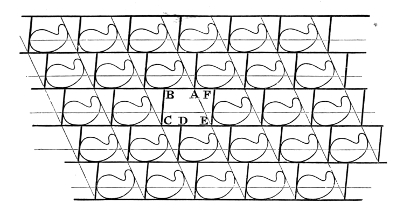
Fig. 8.
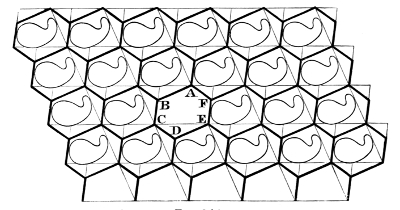
Fig. 8 bis.
Fig. 8 bis represents a further modification of the
boundary by which the 180° angles A, D, become
angles of less than 180°. The continuous parallel lines
(light) and the short light portions of the crossing lines
show the configuration according to Fig. 8, from which
this diagram is derived.
§ 17. In these diagrams (Figs. 8 and 8 bis) the object
enclosed is small enough to be enclosable by a primitive
parallelogrammatic partitioning of two sets of continuous
crossing parallel straight lines, and by the partitioning
of ‘bonded’ parallelograms both represented in Fig. 8,
and by the derived hexagonal partitioning represented
in Fig. 8 bis, with faint lines showing the primitive and
the secondary parallelograms. In Fig. 7 the objects enclosed
were too large to be enclosable by any rectilinear
parallelogrammatic or hexagonal partitioning. The two
sets of parallel faint lines in Fig. 7 show a primitive
parallelogrammatic partitioning and the corresponding
pairs of parallel curves intersecting at the corners of
these parallelograms, of which A,B,C,D is a specimen,
show a corresponding partitioning by curvilineal parallelograms.
Fig. 9 shows for the same homogeneous
distribution of objects a better conditioned partitioning,
by hexagons in each of which one pair of parallel edges
is curved. The sets of intersecting parallel straight
lines in Fig. 9 show the same primitive parallelogrammatic
partitioning as in Fig. 7, and the same slightly
shifted to suit points chosen for well-conditionedness of
hexagonal partitioning.
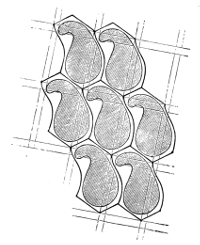
Fig. 9.
§ 18. For the division of continuous three-dimensional
space5 into equal, similar, and similarly oriented cells,
quite a corresponding transformation from partitioning
by three sets of continuous mutually intersecting parallel
planes to any possible mode of homogeneous partitioning,
may be investigated by working out the three-dimensional
analogue of §§ 16-17. Thus we find that the
most general possible homogeneous partitioning of space
with plane interfaces between the cells gives us fourteen
walls to each cell, of which six are three pairs of equal
and parallel parallelograms, and the other eight are four
pairs of equal and parallel hexagons, each hexagon
being bounded by three pairs of equal and parallel
straight lines. This figure, being bounded by fourteen
plane faces, is called a tetrakaidekahedron. It has thirty-six
edges of intersection between faces; and twenty-four
corners, in each of which three faces intersect. A particular
case of it, which I call an orthic tetrakaidekahedron,
being that in which the six parallelograms are
equal squares, the eight hexagonal faces are equal
equilateral and equiangular hexagons, and the lines
joining corresponding points in the seven pairs of
parallel faces are perpendicular to the planes of the
faces, is represented by a stereoscopic picture in Fig. 10.
The thirty-six edges and the twenty-four corners, which
are easily counted in this diagram, occur in the same
relative order in the most general possible partitioning,
whether by plane-faced tetrakaidekahedrons or by the
generalized tetrakaidekahedron described in § 19.
§ 19. The most general homogeneous division of
space is not limited to plane-faced cells; but it still
consists essentially of tetrakaidekahedronal cells, each
bounded by three pairs of equal and parallel quadrilateral
faces, and four pairs of equal and parallel
hexagonal faces, neither the quadrilaterals nor the
hexagons being necessarily plane. Each of the thirty-six
edges may be straight or crooked or curved; the
pairs of opposite edges, whether of the quadrilaterals
or hexagons, need not be equal and parallel; neither
the four corners of each quadrilateral nor the six
corners of each hexagon need be in one plane. But
every pair of corresponding edges of every pair of
parallel corresponding faces, whether quadrilateral or
hexagonal, must be equal and parallel. I have described
an interesting case of partitioning by tetrakaidekahedrons
of curved faces with curved edges in a
paper6 published about seven years ago. In this case
each of the quadrilateral faces is plane. Each hexagonal
face is a slightly curved surface having three
rectilineal diagonals through its centre in one plane.
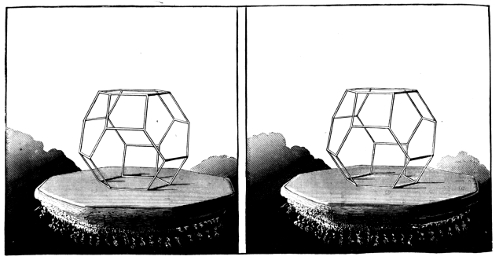
Fig. 10.
The six sectors of the face between these diagonals
lie alternately on opposite sides of their plane, and are
bordered by six arcs of plane curves lying on three
pairs of parallel planes. This tetrakaidekahedronal
partitioning fulfils the condition that the angles between
three planes meeting in an edge are everywhere each
120°; a condition that cannot be fulfilled in any plane-faced
tetrakaidekahedron. Each hexagonal wall is an
anticlastic surface of equal opposite curvatures at every
point, being the surfaces of minimum area bordered
by six curved edges. It is shown easily and beautifully,
and with a fair approach to accuracy, by choosing
six little circular arcs of wire, and soldering them
together by their ends in proper planes for the six
edges of the hexagon; and dipping it in soap solution
and taking it out.
§ 20. Returning now to the tactics of a homogeneous
assemblage, remark that the qualities of the assemblage
as a whole depend both upon the character and orientation
of each molecule, and on the character of the
homogeneous assemblage formed by corresponding
points of the molecules. After learning the simple
mathematics of crystallography, with its indicial system7
for defining the faces and edges of a crystal according
to the Bravais rows and nets and tetrahedrons of
molecules in which we think only of a homogeneous
assemblage of points, we are apt to forget that the true
crystalline molecule, whatever its nature may be, has
sides, and that generally two opposite sides of each
molecule may be expected to be very different in
quality, and we are almost surprised when mineralogists
tell us that two parallel faces on two sides of a crystal
have very different qualities in many natural crystals.
We might almost as well be surprised to find that an
army in battle array, which is a kind of large-grained
crystal, presents very different appearance to any one
looking at it from outside, according as every man in
the ranks with his rifle and bayonet faces to the front
or to the rear or to one flank or to the other.
§ 21. Consider, for example, the ideal case of a crystal
consisting of hard equal and similar tetrahedronal solids
all sameways oriented. A thin plate of crystal cut
parallel to any one set of the faces of the constituent
tetrahedrons would have very different properties on
its two sides; as the constituent molecules would all
present points outwards on one side and flat surfaces
on the other. We might expect that the two sides of
such a plate of crystal would become oppositely electrified
when rubbed by one and the same rubber; and,
remembering that a piece of glass with part of its
surface finely ground but not polished and other parts
polished becomes, when rubbed with white silk, positively
electrified over the polished parts and negatively
electrified over the non-polished parts, we might almost
expect that the side of our supposed crystalline plate
towards which flat faces of the constituent molecules
are turned would become positively electrified, and
the opposite side, showing free molecular corners,
would become negatively electrified, when both are
rubbed by a rubber of intermediate electric quality.
We might also from elementary knowledge of the fact
of piezo-electricity, that is to say, the development of
opposite electricities on the two sides of a crystal by
pressure, expect that our supposed crystalline plate, if
pressed perpendicularly on its two sides, would become
positively electrified on one of them and negatively on
the other.
§ 22. Intimately connected with the subject of enclosing
cells for molecules of given shape, assembled
homogeneously, is the homogeneous packing together
of equal and similar molecules of any given shape.
In every possible case of any infinitely great number
of similar bodies the solution is a homogeneous assemblage.
But it may be a homogeneous assemblage
of single solids all oriented the same way, or it
may be a homogeneous assemblage of clusters of
two or more of them placed together in different
orientations. For example, let the given bodies be
halves (oblique or not oblique) of any parallelepiped
on the two sides of a dividing plane through a pair
of parallel edges. The two halves are homochirally8
similar; and, being equal, we may make a homogeneous
assemblage of them by orienting them all the same
way and placing them properly in rows. But the
closest packing of this assemblage would necessarily
leave vacant spaces between the bodies: and we get
in reality the closest possible packing of the given
bodies by taking them in pairs oppositely oriented
and placed together to form parallelepipeds. These
clusters may be packed together so as to leave no
unoccupied space.
Whatever the number of pieces in a cluster in the
closest possible packing of solids may be for any
particular shape, we may consider each cluster as
itself a given single body, and thus reduce the problem
to the packing closely together of assemblages
of individuals all sameways oriented; and to this problem
therefore it is convenient that we should now
confine our attention.
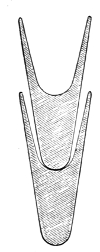
Fig. 11.
§ 23. To avoid complexities such as those which we
find in the familiar problem of homogeneous
packing of forks or spoons or tea-cups or
bowls, of any ordinary shape, we shall
suppose the given body to be of such
shape that no two of them similarly oriented
can touch one another in more than one
point. Wholly convex bodies essentially
fulfil this condition; but it may also be
fulfilled by bodies not wholly convex, as is
illustrated in Fig. 11.
§ 24. To find close and closest packing
of any number of our solids S1, S2, S3 ... of
shape fulfilling the condition of § 23
proceed thus:—
(1) Bring S2 to touch S1 at any chosen point p of its
surface (Fig. 12).
(2) Bring S3 to touch S1 and S2, at r and q respectively.
(3) Bring S4 (not shown in the diagram) to touch S1,
S2, and S3.
(4) Place, any number of the bodies together in three
rows continuing the lines of S1S2, S1S3, S1S4, and in
three sets of equi-distant rows parallel to these. This
makes a homogeneous assemblage. In the assemblage
so formed the molecules are necessarily found to be in
three sets of rows parallel respectively to the three pairs
S2S3, S3S4, S4S2. The whole space occupied by an
assemblage of n of our solids thus arranged has clearly
6n times the volume of a tetrahedron of corresponding
points of S1, S2, S3, S4. Hence the closest of the close
packings obtained by the operations (1) ... (4) is found if
we perform the operations (1), (2), and (3) as to make
the volume of this tetrahedron least possible.
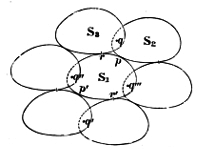
Fig. 12
§ 25. It is to be remarked that operations (1) and
(2) leave for (3) no liberty of choice for the place of
S4, except between two determinate positions on opposite
sides of the group S1, S2, S3. The volume of
the tetrahedron will generally be different for these
two positions of S4, and, even if the volume chance
to be equal in any case, we have differently shaped
assemblages according as we choose one or other of
the two places for S4.
This will be understood by looking at Fig. 12,
showing S1 and neighbours on each side of it in the
rows of S1S2, S1S3, and in a row parallel to that of
S2S3. The plane of the diagram is parallel to the planes
of corresponding points of these seven bodies, and the
diagram is a projection of these bodies by lines parallel
to the intersections of the tangent planes through
p and r. If the three tangent planes through p, q,
and r, intersected in parallel lines, q would be seen like
p and r as a point of contact between the outlines of
two of the bodies; but this is only a particular case,
and in general q must, as indicated in the diagram, be
concealed by one or other of the two bodies of which
it is the point of contact. Now imagining, to fix our
ideas and facilitate brevity of expression, that the
planes of corresponding points of the seven bodies are
horizontal, we see clearly that S4 may be brought into
proper position to touch S1, S2, and S3 either from above
or from below; and that there is one determinate place
for it if we bring it into position from above, and
another determinate place for it if we bring it from
below.
§ 26. If we look from above at the solids of which
Fig. 12 shows the outline, we see essentially a hollow
leading down to a perforation between S1, S2, S3, and
if we look from below we see a hollow leading upwards
to the same perforation: this for brevity we shall call
the perforation pqr. The diagram shows around S1
six hollows leading down to perforations, of which two
are similar to pqr, and the other three, of which p′q′r′
indicates one, are similar one to another but are dissimilar
to pqr. If we bring S4 from above into position
to touch S1, S2, and S3, its place thus found is in the
hollow pqr, and the places of all the solids in the layer
above that of the diagram are necessarily in the hollows
similar to pqr. In this case the solids in the layer
below that of the diagram must lie in the hollows
below the perforations dissimilar to pqr, in order to
make a single homogeneous assemblage. In the other
case, S4 brought up from below finds its place on the
under side of the hollow pqr, and all solids of the
lower layer find similar places: while solids in the
layer above that of the diagram find their places in the
hollows similar to p′q′r′. In the first case there are
no bodies of the upper layer in the hollows above the
perforations similar to p′q′r′, and no bodies of the
lower layer in the hollows below the perforations
similar to pqr. In the second case there are no bodies
of the upper layer in the hollows above the perforations
similar to pqr, and none of the under layer in the
hollows below the perforations similar to p′q′r′.
§ 27. Going back now to operation (1) of § 23, remark
that when the point of contact p is arbitrarily chosen on
one of the two bodies S1, the point of contact on the
other will be the point on it corresponding to the
point or one of the points of S1, where its tangent
plane is parallel to the tangent plane at p. If S1 is
wholly convex it has only two points at which the
tangent planes are parallel to a given plane, and
therefore the operation (1) is determinate and unambiguous.
But if there is any concavity there will be
four or some greater even number of tangent planes
parallel to any one of some planes, while there will
be other planes to each of which only one pair of
tangent planes is parallel. Hence, operation (1), though
still determinate, will have a multiplicity of solutions,
or only a single solution, according to the choice made
of the position of p.
Henceforth however, to avoid needless complications
of ideas, we shall suppose our solids to be wholly
convex; and of some such unsymmetrical shape as those
indicated in Fig. 12 of § 25, and shown by stereoscopic
photograph in Fig. 13 of § 36. With or without this
convenient limitation, operation (1) has two freedoms,
as p may be chosen freely on the surface of S1; and
operation (2) has clearly just one freedom after operation
(1) has been performed. Thus, for a solid of any given
shape, we have three disposables, or, as commonly
called in mathematics, three ‘independent variables,’ all
free for making a homogeneous assemblage according
to the rule of § 22.
§ 28. In the homogeneous assemblage defined in
§ 24, each solid, S1, is touched at twelve points, being
the three points of contact with S2, S3, S4, and the
three 3’s of points on S1 corresponding to the points
on S2, S3, S4, at which these bodies are touched by
the others of the quartet. This statement is somewhat
difficult to follow, and we see more clearly the
twelve points of contact by not confining our attention
to the quartet S1, S2, S3, S4 (convenient as this is for
some purposes), but completing the assemblage and
considering six neighbours around S1 in one plane
layer of the solids as shown in Fig. 12, with their
six points prq″p′r′q″′ of contact with S1; and the three
neighbours of the two adjacent parallel layers which
touch it above and below. This cluster of thirteen,
S1 and twelve neighbours, is shown for the case of
spherical bodies in the stereoscopic photograph of
§ 4 above. We might of course, if we pleased, have
begun with the plane layer of which S1, S2, S4 are
members, or with that of which S1, S3, S4 are members,
or with the plane layer parallel to the fourth
side S2 S3 S4 of the tetrahedron: and thus we have
four different ways of grouping the twelve points of
contact on S1 into one set of six and two sets of
three.
§ 29. In this assemblage we have what I call ‘close
order’ or ‘close packing.’ For closest of close packings
the volume of the tetrahedron (§ 24) of corresponding
points of S1, S2, S3, and S4 must be a minimum,
and the least of minimums if, as generally will be the
case, there are two more different configurations for
each of which the volume is a minimum. There will
in general also be configurations of minimax volume
and of maximum volume, subject to the condition that
each body is touched by twelve similarly oriented
neighbours.
§ 30. Pause for a moment to consider the interesting
kinematical and dynamical problems presented by a
close homogeneous assemblage of smooth solid bodies
of given convex shape, whether perfectly frictionless
or exerting resistance against mutual sliding according
to the ordinarily stated law of friction between dry
hard solid bodies. First imagine that they are all
similarly oriented and each in contact with twelve
neighbours, except outlying individuals (which there
must be at the boundary if the assemblage is finite,
and each of which is touched by some number of
neighbours less than twelve). The coherent assemblage
thus defined constitutes a kinematic frame or
skeleton for an elastic solid of very peculiar properties.
Instead of the six freedoms, or disposables, of strain
presented by a natural solid it has only three. Change
of shape of the whole can only take place in virtue of
rotation of the constituent parts relatively to any one
chosen row of them, and the plane through it and
another chosen row.
§ 31. Suppose first the solids to be not only perfectly
smooth but perfectly frictionless. Let the assemblage
be subjected to equal positive or negative pressure
inwards all around its boundary. Every position of
minimum, minimax, or maximum volume will be a
position of equilibrium. If the pressure is positive the
equilibrium will be stable if, and unstable unless, the
volume is a minimum. If the pressure is negative
the equilibrium will be stable if, and unstable unless,
the volume is a maximum. Configurations of minimax
volume will be essentially unstable.
§ 32. Consider now the assemblage of § 31 in a
position of stable equilibrium under the influence of
a given constant uniform pressure inwards all round
its boundary. It will have rigidity in simple proportion
to the amount of this pressure. If now by the superposition
of non-uniform pressure at the boundary, for
example equal and opposite pressures on two sides
of the assemblage, a finite change of shape is produced:
the whole assemblage essentially swells in
bulk. This is the ‘dilatancy’ which Osborne Reynolds
has described9 in an exceedingly interesting manner
with reference to a sack of wheat or sand, or an india-rubber
bag tightly filled with sand or even small shot.
Consider, for example, a sack of wheat filled quite
full and standing up open. It is limp and flexible.
Now shake it down well, fill it quite full, shake again,
so as to get as much into it as possible, and tie the
mouth very tightly close. The sack becomes almost
as stiff as a log of wood of the same shape. Open the
mouth partially, and it becomes again limp, especially
in the upper parts of the bag. In Reynolds’ observations
on india-rubber bags of small shot his ‘dilatancy’
depends, essentially and wholly, on breaches of
some of the contacts which exist between the molecules
in their configuration of minimum volume: and it is
possible that in all his cases the dilatations which he
observed are chiefly, if not wholly, due to such breaches
of contact.
But it is possible, it almost seems probable, that in
bags or boxes of sand or powder, of some kinds of
smooth rounded bodies of any shape, not spherical
or ellipsoidal, subjected persistently to unequal pressures
in different directions, and well shaken, stable
positions of equilibrium are found with almost all the
particles each touched by twelve others.
Here is a curious subject of Natural History
through all ages till 1885, when Reynolds brought it
into the province of Natural Philosophy by the following
highly interesting statement:—‘A well-marked
phenomenon receives its explanation at once from
the existence of dilatancy in sand. When the falling
tide leaves the sand firm, as the foot falls on it
the sand whitens and appears momentarily to dry
round the foot. When this happens the sand is full
of water, the surface of which is kept up to that of
the sand by capillary attractions; the pressure of the
foot causing dilatation of the sand more water is required,
which has to be obtained either by depressing
the level of the surface against the capillary attractions,
or by drawing water through the interstices of the
surrounding sand. This latter requires time to accomplish,
so that for the moment the capillary forces are
overcome; the surface of the water is lowered below
that of the sand, leaving the latter white or drier until
a sufficient supply has been obtained from below, when
the surface rises and wets the sand again. On raising
the foot it is generally seen that the sand under the foot
and around becomes momentarily wet; this is because,
on the distorting forces being removed, the sand again
contracts, and the excess of water finds momentary
relief at the surface.’
This proves that the sand under the foot, as well
as the surface around it, must be dry for a short time
after the foot is pressed upon it, though we cannot see
it whitened, as the foot is not transparent. That it is
so has been verified by Mr. Alex. Galt, Experimental
Instructor in the Physical Laboratory of Glasgow
University, by laying a small square of plate-glass on
wet sand on the sea-shore of Helensburgh, and suddenly
pressing on it by a stout stick with nearly all
his weight. He found the sand, both under the glass
and around it in contact with the air, all became white
at the same moment. Of all the two hundred thousand
million men, women, and children who, from the beginning
of the world, have ever walked on wet sand,
how many, prior to the British Association Meeting at
Aberdeen in 1885, if asked, ‘Is the sand compressed
under your foot?’ would have answered otherwise
than ‘Yes!’?
(Contrast with this the case of walking over a bed
of wet sea-weed!)
§ 33. In the case of globes packed together in closest
order (and therefore also in the case of ellipsoids, if all
similarly oriented), our condition of coherent contact
between each molecule and twelve neighbours implies
absolute rigidity of form and constancy of bulk.
Hence our convex solid must be neither ellipsoidal
nor spherical in order that there may be the changes
of form and changes of bulk which we have been
considering as dependent on three independent variables
specifying the orientation of each solid relatively
to rows of the assemblage. An interesting dynamical
problem is presented by supposing any mutual forces,
such as might be produced by springs, to act between
the solid molecules, and investigating configurations
of equilibrium on the supposition of frictionless contacts.
The solution of it of course is that the potential
energy of the springs must be a minimum or a
minimax or a maximum for equilibrium, and a minimum
for stable equilibrium. The solution will be a
configuration of minimum or minimax, or maximum,
volume, only in the case of pressure equal in all
directions.
§ 34. A purely geometrical question, of no importance
in respect to the molecular tactics of a crystal but of
considerable interest in pure mathematics, is forced
on our attention by our having seen (§ 27) that a
homogeneous assemblage of solids of given shape, each
touched by twelve neighbours, has three freedoms
which may be conveniently taken as the three angles
specifying the orientation of each molecule relatively
to rows of the assemblage as explained in § 30.
Consider a solid S1 and the twelve neighbours which
touch it, and try if it is possible to cause it to touch
more than twelve of the bodies. Attach ends of three
thick flexible wires to any places on the surface of S1;
carry the wires through interstices of the assemblage,
and attach their other ends at any three places of A, B, C,
respectively, these being any three of the bodies outside
the cluster of S1 and its twelve neighbours. Cut the
wires across at any chosen positions in them; and
round off the cut ends, just leaving contact between the
rounded ends, which we shall call f′f, g′g, h′h. Do
homogeneously for every other solid of the assemblage
what we have done for S1. Now bend the wires
slightly so as to separate the pairs of points of contact,
taking care to keep them from touching any other
bodies which they pass near on their courses between
S1 and A, B, C respectively. After having done this,
thoroughly rigidify all the wires thus altered. We
may now, having three independent variables at our
disposal, so change the orientation of the molecules,
relatively to rows of the assemblage, as to bring f′f, g′g,
and h′h again into contact. We have thus six fresh
points of S1; of which three are f′, g′, h′; and the other
three are on the three extensions of S1 corresponding
to the single extensions of A, B, C respectively, which
we have been making. Thus we have a real solution
of the interesting geometrical problem:—It is required
so to form a homogeneous assemblage of solids of any
arbitrarily given shape that each solid shall be touched
by eighteen others. This problem is determinate,
because the making of the three contacts f′f, g′g, h′h,
uses up the three independent variables left at our
disposal after we have first formed a homogeneous
assemblage with twelve points of contact on each solid.
But our manner of finding a shape for each solid which
can allow the solution of the problem to be real, proves
that the solution is essentially imaginary for every
wholly convex shape.
§ 35. Pausing for a moment longer to consider afresh
the geometrical problem of putting arbitrarily given
equal and similar solids together to make a homogeneous
assemblage of which each member is touched
by eighteen others, we see immediately that it is
determinate (whether it has any real solution or not),
because when the shape of each body is given we
have nine disposables for fixing the assemblage: six
for the character of the assemblage of the corresponding
points, and three for the orientation of each molecule
relatively to rows of the assemblage of corresponding
points. These nine disposables are determined by the
condition that each body has nine pairs of contacts
with others.
Suppose now a homogeneous assemblage of the
given bodies, in open order with no contacts, to be
arbitrarily made according to any nine arbitrarily
chosen values for the six distances between a point
of S1 and the corresponding points of its six pairs of
nearest and next nearest neighbours (§ 1 above), and
the three angles (§ 9 above) specifying the orientation
of each body relatively to rows of the assemblage.
We may choose in any nine rows through S1 any nine
pairs of bodies at equal distances on the two sides of
S1 far or near, for the eighteen bodies which are to be
in contact with S1. Hence there is an infinite number
of solutions of the problem of which only a finite
number can be real. Every solution of the problem
of eighteen contacts is imaginary when the shape is
wholly convex.
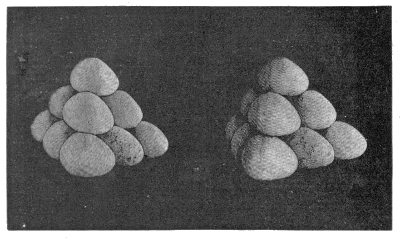
Fig. 13.
§ 36. Without for a moment imagining the molecules
of matter to be hard solids of convex shape, we may
derive valuable lessons in the tactics of real crystals by
studying the assemblage described in §§ 24 and 25 and
represented in Figs. 12 and 13. I must for the present
forego the very attractive subject of the tactics presented
by faces not parallel to one or other of the four faces of
the primitive tetrahedrons which we found in § 24, and
ask you only to think of the two sides of a plate of crystal
parallel to any one of them, that is to say, an assemblage
of such layers as those represented geometrically in
Fig. 12 and shown in stereoscopic view in Fig. 13. If,
as is the case with the solids10 photographed in Fig. 13,
the under side of each solid is nearly plane but slightly
convex, and the top is somewhat sharply curved, we have
the kind of difference between the upper and under of
the two parallel sides of the crystal which I have already
described to you in § 21 above. In this case the assemblage
is formed by letting the solids fall down
from above and settle in the hollows to which they
come most readily, or which give them the stablest
position. It would, we may suppose, be the hollows
p′ q′ r′, not p q r, (Fig. 12) that would be chosen; and thus,
of the two formations described in § 25, we should have
that in which the hollows above p′ q′ r′ are occupied by
the comparatively flat under sides of the molecules of
the layer above, and the hollows below the apertures
p q r by the comparatively sharp tops of the molecules
of the layers below.
§ 37. For many cases of natural crystals of the wholly
asymmetric character, the true forces between the
crystalline molecules will determine precisely the same
tactics of crystallization as would be determined by
the influence of gravity and fluid viscosity in the settlement
from water, of sand composed of uniform molecules
of the wholly unsymmetrical convex shape represented
in Figs. 12 and 13. Thus we can readily believe that
a real crystal which is growing by additions to the
face seen in Fig. 12, would give layer after layer
regularly as I have just described. But if by some
change of circumstances the plate, already grown to
a thickness of many layers in this way, should come
to have the side facing from us in the diagram exposed
to the mother-liquor, or mother-gas, and begin to grow
from that face, the tactics might probably be that each
molecule would find its resting-place with its most
nearly plane side in the wider hollows under p′ q′ r′,
instead of with its sharpest corner in the narrower and
steeper hollows under p q r, as are the molecules in
the layer below that shown in the diagram in the first
formation. The result would be a compound crystal
consisting of two parts, of different crystalline quality,
cohering perfectly together on the two sides of an
interfacial plane. It seems probable that this double
structure may be found in nature, presented by crystals
of the wholly unsymmetric class, though it may not
hitherto have been observed or described in crystallographic
treatises.
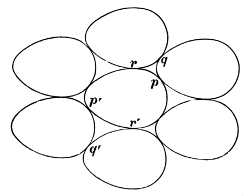
Fig. 14.
§ 38. This asymmetric double crystal becomes simply
the well-known symmetrical ‘twin-crystal’11 in the particular
case in which each of the constituent molecules
is symmetrical on the two sides of a plane through it
parallel to the plane of our diagrams, and also on the two
sides of some plane perpendicular to this plane. We
see, in fact, that in this case if we cut in two the double
crystal by the plane of Fig. 14, and turn one part ideally
through 180° round the intersection of these two planes,
we bring it into perfect coincidence with the other part.
This we readily understand by looking at Fig. 14, in
which the solid shown in outline may be either an
egg-shaped figure of revolution, or may be such a figure
flattened by compression perpendicular to the plane
of the diagram. The most readily chosen and the
most stable resting-places for the constituents of each
successive layer might be the wider hollows p′ q′ r′:
and therefore if, from a single layer to begin with,
the assemblage were to grow by layer after layer
added to it on each side, it might probably grow
as a twin-crystal. But it might also be that the
presence of a molecule in the wider hollow p′ q′ r′ on
one side, might render the occupation of the corresponding
hollow on the other side by another molecule
less probable, or even impossible. Hence, according
to the configuration and the molecular forces of the
particular crystalline molecule in natural crystallization,
there may be necessarily, or almost necessarily, the
twin, when growth proceeds simultaneously on the two
sides: or the twin growth may be impossible, because
the first occupation of the wider hollows on one side,
may compel the continuity of the crystalline quality
throughout, by leaving only the narrower hollows p q r
free for occupation by molecules attaching themselves
on the other side.
§ 39. Or the character of the crystalline molecule
may be such that when the assemblage grows by
the addition of layer after layer on one side only,
with a not very strongly decided preference to the
wider hollows p′ q′ r′, some change of circumstances
may cause the molecules of one layer to place
themselves in a hollow p q r. The molecules in the
next layer after this would find the hollows p′ q′ r′
occupied on the far side, and would thus have a bias
in favour of the hollows p q r. Thus layer after layer
might be added, constituting a twinned portion of
the growth, growing, however, with less strong security
for continued homogeneousness than when the
crystal was growing, as at first, by occupation of the
wider hollows p′ q′ r′. A slight disturbance might
again occur, causing the molecules of a fresh layer
to settle, not in the narrow hollows p q r, but in the
wider hollows p′ q′ r′, notwithstanding the nearness of
molecules already occupying the wider hollows on
the other side. Disturbances such as these occurring
irregularly during the growth of a crystal, might produce
a large number of successive twinnings at
parallel planes with irregular intervals between them,
or a large number of twinnings in planes at equal
intervals might be produced by some regular periodic
disturbance occurring for a certain number of periods,
and then ceasing. Whether regular and periodic, or
irregular, the tendency would be that the number of
twinnings should be even, and that after the disturbances
cease the crystal should go on growing in
the first manner, because of the permanent bias in
favour of the wider hollows p′ q′ r′. These changes
of molecular tactics, which we have been necessarily
led to by the consideration of the fortuitous concourse
of molecules, are no doubt exemplified in a large
variety of twinnings and counter-twinnings found in
natural minerals. In the artificial crystallization of
chlorate of potash they are of frequent occurrence,
as is proved, not only by the twinnings and counter-twinnings
readily seen in the crystalline forms, but
also by the brilliant iridescence observed in many of
the crystals found among a large multitude, which
was investigated scientifically by Sir George Stokes
ten years ago, and described in a communication to
the Royal Society ‘On a remarkable phenomenon of
crystalline reflection’ (Proc. R.S., vol. xxxviii, 1885,
p. 174).
§ 40. A very interesting phenomenon, presented by
what was originally a clear homogeneous crystal of
chlorate of potash, and was altered by heating to about
245°-248° Cent., which I am able to show you through
the kindness of Lord Rayleigh, and of its discoverer,
Mr. Madan, presents another very wonderful case of
changing molecular tactics, most instructive in respect
of the molecular constitution of elastic solids. When
I hold this plate before you with the perpendicular
to its plane inclined at 10° or more to your line of
vision, you see a tinsel-like appearance, almost as
bright as if it were a plate of polished silver, on this
little area, which is a thin plate of chlorate of potash
cemented for preservation between two pieces of
glass; and, when I hold a light behind, you see that
the little plate is almost perfectly opaque like metal
foil. But now when I hold it nearly perpendicular
to your line of vision the tinsel-like appearance is
lost. You can see clearly through the plate, and you
also see that very little light is reflected from it. As
a result both of Mr. Madan’s own investigations, and
further observations by himself, Lord Rayleigh came
to the conclusion that the almost total reflection of
white light which you see is due to the reflection of
light at many interfacial planes between successive
layers of twinned and counter-twinned crystal of small
irregular thicknesses, and not to any splits or cavities
or any other deviation from homogeneousness than
that presented by homogeneous portions of oppositely
twinned-crystals in thorough molecular contact at the
interfaces.
§ 41. When the primitive clear crystal was first heated
very gradually by Madan to near its melting-point (359°
according to Carnelly), it remained clear, and only acquired
the tinsel appearance after it had cooled to about
245° or 248°12. Rayleigh found that if a crystal thus
altered was again and again heated it always lost the
tinsel appearance, and became perfectly clear at some
temperature considerably below the melting-point, and
regained it at about the same temperature in cooling.
It seems, therefore, certain that at temperatures above
248°, and below the melting-point, the molecules had
so much of thermal motions as to keep them hovering
about the positions of p q r, p′ q′ r′, of our diagrams,
but not enough to do away with the rigidity of the
solid; and that when cooled below 248° the molecules
were allowed to settle in one or other of the two
configurations, but with little of bias for one in preference
to the other. It is certainly a very remarkable
fact in Natural History, discovered by these observations,
that, when the molecules come together to
form a crystal out of the watery solution, there should
be so much more decided a bias in favour of continued
homogeneousness of the assemblage than when, by
cooling, they are allowed to settle from their agitations
in a rigid, but nearly melting, solid.
§ 42. But even in crystallization from watery solution
of chlorate of potash the bias in favour of thorough
homogeneousness is not in every contingency decisive.
In the first place, beginning, as the formation seems to
begin, from a single molecular plane layer such as that
ideally shown in Fig. 14, it goes on, not to make a homogeneous
crystal on the two sides of this layer, but
probably always so as to form a twin-crystal on its two
sides, exactly as described in § 38, and, if so, certainly
for the reason there stated. This is what Madan calls
the ‘inveterate tendency to produce twins (such as
would assuredly drive a Malthus to despair)13’; and it is
to this that he alludes as ‘the inevitable twin-plate’ in
the passage from his paper given in the foot-note to
§ 41 above.
§ 43. In the second place, I must tell you that many
of the crystals produced from the watery solution by
the ordinary process of slow evaporation and crystallization,
show twinnings and counter-twinnings at
irregular intervals in the otherwise homogeneous
crystal on either one or both sides of the main
central twin-plane, which henceforth, for brevity, I
shall call (adopting the hypothesis already explained,
which seems to me undoubtedly true) the ‘initial
plane.’ Each twinning is followed, I believe, by a
counter-twinning at a very short distance from it; at
all events Lord Rayleigh’s observations14 prove that
the whole number of twinnings and counter-twinnings
in a thin disturbed stratum of the crystal on one side
of the main central twin-plane is generally, perhaps
always, even; so that, except through some comparatively
very small part or parts of the whole
thickness, the crystal on either side of the middle or
initial plane is homogeneous. This is exactly the
generally regular growth which I have described to
you (§ 39) as interrupted occasionally or accidentally
by some unexplained disturbing cause, but with an
essential bias to the homogeneous continuance of the
more easy or natural one of the two configurations.
§ 44. I have now great pleasure in showing you
a most interesting collection of the iridescent crystals
of chlorate of potash, each carefully mounted for
preservation between two glass plates, which have
been kindly lent to us for this evening by Mr. Madan.
In March, 1854, Dr. W. Bird Herapath sent to Prof.
Stokes some crystals of chlorate of potash showing
the brilliant and beautiful colours you now see, and,
thirty years later, Prof. E. J. Mills recalled his attention
to the subject by sending him ‘a fine collection of
splendidly coloured crystals of chlorate of potash of
considerable size, several of the plates having an area
of a square inch or more, and all of them being thick
enough to handle without difficulty.’ The consequence
was that Stokes made a searching examination into
the character of the phenomenon, and gave the short,
but splendidly interesting, communication to the Royal
Society of which I have already told you. The
existence of these beautifully coloured crystals had
been well known to chemical manufacturers for a long
time, but it does not appear that any mention of them
was to be found in any scientific journal or treatise
prior to Stokes’ paper of 1885. He found that the
colour was due to twinnings and counter-twinnings
in a very thin disturbed stratum of the crystal showing
itself by a very fine line, dark or glistening, according
to the direction of the incident light when a transverse
section of the plate of crystal was examined in
a microscope. By comparison with a spore of lycopodium
he estimated that the breadth of this line, and
therefore the thickness of the disturbed stratum of the
crystal, ranged somewhere about the one-thousandth
of an inch. He found that the stratum was visibly
thicker in those crystals which showed red colour
than in those which showed blue. He concluded that
‘the seat of the coloration is certainly a thin twinned
stratum’ (that is to say, a homogeneous portion of
crystal between a twinning and a counter-twinning),
and found that ‘a single twin-plane does not show
anything of the kind.’
§ 45. A year or two later Lord Rayleigh entered on
the subject with an exhaustive mathematical investigation
of the reflection of light at a twin-plane of a crystal
(Philosophical Magazine, September, 1888), by the application
of which, in a second paper ‘On the remarkable
phenomenon of Crystalline Reflection described by
Prof. Stokes,’ published in the same number of the
Philosophical Magazine, he gave what seems certainly
the true explanation of the results of Sir George Stokes’
experimental analysis of these beautiful phenomena.
He came very decidedly to the conclusion that the
selective quality of the iridescent portion of the crystal,
in virtue of which it reflects almost totally light
nearly of one particular wave-length for one particular
direction of incidence (on which the brilliance of the
coloration depends), cannot be due to merely a single
twin-stratum, but that it essentially is due to a considerable
number of parallel twin-strata at nearly equal
distances. The light reflected by this complex stratum
is, for any particular direction of incident and reflected
ray, chiefly that of which the wave-length is equal to
twice the length of the period of the twinning and
counter-twinning, on a line drawn through the stratum
in the direction of either the incident or the reflected
ray.
§ 46. It seems to me probable that each twinning is
essentially followed closely by a counter-twinning.
Probably three or four of these twin-strata might suffice
to give colour; but in any of the brilliant specimens as
many as twenty or thirty, or more, might probably be
necessary to give so nearly monochromatic light as was
proved by Stokes’ prismatic analysis of the colours
observed in many of his specimens. The disturbed
stratum of about a one-thousandth of an inch thickness,
seen by him in the microscope, amply suffices for the
5, 10, or 100 half wave-lengths required by Rayleigh’s
theory to account for perceptible or brilliant coloration.
But what can be the cause of any approach to regular
periodicity in the structure sufficiently good to give the
colours actually observed? Periodical motion of the
mother-liquor relatively to the growing crystal might
possibly account for it. But Lord Rayleigh tells us
that he tried rocking the pan containing the solution
without result. Influence of light has been suggested,
and I believe tried, also without result, by several
enquirers. We know, by the beautiful discovery of
Edmond Becquerel, of the prismatic colours photographed
on a prepared silver plate by the solar spectrum,
that ‘standing waves’ (that is to say, vibrations
with stationary nodes and stationary places of maximum
vibration), due to co-existence of incident and reflected
waves, do produce such a periodic structure as that
which Rayleigh’s theory shows capable of giving a
corresponding tint when illuminated by white light.
It is difficult, therefore, not to think that light may
be effective in producing the periodic structure in
the crystallization of chlorate of potash, to which the
iridescence is due. Still, experimental evidence seems
against this tempting theory, and we must perforce be
content with the question unanswered:—What can
be the cause of 5, or 10, or 100 pairs of twinning and
counter-twinning following one another in the crystallization
with sufficient regularity to give the colour:
and why, if there are twinnings and counter-twinnings,
are they not at irregular intervals, as those produced
by Madan’s process, and giving the observed white
tinsel-like appearance with no coloration?
§ 47. And now I have sadly taxed your patience:
and I fear I have exhausted it and not exhausted my
subject! I feel I have not got halfway through what
I hoped I might be able to put before you this evening
regarding the molecular structure of crystals. I particularly
desired to speak to you of quartz crystal
with its ternary symmetry and its chirality15; and to
have told you of the etching16 by hydrofluoric acid
which, as it were, commences to unbuild the crystal
by taking away molecule after molecule, but not in the
reverse order of the primary up-building; and which
thus reveals differences of tactics in the alternate faces
of the six-sided pyramid which terminates at either
end, sometimes at both ends, the six-sided prism
constituting generally the main bulk of the crystal.
I must confine myself to giving you a geometrical
symbol for the ternary symmetry of the prism and
its terminal pyramid.
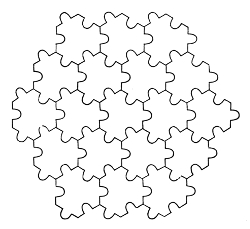
Fig. 15.
§ 48. Make an equilateral equiangular hexagonal
prism, with its diagonal from edge to edge ninety-five
hundredths17 of its length. Place a number of these
close together, so as to make up a hexagonal plane layer
with its sides perpendicular to the sides of the constituent
hexagonal prisms: see Fig. 15 and imagine the
semicircles replaced by their diameters. You see in
each side of the hexagonal assemblage, edges of the
constituent prisms, and you see at each corner of
the assemblage a face (not an edge) of one of the
constituent prisms. Build up a hexagonal prismatic
assemblage by placing layer after layer over it with
the constituent prisms of each layer vertically over
those in the layer below; and finish the assemblage
with a six-sided pyramid by building upon the upper
end of the prism, layer after layer of diminishing
hexagonal groups, each less by one circumferential
row than the layer below it. You thus have a crystal
of precisely the shape of a symmetrical specimen of
rock crystal, with the faces of its terminal pyramid
inclined at 38° 13′ to the faces of the prism from which
they spring. But the assemblage thus constituted has
‘senary’ (or six-rayed symmetry). To reduce this to
ternary symmetry, cut a groove through the middle
of each alternate face of the prismatic molecule, making
this groove in the first place parallel to the edges: and
add a corresponding projection, or fillet, to the middles
of the other three faces, so that two of the cylinders
similarly oriented would fit together, with the projecting
fillet on one side of one of them entering the
groove in the anti-corresponding side of the other.
The prismatic portion of the assemblage thus formed
shows (see Fig. 15), on its alternate edges, faces of
molecules with projections and faces of molecules
with grooves; and shows only orientational differences
between alternate faces, whether of the pyramid or
of the prism. Having gone only so far from ‘senary’
symmetry, we have exactly the triple, or three-pair,
anti-symmetry required for the piezo-electricity of
quartz investigated so admirably by the brothers
Curie18, who found that a thin plate of quartz crystal
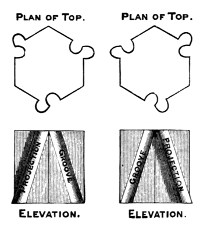 Fig. 16. Fig. 17.
cut from any position perpendicular to a pair of faces
of a symmetrical crystal, becomes positively electrified
on one side and negatively on the other when pulled
in a direction perpendicular to those faces. But this
assemblage has not the chiral piezo-electric quality
discovered theoretically by
Voigt19, and experimentally
in quartz and in tourmaline
by himself and Riecke20, nor
the well-known optic chirality
of quartz.
§ 49. Change now the directions
of the grooves and
fillets to either of the oblique
configurations shown in Fig.
16, which I call right-handed,
because the directions of the
projections are tangential to the threads of a three-thread
right-handed screw, and Fig. 17 (left-handed). The
prisms with their grooves and fillets will still all fit together
if they are all right-handed, or all left-handed.
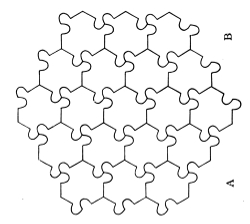
Fig. 18.
Fig. 18 shows the upper side of a hexagonal layer of an
assemblage thus composed of the right-handed molecule
of Fig. 16. Fig. 15 unchanged, still represents
a horizontal section through the centres of the molecules.
A prism built up of such layers, and finished
at each end with a pyramid according to the rule
of § 48, has all the qualities of ternary chiral symmetry
required for the piezo-electricity of quartz; for
the orientational differences of the alternate pairs of
prismatic faces; for the absolute difference between
the alternate pairs of faces of each pyramid which
are shown in the etching by hydrofluoric acid; for
the merely orientational difference between the parallel
faces of the two pyramids; and for the well-known
chiro-optic21 property of quartz. Look at two contiguous
faces A, B of our geometrical model quartz
crystal now before you, with its axis vertical. You
will see a difference between them: turn it upside
down; B will be undistinguishable from what A was,
and A will be undistinguishable from what B was.
Look at the two terminal pyramids, and you will
find that the face above A and the face below B are
identical in quality, and that they differ from the face
above B and below A. This model is composed of the
right-handed constituent molecules shown in Fig. 16.
It is so placed before you that the edge of the prismatic
part of the assemblage nearest to you shows
you filleted faces of the prismatic molecules. You
see two pyramidal faces; the one to your right hand,
over B, presents complicated projections and hollows
at the corners of the constituent molecules; and the
pyramidal face next your left hand, over A, presents
their unmodified corners. But it will be the face next
your left hand which will present the complex bristling
corners, and the face next your right hand that will
present the simple corners, if, for the model before
you, you substitute a model composed of left-handed
molecules such as those shown in Fig. 17.
§ 50. To give all the qualities of symmetry and
anti-symmetry of the pyro-electric and piezo-electric
properties of tourmaline investigated theoretically by
Voigt22, and experimentally by himself and Friecke23,
make a hollow in one terminal face of each of our
constituent prisms, and a corresponding projection in
its other terminal face.
§ 51. Coming back to quartz, we can now understand
perfectly the two kinds of macling which are well
known to mineralogists as being found in many natural
specimens of the crystal, and which I call respectively
the orientational macling, and the chiral macling. In
the orientational macling all the crystalline molecules
are right-handed, or all left-handed; but through all
of some part of the crystal, each of our component
hexagonal prisms is turned round its axis through 60°
from the position it would have if the structure were
homogeneous throughout. In each of the two parts
the structure is homogeneous, and possesses all the
electric and optic properties which any homogeneous
portion of quartz crystal presents, and the facial properties
of natural uncut crystal, shown in the etching
by hydrofluoric acid; but there is a discontinuity at
the interface, not generally plane, between the two
parts, which in our geometrical model would be shown
by non-fittings between the molecules on the two sides
of the interface, while all the contiguous molecules in
one part, and all the contiguous molecules in the other
part, fit into one another perfectly. In chiral macling,
which is continually found in amethystine quartz, and
sometimes in ordinary clear quartz crystals, some parts
are composed of right-handed molecules, and others of
left-handed molecules. It is not known whether, in
this chiral macling, there is or there is not also the
orientational macling on the two sides of each interface;
but we may say probably not; because we know that
the orientational macling occurs in nature without any
chiral macling, and because there does not seem reason
to expect that chiral macling would imply orientational
macling on the two sides of the same interface. I would
like to have spoken to you more of this most interesting
subject; and to have pointed out to you that some
of the simplest and most natural suppositions we can
make as to the chemical forces (or electrical forces,
which probably means the same thing) concerned in
a single chemical molecule of quartz, SiO2, and acting
 Fig. 19.
between it and similar neighbouring molecules,
would lead essentially to these molecules coming
together in triplets, each necessarily either right-handed
or left-handed, but with as much probability
of one configuration as of the other: and
to have shown you that these triplets of silica
3(SiO2) can form a crystalline molecule with
all the properties of ternary chiral symmetry, typified
by our grooved hexagonal prisms, and can build
up a quartz crystal by the fortuitous concourse of
atoms. I should like also to have suggested and explained
the possibility that a right-handed crystalline
molecule thus formed may, in natural circumstances
of high temperature, or even of great pressure, become
changed into a left-handed crystal, or vice-versa. My
watch, however, warns me that I must not enter on
this subject.
§ 52. Coming back to mere molecular tactics of
crystals, remark that our assemblage of rounded,
thoroughly scalene, tetrahedrons, shown in the stereoscopic
picture (§ 36, Fig. 13 above), essentially has
chirality because each constituent tetrahedron, if wholly
scalene, has chirality24. I should like to have explained
to you how a single or double homogeneous assemblage
of points has essentially no chirality, and how three
assemblages of single points, or a single assemblage
of triplets of points, can have chirality, though a single
triplet of points cannot have chirality. I should like
indeed to have brought somewhat thoroughly before
you the geometrical theory of chirality; and in
illustration to have explained the conditions under
which four points, or two lines, or a line and two
points, or a combination of point, line and plane, can
have chirality: and how a homogeneous assemblage
of non-chiral objects can have chirality; but in pity
I forbear, and I thank you for the extreme patience
with which you have listened to me.