“Queer sort of chap that Fiddle-John is,” said the
men, when Fiddle-John went by.
“Quaint sort o’ cr’atur’ is Fiddle-John,” echoed the
women; “not much in the providin’ line.”
“A singular individual is that Violin-John,” said the
parson; “I can never make up my mind whether he is a
worthless scamp or a man of genius.” “Possibly both,”
suggested the parson’s wife. “Apartments to let,” remarked
the daughter, tapping her forehead significantly.
“Hurrah! There is Fiddle-John,” cried the children,
flocking delightedly about him, clinging to his arms, his
legs, and his coat-tails. “Sing us a song, Fiddle-John!
Tell us a story!”
Then Fiddle-John would seat himself on a stone at
the road-side, while the children nestled about him;
and he would tell them stories about knights and ladies,
and ogres, and princesses, and all sorts of marvellous
things.
“Worthless fellow, that Fiddle-John,” said the passers-by;
“there he sits in the middle of the day talking nonsense
to the children, when he ought to be working for
the support of his family.”
It was perfectly true; Fiddle-John ought to have been
working. He would readily have admitted that himself.
He was well aware that his wife, Ingeborg, was at home,
working like a trooper to keep the family from starving.
But then, somehow, Fiddle-John had no taste for work,
while Ingeborg had. He much preferred singing songs
and telling stories. And a very pretty picture he made,
as he sat there at the roadside, with his handsome, gentle
face, his large blue eyes, and his wavy blond hair,
and the children nestling about him, listening in wide-eyed
wonder. There was something very attractive
about his face, with its mild, melancholy smile, and a
sort of diffident, questioning look in the eyes. He had
an odd habit of opening his mouth several times before
he spoke, and then, possibly, if his questioner’s face did
not please him, he would go away, having said nothing.
And, after all, it was diffidence and not insolence which
prompted this action. It would never have occurred to
Fiddle-John to take a critical view of anybody; he approved
of all humanity in general, only he had an intuitive
suspicion when anyone was making fun of him, and
in such cases he found safety only in flight and silence.
By profession Fiddle-John was a ballad-singer; a
queer profession, you will say, but nevertheless one
which in Norway enjoys a certain recognition. He had
a voice which the angels might have envied him—a clear
and sweet tenor which rang through the depths of the
listener’s soul. Hearing that voice, it was impossible
not to stay and listen. The deputy sheriff, who once
came to arrest Fiddle-John for vagrancy, when Fiddle-John
began to sing, sat and cried. It came over him so
“sorter queer,” he said. The parson, who had made up
his mind to give Fiddle-John a thundering reproof for
neglect of his family, the first time he should catch him,
quite forgot his sinister purpose when, one day, he saw
the ballad-singer seated under a large tree, with a dozen
children climbing over him, and, with rollicking laughter,
tumbling and rolling about him. And when Fiddle-John,
having quieted his audience, took two little girls
on his lap, while the boys scrambled and fought for the
places nearest to him, the parson could not for the life
of him recall the harsh things he had meant to say to
Fiddle-John. The fact was—though, of course, it is
scarcely fair to tell—the ballad which Fiddle-John sang
to the children reminded the parson of the time (now
long ago) when he was paying court to Mrs. Parson, and
sometimes, on slight provocation, dropped into poetry.
“Thy cheeks are like the red, red rose,
Thy hands are like the lily.”
These were the very extraordinary sentiments which
the parson had, at that remote period, professed toward
Mrs. Parson, and these were the very words which
Fiddle-John was now singing. No wonder the parson
forgot that he had come to scold Fiddle-John. “I
suppose that such good-for-nothings may be good for
something, after all,” he said to his wife as he related the
incident at the dinner-table.
Fiddle-John and his family lived in a little cottage
close up under the mountain-side, where the sun did not
reach until late in the afternoon. In the winter they
were sometimes snowed down so completely that they
had to work until noon before they could get a glimpse
of the sky. The two boys, Alf and Truls, would go early
in the morning with their snow-shovels and dig a tunnel
to the cow-stable, where a lonely cow, a pig, and three
sheep were penned up. Their father would then sit at
the window, holding a lantern, the light of which vaguely
penetrated the darkness and showed them in what direction
they were digging; but, after awhile, this monotonous
occupation wearied him, and he would take his
fiddle and play the most mournful tunes he could think
of. It never occurred to him to lend a helping hand;
and it never occurred to the boys to ask him.
They accepted their fate without much reasoning; it
seemed part of the right order of things that they and
their mother should work, while their father played and
sang. Ingeborg, their mother, had nursed a kind of tender
reverence for him in their hearts, since they were
babes. He seemed scarcely part of the coarse and common
work-a-day world to which they belonged; with his
gentle, handsome face, and his clear blue eyes, he seemed
like some superior being who conferred a favor upon
them by merely consenting to grant them his company.
His songs travelled from one end of the valley to the
other, and everybody learned them by heart and sang
them at weddings, dances, and funerals. Even though
the parishioners might themselves find fault with Fiddle-John,
and call him quaint and queer, they stood up for
him bravely if a stranger ventured to attack him.
They knew there was not another such singer in the
whole land, and it was even said that people had come
from foreign lands and had made him enormous offers if
he would go with them and sing at concerts in the great
foreign cities. Thousands of dollars he might have
earned if he had gone, but Fiddle-John knew better than
to abandon the valley of his birth, where he had been
known since his babyhood, and trust himself to the faithless
foreign world. Thousands of dollars! Only think
of it! The very thought made Fiddle-John dizzy; ten
or twenty dollars would have presented something definite
to his imagination, which he would have comprehended,
but thousands of dollars was a blank enormity
which diffused itself like mist through his dazed brain.
And yet Fiddle-John could never stop thinking of the
thousands of dollars which he might have earned, if he
had gone with the foreigner. If the truth must be told, he
himself would have liked well enough to go; and it was
only the persuasions of Ingeborg, his wife, which had restrained
him. “What could you do in the great foreign
world, John,” she had said to him; “you, with your want
of book-learning and your simple peasant ways? They
would laugh at you, John, dear, and that would make me
cry, and we should both be miserable. And all the little
children here in the valley, what would they do without
you, and who would sing to them and tell them stories
when you were gone?”
The last argument was what decided Fiddle-John,
He did not believe that people would laugh at him in
the great foreign world, but he did believe that the children
would miss him when he was gone, and he could
not bear to think of someone else sitting under the
great maple-tree at the roadside and telling them stories.
For all that, he regretted many a time that he had been
soft-hearted, and had allowed the gate of glory to be
slammed in his face, as he expressed it. He had never
suspected it before; but now the thought began to grow
upon him, that he was a great man, who might have
gained honor and renown if his wife had not deprived
him of the opportunity.
Every day the valley seemed to be growing darker
and narrower; the sight of the mountains became oppressive;
it was as if they weighed upon Fiddle-John’s
breast and impeded his breath. With feverish restlessness
he roamed about from farm to farm and played,
until every string on his fiddle seemed on the point of
snapping.
“I am a great man,” he reflected indignantly, “and
might have earned thousands of dollars. And yet here
I go and fiddle for half-drunken boors at twenty-five
cents a night.”
And to drown the voices that rose clamorously out of
the depths of his soul, he strummed the strings wildly;
and the peasants whirled madly around him, shouted,
and kicked the rafters in the ceiling. The gentleness
and the mild radiance which had made the children love
him passed out of his countenance; his eyes grew restless,
his motions aimless and unsteady. Sometimes he
flung back his head defiantly and mumbled threats between
his teeth; at other times he shuffled along dejectedly,
or lay under a tree, dreaming of the great world
which had forever been closed to him.
“If I had only dared!” he whispered to himself;
“oh, if I had only dared!”
At that moment someone stepped up to him and
shook him by the shoulder. “Hallo, old chap,” said
the man, “you are just the fellow I want! You are the
party they call Fiddle-John?”
There was something brisk and aggressive about the
stranger which almost frightened Fiddle-John. It was
easy to see that he came from afar; for he had smartly-cut
city-clothes, a tall shiny hat, and a huge watch-chain
from which half a dozen seals and trinkets depended.
Fiddle-John had never seen anything so magnificent; he
was completely dazzled. He sat half-raised upon his
elbow and stared at the stranger in mute wonder.
“Well, Fiddle-John,” the latter went on glibly; “you
don’t seem very cordial to an old friend. Or perhaps
you don’t know me. Reckon I’ve changed some since
you used to tell me stories about the Ashiepattle and
the ogre who stowed his heart away for safe keeping
inside of a duck in a goose-pond, some thousands of
miles off. I have often thought of that story since.
Fact is, that is just the kind of arrangement I am after.
I’ve too much heart, Fiddle-John, too much heart. My
heart is always getting me into trouble, and if I could
make an arrangement to leave it behind here in Norway,
while I myself return to America, I should like it first
rate. You don’t happen to know of any party who
would be willing to keep it for me during my absence,
hey, Fiddle-John?”
The man here laughed uproariously and slapped Fiddle-John
on the shoulder.
“You are the same rum old customer you used to be,
Fiddle-John,” he said in a tone of cordial good-fellowship;
“but you don’t seem as talkative as you used to
be—don’t even tell me you are glad to see me. Now,
that’s what I call hard, Fiddle-John. Don’t even know
the name of your little friend James Forrest—or—beg
your pardon—Jens Skoug, I mean to say, who used to
climb on your back and listened in rapture to your wonderful
voice and your marvellous fairy tales.”
A gleam of intelligence flitted across Fiddle-John’s
features, as he heard the name Jens Skoug, and he arose
with bashful hesitancy and extended his hand to the
talkative stranger. He remembered well that Jens’
family had emigrated, some ten years ago, to the United
States, and he remembered also vividly the uncouth little
creature in skin-patched trousers and ragged jacket
who had embarked, at that time, in the great steamer
that came to take the emigrants off to Bergen. And now
this little creature was a tall, dazzling man with a silk
hat and showy jewellery, and an address which a prince
might have envied. Thus reasoned Fiddle-John in his
simplicity. Such a marvellous transformation he had
never in all his life witnessed. The name James Forrest
which Jens had dropped by a deliberate accident also
impressed him strangely. It seemed to add greatly to
Jens’ magnificence. A man who could afford to have
such a foreign-sounding name must indeed be a person
of enterprise and prominence. It surrounded Jens with
a delightful foreign flavor which captivated his friend
even more than his brilliant talk. “Jens,” he said, making
an effort to conquer his diffidence, “you have grown
to be a great man, indeed. How could you expect me
to recognize you?”
“A great man!” exclaimed Jens, expanding agreeably
under his friend’s sincere flattery; “no, Fiddle-John, I
am not a great man—that is, not yet, Fiddle-John.
But I mean to become a great man before I die. In
America, where I live, every man can become great if he
only chooses to. But I thought, being young yet, that I
could afford to spend a couple of months in opening to
my countrymen the same road to fortune which is open
to myself, before I settled down to tackle life in earnest.
Fact is, Fiddle-John, as I said before, I have too much
heart. My conscience would leave me no peace, whenever
I thought of my poor countrymen who were toiling
here at home for twenty-five or forty cents a day, and
scarcely could keep body and soul together, while I could
earn five and ten dollars a day as readily as I could blow
my nose. I positively cried, Fiddle-John, cried like a girl,
when I thought of you and your small chaps and of all
the other poor fellows here in the valley who had such a
hard time of it, tearing off their caps and bowing and
scraping before the parson and the judge and all the big
guns, while in America we step up to the President himself,
wring his hand and say, ‘How are you, old chap?
I’ll drop in and take pot-luck with you to-morrow, if you
don’t happen to have company.’ And he, likely as not,
will say to me, ‘Right welcome shall you be, Jim; bring
a couple of good fellows along with you. We don’t
stand on ceremony around the White House. Perhaps
I may be able to hunt up a consulship or a foreign mission
for you, if you should happen to be out of office and
pressed for cash.’ Now, that’s what I call good manners,
Fiddle-John, and the chances are ten to one that,
if you call upon him with a note from me, he may set
you up in a right fat office, where you may cock your
head at parsons and judges and feel yourself as big as
the very biggest.”
Fiddle-John listened with eager ears and open mouth
to this alluring narrative. It did not occur to him to
question the truth of what Jens said, for did not his appearance
and his independent and dazzling demeanor
plainly show that he was a great and prosperous man?
And, moreover, how could he have undergone such a
startling transformation in a few years, if it had not been
true, as he said, that the President of the United States
or some other mighty personage took an interest in him.
Fiddle-John had often heard it said that in America all
things were possible; and he had himself read letters
from persons who here at home had been poor tenants or
even day laborers, and who over there had become colonels,
and merchants, and legislators. Therefore, he was
not in the least surprised at the good luck which had
overtaken his former friend. He was only surprised that
the thought of going to America had never occurred to him
before, and he made up his mind on the spot to sell his
cow, his pig, and his three sheep, and take the first ship
for New York. He could scarcely stop to bid Jens Skoug
good-by, so eager was he to rush home and communicate
his resolution to his wife and children. He foresaw that
he would meet with opposition from Ingeborg; but he
steeled his heart against all her entreaties and vowed to
himself that this time he would have his own way.
Was it not enough that she had once nearly ruined his
life? Should he permit her again to snatch the chance
of greatness away from him?
He was flushed and breathless when he reached his
little cottage up under the mountain-wall. It had never
looked so mean and miserable to him as it did at this
moment. The walls were propped up on the north and
west sides with long beams, and dry, brownish grass
from last year grew in tufts along the roof-tree and
drooped down over the eaves. His two sons, Alf and
Truls, were playing bear with their little sister Karen,
who was seven years old. But they rose hurriedly when
they saw their father, and brushed the sand from the
knees of their trousers. There was something in his
bearing and in the expression of his face which vaguely
alarmed them. He stooped no more in walking, but
strode along proudly with uplifted head.
“Boys,” he cried, joyously, “run in and tell your
mother, to-morrow we are going to America!” Ingeborg,
who was just coming across the yard with a new-born
lamb in her arms, paused in consternation, and gazed
with a frightened expression at her husband.
“What has happened to you, John?” she asked, gently.
“I thought that matter about the foreigner was settled
long ago.”
“I tell you, no!” he shouted, wildly; “it is not settled.
It never will be settled as long as there is breath left in
my body. This time I mean to have my own way.
Jens Skoug has come back from America, and he says
that America is the place for me. I knew it all along,
and whether you will follow me or not, I am going.”
“Follow you, John? Yes, if go you must, then I will
follow you. But to America I will not go willingly, unless
I know what we are to do there, and how we are to
make our living. It is a long, long distance, John, across
the great ocean; they speak a language there which
neither you nor I understand.”
Fiddle-John turned impatiently on his heel, as if to say
that he knew all that twaddle from of old; but Ingeborg,
giving the lamb to Alf, went up to him, laid her hand on
his arm, and said:
“You and I have lived together for so many years,
John, and we love each other too well ever to be happy
away from each other. Don’t let us speak harsh words.
They rankle in the bosom and cause pain, long after they
are spoken. If you must go to America, I will go with
you. But I have a feeling that I shall never get there
alive. I beg of you, don’t decide rashly and don’t believe
all that Jens Skoug tells you. He was not a truthful
child, and I doubt if he has grown up to be a good man.
Let us say no more about it to-night. We will sleep on
it, and see how it will look to us to-morrow.”
Fiddle-John was not a bad fellow; on the contrary, he
was quite soft-hearted and easily moved. This wife of
his had toiled in poverty and ill-health all her life long,
and he had never offered to lift a finger to help her.
Yet she loved him, accepting her lot meekly, and
never uttering a word of reproach against him. He had
never observed before how thin and worn she looked,
how hollow her cheeks were, and how large her eyes.
He felt for the first time in his life a pang of remorse.
He had not been a good husband, he thought; not as
good as he might have been. But then he was a great
man, and great men were never the best of husbands.
And when he reached America, and his greatness became
generally recognized, and fortune began to smile upon
him, then he would shower kindness upon her, and she
would be rewarded a thousand-fold for all she had suffered.
Surely, he would turn over a new leaf—in America.
Thus Fiddle-John consoled himself, when his conscience
grew uneasy. When only they got to America,
he reasoned, then everything would be right. He would
have started without delay if Ingeborg’s health had not
failed so rapidly that the doctor positively forbade her to
think of travelling. The look of suffering and sweet forbearance
upon her face seemed a perpetual reproach to
Fiddle-John, and he roamed restlessly from one end of
the valley to the other, playing, singing, and telling his
stories, in order to earn money for the voyage, he said
to his sons; but, in reality, to escape from the unspoken
reproach of his wife’s countenance. But the day soon
came when he needed no longer to flee from her presence.
One bright spring day, just as the snow was
melting, and the bare spots on the meadows steamed in
the sun, Ingeborg closed her weary eyes forever; and a
few days later she was laid to rest in the shadow of the
old church down on the headland, where the song-thrush
warbles through the brief Arctic summer night.
Down in the valley the Easter bells were chiming;
the bell-strokes trembled through the clear, sun-steeped
air. There was commotion in the valley, too, in spite of
the fact that it was Easter Sunday. Out in the middle
of the fiord lay a huge black steamer, which panted and
shrieked, as if it were in distress, and sent volumes of
gray smoke out of its chimneys. Around about little
black fragments of coal-dust were drizzling through the
air and swimming on the water; and the gulls which
kept whirling about the smoke-stacks were quite shocked
when they caught the reflections of themselves in the
tide; with wild screams they plunged into the fiord.
They probably mistook themselves for crows.
The pier, which broke the line of the beach at the
point of the headland, was thronged with men, women,
and children. The men were talking earnestly together;
most of the women were weeping, and the children were
gazing impatiently toward the steamboat and tugging
at their mother’s skirts. Some twenty or thirty boats,
heavily laden with chests and boxes, lay at the end of
the pier; and one after another, as it was filled with
people, put off and was rowed out to the steamer. Only
the old folk remained behind; with heavy hearts and
tottering steps they walked up the sloping beach and
stood at the roadside, straining their eyes to catch a last
glimpse of the son or daughter, whom they were never
to see again. Some flung themselves down in the sand
and sobbed aloud; others stooped over the weeping ones
and tried to console them.
At last there was but one little group left on the pier;
and that was composed of Fiddle-John and his three
children. Jens Skoug, the emigration agent, was standing
in a boat, shouting to them to hurry, and the boys
were scrambling down the slippery stairs leading to the
water, while the father followed more deliberately, carrying
the little girl in his arms.
There was a Babel of voices on board; and poor
Fiddle-John and his sons, who had never heard such
noise in their lives before, stood dazed and bewildered,
and had scarcely presence of mind to get out of the way
of the iron chains and pulleys which were hoisting on
board enormous boxes of merchandise, horses, cattle,
pigs, and a variety of other commodities. It was not
until they found themselves stowed away in a dark corner
of the steerage, upon a couple of shelves, by courtesy
styled berths, which had been assigned to them, that
they were able to realize where they were, and that they
were about to leave the land of their fathers and plunge
blindly into a wild and foreign world which they had
scarcely in fancy explored.
The first day on board passed without any incident.
The next day, they reached Hamburg, and were transferred
to a much larger and more comfortable steamer,
named the Ruckert, and before evening the low land of
North Germany traced itself only as a misty line on the
distant horizon. Night and day followed in their monotony;
Russian Mennonites, Altenburg peasants, and
all sorts of queer and outlandish-looking people passed in
kaleidoscopic review before the eyes of the astonished
Norsemen. It was the third day at sea, I think, when
they had got somewhat accustomed to their novel surroundings,
that a little incident occurred which was
fraught with serious consequences to Fiddle-John’s family.
The gong had just sounded for dinner, and the emigrants
were hurrying down-stairs with tin cups and bowls
in their hands. The children were themselves hungry,
and needed no persuasion to follow the general example.
They unpacked their big tin cups, which looked like
wash-basins, and took their seats at an interminably long
table, while the stewards went around with buckets full
of steaming soup, which they poured into each emigrant’s
basin, as it was extended to them, by means of
great iron dippers. Many of the Russians were either
so hungry or so ill-mannered that they could not wait
until their turn came, but rushed forward, clamoring for
soup in hoarse, guttural tones; and one of the stewards,
after having shouted to them in German to take their
places at the tables, finally, by way of argument, gave
one of them a blow on the head with his iron dipper.
Then there arose a great commotion, and everybody supposed
that the angry Mennonites would have attacked the
offending steward. But instead of that, the crowd scattered
and quietly took their places, as they had been
commanded. They were an odd lot, those Mennonites,
thought the Norse boys, who did not know that their
religion forbade them to fight, and compelled them to
pocket injuries without resentment.
Next to Alf, on the same bench, sat a swarthy boy,
fourteen or fifteen years old, with yellow cheeks and
large black eyes. He had a thin iron chain about his
wrist and seemed every now and then to direct his attention
to something under the table. Alf concluded that,
in all probability, he had his bundle of clothes or his
trunk hidden under his feet. But he was not long permitted
to remain in this error. Just as the steward approached
them and extended the long-handled dipper,
filled with soup, a fierce growl was heard under the bench,
and a half-grown black bear-cub rushed out and made a
plunge for his legs. The frightened steward made a
leap, which had the effect of upsetting the soup-pail over
his assailant’s head.
A wild roar of pain followed, and everybody jumped
on tables and benches to see the sport; while the Savoyard
boy who owned the bear darted forward, his eyes
flashing with anger, and hurled a flood of unintelligible
imprecations at the knight of the soup-pail. There was
a sudden change of tone, as he stooped down over his
scalded and dripping pet, and, showering endearing
names upon it, hugged it to his bosom.
The emigrants jeered and shouted, the waiters swore,
and the purser, who had been summoned to restore order,
elbowed his way ruthlessly through the crowd until
he reached the author of the tumult.
“How do you dare, you insolent beggar, to bring a
bear into the steerage?” he cried, seizing the boy by the
collar, and shaking him. “Who permitted you to bring
such a dangerous beast——”
His harangue was here suddenly interrupted by the
bear, which calmly rose on its hind legs and, showing its
teeth in an unpleasant manner, prepared to resent such
disrespectful language. The purser took to his heels,
while the steerage rang with jeers and laughter, and the
Savoyard had all he could do to prevent his friend from
pursuing him. The Norse boys, whose sympathy was
entirely with the bear and his master, quite forgot their
hunger in their excitement over the stirring incident;
and when the Savoyard, feeling that the steerage was
scarcely a safe place for him after what had occurred,
mounted the stairs, dragging his bear after him, they
could not resist the temptation to follow him at a respectful
distance. But when they saw him crouching
down behind the big smokestack and gazing timidly
about him while he wiped the bear’s head and face with
his sleeve, they could not conquer the impulse to make
the acquaintance of so distinguished and interesting a
personage. They accordingly sidled up slowly, holding
their sister between them, and were soon face to face with
the Savoyard.
“What is your name?” asked Truls with a boldness
which raised him immensely in his brother’s esteem.
The Savoyard shook his head.
“What do people call you when they speak to you?”
Truls repeated, raising his voice and drawing a step
nearer.
“Non capisco. Je ne sais pas,” answered the boy in
Italian and French, giving them the choice of the only
two languages he knew.
“Capisco,” Truls went on confidently in his Norse dialect;
“that is a very funny name. I am afraid you don’t
understand me. It wasn’t the bear’s name I asked for;
it was your own.”
The Savoyard shrugged his shoulders expressively,
then poured out a torrent of speech which bewildered
his Norse friends exceedingly. If the bear had opened
its mouth and addressed them in the ursine language, it
would not have succeeded in being more unintelligible.
“You are a very funny chap,” Truls remarked with a
discouraged air. “Why don’t you talk like a Christian?”
He was determined to make no more advances to so
irrational a creature, and was about to lead the way back
to the dinner-table, when the arrival of the purser and
the third officer of the ship again arrested his attention.
The purser had evidently been hunting for the Savoyard;
for, as he caught sight of him, he made an exclamation
in German and called out to the third officer:
“There is the vagabond! Make him understand,
please, that his bear must be shot and that he must get
out of the way. He has taken out no ticket for his beast
and we don’t take that kind of freight gratis!”
The third officer, who spoke French fluently, explained
the purport of the purser’s remarks to the Savoyard, but
in a gentle and kindly manner which almost deprived
them of their cruel meaning. The boy, however, made
no motion to stir, but remained calmly sitting, with his
arm thrown over the bear’s neck and one hand playing
with his paws.
The officer, seeing that his words had no effect, repeated
his remark with greater emphasis. A startled
look in the boy’s eyes gave evidence that he was beginning
to comprehend. But yet he remained immovable.
“Get out of the way, I tell you!” cried the purser,
drawing a revolver from his hip-pocket and pointing it
at the bear’s head. “I have orders to kill this beast,
and I mean to do it now. Quick, now, I don’t want to
hurt you!”
The boy gazed for a moment with a fascinated stare at
the muzzle of the terrible weapon, then sprang up and
flung himself over the bear, covering it with his own
body. The animal, not understanding what all this ado
was about, took it to mean a romp, and began to lick his
master’s face and to claw him with his limp paws.
“Well, I have given you fair warning!” the purser
went on, excitedly, as he vainly tried to find an exposed
vital spot on the bear at which he could fire. “If you
don’t look out, you will have to take the consequences.”
A large crowd had now gathered about them, and a
loud grumble of displeasure made itself heard round
about. The purser began to perceive that the sentiment
was against him, and that it would scarcely be safe for
him to execute his threat. Yet he found it inconsistent
with his dignity to retire from the contest, and he was
just pausing to deliberate when, all of a sudden, a small
fist struck his wrist and the pistol flew out of his hand
and dropped over the gunwale into the sea. A loud
cheer broke from the crowd. The purser stood utterly
discomfited, scarcely knowing whether he should be angry
with his small assailant or laugh at him. He would,
perhaps, have done the latter if the cheering of the people
and their hostile attitude toward him had not roused
his temper.
“Bravo, Tom Thumb!” they cried. “At him again!
don’t be afraid of the brute because he has got brass buttons
on his coat.”
“Good for you, Ashiepattle!” the Norwegians
shouted; “go it again! We’ll stand by you!”
It was Truls, Fiddle-John’s son, who had thus suddenly
become the hero of the hour; he had acted in the
hot indignation of the moment and was now abashed and
bewildered at the sensation he was making. He looked
anxiously about for his brother and sister, and as soon as he
caught sight of them, was about to make his escape when
the purser seized him by the collar and bade him remain.
“You are a nice one, to be attacking your betters, who
have never given you any provocation,” he said in German,
which Truls, fortunately, did not understand. “I
am going to take you to the captain, and he will have you
punished for assault.”
He made a motion to drag the struggling boy away,
but the crowd closed about him on all sides, and pressed
in upon him with angry shouts and gestures. The third
officer, who had so far taken no part in the proceedings,
now stepped up to the purser and begged him to release
the boy.
“Of course,” he said, “you are in the right; but if I
were you, I would waive my right this time. It’s hardly
worth while making a row about so small a matter; and
it is always bad policy to go to the captain with squabbles
and grievances, especially when they might so easily
have been avoided. I assure you, you will only injure
yourself by doing it.”
They talked for a minute together, while the ever-increasing
throng surged hither and thither about them.
Whether purposely or not, the irate purser, in the zeal of
his argument, released his hold on Truls’ collar, and the
liberated boy dodged away, as quickly as possible, and
was soon lost in the crowd. The Savoyard and his bear
had long before seized the opportunity to withdraw from
the public gaze.
The life on shipboard did not agree with Fiddle-John.
Like a spoiled child, he was restless and unhappy when
he was unnoticed. All day long he sat on the top of a
coil of rope in the forecastle of the ship and sang. The
forecastle was often deserted, and there were probably
not many among the emigrants who would have been
capable of judging whether his voice was in any way extraordinary.
And yet, one there was who found an untold
amount of comfort in listening to that clear, sweet
tenor of Fiddle-John’s, and that one was the Savoyard
boy. It had been his constant effort, since his encounter
with the purser, to make himself as inconspicuous as
possible, and it would have gratified him much if he had
possessed some means of making the bear invisible. As
the forecastle was the least visited portion of the ship, he
had chosen to hide himself there behind the anchor-cable.
He trembled whenever anyone approached, and threw
the end of the tarpaulin which covered the deck-freight
over his friend, the bear. The only people whose company
did not incommode him were Fiddle-John and his
children, for whom he testified his devotion by smiles
and gestures and all sorts of endearing Italian diminutives,
which, on account of his caressing tones, even a
dumb brute could not have failed to appreciate. After
a long and exciting pantomime, Truls ascertained that
his name was Annibale Petrucchio and that his bear
gloried in the name of Garibaldi.
Both boys felt that they had made great progress in
each other’s friendship when these facts had been established,
and another hour of dumb show, intersprinkled
with exclamations, resulted in a still more astonishing
revelation, which was that Annibale and his friend slept
every night on deck, because they feared to arouse once
more the purser’s displeasure by invading the steerage.
Sometimes Annibale curled himself up with Garibaldi
within the coil of the anchor-cable—he jumped up, dragging
the bear after him, to show the attitude in which
they slept—but when it rained, or when the sea was high
enough to sprinkle the deck, they both crept under the
deck-freight tarpaulin, where they had made themselves
a little house between two trunks which they had pushed
apart. The only trouble was that the April nights were
very cold—Annibale shivered all over to show how cold
he was—and anchor-cables and deck-freight were not
particularly soft to sleep upon.
As Alf and Truls became duly impressed with the
unpleasantness of the Savoyard’s situation, they took
counsel in order to ascertain how they might relieve his
distress. But all the plans that were suggested were
found to be risky, and night came before they arrived at
a decision. The weather had been raw and blustery all
the afternoon, and the officer on the bridge had been
looking every minute uneasily at the falling barometer.
After sunset the gale increased in violence and the ship
pitched and rolled in the heavy sea. In the steerage
there was a terrible commotion; women prayed and
screamed and moaned, children of all ages joined in the
chorus, the lamps swung forward and backward in their
brass frames, and bottles, glasses, and loose crockery
made a terrible racket, sliding to starboard and back
again to port with every motion of the ship. The wind
howled in the rigging, and every now and then a big
wave swept across the deck and poured out through the
scupper-holes.
Alf and Truls, who had been lying awake for hours listening
to the hollow boom of the waves and the shrieking
of the wind, conversed in a whisper about the poor
Savoyard, who had to be on deck in that terrible
weather, and they finally summoned courage to creep
toward the ladder and slowly to mount it, tightly clutching
each other’s hands. It was a risky undertaking, and
their hearts stuck in their throats as they clung to the
door-knob, hesitating whether they should open the door.
Without knowing, however, they must have given the
knob a twist; for suddenly the door swung open with a
tremendous bang, and Truls was flung across the deck
against the bulwarks with such force that for an instant
he scarcely knew whether he had lighted on his head or
his feet.
He picked himself up, however, without any serious
damage, and as there was a momentary lull in the storm,
he half rolled, half crept up toward the prow, where a
couple of lanterns were swinging in the fore-royal stays.
Nevertheless it was so dark that he could not discern an
object ahead of him, and only groped his way along the
bulwarks, until he stumbled upon a demoralized mass of
rope which he knew to be the anchor-cable.
“Annibale!” he shouted at the top of his voice, “are
you here?” But before he had time to receive a reply
the ship plunged into a monstrous wave, which rose in a
storm of spray and drenched the whole forecastle up to
the mainmast. Truls, in his effort to keep his footing,
tumbled forward and grabbed hold of something wet and
hairy, which slid along with him for a couple of yards,
and then was hauled back by some unseen force. The
boy crawled along in the same direction and shouted
once more, “Annibale! where are you?” And a voice
close to his ear answered:
“Ah, Monsieur Truls, Garibaldi et moi, nous sommes à
demi morts.”[11]
“Now, don’t jabber at me, Annibale,” Truls observed,
making his voice heard above the wind; “but if you will
come along with me, Alf and I will give you half of our
berth; and Garibaldi can sleep at our feet.”
Whether Annibale understood the words or not, he
could not fail to comprehend the friendly gestures which
accompanied them. He eagerly seized Truls’ hand and
they plunged bravely forward, but slipped on the wet
deck, and the bear and the boys slid with great speed in
the direction of the descent to the steerage. They were
drenched to the skin and considerably bruised when, after
several unsuccessful efforts, they seized the door-knob.
Alf, as it turned out, feeling too ill to keep watch, had
already preceded them to bed. Garibaldi, who seemed
keenly conscious of his disgrace since the day he molested
the purser, slunk along as meekly as possible, and only
now and then shook his wet skin and coughed in a dispirited
fashion. He was not as grateful, moreover, as
might have been expected, when he was assigned his
place on the straw at the foot of the berth, but gradually
pushed himself upward until his nose nearly touched that
of his master; whereupon he curled himself up comfortably
and went to sleep. It was a very pretty sight to
see the blond Norse boys and the swarthy Savoyard
peacefully reposing on the same pillow, with the shaggy
head of the bear between them, and the Savoyard half
unconsciously clutching his pet in his embrace.
Toward morning the storm began to abate, and the
dim light peeped in through the port-holes. The steerage
was comparatively quiet. Fiddle-John arose and
went on deck; a strange oppression had come over him.
The dim, gray light, the all-enveloping dampness, and
the incessant throbbing and clanking of the machinery
wrought upon his sensitive soul, until he seemed in danger
of going mad. The world seemed so vast and so
empty! The waves heaved and wrestled in their gray
monotony, until it made him dizzy to look at them.
Merely to rid himself of this terrible oppression, Fiddle-John
lifted up his voice and sang wildly against the wind;
his beautiful tenor seemed to cut through the fog like a
bright sword and to flash and ring under the sky. His
soul expanded with his voice; the sun broke forth from
the clouds, and he felt once more free and happy. He
scarcely knew how long he sang; but when by chance he
turned about, he saw to his surprise that a crowd of well-dressed
cabin passengers had gathered about him. His
three children stood holding one another’s hands, looking
in astonishment at the fine ladies shivering in fur-trimmed
cloaks, and wondered why their father was attracting
so much attention.
“Charming!” “Wonderful!” “Magnificent!” exclaimed
the fine people, when Fiddle-John had stopped
singing; and a portly American gentleman, with gray
side-whiskers, who seemed more enthusiastic than the
rest, gave him a slap on his shoulder, and said that if he
himself were ten years younger, he would undertake to
make a fortune out of Fiddle-John, which, of course, was
a very generous offer on his part. Jens Skoug, the emigration
agent, translated the remark; and as the American
seemed to have more to say to Fiddle-John, offered
his services as interpreter.
“What is your trade?” asked the gentleman.
“I sing and play,” said Fiddle-John.
“But I mean, how do you make your living?” repeated
his questioner.
“By singing and playing,” said Fiddle-John.
“You won’t make much of a living by that in America;
people won’t understand you, unless you sing in
English,” remarked the American.
It had actually never before occurred to Fiddle-John
that his songs would be unintelligible in America. He
had supposed that music appealed equally to all nations
and needed no interpreter. The remark of his new
friend, therefore, was a positive shock to him, and it took
him fully a minute to recover from its effect.
“I will sing to the President of America,” he said, in
an injured tone. “Jens Skoug, there, says that the
President will make me a great man when he hears my
voice.”
It did not suit Skoug’s convenience to translate this
remark correctly; and he observed instead, with a confidential
air, that Fiddle-John was a harmless monomaniac
who had got it into his head that he wanted to sing to the
President. The American was evidently amused at this,
and said, with a laugh, that he feared the President was
not so great an authority in music as in affairs of state.
Fiddle-John was extremely puzzled and a little distressed
at the jocose manner of the American gentleman;
it could scarcely be possible that he was making fun of
him. But American ways were probably different from
Norwegian ways, and he would therefore not be hasty in
taking offence.
“I know a great many songs,” he said, with a determination
to appear amiable; “and what is more, I can
make songs about anything you choose.”
“Aha, you are a sort of poet—an improvisatore, as
the Italians say. Now I begin to understand. Perhaps
you can make a song about me,” suggested the American.
“Indeed I can!” cried the Norseman.
“Well, let us have it!” urged the other.
Fiddle-John never needed much urging to sing. He
straightened himself up, flung back his head and was
about to begin, when his son Truls, whose ears had been
burning uncomfortably during the whole interview, seized
his father’s hand and entreated him not to sing.
“Don’t sing to that man, father,” he said. “He is
making sport of you. Please don’t! Both Alf and I
are distressed to think that the gentleman should dare
to speak to you as he does. He thinks——”
“Get out of the way, sonny! No one is talking to
you,” interrupted Jens Skoug, pushing Truls rudely
aside; but the boy, fired with sudden wrath, wheeled
quickly around.
“It is you who have brought all this misery upon us,”
he cried, excitedly. “I know you mean to desert us as
soon as we get to New York, and I only wish I were big
enough to give you the thrashing you deserve, now, on
the spot.”
“Why, little chickens can crow like big roosters!” Jens
Skoug exclaimed; “but if you don’t keep a civil tongue
in your head,” he added, with a menacing scowl, “I will
make you dance a jig to a very lively tune—the hazel
tune; perhaps you may have heard of it.”
This was more than Truls could stand; and with
clinched fists, a flushed face, and eyes blazing with anger,
he rushed at the exasperating emigration agent. But the
American, who thought that the fun had now gone far
enough, seized the angry boy by the collar and restrained
him. “Hold on, my little fellow!” he said; “it is
time to stop for refreshments. You are a lively little
customer for your years. I don’t know exactly what you
are mad about, but I can assure you it isn’t worth fighting
for. Now, simmer a little, and then cool down.”
During this scene, Fiddle-John had been standing
irresolutely shifting his weight from one foot to the other
and gazing with a bewildered air at Jens and Truls. He
could not understand what had happened to arouse the
anger of his son, and his excited words had scarcely furnished
him with a clew to the mystery.
“Why—why—why, don’t you want me to sing,
Truls?” he stammered, helplessly. “I am sure I sing
as well as anybody, and need not be ashamed to be
heard.”
“Oh, it isn’t that, father!” the son responded in a
tone of tender consideration, which appealed strongly to
the American. “You sing beautifully; but these people
would not understand you—and—and—wait till we
are alone, father; I will tell you what I mean.”
It was the manner, rather than the words, of the boy
which gave the stranger an insight into the relations
which existed between him and his father; and what
he saw, and still more what he inferred, interested him
greatly. There was a diffidence in Truls’ tone, and at
the same time an air of protectorship, which, in one of
his years, was quite touching. The American could not
help admiring his spirited behavior, and he only wished
he could have told him how far he was from wishing to
humiliate either him or his father. But he had lost confidence
in Mr. Skoug as an interpreter, and he saw no
one else who, for the moment, could take that gentleman’s
place. He therefore put his hand caressingly on
the boy’s head and, trusting to his intuition rather than
his knowledge of English, said:
“If you should ever happen to need a friend in the
United States, you must remember to come to me. My
name is Alexander Tenney, and I live in New York.
Here is my card, with my address upon it.”
He gave Fiddle-John and his son each a friendly nod
and sauntered away toward a group of ladies who were
seated in their steamer-chairs, conversing with the captain
about the state of the weather.
It was a beautiful sunny morning in May that the
steamer cast anchor in the bay of New York. Fiddle-John
and his children and a thousand other poorly clad
people from all parts of the world were carried by little
steam-tugs to a large building by the water, where there
was a babel of noise and confusion. Everybody was
shouting at the top of his voice; children were crying,
women hunting for their husbands, husbands hunting for
their baggage; policemen were pushing back the crowd
of screaming hotel-runners who were besieging the doors,
and an official, standing on the top of a barrel, was yelling
instructions to the emigrants in half a dozen different
languages.
Fiddle-John, to whom this spectacle was positively
terrifying, could do nothing but stare about him in a
hopeless and dazed manner, while he pressed his violin-case
tightly in his arms and allowed himself to be pushed
hither and thither by the surging motion of the crowd.
He was finally pushed up to a gate, where an official sat
writing at a desk.
“How old are you?” asked the official, or, rather, the
interpreter, who was standing at his elbow.
“Thirty-five years,” said Fiddle-John; but a vague
alarm took possession of him at the question, and his
heart began to beat uneasily.
“What is your occupation?”
“Occupation? Well, I sing. I am a singer.”
“A singing-teacher? Is that what you are?”
“No, I don’t teach.”
“What do you do, then, for a living? Perhaps you
are a sort of theatrical chap—a play-actor?”
Fiddle-John looked greatly mystified; he had never
heard of such a thing as a theatre in all his life, and the
word “actor” was not found in his vocabulary. Nevertheless,
he thought it best to keep on good terms with
the great official, and he therefore made one more effort
to explain the nature of his occupation.
“If you will pardon my boldness,” he began, with a
quaking voice, “I may say that I am a kind of poet—a
minstrel——”
“Aha, that’s what you are!” roared the official, with
a laugh, as if he had at last found the solution of the
problem; “you are a negro-minstrel, an end-man, clog-dancer,
and lively kind of a chap generally.”
Fiddle-John stood aghast; he was not a combative
character, but the recent scene with the American gentleman
on shipboard had aroused his suspicion, and the
conclusion now suddenly flashed upon him that the official
was making fun of him. The blood mounted to his
head and his whole frame trembled.
“How dare you mock me?” he cried, passionately;
“how dare you call me a negro? Don’t you see with
your own eyes that I am as white as you are?”
“Keep a civil tongue in your head, now, or I’ll have
you arrested on the spot,” the other replied, coolly. “I
can’t afford to waste my time on you. So far as I can
learn, you are a beggar who walks about in the street,
singing. Now, that kind of thing won’t go down over
here; and you had better not try it. How much money
have you?”
“I haven’t any money.”
“And what is your destination? Where do you intend
to go?”
“I am going to see the American President, and sing
to him.”
“Sing to the President! Well, I expected as much.
Why, my good friend, it seems you are a lunatic as well
as a beggar. I shall send you to the Island, and you will
be returned by the next steamer to Norway. It is only
able-bodied, self-supporting emigrants we receive here,
not street-singers and crazy people!”
The poor Norseman stood as if riveted to the spot.
A sudden faintness came over him, and he felt as if he
were going to sink into the ground. He made desperate
attempts to speak, but his words stuck in his throat and
he could not utter a sound. A policeman was summoned
and he was unceremoniously hustled through the crowd
and forced to board a small steam-tug, where, with three
other forlorn and miserable-looking individuals, he was
locked up in a dirty and ill-smelling cabin. All this had
been done so quickly that he scarcely had time to realize
what was happening to him. But now the thought of
his three children came over him with terrible force, and
a sickening sense of his helplessness took possession of
him. In one moment the blood throbbed in his face and
temples, and he burned with heat and indignation; in
the next, the thought of what was to become of his dear
ones, alone and friendless as they were, in a foreign land,
suddenly drove the blood away from his cheeks and he
shivered with dread. He was in the midst of these tormenting
fancies, when the tug gave a couple of shrill
whistles and steamed through the harbor toward an island
covered with gray, dismal-looking stone buildings,
the very sight of which filled Fiddle-John’s breast with
fear.
The children, in the meanwhile, had an experience
hardly less discouraging. They had seen their father
led away by a policeman, and had shouted to him with
all their might; but their voices had been drowned in
the general confusion, and in spite of all their efforts they
had not been able to make their way to him through the
dense throng. They searched for hours, but could find
no trace of him. Being afraid of the man at the desk,
who had been so severe with their father, they hit upon
the plan of slipping through the gate in the train of a
German family which had so many children that it seemed
hopeless to count them. This scheme succeeded admirably,
and toward evening they found themselves in a
broad square planted with trees and budding shrubs.
They still had some hope of finding their father, thinking
that perhaps his detention would merely be temporary;
and they sat upon the benches or roamed along the Battery
esplanade with a miserable feeling of loneliness gnawing
at their hearts. They were hungry, but they did not
know where to turn to obtain bread. The world seemed
so vast and strange and bewildering that it gave one a
headache only to look at it. To ears accustomed only
to the murmur of the pines in the summer night and the
song of birds and the river’s monotonous roar, the huge
city, with its varied noises and its incessant, deafening
rattle of wheels over stone pavements, seemed overwhelming
and terrible.
Only Truls, who had a spirit less sensitive and less
easily daunted than his brother and sister, could summon
courage to think—to devise a way, if possible, out of
their perplexities. He carefully investigated first his
own pockets, then his brother’s, in the hope of finding
something that might be exchangeable for a loaf of
bread. But he could find nothing except a couple of
buttons, some curious snail-shells, and a folding knife,
the blades of which had been sharpened until there was
scarcely anything left of them. After a few minutes’
meditation, he resolved, although with an aching heart,
to part with his valuable treasures; and he took Karen
by one hand and Alf by the other, and led the way
through the Battery Park toward Greenwich Street,
where he hoped to find a baker’s shop.
They had advanced but a short distance, however, when
they caught sight of their friend Annibale, who was sitting
on a bench, swinging his legs with an air of deep
dejection. His eyes lighted up a little when he recognized
Truls; he jumped up and, pointing to something
resembling a large muff under the bench, exclaimed, in
a tearful voice:
“Garibaldi is very sick. Garibaldi will die. He has
been ill a long time; he will not stand up any more.
He hangs his head like this.”
Annibale here demonstrated, with pathetic absurdity,
the pitiful manner in which the little bear hung his head.
There could be no doubt; it was a serious case. Truls
was especially conscious of this, after having stooped
down and noted Garibaldi’s symptoms. His eyes were
much inflamed, his nose was hot, and he frothed slightly
at the corners of his mouth. Yes, it was plain that Garibaldi
was going to die.
Alf and Truls nearly forgot their hunger and their distress
at the thought of this great calamity. By signs
and gestures, they persuaded Annibale to seek lodgings
where his pet might receive proper care and perhaps
stand some chance of recovering. This seemed sound
advice, and Annibale was not slow in following it, when
once he understood it. But it was a very sad march;
for Garibaldi refused to move, and the three boys had to
carry him as best they could.
A lodging-house was finally found where supper and
bed could be procured for twenty cents; and though
neither was particularly inviting, the boys were too hungry
and tired to be fastidious. The Savoyard fortunately
had a little money, which he was very willing to share
with his Norse friends, as soon as he had gained an inkling
of the day’s adventures. Moreover, he had relatives
in the city, and knew the addresses of many Italian
friends. He therefore had no fear of suffering want, and,
as he asserted in his own jargon, could well afford to be
generous.
The boys and the bear slept in a little square box of a
room in which there were two beds, while a kind-hearted
servant carried weary little Karen to her own apartment.
Truls, out of gratitude to Annibale, offered to watch over
the bear; but, unhappily, his gratitude was not lively
enough to keep him awake, though he struggled bravely
to keep his eyes open. Toward midnight his head sank
slowly down upon Garibaldi’s back, and when the daylight
peeped in through the dusty window-panes he was
yet sleeping peacefully. The sunbeams crept, inch by
inch, across the floor, until they lighted on Truls’ chin,
then climbed up to his nose and reached his eyes. Then
he awoke with a pang, sprang up, and stared confusedly
about him.
Suddenly his eyes fell upon Garibaldi, who lay immovable
at the foot of the bed; he stooped down and
touched him. The poor bear was stone cold! It had
died quietly in the night. Truls, with a dim notion that
Garibaldi’s death was due to his own lack of watchfulness,
made haste to rouse his friend and explain to him,
with tears of grief and remorse, that he had, without
meaning to do it, used Garibaldi as a pillow, and that
the poor animal had probably died in consequence. Annibale,
however, showed no disposition to reproach Truls,
but, leaping out of bed with a frightened face, flung himself
down over the bear, hugged him, and wept over him,
overwhelming him with caresses and endearing names.
But it was all in vain. Garibaldi was, and remained,
dead. He had caught a violent cold during the night
of the storm at sea, from which he had never recovered.
Although it was yet early in the morning, all the city
seemed to be awake and to be surging and roaring outside
of the windows like a storm-beaten sea. Stage-coaches,
carriages, and enormous drays laden with bales
and barrels and boxes, were pouring in steady streams up
and down the street; people of all sorts and conditions
were hurrying hither and thither; and out in the harbor,
but a stone’s throw distant, there was a forest of masts,
and big and little steam-boats rushed shrieking in all directions.
It seemed like tempting Providence to venture
out into this wild turmoil, and Truls implored Annibale
not to risk it, when he perceived that the latter was bent
upon some such dangerous expedition.
Annibale, however, had seen great cities before, and
gave no heed to his companion’s fear, but tore himself
away, promising to return before noon. With a painful
fascination Truls stood watching him from the window,
following his lithe and dexterous motions as he wound
himself through the crowd and dodged the huge wheels
and wagon-poles, as they seemed on the point of knocking
him down. When at last the Savoyard vanished
around a street-corner, and Truls was about to relapse
into his sad meditations, the kind-hearted servant-girl
caused a sensation by entering with Karen and a tray,
upon which were three pieces of bread and three cups of
coffee. Truls then awakened his brother, who had slept
soundly through the recent excitement, and the three
had quite a pleasant meal, considering their forlorn condition.
They covered Garibaldi with a blanket. He had had
a hard life of it on board the steamer, and had suffered
much. Now his career was finished. At least, so Alf
and Truls supposed, until a very extraordinary thing
happened.
They had finished their breakfast some little time,
when the door opened and Annibale entered with a
little, smoky, and shrivelled-up Italian. He was Annibale’s
uncle; his name was Giacomo Bianchi, and by
trade he was a tobacconist. When he talked he used his
arms, legs, eyes, and mouth, all with equal vigor. Fiddle-John’s
children stood and gazed at him in undisguised
wonder; they had never in all their lives seen anything
so lively.
“Ecco!” he cried, pointing excitedly first to the dead
bear and then to Truls; “the fit is perfect. He is of the
same height, and will do perfectly well. If he has ordinary
intelligence, and not too much of it, he can act the
bear as well as if he were born one. I will prepare the skin
for you, and stuff it just enough to fit his figure. Then
you can make money like the sands of the sea. I have
a small hand-organ at home, and a tambourine which that
vagabond Gregorio left me for a debt. You give me
half of what you earn, and I will lend you all these
things. You will become a rich man before you die.
The bigger boy can play the hand-organ, the little girl
can strike the tambourine, and you yourself lead the bear
and make him dance. Behold, my son, your fortune is
made. Ecco, I have spoken!”
Giacomo’s dark eyes flashed with enthusiasm as he unfolded
this glorious scheme, and he flourished his stick
so violently in the direction of Karen that she grew
frightened and began to cry. Her brothers, too, viewed
the excitable little man with suspicion, and listened in
no friendly spirit to his unintelligible talk. To their
guileless Norse minds his gestures seemed at first to indicate
insanity, but after awhile they concluded that, for
some reason, he was angry at their sister. Then they
clinched their fists in their pockets and made themselves
ready to pounce upon him, the very moment he ventured
to touch her.
His apparent wrath suddenly left him, however, and
he came up to shake hands with each of them, smiling,
and nodding his shaggy head with extreme affability.
Still they could not quite conquer their distrust of him,
and it required a long and lively pantomime to induce
them to accompany him to his own dwelling. At last
they yielded, because they knew of nothing else to do.
Garibaldi was put into a bag, and Giacomo and the boys,
taking each a corner, carried him easily. First they went
to Castle Garden to inquire for their father, but there
was no one there who knew anything about him. Another
steamer had just come in with over eleven hundred
Polish Jews, and the officials were too busy to give heed
to the questions of the strange-looking boys who talked
a strange-sounding language. All their attempts to get
possession of the baggage were also unavailing; and with
heavy hearts they plodded along together with the Italian
and Garibaldi, winding their way through a labyrinth
of dirty streets, until they reached a little, ill-smelling
bird-shop in Canal Street.
Here, too, there was a bedlam of noise, and the young
Norsemen remained standing in the middle of the floor,
staring about them in helpless bewilderment. Two great
blue-and-yellow macaws were shrieking overhead, an ancient
and wise-looking cockatoo was apparently scolding
them for their undignified behavior, and uncounted
paroquets, pigeons, and canary-birds were chirping, cooing,
and screaming in a confused chorus which would have
racked the nerves of a mummy. The barking of a number
of dogs, which seemed to object to the limited area
of their cages, added to the uproar; and it was a great
relief to the whole juvenile company when Giacomo invited
them up-stairs, where he had his own personal
domicile.
The bird-store, according to Annibale’s assertion, was
a source of enormous revenue, but belonged to his other
uncle, Matteo, who was a citizen of much weight and influence
in the Italian colony. This great man, however,
it was understood, had more important matters to attend
to, and left the business in charge of his humbler brother,
Giacomo. A vague impression of these facts Annibale
had managed to communicate to his friends, in spite of
the linguistic difficulties under which he labored; and
the Norse boys, who during the two weeks on the steamship
had learned the Italian names for many common
things and ideas, were pleasantly surprised at the readiness
with which they comprehended the mixture of signs,
gestures, and words which constituted Annibale’s medium
of communication.
Uncle Giacomo’s rooms proved much more agreeable
than the shop below. The noise of the birds penetrated
the floor only as a subdued confusion of sounds, and did
not interfere with conversation. On a little low table at
the window there was a multitude of small, sharp tools,
and an array of bottles which emitted strong but not
unpleasant odors. Some of them had feathers sticking
through their stoppers, and others were labelled
“Poison” in big red letters. About the walls there were
rows of shelves, upon which stood bright-colored birds,
perching upon twigs, as if on the point of taking flight,
owls with big yellow eyes and a dignified sullenness of
expression, hawks with wings outspread, swooping down
upon unseen, unsuspicious rabbits; and, besides, there
were little pet dogs and birds, whose skins had been preserved
by the taxidermist’s art for sorrowing owners.
All these objects the boys and Karen found highly
entertaining, and Uncle Giacomo, who was bent upon
making a good impression, allowed them to take down
and examine anything that struck their fancy. The work
of skinning poor Garibaldi also served to occupy their
minds, and thus the forenoon passed rapidly until it was
time to sit down to dinner. They did not sit down, however,
for their dinner consisted only of bread and milk,
and that could be eaten just as well standing. In the
afternoon they were allowed to fetch up some rabbits and
guinea-pigs from the store, and when they had played
with them for a couple of hours, Uncle Giacomo brought
them a green parrot that could talk and scold in both
English and Italian. Neither Alf nor Truls nor Karen
understood its talk; but, for all that, it entertained them,
and served for a time to keep their minds from dwelling
on their misfortunes. They scarcely knew what was to
become of them; the world seemed so vast and so pitiless,
and they themselves such a very small part of it. They
thought with flutterings of hope and fear of their father,
and determined never to abandon their search for him
until they should find him.
Their fate seemed strange and incomprehensible. But
a few weeks ago they were living happily in their quiet
Norse home, in the little cottage under the mountain-wall.
Now they were flung out, helpless and alone, into
a huge whirlpool of foreign life; their mother, whom
they had loved more than anyone else in the whole
world, was dead, and their father was wandering about,
no one knew where, vainly seeking them, perhaps, and
not knowing whither to turn. Indeed, much can happen
in two short weeks. If they had but known what was to
befall them before they left their happy home! Oh, if
they had but known!
Nearly a week passed before Garibaldi’s skin was
properly padded and prepared for the reception of its
new occupant; but then it fitted to perfection, and was
as soft and flexible as an overcoat. Truls put it on with
perfect ease, and breathed as freely through Garibaldi’s
nose as if it had been his own. Fortunately the bear had
been of the shaggy, long-haired kind, and when the opening
was laced together with fine silk cords the joining
was completely hidden by the fur. The children had
repeated rehearsals in Uncle Giacomo’s room; and they
all agreed that Truls made a very respectable bear. He
could walk on his hind-legs beautifully, he could salute
with his right fore-paw, and he could even nod with his
head in a very intelligent fashion. In fact, there was a
danger that he might be too intelligent.
“Now, do remember,” Alf would cry out to him, “a
bear cannot blow his nose. He may be allowed to
sneeze, and even to cough; but he must not be too frisky
and intelligent. And remember, that if you laugh or
make any sound whatever, the game is up and we are
ruined. Uncle Giacomo only keeps us to make money
with us, but he is not unkind, and as long as we don’t
starve, we ought to be thankful. It all depends upon
you, whether we shall have a home or be thrown into the
streets.”
It was with a great flutter of excitement that the Savoyard
and his Norse friends started out early one Monday
morning in the middle of May. Alf was carrying
the hand-organ, Karen the tambourine, and Annibale was
leading the make-believe bear by the same iron chain
which had regulated the movements of Garibaldi. They
were about to open their first performance on the sidewalk
at the corner of Broadway and Canal Street, but
two policemen were immediately on hand and sternly
commanded them to “trot.” Trot they accordingly did;
but the sidewalks were everywhere so crowded that they
seemed in danger of being knocked down, in case they
should offer to obstruct the hurrying stream of humanity.
It was not until they reached the broad steps of the
Sub-Treasury in Wall Street that they summoned courage
to make a second stop; and Truls was by that time
so tired of the unnatural four-footed gait that he rose,
without invitation, and began to promenade in a very unbearlike
fashion. Presently Alf’s hand-organ began to
wail a very sad air from “Il Trovatore,” and Karen struck
the tambourine with a vigor which threatened to ruin
both her knuckles and the drum-skin. A number of
newsboys and bootblacks instantly scampered up to witness
this attractive entertainment, and half a dozen
brokers and bank-messengers also paused to view the
antics of the little bear. Annibale shouted and swung
his whip, and the animal saluted and danced slowly and
clumsily (as he had been commanded), and at the end
of five minutes quite a shower of pennies dropped into
the Savoyard’s hat. The crowd increased; the newsboys
screamed with delight, and scrambled up the steps,
pell-mell, whenever the bear approached them. Truls
began to enjoy the fun, and chuckled to himself at the
thought that he could chase a whole flock of big boys
who, if they had known what sort of a creature he was,
would in all likelihood have chased him. This reflection
made him every moment bolder, and he would have
been in danger of overstepping his part altogether if Alf
had not screamed to him in Norwegian:
“Now, take care, smarticat, don’t be too intelligent!”
Nevertheless, just as he was resolving to heed this advice,
a little ragged bootblack, while trying to back away
from him, fell, turned a dexterous somersault, and came
down on his feet on the sidewalk at the foot of the stairs.
The sight was so comical that Truls lost control of himself
and burst out laughing; but in the same instant his
brother and sister were at his side, and made so terrific a
noise with their respective instruments that his laughter
was completely drowned in the din. Someone, however,
must have noticed his mirth; for there was a
shriek of merriment among the boys, and one of them
cried out:
“Did you hear that? The bear is a-laughin’! He is
a jolly old coon, that bear is.”
“No, he was only a-yawnin’!” shouted another boy.
“He is a queer old party, and he knows lots of
tricks.”
“Them b’ars is a mighty funny lot,” the first boy rejoined.
“I once seed one at the circus; he could ride
bare-back and drink beer.”
“I once knowed one as could smoke cigars and kiss
his boss,” shouted number two, determined not to be
outdone.
All these comments escaped the bear’s brother, but
Annibale caught a suspicion that something was wrong.
He hastily gathered in the second shower of pennies,
and made a sign to his friends to stop the entertainment.
They made their way as quickly as they could down to
the water-front, and thence to the Battery Park, where
there was plenty of room for another exhibition. The
newsboys and bootblacks followed them for a couple of
blocks, but seeing that they had no intention of stopping,
gradually dropped behind and returned to their accustomed
haunts. Alf and Truls heaved a sigh of relief
when the last of their importunate followers had disappeared;
and it was with a lighter heart that they took
their station under the trees of the park and commenced
the same programme which had been so successful in
Wall Street.
Their audience was here even larger than it had been
at their first performance, but it was not nearly so profitable;
for the foreign emigrants and corner-loafers who
abound in this locality had probably no money to spare,
or they preferred to have their entertainment gratis.
Hardly half a dozen pennies dropped into Annibale’s
hat, in spite of his repeated invitations to contribute. It
was obvious that they had hit upon a bad locality, where
art was not properly appreciated.
As Karen’s knuckles were by this time quite numb, it
was agreed that Annibale should take his turn at the
hand-organ and give Alf a chance to distinguish himself
at the tambourine. They had just completed this arrangement,
and were strolling rather aimlessly past Castle
Garden toward the Coney Island Pier, when they saw a
dense crowd gathered at the entrance of the great immigration
depot. Curiosity prompted them to discover the
cause of the demonstration, and as everyone fell aside to
make room for the bear, they had no difficulty in reaching
the open space in the centre of the throng.
What was their horror when they suddenly found
themselves confronted with a real bear—a huge black
beast which was dancing slowly upon his hind-legs, and
every now and then, with an angry yawn, showing an
array of terrible teeth! They wished themselves well
out of sight again, and strove with all their might to
avoid attracting attention. But instead of that, they
found themselves pushed right into the middle of the
ring. And the moment the huge bear spied a comrade,
down he dropped on all-fours and insisted upon making his
acquaintance. With a wild scream which was anything
but bearlike, Truls rose up and rushed toward his brother
Alf, flinging his paws about his neck. The keeper of the
big bear gave him a cut with his whip, but he still strained
at his chain and gave forth angry growls. The people
fled in all directions, and Alf grabbed his disguised
brother in his arms and ran as fast as he could carry
him. The others followed; but before they had overtaken
him he was stopped by a policeman, who inquired
whether he had a license. The boy stared in abject
terror at the officer of the law.
“Pl-please, sir,” he stammered, imploringly, in his
native tongue, “don’t hurt my brother! He isn’t a bear
at all, if you please, sir; and—and—I am a harmless lad
who—who—arrived from Norway the other day, and—and—never
did mortal thing any harm as long as I lived,
sir!”
“Don’t jabber yer Dutch at me, ye young scalawag!”
the policeman replied, seizing the boy by the arm and
shaking him. “Ef it is an honest loivelihood ye’re
afther, why don’t ye drap that poor dumb cr’atur’ and
foind some dacent imployment, begorra?”
Alf was altogether too frightened to make any answer
to this suggestion, of which, moreover, he understood
not a word. He only gazed with his large blue eyes at
the policeman, and moved his lips nervously, without
being able to utter a sound.
“Pl—please, sir,” he faltered, after several vain attempts
to speak, “please let me go.” And Truls, completely
forgetting his disguise, raised two hairy paws imploringly
toward the officer and begged tearfully.
“Please, sir, do let my brother go!”
The policeman’s face underwent a sudden and startling
change. His eyes nearly popped out of his head, his jaw
dropped down on his chest, and the veins on his forehead
swelled. “I’ll be blowed,” he cried in breathless
amazement, “ef the dumb cratur’ ain’t a-talkin’ Dutch!”
He stooped for a minute, with his hands resting upon
his knees, and stared with a perplexed expression at the
supposed bear; then the situation began to dawn upon
him, and he burst out into a tremendous laugh.
“Oh, it is a foine bear ye be, sonny!” he exclaimed,
lifting the boy-bear unceremoniously on his arm, and
grabbing hold of Alf’s collar with his disengaged hand.
“A smart young un ye be, be jabers! It is an alderman
ye will be before ye doi—if ye only vote the roight
ticket. ’Tis a shame, it is, ye don’t talk a Christian language,
sech as a gintleman can understand.”
He was moving up Greenwich Street, talking in this
humorous strain, half to himself and half to his prisoners,
whom he was dragging reluctantly along, when his
progress was suddenly arrested by a little girl who became
unaccountably entangled in his legs.
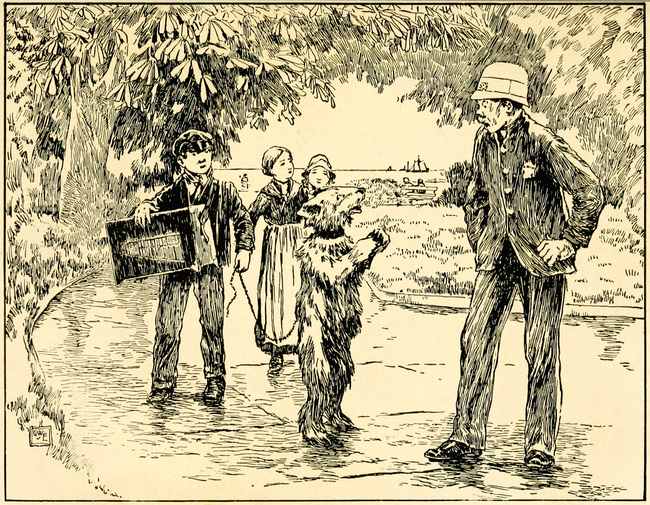
IN BATTERY PARK.
“Mr. Policeman,” the child cried, in the same unintelligible
tongue, gazing up with a pale and excited face at
the tall officer, “please don’t hurt my brothers. And
won’t you please take me along, too? I have been bad,
too, Mr. Policeman—much badder than Truls.”
“Why, how-de-do, sis!” the officer asked, with a
broad grin. “Is it the bear ye be, did ye say, as lent yer
skin to this little chap? Ah, be jabers! now I begin to
take in yer capers. It is a moighty mixed-up lot ye be,
and up to no end of thricks. But jest ye wait till his
honor gits hold on ye, and he will know how to git each
one of ye back into his roight skin.”
This sinister allusion was lost, however, on the three
culprits, and even if they had understood it, it would
probably not have impressed them greatly. Their life
had been so exciting since they left their quiet Norse
valley, that they had almost ceased to be surprised at
anything that might happen to them. Alf and Karen
plodded on wearily at the policeman’s side, holding on
to the tails of his coat, and showing no desire to part
company with him; and Truls, who was wellnigh exhausted
by the labors and excitement of the day, was
only too glad to be able to rest his shaggy head on the
officer’s shoulders, and to embrace his neck with his two
hairy paws. The officer, somehow, seemed to enjoy the
situation; for he laughed and chuckled incessantly to
himself, as if he were contemplating some delightful plan
which promised a great deal of amusement. He shook
his club good-naturedly at the crowd which followed him,
and pushed his way onward, until he reached a large
brick building, over the door of which was carved, in big
Roman letters, “Police Precinct, No. ——.” Here he
entered with his prisoners, and after having made an
entry in a book, consigned them to a large, bare, and
dreary-looking room, where a few miserable people were
reposing in various attitudes upon the floor.
The two Norse boys, who vaguely understood that this
was some kind of a prison, looked with horror upon the
ragged and untidy occupants of the room, and withdrew
with their sister into the remotest corner they could find,
so as to escape observation. Here they held a consultation,
glancing all the while fearfully about them, and
lowering their voices to a whisper.
“Truls,” said Alf, raising his guileless eyes to those of
his younger but braver-hearted brother, “what do you
think will become of us? do you think we shall have to
stay long in this dreadful place?”
“Oh, no, you sillibub!” replied the ursine Truls, with
well-feigned cheerfulness; “we will be let out before
night; and anyhow, I know what I am going to do.
You remember that handsome American gentleman on
board the steamboat, whom I wanted to fight because I
thought he was making fun of father?”
“Yes, I remember,” said Alf.
“Well, he gave me his card, which I gave you to keep
in your pocket-book; and he made me promise that if
ever I needed a friend, I should send for him. There is
an address on the card, and I shouldn’t wonder if he is a
great man; and then everybody will be sure to know
him.”
“Oh, Truls!” his brother exclaimed, admiringly;
“you are always so bright and so clever; and I have the
card here; and I’ll not lose it. But don’t you think you
had better take off your bear-skin, so that the judge may
see you aren’t a bear, but a little boy?”
“I have thought of that,” Truls rejoined, earnestly;
“but the trouble is I haven’t anything else to put on.
So I shall have to go to the judge as I am, and I guess
he won’t be so very mad, when I tell him I haven’t got
nothing else under.”
A dreary hour passed—dreary beyond expression.
The two boys tried each to persuade the other that he
was, on the whole, not at all afraid, but really quite
cheerful. The only one whose argument was really convincing,
however, was Karen; for she went peacefully to
sleep on Truls’ shoulder, and did not wake until the
policeman came and summoned them all into court.
They made quite a sensation when they entered; and
people rose and craned their necks to catch a glimpse of
the curious group. It was probably the first time that a
bear had marched on its hind-legs into a police-court and
taken its place behind the bar as a prisoner. The judge
smiled a little when he saw it, and leaned himself half
over to the policeman who was apparently giving an account
of the case.
“The officer charges you with roaming about with an
unlicensed bear,” he said severely, fixing a stern glance
upon Alf. “What have you to say to the charge?”
Alf gazed up helplessly, and shook his head.
“Why don’t you answer?” repeated the judge, impatiently.
“Why didn’t you take out a license for your
bear?”
The policeman again leaned over and explained that
the prisoners were Dutch, or some other kind of foreigners,
and that they did not understand a word of
English.
“Hm,” growled his Honor, “why didn’t you tell me
that before? Is there anyone in this court-room,” he
went on, raising his voice, “who understands foreign
languages and would be willing to help the court out of
a difficulty?”
He looked expectantly about the large room, but no
one volunteered to act as interpreter of anything so comprehensive
as “foreign languages.”
“The gintleman over there,” the policeman remarked,
pointing out a well-dressed man in the audience, “looks
as if he understood furrin languages.”
The gentleman in question disclaimed all knowledge
of the languages referred to, and the Court visited him
with a look of serious displeasure. It was very annoying,
and there seemed positively no way of disposing of
the case, except to recommit the prisoners until an interpreter
could be found. The judge was about to resort
to that expedient, when a new prisoner was led into
the court, and the boys gave a simultaneous exclamation
of surprise at beholding Jens Skoug, the emigration
agent. Mr. Skoug had evidently come into collision
with a policeman’s club, or some other unyielding substance,
for his left eye was much blackened, and he had
a great bump on his forehead. He had been arrested
the previous night for disturbing the peace.
“That man, it appears, is acquainted with these Dutch
boys,” the Court remarked, nodding to the policeman
who had charge of Mr. Skoug; “bring him up.”
“Do you understand foreign languages?” the justice
went on, addressing the emigration agent in his severest
judicial tones.
“Yes, lots of them,” replied Jens, drowsily.
“Do you know these boys?”
Jens contemplated the boys with a puzzled frown;
then he shook his head boozily and replied:
“No, yer Honor, I never saw them in all my life.
They are not my style, yer Honor; don’t look as if they
had moved in the best society.”
“Well, never mind that,” interrupted the Court; “but
can’t you find out anything about them? why they did
not license their bear? Who provides for them? Where
do they live?”
Jens, in turning his back to the Court, gave Alf and
Karen and the bear a fierce glance, as if to say that he
would make them smart, if they dared in any way to
compromise him. Then, to their surprise, he stooped
down and talked with them earnestly for several minutes.
“Your Honor,” he resumed, rising and facing the
judge; “these boys are, as you supposed, Dutch. They
are utterly destitute, and have no money wherewith to
buy a license for their bear. In other words, they are
vagrants; and if I may be permitted to make a suggestion,
I think the Reform School or the workhouse would
be the right place for them. They are a hardened lot, I
am afraid, judging by their talk——”
“You may spare your suggestions,” the judge interrupted
curtly; “though they happen to fit in exactly
with what I had determined to do with them. Their
bear will have to be killed or sold, and they are hereby
recommitted, and will be sent to the Island for thirty
days.”
Mr. Skoug again stooped down and explained to the
two culprits; but he had no sooner mentioned the word
“kill” than Alf gave a shout, half of anger, half of
dread, pulled his Norse tolle-knife[12] from its sheath,
and with one swift motion slit the bear’s skin from the
neck downward. The policeman rushed forward, the
audience jumped up on the benches, the judge himself
started at the flash of the knife, and was on the point of
leaping over his desk. What was his amazement when,
instead of a bear, he saw a little shivering boy in very
scanty attire! A roar of laughter and a deafening salvo
of applause burst forth from all parts of the room, and it
was in vain that the judge hammered with all his might
on his desk, and in thunderous tones demanded order.
The Irish policeman, to whose taste for practical jokes
the whole scene was due, laughed as if he were going to
split his sides. He would not have ventured to confess
that he had planned some such dramatic incident, although,
as he admitted to himself, it had turned out
even more startling than he had dared to hope.
When order was finally restored, the Court commanded
that the prisoners be removed; but Truls, who now comprehended
the situation, and was determined not to
submit to further imposition, marched boldly up to the
judge, and put Mr. Tenney’s card before him on the
desk.
“This gentleman,” he said, confidently, “made me
promise to send for him if I should ever need a friend.
Now I need him, and if you would kindly send someone
to fetch him, I should be much obliged.”
The judge understood the purport of this speech, even
though the words were unintelligible to him. Mr. Tenney’s
name was well known to him, as that of a citizen
of great wealth and influence, and his prisoners immediately
rose in his estimation when he heard that they enjoyed
the protection of so prominent a man. He therefore
beckoned to a policeman, wrote a hasty note, and told
him to have it instantly despatched. The boys and their
sister, in the meanwhile, were permitted to sit down in the
court-room, awaiting Mr. Tenney’s arrival. Mr. Skoug,
who betrayed a great anxiety to be off, pleading a variety
of business engagements, was then examined and fined
ten dollars. He had just managed to disappear through
a side-room when Mr. Tenney’s tall and portly figure
was seen entering. He gave the boys a friendly nod, as
he walked rapidly up to the judge, with whom he conversed
amicably for several minutes. There was something
brisk, energetic, and business-like in all his movements.
He laughed very heartily when the recent
incident with the bear was related to him, and the judge
joined in the laugh, and asserted that it was the most
amusing thing that ever had occurred in all his long experience
on the bench. Then Mr. Tenney apologized for
having taken up so much of the Court’s valuable time,
and the Court expressed itself delighted to have made
Mr. Tenney’s acquaintance and to have been in any way
able to serve him; whereupon Mr. Tenney had the three
children conveyed to his carriage, and they drove away
through the glorious May sunshine, up one street and
down another, until they reached a large and stately
house on Madison Avenue. Here they stepped out of
the carriage, and a liveried servant flung the doors open
before them, as they entered the house.
Such magnificence the boys had never beheld before:
long, wonderful mirrors which looked like strips of lake
standing on end, carpets which felt soft under the feet
like fine moss, and gilt and carved furniture, which
seemed to have stepped right out of a fairy story. It
was certainly very extraordinary; but still more extraordinary
was the kindness and consideration with which
they were treated by Mr. Tenney and his wife. Two
pretty rooms were assigned to them on the fourth floor
of the house; little Karen was dressed in beautiful
clothes, and the boys themselves got each a new suit,
the like of which they had never had on their backs before.
They felt like young princes, and if they could
only have talked with the kind people who took so much
trouble on their account, they would have expressed to
them their gratitude, and perhaps, too, solicited their
aid in ascertaining the whereabouts of their lost father.
Mr. Tenney, however, guessed their thoughts, and did
not need to be told that their minds were torn with
anxiety. He first procured a Norwegian interpreter from
one of the steamship companies, and made the boys describe
to him accurately the time and circumstances of
Fiddle-John’s disappearance. He wrote letters to the
emigration commissioners, inserted advertisements in the
newspapers, and set the whole official machinery in
motion to get a clew by which to unravel the mystery.
Investigations were set on foot, detectives were employed,
the Castle Garden officials were questioned and
cross-examined, but there was no one who had the
slightest recollection of having seen Fiddle-John. Thus
three days passed. Mr. Tenney’s determination to accomplish
his purpose increased, the greater the obstacles
were that he encountered. There was a streak of obstinacy
in his temperament, and there seemed to be an
impression abroad that Mr. Tenney was not to be trifled
with, when once he was aroused, and that may have been
the reason why Fiddle-John grew in the course of a week
to be a kind of public character, and people asked each
other jocosely when they met in street cars or in hotel
vestibules:
“How do you do? Seen Fiddle-John?”
Someone, it appears, had seen Fiddle-John, and that
was the purser of the steamboat Ruckert, whose encounter
with the lamented Garibaldi was yet fresh in
the boys’ memories. He came late one evening to Mr.
Tenney’s residence, and explained to him that a man
called Fiddle-John had just been put aboard the ship, as
a lunatic, to be taken back to Norway free of charge.
The ship was to sail the next day at noon; and if Mr.
Tenney would hold himself responsible for the consequences,
the purser said he would undertake to restore
Fiddle-John to his family within—well, within five
minutes.
Mr. Tenney was quite ready to assume all the responsibility
in the matter, and accordingly the purser raised
the window, and beckoned to a carriage which had
stopped on the other side of the street. The carriage
drove up before the door, and out stepped Fiddle-John.
But oh, how miserable he looked! The light from the
gas-lamp fell upon his pale face, his disordered hair, and
his tall, stooping figure. He was led carefully up the
steps, and the children flew into his arms, hugging him,
kissing him, and weeping over him. He sat down on a
low stool, and stared about him in a bewildered fashion.
But gradually, as his eyes rested upon the dear familiar
faces, his expression softened, the wild look of fright departed
from his face, and the tears began slowly to course
down his cheeks.
“O, children!” he said in a hoarse, broken voice;
“I thought I should never see you again!”
He covered his face with his hands, and wept long and
silently.
“They wanted to make a madman of me,” he sobbed;
“and they almost succeeded. Whatever I did or said—it
made no difference—it only proved that I was mad.
I came to believe it, children, and the thought was terrible
to me; if I had staid another day, I should never
have recovered my reason.”
Five years have passed since Fiddle-John and his sons
were rescued from misery by Mr. Tenney. They now
live in the porter’s lodge of Mr. Tenney’s beautiful Berkshire
country-seat; and Fiddle-John, with all his eccentricities,
makes a very acceptable porter. The little stone
cottage at the gate of the larger villa looks very picturesque
with the green vines trailing over it, and it is very
comfortably and prettily furnished. Little Karen is now
a matronly little body, with a strict sense of order, and
many housewifely accomplishments. She goes to the
public school in the morning, but studies at home in the
afternoon, and keeps her father company. The boys are
both big fellows now, and they are as good Americans as
any to the manner born. Truls brags of American enterprise,
and the blessings of democratic institutions, as if
every drop of his Norse blood had become naturalized.
He is an engineer, and earns good wages, and is full of
hopefulness for the future. It need scarcely be said that
his sister adores him, and regards him as one of the
most remarkable men of the century.
Alf, who has inherited his father’s handsome face, and
incapacity for practical concerns, is at present preparing
to enter college. Mr. Tenney is much interested in him,
as a lad of unusual ability and a singular sweetness of
character; and it is owing to his generosity that Alf has
been able to follow the career for which he is by nature
and inclination adapted. He has his father’s beautiful
voice, too, and makes a sensation in the church choir
every Sunday when he sustains the lovely tenor solo in
the anthems “As Pants the Hart,” and “I Know that
My Redeemer Liveth.”
He is a rather serious fellow, with thoughtful eyes,
and a frank and open countenance. Some think he
would have a fine career as a clergyman, but it is difficult
to tell whether his inclination, in later years, will
turn in that direction. His father, however, does all in
his power to encourage this ambition, and it is not unlikely
that his hopes may some day be fulfilled. In fact,
it is Fiddle-John’s favorite occupation to hope and dream
about the future of his sons.
During the long summer afternoons he sits in the
shadow of the vines, outside of his cottage, while his
daughter reads aloud to him from the old Norse ballad
books which he yet loves so dearly. And it happens
very frequently, then, that the young ladies and gentlemen
who are visiting at the neighboring villas come, in
a company, and beg him to sing to them. They throw
themselves down in easy attitudes upon the soft, close-trimmed
lawn; and their bright garments, their crimson
sunshades, and their fresh, youthful faces make a fine
picture against the green background of elms and chestnut
trees.
To the gentle and guileless minstrel it is a great pleasure
to see these gay and happy creatures; and when the
young girls hang upon his arms and urge him to sing,
his eyes beam with delight.
“Now, do sing, Fiddle-John,” they coaxingly say.
“You know we have walked miles and miles to hear
your voice. And here is a young lady from New York,
who never heard a Norse song in all her life, and
is disappointed, because you look so nice and gentle,
and not wild and savage as a son of the Vikings
should.”
Fiddle-John likes this kind of banter very well; and
when, finally, he yields to their coaxing and lifts up his
clear, strong voice, singing the sad, wild ballads of his
native land, there falls a hush upon the noisy company,
as if they were in the presence of a renowned artist.
These are Fiddle-John’s happiest moments. And it was
just on such an occasion when, on a beautiful afternoon
in July, he had been entertaining the young people with
his songs, that a swarthy-looking Savoyard walked up
before his door, and began to whip up a bear which
danced to a tune from “Il Trovatore,” played upon a
wheezy hand-organ.
“Stop, you sacrilegious brute!” said one of the young
men, addressing, not the bear, but his master; “we have
a better kind of music here than your asthmatic organ
can produce.”
The Savoyard, being apparently well accustomed to
this manner of address, swung his organ across his back
and was about to take his departure, when Karen,
prompted by some idle impulse, stepped up to the bear
and patted it. Then a sudden change came over the
young man’s countenance. He stared for a moment fixedly
at the little girl.
“Take care, Carina mia,” he said, with a smile; “that
bear is a real one!”
“Annibale!” she cried in surprise; and, to be sure, it
was Annibale!
He had grown five years older, but in other respects
he had changed but little. He knew but very little
more English than he had done on the day of his arrival,
and his ambition still did not extend beyond hand-organs
and bears. He reaped a plentiful harvest of coins that
night; but that was owing to little Karen, and not to
the doleful hand-organ. She ran into the cottage and
spread out upon the lawn a rug, made out of a small
bear-skin. “Do you know that, Annibale?” she cried.
“Garibaldi, my poor Garibaldi!” exclaimed the
Savoyard, while the tears glittered in his eyes; and he
stooped down and caressed the furry head.
Now the curiosity of the young ladies was excited,
and the whole company clamored for the story of Annibale
and the bear-skin. They all seated themselves in a
ring about Fiddle-John, and he told the story, as I have
told it to you. For I had the good luck to be one of the
listeners.