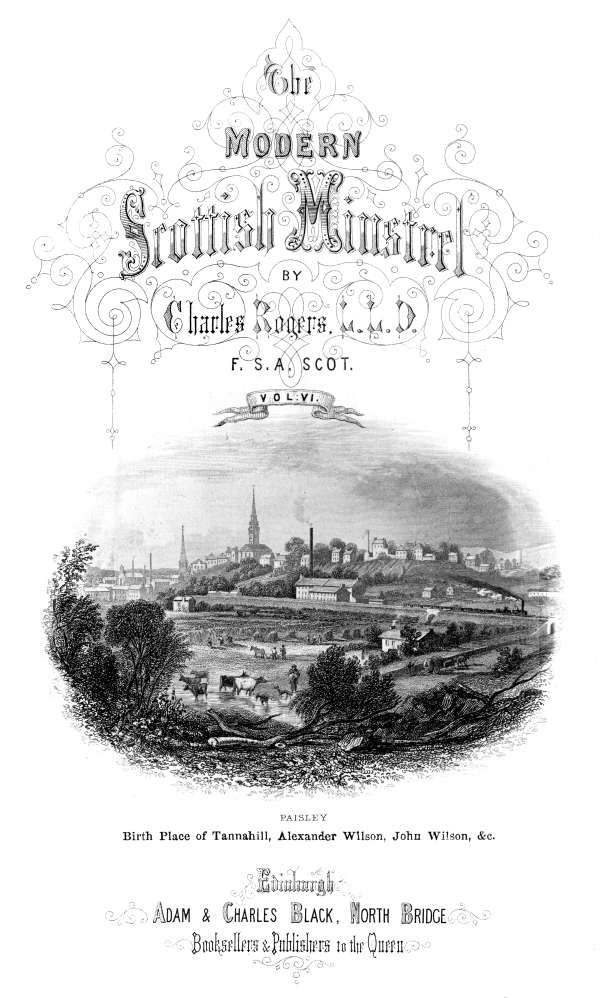
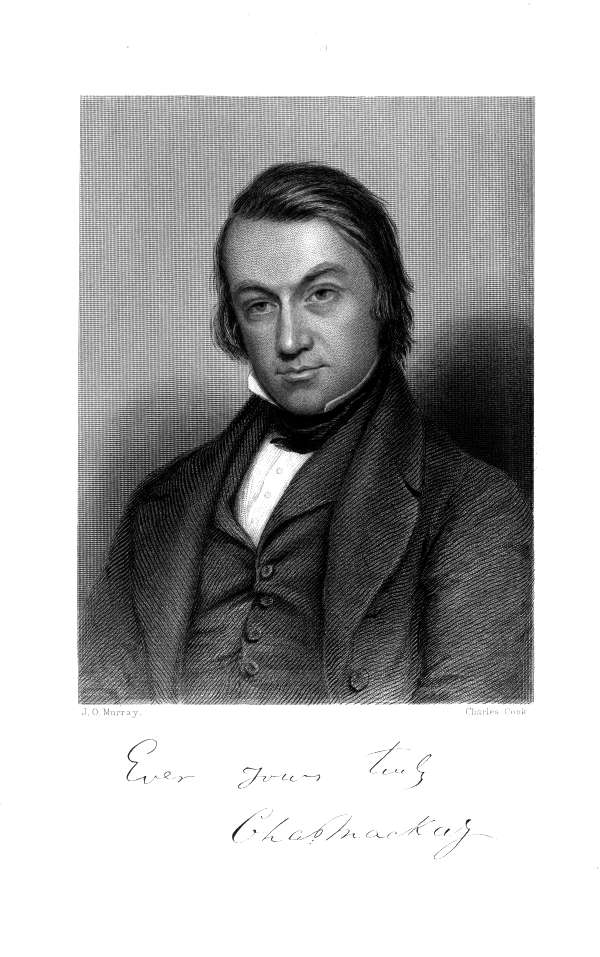
Our first volume contained the portrait of Sir Walter Scott; our sixth
and concluding volume is adorned by the portrait of Charles Mackay. In
these distinguished men there is not only a strong mental similarity,
but also a striking physical resemblance. Those who are curious in such
matters will do well to compare the two portraits. The one was the most
prolific and popular writer at the commencement of the century; the
other is the most prolific and popular song-writer of the present day.
Wherever the English language is heard and patriotic songs are sung,
Charles Mackay will be present in his verse. He rejoices in his English
songs; but Scotland claims him as a son.
Charles Mackay is of ancient and honourable extraction. His paternal
ancestors were the Mackays of Strathnaver, in Sutherlandshire; while, on
the mother's side, he is descended from the Roses of Kilravock, near
Inverness, for many centuries the proprietors of one of the most
interesting feudal strongholds in the Highlands. The Mrs Rose of
Kilravock, whose name appears in the "Correspondence" of Burns, was
Charles Mackay's maternal grandmother.
He was born at Perth in 1814; but his early years were spent in London,
his parents having removed to the metropolis during his infancy. There
he received the rudiments of an education which was completed in the
schools of Belgium and Germany. His relation, General Mackay, intended
that he should adopt the military profession; but family arrangements
and other circumstances prevented the fulfilment of that intention.
The poetical faculty cannot be acquired; it must be born with a man,
growing with his growth, and strengthening with his strength, until
developed by the first great impulse that agitates his being, and
generally that is love. There are versifiers innumerable who are not
poets, but there are no poets whose hearts remain unstirred by the
exciting passion of irrepressible love, when song becomes the written
testimony of the inner life. Whether it was so with Charles Mackay we
have not ascertained, nor have we cared to inquire. His love-songs,
however, are exquisitely touching, and among the purest compositions in
the language. Certain it is that the poetical power was early
manifested; for we find that, in 1836, he gave his first poems to the
public. The unpretending volume attracted the attention of John Black,
who was then the distinguished editor of the Morning Chronicle. Ever
ready to recognise genius wherever it could be found, and always
prepared to lend a hand to lift into light the unobtrusive author who
laboured in the shade, he offered young Mackay a place on the paper,
which was accepted, and filled with such ability that he was rapidly
promoted to the responsible position of sub-editor. He soon became one
of the marked men of the time in connexion with the press; and, in 1844,
he undertook the editorship of the Glasgow Argus, a journal devoted to
the advocacy of advanced liberal opinions.
This paper he conducted for three years, and returned to London, where
he received the appointment of editor of the Illustrated London News,
a situation which, considering the peculiar character of the paper, he
fills with consummate tact. Some of the great organs of public opinion
may thunder forth embittered denunciations, others, in the silkiest
tone, will admonish so gently that they half approve the misconduct of
people in power if their birth happens to have been sufficiently
elevated. The distinguishing characteristics of the political articles
written by Charles Mackay are their manly and thoroughly independent
spirit, avoiding alike fulsome adulation and indiscriminate abuse. His
censure and his praise are always governed by strictest impartiality.
Whether he condemns or whether he applauds he secures the respect even
of those from whom he differs the most. It is no small merit to possess
such a power in the conflict and strife of politics. We happen to know a
circumstance which speaks volumes on this subject. The peculiarities of
the press of England were being discussed in the presence of a foreign
nobleman, of high rank and political influence, who expressed himself to
this effect:—"Some of your newspapers are feared, some simply
tolerated, some detested, and some merit our contempt, but the
Illustrated London News is respected. It is admitted everywhere, it is
read everywhere; and, although it is sometimes severe, its very severity
is appreciated, because it is the expression of earnest conviction and
sterling good sense; the result is, that it has, on the Continent, a
wider influence than any paper published in England."
Mackay's works have been numerous and various. Without presuming to be
perfectly accurate, we shall attempt a list of his several publications.
His first, as we have already stated, was a small volume of "Poems,"
published in 1836. This was followed by the "Hope of the World," a poem,
in heroic verse, published in 1839. Soon afterwards appeared "The Thames
and its Tributaries," a most suggestive, agreeable, and gossiping book.
In 1841 appeared his "Popular Delusions," a work of considerable merit;
and next came, in 1842, his romance of "Longbeard, Lord of London," so
well conceived and cleverly executed, that an archæologist of
considerable pretensions mistook it for a genuine historical record of
the place on which it was written. His next work, and up till that
period his noblest poem, "The Salamandrine, or Love and Immortality,"
appeared in 1843. As there is no hesitation in his thought, there is no
vagueness in his language; it is terse, clear, and direct in every
utterance. An enemy to spasms in every form, he abhors the Spasmodic
School of Poets. If the true poet be the seer—the far seer into
futurity—he should see his way clear before him. He should write
because he has a thought to utter, and ought to utter it in the clearest
and the fittest language, and this is the principle which manifestly
governs the compositions of Charles Mackay. The "Salamandrine" lifted
his works high in the poetic scale, and permanently fixed him, not only
in the ranks, but marked him as a leader of the host of eminent British
poets. His residence in Scotland enabled him to visit many places famous
in Scottish history. The results were his "Legends of the Isles,"
published in 1845 and his "Voices from the Mountains" in 1846. A few
months before the publication of the last named volume, the University
of Glasgow conferred upon him the degree of LL.D.
When the London Daily News was started, he contributed some stirring
lyrics, under the title of "Voices from the Crowd." They arrested the
attention of the public, and tended greatly to popularise and establish
the reputation of that journal. In 1847 appeared his "Town Lyrics," a
series of ballads which harrowed the soul by laying bare many of the
secret miseries of the town. In 1850 was published his exquisite poem of
"Egeria," probably the most refined and artistic of all his productions;
and in 1856 he gave to the world "The Lump of Gold," and "Under Green
Leaves," two volumes of charming poetry; the first tracing the evils
that flow from unrestrained cupidity; the second the delights of the
country, under every circumstance that can or does occur. Latterly he
has composed some popular airs, set to his own lyrics; thus giving to
the melody he has conceived the immortality of his verse. With the late
Sir Henry Bishop he was associated in re-arranging a hundred of the
choicest old English melodies. The music has been re-arranged; and many
a lovely air, inadmissible to cultivated society from its being
associated with vulgar or debasing words, has been re-admitted to the
social circle, and is fast floating into public favour in union with the
words composed by Mackay.
Here we stop. This is not the time, nor is it the place, to discuss,
with any great elaboration, the merits or peculiarities of Charles
Mackay as an author. We have to do with him as the most successful of
song-writers. Two of his songs, perhaps not among his best, have
obtained a world-wide popularity. His "Good Time Coming," and his
"Cheer, Boys, Cheer," have been ground to death by barrel-organs, but
only to experience a resurrection to immortality. On the wide sea, amid
the desert, across the prairies, in burning India, in far Australia, and
along the frozen steppes of Russia are floating those imperishable airs
suggested by the "Lyrics" whose names they bear. The soldier and the
sailor, conscious of impending danger, think of beloved ones at home;
unconsciously they hum a melody, and comfort is restored. The emigrant,
forced by various circumstances to leave his native land, where, instead
of inheriting food and raiment, he had experienced hunger, nakedness,
and cold, endeavours to express his feelings, and is discovered crooning
over the tune that correctly interprets his emotions, and thrills his
heart with gladness. The poet's song has become incorporated with the
poor man's nature. You may see that it fills his eyes with tears; but
they are not of sorrow. His cheek is flushed with hope, and a radiant
expectation, founded on experience, which seems to illuminate and gild
his future destiny. Marvellous, indeed, are the influences of a true
song; and while they are rare, they are by fashion rarely appreciated.
In it are embodied the best thoughts in the best language. By it the
best of every class in every clime are swayed. In it they find
expression for sensations, which, but for the poet, might have slumbered
unexpressed till the day of doom.
Whether we think of Charles Mackay as a journalist, as a novelist, as a
poet, or as a musician, he wins our admiration in all. Possessing, as he
does in a high degree, a fine imagination, allied to the kindliest
feelings springing from a sensitive and considerate heart, he is beloved
by his friends, and cares little for the vulgar admiration of the
crowd. The pomp, and circumstance, and self-exaltation, so current
now-a-days, he utterly despises. But the kindliness, the glowing
sympathies of a few kindred spirits gladden him and make him happy.
Though modest and retiring in his disposition, he has no shamefacedness.
His conversation is like his verse; there is neither tinsel nor glitter,
but genuine, solid stuff. Something that bears examination; something
you can take up and handle; something to brood over and reflect upon;
something that wins its way by its truthfulness, and compels you to
accept it as a principle; something that sticks close, and springs up in
the future a very fountain of pure and unadulterated joy; from all this
it will be inferred that no man can remain long in his company without
feeling that he is not only a wiser, but a better man for the privilege
enjoyed. He is still in the prime of life and the maturity of his
intellect. May we not, in concluding this slight notice of his life and
character, express a hope which we know to be a general one—that he may
yet live to write many more poems and many more songs, as good or better
than those which he has already given to the world?
Oh! my love is very lovely,
In her mind all beauties dwell;
She, robed in living splendour,
Grace and modesty attend her,
And I love her more than well.
But I 'm weary, weary, weary,
To despair my soul is hurl'd;
I am weary, weary, weary,
I am weary of the world!
She is kind to all about her,
For her heart is pity's throne;
She has smiles for all men's gladness,
She has tears for every sadness,
She is hard to me alone.
And I 'm weary, weary, weary,
From a love-lit summit hurl'd;
I am weary, weary, weary,
I am weary of the world!
When my words are words of wisdom
All her spirit I can move,
At my wit her eyes will glisten,
But she flies and will not listen
If I dare to speak of love.
Oh! I 'm weary, weary, weary,
By a storm of passions whirl'd;
I am weary, weary, weary,
I am weary of the world!
True, that there are others fairer—
Fairer?—No, that cannot be—
Yet some maids of equal beauty,
High in soul and firm in duty,
May have kinder hearts than she.
Why, by heart, so weary, weary,
To and fro by passion whirl'd?—
Why so weary, weary, weary,
Why so weary of the world?
Were my love but passing fancy,
To another I might turn;
But I 'm doom'd to love unduly
One who will not answer truly,
And who freezes when I burn.
And I 'm weary, weary, weary,
To despair my soul is hurl'd;
I am weary, weary, weary,
I am weary of the world!
Heart! take courage! 'tis not worthy
For a woman's scorn to pine,
If her cold indifference wound thee,
There are remedies around thee
For such malady as thine.
Be no longer weary, weary,
From thy love-lit summits hurl'd;
Be no longer weary, weary,
Weary, weary of the world!
If thou must be loved by woman,
Seek again—the world is wide;
It is full of loving creatures,
Fair in form, and mind, and features—
Choose among them for thy bride.
Be no longer weary, weary,
To and fro by passion whirl'd;
Be no longer weary, weary,
Weary, weary of the world!
Or if Love should lose thy favour,
Try the paths of honest fame,
Climb Parnassus' summit hoary,
Carve thy way by deeds of glory,
Write on History's page thy name.
Be no longer weary, weary,
To the depth of sorrow hurl'd;
Be no longer weary, weary,
Weary, weary of the world!
Or if these shall fail to move thee,
Be the phantoms unpursued,
Try a charm that will not fail thee
When old age and grief assail thee—
Try the charm of doing good.
Be no longer weak and weary,
By the storms of passion whirl'd;
Be no longer weary, weary,
Weary, weary of the world!
Love is fleeting and uncertain,
And can bate where it adored,
Chase of glory wears the spirit,
Fame not always follows merit,
Goodness is its own reward.
Be no longer weary, weary,
From thine happy summit hurl'd;
Be no longer weary, weary,
Weary, weary of the world!
I cannot give thee all my heart,
Lady, lady,
My faith and country claim a part,
My sweet lady;
But yet I 'll pledge thee word of mine
That all the rest is truly thine;—
The raving passion of a boy,
Warm though it be, will quickly cloy—
Confide thou rather in the man
Who vows to love thee all he can,
My sweet lady.
Affection, founded on respect,
Lady, lady,
Can never dwindle to neglect,
My sweet lady;
And, while thy gentle virtues live,
Such is the love that I will give.
The torrent leaves its channel dry,
The brook runs on incessantly;
The storm of passion lasts a day,
But deep, true love endures alway,
My sweet lady.
Accept then a divided heart,
Lady, lady,
Faith, Friendship, Honour, each have part,
My sweet lady.
While at one altar we adore,
Faith shall but make us love the more;
And Friendship, true to all beside,
Will ne'er be fickle to a bride;
And Honour, based on manly truth,
Shall love in age as well as youth,
My sweet lady.
If Fortune with a smiling face
Strew roses on our way,
When shall we stoop to pick them up?
To-day, my love, to-day.
But should she frown with face of care,
And talk of coming sorrow,
When shall we grieve—if grieve we must?
To-morrow, love, to-morrow.
If those who 've wrong'd us own their faults
And kindly pity pray,
When shall we listen and forgive?
To-day, my love, to-day.
But if stern Justice urge rebuke,
And warmth from memory borrow,
When shall we chide—if chide we dare?
To-morrow, love, to-morrow.
If those to whom we owe a debt
Are harm'd unless we pay,
When shall we struggle to be just?
To-day, my love, to-day.
But if our debtor fail our hope,
And plead his ruin thorough,
When shall we weigh his breach of faith?
To-morrow, love, to-morrow.
If Love, estranged, should once again
His genial smile display,
When shall we kiss his proffer'd lips?
To-day, my love, to-day,
But, if he would indulge regret,
Or dwell with bygone sorrow,
When shall we weep—if weep we must?
To-morrow, love, to-morrow.
For virtuous acts and harmless joys
The minutes will not stay;
We 've always time to welcome them
To-day, my love, to-day.
But care, resentment, angry words,
And unavailing sorrow
Come far too soon, if they appear
To-morrow, love, to-morrow.
I remember the time, thou roaring sea,
When thy voice was the voice of Infinity—
A joy, and a dread, and a mystery.
I remember the time, ye young May flowers,
When your odours and hues in the fields and bowers
Fell on my soul as on grass the showers.
I remember the time, thou blustering wind,
When thy voice in the woods, to my youthful mind,
Seem'd the sigh of the earth for human kind.
I remember the time, ye suns and stars,
When ye raised my soul from its mortal bars
And bore it through heaven on your golden cars.
And has it then vanish'd, that happy time?
Are the winds, and the seas, and the stars sublime
Deaf to thy soul in its manly prime?
Ah, no! ah, no! amid sorrow and pain,
When the world and its facts oppress my brain,
In the world of spirit I rove—I reign.
I feel a deep and a pure delight
In the luxuries of sound and sight—
In the opening day, in the closing night.
The voices of youth go with me still,
Through the field and the wood, o'er the plain and the hill,
In the roar of the sea, in the laugh of the rill.
Every flower is a lover of mine,
Every star is a friend divine:
For me they blossom, for me they shine.
To give me joy the oceans roll,
They breathe their secrets to my soul,
With me they sing, with me condole.
Man cannot harm me if he would,
I have such friends for my every mood
In the overflowing solitude.
Fate cannot touch me: nothing can stir
To put disunion or hate of her
'Twixt Nature and her worshipper.
Sing to me, flowers! preach to me, skies!
Ye landscapes, glitter in mine eyes!
Whisper, ye deeps, your mysteries!
Sigh to me, wind! ye forests, nod!
Speak to me ever, thou flowery sod!
Ye are mine—all mine—in the peace of God.
Music by the Author.
Hope cannot cheat us,
Or Fancy betray;
Tempests ne'er scatter
The blossoms of May;
The wild winds are constant,
By method and plan;
Oh! believe me, believe me,
Believe if you can!
Young Love, who shews us
His midsummer light,
Spreads the same halo
O'er Winter's dark night;
And Fame never dazzles
To lure and trepan;
Oh! believe me, believe me,
Believe if you can!
Friends of the sunshine
Endure in the storm;
Never they promise
And fail to perform.
And the night ever ends
As the morning began;
Oh! believe me, believe me,
Believe if you can!
Words softly spoken
No guile ever bore;
Peaches ne'er harbour
A worm at the core;
And the ground never slipp'd
Under high-reaching man;
Oh! believe me, believe me,
Believe if you can!
Seas undeceitful,
Calm smiling at morn,
Wreck not ere midnight
The sailor forlorn.
And gold makes a bridge
Every evil to span;
Oh! believe me, believe me,
Believe if you can.
Air by Sir H. R. Bishop.
Oh, the happy time departed!
In its smile the world was fair;
We believed in all men's goodness;
Joy and hope were gems to wear;
Angel visitants were with us,
There was music in the air.
Oh, the happy time departed!
Change came o'er it all too soon;
In a cold and drear November
Died the leafy wealth of June;
Winter kill'd our summer roses;
Discord marr'd a heavenly tune.
Let them pass—the days departed—
What befell may ne'er befall;
Why should we with vain lamenting
Seek a shadow to recall?
Great the sorrows we have suffer'd—
Hope is greater than them all.
Come back! come back! thou youthful Time,
When joy and innocence were ours,
When life was in its vernal prime,
And redolent of sweets and flowers.
Come back—and let us roam once more,
Free-hearted, through life's pleasant ways,
And gather garlands as of yore—
Come back—come back—ye happy days!
Come back! come back!—'twas pleasant then
To cherish faith in love and truth,
For nothing in dispraise of men
Had sour'd the temper of our youth.
Come back—and let us still believe
The gorgeous dream romance displays,
Nor trust the tale that men deceive—
Come back—come back—ye happy days!
Come back!—oh, freshness of the past,
When every face seem'd fair and kind,
When sunward every eye was cast,
And all the shadows fell behind.
Come back—'twill come; true hearts can turn
Their own Decembers into Mays;
The secret be it ours to learn—
Come back—come back—ye happy days!
Music by Sir H. R. Bishop.
O ye tears! O ye tears! that have long refused to flow,
Ye are welcome to my heart—thawing, thawing, like the snow;
I feel the hard clod soften, and the early snowdrops spring,
And the healing fountains gush, and the wildernesses sing.
O ye tears! O ye tears! I am thankful that ye run;
Though ye trickle in the darkness, ye shall glitter in the sun;
The rainbow cannot shine if the rain refuse to fall,
And the eyes that cannot weep are the saddest eyes of all.
O ye tears! O ye tears! till I felt you on my cheek,
I was selfish in my sorrow, I was stubborn, I was weak.
Ye have given me strength to conquer, and I stand erect and free,
And know that I am human by the light of sympathy.
O ye tears! O ye tears! ye relieve me of my pain;
The barren rock of pride has been stricken once again;
Like the rock that Moses smote, amid Horeb's burning sand,
It yields the flowing water to make gladness in the land.
There is light upon my path, there is sunshine in my heart,
And the leaf and fruit of life shall not utterly depart.
Ye restore to me the freshness and the bloom of long ago—
O ye tears! happy tears! I am thankful that ye flow.
Cheer, boys! cheer! no more of idle sorrow;
Courage, true hearts, shall bear us on our way!
Hope points before, and shews the bright to-morrow—
Let us forget the darkness of to-day!
So farewell, England! much as we may love thee,
We 'll dry the tears that we have shed before;
Why should we weep to sail in search of fortune?
So farewell, England! farewell evermore!
Cheer, boys! cheer! for England, mother England!
Cheer, boys! cheer! the willing strong right hand;
Cheer, boys! cheer! there 's work for honest labour,
Cheer, boys! cheer! in the new and happy land!
Cheer, boys! cheer! the steady breeze is blowing,
To float us freely o'er the ocean's breast;
The world shall follow in the track we 're going,
The star of empire glitters in the west.
Here we had toil and little to reward it,
But there shall plenty smile upon our pain;
And ours shall be the mountain and the forest,
And boundless prairies, ripe with golden grain.
Cheer, boys! cheer! for England, mother England!
Cheer, boys! cheer! united heart and hand!
Cheer, boys! cheer! there 's wealth for honest labour,
Cheer, boys! cheer! in the new and happy land!
Music by Sir H. R. Bishop.
Mourn for the mighty dead,
Mourn for the spirit fled,
Mourn for the lofty head—
Low in the grave.
Tears such as nations weep
Hallow the hero's sleep;
Calm be his rest, and deep—
Arthur the brave!
Nobly his work was done;
England's most glorious son,
True-hearted Wellington,
Shield of our laws.
Ever in peril's night
Heaven send such arm of might—
Guardian of truth and right—
Raised in their cause!
Dried be the tears that fall;
Love bears the warrior's pall,
Fame shall his deeds recall—
Britain's right hand!
Bright shall his memory be!
Star of supremacy!
Banner of victory!
Pride of our land.
Music by the Author.
I 've a guinea I can spend,
I 've a wife, and I 've a friend,
And a troop of little children at my knee, John Brown;
I 've a cottage of my own,
With the ivy overgrown,
And a garden with a view of the sea, John Brown;
I can sit at my door
By my shady sycamore,
Large of heart, though of very small estate, John Brown;
So come and drain a glass
In my arbour as you pass,
And I 'll tell you what I love and what I hate, John Brown.
I love the song of birds,
And the children's early words,
And a loving woman's voice, low and sweet, John Brown;
And I hate a false pretence,
And the want of common sense,
And arrogance, and fawning, and deceit, John Brown;
I love the meadow flowers,
And the brier in the bowers,
And I love an open face without guile, John Brown;
And I hate a selfish knave,
And a proud, contented slave,
And a lout who 'd rather borrow than he 'd toil, John Brown.
I love a simple song
That awakes emotions strong,
And the word of hope that raises him who faints, John Brown;
And I hate the constant whine
Of the foolish who repine,
And turn their good to evil by complaints, John Brown;
But ever when I hate,
If I seek my garden gate,
And survey the world around me, and above, John Brown,
The hatred flies my mind,
And I sigh for human kind,
And excuse the faults of those I cannot love, John Brown.
So, if you like my ways,
And the comfort of my days,
I will tell you how I live so unvex'd, John Brown;
I never scorn my health,
Nor sell my soul for wealth,
Nor destroy one day the pleasures of the next, John Brown;
I 've parted with my pride,
And I take the sunny side,
For I 've found it worse than folly to be sad, John Brown;
I keep a conscience clear,
I 've a hundred pounds a-year,
And I manage to exist and to be glad, John Brown.
Music by the Author.
No one knows what silent secrets
Quiver from thy tender leaves;
No one knows what thoughts between us
Pass in dewy moonlight eves.
Roving memories and fancies,
Travellers upon Thought's deep sea,
Haunt the gay time of our May-time,
O thou snow-white hawthorn-tree!
Lovely was she, bright as sunlight,
Pure and kind, and good and fair,
When she laugh'd the ringing music
Rippled through the summer air.
"If you love me—shake the blossoms!"
Thus I said, too bold and free;
Down they came in showers of beauty,
Thou beloved hawthorn-tree!
Sitting on the grass, the maiden
Vow'd the vow to love me well;
Vow'd the vow; and oh! how truly,
No one but myself can tell.
Widely spreads the smiling woodland,
Elm and beech are fair to see;
But thy charms they cannot equal,
O thou happy hawthorn-tree!
From the deep and troubled waters
Comes the cry;
Wild are the waves around me—
Dark the sky:
There is no hand to pluck me
From the sad death I die.
To one small plank, that fails me,
Clinging low,
I am dash'd by angry billows
To and fro;
I hear death-anthems ringing
In all the winds that blow.
A cry of suffering gushes
From my lips
As I behold the distant
White-sail'd ships
O'er the white waters gleaming
Where the horizon dips.
They pass; they are too lofty
And remote,
They cannot see the spaces
Where I float.
The last hope dies within me,
With the gasping in my throat.
Through dim cloud-vistas looking,
I can see
The new moon's crescent sailing
Pallidly:
And one star coldly shining
Upon my misery.
There are no sounds in nature
But my moan,
The shriek of the wild petrel
All alone,
And roar of waves exulting
To make my flesh their own.
Billow with billow rages,
Tempest trod;
Strength fails me; coldness gathers
On this clod;
From the deep and troubled waters
I cry to Thee, my God!
The favouring wind pipes aloft in the shrouds,
And our keel flies as fast as the shadow of clouds;
The land is in sight, on the verge of the sky,
And the ripple of waters flows pleasantly by,—
And faintly stealing,
Booming, pealing,
Chime from the city the echoing bells;
And louder, clearer,
Softer, nearer,
Ringing sweet welcome the melody swells;
And it 's home! and it 's home! all our sorrows are past—
We are home in the land of our fathers at last.
How oft with a pleasure akin to a pain,
In fancy we roam'd through thy pathways again,
Through the mead, through the lane, through the grove, through the corn,
And heard the lark singing its hymn to the morn;
And 'mid the wild wood,
Dear to childhood,
Gather'd the berries that grew by the way;
But all our gladness
Died in sadness,
Fading like dreams in the dawning of day;—
But we 're home! we are home! all our sorrows are past—
We are home in the land of our fathers at last.
We loved thee before, but we 'll cherish thee now
With a deeper emotion than words can avow;
Wherever in absence our feet might delay,
We had never a joy like the joy of to-day;
And home returning,
Fondly yearning,
Faces of welcome seem crowding the shore—
England! England!
Beautiful England!
Peace be around thee, and joy evermore!
And it 's home! and it 's home! all our sorrows are past—
We are home in the land of our fathers at last.
Fierce as its sunlight, the East may be proud
Of its gay gaudy hues and its sky without cloud;
Mild as its breezes, the beautiful West
May smile like the valleys that dimple its breast;
The South may rejoice in the vine and the palm,
In its groves, where the midnight is sleepy with balm:
Fair though they be,
There 's an isle in the sea,
The home of the brave and the boast of the free!
Hear it, ye lands! let the shout echo forth—
The lords of the world are the Men of the North!
Cold though our seasons, and dull though our skies,
There 's a might in our arms and a fire in our eyes;
Dauntless and patient, to dare and to do—
Our watchword is "Duty," our maxim is "Through!"
Winter and storm only nerve us the more,
And chill not the heart, if they creep through the door:
Strong shall we be
In our isle of the sea,
The home of the brave and the boast of the free!
Firm as the rocks when the storm flashes forth,
We 'll stand in our courage—the Men of the North!
Sunbeams that ripen the olive and vine,
In the face of the slave and the coward may shine;
Roses may blossom where Freedom decays,
And crime be a growth of the Sun's brightest rays.
Scant though the harvest we reap from the soil,
Yet Virtue and Health are the children of Toil:
Proud let us be
Of our isle of the sea,
The home of the brave and the boast of the free!
Men with true hearts—let our fame echo forth—
Oh, these are the fruit that we grow in the North!
I dream'd thou wert a fairy harp
Untouch'd by mortal hand,
And I the voiceless, sweet west wind,
A roamer through the land.
I touch'd, I kiss'd thy trembling strings,
And lo! my common air,
Throbb'd with emotion caught from thee,
And turn'd to music rare.
I dream'd thou wert a rose in bloom,
And I the gale of spring,
That sought the odours of thy breath,
And bore them on my wing.
No poorer thou, but richer I—
So rich, that far at sea,
The grateful mariners were glad,
And bless'd both thee and me.
I dream'd thou wert the evening star,
And I a lake at rest,
That saw thine image all the night
Reflected on my breast.
Too far!—too far!—come dwell on Earth!
Be Harp and Rose of May;—
I need thy music in my heart,
Thy fragrance on my way.