Men who compare themselves with their nearest neighbours are almost
invariably conceited, speak boastingly of themselves, and
disrespectfully of others. But if a man extend his survey, if he mingle
largely with people whose feelings and opinions have been modified by
quite different circumstances, the result is generally beneficial. The
very act of accommodating his mind to foreign modes of thought expands
his nature; and he becomes more liberal in his sentiments, more
charitable in his construction of deeds, and more capable of perceiving
real goodness under whatever shape it may present itself. So when a
Scotsman criticises Scotch poetry viewed by itself alone, he is apt to
be carried away by his patriotism,—he sees only the delightful side of
the subject, and he ventures on assertions which flatter himself and his
country at the expense of all other nations. If, however, we place the
productions of our own country side by side with those of another, the
excellences and the deficiencies of both are seen in stronger relief;
the contrasts strike the mind, and the heart is widened by sympathising
with goodness and beauty diversely conceived and diversely portrayed.
For this reason, we shall attempt a brief comparison of Hellenic and
Scottish songs.
Before we enter on our characterisation of these, we must glance at the
materials which we have to survey. Greek lyric poetry arose about the
beginning of the eighth century before the Christian era, and continued
in full bloom down to the time when it passed into drama on the Athenian
stage. The names of the poets are universally known, and have become,
indeed, almost part of our poetic language. Every one speaks of an
Anacreon, a Sappho, and a Pindar; and the names of Archilochus, Alcman,
Alcæus, Stesichorus, Simonides, Ibycus, and Bacchylides, if not so often
used, are yet familiar to most. Few of these lyrists belonged to Greece
proper. They belonged to Greece only in the sense in which the Greeks
themselves used the word, as including all the colonies which had gone
forth from the motherland. Most of the early Greek song-writers dwelt in
Asia Minor—some were born in the islands of the Cyclades, and some in
Southern Italy; but all of them were proud of their Greek origin, all of
them were thorough Greeks in their hearts. It is only the later bards
who were born and brought up on the Greek mainland, and most of these
lived to see the day when almost all the lyric poets took their grandest
flights in the choral odes of their dramas. These odes, however, do not
fall within the province of our comparison. The lyrical efforts both of
Æschylus and Sophocles were inwoven with the structure of their plays,
the chorus in Æschylus being generally one of the actors; and they have
their modern representatives, not in the songs of the people, but in the
arias of operas. Setting these aside, we have few genuine efforts of
the Greek lyric muse belonging to the dramatic period—the most
important being several songs sung by the Greeks at their banquets,
which have fortunately been preserved. After this era, we have no lyric
poems of the Greeks worth mentioning. The verse-writers took henceforth
to epigrams—epigrams on everything on the face of the earth. These have
been collected into the "Greek Anthology;" but the greater part of them
are contemptible in a poetic point of view. They are interesting as
throwing light on the times; but they are weak and vapid as expressions
of the beatings of the human heart, and they are full of conceits.
Besides these, there are the Anacreontic odes, known to all Greek
scholars and to a great number of English, since they have been
frequently translated. With one or two exceptions, they were all written
between the third and twelfth centuries of the Christian era, though
some scholars have boldly asserted that they were forgeries even of a
later date. Most of them seem to be expansions of lines of Anacreon.
They are in general neat, pretty, and gaysome, but tame and insincere.
There is nothing like earnestness in them, nothing like genuine deep
feeling; but thus they are all the more suited for a certain class of
lovers and drinkers, who do not wish to be greatly moved by anything
under the sun.
Scotch lyric poetry may be said to commence with the lyrics attributed
to James I., or with those of Henryson. There is clear proof, indeed,
that long before this time the Scotch were much given to song-making and
song-singing; but of these early popular lilts, almost nothing remains.
Henryson's lyrics, however, belonged more to the class that were
intended to be read than to be sung, and this is true of a considerable
number of his successors, such as Dunbar, and Maitland of Lethington,
who were learned men, and wrote with a learned air, even when writing
for the people. The Reformation, as surely as it threw down every carved
stone, shut up the mouth of every profane songster. Wedderburne's "Haly
Ballats" may have been spared for a time by the iconoclasts, because
they had helped to build up their own temple; but they could not survive
long,—they were cast in a profane mould, they were sung to profane
tunes, and away they must go into oblivion. Our song-writers, for a long
time after, are unknown minstrels, who had no character to lose by
making or singing profane songs,—they were of the people, and sang for
them. So matters continued, until, at the commencement of the eighteenth
century, Scottish songs began to be the rage both in England and
Scotland, and an eager desire arose to gather up old snatches and
preserve them. Henceforth Scotch poetry held up its head, and a few
remarkable poets won their way into the hearts of large masses of the
people. At last appeared the emancipator of Scottish song in the form of
a ploughman, stirring the deepest feelings of all classes with songs
that may be justly styled the best of all national popular songs, and
for ever settling the claims of a song-writer to one of the highest
niches in the temple of Fame.
The first thing that strikes us, on dipping into a book of Greek songs,
and then a book of Scotch, is the different position of the poets. The
Greek poet was regarded as a kind of superior being—an interpreter
between gods and men; and, supposed to be under the special protection
of Divinity, he was highly honoured and reverenced wherever he went. The
Scotch bard, on the other hand, is a poor wanderer, whose name is
unknown, who received little respect, and whose knowledge of God and
the higher purposes of life cannot be reckoned in any way great. There
may be a few exceptions. We find nobles sometimes writing popular songs,
and occasionally a learned man may have contributed strains; but these
are generally not superior either in wit, pathos, or morality, to the
verses of the unknown and hard-toiling. This striking contrast arises
from a change that had taken place in the history of song. In Greece,
all the teeming ideas of the fertile-minded people found expression in
harmonious measures, and their songs touched every chord of their varied
existence. This was partly owing to their innate love of melody, and
partly to the public life which they led. From the earliest ages, they
were fond of sweet sounds; and their continual public gatherings gave
innumerable opportunities for using their vocal powers unitedly, and
turning music to all its best and noblest purposes. They sang sacred
songs as they marched in procession to their temples; and on entering,
they hymned the praises of the gods. When they rushed on to battle, they
shouted their inspiring war-songs; and if victory crowned the fight, the
battle-field rang with their joyous pæans, and their poets tuned their
lyres in honour of the brave that had fallen. A victor in the Olympic
games would have lost one of his greatest rewards, if no poet had sung
his fame. Then, in their banquets, the Greeks amused themselves in
stringing together pretty verses, and joined in merry and jovial
drinking-songs. If there happened to be a marriage, the young people
assembled round the house, and late in the evening and early in the
morning sang the praises of bride and bridegroom, prayed for blessings
on the couple, and sometimes discussed the comparative blessedness of
single and married life. Or if a notable person happened to die, his
dirge was sung, and the poet composed an encomium on him, full of wise
reflections on destiny, and the fate that awaits all. There was, in
fact, no public occasion which the Greeks did not beautify with song.
It is entirely different with us. Our minister now performs the function
of the Greek poet at marriages and funerals. Our funeral sermons and
newspaper paragraphs have taken the place of the Greek encomiums. Our
fiddles or piano do duty instead of the Greek dithyrambs, hyporchems,
and other dancing songs. Our warriors are either left unsung, or
celebrated in verse that reads much better than it sings. The members of
the "Benevolent Pugilistic Association" do not stand so high in the
British opinion as the wrestlers of old stood in the Greek; and our
jockeys have fallen frightfully from the grand position which the Greek
racers occupied in the plains of Olympia. Very few in these days would
think the champion of England, or the winner of the Derby, worth a noble
ode full of old traditions and exalted religious aspirations. Through
various causes, song has thus come to be very circumscribed in its
limits, and to perform duty within a comparatively small sphere in
modern life.
Indeed, song in these days does exactly what the Greeks rarely
attempted: it concerns itself with private life, and especially with
that most characteristic feature of modern private life—love. Love is,
consequently, the main topic of Scottish song. It is a theme of which
neither the song-writer nor the song-singer ever wearies. It is the one
great passion with which the universal modern mind sympathises, and from
the expressions of which it quaffs inexhaustible delight. This holds
true even of the cynical people who profess a distaste for love and
lovers. For love has for them its comic side,—it appears to them
exquisitely humorous in the human weakness it causes and brings to
light; and if they do not enjoy the song in its praise, they seldom fail
to laugh heartily at the description of the plights into which it leads
its devotees.
Perhaps no country contains a richer collection of love-songs than
Scotland. We have a song for every phase of the motley-faced
passion,—from its ludicrous aspect to its highest and most rapturous
form. Every pulsation of the heart, as moved by love, has had its poetic
expression; and we have lovers pouring out the depths of their souls to
all kinds of maids, and in all kinds of situations. And maids are
represented as bodying forth their feelings, also, under the sway of
love. Many of these feminine lyrics are written by women themselves.
Some of them exult in the full return which their love meets; but for
the most part, it is a keen sorrow that forces women to poetic
composition. They thus contribute our most pathetic songs—wails
sometimes over blasted hopes and blighted love, as in "Waly, Waly;" or
over the death of a deeply-loved one, as in Miss Blamire's "Waefu'
Heart;" or over the loss of the brave who have fallen in battle, as in
Miss Jane Elliot's "Flowers of the Forest."
Peculiarly characteristic of Scotland are the songs that describe the
development of love, after the lovers have been married. Here the
comical phase is most predominant. For the most part, the Scottish
songster delights in describing the quarrels between the goodman and the
goodwife—the goodwife in the early poems invariably succeeding in
making John yield to her. Sometimes, however, there is a deeper and
purer current of feeling, to which Burns especially has given
expression. How intensely beautiful is the affection in "John Anderson,
my Jo!" And we have in "Are ye sure the news is true?" the whole
character of a very loving wife brought out by a simple incident in her
life,—the expected return of her husband. Some of these songs also have
been written by poetesses, such as Lady Nairn's exquisite "Land of the
Leal;" and really there is such delicacy, such minute accuracy in the
portrayal of a woman's feelings in "Are ye sure the news is true?" that
one cannot help thinking it must have been written by Jean Adams, or
some woman, rather than by Mickle:—
"His very foot has music in 't,
As he comes up the stair."
What man has an ear so delicate as to hear such music?
The contrast between Greek poetry and Scotch is very marked in this
point. There is not one Greek lyric devoted to what we should designate
love, with perhaps something like an exception in Alcman. In fact, while
moderns rarely make a tragedy or comedy, a poem or novel, without some
love-concern which is the pivot of the whole, all the great poems and
dramas of the ancients revolve on entirely different passions. Love,
such as we speak of, was of rather rare occurrence. Women were in such a
low position, that it was a condescension to notice them,—there was no
chivalrous feeling in regard to them; they were made to feel the
dominion of their absolute lords and masters. Besides this, the greater
number of them were confined to their private chambers, and seldom saw
any man who was not nearly related. Those who were on free terms of
intercourse with men, were for the most part strangers, whose morals
were low, and who could not be expected to win the respectful esteem of
true lovers. The men enjoyed the society of these—their tumbling,
dancing, singing, and lively chat; but the distance was too great to
permit that deep devotion which characterises modern love. Moreover,
when a Greek speaks of love, we have to remember that he fell in love as
often with a male companion as with a woman—he admired the beauty of a
fair youth, and he felt in his presence very much as a modern lover
feels in the presence of his sweetheart. We have, therefore, to examine
expressions of love cautiously. Anacreon says, for instance, that love
clave him with an axe, like a smith; but it seems far more likely that
the reference is to the affection excited by some charming youth.[1] We
have a specimen remaining of the nonchalant style in which he addressed
a woman, in the ode commencing "O Thracian mare!"—Schneidewin, Poet.
Lyr. Anac. fr. 47.
The great poet of Love was not Anacreon, but Sappho, whose heart and
mind were both of the finest. Her life is involved in obscurity, but it
is probable that she was a strong advocate of woman's rights in her own
land; and as she found men falling in love with other men, so she took
special pains to win the affections of the young Æolian ladies, to train
them in all the accomplishments suited to woman's nature, and to
initiate them into the art of poetry,—that art without which, she says,
a woman's memory would be for ever forgotten, and she would go to the
house of Hades, to dwell with the shadowy dead, uncared for and unknown.
We have two poems of hers which have come down to us tolerably complete,
both, we think, addressed to some of her female friends, and both
remarkably sweet, touching, and beautiful.
The Scottish songs devoted to other subjects than love are few, and
almost exclusively descriptive. Our sense of the humorous gives us a
delight in queer and odd characters, in which the Greeks probably would
not have participated. Though they had an abundance of wit, and a keen
perception of the ridiculous, no songs have reached us which are
intended to please by their pure absurdity and good-natured foolishness.
Archilochus and Hipponax wrote many a jocular song; but the fun of the
thing would have been lost, had the sting which they contained been
extracted.
Nor do the Greeks seem to have cared much for descriptive songs. They
frequently introduced their heroes into their odes, but these were ever
living, ever present to their minds; and several of the songs written on
particular occasions were probably sung when the singer had no connexion
with the events. But they lived, like boys, too much in the present, to
throw themselves back into the past. They wished to give utterance to
the feelings of the moment in their own persons, and directly; while we
are content to be mere listeners, and are often as much pleased by the
occurrences of another's life as by the sentiments of our own hearts.
We are remarkably deficient in what are called class-songs. The Greeks
had none of these, for there scarcely existed any classes but free and
slave. The people were all one—had the same interests and the same
emotions. There was far less of individuality with them than with us,
and there was still less of that feeling which divides society into
exclusive circles. A Greek turned his hand to anything that came in his
way, while division of labour has reached its utmost limit among us. We
can find, therefore, no contrast here between Greek and Scotch songs;
but we find a very marked one between Scotch and German. We have no
student-songs, very few expressive of the feelings of soldiers
(Lockhart's are almost the only), sailors, or of any other class.
Indeed, we are deficient not only in class-songs, but in social-songs.
The Scotch propensity to indulge in drink is, unfortunately, notorious;
and yet our drinking-songs of a really social nature would be comprised
in a few pages. One sings of his coggie, as if he were in the custom of
gulping his whisky all alone; many describe the boisterous carousals in
which they made fools of themselves; not a few extol the power and
properties of whisky, and incite to Bacchanalian pleasures; and we have
several good songs suitable for singing at the close of an evening
pleasantly spent, but almost none which express the feelings that
naturally well-up when one sees his friends around him, becomes
exhilarated through pleasant social intercourse, and finds the path of
life smoothed and sweetened by the aid of his brothers.
The reason of this peculiar circumstance is not far to seek. It lies in
the distinctive character of the two great classes into which the Scotch
have been divided since the Reformation, called, at the early period of
Scottish song, the Covenanters and the Cavaliers. The one party bowed
before religion, most scrupulously abstained from all worldly pleasures,
and regarded and denounced as sin, or something akin to it, every
approach to levity or frivolity. The other party was a wild rebound from
this. Sanctimoniousness was hateful in their eye; and not being able to
find a medium, they abjured religion, and rushed into the pleasures of
this life with headlong zest. The poets, in accordance with their
joy-loving natures, allied themselves to the latter class. There was
thus in Scotland a deep, dark gulf between the religious and the
poetical or beautiful, which has not yet been completely bridged over.
The consequence is, that the elder Scottish songs, of all songs, contain
the fewest references to the Divine Being. The name of God is never
mentioned unless in the caricatures of the Covenanters; and a foreigner,
taking up a book of Scottish songs written since the Reformation, and
judging of the religion of the Scotch from them alone, would be prone to
suppose that, if Scotland had any religion at all, it consisted in using
the name of the devil occasionally with respect or with dread. The
Cavaliers, in their most energetic moods, swore by him and by no other;
while the Covenanters had no songs at all, scarcely any poetry of any
kind, and doubtless would have regarded as impious the tracing of any
but the most spiritual pleasures to God. The words, for instance, which
Allan Cunningham puts into the mouth of a Covenanter, "I hae sworn by my
God, my Jeanie" (p. 17 of this volume), would still be regarded by many
people as profane.
The case was the very opposite with the Greeks. Every joy, every sorrow,
was traced to the gods. They almost never opened their lips without an
allusion to their divinities. They sang their praises in their
processions and in all their public ceremonials. Wine was a gift from a
kind and beneficent god, to cheer their hearts and soothe the sorrows of
life. And they delighted in invoking his presence, in celebrating his
adventures, and in using moderately and piously the blessings which he
bestowed on them. Then, again, when love seized them, it was a god that
had taken possession of their minds. They at once recognised a superior
power, and they worshipped him in song with heart and soul. In fact,
whatever be the subject of song, the gods are recognised as the rulers
of the destinies of men, and the causes of all their joys and sorrows.
We cannot expect such a strong infusion of the supernatural in modern
lays, but still we have enough of it in German songs to form a
remarkable contrast to Scotch. Take any German song-book, and you will
immediately come upon a recognition of a higher power as the spring of
our joys, and upon an expressed desire to use them, so as to bring us
nearer one another, and to make us more honest, upright, happy, and
contented men. Let this one verse, taken from a song of Schiller's, in
singing which a German's heart is sure to glow, suffice:—
"Joy sparkles to us from the bowl!
Behold the juice, whose golden colour
To meekness melts the savage soul,
And gives despair a hero's valour!
"Up, brothers! Lo, we crown the cup!
Lo, the wine flashes to the brim!
Let the bright foam spring heavenward! 'Up!'
To the Good Spirit—this glass to Him!
Chorus.
"Praised by the ever-whirling ring
Of stars and tuneful seraphim—
To the Good Spirit—the Father-king
In heaven!—this glass to Him!"[2]
We meet with the contrast in the Reformers of the respective
nations—Knox and Luther. Knox, ever stern, frowning on all the
amusements of the palace and the people, and indifferent to every
species of poetry; Luther, often drinking his mug of ale in a tavern,
making and singing his tunes and songs, and though frequently enough
tormented by devils, yet still ready to throw aside the cares of life
for a while, and enjoy himself in hearty intercourse with the various
classes of the people. Who would have expected the German Reformer to be
the author of the couplet—
"He who loves not women, wine, and song,
Will be a fool his whole life long."
And yet he was. And his songs, sacred though most of them be, have a
place in German song-books to this day.
Though Scottish songs seldom refer to a Divine Being, yet they are very
far from being without their noble sentiments and inspirations. On the
contrary, they have frequently sustained the moral life of a man. "Who
dare measure in doubt," says William Thom in his "Recollections," "the
restraining influences of these very songs? To us, they were all instead
of sermons.... Poets were indeed our priests. But for those, the last
relict of our moral existence would have surely passed away!"
Yet there is a marked contrast between the very aims of Scottish and
Greek song-writers. The Scottish wish merely to please, and consequently
never concern themselves with any of the deeper subjects of this life or
the life to come. There is seldom an allusion to death, or to any of the
great realities that sternly meet the gaze of a contemplative man. There
may be a few exceptions in the case of pious song-writers, like Lady
Nairn; but even such poets are shy of making songs the vehicle of what
is serious or profound. The Greeks, on the other hand, regarding their
poets as inspired, expected from them the deepest wisdom, and in fact
delighted in any verse which threw light on the great mysteries of life
and death. Thus it happens that the remains of the Greek lyric poets,
especially the later, such as Simonides and Bacchylides, are principally
of a deeply moral cast. The Greeks do not seem to have had the
extravagant rage which now prevails for merely figurative language. They
sought for truth itself, and the man became a poet who clothed living
truths in the most appropriate and expressive words.
There is a remarkable contrast between the Scotch and Greeks in their
historical songs. The lyric muse sings at great epochs, because then the
deepest emotions of the human heart are roused. But since, in Greece,
the states were small, and every emotion thrilled through all the free
citizens, there was more of determined and unanimous feeling than with
us, and consequently a greater desire to see the heroic deeds of
themselves or their fellows wedded to verse. And then, too, the poet did
not live apart; he was one of the people, a soldier and a citizen as
well as others, and animated by exactly the same feelings, though with
greater rapture. This is the reason why the Greeks abounded in songs in
honour of their brave. At the time of the resistance to the Persian
invasion, there was no end to the encomiums and pæans. Almost every
individual hero was celebrated, and these songs were made by the
acknowledged masters of the lyre, such as Æschylus and Simonides. With
us, great deeds have to wait their poets. Distance of time must first
throw around them a poetic hue; and after the hero has sunk unnoticed
into a nameless grave, the bard showers his praises on him, and his
worth is universally recognised. Or if his merits are discerned before
his death, song is not one of the appointed organs through which our
people demand that he should be praised. If a heroic action gets its
poet, the people will listen; but if it pass unsung, none will regret
it. Besides, we do not discern the poetry of the present so strongly as
the Greeks did. Everything with them seems to have been capable of
finding its way into verse. Alcman delights in speaking of his porridge,
and Alcæus of the various implements of war which adorned his hall. The
real world in which the Greeks moved had the most powerful attraction
for them. This is also, in a great measure, true of the unknown poets,
who have contributed so much to Scottish minstrelsy in the days of the
later Stuarts. There is no squeamishness about the introduction of
realities, whatever they be; and the people took delight in a mere
series of names skilfully strung together, or even in an enumeration of
household articles or dishes.[3]
This pleasure in the contemplation of the actual things around us, is
not nearly so great in modern cultivated minds. We are continually
trying to get out of ourselves, to transport ourselves to other times,
and to throw ourselves into bygone scenes and characters. Hence it is
that almost all our best historical songs, written in these days, have
their basis in the past; and the one which moves us most powerfully,
"Scots wha hae wi' Wallace bled," actually carries us back to the times
of Robert the Bruce.
It is rather singular that most of the Scottish songs which refer to our
history, are essentially aristocratic, and favourable to the divine
right of kings. The Covenanters—our true freemen—disdained the use of
the poet's pen. They uttered none of their aspirations for freedom in
song, and thus the Royalists had the whole field of song-writing to
themselves. Such was the state of matters until Burns rose from amidst
the people, and sang in his own grand way of the inherent dignity of man
as man, and of the rights of labour. It is one of the frequent
contradictions which we see in human nature, that the very same people
who sing "A Man's a Man for a' that," and "Scots wha hae," mourn over
the unfortunate fate of Bonnie Prince Charlie, and lament his disasters,
as if his succession to the throne of Scotland would have been a
blessing. Notwithstanding, however, what Burns has done, Scotland is
still deficient in songs embodying her ardent love of freedom. Liberty
and her blessings are still unsung. It was not so in Greece, especially
in Athens. The whole city echoed with hymns in its praise, and the
people wiled away their leisure in making little chants on the men who
they fancied had given the death-blow to tyranny. The scolia of
Callistratus, beginning, "I'll wreathe my sword in myrtle bow," are well
known.
Few of the patriotic songs of the Greeks are extant, and it is probable
that they were not so numerous as ours. Institutions had a more powerful
hold on them than localities. They were proud of themselves as Greeks,
and of their traditions; but wherever they wandered, they carried Greece
with them, for they were part of Greece themselves. Thus we may account
for the absence of Greek songs expressive of longing for their native
land, and of attachment to their native soil. We, on the other hand,
have very many patriotic songs, full of that warm enthusiasm which every
Scotsman justly feels for his country, and containing frequently a much
higher estimate of ourselves and our position than other nations would
reckon true or fair. In these songs, we are exceedingly confined in our
sympathies. The nationality is stronger than the humanity. We have no
such songs as the German, "Was ist des Deutschen Vaterland?"
Perhaps there is no point in which the Greeks contrast with the Scotch
and all moderns more strikingly than in their mode of describing nature.
This contrast holds good only between the cultivated Greek and the
cultivated modern; for the cultivated Greek and the uncultivated
Scotsman are one in this respect. Perhaps we should state it most
correctly, if we say that the Greek never pictures natural scenery with
words—the modern often makes the attempt. There is no song like Burns's
"Birks o' Aberfeldy," or even like the "Welcome to May"[4] of early
Scottish poetry, in the Greek lyric poets. The Greek poet seizes one or
two characteristic traits in which he himself finds pleasure; but his
descriptions are not nicely shaded, minute, or calculated to bring the
landscape before the mind's eye. No doubt, the Greek was led to this
course by an instinct. For, first, his interest in inanimate nature was
nothing as compared to his strong sympathies with man. He had not
discovered that "God made the country, and man made the town." The gods,
according to his notion, ruled the destinies of man, and every thought
and device of man were inspirations from above. He saw infinitely more
of deity in his fellow-men—in his and their pleasures, pursuits, and
hopes—than in all the insentient things on the face of the earth; and
consequently he clung to men. He delighted in representations of them;
and in embodying his conceptions of the gods, he gave them the human
form as the noblest and most beautiful of all forms. Nature was merely a
background exquisitely beautiful, but not to be enjoyed without the
presence of man. And, secondly, though the Greeks may not have
enunciated the principle, that poetry is not the art suited for
picturing nature, still they probably had an instinctive feeling of its
truth. Poetry, as Lessing pointed out in his Laocoon, has the element of
time in it, and is therefore inapplicable in the description of those
things which, while composed of various parts, must be comprehended at
one glance before the right impression is produced. Look how our modern
poet goes to work! He has a fair scene before his fancy. He paints every
part of it, with no reason why one part should be placed before
another,—and as you read it, you have to piece each part together, as
in a child's dissected map; and after you have constructed the whole out
of the fragments, you have to imagine the effect. The Greek told you the
effect at once,—he gave up the attempt to picture the scene in words.
But when he had to deal with any part of nature that had life or motion
in it—in fact, any element of time—then he was as minute as the most
thorough Wordsworthian could wish. How admirably, for instance, does
Homer describe the advance of a foam-crested wave, or the rush of a
lion, the swoop of an eagle, or the trail of a serpent!
The Greeks were as much gladdened by the sight of flowers as moderns.
Did they not use them continually on all festive occasions, public and
private? But minuteness of detail was out of the question in poetry. The
poet was not to play the painter or the naturalist. And it had not yet
become the fashion to profess a mysterious inexpressible joy in the
observation of natural scenery. Nor had men as yet retired from human
society in disgust, or in search of freedom from sin, and betaken
themselves to the love of pure inanimate objects instead of the love of
sin-stained man. It had not yet become unlawful, as it did with the
Arabs afterwards, to represent the human form in sculpture. Human nature
was not looked on as so contemptible, that it would be appropriate to
represent human bodies writhing under gargoyles, as in Gothic churches,
or beneath pillars, as in Stirling Palace. The human form was then
considered diviner than the forms of lions or flowers.
In bold personification of natural objects, the Greeks could not be
easily surpassed. In reality, it was not personification with them,—it
was simply the result of the ideas they had formed regarding causation.
If a river flowed down, fringed with flowery banks, they imagined there
must be some cause for this, and so they summoned up before their fancy
a beautiful river-god crowned with a garland. Even in the more common
process of making nature pour back on us the sentiments we unconsciously
lend her, the Greeks were very far from deficient. The passage in which
Alcman describes the hills, and all the tribes of living things as
asleep,[5] and the celebrated fragment of Simonides on Danae, where she
says, "Let the deep sleep, let immeasurable evil sleep," are only two
out of very many instances that might be quoted.
Perhaps the most marked instance of the poetic instinct of the Greeks,
is their avoiding descriptions of personal beauty. Though they were
permeated by the idea, and thrillingly sensitive to it, it is easier to
tell what a Scotch poet regards as elements of beauty than what a Greek
did. A beautiful person with the Greek is a beautiful person; and that
is all he says about the matter. This is not true of the Anacreontics,
or of the Latin poets. Now, in Scotland, again, there is little feeling
of beauty of any kind. A Scottish boy wantonly mars a beautiful object
for mere fun. There is not a monument set up, not a fine building or
ornament, but will soon have a chip struck off it, if a Scotch boy can
get near it. And the Scotsman, as a general matter, sees beauty nowhere
except in a "bonnie lassie." Even then, when he comes to define what he
thinks beautiful features, he is at fault, and there are songs in praise
of the narrow waist, and other enormities—
"She 's backet like a peacock;
She 's breasted like a swan;
She 's jimp about the middle,
Her waist you weel may span—
Her waist you weel may span;
And she has a rolling e'e,
And for bonnie Annie Laurie
I 'd lay down my head and die."
It is needless to say that we are very far from having exhausted our
subject. Few contrasts could be greater than that which exists between
Greek and Scotch songs, and perhaps mainly for this reason, that
Scotland has felt so very little of the influence of Greek literature.
German poetry had its origin in a revived study of the great Greek
classics; and such a study is the very thing required to give breadth to
our character, and to supplement its most striking deficiencies.
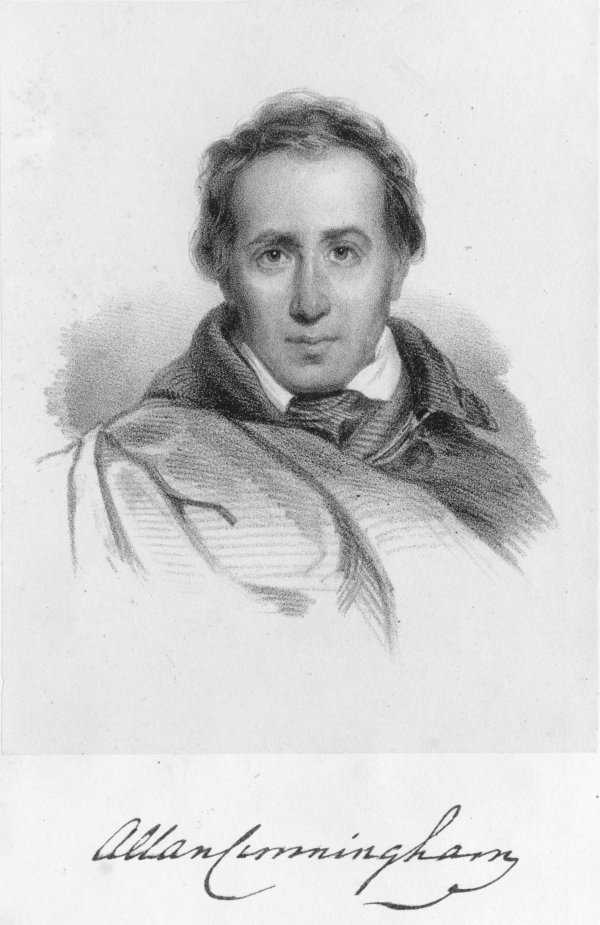 Allan Cunningham.