The last echoes of the older Border Minstrelsy were dying from the
memory of the aged, and the spirit which had awakened the strains seemed
to have sighed an eternal farewell to its loved haunts in the past,
when, suddenly arousing from a long slumber, it threw the mantle of
inspiration, at the close of last century, over several sons of song,
worthy to bear the lyre of their minstrel sires. Of these,
unquestionably the most remarkable was James Hogg, commonly designated
"The Ettrick Shepherd." This distinguished individual was born in the
bosom of the romantic vale of Ettrick, in Selkirkshire,—one of the most
mountainous and picturesque districts of Scotland. The family of Hogg
claimed descent from Hougo, a Norwegian baron; and the poet's paternal
ancestors at one period possessed the lands of Fauldshope in Ettrick
Forest, and were followers, under the feudal system, of the Knights of
Harden. For several generations they had adopted the simple occupation
of shepherds. On the mother's side, the poet was descended from the
respectable family of Laidlaw,—one of the oldest in Tweeddale, and of
which all the representatives bore the reputation of excelling either in
intellectual vigour or physical energy; they generally devoted
themselves to the pastoral life. Robert Hogg, the poet's father, was a
person of very ordinary sagacity, presenting in this respect a decided
contrast to his wife, Margaret Laidlaw, a woman of superior energy and
cultivated mind. Their family consisted of four sons, of whom the second
was James, the subject of this Memoir. The precise date of his birth is
unknown: he was baptised, according to the Baptismal Register of
Ettrick, his native parish, on the 9th of December 1770.[28]
At the period of his marriage, Robert Hogg was in circumstances of
considerable affluence; he had saved money as a shepherd, and, taking on
lease the two adjoining pastoral farms of Ettrick-hall and
Ettrick-house, he largely stocked them with sheep adapted both for the
Scottish and English markets. During several years he continued to
prosper; but a sudden depression in the market, and the absconding of a
party who was indebted to him, at length exhausted his finances, and
involved him in bankruptcy. The future poet was then in his sixth year.
In this destitute condition, the family experienced the friendship and
assistance of Mr Brydon, tenant of the neighbouring farm of Crosslee,
who, leasing Ettrick-house, employed Robert Hogg as his shepherd. But
the circumstances of the family were much straitened by recent reverses;
and the second son, young as he was, and though he had only been three
months at school, was engaged as a cow-herd, his wages for six months
being only a ewe-lamb and a pair of shoes! Three months' further
attendance at school, on the expiry of his engagement, completed the
future bard's scholastic instructions. It was the poet's lot, with the
exception of these six months' schooling, to receive his education among
the romantic retreats and solitudes of Nature. First as a cow-herd, and
subsequently through the various gradations of shepherd-life, his days,
till advanced manhood, were all the year round passed upon the hills.
And such hills! The mountains of Ettrick and Yarrow are impressed with
every feature of Highland scenery, in its wildest and most striking
aspects. There are stern summits, enveloped in cloud, and stretching
heavenwards; huge broad crests, heathy and verdant, or torn by fissures
and broken by the storms; deep ravines, jagged, precipitate, and
darksome; and valleys sweetly reposing amidst the sublimity of the awful
solitude. There are dark craggy mountains around the Grey-Mare's-Tail,
echoing to the roar of its stupendous cataract; and romantic and
beautiful green hills, and inaccessible heights, surrounding and
towering over St Mary's Loch, and the Loch of the Lowes. To the
sublimity of that vast academy, in which he had learned to invoke the
Muse, the poet has referred in the "Queen's Wake":—
"The bard on Ettrick's mountain green,
In Nature's bosom nursed had been;
And oft had mark'd in forest lone
The beauties on her mountain throne;
Had seen her deck the wildwood tree,
And star with snowy gems the lea;
In loveliest colours paint the plain,
And sow the moor with purple grain;
By golden mead and mountain sheer,
Had view'd the Ettrick waving clear,
When shadowy flocks of purest snow
Seem'd grazing in a world below."
Glorious as was his academy, the genius of the poet was not precocious.
Forgetting everything he had learned at school, he spent his intervals
of toil in desultory amusements, or in pursuing his own shadow upon the
hills. As he grew older, he discovered the possession of a musical ear;
and saving five shillings of his earnings, he purchased an old violin,
upon which he learned to play his favourite tunes. He had now attained
his fourteenth year; and in the constant hope of improving his
circumstances, had served twelve masters.
The life of a cow-herd affords limited opportunities for mental
improvement. And the early servitude of the Ettrick Shepherd was spent
in excessive toil, which his propensities to fun and frolic served just
to render tolerable. When he reached the respectable and comparatively
easy position of a shepherd, he began to think of teaching himself to
read. From Mrs Laidlaw, the wife of the farmer at Willinslee, on which
he served, he was privileged with the loan of two works, of which the
reputation had been familiar to him from childhood. These were Henry the
Minstrel's "Life and Adventures of Sir William Wallace," and the "Gentle
Shepherd" of Allan Ramsay. On these the future poet with much difficulty
learned to read, in his eighteenth year. He afterwards read a number of
theological works, from his employer's collection of books; and among
others of a speculative cast, "Burnet's Theory of the Conflagration of
the Earth," the perusal of which, he has recorded, "nearly overturned
his brain."
At Whitsunday 1790, in his twentieth year, Hogg entered the service, as
shepherd, of Mr James Laidlaw, tenant of Blackhouse,—a farm situate on
the Douglasburn in Yarrow. This proved the most signally fortunate step
which he had yet taken. Mr Laidlaw was a man of singular shrewdness and
of a highly cultivated mind; he readily perceived his shepherd's
aptitude for learning, and gave him the use of his library. But the
poet's connexion with Blackhouse was especially valuable in enabling him
to form the intimacy of Mr William Laidlaw, his master's son, the future
factor and amanuensis of Sir Walter Scott. Though ten years his junior,
and consequently a mere youth at the period of his coming to Blackhouse,
young Laidlaw began early to sympathise with the Shepherd's
predilections, and afterwards devoted a large portion of time to his
society. The friendship which ensued proved useful to both. A MS.
narrative of the poet's life by this unfailing friend, which has been
made available in the preparation of this Memoir, enables us to supply
an authentic account of this portion of his career. "He was not long,"
writes Mr Laidlaw, "in going through all the books belonging to my
father; and learning from me that Mr Elder, bookseller, Peebles, had a
large collection of books which he used as a circulating library, he
forthwith became a subscriber, and by that means read Smollett's and
Fielding's novels, and those voyages and travels which were published at
the time, including those of Cook, Carteret, and others."
The progress of the Shepherd in learning was singularly tardy. He was,
by a persevering course of reading, sufficiently familiar with the more
esteemed writers in English literature, ere he attempted penmanship. He
acquired the art upon the hill-side by copying the Italian alphabet,
using his knees as his desk, and having his ink-bottle suspended from
his button. In his twenty-sixth year he first essayed to write
verses,—an effort attended, in the manual department, with amusing
difficulty, for he stripped himself of his coat and vest to the
undertaking, yet could record only a few lines at a sitting! But he was
satisfied with the fame derived from his verses, as adequate
compensation for the toil of their production; he wrote for the
amusement of the shepherd maidens, who sung them to their favourite
tunes, and bestowed on him the prized designation of "Jamie the Poeter."
At the various gatherings of the lads and lasses in the different
homesteads, then frequent in this pastoral district, he never failed to
present himself, and had golden opportunities of winning the chaplet of
applause, both for the strains of his minstrelsy, and the music of his
violin. These réunions were not without their influence in stimulating
him to more ambitious efforts in versification.
The Shepherd's popularity, while tending the flocks of Mr Laidlaw at
Blackhouse, was not wholly derived from his skill as a versifier, and
capabilities as a musician, but, among the fairer portion of the
creation, was perhaps scarcely less owing to the amenity of his
disposition, combined with the handsomeness of his person. As a
candidate for the honour of feminine approbation, he was successful
alike in the hall and on the green: the rumour of his approach at any
rural assemblage or merry-meeting was the watchword for increased mirth
and happiness. If any malignant rival had hinted aught to his prejudice,
the maidens of the whole district had assembled to vindicate his cause.
His personal appearance at this early period is thus described by Mr
William Laidlaw:—"About nineteen years of age, Hogg was rather above
the middle height, of faultless symmetry of form; he was of almost
unequalled agility and swiftness. His face was then round and full, and
of a ruddy complexion, with bright blue eyes that beamed with gaiety,
glee, and good-humour, the effect of the most exuberant animal spirits.
His head was covered with a singular profusion of light-brown hair,
which he was obliged to wear coiled up under his hat. On entering church
on a Sunday (where he was all his life a regular attender) he used, on
lifting his hat, to raise his right hand to assist a graceful shake of
his head in laying back his long hair, which rolled down his back, and
fell below his loins. And every female eye was upon him, as, with light
step, he ascended the stair to the gallery where he sat."
As the committing of his thoughts to paper became a less irksome
occupation, Hogg began, with commendable prudence, to attempt
composition in prose; and in evidence of his success, he had the
satisfaction to find short essays which he sent to the Scots Magazine
regularly inserted in that periodical. Poetry was cultivated at the same
time with unabated ardour, though the bard did not yet venture to expose
his verses beyond the friendly circle of his associates in Ettrick
Forest. Of these, the most judicious was young Laidlaw; who, predicting
his success, urged him to greater carefulness in composition. There was
another stimulus to his improvement. Along with several shepherds in the
forest, who were of studious inclinations, he formed a literary society,
which proposed subjects for competition in verse, and adjudged encomiums
of approbation to the successful competitors. Two spirited members of
this literary conclave were Alexander Laidlaw, a shepherd, and
afterwards tenant of Bowerhope, on the border of St Mary's Lake, and the
poet's elder brother, William, a man of superior talent. Both these
individuals subsequently acquired considerable distinction as
intelligent contributors to the agricultural journals. For some years,
William Hogg had rented the sheep-farm of Ettrick-house, and afforded
shelter and support to his aged and indigent parents. In the year 1800,
he resigned his lease to the poet, having taken another farm on the
occasion of his marriage. James now established himself, along with his
parents, at Ettrick-house, the place of his nativity, after a period of
ten years' connexion with Mr Laidlaw of Blackhouse, whose conduct
towards him, to use his own words, had proved "much more like that of a
father than a master." It was during the course of a visit to Edinburgh
in the same year, that an accidental circumstance gave a wider range to
his poetical reputation. Spending an evening with a party of friends in
the Crown Tavern, he was solicited for a song. He sung the last which he
had composed; it was "Donald Macdonald." The reception was a roar of
applause, and one of the party offered to get it set to music and
published. The song was issued anonymously from the music establishment
of Mr John Hamilton of Edinburgh. Within a few months it was sung in
every district of the kingdom; and, at a period when the apprehended
invasion of Napoleon filled the hearts of the nation with anxiety, it
was hailed as an admirable stimulus to patriotism. In the preparation of
the "Minstrelsy of the Scottish Border," Scott had been largely indebted
to the intelligent peasantry of the south. He was now engaged in making
collections for his third volume, and had resolved to examine the
pastoral inhabitants of Ettrick and Yarrow. Procuring a note of
introduction from his friend Leyden to young Laidlaw, Scott arrived at
Blackhouse during the summer of 1801, and in his native home formed the
acquaintance of his future steward. To his visitor, Laidlaw commended
Hogg as the best qualified in the forest to assist him in his
researches; and Scott, who forthwith accompanied Laidlaw to
Ettrick-house, was more than gratified by an interview with the
shepherd-bard. "He found," writes his biographer, "a brother poet, a
true son of nature and genius, hardly conscious of his powers.... As
yet, his naturally kind and simple character had not been exposed to any
of the dangerous flatteries of the world; his heart was pure; his
enthusiasm buoyant as that of a happy child; and well as Scott knew that
reflection, sagacity, wit and wisdom, were scattered abundantly among
the humblest rangers of these pastoral solitudes, there was here a depth
and a brightness that filled him with wonder, combined with a quaintness
of humour, and a thousand little touches of absurdity, which afforded
him more entertainment, as I have often heard him say, than the best
comedy that ever set the pit in a roar." Scott remained several days in
the forest, daily accompanied in his excursions by Hogg and Laidlaw,
both of whom rapidly warmed in his regard. From the recitation of the
Shepherd's mother, he obtained important and interesting accessions to
his Minstrelsy.
With the exception of the song of "Donald Macdonald," Hogg had not yet
published verses. His début as an author was sufficiently
unpropitious. Shortly after Scott's visit, he had been attending the
Monday sheep-market in Edinburgh, and being unable to dispose of his
entire stock, was necessitated to remain in the city till the following
Wednesday. Having no acquaintances, he resolved to employ the interval
in writing from recollection several of his poems for the press. Before
his departure, he gave the pieces to a printer; and shortly after, he
received intimation that a thousand copies were ready for delivery. On
comparing the printed sheets with his MSS. at Ettrick, he had the
mortification of discovering "many of the stanzas omitted, others
misplaced, and typographical errors abounding in every page." The little
brochure, imperfect as it was, sold rapidly in the district; for the
Shepherd had now a considerable circle of admirers, and those who had
ridiculed his verse-making, kept silent since Scott's visit to him. A
copy of the pamphlet is preserved in the Advocates' Library; it consists
of sixty-two pages octavo, and is entitled, "Scottish Pastorals, Poems,
Songs, &c., mostly written in the Dialect of the South, by James Hogg.
Edinburgh: printed by John Taylor, Grassmarket, 1801. Price One
Shilling." The various pieces evince poetic power, unhappily combined
with a certain coarseness of sentiment. One of the longer ballads,
"Willie and Keatie," supposed to be a narrative of one of his early
amours, obtained a temporary popularity, and was copied into the
periodicals. It is described by Allan Cunningham as a "plain, rough-spun
pastoral, with some fine touches in it, to mark that better was coming."
The domestic circumstances of the Shepherd were meanwhile not
prosperous; he was compelled to abandon the farm of Ettrick-house, which
had been especially valuable to him, as affording a comfortable home to
his venerated parents. In the hope of procuring a situation as an
overseer of some extensive sheep-farm, he made several excursions into
the northern Highlands, waiting upon many influential persons, to whom
he had letters of recommendation. These journeys were eminently
advantageous in acquainting him with many interesting and celebrated
scenes, and in storing his mind with images drawn from the sublimities
and wild scenery of nature, but were of no account as concerned the
object for which they were undertaken. Without procuring employment, he
returned, with very reduced finances, to Ettrick Forest. He published a
rough narrative of his travels in the Scots Magazine; and wrote two
essays on the rearing and management of sheep, for the Highland Society,
which were acknowledged with premiums. Frustrated in an attempt to
procure a farm from the Duke of Buccleuch, and declining an offer of
Scott to appoint him to the charge of his small sheep-farm at Ashestiel,
he was led to indulge in the scheme of settling in the island of Harris.
It was in the expectation of being speedily separated from the loved
haunts of his youth, that he composed his "Farewell to Ettrick,"
afterwards published in the "Mountain Bard," one of the most touching
and pathetic ballads in the language. The Harris enterprise was not
carried out; and the poet, "to avoid a great many disagreeable questions
and explanations," went for several months to England. Fortune still
frowned, and the ambitious but unsuccessful son of genius had to return
to his former subordinate occupation as a shepherd. He entered the
employment of Mr Harkness of Mitchel-Slack, in Nithsdale.
Dissatisfied with the imitations of ancient ballads in the third volume
of "The Border Minstrelsy," Hogg proceeded to embody some curious
traditions in this kind of composition. He transmitted specimens to
Scott, who warmly commended them, and suggested their publication. The
result appeared in the "Mountain Bard," a collection of poems and
ballads, which he published in 1803, prefixed with an account of his
life. From the profits of this volume, with the sum of eighty-six pounds
paid him by Constable for the copyright of his two treatises on sheep,
he became master of three hundred pounds. With this somewhat startling
acquisition, visions of prosperity arose in his ardent and enthusiastic
mind. He hastily took in lease the pastoral farm of Corfardin, in the
parish of Tynron, Dumfriesshire, to which he afterwards added the lease
of another large farm in the same neighbourhood. Misfortune still
pursued him; he rented one of the farms at a sum exceeding its value,
and his capital was much too limited for stocking the other, while a
disastrous murrain decimated his flock. Within the space of three years
he was again a penniless adventurer. Removing from the farm-homestead of
Corfardin, he accepted the generous invitation of his hospitable
neighbour, Mr James Macturk of Stenhouse, to reside in his house till
some suitable employment might occur. At Stenhouse he remained three
months; and he subsequently acknowledged the generosity of his friend,
by honourably celebrating him in the "Queen's Wake." Writing to Mr
Macturk, in 1814, he remarks, in reference to his farming at Corfardin,
"But it pleased God to take away by death all my ewes and my lambs, and
my long-horned cow, and my spotted bull, for if they had lived, and if I
had kept the farm of Corfardin, I had been a lost man to the world, and
mankind should never have known the half that was in me. Indeed, I can
never see the design of Providence in taking me to your district at all,
if it was not to breed my acquaintance with you and yours, which I hope
will be one source of happiness to me as long as I live. Perhaps the
very circumstance of being initiated into the mysteries of your
character,[29] is of itself a sufficient compensation for all that I
suffered in your country."
Disappointed in obtaining an ensigncy in a Militia Regiment, through the
interest of Sir Walter Scott, and frustrated in every other attempt to
retain the social position he had gained, he returned to Ettrick, once
more to seek employment in his original occupation. But if friendship
had somewhat failed him, on his proving unsuccessful at Ettrick-house,
his prestige was now completely gone; old friends received him coldly,
and former employers declined his services. He found that, till he
should redeem his reputation for business and good management, there was
no home for him in Ettrick Forest. Hogg was not a man who would tamely
surrender to the pressure of misfortune: amidst his losses he could
claim the strictest honesty of intention, and he was not unconscious of
his powers. With his plaid over his shoulders, he reached Edinburgh in
the month of February 1810, to begin, in his fortieth year, the career
of a man of letters. The scheme was singularly adventurous, but the die
was cast; he was in the position of the man on the tread-wheel, and felt
that he must write or perish.
It affords no matter of surprise that the Shepherd was received coldly
by the booksellers, and that his offers of contributing to their
periodicals were respectfully declined. His volume, "The Mountain Bard,"
had been forgotten; and though his literary fitness had been undisputed,
his lengthened want of success in life seemed to imply a doubt of his
general steadiness. Mr Constable, his former publisher, proved the most
friendly; he consented to publish a collection of songs and ballads,
which he had prepared, two-thirds being his own composition, and the
remainder that of his ingenious friends. This publication, known as "The
Forest Minstrel," had a slow sale, and conferred no benefit on the
unfortunate author. What the booksellers would not do for him, Hogg
resolved to do for himself; he originated a periodical, which he
designated "The Spy," acting as his own publisher. The first number of
this publication—a quarto weekly sheet, price fourpence—was issued on
the first of September 1810. With varied popularity, this paper existed
during the space of a year; and owing to the perseverance of the
conductor might have subsisted a longer period, but for a certain
ruggedness which occasionally disfigured it. As a whole, being chiefly
the composition of a shepherd, who could only read at eighteen, and
write at twenty-six, and who, to use his own words, "knew no more of
human life or manners than a child," the work presented a remarkable
record in the annals of literature. As a business concern, it did not
much avail the projector, but it served indirectly towards improving his
condition, by inducing the habit of composing readily, and with
undeviating industry. A copy of "The Spy" is now rare.
From his literary exertions, Hogg was long, subsequent to his arrival in
the metropolis, in deriving substantial pecuniary emolument. In these
circumstances, he was fortunate in the friendship of Mr John Grieve, and
his partner Mr Henry Scott, hat manufacturers in the city, who, fully
appreciating his genius, aided him with money so long as he required
their assistance. These are his own words, "They suffered me to want for
nothing, either in money or clothes, and I did not even need to ask
these." To Mr Grieve, Hogg was especially indebted; six months he was an
inmate of his house, and afterwards he occupied comfortable lodgings,
secured him by his friend's beneficence. Besides these two invaluable
benefactors, the Shepherd soon acquired the regard and friendship of
several respectable men of letters, both in Edinburgh and elsewhere. As
contributors to "The Spy," he could record the names of James Gray of
the High School, and his accomplished wife; Thomas Gillespie, afterwards
Professor of Humanity in the University of St Andrews; J. Black,
subsequently of the Morning Chronicle; William Gillespie, the
ingenious minister of Kells; and John Sym, the renowned Timothy Tickler
of the "Noctes." Of these literary friends, Mr James Gray was the more
conspicuous and devoted. This excellent individual, the friend of so
many literary aspirants, was a native of Dunse, and had the merit of
raising himself from humble circumstances to the office of a master in
the High School of Edinburgh. Possessed of elegant and refined tastes,
an enthusiastic admirer of genius, and a poet himself,[30] Mr Gray
entertained at his table the more esteemed wits of the capital; he had
extended the hand of hospitality to Burns, and he received with equal
warmth the author of "The Forest Minstrel." In the exercise of
disinterested beneficence, he was aided and encouraged by his second
wife, formerly Miss Peacock, who sympathised in the lettered tastes of
her husband, and took delight in the society of men of letters. They
together made annual pedestrian excursions into the Highlands, and the
narrative of their adventures proved a source of delightful instruction
to their friends. Mr Gray, after a lengthened period of residence in
Edinburgh, accepted, in the year 1821, the Professorship of Latin in the
Institution at Belfast; he subsequently took orders in the Church of
England, and proceeded to India as a chaplain. In addition to his
chaplaincy, he held the office of preceptor to one of the native princes
of Hindostan. He died at Bhoog, in the kingdom of Cutch, on the 25th of
September 1830; and if we add that he was a man of remarkable learning,
his elegy may be transcribed from the "Queen's Wake:"—
"Alike to him the south and north,
So high he held the minstrel worth;
So high his ardent mind was wrought,
Once of himself he never thought."
As the circle of the poet's friends increased, a scheme was originated
among them, which was especially entertained by the juniors, of
establishing a debating society for mutual improvement. This institution
became known as the Forum; meetings were held weekly in a public hall of
the city, and strangers were admitted to the discussions on the payment
of sixpence a-head. The meetings were uniformly crowded; and the
Shepherd, who held the office of secretary, made a point of taking a
prominent lead in the discussions. He spoke once, and sometimes more
frequently, at every meeting, making speeches, both studied and
extemporaneous, on every variety of theme; and especially contributed,
by his rough-spun eloquence, to the popularity of the institution. The
society existed three years; and though yielding the secretary no
pecuniary emolument, proved a new and effective mean of extending his
acquaintance with general knowledge.
Hogg now took an interest in theatricals, and produced two dramas, one
of which, a sort of musical farce, was intended as a burlesque on the
prominent members of the Forum, himself included. This he was induced,
on account of the marked personalities, to confine to his repositories;
he submitted the other to Mr Siddons, who commended it, but it never was
brought upon the stage. He was about to appear before the world in his
most happy literary effort, "The Queen's Wake,"—a composition
suggested by Mr Grieve. This ingenious individual had conceived the
opinion that a republication of several of the Shepherd's ballads in
"The Spy," in connexion with an original narrative poem, would arrest
public attention as to the author's merits; while a narrative having
reference to the landing of the beautiful and unfortunate Queen Mary,
seemed admirably calculated to induce a general interest in the poem.
The proposal, submitted to Allan Cunningham and Mr Gray, received their
warm approbation; and in a few months the entire composition was ready
for the press. Mr Constable at once consented to undertake the
publication; but a more advantageous offer being made by Mr George
Goldie, a young bookseller, "The Queen's Wake" issued from his
establishment in the spring of 1813. Its success was complete; two
editions were speedily circulated, and the fame of the author was
established. With the exception of the Eclectic Review, every
periodical accorded its warmest approbation to the performance; and
vacillating friends, who began to doubt the Shepherd's power of
sustaining the character he had assumed as a poet and a man of letters,
ceased to entertain their misgivings, and accorded the warmest tributes
to his genius. A commendatory article in the Edinburgh Review, in
November 1814, hailed the advent of a third edition.
By the unexpected insolvency of his publisher, while the third edition
was in process of sale, Hogg had nearly sustained a recurrence of
pecuniary loss. This was, however, fortunately prevented by the
considerate beneficence of Mr Goldie's trustees, who, on receiving
payment of the printing expenses, made over the remainder of the
impression to the author. One of the trustees was Mr Blackwood,
afterwards the celebrated publisher of Blackwood's Edinburgh Magazine.
Hogg had now attained the unenviable reputation of a literary prodigy,
and his studies were subject to constant interruption from admirers, and
the curious who visited the capital. But he gave all a cordial
reception, and was never less accessible amidst the most arduous
literary occupation. There was one individual whose acquaintance he was
especially desirous of forming; this was John Wilson, whose poem, "The
Isle of Palms," published in 1812, had particularly arrested his
admiration. Wilson had come to reside in Edinburgh during a portion of
the year, but as yet had few acquaintances in the city. He was slightly
known to Scott; but a peculiarity of his was a hesitation in granting
letters of introduction. In despair of otherwise meeting him, Hogg, who
had reviewed his poem in the Scots Magazine, sent him an invitation to
dinner, which the Lake-poet was pleased cordially to accept. That dinner
began one of the most interesting of the Shepherd's friendships; both
the poets were pleased with each other, and the closest intimacy ensued.
It was on his way to visit Wilson, at Elleray, his seat in Cumberland,
during the autumn of 1814, that the Shepherd formed the acquaintance of
the Poet-laureate. He had notified to Southey his arrival at one of the
hotels in Keswick, and begged the privilege of a visit. Southey promptly
acknowledged his summons, and insisted on his remaining a couple of days
at Greta Hall to share his hospitality. Two years could not have more
firmly rivetted their friendship. As a mark of his regard, on returning
to Edinburgh Hogg sent the Laureate the third edition of "The Queen's
Wake," then newly published, along with a copy of "The Spy." In
acknowledging the receipt of these volumes, Southey addressed the
following letter to the Shepherd, which is now for the first time
published:—
"Keswick, December 1, 1814.
"Dear Hogg,—Thank you for your books. I will not say
that 'The Queen's Wake' has exceeded my expectations,
because I have ever expected great things from you,
since, in 1805, I heard Walter Scott, by his own
fireside at Ashestiel, repeat 'Gilmanscleuch.'[31] When
he came to that line—'I ga'e him a' my goud,
father'—the look and the tone with which he gave it
were not needed to make it go through me. But 'The
Wake' has equalled all that I expected. The
improvements in the new edition are very great, and
they are in the two poems which were most deserving of
improvement, as being the most impressive and the most
original. Each is excellent in its way, but 'Kilmeny'
is of the highest character; 'The Witch of Fife' is a
real work of fancy—'Kilmeny' a fine one of
imagination, which is a higher and rarer gift. These
poems have given general pleasure throughout the house;
my eldest girl often comes out with a stanza or two of
'The Witch,' but she wishes sometimes that you always
wrote in English. 'The Spy' I shall go through more at
leisure.
"I like your praise both of myself and my poem, because
it comes from a good quarter. You saw me where and how
a man is best seen—at home, and in his every-day wear
and tear, mind and manners: I have no holiday suit, and
never seek to shine: such as it is, my light is always
burning. Somewhat of my character you may find in
Chaucer's Clerk of Oxenford; and the concluding line of
that description might be written, as the fittest
motto, under my portrait—'Gladly would he learn, and
gladly teach.' I have sinned enough to make me humble
in myself, and indulgent toward others. I have suffered
enough to find in religion not merely consolation, but
hope and joy; and I have seen enough to be contented
in, and thankful for, the state of life in which it has
pleased God to place me.
"We hoped to have seen you on your way back from
Ellery. I believe you did not get the ballad of the
'Devil and the Bishop,' which Hartley transcribed for
you. I am reprinting my miscellaneous poems, collected
into three volumes. Your projected publication[32] will
have the start of it greatly, for the first volume is
not nearly through the press, and there is a corrected
copy of the ballad, with its introduction, in
Ballantyne's hands, which you can make use of before it
will be wanted in its place.
"You ask me why I am not intimate with Wilson. There is
a sufficient reason in the distance between our
respective abodes. I seldom go even to Wordworth's or
Lloyd's; and Ellery is far enough from either of their
houses, to make a visit the main business of a day. So
it happens that except dining in his company once at
Lloyd's many years ago, and breakfasting with him here
not long afterwards, I have barely exchanged
salutations once or twice when we met upon the road.
Perhaps, however, I might have sought him had it not
been for his passion for cock-fighting. But this is a
thing which I regard with abhorrence.
"Would that 'Roderick' were in your hands for
reviewing; I should desire no fairer nor more competent
critic. But it is of little consequence what friends or
enemies may do for it now; it will find its due place
in time, which is slow but sure in its decisions. From
the nature of my studies, I may almost be said to live
in the past; it is to the future that I look for my
reward, and it would be difficult to make any person
who is not thoroughly intimate with me, understand how
completely indifferent I am to the praise or censure of
the present generation, farther than as it may affect
my means of subsistence, which, thank God, it can no
longer essentially do. There was a time when I was
materially injured by unjust criticism; but even then I
despised it, from a confidence in myself, and a natural
buoyancy of spirit. It cannot injure me now, but I
cannot hold it in more thorough contempt.
"Come and visit me when the warm weather returns. You
can go nowhere that you will be more sincerely
welcomed. And may God bless you.
"Robert Southey."
In waging war with the Lake school of poetry, the Edinburgh Review had
dealt harshly with Southey. His poems of "Madoc" and "The Curse of
Kehama" had been rigorously censured, and very shortly before the
appearance of "Roderick," his "Triumphal Ode" for 1814, which was
published separately, had been assailed with a continuance of the same
unmitigated severity. The Shepherd, who knew, notwithstanding the
Laureate's professions of indifference to criticism, that his nature was
sensitive, and who feared that the Review would treat "Roderick" as it
had done Southey's previous productions, ventured to recommend him to
evince a less avowed hostility to Jeffrey, in the hope of subduing the
bitterness of his censure. The letter of Southey, in answer to this
counsel, will prove interesting, in connexion with the literary history
of the period. The Bard of Keswick had hardly advanced to that happy
condition which he fancied he had reached, of being "indulgent toward
others," at least under the influence of strong provocation:—
"Keswick, 24th Dec. 1814.
"Dear Hogg,—I am truly obliged to you for the
solicitude which you express concerning the treatment
'Roderick' may experience in the Edinburgh Review,
and truly gratified by it, notwithstanding my perfect
indifference as to the object in question. But you
little know me, if you imagine that any thoughts of
fear or favour would make me abstain from speaking
publicly of Jeffrey as I think, and as he deserves. I
despise his commendation, and I defy his malice. He
crush the 'Excursion!!!'[33] Tell him that he might as
easily crush Skiddaw. For myself, popularity is not
the mark I shoot at; if it were, I should not write
such poems as 'Roderick;' and Jeffrey can no more stand
in my way to fame, than Tom Thumb could stand in my
way in the street.
"He knows that he has dealt unfairly and maliciously by
me; he knows that the world knows it, that his very
friends know it, and that if he attacks 'Roderick' as
he did 'Madoc' and 'Kehama,' it will be universally
imputed to personal ill-will. On the other hand, he
cannot commend this poem without the most flagrant
inconsistency. This would be confessing that he has
wronged me in the former instances; for no man will
pretend to say that 'Madoc' does not bear marks of the
same hand as 'Roderick;' it has the same character of
language, thought, and feeling; it is of the same ore
and mint; and if the one poem be bad, the other cannot
possibly be otherwise. The irritation of the nettling
(as you term it), which he has already received [a
portion of the letter is torn off and lost]....
Whatever part he may take, my conduct towards him will
be the same. I consider him a public nuisance, and
shall deal with him accordingly.
"Nettling is a gentle term for what he has to undergo.
In due season he shall be scorpioned and
rattlesnaked. When I take him in hand it shall be to
dissect him alive, and make a preparation of him to be
exhibited in terrorem, an example to all future
pretenders to criticism. He has a forehead of native
brass, and I will write upon it with aqua-fortis. I
will serve him up to the public like a turkey's
gizzard, sliced, scored, peppered, salted, cayanned,
grilled, and bedevilled. I will bring him to justice;
he shall be executed in prose, and gibbeted in
verse....[34]
.... "'Roderick' has made good speed in the world, and
ere long I shall send you the poem in a more commodious
shape,[35] for Ballantyne is at this time reprinting
it. I finished my official ode a few days ago. It is
without rhyme, and as unlike other official odes in
matter as in form; for its object is to recommend, as
the two great objects of policy, general education and
extensive colonization. At present, I am chiefly
occupied upon 'The History of Brazil,' which is in the
press—a work of great labour.
"The ladies here all desire to be kindly remembered to
you. I have ordered 'The Pilgrims of the Sun,' and we
look for it with expectation, which, I am sure, will
not be disappointed. God bless you.—Yours very truly,
"Robert Southey."
A review of "Roderick" appeared in the Edinburgh Review for June 1815,
which on the whole was favourable, so that the wrath of the Laureate was
appeased.
During the earlier period of his Edinburgh career, Hogg had formed the
acquaintance of an estimable family in Athol, Mr and Mrs Izett, of
Kinnaird House, and he had been in the habit of spending a portion of
his time every summer at their hospitable residence. In the summer of
1814, while visiting there, he was seized with a severe cold, which
compelled him to prolong his stay with his friends; and Mrs Izett, who
took a warm interest in his welfare, suggested that he might turn his
illness to account, by composing a poem, descriptive of the beauties of
the surrounding scenery. The hint was sufficient; he commenced a
descriptive poem in the Spenserian stanza, which was speedily completed,
and given to the world under the title of "Mador of the Moor." It was
well received; and the author is correct in asserting that it contains
"some of his highest and most fortunate efforts in rhyme." "The
Pilgrims of the Sun" was his next poem; it was originally intended as
one of a series, to be contained in a poetical work, which he proposed
to entitle "Midsummer Night Dreams," but which, on the advice of his
friend, Mr James Park of Greenock, he was induced to abandon. From its
peculiar strain, this poem had some difficulty in finding a publisher;
it was ultimately published by Mr John Murray of London, who liberally
recompensed the author, and it was well received by the press.
The circle of the Shepherd's literary friends rapidly extended. Lord
Byron opened a correspondence with him, and continued to address him in
long familiar letters, such as were likely to interest a shepherd-bard.
Unfortunately, these letters have been lost; it was a peculiarity of
Hogg to be careless in regard to his correspondence. With Wordsworth he
became acquainted in the summer of 1815, when that poet was on his first
visit to Edinburgh. They met at the house, in Queen Street, of the
mother of his friend Wilson; and the Shepherd was at once interested and
gratified by the intelligent conversation and agreeable manners of the
great Lake-poet. They saw much of each other in the city, and afterwards
journeyed together to St Mary's Loch; and the Shepherd had the
satisfaction of entertaining his distinguished brother-bard with the
homely fare of cakes and milk, in his father's cottage at Ettrick.
Wordsworth afterwards made the journey memorable in his poem of "Yarrow
Visited." The poets temporarily separated at Selkirk,—Wordsworth having
secured the promise of a visit from his friend, at Mount Ryedale, prior
to his return to Edinburgh. The promise was duly fulfilled; and the
Shepherd had the pleasure of meeting, during his visit, Lloyd, and De
Quincey, and his dear friend Wilson. A portion of the autumn of 1815 was
spent by the Shepherd at Elleray. In the letter inviting his visit
(dated September 1815), the author of "The Isle of Palms" indicates his
opinion of the literary influence of his correspondent, by writing as
follows:—"If you have occasion soon to write to Murray,[36] pray
introduce something about 'The City of the Plague,' as I shall probably
offer him that poem in about a fortnight, or sooner. Of course, I do not
wish you to say that the poem is utterly worthless. I think that a
bold eulogy from you (if administered immediately), would be of service
to me; but if you do write about it, do not tell him that I have any
intention of offering it to him, but you may say, you hear I am going to
offer it to a London bookseller."
The Shepherd's intimacy with the poets had induced him to entertain a
somewhat plausible scheme of bettering his finances. He proposed to
publish, in a handsome volume, a poem by each of the living bards of
Great Britain. For this purpose, he had secured pieces from Southey,
Wilson, Wordsworth, Lloyd, Morehead, Pringle, Paterson, and some others;
and had received promises of contributions from Lord Byron and Samuel
Rogers. The plan was frustrated by Scott. He was opposed to his
appearing to seek fresh laurels from the labours of others, and
positively refused to make a contribution. This sadly mortified the
Shepherd,[37] and entirely altered his plans. He had now recourse to a
peculiar method of realising his original intention. In the short period
of four weeks, he produced imitations of the more conspicuous bards,
which speedily appeared in a volume entitled "The Poetic Mirror." This
work, singularly illustrative of the versatility of his genius, was
eminently successful, the first edition disappearing in the course of
six weeks. The imitations of the bards were pronounced perfect, only
that of Wordsworth was intentionally a caricature; the Shepherd had been
provoked to it by a conceived slight of the Lake-poet, during his visit
at Mount Ryedale.[38]
"The Poetic Mirror" appeared in 1816; and in the following year the
Shepherd struck out a new path, by publishing two duodecimo volumes of
"Dramatic Tales." This work proved unsuccessful. In 1813 he had
dedicated his "Forest Minstrel" to the Countess of Dalkeith; and this
amiable and excellent woman, afterwards better known as Harriet, Duchess
of Buccleuch, had acknowledged the compliment by a gift of a hundred
guineas, and several other donations. The Shepherd was, however,
desirous of procuring the means of comfortable self-support,
independently of his literary exertions; and had modestly preferred the
request that he might receive a small farm in lease on the Buccleuch
estates. The request was at length responded to. The Duchess, who took a
deep interest in him, made a request to the Duke, on her death-bed, that
something might be done for her ingenious protégé. After her decease,
the late Charles, Duke of Buccleuch, gave the Shepherd a life-lease of
the farm of Altrive Lake, in Yarrow, at a nominal rent, no portion of
which was ever exacted. The Duke subsequently honoured him with his
personal friendship, and made him frequently share of his hospitality.
From the time of his abandoning "The Spy," Hogg had contemplated the
publication of a periodical on an extended scale. At length, finding a
coadjutor in Mr Thomas Pringle, he explained their united proposal to
his friend, Mr Blackwood, the publisher, who highly approved of the
design. Preliminaries were arranged, and the afterwards celebrated
Blackwood's Magazine took its origin. Hogg was now resident at
Altrive, and the editorship was entrusted to Pringle and his literary
friend Cleghorn. The vessel had scarcely been well launched, however, on
the ocean of letters, when storms arose a-head; hot disputes occurred
between the publisher and the editors, which ultimately terminated in
the withdrawal of the latter from the concern, and their connexion with
the Edinburgh Magazine, an opposition periodical established by Mr
Constable. The combating parties had referred to the Shepherd, who was
led to accord his support to Mr Blackwood. He conceived the idea of the
"Chaldee Manuscript," as a means of ridiculing the oppositionists. Of
this famous satire, the first thirty-seven verses of chapter first, with
several other sentences throughout, were his own composition, the
remaining portion being the joint fabrication of his friends Wilson and
Lockhart.[39] This singular production produced a sensation in the
capital unequalled in the history of any other literary performance; and
though, from the evident personalities and the keenness of the satire,
it had to be cancelled, so that a copy in the pages of the magazine is
now a rarity, it sufficiently attained the purpose of directing public
attention to the newly-established periodical. The "Chaldee Manuscript"
appeared in the seventh number of Blackwood's Magazine, published in
October 1817. To the magazine Hogg continued to be a regular
contributor; and, among other interesting compositions, both in prose
and verse, he produced in its pages his narrative of the "Shepherd's
Calendar." His connexion with this popular periodical is more generally
known from the position assigned him in the "Noctes Ambrosianæ" of
Professor Wilson. In those interesting dialogues, the Shepherd is
represented as a character of marvellous shrewdness and sagacity, whose
observations on men and manners, life and literature, uttered, as they
are, in the homeliest phrases, contain a depth of philosophy and vigour
of criticism rarely exhibited in the history of real or fictitious
biography. "In wisdom," writes Professor Ferrier, "the Shepherd equals
the Socrates of Plato; in humour, he surpasses the Falstaff of
Shakspeare; clear and prompt, he might have stood up against Dr Johnson
in close and peremptory argument; fertile and copious, he might have
rivalled Burke in amplitude of declamation; while his opulent
imagination and powers of comical description invest all that he utters,
either with a picturesque mildness or a graphic quaintness peculiarly
his own." These remarks, applicable to the Shepherd of the "Noctes,"
would, indeed, be much overstrained if applied to their prototype; yet
it is equally certain that the leading features of the ideal Shepherd
were depicted from those of the living Shepherd of Ettrick, by one who
knew well how to estimate and appreciate human nature.
On taking possession of his farm of Altrive Lake, which extended to
about seventy acres, Hogg built a small cottage on the place, in which
he received his aged father, his mother having been previously called to
her rest. In the stocking of the farm, he received very considerable
assistance from the profits of a guinea edition of "The Queen's Wake,"
of which the subscribers' list was zealously promoted by Sir Walter
Scott. At Altrive he continued literary composition with unabated
ardour. In 1817, he published "The Brownie of Bodsbeck," a tale of the
period of the Covenant, which attained a considerable measure of
popularity. In 1819, he gave to the world the first volume of his
"Jacobite Relics," the second volume not appearing till 1821. This work,
which bears evidence of extensive labour and research, was favourably
received; the notes are lengthy and copious, and many of the pieces,
which are set to music, have long been popular. His "Winter Evening
Tales" appeared in 1820: several of them were composed on the hills in
early life.
The worldly circumstances of the Shepherd now were such as rendered him
abundantly justifiable in entering into the married state. On the 28th
April 1820, he espoused Miss Margaret Phillips, the youngest daughter of
Mr Phillips, late of Longbridgemoor, in Annandale. By this union he
became brother-in-law of his friend Mr James Gray, whose first wife was
a sister of Mrs Hogg. At the period of his marriage, from the profits of
his writings and his wife's dowry, he was master of nearly a thousand
pounds and a well-stocked farm; and increasing annual gains by his
writings, seemed to augur future independence. But the Shepherd, not
perceiving that literature was his forte, resolved to embark further in
farming speculations; he took in lease the extensive farm of Mount
Benger, adjoining Altrive Lake, expending his entire capital in the
stocking. The adventure proved almost ruinous.
The coronation of George IV. was fixed to take place on the 19th of
July 1821; and Sir Walter Scott having resolved to be among the
spectators, invited the Shepherd to accompany him to London on the
occasion. Through Lord Sidmouth, the Secretary of State, he had procured
accommodation for Hogg at the pageant, which his lordship had granted,
with the additional favour of inviting both of them to dinner, to meet
the Duke of York on the following day. The Shepherd had, however, begun
to feel more enthusiastic as a farmer than a poet, and preferred to
attend the sheep-market at St Boswells. For this seeming lack of
loyalty, he afterwards made ample compensation; he celebrated the King's
visit to Scotland, in August 1822, in "a Masque or Drama," which was
published in a separate form. A copy of this production being laid
before the King by Sir Walter Scott, Sir Robert Peel, then Secretary of
State, received his Majesty's gracious command suitably to acknowledge
it. In his official communication, Sir Robert thanked the Shepherd, in
the King's name, "for the gratifying proof of his genius and loyalty."
It had been Scott's desire to obtain a Civil List pension for the
Shepherd, to aid him in his struggles at Mount Benger; and it was with
something like hope that he informed him that Sir Robert Peel had
expressed himself pleased with his writings. But the pension was never
obtained.
Harassed by pecuniary difficulties, Hogg wrote rapidly, with the view of
relieving himself. In 1822, he published a new edition of his best
poems, in four volumes, for which he received the sum of £200; and in
this and the following year, he produced two works of fiction, entitled,
"The Three Perils of Man," and "The Three Perils of Women," which
together yielded him £300. In 1824, he published "The Confessions of a
Fanatic;" and, in 1826, he gave to the world his long narrative poem of
"Queen Hynde." The last proved unequal to his former poetical efforts.
In 1826, Mr J. G. Lockhart proceeded to London to edit the Quarterly
Review, taking along with him, as his assistant, Robert Hogg, a son of
the Shepherd's elder brother. The occasion afforded the poet an
opportunity of renewing his correspondence with his old friend, Allan
Cunningham. Allan wrote to him as follows:—
"27 Lower Belgrave Place, 16th Feb. 1826.
"My dear James,—It required neither present of book,
nor friend, nor the recalling of old scenes, to render
your letter a most welcome one. You are often present
to my heart and fancy, for your genius and your
friendliness have secured you a place in both. Your
nephew is a fine, modest, and intelligent young man,
and is welcome to my house for his own sake as well as
yours. Your 'Queen Hynde,' for which I thank you,
carries all the vivid marks of your own peculiar cast
of genius about her. One of your very happiest little
things is in the Souvenir of this season—it is pure
and graceful, warm, yet delicate; and we have nought in
the language to compare to it, save everybody's
'Kilmeny.' In other portions of verse you have been
equalled, and sometimes surpassed; but in scenes which
are neither on earth, nor wholly removed from it—where
fairies speak, and spiritual creatures act, you are
unrivalled.
"Often do I tread back to the foot of old
Queensberry,[40] and meet you coming down amid the
sunny rain, as I did some twenty years ago. The little
sodded shealing where we sought shelter rises now on my
sight—your two dogs (old Hector was one) lie at my
feet—the 'Lay of the Last Minstrel' is in my hand, for
the first time, to be twice read over after sermon, as
it really was—poetry, nothing but poetry, is our talk,
and we are supremely happy. Or, I shift the scene to
Thornhill, and there whilst the glass goes round, and
lads sing and lasses laugh, we turn our discourse on
verse, and still our speech is song. Poetry had then a
charm for us, which has since been sobered down. I can
now meditate without the fever of enthusiasm upon me;
yet age to youth owes all or most of its happiest
aspirations, and contents itself with purifying and
completing the conceptions of early years.
"We are both a little older and a little graver than we
were some twenty years ago, when we walked in glory and
joy on the side of old Queensberry. My wife is much the
same in look as when you saw her in Edinburgh—at least
so she seems to me, though five boys and a girl might
admonish me of change—of loss of bloom, and abatement
of activity. My oldest boy resolves to be a soldier; he
is a clever scholar, and his head has been turned by
Cæsar. My second and third boys are in Christ's School,
and are distinguished in their classes; they climb to
the head, and keep their places. The other three are at
their mother's knee at home, and have a strong capacity
for mirth and mischief.
"I have not destroyed my Scottish poem. I mean to
remodel it, and infuse into it something more of the
spark of living life. But my pen has of late strayed
into the regions of prose. Poetry is too much its own
reward; and one cannot always write for a barren smile,
and a thriftless clap on the back. We must live; and
the white bread and the brown can only be obtained by
gross payment. There is no poet and a wife and six
children fed now like the prophet Elijah—they are more
likely to be devoured by critics, than fed by ravens. I
cannot hope that Heaven will feed me and mine while I
sing. So farewell to song for a season.
"My brother's[41] want of success has surprised me too.
He had a fair share of talent; and, had he cultivated
his powers with care, and given himself fair play, his
fate would have been different. But he sees nature
rather through a curious medium than with the tasteful
eye of poetry, and must please himself with the praise
of those who love singular and curious things. I have
said nothing all this while of Mrs Hogg, though I might
have said much, for we hear her household prudence and
her good taste often commended. She comes, too, from my
own dear country—a good assurance of a capital wife
and an affectionate mother. My wife and I send her and
you most friendly greetings. We hope to see you both in
London during the summer.
"You have written much, but you must write more yet.
What say you to a series of poems in your own original
way, steeped from end to end in Scottish superstition,
but purified from its grossness by your own genius and
taste? Do write me soon. I have a good mind to come and
commence shepherd beside you, and aid you in making a
yearly pastoral Gazette in prose and verse for our
ain native Lowlands. The thing would take.
"The evil news of Sir Walter's losses came on me like
an invasion. I wish the world would do for him now what
it will do in fifty years, when it puts up his statue
in every town—let it lay out its money in purchasing
an estate, as the nation did to the Duke of Wellington,
and money could never be laid out more worthily.—I
remain, dear James, your very faithful friend,
"Allan Cunningham."
One of the parties chiefly aggrieved in the matter of the Chaldee MS.
was Thomas Pringle, one of the original editors of Blackwood. This
ingenious person had lately returned from a period of residence in
Southern Africa, and established himself in London as secretary to the
Slave Abolition Society, and a man of letters. Forgetting past
differences, he invited the Shepherd, in the following letter, to aid
him in certain literary enterprises:—
"London, May 19, 1827.
"My dear Sir,—I wrote you a hasty note some time ago,
to solicit your literary aid for the projected work of
Mr Fraser. I now address you on behalf of two other
friends of mine, who are about to start a new weekly
publication, something in the shape of the Literary
Gazette, to be entitled The London Review. The
editors are Mr D. L. Richardson, the author of a volume
of poems chiefly written in India, and a Mr St John, a
young gentleman of very superior talents, whose name
has not yet been (so far as I know) before the public,
though he has been a contributor to several of the
first-rate periodicals. I have no other interest in the
work myself than that of a friend and contributor. The
editors, knowing that I have the pleasure of your
acquaintance, have requested me to solicit your aid to
their work, either in verse or prose, and they will
consider themselves pledged to pay for any
contributions with which you may honour them at the
same rate as Blackwood. May I hope, my dear sir, that
you will, at all events, stretch a point to send them
something for their first number, which is to appear in
the beginning of June....
"I always read your 'Noctes,' and have had many a
hearty laugh with them in the interior of Southern
Africa; for though I detest Blackwood's politics, and
regret to see often such fine talents so sadly
misapplied (as I see the matter), yet I have never
permitted my own political predilections, far less any
reminiscences of old magazine squabbles, to blind me to
the exuberant flow of genius which pervades and
beautifies so many delightful articles in that
magazine.... Believe me always, dear Hogg, yours very
truly,
"Tho. Pringle."
A similar request for contributions was made the year following by
William Howitt. His letter is interesting, as exhibiting the epistolary
style of a popular writer. Howitt, it will be perceived, is a member of
the Society of Friends.
"Nottingham, 12th mo., 20th, 1828.
"Respected Friend,—Herewith I forward, for thy
acceptance, two small volumes, as a trifling testimony
of the high estimation in which we have long held thy
writings. So great was our desire to see thee when my
wife and I were, a few springs ago, making a ramble on
foot through some parts of your beautiful country, that
nothing but the most contrary winds of circumstance
prevented us.
"I am now preparing for the press 'The Book of the
Seasons,' a volume of prose and poetry, intended to
furnish the lover of nature with a remembrancer, to put
him in mind, on the opening of each month, of what he
may look for in his garden, or his country walks; a
notice of all remarkable in the round of the seasons,
and the beautiful in scenery,—of all that is pleasant
in rural sights, sounds, customs, and occupations. I
hope to make it, if I am favoured with health, in a
little time, both a pleasant and original volume, and
one which may do its mite towards strengthening and
diffusing that healthful love of nature which is so
desirable in a great commercial country like this,
where our manufacturing population are daily spreading
over its face, and cut off themselves from the
animating and heart-preserving influence of
nature,—are also swallowing up our forests and heaths,
those free, and solitary, and picturesque places, which
have fostered the soul of poetry in so many of our
noble spirits. I quite envy thy residence in so bold
and beautiful a region, where the eye and the foot may
wander, without being continually offended and
obstructed by monotonous hedge-rows, and abominable
factories. If thou couldst give, from the ample stores
of thy observant mind, a slight sketch or two of
anything characteristic of the seasons, in
mountainous scenery especially, I shall regard them
as apples of gold. I am very anxious to learn whether
any particular customs or festivities are kept up in
the sheep-districts of Scotland at sheep-shearing time,
as were wont of old all over England; and where is
there a man who could solve such a problem like
thyself? I am sensible of the great boldness of my
request; but as my object is to promote the love of
nature, I am willing to believe that I am not more
influenced by such a feeling than thou art. I intend to
have the book got out in a handsome manner, and to have
it illustrated with woodcuts, by the best artists;
being more desirous to give to others that ardent
attachment to the beauties of the country that has
clung to me from a boy, and for the promotion of which
all our real poets are so distinguished, than to
realise much profit. Anything that thou couldst send me
about your country life, or the impression which the
scenery makes upon a poetical mind at different
seasons, on your heaths and among your hills, I should
be proud to acknowledge, and should regard as the gems
of my book. Whether or not, however, it be practicable
or agreeable to thee, I hope to have the pleasure of
presenting thee a copy of the work when it is out. Mary
requests me to present to thee her respectful regards;
and allow me to subscribe myself, with great respect,
thy friend,
"W. Howitt."
In 1829, on the expiry of his lease, Hogg relinquished the farm of Mount
Benger, and returned to his former residence at Altrive. Rumour, ever
ready to propagate tales of misfortune, had busily circulated the
report that, a completely ruined man, he had again betaken himself to
literary labours in the capital. In this belief, Mr Tennant, author of
"Anster Fair," addressed to him the following characteristic letter,
intended, by its good-humoured pleasantries, to soothe him in his
contendings with adversity:—
"Devongrove, 27th June 1829.
"My dear Friend James Hogg,—I have never seen, spoken,
whispered to, handled, or smelt you, since the King's
visit in 1822, when I met you in Edinburgh street, and
inhaled, by juxtaposition, your sweet fraternal breath.
How the Fates have since sundered us! How have you been
going on, fattening and beautifying from one degree to
another of poetical perfection, while I have, under the
chilling shade of the Ochil Hills, been dwindling down
from one degree of poetical extenuation to another,
till at length I am become the very shadow and ghost of
literary leanness! I should now wish to see you, and
compare you as you are now with what you were in your
'Queen's Wake' days. For this purpose, I would be very
fain you would condescend to pay us a visit. I see you
indeed, at times, in the Literary Journal; I see you
in Blackwood, fighting, and reaping a harvest of
beautiful black eyes from the fists of Professor John
Wilson. I see you in songs, in ballads, in calendars. I
see you in the postern of time long elapsed. I see you
in the looking-glass of my own facetious and
song-recalling memory—but I should wish to see you in
the real, visible, palpable, smellable beauty of your
own person, standing before me in my own house, at my
own fireside, in all the halo of your poetical
radiance! Come over, then, if possible, my dear
Shepherd, and stay a night or two with us. You may
tarry with your friend, Mr Bald, one afternoon or so by
the way, and explore the half-forgotten treasures of
the Shakspeare cellars[42]—but you may rest yourself
under the shadow of the Ochil Hills a longer space,
and enjoy the beauties of our scenery, and, such as it
is, the fulness of our hospitality, which, believe me,
will be spouted out upon you freely and rejoicingly.
"To be serious in speech, I really wish you would take
a trip up this way some time during the summer. I
understand you are settled in Edinburgh, and in that
thought have now addressed you. If I am wrong, write
me. Indeed, write me at any rate, as I would wish again
to see your fist at least, though the Fates should
forbid my seeing your person here. But I think you
would find some pleasure in visiting again your Alloa
friends, to say nothing of the happiness we should have
in seeing you at Devongrove.... Be sure to write me
now, James, in answer to this; and believe me to be,
ever most sincerely yours,
"Wm. Tennant."
The Shepherd's next literary undertaking was an edition of Burns,
published at Glasgow. In this task he had an able coadjutor in the poet
Motherwell. In 1831, he published a collected edition of his songs,
which received a wide circulation. On account of some unfortunate
difference with Blackwood, he proceeded in December of that year to
London, with the view of effecting an arrangement for the republication
of his whole works. His reception in the metropolis was worthy of his
fame; he was courted with avidity by all the literary circles, and fêted
at the tables of the nobility. A great festival, attended by nearly two
hundred persons, including noblemen, members of Parliament, and men of
letters, was given him in Freemasons' Hall, on the anniversary of the
birthday of Burns. The duties of chairman were discharged by Sir John
Malcolm, who had the Shepherd on his right hand, and two sons of Burns
on his left. After dinner, the Shepherd brewed punch in the punch-bowl
of Burns, which was brought to the banquet by its present owner, Mr
Archibald Hastie, M.P. for Paisley. He obtained a publisher for his
works in the person of Mr James Cochrane, an enterprising bookseller in
Pall Mall, who issued the first volume of the series on the 31st of
March 1832, under the designation of the "Altrive Tales." By the
unexpected failure of the publisher, the series did not proceed, so that
the unfortunate Shepherd derived no substantial advantage from a three
months' residence in London.
Recent reverses had somewhat depressed his literary ardour; and, though
his immediate embarrassments were handsomely relieved by private
subscriptions and a donation from the Literary Fund, he felt indisposed
vigorously to renew his literary labours. He did not reappear as an
author till 1834, when he published a volume of essays on religion and
morals, under the title of "Lay Sermons on Good Principles and Good
Breeding." This work was issued from the establishment of Mr James
Fraser, of Regent Street. In the May number of Blackwood's Magazine
for 1834, he again appeared before the public in the celebrated
"Noctes," which had been discontinued for upwards of two years, owing
to his misunderstanding with Mr Blackwood. On this subject we are
privileged to publish the following letter, addressed to him by
Professor Wilson:—
"30th April.
"My dear Mr Hogg,—After frequent reflection on the
estrangement that has so long subsisted between those
who used to be such good friends, I have felt convinced
that I ought to put an end to it on my own
responsibility. Without, therefore, asking either you
or Mr Blackwood, I have written a 'Noctes,' in which
my dear Shepherd again appears. I hope you will think I
have done right. I intend to write six within the year;
and it is just, and no more than just, that you should
receive five guineas a sheet. Enclosed is that sum for
No. I. of the new series.
"If you will, instead of writing long tales, for which
at present there is no room, write a 'Series of Letters
to Christopher North,' or, 'Flowers and Weeds from the
Forest,' or, 'My Life at Altrive,' embodying your
opinions and sentiments on all things, angling,
shooting, curling, &c., &c., in an easy characteristic
style, it will be easy for you to add £50 per annum to
the £50 which you will receive for your 'Noctes.' I
hope you will do so.
"I have taken upon myself a responsibility which
nothing but the sincerest friendship could have induced
me to do. You may be angry; you may misjudge my
motives; yet hardly can I think it. Let the painful in
the past be forgotten, and no allusion ever made to it;
and for the future, I shall do all I can to prevent
anything happening that can be disagreeable to your
feelings.—With kind regards to Mrs Hogg and family, I
am ever most sincerely and affectionately yours,
"John Wilson."
During the summer after his return from London, Hogg received what he
accounted his greatest literary honour. He was entertained at a public
dinner, attended by many of the distinguished literary characters both
of Scotland and the sister kingdom. The dinner took place at Peebles,
the chair being occupied by Professor Wilson. In reply to the toast of
his health, he pleasantly remarked, that he had courted fame on the
hill-side and in the city; and now, when he looked around and saw so
many distinguished individuals met together on his account, he could
exclaim that surely he had found it at last!
The career of the Bard of Ettrick was drawing to a close. His firm and
well-built frame was beginning to surrender under the load of anxiety,
as well as the pressure of years. Subsequent to his return from London,
a perceptible change had occurred in his constitution, yet he seldom
complained; and, even so late as April 1835, he gave to the world
evidence of remaining bodily and mental vigour, by publishing a work in
three volumes, under the title of "Montrose Tales." This proved to be
his last publication. The symptoms of decline rapidly increased; and,
though he ventured to proceed, as was his usual habit, to the moors in
the month of August, he could hardly enjoy the pleasures of a sportsman.
He became decidedly worse in the month of October, and was at length
obliged to confine himself to bed. After a severe illness of four weeks,
he died on the 21st of November, "departing this life," writes William
Laidlaw, "as calmly, and, to appearance, with as little pain, as if he
had fallen asleep, in his gray plaid, on the side of the moorland rill."
The Shepherd had attained his sixty-fifth year.
The funeral of the Bard was numerously attended by the population of the
district. Of his literary friends—owing to the remoteness of the
locality—Professor Wilson alone attended. He stood uncovered at the
grave after the rest of the company had retired, and consecrated, by his
tears, the green sod of his friend's last resting-place. With the
exception of Burns and Sir Walter Scott, never did Scottish bard receive
more elegies or tributes to his memory. He had had some variance with
Wordsworth; but this venerable poet, forgetting the past, became the
first to lament his departure. The following verses from his pen
appeared in the Athenæum of the 12th of December:—
"When first descending from the moorlands,
I saw the stream of Yarrow glide,
Along a bare and open valley,
The Ettrick Shepherd was my guide.
"When last along its banks I wander'd,
Through groves that had begun to shed
Their golden leaves upon the pathway,
My steps the Border Minstrel led.
"The mighty minstrel breathes no longer,
'Mid mouldering ruins low he lies;
And death, upon the braes of Yarrow,
Has closed the Shepherd-poet's eyes.
* * * * *
"No more of old romantic sorrows,
For slaughter'd youth or love-lorn maid,
With sharper grief is Yarrow smitten,
And Ettrick mourns with her their Shepherd dead!"
Within two bow-shots of the place where lately stood the cottage of his
birth, the remains of James Hogg are interred in the churchyard of
Ettrick. At the grave a plain tombstone to his memory has been erected
by his widow. "When the dark clouds of winter," writes Mr Scott Riddell,
"pass away from the crest of Ettrick-pen, and the summits of the
nearer-lying mountains, which surround the scene of his repose, and the
yellow gowan opens its bosom by the banks of the mountain stream, to
welcome the lights and shadows of the spring returning over the land,
many are the wild daisies which adorn the turf that covers the remains
of The Ettrick Shepherd. And a verse of one of the songs of his early
days, bright and blissful as they were, is thus strikingly verified,
when he says—
'Flow, my Ettrick! it was thee
Into my life that first did drop me;
Thee I 'll sing, and when I dee,
Thou wilt lend a sod to hap me.
Pausing swains will say, and weep,
Here our Shepherd lies asleep.'"
As formerly described, Hogg was, in youth, particularly good-looking and
well-formed. A severe illness somewhat changed the form of his features.
His countenance[43] presented the peculiarity of a straight cheekbone;
his forehead was capacious and elevated, and his eye remarkable for its
vivacity. His hair, in advanced life, became dark brown, mixed with
gray. He was rather above the middle height, and was well-built; his
chest was broad, his shoulders square, and his limbs well-rounded. He
disliked foppery, but was always neat in his apparel: on holidays he
wore a suit of black. Forty years old ere he began to mix in the circles
of polished life, he never attained a knowledge of the world and its
ways; in all his transactions he retained the simplicity of the pastoral
character. His Autobiography is the most amusing in the language, from
the honesty of the narrator; never before did man of letters so minutely
reveal the history of his foibles and failings. He was entirely
unselfish and thoroughly benevolent; the homeless wanderer was sure of
shelter under his roof, and the poor of some provision by the way.
Towards his aged parents his filial affection was of the most devoted
kind. Hospitable even to a fault, every visitor received his kindly
welcome, and his visitors were more numerous than those of any other man
of letters in the land.[44] Fond of conviviality, he loved the
intercourse of congenial minds; the voice of friendship was always more
precious to him than the claims of business. He was somewhat expert in
conversation; he talked Scotch on account of long habit, and because it
was familiar to him. He was possessed of a good musical ear, and loved
to sing the ballads of his youth, with several of his own songs; and the
enthusiasm with which he sung amply compensated for the somewhat
discordant nature of his voice. A night with the Shepherd was an event
to be remembered. He was zealous in the cause of education; and he built
a school at Altrive, and partly endowed a schoolmaster, for the benefit
of the children of the district. A Jacobite as respected the past, he
was in the present a devoted loyalist, and strongly maintained that the
stability of the state was bound up in the support of the monarchy; he
had shuddered at the atrocities of the French Revolution, and
apprehended danger from precipitate reform; his politics were strictly
conservative. He was earnest on the subject of religion, and regular in
his attendance upon Divine ordinances. When a shepherd, he had been in
the habit of conducting worship in the family during the absence or
indisposition of his employer, and he was careful in impressing the
sacredness of the duty upon his own children. During his London visit,
he prepared and printed a small book of prayers and hymns for the use of
his family, which he dedicated to them as a New Year's gift. These
prayers are eminently devotional, and all his hymns breathe the language
of fervency and faith. From the strict rules of morality he may have
sometimes deviated, but it would be the worst exercise of
uncharitableness to doubt of his repentance.
It is the lot of men of genius to suffer from the envenomed shafts of
calumny and detraction. The reputation of James Hogg has thus bled. Much
has been said to his prejudice by those who understood not the simple
nature of his character, and were incapable of forming an estimate of
the principles of his life. He has been broadly accused[45] of doing an
injury to the memory of Sir Walter Scott, who was one of his best
benefactors; to which it might be a sufficient reply, that he was
incapable of perpetrating an ungenerous act. But how stands the fact?
Hogg strained his utmost effort to do honour to the dust of his
illustrious friend! He published reminiscences of him in a small volume,
and in such terms as the following did he pronounce his eulogy:—"He had
a clear head as well as a benevolent heart; was a good man, an anxiously
kind husband, an indulgent parent, and a sincere, forgiving friend; a
just judge, and a punctual correspondent.... Such is the man we have
lost, and such a man we shall never see again. He was truly an
extraordinary man,—the greatest man in the world."[46] Was ever more
panegyrical language used in biography? But Hogg ventured to publish his
recollections of his friend, instead of supplying them for the larger
biography; perhaps some connexion may be traced between this fact and
the indignation of Scott's literary executor! Possessed, withal, of a
genial temper, he was sensitive of affront, and keen in his expressions
of displeasure; he had his hot outbursts of anger with Wilson and
Wordsworth, and even with Scott, on account of supposed slights, but his
resentment speedily subsided, and each readily forgave him. He was
somewhat vain of his celebrity, but what shepherd had not been vain of
such achievements?
Next to Robert Burns, the Ettrick Shepherd is unquestionably the most
distinguished of Scottish bards, sprung from the ranks of the people: in
the region of the imagination he stands supreme. A child of the forest,
nursed amidst the wilds and tutored among the solitudes of nature, his
strong and vigorous imagination had received impressions from the
mountain, the cataract, the torrent, and the wilderness, and was filled
with pictures and images of the mysterious, which those scenes were
calculated to awaken. "Living for years in solitude," writes Professor
Wilson,[47] "he unconsciously formed friendships with the springs, the
brooks, the caves, the hills, and with all the more fleeting and
faithless pageantry of the sky, that to him came in place of those human
affections, from whose indulgence he was debarred by the necessities
that kept him aloof from the cottage fire, and up among the mists on the
mountain top. The still green beauty of the pastoral hills and vales
where he passed his youth, inspired him with ever-brooding visions of
fairy-land, till, as he lay musing in his lonely shieling, the world of
phantasy seemed, in the clear depths of his imagination, a lovelier
reflection of that of nature, like the hills and heavens more softly
shining in the water of his native lake." Hogg was in his element, as he
revelled amid the supernatural, and luxuriated in the realms of faëry:
the mysterious gloom of superstition was lit up into brilliancy by the
potent wand of his enchantment, and before the splendour of his genius.
His ballad of "Kilmeny," in the "Queen's Wake," is the emanation of a
poetical mind evidently of the most gifted order; never did bard
conceive a finer fairy tale, or painter portray a picture of purer, or
more spiritual and exquisite sweetness. "The Witch of Fife," another
ballad in "The Wake," has scarcely a parallel in wild unearthliness and
terror; and we know not if sentiments more spiritual or sublime are to
be found in any poetry than in some passages of "The Pilgrims of the
Sun." His ballads, generally in his peculiar vein of the romantic and
supernatural, are all indicative of power; his songs are exquisitely
sweet and musical, and replete with pathos and pastoral dignity. Though
he had written only "When the kye comes hame," and "Flora Macdonald's
Lament," his claims to an honoured place in the temple of Scottish song
had been unquestioned. As a prose-writer, he does not stand high; many
of his tales are interesting in their details, but they are too
frequently disfigured by a rugged coarseness; yet his pastoral
experiences in the "Shepherd's Calendar" will continue to find readers
and admirers while a love for rural habits, and the amusing arts of
pastoral life, finds a dwelling in the Scottish heart.
Of the Shepherd it has been recorded by one[48] who knew him well, that
at the time of his death he had certainly the youngest heart of all who
had ever attained his age; he was possessed of a buoyancy which
misfortune might temporarily depress, but could not subdue. To the close
of his career, he rejoiced in the sports and field exercises of his
youth; in his best days he had, in the games of leaping and running,
been usually victorious in the annual competitions at Eskdalemuir; in
his advanced years, he was constituted judge at the annual Scottish
games at Innerleithen. A sportsman, he was famous alike on the moor and
by the river; the report of his musket was familiar on his native hills;
and hardly a stream in south or north but had yielded him their finny
brood. By young authors he was frequently consulted, and he entered with
enthusiasm into their concerns; many poets ushered their volumes into
the world under his kindly patronage. He had his weaker points; but his
worth and genius were such as to extort the reluctant testimony of one
who was latterly an avowed antagonist, that he was "the most remarkable
man that ever wore the maud of a Shepherd."[49]
Hogg left some MSS. which are still unpublished,—the journals of his
Highland tours being in the possession of Mr Peter Cunningham of London.
Since his death, a uniform edition of many of his best works,
illustrated with engravings from sketches by Mr D. O. Hill, has been
published, with the concurrence of the family, by the Messrs Blackie of
Glasgow, in eleven volumes duodecimo. A Memoir, undertaken for that
edition by the late Professor Wilson, was indefinitely postponed. A
pension on the Civil List of £50 was conferred by the Queen on Mrs Hogg,
the poet's widow, in October 1853; and since her husband's death, she
has received an annuity of £40 from the Duke of Buccleuch. Of a family
of five, one son and three daughters survive, some of whom are
comfortably settled in life.
Air—"Woo'd, and married, and a'."
My name it is Donald Macdonald,
I leeve in the Highlands sae grand;
I hae follow'd our banner, and will do,
Wherever my master[50] has land.
When rankit amang the blue bonnets,
Nae danger can fear me ava;
I ken that my brethren around me
Are either to conquer or fa':
Brogues an' brochin an' a',
Brochin an' brogues an' a';
An' is nae her very weel aff,
Wi' her brogues and brochin an' a'?
What though we befriendit young Charlie?—
To tell it I dinna think shame;
Poor lad! he cam to us but barely,
An' reckon'd our mountains his hame.
'Twas true that our reason forbade us,
But tenderness carried the day;
Had Geordie come friendless amang us,
Wi' him we had a' gane away.
Sword an' buckler an' a',
Buckler an' sword an' a';
Now for George we 'll encounter the devil,
Wi' sword an' buckler and a'!
An' O, I wad eagerly press him
The keys o' the East to retain;
For should he gie up the possession,
We 'll soon hae to force them again,
Than yield up an inch wi' dishonour,
Though it were my finishing blow,
He aye may depend on Macdonald,
Wi' his Hielanders a' in a row:
Knees an' elbows an' a',
Elbows an' knees an' a';
Depend upon Donald Macdonald,
His knees an' elbows an' a'.
Wad Bonaparte land at Fort William,
Auld Europe nae langer should grane;
I laugh when I think how we 'd gall him
Wi' bullet, wi' steel, an wi' stane;
Wi' rocks o' the Nevis and Garny
We 'd rattle him off frae our shore,
Or lull him asleep in a cairny,
An' sing him—"Lochaber no more!"
Stanes an' bullets an a',
Bullets an' stanes an' a';
We 'll finish the Corsican callan
Wi' stanes an' bullets an' a'.
For the Gordon is good in a hurry,
An' Campbell is steel to the bane,
An' Grant, an' Mackenzie, an' Murray,
An' Cameron will hurkle to nane;
The Stuart is sturdy an' loyal,
An' sae is Macleod an' Mackay;
An' I, their gude-brither Macdonald,
Shall ne'er be the last in the fray!
Brogues and brochin an' a',
Brochin an' brogues an' a';
An' up wi' the bonny blue bonnet,
The kilt an' the feather an' a'.
Far over yon hills of the heather sae green,
An' down by the corrie that sings to the sea,
The bonny young Flora sat sighing her lane,
The dew on her plaid, and the tear in her e'e.
She look'd at a boat wi' the breezes that swung,
Away on the wave, like a bird of the main;
An' aye as it lessen'd she sigh'd and she sung,
Fareweel to the lad I shall ne'er see again!
Fareweel to my hero, the gallant and young,
Fareweel to the lad I shall ne'er see again!
The moorcock that craws on the brows of Ben-Connal,
He kens of his bed in a sweet mossy hame;
The eagle that soars o'er the cliffs of Clan-Ronald,
Unawed and unhunted his eyrie can claim;
The solan can sleep on the shelve of the shore,
The cormorant roost on his rock of the sea,
But, ah! there is one whose hard fate I deplore,
Nor house, ha', nor hame in his country has he:
The conflict is past, and our name is no more—
There 's nought left but sorrow for Scotland and me!
The target is torn from the arm of the just,
The helmet is cleft on the brow of the brave,
The claymore for ever in darkness must rust,
But red is the sword of the stranger and slave;
The hoof of the horse, and the foot of the proud,
Have trod o'er the plumes on the bonnet of blue,
Why slept the red bolt in the breast of the cloud,
When tyranny revell'd in blood of the true?
Fareweel, my young hero, the gallant and good!
The crown of thy fathers is torn from thy brow!
Cam ye by Athol, lad wi' the philabeg,
Down by the Tummel or banks o' the Garry,
Saw ye our lads wi' their bonnets and white cockades,
Leaving their mountains to follow Prince Charlie?
Follow thee! follow thee! wha wadna follow thee?
Lang hast thou loved and trusted us fairly!
Charlie, Charlie, wha wadna follow thee,
King o' the Highland hearts, bonnie Prince Charlie?
I hae but ae son, my gallant young Donald;
But if I had ten they should follow Glengarry!
Health to M'Donnell and gallant Clan-Ronald—
For these are the men that will die for their Charlie!
Follow thee! follow thee! &c.
I 'll to Lochiel and Appin, and kneel to them,
Down by Lord Murray, and Roy of Kildarlie;
Brave M'Intosh, he shall fly to the field with them,
These are the lads I can trust wi' my Charlie!
Follow thee! follow thee!&c.
Down through the Lowlands, down wi' the Whigamore!
Loyal true Highlanders, down wi' them rarely!
Ronald and Donald, drive on, wi' the broad claymore,
Over the necks o' the foes o' Prince Charlie!
Follow thee! follow thee! wha wadna follow thee?
Long hast thou loved and trusted us fairly!
Charlie, Charlie, wha wadna follow thee,
King o' the Highland hearts, bonny Prince Charlie?
Bird of the wilderness,
Blithesome and cumberless,
Sweet be thy matin o'er moorland and lea!
Emblem of happiness,
Bless'd is thy dwelling-place—
O to abide in the desert with thee!
Wild is thy lay and loud,
Far in the downy cloud,
Love gives it energy, love gave it birth.
Where on thy dewy wing,
Where art thou journeying?
Thy lay is in heaven, thy love is on earth.
O'er fell and mountain sheen,
O'er moor and mountain green,
O'er the red streamer that heralds the day,
Over the cloudlet dim,
Over the rainbow's rim,
Musical cherub, soar, singing, away!
Then, when the gloaming comes,
Low in the heather blooms,
Sweet will thy welcome and bed of love be!
Emblem of happiness,
Blest is thy dwelling-place—
O to abide in the desert with thee!
Caledonia! thou land of the mountain and rock,
Of the ocean, the mist, and the wind—
Thou land of the torrent, the pine, and the oak,
Of the roebuck, the hart, and the hind:
Though bare are thy cliffs, and though barren thy glens,
Though bleak thy dun islands appear,
Yet kind are the hearts, and undaunted the clans,
That roam on these mountains so drear!
A foe from abroad, or a tyrant at home,
Could never thy ardour restrain;
The marshall'd array of imperial Rome
Essay'd thy proud spirit in vain!
Firm seat of religion, of valour, of truth,
Of genius unshackled and free,
The Muses have left all the vales of the south,
My loved Caledonia, for thee!
Sweet land of the bay and the wild-winding deeps,
Where loveliness slumbers at even,
While far in the depth of the blue water sleeps,
A calm little motionless heaven!
Thou land of the valley, the moor, and the hill,
Of the storm, and the proud-rolling wave—
Yes, thou art the land of fair liberty still,
And the land of my forefathers' grave!
Air—"Over the Border."
O, my lassie, our joy to complete again,
Meet me again i' the gloamin', my dearie;
Low down in the dell let us meet again—
O, Jeanie, there 's naething to fear ye!
Come, when the wee bat flits silent and eiry,
Come, when the pale face o' Nature looks weary;
Love be thy sure defence,
Beauty and innocence—
O, Jeanie, there 's naething to fear ye!
Sweetly blaw the haw an' the rowan tree,
Wild roses speck our thicket sae breery;
Still, still will our walk in the greenwood be—
O, Jeanie, there 's naething to fear ye!
List when the blackbird o' singing grows weary,
List when the beetle-bee's bugle comes near ye,
Then come with fairy haste,
Light foot, an' beating breast—
O, Jeanie, there 's naething to fear ye!
Far, far will the bogle and brownie be,
Beauty an' truth, they darena come near it;
Kind love is the tie of our unity,
A' maun love it, an' a' maun revere it.
'Tis love maks the sang o' the woodland sae cheery,
Love gars a' Nature look bonny that 's near ye;
That makes the rose sae sweet,
Cowslip an' violet—
O, Jeanie, there 's naething to fear ye!
Air—"Shame fa' the gear and the blathrie o't."
Come all ye jolly shepherds,
That whistle through the glen,
I 'll tell ye of a secret
That courtiers dinna ken:
What is the greatest bliss
That the tongue o' man can name?
'Tis to woo a bonny lassie
When the kye comes hame.
When the kye comes hame,
When the kye comes hame,
'Tween the gloamin' an' the mirk,
When the kye comes hame.
'Tis not beneath the coronet,
Nor canopy of state,
'Tis not on couch of velvet,
Nor arbour of the great—
'Tis beneath the spreadin' birk,
In the glen without the name,
Wi' a bonny, bonny lassie,
When the kye comes hame.
When the kye comes hame, &c.
There the blackbird bigs his nest
For the mate he lo'es to see,
And on the topmost bough,
O, a happy bird is he;
Where he pours his melting ditty,
And love is a' the theme,
And he 'll woo his bonny lassie
When the kye comes hame.
When the kye comes hame, &c.
When the blewart bears a pearl,
And the daisy turns a pea,
And the bonny lucken gowan
Has fauldit up her e'e,
Then the laverock frae the blue lift
Doops down, an' thinks nae shame
To woo his bonny lassie
When the kye comes hame.
When the kye comes hame, &c.
See yonder pawkie shepherd,
That lingers on the hill,
His ewes are in the fauld,
An' his lambs are lying still;
Yet he downa gang to bed,
For his heart is in a flame,
To meet his bonny lassie
When the kye comes hame.
When the kye comes hame, &c.
When the little wee bit heart
Rises high in the breast,
An' the little wee bit starn
Rises red in the east,
O there 's a joy sae dear
That the heart can hardly frame,
Wi' a bonny, bonny lassie,
When the kye comes hame!
When the kye comes hame, &c.
Then since all Nature joins
In this love without alloy,
O, wha would prove a traitor
To Nature's dearest joy?
Or wha would choose a crown,
Wi' its perils and its fame,
And miss his bonny lassie
When the kye comes hame?
When the kye comes hame,
When the kye comes home,
'Tween the gloamin' an' the mirk,
When the kye comes hame!
O sarely may I rue the day
I fancied first the womenkind;
For aye sinsyne I ne'er can hae
Ae quiet thought or peace o' mind!
They hae plagued my heart, an' pleased my e'e,
An' teased an' flatter'd me at will,
But aye, for a' their witchery,
The pawky things I lo'e them still.
O, the women folk! O, the women folk!
But they hae been the wreck o' me;
O, weary fa' the women folk,
For they winna let a body be!
I hae thought an' thought, but darena tell,
I 've studied them wi' a' my skill,
I 've lo'ed them better than mysel,
I 've tried again to like them ill.
Wha sairest strives, will sairest rue,
To comprehend what nae man can;
When he has done what man can do,
He 'll end at last where he began.
O, the woman folk, &c.
That they hae gentle forms an' meet,
A man wi' half a look may see;
An' gracefu' airs, an' faces sweet,
An' waving curls aboon the bree;
An' smiles as soft as the young rose-bud,
An' e'en sae pauky, bright, an' rare,
Wad lure the laverock frae the clud—
But, laddie, seek to ken nae mair!
O, the woman folk, &c.
Even but this night, nae farther gane,
The date is neither lost nor lang,
I tak ye witness ilka ane,
How fell they fought, and fairly dang.
Their point they 've carried right or wrang,
Without a reason, rhyme, or law,
An' forced a man to sing a sang,
That ne'er could sing a verse ava.
O, the woman folk! O, the woman folk!
But they hae been the wreck o' me;
O, weary fa' the women folk,
For they winna let a body be!
Come o'er the stream, Charlie,
Dear Charlie, brave Charlie;
Come o'er the stream, Charlie,
And dine with M'Lean;
And though you be weary,
We 'll make your heart cheery,
And welcome our Charlie,
And his loyal train.
We 'll bring down the track deer,
We 'll bring down the black steer,
The lamb from the braken,
And doe from the glen,
The salt sea we 'll harry,
And bring to our Charlie
The cream from the bothy
And curd from the penn.
Come o'er the stream, Charlie,
Dear Charlie, brave Charlie;
Come o'er the sea, Charlie,
And dine with M'Lean;
And you shall drink freely
The dews of Glen-sheerly,
That stream in the starlight
When kings do not ken;
And deep be your meed
Of the wine that is red,
To drink to your sire,
And his friend The M'Lean.
Come o'er the stream, Charlie,
Dear Charlie, brave Charlie;
Come o'er the stream, Charlie,
And dine with M'Lean;
If aught will invite you
Or more will delight you
'Tis ready, a troop of our bold Highlandmen,
All ranged on the heather,
With bonnet and feather,
Strong arms and broad claymores,
Three hundred and ten!
'Twas on a Monday morning,
Right early in the year,
That Charlie cam' to our town,
The young Chevalier.
An' Charlie is my darling,
My darling, my darling;
Charlie is my darling,
The young Chevalier.
As Charlie he came up the gate,
His face shone like the day;
I grat to see the lad come back
That had been lang away.
An' Charlie is my darling, &c.
Then ilka bonny lassie sang,
As to the door she ran,
Our King shall hae his ain again,
An' Charlie is the man:
For Charlie he 's my darling, &c.
Out ow'r yon moory mountain,
An' down the craggy glen,
Of naething else our lasses sing,
But Charlie an' his men.
An' Charlie he 's my darling, &c.
Our Highland hearts are true an' leal,
An' glow without a stain;
Our Highland swords are metal keen,
An' Charlie he 's our ain.
An' Charlie he 's my darling,
My darling, my darling;
Charlie he 's my darling,
The young Chevalier.
Air—"Paddy's Wedding."
I lately lived in quiet ease,
An' never wish'd to marry, O!
But when I saw my Peggy's face,
I felt a sad quandary, O!
Though wild as ony Athol deer,
She has trepann'd me fairly, O!
Her cherry cheeks an' e'en sae clear
Torment me late an' early, O!
O, love, love, love!
Love is like a dizziness,
It winna let a poor body
Gang about his business!
To tell my feats this single week,
Would mak' a daft-like diary, O!
I drave my cart outow'r a dike,
My horses in a miry, O!
I wear my stockings white an' blue,
My love 's sae fierce an' fiery, O!
I drill the land that I should plough,
An' plough the drills entirely, O!
O, love, love, love! &c.
Ae morning, by the dawn o' day,
I rose to theek the stable, O!
I keust my coat an' plied away
As fast as I was able, O!
I wrought that morning out an' out,
As I 'd been redding fire, O!
When I had done an' look'd about,
Gude faith, it was the byre, O!
O, love, love, love! &c.
Her wily glance I 'll ne'er forget,
The dear, the lovely blinkin' o't
Has pierced me through an' through the heart,
An' plagues me wi' the prinklin' o't.
I tried to sing, I tried to pray,
I tried to drown 't wi' drinkin' o't,
I tried wi' sport to drive 't away,
But ne'er can sleep for thinkin' o't.
O, love, love, love! &c.
Nae man can tell what pains I prove,
Or how severe my pliskie, O!
I swear I 'm sairer drunk wi' love
Than e'er I was wi' whisky, O!
For love has raked me fore an' aft,
I scarce can lift a leggie, O!
I first grew dizzy, then gaed daft,
An' soon I 'll dee for Peggy, O!
O, love, love, love!
Love is like a dizziness,
It winna let a poor body
Gang about his business!
O, weel befa' the maiden gay,
In cottage, bught, or penn,
An' weel befa' the bonny May
That wons in yonder glen;
Wha loes the modest truth sae weel,
Wha 's aye kind, an' aye sae leal,
An' pure as blooming asphodel
Amang sae mony men.
O, weel befa' the bonny thing
That wons in yonder glen!
'Tis sweet to hear the music float
Along the gloaming lea;
'Tis sweet to hear the blackbird's note
Come pealing frae the tree;
To see the lambkins lightsome race—
The speckled kid in wanton chase—
The young deer cower in lonely place,
Deep in her flowing den;
But sweeter far the bonny face
That smiles in yonder glen!
O, had it no' been for the blush
O' maiden's virgin flame,
Dear beauty never had been known,
An' never had a name;
But aye sin' that dear thing o' blame
Was modell'd by an angel's frame,
The power o' beauty reigns supreme
O'er a' the sons o' men;
But deadliest far the sacred flame
Burns in a lonely glen!
There 's beauty in the violet's vest—
There 's hinney in the haw—
There 's dew within the rose's breast,
The sweetest o' them a'.
The sun will rise an' set again,
An' lace wi' burning goud the main—
The rainbow bend outow'r the plain,
Sae lovely to the ken;
But lovelier far the bonny thing
That wons in yonder glen!
Air—"The Blue Bells of Scotland."
What are the flowers of Scotland,
All others that excel—
The lovely flowers of Scotland,
All others that excel?
The thistle's purple bonnet,
And bonny heather-bell,
O, they 're the flowers of Scotland,
All others that excel!
Though England eyes her roses
With pride she 'll ne'er forego,
The rose has oft been trodden
By foot of haughty foe;
But the thistle in her bonnet blue,
Still nods outow'r the fell,
And dares the proudest foeman
To tread the heather-bell.
For the wee bit leaf o' Ireland,
Alack and well-a-day!
For ilka hand is free to pu'
An' steal the gem away.
But the thistle in her bonnet blue
Still bobs aboon them a';
At her the bravest darena blink,
Or gie his mou' a thraw.
Up wi' the flowers o' Scotland,
The emblems o' the free,
Their guardians for a thousand years,
Their guardians still we 'll be.
A foe had better brave the deil,
Within his reeky cell,
Than our thistle's purple bonnet,
Or bonny heather-bell.
"Afore the muircock begin to craw,
Lass, an' ye lo'e me, tell me now,
The bonniest thing that ever ye saw,
For I canna come every night to woo."
"The gouden broom is bonny to see,
An' sae is the milk-white flower o' the haw,
The daisy's wee freenge is sweet on the lea,
But the bud of the rose is the bonniest of a'."
"Now, wae light on a' your flow'ry chat,
Lass, an' ye lo'e me, tell me now;
It 's no the thing that I would be at,
An' I canna come every night to woo!
The lamb is bonny upon the brae,
The leveret friskin' o'er the knowe,
The bird is bonny upon the tree—
But which is the dearest of a' to you?"
"The thing that I lo'e best of a',
Lass, an' ye lo'e me, tell me now;
The dearest thing that ever I saw,
Though I canna come every night to woo,
Is the kindly smile that beams on me,
Whenever a gentle hand I press,
And the wily blink frae the dark-blue e'e
Of a dear, dear lassie that they ca' Bess."
"Aha! young man, but I cou'dna see,
What I lo'e best I 'll tell you now,
The compliment that ye sought frae me,
Though ye canna come every night to woo;
Yet I would rather hae frae you
A kindly look, an' a word witha',
Than a' the flowers o' the forest pu',
Than a' the lads that ever I saw."
"Then, dear, dear Bessie, you shall be mine,
Sin' a' the truth ye hae tauld me now,
Our hearts an' fortunes we 'll entwine,
An' I 'll aye come every night to woo;
For O, I canna descrive to thee
The feeling o' love's and nature's law,
How dear this world appears to me
Wi' Bessie, my ain for good an' for a'!"
Here we go upon the tide,
Pull away, jolly boys!
With heaven for our guide,
Pull away!
Here 's a weather-beaten tar,
Britain's glory still his star,
He has borne her thunders far,
Pull away, jolly boys!
To your gallant men-of-war,
Pull away!
We 've with Nelson plough'd the main,
Pull away, jolly boys!
Now his signal flies again,
Pull away!
Brave hearts, then let us go
To drub the haughty foe,
Who once again shall know,
Pull away, gallant boys!
That our backs we never shew,
Pull away!
We have fought and we have sped,
Pull away, gallant boys!
Where the rolling wave was red,
Pull away!
We 've stood many a mighty shock,
Like the thunder-stricken oak,
We 've been bent, but never broke,
Pull away, gallant boys!
We ne'er brook'd a foreign yoke,
Pull away!
Here we go upon the deep,
Pull away, gallant boys!
O'er the ocean let us sweep,
Pull away!
Round the earth our glory rings,
At the thought my bosom springs,
That whene'er our pennant swings,
Pull away, gallant boys!
Of the ocean we 're the kings,
Pull away!
O, saw ye this sweet bonny lassie o' mine,
Or saw ye the smile on her cheek sae divine;
Or saw ye the kind love that speaks in her e'e?
Sure naebody e'er was so happy as me!
It 's no that she dances sae light on the green,
It 's no the simplicity mark'd in her mien;
But O, it 's the kind love that speaks in her e'e,
That makes me as happy as happy can be.
To meet her alane 'mang the green leafy trees,
When naebody kens, an' when naebody sees;
To breathe out the soul of a saft melting kiss—
On earth here there 's naething is equal to this!
I have felt every bliss which the soul can enjoy,
When friends circled round me, and nought to annoy;
I have felt every joy that illumines the breast,
When the full flowing bowl is most warmly caress'd:
But O, there 's a sweet and a heavenly charm
In life's early day, when the bosom is warm;
When soul meets wi' soul in a saft melting kiss—
On earth sure there 's naething is equal to this!
Hersell pe auchty years and twa,
Te twenty-tird o' May, man;
She twell amang te Heelan hills,
Ayont the reefer Spey, man.
Tat year tey foucht the Sherra-muir,
She first peheld te licht, man;
Tey shot my father in tat stoure—
A plaguit, vexin' spite, man.
I 've feucht in Scotland here at hame,
In France and Shermanie, man;
And cot tree tespurt pluddy oons,
Beyond te 'Lantic sea, man.
But wae licht on te nasty cun,
Tat ever she pe porn, man;
Phile koot klymore te tristle caird,
Her leaves pe never torn, man.
Ae tay I shot, and shot, and shot,
Phane'er it cam my turn, man;
Put a' te force tat I could gie,
Te powter wadna purn, man.
A filty loon cam wi' his cun,
Resolvt to to me harm, man;
And wi' te tirk upon her nose,
Ke me a pluddy arm, man.
I flang my cun wi' a' my micht,
And felt his nepour teit, man;
Tan drew my swort, and at a straik
Hewt aff te haf o 's heit, man.
Be vain to tell o' a' my tricks;
My oons pe nae tiscrace, man;
Ter no pe yin pehint my back,
Ter a pefore my face, man.
Ah, Peggie! since thou 'rt gane away,
An' left me here to languish,
I canna fend anither day
In sic regretfu' anguish.
My mind 's the aspen i' the vale,
In ceaseless waving motion;
'Tis like a ship without a sail,
On life's unstable ocean.
I downa bide to see the moon
Blink owre the glen sae clearly;
Aince on a bonnie face she shone—
A face that I lo'ed dearly!
An' when beside yon water clear,
At e'en I 'm lanely roaming,
I sigh an' think, if ane was here,
How sweet wad fa' the gloaming!
When I think o' thy cheerfu' smile,
Thy words sae free an' kindly,
Thy pawkie e'e's bewitching wile,
The unbidden tear will blind me.
The rose's deepest blushing hue
Thy cheek could eithly borrow,
But ae kiss o' thy cherry mou'
Was worth a year o' sorrow.
Oh! in the slippery paths of love,
Let prudence aye direct thee;
Let virtue every step approve,
An' virtue will respect thee.
To ilka pleasure, ilka pang,
Alak! I am nae stranger;
An' he wha aince has wander'd wrang
Is best aware o' danger.
May still thy heart be kind an' true,
A' ither maids excelling;
May heaven distil its purest dew
Around thy rural dwelling.
May flow'rets spring an' wild birds sing
Around thee late an' early;
An' oft to thy remembrance bring
The lad that loo'd thee dearly.
I 'll sing of yon glen of red heather,
An' a dear thing that ca's it her hame,
Wha 's a' made o' love-life thegither,
Frae the tie o' the shoe to the kaime,
Love beckons in every sweet motion,
Commanding due homage to gie;
But the shrine o' my dearest devotion
Is the bend o' her bonny e'ebree.
I fleech'd an' I pray'd the dear lassie
To gang to the brakens wi' me;
But though neither lordly nor saucy,
Her answer was—"Laith wad I be!
I neither hae father nor mither,
Sage counsel or caution to gie;
An' prudence has whisper'd me never
To gang to the brakens wi' thee."
"Dear lassie, how can ye upbraid me,
An' try your ain love to beguile?
For ye are the richest young lady
That ever gaid o'er the kirk-stile.
Your smile that is blither than ony,
The bend o' your cheerfu' e'ebree,
An' the sweet blinks o' love there sae bonny,
Are five hunder thousand to me!"
She turn'd her around an' said, smiling,
While the tear in her blue e'e shone clear,
"You 're welcome, kind sir, to your mailing,
For, O, you have valued it dear:
Gae make out the lease, do not linger,
Let the parson indorse the decree;
An' then, for a wave of your finger,
I 'll gang to the brakens wi' thee!"
There 's joy in the bright blooming feature,
When love lurks in every young line;
There 's joy in the beauties of nature,
There 's joy in the dance and the wine:
But there 's a delight will ne'er perish,
'Mang pleasures all fleeting and vain,
And that is to love and to cherish
The fond little heart that's our ain!
Lock the door, Lariston, lion of Liddisdale,
Lock the door, Lariston, Lowther comes on,
The Armstrongs are flying,
Their widows are crying,
The Castletown's burning, and Oliver's gone;
Lock the door, Lariston,—high on the weather gleam,
See how the Saxon plumes bob on the sky,
Yeoman and carbineer,
Billman and halberdier;
Fierce is the foray, and far is the cry.
Bewcastle brandishes high his broad scimitar,
Ridley is riding his fleet-footed grey,
Hedley and Howard there,
Wandale and Windermere,—
Lock the door, Lariston, hold them at bay.
Why dost thou smile, noble Elliot of Lariston?
Why do the joy-candles gleam in thine eye?
Thou bold Border ranger
Beware of thy danger—
Thy foes are relentless, determined, and nigh.
Jock Elliot raised up his steel bonnet and lookit,
His hand grasp'd the sword with a nervous embrace;
"Ah, welcome, brave foemen,
On earth there are no men
More gallant to meet in the foray or chase!
Little know you of the hearts I have hidden here,
Little know you of our moss-troopers' might,
Lindhope and Sorby true,
Sundhope and Milburn too,
Gentle in manner, but lions in fight!
"I 've Margerton, Gornberry, Raeburn, and Netherby,
Old Sim of Whitram, and all his array;
Come, all Northumberland,
Teesdale and Cumberland,
Here at the Breaken Tower end shall the fray."
Scowl'd the broad sun o'er the links of green Liddisdale,
Red as the beacon-light tipp'd he the wold;
Many a bold martial eye
Mirror'd that morning sky,
Never more oped on his orbit of gold!
Shrill was the bugle's note, dreadful the warrior shout,
Lances and halberts in splinters were borne;
Halberd and hauberk then
Braved the claymore in vain,
Buckler and armlet in shivers were shorn.
See how they wane, the proud files of the Windermere,
Howard—ah! woe to thy hopes of the day!
Hear the wide welkin rend,
While the Scots' shouts ascend,
"Elliot of Lariston, Elliot for aye!"
I hae naebody now, I hae naebody now
To meet me upon the green,
Wi' light locks waving o'er her brow,
An' joy in her deep blue e'en;
Wi' the raptured kiss an' the happy smile,
An' the dance o' the lightsome fay,
An' the wee bit tale o' news the while
That had happen'd when I was away.
I hae naebody now, I hae naebody now
To clasp to my bosom at even,
O'er her calm sleep to breathe the vow,
An' pray for a blessing from heaven.
An' the wild embrace, an' the gleesome face
In the morning, that met my eye,
Where are they now, where are they now?
In the cauld, cauld grave they lie.
There 's naebody kens, there 's naebody kens,
An' O may they never prove,
That sharpest degree o' agony
For the child o' their earthly love—
To see a flower in its vernal hour
By slow degrees decay,
Then, calmly aneath the hand o' death,
Breathe its sweet soul away.
O, dinna break, my poor auld heart!
Nor at thy loss repine,
For the unseen hand that threw the dart
Was sent frae her Father and thine;
Yet I maun mourn, an' I will mourn,
Even till my latest day;
For though my darling can never return,
I can follow the sooner away.
The moon was a-waning,
The tempest was over;
Fair was the maiden,
And fond was the lover;
But the snow was so deep,
That his heart it grew weary,
And he sunk down to sleep,
In the moorland so dreary.
Soft was the bed
She had made for her lover,
White were the sheets
And embroider'd the cover;
But his sheets are more white,
And his canopy grander,
And sounder he sleeps
Where the hill foxes wander.
Alas, pretty maiden,
What sorrows attend you!
I see you sit shivering,
With lights at your window;
But long may you wait
Ere your arms shall enclose him,
For still, still he lies,
With a wreath on his bosom!
How painful the task,
The sad tidings to tell you!—
An orphan you were
Ere this misery befell you;
And far in yon wild,
Where the dead-tapers hover,
So cold, cold and wan
Lies the corpse of your lover!
The year is wearing to the wane,
An' day is fading west awa',
Loud raves the torrent an' the rain,
And dark the cloud comes down the shaw;
But let the tempest tout an' blaw
Upon his loudest winter horn,
Good night, and joy be wi' you a',
We 'll maybe meet again the morn!
O, we hae wander'd far and wide
O'er Scotia's hills, o'er firth an' fell,
An' mony a simple flower we 've cull'd,
An' trimm'd them wi' the heather-bell!
We 've ranged the dingle an' the dell,
The hamlet an' the baron's ha',
Now let us take a kind farewell,—
Good night, an' joy be wi' you a'!
Though I was wayward, you were kind,
And sorrow'd when I went astray;
For O, my strains were often wild,
As winds upon a winter day.
If e'er I led you from the way,
Forgie your Minstrel aince for a';
A tear fa's wi' his parting lay,—
Good night, and joy be wi' you a'!
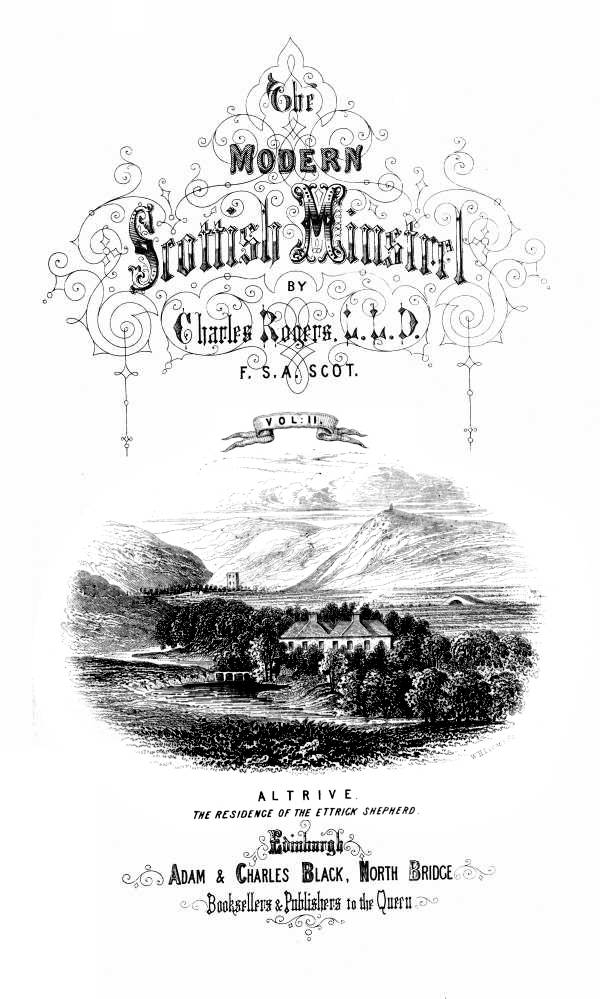
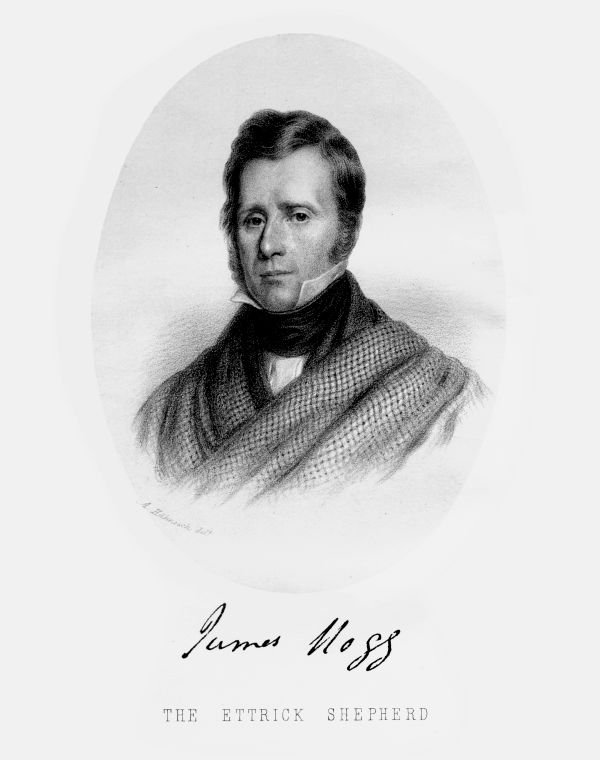 THE ETTRICK SHEPHERD.