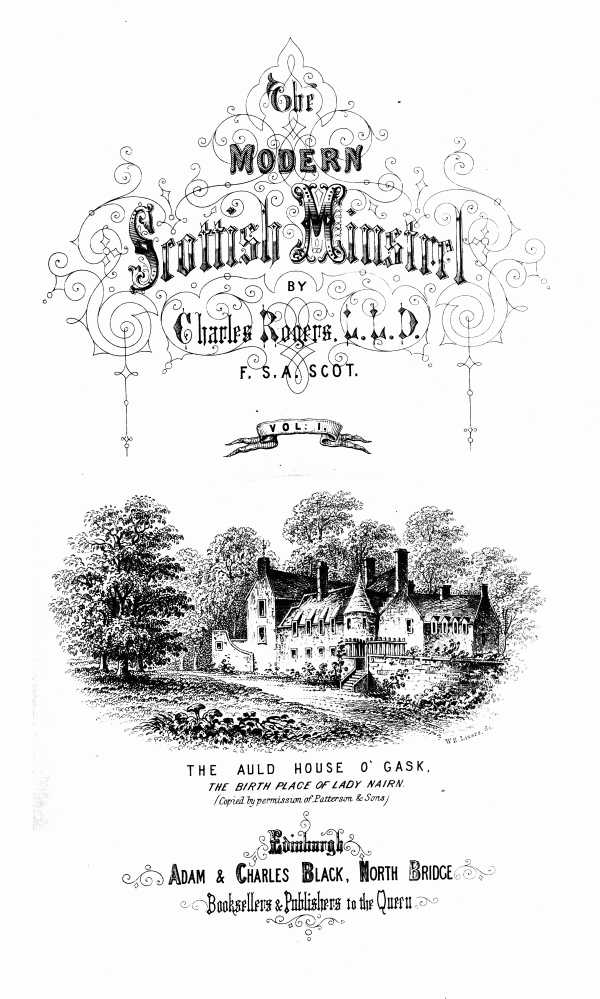
Carolina Oliphant was born in the old mansion of
Gask, in the county of Perth, on the 16th of July 1766.
She was the third daughter and fifth child of Laurence
Oliphant of Gask, who had espoused his cousin Margaret
Robertson, a daughter of Duncan Robertson of Struan,
and his wife a daughter of the fourth Lord Nairn.
The Oliphants of Gask were cadets of the formerly
noble house of Oliphant; whose ancestor, Sir William
Oliphant of Aberdalgie, a puissant knight, acquired distinction
in the beginning of the fourteenth century by
defending the Castle of Stirling against a formidable
siege by the first Edward. The family of Gask were
devoted Jacobites; the paternal grandfather of Carolina
Oliphant had attended Prince Charles Edward as aid-de-camp
during his disastrous campaign of 1745-6, and
his spouse had indicated her sympathy in his cause by
cutting out a lock of his hair on the occasion of his accepting
the hospitality of the family mansion. The portion
of hair is preserved at Gask; and Carolina Oliphant,
in her song, "The Auld House," has thus celebrated
the gentle deed of her progenitor:—
"The Leddy too, sae genty,
There shelter'd Scotland's heir,
An' clipt a lock wi' her ain hand
Frae his lang yellow hair."
The estate of Gask escaped forfeiture, but the father of
Carolina did not renounce the Jacobite sentiments of
his ancestors. He named the subject of this memoir
Carolina, in honour of Prince Charles Edward; and his
prevailing topic of conversation was the reiterated expression
of his hope that "the king would get his ain."
He would not permit the names of the reigning monarch
and his queen to be mentioned in his presence; and
when impaired eyesight compelled him to seek the
assistance of his family in reading the newspapers, he
angrily reproved the reader if the "German lairdie and
his leddy" were designated otherwise than by the initial
letters, "K. and Q." This extreme Jacobitism at a
period when the crime was scarcely to be dreaded, was
reported to George III., who is related to have confessed
his respect for a man who had so consistently maintained
his political sentiments.
In her youth, Carolina Oliphant was singularly beautiful,
and was known in her native district by the
poetical designation of "The Flower of Strathearn."
She was as remarkable for the precocity of her intellect,
as she was celebrated for the elegance of her person.
Descended by her mother from a family which, in one
instance,[44] at least, had afforded some evidence of poetical
talents, and possessed of a correct musical ear, she
very early composed verses for her favourite melodies.
To the development of her native genius, her juvenile
condition abundantly contributed: the locality of her
birthplace, rich in landscape scenery, and associated
with family traditions and legends of curious and chivalric
adventure, might have been sufficient to promote,
in a mind less fertile than her own, sentiments of poesy.
In the application of her talents she was influenced by
another incentive. A loose ribaldry tainted the songs
and ballads which circulated among the peasantry, and
she was convinced that the diffusion of a more wholesome
minstrelsy would essentially elevate the moral
tone of the community. Thus, while still young, she
commenced to purify the older melodies, and to compose
new songs, which were ultimately destined to occupy
an ample share of the national heart. The occasion of
an agricultural dinner in the neighbourhood afforded
her a fitting opportunity of making trial of her success
in the good work which she had begun. To the president
of the meeting she sent, anonymously, her verses
entitled "The Ploughman;" and the production being
publicly read, was received with warm approbation, and
was speedily put to music. She was thus encouraged
to proceed in her self-imposed task; and to this early
period of her life may be ascribed some of her best
lyrics. "The Laird o' Cockpen," and "The Land o'
the Leal," at the close of the century, were sung in
every district of the kingdom.
Carolina Oliphant had many suitors for her hand:
she gave a preference to William Murray Nairn, her
maternal cousin, who had been Baron Nairn, barring
the attainder of the title on account of the Jacobitism
of the last Baron. The marriage was celebrated
in June 1806. At this period, Mr Nairn was Assistant
Inspector-General of Barracks in Scotland,
and held the rank of major in the army. By Act of
Parliament, on the 17th June 1824, the attainder of
the family was removed, the title of Baron being conferred
on Major Nairn. This measure is reported to
have been passed on the strong recommendation of
George IV.; his Majesty having learned, during his state
visit to Scotland in 1822, that the song of "The Attainted
Scottish Nobles" was the composition of Lady
Nairn. The song is certainly one of the best apologies
for Jacobitism.
On the 9th of July 1830, Lady Nairn was bereaved
of her husband, to whom she had proved an affectionate
wife. Her care had for several years been assiduously
bestowed on the proper rearing of her only child
William, who, being born in 1808, had reached his
twenty-second year when he succeeded to the title on
the death of his father. This young nobleman warmly
reciprocated his mother's affectionate devotedness; and,
making her the associate of his manhood, proved a
source of much comfort to her in her bereavement.
In 1837, he resolved, in her society, to visit the
Continent, in the hope of being recruited by change of
climate from an attack of influenza caught in the
spring of that year. But the change did not avail;
he was seized with a violent cold at Brussels, which,
after an illness of six weeks, proved fatal. He died
in that city on the 7th of December 1837. Deprived
both of her husband and her only child, a young
nobleman of so much promise, and of singular Christian
worth, Lady Nairn, though submitting to the
mysterious dispensations with becoming resignation,
did not regain her wonted buoyancy of spirit. Old
age was rapidly approaching,—those years in which the
words of the inspired sage, "I have no pleasure in
them," are too frequently called forth by the pressure of
human infirmities. But this amiable lady did not sink
under the load of affliction and of years: she mourned
in hope, and wept in faith. While the afflictions which
had mingled with her cup of blessings tended to prevent
her lingering too intently on the past,[45] the remembrance
of a life devoted to deeds of piety and virtue was a solace
greater than any other earthly object could impart, leading
her to hail the future with sentiments of joyful
anticipation. During the last years of her life, unfettered
by worldly ties, she devoted all her energies to the
service of Heaven, and to the advancement of Christian
truth. Her beautiful ode, "Would you be young again?"
was composed in 1842, and enclosed in a letter to a
friend; it is signally expressive of the pious resignation
and Christian hope of the author.
After the important era of her marriage, she seems
to have relinquished her literary ardour. But in the
year 1821, Mr Robert Purdie, an enterprising music-seller
in Edinburgh, having resolved to publish a series
of the more approved national songs, made application
to several ladies celebrated for their musical skill, with
the view of obtaining their assistance in the arrangement
of the melodies. To these ladies was known the
secret of Lady Nairn's devotedness to Scottish song,
enjoying as they did her literary correspondence and
private intimacy; and in consenting to aid the publisher
in his undertaking, they calculated on contributions
from their accomplished friend. They had formed a
correct estimate: Lady Nairn, whose extreme diffidence
had hitherto proved a barrier to the fulfilment of the
best wishes of her heart, in effecting the reformation of
the national minstrelsy, consented to transmit pieces for
insertion, on the express condition that her name and
rank, and every circumstance connected with her history,
should be kept in profound secrecy. The condition
was carefully observed; so that, although the
publication of "The Scottish Minstrel" extended over
three years, and she had several personal interviews and
much correspondence with the publisher and his editor,
Mr R. A. Smith, both these individuals remained ignorant
of her real name. She had assumed the signature,
"B. B.," in her correspondence with Mr Purdie, who
appears to have been entertained by the discovery, communicated
in confidence, that the name of his contributor
was "Mrs Bogan of Bogan;" and by this designation
he subsequently addressed her. The nom de
guerre of the two B.'s[46] is attached to the greater number
of Lady Nairn's contributions in "The Scottish Minstrel."
The new collection of minstrelsy, unexceptionable as
it was in the words attached to all the airs, commanded
a wide circulation, and excited general attention. The
original contributions were especially commended, and
some of them were forthwith sung by professed vocalists
in the principal towns. Much speculation arose respecting
the authorship, and various conjectures were supported,
each with plausible arguments, by the public
journalists. In these circumstances, Lady Nairn experienced
painful alarm, lest, by any inadvertence on the
part of her friends, the origin of her songs should be
traced. While the publication of the "Minstrel" was
proceeding, her correspondents received repeated injunctions
to adopt every caution in preserving her incognita;
she was even desirous that her sex might not be made
known. "I beg the publisher will make no mention of
a lady," she wrote to one of her correspondents, "as you
observe, the more mystery the better, and still the
balance is in favour of the lords of creation. I cannot
help, in some degree, undervaluing beforehand what is
said to be a feminine production." "The Scottish
Minstrel" was completed in 1824, in six royal octavo
volumes, forming one of the best collections of the Scottish
melodies. It was in the full belief that "Mrs
Bogan" was her real name, that the following compliment
was paid to Lady Nairn by Messrs Purdie and R.
A. Smith, in the advertisement to the last volume of the
work:—"In particular, the editors would have felt
happy in being permitted to enumerate the many original
and beautiful verses that adorn their pages, for
which they are indebted to the author of the much-admired
song, 'The Land o' the Leal;' but they fear to
wound a delicacy which shrinks from all observation."
Subsequent to the appearance of "The Scottish
Minstrel," Lady Nairn did not publish any lyrics; and
she was eminently successful in preserving her incognita.
No critic ventured to identify her as the celebrated
"B. B.," and it was only whispered among a few that
she had composed "The Land o' the Leal." The mention
of her name publicly as the author of this beautiful
ode, on one occasion, had signally disconcerted her.
While she was resident in Paris, in 1842, she writes to
an intimate friend in Edinburgh on this subject:—"A
Scottish lady here, Lady——, with whom I never met
in Scotland, is so good as, among perfect strangers,
to denounce me as the origin of 'The Land o' the
Leal!' I cannot trace it, but very much dislike as ever
any kind of publicity." The extreme diffidence and
shrinking modesty of the amiable author continued to
the close of her life; she never divulged, beyond a small
circle of confidential friends, the authorship of a single
verse. The songs published in her youth had been
given to others; but, as in the case of Lady Anne Barnard,
these assignments caused her no uneasiness. She
experienced much gratification in finding her simple
minstrelsy supplanting the coarse and demoralising
rhymes of a former period; and this mental satisfaction
she preferred to fame.
The philanthropic efforts of Lady Nairn were not
limited to the purification of the national minstrelsy;
her benevolence extended towards the support of every
institution likely to promote the temporal comforts, or
advance the spiritual interests of her countrymen. Her
contributions to the public charities were ample, and she
"Did good by stealth, and blush'd to find it fame."
In an address delivered at Edinburgh, on the 29th of
December 1845, Dr Chalmers, referring to the exertions
which had been made for the supply of religious instruction
in the district of the West Port of Edinburgh, made
the following remarks regarding Lady Nairn, who was
then recently deceased:—"Let me speak now as to the
countenance we have received. I am now at liberty to
mention a very noble benefaction which I received about
a year ago. Inquiry was made at me by a lady, mentioning
that she had a sum at her disposal, and that she
wished to apply it to charitable purposes; and she
wanted me to enumerate a list of charitable objects, in
proportion to the estimate I had of their value. Accordingly,
I furnished her with a scale of about five or six
charitable objects. The highest in the scale were those
institutions which had for their design the Christianising
of the people at home; and I also mentioned to her,
in connexion with the Christianising at home, what we
were doing at the West Port; and there came to me
from her, in the course of a day or two, no less a sum
than £300. She is now dead; she is now in her grave,
and her works do follow her. When she gave me this
noble benefaction, she laid me under strict injunctions of
secrecy, and, accordingly, I did not mention her name
to any person; but after she was dead, I begged of her
nearest heir that I might be allowed to proclaim it, because
I thought that her example, so worthy to be followed,
might influence others in imitating her; and I am
happy to say that I am now at liberty to state that it was
Lady Nairn of Perthshire. It enabled us, at the expense
of £330, to purchase sites for schools, and a church; and
we have got a site in the very heart of the locality,
with a very considerable extent of ground for a washing-green,
a washing-house, and a play-ground for the children,
so that we are a good step in advance towards the
completion of our parochial economy."
After the death of her son, and till within two years
of her own death, Lady Nairn resided chiefly on the
Continent, and frequently in Paris. Her health had for
several years been considerably impaired, and latterly
she had recourse to a wheeled chair. In the mansion of
Gask, on the 27th of October 1845, she gently sunk
into her rest, at the advanced age of seventy-nine years.
Some years subsequent to this event, it occurred to the
relatives and literary friends of the deceased Baroness that
as there could no longer be any reason for retaining her
incognita, full justice should be done to her memory by
the publication of a collected edition of her works. This
scheme was partially executed in an elegant folio, entitled
"Lays from Strathearn: by Carolina, Baroness
Nairn. Arranged with Symphonies and Accompaniments
for the Pianoforte, by Finlay Dun." It bears the
imprint of London, and has no date. In this work, of
which a new edition will speedily be published by Messrs
Paterson, music-sellers, Edinburgh, are contained seventy
songs, but the larger proportion of the author's lyrics
still remain in MS. From her representatives we have
received permission to select her best lyrics for the
present work, and to insert several pieces hitherto unpublished.
Of the lays which we have selected, several
are new versions to old airs; the majority, though
unknown as the compositions of Lady Nairn, are already
familiar in the drawing-room and the cottage. For
winning simplicity, graceful expression, and exquisite
pathos, her compositions are especially remarkable; but
when her muse prompts to humour, the laugh is
sprightly and overpowering.
In society, Lady Nairn was reserved and unassuming.
Her countenance, naturally beautiful, wore, in her mature
years, a somewhat pensive cast; and the characteristic
by which she was known consisted in her enthusiastic
love of music. It may be added, that she was fond
of the fine arts, and was skilled in the use of the pencil.
There 's high and low, there 's rich and poor,
There 's trades and crafts enew, man;
But, east and west, his trade 's the best,
That kens to guide the pleugh, man.
Then, come, weel speed my pleughman lad,
And hey my merry pleughman;
Of a' the trades that I do ken,
Commend me to the pleughman.
His dreams are sweet upon his bed,
His cares are light and few, man;
His mother's blessing 's on his head,
That tents her weel, the pleughman.
Then, come, weel speed, &c.
The lark, sae sweet, that starts to meet
The morning fresh and new, man;
Blythe though she be, as blythe is he
That sings as sweet, the pleughman.
Then, come, weel speed, &c.
All fresh and gay, at dawn of day
Their labours they renew, man;
Heaven bless the seed, and bless the soil,
And Heaven bless the pleughman.
Then, come, weel speed, &c.
Wha 'll buy caller herrin'?
They 're bonnie fish and halesome farin';
Wha 'll buy caller herrin',
New drawn frae the Forth?
When ye were sleepin' on your pillows,
Dream'd ye ought o' our puir fellows,
Darkling as they faced the billows,
A' to fill the woven willows.
Buy my caller herrin',
New drawn frae the Forth.
Wha 'll buy my caller herrin'?
They 're no brought here without brave daring;
Buy my caller herrin',
Haul'd thro' wind and rain.
Wha 'll buy caller herrin'? &c.
Wha 'll buy my caller herrin'?
Oh, ye may ca' them vulgar farin'!
Wives and mithers, maist despairin',
Ca' them lives o' men.
Wha 'll buy caller herrin'? &c.
When the creel o' herrin' passes,
Ladies, clad in silks and laces,
Gather in their braw pelisses,
Cast their heads, and screw their faces.
Wha 'll buy caller herrin'? &c.
Caller herrin 's no got lightlie;
Ye can trip the spring fu' tightlie;
Spite o' tauntin', flauntin', flingin',
Gow has set you a' a-singin'.
Wha 'll buy caller herrin'? &c.
Neebour wives, now tent my tellin',
When the bonny fish ye 're sellin',
At ae word be in yer dealin'—
Truth will stand when a' thing 's failin'.
Wha 'll buy caller herrin'? &c.
I 'm wearin' awa', John,
Like snaw wreaths in thaw, John;
I 'm wearin' awa'
To the land o' the leal.
There 's nae sorrow there, John;
There 's neither cauld nor care, John;
The day 's aye fair
I' the land o' the leal.
Our bonnie bairn 's there, John;
She was baith gude and fair, John;
And, oh! we grudged her sair
To the land o' the leal.
But sorrows sel' wears past, John,
And joy 's a-comin' fast, John—
The joy that 's aye to last
In the land o' the leal.
Sae dear 's that joy was bought, John,
Sae free the battle fought, John,
That sinfu' man e'er brought
To the land o' the leal.
Oh, dry your glist'ning e'e, John!
My saul langs to be free, John;
And angels beckon me
To the land o' the leal.
Oh, haud ye leal and true, John!
Your day it 's wearin' thro', John;
And I 'll welcome you
To the land o' the leal.
Now, fare ye weel, my ain John,
This warld's cares are vain, John;
We 'll meet, and we 'll be fain,
In the land o' the leal.
The Laird o' Cockpen he 's proud and he 's great,
His mind is ta'en up with the things o' the state;
He wanted a wife his braw house to keep,
But favour wi' wooin' was fashious to seek.
Down by the dyke-side a lady did dwell,
At his table-head he thought she 'd look well;
M'Clish's ae daughter o' Claverse-ha' Lee,
A penniless lass wi' a lang pedigree.
His wig was weel pouther'd, and as gude as new;
His waistcoat was white, his coat it was blue;
He put on a ring, a sword, and cock'd hat,
And wha' could refuse the Laird wi' a' that?
He took the gray mare, and rade cannily—
And rapp'd at the yett o' Claverse-ha' Lee;
"Gae tell Mistress Jean to come speedily ben,
She 's wanted to speak to the Laird o' Cockpen."
Mistress Jean was makin' the elder-flower wine,
"And what brings the Laird at sic a like time?"
She put aff her apron, and on her silk gown,
Her mutch wi' red ribbons, and gaed awa' down.
And when she cam' ben, he bowed fu' low,
And what was his errand he soon let her know;
Amazed was the Laird when the lady said "Na;"
And wi' a laigh curtsie she turned awa'.
Dumbfounder'd he was, nae sigh did he gie;
He mounted his mare—he rade cannily;
And aften he thought, as he gaed through the glen,
She 's daft to refuse the Laird o' Cockpen.
And now that the Laird his exit had made,
Mistress Jean she reflected on what she had said;
"Oh! for ane I 'll get better, it 's waur I 'll get ten,
I was daft to refuse the Laird o' Cockpen."
Next time that the Laird and the Lady were seen,
They were gaun arm-in-arm to the kirk on the green;
Now she sits in the ha' like a weel-tappit hen,
But as yet there 's nae chickens appear'd at Cockpen.
Air—"Mordelia."
In all its rich wildness, her home she is leaving,
In sad and tearful silence grieving,
And still as the moment of parting is nearer,
Each long cherish'd object is fairer and dearer.
Not a grove or fresh streamlet but wakens reflection
Of hearts still and cold, that glow'd with affection;
Not a breeze that blows over the flowers of the wild wood,
But tells, as it passes, how blest was her childhood.
And how long must I leave thee, each fond look expresses,
Ye high rocky summits, ye ivy'd recesses!
How long must I leave thee, thou wood-shaded river,
The echoes all sigh—as they whisper—for ever!
Tho' the autumn winds rave, and the seared leaves fall,
And winter hangs out her cold icy pall—
Yet the footsteps of spring again ye will see,
And the singing of birds—but they sing not for me.
The joys of the past, more faintly recalling,
Sweet visions of peace on her spirit are falling,
And the soft wing of time, as it speeds for the morrow,
Wafts a gale, that is drying the dew-drops of sorrow.
Hope dawns—and the toils of life's journey beguiling,
The path of the mourner is cheer'd with its smiling;
And there her heart rests, and her wishes all centre,
Where parting is never—nor sorrow can enter.
The bonniest lass in a' the warld,
I 've often heard them telling,
She 's up the hill, she 's down the glen,
She 's in yon lonely dwelling.
But nane could bring her to my mind
Wha lives but in the fancy,
Is 't Kate, or Shusie, Jean, or May,
Is 't Effie, Bess, or Nancy?
Now lasses a' keep a gude heart,
Nor e'er envy a comrade,
For be your een black, blue, or gray,
Ye 're bonniest aye to some lad.
The tender heart, the charming smile,
The truth that ne'er will falter,
Are charms that never can beguile,
And time can never alter.
Will ye gang ower the lea-rig,
My ain kind dearie, O?
Will ye gang ower the lea-rig,
My ain kind dearie, O?
Gin ye'll tak heart, and gang wi' me,
Mishap will never steer ye, O;
Gude luck lies ower the lea-rig,
My ain kind dearie, O!
There 's walth ower yon green lea-rig,
My ain kind dearie, O!
There 's walth ower yon green lea-rig,
My ain kind dearie, O!
Its neither land, nor gowd, nor braws—
Let them gang tapsle teerie, O!
It 's walth o' peace, o' love, and truth,
My ain kind dearie, O!
Air—"The Muckin' o' Geordie's Byre."
He 's lifeless amang the rude billows,
My tears and my sighs are in vain;
The heart that beat warm for his Jeanie,
Will ne'er beat for mortal again.
My lane now I am i' the warld,
And the daylight is grievous to me;
The laddie that lo'ed me sae dearly
Lies cauld in the deeps o' the sea.
Ye tempests, sae boist'rously raging,
Rage on as ye list—or be still;
This heart ye sae often hae sicken'd,
Is nae mair the sport o' your will.
Now heartless, I hope not—I fear not,—
High Heaven hae pity on me!
My soul, tho' dismay'd and distracted,
Yet bends to thy awful decree.
Air—"I'll never leave thee."
Joy of my earliest days,
Why must I grieve thee?
Theme of my fondest lays,
Oh, I maun leave thee!
Leave thee, love! leave thee, love!
How shall I leave thee?
Absence thy truth will prove,
For, oh! I maun leave thee!
When on yon mossy stane,
Wild weeds o'ergrowin',
Ye sit at e'en your lane,
And hear the burn rowin';
Oh! think on this partin' hour,
Down by the Garry,
And to Him that has a' the pow'r,
Commend me, my Mary!
Air—"Landlady count the lawin'."
Oh, weel's me on my ain man,
My ain man, my ain man!
Oh, weel's me on my ain gudeman!
He 'll aye be welcome hame.
I 'm wae I blamed him yesternight,
For now my heart is feather light;
For gowd I wadna gie the sight;
I see him linking ower the height.
Oh, weel's me on my ain man, &c.
Rin, Jamie, bring the kebbuck ben,
And fin' aneath the speckled hen;
Meg, rise and sweep about the fire,
Syne cry on Johnnie frae the byre.
For weel's me on my ain man,
My ain man, my ain man!
For weel's me on my ain gudeman!
I see him linkin' hame.
Robin is my ain gudeman,
Now match him, carlins, gin ye can,
For ilk ane whitest thinks her swan,
But kind Robin lo'es me.
To mak my boast I 'll e'en be bauld,
For Robin lo'ed me young and auld,
In summer's heat and winter's cauld,
My kind Robin lo'es me.
Robin he comes hame at e'en
Wi' pleasure glancin' in his e'en;
He tells me a' he 's heard and seen,
And syne how he lo'es me.
There 's some hae land, and some hae gowd,
Mair wad hae them gin they could,
But a' I wish o' warld's guid,
Is Robin still to lo'e me.
Air—"Country Bumpkin."
Hech, hey! the mirth that was there,
The mirth that was there,
The mirth that was there;
Hech, how! the mirth that was there,
In Kitty Reid's house on the green, Jo!
There was laughin' and singin', and dancin' and glee,
In Kitty's Reid's house, in Kitty Reid's house,
There was laughin' and singin', and dancin' and glee,
In Kitty Reid's house on the green, Jo!
Hech, hey! the fright that was there,
The fright that was there,
The fright that was there;
Hech, how! the fright that was there,
In Kitty Reid's house on the green, Jo!
The light glimmer'd in through a crack i' the wa',
An' a'body thocht the lift it wad fa',
And lads and lasses they soon ran awa'
Frae Kitty's Reid's house on the green, Jo!
Hech, hey! the dule that was there,
The dule that was there,
The dule that was there;
The birds and beasts it wauken'd them a',
In Kitty Reid's house on the green, Jo!
The wa' gaed a hurley, and scatter'd them a',
The piper, the fiddler, auld Kitty, and a';
The kye fell a routin', the cocks they did craw,
In Kitty Reid's house on the green, Jo!
Air—"Lochiel's awa' to France."
Their nest was in the leafy bush,
Sae soft and warm, sae soft and warm,
And Robins thought their little brood
All safe from harm, all safe from harm.
The morning's feast with joy they brought,
To feed their young wi' tender care;
The plunder'd leafy bush they found,
But nest and nestlings saw nae mair.
The mother cou'dna leave the spot,
But wheeling round, and wheeling round,
The cruel spoiler aim'd a shot,
Cured her heart's wound, cured her heart's wound.
She will not hear their helpless cry,
Nor see them pine in slavery!
The burning breast she will not bide,
For wrongs of wanton knavery.
Oh! bonny Robin Redbreast,
Ye trust in men, ye trust in men,
But what their hard hearts are made o',
Ye little ken, ye little ken.
They 'll ne'er wi' your wee skin be warm'd,
Nor wi' your tiny flesh be fed,
But just 'cause you 're a living thing,
It 's sport wi' them to lay you dead.
Ye Hieland and ye Lowland lads,
As birdies gay, as birdies gay,
Oh, spare them, whistling like yoursel's,
And hopping blythe from spray to spray!
Their wings were made to soar aloft,
And skim the air at liberty;
And as you freedom gi'e to them,
May you and yours be ever free!
Saw ye nae my Peggy?
Saw ye nae my Peggy?
Saw ye nae my Peggy comin'
Through Tillibelton's broom?
I 'm frae Aberdagie,
Ower the crafts o' Craigie,
For aught I ken o' Peggie,
She 's ayont the moon.
'Twas but at the dawin',
Clear the cock was crawin',
I saw Peggy cawin'
Hawky by the brier.
Early bells were ringin',
Blythest birds were singin',
Sweetest flowers were springin',
A' her heart to cheer.
Now the tempest's blawin',
Almond water 's flowin',
Deep and ford unknowin',
She maun cross the day.
Almond waters, spare her,
Safe to Lynedoch bear her!
Its braes ne'er saw a fairer,
Bess Bell nor Mary Gray.
Oh, now to be wi' her!
Or but ance to see her
Skaithless, far or near,
I 'd gie Scotland's crown.
Byeword, blind 's a lover—
Wha 's yon I discover?
Just yer ain fair rover,
Stately stappin' down.
The best o' joys maun hae an end,
The best o' friends maun part, I trow;
The langest day will wear away,
And I maun bid fareweel to you.
The tear will tell when hearts are fu',
For words, gin they hae sense ava,
They 're broken, faltering, and few:
Gude nicht, and joy be wi' you a'!
Oh, we hae wander'd far and wide,
O'er Scotia's lands o' frith and fell!
And mony a simple flower we 've pu'd,
And twined it wi' the heather-bell.
We 've ranged the dingle and the dell,
The cot-house, and the baron's ha';
Now we maun tak a last farewell:
Gude nicht, and joy be wi' you a'!
My harp, fareweel! thy strains are past,
Of gleefu' mirth, and heartfelt care;
The voice of song maun cease at last,
And minstrelsy itsel' decay.
But, oh! whar sorrow canna win,
Nor parting tears are shed ava',
May we meet neighbour, kith, and kin,
And joy for aye be wi' us a'!
There 's cauld kail in Aberdeen,
There 's castocks in Strabogie;
And morn and e'en, they 're blythe and bein,
That haud them frae the cogie.
Now, haud ye frae the cogie, lads;
O bide ye frae the cogie!
I 'll tell ye true, ye 'll never rue,
O' passin' by the cogie.
Young Will was braw and weel put on,
Sae blythe was he and vogie;
And he got bonnie Mary Don,
The flower o' a' Strabogie.
Wha wad hae thocht, at wooin' time,
He 'd e'er forsaken Mary,
And ta'en him to the tipplin' trade,
Wi' boozin' Rob and Harry?
Sair Mary wrought, sair Mary grat,
She scarce could lift the ladle;
Wi' pithless feet, 'tween ilka greet,
She 'd rock the borrow'd cradle.
Her weddin' plenishin' was gane,
She never thocht to borrow:
Her bonnie face was waxin' wan—
And Will wrought a' the sorrow.
He 's reelin' hame ae winter's nicht,
Some later than the gloamin';
He 's ta'en the rig, he 's miss'd the brig,
And Bogie 's ower him foamin'.
Wi' broken banes, out ower the stanes,
He creepit up Strabogie;
And a' the nicht he pray'd wi' micht,
To keep him frae the cogie.
Now Mary's heart is light again—
She 's neither sick nor silly;
For auld or young, nae sinfu' tongue,
Could e'er entice her Willie;
And aye the sang through Bogie rang—
"O had ye frae the cogie;
The weary gill 's the sairest ill
On braes o' fair Strabogie."
He 's ower the hills that I lo'e weel,
He 's ower the hills we daurna name;
He 's ower the hills ayont Dunblane,
Wha soon will get his welcome hame.
My father's gane to fight for him,
My brithers winna bide at hame;
My mither greets and prays for them,
And 'deed she thinks they 're no to blame.
He 's ower the hills, &c.
The Whigs may scoff, the Whigs may jeer;
But, ah! that love maun be sincere
Which still keeps true whate'er betide,
An' for his sake leaves a' beside.
He 's ower the hills, &c.
His right these hills, his right these plains;
Ower Hieland hearts secure he reigns;
What lads e'er did our laddies will do;
Were I a laddie, I 'd follow him too.
He 's ower the hills, &c.
Sae noble a look, sae princely an air,
Sae gallant and bold, sae young and sae fair;
Oh, did ye but see him, ye 'd do as we've done!
Hear him but ance, to his standard you 'll run.
He 's ower the hills, &c.
Then draw the claymore, for Charlie then fight;
For your country, religion, and a' that is right;
Were ten thousand lives now given to me,
I 'd die as aft for ane o' the three.
He 's ower the hills, &c.
Air—"Loch Erroch Side."
'Twas on a summer's afternoon,
A wee afore the sun gaed down,
A lassie, wi' a braw new gown,
Cam' ower the hills to Gowrie.
The rose-bud, wash'd in summer's shower,
Bloom'd fresh within the sunny bower;
But Kitty was the fairest flower
That e'er was seen in Gowrie.
To see her cousin she cam' there,
An', oh, the scene was passing fair!
For what in Scotland can compare
Wi' the Carse o' Gowrie?
The sun was setting on the Tay,
The blue hills melting into gray;
The mavis' and the blackbird's lay
Were sweetly heard in Gowrie.
Oh, lang the lassie I had woo'd!
An' truth and constancy had vow'd,
But cam' nae speed wi' her I lo'ed,
Until she saw fair Gowrie.
I pointed to my faither's ha',
Yon bonnie bield ayont the shaw,
Sae loun' that there nae blast could blaw;
Wad she no bide in Gowrie?
Her faither was baith glad and wae;
Her mither she wad naething say;
The bairnies thocht they wad get play
If Kitty gaed to Gowrie.
She whiles did smile, she whiles did greet,
The blush and tear were on her cheek;
She naething said, an' hung her head;
But now she's Leddy Gowrie.
There grows a bonnie brier bush in our kail-yard,
And white are the blossoms o't in our kail-yard,
Like wee bit white cockauds to deck our Hieland lads,
And the lasses lo'e the bonnie bush in our kail-yard.
An' it 's hame, an' it 's hame to the north countrie,
An' it 's hame, an' it 's hame to the north countrie,
Where my bonnie Jean is waiting for me,
Wi' a heart kind and true, in my ain countrie.
"But were they a' true that were far awa?
Oh! were they a' true that were far awa'?
They drew up wi' glaikit Englishers at Carlisle Ha',
And forgot auld frien's that were far awa.
"Ye 'll come nae mair, Jamie, where aft ye 've been,
Ye 'll come nae mair, Jamie, to Atholl's green;
Ye lo'ed ower weel the dancin' at Carlisle Ha',
And forgot the Hieland hills that were far awa'."
"I ne'er lo'ed a dance but on Atholl's green,
I ne'er lo'ed a lassie but my dorty Jean,
Sair, sair against my will did I bide sae lang awa',
And my heart was aye in Atholl's green at Carlisle Ha'."
* * * * *
The brier bush was bonnie ance in our kail-yard;
The brier bush was bonnie ance in our kail-yard;
A blast blew ower the hill, that gae Atholl's flowers a chill,
And the bloom 's blawn aff the bonnie bush in our kail-yard.
He 's a terrible man, John Tod, John Tod,
He 's a terrible man, John Tod;
He scolds in the house,
He scolds at the door,
He scolds on the vera hie road, John Tod,
He scolds on the vera hie road.
The weans a' fear John Tod, John Tod,
The weans a' fear John Tod;
When he 's passing by,
The mithers will cry,—
Here 's an ill wean, John Tod, John Tod,
Here 's an ill wean, John Tod.
The callants a' fear John Tod, John Tod,
The callants a' fear John Tod;
If they steal but a neep,
The callant he 'll whip,
And it 's unco weel done o' John Tod, John Tod,
It 's unco weel done o' John Tod.
An' saw ye nae wee John Tod, John Tod?
Oh, saw ye nae wee John Tod?
His bannet was blue,
His shoon maistly new,
An' weel does he keep the kirk road, John Tod,
Oh, weel does he keep the kirk road.
How is he fendin', John Tod, John Tod?
How is he wendin', John Tod?
He 's scourin' the land,
Wi' his rung in his hand,
An' the French wadna frighten John Tod, John Tod,
An' the French wadna frighten John Tod.
Ye 're sun-brunt and batter'd, John Tod, John Tod
Ye 're tantit and tatter'd, John Tod;
Wi' your auld strippit coul,
Ye look maist like a fule,
But there 's nouse i' the lining,[57] John Tod, John Tod,
But there 's nouse i' the lining, John Tod.
He 's weel respeckit, John Tod, John Tod,
He 's weel respeckit, John Tod;
He 's a terrible man,
But we 'd a' gae wrang
If e'er he sud leave us, John Tod, John Tod,
If e'er he sud leave us, John Tod.
Bonnie Charlie 's now awa',
Safely ower the friendly main;
Mony a heart will break in twa
Should he ne'er come back again.
Will ye no come back again?
Will ye no come back again?
Better lo'ed ye canna be—
Will ye no come back again?
Ye trusted in your Hieland men,
They trusted you, dear Charlie!
They kent your hiding in the glen,
Death or exile braving.
Will ye no, &c.
English bribes were a' in vain,
Tho' puir, and puirer, we maun be;
Siller canna buy the heart
That beats aye for thine and thee.
Will ye no, &c.
We watch'd thee in the gloamin' hour,
We watch'd thee in the mornin' gray;
Though thirty thousand pound they gi'e,
Oh, there is none that wad betray!
Will ye no, &c.
Sweet 's the laverock's note, and lang,
Lilting wildly up the glen;
But aye to me he sings ae sang,
Will ye no come back again?
Will ye no, &c.
Air—"The Rock and the Wee Pickle Tow."
Send a horse to the water, ye 'll no mak him drink,
Send a fule to the college, ye 'll no mak him think;
Send a craw to the singin', an' still he will craw,
An' the wee laird had nae rummulgumshion ava.
Yet is he the pride o' his fond mother's e'e,
In body or mind, nae fau't can she see;
"He 's a fell clever lad, an' a bonny wee man,"
Is aye the beginnin' an' end o' her sang.
An' oh! she 's a haverin' lucky, I trow,
An' oh! she 's a haverin' lucky, I trow;
"He 's a fell clever lad, an' a bonny wee man,"
Is aye the beginnin' an' end o' her sang.
His legs they are bow'd, his een they do glee,
His wig, whiles it 's aff, and when on, it 's ajee;
He 's braid as he 's lang, an' ill-faur'd is he,
A dafter-like body I never did see.
An' yet for this cratur' she says I am deein',
When that I deny, she 's fear'd at my leein';
Obliged to put up wi' this sair defamation,
I'm liken to dee wi' grief an' vexation.
An' oh! she 's a haverin' lucky, &c.
An' her clishmaclavers gang a' through the toun,
An' the wee lairdie trows I 'll hang or I 'll droun.
Wi' his gawky-like face, yestreen he did say,
"I 'll maybe tak you, for Bess I 'll no hae,
Nor Mattie, nor Effie, nor lang-legged Jeanie,
Nor Nelly, nor Katie, nor skirlin' wee Beenie."
I stappit my ears, ran aff in a fury—
I 'm thinkin' to bring them afore judge an' jury.
For oh! what a randy auld luckie is she, &c.
Freen's! gi'e your advice!—I 'll follow your counsel—
Maun I speak to the Provost, or honest Toun Council,
Or the writers, or lawyers, or doctors? now say,
For the law on the lucky I shall an' will hae.
The hale toun at me are jibin' and jeerin',
For a leddy like me it 's really past bearin';
The lucky maun now hae dune wi' her claverin',
For I 'll no put up wi' her nor her haverin'.
For oh! she 's a randy, I trow, I trow,
For oh! she 's a randy, I trow, I trow;
"He 's a fell clever lad, an' a bonny wee man,"
Is aye the beginnin' an' end o' her sang.
Air—"Happy Land."
Songs of my native land,
To me how dear!
Songs of my infancy,
Sweet to mine ear!
Entwined with my youthful days,
Wi' the bonny banks and braes,
Where the winding burnie strays,
Murmuring near.
Strains of my native land,
That thrill the soul,
Pouring the magic of
Your soft control!
Often has your minstrelsy
Soothed the pang of misery,
Winging rapid thoughts away
To realms on high.
Weary pilgrims there have rest,
Their wand'rings o'er;
There the slave, no more oppress'd,
Hails Freedom's shore.
Sin shall then no more deface,
Sickness, pain, and sorrow cease,
Ending in eternal peace,
And songs of joy!
There, when the seraphs sing,
In cloudless day;
There, where the higher praise
The ransom'd pay.
Soft strains of the happy land,
Chanted by the heavenly band,
Who can fully understand
How sweet ye be!
Oh, Castell Gloom! thy strength is gone,
The green grass o'er thee growin';
On hill of Care thou art alone,
The Sorrow round thee flowin'.
Oh, Castell Gloom! on thy fair wa's
Nae banners now are streamin',
The houlet flits amang thy ha's,
And wild birds there are screamin'.
Oh! mourn the woe, oh! mourn the crime,
Frae civil war that flows;
Oh! mourn, Argyll, thy fallen line,
And mourn the great Montrose.
Here ladies bright were aften seen,
Here valiant warriors trod;
And here great Knox has aften been,
Wha fear'd nought but his God!
But a' are gane! the guid, the great,
And naething now remains,
But ruin sittin' on thy wa's,
And crumblin' down the stanes.
Oh! mourn the woe, &c.
Thy lofty Ochils bright did glow,
Though sleepin' was the sun;
But mornin's light did sadly show,
What ragin' flames had done.
Oh, mirk, mirk was the misty cloud,
That hung o'er thy wild wood!
Thou wert like beauty in a shroud,
And all was solitude.
Oh! mourn the woe, &c.
Lane, on the winding Earn there stands
An unco tow'r, sae stern an' auld,
Biggit by lang forgotten hands,
Ance refuge o' the Wallace bauld.
Time's restless fingers sair hath waur'd
And rived thy gray disjaskit wa',
But rougher hands nor Time's hae daur'd
To wrang thee, bonnie Gascon Ha'!
Oh, may a muse unkent to fame
For this dim greesome relic sue,
It 's linkit wi' a patriot's name,
The truest Scotland ever knew.
Just leave in peace each mossy stane
Tellin' o' nations' rivalry,
An' for succeeding ages hain
Remains o' Scottish chivalry.
* * * * *
What though no monument to thee
Is biggit by thy country's hand;
Engraved are thy immortal deeds
On every heart o' this braid land.
Rude Time may monuments ding doun,
An' tow'rs an' wa's maun a' decay;
Enduring, deathless, noble chief,
Thy name can never pass away!
Gi'e pillar'd fame to common men,—
Nae need o' cairns for ane like thee;
In every cave, wood, hill, and glen,
"Wallace" remember'd aye shall be.
Oh, the auld house, the auld house!
What though the rooms were wee?
Oh, kind hearts were dwelling there,
And bairnies fu' o' glee!
The wild-rose and the jesamine
Still hang upon the wa';
How mony cherish'd memories
Do they, sweet flowers, reca'!
Oh, the auld laird, the auld laird!
Sae canty, kind, and crouse;
How mony did he welcome to
His ain wee dear auld house!
And the leddy too, sae genty,
There shelter'd Scotland's heir,
And clipt a lock wi' her ain hand
Frae his lang yellow hair.
The mavis still doth sweetly sing,
The blue bells sweetly blaw,
The bonnie Earn 's clear winding still,
But the auld house is awa'.
The auld house, the auld house,
Deserted though ye be,
There ne'er can be a new house,
Will seem sae fair to me.
Still flourishing the auld pear tree
The bairnies liked to see,
And oh, how aften did they speir
When ripe they a' wad be!
The voices sweet, the wee bit feet
Aye rinnin' here and there,
The merry shout—oh! whiles we greet
To think we 'll hear nae mair.
For they are a' wide scatter'd now,
Some to the Indies gane,
And ane, alas! to her lang hame;
Not here we 'll meet again.
The kirkyaird, the kirkyaird,
Wi' flowers o' every hue,
Shelter'd by the holly's shade,
An' the dark sombre yew.
The setting sun, the setting sun,
How glorious it gaed down;
The cloudy splendour raised our hearts
To cloudless skies aboon!
The auld dial, the auld dial,
It tauld how time did pass;
The wintry winds hae dung it down,—
Now hid 'mang weeds and grass.
Air—"Hundred Pipers."
Wi' a hundred pipers, an' a', an' a',
Wi' a hundred pipers, an' a', an' a',
We 'll up, and we 'll gi'e them a blaw, a blaw,
Wi' a hundred pipers, an' a', an' a'.
It is ower the border, awa', awa',
It is ower the border, awa', awa',
Oh, we 'll on, an' we 'll march to Carlisle ha',
Wi' its yetts, its castel, an' a', an' a'.
Oh, our brave sodger lads look'd braw, an' braw,
Wi' their tartans, their kilts, an' a', an' a',
Wi' bannets an' feathers, an' glittrin' gear,
An' pibrochs soundin' sae sweet an' clear.
Will they a' come hame to their ain dear glen?
Will they a' return, our brave Hieland men?
Oh, second-sighted Sandie look'd fu' wae,
An' mithers grat sair whan they march'd away.
Wi' a hundred pipers, &c.
Oh, wha is the foremaist o' a', o' a'?
Wha is it first follows the blaw, the blaw?
Bonnie Charlie, the king o' us a', us a',
Wi' his hundred pipers, an' a', an' a'.
His bannet and feather, he 's waving high,
His prancin' steed maist seems to fly;
The nor' wind plays wi' his curly hair,
While the pipers blaw up an unco flare!
Wi' his hundred pipers, &c.
The Esk was swollen sae red an' sae deep,
But shouther to shouther the brave lads keep;
Twa thousand swam ower to fell English ground,
An' danced themselves dry to the pibroch sound.
Dumfounder'd the English were a', were a',
Dumfounder'd they a' heard the blaw, the blaw,
Dumfounder'd they a' ran awa', awa',
Frae the hundred pipers, an' a', an' a'.
Wi' a hundred pipers, &c.
The women are a' gane wud,
Oh, that he had biden awa'!
He 's turn'd their heads, the lad,
And ruin will bring on us a'.
George was a peaceable man,
My wife she did doucely behave;
But now dae a' that I can,
She 's just as wild as the lave.
My wife she wears the cockade,
Tho' I 've bidden her no to do sae,
She has a true friend in her maid,
And they ne'er mind a word that I say.
The wild Hieland lads as they pass,
The yetts wide open do flee;
They eat the very house bare,
And nae leave 's speer'd o' me.
I 've lived a' my days in the Strath
Now Tories infest me at hame,
And tho' I tak nae side at a',
Baith sides will gae me the blame.
The senseless creturs ne'er think
What ill the lad wad bring back;
The Pope we 'd hae, and the d—l,
And a' the rest o' his pack.
St Leonard's hill was lightsome land,
Where gowan'd grass was growin',
For man and beast were food and rest,
And milk and honey flowin'.
A father's blessing follow'd close,
Where'er her foot was treading,
And Jeanie's humble, hamely joys
On every side were spreading wide,
On every side were spreading.
The mossy turf on Arthur's Seat,
St Anthon's well aye springin';
The lammies playing at her feet,
The birdies round her singin'.
The solemn haunts o' Holyrood,
Wi' bats and hoolits eerie,
The tow'ring crags o' Salisbury,
The lowly wells o' Weary, O[62]
The lowly wells o' Weary.
But evil days and evil men,
Came ower their sunny dwellin',
Like thunder-storms on sunny skies,
Or wastefu' waters swellin'.
What aince was sweet is bitter now,
The sun of joy is setting;
In eyes that wont to glame wi' glee,
The briny tear is wetting fast,
The briny tear is wetting.
Her inmost thoughts to Heaven is sent,
In faithful supplication;
Her earthly stay 's Macallummore,
The guardian o' the nation.
A hero's heart—a sister's love—
A martyr's truth unbending;
They 're a' in Jeanie's tartan plaid—
And she is gane, her leefu' lane,
To Lunnon toun she 's wending!
Gaelic Air—"Mo Leannan Falnich."
I 'll no be had for naething,
I 'll no be had for naething,
I tell ye, lads, that 's ae thing,
So ye needna follow me.
Oh, the change is most surprising,
Last year I was plain Betty Brown,
Now to me they 're a' aspiring,—
The fair Elizabeth I am grown!
What siller does is most amazing,
Nane o' them e'er look'd at me,
Now my charms they a' are praising,
For my sake they 're like to dee.
The Laird, the Shirra, and the Doctor,
Wi' twa three Lords o' high degree;
Wi' heaps o' Writers I could mention—
Oh, surely this is no me!
But I 'll no, &c.
The yett is now for ever ringing,
Showers o' valentines aye bringing,
Fill'd wi' Cupids, flames, and darts,
Fae auld and young, wi' broken hearts.
The siller, O the weary siller!
Aft in toil and trouble sought,
But better far it should be sae,
Than that true hearts should e'er be bought.
Sae I 'll no, &c.
But there is ane, when I had naething,
A' his heart he gi'ed to me;
And sair he toil'd for a wee thing,
To bring me when he cam frae sea.
If ever I should marry ony,
He will be the lad for me;
For he was baith gude and bonny,
And he thought the same o' me.
Sae I 'll no, &c.
The mitherless lammie ne'er miss'd its ain mammie,
We tentit it kindly by night and by day,
The bairnies made game o't, it had a blithe hame o't,
Its food was the gowan—its music was "mai."
Without tie or fetter, it couldna been better,
But it would gae witless the world to see;
The foe that it fear'd not, it saw not, it heard not,
Was watching its wand'ring frae Bonnington Lea.
Oh, what then befell it, 't were waefu' to tell it,
Tod Lowrie kens best, wi' his lang head sae sly;
He met the pet lammie, that wanted its mammie,
And left its kind hame the wide world to try.
We miss'd it at day-dawn, we miss'd it at night-fa'in',
Its wee shed is tenantless under the tree,
Ae dusk i' the gloamin' it wad gae a roamin';
'T will frolic nae mair upon Bonnington Lea.
Oh, some will tune their mournfu' strains,
To tell o' hame-made sorrow,
And if they cheat you o' your tears,
They 'll dry upon the morrow.
Oh, some will sing their airy dreams,
In verity they're sportin',
My sang 's o' nae sic thieveless themes,
But wakin' true misfortune.
Ye Scottish nobles, ane and a',
For loyalty attainted,
A nameless bardie 's wae to see
Your sorrows unlamented;
For if your fathers ne'er had fought
For heirs of ancient royalty,
Ye 're down the day that might hae been
At the top o' honour's tree a'.
For old hereditary right,
For conscience' sake they stoutly stood;
And for the crown their valiant sons
Themselves have shed their injured blood;
And if their fathers ne'er had fought
For heirs of ancient royalty,
They 're down the day that might hae been
At the top o' honour's tree a'.
True love is water'd aye wi' tears,
It grows 'neath stormy skies,
It 's fenced around wi' hopes and fears
An' fann'd wi' heartfelt sighs.
Wi' chains o' gowd it will no be bound,
Oh! wha the heart can buy?
The titled glare, the warldling's care,
Even absence 'twill defy,
Even absence 'twill defy.
And time, that kills a' ither things,
His withering touch 'twill brave,
'Twill live in joy, 'twill live in grief,
'Twill live beyond the grave!
'Twill live, 'twill live, though buried deep,
In true heart's memorie—
Oh! we forgot that ane sae fair,
Sae bricht, sae young, could dee,
Sae young could dee.
Unfeeling hands may touch the chord
Where buried griefs do lie—
How many silent agonies
May that rude touch untie!
But, oh! I love that plaintive lay—
That dear auld melodie!
For, oh, 'tis sweet!—yet I maun greet,
For it was sung by thee,
Sung by thee!
They may forget wha lichtly love,
Or feel but beauty's chain;
But they wha loved a heavenly mind
Can never love again!
A' my dreams o' warld's guid
Aye were turn'd wi' thee,
But I leant on a broken reed
Which soon was ta'en frae me,
Ta'en frae me.
'Tis weel, 'tis weel, we dinna ken
What we may live to see,
'Twas Mercy's hand that hung the veil
O'er sad futurity!
Oh, ye whose hearts are scathed and riven,
Wha feel the warld is vain,
Oh, fix your broken earthly ties
Where they ne'er will break again,
Break again!
Ah, little did my mother think
When to me she sung,
What a heartbreak I would be,
Her young and dautit son.
And oh! how fond she was o' me
In plaid and bonnet braw,
When I bade farewell to the north countrie,
And marching gaed awa!
Ah! little did my mother think
A banish'd man I 'd be,
Sent frae a' my kith and kin,
Them never mair to see.
Oh! father, 'twas the sugar'd drap
Aft ye did gi'e to me,
That has brought a' this misery
Baith to you and me.
Air—"Ailen Aroon."
Would you be young again?
So would not I—
One tear to memory given,
Onward I 'd hie.
Life's dark flood forded o'er,
All but at rest on shore,
Say, would you plunge once more,
With home so nigh?
If you might, would you now
Retrace your way?
Wander through stormy wilds,
Faint and astray?
Night's gloomy watches fled,
Morning all beaming red,
Hope's smiles around us shed,
Heavenward—away.
Where, then, are those dear ones,
Our joy and delight?
Dear and more dear though now
Hidden from sight.
Where they rejoice to be,
There is the land for me;
Fly, time, fly speedily;
Come, life and light.
What 's this vain world to me?
Rest is not here;
False are the smiles I see,
The mirth I hear.
Where is youth's joyful glee?
Where all once dear to me?
Gone, as the shadows flee—
Rest is not here.
Why did the morning shine
Blythely and fair?
Why did those tints so fine
Vanish in air?
Does not the vision say,
Faint, lingering heart, away,
Why in this desert stay—
Dark land of care!
Where souls angelic soar,
Thither repair;
Let this vain world no more
Lull and ensnare.
That heaven I love so well
Still in my heart shall dwell;
All things around me tell
Rest is found there.
Air—"Here 's a health to ane I lo'e weel."
Here 's to them, to them that are gane;
Here 's to them, to them that are gane;
Here 's to them that were here, the faithful and dear,
That will never be here again—no, never.
But where are they now that are gane?
Oh, where are the faithful and true?
They 're gane to the light that fears not the night,
An' their day of rejoicing shall end—no, never.
Here 's to them, to them that were here;
Here 's to them, to them that were here;
Here 's a tear and a sigh to the bliss that 's gane by,
But 'twas ne'er like what 's coming, to last—for ever.
Oh, bright was their morning sun!
Oh, bright was their morning sun!
Yet, lang ere the gloaming, in clouds it gaed down;
But the storm and the cloud are now past—for ever.
Fareweel, fareweel! parting silence is sad;
Oh, how sad the last parting tear!
But that silence shall break, where no tear on the cheek
Can bedim the bright vision again—no, never.
Then, speed to the wings of old Time,
That waft us where pilgrims would be;
To the regions of rest, to the shores of the blest,
Where the full tide of glory shall flow—for ever.
GAELIC AIR.
Fareweel, O fareweel!
My heart it is sair;
Fareweel, O fareweel!
I 'll see him nae mair.
Lang, lang was he mine,
Lang, lang—but nae mair;
I mauna repine,
But my heart it is sair.
His staff 's at the wa',
Toom, toom is his chair!
His bannet, an' a'!
An' I maun be here!
But oh! he 's at rest,
Why sud I complain?
Gin my soul be blest,
I 'll meet him again.
Oh, to meet him again,
Where hearts ne'er were sair!
Oh, to meet him again,
To part never mair!
Go, call for the mourners, and raise the lament,
Let the tresses be torn, and the garments be rent;
But weep not for him who is gone to his rest,
Nor mourn for the ransom'd, nor wail for the blest.
The sun is not set, but is risen on high,
Nor long in corruption his body shall lie—
Then let not the tide of thy griefs overflow,
Nor the music of heaven be discord below;
Rather loud be the song, and triumphant the chord,
Let us joy for the dead who have died in the Lord.
Go, call for the mourners, and raise the lament,
Let the tresses be torn, and the garments be rent;
But give to the living thy passion of tears
Who walk in this valley of sadness and fears,
Who are press'd by the combat, in darkness are lost,
By the tempest are beat, on the billows are toss'd.
Oh, weep not for those who shall sorrow no more,
Whose warfare is ended, whose combat is o'er;
Let the song be exalted, be triumphant the chord,
And rejoice for the dead who have died in the Lord.
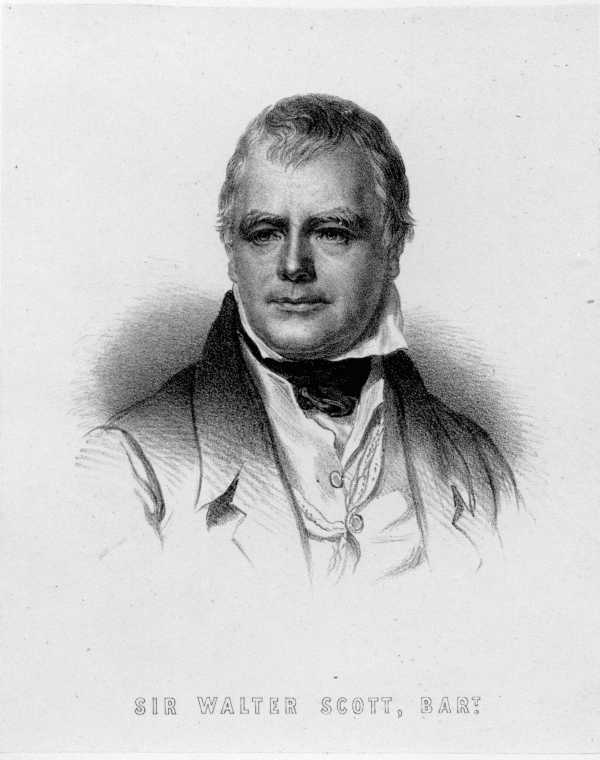 SIR WALTER SCOTT BART.