New original cover art included with this eBook is granted to the public domain.
Most illustrations may be enlarged by clicking them or opening them in a new window
or tab.
A COMPLETE TREATISE ON THE DESIGN, CONSTRUCTION,
EQUIPMENT AND OPERATION OF MEAT PACKING
HOUSES, ACCORDING TO PRESENT AMERICAN
PRACTICE, INCLUDING METHODS OF
CONVERTING BY-PRODUCTS INTO
COMMERCIAL ARTICLES.
New Edition
Revised, Amplified and Enlarged by DAVID I. DAVIS
First Edition by the Late F. W. WILDER For Many Years General Superintendent Swift & Co.
PUBLISHERS
NICKERSON & COLLINS CO.
CHICAGO
Copyright, 1905 and 1921, By NICKERSON & COLLINS CO., Chicago
All Rights Reserved
Press of Ice and Refrigeration
Chicago.
PREFACE.
In the preparation of the revised edition of this work, the
first complete treatise upon the subject of the meat packing
house business published, the original scheme has been followed.
First, presenting in a convenient and simple form,
practical suggestions, tables and formula that are needed in
the operation of the packing house business according to modern
practice. Second, describing operations in the various ramifications
of the business, from the unloading of the animals at the pens
to the production of the finished product and the disposition
of it, in the order in which the different operations are
conducted.
The various operations described and subjects treated
upon have been indexed so that any matter upon which it is
desired to obtain instant information may be readily found.
The author arranged the chapters in the order of the various
operations in the packing house, together with descriptions
of the machinery and appliances required. The established
packer, as well as the beginner, if he carefully digest the contents
of this work, will find he has valuable information, the
knowledge of which will aid him in conducting his business.
The chapters on proper construction and arrangement
contain information in which the author has given the reader
the benefit of his experience in the construction and operation
of packing plants.
A portion of the contents of this work is devoted to tests
showing the value and yields of the various products of a
modern packing house, based on prices and conditions existing
at the time they were made, in which the percentages and
comparisons are reliable and are available to the reader by
using the weights and percentage shown, computed on present
commercial prices.
The numerous formulas given for the manufacture and
preservation of the various products of the packing house are
those which have been proven to be the best after years of
experience. In every instance they have been put in the simplest
form possible, so that no mistake can be made in applying
them.
In revising this work, it is recognized that the use of
some of the ingredients are now prohibited by regulation in
the United States, but in some instances, it has been seen fit
to not change the original formulas. In some instances, however,
the omission of the objectionable ingredient has been
made, though otherwise the formula remains the same as in
the first edition. Many formulas rendered obsolete are omitted
on account of conflicting with pure food laws.
The information furnished in these pages is based upon
the author’s experience, there being very little theorizing upon
the possibilities of what may be accomplished by adopting
certain prescribed methods. For this reason, the book will
be found of practical value to those interested in the meat
packing business.
The present necessity of a work on packing house operation
is more evident than when the first edition was published.
The original work has been entirely revised where considered
necessary, amplified in places and much new information
added.
The chapters relative to construction, refrigeration and
mechanical operation have been revised to conform to advanced
practice.
Acknowledgment is made of the use of engravings,
photographs and original data, and ideas developed and used
by the reviser in his engineering practice. That the volume
will be well received and fill the needs as a hand book and
reference work is the hope of the authors and publishers.
The assimilation of the contents as a foundation, together
with power of observation and application will greatly assist
beginners in packing house work, the methods of which are
progressing—although the fundamentals remain the same.
The reviser hopes assistance will be given in this way,
which he in turn received by oral advice from the two outstanding
superintendents in their day (the days of the business
growth), Messrs. F. W. Wilder and C. O. Young.
Location — Water Supply — Sewage — Odors and Prevailing Winds — Cleanliness — Designs and Errors — Character of Business — Requirements —
Principles of Design.
Description of Plants — Plant No. 1 — Plant No. 2 — Plant No. 3 — Plant No. 4 — Type of Plant — Loading Facilities — Producing Department —
Abbatoir Building — Rendering Building — Live Stock — Icing Department — Cooler Building — Pork House — Manufacturing Building — Salt Spaces — Power Department — Gravity
System — How to Build — Fireproof Design — Advantages — Slow Burning Construction — Approval of Plans.
Steam Making Equipment — Uses of Pumps — Types of Pumps — Pumps for Brine — Water Supply — Pumps for Wells — Water Distribution Systems —
Pumps for Boiler Feeding — Heating Boiler Feed Water — Wells — Cooling Towers — Economizers — Superheaters — Steam Engines — Exhaust Steam — Advice as to Exhaust Steam —
Boilers — Conclusion.
Warehouse Design — Floor Area — Fire Proof Buildings — Floor Construction — Coolers — Fan and Ventilation — Spray System — Galvanized Sheet
Iron Pipes — Coil Rooms — Quantity of Pipe — Method of Erecting — Life of Pipe — Cellar Ceiling Suspension — Ratio of Piping — Defrosting — Gardner Curtain System — Direct
Expansion Piping — Chill-Room Bunkers — Low Temperature Brine System — Freezer and Storage Buildings.
Green Hides — Condition — Scores — Prod Pole Damage — Clean Floors — Leather Yields — Pattern — Proper Storage for Hides — Grading — Grubs
in Hides — Salt to Be Used — Building of Packs of Hides — Trimming of Green Hides — Switches — Shrinkage of Hides — Sheep Pelts.
Bone Department — Hard Bone — Glue Bone — Bone Products — Horns — Manufactured Articles — Skulls — Test Yield from Skulls and Feet — Buttocks
and Thighs — Blades and Ribs — Drying — Crushed Bone — Grinding Bone — Neats Foot Oil Storage — Neats Foot Oil Purifier — Yield Tests.
Tank House Design — Isolation and Ventilation — Separation of Press Room — Digesters — Rendering Tank — Surface Box — Press and Pump — Cooking
Killing Stock — Operating Tank Blow Off — Pressing Tankage — Treatment of Lard and Tallow — Titer in Tallow and Lard — Steam for Cooking — Cooking Tests — Operating Odorless —
Tests — Catch Basin.
Soil Fertility — Animal Feeding — Tank Water — Separation of Solids — Collecting Grease — Testing Tank Water — Evaporating Tank Water —
Description of Apparatus — Cleaning Evaporators — Table of Boiling Points — Testing Stick — Copperas in Water to Evaporate — Solids in Water — Drying Stick — Value of
Tankage — Quantity of Tank Water — Cost of Evaporating.
Hog Cutting — Variety and Classes of Hogs — Cutting Floor — Pork Cuts — Hams — Side Meats — Bellies — Backs — Loins — Shoulders — Butts and
Plates — Percentage of Yield — Change Cuts One Side — Test on Five Sides — Complete Cutting Test.
Departmental Accounting — Expense Accounts — Departments — Purchases — Inventories — Store Accounts — Labor Charged to Departments and
Sub-Divisions — General Principles.
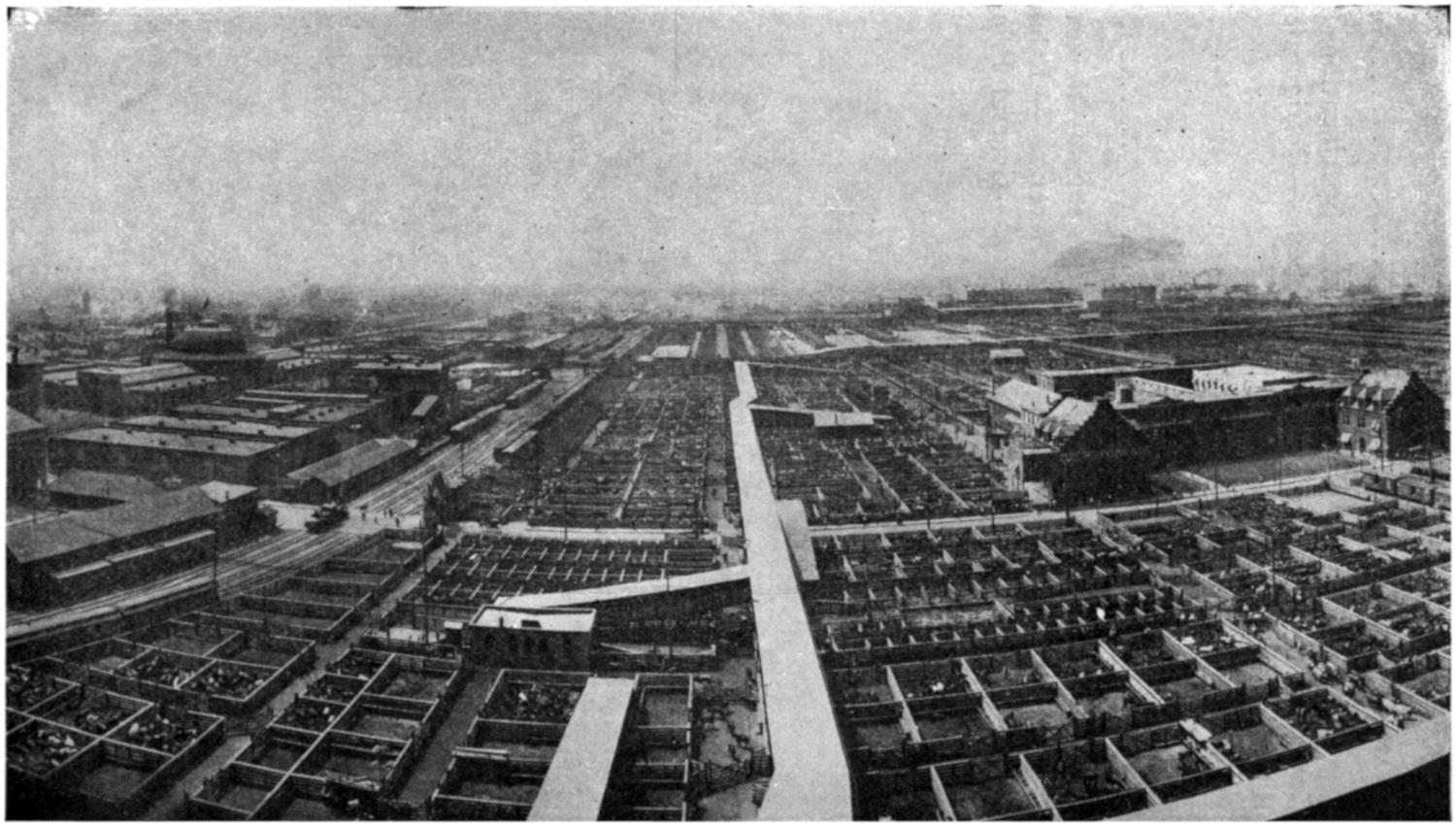
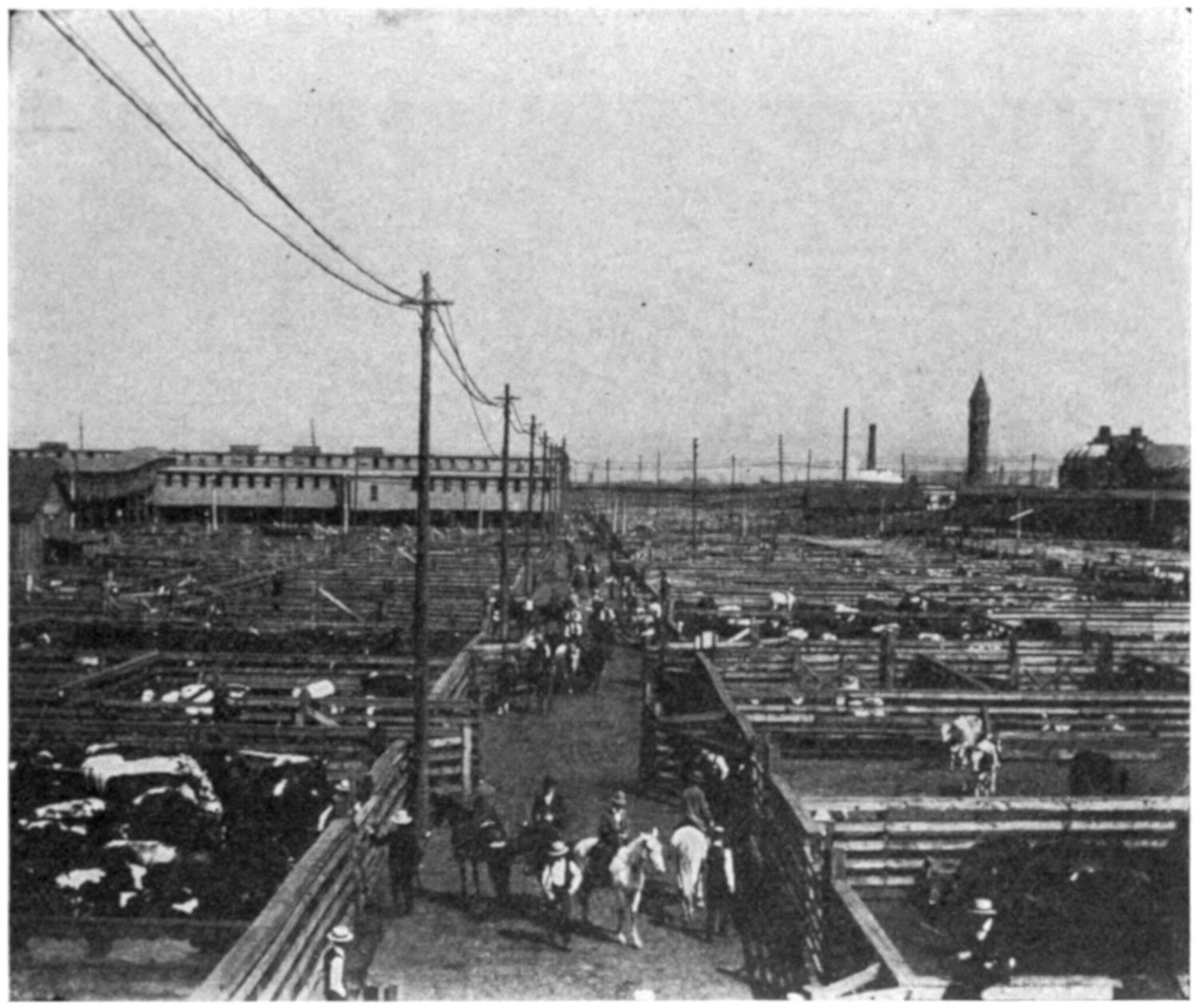
VIEW OF UNION STOCK YARDS, CHICAGO, SHOWING HORSE MARKET AT LEFT AND EXCHANGE BUILDING AT RIGHT.
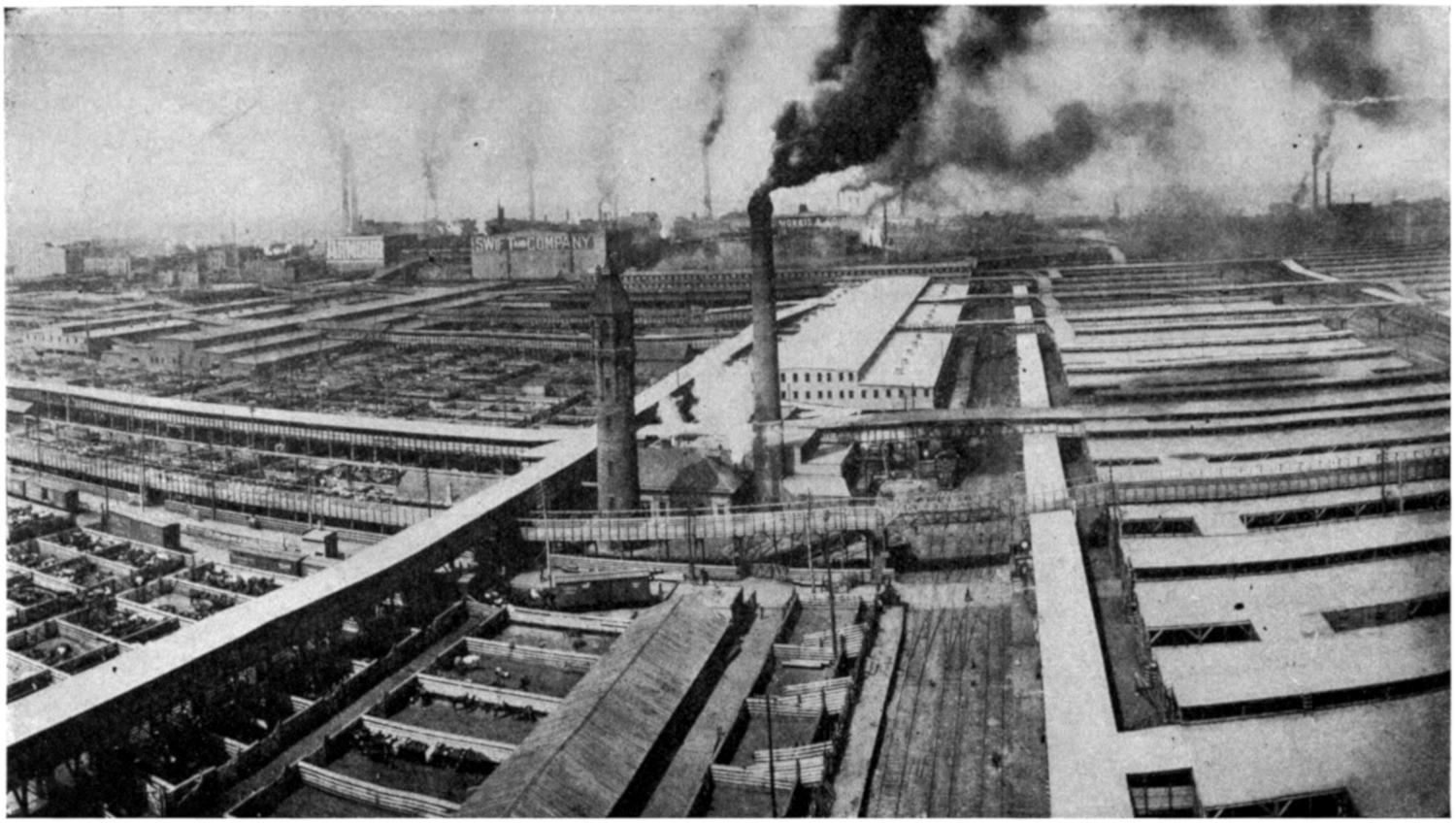
GENERAL VIEW OF UNION STOCK YARDS, CHICAGO, SHOWING PACKING HOUSES IN THE DISTANCE.
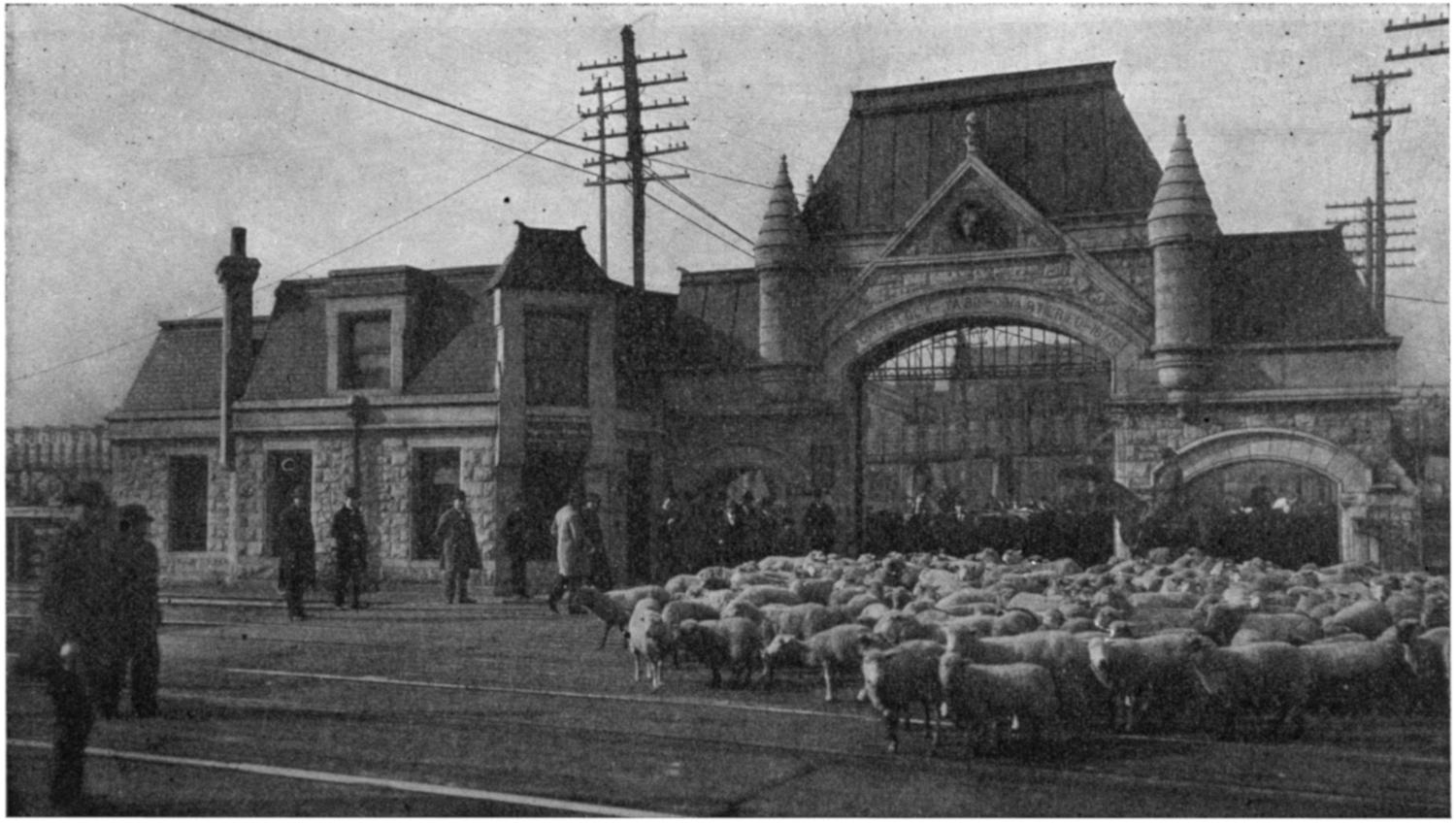
ENTRANCE TO THE UNION STOCK YARDS, CHICAGO, U. S. A.
CHAPTER I. MODERN PACKING HOUSES. — Introduction and Growth. — Concentration. — Early Methods. — Yankee Ingenuity. — Chicago Yards. — Movement Westward. — Economic Factors. — Saving By-Products. — Pioneer’s Troubles. — Using Box Cars. — Using Refrigerator Cars. — The Chilling Room. — Mechanical Refrigeration. — Freezing Meats. — Overseas Shipments.
Introduction and Growth — Concentration — Early Methods — Yankee
Ingenuity — Chicago Yards — Movement Westward — Economic Factors — Saving
By-Products — Pioneer’s Troubles — Using Box Cars — Using
Refrigerator Cars — Chilling Rooms — Mechanical Refrigeration — Freezing
Meats — Overseas Shipments.
—Few industries in the United
States have shown such rapid growth as has the packing house
business. The modern packing house, as it exists today, may
be said to be less than forty years old since its inception.
One naturally inquires the causes which led to the growth
of this industry to its present proportions in so short a time,
ranking practically fifth in importance among the industries
of the United States. The main factor which has been instrumental
in the consummation of this immense growth is
concentration—coupled with—conservation.
—Concentration permits the manipulation
of by-products, creating useful and valuable materials saleable
in themselves and tending to reduce the commercial cost of
the edible portion of the animal. Conservation in the saving
of all parts of the animal to their best uses.
—Before the modern packing house was
established the method in vogue was to either ship by car or
drive live stock to the point of consumption, where it was
slaughtered and put on the market in a crude and expensive
way compared with the methods of to-day. In the evolution
of the business the first step toward making the modern packing
house was the concentration of live stock at a few markets
where it was offered for sale. Prior to that time it would have
been impossible for any one point to obtain sufficient stock
to much more than supply its local demands, and surely not
enough to supply a modern establishment.
—In the United States during the early
days of the live stock market, buyers purchased their supplies
where they best could, and shipped them alive to the places
where the animals were to be consumed. At this point
“Yankee” ingenuity interceded and devised the opposite plan,
viz: that of shipping the live stock to a few central points and
there changing it to dressed meats, which were shipped to
the consuming markets. The development of this plan inaugurated
a new line of business now recognized as one of
the most important of modern industries—central stock yards
and packing house centers.
FIG. 1.—LIVE STOCK GOING TO SCALE, UNION STOCK YARDS, CHICAGO.
—One of the first and largest of these
central live stock depots to be established was the Union
Stock Yards, Chicago, Ill., U. S. A., where are located the
largest slaughter houses. Views of these great yards are
shown. Fig. 1 shows one of the places where live stock is
passed to the scales and weighed prior to delivery to the purchaser;
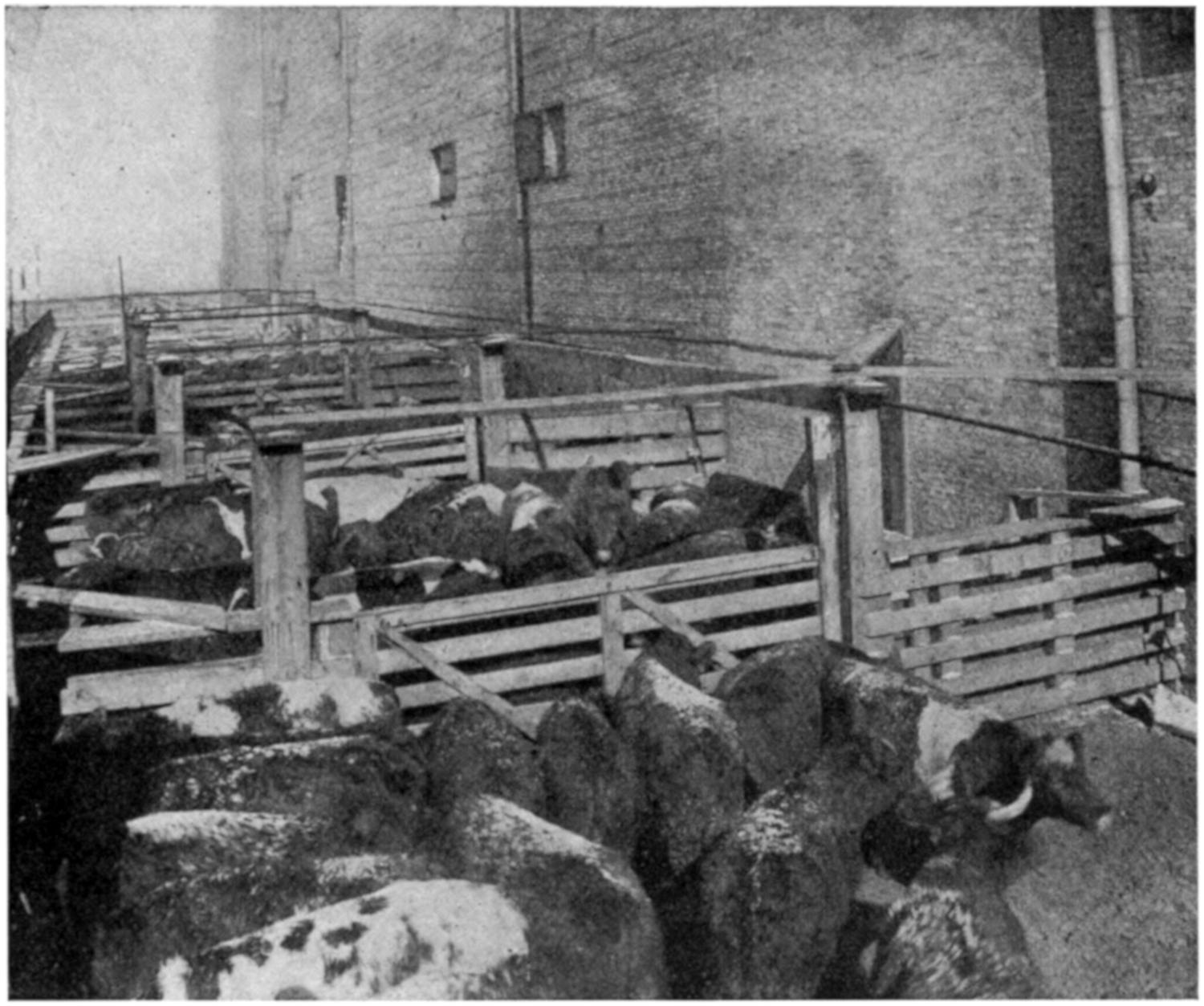
Fig. 2, a view of the live stock pens and an alleyway
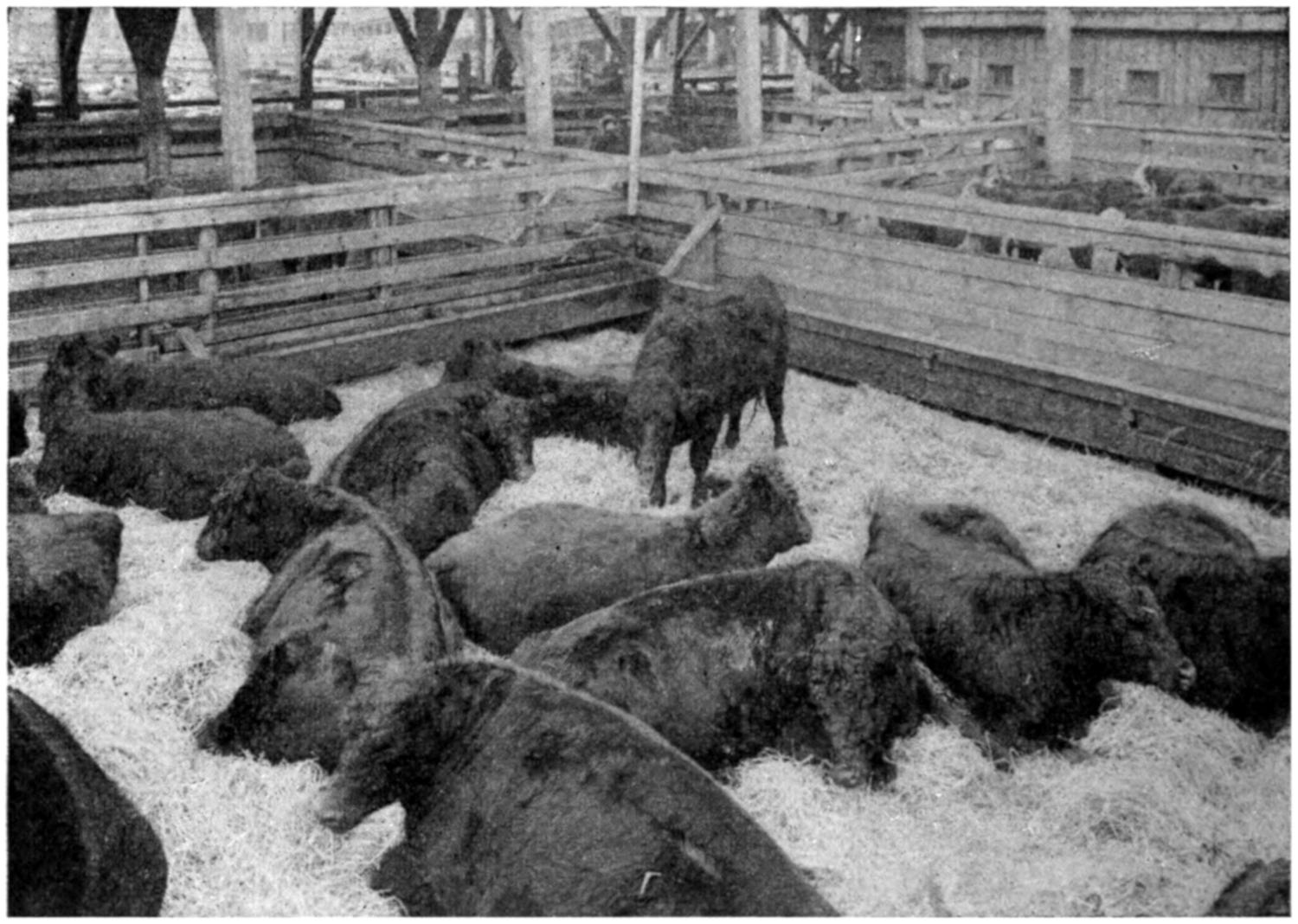
on a busy day; Fig. 3, a view of a pen containing choice yearling
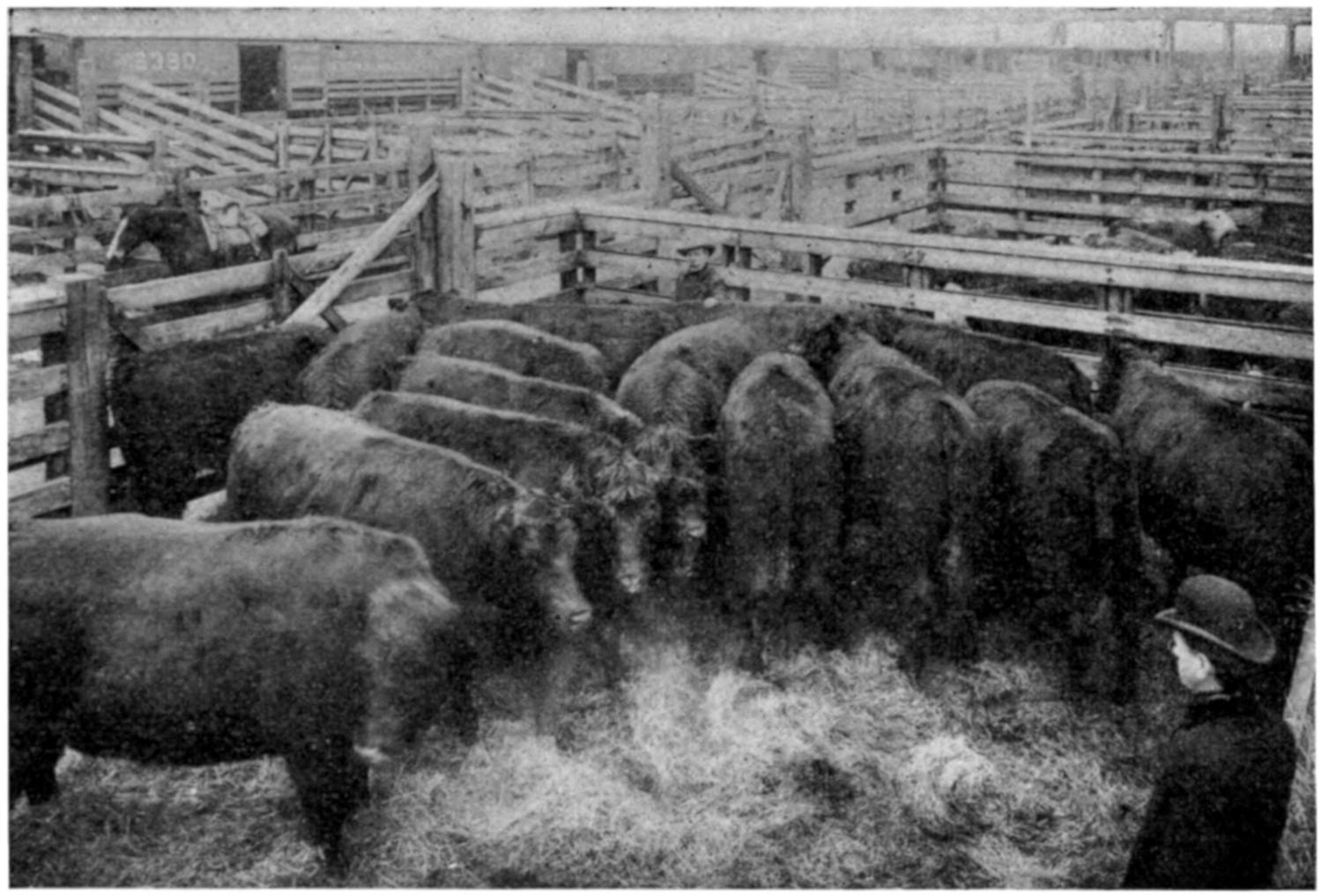
cattle, and Fig. 4, one containing a bunch of choice Polled-Angus
cattle. These views are typical of many markets now
established throughout the United States and where the business
is conducted upon a parallel basis.
FIG. 2.—A BUSY ALLEY, UNION STOCK YARDS, CHICAGO.
—Many factors and conditions contributed
to the possibility of the modern packing plant. The
feature of slaughtering the cattle near to the point of growth
lessened the shrinkage and abuse of the animal and its resulting
food product. There are many of the conditions that
might be gone into in detail but which are now of no consequence.
However, among the conditions that made the
business possible was the fact that on the vast plains of the
west, innumerable cattle were being raised at a minimum cost,
with but little local sale, whereas in the thickly settled east,
in the manufacturing districts, a ready market was found for
the beef.
FIG. 3.—PEN CONTAINING CHOICE YEARLING CATTLE.
—Economic conditions make the raising
of live stock, in juxtaposition to the production of grain,
a fixed fact. And apparently the nearer to the source of supply
the animal is slaughtered the less deterioration in the
product, animal and meat considered together. The packing
business of this country would practically be impossible in
older countries that are thickly settled, as the cost of raising
live stock would be actually about the same in all parts, and
the cost of shipping from one point to another would only
add to the original cost. With the lower cost of raising the
animal on low value land, the eastern farmer with his high
priced land was unable to compete, hence the practice of
raising live stock in the west and consuming it in the east;
and the concentration of live stock at the large markets, with
the improved devices, has made the business a possibility, and
the money and energy expended in adopting the best methods
has caused its growth to its present magnitude.
—Another important feature adding
to the growth of this industry, is the saving effected by utilizing
the by-products. When animals were killed promiscuously
throughout the country this was impossible, for a man killing
a few at some local point could not save the by-products, consequently
they were lost. Neither could the small killer afford
the necessary appliances with which to turn the material out
economically and compete with business on a large scale,
any more than the ancient cobbler sitting at his bench, could
afford the labor-saving machines and devices which are seen
in modern shoe factories. The general health of the public
has been served by having their meats properly inspected and
delivered in a much better condition than they could be at
the time when the animal was killed and the meat consumed
without it being properly chilled. That the meat is delivered
to the consumer in a more palatable condition than it was
formerly is generally conceded by all. Foreigners who visit
this country are invariably impressed with the superior meats
with which they are served, due to the process in chilling,
and the age at the time of consumption.
The by-products which are saved in modern plants, which,
under the older methods were almost entirely lost, have a good
value. Heads and feet, for example, which were ordinarily
thrown away, are to-day made up into various products, all
of which have a value. The blood, fats and refuse, are turned
into commercial commodities, and the saving of these different
parts creates a profit in the business, a profit heretofore
lost. Further details on this subject will be given in the
chapters treating on by-products.
—When the pioneers of the business
first broached the idea of killing cattle in Chicago and selling
the dressed beef in the east it was considered wholly impracticable,
and the people who started the business were looked
upon as a “little queer.” There were many bitter experiences,
in the way of financial losses before it was accomplished.
Shipping perishable products long distances caused the loss
of many thousands of dollars before the proper methods were
discovered, but the beginners felt they were working along
the right lines. Obstacles were overcome and to-day meats
are delivered in eastern markets in a far better and a more
healthful condition than they were ever offered to the public
under the old methods from local abattoirs.
—In the early days of the concentrated
cattle markets, fresh meat products were only shipped during
the winter months and in a common or what is now known
as a “box” car, as differentiated from a “refrigerator” car.
—The next step was the use of
ice in the car and from this to the “refrigerator” car. This
type of car with the improved dispatch service offered by the
railways, made the business of shipping freshly dressed beef
to any part of the country feasible.
—Notably and most essential was the
development of a chilling department in which the slaughtered
animal could be properly chilled. This is now a matter
of such common occurrence that but little consideration is
given the subject. However, in the days when ice was used,
and before the introduction of mechanical refrigeration it was
a matter of large consequence.
—Mechanical refrigeration, and
this alone, has made it possible to properly cool meats for
shipment to remote points as fresh meats, or to properly prepare
them for curing, and to preserve them after curing beyond
a comparatively limited time. Mechanical refrigeration
made possible the equipping of ships for the transportation
of meats under refrigeration from any point to any market
on the globe.
—The freezing of meats such as beef and
poultry, and holding them to a desirable season has rapidly
become an important factor in packing house work. Not only
beef, poultry, butter and other food products are accumulated,
but pork cuts, such as hams, shoulders, bellies, etc., are frozen
and carried indefinitely or until it appears desirable to thaw
and cure them.
—A contributing feature to the development
of the packing house business, was the overseas
shipment of meats. In the early part of the decade 1900-1910
a very large business in fresh beef was conducted between
the United States and England. At the outset it was considered
an impossibility, but by the most careful and detailed attention
and the utilization of modern methods, it was found
possible to kill cattle or sheep in the hottest months of the
year at interior points in the United States, ship the meats in
refrigerator cars to the seaboard, transfer into refrigerated
rooms on the steamers and thence to England, the meat being
sometimes four or five weeks en route from the abattoir where
the animal was killed, to the place where the meat finally
reached the consumer. Even though the English authorities
gave it the most critical examination, it was found in proper
state for consumption. In the same manner vast quantities
of meat is finding its way from South America to the European
markets, most of it shipped “chilled,” not frozen. For a
time the United States furnished the largest part of the fresh
meat consumed in England. It is true that for many years
we have supplied foreign markets with cured and canned
meats, but the fresh meat trade in England is a business developed
within a comparatively few years and it grew to magnitude.
However, owing to our growth, increasing home
demands, and the changed economic conditions, this business
dwindled in the last decade so that on beef it was practically
gone, except that during the European war owing to prevailing
conditions, it was revived for a time at least. The pre-eminence
of the United States pork products, however, is
everywhere recognized and until new corn producing lands
are developed and utilized, the corn and the pig supply for
the world will be that part of the United States west of the
Alleghany mountains and east of the Rocky mountains.
CHAPTER II. LOCATION AND CONSTRUCTION. — Location. — First. — Second. — Water Supply. — Boiler Purposes — Condensing — For Cleaning and Other Purposes — Sewage. — Odors and Prevailing Winds. — Cleanliness. — Design and Errors. — Character of Business. — Requirements. — Principles of Design.
Location — Water Supply — Sewage — Odors and Prevailing Winds — Cleanliness — Designs
and Errors — Character of Business — Requirements — Principles
of Design.
—Location is a moderate sized word with a vast
meaning. It has two definitions as applied to meat packing
houses.
—Location as to a live stock supply. Pioneers in foreign
lands looking for a cheap supply must take into consideration the
quantity immediately available, the probabilities based upon feeding,
climate, natural enemies—beast and bug—and the ambition
of the people to produce as well as their ability to produce.
Sometimes an apparent supply is at hand but a searching
investigation will show that it is an accumulated surplus, soon
exhausted, with a resultant dearth. In the case of cattle, a supply
cannot be created in a day but by persistent effort and in
several generations of human life.
Transportation by trooping and by train, or the ability of
the cattle to withstand the first or the ability of the railways to
handle for want of facilities, are at times matters of much consequence.
—Location as applied to a position for operating, applicable
to domestic or foreign works. There are several items
of prime importance to be considered in selecting a location from
this standpoint. In many instances a plant is established near a
locality producing a sufficient quality of live stock suitable for
a certain purpose, for example pigs suitable for export trade.
In some instances the selection of a location is made for trade
reasons, or to be adjacent to a stock yards; and in instances
because property is owned in a certain locality. Where situation
can be of choice, the matters for most serious consideration are
sewage disposal, water supply, prevailing winds and transportation
facilities.
—This is of great consequence. The quantity
to be used for condensing purposes, refrigerating machinery
operation, for cleansing, and in the regular course of
business, is a very large amount, and if purchased from water
supply corporations or municipalities, at prevailing rates, become
a burdensome item of expense. The principal use for
water can be classified under three headings:
—This naturally will be selected from available
sources based upon fitness, irrespective of cost.
—First, for refrigerating machinery ammonia
condensing and for steam engine condensing, in conjunction
with the production of power and operating steam engines on
refrigerating equipment. For this purpose cold water is desirable.
If it can be obtained from wells it is the best practice,
owing to such water usually being of low temperature. However,
the cost of production must be considered, and that calls
for engineering knowledge as to relative conditions. Usually,
unless the surface water be in large quantity and available
from a stream, the wells prove economical unless the water
must be raised from great depths involving air lift pumping.
There are instances, however, where turbidity makes water
from streams undesirable and where well water is unobtainable,
and in instances of this kind use of settling basins, reservoirs
and cooling towers is resorted to.
—The water for cleansing
purposes, for food products, fats and premises, should be
clean and free from contamination that render it unfit for
potable uses.
—The question of sewage disposal from a packing
house is of more consequence than the water supply, which is
usually determined by the relative cost. The former is a
matter of disposition. No matter how carefully the refuse
from the slaughtered animal is collected for passing through
the rendering department, or how carefully the waters from
cooking are collected for evaporation, quite large quantities
of nitrogenous particles and many substances which are more
cheaply disposed of by the way of the sewers, ultimately reach
them. If the refuse finds its way to a rapidly flowing stream,
it is taken care of by bacterial action, but if discharged into a
dry stream or pool, or to a sewage disposal plant, it becomes
a serious burden that sooner or later reverts to the packer.
—Naturally to minimize the
distance of transport to stations for shipping or delivery to the
consumer, or to be near to a supply of labor, every manufacturer
is desirous of locating his works near to a city or on its
outskirts, if not at a commercial stock yards. Where the
latter are of comparatively large consequence to a community,
the odors arising are usually considered a “necessary evil”
and the packing plant as a part of that.
No matter how carefully the plant may be operated, if the
full commercial value is taken out of all products there are
some departments in which it is difficult to abate the smells,
and if the prevailing winds are towards a residence district,
it is likely to cause disturbance. This statement can be qualified,
however, because it is a fact that plants can be designed
and can be operated so as to be kept within proper bounds
and be of no more nuisance than the handling of the live
animals, but it will always be well for the prospective packer
to recognize that he would not care to live on the premises,
nor will his neighbor appreciate his works any more than he.
A packing house properly belongs to a district at a reasonable
distance from residence property, and where the prevailing
winds are not toward the residence district.
—The features contributing most to the operation
of a plant so as to avoid it becoming noisome is that
of cleanliness, first, last and always; ample equipment to
promptly dispose of all by-products, and to do it promptly.
—The location disposed of, the design
and construction is a problem that cannot have too careful
consideration. There are two grievous errors that may creep
in; overbuilding and under building. Overbuilding recognizes
the construction of a plant too large for present needs, thereby
making the capital investment too large for the business to be
done, and sometimes resulting in the handicap of insufficient
monies for plant operation with all the difficulties entailed.
Under building, failing to recognize the growth that might
occur and failing to so arrange that the growth can be made
in a way that keeps the plant in balance and makes for economical
operation. Either condition may lead to regrets.
—At this point comes the consideration
of the character of the business to be conducted and the
proportioning of departments one to another suitably. For
instance, in a beef shipping plant for fresh beef the coolers
may have a hanging capacity equal to at least three times the
daily slaughtering capacity, while at some market points the
ratio may be ten times. Whereas, at a freezing plant it becomes
a question of room to accumulate a cargo dependent
upon transport facilities.
—The requirements in the various localities,
as to arrangement of departments; to comply with sanitary
necessities as to light and ventilation, and the classes of
materials required in construction, are changing from time to
time and no set rule can be made, but these are axiomatic:
(1) Products prepared for food purposes must be
quickly and thoroughly isolated from non-edible products.
(2) All departments should, so far as possible, be maintained
in separate buildings.
(3) Building materials should, so far as possible, be
non-absorbent.
(4) Light and air should be arranged for in plenty.
(5) The question of movement of product to minimize
labor should be given proper attention. In the building of
a packing house it is only within the last few years that this
matter has been studied from the standpoint of obtaining the
best results at the least expenditure for operating.
(6) Formerly it was considered proper to build the
killing house and coolers on the ground level, excavating a
cellar for the storage of some of the products; the power
house, tank rooms and other buildings for the disposition of
by-products were placed without reference to economy in
operation. Experience has proven that it is economical to
slaughter animals on the upper floor of a building, and instead
of spreading out on the ground and covering a large area as
formerly, to build higher over a smaller area. With a proper
incline the animals will walk to an elevation of 50 or 60 feet
without detriment to their condition, and it is much cheaper to
do this than to kill them on the ground level and elevate the
products, or to convey or transport them to distant buildings
on the same level.
(7) The use of gravity is recognized as a proper procedure
in all departments from a low labor cost standpoint.
The locating of the buildings, one to another; to minimize the
transferring of products; and the grouping of products as to
convenience in shipping by wagon, by car or by boat, as the
case may require, are also important.
(8) Very important is the question of grouping cold
storage departments so as to minimize the wall space and
exposure from radiation; likewise the concentration of buildings
requiring heat to avoid the loss of fuel by reason of long
steam lines, and radiation which can not be prevented.
—The crux of the plant appears to
be the slaughtering department for it is here the work begins
and from this source radiates the various parts for disposal.
One well-known and successful designer works with the idea
of beginning at the rendering department, and establishing the
tops of the rendering tanks, or digestors, on a level with the
viscera separating floor, from which the refuse is readily transported
without the use of elevator or lift service.
The slaughtering floor is naturally above this level, and
all other departments disposed to meet the various needs.
Obviously there being so many controlling factors, no examples
can be set out to meet all conditions. There follows
however, a ground plan and sectional view of several plants
of varying sizes with descriptive data.
CHAPTER III. PLANT DESIGN. — Description of Plants. — Plant No. 1. — Plant No. 2. — Plant No. 3. — Plant No. 4. — How to Build. — Fireproof Design. — Advantages of Fireproof Construction. — Slow Burning Construction. — Approval of Plans.
Description of Plants — Plant No. 1 — Plant No. 2 — Plant No. 3 — Plant
No. 4 — Type of Plant — Loading Facilities — Producing Department — Abbatoir
Building — Rendering Building — Live Stock — Icing
Department — Cooler Building — Pork House — Manufacturing
Building — Salt Spaces — Power Department — Gravity System — How
to Build — Fireproof Design — Advantages — Slow Burning
Construction — Approval of Plans.
—This chapter is devoted to a description
of several types of plants.
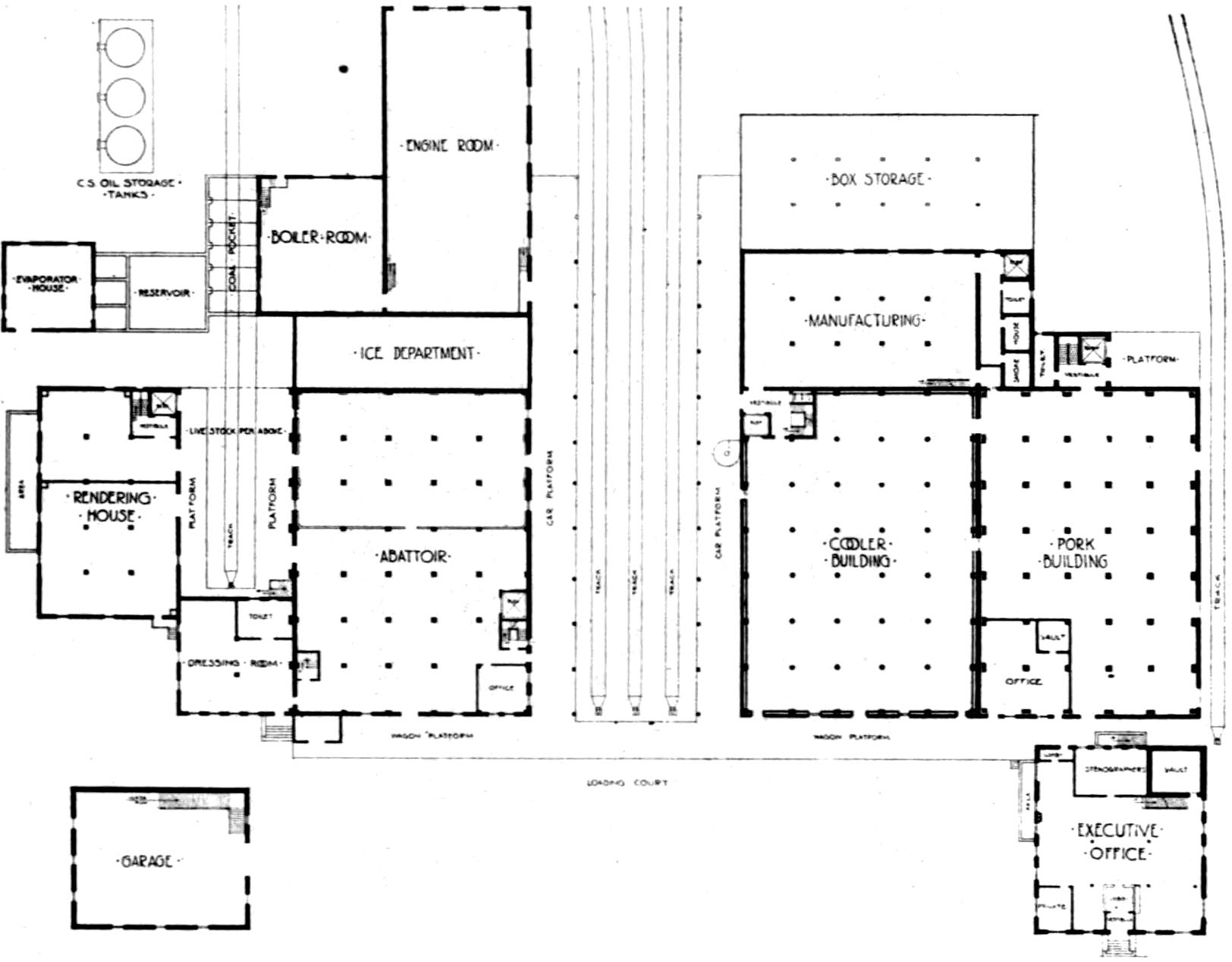
—A moderate sized beef, mutton, and pork
producing plant capable of slaughtering six hundred cattle,
fifteen hundred sheep and fifteen hundred hogs daily, and taking
care of the products of manufacture resulting therefrom.
This design was developed upon the principle of gravity for
movement of products with as little use of elevators as possible;
the avoidance of excessive use of mechanical conveyors
and contrivances; the grouping of buildings intended for hot
or cold temperatures; economy of operation, and for minimum
car movement.
Loading Facilities.
—The general arrangement provides for
wagon and dray loading facilities fronting the main thoroughfare.
The garage and office are at the left and right sides of
the court. Three tracks are situated between the two groups
of buildings to take care of the car loading. Usually the refrigerated
products are loaded upon the east track, and non-refrigerated
products, such as hides and bones, and the oleo
department products, upon the west track. The intermediate
track is used for the storing of cars. By use of the connecting
platform at the south end either kind of cars can be loaded
on either track. A separate non-interfering railroad spur is
provided for unloading coal, and cotton seed oil, and for loading
tallow, while a distinct track is provided for loading cars
of dry salt meats from the pork warehouse.
FIG. 5.—PLANT NO. 1, MODERATE SIZE PACKING HOUSE.
Producing Department
—The abattoir is made the center of
distribution, with the refrigerated buildings and departments
directly communicative, situated nearby. The rendering and
manufacturing departments—users of steam and power—are
grouped near to the abattoir and to the power plant, while
the buildings requiring refrigeration are grouped together and
isolated from the manufacturing buildings. The stock pens
connected with the plant are to the left of the manufacturing
groups, but are not shown on the plan.
Abattoir Building
—This building, six stories high, is given
over to the following uses: Fourth floor, slaughtering; third
floor, treatment, separation and cooking of by-products and
manufacture of casings; second floor, oleo oil manufacturing;
first floor, oleo oil storage, and shipping purposes; basement
and sub-basement, storage of tallow and curing of hides.
FIG. 6.—EXTERIOR VIEW BEEF, SHEEP AND PORK PLANT.
Rendering Building
—Divided into two sections and separated
by partitions, one side is used for the refining of cotton seed
oil and the manufacture of edible tallows; the other side for
cooking blood and rendering inedible tallows. The floors are
used as follows: Second floor, level with viscera separating
floor in abattoir, from whence raw stock is trucked to the filling
floor without requiring use of elevators for filling of tanks;
first floor, tank bodies and receptacles for collection of tallow.
The skimming vats to which the tank residue, after drawing
off the tallows, is passed, are level with this floor, enabling
the separation and floating of the tallow and its collection;
basement for press room, and sub-basement for drying tankage.
The tank water to be evaporated is collected and passed
to a separate building for treatment and evaporation.
Live Stock
—The live stock pens are situated to the left of
the rendering department extending north of the oil storage
tanks from which position leads an incline, delivering the live
stock into an elevated storage pen covering the area between
the rendering house and the abattoir, and over the
dressing room.
Icing Department
—Facilities for manufacturing ice for cooling
cars are provided in the space directly north of the abattoir
building. The three railroad tracks between the two
groups of buildings are covered with a protecting shed, and
from the bottom member of the trusses are suspended trolley
rails for handling buckets of ice to be dumped into the tanks
of the refrigerator cars.
Cooler Building
—The dressed beef, mutton and pork is transferred
via bridge with chain conveyors, carrying the carcasses
from the slaughtering house floor to the cooling rooms situated
upon the third floor of the cooler building. From this
floor the carcasses are conveyed for storage purposes to the
second and first floor, and from there they are passed to the
cutting room, city sales department, or cars. The basement
and sub-basement are used for curing beef and pork joints.
The fourth floor of this building is set aside for freezing
products which, after being frozen, are shipped for storage to
other premises owned by the same company.
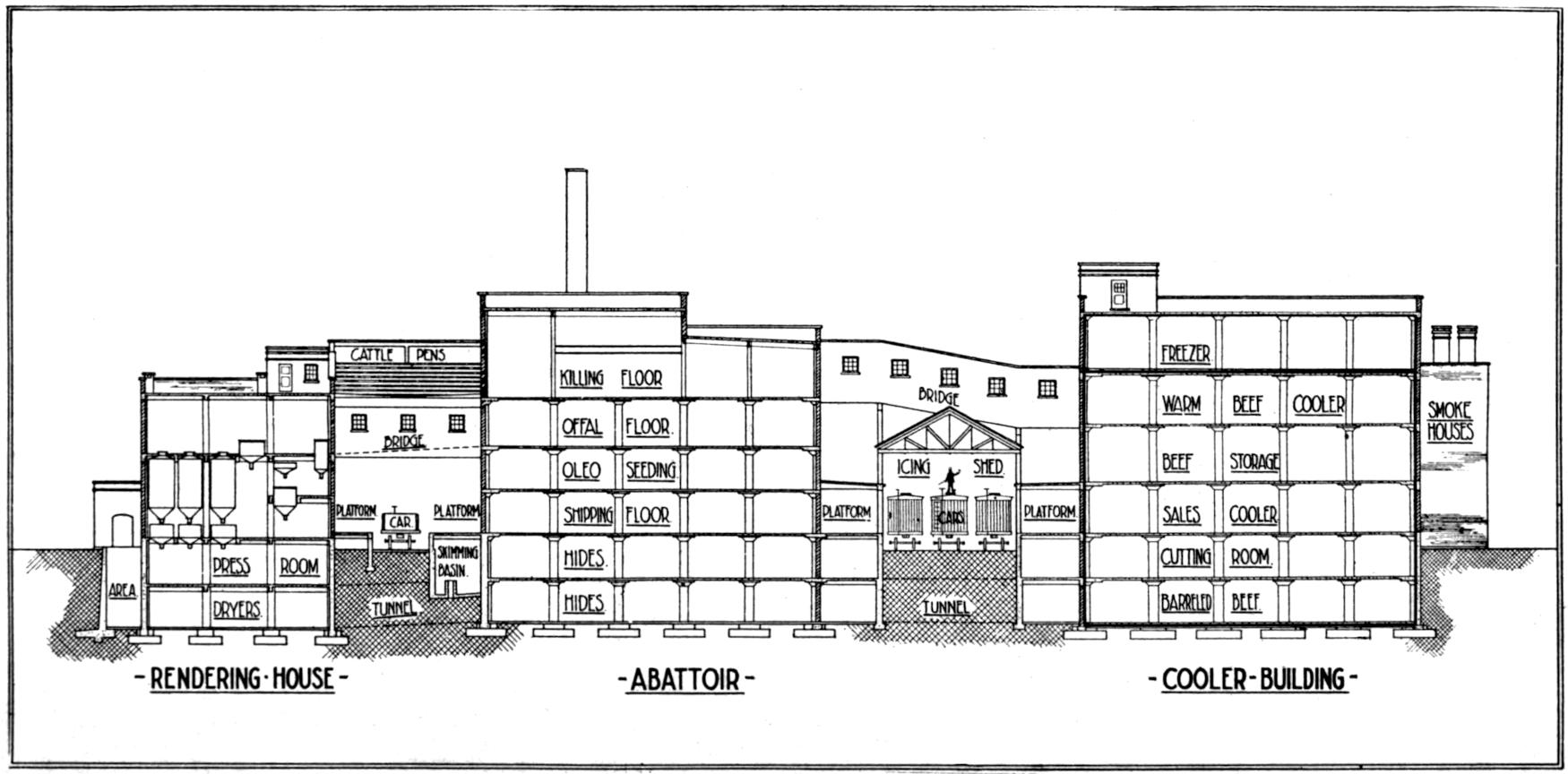
FIG. 7.—SECTIONAL VIEW INDICATING LEVELS AND COMPARATIVE LEVELS OF DEPARTMENT FLOORS.
Pork House
—The fourth floor of the pork house is utilized
for chilling hogs; the third for cutting them, and all floors
below for curing purposes. Note, the arrangement whereby
the pork house and the cooler building are each connected with
the team-loading platform and also closely arranged for car
loading.
Manufacturing Building
—A manufacturing building given
over to the production of sausage, smoked meats, lard and
the packing and shipping of same is immediately north of the
cooler and pork buildings, and connected thereto at all floors
where necessary. The city shipping department has its allotted
space on the ground floor of the cooler building and the
products finished in the manufacturing building move south
toward the team loading platforms.
Salt Spaces, etc.
—In this instance, but which rarely occurs,
the city’s main sewer system is located at a deep level, which
affords proper drainage and permitted the construction of two
cellars. There are, therefore, two stories practically under ground.
This is a decided advantage from the standpoint of radiation exposure,
and it also affords an opportunity to provide salt storage
and cooperage stowing spaces on two levels adjacent to the railroad
tracks. It further provides a means for securing a connecting
tunnel below the track level, thus providing facilities for a perfect
interchange from all cellar departments. Of equal consequence
is the opportunity to pass all pipes for water, steam and
refrigeration, power and lighting wires, as well as products,
from one department to another. This makes for a low upkeep
cost, little exposure, less radiation and greatly reduces
the annual upkeep.
Power Department
—The boilers were placed on a floor level
with the basement. The coal pocket into which coal is dropped
extends to the sub-basement level, providing a comparatively large
coal storage. At the sub-basement level are the ash collecting bins.
From this level are provided elevators of the continuous bucket
type for raising the coal and ashes to tanks provided for storage,
from which the coal and ashes gravitate to the furnaces and
disposal cars respectively.
The engine foundations extend to the sub-basement level, with
the main engine situated upon the basement level. The pumps are
located in part on the lower level. All pipes and wires leading to
the operating department are carried through the sub-basement,
permitting the arrangement of all exhaust and steam piping beneath
the engine room floor.
Gravity System
—Attention is called to the fact that in the
rendering department, for example, the products in their steps
of manufacture are handled by gravity entirely until the finished
dried fertilizer is produced, which has to be elevated to the ground
level for car shipment, or for wagon delivery. The same features
are true of the abattoir, hides and tallow in casks only, requiring
the use of elevators for shipment.
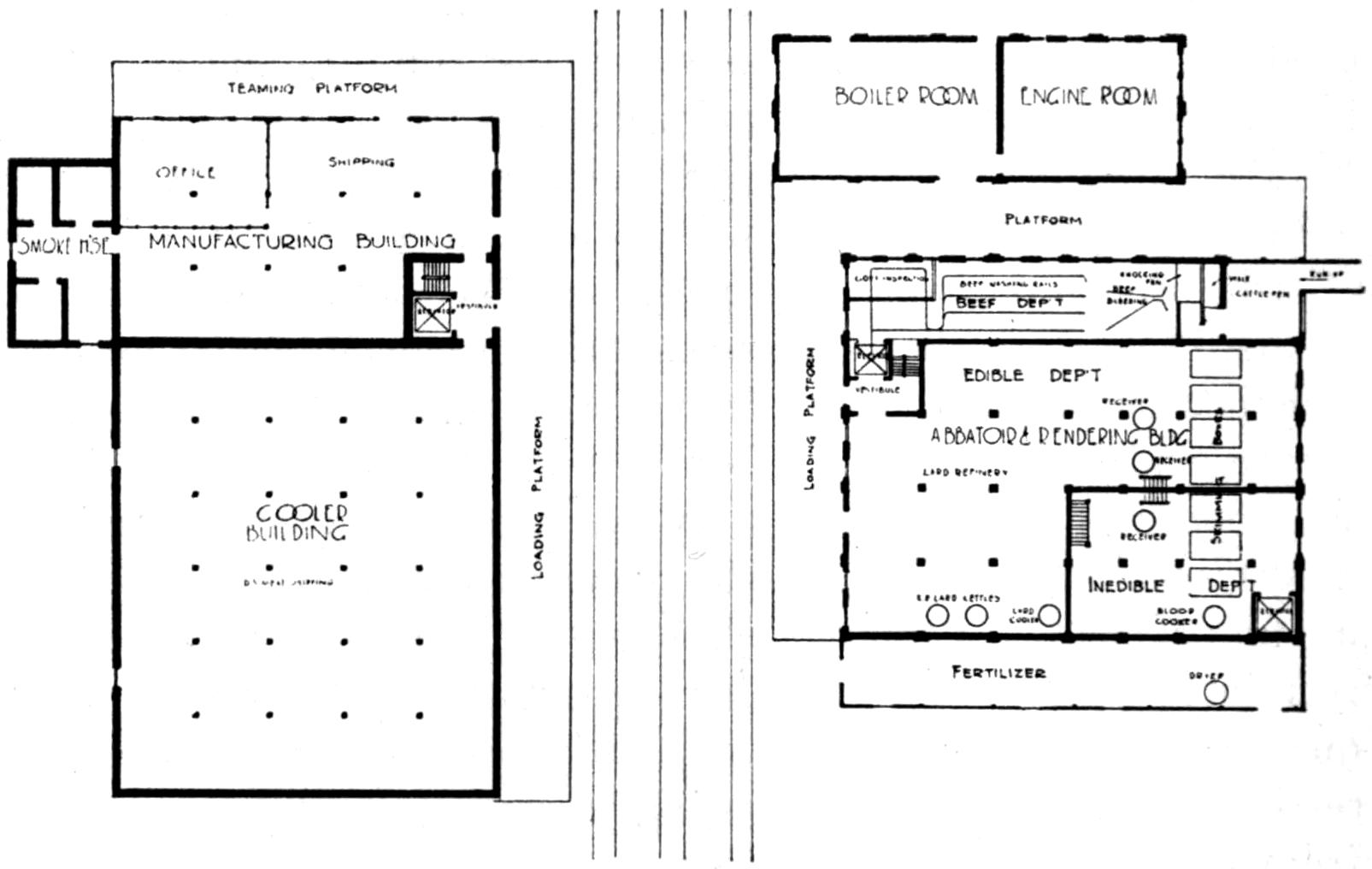
FIG. 8.—PLANT NO. 2, GROUND PLAN FOR COUNTRY PACKING HOUSE.
—This plant was designed for a country point
where the shipping by local freight cars or the city delivery was
quite limited; where the major part of the product would be
shipped by car, and where provision was made for quite an extensive
growth. The capacity as designed being four hundred hogs
and fifty cattle daily, with a complementary quantity of calves
and sheep.
Loading Facilities
—Again the three railways are provided
for convenience in loading and for facilitating switching and icing.
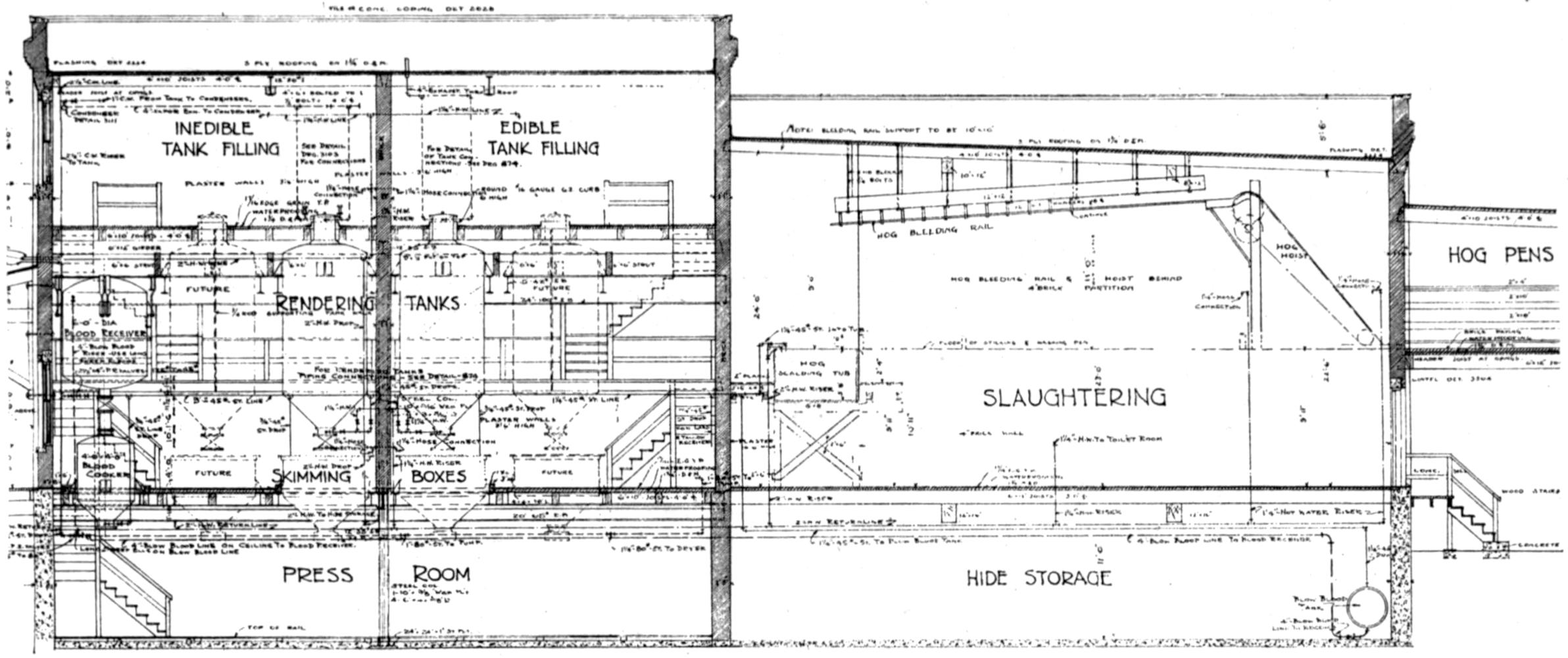
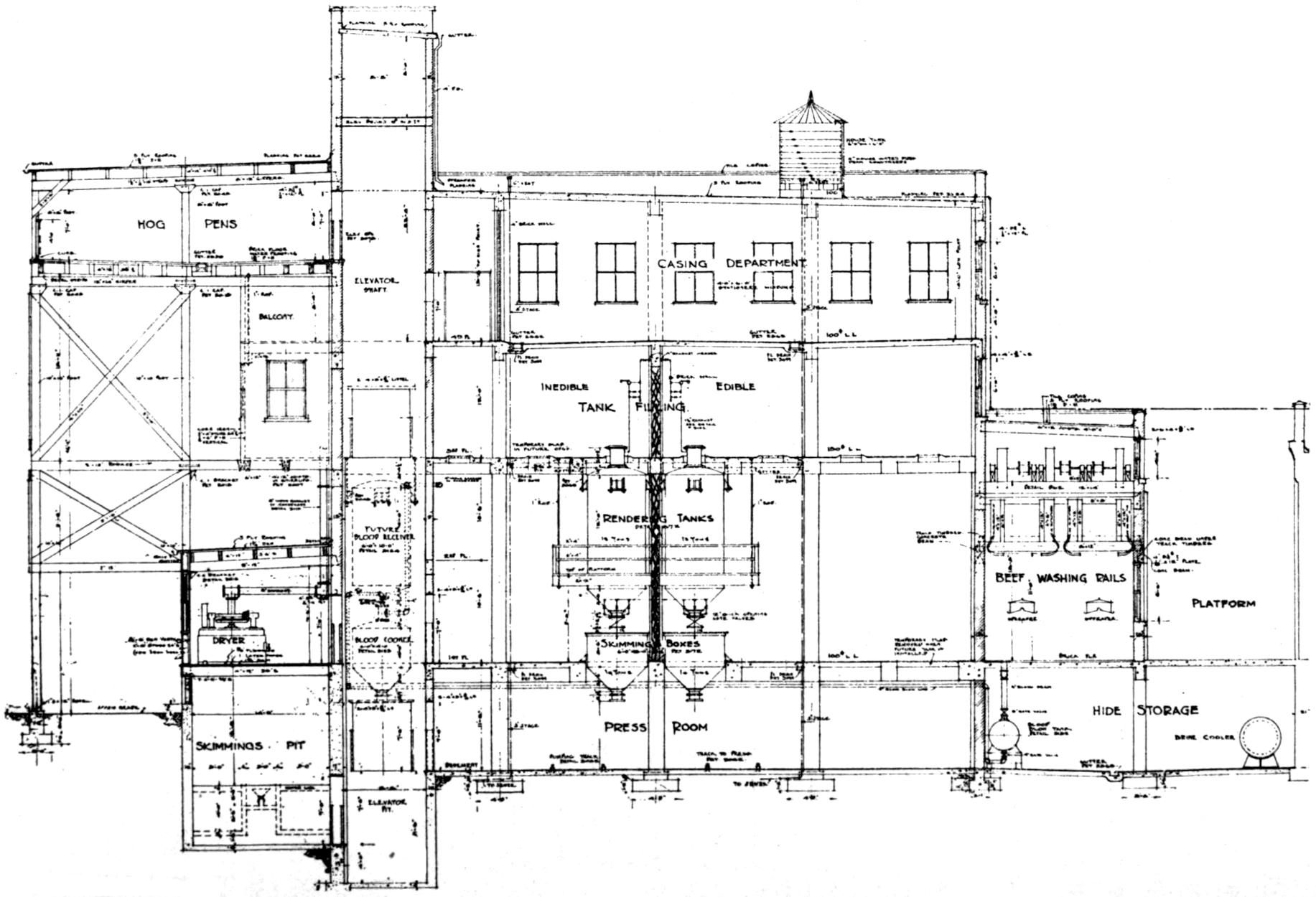
FIG. 9.—PLANT NO. 2, SECTION THROUGH SLAUGHTERING AND RENDERING BUILDING.
FIG. 10.—PLANT NO. 2, SECTION THROUGH MANUFACTURING BUILDING.
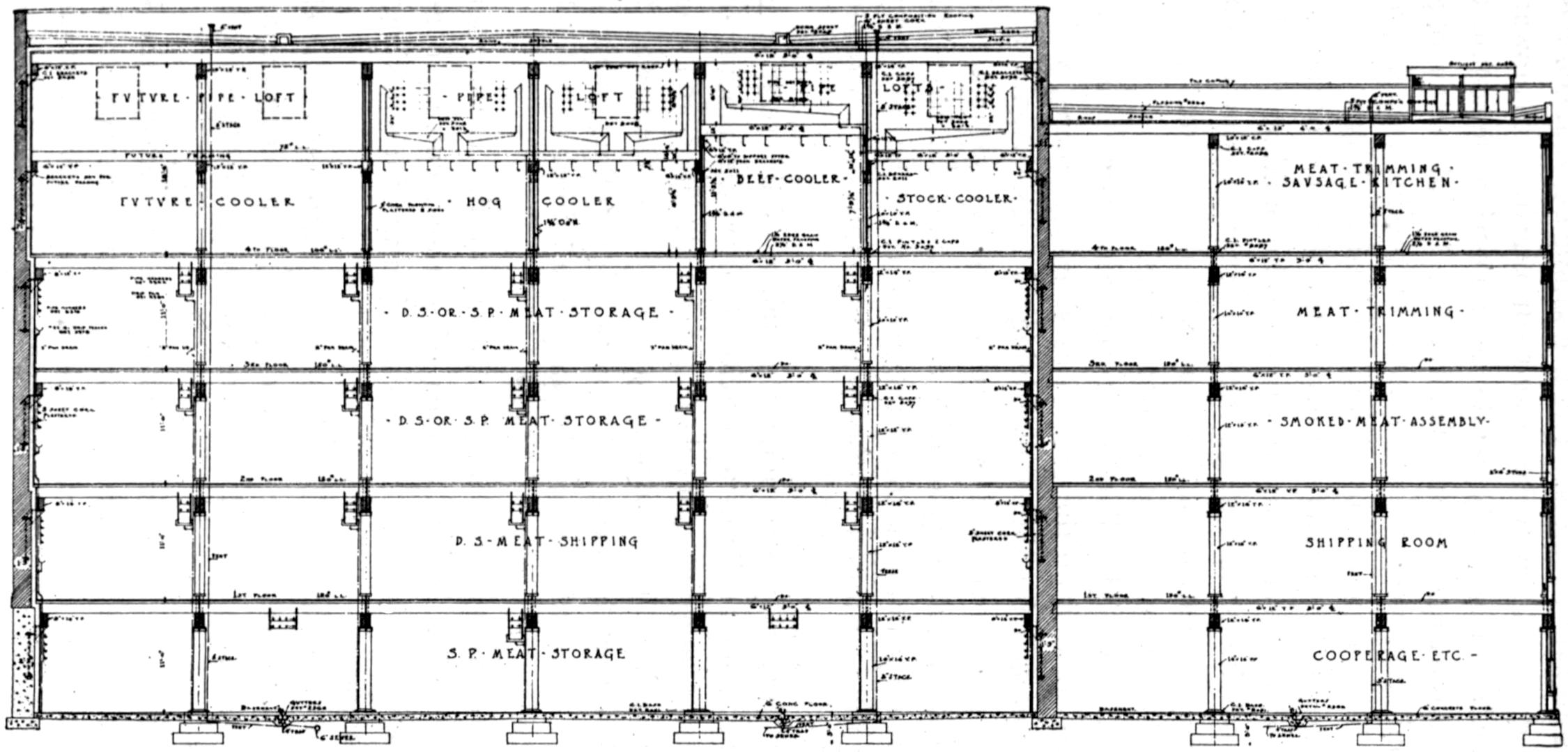
FIG. 11.—PLANT NO. 2, SECTION THROUGH COOLER BUILDING.
Producing Department
—In this plant the slaughter of hogs
is the predominant business. The hog killing department was consequently
designed amply large and for a growth to upwards of
fifteen hundred hogs daily, while the rendering department provides
for additional tanking facilities to be added as required.
In this building, near to the source of production is placed a
small air blast type of meat and leaf lard cooling space.
Rendering Department
—Owing to abattoir being isolated
it was possible to set aside a portion of the building for the rendering
department, and make the construction comply with the
sanitary requirements as to light, air and ventilation. These features
are illustrated by the sectional views.
Live Stock
—The live stock receiving pens for cars and
wagons are located on the ground as shown on plans, and a long
ramp is arranged for the slow driving of hogs. Again, all products
are passed downward in the process of manufacture.
Icing Department
—Facilities are provided for harvesting ice
from a stream situated north of the premises. The railroad tracks
extend to the ice storage houses where facilities are provided for
icing cars.
Pork Building
—Advantage was taken of the relative grouping
and the space available to provide an open air hanging or drying
room for hogs at a level of the killing floor and hog chill
rooms. The hogs pass through this space on their way to the
cooler. The pork building is arranged with chilling rooms on the
upper floor and curing rooms beneath on all floors to and including
the basement.
Manufacturing Building
—Adjacent to the cooler building,
space is provided for the making of sausage, cutting hogs, and
trimming of sausage meat, processing of meats for smoking, packing
and shipping.
Power Department
—This is a minor matter since the electric
current is purchased from a municipal lighting corporation, and
the plant being in a cold climate, advantage is taken of these
conditions.
Note that in this plant every department except the killing
department, which was made as large a unit as appeared to be
necessary, may be extended without in any manner disturbing the
relative situation of the departments. The uses of the several
floors are shown in the sectional drawings.
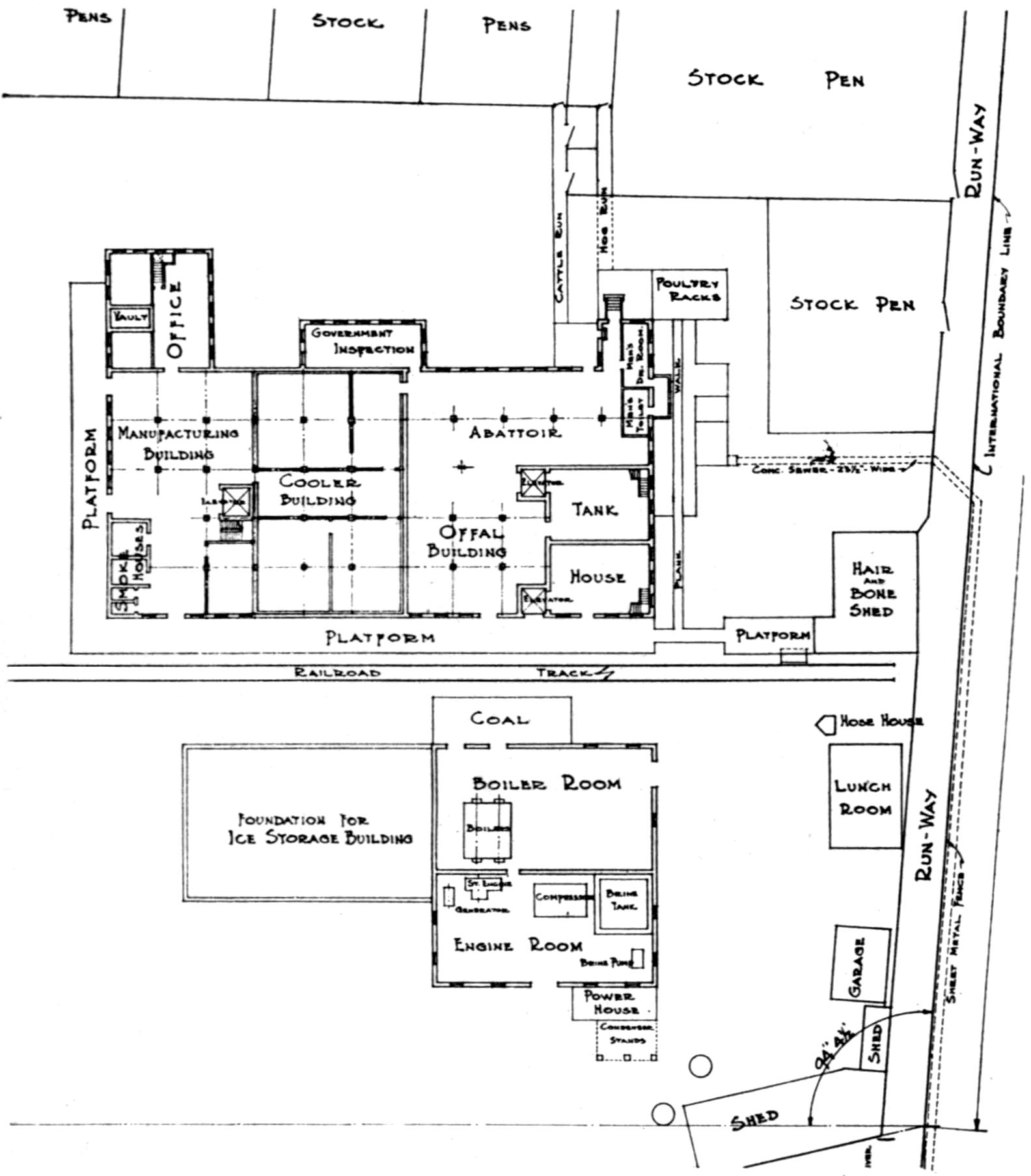
—Type of plant. The diagram (Fig. 12) is illustrative
of a small local plant situated in a southwestern city,
and built principally for a local mixed business. The plant will
properly take care of one hundred hogs and fifty cattle daily,
the necessary by-products and the manufacturing departments,
therefor. An ice business is operated in conjunction with this
plant. The buildings are chiefly two stories in height. The
plan and sectional drawings are sufficiently explicit to require
no description.
FIG. 12.—PLANT NO. 3, GROUND PLAN OF SMALL LOCAL PACKING HOUSE.
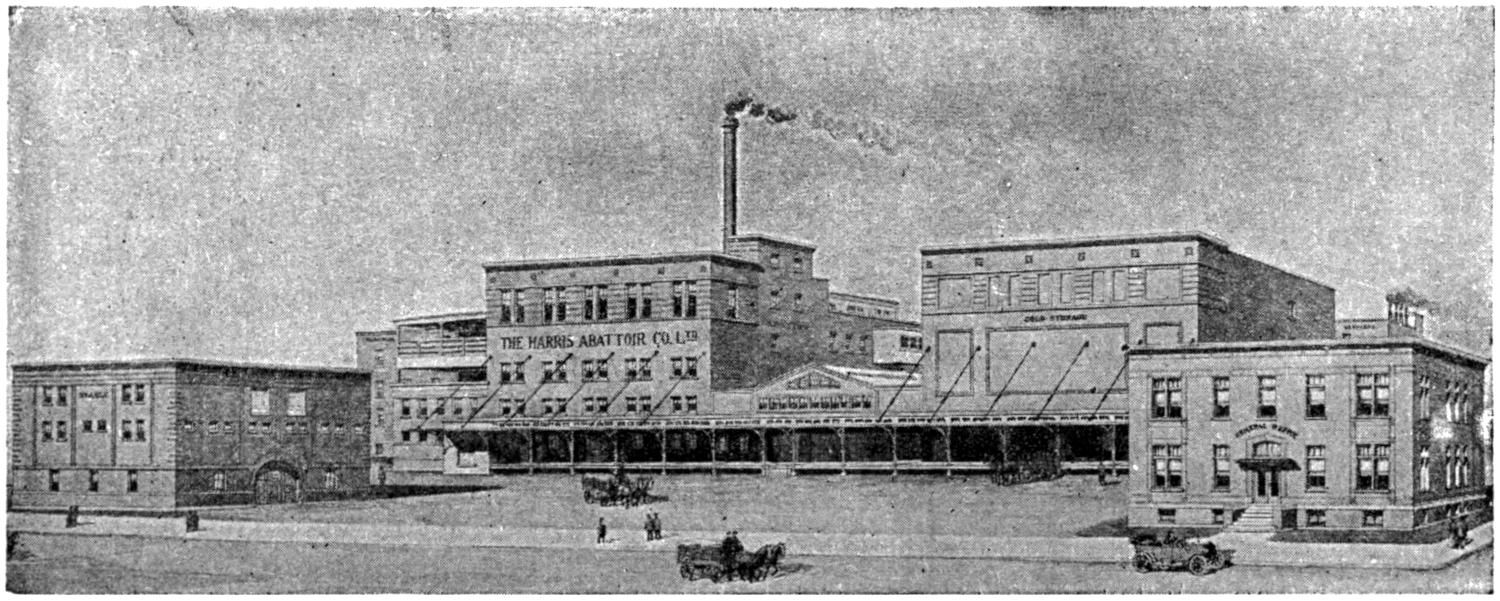
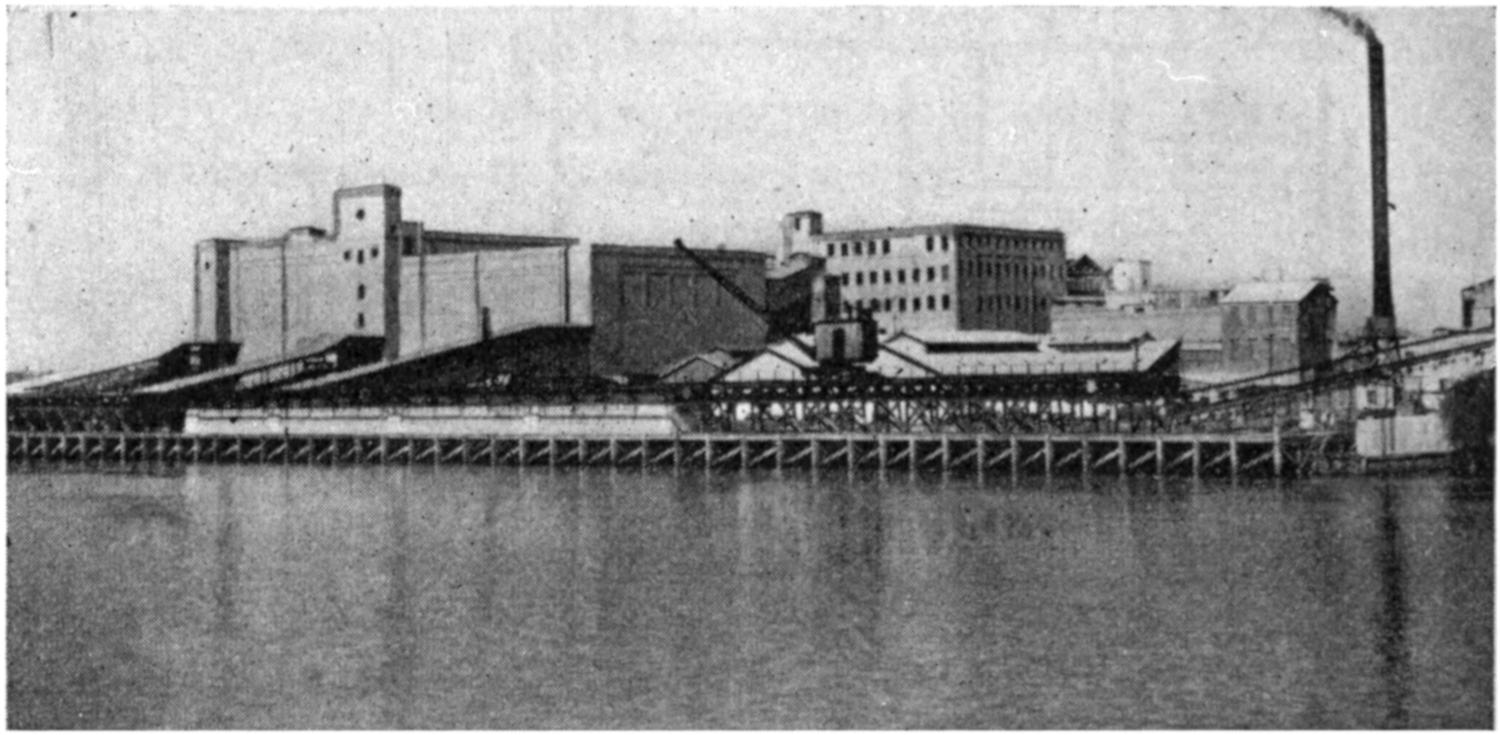
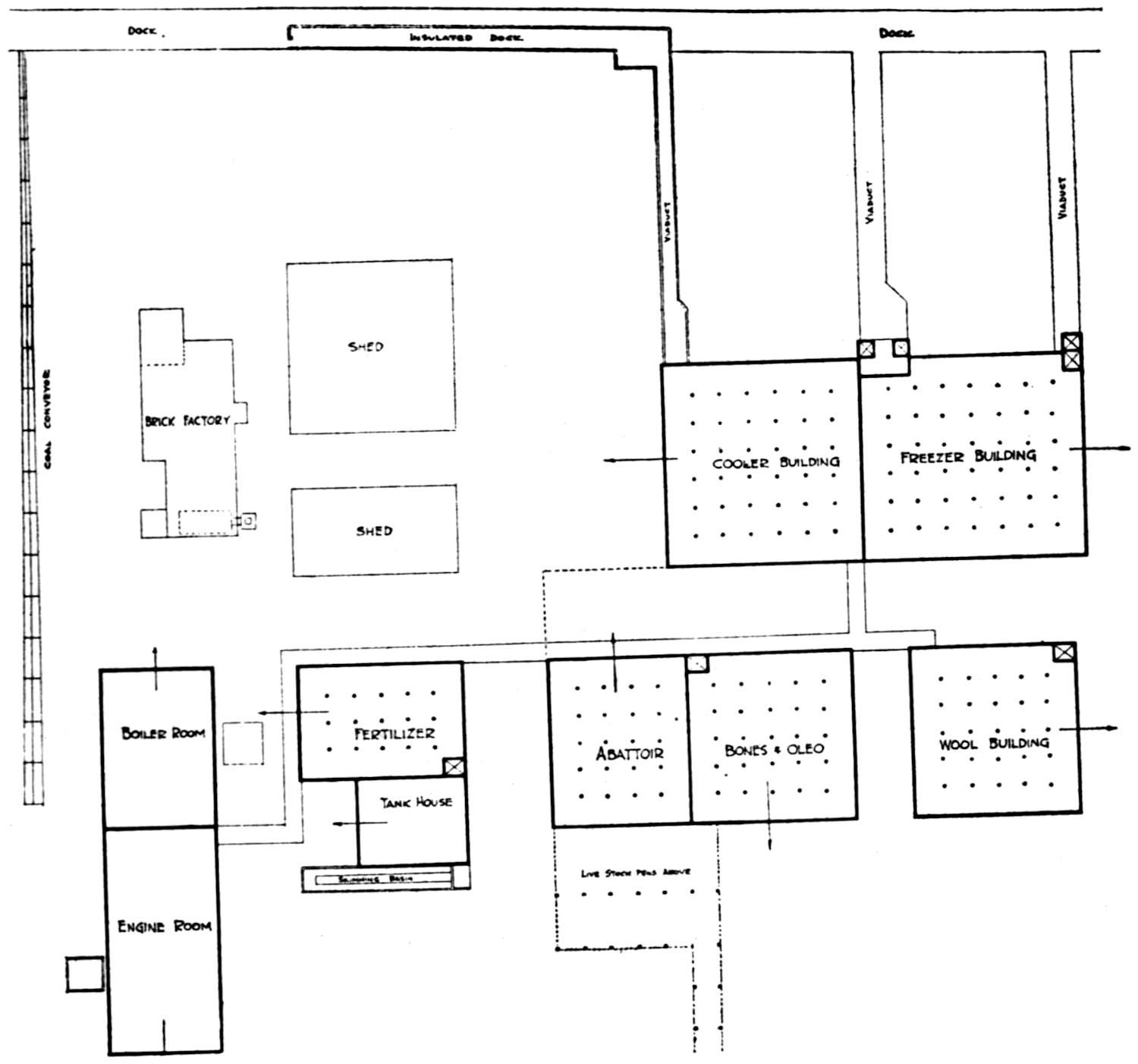
—The accompanying vignette and ground plan
are illustrative of an alongside deep water export plant. The
photograph of front view illustrates the loading facilities which
show ramps or inclines upon which conveyors are operated.
These endless chains convey beef in quarter to the wharf at
right angles thereto, where it is picked off the rail by ship’s
tackle and lowered into the ship’s chambers.
Discussing the plant arrangement, note the position of
the slaughter house with relation to the coolers and trace the
movement of the products to the coolers, rendering, wool
house. Also the further movement of the products to shipment.
Particular attention is called to the arrows indicating
the direction of growth of every department without disarranging
the first intention as to movement, and minimizing
the labor on the extended plant.
FIG. 13.—PLANT NO. 4, SHOWING DEEP WATER EXPORT PLANT.
The steam producing department is in close proximity
to the steam using buildings, viz: Power Department,
Rendering House, Fertilizer and Slaughter House. Preference
being given over electricity or refrigeration which can be
transmitted longer distances at less loss.
—The question of design being settled the
next matter of importance is the one involving the materials to
be used in construction. That becomes a matter of investment
and permanent size or location of the buildings. Fireproof
buildings are desirable on account of low cost of upkeep and
a lower insurance rate. They are permanent in every way,
but the difficult question is that of modifying, provided changes
become necessary.
FIG. 14.—PLANT NO. 4, GROUND PLAN FOR EXPORT PACKING HOUSE.
—If decision is made for a fireproof
building, re-inforced concrete is the first suggestion owing to
its universal use as a building material, but there are several
points to be given serious consideration before reaching a decision.
One of these points being how to insulate so as to
prevent losses. This matter will be taken up in a subsequent
chapter describing a cold storage warehouse of eminent design.
It is one of great importance.
—The fireproof
buildings have naturally a very great advantage in permanence
from a standpoint of cost of upkeep and insurance charges,
and from the greater loss of a cessation of business incident
to destruction by fire. In most plants there are sufficient departments
of such staple character so unlikely to be changed
that it appears judicious to make them fireproof.
—Many people are quite content
with buildings of moderate height of slow burning construction;
otherwise, a modified type of “mill construction”
and with the use of sprinkler systems which minimize the
insurance costs.
—There are many points in building
construction to take care of in the matter of design, to meet the
requirements of the insurance interests and local city building
department regulations, which in the main coincide. Before
entering into a contract to construct, it is well to have the
drawings approved by the insurance boards and the city inspection
bureau. It obviates expensive changes and additions.
To build in such a manner as to bring the insurance rates to a
minimum is certainly desirable. It is an advantage, too, to
have the plant divided so that in case of fire the spread of the
flames can be retarded and the fire confined to the building
where it originated, or if some of the buildings are burned the
balance can be saved. Fires invariably represent, to a well
managed business, a far greater loss than is collectible on the
insurance policies.
CHAPTER IV REFRIGERATION EQUIPMENT — Mechanical Refrigerating Equipment. — Ammonia Machines. — Ammonia. — Type of Machine Illustrated. — Compressor. — Condenser. — Receiver. — Expansion Valve. — Cooler or Expansion Tank. — The Cycle. — Condensing Water. — Absorption Equipment. — Unit Basis. — Computing From Unit Basis. — How Rated. — Freezer-Requirement. — System to Adopt. — Freezers in Small Plants. — Cylinder Arrangements. — Why Brine Circulation. — Air Circulating. — Force Draft. — Coil Room Systems. — Brine Chilling. — Brine Methods—Recommendation. — Types of Brine Coolers. — Balanced Brine System. — Open System. — Closed System. — Direct Expansion. — Two-Stage Compressors. — Ample Capacity.
Ammonia Machines — Ammonia — Compressor — Condenser — Receiver — Cooler — Condensing
Water — Unit Basis — Computing From Unit
Basis — How Rated — Freezer Requirements — Freezers in Small
Plants — Cylinder Arrangement — Why Brine Circulation — Air
Circulating — Force Draft — Coil Room Systems — Brine Chilling — Brine
Methods — Types of Brine Coolers — Balanced Brine System — Direct
Expansion — Two-Stage Compressors.
—This agent is of
great consequence in the operation of packing houses, and,
therefore, it is deemed essential to explain the principles
briefly; as well as to describe the uses.
—The use of ammonia refrigeration
equipment either absorption or compression has so generally
displaced all others for stationary or land use, and particularly
in meat plants and cold storage houses, that for the present
purpose it is unnecessary to go into a discussion of others.
The compression system being so predominant in its use, a
description of same is given.
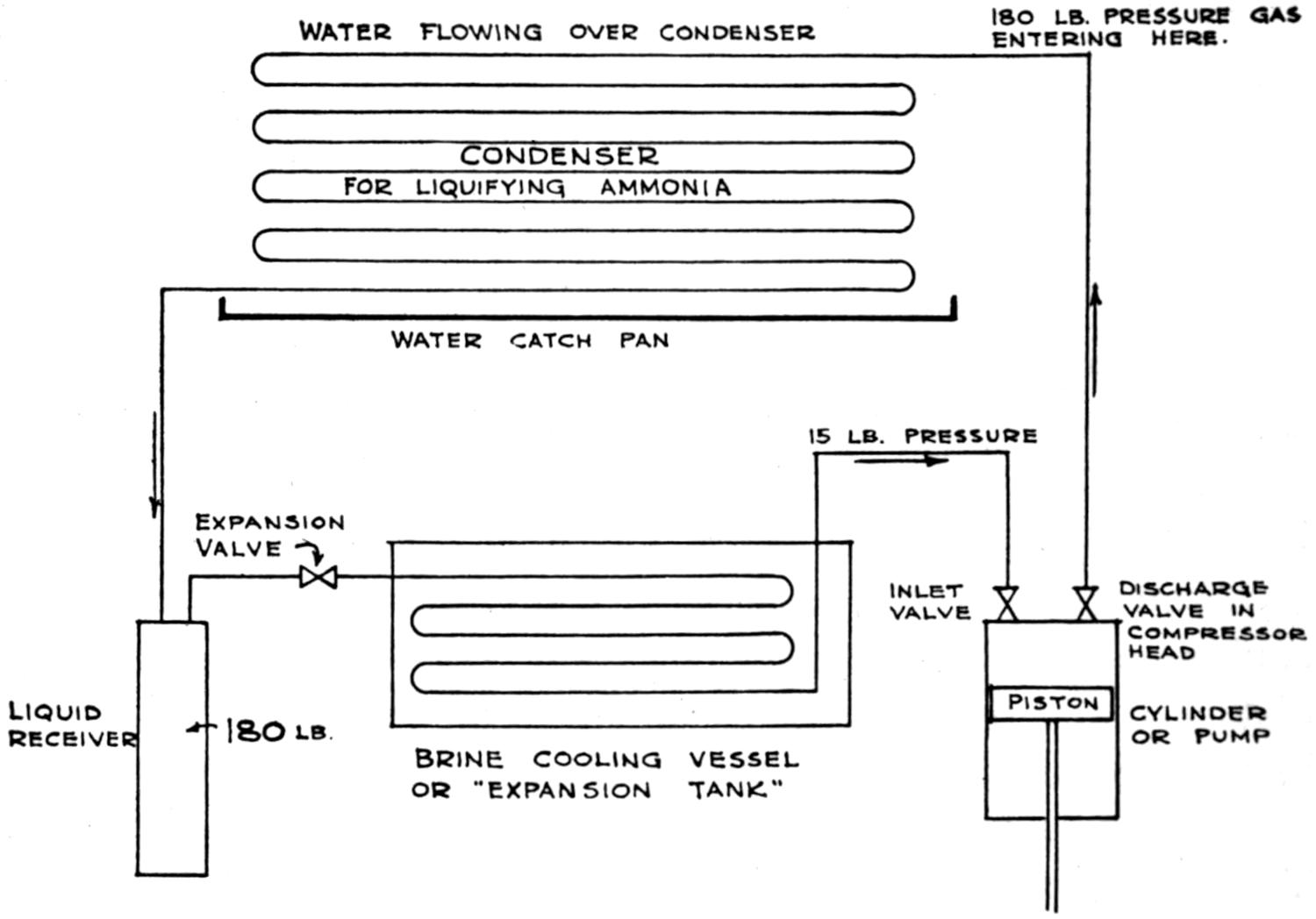
The diagram indicates a compression system in elementary
form consisting of:
(1) A pump or compressor which withdraws the gas
from the cooler or expansion tank, prepares and passes it to
the condenser.
(2) The condenser or liquifier which gives to the water
flowing over it the heat carried to it by the gas from the
cooler.
(3) The cooler or expansion tank in which the heat extracted
from the carcasses, the building walls or elsewhere,
is passed to the ammonia gas for conveyance to the condenser.
—Leaving for a moment the description of the
apparatus to acquaint the reader with ammonia: In the form
used in a compression refrigerating machine, it bears the name
“liquid anhydrous ammonia” meaning in a “dry liquid” form
differentiating from the common household ammonia which
is a water solution containing ammonia gas in variable quantity.
The distinction between these two is that “anhydrous
ammonia” will evaporate to naught; from household ammonia
the gas will evaporate but the water will remain.
Ammonia is a chemical compound made up of one part
nitrogen and three parts hydrogen and is expressed by the
chemical symbol NH₃. It has some peculiar characteristics
being analogous to water. It will assume a solid, liquid and
gaseous form, at -115° F. and -28¹⁄₂° F. for solid and liquid
respectively and will modify to a gaseous form at any temperature
above -28¹⁄₂° F. under “atmospheric” or conditions
of no pressure.
Water, as is known, changes from a liquid to a solid at
32° F. and changes to a vaporous form at 212° F. but here
the analogy ceases.
Ammonia has further peculiar advantages for use in
refrigerating production that it becomes a liquid at variable
pressures and temperatures; for example, when the temperature
is reduced to 60° F. under a pressure of 92 pounds,
when reduced to 80° under a pressure of 139 pounds and at
100°, under a pressure of 200 pounds; with variables above,
between and below these conditions. Ammonia, as will be
seen, has variable forms and capacities under the conditions
imposed upon it. Substances passing from a liquid to a gaseous
form require heat to make this change and consequently
absorb it; the complement to the giving up of heat when the
process is reversed and the substance changed from a gaseous
to a liquid form. The adoption or harnessing of these principles
is the nucleus upon which mechanical refrigerating
effect is built. A pound of water passing to steam will absorb
about one thousand degrees of heat, ammonia has the same
characteristic to a different degree. They both return the heat
when the process is reversed.
—The diagram illustrates a
single acting pump showing its piston, a liquifier or condenser
where the ammonia is modified in form from a gas as received
therein to a liquid; a receiver to which it flows and a cooler in
which it is expanded and where the heat brought to it by the
returning brine is picked up by the ammonia and carried to
the condenser. The arrows indicate the direction of flow.
—The “Compressor” is a pump, a cylinder
fitted with a piston which withdraws the ammonia from the
tank in which it is expanded. The piston is tightly fitted and
when it travels in one direction, the gas flows in, filling the
space, like any ordinary pump whether it be a water or gas
pump. Upon the return stroke, the gas is compressed in the
cylinder until the pressure in the piston is sufficient to equal
or overcome that exerted against it accumulated in the condenser,
when it is discharged thereto. There are spring actuated
valves interposed in the line of gas travel which close and
retain in the condenser that gas which has been discharged,
allowing the piston and compressor to repeat the just described
performance many times per minute.
—The use of this element is to liquify the ammonia,
really to extract the heat absorbed by the ammonia in
the cooler and the heat generated in the compression. This
condensing operation changes the form of the substance from
gaseous to liquid. The most simple style of condenser is a
series of pipes stacked together with ammonia on the inside
of the several pipes, and water flowing over the outside. The
gas on leaving the compressor is hot and at a high temperature,
frequently as high as 250° F. or more, and the pressure
from 140 to 220 lbs., depending upon the water supply, its
temperature and quantity, and the area of the surface of the
condenser.
The water flowing over the condenser absorbs the heat
from within, the ammonia becoming cooled by contact with
the comparatively cool walls of the pipe while flowing from
one end to the other of the condensing coil, gradually changing
from a gaseous to a liquid form.
—From the condenser the liquid ammonia is
collected in the receiver so as to have a quantity stored for use
and in reserve for the fluctuating requirements.
—A small but important item in the
system is the expansion valve which is a valve with a controllable
opening and comparatively small. This is interposed
in the line between the liquid receiver and the cooler or expansion
tank.
—The next element is the
cooler in whatever form it may exist, whether it be ammonia
coils submerged in brine tank, shell and tube cooler built like
a boiler in which the ammonia surrounds the tube through
which the brine solution is pumped, or ammonia “direct”
expansion coils in the air within a room, it matters not. At
this point the heat given off by the substance to be cooled is
absorbed by the ammonia and taken up for discharge to the
water flowing over the condenser.
No substance will change from a liquid to a gaseous form
unless heat be supplied to perform the work of making this
change. At the outset it was stated ammonia will boil or
evaporate at 28¹⁄₂° below zero Fahr. when under no pressure
or in the open air. Further, if ammonia be contained in a vessel
and the pressure be reduced below atmosphere, the boiling
point is lowered still further. For example at 10.6 vacuum
gauge pressure the boiling point will be 40° below zero.
Imagine a brine cooler such as a tank with coil submerged
and surrounded by a brine solution: This brine is circulated
through the building and by common knowledge we know it
absorbs heat and is returned warmer than it was sent out.
It is supplying the heat for boiling the ammonia gas.
Reverting to the expansion valves: Assume there is a
pressure of 180 pounds in the condenser and a liquid temperature
of perhaps 85 to 90 degrees; the same conditions
existing in the receiver; also assume a pressure of 15 pounds
on the ammonia coils which will produce a temperature condition
of zero. In the diagram, the coil in the tank is attached
to the expansion valve while on the other end of the coil is
made the connection to the pump or compressor. This by its
action is withdrawing the ammonia gas as rapidly as it is
generated, due to the tightness of the piston, which if it is
properly fitted will pump a vacuum upwards of 22 to 25 inches
upon the system attached to it, unless gas be supplied to fill
the space. In operation, the expansion valve is opened
slightly, the liquid is freed into a space where the pressure is
lowered, a condition created for expanding the ammonia to a
gas and the heat contributed by the surrounding brine is absorbed
by the ammonia changing from a liquid to a gaseous
form.
—The cycle, therefore, is a gas in the expansion
tank at low pressure and temperature, admitted to the
pump or compressor under this condition, compressed to a
small volume and increased in pressure, discharged in this
condition to the condenser where it becomes a liquid and in
a condensed form at a lowered temperature and ready to return
to the expansion tank to be used over again.
Ammonia gas is the heat carrier. If it be used in packing
house service, either it absorbs the heat directly from the
rooms in which the animals are suspended or the brine in the
tank is circulated through the rooms to absorb the heat and
carry it back to the cooler or expansion tank.
—In Chapter II reference was made to
the condensing water for refrigerating system. This is important
because the lower its temperature, the less the pressure
will be created which means the less the power must be
exerted in the production of the mechanical refrigerating effect.
The water flowing over the condenser carries the heat
to the sewer. Thus the heat from the carcasses, the sun heat
on the walls of the building, the actinic rays through the windows,
the heat from the men employed within, that from the
electric lights within, and that absorbed from the earth upon
which the building stands must all be collected and eventually
passed into the sewer.
—Absorption refrigeration equipment
is used to some extent in packing house work, but its
complexity makes unnecessary an attempt of its description
in this work.
—The unit basis of refrigeration commonly
used in expressing quantity is tons of refrigeration, meaning
the tons of refrigerating duty that can be performed per day
of twenty-four hours. The standard measurement per ton as
adopted by the American Society of Refrigerating Engineers,
is a cooling effect equal to 288,000 B.t.u., being equivalent to
the extraction of this quantity of heat from any substance.
It has been established by the Bureau of Standards that in
freezing one pound of water at 32° F., to ice at 32° F., 143.5
British thermal units of heat must be withdrawn from the water.
For convenience in practice the fractional part is ignored,
and 144 B.t.u. per pound of water is accepted as standard
in calculations.
—If 144 B.t.u. are withdrawn
from each pound of water at 32° F. to convert the water
into ice at the same temperature, the melting of the pound of
ice at the same temperature must re-absorb an equal heat in
the process of freezing, consequently the melting of one ton
(2,000 pounds) of ice to water at the same temperature would
absorb 2,000 × 144 B.t.u., or 288,000 B.t.u., the accepted standard
for computing the heat absorbed in the performance of
one ton of refrigeration duty. In ice melting this absorption
of heat is latent, not sensible to the thermometer, as no change
is apparent by thermometer test in the temperature of the ice and
the water, nevertheless an appreciable cooling of surrounding is
measurable by thermometer wherever ice melting takes place;
for example, in an air-tight room, or in contact with solid substances,
or with liquids, having a higher temperature than 32° F.
—The rating of refrigerating compressors as
usually stated by manufacturers is expressed in tons. This
refers to the tons of duty that a machine will develop in a
period of twenty-four hours continuous operation under assumed
conditions of about fifteen pounds gauge, back or suction
pressure, and 185 pounds head pressure. To perform this
duty the compressor should be of sufficient size to displace or
pump a volume of gas equal to 4¹⁄₄ cubic feet per minute.
This rating of the machine is proper when you are producing
temperatures of about 32° F. or over, and presupposes the plant
to be properly balanced as to condensers, and to be properly
provided with liquid receivers, oil extractors and other complementary
equipment.
—The growing demand for freezer
space in and about packing houses, however, is so important
that special means and methods must be provided to meet the
conditions. It is impossible to produce freezer temperatures
and conditions under the same back pressure as described
above; the back pressures must be lowered and in doing so
the capacity of the compressor is reduced very rapidly. The
same compressor producing one hundred tons refrigeration
duty at fifteen pounds back pressure and 185 pounds head
pressure will only perform half the work when operating under
a back pressure of five pounds, the head pressure remaining
the same.
The purchaser must never lose sight of the fact that in
cooling freezer spaces the compressor capacity is reduced
practically by half and that this is applicable to all portions of
the system working under these conditions.
—No hard and fast rule can be adopted
regarding the system of refrigeration to be adopted, whether
by use of brine circulation or direct expansion. The case in
hand and the nature of the business to be done seems to
govern. For example, if the plant in which the business is
mixed, wherein hogs, cattle and sheep are killed, curing performed,
and lard made, with a limited amount of freezing,
brine circulation for general use would seem the better. The
excellent results obtained by the use of spray coolers, later
described, seem to point to its use in chilling coolers, with
brine circulated through ceiling or wall coils for cooling storage
rooms.
—If the plant be quite moderate
in size and only sufficient to justify the installation of one compressor
the amount of space required for freezing purposes
is thus limited, and if commercial freezer space is available it
is a question as to whether the operator can afford to deplete
his small equipment capacity by installing freezers.
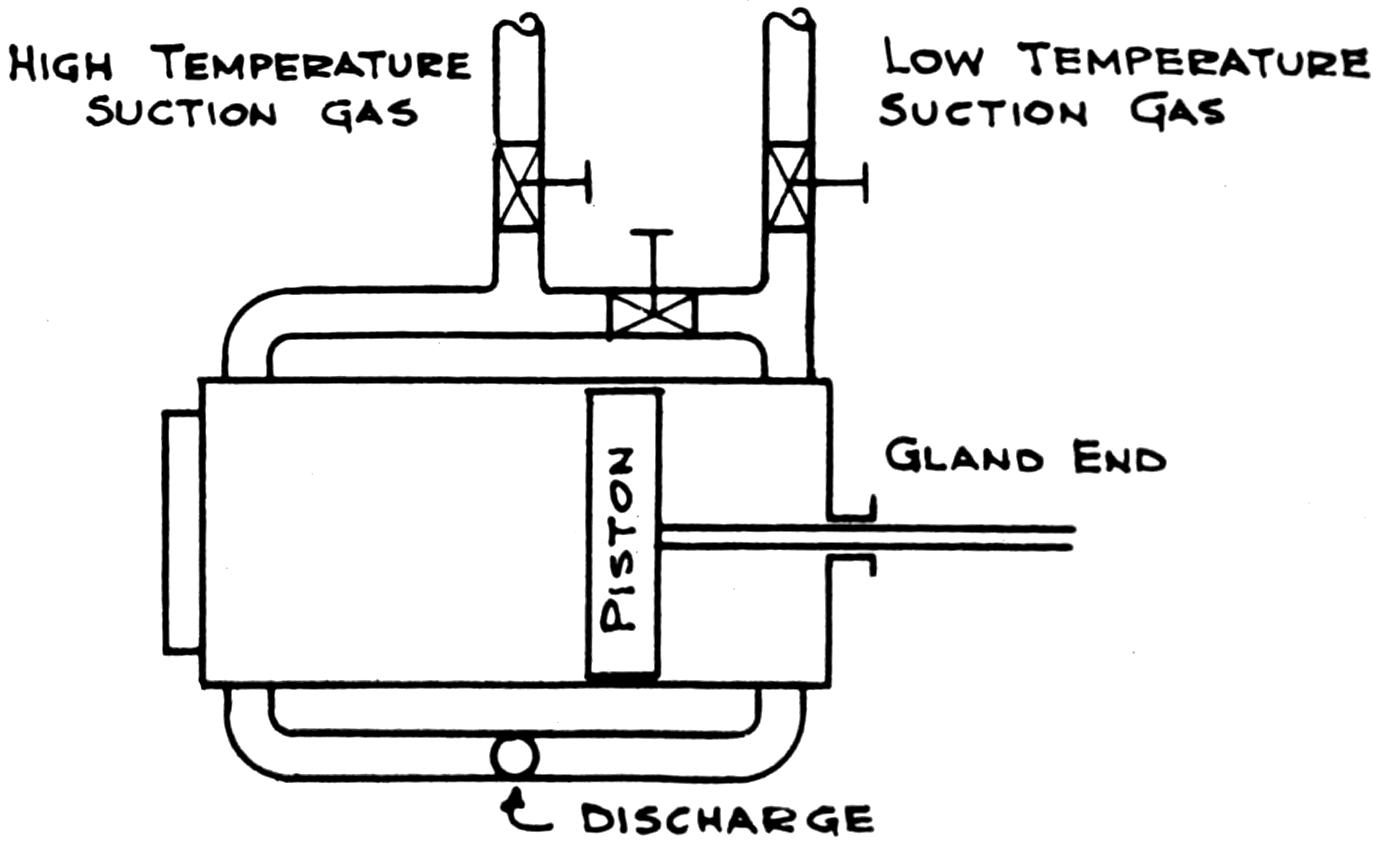
FIG. 16.—SUCTION CONNECTION FOR DUO-PURPOSE COMPRESSOR.
—If the plant be sufficiently large
so that the machine equipment can be afforded in two units
then it would be proper to install freezers. Supposing then
that the plant justifies this arrangement the compressors
would be connected to the brine tank for chilling purposes,
and to the closed cooler for circulating purposes. The gland
end of the compressors would be arranged so that they could
be operated independently upon the freezer space at will.
—The chief reason for using brine
in the moderate sized plant is that with a reasonably large
brine capacity there is a reserve cold (so to speak) stored in
the brine which will permit of stopping the compressor, the
brine continuing in circulation by pumping, and there is less
likelihood of changes in temperature. Direct expansion chilling
requires an almost constant machine operation.
—The chilling of packing houses and
methods involved are various, each with its advocates. In
Europe and where English methods are followed the system is
chiefly forced draft. This system has been used to some extent
in the United States, but the majority of the coolers are
handled with lofts, and circulation therefrom is of natural
sequence. The cellars and freezers are handled by pipes hung
in the rooms.
—The force draft or indirect cooling system
consists of forcing chilled air, cooled by passing through batteries
of expansion coils operated dry, or over which brine is
passed, through a series of ducts, and withdrawing it; thence
passing it through the coils and repeating. It is not favored
among American packers owing to a belief that it increases
shrinkage, and tends to darken beef; that large quantities
of cold air are lost through open doors; because of the expense
of operating fans, as well as the room taken up by ducts and
the interference occasioned with meat rails.
—The overhead bunker system as described
under “Construction” in this work details the application
of the United States practice.
Accepting the use of the coil room system and of still storage
the question arises as to the application. A visit of inspection
to the various packing plants throughout America
will impress one with the fact of the existence of a wide variation
of opinion and practice with regard to the methods of
applying refrigeration for packing house purposes. There are
two principal applications—direct expansion, wherein the ammonia
gas is circulated through the coils throughout the premises,
and brine circulation, open or closed, where chilled brine
is circulated throughout the works.
—The two types of brine chilling, open and
closed, produce the same result, except as to the actual brine
cooler, of which there are several, namely:
(1) Brine tank in which are submerged ammonia expansion
coils.
(2) Double or triple pipe coolers in which brine and ammonia
are circulated in annular spaces between pipes.
(3) Shell type coolers in which the brine is passed through
tubes within a shell similar to an ordinary flue boiler.
For a close brine system, which is the term applied to a
system where brine is circulated through pipes and not exposed
to the atmosphere so as to absorb moisture, the shell
type cooler is a convenient and economical means of chilling
brine. It is so readily applicable to the use of a balanced system,
thereby lessening the power requirement for pumping.
Double pipe coolers can be used in the same method, but
are not quite so favorably considered owing to the aggregate
quantity of joints.
Either the shell type cooler or the double pipe cooler can
be safely used with an open system. The open type brine
system is any system used wherein the cooling effect is produced
by bringing the cold brine in direct contact with the air
to be chilled, as in the spray system, the “Gardner” sheet system,
or an open pan system.
—Where it would seem
best for other reasons to use a brine system, and the plant
would justify the expenditure, it would appear well to use a
double brine system—open brine in the hog chill rooms, and a
closed system on the freezers, beef chill rooms, storage rooms.
—Open tanks with submerged
coils are used on some plants. The investment is greater, but
the risk is slightly less than in the use of closed type brine
coolers, commonly called shell and tube type. Unless the
engineering force of the plant is fully qualified and alert, there
is danger of diluted brine and freezing the solution in shell
type coolers, which is likely to split the tubes, causing leaks
and the possibility of brine finding its way to the ammonia
compressors, rendering them liable to damage of a serious
nature. Whereas, with the open type tank and submerged
coils, weakened brine might cause ice to form on the expansion
pipes and render them inert, but no comparable damage
could arise. However, we advocate an alert engineering force
and the closed system.
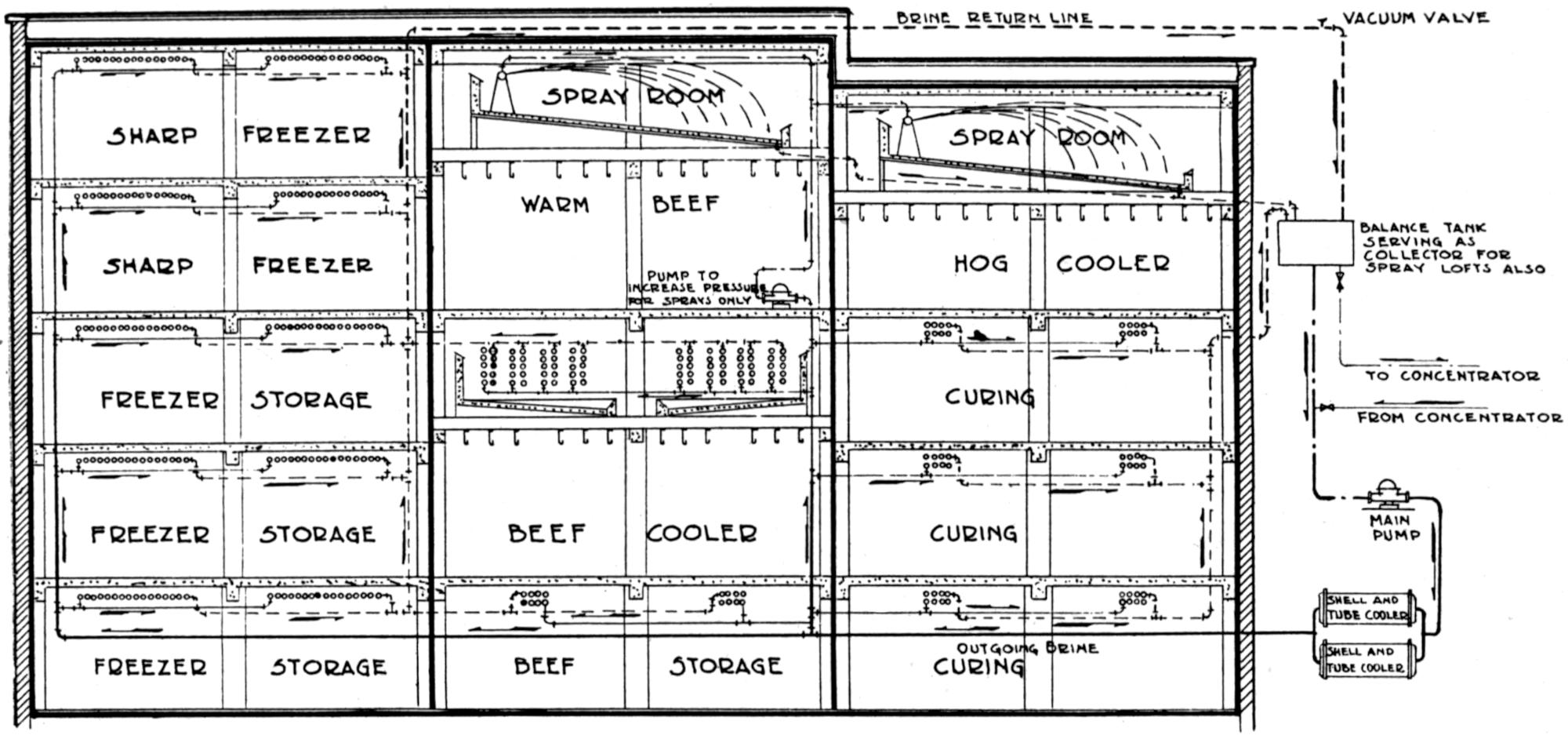
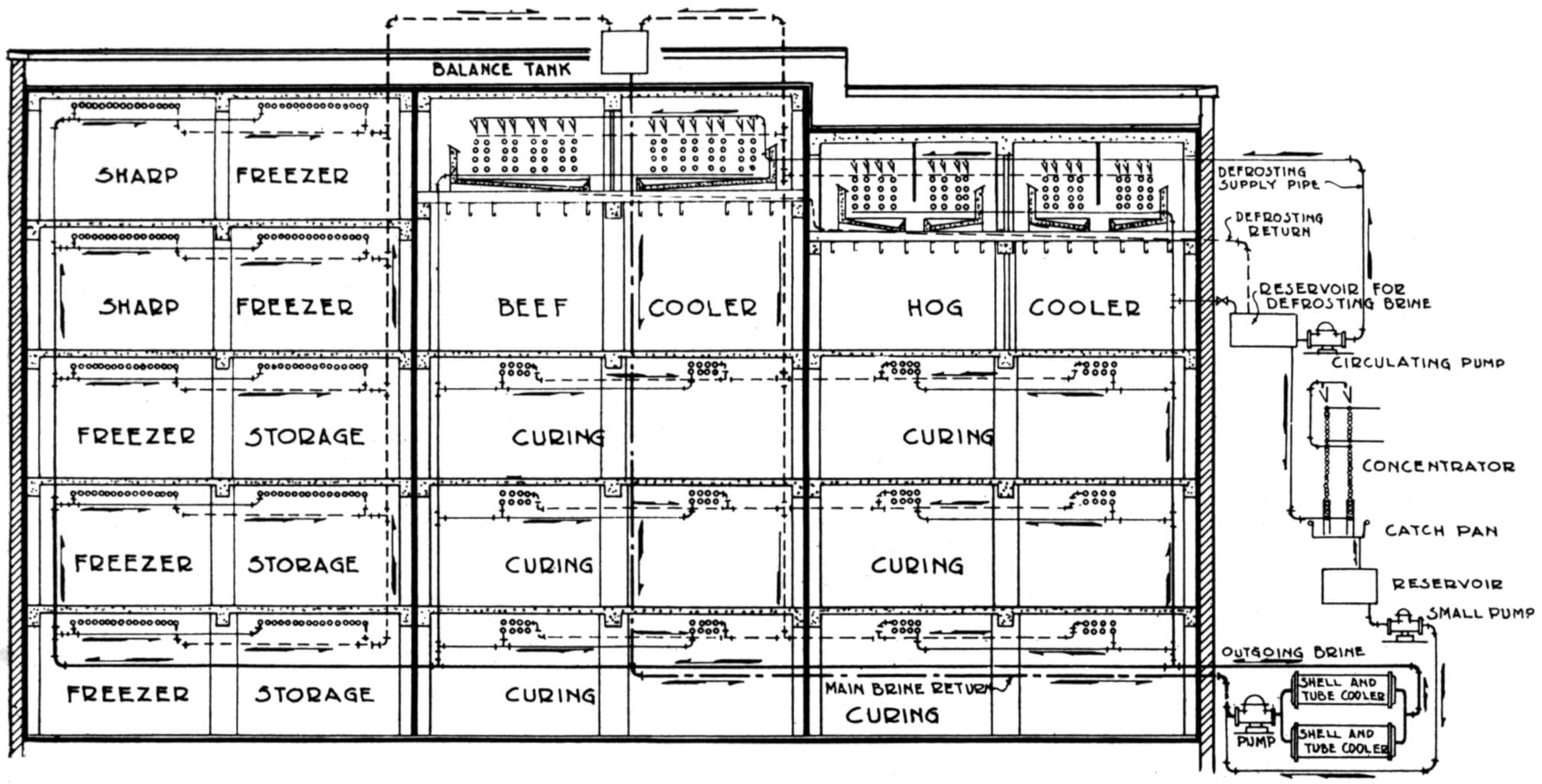
FIG. 17.—DIAGRAM SHOWING BALANCED BRINE SYSTEM.
—The balanced brine system as
referred to in the preceding, is indicated by diagram and has
the advantage of keeping the pipes full at all times, also of reducing
the power requirement to the actual friction through the
pipes in the shell type cooler, and a slight increase for passing
through the coils. In practice twenty to twenty-five pounds friction
represents the total head to pump against in a building nine
stories high. The two types of the balanced brine system are as
follows:
—Beginning at shell and tube coolers the brine
passes into supply pipes which decrease in size as they
approach the ends. The return line tapers in opposite direction.
The pressure carried is only sufficient to make a sufficiently
rapid circulation.
A small pump is inserted in the line so that the pressure
can be increased on that portion through the spray nozzles.
This lessens the power over carrying the entire system at a
high pressure.
The balance tank is located at such point as will best
serve to collect the brine from closed coils and the return from
the spray coolers. A vacuum valve is put on the closed line
to prevent siphon.
A return connection to the main pumps is made, and also
connections to the concentrator from balance tank so that a
portion of the brine can be concentrated.
This system requires more concentration than the closed
system. It has the advantage that coolers can be used as
sharp freezers if insulation be proper.
—Beginning at shell and tube coolers the discharge
mains and piping are the same as for the open system.
Return mains as indicated. Balance tank is located elevated
above upper coils.
A localized defrosting system is installed with individual
pump circulating brine over coils, continuously as required.
The collecting tank is located as near as convenient to lessen
pumping head. The brine flowing over coils in the lofts is concentrated
to a strength equal to circulating brine and introduce
into circulation replenishing brine for defrosting from
mains. Concentrator is located where suitable.
In using closed coils the arrangement is different for beef
and hogs so as to assist in the circulation for hog cooler with a
view to producing uniform temperatures.
In any system using open brine, there is a quite appreciable
gain in the quantity of brine in the system, and a weakening
of its strength lowering the freezing point. This necessitates
vigilance as if the brine weaken too much there is a possibility
of it freezing solidly and insulating submerged coils in
an open brine tank rendering them inert or splitting the pipes
in a shell type cooler with disastrous results. It is consequently
necessary to evaporate the brine which can be done
with a concentrator as provided for in Figs. 17 and 18.
The concentrator apparatus consists of a balance or
storage tank in elevated position according to whether the
closed or open system is used; one or more stands of pipe
coils; a catch pan for concentrated brine; a reservoir and a
small pump for passing brine into system. The brine flows
from storage tank, entering the bottom pipe of the coils and
passes upward through seventeen pipes, from which point it
is delivered to the trough at the top of the coil and allowed to
flow down over the entire battery of pipes, steam being circulated
through the top six pipes, thus heating the brine and
concentrating it by evaporation. The hot concentrated brine
is cooled as it passes over the lower seventeen pipes through
which it originally entered as cold weak brine.
—Many plants are equipped completely
with direct expansion systems. This is quite satisfactory provided
means are arranged to dispose of the accumulating ice
and snow on the coils. This is particularly applicable to coils
in pipe lofts where moisture rapidly accumulates, and is
accomplished by some arrangement of defrosting such as circulating
a brine over coils by permitting it to drip over the
coils, pumping over and over again.
—The revising editor brought
into prominence the two-stage compression system by building
a successfully operating plant which functioned with quite
astounding results. The system consists of a large low temperature
gas compressor and a smaller second stage compressor,
arranged the reverse to a compound steam engine.
Ammonia gas which at the low temperatures resulting
when low back-pressures are required, becomes highly attenuated
(light), it is necessary to handle a very large volume per
ton of refrigeration developed. To provide for this, the low
pressure cylinder is made about double the volume of the high
pressure cylinder.
In the low pressure cylinder the gas is compressed to a
pre-determined pressure and passed at a relatively high pressure,
making for a very high efficiency. The gas is chilled by the
introduction of expanded ammonia to take up the superheat.
The use of this compressor arrangement with its refinement
makes an economical cold producing unit. A record of
one year’s run follows:
Two-Stage Compression System.
Per year.
Per ton.
Tons received
60,000
Cu. ft. space cooled
2,930,000
Coal cost
$17,309.11
.288
Labor
15,156.73
.252
Oil and waste
1,030.82
.017
Water and chemicals
2,103.21
.035
Repairs and changes
1,698.38
.028
Total cost
$37,298.25
.62
Expense per cu. ft. space per year
.013
—All of the above factors must be considered
in the calculations for refrigerating requirements, and
it is best to make allowances for a considerable factor of safety
over and above the actual maximum, as well as for the economical
operation of the plant. It never pays to crowd a plant
to its limit or capacity. Guard against emergencies and possible
abnormal demand for refrigeration by providing ample
equipment. The plant should be constructed as far as possible
in duplicate, not only as regards the machinery but also in the
apparatus, as a safeguard against accidents and total cessation
of refrigeration. With two machines and duplicate
apparatus one-half the maximum refrigeration is always available,
and the preservation of the product in storage is assured,
even if it be found necessary to stop killing for a sufficient
period to make the repairs on the broken machinery or
apparatus, while with one machine only available, a breakdown
might result in a very serious loss and considerable
damage to the stored products.
With regard to insulation, it may be said that the best is
the most economical in the long run. There is no such thing
as absolute insulation, some heat leakage must occur through
the very best insulation, and the reduction of this heat leakage
to the minimum should be the chief object or factor for consideration.
First-class insulation costs more in original investment,
but it creates a continuous saving and economy in
refrigeration, resulting oftentimes in a less investment also in
refrigerating, pumping and steam equipment.
CHAPTER V. REFRIGERATION REQUIREMENTS. — Refrigeration. — Necessities. — Ice Plants. — Natural Ice. — Chilling. — Quantity of Refrigeration to Provide. — Space Per Ton Machine. — Machinery Per Head. — For Cooled Meats. — Freezer Space. — Ice Computations. — Chilling Lard. — Summary—Computations. — Low Temperature Brine System. — Preference Reasons.
Refrigeration — Necessities — Ice Plants — Natural Ice — Chilling — Quantity
Refrigeration to Provide — Space Per Ton Machine — Machinery
Per Head — Ice Computation — Compressor Capacity — Summary
Computations — Low Temperature Brine System.
—This word covers the “bugbear” and the
“solace” of the packers. No other one thing is of so much
importance. Since the abolishment of the use of chemicals,
such as borax, boracic acid, etc., as a preventive or retardant
in the propagation of bacilli during the curing process, the
packer’s sole dependence is refrigeration. Consequently there
has been considerable development and importance in its use.
From the moment the animal is killed until the parts are
disposed of, refrigeration is a necessity. The proportion of
freezing space to be provided or hired at a commercial storage
house is growing daily. In many plants the total volume of
freezer space approaches or exceeds, that given over for moderate
temperature storage purposes.
—In the order of progress the first necessity
for refrigeration is the use of ice for chilling water for fats
and meats. Practically every packing house is now equipped
with a small ice making plant both for its use, and with commercial
possibilities of selling ice.
—Ice plants are of various kinds:
(1) Common ice made from filtered water without processing.
(2) Raw water ice made from filtered or treated water, aerated or
agitated, while freezing.
(3) Distilled water ice made from condensed steam, reboiled.
(4) Plate ice, made from raw water in large plates and cut up into
blocks of convenient size.
In the production of distilled water there are various
methods which will not be treated upon here.
For the icing of cars and for ordinary cooling purposes ice
made by process No. 1 is amply good except, perhaps, if the
water from which the ice is made should not be clear, it may
be necessary to use a portion of the bottom of the cake for car
icing purposes only.
—The situation and climate has much to do
with the determination as to whether the packer can afford
to harvest natural ice for general use. For example, if the
plant be situated in a northern climate alongside a suitable
stream adjacent to the plant, the harvesting of ice and its
storage can be afforded. However, if the ice is stored at a
remote point and teaming or car shipment of ice is necessary,
then the manufacturing plant will probably be the more economical.
—The chilling of the meat immediately after
killing is perhaps the most important function in the whole
refrigerating process and one that cannot have too much attention.
In the matter of beef it is the practice of the best
operators to see to it that immediately after the hide is removed
the beef is placed in the coolers. At most it should not be allowed
to stand out in the open air to exceed half an hour.
Sheep and veal should be treated in the same manner. As for
hogs in some climates, such as latitude equal to Chicago or
north thereof, if space is available an open air hanging room
is a valuable adjunct where the animal can be air dried, depending
upon seasons, from one hour to over night. This feature
also permits of increased slaughtering during the winter
season. It is a custom that can be abused, however, by careless
handling—resulting in sour meats.
—There are so many
factors which enter into the question of packing house refrigeration,
and so many details of construction and application
of refrigerating apparatus, that it is almost impossible to cover
this subject practically and intelligibly without devoting a
volume to refrigeration alone.
To give a fixed rule for packing house refrigeration, applicable
to all conditions, would be impossible, as much depends
upon conditions and surroundings, and the requirements
would vary accordingly. For instance, atmospheric conditions,
quantity of space to be cooled, temperature to be maintained,
time for chilling, etc., these and many other factors affecting
the general results must be taken into consideration and provided
for, and as these vary, so will the refrigeration requirements
vary. A few ideas will be set out to assist in the computation
of the quantity of equipment to provide.
The capacity or size of the refrigerating equipment required
for any given plant is variable but can be reasonably
closely computed by assuming certain conditions.
—Practice has demonstrated that
one ton of mechanical refrigerating effect duty, as rated by
manufacturer used continuously during a period of twenty-four
hours will maintain at a temperature of 33° to 38° F. from
7,000 to 12,000 cubic feet of storage space. Conditions of exposure,
insulation and outside temperature affect this.
The minimum for beef storage coolers, the maximum for
curing cellars. The area of room or quantity of space enters
into each of these assumptions. If small rooms are used the
unit to be assumed is smaller. Concrete buildings are easier
to control due to the stored cold in the building mass of floors,
columns and girders.
—It is customary to figure that in
addition to that needed for cooling the space, one ton of refrigeration
for twenty-four hours would be required for either
one of the following items:
From fifteen to twenty-two hogs, average weight, 225 pounds.
From five to six head of cattle, average weight, 700 pounds.
About forty-five calves, average weight, 80 pounds.
From fifty to sixty-five sheep, average weight, 60 pounds.
—For cold storage rooms, where meats
which have already been chilled or cooled are stored and held
for a greater or lesser period, the refrigeration requirements
are not so great as in chill and cooling rooms. The animal
heat has been removed and the meats cooled down to a low
temperature, consequently but little more refrigeration is required
than that necessary to take care of the heat leakage
through the insulation, and possibly the recooling of the meat
through a range of a few degrees, when the meats may have
gained a little in temperature by exposure. Therefore it is estimated
that one ton of refrigerating duty will handle 12,000
cubic feet of curing or storage space for temperature of
33° to 35° F.
—As will be explained in the chapter
relating to refrigerating machine capacity, the capacity of a
compressor very rapidly decreases when operating under conditions
necessary to produce low freezer temperatures, and
owing to the severe conditions imposed it seems necessary to
compute that one ton of refrigerating duty will handle about
3,000 feet of freezer space.
—Before the application of mechanical
refrigeration to packing house purposes, all artificial refrigeration
was accomplished by means of ice melting alone, and
at that time the packers computed ice melting requirements
on a basis of cooling three pounds of meat from 80° F. to as
low as it could be cooled by ice melting, for each pound of ice
melted. While this rule undoubtedly was the result of practical
experience with well constructed coolers, and was in no
wise based upon theoretical or heat unit formulas, yet it is interesting
to note how close this old rule compares with modern
formulas of computing refrigeration. For example, the cooling
of 100 head of hogs, averaging 250 pounds dressed, by the
packer’s rule, would require—
The above comparison shows that theory and practice
approach very closely to a common line, although in the calculation
the factor of specific heat of the meat is ignored, and in
practice this may well be left out, as specific heat of meats at
various temperatures has by no means been accurately established.
—The chilling of lard is a severe task on
refrigerating equipment owing to the very heavy duty imposed
in a short time. For example, with an eight-foot lard roll
turning off 4,000 pounds per hour and changing the temperatures
of the lard from 90° to 50° F. requires a very large compressor
capacity per hour.
—Assuming the killing of 100
cattle and 250 hogs per day; making 10,000 pounds of lard,
fifteen tons ice; maintaining a freezer of 100,000 cubic feet and
the small work connected with the establishment:
For 100 cattle killed daily, and storage of 400 hanging, about 6,500
square feet area of cooler would be required; the height of this with
the lofts would be about twenty-two feet or a capacity of 143,000 cubic feet.
For 250 hogs daily or 750 total hanging, there would be required
3,000 square feet of floor area and a height of 18 feet or 54,000 cu. ft.
The above number of hogs daily would also require a storage or
cellar capacity based upon one hundred pounds meat sent to cellar for
a turn over in sixty days equal to storing 1,500,000 pounds of product,
or 15,000 to 20,000 square feet of floor area, requiring 200,000 cubic
feet of building space.
Ten thousand pounds lard daily in four hours running would require
the extraction of about two tons of duty, but by reason of the heat
transmission and the low temperature brine necessary would require
twelve tons duty while applied.
Fifteen tons daily ice making capacity requires about 30 tons refrigerating
duty, allowing for radiation and other losses.
A freezer capacity of 100,000 cubic feet which would store 1,500,000
pounds would not appear excessive. From known results this would
require about one ton refrigerating duty for 3,000 cubic feet of space or
thirty-five tons machine duty. We have then:
SUMMARY OF REFRIGERATION REQUIRED
Tons
143,000 cubic feet beef cooler space ÷ 10,000
14.3
100 cattle daily 500 pounds = 50,000 pounds
50,000 pounds meat chilled 70° or 70 B.t.u. per pound
50,000 × 70 = 3,500,000 ÷ 288,000 B.t.u.
12.2
54,000 cubic feet hog cooler space ÷ 10,000
5.4
250 hogs 180 pounds each = 45,000 pounds
45,000 × 70 ÷ 288,000 =
10.9
200,000 feet cellar space ÷ 12,000
16.6
15 tons ice × 2 tons refrigerating duty
30.0
10,000 pounds lard cooler
12.0
100,000 cubic feet freezer space
35.0
Total tonnage refrigerating effect
136.4
—The use of low temperature
brine, cooled by two stage compressors, a new development,
is in the writer’s opinion preferable to direct expansion.
(See description of two stage compression in Chapter
IV.) A lineal foot of pipe filled with a liquid like chilled
brine seems to have greater heat absorbing power than the
same pipe filled with a light gas and consequently less piping
can be used.
—Occasion arose to compare for a new
large installation the relative merits of direct expansion versus
brine and the following items suggested themselves:
(1) The direct expansion plant would require 150,000
lbs. ammonia in excess of brine plant.
(2) There would be approximately 8,000 more joints to
prevent leaking.
(3) Unavoidable ammonia leakage through rods, glands,
valve stems, compressor rods and purging would amount to
at least $20,000 per year based on experience with good
practice.
(4) The installation by the same manufacturer estimated
to cost 15% more than a brine system.
(5) There would be no stored energy in the ammonia
pipes as in brine pipes should the refrigerating plant suspend
operation temporarily.
(6) The compressor hazard from returning liquid and
possible machine wrecking with line breaks, ammonia losses,
and danger to life.
(7) In case of extension or modification of piping, the
difficulty with ammonia pipes over brine is marked.
(8) In direct expansion plants the cooling effect is
stopped immediately when the compressor is stopped. It is
required to operate incessantly, or if speed be reduced the
current is chiefly wasted in resistance grids if electrically
driven. Whereas in a brine plant the compressors can be
stopped several hours, the brine being circulated rises in temperature
but not sufficiently to vary room temperatures. This
is a great advantage, permitting keeping “off peaks” on commercial
electric lines and consequently earning lower rates.
(9) With an electrically driven compressor, speed control
is fixed within quite limited bounds and if direct expansion
system is used more power is purchased than needed for
reasons already mentioned.
(10) The total cost for operating pumps and calcium
taken collectively will be far less than the uncontrollable ammonia
leakage. The coil attendants can be less skilled.
(11) Brine temperature 25 degrees below zero, Fahr.,
can be carried, sufficiently low for all purposes. Rooms can
not be controlled at as exact temperatures with direct expansion
as with brine, owing to its sensitiveness.
(12) Lastly and very important, the complicated piping
system to carry several back pressures to produce varying
temperatures and the necessity of operating several compressor
“ends” makes a complicated installation of small units as
against a simple system carrying one temperature brine.
Plants of the character described usually operate on direct
expansion, require three sets of temperatures, three sets
of suction pressures and three sets of suction mains with
various cross connections and intricate pump-out arrangements.
This necessitates multiplicity of machines and connections
to various cylinder ends.
Progressive authorities recognize the necessity of freezer
storage in meat plants. In combination pork and beef or pork
plants, newer installations will be made with far less curing
space for sweet pickled meats and far greater space for storing
meats frozen either before or after curing to the end of
producing palatable meats, not salt soaked and of inferior
quality. There are slaughtering plants for export where beef
is shipped chilled or frozen, and mutton frozen. Some have exclusive
freezer buildings, others parts set aside for freezers.
One temperature brine is circulated, the temperature in
the rooms being governed by the quantity of pipe in service.
In all instances, sharp freezers, storage rooms and curing
rooms are equipped with pipes therein—and the chilling rooms
for beef and pork closed coils or spray, optional.
Shell and tube coolers have proven so fitting that no hesitancy
need be made about using them, and the possibility of
freezing is negligible with reasonable prudence. Tanks with
submerged coils can be used, but it prevents the saving made by
using balanced brine pumping, on high buildings, a quite material
one.
CHAPTER VI POWER PLANT REQUIREMENT. — Steam Making Equipment. — Uses of Pumps. — Types of Pumps. — Pumps for Brine. — Water Supply. — Pumps for Wells. — Water Distribution Systems. — Pumps For Boiler Feeding. — Heating Boiler Feed Water. — Wells. — Cooling Towers. — Economizers. — Superheaters. — Steam Engines. — Exhaust Steam. — Advice As To Exhaust Steam. — Boilers. — Conclusion.
Steam Making Equipment — Uses of Pumps — Types of Pumps — Pumps
for Brine — Water Supply — Pumps for Wells — Water Distribution
Systems — Pumps for Boiler Feeding — Heating Boiler Feed Water — Wells — Cooling
Towers — Economizers — Superheaters — Steam
Engines — Exhaust Steam — Advice as to Exhaust Steam — Boilers — Conclusion.
—The quantity and type of
boilers needed for a plant is entirely dependent upon the quantity
of steam required and its economical or uneconomical
use. The refrigerating and electric producing apparatus in
the average packing house are usually looked upon as the chief
using elements, but they each frequently require less steam
than is used for pumping purposes, and less than is used for
cooking and kindred operations. It would be well to discuss
the uses of steam and return to the boilers.
—Pumps are used for water circulating,
brine circulating, boiler feeding and pumping products. These
are named in the order of their steam consuming demand as
it usually occurs. They consume from 40 to 120 pounds of
steam per horse power hour based on the kind of pump used
and the skill in its operation. The most economical are electrically
operated centrifugal pumps provided the current is
economically generated, steam turbine centrifugal pumps,
next if in good condition, and reciprocating simplex or duplex
pumps third and fourth.
—The types chiefly used in packing
house work are simplex and duplex reciprocating, centrifugal
single and multi-stage operated by motor or steam turbine
directly attached to the motive power, also power pumps of
triplex type and rotary or impeller pumps for fats and oils.
There are endless varieties of each type.
—For brine pumping chiefly reciprocating
and direct connected horizontally set motor driven centrifugal
pumps of one or more stages are used. At times
power operated triplex pumps are used but the most satisfactory
are the second named.
Pumping brine for refrigerating purposes is a never ending
process since it must be constantly performed. The common
practice of an open brine tank with submerged coils is
being fast superseded by the use of shell and tube type closed
coolers which superseded double pipe coolers. The use of
either the latter two types enables the operator to take advantage
of hydraulic head by installing a balanced system
described in this work which very greatly reduces the power
necessary to exert to pump brine. The friction in an eight
to twelve pass brine cooler is from ten to fifteen pounds, and
this with the pipe friction on a balanced system will total to perhaps
thirty pounds on large systems, but less than the ordinary
open system—depending upon the building height.
—The water demand for packing house
operation is quite an important element in relation to steam
consumption. The quantity required for ammonia condensing,
steam condensing (if done), and for plant purposes, washing,
etc., is, in the aggregate, quite a large amount. For example:
For ammonia condensing, from 1¹⁄₄ to 1¹⁄₂ gallons per
minute is required per ton of refrigeration developed; for
steam condensing for steam engine from 32 to 40 pounds per
pound of steam condensed; for boiler operation about four
gallons per horse power per hour; for plant purposes from
250 to 3,000 gallons or more per hour, depending upon the size
of plant and its intelligent use. It will be readily seen that
those quantities will mount in power consumption if the head
or pressure pumped against is high.
—Water pumped from wells is usually
pumped by one of four methods:
(1) Suction type reciprocating pumps.
(2) Deep well heads with low set pumping barrel.
(3) Submerged centrifugal pumps.
(4) Compressed air.
For small plants where one or two wells will supply
the water, the first named pump is usually used owing to
cheapness of cost for installing and particularly if the water
rises in the well to a height reachable by a suction type pump,
viz: 23 to 25 feet. Power operated suction pumps are also
available for this service. If the water be too low for the
above named type to handle, deep well pumps with steam head
serve pretty well and usually cost less than air pumped wells.
For larger plants, larger wells are installed and submerged
centrifugal pumps or compressed air is used, the latter
always as a last resort from a cost of pumping standpoint, although
its simplicity and reliability appeals to many.
Submerged centrifugal pumps can be operated with steam
turbine or motor set on top of shaft above ground. The motor
operated set is the more economical, particularly if the current
be generated at low cost.
—The intelligent laying out
of water systems and the pressure pumped against is a factor
worth great attention. It is far better to have pumps of proper
proportions for the service intended, even though it involves
the use of a separated piping system.
Taking advantage of water once raised to a high level in
its return to service is a power saving. For example: It is
usual to locate ammonia condensers at a point where there is
a good circulation of air. This is done to permit the winds to
carry away the moist air from about the condensers, together
with the heat delivered up through it and to the air by the discharged
gas from the ammonia compressors. From the catch
pan beneath the ammonia condenser the water can be diverted
through the steam condenser and if the shell be bought sufficiently
strong in the case of a closed condenser, the water can
be delivered to the suction side of a pump which in turn will
deliver it for house use for cleansing purposes. If a barometric
condenser is used, the water is delivered to a hot well from
whence it can be pumped or flow to sewer.
—Dependent upon the size of
plant and the pressure carried pumps are usually provided as
follows:
Small boiler plant up to 500 H. P. low pressures. Steam 80 to
125 lbs. simplex or duplex piston packed reciprocating pumps.
Medium Boiler Plant up to 1,000 to 1,500 H. P. steam 125
to 150 pounds simplex or duplex outside piston packed reciprocating
pumps.
Over 1,500 H. P. the same or centrifugal type multi-stage pump
motor or steam driven.
—Every plant, large or small,
should be equipped with boiler water heating devices. These
are so common and the practice so usual that it is scarcely
necessary to mention it but the writer has seen plants where
the exhaust steam from pumps and engines was being thrown
to the air and feed water pumped into boilers at low temperatures.
There are two types: closed and open. In the first
named the water is circulated through tubes enclosed in
a vessel, the tubes surrounded by steam. In the open type
the steam is brought in direct contact with the water and performs
the heating in this manner. The closed types are used
on the principle that no oil carried in the steam is passed to
the boilers, but the latter type are usually equipped with an oil
separator that eliminates the oil and prevents danger from
this source.
—In most instances wells of various depths
from 80 to 2,000 feet will find water. A few localities, however,
do not yield water via wells and this is a poor situation
from a packing house standpoint. The water from surface
or shallow wells is, at times, improper for use on meats
owing to contamination, in which case, resort must be made
to other sources. In some localities the neighboring streams
yield suitable waters but in this case sewage contamination
must be guarded against. The quality of boiler supply water
is an important factor in the boiler operation in its bearing
to shutdowns for cleaning, blowing down, repairs, etc., all of
which contribute to or impair economy.
—Where it is necessary to husband
water for condensing ammonia or steam the use of cooling
towers comes into play. These function by the cooling of
water by evaporation, the evaporation abstracting the heat.
There are various kinds—sprays over ponds, water dripping
over spatter boards made in various ways, such as brush piled
loosely; a checker work of wood slats; screen wire, etc. These
usually depend upon the circulation of air in a natural way.
There are various patented types, depending upon fans, to
pass air through falling water. The efficiency is dependent
upon the fineness of the water and the quantity of air passing
through it, the relative humidity of the air controlling
greatly the cooling effect.
—Where the utmost economy of fuel is
striven for and on larger plants, these are installed. An economizer
is a bank of cast iron flues placed in a position between
the boilers and the smoke stack. Water is circulated
through the tubes and the furnace gases pass about them.
They are usually calculated upon to decrease the stack temperatures
from 100 to 150 degrees—dependent upon its initial
temperature and to heat the feed water one hundred degrees.
This is a saving from a wasted source, since it is impossible to
take up this heat in any boiler yet designed.
—In an earlier chapter reference was made
to superheated steam. The office of this apparatus is to heat
the steam to a higher point than it rises to, under ordinary
boiler conditions. For instance, steam as delivered from the
nozzle of a boiler is spoken of as “saturated” steam, but, if
before use this is subjected to a further heating before it is
used, it is said to be “superheated.”
Superheaters are of two types. They can be described
as follows: A bank of coils located in the flame pass in the
boilers, the steam within the coils and the flame on the outside;
or a bank of coils in a separate furnace, the flame or heat
generated in the furnace passing over the coils.
Steam superheated beyond 450° F. total sensible temperature
requires especial pipe fittings, type of valves, and
engines for reasonable safe operation, and renders an economy
that a small plant cannot afford, due to the expenditure, to
take advantage of.
—Owing to the cheapness of fuel in the
United States, users have been satisfied with equipment at a
low initial cost and in consequence pay bills continually by
using uneconomical prime movers, viz.: ordinary steam engines
of the simple Corliss type, using from 26 lbs. to 35 lbs.
of steam per horsepower hour, or compound condensing at 15
lbs. to 18 lbs. of steam per horsepower hour or high speed
direct connected slide valve engine generator sets using from
35 to 50 lbs. steam per horsepower, depending upon load.
European engineers, where fuel costs are double and triple
American fuel costs, have of necessity paid more attention to
the subject of steam economy and have outstripped this country
in design and use of economical steam engines, notably
of the so-called “uniflow,” “drop valve,” “poppet valve,” or
“Lentz” type and with the use of superheated steam, have
reached much higher efficiencies. The fast increasing costs
of fuel in this country have necessitated American builders
resorting to high steam pressures with independent or integral
superheaters in conjunction with steam boilers, and as a result
American manufacturers are offering simple uniflow engines
for high speed (say 200 r. p. m.) direct connection to
electric generators. Also compound drop valve or poppet
valve or Lentz types for slowly moving engines, viz.: 60
r. p. m. for connecting to ammonia compressors and in either
case with steam at an initial pressure of 160 lbs. and ordinary
superheat of 100° operating condensing, engines of the above
types under the conditions named can be readily bought under
guarantees to produce an indicated horsepower with the use
of 12 lbs. of steam per horsepower hour.
The uniflow engine is now offered by several builders and
is adaptable to most any service, atmospheric exhaust, condensing
or against a back pressure using the exhaust for cooking
or heating. There is but little advantage, however, in a
uniflow engine under this circumstance unless it be the flexibility
as to conditions of operation.
—The practice of using exhaust steam,
that is steam which has passed through engines, for heating
and cooking is considered economical. It is based upon the
theory that the quantity of heat contained in a pound of steam
that has been reduced in pressure from its initial or high pressure,
say 100, to a low one—example 5 lbs., and then used
for heating, etc., contains almost as many heat units as it did
originally.
There are many places where this low pressure or exhaust
steam can be used advantageously, but if extensively used,
the likelihood will be to have long mains into which certain
equipment will pass its exhaust and from which the demand
will be spasmodic for cooking purposes and intermittent for
heating, except during winter seasons, and as a result there is
a considerable quantity of steam passed to the air at most
times.
A careful analysis is necessary for intelligent use of this
idea, since the maintaining of a balance owing to business
fluctuations and changing seasons makes an almost unmatchable
combination. During one season live steam will be used
for make up, and at other times there is a surplus.
—Aside from heating feed
water and drying where the requirement is constant, a better
practice is probably to limit the extent of exhaust steam
systems and use live steam for most purposes.
The sources of exhaust steam, engines or pumps, are operating
usually twenty-four hours daily and constantly pouring
steam into the exhaust mains, which is constantly radiating,
leaking and the accumulated moisture is being trapped away
to a sewer or feed water heater. The traps are usually just
a little out of order, and the little leaks in multiple mount up
fast.
Again the apparatus in almost any department used for
cooking and manufacturing is irregular in its use and an
actual record will show hardly to exceed six hours’ demand
or use. Why operate engines and pumps at a disadvantage
all the time for the sake of a supply six or eight hours daily?
The engine and pump requirement increases rapidly with the
exhaust steam pressure and requires larger production from
the boiler.
Any power like that needed for pumping can be transmitted
on a wire with far less loss than as steam through a
pipe.
The recommendations then are: Produce electricity as
cheaply as possible; if electricity is made, use high class equipment
operating condensing and take advantage of superheat
if possible; produce refrigeration or compress air with the
same intelligence; perform all pumping with electrically operated
pumps; distribute steam for all uses at high pressure,
at high velocity through small pipes, well insulated and have
the heat at the process when needed; fit boilers so they can
arise to a demand when needed with ample stack and draft;
install stokers, if the plant will justify it; insulate the boiler
walls and generate steam as cheaply as possible—and don’t
waste it.
—The common types of boilers in the United
States are the fire tube boiler and the water tube boiler. The
first named kind is that which suggests itself to the reader
when a boiler is mentioned and consists of a shell cylindrical
in form with a head in each end into which tubes are expanded.
In operation the water surrounds the tubes and the
fire passes through them. The water tube boiler is the opposite
of this. There are variations of these and boilers that are
built using both principles in part. There are also Cornish,
Lancashire and Yorkshire types used in England which are
fire tubes using only one or two tubes. Where a plant requirement
is up to 500 horsepower, the fire tube is the usual
installation owing to its cheaper cost, and more units which
enables more continuous operation, especially if a unit is out
of service for cleaning, 100, 125 or 150 horse-power being the
standard size units. If a plant requires 750 horse-power or
more, installation of the water tube is preferable owing to
their requiring less floor space, higher pressures are usually
carried and they are regarded as more safe under these conditions.
They can be forced to a higher output if demanded,
which is an advantage in times of rush business.
—The mounting costs of fuel prompts the
writer to say that the management of a power plant of any
packing house demands intelligence in the selection of equipment
and in its operation. The losses that occur are silently
passing on perpetually and are immeasurable to the proprietor
since they are intangible in dollars and cents. In these
days of educated engineers, a mixture of education and common
sense is obtainable and it takes this training or the practical
man who has augmented his practice with ability to use a
pencil to figure out his conditions, and suggest remedies that
will stop a leak of no inconsiderable consequence. It is a
usually neglected department by the proprietary interests.
CHAPTER VII COOLERS. — Meat Chilling. — Dividing Beef Coolers. — Regular Temperature. — Main Cooler. — Handling Beef. — Fore-Cooler. — Secondary Cooler. — Heavy Cattle. — Domestic Beef. — Trimming of Beef. — Skirt Trimming. — Ribbing Beef. — Freezing Beef. — Loading Beef. — Weighing and Tagging. — Care of Coolers. — Mutton and Veal. — Chilling Hogs. — Cellars. — Freezing Meat.
Meat Chilling — Dividing Beef Coolers — Regular Temperatures — Main
Cooler — Handling Beef — Fore-Cooler — Heavy Cattle — Domestic
Beef — Trimming of Beef — Skirt Trimming — Ribbing Beef — Freezing
Beef — Loading Beef — Weighing and Tagging — Care of Coolers — Mutton
and Veal — Chilling Hogs — Cellars — Freezing Meat.
—Meat chilling must be done intelligently
with opportunity afforded for gradual chilling without too
rapid hardening. The meat should not be subjected to sudden
contracting low temperature effects, but to a gradual tempering
that will carry the meat from blood heat down to the
desired temperature. This effect is readily attained by properly
constructed chill rooms. Air circulation is the great
requisite.
Sufficient attention has not been paid in the past to provide
ample room above the hanging carcass, that is space
between the carcass and the underside of pan loft. Note
slope on spray loft in Fig. 17 (Chap. IV), showing design of
Balanced Brine System. Coil lofts should follow the same
principle.
—Regarding the subject of dividing
beef coolers to avoid freshly killed animals from being
brought into contact with chilled ones. This is a disputed
point, but it would seem that if space were available it would
be a benefit to provide for it. Any moisture that might be
given off from the freshly killed animal would, upon coming
in contact with the chilled one naturally condense, and
moisture is a detriment to the preservation of meats. The
nature of the business being conducted and the length of time
it might be desired to store the meat should be considered.
—Temperature is the all important
feature in meat preservation. The best practice appears to
be, for beef in domestic meat trade, to reduce the temperature
to 34° F. as quickly as possible and endeavor to maintain it
at a uniform temperature.
—When these rooms are being filled from
the fore cooler they should be held to a maximum temperature
of 38° F. As soon as the filling of the cooler is finished
the refrigeration should be turned on full force with a view
to bringing the temperature down to 34° F. in twelve to fifteen
hours after the cooler is closed. While it might be possible
to bring it down in much less time it is not advisable; neither
should it be longer than this. At the end of twenty-four hours
for domestic shipment or city sales, the cooler should be held
at a temperature of 34° F.
—When the beef is ready to go into coolers
it is supposedly well dressed and absolutely clean. Such
being the case, care should be taken to see that the carcasses,
as they are moved along the rails, are kept bone to bone, or
back to back, for if they are thrown in promiscuously (as
more or less blood will run out of the kidneys if run together,
one front against another back of beef) they will certainly become
discolored. The beef should be handled speedily and
with as little jerking and throwing around as possible, for
when handled roughly veins will purge more or less and the
beef, even though clean, will be highly colored.
The sides of beef should be placed at least a foot apart
in the preliminary or fore-cooler. They should be placed so
that under no condition does one side of meat touch the other,
for if it does touch it will show an unchilled spot on the beef,
which disfigures it.
Beef should always, if possible, be hung a foot apart the
first twenty-four hours; later it can be hung closer without
detriment, although it should not be allowed to touch.
—When a fore-cooler is used beef should be
held in the fore-cooler, which consists of one-third of the
length of the cooler cut off by a partition or a separate room,
a large amount of the moisture and animal heat that is left in
the carcass is here abstracted. When killing choice cattle it
is advisable to have the temperature of the fore-cooler as near
38° F. as possible, 43° F. is not detrimental. Sides of heavy
cattle should hang at least eighteen inches apart in order that
the air may circulate freely around the carcasses; lighter cattle
may be hung closer.
—The room temperature of this secondary
cooler can be safely reduced to 25° F., before filling. The
maximum temperature should not rise above 40° F. It is dependent
upon the quantity of product placed in the cooler, the excellence
of the air circulation, the quantity of cooling surface such as
sheets, sprays, brine or ammonia pipe and the quantity and temperature
of ammonia gas or brine in use. The possibilities can be
ascertained by test and practice established from this. Within
twelve hours after killing the beef should be in storage reduced
to 36°, and further to 33 to 34° F. as quickly as
possible and maintained thereat until the beef is disposed of.
Meat which is intended for freezing purposes should be
thoroughly chilled before being sent to the freezers, as it not
only aids in the freezing of the beef, but it has a much better
appearance when it comes from the freezer if it is properly
chilled before being frozen.
—These held in the main coolers should be
reduced to a lower temperature. Heavy cattle for domestic
trade should be carried at 32° F. for the first twenty-four
hours; after which 34° is not detrimental.
Export cattle for chilled beef shipment should be reduced
to a temperature of 29° F. as quickly as possible and held
there until loaded in cars or on boat.
—For domestic beef the coolers should be
brought to a temperature of 34° F. in twelve hours after they
are filled, not allowing the temperature to drop below that
point. It is true that in extremely cold weather it can not
always be avoided, and oftentimes in transit it is lower than
that in the cars, but it is not well to permit beef to reach that
temperature if it can be avoided. If coolers are properly
handled and have a good circulation, and beef is put in at the
above temperature and allowed to remain forty-eight to
seventy-two hours, it will be found to be in excellent condition
and the chances of “bone-sour” will be practically eliminated,
although it is impossible to always prevent it.
—While this is an item of which little
can be said, it is one which merits consideration where one is
doing a large volume of business. The necks of cattle are
trimmed to make them look smooth and even, cutting off the
ragged ends. On large cattle there are two or three pounds of
brisket fat in each animal. When oleo oil is high and beef
is low it is advisable to cut this fat out; when the conditions
are reversed it is profitable to leave it in.
—On export beef it is advisable to trim
out part of the skirts as usually the skirt in the beef is the first
place where moisture will accumulate. If the skirt is removed
entirely, this accumulation is prevented, and mould stops.
The hanging tenderloin is supposed to be cut out on export
beef, and if the man cutting it out cuts it from the
kidneys, slanting toward the backbone, on a hundred cattle
he can easily leave in quite an amount of weight which sells at
beef price; if cut out it would be worth only sausage price.
—If the beef is ribbed properly it shows to
the best advantage; if improperly ribbed it does not, and the
buyer’s opinion of its value depends largely upon its appearance.
Ribbing shows the quality of the beef to a large extent,
hence it is very essential that it should be done properly. The
secret of ribbing is to follow close, without uncovering, the
top part of the lower rib on the plate, following down gradually
between the two ribs to the point in the backbone where
the vertebra is the thinnest, bringing the knife across perfectly
level. Beef should hang in the proper temperature for forty-eight
hours before shipment. It should not be ribbed prior
to that unless absolutely necessary, as it has not sufficiently
set, hence the outer layers of beef will slip and give the cut
beef a bad appearance, the object being to show as much meat
as possible when the beef is ribbed and as little backbone.
The exact place to cut probably does not exceed one-half inch
wide, hence it will be seen that it requires skill to do it rapidly
and properly.
—Beef prepared for freezing should be
handled as if for chilling or export and at the end of thirty-six
hours the coolers should be reduced to as low temperature as
consistent, until the beef is transferred to freezing chambers.
If a plant is constructed for freezing beef it is preferable to set
aside and prepare spaces for freezing independent of the chill
rooms. The freezing temperature should be maintained at
zero or below, and if the meat is to be kept for a long time
it should be stored in 12° to 15° above zero temperature.
—The cars must be properly iced prior to
loading and the temperature in the cars brought down to the
right point. It is generally customary to ice the cars one day
before loading, as a car should never be loaded that is not 38°
F. or lower when the doors are opened. In the loading, if it
is a warm day, the temperature will creep up much higher, but
the beef coming out of a temperature of 34° or 35° F. carries
a great deal of cold with it, so to speak, and even though the
cars may be 50° to 60° F. the cold beef, combined with the
refrigeration from the ice compartments of the car, will bring
the temperature down rapidly. Cars, of course, should be
thoroughly cleaned and aired out prior to the icing, so that
when they are open they are perfectly clean as well as of the
proper temperature. Beef should be put into the cars as
fast as it comes from the coolers, not being allowed to hang
on the rails and be exposed before being placed in the refrigerator
car. Great care should be used in hanging the beef,
that it is hung perfectly solid and wedged tightly otherwise
with the motion of the car the beef will become chafed and a
bone from one quarter of meat will mangle and tear the meat
on the quarter hanging next to it, often very seriously injuring
its appearance. Fig. 19 illustrates a typical beef loading
scene at a large American packing plant.
FIG. 19.—LOADING BEEF INTO REFRIGERATOR CARS.
—In order to watch the business
and to know exactly what each and every purchase realizes
it is necessary to keep an account of each purchase separately,
and this is invariably done in up-to-date establishments.
Cattle are killed in lots in which they are purchased, whether
there be one or 500 in the lot; everything in a particular purchase
is kept absolutely separate, the weight of the beef, hide
and tallow separated, and a record sent to the office as soon
as obtainable. Night clerks usually figure the cost of the beef,
and when the day force comes on in the morning, the actual
cost of all the live stock killed the day previous is before them
for their guidance in the day’s shipments. To do this, as the
cattle are dressed, the beef is weighed before placing in the
cooler. Here the weight of each individual carcass is taken
and tagged, showing the lot to which it belongs for guidance
in shipping, the tag also having the grading of the particular
carcass. Any lot of cattle will run unevenly, or in other
words, there are some that are better than others. As they
go to the scale an experienced man looks them over and grades
them as No. 1, No. 2 or No. 3, considering only this particular
lot of cattle, as a No. 2 of one lot may be much better than a
No. 1 of another lot; but they are graded by taking into consideration
the whole of this particular bunch of cattle, as purchased.
Any cattle that are badly bruised or damaged or discolored
are thrown out and sent to some other department
where they are cut up or treated to the best advantage possible.
As fast as the cattle are graded and tagged they are
put into the cooler, each special grade on a separate rail, irrespective
of the lot to which it belongs, so that when the shipping
clerk gives orders to the loading gang to have the beef
taken out of the coolers, he will order so many No. 1 cattle off
such a rail, lot, etc. As all cattle of that particular grade are
on this rail it greatly expedites shipping.
FIG. 20.—VIEW IN BEEF COOLER OF A CHICAGO PACKING HOUSE.
A great deal depends, in the expense of loading as well
as the speed at which it is possible to be done, upon having
the beef put into the cooler in such a way that it comes out
readily and without a great deal of handling and overhauling
to get odd cattle.
—It is necessary to keep coolers sweet and
clean, and it is advisable to use a liberal amount of sawdust
on the floors, so that the drippings from the meats may be
rapidly absorbed; the sawdust should be changed bi-weekly or
frequently enough to keep the coolers in a sweet and cleanly
condition. Entrance doors should be washed daily, as they
accumulate grease and blood, which if allowed to remain will
soon become sour and disagreeable.
In all packing house plants where a comparatively large
volume of business is done there should be one man whose
sole duty it is to look after the refrigerators. This is a matter
which necessarily needs constant attention and care. When
the cooler is filled with warm meat and the doors are shut it is
his duty to increase the refrigeration and see that the meat
is brought down to the required temperature in the required
time. It is apparent that the refrigerators should receive careful
consideration, and be in charge of a man of reliability.
Beef should be placed in the cooler immediately after it is
killed and never allowed to hang outside any longer than
necessary. While it may take a little more refrigeration to
handle it this way than to have it partially chilled by the outside
air, the general appearance of the beef will more than
repay for the additional cost of refrigeration.
—Mutton and veal follow the same general
rule as beef as to handling. Beef offal of every character
should be handled under conditions described for export beef.
In the handling of any warm product it should all be spaced
so as to provide for ample circulation.
—During a summer season and where hogs
may have been hung out for say two hours to air dry, the chill
rooms should be reduced to a temperature of 30° F. at the
time the hogs are put in and sufficient refrigeration applied in
to prevent the maximum temperature exceeding 38° F. It
should then be forced sufficiently to again reduce the temperature
of the chill rooms to 32° F. within twelve hours after
killing, maintained thus for twenty-four hours additional, then
reduced to 28° F. and maintained at this temperature until
hogs are cut out; forty-eight to seventy-two hours after
slaughtering.
FIG. 21.—VIEW IN HOG CHILLING ROOM OF A LARGE PACKING HOUSE IN CHICAGO.
The chilling of hogs is handled in a measure the same as
cattle, except that the hog is a much more difficult animal to
chill owing to the character of the animal. The chilling is of
such vital importance that most successful meat curers have a
set schedule for operation.
It is better to segregate the day’s killing in sections of
coolers sixteen to thirty-two feet wide; to insulate each cooler
section from the adjacent one; to make a filling limit of 40° F.
and to require sufficient refrigeration capacity and facility to
reduce the chamber to 32° F. the morning after killing; and to
maintain these temperatures until cutting, about forty-eight
hours after killing.
—Dry salt cellars should be carried at a temperature
of 38° F.; sweet pickle meat cellars at 35° F., and for
almost any kind of curing. Cellars are occasionally reduced
to 32° F. to suspend rapidity of cure. Dry packed meats carry
safely for ninety days in 20° F., and for longer holding should
be reduced to 12° F.
—The freezing of pork, which has become
so important during the last decade, seems to produce the best
results when performed at low temperatures. Many firms
maintain freezers at a temperature of from 15° to 10° below 0°
F. Some insist upon storage of meats under conditions of 0°
F. to 5° F. Unquestionably the prompt freezing of the product
is a benefit, but the storage in these excessively low temperatures
would seem questionable since there is a very
marked “drying” tendency in low temperature rooms owing to
the very low percentage of moisture the air will contain.
It is the practice among some to coat the edges of piles
of pork, or the individual pieces, with water after the style
of dipping fish in fish-freezing. For all practical purposes,
however, it would appear as well to store the meat in rooms
at 7° to 13° F., with 10° as a standard. Canvas covering to
prevent air circulation is a benefit.
CHAPTER VIII WAREHOUSES. — Warehouse Design. — Floor Area. — Fire-Proof Buildings. — Floor Construction. — Coolers. — Fan and Ventilation. — Spray System. — Width of Rooms. — Types of Construction. — Arrangement of Piping. — Salt Brine—Calcium Brine. — Spray Devices. — Galvanized Sheet Iron Pipes. — Coil Rooms. — Quantity of Pipe. — Method of Erecting. — Life of Pipe. — Cellar Ceiling Suspension. — Ratio of Piping. — Length of Coil. — Defrosting. — Later Practice. — Gardner Curtain System. — Direct Expansion Piping. — Chill-Room Bunkers. — Freezer and Storage Buildings. — Growth. — Location. — Permanence. — Concrete or Steel Frames. — Limit for Economic Concrete Columns. — Types of Construction. — Space Losses; Beams Two Directions. — Exterior Walls. — Qualities in Brick. — Wall Construction. — Ventilation. — Insulation. — Double Posts or Walls. — Varying Temperatures. — How to Sub-divide. — Basement Freezers. — Piping Systems. — Area and Division. — Receiving and Discharging. — Insulation Lines. — Warm Storage—One Floor. — Part Freezers.
Warehouse Design — Floor Area — Fire Proof Buildings — Floor Construction — Coolers — Fan
and Ventilation — Spray System — Galvanized
Sheet Iron Pipes — Coil Rooms — Quantity of Pipe — Method
of Erecting — Life of Pipe — Cellar Ceiling Suspension — Ratio
of Piping — Defrosting — Gardner Curtain System — Direct
Expansion Piping — Chill-Room Bunkers — Low Temperature Brine
System — Freezer and Storage Buildings.
—Under this heading we will discuss
the standard pork building for curing meats and for chilling
hogs.
—The warehouse building as usually laid out
should provide 10,000 square feet on each floor, and as many
stories in height as needed and as many units as needed. It
is common and usually best to set posts sixteen feet centers
in each direction, making sections sixteen feet square. This
area seems to lend itself best to practical usage in packing
house work.
—The permanence of the premises,
the value of the product in storage, and many other points
make the advocacy of fire-proof warehouses commendable.
The warehouse, where floors are likely to be used for storing
moist or wet goods, or for curing meats, should preferably
be solid concrete floors, rather than tile, with concrete joists
and concrete topping.
—The ideal packing house floor is as
yet to be discovered. What appears to be the best in a warehouse
is a monolithic floor, treated under the zones where
meats are to be piled, and all trucking thoroughfares paved
with brick or tiles, or perhaps an asphaltum preparation, as
the latter can be replaced.
—In most instances it is best to arrange the coolers
on one or more of the upper floors. Cooler design varies,
but late practice has been drifting back to the old system of
open spray brine which is described elsewhere. The customary
practice in the United States is for some type of natural
circulation, as by the use of ducts with air chilling facilities
above the chill rooms. Practice has proven for fresh
meats that the use of this system is far superior to that of
forced draft, sometimes called “indirect” refrigeration.
—In northern climates it is a good
practice to place a window at each end of the pipe or brine
loft to admit a circulation of air during cold weather, locating
an exhaust fan centrally over the coolers with a duct connecting
with the fan from each room, drawing air from either
end toward the center via the open windows in the end of
the loft. This induces a circulation through the hot and cold
air ducts which produces quite sufficient circulation and a
uniformity of temperature in the contents in the room below.
In warm climates the use of roof plugs, and airing or
venting the cooler at each filling, is, in our judgment, an expensive
method, and not justified by the results obtained.
—The “spray system” has been rejuvenated
and is very popular. This system is particularly effective for
warm beef and sheep coolers and for hog coolers. It can
well be installed at slaughter and shipping points, but its use
in hanging rooms where beef is aged and held for sale is
questionable, by reason of the probability of shrinkage owing
to the rapid air circulation maintained.
—There are various opinions as to the
width and height required in a bunker room for installation
of the spray system. A room from thirty-two feet to forty-eight
feet wide can be successfully operated. Increased width
beyond that means increased height and this, in turn, means
more construction cost.
Rooms twenty-five feet wide with twenty feet pans have
been built and successfully operated, but at less widths the
brine is likely to carry over. The value of the spray system,
and the rapidity with which a room and its contents can be
cooled by its use, seems to be due to two causes, the direct
contact of the air with the finely divided brine spray and
the induced air currents created by a mechanical circulation.
FIG. 22.—SECTION OF COLD STORAGE HOUSE EQUIPPED WITH SPRAY SYSTEM.
—The accompanying diagrams
show two types of construction. One wherein the brine pan
is made of cast concrete and the rails suspended from wood
rail beams hung on rods attached to the ceiling. The other
one shows the brine pan made of wood built up from supported
rail beams. In the first instance the brine spray is
collected on what might be termed a composition roof (without
the gravel covering) made from asphalt saturated paper,
and asphalt laid over a cork sub-base spread upon and cemented
to the concrete pan. In the second instance the pan
is made from wood, exhibiting a wood paneled surface on
the underside, covered with cork, more wood and then lined
with a galvanized iron pan.
—In both instances the brine
spray header was located near the top of the hot air flue partition
and the sprays directed to a line below the horizontal,
to insure the brine falling well within the pan, to prevent
splash through the cold air flue.
The brine is collected and returned through a main pipe
to the brine tank in which are placed the submerged coils.
—One system is operated on
salt brine in which the accumulation is sterilized by boiling,
then filtered and used for curing purposes. The other is operated
on calcium brine which is concentrated by passing over
a concentrator. It is then returned to the brine tank.
—There are various spray devices purchasable
on the market, some approaching atomizers. The owner
usually selects something to his taste. A common spigot can
be used with a piece of bent tin to distribute the brine at the
outlet, but more efficient devices are obtainable.
The location of the nozzles at a distance of about four
feet apart seems to be ample for most purposes. The outlet
opening should be about one-half inch, valve controlled to
suit. It is well to arrange long length of pipe so that each
cock is supplied with an equal quantity of brine by use of
forked connections on a complete supply circuit.
—For room cooling, formerly
used to a considerable extent was sheet iron pipes.
The three-inch galvanized iron spiral riveted pipe is recommended,
or where this is not readily obtainable three-inch
galvanized iron crimp-joint and soldered seam pipe may be
substituted. While not quite so substantial as the spiral riveted
pipe, it will, with ordinary care and attention last a long
time.
The use of spiral riveted pipe has been found unnecessary,
provided No. 24 gauge metal is used in lock seamed pipe.
Open-hearth steel, galvanized, is preferable to Bessemer. The
writer experienced one failure with the latter.
FIG. 23.—SECTION SHOWING BRINE SALT AND SPRAY SYSTEMS.
Ten different pieces of this pipe ten feet long were
capped on either end and submitted to a hydrostatic pressure
test; the bursting pressure average of the ten pieces was found
to be 146 pounds to the square inch, while some of the samples
stood a pressure of over 180 pounds to the square inch. In
actual practice the pipe used for this purpose is never subjected
to a pressure exceeding forty pounds to the square inch.
—Fig. 24 shows the end view of the cooler
with the detail of the hangers on which the pipe rests. Fig. 25
shows the end view of one bay with the pipe located and connected.
FIG. 24.—END VIEW OF COOLER; DETAIL OF PIPE HANGERS.
—In brine pipe refrigeration for cattle
the author would recommend to each sixteen-foot bay, eight
series of three-inch galvanized spiral riveted pipes with six
pipes in each series. These make a total of forty-eight pipes
for the fore-cooler, where the largest proportion of pipe is
needed, and forty pipes per section in storage beef cooler. For
hog coolers forty-eight pipes per section throughout is recommended.
FIG. 25.—END VIEW OF BAY SHOWING REFRIGERATING PIPE HUNG TO CEILING.
—Adoption of this system where
brine circulation is used can be made for meat storage rooms.
(See Fig. 26 for detail of the end pipes with fittings for the
hose connections.) Pipes are usually furnished in ten-foot
lengths, riveted and soldered, and are slipped together like
ordinary stovepipe joint, all of these slip joints being carefully
soldered to be brine tight, a sufficient number joined together
to make runs of the required length to suit the pipe
chamber. At the end of the runs one of the three hose connection
fittings shown in Fig. 26 (feed connection, intermediate
connection and return connection) is put on for the purpose
of connecting the runs together by means of the rubber hose.
Chatterton’s compound is put on the nipple of the fitting connection
quite warm, the hose being slipped over at once and
a wire clamp then put around the hose very tightly, when
the connection is complete.
FIG. 26.—DETAIL OF END PIPES, SHOWING DIFFERENT FITTINGS.
—This pipe is recommended for the
following reasons: First, for its economy; second, for its
lasting qualities. As proven by experience, galvanized pipe
will last fully twice as long as the ordinary black iron pipe.
This would hardly seem possible when first considered by
anyone not having had the experience, and would naturally
seem contrary to his judgment. There was installed in 1890
over 100,000 lineal feet of this light galvanized pipe in a Chicago
plant, some of which is still in use.
Samples of the galvanized pipe that had been in use for
upward of ten years were found to have a very slight coating
or deposit of rust on the inside of the pipe, less than one-thirty-second
of an inch thick, and adhering very tightly to
the surface. By removing this rust with a sharp instrument
it was found that the galvanizing was as clear and bright as
when originally put on.
FIG. 27.—SIMPLE METHOD OF SUPPORTING BRINE PIPES.
—In Fig. 27 is shown a very
simple, inexpensive and effective method of supporting brine
pipes in cold storage rooms, or in rooms used as curing cellars,
etc. This arranges a combination whereby a drip pan
can be suspended for catching the drip, the construction being
illustrated. It is preferable to line the pans with galvanized
iron so as to preclude possibilities of leakage. The wooden
construction of the ordinary class is usual.
—Regarding the quantity of pipe required,
this in a measure depends upon the insulation of the cellars
and the temperature of brine circulated. With brine at a temperature
of 10° F., one lineal foot of pipe will supply radiation
sufficient for twenty cubic feet of cellar.
FIG. 28.—GARDNER’S “CURTAIN” SYSTEM FOR BRINE CIRCULATION AS INSTALLED IN A CHICAGO PACKING HOUSE.
—The inlet and outlet pipe should have
a 1¹⁄₄-inch connection, this being ample for a coil about four
hundred feet in length.
—To dispose of the accumulation of frost that
collects on the coils within the coil bunkers over the beef and
hog coolers, it is usual to have a warm brine arrangement consisting
of an independent feed header, cross connections to
the coils, a tank containing a heating coil and a small pump.
When the frost collects so as to be detrimental, a supply
of brine in the small storage tank is heated to about 60° F.,
and it is continuously pumped through the small auxiliary
header, thence into the coil it is desired to remove the frost
from, until the frost is loosened, when it is lightly tapped and
falls to the floor of the bunker pan. Unless the cellar temperatures
are carried low it is unnecessary to use this system
in the curing cellars, as the coils will drip from natural
melting.
The use of this system of brine installation with a proper
defrosting arrangement has much to recommend it as to
economy and efficiency, particularly in use with a balanced
brine system.
—A better system superseding that just
described is to arrange the coil loft or cooler coils with a
brine drip over them to remove the frost, the drip being collected
in the pan, conducted to a reservoir and re-circulated.
Similar to the manner used with direct expansion piping.
—One of the early types of open
brine chilling was the Gardner curtain system.
For this system a refrigerator or curtain room is provided,
directly above the meat coolers, and of same length and
width, in which is fixed an open pan or brine distributing
trough, located over the sheets and distributing the brine
thereon. Fig. 28 shows a photograph of the curtains in a refrigerator
or bunker room.
A plan of installation showing position of curtains is given
in Fig. 29, and Fig. 30 shows a cross section of a bunker room
with the arrangement and insulation in a wood constructed
building.
—There is a decided opinion
among many operators that direct expansion ammonia system
piping, is preferable over any brine circulation system,
owing to the non-requirement of pumps for circulating purposes.
Caution is necessary in erecting all direct expansion
piping. It must be amply and securely erected, avoiding the
use of coach-screws or lag-bolts, owing to the danger of rotting
and giving away, thus causing perhaps fatal injuries.
Room piping will appear best situated when grouped over alleys
and arranged with drip pans so located as to avoid drip
onto meats or packages. The ratio of piping given for brine
pipe will hold as to lineal feet, substituting foot for foot of
two-inch instead of three-inch pipe.
FIG. 29.—PLAN OF GARDNER “CURTAIN” SYSTEM OF REFRIGERATION.
—In chill-room bunkers there should
be a brine system arranged to drip the brine over the pipes
for use during the early hours of filling, since a double advantage
can be gained by so doing. This is quite effective
when intelligently operated.
—The use of freezer buildings
have become of such consequence in larger packing plants
for the storage of meats that it would seem opportune to introduce
a description of a freezer storage building and to discuss
the requirements necessary for it.
—The growth to include as it now does, in most
instances, a produce merchandising business with its seasons
of production and storage together with the necessity of providing
low temperature storage space for storing delicately
cured hams and bacon over seasons, make it almost a necessity
to provide low temperature storage or seek it away from
the premises, with the incident expense involved in transfer
and return, storage charges, and the damage resultant from
exposure.
—A first consideration is the location of the
building for operating advantages, which is a local matter,
but involves shipping facilities by team and by car, convenience
to the source of production, and power plant. Naturally
the value of the commodity in storage, which at present prices,
reaches a considerable amount, and the safety of the product
becomes a matter of no small thought.
—The permanence of a building for this purpose
once constructed, and the likelihood of changes due to
variation in business being small, together with the safety of
its contents and a consequent low insurance rate, makes fire-proof
cold storage buildings highly desirable. In these days
of increasing insurance rates, buildings that are rated from
twenty to thirty cents per thousand dollars—non-sprinkled—appeal
to us. These rates are not uncommon. Such can
be obtained on properly constructed buildings with adequate
exposure protection.
—Fire-proof cold storage buildings
can be of various styles of construction. The two types
mostly used being, first, of steel frame with either cast iron
or steel columns, girders and beams with tile or concrete in
combination for floors, or secondly, reinforced concrete frame
with concrete and tile in combination, or monolithic concrete
floors.
For moderate heights the walls can be self-sustaining,
that is, built up solidly; but beyond a certain height it becomes
economical to use curtain walls similar to the well
known “skyscraper.” In buildings up to eight stories, reinforced
concrete frame with monolithic floors prove more economical
than steel frame with tile or concrete floors. Reinforced
concrete buildings are more lasting, since it is impossible
to closely fit tile around steel columns and girders and
exclude air, moisture, heat and condensation, existing in this
class of building, conditions most contributing to rust. The
life of steel framing under these conditions is an untried experiment.
On the other hand, in the reinforced concrete building
the strength is much derived from the concrete and when
well designed and the work well executed the steel is imbedded
and thoroughly concealed in the concrete, remote from
the conditions above stated and contributing to an indefinitely
long life. However, steel columns and girders encased in concrete
make them practically the same.
—Eight-story warehouses
with basement appear to be ample in height for
ordinary conditions. Meeting the insistent demands of building
ordinances in some cities like Chicago, these can be constructed
of reinforced concrete with a maximum column
diameter of twenty-eight inches, with all floors designed for
200 pounds per square foot. This height of building with such
loadings approximates the practical limit of sustaining on
footings on the usual underlying earth, with building panels
sixteen feet square, the column spacing best adapted to storage
purposes.
—In concrete buildings just referred
to, our preference in style of construction is either of
the mushroom type, that is, flat ceilings without girders; or
secondly, with girders extending in one direction only. An
inexperienced engineer in his efforts to minimize the quantity
of steel and concrete requirement will invariably wish to
carry girders from column to column and cross beams between
girders, making the ceiling look like a checkerboard,
losing perhaps twenty inches or more head room on every
story and making a much more expensive building to construct
and operate. The same fault is noticeable in steel frame
buildings, since nearly always there are cross beams between
girders. This drops the chilling pipes, curtailing head room
and makes an unsatisfactory arrangement. Whereas with a
mushroom or flat ceiling with girders in one direction, the
difficulty is overcome.
—In an eight-story
building the additional height above referred to amounts to
from ten to fifteen feet of unnecessary building and adds
greatly to the construction cost.
—As for the exterior surface of the building,
this should be brick, the lighter the color the better,
making absorption of heat less probable. When building reinforced
concrete frame with curtain walls, the design should
be such that the brick work entirely covers the concrete frame,
since it is very difficult to obtain tight joints abutting beams
and columns when attempting to build panels of brick in concrete
framing. It is desirable to prevent air and moisture
leakage.
FIG. 31.—GROUND PLAN OF A FREEZER AND STORAGE BUILDING.
—In the selection of brick sufficient attention
is rarely paid to the obtaining of brick burned approximately
to vitrification. The presence of salt, as is frequently
noticed on exterior walls of packing houses adjacent
to floor lines, indicates that brine has been percolating the
walls, due to their porosity. In the same manner water will
pass through the opposite direction, and very far disqualify
the insulation materials unless they be non-absorbing, and
even these are lessened in value owing to the accumulating
moisture.
—All kinds of tile and plaster or concrete
exteriors should be avoided, since it is impossible to prevent
shrinkage cracks which permit percolation of water,
eventually shelling off plastered surfaces and deteriorating insulation.
—In northern climates it is desirable to take
advantage of the winter air when it equals or is lower in temperature
than the rooms where product is stored, or when
empty to air and cleanse an apartment. For convenience in
this it is advisable to locate refrigerator windows in the same
line to permit ready flow through the room; these being put
on hinges similar to a door.
—When undertaking to construct buildings fire
proof, problems in insulation are encountered. The more
dense or heavier the material used in building, the more cold
radiated from all surfaces unless effectually cut off. In ordinary
type of construction the various floors rest on exterior
walls and in no way is it possible to prevent a very great loss
of cold being carried through the floors, thence to the walls
and dissipated thereby. Such matters are not trivial in their
importance. At one wholesale distributing market deterioration
in insulation during six or seven years has necessitated
the doubling of refrigerating machine service and the volume
of business is practically the same. To obviate this the remedy
seems to be to surround the building on all sides and
cover the roof with an encasing of insulation, putting an exterior
covering of brick or impervious material over this to
protect the insulation, and to prevent moisture coming in contact
with the insulation. It is just like dropping a small box
within a larger one, the space between the sides being the
insulation.
—This is accomplished when
building self sustaining walls by constructing a set of columns
adjacent to the walls with girders from column to column and
supporting floor slabs upon the girders, not permitting either
columns, girders or slab to be in contact with the exterior
wall. In a skeleton construction design there are twin columns,
girders and beams, the inner set carrying the floor loading
and the outer the building walls, the insulation lining
being unbroken between them.
—Commercial demands require a
variety of temperatures, some at zero, some at fifteen degrees
and some at thirty-two or over, in the one building. The
maintaining of these varying temperatures in one building
requires most careful designing, since the concrete everlastingly
conveys cold and attempts to cut off a floor from that
above can only be done by comprehensive and extravagant
insulating.
There have been storage houses where with a freezer situated
over or under an egg room a stove was maintained in
the egg room to offset the cold temperature from above or
below. A dangerous, costly expedient as well as the risk of
freezing eggs. To encase and isolate a room to maintain zero
to fifteen degrees in it and, say, thirty-two above, it is necessary
to perform the following insulating: Line the ceiling
and beams; cover the floor; cover the columns, so as to really
envelop the cold. When insulation is placed on the floor, naturally
the question of a wearing surface over the insulation is
apparent and to maintain it fire-proof this must be cement
or perhaps mastic. This causes an expenditure for wearing
surface over the floor insulation, increased column quantity
and strength, increased deadload of floors, insulation of floor
and ceiling, of columns, and this, conservatively speaking,
amounts to a total of eighty-five to ninety cents per square
foot of area. This over one foot is but a small amount, but
on a building one hundred feet square it becomes eighty-five
hundred dollars per story.
—To meet the variety of temperatures
required, subdividing the premises into sections, but
doing it vertically rather than attempt to divide it horizontally,
with a portion set aside for each division of temperature.
If the business is of such volume as to permit this,
make no attempt to insulate one floor from that above, as
there is no practical way to do it and obviate an investment
in insulation from which there is no return. A thorough external
wall and roof insulation is strongly recommended, and
the cold radiating into a room above that may be only partially
filled or empty may be considered as no great loss, provided
the outer contacts are eliminated or minimized.
In fire-proof construction the loss of cold through the
ground is an unsolvable problem. To effectually do so it
would be required to insulate every floor slab, top and bottom,
all wall beam and column surfaces. From the foregoing
deduction the cost would be prohibitive.
—It is obvious from this argument
that freezers should not be located in basements. It is far
better to locate them on the upper floors of the buildings and
make the cellar a moderately cold room, permitting the cold
that will to radiate from the columns to chill it, but supplying
such additional piping as may be required to maintain a
regular temperature. If a freezer is placed on a first floor,
it requires insulating the basement ceiling, which can be readily
done. The basement columns are not insulated.
—With reference to piping for freezing
boxed goods or beef cuts, the shelving system made from coils
of pipe upon which to store the product while freezing is
preferable. They are equally efficacious, whether used in brine
circulation or direct expansion of ammonia. The coils in the
freezing rooms are located on ceilings, making one layer over
ceiling for fifteen-degree rooms where conditions permit, for
handiness in removing frost. If the rooms be carried at thirty-two
degrees or over, group the coils in alleys to enable easy
location of pans for collecting drip, when coils are out of
service. Whether one uses direct refrigerating by expansion
of ammonia or brine circulation through pipes hung in rooms
or indirect refrigerating by circulation of chilled air is a matter
governed by local conditions and requirements.
FIG. 32.—LONGITUDINAL SECTION OF A FREEZER AND STORAGE ROOM.
—The plant shown in Figs. 31, 32 and
33 has a large ground area and is a non-sprinkled risk. This
building has a frontage of 230 feet by 130 feet depth. To
avoid an insurance area charge for too large floor areas, and
because of a desire to carry several temperatures, the building
was subdivided into three sections, A, B and C, by putting
in fire walls. It was designed to have Section “C” subdivided
into two halves, permitting the maintenance of two classes
of low temperature. Section “B” was set aside primarily for
carrying eggs and apples and thoroughly isolated. Section
“A” was treated in like manner to Section “C,” except that
provision was made for the division wall, which was not put
in at time of construction. Illustrating the design is a general
floor plan of the premises together with a longitudinal
section drawing and a cross section drawing of Section “C.”
FIG. 33.—TRANSVERSE SECTION THROUGH FREEZER SECTION “C.”
—Referring to the plan, attention
is drawn to the three sections. Ingress and egress have
been provided by railroad track at one end of Section “A”
and double track with platforms on each side connected at end.
Twin elevators with stairs are located within a continuous
vestibule and the center section can be served from either
elevator and stairs in either vestibule. The corner stairs in
Sections “A” and “B” were demanded by the City Building
Department, but not necessary to the operation of the plant.
—Referring to the longitudinal section
observe the twin columns, twin girders on each floor level,
the inner carrying the floor construction and the outer the
curtain walls. Notice the inlay of insulation. The outer walls
entirely enclose the concrete skeleton, making the brick work
continuous and sightly.
The transverse drawing of Section “C” shows a partition
continuous from basement to ceiling of sixth floor. This partition
is not built from floor to floor, but continuous through
the floors, making either end virtually an isolated building.
—It was desirable in this instance
to use the upper floors of the building for warm storage,
consequently the top encasing insulation is placed on the
ceiling of the sixth story, continuing to and meeting the wall
insulation, which with the wall insulation encases the cold
storage, as spoken of for the ideal. The floor construction is
of flat ceiling type, there being no girders to contend with in
piling product or installing piping.
—Frequently the space required for freezing
purposes will not be sufficient to justify the construction
of an independent building. Sometimes consideration is given
to building freezers in a horizontal belt, horizontally across
the building. This is not a proper construction, since it costs
much more to insulate than if the same volume were arranged
vertically with one section above the other. In other words,
if one desires to cover a floor surface of 20,000 square feet
it would be far better to make it four areas of 5,000 feet in a
four-story building than on one or two floors.
CHAPTER IX SLAUGHTERING CATTLE. — Receiving Live Stock. — Water and Sprinkling. — Driving Cattle. — Knocking or Stunning Cattle. — Sticking. — Heading. — Pritch Sticks. — Foot Skinning. — Ripping and Leg Breaking. — Flooring Cattle. — Breast Sawing. — Fell Cutting. — Rumping. — Fell Beating. — Gutting. — Backing. — Tail Sawing. — Beef Spreaders. — Splitting. — Splitting Cleavers. — Clearing Out and Hide Dropping. — Neck Splitting. — Bruise Trimming. — Skirt Trimming. — Washing Cattle. — Fountain Brushes. — Dressing Cattle. — Dressing Conveyors.
—The beginning of the packing
business relating to hogs and cattle starts when they are
received in the pens. The pens in most climates should be
paved, provided with proper drainage and ample watering
facilities. Before animals are slaughtered the first essential
point is to see they are in condition to be slaughtered, namely,
that they are not excited, fevered, out of condition, under fed,
or, in other words, that they are as near their normal condition
as possible. Cattle should be allowed to rest over night before
they are slaughtered, if they have been driven or transported
any distance; for if the animal is tired or excited it will not
bleed properly when slaughtered, and if killed in this condition
the meat has a red, fiery appearance, and is generally
unwholesome. It is a condition which the practical eye of the
tradesman will take cognizance of very readily, and he will
not be slow to use it to his advantage.
—Ample fresh water should be provided
for drinking purposes, and sprinkling hogs and cattle
is very desirable in hot weather. Fig. 34 is a view of suitable
resting pens. After the animals have rested a sufficient length
of time to be in normal condition they should be driven to the
killing pens carefully, and without undue violence, such as
striking them across the back with heavy sticks, or prodding
them unnecessarily while in the pens, as this abuse shows on
the meat very readily when the hide is removed. This damage
is invariably done on the loin and rump of the animal, and as
this is the high-priced part of the meat, it will readily be seen
that the loss is quite considerable. With stubborn or wild
cattle it is often necessary to be quite severe, but a practiced
handler of live stock will do it in such a manner as to avoid
injuring the carcass.
FIG. 34.—CATTLE RESTING IN PENS BEFORE BEING SLAUGHTERED.
—A wooden knob for the end of a prod
pole will prevent a great deal of bruising and consequent discoloration
of the meat. When penning cattle from overhead,
the penner invariably prods the animal in the loin, oftentimes
using his pole as a harpoon. The force of the blow thus inflicted,
covering so small a surface, invariably makes a bloodshot
spot, whereas, if the force of the blow were distributed
over a portion three times as large no ill effect would be
noticed, hence the use of the knobs on these poles will do away
with the bruising of loins in handling and penning cattle.
Poles electrically charged by a wire extending through the
pole with a connection to the lighting system are used by
many with good results.
FIG. 35.—VIEW ILLUSTRATING MODERN METHOD OF STUNNING CATTLE.
—This represents really the
first act in the slaughtering of cattle. After they have been
driven into the narrow pens provided for the purpose, as
shown in Fig. 35, the knocker follows and with a four pound
hammer strikes the animal a stunning blow in the middle of
the forehead.
In former times cattle were speared, which was accomplished
by walking over the top of the runways and with a
long, sharp-pointed spear, severing the spinal cord. This
method of killing, however, is barbarous and not nearly so
efficacious as stunning by knocking, and has been superseded
in all the large abattoirs of the United States by the method
of knocking as shown in the view. It is advisable to use a
hammer of comparatively large face, so as not to indent the
skulls.
FIG. 36.—STUNNED CATTLE BEING HOISTED FOR STICKER.
Immediately after the stunning a sliding door is hoisted
and the stunned animal rolled out to be hoisted for sticking,
heading, etc., as shown in Figs. 36 and 37.
—In sticking great care should be taken that the
throat is well opened, thereby giving the blood a free flow, also
that in sticking both arteries and veins are severed, otherwise
the beef will purge on the back and look discolored when
finished. Care should also be taken not to stick cattle
“through,” for if this is done, when the bullock is thrown on
its back, the blood flows onto the chime bones, causing a bad
discoloration.
FIG. 37.—HEADING AND SKINNING CATTLE.
—Care should be used to see that all the fat
possible is left on the tongue, leaving it perfectly smooth on
the outer surface; that as little hide as possible is left around
the horns. The header, in cutting around the side of the
head, leaves all the fat on the heads, and keeps as close to
the side of the tongue as he can without injury to same; when
this is done, the hide dropper can leave a full shaped neck,
otherwise considerable meat which should be on the carcass
is left on the head, where it is afterward trimmed and
only worth tallow price. In taking the tongue from the head
the trimmer should cut close to the jaw-bone, so that all the
meat possible may be left on the tongue.
—For convenience in handling the carcasses
on the beds, a pritch is used (See Fig. 38). This stick is
arranged with a spike in one end and a ferrule on the other;
used to hold the animal when rolled on its back. Pritches
were formerly made with spikes at both ends. A spike should
not be used on the end of the pritch coming in contact with
the beef, as the spike often punctures the hide. The end of
the pritch, which is to rest upon the floor should have a spike
inserted. The end which is to support the carcass, should
have a ferrule of 1¹⁄₂-inch pipe, roughened like a saw tooth,
which prevents it from slipping and at the same time does not
injure the hide.
FIG. 38.—PRITCH TO SUPPORT ANIMAL WHEN TURNED ON BACK.
—Foot skinning is the term applied to taking
off the feet. In doing this, cut around the hoofs closely.
Do not open the hide any higher than necessary to unjoint the
feet. If the shank is uncovered more than necessary, it is
likely to become dirty, and it is impossible to make it clean
if the tissue becomes stained. Be careful to see that none of
the cords from the front part of the shin-bone are left on the
hide. The men skinning the front feet usually raise the
gullet. In doing this they should be careful to open the neck
straight from where the sticker left off, and guard against cutting
the weasand. The gullet should not be raised too high
with the knife when clearing, for if this is done, it allows the
blood to run back on the ribs, producing the same effect as if
the bullock had been stuck through.
—In this operation care should
be exercised to see that the first cut is made exactly where
the sticker left off, opening the breast and hide in the center
the full length of the animal, in a straight line. Uncover the
gam only sufficient to reach the joint, leaving the hide over
balance of shank to protect it. In this way you get very
much better shanks than if skinned too low. Cut closely to
hoofs so all hide possible comes off around the feet, but that
none of the cords are left on the hide.
FIG. 39.—VIEW SHOWING DOUBLE-BED KILLING FLOOR IN A MODERN SLAUGHTER HOUSE.
—This expression describes rimming over
and siding the bullock. The special object of this operation
is to attain a smooth hide without scores or cuts, smooth work
on the bullock, which consists in saving the fell very carefully,
clearing the rose on shoulder fully, also the saving of the fell
back of the elbow and the forward shoulder. The latter part
is a very particular point, as if the fell is not left it shows
black upon chilling.
—In sawing the breast, it should be done
centrally, holding saw at same angle as that at which the
animal is lying, otherwise the saw works toward one side,
and makes a very bad-looking brisket on one side of the beef.
Saw where marked, otherwise it will become necessary to
trim meat from the neck, if the marks have not been followed.
Caul pulling consists in taking out the caul in a tidy,
cleanly condition, keeping same off the floor, and putting it
into a box. Care should also be taken not to cut or tear the
intestines, and if so, that they are immediately skewered.
—Fell cutting consists in skinning the hide
off the hind legs when animal is on the first hoist. The points
to be carefully looked after in this work is to see that smooth
work is done both on the hides and on the beef itself.
—This operation requires very skillful work, and
calls for a great deal of attention. Points to be attained are
a smooth hide free from scores or cuts, and smooth work on
the beef. Care must be used in this work to see that the
rumper keeps very close to the hide on outside of the leg,
in order that the fell-beater may do good work. If the rumper
is careless and breaks through the fell, it is impossible to carry
this down smoothly. In working around the tail, care must be
taken not to cut into the lean meat, especially on thin cattle,
where there is comparatively little covering.
—If the floorman and rumper do their work
properly, it is comparatively easy to do a good job at fell
beating. The fell-beaters should then use care to see that they
do not tear through, and, in marking with the chopper, to
mark in such a way that they tear back instead of cutting off.
—The objects sought for in this particular work
are: First, cleanliness, and next, to save the fat smooth and
without tearing it around the bones. The liver should be
taken out without tearing. Special care should be used in
cutting between kidneys, to open in the center without cutting
tenderloin. Also to leave all tenderloin in the bullock, for,
if any comes out with the “pluck” it is wasted. The workmen
should also be careful about cutting intestines or weasands.
FIG. 40.—ORDINARY BEEF SPREADER.
—The objects to be attained in this particular
work, are: First, smooth hides, free from scores or cuts, at the
same time leaving no fat on the hide, and next, particular care
should be taken in the work required in the dropping of the
hide to see that the fat is not removed from the loins.
—The point in this work is to see that the
saw is absolutely in the center, and that the first bone is sawed
centrally. Better work can doubtless be done by sawing the
tail from the rear, “popping” it twice.
—In slaughtering cattle it was formerly
the custom to use an ordinary spreader as shown in Fig. 40,
which spread all carcasses, large or small, a certain distance
and kept them spread from the time they were hung until
finished splitting. The spring beef spreader illustrated in
Fig. 41, is a great improvement over this old spreader. When
the cattle are first hung on this appliance the center piece is
raised up, allowing the hooks to hang in a normal condition
proportionate to the size of the animal which is hung on them.
Hanging in this shape, the rumper is given a chance to do his
work better.
—Great care should be exercised in this particular
work, especially on “hard-bone” cattle. They should split
the bone down centrally, the entire length of the carcass.
Great care should be taken to see that they split the short
fin-bone in the neck, thereby giving the neck-splitter a chance
to start centrally with his work.
FIG. 41.—SPRING BEEF SPREADER.
—Care should be exercised to see that
these are in the very best condition to do the work. They
should be ground as thin as possible, yet not so thin that they
will shatter. If the splitters do not break a chopper occasionally,
it is evidence that these are not ground as thin as they
should be, and, unless they are, it is impossible to do good
work in splitting. The workmen should, however, have
choppers ground different thicknesses for different boned
cattle, and never use thin-ground choppers on cows or hard-boned
steers.
FIG. 42.—VIEW SHOWING BEEF CARCASSES BEING SPLIT AND HUNG ON TROLLEY.
—In clearing the shanks
the workmen should look carefully to see that they do not
score the hide, or make any miscuts in the meat. They should
also save the veins in the under side of forward shoulder, for
when these are cut they continue to purge, making bad-looking
shanks. In hide dropping care should be used to see that
the workmen do not score or cut hides, make miscuts in the
neck, or leave any unnecessary fat on the hide. They should
also skin hides as low down as possible on the necks.
—This should be done carefully, splitting
the neck fairly in the center. The last bone, or “deacon”
joint, in the neck should be broken centrally, in order to give
equal weights and appearance to the beef.
—This is a very essential feature in the
dressing of cattle, and one in which good judgment must be
exercised. It is, therefore, very hard to lay down any set
rules further than the following: The object of trimming
bruises is to take off all blood accumulations, and at the same
time leave all the fat possible on the hips, etc., to be bleached
out by using hot water and thorough wiping. The great danger,
generally speaking, is that they are trimmed too much and
scrubbed too little. These are points which require very careful
attention.
—Skirt trimming consists in cutting off
the edge of the skirts evenly on native cattle without exposing
the lean meat. On western cattle and thin stock, the skirts
should be trimmed high enough so that they will expose the
lean meat, which gives a chance for all moisture which has
gathered under the film to escape, making the beef dryer than
if otherwise trimmed.
—It will be noted that the carcasses are
then separated into two pieces and should be thoroughly
washed and scrubbed with fountain brushes to insure absolute
cleanliness in every part. The washing and wiping should be
carefully performed, and incidental to the washing is the
scraping of slime from the back and shoulders previous to wiping.
Many slaughter floors are now equipped with centrifugal
wringers for wringing out boiled cloths and cleanliness is
made paramount in handling beef.
In the washing of beef the work should start at the hind
legs, the step-ladder men being the first to use water on the
beef after it is split. Next, the back washers and wipers;
after these, the neck and rib washers, the policy being to start
at the top and clean the beef as they go along. The washers
should be kept close up, handling the beef promptly, running it
into the cooler as fast as it is dressed.
—A convenient apparatus for washing
carcasses is the fountain brush. It consists of an ordinary
brush with a spray attachment on the front of it, as shown
in Fig. 43. To this is attached a hose which supplies hot water
from the vat above. When the men are ready to scrub the
beef a valve is turned on, the water gravitating through the
hose to the meat. In wetting it continuously the blood or discoloration
which may be gathered on the meat is rapidly taken
off, leaving it in a bright, clean condition. The beef is then
wiped with a cloth made of ten or twelve thicknesses of very
coarse cheese cloth which rapidly absorbs the moisture.
FIG. 43.—THE FOUNTAIN BRUSH.
—The mechanical labor of dressing cattle
is about the same whether slaughtering ten or ten hundred,
except in the former case the work would be performed by
one man and in the latter by probably one hundred and thirty.
The facilities for doing the work vary with the quantity and
style of beds. Some beds are burdened with mechanical
appliances where the apparatus more than counteracts any possible
labor saving that can be effected. Common sense in this
instance would indicate simplicity, as conveyors and mechanical
appliances are costly for installation and for upkeep.
—Dressing conveyors to take the
animal after siding would, however, appear advantageous,
since it permits of the concentration of the viscera for inspection
and manipulation, and makes for facilities where the same
can be handled to meet the regulations and avoid the troubles
of food products touching the floor on being trucked. These
conveyor systems can be simple or complicated and each house
requires treatment comparable with the quantity of business
performed.
The type of killing beds, where the pens range across
the building with one pen for each two beds, and
a waiting pen where the drive can be moved forward for
knocking, is, in the writer’s opinion, the least costly for standard
operation, particularly if an automatic hanging-off arrangement
is provided.
CHAPTER X DRESSING YIELDS AND CATTLE CUTTINGS. — Yields of Cattle. — Yield from Twenty-Two Native Cattle. — Yield from Fifty-Nine Texas Cattle. — Yield from Twenty Heavy Cattle. — Yield from Thirty-Four Cattle. — Percentage of Various Cuts of Beef. — Explanatory. — Beef Cuts. — Diagram of Cutting. — Grading. — Loins. — Ribs. — Rounds. — Chucks. — Plates, Shanks, and Flanks. — Barreled Beef.
Yields of Cattle — Yield from Twenty-two Native Cattle — Yield from
Fifty-nine Texas Cattle — Yield from Twenty Heavy Cattle — Yield
from Thirty-four Cattle — Percentage of Various Cuts — Beef
Cuts — Diagram of Cutting — Grading — Loins — Ribs — Rounds — Chucks — Plates,
Shanks and Flanks — Barreled Beef.
—The following are carefully prepared
calculations made from data obtained in operation, showing
yields of different products on several different lots of cattle.
These were choice cattle in each instance and the average
yield of the products is generally larger than would be the
case with the ordinary run of cattle slaughtered. A perusal
of the different tests given in the following pages will give
the reader the average yield in different lines from the cattle
handled, together with the value of the different items at time
tests were made.
The prices were in vogue at the time of the original publication
and while now obsolete are left for comparative purposes.
The quantities and percentages would remain and can
be used as a basis for present computations.
—The following
tables show the yield in beef, hides and tallow and value
of offal of twenty-two native cattle, the first in each test
showing the weight and percentage of yield of beef, hides and
tallow.
The yield of sweetbreads of twenty-two cattle was twenty-two
pieces, weighing six pounds, valued at 20c per pound,
total value $1.20. The yield in tripe was twenty-two pieces,
weighing 420 pounds, valued at ¹⁄₂c per pound, total value
$2.10. Total value of sweetbreads and green tripe, $3.30.
PERCENTAGE OF YIELD OF BEEF, HIDES AND TALLOW.
Product
Weight lbs.
Averages
Weight lbs.
Per Cent
Live weight
23,700
Average
1,077.00
...
Dressed weight
14,239
Average
646.00
60.08
Shipping weight
14,162
Shrinkage
...
0.54
Hides weight
1,755
Average
...
7.40
Total fat weight
1,391
Average per head
63.25
5.80
TRIMMINGS FROM LOT OF TWENTY-TWO CATTLE.
Product
Pounds
Value
Total Value
22 tongues
149
$0
.55
each
$12
.10
22 livers
248
.35
each
7
.70
22 hearts
56
.07
each
1
.54
22 tails
40
.03¹⁄₂
each
.77
Cheek meat
88
.03
per lb.
2
.64
Head meat
16
.03
per lb.
.48
Fine meat
7
.03
per lb.
.21
Head trimmings
11
.03
per lb.
.33
Total value
...
...
$25
.77
CASINGS FROM LOT OF TWENTY-TWO CATTLE.
Product
Per cent used
Value
Total Value
20 sets round guts
91
$0
.14
set
$2
.80
8 sets middles
36
.50
set
4
.00
22 pcs. bungs
100
.11
each
2
.42
20 pcs. bung gut skins
91
.01¹⁄₂
each
.25
19 pcs. weasands
86
.05
per pce.
.95
8 pcs. bladders
36
.30
per doz.
.22
14 lbs. weasand meat
...
.01
per lb.
.14
Total value
...
...
$10
.78
YIELD FROM HEADS AND FEET OF TWENTY-TWO CATTLE.
Product
Total Wt. lbs.
Wt. per head, lbs.
Price
Am’t
Value per head
Skulls
88
4
.00
$18
.00
per ton
$ 0
.79
$0
.03590
Jaws
43
1
.95
18
.00
per ton
.39
.01772
Knuckles
63
2
.86
18
.00
per ton
.56
.02545
Dark hoofs
39
1
.77
22
.00
per ton
.43
.01954
No. 1 r’nd shins
26
1
.18
42
.00
per ton
.54
.02454
Flat shins
19
.86
30
.00
per ton
.29
.01318
No. 1 tallow
145
6
.59
.06³⁄₄
per lb.
9
.78
.44454
Neatsfoot oil
23
1
.05
.64
per gal.
1
.93
.08773
Tankage
110
5
.00
16
.00
per ton
.88
.04000
Total
...
...
...
$15
.59
$0
.70860
The product sent to tank room was 1,675 pounds green
weight, the average per head being 76.14 pounds.
In figuring the value of the offal in the different tests
the materials sent to the tank room are not taken into consideration.
The blood from the twenty-two cattle was eight
pounds per head of dry blood; total, 176 pounds; value, at the
rate of $33.00 per ton, equals $2.90.
The sinews from the twenty-two lot was 1.93 pounds
per head; total weight, 42 pounds; value at the rate of $19.00
per ton, equals 40c.
The fat from the twenty-two native cattle showed the
following yield in oleo stock:
1,391 lbs. tallow =
{
1,122
lbs.
No. 1 stock
=
80.00
per cent.
193
lbs.
scrap tallow
=
13.88
per cent.
76
lbs.
waste
=
5.46
per cent.
100.00
per cent.
The 1,122 pounds of stock showed the following yield in
oleo oil and stearine:
YIELD IN OLEO OIL AND STEARINE.
Product
Per cent
Weight, lbs.
Price per lb.
Value
No. 1 oil
79
.77
895
$0
.10¹⁄₂
$94
.37
No. 1 stearine
19
.52
219
.13¹⁄₂
29
.56
Waste in pressing
.71
8
...
...
Totals
100
.00
1,122
...
$123
.93
The total value of the offal of the twenty-two native
cattle, including the tallow, was $182.67, an average per head
of $8.30.
—The following table
shows the yield in beef, hides and tallow and the value of offal
of fifty-nine fed Texas cattle:
PERCENTAGE OF YIELD OF BEEF, HIDES AND TALLOW.
Product
Weight, lbs.
Averages
Weight, lbs.
Per cent
Live weight
64,260
Average
1080
.
...
Dressed weight
39,609
Average
671
.
61
.64
Shipping weight
39,365
Shrinkage
...
.62
Total fat
3,896
Average per head
66
.03
6
.00
Hides
4,946
Average per head
83
.92
7
.70
The yield in sweetbreads was 59 pieces, weight 20 pounds,
value 20c per pound; total, $4.00.
The output of tripe was 59 pieces, weighing 1,080 pounds,
valued at ¹⁄₂c per pound; total value, $5.40. Total value of
sweetbreads and green tripe, $9.40.
TRIMMINGS FROM FIFTY-NINE TEXAS CATTLE.
Product
Weight, lbs.
Value
Total value
59 tongues
418
$0
.55
each
$32
.45
59 livers
744
.35
each
20
.65
59 hearts
160
.07
each
4
.13
59 tails
88
.03¹⁄₂
each
2
.06
Cheek meat
227
.03
per lb.
6
.81
Head meat
37
.03
per lb.
1
.01
Fine meat
18
.03
per lb.
.54
Head trimmings
24
.03
per lb.
.72
Total value
...
...
$68
.37
YIELD IN CASINGS FROM FIFTY-NINE CATTLE.
Product
Per cent used
Value
Total value
52 sets round guts
88
$0
.14
per set
$ 7
.28
20 sets middles
34
.50
per set
10
.00
59 pcs. bungs
100
.11
per pce.
6
.49
46 pcs. bung gut skins
78
.01¹⁄₄
per pce.
.57
50 pcs. weasands
85
.05
per pce.
2
.50
43 pcs. bladders
73
.30
per doz.
1
.07
24 lbs. weasand meat
...
.01
per lb.
.24
Total value
...
...
$28
.15
YIELD IN HEADS AND FEET FROM FIFTY-NINE CATTLE.
Product
Total Wt. lbs.
Wt. per head lbs.
Price
Amount
Value per head
Skulls
247
4
.19
$18
.00
per ton
$ 2
.22
$0
.0377
Jaws
130
2
.20
18
.00
per ton
1
.17
.0198
Knuckles
161
2
.73
18
.00
per ton
1
.49
.0245
Dark hoofs
112
1
.90
22
.00
per ton
1
.23
.0189
Piths
73
1
.24
20
.00
per ton
.73
.0124
No. 1 r’nd shins
61
1
.04
42
.00
per ton
1
.28
.0218
Flat shins
43
.73
30
.00
per ton
.65
.0109
No. 1 tallow
527
8
.93
.06³⁄₄
per lb.
35
.56
.6027
No. 1 horns
57
.97
200
.00
per ton
5
.70
.0970
Neatsfoot oil
55
.93
.64
per gal.
4
.69
.0793
Tankage
215
3
.64
16
.00
per ton
1
.72
.0291
Total amount
...
...
...
$56
.44
$0
.9566
The yield in the tank room of fifty-nine Texas cattle was
4,466 pounds green weight to tanks, the average per head
being 75.70 pounds.
The yield in blood of fifty-nine Texas cattle was eight
pounds per head of dry blood; total, 472 pounds; value, at
the rate of $33.00 per ton, equals $7.78.
The yield in sinews of fifty-nine Texas cattle was 1.87
pounds per head; total weight, 110 pounds; value, at the rate
of $19.00 per ton, equals $1.04.
The fat from the fifty-nine Texas cattle showed the following
yield in oleo stock:
3,896 lbs. tallow =
{
3,169
lbs.
No. 1 stock
=
81.34
per cent.
539
lbs.
scrap tallow
=
13.84
per cent.
188
lbs.
waste
=
4.82
per cent.
100.00
per cent.
The above 3,169 pounds of stock showed in oleo oil and
stearine:
YIELD IN OLEO OIL AND STEARINE.
Product
Per cent
Weight, lbs.
Price per lb.
Value
No. 1 oil
80.75
2,559
$0
.11
$281
.49
No. 1 stearine
18.49
586
.13¹⁄₂
79
.11
Waste in pressing
.76
24
...
...
Totals
100.00
3,169
...
$360
.60
The total value of the offal of fifty-nine Texas cattle, including
tallow, was $531.78; average per head, $9.103.
—The following tables
show the yield in beef, hides and tallow, and the value of
offal of twenty cattle, eight hides, classified as natives and
twelve as spreadies.
The yield in sweetbreads from twenty cattle was: 20
pieces weighing seven pounds, valued at 20c per pound; total
value, $1.40. The yield in tripe was 20 pieces weighing 420
pounds, valued at ¹⁄₂c per pound; total value, $2.10. Total
value of sweetbreads and green tripe, $3.50.
The product sent to tank room was 1,626 pounds green
weight to tanks, the average per head being 81.3 pounds.
PERCENTAGE OF YIELD IN BEEF, HIDES AND TALLOW.
Product
Weight, lbs.
Averages
Weight, lbs.
Per cent
Live weight
24,650
Average
1,232
...
Dressed weight
15,894
Average
758
61.64
Shipping weight
14,914
Shrinkage
...
1.84
Hides weight (eight natives and twelve spreadies)
1,731
...
86
.5
7.10
Total fat
1,552
Average per head
77
.6
6.20
YIELD IN TRIMMINGS FROM TWENTY CATTLE.
Product
Pounds
Value
Total Value
20 tongues
173
$0
.55
each
$11
.00
20 livers
261
.30
each
7
.00
20 hearts
64
.07
each
1
.40
20 tails
33
.03¹⁄₂
each
.70
Cheek meat
95
.03
per lb.
2
.85
Head meat
16
.03
per lb.
.48
Fine meat
10
.03
per lb.
.30
Head trimmings
15
.03
per lb.
.45
Total value
...
...
$24
.18
YIELD IN CASINGS FROM TWENTY CATTLE.
Product
Per cent used
Value
Total Value
19
sets rounds
95
$0
.14
per set
$2
.66
7
sets middles
35
.50
per set
3
.50
20
pcs. bungs
100
.11
each
2
.20
15
pcs. bung gut skins
75
.01¹⁄₄
each
.19
8
pcs. weasands
40
.05
each
.40
9
pcs. bladders
45
.30
per doz.
.22
11
lbs. weasand meat
...
.01
per lb.
.11
Total value
...
...
$9
.28
The yield in blood from twenty cattle was 8.35 pounds
per head of dry blood; total, 167 pounds; value at the rate
of $33.00 per ton, equals $2.75.
Yield in sinews of twenty cattle was two pounds per head,
total weight 40 pounds; value at the rate of $19.00 per ton,
equals 38c.
YIELD FROM HEADS AND FEET OF TWENTY CATTLE.
Product
Total wt., lbs.
Wt. per head, lbs.
Price
Amount
Value per head
Skulls
84
4.20
$18
.00
per ton
$0
.75
$0
.0375
Jaws
46
2.30
18
.00
per ton
.41
.0205
Knuckles
69
3.45
18
.00
per ton
.62
.0310
Hoofs
43
2.15
22
.00
per ton
.47
.0235
No. 1 r’nd shins
25
1.25
42
.00
per ton
.53
.0245
Flat shins
20
1.00
30
.00
per ton
.30
.0150
No. 1 tallow
165
8.25
.06³⁄₄
per lb.
11
.13
.5568
Neatsfoot oil
32
1.60
.64
per gal.
2
.72
.1360
Tankage
72
3.60
16
.00
per ton
.58
.0290
Totals
...
...
...
$17
.52
$0
.8760
The fat from twenty cattle produced a yield in oleo
stock of
1,552 lbs. fat =
{
1,265
lbs.
No. 1 stock
=
81.51
per cent.
215
lbs.
scrap tallow
=
13.85
per cent.
72
lbs.
waste
=
4.64
per cent.
100.00
per cent.
The above 1,265 pounds of stock showed the following
yield in oleo oil and stearine:
YIELD IN OLEO AND STEARINE.
Product
Per cent
Weight, lbs.
Price per lb.
Value
No. 1 oil
79
.37
1,004
$0
.11
$110
.44
No. 1 stearine
20
.08
254
.14
35
.56
Waste in pressing
.55
...
...
...
Totals
100
.00
1,258
...
$146
.00
The total value of the offal of above twenty cattle, including
the tallow, was $203.61, an average per head of $10.1805.
—The following table
shows the yield in beef, hides and tallow and the value of offal
of thirty-four cattle:
PERCENTAGE OF YIELD IN BEEF, HIDES AMD TALLOW.
Product
Weight, lbs.
Averages
Weight, lbs.
Per cent
Live weight
42,350
Average
1259
...
Dressed weight
25,563
Average
751
60.36
Shipping weight
25,067
Shrinkage
...
1.98
Hides weight
3,027
...
89
.00
7.10
Total fat
2,666
Fat per head
78
.41
6.30
YIELD FROM TRIMMINGS OF THIRTY-FOUR CATTLE.
Product
Weight, lbs.
Value
Total Value
34 tongues
263
$0
.55
each
$18
.70
34 livers
425
.35
each
11
.90
34 hearts
173
.07
each
2
.38
34 tails
49
.03¹⁄₂
each
1
.19
Cheek meat
185
.03
per lb.
5
.55
Head meat
32
.03
per lb.
.96
Fine meat
19
.03
per lb.
.57
Head trimmings
26
.03
per lb.
.78
Total value
...
...
$42
.03
YIELD FROM CASINGS OF THIRTY-FOUR CATTLE.
Product
Per cent used
Value
Total Value
34 sets rounds
100
$0
.14
set
$4
.76
13 sets middles
38
.50
set
6
.50
34 pcs. bungs
100
.11
each
3
.74
32 pcs. bung gut skins
94
.01¹⁄₄
each
.40
30 pcs. weasands
88
.05
each
1
.50
25 pcs. bladders
74
.30
per doz.
.63
10 lbs. weasand meat
20
.01
per lb.
.20
Total value
...
...
$17
.73
The yield in sweetbreads of same thirty-four cattle was
29 pieces, weighing nine pounds, valued at 20c per pound;
total value of $1.80. The yield in tripe was 34 pieces, weighing
710 pounds, valued at ¹⁄₂c per pound; total value, $5.35.
The yield in tank room of same thirty-four cattle was
2,665 pounds green weight to tanks, the average per head
being 78.38 pounds.
Yield in blood of same thirty-four cattle was as follows:
8.6 pounds per head of dry blood; total, 292 pounds; value at
the rate of $33.00 per ton equals $4.82.
The yield in sinews of thirty-four cattle was 1.44 pounds
per head; total weight, 49 pounds; value at the rate of $19.00
per ton equals 46c.
The fat from the thirty-four cattle showed the following
yield in oleo stock:
2,666 lbs. fat =
{
2,189
lbs.
No. 1 stock
=
82.11
per cent.
383
lbs.
scrap tallow
=
14.37
per cent.
94
lbs.
waste
=
3.52
per cent.
100.00
per cent.
The above 2,189 pounds of stock showed the following
yield in oleo oil and stearine:
YIELD IN OLEO AND STEARINE.
Product
Per cent
Weight, pounds
Price per lb.
Value
No. 1 oil
78.04
1,708
$0
.11
$187
.88
No. 1 stearine
21.06
461
.14
64
.54
Waste in pressing
.90
20
...
...
Totals
100.00
2,189
...
$252
.42
The total value of the offal of these thirty-four cattle, including
the tallow, was $356.80; an average per head of
$10.497.
The foregoing records of tests will show the reader the
actual value of the by-products figured at the time these tests
were made. Owing to changes in the market prices, these figures
are not correct for present conditions, but the percentage
of yield and different items are correct, and the reader can take
any one of these tests and by substituting the market prices
of today obtain figures of value.
These tests also give the percentage of the hide and tallow.
The latter, as will be noted, is quite high, as it will be
seen that the tests were made on a fairly fat grade of cattle.
—Nearly every large
city has its special ways and peculiarities of cutting meats,
consequently the percentage of the different cuts varies
largely. The following table is a record of results from a cutting
test and shows the percentage of “Chicago cut” meat with
square cut chucks:
Chicago Cuts—
Per Cent.
Chucks
28.00
Rounds
23.00
Navels
8.00
Flanks
2.00
Flank steaks
.50
Kidney
.25
Ribs
10.00
Loins
15.00
No. 2 suet
.50
No. 1 suet
3.00
Shanks
4.00
Brisket
5.00
Necks
.75
100.00
The following table shows percentage on cattle cut Chicago
style, with the exception of a “Kosher chuck” the latter
consisting of five-rib, four-quarter cut-off from the side of
the beef:
New York Cuts (Natives)—
Per Cent.
Ribs
9.55
Loins
15.74
Flanks
5.55
Navels
8.61
Suet
3.62
Rounds
23.27
New York chucks
33.66
100.00
The following table shows the percentage on cattle cut
Philadelphia style:
Philadelphia Cuts—
Per Cent.
Rump and round
34.00
Rattler (chuck, plate, brisket and shank)
44.00
Ribs and loins
22.00
100.00
The following table gives the result of tests and shows
in detail the percentages in cutting canner cattle. As will be
understood, for canning purposes, a light grade of animals
is always used; cattle that are too light or too thin are always
used for other purposes. In such cases the meats are always
boned-out and the different cuts of the meat are here enumerated,
showing their percentages:
Packing House Cuts—
Per Cent.
Sirloin butts
3.903
Strips
4.204
Tenderloins
2.552
Boneless chucks
13.813
Rolls
2.552
Plates
12.162
Insides
7.957
Outsides
5.555
Knuckles
5.555
Clods
5.105
Rump butts
2.402
Flank steak
.600
Hanging tenderloin
.450
Front shanks
7.207
Hind shanks
4.650
Soft bones
6.906
Trimmings
8.108
Tallow
4.519
Kidneys
.600
100.00
—Part of the data following and quoted in
this chapter is from an excellent bulletin issued by the University
of Illinois Agricultural Experiment Station, by Louis
D. Hall. This is so clearly expressed and well illustrated that
nothing need be added to the subject. The same is true regarding
data shown on mutton and on hogs.
—“Wholesale fresh beef” trade is about equally
divided between carcass beef and beef cuts. The latter are
sold both as “straight cuts” and as subdivisions thereof. The
“straight cuts” handled in Chicago markets are Loins, Ribs,
Rounds, Chucks, Plates, Flanks and Shanks (Fig. 44). The
loin is separated from the round at the hip joint. The flank
is cut from about the middle of the thirteenth rib to the opposite
lower corner of the loin. The shank is sawed off just
below the second knuckle (shoulder joint). The plate is cut
off on a line extending from about the middle of the twelfth
rib through the point at which the shank is removed. The
rib and chuck are separated between the fifth and sixth ribs.
FIG. 44.—CHICAGO BEEF CUTS.
1, 2, 3.
Round
4, 5, 6.
Loin
7.
Rib
8.
Chuck
9.
Flank
10, 11.
Plate
12.
Shank
13.
Suet
1.
Hind shank
2.
Round, R. & S. off
3.
Rump
4, 5.
Loin end
6.
Pinbone loin
5, 6.
Flatbone loin
10.
Navel
11.
Brisket
1, 2, 3, 4, 5, 6, 9.
Hind quarter
7, 8, 10, 11, 12.
Fore quarter
7, 8.
Back
7, 10.
Piece
8, 11, 12.
Kosher chuck
8, 10, 11, 12.
Triangle
a.
Aitch-bone
b.
Rump-bone
c.
Crotch
d.
Cod
e.
Chine-bones
f.
“Buttons”
g.
Skirt
h.
Breast-bone
The standard grades of straight cuts are No. 1, No. 2 and
No. 3. Cuts that are too deficient in thickness and quality to
be used on the butcher’s block, and which are consequently
made into boneless cuts, barreled beef, sausage, etc., are
termed “strippers.”
—The page illustrating a diagram of
cutting shows the “Chicago” method of dividing the animal
if cut for sale.
—“Weight affects the grade of a beef cut about
the same as in grading a carcass. No. 1 cuts are principally
from choice and prime 800 to 1,000-pound native steer carcasses
and choice 750 to 900-pound native cows; No. 2’s are
largely from medium and good 650 to 800-pound steers and
600 to 750-pound cows; and No. 3’s are made chiefly from 450
to 600-pound common and medium cows, also from Texas
and light Western steers. Stripper cuts are made from canners,
medium and common bulls, Texas and common light
Western cattle.
AVERAGE WEIGHTS OF STRAIGHT BEEF CUTS (POUNDS)
Grade
Loins
Ribs
Rounds
Chucks
Plates
Flanks
Shanks
No. 1
50-85
30-50
75-110
75-110
40-80
15-20
10-20
No. 2
40-60
25-35
60-80
60-80
30-50
10-15
5-10
No. 3
25-40
20-25
40-60
40-60
20-35
5-10
5-10
Strippers
20-30
15-20
30-40
30-40
15-20
5-10
5-10
—“The loin is the highest-priced cut of the carcass
because of the tenderness and quality of the lean. The grade
of a loin may be determined by marked excellence or deficiency
in either thickness, covering or quality, or by a uniform
degree of development in all respects. No. 1’s must have
a full, well-rounded shape, a complete covering of white fat,
the thickness of which is in proper proportion to the lean, and
bright, firm, fine-grained, well-marbled flesh. No. 2’s are generally
less rounded in form, with insufficient, excessive, or
uneven covering and a slight deficiency in grain, marbling
or color of flesh; while No. 3’s are more flat in shape, nearly
or entirely lacking in covering of fat and very deficient in
thickness and quality of flesh, but sufficiently developed to
be cut into porterhouse and sirloin steaks for cheap trade
(Fig. 45). Stripper loins have no outside fat and are usually
extremely flat and rough in shape, with dark-colored, coarse-grained
flesh, and hard, white bone.
FIG. 45.—A. FLAT BONE LOINS, NO. 1, NO. 2 AND NO. 3 GRADES. B. REGULAR LOINS, NO. 1, NO. 2 AND NO. 3 GRADES.
FIG. 46.—RIBS, NO. 1, NO. 2 AND NO. 3 GRADES. A. FRONT. B. REAR.
FIG. 47.—ROUNDS, NO. 1, NO. 2 AND NO. 3 GRADES.
FIG. 48.—CHUCKS, NO. 1, NO. 2 AND NO. 3 GRADES. (ABOVE, REAR VIEW. BELOW, SIDE VIEW.)
—“This cut, which includes the portion between the
loin and chuck, contains the best roasts. The poorer quality
of ribs are boned and make ‘the roll.’ A ‘regular roll’ consists
of the lean part of the rib with backbone removed and shoulder
blade fat cut away. ‘Spencer’ rolls are of the same type,
except that the covering is left on the lean, exclusive of that
over blade bone, which is removed.
—“The cut surface of the full round is identical
with the butt end of the corresponding loin. Cuts of various
types of rounds are shown in Fig. 47. An excess of rounds
under average conditions makes it necessary to divide the
rounds further into rump butts used for corn beef; beef hams
used for dried beef, and shanks for sausage meat.
“In stripping a bullock for beef hams, it is divided into
three parts, known as a set, viz., inside, outside, and knuckle
pieces.
—“The style of cutting shown in Fig. 48 is known
as the square chuck, and is the style most used in Chicago
wholesale markets. Chucks are sometimes cut ‘knuckle out’
by removing the shank with a knife at the second knuckle
instead of sawing off below the joint. The lower grades of
chucks are often further divided in order to make the cut more
saleable. Such cuts are the shoulder clod and boneless chuck.
The shoulder clod is a wedge-shaped piece cut from the
fleshy part of the chuck just back of the shoulder blade, and
extending from the elbow of the shank nearly or quite to
the backbone. It is taken mainly from No. 3 and ‘stripper’
cuts, and to a small extent from No. 1’s and 2’s. It is a boneless
cut weighing six to fifteen pounds, and sells from 10 to
20 per cent above chuck quotations.”
A “kosher” chuck consists of the square chuck, shank,
brisket and neck in one piece, the forequarter with rib and
navel piece off.
—“These are usually boned
and the parts used in sausage department and bonehouse, except
in the heavier cuts of plates and flanks, which are used
in mess beef.
—“The demand for barreled beef is a receding
item in packing house usage. Formerly it was a large
item. The quotation gives the grading and naming:
“Extra India Mess Beef is made from heavy fat No. 1
plates weighing 65 to 80 pounds, cut into pieces of about eight
pounds average and packed in tierces or barrels. It is the
highest grade of barreled beef and is sold largely through
British markets for army and navy use. Fulton Market Beef
is of the same quality as Extra India, but from 60 to 70 pound
plates, and is usually put up in half barrels or tubs for domestic
trade. These and the two following grades of plate
beef are usually packed with the lower side of the brisket piece
removed.
“Extra Plate (Extra Family) Beef is cut from moderately
fat No. 1 plates (50 to 60 pounds), and packed like Extra
India. It is exported principally to various countries in northern
Europe.
“Regular Plate or Family Beef consists of No. 2 plates (40
to 50 pounds), with a good proportion of fat and lean, cut into
pieces of six to eight pounds and packed the same as Extra
India. It is also sold largely in northern European countries.
“Packet Beef is made from 30 to 40-pound plates (heavy
No. 3’s and light No. 2’s) cut the same as other grades of plate
beef. It is used throughout Europe, the West Indies, Central
and South America.
“Common Plate Beef is made from No. 3 plates, 20 to 30
pounds average, cut and packed as explained above. It is the
lowest grade or barreled plate beef. This grade, also Prime
Mess and Extra Mess Beef, is sold to the same trade as Packet
Beef.
“Rolled Boneless Beef (Rolled Beef or Rollettes) consists
of plates with a portion of the brisket cut off, the remainder
of plate being boned, rolled and wound with twine. It is made
from No. 2 and No. 3 plates of 25 to 40 pounds average. The
rolls weigh eight to twelve pounds and are cured in mild brine.
“Prime Mess Beef consists of about 100 pounds of plates
and 100 pounds of chucks, rumps and flanks per barrel cut
into pieces of six to nine pounds. The proportions of the cuts
named are varied according to demands and may contain 100
pounds of chucks with the remainder plates, flanks and rumps,
or as otherwise specified. This grade is made from heavy
No. 3 and light No. 2 cuts.
“Extra Mess Beef contains the same assortment of cuts as
Prime Mess, but is made only from No. 3 cuts.
“Ramp Butt Beef is cut from rumps off the medium and
lower grades of rounds, and is boneless except a small piece
of tail-bone. The pieces average four to six pounds each. It
is sold largely in lumbering districts and to the fisheries trade.”
CHAPTER XI HIDES AND PELTS. — Green Hides. — Condition. — Scores. — Prod Pole Damage—Clean Floors. — Leather Yields. — Pattern. — Proper Storage for Hides. — Grading. — Natives. — Texas. — Butt Brands. — Colorados. — Grubs in Hides. — Salt To Be Used. — Building of Packs of Hides. — Trimming of Green Hides. — Switches. — Shrinkage of Hides. — Sheep Pelts.
Green Hides — Condition — Scores — Prod Pole Damage — Clean Floors — Leather
Yields — Pattern — Proper Storage For Hides — Grading — Grubs
in Hides — Salt to Be Used — Building of Packs of Hides — Trimming
of Green Hides — Switches — Shrinkage of Hides — Sheep
Pelts.
—Next in value to the beef is the hide and
the handling, curing, etc., of this particular part of the animal,
until it is ready to be delivered requires careful attention to
obtain the best results. For convenience in handling green
hides a special hide truck, shown in Fig. 51, is usually employed.
The platform of the truck is 3¹⁄₂ × 5¹⁄₂ feet, with a 1¹⁄₄
inch hardwood plank eight inches high on one side and on
front end. The wheels are about eighteen inches in diameter.
FIG. 51.—HIDE TRUCK FOR CARTING BEEF HIDES.
—The first consideration, of course, is the condition
of the hide. There has been marked improvement in
recent years in the handling of hides. Formerly, where unskilled
workmen were killing only a few cattle daily, or weekly,
they did not become proficient in the removal of hides and the
hide was more or less damaged by scores and cuts. When
cattle are killed in large numbers it is necessary to make a
division of labor, and instead of one man doing many parts of
the work, he simply does one part continuously, and hence
becomes very skillful; the “take-off” of the hide, particularly,
is improved. That this condition is appreciated by tanners is
evidenced by the difference in price paid for country and
packers hides; the tanners paying from ³⁄₄c to 1c more per
pound for packers hides because the hide has been properly
taken off, while a country hide, which is usually taken off by
workmen less skilled has been cut and scored, the scores
being particularly objectionable.
—A score in a hide is made by cutting into it when
removing, far enough to damage the grain of the leather, and
when it comes from the tannery, scores show very plainly and
in many cases one-half of the thickness of the leather is lost
by this defect. Hides taken off properly, should not show
these imperfections, in fact, should be as smooth as though
slipped off the animal, were that possible, instead of by a
knife, and with skilled workmanship such is the case. One
man doing one particular operation continuously, the “take-off”
of hides has been so improved that less than ten hides out
of a thousand are found to be “No. 2” quality when taken out
of the cellar in a well-regulated house.
The “take-off” of the hides particularly should be watched
by the killing foreman and the workmen’s attention drawn to
the slightest defects continuously, as much depends upon the
reputation a house may have for its take-off. Many of the
small scores which are found to materially damage the hide
when tanned are invisible when the hide is taken out of the
packer’s cellar, as owing to discoloration, salt, etc., it is impossible
to see many of them, but they are all visible when the
leather is turned out. Consequently, if a house has a reputation
for bad “take-off,” buyers usually aim to buy the hides
from a plant with a good take-off. Hence it will be seen that
in this particular department it means a great deal to have a
good reputation for “take-off.”
FIG. 52.—DIAGRAM OF HIDES.
—Outside of the “take-off”
there are several other points which should be watched
carefully on the killing floor in the handling of this particular
article. The hides should not be damaged with prod poles by
the men handling cattle in the pens. The floors should be
kept as clean as possible, especially where the cattle are
thrown out of the knocking pens, as blood is very objectionable
on the hides. It is liable to cause decomposition when
the hide is in pack, and if it does sufficiently for the hair to
slip on the hides, it becomes a “No. 2.” Another bad feature
is that a bloody hide will discolor the flesh side of the skin
next to it in pack, and it is always advisable to get the hides
out as bright and clean as possible, as buyers prefer them so.
Another reason why they should be kept as dry as possible
is that the hides are weighed as taken off for general
record and also for estimating the cost of the beef. If the
hides are allowed to get wet they will absorb four or five
pounds per hide, which if deducted from the calculations, will
represent a false credit of 40c or 50c per head on the cattle.
It is best to keep them as dry as possible, so that weights used
for figuring and record purposes may be accurate. If the
hides go into the packs excessively wet, when shipped, they
will necessarily show an excess shrinkage from green to cured
weights, causing confusion as to actual shrinkage.
—While it is advisable to have hides carry
as much moisture as is acceptable to the buyer, it is not profitable
to have them too wet, as the buyers watch such matters
and if a lot of hides from a certain house do not show the
yield in leather which they should, purchases made after that
from such a house are made proportionate to the yield, hence
the additional weight that may be gained is more than lost
in the price realized. There is a happy medium to be sought
in this matter where the seller gets all that he is entitled to
and the buyer is satisfied with the yield he obtains.
—The diagram, Fig. 52, shows the pattern of a
packing house hide and, as nearly as can be indicated on paper,
it shows the part removed by each workman.
—This is a point usually not
given due consideration, some packers reasoning that as long
as their hides are in a building, little else is to be considered.
The following figures which are accurate, will give the reader
an idea of the loss that lack of attention in this particular
matter may represent. It will be noted that the test extends
over a period of one year, representing a test on a total of
198,341 hides.
A total of 87,587 hides were cured in house No. 1, which
consists of a cellar under refrigerated rooms. While no
attempt was made to refrigerate this room there was a natural
radiation to the floor above which held the temperature at
from 55° to 60° F. in hot weather. There were but two openings
in the cellar and naturally little circulation of air, hence
the moisture of the cellar was retained and the hides show a
shrinkage of 14.74 per cent from the green weight on bed to
shipping weight.
SHRINKAGE OF HIDES FOR YEAR ENDING AUG. 1, 1903, IN HOUSE NO. 1.
Kind
Number
Green weight
Cured weight
Shrink- age, lbs.
Shrink- age, per cent
Free of brands
41,870
3,328,133
2,842,542
485,591
15.59
Butt brands
6,087
507,684
432,722
74,962
14.77
Side brands
13,190
1,078,959
927,835
151,124
14.06
Spreadies
2,376
215,676
190,286
25,390
11.79
Texas
11,285
871,573
731,165
140,408
16.11
H’y native cows
8,029
592,338
500,935
91,403
15.43
Light native cows
2,759
150,995
127,108
23,887
15.82
Branded cows
1,991
128,269
107,563
20,706
16.14
Totals
87,587
6,873,627
5,860,156
1,013,471
14.74
SHRINKAGE OF HIDES FOR YEAR ENDING AUG. 1, 1903, IN HOUSE NO. 2.
Kind
Number
Green weight
Cured weight
Shrink- age, lbs.
Shrink- age, per cent
Free of brands
34,192
2,692,615
2,262,426
430,189
15.98
Butt brands
14,279
1,174,093
977,943
196,150
16.71
Side brands
17,302
1,451,850
1,198,925
252,925
17.42
Spreadies
3,969
363,233
307,410
55,823
15.37
Native bulls
1,362
127,910
103,263
24,627
19.27
Branded bulls
252
25,885
21,761
4,124
15.93
H’y native cows
8,222
576,313
472,938
103,375
17.94
Texas
5,247
395,620
324,100
71,520
18.08
L’t native cows
14,895
841,481
709,181
132,300
15.72
Branded cows
11,034
694,503
574,669
119,834
17.25
Totals
110,754
8,343,503
6,952,616
1,390,867
16.67
A total of 110,754 of these hides were cured in house
No. 2. This was on the first floor of the building and no refrigeration
was used in any of the departments. There were several
openings into this room, permitting the outside air to
circulate through the building and a great deal of moisture
naturally absorbed. It will be noted by comparing the reports
that the shrinkage in this cellar was 16.67 per cent from the
green weight to the shipping weight, showing an excess of 1.83
per cent, which would show a loss of 154,686 pounds. This,
at an average of 10c per pound, would indicate a loss of $15,468.60
sustained by having this number of hides in this particular
cellar, as against what would have been realized had
they shown no more shrinkage than those in house No. 1, so
that it will readily be seen that it is of vital importance to the
owner to see that the hides are stored in suitable storage, that
there is as little circulation as possible of outside air through
this department, and that all doors and openings are kept
closed as much as possible. This is paramount, in case hides
are sold, seller’s weights, at works. On long shipments involving
many transfers and exposures, the matter is not of
such consequence.
—This is a question which must be governed
largely by the local conditions. Many small killers find it
profitable to sell their hides without selections, rather than to
try to make the different selections with a comparatively
limited number to select from, whereas, where cattle are killed
in large numbers it is advisable to make just as many selections
as is profitable, being governed, of course, at all times
by the market quotations and demands. The usual grades of
hides are termed as follows:
—Native steer hides are hides from native steers
which are free of brands. Another selection of natives is what
is called “spreadies,” which are hides taken from native cattle
free of brands, cuts, scores, or grubs and must be six feet
four inches wide at the shoulders.
—This is the term used to designate all hides taken
off southern cattle where the hide is very thick and heavy.
Brands are not taken into consideration on these selections.
—These are either natives or western hides
which are branded on the butts.
—These are hides from the western cattle,
which are too thin for Texas and are branded on the sides.
A distinction is also made in all these hides as to weights,
sixty-one pounds and up being heavy, sixty pounds and below
being light and fifty pounds and below being extra light.
Cow hides are selected as natives and branded cows; bull
hides as natives and branded bulls. While all bull hides are
not sold as such, hides with a thick neck or pate are sold under
this term.
—There are two cattle “bot-flies” or
“warble-flies,” as they are often termed. One of these (Hypoderma
lineata) is found in the United States, being found more
frequently in the southern part of the country. The adult is
about the size of a honey bee. The female deposits her eggs
in summer in the region of the heel of the animal, causing very
much discomfort. In licking the irritated spot the eggs are
taken into the mouth of the animal and hatched, the larvae
entering the esophagus or gullet and finally working their way
into the cellular tissue beneath the skin of the back. In early
spring they develop, forming lumps known as “warbles,” and
become what are known as “grubs.” After working their way
through the skin they drop to the ground, into which they
burrow and pupate, finally emerging as adult flies. The damage
caused by these insects to the hides amounts to millions
of dollars per year, as in general practice five grub holes constitute
a “No. 2” hide, on which there is a deduction of one
cent per pound.
According to the rules of the trade, Texas and branded
cows are grubbed from November 1 to June 1, Colorados are
grubbed from December 1 to June 1, native steers, native bulls
and native cows are grubbed from January 1 to June 1. No
allowance is made after June 1 for grubs in hides taken off
after that date.
—The kind of salt generally used in
large plants for this purpose is a rock salt, which is a mined
product run through crushers and screens. Large lumps are
more or less objectionable and if allowed to be used will injure
the appearance of the hide. Hides in a pack weigh very
heavily per cubic foot and the lower hides are subject to a considerable
pressure, or weight. Large lumps of salt between
the hides in the pack make bad looking indentations, although
they do not necessarily injure the hides for tanning purposes.
Three parts of rock salt and one part of fine salt make a
very good combination. The fine salt quickly forms a moisture
which the hides will absorb, preventing quite a perceptible
shrinkage as shown by careful tests. When a pack of
hides is taken up the “second salt” is saved and by using one-third
new with two-thirds of old salt it can be used over. It
will be found that this addition of new salt about makes up
for the loss in salt that is dissolved in the pack during the
curing process.
Salt for the hides should be kept clean. If there is a great
deal of manure and dirt mixed with the salt, it discolors the
hides, injuring their appearance. When the salt is found to
be dirty and out of condition it is advisable to screen it, using
a screen same as is used for screening sand. The salt is
thrown against the screen, the finer salt will sift through and
the coarser salt, dirt, etc., will gather at the bottom of the
screen. Salt that has been through the screen will be found
comparatively clean and ready for use; that which has not
passed through should be washed. While this will dissolve a
considerable amount of it, it will, at the same time, wash out
most of the impurities. If handled in the above manner, a
careful workman should be able to salt hides with from thirty-one
to thirty-five pounds of salt per hide.
—Packing hides is an operation
which should receive close and careful attention. In the
building of the pack, the outer edges should be kept high all
the way around, so that the center of the pack will hold liquid.
When the pack is finished it should be leveled off at the top
so that it will be as near even as possible. The natural moisture
in the hides, together with the salt, will form a liquor
which the hides absorb, and if the pack is built slanting, so as
to allow the liquid to pass off, it will be found that the hides
are continuously drawing on the sides, and when they are
taken up the shrinkage from green weights will be considerably
in excess of those from packs properly built.
—Before the hides are packed
they should be examined for brands, etc., and be distributed
to their proper packs, according to assortment. The switch is
cut off from the tail, any loose ends of the hides are trimmed
off and the ears split. Unless this is done, it makes an uneven
pack on account of the thickness of the ears; furthermore the
salt does not have a chance to penetrate the ears and they are
liable to spoil. Any loose pieces of meat that the butchers
may have left on the hide should be taken off, as well as any
excess amount of fat. The hides after being trimmed should
be allowed to lay for three to five hours to cool. If the hides
are put into the pack without doing this, it is likely that, when
the pack is taken up, some hides will be found on which the
hair has slipped; these are necessarily No. 2 hides, and as the
uniform rule is 1c per pound less for No. 2’s than for No. 1’s,
it will show a loss of approximately 50c to 60c per hide. Another
bad feature of having “slip-hides” is the fact that if the
buyer finds them at all, he is always suspicious that there are
others in the pack which are out of condition, that he has not
seen, and that they will come out of the tannery with unsatisfactory
results.
When hides are put in the pack, extreme care should be
used to see that every part of the hide is exposed to salt. The
legs should be straightened out flat and the pates thoroughly
spread, so that the salt may reach every part. Hides should
lie in pack and salt for from twenty-five to thirty days before
they are fully cured. At the expiration of this time they are
ready for shipment, and are taken out of salt, inspected and
each one rolled into a bundle and tied.
—The switches should be spread out on the floor
and given a thorough chance to cool off, when they are thrown
into a pack by themselves and heavily salted. They should be
watched closely, as there is unavoidably considerable blood
and moisture in them, and if any sign of heating is found they
should be overhauled and resalted.
—No set rule can be made as to how
much hides will actually shrink, but if the foregoing directions
are followed closely and intelligently the shrinkage may be
kept at the minimum, which will usually range from 12 to 15
per cent. This is governed largely, as before stated, by the
amount of water which the hides take up on the killing floor,
which if weighed with the hide will nearly all seep out when
put into the packs and cause an excess shrinkage from the
original green weights. Further the storage has a great deal
to do with it, but if proper care is taken the shrinkage should
be kept within the figures given.
—The handling of sheep pelts, especially in
hot weather, requires careful attention. The pelts, as soon as
taken off, should be spread out in a room where it is as cold as
possible without being refrigerated, and allowed to cool off for
at least twelve hours before salting. This is especially necessary
when the animal slaughtered has a very heavy fleece;
with shearlings there is little or no necessity for taking this
precaution. Fleece skins, however, hold the heat, so that
when put into a pack and salted, if not properly cooled, they
soon begin to warm and decompose, and as soon as the wool
slips, the leather of the skin is ruined.
After the pelts have been spread out and allowed to thoroughly
chill, as suggested, they should be salted in piles not
to exceed thirty inches high by putting one skin on top of
another, flesh side up, and using a fine solar salt, care being
taken that they are thoroughly salted around the heads and
leggings. After they have been in salt for a week, it is well,
especially in warm weather, to overhaul them, shifting the
packs so that when through, the top pelts are on the bottom
and vice versa. After they have lain in salt for two weeks
they are ready for shipment.
CHAPTER XII OLEO OIL AND STEARINE. — Fats. — Origin of Butterine. — Result of Investigation. — Oleo Oil. — Oleo Fats. — Selection and Care. — Cleanliness and Collection. — Chilling Fat. — Cooling Water. — Melting. — Settling the Oil. — Clarifiers or Settling Kettles. — Scrap Vat. — Seeding or Graining Oil. — Advantage of Wood Seeding Trucks. — Manufacture of Wooden Trucks. — Press Room and Pressing Stock. — Collecting Oil. — Oil Receivers. — Temperature of Oil Drawn to Tierce. — Stearine. — Stearine Storage. — Packages. — Oil House Yields. — Grading Fats. — Tests on Oil Fats. — Butcher Fats. — Test on Oleo Scrap. — Mutton Fat. — Oil Selection. — Oil House Operation. — First. — Second. — Third. — Fourth. — Fifth. — Sixth. — Seventh. — Eighth. — Ninth. — Tenth. — Eleventh.
Fats — Origin of Butterine — Oleo Oil — Oleo Fats — Selection and Care — Cleanliness
and Collection — Chilling Fat — Cooling Water — Melting — Settling
the Oil — Clarifiers — Scrap Vat — Seeding or
Graining Oil — Press Room — Collecting Oil — Oil Receivers — Temperature
of Oil Drawn to Tierce — Stearine — Oil House Yields — Grading
Fats — Tests on Oil Fats — Butcher Fats — Mutton Fat — Oil
Selection — Oil House Operation.
—The largest item of value in slaughtered cattle is
the beef. As already stated, the second largest item is hides.
The third item in value is fats. It has been one of the world’s
staple articles of trade for centuries and is made use of in the
manufacture of many kinds of articles for man’s use, from
those of comfort to those of destruction, perhaps only displaced
in its multitude of uses by the one raw product, coal
tar.
—Prior to the Franco-Prussian war,
or in 1871, fats were used almost exclusively for soap making
and other manufacturing purposes, comparatively little of it
being used for food purposes. During the siege of Paris a
reward was offered to anyone who would find a substitute for
butter. A French scientist reasoned as follows: Careful observation
teaches that a cow that is fat and in good health
makes better butter and more butter than one of the same
quality that is poor and emaciated, hence it must follow the
cream of the milk, or the “butter-fat,” is in reality nothing
more or less than Nature’s surplus fat in the animal, and that
in all cattle that are fed each day more than the requirements
to build up the broken-down tissues a surplus fat is deposited.
This fat, the chemist decided, was as much a natural butter
as though it had been skimmed from milk, and starting on this
theory originated the manufacture of oleomargarine.
—The creating of this industry has
meant millions of dollars to this country in returns that have
been made from the sale of fats prepared into oil for manufacturing
oleomargarine instead of being melted into tallow
for soap making and other purposes.
—Oleo oil is the name of one of the principal
ingredients used in making oleomargarine, or imitation butter.
The fat is put through a hasher, which thoroughly disintegrates
it, cutting the tissue so that the oil is made free when
heated.
—The fats used for the manufacture of oleo oil
are usually all the fats removed when the animal is slaughtered,
including the “caul” fat or that fat surrounding the
“omentum”; the ruffle fat, which is that fat surrounding the
intestines, and to which the “runners” or round gut is attached;
the heart casing, and fats attached.
—It is reasonable to suppose that all
of these fats are of the same quality, but in the handling of
this, during the course of slaughtering and treatment thereof,
some of it necessarily becomes unfit for oleo oil purposes, and
is used in tallow. The amount used for tallow is regulated
by the care and intelligence of the men in charge, and if properly
handled a very small percentage of the fat in the animal
should find its way to the tank house, as it nets much better
results when put into oleo oil, as will be noted from the tests
hereafter submitted.
—The fats, as rapidly as removed
from the animal, should be taken quickly in clean utensils
and washed in medium temperature water to remove any
blood present. Thorough chilling of the fat is a very essential
feature in making oleo oil. In order that this may be done
it is necessary that the fat be cut in small pieces, so that the
cold water can get at every part of it. A machine illustrated
in Fig. 53 is used for cutting the fat before passing it into the
cold water. The water is circulated by the use of a pump and
distributed over the fats from a perforated pipe.
—The fat, while chilling, should be allowed
to remain in cold water for about five hours, or until it has
become thoroughly chilled. Precaution should be taken to
see that no fat goes to the hasher, or melting kettle, until it
is thoroughly chilled. Failure to do this is not particularly
noticeable in the oleo oil when made, but soon afterward results
in a deterioration of the oil. It is never objectionable
to hold the fat from twelve to twenty hours, if necessary, in
the cold water, although five hours is sufficient. The constant
submergence of the fat by mechanical means or by hand is of
prime importance.
FIG. 53.—OLEO FAT CUTTER.
The fats are ladled or forked from the chilling vat and
placed on a table to drain. The dryer the fat the better, but
it must not lay unduly long to drain. From this table they
are passed through an Enterprise steam jacketed hasher for
grinding. Steam is kept on the jacket to assist in rapidity in
passing it through the hasher.
—The chilling or cooling of water is accomplished
in two ways, by the introduction of ice or the cooling
of the water or by submerging pipes in the tanks, and
circulating chilled brine or ammonia gas through the pipes,
same being a part of the refrigerating system. In the latter
case the pipes should be covered by a removable screen to
prevent fats attaching to the pipes.
FIG. 54.—KETTLE FOR MELTING FATS FOR OLEO OIL.
—The fat when hashed is passed to an open top
water jacketed kettle of the type shown in the illustration,
Fig. 54.
Just previous to beginning to hash the fat into the kettle
the stirrer is placed in motion. The water in the jacket is
heated up to a temperature of about 180° F.
When the kettle is partially filled and as the fat accumulates,
it will collect and hang to the stirring gear. To meet
this condition the stirring gear is arranged to rise vertically
on the shaft by lifting and assistance of the counterweight attached
to it. The fat is removed by the use of a paddle, the
stirrer lowered and started in motion. The fat is mixed with
a large paddle so that the melting oil at the sides and bottom
of the kettle is freely intermingled with the partially melted
fat.
The mass gradually assumes a murky yellow appearance
as the oil is made free. The man in charge of melting uses
a bath thermometer constantly and regulates the temperature
of the water in the jacket by the admittance of cold water
to chill it or steam to warm it so that the temperature of the
melting oil does not exceed 156° F. It usually takes 1¹⁄₂ hours
to properly melt the contents of a full kettle. When the melting
is complete the stirrer is raised out of the oil and allowed
to remain raised while the oil is settled.
—When the oil comes to rest about
twenty pounds of fine salt is scattered over the surface, thrown
in moderate handfuls so as to sprinkle the entire surface. This
salt in settling clears the oil by carrying down the floating
fibre by mechanical as well as chemical action. The oil usually
has a scum on top and this is gently skimmed off and saved
as a bottom for the next kettle. After settling about fifteen
minutes the oil is run off by gently lowering the hinged pipe,
the oil as de-canted is passed to the clarifier.
When the pure oil is run as low as can be conveniently
done without carrying off any scrap of settlings, the oil laying
on the surface of the water and sediment in the bottom is
passed to some receptacle and sent to the pressure tanks. The
kettle is well scrubbed, made clean and the skimmed bottoms
deposited ready for filling again with hashed fat.
FIG. 55.—SETTLING KETTLE FOR OLEO OILS.
—Each kettle is provided
with two clarifying or settling kettles. These are cone-shaped
tanks in which the oil from one melting kettle is deposited.
The oil is allowed to stand as long as possible in a quiet state
and the sediment or fibre collects in the bottom of the cone.
This is withdrawn at the bottom at frequent intervals so as
to free the oil from sediment and dirt. The temperature of
the oil carried in the clarifiers is 140°, kept uniform by use
of warm water in the jacket.
After settling the oil about two hours it is drawn to the
seeding trucks. Cotton flannel bags are usually put on over
the outlet pipe so as to strain the oil and collect any floating
pieces of tissue that would otherwise pass to the seeding truck.
—A vessel which requires attention and in
which the yield in the oil house can be very materially increased
and improved by proper handling is the scrap vat.
After the vat is melted and the oil siphoned off, the balance
or residue in kettle is drawn out of the bottom into the scrap
vat, which is located directly under the melting kettle. This
kettle should be kept full of hot water at a temperature of
about 130° F., and when the scrap is dropped in the oil will
immediately come to the surface; this should be skimmed off
promptly, for if it is allowed to lie in the scrap vat a bad
flavor will result and it will then have to be sold as an inferior
grade of oil; but if skimmed as stated this strong flavored
feature may be avoided.
When through melting for the day, the steam should be
turned on the scrap vats to bring them up to a temperature of
190° to 200° F. This will release any fat yet remaining in
the scrap, which should be skimmed and used for a lower
grade of oil, as it will have a strong flavor. The balance of the
scrap is then sent to the tank house, where it is cooked under
pressure and the remaining oil taken out.
—The oil when settled in the
clarifiers is passed to the seeding or graining trucks. The
seeding truck plays a very important part in the handling
of oleo oil and is one of the points where a great deal of
trouble can be developed if not properly watched.
When the oil is drawn into the seeding trucks there should
be no signs of any water. If there is any water left in the
oil it naturally settles to the bottom of the seeding truck. The
oil usually being at a temperature of 120° to 125° F., and it
being three and sometimes four days before it is cooled, the
heat held in the oil, together with the water and sediment that
may be in the bottom, causes a decomposition and the result
is “sour bottoms,” which are very offensive. If any of this
sour material has gotten into the press, the stearine will be
spotted and out of conditions. The oil will also show it more
or less, so that it is absolutely necessary that this particular
point be given very close and careful attention.
FIG. 56.—OLEO SEEDING TRUCK.
—It has for many
years been considered necessary to line the seeding truck with
galvanized iron, in fact many of the large melters today are
using this style of truck. The seeding truck, however, which
gives the best results is a wooden truck (see Fig. 56) without
any lining, made of basswood, or whitewood, which are odorless,
and can be readily cleaned and kept sweet. The objections
to a truck lined with galvanized iron might be summarized
as follows:
In the first place, considerable salt is used in the material,
more or less of which is left in the oil. When the melted fat
is drawn off into the seeding trucks and is left to stand for
three or four days, this salt attacks the iron, and if not watched
very carefully small pin-holes will be eaten through the iron,
the result being that the galvanized iron pan will leak into the
wooden box proper. Again, every time the seeding trucks are
emptied, they are thoroughly washed and steamed out and
more or less of this water for washing finds its way in between
the lining and the wooden box. When the seeding truck is
filled with oil, the weight of the oil causes this water, which
is held between the iron and the wood, to ooze into the oil,
causing “sour bottoms.” This particular point has caused the
loss of a great many thousands of dollars in the manufacture
of this product, even though it is apparently a very unimportant
matter.
—In using wooden seeding
trucks, attention is called to a very important item to be
considered, and if not carefully looked after the results will
be unsatisfactory. The oil is drawn into seeding trucks at a
temperature of about 120° to 125° F., which will shrink wood
very rapidly, therefore the trucks should be made out of thoroughly
kiln-dried lumber, which should be extra kiln-dried.
The bottom and sides of the truck are bolted together with
a bolt running through them and one on either end, so that
any shrinkage of the wood can be taken up. The same is
true of the sides of the truck. In each of the joints, after they
are perfectly made, a strand of wicking should be put in between
the edges, so that when it is drawn down it forms a
perfect packing. As is well understood, the shrinkage of wood
is mostly crosswise of the grain, there being very little lengthwise;
thus it will be seen that the wood in these trucks, both
at the sides and at the ends, must be put in so that it will all
shrink uniformly. The bottom of the truck will naturally
shrink sidewise and if the bolts are drawn up it stops the opening,
while if the sides of the truck shrink, the bottom bolts can
be drawn up, readily stopping the leak. The ends of the
truck must have the grain running up and down instead of
crosswise, for if the bottom of the truck joins sidewise and
the end pieces are running crosswise of this grain, it will be
impossible to draw the bottom up tight, on account of the lack
of shrinkage of the ends where the grain runs lengthwise of
the end.
FIG. 57.—KNUCKLE TYPE OLEO OIL PRESS.
—The room into which
the seeding trucks with their contents are run should be held
at a temperature of 75° to 90° F. The material in the seeding
trucks, which is now called “stock” should be pressed at a
temperature of from 78° to 84° F., according to its quality, as
well as to the percentage of stearine which it is desirable to
make. The lower the temperature at which the oil is pressed
the more stearine will be retained in the cloths. After the stock
is chilled to above temperature it will be found that a granulation
has taken effect and oil will be observed on the top,
whereas the heavier and granulated parts of the fat will be at
the bottom. This should be thoroughly mixed up before it is
sent to the press, either by use of a dipper or mechanically,
care being used not to disturb the bottom of the cooler. If
there is any moisture in the bottom of the truck it would spoil
the stock by mixing it. Whereas, if it is not agitated, when
the stock is removed, the bottom can be examined, and, if it is
good, it can be used; otherwise it should be sent to the tallow
tanks. After the stock is thoroughly broken up or mixed it is
ready for the press, it first being wrapped in cloths.
The cloth used in connection with this press is a medium
weight piece of cotton canvas, which is cut in the proper sized
pieces, about eighteen inches square. The cloth is first put on
the “former” which is filled with a dipper full of stock; the
attendant wraps it up carefully and the man filling the press
as it comes around in the wheel, takes the wrapped stock and
lays it on the plate, using eight bags of stock on each plate in
the press, generally using sixty steel plates for each press.
When the press is full the power is turned on. The slow speed
should be used almost exclusively after the press is started in
order to give the oil sufficient time to strain through the
canvass.
FIG. 58.—OLEO OIL RECEIVER.
—The oil from the press should run to a
receiving tank, as many being used as is necessary to keep the
different grades of oil separated. Where oil is being made in
large quantities it is always advisable to have the receiving
tank hold sixty tierces, or a car load of oil, for if smaller receivers
are used the oil is likely to be irregular.
The quality of oil varies, as does the quality of cattle; for
instance, choice native cattle, which are very fat, make a finer,
better oil than western cattle which are not in as good condition,
and as the killing is always liable to run irregular, if the
oil is not assembled in large quantities, it is often perceptible,
and a manufacturer soon acquires the reputation of making irregular
oil. When that reputation is once established buyers
scrutinize closely before making purchases.
—The receivers of the oil should be either
jacketed or have a boat bottom; that is, one vat placed inside
of the other (see Fig. 58), so that the temperature of the oil
in the receivers may be regulated, but under no conditions
should steam pipes be submerged in oleo oil; all heating should
be done by contact surfaces with hot water. In having the
vat made with a boat bottom it is simply necessary to fill up the
space with water and turn on steam, holding the water at the
desired temperature.
—The oil in the receiver,
when ready to be tierced, should be raised to a temperature
of from 116° to 118° F., and then drawn off, the
tierces being filled through a side bung hole. After the tierce
is filled it should be rolled away and left undisturbed in a temperature
of 50° F. for at least four days. The oil thus handled
will show a granulation, which is very desirable. If the oil is
not allowed to stand until it has thoroughly granulated, or
“seeded” it will come out smooth or pasty, and pasty oil is very
objectionable to the purchaser. If the oil is not drawn off at
this temperature it will be found difficult to have it seed properly,
as it chills too quickly for a good granulation to take effect.
It is not wise to draw the oil into a temperature lower
than 50° F. After the oil has been seeded it can be kept in any
storage that is available below 60° F., but it must be put into
the refrigerating temperature for the first three or four days,
and not at any time carried at a temperature below 45°.
—Stearine is the product left in the cloths after
pressing the stock. This product is used for many purposes,
but largely for the manufacture of compound lard on account
of its hardness. (Ordinary tallow will run 41¹⁄₂ to 43; oleo oil
runs 40 to 42; oleo stearine should run 50 to 52, titer.)
After the oil is thoroughly pressed out, the press is opened
and the stearine taken out of the cloths. The stearine should
be thrown into a bin where there is an abundant circulation
of pure air, in order to thoroughly cool, for if it is put into the
package too warm, a mold will form which deteriorates it and
reduces its value. After it is thoroughly chilled it is put into
packages, compressed by a machine as shown, which saves
labor and puts more material into the package; or pounding
it with a maul as it is deposited in the tierces.
FIG. 59.—STEARINE PACKER.
—Stearine, after being put in packages,
can be held for thirty days in ordinary storage. If held longer
than that, it should be put into a room kept at a temperature
of from 40° to 45° F. and which is perfectly dry. Stearine,
generally speaking, is a very unsatisfactory article to carry
any length of time, for, in pressing, any moisture which may
be in the stock is left in the stearine, and if carried for some
time this moisture produces a discoloration, which is known
to the trade as “spotted stearine.” It also causes a moldy or
musty smell, which injures it for edible purposes, and while it
is often carried for months for an anticipated rise in the market,
it is quite as often regretted that it was not sold when it
was in good condition for the market.
—Stearine is always packed in slack packages,
the regular package being 34 inches high, 90 inches in circumference
at the bilge and 23⁵⁄₈ inches across the head with eight
patented hoops. Oleo oil is always put into a special tierce
which is 34 inches high, 81 inches in circumference at bilge
and 21 inches across heads, with six iron hoops.
—The yields of oleo oil and stearine
from stock are regulated largely by the prices of the different
articles, as, for instance, when oil is low and stearine is high
it is advisable to press the stock at a lower temperature, making
all the stearine possible. Reverse the conditions and it
is advisable to press the stock at a high temperature, making
all the oil possible, hence the general yield of oil in stearine is
largely regulated by the price of the two.
—As the different kinds of fat have more
or less different flavors, it is wise to make careful selections
in order to get the best results, it being impossible to make
a grade of all No. 1 oil, 10 or 15 per cent of the total being
No. 2. The balance of the product, eliminating the 10 or 15
per cent should be strictly No. 1 oil, but if the whole output
is made into one grade, it would not be acceptable as No. 1.
Hence it will be seen that it is the better part of wisdom to
make two and sometimes three grades of this product, as
indicated above.
Of all the oleo oil made in this country, 75 to 90 per cent
is shipped to Holland, where it is made into butterine and distributed
throughout the continent and England. The requirements
of these consumers seem to have changed within the
last few years, and the melters of oleo oil strive to get the oils
in the condition to best suit the Hollanders’ demands. What
they seem to require is, first of all, a very neutral oil, or in
other words an oil with as little flavor and smell as possible,
whereas only a few years ago just the opposite was the case,
and the whole endeavor at that time was to get an oil with
as much flavor as could be made. In grading the fats a neutral
or No. 1 oil is obtained from the following parts:
Caul fat.
Ruffle fat.
Briskets trimmings.
Crotch trimming from pickings.
Paunch trimmings.
Pluck trimmings.
Reed trimmings.
Heart casing fats.
For a No. 2, or second grade, which, though it may realize
nearly as high a price as the first oil, is an oil of high flavor,
the following parts are used:
Small fat.
Chipped fat, which is taken off of the middles.
Machine fat, which is fat taken off of rounds by the fatting
machines.
Heart trimmings.
Pluck trimmings.
Miscellaneous bed pickings of the second grade.
Kidney fat.
Clean trimmings from cattle which are being cut up for canning
or sausage purposes.
Skimmings from scrap vat of No. 1 oil.
A third grade of oleo oil, which will be quite inferior to
either of the other two named, but for which at times there is
a good demand, often netting more than the same product
would, if made into rendered tallow, is made from the following
trimmings:
Head fat.
Fat trimmed from cattle heads when cheeking.
Plucked sweetbreads trimming.
Liver trimmings.
Bladder trimmings.
Fat from chilled beef tongues, when they are trimmed.
Miscellaneous fats from other departments.
The skimmings from the oleo press cloths boiling before soda
has been used.
Scrap vat skimmings from the second grade of oil.
If fat is graded as above suggested, and handled properly
in the different departments in the oleo house, satisfactory
grades of oil should be made.
—The following are tests showing the
pounds and percentages of yield of different kinds of fat when
made into oleo oil. The tables, as will be noted, only show
the percentages of fat in oleo stock, this consisting of the oil
and stearine before pressing.
TEST NO. 1.
Caul fat run to No. 1 oleo oil:
Hot weight from beds (dry)
1,505 lbs.
Chilled twenty hours, net weight
1,937 lbs.
Gain from hot weight28.70% = 432 lbs.
Weight of chilled fat to oil house
1,937 lbs.
This fat, hashed into melting kettle, cooked one hour and
five minutes, settled one hour, drawn into receiver, settled
two hours, and drawn into coolers, gives following:
Yield of oleo stock
1,238 lbs. =
{
82.26% from hot weight
63.91% from chilled weight
Ruffle fat run to No. 1 oleo oil:
Hot weight from beds (dry)
1,518 lbs.
Chilled twenty hours, net weight
1,735 lbs.
Gain from hot weight14.29% = 217 lbs.
Weight chilled fat to oil house
1,735 lbs.
This fat, hashed into melting kettle and cooked one hour
then settled one hour fifteen minutes, after which drawn into
receiver and again settled for two hours, and drawn into
cooler, gives following:
Yield of oleo stock
1,018 lbs. =
{
67.06% from hot weight
58.67% from chilled weight
The second test is similar, except that it is made on the
“peck and reed” fat, which is used in a No. 1 oil.
In the third test chipped fat is used for No. 1 oleo. This
is a fat which is cut off the middle gut, when fatted.
Test No. 4 is made on the gut end fat, which consists of
miscellaneous trimmings from the gut, ends, etc.
No. 5 was a test to determine the value and yield of caul
and ruffle fat from 165 cattle.
TEST NO. 2.
Peek and reed fat to oleo oil:
Hot weight from trimming bench (dry)
1,082 lbs.
Through small wash vat to wash (weight from water)
1,211 lbs.
Gain in washing from hot weight11.92% = 129 lbs.
Weight to chill vat
1,211 lbs.
Chilled sixteen hours, weight
1,255 lbs.
Gain from washed weight 44 lbs.
Gain in chilling from hot weight15.90% = 172 lbs.
Weight chilled fat to oil house
1,255 lbs.
Handled in the usual way gives following:
Yield of oleo stock
727 lbs. =
{
67.19% from hot weight
60.03% from washed weight
57.93% from chilled weight
TEST NO. 3.
Chip fat to No. 1 oleo oil:
Hot weight from trimming bench (dry)
1,500 lbs.
Through small vat to wash (weight from water)
1,639 lbs.
Gain in washing from hot weight9.26% = 139 lbs.
Weight to chill vat
1,639 lbs.
Chilled eighteen hours, weight
1,760 lbs.
Gain from washed weight7.38% = 121 lbs.
Gain in chilling from hot weights17.33% = 260 lbs.
Weight chilled fat to oil house
1,760 lbs.
Handled in the usual way, gives following:
Yield in oleo stock
981 lbs. =
{
65.40% from hot weight
59.85% from washed weight
55.74% from chilled weight
TEST NO. 4.
No. 1 gut end fat to oleo oil:
Net weight from trimming bench (dry)
1,347 lbs.
Through small vat to wash (weight from water)
1,514 lbs.
Gain from hot to washed weight12.40% = 167 lbs.
Weight to chill vat
1,514 lbs.
Chilled twenty hours, weight
1,532 lbs.
Gain from washed weight1.19% = 18 lbs.
Gain to chilled from hot weight13.73% = 185 lbs.
Weight of chilled fat to oil house
1,532 lbs.
Handled in usual way gives following:
Yield of oleo stock
827 lbs. =
{
61.39% from hot weight
54.62% from washed weight
53.98% from chilled weight
TEST NO. 5.
Test on caul and ruffle fat:
Total weight
5,252 lbs., av. wt. per head, 32 lbs.
Yield “A” oleo oil
52.38%
=
2,751
lbs. at
$8.15
per cwt.
$224.21
Yield No. 1 stearine
22.92%
=
1,204
lbs. at
8.65
per cwt.
104.14
Yield skimmings to No. 3 oil
1.71%
=
90
lbs. at
6.40
per cwt.
5.76
77.01%
Yield scrap to tank
421
lbs.
Yield tallow
19.24%
=
81
lbs., at
$ 4.60
per cwt.
3.73
Yield tankage (dry)
3.80%
=
16
lbs., at
$17.50
per ton
.14
$337.98
Value per cwt. of fat
$6.43
Value per head of fat
2.05
The prices on oil, stearine and skimmings are the market
prices at time test was made, less department expense for 60
cents per 100 pounds. The price on tallow is market price
less 40 cents per 100 pounds, department expense.
The following is a test of tripe fat made into No. 1 oleo
stock:
TEST NO. 6.
Tripe fat to oleo oil:
Hot weight from trimming bench (dry)
1,639 lbs.
Through small vat to wash (weight from water)
1,860 lbs.
Gain in washing from hot weight13.48% = 231 lbs.
Weight to chill vat
1,860 lbs.
Chilled twenty hours, weight
2,009 lbs.
Gain from washed weight
8.01% = 149 lbs.
Gain in chilling from hot weight
22.57% = 370 lbs.
Weight chilled to oil house
2,009 lbs.
Handled in the usual way, gives following:
Yield in oleo stock,
1,070 lbs. =
{
65.28% from hot weight
57.53% from washed weight
53.45% from chilled weight
—Kidney fat yields the largest percentage
of stock of any fat in the animal. The fat in this particular
part seems to be richer in oil and in the general handling of
same it rarely goes into the water to absorb additional weight,
as it is generally purchased from the retail butcher after the
carcass has been cut up. This in itself is a large branch of
the business, in many places melters making a practice of collecting
from the butchers their bones, tallow and fat. The
following test will give an idea of the yield of the different
products brought from a butcher’s shop, when used in an oleo
factory or tank room. The prices quoted are those that were
paid at the time tests were made. The percentages, however,
are accurate.
STOCK YIELD FROM 649 POUNDS OF KIDNEY AND COD FAT.
Stock
507 lbs., or 78.12%, at 9¹⁄₂c per lb. =
$ 48.16
Expense
Pkgs., $1.45; labor, $1.27 =
2.72
Net value
$ 45.44
Value per 100 lbs., based on weight of fat, $7.00.
STOCK YIELD FROM 2,004 POUNDS OF PICKINGS.
Stock
1,124 lbs., or 56%, at 9¹⁄₂c per lb. =
$106.78
Expense
Pkgs., $3.83; labor, $5.01 =
8.84
Net value
$ 97.94
Value per 100 lbs., based on weight of fat, $4.89.
TALLOW YIELD FROM 10,787 POUNDS OF BONES.
No. 1 tallow
1,513 lbs., or 14.02%,
at 6¹⁄₂c per lb. =
$ 98.34
Stock of tankage
1,750 lbs., or 16.22%,
at $16 per ton =
14.00
Waste
7,524 lbs., or 69.76%.
Expense, labor
2.25
Net value
$110.09
Value per 100 lbs., based on weight of raw bones, $1.02.
SUMMARY.
Per 100 lbs.
Net value kidney and cod fat
$7.00
Net value pickings
4.89
Net value bones
1.02
Net value kidney, cod and pickings combined
5.40
Net value kidney, cod, pickings and bones combined
1.89
The above is based on green weights. No deductions for
steam power and administrative expenses.
The following is the percentages of products used in
above test:
Per cent.
Kidney and cod
4.83
Pickings
14.91
Bones
80.26
100.00
—The following is a test on the scrap
from foregoing test after all the oil had been extracted, which
was put into a rendering tank and cooked for twelve hours
with forty pounds pressure:
TEST ON OLEO SCRAP.
Product
Pounds
Per cent
Scrap to tank
4,246
...
Produced tallow
1,195
28.14
Produced pressed tankage
434
10.22
—The fat derived in the killing of sheep is
often used to good advantage in making mutton oleo oil.
There are times when there is a ready sale for this oil, in
which event it is run in the oil house by precisely the same
rules as those laid down for the melting of beef tallow. The
yields on mutton fat are considerably less, however, than on
beef fat. When it is not advisable to put it into mutton oleo,
it is nearly always advisable to make a mutton tallow, providing
there is sufficient amount of the raw stock on hand to
warrant it, as mutton tallow invariably brings a better price
than ordinary commercial tallow. Mutton tallow runs considerably
higher in titer than ordinary tallow. It is also much
whiter and is often used in the manufacture of cosmetics, etc.
When made into oil it should be made from mutton fat only.
Many lard refiners have discovered that where a complaint
was made regarding the quality of their lard it was traceable
to their oleo stearine, in which mutton fat had been used, this
fat having a tendency to turn the lard rancid much earlier
than where beef oleo stearine is used.
—In some establishments where high colored
oils disposing toward a yellow tint are produced, they
are selected separately in the seeding room and the oil segregated
on account of its desirability for domestic butterine.
—The following instructions if complied
with will result in a satisfactory operation.
—See that the fat is in good condition, properly
trimmed, all pieces of meat, lungs, guts, etc., completely removed,
and that the fat is handled promptly, not allowing it
to become stale, and sour before it is received.
—When it is received, don’t pile up in the vats;
see that the ice water is in contact with all parts of it and
thoroughly chill it. When caul fat is extra heavy, examine
all the largest pieces closely and see that they are thoroughly
chilled through.
—Arrange to have no ice or cooling pipes in the
vat where the fat is received, it being thrown in here to give
it a thorough washing. The next vat to which it is thrown,
however, should have cooling pipes. The water in the vats
into which the fat is washed and chilled must be changed
daily.
—Do not begin hashing until the fat is properly
cooled. It will take from three to five hours to accomplish
this, under ordinary conditions.
—It is wise never to begin hashing until there is fat
enough to either finish the day’s work, or at least to keep the
house running and to hash a kettle full regularly, as it is impracticable
to stop in the middle of the operation of hashing
a kettle of fat, for when once commenced it must be completed.
—Use sufficient steam on the hasher jacket to facilitate
the cutting, having the material come through as cold
as possible. If too much steam is used it partially melts the
fat in the hasher and disintegration is not perfect.
—For melting kettles which hold about 1,400
pounds of hashed fat about half an hour should be required
to do the hashing. While the capacity of the hasher might
be much greater it is well to have the fat partially melted during
the course of hashing, so as not to have too large a body
of unmelted fat in the melters.
—The time for melting, settling and letting down
the stock into the clarifiers from the melting kettles should
not exceed two hours and twenty minutes. As soon as hashing
is begun, the agitator should be started revolving. When
through hashing, the man overseeing the melting, after allowing
the agitator to run five or ten minutes, should lift it out of
the kettle and clean it off thoroughly with a paddle, and then
drop it back into the kettle. If this is not done several times
during the course of hashing, unmelted fats will be found in
the bottoms when they are ready to drop to scrap vat.
The steam should be turned on in the jacket of the kettle
as soon as hashing is started. Keep the steam on until the
fat shows a temperature of 140° to 142° F. The steam should
then be shut off and the surplus heat in the kettle will run the
fat up to 155° F., which should be the maximum melting point
for No. 1 melting oil. No. 2, or the flavored oil, may be melted
to 158° F. No. 3, or lowest grade of oil, may be melted at
160° F., and in some instances 165° F.
As soon as it is evident that the fat is thoroughly melted
the agitator should be stopped and pulled out of the oil, and
it should stand at least an hour, the steam being shut off from
the jacket, giving it a chance to settle. On this particular
process depends the entire result of the making of oleo oil, as
the fat being so thoroughly disintegrated in the hasher when
it is melted, a great deal of tissue from this fat is held in suspension
in the oil and it must have very careful handling in
order to get it thoroughly settled out. If it is not all removed
from the oil, the latter will turn strong from the decomposition
of the tissues.
After the oil has settled throw in about fifteen to twenty
pounds of fine salt, scattering it thoroughly over the surface
of the oil, the salt having the effect of carrying with it any
unsettled tissues which may still remain in the oil. The top
of the oil should then be carefully skimmed, for there is a
scum floating on the top when it is settled. After this is done
the siphon pipe is dropped down into the oil and the oil is
taken off very carefully. It is very essential in drawing this
with the siphon pipe that as little scrap and water as possible
be taken with it. After the oil has been taken off, the bottom
valve of the melting kettle is opened, dropping the contents
into the scrap vat. The kettle should be thoroughly washed
and cleaned before it is used again.
—The oil now in the clarifier should be kept at a
temperature of about 140° F. It should be allowed to remain
in the clarifying kettle about an hour, and during this time
should lose about ten degrees in temperature, perfect settling
being possible only by lowering the temperature of the material.
While oil is in the clarifier, sprinkle about four pounds
of salt over it. As soon as it is settled skim immediately, and
again a second time before the oil is drained into seeding
truck.
It should be drawn off into the seeding truck at a temperature
of 120° to 125° F., care being taken at all times in
siphoning the oil from the different kettles to see that no water
has gotten into the oil. As it is impossible to draw the
oil all out of the different kettles with the siphon, the oil that
is left in the bottom of the kettle each time should be taken
back and put into the melting kettle and allowed to run
through with the next melting of fat.
—Be particular to have the kettles washed each
time after being emptied and see that they are kept at proper
heat to receive each lot of fat when ready.
—See that all water, siphon pipes, and drawing-off
pipes to the seeders be thoroughly scalded and steamed out
before drawing, as there is invariably an accumulation in these
pipes, which, if allowed to go uncared for, will turn rancid
and injure the quality of the oil.
CHAPTER XIII. BONE DEPARTMENT. — Bone Department. — Hard Bone. — Glue Bones. — Bone Products. — Horns. — Manufactured Articles. — Skulls. — Cooking. — Cleaning. — Jaw Bones. — Drying. — Feet. — Washing Feet. — Cutting Sinews and Sawing Bones. — Raw Shin Bones Cooling. — Removal of Hoofs. — Cooking Shin Bones. — Cooking Feet. — Skimming the Oil. — Skimming and Settling. — Purifying Oil. — Neatsfoot Oil. — Finishing Bones. — Drying Bones. — Sinews. — Test Yield from Skulls and Feet. — Buttocks and Thighs. — Blades and Ribs. — Drying. — Crushed Bone. — Grinding Bone. — Neatsfoot Oil Storage Tank. — Neatsfoot Oil Purifiers. — Yield Tests.
Bone Department — Hard Bone — Glue Bone — Bone Products — Horns — Manufactured
Articles — Skulls — Test Yield from Skulls and
Feet — Buttocks and Thighs — Blades and Ribs — Drying — Crushed
Bone — Grinding Bone — Neats Foot Oil Storage — Neats Foot Oil
Purifier — Yield Tests.
—The bone department is where the
bones are cared for and prepared for commercial purposes.
Nearly all bones that are of value, to be sold as such, come
from cattle, and to this department is sent the horns, skulls,
jaws, feet, shank bones, thigh bones, blade bones, rib bones
and those resulting from cutting and boning cattle. These
yield what is known as manufacturing bone, such as shins,
blades, buttocks and thigh bones. Most of the balance is
used for bone fertilizer, glue and grinding. The bone usually
produced in the bone department is hard bone.
—Hard bones are those not cooked sufficiently
to extract the glue stock, but enough to remove all grease.
They are cooked in open vats. Excessive boiling brings the
bones out in what is known to the trade as a “chalky condition”
and injures the quality.
—Bones used for glue stock are green bones
just as taken from the animal, or dried hard bone. In the
former case the bone is crushed green, washed, boiled, and the
liquor collected, filtered and evaporated. The residue is dried
and is the article of commerce sold under the heading of
“Steam Bone,” used extensively in fertilizer manufacturing.
Those who slaughter on a moderate scale are usually not in a
position to undertake the manufacture of glue. Consequently
they are most interested in proper methods of manufacturing
hard bones.
—Small bones are also converted into bone
charcoal, which is largely used for the purpose of bleaching
sugar and in various medicinal preparations. Bones are used
for a great variety of purposes, including the manufacture of
bone charcoal for bleaching, empyreumatic oils; tallow; black
pigment for painting, shoe blacking and filling sheet rubber for
overshoes; bone dust for manure; sulphate of ammonia; cupels;
vitrified bone of use in making opal glass, and in the
manufacture of knife-handles, combs, fans, buttons, etc.
Bones also furnish gelatine and glue, and are the starting
point for the manufacture of phosphorus.
—Horns are the most valuable bone products
measured by weight. Owing to the dehorning of cattle as well
as the breeding of polled cattle, the supply of horns has been
greatly diminished, and whereas twenty-five years ago horns
were worth $20.00 a ton they are now worth from $280.00 to
$300.00 per ton if they are of the proper selections, hence it
will be seen that intelligent handling is worth while. The
horns severed from the head preferably by sawing and cutting
at a point beyond the meeting point of skull and horn,
are thrown into a vat of water, held at a temperature of from
140° to 150° F. After soaking for ten or fifteen minutes they
are taken out and by hammering the horn across some solid
substance, or by laying it on a block and pounding it with a
weight or mallet, the pith slips out. The piths are dried and
used in the manufacture of glue. The horns should be stored
in a room where there is ample outside air circulation and not
too dry. Artificial heat will cause them to crack. They are
never dried on steam coils. Selections are made for some
markets, although they are usually sold as taken off.
—The manufacture of horns into
manufactured articles is a highly specialized work and rarely
undertaken by the packer as a commercial possibility. Horns
are used for the manufacture of combs and various other ornamental
articles. In the course of manufacturing, the tip is
sawed off to the hollow part of the horn. It is then split open,
the horn is steamed, softened and flattened by pressure, usually
hydraulic pressure. Any checks or flaws in the horn
damage it for manufacturing purposes. If submitted to excessive
heat in drying or stored in a room that is hot and dry
they are sure to become damaged. When in storage they
should be placed in a cellar or room where there is some moisture,
but not enough to cause them to mold.
FIG. 60.—CATTLE HEAD SPLITTERS.
—The treatment of skulls in process is as follows:
The cheek meat is removed from the head, the jaws pulled
out, the head split and brain removed, and the skull is ready
for the cooking vat. The brain is an edible product, for which
there is a ready sale in most markets, consequently they
should be properly taken out. The illustration, Fig. 60, is of
a machine with a hollow knife intended for splitting the skull
but not damaging the brain. With this machine the heads
are split after the jaws are pulled. The head is laid on the
table with the teeth up. The knife is made with a semi-circular
space in the sharp edge which comes down over the
brain without touching same as the balance of the blade is
forced through the skull, leaving the brain intact while separating
the skull bones. Where a large number of heads are
handled in this manner it saves a great deal of labor. It is
desirable to remove the brains before cooking the skulls, as
the bones become discolored if the brain is left in the skull.
—After the skulls are placed in a tank they
should be kept covered with cold water until collected in sufficient
quantity for cooking. They should be thoroughly
washed, as there is a large amount of clotted blood usually
adhering to the skull, and if not well washed the grease derived
from the cooking is discolored and injured. In connection
with the washing, it is always well, when the vat is filled,
to heat the water to a point about 90° F. and draw this water
off. The vat is then filled with water sufficient to cover the
skull and the steam turned on, the temperature raised to 200°
F. The steam should be graduated so as to hold this temperature
eight and one-half or nine hours, when the heads will
be found to be cooked sufficiently. The steam is then shut off
and the oil cooked from the heads is allowed to collect on the
surface, after which it is skimmed and strained, and allowed
to settle. It is then ready for tiercing.
—The skulls should be kept covered with water
until ready for washing. This is done by passing through a
reel screen arranged with a central hollow axle or a perforated
pipe suspended in the top, used for spraying the revolving
bones with a plentiful supply of warm water for cleansing
them.
—Jaw bones should be handled the same as
skulls, except that they should be cooked from nine to ten
hours. The jaws are cracked at right angles to their length
in order to open the bone for extracting all oil.
—The bones are now ready for drying. Dryers are
mentioned subsequently.
—The cattle feet are of prime importance owing to
the value of the products resulting. In mentioning feet, we
mean comprehensively the feet from knee to hoof, inclusive.
—The feet upon being taken from the animal
should be washed promptly, and all manure and refuse removed
preferably through a revolving washer.
—The sinews are removed
from the feet, and the shin bones sawed out. The sawing
of the bone is an important matter. The bone should be
rigidly held and sawed by a sharp moving blade, the saw carriage
moved against the tightly held foot. The set of saw
should be such as to avoid a ragged edge. Saw should have
high speed up to 1,200 r. p. m. and be filed with but little set.
In moving the blade it should be done firmly and regularly—not
jerky.
The cutting should be done about midway through the
“sponge” formation at end of bone so that the oil can be
cooked clean.
FIG. 61.—BONE SAW WITH IRON FRAME.
—These bones should be kept in
clear cold running water until the day’s cook is collected.
—The removal of hoofs is to be done
by putting the feet in a tank or tub of water. Steam is injected
into the water and the temperature raised to about 180°
F., where it is maintained for 20 to 30 minutes, or until the
hoofs will slip. Hoofs are pinched off and feet passed to
cook boxes. Hoofs are usually air dried and selected into
white and striped hoofs, the most valuable used and sold for
manufacturing. Black hoofs are ordinarily coil dried and
ground for fertilizer. The oil is the neatsfoot oil of commerce.
—Shin bones should be cooked about
eight hours at a temperature of 160° to 170° F.
FIG. 62.—HAND HOOF PULLER.
Judgment is to be used in the cooking as the age of the
cattle and the hardness of the bone will have to do with the
bone appearing “chalky” when dry.
FIG. 63.—POWER HOOF PULLER.
—The foot portion resulting in the small
knuckles when cooked is cooked separately from the shin
bones and oil handled in the same manner.
—The oil rising to the top of the cook
vats should be carefully skimmed off with as little water as
possible. It should be strained through a fine mesh screen
covered with two thicknesses of scrim, so as to take out all
floating fibre or floaters.
—Upon skimming deposit oil in
the oil receivers, keep the oil under heat at a temperature of
150° F. The settling or sediment should be daily removed
at the drain outlet until oil begins to show, since the settling
and moisture are sure means of making oil sour.
FIG. 64.—REVOLVING BONE WASHER.
—The oil is kept in the containers until
ready for purifying. The two receivers are connected together
by a common pipe which terminates in a pipe arranged
in the form of a cross with a tee connection at each end. Over
the ends of this cross are suspended cotton flannel bags of
double thickness tied tightly over the tees. The oil is strained
through these into the purifier where it is settled for two or
three hours. Should any moisture appear it is withdrawn at
the drain cock at bottom. Bags should be used once and carefully
washed. The oil is then dried out by heating the same
through the steam jacket on kettle until it reaches a temperature
of about 250° F., at which temperature it is held several
hours. The oil is to be stirred occasionally during the drying
period. The steam is closed and the oil allowed to settle and
cool and is then put in casks. Temperature of oil when drawn
into casks, about 80° to 90° F., casks, hard wood, well hooped
and of superior quality to prevent leakage.
—Obtained from cooking round shin, flat
shin, small knuckle bones (being bones from feet) and shin
bones.
—After taking the oil and depositing
same in the neatsfoot oil receiver, the shin bones are removed
and placed in the polisher where they are revolved for about
one hour or until the bones are cleaned. Warmed water is
passed through the bones during this process, introduced
through hollow shaft in washer. The substance washed out
contains more or less oil which should be trapped and the
clear oil skimmed off, and balance of material sent to the rendering
tanks. The knuckles are similarly treated until
cleaned.
—When the shin bones are washed and
cleaned they should be spread on racks to dry, in natural temperature
(not coil dried) and out of draft or cold temperatures
to avoid checking or splitting. Small knuckle bones from the
feet are to be coil dried for manufacturing bone.
—These are chiefly sold for glue stock. In removing
sinews from the legs, care must be used not to cut
too deep in the heel of the foot, it being preferred to leave
some glue stock on the foot rather than to cut too deep and
remove the fat which goes to make up the neatsfoot oil which
is much more valuable than the glue stock. This part of the
product, well drained, should be taken to a cool, although not
necessarily refrigerated room, and thoroughly salted; It is
often found necessary to overhaul it and resalt it in order to
keep it from “sweating.” After it has been cured ten days or
two weeks it is ready for the glue department.
—Test on following page
shows the yield from head and feet of 130,470 cattle, same
based on the market prices prevailing at the time the test was
made. While prices vary the percentages given are accurate.
—These leg bones are treated substantially
the same as the shin bones in cooking and to completion.
AVERAGE YIELD OF HEAD AND FEET ON KILL OF 130,470 CATTLE.
Product
Yield per cent
Market price
Value per head
per ton
per gal.
per lb.
Skulls
4
.079
$18
.00
...
...
$0
.0367
Jaws
2
.289
18
.00
...
...
.0206
Knuckles
2
.641
18
.00
...
...
.0237
Hoofs
1
.744
22
.00
...
...
.0191
Hoofs, white
.147
50
.00
...
...
.0036
Piths
.456
21
.00
...
...
.0047
Round shins
1
.198
42
.00
...
...
.0251
Flat shins
.956
30
.00
...
...
.0143
Horns
.518
200
.00
...
...
.0518
Neatsfoot oil
1
.061
...
$0
.64
...
.0905
Cheeks
3
.580
...
...
$0
.03
.1074
Head meat
.698
...
...
.03
.0294
Fine meat
1
.072
...
...
.03
.0321
Sinews
1
.899
19
.00
...
...
.0180
Tallow
1
.730
...
...
.06³⁄₄
.1167
Tankage
1
.160
16
.00
...
...
.0092
Brains
.650
...
...
.02¹⁄₄
.0146
Head oil
1
.068
...
...
.06³⁄₄
.0726
Total value
...
...
...
...
$0
.6901
—Where cutting and shipping cattle is
done in profusion there are many small bones resulting. If
hard bone is being made these bones are cooked in open vat
from six to eight hours. Cellular bones are usually cracked
so as to make for free extraction of oil.
—Two systems of drying are used in the bone department.
The open air system for horns, selected white and
striped hoof for manufacturing, shin bones, buttock bones,
and those sold for manufacturing purposes; the coil, or room,
drying principle, for grinding bone. The latter, crushed bone,
is sold to glue makers and grinders. The usual method of
handling the latter style of drying is to make platform coils or
grids of 1¹⁄₄-inch pipe of an area convenient, as ten by sixteen
feet, or units convenient to the space. These are in multiple
and arranged to be accessible from two or more sides for convenience
in filling and removing bones. The grids should be
placed twelve or fifteen inches above the floor to permit cleaning
underneath. The pipes or grids are usually substantially
supported to carry the weight placed upon them. A wire
screen of No. 5 screen 1¹⁄₄-inch mesh is a convenience to prevent
bones dropping through. The bones are piled upon the
grids to dry, when they are then transferred to storage rooms.
—The skulls, jaws and larger bones, are
usually crushed before storing so as to get a greater weight in
less space. In this condition they are ready for grinding into
“raw bone meal,” the name given to ground bone for sale to
glue makers for extracting glue.
—Ground bone is usually ground through
an attrition mill, of which there are several types. The mill
delivers the grindings to a bucket type endless chain elevator,
which in turn passes it through a screen—shaking or revolving—preferably
the latter. The screen is usually about three feet
in diameter by twelve feet long and covered with a screening
of No. 16 wire, eight meshes per inch, which screens it to a
size that will readily pass through a grain drill. The tailings
or over sized bone is returned to the mill for further grinding.
—This is preferably a jacketed
tank, one tank within the other, and must be made with a
jacket to withstand the pressure that may be applied. Consequently
the jacket should be reinforced with stay bolts so
as to prevent distortion when pressure is applied. Any and
all oil settling vats are best made cylindrical in form with a
sharp cone at bottom. The cone is equipped for withdrawing
sediment at the bottom and for withdrawing oil for purification
sufficiently high in the cone to avoid withdrawing
any sediment.
—The same type of kettle or tank
as described above is required, the latter being sufficient in
size to accumulate a week’s work.
—The appended tests give the resulting yields
from handling skulls and jaws, feet and shanks:
TEST YIELD FROM SKULLS AND JAWS OF 1,209 CATTLE
Products
Weight
Average per head
Per Cent Green Weight
No. 1 Ground Bone
1972
1.63
9.48
No. 2 Ground Bone
282
.23
1.35
Bone Meal
1381
1.14
6.64
Butter Stock Tallow
1353
1.12
6.51
Bone House Tallow
585
.48
2.81
Pressed Tankage 50% water
6512
5.37
31.32
Total weight of feet from 1,209 cattle, 20,790.11 pounds. Average
weight green feet per cattle, 17.19 pounds.
TEST YIELD FROM FEET OF 1,391 HEAVY CATTLE
Products
Weight
Average per head
Green Sinews
3424
2.46
White Hoofs
528
.38
Striped Hoofs
2506
1.87
Black Hoofs
534
.38
Neatsfoot Oil
1476
1.06
Bone and Grease
280
.20
Grinding Bone
4667
3.29
Heavy Round Shins
1247
.90
Light Round Shins
195
.14
Heavy Flat Shins
1092
.78
Light Flat Shins
73
.05
Tankage
682
.49
16704
Total weight of feet from 1,391 cattle, 24,778 pounds. Average
weight green feet per cattle, 17.8 pounds.
TEST YIELD IN FINISHED PRODUCTS FROM SHANKS
Products
Total Weight
Per Cent Green Weight
Butter Stock
1245
18.86
Butter Tallow
60
.91
Thigh Bones
275
4.18
Blades
278
4.21
Buttocks
203
3.08
Cannons
180
2.73
Knuckles (large)
1955
29.62
Tankage
179
2.71
Weight 3,300 pounds each, fore and hind shanks, total 6,600 pounds.
CHAPTER XIV. TANK HOUSE DEPARTMENT. — Introductory. — Tank House Design. — Isolation and Ventilation. — Separation of Press Room. — Tank House Hazards. — Situation of Surface Boxes. — Press Room. — Digesters. — Little Neck Rendering Tank. — Tank Gate Valve. — Surface Box. — Press and Pump. — Cooking Killing Stock. — Cold Spots. — Cutting Tanks. — Releasing Pressure. — Operating Tank Blow-Off. — Check Valves. — Inlet Header. — Draw Down Pipe. — Oil Draw Cocks, 14 and 15. — Surface Box Treatment. — Pressing Tankage. — Treatment of Lard and Tallow. — Titer in Tallow and Lard. — Steam for Cooking. — Cooking Test and Expense. — Tests. — Operating Odorless. — Catch Basin.
Tank House Design — Isolation and Ventilation — Separation of Press
Room — Digesters — Rendering Tank — Surface Box — Press and
Pump — Cooking Killing Stock — Operating Tank Blow Off — Pressing
Tankage — Treatment of Lard and Tallow — Titer in
Tallow and Lard — Steam for Cooking — Cooking Tests — Operating
Odorless — Tests — Catch Basin.
—When slaughtering was done promiscuously
throughout the country, sufficient product was not available
at any one point to necessitate a tank house, consequently
open kettles were used either with fire under them, or jacketed
for steam, the best of the fat was thus rendered, and the balance
was thrown away. It being impossible to render offal
to advantage under these conditions, the “digester” as it is
called by many, was evolved. It consists of a closed tank in
which cooking is done at forty pounds steam pressure, giving
a temperature of nominally 287° F., this high temperature
thoroughly disintegrating all products in the tank, liberating
all the grease. The residue from cooking in this manner, after
being pressed, is dried and sold as fertilizer. The effectiveness
of this process is shown, for instance, by the fact that
if a hundred cattle heads are put into a tank, after cooking,
the bones are entirely disintegrated, except the teeth.
—Almost any arrangement of tank,
surface box and press can be made to serve the purpose of
rendering. The method and arrangement shown herein are
those practiced by one of the revisors of this work and
embodies principles as described.
The requisite apparatus for a rendering or tank house
consists of but few articles, viz: the rendering tank or
digester, the surface or skimming box, and a press, but the
design and operation is of such consequence that the same
will be described in detail.
—The rendering building from
its character should be isolated and arranged for ventilation
on at least three sides. The United States sanitary requirements
compel the complete separation of the edible from the
inedible section by the use of separate buildings or a parting
wall.
FIG. 65.—SECTION THROUGH TANK HOUSE.
—If the business is large the
owner is fully justified in extending the parting wall through
and dividing the press room. This arrangement requires the
double investment in presses, cloths and all equipment, but
gives the advantage that the pressings can be collected from
edible tankage and used for edible purposes, provided always
that the equipment is kept in proper shape. Whereas, if the
parting wall is not extended through the press room, the oils
are considered contaminated and are usable only for inedible
purposes.
FIG. 66.—LITTLE NECK RENDERING TANK.
The section shown indicates that type of house where the
press room is single, and the house above the press floor
is divided.
FIG. 67.—TANK HOUSE, SHOWING NESTING OF TANKS.
—The tank house, from the nature
of the business being hazardous, is best to be of fire-proof
construction. Tanks constructed as shown in Fig. 66, with
the little neck head can be nested four in a bay and be made
fully accessible on all floors.
The nesting of tanks six feet in diameter in a sixteen-foot
square bay provides sufficient strength to make it possible
to suspend the tanks from the floor beams above, suitably
arranged, it further avoids the necessity of supports near to
the tanks, which greatly facilitate cleanliness.
—The grease content in the
fertilizer is a matter of dollars and cents. When the oil is
withdrawn from the tanks it cannot be seen and no matter
how closely watched considerable oil will pass through to the
surface box where it can be collected. Consequently the
second story of the tank house is a high story with the surface
boxes placed convenient to the second floor so as to be readily
worked. Further reference to this is made later.
—The press room is arranged so that the
press can be built directly beneath the surface boxes, from
whence the car is passed to the press for pressing out the
moisture.
—The “digester” indicated, together with its
method of suspension and nesting has been successfully used
and was the practice followed by a well known designer for
a number of years. The diameter and height of the digester
ordinarily used is 6 × 16 feet on the tank body. The writer
invariably has specified half-inch thick tank steel for the
reason that the increased thickness is of so little additional
weight, and the labor being such a considerable factor, that it
was thought well to provide this additional thickness to take
care of corrosion and acid attack.
—Lugs can be placed in any
position desirable for support. The little neck for filling needs
no comment. It is provided with a six-point security and by
the use of ring-bolts with male and female flanged closing
and gasket, can readily be made steam tight.
—Tank department foremen are divided
in ideas as to using sliding steam gate valves, in which the
gate is operated by lever for quick opening or the screw type
valve. The latter should be the rising stem type.
—The surface box shown is a jacketed type
used for plants where tank water is collected for evaporation.
The cost of this is justified as against being annoyed with
coils in the tank.
—Practically all presses now in use are
hydraulic. These are overhead or under types, the latter
being mostly used.
FIG. 68.—SECTION OF RENDERING TANK.
FIG. 69.—DESIGN OF STEAM JACKETED SURFACE BOX.
The style of pump used is a question of importance. The
writer specifies steam operated hydraulic pumps in preference
to power driven pumps, since the former can be operated from
a governor that automatically keeps full pressure on the pump.
With the power pump, when the motive power is stopped, a
leak, the size of a pin point, in a valve, will cause a leakage
that releases the pressure and makes poor pressing. Be
aware of the fact that there is no method of extracting water
from the fertilizer so cheap as pressing and the only limit
should be the strength of the cloths. Fig. 70 shows how a
hydraulic press and pump should be connected.
FIG. 70.—DIAGRAM OF HYDRAULIC PRESS WITH PIPING AND PUMP.
—The tank should be clean; draw
in about two hogsheads of water for a 6 × 16 foot tank, or a
proportionate amount for tanks of other sizes; turn on the
steam to boil the water, and then begin filling the tank. Allow
sufficient steam to enter to keep the tank boiling slowly.
When the tank is two-thirds full, shut off the steam, draw
off the water and refill with water; turn on the steam, bringing
the contents to a boil the second time. Do not fill the tank
to exceed three-fourths full, as the cooking is better done if
sufficient room is left. After cooking for a half hour, draw
off the water a second time. It will be found, especially in
cooking product from the killing department, that the water
drawn off is dark colored, from the blood and dirt that has
accumulated on the tissue. If this is not withdrawn it has
the effect of darkening the lard or tallow materially.
After the water has been drawn the second time, put on
the tank head and turn on the steam, the condensation from
the steam is sufficient to cook the material; no more water is
needed. See that the blow-off and escape pipes are shut and
the pet-cock is open. Continue cooking in this manner until
a moderate pressure is built up, then admit steam to full
pressure of forty-five pounds, open the escape valve just
enough so that you may know the gas is escaping. At the
completion of this operation the cooking begins. A tank of
tallow should cook thoroughly in from nine to ten hours
with forty pounds pressure.
—Oftentimes freshly killed material will lie
closely together and a “cold spot” will occur—a spot where
the material has become partially solidified and the steam has
not penetrated. In such case, shut off the steam, draw off
the water, and then turn on the steam, the cold spots will
disappear. “Cold spot” has the effect of souring lard and
tallow; in other words before the heat has penetrated into the
solid mass, the heat surrounding it will have caused it to sour.
This point should be watched closely, especially in cooking lard.
Tankmen should try the pet-cock on the tank each half
hour to find out if the tank is “flush.” If the tank is “flush”
or foaming, the foam will come out instead of steam. In this
case, shut off the tank ten minutes, then draw off the water,
but see that no grease is drawn off with it. The cause of the
flushing, or foaming, is that the tank is too full, or that there
is too much water in it, consequently it is necessary that the
tankman should try his pet-cock very often during the operation
of cooking to see that the contents are being properly
cooked.
—Cuttings and cold products of like
character are usually carried in cold water while filling, and
are not parboiled as described for “killing” tanks.
—When the tank is cooked, shut off
the steam and open the pet-cock for about ten minutes, then
the escape valve, being careful not to give it too much escape
at first, or the tank will “roll.” By this is meant that the
original heat in the oil contents will generate steam in the
contents beneath which, when the pressure is relieved, will
cause the contents to boil violently, but if the pressure is
reduced slowly, this condition will not arise. When a tank
has “rolled” it takes a great deal more time to settle it, the
grease being thoroughly mixed up with the residue of the
tank. As the pressure decreases the operator can increase the
rapidity of release.
FIG. 71.—DETAIL OF PIPING CONNECTIONS. TOP OF RENDERING TANK.
The pressure being relieved from the tank, take out the
head, use about a water-pail full of fine salt to settle the tank.
This salt is scattered over the contents in the tank and has the
effect of settling sediment and tissue which may be held in
suspension. The tank should stand about two hours to thoroughly
settle before drawing the oil. Draw the oil from the
side valves of the tank into coolers. It is often necessary, in
doing this, to raise the contents of the tank, as there may be
considerable tallow or lard below the lowest draw-off valve.
Such being the case run water into the bottom of the tank
sufficient to raise its contents so that all the rendered oil can
be drawn through the lowest valve.
FIG. 72.—DETAIL OF PIPING CONNECTIONS, BOTTOM OF RENDERING TANK
—Descriptive of the connections
for operating rendering tank connections is the following
subject matter. The exhaust connections are illustrated in
drawings, Figs. 71 and 72, and essentially consist of, beginning
at tank neck:
(1) Spring pop safety valve set at 45 pound pressure
to automatically release in case of excessive pressure arising
and failure of weighted pop valve to relieve.
(2) Pressure gauge on each riser to indicate pressure
on the individual tank to insure its being under pressure and
under heat. The siphon bend between gauge and pipe is preferably
filled with glycerine.
(3) Try cock on bottom of drip line to open occasionally
as test for “gas.”
(4) Globe valve, ³⁄₈ inch, operated slightly open to allow
gas to release from tank and create very small circulation.
(5) Globe valve, 1¹⁄₂ inch; blow down valve to be used
when releasing all pressure from tanks.
(6) Angle type pop safety valve to relieve into the
discharge line.
(7) Check valve attached to the line to prevent any
foaming or steam from an adjacent tank discharging into this
unit via the exhaust system.
(8) Exhaust header used in conjunction with the system
to collect all gases and steam discharged from the battery
of tanks.
(9) Cooking connections: It is preferable to drill the
inlet nozzle at bottom of tank at the lowest point possible
and to admit steam on two sides of nozzle not opposite but
on an angle as shown in plan. This prevents “dancing” tanks.
—Check valves are placed in the admission
valve to prevent floaters or foreign materials entering lines and
stopping the control valves and steam and water.
—For usual purposes steam and water are admitted
into the tank at one point and steam at one, see Nos. 12-a
and 12-b on diagram. If tank water is being collected and evaporated,
line 12-c is introduced and used as follows:
Ordinarily the use of 12-b is for admitting water into bottom
of tank in case the oil line after tank contents are cooked and
settled are below the draw cocks.
In the event tank water is being saved to avoid weakening
tank water by introduction of cold clean water, this result is
accomplished by pumping tank water into the tank via the connection
12-c. If tank water is not being evaporated, 12-c line
and connection is omitted.
—If the oil is high and water appears at
the draw-cocks 14 and 15, then the content is lowered by opening
cock No. 13 and lowering the body as much as required.
—When the tank is cooked, oil
settled and the tank raised or lowered by use of No. 12 connections
or No. 13 cock, the oil belt should be such that the bottom
of it is about on a line with cock 14, and the main body of oil is
drawn through cock No. 15.
—After the oil is drawn out of
the tank, the residue is dumped into the surface box. Anything
that has not been thoroughly cooked will float on top
in the vat. These floaters should all be skimmed off and put
back into the tank to be re-cooked. The contents should be
thoroughly agitated with a pole or rake, cooked fifteen minutes,
allowed to settle and the oil carefully skimmed off. This
should be done two or three times on each vat so as to free
all the oil possible.
If tank water is being collected the boiling is done by
steam jacket on the box; if not, by direct application of free
live steam. In either case stir contents freely.
—As soon as the operation of the skimming
of the vat has been thoroughly accomplished the contents
are in the proper condition to be pressed and should be
handled while still hot. The water is mostly drained off. In
building the cakes, a portable car is run under the surface box.
By the use of a quick opening lever gate the contents are
dropped in quantity desired upon a press cloth; between each
cheese is placed a rack—the process being thus, a rack made
of 1 × ¹⁄₄ inch material, usually elm, thoroughly nailed
together, is first laid on the press head; next a frame of the
size and depth required to handle the product is used. This
frame should not exceed two inches in depth. The press cloth
is then spread over them and the material drawn onto the
press. Well spread out, the cloth is carefully folded over the
top of it. The form is then lifted off the press, another press
rack is put on top of the cheese already made, and the process
repeated. Ten or twelve plates are usually used to a press.
After the car is filled it is placed in the hydraulic press
and pressure applied. This should be done slowly at first,
giving the water ample time to run out of the press. If the
pressure is applied too rapidly the tendency is for the material
to slide out on one side or the other, but if the water is pressed
out slowly the material adheres better or gets a good “bond,”
so that it will not slip.
After the press has run until the cakes are about one-half
of their original thickness spray with hot water, thoroughly
washing off the sides of the press, turn on more pressure until
this reaches about 300 tons on a 5 × 5 foot plate. It will be
found that it is the last pressing which brings out the grease.
Where tankage is properly handled it should run from
six to eight per cent of residual grease on a dry basis. Where
improperly handled it will oftentimes run from eighteen to
twenty per cent, the excess being lard or tallow which should
have been saved, but worthless if left in tankage.
—As the oils are being
withdrawn from the rendering tanks the same should be
passed through a small over-flow type of catch tank arranged
so that the oils pass through a straining system to remove
fibre or floaters. From the above basin the oils should be
passed to the receivers or coolers preparatory to settling.
In the judgment of the writer these tanks should preferably
be in a department or room separated from the rendering
department, to avoid possibility of contact and absorbing
odors. The receivers or reservoirs should be circular in form
with a coil of heating pipe arranged, supported from the sides
of the kettles. The pipe should be sufficiently spread to allow
perfect cleaning.
The cones on the bottom should be at an angle of 45° so
as to collect the sediment, water or scrap that may deposit in
small volume. The scrap should be settled out and removed
daily. Tallow and lard should be allowed to cool to a tiercing
temperature and kept in as large volume as conditions permit,
so as to obtain uniformity in cooler.
In case of lard, killing and cutting lard should be intimately
mixed in equal proportions if possible.
—Titer in tallow, frequently
referred to, is a relative test of hardness. The test was
originally devised for the use of candle makers who wanted
an oil containing the largest percentage of stearic acid. Stearic
acid has a hardness of about 55° Centigrade. The hardness
of other substances is relative to this as follows: commercial
oleo stearine, about 50.5° C.; tallow, 41° to 43° C.; No. 2
tallow or grease, 39° to 43° C.; P. S. lard, 35.5° to 37° C.
Every trimming in the animal has a different hardness; the
thinner the cattle, the harder the tallow. Bone fat or marrow
is very soft. Animals of different feeding show varying hardness,
so there is no method of manufacture that will vary the
hardness content of product other than selection. In a general
way, cattle ruffle, caul, or that used usually in oleo melting is
relatively hard. For example, oleo stock will analyze as hard
as 46° C., while the tallow from the same house will
analyze 43° C.
This hardness is determined in the chemical laboratory
as follows: The fat is melted and 25 cubic centimeters are
drawn and mixed with 20 C. C. wood alcohol, 10 C. C. of 50°
Baume caustic soda solution and the contents boiled until
completely saponified. The alcohol is evaporated by drying.
The residue is ground and boiled with an excess of diluted
sulphuric acid until all the soap has been changed to fatty acid
and the clear oil floats. The water in the vessel is drawn
from below the fat, and the fatty acids collected in a glass
vessel, which are allowed to stand on steam coils until the
oily stratum is clearly defined. The fatty acids are placed in
an observation room and the point of solidification observed.
The result is the titer, which is the degree Centigrade at which
the fatty acid from an oil or stearine solidifies after being
melted.
The other item of consequence in tallow analysis is the
rancidity, known as the free fatty acid. This should be kept
low and is usually variable with the care given the product.
No. 1 tallow, for example, should show under two per cent of
low grade greases, and will run as high as twenty per cent.
—A question frequently asked is the
quantity of steam required to cook a tank. An accurate test
conducted on a mixed tank of pork products, killing and cutting
stock, under standard conditions showed thus:
Weight of Raw Stock
12,266
Water filled in Tank
9,634
21,900
After Cooking:—
Lard
6,040
Skimmings
479
Water Tankage
19,360
25,879
Accumulation-Steam Condensed
3,979
Steam per 1,000 pounds, Raw Stock
324
lbs.
—The following test on the
cost for cooking was made on killing and cutting lard—very
large digesters—and from it valuable deductions can be made.
Expert opinion has pronounced test No. 1 and test No. 3 as producing
comparatively the best results in manufacture.
KILLING AND CUTTING STOCK
Product
No. 1
No. 2
No. 3
No. 4
Weight raw product
41,572
lbs.
41,236
lbs.
48,491
lbs.
41,322
lbs.
Under pressure
12¹⁄₄
hrs.
11
hrs.
11
hrs.
11
hrs.
Yield P. S. lard
32,665
lbs.
32,880
lbs.
24,525
lbs.
21,920
lbs.
Boilers
Water evaporation while cooking
35,460
lbs.
24,420
lbs.
36,800
lbs.
23,990
lbs.
Reduced to coal on 6 to 1 evap.
5,910
lbs.
4,070
lbs.
6,134
lbs.
3,986
lbs.
Boiler pressure average
57.6
lbs.
62.8
lbs.
51.6
lbs.
50
lbs.
Tank pressure average
40.2
lbs.
40.5
lbs.
34.5
lbs.
32.5
lbs.
Results
Cost fuel at $1.36 per ton
$4.02
$2.77
$4.17
$2.71
Steam, per 1,000 lbs. raw product
853
lbs.
593
lbs.
759
lbs.
579
lbs.
Fuel, per 1,000 lbs. raw product
142
lbs.
99
lbs.
126
lbs.
98.5
lbs.
Cost fuel, 1,000 lbs. raw product
$.097
$.067
$.086
$.065
Clear
Snowy
Clear
Clear
Temperature
32 to 34
34 to 35
22 to 38
13 to 18
Remarks on Cooking:
No. 1 Test Cooked with three waters, boiled two hours before heading.
No. 2 Test Cooked with one water, tank filled before heading.
No. 3 Test Cooked with two waters, boiled two hours before heading.
No. 4 Test Cooked with one water, tank filled before heading.
—Innumerable tank house tests are made. The
following few are submitted for quick reference, giving an idea
as to yields of various kinds of products:
TEST ON CONDEMNED HOGS—YIELD OF GREASE.
Condemned hogs to tank
954 lbs.
Yield of white grease
467 lbs.
48.95%
Yield pressed tankage
173 lbs.
18.13%
Yield dry tankage
86 lbs.
9.01%
On the above the leaf lard was left in and heads off.
COMPARATIVE TEST OF SHEEP HEADS AND JAWS TO TANK AND BONE HOUSE.
325 sheep heads and jaws (cheeks off) to tank
765 lbs.
Yield to tallow
73 lbs.
@
$ 0.06
per lb.
$4.38
Yield dried tankage
150 lbs.
@
19.00
per ton
1.42
Total value
$5.80
Value, per head, $0.0178; tallow, 9.54%; dried tankage, 19.47%.
325 sheep heads and jaws (cheeks off) to bone house
765 lbs.
Yield to tallow
51 lbs.
@
$ 0.07
per lb.
$3.57
Yield dried bones
177 lbs.
@
18.00
per ton
1.59
Total value
$5.16
Value, per head, $0.0159; tallow, 6.66%; dried bones, 23.14%.
TEST ON TRIPE TRIMMINGS.
Green weight to tank
1,206 lbs.
Yield prime tallow
356 lbs.
29.52%
Yield tankage
53 lbs.
4.39%
TEST ON CONDEMNED LIVERS.
Green weight to tank
1,010 lbs.
Yield No. 2 tallow
42 lbs.
4.16%
Yield pressed tankage
206 lbs.
20.38%
Yield dry tankage
103 lbs.
10.19%
TEST ON CATTLE PECKS TO TANK.
Green weight to tank
1,306 lbs.
Yield No. 2 tallow
16 lbs.
1.22%
Yield tankage
95 lbs.
7.27%
TEST ON CATTLE PAUNCHES TO TANK.
Green weight to tank
1,056 lbs.
Yield prime tallow
94 lbs.
8.90%
Yield pressed tankage
106 lbs.
10.04%
Yield finished tankage
53 lbs.
5.02%
TEST ON HOG STOMACHS TO TANK, UNTRIMMED.
Killed, 240 pigs and 836 hogs, a total of 1,076.
Green weight to tank
2,845 lbs.
Yield prime steam lard
1,275 lbs.
44.81%
Yield finished tankage
188 lbs.
6.60%
TEST ON WINDPIPES TO TANK.
Green weight to tank
880 lbs.
Yield No. 1 tallow
141 lbs.
16.00%
Yield tankage
33 lbs.
3.75%
TEST ON SHEEP PAUNCHES AND PLUCKS TO TANK.
(Trimmings from sheep house.)
Green weight to tank
1,150 lbs.
Yield No. 1 tallow
105 lbs.
9.13%
Yield pressed tankage
89 lbs.
7.73%
Yield dry tankage
45 lbs.
3.86%
TEST ON SHEEP (OFFAL).
Green weight to tanks
28,680 lbs.
Yield tallow No. 1
4,538 lbs.
2.28 lbs. per head
Yield tallow No. 2
730 lbs.
.37 lbs. per head
Yield tankage
2,893 lbs.
1.46 lbs. per head
TEST ON NECK TRIMMINGS FROM KILLING FLOOR.
Green weight to tanks
880 lbs.
Yield No. 1 tallow
397 lbs.
45.11%
Yield dry tankage
49 lbs.
5.56%
TEST ON SHEEP FEET TO TANK.
Green weight to tank
1,170 lbs.
Yield No. 2 tallow
40 lbs.
3.42%
Yield dry tankage
148 lbs.
12.65%
—The question is frequently asked if
rendering departments can be operated odorless. They can
be operated so as not to become a nuisance. To do this
requires:
(1) Ample tanks with no neglect about promptly rendering
all products and reducing them to lard, tallow or dry
fertilizer.
(2) Collecting and evaporating all tank waters.
(3) Drying of tankage done under vacuum or otherwise
controlling odors.
(4) Catch basins under cover, skimmed frequently and
contents cooked promptly.
(5) The rendering department kept tightly closed and
department operated with forced draft, all discharged air
passed through large water-wash, and the introduction into
the air of gas boiled from tar oil.
(6) All tank exhaust and vapors connected to a piping
system, the steam condensed by water spray, and the vapor
collected and passed under furnaces of boilers.
(7) Keep everything hot, allow nothing to lay around
and sour.
—Every packing house needs an adequate
catch basin system. Local basins established in departments
near to points where products are handled, serve to collect
many fats and oils that, by clean handling, are edible products,
and can be used as such.
Where melted fats are produced cold water sprays should
be introduced to coagulate the oils. Wiers for over and under-flow
should be put in to retard flow and submerge particles
so they may harden and float. A large general basin should
be introduced so that all outflowing sewers can be passed to
them, to the end that all water flows slowly through the basin
to catch any and all particles of floating fats or meats.
The basins should be placed under the care and jurisdiction
of one person, who should see that they are kept clean
and frequently skimmed. It is to good purpose to place them
under roof so they will have attention at all times.
CHAPTER XV. TANK WATER. — Soil Fertility. — Animal Feeding. — Tank Water. — Keeping Water Concentrated. — Collection of Waters. — Preparation of Solids. — Collecting Grease. — Settlings in Bottom of Vat. — Testing Tank Water. — Evaporating Tank Water. — Descriptive of the Apparatus. — Vacuum. — Cleaning the Evaporators. — Storing Stick. — Testing Stick. — Copperas. — Copperas in Water to Evaporate. — Solids in Water. — Drying 29° Beaume Stick. — Stick Rolls. — Drying with Tankage. — Value of Tankage. — Quantity of Tank Water Produced. — Expense of Evaporating Stick. — Quantity Stick Produced.
Soil Fertility — Animal Feeding — Tank Water — Separation of Solids — Collecting
Grease — Testing Tank Water — Evaporating Tank
Water — Description of Apparatus — Cleaning Evaporators — Table
of Boiling Points — Testing Stick — Copperas in Water to Evaporate — Solids
in Water — Drying Stick — Value of Tankage — Quantity
of Tank Water — Cost of Evaporating.
—The constant drain on the soil by raising
of grain; feeding animals and sending them away for slaughter,
and the non-return of the nitrogen element has made great
inroads on the productivity of soil. Through volume after
volume and in every manner possible, economic writers are
impressing this upon the agricultural interests and advocating
the making up of such deficit by rotating crops, turning under
legume and plants that might extract nitrogen from the air by
the processes of nature which daily are becoming more
familiar to every one. Value and demand for the nitrogenous
elements for this purpose has caused the packer to exercise all
possible care to produce and conserve for sale any and all
nitrogenous products.
—Experiment has also shown that nitrogenous
products have a very high value as a nutritive food for
growing and fattening animals, so much so in fact, that in
many agricultural districts the entire output of tankage from
local packing houses is now sold in the immediate neighborhood
for stock foods. Under various names evaporated tank
water is an ingredient of these.
—Invisible but in considerable quantity,
nitrogenous solids were formerly lost in the various waters
from cooking, but they are now collected and reduced to a
semi-solid, or solid form. These are classified under the one
broad name of tank water, but they include almost any water
in which animal matter is cooked unless the water be of such
character that it can be used for edible purposes. The chief
sources of supply are rendering tank water, blood water, bone
house cooking water, ham and tripe boiling water, etc. It is
estimated that any water showing density of ¹⁄₂° Beaume
scale is worthy of concentration.
—Evidently the more dilute the
water, the more water it is necessary to evaporate, and hence
more costly to concentrate. In raising the tanks so as to flow
the oil from the tank cocks, it is necessary at times to admit
fresh water. To avoid this the water from one tank is usually
transferred to another of the same character by use of a pump.
—After the tankage has been dumped
into the skimming box and all grease skimmed off, the tank
water should be drawn into a separate vat. The “press water,”
which is the water from the pressing of the tankage, should
also be collected. The floor drainage except from the tank
filling floor, and practically all water produced in the tank
house, should be collected; in fact, some operators go to the
extreme of not connecting the tank house sewer system to the
city sewer so as to intentionally preclude the wasting of water.
—The tank water is collected in
large vats for processing. The solids or sludge is undesirable
to handle, consequently in draining the tank water from the
surface vats into the storage, it is necessary to have the holes
of the screens in the surface vats reduced to about one-quarter
of an inch in size in order that all of the solids will
be retained in the surface vats and not be permitted to go into
the tank water catch basins.
The tank water storage vats should be equal to a day’s
capacity and should be filled in rotation in order that agitation
will be going on only in the vat being filled or the vat being
emptied, and that the water in the balance of the storage vats
will be permitted to be held under a settling process in the
meantime, which is as follows: Heat the water to a temperature
of 180° to 185° F., and then allow it to drop down to
170° F., carrying it at this temperature from eight to twenty-four
hours, according to the length of time it is possible to
carry the water for settling purposes, up to 36 hours is an advantage.
—In the surface boxes spoken of in
preceding chapter, it is very essential to agitate the tankage in
the surface vats and keep it under steam long enough for some
of the grease to rise to the top of the surface boxes and be
skimmed off before the tank water is run into the storage vats.
Skim the grease very carefully from the top of the water in
any vat that is to be used for evaporation; then pump the
water to the evaporator supply tank. After the water is
pumped out of the basin, it will be necessary to remove the
bottom of settlings each time after the tank is emptied.
—Pump the bottoms from the
holding tanks into a surface box from which these settings are
passed on to the press cheeses with pressed tankage, so that
the fibrous material will collect the sludge. It is absolutely
necessary that these settlings be taken out of the storage vats
each time the vats are emptied in order to keep them sweet
and to prevent the tank water from souring as it certainly will,
unless cleaned at least twice a week. It is much better to
clean them every time.
—Tank water is tested with a standard
hydrometer for liquids heavier than water, and as stated
previously, any water indicating ¹⁄₂° on the Beaume scale, is
collected.
A sample of the tank water is cooled to 150° F. Drop a
hydrometer into the water and take reading at a point on a
level with the water; a hydrometer reading from 1 to 20, is
used for this purpose. If hydrometer reads 2.00, the amount of
the solids in the water is estimated at 3.83 per cent as shown
on the table for figuring tank water. If the hydrometer should
read 2.50, the estimated solids is one-half of the difference
between solids shown on table at 2° Beaume and 3° Beaume
added to solids at 2° Beaume which is 4.80 per cent.
—The evaporating of tank
water, it is proposed to do in the most economical manner
possible, and advantage is taken of the fact that as the pressure
is lowered the boiling point is reduced. For example,
water at atmospheric pressure and sea level boils at 212° F.,
and water under a twenty-eight inch vacuum boils at 100° F.
Advantage is taken of these physical facts in the evaporating
of tank water.
There are a number of types of evaporators using the
same principle, although we show one only, that which is most
extensively used, the well-known Swenson machine. This
apparatus consists of one, two or three cells, dependent upon
the economy it is wanted to attain.
FIG. 73.—SWENSON EVAPORATOR.
—The cells are numbered
1, 2 and 3, beginning at the left. The rectangular box at the bottom
of each cell consists of a cast iron false head or chamber at
either end, in which copper flues are expanded. Steam is introduced
into the chamber of No. 1, and the tubes surrounded with
tank water. The steam in the coils causes the water to boil and
the steam boiled off is passed to the steam chamber of the second
cell. The tank water in cell No. 1 by this boiling is condensed and
is passed to cell No. 2, where a further boiling takes place, and
the concentrated liquid is passed to cell No. 3 for its last boiling.
The auxiliary pumps shown are for transfer purposes from
cell to cell, and for pumping the condensate from the steam
chambers.
—The large pump at the right hand is the
vacuum pump. The vapor withdrawn from cell No. 3 by the
withdrawal action of the pump is condensed by the introduction
of cold water in the conical enlargement shown. This
condensation produces a partial vacuum, the customary gauge
measurement showing 23 to 27 inches, dependent upon the
quantity and temperature of the water. This vacuum continues
in a lesser degree to the second cell, thence to the first
and where the vacuum usually maintained is six inches. By
reference to the table of boiling points the comparative temperature
in each cell is ascertainable.
—Evaporators to be effective
must be clean, on the same principle as cleaning boilers produce
best results. At regular intervals, say, fortnightly, they
should be boiled out with a solution of 75 lbs. caustic soda in
1500 gallons of water. This will clean the flues and maintain
the machine output.
TABLE OF BOILING POINTS.
29
inch
vacuum
79.07°
Fahr.
28
inch
vacuum
101.15
Fahr.
27
inch
vacuum
115.06
Fahr.
26
inch
vacuum
125.38
Fahr.
25
inch
vacuum
133.77
Fahr.
24
inch
vacuum
140.64
Fahr.
23
inch
vacuum
146.78
Fahr.
22
inch
vacuum
152.16
Fahr.
21
inch
vacuum
157.00
Fahr.
20
inch
vacuum
161.42
Fahr.
19
inch
vacuum
165.42
Fahr.
18
inch
vacuum
169.14
Fahr.
17
inch
vacuum
172.63
Fahr.
16
inch
vacuum
175.93
Fahr.
15
inch
vacuum
179.03
Fahr.
14
inch
vacuum
181.92
Fahr.
13
inch
vacuum
184.68
Fahr.
12
inch
vacuum
187.31
Fahr.
11
inch
vacuum
189.83
Fahr.
10
inch
vacuum
192.43
Fahr.
5
inch
vacuum
202.92
Fahr.
1
inch
vacuum
212
Fahr.
—The residue from the evaporators or the
“Stick” as it is now called, should be pumped into a receptacle
fitted with closed steam coils. The tank water vats are similarly
fitted.
—Stick is tested the same as tank water,
excepting a hydrometer graduated from 20° to 40° is used.
It is usual to evaporate to a density of 29° Beaume, which
is 64.61 per cent dry solid. To calculate the quantity of concentrated
or dry stick containing 4 per cent moisture produced
from 29° Beaume stick, multiply the number of gallons of
stick by 10.27 lbs. to get weight of 29° Beaume stick; then
take 64.61 per cent of this weight, which is weight of dry
solids, then add 4 per cent moisture to this amount by dividing
the weight of dry solids by .96; the result is weight of
concentrated tankage containing 4 per cent moisture.
—This is usually “sulphate of iron” of commerce,
although some institutions make their supply thus:
Using a lead-lined vat holding about 200 gallons; into this
put about 160 gallons of 60-degree sulphuric acid, adding
water enough to make the solution about 12° Beaume. Into
this solution place scrap iron of any description and allow it
to stand until the solution will dissolve no more iron. Pump
the solution into a shallow lead-lined vat with lead coils, and
evaporate to about 40° degrees Beaume. It is next drawn off
into barrels of fifty gallons each and to each barrel add forty
pounds of black oxide of manganese and thoroughly mix.
—An early practice and
one which had the merit of fixing free ammonia before it
passes off in a gaseous form was the introduction of copperas
in tank water, while settling, and before evaporation. The
vats of tank water are tested with a Beaume hydrometer and
for every 2,000 gallons of tank water at indicated degree,
Beaume, ordinary commercial copperas should be added as
follows:
Water testing
5
°
Baume
166
lbs. dry copperas
Water testing
4
¹⁄₂°
Baume
150
lbs. dry copperas
Water testing
4
°
Baume
133
lbs. dry copperas
Water testing
3
¹⁄₂°
Baume
117
lbs. dry copperas
Water testing
3
°
Baume
100
lbs. dry copperas
These varying amounts of copperas are put into a barrel
of hot water and thoroughly stirred until dissolved. The solution
is then poured into a vat of tank water, the mass allowed
to stand six or eight hours, and then skimmed off before being
pumped to the evaporating machine.
—The percentage of solids and liquids,
as well as the respective weights in tank water at different
degrees Beaume, are shown in the following table:
TABLE FOR TANK WATER.
Degrees Baume
Per cent solids
Per cent water
Weight of cubic foot
Weight of gallon
1
1.90
98.10
62.14
8.30
2
3.83
96.17
62.46
8.34
3
5.77
94.23
62.79
8.39
4
7.77
92.23
63.11
8.43
5
9.85
90.15
63.43
8.47
6
11.93
88.07
63.91
8.54
7
14.04
85.96
64.41
8.60
8
16.19
83.81
64.89
8.67
9
18.38
81.62
65.38
8.73
10
20.60
79.40
65.81
8.80
11
22.71
77.29
66.39
8.87
12
24.84
75.16
66.92
8.94
13
26.97
73.03
67.44
9.01
14
29.11
70.89
67.97
9.08
15
31.27
68.73
68.49
9.15
16
33.55
66.45
69.05
9.23
17
35.88
64.12
69.61
9.30
18
38.22
61.78
70.17
9.37
19
40.59
59.41
70.72
9.45
20
42.98
57.02
71.28
9.52
21
45.11
54.89
71.89
9.60
22
47.24
52.76
72.79
9.68
23
49.37
50.63
73.09
9.77
24
51.50
48.50
73.70
9.85
25
53.63
46.37
74.30
9.93
26
56.31
43.69
74.95
10.01
27
59.04
40.96
75.60
10.10
28
61.80
38.20
76.25
10.19
29
64.61
35.39
76.90
10.27
30
67.54
32.46
77.55
10.36
31
70.34
29.66
78.35
10.46
32
73.27
26.73
78.94
10.55
33
76.24
23.76
79.64
10.64
34
79.25
20.75
80.33
10.73
35
83.21
17.79
81.00
10.83
—This is done in two ways, by
the use of drying rolls and by mixing with drying tankage in
a rotary dryer. When drying stick over the rolls, evaporate
it in the evaporators to 26° Beaume and mix with this 26°
Beaume stick, about 17 per cent of copperas before putting the
mixture over the rolls. This has a tendency to prevent the
concentrated tankage from absorbing moisture when in storage.
Many operators dry stick without the use of copperas,
but the copperas prevents in a measure the stick absorbing
moisture from the air.
—Fig. 74 shows a standard twin stick roll. This
equipment is made of two cast iron rolls built when new to
sustain 50 lbs. pressure. The stick is deposited in a pan beneath
and the revolving roll collects a film of substance which
is dried as the roll revolves and is sliced from the surface of
the roll by a close fitting scraper, being removed in a
powdered form.
FIG. 74.—STANDARD TWIN STICK ROLL.
—The practice now generally adopted
is the mixing of the stick with tankage and drying in the
standard fertilizer dryer, using a fifteen foot dryer with stationary
shell and revolving shaft, with arms cylindrical type,
usually known as the “Smith” dryer. The usual charge is
4,000 lbs. pressed tankage and 1,200 lbs. stick, agitating while
the stick is being admitted so as to assist in equal mixing.
The stick should be at a temperature of 190° F., or near
thereto when used. The heated substance seems to produce
less tailings, or small balls requiring milling.
—To appreciate the value of the substances
to be collected in this manner, we refer to copy of
test, made by an expert, on a plant handling about 5,000 cattle
and 5,000 hogs per week, as follows:
ESTIMATE OF THE PRODUCTION AND VALUE OF TANKAGE
MADE BY EVAPORATING TANK WATER.
TEST FOR AMOUNT OF WATER DRAINED OFF VATS BEFORE PULLING TANKAGE.
Tank
Product
Gallons
Av. gallons
No. 1
Prime tallow (cutting room bones, etc.)
1,445
1,589
No. 1
Prime tallow (cutting room bones, etc.)
1,734
No. 2
Prime tallow (bed fat, etc.)
1,645
1,566
No. 2
Prime tallow (bed fat, etc.)
1,365
No. 3
Prime tallow (bed fat, etc.)
1,426
No. 3
Prime tallow (bed fat, etc.)
1,827
No. 4
No. 2 tallow (catch basin stuff)
668
735
No. 6
Pluck tank
905
No. 9
Pluck tank
562
No. 10
Pluck tank
624
No. 10
Pluck tank
847
No. 11
Prime steam lard
1,382
1,315
No. 11
Prime steam lard
1,248
TOTAL NUMBER OF TIMES TANKS FILLED AND COOKED.
Product.
No. Tanks
Prime tallow with cutting room bones
6
Prime tallow with bed fat, etc.
10
No. 2 tallow
6
Pluck tanks
13
Prime steam lard
6
Total
41
BASIS FOR ESTIMATE OF PRODUCTION.
No. of Tanks
Average contents gals.
Total contents gals.
Solids per gal. lbs.
Total solids lbs.
Per cent Ammonia
Units of Ammonia
6
1,589
9,534
0.88
8,390
16.76
1,406
10
1,566
15,660
1.03
16,130
16.89
2,724
6
668
4,008
.399
1,599
14.59
233
13
735
9,555
.763
7,290
16.85
1,228
6
1,315
7,890
.0481
380
16.00
61
...
46,647
...
33,789
16.73
5,652
Total units of ammonia per tank, 5,652. Average units of
ammonia per tank, 16.73. 8 per cent of moisture, dry basis.
This production at $1.66 per unit would be worth $27.77
per ton, or the yearly production would bring $24,396.32.
Figuring the production of tankage to be 66,000 pounds
per week and that with this could be mixed through the dryer
600 pounds or 107.3 gallons of stick, 25° Beaume with each
ton of dry tankage—then 33 × 600 pounds, or 19,800 pounds,
would be the limit of production from the tank water.
The regular tankage runs on an average of 10 per cent
ammonia and 16.4 bone phosphate, and as shown above the
production from the tank water with 8 per cent moisture
would run 16.73 per cent ammonia. The product would therefore
consist of the following:
Materials
Weight pounds
Per cent Ammonia
Units Ammonia
Per cent Phosphate
Units Phosphate
Regular tankage
66,000
10.00
6,600
16.4
10,824
Evaporated tank water
19,800
16.73
3,312
...
...
Total production
85,800
...
9,912
...
10,824
Analysis, ammonia 11.55%, bone phosphate 12.62%
Value per ton $19.93, or for the yearly production, $44,459.84.
Should there be added worthless material sufficient to
reduce the percentage of ammonia to 10, the following formula
would apply:
Materials
Weight pounds
Per cent Ammonia
Units Ammonia
Per cent Phosphate
Units Phosphate
Regular tankage
66,000
10.00
6,600
16.4
10,824
Evaporated tank water
19,800
16.73
3,312
...
...
Worthless material
13,320
...
...
...
...
Total production
99,120
...
9,912
...
10,824
Analysis, ammonia 10%; bone phosphate 10.92%.
Value per ton $17.25¹⁄₂, or for yearly production $44,468.32
RECAPITULATION.
Value of total production for one year
$44,468.32
Value of tankage for one year
$30,030.00
6 per cent interest on $10,000 investment
600.00
15 per cent depreciation on $10,000 investment
1,500.00
Additional labor, five men, “full time”
2,340.00
34,470.00
Net profit on investment
$ 9,998.32
—This is variable, depending
upon closeness of saving and density; also quantity of
solid substance measured, and other items, but generally speaking
from cattle slaughtered—ten gallons per head, and from pigs two
and one-half gallons per head are collected.
—The following test shows
the cost of producing stick through evaporators. The cost at the
present time would be 100% higher owing to coal costs:
COST OF EVAPORATING TANK WATER.
Duration of Test
9 hours
8¹⁄₂ hours
Average Steam Pressure—1st effect
5
.1
lbs.
5
.1
lbs.
Average Vacuum—1st effect
11
.4
lbs.
11
.9
lbs.
Average Vacuum—2nd effect
19
.0
lbs.
18
.6
lbs.
Average Vacuum—3rd effect
27
.7
lbs.
27
.4
lbs.
Density of Tank Water at 150°
3
¹⁄₂
° B.
2
¹⁄₂
° B.
Average Temperature of Tank Water
203
°
199
°
Gallons Tank Water Fed
11,476
9,625
Gallons Tank Water Fed Per Hour
1,275
1,132
Gallons Tank Water Fed Per Hour
1,338
1,220
Gallons Stick Produced
1,092.75
907
Density Stick at 150°
30
° B.
28
¹⁄₂
° B.
Pounds Stick Produced (10.205 lbs. and 10.08 lbs. per gal.)
11,151
9,142
Pounds Water Evaporated
83,066
69,748
Pounds Steam Used—1st effect
17,712
18,509
Pounds Steam Used—Pumps
11,210
10,972
Pounds Steam Used—Total
28,922
29,481
Pounds Steam Used per 100 lbs. Stick—1st effect
159
202
Pounds Steam Used per 100 lbs. Stick—Pumps
100
120
Pounds Steam Used per 100 lbs. Stick—Total
259
322
Cost Steam Used per 100 lbs. Stick—1st effect at $.132 per 1,000 lbs.
$.021
$.027
Cost Steam Used per 100 lbs. Stick—Pumps
.013
.016
Cost Steam Used per 100 lbs. Stick—Total
.034
.043
Pounds Steam Used per 100 lbs. Stick—Water evaporated—1st effect
21.3
26.6
Pounds Steam Used per 100 lbs. Stick—Pumps
13.5
42.3
Pounds Steam Used per 100 lbs. Stick—Total
34.8
42.3
Cost Steam Used per 100 lbs. Stick, Water evaporated—1st effect
.0028
.0035
Cost Steam Used per 100 lbs. Stick, Water evaporated—Pumps
.0018
.0021
Cost Steam Used per 100 lbs. Stick, Water evaporated—Total
.0046
.0056
NOTE: The equivalent gallons concentrated from 10% to 70% solids
are calculated from a table and not from analysis of the tank water and
stick; therefore, are only approximately correct.
The steam cost at $0.132 per 1,000 pounds is far below present average
conditions.
—The quantity of stick it is possible
to produce is indicated in the following table:
ANNUAL PRODUCTION TANK WATER AND STICK.
Killing
Basis for Approxi- mation
Approxi- mate Head
Cattle
208,304
1
to
1
208,304
Calves
36,474
7
¹⁄₂
to
1
4,863
Sheep
416,325
7
¹⁄₂
to
1
55,510
Packer Hogs
496,219
2
¹⁄₂
to
1
231,569
Shipper Hogs
45,094
5
to
1
9,019
Total approximate killing
509,265
Gallons tank water saved
4,912,484
Gallons tank water per approximate head
9.64
Pounds of Stick made
2,766,648
Pounds of Stick made per approximate head
5.43
The relative quantity of Stick to dried fertilizer produced
is about 40%, but the stick is more valuable due to its higher
ammonia content and the mixture of the stick with the standard
fertilizer increases the value per ton of the fertilizer.
CHAPTER XVI. FERTILIZER. — Fertilizer. — Blood. — Receiving Tank. — Cooking. — Pressing. — Purity. — Storing. — Quick Handling. — Tankage. — Quotations and Values. — Grease. — Influence of Stick. — Digester Tankage. — Slime. — Drying. — Dryers. — Direct Fire Dryers. — Smith Type. — Ord Type. — Expense for Drying. — Commercial Fertilizer. — State Regulations. — Mixing Materials. — Conversion Factors.
Fertilizer — Blood — Receiving Tank — Cooking — Pressing — Purity — Storing — Quick
Handling — Tankage — Quotations and Value — Grease — Influence
of Stick — Digester Tankage — Slime — Dryers — Drying — Expense
for Drying — Commercial Fertilizer — State Regulations — Mixing
Materials — Conversion Factors.
—In this department we discuss the manipulation
of the products after leaving the tanking process in the
case of tankage, and of blood, beginning with its release from
the animal.
—The sources of the collection of blood are from
animals slaughtered, viz: cattle, sheep, calves and pigs. In
nearly every instance this is collected at a given point near
the sticking rails and transferred to the fertilizer department
for processing.
It is rather difficult to pump blood, although it can be
readily done with a ball valve pump, or a centrifugal pump.
The latter is satisfactory if foreign substances can be kept out,
and if the reservoir can be situated high enough so that the
blood can gravitate to the suction of the pump. Mechanical
agitation is a benefit in the receivers. A very satisfactory way
to handle blood is by means of a blow tank. This is a tight,
heavily constructed cylinder with an admittance valve on the
inlet pipe, and a closing valve on the discharge pipe; the latter
preferably a quick opening valve. A means for admitting air
or steam to the blood is arranged. To operate, the valve on
the inlet line as well as the outlet valve is closed, and air or
steam pressure is built up as required for the lift. The outlet
valve is then quickly opened when the contents of the tank is
virtually “shot” to the receiving tanks.
—This is preferably a closed type of tank
with an air vent to allow displacement of air when blowing
blood. It is preferably situated above the cook tank with an
admittance valve between them so that blood can be lowered
to the cooking tank at will.
—Blood should be “baked,” not boiled. By this
is meant, the steam should be admitted slowly and the heat
dispersed through the mass rather than boiled violently, by
admitting high pressure steam. The blood, by this method,
seems to coagulate in larger grains, and, in pressing, a larger
proportion is retained in the cloths, while the serum or white
water draining away is of a lighter color, with the net result
that the yield of blood is better.
—The pressing is performed in the same manner
as described for tankage, except that the material is handled
dry. The waters from cooking, as well as from pressing, are
saved for evaporation as tank water. Blood when pressed
properly is “caked.” It should be broken up before being
passed to the dryers.
—Means should be provided and arrangements
made to keep all raw or fluid blood free from water and manure.
Frequently cattle that are hay or grass fed, have a draining
from the stomach via the mouth when hung, and comparatively
large quantities of undigested food are spilled. This
should be collected before the animal is stuck and prevented
from mixing with the blood.
—After drying, blood should be cooled and stored
in piles on the floor in dry rooms to be put in bags at the
time of shipment. It is usually unnecessary to grind or screen
it. It should be dried to 8% moisture.
—Blood is so highly susceptible to decay
that it should be handled quickly and with as little contact
with air as possible.
—This name embodies the dried material from
the residue in the tanks after cooking in digesters, and pressing.
It is classified into several grades. Digester tankage, is
usually sold for stock foods. No. 1 tankage of commerce, has
a high nitrogen content and low percentage of bone, it is
usually produced from beef tanks; No. 2 tankage is low in
nitrogen or ammonia, as it is known to the lay-mind, and
high in bone. The usual comparative analysis is:
Blood
No. 1
No. 2
Bone Phosphate
...
10%
28%
Ammonia
16-17%
10-12%
6-8%
—Tankage and blood is usually
sold on its value per unit of ammonia. That is to say, if blood
be quoted at $3.00 per unit of ammonia and analyzes sixteen
per cent, it sells for $48.00 per ton. Tankage may contain
eleven per cent ammonia and twelve per cent bone phosphate,
quoted at $2.75 per unit, and 10c per unit respectively, which
would make the relative market $31.45 per ton.
By reference to market quotations it will be noted usually
that the lower the ammonia content, the lower the price per
unit of ammonia, consequently it behooves the maker to produce
all the No. 1 tankage possible, and this is accomplished
by cooking bone as raw bone and separately—in preference
to tanking it.
—Grease in fertilizers or dried tankage is a positive
detriment. It is useless and valueless, consequently the
point to be striven for is to lower the percentage of grease to
the minimum. The best methods known are described under
tanking. Some packers doing business on a large scale have
“degreasing” plants where the grease is extracted by naphtha
process, but, this is a highly specialized department and not
desirable in a small plant. By careful attention the grease
can be lowered to eight per cent on dry basis analysis.
—The use of stick in tankage drying
adds greatly to the average ammonia content. Dried stick
separately analyzed yields 15¹⁄₂ per cent ammonia, greatly
increasing the value of the product in which it is used.
—This is a general name for the
product sold to pig feeders for providing a nitrogenous element
in their feeding. State Agricultural Departments and packers
have been conducting campaigns for years introducing this
as a feed. It is usually a No. 1 tankage made from freshly
killed material and promptly dried. It is supposed to contain
a stated protein content, which is really a multiple or unit
based upon its nitrogen content, 5.137 being the factor. Stick
is used in the digester tankage and with benefit provided it
is kept sweet.
In hog producing localities practically the entire output
of tankage can be disposed of to the farmer for stock food
purposes.
—The slime scraped from intestines in the casing
department has a high ammonia value and should be collected
and cooked in a manner similar to the method used in
cooking blood.
—This operation consists of extracting the moisture
from the tankage by means of air which is used as a
vehicle to carry away the moisture. Various devices are
employed for performing this function, such as barometric
condensers, siphon tees, pipe condensers, and fan with air
wash tower. There is some objection to all of these types,
and each operator usually has some home-made device based
upon experience. The fan is the more logical; it sweeps a
large volume of air through the dryer by withdrawing it and
passing it to the wash tower. The air carries away the moisture.
To dry cheaply have a positive circulation of air through
the dryer by keeping the inlet open, the fan attached to the air
outlet connection. Single or multiple of dryers can be arranged
on one fan.
—The principal apparatus in the fertilizer department
is the dryer. Of these there are several types.
—In direct fire dryers, the tankage and
flame produced by the use of oil, coke or coal, are introduced
and passed through a cylindrical rotating machine similar to a
cement dryer. The dried tankage is discharged at the opposite
end from the feed, and the gases and moisture pass
through a water spray and chimney to the air. It is practically
impossible to operate a dryer of this type without producing
an offensive odor in the surrounding territory and they
are also considered hazardous from a fire standpoint.
—This type of dryer is shown in the illustration
(Fig. 75) and is of the steam jacketed type. The barrel is
stationary with a revolving shaft and extended arms carrying
the tankage upward which falls back through the air.
—This dryer is also illustrated, Fig. 76, and is of
the same type, except that the shaft is placed vertical and the
revolving arms at right angle to the shaft device which
accomplishes the same result.
FIG. 75.—ILLUSTRATING THE SMITH TYPE OF DRYER.
FIG. 76.—SHOWING THE ORD TYPE OF DRYER.
—In a charge type of machine where
batches are placed in the machine and unit lots dried, the
expense for drying seems to be per short ton, about as follows:
Labor, $1.25 to $2.00; Dryer repairs, $0.75 to $1.25; Steam,
variable. The item of steam is quite a large factor. In a well
handled equipment, properly insulated, about ³⁄₄ of a pound of
moisture can be extracted per pound of steam condensed in
the jacket, when drying tankage, and ⁶⁄₁₀ of a pound when
drying blood. The latter requires about twice as long to dry
as tankage; in other words, the output per hour of dryer
operation is about one-half.
—Commercial Fertilizer is the
name generally applied to prepared or diluted mixtures
thought to be best adapted for use on ground or for some
special crop. The standard tankage as produced contains an
ammonia content of from eight to twelve per cent and may be
short in other ingredients such as potash and acid phosphate,
which are mineral substances, usually converted to a form
readily soluble, or in condition to be assimilated. Also the
ammonia content is reduced to a moderation, the dilution
being accomplished by the use of a filler, such as pulverized
dried peaty soil, which has the advantage of carrying a certain
quantity of humus or selected sand which serves a drill nicely.
—Most states have found it desirable
to protect the purchaser by insisting that an analysis of the
fertilizer be supplied with each shipment, indicating the content,
the state then making sporadic analyses to see that it
generally qualifies to the stated contents.
—The mixing materials used are:
Dried Tankage.
Dried Blood.
Bone Meal.
Steam Bone.
Acid phosphates, which is phosphate rock treated with
sulphuric acid—a more or less complicated process—and
which product is usually purchased by small works.
Muriate of potash, a substance known as kainit usually
produced from mines in Germany, although some potash is
being produced from sea weed in America.
—The following table will be found
handy for changing the bone quantity into another term, as
for example, wishing to know the per cent of nitrogen if
ammonia be expressed:
CONVERSION FACTORS
Multiply by
A
B
A to B
B to A
Nitrogen
Ammonia
1.2158
.8225
Nitrogen
Nitrate of Soda
6.0678
.1648
Nitrogen
Nitrate of Potash
7.2170
.1386
Nitrogen
Protein
6.2500
.1600
Ammonia
Nitrate of Soda
4.9906
.2004
Ammonia
Nitrate of Potash
5.9358
.1685
Ammonia
Protein
5.1404
.1945
Ammonia
Sulphate of Ammonia
3.8791
.2578
Nitrate of Soda
Nitrate of Potash
1.1894
.8408
Actual Potash
Muriate of Potash
1.5830
.6317
Actual Potash
Sulfate of Potash
1.8500
.5405
Actual Potash
Nitrate of Potash
2.1467
.4658
Actual Potash
Carbonate of Potash
1.4671
.6816
Muriate of Potash
Sulphate of Potash
1.1687
.8557
Muriate of Potash
Carbonate of Potash
.9268
1.0790
Phosphoric Acid
Bone Phos. of Lime
2.1850
.4577
Carbonic Acid
Carbonate of Lime
2.2748
.4396
CHAPTER XVII. CASINGS. — Description of Beef Casings. — First. — Second. — Third. — Fourth. — Fifth. — Round Casings. — Selection of Round Casings. — Export Casings. — Domestic Rounds. — Beef Middles. — Turning and Sliming. — Inspecting and Measuring. — Beef Bungs. — Bung Gut Skins. — Beef Bladders. — Beef Weasands. — Packages. — Salt. — Cleanliness. — Water Temperature. — Machines for Casings. — Hog Casings. — Small Casings.
Description of Beef Casings — Round Casings, How Made — Selection
of Round Casings — Export Casings — Domestic Rounds — Beef Middles — Turning
and Sliming — Inspection and Measuring — Beef
Bungs — Bung Gut Skins — Beef Bladders — Beef Weasands — Packages — Salt — Cleanliness — Water
Temperature — Machines for
Casings — Hog Casings — Small Casings.
—Casing is a product made
from the intestines of cattle, sheep and hogs. They are saved
when animals are slaughtered in quantities sufficiently large
to warrant the care and attention required. This was one of
the products which was wasted where animals were slaughtered
on a small scale. It is a product worthy of careful attention
to its production in order that it be in a good, marketable
condition.
Casings consist of round or small guts, middle or large
intestines, bungs, weasands and bladders, these being the
names of casings obtained from cattle. In the preparation of
casings there are five essential points to be considered:
—Clear water and plenty of it.
—That they be handled promptly, otherwise they
become discolored and color in casings has much to do with
their value.
—That too hot water is not used so as to injure them.
—That the pieces are long and the casings are put
up free from tearing or holes.
—Cleanliness and good workmanship.
—These are the small intestines and are
taken from the edge of the ruffle by cutting with a knife. The running,
as this work is termed, is skillful work and care has to be
exercised to avoid cutting. They should if possible be removed
in two lengths. They are then stripped free from contents,
and the clinging fat removed either by hand scraping or
passing through a machine. It is essential that all the fat from the
casing should be removed, as it is detrimental if left on. After
they have been “fatted” they are put into a vat of water and
“turned,” which process turns them wrong side out, exposing
the internal part of the intestine. They are then put through
a scraping-machine, which removes all the membrane. This
operation is sometimes done by hand. When this work is
completed it is only the muscular portion of the intestine that
remains. After they are thus finished they are inspected either
by examination in passing through the fingers or by air blowing,
preferably the latter. The casings are measured into sets
of 108 to 110 feet, green length. A standard set of rounds is
supposed to measure 100 feet, but the larger measure is
allowed as in the salting and curing they shrink so that when
measured, cured, they will not exceed 100 feet. A set of
rounds should not have to exceed five holes, or consist of
more than five pieces, the less the number of either holes or
pieces the more desirable.
After they are thus measured they are put in a salting
box, where they are shaken up by hand so as to make all
the salt possible adhere to them. They are then piled on an
open truck or rack, so that all the water possible will drain off.
Remaining in this condition for a day they are resalted and
packed into tierces. It is necessary, in order to get the quantity
of casings in a tierce to use pressure and press them tightly.
—Round casings are classified
under several headings, namely, export, wide, narrow and
domestic.
—The export rounds are reasonably narrow
and absolutely free of knots. The knots referred to are
those on the intestines chiefly found in the entrails of native
cattle, or cattle that have been highly fed, and are objectionable
to the foreign trade. They are packed 200 sets per tierce.
FIG. 77.—FATTING MACHINE FOR CASINGS.
—These are for domestic trade. They
are wider and heavier than those exported. They are handled
in the same manner, packed from 150 to 170 sets to the tierce,
the difference in the number of the sets indicating that they
are wider casings and not as carefully selected.
—After the ruffle has been pulled off the
intestines, the middles are pulled apart, leaving all the fat that
will adhere to them. The contents are washed by inserting a
hose at the larger end, partially filling the casing and pouring
the contents into a separate pipe leading to the catch basin.
The workmen press the casing rather than strip it, as the
latter method strips the fat and causes a considerable loss on
account of fat carried to catch basin. The contents of the
intestine washed out, the gut then goes to the fatter, who cuts
off all the fat with a knife. It is very important to see that
no fat is left on the casing. Any fat which may be left on the
casing will detract from the appearance. It is usual after
fatting, to scrape the casing with a wood scraper so as to
remove any clinging tissue and fat.
—The casing is now turned, fatted
side in, and when turned exposes the inner surface. This is
hand or machine scraped and must be perfectly clean, inspection
being made to ascertain this condition exists.
—It is best to inspect middle
casings by air, at which time they are selected for wide and
narrow standards, especially in the larger works. They are
measured 62 feet to the set, allowance being made for shrinkage
in salting, so that after they have been salted they will
measure 57 feet, this being the standard commercial length per
set. These are handled on the salting benches, etc., the same as
rounds. They are selected as follows: They must be of prime
quality, properly cleaned, slimed and salted, closely fatted,
free from holes, good color and smell, no piece to be less than
three feet in length, not more than one such piece in a set,
and the thin end of the gut must be cut off. They should be
assorted in accordance with requirements into—
Narrows
Packed
140
sets to the tierce
Wides
Packed
95
sets to the tierce
Regulars (which means the medium casings)
Packed
110
sets to the tierce
The salting and packing process is the same as described
for round casings.
—These are the larger intestines and have
one blind or closed end. They have an average length of four
feet, but vary with the cattle size. The opening, where the
small intestine connects with the large, should be in the center.
The cleaning process is similar to other casings, except
the scraping is done by hand work, or using a revolving washing
machine.
Bungs, handled practically the same as the previously
described casings, to be of good quality, full length, properly
cleaned, slimed, salted and fatted, free from holes, reasonably
free from scores and cuts and of good color. The regular run
of these casings should be packed 400 pieces to the tierce, tied
in bundles of five each.
—From the bung gut is often removed
the membrane, known as “bung gut skins.” These are used
by gold beaters. They are handled as follows: The bung
gut skins should be started at the cap end, being careful to
remove the skin for about four to six inches from the end of
the cap, then remove same around the bung end, back of the
cap end first, and next take off toward the open end, after
the bung is skinned back as far as possible beyond the small
intestine. The skins are thin and difficult to remove; there is
no difficulty experienced, however, in getting them thirty
inches or over in length. After the skin is removed it is placed
in ice water, and, when well chilled, is salted thoroughly in
the cap and outside. The object of putting the skin in ice
water is to facilitate handling.
After they are thoroughly salted they are hung over a
bar covered with a piece of burlap and allowed to hang for
one or two days, until they are thoroughly drained, or dried.
When dry each skin is separately handled, the loose salt
shaken off, and examined for holes and fat and ragged ends.
Holes near the edge of the skins can be cut out without
materially injuring them. All fat on the edge and ragged ends
should be cut off. After the skins have passed this inspection
they should be spread full length and width on a table, one
over the other, gathered in bunches of fifty, tied in the center
and packed in a tierce. Care should be taken in handling
the skins not to let them come in contact with any iron as
that will discolor them. Many casing men object to removing
the bung gut skins, believing that it injures the casing. If
they are handled carefully, however, the injury will not be
more than five per cent.
—Bladders should be cut with a long neck
and after they have been fatted should be blown up as large
as possible and hung in a dry room to dry. After they are
blown and dried, the necks are cut off and they are flattened
out and packed in bundles of twelve each. The first grade
consists of bladders fourteen inches in length, with or without
necks. The second grade consists of bladders from eleven to
thirteen inches in length with the neck. The third grade consists
of bladders with or without necks, not under nine inches in
length.
—After the meat has been removed from
the outside the weasand is turned wrong side out, washed,
both ends tied, and blown full of air. After they are blown
with compressed air they are hung in a dry room, which
should have a temperature of 110° to 120° F., and left there
until thoroughly dried. They are then taken out, the ends
cut off, the weasands put in bundles of twenty-five each,
twenty bundles tied together into a large bundle, five or ten
of these large bundles constituting a case. Regular weasands
must be of prime quality, properly dried, entirely free from
worms, and at least twenty-four inches long, allowing not
over four pieces of shorter (same to be at least eighteen inches
long) to the bundle of twenty-five. Two of such short ones
will be counted as one full weasand.
Narrow weasands are those which, while being dried, have
a weight of about three pounds hung on the end, drawing
them out as long as possible, which has the tendency to make
them narrow. These should not be blown as full of air as
those not drawn. After they are dried they must be at least
twenty-six inches long and from two to two and one-half
inches in width when flattened out. Other conditions same as
the regular weasands, except that they must be entirely free
from skin worms and skin-worm marks.
—The packages used for beef casings are usually
soft wood tierces, free from any stain such as occurs in an
oak stave. A second-hand glucose tierce is preferable. They
should be cleaned thoroughly before filling, by scraping free
from any char, and then well washed.
—The salt usually used is the “No. 1 Fine” grade of
evaporated salt. In first and second saltings the casings must
be carefully covered, particularly at the points where the
bunch is tied.
—It is difficult to properly describe the care
necessary in every stage to insure clean casings. Water from
inland or murky rivers should be settled of filtered to make
clean, bright casings. Every particle of fat or fibre to which
any sediment or stain can adhere makes a black spot upon
the finished salted casings. There is perhaps no department
where such scrupulous care is needed.
—Water used in cleaning casings
should be about 90° F., in temperature, and kept uniformly so,
until the casing has been turned and slimed, when it should be
submerged and kept in cool water at a temperature of about
40° F., until passed to the salting boxes.
—Beef casing machines equipped
with rice-root brushes are termed “fatting machines,” while
those fitted with bristle brushes are termed “sliming
machines.”
To process middle guts by machine, they are passed twice
through a fatting machine, turned and passed three times
through the sliming machine.
To process round guts they are passed through the fatting
and sliming machines twice. To obtain the best results the
brushes should run 1550 r. p. m. About three horse-power is
required to operate a machine. Salt in the sliming water is
an advantage.
—It is more difficult to describe the saving
of hog casings. The first item is the removing of the bung
which should be pulled carefully, and be as long as possible.
The removal of the bung without scoring, breaking or cutting
is a part of the slaughtering work and requires skillful
knife work to accomplish it properly. As soon as the bung
gut is pulled it is stripped and trimmed carefully so as to not
destroy the crown. The clinging fat is removed and the bung
is then turned, after which they are classified and salted over
night in a pickle for the purpose of curing. The following
day they are bundled and packed in second-hand hardwood
tierces. The grading is difficult to describe since the standards
vary slightly. They are usually classified as No. 1, medium
primes, and No. 2 quality.
The grading of hog bungs for export and medium primes
require that they shall be full crown, free from cuts and scores,
pulled full length, and when wind tested and blown to about
the distention when stuffed, are measured eighteen inches
from the crown:
Exports
1
¹⁵⁄₁₆
inches diameter and over
Medium Prime
1
³⁄₄
inches diameter and over
No. 2
Less than 1³⁄₄ inches diameter
—The small casings are pulled from the
set stripped and soaked over night to allow a fermentation or
decay of the slime and muscle on the tissue. The length of
time for the soaking and the fermentation are controlled by
the workman. Soaking too long or too much heat rots the casing.
Too little makes it difficult to properly clean. Water test each
gut. This is an advantage since it washes each piece and
locates all holes. At the same time the casings are selected
for width. After selecting and cleaning in this manner the
casings are put in bundles of equal size measured as to
quantity. They are then well salted and placed upon draining
benches to cure. After a period of from three to five days they
are shaken free from salt, rubbed with new finely ground salt
and packed in hardwood barrels. These barrels should be
cloth lined after soaking several days, the water being changed
every forty-eight hours.
The salting process is the trick in the casing business.
Casings are usually sold on a free of salt basis, and are supposed
to contain forty per cent salt, this quantity being
allowed. On shaking, at times, they will show sixty per cent,
therefore it behooves the buyer or seller to be on guard.
Machines are used for passing the casing through for
removal of muscle and slime. In these, rapidly revolving
knives or scrapers fitting closely to a roller, perform the
process. The casings after passing through the machines are
handled by hand, each piece being scraped while on a board
and any holes that may appear being cut out, as well as ragged
ends cut square.
The average yield in hog casings is usually one-quarter
pound per hog. It takes close attention to develop this
quantity.
—The rising value of all flesh foods
makes it imperative to carefully conserve all kinds of products
and this chapter is devoted to a description of the care and
handling of these products.
—There is no edible part of the animal which
becomes stale as quickly as the liver. The large proportion
of water in its makeup together with the presence of blood
and the residual matter from its function in the body all contribute
to this rapid decay, and only by the most careful attention
will they keep a very great length of time unless they are
frozen. The vital point in handling livers successfully is to
promptly send them to a proper cooler.
As soon as they are taken from the animal they should be
trimmed, care being taken that in cutting the gall bag from
the liver they are not contaminated with gall, the trimming
consisting of cutting around the lower lobe so as to permit
the blood contained therein to drip out.
The cooler in which they are stored should be of the same
character as a beef cooler with an overhead loft and a positive
and good circulation. The livers should be separated so that
warm ones will not come in contact with cold ones. The
temperature of the cooler should be about 32° F. In hanging,
the cooling racks are preferably metal, frequently cleansed by
scalding and should be arranged so that livers do not drip on
those below.
At certain times of the year it is profitable to freeze them
for the winter trade. Where this is done it will be found that
if they are first properly dried and chilled, they freeze in
much better condition than if put into the freezer when they
are full of moisture. They should be frozen at a temperature
as near zero Fahr. as possible, for if frozen quickly they
retain their natural color, whereas, if they are put into a higher
temperature and the freezing is delayed, they will have a dark
appearance when thawed.
—This is a delicate piece of meat and practically
the only one in the packing house that improves by
being kept in water. The sweetbread should be cut out before
the animal is stuck, thereby avoiding their becoming bloody
and discolored. After washing and fat is trimmed off, they
should be put in ice water in the coolers and held over night;
the next day they are ready for shipment and should be
packed in cracked ice.
If they are to be frozen they should be allowed to drain
properly before placing them in the freezers. A low temperature
is very essential for the preservation of sweetbreads, in
order to obtain the best possible appearance. When frozen
quickly they retain a bright appearance when thawed. If they
are frozen slowly they turn slate color when thawed and have
an undesirable and unwholesome look, which operates against
their being disposed of to advantage.
Western or range cattle, yield a very small proportion of
sweetbreads, they being undeveloped by the animal when
living in their natural state. Cattle which have been fattened
in feed lots, however, yield much larger sweetbreads.
—This piece of meat is generally used in
sausage and canning, largely in the former. The hearts after
being taken from the animals are trimmed and washed and
should be hung in a cooler where there is a temperature of
from 33° to 36° F. After they are thoroughly chilled they
are used for sausage purposes, either fresh or cured.
—There is little to be said on the handling of tails,
except that they should be kept clean, for if handled carelessly
and allowed to become stained it is impossible ever to
get them clean afterward, and it is always preferable not to
wash them, as this has a tendency to discolor them when
chilled. If they are to be frozen they should be put into the
freezer under a low temperature in order to have them come
out in desirable condition.
FIG. 78.—MECHANICAL WASHER.
—This is a meat taken off the weasands.
It is a low grade of meat and is at times “tanked” rather than
saved. When cured it should be packed in tierces, and to a
tierce of 400 pounds sprinkle through thoroughly a mixture
of twenty pounds of salt and one pound of saltpetre. The
goods should be held in storage at from 36° to 38° F. during
the process of curing.
—The tongue should receive careful attention
from the time it is taken out of the head, until it is cured.
In taking the tongue out of the head it should be left smooth
on the bottom, leaving on all fat. It should be cut close to
the jaws, taking off with it all fat possible, as it is worth much
more on the tongue than if left on the head.
—The tongue should be thoroughly washed in warm
water, say at 80° F., as soon as taken from the head. Mechanical
washers like that shown in the accompanying illustration,
Fig. 78, are frequently used to good advantage. Immediately
upon washing they should be chilled in clean, cold water, when
they are hung to drip and then sent to the cooler.
—In hanging, the tongue should be suspended from
a hook at the point where the tongue was attached to the
jaw bone and the tip also fastened upon the same hook. This
gives the tongue a compact appearance, but if it is hung up by
the point alone when warm, its own weight stretches it out of
shape, and it never looks as well as when hung as described.
Tongues should be hung in a temperature of from 32° to 34°
F. for forty-eight hours.
—Tongues are selected for trimming into short
and long cuts. In trimming, the side bones should be cut
equally and the side meats cut with a long knife and a draw
movement so as to make a smooth appearing tongue. “Long
cut tongue” means that the gullet and about two joints of the
windpipe are left on. In “short cut tongue” the gullet is
entirely cut away. Long cut tongue should average not less
than five pounds in weight. The trimmings are retrimmed,
the lean parts being suitable for sausage and the fat for tank.
—They should first be put into a plain pickle, eighty
degrees strong, at a temperature of 38° to 40° F. for twenty-four
hours. This is done to remove all the saliva from the
tongue, which has the effect of making the pickle “strong,” if
the tongues are put direct into the curing pickle.
After treatment with plain pickle they are put into a
sweet pickle to be cured, the sweet pickle consisting of 280
pounds of salt, English salt being preferable, to which is added
ten pounds of saltpetre and twenty-four pounds of sugar to
each 160 gallons of water. This should be stirred well to
insure thorough dissolving of the ingredients. The tongues
are then put into barrels, hogsheads or vats, as the case may
be, and sufficient pickle put on to submerge them. At the
end of five days they should be shifted from one package to
another, and at the end of fifteen days they should be rehandled,
this being done to bring the pickle into thorough
contact with the different pieces. Tongues should be fully
cured at the end of thirty days, ready to smoke, or for shipment.
When tongues are packed in barrels, after being fully
cured, they should be packed, 202 pounds to the barrel, filling
the package up with the same pickle in which they were cured.
They are then ready for shipment. Tongues readily become
excessively salty if allowed to remain in cure too long. It is
desirable to have them “off cure” about as wanted.
—As there is an increased demand for tongues
in the warm months over any other part of the year, it is
advantageous to hold them frozen until the demand develops.
In freezing it is necessary that they should be put in a very
low temperature and frozen quickly, as if handled otherwise it
has a tendency to give them an undesirable color when cured.
They can be thawed, cured, and smoked as required.
—The following is a test on
tongues thus handled, showing the percentage of shrinkage,
freezing, curing and smoking:
TEST ON FREEZING BEEF TONGUES.
Lbs.
Per cent.
Weight of twenty-five 5¹⁄₂-lb. beef tongues to freezer
140
In freezer one week—weight
138
Freezing shrinkage
2
=
1.43
Taken from freezer to leacher—weight
138
Leached twenty hours in city water—weight
144
After leaching, drained twelve hours—weight
142
Gain leaching from frozen to drained weight
4
=
2.90
Gain leaching from green to drained weight
2
=
1.43
After leaching—pickled—weight to pickle
142
Rubbed in salt and packed in bbls. with seventy-deg. pickle to remain for forty-five days;
overhauled in forty days, and five days later dumped at forty-five days weight
—Where cattle are cut in large
quantities it is almost impossible to sell the rounds fresh,
there being comparatively small demand for round steak. It is
necessary to use this particular part of the meat in some other
product, which is done by making what is known as “beef
hams.” The very light rounds, or rounds out of canning
cattle, are generally used for canning purposes, they being too
light to suit the trade for “beef hams.”
—In preparing “beef hams” the
rounds are cut by what is known as the “packing house cut,”
which leaves a piece of meat from the rump on the round,
as compared to the ordinary cut. This piece is what is known
as the “knuckle” piece of the set. Rounds cut this way are
considered regular. When rounds, cut for market purposes,
are stripped, they are known as short knuckled rounds and
are not accepted as regular.
Before the round is stripped, the fell, or covering, is
skinned off, and the seam of the knuckle followed around by
the knife, cutting clear to the bone. The round is hung on
a hook and an incision made just above the stifle joint and the
knuckle piece peeled from the bone. The round is then turned
on the hook and opened to the bone, making what is known
as the “inside-and-outside piece” of the round.
In opening the round, what is known as the “kernel fat”
should be equally divided. These three pieces are what is
known as regular beef hams when packed in sets. When
separated they are known as “insides,” “outsides” and
“knuckles.” These hams are cured and smoked and are sold
at retail as dried beef, the largest sale for this kind of meat being
in warm weather. The piece that is left is the shank.
—On the manner in which beef hams are cured
depends, to a great extent, their sale. The object in curing
is to have them not too salty, thoroughly cured through, and
of a bright and attractive color when smoked.
The hams when cut from the cattle should be either
spread out or hung up in a room held at a temperature of from
33° to 35° F., for twenty-four hours, thereby insuring proper
chilling. They are then best cured in vats holding 1,000
pounds each; many, however, cure them in tierces or barrels.
—Two formulas for the
pickle follow:
—To 1,500 gallons of 80-degree strength
pickle, add 300 pounds granulated sugar, 105 pounds saltpetre.
Where a smaller amount of pickle is wanted make it
proportionately. As the meat is packed in vats, sprinkle in
a little fine salt. The vat should then be filled with above
pickle, and a rack and weight put on to keep the meat submerged.
The hams should be overhauled three times, first
in ten days, again twenty-five days later and again forty days
after the second overhauling. Beef hams should be considered
fully cured in from seventy-five to eighty-five days. If
cured in tierces or barrels, they should be rolled at the same
periods as in the case of overhauling in the vats, giving the
pickle a chance to thoroughly reach all parts of the meat.
—Another formula used extensively, where
beef hams are packed and cured exclusively in barrels, is as
follows: Dissolve 150 pounds of saltpetre in hot, 88-degree
pickle, made from Ashton or dairy salt, a sufficient amount of
pickle being used to make fifty-two gallons when dissolved.
It is necessary to heat the pickle in order to dissolve this
amount of salt. Add 450 pounds of granulated sugar and
sufficient cold 88-degree pickle to make 200 gallons of the
finished solution. This is then chilled to a temperature of 40°
to 45° F. One gallon of this solution is put into each barrel
before commencing to pack the meats.
When packing the meat in barrels, use twenty-three
pounds of Ashton, or dairy salt, sprinkling between the layers
as they are put in. When the barrel is needed, water at a
temperature of 40° to 45° F., barrels to be rolled in ten, thirty
and fifty days after being packed. They should be stored in
a temperature of from 38° to 40° F. if they are to be used in
ninety days. If they are to be held for five or six months they
should be kept at a temperature of 35° to 39° F. for the first
thirty days and thereafter at a temperature of from 28° to
29° F. until used. Meats cured with this formula will be
found to have a very good color and flavor and at the same
time will not be too salty. In putting the meat in packages,
pack 215 pounds green weight per barrel.
—The smoking of beef hams is treated in the
chapter on the Smoke House.
—The following are three smoking tests on regular
beef hams, given to illustrate yields in the finished product
from a sample lot of each cut:
Smoked ninety-four hours, temperature 112° to 128° F.
—A great deal of dried beef is put up in
glass jars under a vacuum, as well as in tin cans. Beef handled
in this manner is cured by formulas given, but in smoking
it is handled somewhat differently, being smoked less and
dried more, it being necessary to have all the pickle and
moisture evaporated from the meats to insure keeping.
After the meat has been handled as described it is generally
put in smoke houses equipped with steam coils, the heat
brought up to 110° to 120° F., and left to dry from three to
four days. It then shows a shrinkage anywhere from 35 to
42 per cent. It is necessary to dry beef in this manner in order
to make it keep satisfactorily when put in cans.
The following test will show the shrinkage of this product
when smoked in the manner described above for canning
purposes:
SHRINKAGE OF SMOKED DRIED BEEF HAMS.
Packed
Wt. lbs.
Pct.
Thirty-two tcs. beef hams, four months old, weight to smoke
1,461
pcs.
12,542
Smoked weight
1,461
pcs.
7,254
Shrinkage in smoking
5,287
Per cent shrinkage in smoking
42.15
Smoked eleven hours; temperature 112 degrees F.; hanging
in house to dry, seventy-two hours.
—In the slaughtering of live stock in
large numbers there is an accumulation of trimmings which
has to be cured for the sausage room or canning department,
as the case may be. The following formula will serve for the
curing of beef, pork and sheep cheek meat and hearts, hanging
tenderloins and other meats for sausage and canning purposes:
To 1,100 gallons of seventy-degree pickle dissolve seventy-nine
pounds saltpetre. Use this pickle for the curing of
beef cheek meat, pig snouts, pork cheek meat, sheep cheek
meat, ox-lips, beef hearts, etc. This material is usually cured
in vats and should be overhauled in five, fifteen and thirty
days after being packed. If freezer space is available it is
preferable to box it in convenient sizes and to freeze it, using
it as a fresh product, when thawed.
—Barreled beef, graded as described, in a
previous chapter, is usually packed in barrels, using a plain
pickle fully saturated. It is cured in the packages with a
pickle of the following formula, for plate beef, rump butts,
briskets, clods, and all trimmings of a similar character:
To 1,500 gallons of 100-degree strength pickle add ninety-eight
pounds of saltpetre. It will be found necessary to dissolve
the saltpetre before putting it into the pickle. Store in
a cellar at 38° F. temperature. Repack with capping salt at
time of shipment if for long exposure.
—Tripe is an article for which there is a large demand
in the eastern states, comparatively little of it being
consumed in other states, while there is not a very great foreign
demand. It is made from the stomachs of cattle and is
a very wholesome and nutritious dish. It is also being used
extensively in sausage.
—The stomach after being made empty is
thoroughly washed in such a manner or with such devices as
to permit of removing all manure from the inside surface.
After it is thoroughly washed, put into a kettle, or vat, scalded,
the temperature of the water being from 140° to 160° F.
After a few minutes immersion the inside lining of the stomach
may be easily removed. When sufficiently scalded it is
scraped, leaving a clean, white surface. After scraping it is
put into a vat and boiled for about three hours, or until it is
tender. It is then put into cold water and chilled, the fat from
the seams is removed and the “finishing process” begins, first
scraping off all the loose fat with a sharp scraper and then
removing a membrane on the outside of the stomach, which,
when worked carefully, comes off, leaving the “tripe” perfectly
clean and free of any fat, etc.,—the tripe being the muscular
part of the stomach.
—It should first be put into a 45-grain vinegar
pickle for ten to fifteen hours. After it has been submitted
to the first pickling it is ready to be put into barrels and the
vinegar in which it was first pickled should be strengthened
with full-strength vinegar, making it again 45-grain, when it
is packed in barrels and should be held in a temperature of
from 45° to 50° F.
There is a remarkable gain in tripe if properly handled.
A barrel of tripe packed at 135 pounds, at the end of three
weeks, will weigh out 200 pounds and sometimes as high as
215 pounds. The tripe absorbs the vinegar, and it is essential
in storing tripe that it be kept at a temperature so this absorption
can take place, if it is kept in too cool a temperature
it will not take up the vinegar as it should, consequently the
gain will not be found when the package is opened.
The following test will show the gain in a barrel of honey-comb
and a barrel of plain tripe, one barrel of each being
packed in 45-degree vinegar and one barrel of each in 60-degree
vinegar.
TEST PACKING TRIPE HOT DIRECT FROM FINISHING TABLE.
Lbs.
Per cent.
One barrel honey-comb, 45-degree vinegar, 95 pcs. packed weight
125
Held in cellar for two weeks and unpacked, weight
227
Gain
102
=
81.60
Drained over night on racks, weight
183
Loss draining from pickled weight
44
=
19.38
Gain to drained weight from packed weight
58
=
46.40
One barrel honey-comb, 60-degree pickle, ninety-three pcs. packed, weight
125
Held in cellar for two weeks and unpacked, weight
227
Gain
102
=
81.60
Drained over night on racks, weight
194
Loss draining from pickled weight
33
=
14.53
Gain to drained weight from packed weight
69
=
55.20
One barrel plain, 45-degree pickle, thirty-nine pcs. packed weight
125
Held in cellar for two weeks and unpacked, weight
193
Gain
68
=
54.50
Drained over night on racks, weight
182
Loss draining from pickled weight
11
=
5.70
Gain to drained weight from packed weight
57
=
45.60
One barrel plain, 60-degree pickle, thirty-eight pcs. packed weight
125
Held in cellar two weeks and unpacked, weight
201
Gain
76
=
60.80
Drained on racks over night, weight
184
Loss draining, from pickled weight
17
=
8.45
Gain to drained weight from packed weight
59
=
47.20
Temperature all pickle when put on tripe 65° F. Temperature cellar, from 50° to 52° F.
—The expense of saving tripe is
shown in the following table illustrating the cost of 100 tripe,
including packages and vinegar:
TEST ON 100 TRIPE FINISHED.
100 regular bellies
2,053
lbs.
average weight
20.53
lbs.
Honey-comb
400
lbs.
average weight
4.00
lbs.
Plain
1,653
lbs.
average weight
16.53
lbs.
Debits:
5 barrels
$0
.80
each
=
$4.00
75 gallons 45-grain vinegar
.02¹⁄₂
per gallon
=
1.88
100 bellies
.1309
each
=
13.09
Labor and expense
1
.08
per cwt. finished
=
7.13
Total
$26.10
Credits:
Scrapings to tank
312
lbs.
Yield tallow
15
lbs.
$0
.0525
per lb.
$0.79
Yield dry tankage
75
lbs.
14
.00
per ton
.53
Trimmings to tank
200
lbs.
Yield tallow
8
lbs.
.0525
per lb.
.42
Yield dry tankage
5
lbs.
14
.00
per ton
.04
Seam fat—finishing bench
83
lbs.
Yield oil
25
lbs.
.1035
per lb.
2.59
Grease from cooking into oil
75
lbs.
.6850
per lb.
5.14
$ 9.51
Total cost
$16.59
Cost per barrel, 135 lbs., $3.31 per cwt., fresh, loose, $2.51.
Green weight, 1,653 pounds; scraped, 1,333 pounds; cooked,
933 pounds; finished, 660 pounds.
CHAPTER XIX. SHEEP AND CALVES — Increased Production of Sheep. — Penning. — Dressing by Piece Methods. — String Gang. — Sheep Ring. — Sheep Dressing. — Legging. — Pelting. — Methods of Finishing. — Washing and its Effect. — Chilling. — Lamb Tongues. — Pickled Lamb Tongues. — Lamb Tongue Tests. — Slaughtering Calves. — Heads and Feet.
Increased Production of Sheep — Penning — Dressing by Piece Method — String
Gang — Sheep Ring — Sheep Dressing — Legging — Pelting — Methods
of Finishing — Washing and Its Effect — Chilling — Lamb
Tongues — Pickled Lamb Tongues — Lamb Tongue Tests — Slaughtering
Calves — Heads and Feet.
—The increased consumption
of mutton has been marked in this country in the last
twenty-five years. Prior to that time, while there were many
sheep raised, mutton, except in the large centers, was comparatively
little used. The packers being able to obtain sheep
in large quantities at live stock centers, and with their superior
distributing facilities, soon created a demand for mutton
at points where previously there had been little demand.
As a consequence there has been a large increase in the production
of sheep and consumption in this country.
It is a meat for which many must acquire a taste, but it
is very healthful and nutritious. At the central abattoirs,
where government inspection is in force, comparatively few
diseases, or few diseased sheep, are found, this particular kind
of live stock proving to be much healthier than either cattle
or hogs.
—Sheep should always be kept in dry pens before
killing, for if their fleece is allowed to become dirty, it is
practically impossible to prevent the meat from becoming
stained. Where the sheep get wet and muddy it is found
of great advantage to hold them for a time in pens with two
to four inches of dry sawdust on the floor, this sawdust having
the effect of cleaning and drying the legs and under part of
the body so that after slaughtering, when the pelt is removed,
the meat may be kept much cleaner than otherwise.
—The dressing of an individual
sheep, “round dress,” as commonly performed is such
a simple process that one would naturally ask why change.
In the economic use of labor about the modern packing
house, probably no other department can show the benefit of
modern methods to greater advantage than in sheep slaughtering.
The effects of this division are first, economy, and
second, better workmanship. It is natural that a man performing
one particular operation day after day becomes more
expert than if he were doing various kinds of work.
—Formerly sheep were slaughtered largely
on a piece-work basis, one man dressing the sheep throughout.
With the modern method each man does one particular part
of the work, becoming very quick and expert in his line.
In Fig. 79 a string gang at work killing and dressing
sheep is shown. A gang sufficient to handle 300 sheep an
hour should have at least thirty-six to forty sets of hooks, or,
in other words, facilities for working on thirty-six to forty
sheep at one time on the dressing rails.
—An early type of “sheep rings” is shown in
the accompanying drawing, Fig. 80. The principles formerly
in use are now modified to the extent that an endless conveyor
is substituted for the stationary dressing beams, the output
being increased. Some additional beneficial features are added,
namely the use of a wheel hoist which is substituted for
the friction hoist. In a space 80 × 32 feet in size, 2,000 sheep
per day can be handled readily by means of the complete ring
method. The sheep are hoisted with a double shackle, two at
a time, and the work is continuous from there on until they
are dressed, the sheep never touching the floor again, which
means a great saving of labor over the old way of handling
sheep by hand entirely. This diagram illustrates the different
processes in the arrangement, it also gives height of rails,
trucks, spreaders and hooks used on the different rails.
Wherever a volume of thirty sheep per hour or over are being
slaughtered a saving can be effected by adopting this method
of handling.
FIG. 79.—VIEW OF A “STRING GANG” AT WORK KILLING AND DRESSING SHEEP.—CONVEYORS ARE NOW SUBSTITUTED.
FIG. 80.—DIAGRAM SHOWING ARRANGEMENT FOR SHEEP KILLING AND DRESSING
WITH “STRING GANG.”
In Fig. 101 is shown how the hogs are handled by means
of a wheel hoist, two at a time, and hung on the sticking rail.
Likewise where sheep are killed in large numbers, it is advantageous
to hoist two at a time, the shackle being modified.
The men shackling become very expert and can shackle two
in practically the same time that they can one, and if a gang
are running on a capacity of five hundred per hour, it will be
seen that considerable time is gained by doing it in this
manner.
Choice.
Good.
Medium.
Common.
FIG. 81.—WETHERS.
—In the dressing of sheep the following
suggestions will prove advantageous in turning out work with
the best results, whether the sheep are dressed by day work,
one man dressing them throughout, or whether they are handled
by a string gang.
—This consists in opening up the skin around the
legs and center of the body. In doing this work care should
be taken that the skin be opened up as little around the necks
and butts as possible, for wherever the skin is removed in the
legging there is more or less stain on the meat, which it is
impossible to wash off.
—In removing the pelt from the carcass care should
be taken that the “fell” is not broken in any part, for wherever
this is broken, the meat will show the effect of age, and will
present a very unsightly appearance. The removal of the
skin over the brisket is important.
—This is a part of the work which is
very hard to describe, as the dressing at different points varies
to such an extent that there are hardly two large cities where
the methods are alike, especially in the case of lambs. Generally
speaking mutton is “round dressed,” using no back sets
and not using the caul. Lambs are dressed according to localities,
some round dressed, same as mutton, others with
double back sets and the caul on, others with single back sets
and the ribs broken and still others with inside sets, in every
instance the caul being left on. The photograph illustrates
dressings for various American markets.
—When the mutton is run immediately
into a well-built refrigerator where the proper circulation
and temperatures can be maintained, there is no danger
in using an excess amount of water in the washing. A
wash cloth made of ten to fifteen thicknesses of very loosely
woven cheese cloth quilted together, makes an excellent cloth
with which to wash sheep. This, in connection with plenty
of hot water, will give a bright and attractive appearance to
the meat.
Where the dressed mutton is not run into a cooler, and
outside air is depended upon for chilling, very little water
should be used, the meat simply being wiped with a rag, made
as heretofore described, dipping in hot water and wringing
dry.
—As fast as sheep are slaughtered they should be
placed in coolers and hung on racks as shown. If left out, and
partially air-chilled it has the effect of discoloring them about
the legs and thin parts of the carcasses, causing these to look
dark and less attractive than when placed in the cooler immediately
after slaughtering. There is little or no danger of
chilling sheep too fast, as long as the temperature is above
32° F., and the colder the room into which they are put, as
long as it is above freezing point, the better will be the appearance
of the mutton when it comes out of the cooler.
Sheep chilled for twenty-four hours in proper coolers, and
thoroughly dried and hardened, are ready for shipment or the
cutting block. In many places, especially in Australia and
South America, they are frozen. They should be thoroughly
chilled in a dry cooler where there is a good circulation of air,
for twenty-four hours, after which they may be put into the
freezers at a temperature as near zero as possible, so that the
freezing will not be delayed. If they are frozen quickly they
retain a clear, bright appearance when thawed.
Choice.
Good.
FIG. 94.—VEAL SADDLES.
—All tongues from sheep come under this
head. After they have been taken out of the heads they
should be thrown into ice water, washed and spread on a table,
or in pans, in the cooler at a temperature of from 34° to
38° F. for twenty-four hours. Following that they should be
trimmed, cutting off the extra pieces of fat and the gullet.
They are then ready for curing. They should be cured in a
plain 75-degree strength pickle with six ounces of saltpetre to
1,000 pounds of meat, holding them in this pickle for a week
or ten days. They are then ready for use, either in sausage
or for cooking.
Medium.
Common.
FIG. 95.—VEAL SADDLES.
—When tongues are pickled they
are put up with a white wine vinegar and are handled as follows:
After they are thoroughly chilled they are scalded sufficiently
to take off the outside film or skin on the tongue. This
is then scraped off with a hand scraper, or knife, and the
tongue trimmed, cutting off any parts that are discolored, or
any loose pieces of fat. The tongues are afterwards cooked
until they are soft enough for the bone to pull out readily.
No special time can be fixed upon for this work as the cooking
varies greatly, according to the condition of the animals
from which the tongues were taken, and it is well in cooking
them to keep the sheep and lamb tongues separate.
Choice.
Good.
FIG. 96.—VEAL RACKS.
After they are cooked and the bones are pulled out at the
root of the tongue, they are ready for pickling. They should
first be pickled in 45-degree vinegar for at least twenty-four
hours, when they are ready to be packed in packages for shipment
using 40-degree vinegar by adding full strength fresh
vinegar to the pickle they were first put in. In packing them
in small packages especially, they are generally seasoned with
coriander seed, bay leaves and sliced lemon.
—The following tests show yields of
pickled lamb tongues at values prevailing at the time they
were made:
TEST ON 1,000 PIECES OF 320 POUNDS LAMB TONGUES.
Cost of 1,000 pieces lamb tongues at ³⁄₄c each
$ 7.50
Scraping, 10c per 100 pieces
1.00
Snouting, cooking, etc., one and a half hours, at 18c
.27
Trimming at 5c per 100 pieces
.50
Pickling, 10c per 100 pieces
1.00
Miscellaneous labor
.17
General expense, 42c per cwt. on 143 lbs. produced
.60
$11.04
Produced:
Green weight
320 lbs.
Cooked weight
143 lbs.
Shrinkage
177 lbs.
or 55%
Credit 23 lbs. trimmings at 1¹⁄₂c per lb.
$ .35
Cost of 143 lbs. of lamb tongues
$10.69
Cost per pound, $0.0747.
—This item is so simple that it
scarcely needs mentioning. The chief thing is cleanliness of
the hide. Where the work is performed in quantity the calves
are knocked, hoisted to a rail; stuck, bled and passed through
a washing tub; soaked and curried so the hides are made entirely
free from manure, and then scraped reasonably dry. The
calf is then gutted and placed in a cooler, if it is to be sold
skinned and it is preferable that it be cold skinned. The
color justifies the labor expense. Some fancy dressed calves
with caul spread are hot skinned but this is a local matter
common to but few markets.
—Heads and feet are scalded in sets, and
sold fresh or frozen. Eastern markets consume these in quite
large quantities.
CHAPTER XX HOG SLAUGHTERING — Historical. — Investment. — Hog Yarding. — Hog Dressing. — Hoisting. — Sticking. — Neck Washing. — Scalding. — Scraping Machines. — Hand Scraping. — Body Cleaning. — Ham Facing and Cutting. — Leaf Lard. — Splitting. — Washing. — Drying. — Care in Chill Room. — Open Air Hanging. — Chilling Necessities. — Shrinkage in Chill Rooms. — Hog By-Products. — Heads. — Plucks. — Hog Paunches. — Entrail Fats.
Historical — Investment — Hog Yarding — Hog Dressing — Hoisting — Sticking — Neck
Washing — Scalding — Scraping Machines — Hand
Scraping — Cleaning Bodies — Ham Facing and Cutting — Leaf Lard — Splitting — Washing — Drying — Care
in Chill Rooms — Open Air
Hanging — Chilling Necessities — Shrinkage in Chill Rooms — Hog
By-Products — Heads — Plucks — Paunches — Entrail Fat.
—In no department of the industry has the
progress been so extensive as in pork packing. Only a few
years ago, comparatively, it was impossible to kill hogs for
packing purposes, except during the winter season, and the
various packing plants located throughout the country worked
during the winter months in their crude way, packing as many
hogs as conditions would permit, turning out the cured meat
in the spring, in inferior condition.
Under the conditions then existing there was little of the
hog sold fresh, for being killed as they were, in isolated places,
there was little opportunity to make it available for general
consumption, consequently fresh pork was sold only in the
immediate vicinity of the slaughtering place and it was necessary
to cure the balance. Under present methods, fresh pork
product is shipped to England and delivered in good condition
to the consumer.
The important step in the evolution of “all-the-year packing”
from “winter packing” was the introduction of the refrigerating
machine, and in packing houses today little or no regard
is paid to the outside temperature. Another great advantage
is the transportation facilities now available. When
killing hogs in large quantities the fresh pork product is sold
fresh and consumed as such, and a much greater revenue is
derived than when salted as formerly, and sold as cured meats.
With the present facilities for distribution the public can buy
fresh pork at any time of the year, while a few years ago it
was impossible to obtain it at any price during warmer seasons,
unless in the immediate neighborhood of the place where
the animals were slaughtered.
FIG. 97.—UNLOADING HOGS FROM CAR.
—The investment capital used in pork packing
is much greater than for beef, for in slaughtering cattle
there is comparatively little left that requires storage, but in
slaughtering hogs fully seventy per cent of the carcass goes
into the curing department, to stay from thirty to ninety days;
consequently a much larger and more expensive set of buildings
is required than for slaughtering cattle. For instance,
in the matter of chill room it is customary to require cooler
space for twice or three times the killing capacity and storage
area equal to five times the hog hanging area; in other words,
if a plant was to be built to kill a thousand hogs a day there
should be hanging capacity for 2,500 and five times the floor
area should be sufficient for curing the product, providing it is
sold promptly as cured. If it is to be carried for any length
of time a greater ratio than five to one should be used. This,
of course, does not refer to any of the auxiliary departments
of the plant but only to the cold storage and chill room department.
—Hogs should be rested in closed covered
pens arranged for summer ventilation, and winter warmth. It
is essential that they be well rested and cooled before they are
slaughtered. To rest twenty-four hours is by no means detrimental.
In driving provide the driver with a flat canvass belt
attached to a short wooden handle so that the hogs are not
abused by clubbing. Keep plenty of water in the troughs and
keep pens clean.
More care should be used in handling hogs than any other
live stock, as hogs are more easily injured. Special pens
should be provided for their reception. Hogs should never be
killed until they are thoroughly rested and in normal condition.
In the summer weather they should be sprinkled.
—The principal points for attention in hog
slaughtering are briefly referred to under the following headings.
—When passing to the catch pens for hoisting,
the pen floor should be arranged with raised or corrugated
surfaces to avoid the possibility of its becoming slippery and
the hogs “spreading” as a result. The hogs should be headed
in such a direction that when the shackle is attached to the
wheel the hind quarter of the hogs are the first to move upward,
without unduly twisting or wrenching the hog. The
transfer to the sticking rail should be done smoothly and without
jerking.
A hoist, shown in Fig. 102, is often used; it is not only a
very useful device but it is also economical from the fact that
it does not jar or injure the hogs when hung up, as is often
the case with an ordinary hand hoist. This particular machine
is adapted for small slaughter houses rather than where business
is done on a large scale, in which case a double machine
will be found almost indispensable.
FIG. 98.—DIAGRAM OF COVERED PEN FOR HOGS AND SHEEP WITH DETAIL OF CONSTRUCTION.
FIG. 99.—ELEVATION FOR COVERED PEN FOR HOGS AND SHEEP WITH DETAIL OF FENCE AND GATE.
FIG. 100.—HOGS RESTING AND COOLING OFF BEFORE BEING TAKEN TO THE
SLAUGHTERING HOIST.
—Make a large and free opening. To insert a
knife and make a slit only large enough to admit it is insufficient.
The sticker’s knife should be sharpened on both front
and back and when it is withdrawn, a long smooth opening
four or five inches long should be made. It is far better, as
hogs bleed more freely and die much sooner. Be careful to
see that the veins and arteries are cut, and at the same time
do not cut into the shoulder, as in that instance the blood settles
there and it becomes necessary to trim, resulting in considerable
loss. See that sufficient hogs are kept on the rail
so that they may bleed out well before dropping in the tub.
The sticker should keep close to the hanging off—sticking the
hogs immediately upon hanging.
FIG. 101.—HOISTING HOGS ON A HURFORD REVOLVING WHEEL.
—Where space is available a washing
spray of cold water to drench the forequarters, head and feet,
is a great advantage, as the washing of the blood enables better
scalding and makes for cleaner hands and feet.
—See that the tub is long enough to permit carrying
a comparatively low temperature and a good soaking of
the hogs. This will assist very materially in the removal of
the hair, either by hand or by machine. The scalding water
should be alkaline, by the use of potash or lime. It should
be kept at an even temperature and the hogs put in systematically.
FIG. 102.—HURFORD SMALL HOG HOIST.
—There are a variety of mechanical
scrapers on the market, and the output of goods per hour is
perhaps the guide in selecting a scraper for a large output.
All things considered, a vertical type barrel equipment, with
scraping arms, delivering the hog into a horizontal beater
type would appear as the most efficient and the less expensive
for up-keep. The up-keep on a hog scraper is a matter of no
small figure and is worthy of careful consideration in the selection
of the equipment. In small plants, the choice is a matter
of personal preference, the beater types being probably the
most popular.
—Hair should be scraped out when possible
in preference to cutting off by shaving. A bench is provided
following the scraper for the finishing touches in this
respect.
FIG. 103—STICKING AND BLEEDING HOGS.
—A most important feature in dressing
hogs is the matter of getting the hair off, the skin cleaned and
washed before opening the hog. Inspection requirements as
to cleanliness practically demand this, and it is a proper method
of dressing.
—In ham facing care should be
used to see that the workmen cut off the fat down to the lean
meat, and at the same time do not cut the striffen. In opening
the hog it is requisite that the opening cut should be a
straight line from the stickers cut to the bung. The breast
splitting and opening over breast bone is made so as to equally
divide the sides and avoid trimming when cutting hogs; the
intestines are removed without cutting or breaking.
FIG. 104.—HOG SCALDING.
—Pulling the leaf lard just before the splitting,
should be done with care in order that the leaves may be
pulled clean.
If this operation is performed in an indifferent manner, a
considerable amount of the leaf lard will be left in the carcasses
and it is afterward scraped out. Lard left after pulling
the leaf, should be scraped out, as it is often worth more as
lard than if left as meat. Its presence greatly disfigures the
meat.
—This should be done carefully and accurately
through the backbone. A wide blade chopper is by all means
preferable.
—The hog when once cleaned, and after eviscerating
and before splitting or pulling the leaf lard, should not
be washed further unless it be on the neck, since water on split
backs is detrimental to the keeping quality of pork loins.
—Few appreciate the value and importance of
“skin drying” hogs by dry-shaving and dry-scraping the surface.
The advantage to refrigerating more than overcomes
the initial cost of the labor necessary.
FIG. 105.—HOG SCRAPING GANG AT WORK.
—It is in this particular part of the
house that the most careful and minute attention to details is
necessary in order to turn out meats in the best marketable
condition, as only a few degree deviation in temperatures from
carefully set rules in the handling of chill rooms, shows excess
per cent of sour meat found thirty to sixty days afterward,
when the meats are brought from the curing cellar.
This, therefore, is a department that should receive the most
careful attention. A wrong start here can never be righted
afterward. The rule for operation is previously given under another
chapter. (See Chapter on Coolers).
FIG. 106.—CLEANING HOG CARCASSES.
—It was formerly considered a necessity
to have an open-air hanging room where hogs could dry
after slaughtering, in many cases allowing them to hang over
night; the object being to save refrigeration. It is the common
opinion that the economy thus obtained is anything but
economy. Past experience has proved that there are certain
conditions which must be adhered to closely in the safe handling
and curing of pork products, and proper temperatures
are among the most important of these. It is very rare that
these temperatures prevail in the outside atmosphere, and
hogs that are left on hanging floor over night are either insufficiently
chilled or over-chilled. Many packers feel it advantageous,
however, to run hogs into a hanging room, allowing
them to dry out for one or two hours prior to putting
them in the chill room. While this has no deteriorating effect
on the product, the expense of handling them and the cost of
labor incurred is about equal to the saving in refrigeration, if
they are put directly into the chill room.
FIG. 107.—SCRAPING LEAF LARD.
—The essential feature in a chill room
is that it be properly constructed and have sufficient refrigeration
so that the temperatures can be controlled precisely as desired.
It is advisable that the coolers be partitioned into tunnels.
Into this the hogs are run as fast as killed, providing
that the temperature is not run up too high. If the temperature
goes above 45° F., the carcasses should be run into another
tunnel and placed in the first one as the temperature
goes down.
When the carcasses are to be cut after being forty-eight
hours in the chill room, the cooler should be brought down
gradually to a temperature of 28° F. If they are to be cut
when seventy-two hours old, which from the author’s experience
is preferable, the cooler should be brought down gradually
to a temperature of 30° F. With a cooler properly equipped,
and a careful attendant, these instructions can be carried out
in detail, and when thus followed the safe curing of the product
will be found to be practically assured.
While there are other matters which need careful attention,
if the chilling is not done properly, the rest of the operation
will never save the product. The cooler should at all
times be kept dry and clean with dry sawdust on the floor, to
absorb drippings, clots of blood, etc., from the carcasses;
whereas, if the drippings are allowed to remain on the floor
they soon become soured and a menace to the product.
—The question is often raised
as to how much hogs shrink in the cooler from dressed warm
weight to chilled weight, and many people figure this shrinkage
represents a loss. It is a variable quantity depending upon
conditions such as the dryness of the hogs, the quantity of the
air circulation, its temperature and other agents. If the hogs
be sold whole plant weights it represents a loss, but no cooler
can be controlled to prevent shrinkage if it be working properly.
Aside from this quite a proportion of the hog is passed
to curing rooms for treatment in salt or pickle and the original
inherent moisture is hardly a traceable factor here and
also the shrinkage in that portion rendered into lard is immaterial,
while the portion shipped as fresh pork must be well
dried out to arrive in good condition upon shipment.
The following figures give an idea of the actual shrinkage
of hogs placed directly in the coolers. It will be noted the
tests were made on light hogs used for shipping purposes.
The percentage of shrinkage would not be as great on heavier
carcasses:
TEST NO. 1 ON SHRINKAGE OF HOGS IN COOLER.
Forty-five hogs weighed in cooler direct from killing floor—Warm
weight, 6,892 pounds; average, 153 pounds; temperature
of cooler, 51° to 48° F.
Weight after hanging in cooler forty-eight hours, 6,682
pounds; shrinkage of 210 pounds or 3.04 per cent; temperature
of cooler, 35° to 36° F.
Weight after hanging cooler seventy-two hours, 6,570
pounds; shrinkage of 322 pounds or 4.67 per cent; temperature
of cooler, 31° to 32° F.
Weight after hanging in cooler ninety-four and one-half
hours, 6,552 pounds; shrinkage of 340 pounds or 4.93 per cent;
temperature of cooler, 32° F.
TEST NO. 2.
Forty-five hogs weighed into cooler direct from killing floor—Warm
weight, 6,970 pounds; average, 155 pounds; temperature
of cooler, 54° F.
Weight after hanging in cooler forty-six hours, 6,660 pounds;
shrinkage of 310 pounds or 4.45 per cent; temperature of
cooler, 36° F.
Weight after hanging in cooler seventy-two hours, 6,623
pounds; shrinkage, 347 pounds or 4.97 per cent; temperature
of cooler, 32° F.
Weight after hanging in cooler ninety-four hours, 6,613
pounds; shrinkage, 357 pounds or 5.12 per cent; temperature
or cooler, 32° F.
—These consist of the heads, plucks
and entrails, and so much ingenuity is being used to make
commercial products thereof, that nearly as much labor is expended
upon these parts as upon the dressing of the hog.
—The heads are best made free from hair before
severing from the carcass. If the loose hair is properly removed
before the head is dropped, there is far less likelihood
of hair coming in contact with cheek meat and tongues, from
which parts it is difficult to hand pick.
The heads cleaned, they are skinned, the tongue is taken
out, cheek meat cut off, jaws pulled, brains removed from
skulls, skull frame cut into, to separate the teeth section and
upper part of skull, cleansed of lithoids; snouts and ears are
separated from face pieces and prepared for food products.
—Plucks are separated into livers, lungs and
hearts. The hearts are used as sausage meat. The livers are
selected for quality and many sold at retail. Defective livers
are used for meat meal or digester tankage.
—Thoroughly clean, strip from fat, remove
lining for sale to pepsin factories. Hog pouches are used for
head cheese stuffing or cleaned like tripe for sheep sausage.
—All entrail fats are satisfactory for use in
prime steam lard if properly cleaned.
CHAPTER XXI PORK CUTTINGS — Hog Cutting. — Variety and Classes of Hogs. — Cutting Floors. — Pork Cuts. — Hams. — Short-Cut or American Cut Hams. — Skinned Hams. — Boneless Rolled Hams. — Regular Long Cut Hams. — Side Meats. — Short Rib Sides. — Short Clear Sides. — “English” Bacon Sides. — Bellies. — Dry Salt Bellies. — Sweet-Pickle Bellies. — Breakfast-Bacon Bellies. — “English” Bellies. — Backs. — Short Rib Backs. — Short Clear Backs. — Short Fat Backs. — Long Fat Backs. — Loins. — Pork Loins. — Loin Rolls. — Shoulders. — Rough Shoulders. — Regular Shoulders. — Picnics or Calas. — New York Cut Shoulders. — Skinned Shoulders. — Square or 3-Rib Shoulders. — New Orleans Cut Shoulders. — Boneless Rolled Picnics. — Butts and Plates. — Boston Style Butts. — Milwaukee Style Butts. — Boneless Butts or Lean Butts. — Buffalo Style Butts. — New York Style Butts. — Picnic Butts. — Dry-Salt Butts. — Square-Cut Butts. — Regular Plates. — Percentages of Yield. — Change Cuts One Side. — Tests on Five Sides. — Special Test on 1,265 Mixed Hogs.
Hog Cutting — Variety and Classes of Hogs — Cutting Floor — Pork
Cuts — Hams — Side Meats — Bellies — Backs — Loins — Shoulders — Butts
and Plates — Percentage of Yield — Change Cuts One Side — Test
on Five Sides — Complete Cutting Test.
—The division of a carcass into its parts for
disposal of fresh pork and for curing purposes, is a part of the
expert work in the packing house business. The cuts placed
in the curing cellar for shipment six or seven months hence
and a prognostication as to what cut will meet a favorable future
market; the sale, etc. are true problems.
There are a number of standard cuts, however, that are
usually readily disposed of. A description of the various cuts,
etc. is given herein. Use is made of much valuable data collected
and published in the Illinois State Agricultural Department
Bulletin previously referred to.
—A day’s buying of hogs
unless selected to yield a given quality, is likely to yield the
following classes:
Carcass Weights
Smooth Heavy or Heavy Loin Hogs
240 to 400 lb.
Butcher or Light Loin Hogs
160 to 240 lb.
Packing Hogs
100 to 400 lb.
Bacon or Marked Hogs
90 to 170 lb.
Shippers
100 to 200 lb.
Pigs
20 to 100 lb.
Different styles of dressing are characteristic of the different
classes of carcasses except heavy and light loin hogs,
and shippers and pigs. Dressed hogs of all classes are cut
open along the underline and through the aitch-bone and
brisket, but the method of splitting and trimming varies with
the class, as follows:
“Loin Hogs.—These are split down through the center of the
back-bone (‘loin-split’ or ‘center-split’) in order that pork
loins may be cut from the sides. They are dressed “packer
style,” i. e., head off, leaf out and hams faced.
Inside.
Outside.
FIG. 108.—SMOOTH HEAVY HOGS.
“Packing Hogs.—Are usually split like loin hogs; sometimes
on one side of the back bone, making a hard and soft side.
“Bacon Hogs.—Or those used for English meats are usually
dressed ‘marked’; that is, a knife is passed down each side of
the back bone and the backbone removed. The hogs are
dressed regular unless the ham is intended for a long cut ham.
FIG. 109.—BUTCHER HOGS. A, HEAVY. B, LIGHT.
“Smooth Heavy or Heavy Loin Hogs.—The following description
is of the usual commercial selection of hogs: These
are prime smooth hogs, either barrows or good, clear (not
seedy) sows, weighing 240 to 400 pounds, with from four to
six inches of fat on the back; thick, wide, level sides without
depressions in the back; heavy hams, filled out even with
sides, full at the rump and well rounded down toward hocks,
without flabbiness. As their name indicates such hogs are
suitable for heavy loins. The remainder of the sides are being
used for heavy short clears or fat backs and bellies.
“Butcher or Light Loin Hogs.—A large proportion of the
fresh pork sold in retail markets is pork loins, which are cut
into chops and roasts; hence light loin or ‘pork loin’ hogs are
those from which these cuts can be obtained to best advantage.
FIG. 110.—PACKING HOGS (SOWS). A, HEAVY. B, MEDIUM.
“To yield loins of the proper size and quality, a hog carcass
should weigh about 160 to 240 pounds and have the same
shape, smoothness and general quality described for heavy
loin hogs. The covering of fat should be two to four inches
thick on the back. This class is composed of barrows and
smooth, clear sows. The weights most preferred for butcher
hogs are 200 to 220 pounds. They are principally cut up by
packers, the loins being sold to retail dealers or jobbers. Besides
loins, fat backs, clear bellies, extra ribs and extra short
clears are commonly made from sides of butcher hogs. The
hams are cut short and the shoulders principally made into
picnics, New York-cut shoulders and Boston butts. In some
instances carcasses of this class are sold to retail markets for
fresh trade, in which case they are dressed either ‘head on’
or ‘head off’ as ordered. (See Fig. 109.)
FIG. 111.—CHOICE BACON HOGS.
FIG. 112.—PORK CUTS.
English Cuts.
Domestic Cuts.
8. Fat back.
A, Long cut ham.
1. Short cut ham.
9. Clear plate.
B, Long side or middle.
2. Loin.
2, 8. Back.
3. Belly.
2, 3, 8. Side.
4. Picnic butt.
4, 7. Picnic shoulder.
5. Boston butt.
5, 9. Shoulder butt.
6. Jowl.
8, 9. Long fat back.
7. Hock.
4, 5, 7, 9. Rough shoulder.
“Quality of Packing Hogs.—This class includes mixed hogs
of all weights which are too coarse in quality, rough in shape
or soft and uneven in finish to be suitable primarily for fresh
pork products or smoked meats and are therefore principally
packed in such forms as barreled pork and dry-salt meats.
“Heavy Packing Hogs.—These are also known as Rough
Heavy or Mess Pork Hogs, consist of rough and seedy sows,
coarse barrows, boars and stags averaging 240 to 400 pounds.
All heavy hogs that are too rough to be classed as loin hogs
are included in this grade. Defects common to these carcasses
are thick, rough and wrinkled skin, dark-colored and
coarse-grained flesh, soft, oil fat, large bones and carcass
bruises. (Fig. 110.) They are more largely cut into short
ribs and mess pork, and less into loins, fat backs and bellies
than Heavy Loin Hogs, and consequently are more frequently
‘marked’ and side-split although at times a large proportion
of them are loin-split and pork loins taken out. The hams are
sweet pickled and shoulders made into picnics and Boston
butts.
“Marked Hogs.—Light marked hogs are those that are suitable
primarily for sugarcured breakfast-bacon bellies and ‘English’
meats. Since such meats must be comparatively lean, firm
and of good quality, the leading features of bacon hogs are
long, deep, smooth sides with a light, even covering of fat
over the entire carcass and especially uniform on the back and
sides. The hams should be full but lean and the shoulders
light and smooth. The flesh must be firm, the fat solid and
the carcass sufficiently mature to insure proper curing. Hogs
which fulfil these conditions weigh 90 to 170 pounds dressed.
The most desirable weights are 120 to 150 pounds. They
consist principally of barrows, but for most grades of bacon,
smooth clear sows that resemble barrows in general quality
and finish are used to some extent. The products principally
made from them are ‘English’ middles, backs and bellies, domestic
breakfast-bacon bellies, long-cut and short-cut hams.
Bacon hogs vary from choice to common in quality, finish and
shape, although no fixed grades are universally recognized
among packers. This grade is used for the manufacture of
‘Wiltshire’ and ‘Staffordshire’ sides, ‘English’ backs and
bellies, and fancy breakfast-bacon bellies, also ‘Cumberland’
sides to some extent. They weigh about 120 to 160 pounds.”
—The hogs thoroughly chilled are ready
for the cutting room. To be safe, however, the hogs should
show a temperature of from 34° to 36° F. inside of the hams
and shoulders. If this temperature in the meat has been
reached by gradual chilling, very little trouble should be experienced
in curing the meats. The proper cutting of the hog
carcass is one of the most important items in the economical
handling of hogs. The great variety of cuts and the percentage
of yield of the various cuts are given on succeeding
pages. For cutting and trimming economically it is essential
that suitable facilities be provided. A cutting floor must be
laid out for the quantity to be handled and for the style of
meats to be cut. The carcass being heavy, the use of slides,
conveyor mechanical saws, etc., are resorted to.
In hog cutting floors of large capacity the arrangement is
usually on three floors or decks, the parts gravitating in the
movement toward a finished cut. It is preferable to do the
cutting in a cooled room in most climates and where a uniform
temperature of 40° to 45° can be maintained. Lower
temperature would be better but it is difficult to keep working
people satisfied, particularly where female help is employed,
for trimming purposes.
Be it said that moisture and heat are not conducive to
the keeping quality of meats and it is to be avoided. The
handling of cold meat in warm rooms brings about this condition,
consequently it is far better to avoid exposure in cutting
hogs into the several parts.
The usual method is to remove the ham, preferably by
knife and hand saw; to chop the shoulder, further separated
by power saw; to pull the loin and pass the side on for separation
to backs and bellies. The further finishing of the cuts,
either immediately on separation from the side or in an adjacent
room, is a matter of space available.
—Fresh pork cuts are taken more or less from
all classes of hogs. Since the pork loin is by far the leading
fresh cut, light loin hogs are more extensively used for fresh
pork than any other class. The varying demand for loins determines
to a considerable extent the method of cutting other
classes of hogs from time to time. Tenderloins and spareribs
are also primarily fresh cuts. Skinned shoulders, shoulder
butts, hams, bellies, fat backs, and raw leaf fat are sold fresh
to a small extent.
Skinned Ham.
Second Brand.
First Brand.
Third Brand.
FIG. 113—SHORT CUT HAMS.
FIG. 114.—SMOKED SHORT CUT HAMS—FIRST BRAND.
The grading of pork cuts is complex since it involves
their quality, shape, proportions of fat and lean, and weight.
Many of the grade names refer merely to different methods of
cutting and curing; but since they are applied only to cuts of
specified quality, thickness or weight, the grades are in reality
based on the latter factors to a large extent. The various cuts
differ considerably as to methods of grading; consequently an
adequate explanation of the factors involved and their relative
importance can be presented only by describing the grades of
each class.
—Hams are of two general kinds, short-cut and
long-cut. The former are made from comparatively fat, plump
hams, trimmed short and round at the butt, and the shank cut
off at the hock joint. They are sold either as Regular Short-Cut,
Skinned, or Boneless Rolled Hams. Long-cut hams are
lean, long hams, with the butt left full and the foot taken off
at the first joint below the hock. The principal grades are
Regular Long-Cut, Stafford Cut, Manchester Cut and Italian
Cut Hams.
—These are cut from the
side midway between the hench-bone and slip-bone,[A] trimmed
round at the butt, cushion[B] faced full, not undercut on the skin
side, and shank cut off in or above the hock joint. Until 1909
the Board of Trade required that the shank be cut above the
hock so as to expose the marrow. Practically all hams are
sold as sweet-pickled or smoked meats. For regular delivery
on the Chicago Board of Trade as sweet-pickled hams, they
must average, in lots, not to exceed 16 pounds, with no ham
to weigh less than 12 pounds and none to weigh over twenty
pounds. The short-cut hams is the leading ham cut and has
to a large extent taken the place of the long-cut ham in export
trade.
[A] The hench-bone is the flat portion of the hip-bone that remains attached to
the socket joint of the ham when the hog is split. The slip bone is the portion of
the hip-bone that lies in contact with the back-bone near the end of the loin.
[B] The cushion is the fat butt of the ham where the tail piece is cut off.
FIG. 115.—BONELESS ROLLED HAMS.
Short-cut hams are graded by packers according to the brand
of smoked hams for which they are suitable. For the first brand
(known as “extra selected” or “fancy-cured” hams) they are
selected for thickness and firmness of lean meat, plump, well
rounded shape, solid, white fat or medium thickness (one to two
inches on a medium-weight ham), smooth, soft skin, bright
color, small shank and absence of bruises. The bulk of this
grade weigh 10 to 16 pounds, 10 to 12 pounds being most desirable
for family trade, and 14 to 16 pounds for hotels and
restaurants. See Fig. 113. Second brand or second grade
hams (frequently termed No. 1’s) are deficient in one or more
of the points just mentioned, but must be reasonably good in
general quality and not exceedingly deficient in any particular.
Many of them are too fat for the first brand. The third brand
(also known as “seconds”), includes those from which a skin-bruise
has been removed, also thin, light hams and any others
which lack the shape and quality required for regular meat
market trade.
Regular.
Manchester.
Stafford.
Italian.
FIG. 116.—LONG CUT HAMS.
Short Rib.
Extra Short Rib.
Short Clear.
Extra Short Clear.
FIG. 117.—SIDES.
—These are cut short as explained above, the
skin is removed down to the shank and the fat trimmed off
within one inch of the lean. Until 1909 the Board of Trade
regulation required the fat to be trimmed off within one-half
inch of the lean. They are made from fat hams of first and
second grades, weighing from 12 to 30 pounds, but the bulk
weigh 16 to 22 pounds. Many skin-bruised hams are also
skinned in order to remove bruises.
—These are made from sweet-pickled
short-cut hams by lifting the skin, removing the surplus fat
and the bone, and pressing or tying in the form of a roll with
skin on. They are also made from skinned hams. 15 to 26-pound
hams of first and second brands are used. These are
usually prepared from cured hams.
—These are lean, long hams with
only one-half to one and one-half inches of outside fat, and
are “cut from the side by separating with a knife the hip-bone
from the rump, properly rounded, foot unjointed at first joint
below the hock.” They are not faced; and the butt end is left
full, which gives it a flat, lean appearance. (Fig. 116.) Average
weights are 10 to 20 pounds but usually above 14
pounds. This cut is made from good and choice bacon hogs.
“Yorkshire” or “York” hams are cut slightly longer at the
butt than regular, but are otherwise as described above.
“Smithfield” or Virginia Style hams are long-cut and very
lean, dry salt cured, long smoking, spiced, and “aged” for
several months before using. They weigh 9 to 18 pounds.
“Stafford” Hams are cut about two inches shorter at the
butt end than regular long-cut hams, hench-bone taken out
exposing the socket joint, and foot cut off at the first joint
below the hock. They are cut from good and choice bacon
hogs and cured for English trade. This grade is made principally
from 14 to 18-pound hams. See Fig. 116.
“Manchester” Hams are a very lean grade of long-cut
hams comparatively flat in shape, butted like “Staffords,” and
averaging 14 to 18 pounds. See Fig. 116.
“Italian” Hams are very thin, long hams, of 9 to 18-pounds
average, and of common to good quality. The hench-bone
is removed as from “Staffords,” the leg is left extra long,
the butt trimmed like American or short-cut hams, the ham
pressed flat, dry-salt cured, smoked dark and seasoned with
pepper. See Fig. 116.
Numerous other styles of grades of hams which were
formerly packed in large quantities, especially for export
trade, are no longer made or used sufficiently to be regarded
as standard products.
—This class includes various grades and cuts
of Short Ribs, Short Clears and “English” Bacon Sides.
—Regular Short Ribs are middles of hogs
from which short-cut hams and regular or New York shoulders
have been taken off, with back-bone and tenderloin
removed, hench-bone and breast-bone sawed or cut down
smooth and even with face of side, feather of blade not
removed and no incision made in the side. This is a regular
Board of Trade cut and is quoted in provision reports simply
as “Ribs.” It is made from medium to heavy packing hogs,
in averages from 25 to 80 pounds, but principally from 45 to
65 pounds. On the Board of Trade regular ribs averaging
not less than 30 nor more than 60 pounds are deliverable at
contract price; those over 60 and not over 70 pounds average
are deliverable at a discount of 20 cents per 100 pounds; those
over 70 and not over 80 pounds are discounted 30 cents, per
100 pounds. Regular ribs are mainly shipped south either as
dry-salt or bacon meat. Many are afterward converted into
other cuts, as extra ribs, extra clears, backs and bellies, as
determined by current prices of the various cuts.
Jobbing or Rough Short Ribs consist of short ribs with
the back-bone left in, the hog being center-split leaving equal
part of the back-bone on each side. They are sold at a discount
of two per cent under regular ribs and must average
not less than 30 nor more than 50 pounds for Board of Trade
delivery.
Hard Short Ribs are made the same as Jobbing Ribs
except that the hog is split so as to leave the back-bone all
on one side. The side containing the back-bone is known as
the Hard Side or Hard Short Rib and the other as the Soft
Side, the latter being the same as the Regular Short Rib.
They usually weigh 50 to 70 pounds, are cut from heavy
packing hogs and are sold principally in the South as dry-salt
pork.
Extra Short Ribs or “Extra Ribs” are made from Short
Ribs by removing the loin. They average 35 to 50 pounds.
20 to 30 per cent of the stocks of sides usually consist of
Extra Ribs.
Square Cut or “English” Short Ribs are the middles of
hogs from which square shoulders and long-cut hams have
been cut, thus making the side shorter than a regular rib,
square-cut and with the feather of the blade-bone out. They
are selected from the better grades of medium weight packing
hogs, and average 20 to 30 pounds.
—Regular Short Clears are made from
regular short ribs by removing the ribs and cutting reasonably
square at each end. They are graded and handled in the same
manner as short ribs. Short Clears average 30 to 70 pounds
and to grade regular must average not less than 35 pounds.
It is primarily a domestic cut but is exported to some extent.
Square-Cut Short Clears are the same as Square-Cut Short
Ribs except the ribs are taken out.
Extra Short Clear Sides or “Extra Clears” are made the
same as short clears except that the loin is also removed. They
may be made from extra short ribs by cutting out the ribs.
The pieces weigh 25 to 60 pounds, and must average not less
than 30 nor more than 60 pounds to grade regular.
—These so-called sides or long middles
include both the side and shoulder, and in one instance
(Wiltshires) the ham is also included. After arrival in Great
Britain, they are usually made into “rolled sides,” which are
dried for English trade, but in Scotland are usually smoked.
“Wiltshire” Sides consist of the side, ham and shoulder
left together in one piece; the blade-bone is taken out, foot
cut off, the shoulder trimmed the same as “Cumberlands,” hip-bone
taken out, not backstrapped, the belly trimmed smooth
and even, and leg of the ham cut off below the hock joint.
These sides average 40 to 70 pounds and are selected especially
for thickness of lean meat with a light, even covering of fat
from 1¹⁄₄ to 2 inches thick, not exceeding 1³⁄₄ inches in the
best grades. They are made exclusively from choice lean
bacon hogs, and are the highest grade of English bacon sides.
FIG. 118.—SHORT RIBS. CUT FOR MESS PORK.
Heavy.
Medium.
Light.
FIG. 119.—PORK LOINS.
“Cumberland Sides” have the end from which the ham is
taken cut square; the leg cut off below the knee joint; the
shoulder ribs, neckbone, back-bone and blood vein taken out;
breast-bone sawed or cut down smooth and even with the face
of the side; and should not be back-strapped or flanked.
They are made from good and choice bacon hogs and average
20 to 60 pounds, but the bulk run 25 to 40 pounds. This is
by far the leading export side cut, and being made in various
grades and averages is suitable for converting into other
English side cuts, such as “Yorkshires,” “Birminghams,”
“Staffords.”
Wiltshire.
Long clear.
Cumberland.
Yorkshire.
Dublin.
Staffordshire.
FIG. 120.—LONG SIDES.
Long Rib Sides are made from the same as Cumberlands
except the shoulder bones are taken out and the leg cut off
close to the breast. The average weight is 18 to 25 pounds.
Long Clear Sides are cut the same as long ribs and in
addition have the ribs taken out. For English trade, they are
made from good bacon hogs weighing 120 to 160 pounds
dressed, and the sides weigh 18 to 26 pounds. For regular
Board of Trade delivery they must not average less than 45
pounds. The latter are used in domestic trade and Continental
Europe, and are made from the heaviest bacon hogs and
from comparatively lean butcher hogs. Extra long clears are
made like long clears except that the loin is also removed.
They are seldom used.
“Dublin” Middles are thin lean sides cut like “Cumberlands”
and in addition the leg cut off close to the breast. They
are made from light, common bacon hogs and pigs. The sides
weigh 12 to 20 pounds. See Fig. 120.
—The grades of this cut are Dry-Salt, Sweet-Pickle,
Breakfast-Bacon and “English” Bellies.
—These are made from short rib sides of
mixed packing hogs by cutting off the back. For delivery on the
Board of Trade they must be “Well cut and trimmed; no
bellies that are coarse, bruised, soft or unsound shall be
accepted.” However, they are not as closely trimmed as
sweet-pickle bellies. They are made in averages from 10 to
45 pounds. They are quoted as Dry-Salt Rib and Dry-Salt
Clear Bellies, the latter having the ribs removed and being
made usually from bellies weighing less than 25 pounds.
When smoked they are known as “Bacon Meats.”
—These are made from butcher bacon
and good packing hogs, being “well cut and trimmed, to average,
in lots, not to exceed 14 pounds.” The edges are squared
and trimmed more closely than Dry-Salt bellies. They are
made in 6 to 14 pound averages.
—These are clear bellies cut from
bacon or light butcher hogs and selected with reference to
firmness, color, proportions of fat and lean, smooth skin and
general quality. They are trimmed still more closely than the
regular sweet-pickle bellies. Selected bellies of this class
weighing 4 to 10 pounds are known as Fancy or Special
Breakfast Bacon Bellies and are made into the best brands of
sugar-cured breakfast-bacon. The second brand includes
bellies that are too fat for fancy bacon, or which lack the
necessary firmness of flesh and thin smooth skin. They
weigh 4 to 16 pounds.
Dry Salt Rib.
Sweet Pickle Rib.
English Clear.
Sweet Pickle Clear.
Fancy Clear.
FIG. 121.—BELLIES.
English Rib.
English Clear.
Short Fat Back.
Sweet Pickle Clear.
FIG. 122.—BACKS.
—These are clear bellies weighing 10 to 20
pounds, cut from choice heavy bacon hogs and light butcher
barrows, and selected for firmness and a large proportion of
lean. They are cut square on all edges.
—The grades of backs are Short Ribs, Short Clear,
Short Fat and Long Fat Backs.
—These are made from short rib sides by
cutting off the belly; they therefore contain the loin, back fat
and back-ribs but not the back-bone nor tenderloin. It is a
dry-salt cut, weighing 25 to 45 pounds and is not commonly
made. Hard Backs are made from hard rib sides, thus containing
the back-bone. “English” Rib Backs are made from
Square Short Ribs, and average 12 to 20 pounds.
—These are “made from the sides of
smooth hogs from which the bellies have been cut, back-bone
and ribs taken out and the lean left on, tail-bone sawed off
even with the face of the meat, and trimmed smooth and
square on all edges.” They are cut from medium and heavy
packing hogs. The weights run from 16 to 40 pounds.
“English” Short Clear Backs are lighter than regulars, averaging
10 to 20 pounds, and are shorter at the butt end, being
cut off in front of the hip-bone. Pickled Clear Backs are short
clear backs of light weight and lean quality. They weigh 6
to 10 pounds and are sweet-pickled, smoked, and sold as “Loin
Back Bacon” or “Breakfast Bacon Backs.”
—These are “made from the sides of heavy,
well-fatted hogs from which the bellies have been cut, back-bone
and ribs taken out and all the lean taken off, to be
trimmed smoothly and properly squared on all the edges.” It
is made from packing and loin hogs when cutting pork loins,
and is usually quoted as a dry-salt cut in 8 to 20 pound
averages.
Export Short Fat Backs have the blade-bone taken out,
are more closely trimmed and squared than domestic fat backs
and are made principally in heavy averages, 16 to 40 pounds.
Paprika Fat Backs are thin, light fat backs, weighing 4 to 8
pounds.
—These consist of “the upper half of the
side cut through the center of the ribs from the ham to and
including the shoulder, with the loin and blade-bone taken out,
trimmed smoothly and squared on all edges.” It is a dry-salt
cut, not as commonly made as formerly and used only for
export trade.
—Loins, consisting of the back with the fat trimmed
off, are sold either as Regular Pork Loins or as Loin Rolls.
—These are made from sides of loin hogs, with
the belly and back-fat cut off; they contain the back-bone,
back-ribs and tenderloins, and have but a small amount of fat
(one-fourth to one-half inch) on the outside. The weights of
regular pork loins are 8 to 18 pounds and the price usually
varies inversely with the weight. 14 pounds is the heaviest
average generally used for fresh trade. Extra or Long Pork
Loins include, in addition to the regular loin, the top or lean
cut of the shoulder, but this cut is seldom made.
Tenderloins consist of short round muscles lying underneath
and on each side of the back-bone; they are attached
to the “slip-bone” and extend from the loin butt almost to
the last rib. They weigh one-fourth to one pound each, but
those weighing three-fourths pound or over are most extensively
used. They are cut from hogs that are too heavy and
rough to yield regular pork loins, and from which short ribs,
mess pork and boneless loins are made.
—These are made from heavy loins (15 to 22
pounds) by boning them completely.
—The standard grades are Rough, Regular,
Picnic, New York Cut, Skinned, Square, New Orleans Cut
and Boneless Rolled Shoulders.
—These are untrimmed shoulders as cut
from the hog, separated from the side between the first and
second ribs and with the jowl cut off square.
—These are “cut as close as possible to
the back part of the forearm joint without exposing the
knuckle, (leaving two ribs on the shoulder) butted off square
on top, the neck-bone and short ribs taken out, neck squared
off, blood vein lifted and cut out, breast flap cut off on or
above the knee joint.” They are made principally from hogs
that are too heavy and rough for New York style shoulders,
and at times when the supply of “picnics” exceeds the demand.
Sausage Shoulders are regular-cut shoulders which are unsuitable
for dry-salt or sweet-pickle because of being trimmed to
remove bruises, cut from “shoulder stuck” hogs, or otherwise
deficient, and are used for the purpose which their name indicates.
Bladed Shoulders are cut the same as Regulars except
the shoulder-blade is taken out and the corners rounded.
—Formerly termed California hams—These
are cut 2¹⁄₂ ribs wide, trimmed and packed as follows: “Shank
cut off above the knee joint, trimmed as full on the face (lean
surface) as possible, butt taken off to the edge of the blade,
well rounded at the butt in the shape of a ham, breast flap
taken off, and trimmed close and smooth, reasonably uniform
in size, and to average, in lots, not to exceed 12 pounds. The
lighter averages (4 to 8 pounds) are sometimes termed Boston
Shoulders, and were formerly butted shorter than Calas and
only slightly rounded. Skinned Picnics are made from the
fatter grades of Picnics by removing the skin and trimming
the fat off within one-half inch of the lean. They average 6
to 10 pounds.
—These are cut two ribs wide,
butted one inch from blade-bone, trimmed smooth, neck and
breast flap cut off, and shank cut off between knee and brisket.
8 to 14-pound grades are made for domestic trade and the
bulk weigh 10 to 12 pounds.
—These are cut similar to New York Cut
Shoulders and in addition the skin is taken off down to the
shank and the fat trimmed off close to the lean. They weigh
6 to 16 pounds, and are sold fresh, sweet-pickled and smoked.
Skinned shoulders with the shank cut off close to the breast
are termed “Chicago Shoulders,” or “Skinned Shoulders,
hock off.”
—These are cut three ribs wide,
squared on all sides, neck-bones out, breast flap off, foot cut
off at the knee joint, butted just above blade-bone, and so
trimmed as to expose the lean as much as possible. This is
the leading “English” shoulder cut, and is made in averages
from 10 to 20 pounds.
—These are made 1¹⁄₂ ribs
wide, smooth and rounded on neck end, part of shoulder butt
left on and neck-bone out. They are cut principally in 12 to
14 pound averages, but are also made from 10 to 16 pounds,
from shoulders that are too rough and fat to make New York
Cut or Picnic Shoulders.
—These are made from heavy picnics
by lifting the skin, removing the surplus fat and the bone,
pressing or rolling and tying with cord in the form of a roll
in the same manner as rolled hams. They are also made from
skinned picnics. Boneless rolled shoulders are made similarly
from regular shoulders.
—Butts are cut from the end or top of
the shoulder and from the jowl. Plates are made from shoulder
butts. The various grades of these cuts are Boston Style,
Milwaukee Style, Boneless, Buffalo Style, New York Style,
Picnic, Dry-Salt and Square-Cut Butts; Regular Plates, Clear
Plates and Back Plates.
Rough.
New York.
Skinned.
New Orleans.
Square.
FIG. 124.—SHOULDERS.
Boston Butt.
Regular Plate. Boneless Butt.
Clear Plate. New York Butt.
Picnic Butt.
FIG. 125.—BUTTS AND PLATES.
Heavy.
Light.
FIG. 126.—PICNICS.
Spare Ribs (full sheet).
Spare Ribs (half sheet).
Dry salt butt (jowl).
Square cut butt.
Virginia style jowl.
FIG. 127.
—These are the ends or top pieces cut
from heavy shoulders when making picnics; the neck-bone,
ribs and surplus fat being removed and the piece trimmed
smooth. They include the end of the shoulder blade. Average
weights are 3 to 7 pounds.
—These are the same as Boston butts
with the neck-bone and rib left on.
—Also termed Cala Butts—These
consist of the lean, boneless portion of Boston butts
between the blade-bone and neck-bone.
—These are cut the same as boneless
butts except that the neck-bone is left in. They are used
fresh.
—These are shoulder butts cut from
picnics of the thinner and lighter grades. They contain the
neck-bone, fat and lean, and are mainly plain-pickled.
—These are picnics from which the surplus fat
and the skin are removed and the shank cut off close to the
breast. They are not trimmed as closely as regular picnics.
—These are made from the jowl (lower part
of the neck and cheek) with the edges trimmed smooth and
the piece pounded flat. They weigh 3 to 5 pounds.
—These are also made from the jowl but
are more closely trimmed and squared. They average 2 to
4 pounds.
—These are made from shoulder butts by
removing a boneless butt, thus making a fat piece with a
facing of lean, containing the end of the blade-bone, and
weighing 6 to 12 pounds.
—The variety of cuts into which a
hog can be divided are many and the tables following indicate
the percentages of yield of the different cuts, based on the
live weight of the hogs. The percentage of yield of lard
includes both prime steam lard and leaf. It should be understood
that the total yield of the various cuts mentioned will
vary slightly in different markets, and in the same market at
different seasons of the year, according to the quality of the
hog. These variations will not be more than 2 per cent,
probably, on the total yield.
The percentages here given are about an average, or
possibly a little under the average, and are based on hogs
averaging from 240 to 275 pounds live weight. Extra short
clears, extra short ribs, pork loins, fat backs and bellies are
made out of mixed packing hogs, averaging 220 to 300 pounds;
at some seasons of the year averaging twenty-five to thirty
pounds heavier.
In the percentages given it is estimated that the offal,
such as hair, blood, fertilizer, casings, blade bones, etc., will
cover the cost of killing and cutting and in figuring these
tests prices of green meat should be used.
CUT INTO EXTRA SHORT CLEARS WILL YIELD.
Per cent.
Extra short clears
26
Loin
9
Ham
12
¹⁄₂
Shoulder
9
Lard
13
Total
69
¹⁄₂
CUT INTO EXTRA SHORT RIBS WILL YIELD.
Per cent.
Extra short ribs
26
¹⁄₂
Loin
9
Ham
12
¹⁄₂
Shoulder
9
Lard
13
Total
70
CUT INTO PORK LOINS, BELLY AND SHORT FAT BACKS WILL YIELD.
Per cent.
Loin
9
Belly
12
Backs
12
Shoulders
9
Hams
12
¹⁄₂
Lard
13
Total
67
¹⁄₂
CUT INTO REGULAR SHORT RIBS AND ROUGH RIBS WILL YIELD.
Per cent.
Ribs
37
Hams
12
¹⁄₂
Shoulders
8
Lard
14
¹⁄₂
Total
72
CUT INTO ROUGH RIBS WILL YIELD.
Per cent.
Rough ribs
37
¹⁄₂
Hams
12
¹⁄₂
Shoulders
8
Lard
14
¹⁄₂
Total
72
¹⁄₂
CUT INTO REGULAR SHORT CLEARS WILL YIELD.
Per cent.
Short clears
36
Hams
12
¹⁄₂
Shoulders
8
Lard
14
¹⁄₂
Total
71
CUT INTO MESS PORK WILL YIELD.
Per cent.
Mess pork
38
Hams
12
¹⁄₂
Shoulders
8
Lard
14
¹⁄₂
Total
73
CUT INTO CUMBERLANDS WILL YIELD.
120-lb. LIVE HOG.
Per cent.
Cumberlands
37
American cut hams
14
Lard
10
Total
61
170-lb. LIVE HOG.
Per cent.
Cumberlands
39
American cut hams
14
Lard
11
¹⁄₂
Total
64
145-lb. LIVE HOG.
Per cent.
Cumberlands
38
American cut hams
14
Lard
11
Total
63
190-lb. LIVE HOG.
Per cent.
Cumberlands
40
American cut hams
14
Lard
12
¹⁄₂
Total
66
¹⁄₂
CUT INTO ENGLISH LONG CLEARS WILL YIELD.
Per cent.
Long clear
38
American cut hams
14
Lard
12
¹⁄₂
Total
64
¹⁄₂
—The following tests indicate how
one side might be manipulated and changed to various cuts.
This side weighed forty-four pounds, with ham and shoulder
removed. The prices were those current at the time of making
the tests and indicates the variable commercial value of the
side by the various manipulations. The same weight side of
meat made into different cuts varies in value from $4.00
to $4.34:
SUMMARY OF TESTS.
Product
Value
Hard ribs
$4.2428
Standard ribs
4.1648
Short clear
4.1724
Back and dry salt bellies
4.2790
Back and dry salt rib bellies
4.3281
Back and sweet pickle bellies
4.1979
Extra rib
4.2743
Extra short clear
4.2739
Dry salt fat backs and dry salt rib bellies
4.3435
Dry salt fat backs and dry salt bellies
4.2947
Dry salt fat backs and sweet pickle clear bellies
4.2635
Fat back (tank) and dry salt rib bellies
4.0677
Fat back (tank) and dry salt clear bellies
4.0317
Fat back (tank) and sweet pickle clear bellies
4.0005
FIG. 128.—HARD SHORT RIBS. (NOT DELIVERABLE, BOARD OF TRADE.)
HARD SHORT RIB TEST.
Yield
Lbs.
Per lb.
Value
Hard short ribs
43
$0
.09675
$4
.1603
Lean trimmings
¹⁄₄
.07
.0175
Fat trimmings
¹⁄₂
.065
.0325
Tenderloins
¹⁄₄
.13
.0325
Totals
44
...
$4
.2428
FIG. 129.—SHORT RIB.
STANDARD SHORT RIB TEST.
Yield
Lbs.
Per lb.
Value
Standard short ribs
41
³⁄₄
$0
.097
$4
.0498
Lean trimmings
¹⁄₂
.07
.0350
Fat trimmings
¹⁄₂
.065
.0325
Tenderloins
¹⁄₄
.13
.0325
Back bone
1
.015
.0150
Totals
44
...
$4
.1648
FIG. 130.—EXTRA SHORT RIB.
EXTRA SHORT RIB TEST.
Yield
Lbs.
Per lb.
Value
Extra short rib
34
¹⁄₂
$0
.0965
$3
.3293
Pork loin
8
¹⁄₂
.105
.9031
Lean trimmings
¹⁄₄
.06625
.0175
Fat trimmings
³⁄₄
.0965
.0244
Totals
44
...
$4
.2743
FIG. 131.—SHORT CLEAR (SHORT RIB AND SPARE RIB REMOVED.)
SHORT CLEAR TEST (SHORT RIB AND SPARE RIB REMOVED.)
Yield
Lbs.
Per lb.
Value
Short clears
39
³⁄₄
$0
.10025
$3
.9497
Lean trimmings
¹⁄₂
.07
.0350
Fat trimmings
¹⁄₂
.065
.0325
Tenderloins
¹⁄₄
.13
.0325
Back bone
1
.015
.0150
Spare ribs
2
.055
.1100
Totals
44
...
$4
.1724
FIG. 132.—EXTRA SHORT CLEAR.
EXTRA SHORT CLEAR TEST.
Yield
Lbs.
Per lb.
Value
Extra short clears
33
¹⁄₂
$0
.097
$3
.2495
Pork loins
8
¹⁄₂
.10675
.9031
Lean trimmings
¹⁄₄
.07
.0175
Fat trimmings
³⁄₄
.065
.0488
Spare ribs
1
.055
.0550
Totals
44
...
$4
.2739
FIG. 133.—CLEAR BACK.
CLEAR BACK.—S. P. BELLY TEST.
Yield
Lbs.
Per lb.
Value
Clear backs
21
³⁄₄
$0
.10075
$2
.1903
Clear bellies (sweet pickle)
15
¹⁄₄
.105
1
.6013
Lean trimmings
1
.07
.0700
Fat trimmings
2
³⁄₄
.065
.1788
Tenderloin
¹⁄₄
.13
.0325
Back bone
1
.015
.0150
Spare ribs
2
.055
.1100
Totals
44
...
$4
.1979
CLEAR BACK.—D. S. BELLY TEST.
Yield
Lbs.
Per lb.
Value
Clear back
21
³⁄₄
$0
.10075
$2
.1914
Clear bellies (dry salt)
17
¹⁄₂
.1045
1
.8288
Lean trimmings
³⁄₄
.07
.0525
Fat trimmings
³⁄₄
.065
.0488
Tenderloin
¹⁄₄
.13
.0325
Back bone
1
.015
.0150
Spare ribs
2
.055
.1100
Totals
44
...
$4
.2790
CLEAR BACK.—D. S. RIB BELLY TEST.
Yield
Lbs.
Per lb.
Value
Clear back
21
³⁄₄
$0
.10075
$2
.1903
Rib bellies (dry salt)
19
¹⁄₂
.102
1
.9890
Lean trimmings
³⁄₄
.07
.0525
Fat trimmings
³⁄₄
.065
.0488
Tenderloin
¹⁄₄
.13
.0325
Back bone
1
.015
.0150
Totals
44
...
$4
.3281
LOIN.—S. P. BELLY, D. S. FAT BACK TEST.
Yield
Lbs.
Per lb.
Value
Fat backs (dry salt)
16
¹⁄₂
$0
.09525
$1
.5716
Clear bellies (sweet pickle)
14
.105
1
.4700
Pork loins
8
¹⁄₂
.10675
.9031
Lean trimmings
³⁄₄
.07
.0525
Fat trimmings
3
¹⁄₄
.065
.2113
Spare ribs
1
.055
.0550
Totals
44
...
$4
.2635
LOIN.—S. P. BELLY, FAT BACK (TANK) TEST.
Yield
Lbs.
Per lb.
Value
Clear bellies (sweet pickle)
14
$0
.105
$1
.4700
Pork loins
8
¹⁄₂
.10675
.9031
Lean trimmings
1
¹⁄₂
.07
.1050
Fat trimmings
3
¹⁄₄
.065
.2113
Back fat, tank
15
³⁄₄
.07975
1
.2561
Spare ribs
1
.055
.0550
Totals
44
...
$4
.0005
LOIN.—D. S. BELLY, FAT BACK (TANK) TEST.
Yield
Lbs.
Per lb.
Value
Fat backs, tank
15
³⁄₄
$0
.07975
$1
.2561
Pork loins
8
¹⁄₂
.10675
.9031
Lean trimmings
1
.07
.0700
Fat trimmings
2
.065
.1300
Clear bellies (dry salt)
15
³⁄₄
.10275
1
.6175
Spare ribs
1
.055
.0550
Totals
44
...
$4
.0317
FIG. 134.—RIB BELLY.
LOIN.—D. S. FAT BACKS. D. S. RIB BELLY TEST.
Yield
Lbs.
Per lb.
Value
Rib bellies (dry salt)
16
³⁄₄
$0
.10275
$1
.7203
Fat backs (dry salt)
16
¹⁄₂
.09525
1
.5716
Pork loin
8
¹⁄₂
.10675
.9031
Lean trimmings
¹⁄₄
.07
.0175
Fat trimmings
2
.065
.1300
Totals
44
...
$4
.3435
LOIN.—D. S. FAT BACK.—CLEAR BELLY TEST.
Yield
Lbs.
Per lb.
Value
Fat backs (dry salt)
16
¹⁄₂
$0
.09525
$1
.5716
Clear bellies (dry salt)
15
³⁄₄
.10275
1
.6175
Pork loin
8
¹⁄₂
.10675
.9031
Lean trimmings
¹⁄₄
.07
.0175
Fat trimmings
2
.065
.1300
Spare ribs
1
.055
.0550
Totals
44
...
$4
.2947
LOIN.—D. S. RIB BELLY. FAT BACKS (TANK TEST).
Yield
Lbs.
Per lb.
Value
Fat backs, tank
15
³⁄₄
$0
.07975
$1
.2561
Pork loins
8
¹⁄₂
.10675
.9031
Lean trimmings
1
.07
.0700
Fat trimmings
2
.065
.1300
Rib bellies (dry salt)
16
³⁄₄
.102
1
.7085
Totals
44
...
$4
.0677
—The following tests show the
results of cutting sides in various manner and are useful as
showing the percentage yield in various lots:
RECAPITULATION.
Value per cwt.
Five rough ribs, tenderloin in, made into extra short clears
$9.910
Five rough sides with the tenderloin in, made into extra short ribs and pork loins
9.946
Five rough sides made into extra short clears, this cut being the same as the previous one, except that
the spare rib is removed from the side
9.880
Five rough ribs, tenderloin in, made into regular ribs
9.734
Five rough sides made into pork loins, clear bellies, which consist of taking out the spare ribs and fat
backs
9.600
Five rough ribs with tenderloin in, made into rib bellies, pork loins and fat backs
9.614
Five rough ribs made into short clear backs by removing spare rib on loin and leaving spare ribs in
bellies
9.700
Five rough ribs made into short clear backs, removing the spare rib from the bellies, making them
clear bellies
9.700
In the foregoing tests the prices were effective at the time
the tests were made. The percentages are accurate. It will
be noted that the different cuts vary in value from $9.60 to
$9.91, a variation of 31c per hundred pounds. From this will
readily be seen the advantage of cutting hogs according to
the market conditions.
FIVE ROUGH RIBS, TENDERLOIN IN, MADE INTO REGULAR RIBS.
Yield
Lbs.
Per cent.
Per lb.
Value
Five regular ribs
350
95
.89
$0
.0980
$34
.30
Back bones
8
2
.19
.02
.16
Tenderloins
5
1
.37
.19
.95
Fat
2
.55
.0625
.12
Totals
365
100
.00
...
$35
.53
Value, $9.734 per 100 pounds.
FIVE ROUGH RIBS CONVERTED TO RIB BELLIES IN SHORT CLEAR BACKS.
Yield
Lbs.
Per cent.
Per lb.
Value
Five short clear backs
128
47
.76
$0
.0975
$12
.48
Five rib bellies
112
41
.79
.101
11
.31
Tenderloins
4
1
.49
.19
.76
Ribs
6
¹⁄₂
2
.42
.08
.52
Fat trimmings
9
3
.36
.0625
.56
Blade bones
3
1
.12
.07
.21
Back bones
5
1
.87
.02
.10
Lean trimmings
¹⁄₂
.19
.0775
.04
Totals
268
100
.00
...
$25
.98
Value, $9.70 per 100 pounds.
FIVE ROUGH RIBS CONVERTED TO SHORT CLEARS.
Yield
Lbs.
Per cent.
Per lb.
Value
Short clears
330
¹⁄₂
90
.55
$0
.10125
$33
.46
Spare ribs
16
4
.38
.08
1
.28
Tail bones
3
¹⁄₂
.96
.03
.10
Back bones
8
2
.19
.02
.16
Tenderloins
5
1
.37
.19
.95
Fat
2
.55
.0625
.12
Totals
365
100
.00
...
$36
.07
Value, $9.88 per 100 pounds.
FIVE SIDES CLEAR BACKS.—CLEAR BELLIES.
Yield
Lbs.
Per cent.
Per lb.
Value
Five short clear backs
128
47
.76
$0
.0975
$12
.48
Five clear bellies
105
39
.18
.1025
10
.76
Spare ribs
7
2
.61
.08
.56
Tenderloins
4
1
.49
.19
.76
Ribs
6
¹⁄₂
2
.42
.08
.52
Fat trimmings
9
3
.36
.0625
.56
Blade bones
3
1
.12
.07
.21
Back bones
5
1
.87
.02
.10
Lean trimmings
¹⁄₂
.19
.0775
.04
Totals
268
100
.00
...
$25
.99
Value, $9.70 per 100 pounds.
FIVE ROUGH SIDES, MADE INTO PORK LOINS, CLEAR BELLIES.
Yield
Lbs.
Per cent.
Per lb.
Value
Five pork loins
63
¹⁄₂
22
.64
$0
.1075
$6
.82
Five clear bellies
101
36
.01
.1025
10
.35
Spare ribs
8
¹⁄₂
3
.03
.08
.68
Five fat backs
85
30
.30
.09
7
.65
Fat trimmings
18
¹⁄₂
6
.59
.0625
1
.16
Lean trimmings
¹⁄₂
.18
.0775
.04
Blade bones
3
¹⁄₂
1
.25
.07
.24
Totals
280
¹⁄₂
100
.00
...
$26
.94
Value, $9.60 per 100 pounds.
FIVE ROUGH RIBS, TENDERLOIN IN, CONVERTED TO EXTRA SHORT CLEARS.
Yield
Lbs.
Per cent.
Per lb.
Value
Five extra short clears
189
72
.69
$0
.09875
$18
.66
Spare ribs
5
1
.93
.08
.40
Five pork loins
57
21
.92
.1075
6
.13
Fat trimmings
8
3
.08
.0625
.50
Lean trimmings
1
.38
.0775
.08
Totals
260
100
.00
...
$25
.77
Value, $9.91 per 100 pounds.
FIVE ROUGH RIBS, TENDERLOIN CONVERTED TO RIB BELLIES, PORK LOINS AND
FAT BACKS.
Yield
Lbs.
Per cent.
Per lb.
Value
Five pork loins
63
¹⁄₂
22
.64
$0
.1075
$6
.82
Five rib bellies
109
¹⁄₂
39
.04
.101
11
.06
Five fat backs
85
30
.30
.09
7
.65
Fat trimmings
18
¹⁄₂
6
.59
.0625
1
.16
Lean trimmings
¹⁄₂
.18
.0775
.04
Blade bones
3
¹⁄₂
1
.25
.07
.24
Totals
280
¹⁄₂
100
.00
...
$26
.79
Value, $9.614 per 100 pounds.
EXTRA SHORT RIBS.
Yield
Lbs.
Per cent.
Per lb.
Value
Five extra short ribs
194
74
.62
$0
.09875
$19
.15
Five pork loins
57
21
.92
.1075
6
.13
Fat trimmings
8
3
.08
.0625
.50
Lean trimmings
1
.38
.0775
.08
Totals
260
100
.00
...
$25
.86
Value, $9.946 per 100 pounds.
—Average Live Weight
245 Pounds. In all well-managed houses a test is made at least
weekly to determine the actual profit or loss appearing. These
tests are of value as a guide when buying hogs to secure a
quality best adapted to make cuts sell to the best advantage.
The following tests on 1,265 live hogs, averaging 245
pounds, shows the method in use. It will be noted that this
test is carried through carefully, taking the market price on
the various cuts. The recapitulation shows the actual results
at the time the test was made. All percentages of cuts of
meats shown in the following tables are figured from the live
weight of hogs:
HAMS.
Product
Average Wt. Lbs.
No. of Pieces
Green Weight Lbs.
Average Price Per lb.
Value
Amer. cut hams
10
and under
68
616
$0
.11375
$ 70.07
Amer. cut hams
11
-
13
143
1,740
.0975
169.65
Amer. cut hams
14
-
16
658
9,965
.0925
921.76
Amer. cut hams
18
and over
590
11,114
.0925
1,028.04
Amer. cut hams
(skinned)
415
7,503
.1025
769.06
Special hams
11
-
13
223
2,892
.10
289.20
Special hams
14
-
16
337
5,187
.095
492.77
Face and cushion bruised hams
...
9
145
.085
12.33
No. 2 hams
14
and under
63
933
.0925
86.30
No. 2 hams
15
and over
24
288
.0875
25.30
Totals
...
2,530
40,383
$0
.0957
$3,864.48
SHOULDERS.
Product
Average Wt. Lbs.
No. of Pieces
Green Weight Lbs.
Average Price Per lb.
Value
N. Y. shoulders
...
77
680
$0
.0675
$ 45.90
Rough
...
8
202
.07375
14.90
Skinned
...
283
2,731
.075
204.83
Three rib
...
18
250
.08
20.00
California hams
5
¹⁄₂
and under
929
4,705
}
.06125
828.90
California hams
5
¹⁄₂
-
7
856
5,838
California hams
8
-
10
324
2,532
California hams
10
and over
45
458
Clear plates
...
...
890
.05775
51.40
Boneless ham butts
...
...
382
.075
28.65
Jowl butts
...
...
214
.0425
9.10
Rough butts
...
...
245
.07675
18.07
Boston butts
...
...
6,703
.075
502.73
Barrel pork
...
...
1,110
.06025
66.88
Totals
...
2,530
26,940
$0
.0664
$1,791.36
SIDES.
Product
Average Wt. Lbs.
No. of Pieces
Green Weight Lbs.
Average Price Per lb.
Value
Dry salt fancy bellies
4- 6
85
383
$0
.11
$ 42.13
Sweet pickle clear bellies
6- 8
53
275
.1075
29.56
Sweet pickle clear bellies
8-10
252
2,158
.1025
221.19
Sweet pickle clear bellies
10-13
274
3,059
.095
288.70
Sweet pickle clear bellies
13-15
67
893
.0875
78.13
Dry salt clear bellies
18-20
144
2,803
.07775
217.93
Dry salt clear bellies
25-30
135
3,711
.076
282.04
Regular short ribs
60-70
116
7,731
.072
556.63
Extra short ribs
30-40
1,404
52,600
.069
3,629.40
Fat backs
10-12
110
1,246
.057
71.02
Fat backs
25-30
10
260
.065
16.90
Back pork
...
...
3,330
.0585
194.80
Back fat (fifty K. R. lard)
...
...
5,100
.057
290.70
Brisket pork
...
...
245
.08
19.60
Regular loins
...
2,414
27,268
.1025
2,794.97
Totals
...
5,064
111,042
$0
.0787
$8,733.70
LARD.
Product
Green Weight Lbs.
Average Price Per lb.
Value
Prime steam lard (killing)
16,075
...
...
Prime steam lard (cutting)
17,059
...
...
Totals
33,134
$0
.07125
$2,289.55
Leaf lard
7,965
$0
.07
$ 557.55
MISCELLANEOUS.
Product
Green Weight Lbs.
Average Price Per lb.
Value
Spare ribs
1,474
$0
.04
$ 58.96
Tenderloins
75
.15
11.25
Tails
96
.02
1.92
Neck bones
1,012
.01
10.12
Blade bones
296
.04
11.84
Trimmings
7,383
.04
295.32
Feet
4,803
.01
48.03
Totals
15,139
$0
.0289
$437.44
OFFAL.
Product
No. of Pieces
Green Weight Lbs.
Average Price Per lb.
Value
Cheek and head meat
...
1,664
$0
.02
$ 33.28
Tongues
...
950
.055
52.25
Hearts
...
335
.01
3.35
Kidneys
...
380
.01
3.80
Brains
...
46
.02
.92
Plucks
600
...
.02
12.00
Heads
...
102
.035
3.57
Ears
...
25
.02
.50
Snouts
...
985
.02
19.70
Totals
...
4,487
...
$129.37
Estimated value of blood and casings at 6c per head, $77.10. Added
to $129.37, the value of the offal, makes a total value of $206.47.
RECAPITULATION.
Product
Per cent Yield
Lbs. Weight
Average Price Per lb.
Value
Hams
13.04
40,383
$0
.0957
$ 3,864.38
Shoulders
8.70
26,940
.0665
1,791.36
Sides
35.86
111,042
.0787
8,733.70
Prime steam lard
10.38
32,134
.07125
2,289.55
Leaf lard
2.57
7,965
.07
557.55
Miscellaneous
4.89
15,139
.289
437.44
Offal ($0.167 per head)
...
...
...
206.47
No. 1 grease
...
1,281
.07125
91.27
Total yield
75.44
234,884
...
$17,971.72
NET RESULTS
1,265
hogs—Net live weight 309,925 pounds at average $0.0533 per lb.
$16,518.90
1,265
hogs—Killing expense
642.50
13
condemned for No. 1 grease, weighing 3,158 lbs. and 7 condemned for
hogs—No. 2 grease, weighing 1,908 lbs., at average, $0.0150 per lb.
75.99
Total
$17,237.39
Gain, $733.33, or 58c per hog, or 23c per 100 pounds alive.
Prices on preceding tests are changeable—the percentage
yield is practically the same at present.
CHAPTER XXII. CURING MEATS — Curing Cellars. — Vessels. — Hams and their Treatment. — Chilling. — Meat Temperatures. — Pumping. — Pumping Pickle. — Pumping Quantities. — Ham Curing Pickle. — Pickle Making. — Wilder Hams. — Formula for Wilder Ham Pickle. — Wilder Sirup Curing. — Shoulder Meats Pickle. — Bellies. — Overhauling Meats. — Fancy Bacon. — Shipping Ages. — Second Pickle. — Dry Salt Meats. — Short Ribs. — Hard Ribs. — Short Clears. — Short Clear Backs. — Extra Short Clears. — Extra Short Ribs. — Short Fat Backs. — Long Clears. — Extra Long Clears. — Bellies. — Regular Plates. — Clear Plates. — Dry Salt Butts. — Curing Dry Salt Meats. — Dipping. — Salt to be Used. — Pumping. — Overhauling and Piling. — Smoking Dry Salt Meats. — Barreled Pork. — Mess Pork. — For Mess Pork. — Belly Pork. — Back Pork. — Shoulder Pork. — Spareribs. — Curing Barrel Pork. — English Meats. — Pumping. — Salting. — Rubbing Side and Pockets. — Color. — Piling. — Overhauling. — Shipping Ages. — Boxing Meats. — Wiltshires. — Test. — Pig Feet. — Preparation. — Cooking. — Tests. — Pig Tongues. — Formula for Export Hog Tongue Pickle. — Pig Snouts.
Curing Cellars — Hams and Their Treatment — Wilder Hams — Shoulder
Meats — Bellies — Overhauling Meats — Fancy Bacon — Shipping
Ages — Second Pickle — Dry Salt Meats — Curing Dry Salt Meats — Smoking
Dry Salt Meats — Barreled Pork — Curing Barreled Pork — English
Meats — Pigs Feet — Pigs Tongues — Pigs Snouts.
—Curing Cellars are pretty generally carried
at a temperature of 35° to 36° F., for sweet-pickled meats
and 38° to 40° F. for dry salted meats. At times the temperature
in the foregoing is lowered to 34° F., but not frequently.
—Formerly tierces were used almost entirely, but
the trend has been toward the use of vats or casks, uniform
so far as possible in capacity, since it tends to better standardization.
The vats can be taken out for airing, washing and
sunlight, which is a prime requisite.
Dimensions of a standard vat are about as follows: For
1,500 pounds capacity, 42 inches high, 42 inches in diameter
at the head, 48 inches in diameter at the bilge or center of vat.
Thickness of stave one inch. Heads 1¹⁄₂ inch yellow pine; five
galvanized iron hoops, two inches wide, made from No. 12
iron. Heads to be set flush with the chime, so that the weight
of the contents comes directly on the floor.
Vats of this kind seem to last indefinitely and are much
cheaper to handle than tierces, saving a large expense in coopering,
and making it possible to use the space in the curing
houses to better advantage. Cold storage houses should be
sufficiently high under the joists, so these vats can be double-decked,
one setting on top of the other, leaving about twenty
inches of space. When handled in this manner the space in
the cellar is used to much better advantage with vats than
tierces.
Into a vat of the dimensions named, should be put 1,450
pounds of meat. It will take practically sixty-eight gallons of
pickle to fill the vat on a basis of 21¹⁄₃ pounds of meat to be
cured, to each gallon of pickle.
—In the handling of product
there is no part of the animal that requires as close and skillful
attention as does the ham during the curing process. It is a
thick, compact body of meat and it takes considerable time to
chill, it becomes tainted very soon if not properly chilled. If
the heat is removed, and the curing agent does not reach the
interior promptly, decomposition sets in. As before stated the
first chilling of the carcass has everything to do with the curing
of this meat. If hams are properly chilled in the cooler, the
balance of the process is comparatively simple. If they are only
partially chilled from lack of proper attention or because of
improper coolers, no curing agency will bring the hams out in a
satisfactory condition.
—In hog coolers properly operated, on light and
medium weight hogs, where a ham temperature of 33° to 35°
F. is obtained, hams can be packed directly into the vats or
tierces. Heavy hams are sometimes placed in a holding room
for twenty-four hours and kept at a temperature of 33° F. to
thoroughly chill. Some curers prefer to shelve all hams and to
pump them before shelving.
—Each day’s cutting of hams should be
tested internally with a thermometer made especially for this
purpose to find the internal temperature. Light hams averaging
from twelve to fourteen pounds should run from 33° to
34° F., heavy hams from 35° to 37° F. Temperatures higher
than those designated are not safe, from a curing standpoint,
and should be reduced to these points before the hams can be
safely cured. What is meant by “safely cured” is the minimum
percentage of sour, which should run less than one ham
in 1,000 pieces. If previous directions as to refrigeration,
handling, etc., are followed closely this condition is possible.
—The use of a pump in curing hams is a requisite
to reasonably safe cure. A pump similar to that shown in
Fig. 135 is used, the pickle being inserted around the joint
by means of a hollow nickel needle. The needle is put in
where the pickle is wanted, and with one stroke of the pump
the pickle is forced into the inside of the ham. It is advisable
to use a strong pickle, getting as much of the curative properties
as possible into the ham with a minimum amount of water.
FIG. 135.—HAM PUMP.
The pump illustrated is designed so that a measured
quantity must be thrown per stroke. It was formerly thought
unwise to pump the selected or fancy hams, but if the work
be carefully done, whatever damage might occur, is justified
by the general results. In pumping hams care should be used
not to pump them heavy enough to burst the tissues, and to
get as much as possible of the ingredient pumped in around
the stifle joint, as this is the joint where decomposition sets in.
—Ham pumping pickle is usually quite a
strong solution. A good recipe is one gallon of 100° brine, to
which is added fifteen ounces of saltpetre (potassium nitrate)
and fifteen ounces sugar; in the same proportion for larger
quantities.
The sugar has the effect of toning down the brash salt
effect in the meat, giving it a more palatable flavor, also to
a certain extent it aids in curing. The saltpetre aids in curing
the meat, and gives it a bright, attractive color. Meat which
is cured without the use of saltpetre has a dead appearance,
and is very unattractive.
—Fancy hams should be pumped with
one stick of the needle pushed in from the shank end, delivering
along the bone at the stifle joint, using two strokes of
the pump.
Regular hams should be pumped as above with an additional
stick in the stifle and one under the aitch bone, one in
the butt of the ham, two strokes per stick. Heavy hams,
eighteen to twenty pounds, use three strokes for each stick.
Picnics or Californias should be pumped with one stroke.
Stick in shank, in blood vessel over blade-bone and under
blade-bone.
—Ham curing pickle varies among different
curing authorities. The use of freezers for storing fully
cured meats is now so general that the curing pickle, even for
fancy hams, can be made somewhat stronger with no serious
saltiness resulting, provided the ham is removed at about the
cured age. Fancy hams, owing to the selection and usually
being of lighter weight are put in a medium pickle, with a
pickle of 78-degree density. To one-thousand gallons of 78-degree
brine add 250 pounds of sugar and 50 pounds of saltpetre,
using 5 gallons of solution per 100 pounds net weight
of meat. The 78-degree pickle referred to being the density
of salt solution measured by a Salometer test.
For standard hams use 78-degree pickle with 200 pounds
of sugar and 65 pounds of saltpetre.
—For sake of uniformity it is best to have
as large vessels as possible for making pickle solutions, so
as to minimize the likelihood of error; storage vats should be
provided, with coils, through which refrigerated brine should
be circulated for the purpose of chilling the pickle to a uniform
temperature, usually 35° F.
—A ham cure method advocated by Mr.
Wilder was as follows:
A very satisfactory method of handling hams, before beginning
to pickle is (providing the hogs have been properly
chilled in the cooler for from sixty to seventy-two hours), as
soon as they are inspected and graded, to spread them on the
floor, piling them up carefully, shank down, about 2¹⁄₂ to 3
feet high, salt each ham slightly with fine salt, and let them
lie packed over night in the cooler at a temperature of from
36° to 38° F. The next day they are put into process of curing.
When hogs are properly chilled in a dry cooler, they come
out more or less dried, and the surface of the ham, as well as
the rind, is not sufficiently porous and open to absorb the
pickle promptly, the meat being cooler than the curing room.
When, however, it comes in contact with the fine salt, this
causes moisture to form on the meat, which opens up the
pores, in which condition the ham readily absorbs the pickle.
—Inasmuch as the hams
have been salted on the floor, the pickle should carry correspondingly
less salt in curing. Otherwise the meat will be
too salty. A 75-degree plain pickle is as strong as should be
used for hams thus handled.
To a tank holding 1,680 gallons, filled with 75-degree
pickle, there should be added:
475 pounds granulated sugar.
90 pounds saltpetre.
This makes a very safe and effective cure. The hams
when being put down should be pumped as follows:
Five stitch in the shank;
One on the shank joint;
One on the aitch bone;
One on top of the shank;
Two in the body;
making a total of ten stitches per ham. The meat should be
overhauled from one vat to another at the end of five days,
second overhauling ten days later, pumping at that time with
three stitches:
One in the shank;
One in the body;
One in the aitch bone.
It adds greatly to the certainty of the cure of meats to be
thus pumped.
—The best flavored meats are produced
with sirup, instead of sugar, but meats handled in this way
have not the keeping qualities that meats have when cured
with a granulated or light sugar. The sirup also has a tendency
to discolor the meat, making it look less attractive, and
this, coupled with its tendency to cause fermentation, has made
the curing of meat with sirup, in large concerns at least,
undesirable.
A formula for the use of sirup in a 1,500-gallon vat would
be as follows:
88 gallons sugarhouse sirup.
75 pounds saltpetre.
This will make a dark-colored pickle. Hams turned out
in this manner are of a very delicate flavor.
—Shoulder meats are quite difficult
to cure, probably owing to the blood content, etc. The
chilling is quite as essential as for ham, and it is customary
to use a stronger pickle, as well as to pump the meat somewhat
heavily. The pickle for shoulder meats is to add to 1,000
gallons of 85-degree brine, 150 pounds of sugar and 65 pounds
of saltpetre.
—Bellies cured in vats are a comparatively easily
cured product. The process being to simply put the requisite
quantity of meat in the cask and add the pickle. S. P. Bellies
can be nicely cured in a pickle of 70-degree strength with 150
pounds of sugar and 65 pounds of saltpetre per 1,000 gallons.
—Overhauling is the term used in
cellars to describe the process of transferring meat from one
cask to another to insure its being shifted so that all parts
of the meat may be equally exposed to the curing solution. It
is a laborious task, but a necessity, and perhaps one of the
first processes to be neglected in case of labor shortage. In
most establishments its importance is recognized to be of
such magnitude that a record is kept of each cask to see that
the transaction is carried out. The following table gives the
periods at which the meats should be changed:
Fancy hams
5, 15 and 30 days.
Regular hams
5, 20 and 40 days.
Picnics
5 and 20 days.
Bellies
4 and 15 days.
—This particular part of the animal is cured
either in dry salt or sweet pickle, according to the requirements
of the trade and the grade or quality of the meat. The
highest class bacon used in this country is generally “dry salt,”
being specially handled and prepared to make the most attractive
appearance. A much sought for point in bacon is to so
prepare it that when fried it is of a light color. The only way
to obtain this color is to use less sugar in curing, as it causes
discoloration in cooking; but at the same time it greatly adds
to the flavor, hence curing by the dry salt method adds to the
looks. When it is cured in this way it should be dry packed
in air-tight boxes lined with galvanized iron, or other material,
the meat being put down with a fine salt combination, thoroughly
mixed per 100 pounds of meat as follows:
2
.75
pounds English salt.
1
.25
pounds sugar.
3
ounces saltpetre.
The meat should be held in this cure about twenty days.
The meats are packed with the rind down uniformly, the
salt being spread between the layers, the top layer being put
on with the rind up and the box closed, keeping the air from
it as much as possible; meat must not be overhauled. It
should be fully cured in twenty-five days. Meat handled in
this manner, as stated before, when fried cooks white; it also
has a very bright appearance when smoked. This is a delicate
cure and must be handled accordingly.
—The table on next page gives what is considered
the age, in days, at which different kinds and weights
of sweet pickled hams and sides are cured sufficiently to
smoke; also at which different kinds of barrel pork are cured
sufficiently to be sold; also the cuts which should and should
not be pumped.
—A wasteful practice in packing houses, is
to throw away pickle as soon as the meat is cured. A pickle
which will show 78-degree strength, to which has been added
five to seven degrees of sugar, saltpetre, etc., making it 83 to
85-degree when used, if tested after meats have been cured,
will show a strength of from 52 to 58-degrees, the meat having
absorbed the balance of the curative ingredients. The
remaining ingredients in this pickle are good when purified—salt
and sugar being the same under all conditions—hence
when meats are fully cured the pickle should be pumped into
a vat, in the bottom and sides of which are galvanized iron
coils. Steam should then be turned on these coils heating the
pickle by the radiation from the pipe.
SHIPPING AGES.—TIME REQUIRED FOR CURING.
Product
Average wt. lbs.
Days to smoke
Days to ship
Pumped
S. P. hams
10
and under
30
30
Yes
S. P. hams
10
¹⁄₄
-
14
35
35
Yes
S. P. hams
14
-
18
50
50
Yes
S. P. hams
18
-
23
70
70
Yes
S. P. hams
24
and over
80
80
Yes
S. P. hams skinned
14
-
16
50
50
Yes
S. P. hams skinned
18
and over
70
70
Yes
S. P. hams fancy
11
-
13
60
60
No
S. P. hams fancy skinned
14
-
16
65
65
No
S. P. hams export
10
-
14
30
30
Yes
S. P. hams export
14
-
18
35
35
Yes
S. P. California hams
8
30
30
Yes
S. P. California hams
8
-
10
35
35
Yes
S. P. California hams
10
-
14
50
50
Yes
S. P. N. Y. shoulders
12
and under
50
50
Yes
S. P. N. Y. shoulders
13
and over
55
55
Yes
Bellies
6
-
8
20
20
No
Bellies
8
-
10
22
22
No
Bellies
10
-
12
25
25
No
Bellies
12
-
14
30
30
No
Bellies
14
-
16
35
35
No
Bellies rib
...
25
20
No
Bacon backs
...
30
30
No
Belly pork
...
...
15
...
Bean pork
...
...
15
...
Loin pork
...
...
15
...
Fat back pork
...
...
15
...
Short cut pork
...
...
15
...
S. P. pork trimmings
...
...
15
...
Brisket pork
...
...
15
...
After the pickle has been thoroughly boiled for an hour
or so, it should be allowed to settle, when the particles of
grease, as well as all the albumin drawn from the meat will
rise to the surface in the form of a thick heavy scum; this
should be carefully skimmed off and the pickle again boiled,
when a second skimming is necessary, after which it should be
drawn off, cooled and sufficient fresh ingredients added to give
it its original strength, when it is as useful as new. For
instance, to a vat of 1,500 gallons of old pickle, 50-degree
strength, add:
200 pounds sugar,
38 pounds saltpetre.
—These are domestic cuts or those saleable
in the standard trade. They are distinct from English
meats, described subsequently.
—This is a regular Board-of-Trade cut and is
quoted on the market daily. The price of same is used as a
basis of value for other cuts of dry salt meats. Short ribs are
made from the sides of the hog between the ham and shoulder,
having the loin and ribs in, and the backbone removed.
Graded usually as follows:
40 to 45 lbs. average.
45 to 50 lbs. average.
50 to 55 lbs. average.
55 to 60 lbs. average.
60 to 65 lbs. average.
Prices vary according to weight. This cut is known as
“regular short ribs” and is delivered on Board-of-Trade
transactions.
—These are the same as regulars, except that the
backbone is removed. This cut cannot be delivered on the
Board-of-Trade without removing of the backbone. This is
a cut sold largely in the south and is made out of the heaviest,
roughest hogs.
—These are the same as short ribs, but have
the spare ribs and backbone removed. They are cut square
at each end and graded as to average weight, same as
short ribs.
—These are made from the backs of
hogs with the loin left in, the ribs and backbone removed.
This cut is also known as “lean backs” and “loin backs.”
Values vary according to average weight as follows:
14 to 16 lbs. average.
18 to 20 lbs. average.
20 to 25 lbs. average.
25 to 30 lbs. average.
—These are made from sides of hogs
between the ham and shoulders with the rib and loin taken
out. They are sold on an average from—
35 to 40 lbs. average.
40 to 45 lbs. average.
45 to 50 lbs. average.
—These are the same cut as extra short
clears, in every respect, except that the spare ribs are left in
the belly.
—These are made from back pork of prime
hogs, being free from lean and bone, properly squared on the
edges. They are generally quoted as follows:
10 to 12 lbs. average.
14 to 16 lbs. average.
18 to 20 lbs. average.
20 to 25 lbs. average.
25 to 30 lbs. average.
30 to 35 lbs. average.
35 to 40 lbs. average.
These cuts may be used for the domestic trade and are
usually under twenty-five pounds average in weight. The
heavier backs are, however, in general practice used mainly
for the export trade.
—These are made from the sides, hams being
cut off, backbone and ribs removed, shoulder blade taken out,
the leg cut off close to the brisket; being the entire side of
the hog, with the ham and the bones removed.
—These are trimmed the same as long
clears, except that the loin is cut out.
—These are cut with the sides squared and well
trimmed on all edges. They are cured in sweet pickle, plain pickle,
or dry salt and graded generally, as follows:
10 to 12 lbs. average.
14 to 16 lbs. average.
18 to 20 lbs. average.
20 to 25 lbs. average.
25 to 30 lbs. average.
—These are made from the end of the shoulder
when this is cut into California hams, and have half of
the blade bone with a facing of lean left on. The usual weight
averages six to eight pounds.
—These are the same as regulars except blade
bones are never trimmed out.
—This is a cut made from the fat cheek or
jowl, trimmed to average from three to four pounds each and
is a uniform cut of the hog.
FIG. 136.—LONG CLEAR.
—Dry salt meats, as the name
implies, are supposedly salted dry and piled to cure. Being
mostly fat, which contains but little moisture, and absorbs
but little salt, the fat portion, or cuts consisting principally of
fat are easy to cure. Those cuts which contain lean parts,
bone or blood vessels need the most careful attention. As a
result all cuts of the latter type are pumped by use of hollow
needles through which brine solution is forced, varying with
the weight and with the cut. A hard rib is pumped more than
a short rib.
—The meats are usually passed through a dipping
tub so as to make the edges moist and cover the entire surface
with salt; damp salt being caused to adhere to the edges.
—The salt usually used is known as No. 1
Fine or Common salt, evaporated, rather than mined or
ground salt.
FIG. 137.—EXTRA LONG CLEAR.
—A standard pumping schedule, using an open
point needle and common type dry salt pump, would be as
follows:
STANDARD PUMPING SCHEDULE.
Products
Points
Strokes per Point
Dry salt shoulders
4
2
Plates
2
2
Short ribs
7
1
Short clears
7
1
Rib bellies
4
4
Clear bellies
4
1
Hard ribs
10
1
Dry salt pumping pickle should be 100° brine using one
pound of saltpetre per gallon.
—The sides are always piled hollow
side up so that pickle made by solution of moisture purging
from the meat is contained on the meats. The piles are overhauled
at regular intervals so as to insure the meats being subjected
to salt at all points. Overhauling should be made:
first, eight to twelve days; second, eighteen to twenty-five
days; third, forty-five to fifty-five days.
Green meats should not be piled to exceed three and one-half
feet in height until the third overhauling when they can
be stacked higher to make room.
FIG. 138.—JOWL (DRY SALT BUTTS.)
—The following table shows the
age, in days, at which dry salt meat should be cured in order
to smoke safely; also at which to ship safely; also the cuts
that should and should not be pumped:
TIME REQUIRED FOR CURING.
Product
Average wt. lbs.
Days to smoke
Days to ship
Pumped
Extra short clears
...
25
15
Yes
Short clears
45-55
50
40
Yes
Extra short ribs
...
25
20
Yes
Short ribs
45-50
55
55
Yes
Short ribs
50-80
75
70
Yes
Bellies
15-17
25
25
Yes
Bellies
18-21
30
27
Yes
Bellies
18-22
and over
35
32
Yes
Bellies fancy
4- 6
20
20
No
English bellies
...
15
20
No
Shoulders
...
30
30
Yes
Shoulders English
...
25
30
Yes
Cumberlands
...
20
30
Yes
Dublins
...
20
20
Yes
Long cut hams
...
20
25
Yes
Fat backs
...
20
25
No
Jowl butts—
10 days in brine
}
...
20
20
No
10 days in salt
Backs
...
25
25
Yes
Plates
...
10
10
No
Meats put into a smoke house before they are sufficiently
cured develop a condition known to the trade as “puffy,”
which means that the meats being insufficiently cured when
submitted to the heat of the smoke house, decompose and a
gas forms which produces the condition referred to.
In cold weather and by arrangement, meats are frequently
shipped at younger ages.
—Being usually cut and handled by the
Cellar Department, barreled pork is consequently described
therewith.
—Regular Mess Pork is “made from sides of
well fatted hogs, split through or one side of the back-bone
and equal proportions on both sides, cut into strips of reasonably
uniform width, properly flanked and not back stripped.”
The regular proportion of flank and shoulder cuts must be
included. The strips average about six inches in width, and
not over sixteen pieces may be packed in a barrel for regular
delivery. Mess Pork is made from rough and heavy packing
hogs and occasionally from heavy loin hogs. Mess pork
packed between October 1 of one year and September 30 of
the succeeding year is “new pork” until January 1 of the
following year, and is thereafter termed “old pork.” Mess
Pork made during December, January and February must
have been packed at least ten days before delivery, and that
delivered during the period from March to November, inclusive,
must have been packed at least thirty days before
delivery to grade regular.
—The hog is split through the center of the
back-bone, after the shoulders and hams are removed, about
six inches wide, and are packed 190 pounds to the barrel, but
it is supposed to weigh 200 pounds when sold; the gain of
pickle making up the difference in weight. When it is six
months old, it will, weigh more than 200 pounds, and if
repacked will make 104 to 105 barrels per 100 barrels when
packed, and should be repacked at 200 pounds. When a number
of pieces is not specified, mess pork is packed from eleven
to fifteen pieces per barrel.
Prime Mess Pork is made from the shoulder and side,
containing the back-bone and ribs, cut into square pieces of
about four pounds each. The shank is cut off close to the
breast. In making this cut, the side is split lengthwise, the
back cut into about six pieces and the belly into four. It
is made from light packing hogs.
Extra clear pork is “made from the sides of extra heavy,
well-fatted hogs, the back-bone and ribs to be taken out, (the
same as short clear sides) the number of pieces in each barrel
not to exceed fourteen, and in all other respects to be cut,
selected and packed in the same manner as mess pork.”
Clear pork is “made from the sides of extra heavy, well-fatted
hogs, the back-bone and half the ribs next the back-bone
to be taken out, the number of pieces in each barrel not
to exceed fourteen, and in all other respects to be cut, selected
and packed in the same manner as mess pork.”
Loin clear pork is “made from the sides of medium-weight
packing hogs, the loin, back-bone and back ribs being removed
and belly ribs left in.” It consists of extra short ribs cut into
strips, and is also known as long-cut clear pork. The pieces
average five inches in width.
—Regular belly pork consists of heavy, fat rib
bellies cut into five-inch widths and packed as plain-pickled
pork in barrels of fifty to sixty pieces. This pork is made
from the same grade of bellies as dry-salt rib bellies.
Brisket pork rib is made by cutting a five-inch strip from
the brisket end of heavy rib bellies (fourteen to twenty pounds
average) and packing like other barreled pork. The pieces
average about four pounds each. This cut is made only when
it is desired to reduce the weight of heavy bellies. Clear
brisket pork is made in the same manner as the above except
the pieces are cut from clear bellies. Fancy clear pork is a
strip cut from the brisket end of fancy breakfast bacon bellies,
averaging one to one and one-half pounds per piece.
Lean belly pork consists of lean clear bellies, thirteen to
fifteen pounds average, cut into three pieces each and barreled
in plain pickle.
—Regular back pork (short cut mess, or family
back pork) is “made from the backs of well-fatted hogs, after
bellies have been taken off, cut into pieces of about six pounds
each, and in all other respects to be cut, selected and packed
in the same manner as mess pork.” This cut contains the loin,
back-bone and back ribs, with tenderloin out, and the pieces
are cut six inches wide, averaging four to six pounds.
Clear back pork is “made from the backs of heavy, well-fatted
hogs, after bellies have been taken off, and back-bone
and ribs taken out, cut into pieces of about six pounds each,
and in all other respects to be packed in the same manner as
mess pork.” In other words, it consists of short clear backs
cut into strips about six inches wide, and is the same as regular
back pork with the rib removed. It is sometimes called
loin clear pork. The pieces average two to seven pounds.
Fat back pork or short cut clear pork is made from short
fat backs by cutting them into five-inch strips. The pieces
average from two to seven pounds and are packed like
mess pork.
Ham butt pork (loin end or rump pork) consists of triangular
pieces cut from the ham end of short clear backs or
sides and includes a portion of the tail-bone. It is made when
cutting short-cut harps and “English” sides, or when it is
desired to reduce the weight of heavy sides or backs. It is
packed in barrels, the pieces averaging three to four pounds.
—Consists of the following products made
from shoulders and butts:
Extra prime pork is “made from heavy untrimmed shoulders
cut into three pieces, the leg to be cut off close to the
breast, and in all other respects to be cut, selected and packed
in the same manner as mess pork.” The pieces average about
four pounds. This and the preceding cut are not used as
extensively as formerly.
Boston style butt pork is made from Boston style butts
averaging four to seven pounds, packed in plain pickle.
Bean pork or clear butt pork is made from the jowl or
fat cheek of the hog, cut square, trimmed smooth and averaging
three to four pounds, packed in plain pickle.
—Consist of the ribs trimmed from the carcass or
side with as little lean as possible. They are termed “full-sheet,”
“half-sheet” and “back-bone” spareribs according as
they are cut from full sides, bellies or backs respectively.
They are essentially a fresh pork product and are sold in retail
markets especially in fall and winter, for which purpose “half-sheet”
ribs are principally used. They are packed in limited
amounts in sweet pickle at times when the demand for fresh
spareribs is dull; dry-salt spareribs are taken from dry-salt
sides and bellies when making them into clear cuts after
curing.
—Barreled or plain-pickled pork is
packed in plain salt brine in tight barrels (eighteen feet ×
twenty inches) at 200 pounds net weight of cured pork per
barrel (355 pounds gross). The strength of brine is varied
somewhat according to the cuts of pork and their destination.
The regulation of the Chicago Board of Trade governing
standard barreled pork (except prime mess) is as follows:
“Between October 1, and the last day of February, inclusive,
190 lbs., and between March 1st and September 30th, inclusive,
193 lbs., of green meat—shall be packed in each barrel, with
not less than forty pounds of coarse salt and barrel filled with
brine of full strength; or forty pounds of coarse salt and in
addition thereto fifteen pounds of salt and barrel filled with
cold water.” Standard prime mess pork is packed twenty
pounds salt and twelve ounces of saltpetre per barrel, otherwise
as above.
—There is, at times, a demand in England
for American pork products, and the English cuts, as well as
their methods of curing in many cases, vary from the American
methods on account of the natural fat hardness due to
feeding and breeding, and to the fact that the English market
is supplied chiefly from Denmark, Ireland and Holland, except
as to the pigs raised locally. The result is that the cure of
English meats is quite mild owing to non-exposure and prompt
consumption. These conditions make it requisite that much
care be taken in the production of meats shipped England.
—It is usual to pump English meats with a pumping
pickle of saturated brine, containing three ounces of saltpetre
to the gallon. In pumping Cumberlands (Fig. 139) and
shoulders, pump into the blood vein and under the blade, using
one and one-half to two ounces of pickle in each place, and
exercising care to lodge the pickle near the bone and away
from the fat on the side of the meat.
In pumping long cut hams, use ham pumping pickle and
pump in the same manner as described for fancy hams.
—Imported English salt is invariably used. There
are a number of standard brands, but the endeavor is to obtain
a salt free from lime or magnesia compounds. The quantity
should be exact.
FIG. 139.—CUMBERLAND CUT.
FIG. 140.—LONG CUT HAM.
FIG. 141.—MANCHESTER HAM.
FIG. 142.—STAFFORDSHIRE HAM.
FIG. 143.—YORKSHIRE SIDE.
On meats not overhauled not less than four and one-half
nor more than five and one-half pounds of salt to the one-hundred
pounds on all cuts excepting long cut hams, should
be used. On the latter from five to six pounds of salt per one-hundred
pounds of meat should be applied. In the summer
months the maximum amounts heretofore described should
be used.
On meats overhauled used three to three and one-half
pounds of salt per one-hundred pounds when putting down,
and three pounds per one-hundred pounds when overhauling.
Rub salt in well under the sides of shanks of shoulders, and
use plenty on the top of shanks of both.
FIG. 144.—STAFFORDSHIRE SIDE.
FIG. 145.—DUBLIN CUT.
—In salting sides, salt the heaviest
on the shoulder and along the loin, rubbing the edges of all
cuts carefully, seeing that the salt adheres to all parts of the
meat before it is piled, for if there are places where there is
no salt on the meat, it will discolor and eventually become
slippery and in bad condition.
In stuffing the pockets of long clears and long ribs, do not
use more than one and one-half times the amount of salt on
the same area of shoulder or loin. Too much salt used in the
pockets of the sides gives the meat a burned salty appearance
and condition.
FIG. 146.—ANTWERP BACK CUT.
In rubbing the salt into the pockets be careful to put the
salt into every part, otherwise meat will spoil in places missed.
Bellies require less salt, the fixed rule being 42%. They
are not usually overhauled but are frozen at cure, if shipping
is deferred.
FIG. 147.—SQUARE EXPORT SHORT RIB.
—A great deal depends upon the color of English
meats. The trade demands a bright, attractive appearance in
same and considerable saltpetre is necessary. Four ounces of
saltpetre to the 100 pounds of meat on cuts weighing from
three to five pieces per 100 pounds, to as high as six ounces
per 100 pounds on smaller cuts, should be used. The salt and
saltpetre should be thoroughly mixed before applying.
FIG. 148.—WILTSHIRE SIDE.
—Use extra care to pile meats closely and exclude
the air, for they will not develop a desirable color when they
are exposed to the air. After the meats are all piled evenly,
the edges should be gone over, and any exposed parts covered
with a fine sprinkling of salt.
Sides are piled so as to make a cup of the hollow portion
with a tendency for the pickle to drain slightly toward the
back. Hams are piled shank down on an angle of about 45°.
FIG. 149.—SQUARE SHORT CLEAR.
—English middles weighing from twenty-three
to thirty pounds average, and long cut hams from twelve to fourteen
pounds and heavier, should be overhauled at from eight
to twelve days old, salting them as before described. Do not
overhaul English meats unless necessary in order to hold them
after they are cured.
SHIPPING AGE.
Product
Average wt. lbs.
Oct. 15 to March 1 Days
March 1 to Oct. 15 Days
Bellies
...
15 to 25
15 to 25
Boneless backs
...
15 to 25
15 to 25
Cumberlands
20-24
20 to 25
20 to 25
Cumberlands
24-30
20 to 25
25 to 30
Cumberlands
30-40
25 to 30
25 to 30
Long clears
under 30
20 to 25
20 to 25
Long clears
over 30
20 to 25
25 to 30
Dublins and long ribs
...
20 to 25
20 to 25
Long cut hams
10-14
20 to 25
20 to 25
Long cut hams
14-18
25 to 30
25 to 30
—The table on the preceding page shows the
ages at which English meats can be safely shipped during seasons
from October 15 to March 1, and from March 1 to October 15.
These ages for shipping should be followed closely, but
when necessary the following exception may be made without
detriment.
From October 15 to March 1, shortest shipping age may
be reduced five days.
—Meats to be packed in borax, cured as above,
should be put in a plain cold pickle 100-degree strong, then
scraped on the skin side and wiped with cloths wrung out of
hot water. If the meats are old and have a slippery appearance,
they should be scrubbed with a brush in warm pickle and
wiped afterwards. They should then be rubbed in borax with
the rind placed upon a grating and the surplus borax brushed
off the skin side of the meat, using a fine brush for so doing.
It is customary to use from five and one-half to six and one-half
pounds of borax per 300 pounds of meat. Meats to be
packed in salt should not be washed. The skin and edges of
the meat should be thoroughly scraped and then rubbed in
fine salt before being put in the boxes. Meats are nailed under
heavy pressure so as to exclude all the air possible.
—Singed Wiltshires, a cut which was revived during
the “Great War,” are made from hogs suitable for Cumberlands.
Weights vary by averages. The hogs are singed during
slaughter, cured in plain pickle, and shipped on ten days’
pickling, packed in dry salt.
LONG CUT HAMS AND CUMBERLAND TESTS.
Av. wt. live hogs, lbs.
Average weight cuts, lbs.
Per cent hams
Per cent Cumber- lands
Per cent miscellaneous
Per cent total
190
{
Long cuts Cumberlands
16-18 36-42
}
18.37
40.43
{
P. S. lard
9.86
}
73.97
Raw leaf
3.59
Trimmings
1.92
168
{
Long cuts Cumberlands
14-16 32-38
}
18.66
39.17
{
P. S. lard
7.42
}
70.47
Raw leaf
3.30
Trimmings
1.92
136
{
Long cuts Cumberlands
12-14 24-28
}
18.45
37.48
{
P. S. lard
8.48
}
69.34
Raw leaf
3.38
Trimmings
1.55
—This test may be of service. It shows the percentage
of yields of different weight hogs made into long cut hams and
Cumberlands, also average weights.
—Usually only the front foot is used as it is a
better shaped foot to prepare than the hind foot. The hind
feet are more or less disfigured and out of condition by having
the gam strings opened in order to hang the hog on the sticks.
The hind foot being used largely for making a low grade of
glue. It can, however, be used in boneless pig’s feet.
—The feet are scalded, after which the hoofs
are removed and the feet are shaved and cleaned, put into a
plain salt pickle, 90-degree strong by salometer test, and to
this pickle should be added six ounces of saltpetre to each 100
pounds of feet. The feet should be left in this curing pickle
for from six to eight days, or until they show a bright red
appearance when cooked. If this red appearance does not
extend clear through the feet after being cooked, it shows
that they are not fully cured. They should not be left in the
pickle longer than necessary to fully cure them for if heavily
salted it has the effect of making them break in the cooking
water.
—After properly cured in the salt pickle the feet
should be cooked in a wooden vat (an iron vat discoloring
them) provided with a false bottom about six inches above
the bottom, so that the direct heat from the steam pipe does
not come in contact with the feet. The water should be
brought to a temperature of 200° to 206° F. and held at this
temperature until the feet are sufficiently cooked. The water
should never be brought to the boiling point, as the feet will
become badly broken, which greatly injures their appearance.
After the feet are sufficiently cooked and thoroughly
chilled in cold water, they should be put into a white wine
vinegar pickle 45-degree strong, it being preferable to pack feet
which are to be used at once in open vats in a refrigerated
room held at a temperature of 38° to 40° F. Where feet are
to be held for some months before using it is advisable to put
them into barrels or tierces after filling the tierces with vinegar
of 45-degree strength. The packages should be stored in
a temperature 40° F. When held this way it will be found
that the feet have absorbed a great deal of the vinegar and a
very marked increase in weight is obtained. There should be
a gain of from 10 to 15 per cent in weight at the end of
three months.
—Prepared pig’s feet at certain seasons of the year are
difficult of sale and there are times when it pays better to tank
them or use them for glue purposes. The following tests on
rough uncleaned fore and hind feet will show the yield when
tanked. Percentages in tests are correct. The prices are
those ruling at the time tests were made:
TEST ON TANKED PIGS FEET.
Total weight of front feet tanked 1,070 pounds cooked in tank
five hours at forty pounds pressure:
Sixty pounds hock meat, 5.61 per cent, at 3c per pound
$ 1.80
Prime steam lard, 138 pounds, 12.90 per cent, at $9.35 per cwt.
12.90
Tankage (dry basis), 125 pounds, 11.68 per cent, at $17.50 per ton
1.09
Total
$15.79
Gross value, $1.47 per cwt.
Weight hind feet to tank, 996 pounds, cooked in test tank
five hours, with forty pounds pressure:
Prime steam lard, 163 pounds, 16.37 per cent, at $9.35 per cwt.
$15.24
Tankage (dry basis), 13.76 per cent, at $17.50 per ton
1.19
Total
$16.43
Gross value, $1.62 per cwt.
The following tests show costs, in detail, of pig’s feet put
up in different sized packages, costs being figured at the
regular Chicago market prices at the time these tests
were made:
TEST ON 483 PIECES OR 500 POUNDS PIGS FORE FEET.
Debit:
Cost of 500 pounds pigs fore feet at 1¹⁄₈c per pound
$5.63
Shaving, hand and machine, 32c per 100 pieces
1.55
Pulling toes, 5c per 100 pieces
.24
Counting, pickling and cooking
.20
Splitting, 2c per 100 pounds
.10
Miscellaneous labor
.10
Fifty-five pounds salt at ¹⁄₄c per pound
.14
Two pounds saltpetre at 5c per pound
.10
Administrative expense at 47c per 100 pounds on 300 pounds produced
1.41
Total
$9.47
Credit:
Pigs feet oil, 18 pounds at $5.60 per cwt.
$1.00
Pigs feet bones, 58 pounds at ³⁄₄c per pound
.43
Pigs feet trimmings, 13 pounds at 1¹⁄₄c per pound
.13
Total
$1.56
Total net cost of 300 pounds of prepared feet
7.91
Cost per pound, including administrative expense, $0.026.
—Various uses are made of this piece of
meat. They are very extensively used in canning factories
where they are put up and known as “lunch tongue”; they
are also used in different kinds of sausage, and are put up to
quite an extent in vinegar pickle. When handled in the latter
manner the following suggestions are of practical value.
The tongues after being trimmed should be cured in a 75-degree
plain salt pickle using three ounces of saltpetre to 100
pounds of tongue. After the tongues are fully cured, which
will require from eight to twelve days, they are scalded, the
outer surface of the tongue being scraped off. In some instances
the scalding is done before the tongues are put in the
pickle. Either way is proper. After being scraped and cleaned
they are cooked as desired and afterward pickled in a white
wine vinegar pickle of 45-degree strength. The following
tests will show the cost of tongues packed in different sized
packages, the cost being determined by the cost of meat and
supplies at the time tests were made:
TEST ON 1,000 PIECES, OR 910 POUNDS PIG TONGUES.
Debit:
910 pounds pig tongues, at 6¹⁄₄c per pound
$56.88
Scraping at 15c per 100 pieces
1.50
Counting, cooking, etc., three hours at 18c per hour
.54
Trimming at 5c per 100 pieces
.50
Miscellaneous labor
.20
Administrative expense, 47c per 100 on 560 pounds produced
2.63
Total
$62.25
Credit:
Green weight, 910 pounds; cooked weight, 560 pounds; shrinkage, 38 per cent.
Trimming 112 pounds at 1¹⁄₂c
1.68
Net cost
$60.57
Cost per pound, 10⁴⁄₅c; cost handling per cwt., including administrative expense, $0.665 per 100 pounds finished.
COST OF ONE BARREL PIG TONGUES PACKED AT 190 POUNDS NET.
190 pounds pig tongues at 10⁴⁄₅c per pound
$20.52
One barrel
.78
Packing, one-half hour at 17¹⁄₂c per hour
.09
Pickle, ten gallons at 2¹⁄₂c per gallon
.25
Coopering, one-sixth hour at 25c per hour
.04
Spices, 2c
.02
Miscellaneous labor
.03
Total cost per barrel
$21.73
—There is at times
quite a demand for fresh pig tongues in Liverpool and other
foreign points, in which case the trade demands that they
arrive there without being salt-cured. The following formula
will be found very valuable for this purpose and also point
out how to carry tongues without salting them, when it is
desired to do so: Use 116 pounds of boracic acid, fifty-eight
pounds of borax, twenty-nine pounds of fine salt and seven
and one-quarter pounds of saltpetre.
The method of mixing is as follows: The boracic acid
and borax are put into a vat containing sixty gallons of water.
The vat should be connected with steam supply so that it can
be brought to the boiling point, cooking same slowly and stirring
it well for half an hour. The salt and saltpetre is then
added and should be stirred until thoroughly dissolved. After
the solution has been allowed to cool, add sufficient cold water
to give it a strength of 21 degrees by salometer test. Chill
the solution to a temperature of 38° F. The tongues should
be trimmed and thoroughly chilled, it being essential that they
are in perfect condition. They should then be packed in a
tierce, after which the tierce is filled with the preservative.
Tongue should be shipped in refrigerator cars where the temperature
is not allowed to go above 38° F.
—These consist of the snout of the hog together
with the upper lips and front part of the nose. During
preparation they are handled very much in the same manner
as pig’s feet. They are first shaved and cleaned, afterward
scalded, removing the outer skin or membrane of the nose.
Then they are cured, using a 90-degree plain salt pickle and
adding thereto three ounces of saltpetre to 100 pounds of
snouts. After they are fully cured, which will require from
five to eight days, they should be cooked in a wooden vat to
the desired degree of tenderness after which they are chilled
in cold water and pickled in white wine vinegar of 45-degree
strength. The following tests show the cost of preparing pig
snouts in different sized packages:
TEST ON 1,060 PIECES, OR 1,000 POUNDS PIG SNOUTS.
Debit:
Cost of 1,000 pounds pig snouts at 2¹⁄₂c per pound
$25.00
Shaving at 40c per 100 pieces
4.24
Labor, trucking, cooking, inspecting, pickling, etc.
1.10
100 pounds salt at ¹⁄₄c per pound
.25
Two pounds saltpetre at 5c per pound
.10
Administrative expenses, 47c per 100 pounds on 610 pounds production
2.87
Total
$33.56
Credit:
Trimmings, 90 pounds at 2c per pound
1.80
Net cost
$31.76
Cost per pound, 5¹⁄₅c; cost of handling, administrative expense, 85⁶⁄₁₀c per cwt.
—The refining of lard in packing houses is
comparatively recent, and many people will be surprised to
know that even the largest packers only added lard refining
to their business within the past twenty-five to thirty years.
Previous to that time lard refineries were operated by independent
firms, who bought their supply of prime “steam” lard,
converting it into the different grades in their own establishments.
In the natural evolution of the business this branch
was taken up by the packers.
Before the advent of present methods, lard refining consisted
in pressing from the lard about 30 to 40 per cent lard
oil, sold for lubricating and lighting purposes, etc., and mixing
the stearine with straight lard, making a high grade pure lard.
At this time the method of bleaching in all lard refineries was
accomplished by the use of caustic soda, pearl ash, lime, alum,
or other substances, the principal ingredient, being caustic
soda. The underlying principle is that alkali, used in proper
proportion, saponified the acid in the lard. This process, however,
is a thing of the past.
—As shown in a previous chapter
from thirteen to fifteen percent of the live weight of the hog
is fresh lard, consequently where large numbers of hogs are
killed the manufacture of lard is an important factor in the
packing business. The principal grades are known as neutral
lard, kettle rendered lard, prime steam lard, refined lard and
compound lard.
Tallow and stearine also enter into the manufacture of
refined and compound lards.
—When oleomargarine was first manufactured
it was considered necessary to use natural butter in the
mixture in order to give it the proper consistency, as the oleo
oil was grainy and coarse, therefore sufficient natural butter
was added to change that condition. Some one conceived the
idea of using neutral lard made from leaf lard in place of
natural butter in oleomargarine. When this was worked out
successfully the term oleomargarine practically disappeared
and the term “butterine” was substituted. In most of the
butterine made today no natural butter is used.
The conditions in making oleo oil and tallows have their
parallel in neutral lard and kettle rendered lard. When leaf
lard is cooked for kettle rendered lard, if a temperature of
from 250° to 260° F. is obtained the tissues of the lard are
burned or partially consumed, this heat giving it a flavor
which is called “high kettle rendered” flavor. When it is made
into neutral this condition is reversed, the lard being melted
at a temperature of from 126° to 128° F. At this temperature
no burning of tissues is possible, hence the oil extract is
neutral in every sense of the word, in color, flavor and smell.
With these three essential points the material readily forms
the chief substance for butterine by adding milk or cream and
oleo oil and cotton seed oil, as desired.
—The following steps define the
process of manufacture necessary to produce neutral:
—The leaves as pulled from the hogs are rapidly
sent to a cooling room to be thoroughly chilled. The leaves
are spread separately in flat sheets on metal supports, which
are preferable to wood. If it is chilled too slowly a strong
“hoggy” flavor is developed, which it is impossible to eradicate
from the fresh product. The leaf lard should be chilled for
twenty-four hours in a temperature of 32° to 34° F.
—It is put through a hasher of the Enterprise type
to an open top water jacketed kettle, similar in type to an oleo
kettle. Frequently the melting kettle is a wooden vat with a
galvanized iron kettle inside, the space between the wooden
vat and the galvanized kettle being filled with water which
is heated to the desired temperature for melting the product.
It is not practicable to use a steam jacket as the heat would be
excessive and it would be difficult to control. This kettle
properly is water jacketed and open top so no pressure is
generated.
In a kettle holding 4,000 to 5,000 pounds, water should be
warmed in the jacket before lard is put in, the agitator started
slowly, not to exceed 10 to 12 revolutions per minute, and the
heat should be regulated so as to have the lard all melted and
ready to drop in one and one-half hours from the time of starting
to hash. By the time the lard is thoroughly melted the temperature
should be 126° to 128° F.
—As soon as the lard is melted it should be drawn
off with a siphon into receiving kettles, which are also jacketed
and held at practically the same temperature. When
dropped it should be salted with one-half to one per cent of
fine salt, letting it stand from fifteen to thirty minutes. In
drawing off it should be siphoned through several layers of
cheese cloth, forming a strainer, into receiving tanks, where
it should settle four hours. It is drawn into tierces through
a pipe raised from the bottom to leave one and one-half to
two inches of lard in the tank, care being taken that no
“bottoms” are drawn into the tierce, as these contain tissues
which are, for the most part, undiscernible; also moisture.
These ingredients in neutral, being only partially cooked, immediately
begin to decompose. It is a delicate article to handle
and the settling of all impurities is important. The neutral,
when drawn into tierces, should be at a temperature of from
115° to 118° F.
—The tierced lard should be kept at a temperature
of about 75° F. for about ten or fifteen hours, and then put
into a cooler with a temperature of from 45° to 50° F. The
tierces should be filled through the bilge and not closed when
stored in the first mentioned temperature, the bungs being left
out, while the heat is permitted to escape, thus carrying with it
considerable flavor, and making the material more neutral than
if the tierces were closed as soon as filled.
—This is a neutral lard made from
back fat. At times it is profitable to make this product into
No. 2 neutral instead of steam lard, for when the market for
No. 1 neutral is extremely high there is demand for a good
No. 2. When making this, the rind should be skinned off from
the back fat, leaving clear back fat to be hashed for neutral.
If the rinds are put in, it gives the product a “hoggy” flavor,
which makes it undesirable. It is hashed and melted the same
as No. 1 neutral, except as to temperature, the melting point
for this being 132° to 134° F., method and apparatus as described
for the making of No. 1 neutral, being applicable to
this.
—Below is a test on raw
leaf lard rendered into neutral, showing yield, and percentage
of the neutral lard produced; the scrap and bottoms from the
kettle being run into kettle rendered lard.
TEST ON LEAF LARD RENDERED INTO NEUTRAL.
Raw leaves
8,958
pounds at
$ 0
.08¹⁄₈
per pound
=
$727.84
Salt for settling
35
pounds at
4
.90
per ton
=
.09
$727.93
Production:
Neutral lard
7,880
pounds at
$0
.09125
per pound
=
$718.96
Neutral bottoms
1,055
pounds
(Run under forty pounds pressure two and one-half hours.)
Prime steam lard
497
pounds at
0
.082
per pound
=
40.75
Tankage
56
pounds at
18
.00
per ton
=
.45
$760.16
Gain on production
$ 32.23
Gain per 100 pounds on raw weight, $0.036.
Percentage Production:
Neutral lard to raw weight
87.97
Neutral bottoms to raw weight
11.78
Prime steam lard to raw weight
5.55
Tankage to raw weight
.63
Prime steam lard to weight of bottoms
47.11
Tankage to weight of bottoms
5.31
Total production of lards
93.52
Total production of raw weights
94.15
Tanking Leaf Lard:
Raw leaves
1,000
pounds at
$ 0
.08125
per pound
=
$ 81.25
Prime steam lard
929
pounds at
0
.0825
per pound
=
76.18
Tankage
5
pounds at
18
.00
per ton
Loss on production
$ 5.07
Loss per pound on raw weight
.0051
Prime steam lard to raw weight, per cent, 92.9.
—
TEST ON CHILLED LEAF LARD TO DETERMINE VALUE AND YIELD.
Warm leaf lard to cooler
1,000 lbs.
Chilled leaf lard
986 lbs.
Shrinkage, 1.4 per cent
14 lbs.
Weight to test tank, 986 pounds; value per cwt., $7,556.
Yield prime steam lard
94
.12
per cent;
928
lbs. at
$8
.025
per cwt.
$74.47
Yield tankage (pressed)
.81
per cent;
8
lbs. at
9
.89
per ton
.04
Total
$74.51
—Showing manipulation of 5,000 pounds of back fat
to make neutral, kettle rendered lard and pure steamed lard:
TEST ON 5,000 POUNDS OF BACK FAT CONVERTED TO NO. 2 NEUTRAL
KETTLE RENDERED LARD AND PRIME STEAM LARD.
Net wt. lbs.
Per cent.
Back fat
5,000
Less skins removed
586
=
11.72
Skinned back fat rendered to No. 2 neutral
4,414
Production No. 2 neutral
1,846
=
41.82
Bottoms left in kettle
2,568
Bottoms from No. 2 neutral rendered to kettle rendered lard
2,568
Stearine added
270
=
10.51
Total
2,838
Production of kettle rendered lard from above
1,940
=
68.36
Bottoms from No. 2 neutrals
898
Kettle rendered bottoms
673
Loss on production
225
Bottoms from kettle rendered to prime steam lard to tank
673
Production of prime steam lard
307
=
45.62
Skins from back fat rendered to prime steam lard
586
Production of prime steam lard
192
=
32.76
RECAPITULATION.
Net wt. lbs.
Rendering back fat
5,000
Oleo stearine added
270
Total
5,270
Production No. 2 neutral lard
1,846
pounds
Production kettle rendered lard
1,940
pounds
Production prime steam lard
499
pounds
4,285
Waste
985
—Kettle rendered lard is the purest
and best lard made in packing houses and consists of leaf lard
and back fat, the proportions varying according to the value
of the raw product, usually on a basis of about 60 per cent
back fat and 40 per cent leaf. While kettle rendered lard is
sold under the label of “pure leaf lard” there is little leaf used,
as this part is worth more as a neutral lard than when made
into kettle rendered. A very acceptable formula for kettle
rendered lard, if handled properly, is as follows:
70
per cent back fat;
15
per cent leaf scraped lard, which is pieces of leaf, scraped
out of the hog after the leaf lard has been pulled, and
thoroughly chilled;
15
per cent lard stearine.
Where neutral lard and kettle rendered lard are made
together a nice flavor may be imparted to the kettle rendered
lard by using the bottoms of neutral lard when cooking it, as
the scrap from the neutral when brought to the high temperature
of kettle rendered lard imparts a rich flavor.
—The raw product is
put through a hasher which cuts the fat tissues, so that when
the heat is applied the oil readily separates. The kettle generally
used for this purpose is about five feet in diameter and
from five to seven feet deep, made of wrought iron, jacketed
for steam, with an agitator to keep the product agitated while
cooking. The jacket should be kept heated until through
hashing, then increased until the temperature of the lard
reaches 255° to 260° F., when the pressure should be shut off
for one and one-half hours at least—one and one-half hours
should be taken to reach this period. If lard stearine
is used it should be added at this time, using about 15 per cent
for the summer formula. After this period of shut-off, again
turn on the steam, holding temperature, allowing the contents
to cook until dry, or until no further steam arises, which will
consume probably from thirty to forty-five minutes. Stop
agitating and add twenty pounds of salt, let stand to settle
one hour, then lower into the kettle below, strain through a
cloth sieve, the lard being taken off the scrap with a siphon.
The scrap will remain in the bottom of the cooking kettle;
if handled carefully, very little will pass through the pipe.
The lard, when being drawn into the kettle below, should be
passed through several thicknesses of cheese cloth in order to
catch any small pieces of scrap or tissue.
—After the lard is lowered into the settling kettle,
allow it to stand two to three hours, then siphon to a third
kettle, as considerable scrap will have gone through into the
lard from the cooking kettle, strain it through a double thickness
of cheese cloth stretched over a frame. In the third kettle
a scum will arise on it, which should be immediately
skimmed off, and about ten pounds of fine salt added to a
5,000-pound batch, to aid in settling. If convenient, it is advisable
to allow the lard to settle in this kettle for twelve
hours before drawing it off, although this length of time is not
necessary, but a perfect settlement of the impurities is necessary
to make the best lard.
—After the lard is drawn from the cooking kettle, the
scrap should be drawn from the bottom. This scrap is used
in the prime steam lard tank. If, however, there is no other
provision for handling the scrap, it should be put into a hoop
press (Fig. 150), and pressure applied, thereby liberating all
the oil left in the residue, the scrap then being used as
“pressed scrap.”
—Kettle rendered lard is usually sold
and used more extensively during the cooler weather. It is
very desirable that there should be a light, fluffy top. This
is only possible when the lard is drawn hot in a cool room;
chilling the lard rapidly causes this appearance at the top,
which is always looked upon by the trade as a mark of excellence.
When the lard is drawn off into small packages
they are placed one on top of the other, covering the top with
paper. The cover should not be put on the package until it is
chilled, otherwise the fluffy appearance is lost.
FIG. 150.—HOOP PRESS.
—When drawn into wooden packages,
such as ten, twenty or fifty pound pails, lard should be
drawn at 150° F. If drawn into tins it should be drawn off
at 175° to 180° F.; when drawn into tierces, barrels or half
barrels it should be drawn at about 130° F. When drawing
lard into wooden packages they should be silicated the day
before, giving them ample time to dry, as this prevents the
packages from soaking up the lard and also prevents excessive
shrinkage of the package.
—Refined prime steam lard
is made into two products, pure refined lard and lard with beef
fat added.
—Pure refined lard consists of prime
steam lard with lard stearine added. This is a product resulting
when prime steam lard is pressed to obtain lard oil,
a process described later; however, the quantity available is
quite limited. Descriptions will be confined to the making
of lard with beef fat added.
FIG. 151.—SECTION THROUGH TANK FOR MIXING FULLERS EARTH AND LARD.
—About thirty years ago the method of refining
lard with fullers earth was first inaugurated, and for
years only imported earth from England was thought suitable
for this purpose. Deposits of fullers earth, of fair quality,
have been discovered in the United States and American
fullers earth is today used in some lard refineries. Indications
are that with improvements in mining and methods of grinding,
and possibly also in the discovery of better beds or layers
of this substance, manufacturers will not continue to go
abroad for supplies of fullers earth.
An explanation of how fullers earth bleaches lard and its
kindred fats would be interesting, if anyone knew the exact
explanation, but so far there has been no scientific reason
given that accounts for this property of this material, therefore
no chemical test can be applied to different samples of
fullers earth to determine whether they are suitable for refining
or not. The only safe test is the practical one of heating
a sample together with lard and watching the result of the
bleach.
Fullers earth is used for bleaching cotton seed oil and
other greases and fats which are subjected to the bleaching
process. In improving the color of lard it is done at the expense
of flavor, and a wholesome odor, which is natural to the
lard, is sacrificed in a greater or lesser degree to the advantage
of color. The tendency is to make lard white, even though it
loses in odor and taste. In compounding lard this is intensified
by the general use of tallow.
FIG. 152.—FULLERS EARTH KETTLE FOR SMALL HOUSES.
—This can be of a predominant size dependent
upon the volume of business. For a moderate business
the most suitable dimensions are about six feet in diameter
and four feet deep. A sectional view of such a kettle is
shown in Fig. 151 and a smaller kettle is illustrated in Fig.
152. It was the practice to use compressed air for agitation
so as to mix the fullers earth with the lard. This has been
discontinued in the best refineries, as it was found that agitation
with air had a tendency to make the lard turn rancid
more readily than if agitated by mechanical device.
The kettle is supplied with a vertical shaft, to the bottom
of which is attached a propellor about fourteen inches in diameter.
Around this is fitted a wire screen about thirty inches
high made of galvanized wire, ³⁄₁₆-inch mesh, this screen
clearing the blades of the fan about an inch. On top of this
screen is fixed an iron pipe approaching to within about
eighteen inches of the surface of the lard when the kettle is
filled. A kettle of this size will hold about 5,000 pounds of
lard for treatment. The agitating blade should revolve at a
speed of from 125 to 175 revolutions per minute. This has
the effect of producing a miniature whirlpool in the body of
lard by driving the lard through the screen against the sides
of the kettle, where it rises to the surface and goes down
through the funnel-shaped tube to be again driven through
the screen. In this way the fullers earth is thoroughly
mixed in and if there is a tendency to “lump” the lumps are
readily broken up by impact.
—If cold lard is used it should be melted
and any sediment or moisture which settles should be drawn
off. It is best not to draw off too close to the bottom so as to
avoid any moisture.
The temperature at which lard should be bleached is an
important matter to be determined. If the lard has been
heavily cooked and has a strong steam flavor, a temperature
of 180° F. is correct. If the lard has not been well cooked a
somewhat lower temperature is necessary. As a rule the
lower the temperature at which bleaching is done, the more
fullers earth is required to get the proper bleach and at the
same time as little earth flavor as possible is a point for careful
and intelligent consideration. The best way to determine,
where there are large quantities of lard, is to take a small
sample and make tests in the laboratory. The point to be
obtained is to get the bleach with as little of the flavor of the
earth as possible. Generally speaking, from three-fourths to
one and one-half per cent of fullers earth will get the desired
result.
When the lard is brought to the proper temperature,
fullers earth is put in the kettle, when it is agitated from eight
to twelve minutes, then pumped through the filter press as
rapidly as possible. It takes a certain length of time for
fullers earth to do its work properly, and a strong agitation
of from eight to twelve minutes appears to be the best method
to adopt in order to obtain the full effect of the earth.
—Where tallow is used in
lard, it is always advisable to bleach the tallow separately.
This is done in the same manner as described for lard, with
the exception that about three per cent of fullers earth is used,
after which it is pumped through the filter press and into the
receiving tanks.
FIG. 153.—FILTER PRESS.
When it is compounded with the lard, the desired amount
should be put into the kettle with the lard after it is treated.
The same is true of oleo-stearine, except that in the bleaching
of this article from one-half to one and one-half per cent of
fuller earth is sufficient. Measures must be taken to see that
ingredients are intimately mixed before passing the product
to the rolls.
The use of tallow or stearine is for the purpose of cheapening
the product, as well as hardening it, the formula for
same being made according to the values and conditions under
which the lard is to be sold. For instance lard going south,
or into a warm climate, is made much harder than lard for a
temperate climate; hence lard formulas, generally speaking,
are worthless for general use, the different formulas being
made to suit widely different conditions, and their availability
also depends to a considerable extent upon the fluctuation of
values.
—After the contents of the kettle have been
pumped through the filter air pressure should be turned into
the filter press in order to blow out all the lard possible. After
this live steam should be turned on, expelling the balance of
the lard from the pipe. A large portion of this latter lard,
however, is unfit to be used again, as it contains sediment and
fullers earth combined, having a rank, strong odor, and can be
used only for grease.
FIG. 154.—LARD COOLING CYLINDER.
—This is a device provided for cooling lard in
a film so as to bring plenty of air in contact with the surface
during the congealing. After the lard has been put through
the filtering press it goes to a receiving tank and is next passed
over rollers for chilling. (Fig. 154.) These are cast iron
cylinders containing refrigerated brine. The cylinders revolve
at from ten to fourteen revolutions per minute, the lard being congealed
on the outer surface. Fixed against the side of the
cylinder is the edge of a steel knife which scrapes close to its
surface. The lard, in contact with the cool surface of the
cylinders, congeals and as it passes to the knife it is removed
and drops into the trough. Here it is thoroughly beaten by
a revolving shaft with pickers on it, so that all lumps are
broken and the grain is of a smooth, even consistency. Pure
lard passes to an agitator, which is a jacketed kettle, where
it is given a thorough agitation and drawn off cool as possible,
the object being to have the different ingredients thoroughly
mixed at a low temperature.
At times rolls are used in tandem. When a bountiful supply
of cold water, say at 60° F., is available, the saving in
refrigeration justifies the use of tandem rolls. In this instance
the first roll is elevated so as to gravitate the lard to
the feed of the second.
WEIGHT OF LARD PACKAGES.
Weight packages
Weight material
Avg. weight
3-POUND PAILS:
100 pails
43
lbs.,
7
oz.
6.95
oz.
100 bails
5
lbs.,
4
oz.
.84
oz.
100 covers
9
lbs.,
7
oz.
1.51
oz.
100 summer covers
6
lbs.,
3
oz.
.99
oz.
Average weight each
...
10.29
oz.
5-POUND PAILS:
100 pails
58
lbs.,
12
oz.
9.40
oz.
100 bails
5
lbs.,
15
oz.
.95
oz.
100 covers
13
lbs.
2.08
oz.
100 summer covers
8
lbs.,
10
oz.
1.38
oz.
Average weight each
...
13.81
oz.
10-POUND PAILS:
100 pails
92
lbs.,
14
oz.
14.86
oz.
100 bails
7
lbs.,
12
oz.
1.24
oz.
100 covers
19
lbs.,
5
oz.
3.09
oz.
100 summer covers
13
lbs.,
10
oz.
2.18
oz.
Average weight each
...
21.37
oz.
20-POUND PAILS:
100 pails
144
lbs.,
15
oz.
23.19
oz.
100 bails
10
lbs.,
9
oz.
1.69
oz.
100 covers
34
lbs.
5.44
oz.
100 summer covers
22
lbs.,
4
oz.
3.56
oz.
Average weight each
...
33.88
oz.
40-POUND SQUARE CANS:
100 cans
268
lbs.,
8
oz.
42.96
oz.
100 caps
2
lbs.,
8
oz.
.40
oz.
Average weight each
...
43.36
oz.
50-POUND ROUND CANS:
100 cans
270
lbs.,
10
oz.
43.30
oz.
100 covers
50
lbs.,
2
oz.
8.02
oz.
100 summer covers
38
lbs.,
12
oz.
6.20
oz.
Average weight each
...
57.52
oz.
—Refined lard is not usually drawn in a
cooler. In most climates the non-refrigerated rooms will suffice.
It is packed in tubs, barrels or tierces of wood. The lard,
when available, in the picker trough, is usually chilled and
stiff. The use of a pump is made to withdraw and force it
through a strainer in an enlarged section of the pipe, so as to
effectually break all lumps. A relief valve should be placed
on the line to spill into the picker in case the draw cocks are
all suddenly closed.
—In wooden packages tare is deducted.
The table on preceding page shows the actual weight of the
different packages which are usually made from an X L grade
of tin. Inasmuch as lard sells at more per pound than the tin
costs, there is always an endeavor to get the packages as heavy
as consistent.
—Many moderate sized plants that
do not cater to a trade accustomed to highly refined lard, prefer
to make kettle rendered lard as most of their output, using
leaf, back fat and trimmings, adding the complimentary proportion
of killing lard and agitating the whole in a water
jacketed agitator. All implements used are similar to those
described previously, also the method of drawing from the
agitator to packages is the same. Beef fat can be rendered in
the same way when oleo departments are not operated, and
it can thus be used to good advantage.
—Compound is a substitute for
lard and is made of cotton seed oil and oleo stearine, or tallow,
or both. The formula on this article varies according to the
relative values of the ingredients. The generally accepted
formula is 80 per cent cotton seed oil, and 20 per cent oleo
stearine.
If the market price of oleo stearine is high, a formula may
be substituted as follows: 75 per cent cotton seed oil, 7¹⁄₂ percent
tallow, 17¹⁄₂ per cent oleo stearine. In cold weather even
a smaller amount of stearine may be used and a proportionately
larger amount of tallow.
—This is a product derived from cotton
seed. Before the manufacture of cotton seed oil, the cotton
seed, removed from the cotton, was thrown in large compost
heaps and after decomposition, was used sparingly as a fertilizer.
An idea of its value may be gained from the following
table. From one ton of seed, by average, is obtained:
270
pounds or 36 gallons of oil at 28c per gallon
$10.08
750
pounds cotton seed meal at 90c per 100 pounds
6.75
850
pounds hulls at 15c per 100 pounds
1.27
30
pounds lint at 3¹⁄₂c
1.05
Total value
$19.15
100 pounds waste and dirt.
The oil when extracted from the seed is termed “crude
oil.” In refining this oil the loss varies from 7 per cent to 12
per cent, on an average about 9¹⁄₄ per cent.
—The crude oil is purchased by refiners
and treated to produce “yellow oil.” In this process it
is put into a tank (it is generally considered profitable to refine
cotton seed oil only in large quantities) supplied with a
revolving agitator. Into the tank is put a solution of eighteen
to twenty per cent caustic soda. The quantity and strength
of the solution necessary is determined by treating a small
sample. To a small sample of oil add the soda solution, stirring
continuously, having it heated to a temperature of 160°
to 180° F. When sufficient soda lye has been added a floculent
precipitation will be noticed. This indicates a “breaking” of
the oil. By calculation of the relative amount the comparative
quantities can be arrived at.
An excessive amount of lye will saponify its equivalent in
good oil, therefore care must be exercised to see that only the
proper amount is used. In a practical way the soda is introduced
in the crude oil solution and agitation is started to insure
the thorough mixing of the caustic soda and the oil. The
floculent substance appearing, the agitation is stopped and
the oil allowed to settle, the sediment and substance other
than oil collecting at the bottom of the tank. A small quantity
(about one-quarter of one per cent by weight) of fullers
earth is added and the oil removed by pumping through a
filter press producing what is known to the trade as “yellow
oil.”
The sediment, known as “foots” is collected in kettles and
treated with additional lye, boiled and settled with salt; water
added, settled and drawn. This treatment is duplicated as
many times as necessary, until the soap stock will separate
from impurities. When thoroughly settled draw the soap
stock into packages for the soap trade. The finished “foots”
contains about 33 to 40 per cent of moisture and a small percentage
of lye.
—The “yellow oil” of trade
has a decided flavor which it is desirable to remove, and this
process is accomplished by deodorizing. (See Fig. 155.)
—This tank is equipped for heating the oil to
a very high temperature by the introduction of a large coil
surface, preferably rings, one within the other and arranged
so that each ring is accessible. The kettle coils, etc., should
be made extra heavy. The top of the kettle must also be
hooded and as the oil boils violently the steam must be given
free opportunity to escape. The escape pipe should be at
least sixteen to twenty inches in diameter in a tank six feet in
diameter, and should be provided with a goose neck, so that
the steam rising which condenses, does not drip back into the
tank. Fig. 155 show the construction of an oil treating tank.
The exhaust pipe extends into the atmosphere a short
distance above the deodorizing tanks. On account of the extreme
agitation caused by the heat, the oil is likely to boil
over and waste. Special attention is called to the crook or
neck in the exhaust pipe with two-inch outlet at the lowest
point. This is done so that the condensation will not run back
into the oil, but can be taken out at this point.
—The tank is filled with oil to about half
its capacity. The oil is then heated to a temperature of 320°
to 360° F. After being held at this temperature for an hour
to an hour and a half, it is ready for the washing process.
This is done by means of a two-inch perforated pipe at the
top of the kettle, through which is sprinkled cold water on the
oil. The extreme temperature evaporates the water very rapidly
and at the same time causes a precipitation. The water
should be allowed to run for five minutes, and then the body
of oil should stand for from one to two hours. The cone, or
bottom of the kettle, will be found to have a sediment which
has been precipitated from the oil. This “bottom” should be
drawn off, and the steam again turned on the coils.
FIG. 155.—DEODORIZING TANK FOR COTTON SEED OILS.
—The oil is heated to the original temperature and
steam of high pressure and temperature introduced into the
body of the oil. The length of time required for treating the
oil depends largely upon its nature, some oils being more
neutral and more nearly odorless than others, consequently no
exact rule can be laid down that would fit all cases; it must
be left to the judgment of the person handling the oil.
—To obtain the temperature
above mentioned a pressure of 150 pounds should be carried,
and late practice introduces a superheater for reheating the
steam to insure high temperature by adding 100° to 150° F.
to the steam temperature.
FIG. 156.—SECTION OF BOTTOM OF DEODORIZING TANK.
—As soon as the oil is deodorized it is
drawn off and allowed to cool. It is pumped into the treating
kettle, or what is known in refineries as the “dirt” kettle.
There it is brought up to a temperature of 160° F., when the
fullers earth is added, generally using from one to two percent
of earth with this bleach, following an agitation of about
ten minutes. It should then be pumped through the filter
press into the receiving tank, where it is held until used. After
going through this process the oil is known to the trade as
“water white.”
FIG. 157.—SECTION THROUGH EXHAUST HOOD OF DEODORIZING TANK.
—Refined tallow or oleo stearine melted and clarified
by pumping through a filter press without the use of fullers
earth is added to the cotton seed oil so prepared, and the
mixed substance, containing proportions previously described,
are ready for passing over the cooling roll.
—The filter press (Fig. 158) should not be used
more than two or three times until it is taken apart, all the
sediment and dirt removed and clean cloths substituted. Continued
use of filter cloths, without proper cleaning, has a deteriorating
effect upon the material pumped through the
presses, and different kinds of products should not be passed
through the same press.
—Color is an important feature of
compound, when an odorless oil has been produced. The mixture
passed to the rolls is usually at a temperature of 120° F.
and this heated body of material amounting to 4000 pounds
per hour on an eight foot roll requires a very large capacity of
refrigerating equipment.
It is desirable to maintain a brine temperature in the
shell of from zero to five degrees above. A fifty-ton refrigerating
equipment of commercial rating is inadequate for this
duty. Consequently compound manufacturers must have
ample refrigerating machine capacity.
The lard roll is preferably of the size noted and should
operate at not to exceed seven revolutions per minute, provided
brine of the above temperature is supplied; fewer revolutions
if temperature is higher, which naturally reduces the
capacity.
The lard roll, pump, and strainer equipment is the same
as described for lard, except that the lard is packed directly
from the picker trough without the use of an additional
agitator.
—A new process has been devised
whereby soft oils, such as cotton seed oil, can be hardened so
as to make a purer vegetable product. The substance has
quite a large field but it is not intimately connected with the
packing business.
—This is a purchasable product and
is used at times as a substitute for oleo stearine.
—The production of lard oil used in compounding
lubricating oils and illuminating oils is still carried on to
some extent. The process consists of graining the oils in
graining tanks or in seeding trucks similar to oleo oil graining
trucks.
—The lard cooled to a temperature of 40° F. is
placed in cloth wrapper arranged so that all oil is strained
through the wrapper. The solid substance contained in the
wrapper is lard stearine used to harden pure lard.
FIG. 158.—FILTER PRESS FOR LARD OR OLEO OIL.
—After the fats have been washed they should be
drawn into trucks or tierces and placed in a room where there
is good ventilation, and kept there for about two days, giving
the acid fumes an opportunity to pass off; the fat will then be
found to be lowered to about 80° F. and should then be removed
to a room that is refrigerated. After remaining in this
temperature three or four days the fats will be found to be
crystallized, or grained, and of about the temperature of the
rooms. It is then ready to go to press.
—The usual pressing temperatures
for the several kinds of commodities pressed are as follows:
Tallow
58° to 65° F.
Prime steam lard
48° to 50° F.
Neatsfoot oil
45° to 48° F.
These and the temperature of the room, however, are
subject to variations.
—A lower quality of lard oil is made from
hog greases. These are made from condemned hogs, catch
basin skimmings and similar sources. The methods are similar
to those used for No. 1 lard oil, except that the former is
treated as an edible product and the latter as inedible.
The extracted stearine is sold or used for soap purposes.
—It is not customary to speak of any particular
cold test of cotton or grease oils; however, in case of
pure lard oil, pressed, it would have a cold test of about 42° F.
Pure neatsfoot would have a cold test of about 45° F. In case
colder degree oils are desired, either pure lard or neatsfoot,
it would be necessary to make the lard colder than above;
as to neatsfoot oil, if it is desired to make a 30° F. test, it
would be best to make two pressings. First chill stock to a
temperature of 42° F., pressing it in a room at 45° F. and
then take the oil that is made in this way, refrigerating it in
a room at 32° F. and pressing it at a temperature of 32° F.
—Before pressing the low
grade greases it is necessary to wash with sulphuric acid to
eliminate the impurities, such as water, lime soaps, albuminous
matters and ordinary dirt. Shallow wooden vats are ordinarily
used for this purpose, the vats being of greater width
than depth, as the acid water settles best in a shallow receptacle.
Where a comparatively small amount of work is
to be done an ordinary wooden vat made out of good sound
pine, with three-inch staves and well bolted together, is all
that is necessary, but where the work is continuous these
wooden vats should be lined with ten-ounce lead, as the acid
very soon destroys the vats.
—The method of washing with the sulphuric
acid is as follows: Into the wooden or lead-lined vat
run clear water to the amount of about 10 to 15 per cent of
the weight of the grease to be treated, and when the water
is in, add one per cent of sulphuric acid to the fat to be
washed, the acid to be 66-degree density. It is important that
the water be put in first, for if the acid is put into the tank
first and the water afterwards run in, an explosion is liable to
occur on account of the intense heat generated by the absorption
of the water by the acid. In case of an explosion the acid
is liable to be thrown on the attendants. After the water and
acid have been mixed, add grease, turn on steam and boil until
the fat and acid show clear; at first it will be muddy or cloudy.
Usually a boiling of twenty to thirty minutes is sufficient.
This work should be done on the top floor of the building, or
some place where there is ample room for the escape of the
vapor, as the fumes of the acid are very strong and are injurious
to the building. After the boiling is finished, allow
the tank to settle ten to twelve hours, draw off the acid water
from the bottom, and if the same is clear and clean it shows
that the fat had little foreign substance and the solution can
be used over again. If it shows a great deal of foreign matter
in the solution it should be run away.
All pipes leading from such treating vats should be of
lead. It is also necessary that the pipes in the vats be of perforated
lead coils, as iron pipes would very soon be destroyed.
—At times, for bleaching purposes, and especially
on low grade greases, it is usual to refine and bleach the oil.
The amount of fullers earth to be used in filtering depends
upon the condition of the oil to be filtered. With prime steam
lard no fullers earth should be used; it is simply filtered
through clean press cloths. In the case of lard oils and tallow
oils, the color of the oil desired must also determine the
amount of fullers earth to be used, no set rule as to the amount
to be used in every case being practicable.
Every manufacturer of these different grades of oils has
his own grades and standards established, to which the lard
refiners usually work, and the amount of bleaching, etc., which
is necessary for each individual lot should be governed by the
knowledge of the operator, rather than by any set rules.
In the pressing of these articles the oils generally run
from 40 to 52 per cent of stock, the balance being stearine, the
percentage of oil obtained varying according to the temperature
at which it is pressed, and according to the relative market
prices for oils and stearines.
Smoking Meats — Nomenclature — Soaking — Smoking — Gas Smoking — Temperatures — Treatment
After Smoking — Trolley System — Canvased
Meats — Shrinkage — Wrapping — White Wash — Dried Beef — Packages — Skipper
Fly.
—The smoking of meats is an ancient
method of preserving for future use. In the smoking process
which drys the meat and to some extent impregnates it, a
preservative result is brought about, and meats which are
smoked can be carried for quite a long period of time without
becoming unfit for food. Notably a Virginia ham. The old
style developed in Virginia was to smoke the ham for a month
or six weeks. The ham, dried to about 75 per cent of its
original weight and in this form hung in a moderately dry
place, would be edible at the end of twelve months.
—The naming of meats has grown up
among the trade and it is understood that the prefix, “bacon,”
as applied to meats indicated the same to be dry salted, when
smoked. Whereas, when used as a suffix it indicates a sweet
pickled cure. For example, “Bacon Bellies” means dry salted,
smoked bellies; while “Breakfast Bacon” means sweet pickle
cured, smoked meats.
—Before meats are placed in the smoke
house, they are soaked in fresh water. This is done to remove
the surplus salt, making the meat more palatable; and to give
it a better appearance. If it is not properly soaked the salt
forms a white crust on the surface. Meat over-soaked becomes
“water-logged” and often becomes water-sour when exposed
to the heat for smoking, also moulds quickly after smoking,
hence it is essential that this part of the work receives
careful attention.
The best results from soaking are obtained by using soaking
water at a temperature of 65° F. A soaking schedule that
will be found to give excellent results is as follows:
THE TIME REQUIRED TO SOAK MEATS.
Hams at full cured age
2
hrs. (3 min. for each day older)
Bellies, 8-10 lbs., 20 days
1
¹⁄₂
hrs. (3 min. for each day older)
Bellies, 10-12 lbs., 25 days
1
¹⁄₂
hrs. (3 min. for each day older)
Bellies, 12-16 lbs., 30 days
1
¹⁄₂
hrs. (3 min. for each day older)
Dry salt meats
¹⁄₂
hrs. (except bellies, two hours)
If meats still show salt after smoking change water once,
as the fresh water will take up salt rapidly. It will be found
better to change water than to soak longer. Mildly cured
bacon is washed to remove salt on surface, and not soaked.
Thorough washing of all meats with a stiff brush is done before
hanging. “Bacon” or dry salted meat is not soaked.
—After the meats are washed and hung in the
smoke house, they should be allowed to dry about three hours,
or until they stop dripping, for if the smoke is applied while
the meats are still dripping, wherever one piece of meat is subjected
to the dripping of another, the smoke fails to take
effect, giving the meats a striped and discolored appearance.
The meat, thoroughly dry, fire should be built in the smoke
house with either hickory, maple or oak wood (partially green
being preferred) and the temperature brought up from 112°
to 118° F., and maintained until the surface of the meat has
become thoroughly dried and has a partially glazed appearance.
As soon as this effect is noticed, which will be in five
to eight hours, hardwood sawdust should be added, which
will form a dense, penetrating smoke. At the same time the
temperature should be gradually increased in the smoke house,
or brought up to from 115° to 120° F.
A pile of sawdust, quantity depending upon the size of
the smoke house used, should be raised in the center of the
house and a few burning brands of wood laid around it.
These will cause the sawdust to ignite and a small fire, producing
a great deal of smoke, will result therefrom. If the
sawdust is put on a fire already burning much of the sawdust
will go up through the house in the form of a light ash, which
is deposited upon the meat, injuring its appearance.
A house of sweet-pickle meats should be smoked for about
twenty-four to thirty hours, to get good results, and be allowed
to stand for twelve hours with the ventilators open, to give the
meat a chance to thoroughly cool off before discharging.
—The growing scarcity and consequent increased
cost of wood is forcing many packers to use gas and
sawdust for smoking. With this system the use of sawdust
and gas is made in combination, the gas being burned by slow
delivery through a perforated pipe, and the sawdust banked
nearby to burn with a creeping fire. The use of steam coils for
heating the house is a valuable assistance particularly if exhaust
steam is available for use.
—The following temperatures will be found
to give very satisfactory results in smoking and while it will
be found impossible to adhere to them absolutely, it is advisable
to do so as closely as possible during the smoking period:
3
hours in smoke
107° F.
6
hours in smoke
114° F.
9
hours in smoke
116° F.
12
hours in smoke
118° F.
15
hours in smoke
119° F.
18
hours in smoke
118° F.
21
hours in smoke
120° F.
24
hours in smoke
118° F.
27
hours in smoke
119° F.
30
hours in smoke
115° F.
It should be the aim to have the house at a temperature of
118° F. after twelve hours, and it should be held at that if
possible. Meats thus handled will be found to have a light
amber color which indicates a light smoke, whereas a dark
amber would indicate a heavy smoke. The color of the meats
should be regulated by the requirements of the trade. Lighter
meats, such as fancy bacon, should be hung on the upper
floors with the hams nearer the fire.
—When meats are finished
smoking the fire should be put out, the house opened up, giving
it a free circulation of air, and the meats allowed to thoroughly
dry and cool before being removed. Smoked meats should be
handled as little as possible, for every time they are handled
or piled on trucks, it detracts from their appearance. They become
greasy and soon lose their bright, attractive appearance.
After being cooled, the meat should not be handled until inspected
and packed for shipment, thereby preserving a very
desirable appearance, as well as reducing the cost of labor in
operation.
—Originally meats were hung from nails
in beams or from cross sticks suspended from beams, the smoke
house being an open shaft. Many devices have been originated
for saving time in taking meats in and out of smoke, and various
forms of racks operated on overhead rails have been devised.
Some sort of arrangement of this kind is a necessity.
A trolley storage space is usually arranged near to the
packing space and meats packed direct from the trolley. It is
usual to make a complete inspection out of smoke and pass the
hams to the storage trolley, graded, wiped and ready for
packing.
—Canvased meats are
usually sold on packed weight, cloth included. The gain in
weight usually pays for all cost involved and somewhat better,
as the test below indicates:
CANVASING 1,031 HAMS.
325
yards sheeting at 4⁷⁄₈c
$15.84
3
³⁄₄
yards Andover twine at 30c
1.12
274
yards paper at 1³⁄₄c
4.32
One man three hours at 17¹⁄₂c per hour
.52
Sewing at $1.10
$11.34
Cost of canvasing
$33.14
445
pounds wash at 2.1c
$ 9.34
1,031
labels at $1 per 1,000
1.03
Eight men two hours twenty-eight min., seven men thirty-five min.
4.11
$14.48
Total actual cost
$47.62
Weight before canvasing
10,550 lbs.
Weight after canvasing
11,041 lbs.
Weight after washing
11,486 lbs.
It will be noted from the previous test that there was a
gain of 936 pounds in canvasing these hams, at a cost of $5.09
per 100 pounds. As hams always sell at a much higher price
than this, the difference would represent the profit in this
operation.
—Shrinkage of smoked meats is a matter tangible
in dollars and cents. Meats for prompt consumption,
such as those smoked and distributed from a branch house, can
be smoked for less than meats smoked at the parent house for
shipment via carload or local freight.
The aim is to smoke out the meat as near green weights
as possible, the amount of shrinkage depending largely upon
the requirements at points to which meats are to be shipped
and the conditions to which they are to be subjected. For instance,
hams and shoulders which are to be used for immediate
consumption should smoke out 98¹⁄₂ to 100 per cent green
weight, whereas meats which are to be held for some length
of time after being smoked, or which are intended for a warmer
climate, will smoke out from 95 to 97 per cent of the green
weight.
Meats, which are to be consumed immediately and not
shipped to a warm climate, may carry more moisture and hence
show less shrinkage. At the same time they have a much finer
and more attractive appearance. This is a matter to which an
owner or manager of a smoke house must necessarily give
minute and close attention in order to obtain the best results.
Perhaps as important a point as any, is when the condition of
the meats as to dryness is concerned. Meats should be shipped
promptly when in condition and not allowed to remain in the
smoke house awaiting disposition.
The following table shows the result of tests on 1,136
pounds of meat hung in smoke house for seven consecutive
days, temperature of smoke house about 90° F.
Lbs.
Weight when fully smoked
1,136
24 hours later
1,129
24 hours later
1,121
24 hours later
1,114
24 hours later
1,108
24 hours later
1,105
24 hours later
1,100
Thirty-six pounds shrinkage in seven days’ hanging.
—Fancy meats, now almost entirely
distributed in wrappers of paper or cloth, should be well
cooled before wrapping. A piece of cheese cloth is wrapped
over the butt, and absorptive paper folded next, usually doubled
at the butt, with an outer covering of parchment paper. The
neatness and appearance of the package must be considered and
naturally the package should be kept clean.
For some trade, meats are sewn in burlap. Others are
covered with whitewash solution, or yellow wash. Meats put
out in such manner are usually intended for distant shipment
and should be harder smoked. Canvassed or white-washed
meats are paper wrapped, same as fancy meats, before covering
with the outer bag.
—The following recipe can be used for making
white-wash:
1,200
pounds floated barytes.
90
pounds flour.
140
pounds water.
63
pounds white ham wash glue.
1
teaspoon blueing.
The glue should be cooked and strained through a piece of
cloth before being added to the solution, as there is liable to be
more or less sediment in the glue, which should be removed,
after which mix with the flour; let stand about twelve hours,
then add the barytes, using hot water in mixing. After it is
mixed add the blueing.
This material should be put in a tub, held at a temperature
of 90° to 100° F., into which the canvassed meats are to be immersed.
After being dipped they are hung up over the tub
while an attendant rubs his hand over them, taking off the surplus
material which has adhered to the package, and at the
same time forcing the wash into the openings of the cloth.
They should next be brushed over with a heavy paint brush,
smoothing off the surface, and then hung in a dry-room to dry.
After being allowed to hang for eight to ten hours, until the
wash is thoroughly dry and has hardened, they are ready for
shipment.
—This is practically the
same as white wash, except that a chrome yellow color is used,
and the mixture will have a yellow instead of a white shade
when finished. Handle same as white wash for meats. A
formula for yellow wash is given as follows:
1,200
pounds floated barytes.
210
pounds whiting.
195
pounds water.
114
pounds lemon yellow.
35
pounds joiner’s glue.
This is used at a temperature of from 90° to 100° F. As
all meats canvassed are sold gross weight, the barytes is added
to give an additional weight to the meats which are canvassed.
A dry room in which meats can be dried by forced draft
from fan is a valuable adjunct for quick deliveries.
—Dried beef is an article which has
to be smoked heavier, dried more, than pork hams, and unless
the moisture is well evaporated the time it may be kept will be
short. An approved method for handling dried beef is as
follows:
Steam coils should be placed at the top and also at the
bottom of the smoke house. The steam should be turned on
until the temperature of house is between 130° and 140° F.
After the meat has hung in this temperature about thirty hours,
a light fire should be started, by using two or three sticks of
wood, and plenty of hard wood sawdust scattered close to the
fire, so as to form a dense smoke. It is very essential that
dried beef should have a strong smoked flavor. Steam should
be kept on the house all the time the beef is being smoked and
it will require eighty to ninety hours under these conditions to
bring the beef out in the best condition.
Beef can be smoked in a regular house, but it takes much
longer and it cannot be handled as satisfactorily as with steam
heat in connection with the smoking process.
After the meat is sufficiently smoked the house should be
allowed to cool off, and the meat to hang for about twenty-four
hours before being handled. It is then ready for packing and
shipping. Dried beef thus handled will shrink about 38 to 33
per cent from the cured weight to the smoked weight.
The following test will show the shrinkage on 100 pieces of
dried beef hams, also the shrinkage each twenty-four hours
after:
SHRINKAGE ON DRIED BEEF.
100 pieces, cellar weight
1,184 lbs.
After smoking 85 hours
812 lbs.
24 hours later
806 lbs.
24 hours later
793 lbs.
24 hours later
781 lbs.
24 hours later
762 lbs.
24 hours later
755 lbs.
24 hours later
750 lbs.
—The packing of meats for shipment is best done
in open type barrels or crates. Fancy meats should not be
packed to exceed one hundred pounds per box so as not to injure
the shape.
—The skipper, the larvae in the life cycle of a
fly is the one pest needing close watching in a smoke house.
This fly does not attack either green or salted meats, but will
select a piece of pork ham in preference to a beef ham. The fly
lays an egg which hatches to a larvae, and this is the disgusting
form in which it is the enemy of sweet-smoked meats.
The preventive seems to be such as windows and doors
finely screened, regular “gassing” with sulphur fumes and
ample light. It is claimed by some that if smoke houses are
well lighted, for instance as a show room, the skipper fly will
not frequent them since it prefers darkness for the egg laying
period.
There is no known chemical agent that can be used without
conflicting with pure food laws that will destroy the egg
once deposited. A fly lays upward of thirty eggs during the
life cycle of about two weeks, consequently it multiplies
rapidly.
CHAPTER XXV. DOMESTIC SAUSAGE — Introductory. — Meats and Handling. — Arrangement of Department. — Curing Meats. — Cooler for Ground Meats. — Grinding and Stuffing Room. — Smoke Houses. — Cooking Time. — Cook Room. — Smoking Temperatures. — Dry Hanging Room. — Shrinkages of Domestic Sausage. — Cooler for Fresh Sausage. — Pickle-Cured Product. — Dry Cured Meats. — Packing. — Casings and Spices. — Sausage Cereals. — Sausage Formulas. — Pork Sausage. — Bologna Style. — Frankfurt Style. — Leona Style Sausage. — Knoblauch Style Sausage. — Polish Style Sausage. — Blood Sausage. — Tongue Sausage. — Minced Ham. — New England or Pressed Ham. — New Jersey Ham. — Head Cheese. — Boneless Pigs Feet. — Liver Sausage. — Boneless Ham. — Cottage Ham. — Stuffed Hogs Heads. — Scrapple. — Bologna Sausage in Oil. — Pork Sausage in Oil. — Bologna Varnish. — Boiled Ham. — Rules for Boiling Hams. — Shrinkage in Boiling Hams.
Meats and Handling — Arrangement of Department — Curing Meats — Cooler
for Ground Meats — Grinding and Stuffing Room — Smoke
House — Cook Room — Dry Hanging Room — Cooler — Smoking Temperature — Cooking
Time — Shrinkages — Pickle-Cured Products — Dry-Cured
Meats — Packing — Casings and Spices — Sausage
Cereals — Sausage Formulas — Bologna Varnish — Boiled Ham.
—There is probably no department where
there is more diversity of methods than in the sausage room.
The business of sausage making is an old one, and was largely
developed in Europe, where on account of the low wages and
the high prices for meats it was necessary to make the cheaper
meat products into an edible article. The gradually increasing
value of meats in the United States makes the same conditions
paramount.
In the operation of packing houses the cutting of meats
into many parts so as to supply the various purchasers with
what they require, makes a comparatively large amount of
wholesome meat product, equally nutritious with porter house
steak, but not quite so tender or pleasing to the taste. Cheek
meat, hearts and various trimmings are wholesome as a porterhouse,
but not so delectable, at least, in their original condition;
hence, the art of sausage making consists in taking
these products and making from them a palatable, wholesome
and less costly article.
—Sausage is made in such varieties
that there are a multitude of ingredients in a multitude of
forms. Primarily beef and pork trimmings are the broad
classes, but of these there are many forms, each of different
physical properties. Hearts and cheeks are, for example, the
toughest part of the animal organism, and these usually find
their way to the sausage room. On the other hand the parts
of hams and shoulders used are equally delicate with the
meats so conserved, but are of necessity relegated to the
sausage room on account of their shape as a trimming. It is
the skillful manipulation of these various meats that makes
for the real results in this department. Too frequently, the
sausage department is regarded as a necessity, like the tank
house, to put things through. The most successful operators
are those who regard the department otherwise, and many
good and successful businesses have been builded on the
sausage department as a basis; not by trying to make sausage
to retail at five cents per pound, extravagantly speaking.
—This department becomes
quite comprehensive in its scope in large establishments requiring:
Refrigerated space for curing fresh meats.
Cooler for curing meats after ground.
Grinding and stuffing room.
Smoke houses.
Cook room.
Dry hanging room for smoked sausage.
Cooler for sausage other than smoked sausage.
—In certain sausages cured meats are a
necessity, in others they can be used without detriment, while
there still remain others in which cured meats are positively
bad. Therefore exactly how to handle the meats so as to have
them available for use in proper form becomes a matter of
concern. Formerly when preservatives, like borax and boracic
acid could be used, many products were put into cure with a
preservative of saltpetre, borax, boracic acid, sugar and salt,
and kept sufficiently mild to be acceptable, but the pure food
laws abolishing the use of preservatives have changed conditions.
The result is that sausage products should be cured
like hams and frozen when cured or frozen before curing and
carried in this form until wanted. However, quite a large
space should be provided near the sausage department for curing
products.
—In close proximity to the
sausage room is provided a shelving room arranged for placing
ground fresh spiced meats for curing processes; spiced
completely and ready for stuffing. Meats can be held in this
manner and stuffed, smoked, cooked and packed rapidly as
the exigencies of shipping demand. This enables the maker to
shorten the time between himself and the consumer, most
necessary for a successful business.
—This should be a well
lighted and well ventilated room. Here the grinding equipment
and stuffing tables are located. The principal equipment
needed are “Enterprise” type grinders, silent cutters, mixer
and back fat choppers, with a spice mill.
FIG. 159.—DEVICE FOR RUNNING SAUSAGE INTO SMOKE HOUSE.
Mechanical cutters are expected to be an aid to teeth and
therefore they should be made to perform their part by being
fitted with sharp knives to do the cutting. Choppers are only
necessary in making summer sausage although some manufacturers
prefer to rock their fancy breakfast sausage.
—The management of sausage smoke
houses for ordinary sausage vary considerably. Figs. 159 and
160 with description illustrate one of the sliding carriage types.
The smoke house carriage is made of angle irons and is run
on a track which is supported by vertical columns. The outside
tracks can be raised to any height desired to match the
tracks in the smoke house. The sausage is hung on this
carriage and run into the smoke house, and when it is sufficiently
smoked the carriage can be drawn out on the movable
rails, the sausages taken off, others put in their place and the
operation repeated.
This device necessitates a carriage for each set of tracks in
the smoke house. Later practice tends toward the use of
some sort of cage—operated from overhead rails; the sausage
department being arranged with rails near to the stuffing
tables. Extending to the smoke houses, thence to the cook
boxes and on to the hanging rooms. This arrangement is so
familiar that it does not require further description. The
tracks are made in such form and size as to fit the houses and
usually conform to one of the types illustrated.
FIG. 160.—DETAIL OF SMOKE HOUSE CARRIAGE.
The modern houses are built of brick, about 54 inches in
width, which will allow, clear of the frame, two to four inches.
In depth the houses vary and can be from ten to sixteen feet.
Where possible, they should be built on a corresponding level
to the cook rooms and grinding rooms, so as to avoid the
necessity of using elevators. This brings the fire pit within a
reasonable distance, which is a decided advantage for high
temperature smoke houses.
Smoke house compartments for summer or dried sausage
can be from two to three stories and should be built exclusively
of brick, as it has been shown by numerous experiments
with sheet iron and iron lined houses that these are not a
success for smoking all kinds of sausage. The draft of the
house is, of course, regulated by ventilators at the top.
Better results are obtained by the use of tin clad wood
center doors than by the use of plate iron doors.
FIG. 161.—DIAGRAM SMOKE HOUSE SAUSAGE STACK.
In smoking domestic sausage, it is always preferable to
use hard wood, never to put green or unsmoked sausage into
a cold smoke house, the house should be warmed by first building
a fire in it, in case it has not been recently used. In hot
weather or in the summer time this is not so important, as
smoke houses then are sufficiently warm at all times. In cool
weather or during the winter, the smoke house should either
be kept warm by constant usage or by warming up before
using in case the house is empty and has become cold. The
fire should not be over eight feet from the cage.
—To successfully manufacture sausage it
should be cooked properly. The following schedule gives the
time and temperature of cooking different kinds of sausage,
forming the “Cooking Schedule” referred to in many of the
foregoing formulas:
COOKING SCHEDULE FOR SAUSAGE.
Kind of sausage
Time hours
Time minutes
Temperature degrees Fahrenheit
Long Bologna
...
30
160
Large Bologna
2
...
160
Round Bologna
...
20
155
Bag Bologna
2
...
160
Bologna in weasands
...
45
155
Knoblauch
...
20
160
Leona Bologna long
...
40
155
Leona Bologna large
2
...
160
Regular Frankfurts
...
7
160
Vienna Frankfurts
...
7
160
High grade Frankfurts
...
7
160
Blood
2
...
200
Tongue
2
...
200
Liver
...
30
160
Minced ham
4
...
150
Berlin ham
2
...
170
Head cheese
...
45
180
Cooked pressed ham
2
30
180
—The cook room should be provided with
vats of various types, usually of iron plate on account of ease
in cleaning. A later type is provided with a hood, the apparatus
looks like a piano box, a lifting cover being provided which
permits it to be raised and lowered at will. Permanent ventilating
spouts are attached to the top to dispose of the steam—something
that must be contended with in the cook room.
The vats are usually arranged in pairs and are accessible from
three sides.
In some large institutions cook tanks are set in the floor
and the sausage cage submerged with the sausage hanging
thereon. This is not advisable as there is sure to be a discoloration
from the cages.
Sausage upon removal from the cook tanks should be
drenched with cold water, preferably sprayed on from the top.
This washes the sausage and cools it, preparatory to hanging
in the sales or packing department.
—The smoking of sausage is a
very important factor, and in the different formulas given in
the instructions for handling, reference has been made to the
“Smoking Schedule.” This schedule has been carefully compiled
and the time and temperatures given should be closely
followed in order to get the best results.
SMOKING TEMPERATURES FOR SAUSAGE.
Kind of sausage
Time hours
Temperature degrees Fahrenheit
Long Bologna
3
145
to
150
Large Bologna
3
145
to
150
Round Bologna
2
135
to
140
Bag Bologna
1
140
to
145
Bologna in weasands
4
185
Knoblauch
1
¹⁄₂
130
Leona Bologna long
3
145
Leona Bologna large
3
145
Regular Frankfurts
2
¹⁄₂
to
3
130
to
135
Vienna Frankfurts
3
140
to
145
High grade Frankfurts
3
to
3
¹⁄₂
150
to
160
Blood
12
65
to
70
Tongue
12
65
to
70
Liver
1
to
1
¹⁄₂
110
to
120
Polish
3
to
3
¹⁄₂
150
to
160
Minced ham
3
to
3
¹⁄₂
135
Berlin
5
130
to
140
Cooked pressed ham
5
130
to
140
Cottage ham
32
120
Boneless ham
48
80
A thermometer in a smoke house is a necessity—not an
ornament. A clock is of the same consequence.
—A well ventilated room with all the
light possible should be provided for storage of smoked
sausage awaiting shipment. This should not be a cooler.
Sixty degree Fahr. is amply low, and in summer a higher temperature
is advisable. If smoked sausage is placed in a cooler
it condenses moisture on the surface and becomes slimy,
mouldy and rotten in rapid succession.
—As is known to all
sausage makers it is in very rare cases that 100 pounds of meat
makes 100 pounds of finished sausage; there is always a
shrinkage and before the cost of the finished sausage can be
determined one must know the shrinkage from original
weights of raw materials.
The following tabulated statement is compiled from experience
with very large amounts of the different kinds of
sausage, extended over a year and a half of actual manufacture.
The mean average of shrinkage is accurate information
and may safely be used as a guide. The cost of the formulas
is not given as there is such a variation in prices of ingredients
induced by market prices that any figures would be misleading.
To find out the cost of the formulas, figure the given
weights at market value, shrinking them according to the
table below, adding cost for labor and supplies, and a very
close approximate cost of the manufactured article will be
obtained.
Kind of Sausage.
Per cent of Shrinkage.
Long Bologna
8
¹⁄₂
to
11
Large Bologna
7
¹⁄₄
to
10
Round Bologna
8
¹⁄₂
to
11
Bag Bologna
6
to
9
Bologna in weasands
6
to
9
Knoblauch
10
to
11
Leona, long
10
to
13
Leona, large
10
to
12
Regular Frankfurts
11
to
13
¹⁄₂
Vienna Frankfurts
19
to
22
High grade Frankfurts
18
to
20
Regular pork
2
to
4
Little pig pork
2
to
4
High grade breakfast
1
¹⁄₂
to
3
Blood
31
to
36
Liver
12
to
14
Tongue
38
to
40
Polish
12
to
14
Head cheese
39
to
42
Luncheon beef
47
to
50
Boneless pigs feet
22
to
25
Minced ham
6
to
9
Berlin ham
22
to
27
Cooked pressed ham
15
to
17
—Fresh pork sausage tongue
and other varieties of cooked sausage are usually placed in a
cooler. Dryness in this cooler is a first and prime essential.
Likewise a spreading of the product so as to give it opportunity
to dry. Moisture in this department creates a bad condition
in the product. Fans are an assistance in that they produce
a circulation which adds to dryness.
—The following products are used
in sausage making. They are of little value except in the
cured condition:
These products should be thoroughly chilled by spreading
them out on racks and placing them in a chill room having a
temperature of from 34° to 36° F. They should be turned
while being chilled. After being thoroughly chilled for from
twenty-four to thirty-six hours, they should be put into vats
or tierces with an eighty-degree plain pickle, using eight
ounces of saltpetre to the one-hundred pounds of meat.
A wooden frame and weight is placed on the product in
order to keep it immersed in the pickle. To cure these meats
in vats use the following quantities of pickle:
1,400
pounds of meat will require
54
gallons of pickle.
1,000
pounds of meat will require
42
gallons of pickle.
800
pounds of meat will require
36
gallons of pickle.
The meats should be kept in a cellar during the pickling
process, with the temperature ranging from 38° to 40° F., and
overhauled every five, ten and fifteen days in order that all
the pickle may thoroughly penetrate the meats. The different
kinds of meats will be found to be sufficiently cured after being
in pickle the following number of days:
Pork snouts
25
to
30
days
Pork hearts
25
to
30
days
Pork cheeks
25
to
30
days
Pork skins
10
to
15
days
Pork heads
35
days
Pork ears
10
days
Pork hocks
25
days
Pork tails
10
days
Beef hearts
25
to
30
days
Beef cheeks
25
to
30
days
Ox lips
20
days
Sheep hearts
25
to
30
days
—For some classes of sausage dry-cured
meats are used. This consists of a process of curing meat in
tierces, the meat packed closely and curing product interspersed.
For this product a formula made from the following
serves. For one tierce of 400 pounds use the following
mixture:
16
pounds salt,
4
pounds sugar,
1
¹⁄₂
pounds saltpetre,
2
quarts old ham pickle, which must be sweet and in good condition.
Pork and beef trimmings should be fresh, and if they have
been packed in barrels for transport the blood should be
allowed to drain off before being packed in the preservative.
They should not be washed in pickle before being used, but
should be handled dry. The two quarts of old ham pickle
mentioned in the above formula should be sprinkled through
as uniformly as possible when pounding the trimmings down
into the tierce.
If packing fresh beef and pork hearts, head meat, beef
and pork cheek meat, giblet and weasand meat, they should
be thoroughly washed in a mild pickle so as to remove the
blood and slime before packing in the tierce. Head, cheek,
and giblet meat should not be put into ice water when cut
off on the killing floor, but should be promptly removed to a
cooler where the temperature is 33° to 36° F., and spread or
hung up on racks to refrigerate.
Care must be taken not to allow these meats to accumulate
in any bulk while warm. Hearts and large pieces should
be split to reduce their size and make accessible to the curing
ingredient. In the packing of these meats the pickle used
with dry trimming is omitted.
—After the trimmings are properly prepared they
are to be mixed with the curing ingredients. This is best
accomplished by the use of a tumbler churn, weighing a given
amount of the trimmings and placing with the allotted proportion
of curing materials into the churn.
When mixed with the preservative, the trimmings should
be put in a tierce, in layers, and pounded down as tightly as
possible with a maul, and the operation continued until the
tierce is as full as possible, allowing for the head to be put on.
Before heading up spread a cheese cloth or thin cotton cloth
over the top to protect the trimmings from the head. The
tierce when headed up is removed to cold storage, where the
temperature must be kept as near 38° F. as possible from
thirty to forty-five days, when the trimmings are ready for use.
If it is desired to keep the product sixty days, after it has been
in the temperature above mentioned for thirty to forty-five
days, remove to a lower temperature, 32° to 34° F.; and for
more than sixty days to a temperature of 20° F.
—All classes of beef casings, namely,
rounds, bungs, middles and weasands, as well as hog bungs,
hog casings and sheep casings are used in the Sausage Department.
There is perhaps more chicanery used in Sausage
Room supplies than in any other one department, consequently
care in purchase of these supplies is worthy of attention.
In sheep casings it is a matter of grading as to width,
pieces and yardage per bundle; in hog casings, a matter of
salt per pound purchased, and grading as to width and pieces;
in rounds and middles one of holes, pieces and measurement
per set.
Spices should so far as possible be bought in the natural
state and mixed on the premises. Pure Food laws pretty well
take care of the purity of the spice in most states.
—This is a very important factor in the
manufacture of sausage. The province of “fillers” is to absorb
water, preventing shrinkage, and while this is advisable to an
extent, if overdone, it detracts from the quality of the product.
The main base ingredients for fillers are rice flour, corn flour
and potato flour. There are many sausage fillers on the market
but the foregoing ingredients are most frequently used.
Potato flour or starch is not used to any extent today,
manufacturers finding that there is a great deal of trouble attached
to the manufacture of sausage containing these ingredients,
on account of the liability to sour and spoil. Corn
flour is the best filler that can be used, being less liable to ferment,
while it absorbs the water quickly. While fillers are
used to a great extent, the sausage manufacturer should
remember that the quality of sausage is deteriorated proportionately
to the amount of water that is worked in. Hence
fillers should be used with discretion, and manufacturers who
aim to make a name for their goods, are frugal with fillers.
—The following methods are tried and
used for the manufacture of various kinds of sausage. Sausage
makers vary procedure according to stocks on hand.
However, for uniformity, it is best to conform to a standard
so far as possible.
—This is produced in various grades, from
a fancy breakfast quality to a substance whose chief claim to
the name is the form. A good pork sausage can be made as
follows:
100
lb. pork trimmings, preferably shoulder trimmings, about one-third fat.
3
pounds salt.
8
ounces pepper.
3
ounces sage.
¹⁄₄
ounce ginger.
¹⁄₂
ounce mace.
This should be chopped by passing through a ⁵⁄₃₂
“Enterprise” plate. Mix in an arm type mixer, rather than
the blade type. Mix as little as possible but sufficiently to
get spice evenly distributed; stuff in medium sheep casing, 5
inch links. The matter of spicing is one of taste and can be
varied. Note the absence of water and filler in the formula.
Some makers prefer to “rock” their fancy breakfast sausage.
This produces good results but is unnecessary. It is
possible to use many meats in the making of this sausage and
still have it passably good, but generally speaking, there is less
chance for manipulation of this sort in this kind of sausage
than in many of the others. The following formulas make a
cheap and palatable pork sausage:
FORMULA A.
75
pounds pork trimmings,
25
pounds tripe,
8
pounds water,
3
pounds salt,
4
ounces sage,
10
ounces white pepper,
3
ounces saltpetre,
10
pounds corn flour.
FORMULA B.
90
pounds regular pork trimmings,
10
pounds tripe,
6
pounds corn flour,
10
pounds water,
2
pounds, 8 ounces salt,
4
ounces sage,
10
ounces white pepper,
3
ounces sugar,
1
pound, 8 ounces color water.
The preceding formulas are for sausage meat, often
sold loose or without stuffing, also for sausage stuffed in hog
casings. Stuff in medium or narrow hog casings. “Tripe”
is the source of refuge to produce cheap pork sausage.
—This is one of the most common and generally
used type of sausage manufactured. It is in demand in
nearly every locality. In the manufacture of Bologna, ingredients
are used which are not in themselves palatable, but
are nutritious. The seasoning makes it palatable.
The formulas which are given below, if they are accurately
followed and fresh and wholesome material carefully
prepared is used, will make a sausage which is very acceptable
to the consumer. This is the product that is usually made
from the tougher meats such as cheeks and hearts. For a
good bologna use:
25
pounds beef trimmings,
50
pounds pork cheeks,
7
pounds corn flour,
1
¹⁄₈
pounds pepper,
4
ounces coriander,
70
pounds pork trimmings,
30
pounds beef cheeks,
5
pounds salt,
2
ounces allspice,
4
ounces saltpetre,
25
pounds water.
A cheaper product can be made as follows:
45
pounds hearts (pork),
20
pounds sheep cheek meat,
65
pounds beef cheeks,
7
pounds corn flour,
4
ounces coriander (ground),
4
ounces saltpetre (ground),
20
pounds pork cellar fat trimmings,
25
pounds weasand meat,
5
pounds salt,
18
ounces pepper (ground),
2
ounces allspice (ground),
25
pounds water.
To manufacture, the product should be passed through an
“Enterprise” type of grinder, using ⁷⁄₆₄th plate. Transfer
to silent cutter and chop for full five minutes, adding spice and
water as the mixture is cut and turned. Transfer to shelving
room and allow to lay for twenty-four hours. Stuff in casings
as required, put in smoke house at a temperature of 120°
F. for one and one-half hours, raise temperature to 135° F.
and carry for another one and one-half hours. Cook in water
at 155° F. for thirty minutes; rinse with hot water after removal,
then chill with cold water and hang in shipping room.
The length of cooking and smoking varies with the weight
and thickness of the package. See schedule. This recipe is
for wide middle casings.
—This popular sausage is made from a
variety of formulas. Perhaps there is no one piece of sausage
as susceptible of being made so excellent or so tasteless, it
being entirely a matter of what it is made from. The better
grades are made from freshly killed bull beef, hashed warm.
The process consists in boning bull beef and opening the meats
along the seams, so to speak, skinning each bundle of muscle
to remove the wrapping and cutting out all ligaments. Fresh
pork, preferably, shoulder meat is treated in the same manner.
The meats are then passed through a ⁷⁄₆₄ “Enterprise” plate,
and passed to a silent cutter. Here cracked ice is added in
quantity and the meats cut until they are a light fluffy pulp.
The spices are added during the last five minutes of cutting,
and the whole mass transferred to a shelving room for twenty-four
hours, when it is ready to stuff, smoke, cook, cool and
sell. Wide sheep casings are used for stuffing. Make the
links uniform. The proportions of meat used should be as
follows:
60
pounds bull beef,
40
pounds pork shoulder (fat),
35
pounds ice,
10
pounds corn flour,
4
pounds salt,
12
ounces pepper,
3
ounces saltpetre,
3
ounces mace,
6
ounces sugar.
The following formulas are for less costly products and
provide a means for disposing of some by-products:
FORMULA NO. 1.
57
pounds regular pork trimmings,
65
pounds beef cheek meat,
15
pounds cooked tripe,
25
pounds pork kidneys,
20
pounds dry salt or pickled pork trimmings,
9
pounds corn flour,
45
pounds water,
1
pound, 4 ounces white pepper,
3
pounds salt,
2
pounds color water,
4
ounces saltpetre,
3
ounces allspice,
3
ounces mace,
3
ounces coriander,
1
¹⁄₂
ounces cloves.
FORMULA NO. 2.
90
pounds lean pork cheek meat,
60
pounds regular pork trimmings,
9
pounds corn flour,
60
pounds water,
5
pounds salt,
2
pounds, 7 ounces color water,
12
ounces sugar,
3
ounces saltpetre,
1
pound black pepper,
2
ounces mace.
The use of a mixer is unnecessary with this sausage since
the silent cutter will perform this work. It should take about
ten minutes to do the cutting. Smoke at 110° F. for one and
one-half hours, then at 135° F. for one hour. Cook at 155° F.
for eight to ten minutes, rinse and cool.
In medium and low priced frankfurts, cattle lights are
used in moderate proportion, say, 10 per cent. Tripe can also
be used in increased quantity.
—The following formula will be found
acceptable for this variety of sausage:
30
pounds pork knuckle meat,
65
pounds lean pork trimmings,
50
pounds back fat trimmings or moderately fat trimmings,
22
pounds pork neck fat,
8
¹⁄₂
pounds corn flour,
55
pounds water,
5
pounds salt,
1
pound white pepper,
3
ounces mace,
2
¹⁄₂
ounces saltpetre,
12
ounces sugar,
2
ounces grated onions,
¹⁄₂
ounce garlic.
Knuckle meat to be ground through a moderately fine
plate. Balance of pork should be chopped in the “silent cutter.”
Corn flour and seasoning should be added to the
knuckle meat after it is put into the Buffalo chopper and the
machine has made two or three revolutions. Chop for four
minutes, stuff in eighteen-inch pieces, beef middle casings or
beef bung casings. Smoke, cook as per schedule. Cool and
send to hanging room.
—Following are two formulas for
Knoblauch sausage:
30
pounds pork knuckle meat,
65
pounds very lean pork trimmings,
50
pounds back fat trimmings or moderately fat trimmings,
22
pounds pork neck fat,
8
¹⁄₂
pounds corn flour,
55
pounds water,
5
pounds salt,
1
pound white pepper,
3
ounces mace,
2
¹⁄₂
ounces saltpetre,
12
ounces sugar,
2
ounces grated onions,
3
ounces garlic,
8
ounces color water.
Stuff in beef rounds and tie with twine every five inches.
Knuckle meat may be ground through a moderately fine plate.
Balance of pork should be chopped in a “Buffalo Silent Cutter.”
Corn flour and seasoning should be added to the
knuckle meat after it is put into the Buffalo chopper and the
machine has made two or three revolutions.
SECOND METHOD.
50
pounds pork cheeks,
10
pounds tripe,
40
pounds standard pork trimmings,
5
pounds salt,
3
ounces mace,
9
ounces sugar,
3
ounces garlic,
35
pounds pork trimmings (lean),
15
pounds D. T. or S. P. trimmings,
9
pounds corn flour,
¹⁄₈
ounce pepper,
4
ounces coriander,
3
ounces saltpetre,
30
pounds water.
Grind pork cheeks through ⁷⁄₆₄ plate “Enterprise” cutter.
Transfer to silent cutter, add water and chop one minute,
add balance of trimmings and chop five minutes, then pass to
shelving room, stuff in beef round casings, tie with No. 12
twine in four-inch links. Smoke at 110° for one hour and
increase temperature to 135° for one and one-half hours.
Cook twenty minutes at 155° and chill after cooking, draw and
pass to hanging room.
—Formula for making this sausage is
as follows:
100
pounds beef cheek meat, or shank meat,
50
pounds dry salt or pickled pork trimmings,
50
pounds pork trimmings,
9
pounds corn flour,
30
pounds water,
1
pound white pepper,
5
pounds salt,
6
ounces saltpetre,
6
ounces coriander,
3
ounces garlic.
Grind the beef cheek meat through a ⁷⁄₆₄th plate, add
corn flour and seasoning, work in as much water as possible
and then add the pork trimmings. This is a very coarse
chopped sausage and the pork trimmings should be chopped
about as fine as small dice. Beef is the binder of this sausage,
and must be handled according to instructions. The meat,
after it is chopped, can be handled the same as Bologna and
Frankfurt meat by putting in a cooler for a few hours before
stuffing. After the sausage is stuffed, it can also be handled
as Bologna and Frankfurts, if desired, before smoking.
This sausage should be smoked carefully and strictly in
accordance with the smoking schedule, as it is not cooked, this
being done practically in the smoke house, during the process
of smoking. After it is smoked it has a very wrinkled appearance,
which is essential for this article. In fact, it is not
Polish sausage unless it has this appearance.
The dicing of the meat other than the beef can be done
with a rocker. Note that a “silent cutter” is not used in this
manufacture. The sausage is stuffed in beef round casings.
—This sausage is made as follows:
205
pounds shoulder fat,
54
pounds pig skins,
47
pounds beef blood,
5
pounds onions,
7
pounds salt,
1
pound white pepper,
3
pounds corn flour,
8
ounces marjoram,
4
ounces cloves.
Use pickled shoulder fat and skins, cook for one hour at
a temperature of 210° F. and run through fat cutting machine
or cut into size of small dice. Pass the beef blood through a
fine sieve in order to separate foreign matter. Cook pig skins
for about two hours at a temperature of 210° F. and grind
through a ⁷⁄₆₄th plate. Mix the shoulder fat, skins, blood
and seasoning thoroughly together and stuff in cap end bungs.
Smoking and cooking as indicated in schedules.
—For Tongue Sausage the following formula
is given:
50
pounds hog or sheep tongue,
130
pounds shoulder fat,
34
pounds hog skins,
30
pounds blood,
8
pounds salt,
1
pound, 4 ounces white pepper,
2
pounds onions,
10
ounces marjoram,
4
ounces cloves.
Use pickled shoulder fat, skin and cook for one hour at a
temperature of 210° F. and run through fat cutting machine or
cut into size of small dice. Use beef blood, passed through a
fine sieve in order to separate any foreign material. Cook hog
skins for about two hours at a temperature of 210° F. and
grind through a ⁷⁄₆₄th inch plate. Pickled sheep tongues are
preferable to pickled hog tongues, as they are smaller and
make a better appearing sausage when cut. The tongue
should be cooked one and three-quarter hours at a temperature
of 210° F.
Before mixing the above ingredients, rinse the fat off the
tongues with hot water in order to remove as much grease as
possible. Mix the ingredients thoroughly with the seasoning
by hand. When stuffing put about four pieces of tongue to
each bung. However, this varies according to the size of the
bungs used. Cap end bungs should be used in all cases.
Smoking and cooking to be done as indicated in schedule.
—The following formula for Minced Ham is
given:
50
pounds beef trimmings,
20
pounds pork cheek meat,
80
pounds regular pork trimmings,
5
pounds corn flour,
20
pounds water,
5
pounds salt,
8
ounces sugar,
3
¹⁄₂
ounces white pepper,
3
¹⁄₂
ounces saltpetre.
Grind meats through a ⁷⁄₆₄th plate; pass to “Silent Cutter,”
add water and spices; chop three minutes and shelve for
curing. Stuff in calf bladders if available, otherwise small
beef bladders.
In tying the bladders, it is best to use a wooden skewer
and twine and it is preferable to use small calf bladders in
place of large ones, as the time required for smoking and cooling
is so long that if large bladders are used the weight of
them would break the bladders where they are skewered or
tied and would result in shrinkage or loss.
—This ham is made from
dry cured pork trimmings put down under the formula given.
The best and leanest trimmings obtainable are cured for this
purpose. Shoulder blade trimmings or lean shoulder trimmings
are more desirable than any other kind.
After the trimmings have been cured sufficiently, which is
when they show a bright cured color throughout and are
without dark spots in the center of the meat, the trimmings
are weighed up in 100-pound batches, and about ten per cent
of lean beef trimmings, ground through a ⁷⁄₆₄th-inch plate, is
mixed thoroughly. Immediately after the trimmings are
mixed the mass should be stuffed into large beef bung ends,
usually from fourteen to sixteen inches long. To obtain the
best results a stuffer arranged with a large sized filler is necessary.
However, a hand stuffer arranged with a large sized
filler, about three inches at the small end, or opening, can be
used. Care should be taken to stuff the bungs as tightly as
possible. They should be skewered instead of tied at the ends
and should be wrapped with heavy twine, each piece having
from four to six wrappings of the twine, which should terminate
with a hanger for the ham. The pieces are very heavy
and will break during the processes of smoking and cooking
unless they are properly wrapped or tied.
This ham is smoked five hours at a temperature of from
130° to 140° F. and the house should be moderately warm before
the ham is hung in the smoke. A small fire should be
started to dry off the casings, after which the meat should be
smoked the same as Bologna. Cook at least three hours at
a temperature of 160° F. After it has been cooked it is taken
immediately to a cooler, where the temperature is from 38° to
40° F., and put under a press. If no press is obtainable place
the ham in layers, putting a board between each layer with a
weight on top. Place the hams in a pile or under the press
so that they can be picked with a long, thin skewer about one-half
the thickness of a ham tryer in order to permit the water
which is in the ham to escape. After pressure for twelve
hours, take them out and hang up so that boiling hot water
can be thrown on them to wash off the grease; thoroughly
washed in this manner remove to a dry cooler.
—New Jersey ham is made according to
the following formula:
60
pounds lean ham trimmings
80
pounds lean back trimmings,
10
pounds lean beef chucks or shank meat,
4
pounds, salt,
3
¹⁄₂
pounds cracker meal,
4
ounces formula saltpetre,
12
ounces sugar,
³⁄₄
ounce red pepper.
Beef is ground through an Enterprise ⁷⁄₆₄th-inch plate
and rocked about five minutes, when the pork trimmings are
added with the seasoning. The seasoning should all be mixed
thoroughly and added to the meat. The whole is then chopped
about as coarse as summer sausage, or about twenty to twenty-five
minutes. It is taken to a cooler after being rocked and
spread about six or eight inches thick on a table, where it is
allowed to remain about three days at a temperature of from
38° to 40° F.
It is then stuffed by hand stuffers into bags, which will
weigh after being stuffed and dried about five pounds. These
bags are made of heavy drilled cloth and should be stuffed as
tightly as possible. They should be kept very clean during
the process of stuffing, as any sausage meat which may stick
to the cloth will leave a bad appearance after the sausage has
been smoked.
After the ham has been stuffed, it should be taken to the
dry room, where the temperature can be kept at all times between
46° and 55° F., 50° being preferable. The room must
be airy and dry and it will take at least ten days under favorable
circumstances to get the ham in proper condition to smoke.
It should be smoked about four hours in as cold a smoke as
possible, 70° to 75° F. being as hot as it is safe to smoke it,
60° F. being nearer the proper temperature. After it has been
smoked, it should be again hung in a cool temperature for
three days, when it will be ready for shipment. This sausage
is manufactured extensively in New Jersey and the east.
—Head cheese is made as follows:
44
pounds cooked pig skins,
55
pounds cooked pig snouts,
33
pounds cooked pig ears,
55
pounds cooked beef hearts,
51
pounds cooked neck fat,
20
pounds water in which the meat has been cooked,
1
pound white pepper,
10
pounds onions,
4
ounces allspice,
2
ounces cloves,
3
ounces marjoram,
3
ounces carroway seeds.
The cooked meats are chopped by hand with a knife until
reduced to the proper size, except the skins, which are ground
through a ⁷⁄₆₄th-inch plate after being cooked. The mass
usually is mixed by hand and stuffed into cured hog paunches
or beef bungs and cooked as per cooking schedule appended
hereto. After the sausage is cooked, it is taken to a cooler
and usually pressed by laying the paunches or bungs side by
side with a board between each layer and a moderate weight
on top of the last board. However, if properly made this is
unnecessary as the gelatine from the skins and the water in
which the meat has been cooked will bind the other ingredients
together sufficiently without much, if any, pressing.
—This product is prepared as follows:
25
pounds fresh pigs feet,
30
pounds fresh pigs skins,
15
pounds fresh pigs snouts,
15
pounds fresh pigs ears,
20
pounds fresh pork trimmings,
15
pounds fresh beef trimmings,
10
pounds white pepper,
50
pounds water in which meat has been cooked,
4
pounds, 1 ounce salt,
4
ounces cloves.
Use one gallon (45-grain) vinegar to five-hundred pounds
of the above mass. Cook all of the meats in one vat, thoroughly,
in pudding nets, and chop same as headcheese, mix
seasoning, water and vinegar with the meat in a large tub or
tight-bottom truck.
It is necessary to use tin moulds for this sausage and they
are generally of one size, shaped as a ten-pound wooden bucket
or other sized packages which may be intended to be used for
shipping purposes. Fill these molds with the mixed mass and
put on top of each a wooden block the size of the mold and
about three inches thick. Then remove to a cooler and press
tightly by placing on top a board with a weight. In order to
obtain the best results, the molds or cans should be cooled
quickly, therefore a temperature of about 36° F. is desirable.
To remove the contents from the cans or molds, submerge
in hot water for a few seconds, when the meat will loosen
from the sides of the molds and can be turned out readily.
After the product has been removed from the molds allow
it to stand for a short while in the cooler before placing
in shipping packages.
This sausage can be made without using wooden tops on
the cans or molds and without pressing it. If the pig skins,
after they are cooked, are ground through a ⁷⁄₆₄th-inch plate
and then mixed with the mass, more of a jelly will be produced
and they will not require pressing. In preparing meats
be particular to remove all bone, gristle or cartilage.
—The following formula is for Liver Sausage:
20
pounds cooked lean pork trimmings,
20
pounds cooked pork cheek meat,
20
pounds cooked pork skins,
10
pounds cooked hog livers,
50
pounds cooked tripe,
6
pounds cooked shoulder fat,
3
pounds salt,
3
pounds onions,
9
ounces white pepper,
2
ounces marjoram,
2
ounces cloves,
1
¹⁄₂
ounces allspice.
Above is all ground through a ⁷⁄₆₄th-inch plate except
the shoulder fat, which is run through a fat cutting machine
or cut into size of small dice. It is necessary to mix this sausage
in a sausage mixer. The seasoning should be put into
the mixer when starting to mix, but the shoulder fat should
not be put in until about half through. Stuff immediately
into hog bungs, or beef middles, as desired. Cook immediately
as per cooking table and then place in cooler, at a temperature
of 36° to 40° F. until thoroughly chilled, when it is
ready for shipping.
—This is made from pork shoulder butts,
cured in sweet pickle and stuffed in small No. 2 beef bungs.
Smoke forty-eight hours at a temperature of 120° F. The
bungs may be slightly colored, the same as Polish sausage
casings, before stuffing, if desired. Not cooked.
—This is made from boneless ham butts or
shoulder butts, cured the same as boneless ham butts. It is
not stuffed but strung from the large end of the butt and
smoked thirty-two hours at a temperature of 120° F. and not
cooked.
—Select a well shaped head, cut off
about three to four pounds behind the ears and remove the
bones. Care should be taken in entering above the eyes,
where the skin is thinnest and lies directly on the bone. Do
not remove the snout bones, but saw off the hindmost jaw
bone right behind the mouth. Remove the cheek meat on
either side until with the skin it is about one-half inch thick.
Cut off about three inches square from the lower cheek at the
back to make the head more shapely. Sew from the snout up
the back bone, where the head is to be filled and cut around
cover from the skin to fit the back opening. Prepare the stuffing
as follows:
Good firm young pork, moderately fat, is coarsely chopped
with the required quantity of salt and allowed to stand twenty-four
hours. Use about ten pounds chopped fine, spiced with
five and one-quarter ounces of salt, one-half ounce of ground
white pepper, seventy-seven grains of finely ground mace,
mixed with one pound of boiled tongue meat cut into shape
of dice, one-half the size of a walnut. Mix all thoroughly and
fill head with the mass. Sew the cover on and smoke for two
hours until it turns to a yellow brown color. After it is
smoked, tie the head up in a cloth, wrapping a string around it
very evenly from front to rear. Cook in boiling water from
three to three and one-half hours, and then allow to cool. The
head must be a chestnut brown when thoroughly smoked and
cooked.
—For making scrapple use two pig heads, two
pig tongues and two pig livers. These should be cooked in
an iron-jacketed kettle that will hold about forty-five gallons.
Cover thoroughly and then remove from kettle and cut up the
same as for head cheese. After the heads, tongues and livers
are taken from the water, skim the grease and add forty pounds
of corn meal and five pounds of buckwheat to the water, putting
in a little at a time, stirring as put in. Cook slowly for
five hours. Seasoning should be added before buckwheat and
corn meal are put in, consisting of:
2
ounces white pepper,
1
ounce red pepper,
8
ounces sage,
4
pounds salt.
After the meal and water has been cooked about four hours
and forty-five minutes, add the heads, tongues and livers, stir
thoroughly about fifteen minutes, shut off steam, and place
in pan. When about cool, but while plastic, add to each pan
top a coating of the grease skimmed from cooking.
—This is a sausage manufactured
quite extensively by packers, who find the principal markets
for it in the south. In fact, it is not used anywhere but in
warm climates and it is usually put up in twenty-pound and
fifty-pound tin packages.
Much experimenting has been done to ascertain the best
size for packages to put up sausage in oil. The following
formula is generally considered to be a good method for making
this sausage:
20
pounds fresh head pork meat,
50
pounds fresh pork hearts,
30
pounds fresh regular pork trimmings,
15
pounds fat pork trimmings,
80
pounds fresh beef cheek meat,
1
pound, 8 ounces corn flour,
3
pounds, 8 ounces salt,
¹⁄₂
ounce cloves,
¹⁄₂
ounce coriander,
3
ounces saltpetre.
Stuff in different sized beef rounds. The beef cheek meat,
pork hearts, and pork cheek meat are ground through a ⁷⁄₆₄th
inch plate, and afterward chopped with a “Silent Cutter” the
seasoning being added at the same time.
Use no water in this sausage under any circumstances.
After the beef and beef hearts, also the pork cheek meat, have
been chopped as fine as desired, add the pork trimmings and
chop the same as any other Bologna.
It is desirable to stuff this sausage immediately after it
is chopped, and if a steam stuffer is used care should be taken
that no water from the evaporation of the steam is allowed to
get into the sausage. The bench where the sausage is stuffed
should be absolutely free from water or moisture. This is the
principal factor in the successful manufacture of this product.
After the sausage is stuffed, it is smoked about three hours
at a temperature of 150° to 160° F., or until it is dry clear
through. This sausage is not cooked. Keep it away from all
water and moisture.
After the sausage is smoked allow it to cool in a dry airy
room, but do not put it in a cooler. When it is thoroughly
cool, pack into twenty-pound and fifty-pound packages, as desired,
as follows: In twenty-pound cans, place sixteen pounds
Bologna and four pounds oil. In fifty-pound cans, place thirty-six
pounds Bologna and fourteen pounds oil.
In order to pack the cans properly, it is necessary to stuff
different sized beef rounds, as mentioned above, so that they
will fit in nicely without breaking the casings, and without
filling the cans too full.
After the cans have been filled with the required amount
of Bologna, crimp on the summer top, which has a two-inch
hole and a cap to fit. Fill the cans as full as possible with deodorized
cotton seed oil, which must be cold. Allow the cans
to stand for thirty minutes, then refill so that the oil runs over
the top through the hole, put on the cap immediately and solder
right through the oil which will accumulate around the cap and
on the top of the can. This will not hinder the process of
soldering and it prevents the possibility of any air getting into
the cans.
After the caps have been secured, solder around the crimps
of the summer top. This can be done before the oil is put in
if desired. Extreme care must be used in soldering the cans
so that no air whatever gets in, or oil leaks out, as the sausage
will spoil if this occurs.
The cans should also be fitted with the regular covers
so as to protect the summer top. Pack in crates, the twenty-pound
size, two to four to a crate; the fifty-pound size, one
to two to a case.
The case should be large enough so as to admit of packing
sawdust beneath the bottom, around the sides and on the
tops. A crate large enough to permit one-half inch space
around the cans is the size generally used and there should be
a partition in the crates where more than one can is packed
in a crate.
In freighting this class of merchandise in the south, in
fact wherever it is shipped, it receives more or less rough handling
and a great many freight handlers use box hooks, which
they stick into the sides of the crates, and if there is not sufficient
protection from the amount of sawdust put in, the cans
are punctured, the oil leaks out and the sausage spoils. Sausage
handled in the above manner has been known to keep
two years in temperature ranging from 40° to 100° F.
—Use the same formula as for regular
pork sausage except that the trimmings must be moderately
lean, and the sausage absolutely free from water. Use also
the same spices. Stuff immediately after the sausage is
chopped, using the same care as to moisture as for Bologna in
oil, and smoke over a very cold smoke until the sausage seems
dry all the way through. Allow it to cool, handling and packing
in every other respect the same as Bologna Oil.
—Where it can be used and not conflict
with Food regulations bologna varnish can be used to advantage.
It improves the appearance and decreases shrinkage.
As considerable water is used, in addition to the natural moisture
in meats there is, after it is manufactured, considerable
shrinkage, and if allowed to hang for any length of time, the
casings become wrinkled on account of the evaporation of this
internal moisture. The varnishing of the sausage creates a
covering on the outside which prevents this wrinkled appearance,
improving its looks, and retarding the evaporation of
moisture from the sausage. The formula is as follows:
6
pounds white shellac,
1
pound boracic acid,
2
pounds aqua ammonia,
14
pounds of water.
The mixture should be put into a vessel and heated to a
point where the shellac is well dissolved. When this is accomplished,
add four gallons of water. This varnish, in order to
be ready for use at any time, must be kept lukewarm. It
should, therefore, be kept in a jacketed pan, surrounded by
either hot water or steam, to hold it at the proper temperature.
The sausage should be immersed and immediately hung
up to dry.
This varnish can be used without any detrimental effect
whatever on all kinds of smoked Bologna sausage or smoked
cooked pressed ham. It preserves the sausage, keeps it from
molding, and is especially effective where it is necessary to
pack Bologna in boxes for shipment long distances.
Where the dipping pan is used, it is only necessary to
dip the sausage in the above solution a few seconds before
hanging on racks to dry. The sausage is usually ready for
shipment in one hour after it is dipped, if the preparation is
properly made, where a large amount of Bologna is being
dipped it is, of course, necessary to have a larger dripping pan
and a larger quantity of varnish. The proportions should be
increased accordingly.
It is also important that, after the varnish has stood from
one period of dipping to another, to skim the grease off the
top of the varnish before again using it, and the Bologna
should always be dipped immediately after it is taken from the
cooking vats; in other words, while hot.
—Boiled ham and shoulders, also cooked
meats, are usually included as a sausage product. There is
nothing that determines the cost of the finished product as
much as the shrinkage, hence the method that will produce
the least loss in weight from original to finished product is
the process desired.
There are two methods of cooking hams, one is to steam
them in a retort or some receptacle where they are cooked by
the heat generated by steam; another is to cook them in water.
The latter process, from careful observation, seems to be the
one that gives the best results as regards the shrinkage,
although steaming perhaps makes the ham more palatable.
The hams before being cooked should be bound and wrapped
with twine to hold them in shape. A form made of galvanized
iron, clamping plates which are put into a press, with the ham
tightly clamped on the inside should be used. The ham is
cooked and chilled in this mold.
The cure of the ham has much to do with the shrinkage
and it is therefore preferable to use fully cured hams instead
of old cured hams, as the shrinkage is greater on over-cured
meats. It is also advisable to sort the hams as to size, having
each vat or tank of hams uniform. If not uniform in size there
is an excessive shrinkage on small hams which are overcooked.
In all cases the hams should be soaked, removing the surplus
salt. The length and time of soaking depends altogether on
the age of the meats. The hams should be thoroughly washed
and if they are to be branded this should be done before they
are boned or cooked.
—When hams are boned (if desirable)
and wrapped, they should be put into a vat of water, temperature
about 212° and the temperature regulated until it
reaches 155° to 160° F. The hams are held at this temperature
until they are cooked, which requires somewhat longer time
than when they are cooked, by steam at a higher temperature.
A twelve-pound ham will require from four and one-half
to five hours. After the hams are cooked they should be allowed
to cool in the water in which they were cooked; not
taken out, or drained, or set in the cooler, for in the water in
which they are cooked are juices which are absorbed by the
hams as they cool, and the shrinkage is much less than if taken
out immediately. The hams should then be taken to the smoke
house, laid on racks and given a very light smoke, then to the
cooler.
—Hams taken out of pickle and
drained for twelve hours to shipping weight, will show the
following shrinkages under favorable circumstances:
Per cent.
Hams not boned, smoked after cooking
9
to
12
Hams with bone out, including the shank bone, skin on, not fatted
—Under the head of “Summer Sausage”
we take up an entirely different article, a sausage that is dried
and smoked (not cooked), during which time the ingredients
used for seasoning effect a cure. This sausage will keep for
months if properly handled. It is necessary, however, that
every detail be very carefully watched, as a slight omission or
error in its manufacture causes immense losses at times.
As this is strictly an air dried sausage, weather conditions
have a great deal to do with its successful manufacture, and
it is necessary to have special facilities in the way of coolers,
smoke houses and dry rooms, the proper arrangement of which
is somewhat expensive. Air conditioning and fan circulation
can be used. It is impracticable for any manufacturer to attempt
to make this article in large quantities unless he has
proper facilities, and it is the manufacturers who do make it
in large quantities that are financially successful, and are
able to keep their cost of production to a minimum.
—Previous to the enactment of the Pure
Food Laws the liberal use of preservatives made the handling
of summer sausage, while always requiring care, a matter of not
so great consequence as at present. Now, the only preservative
used is the agent saltpetre, and such preservative help
as is obtained from the spices which are used. These conditions
require the use of absolutely sweet materials.
—Clean airy cooling rooms are necessary.
They should be provided with spreading shelves of sufficient
area to allow the cut spiced meats to be spread from twelve
to forty-eight hours so as to enable the spices, saltpetre and
salt to permeate the product before stuffing and to make the
meat firm. If the sausage is stuffed immediately after it is
rocked, it is liable to wrinkle in the smoke house, which gives
it an unsavory appearance. Temperature of room should be
37° F.
—The stuffing should be performed in a semi-cool
room, using mechanical or hand operated stuffers at a
moderate pressure. Some manufacturers use steam or hydraulic
equipment, but these are usually arranged so that no moisture,
condensation or drip comes in contact with the meats.
The temperature of the room should be about 45° F.
—A hanging room in which the temperature
can be properly controlled should be available in which
the sausage can be hung until the casings are sufficiently dried
for smoking. While the sausage should be dry, it should not
be allowed to become so dry that the casings are glossy or
hard. This is a very important matter as the sausage will not
take the correct color if the smoke does not penetrate the casings,
or if they are allowed to become too dry. This applies
particularly to sausage stuffed in beef middles, also to sausage
stuffed in hog bungs, though not to so great an extent.
In preparing the sausage for the smoking process, by endeavoring
to prevent the sausage from becoming too dry there
is danger of their becoming slimy, which is more detrimental
than excessive dryness. Slimy sausage will not take the
smoke and will sour quickly if not properly handled. Sausage
in both beef casings and hog casings should be dried before
smoking, so that the outside will feel about dry to the
touch.
In order to obtain this result it is necessary to have plenty
of hanging room so that the proper temperature and ventilation
is available for the entire lot of sausage which is being
prepared for smoke. If the sausage is too closely hung it
should be moved about from the center to the sides of the
room occasionally so that all the sausage receives the same
ventilation.
The manufacturer should have sufficient space to allow
the sausage to hang after it is stuffed and before it is smoked,
for from two to three days, and sometimes longer. In the winter
season, which is the proper time for manufacturing high
grade summer sausage, it is a good practice to allow it to hang
as long as possible before smoking, but it must be watched to
prevent sliming or becoming too dry.
—The smoke houses should be built of
brick, sheet iron houses which have been experimented with,
especially for summer sausage, have proved to be complete
failures. The brick not only protect the house from the varying
outside temperatures, but retain the heat, which is desirable
and necessary in the successful smoking of this kind of
sausage.
Smoke houses are preferably equipped with rails and
trolleys. The houses are usually built like ham houses, viz:
12 × 12 feet, or some size convenient to the trolleys to be used.
The distance from the fire should be in any case, whether
the track system or the ordinary smoke house with the beam
system is used, twelve feet, and in some cases, such as in
smoking summer sausage in bladders, or Braunschweiger in
hog casings, the distance from the fire should be twenty feet
or more. This, however, will be explained in the formulas for
making the different kinds of sausage.
The main point to be considered in the construction of a
smoke house for summer sausage is to have it so arranged that
the heat can be regulated to different temperatures, also the
amount of smoking, as each kind of sausage requires a different
temperature. The ventilation of the smoke house
should be perfect and absolutely controllable, as the weather
conditions have a great deal to do with the successful smoking
of sausage and the houses should be arranged so that they can
be kept at a uniform temperature and humidity during any
kind of weather.
As in the case of domestic sausage, no smoke house
should be used for summer sausage unless the temperature can
be maintained uniform and the walls in proper condition.
Since, summer sausage is not cooked before it goes to
smoke, a cold or damp smoke house will “ring” the sausage
even quicker than a cold smoke house will “ring” Bologna,
therefore extreme caution should be used in this particular.
Hardwood and hardwood sawdust are used exclusively in
smoking summer sausage, and both wood and sawdust should
be absolutely dry when the fire is started. In some cases,
however, after the sausage is very nearly smoked, it is advisable
to use a little damp sawdust before completing the
operation.
—After the smoking process is completed
the sausage is taken to the drying rooms where the temperature
can be kept at all times between 46° and 53° F., the
proper temperature being 48° F., if it can be maintained. The
dry room must be fitted with steam pipes running underneath
the sausage and around the sides of the room and underneath
the windows in order to supply the necessary heat. The room
must be supplied with ample windows for light and ventilation
and should be very high so as to permit the required
overhead ventilation. At all times the windows must be kept
open a little to allow fresh air to enter no matter how cold the
outside temperature. If the weather is damp the windows
nearest the top or the top ventilator of the room should be
opened a little. Sausage is not usually hung adjacent to the
windows.
Steam should always be turned on in damp weather to
dry the air, providing the weather is not too warm and the
temperature in the room can be kept as low as 53° F. The
room should be arranged in sections, so that there may be an
empty section between each lot of new sausage. As the sausage
becomes drier it can be hung more closely. The sausage,
should not dry too quickly as too much air will dry it near the
casing, which will cause the sausage to stick to it and become
dry. In that case the inside will not dry uniformly and the
sausage will wrinkle and in some instances become sour.
The different kinds of sausage require different places in
the dry room. Some require an abundance of air and others,
like “Holsteiner” and “farmer” sausage, if properly smoked,
can be hung where it would not be policy to hang summer
sausage in hog bungs. As both of these sausages are coarse
chopped, they can be handled with much less fear of being
spoiled than the finer chopped sausage. However, with every
description of dry sausage, constant attention must be given or
poor results will follow.
Summer sausage in hog bungs can be subjected to more
draft or air than summer sausage in beef casings. Consequently
beef casings are generally hung near the center of the
room where they receive plenty of air, but no drafts. This
is a place where the human element comes greatly into play.
—Do not hang green and dry sausage
in the same room. It is advisable to keep dry rooms for
smoked sausage as free from mold as possible. While a slight
mold does not hurt summer sausage (in fact some summer
sausage requires this before it is ready for shipment), it will
be found that smoked sausage drys better and quicker in a
room that can be kept free of mold. Sausage that molds too
much before it is dry necessarily has to be washed. This
process does not hurt the sausage, and in some cases washing
does it good, especially if by neglect or otherwise it has become
greasy in the smoke house. Sausage will not dry as
rapidly if greasy and the process of washing it quickens the
drying. In washing sausage warm water, not hot, should be
used. A little sal soda in the water is desirable.
—Summer sausage in both hog bungs and
beef casings if properly handled can be shipped, in three stages
of dryness, as follows: New, twenty to twenty-five days old;
medium dry, forty to forty-five days old; dry, sixty to seventy-five
days old. In cheaper grades of summer sausage, many
kinds of which are manufactured, can be shipped in much less
time than indicated above. In fact, there is sausage made
which can be shipped almost immediately from the smoke
house. This sausage is allowed to stand for some time after
chopping and before stuffing, previous to being put in the
smoke house. It is then smoked very hard, or with more heat
than the better grades of this sausage. Some manufacturers
use more heat than smoke, but it does not produce a first-class
article.
—Summer sausage when thoroughly dried should
be stored in a cooler at a temperature of 35° F. It can be so
handled if boxed, but it is preferable that it hang from racks,
closely, since it will require an inspection upon shipping.
—In preparing casings for summer
sausage of all kinds it is necessary, in order to insure good results,
that casings be prepared, certainly hog bungs, at least
thirty days or even several months before they are used.
There are always many fat bungs in hog casings and in preparing
them and putting them down in salt brine for thirty
days or longer, the fat on the casings becomes dry and there
is less danger of the sausage becoming sour. Summer sausage
will become sour as quickly from using fat hog bungs as from
any other cause, therefore these must be thoroughly fatted
before they leave the preparing rooms. They are generally in
good condition in this respect when received, and therefore
do not require as much time in the curing or preparing as do
hog bungs. Fat beef middles or beef rounds spoil the appearance
of the goods.
—The selection and the trimming of
meats for summer sausage is a matter of great consequence.
Sinews, muscle cover and tough binding elements should be
removed so as to avoid the sausage being tough in the eating.
All knives and cutting tools should be sharp.
—Under the formulas given below are descriptions
of the methods of manufacture in detail rather than generalizing.
Where the term “rocking” is used it describes cutting
with a rocker cutter. The description for making Cervelat
should be carefully noted, as the methods are utilized with
slight changes in making other kinds.
—A very satisfactory formula for
this sausage is as follows:
FORMULA A.
40
pounds beef chucks, very lean and entirely free from all sinews,
90
pounds work trimmings, trimmed in same manner,
20
pounds shoulder fat, cut into strips about 2 inches square and cut into shavings as fine as it is possible to get them,
5
pounds, 12 ounces salt,
2
ounces whole white pepper,
6
ounces saltpetre.
The beef is first ground through a ⁷⁄₁₆-inch plate, after
which it is placed on the rocker together with the fat and seasoning
and rocked for about five minutes. Then the pork
trimmings are added, the whole being rocked for from twenty-five
to thirty minutes.
The pepper is spread through the meat during the rocking
process, and about five minutes before rocking finished. The
sausage is taken to a cooler where the temperature is not
lower than 38° F., nor higher than 40° F. It is spread upon
shelving about ten or twelve inches thick, where it is allowed
to remain three days, after which it is stuffed by hand machines
into hog bungs or beef middles as required.
The sausage is taken to the hanging room to hang for two
or three days according to the weather, at a temperature of
from 48° to 50° F. If the weather is damp care must be
taken to prevent the sausage from sliming and it is sometimes
necessary to keep the temperature up to 55° F. in order to keep
the room free from dampness. If the sausage begins to
slime there is danger of its becoming sour or hollow in the
center. It is advisable, if it is impossible otherwise to keep the
sausage from sliming, to put it into smoke as soon as the slime
is detected, which stops it.
When the sausage is ready for smoke, under favorable
circumstances, from two to three days after it is stuffed it
should be hung in a smoke house where the temperature is as
near 48° F. and gradually heated until the temperature reaches
70° F. It must be kept at this point throughout the entire
process of smoking, or for about twenty-four hours for beef
middles and forty-eight hours for hog bungs.
In starting a fire in the smoke house as little wood should
be used as possible, say, one stick of ash cord wood, just
enough fire to keep the sawdust smoking without blazing.
Keep adding sawdust until there is sufficient fire to scatter it
over the entire bottom of the smoke house, keeping the sawdust
ignited only from the coals of the wood with which the
fire was started and which generally lasts through the entire
process of smoking. If the smoke houses are naturally cold
it may be necessary to keep more fire than mentioned in order
to keep the temperature up to 70° F.
The smoking of this sausage requires all possible care. If
the temperature is allowed to rise too high for any length of
time, it will sour. If the fire is too low and smoke too dense
there will be a smoke ring, especially so if the sausage is not
properly dried before smoking. It is advisable that the sausage
should not be exposed to too sudden or severe a change in
temperature upon removing from the smoke house. If it is
some distance from the smoke house to the dry room, cover
the sausage on the trucks with a tarpaulin, cover so that the
cold air cannot strike it. It is a good idea not to hang the sausage
up on the racks immediately, but to place it on the bottom
rack, close together, so that it may cool gradually.
The following are additional formulas for the making of
cervelat sausage:
FORMULA B.
45
pounds beef chucks,
82
pounds lean pork trimmings,
23
pounds shoulder fat,
5
pounds, 12 ounces salt,
2
ounces whole white pepper,
6
ounces saltpetre.
FORMULA C.
30
pounds pork cheek meat,
30
pounds beef trimmings,
90
pounds pork trimmings,
5
pounds, 12 ounces salt,
2
ounces whole white pepper,
6
ounces saltpetre.
FORMULA D.
40
pounds pork cheek meat,
30
pounds beef trimmings,
50
pounds lean pork trimmings,
20
pounds shoulder fat,
10
pounds pickled pork trimmings,
5
pounds, 12 ounces salt,
2
ounces whole white pepper,
6
ounces saltpetre.
Trim beef chucks very lean, free from sinews. Pork
trimmings must be lean except in Formula C, where fat pork
trimmings are used. Shoulder fat should be handled the same
as in Formula A. Pickled pork trimmings are ground through
an Enterprise ¹⁄₄-inch plate. Beef chucks and trimmings are
ground through an Enterprise ⁷⁄₆₄-inch plate. Pork trimmings
and cheeks are chopped on a rocker; otherwise handled
same as Formula A.
If neck fat is used it is cut into small pieces but not
shaved. If fat from Boston butts is used it is run through an
Enterprise ¹⁄₄-inch plate. This fat, of course, has more or less
lean in it but might be called very fat trimmings. Pork
hearts, beef cheek and shank meat are all ground through an
Enterprise ⁷⁄₆₄-inch plate. Beef and fat are always put on
the block with the seasoning first. Pork trimmings and
cheeks are added five or ten minutes after rocking; otherwise
handled same as Formulas A, B, C and D.
FORMULA E.
40
pounds shank meat,
30
pounds pork cheek meat,
10
pounds beef cheek meat,
10
pounds pork hearts,
20
pounds pork trimmings,
40
pounds neck fat or fat trimmed from Boston butts,
5
pounds, 12 ounces salt,
2
ounces whole white pepper,
6
¹⁄₂
ounces saltpetre.
—The following formulas are for
Farmers Sausage:
FORMULA A.
50
pounds shank meat,
10
pounds beef cheek meat,
30
pounds pork trimmings,
30
pounds pork cheek meat,
10
pounds pickled pork trimmings,
20
pounds shoulder fat,
5
pounds, 12 ounces salt,
2
ounces whole white pepper,
6
ounces saltpetre.
Shank meat, beef cheek and pork cheek meat are ground
through an Enterprise ¹⁄₄-inch plate; shank fat is cut into
small pieces but not shaved. Ground material and shank fat
should be put on the block first with the seasoning and
chopped five or ten minutes, when the pork trimmings are
added, the whole being chopped fifteen or twenty minutes.
As this meat is coarse, it should, after chopping be mixed in
a mixer four minutes and be thoroughly mixed by hand, after
which it is taken to the cooler and handled the same as
cervelat. It is stuffed in beef middles cut 11 inches in length,
and allowed to hang in the dry room, same as cervelat for the
same length of time, before smoking. The same precautions
should be taken with this as with cervelat, relative to slime,
etc.
It is smoked from six to eight hours at a temperature of
from 65° to 70° F. It must be handled very carefully in smoke
as too much heat will wrinkle it. A great deal of farmer sausage
is allowed to dry naturally without smoking, especially
in the winter months, and where there is plenty of room and
a proper place. However, in damp weather and in the summer
months it is always advisable to smoke it. This sausage
can be made throughout the summer months, provided there
are proper dry rooms, which can be regulated and kept moderately
cool. Some manufacturers use dry cooler space in the
summer time, kept at a temperature of 46° to 48° F., but the
best results are obtained by drying in a room where the sausage
can have the benefit of the outside air. This sausage, if
handled properly according to the directions, will be ready
for shipment in twenty-five days; it should then be in a
medium dry state.
FORMULA B.
80
pounds medium fat pork trimmings,
20
pounds pork cheek meat,
50
pounds beef trimmings or shank meat,
5
pounds, 12 ounces salt,
2
ounces whole white pepper,
6
ounces saltpetre.
Beef and pork cheek meat ground through an Enterprise
⁷⁄₆₄-inch plate. Put ground material with seasoning on block
first and chop five or ten minutes, then add pork trimmings
and chop fifteen or twenty minutes. Stuff and handle same as
Formula A.
FORMULA C.
40
pounds beef trimmings or shank meat,
10
pounds pickled beef trimmings,
100
pounds pork trimmings,
5
pounds, 12 ounces salt,
2
ounces whole white pepper,
6
ounces saltpetre.
The beef trimmings or shank meat should be ground
through an Enterprise ⁷⁄₆₄-inch plate. Put ground material
with seasoning on block first and chop five or ten minutes;
then add pork trimmings and chop fifteen or twenty minutes.
Stuff in beef middles; otherwise handle same as Formula A.
—This sausage is farmer sausage and
is handled the same except that it is stuffed in beef rounds.
The same care is necessary as with the farmer from the time
it leaves the block until ready for shipment, which should be
in about twenty-five days.
—The following formula is for
Swedish Medwurst or Gottberg sausage:
FORMULA.
30
pounds pickled beef trimmings,
30
pounds fresh beef trimmings,
90
pounds medium fat pork trimmings,
1
pound rice flour or corn flour,
5
¹⁄₂
pounds salt,
2
ounces coriander,
3
¹⁄₂
ounces white pepper,
6
ounces saltpetre.
Beef trimmings are ground through an Enterprise ⁷⁄₆₄th-inch
plate. Ground beef and seasoning are put on block first
and chopped five or ten minutes when pork trimmings are
added, the whole being chopped twenty to twenty-five minutes.
This sausage is stuffed in beef middles 14 inches in length, and
handled in other respects same as Cervelat in beef middles.
The old fashioned way of handling Swedish medwurst
was to pickle the sausage, after it was stuffed, in a vat of 50
degree strength pickle, for ten hours, when it was taken out of
the vats, hung up and allowed to dry for twenty-four hours,
then smoked the same as cervelat in beef middles. If this
process is used, four and one-half pounds of salt to 150 pounds
of meat is all that is necessary. However, good results can
be obtained without pickling the sausage, and it is not generally
done by manufacturers of this article.
—This sausage is made according
to the following formula:
FORMULA.
50
pounds selected back fat trimmings,
45
pounds selected ham trimmings,
25
pounds selected shoulder trimmings,
20
pounds beef chucks trimmed extra lean and free from sinews,
10
pounds shoulder fat,
5
pounds salt,
2
¹⁄₂
ounces white pepper (ground),
1
ounce whole white pepper,
6
ounces saltpetre.
Beef chucks are ground through a ⁷⁄₆₄th-inch plate.
Shoulder fat is cut into strips about two inches square, and
cut into shavings, as fine as it is possible to cut them. Ground
beef, shoulder fat and seasoning are put on the block and
rocked ten minutes when ham and shoulder trimmings are
added, the back fat trimmings being the last to go on the
block. The whole is rocked twenty to thirty-five minutes.
This is not a fine chopped sausage, however, and is not as
coarse as farmer sausage but a great deal coarser than regular
cervelat. It should be stuffed into short, lean, thick hog
bungs about fourteen inches in length, and handled in every
respect, from the block to the smoke house, same as cervelat
in hog bungs. As this is a very fat sausage greater care needs
to be taken in smoking than with any other summer sausage
made, and it should be hung near the top of the smoke house
as far away from the fire as possible. For this reason it is important
that the sausage should be properly dried after stuffing
before smoking. Smoke at a temperature as near 65° F. as
possible for thirty-six to forty-eight hours.
—This sausage is made as follows:
FORMULA.
30
pounds extra lean beef chucks trimmed absolutely free from sinews,
70
pounds fresh lean especially trimmed pork shoulder trimmings free from sinews,
30
pounds selected back fat pork trimmings,
20
pounds shoulder fat,
5
pounds salt,
2
¹⁄₂
ounces white pepper (ground),
1
ounce whole pepper,
3
ounces saltpetre.
In order to use the following additional seasoning it is
advisable to chop at least six blocks of sausage, 150 pounds
each, and mix in a large truck as this seasoning is to be added
immediately after the meat has been chopped. For 900
pounds, use:
¹⁄₄
-pound package pure white gelatine,
2
quarts strong imported French red wine,
1
whole nutmeg,
1
¹⁄₄
ounces whole cloves,
¹⁄₂
ounce stick cinnamon.
Put the gelatine, nutmeg, cloves and cinnamon in a thin
bag and cook with the wine for ten or fifteen minutes, just
below boiling point. Strain the wine through a cloth to remove
all particles of spice. When moderately cool mix in
the meat thoroughly by hand; at the same time mix in the
shoulder fat, which is cut into shape of small dice chopped
on the rocker; the beef ground through an Enterprise ⁷⁄₆₄th-inch
plate; after which the mixture is placed on the rocker
with the dry seasoning and rocked for seven to ten minutes,
when the pork trimmings are added and the whole chopped
eighteen to twenty-two minutes, providing the speed of the
rocker is from fifty-two to fifty-four strokes per minute.
This is a coarse sausage but not as coarse as Farmer.
Take to the cooler to remain from twelve to twenty-four
hours. It is then stuffed by hand into No. 1 selected hog
bungs entirely free from fat. Hang in dry room where the
temperature is about 50° F. where it is entirely separate from
other sausage and where there is plenty of air but no currents.
After it has hung for thirty-six to forty-eight hours, if firm
and the casing moderately dry, wrap the casings with No. 4
flax twine commencing at the small end, making a hitch with
the twine every two inches the whole length of the sausage to
the top or the bung end; then hitch back every inch on the off
side and back and forth again until two more hitches are made
so that the strings will be about one-half inch apart when the
last hitch is complete.
Care must be taken to wrap the sausage tightly so that the
strings will not fall off in the process of drying. After the
sausage has been wound with string it should be taken to the
dry room and dried very slowly without becoming moldy too
soon. If hung in a room with other sausage, this article
should be hung between so that it will not get too much air
or dry too quickly. It should be moved frequently, from the
bottom to the top, and from the middle to the front and back
of the section. This is one of the most difficult of summer
sausages to make and but few manufacturers are successful
in making them. Therefore the above instructions should be
followed closely to obtain satisfactory results. Do not smoke.
—Practically the same formula is used
for Italian salami sausage as for D’Arles sausage, except that
usually not as high grade trimmings either beef or pork, are
required. However, it is advisable for a high grade Italian
salami that the same grade of trimmings be used and the
same care is taken in preparing them. Identically the same
seasoning is used and also the same procedure is followed in
every respect in regard to the chopping and handling of the
meat. Smaller or less expensive hog bungs are used. They
are medium primes and the sausage is usually shorter in
length. This is a matter of preference as this sausage is made
in lengths of from twelve to twenty-two inches. Handling
after stuffing, to the wrapping process, is the same as that for
D’Arles sausage. Wrapping, however, is much simpler and
usually the same grade of twine is used, but instead of wrapping
the twine both ways, it is simply wound around tightly
after three or four strings have been run from the top to the
bottom of the sausage. This sausage is not smoked and is
tied the same as D’Arles, the same care being taken in every
respect as regards temperatures, etc.
pounds extra lean beef chucks, trimmed absolutely free from sinews,
20
pounds shoulder fat,
5
pounds salt,
2
¹⁄₂
ounces white pepper,
1
¹⁄₂
ounces saltpetre,
1
ounce whole pepper.
Chop at least six blocks (900 pounds) of this sausage and
mix at one time by hand in a large truck constructed for the
purpose, in order to add the following additional seasoning.
For the six blocks use:
3
¹⁄₂
quarts strong imported French red wine,
¹⁄₄
-pound package pure white gelatine,
4
nutmegs,
¹⁄₂
ounce whole cloves,
1
ounce stick cinnamon.
Prepare same as similar formula for D’Arles sausage and
mix with the meat after it has been rocked by hand thoroughly.
The beef is ground through an Enterprise ⁷⁄₆₄th-inch plate.
Shoulder fat is cut into small thin pieces but not in the shape
of dice. Rock the beef and the shoulder fat together with the
dry seasoning for seven to ten minutes, then add the pork
trimmings, the whole being chopped twenty to twenty-five
minutes. This sausage is not as coarse as D’Arles or Italian
salami.
After the meat and wet seasoning have been mixed thoroughly
put in cooler twelve to twenty-four hours. Then stuff
by hand into hog middle guts, as large as can be obtained.
The way to stuff them successfully is to arrange a board to
hold the casings after they are stuffed so that it will be just
high enough from the filler to permit the casings to be filled
and not handled other than to hold them with sufficient pressure
to stuff as tightly as possible without breakage.
If the middles break, which they do in many cases, patch
them with a piece of hog middle when they are being wound
with string. They should be lifted with care from the stuffing
board, placed upon a truck and wrapped immediately with No.
4 flax twine, the same as D’Arles sausage, the string running
equidistant around the sausage from either end and being
wound around it so as to form squares.
As the casings are so very tender, it requires great care
in wrapping and the sausage is usually not of uniform appearance.
Greater care must be used in tying this sausage than
D’Arles, salami or any other sausage known. The casings are
so thin that the meat will become dry and hard on the outside
or near the casings while the inside will remain moist, therefore
too much exposure is not desirable. They should be
watched closely after stringing, because, not being allowed to
dry before they are strung, the handling which they get will
naturally make them slime very easily. It takes at least sixty
days to dry this sausage properly with the best conditions.
Not smoked.
—This sausage may be made according
to the following formula:
FORMULA.
40
pounds beef chucks or beef shank meat,
110
pounds regular pork trimmings,
5
pounds salt,
5
¹⁄₂
ounces white pepper,
1
³⁄₄
ounces garlic,
6
ounces saltpetre.
Beef is ground through an Enterprise ⁷⁄₆₄th-inch plate,
rocked with the seasoning five to ten minutes, when the pork
trimmings are added and the whole chopped fifteen to twenty
minutes. This is a coarse sausage, about the same as
“Farmers” sausage. It is well to mix the meat thoroughly by
hand after it has been rocked, or to mix it carefully with a
mixer. A “Stallman” mixer is better than a “Zimmerman”
for farmer sausage and coarse chopped summer sausage.
However, the teeth in a “Zimmerman” mixer can be reversed
so that it will not tear the meat, as it otherwise does.
After the meat has been chopped it is removed to a cooler
for the same period as farmer sausage before stuffing. It is
stuffed in either beef middles or hog bungs. After stuffing,
the sausage is handled the same as Italian salami, except that
it is wrapped with hitches same as D’Arles sausage, there
being only about one-half the number.
This sausage can be very lightly smoked, but it is preferable
to dry it the same as D’Arles and Italian sausage. If
stuffed in beef middles it should be handled the same as farmer
except that it is wrapped with string about the same number
of hitches as salami in hog bungs. The majority of manufacturers
smoke Italian salami in beef casings a very little, usually
about twelve hours with as little smoke as possible. This is
done to prevent sliming, as it is difficult to air-dry beef-middle
sausage without the very best conveniences, or dry rooms
where it can be hung apart from other sausage.
—The formula for this sausage is as
follows:
FORMULA.
90
pounds lean pork trimmings,
35
pounds beef chucks trimmed free from sinews,
25
pounds shoulder fat,
5
pounds salt,
1
¹⁄₂
ounces white pepper,
1
ounce garlic,
5
¹⁄₂
ounces saltpetre.
The beef chucks are ground through an Enterprise ⁷⁄₆₄th-inch
plate. The shoulder fat is shaved into thin pieces and
both the beef and the fat, with the seasoning, are rocked seven
to ten minutes, when the pork trimmings are added, and the
whole is rocked from eighteen to twenty-two minutes. This
is a moderately coarse sausage, about the same as Milanese
salami.
After the meat is rocked it is handled in the cooler the
same as other summer sausage and stuffed into extra large
beef middle ends, which are, when stuffed, twenty-two to
twenty-six inches long and weigh from twelve to twenty
pounds each.
Great care must be taken in stuffing this sausage to stuff
it tightly and two or three lengths of string should be run
from the large to the small end and vice versa, so as to prevent
it from breaking, also to keep it straight, and it should be
hung, of course, the small end down.
This sausage is allowed to hang, before being put in the
smoke house, three or four days in a dry atmosphere, and then
smoked over a cold smoke at a temperature the same as for
cervelat in beef middles, for from fifty-five to sixty hours.
Handle after smoking the same as cervelat in beef casings. It
usually takes, under favorable circumstances, sixty to seventy
days before the sausage is ready for shipment.
This sausage is used extensively in Germany and Austria
and there is some of it used in Pennsylvania. There is not a
very general demand for it in the United States.
—Formula for this sausage is as
follows:
FORMULA.
30
pounds extra lean beef chucks, trimmed free from sinews,
90
pounds fresh pork blade or shoulder meat, trimmed free from sinews,
30
pounds shoulder fat,
5
pounds salt,
1
ounce garlic,
3
¹⁄₂
ounces white pepper,
6
ounces saltpetre.
Beef is ground through an Enterprise ⁷⁄₆₄th-inch plate
and rocked with the fat and seasoning, the fat having been cut
into small pieces and shaved. Rock from seven to ten
minutes, when the pork trimmings are added and the whole is
chopped eighteen to twenty-two minutes.
This sausage is rocked about as coarse as Milanese salami.
After it is rocked it is handled in the cooler the same as other
summer sausage and stuffed in large calf bladders which have
been soaked a short time before stuffing so that they will be
pliable. Care must be taken in stuffing this sausage to fill the
bladders as full as possible. Use a skewer, also a string
hanger.
Allow it to hang two or three days before smoking, in a
moderately cool temperature (50° to 55° F.), where there is
no draft, and smoke over a cold smoke for forty-eight hours,
the same as Braunschweiger, and Gothair, the sausage being
hung near the top of the smoke house. Do not smoke at the
same time with any other sausage.
Unless care is taken in smoking, the bladders will come
out wrinkled, which spoils the appearance and consequently
the sale of the sausage. Hang in the dry room with beef
middle cervelat and handle in every respect the same. This
sausage is usually ready for shipment in forty to fifty days.
—This sausage is made by the following
formula:
FORMULA.
135
pounds absolutely fresh lean trimmings,
15
pounds fresh lean beef chucks,
10
pounds shoulder fat,
5
pounds salt,
1
¹⁄₂
ounces saltpetre,
2
¹⁄₂
ounces white pepper.
Additional wet seasoning is used for this sausage, therefore
it is advisable to chop it six blocks at a time and mix by
hand in a large truck the seasoning must be added immediately
after the meat has been chopped. For six blocks use:
3
¹⁄₂
quarts strong imported French red wine,
¹⁄₄
-pound package pure white gelatine,
8
nutmegs,
1
ounce whole cloves,
3
ounces stick cinnamon,
4
¹⁄₂
ounces bay leaves,
2
¹⁄₂
ounces split coriander.
Prepare this seasoning same as D’Arles sausage, then mix
the wet seasoning with the meat in a truck. Scatter through
it twelve ounces of whole white pepper and two ounces of coriander.
The beef is ground through an Enterprise ⁷⁄₆₄th-inch
plate and chopped on the block with the dry seasoning
for seven to ten minutes, when the pork trimmings are added
and the whole chopped thirty to thirty-five minutes. This is
a very fine sausage. After the meat has been chopped mix the
shoulder fat, which is cut into the shape of small dice (same
as for D’Arles sausage), with the meat and mix in the wet
seasoning at the same time.
Remove to a cooler and allow it to stand from twelve to
twenty-four hours, then stuff into medium-sized beef bladders
which must be soaked in lukewarm water a few moments before
they are stuffed, in order to make them pliable, and care
must be taken to stuff them as tightly as possible. Skewer,
as well as tie them, and also wrap immediately with heavy
coarse flax twine, making about two wraps the long way to
the bladder and one wrap around the center, the twine terminating
in a hanger. This sausage must not be hung by tied
end or by the same string that the bladder is tied with, for
in such case they will fall in the smoke house, or when drying.
Hang for twelve hours after stuffing in a hot smoke house
with more heat than smoke at a temperature of about 90° F.;
then cook in clear water for four hours at a temperature of
150° F.; wash off thoroughly with boiling water when taken
from the cooking vat and hang them up in a moderately cool
place or dry room where the temperature is about 48° to 50°
F. They will be ready to ship in four or five days.
This sausage can be smoked sufficiently heavy, so that
cooking is unnecessary if proper facilities are available in
smoke house. The house should be arranged with steam coils
so that a temperature as high as 150° F. can be obtained during
the process of smoking. This really is the most satisfactory
way of handling this sausage.
—For this sausage the following formula
is used:
FORMULA.
120
pounds extra lean selected pork trimmings, pork blade meat being preferred, trimmed free from sinews,
20
pounds extra lean beef chucks, trimmed free from sinews,
10
pounds shoulder fat,
5
pounds salt,
2
¹⁄₂
ounces white pepper,
1
ounce whole pepper,
1
¹⁄₂
ounces saltpetre.
It is necessary to use an additional wet seasoning for this
sausage; at least six blocks should be chopped so as to mix
properly and the seasoning must be added immediately after
chopping. For six blocks Lyon sausage use the same formula
for wet seasoning as for Milanese salami, and prepare in the
same way. Grind the beef through a ⁷⁄₆₄th-inch plate and
chop first on the block with the dry seasoning for seven to ten
minutes when pork trimmings are added and the whole
chopped thirty to thirty-five minutes. This is a very fine
chopped sausage. After the beef and pork have been rocked
the wet seasoning and shoulder fat, which has been previously
cut into the shape of small dice, are mixed with it thoroughly
by hand.
The meat is then taken to a cooler for the same period as
D’Arles or Milanese salami, when it is stuffed by a hand
stuffer into No. 1 hog bungs free from fat, and hung in a dry
room where the temperature is about 50° F., and where it can
be kept entirely separate from other sausage, with plenty of air
and no draft. After it has hung for thirty-six to forty-eight
hours and the casings are moderately dry, wrap the sausage
with No. 4 flax twine, both lengthwise and around so as to
form a mesh about ¹⁄₂-inch square. It is handled the same as
D’Arles or Milanese salami.
—This sausage is made according to
the following formula:
FORMULA.
20
pounds extra lean beef chucks free from sinews,
110
pounds extra lean pork trimmings free from sinews,
20
pounds pork shoulder fat,
5
pounds salt,
3
¹⁄₂
ounces white pepper,
6
ounces saltpetre.
The beef is ground through an Enterprise ⁷⁄₆₄th-inch
plate and together with the shoulder fat, which has been
shaved as thin as possible and cut into the shape of small
dice, is mixed in mixer with the seasoning for from seven to ten
minutes, when the pork trimmings are added and the whole
chopped for thirty to thirty-five minutes, after which it is taken
to a cooler and handled the same as other summer sausage.
It is stuffed into short No. 1 lean hog bungs, or bungs that are
free from fat. This sausage is handled in every respect the
same as cervelat sausage, except smoking. It should be
smoked lightly with the same temperature and same relative
position in the smoke house as Braunschweiger sausage and
about the same length of time. It is handled after smoking,
in the dry room, same as Braunschweiger.
—This sausage is made
from lean bull chucks, the meat being ground through an
Enterprise one-quarter inch plate, then reground through an
Enterprise ⁷⁄₆₄th-inch plate and rocked on a rocker for fifteen
minutes. The seasoning is mixed on the rocker and is as follows
for 100 pounds of meat:
SEASONING FORMULA.
¹⁄₃
pound fine salt,
1
¹⁄₂
ounces saltpetre,
4
ounces saltpetre,
5
ounces mace,
1
ounce ground cloves,
2
ounces allspice,
4
ounces black pepper,
6
ounces coriander,
1
ounce sugar.
After it is chopped it is put into a “Zimmerman” mixer
and mixed for about five minutes. It is then taken to a cooler
and spread on tables made for the purpose, about eight or ten
inches thick, and allowed to remain for about three days, when
it is stuffed into beef bungs, sack pieces being preferable.
After it is allowed to stand in a temperature of 48° F. until the
casings become moderately dry, it is hung in a smoke house
and smoked for ten days or two weeks, at a temperature of
between 50° and 60° F. Great care should be taken in smoking
this article, as it requires but a light smoke.
After it is taken from the smoke house, it is hung in a dry
room, where a temperature of 48° to 50° F. can be maintained,
and where the sausage can be kept perfectly dry. This sausage
takes from two to three months to dry thoroughly, and sometimes
longer.
CHAPTER XXVII BUTTERINE — Introductory. — Ingredients. — Colors. — Equipment. — Rooms. — Arrangement. — Testing the Milk. — Acidity. — Milk in Butterine. — Reasons for Culture. — Cream Ripeners. — Water Versus Brine. — Milk not Pasteurized. — Preparation of Milk and Cream. — What are Starters? — Preparatory Cultures. — The Regular “Starter”. — Cultivating the Milk. — Quality in Butterine. — Low Grade Butterine. — Sluice Trough. — Graining or Tempering. — Working. — Butterine Packing. — High Grade Butterine. — Cleanliness and Water Supply. — Use of Color. — Formulas for Making Butterine. — Cost of Butterine.
Ingredients — Colors — Equipment — Rooms — Arrangement — Testing Milk — Acidity — Milk
in Butterine — Reasons for Culture — Cream Ripeness — Water
vs. Brine — Milk Not Pasteurized — Preparatory Culture — Starters — Cultivating
the Milk — Low Grade Butterine — Graining — Working
the Butterine — Butterine Packing — High-Grade
Butterine — Cleanliness — Use of Color — Formulas — Costs
of Butterine.
—Butterine is a product possessing value as
food and places within the reach of the masses an article
which is wholesome, palatable and moderate in price. National
and state legislation has done much to curtail its sale since it
was found to be a competitor of the dairyman and farmer. The
restrictions in force limit the volume of business, but the consumption
is increasing.
Most of the oleo oil made is shipped to Europe, where
it is used in the manufacture of butterine. With the comparatively
dense population of European countries they are unable
to supply themselves with dairy butter.
While prejudice exists in many places against butterine,
it is wholesome, as it is made in a cleanly manner, for if it
is not made with absolute cleanliness, and if the ingredients
are in the least tainted from any cause, the whole mass is
injured. This is true to a greater extent than it is in the
manufacture of pure butter, and more marked in butterine.
Considerable progress has been made in the manufacture of
this article within the past few years, and a more desirable
product has been made since neutral lard has been used as
an ingredient. It is, however, necessary to use milk or cream
or butter to give the goods the flavor, and many manufacturers
use a percentage of the highest quality creamery butter.
—The ingredients of butterine are butter,
milk, cream, oleo oil, neutral lard, cottonseed oil, peanut oil,
and palm oil. The latter two being comparatively new compounds.
These, together with salt make the butterine of commerce.
The manufacture of oleo oil, neutral lard, and a
description of cotton seed oil is described in previous chapters,
although the cottonseed oil used is usually bought ready
prepared and known to the trade as “Butter” oil, peanut oil
and palm oil are standard articles of commerce of varying
qualities, and are usually bought on sample.
—There are three standard qualities of color in
butterine. White goods, tested goods, and colored goods, in
which an artificial color is used, with due acknowledgement
and the payment of ten cents per pound tax. The production
of butterine is closely supervised by the Federal Government
of the United States, with scrupulous care and exactness, particularly
as to any attempt to produce a color resembling that
of butter. At least ten per cent of the quantity of any given
ingredient must be used as a constituent or component part.
There are, for instance, many vegetable oils, that would be
considered edible but of high color, the introduction of a relatively
small amount of which would help to produce the yellow
color of butter. Objection is not made to their uses, but
ten per cent of the quantity must be used in the formulas, and
this quantity is usually prohibited for the reason that the
pungency or some peculiarity of the foreign oil makes it undesirable
in butterine. The manufacturer must closely watch
his purchases of product to see they are not artificially colored
since the introduction of any coloring substance in cottonseed
or peanut oil, for example, would react upon the
manufacturer of the butterine.
It is best not to attempt any innovations in making butterine
without consulting the Federal authorities so as to be
sure you are within the law.
—The equipment required in the manufacture
of butterine is a comparatively simple outfit, consisting of the
following items enumerated in the order of their use in the
making of the product.
Storage tanks for cottonseed oil received in carload lots.
Storage tanks within the building for containing oils for immediate
use.
Oleo oil melting kettles for reducing oleo oil to a fluid state.
“Starter” cans in which the milk culture is kept and developed
ready for use in the cream ripener.
“Ripeners” for milk and cream for pasteurizing and propagating
culture in milk preparatory for churning.
“Emulsion” churns in which the various ingredients are mixed.
Flume type crystalizers.
Tempering trucks.
Butter Workers.
Packing tables where prints and tubs are packed.
Print trucks for setting prints after making.
—The factory is necessarily divided into several
rooms, notably:
(a) One in which the milk receiving, testing, weighing, pasteurizing
and ripening is performed.
(b) One in which—temperature 70° F.—the oil and melting
facilities are arranged.
(c) The tempering room in which the butterine is tempered
after crystalizing. The temperature 58° to 60° F.
(d) The packing room where prints are made. Temperatures
40° to 45° F.
(e) The storage cooler where prints are set up before boxing
and after boxed. Temperatures 34° F.
—In the usual arrangement butterine factories
are designed so that the work begins on an upper floor
and terminates on a shipping floor. The extent of the factory
and the space allotted to each operation depending upon the
volume of business. Usually decks are introduced upon which
part of the work is performed. Local pumps, readily cleansed,
are used for transfer of materials via pipes, and these are
arranged with flow toward outlet so as to admit of perfect
drainage.
—Consider the methods of receiving the
milk, and also making proper tests to determine its value and
the amount of fat it contains. It is very essential this be done
carefully and intelligently, as the result of the test determines
the value of the product purchased. Milk and cream are frequently
paid for on the butter fat percentage.
FIG. 162.—EMULSION CHURN.
The test generally accepted is obtained by using Babcock’s
“Acme” steam turbine test machine. This machine is
made to accommodate twenty-four bottles. The machine
should be set up well, secured and balanced perfectly for each
test. This is accomplished by placing bottles exactly opposite
each other. Should a test be desired on only one sample
of milk, fill a bottle with water and place in machine opposite
sample. The machine in motion makes 3,000 revolutions per
minute. It will, therefore, be seen that equilibrium is necessary.
Test bottles are arranged so they will contain the
amount of milk or cream and acid needed. A 17.6 cc. pipette
is used for measuring the milk or cream and a 17.6 cc. graduated
tube for the acid. First pour 17.6 cc. milk in bottle, then
pour in 17.6 cc. commercial grade sulphuric acid. Do not
drop the acid on top of the milk, but hold the bottles sidewise
so that the acid will slip into the milk at side. Otherwise a
burnt taste will result and make it impossible to correctly
read the test. Shake the bottle well until milk has entirely
disappeared, then place in machine.
After bottles are filled in this manner the machine balanced,
steam is admitted gradually, increasing until machine
is running at full speed. Allow to run five minutes, then stop,
fill each bottle with hot water up to the lowest mark on graduate
neck of bottle; start machine again and allow it to run for
three minutes, when again it will be necessary to add hot
water up to within one-half inch of top of neck of bottle;
run machine two minutes longer, and read test. Use a pair of
compasses in reading the fat in neck of bottle and read it
quickly, as the fat recedes if left long. This test determines
the percentage of fat in sample of milk, consequently its comparative
value.
FIG. 163.—BUTTERINE TRUCK.
—The “sourness” or acidity of the milk can be
determined by taste or smell, but not accurately. A test is
necessary to determine the exact condition of the milk when
purchased.
When milk contains six-tenths of one per cent acid, the
most desirable point has been reached, as then it imparts the
best flavor to the goods. If more than six-tenths of one per
cent acid is used the flavor is not as good. This is also the
case if a lower percentage of acidity is used. Hence the milk
or cream should be brought to this exact degree of sourness
before using.
To determine this accurately, it is necessary to do it by
a test, as milk may be three-tenths of one per cent acid before
it is perceptible to the taste or smell. Milk that would pass
as sweet by taste or smell will show two-tenths of one per
cent acid.
The test to determine this is simple. Any chemist is
able to furnish all alkali solution and the necessary neutralizer
of proper strength. The usual way, however, is to use what is
known as Farrington’s tablets, prepared by Prof. Farrington
of the Wisconsin Dairy School. These tablets are dissolved
in water, a convenient strength being five tablets to fifty cubic
centimeters of water. The solution is mixed with the milk
to be tested and shaken; the acid in the milk acting upon the
alkali of the solution immediately turns the milk to a pink
color and the amount of the solution required to produce the
pink color determines the acidity of the milk.
—Cleanliness is the all-important factor,
since milk is easily contaminated by foreign flavors and germ
life. Milk readily absorbs the odors given off by articles
placed in the same room. Only pure and absolutely sweet
milk and cream should be used, but as absolutely pure milk,
though sweet, is difficult to secure, it becomes necessary to
adopt some method whereby the condition of such milk can
be righted.
Careless milkers care little whether hair, dirt, dust, etc.,
drop into the pails while milking, thinking that in straining
the milk, all particles and impurities are removed. It does
remove most particles, but the germs which were clinging to
these particles are not strained out. They remain in the milk
and under favorable temperatures thrive and multiply unless
arrested.
When the milk has been tested and accepted it should
be strained through several thicknesses of clean cloth into the
ripening machine, bringing the temperature in the different
vats to the same point, so that as the milk is used it will all be
in the same condition. In cold weather the temperature
should be held at 70° F., while during the warmer seasons
from 60° to 65° is desirable. In cloudy, murky summer
weather a lower temperature will be required. Under such
conditions the temperature should be held at from 55° to 60°
F. until the storm is passed, when it should again be held at
the normal temperature named.
—To make an acidity test, a 20 cc.
pipette is used for measuring the milk or cream. Each cubic
centimeter of solution is equal to two one-hundredths of one
per cent acid, hence if 10 cc. of solution is necessary to turn
the milk or cream a pink color, the milk would contain just
two-tenths of one per cent acid and would be sweet. Any
more than that would show the milk too sour for use. In
receiving sweet milk, it must be assumed to contain impure
bacteria, which only await the proper temperature to develop
and sour the milk, producing bad flavors. It must be neutralized
by pasteurizing and then cultivated with pure bacteria.
Another advantage obtained in the use of the “starter” is,
that it permits the ripening of milk and cream at low temperatures.
Bacteriologists state, and it is proved by experience,
that a temperature of about 65° F. is most favorable to the
development of the best fermentation in ripening milk and
cream. Prior to the use of cultures it was customary to sour
the milk at a much higher temperature, which was correspondingly
favorable to all the objectionable bacteria in the
milk. Without the use of the “starter” the conditions were
beyond the control of the operator.
—To produce these conditions the milk
should be pasteurized, which can be performed by the use of
a standard pasteurizer of the type shown in Fig. 164. There
are a variety of pasteurizers in use.
This apparatus is equipped with an internal revolving coil
of pipe or discs, built sufficiently strong to withstand the
pressure of steam, water or brine circulated through the coils
or discs, which is usually done in the order named.
To pasteurize, the milk is heated to a temperature of
180° F. for twenty minutes. This practically destroys the
bacteria present. The milk is then rapidly cooled by passing
cold water or chilled brine, or both, in turn, through the coil
to reduce the temperature of the body quickly to that desired,
usually 55° to 70° F., according to conditions as described.
The starter or culture is introduced and the milk agitated to
insure a thorough intermingling.
FIG. 164.—WIZARD PASTEURIZER AND RIPENER, STYLE B WITH VITRIFIED PORCELAIN
ENAMELED JACKET AND “SIDE LIFT” PIANO HINGE METAL COVER.
—Where an abundant supply of cold
water is available cream ripeners are arranged so that the
first cooling is done by cold water passing through the chilling
coil, since much cooling can be done in this manner. The
work is completed by cold brine. It is best not to attempt
this unless the volume of business is sufficient to justify intelligent
supervision on the ripeners, because if it is done, some
means such as compressed air must be attached to the coil in
the ripener for the purpose of flowing out the water before
admitting brine as the mixing would reduce the brine to a
point where it would freeze on the brine coils or in the double
pipe ammonia brine coolers with disastrous results.
In providing brine cooling capacity ample volume should
be arranged for “reserve or inertia” since the demand is
insistent and large in a short period of time.
—Some manufacturers do not pasteurize
the milk and conduct operations as described in the
following paragraphs. However, the acidity test is equally
applicable in either system.
—Only sweet milk should
be used. Milk that is sour before reaching the factory causes
troubles impossible to remedy, and no matter how good the
“starter” the milk will have developed bacteria that cannot be
destroyed; and, as the milk or cream becomes older the development
of the proper bacteria is impossible to control. This
is as true after it has been worked into the butterine as before.
Hence it will be seen, that a great deal depends upon the milk
and cream being sweet in developing proper conditions with
the “starter.”
The milk upon being received is passed to the ripener,
the temperature reduced as desired, and the process of
“starter” is followed.
—The “starters” referred to are cultures—the
bacteria found in clean, fresh milk, cultivated in
vast numbers and when incorporated in milk containing an
impure variety, miniature warfare is at once begun. If the
“starter” is right, the warfare ends with the pure germs
victorious.
There are two ferments or “starters” on the market which
are commendable on account of their uniformity and purity.
They are produced in laboratories, every care being taken to
see that no foreign germs come in contact with them.
—Into a commercial starter can put
four gallons of sweet, skimmed milk, which tests two-tenths
of one per cent acid, no more. Strain through a double thickness
of perfectly clean cloth, heat the milk to 180° F., holding
at this temperature for one-half hour. This “Pasteurizes” the
milk by killing all life in it. It also destroys all flavor.
The milk should be cooled quickly to 90° F. As soon as
this temperature has been reached pour in a four-ounce bottle
of “starter” or culture, holding the bottle close to the milk so
as to avoid contamination. The bottle should not be opened
until ready for use. After adding the ferment cool down
slowly to 70° F., stirring all the while so as to thoroughly mix
the milk. The bacteria grow very rapidly at this temperature.
In twelve hours, if kept evenly at this temperature in a tightly
closed vessel, a sufficient quantity of the proper germs will
have been developed to produce an acidity of five-tenths of
one per cent. The milk will also have thickened somewhat.
If the conditions are found at the termination of twelve hours,
cool the milk quickly to 40° F. and hold at this temperature
until ready to make a large “starter.”
If the milk has not grown sufficient germs to produce the
above named acidity, that is, five-tenths of one per cent, reheat
to 90° F. and hold at this temperature until it does. Do not
stir it at this stage, as the “starter” should be kept with as
little agitation as possible after the germs have been
propagated.
—When ready to make the factory
“starter,” place twenty gallons of sweet, skimmed milk in a
sterilizer, after having cleaned the vessel, and heat as before
to 180° F.; hold at this temperature for one-half hour, then
chill to 70° F. and add the four gallons of preparatory “starter”
already described, stirring well while adding.
Let this stand twelve hours as before in a temperature
of 70° F., when it should appear as the preparatory starter
did, slightly thickened and showing an acidity of five-tenths
of one per cent. When acidity test shows this to have been
reached, chill to 40° F. (at this temperature the bacteria are
dormant and will not develop), and hold until ready to ripen
the day’s run of milk and cream for churning.
When the milk has been brought in the ripeners to the
proper temperature, distribute the larger “starter” evenly
through it. Three per cent is sufficient during the summer
months, while even as high as ten per cent is necessary in
cold weather.
—Put the requisite amount of factory
“starter” in the ripeners, thoroughly agitate and allow to
remain quiet. At the expiration of twelve hours, the milk
should be ripened sufficiently for churning and by test it
should show, as above stated, six-tenths of one per cent acid.
When this acidity has been developed cool to 58° F. and place
in churn. At this temperature the butter-fat will form in
small, firm globules and separate nicely from the casein. If
the temperature is lower than this it takes much longer to
separate the fat from the casein and it is impossible to separate
all of it, hence some fat is lost. At a higher temperature,
the fat, when separate, will be fluffy and soft and will not
produce a firm body.
As texture is one of the essential points to be sought after
in producing artificial butter, the churning of the milk, in
order to produce the proper texture in the butter-fat, is a very
important function and one which should be carefully performed.
Before putting the milk into the churn it should be
stirred thoroughly, as during the twelve hours occupied in
ripening, the butter-fat, being the lightest, has come to the
top and unless again thoroughly mixed, one churn will contain
most of the fat and the others will contain comparatively
little, and as each churning of milk going into the mixer constitutes
a separate run, the quality of the butterine manufactured
will be uneven.
—Butterine is made in various
grades, differing in constituents and proportions, also color,
according to selections. Some manufacturers reduce the milk
and cream content and add pure butter. Formulas for various
methods follow:
In the matter of color large oleo producers select fats in
the raw for making high colored oil, keeping it separate in
manufacture; also select oil while graining for color, and press
it all separately. Another source of a high colored oil is the
boiling of large knuckles from shank or leg bones in cutter
cattle, cooking them in open tanks and skimming the oil. The
bones are cracked and boiled several times and the oil
skimmed. The flavor is not sufficient to be detrimental. This
is purely an animal oil that can be used in the oleo oil to
make tinted mixtures.
—This is composed of cotton seed
oil, No. 2 oleo oil and No. 2 neutral lard. Straight milk is used
for flavor. The oils go into an emulsion churn at the following
temperatures: Cotton seed oil at 75° F.; neutral lard,
added next, at 95° F., and oleo oil next at 90° F.
The cotton seed oil should be agitated for about fifteen
to twenty minutes before the other oils are added, leaving the
lid of the emulsion churn open. This has the effect of removing
some of the flavor from the oil and while it may be slight,
it is an advantage. The neutral lard should be added next,
care being taken to see that it is free from flakes and grainy
mixtures. In other words, it should be brought to the proper
temperature, viz., 95° F. and held there long enough before
going to the agitator to be sure that the grain of the lard has
entirely disappeared, for if this is allowed to go in it can never
be removed in the finished product.
FIG. 165.—CHURN ROOM FOR BUTTERINE.
The oleo oil is next added and after these three ingredients
have been agitated for twenty minutes and thoroughly
mixed, the milk should be added last and the whole mass left
in the agitator for five minutes with the lid closed tightly.
At this stage the salt and color are added, if color is used.
The amount of salt required should be decided by the necessities
of the particular trade to be supplied, but 5 per cent will
be found a medium salting. Experience is that it is better to
add salt at this time because it is more evenly distributed in
the emulsion than in the granular butterine.
After the color and salt are thoroughly mixed, let the
whole body run into the graining vat filled with water at a
temperature of 40° F.
The oils and milk will show a temperature of about 90°
F. as a whole. If not, heat to that point before drawing into
the graining vat. This should be drawn through a 5-inch
galvanized pipe flattened out at the end to form a spreading
exit for the butterine. The butterine passes into the water vat
directly behind a paddle wheel arranged so that one-half of
it is above water. The wheel revolves rapidly causing the
butterine to be quickly submerged, thereby graining it as fast
as it hits the cold water. The quicker butterine is grained,
the more flavor it retains, as the globules formed increase the
flavor. Should the water be too cold, the butterine will be
hard and dry, and is likely to crumble and mottle, besides
causing a reduction in gain. On the other hand, if the water
is too warm the butterine will be soft and mushy and cannot
be worked properly, although the gain will be larger. Warm
water is used on very cheap grades when butterine is to be
packed in solids and a large gain is desired. As fast as the
butterine to be grained shows on the top of the water, it
should be lifted onto a cloth in the hands of two men to a
clean box truck.
—Many factories have discarded the graining
vat and provided a sluice trough, being a trough into
which the contents are passed from the emulsion churn.
Water is introduced, thoroughly intermingled with the oils
and performing an instantaneous chilling. The sluice trough
is arranged with slats in the bottom at intervals so as to produce
the effect of ripples. It flows directly to the seeding
trucks, where as with the graining vat, it was dipped and
poured onto the graining trucks.
—The butterine should then be
covered with a sprinkling of fine salt and the trucks placed in
the tempering room, where a temperature of 60° F. should be
maintained, to remain twelve hours. In this time, it will
develop all the flavor it is possible to obtain and be ready
for the workers.
The temperature of the tempering room is something that
must be watched carefully and should never be allowed to go
above 60° F. as the ingredients in this condition contain a
large amount of water, and at a warmer temperature action
of the water and grease are liable to cause the goods to sour.
Milk and cream undergo many changes after being incorporated
in the finished butterine and the more cream there is
in the product the lower the temperature in the tempering
room should be. It is not at this stage that flavor is made.
Only the flavor the product already contains is developed and
many batches of sour or “off” butterine are traced to too warm
tempering rooms, whereby the butter fat and oil because of
their mixture with water decompose and become rancid.
FIG. 166.—MAKING BUTTERINE PRINTS.
—Butterine differs from creamery butter, in that
the butter-fat and casein are both used in the butterine,
whereas in creamery butter the fat alone is utilized. This is
done in butterine to gain all the flavor possible by passing
the buttermilk through the oils. It is later washed out in the
water vats, but in passing through the oils, it imparts some
flavor. Butterine also requires much less working, thereby
avoiding a “salvey” or pasty condition, also preventing a loss
of moisture and increasing the yield of the article. Salt being
the primary cause of the “mottle” or discoloration, that danger
is also avoided when goods are not over-worked.
After remaining in the tempering room twelve hours the
butterine is taken out to the workers. It should be worked as
little as possible to obtain a smooth, compact body, as over-working
produces a “salvey” condition. A very successful
butter worker is illustrated in Fig. 167.
FIG. 167.—BUTTERINE KNEADING TABLE.
—From the worker the butterine is
transferred to the print making or packing room. In packing
the product is worked up into prints or rolls, or packed solid
into tubs, as the case may be, and should be run into a cooler
kept at a temperature of from 32° to 35° F., and there held
twelve hours, at least, before being shipped. This gives the
butterine time to properly set. The prints are arranged on
trays to “set” before boxing.
—The formula for high grade butterine
differs from low grade in that it does not contain cotton
seed oil and that cream is used instead of straight milk. The
oils are also treated in a different manner and at different
temperatures. Larger quantities of cream are used to improve
the quality and grades. The treatment of oils is the same in
all high grades.
The neutral oil should be placed in the agitator first.
Before being put in, however, it should be brought to a temperature
of 110° F. or enough to remove the flakes and grain.
Then cooled quickly with clear ice, or by means of refrigeration,
to 95° F. and run into the emulsion churn, in motion,
with the lids open. Oleo oil should be heated just enough to
remove the grain and make it smooth, about 115° F., then
chilled quickly to 85° F. and run into the agitator. Let it be
agitated five minutes and then add the cream.
FIG. 168.—BUTTERINE SOLID PACKING ROOM.
The whole body is then agitated enough to insure mixture,
ten minutes being sufficient, after which it is dropped
into the graining vat, the temperature of the water being 36°
F. It should be removed from the water into trucks at once
and put into the tempering room at a temperature not over
60° F., tempered twelve hours and worked the same as
low grades.
—Cleanliness of all utensils
is very important and live steam should be run through all
pipes after each time they are used so that there is no possibility
of any fats or grease adhering to the inside and becoming
rancid, as it is carelessness of this kind that often causes
a large amount of trouble in a butterine factory. The use of
clean, clear water is imperative. If the ordinary supply is
not so, it should be made thus by the use of local filtration.
FIG. 169.—PRINT COOLER FOR BUTTERINE.
—The reader will understand that this is the
particular point upon which federal restrictions have been
placed, and the goods today cannot be colored except upon
payment of a tax amounting to ten cents per pound. On
uncolored goods the tax is one-quarter cent per pound. While
the goods are equally as wholesome uncolored as colored, they
are not as attractive and sales are proportionately curtailed.
After the different ingredients have been thoroughly agitated
in the mixer, the proper or desired coloring matter is
added an article manufactured especially for this purpose. From
four to forty ounces to a batch of 100 pounds, according to the
color and shade required, should be used.
—The following formulas
show the amount of different ingredients used and cost of
finished product at time tests were made. The first is a
formula for high grade, then a formula for medium grade and
lastly a formula for low grade butterine. The excess of yield
over ingredients used shows amount of water absorbed:
FORMULA FOR AND COST OF HIGH GRADE BUTTERINE.
Materials and quantities
Cost per lb.
Total cost
525 pounds No. 1 oleo oil
$0
.0875
$45.19
475 pounds No. 1 neutral lard
.08125
38.57
50 gallons 30 per cent. cream
.42
30.24
300 pounds creamery butter
.28
84.00
Labor and package
.01
15.00
Salt and color
...
1.00
Total
...
$214.00
This will yield 1,500 lbs.; cost per lb., $0.1426.
FORMULA FOR AND COST OF MEDIUM GRADE BUTTERINE.
Materials and quantities
Cost per lb.
Total cost
525 pounds No. 1 oleo oil
$0
.0875
$45.19
475 pounds No. 1 neutral lard
.08125
38.57
40 gallons 30 per cent. cream
.42
40.32
Labor and package
.01
12.00
Salt and color
...
1.00
Total
...
$137.08
This will yield 1,200 lbs.; cost per lb., $0.1142.
FORMULA FOR AND COST OF LOW GRADE BUTTERINE.
Materials and quantities
Cost
Total cost
350 pounds No. 2 oleo oil
$0
.08
per lb.
$28.00
250 pounds cotton seed oil
.04
per lb.
10.00
450 pounds neutral lard
.08125
per lb.
36.54
60 gallons 3¹⁄₂ per cent. milk
.12
per gal.
7.20
Labor and package
...
12.00
Salt and color
...
1.00
Total
...
$94.74
This will yield 1,200 lbs.; cost to produce and pack for shipment, $0.0789 per lb.
—The following table shows shrinkage
and costs of different grades of butterine, these being compiled
from actual tests. It shows the different quantities of
water absorbed by the butterine at different temperatures and
it is readily understood that the amount of water absorbed
regulates the yield, although the more water that is absorbed
the poorer the texture, so that, generally speaking, high yields
are obtained by loss of texture and general character of the
product. It will be seen at a glance that the higher the
temperature of the water in the graining vat the greater the
yield, and the lower the temperature of the water the less
the yield, although the texture of the product is improved.
The high grade shrinks considerably less than the low
grade. This is explained in two ways. First there is very
little loss of cream in the high grade, because one-third of
the entire quantity of cream used in butter fat, or solid
matter. While in the low grade only one-sixth of the milk
used is solid matter, and as the emulsion goes into the graining
vat the milk is lost in the water. Furthermore, cotton seed
oil being absent from the high grade quality, the mass retains
more water, as cotton seed oil has little affinity for water at
any temperature.
A less amount of salt was used in this particular test
on the high grade on account of the presence of salt in creamery
butter used in the formula. A careful perusal of the following
table will prove interesting:
TEST SHOWING SHRINKAGE AND COST OF BUTTERINE.
Butterine
Temp. water Fahr.
Oleo oil lbs. wt.
Neu- tral oil lbs. wt.
Cot- ton seed oil lbs. wt.
Milk lbs. wt.
Cream lbs. wt.
Cream- ery butter lbs. wt.
Salt lbs. wt.
Color oz. wt.
Total lbs. wt.
Yield lbs. wt.
Shrink- age lbs. wt.
Shrink- age per cent.
Cost per 100 lbs.
Low grade
38°
350
450
250
450
...
...
60
20
1560
1210
350
.2243
$7.82
Low grade
45°
350
450
250
450
...
...
60
20
1560
1290
270
.1730
7.36
Medium high grade
40°
525
475
...
...
300
...
60
20
1360
1294
66
.0485
10.59
High grade
40°
525
475
...
...
225
300
50
20
1575
1497
78
.0495
14.29
Note the excessive shrinkage where weight of milk is
taken into consideration with other ingredients used, the milk
being lost in the chilling water and the flavor being retained.
Where natural butter is used the shrinkage is much less. The
computations can be made on prevailing prices.
CHAPTER XXVIII BOXES AND COOPERAGE — Specifications for Boxes. — Cooperage Specifications. — Government specifications for Packages. — Refrigerator Boxes.
Specifications for Boxes — Cooperage Specifications — Government Specifications
for Packages — Refrigerator Boxes.
—Of the many supplies needed
about a packing house, one of the most important is boxes
into which the finished products are packed ready for shipment.
Where they are used in such large numbers, it is very
essential to have a box suitable for the products which will
be packed into it without waste of room, sufficiently strong to
withstand handling in transit and at the same time of minimum
weight on account of freight charges.
The kind of lumber used for packing boxes varies in different
localities. Cottonwood is the best and wherever available,
should be used. The packing house industry has created
a very important outlet for this otherwise almost worthless
wood. It has no natural flavor and is very desirable for lard,
butterine boxes, etc. It is used for making the small-sized
packages into which lard is drawn direct instead of using pails
or tubs. Boxes for these purposes are usually dovetailed and
have a sliding cover. Where cottonwood is not available white
pine is used, although in this case it is necessary to use thicker
lumber, which as a consequence makes the boxes heavier. The
following list gives the kind of boxes, inside measurements,
thickness of lumber in the sides, top, bottom, ends and cleats,
where necessary. The figures are applicable to cottonwood
only:
Contents
Remarks
Inside measurement in inches
Thickness of lumber in inches
Cleats
Width of cleats
Box or crate
Length
Width
Depth
Sides
Top and bottom
Ends
PORK PACKING BOXES.
500
lbs. English bellies
Two hardwood hoops
34
22
¹⁄₂
22
¹⁄₂
1
1
1
Outside
1 × 3
T. & G. Box
500
lbs. English bellies
Two hardwood hoops
33
¹⁄₂
22
23
¹⁄₂
1
1
1
Outside
1 × 3
T. & G. Box
500
lbs. English bellies
Two hardwood hoops
35
22
¹⁄₂
21
¹⁄₂
1
1
1
Outside
1 × 3
T. & G. Box
500
lbs. hog hams
Two hardwood hoops
28
25
22
1
1
1
Outside
1 × 3
T. & G. Box
500
lbs. New York shoulders
Two hardwood hoops
30
26
22
¹⁄₂
1
1
1
Outside
1 × 3
T. & G. Box
500
lbs. dry salt fat backs
Two hardwood hoops
28
22
28
¹⁄₂
1
1
1
Outside
1 × 3
T. & G. Box
500
lbs. dry salt fat backs
Two hardwood hoops
31
26
24
1
1
1
Outside
1 × 3
T. & G. Box
500
lbs. dry salt fat backs
Two hardwood hoops
28
24
27
1
1
1
Outside
1 × 3
T. & G. Box
500
lbs. English bellies
Two hardwood hoops
31
20
¹⁄₂
25
¹⁄₂
1
1
1
Outside
1 × 3
T. & G. Box
500
lbs. sweet pickle hams
Two hardwood hoops
31
22
24
¹⁄₂
1
1
1
Outside
1 × 3
T. & G. Box
500
lbs. sweet pickle hams
Two hardwood hoops
26
24
24
¹⁄₂
1
1
1
Outside
1 × 3
T. & G. Box
500
lbs. New York shoulders
Two hardwood hoops
31
24
21
1
1
1
Outside
1 × 3
T. & G. Box
500
lbs. dry salt fat backs
Two hardwood hoops
34
24
22
1
1
1
Outside
1 × 3
T. & G. Box
500
lbs. Manchester hams
Two hardwood hoops
31
24
23
1
1
1
Outside
1 × 3
T. & G. Box
500
lbs. dry salt and smkd mts
Two hardwood hoops
30
21
20
⁵⁄₈
⁵⁄₈
⁷⁄₈
Inside
⁵⁄₈ × 2
T. & G. Box
150
lbs. dry salt meats
Two hardwood hoops
24
22
10
³⁄₈
³⁄₈
⁷⁄₈
Outside
⁵⁄₈ × 2
Box
500
lbs. hog fat backs
Two hardwood hoops
32
22
27
1
1
1
Outside
1 × 3
T. & G. Box
100
lbs. short clears
Two hardwood hoops
30
20
8
³⁄₈
³⁄₈
1
Outside
⁵⁄₈ × 2
Box
CANNING DEPARTMENT BOXES.
24
2¹⁄₂-lb. cans ox tongues
One piece sides
24
¹⁄₈
12
¹⁄₄
9
¹⁄₄
³⁄₈
³⁄₈
⁷⁄₈
None
...
Box
24
3-lb. cans ox tongues
One piece sides
24
³⁄₈
12
¹⁄₄
10
¹⁄₄
³⁄₈
³⁄₈
⁷⁄₈
Outside
⁵⁄₈ × 2
Box
6
6-lb. cans ox tongues
One piece sides
18
¹⁄₄
12
¹⁄₄
6
¹⁄₂
³⁄₈
³⁄₈
⁷⁄₈
None
...
Box
12
6-lb. cans ox tongues
One piece sides
18
¹⁄₄
12
¹⁄₄
13
³⁄₈
³⁄₈
⁷⁄₈
Outside
⁵⁄₈ × 2
Box
24
¹⁄₂-lb. cans ox tongues
One piece sides
17
¹⁄₈
8
⁵⁄₈
4
³⁄₄
³⁄₈
³⁄₈
⁷⁄₈
None
...
Box
6
6-lb. cans lunch tongues
One piece sides
18
¹⁄₄
12
7
³⁄₈
³⁄₈
⁷⁄₈
None
...
Box
36
2-lb. cans roast beef
One piece sides
17
³⁄₄
12
⁷⁄₈
13
¹⁄₄
³⁄₈
³⁄₈
⁷⁄₈
Outside
⁵⁄₈ × 2
Box
48
1-lb. cans roast beef
One piece sides
17
¹⁄₄
12
⁷⁄₈
9
³⁄₄
³⁄₈
³⁄₈
⁷⁄₈
None
...
Box
24
2-lb. cans English brawn
One piece sides
16
8
⁷⁄₈
9
⁷⁄₈
³⁄₈
³⁄₈
⁷⁄₈
None
...
Box
6
5-lb. cans chipped beef
Dove tailed
10
¹⁄₂
7
3
¹⁄₂
³⁄₈
³⁄₈
⁷⁄₈
None
...
Box
24
¹⁄₂-lb. cans Vienna sausage
Dove tailed
11
³⁄₈
8
³⁄₄
6
¹⁄₄
³⁄₈
³⁄₈
⁷⁄₈
None
...
Box
24
1-lb. cans Vienna sausage
Dove tailed
11
⁷⁄₈
9
9
¹⁄₈
³⁄₈
³⁄₈
⁷⁄₈
None
...
Box
24
¹⁄₂-lb. cans veal loaf
Dove tailed
16
¹⁄₂
9
3
³⁄₄
³⁄₈
³⁄₈
⁷⁄₈
None
...
Box
24
1-lb. cans veal loaf
Dove tailed
14
⁷⁄₈
10
³⁄₁₆
6
¹⁄₄
³⁄₈
³⁄₈
⁷⁄₈
None
...
None
24
1-lb. cans chipped beef
Dove tailed
17
¹⁄₄
12
⁷⁄₈
5
¹⁄₂
³⁄₈
³⁄₈
⁷⁄₈
None
...
Box
24
2-lb. cans roast beef
Dove tailed
16
¹⁄₂
11
12
³⁄₈
³⁄₈
⁷⁄₈
Outside
⁵⁄₈ × 2
Box
24
2-lb. cans chipped beef
Government box, 2¹⁄₂-in. strap
15
⁷⁄₈
9
11
¹⁄₂
1
1
1
None
...
Box
12
2-lb. cans roast beef
Government box
16
¹⁄₂
11
5
⁷⁄₈
1
1
1
None
...
Box
6
14-lb. cans chipped beef
One piece sides
24
¹⁄₂
13
¹⁄₈
14
⁵⁄₈
³⁄₈
⁷⁄₈
None
...
Box
24
2-lb. cans chipped beef
One piece sides
16
8
⁷⁄₈
9
⁷⁄₈
³⁄₈
³⁄₈
⁷⁄₈
None
...
Box
12
2-lb. cans chipped beef
One piece sides
16
8
³⁄₄
5
³⁄₈
³⁄₈
⁵⁄₈
None
...
Box
24
1-lb. cans chipped beef
One piece sides
13
¹⁄₄
13
¹⁄₂
4
³⁄₈
³⁄₈
⁵⁄₈
None
...
Box
24
2-lb. cans tall roast beef
One piece sides
17
³⁄₄
12
⁷⁄₈
9
³⁄₈
³⁄₈
⁷⁄₈
None
...
Box
24
2-lb. cans flat roast beef
One piece sides
22
11
8
³⁄₄
³⁄₈
³⁄₈
⁷⁄₈
None
...
Box
12
2-lb. cans flat roast beef
One piece sides
16
¹⁄₂
11
5
⁷⁄₈
³⁄₈
³⁄₈
⁷⁄₈
None
...
Box
48
1-lb. cans lunch tongue
One piece sides
17
¹⁄₄
13
9
⁵⁄₈
³⁄₈
³⁄₈
⁷⁄₈
None
...
Box
24
1-lb. cans lunch tongue
One piece sides
17
¹⁄₄
12
⁷⁄₈
4
³⁄₄
³⁄₈
³⁄₈
⁷⁄₈
None
...
Box
48
¹⁄₄-lb. cans boneless ham
One piece sides
15
³⁄₈
10
¹⁄₄
3
³⁄₄
³⁄₈
³⁄₈
⁵⁄₈
None
...
Box
24
¹⁄₂-lb. cans boneless ham
One piece sides
12
¹⁄₄
9
4
³⁄₄
³⁄₈
³⁄₈
⁵⁄₈
None
...
Box
24
¹⁄₄-lb. cans boneless ham
One piece sides
10
¹⁄₄
7
³⁄₄
4
³⁄₄
³⁄₈
³⁄₈
⁵⁄₈
None
...
Box
12
¹⁄₄-lb. cans boneless ham
One piece sides
7
³⁄₄
5
¹⁄₈
3
³⁄₄
³⁄₈
³⁄₈
⁵⁄₈
None
...
Box
12
2-lb. cans chipped beef
One piece sides
15
⁷⁄₈
9
5
⁷⁄₈
³⁄₈
³⁄₈
⁵⁄₈
None
...
Box
48
1-lb. cans chipped beef
One piece sides
17
³⁄₄
10
³⁄₈
8
³⁄₈
³⁄₈
⁷⁄₈
None
...
Box
12
2-lb. cans roast beef
One piece sides
17
³⁄₄
12
⁷⁄₈
4
¹⁄₂
³⁄₈
³⁄₈
⁵⁄₈
None
...
Box
24
1¹⁄₂-lb. cans ox tongues
One piece sides
22
11
7
¹⁄₂
³⁄₈
³⁄₈
⁷⁄₈
None
...
Box
24
1³⁄₄-lb. cans roast beef
One piece sides
22
11
8
³⁄₈
³⁄₈
⁷⁄₈
None
...
Box
12
6-lb. cans chipped beef
One piece sides
18
¹⁄₄
12
¹⁄₄
12
³⁄₄
³⁄₈
³⁄₈
⁷⁄₈
Outside
⁵⁄₈ × 2
Box
SAUSAGE PACKING BOXES.
25
lbs. sausage
One ¹⁄₂-in. open space in sides
18
12
6
³⁄₈
³⁄₈
⁵⁄₈
None
...
Box
30
lbs. sausage
One ¹⁄₂-in. open space in sides
18
12
7
³⁄₈
³⁄₈
⁵⁄₈
None
...
Box
50
lbs. sausage
One ¹⁄₂-in. open space in sides
19
15
8
³⁄₈
³⁄₈
⁵⁄₈
Inside
⁵⁄₈ × 2
Box
60
lbs. sausage
One ¹⁄₂-in. open space in sides
19
15
10
³⁄₈
³⁄₈
⁵⁄₈
Inside
⁵⁄₈ × 2
Box
75
lbs. sausage
One ¹⁄₂-in. open space in sides
23
17
9
³⁄₈
³⁄₈
⁵⁄₈
Inside
⁵⁄₈ × 2
Box
4
10-lb. boxes Frankfurts
Two 2-in. pcs. sides, 3 2-in. top & btm.
18
¹⁄₂
12
¹⁄₄
8
³⁄₈
³⁄₈
⁵⁄₈
None
...
Crate
5
lbs. boneless pigs feet
Dove tailed
7
⁵⁄₈
5
¹⁄₄
3
⁵⁄₈
³⁄₈
³⁄₈
⁵⁄₈
None
...
Box
10
lbs. boneless pigs feet
Dove tailed
13
5
⁵⁄₈
4
³⁄₈
³⁄₈
⁵⁄₈
None
...
Box
25
lbs. boneless pigs feet
Dove tailed
26
11
4
¹⁄₂
³⁄₈
³⁄₈
⁵⁄₈
None
...
Box
15
1-lb. tin meat
Two 2-in. pcs. sds., 3 2-in. top & btm.
13
13
6
³⁄₈
³⁄₈
³⁄₈
⁵⁄₈
None
...
Crate
15
2-lb. tin meat
Two 2-in. pcs. sds., 3 2-in. top & btm.
26
13
6
³⁄₈
³⁄₈
³⁄₈
⁵⁄₈
None
...
Box
25
1-lb. tin meat
Two 2-in. pcs. sds., 3 2-in. top & btm.
13
13
9
¹⁄₈
³⁄₈
³⁄₈
⁵⁄₈
None
...
Box
25
2-lb. tin meat
Two 2-in. pcs. sds., 3 2-in. top & btm.
26
13
9
¹⁄₈
³⁄₈
³⁄₈
⁵⁄₈
None
...
Box
100
lbs. summer sausage
...
28
17
10
³⁄₈
³⁄₈
⁵⁄₈
Inside
⁵⁄₈ × 2
Box
100
lbs. summer sausage
...
23
17
12
³⁄₈
³⁄₈
⁵⁄₈
Inside
⁵⁄₈ × 2
Box
12
1-lb. cans Bologna
Dove tailed
16
³⁄₄
10
¹⁄₄
3
³⁄₄
³⁄₈
³⁄₈
⁵⁄₈
None
...
Box
6
1-lb. cans Bologna
Dove tailed
16
³⁄₄
10
¹⁄₄
1
⁷⁄₈
³⁄₈
³⁄₈
⁵⁄₈
None
...
Box
6
10-lb. cans Frankfurts
One 1-in. open space in sides, two 2-in. open spaces in top & bottom
27
12
¹⁄₂
8
³⁄₈
³⁄₈
⁵⁄₈
None
...
Crate
50
lbs. boiled ham
One piece sides
25
18
6
³⁄₈
³⁄₈
⁵⁄₈
None
...
Box
30
lbs. sausage
One ¹⁄₂-in. open space in sides
19
15
6
³⁄₈
³⁄₈
⁵⁄₈
None
...
Box
25
lbs. Bologna
One ¹⁄₂-in. open space in sides
15
¹⁄₂
9
¹⁄₂
6
³⁄₈
³⁄₈
⁵⁄₈
None
...
Box
1
50-lb. can Bologna in oil
...
12
¹⁄₂
12
¹⁄₂
12
¹⁄₂
³⁄₈
³⁄₈
⁵⁄₈
None
...
Box
2
20-lb. can Bologna in oil
...
20
10
9
³⁄₈
³⁄₈
⁵⁄₈
None
...
Box
1
20-lb. can Bologna in oil
...
10
10
9
³⁄₈
³⁄₈
⁵⁄₈
None
...
Box
LARD REFINERY BOXES.
20
3-lb. pails
Three 2-in. strips, side, top & bottom
25
⁷⁄₈
10
⁵⁄₈
10
⁷⁄₈
³⁄₈
³⁄₈
⁷⁄₈
Outside
⁷⁄₈ × 1³⁄₄
Crate
12
5-lb. pails
Three 2-in. strips, side, top & bottom
18
¹⁄₄
12
¹⁄₄
13
³⁄₈
³⁄₈
⁷⁄₈
Outside
⁷⁄₈ × 1³⁄₄
Crate
6
10-lb. pails
Three 2-in. strips, side, top & bottom
22
⁵⁄₈
15
¹⁄₄
8
¹⁄₂
³⁄₈
³⁄₈
⁷⁄₈
Outside
⁷⁄₈ × 1³⁄₄
Crate
4
20-lb. pails
Three 2-in. strips, side, top & bottom
19
⁷⁄₈
19
⁷⁄₈
9
¹⁄₂
³⁄₈
³⁄₈
⁷⁄₈
Outside
⁷⁄₈ × 1³⁄₄
Crate
1
50-lb. pail
Three 2-in. strips, side, top & bottom
12
¹⁄₂
12
¹⁄₂
13
³⁄₄
³⁄₈
³⁄₈
⁷⁄₈
Outside
⁷⁄₈ × 1³⁄₄
Crate
2
50-lb. pails
Three 2-in. strips, side, top & bottom
26
12
¹⁄₂
13
³⁄₄
³⁄₈
³⁄₈
⁷⁄₈
Outside
⁷⁄₈ × 1³⁄₄
Crate
28
lbs. net lard
Dove tailed
13
⁵⁄₁₆
9
¹⁄₈
7
⁵⁄₈
⁵⁄₁₆
⁵⁄₁₆
¹⁄₂
None
...
Box
56
lbs. net lard
Dove tailed
18
¹⁄₈
13
⁷⁄₁₆
7
³⁄₄
¹⁄₂
¹⁄₂
¹⁄₂
None
...
Box
6
10-lb. pails
Two ³⁄₄-in. iron straps
22
⁵⁄₈
15
¹⁄₄
8
¹⁄₄
⁵⁄₈
⁵⁄₈
⁷⁄₈
Inside
Cor’r
Box
12
5-lb. pails
Two ³⁄₄-in. iron straps
18
¹⁄₄
12
¹⁄₄
13
⁵⁄₈
⁵⁄₈
⁷⁄₈
Inside
Cor’r
Box
20
5-lb. pails
Two ³⁄₄-in. iron straps
30
12
¹⁄₄
13
³⁄₄
³⁄₄
⁷⁄₈
Inside
Cor’r
Box
10
10-lb. pails
Two ³⁄₄-in. iron straps
38
15
¹⁄₂
8
¹⁄₂
³⁄₄
³⁄₄
⁷⁄₈
Inside
Cor’r
Box
20
5-lb. pails (Cuban trade)
Two ³⁄₄-in. iron straps
31
¹⁄₂
13
12
¹⁄₂
⁵⁄₈
⁵⁄₈
⁷⁄₈
Inside
Cor’r
Box
10
10-lb. pails (Cuban trade)
Two ³⁄₄-in. iron straps
41
16
¹⁄₂
7
⁵⁄₈
⁵⁄₈
⁷⁄₈
Inside
Cor’r
Box
4
25-lb. pails
Two ³⁄₄-in. iron straps
20
¹⁄₄
20
¹⁄₄
11
¹⁄₈
⁵⁄₈
⁵⁄₈
⁷⁄₈
Inside
Cor’r
Box
SMOKED MEAT BOXES.
25
lbs. bacon
...
22
12
7
³⁄₈
³⁄₈
⁵⁄₈
None
...
Box
50
lbs. bacon
...
23
17
7
³⁄₈
³⁄₈
⁵⁄₈
None
...
Box
50
lbs. shoulder
...
18
15
11
³⁄₈
³⁄₈
⁵⁄₈
Inside
⁵⁄₈ × 2
Box
75
lbs. bacon
...
23
17
11
³⁄₈
³⁄₈
⁵⁄₈
Inside
⁵⁄₈ × 2
Box
15
lbs. bacon
...
20
8
5
³⁄₈
³⁄₈
⁵⁄₈
None
...
Box
100
lbs. canvased meats
One 1-inch open space in sides, tops and bottoms
23
17
13
³⁄₈
³⁄₈
⁵⁄₈
Inside
⁵⁄₈ × 2
Crate
15
lbs. shoulder and bacon
...
19
10
5
³⁄₈
³⁄₈
⁵⁄₈
None
...
Box
150
lbs. bacon
Two hardwood hoops
24
22
14
³⁄₈
³⁄₈
⁷⁄₈
Inside
⁷⁄₈ × 2
Box
200
lbs. bacon
Two hardwood hoops
30
21
14
³⁄₈
³⁄₈
⁷⁄₈
Inside
⁷⁄₈ × 2
Box
250
lbs. bacon
Two hardwood hoops
30
21
17
⁵⁄₈
⁵⁄₈
⁷⁄₈
Inside
⁷⁄₈ × 2
Box
100
lbs. bacon
Two hardwood hoops
22
¹⁄₂
17
13
³⁄₈
³⁄₈
⁷⁄₈
Inside
⁷⁄₈ × 2
Box
BEEF CUTTING, OFFAL AND FREEZER BOXES.
Loin butts
...
28
12
6
¹⁄₂
³⁄₈
³⁄₈
⁵⁄₈
None
...
Box
Loin strips
...
29
19
4
¹⁄₂
³⁄₈
³⁄₈
⁵⁄₈
None
...
Box
Beef tenderloins
...
29
¹⁄₂
13
4
¹⁄₂
³⁄₈
³⁄₈
⁷⁄₈
None
...
Box
Beef rolls
...
29
19
4
¹⁄₂
³⁄₈
³⁄₈
⁷⁄₈
None
...
Box
Beef kidneys
...
16
9
5
³⁄₈
³⁄₈
⁵⁄₈
None
...
Box
Beef livers and beef knobs
...
24
¹⁄₂
16
12
³⁄₈
³⁄₈
⁷⁄₈
Inside
⁷⁄₈ × 2
Box
Ox tails
...
24
¹⁄₂
15
8
⁵⁄₈
³⁄₈
³⁄₈
⁷⁄₈
None
...
Box
20
pcs. plucks and hog livers
...
29
¹⁄₂
13
5
³⁄₈
³⁄₈
⁷⁄₈
None
...
Box
Small ox tongues
...
28
14
8
³⁄₈
³⁄₈
⁷⁄₈
None
...
Box
5
lbs. hog brains
...
12
³⁄₄
11
¹⁄₂
1
¹⁄₂
³⁄₈
³⁄₈
⁵⁄₈
None
...
Box
15
pieces sheep plucks
...
24
13
5
³⁄₈
³⁄₈
⁷⁄₈
None
...
Box
10
lbs. beef brains
...
12
³⁄₄
11
¹⁄₂
2
¹⁄₂
³⁄₈
³⁄₈
⁵⁄₈
None
...
Box
5
lbs. beef brains
...
12
³⁄₄
9
2
¹⁄₄
³⁄₈
³⁄₈
⁵⁄₈
None
...
Box
100
pieces lamb tongues
...
28
12
3
¹⁄₂
³⁄₈
³⁄₈
⁷⁄₈
None
...
Box
200
lbs. ice case
3-in. ice space on sides and bottom
32
24
16
³⁄₈
³⁄₈
⁷⁄₈
Inside
⁷⁄₈ × 2
T. & G. Box
100
lbs. ice case
3-in. ice space on sides and bottom
28
18
14
³⁄₈
³⁄₈
⁷⁄₈
Inside
⁷⁄₈ × 2
T. & G. Box
150
lbs. ice case
3-in. ice space on sides and bottom
28
21
14
³⁄₈
³⁄₈
⁷⁄₈
Inside
⁷⁄₈ × 2
T. & G. Box
12
pieces sheep plucks
...
22
13
5
³⁄₈
³⁄₈
⁷⁄₈
None
...
Box
80
lbs. brains ice case
3-in. ice space on sides and bottom
25
¹⁄₂
24
¹⁄₂
17
³⁄₈
³⁄₈
⁷⁄₈
Inside
⁷⁄₈ × 2
T. & G. Box
Large ox tongues
...
28
14
9
³⁄₈
³⁄₈
⁷⁄₈
None
...
Box
50
pieces lambs tongues
...
14
12
3
¹⁄₂
³⁄₈
³⁄₈
⁷⁄₈
None
...
Box
5
lbs. hog brains iced
...
19
11
¹⁄₂
1
¹⁄₂
³⁄₈
³⁄₈
⁷⁄₈
None
...
Box
FRESH PORK PACKING BOXES.
50
lbs. short pork loins
One 1-in. open space in sides, two in top and bottom
26
12
¹⁄₂
7
¹⁄₂
³⁄₈
³⁄₈
⁵⁄₈
Inside
⁵⁄₈ × 2
Crate
50
lbs. regular pork loins
One 1-in. open space in sides, two in top and bottom
29
12
¹⁄₂
7
¹⁄₂
³⁄₈
³⁄₈
⁵⁄₈
Inside
⁵⁄₈ × 2
Crate
50
lbs. long cut pork loins
One 1-in. open space in sides, two in top and bottom
34
12
¹⁄₂
7
¹⁄₂
³⁄₈
³⁄₈
⁵⁄₈
Inside
⁵⁄₈ × 2
Crate
100
lbs. pork loins
Two 1-in. open spaces in sides, two in top and bottom
29
14
12
³⁄₈
³⁄₈
⁵⁄₈
Inside
⁵⁄₈ × 2
Crate
50
lbs. export ham butts
One 1-in. open space with runner on sides, two same, with runner on btm
29
12
¹⁄₂
6
¹⁄₂
⁵⁄₈
⁵⁄₈
⁷⁄₈
Inside
⁷⁄₈ × 2
Crate
50
lbs. export pork loins
One 1-in. open space with runner on sides, two same, with runner on btm
29
12
¹⁄₂
7
⁵⁄₈
⁵⁄₈
⁷⁄₈
Inside
⁷⁄₈ × 2
Crate
100
lbs. pork shoulder
Three 1-in. open spaces in bottom and top and two 1-in. on sides
25
18
11
³⁄₈
³⁄₈
⁵⁄₈
Inside
⁵⁄₈ × 2
Crate
100
lbs. pork loin ice case
3-in. space for ice inside bottom of box with rack
29
12
¹⁄₂
10
¹⁄₂
³⁄₈
³⁄₈
⁵⁄₈
Inside
⁵⁄₈ × 2
Box
50
lbs. shoulder ice case
3-in. space for ice inside bottom of box with rack
18
15
12
³⁄₈
³⁄₈
⁷⁄₈
Inside
⁵⁄₈ × 2
Box
100
lbs. shoulder ice case
3-in. space for ice inside bottom of box with rack
25
18
14
³⁄₈
³⁄₈
⁷⁄₈
Inside
⁵⁄₈ × 2
Box
100
lbs. pork ice case
3-in. space for ice inside bottom of box with rack
29
14
14
³⁄₈
³⁄₈
⁷⁄₈
Inside
⁵⁄₈ × 2
Box
25
lbs. butt ice case
3-in. space for ice inside bottom of box with rack
22
12
9
³⁄₈
³⁄₈
⁵⁄₈
Inside
⁵⁄₈ × 2
Box
25
lbs. pork loins
1-in. open space in sides
28
8
6
³⁄₈
³⁄₈
⁵⁄₈
None
...
Crate
50
lbs. pork loins
...
29
12
¹⁄₂
7
¹⁄₂
³⁄₈
³⁄₈
⁵⁄₈
Inside
⁵⁄₈ × 2
Box
100
lbs. pork loins
...
29
14
12
³⁄₈
³⁄₈
⁵⁄₈
Inside
⁵⁄₈ × 2
Box
100
lbs. pork shoulder
...
25
18
11
³⁄₈
³⁄₈
⁵⁄₈
Inside
⁵⁄₈ × 2
Box
50
lbs. pork shoulder
Tight
18
15
9
³⁄₈
³⁄₈
⁵⁄₈
Inside
⁵⁄₈ × 2
Box
50
lbs. pork shoulder
One 1-in. open space in sides and two 1-in. in top and bottom
18
15
9
³⁄₈
³⁄₈
⁵⁄₈
Inside
⁵⁄₈ × 2
Box
DRY SALT AND SWEET PICKLE PORK PACKING BOXES.
500
lbs. export hams
Two hardwood hoops
28
23
24
1
1
1
Outside
1 × 3
T. & G. Box
500
lbs. export bellies
Two hardwood hoops
32
20
¹⁄₂
23
¹⁄₂
1
1
1
Outside
1 × 3
T. & G. Box
500
lbs. export bellies
Two hardwood hoops
33
22
¹⁄₂
24
1
1
1
Outside
1 × 3
T. & G. Box
500
lbs. dry salt fat backs
Two hardwood hoops
31
27
23
1
1
1
Outside
1 × 3
T. & G. Box
500
lbs. dry salt fat backs
Two hardwood hoops
34
24
24
1
1
1
Outside
1 × 3
T. & G. Box
500
lbs. export Cumberlands
Two hardwood hoops
32
21
28
1
1
1
Outside
1 × 3
T. & G. Box
500
lbs. export Cumberlands
Two hardwood hoops
30
18
34
1
1
1
Outside
1 × 3
T. & G. Box
500
lbs. export Cumberlands
Two hardwood hoops
28
18
37
1
1
1
Outside
1 × 3
T. & G. Box
500
lbs. export Cumberlands
Two hardwood hoops
26
18
39
1
1
1
Outside
1 × 3
T. & G. Box
250
lbs. fat backs
Two hardwood hoops
32
21
14
³⁄₈
³⁄₈
⁵⁄₈
Outside
⁵⁄₈ × 2
T. & G. Box
200
lbs. fat backs
Two hardwood hoops
27
24
12
⁵⁄₈
⁵⁄₈
⁷⁄₈
Outside
⁷⁄₈ × 2
T. & G. Box
100
lbs. fat backs
Two hardwood hoops
26
14
14
³⁄₈
³⁄₈
⁵⁄₈
Outside
⁵⁄₈ × 2
T. & G. Box
50
lbs. fat backs
Two hardwood hoops
26
14
7
³⁄₈
³⁄₈
⁵⁄₈
None
...
T. & G. Box
500
lbs. Cumberlands
Two hardwood hoops
34
17
41
1
1
1
Outside
1 × 3
T. & G. Box
500
lbs. long ribs
Two hardwood hoops
26
25
23
¹⁄₂
1
1
1
Outside
1 × 3
T. & G. Box
500
lbs. English bellies
Two hardwood hoops
34
20
22
1
1
1
Outside
1 × 3
T. & G. Box
500
lbs. English bellies
Two hardwood hoops
33
22
¹⁄₂
23
1
1
1
Outside
1 × 3
T. & G. Box
500
lbs. fat backs
Two hardwood hoops
28
26
23
1
1
1
Outside
1 × 3
T. & G. Box
500
lbs. fat backs
Two hardwood hoops
35
22
¹⁄₂
20
1
1
1
Outside
1 × 3
T. & G. Box
500
lbs. English bellies
Two hardwood hoops
32
¹⁄₂
22
24
¹⁄₂
1
1
1
Outside
1 × 3
T. & G. Box
—The following specifications
will serve for all kinds of cooperage used throughout a packing
house and makes a very satisfactory package for the different
requirements:
SIX-HOOP NO. 1 TIERCES.
Staves
33³⁄₄ inches long
Heads
20¹⁄₄ inches wide
Bilge
79¹⁄₂ inches circumference
Chime
⁷⁄₈ inch
Six iron hoops.
Head hoops
1³⁄₄ inches wide, No. 18 iron
Quarter hoops
1¹⁄₂ inches wide, No. 19 iron
Bilge hoops
1³⁄₄ inches wide, No. 18 iron
Heads
⁷⁄₈ inch thick
Staves
³⁄₄ inch thick
WOOD-BOUND BEEF TIERCES.
Staves
33³⁄₄ inches long
Heads
20¹⁄₄ inches wide
Bilge
79¹⁄₂ inches circumference
Chime
1¹⁄₈ inches
Hoops: First wooden hoop on bilge; then one iron hoop;
then five wooden hoops; then one iron hoop; then one chime
hoop on each end.
Staves
³⁄₄ inch
Heads
⁷⁄₈ inch
LARD TIERCES.
Staves
33¹⁄₂ inches long
Heads
20¹⁄₄ inches wide
Bilge
79¹⁄₂ inches circumference
Chime
1¹⁄₈ inches
Two-thirds of the tierce to be covered with wooden hoops
for prime steam lard.
Staves
³⁄₄ inch
Heads
⁷⁄₈ inch
EIGHT-HOOP TIERCES.
Same specifications as six-hoop tierces, with two more
hoops on, that is, one additional hoop on each end, 1¹⁄₂ inches
wide. No. 19 iron used for prime steam and export refined
lard, two weights for latter; on tierce weighing seventy-seven
pounds, figure 17 per cent tare; on tierce weighing seventy-two
pounds, figure 16 per cent tare.
IRON-BOUND OAK PORK BARRELS.
Staves
30 inches long by ⁵⁄₈ inch thick
Heads
17¹⁄₂ inches wide by ⁷⁄₈ inch thick
Bilge
69 inches circumference
Chime
1 inch
Six iron hoops, No. 18 iron.
Head hoops
1¹⁄₂ inches
Quarter hoops
1¹⁄₄ inches
Bilge hoops
1¹⁄₂ inches
WOOD-BOUND OAK PORK BARRELS.
Just the same as iron-hoop pork barrels, but covered with
wooden hoops—no iron hoops—in two and four series.
ASH PORK BARRELS.
Same specifications as iron-bound pork barrels put up
bound with both wood and iron, wood being most expensive.
BASSWOOD LARD EXPORT HALF BARRELS.
Staves
22 inches by ⁷⁄₁₆ inch
Head
14³⁄₄ inches wide by ¹⁄₂ inch thick
Bilge
56 inches circumference
Three wooden hoops on bilge, then one-quarter hoop, then
one iron collar hoop (No. 20 iron, 1 inch wide), then one wood
chime hoop at each end.
WOOD-BOUND BASSWOOD TIERCES FOR EXPORT CASINGS.
Staves
36 inches long by ³⁄₄ inches thick
Head
22¹⁄₄ inches wide by ⁷⁄₈ inch thick
Bilge
86 inches in circumference
Chime
1¹⁄₈ inches
One head; one bilge hoop of No. 18 iron, 1³⁄₄ inches wide;
one quarter hoop, 1¹⁄₂ inches wide, No. 18 iron, at each end;
one chime hoop 1³⁄₄ inches wide No. 18 iron; balance, wooden
hoops.
NO. 19 SLACK BARRELS.
Staves
30 inches long
Head
18 inches wide
Bilge
75 inches in diameter
Three patent wooden hoops on each end.
SLACK TIERCES FOR STEARINE.
Staves
35 inches long
Heads
23³⁄₄ inches wide
Bilge
89¹⁄₂ inches
Chime
³⁄₄ inch
Two patent wood hoops on each end, and two on each bilge.
WOOD-BOUND HOG BUNG TIERCES.
Staves
31 inches by ³⁄₄ inch
Heads
20¹⁄₄ inches by ⁷⁄₈ inch
Bilge
79¹⁄₂ inches in circumference
Chime
1¹⁄₄ inches
Two iron collar hoops (No. 18 iron, 1¹⁄₂ inches wide);
twelve wooden chime hoops.
EIGHTY-POUND PIGS FEET PACKAGE MADE OF WHITE PINE AND
BIRCH.
Staves
19³⁄₄ inches long
Heads
1¹⁄₄ inches wide
Bilge
49 inches
Chime
³⁄₄ inch
Three wooden hoops on each bilge and three on each head.
FORTY-POUND QUARTER BARREL PACKAGE MADE OF WHITE PINE OR
BIRCH, FOR PIGS FEET, TRIPE AND OTHER OFFAL.
Staves
17 inches long
Heads
10⁵⁄₈ inches wide
Bilge
38¹⁄₂ inches
Chime
⁷⁄₈ inch
Two head hoops and two bilge hoops of wood each end.
—The following
are the government specifications for packages containing
pork or beef:
The packages must be made entirely new and of the best
seasoned heart-of-white oak staves and headings: The staves
shall not be less than ⁵⁄₈-inch thick and the headings not less
than ³⁄₄-inch thick. They shall be three-quarter hooped over,
including galvanized iron hoops with the best hickory hoops,
and each one-half barrel shall have on it four galvanized iron
hoops; one of 1¹⁄₄ inches in width to each bilge and one of
1¹⁄₈ inches in width on each chime, and each shall be ¹⁄₁₆-inch
thick.
Each half barrel shall have a capacity of sixteen gallons
and must be branded, if it contains beef, by burning on its
head “Navy Beef,” name of the contractor, name of packer’s
brand, and on the bung stave, the letter “P.”
—In the shipping of fresh meats which
are to be sent by express, or where small quantities are sent
in insufficient amounts to warrant the use of a car, thousands
of refrigerator boxes are used. In such cases a good refrigerator
box is made necessary in the handling of the product to
the trade—a box that will stand the abuse, wear and tear in
shipping and at the same time one that is not excessively
heavy, adding unnecessarily to the express charges. The
dimensions given below are for wooden boxes which are generally
made of 1-inch clear pine lumber, the corners being
securely fastened with angle iron, or with heavy galvanized
iron, and the covers put on with specially strong hinges as the
boxes meet with a great deal of hard usage and when filled
must necessarily be strong in order to withstand the jar
and strain.
A galvanized iron box containing the meat is placed inside of
the wooden box, leaving about two inches of space around it
and four inches of space on top. The meat to be shipped is
packed tightly into the galvanized iron box, which is then
placed in the wooden box and the space around the sides and
top filled with crushed ice. In this condition meat will keep
fresh in hot weather for from thirty-six to forty-eight hours
under ordinary conditions.
The following dimensions are those generally in use for
the different sized wooden boxes enumerated:
Capacity
Inside measure, inches
50
pounds
26
×
16
¹⁄₂
×
9
100
pounds
24
×
18
×
14
100
pounds
26
×
18
×
13
200
pounds
34
×
18
×
18
¹⁄₂
200
pounds
34
×
20
×
16
300
pounds
38
×
24
×
19
500
pounds
42
×
28
×
18
¹⁄₂
CHAPTER XXIX DEPARTMENTAL ACCOUNTING — Why and How. — Expense Account. — Department. — Purchases. — Inventories. — Store Account. — Labor. — General Principles.
Departmental Accounting — Expense Accounts — Departments — Purchases — Inventories — Store
Accounts — Labor Charged to Departments
and Sub-Divisions — General Principles.
—The large packing houses are usually
operated on a departmental basis, so that monthly or yearly, a
balance can be drawn off showing the profit and loss of each
department. There is a great advantage in handling a large
business in this manner, for it is probable that while in the
aggregate the house is making money, there might be departments
that are losing money continuously without being
detected unless each one is put on an individual basis.
Each department is made a separate business carrying its
proportion of the divisible expenses, buying the raw product
and supplies going into the manufacture and receiving credit
for all sales effected in the same manner as if owned by an
individual and the business conducted at some remote point.
The raw material transferred from one department to another
is charged. At the end of each period, or weekly, those in
charge, put a price on all the different products transferred
from one department to another, generally using the market
price which could be obtained if sold outside.
This method of analysis frequently shows that the department
has lost money. It may develop that some other manufacturer
has developed a field wherein he can pay a price for
the raw product in excess of its value as used in the department
and that it should be sold for cash rather than to use it
for manufacturing purposes.
—There are a number of expense
accounts that are borne upon an allocation, that is, apportioned
among several departments, perhaps by percentage of
sales, units in use, tonnage or other means devised by the
ingenuity of the accountant, all with a view to an equitable
division. These embrace, for example, Steam-Expense, which,
as its name implies, is the cost of producing steam subdivided
into four general uses,—cooking, power, lighting and refrigerating.
Each made up of all items going into its cost. This
provides a total of four items.
Administrative or Executive Expenses embrace the cost
of office, telegraph, telephone, stationery, printing, advertising,
insurance, interest and all other items of general expense.
There are also some general plant expenses that are itemized
for other purposes that may be included in this ledger account,
or divided upon some basis and charged to the departmental
ledger account.
—The parent products are cattle, sheep and
hogs. These are subdivided into accounts about as follows:
Cattle.
Hogs.
Sheep.
Beef
Fresh Pork
Mutton
Hides
Sweet Pickle
Skins
Oleo
Dry Salt
Casings
Lard Refining
Tallow
Sausage
Fertilizer
Smoke House
Bones
Tongue
Tripe and Pigs Feet
Beef Cutting
Beef Cellars
Veal
Where one subdivision, such as Tongue, embraces several
kinds of products, like sheep, beef and pork, it is operated
as one department and not further sub-divided. Usually the
outside departments are separated so that the departmental
results are ascertainable. The divisions are carried on indefinitely
depending upon the size of the business.
—All purchases of every nature that can be
charged directly so are distributed from purchase vouchers.
The departmental manager and foreman have a direct interest
in these and usually look out for all supplies and like expense
items.
—An actual physical inventory is taken at the
terminating date of each month or period, making a record of
the items of every nature on hand that is a liquid asset and not
usually including interests which are charged off as an item
of expense.
—To avoid duplication of purchases of
material used, it is usual to have a general store in which these
are carried and dispersed to operating departments on order.
This store account usually includes the distribution of mechanical
labor, such as pipe fitters, carpenters, machinists and
labor of similar classes, being charged out to the department
requiring their services.
—Plant labor is a large item of the expense of
manufacture and one that is controllable within measure by
the management. There are certain standards of divisions
recognized by practice and for such departments if the business
be large it is well to have a weekly analysis and a cost
per unit developed. For a lesser business, monthly will serve.
This expense item keeps the departmental men on the alert
and serve as a basis of distribution of labor for departmental
ledger purposes.
A system of labor classification is as follows:
(1) Cattle Yards.—All labor in the care of cattle from arrival
at plant, and delivering into knocking pens.
Includes expense items of caring for cattle, cleaning pens,
troughs, feeding and driving.
(2) Cattle Killing.—All labor on handling cattle from pens
and delivering dressed beef to coolers.
Includes all labor expense beginning with knocking cattle
and all items of labor involved in the dressing of cattle and
all the disposal of parts, as follows:
Hides dropped on floor ready for inspection.
Beef completely dressed, washed, weighed and delivered in
the cooler department.
Casings, the gut sets delivered on floor ready for collection or
passed to chute.
Tallow fats pulled from animal ready for disposal by rough
tallow gang.
Heads and feet delivered on floor ready for picking up by
rough tallow gang.
Blood passing to reservoir ready for pumping or flowing to
fertilizer department.
The killing of cattle cost shall include all labor for washing
premises, grinding choppers, filing saws, or mechanic in
charge of machinery and equipment other than breakdowns
or repairs.
(3) Rough Tallow Department.—Heads, taken from Killing
Department, delivery constituting separation from the animal.
Perform all labor of separating heads into various parts
and delivery to the receiving department of fats, horns, meats,
bones, tongues, all meat parts, washed and in proper merchantable
or manufacturing condition.
Feet, the picking up of feet and deliver to bone department.
Casing, the delivery of the gut sets to the casing department
upon the bench where the casings are cleaned and
removed.
Fats, the collection of all fats from killing floor, casing
department or where produced and the delivery to the oleo
oil or tallow departments.
Paunches, etc., the opening, cleaning and disposal of
paunches, reeds, tripe in all their parts.
Plucks, the collection of the heart, liver, lungs and the
separation into fats, refuse or meats and the disposal of the
parts.
(4) Coolers.—Include expense of chilling beef in chill rooms,
spreading for chilling, receiving, chilling and caring for small
meats and the labor of packing and shipping to manufacturing
departments.
Includes sorting, tagging and loading in cases or on wagons
or delivery to cutting department.
(5) Casing Department.—The expense of removing casing
from the entrails and the complete manufacture of rounds,
middles, bungs, weasands and bladders whether salted or
blown or dried. Complete manufacture includes all work up
to and placing in packages and shipping.
(6) Hides.—The labor involved in taking hides from floor
where dropped, inspecting, fleshing, splitting ears, washing,
dipping, draining, salting and curing. The taking up, packing,
loading and delivery to car, conveyance for shipment.
(7) Bone Department.—Includes all labor in manufacturing
bone products such as horns, hoofs, manufacturing, bone
grinding, bone and neatsfoot oils. The collecting and drying
of pizzles and sinews, manufacture includes the packing and
shipping of all products.
Per ton handled. Sum of weight received and weight
shipped.
(8) Oleo Department.—The expense for manipulating raw
fat to make oil, stearin, tierce, pack and ship. Fat is considered
as delivered to oleo department when placed in chilling or
washing vats. Includes cooperage work occurring in oleo department.
The skimming of all catch basins connected with
and a part of the oleo department.
(9) Tallow.—Labor for inspecting, products, filling tanks,
cooking, pressing and all other work involved in making tallow
or grease. Tallow to be tierced for shipment includes all
labor for skimming catch basins and collecting the fats.
(10) Fertilizer Department.—The collection of tank water
and the care including evaporation and returning of skimmed
grease to rendering department. The drying, storing, grinding,
packing and shipping of tankage. The collection, cooking, pressing,
drying, screening, bagging and shipping of blood.
(11) Hog Killing.—All expense involved in dressing pigs
from their receipt in yards to delivery in chill rooms. Including
any attention in pens, cleaning pens.
The dressing of pigs completely, including the disposal
and disposition of all offal and the delivery of separated offal
to rendering tanks or to chill rooms. Include all labor, cleaning
department, utensils and equipment. At times this department
is separated into a dressing department which performs
all labor incidental to dressing the hog, all labor on the
heads and entrails being separated into another item.
(12) Hog Cutting.—To begin with the receipt of pigs at
cooler. To cut pigs into various parts and dispose of said
parts. Sausage department, lard refinery, rendering department
or to curing cellars. Includes packing of any and all
cut meats for disposal for sale.
(13) Pork Trimming Room.—This department takes the
fats as delivered to them by the hog cutting gang, performs
the trimming and assorting of same, delivering the lean trimmings
to the sausage or curing departments, and the bones
or fat to the lard tanks.
(14) Curing Cellars.—The expense for curing, salting, boxing
and packing meats, being all labor of every nature involved
on the receipt from cutting department to its disposal,
as a finished product.
Includes unloading supplies and boxes. Includes all overhauling
and any labor involved in curing processes. This
department is usually divided into sweet pickle and dry salt
sections upon the basis of the meat handled by each—but
operated entirely separate.
(15) Sausage Department.—Expense for manufacturing
sausage in all its work from receipt of green meat to its saleable
condition boxed, and shipped. Includes smoking, boiled
ham, work. This department is at times divided into a manufacturing
and shipping department, in which case the manufactured
goods are delivered to the packing room.
(16) Lard Refining.—The expense for handling processing,
manufacturing, packing and shipping lard, including all labor
used on receipt and care for supplies.
(17) Smoke House.—The soaking, washing, scrubbing,
smoking, inspecting, packing and shipping of all meats, care
of houses and all supplies.
(18) Tripe and Pig Feet.—The receiving of raw tripe from
the rough tallow gang, washed ready for use. The cleaning,
curing, packing, shipping, pig feet as cut from ham or shoulder
and their complete manufacture ready for shipment.
(19) Beef Curing.—This department takes products as delivered
to it, curing and loading same or delivering to next
department. The cleaning of ox lips is charged to this department.
Also against tongue department for curing, packing
and loading tongues.
(20) Sheep Killing.—To be the complete expense for dressing
sheep from their receipt in the pens to delivery to chill
rooms; including all occupations, necessary thereto except the
disposal of sheep offal and sheep by meats.
(21) Sheep Tallow.—All labor on sheep other than that described
in the preceding paragraph, including disposal to
manufacturing departments of all parts and of all meats to the
chill rooms. Involving all work on sheep offal other than
sheep casing.
—The following items describe the intent
of the instructions.
(22) Delivery.—Constituted by trucking the product into
the department and unloading the trucks or in case mechanical
means such as conveyors are provided for delivering from
one department to another, delivery is constituted by placing
in the conveyor leading to the department.
(23) Cleaning.—Each department is to keep clean the premises,
utensils and equipment used by it in the operating or
manufacture.
(24) Supplies.—Each department is to receive, unload, care
for, and be responsible for all packages, such as wrappings,
tins, boxes, bags, kits, barrels, tierces, or casks, used for filling
with product produced in that department.
(25) Shipping or Loading.—The item of shipping or loading
expense shall be borne by the respective producing departments,
upon a pro rata basis.
(26) Returned Utensils.—Any department using a vehicle
for the delivering of the product to another department shall
take the vehicle, truck or car back to the originating department.
(27) Cleaning and Icing Cars.—This department includes
all labor of cleaning and icing cars and hooking up same for
beef loading. The cleaning of refrigerator boxes being done
by this department, a transfer is made against the departments
using same on the basis obtained from the relative number of
boxes used in each department.
(28) Steam Expense.—The total labor, cost for taking coal
from quantity store alongside boiler room, to and firing boilers
and disposal of ash. Includes all boiler cleaning, conveyor attention
and labor connected with pumps on water connected
with the making of steam. Expense of transportation from
ship not included. Expense per ton fuel burned.
(29) Power Expense.—All labor for engineers, engine
watch, oilers, janitors, pumpmen, ammonia or brine piping
tenders, electricians or other labor attendant to or used in the
production of electrical power, refrigeration, water production on
pumping of water or brine.
(30) Repair Department.—Machinery. In this item are to
be included all expense for wages for machinists, blacksmiths,
pipe fitters, tin smiths and workers in metal, performing work
for repairs for operating departments.
(31) Carpentry.—In this item, shall be included wages for
all carpenters or wood workers and their helpers used in performing
work for repairs for operating departments.
(33) Laborers.—Under this class shall be included the wages
of all employes other than those named in the two preceding
sections for operating departments.
(34) Store Department.—In this item is to be included all
labor employed in the stores department for disbursing and
distributing and the accounts of the repair, carpentry, labor
and kindred departments. Items not directly chargeable to
operating departments.
TOPICAL INDEX — PUBLICATIONS OF NICKERSON & COLLINS CO. — Transcriber’s Notes
A MONTHLY REVIEW OF THE ICE, ICE MAKING, REFRIGERATING, COLD STORAGE AND
KINDRED INDUSTRIES.
The oldest publication of its kind in the world and the only journal which
furnishes a complete and reliable record of the scientific, experimental and practical
progress made in the manufacture of ice and the harvesting and handling of ice,
as well as a thorough exposition of the various methods adopted in all parts of the
world, to produce low temperatures for preserving perishable goods in store and for
use in the arts and sciences.
SUBSCRIPTION PRICE.
In U. S. Island Possessions, Mexico and Cuba
$3.00 per year
In all other countries,
4.00 per year
PAYABLE IN ADVANCE
Packing House and Cold Storage Construction
By H. Peter Henschein
A general reference work on the design construction and equipment of modern
meat packing and cold storage plants including refrigeration, insulation and other
data.
Reveals in detail the latest approved methods with particular reference to the
requirements of the U. S. Bureau of Animal Industry regarding sanitary construction
PRICE
{
Bound in Full Cloth
$5.00
Bound in Full Morocco
6.00
The Modern Packing House
By F. W. Wilder and D. I. Davis
PRICE
{
Bound in Full Cloth
$10.00
Bound in Full Morocco
12.00
Ice and Refrigeration Blue Book and Buyers Guide
The BLUE BOOK gives an alphabetical list by states and towns of the now
numerous concerns in the United States and Canada—upwards of twenty thousand—using
ice making or refrigerating machinery. It gives, besides the name and street
address, and in most cases name of manager, also the business, the number of
machines installed, the capacity of each in tons, kind and make of the machines,
employed in each case, tons of ice made per day, and capacity in cubic feet of cold
storage space.
PRICE
{
Bound in Cloth,
$5.00
Bound in Flexible Morocco,
6.00
The Absorption Refrigerating Machine
By Gardner T. Voorhees, S. B.
A complete practical, elementary treatise of the absorption system of refrigeration
and its broad general principles of operation, showing also its development.
The subject is presented with practical references to well known natural laws
as parallels, so that one need not possess engineering knowledge to follow the text.
PRICE
{
Bound in Cloth
$2.50
Bound in Full Morocco
3.00
Compend of Mechanical Refrigeration
By Dr. J. E. Siebel
This book presents in a convenient form the rules, tables, formulae and directions
which are needed by contractors and engineers of refrigerating machinery,
ice manufacturers, cold storage men, meat freezing establishments, packers and all
others interested in the practical application of refrigeration. It is, in fact, designed
to give ready and plain answers to most of such questions as are daily occuring in
any one of the different branches of practical refrigeration.
PRICE
{
Bound in Cloth
$3.00
Bound in Flexible Morocco
3.50
Refrigeration Memoranda
By John Levey
A COLLECTION OF USEFUL INFORMATION RELATING TO ICE MAKING AND REFRIGERATING,
GATHERED FROM ENGINE ROOM PRACTICE.
In this little book the author has endeavored to assemble a number of useful
memoranda and tables such as are suitable for instant use by any one, whether
an accomplished refrigerating engineer, or an assistant, or a beginner, and all in
plain every-day engine room language and in plain figures.
PRICE:
Bound in Flexible Morocco
$1.00
Practical Cold Storage
By Madison Cooper
This is the first work ever published in which the theory and practice of cold
storage in all its varied applications to commercial and industrial life has been
thoroughly and exhaustively treated. The book is intended to cover the field of
applied refrigeration with the exception of the technical and theoretical side of the
mechanical production of ice and refrigeration, which has already been very fully
covered by several very comprehensive works.
PRICE
{
Bound in Cloth
$3.50
Bound in Full Morocco
4.50
The list of books given above represent the best works in their
respective fields.
Our Book Department is prepared to supply promptly any books
of a technical or general nature, as well as any of the trade journals
or class publications and will gladly assist in the selection of books
on any subject. Our complete list of books cover the Ice making,
Refrigerating, Packing, Meats, Provisions, Ice Cream, Creamery,
Dairy and kindred industries. All prices quoted above include
postage.
The language used in this e-text is that used in the source document. Inconsistencies and unusual spelling and
style have been retained. Differences in wording between lists of subjects, the table of contents and the text have
not been rectified. Errors or unclear data in calculations and (table) data have not been corrected except when the
source of the error was clear; such corrections are mentioned under Changes made below.
Not all drawings in the available scans were of sufficient quality to view all details; texts and dimensions in particular may be illegible.
Internal references have been hyperlinked only when this was considered useful, and when there was a clear and unambiguous target.
Pages 118-125 and 267-272: the unusual use of quote marks has not been standardised.
Page 224, table: the column “per cent” contains the decimal fraction, not the percentage.
Page 241: reference letters A and B are not visible in the illustration.
Page 289, “Shank cut off above the knee joint ...: the closing quote mark is missing.
Page 419, Seasoning Formula: Saltpetre is mentioned twice (in different quantities) in the source document.
Page 461 ff.: Deviations from the alphabetical order of entries have not been corrected.
Changes made
Illustrations and tables have been moved out of text paragraphs. Footnotes have been moved to directly underneath the paragraph to which they refer.
Some obvious minor typographical and punctuation errors have been corrected silently. In tables, the ditto-symbol has been replaced with the dittoed
text and some data have been re-aligned for consistency and legibility.
Temperatures (°F and ° F) and densities (°B and ° B) have been standardised to ° F and ° B, dimensions and multiplications to m × n, salt petre and variants to saltpetre.
Page 35: The purchaser must never loose sight ... changed to The purchaser must never lose sight ....
Page 45: ... a preventive or retardent in the propogation ... changed to ... a preventive or retardant in the propagation ....
Page 80: superceding changed to superseding.
Page 155: TEST ON OLIO SCRAP changed to TEST ON OLEO SCRAP.
Page 163: Cutting Sinews and Saving Bones. changed to Cutting Sinews and Sawing Bones. (changed in Index as well).
Page 168, table Test yield of 1,209 cattle: column header per head Average changed to Average per head.
Page 191: ... to prevent the tankwater from souring ... changed to ... to prevent the tank water from souring ....
Page 199, table RECAPITULATION: 15 per cent depreciation on $10,00 investment changed to 15 per cent depreciation on $10,000 investment.
Page 224, table REGULAR INSIDES FOR SHIPMENT: column headers inserted cf. the other two tables on this page.
Page 362: neatsfood oil changed to neatsfoot oil.
Page 437, table MEDIUM GRADE BUTTERINE, second row: 30,57 changed to 38,57.