Sheriff Wickliff leaned out of his
office window, the better to watch the boy
soldiers march down the street. The
huge pile of stone that is the presumed home of
Justice for the county stands in the same yard
with the old yellow stone jail. The court-house
is ornate and imposing, although a hundred active
chimneys daub its eaves and carvings, but
the jail is as plain as a sledge-hammer. Yet
during Sheriff Wickliff’s administration, while
Joe Raker kept jail and Mrs. Raker was matron,
window-gardens brightened the grim walls all
summer, and chrysanthemums and roses blazoned
the black bars in winter.
Above the jail the street is a pretty street,
with trim cottages and lawns and gardens; below,
the sky-lines dwindle ignobly into shabby
one and two story wooden shops devoted to the
humbler handicrafts. It is not a street favored
by processions; only the little soldiers of the
Orphans’ Home Company would choose to tramp
over its unkempt macadam. Good reason they
had, too, since thus they passed the sheriff’s office,
and it was the sheriff who had given most of the
money for their uniforms, and their drums and
fifes outright.
A voice at the sheriff’s elbow caused him to
turn.
“Well, Amos,” said his deputy, with Western
familiarity, “getting the interest on your
money?”
Wickliff smiled as he unbent his great frame;
he was six feet two inches in height, with bones
and thews to match his stature. A stiff black
mustache, curving about his mouth and lifting
as he smiled, made his white teeth look the
whiter. One of the upper teeth was crooked.
That angle had come in an ugly fight (when he
was a special officer and detective) in the Chicago
stock-yards, he having to hold a mob at bay,
single-handed, to save the life of a wounded
policeman. The scar seaming his jaw and neck
belonged to the time that he captured a notorious
gang of train-robbers. He brought the robbers
in—that is, he brought their bodies; and
“That scar was worth three thousand dollars to
me,” he was wont to say. In point of fact it was
worth more, because he had invested the money
so advantageously that, thanks to it and the savings
which he had been able to add, in spite of
his free hand he was now become a man of property.
The sheriff’s high cheek-bones, straight
hair (black as a dead coal), and narrow black
eyes were the arguments for a general belief that
an Indian ancestor lurked somewhere in the foliage
of his genealogical tree. All that people
really knew about him was that his mother died
when he was a baby, and his father, about the
same time, was killed in battle, leaving their only
child to drift from one reluctant protector to
another, until he brought up in the Soldiers’
Orphans’ Home of the State. If the sheriff’s
eyes were Indian, Indians may have very gentle
eyes. He turned them now on the deputy with
a smile.
“Well, Joe, what’s up?” said he.
“The lightning-rod feller wants to see you, as
soon as you come back to the jail, he says. And
here’s something he dropped as he was going to
his room. Don’t look much like it could be his
mother. Must have prigged it.”
The sheriff examined the photograph, an ordinary
cabinet card. The portrait was that of a
woman, pictured with the relentless frankness of
a rural photographer’s camera. Every sad line
in the plain elderly face, every wrinkle in the
ill-fitting silk gown, showed with a brutal distinctness,
and somehow made the picture more
pathetic. The woman’s hair was gray and thin;
her eyes, which were dark, looked straight forward,
and seemed to meet the sheriff’s gaze.
They had no especial beauty of form, but they,
as well as the mouth, had an expression of wistful
kindliness that fixed his eyes on them for a
full minute. He sighed as he dropped his hand.
Then he observed that there was writing on the
reverse side of the carte, and lifted it again to
read.
In a neat cramped hand was written:
“To Eddy, from Mother.
Feb. 21, 1889.
“The Lord bless thee and keep thee. The Lord make
His face to shine upon thee, and be gracious unto thee;
the Lord lift up His countenance upon thee, and give thee
peace.”
Wickliff put the carte in his pocket.
“That’s just the kind of mother I’d like to
have,” said he; “awful nice and good, and not
so fine she should be ashamed of me. And to think
of him!”
“He’s an awful slick one,” assented the deputy,
cordially. “Two years we’ve been ayfter him.
New games all the time; but the lightning-rods
ain’t in it with this last scheme—working hisself
off as a Methodist parson on the road to a job,
and stopping all night, and then the runaway
couple happening in, and that poor farmer and
his wife so excited and interested, and of course
they’d witness and sign the certificate; wisht I’d
seen them when they found out!”
“They gave ’em cake and some currant wine,
too.”
“That’s just like women. Say, I didn’t think
the girl was much to brag on for looks—”
“Got a kinder way with her, though,” Wickliff
struck in. “Depend on it, Joseph, the most
dangerous of them all are the homely girls with
a way to them. A man’s off his guard with
them; he’s sorry for them not being pretty, and
being so nice and humble; and before he knows
it they’re winding him ’round their finger.”
“I didn’t know you was so much of a philosopher,
Amos,” said the deputy, admiring him.
“It ain’t me, Joe; it’s the business. Being a
philosopher, I take it, ain’t much more than seeing
things with the paint off; and there’s nothing
like being a detective to get the paint off.
It’s a great business for keeping a man straight,
too, seeing the consequences of wickedness so
constantly, especially fool wickedness that gets
found out. Well, Joe, if this lady”—touching
his breast pocket—“is that guy’s mother, I’m
awful sorry for her, for I know she tried to
train him right. I’ll go over and find out, I
guess.”
So saying, and quite unconscious of the approving
looks of his subordinate (for he was a
simple-minded, modest man, who only spoke out
of the fulness of his heart), the sheriff walked
over to the jail.
The corridor into which the cells of the unconvicted
prisoners opened was rather full to-day.
As the sheriff entered, every one greeted
him, even the sullen-browed man talking with a
sobbing woman through the bars, and every one
smiled. He nodded to all, but only spoke to the
visitor. He said, “I guess he didn’t do it this
time, Lizzie; he won’t be in long.”
“That’s what I bin tellin’ her,” growled the
man, “and she won’t believe me; I told her I
promised you—”
“And God A’mighty bless you, sheriff, for
what you done!” the woman wailed. The sheriff
had some ado to escape from her benedictions
politely; but he got away, and knocked at the
door of the last cell on the tier. The inmate
opened the door himself.
He was a small man, who still was wearing the
clerical habit of his last criminal masquerade;
and his face carried out the suggestion of his
costume, being an actor’s face, not only in the
clean-shaven cheeks and lips, but in the flexibility
of the features and the unconscious alertness
of gaze. He was fair of skin, and his light-brown
hair was worn off his head at the temples.
His eyes were fine, well shaped, of a beautiful
violet color, and an extremely pleasant expression.
He looked like a mere boy across the room
in the shadow, but as he advanced, certain deep
lines about his mouth displayed themselves and
raised his age. The sunlight showed that he was
thin; he was haggard the instant he ceased to
smile. With a very good manner he greeted the
sheriff, to whom he proffered the sole chair of
the apartment.
“Guess the bed will hold me,” said the sheriff,
testing his words by sitting down on the white-covered
iron bedstead. “Well, I hear you wanted
to see me.”
“Yes, sir. I want to get my money that you
took away from me.”
“Well, I guess you can’t have it.” The sheriff
spoke with a smile, but his black eyes narrowed
a little. “I guess the court will have to decide
first if that ain’t old man Goodrich’s money that
you got from the note he supposed was a marriage
certificate. I guess you better not put any
hopes on that money, Mr. Paisley. Wasn’t that
the name you gave me?”
“Paisley’ll do,” said the other man, indifferently.
“What became of my friend?”
“The sheriff of Hardin County wanted the
man, and the lady—well, the lady is here boarding
with me.”
“Going to squeal?”
“Going to tell all she knows.”
Paisley’s hand went up to his mouth; he
changed color. “It’s like her,” he muttered—“oh,
it’s just like her!” And he added a villanous
epithet.
“None of that talk,” said Wickliff.
The man had jumped up and was pacing his
narrow space, fighting against a climbing rage.
“You see,” he cried, unable to contain himself—“you
see, what makes me so mad is now I’ve
got to get my mother to help me—and I’d rather
take a licking!”
“I should think you would,” said Wickliff,
dryly. “Say, this your mother?” He handed
him the photograph, the written side upward.
“It came in a Bible,” explained Paisley, with
an embarrassed air.
“Your mother rich?”
“She can raise the money.”
“Meaning, I expect, that she can mortgage
her house and lot. Look here, Smith, this ain’t
the first time your ma has sent you money, but
if I was you I’d have the last time stay the last.
She don’t look equal to much more hard work.”
“My name’s Paisley, if you please,” returned
the prisoner, stolidly, “and I can take care of
my own mother. If she’s lent me money I have
paid it back. This is only for bail, to deposit—”
“There is the chance,” interrupted Wickliff,
“of your skipping. Now, I tell you, I like the
looks of your mother, and I don’t mean she shall
run any risks. So, if you do get money from her,
I shall personally look out you don’t forfeit your
bail. Besides, court is in session now, so the
chances are you wouldn’t more than get the
money before it would be your turn. See?”
“Anyhow I’ve got to have a lawyer.”
“Can’t see why, young feller. I’ll give you a
straight tip. There ain’t enough law in Iowa to
get you out of this scrape. We’ve got the cinch
on you, and there ain’t any possible squirming
out.”
“So you say;” the sneer was a little forced;
“I’ve heard of your game before. Nice, kind
officers, ready to advise a man and pump him
dry, and witness against him afterwards. I ain’t
that kind of a sucker, Mr. Sheriff.”
“Nor I ain’t that kind of an officer, Mr. Smith.
You’d ought to know about my reputation by
this time.”
“They say you’re square,” the prisoner admitted;
“but you ain’t so stuck on me as to
care a damn whether I go over the road; expect
you’d want to send me for the trouble I’ve given
you,” and he grinned. “Well, what are you
after?”
“Helping your mother, young feller. I had
a mother myself.”
“It ain’t uncommon.”
“Maybe a mother like mine—and yours—is,
though.”
The prisoner’s eyes travelled down to the face
on the carte. “That’s right,” he said, with another
ring in his voice. “I wouldn’t mind half
so much if I could keep my going to the pen from
her. She’s never found out about me.”
“How much family you got?” said Wickliff,
thoughtfully.
“Just a mother. I ain’t married. There was
a girl, my sister—good sort too, ’nuff better’n
me. She used to be a clerk in the store, type-writer,
bookkeeper, general utility, you know.
My position in the first place; and when I—well,
resigned, they gave it to her. She helped mother
buy the place. Two years ago she died. You
may believe me or not, but I would have gone
back home then and run straight if it hadn’t
been for Mame. I would, by ⸺! I had five
hundred dollars then, and I was going back to
give every damned cent of it to ma, tell her to
put it into the bakery—”
“That how she makes a living?”
“Yes—little two-by-four bakery—oh, I’m giving
you straight goods—makes pies and cakes
and bread—good, too, you bet—makes it herself.
Ruth Graves, who lives round the corner, comes
in and helps—keeps the books, and tends shop
busy times; tends the oven too, I guess. She
was a great friend of Ellie’s—and mine. She’s
a real good girl. Well, I didn’t get mother’s
letters till it was too late, and I felt bad; I had
a mind to go right down to Fairport and go in
with ma. That—she stopped it. Got me off on
a tear somehow, and by the time I was sober
again the money was ’most all gone. I sent what
was left off to ma, and I went on the road again
myself. But she’s the devil.”
“That the time you hit her?”
The prisoner nodded. “Oughtn’t to, of course.
Wasn’t brought up that way. My father was a
Methodist preacher, and a good one. But I tell
you the coons that say you never must hit a
woman don’t know anything about that sort of
women; there ain’t nothing on earth so infernally
exasperating as a woman. They can mad you
worse than forty men.”
It was the sheriff’s turn to nod, which he did
gravely, with even a glimmer of sympathy in his
mien.
“Well, she never forgave you,” said he; “she’s
had it in for you since.”
“And she knows I won’t squeal, ’cause I’d
have to give poor Ben away,” said the prisoner;
“but I tell you, sheriff, she was at the bottom
of the deviltry every time, and she managed to
bag the best part of the swag, too.”
“I dare say. Well, to come back to business,
the question with you is how to keep these here
misfortunes of yours from your mother, ain’t it?”
“Of course.”
“Well, the best plan for you is to plead guilty,
showing you don’t mean to give the court any
more trouble. Tell the judge you are sick of
your life, and going to quit. You are, ain’t
you?” the sheriff concluded, simply; and the
swindler, after an instant’s hesitation, answered:
“Damned if I won’t, if I can get a job!”
“Well, that admitted”—the sheriff smoothed
his big knees gently as he talked, his mild attentive
eyes fixed on the prisoner’s nervous presence—“that
admitted, best plan is for you to
plead guilty, and maybe we can fix it so’s you
will be sentenced to jail instead of the pen. Then
we can keep it from your mother easy. Write
her you’ve got a job here in this town, and have
your letters sent to my care. I’ll get you something
to do. She’ll never suspect that you are
the notorious Ned Paisley. And it ain’t likely
you go home often enough to make not going
awkward.”
“I haven’t been home in four years. But see
here: how long am I likely to get?”
The sheriff looked at him, at the hollow cheeks
and sunken eyes and narrow chest—all so cruelly
declared in the sunshine; and unconsciously he
modulated his voice when he spoke.
“I wouldn’t worry about that, if I was you.
You need a rest. You are run down pretty low.
You ain’t rugged enough for the life you’ve been
leading.”
The prisoner’s eyes strayed past the grating
to the green hills and the pleasant gardens, where
some children were playing. The sheriff did not
move. There was as little sensibility in his impassive
mask as in a wooden Indian’s; but behind
the trained apathy was a real compassion. He
was thinking. “The boy don’t look like he had
a year’s life in him. I bet he knows it himself.
And when he stares that way out of the window
he’s thinking he ain’t never going to be
foot-loose in the sun again. Kinder tough, I
call it.”
The young man’s eyes suddenly met his.
“Well, it’s no great matter, I guess,” said he.
“I’ll do it. But I can’t for the life of me make
out why you are taking so much trouble.”
He was surprised at Wickliff’s reply. It was,
“Come on down stairs with me, and I’ll show
you.”
“You mean it?”
“Yes; go ahead.”
“You want my parole not to cut and run?”
“Just as you like about that. Better not try
any fooling.”
The prisoner uttered a short laugh, glancing
from his own puny limbs to the magnificent
muscles of the officer.
“Straight ahead, after you’re out of the corridor,
down-stairs, and turn to the right,” said
Wickliff.
Silently the prisoner followed his directions,
and when they had descended the stairs and
turned to the right, the sheriff’s hand pushed
beneath his elbow and opened the door before
them. “My rooms,” said Wickliff. “Being a
single man, it’s handier for me living in the
jail.” The rooms were furnished with the unchastened
gorgeousness of a Pullman sleeper, the
brilliant hues of a Brussels carpet on the floor,
blue plush at the windows and on the chairs.
The walls were hung with the most expensive
gilt paper that the town could furnish (after all,
it was a modest price per roll), and against the
gold, photographs of the district judges assumed
a sinister dignity. There was also a photograph
of the court-house, and one of the jail, and a
model in bas-relief of the Capitol at Des Moines;
but more prominent than any of these were two
portraits opposite the windows. They were oil-paintings,
elaborately framed, and they had cost
so much that the sheriff rested happily content
that they must be well painted. Certainly the
artist had not recorded impressions; rather he
seemed to have worked with a microscope, not
slighting an eyelash. One of the portraits was
that of a stiff and stern young man in a soldier’s
uniform. He was dark, and had eyes and features
like the sheriff. The other was the portrait
of a young girl. In the original daguerreotype
from which the artist worked the face was comely,
if not pretty, and the innocence in the eyes
and the timid smile made it winning. The artist
had enlarged the eyes and made the mouth
smaller, and bestowed (with the most amiable intentions)
a complexion of hectic brilliancy; but
there still remained, in spite of paint, a flicker of
the old touching expression. Between the two
canvases hung a framed letter. It was labelled
in bold Roman script, “Letter of Capt. R. T.
Manley,” and a glance showed the reader that it
was the description of a battle to a friend. One
sentence was underlined. “We also lost Private
A. T. Wickliff, killed in the charge—a good man
who could always be depended on to do his duty.”
The sheriff guided his bewildered visitor opposite
these portraits and lifted his hand above the
other’s shoulder. “You see them?” said he.
“They’re my father and mother. You see that
letter? It was wrote by my father’s old captain
and sent to me. What he says about my father
is everything that I know. But it’s enough.
He was ‘a good man who could always be depended
on to do his duty.’ You can’t say no more
of the President of the United States. I’ve had
a pretty tough time of it in my own life, as a
man’s got to have who takes up my line; but
I’ve tried to live so my father needn’t be ashamed
of me. That other picture is my mother. I
don’t know nothing about her, nothing at all;
and I don’t need to—except those eyes of hers.
There’s a look someway about your mother’s eyes
like mine. Maybe it’s only the look one good
woman has like another; but whatever it is, your
mother made me think of mine. She’s the kind
of mother I’d like to have; and if I can help it,
she sha’n’t know her son’s in the penitentiary.
Now come on back.”
As silently as he had gone, the prisoner followed
the sheriff back to his cell. “Good-bye,
Paisley,” said the sheriff, at the door.
“Good-bye, sir; I’m much obliged,” said the
prisoner. Not another word was said.
That evening, however, good Mrs. Raker told
the sheriff that, to her mind, if ever a man was
struck with death, that new young fellow was;
and he had been crying, too; his eyes were all red.
“He needs to cry,” was all the comfort that
the kind soul received from the sheriff, the cold
remark being accompanied by what his familiars
called his Indian scowl.
Nevertheless, he did his utmost for the prisoner
as a quiet intercessor, and his merciful prophecy
was accomplished—Edgar S. Paisley was permitted
to serve out his sentence in the jail instead
of the State prison. His state of health
had something to do with the judge’s clemency,
and the sheriff could not but suspect that, in his
own phrase, “Paisley played his cough and his
hollow cheeks for all they were worth.”
“But that’s natural,” he observed to Raker,
“and he’s doing it partially for the old lady.
Well, I’ll try to give her a quiet spell.”
“Yes,” Raker responds, dubiously, “but he’ll
be at his old games the minute he gits out.”
“You don’t suppose”—the sheriff speaks with
a certain embarrassment—“you don’t suppose
there’d be any chance of really reforming him, so
as he’d stick?—he ain’t likely to live long.”
“Nah,” says the unbelieving deputy; “he’s a
deal too slick to be reformed.”
The sheriff’s pucker of his black brows and
his slow nod might have meant anything. Really
he was saying to himself (Amos was a dogged
fellow): “Don’t care; I’m going to try. I am
sure ma would want me to. I ain’t a very hefty
missionary, but if there is such a thing as clubbing
a man half-way decent, and I think there is,
I’ll get him that way. Poor old lady, she looked
so unhappy!”
During the trial, Paisley was too excited and
dejected to write to his mother. But the day
after he received his sentence the sheriff found
him finishing a large sheet of foolscap.
It contained a detailed and vivid description of
the reasons why he had left a mythical grocery
firm, and described with considerable humor the
mythical boarding-house where he was waiting
for something to turn up. It was very well done,
and he expected a smile from the sheriff. The
red mottled his pale cheeks when Wickliff, with
his blackest frown, tore the letter into pieces,
which he stuffed into his pocket.
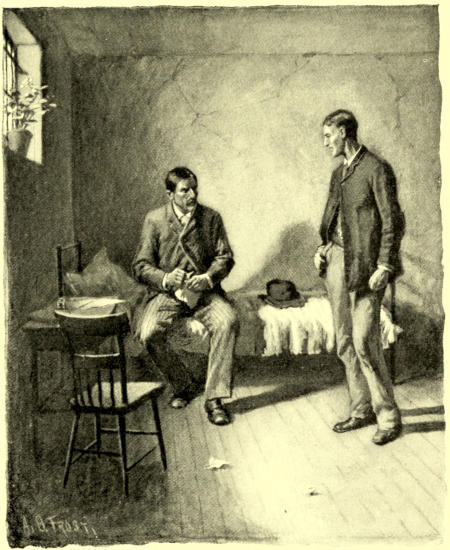
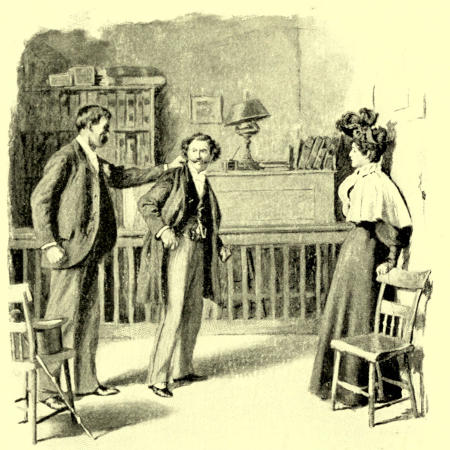
“TORE THE LETTER INTO PIECES”
“You take a damned ungentlemanly advantage
of your position,” fumed Paisley.
“I shall take more advantage of it if you give
me any sass,” returned Wickliff, calmly. “Now
set down and listen.” Paisley, after one helpless
glare, did sit down. “I believe you fairly revel
in lying. I don’t. That’s where we differ. I
think lies are always liable to come home to
roost, and I like to have the flock as small as
possible. Now you write that you are here, and
you’re helping me. You ain’t getting much
wages, but they will be enough to keep you—these
hard times any job is better than none.
And you can add that you don’t want any money
from her. Your other letter sorter squints like
you did. You can say you are boarding with a
very nice lady—that’s Mrs. Raker—everything
very clean, and the table plain but abundant.
Address you in care of Sheriff Amos T. Wickliff.
How’s that?”
Paisley’s anger had ebbed away. Either from
policy or some other motive he was laughing
now. “It’s not nearly so interesting in a literary
point of view, you know,” said he, “but I
guess it will be easier not to have so many
things to remember. And you’re right; I
didn’t mean to hint for money, but it did look
like it.”
“He did mean to hint,” thought the sheriff,
“but he’s got some sense.” The letter finally
submitted was a masterpiece in its way. This
time the sheriff smiled, though grimly. He also
gave Paisley a cigar.
Regularly the letters to Mrs. Smith were submitted
to Wickliff. Raker never thought of
reading them. The replies came with a pathetic
promptness. “That’s from your ma,” said Wickliff,
when the first letter came—Paisley was at
the jail ledgers in the sheriff’s room, as it happened,
directly beneath the portraits—“you
better read it first.”
Paisley read it twice; then he turned and
handed it to the sheriff, with a half apology.
“My mother talks a good deal better than she
writes. Women are naturally interested in petty
things, you know. Besides, I used to be fond
of the old dog; that’s why she writes so much
about him.”
“I have a dog myself,” growled the sheriff.
“Your mother writes a beautiful letter.” His
eyes were already travelling down the cheap thin
note-paper, folded at the top. “I know,” Mrs.
Smith wrote, in her stiff, careful hand—“I know
you will feel bad, Eddy, to hear that dear old
Rowdy is gone. Your letter came the night before
he died. Ruth was over, and I read it out
loud to her; and when I came to that part where
you sent your love to him, it seemed like he
understood, he wagged his tail so knowing. You
know how fond of you he always was. All that
evening he played round—more than usual—and
I’m so glad we both petted him, for in the morning
we found him stiff and cold on the landing
of the stairs, in his favorite place. I don’t think
he could have suffered any, he looked so peaceful.
Ruth and I made a grave for him in the
garden, under the white rose tree. Ruth digged
the grave, and she painted a Kennedy’s cracker-box,
and we wrapped him up in white cotton
cloth. I cried, and Ruth cried too, when we
laid him away. Somehow it made me long so
much more to see you. If I sent you the money,
don’t you think you could come home for Christmas?
Wouldn’t your employer let you if he
knew your mother had not seen you for four
years, and you are all the child she has got?
But I don’t want you to neglect your business.”
The few words of affection that followed were
not written so firmly as the rest. The sheriff
would not read them; he handed the letter back
to Paisley, and turned his Indian scowl on the
back of the latter’s shapely head.
Paisley was staring at the columns of the page
before him. “Rowdy was my dog when I was
courting Ruth,” he said. “I was engaged to her
once. I suppose mother thinks of that. Poor
Rowdy! the night I ran away he followed me,
and I had to whip him back.”
“Oh, you ran away?”
“Oh yes; the old story. Trusted clerk.
Meant to return the money. It wasn’t very
much. But it about cleaned mother out. Then
she started the bakery.”
“You pay your ma back?”
“Yes, I did.”
“That’s a lie.”
“What do you ask a man such questions for,
then? Do you think it’s pleasant admitting
what a dirty dog you’ve been? Oh, damn you!”
“You do see it, then,” said the sheriff, in a
very pleasant, gentle tone; “that’s one good
thing. For you have got to reform, Ned; I’m
going to give your mother a decent boy. Well,
what happened then? Girl throw you over?”
“Why, I ran straight for a while,” said Paisley,
furtively wiping first one eye and then the other
with a finger; “there wasn’t any scandal. Ruth
stuck by me, and a married sister of hers (who
didn’t know) got her husband to give me a place.
I was doing all right, and—and sending home
money to ma, and I would have been all right
now, if—if—I hadn’t met Mame, and she made
a crazy fool of me. Then Ruth shook me. Oh,
I ain’t blaming her! It was hearing about
Mame. But after that I just went a-flying to
the devil. Now you know why I wanted to see
Mame.”
“You wanted to kill her,” said the sheriff,
“or you think you did. But you couldn’t;
she’d have talked you over. Still, I thought I
wouldn’t risk it. You know she’s gone now?”
“I supposed she’d be, now the trial’s over.”
In a minute he added: “I’m glad I didn’t
touch her; mother would have had to know
that. Look here; how am I going to get over
that invitation?”
“I’ll trust you for that lie,” said Wickliff,
sauntering off.
Paisley wrote that he would not take his
mother’s money. When he could come home
on his own money he would gladly. He wrote
a long affectionate letter, which the sheriff read,
and handed back with the dry comment, “That
will do, I guess.”
But he gave Paisley a brier-wood pipe and a
pound of Yale Mixture that afternoon.
The correspondence threw some side-lights on
Paisley’s past.
“You’ve got to write your ma every week,”
announced Wickliff, when the day came round.
“Why, I haven’t written once a month.”
“Probably not, but you have got to write once
a week now. Your mother’ll get used to it. I
should think you’d be glad to do the only thing
you can for the mother that’s worked her fingers
off for you.”
“I am glad,” said Paisley, sullenly.
He never made any further demur. He wrote
very good letters; and more and more, as the
time passed, he grew interested in the correspondence.
Meanwhile he began to acquire
(quite unsuspected by the sheriff) a queer respect
for that personage. The sheriff was popular
among the prisoners; perhaps the general
sentiment was voiced by one of them, who exclaimed,
one day, after his visit, “Well, I never
did see a man as had killed so many men put on
so little airs!”
Paisley began his acquaintance with a contempt
for the slow-moving intellect that he
attributed to his sluggish-looking captor. He
felt the superiority of his own better education.
It was grateful to his vanity to sneer in secret
at Wickliff’s slips in grammar or information.
And presently he had opportunity to indulge his
humor in this respect, for Wickliff began lending
him books. The jail library, as a rule, was
managed by Mrs. Raker. She was, she used to
say, “a great reader,” and dearly loved “a nice
story that made you cry all the way through and
ended right.” Her taste was catholic in fiction
(she never read anything else), and her favorites
were Mrs. Southworth, Charles Dickens, and
Walter Scott. The sheriff’s own reading seldom
strayed beyond the daily papers, but with the
aid of a legal friend he had selected some standard
biographies and histories to add to the singular
conglomeration of fiction and religion sent
to the jail by a charitable public. On Paisley’s
request for reading, the sheriff went to Mrs.
Raker. She promptly pulled Ishmael Worth, or
Out of the Depths, from the shelf. “It’s beautiful,”
says she, “and when he gits through with
that he can have the Pickwick Papers to cheer
him up. Only I kinder hate to lend that book
to the prisoners; there’s so much about good
eatin’ in it, it makes ’em dissatisfied with the
table.”
“He’s got to have something improving, too,”
says the sheriff. “I guess the history of the
United States will do; you’ve read the others,
and know they’re all right. I’ll run through
this.”
He told Paisley the next morning that he had
sat up almost all night reading, he was so afraid
that enough of the thirteen States wouldn’t ratify
the Constitution. This was only one of the artless
comments that tickled Paisley. Yet he soon
began to notice the sheriff’s keenness of observation,
and a kind of work-a-day sense that served
him well. He fell to wondering, during those
long nights when his cough kept him awake,
whether his own brilliant and subtle ingenuity
had done as much for him. He could hardly
tell the moment of its beginning, but he began
to value the approval of this big, ignorant,
clumsy, strong man.
Insensibly he grew to thinking of conduct
more in the sheriff’s fashion; and his letters not
only reflected the change in his moral point of
view, they began to have more and more to say
of the sheriff. Very soon the mother began to
be pathetically thankful to this good friend of
her boy, whose habits were so correct, whose influence
so admirable. In her grateful happiness
over the frequent letters and their affection were
revealed the unexpressed fears that had tortured
her for years. She asked for Wickliff’s picture.
Paisley did not know that the sheriff had a
photograph taken on purpose. Mrs. Smith pronounced
him “a handsome man.” To be sure,
the unscarred side of his face was taken. “He
looks firm, too,” wrote the poor mother, whose
own boy had never known how to be firm; “I
think he must be a Daniel.”
“A which?” exclaimed the puzzled Daniel.
“Didn’t you ever go to Sunday-school? Don’t
you know the verses,
“‘Dare to be a Daniel;
Dare to make a stand’?”
The sheriff’s reply was enigmatical. It was:
“Well, to think of you having such a mother as
that!”
“I don’t deserve her, that’s a fact,” said Paisley,
with his flippant air. “And yet, would you
believe it, I used to be the model boy of the
Sunday-school. Won all the prizes. Ma’s got
them in a drawer.”
“Dare say. They thought you were a awful
good boy, because you always kept your face
clean and brushed your hair without being told
to, and learned your lessons quick, and always
said ‘Yes, ’m,’ and ‘No, ’m,’ and when you got
into a scrape lied out of it, and picked up bad
habits as easy and quiet as a long-haired dog
catches fleas. Oh, I know your sort of model
boy! We had ’em at the Orphans’ Home; I’ve
taken their lickings, too.”
Paisley’s thin face was scarlet before the speech
was finished. “Some of that is true,” said he;
“but at least I never hit a fellow when he was
down.”
The sheriff narrowed his eyes in a way that he
had when thinking; he put both hands in his
pockets and contemplated Paisley’s irritation.
“Well, young feller, you have some reason to
talk that way to me,” said he. “The fact is, I
was mad at you, thinking about your mother. I—I
respect that lady very highly.”
Paisley forced a feeble smile over his “So do
I.”
But after this episode the sheriff’s manner
visibly softened to the young man. He told
Raker that there were good spots in Paisley.
“Yes, he’s mighty slick,” said Raker.
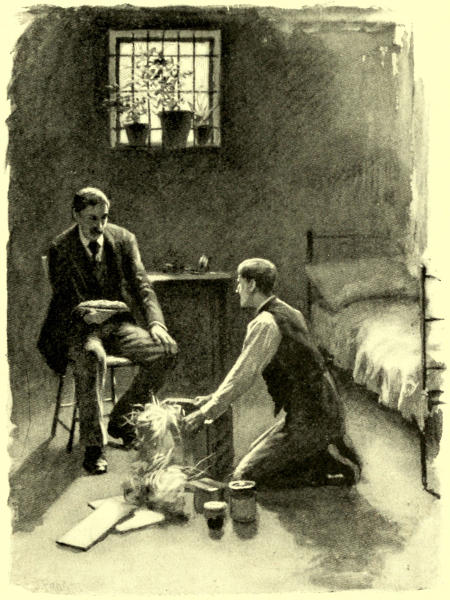
Thanksgiving-time, a box from his mother
came to the prisoner, and among the pies and
cakes was an especial pie for Mr. Wickliff,
“From his affectionate old friend, Rebecca
Smith.”
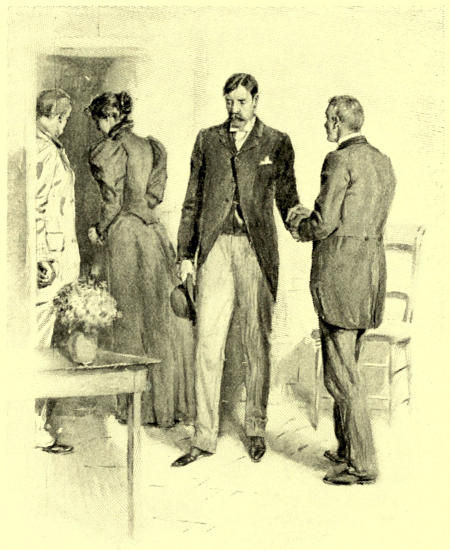
THE THANKSGIVING BOX
The sheriff spent fully two hours communing
with a large new Manual of Etiquette and Correspondence;
then he submitted a letter to Paisley.
Paisley read:
“Dear Madam,—Your favor (of the pie) of the 24th
inst. is received and I beg you to accept my sincere and
warm thanks. Ned is an efficient clerk and his habits
are very correct. We are reading history, in our leisure
hours. We have read Fisk’s Constitutional History of
the United States and two volumes of Macaulay’s History
of England. Both very interesting books. I think that
Judge Jeffreys was the meanest and worst judge I ever
heard of. My early education was not as extensive as I
could wish, and I am very glad of the valuable assistance
which I receive from your son. He is doing well and
sends his love. Hoping, my dear Madam, to be able to see
you and thank you personally for your very kind and welcome
gift, I am, with respect,
“Very Truly Yours,
“Amos T. Wickliff.”
Paisley read the letter soberly. In fact, another
feeling destroyed any inclination to smile
over the unusual pomp of Wickliff’s style.
“That’s out of sight!” he declared. “It will
please the old lady to the ground. Say, I take
it very kindly of you, Mr. Wickliff, to write
about me that way.”
“I had a book to help me,” confessed the flattered
sheriff. “And—say, Paisley, when you
are writing about me to your ma, you better say
Wickliff, or Amos. Mr. Wickliff sounds kinder
stiff. I’ll understand.”
The letter that the sheriff received in return
he did not show to Paisley. He read it with a
knitted brow, and more than once he brushed
his hand across his eyes. When he finished it
he drew a long sigh, and walked up to his mother’s
portrait. “She says she prays for me every
night, ma”—he spoke under his breath, and
reverently. “Ma, I simply have got to save that
boy for her, haven’t I?”
That evening Paisley rather timidly approached
a subject which he had tried twice before to
broach, but his courage had failed him. “You
said something, Mr. Wickliff, of paying me a little
extra for what I do, keeping the books, etc.
Would you mind telling me what it will be? I—I’d
like to send a Christmas present to my
mother.”
“That’s right,” said the sheriff, heartily. “I
was thinking what would suit her. How’s a nice
black dress, and a bill pinned to it to pay for
making it up?”
“But I never—”
“You can pay me when you get out.”
“Do you think I’ll ever get out?” Paisley’s
fine eyes were fixed on Wickliff as he spoke, with
a sudden wistful eagerness. He had never alluded
to his health before, yet it had steadily
failed. Now he would not let Amos answer; he
may have flinched from any confirmation of his
own fears; he took the word hastily. “Anyhow,
you’ll risk my turning out a bad investment.
But you’ll do a damned kind action
to my mother; and if I’m a rip, she’s a
saint.”
“Sure,” said the sheriff. “Say, do you think
she’d mind my sending her a hymn-book and a
few flowers?”
Thus it came to pass that the tiny bakery window,
one Christmas-day, showed such a crimson
glory of roses as the village had never seen; and
the widow Smith, bowing her shabby black bonnet
on the pew rail, gave thanks and tears for a
happy Christmas, and prayed for her son’s friend.
She prayed for her son also, that he might “be
kept good.” She felt that her prayer would be
answered. God knows, perhaps it was.
That night before she went to bed she wrote
to Edgar and to Amos. “I am writing to both
my boys,” she said to Amos, “for I feel like you
were my dear son too.”
When Amos answered this letter he did not
consult the Manual. It was one day in January,
early in the month, that he received the first bit
of encouragement for his missionary work palpable
enough to display to the scoffer Raker.
Yet it was not a great thing either; only this:
Paisley (already half an hour at work in the
sheriff’s room) stopped, fished from his sleeve a
piece of note-paper folded into the measure of a
knife-blade, and offered it to the sheriff.
“See what Mame sent me,” said he; “just
read it.”
There was a page of it, the purport being that
the writer had done what she had through jealousy,
which she knew now was unfounded; she
was suffering indescribable agonies from remorse;
and, to prove she meant what she said, if her
darling Ned would forgive her she would get
him out before a week was over. If he agreed
he was to be at his window at six o’clock Wednesday
night. The day was Thursday.
“How did you get this?” asked Amos. “Do
you mind telling?”
“Not the least. It came in a coat. From
Barber & Glasson’s. The one Mrs. Raker
picked out for me, and it was sent up from the
store. She got at it somehow, I suppose.”
“But how did you get word where to look?”
Paisley grinned. “Mame was here, visiting
that fellow who was taken up for smashing a
window, and pretended he was so hungry he had
to have a meal in jail. Mame put him up to it,
so she could come. She gave me the tip where
to look then.”
“I see. I got on to some of those signals
once. Well, did you show yourself Wednesday?”
“Not much!” He hesitated, and did not look
at the sheriff, scrawling initials on the blotting-pad
with his pen. “Did you really think, Mr.
Wickliff, after all you’ve done for me—and my
mother—I would go back on you and get you
into trouble for that—”
“’S-sh! Don’t call names!” Wickliff looked
apprehensively at the picture of his mother.
“Why didn’t you give me this before?”
“Because you weren’t here till this morning.
I wasn’t going to give it to Raker.”
“What do you suppose she’s after?”
“Oh, she’s got some big scheme on foot, and
she needs me to work it. I’m sick of her. I’m
sick of the whole thing. I want to run straight.
I want to be the man my poor mother thinks I
am.”
“And I want to help you, Ned,” cried the
sheriff. For the first time he caught the other’s
hand and wrung it.
“I guess the Lord wants to help me too,” said
Paisley, in a queer dry tone.
“Why—yes—of course he wants to help all of
us,” said the sheriff, embarrassed. Then he
frowned, and his voice roughened as he asked,
“What do you mean by that?”
“Oh, you know what I mean,” said Paisley,
smiling; “you’ve always known it. It’s been
getting worse lately. I guess I caught cold.
Some mornings I have to stop two or three times
when I dress myself, I have such fits of coughing.”
“Why didn’t you tell, and go to the hospital?”
“I wanted to come down here. It’s so pleasant
down here.”
“Good—” The sheriff reined his tongue in
time, and only said, “Look here, you’ve got to
see a doctor!”
Therefore the encouragement to the missionary
work was embittered by divers conflicting
feelings. Even Raker was disturbed when the
doctor announced that Paisley had pneumonia.
“Double pneumonia and a slim chance, of
course,” gloomed Raker. “Always so. Can’t
have a man git useful and be a little decent, but
he’s got to die! Why couldn’t it ’a’ been that
tramp tried to set the jail afire?”
“What I’m a-thinking of is his poor ma, who
used to write him such beautiful letters,” said
Mrs. Raker, wiping her kind eyes. “They was
so attached. Never a week he didn’t write her.”
“It’s his mother I’m thinking of, too,” said
the sheriff, with a groan; “she’ll be wanting to
come and see him, and how in—” He swallowed
an agitated oath, and paced the floor, his hands
clasped behind him, his lip under his teeth, and
his blackest Indian scowl on his brow—plain
signs to all who knew him that he was fighting
his way through some mental thicket.
But he had never looked gentler than he
looked an hour later, as he stepped softly into
Paisley’s cell. Mrs. Raker was holding a foaming
glass to the sick man’s lips. “There; take
another sup of the good nog,” she said, coaxingly,
as one talks to a child.
“No, thank you, ma’am,” said Paisley.
“Queer how I’ve thought so often how I’d like
the taste of whiskey again on my tongue, and
now I can have all I want, I don’t care a hooter!”
His voice was rasped in the chords, and he
caught his breath between his sentences. Forty-eight
hours had made an ugly alteration in his
face; the eyes were glassy, the features had
shrunken in an indescribable, ghastly way, and
the fair skin was of a yellowish pallor, with livid
circles about the eyes and the open mouth.
Wickliff greeted him, assuming his ordinary
manner. They shook hands.
“There’s one thing, Mr. Wickliff,” said Paisley:
“you’ll keep this from my mother. She’d
worry like blazes, and want to come here.”
There was a photograph on the table, propped
up by books; the sheriff’s hand was on it, and
he moved it, unconsciously: “‘To Eddy, from
Mother. The Lord bless and keep thee. The
Lord make his face to shine upon thee, and be
gracious unto thee—’” Wickliff cleared his
throat. “Well, I don’t know, Ned,” he said,
cheerfully; “maybe that would be a good thing—kind
of brace you up and make you get well
quicker.”
Mrs. Raker noticed nothing in his voice; but
Paisley rolled his eyes on the impassive face in
a strange, quivering, searching look; then he
closed them and feebly turned his head.
“Don’t you want me to telegraph? Don’t
you want to see her?”
Some throb of excitement gave Paisley the
strength to lift himself up on the pillows.
“What do you want to rile me all up for?”
His voice was almost a scream. “Want to see
her? It’s the only thing in this damned fool
world I do want! But I can’t have her know;
it would kill her to know. You must make up
some lie about it’s being diphtheria and awful
sudden, and no time for her to come, and have
me all out of the way before she gets here.
You’ve been awful good to me, and you can do
anything you like; it’s the last I’ll bother you—don’t
let her find out!”
“For the land’s sake!” sniffed Mrs. Raker, in
tears—“don’t she know?”
“No, ma’am, she don’t; and she never will,
either,” said the sheriff. “There, Ned, boy, you
lay right down. I’ll fix it. And you shall see
her, too. I’ll fix it.”
“Yes, he’ll fix it. Amos will fix it. Don’t
you worry,” sobbed Mrs. Raker, who had not the
least idea how the sheriff could arrange matters,
but was just as confident that he would as if the
future were unrolled before her gaze.
The prisoner breathed a long deep sigh of relief,
and patted the strong hand at his shoulder.
And Amos gently laid him back on the pillows.
Before nightfall Paisley was lying in Amos
Wickliff’s own bed, while Amos, at his side, was
critically surveying both chamber and parlor
under half-closed eyelids. He was trying to see
them with the eyes of the elderly widow of a
Methodist minister.
“Hum—yes!” The result of the survey was,
on the whole, satisfactory. “All nice, high-toned,
first-class pictures. Nothing to shock a
lady. Liquors all put away, ’cept what’s needed
for him. Pops all put away, so she won’t be
finding one and be killing herself, thinking it’s
not loaded. My bed moved in here comfortable
for him, because he thought it was such a pleasant
room, poor boy. Another bed in my room
for her. Bath-room next door, hot and cold
water. Little gas stove. Trained nurse who
doesn’t know anything, and so can’t tell. Thinks
it’s my friend Smith. Is there anything else?”
At this moment the white counterpane on the
bed stirred.
“Well, Ned?” said Wickliff.
“It’s—nice!” said Paisley.
“That’s right. Now you get a firm grip on
what I’m going to say—such a grip you won’t
lose it, even if you get out of your head a little.”
“I won’t,” said Paisley.
“All right. You’re not Paisley any more.
You’re Ned Smith. I’ve had you moved here
into my rooms because your boarding-place
wasn’t so good. Everybody here understands,
and has got their story ready. The nurse thinks
you’re my friend Smith. You are, too, and you
are to call me Amos. The telegram’s gone.
’S-sh!—what a way to do!”—for Paisley was
crying. “Ain’t I her boy too?”
One weak place remained in the fortress that
Amos had builded against prying eyes and chattering
tongues. He had searched in vain for
“Mame.” There was no especial reason, except
pure hatred and malice, to dread her going to
Paisley’s mother, but the sheriff had enough
knowledge of Mame’s kind to take these qualities
into account.
From the time that Wickliff promised him
that he should have his mother, Paisley seemed
to be freed from every misgiving. He was too
ill to talk much, and much of the time he was
miserably occupied with his own suffering; yet
often during the night and day before she came
he would lift his still beautiful eyes to Mrs. Raker’s
and say, “It’s to-morrow night ma comes,
isn’t it?” To which the soft-hearted woman
would sometimes answer, “Yes, son,” and sometimes
only work her chin and put her handkerchief
to her eyes. Once she so far forgot the
presence of the gifted professional nurse that
she sniffed aloud, whereupon that personage administered
a scorching tonic, in the guise of a
glance, and poor Mrs. Raker went out of the
room and cried.
He must have kept some reckoning of the
time, for the next day he varied his question.
He said, “It’s to-day she’s coming, isn’t it?”
As the day wore on, the customary change of his
disease came: he was relieved of his worst pain;
he thought that he was better. So thought Mrs.
Raker and the sheriff. The doctor and the nurse
maintained their inscrutable professional calm.
At ten o’clock the sheriff (who had been gone
for a half-hour) softly opened the door. The sick
man instantly roused. He half sat up. “I
know,” he exclaimed; “it’s ma. Ma’s come!”
The nurse rose, ready to protect her patient.
There entered a little, black-robed, gray-haired
woman, who glided swift as a thought to the
bedside, and gathered the worn young head to
her breast. “My boy, my dear, good boy!” she
said, under her breath, so low the nurse did not
hear her; she only heard her say, “Now you
must get well.”
“Oh, I am glad, ma!” said the sick man.
After that the nurse was well content with
them all. They obeyed her implicitly. It was
she rather than Mrs. Raker who observed that
Mr. Smith’s mother was not alone, but accompanied
by a slim, fair, brown-eyed young woman,
who lingered in the background, and would fain
have not spoken to the invalid at all had she not
been gently pushed forward by the mother, with
the words, “And Ruth came too, Eddy!”
“Thank you, Ruth; I knew that you wouldn’t
let ma come alone,” said Ned, feebly.
The young woman had opened her lips. Now
they closed. She looked at him compassionately.
“Surely not, Ned,” she said.
But why, wondered the nurse, who was observant—it
was her trade to observe—why did
she look at him so intently, and with such a
shocked pity?
Ned did not express much—the sick, especially
the very sick, cannot; but whenever he waked
in the night and saw his mother bending over
him he smiled happily, and she would answer his
thought. “Yes, my boy; my dear, good boy,”
she would say.
And the sheriff in his dim corner thought sadly
that the ruined life would always be saved for
her now, and her son would be her good boy forever.
Yet he muttered to himself, “I suppose
the Lord is helping me out, and I ought to feel
obliged, but I’m hanged if I wouldn’t rather take
the chances and have the boy get well!”
But he knew all the time that there was no
hope for Ned’s life. He lived three days after his
mother came. The day before his death he was
alone for a short time with the sheriff, and asked
him to be good to his mother. “Ruth will be
good to her too,” he said; “but last night I
dreamed Mame was chasing mother, and it scared
me. You won’t let her get at mother, will
you?”
“Of course I won’t,” said the sheriff; “we’re
watching your mother every minnit; and if that
woman comes here, Raker has orders to clap her
in jail. And I will always look out for your ma,
Ned, and she never shall know.”
“That’s good,” said Ned, in his feeble voice.
“I’ll tell you something: I always wanted to be
good, but I was always bad; but I believe I
would have been decent if I’d lived, because I’d
have kept close to you. You’ll be good to ma—and
to Ruth?”
The sheriff thought that he had drifted away
and did not hear the answer, but in a few moments
he opened his eyes and said, brightly,
“Thank you, Amos.” It was the first time that
he had used the other man’s Christian name.
“Yes, Ned,” said the sheriff.
Next morning at daybreak he died. His mother
was with him. Just before he went to sleep
his mind wandered a little. He fancied that he
was a little boy, and that he was sick, and wanted
to say his prayers to his mother. “But I’m so
sick I can’t get out of bed,” said he. “God
won’t mind my saying them in bed, will He?”
Then he folded his hands, and reverently repeated
the childish rhyme, and so fell into a
peaceful sleep, which deepened into peace. In
this wise, perhaps, were answered many prayers.
Amos made all the arrangements the next day.
He said that they were going home from Fairport
on the day following, but he managed to conclude
all the necessary legal formalities in time
to take the evening train. Once on the train,
and his companions in their sections, he drew a
long breath.
“It may not have been Mame that I saw,” he
said, taking out his cigar-case on the way to the
smoking-room; “it was merely a glimpse—she
in a buggy, me on foot; and it may be she
wouldn’t do a thing or think the game worth
blackmail; but I don’t propose to run any
chances in this deal. Hullo—excuse me,
miss!”
The last words were uttered aloud to Ruth
Graves, who had touched him on the arm. He
had a distinct admiration for this young woman,
founded on the grounds that she cried very
quietly, that she never was underfoot, and that
she was so unobtrusively kind to Mrs. Smith.
“Anything I can do?” he began, with genuine
willingness.
She motioned him to take a seat. “Mrs.
Smith is safe in her section,” she said; “it isn’t
that. I wanted to speak to you. Mr. Wickliff,
Ned told me how it was. He said he couldn’t
die lying to everybody, and he wanted me to
know how good you were. I am perfectly safe,
Mr. Wickliff,” as a look of annoyance puckered
the sheriff’s brow. “He told me there was a
woman who might some time try to make money
out of his mother if she could find her, and I was
to watch. Mr. Wickliff, was she rather tall and
slim, with a fine figure?”
“Yes—dark-complected rather, and has a thin
face and a largish nose.”
“And one of her eyes is a little droopy, and
she has a gold filling in her front tooth? Mr.
Wickliff, that woman got on this train.”
“She did, did she?” said the sheriff, showing
no surprise. “Well, my dear young lady, I’m
very much obliged to you. I will attend to the
matter. Mrs. Smith sha’n’t be disturbed.”
“Thank you,” said the young woman; “that’s
all. Good-night!”
“You might know that girl had had a business
education,” the sheriff mused—“says what she’s
got to say, and moves on. Poor Ned! poor
Ned!”
Ruth went to her section, but she did not undress.
She sat behind the curtains, peering
through the opening at Mrs. Smith’s section opposite,
or at the lower berth next hers, which
was occupied by the sheriff. The curtains were
drawn there also, and presently she saw him
disappear by sections into their shelter. Then
his shoes were pushed partially into the aisle.
Empty shoes. She waited; it could not be that
he was really going to sleep. But the minutes
crept by; a half-hour passed; no sign of life
behind his curtains. An hour passed. At the
farther end of the car curtains parted, and a
young woman slipped out of her berth. She
was dark and not handsome, but an elegant
shape and a modish gown made her attractive-looking.
One of her eyelids drooped a
little.
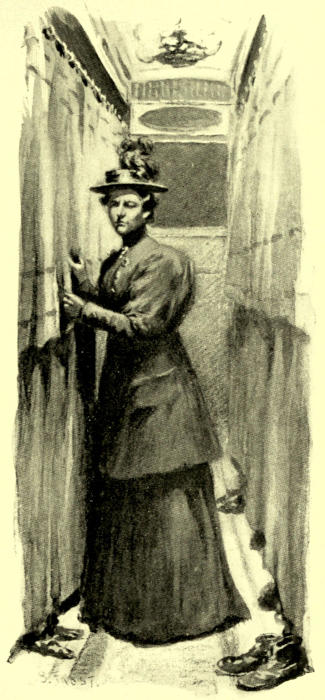
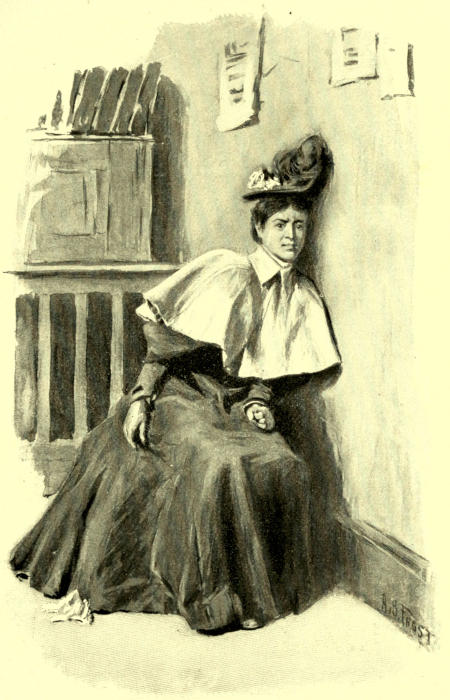
“SHE PAUSED BEFORE MRS. SMITH’S
SECTION”
She walked down the aisle and paused before
Mrs. Smith’s section, Ruth holding her breath.
She looked at the big shoes on the floor, her lip
curling. Then she took the curtains of Mrs.
Smith’s section in both hands and put her head
in.
“I must stop her!” thought Ruth. But she
did not spring out. The sheriff, fully dressed,
was beside the woman, and an arm of iron deliberately
turned her round.
“The game’s up, Mamie,” said Wickliff.
She made no noise, only looked at him.
“What are you going to do?” said she, with
perfect composure.
“Arrest you if you make a racket, talk to you
if you don’t. Go into that seat.” He indicated
a seat in the rear, and she took it without a
word. He sat near the aisle; she was by the
window.
“I suppose you mean to sit here all night,”
she remarked, scornfully.
“Not at all,” said he; “just to the next place.
Then you’ll get out.”
“Oh, will I?”
“You will. Either you will get out and go
about your business, or you will get out and be
taken to jail.”
“We’re smart. What for?”
“For inciting prisoners to escape.”
“Ned’s dead,” with a sneer.
“Yes, he’s dead, and”—he watched her narrowly,
although he seemed absorbed in buttoning
his coat—“they say he haunts his old cell,
as if he’d lost something. Maybe it’s the letter
you folded up small enough to go in the seam
of a coat. I’ve got that.” He saw that she was
watching him in turn, and that she was nervous.
“Ned’s dead, poor fellow, true enough;
but—the girl at Barber & Glasson’s ain’t
dead.”
She began to fumble with her gloves, peeling
them off and rolling them into balls. He thought
to himself that the chances were that she was
superstitious.
“Look here,” he said, sharply, “have an end
of this nonsense; you get off at the next place,
and never bother that old lady again, or—I will
have you arrested, and you can try for yourself
whether Ned’s cell is haunted.”
For a brief space they eyed each other, she
in an access of impotent rage, he stolid as the
carving of the seat. The car shivered; the great
wheels moved more slowly. “Decide,” said he;
not imperatively—dryly, without emotion of any
sort. He kept his mild eyes on her.
“It wasn’t his mother I meant to tell; it
was that girl—that nice girl he wanted to
marry—”
“You make me tired,” said the sheriff. “Are
you going, or am I to make a scene and take
you? I don’t care much.”
She slipped her hand behind her into her
pocket.
The sheriff laughed, and grasped one wrist.
“I don’t want to talk to the country fools,”
she snapped.
“This way,” said the sheriff, guiding her.
The train had stopped. She laughed as he
politely handed her off the platform; the next
moment the wheels were turning again and she
was gone. He never saw her again.
The porter came out to stand by his side in
the vestibule, watching the lights of the station
race away and the darkling winter fields fly past.
The sheriff was well known to him; he nodded
an eager acquiescence to the officer’s request:
“If those ladies in 8 and 9 ask you any questions,
just tell them it was a crazy woman getting the
wrong section, and I took care of her.”
Within the car a desolate mother wept the
long night through, yet thanked God amid her
tears for her son’s last good days, and did not
dream of the blacker sorrow that had menaced
her and had been hurled aside.
THE CABINET ORGAN
THE CABINET ORGAN
It was a June day. Not one of those perfervid
June days that simulate the heat of
July, and try to show the corn what June can
do, but one of Shakespeare’s lovely and temperate
days, just warm enough to unfurl the rose petals
of the Armstrong rose-trees and ripen the grass
flowers in the Beaumonts’ unmowed yard.
The Beaumonts lived in the north end of town,
at the terminus of the street-car line. They did
not live in the suburbs because they liked space
and country air, nor in order to have flowers and
a kitchen-garden of their own, like the Armstrongs
opposite, but because the rent was lower.
The Beaumonts were very poor and very proud.
The Armstrongs were neither poor nor proud.
Joel Armstrong, the head of the family, owned
the comfortable house, with its piazzas and bay-windows,
the small stable and the big yard.
There was a yard enclosed in poultry-netting,
and a pasture for the cow, and the elderly family
horse that had picked up so amazingly under the
influence of good living and kindness that no
one would suspect how cheaply the car company
had sold him.
Armstrong was the foreman of a machine-shop.
Every morning at half-past six Pauline
Beaumont, who rose early, used to see him board
the street-car in his foreman’s clothes, which
differs from working-men’s clothes, though only
in a way visible to the practised observer. He
always was smoking a short pipe, and he usually
was smiling. Mrs. Armstrong was a comely woman,
who had a great reputation in the neighborhood
as a cook and a nurse. In the family were
three boys—if one can call the oldest a boy, who
was a young carpenter, just this very day setting
up for master-builder. The second boy was fifteen,
and in the high-school, and the youngest
was ten. There were no daughters; but for helper
Mrs. Armstrong had a stout young Swede, who
was occasionally seen by the Beaumonts hiding
broken pieces of glass or china in a convenient
ravine. The Beaumont house was much smaller
than the Armstrongs’, nor was it in such admirable
repair and paint; but then, as Henriette
Beaumont was used to say, “They had not a
carpenter in the family.”
It will be seen that the Beaumonts held themselves
very high above the Armstrongs. They
could not forget that twenty-five years ago their
father had been Lieutenant-Governor, and they
had been accounted rich people in the little
Western city. Father and fortune had been lost
long since. They were poor, obscure, working
hard for a livelihood; but they still kept their
pride, which only increased as their visible consequence
diminished. Nevertheless, Pauline often
looked wistfully across at the Armstrongs’
little feasts and fun, and always walked home
on their side of the street. Pauline was the
youngest and least proud of the Beaumonts.
To-day, as usual, she came down the street, past
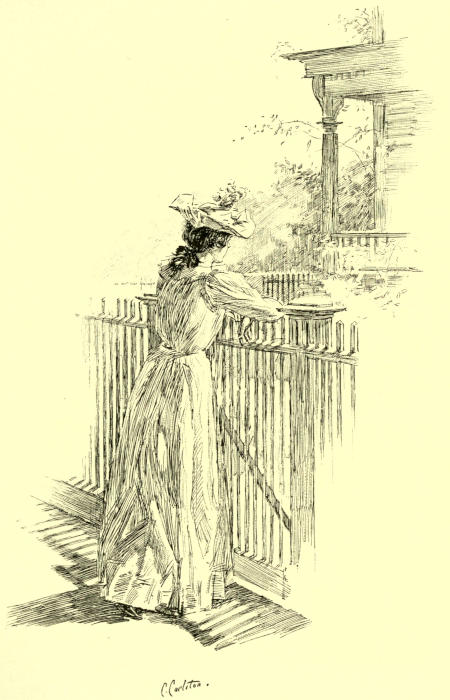
the neat low fence of the Armstrongs; but instead
of passing, merely glancing in at the lawn
and the house, she stopped; she leaned her shabby
elbows on the gate, where she could easily see
the dining-room and sniff the savory odors floating
from the kitchen. “Oh, doesn’t it smell
good?” she murmured. “Chickens fried, and
new potatoes, and a strawberry shortcake. They
have such a nice garden.” She caught her breath
in a mirthless laugh. “How absurd I am! I
feel like staying here and smelling the whole
supper! Yesterday they had waffles, and the day
before beefsteak—such lovely, hearty things!”
She was a tall girl, too thin for her height,
with a pretty carriage and a delicate irregular
face, too colorless and tired for beauty, but not
for charm. Her skin was fine and clear, and her
brown hair very soft. Her gray eyes were alight
with interest as she watched the finishing touches
given the table, which was spread with a glossy
white cloth, and had a bowl of June roses in the
centre. Mrs. Armstrong, in a new dimity gown
and white apron, was placing a great platter of
golden sponge-cake on the board. She looked
up and saw Pauline. The girl could invent no
better excuse for her scrutiny (which had such
an air of prying) than to drop her head as if in
faintness—an excuse, indeed, suggested by her
own feelings. In a minute Mrs. Armstrong had
stepped through the bay-window and was on the
other side of the fence, listening with vivid sympathy
to Pauline’s shamefaced murmur: “Excuse
me, but I feel so ill!”
“It’s a rush of blood to the head,” cried Mrs.
Armstrong, all the instincts of a nurse aroused.
“Come right in; you mustn’t think of going
home. Land! you’ll like as not faint before I
can get over to you. Hold on to the fence if you
feel things swimming!”
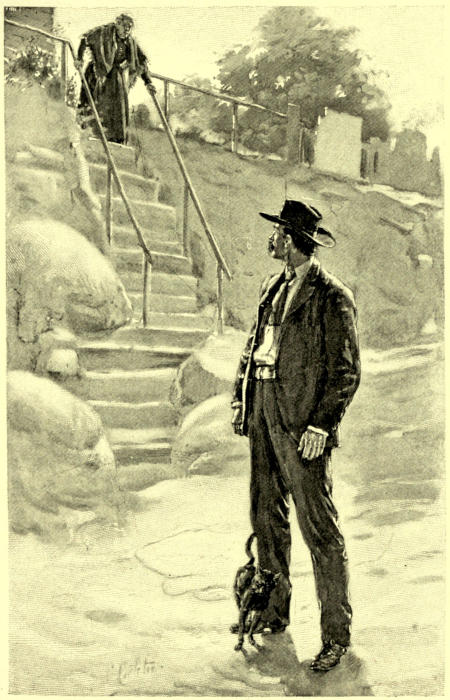
“SHE LEANED HER SHABBY ELBOWS ON THE GATE”
Pauline, in her confusion, grew red and redder,
while, despite inarticulate protestations, she
was propelled into the house and on to a large
lounge.
“Lay your head back,” commanded the nurse,
appearing with an ammonia-bottle in one hand
and a fan in the other.
“It’s nothing—nothing at all,” gasped Pauline,
between shame and the fumes of ammonia.
“The day was a little warm, and I walked home,
and I was so busy I ate no lunch”—as if that
were a change from her habits—“and all at
once I felt faint. But I’m all right now.”
“Well, I don’t wonder you’re faint,” cried
Mrs. Armstrong; “you oughtn’t to do that way.
Now you just got to lie still—— Oh, that’s only
Ikey. Ikey, you get a glass of wine for this
lady; it’s Miss Beaumont.”
The tall young man in the gray suit and
the blue flannel shirt blushed a little under
his sunburn as he bowed. “Pleased to meet
you, miss,” said he, promptly, before he disappeared.
“This is a great day for us,” continued the
mother, releasing the ammonia from duty, and
beginning to fan vigorously. “Ike has set up
as master-builder—only two men, and he does
most of the work; but he’s got a house all to
himself, and the chance of some bigger ones.
We’re having a little celebration. You must
excuse the paper on the lounge; I put it down
when we unpacked the organ.”
“Oh, did the organ come?” said the son.
“It surely did, and we’ve played on it already.”
“Why, did you get the music? Was it in
the box, too?”
“Oh, we ’ain’t played tunes; we just have
been trying it—like to see how it goes. It’s got
an awful sweet sound.”
“And you ought to hear me play a tune on
it, ma.”
“You! For the land’s sake!”
“Yes, me—that never did play a tune in my
life. Anybody can play on that organ.” He
turned politely to Pauline, as to include her in
the conversation. “You see, Miss Beaumont,
we’re a musical family that can’t sing. We
can’t, as they say, carry a tune to save our immortal
souls. The trouble isn’t with the voice;
it’s with our ears. We can hear well enough,
too, but we haven’t an ear for music. I took
lessons once, trying to learn to sing, but the
teacher finally braced up to tell me that he
hadn’t the conscience to take my money.
‘What’s the matter?’ says I. ‘You’ve lots of
voice,’ says he, ‘but you haven’t a mite of ear.’
‘Can’t anybody teach me to sing?’ says I. ‘Not
unless they hypnotize you, like Trilby,’ says he.
So I gave it up. But next I thought I would
learn to play; for if there’s one thing ma and
the boys and I all love, it’s music. And just
then, as luck would have it, this teacher wanted
to sell his cabinet organ, which is in perfect
shape and a fine instrument. And I was craving
to buy it, but I knew it was ridiculous,
when none of us can play. But I kept thinking.
Finally it came to me. I had seen those
zither things with numbers on them; why
couldn’t he paint numbers on the keys of the
organ just that way, and make music to correspond?
And that’s just the way we’ve done.
You’re very musical. I—I’ve often listened to
your playing. What do you think of it?” He
looked at her wistfully.
“I think it very ingenious—very,” said Pauline.
She had risen now, and she thanked Mrs.
Armstrong, and said she must go home. In
truth, she was in a panic at the thought of what
she had done. Henriette never would understand.
Her heart beat guiltily all the way
home.
There were three Beaumonts—Henriette, Mysilla,
and Pauline. Henriette and Mysilla were
twins, who had dressed alike from childhood’s
hour, although Mysilla was very plain, a colorless
blonde, of small stature and painfully thin,
while Henriette was tall, with a stately figure
and a handsome dark face that would have
looked well on a Roman coin. Yet Henriette
was a woman of good taste, and she spent many
a night trying to decide on a gown which would
suit equally well Mysie’s fair head and her glossy
black one. Both the black and the brown
head were gray now, but they still wore frocks
and hats alike. Henriette held that it was the
hall-mark of a good family to clothe twins
alike, and Henriette did not have her Roman
features for nothing. Mysilla had always adored
and obeyed Henriette. She gloried in Henriette’s
haughty beauty and grace, and she was as
proud of both now that Henriette was a shabby
elderly woman, who had to wear dyed gowns
and darned gloves, as in the days when she was
the belle of the Iowa capital, and poor Jim
Perley fought a duel with Captain Sayre over a
misplaced dance on her ball-card. Henriette
promised to marry Jim after the duel, but Jim
died of pneumonia that very week. For Jim’s
sake, John Perley, his brother, was good to the
girls. Pauline was a baby when her father died.
She never remembered the days of pomp, only
the lean days of adversity. John Perley obtained
a clerkship for her in a music-store.
Henriette gave music lessons. She was a brilliant
musician, but she criticised her pupils precisely
as she would have done any other equally
stupid performers, and her pupils’ parents did
not always love the truth. Mysilla took in plain
sewing, as the phrase goes. She sometimes
(since John Perley had given them a sewing-machine)
made as much as four dollars a week.
They invariably paid their rent in advance, and
when they had not money to buy enough to eat
they went hungry. They never cared to know
their neighbors, and Pauline cringed as she imaged
Henriette’s sarcasms had she seen her sister
drinking the Armstrongs’ California port.
Henriette had stood in the hall corner and
waved Pauline fiercely and silently away while
the unconscious Mrs. Armstrong thumped at
the broken bell outside, and at last departed,
remarking, “Well, they must be gone, or
dead!”
Therefore rather timidly Pauline opened the
door of the little room that was both parlor and
dining-room. Any one could see that the room
belonged to people who loved music. The old-fashioned
grand-piano was under protection of
busts of Bach, Beethoven, and Wagner; and
Mysie’s violin stood in the corner, near a bookcase
full of musical biographies. An air of exquisite
neatness was like an aroma of lavender
in the room, and with it was fused a prim good
taste, such as might properly belong to gentlewomen
who had learned the household arts
when the rule of three was sacred, and every
large ornament must be attended by a smaller
one on either side. And an observer of a gentle
mind, furthermore, might have found a kind of
pathos in the shabbiness of it all; for everything
fine was worn and faded, and everything
new was coarse. The portrait of the Lieutenant-Governor
faced the door. For company it
had on either side small engravings of Webster
and Clay. Beneath it was placed the tea-table,
ready spread. The cloth was of good quality,
but thin with long service. On the table a
large plate of bread held the place of importance,
with two small plates on either corner,
the one containing a tiny slice of suspiciously
yellow butter, and the other a cone of solid
jelly. Such jelly they sell at the groceries out
of firkins. A glass jug of tea stood by a plated
ice-water jug of a pattern highly esteemed before
the war. Henriette was stirring a small
lump of ice about the sides of the tea-jug. She
greeted Pauline pleasantly.
“Iced tea?” said Pauline. “I thought we
were to have hot tea and sausages and toast. I
gave Mysie twenty-five cents for them this morning.”
She did not say that it was the money
for more than one day’s luncheon.
“Yes, Mysie said something about it,” said
Henriette, “but it didn’t seem worth while to
burn up so much wood merely to heat the water
for tea; and toast uses up so much butter.”
“But I gave Mysie a dollar to buy a little oil-stove
that we could use in summer; and there
was the sausage; I don’t mean to find fault,
sister Etty, but I’m ravenously hungry.”
“Of course, child,” Henriette agreed, benignly;
“you are always hungry. But I think you’ll
agree I was lucky not to have bought that stove
and those sausages this morning. Who do
you think is coming to this town next week?
Theodore Thomas, with his own orchestra!
And just as I was going into that store to buy
your stove—though I didn’t feel at all sure it
wouldn’t explode and burn the house down—John
Perley came up and gave me a ticket, an
orchestra seat; and I said at once, ‘The girls
must go too’; but I hadn’t but twenty-five cents,
and no more coming in for a week. Then it
occurred to me like a flash, there was this money
you had given me; and, Paula, I made such a
bargain! The man at Farrell’s, where they are
selling the tickets, will get us three seats, not
very far back in the gallery, for my orchestra
seat and the money, and we shall have enough
money left to take us home in the street cars.
Now do you understand?” concluded Henriette,
triumphantly.
“Yes, sister Etty; it will be splendid,” responded
Pauline, but with less enthusiasm than
Henriette had expected.
“Aren’t you glad?” she demanded.
“Oh yes, I’m glad; but I’m so dead tired I can
hardly talk,” said Pauline, as she left the room.
She felt every stair as she climbed it; but her
face cleared at the sight of Mysie coming through
the hall.
“It’s a lovely surprise, Mysie, isn’t it?” she
cried, cheerfully. She always called Mysie by
her Christian name, without prefix. Henriette,
although of the same age, was so much more
important a person that she would have felt the
unadorned name a liberty. But nobody was
afraid of Mysie. Pauline wound one of her long
arms about her waist and kissed her.
Mysie gave a little gasp of mingled pleasure
and relief, and the burden of her thoughts
slipped off in the words, “I knew you ’lotted
on that oil-stove, Paula, but Etty said you would
want me to go—”
“I wouldn’t go without you,” Pauline burst
in, vehemently, “and I’d live on bread and jelly
for a week to give you that pleasure.”
“There was the sausage, too; I did feel bad
about that; you ought to have good hot meals
after working all day.”
“No more than you, Mysie.”
“I’m not on my feet all day. And I did think
of taking some of that seventy-five cents we have
saved for the curtains, but I didn’t like to spend
any without consulting you.”
“It’s your own money, Mysie; but anyhow I
suppose we need the curtains. Go on down;
Henriette’s calling. I’ll be down directly.”
But after she heard her sister’s uncertain footstep
on the stair she stood frowning out of the
window at the Armstrong house. “It’s hideous
to think it,” she murmured, “but I don’t care—we
have so much music and so little sausage!
I wish I had the money for my ticket to the
concert to spend on meat!”
Then, remorsefully, she went down-stairs, and
after supper she played all the evening on the
piano; but the airs that she chose were in a
simple strain—minstrel songs of a generation
ago, like “Nelly was a lady” and “Hard times
come again no more,” from a battered old book
of her mother’s.
“Wouldn’t you like to try a few Moody and
Sankeys?” Henriette jeered after a while.
“Foster seems to me only one degree less maudlin
and commonplace. He makes me think of
tuberoses!” Pauline laughed and went to the
window. The white porcupine of electric light
at the corner threw out long spikes of radiance
athwart the narrow sidewalk, and a man’s shadow
dipped into the lighted space. The man was
leaning his arms on the fence. “Foolish fellow!”
Pauline laughed softly to herself. That
night, shortly after she had dropped asleep,
she was awakened out of a dream of staying to
supper with the Armstrongs, and beholding the
board loaded with broiled chickens and plum-pudding,
by a clutch on her shoulder. “It was
quite accidental,” she pleaded; “it really was,
sister Etty!” For her dream seemed to project
itself into real life, and there was Henriette, a
stern figure in flowing white, bending over her.
“Wake up!” she cried. “Listen! There’s
something awful happening at the Armstrongs’.”
Pauline sat up in bed as suddenly as a jack-in-the-box.
Then she gave a little gasp of laughter.
“They are all right,” said she; “they are playing
on their organ. That’s the way they play.”
The organ ceased to moan, and Henriette returned
to her couch. In ten minutes she was
back again, shaking Pauline. “Wake up!” she
cried. “How can you sleep in such a racket?
He has been murdering popular tunes by inches,
and now what he is doing I don’t know, but it
is awful. You know them best. Get up and
call to them that we can’t sleep for the noise
they make.”
“I suppose they have a right to play on their
own organ.”
“They haven’t a right to make such a pandemonium
anywhere. If you won’t do something,
I’m going to pretend I think it’s cats,
and call ‘Scat!’ and throw something at them.”
“You wouldn’t hit anything,” Pauline returned,
in that sleepy tone which always rouses
a wakeful sufferer’s wrath. “Better shut your
window. You can’t hear nearly so well then.”
“Yes, sister, I’ll shut the window,” Mysie called
from the chamber, as usual eager for peace.
“You let that window alone,” commanded
Henriette, sternly. A long pause—Henriette
seated in rigid agony at the foot of the bed; the
Armstrongs experimenting with the Vox Humana
stop. “Pauline, do you mean to say that you
can sleep? Pauline! Pauline!”
“What’s the matter now?” asked Pauline.
“I am going to take my brush—no, I shall
take your brush, Pauline Beaumont—and hurl
it at them!”
“Oh, sister, please don’t,” begged Mysie from
within, like the voices on a stage.
Henriette spoke not again; she strode out of
the room, and did even as she had threatened.
She flung Pauline’s brush straight at the organist
sitting before the window. Whether she really
meant to injure young Armstrong’s candid brow
is an open question; and, judging from the
result, I infer that she did not mean to do more
than scare her sister; therefore she aimed afar.
By consequence the missile sped straight into
the centre of the window. But not through it;
the window was raised, and a wire screen rattled
the brush back with a shivering jar.
“What’s that? A bat?” said Armstrong,
happily playing on. His father and mother
were beaming upon him in deep content—his
father a trifle sleepy, but resolved, the morrow
being Sunday, to enjoy this musical hour to the
full, his mother seated beside him and reading
the numbers aloud.
“You see, Ikey,” she had explained, “that’s
what makes you slow. While you’re reading
the numbers, you lose ’em on the organ; and
while you’re finding the numbers on the keys,
you loose ’em on the paper. I’ll read them
awful low, so no one would suspect, and you
keep your whole mind on those keys. Now begin
again; I’ve got a pin to prick them—2-4-3,
1-3—no, 1-8, 1-8—it’s only one 1-8; guess we
better begin again.”
So Mrs. Armstrong droned forth the numbers
and Ikey hammered them on the organ, pumping
with his feet, whenever he did not forget.
The two boys slept peacefully through the weird
clamor. The neighbors, with one exception,
were apparently undisturbed. That exception,
named Henriette Beaumont, heard with swelling
wrath.
“I’ve thrown the brush,” said she. No response
from the pillow. “Now I’m going to
throw the broken-handled mug,” continued
Henriette, in a tone of deadly resolve; “it’s
heavy, and it may kill some one, but I can’t help
it!” Still a dead silence. Crash! smash! The
mug with the broken handle had sped against
the weather-boarding.
“Now what was that?” cried Ike, jumping
up. Before he was on his feet a broken soap-dish
had followed the mug. Up flew the sash,
and Ike was out of the window. “What are
you doing that for? What do you mean by
that?” he yelled, to which the dark and silent
house opposite naturally made no reply. Ike
was out in the road now, and both his parents
were after him. The elder Armstrong had been
so suddenly wakened from a doze that he was
under the impression of a fire somewhere, and
let out a noble shout to that effect. Mrs. Armstrong,
convinced that a dynamite bomb had
missed fire, gathered her skirts tightly around
her ankles—as if bombs could run under them
like mice—and helped by screaming alternately
“Police!” and “Murder!”
Henriette gloated silently over the confusion.
It did her soul good to see Ike Armstrong running
along the sidewalk after supposititious boys.
The Armstrongs did not return to the organ.
Henriette heard their footsteps on the gravel,
she heard the muffled sound of voices; but not
again did the tortured instrument excite her
nerves, and she sank into a troubled slumber.
As they sat at breakfast the next morning, and
Henriette was calculating the share due each
cup from the half-pint of boiled milk, the broken
bell-wire jangled. Pauline said she would go.
“It can’t be any one to call so early in the
morning,” said Henriette; “you may go.”
“‘SOMEBODY THREW THESE THINGS AT OUR WINDOW’”
It was young Armstrong, in his Sunday clothes.
Pauline’s only picture of him had been in his
work-a-day garb; it was curious how differently
he impressed her, fresh from the bath and the
razor, trigly buttoned up in a perfectly fitting
suit of blue and brown, with a dazzling rim of
white against his shapely tanned throat, and a
crimson rose in his button-hole. “How handsome
he is!” thought Pauline. She had never
been satisfied with her own nose, and she looked
at the straight bridge of his and admired it.
She was too innocent and ignorant herself to
notice how innocently clear were his eyes; but
she thought that they looked true and kind, and
she did notice the bold lines of his chin and jaw,
and the firm mouth under his black mustache.
Unaccountably she grew embarrassed; he was
looking at her so gravely, almost sternly, his new
straw hat in one hand, and the other slightly
extended to her and holding a neat bundle.
He bowed ceremoniously, as he had seen actors
bow on the stage. “Somebody threw these
things at our window last night,” said he; “I
think they belong to you. I couldn’t find all
the pieces of the china.”
“They weren’t all there,” stammered Pauline,
foolishly; and then a wave of mingled confusion
and irritation at her false position—there was
her monogram on the ivory brush!—and a queer
kind of amusement, swept over her, and dyed her
delicate cheek as red as Armstrong’s rose. And
suddenly he too, flushed, and his eyes flashed.
“I’m sorry I disturbed your sister,” said he,
“but I hope she will not throw any more things
at us. We will try not to practise so late another
night. Good-morning.”
“I am sorry,” said Pauline; “tell your mother
I’m sorry, please. She was so kind to me.”
“Thank you,” Armstrong said, heartily; “I
will.” And somehow before he went they shook
hands.
Pauline gave the message, but she felt so
guilty because of this last courtesy that she gave
it without reproach, even though her only good
brush disclosed a pitiful crack.
“Well, you know why I did it,” said Henriette,
coolly; “and does the man suppose his
playing isn’t obnoxious any hour of the day as
well as night? But let us hope they will be
quiet awhile. Paula, have you any money? We
ought to go over those numbers for the concert
beforehand, and we must get Verdi’s Requiem.
Mysie has some, but she wants it to buy curtains.”
“I’m sorry, sister Etty, but I haven’t a cent.”
“Then the curtains will have to wait, Mysie,”
said Henriette, cheerfully, “for we must have
the music to-morrow.”
Mysie threw a deprecating glance at Pauline.
“There was a bargain in chintzes,” she began,
feebly, “but of course, sister, if Paula doesn’t
mind—”
“I don’t mind, Mysie,” said Pauline.
Why should she make Mysie unhappy and
Henriette cross for a pair of cheap curtains?
The day was beautiful, and she attended church.
She was surprised, looking round at the choir,
to discover young Armstrong in the seat behind
her. She did not know that he attended that
church. But surely there was no harm in a
neighbor’s walking home with Mysie and her.
How well and modestly he talked, and how gentle
and deferential he was to Mysie! Mysie
sighed when he parted from them, a little way
from the house.
“That young man is very superior to his station,”
she declared, solemnly; “he must be of
good though decayed family.”
“His grandfather was a Vermont farmer, and
ours was a Massachusetts farmer,” retorted Pauline;
“I dare say if we go back far enough we
shall find the Armstrongs as good as we—”
“Oh, pray don’t talk that way before Etty,
dear,” interrupted Mysie, hurriedly: “she thinks
it so like the anarchists; and if you get into that
way of speech, you might slip out something before
her. Poor Etty, I wish she felt as if she
could go to church. I hope she had a peaceful
morning.”
Ah, hope unfounded! Never had Miss Henriette
Beaumont passed a season more rasping to
her nerves. Looking out of the window, she
saw both the younger Armstrongs and their mother.
The boys had been picking vegetables.
“Now, boys,” called Mrs. Armstrong, gayly,
“let’s come and play on the organ.”
Henriette’s soul was in arms. Unfortunately
she was still in the robes of rest (attempting to
slumber after her tumultuous night), and dignity
forbade her shouting out of the window.
The two boys passed a happy morning experimenting
on the different stops, and improvising
melodies of their own. “Say, mummy, isn’t
that kinder like a tune?” one or the other would
exclaim. Mrs. Armstrong listened with pride.
The awful combination of discords fell sweetly
on her ear, which was “no ear for music.”
“It’s just lovely to have an organ,” she thought.
When Miss Beaumont could bear no more she
attired herself and descended the stairs. Then
the boys stopped. In the afternoon several
friends of the Armstrongs called. They sang
Moody and Sankey hymns, until Henriette was
pale with misery.
“I think I prefer the untutored Armstrong
savages themselves, with their war-cries,” she
remarked.
“Perhaps they will get tired of it,” Mysie proffered
for consolation. But they did not tire.
They never played later than nine o’clock at
night again, but until that hour the music-loving
and unmusical family played and sang to
their hearts’ content. And the Beaumonts saw
them at the Thomas concert, Ike and his mother
and Jim, applauding everything. Henriette
said the sight made her ill.
“‘NOW, BOYS, LET’S COME AND PLAY ON THE ORGAN’”
Time did not soften her rancor. She caught
cold at the concert, and for two weeks was confined
to her chamber with what Mrs. Armstrong
called rheumatism, but Henriette called gout.
During the time she assured Mysie that what
she suffered from the Armstrong organ exceeded
anything that gout could inflict.
“Do let me speak to Mrs. Armstrong,” begged
Mysie.
“I spoke to that boy, the one with the freckles,
myself yesterday,” replied Henriette, “out
of the window. I told him if they didn’t stop I
would have them indicted.”
“Why, how did you see him?” Mysie was
aghast, but she dared not criticise Henriette.
“He came here with a bucket of water. Said
his mother saw us taking water out of the well,
and it was dangerous. The impertinent woman,
she actually offered to send us water from their
cistern every day.”
“But I think that was—was rather kind,
sister, and it would be dreadful to have typhoid
fever.”
“I would rather die of typhoid fever than
have that woman bragging to her vulgar friends
that she gives the Beaumonts, Governor Beaumont’s
daughters, water! I know what her
kindness means.” Thus Henriette crushed Mysie.
But when the organ began, and it was
evident that Tim Armstrong intended to learn
“Two Little Girls in Blue,” if it took him all
the afternoon, Mysie rose.
“Mysie,” called Henriette, “don’t you go one
step to the Armstrongs’.”
Mysie sat down, but in a little while she
tried again.
“I wish you’d let Paula, then; she is going
by there every day, and she has had no dispute
with them. She often stops to talk.”
“Talk to whom?” said Henriette, icily.
“Oh, to any of them—Tim or Pete or Mrs.
Armstrong.”
“Does she talk to them long?”
“Oh no, not very long—just as she goes by.
I think you’re mistaken, sister. They don’t
think such mean things. Truly they are—nice;
they seem very fond of each other, and they
almost always give Paula flowers.”
“What does she do with the flowers?”
“She puts them in the vases, and wears
them.”
“Do they give her anything else?” Henriette’s
tone was so awful that Mysie dropped her work.
“Do they?” persisted Henriette.
“They sent over the magazines a few times,
but that was just borrowing, and once they—they—sent
over some shortcake and some—bread.”
Henriette sat bolt-upright in bed, reckless of
the pain every movement gave her.
“Mysilla Beaumont, do you see where your
sister is drifting? Are you both crazy? But I
shall put a stop to this nonsense this very day. I
am going to write a note to John Perley, and
you will have to take it. Bring me the paper.
If there isn’t any in my desk, take some out of
Pauline’s.”
“Oh, Henriette,” whimpered Mysie, “what
are you going to do?”
“You will soon see, and you will have to help
me. After they have been disgraced and
laughed at, we’ll see whether she will care to
lean over their fence and talk to them.”
It was true that Pauline did talk to the Armstrongs;
she did lean over the Armstrong fence.
It had come to pass by degrees. She knew perfectly
well it was wrong. Henriette never allowed
her to have any acquaintances. But Henriette
could not see her from the bed, and Mysie
did not mind; and so she fell into the habit
of stopping at the Armstrong gate to inquire
for Mrs. Armstrong’s turkeys, or to ask advice
about the forlorn little geraniums which fought
for life in the Beaumont yard, or to lend her
own nimble fingers to the adorning of Mrs. Armstrong’s
bonnets. She saw Ike often. Once she
actually ventured to enter “those mechanics’”
doors and play on the detested organ. Her musical
gifts could not be compared to her sister’s.
A sweet, true voice, op no great compass, a touch
that had only sympathy and a moderate facility—these
the highly cultivated Beaumonts rated
at their very low artistic value; but the ignorant
Armstrongs listened to Pauline’s hymns in rapture.
The tears filled Mrs. Armstrong’s eyes:
impulsively she kissed the girl. “Oh, you dear
child!” she cried. Ike said nothing. Not a
word. He was standing near enough to Pauline
to touch the folds of her dress. His fingers almost
reverently stroked the faded pink muslin.
He swallowed something that was choking him.
Joel Armstrong nodded and smiled. Then his
eyes sought his wife’s. He put out his hand and
held hers. When the music was done and the
young people were gone, he puffed hard on his
dead pipe, saying, “It’s the best thing that can
happen to a young man, mother, to fall in love
with a real good girl, ain’t it?”
“Yes, I guess it is.”
“And I guess you’d have the training of this
one, mother; and there’s plenty of room in the
lot opposite that’s for sale to build a nice little
house. They’d start a sight better off than we
did.”
“But we were very happy, Joe, weren’t we?”
“That we were, and that we are, Sally,” said
Armstrong. “Come on out in the garden with
your beau; we ain’t going to let the young folks
do all the courting.”
Mysie and Henriette saw the couple walking
in the garden, the husband’s arm around
his wife’s waist, and the soft-hearted sister
sighed.
“Oh, sister, don’t you kinder wish you hadn’t
done it?” she whispered. “They didn’t mean
any harm.”
“Harm? No. I dare say that young carpenter
would be willing to marry Pauline Beaumont!”
cried Henriette, bitterly.
Mysie shook her gray head, her loose mouth
working, while she winked away a tear. “I
don’t care, I don’t care”—thus did she inwardly
moan out a spasm of dire resolution—“I’m just
going to tell Pauline!”
Perhaps what she told set the cloud on the
girl’s pretty face; and perhaps that was why she
looked eagerly over the Armstrong fence every
night; and the cloud lifted at the sound of Mrs.
Armstrong’s mellow voice hailing her from any
part of the house or yard.
But one night, instead of the usual cheerful
stir about the house, she found the Swede girl
alone in the kitchen, weeping over the potatoes.
To Pauline’s inquiries she returned a burst of
woe. “They all tooken to chail—all!” she
wailed. “I don’t know what to do if I get supper.
The mans come, the police mans, and
tooken them all away. I hela verlden! who ever
know such a country? Such nice peoples sent
to chail for play on the organ—their own organ!
They say they not play right, but I think to send
to chail for not play right on the organ that
sha’n’t be right!”
Pauline could make nothing more out of her;
but the man on the corner looked in at one particularly
dolorous burst of sobs over poor Tim
and poor Petey and tendered his version:
“They’ve gone, sure enough, miss. Your sisters
have had them arrested for keeping and
committing a nuisance. Now, I ain’t stuck on
their organ-playing, as a general rule, myself,
but I wouldn’t go so far as to call it a nuisance.
But the Fullers ain’t on the best of terms; old
Fuller is a crank, and there’s politics between
him and Armstrong and the Delaneys, who have
just moved into the neighborhood, mother and
daughter—very musical folks, they say, and
nervous; they have joined in with your sister—”
“Where have they gone?” asked Pauline, who
was very pale.
“To the police court. They were mighty cunning,
if you’ll excuse me, miss. They picked
out that old German crank, Von Reibnitz, who
plays in the Schubert Quartet, and loves music
better than beer.”
The man was right. Henriette had chosen
her lawgiver shrewdly. At this very moment
she was sitting in one of the dingy chairs of the
police court, with the mien of Marie Antoinette
on her way to execution. Mysie sat beside her
in misery not to be described; for was she not
joined with Henriette in the prosecution of the
unfortunate Armstrongs? and had she not surreptitiously
partaken of hot rolls and strawberry
jam that very day, handed over the fence to her
by Mrs. Armstrong? She could not sustain the
occasional glare of the magistrate’s glasses; and,
unable to look in the direction of the betrayed
Armstrongs, for the most part she peered desolately
at the clerk. The accused sat opposite.
Mr. Armstrong and Ike were in their working-clothes.
Hastily summoned, they had not the
meagre comfort of a toilet. The father looked
about the court, a perplexed frown replacing at
intervals a perplexed grin. When he was not
studying the court-room, he was polishing the
bald spot on his head with a large red handkerchief,
or rubbing the grimy palms of his hands
on the sides of his trousers. He had insisted
upon an immediate trial, but his wits had not
yet pulled themselves out of the shock of his arrest.
The boys varied the indignant solemnity
of bearing which their mother had impressed on
them with the unquenchable interest of their
age. Mrs. Armstrong had assumed her best bonnet
and her second-best gown. She was a handsome
woman, with her fair skin, her wavy brown
hair, and brilliant blue eyes; and the reporter
looked at her often, adding to the shame and
fright that were clawing her under her Spartan
composure. But she held her head in the air
bravely. Not so her son, who sat with his hands
loosely clasped before him and his head sunk on
his breast through the entire arraignment.
Behind the desk the portly form of the magistrate
filled an arm-chair to overflowing, so that
the reporter wondered whether he could rise from
the chair, should it be necessary, or whether chair
and he must perforce cling together. His body
and arms were long, but his legs were short, so
he always used a cricket, which somehow detracted
from the dignity of his appearance. He
had been a soldier, and kept a martial gray mustache;
but he wore a wig of lustrous brown
locks, which he would push from side to side in
the excitement of a case, and then clap frankly
back into place with both hands. There was no
deceit about Fritz Von Reibnitz. He was a man
of fiery prejudices, but of good heart and sound
sense, and he often was shrewder than the lawyers
who tried to lead him through his weaknesses.
But he had a leaning towards a kind of
free-hand, Arabian justice, and rather followed
the spirit of the law than servilely questioned
what might be the letter. Twirling his mustachios,
he leaned back in his chair and studied
the faces of the Armstrong family, while the
clerk read the information slowly—for the benefit
of his friend the reporter, who felt this to
be one of the occasions that enliven a dusty road
of life.
“State of Iowa, Winfield County. The City
of Fairport vs. Jos. L. Armstrong, Mrs. J. L.
Armstrong, Isaac J. Armstrong, Peter Armstrong,
and Timothy Armstrong. The defendants”
(the names were repeated, and at each
name the mother of the Armstrongs winced)
“are accused of the crime of violating Section 2
of Chapter 41 of the ordinances of said city.
For that the defendants, on the 3d, the 10th,
the 15th, and 23d day of July, 18—, in the city
of Fairport, in said county, did conspire and
confederate together to disturb the public quiet
of the neighborhood, and in pursuance of said
conspiracy, and aiding and abetting each other,
did make, then and there, loud and unusual
noises by playing on a cabinet organ in an unusual
and improper manner, and by singing
boisterously and out of tune; and did thereby
disturb the public quiet of the neighborhood,
contrary to the ordinances in such case provided.”
“You vill read also the ordinance, Mr. Clerk,”
called the magistrate, with much majesty of manner,
frowning at the same time on the younger
lawyers, who were unable to repress their feelings,
while the reporter appeared to be taken
with cramps.
The clerk read:
“Every person who shall unlawfully disturb
the public quiet of any street, alley, avenue, public
square, wharf, or any religious or other public
assembly, or building public or private, or any
neighborhood, private family, or person within
the city, by giving false alarms of fire” (Mrs.
Armstrong audibly whispered to her husband,
“We never did that!”), “by loud or unusual
noises” (Mrs. Armstrong sank back in her corner,
and Joseph Armstrong very nearly groaned
aloud), “by ringing bells, blowing horns or other
instruments, etc., etc., shall be deemed guilty of
a misdemeanor, and punished accordingly.”
Then up rose the attorney for the prosecution
to state his case. He narrated how the Armstrong
family had bought an organ, and had
played upon it almost continually since the purchase,
thereby greatly annoying and disturbing
the entire neighborhood. He said that no member
of the Armstrong family knew more than two
changes on the organ, and that several of them,
in addition to playing, were accustomed to sing
in a loud and disagreeable voice (the Armstrong
family were visibly affected), and that so great
was the noise and disturbance made by the said
organ that the prosecuting witness, Miss Beaumont,
who was sick at the time, had been agitated
and disturbed by it, to her great bodily and
mental damage and danger. That although requested
to desist, they had not desisted (Tim
and Pete exchanged glances of undissembled
enjoyment), and therefore she was compelled in
self-defence to invoke the aid of the law.
Ike listened dully. There was no humor in
the situation for him. He felt himself and his
whole family disgraced, dragged before the police
magistrate just like a common drunk and
disorderly loafer, and accused of being a nuisance
to their neighborhood; the shame of it
tingled to his finger-tips. He would not look
up; it seemed to him that he could never hold
up his head again. No doubt it would all be in
the paper next morning, and the Armstrongs,
who were so proud of their honest name, would be
the laughing-stock of the town. Somebody was
saying something about a lawyer. Ike scowled
at the faces of the young attorneys lolling and
joking outside the railing. “I won’t fool away
any money on those chumps,” he growled; “I
want to get through and pay my fine and be
done.”
Somebody laughed; then he saw that it was
the sheriff of the county, a good friend of his.
He looked appealingly up at the strong, dark
face; he grasped the big hand extended.
“I’m in a hole, Mr. Wickliff,” he whispered.
“Naw, you’re not,” replied Wickliff; “you’ve
a friend in the family. She got onto this plot
and came to me a good while ago. We’re all
ready. I’ve known her since she was a little
girl. Know ’em all, poor things! Say, let me
act as your attorney. Don’t have to be a member
of the bar to practise in this court. Y’Honor!
If it please y’Honor, I’d like to be excused
to telephone to some witnesses for the defence.”
Ike caught his breath. “A friend in the family!”
He did not dare to think what that meant.
And Wickliff had gone. They were examining
the prosecuting witnesses. Miss Mysilla Beaumont
took the oath, plainly frightened. She
spoke almost in a whisper. Her evident desire
to deal gently with the Armstrongs was used
skilfully by the young attorney whom John Perley
(his uncle) had employed. Behold (he made
poor Mysie’s evidence seem to say) what ear-rending
and nerve-shattering sounds these barbarous
organists must have produced to make this amiable
lady protest at law! Mysie fluttered out of
the witness-box in a tremor, nor dared to look
where Mrs. Armstrong sat bridling and fanning
herself. Next three Fullers deposed to more or
less disturbance from the musical taste of the
Armstrongs, and the Delaney daughter swore, in
a clarion voice, that the playing of the Armstrongs
was the worst ever known.
“It ain’t any worse than her scales!” cried
Mrs. Armstrong, goaded into speech. The magistrate
darted a warning glance at her.
Miss Henriette Beaumont was called last.
Her mourning garments, to masculine eyes, did
not show their age; and her grand manner and
handsome face, with its gray hair and its flashing
eyes, caused even the magistrate’s manner to
change. Henriette had a rich voice and a beautiful
articulation. Every softly spoken word
reached Mrs. Armstrong, who writhed in her
seat. She recited how she had spent hours of
“absolute torment” under the Armstrong instrumentation,
and she described in the language
of the musician the unspeakable iniquities of the
Armstrong technique. Her own lawyer could
not understand her, but the magistrate nodded
in sympathy. She said she was unable to sleep
nights because of the “horrible discords played
on the organ—”
“I declare we never played it but two nights,
and they weren’t discords; they were nice tunes,”
sobbed Mrs. Armstrong.
The justice rapped and frowned. “Silence in
der court!” he thundered. Then he glared on
poor Mrs. Armstrong. “Anybody vot calls hisself
a laty ought to behave itself like sooch!” he
said, with strong emphasis. The attorneys present
choked and coughed. In fact, the remark
passed into a saying in police-court circles. Miss
Henriette stepped with stately graciousness to
her seat.
“Und now der defence,” said the justice—“der
Armstrong family. Vot has you got to
say?”
“Let me put some witnesses on first, Judge,”
called Wickliff, “to show the Armstrongs’ character.”
He was opening the door, and the hall
behind seemed filled.
“Oh, good land, Ikey, do look!” quavered
Mrs. Armstrong; “there’s pa’s boss, and the
Martins that used to live in the same block with
us, and Mrs. O’Toole, and all the neighbors most
up to the East End, and—oh, Ikey! there’s Miss
Pauline herself! Our friends ’ain’t deserted us;
I knew perfectly well they wouldn’t!”
Ike did look up then—he stood up. His eyes
met the eyes of his sweetheart, and he sat
down with his cheeks afire and his head in
the air.
“In the first place,” said Wickliff, assuming
an easy attitude, with one hand in a pocket and
the other free for oratorical display, “I’ll call
Miss Beaumont, Miss Henriette Beaumont, for
the defence.” Miss Beaumont responded to the
call, and turned a defiant stare on the amateur
attorney.
“You say you were disturbed by the Armstrongs’
organ?”
“I was painfully disturbed.”
“Naturally you informed your neighbors, and
asked them to desist playing the organ?”
“I did.”
“How many times?”
“Once.”
“To whom did you speak?”
“I told the boys to tell their mother.”
“Are you passionately fond of music?”
“I am.”
“Are you sensitive to bad music—acutely sensitive?”
“I suppose I am; a lover of music is, of necessity.”
The magistrate nodded and sighed.
“Are you of a particularly patient and forbearing
disposition?” Henriette directed a
withering glance at the tall figure of the questioner.
“I am forbearing enough,” she answered.
“Do I need to answer questions that are plainly
put to insult me?”
“No, madam,” said the magistrate. “Mr.
Wickliff, I rules dot question out.”
Nothing daunted, Wickliff continued: “When
you gave the boys warning, where were they?”
“In my house.”
“How came they there?”
“They had brought over a bucket of water.”
“Why?”
“Because we had only well-water, they said.”
“That was rather kind on the part of Mrs.
Armstrong, don’t you think? In every respect,
besides playing the organ, she was a kind neighbor,
wasn’t she?”
“I don’t complain of her.”
“Wasn’t she rather noted in the neighborhood
as a lady of great kindness? Didn’t she
often send in little delicacies—flowers, fruit, and
such things—gifts that often pass between neighbors
to different people?”
“She may have. I am not acquainted with
her.”
“Hasn’t she sent in things at different times
to you?”
Henriette’s throat began to form the word no;
then she remembered the shortcake, she remembered
the roses, she remembered her oath, and
she choked. “I don’t know much about it;
perhaps she may have,” said she.
“That will do,” said Wickliff. “Call Miss
Mysilla Beaumont.” Wickliff’s respectful bearing
reassured the agitated spinster. He wouldn’t
detain her a moment. He only wanted to know
had neighborly courtesies passed between the
two houses. Yes? Had Mrs. Armstrong been
a kind and unobtrusive neighbor?
“Oh yes, sir; yes, indeed,” cried poor Mysie.
“Were you yourself much disturbed by the
organ?”
“No, sir,” gasped Mysie, with one tragic
glance at her sister’s stony features. She knew
now what Jeanie Deans must have suffered.
“That will do,” said Wickliff.
Then a procession of witnesses filed into the
narrow space before the railing. First the employer
of the elder Armstrong gave his high
praise of his foreman as a man and a citizen;
then came the neighbors, declaring the Armstrong
virtues—from Mrs. Martin, who deposed
with tears that Mrs. Armstrong’s courage and good
nursing had saved her little Willy’s life when he
was burned, to Mrs. O’Toole, an aged little Irish
woman, who recited how the brave young Peter
had rescued her dog from a band of young torturers.
“And they had a tin can filled with
fire-crackers, yer Honor (an’ they was lighted),
tied to the poor stoompy tail of him; but Petey
he pulled it aff, and he throwed it ferninst them,
and he made them sorry that day, he did, for it
bursted. He’s a foine bye, and belongs to a
foine family!”
“Aren’t you a little prejudiced in favor of the
Armstrongs, Mrs. O’Toole?” asked the prosecuting
attorney, as Wickliff smilingly bade him
“take the witness.”
“Yes, sor, I am,” cried Mrs. O’Toole, huddling
her shawl closer about her wiry little frame. “I
am that, sor, praise God! They paid the rint
for me whin me bye was in throuble, and they
got him wur-rk, and he’s doin’ well this day,
and been for three year. And there’s many
a hot bite passed betwane us whin we was neighbors.
Prejudeeced! I’d not be wuth the crow’s
pickin’s if I wasn’t; and the back of me hand
and the sowl of me fut to thim that’s persecuting
of thim this day!”
“Call Miss Pauline Beaumont,” said Wickliff.
“That will do, grandma.”
Pauline’s evidence was very concise, but to the
point. She did not consider the Armstrong
organ a nuisance. She believed the Armstrongs,
if instructed, would learn to play the organ. If
the window were shut the noise could not disturb
any one. She had the highest respect and
regard for the Armstrongs.
“There’s my case, your Honor,” said Wickliff,
“and I’ve confidence enough in it and in this
court to leave it in your hands. Say the same,
Johnny?”—to the young lawyer. Perley laughed;
he was beginning to suspect that not all the
case appeared on the surface. Perhaps the Beaumont
family peace would fare all the better if he
kept his hands off. He said that he had no evidence
to offer in rebuttal, and would leave the
case confidently to the wisdom of the court.
“And I’ll bet you a hat on one thing, Amos,”
he observed in an undertone to the amateur attorney
on the other side, “Fritz’s decision on
this case may be good sense, but it will be awful
queer law.”
“Fritz has got good sense,” said Amos.
The magistrate announced his decision. He
had deep sympathy, he said, for the complainant,
a gifted and estimable lady. He knew that the
musical temperament was sensitive as the violin—yes.
But it also appeared from the evidence
that the Armstrong family were a good, a worthy
family, lacking only a knowledge of music to
make them acceptable neighbors. Therefore he
decided that the Armstrong family should hire a
competent teacher, and that, until able to play
without giving offence to the neighbors, they
should close the window. With that understanding
he would find the defendants not guilty;
and each party must pay its own costs.
Perley glanced at Amos, who grinned and repeated,
“Fritz has got good sense.”
“‘THEY HAVE ENGAGED ME’”
“I’d have won my hat,” said Perley, “but
I’m not kicking. Just look at Miss Beaumont,
though.”
Henriette had listened in stony calm. She
did not once look at Pauline, who was standing
at the other side of the room. “Come, sister,”
she said to Mysie. Mysie turned a scared face
on Henriette. She drew her aside.
“Did you hear what he said?” she whispered.
“Oh, Henriette, what shall we do? We shall
have to pay the costs—”
“The Armstrongs will have to pay them too,”
said Henriette, grimly.
“Theirs won’t be so much, because none of
their witnesses will take a cent; but the Fullers
and Miss Delaney want their fees, and it’s a dollar
and a half, and there’s—”
“We shall have to borrow it from John Perley,”
said Henriette.
“But he isn’t here, and maybe they’ll put us
in jail if we don’t pay. Oh, Henriette, why did
you—”
This, Mysie’s first and last reproach of her
sovereign, was cut short by the approach of
Pauline.
At her side walked young Armstrong. And
Pauline, who used to be so timid, presented him
without a tremor.
“I wanted to tell you, Miss Beaumont,” said
Ike, “that I did not understand that we were
disturbing you so much when you were sick.
Not being musical, we could not appreciate what
we were making you suffer. But I beg you to
believe, ma’am, that we are all very sorry. And
I didn’t think it no more than right that I should
pay all the costs of this case—which I have done
gladly. I hope you will forgive us, and that we
may all of us live as good neighbors in future.
We will try not to annoy you, and we have engaged
a very fine music-teacher.”
“They have engaged me,” said Pauline. And
as she spoke she let the young man very gently
draw her hand into his arm.
HIS DUTY
HIS DUTY
Amos Wickliff little suspected himself
riding, that sunny afternoon, towards
the ghastliest adventure of an adventurous
life. Nevertheless, he was ill at ease. His
horse was too light for his big muscles and his
six feet two of bone. Being a merciful man to
beasts, he could not ride beyond a jog-trot, and
his soul was fretted by the delay. He cast a
scowl down the dejected neck of the pony to
its mournful, mismated ears, and from thence
back at his own long legs, which nearly scraped
the ground. “O Lord! ain’t I a mark on this
horse!” he groaned. “We could make money
in a circus!” With a gurgle of disgust he looked
about him at the glaring blue sky, at the measureless,
melancholy sweep of purple and dun
prairie.
“Well, give me Iowa!” said Amos.
For a long while he rode in silence, but
his thoughts were distinct enough for words.
“What an amusing little scamp it was!”—thus
they ran—“I believe he could mimic anything
on earth. He used to give a cat and puppy
fighting that I laughed myself nearly into a fit
over. When I think of that I hate this job.
Now why? You never saw the fellow to speak
to him more than twice. Duty, Amos, duty.
But if he is as decent as he’s got the name of being
here, it’s rough—Hullo! River? Trees?”
The river might be no more than the lightening
rim of the horizon behind the foliage, but there
was no mistake about the trees; and when Wickliff
turned the field-glass, which he habitually
carried, on them he could make out not only the
river and the willows, but the walls of a cabin
and the lovely undulations of a green field of
corn. Half an hour’s riding brought him to the
house and a humble little garden of sweet-pease
and hollyhocks. Amos groaned. “How cursed
decent it all looks! And flowers too! I have
no doubt that his wife’s a nice woman, and the
baby has a clean face. Everything certainly
does combine to ball me up on this job! There
she is; and she’s nice!”
A woman in a clean print gown, with a child
pulling at her skirt, had run to the gate. She
looked young. Her freckled face was not exactly
pretty, but there was something engaging
in the flash of her white teeth and her soft, black-lashed,
dark eyes. She held the gate wide open,
with the hospitality of the West. “Won’t you
’light, stranger?” she called.
“I’m bound for here,” replied Amos, telling
his prepared tale glibly. “This is Mr. Brown’s,
the photographer’s, ain’t it? I want him to
come to the settlement with me and take me
standing on a deer.”
“Yes, sir.” The woman spoke in mellow
Southern accents, and she began to look interested,
as suspecting a romance under this vain-glory.
“Yes, sir. Deer you shot, I reckon.
I’ll send Johnny D. for him. Oh, Johnny D.!”
A lath of a boy of ten, with sunburnt white
hair and bright eyes, vaulted over a fence and
ran to her, receiving her directions to go find
uncle after he had cared for the gentleman’s
horse.
“Your nephew, madam?” said Amos, as the
lad’s bare soles twinkled in the air.
“Well, no, sir, not born nephew,” she said,
smiling; “he’s a little neighbor boy. His folks
live three miles further down the river; but I
reckon we all think jest as much of him as if he
was our born kin. Won’t you come in, sir?”
By this time she had passed under the luxuriant
arbor of honeysuckle that shaded the porch,
and she threw wide the door. The room was
large. It was very tidy. The furniture was of
the sort that can be easily transported where
railways have to be pieced out with mule trails.
But it was hardly the ordinary pioneer cabin.
Not because there was a sewing-machine in one
corner, for the sewing-machine follows hard on
the heels of the plough; perhaps because of the
white curtains at the two windows (curtains
darned and worn thin by washing, tied back
with ribbons faded by the same ministry of neatness),
or the square of pretty though cheap carpet
on the floor, or the magazines and the bunch
of sweet-pease on the table, but most because of
the multitude of photographs on the clumsy
walls. They were on cards, all of the same size
(not more than 8 by 10 inches), protected by
glass, and framed in mossy twigs. Some of the
pictures were scenes of the country, many of
them bits of landscape near the house, all chosen
with a marvellous elimination of the usual grotesque
freaks of the camera, and with such an
unerring eye for subject and for light and shade
that the artist’s visions of the flat, commonplace
country were not only picturesque but poetic.
In the prints also were an extraordinary richness
and range of tone. It did not seem possible that
mere black and white could give such an effect
of brilliancy and depth of color. An artist looking
over this obscure photographer’s workmanship
might feel a thrill like that which crinkles
a flower-lover’s nerves when he sees a mass of
azaleas in fresh bloom.
Amos was not an artist, but he had a camera at
home, and he gave a gulp of admiration. “Well,
he is great!” he sighed. “That beats any photographic
work I ever saw.”
The wife’s eyes were luminous. “Ain’t he!”
said she. “It ’most seems wicked for him to be
farming when he can do things like that—”
“Why does he farm?”
“It’s his health. He caynt stand the climate
East.”
“You are from the South yourself, I take it?”
“Yes, sir, Arkansas, though I don’t see how
ever you guessed it. I met Mist’ Brown there,
down in old Lawrence. I was teaching school
then, and went to have my picture taken in his
wagon. Went with my father, and he was so
pleasant and polite to paw I liked him from the
start. He nursed paw during his last sickness.
Then we were married and came out here—You’re
looking at that picture of little Davy at
the well? I like that the best of all the ten; his
little dress looks so cute, and he has such a sweet
smile; and it’s the only one has his hair smooth.
I tell Mist’ Brown I do believe he musses that
child’s hair himself—”
“Papa make Baby’s hair pitty for picture!”
cried the child, delighted to have understood
some of the conversation.
“He’s a very pretty boy,” said Amos. “’Fraid
to come to me, young feller?”
But the child saw too few to be shy, and happily
perched himself on the tall man’s shoulder,
while he studied the pictures. The mother appeared
as often as the child.
“He’s got her at the best every time,” mused
the observer; “best side of her face, best light
on her nose. Never misses. That’s the way a
man looks at his girl; always twists his eyes a
little so as to get the best view. Plainly she’s in
love with him, and looks remarkably like he was
in love with her, damn him!” Then, with great
civility, he asked Mrs. Brown what developer her
husband used, and listened attentively, while she
showed him the tiny dark room leading out of
the apartment, and exhibited the meagre stock
of drugs.
“I keep them up high and locked up in that
cupboard with the key on top, for fear Baby
might git at them,” she explained. She evidently
thought them a rare and creditable collection.
“I ain’t a bit afraid of Johnny D.; he’s
sensible, and, besides, he minds every word Mist’
Brown tells him. He sets the world by Mist’
Brown; always has ever since the day Mist’
Brown saved him from drowning in the eddy.”
“How was that?”
“Why, you see, he was out fishing, and climbed
out on a log and slipped someway. It’s about
two miles further down the river, between his
parents’ farm and ours; and by a God’s mercy
we were riding by, Dave and the baby and I—the
baby wasn’t out of long-clothes then—and
we heard the scream. Dave jumped out and ran,
peeling his clothes as he ran. I only waited to
throw the weight out of the wagon to hold the
horses, and ran after him. I could see him
plain in the water. Oh, it surely was a dreadful
sight! I dream of it nights sometimes yet; and
he’s there in the water, with his wet hair streaming
over his eyes, and his eyes sticking out,
and his lips blue, fighting the current with one
hand, and drifting off, off, inch by inch, all the
time. And I wake up with the same longing on
me to cry out, ‘Let the boy go! Swim! Swim!’”
“Well, did you cry that?” says Amos.
“Oh no, sir. I went in to him. I pushed a
log along and climbed out on it and held out a
branch to him, and someway we all got ashore—”
“What did you do with the baby?”
“I was fixing to lay him down in a soft spot
when I saw a man was on the bank. He was
jumping up and down and yelling: ‘I caynt
swim a stroke! I caynt swim a stroke!’ ‘Then
you hold the baby,’ says I; and I dumped poor
Davy into his arms. When we got the boy up
the bank he looked plumb dead; but Dave said:
‘He ain’t dead! He caynt be dead! I won’t
have him dead!’ wild like, and began rubbing
him. I ran to the man. If you please, there
that unfortunate man was, in the same place,
holding Baby as far away from him as he could
get, as if he was a dynamite bomb that might go
off at any minute. ‘Give me your pipe,’ says I.
‘You will have to fish it out of my pocket yourself,’
says he; ‘I don’t dast loose a hand from
this here baby!’ And he did look funny! But
you may imagine I didn’t notice that then. I
ran back quick’s I could, and we rubbed that boy
and worked his arms and, you may say, blowed
the breath of life into him. We worked more’n
a hour—that poor man holding the baby the enduring
time: I reckon his arms were stiff’s ours!—and
I’d have given him up: it seemed awful
to be rumpling up a corpse that way. But Dave,
he only set his teeth and cried, ‘Keep on, I will
save him!’”
“And you did save him?”
“He did,” flashed the wife; “he’d be in his
grave but for Dave. I’d given him up. And
his mother knows it. And she said that if that
child was not named Johnny ayfter his paw,
she’d name him David ayfter Mist’ Brown; but
seeing he was named, she’d do next best, give
him David for a middle. And as calling him
Johnny David seemed too long, they always call
him Johnny D. But won’t you rest your hat on
the bed and sit down, Mister—”
“Wickliff,” finished Amos; but he added no
information regarding his dwelling-place or his
walk in life, and, being a Southerner, she did
not ask it. By this time she was getting supper
ready for the guest. Amos was sure she was a
good cook the instant his glance lighted on her
snowy and shapely rolls. He perceived that
he was to have a much daintier meal than he
had ever had before in the “Nation,” yet he
frowned at the wall. All the innocent, laborious,
happy existence of the pair was clear to
him as she talked, pleased with so good a listener.
The dominant impression which her unconscious
confidences made on him was her
content.
“I reckon I am a natural-born farmer,” she
laughed. “I fairly crave to make things grow,
and I love the very smell of the earth and the
grass. It’s beautiful out here.”
“But aren’t you ever lonesome?”
“Why, we’ve lots of neighbors, and they’re all
such nice folks. The Robys are awful kind people,
and only four miles, and the Atwills are only
three, on the other side. And then the Indians
drop in, but though I try to be good to them, it’s
hard to like anybody so dirty. Dave says Red
Horse and his band are not fair samples, for they
are all young bucks that their fathers won’t be
responsible for, and they certainly do steal. I
don’t think they ever stole anything from us,
’cept one hog and three chickens and a jug of
whiskey; but we always feed them well, and it’s a
little trying, though maybe you’ll think I’m inhospitable
to say so, to have half a dozen of them
drop in and eat up a whole batch of light bread
and all the meat you’ve saved for next day and a
plumb jug of molasses at a sitting. That Red
Horse is crazy for whiskey, and awful mean
when he’s drunk; but he’s always been civil to
us—There’s Mist’ Brown now!”
Wickliff’s first glance at the man in the doorway
showed him the same undersized, fair-skinned,
handsome young fellow that he remembered; he
wanted to shrug his shoulders and exclaim, “The
identical little tough!” but Brown turned his
head, and then Amos was aware that the recklessness
and the youth both were gone out of the
face. At that moment it went to the hue of
cigar ashes.
“Here’s the gentleman, David; my husband,
Mist’ Wickliff,” said the wife.
“Papa! papa!” joyously screamed the child,
pattering across the floor. Brown caught the
little thing up and kissed it passionately; and he
held his face for a second against its tiny shoulder
before he spoke (in a good round voice), welcoming
his guest. He was too busy with his boy, it
may be, to offer his hand. Neither did Amos
move his arm from his side. He repeated his
errand.
Brown moistened his blue lips; a faint glitter
kindled in his haggard eyes, which went full at
the speaker.
“That’s what you want, is it?”
“Well, if I want anything more, I’ll explain it
on the way,” said Amos, unsmilingly.
Brown swallowed something in his throat.
“All right; I guess I can go,” said he. “To-morrow,
that is. We can’t take pictures by
moonlight; and the road’s better by daylight.
Won’t you come out with me while I do my
chores? We can—can talk it over.” In spite of
his forced laugh there was undisguised entreaty
in his look, and relief when Amos assented. He
went first, saying under his breath, “I suppose
this is how you want.”
Amos nodded. They went out, stepping down
the narrow walk between the rows of hollyhocks
to one side and sweet-pease to the other. Amos
turned his head from side to side, against his
will, subdued by the tranquil beauty of the scene.
The air was very still. Only afar, on the river-bank,
the cows were calling to the calves in the
yard. A bell tinkled, thin and sweet, as one cow
waded through the shallow water under the willows.
After the dismal neutral tints of the prairie,
the rich green of corn-field and grass looked
enchanting, dipped as they were in the glaze of
sunset. The purple-gray of the well-sweep was
painted flatly against a sky of deepest, lustreless
blue—the sapphire without its gleam. But the
river was molten silver, and the tops of the trees
reflected the flaming west, below the gold and
the tumbled white clouds. Turn one way, the
homely landscape held only cool, infinitely soft
blues and greens and grays; turn the other, and
there burned all the sumptuous dyes of earth and
sky.
“It’s a pretty place,” said Brown, timidly.
“Very pretty,” Amos agreed, without emotion.
“I’ve worked awfully hard to pay for it. It’s
all paid for now. You saw my wife.”
“Nice lady,” said Amos.
“By ⸺, she is!” The other man swore with
a kind of sob. “And she believes in me. We’re
happy. We’re trying to lead a good life.”
“I’m inclined to think you’re living as decently
and lawfully as any citizens of the United
States.” The tone had not changed.
“Well, what are you going to do?” Brown
burst forth, as if he could bear the strain no
longer.
“I’m going to do my duty, Harned, and take
you to Iowa.”
“Will you listen to me first? All you know
is, I killed—”
But the officer held up his hand, saying in the
same steady voice, “You know whatever you
say may be used against you. It’s my duty to
warn—”
“Oh, I know you, Mr. Wickliff. Come behind
the gooseberry bushes where my wife can’t
see us—”
“It’s no use, Harned; if you talked like Bob
Ingersoll or an angel, I have to do my duty.”
Nevertheless he followed, and leaned against the
wall of the little shed that did duty for a barn.
Harned walked in front of him, too miserably
restless to stand still, nervously pulling and
breaking wisps of hay between his fingers, talking
rapidly, with an earnestness that beaded his
forehead and burned in his imploring eyes. “All
you know about me”—so he began, quietly
enough—“all you know about me is that I was
a dissipated, worthless photographer, who could
sing a song and had a cursed silly trick of mimicry
which made him amusing company; and so
I was trying to keep company with rich fellows.
You don’t know that when I came to your town
I was as innocent a country lad as you ever
saw, and had a picture of my dead mother in my
Bible, and wrote to my father every week. He
was a good man, my father. Lucky he died before
he found out about me. And you don’t
know, either, that at first, keeping a little studio
on the third story, with a folding-bed in the
studio, and doing my cooking on the gas-jet, I
was a happy man. But I was. I loved my art.
Maybe you don’t call a photographer an artist.
I do. Because a man works with the sun instead
of a brush or a needle, can’t he create a picture?
And do you suppose a photographer can’t hunt
for the soul in a sitter as well as a portrait-painter?
Can’t a photographer bring out light
and shade in as exquisite gradations as an etcher?
Artist! Any man that can discover beauty, and
can express it in any shape so other men can see
it and love it and be happy on account of it—he’s
an artist! And I don’t give a damn for a
critic who tries to box up art in his own little
hole!” Harned was excitedly tapping the horny
palm of one hand with the hard, grimy fingers of
the other. Amos thought of the white hands that
he used to take such pains to guard, and then he
looked at the faded check shirt and the patched
overalls. Harned had been a little dandy, too
fond of perfumes and striking styles.
“I was an artist,” said Harned. “I loved my
art. I was happy. I had begun to make reputation
and money when the devil sent him my
way. He was an amateur photographer; that’s
how we got acquainted. When he found I could
sing and mimic voices he was wild over me, flattered
me, petted me, taught me all kinds of fool
habits; ruined me, body and soul, with his
friendship. Well, he’s dead; and God knows
she wasn’t worth a man’s life; but he did treat me
mean about her, and when I flew at him he jeered
at me, and he took advantage of my being a little
fellow and struck me and cuffed me before
them all; then I went crazy and shot him!” He
stopped, out of breath. Wickliff mused, frowning.
The man at his mercy pleaded on, gripping
those slim, roughened hands of his hard together:
“It ain’t quite so bad as you thought, is it,
Mr. Wickliff? For God’s sake put yourself in
my place! I went through hell after I shot him.
You don’t know what it is to live looking over
your shoulder! Fear! fear! fear! Day and
night, fear! Waking up, maybe, in a cold
sweat, hearing some noise, and thinking it meant
pursuit and the handcuffs. Why, my heart was
jumping out of my mouth if a man clapped me
on the shoulder from behind, or hollered across
the street to me to stop. Then I met my wife.
You need not tell me I had no right to marry. I
know it; I told myself so a hundred times; but
I couldn’t leave her alone with her poor old sick
father, could I? And then I found out that—that
it would be hard for her, too. And I was
all wore out. Man, you don’t know what it is to
be frightened for two years? There wasn’t a
nerve in me that didn’t seem to be pulled out as
far as it would go. I married her, and we hid ourselves
out here in the wilderness. You can say
what you please, I have made her happy; and she’s
made me. If I was to die to-night, she’d thank
God for the happy years we’ve had together;
just as she’s thanked Him every night since we
were married. The only thing that frets her is
me giving up photography. She thinks I could
make a name like Wilson or Black. Maybe I
could; but I don’t dare; if I made a reputation
I’d be gone. I have to give it up, and do you
suppose that ain’t a punishment? Do you suppose
it’s no punishment to sink into obscurity
when you know you’ve got the capacity to do
better work than the men that are getting the
money and the praise? Do you suppose it
doesn’t eat into my heart every day that I can’t
ever give my boy his grandfather’s honest name?—that
I don’t even dare to make his father’s
name one he would be proud of? Yes, I took
his life, but I’ve given up all my chances in the
world for it. My only hope was to change as I
grew older and be lost, and the old story would
die out—”
“It might; but you see he had a mother,” said
Wickliff; “she offers five thousand—”
“It was only one thousand,” interrupted
Harned.
“One thousand first year. She’s raised a
thousand every year. She’s a thrifty old party,
willing to pay, but not willing to pay any more
than necessary. When it got to five thousand I
took the case.”
Harned looked wistfully about him. “I might
raise four thousand—”
“Better stop right there. I refused fifty
thousand once to let a man go.”
“Excuse me,” said Harned, humbly; “I remember.
I’m so distracted I can’t think of anything
but Maggie and the baby. Ain’t there
anything that will move you? I’ve paid for that
thing. I saved a boy’s life once—”
“I know; I’ve seen the boy.”
“Then you know I fought for his life; I fought
awful hard. I said to myself, if he lived I’d
know it was the sign God had forgiven me. He
did live. I’ve paid, Mr. Wickliff, I’ve paid in
the sight of God. And if it comes to society, it
seems to me I’m a good deal more use to it here
than I’d be in a State’s prison pegging shoes, and
my poor wife—”
He choked; but there was no softening of the
saturnine gloom of Wickliff’s face.
“You ought to tell that all to the lawyer, not
to me,” said Wickliff. “I’m only a special officer,
and my duty is to my employer, not to society.
What’s more, I am going to perform it.
There isn’t anything that can make it right for
me to balk on my duty, no matter how sorry I
feel for you. No, Mr. Harned, if you live and I
live, you go back to Iowa with me.”
“HARNED HID HIS FACE”
Harned in utter silence studied the impassive
face, and it returned his gaze; then he threw his
arm up against the shed, and hid his own face in
the crook of his elbow. His shoulders worked
as in a strong shudder, but almost at once they
were still, and when he turned his features were
blank and steady as the boards behind them.
“I’ve just one favor to ask,” said he; “don’t
tell my wife. You have got to stay here to-night;
it will be more comfortable for you, if I
don’t say anything till after you’ve gone to bed.
Give me a chance to explain and say good-bye. It
will be hard enough for her—”
“Will you give me your parole you won’t try
to escape?”
“Yes, sir.”
“Nor kill yourself?”
Harned started violently, and he laughed.
“Do you think I’d kill myself before poor Maggie?
I wouldn’t be so mean. No, I promise
you I won’t either run away or kill myself or
play any kind of trick on you to-night. Does
it go?”
“It goes,” responded Amos, holding out his
hand; “and I’ll give you a good reputation in
court, too, for being a good citizen now. That
will have weight with the judge. And if you
care to know it, I’m mighty sorry for you.”
“Thank you, Mr. Wickliff,” said Harned; but
he had not seemed to see the hand; he was striding
ahead.
“That man means to kill himself,” thought
Amos; “he’s too blamed resigned. He’s got it
all planned before. And God help the poor
beggar! I guess it’s the best thing he can do
for himself. Lord, but it’s hard sometimes for
a man to do his duty!”
The two men walked along, at first both mute,
but no sooner did they come well in view of the
kitchen door than they began to talk. Amos
hoped there was nothing in the rumors of Indian
troubles.
“There’s only one band could make trouble,”
said Harned. “Red Horse is a mean Indian,
educated in the agency schools, and then relapsed.
Say, who’s that running up the river-bank?
Looks like Mrs. Roby’s sister. She’s got the
baby.” His face and voice changed sharply,
he crying out, “There’s something wrong with
that woman!” and therewith he set off running
to the house at the top of his speed. Half-way,
Amos, running behind him, could hear a clamor
of women’s voices, rising and breaking, and loud
cries. Mrs. Brown came to the doorway, beckoning
with both hands, screaming for them to
hurry.
When they reached the door they could see the
new-comer. She was huddled in a rocking-chair,
a pitiful, trembling shape, wet to the skin,
her dank cotton skirts dripping, bareheaded, and
her black hair blown about her ghastly face;
and on her breast a baby, wet as she, smiling and
cooing, but with a great crimson smouch on its
tiny shoulder. Near her appeared Johnny D.’s
white head. He was pale under his freckles, but
he kept assuring her stoutly that uncle wouldn’t
let the Indians get them.
The woman was so spent with running that her
words came in gasps. “Oh, git ready! Fly!
They’ve killed the Robys. They’ve killed sister
and Tom. They killed the children. Oh, my
Lord! children! They was clinging to their
mother, and crying to the Indians to please not
to kill them. Oh, they pretended to be friendly—so’s
to git in; and we cooked ’em up such a
good supper; but they killed every one, little
Mary and little Jim—I heard the screeches. I
picked up the baby and run. I jumped into the
river and swum to the boat—I don’t know how
I done it—oh, be quick! They’ll be coming!
Oh, fly!”
Harned turned on Amos. “Flying’s no good
on land, but maybe the boat—you’ll help?”
“Of course,” said Amos. “Here, young feller,
can you scuttle up to the roof-tree and reconnoitre
with this field-glass?—you’re considerably
lighter on your feet than me. Twist the
wheel round here till you can see plain. There’s
a hole, I see, up to the loft. Is there one out on
the roof? Then scuttle!”
Mrs. Brown pushed the coffee back on the
stove. “No use it burning,” said she; and Amos
admired her firm tones, though she was deadly
pale. “If we ain’t killed we’ll need it. Dave,
don’t forget the camera. I’ll put up some comforters
to wrap the children in and something to
eat.” She was doing this with incredible quickness
as she spoke, while Harned saw to his gun
and the loading of a pistol.
The pistol she took out of his hands, saying,
in a low, very gentle voice, “Give that to me,
honey.”
He gave her a strange glance.
“They sha’n’t hurt little Davy or me, Dave,”
she answered, in the same voice.
Little Davy had gone to the woman and the
baby, and was looking about him with frightened
eyes; his lip began to quiver, and he pointed to
the baby’s shoulder: “Injuns hurt Elly. Don’t
let Injuns hurt Davy!”
The wretched father groaned.
“No, baby,” said the mother, kissing him.
“Hullo! up there,” called Amos. “What do
you see?”
The shrill little voice rang back clearly,
“They’re a-comin’, a terrible sight of them.”
“How many? Twenty?”
“I guess so. Oh, uncle, the boat’s floated
off!”
“Didn’t you fasten it?” cried Harned.
“God forgive me!” wailed the woman, “I
don’t know!”
Harned sat down in the nearest chair, and his
gun slipped between his knees. “Maggie, give
us a drink of coffee,” said he, quietly. “We’ll
have time for that before they come.”
“Can’t we barricade and fight?” said Amos,
glaring about him.
“Then they’ll get behind the barn and fire
that, and the wind is this way.”
“We’ve got to save the women and the kids!”
cried Amos. At this moment he was a striking
and terrible figure. The veins of his temple
swelled with despair and impotent fury; his
heavy features were transfigured in the intensity
of his effort to think—to see; his arms did not
hang at his sides; they were held tensely, with
his fist clinched, while his burning eyes roamed
over every corner of the room, over every picture.
In a flash his whole condition changed,
his muscles relaxed, his hands slid into his pockets,
he smiled the strangest and grimmest of
smiles. “All right,” said he. “Ah—Brown,
you got any whiskey? Fetch it.” The women
stared, while Harned passively found a jug and
placed it before him.
“Now some empty bottles and tumblers.”
“There are some empty bottles in the dark
room; what do you mean to do?”
“Mean to save you. Brace up! I’ll get them.
And you, Mrs. Brown, if you’ve got any paregoric,
give those children a dose that will keep
them quiet, and up in the loft with you all. We’ll
hand up the kids. Listen! You must keep
quiet, and keep the children quiet, and not stir,
no matter what infernal racket you may hear
down here. You must! To save the children.
You must wait till you hear one of us, Brown or
me, call. See? I depend on you, and you must
depend on me!”
Her eyes sought her husband’s; then, “I’m
ready, sir,” she said, simply. “I’ll answer for
Johnny D., and the others I’ll make quiet.”
“That’s the stuff,” cried Amos, exultantly.
“I’ll fix the red butchers. Only for God’s sake
hustle!”
He turned his back on the parting to enter the
dark room, and when he came back, with his
hands full of empty bottles, Harned was alone.
“I told her it was our only chance,” said
Harned; “but I’m damned if I know what our
only chance is!”
“Never mind that,” retorted Amos, briskly.
He was entirely calm; indeed, his face held the
kind of grim elation that peril in any shape
brings to some natures. “You toss things up
and throw open the doors, as if you all had run
away in a big fright, while I’ll set the table.”
And, as Harned feverishly obeyed, he carefully
filled the bottles from the demijohn. The last
bottle he only filled half full, pouring the remains
of the liquor into a tumbler.
“All ready?” he remarked; “well, here’s
how,” and he passed the tumbler to Harned, who
shook his head. “Don’t need a brace? I don’t
know as you do. Then shake, pardner, and
whichever one of us gets out of this all right
will look after the women. And—it’s all
right?”
“Thank you,” choked Harned; “just give
the orders, and I’m there.”
“You get into the other room, and you keep
there, still; those are the orders. Don’t you
come out, whatever you hear; it’s the women’s
and the children’s lives are at stake, do you
hear? And no matter what happens to me, you
stay there, you stay still! But the minute I
twist the button on that door, let me in, and be
ready with your hatchet—that will be handiest.
Savez?”
“Yes; God bless you, Mr. Wickliff!” cried
Harned.
“Pardner it is, now,” said Wickliff. They
shook hands. Then Harned shut himself in the
closet. He did not guess Wickliff’s plan, but
that did not disturb the hope that was pumping
his heart faster. He felt the magnetism of a
born leader and an intrepid fighter, and he was
Wickliff’s to the death. He strained his ears at
the door. A chair scraped the boards; Wickliff
was sitting down. Immediately a voice began to
sing—Wickliff’s voice changed into a tipsy man’s
maudlin pipe. He was singing a war-song:
“‘We’ll rally round the flag, boys, we’ll rally once again,
Shouting the battle-cry of Freedom!’”
The sound did not drown the thud of horses’
hoofs outside. They sounded nearer. Then a
hail. On roared the song, all on one note.
Wickliff couldn’t carry a tune to save his soul,
and no living man, probably, had ever heard him
sing.
“‘And we’ll drive the savage crew from the land we love the best,
Shouting the battle-cry—’
“Hullo! Who’s comin’? Injuns—mean noble
red men? Come in, gen’lemen all.”
The floor shook. They were all crowding in.
There was a din of guttural monosyllables and
sibilant phrases all fused together, threatening
and sinister to the listener; yet he could understand
that some of them were of pleasure. That
meant the sight of the whiskey.
“P-play fair, gen’lemen,” the drunken voice
quavered, “thas fine whiskey, fire-water. Got
lot. Know where’s more. Queer shorter place
ever did see. Aller folks skipped. Nobody welcome
stranger. Ha, ha!—hic!—stranger found
the whiskey, and is shelerbrating for himself.
Help yeself, gen’lemen. I know where there’s
shum—shum more—plenty.”
Dimly it came to Harned that here was the
man’s bid for his life. They wouldn’t kill him
until he should get the fresh supply of whiskey.
“Where Black Blanket gone?” grunted Red
Horse. Harned knew his voice.
“Damfino,” returned the drunken accents,
cheerfully. “L-lit out, thas all I know. Whas
you mean, hitting each orrer with bottles? Plenty
more. I’ll go get it. You s-shay where you are.”
The blood pounded through Harned’s veins at
the sound of the shambling step on the floor.
His own shoulders involuntarily hunched themselves,
quivering as if he felt the tomahawk between
them. Would they wait, or would they
shy something at him and kill him the minute
his back was turned? God! what nerve the
man had! He was not taking a step the quicker—ah!
Wickliff’s fingers were at the fastening.
He flung the door back. Even then he staggered,
keeping to his rôle. But the instant he
was over the threshold the transformation came.
He hurled the door back and threw his weight
against it, quick as a cat. His teeth were set
in a grin of hate, his eyeballs glittered, and he
shook his pistol at the door.
“Come on now, damn you!” he yelled. “We’re
ready.”
Like an echo to his defiance, there rose an
awful and indescribable uproar from the room
beyond—screams, groans, yells, and simultaneously
the sound of a rush on the door. But
for a minute the door held.
The clatter of tomahawk blades shook it, but
the wood was thick; it held.
“Hatchet ready, pard?” said Wickliff.
“When you feel the door give, slip the bolt to
let ’em tumble in, and then strike for the women
and the kids; strike hard. I’ll empty my pop
into the heap. It won’t be such a big one if
the door holds a minute longer.”
“What are they doing in there?” gasped
Harned.
“‘IT WON’T BE SUCH A BIG ONE IF THE DOOR HOLDS’”
“They’re dying in there, that’s what,” Wickliff
replied, between his teeth, “and dying fast.
Now!”
The words stung Harned’s courage into a rush,
like whiskey. He shot the bolt, and three Indians
tumbled on them, with more—he could
not see how many more—behind. Then the
hatchet fell. It never faltered after that one
glimpse Harned had of the thing at one Indian’s
belt. He heard the bark of the pistol, twice,
three times, the heap reeling; the three foremost
were on the floor. He had struck them
down too; but he was borne back. He caught
the gleam of the knife lurching at him; in the
same wild glance he saw Wickliff’s pistol against
a broad red breast, and Red Horse’s tomahawk
in the air. He struck—struck as Wickliff fired;
struck not at his own assailant, but at Red Horse’s
arm. It dropped, and Wickliff fired again. He
did not see that; he had whirled to ward the
other blow. But the Indian knife made only a
random, nerveless stroke, and the Indian pitched
forward, doubling up hideously in the narrow
space, and thus slipping down—dead.
“That’s over!” called Wickliff.
Now Harned perceived that they were standing
erect; they two and only they in the place.
Directly in front of them lay Red Horse, the
blood streaming from his arm. He was dead;
nor was there a single living creature among the
Indians. Some had fallen before they could
reach the door at which they had flung themselves
in the last access of fury; some lay about
the floor, and one—the one with the knife—was
stiff behind Harned in the dark room.
“Look at that fellow,” called Harned. “I
didn’t hit him; he may be shamming.”
“I didn’t hit him either,” said Wickliff, “but
he’s dead all the same. So are the others. I’d
been too, I guess, but for your good blow on
that feller’s arm. I saw him, but you can’t kill
two at once.”
“How did you do it?”
“Doped the whiskey. Cyanide of potassium
from your photographic drugs; that was the
quickest. Even if they had killed you and me,
it would work before they could get the women
and children. The only risk was their not taking
it, and with an Indian that wasn’t so much.
Now, pardner, you better give a hail, and then
we’ll hitch up and get them safe in the settlement
till we see how things are going.”
“And then?” said Harned, growing red.
Amos gnawed at the corners of his mustache
in rather a shamefaced way. “Then? Why,
then I’ll have to leave you, and make the best
story I can honestly for the old lady. Oh yes,
damn it! I know my duty; I never went back on
it before. But I never went back on a pardner
either; and after fighting together like we have,
I’m not up to any Roman-soldier business; nor
I ain’t going to give you a pair of handcuffs
for saving my life! So run outside and holler
to your frau.”
Left alone, Wickliff gazed about him in deep
meditation, which at last found outlet in a few
pensive sentences. “Clean against the rules of
war; but rules of war are as much wasted on
Injuns as ‘please’ on a stone-deaf man! And
I simply had to save the women and children.
Still it’s a pretty sorry lay-out to pay five thousand
dollars for the privilege of seeing. But it’s
a good deal worse to not do my duty. I shall
never forgive myself. But I never should forgive
myself for going back on a pardner either.
I guess all it comes to is, duty’s a cursed blind
trail!”
THE HYPNOTIST
THE HYPNOTIST
There were not so many carriages in the
little Illinois city with chop-tailed horses,
silver chains, and liveried coachmen that
the clerks in the big department shop should not
know the Courtlandt landau, the Courtlandt victoria,
and the Courtlandt brougham (Miss Abbie
Courtlandt’s private equipage) as well as they
knew Madam Courtlandt, Mrs. Etheridge, or
Miss Abbie. Two of the shop-girls promptly
absorbed themselves in Miss Abbie, one May
morning, when she alighted from the brougham.
For an instant she stood, as if undecided, looking
absently at the window, which happened to
be a huge kaleidoscope of dolls.
A tall man and two ragged little girls were
staring at the dolls also. Both the girls were
miserably thin, and one of them had a bruise on
her cheek. The man was much too well clad
and prosperous to belong to them. He stroked
a drooping black mustache, and said, in the voice
of a man accustomed to pet children, whether
clean or dirty, “Like these dolls better than
yours, sissy?”—at the same time smiling at the
girl with the bruised cheek.
A sharp little pipe answered, “I ’ain’t got no
doll, mister.”
“No, she ’ain’t,” added the other girl; “but
I got one, only it ’ain’t got no right head. Pa
stepped on its head. I let her play with it, and
we made a head outer a corn-cob. It ain’t a
very good head.”
“I guess not,” said the man, putting some
silver into her hand; “there, you take that, little
sister, and you go in and buy two dolls, one
for each of you; and you tell the young lady
that waits on you just what you told me. And
if there is any money left, you go on over to that
bakery and fill up with it.”
The children gave him two rapid, bewildered
glances, clutched the money, and darted into the
store without a word. The man’s smiling eyes
as they turned away encountered Miss Abbie’s,
in which was a troubled interest. She had taken
a piece of silver from her own purse. He
smiled, as perceiving a kindly impulse that
matched his own; and she, to her own later surprise,
smiled too. The smile changed in a flash
to a startled look; all the color drifted out of
her face, and she took a step forward so hastily
that she stumbled on her skirt. Recovering
herself, she dropped her purse; and a man who
had just approached went down on one knee to
pick it up. But the tall man was too quick for
him; a long arm swooped in between the other’s
outstretched hand and the gleaming bit of lizard-skin
on the bricks. The new-comer barely
avoided a collision. He did not take the escape
with good-humor, scowling blackly as he made a
scramble, while still on his knee, at something
behind the tall man’s back. This must have
been a handkerchief, since he immediately presented
a white flutter to Miss Courtlandt, bowing
and murmuring, “You dropped this too, I
guess, madam.”
“Yes, thank you,” stammered Miss Courtlandt;
“thank you very much, Mr. Slater.”
She entered the store by his side, but at the
door she turned her head for a parting nod of
acknowledgment to the other. He remained a
second longer, staring at the dolls, and gnawing
the ends of his mustache, not irritated, but
sharply thoughtful.
Thus she saw him, glancing out again, once
more, when inside the store. And through all
the anguish of the moment—for she was in a
dire strait—she felt a faint pang that she should
have been rude to this kind stranger. In a
feeble way she wondered, as they say condemned
criminals wonder at street sights on the way to
the gallows, what he was thinking of. But had
he spoken his thought aloud she had not been
the wiser, since he was simply saying softly to
himself, “Well, wouldn’t it kill you dead!”
Miss Abbie stopped at the glove-counter to
buy a pair of gloves. As she walked away she
heard distinctly one shop-girl’s sigh and exclamation
to the other, “My, I wish I was her!”
A kind of quiver stirred Miss Abbie’s faded
cold face. Her dark gray eyes recoiled sidewise;
then she stiffened from head to heel and passed
out of the store.
To a casual observer she looked annoyed; in
reality she was both miserable and humiliated.
And once back in the shelter of the brougham
her inward torment showed plainly in her face.
Abigail Courtlandt was the second daughter
of the house; never so admired as Mabel, the
oldest, who died, or Margaret, the youngest, who
married Judge Etheridge, and was now a widow,
living with her widowed mother.
Abigail had neither the soft Hayward loveliness
of Mabel and her mother, nor the haughty
beauty of Margaret, who was all a Courtlandt,
yet she was not uncomely. If her chin was too
long, her forehead too high, her ears a trifle too
large, to offset these defects she had a skin of
exquisite texture, pale and clear, white teeth, and
beautiful black brows.
She was thin, too thin; but her dressmaker
was an artist, and Abbie would have been graceful
were she not so nervous, moving so abruptly,
and forever fiddling at something with her fingers.
When she sat next any one talking, it did
not help that person’s complacency to have her
always sink slightly on the elbow further from
her companion, as if averting her presence. An
embarrassed little laugh used to escape her at
the wrong moment. Withal, she was cold and
stiff, although some keen people fancied that her
coldness and stiffness were no more than a mask
to shield a morbid shyness. These same people
said that if she would only forget herself and
become interested in other people she would be
a lovable woman, for she had the kindest heart
in the world. Unfortunately all her thoughts
concentred on herself. Like many shy people,
Abbie was vain. Diffidence as often comes from
vanity, which is timid, as from self-distrust.
Abbie longed passionately not only to be loved,
but to be admired. She was loved, assuredly,
but she was not especially admired. Margaret
Etheridge, with her courage, her sparkle, and
her beauty, was always the more popular of the
sisters. Margaret was imperious, but she was
generous too, and never oppressed her following;
only the rebels were treated to those stinging
speeches of hers. Those who loved Margaret
admired her with enthusiasm. No one admired
poor Abbie with enthusiasm. She was her father’s
favorite child, but he died when she was
in short dresses; and, while she was dear to all
the family, she did not especially gratify the
family pride.
Her hungry vanity sought refuge in its own
creations. She busied herself in endless fictions
of reverie, wherein an imaginary husband and
an imaginary home of splendor appeased all her
longings for triumph. While she walked and
talked and drove and sewed, like other people,
only a little more silent, she was really in a land
of dreams.
Did her mother complain because she had forgotten
to send the Book Club magazines or
books to the next lawful reader, she solaced herself
by visions of a book club in the future which
she and “he” would organize, and a reception
of distinguished elegance which “they” would
give, to which the disagreeable person who made
a fuss over nothing (meaning the reader to whom
reading was due) should not be invited—thereby
reducing her to humility and tears. But even
the visionary tears of her offender affected Abbie’s
soft nature, and all was always forgiven.
Did Margaret have a swarm of young fellows
disputing over her card at a ball, while Abbie
must sit out the dances, cheered by no livelier
company than that of old friends of the family,
who kept up a water-logged pretence of conversation
that sank on the approach of the first
new-comer or a glimpse of their own daughters
on the floor, Abbie through it all was dreaming
of the balls “they” would give, and beholding
herself beaming and gracious amid a worshipping
throng.
These mental exercises, this double life that
she lived, kept her inexperienced. At thirty she
knew less of the world than a girl in her first
season; and at thirty she met Ashton Clarke.
Western society is elastic, or Clarke never would
have been on the edges even; he never did get
any further, and his morals were more dubious
than his position; but he was Abbie’s first impassioned
suitor, and his flattering love covered
every crack in his manners or his habits. Men
had asked her to marry them before, but never
had a man made love to her. For two weeks
she was a happy woman. Then came discovery,
and the storm broke. The Courtlandts were in
a rage—except gentle Madam Courtlandt, who
was broken-hearted and ashamed, which was
worse for Abbie. Jack, the older brother, was
summoned from Chicago. Ralph, the younger,
tore home on his own account from Yale. It
was really a testimony to the family’s affection
for Abbie that she created such a commotion,
but it did not impress her in that way. In the
end she yielded, but she yielded with a sense of
cruel injustice done her.
Time proved Clarke worse than her people’s
accusations; but time did not efface what the
boys had said, much less what the girls had said.
They forgot, of course; it is so much easier to
forget the ugly words that we say than those
that are said to us. But she remembered that
Jack felt that Abbie never did have any sense,
and that Ralph raged because she did not even
know a cad from a gentleman, and that Margaret,
pacing the floor, too angry to sit still,
would not have minded so much had Abbie made
a fool of herself for a man; but she didn’t wait
long enough to discover what he was; she positively
accepted the first thing with a mustache
on it that offered!
Time healed her heart, but not her crushed
and lacerated vanity. And it is a question
whether we do not suffer more keenly, if less
deeply, from wounds to the self-esteem than to
the heart. Generally we mistake the former for
the latter, and declare ourselves to have a sensitive
heart, when what we do have is only a thin-skinned
vanity!
But there was no mistake about Abbie’s misery,
however a moralist might speculate concerning
the cause. She suffered intensely. And she
had no confidant. She had not even her old
fairyland of fancy, for love and lovers were become
hateful to her. At first she went to
church—until an unlucky difference with the
rector’s wife at a church fair. Later it was as
much her unsatisfied vanity and unsatisfied
heart as any spiritual confusion that led her into
all manner of excursions into the shadowy border-land
of the occult. She was a secret attendant
on table-tippings and séances; a reader of
every kind of mystical lore that she could buy;
an habitual consulter of spiritual mediums and
clairvoyants and seventh sons and daughters and
the whole tribe of charlatans. But the family
had not noticed. They were not afraid of the
occult ones; they were glad to have Abbie happy
and more contented; and they concerned themselves
no further, as is the manner of families,
being occupied with their own concerns.
And so unguarded Abbie went to her evil fate.
One morning, with her maid Lucy, she went to
see “the celebrated clairvoyant and seer, Professor
Rudolph Slater, the greatest revealer of
the future in this or any other century.”
Lucy looked askance at the shabby one-story
saloons on the street, and the dying lindens before
the house. Her disapproval deepened as
they went up the wooden steps. The house was
one of a tiny brick block, with wooden cornices,
and unshaded wooden steps in need not only of
painting but scrubbing.
The door opened into an entry which was dark,
but not dark enough to conceal the rents in the
oil-cloth on the floor or the blotches on the imitation
oak paper of the walls.
Lucy sniffed; she was a faithful and affectionate
attendant, and she used considerable freedom
with her mistress. “I don’t know about
there being spirits here, but there’s been lots of
onions!” remarked Lucy. Nor did her unfavorable
opinion end with the approach to the sorcerer’s
presence. She maintained her wooden
expression even sitting in the great man’s room
and hearing his speech.
Abbie did not see the hole in the green rep
covering of the arm-chair, nor the large round
oil-stain on the faded roses of the carpet, nor
the dust on the Parian ornaments of the table;
she was too absorbed in the man himself.
If his surroundings were sordid, he was splendid
in a black velvet jacket and embroidered
shirt-front sparkling with diamonds. He was a
short man, rather thick-set, and although his
hair was gray, his face was young and florid.
The gray hair was very thick, growing low on
his forehead and curling. Abbie thought it
beautiful. She thought his eyes beautiful also,
and spoke to Lucy of their wonderful blue color
and soul-piercing gaze.
“I thought they were just awful impudent,”
said Lucy. “I never did see a man stare so,
Miss Abbie; I wanted to slap him!”
“But his hair was beautiful,” Abbie persisted;
“and he said it used to be straight as a poker,
but the spirits curled it.”
“Why, Miss Abbie,” cried Lucy, “I could
see the little straight ends sticking out of the
curls, that come when you do your hair up on
irons. I’ve frizzed my hair too many times not
to know them.”
“But, Lucy,” said Abbie, in a low, shocked
voice, “didn’t you feel something when he put
on those handcuffs and sat before the cabinet in
the dark, and his control spoke, and we saw the
hands? What do you think of that?”
“I think it was him all the time,” said Lucy,
doggedly.
“But, Lucy, why?”
“Finger-nails were dirty just the same,” said
Lucy. Nor was there any shaking her. But
Abbie, under ordinary circumstances the most
fastidious of women, had not noted the finger-nails;
one witching sentence had captured her.
The moment he took her hand he had started
violently. “Excuse me, madam,” said he, “but
are you not a medium yourself?”
“No—at least, I never was supposed to be,”
fluttered Abbie, blushing.
“Then, madam, you don’t perhaps realize
that you yourself possess marvellous psychic
power. I never saw any one who had so much,
when it had not been developed.”
To-day Abbie ground her teeth and wrung
her hands in an impotent agony of rage, remembering
her pleasure. He would not take any
money; no, he said, there had been too much
happiness for him in meeting such a favorite of
the spiritual influences as she.
“But you will come again,” he pleaded;
“only don’t ask me to take money for such a
great privilege. You caynt see the invisible
guardians that hover around you!”
His refusal of her gold piece completed his
victory over Abbie’s imagination. She was sure
he could not be a cheat, since he would not be
paid. She did come again; she came many
times, always with Lucy, who grew more and
more suspicious, but could not make up her
mind to expose Abbie’s folly to her people.
“Think of all the things she gives me!” argued
Lucy. “Miss Abbie’s always been a kind of
stray sheep in the family; they are all kind of
hard on her. I can’t bear to be the one to get
her into trouble.”
So Lucy’s conscience squirmed in silence until
the fortune-teller persuaded Abbie to allow him
to throw her into a trance. The wretched woman
in the carriage cowered back farther into the
shade, living over that ghastly hour when Lucy
at her elbow was as far away from her helpless
soul as if at the poles. How his blue eyes
glowed! How the flame in them contracted to
a glittering spark, like the star-tip of the silver
wand, waving and curving and interlacing its
dazzling flashes before her until her eyeballs
ached! How of a sudden the star rested, blinking
at her between his eyes, and she looked; she
must look at it, though her will, her very self,
seemed to be sucked out of her into the gleaming
whirlpool of that star!
She made a feeble rally under a woful impression
of fright and misery impending, but in
vain; and, with the carelessness of a creature
who is chloroformed, she let her soul drift
away.
When she opened her eyes, Lucy was rubbing
her hands, while the clairvoyant watched the two
women motionless and smiling.
The fear still on her prompted her first words,
“Let me go home now!”
“Not now,” begged the conjurer; “you must
go into a trance again. I want you to see something
that will be very interesting to you. Please,
Miss Courtlandt.” He spoke in the gentlest of
tones, but there was a repressed assurance about
his manner that was infuriating to Lucy.
“Miss Abbie’s going home,” she cried, angrily;
“we ain’t going to have any more of this
nonsense. Come, Miss Abbie.” She touched
her on her arm, but trembling Abbie fixed her
eyes on the conjurer, and he, in that gentle
tone, answered:
“Certainly, if she wishes; but she wants to
stay. You want to stay, Miss Courtlandt, don’t
you?”
“Yes, I want to stay,” said Abbie; and her
heart was cold within her, for the words seemed
to say themselves, even while she struggled frantically
against the utterance of them.
“‘SHE MUST LOOK AT IT’”
“Do you mean it, Miss Abbie?” the girl repeated,
sorely puzzled.
“Certainly, just once more,” said Miss Abbie.
And she sat down again in her chair.
What she saw she never remembered. Lucy
said it was all nonsense she talked, and, anyhow,
she whispered so low that nobody could catch
more than a word, except that she seemed to be
promising something over and over again. In
a little while the conjurer whispered to her, and
with a few passes of his hand consciousness returned.
She rose, white and shaken, but quite
herself again. He bade the two good-bye, and
bowed them out with much suavity of manner.
Abbie returned not a single word. As they drove
home, the maid spoke, “Miss Abbie, Miss Abbie—you
won’t go there again, will you?”
“Never,” cried Abbie—“never!”
But the next morning, after a sleepless night,
there returned the same horrible, dragging longing
to see him; and with the longing came the
same fear that had suffocated her will the day
before—a fear like the fear of dreams, formless,
reasonless, more dreadful than death.
Impelled by this frightful force that did not
seem to have anything to do with her, herself,
she left the house and boarded a street-car. She
felt as if a demon were riding her soul, spurring
it wherever he willed. She went to a little
park outside the city, frequented by Germans
and almost deserted of a week-day. And on
her way she remembered that this was what she
had promised him to do.
He was waiting to assist her from the car. As
he helped her alight, she noticed his hands and
his nails. They were neat enough; yet she
suddenly recalled Lucy’s words; and suddenly
she saw the man, in his tasteless, expensive
clothes, with his swagger and the odor of whiskey
about him, as any other gentlewoman would
have seen him. Her fright had swept all his
seer’s glamour away; he was no longer the mystical
ruler of the spirit-world; he was a squalid
adventurer—and her master!
He made her realize that in five minutes.
“You caynt help yourself, Miss Courtlandt,”
he said, and she believed him.
Whether it were the influence of a strong will
on a hysterical temperament and a morbidly impressible
fancy, or whether it were a black power
from the unseen, beyond his knowledge but not
beyond his abuse, matters little so far as poor
Abbie Courtlandt was concerned; on either supposition,
she was powerless.
She left him, hating him as only slavery and
fear can hate; but she left him pledged to bring
him five hundred dollars in the morning and to
marry him in the afternoon; and now, having
kept her word about the money, she was driving
home, clinching in her cold fingers the slip of
paper containing the address of a justice of the
peace in the suburbs, where she must meet him
and be bound to this unclean vulture, who
would bear her away from home and kindred
and all fair repute and peace.
A passion of revolt shook her. She must meet
him? Why must she? Why not tear his address
to bits? Why not drive fast, fast home,
and tell her mother that she was going to Chicago
about some gowns that night? Why not
stay there at Jack’s, and let this fiend, who harried
her, wait in vain? She twisted the paper
and ground her teeth; yet she knew that she
shouldn’t tear it, just as we all know we shall
not do the frantic things that we imagine, even
while we are finishing up the minutest details
the better to feign ourselves in earnest. Poor,
weak Abbie knew that she never would dare to
confess her plight to her people. No, she could
never endure another family council of war.
“There is only one way,” she muttered. Instead
of tearing the paper she read it:
“Be at Squire L. B. Leitner’s, 398 S. Miller
Street, at 3 p.m. sharp.”
And now she did tear the odious message,
flinging the pieces furiously out of the carriage
window.
The same tall, dark, square-shouldered man
that she had seen in front of the shop-window
was passing, and immediately bent and picked
up some of the shreds. For an instant the current
of her terror turned, but only for an instant.
“What could a stranger do with an address?”
She sank into the corner, and her
miserable thoughts harked back to the trap that
held her.
Like one in a nightmare, she sat, watching
the familiar sights of the town drift by, to the
accompaniment of her horses’ hoofs and jingling
chains. “This is the last drive I shall ever take,”
she thought.
She felt the slackening of speed, and saw (still
in her nightmare) the broad stone steps and the
stately, old-fashioned mansion, where the daintiest
of care and the trimmest of lawns had
turned the old ways of architecture from decrepitude
into pride.
Lunch was on the table, and her mother
nodded her pretty smile as she passed. Abbie
had a box of flowers in her hand, purchased
earlier in the morning; these she brought into
the dining-room. There were violets for her
mother and American Beauties for Margaret.
“They looked so sweet I had to buy them,” she
half apologized. Going through the hall, she
heard her mother say, “How nice and thoughtful
Abbie has grown lately!” And Margaret
answered, “Abbie is a good deal more of a
woman than I ever expected her to be.”
All her life she had grieved because—so she
morbidly put it to herself—her people despised
her; now that it was too late, was their approval
come to her only to be flung away with the rest?
She returned to the dining-room and went
through the farce of eating. She forced herself
to swallow; she talked with an unnatural ease
and fluency. Several times her sister laughed
at her words. Her mother smiled on her fondly.
Margaret said, “Abbie, why can’t you go to
Chicago with me to-night and have a little lark?
You have clothes to fit, too; Lucy can pack you
up, and we can take the night train.”
“I would,” chimed in Mrs. Courtlandt. “You
look so ill, Abbie. I think you must be bilious;
a change will be nice for you. And I’ll ask
Mrs. Curtis over for a few days while you are
gone, and we will have a little tea-party of our
own and a little lark for ourselves.”
Never before had Margaret wished Abbie to
accompany her on “a little lark.” Abbie assented
like a person in a dream; only she must
go down to the bank after luncheon, she said.
Up-stairs in her own chamber she gazed about
the pretty furnishings with blank eyes. There
was the writing-desk that her mother gave her
Christmas, there glistened the new dressing-table
that Margaret helped her about finishing,
and there was the new paper with the sprawly
flowers that she thought so ugly in the pattern,
and took under protest, and liked so much on
the walls. How often she had been unjust to
her people, and yet it had turned out that they
were right! Her thoughts rambled on through
a thousand memories, stumbling now into pit-falls
of remorse over long-forgotten petulance
and ingratitude and hardenings of her heart
against kindness, again recovering and threading
some narrow way of possible release, only
to sink as the wall closed again hopelessly about
her.
For the first time she arraigned her own vanity
as the cause of her long unhappiness. Well, it
was no use now. All she could do for them
would be to drift forever out of their lives. She
opened the drawer, and took a vial from a secret
corner. “It is only a little faintness and numbness,
and then it is all over,” she thought, as she
slipped the vial into the chatelaine bag at her
waist. In a sudden gust of courage she took it
out again; but that instinctive trusting to hope
to the last, which urges the most desperate of us
on delay, held her hand. She put back the vial,
and, without a final glance, went down the stairs.
It was in her heart to have one more look at her
mother, but at the drawing-room door she heard
voices, and happening to glance up at the clock,
she saw how near the time the hour was; so she
hurried through the hall into the street.
During the journey she hardly felt a distinct
thought. But at intervals she would touch the
outline of the vial at her waist.
The justice’s office was in the second story of
a new brick building that twinkled all over with
white mortar. Below, men laughed, and glasses
and billiard-balls clicked behind bright new
green blinds. A steep, dark wooden stairway,
apparently trodden by many men who chewed
tobacco and regarded the world as their cuspidor,
led between the walls up to a narrow hall, at
the farther end of which a door showed on its
glass panels the name L. B. Leitner, J.P.
Abbie rapped feebly on the glass, to see the
door instantly opened by Slater himself. He
had donned a glossy new frock-coat and a white
tie. His face was flushed.
“I didn’t intend you should have to enter
here alone,” he exclaimed, drawing her into the
room with both hands; “I was just going outside
to wait for you. Allow me to introduce
Squire Leitner. Squire, let me make you acquainted
with Miss Courtlandt, the lady who will
do me the honor.”
He laughed a little nervous laugh. He was
plainly affecting the manner of the fortunate
bridegroom, and not quite at ease in his rôle.
Neither of the two other men in the room returned
any answering smile.
The justice, a bald, gray-bearded, kindly, and
worried-looking man, bowed and said, “Glad to
meet you, ma’am,” in a tone as melancholy as
his wrinkled brow.
“Squire is afraid you are not here with your
own free-will and consent, Abbie,” said Slater,
airily; “but I guess you can relieve his mind.”
At the sound of her Christian name (which
he had never pronounced before) Abbie turned
white with a sort of sick disgust and shame.
But she raised her eyes and met the intense gaze
of the tall, dark man that she had seen before.
He stood, his elbow on the high desk and his
square, clean-shaven chin in his hand. He was
neatly dressed, with a rose in his button-hole,
and an immaculate pink-and-white silk shirt;
but he hardly seemed (to Abbie) like a man of
her own class. Nevertheless, she did not resent
his keen look; on the contrary, she experienced
a sudden thrill of hope—something of the same
feeling she had known years and years ago, when
she ran away from her nurse, and a big policeman
found her, both her little slippers lost in
the mud of an alley, she wailing and paddling
along in her stocking feet, and carried her home
in his arms.
“Yes, Miss Courtlandt”—she winced at the
voice of the justice—“it is my duty under
the—hem—unusual circumstances of this case,
to ask you if you are entering into this—hem—solemn
contract of matrimony, which is
a state honorable in the sight of God and man,
by the authority vested in me by the State of
Illinois—hem—to ask you if you are entering
it of your own free-will and consent—are you,
miss?”
Abbie’s sad gray eyes met the magistrate’s look
of perplexed inquiry; her lips trembled.
“Are you, Abbie?” said the clairvoyant, in a
gentle tone.
“Yes,” answered Abbie; “of my own free-will
and consent.”
“I guess, professor, I must see the lady alone,”
said the justice, dryly.
“You caynt believe it is a case of true love
laffs at the aristocrats, can you, squire?” sneered
Slater; “but jest as she pleases. Are you willing
to see him, Abbie?”
“Whether Miss Courtlandt is willing or not,”
interrupted the tall man, in a mellow, leisurely
voice, “I guess I will have to trouble you for a
small ‘sceance’ in the other room, Marker.”
“And who are you, sir?” said Slater, civilly,
but with a truculent look in his blue eyes.
“This is Mr. Amos Wickliff, of Iowa, special
officer,” the justice said, waving one hand at the
man and the other at Abbie.
Wickliff bowed in Abbie’s direction, and saluted
the fortune-teller with a long look in his
eyes, saying:
“Wasn’t Bill Marker that I killed out in Arizona
your cousin?”
“My name ain’t Marker, and I never had a
cousin killed by you or anybody,” snapped back
the fortune-teller, in a bigger and rounder voice
than he had used before.
Wickliff merely narrowed his bright black eyes,
opened a door, and motioned within, saying,
“Better.”
The fortune-teller scowled, but he walked
through the door, and Wickliff, following, closed
it behind him.
Abbie looked dumbly at the justice. He sighed,
rubbed his hands together, and placed a chair
against the wall.
“There’s a speaking-tube hole where we used
to have a tube, but I took it out, ’cause it was
too near the type-writer,” said he. “It’s just
above the chair; if you put your ear to that hole
I guess it would be the best thing. You can
place every confidence in Mr. Wickliff; the chief
of police here knows him well; he’s a perfect
gentleman, and you don’t need to be afraid of
hearing any rough language. No, ma’am.”
Abbie’s head swam; she was glad to sit down.
Almost mechanically she laid her ear to the hole.
The first words audible came from Wickliff.
“Certainly I will arrest you. And I’ll take you
to Toronto to-night, and you can settle with the
Canadian authorities about things. Rosenbaum
offers a big reward; and Rosenbaum, I judge, is
a good fellow, who will act liberally.”
“I tell you I’m not Marker,” cried Slater,
fiercely, “and it wouldn’t matter a damn if I was!
Canada! You caynt run a man in for Canada!”
Wickliff chuckled. “Can’t I?” said he;
“that’s where you miss it, Marker. Now I
haven’t any time to fool away; you can take
your choice: go off peacefully—I’ve a hack at
the door—and we’ll catch the 5:45 train for
Toronto, and there you shall have all the law
and justice you want; or you can just make
one step towards that door, or one sound, and
I’ll slug you over the head, and load you into
the carriage neatly done up in chloroform, and
when you wake up you’ll be on the train with
a decent gentleman who doesn’t know anything
about international law, but does know me, and
wouldn’t turn his head if you hollered bloody
murder. See?”
“That won’t go down. You caynt kidnap
me that way! I’ll appeal to the squire. No,
no! I won’t! Before God, I won’t—I was jest
fooling!”
The voice of terror soothed Abbie’s raw nerves
like oil on a burn. “He’s scared now, the coward!”
she rejoiced, savagely.
“There’s where we differ, then,” retorted
Wickliff; “I wasn’t.”
“That’s all right. Only one thing: will you
jest let me marry my sweetheart before I go, and
I’ll go with you like a holy lamb; I will, by—”
“No swearing, Marker. That lady don’t want
to marry you, and she ain’t going to—”
“Ask her,” pleaded Slater, desperately. “I’ll
leave it with her. If she don’t say she loves me
and wants to marry me, I’ll go all right.”
Abbie’s pulses stood still.
“Been trying the hypnotic dodge again, have
you?” said Wickliff, contemptuously. “Well, it
won’t work this time. I’ve got too big a curl on
you.”
“‘HE’S SCARED NOW, THE COWARD’”
There was a pause the length of a heart-beat,
and then the hated tones, shrill with fear: “I
wasn’t going to the window! I wasn’t going to
speak—”
“See here,” the officer’s iron-cold accents interrupted,
“let us understand each other. Rosenbaum
hates you, and good reason, too; he’d
much rather have you dead than alive; and you
ought to know that I wouldn’t mind killing
you any more than I mind killing a rat. Give
me a good excuse—pull that pop you have in
your inside pocket just a little bit—and you’re a
stiff one, sure! See?”
Again the pause, then a sullen voice: “Yes,
damn you! I see. Say, won’t you let me say
good-bye to my girl?”
Abbie clinched her finger-nails into her hands
during the pause that followed. Wickliff’s reply
was a surprise; he said, musingly, “Got any
money out of her, I wonder?”
“I swear to God not a red cent!” cried the
conjurer, vehemently.
“Oh, you are a scoundrel, and no mistake,”
laughed Wickliff. “That settles it; you have!
Well, I’ll call her—Oh, Miss Courtlandt!”—he
elevated his soft tones to a roaring bellow—“please
excuse my calling you, and step out
here! Or we’ll go in there.”
“If it’s anything private, you’ll excuse me,”
interposed a mild voice at her elbow; and when
she turned her head, behold a view of the skirts
of the minister of justice as he slammed a door
behind him!
A second later, Wickliff entered, propelling
Slater by the shoulder.
“Ah! Squire stepped out a moment, has he?”
said the officer, blandly. “Well, that makes it
awkward, but I may as well tell you, madam,
with deep regret, that this man here is a professional
swindler, who is most likely a bigamist
as well, and he has done enough mischief for a
dozen, in his life. I’m taking him to Canada
now for a particularly bad case of hypnotic influence
and swindling, etc. Has he got any
money out of you?” As he spoke he fixed his
eyes on her. “Don’t be afraid if he has hypnotized
you; he won’t try those games before
me. Kindly turn your back on the lady, Johnny.”
(As he spoke he wheeled the fortune-teller
round with no gentle hand.) “He has? How
much?”
It was strange that she should no longer feel
afraid of the man; but his face, as he cowered
under the heavy grasp of the officer, braced her
courage. “He has five hundred dollars I gave
him this morning,” she cried; “but he may keep
it if he will only let me go. I don’t want to marry
him!”
“Of course you don’t, a lady like you! He’s
done the same game with nice ladies before.
Keep your head square, Johnny, or I’ll give your
neck a twist! And as to the money, you’ll march
out with me to the other room, and you’ll fish it
out, and the lady will kindly allow you fifty dollars
of it for your tobacco while you’re in jail
in Canada. That’s enough, Miss Courtlandt—more
would be wasted—and if he doesn’t be
quick and civil, I’ll act as his valet.”
The fortune-teller wheeled half round in an
excess of passion, his fingers crooked on their
way to his hip pocket; then his eye ran to the
officer, who had simply doubled his fist and
was looking at the other man’s neck. Instinctively
Slater ducked his head; his hand
dropped.
“No, no, please,” Miss Courtlandt pleaded;
“let him keep it, if he will only go away.”
“Beg pardon, miss,” returned the inflexible
Wickliff, “you’re only encouraging him in bad
ways. Step, Johnny.”
“If you’ll let me have that five hundred,”
cried Slater, “I’ll promise to go with you, though
you know I have the legal right to stay.”
“You’ll go with me as far as you have to, and
no farther, promise or no promise,” said Wickliff,
equably. “You’re a liar from Wayback!
And I’m letting you keep that revolver a little
while so you may give me a chance to kill you.
Step, now!”
Slater ground his teeth, but he walked out of
the room.
“At least, give him a hundred dollars!” begged
Miss Courtlandt as the door closed. In a moment
it opened again, and the two re-entered.
Slater’s wrists were in handcuffs; nevertheless,
he had reassumed a trifle of his old jaunty bearing,
and he bowed politely to Abbie, proffering
her a roll of bills. “There are four hundred
there, Miss Courtlandt,” said he. “I am much
obliged to you for your generosity, and I assure
you I will never bother you again.” He made a
motion that she knew, with his shackled hands.
“You are quite free from me,” said he; “and,
after all, you will consider that it was only the
money you lost from me. I always treated you
with respect, and to-day was the only day I ever
made bold to speak of you or to you by your
given name. Good-bye, Miss Courtlandt; you’re
a real lady, and I’ll tell you now it was all a fake
about the spirits. I guess there are real spirits
and real mediums, but they didn’t any of ’em
ever fool with me. Good-afternoon, ma’am.”
“‘I’LL ACT AS HIS VALET’”
Abigail took the notes mechanically; he had
turned and was at the door before she spoke.
“God forgive you!” said she. “Good-bye.”
“That was a decent speech, Marker,” said
Wickliff, “and you’ll see I’ll treat you decent
on the way. Good-morning, Miss Courtlandt.
I needn’t say, I guess, that no one will know
anything of this little matter from the squire or
me, not even the squire’s wife. I ’ain’t got one.
I wish you good-morning, ma’am. No, ma’am”—as
she made a hurried motion of the money
towards him—“I shall get a large reward; don’t
think of it, ma’am. But if you felt like doing
the civil thing to the squire, a box of cigars is
what any gentleman is proud to receive from a
lady, and I should recommend leaving the brand
to the best cigar-store you know. Good-morning,
ma’am.”
Barely were the footsteps out of the hall when
the worthy justice, very red and dusty, bounced
out of the closet. “Excuse me,” gasped he,
“but I couldn’t stand it a minute longer! Sit
down, Miss Courtlandt; and don’t, please, think
of fainting, miss, for I’m nearly smothered myself!”
He bustled to the water-cooler, and proffered
water, dripping over a tin cup on to Abbie’s
hands and gown; and he explained, with that air
of intimate friendliness which is a part of the
American’s mental furniture, “I thought it better
to let Wickliff persuade him by himself. He
is a remarkable man, Amos Wickliff; I don’t suppose
there’s a special officer west of the Mississippi
is his equal for arresting bad cases. And
do you know, ma’am, he never was after this
Marker. Just come here on a friendly visit to
the chief of police. All he knew of Marker was
from the newspapers; he had been reading the
letter of the man Marker swindled in Canada,
and his offer of a reward for him. Marker’s
picture was in it, and a description of his hair
and all his looks, and Wickliff just picked him
out from that. I call that pretty smart, picking
up a man from his picture in a newspaper.
Why, I”—he assumed a modest expression, but
glowed with pride—“I have had my picture in
the paper, and my wife didn’t know it. Yes,
ma’am, Wickliff is at the head of the profession,
and no mistake! Didn’t have a sign of a warrant.
Just jumped on the job; telegraphed for
a warrant to meet him at Toronto.”
“But will he take him safely to Canada?”
stammered Miss Abigail.
“Not a doubt of it,” said the justice. And it
may be mentioned here that his prediction came
true. Wickliff sent a telegram the next day to
the chief of police, announcing his safe arrival.
Miss Courtlandt went to Chicago by the evening
train. She is a happier woman, and her
family often say, “How nice Abbie is growing!”
She has never seen the justice since; but when
his daughter was married the whole connection
marvelled and admired over a trunk of silver
that came to the bride—“From one to whom her
father was kind.”
The only comment that the justice made was
to his wife: “Yes, my dear, you’re right; it
is a woman, a lady; but if you knew all about
it, how I never saw her but the once, and all,
you wouldn’t mind Bessie’s taking it. She was
a nice lady, and I’m glad to have obliged her.
But it really ought to go to another man.”
THE NEXT ROOM
THE NEXT ROOM
It was as much the mystery as the horror
that made the case of Margaret Clark (commonly
known as Old Twentypercent) of
such burning interest to the six daily journals
of the town. I have been told that the feet of
tireless young reporters wore a separate path up
the bluff to the site of old Margaret’s abode; but
this I question, because there were already two
paths made for them by the feet of old Margaret’s
customers—the winding path up the grassy slope,
and the steps hewn out of the sheer yellow bluff-side,
sliced down to make a backing for the
street. These are the facts that, whichever the
path taken, they were able to glean: Miss Margaret
lived on the bluff in the western part of town.
The street below crosses at right angles the street
running to the river, which is of the kind the
French term an “impasse.” It is a street of varied
fortunes, beginning humbly in a wide and treeless
plain, where jimson, dock, and mustard weed
have their will with the grass, passing a number
of houses, each in its own tiny yard, creeping up
the hill and the social scale at the same time, until
it is bordered by velvety boulevards and terraces
and lawns that glow in the evening light, and
pretty houses often painted; then dropping again
to a lonely gully, with the flaming kilns of the
brick-yard on one side, and the huge dark bulk
of the brewery on the other, reaching at last the
bustle and roar of the busiest street in town.
The great arc-light swung a dazzling white porcupine
above the brewery vats every night (when
the moon did not shine), and hung level with
the crest of the opposite bluff. By day or night
one could see the trim old-fashioned garden and
the close-cropped lawn and the tall bur-oaks that
shaded the two-story brown cottage in which for
fifteen years Margaret Clark had lived. Here
she was living at the time of these events, with
no protector except her bull-dog, the Colonel
(who, to be sure, understood his business, and I
cannot deny him a personal pronoun), and no
companion except Esquire Clark, her cat. She
did not keep fowls—judging it right and necessary
to slay them on occasion, but never having
the heart to kill anything for which she had
cared and which she had taught to know her.
Therefore she bought her eggs and her “frying
chickens” of George Washington, a worthy colored
man who lived below the hill, and who kept
Margaret’s garden in order. Although he had
worked for her (satisfactory service given for
satisfactory wage) during all these fifteen years,
he knew as little about her, he declared, as the
first week he came. Nor did the wizened little
Irishwoman who climbed the clay stairway three
times a week to wash and scrub know any more.
But she stoutly maintained “the old lady was
a rale lady, and the saints would be good to
her.” One reporter, more curious, discovered
that Margaret several times had helped this
woman over a rough pass.
The only other person (outside of her customers)
who kept so much as a speaking acquaintance
with Margaret was the sheriff, Amos Wickliff.
And what he knew of her he was able to
keep even from the press. As for the customers,
her malicious nickname explains her business.
Margaret was an irregular money-lender. She
loaned money for short periods on personal security
or otherwise. It should speak well for
her shrewdness that she rarely made a bad debt.
Yet she was not unpopular; on the contrary, she
had the name of giving the poor a long day, and,
for one of her trade, was esteemed lenient.
Shortly after her accident, also (she had the ill-hap
to fall down her cellar-way, injuring her
spine), she had remitted a number of debts to
her poorest debtors.
The accident occurred of a Wednesday morning;
Wednesday afternoon her nephew called
on her, having, he said, but just discovered her
whereabouts. The reporters discovered that this
nephew, Archibald Cary Allerton by name, was
not an invited and far from a welcome guest,
although he gave out that his mother and he
were his aunt’s sole living kindred. She would
not speak to him when he visited her, turning
her head to the wall, moaning and muttering, so
that it was but kindness to leave her. The nurse
(Mrs. Raker, the jailer’s wife, had come up from
the jail) said that he seemed distressed. He
called again during the evening, after Wickliff,
who spent most of the evening with her alone,
was gone, but he had no better success; she
would not or could not speak to him. Thursday
morning she saw Amos Wickliff. She seemed
brighter, and gave Amos, in the presence of the
nurse, the notes and mortgages that she desired
released. Thursday evening, about eight o’clock,
Amos returned to report how he had done his
commissions. He found the house flaming from
roof-tree to sills! There was no question of his
saving the sick woman. Even as he panted up
the hill-side the roof fell in with a crash. Amos
screamed to the crowd: “Where is she? Did
you save her?” And the Irish char-woman’s
wail answered him: “I wint in—I wint in whin
it was all afire, and the fire jumped at me, so I
run; me eyebrows is gone, and I didn’t see a
sign of her!” Then Amos betook himself to
Mrs. Raker, whom he found only after much
searching; nor did her story reassure him. She
was violently agitated between pity and shock,
but, as usual, she kept her head on her shoulders
and her wits on duty. She was not in the house
when the catastrophe had happened. Allerton
had come to see his aunt. He told the nurse
that she might go to her sister, her sister’s child
being ill, and that he would stay with his aunt.
Wickliff was expected every moment. And the
patient had added her word, “Do go, Mrs.
Raker; it’s only a step; and take a jar of my
plum jelly to Sammy to take his medicine in!”
So Mrs. Raker went. She saw the fire first, and
that not half an hour from the time she left the
house. She saw it flickering in the lower windows.
It was she sent her brother-in-law to give
the alarm, while she ran swiftly to the house.
The whole lower story was ablaze when she got
up the hill. To enter was impossible. But Mrs.
O’Shea, the char-woman, and she did find a ladder,
and put it against the wall and the window
of Miss Clark’s chamber, which window was wide
open, and Mrs. Baker held the ladder while Mrs.
O’Shea, who was of an agile and slimmer build,
clambered up the rounds to look through the
smoke, already mixed with flame. And the room
was empty. Amos at once had the neighborhood
searched, hoping that Allerton had conveyed his
aunt to a place of safety. There was no trace of
either aunt or nephew. But Amos found a boy
who confessed (after some pressure) that he had
been in Miss Margaret’s yard, in the vineyard
facing her room. He had been startled by a
kind of rattling noise and a scream. Involuntarily
he cowered behind the vines and peered
through at the house. The windows of Miss
Clark’s room were closed, or maybe one was open
very slightly; but suddenly this window was
pushed up and Allerton leaned out. He knew
it was Allerton by the square shoulders. He did
not say anything, only turned his head, looking
every way. The boy thought it time to run.
He was clear of the yard and beginning to descend
the bluff, when he looked back and saw
Allerton running very swiftly through the circle
of light cast by the electric lamp. All the reporters
examined the lad, but he never altered
his tale. “Mr. Allerton looked frightened—he
looked awful frightened,” he said.
Amos was on the point of sending to the
police, when Allerton himself appeared. The
incredible story which he told only thickened
the suspicions beginning to gather about him.
He said that he had found his aunt disinclined
to talk. She told him to go into the other room,
for she wished to go to sleep; and although he
had matters of serious import to discuss with
her, he could not force his presence on a lady,
and he obeyed her. He went into the adjoining
room, and there he sat in a chair before the door.
The door was the sole means of exit from the
bedchamber. The two rooms opened into each
other by the door; and the second room, in
which Allerton sat, had a door into a small hall,
from which the staircase led down-stairs. Allerton
was ready to swear to his story, which was
that he had sat in the chair before the door until
he heard a singular muffled scream from the other
room. Instantly he sprang up, opened the door,
and ran into the other room. The bed was opposite
the door. To his terror and amazement,
the bed was empty, the room was empty. He
ran frantically round the room, and then flung
up the window, looking out; but there was nothing
to be seen. Moreover, the room was twenty
feet from the ground, nor was there so much as
a vine or a lightning-rod to help a climber. It
was past believing that a decrepit old woman,
who could not turn in bed alone, should have
climbed out of a window and dropped twenty
feet to the ground. Besides, there was the boy
watching that side of the house all the time. He
had seen nothing. But where was Margaret
Clark? The chief of police took the responsibility
of arresting Allerton. Perhaps he was
swayed to this decisive step by the boy’s testimony
being in a measure corroborated by a
woman of unimpeachable character living in the
neighborhood, who had heard screams, as of something
in mortal pain or fear, at about the time
mentioned by the boy. She looked up to the
house and was half minded to climb the steps;
but the sounds ceased, the peaceful lights in the
house on the hill were not disturbed, and, chiding
her own ears, she passed on.
The fire broke out a little later, hardly a quarter
of an hour after Allerton went away. This
was established by the fact that the boy, who
ran at the top of his speed, had barely reached
home before he heard the alarm-bells. The
flames seemed to envelop the whole structure
in a flash, which was not so much a matter
of marvel as other things, since the house
was of wood, and dry as tinder from a long
drought.
It was possible that Allerton was lying, and
that while he and the boy were gone the old
woman had discovered the fire and painfully
crawled down-stairs and out of the burning house;
but, in that case, where was she? How could a
feeble old woman thus vanish off the face of the
earth? The next day the police explored the
ruins. They half expected to find the bones of
the unfortunate creature. They did not find a
shred of anything that resembled bones. If
Allerton had murdered his aunt, he had so contrived
his crime as to destroy every vestige of
the body; and granting him a motive to do such
an atrocious deed, why should so venturesome
and ingenious a murderer jeopard everything by
a wild fairy tale? The reporters found themselves
before a blank wall.
“Maybe it ain’t a fairy tale,” Amos Wickliff
suggested one day, two days after the mystery.
He was giving “the boys” a kind word on the
court-house steps.
“It’s to be hoped it is a true story,” said
the youngest and naturally most hardened reporter,
“since then he’ll die with a better conscience!”
“They never can convict him on the evidence,”
interrupted another man. “I don’t
see how they can even hold him.”
“That’s why folks are mad,” said the youngest
reporter, with a pitying smile.
“There’s something in the talk, then?” said
Amos, shifting his cigar to the other side of his
mouth.
“Are they going to lynch that feller?” asked
another reporter.
“Say so,” the first young man remarked,
placidly; “a lot of the old lady’s chums are
howling about stringing him up. They’ve the
notion that she was burned alive, and they’re
hot over it.”
“That’s your paper, old man; you had ’most
two columns, and made it out Mrs. Kerby heard
squealing after the boy did; and pictured the
horrible situation of the poor old helpless woman
writhing in anguish, and the fire eating nearer
and nearer. Great Scott! it made me crawl to
read it; and I saw a crowd down-town in the
park, and if one fellow wasn’t reading your
blasted blood-curdler out loud; and one woman
was crying and telling about the old party lending
her money to buy her husband’s coffin, and
then letting her off paying. That made the
crowd rabid. At every sentence they let off a
howl. You needn’t be grinning like a wild-cat;
it ain’t funny to that feller in jail, I bet. Is it,
Amos?”
“You boys better call off your dogs, if you
can get ’em,” was all the sheriff deigned to
answer, and he rose as he spoke. He did not
look disturbed, but his placid mask belied him.
Better than most men he knew what stormy
petrels “the newspaper boys” were. And better
than any man he knew what an eggshell was
his jail. “I’d almost like to have ’em bust that
fool door, though,” he grimly reflected, “just
to show the supervisors I knew what I was talking
about. I’ll get a new jail out of those old
roosters, or they’ll have to get a new sheriff.
But meanwhile—” He fell into a perplexed
and gloomy reverie, through which his five
years’ acquaintance with the lost woman drifted
pensively, as a moving car will pass, slowly revealing
first one familiar face and then another.
“I suppose I’m what the lawyers would call her
next friend—hereabouts, anyhow,” he mused,
“and yet you might say it was quite by accident
we started in to know each other, poor old lady!”
The cause of the first acquaintance was as simple
as a starved cat which a jury of small boys were
preparing to hang just under the bluff. Amos
cut down the cat, and almost in the same
rhythm, as the disciples of Delsarte would say,
cuffed the nearest executioner, while the others
fled. Amos hated cats, but this one, as if recognizing
his good-will (and perhaps finding some
sweet drop in the bitter existence of peril and
starvation that he knew, and therefore loath to
yield it), clung to Amos’s knees and essayed a
feeble purr of gratitude. “Well, pussy,” said
Amos, “good-bye!” But the cat did not stir,
except to rub feebly again. It was a black cat,
very large, ghastly thin, with the rough coat of
neglect, and a pair of burning eyes that might
have reminded Amos of Poe’s ghastly conceit
were he not protected against such fancies by
the best of protectors. He could not remember
disagreeably that which he had never read.
“Pussy, you’re about starved,” said Amos. “I
believe I’ve got to give you a stomachful before
I turn you loose.”
“I’ll give the kitty something to eat,” said a
voice in the air.
Amos stared at the clouds; then he whirled
on his heel and recognized both the voice, which
had a different accent and quality of tone from
the voices that he was used to hear, and the little,
shabby, gray-headed woman who was scrambling
down to him.
“‘I’LL GIVE THE KITTY SOMETHING TO EAT’”
“Will you?” exclaimed Amos, in relief, for he
knew her by repute, although they had never
looked each other in the face before. “Well,
that’s very nice of you, Miss Clark.”
“I’ll keep him with pleasure, sir,” said the old
woman. “I’ve had a bereavement lately. My
cat died. She was ’most at the allotted term, I
expect, but so spry and so intelligent I couldn’t
realize it. I couldn’t somehow feel myself attracted
to any other cat. But this poor fugitive—— Come
here, sir!”
To Amos’s surprise, the cat summoned all its
forces and, after one futile stagger, leaped into
her arms. A strange little shape she looked to
him, as she stood, with her head too large for
her emaciated little body, which was arrayed in
a coarse black serge suit, plainly flotsam and jetsam
of the bargain counter, planned for a woman
of larger frame. Yet uncouth as the woman
looked, she was perfectly neat.
“I’m obliged to you for saving the poor creature,”
she said.
“I’m obliged to you, ma’am, for taking it off
my hands,” said Amos. He bowed; she returned
his bow—not at all in the manner or with
the carriage to be expected of such a plain and
ill-clad presence. Amos considered the incident
concluded. But a few days later she stopped
him on the street, nervously smiling. “That
cat, sir,” she began in her abrupt way—she never
seemed to open a conversation; she dived into it
with a shiver, as a timid swimmer plunges into
the water—“that cat,” said she, “that cat, sir,
is a right intelligent animal, and he has pleased
the Colonel. He’s so fastidious I was afraid,
though I didn’t mention it; but they are very
congenial.”
“I’m glad they’re friendly,” says Amos; “the
Colonel would make mince-meat of an uncongenial
cat. What do you call the cat?”
“I couldn’t, on account of circumstances, you
know, call him after my last cat, Miss Margaret
Clark, so I call him Esquire Clark. He knows
his name already. I thank you again, sir, for
saving him. I just stopped you so as to tell you
I had a lot of ripe gooseberries I’d be glad to
have you send and pick.”
“Why, that’s good of you,” said Amos. “I
guess the boys at the jail would like a little
gooseberry sauce.”
She nodded and turned round; the words
came over her shoulder: “Say, sir, I expect
you wouldn’t give them jam? It’s a great deal
better than sauce, and—I don’t mind letting
you have the extra sugar.” Amos was more bewildered
than he showed, but he thanked her,
and did, in fact, come that afternoon with a
buggy. The first object to greet him was the
large white head and the large black jaws of the
Colonel, chained to a post. Amos, who is the
friend of all dogs, and sometimes has an uninvited
following of stray curs, gave the snarling
figure-head a nod and a careless greeting: “All
right, young feller. Don’t disturb yourself. I’m
here, all proper and legal. How are you?” The
redoubtable Colonel began to wag his tail; and
as Amos came up to him he actually fawned on
him with manifestations of pleasure.
“I guess he’s safe to unloose, ma’am,” said
Amos.
Old Twentypercent was looking on with a
strange expression. “He likes you, sir; I never
saw him like a stranger before.”
“Well, most dogs like me,” said Amos. “I
guess they understand I like them.”
“I reckon you’re a good man,” said Old
Twentypercent, solemnly. From this auspicious
beginning the acquaintance slowly but steadily
waxed into a queer kind of semi-friendship.
Amos always bowed to the old woman when he
met her on the street. She sent the prisoners in
the jail fruit every Sunday during the season;
and Amos, not to be churlish, returned the
courtesy with a flowering plant, now and then,
in winter. But he never carried his gifts himself,
esteeming that such conduct would be an
intrusion on a lady who preferred a retired life.
Esquire Clark, however, was of a social turn.
He visited the jail often. The first time he
came Amos sent him back. The messenger, Mrs.
Raker, was received at the door, thanked warmly,
sent away loaded with fruit and flowers, but
not asked over the threshold, which made Amos
the surer that he was right in not going himself.
Nevertheless, he did go to see Miss Clark, but
hardly on his own errand. A carpenter in the
town, a good sort of thriftless though industrious
creature, came to Amos to borrow some money.
He explained that he needed it to pay interest on
a debt, and that his tools were pledged for security.
The interest, he mourned, was high, and
the debt of long standing. The creditor was
Old Twentypercent.
“It’s a shame I ’ain’t paid it off before, and
that’s a fact,” he concluded; “but a feller with
nine children can’t pay nothing—not even the
debt of nature—for he’s ’fraid to die and leave
them. And the blamed thing’s been a-runnin’
and a-runnin’, like a ringworm, and a-eatin’ me
up. Though my wife she says we’ve more’n paid
her up in interest.” Amos had an old kindness
for the man, and after a visit to his wife—he
holding the youngest two of the nine (twins) on
his knees and keeping the peace with candy—he
told the pair he would ask Miss Clark to allow a
third extension, on the payment of the interest.
“Well, but I don’t know’s he’s even got that,”
said the wife, anxiously. “We’d a lot of expenses;
I don’t s’pose we’d orter had the twins’
photographs taken this month, but they was so
delicate I was ’fraid we wouldn’t raise ’em; and
Mamie really couldn’t go to school without new
shoes. Children’s a blessing, I s’pose, but it’s a
blessing poor folks had got to pay for in advance!”
“So!” says Amos. “Well, we’ll have to see
to that much, I guess. I’ll go this night.” He
betook himself to his errand in a frame of mind
only half distasteful. The other half was curious.
His visit fell on a summer night, a Sunday night,
when the air was soft and still and sweet with
the tiny hum of insects and the smell of drying
grass and the mellow resonance of the church-bells.
Amos climbed the clay stairs. The white
porcupine blazed above the bluffs. It gave light
enough to see the color of the grass and flowers;
yet not a real color, only the ghost of scarlet and
green and white, and only a ghost of the violet
sky, while all about the devouring shadows sank
form and color alike in their olive blacks. The
stars were out in the sky and the south wind in
the trees. Amos stepped across the lawn—he
was a light walker although a heavy-weight—and
stopped before the front door, which had
long windows on either side. He had his arm
outstretched to knock; but he did not knock,
he stood and watched the green holland shade
that screened the window rise gradually. He
could see the room, a large room, uncarpeted,
whereby the steps of the inmate echoed on the
boards. He could see a writing-desk, a table,
and four or five chairs. These chairs were entirely
different from anything else in the room;
they were of pretty shape and extremely comfortable.
Immediately the curtain descended at
a run, and the old woman’s voice called, “You’re
a bad cat; don’t you do that again!” The voice
went on, as if to some one present: “Did you
ever see such a trying beast? Why, he’s almost
human! Now, you watch; the minute I turn
away from that window, that cat will pull up the
shade.” It appeared that she was right, for the
curtain instantly rolled up again. “No, honey,”
said Miss Clark, “you mustn’t encourage the
kitty to be naughty. ’Squire, if I let that curtain
stay a minute, will you behave!” A dog’s
growl emphasized this gentle reproof. “You
see the Colonel disapproves. Don’t pull the
dog’s tail, honey. Oh, mercy! ’Squire!” Amos
heard a crash, and in an instant a flame shot up
in a cone; and he, with one blow dislodging the
screen from the open window, plunged into the
smoke. The cat had tipped over the lamp, and
the table was in a blaze. Amos’s quick eye
caught sight of the box which served Esquire for
a bed. He huddled feather pillow and rug on
the floor to invert the box over the blaze. The
fire was out in a moment, and Margaret had
brought another lamp from the kitchen. Then
Amos had leisure to look about him. There was
no one in the room. Yet that was not the most
pungent matter for thought. Old Margaret,
whom he had considered one of the plainest
women in the world, as devoid of taste as of
beauty, was standing before him in a black silk
gown. A fine black silk, he pronounced it. She
had soft lace about her withered throat, and a
cap with pink ribbons on her gray hair, which
looked silvery soft. Her skin, too, seemed fairer
and finer: and there were rings that flashed and
glowed on her thin fingers. It was not Old
Twentypercent; it was a stately little gentlewoman
that stood before him. “How did you
happen to come, sir?”—she spoke with coldness.
“I came on an errand, and I was just at the
door when the curtain flew up and the cat
jumped across the table.”
She involuntarily caught her breath, like one
relieved; then she smiled. “You mustn’t be
too hard on ’Squire; he’s of a nervous temperament;
I think he sees things—things outside
our ken.”
Meanwhile Amos was unable not to see that
there had been on the table a tumbler full of
some kind of shrub, four glasses, and a decanter
of wine. And there had been wine in all the
glasses. But where were the drinkers? There
were four or five plates on the table, and a segment
of plum-cake was trodden underfoot on the
floor. Before she did anything else, old Margaret
carefully, almost scrupulously, gathered
up the crumbs and carried them away. When
she returned she carried a plate of cake and a
glass of wine. This refreshment was proffered
to Amos.
“It’s a domestic port,” she said, “but well
recommended. I should be right glad to have
you sit down and have a glass of wine with me,
Mr. Sheriff.”
“Perhaps you mayn’t be so glad when you
hear my errand,” said Amos.
She went white in a second, and her fingers
curved inward like the fingers of the dying; she
was opening and shutting her mouth without
making a sound. He had seen a man hanged
once, and that face had worn the same ghastly
stare of expectation.
“If you knew I was come to beg off one of
your debtors, for instance,” he went on; “that’s
my errand, if you want to know.”
Her face changed. “It will go better after a
glass of wine,” said she, again proffering the wine
by a gesture—she didn’t trust her hand to pass
the tray.
Amos was a little undecided as to the proper
formula to be used, never having taken wine with
a lady before; he felt that the usual salutations
among “the boys,” such as “Here’s how!” or
“Happy days!” or “Well, better luck next
time!” savored of levity if not disrespect; so
he grew a little red, and the best he could do
was to mumble, “Here’s my respects to you,
madam!” in a serious tone, with a bow.
But old Margaret smiled. “It’s a long while,”
said she, “since I have taken wine with a—a
gentleman outside my own kin.”
“Is that so?” Amos murmured, politely.
“Well, it’s the first time I have had that pleasure
with a lady.” He was conscious that he was
pleasing her, and that she was smiling about
her, for all the world (he said to himself) as if
she were exchanging glances with some one. A
new idea came to him, and he looked at her
compassionately while he ate his cake, breaking
off bits and eating it delicately, exactly as she ate.
She offered him no explanation for the wineglasses
or for the conversation that he had overheard.
He did not hear a sound of any other
life in the house than their own. The doors
were open, and he could see into the bedroom
on one side and into the kitchen on the other.
She had lighted another lamp, enabling him to
distinguish every object in the kitchen. There
was not a carpet in the house, and it seemed
impossible that any one could be concealed so
quickly without making a sound.
Amos shook his head solemnly. “Poor lady!”
said he.
But she, now her mysterious fright was passed,
had rallied her spirits. Of her own motion she
introduced the subject of his errand. “You
spoke of a debtor; what’s the man’s name?”
Amos gave her the truth of the tale, and with
some humor described the twins.
“Well, I reckon he has more than paid it,”
she said at the end. “What do you want?
Were you going to lend him the money?”
“Well, only the interest money; he’s a good
fellow, and he has nine children.”
“Who have to be paid for in advance?” She
actually tittered a feeble, surprised little laugh,
as she rose up and stepped (on her toes, in the
prim manner once taught young gentlewomen)
across the room to the desk. She came back with
a red-lined paper in her meagre, blue-veined
hand. She handed the paper to Amos. “That
is a present to you.”
“Not the whole note?”
“Yes, sir. Because you asked me. You tell
Foley that. And if he’s got a dog or a cat or a
horse, you tell him to be good to it.”
This had been a year ago; and Amos was sure
that Foley’s gratitude would take the form of a
clamor for revenge. Mrs. Foley dated their present
prosperity entirely from that day; she had
superadded a personal attachment to an impersonal
gratitude; she sold Miss Clark eggs, and
little Mamie had the reversion of the usurer’s
shoes. Amos sighed. “Well, I can’t blame
’em,” he muttered. From that day had dated
his own closer acquaintance.
He now occasionally paid a visit at the old
gentlewoman’s home. Once she asked him to
tea. And Raker went about for days in a broad
grin at the image of Amos, who, indeed, made a
very careful toilet with his new blue sack-coat,
white duck trousers, and tan-colored shoes. He
told Raker that he had had a delightful supper.
Mrs. O’Shea, the char-woman, was without at the
kitchen stove, and little Mamie Foley brought in
the hot waffles and jam. Esquire Clark showed
his gifts by vaulting over the grape-arbor, trying
to enter through the wire screen, bent on joining
the company, and the Colonel wept audibly
outside, until Amos begged for their admission.
Safely on their respective seats, their behavior, in
general, was beyond criticism. Only once the
Colonel, feeling that the frying chicken was unconscionably
long in coming his way, gave a low
howl of irrepressible feeling; and Esquire Clark
(no doubt from sympathy) leaped after Mamie
and the dish.
“’Squire, I’m ashamed of you!” cried Miss
Clark; “Archie, you know better!” Amos paid
no visible attention to the change of name; but
she must have noticed her own slip, for she said:
“I never told you the Colonel’s whole name, did
I? It’s Colonel Archibald Cary. I’d like you
never to mention it, though. And ’Squire Clark
is named after an uncle of mine who raised me,
for my parents died when I was a little girl.
Clark Byng was his name, and I called the cat
by the first part of it.”
Amos did not know whether interest would be
considered impertinent, so he contented himself
with remarking that they were “both pretty
names.”
“Uncle was a good man,” said Miss Clark.
“He was only five feet four in height, but very
fond of muscular games, and a great admirer
of tall men. Colonel Cary was six feet two. I
reckon that’s about your height?”
“Exactly, ma’am,” said Amos.
She sighed slightly; then turned the conversation
to Amos’s own affairs.
An instinct of delicacy kept him from ever
questioning her, and she vouchsafed him no information.
Once she asked him to come and
see her when he wanted anything that she could
give him. “I’m at home to you every day, except
the third of the month,” said she. On reflection
Amos remembered that it was on the third
that he had paid his first visit to Miss Clark.
“Well, ma,” he remarked, walking up and
down in front of his mother’s portrait in his office,
as his habit was, “it is a queer case, ain’t it?
But I’m not employed to run the poor old lady
to cover, and I sha’n’t let any one else if I can
help it.”
Had Amos been vain, he would have remarked
the change in his singular friend since their
friendship had begun. Old Margaret wore the
decent black gown and bonnet becoming an
elderly gentlewoman. She carried a silk umbrella.
The neighbors began to address her as
“Miss Clark.” Amos, however, was not vain,
and all he told his mother’s picture was that the
old lady was quality, and no mistake.
By this time, on divers occasions, she had
spoken to Amos of her South Carolina home.
Once she told him (in a few words, and her
voice was quiet, but her hands trembled) of the
yellow-fever time on the lonely plantation in the
pine woods, and how in one week her uncle, her
brother and his wife, and her little niece had
died, and she with her own hands had helped to
bury them. “It was no wonder I didn’t see
things all right after that,” she said. Another
time she showed him a locket containing the old-fashioned
yellow photograph of a man in a soldier’s
uniform. “He was considered very handsome,”
said she. Amos found it a handsome
face. He would have found it so under the
appeal of those piteous eyes had it been as ugly
as the Colonel’s. “He was killed in the war,”
she said; “shot while he was on a visit to us to
see my sister. He ran out of the house, and the
Yan—your soldiers shot him. It was the fortune
of war. I have no right to blame them.
But if he hadn’t visited our fatal roof he might
be living now; for it was in the very last year of
the war. I saw it. I fell down as if shot myself—better
if I had been.”
“Well, I call that awful hard,” said Amos; “I
should think you would have gone crazy!”
“Oh no, sir, no!” she interrupted, eagerly.
“My mind was perfectly clear.”
“But how you must have suffered!”
“Yes, I suffered,” said she. “I never thought
to speak of it.”
A week after this conversation her nephew
came. The day was September 3d. Nevertheless,
on that Wednesday night she summoned Amos.
He had been out in the country; but Mrs. Raker
had heard through little Minnie Foley, who came
for some crab-apples and found Miss Clark moaning
on the cellar floor. The jail being but a few
blocks away, Mrs. Raker was on the scene almost
as soon as George Washington. By the time
Amos arrived the two doctors had gone and
Miss Clark was in bed, and the white bedspread
or white pillows under her head were hardly
whiter than her face.
“Mrs. Raker’s making some gruel,” said she,
feebly, “and if you’ll stay here I have something
to say. It’s an odd thing, you’ll think,”
she added, wistfully, when he was in the arm-chair
by her bed (it was one of the chairs from
the other room, he noticed)—“an odd thing for
a miserable old woman with no kin and no friends
to be loath to leave; but I’m like a cat, I reckon.
It near tore my soul up by the roots to leave
the old place, and now it’s as bad here.”
“Don’t you talk such nonsense as leaving,
Miss Clark,” Amos tried to console her. But
she shook her head. And Amos, recalling what
the doctors said, felt his words of denial slipping
back into his throat. He essayed another tack.
“Don’t you talk of having no friends here either.
Why, poor Mrs. O’Shea has blued all my shirts
that she was washing, so they’re a sight to see—all
for grief; and little Mamie Foley ran crying
all the way down the street.”
“The poor child!”
“And why are you leaving me out?”
“I don’t want to leave you out, Mr. Sheriff—”
“Oh, say Amos when you’re sick, Miss Clark,”
he cried, impulsively; she seemed so little, so
feeble, and so alone.
“You’re a kind man, Amos Wickliff,” said
she. “Now first tell me, would you give the
Colonel and ’Squire a home as long as they need
it?”
Amos gave an inward gasp; but it may be imputed
to him for righteousness some day that
there was only an imperceptible pause before he
answered, “Yes, ma’am, I will; and take good
care of them, too.”
“Here’s something for you, then; take it
now.” She handed him a large envelope, sealed.
“It’s for any expenses, you know. And—I’ll
send ’em over to-morrow.”
He took the package rather awkwardly. “Now
you know you have a nephew—” he began.
“I know, and I know why he’s here, too.
And in that paper is my will; but don’t you open
it till I’m dead a month, will you?”
Amos promised in spite of a secret misgiving.
“And now,” she went on, in her nervous way,
“I want you to do something right kind for me—not
now—when Mrs. Raker goes; she’s a good
soul, and I hope you’ll give her the envelope I’ve
marked for her. Yes, sir, I want you to do
something for me when she’s gone. Move in
the four chairs from down-stairs—the pretty ones—all
the rest are plain, so you can tell; and
fetch me the tray with the wineglasses and the
bottle of shrub—you’ll find the tray in the buffet
with the red curtains down-stairs in my office.
Then you go into the kitchen—I feel so sorry to
have to ask a gentleman to do such things, but
I do want them—and you’ll see a round brown
box with Cake marked on it in curly gilt letters,
and you’ll find a frosted cake in there wrapped
up in tissue-paper; and you take it out, and get
a knife out of the drawer, and fetch all those
things up to me. And then, Amos Wickliff, all
the friend I’ve got in the world, you go and stay
outside—it ain’t cold or I wouldn’t ask it of you—you
stay until you hear my bell. Will you?”
Amos took the thin hand, involuntarily outstretched,
and patted it soothingly between both
his strong brown hands.
“Of course I will,” he promised. And after
Mrs. Raker’s departure he did her bidding, saying
often to himself, “Poor lady!”
When the bell rang, and he came back, the
wineglasses and the decanter were empty, and
the cake was half gone. He made no comment,
she gave him no explanation. Until Mrs. Raker
returned she talked about releasing some of her
debtors.
The following morning he came again.
“I declare,” thought Amos, “when I think of
that morning, and how much brighter she looked,
it makes me sick to think of her as dead. She
had been doing a lot of things on the sly, helping
folks. It was her has been sending the
money for the jail dinner on Christmas, and the
ice-cream on the Fourth, and books, too. ‘It’s
so terrible to be a prisoner,’ says she. Wonder,
didn’t she know? I declare I hate her to be dead!
Ain’t it possible—Lord! wouldn’t that be a go?”
He did not express even to himself his sudden
flash of light on the mystery. But he went his
ways to the armory of the militia company, the
office of the chief of police (which was the very
next building), and to the fire department. At
one of these places he wrote out an advertisement,
which the reporters read in the evening
papers, and found so exciting that they all
flocked together to discuss it.
All this did not take an hour’s time. It was
to be observed that at every place which he visited
he first stepped to the telephone and called
up the jail. “Are you all right there, Raker?”
he asked. Then he told where he was going.
“If you need, you can telephone me there,” he
said.
“I guess Amos isn’t taking any chances on
this,” the youngest reporter, who encountered
him on his way, remarked to the chief of police.
The chief replied that Amos was a careful man;
he wished some others would be as careful, and
as sure they were right before they went ahead;
a good deal of trouble would be avoided.
“That’s right,” said the reporter, blithely, and
went his lightsome way, while the chief scowled.
Amos returned to the jail. He found the
street clear, but little knots of men were gathering
and then dispersing in the street facing the
jail. Amos thought that he saw Foley’s face in
the crowd, but it vanished as he tried to distinguish
it. “No doubt he’s egging them on,”
muttered Amos. He was rather taken aback
when Raker (to whom he offered his suspicions)
assured him, on ear evidence, that Foley was
preaching peace and obedience to the law. “He’s
an Irishman, too,” muttered Amos; “that’s awful
queer.” He spent a long time in a grim
reverie, out of which he roused himself to despatch
a boy for the evening papers. “And you
mark that advertisement, and take half a dozen
copies to Foley”—thus ran his directions—“tell
him I sent them; and if he knows anybody
would like to read that ‘ad,’ to send a paper to
them. Understand?”
“Maybe it’s a prowl after a will-o’-wisp,”
Amos sighed, after the boy was gone, “but it’s
worth a try. Now for our young man!”
Allerton was sitting in his cell, in an attitude
of dejection that would have been a grateful
sight to the crowd outside. He was a slim-waisted,
broad-shouldered, gentle-mannered
young fellow, whose dark eyes were very bright,
and whose dark hair was curly, and longer than
hair is usually worn by Northerners not studying
football at the universities. He had a mildly
Roman profile and a frank smile. His clothes
seemed almost shabby to Amos, who never
grudged a dollar of his tailor’s bills; but the
little Southern village whence he came was used
to admire that glossy linen and that short-skirted
black frock-coat.
At Amos’s greeting he ran forward excitedly.
“Are they coming?” he cried. “Say, sheriff,
you’ll give me back my pistol if they come; you’ll
give me a show for my life?”
Amos shrugged his shoulders impatiently.
“Your life’s all right,” said he; “it’s how to
keep from hurting the other fellows I’m after.
The fire department will turn out and sozzle ’em
well, and if that won’t do they will have to face
the soldiers; but I hope to the Lord your aunt
won’t let it come to that.”
“Do you think my aunt is living?”
“I don’t see how she could be burned up so
completely. But see here, Mr. Allerton, wasn’t
there no trap-door in the room?”
“No, sir; there was no carpet on the floor; she
hadn’t a carpet in the house. Besides, how could
she, sick as she was, get down through a trap-door
and shut it after her? And you could see
the boards, and there was no opening in them.”
“So Mrs. O’Shea says, too,” mused the sheriff;
“but let’s go back. Had your aunt any motive
for trying to escape you?”
“I’m afraid she thought she had,” said the
young man, gravely.
“Mind telling me?”
“No, sir. I reckon you don’t know my aunt
was crazy?”
“I’ve had some such notion. She lost her
mind when they all died of yellow-fever—or was
it when Colonel Cary was killed?”
“I don’t know precisely. I imagine that she
was queer after his death, and all the family dying
later, that finished the wreck. There were some
painful circumstances connected with the colonel’s
death—”
“I’ve heard them.”
“Yes, sir. Well, sir, my mother was not to
blame—not so much to blame as you may think.
She was almost a stranger to her sister, raised in
another State; and she had never seen her or
Colonel Cary, her betrothed; and when she did
see him—well, sir, my mother was a beautiful,
daring, brilliant girl, and poor Aunt Margaret
timid and awkward. She broke the engagement,
not Cary.”
“It was to see your mother he came to the
plantation!”
“Yes, sir. And he was killed. Poor Aunt
Margaret saw it. She came back to the house
riding in a miserable dump-cart, holding his
head in her lap. She wouldn’t let my mother
come near him. ‘Now he knows which loved
him best,’ she said ‘He’s mine!’ And it didn’t
soften her when my mother married my father.
She seemed to think that proved she hadn’t
cared for Colonel Cary. Then the yellow-fever
came, and they all went. Her mind broke down
completely then; she used to think that on the
day Colonel Cary was shot they all came back for
a while, and she would set chairs for them and
offer them wine and cake—as if they were visiting
her. And after they left she would pour the
wine in the glasses into the grate and burn the
cake. She said that they enjoyed it, and ate
really, but they left a semblance. She got hold
of some queer books, I reckon, for she had the
strangest notions; and she spent no end of money
on some spiritual mediums; greedy harpies that
got a heap of money out of her. My father and
mother had come to Cary Hall, then, to live,
and of course they didn’t like it. The great
trouble, my mother often said to me, was that
though they were sisters, they were raised apart,
and were as much strangers as—we are. You
can imagine how they felt to see the property
being squandered. Ten thousand dollars, sir,
went in one year—”
“Are you sure it did go?” said the sheriff.
“Well, the property was sold, and we never
saw anything afterwards of the money. And the
estate wasn’t a bottomless well. It isn’t so
strange, sir, that—that they had poor Aunt
Margaret cared for.”
“At an insane asylum?”
“Yes, sir, for five years. I confess,” said the
young man, jumping up and pacing the room—“I
confess I think it was a horrible place, horrible.
But they didn’t know. It was only after
she recovered her senses and was released that
we began to understand what she suffered. Not
so much then, for she was shy of us all. She
was so scared, poor thing! And then—we began
to suspect that she was not cured of her delusions.
Maybe there were consultations and talk
about her, though indeed, sir, my mother has assured
me many times that there was no intention
of sending her back. But she is very shrewd,
and she would notice how doors would be shut
and the conversation would be changed when she
entered a room, and her suspicions were aroused.
She managed to raise some money on a mortgage,
and she ran away, leaving not a trace behind her.
My mother has reproached herself ever since.
And we’ve tried to find her. It has preyed upon
my mother’s mind that she might be living somewhere,
poor and lonely and neglected. We are
not rich people,” said the young man, lifting his
head proudly, “but we have enough. I come to
offer Aunt Margaret money, not to ask it. We’ve
kept up the place, and bit by bit paid off the
mortgage, though it has come hard sometimes.
And it was awkward the title being in that kind
of shape, and ma wouldn’t for a long time get it
quieted.”
“But how did you ever find out she was
here?”
The young Southerner smiled. “I reckon I
owe being in this scrape at all to your gentlemen
of the press. One of them wrote a kind of character-sketch
about her, describing her—”
“I know. He’s the youngest man on the list,
and an awful liar, but he does write a mighty
readable story.”
“He did this time,” said Allerton, dryly; “so
readable it was copied in the papers all over, I
expect; anyhow, it was copied in our local sheet—inside,
where they have the patent insides, you
know. It was entitled ‘A Usurer, but Merciful!’
I showed it to my mother, and she was
sure it was Aunt Margaret. Even the name was
right, for her whole name is Margaret Clark
Cary. She hadn’t the heart to cast the name
away, and she thought, Clark being a common
name, she wouldn’t be discovered.”
Amos, who had sat down, was nursing his
ankle. “Do you suppose,” said he, slowly—“do
you suppose that taking it to be the case she
wasn’t so much hurt as the doctors supposed,
that then she could get out of the room?”
“I don’t see how she could. She was in the
room, in the bed, when I went out. I sat down
before the door. She couldn’t pass me. I
heard a screech after a while, a mighty queer
sound, and I ran in. Sir, I give you my word of
honor, the bed was empty! the room was empty!”
“How was the room lighted?”
“By a large lamp with a Rochester burner,
and some fancy of hers had made her keep it
turned up at full blaze. Oh, you could see
every inch of the room at a glance! And then,
too, I ran all round it before I ran to the window,
pushed it up, and looked out. I would be willing
to take my oath that the room was empty.”
“You looked under the bed?”
“Of course. And in the closet. I tell you,
sir, there was no one in the room.”
Amos sat for the space of five minutes, it
seemed to the young man, really perhaps for
a full minute, thinking deeply. Then, “I
can’t make it out,” said he, “but I believe
you are telling the truth.” He stood
up; the young man also rose. In the silence
wherein the younger man tried to formulate
something of his gratitude and yet keep his lip
from quivering (for he had been sore beset by
homesickness and divers ugly fears during the
last day), the roar of the crowd without beat
through the bars, swelling ominously. And now,
all of an instant, the jail was penetrated by a
din of its own making. The prisoners lost their
heads. They began to scream inquiries, to shriek
at each other. Two women whose drunken disorder
had gone beyond the station-house restraints,
and who were spending a week in jail,
burst into deafening wails, partly from fright,
partly from pity, and largely from the general
craving of their condition to make a noise.
“Never mind,” said Amos, laying a kindly
hand on young Allerton’s shoulder, “the Company
B boys are all in the yard. But I guess you
will feel easier if you go down-stairs. Parole of
honor you won’t skip off?”
“Oh, God bless you, sir!” cried Allerton.
“I couldn’t bear to die this way; it would kill
my mother! Yes, yes, of course I give my word.
Only let me have a chance to fight, and die fighting—”
“No dying in the case,” Amos interrupted;
“but what in thunder are the cusses cheering for?
Come on; this needs looking into. Cheering!”
He hurried down the heavy stairs into the hall,
where Raker, a little paler, and Mrs. Raker, a
little more flushed than usual, were examining
the bolts of the great door.
Amos flung a glare of scorn at it, and he
snorted under his breath: “Locks! No need
of locking You! I could bust you with the
hose!”
As if in answer, the cheering burst forth anew,
and now it was coupled with his name: “Wickliff!
Amos! Amos!”
“Let me out!” commanded Wickliff, and he
slipped back the bolts. He stepped under the
light of the door-lamp outside, tall and strong,
and cool as if he had a Gatling gun beside him.
A cheer rolled up from the crowd—yes, not
only from the crowd, but from the blue-coated
ranks massed to one side, and the young faces
behind the bayonets.
Amos stared. He looked fiercely from the
mob to the guardians of the law. Then, amid a
roar of laughter, for the crowd perfectly understood
his gesture of bewilderment and anger,
Foley’s voice bellowed, “All right, sheriff; we’ve
got her safe!”
They tell to this day how the iron sheriff,
whose composure had been proof against every
test brought against it, and whom no man had
ever before seen to quail, actually staggered
against the door. Then he gave them a broad
grin of his own, and shouted with the rest, for
there in the heart of the rush jailward, lifted
up on a chair—loaned, as afterwards appeared
(when it came to the time for returning), from
Hans Obermann’s “Place”—sat enthroned old
Margaret Clark; and she was looking as if she
liked it!
They got her to the jail porch; Amos pacified
the crowd with free beer at Obermann’s, and
carried her over the threshold in his arms.
He put her down in the big arm-chair in his
office, opposite the portraits of his parents, and
Esquire Clark slid into the room and purred at
her feet, while Mrs. Raker fanned her. It was
rather a chilly evening, the heat having given
place to cold in the sudden fashion of the climate;
but good Mrs. Raker knew what was due
to a person in a faint or likely to faint, and she
did not permit the weather to disturb her rules.
Calmly she began to fan, saying meanwhile, in a
soothing tone, “There, there, don’t you worry!
it’s all right!”
Raker stood by, waiting for orders and smiling
feebly. And young Allerton simply gasped.
“You were at Foley’s, then?” Amos was the
first to speak—apart from Mrs. Raker’s crooning,
which, indeed, was so far automatic that it can
hardly be called speech; it was merely a vocal
exercise intended to quiet the mind. “You were
at Foley’s, then?” says Amos.
“Yes, sir,” very calmly; but her hands were
clinching the arms of the chair.
“And you saw my advertisement in this evening
paper?”
“Yes, sir; Foley read it out to me. You
begged M. C. C. to come back and help you
because you were in great embarrassment and
trouble—and you promised me nobody should
harm me.”
“No more nobody shall!” returned Amos.
“But maybe you can’t help it. Never mind.
When I heard about how they were talking about
lynching him”—she indicated her nephew—“I
felt terrible; the sin of blood guiltiness seemed
to be resting on my soul; but I couldn’t help
it. Mr. Sheriff, you don’t know I—I was once
in—in an insane asylum. I was!”
“That’s all right,” said Amos. “I know all
about that.”
“There, there, there!” murmured Mrs. Raker,
“don’t think of it!”
“It wasn’t that they were cruel to me—they
weren’t that. They never struck or starved me;
they just gave me awful drugs to keep me quiet;
and they made me sit all day, every day, week
in, week out, month in, month out, on a bench
with other poor creatures, who had enough company
in their horrible dreams. If I lifted my
hands there was some one to put them down
to my side and say, in a soft voice, ‘Hush, be
quiet!’ That was their theory—absolute rest!
They thought I was crazy because I could see
more than they, because I had visitors from the
spirit-land—”
“I know,” interrupted Amos. “I was there
one night. But I—”
“You couldn’t see them. It was only I. They
came to me. It was more than a year after they
all died, and I was so lonely—oh, nobody knows
how desolate and lonely I was!—and then a
medium came. She taught me how to summon
them. At first, though I made all the preparations,
though I put out the whist cards for uncle
and Ralph and Sadie, and the toys for little
Ro, I couldn’t seem to think they were there;
but I kept on acting as if I knew they were
there, and having faith; and at last they did
come. But they wouldn’t come in the asylum,
because the conditions weren’t right. So at last
I felt I couldn’t bear it any longer. I felt like
I was false to the heavenly vision; but I couldn’t
stand it, and so I pretended I didn’t see them
and I never had seen them; and whatever they
said I ought to feel I pretended to feel, and I
said how wonderful it was that I should be
cured; and that made them right pleased; and
they felt that I was quite a credit to them, and
they wrote my sister that I was cured. I went
home, but only to be suspected again, and so I
ran away. I had put aside money before, thousands
of dollars, that they thought that I spent.
They thought I gave a heap of it to that medium
and her husband; I truly only gave them
five hundred dollars. So I went forth. I hid
myself here. I was happy here, where they
could come, until—until I saw Archibald Allerton
on the street and overheard him inquiring
for me. I was dreadfully upset. But I decided
in a minute to flee again. So I drew some
money out of the bank, and I bought a blue
calico and a sun-bonnet not to look like myself;
and I went home and wrote that letter I gave
you, Mr. Sheriff, with my will and the money.”
“The parcel is unopened still,” said Amos.
“I gave you my word, you know.”
“Yes, I know. I knew you would keep your
word. And it was just after I wrote you I slipped
down the cellar stairs. It came of being in a
hurry. I made sure I never would get on my
feet again, but very soon I discovered that I was
more scared than hurt. And I saw then there
might be a chance of keeping him off his guard
if he thought I was like to die, and that thus
I might escape the readier. It was not hard to
fool the doctors. I did just the same with them
I did with the asylum folks. I said yes whenever
I thought they expected it, and though I
had some contradictory symptoms, they made
out a bad state of things with the spine, and
gave mighty little hope of my recovery. But
what I hadn’t counted on was that my friends
would take such good care of me. I didn’t
know I had friends. It pleased me so I was
wanting to cry for joy; yet it frightened me so
I didn’t know which way to turn.”
“But, great heavens! Aunt Margaret,” the
young Southerner burst out, unable to restrain
himself longer, “you had no need to be so afraid
of me!”
The old woman looked at him, more in suspicion
than in hope, but she went on, not answering:
“The night I did escape, it was by
accident. I never would say one word to him
hardly, though he tried again and again to start
a talk; but I would seem too ill; and he’s a
Cary, anyhow, and couldn’t be rude to a lady.
That night he went into the other room. He
was so quiet I reckoned he was asleep, and, thinking
that here might be a chance for me, I slipped
out of bed, soft as soft, and slipped over to the
crack of the door—it just wasn’t closed!—and
I peeked in on him—”
“And you were behind the door when he
heard the noise?” exclaimed Amos. “But what
made the noise?”
“Oh, I reckon just ’Squire jumping out of the
window; he gave a kind of screech.”
“But I don’t understand,” cried Allerton.
“I went into the room, and it was empty.”
“No, sir,” said Miss Cary, plucking up more
spirit in the presence of Wickliff—“no, sir; I
was behind the door. You didn’t push it shut.”
“But I ran all round the room.”
“No, sir; not till you looked out of the window.
While you were looking out of the window
I slipped out of the door; and I was so
scared lest you should see me that I wasn’t afraid
of anything else; and I got down-stairs while
you were looking in the closet, and found my
clothes there, and so got out.”
“But I was sure I went round the room first,”
cried Allerton.
“Very likely; but you see you didn’t,” remarked
Amos.
“It was because I remembered stubbing my
toe”—Allerton was painfully ploughing up his
memories—“I am certain I stubbed my toe, and
it must have been going round the—no; by—I
beg your pardon—I stubbed it against the bed,
going to the window. I was all wrong.”
“Just so,” agreed Amos, cheerfully. “And
then you went to Foley, Miss Cary. Trust an
Irishman for hiding anybody in trouble! But
how did the house catch fire? Did you—”
But old Margaret protested vehemently that
here at least she was sackless; and Mrs. Raker
unexpectedly came to the rescue.
“I guess I can tell that much,” said she.
“’Squire came back, and he’s got burns all over
him, and he’s cut with glass bad! I guess he
jumped back into the house and upset a lamp
once too often!”
“I see it all,” said Amos. “And then you
came back to rescue your nephew—”
“No, sir,” cried Margaret Cary; “I came
back because they said you were in trouble. It’s
wicked, but I couldn’t bear the thought he’d
take me back to the crazies. I’m an old woman;
and when you’re old you want to live in a house
of your own, in your own way, and not be
crowded. And it’s so awful to be crowded by
crazies! I couldn’t bear it. I said he must take
his chance; and I wouldn’t read the papers for
fear they would shake my resolution. It was
Foley read your advertisement to me. And then
I knew if you were in danger, whatever happened
to me, I would have to go.”
Amos wheeled round on young Allerton.
“Now, young fellow,” said he, “speak out.
Tell your aunt you won’t touch a hair of her
head; and she may have her little invisible family
gatherings all she likes.”
Allerton, smiling, came forward and took his
aunt’s trembling hand. “You shall stay here
or go home to your sister, who loves you, whichever
you choose; and you shall be as safe and
free there as here,” said he.
And looking into his dark eyes—the Cary
eyes—she believed him.
The youngest reporter never heard the details
of the Clark mystery, but no doubt he made
quite as good a story as if he had known the
truth.
THE DEFEAT OF AMOS WICKLIFF
THE DEFEAT OF AMOS WICKLIFF
“What’s the matter with Amos?” Mrs.
Smith asked Ruth Graves; “the boy
doesn’t seem like himself at all.”
Amos, at this speaking, was nearer forty than
thirty; but ever since her own son’s death he
had been “her boy” to Edgar’s mother. She
looked across at Ruth with a wistful kindling of
her dim eyes. “You—you haven’t said anything
to Amos to hurt his feelings, Ruth?”
Ruth, busy over her embroidery square, set
her needle in with great nicety, and replied, “I
don’t think so, dear.” Her color did not turn
nor her features stir, and Mrs. Smith sighed.
After a moment she rose, a little stiffly—she
had aged since Edgar’s death—walked over to
Ruth, and lightly stroked the sleek brown head.
“I’ve a very great—respect for Amos,” she said.
Then, her eyes filling, she went out of the room;
so she did not see Ruth’s head drop lower. Respect?
But Ruth herself respected him. No
one, no one so much! But that was all. He
was the best, the bravest man in the world; but
that was all. While poor, weak, faulty Ned—how
she had loved him! Why couldn’t she love
a right man? Why did not admiration and respect
and gratitude combined give her one throb
of that lovely feeling that Ned’s eyes used to
give her before she knew that they were false?
Yet it was not Ned’s spectral hand that chilled
her and held her back. Three years had passed
since he died, and before he died she had so
completely ceased to love him that she could
pity him as well as his mother. The scorching
anger was gone with the love. But somehow, in
the immeasurable humiliation and anguish of
that passage, it was as if her whole soul were
burned over, and the very power of loving shrivelled
up and spoiled. How else could she keep
from loving Amos, who had done everything
(she told herself bitterly) that Ned had missed
doing? And she gravely feared that Amos had
grown to care for her. A hundred trifles betrayed
his secret to her who had known the
glamour that imparadises the earth, and never
would know it any more. Mrs. Smith had seen
it also. Ruth remembered the day, nearly a
year ago, that she had looked up (she was singing
at their cabinet organ, singing hymns of a
Sunday evening) and had caught the look, not
on Amos’s face, but on the kind old face that
was like her mother’s. She understood why,
the next day, Mrs. Smith moved poor Ned’s
picture from the parlor to her own chamber,
where there were four photographs of him already.
“And now she is reconciled to what will never
happen,” thought Ruth, “and is afraid it
won’t happen. Poor Mother Smith, it never
will!” She wished, half irritably, that Amos
would let a comfortable situation alone. Of
late, during the month or six weeks past, he had
appeared beset by some hidden trouble. When
he did not reckon that he was observed his
countenance would wear an expression of harsh
melancholy; and more than once had she caught
his eyes tramping through space after her with
a look that made her recall the lines of Tennyson
Ned used to quote to her in jest—for she
had never played with him:
“Right through’ his manful breast darted the pang
That makes a man, in the sweet face of her
That he loves most, lonely and miserable.”
Then, for a week at a time, he would not come
to the village; he said he was busy with a murder
trial. He was not at their house to-day; it
was they who were awaiting his return from the
court-house, in his own rooms at the jail, after
the most elaborate midday dinner Mrs. Raker
could devise. The parlor was less resplendent
and far prettier than of yore. Ruth knew that
the change had come about through her own
suggestions, which the docile Amos was always
asking. She knew, too, that she had not looked
so young and so dainty for years as she looked
in her new brown cloth gown, with the fur trimming
near enough a white throat to enhance
its soft fairness. Yet she sighed. She wished
heartily that they had not come to town. True,
they needed the things, and, much to Mother
Smith’s discomfiture, she had insisted on going
to a modest hotel near the jail, instead of to
Amos’s hospitality; but it was out of the question
not to spend one day with him. Ruth began
to fear it would be a memorable day.
There were his clothes, for instance; why
should he make himself so fine for them, when
his every-day suit was better than other people’s
Sunday best? Ruth took an unconscious delight
in Amos’s wardrobe. There was a finish
about his care of his person and his fine linen
and silk and his freshly pressed clothes which
she likened to his gentle manner with women
and the leisurely, pleasant cadence of his voice,
which to her quite mended any breaks in her
admiration made by a reckless and unprotected
grammar. Although she could not bring herself
to marry him, she considered him a man that
any girl might be proud to win. Quite the same,
his changing his dress put her in a panic. Which
was nonsense, since she didn’t have any reason
to suppose—The cold chills were stepping up
her spine to the base of her brain; that was his
step in the hall!
He opened the door. He was fresh and
pressed from the tailor, he was smooth and perfumed
from the barber, and his best opal-and-diamond
scarf-pin blazed in a new satin scarf.
Certainly his presence was calculated to alarm a
young woman afraid of love-making.
Nor did his words reassure her. He said,
“Ruth, I don’t know if you have noticed that
I was worried lately.”
“I thought maybe you were bothered about
some business,” lied Ruth, with the first defensive
instinct of woman.
“Yes, that’s it; it’s about a man sentenced
to death.”
“Oh!” said Ruth.
“Yes, for killing Johnny Bateman. He’s
applied for a new trial, and the court has just
been heard from. Raker’s gone to find out. If
he can’t get the hearing, it’s the gallows; and
I—”
“Oh, Amos, no! that would be too awful!
Not you!”
“—I’d rather resign the office, if it wouldn’t
seem like sneaking. Ah!” A rap at the door
made Amos leap to his feet. In the rap, so
muffled, so hesitating, sounded the diffidence
of the bearer of bad news. “If that’s Raker,”
groaned Amos, “it’s all up, for that ain’t his
style of knock!”
Raker it was, and his face ran his tidings
ahead of him.
“They refused a new trial?” said Amos.
“Yes, they have,” exploded Raker. “Oh,
damn sech justice! And he’s only got three days
before the execution. And it’s here! Oh, ain’t
it h—?”
“Yes, it is,” said Amos, “but you needn’t
say so here before ladies.” He motioned to the
portrait and to Ruth, who had leaned out from
her chair, listening with a pale, attentive face.
“Please excuse me, ladies,” said Raker, absently;
“I’m kinder off my base this morning.
You see, Amos, my wife she says if hanging Sol
is my duty I’ve jest got to resign, for she won’t
live with no hangman. She’s terrible upset.”
“It ain’t your duty; it’s mine,” said Amos.
“I guess you don’t like the job any more’n
me,” stammered Raker, “and it ain’t like Joe
Raker sneakin’ off this way; but what can I do
with my woman? And maybe you, not having
any wife—”
“No,” said Amos, very slowly, “I haven’t
got any wife; it’s easier for me.” Nevertheless,
the blood had ebbed from his swarthy cheeks.
“But how did it happen?” said Ruth.
“’Ain’t Amos told you?” said Raker, whose
burden was visibly lightened—he pitied Amos
sincerely, but it is much less distressful to pity
one’s friends than to need to pity one’s self.
“Well, this was the way: Sol Joscelyn was a
rougher in the steel-works across the river, and
he has a sweetheart over here, and he took her
to the big Catholic fair, and Johnny was there.
Johnny was the biggest policeman on the force and
the best-natured, and he had a girl of his own, it
came out, so there was no cause for Sol to be jealous.
He says now it was his fault, and she says
’twas all hers; but my notion is it was the same
old story. Breastpins in a pig’s nose ain’t in it
with a pretty girl without common-sense; and
that’s Scriptur’, Mrs. Raker says. But Sol felt
awful bad, and he felt so bad he went out and took
a drink. He took a good many drinks, I guess;
and not being a drinkin’ man he didn’t know
how to carry it off, and he certainly didn’t have
any right to go back to the hall in the shape he
was in. It was a friendly part in Johnny to take
him off and steer him to the ferry. But there
was a little bad look about it, though Sol went
peaceful at last. Sol says they had got down to
Front Street, and it was all friendly and cleared
up, and he was terrible ashamed of himself the
minnit he got out in the air. He was ahead, he
says, crossing the street, when he heard Johnny’s
little dog yelp like mad, and he turned round—of
course he wasn’t right nimble, and it was a
little while before he found poor Johnny, all
doubled up on the sidewalk, stabbed in the
jugular vein. He never made a sign. Sol got
up and ran after the murderer. The mean part
is that two men in a saloon saw Sol just as he
got up and ran. Naturally they ran after him
and started the hue-and-cry, and Sol was so
dazed he didn’t explain much. Have I got it
straight, Amos?”
“Very straight, Joe. You might put in that
the prosecuting attorney, Frank Woods, is on
his first term and after laurels; and that, unluckily,
there have been three murders in this
locality inside the year, and by hook or crook
all three of the men got off with nothing but a
few years at Anamosa; and public sentiment, in
consequence, is pretty well stirred up, and not
so particular about who it hits as hitting somebody;
and that poor Sol had a chump of a
lawyer—and you have the state of things.”
“But why are you so sure he wasn’t guilty?”
said Ruth. The shocked look on her face was
fading. She was thinking her own thoughts,
not Amos’s, Raker decided.
“Partly on account of the dog,” said Amos.
“First thing Sol said when they took him up
was, ‘Johnny’s dog’s hurt too’; and true enough
we found him (for I was round) crawling down
the street with a stab in him. Now, I says,
here’s a test right at hand; if the dog was
stabbed by this young feller he’ll tell of it when
he sees him, and I fetched him right up to Sol;
but, bless my soul, the dog kinder wagged his
tail! And he’s taken to Sol from the first.
Another thing, they never found the knife that
did it; said Sol might have throwed it into the
river. Tommy rot!—I mean it ain’t likely. Sol
wasn’t in no condition to throw a knife a block
or two!”
“But if not he, who else?” said Ruth.
Amos was at a loss to answer her exactly, and
yet in language that he considered suitable “to
a nice young lady”; but he managed to convey
to her an idea of the villanous locality where the
unfortunate policeman met his death; and he told
her that from the first, judging by the character
of the blow (“no American man—a decent man
too, like Sol—would have jabbed a man from
behind that way; that’s a Dago blow, with a
Dago knife!”), he had suspected a certain Italian
woman, who “boarded” in the house beneath
whose evil walls the man was slain. He suspected
her because Johnny had arrested “a great friend
of hers” who turned out to be “wanted,” and in
the end was sent to the penitentiary, and the
woman had sworn revenge. “That’s all,” said
Amos, “except that when I looked her up, she
had skipped. I have a good man shadowing her,
though, and he has found her.”
“And that was what convinced you?”
“That and the man himself. Suppose we
take a look at him. Then I’ll have to go to
Des Moines. I suspected this would come, and
I’m all ready.”
So the toilet was for the Governor and not for
her; Ruth took shame to herself for a full
minute while Raker was speaking. Amos’s dejection
came from a cause worthy of such a man
as he. Perhaps all her fancies....
“That will suit,” Raker was saying. “He
has been asking for you. I told him.”
“Thank you, Joe,” said Amos, gratefully.
“I don’t propose to leave all the dirty jobs to
you,” growled Raker. And he added under his
breath to Ruth, when Amos had stopped behind
to strap a bag, “Amos is going to take it hard.”
He led the way, through a stone-flagged hall,
where the air wafted the unrefreshing cleanliness
of carbolic acid and lime, up a stone and
iron staircase worn by what hundreds of lagging
feet! past grated windows through which how
many feverish eyes had been mocked by the
brilliant western sky! past narrow doors and the
laughter and oaths of rascaldom in the corridor,
into an absolutely silent hall blocked by an iron-barred
door. There Raker paused to fit a key
in the lock, and on his commonplace, florid
features dawned a curious solemnity. Ruth
found herself breathing more quickly.
The door swung inward. Ruth’s first sensation
was a sort of relief, the room looked so little
like a cell, with its bright chintz on the bed
and the mass of nosegays on the table. A black-and-tan
terrier bounded off the bed and gambolled
joyously over Amos’s feet.
“Here’s the sheriff and a lady to see you, Sol,”
Raker announced.
The prisoner came forward eagerly, holding
out his hand. All three shook it. He was a
short, cleanly built man, who held his chin
slightly uplifted as he talked. His reddish-brown
hair was strewn over a high white forehead;
its disorder did not tally with the neatness
of his Sunday suit, which, they told Ruth
afterwards, he had worn ever since his conviction,
although previously he had been particular
to wear his working-clothes. Ruth’s eyes were
drawn by an uncanny attraction, stronger than
her will, to the face of a man in such a tremendous
situation. His skin was fair and freckled,
and had the prison pallor, face and hands. But
the feature that impressed Ruth was his eyes.
They were of a clear, grayish-blue tint, meeting
the gaze directly, without self-consciousness or
bravado, and innocent as a child’s. Such eyes
are not unfrequent among working-men, but the
rest of us have learned to hide behind the glass.
He did not look like a man who knew that he
must die in three days. He was smiling. Looking
closer, however, Ruth saw that his eyelids
were red, and she observed that his fingers were
tapping the balls of his thumbs continually.
“I’m real glad to see you,” he said. “Won’t
you set down? Poker, you let the lady alone”—addressing
the dog. “He’s just playful; he
won’t bite. Mr. Wickliff lets me have him
here; he was Johnny’s dog, and he’s company
to me. He likes it. They let him out whenever
he wants, you know.” His eyes for a
second passed the faces before him and lingered
on the bare branches of the maple swaying between
his window grating and the sky. Was he
thinking that he would see the trees but once,
on one terrible journey?
Raker blew his nose violently.
“Well, I’m off to Des Moines, Sol,” said Amos.
“Yes, sir. And about Elly going? I don’t
want her to go to all that expense if it won’t do
no good. I want to leave her all the money I
can—”
“You never mind about the money.” Amos
took the words off his tongue with friendly gruffness.
“But she better wait till we see how I
git along. Maybe there’ll be no necessity.”
“It’s a kinder long journey for a young lady,”
said Joscelyn, anxiously, “and it’s so hard getting
word of those big folks, and I hate to think
of her having to hang round. Elly’s so timid
like, and maybe somebody not being polite to
her—”
“I’ll attend to all that, Joscelyn. She shall
go in a Pullman, and everything will be fixed.”
“Can you git passes? You are doing a terrible
lot of things for me, Mr. Wickliff; and Mr.
Raker too, and his good lady” (with a grateful
glance at Raker, who rocked in the rocking-chair
and was lapped in gloom). “It does seem like
you folks here are awful kind to folks in trouble,
and if I ever git out—” He was not equal to
the rest of the sentence, but Amos covered his
faltering with a brisk—
“That’s all right. Say, ’ain’t you got some
new flowers?”
Joscelyn smiled. “Those are from the boys
over to the mill. Ten of them boys was over to
see me Sunday, no three knowing the others were
coming. I tell you when a man gits into trouble
he finds out about his friends. I got awful good
friends. The roller sent me that box of cigars.
And there’s one little feller—he works on the
hot-bed, one of them kids—and he walked all the
six miles, ’cross the bridge and all, ’cause he
didn’t have money for the fare. Why he didn’t
have money, he’d spent it all in boot-jack tobacco
and a rosy apple for me. He’s a real nice
little boy. If—if things was to go bad with me,
would you kinder have an eye on Hughey, Mr.
Wickliff?”
Amos rose rather hastily. “Well, I guess I
got to go now, Sol.”
THE FAREWELL
Ruth noticed that Sol got the sheriff’s big hand
in both his as he said, “I guess you know how
I feel ’bout what you and Mr. Raker—” This
time he could not go on, his mouth twitched,
and he brushed the back of his hand across his
eyes. Ruth saw that the palm had a great white
welt on it, and that the sinews were stiffened,
preventing the fingers from opening wide. She
spoke then. She held out her own hand.
“I know you didn’t do it,” said she, very deliberately;
“and I’m sure we shall get you free
again. Don’t stop hoping! Don’t you stop one
minute!”
“I guess I can’t say anything better than
that,” said Amos. In this fashion they got
away.
Amos did not part his lips until they were
back in his own parlor, where he spoke. “Did
you notice his hand?”
Ruth had noticed it.
“A man who saw the accident that gave him
those scars told me about it. It happened two
years ago. Sol had his spell at the roll, and he
was strolling about, and happened to fetch up at
the finishing shears, where a boy was straightening
the red-hot iron bars. I don’t know exactly
how it happened; some way the iron caught on
a joint of the bed-plates and jumped at him,
red-hot. He didn’t get out of the way quick
enough. It went right through his leg and
curved up, and down he dropped with the iron
in him. Near the femoral artery, they said, too;
and it would have burned the walls of the artery
down, and he would have bled to death in a flash.
Sol Joscelyn saw him. He looked round for
something to take hold of that iron with that
was smoking and charring, but there wasn’t anything—the
boy’s tongs had gone between the
rails when he fell. So he—he took his hands
and pulled the red-hot thing out! That’s how
both his hands are scarred.”
“Oh, the poor fellow!” said Ruth; “and
think of him here!”
Amos shook his head and strode to the window.
Then he came back to her, where she
was trying to swallow the pain in the roof of her
mouth. He stretched his great hands in front
of him. “How could I ever look at them again
if they pulled that lever?” he sobbed—for the
words were a sob; and immediately he flung
himself back to the window again.
“Amos, I know they won’t hang him; why,
they can’t. If the Governor could only see him.”
Ruth was standing, and her face was flushed.
“Why, Amos, I thought maybe he might be
guilty until I saw him! I know the Governor
won’t see him, but if we told him about the poor
fellow, if we tried to make him see him as we
do?”
Amos drearily shook his head. “The Governor
is a just man, Ruth, but he is hard as nuts.
Sentiment won’t go down with him. Besides,
he is a great friend of Frank Woods, who has got
his back up and isn’t going to let me pull his
prisoner out. Of course he’s given his side.”
“The girl—this Elly? If she were to see the
Governor?”
“I don’t know whether she’d do harm or not.
She’s a nice little thing, and has stood by Sol
like a lady. But it’s a toss up if she wouldn’t
break down and lose her head utterly. She
comes to see him as often as she can, always
bringing him some little thing or other; and
she sits and holds his hand and cries—never
seems to say three words. Whenever she runs
up against me she makes a bow and says, ‘I’m
very much obliged to you, sir,’ and looks scared
to death. I don’t know who to get to go with
her; her mother keeps a working-man’s boarding-house;
she’s a good soul, but—”
He dropped his head on his hand and seemed
to try to think.
It was strange to Ruth that she should long to
go up to him and touch his smooth black hair,
yet such a crazy fancy did flit through her brain.
When she thought that he was suffering because
of her, she had not been moved; but now that
he was so sorely straitened for a man who was
nothing to him more than a human creature, her
heart ached to comfort him.
“No,” said Amos; “we’ve got to work the
other strings. I’ve got some pull, and I’ll work
that; then the newspaper boys have helped me
out, and folks are getting sorry for Sol; there
wouldn’t be any clamor against it, and we’ve got
some evidence. I’m not worth shucks as a talker,
but I’ll take a talker with me. If there was
only somebody to keep her straight—”
“Would you trust me?” said Ruth. “If you
will, I’ll go with her to-morrow.”
Amos’s eyes went from his mother’s picture to
the woman with the pale face and the lustrous
eyes beneath it. He felt as stirred by love and
reverence and the longing to worship as ever
mediæval knight; he wanted to kneel and kiss
the hem of her gown; what he did do was to
open his mouth, gasp once or twice, and finally
say, “Ruth, you—you are as good as they make
’em!”
Amos went, and the instant that he was gone,
Ruth, attending to her own scheme of salvation,
crossed the river. She entered the office of the
steel-works, where the officers gave her full information
about the character of Sol Joscelyn.
He was a good fellow and a good workman, always
ready to work an extra turn to help a fellow-workman.
She went to his landlady, who
was Elly’s mother, and heard of his sober and
blameless life. “And indeed, miss, I know of a
certainty he never did git drunk but once before,
and that was after his mother’s funeral; and she
was bedfast for ten years, and he kep’ her like a
lady, with a hired girl, he did; and he come home
to the dark house, and he couldn’t bear it, and
went back to the boys, and they, meaning well,
but foolish, like boys, told him to forget the
grief.” Ruth went back to Sol’s mill, between
heats, to seek Sol’s young friend. She found
the “real nice little boy” with a huge quid in
his cheek, and his fists going before the face of
another small lad who had “told the roller lies.”
He cocked a shrewd and unchildish blue eye at
Ruth, and skilfully sent his quid after the flying
tale-bearer. “Sol Joscelyn? Course I know
him. He’s a friend of mine. Give me coffee
outer his pail first day I got here; lets me take
his tongs. I’m goin’ to be a rougher too, you
bet; I’m a-learnin’. He’s the daisiest rougher,
he is. It’s grand to see him ketch them white-hot
bars that’s jest a-drippin’, and chuck ’em
under like they was kindling-wood. He’s licked
my old man, too, for haulin’ me round by the
ear. He ain’t my own father, so I didn’t interfere.
Say, you goin’ to see Sol to-night? You
can give him things, can’t you? I got a mince-pie
for him.”
Ruth consented to take the pie, and she did
not know whether to laugh or cry when, examining
the crust, she discovered, cunningly stowed
away among the raisins and citron, a tiny file.
When she told Sol, he did not seem surprised.
“He’s always a-sending of them,” said he;
“most times Mr. Raker finds ’em, but once he
got one inside a cigar, and I bit my teeth on it.
He thinks if he can jest git a file to me it’s all
right. I s’pose he reads sech things in books.”
Amos went to Des Moines of a Monday afternoon;
Tuesday night he walked through the jail
gate with his head down, as no one had ever seen
the sheriff walk before. He kept his eye on the
sodden, frozen grass and the ice-varnished bricks
of the walk, which glittered under the electric
lights; it was cruelty enough to have to hear
that dizzy ring of hammers; he would not see;
but all at once he recoiled and stepped over the
sharp black shadow of a beam. But he had his
composure ready for Raker.
“Well!—he wouldn’t listen to you?”
“No; he listened, but I couldn’t move him,
nor Dennison couldn’t, either. He’s honest
about it; he thinks Sol is guilty, and an example
is needed. Finally I told him I would resign
rather than hang an innocent man. He said
Woods had another man ready.”
“That will be a blow to Sol. I told him you
would attend to everything. He said he’d risk
another man if it would make you feel bad—”
“I won’t risk another man, then. But the
Governor called my bluff. Where’s Miss Graves?”
“Gone to Des Moines with Elly. Went next
train after your telegram.”
“And Mrs. Smith?”
“She’s in reading the Bible to Sol. I don’t
know whether it’s doing him any good or not; he
says ‘Yes, ma’am,’ and ‘That’s right’ to every
question she asks him; but I guess some of it’s
politeness. And he seems kinder flighty, and
his mind runs from one thing to another. But
he says he’s still hoping. He’s made a list of all
his things to give away; and he’s said good-bye
to the newspaper boys. I never supposed that
youngest one had any feeling, but I had to give
him four fingers of whiskey after he come out;
he was white’s the wall, and he hadn’t a word to
say. It’s been a terrible day, Amos. My woman’s
jest all broke up; she wanted me to make a
rope-ladder. Me! Said she and old Lady Smith
would hide him. ‘Polly,’ says I, ‘I know my
duty; and if I didn’t, Amos knows his.’ She
’ain’t spoke to me since, and we had a picked-up
dinner. Well, I can’t eat!”
“You best not drink much either, then, Joe,”
said Amos, kindly; and he went his ways. Dark
and painful ways they were that night: but he
never flinched. And the carpenters on the
ghastly machine without the gate (the shadow
of which lay, all night through, on Amos’s curtain)
said to each other, “The sheriff looks sick,
but he ain’t going to take any chances!”
The day came—Sol’s last day—and there were
a hundred demands for Amos’s decision. In the
morning he made his last stroke for the prisoner.
He told Raker about it. “I found the
tool at last,” he said, “in the place you suspected.
Dago dagger. I’ve expressed it to Miss
Graves and telegraphed her. It’s in her hands
now.”
“Sol says he ’ain’t quit hoping,” says Raker.
“Say, the blizzard flag is out; you don’t think
you could put it off for weather, being an outdoor
thing, you know?”
“No,” says Amos, knitting his black brows;
“I know my duty.”
Towards night, in one of his many visits to the
condemned man, Sol said, “Elly’ll be sure to
come back from Des Moines in—in time, if she
don’t succeed, won’t she?”
“Oh, sure,” said Amos, cheerfully. He spoke
in a louder than common voice when he was
with Sol; he fought against an inclination to
walk on tiptoe, as he saw Raker and the watch
doing. He wished Sol would not keep hold of
his hand so long each time they shook hands;
but he found his hands going out whenever he
entered the room. He had a feeling at his heart
as if a string were tightening about it and cutting
into it: shaking hands seemed to loosen
the string. From Sol, Amos went down-stairs
to the telephone to call up the depot. The electricity
snapped and roared and buzzed, and baffled
his ears, but he made out that the Des
Moines train had come in two hours late; the
morning train was likely to be later, for a storm
was raging and the telegraph lines were down.
Elly hadn’t come; she couldn’t come in time!
Amos changed the call to the telegraph office.
Yes, they had a telegram for him. Just received;
been ever since noon getting there.
From Des Moines. Read it?
The sheriff gripped the receiver and flung
back his shoulders like a soldier facing the firing-squad.
The words penetrated the whir like
bullets: “Des Moines, December 8, 189-. Governor
refused audience. Has left the city. My
sympathy and indignation. T. L. Dennison.”
Amos remembered to put the tube up, to ring
the bell. He walked out of the office into the
parlor; he was not conscious that he walked on
tiptoe or that he moved the arm-chair softly as
if to avoid making a noise. He sank back into
the great leather depths and stared dully about
him. “They’ve called my bluff!” he whispered;
“there isn’t anything left I can do.” He could
not remember that he had ever been in a similar
situation, because, although he had had many
a buffet and some hard falls from life, never had
he been at the end of his devices or his obstinate
courage. But now there was nothing, nothing
to be done.
“By-and-by I will go and tell Sol,” he
thought, in a dull way. No; he would let him
hope a little longer; the morning would be time
enough.... He looked down at his own hands,
and a shudder contracted the muscles of his
neck, and his teeth met.
“Brace up, you coward!” he adjured himself;
but the pith was gone out of his will. That
which he had thought, looking at his hands,
was that she would never want to touch them
again. Amos’s love was very humble. He knew
that Ruth did not love him. Why should she?
Like all true lovers in the dawn of the New
Day, he was absorbed in his gratitude to her for
the power to love. There is nothing so beautiful,
so exciting, so infinitely interesting, as to
love. To be loved is a pale experience beside it,
being, indeed, but the mirror to love, without
which love may never find its beauty, yet holding,
of its own right, neither beauty nor charm.
Amos had accepted Ruth’s kindness, her sympathy,
her goodness, as he accepted the way her
little white teeth shone in her smile, and the
lovely depths of her eyes, and the crisp melody
of her voice—as windfalls of happiness, his by
kind chance or her goodness, not for any merit
of his own. He was grateful, and he did not
presume; he had only come so far as to wonder
whether he ever would dare—But now he only
asked to be her friend and servant. But to have
her shrink from him, to have his presence odious
to her ... he did not know how to bear
it! And there was no way out. Not only the
State held him, the wish of the helpless, trusting
creature that he had failed to save was
stronger than any law of man. He thought of
Mrs. Raker and her foolish schemes: that woman
didn’t understand how a man felt. But all
of a sudden he found himself getting up and going
quickly to his father’s picture; and he was
saying out loud to the painted soldier: “I know
my duty! I know my duty!” Without, the snow
was driving against the window-pane; that accursed
Thing creaked and swayed under the flail
of the wind, but kept its stature. Within, the
tumult and combat in a human soul was so fierce
that only at long intervals did the storm beat its
way to his consciousness. Once, stopping his
walk, he listened and heard sobs, and a gentle
old voice that he knew in a solemn, familiar monotony
of tone; and he was aware that the women
were in the other room weeping and praying.
And up-stairs Sol, who had never done a
mean trick in his life, and been content with so
little, and tried to share all he got, was waiting
for the sweetheart who never could come, turning
that pitiful smile of his to the door every
time the wind rattled it, “trying to hope!”
He had not shed a tear for his own misery,
but now he leaned his arm on the frame of his
mother’s portrait and sobbed. He was standing
thus when Ruth saw him, when she flashed up
to him, cold and wet and radiant.
She was too breathless to speak; but she did
not need to speak.
“You’ve got it, Ruth!” he cried. “O God,
you’ve got the reprieve!”
“Yes, I have, Amos; here it is. I couldn’t
telegraph because the wires were down, but the
Governor and the railroad superintendent fixed
it so we could come on an engine. I knew you
were suffering. Elly is with Mother Smith and
Mrs. Raker, but I—but I wanted to come to
you.”
If he had thought once of himself he must
have heard the new note in her voice. But he
did not think once of himself; he could only
think of Sol.
“But the Governor, didn’t he refuse to see
you?” said he.
“No; he refused to see poor Mr. Dennison.”
Ruth used the slighting pity of the successful.
“We didn’t try to go to him; we went to his
wife.”
Amos sat down. “Ruth,” he said, solemnly,
“you haven’t got talent, you’ve got genius!”
“Why, of course,” said Ruth, “he might snub
us and not listen to us, but he would have to
listen to his wife. She is such a pretty lady,
Amos, and so kind. We had a little bit of
trouble seeing her at first, because the girl (who
was all dressed up, like the pictures, in a black
dress and white collar and cuffs and the nicest
long apron), she said that we couldn’t come in,
the Governor’s wife was engaged, and they were
going out of town that day. But when Elly began
to talk to her she sympathized at once, and she
got the Governor’s wife down. Then I told her
all about Sol and how good he was, and I cried
and Elly cried and she cried—we all cried—and
she said that I should see the Governor, and
gave us tea. She was as kind as possible. And
when the Governor came I told him everything
about Sol—about his mother and the little boy
at the mill and the dog, and how he saved the
other boy, pulling out that big iron bar red-hot—”
“But,” interrupted Amos, who would have
been literal on his death-bed—“but it wasn’t a
very big bar. Not the bar they begin with—a
finished bar, just ready for the shears.”
“Never mind; it was big when I told it, and
I assure you it impressed the Governor. He got
up and walked the floor, and then Elly threw
herself on her knees before him; and he pulled
her up, and, don’t you know, not exactly laughed,
but something like it. ‘I can’t make out,’ said
he, ‘from your description much about the guilt
or innocence of Solomon Joscelyn, but one thing
is plain, that he is too good a fellow to be
hanged!’”
“And did you take the dagger I sent, and my
telegram?”
“Your telegram? Dagger? Amos, I’m so
sorry, but we didn’t go back to our lodgings at
all. We had our bags with us, and came right
from the Governor’s here!”
“Then you didn’t say anything about evidence?”
“Evidence?” Ruth looked distressed. “Oh,
Amos! I forgot all about it!”
Amos always supposed that he must have
been beside himself, for he caught her hand and
kissed it, and cried, “You darling!” Nothing
more, not a word; and he went abjectly down
on his knees before her chair and apologized,
until, frightened by her silence, he looked up—and
saw Ruth’s eyes.
After all, the evidence was not at all wasted;
for the Italian woman, thanks to a cunning use
of the dagger, made a full confession; and, the
public wrath having been sated on Sol, a more
merciful jury sent the real assassin to a lunatic
asylum, which pleased Amos, who was not certain
whether he had not stepped from one hot
box into another. Ruth told Amos, when he
asked her the inevitable question of the lover,
“I don’t know when exactly, dear, but I think
I began to love you when I saw you cry; and I
was sure of it when I found I could help you!”
Honest Amos did not analyze his wife’s heart;
he was content to accept her affection as the
gift of God and her, and his gratitude included
Sol and Elly; wherefore it comes to pass that a
certain iron-worker, on a certain day in December,
always dines with Amos Wickliff, his wife,
and Mother Smith. Amos is no longer sheriff,
but a citizen of substance and of higher office,
and they live in what Mother Smith fears is almost
sinful luxury; and on this day there will
be served a dinner yielding not to Christmas
itself in state; and after dinner the rougher will
rise, his wineglass in hand. “To our wives!” he
will say, solemnly.
And Amos, as solemnly, will repeat the toast:
“To our wives! Thank God!”