Crowd of Spirits made Visible by Lightning—Scarcely Credible
but True—A Game of Euchre—Margaret’s Dream—Mistaken
Names Corrected by Spirits—An Unwilling Convert
made Grateful and Happy.
One Sunday evening, in Ludlow Place, occurred the grandest
manifestations of Spirit presence I ever witnessed
or heard of. Our good friend Dr. A. D. Wilson and his
friend Dr. Kirby had come in the Doctor’s carriage; and,
as a great thunder-storm was gathering fast overhead, he
ordered the carriage home, to return at nine o’clock, or
when the storm should be over. We sat round the table
in my private room on the second floor, four of us—the
two gentlemen, mother, and myself. Soon the vivid lightning
flashed and the near thunder rolled and rattled overhead:
while in the intervals the blackest of darkness was
around us, the Spirits having directed us not to have lights.
The “raps” bade us to sing: and, my mother leading, we
sang the Methodist hymn: “I’m a pilgrim; I’m a stranger,”
etc. (my father and mother were Methodists). But as
the peals and flashes came so mightily I was afraid, and
thought it unseemly for us to sing in the presence of these
grand manifestations of the lights and the voices of the
heavens. Presently Dr. Wilson started up with the exclamation,
“Oh my God! there’s my mother,” and we
all saw a form in the doorway leading from our room to
another in the rear. And then, to his friend Dr. Kirby,
“And there’s your mother with her arms around your
neck!” And then again to my mother, “Oh, Mrs. Fox,
there’s your noble father by you!” And we all saw the
Spirits.
The whole room was crowded with a glorious company
of Spirits!
We would see them only by the flashes of the lightning.
When the flash had vanished, all was blackness; but, on
its return, there they were still, different forms and with
varying features; and they looked as natural as when in
this—our life. What were our feelings? How could I
express, or who will need that I should attempt to do so?
We all responded deeply to Dr. Wilson’s exclamation, “I
would not have missed this for all the world! Oh, who
after such a sight could ever again commit a sin?”
It would seem that while we had no Spiritual sight to
see them clairvoyantly in the darkness, they could bear the
electric brightness of the lightning which revealed them to
our eyes.
A deep awe rested on us all, and we all united in the
following beautiful old Methodist hymn which my mother
sang. Many a time afterward we have sat in the hope of
a repetition of this glorious spectacle; and Dr. Wilson
would come when there seemed some prospect of thunder
and lightning. But it never came again. Perhaps there
was something in the quiet solemnity of that Sabbath hour
which prompted it to the Spirits; and once shown, it was
enough: for memory could not but keep it ever fresh in
our minds, as it is and will forever remain in mine.
What’s this that steals, that steals upon my frame,
Is it death, is it death?
That soon will quench, will quench this vital frame,
Is it death, is it death?
If this is death, I soon shall be
From every pain and sorrow free,
I shall the King of Glory see,
All is well, all is well!
Weep not, my friends, my friends, weep not for me,
All is well, all is well,
My sins are pardoned, pardoned, I am free,
All is well, all is well.
There’s not a cloud that does arise,
To hide my Saviour from my eyes,
I soon shall mount the upper skies,
All is well, all is well.
Tune, tune your harps, your harps, ye saints in glory,
All is well, all is well.
I will rehearse, rehearse the pleasing story,
All is well, all is well!
Bright angels are from glory come,
They’re round my bed, they’re in my room,
They wait to waft my Spirit home,
All is well, all is well!
A strange adventure befell me, at the age of between
eight and nine years, which has always left a vivid impression
on my mind; and I cannot resist the prompting to
insert here a short summary of it. I will leave my readers
to judge of it for themselves.
I had obtained grandmother’s permission to visit some
little girls at the house of their father, Mr. Cox; which
was granted on condition that I should be sure to come
home before nightfall.
It was about a mile and a half distant from home by the
main road, though less than a mile through the woods.
Much of that part of the country was at that time uncultivated
and abounded with wild beasts of every description
of the period.
I got safely to Mr. C.’s; and had a day so happy that it
was only the threatening clouds of an approaching storm
which warned me that it was high time to start for home.
I set out by the roadway, but Mrs. Cox called me back
and sent two of her daughters to escort me through the
woods by the shorter paths, familiar to them on their way
to school. We had gone about half the distance through
the woods, when sharp lightning and heavy thunder announced
that the storm was close at hand; and the children
left me at a point from which, as they supposed, I
could not miss my further way. They gave me directions
how to proceed. I followed them, as I supposed; but the
darkness soon became intense, and the storm burst in all
its fury. The thunder and lightning were terrific, the
rain fell in torrents, and I was a very little girl alone in
the woods. I heard the distant cries of the inhabitants of
the wilderness, and hurriedly pressed forward in the hope
of following the right track, but constantly changing my
idea of which direction to take. After long wanderings
in this way, I fancied it to be about midnight, when the
howling of the winds rose to be nearly that of a tornado,
and the crashing of falling trees, torn up by the roots,
seemed to surround me in all directions.
I had been twenty times on my knees, in childish prayer
to God to take me home; but perhaps God in heaven is
too abstract an idea to be realized by a child of that age,
and I would instinctively find myself addressing my great-grandfather,
who was the only person whose death I had
ever witnessed. I had known him to be good and kind.
He was a man of unusual stature and strength. Him I
could understand to be in heaven, and powerful to save
me. I remember I prayed with my eyes closed, fearing I
should behold some terrible phantom, for in our family experience
and tradition there had been many strange stories.
I wandered all through that terrible night, and only
rested on my knees, when praying to God and the angels
(especially him, my grandfather) to protect me. Storm-beaten
and drenched as I then was I sat down and cried
bitterly. Suddenly my attention was arrested by an unusual
sound, as of boughs breaking and twigs crackling.
I looked in the direction of the sound and saw, standing
high upon the trunk of a fallen tree, a large, good-natured
looking dog, which I supposed to be Mr. Cox’s dog,
“Rover.” Immediately fear left me. I felt him to be
rescue and safety. I called to him, “Rover, Rover!” and
tried to get near him, but he turned from me leading the
way. I followed; he looking back frequently, as if to see
whether or not I followed him. After wandering some
time through zig-zag routes, he brought me to Deacon
Demarest’s place, which I recognized, as the house had
recently been burned and I could not mistake it. At this
point he loitered a moment, and came so near me that I
reached out my hand to caress him, but could or did not
touch him, although he pressed against me palpably several
times.
He “waggled himself” so like a dog, and seemed so
kind to me that I became fondly attached to him. On I
went, following him through cross-lots and over fences,
startling the cattle to their feet, and causing a great jingling
of cowbells, never looking back, but intently following
the dog, fearing to lose sight of him for a moment, lest he
should leave me. At last we came to my home. The
house stood about a hundred feet from the road. There
were two gates of entrance to the door-yard or grounds:
one a foot-gate, the other for carriages, etc. I opened the
small gate and held it open, supposing the dog would pass
through it; but judge of my amazement to see him instead
of doing so, scale the great gate with a bound and meet
me face to face on the other side, but no longer a dog!
(Perhaps, at that instant, it was a fleeting vision of a dog,
but it is certain he disappeared and was no more seen),
while the noble form of my great-grandfather, with his
loving smile, for a moment stood before me at the gate,
by the early morning light. I gave a scream which brought
my grandfather from the house to the door, exclaiming,
“Great God! the child has been out in the woods all
night.”
I was put to bed, from which I did not rise for a week.
At times it was feared that I never should rise from it,
such was the effect of the exposure, fatigue, and fright of
that terrible night. Mr. Redfield (mentioned on page 8, etc.)
had spent the evening and night at our house, and was
told how I had disobeyed my orders to return home before
dark, and that I was evidently detained at Mr. Cox’s. He
said, before starting in the morning, that he would stop at
Mr. Cox’s on his way to mill, and see about me. On his
informing Mr. Cox that I had not returned home, the
latter hastened to our house in great fright lest evil had
befallen me from the animals or other adventure of the
woods. He found me of course safe and asleep in my
grandmother’s bed. He was a devout Methodist, and
knelt by my bedside and prayed over me with thanks to
God that I had been preserved through the terrors of that
night of storm in those wild woods, and, as I was told
afterward, sobs of all the female members of the family
accompanied his prayer.
There are many persons of the neighborhood still living
whose recollection can verify this story, and with whom it
it is talked over when we meet, such as Evander Smith,
John Onderdonk (a cousin of mine), Philip Demarest,
Albert Collins, etc.
Dr. A. D. Wilson, one of the most prominent physicians
of New York, was one of my dearest and best of friends.
He had once—before my marriage—had the experience of
playing a game of euchre (through me as medium) with
an old Spirit friend of his, who, when in the flesh had
been his frequent companion at the game. I do not recall
the particulars of that former game sufficiently to relate it
with accuracy; but one day Dr. Wilson was telling the
story to Mr. Underhill, who thereupon asked the Spirits if
they would play a game with him, which he was promised
should be done. This promise was made some three years
before its fulfilment came about, during which time Mr.
Underhill had frequently reminded the Spirits of their
unfulfilled promise. It was an interesting experience, and
I felt desirous of again witnessing it. One evening at
about eight o’clock (it was in about 1862), our nephew C.
O. Smith (a lad who figures as Charlie in the sketch of
our Ohio campaign) was seated at one end of the table
studying his lessons under bright gaslight. My husband
and myself were the only other persons in the room—which
was the library, front room of the second story.
Mr. Underhill was reclining on the lounge, and I was
seated near the middle window. By a simultaneous impulse
(and such simultaneous impulses were a frequent experience
with us) my husband and myself started up and
seated ourselves at the table. I will continue the story as
I have it written by Mr. Underhill himself.
“Leah and myself sat opposite each other, Charlie being
seated at the end of the table between us, with his books.
I asked the Spirit once again if he would fulfil the promise
given long ago to play a game of cards, as was occasionally
done between Leah and myself. ‘I’ll try,’ was
answered. I asked, ‘Who is it? Will you give me your
name?’ The alphabet being then called for, the name
was given me privately, not by rapping, which Leah would
of course have heard, but by touches on my foot, in correspondence
to the letters of the alphabet. It was ‘Calvin,’
which I kept to myself, since it seemed to be meant to be
for myself alone; but as Leah was inquisitive, she repeated
the request for the name, to which no response came. On
her persevering with the request, it was rapped out, ‘I
can’t be pumped.’ This was just like Calvin, who, when
he had once declined to answer a question would never be
forced to do so. The cards were then called for by the
Spirit, and I was directed to put the pack under the table.
Presently it was rapped, ‘Cut for deal.’ I stooped down
and cut the pack on the floor, and laid my cut alongside
of the pack. The Spirit then said, ‘Look,’ and there
under the table lay his cut, on the other side of the pack.
It was better than mine, and gave him the deal. It was a
right bower. We then distinctly heard a shuffling of the
cards under the table, and the Spirit called on me to cut
them. I said to him, ‘But you have the advantage over
me, as you have all the cards under there to yourself.’
He replied, ‘Yes, I can see them all, but I will play fair.’
He then told me to put my hand under the table, and my
three cards were placed in it. I was again directed to
look, and found that he had also dealt himself three. The
other two due to each player were then dealt in the same
way. On being directed to look again under the table I
saw that his turn-up card was a jack. As the trump did
not suit my hand, I said, ‘I pass.’ The Spirit took it and
discarded. I then led, by laying my card on the table.
The Spirit responded to my play by placing his card into
my hand which I held under the table to receive it. In
that hand he made a march. We thus played out that
game in four deals, which he won, making five points to
my two. I did not doubt his having played fair. I then
told Leah who my antagonist had been, and she said,
‘How like Calvin that was to answer my pertinacious interrogation
by saying that he would not be pumped.’”
One morning, when my sister Margaretta came down to
breakfast, she was looking pale, and tears were in her eyes.
She related a dream which had greatly affected her.
“I was,” she said, “sitting in the north room at home
(in father’s house). The door was open. Suddenly the
sun seemed to be eclipsed: while the atmosphere was filled
with particles of dust, which at times were wafted in clouds
which nearly obscured my vision. (The road is visible
from the door for the distance of half a mile.) I observed
a form slowly approaching amid the shower of dust
and débris; and as it came nearer I recognized in it my
sister Maria, dressed in deep black, and ran to meet her.
She raised her hands, saying, ‘O Maggie! isn’t this
dreadful?’ As we met, a leaf (as from a book) dropped
at our feet. I picked up the leaf and read from it these
words:
“Leaves have their time to fall,
And flowers to wither at the north-wind’s breath,
And stars to set—but all,
Thou hast all seasons for thine own, O Death!”
We were all deeply impressed, and felt it to be a warning
of some sad event in the near future.
It was early, we had not yet breakfasted, and were sitting
together feeling very dejected, when my brother (who
lived thirty miles east of Rochester) walked into our room,
and finding us all in tears, threw his arms gently around
mother’s neck and asked her what was the matter.
We told him Margaretta’s dream, well knowing that he
must have sad tidings to relate to us, as he had ridden all
night to get there at that hour of the morning. He wept,
and sobbing aloud said: “I am the messenger of sorrowful
tidings. Dear little Sanford Smith is dead.” This
was sister Maria’s little son, seven years of age. David
then told us how the darling child had passed away. He
died of croup. They did not consider him dangerously ill
at first, but hastened for the doctor. When his mother
stood over him, trying to make him more comfortable,
tears dropped from her eyes upon his precious face. He
pulled her down and kissed her, and with his little handkerchief
wiped her tears away, saying, “Ma, don’t cry so.
I will be your guardian spirit, and rap just so”—making
the sounds with his darling fingers on the head-board. He
was a beautiful and interesting child: and it nearly broke
their hearts to lay him away from their earthly sight,
though conscious of his spiritual presence.
While Margaretta was dreaming that truly wonderful
dream, my brother David was on his way to inform us of
the child’s death.
Dr. A. D. Wilson and Dr. Kirby, both men of high
distinction, introduced to me by Dr. John F. Gray, and
who afterward became thorough Spiritualists and my dear
friends, made a bad start in their first experiences at
my circles. They both went away somewhat disgusted
with the wrong names which the Spirits of their relatives
had attributed to themselves. Dr. Wilson’s father having
given his name as “Patrick;” and Dr. Kirby’s wife having
called herself “Mary Anne.” They compared notes
as they went out together. Dr. Wilson said that his father
was not Patrick, but Peter; and Dr. Kirby that his wife’s
name was Nancy.
Soon after Dr. Wilson came across his father’s old diploma.
He had graduated at Edinburgh before coming to
New York, where he became a professor in (I believe)
Columbia College, and there was his name recorded at full
length as “Patrick.” He was not an Irishman, but a
Scotchman, and did not fancy being called “Pat,” and
used to sign with his initial; and somehow or other Peter
got so fastened upon him that his own son never knew his
real name to have been Patrick till he found it on this old
diploma. Dr. Kirby complained to his mother-in-law that
his wife Nancy had given her name as “Mary Anne.”
“Why, did you never know that Nancy was christened
Mary Anne?” was her reply. The two doctors again
compared notes together to better purpose than before;
and we all had a hearty laugh when they came together
to tell us this curious and excellent test they had both happened
to receive. They were both distinguished homœopathic
physicians, as was also their intimate friend, Dr.
Gray, by whom they had been introduced.
One evening (in Ludlow Place) so severe a storm was
raging, and it was so bitterly cold, that I had no fear of
any visitors coming in, and had settled myself for comfort
in the basement room, and allowed the fire in the parlor
to go out. But the bell rang, and Susie announced a party
of four or five gentlemen. They had been brought by one
of my good friends from the St. Nicholas Hotel. They
were all Southerners; and one of them, an old gentleman,
had been seduced out to go with the party to “some place
of entertainment,” without knowing what or where. (He
was bitterly prejudiced against Spiritualism and us.) When
he got in and learned into what he had been entrapped, he
was very angry, and refused to pay his dollar or to go any
farther. Susie reported that he was up in the hall, and
their hack had been dismissed. I sent word to invite him
down to the warm room, unless he chose to remain out in the
cold, for which I should be sorry. He finally came down,
but sat apart in a corner of the room as distant as possible
from the group of us gathered round the table near the
fire. He was, as I afterward learned, an old man now left
alone in the world with his wealth; a large family having
been swept away from him, chiefly by yellow fever. He replied
somewhat gruffly to my invitation to him to draw up to
the fire, and my friend scratched a few lines to me telling
me to take no notice further as he was a sceptic, and very
angry at the trick they had played upon him. Before long
came some raps, saying, “Father, do come to the table and
get warm,” signed with the names of his wife and a number
of his children: and they happened to be rather unusual
names, of which I remember only Tabitha, Rebecca,
and Sarah. As one after another he heard them rapped
out, he turned in his seat and became evidently excited
and affected, and even tears began to stream down his
aged face. He came to the table, where he received such
satisfaction that his long-lost dead were really there and
speaking to him, that when the party broke up he expressed
great gratitude; and said that though he had refused to
pay his dollar, he insisted on my acceptance of the $20
bill which he laid on the table.
He afterwards wrote me a beautiful letter, from the extreme
South, telling me that he had been a materialist, with
no belief in the immortality of the soul; but that now all
life was changed for him; that he now knew that his wife
and children still lived and loved and were near to him,
and that he would soon be with them again. And he gave
me such grateful blessings as were a compensation for the
hardships and suffering I had sometimes to encounter in the
course of my career of mediumship. The friend who had
done him the unwelcome service of thus entrapping him
within my doors is still living, and owns a large orange plantation
in Florida; and I have no objection to refer to him
any reader whose prejudices may require any confirmation
of the strict accuracy of this narrative of one of the pleasantest
reminiscences of my life.
One morning we received a message, by rapping, to this
effect:
“Your Uncle John is on his way, and will be here to-morrow
morning.”
He was then on a visit to my sister at Consecon, Canada
West. We dearly loved Uncle John, and were delighted
at this announcement; and as we had never been deceived
by anything thus volunteered by our Spirit friends, we
made all preparations for his arrival, and told several
friends that he was coming. Morning came, but no Uncle
John. We went to the boat-landing from across the lake
(“Hanford’s landing,” then about a couple of miles from
Rochester, though the city has now pretty well grown
down to it); but no one knew anything about him. We
then went to Amy Post, and told her how we had been
deceived and disappointed by the Spirits. Mrs. Post was
seriously affected by the false prophecy, or announcement,
and could not be reconciled to the situation without some
further explanation from those who had deceived us. All
we got from them was this: “Go to the post-office and
you will find a letter which will explain.” On doing so
we were told that there was none in our box. We (Mrs.
Post, Miss Coles, Sister Kate, and myself), after a little
talk over it, asked the Spirits why they persisted in such
falsehoods, with more questions which I cannot distinctly
remember. We received the reply (by rappings): “Go
back and say you have just been told there was a letter
there. Tell them to look among the promiscuous letters,
and it will be found.” (Spirits can emphasize by the
strength of their raps as well as we can by italics.) Of
course we did accordingly, and the clerk returned with a
large letter, asking if my name was Leah A. Fish; which,
of course, it was, with a variation in the order of Christian
names, and probably I had asked for the name of A. L.
Fish, perhaps omitting the full name of “Leah.”
The clerk had made a plain mistake. The Spirit had
been right.
The letter explained everything. Uncle had started
from Consecon, but had been overtaken at Coburg by a
subpœna to attend an important trial, in which he was the
principal witness.
Spirits are but disembodied men and women, and are
not much more omniscient after their disembodiment than
they had been before it. They had given their message
truly before he had been overtaken at Coburg with the
subpœna. They had followed or accompanied Uncle John,
but had no cognizance of outside circumstances which had
occurred subsequently to their announcement, and then
quitted him. There is instruction in this, as well as a
curious interest.
Professor Mapes had a friend who knew that he was
investigating Spiritualism, and told him that he (the friend)
had a test which none of his mediums or Spirits could
meet, but that he would give the mediums $600 if they
could do so; that being a sum he had unexpectedly come
into and would gladly give if it could be done. The Professor
brought him to me, and he pulled out his $600 and
produced a combination padlock, which he had set to a
certain word, and he offered me the $600, to which I was
welcome if I could open it. I told him that neither the
Spirits nor I would do anything for money, and I refused
to attempt it unless he put back his money into his pocket.
This he had to do, but he continued to sit in the public
circle, for which he paid the regular admission fee of one
dollar. Nothing came for him till, just as the party was
breaking up, there were rapped out the letters, l-o-o-n,
followed with the sentence “Open your lock,” which nobody
understood till some person, repeating them aloud,
said, “That spells loon,” which Mapes’s friend heard, and,
starting up excitedly and with an oath, cried out, “Why,
that is my word!” The lock was at once opened at the
word. He again threw the $600 to me, saying that I was
heartily welcome to it. But he at last was compelled to
put back his money. As he bade me good-night he left in
my hand a $10 gold piece, which I could not refuse to accept
as a token of his gratitude and his feelings. He came
frequently afterwards and became a thorough and hearty
Spiritualist. Prof. Mapes, in introducing him, said he
was a whole-souled man, though a positive and rough one,
and somewhat addicted to oaths, which rather displeased
me.
Judge Haskell, of Leroy, a distinguished man and a
member of Congress, was one of my old Rochester converts
and earnest supporters. He used to say that we
acted on him like magnets, and magnetized him unconsciously,
so that after an evening with us he found himself
receiving raps himself, an influence upon him which would
last several days, sometimes as long as a week, and that he
used to talk freely with the Spirits in his own bed, receiving
the raps on the headboard. He evidently had in himself
the basic conditions for the mysterious gift of mediumship,
and might have gone far if he had chosen to cultivate
and develop it. Indeed, he often found himself, in his
speeches, departing widely from what he had intended to
say, and even speaking against his opinions, under an influence
controlling him against his own mind.
I went with mother to visit my sister, Mrs. Osterhout,
who lived in Canada West, near where my father had
formerly resided. A bad accident occurred to a young
man named Charlie, whose leg was so crushed by a heavy
log rolling upon it that it had to be amputated above the
knee. As we sympathized with the family, mother and I
went over on the first night after the amputation to watch
with him and help take care of him, while supporting his
mother with our company. The limb had of course been
buried. During the night he moaned and cried incessantly,
and begged us to turn his foot over. We did not
understand him until he said, “Tell Joe (the hired man)
to turn my foot over; they have buried it with the toes
downward.” We went and told Joe about it, who made no
account of it, regarding Charlie as not in his right mind;
but the latter continued so long with the same cries which
proved such severe actual suffering, whatever might be
the illusion possessing his mind in regard to his buried
limb, that we were compelled to satisfy him by directing
Joe to reopen the hole, which could scarcely be called a
grave. It was a fact; the leg was found exactly as Charlie
had insisted it was, with the toes downward. It was accordingly
turned over in the box in which it had been
buried, so as to rest in its natural position on the heel, and
poor Charlie immediately dropped to sleep, nor did he
make any further complaint. The reader has probably
heard or read of analogous stories about pain being felt in
the extremities of limbs which had been amputated; continuing
in some cases long after the amputation. The
Apostle says: “There is a natural body and there is a
spiritual body.”
One Sunday night, at Rochester, in that pleasant house
on Troup Street, there was one of those tremendous snow-storms
which no longer appear to fall there as often or so
deep as they did at that time. Margaretta and I were
alone in the house. Alfie, our housekeeper, had gone out
for the day, and we had no expectation of her being able
to return through such a snow-storm. The house was built
on ground which sloped down to the rear from the front
level of the street. We were sitting in the dining-room,
which was a sort of rear addition to the cottage, and had
a veranda from which a door opened into the room, while
another door led by a few steps to the cellar in which was
a well—though we never used the water from it, as I
mistrusted its healthfulness; indeed I had a strange feeling
about that well, as though it might have been the
scene of a crime. The wind coming furiously from that
direction piled up the snow-drift all the height of the
lower sashes of the windows, and of course blocked access
to the door from without. There were often so much
knocking and other sounds about that cottage that I believed
it, like the others, to be haunted.
Margaretta and I were making ourselves comfortable.
We had drawn the table near to the stove, and upon it was
one of the country mince pies, such as New York does not
know, and she had just lifted the teapot when knocks of
the most fearful character thundered directly under her
feet. The blows implied a heavy mallet and a powerful
arm, which so startled her as to cause her to let fall the
teapot. Neither of us could stir from the spot. There
was no cellar under this rear addition to the cottage, but
the door from the cellar, which was under the main building,
opened into the tea-room very near to where I sat.
Tremendous pounding commenced against the cellar-door,
causing it to fly open and close again several times as by
the same hand. Immediately after came from outside
groans as from some one apparently perishing in the storm,
seeming to indicate extreme suffering and anguish.
As we huddled together and sat paralyzed, we heard the
cheerful voice of our good Quaker friend, Mr. Willets, and
a knocking at the door of a character not mysterious, and
as soon as we were able to get the door open, Mr. Willets,
a gust of wind, and no small drift of snow, entered together.
“Well, girls, I got anxious about you, and, as Alfie is away,
my wife and I thought you might have no water and wood
for to-morrow morning, and it would be harder to get at
you then; for this snow is going to last all night.” He
stayed a little while, when he found we were sufficiently
provided, and then this good man and friend made his
brave way out again.
Before Mr. Willets had left, Calvin also came to us under
the same alarm, and to cheer us with his presence, and he
stayed all night. And although there was no more moaning
outside, yet the same heavy pounding on the floor
continued through the night. Though we at least went to
our bed, the agitation and excitement prevented our having
anything more than a disturbed sleep; and whenever we
would awake, there were still the sounds, which lasted till
morning; and the neighbors too told us the next day how
they had also heard and wondered at them. I have forgotten
to mention that Mr. Willets and Calvin went out
into the storm to see if they could find anybody or any
signs of anybody outside the house, but they found nothing
but the undisturbed levels of the snow.
Nor was this the only occasion of such violent and protracted
knockings both there and elsewhere. At my house
in Ludlow Place, New York, we sometimes could not help believing
that there were burglars in the house, and utterly reckless
in their noises. We sometimes called in the policeman
to search the house as some of our friends must remember.
For the sake of male protection, I had (their friends being
ours and ours theirs) invited Mr. and Mrs. Oliver Johnson
to occupy rooms in my third story, and to share our table
(for which we had to permit them to contribute the small
sum estimated to cover the additional cost of the latter), and
several times had Mr. Johnson come down during the
night and insisted that there must be burglars in the
house:—and this, notwithstanding all his past observations.
There were some reasons for suspicions of crime
having been committed in that house also. Now what
sort of Spirits were they who thus disturbed our nights?
And why? Of course I, many a time, interrogated them,
but never got any satisfaction from their answers. They
would never give any special motive or reason for their
thus coming, and would only say that they could do it, and
that they would.
They never did any mischief beyond the fright and
causing us to go up and down stairs and all over the house:
perhaps they were not allowed to do so, by other spirits,
who nevertheless had no power to prevent their coming.
Was it their purpose to keep us up to the task that had
been imposed on us, and in a state of submission from a
sense of our powerlessness against them? I could not answer
these questions then, nor can I now. A friend has
suggested that they were perhaps miserable and earth-bound,
and unprogressed spirits whom our mediumship
gave access to us and certain limited means of action on
material objects in our atmosphere, and they may have
found a diversion from the poor life they are as yet living,
and some amusement in frightening us, somewhat as children
enjoy the mere making of noise and startling people,
without attaining or seeking any other object. There are
plenty of people daily passing into the Spirit condition,
where they undergo no speedy change, of whom this is
very supposable.
A predecessor (daughter of Mr. Calhoun) in the occupation
of this house, some years before, told me that they
had heard similar noises, and Mr. Calhoun told me that he
and friends had sat up in the night with pistols to catch
the burglars presumed to cause them.
In Canada West, not far from the residence of my sister
Mrs. Elizabeth Osterhout, there lived a family consisting
of a husband, wife, and three children, and a “hired”
girl, whom Mr. —— favored. Mrs. —— was rapidly declining;
and she feared that her husband would marry the
girl, after her death. Knowing the violent temper of the
girl, she besought her husband not to marry her, and thus,
necessarily, place the children under her care. He promised
his wife he would not: but his promise was soon
broken, and to his sorrow he found, when too late, that
his wife’s fears were being realized. The children were
neglected and cruelly beaten for the least offences. They
were sad, and were often seen crying and hungry. The
neighbors fed the little ones whenever an opportunity offered;
and the children told strange stories about their
mother coming to them at night. They said she came and
covered them with blankets which their step-mother would
not allow them to have on their beds; and they said that
when she found the blankets on their beds she would whip
them; and when they told her that they did not put them
on the bed, she would accuse them of falsehood. But she
soon had reason to know that a power beyond the children
was at work there. The step-mother had taken the feather
bed, which their own mother had made for them, and tied
and hung it up, because she said they would soil it.
Soon after this, quantities of feathers were lying about
the sleeping-room, which could not be accounted for; until,
on close examination, they discovered the bed-tick was
burned all over in exactly the form of human hands.
This could not be charged to the children; and the occurrence
was talked over by every one in the neighborhood.
Still the children were shamefully treated, starved and
beaten for the most trifling things. There was another
child born into the family, and the elder ones were made
to take care of it, and were abused whenever it cried. One
day Mr. —— was obliged to leave home to be gone over
night. The youngest of the first wife’s children was suffering
with cholera infantum, and cried for want of care.
This disturbed her ladyship. She left her bed in a passion,
jerked the little sufferer out of its bed, setting it hard
on the floor, while the other two were ordered to take care
of the sick child; and as she turned to leave the room she
was met face to face by their Spirit mother, who, with open
hand and extended arm gave her a slap on the forehead.
She turned to the children saying, “Your mother has
killed me.” Her forehead instantly turned black where
the Spirit hands and fingers had touched her, and the
marks corresponded exactly with the forms burnt in the
bedtick.
She died three days after the hand had slapped her; and
the discolored brow was hidden in the tomb.
This is no fancy sketch, as some may be disposed to
imagine. It is verily true as the terrible punishment was
deserved.
A well-authenticated and most mysterious occurrence,
and one which has always left in the minds of the residents
of Rockland County a strong inclination to credit a belief
in witchcraft—I confess to something of the kind myself—took
place in my father’s school-day time. I have listened
to his recital with staring eyes, ready to catch the slightest
incident connected with it.
Mrs. Hopper, a very beautiful woman, was possessed of
some very strange power. It was said that even when
quite young she would perform strange feats with children
who were in the habit of associating with her; and it
was clearly ascertained that she had been seen in different
places at one time.[22] I cannot say anything of my own
knowledge of all this, but there is no doubt of the facts
which I am about to relate.
Mrs. Hopper had not appeared in her usual spirits for
several days. She complained of not feeling well, wished
to be left to her repose, and appeared to be looking forward
to something they could not comprehend. One of her
bridal gifts was a favorite colored boy, a lad about seventeen
years of age at the time of her departure. (Slavery
still existed in New York.) She was an only child and
much petted by her parents and friends.
Her mother, on learning she was ill, went to spend a few
days with her, in the hope of cheering her spirits and benefiting
her health. One afternoon she seemed more than usually
restless, and called to Jack (the colored boy) to bring
his hat and coat to her to repair them. While mending
his clothes, she said to Jack, “Who will mend your clothes
and care for you when I’m gone?” He tried to console
her, and said, “You aint a goin’ to die, Missus, you’re too
young.” She told her mother she needn’t stay with her
as she was quite well and her mother was needed at home.
She also told her husband she would rather he would sleep
in another room and leave her alone that night. They all
complied with her wishes. The next morning her husband
found the doors ajar, and on entering the room discovered
that her bed had not been slept in, and on closer examination
discovered her comb and pins on the stove and all
her wearing apparel torn open (in front) from head to foot,
and lying on the floor just as they had been stripped from
her body. They searched the house and barn but could
not find her. They explored the neighborhood, but no
trace of her nor footprints could be found. The neighbors
turned out to hunt for the missing woman. School was
dismissed and the children joined in the search.
Near the place where she lived was a swamp. (My
cousin took Mr. Underhill and myself to see the house.
It is a short drive from his home—“Mountain View
House.”) The swamp named was quite extensive at that
time.
The party hunted three days; taking horns along, which
they sounded, whenever they strayed apart, to call them
together again.
I believe it was my father’s aunt who first discovered
the body of the missing woman (which they had traced by
her hair; some of which they found hanging in the limbs
of the trees). Her body was lying on a dry elevation, in
the swamp, in a state of entire nudity; and so surrounded
by mud and mire that they were obliged to make a log-way
to enable them to reach and remove it. My aunt removed
her apron and covered the body with it.
Her story is still repeated by many of the oldest inhabitants,
and to-day remains no less a mystery.
I believe she had covenanted with evil Spirits, and the
time or limit of her agreement was ended. “Try the
Spirits. By their fruits ye shall know them.”
Never yield your judgment to Spirits, however good
they may be, unless you are sure you are doing right.
Obey the small voice within, and always bear in mind that
the highest gift from God is your own good sense. So say
my guardian Spirits.
A very amusing incident occurred in one of my afternoon
séances. Mr. Decker, with his wife and sister-in-law
(acquaintances of mine from Rochester), visited me and
took seats in the circle. There were already about twenty
around the table. Mr. Decker was a believer in the manifestations
himself, but his wife’s sister, Samantha Pierpont,
knew very little about the subject, and was afraid to sit in
the circle.
He urged Samantha to come to the table, which she did
after much persuasion. When it came Mr. Decker’s turn
to ask questions he called on the Spirits to “touch Samantha,”
but he had scarcely uttered the words when he disappeared
from the circle and was seen coming out, feet
foremost, from under the table at the very farthest extremity,
causing a great scattering among the visitors.
Mrs. Ward fainted, and two other ladies had to be taken
out of the room. The séance was broken up for that
afternoon.
Mr. Horace Dresser was one of the party, and Mrs.
Ward had accompanied him to my house.
This seems to have been a counter practical joke, played
upon himself by some humorous Spirit (of whom there are
many) for the one with which he was persecuting poor
Samantha.
When I first moved into Ludlow Place I met, in the
street, a colored woman with a brush and pail in her hand.
She was very pretty and jolly, and I engaged her to help
clean the house. I set her at work in the china closet, and,
before she had been ten minutes there at work, she turned
to me and said, “What yer got in dis yer house?”
I replied, “I don’t know what you mean. Explain yourself.”
She muttered awhile, and in a moment more she said,
“Well, mebby yer don’t know, but I feels my hankercher
tied tighter every minit.”
It has often struck me that there was something more
than mere chance in classes of persons who would gather
round the table in my circles. There would be occasions
when none but persons of superior intelligence and elevation
of character would meet there, as though some kindred
influences had prompted them thus simultaneously.
When a few persons of this order began to come, I have
often said to mother, “We are going to have good manifestations
this evening, as a galaxy of fine heads and noble
faces are gathering round the table.”
Mr. Greeley has more than once remarked upon this to
me, saying, “Leah, I never, in any assembly, meet so many
noble heads and the same order of intelligence I meet at
your receptions.”
One evening there was such an assemblage of some
twenty-five or thirty persons, of whom none were misplaced
in such good company. One young Quaker lad, of
seventeen or eighteen, had accompanied his father. He was
a fine, bright and gentlemanly youth. It was the practice
that each person took his turn, as they sat, to address his
questions to the Spirits. When the right came to him to
ask his questions, he waived it in favor of his older neighbor,
who, however, declined to accept it, and insisted on his
using his privilege. Accordingly, he wrote his question,
screening his paper with a book as he did so. His first
question was, “Is my friend John here?” Three raps
gave the answer Yes. He then asked a second question
to which came the reply: “Not quite so bad as that; I
haven’t smelt any brimstone yet.” This elicited a general
laugh, and he was pressed to show his question, to which
he objected, until he was overborne by his father. It
proved to have been, “John, are you in hell?”
We have been awakened by the most fearful sights and
sounds when no human being other than ourselves was
stirring in the house. On several occasions I could not
rest until I called a policeman in, and had the house
searched from garret to cellar.
The manifestations were sometimes calculated to excite
our sympathy, at other times they have lured us by false
representations. I will give an instance.
Mother and myself were in the sitting-room on the
second floor alone, quite late at night (not far from midnight),
when we distinctly heard walking, talking, and
opening and shutting of doors. I said to mother, “Can it
be possible that the girls are in the kitchen at this late
hour?” She replied, “No, I saw them go up over an hour
ago, and Susie said good-night to me.” I then thought I
noticed the odor of cooking from the kitchen. The girls
had a habit of sitting up late, and I determined to go down
and detect them in their tricks (on one occasion I had
found them entertaining a large party, when they had supposed
I was in bed and asleep). We started cautiously,
listening as we went, and occasionally hearing movements,
appearing to us slyly made, as if careful on their part not
to be overheard. We took no light with us, as we did not
expect to need any. The lower hall seemed lighted from
a window opening into it from the front basement, and a
bright light shone from under the kitchen door which enabled
us to see everything around. I went cautiously to
the door, opened it quickly and found utter darkness and silence.
As I opened it I distinctly heard a clatter as of griddles,
etc., dropping. Judge of our surprise when suddenly
we were instantaneously seized and hustled about, and then
both transported or lifted to the floor above by an irresistibly
powerful “force.” I believe that it was a device cunningly
conceived by mischievous Spirits at play, to lure us
down, and then frighten and bewilder us.
One evening when Margaretta and I were alone in my
private room (the front room of the second story), some
friends wanted a dark séance; for which purpose Katie
went down with them into the basement room. The parlor
floor was unoccupied, and at a late hour the servants extinguished
the hall light, supposing all to have gone. But
the dark séance in progress with Katie in the basement
continued so long past midnight, with no sign of its breaking
up, that I at last sent Margaretta down to let them
know the hour and put an end to it. Of course all was
dark on the two lower floors, but she could easily make
her way. But as she was about to knock at the lower
door, she was suddenly seized by some person who hurled
or shot her up, as it seemed to her, and landed her on her
feet at the head of the stairs on the second floor, where
her scream called me out from my room, and she related
what had occurred. It was evident that there were some
Spirits there who did not choose to have the séance going
on below interrupted.
There is an old negro melody which tells how
“Sich a gettin’ up stairs
I never did see,
Sich a gettin’ up stairs,” etc.
Margaretta had been pitched, as it were, in an instant, up
the two flights of stairs. The reader may refer to the
next story for a somewhat similar way of being carried up
stairs which once befell mother and myself.
Hon. John W. Edmonds met occasionally with a private
party, numbering from twelve to sixteen persons, nearly
all singers of a choir belonging to a church in this city.
This was my first private party formed after my settlement
in New York, in 1852.
The rules of the party were to meet at precisely eight
and close at ten o’clock. Judge Edmonds came and went
as he pleased, often to the annoyance of the party through
the interruptions thus produced. He came in one evening
about nine o’clock and took his seat in silence. The party
were singing their sweet anthems, and all seemed drawn
together in harmony. At the close of the singing our attention
was suddenly called to a peculiar sound in the
extreme corner of the room. Mr. Bostwick was secretary
of the circle. I have his minutes of it, which differ materially
from Judge Edmonds’ account, written from memory
by Dr. Dexter, and published in his book.
I here give it exactly as it occurred.
This singular sound signaled the alphabet, which I called,
and the following message was given to us all:
“My Dear Friends: I am free from all suffering and
anxiety. I am re-united with the beloved partner of my
youthful days.
“Isaac T. Hopper.”
Judge Edmonds exclaimed, “Gracious Heavens! can this
be true? I have been with him from noon until seven
o’clock this evening; and when I left him he seemed likely
to live a month.” Then, taking a small pamphlet from
his pocket, he said, “I read this to him; he listened attentively
and expressed his opinion upon it favorably.”
He then said, “Mrs. Brown, can’t you send one of your
girls around to see if this is true?” I said “No, Judge;
I could not send my girls out at this hour of night.” The
party all cried out, “No, Judge; go yourself. We will
await your return.” He went, and was gone about an
hour.
When the door-bell rang we sat in breathless silence.
The Judge paused in the door-way a moment, then solemnly,
and with trembling lips, said, “When I got there
he had been dead an hour.”
Mr. Thackeray during his stay in New York visited my
public séances, but never asked questions in a crowd. His
course of investigation was unlike those of all others. The
first visit he made he sat and listened to the sounds; and
when his turn came to ask questions, he politely asked me
to accept his arm and walk with him through the parlors
(fifteen minutes were allotted to each visitor) and he said,
“You must be weary by this time. Do your investigators
always tax you as they have this evening?” I told him I
considered this party very little trouble in comparison to
most others. The raps followed us as we walked, and
were heard by all in the room. He apparently paid little
attention to the sounds as we walked. Suddenly he stopped
in the middle of the room, and said to me: “I have read
much of your family, and the persecution you have been
subjected to; and the various expositions of the wise ones;
but they have not been able to convict you.”
The rappings became tremendous, and the floor trembled
beneath our feet. They were made all about the room and
on the furniture. I invited him to call during my private
hours, which he subsequently did, and conversed with the
Spirits freely.
When he bade me good-by for the last time, he expressed
pleasure at having met us, and thanked me for my kindness
in permitting him to visit us during our private hours.
He expressed himself delighted with his visit, and said he
was thoroughly convinced that no earthly power could
make the sounds as he had heard them: and he laughed
heartily at Dr. Flint’s theory of the knee-joints. Though
compelled to restrain the public expression of it in the
Cornhill Magazine, of which he became editor, it is certain
that Mr. Thackeray was a full Spiritualist, even though not
one of those bolder Spirits among men who feel, and live up
to, the duty of proclaiming to the world, cost what it may,
the divine and regenerating truth which has been received
into their own souls. But great difficulties, it must be
confessed, stood in his way. The bigotries of his country
and times made it impossible for him, under the necessities
of a profession wholly dependent on the favor of public
opinion, to go further than he did, while it is certain that
he was too noble and true a man ever to cater to those
bigotries by a word of depreciation of Spiritualism.
Amy Emmet, a well-known character in Rockland
County, N. Y., was reputed a witch. And I have been
told by a perfectly reliable gentleman of many strange
things which occurred in the case of an own sister of his,
who is still living. She (his sister) would roll over the
floor, like a hoop, for a long time; and, when relieved
from such terrible control, would lie helpless and nearly
exhausted.
My parents and grand-parents knew her and believed
her to be possessed by evil powers.
Mary Treadway was a little girl; a playmate of my
mother. She suffered greatly under the power of some
evil influence. She would scream and say, in terror, “See
her! See her!—Now she’s pinching me.” Then, apparently
for saying so, she would be stoned nearly to death.
She would be black and blue all over after being pinched,
covered with bruises, and often hit in the face with stones
tied up in rags. Her mother made a deep pasteboard sun-bonnet,
hoping that the poor child might be relieved by
wearing it; but the stones would hit her in the face just
the same, even when she would bend her face down near
the ground to avoid them. Mother saw the stones strike
her, apparently coming from the mirror. After having
been troubled in every possible way, she suddenly became
completely covered with a living mass of vermin.
Her parents were well-to-do, respectable, cleanly people.
Her tormentor died, and she recovered.
“Mrs. A. L. Underhill:
“Dear Friend—Having learned that you are about to
publish a somewhat detailed account of your experience
in connection with the phenomena of Spiritualism, and
fearing that you might not remember an occurrence which
took place at your house on Troup Street, in the city of
Rochester, N. Y.—I think in 1849, when George Thompson
(the English abolitionist) came to this country to lecture
against slavery—I take the liberty of referring to it.
“While lecturing in Rochester, he expressed a desire to
witness something of what he had heard so much about.
“Mrs. Kedzie and myself, with a few other friends called
on you. After being seated around a table, the rapping
indicated that many Spirits were glad to manifest to him.
“Mr. Thompson took a seat on the opposite side of the
table from you, and commenced asking questions by writing
them. A very warm friend of his, who had travelled
extensively with him in India and elsewhere, purported to
be in communication with him. Many incidents of their
travels were recalled to his memory by the Spirit. I distinctly
remember one question which Mr. Thompson asked
orally. It was this. ‘What was the present which you
sent to my wife from India?’ Answer, ‘A cashmere
shawl.’
“Afterward we asked Mr. Thompson if his answers
were all satisfactory? He replied promptly, ‘They were
quite right, quite right.’
“The fact in this case was, that the questions put, and
answers given, were not known to you or any one present,
or in the United States of America; and all the answers
given were ‘quite right.’
“Will sceptics explain, satisfactorily to themselves and
others, how this is done?
“John Kedzie.
“New York, June, 1884.”
Letter from a child eight years old. I insert this letter
from a darling little child partly for love of her, but
chiefly because she soon after, as I have been informed,
developed, without any instruction, into a splendid musical
medium.
“Newark, O., July 20, 1851.
“My Dear Fish:
“I promised to write you a letter, and I have a few
words to say to you, it is not very long; and I hope you are
well, and I send my love to you all. I think that I’ll never
forget you. I wish that you’ll never forget me. We are
all well and the baby has three teeth. Now you must
come back, we all want to see you.
“I hope that Mr. Brown is better. You must remember
your promise to me. I have been looking anxiously for a
letter from you. I hope you will excuse me, for this is
the first letter I’ve ever written before. Tell Maggie that
she must not forget her promise to me.
“My dear Fish, I love you very much. I want to say
something to you but I don’t know what. The fields are
green, the woods are grand, and home is dear to me, but I
would give a year for one sweet month to talk with the
Spirits. O I would clap my hands for joy. Mr. Blackman
has acted the part of a coward. He has not the independence
of a man to come out and publish the truth
like a gentleman. I would have sent you one of his papers
if they had pleased me.
“Good-bye, my dear Fish.
“Louise Mooney.”
“While Leah and myself, with a few friends, were sitting
at the table conversing, the following communications
were spelled out:
“‘There must be some desperate struggles before the
Union army can hold the Rebellion under control. Then
many treacheries will be perpetrated through the semblance
of peace; after which many new and arbitrary enforcements
will be carried into effect, so that the difficulties
cannot be determined for some time. Rebellion is among
you everywhere, and the only curb is the law and the right
to control. Even your leading journalists are not reliable,
and their loyalty is speculative.
(Signed) “‘Red Jacket.’”
“‘No more peace; no more love; no more truth; all is
gone. My spirit sorrows, my light grows dark, my hope
fails, and my form no more appears on earth among my
tribe. My feather gone, my axe dull, my arrow broke,
and my hand no more pull the string. My eyes no more
take aim. My work to do, and I no power.
“‘Great Spirit make pale-face look up where help can
come, and then we will fly through air in cars of fire, to
call the light and heat down to wake up the love, hope,
charity, and faith which have no power now, to conquer in
the war of hatred, envy, and rebellion.
“‘I have spoken.
(Signed) “‘War Eagle.’”
“If every grain of sand on the sea-shore were a dime,
and every dime should be doubled at every second, it would
not be half the value to you a few years hence, that one
evening’s sitting with your guardian Spirit will be to you
when you are as I am now.
(Signed) “Levi.”
Though it is my rule not to introduce trifling incidents
which were constantly occurring to us in our domestic
privacy, yet, finding them in my private papers of
1849, I will here insert the following two because it occurs
to me that it may have had a significance intended as a
lesson to me.
One evening, being for a wonder without callers, Maggie
and I thought we would have a little fun at mother’s and
Cathie’s expense. (Mother was very easily disturbed by
any unusual manifestations.) It will be seen that, though
we began it for our fun, the Spirits took it soon out of our
hands and carried it out themselves in pretty strong earnest.[23]
Maggie went into the parlor bed-room, and I laid down
on the sofa. She took a cane and I a shell from the table
to rap with. I precautionally placed matches near me in
case of need. She rapped once (with the cane) upon the
ceiling, but before I could make any attempt at using my
shell the house was in an uproar. The piano was violently
sounded, the match-box rattled against the ceiling.
I called to Maggie to know if it was she who was pounding
the piano so violently. Mother cried out, “God have
mercy on us!” She saw a very tall man—or the form of
one—standing in the open doorway, and recognized him as
her father. Mother was so frightened that she started up,
and as she did so tore down the window-shade, which let
in the light of a bright moon. I was unceremoniously
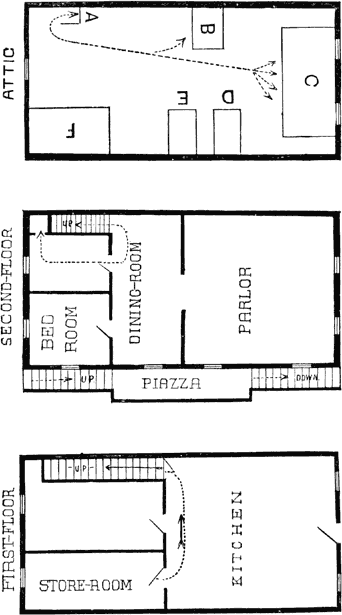
seized upon and lifted through a circular aperture in the
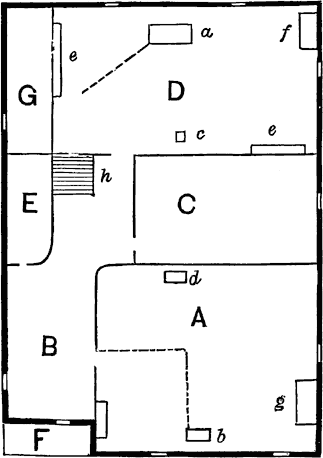
ceiling (large enough to admit four small pipes, leading
from the parlor stove into a sheet-iron drum in the room
above, in which Calvin slept). (See diagram on page 209.)
I was there held suspended for several minutes by two
iron hands (as they seemed to me), the one felt icy cold,
and the other almost burning hot. Calvin, in bed in the
room above, lay quietly listening to the uproar, but made
no remark. I entreated him to come down to us, but he
positively refused, saying, “No, you have raised the Devil,
and must take the consequences.”
This uproar continued all night, and people gathered
around the house to listen to it. We found, by experience,
that nothing we could do in our attempt at a little fun
played off on mother, would equal the performances of the
Spirits at our expense.
The second of these private domestic incidents, designed
perhaps for rebukes and lessons, was as follows:
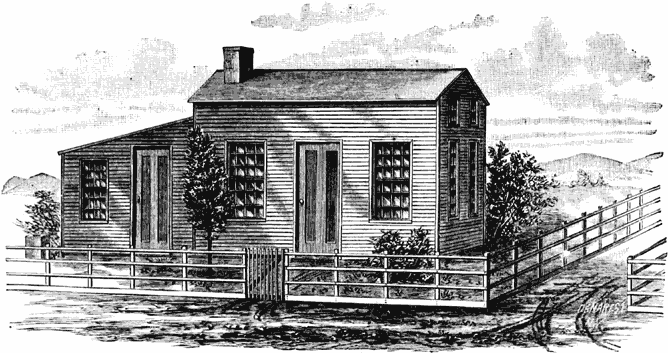
To make this story understood, it will be necessary to
describe the situation of the old homestead. The public
road runs north and south; and both houses face eastward.
The old house stands about two hundred yards from the
road, surrounded by trees. Father’s house (which was
being built at the time he was living in Hydesville) stands
near the road, with ample yard room surrounding it.
When turning into the lane, there is a slight descent until
you reach a little bridge, called the “Tell-tale Bridge,”
over a small stream, which in wet seasons runs through
the vale; after which you gradually ascend until you reach
the level on which the main buildings stand. It is called
the Tell-tale Bridge because the hoofs and wheels always
announce the approach of visitors.
It was Sunday evening. A party of David’s friends
drove over from Newark to have a séance with the Spirits.
It was decided that they should hold their meeting at
mother’s, with the girls (Maggie and Katie). I remained
at David’s, with Uncle John, Calvin, and the children—the
youngest being a babe ten months old. My brother
and his wife joined the party. Uncle John suggested that
some refreshments would be acceptable and help to while
away the time. By the time we got through supper it was
near twelve o’clock, and the hired man came home belated.
The servant girl was tired, and all save myself retired for
the night. The baby fretted for its mother, and I walked
the floor with him until he fell asleep. Still there were no
signs of the adjournment of the party. I could hear the
sounds distinctly, and concluded they had entirely forgotten
to notice the time (it was then two o’clock). So I slipped
on the hired man’s coat and hat and ran down, to learn if
there were any intimations of the party breaking up. I did
not wish to be observed. The night was lovely, and the
moon shone brightly; and my only refuge of concealment
was a few shocks of sweet corn left standing between the
window and the fence. They could have seen me through
the window if they had looked out from the sitting-room
in which they were holding their séance. I procured
a number of small stones and practised throwing very successfully,
hitting the mark between the windows a little
distance from them. Having thus acquired confidence in
my aim, I threw one larger than the others, which went
through the window crashing the glass into fragments. A
general scream broke from all in the room. I ran down
into the hollow near the bridge, and hid in the tall, wet
grass, knowing well enough that mother would soon be
out to explore the grounds. I heard her say, “I do not
believe that a Spirit did it. I know it was some of those
good-for-nothing, mean coon hunters; they have heard us,
and they have done this to annoy us.” Then father said:
“They have no business to throw stones through the windows.
If that stone had hit any one, it might have proved
a serious thing.”
I shuddered, and was thankful it was no worse. Mr.
Codding said, “No, Mrs. Fox, I think you are mistaken.
I heard several electric explosions just before it hit the
window.” (Those were my smaller pebbles.) Father
said, “Do you believe a Spirit threw that stone through
the window? If it was a Spirit it was an evil one.”
By this time they were all out in the yard looking for
the culprit, and not more than twenty feet from where I
lay cowering in the long grass wet with dew. As soon as
they all re-entered the house I ran for dear life, doffed my
hat and coat, and jumped back into the bed with the baby.
I had lain there but an instant when the most terrific rumbling
explosion went through the house, shaking it to its
foundations and waking every sleeper. I have never witnessed,
before or since, such a manifestation. Uncle John
rushed to my room, saying, “In heaven’s name, what has
happened?” The parties from the other house came in
and related what had happened there; but I was so shocked
by the manifestation just made that I found no difficulty in
suppressing my laughter. I had been well punished for
my folly. I had not intended to carry the joke so far, and
I prayed to be forgiven. I did not dare to confess. I knew
it would not do at that time, as the public would have regarded
us as impostors, and this as a specimen of our
tricks. I suffered alone for my sin. I heard them discuss
the matter frequently. One day, full fifteen years afterward,
my brother was giving me his opinion, saying,
“Leah, I do believe that was a mischievous Spirit that
threw the stone and smashed father’s window.” I looked
at him quizzically, and said, “Yes Dave, I believe it was
too.”
He caught me by the hand and said, “You did it! you
rogue. I know you did!”
I confessed, and we have had many a hearty laugh over
it since; but I had not ventured to confess it to the family
for fifteen years.
On pages 76-77 above, in the chapter devoted to the
“Mediumistic Vein in our Family,” is given an account of
my aunt, Mrs. Elizabeth Higgins, having seen a prophetic
vision, miscalled “dream,” which nearly nine years afterward
was actually enacted over her grave, which now
speaks for itself in the cemetery of Sodus, Wayne Co.,
N. Y. I omitted there to mention another instance in
which she “dreamed” of a strange event, some weeks in
advance of its actual occurrence. I was a child at the
time, but perfectly remember it, besides its having often
been talked about in the family.
When the family migrated from the city of New York
to Sodus, Wayne County, N. Y., it had been intended to
go by the canal. Grandfather had preceded the removal
of the family by about a year. One morning Aunt Bessie
(afterward Mrs. Higgins) announced that, “We shall not
make our journey by water.” “Why not?” asked her
mother. “Because I dreamed last night that we travelled
by land, and there was a strange lady with us. In
my dream, too, we came to Mott’s tavern in the Beech
Woods, and they could not admit us because Mrs. Mott
lay dying in the house. I know it will come true.” She
always felt that certainty in regard to certain dreams.
“Very unlikely indeed,” was the reply, “for but a year
ago, when you stopped there, Mr. Mott’s wife lay dead in
the house.” “You will see.” “Then he must have married
again, and he will lose his second wife.”
Every particular came to pass as she had predicted. Mrs.
Johnson, a stranger to the family at that time, accompanied
them. By a change of plan they made the journey by land,
as by that means (by grandfather’s orders) they took the
horses (three teams) to use in the new home in the “West.”
When they reached Mott’s tavern, late in the evening,
they were told they could not be accommodated, as the
house was full, and Mrs. Mott was dying. Bessie said to
the clerk, “I was here just one year ago to-day, and Mrs.
Mott lay dead in the house.” He replied, “Mr. Mott was
married two months ago, and it is his second wife who is
now dying.” It was arranged, however, for them to stay
in the adjoining house, owned by Mr. Mott and occupied
by his son.
Referring back (see page 75) to my great-grandmother’s
visions of phantom funerals (sometimes more than a year
in advance of their actual occurrence), I desire to add that
such pre-visioned funerals were not of persons whose age
and state of health might have suggested such anticipation,
but that they were of persons of all ages, and on two occasions
the deaths were by accident, namely, by drowning
and by a fall from a house.
In the case of Mr. Urie (page 82), the runaway that
caused his death was not that of a single horse, but of a
high-spirited span of horses. The mistake was an accidental
one made by a copyist.
I may add, generally, in regard to many of the strange
occurrences related in this volume, there are witnesses still
living who can attest the correctness of my statements.
One of the most pleasant of my reminiscences of our
Ohio campaign, about three and thirty years ago, is my intercourse
with the great and good man whose honored name
heads this paragraph. He was a frequent visitor to my
séances, to which he used to bring also members of his
family and friends. He combined, with his eminent intelligence,
culture and love of the truth, great geniality of
temperament and manners. He was a convinced and warm
Spiritualist, and his autograph name is a frequent one in
my register.
Not a few also of the representatives of foreign countries
visited us at Washington and New York, and were surprised
to receive communications in their several languages.
To the above array of the Author’s “Miscellaneous Incidents”
I will add one of recent occurrence, for the sake of
the evidence which it involves of two points, namely,
First, of the reality of Mrs. Underhill’s still continued
mediumship;
And secondly, of the interest really taken by her controlling
Spirits in this work of hers.
In the course of our united labors over it, extending
through a period exceeding four months, there have arisen
a number of occasions on which we have differed over various
points of expediency in regard to the arrangement and
treatment, the insertion or suppression, of her voluminous
materials or notes, and have discussed them freely, with
some tenacity of opinion on both sides, while with reasonable
candor and openness to conviction, certainly on her
side. She has generally maintained that her Spirits had
“impressed” and directed her so and so (the chief of them
seeming to be Dr. Franklin and her grandfather), and a
Spirit claiming to be Dr. Franklin has sometimes intervened
in these discussions, either voluntarily or on being
appealed to by us. I will describe one of these occasions,
to afford the reader the opportunity of judging for himself
of the genuineness of this Spirit intervention in these
friendly discussions between two mortals still in the flesh,
both of them actuated by an equal sincerity of zeal for the
truth and for the good of humanity.
We were sitting in her library, on the opposite sides of a
library table. The only other person present was a most
highly estimable friend of hers, lending her his friendly
aid in copying, who was seated some seven or eight feet
off. Both of her hands were on the table. My knee was
suddenly grasped by a strong, firm hand, evidently to call
my attention. “Is this you, dear Dr. Franklin?” I asked.
“Yes,” was the reply given by three pressures of the hand
which held my knee strongly between its thumb and fingers.
I did not doubt the Spirit to be what he claimed to
be, and I asked his opinion on the point in question. He
usually addressed me as “my son” or “my dear son.” He
did not habitually seem to impose his will, but rather to
give his opinion, which I must say was generally on the
lady’s side, and to which I generally conformed, even when
saying that I still thought differently.
Presently I felt my knee again grasped in the same way,
but this time by what was evidently a smaller and a female
hand. It proved to be that of my “sister Mary,” of whose
existence Mrs. Underhill knew nothing. Her object was to
tell me to write to another sister, Adelaide (still in the flesh,
and at some three thousand miles of distance) because, as she
said, the latter was “distressed and suffering” on account of
my recent silence (for which there had been special reasons
causing procrastination). Of these private family names
and matters, Mrs. U. had no means of knowing anything.
Her hands, I repeat, were on the table, and there was no
human agency through which, in either of the two instances,
the grasping of my knee could have been caused.
The knowledge of my private family matters goes far to
prove that in the one case it must have been really done
by my sister (a Spirit), and this identification of her in the
one case goes far to confirm that of the other as Dr. Franklin,
both having in the same way declared who they were.—Ed.