Extraordinary Graces
OBTAINED THROUGH THE INSTRUMENTALITY OF THE MIRACULOUS MEDAL.
I.
Graces Obtained from 1832 to 1835.
"Bless the God of heaven," said the angel to Tobias and his son;
"chant His praises among all mankind for the blessings with which
He has loaded you, for it is good to conceal the secret of the
king, but it is glorious to reveal and publish the works of God.
Elenim sacramentum regis abscondere bonum est; opera autem Dei
revelare et confiteri honorificum est."[18] Blessed, then, always
and everywhere, be the God of heaven and earth, for the numberless
benefits He has been pleased to confer upon us through Mary! Let
us adore the mysterious destiny of the Mother of the King of
Kings, "who, by reason of this title, truly merits the name of
Queen," says St. Athanasius; and let us rob neither God nor Mary of
the honor and glory due them. Let us publish the Lord's works of
power and goodness to man through the mediation of the Immaculate
Virgin, whom He has established Depositary and Dispensatrix of the
treasures of His mercy, that mercy which embraces our corporal
infirmities as well as spiritual needs.
An account of the extraordinary graces obtained by means of the
Immaculate Conception Medal will be for all Christian souls a
source of precious benedictions. At the view of these prodigies
of mercy, these marvelous cures and conversions, the reader will
be led to thank God and glorify His Holy Mother; those who have
already loved Mary will be incited to still greater love; careless
Christians, those who are tried by suffering, those who have the
misfortune to be in a state of sin, will feel their confidence
awakened, and they will tenderly invoke her whom the Church so
justly styles Health of the weak, Refuge of sinners, Comforter of
the afflicted.
Experience proves this. Every one knows, moreover, that an example
of virtue or an event which clearly reveals God's agency, acts
much more powerfully on the soul than a simple consideration of
the subject or a series of arguments. "Verba movent, exempla
trahunt—words can move, example attract."
We also hope for something more from the publication of these
accounts—we hope by them to convince the faithful that Mary's
dearest title is that of Immaculate, and that she knows not how to
refuse the petitions of those who, with lively faith, invoke her by
this dearest title. It is, moreover, the Church of Rome which thus
reveals, as it were, all the merciful tenderness of Mary's Heart,
and presents us the devotion to her spotless Conception as the sure
means of enriching ourselves from the exhaustless treasures of that
Heart and according to all our necessities. "Sacra Virgo Maria
... sentiant omnes tuam juvamen quicumque celebrant tuam sanctam
Conceptionem;"[19] and surely this prayer of the Mother of all
churches—prayer which we might readily style prophetic—has long
since been answered. We have recently seen a compilation, made in
1663 by a Jesuit father, with the approbation of the Ordinary,
containing an account of sixty-two conversions or cures effected
in different places by the invocation of Mary conceived without
sin, and apparently nothing less than miraculous. It is also a well
known fact, mentioned in the life of B. Peter Fourrier, founder
of the Congregation of Notre Dame, that these simple words, "Mary
was conceived without sin," worn with faith, brought relief to
a multitude of sick persons during an epidemic. The same means
obtained not less visible protection at Nemours, when that city was
in imminent danger of being sacked, and also at Paris in 1830. But
we confine ourselves to the graces obtained through the Miraculous
Medal. Our choice of examples will show that, in bestowing especial
favors upon France, the Immaculate Mary gives no less striking
proofs of her protection in other countries where the medal is
known and piously worn.
Among the traits of protection obtained through the medal in the
diocese of Paris, nine (three conversions and six cures) underwent
a detailed examination, and were pronounced veritable by the
Promoter in the investigation of 1836. We mention them in this
edition, adding to each one's title the word—Attested.
Quite a number of incidents printed in the edition of 1842 we have
omitted here, in order to insert (without greatly increasing the
size of the volume) more recent accounts equally reliable, thus
proving that the medal is not less miraculous in our day than at
the time of the apparition.
The extraordinary graces of which it has been the instrument, would
have formed an uninterrupted series from the year 1832 till the
present, if unfortunately, neglecting to keep note of them, an
interval of several years had not crept into the documents in our
possession.
For the future, please God, no such omission will occur, and all
the authenticated accounts which come to our knowledge will be
carefully registered for the glory of Mary conceived without sin,
and the edification of her servants.
CONVERSION OF A SOLDIER AT ALENÇON—1833.
The 14th of April, 1833, there was brought to the hospital of
Alençon (Orne) a sick soldier, who came from the hospital of Vitré
(Ile-et-Vilaine). His impiety there had greatly distressed the
hospitable ladies of St. Augustin, in charge of that establishment,
a circumstance communicated to us by persons who witnessed the
insulting manner in which he rewarded the kind attentions of their
unfailing charity. Arrived at the hospital Alençon, we soon saw
what he was, irreligious, impious, and brutally rude. The chaplain
hastened to visit him, and condole with him on his sufferings; and
as the opening of the Jubilee very naturally paved the way for a
few words on that extraordinary grace, he gently exhorted the sick
man to imitate the example of other soldiers who were preparing to
profit by it, but his words were answered by insults. The chaplain
did not insist, and contented himself for several days with merely
visiting him, and kindly sympathizing with his sufferings; the sick
man scarcely replied, and seemed much annoyed, even at the visits.
The Daughters of Charity in charge of this hospital, met with no
better treatment, notwithstanding the kind attentions they lavished
on him. His malady increased; seeing that it was becoming very
necessary for him to receive the consolations of religion, the
chaplain urged him again to make his peace with the good God, but
he was answered by blasphemies. "Ah! yes, the good God, little He
cares for me." In answer to this the abbé made a few observations
full of charity, and the patient continued: "Your good God does
not like the French; you say He is good and He loves me; if He
loved me, would he afflict me like this, have I deserved it?"
These outbursts of impiety only inflamed the charitable zeal of
the minister of a God who died for sinners, and inspired him with
forcible language, to depict the justice and merciful goodness of
the Lord. The sick man soon interrupted him by invectives: "You
worry me; let me alone; go away from here; I need neither you nor
your sermons," and he turned over to avoid seeing the priest.
His treatment to the Sisters was no better; and he continued to
utter the most horrible blasphemies against religion, and those
who reminded him of it; he carried this to such a degree, that
the other soldiers were indignant, especially at his outrageous
behaviour, after any one has spoken to him about his soul, or there
had been prayers or a little spiritual reading in the room—he
appeared dissatisfied, until he had vomited forth his stock of
blasphemies and imprecations. Some days passed and nothing was
said to him on the subject of religion, but every care for his
bodily comfort was redoubled; no one now scarcely dared hope
for his return to God, for his malady increased, and likewise
his impiety; all contented themselves with praying for him, and
recommending him to the prayers of others. The Sister in charge of
that ward, having great confidence in the Blessed Virgin's promises
to all under the protection of the medal, felt urged interiorly
to hang one at the foot of his bed; she yielded to the apparent
inspiration, and, unknown to him, the medal was there. He still
showed no signs of relenting, and even became indignant when some
of the other soldiers prepared themselves, by confession, to gain
the Jubilee. The medal had now been six days hanging at the foot of
his bed, and many and fervent were the prayers offered up to God
for this miserable creature's conversion, although nearly every one
despaired of it. One day, when all the convalescents of the ward
were assisting at Benediction of the Blessed Sacrament, the Sister
approached his bed, detached the medal and held it up before him.
"Look," said she, "at this medal, it is miraculous; I hung it to
your bed several days ago, and thereby put you under the Blessed
Virgin's especial protection. With her powerful assistance, I
confidently hope for your conversion. Look at this good Mother, she
is praying for you now." He never raised his eyes, but already was
grace working in his heart, for he showed no signs of irritation
which had heretofore been the inevitable consequence of mentioning
religion. Profiting by this, the Sister spoke to him of God's
mercy, and begged him again to cast a glance at the medal she had
just hung at the foot of his bed on the inner side. After being
repeatedly urged, he opened his eyes and looked towards it. "I do
not see your medal," said he to the Sister, "but I see the candle
which, doubtless, you have just lit; yes, it is certainly a light."
It was five o'clock in the afternoon, June 13th; his bed was so
placed that it could not receive any reflection of the sun's rays,
and the chaplain, after examining the spot felt assured, that at
no time could a reflection strike it in that direction. "You are
mistaken," said she, "look at it carefully." He repeated in the
most positive manner, "I see it distinctly, it is certainly a
light." Astonished beyond expression, but fearing her patient's
sight was affected, the Sister showed him other and more distant
objects; these he distinguished perfectly, and continued to see
this light for a quarter of an hour. During this interval, the
Sister spoke to him of God; suddenly, fear and love filled his
heart. "I do not wish to die as I am!" he exclaimed, "tell the
chaplain to come immediately and hear my confession." Hearing one
of the other patients utter an oath, "oh! make that miserable man
hush!" said he, to the Sister; "oh! I beg you to make him stop
swearing."
"I was still ignorant," says the chaplain, "of the origin and
effects of this medal. It was a very familiar object, and I
regarded it as nothing more than an ordinary medal. When told
that the sick man wanted me, I went joyfully, and saw for myself
what a complete change had taken place in him. Congratulating
and encouraging him, without knowing the cause of this change,
I hastened to ask him if he wished me to hear his confession.
He replied in the affirmative, and made it without delay; I had
every opportunity of admiring his good will and the pleasure he
manifested at each repetition of my visit. I endeavored to make him
explain himself, and asked if he had not acted from mere civility
or a desire to rid himself of the importunities by which he had
been so long beset. "No," he answered, "I sent for you, because
I wished seriously to make my confession and arise from my state
of sin." Henceforth he was no longer the same man; he was now as
docile, patient, gentle and edifying in all his words and ways,
as he had formerly been unmanageable, brutal and scandalous.
He eagerly desired the Last Sacraments, which, after proper
preparation, he received with lively faith. His happiness seemed
beyond expression, and though suffering intensely, no one ever
heard the least sign of impatience escape his lips. He continued
to give the most unequivocal signs of a true conversion; peace and
resignation were depicted in his countenance, and to his last sigh,
which he breathed June 27th, 1833, did he persevere most faithfully.
NOTE.—These details are attested by M. Yver Bordeaux,
chaplain of the Hotel Dieu; by the Sisters of Charity; by a
woman patient named Bidon; Julien Prével, an infirmarian; by
Jean François Royer, of the Seventh Cuirassiers; Marie Favry,
infirmarian, all eye witnesses, besides a large number of other
soldiers who left the city whilst we were investigating the matter.
CURE OF MADEMOISELLE AURELIE B. (PARIS)—1833.
Attested.
The account of this cure was sent us by the person herself in the
month of May, 1834.
The 3d of November, 1833, I was attacked by a typhoid fever, for
which I was treated by a skillful physician and the Sisters of
Charity, who spared no pains for my recovery. At the end of a month
I was able to take a little nourishment, and I had the happiness
of assisting at the Holy Mass and receiving Holy Communion on the
Feast of the Immaculate Conception. I was still very weak, and
utterly incapable of any exertion. In this state of exhaustion, I
took a little chocolate. The fever soon returned, and continued
with daily increasing violence until Christmas. Then the physician
said there was no longer any hope of my recovery. Another physician
was called in, who, after an examination, declared me consumptive
to the last degree, but said they might try the effect of a few
blisters. Those proved of no benefit. The 27th of December, the
physicians finding me extremely ill, informed the Sisters that my
death was imminent. Moreover, I had been cold for two days. About
half-past six that day, I received the last Sacraments, and at nine
every one thought I would soon breathe my last. Suddenly, one of
the good Sisters around my couch thought of putting the medal on
me. I kissed it continually with great confidence, and began to
feel better. My condition next morning was a matter of astonishment
to the physician, and I continued to improve so rapidly that,
at the end of two days, the fever had entirely disappeared. My
appetite was ravenous, I soon resumed my occupations, and ever
since have been in perfect health. I doubt not, Monsieur, that I
owe my recovery to Mary, my good Mother, my love for whom seems to
have increased; my greatest happiness being to decorate her altars,
and my most earnest desire that of consecrating myself to God in a
Community whose works have so touching a connexion with the sublime
destiny of the Mother of Jesus; it is under her protection I expect
the accomplishment of my designs.
Yours very respectfully,
Aurelie B.
Note.—The nine Sisters of the establishment have attested
the truth of these details, and one of the two physicians does not
hesitate to declare her recovery supernatural.
Moreover, this young person has ever since remained in perfect
health. Her prayers are granted, the Immaculate Mary has also
obtained for her the grace of being received into the Community she
wished to enter, which is the reason we do not give her name.
CURE OF A RELIGIOUS (PARIS)—1834.—Attested.
This fact is known to many; however, to prevent too great a number
of visitors, the Superior requests us not to publish the name of
the Community.
A young religious, twenty-seven and a-half years old and eight
years professed, in an Order especially consecrated to the Blessed
Virgin (Paris), had been kept in the infirmary by various maladies,
for the space of five months. At the very time she appeared
convalescent, an accident of the gravest nature happened; her left
thigh bone became disjointed and shrunken, the limb was attacked
by paralysis, and the sick religious lay upon her bed one month,
without experiencing the slightest alleviation from human remedies.
Two physicians and a surgeon being consulted at various times,
pronounced the displacing of the bone due an irritating humor; but
they could not check it, even by means of cauterizing and issues,
so that after a long and painful treatment, she remained a cripple.
She now had recourse to the Blessed Virgin as a child to its good
mother; a religious of the house having brought her one of those
medals called miraculous, which had been given her, she received
it gratefully, applied it to the afflicted member and commenced,
Saturday, March 1st, 1834, a novena to the Blessed Virgin. All
human remedies seemed unavailing; she lost her appetite and was
unable to sleep. She was also racked with high fever; however,
having snatched a little repose during the Wednesday night after
beginning the novena, she was suddenly awakened by a very painful
commotion, which re-established the bones in their place; the leg
which had been shortened about six inches, became lengthened almost
even with the other, and recovered its usual strength. On visiting
her next morning, the physicians were greatly astonished, but gave
orders that she should not yet leave her bed. On Sunday, the last
day of the novena, the fact of the cure was established beyond
a doubt. The religious arose quite naturally, and without any
assistance, ran to kiss the feet of Mary's statue, placed over the
infirmary fire-place; then, dressed in her habit, and accompanied
by the Mother Infirmarian, she descended about a dozen steps to the
chapel to adore the Blessed Sacrament, after which she repaired to
the community room, where the Superior with her Mothers and Sisters
were assembled, to give her the kiss of congratulation. This
touching scene was terminated by the recitation of the Te Deum,
and Sub Tuum. No trace of disease remained, except a slight
weakness for a few days, and as this was felt only in the sound
limb, it was evidently the result of her having been six months in
bed.
Two of the physicians acknowledged, with all the Community, that
it was a supernatural favor. One of them has even declared in a
certificate of May 4th, 1834, that without wishing to characterize
a fact as extraordinary, he observes that in this circumstance
there are: 1st, spontaneous disjointing; 2d, spontaneous
diminution, three days convalescence, and these last two are, to
the extent of his knowledge, without parallel in the records of
surgery.
The religious has never had another attack of this infirmity.
CURE OF A SICK PERSON (CHÂLONS SUR MARNE)—1834.
The Abbé Bégin, an eye-witness of this cure, which took place at
the hospital St. Maur, where he is chaplain, has prepared a verbal
process which attests: 1st, that the patient was really afflicted;
2d, that she was cured March 14th, 1834; 3d, that she declares no
other means were employed than the medal and prayer. This verbal
process is signed by a hundred persons of the above-mentioned
hospital.
"Madame C.H., a widow, aged seventy, a charity patient at the
hospital St. Maur, was, in consequence of a fall the 7th of
August, 1833, crippled to such a degree that it was with great
difficulty she could walk, even with the aid of a crutch, and
sometimes the additional assistance of another person's arm; she
could scarcely seat herself, and to rise was still more of an
effort. To ascend the stairs was almost impossible, she could
accomplish it only by grasping as she went along whatever lay
within reach. She could not stoop or kneel; the left limb, which
was the principal seat of her malady, she dragged helplessly after
her, not being able to bend it.
"Such was her sad condition at the beginning of March, 1834.
However, she heard something that enkindled a ray of hope in her
heart. Some one had spoken to her the January previous of a medal
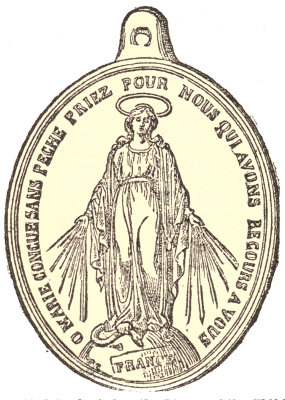
said to be miraculous; it bore on one side the image of Mary
crushing the infernal serpent's head, her hands full of graces
figured by rays of light proceeding from them, and the invocation:
'O Mary! conceived without sin, pray for us who have recourse to
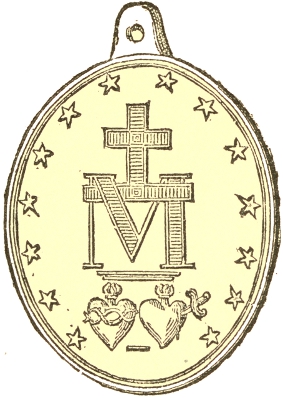
thee!' on the other, the Sacred Hearts of Jesus and Mary, with
the letter M surmounted by a cross. She was also informed of the
wonders it had wrought, and her heart awoke to the consoling hope
of realizing some benefit from the medal which had been promised
her. How she sighed for the happy moment when it would be in her
possession! How long the time of waiting appeared! At last, her
desires were gratified; the 6th of March she received, as if
it were a present from Heaven, the long wished-for medal, and
hastened, by the reception of the Sacrament of Penance, to prepare
herself for the desired favor. Next day, the first Wednesday in
the month, she commenced by Holy Communion a novena to the Sacred
Hearts of Jesus and Mary. Twenty times, day and night, did she
press to her lips the precious medal hung around her neck. For
several days of the novena, our Lord severely tried her faith
anew. Her sufferings increased greatly, likewise her fervor and
confidence, and soon the most blessed results were the recompense
of this poor woman's prayers.
"Seven days of the novena had not elapsed ere she was relieved of
the sufferings that had so cruelly afflicted her for seven months.
I could not depict the astonishment and admiration of every one,
who saw on the morning of March 14th this person so helpless
the very evening before, walk with all ease imaginable, bend,
kneel, go up and down high steps. One spoke of it to another for
mutual edification, and, in turn, came to congratulate her on her
recovery, and give thanks to God and Mary. The Superior, who had
bestowed constant care upon the sick woman during her crippled
state, and had thus been a daily witness of her sufferings,
returned solemn thanks for this extraordinary grace, the whole
Community chanting a Te Deum in their chapel.
"P.S.—I forgot to say that the widow has the free use of all her
limbs, and has never since had a return of her former infirmity."
The following is what Monseigneur thought proper to append to
the verbal process, an extract from which we have just read:
"We certify that credence can, and ought to, be placed in the
testimony of the Abbé Bégin, that of the Sisters and so many other
eye-witnesses who have spoken conscientiously and from no motive
save that of zeal for the truth.
"† M.S.F.V., Bishop of Châlons.
"Châlons, May 30, 1834."
CONVERSIONS OF M. DE CASTILLON, CAPTAIN IN THE 21ST LIGHT GUARDS;
AND OF A WOMAN—1834.
Extract from a letter of Sister C. (Herault) to M.E.:
"November 13, 1834.
"It should be the duty of children to glorify their mother, and
a very sweet one it is for me to acquaint you with two incidents
manifesting the boundless charity of Mary conceived without sin.
"The first relates to a sick soldier in our house. Though we
had already witnessed the efficacy of the medal, in effecting
the conversion of several soldiers most obstinate in resisting
grace, no conversion was so striking as this. M. Frederick de
Castillon, aged thirty-five, Captain in the 21st Light Guards,
entered the hospital, April 29th, in the last stage of consumption,
and attacked by paralysis of the left side. We nursed him a long
time, his condition grew alarmingly worse, but how could we
mention religion to a young soldier who boasted of having none?
I kept myself always informed of his state, and contented myself
(apparently) with watching the progress of the disease. Several
times I attempted to make him realize his danger, but in vain. One
day, when he was much worse, and I had an opportunity of seeing
him alone, I ventured to inquire if he were a Catholic. 'Yes,
Sister,' he replied, looking steadily at me. I then asked him to
accept a medal, to wear it, and frequently invoke the Immaculate
Mary, telling him at the same time that, if he did so with faith,
this good Mother would obtain for him all the graces he needed, for
bearing his sufferings patiently and meritoriously. He received it
gratefully, but did not put it on.
"But our confidence in the Blessed Virgin's influence over him
was not diminished, especially when we saw him place the medal
on the side of his bed. The Sister in charge of that hall had
already slipped one in his pillow-case. Several days passed, his
strength was gradually ebbing away, and after many ineffectual
efforts to obtain his consent to see a priest, I asked a clergyman
to visit him notwithstanding, and I introduced him into the sick
man's presence just as some one came to tell me he could not live
through that night (October 15th). We found him extremely ill,
but still inflexible. After a few moments, I withdrew, and left
him alone with the charitable priest, who could get nothing from
him but these despairing words: 'Leave me in peace, to-morrow I
shall be dead, and all will be over!' Of course, there was nothing
else to be done but comply with his request, and you can imagine
how painful it was. We redoubled our petitions to the Immaculate
Virgin, and this good Mother soon wrought a change in the
unfortunate man's heart.
"Next day, he asked the physician to tell him candidly if his case
were hopeless, because he wished to arrange his affairs. That same
evening, as soon as the Sister in charge of the hall entered, he
said to her very gently and penitently: 'Oh! how sorry I am to have
treated the Superior so badly, and the good priest she brought
me! Present my apologies to them, I beg you, and ask them to come
again.' You know we delayed not a moment in going to see him.
Next morning he began his new life, and during the nine days M.
Castillon still lived the chaplain visited him several times every
day, remaining two hours at a time. One of his brother officers,
coming to see him just after his first confession: 'If you had
been here a few minutes sooner,' said M. de Castillon, with an
utter disregard of human respect, 'you would have found me in good
company. I was with the curé, and I could not have been in better.'
He had the happiness of receiving the Last Sacraments with the most
admirable dispositions. Here are his dying words, which he asked
this gentleman to commit to writing: 'I die in the religion of my
fathers, I love and revere it, I humbly beg God's pardon for not
always having practiced it publicly.' And he expired in the peace
of the Lord, October 23d.
"I now relate the second conversion, that of a woman who, for
eighteen years, had been a public scandal, living with a wretch who
had abandoned wife and children for her. To such wicked conduct,
she added a more than ordinary degree of impiety, boasting that
she believed neither in God nor hell, and mocking at everything
religion held sacred. Although dangerously ill, she declared that
never would she make a confession. Sister N., seeing the rapid
progress of the disease and near approach of death, had recourse
to the Blessed Virgin; she put a medal around the woman's neck,
and began a novena for her conversion, relying upon the assistance
of her who, every day, gives us continually increasing proofs
that she is our Mother and a most merciful one. Before the novena
was finished, this poor creature, yielding to grace, made her
confession, and renounced forever the wretch who had been her
curse, manifesting as much sorrow for her past life, and proving
herself as pious as she had heretofore been shamelessly impious.
"The above facts, Monsieur, I have thought it my duty to make known
to you, for the edification of the faithful and the glory of Mary.
May these examples of her power and bounty, lead all sinners to
cast themselves into her arms!"
NOTE.—These two events are truly a confirmation of what
St. Bernard says, "that no one ever invokes Mary in vain;" but
what a misfortune for those who refuse her succor! A very reliable
individual once told us, that a sick person to whom a medal had
been given, and who began to feel the effects of grace, suddenly
insisted upon having the medal taken off, saying: "It hurts me;
I can wear it no longer." To quiet him it was taken off, and he
soon expired without the slightest sign of conversion. The person
relating this, was an eye-witness; it happened in the month of
October, 1834.
CONVERSION AND CURE OF MME. PÉRON AND CURE OF HER
DAUGHTER.—Attested.
Note.—It is Mme. Péron herself who gives us all the
details. She lives in Paris, rue des Petites-Écuries, No. 24.
We quote her own account, written February 26th, 1835, from her
dictation, and in presence of the Sister who visited her in her
sickness.
"I was sick eight years, and afflicted with very considerable
hemorrhages. I suffered much and almost continually. I was without
strength; I took but little nourishment, and that little increased
my malady, which was gradually exhausting me. I do not remember
to have had during these eight years, more than eight entire days
of relief from pain; the rest of the time I passed on the bed,
unable to perform the work necessary to aid my poor husband in
supporting the family. I have even been confined to my bed as
long as eighteen months without intermission. I consulted several
physicians, who prescribed the remedies usual in such cases, but
all to no purpose. My husband, not being able to afford such
expense, and seeing no hope of my recovery, lost courage and was
almost in despair. Some kind persons sought to cheer him: 'You must
not be so low-spirited, my poor Bourbonnais, you must bear up under
these trials and show your strength of character; your wife is very
sick, but she will recover and your friends will not abandon you.'
As for myself, seeing that medicines had no effect and cost us a
great deal of money, I dispensed with doctors, and was a long time
without seeing one, having resigned myself to a slow death.
"A neighbor who understood my position, came one day to see me,
and urged me not to give up thus, but to have the physician again.
I opposed it, because we had not the wherewith to remunerate him.
She then proposed to call in a Sister of Charity. I observed that
not being in want, perhaps the Sisters would refuse to come, as it
might thus deprive of their services, others more unfortunate than
myself. This good lady insisted, and I yielded.
"Next morning, I received a visit from Sister Marie (of St. Vincent
de Paul's parish), who brought me some assistance, encouraged me to
support my sufferings, and did her best to console me. I can truly
say that happiness entered my house with this good Sister. She
soon sent a physician, who, after examining me and understanding
my case, told her, as I have since learned, that it was a hopeless
one, I had a very little while to live, and ought to be sent to
the hospital to spare my family the sad spectacle of my death.
Hearing this, Sister Marie believed it her duty to give my soul
especial attention. I was not an enemy to religion, but I was
not very practical; I went sometimes to the parish functions,
when my sufferings and occupations permitted, but (and I say it
to my shame) I had not approached the Sacraments for years. When
the Sister, after several other questions, asked me if I went to
confession, blushing, I said 'no.' She begged me to do so, and
I replied: 'When I am cured, I will.' The good Sister, little
satisfied with my evasive answer, urged me again to see a priest.
'Sister,' said I, 'I don't like to be persecuted with things of
this sort, when I am cured I will go to confession.' I saw that
this answer grieved her, but she never remitted her visits and kind
attentions. My malady increased. One Saturday or Sunday night, at
the commencement of October, 1834, my whole body was cold, and
vainly did my friends endeavor to restore a natural warmth, the
chill of death seemed on me. They spoke of reciting the prayers
for the dying; I understood a part of what was said, but myself
was speechless. Whilst I was so ill, my husband told our eldest
daughter to go to bed, and he, thinking me easier because I was
feebly breathing, threw himself, without undressing, upon the bed
to snatch a little repose; but, getting up a few minutes later, he
came to me, put his hand on my face, and was horrified to find it
covered with a cold sweat. He thought me dead, and called aloud:
'Euphemie,' (this is our eldest daughter's name), 'Euphemie, alas!
thy mother is dead!' Euphemie arose and mingled her lamentations
with those of her father. Their cries awakened Madame Pellevé, our
neighbor, who came to console them. 'Ah! madame,' said my husband,
on seeing her, 'my wife is dead!' Having begged him to be resigned
to God's will, this lady approached me, and, placing her hand upon
my heart: 'No,' she exclaimed, 'she is not dead, her heart still
beats.' They kindled a fire, and succeeded in restoring a little
warmth to my body.
"Madame Pellevé went betimes to inform Sister Marie of all this,
and the latter hastened to tell the physician. 'I am not at all
surprised,' he answered; 'this lady has two incurable diseases.
Besides these hemorrhages, she is in the last stage of consumption,
as I have already told you, and if not dead before this, she will
not live through the day.' My chest had, indeed, been very weak for
some time, and the physicians in consultation had all said I could
never be cured.
"At two o'clock in the afternoon I received a visit from Sister
Marie, who found me not quite so ill; I could speak. 'Do you
love the Blessed Virgin very much?' said she. 'Yes, Sister,' I
had indeed always practiced some devotion in honor of this good
Mother. 'If you love her very much, I can give you something to
cure you.' 'Oh! yes, I shall soon be well.' I spoke of death, for
I felt that it was near. Then she showed me a medal and said:
'Take this medal of the Blessed Virgin, who will cure you, if you
have great confidence in her.' The sight of the medal filled me
with joy; I took it and kissed it fervently, for I truly longed to
be cured. The Sister now recited aloud the little prayer which I
could not read, and urged me to repeat it daily; I promised to add
five Paters and five Aves. She then put the medal around my neck.
At that instant, there passed through me a new, strange feeling,
a general revolution in my whole body, a thrill through all my
members. It was not a painful sensation, on the contrary, I began
to shed tears of joy. I was not cured, but I felt that I was going
to be cured, and I experienced a confidence that came not from
myself.
"Sister Marie left me in this state; after her departure, my
husband who had remained motionless at the foot of my bed said:
'Put all your confidence in the Blessed Virgin; we are going to
make a novena for you.' Towards evening I could raise myself up in
bed, which was very astonishing, considering my extreme exhaustion,
but a few hours previous. On Tuesday I requested some broth,
which was given me at last, and a little while after I took some
soup. My strength returned; I felt that I was cured. Finally, on
Thursday, I wished to go to church to thank the Blessed Virgin.
This suggestion was opposed, but I insisted and at length went.
Whilst on the way and alone (for I preferred going by myself), I
met Sister Marie, who did not recognize me; I took her hand: 'Oh!'
said she, 'it is really yourself!' 'Yes, Sister, it is I indeed; I
am going to Mass: I am cured!' 'And what has cured you so quickly?'
'The Blessed Virgin, and I am going to thank her.' The Sister was
lost in astonishment. I recounted to her how it had all come about
in less than three days, and I kept on to church and heard Mass.
Since then, I have had no return of my malady; I enjoy good health;
I go about my duties, performing a regular day's work, and to the
Miraculous Medal am I indebted for it all."
Not only Madame Péron's body but her soul, did the Blessed
Virgin restore to health; she soon chose a Director and went to
confession, and she has continued to do so ever since; her life is
really very edifying. As she deeply regrets having lived so long
estranged from God, her greatest happiness now is in frequently
approaching the Sacraments; two things awaken her tears, the
recollection of her past life, and gratitude for her twofold
recovery.
Nor is this all; the Blessed Virgin seems to have chosen this
family for the purpose of displaying in it the wonders of her
power. Madam Péron had a daughter aged sixteen, who, after her
mother's recovery, gave herself to God in an especial manner,
employing in exercises of piety, all her leisure moments, and
edifying her companions in the parish confraternity, whenever she
could take part in their devotions for she lived in another quarter.
The father also was deeply touched at the favors accorded his wife;
he wears the medal, and he has experienced its blessed effects.
Madame Péron has still another daughter, a little girl six years
and a-half old, who had great difficulty in speaking, or rather,
who did not speak at all, although she was not mute. Her utterance
was so impeded, that she scarcely ever finished a word, thus
disconcerting the most patient. It was so much the more deplorable,
as she was quite a bright child. 'What a pity she does not talk!'
said everyone who witnessed her infirmity. When Sister Marie saw
this little girl, 'Why do you not send her to school,' said she
to the mother, 'instead of keeping her home all day?' 'You hear
how she talks,' answered the mother, who did not like to have her
child's infirmity exposed. However, she yielded to the Sister's
wishes, and little Hortense was sent to the Sister's parish
school. Her imperfect speech did not improve, it would sometimes
take her five minutes to pronounce half a word. Some days after,
Sister Marie, who deeply pitied the child, spoke to her mother
of a novena for curing this defect. "Cure Hortense, Sister! it is
impossible, it is a natural defect!" The Sister, with increasing
anxiety insisted. The novena was commenced on Saturday; it
consisted in hearing Mass every day, and reciting a few prayers in
honor of the Blessed Virgin. The medal was hung around the little
girl's neck, and she was to take part in all the exercises of the
novena. For several days there was no change, but Thursday after
the Mass of the Blessed Sacrament, Hortense, on leaving church,
could speak as distinctly and with as much ease as any one. Those
who first heard her were struck with admiration, the news soon
spread, and from all sides came persons to see her; they questioned
her, and the child answered, they scanned her to see if it were
really the same, and recognizing her, they returned, saying: "This
is certainly a great miracle, a sudden cure of a natural defect!"
Little Hortense, showing her medal with delight, would say to all
who knew and congratulated her: "The Blessed Virgin has cured me."
In thanksgiving for so great a benefit, the child was consecrated
to Mary on the 21st of November, Feast of the Presentation, in
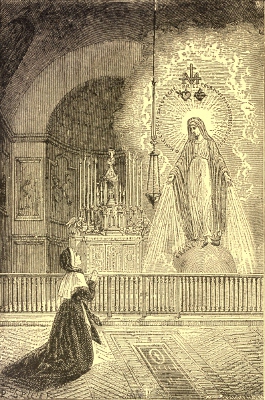
the same chapel where the apparition of the medal took place,
and, in commemoration of this great event of her life, she was to
wear only blue and white until her First Communion. Previous to
this ceremony, she made her confession, with every evidence of
understanding thoroughly the importance of the act. When asked if
she loves the Blessed Virgin, "Oh! yes," she answers, "I love her
with more than all my heart!" an expression invented, it seems,
solely by the fulness of her gratitude. She prizes her brass medal
so highly, that she would not exchange it for one of silver or
gold, and she wishes it put in the tomb with her when she dies.
"We hope, Hortense," said her father not long ago, (he always
finds a new pleasure in hearing her talk), "we hope, when you die,
that you will leave us this medal as a souvenir of yourself and a
relic of the Blessed Virgin." "Certainly, papa, if it gives you so
much pleasure, but I promised the Blessed Virgin, the day of my
consecration, that the medal should never leave me, but should even
descend with me into the tomb when I died."
We publish these details, with the cordial approbation of this
family, fully imbued with ever increasing gratitude to Mary
Immaculate.
These two accounts have been confirmed by nine other persons.
CONVERSION OF SEVERAL SOLDIERS (HOTEL DES
INVALIDES)—1834.—Attested.
Note.—All these edifying details, which have already
produced a most beneficial effect upon many young men, were given
us and attested by Sisters Radier and Pourrat, who, having charge
of that ward, were witnesses of the facts, and also instruments of
divine mercy in operating these prodigies.
"We had in St. Vincent's ward, number 20, royal hotel des
Invalides, Paris, a soldier who had been spitting blood about six
months, and who, it was thought, would soon die of consumption. He
was naturally polite and grateful for the attentions bestowed upon
him, but he showed no signs of religion; his morals were bad, and
it was a well-known fact that, for twenty years, his life had been
one of scandal.
"It appeared, however, that faith was not entirely extinguished in
his heart, for another patient, his neighbor, being on the point
of death and refusing to see a priest, this one entreated him to
yield, and was instrumental in bringing about his conversion.
Alas! his own turn soon came, we saw him growing worse day by day,
he was wasting visibly, and had not once mentioned receiving the
Sacraments. As he had urged his neighbor to prepare for death, we
hoped he would make his own preparation, without being reminded
of it, or, at least, that he would willingly comply with the
first suggestion. On the contrary, he absolutely resisted all our
entreaties, saying: 'I am an honest man, Sister, I have neither
killed nor robbed.' 'Even so,' we would answer, 'we all stand in
need of God's mercy, we are all sinners.' 'Oh! Sister, just leave
me in peace, I beg you.'
"However, he began to realize that he had been sinking for several
days, and he said aloud: 'There is no hope for me!' This thought
appeared to distress him. One day (it was Wednesday, the 26th of
November), the disease took such a sudden turn for the worse, we
feared he would not live through the day, and, being unable to
make any religious impression on him, we warned the chaplain of
his condition and his resistance to all our entreaties. The latter
went to see him. Our patient received him with great respect, but,
wishing to get rid of him adroitly, said: 'I am acquainted with the
curé.' A little while after, the curé visited him, and conversed
with him some time. On leaving his bedside, the venerable, zealous
pastor came to us and said: 'Your patient is very low, and I have
not succeeded in getting him to do anything for his soul; indeed,
I did not urge him too much, for fear he might say no, and then
would not revoke it, like so many others, after once giving a
decided negative.'
"The same day a lady of his acquaintance also came to see him, and
earnestly but vainly urged him to make his peace with God. To get
rid of her importunity he said: 'I know the curé; he has already
been to see me, and will return this evening.' The curé returned
indeed, according to promise; the sick man, on seeing him, jumped
out of bed to show that he was not so ill as to make confession a
very pressing matter. The curé, a true Samaritan, rendered him all
the little services imaginable, helping him back to bed, and even
offering to dress his blister; he then spoke to him about his soul,
but without avail, for after an hour's conversation he came to us
and said: 'I am deeply grieved, for I have done my utmost, but it
has had no effect upon him.' We asked the curé if we must call him
during the night, in case the sick man grew worse. 'I think,' said
he, 'you had better not, unless he asks for me.' A little later one
of us reminded him again of the chaplain, who was passing, but he
got enraged and began to swear, so that we had to drop the subject,
despite our distress at the thought of his appearing so unprepared
before his God. Our grief was so much the greater in proportion to
his extreme danger, for the death rattle was already in his throat,
and it did not seem possible that he could survive the night. It
was then my young companion said to me: 'Oh! Sister, perhaps our
sins, as our holy St. Vincent says, have been the cause of this
man's impenitence.' Expecting nothing more from the patient, Sister
Radier now turned all her hopes towards the Blessed Virgin. During
night prayers thoughts of the medal came into her mind, and she
said to herself: 'If we put the medal on him perhaps the Blessed
Virgin will obtain his conversion,' and she determined to make a
novena. After prayers she said to her companion: 'Let us go see the
sick man and put a medal on him; perhaps the Blessed Virgin will
grant our petitions.' She went immediately, and found him up and
in a state of great agitation, and about to leave the room; all
the other patients saw it clearly, and said that it was with the
intention of committing suicide. The Sister cautiously took away
his knife and whatever else might be used in this way, slipped
unperceived the medal between his two mattresses, and returned to
us very sadly, saying: 'Let us fervently invoke the Blessed Virgin,
for I very much fear this poor man will kill himself during the
night.'
"Next day, immediately after rising, and even before seeing the
Sister who had kept watch, one of us hastened to visit our patient,
and not without most dire forebodings, but, to our astonishment,
his mind was calm and he seemed better. On inquiring how he felt,
'Very well, Sister,' he answered, 'I passed a good night, I slept
well (which I have not done for a long time), and I am better in
consequence.' As the Sister retired, he called to her, saying:
'Sister, I wish to make my confession, oh! send the curé to me!'
'You wish to confess?' replied the Sister, 'take care; are you
going to do as you did all day yesterday, do you really want him?'
'Yes, Sister, upon my honor.' 'Well, since you wish him, I will go
for him, it will certainly be well for you to confess your sins,
for it is said that your life has not always been edifying.' Then,
without the slightest human respect, he began to mention his sins
aloud, and with great sentiments of compunction; we could scarcely
induce him to stop. The curé came, and he made his confession,
which lasted an hour. Afterwards, one of us having come to see
him, he exclaimed joyfully at our reproach: 'Oh! Sister, how happy
I am, I have been to confession, I have received absolution, and
the curé is to return this evening. Since my First Communion, this
is the happiest day of my life!' He appeared deeply affected, and
expressed a most ardent desire to receive the good God. 'Do you
know what we did?' 'What was it, Sister?' 'We put between your
mattresses a Miraculous Medal of the Blessed Virgin.' 'Ah! then,
that is why I passed such a comfortable night; moreover, I felt as
if there was something about me that wrought a wonderful change,
and I do not know why I did not search my bed; I thought of doing
so.' The Sister then produced the medal, which he kissed with
respect and affection. 'It is this,' he exclaimed, 'that gave me
strength to brave human respect. I must place it on my breast; I
will give you a ribbon to attach it to my decoration,' (he wore the
cross of honor.) The first ribbon offered being a little faded,
'No, Sister,' said he, 'not that, but this; the Blessed Virgin must
have a new ribbon.' The Sister, regarding his weak state, placed
the medal in such a manner that it was somewhat concealed. 'Oh! do
not hide it, Sister,' said he; 'put it beside my cross, I shall not
blush to show it.'
"In the afternoon the curé asked us how our patient was, and he
was not less edified than ourselves at the account we gave of his
admirable dispositions. Preparations were made to give him the last
Sacraments. At the sight of the Holy Viaticum, he was so penetrated
with emotion that he begged pardon aloud of God for all the sins
of his life in detail, and it was with the utmost difficulty he
could be persuaded to lower his voice, his heart being too full
to contain itself. He passed the following night and the next day
in the same dispositions of faith, regret and piety, until Monday
morning, December 1st, when he peacefully rendered his soul to God,
and we have every confidence that it was received into the arms of
His mercy.
"We relate what we saw and heard; it took place in our ward, which
numbers sixty patients, the majority of whom witnessed a part of
these details."
Note.—Before burial, the Sister took the medal off his
corpse, and the patient in the next bed begged to have it, so
persuaded was he that it had been the instrument of this touching
conversion.
This consoling return to God was followed by several others not
less striking or less sincere, and in that very institution, by the
same means—the medal. Quite lately two have taken place, but the
details are so very much like the above that for this reason alone
we refrain from giving them.
All this has been confirmed by M. Ancelin, curé of the Invalides.
CURE OF M. FERMIN, A PRIEST—1834.
This account was sent us by the Superior General of St. Sulpice,
who was anxious that we should have it. The venerable priest of
this very estimable Community, who was favored with this grace,
wrote the details himself, and they were attested by the Superior
and the Director of the grand Seminary of Rheims, both of whom were
witnesses.
"To the glory of Mary conceived without sin, I, Jean Baptiste
Fermin, unworthy servant of the Blessed Virgin, and subject of M.
Olier, have, together with my Superior and confrères, thought it
my duty to transmit to our very honored Father, an account of the
special favor accorded me.
"Many persons knew what I suffered for six whole years, how I
was worn out with a nervous, worrying cough, whose attacks were
so frequent and so prolonged that one can scarcely imagine how I
ever survived them. My physician himself told me that, for the
first three years, my life was in imminent danger, and if in the
last three I was less exposed to death at every step, as it were,
the giving way of my stomach, the weakness of my chest, were such
that all my days were filled with bitterness, and new crosses
were laid upon me. In this condition, what ecclesiastical fasts
could I keep? Four or five years ago, the desire of complying,
in some degree, with the precepts of the Church led me to fast
the Ember week before Christmas, and the prejudice to my health
was such that I was not permitted to fast again even for a day.
Abstinence from meat became impossible, and for having attempted
this slight mortification, how much I suffered in consequence, even
in the very month of July, 1834! Whilst my health was so impaired,
and I saw only a lingering end to my afflictions, it pleased my
Superiors to give me a year's rest. I received with gratitude this
additional evidence of their consideration for me, and endeavored
to co-operate with them in re-establishing my health, of which they
had been so thoughtful; but, in my condition, the recuperative
powers of nature were of slight avail. Even amidst perfect
quiet and rest for four whole months, I experienced but little
alleviation of my sufferings, for though my chest became, at least,
apparently stronger, my stomach grew weaker and more disordered,
so that I was obliged to diet, which, added to the dieting I had
already practiced, reduced me to such a state of exhaustion that I
could not foresee the consequences.
"O, Mary, how deplorable was my condition when you cast upon
me a look of mercy! The 15th of November, 1834, I was sent a
medal, struck in honor of the Immaculate Conception, and already
celebrated as the instrument of many miracles. In receiving it,
I was penetrated, for the first time, with a strong feeling
of confidence, that this was the Heaven-sent means by which I
would reach the end of my afflictions; I had not foreseen this
hope, still less had I excited it, for I believe I can say,
conscientiously, that I felt naturally disinclined to ask a favor
of which I deemed myself unworthy. However, the feeling became so
strong that I thought it my duty to consider it prayerfully next
morning; and not to oppose so good an impulse, I determined to
make a novena, and I commenced it on the 16th. From that moment my
confidence was boundless, and like a child who reasons no longer,
but sees only what he feels sure of obtaining, it sustained me
amidst the new trials to which I was subjected; for on the 19th,
and several days after, my sufferings were redoubled, affecting at
once both stomach and chest. On the 22d I felt considerably better,
on the 23d I believed myself strong enough to abandon a diet on
which I had subsisted a long time, and on the 24th I wished to eat
just what was served the Community; that very morning I commenced,
like the hearty seminarians, to take a little dry bread and wine,
and it agreed with me. Thus my desires were accomplished. I had
implored the Blessed Virgin to give me health to live according
to the rule, and she had done so; but a good Mother like Mary
would not leave her work imperfect, and she chose the very day of
her Conception to bestow upon me her crowning favors. I was still
troubled with a slight indisposition of the stomach accompanying
digestion after dinner, but it was not positive suffering, and even
this remnant of my old infirmity disappeared entirely. On the eve
of that Feast my devotion to Mary, which had lost a little of its
first fervor, was, when I least expected it, excited anew, and I
felt urged to implore the consummation of a good work so happily
begun. I did so that evening, and next morning at prayers, at Mass,
at my thanksgiving, and it was in finishing this last exercise
before a statue of the Blessed Virgin, after a most fervent prayer,
that I realized the recompense of my confidence—I felt assured
that my petitions had been granted. Since then I have experienced
no indisposition worthy of attention. I was able to fast the Ember
week before Christmas and the eve of that great solemnity; I sang
the ten o'clock High Mass the fourth Sunday in Advent; I followed
all the offices of the choir on those days the Church consecrates
to the celebration of our Divine Master's birth, and, instead of
regretting these efforts, I find in each one of them a new motive
for blessing the Lord and testifying my gratitude to our good
Mother.
J.B. FERMIN."
"Though surpassing our hopes, we have witnessed the speedy and
perfect recovery of M.J. Fermin, which appears to be something
supernatural, since he employed no other remedies than great
devotion to the Blessed Virgin and a novena in her honor.
"AUBRY, RAIGECOURT GOURNAY."
II.
Graces Obtained during the Year 1835, in France, Switzerland,
Savoy and Turkey.
CURE OF MADEMOISELLE JOUBERT.
Note.—The account of this very striking cure was sent us
by M. Poinsel, Vicar General of Limoges, whom I took the liberty of
asking for it.
"Bishopric of Limoges.
"Glory to God! honor to Mary!
"The 10th of February, 1834, Mlle. Joubert, aged twenty-nine
years, a person of solid piety, was suddenly cured of a painful
and very serious infirmity. For more than a year, she had carried
her left arm in a sling, by reason of an unaccountable disease
which extended from the shoulder to the hand, and was of such a
nature that the afflicted member seemed dead; when necessary to
be handled, it had to be done with extreme precaution, and even
then the pain was so excessive that often the patient fell sick
in consequence. The disease was successively styled rheumatic
gout, inflammatory and gangrenous rheumatism; science employed in
combating it, baths, shower baths, poultices, liniments of all
sort, vain remedies which only aggravated the evil and varied
the suffering. Sometimes amputation was spoken of: 'Would to
God, Mademoiselle, you had but one arm!' said the physician,
not concealing his anxiety and fears of her death, as spring
approached, for the diseased arm was pale, livid, and frightful to
behold.
"The young lady, a true Christian, was resigned to all; by
meditations upon the cross, she encouraged herself to suffer,
and, perceiving the progress of the disease, she thought only of
dying the precious death of the just. A friend, one day, proposed
to her that she should wear the medal with confidence, and make a
novena to Mary. She acted upon the suggestion; at the end of the
novena, on the usual day of her confession (she was accustomed to
confess weekly), she approached the sacred tribunal, and lo! at the
very instant when recollected, contrite and humbled, she received
the moral effect of the priest's benediction and holy words, an
extraordinary physical change took place in the arm heretofore
judged incurable, it suddenly became unloosed and free, all
suffering vanished! 'I scarcely knew where I was,' said she, 'but
it seemed to me as if a cord that had been tightly drawn around my
arm was unwound, ring after ring, and I was cured! My surprise, my
joy, were extreme and beyond all power of expression!'
"On reaching home, she exclaimed: 'A miracle! light a taper, light
two, come, come, see the miracle! I can move my arm, animation is
restored to it, I am cured!' Oh! how great the joy of that family!
They surrounded the favored one, they looked at, they touched the
resuscitated member, they tested its powers in various ways, making
her lift divers objects and execute a variety of movements; then,
all the members of this truly Christian family, moved even to
tears, fell on their knees, and recited that hymn of thanksgiving,
the Te Deum.
"Since then, (that is, for more than a year), her arm has been
perfectly well. The physician himself was struck with this event,
which it would be difficult to attribute to concealed resources,
or the sudden agency of nature. What is nature without the
intervention and action of God? He is sole Master of nature, life
and death are at His will. It is not necessary, then, to reason so
much on the subject; a little faith will easily make us recognize
here a special grace of God, through the intercession of Mary, our
kind, sweet Mother, to whom we must ever repair, invoking her with
love and confidence.
"Such is the simple and conscientious account of the event given
me, the undersigned, by the person herself, in answer to my
questions, in the presence of an intelligent, reliable individual
who saw all, having several times dressed the arm, and who, by
reason of her skill and long experience, was well calculated to
judge of the danger.
"In attestation of which, etc.
"POINSEL, Vicar General.
"February 14, 1835."
These details are confirmed by two letters of Madame and Mademoiselle
Joubert, by the testimony of the Superior of the Daughters of Charity
of Limoges, and that of M. Dumonteil, a lawyer and friend of the family.
CONVERSIONS AND CURES WROUGHT IN SWITZERLAND.
Letter from Sister Boubat, Superioress of the Daughters of Charity in
Chesne:
"February 12, 1835.
"I have not great miracles to recount to-day, but the facts I give
are certainly very striking traits of protection. However, I shall
tell them just as they are, and let you judge of them for yourself.
Those of which I was not an eye-witness have been told me by very
reliable parties who were.
"1st. A woman who had been sick a long time, and given up by the
doctors, received, one evening, the Miraculous Medal, and was
restored to her usual health that night; feeling perfectly well,
she said to her husband next morning that she would get up and
prepare breakfast. He treated this as nonsense, and when she really
did arise, his astonishment was great, and beyond all bounds when
he found that her health was fully restored.
"2d. In the same village, a young mother had two children, one six
the other eight years old. The latter was attacked by a violent
malady, described to me as a convulsion, and died in a few days.
The younger had a similar attack, and seemed on the verge of death.
The poor mother was in the depths of grief, when some one thought
of offering her a medal. She received it as a treasure. It was
evening; she put it on the dying child, who soon fell asleep, and
slept soundly the whole night. In the morning he awoke perfectly
cured! This good woman afterwards came to me to get medals for
herself and some others. Oh! I wish you could have seen her as she
wept for joy whilst expressing to me, with all simplicity, the
transports of her soul! Never will I forget it, so deep was the
impression it made upon me.
"3d. A child five years old had been racked for several months by a
fever, which resisted all efforts to check it. One day, he was in
his grandmother's arms when the paroxysm began. This woman, full of
faith, applied the medal; the child soon grew better, and the fever
never troubled him again.
"The attending physician was a relation; on seeing him after this,
the child ran towards him, exclaiming with all the animation and
artlessness of his age: 'I am cured, but it was not you who cured
me, it was the medal.' He repeats these words nearly every time he
sees the doctor.
"4th. A young man, on his death-bed, filled all his friends with
serious apprehensions for his salvation. After several vain efforts
of the most charitable zeal, the curé induced him to accept a
medal, and very soon the dying man expressed a wish to confess. He
expired in the most edifying dispositions.
"5th. Three sinners obstinately refused to assist at the exercises
of a mission given in their parish, and even sought to oppose it.
One of the missionaries persuaded them to accept a medal, and as
soon as they had received it, a great change was visible. They
not only made the mission, most devoutly, but became its zealous
advocates.
"I get these details from a very venerable curé, who gave them to
me himself.
"6th. There came to me recently a woman from the neighboring
mountainous district, who said without any previous explanation:
'You cured one of my daughters whom all the physicians had given
up; I now wish you to give me the same thing.' I tried at once to
recollect what medicines I had prescribed, and asked question after
question concerning the nature of the malady, so as to know what
remedy I had dispensed. After puzzling my brain to discover, she
told me it was a piece, thus suddenly reminding me that I had given
a medal to a young woman from that place, who came to consult me
about her failing health. To verify the fact, I sent word for the
young woman to come to see me.
"I pass over in silence a multitude of other events which, without
being termed miracles, are none the less real graces; and in my
eyes one most precious and great grace for us is, that the Blessed
Virgin deigns to make use of our poor little house to propagate
devotion to her. Oh! if you could see these good mountaineers
of every age and sex come with the greatest confidence and most
touching simplicity, asking for na médaillot—a medal. It has
affected me deeply, and I cannot sufficiently express my gratitude
to our tender and Immaculate Mother.
"Even Protestants have asked us for these medals, and I am
assured it was with perfect sincerity. The pastors in Savoy are
also very zealous in propagating this devotion to Mary. Since
reading the notice, they have mentioned it from the pulpit to
their parishioners, many of whom have, in consequence, procured
the medal. Likewise, do we see young men about to enter the army
fortify themselves with it, and persons undertaking a voyage
wearing it as their safeguard; indeed, every one has recourse to it
as the universal remedy for soul and body."
CURE OF SISTER HYACINTHE, A RELIGIOUS OF CALVARY.
It is the Mother General of the Community who has given us these
details. Her letter is dated February 7th, 1835.
"I am overwhelmed with joy; our poor patient is perfectly cured by
virtue of the Miraculous Medal. I could say our patients, for our
prayers were offered both for the paralytic and that young person whom
I told you had been sick eleven months; she was able to remain out of
bed only a few hours each day; whenever she could go to Mass, and
that was rarely, she had to be assisted, and the support of an arm was
necessary when she approached the Holy Table. Since Thursday she walks
alone and eats without experiencing the slightest symptom of her former
infirmity, except a little weakness. I hope the Lord will finish His
work and restore her to perfect health; but let us speak of our dear
Sister.
"The following is a copy of the account I wrote of this marvel to our
holy Bishop day before yesterday, after Mass:
"'I acquaint Your Grace with an incident of God's great mercy,
displayed to our Community in the sudden cure of one of our choir
religious, named Hyacinthe, aged forty-seven years. This good Mother,
the 14th of last January, had a stroke of paralysis. It did not affect
her head, but immediately fixed itself in the left side, which became
motionless and devoid of feeling. We hastened to summon the physician,
who bled her freely in the arm; next day we tried leeches, medicines,
a blister on the neck, and three days after one upon the paralyzed
limb, but all of no avail. The poor patient, as well as ourselves, must
submit to the decrees of Him who strikes and heals at will. At the end
of fifteen days I was inspired with the thought of making a novena in
honor of the Immaculate Conception, the medal of which, called the
miraculous, we all wear. On the fourth day of the novena, as we were
about to recite the prayers around her bed, the good Mother desired
Holy Communion. She was taken to the choir by three persons; after
receiving, the limb felt a little better, and she could return with the
aid of two persons only. Her confidence in the Mother of God increased
daily; yesterday she asked permission to come down on the last day of
the novena, and this morning, with the assistance of a cane and some
one to support her, she came down and had the happiness of receiving
Holy Communion. Immediately after, we finished the novena prayers, just
at the end of which she was seized with a pain in the paralyzed arm,
followed by an icy chill and then a sensation of extreme heat. She came
to me with both arms lifted, exclaiming, "I am cured!" And perfectly
cured she was, being able to walk and use her limbs as freely as if she
had never felt a symptom of paralysis.
"'To give you an idea of our joy and gratitude, Monseigneur, would be
impossible. The patient fainted, and I came very near doing the same;
it was with difficulty I could continue our prayers of thanksgiving,
so marvelous did it seem that the Lord should have granted this favor
to our Community, under the government of one of His most unworthy
servants.'
"I send you this copy, which we had kept, of the letter.
"In the same letter I asked Monseigneur's permission to have a Te
Deum chanted at the end of Benediction. His Grace hastened to send
word that he not only permitted but ordered it, which order was
joyfully complied with. The Vicar General, our Superior, wrote, asking
me to defer our Vespers half an hour, as he wished to assist at the
Te Deum. Several other ecclesiastics also came, and saw our healed
ones blessing God. Since that day our good Mother Hyacinthe follows
the rules, complies with all her duties, and has never felt the least
return of her malady.
"This miracle created great excitement in our city; the laborers who
were working at the house having learned it on the spot, immediately
spread the news; the evening previous, they had seen our poor Sister
dragging her limb, a cane in hand, and almost carried by two persons,
and next morning they beheld her perfectly cured! These men, who have
seldom much religion, sang the praises of God's power, and asked me to
give them medals. I gave a medal to each with great pleasure. Clergymen
have come to learn the particulars of this event, and I let the
miraculously cured herself recount the wonders of the Lord.
"I must not omit informing you that the physician having vainly
exhausted all remedies, had been nine days without seeing the patient;
and the very eve of her recovery he told one of our boarders that the
disease having settled itself he believed our afflicted one might be
able to walk, but she could never use her arm again. On coming next
day to visit his other patients, he was surprised beyond expression
when she appeared before him perfectly cured. Wishing to get his
candid opinion on the subject, I remarked that probably it was not
real paralysis, but only a numbness. 'It was a strongly marked case of
paralysis,' he answered, 'and there is certainly something supernatural
in her recovery.'
"In thanksgiving we continue the novena prayers, but preface them with
the Laudate.
"Make such use of this letter as you may deem advisable. If you insert
it in the notice, you are at liberty to name our city and house. Oh!
how we long to spread abroad the knowledge and love of God's power,
signally displayed in answer to our invocation of the Immaculate Mother
of His Divine Son.
"SISTER ST. MARIE,
"Superioress of Calvary of Orleans."
CURE OF MADAME LEBON (DIJON).
Note.—"The venerable lady upon whom this cure was wrought
belongs to a highly honorable family of Dijon, and her personal
character is very well calculated to inspire the utmost confidence,"
says L'Ami de la Religion, in its issue of April 17th, 1835.
Moreover, the letter she wrote, March 12th, to one of her friends, and
which she was anxious should be transmitted to us, is accompanied by
the certificates of the pastors of St. Michael of Dijon, of Dampierre
and Beaumont-sur-Vingeanne, also of five members of the municipal
council, and several other very reliable persons, some of them members
of her family; more than this, it is followed by a detailed account
given by the medical attendant, who had charge of her case for sixteen
years.
"Dijon, March 12, 1835.
"Madame and Dear Friend:
"You ask me the details of the miraculous manner in which it has
pleased God to restore me to health. Well! it might be summed up in
these few words: I implored Mary to obtain my recovery, and she did
obtain it instantly; having said this, you know all, but you desire me
to recall the circumstances of my sickness and my experience subsequent
to the cure. I give them as follows:
"You doubtless remember that, for more than twenty years, I could not
walk, in consequence of an abscess on the intestines, which left me
in such a state of sensibility that ever after a walk of more than a
hundred steps I was exposing myself to the most serious accidents.
Neither are you ignorant of the fact that, nearly fifteen months ago,
by reason of influenza, a second abscess formed, and so increased the
irritability that I hovered between life and death, and even when at my
best I was scarcely able to drag myself from one room to another. But
you have probably never heard that, since the 1st of last December, my
condition was so critical that, with great difficulty, could I remain
out of bed three or four hours at a time, which made me, as well as
those around me, think my end was near and I would not survive the
spring.
"This was my condition, dear friend, when some one mentioned to me the
medal of the Immaculate Virgin, and urged me to get it. I was a long
time deciding to do so, for I considered it presumptuous to solicit the
cure of an infirmity the physicians had pronounced incurable. At last,
having thought, on the one side, that the more desperate the malady,
the greater God's glory should He deign to cure it; and, on the other,
that He had wrought the most wonderful miracles for those who were
least worthy, I decided to mention it to my confessor. I did so, and he
encouraged me to make the novena.
"The 2d of February, Feast of the Purification, the first day of the
novena and one ever memorable for me, I was taken to church in a
carriage; my daughter, sole confidante of my intentions, assisted me
to the Blessed Virgin's altar, where, after hearing Mass as well as
my infirmity would permit, I received Holy Communion. Scarcely had I
knelt to make an act of adoration, when I was obliged to take my seat.
A Sister of Charity, whom I did not know was there, for I had not hoped
to receive the medal just yet, put it on my neck. Immediately, I got
on my knees to beg the Mother of the afflicted to intercede with her
divine Son for the restoration of my health, should He foresee that it
would be conducive to God's glory and her honor, to my salvation and
the happiness of my husband and children. Scarcely had I pronounced a
few words, petitioning our Lord to graciously hear His holy Mother's
prayer, ere Mary had interceded and God in His great mercy had
hearkened; I was cured, Madame, entirely cured.... I finished all the
prayers of thanksgiving after Communion and those of the novena on my
knees, and, without experiencing the slightest inconvenience, my malady
had disappeared and I have never felt the slightest symptom of it
since. I walked, unassisted, to the church door, sent away the carriage
and returned home on foot.
"I have given you a detail of the facts, but to express the feelings
that filled my heart on re-entering my house would be impossible; my
joy, my astonishment, were boundless; I could hardly realize it myself.
Cured in an instant! The thought was overpowering! It seemed as if I
must be in a dream, but my husband's astonishment, my mother's, and
that of the servants, who, seeing the great change wrought in me,
although they were ignorant of the means, could not forbear exclaiming:
'But a miracle must have been worked upon you!' convinced me that I was
not asleep.
"Since that time I walk as well as any one; scarcely was my novena
finished ere I could go from one end of the city to the other. It has
not been six weeks since my cure, and I have already walked more than
three miles at a time, and could have accomplished twice as much. You
see, Madame and dear friend, that the miracle is a most striking one.
"I now beg of you, as well as all other pious souls, to unite heartily
with me in thanking God and His august Mother.
"Your ever devoted
"ÉLIS. M. DARBEAUMONT LEBON."
The physician's certificate ends thus: "Whatever may have been the
cause of a cure, heretofore regarded as impossible by all the doctors
who attended Mme. Lebon, it should be considered none the less certain
and positive, for the evidence of the fact is indubitable.
"Wherefore, I sign the present attestation, which I declare sincere and
true.
"FOURNIER, Doctor.
"Dampierre, March 19, 1835."
CURES WROUGHT AT SMYRNA AND CONSTANTINOPLE.
Extract of a letter from M. Le Leu, Lazarist missionary:
"Constantinople, March 16, 1835.
"It has been a long time since I proposed writing you something about
the medal. In my eyes, one of the greatest miracles it has ever worked
is the rapidity of its propagation and the confidence it inspires.
By our demands upon you for medals, you may judge of their effect in
this country. We could dispose of thousands and yet not satisfy the
innumerable calls we have for them. At Smyrna, it is the same. We had
occasion to send a few into the interior of Asia, and the Blessed
Virgin showed herself no less powerful or beneficent there than in
Europe. At Angora, an old man was deprived of the use of all his limbs,
and had neither walked nor worked for years; he lived in frightful
poverty, and sighed for death, for he was especially grieved at being
so long a burden upon a family in indigent circumstances. (In this
country there are numbers of Armenian families very devoted to the
Blessed Virgin, and this was one of them.) He had no sooner heard of
the Miraculous Medal, than he solicited the happiness of obtaining and
wearing it. In these countries the Faith has retained its primitive
simplicity; this recipient of a medal does not content himself with
praying before it, or hanging it around his neck, but he kisses it
with profound respect and applies it to the affected part; the Blessed
Virgin cannot resist such confidence, and the good old man instantly
recovers the use of his limbs—he now works and supports himself.
"Here is another incident: A young woman belonging to a respectable
and very pious family had, for a long time, been a prey to a disease,
the nature of which neither the French, Greek nor Turkish physicians
could understand. Its symptoms were most violent pains in the side,
which prevented her walking, eating or sleeping, and which sometimes
disappeared, only to return with renewed violence. Having heard of our
medal, this lady felt interiorly urged to employ it for her recovery,
but believing herself unworthy of obtaining a direct miracle, she
besought the Blessed Virgin to enlighten the physician and make known
to him the proper remedy. Thereupon, she went to the country. At the
end of several days, she was astonished to see her physician, who
exclaimed as soon as he saw her: 'Madame, good news! I have found the
remedy for your disease. I am sure of it; in a few days you will be
perfectly well. I do not know why it is, but your case has constantly
occupied my mind since your departure, and by a careful study of it I
have at last discovered the cause of the disease and the manner of
treating it.' The lady recognized at once that this knowledge came
from above, and she had not implored Mary in vain. To-day she is in
excellent health. It was from the mouth of her mother I received these
details. 'O Monsieur,' exclaimed this good mother, 'how happy I am at
my poor daughter's recovery! It is the Blessed Virgin who has restored
her to me. If you could only get me a few more of these medals; I am
overwhelmed with requests for them.' The physician himself published
the details I have just given. So persuaded is he of the efficacy of
the medal that he calls it his final remedy, and advises his patients
to wear it whenever he is at a loss concerning their malady. And the
Blessed Virgin has rewarded his faith; for one of his own daughters, a
most pious person, but in miserable health, has just experienced its
beneficial effects.
"I could mention numberless other incidents, as many conversions as
cures, but one more will suffice for to-day. Not long ago the mother of
a family had every symptom of an attack of apoplexy; she had already
lost consciousness, when her son, a very pious young man, who wore one
of these medals, took it off his neck and put it around hers. He then
ran for a doctor and a priest. On reaching the house they were all
three astonished to find that she had quite recovered. That evening the
son asked his mother for the medal, and she returned it, but a moment
after was stricken with another attack. The protection of the Blessed
Virgin seemed to have been withdrawn with this sign of her power. He
immediately put the medal on her neck again, this time to remain, and
she has been well ever since.
"Oh! do not delay, I beg you, in sending us the medals we have asked of
you."
CONVERSION AND CURE OF AN OLD MAN AT CASTERA-LES-BAINS.
Note.—These details are sent us and attested by M. Bellos,
clerk of registration at Auch, and by other very reliable persons.
"In the early part of March, 1835, an old man in the parish of
Castera-les-Bains (Gers), fell dangerously ill. The venerable parish
priest, M. Barère, hastened to visit him, hoping he might persuade the
poor creature to cast himself into those arms that were extended on
the cross for all sinners. Our patient, who had not been to confession
for long years, received him like an infidel as he was, refused all
religious assistance, and ended by saying: 'M. curé, I would rather
lose my speech than comply with your wishes!' The charitable pastor
retiring, though very reluctantly, now thought of the Miraculous Medal
he wore, and, taking it off, gave it to one of the household with
instructions to put it in the patient's bed; advising, however, in case
the ruse were discovered, no allusion to the subject, so as to spare
the unhappy one all occasion of invective against religion. But, oh!
marvelous to relate! a little while after, the dying man awakens as if
from a profound slumber, and earnestly begs that the curé be sent for
to hear his confession. At this news, the good pastor flies to his lost
sheep, who receives him with every expression of joy, begs his pardon,
and asks to receive the Sacrament of Penance. It would be superfluous
for us to dwell at length upon the sentiments and language of the
charitable minister of religion. He was so touched by his penitent's
dispositions, that he did not hesitate to take him the Holy Viaticum
next morning. Many of the faithful accompanied the Blessed Sacrament to
the sick man's chamber; confessing again, he abjured his errors before
all the assistants, and earnestly entreated them to pardon the scandal
his past conduct had given them. Every one was affected to tears, and
it was in the midst of this universal emotion that he received the
good God, with the deepest sentiments of humility and compunction,
and recommending himself to the prayers of all present. In the course
of the following night, fearing he might be carried off by a spell
of weakness, he requested Extreme Unction, and received it with the
same evidences of faith and piety. This conversion was followed by his
perfect recovery, and the good old man now blesses Divine Providence,
which, through Mary's protection, rescued him from the borders of
a frightful abyss into which his infidelity would have plunged him
forever.
"The undersigned, who got these details from the mouth of the curé of
Castera, vouches for their authenticity. He has neither added to nor
taken from them in the slightest, knowing full well that the Blessed
Virgin has no need of falsehoods to prove her power and goodness. It
is, then, on his word of conscience he gives this fact, which none of
the inhabitants of Castera and the neighboring country would deny, even
were he incredulous."
CURE OF ROSALIE MORVILLIERS, ACKNOWLEDGED AS MIRACULOUS BY ALL THE
PARISH.
"Hangest (Somme).
"I have mentioned to you the cure wrought by the Miraculous Medal
upon a person aged fifty years; the fact is incontestable. Rosalie
Morvilliers, the recipient of this favor, had never been free from
suffering since her seventh year; an affection of the nerves caused
almost constant palpitations of the heart and severe headaches, which,
however, did not hinder her performing some slight work without
aggravating the malady. But about five years ago, she was afflicted
by an unmistakable attack of epilepsy, which threw her family into
the greatest consternation. Henceforth, she was obliged to keep her
bed, and saw no one but her most intimate friends; the very sight of a
face that was not familiar was sufficient to throw her into dreadful
convulsions for several hours. Independent of any external cause, these
paroxysms usually came on three times a day, and so violent were they,
that it was with great difficulty she could be kept in her room; she
uttered most frightful cries, her features were horribly distorted, her
mouth covered with foam, and, indeed, according to the testimony of
those who usually witnessed the attacks, it was some time before she
regained consciousness.
"Such was her condition when some one gave her a Miraculous Medal.
She received it with the greatest confidence, and immediately applied
it to that part of her head where the pain was most acute; the pain
disappeared immediately. From that moment she felt urged to make a
novena in honor of the Immaculate Conception for the cure of her
epilepsy. But diffidence in mentioning the matter to her director
made her defer the execution of this pious design six weeks. At
length, she yielded to her desires, saying she felt fully persuaded
that this novena would ensure her recovery through the Blessed
Virgin's intercession, and her confidence was not misplaced. The curé
immediately began the novena, engaging in it the sodality of the Holy
Family. Whilst at Mass on the morning of the last day, the 17th of
Mary's month, the patient was seized with the most violent attack
possible, the worst she had ever had, although during the novena, the
paroxysms had increased in intensity. Suddenly it ceases. A number of
persons begin to pray and recite the chaplet; the patient, regarding
them with a smile, gently falls asleep. A few minutes after, she opens
her eyes and exclaims: 'I am cured! I am cured! The Blessed Virgin has
just cured me of epilepsy! Oh! how good she is, how powerful! It seems
to me as if there had just been a general revolution throughout my
body. I feel confident, my friends, that this disease has been banished
from my system forever.'
"It was very easy for the assistants to believe that some extraordinary
change had really been wrought in her, for her countenance presented
not the slightest vestige of the attack. She now desired to
communicate, and oh! with what transports of faith, gratitude and love
she received the good God!
"The noise of this cure soon reached the neighboring villages. How
beautiful yet, Monsieur, is the simplicity of the faith in these rural
districts! Henceforth, every one wished to wear the medal.
"This event took place on the 17th of May, at nine o'clock in the
morning. Since that time the patient has not felt the slightest symptom
of epilepsy. She leaves her room, walks about the garden, and receives
visitors indiscriminately, without experiencing any ill effects.
However, the Blessed Virgin did not cure all her infirmities; she still
has the nervous affection that existed before the epileptic attacks,
but I should observe that as the novena was made solely for the cure of
epilepsy, the Blessed Virgin has obtained all that was asked of her.
"This, Monsieur, is the exact statement. Some, no doubt, would
attribute the cure to natural causes; as for ourselves, we, like
the patient, feel convinced that it was owing to Mary's powerful
intercession. The curé agrees with us, and so do all who glory in the
truths of religion. Honored, then, be the power and goodness of Mary
conceived without sin!"
CURE OF A DAUGHTER OF CHARITY AND ANOTHER PERSON (DIOCESE OF MOULINS).
The following letter was sent by a gentleman of unquestionable veracity
to the Journal du Bourbonnais, and published in its issue of June 6,
1835:
"Monsieur:
"We are all Mary's children; at the foot of her Divine Son's cross did
her maternal heart adopt us as her own. All ages have felt the salutary
effects of her powerful protection; our fathers have admired them,
we ourselves admire them, and our days are filled with marvels. Even
recently has she appeared, shedding torrents of grace upon a privileged
kingdom, and this kingdom is France. The vision is verified, for the
age which saw it has also witnessed the multiplication of countless
miraculous cures and conversions.
"And shall Bourbonnais, our dear country, be excepted in the
distribution of Mary's favors? Oh! no; it also shall have a share in
this harvest of glory. The truly astonishing rapidity with which the
thousand Miraculous Medals brought to our city have been disposed of is
to me a sufficient guaranty of our hopes, and it would keep one's pen
in daily use to note the wonderful traits of Mary's protection.
"1st. Sister Chapin, of St. Joseph's Hospital, was for more than two
years racked by pains and a fever that defied all medical skill.
"This angel of earth lamented her inability to fulfil the duties of her
noble vocation; far from abating, her charity, zeal and resignation
seemed to increase with her gradually declining health, which now
excited our serious fears. Having vainly exhausted all the resources
of medicine, she turned her back upon art and nature that she might
address herself to faith alone. Full of confidence in the Miraculous
Medal, she began a novena to Mary for the recovery of her health.
Before the novena was ended, both pains and fever had disappeared,
and henceforth, she began a new existence, her strength returned, and
she is happy to prove herself by deeds (fulfilling with ease the most
painful duties) what her virtues have ever proclaimed her, a true
daughter of St. Vincent de Paul.
"2nd. Yesterday, again, was witnessed in our Bourbonnais, another
wonderful trait of Mary's protection. Here are the facts: On Monday,
June 1st, at eight o'clock in the evening, in the parish of Montilly,
near the borders of Allier and the castle of Beau-Regard, a woman was
stricken with a violent rush of blood to the head; the lamentations and
piercing cries of the family attracted their neighbors. Two alarming
crises succeeded; they were followed by a third, which was thought to
be mortal. The patient, after violently struggling against the combined
efforts of four men to restrain her, fell motionless and apparently
lifeless; her limbs were stiff and chill, her face a livid blue, her
features distorted, her eyes fixed, her respiration insensible, death
seemed imminent. This frightful attack had lasted about half an hour,
when some one present thought of the Miraculous Medal; she approaches
the dying woman and lays the medal upon her lips. At that instant the
latter arouses from her slumber, she breathes, she clasps her hands as
if thanking the person who had restored her to life she recognizes all
around her, speaks to them and thanks them for their kind attentions.
"The next morning, Tuesday, it was not at the gates of death she was
to be found, but in the streets of Moulins, where I saw her myself and
spoke to her.
"Pardon me, O divine Mary, if among a thousand striking traits of your
power and goodness, I dwell upon some which are comparatively slight,
it is only because of their recent occurrence in our very midst. Happy
shall I esteem myself to awaken among my brethren a passing tribute to
Faith, that living, salutary Faith, whose efficacy I have experienced,
and whose truths I long to see planted and nourished in all hearts!
"Deign to accord, etc."
We have learned that Sister Chapin's recovery is permanent.
CURE OF MARIE LACROIX (DIOCESE OF LANGRES).
Note.—It is M. Barillot, Vicar General, who sends us this
account:
"Bishopric of Langres, June 20, 1835.
"Monsieur:
"M. Regnault, curé of Ormoy, canton of Chateau-Villain, in our diocese,
an excellent pastor and judicious priest, writes me the subjoined
letter of the 19th inst.:
"'A very extraordinary thing has just taken place in my parish. A
young woman aged twenty went blind in consequence of a fall; her hip
was displaced, and she lost all use of her limbs, except the arms. For
three months she was at a hospital of Bar-sur-Aube, under treatment
for these severe afflictions, but in vain. At last, judging her case
hopeless, the physicians sent her back to her parents at Ormoy. Here,
as at Bar-sur-Aube, she endured for three months incredible sufferings,
not even being able to turn herself in bed or change her position in
the slightest. Her recovery was now despaired of by all, and lately
the minister received a petition (with the accompanying certificates
of the two physicians who had attended her at Bar-sur-Aube) asking her
admission into the hospital of Quinze-Vingts. Meanwhile, this young
woman, who had always appeared to me very pious and submissive to
God's will, having received a Miraculous Medal, immediately begins a
novena. Seven days elapse, and her sufferings, far from diminishing,
are intensified; on the eighth she is bathed in a profuse perspiration,
after which she suddenly rises, dresses herself, and walks through the
streets to church, to the great astonishment of all the people, who,
seeing her, cannot restrain their tears.
"'I questioned her closely, but did not express my opinion on the
subject. I went to Bar-sur-Aube to get additional information; the
physician declares it astonishing, especially when we consider
her former hopeless condition. The hospital Sisters, the curés of
Bar-sur-Aube, the patients, all say it is truly a miracle. The people
of Ormoy and even of the vicinity, who come to see her, wonder that I
do not mention it from the pulpit. I beg of you to let me know how to
act in the affair, and also that you will speak to the Bishop about it.'
"The Bishop has since sent word through me to the curé of Ormoy, to
publish this miraculous occurrence to his parishioners; he has also
charged me with forwarding you a copy of the good curé's letter,
leaving to your discretion the use you may make of it.
"I am, etc.,
"BARILLOT, Canon, Vicar General."
Before printing this, we wished to ascertain if the cure were
permanent, and the Vicar General sent us the following response from
the curé of Ormoy:
"The cure is permanent; for several months past the young woman has
been with the Ursulines of La Chapelle, who consider her physically
able to share in the labors of the house; her condition having been
attested by three doctors. Her sudden recovery, as above mentioned,
leads us to believe that it was surely supernatural. I was far from
meriting this favor which has been granted my poor parish. I hope the
Blessed Virgin will finish her work.
"November 3, 1835."
CURES WROUGHT IN THE CHABLAIS DISTRICT (SAVOY).
"The Borders of Lake Geneva, June 18, 1835.
"Monsieur:
"The country purged of Calvin's heresy by the labors of Geneva's holy
bishop, is not a stranger to the blessings figured by the medal's
mysterious rays. This wonderful instrument of Mary's liberality has
been propagated with astonishing rapidity, though only a few months
since we heard of it in our midst. I consider it a pious obligation to
offer you a few small stones towards the construction of that temple of
glory now in process of erection, to the honor of her, who has lately
proved herself more powerful and merciful on earth than ever before. I
am a young villager living amidst my family; I do not announce miracles
to you, but merely recount facts just as I have seen or heard them.
I could have subjoined a list of signatures, but I did not judge it
necessary, the docile, religious heart deeming them superfluous, and
the skeptic, fraudulent, like the facts. On a perusal of the first few
phrases in each incident, persons living in the vicinity will recognize
the individuals concerned, and thereby be more deeply impressed.
"1st. In the month of July, 1824, Mlle. C., aged twenty-nine years,
bade, as she thought, a last adieu to her family; she and some other
generous companions were going to one of the large cities in southern
Italy to consecrate themselves there to the service of the sick and
poor. After a few months' novitiate in a religious house devoted to
works of this nature, she was attacked by one of those debilitating,
wasting maladies that physicians are at a loss to define. Attributing
it to the climate, the Superiors, after twenty-two months' ineffectual
treatment at the novitiate, sent her to breathe her natal air. But
change of air proved vain also, and the doctors at last ceased their
visits, judging the re-establishment of her health an impossibility.
About six years ago, she had improved sufficiently to walk a few steps
beyond her chamber, and even remain in the open air some minutes, but
amelioration was illusory, and since 1830 she had not been able to
leave her couch of suffering except for a few instants. Many times
during these last five years was she apparently on the verge of death,
and that for several consecutive days, always, however, retaining
her hearing and intellectual faculties, since she could respond by
signs to the priest who visited her. It was he who gave me these
particulars. Her condition had become such that it was judged advisable
to administer the Last Sacraments. This house was now a school of
edification, where Christians might study the price of sufferings and
the heroism of patience. Finally, about the end of last April, this
poor creature, so tortured for the past eleven years, conceived a hope
of relief through the Miraculous Medal, but, mistrusting the somewhat
extraordinary impressions the thought made upon her imagination, it was
only from obedience she could be induced to commence a novena. The sole
exercises consisted of repeating, three times a day, the invocation: 'O
Mary! conceived without sin, pray for us who have recourse to thee!' On
Wednesday, April 24th, the second or third day of the novena, she felt
an irresistible desire to arise. It was yet very early in the morning;
a little child assisted her to dress. Finding that her limbs support
her, she begins to think it must be something miraculous, and, filled
with joy, she wishes to announce the news to her mother, who is in an
adjoining room. Arrived at the door, she is seized with fright, and
precipitately turns back; but, being reassured of her newly restored
strength by the facility with which she reaches her own chamber, she
overcomes herself, and, retracing her steps, seeks the embraces of her
mother, her sister and brother. Her unexpected appearance fills them
with great emotion, and abundant tears attest the depths of their joy
and gratitude. A clergyman, who often visited this lady, soon heard
rumors of her recovery, but gave no credit to them. Meeting her mother
on the street not long after, she burst into tears at sight of him, and
was unable to express the cause of her emotion. Suspecting it, he went
immediately to the house, and saw for himself what a miracle had been
wrought. With Mlle. C., he unites in blessing her powerful protectress,
the Immaculate Mary.
"Since that time, April 24, to the present date, June 18th, Mlle. C.
rises about seven o'clock, hears Mass on her knees, employs herself in
various duties during the day, makes visits and walks of half an hour's
or even an hour's duration, and continues well, even her complexion
begins to assume a healthy tinge. Her legs are still a little swollen,
and she cannot yet take much nourishment.
"The sudden appearance of this person, whom every one had known to
be seriously afflicted for eleven years, created an extraordinary
sensation. All eyes were fixed upon her, and many persons even followed
her. This took place in the capital of the province.
"2d. In the month of August, 1833, my sister, at the sight of a child
who barely missed falling through an open trap door, was suddenly
attacked by frightful nervous convulsions, which henceforth returned
daily, and even as often as fifteen times a day. It was only at the
end of two months that remedies, and a four weeks' strict hospital
treatment, succeeded in checking them. Last year, they manifested
themselves again in the month of February, but disappeared, leaving her
a prey to great weakness, and a fever that kept her in bed four weeks.
"In the February of this year, the nervous convulsions returned, and
with a frequency and force that were truly alarming. The patient wasted
visibly, the paroxysms were renewed seven and ten times a day, and were
of a most frightful character; the circulation of her blood seemed
checked, her feet and hands were deathly chilled, she jerked her head
with violence and precipitation, an agitated cry escaped her breast;
the attack lasted from three to six minutes, and left her completely
exhausted. The witnesses of this painful spectacle were affected to
tears. She was taken to a skillful physician, who after seeing her
in one of these convulsions, pronounced the case hopeless, saying,
'it baffled him, he could not understand it.' However, he prescribed
remedies. Meanwhile, the first medals arrived in our midst. On Shrove
Tuesday, my sister had five attacks, which she assured me were the
worst she had ever had. Next day, wearing the medal, she began a
novena, and the two convulsions she had that day were the last; never
since has she felt the slightest symptom (and that without employing
the prescribed remedies), neither has she had a sign of the fever,
which last year replaced the less violent convulsions. This cure was
wrought in an insensible, but very efficacious manner, the first day
of a novena made through the medal. My sister immediately resumed the
manifold duties of a laborious household. She attributes, and we also,
her recovery to Mary alone. Thousands of times be love and glory to
this good Mother!
"3d. In the Chablais district, on the frontiers of the canton of
Geneva, lived a poor widow, the mother of quite a large family. This
good woman, about sixty years old, had a natural predisposition to
paralysis. At the age of forty-eight, an attack of this disease
deprived her of the use of her left arm. At intervals since then,
she has had spells of illness so serious and so protracted, that at
least a hundred times she seemed on the verge of the tomb. She never
consulted a physician, but animated with a lively, persevering faith,
she employed only supernatural means. 'God and the Saints are the
only good doctors,' she would say, and 'God and the Saints' rewarded
her confidence. She has recovered from these hopeless maladies in an
extraordinary manner. On the first of last March, her left foot lost
the power of supporting her body in walking, doubtless owing to her
natural predisposition to paralysis. Persons informed on the subject
have given the following description of the convulsive movements of
this poor woman's foot: suspended, it preserved its natural position,
but on putting it to the ground, it immediately lost its balance; her
body was bent, her knee turned out, the sole of her foot exposed, and
the left side of her foot was the foundation of support for the left
limb in walking. She went thus to church, distant about four minutes'
walk; but even in that short space of time, the convulsive movements of
the foot were sometimes such that she was not able to keep her balance,
but fell to the ground. Every one pitied her, she was always calm and
perfectly resigned. Her children had made for her an iron brace which
reached to the knee, but after a trial, she was obliged to discard it,
the remedy causing more suffering than the disease. During the Lenten
season, some charitable persons advised her to seek Mary's assistance
through the Miraculous Medal. The good widow did so, and wore her medal
with the utmost confidence. On Holy Saturday, she perceived that her
foot had become steady; the next day, Easter, without any remedies
having been used, it resumed its natural position, and since that time,
though a little weaker than the right, not once has it given way or
turned. She attributes her recovery to the Blessed Virgin, whom she
invoked by wearing the medal, so justly styled miraculous.
"I could cite many other less striking cases; one time it is a hardy
peasant who attributes to Mary's intercession relief from violent
pains; another time, a little child, who in a few days, is completely
cured of a large tumor under its arm, accompanied by fever; a mother
who tells me how her daughter's ill health is sensibly improved by the
application of the medal; or a Protestant girl, who, after wearing
it, abjures heresy, etc. Nearly all the children of our village wear
the Miraculous Medal around their neck, they recite the invocation,
they kiss the precious image and give it to their little sisters and
brothers in the cradle to kiss.
III.
Graces obtained from 1836 to 1838 in France, Italy, Holland, etc.
CONVERSION AND CURE OF M. GAETAN (BOULOGNE).
This account was sent me by the curé of Boulogne, February 8, 1836.
"In my parish, a young man named Gaetan U—-, aged twenty-seven years,
was leading a life of criminal intimacy with a woman. Several years
after abandoning his mother and brother, that he might be under no
restraint in his shameless course, he was prostrated by a serious
pulmonary attack. M. Jean Pulioli, an excellent physician, undertook
the case; but the violence or the disease overcame his skill, and the
patient (still in the house of the bad character with whom he lived,)
was reduced to such a deplorable state of exhaustion, that he could
not move himself. From the beginning of his sickness he had insisted
that he would not be worried by a priest. But the disease making very
rapid progress, the doctor believed it his duty to warn a priest of
his condition. My chaplain went immediately to see him, and earnestly
entreated him to put an end to this scandalous state of affairs by
marrying the woman, but all in vain. I then paid him a visit, and
besides remarking in him neither any intention of marrying her nor of
separating from her, I perceived from the excuses he gave, that his
soul was enshrouded in impenetrable indifference. Having uselessly
exhausted all efforts to effect a change, I concluded it would be
better to leave him awhile to quiet and serious reflection, and return
later to know his decision. I urged him to seek the mediation of that
refuge of sinners, the Blessed Virgin, and slipping the Miraculous
Medal under his pillow, I left. There was no necessity for my returning
to learn his decision, he sent his mother for me, with whom he had
become reconciled in the meantime; after informing me of the very just
reasons he had for not marrying the woman, he asked me if I would not
request her to leave, a commission I willingly accepted. She consented,
and immediately abandoned the house. The sick man's peace and joy at
this were indescribable; when I showed him the medal, he kissed it most
fervently and impulsively, notwithstanding his state of exhaustion.
Then, with every mark of sincere repentance, he confessed, received
the Holy Viaticum and Extreme Unction, for we expected each moment he
would breathe his last. This occurred January 19, 1836. Interiorly, he
enjoyed unspeakable peace, a favor he always attributed to the Blessed
Virgin. From this time he began to improve, and in a few days his
health was completely re-established. He continues to persevere in his
good resolutions, and full of the tenderest affection for his celestial
Benefactress, he still reverently wears the medal I gave him, often
kissing it with truly filial love.
"Monsieur, I was a witness of the above-mentioned fact; I send it to
you, not only with the permission of the newly converted and cured, but
at his request, and I hope that the knowledge will redound to the honor
and glory of the Omnipotent God, who, through the intercession of the
Blessed Virgin, has wrought this double miracle.
"I subjoin the certificate of the physician who attests the disease and
its cure."
CURE OF A JUDGE AT NAPLES.
The judge of the civil tribunal of Naples, M. Joseph Cocchia, seriously
debilitated by a chronic disease of the bowels, was afflicted with most
violent pains, accompanied by a spasmodic sensation that, continually
increasing, banished sleep and appetite, and perceptibly diminished
his frame. This was followed by a bilious gastric fever, long and
obstinate, of fifty days duration. When freed from the fever, the sick
man found himself in a frightful state of emaciation and exhaustion;
signs of inflammation in the bowels, and such extreme irritation that
the least jolt induced fever, made skillful physicians fear lest these
were the symptoms of an incurable malady still more deplorable. Whilst
in this pitiable condition, there reached the sick man's ears accounts
of the prodigies Divine mercy had wrought in favor of those who wore
the medal; he eagerly asked for one, and received it with faith;
henceforth, he had no longer any need of medical assistance, for he
recovered the strength and perfect health he now enjoys.
CURE OF F.P. DE MAGISTRIS.
M.F. Paul de Magistris, aged seven years, was attacked about the
middle of November, 1835, by a bilious gastric fever, which, by reason
of accompanying circumstances, threatened to shorten his life. After
three weeks' illness, his nervous system was also attacked, and he
became a prey to a state of profound drowsiness that resulted in the
loss of reason and speech. His afflicted parents, seeing the obstinacy
of the disease, notwithstanding all efforts of medical skill to the
contrary, considered the case hopeless, and their child lost to them.
On the evening of January 9th, the curé administered Extreme Unction,
believing, as did all the assistants, that the little sufferer had but
a few hours to live. A young person, who came to the house, having
mentioned the Miraculous Medal brought from France by the priests of
the Congregation of the Mission, it was immediately procured, and,
with confidence in its healing powers, applied to the child, whilst
all present knelt around his bed and recited the Ave Maris Stella.
Scarcely had they finished, ere he was considered out of danger. With
renewed confidence in the medal, it was resolved to begin a novena
in honor of the Blessed Virgin. During its progress, the disease
diminished perceptibly, and the child has now entirely recovered. Its
parents, as well as other persons of credit and veracity, among them
the attendant physician, attest that, having witnessed his deplorable
condition, they feel convinced his recovery was a miracle, resulting
from the application of the medal.
February 22, 1836.
CURE OF A DROPSICAL MAN (SWITZERLAND).
"Soleure, January 19th, 1836.
"Baptiste, a wood sawyer, whom you knew during your sojourn in this
city, was confined to his bed two whole months by an attack of the
severest form of dropsy on the chest. One of our best physicians, who
attended him at the beginning of his sickness, having told Baptiste's
wife that the case was a hopeless one, the family decided to consult
another, M. Gougelmann, at Attyswill, a league from Soleure. After
seeing the patient, he also gave the same opinion, and the poor wife's
distress was beyond expression. A pious lady, witnessing her grief,
gave her a Miraculous Medal. The sick man's arms, legs, and whole body
were greatly swollen. His breath was short, and he had scarcely any
power of motion; his back, and his elbows upon which he was obliged
to lean, were a mass of sores. In this pitiable state, death might be
expected any moment. His confessor having come to visit him, brought
the Notice of the miracles wrought through the Miraculous Medal.
The sick man on receiving it began to read it aloud, greatly to the
astonishment of his wife and the priest, who were both witnesses that
he had been almost past the power of speech but a few minutes before.
And he continued reading thus until he had finished the little book (it
was one of the first editions). This was the evening of January 19.
His wife, overcome with fatigue, fell asleep for a few moments, his
children were in an adjoining room expecting at any instant to hear
the sad news of their father's death. He slept a little towards three
o'clock in the morning, and on awaking found himself so well that it
was impossible to resist the desire of rising from his bed and throwing
himself on his knees before a crucifix, in thanksgiving to Our Lord and
His divine Mother. His wife awoke, and not seeing him in bed, called
to know where he was. 'I am well; the Blessed Virgin has cured me,'
was the answer of Baptiste, whom she perceived kneeling before the
crucifix. The children, hearing the noise, hastened to their father's
presence, believing him about to breathe his last, but judge of their
surprise at finding him restored to health, and his sores perfectly
healed! Imagine, if you can, the joy of this poor family, and the happy
effects the news of this wondrous cure produced upon the many who heard
it. Baptiste has had excellent health ever since."
CURE OF FRANÇOIS WENMAKERS, OF BOIS-LE-DUC (HOLLAND).
The Noord Brabander, a Holland journal, printed at Bois-le-Duc,
contains in number 68 the following account of an extraordinary cure,
which is attributed to the Blessed Virgin:
"Bois-le Duc, June 6th, 1836.
"The 25th of last April, François Wenmakers, a young apprentice, aged
fourteen years, fell from a height of about sixteen feet. An affection
of the brain and an almost complete paralysis of the lungs, larynx
and oesophagus were the result; he was not in a condition to take
any medicine into his stomach, or even to swallow the least liquid,
and he was deprived of consciousness. One of the physicians, feeling
worried at his fixed stare, advised the administration of Extreme
Unction; and yet another, the eve of his recovery, declared him on
the verge of death. The sick man moreover, had become nearly blind
the last few days. On the 1st of May, advantage was taken of a lucid
interval, to give him the Holy Viaticum; and on the 4th of the same
month, he received Extreme Unction from one of the chaplains of St.
Jean. His parents, who immediately after his fall, had hung a medal of
the Immaculate Conception around his neck, seeing there was now no hope
of his recovery, except in the divine goodness and the intercession of
the Blessed Virgin, began, on the 16th of May, a novena in honor of
the Mother of God. Three days after, about six o'clock in the morning,
the patient suddenly asked his mother if the medal around his neck
were blessed. She answered yes, regarding the question as the effect
of delirium. He immediately kissed it, and sat up for the first time
since the fall, for heretofore he had been stretched out helpless on
the bed, and, for some days past, had been deprived of the use of his
limbs. 'Something tells me,' he exclaimed, 'that I must get up, that I
am cured!' The astonishment of those present may easily be imagined.
The mother called his sisters, who repaired to the room with an elder
girl, and they, seeing that he stoutly persisted in declaring himself
cured, persuaded his mother to let him rise. He did indeed get up, and
pointing to a picture in the room, representing the medal, he said:
'It is this good Mother who has cured me.' From that moment the boy's
health was perfectly re-established, and his intellectual faculties
were brighter than ever.
"Reflections here are superfluous. Glory to God and her who thus
rewards the confidence of her servants! The parents and their child
will ever remember the blessing they have received, and never cease to
publish it!"
CURE OF ROSALIE DUCAS, OF JAUCHELETTE (BELGIUM).
Rosalie Ducas, of Jauchelette, near Jodoigne, aged four years and
a-half, was, on the 9th of November, 1835, suddenly struck with total
blindness without the slightest premonitory symptoms; there was no
disease, no weakness, she was in apparently perfect health. Not only
was the least light, but the least breath of air so painful, that her
face had to be kept constantly covered with a cloth four doubled. This
poor child's sufferings night and day, were heart-rending! At last the
mother herself was taken sick. Some pious individual procured her a
blessed medal of the Immaculate Conception. She took it and commenced
a novena. Another medal was put on the child's neck, the 11th of June,
1836, about six o'clock in the evening; at midnight, the little one
ceased its moans, on the fourth or fifth day of the novena, it opened
its eyes. The mother and father redoubled their prayers to the Blessed
Virgin, and on the ninth day, towards evening, the child recovered its
sight entirely, to the great astonishment of the neighbors and all who
were witnesses of the occurrence.
"The curé of Jodoigne-la-Souveraine, who had given the medal, has
himself seen the child who lives not more than half a league distant;
he positively asserts that it has perfectly recovered its sight, and
that not the slightest vestige of the attack remains, which fact is
well known, and contributes not a little in exciting devotion to the
Immaculate Mary."
CONVERSION OF THE FATHER OF A FAMILY (BELGIUM).
"There are still in existence here some families who, persistently
recognizing in the present clergy only a purely civil power, hold
themselves utterly aloof, live in a state of schism, and comply with
none of the duties of religion.
"One of these miserable creatures was afflicted with a virulent cancer
on the side of his face, which for a long time had been eating away
the flesh. The malady increasing, I believed it my duty to visit him
and offer the consolations of my ministry. I saw him several times, he
was suffering greatly; the oesophagus was exposed, the right side
of his emaciated face presented only a deep sore, the eye, starting
from its socket, hung suspended over a terrible disfigured mouth;
his tongue caused him acute pain; his condition was pitiable indeed,
especially as he seemed determined to die impenitent. He was a rough,
blunt man, who wanted to hear nothing about priests or Sacraments.
In vain was he reminded of our Lord's bountiful kindness and the
rigors of His justice, nothing touched him; to all expostulations his
invariable reply was: 'God's mercy is great, I will confess to God,
the Blessed Virgin, to St. Barbara and the good Saints.' He was the
counterpart of those men to whom Jesus Christ said: 'In peccato vestro
moriemini—you shall die in your sin.'
"His relations and numerous friends endeavored both by prayers and
entreaties to snatch him from perdition, but on the other side visited
daily and sustained by his old associates in impiety, he persisted in
dying as he had lived, in schism.
"In the meantime, I was obliged to be absent several days. This period
was for him one of Divine mercy. A lady of the parish made a last
attempt to recall him to God, by bringing him one of those medals
of the Immaculate Conception called miraculous. She sent it to him
with the request to wear it and put all his confidence in the Blessed
Virgin. The sick man took the medal, kissed it respectfully, and put
it under his pillow. In giving it to him, his daughter had taken care
to acquaint him with its origin and advantages, at the same time
urging him, as usual, to make his confession. 'Leave me in peace,' was
the wretched father's reply, and she could say no more. Next day, a
neighboring curé was sent for to administer Extreme Unction to another
person in the parish. He came, and forgetting, as it were, the one for
whom he had been sent, he thought only of the cancerous patient. 'I
felt,' he afterwards told me, 'an inexplicable and irresistible desire
to visit him, I could not have returned without seeing him.' He asks
some one to announce his arrival to the sick man; this person speaks
to the latter, and urges him to confess. 'The curé of P. is here,' she
adds, 'and would like to see you, if you have no objection.' 'Well,
yes, let him come.' The curé went to him immediately; at first there
was a slight air of resistance about the patient, but it vanished, the
hour of grace had come, he confessed with every indication of true
repentance, and received Extreme Unction with an indescribable peace
and joy, that never faltered during the four remaining days of his
life. The Holy Viaticum could not be administered because he was not
able to swallow.
"At noon, on the 18th of last May, the month consecrated to Mary, he
died, aged seventy-eight.
"Except his former companions in irreligion, this conversion was a
subject of rejoicing to the parish, and doubtless it will rejoice all
the servants of Mary who hear of it. May this example, among thousands,
inspire sinners with great confidence in the Blessed Virgin, propagate
devotion to her, and multiply the medal styled miraculous!
"I have thought it a duty to give these few details, for the purpose of
making known the truly visible effects of the protection of the Mother
of God, and the ever impenetrable springs of grace in regard to man.
"I have the honor to be, Monsieur, with great esteem, &c."
CURE OF MLLE. ANTOINETTE VAN ERTRYCK
(BOIS-LE-DUC).
"The protection of the Blessed Virgin, which for the last few months
has shown itself so powerful in a neighboring kingdom, has also wrought
wonders in Bois-le-Duc. Mary has here likewise given equal proofs of
her maternal bounty when we have implored her intercession.
"Mlle. Antoinette Van Ertryck, aged twenty-five years, was for more
than twenty months deprived of the use of her limbs; they were stiff
and paralyzed, almost without feeling, and stretched motionless on
a sort of bench made for the express purpose. Medicine afforded
no relief. In this sad condition, wearing a blessed medal of the
Immaculate Conception, she thought of making a novena in honor of the
Feast, to recover her health. On the last day of the novena, she made
a fervent communion. Even after the departure of the priest, who came
to administer the Blessed Sacrament, there seemed no change for the
better, but she felt a shiver through all her body, like the impression
often experienced from sudden cold. Just whilst finishing the last
prayers, however, she seemed to hear an interior voice saying to her:
'You are cured.' On attempting to move, she found that her limbs had
become flexible, and she was able to walk. The miracle was wrought on
Saturday, May 16th. The next day, Sunday, she went to church to return
thanks for this blessing to the common Mother of all the faithful.
The people of our city, always distinguished for their veneration
for the Blessed Virgin, and their confidence in her intercession are
not wanting in gratitude, and this new favor will but increase their
devotion to Mary Immaculate.
"The duration of the malady, the inutility of medical skill, and her
astonishing sudden cure are attested by the doctor.
"A. BOLSIUS, M.D."
CURE OF A YOUNG GIRL AT CRACOW, POLAND.
Extract from a letter of the Countess Lubinska:
"March 12th, 1837.
"I took into my service, the 20th of last December, a young girl whose
excellent qualities elicited my deepest interest.
"After being with me some months, she began to suffer most acute
pains in the head; the remedies we employed affording no relief, the
attending physician advised her to keep her bed, and did not conceal
from her his opinion that these pains proceeded from the humor flowing
constantly from her ears, and which seeming to be upon the brain,
threatened her life, or at all events, her reason.
"What confirmed this opinion was the fact that whenever she walked
rapidly or stooped, she was forced by the pain to throw her head back,
as she assured me various times during her sickness. The continued
suffering induced her, at last, to follow the physician's advice, and
consent, if necessary, to the operation of trepanning. I shuddered at
the very idea, and made her promise to ascertain if a delay of ten
days would be attended with any serious consequences. Upon a negative
answer from the physician, I stopped all medicines and determined to
try the efficacy of the Miraculous Medal. This was on a Saturday, and
the very day observed by her as a strict fast, in thanksgiving to the
Blessed Virgin for having miraculously cured her of a mortal typhus,
after her mother had dedicated her to Mary. Her confidence in Mary
was great; and as I did not give her the medal for some hours after
promising it, she told one of her friends, as I have since learned,
that her impatience to receive it was almost beyond bounds, and assured
her that she would not have hesitated between it and two thousand
francs had she been allowed a choice, and we must remember that this
girl was very poor. To display more clearly the miraculous nature of
the cure, God permitted her sufferings to increase to such a degree
that very day, that notwithstanding her patience and resignation, it
seemed as if she really could not endure them much longer. Knowing her
lively faith and confidence, I deemed it unnecessary to enter into
a detailed account of the salutary effects of the medal; I gave it
to her; she immediately made with it the sign of the cross upon her
poor head, repeated the invocation and fell asleep amidst excessive
sufferings. On awaking she was perfectly cured, and has never since
experienced the slightest symptom of the disease.
"Filled with sentiments of the deepest humility and the most lively
gratitude, the miraculously cured now wishes to consecrate herself to
God in the religious life.
"Blessed a thousand times be God and the Immaculate Mary, and may we
ever appreciate such boundless mercy!"
CONVERSION OF M. REGNAULT, MAYOR OF POITIERS.—1837
The following account was sent us by the abbé of Chazelle:
"Poitiers, June 12th, 1837.
"M. Regnault, mayor of Poitiers, had exercised his functions since the
year 1830. In some difficulties, occurring during his administration,
with the bishop and several of the clergy, he had shown himself
just and equitable. His charity to the poor was well known. But far
different are these moral virtues, which generally receive their
recompense here below, from the Christian virtues so seldom rewarded,
except in a better world! M. Regnault never appeared at church, except
when his presence as mayor was necessary. A prey for some time to
a grave malady, he continued to exercise his functions as long as
possible, imposing upon himself for that purpose many sacrifices, and
displaying an admirable zeal; but, vanquished by the disease, he was
at length forced to suspend his duties, and, since the 1st of last
January, to resign altogether. The curé of St. Hilaire, having learned
the alarming state of his parishioner's health, hastened to visit him,
and offer the consolations of his ministry, but in vain. He repeated
his visits. He was received into the house, but not taken to see the
patient. He now sent word to the latter that he was at his command,
and would come immediately when sent for. Meanwhile, the disease made
such rapid progress that there was no longer any hope of recovery.
Several of his friends, interested in his salvation, were grieved to
see him so near death without the slightest preparation for it. One of
them brought him a Miraculous Medal, and, not being able to see him
herself, she asked a woman about the house to give it to him for her.
The woman did so, and, fearing he might reject it with contempt, she
begged him to receive it for the donor's sake. He took it, saying: 'It
is a medal of the Blessed Virgin; I accept it respectfully, God is not
to be trifled with.' And, putting it under his pillow, he sent a kind
message of thanks to the lady who had given it. Some moments after, he
takes it out, contemplates it, and kisses it respectfully.
"Having placed his temporal affairs in order, he now expresses a wish
to do the same with his conscience, and requests his attendants to send
for the parish curé. The latter hastens to the sick man's bedside. 'I
have made you come in a hurry,' says the patient, 'I want to have a
conversation with you.' After this conversation, he asks the curé to
return next day, as he wishes time to prepare himself for the grand
action he contemplates. 'The step I am about to take,' he adds, 'I do
with full knowledge and entire conviction.' The curé of St. Hilaire,
with whom, as mayor, he had just had a law-suit, suggested that he make
his confession to some other priest; he answered that he wished no
one but his pastor. Next day, the curé returned, and as he addressed
his penitent by the title of M. the Mayor: 'Do not call me that,'
said M. Regnault; 'you are now my father, I am your son, I beg you to
address me thus.' The curé paid him frequent visits, and as the disease
continued to progress, he suggested administering the Holy Viaticum
and Extreme Unction. 'I have not been confirmed,' replied the pious
patient, 'I ardently desire to receive Confirmation.' The bishop was
soon informed, and, readily forgetting all subject of complaint, and
thanking God for this unexpected change, the venerable prelate went at
once to the sick man. The happy dispositions of the latter touched him
deeply, and he administered to him the Sacrament of Confirmation the
very day of his receiving Extreme Unction and the Holy Viaticum.
"It is impossible to give an idea of M. Regnault's faith and truly
angelic fervor during this ceremony, or the deep impression made upon
him at seeing Monseigneur enter his chamber. It was Saturday, January
21st, the eve of Septuagesima Sunday. Monseigneur addressed him in a
few words full of unction and charity, and to inspire him with hope,
reminded him of the very touching parable of the next day's Gospel,
the laborers in the Father's vineyard, who coming at the last hour
received the same recompense as those who had borne the heat and burden
of the day. All the assistants were deeply affected at this edifying
spectacle, and many were moved to tears. The bishop, on leaving,
charged the curé to testify again to M. Regnault how great consolation
he had experienced at this happy change, and how much he had been
edified at his piety during this touching but long ceremony. 'As first
magistrate of the city,' he answered, with a peaceful smile, 'I ought
to set good example to those under my administration.' The curé sought
by repeated visits to sustain this new-born piety, already tried most
severely by the excruciating sufferings of the malady, sufferings which
the patient bore with calmness and resignation, offering them to God in
expiation of his past offences. To recompense his services to the city
during his administration, the government bestowed upon him the cross
of honor. The curé could not refrain from congratulating him. 'I do not
know,' was the modest answer, 'I do not know what I have done to merit
it,' and when reminded of his services to the city, 'Oh! do not speak
of them,' said he, 'such things might awaken self-love!' What immense
progress virtue makes in the soul in a very little while! It was in
these happy dispositions he died, the 2d of the following February,
Feast of the Purification. The whole city of Poitiers, we might say,
assisted at the funeral. The bishop, the authorities, and a host of
other distinguished personages came to pay their tribute of gratitude
and admiration to his memory, and the prefect congratulated the curé of
St. Hilaire on so wonderful a conversion."
MARY'S PROTECTION OF A LITTLE CHILD (PARIS).
Madame Rémond, living number 70, rue Mouffetard, held at her chamber
window, on the second story, one of her children, aged twenty-two
months. Fainting suddenly, she fell back into the room, and the
child was precipitated upon the pavement below. Immediate death
might naturally have been expected as the inevitable consequence of
such a fall; but no, wonderful to relate, the child was not injured.
After reading the Archbishop's circular (upon the occasion of the
consecration of the church of Notre Dame de Lorette), in which he
recommends all the faithful to wear the Miraculous Medal, the pious
parents had hastened to procure one and put it on their child. The
Immaculate Mary did not fail to reward their piety. On picking the poor
little creature up, and examining it, not even the slightest bruise was
discovered. As the mother was a long time recovering from her swoon, it
caused great anxiety, and several physicians were called in to see her.
They also saw the child, and declared its escape wonderful indeed. But
by way of precaution, they applied a few leeches to it, and a poultice
to one knee which seemed to be the seat of some slight pain. The child
had been eating an instant before this terrible fall, which, strange
to say, occasioned no vomiting, and immediately after being picked up
it took all the little delicacies offered it. Every one declared this
occurrence a miracle, and the innocent little creature itself seemed
to proclaim it, by kissing the medal and pressing it to its lips,
especially when the subject was mentioned, as we ourselves witnessed
when the father showed him to us the 25th of June, 1837.
"The mother recovered perfectly, and she never ceases to thank the
Immaculate Mary for the double protection she considers due the medal."
THE ARCHCONFRATERNITY OF
NOTRE DAME DES VICTOIRES.
Scarcely six years since the apparition of 1830, and already the
designs of Providence were realized; the Miraculous Medal had awakened
devotion to the Blessed Virgin, belief in the Immaculate Conception had
penetrated all classes of society, and the innumerable favors accorded
those who fervently recited the prayers revealed by Mary, had clearly
proved how she prizes this first of all her privileges. But so far, her
servants remained isolated, having no bond of union, no central point
where they could meet; the majority of those who wore the medal as the
livery of the spotless Virgin, knew neither the place, the mode, nor
date of its origin.
God was now about to complete the work, by giving to this devotion, an
organization and fixed exercises which favored its development, and
increased the efficacy of prayer, by the power of association.
Towards the end of the year 1836, a man was raised up to execute the
divine plans; this man was M. Dufriche Desgenettes, curé of Notre Dame
des Victoires, Paris. From 1820 to 1832, in charge of St. Francis
Xavier's Church, he numbered among the religious establishments of his
parish, the Mother House of the Daughters of Charity, where the Blessed
Virgin had appeared. He was one of the most earnest in thanking God for
this grace, and most eager to propagate the medal. It was his desire
that the privileged chapel should become a pilgrim shrine, but this
desire not being realized, he was chosen by Providence to supply the
substitute.
Let us quote his own words, relating how he was led to found the
Archconfraternity of the Holy and Immaculate Heart of Mary. "There
was in Paris, a parish scarcely known even to many of the Parisians.
It is situated in the centre of the city, between the Palais Royal
and the Bourse, surrounded by theatres and places of dissipation, a
quarter swallowed up in the vortex of cupidity and industry, and the
most abandoned to every species of criminal indulgence. Its church,
dedicated to Notre Dame des Victoires, remained deserted even on the
most solemn festivities.... No Sacraments were administered in this
parish, not even to the dying.... If, by dint of novel persuasion, the
curé obtained permission to visit a person dangerously ill, it was not
only on condition of waiting until the patient's faculties were dimmed,
but also on another almost insuperable condition, that of presenting
himself in a secular habit. What benefit were such visits? They were
merely a useless torment to the dying."[20]
Such was the parish confided to M. Desgenettes. With the hope of
recalling to God, even a few strayed souls, the poor curé, for four
years, employed every means that the most active zeal could suggest,
but in vain. Sad and grieved beyond measure, he thought of quitting
this ungrateful post, when a supernatural communication revived his
drooping courage.
On the 3d of December, Feast of St. Francis Xavier, thoroughly
penetrated with the inutility of his ministry in this parish, he
was saying Mass at the Blessed Virgin's altar, now the altar of the
Archconfraternity.... After the Sanctus, he distinctly heard these
words pronounced in a very solemn manner: "Consecrate thy parish to the
most Holy and Immaculate Heart of Mary." They did not strike his ears,
but seemed to proceed from an interior voice. He immediately recovered
peace and liberty of spirit. After finishing his thanksgiving, fearing
to be the dupe of an illusion, he endeavored to banish the thought of
what was apparently a supernatural communication, but the same interior
voice resounded again in the depths of his soul. Returned to his house,
he begins to compose the statutes of the association, with a view of
delivering himself from an importunate idea, and scarcely does he take
his pen in hand, ere he is fully enlightened on the subject, and the
organization of the work costs him nothing but the manual labor of the
writing.[21]
The statutes prepared, are submitted to Mgr. de Quélen who approves
them, and the 16th of the same month, an archiepiscopal ordinance
erects canonically the Association of the Holy and Immaculate Heart
of Mary for the conversion of sinners. The first meeting took place
on Sunday, the 11th of December. In announcing it at High Mass, the
pious pastor expected to see in the evening not more than fifty or
sixty persons at most. Judge of his astonishment on finding assembled
at the appointed hour, a congregation of about five hundred, a large
proportion of whom are men! What had brought them? The majority were
ignorant of the object of the meeting. An instruction explaining the
motive and end of the exercises made a deep impression; the Benediction
was chanted most fervently, and there was a notable increase of fervor
during the Litany of the Blessed Virgin, especially at the thrice
repeated invocation: "Refugium peccatorum, ora pro nobis." The cause
was gained, Mary took possession of the parish of Notre Dame des
Victoires.
The good curé still doubted; to assure himself that the association was
truly the work of God, he demanded a sign, the conversion of a great
sinner, an old man on the borders of the tomb, who had several times
refused to see him. His prayer was granted, the old man received him
gladly, and became sincerely converted. It was not long before new
graces showered upon his parish increased M. Desgenette's confidence,
numberless sinners changed their lives, indifferent Christians became
practical and fervent, the offices of the Church were attended, the
Sacraments frequented, the apparently extinguished Faith was relighted,
and this parish, lately so scandalous, soon became one of the most
edifying in Paris.
The Confraternity of the most Holy and Immaculate Heart of Mary was
not to embrace one parish only. God willed that it should extend
throughout France, and even the entire world. M. Desgenettes, who
understood this design, addressed himself to the Sovereign Pontiff,
and obtained, April 24th, 1838, a brief, erecting the association into
an Archconfraternity, with the power of affiliating to itself other
associations of the same kind throughout the Church, and granting them
a participation in the spiritual favors accorded it. From this day, the
Archconfraternity developed wonderfully, and became an inexhaustible
source of graces. The church of Notre Dame des Victoires was henceforth
numbered among the most celebrated sanctuaries in the world. At all
hours may the faithful be seen around its altars in the attitude of
prayer and recollection. The re-unions which take place every Sunday
present a touching spectacle, a dense crowd composed of persons of
every condition, who, after fervently chanting Mary's praises, listen
attentively to a long series of petitions received in the course of the
week from all quarters of the globe.
These present a picture of all the miseries, all the sufferings, all
the corporal and spiritual necessities possible; to which are added
numberless acts of thanksgiving for benefits obtained through the
associates' prayers. These petitions are so multitudinous that they
cannot be announced except in a general manner and by categories; they
actually amount, each week, to the number of twenty-five or thirty
thousand, and, for the entire year, form a total of a million and
a half. At the time of its founder's death, the Archconfraternity
numbered fifteen thousand affiliated confraternities in all quarters of
the globe, and more than twenty million associates. At the beginning of
this year, 1878, the affiliated confraternities amount to 17,472.
A bulletin, issued monthly, gives an account of the progress of the
Archconfraternity, the exercises which take place at Notre Dame des
Victoires, the graces obtained, etc. The first nine numbers were
published by M. Desgenettes himself, but at irregular intervals; they
are full of interest and edification.
Amidst the wonderful success of his work, the venerable pastor, far
from seeking any of the glory, thought only of humbling himself;
regarding his share in it as naught but that of a simple instrument, he
confesses even his resistance to the inspirations of grace, his doubts,
his incredulity;[22] he will not admit that he may be called the
founder of this work of mercy; it is God who has done all, it is the
Immaculate Heart of Mary, that has opened to poor sinners a new source
of graces, as for himself, he was not even the originator of the idea.
These sentiments reveal the soul of a saint; the true servants of
God are always humble of heart, and the good they accomplish is in
proportion to their self-abasement.
In his deep gratitude to God, the pious curé never forgot the bond
attaching Notre Dame des Victoires to the chapel of the Daughters of
Charity; he always loved this blessed sanctuary; it was there Mary had
concealed the source of those vivifying waters which flowed through
his parish; it was there this Mother of divine grace had promised
those benedictions which the Archconfraternity reaped so abundantly.
To preserve the remembrance of this mysterious relation, he desired
that the medal of the association should be the Miraculous Medal.
Henceforth, the influence of this medal became confounded with that
of the Archconfraternity, the extraordinary graces attributed to the
former were often due the associates' prayers, and reciprocally, for
example, the conversion of M. Ratisbonne. In this case, as in many
others, two equally supernatural means united to obtain the same result.
It is related that M. Desgenettes, seeing the Daughters of Charity
frequently around the altar of the most Holy Heart of Mary at Notre
Dame des Victoires, would sometimes say to them: "My good Sisters, I
am much pleased to see you in my dear church, but know that your own
chapel is the true pilgrim shrine, it is there you have the Blessed
Virgin, there she manifested herself to you.——"
The Miraculous Medal, as revealed to Sister Catherine, bears on the
reverse the Sacred Hearts of Jesus and Mary, the first crowned with
thorns, the second pierced by a sword. These are symbols which all
comprehend. Are they not, at the same time, a prophetic sign?
We are permitted to recognize here a foreshadowing of that devotion
which would be rendered by the Archconfraternity of Notre Dame des
Victoires, to the most Holy and Immaculate Heart of Mary.
We may likewise see pre-figured, that later development in our day, of
devotion to the Sacred Heart of Jesus, a devotion born in France, and
which the entire nation wishes to proclaim amidst pomp and grandeur,
by the construction of a splendid monument, that from the heights of
Montmartre, shall overlook all Paris.
Thus by a mysterious gradation, the medal of the Immaculate Conception
has conducted us to the Immaculate Heart of Mary, and the Heart of the
Mother has introduced us into the Heart of the Son, the adorable Heart
of Jesus, that Heart which has so loved men, and which saves nations as
well as individuals.
IV.
Graces Obtained from 1838 to 1842, in Greece, America, China, etc.
CURE WROUGHT IN SANTORIN (GREECE)—1838.
Letter of M.N., Priest of the Mission, in Santorin:
"Mme. Marie Delenda, wife of M. Michel Chigi, son of the Vice-Consul
from Holland to Santorin, for seven years had suffered most
excruciating pains, inducing such a state of nervous sensibility,
that she was unable to bear the least excitement. She had had several
children, but they all died before birth and receiving baptism. The
physicians consulted, declared unanimously, that her disease was
incurable, and that none of her children would ever come into the world
alive. Greatly distressed at such a sad prospect, she had recourse
to the Miraculous Medal, and obtained from it what medical skill was
unable to effect; her next child, born not long after, was a fine,
live, healthy one. Her husband, as pious as herself, was transported
with joy and gratitude. 'Behold!' said he to the attendant physician,
and conducting him to an image of the Immaculate Mary, 'Behold our
Protectrice, our Liberatrix, the Mother of our child!' The physician
knelt, said a prayer and retired. Since then, the mother's health
is good; at least she has had no relapse of her former apparently
incurable disease, which recovery is sufficient to attest the
protection of Mary Immaculate. Full of gratitude, the two spouses have
never ceased to urge the erection of the altar and inauguration of the
image of Mary Immaculate, in fulfillment of their promise.
"Several other miraculous cures have also been wrought there through
the invocation of Mary Immaculate. I am assured of this; four of them
are well attested, and really marvelous. The bishop, the clergy, the
people of Santorin, are all ready to affirm my assertions, and not
one of them but would be more likely to exaggerate than detract from
my account. When Monseigneur went to visit the Chigi family after the
birth of their child, he asked to see the image, and looking at it,
said: 'This is the second miracle wrought in Santorin by the Immaculate
Virgin. The first is known to me through the confessional, and
consequently, I cannot divulge it.'
"It was on the 28th of May, the inauguration of the image of the
Immaculate Conception took place. Monseigneur himself officiated in the
translation, after the High Mass and procession terminating the Forty
Hour's Devotion at the cathedral. The image was placed upon an altar
prepared for the purpose, in the court-yard of the donor's house. From
the altar to the outer door, a very prettily decorated arched pathway
was formed by means of drapery, and upon the threshold, was a triumphal
arch. All the pavement, not only in the court but even to our church,
was covered with flowers and fragrant grasses. Monseigneur, preceded
by the clergy, and followed by all the Catholics and a number of Greek
schismatics, repaired to the place where the image was exposed. Having
incensed it, he intoned the Ave, Maris Stella, and the procession
began to move. The clergy with the cross at their head commenced to
defile. Then came two young girls bearing each a banner of white
silk, whereon was depicted the spotless Virgin, these were suspended
diagonally at the entrance of the sanctuary. Next, were two more
young girls holding extended, the front of the altar representing the
reverse of the medal, and finally, the image borne by the donor and one
of his nearest relatives. Monseigneur walked immediately after, and
behind him, Mme. Chigi holding her child in her arms and accompanied
by her sister. The people were not in the ranks of the procession, but
ranged along each side, that they might readily see the image and kiss
it as it passed, which they did with so much eagerness and enthusiasm
that there was considerable danger of its meeting with an accident.
This, however we averted by many precautions, and at length reached
the church. At the entrance, another very beautiful triumphal arch had
been erected, surmounted by a large representation of the reverse of
the medal upon a floating banner, bearing the inscription: 'Ave, Maria
Immaculata.' The church door was decorated with drapery, likewise
the interior of the walls, which were also hung with flowers, verdant
crowns and garlands. The image was now placed upon a temporary throne,
which had been prepared until a more suitable one could be erected.
Another High Mass was celebrated, at the end of which the children
chanted alternately with the choir the 'Te Mariam laudamus,' this
being the first time it was ever heard in this country. The other
individuals I have already mentioned as having been cured through the
Immaculate Mary's intercession, made each one a votive offering to her
image. One gave a veil, another a pretty golden cross, which decorated
the Blessed Virgin's bosom during the ceremony; a third proposed having
a silver crown made in fulfillment of her vow, but she was advised
to give something else, since several others in unison had already
promised a most beautiful golden crown."
CURE OF MLLE. ÉLISE BOURGEOIS.
Letter of the Superior of the Daughters of Charity, in Troyes:
"Troyes, March 4th, 1842.
"In 1838, we had in our work-room a young woman, named Élise Bourgeois,
aged eighteen years, who, after great suffering, was attacked by an
anchylosis in the knee. For seven months and a half she suffered
excruciatingly, and her malady had reached the crisis. Her limb had
shrunk up about two inches, and she could not walk without the aid of
a cane or some one's arm. On the 8th of April, which was Monday in
Holy Week, one of our young Sisters told me that the Notice contained
an account of a Christian Brother, whose foot on the point of being
amputated, was cured by the sole application of the Miraculous Medal,
one night when his sufferings were greater than usual. I now reproached
myself for having allowed this poor child to be so long afflicted,
without our once thinking of having recourse to Mary for her recovery;
and ascending to the work-room, I related to the children this account
of the Christian Brother, and told the young woman to arouse her faith,
to put all her confidence in Mary Immaculate, to apply the medal to her
knee, and commence a novena with her companions. All Tuesday night her
sufferings were great indeed, she said it seemed as if all her bones
were dislocated. Nor was she able to obtain a moment's repose the next
day. There now issued from a little hole which had formed in her knee,
a quantity of serous matter. The day following, she arose with much
difficulty, and was taken to the chapel where she heard Holy Mass. At
the elevation, she placed her sound knee upon the bench, saying most
fervently to the good God: 'Since Thou art present, deign to cure me,
that I may be entirely Thine.' She immediately felt something like the
touch of a hand, which replaced the bones in their natural position,
and lengthened the shrunken limb; but she did not yet dare rest upon
it, for fear of injury. At the end of Mass, she knelt to receive the
priest's benediction, and in spite of herself, she rested her weight
upon the afflicted knee. She remained in the chapel with her companions
to say her prayers and thank the Blessed Virgin for the great favor
just obtained. From that time she has never suffered the slightest pain
in the limb, and it appears perfectly sound.
"As soon as the children perceived that she was cured, they declared
it a miracle, and all hearts were filled with the deepest emotion
and gratitude. Élise now asked permission to go to the cathedral to
confession; a request I granted reluctantly, although she assured me
she was not suffering in the slightest, yet she had not been out for
seven months and a-half, and I could scarcely realize her recovery.
Several Masses of thanksgiving were said in our chapel, during the
first of which we had the Blessed Sacrament exposed, and the Te Deum
chanted. The noise of this miracle soon spread throughout the city,
and several persons came to see the healed one. She also requested
permission to go to the house of one of her uncles, who had a very
impious neighbor, that had been informed of her miraculous recovery,
but who had also been told that he need not believe until he had seen
Élise for himself. He was perfectly convinced, acknowledged it beyond
denial, and said that in thanksgiving, a Te Deum should be chanted in
the cathedral.
"I forgot to say, that our physician had seen this young woman two
months before her recovery and pronounced the disease incurable. I had
also had her examined by a surgeon, who ordered much blistering, but
without expecting a cure."
Accompanying this letter are the signatures of seven Sisters of Charity
and twenty-three other individuals, witnesses of the miracle.
A TRAIT OF PROTECTION. (TEXAS).
The following was sent us by Mgr. Odin, Vicar Apostolic of Texas, in a
letter dated April 11th, 1841.
"I had, in the city of Nacogdoches, an opportunity of witnessing how
Mary Immaculate loves to grant the prayers of those who put their
trust in her. A Maryland lady, on leaving her native State to settle
in Texas, had received a Miraculous Medal; her confessor, on giving
it to her, exacting the promise, that she would never omit the daily
recitation of the little prayer, 'O Mary! conceived without sin, pray
for us who have recourse to thee!' and assuring her at the same time
that this good Mother would never allow her to die without the last
consolations of religion. She faithfully complied with her promise.
For four years she was confined to her bed, and often, it was thought,
at the point of death, but her confidence in Mary, always inspired her
with the hope of receiving the last Sacraments ere leaving this world.
As soon as she heard of our arrival, we were summoned to her bedside;
she received the Holy Viaticum and Extreme Unction, and expired a few
days after, filled with gratitude for her celestial Benefactress.
CURES AND INCIDENTS OF PROTECTION. (CHINA).
In a letter of July, 1838, Mgr. Rameaux, Vicar Apostolic of the
provinces of the Kiang-Si and Tché-Kiang, in sending us the invocation
of the medal translated into Chinese, says, that the Chinese have
a great devotion to this little prayer, and always follow the Ave
Maria by a recitation of it. He also informed us, that Mgr. de
Bézy, Vicar Apostolic of the Hou-Kouang, and M. Perboyre, Missionary
Apostolic, would transmit to us several accounts of miraculous marks
of protection. We received these accounts some months later, and quote
them as follows:
"1st. In the province of the Hou-Kouang, a Christian had been racked
by a terrible fever for two months, accompanied by constant delirium.
Three physicians had attended him, but in vain. Finding himself on the
verge of death, he sent for me to administer the Last Sacraments. I
gave him the Holy Viaticum, but deferred Extreme Unction, seeing that
my duties would retain me in that locality some time longer. I made him
a present of the medal, and advised a novena, assuring him, that if it
were for the benefit of his soul, he would be restored to health. He
began the novena; on the seventh day, the fever left him, and on the
eighth he had recovered his usual strength. On the ninth day of the
novena he came to see me, and assured me that he was perfectly well. I
reminded him of thanking the Blessed Virgin for so great a favor, and
he promised to recite with his friends the Rosary in her honor. But
our Christian, pre-occupied with various affairs that his sickness had
interrupted, forgot the promise. Five days after, he had a relapse.
This made him conscious of his fault; he approached the Sacraments
again, and began another novena. Though he continued to grow worse from
day to day, I still had great hopes that the Immaculate Mary would come
to his assistance, and I assured him of his recovery before the end of
the novena. My confidence was not deceived; he recovered entirely, to
the great astonishment of all the Christians. This time his gratitude
was effectual, and the fever did not return.
"2d. In Tien-Men, a village of the same province, the Christians,
numbering about two hundred, are distinguished for their piety and
a great devotion to the Blessed Virgin. For eight years, successive
inundations had reduced these Christians to extreme poverty; but this
year, at the first sign of an overflow, they had recourse to Mary
Immaculate by means of the medal, and soon the waters retired without
doing the slightest harm to the Christian territory, whilst that of
the pagans was devastated. And our Christians now return most grateful
thanks to their good Mother for the abundant harvest they have just
gathered.
"3d. The following account was sent us by M. Perboyre, in a letter of
August 10th, 1839. The reader will learn, with interest, that this is
the same missionary who, arrested a month after for his religion, so
generously confessed the Faith one whole year amidst the most frightful
tortures, and at last consummated the sacrifice by his glorious
martyrdom, September 11th, 1840.
"Whilst I was giving a mission to the Christians of the Honan province,
November, 1837, they brought to me a young woman who had been afflicted
with mental aberration for about eight months, telling me she was very
anxious to confess, and, though she was incapable of the Sacrament,
they begged me not to refuse her a consolation she appeared to desire
so earnestly. Her sad condition of mind precluded all idea of her
deriving any benefit from the exercise of my ministry, but I heard her
out of pure compassion. In taking leave of her, I placed her under
the especial protection of the Blessed Virgin—that is, I gave her a
medal of the Immaculate Conception. She did not then understand the
value of the holy remedy she received; but, from that moment, she
began to experience its beneficial effects, her shattered intellect
improving so rapidly that, at the end of four or five days, she was
entirely changed. To a complete confusion of ideas, to fears that
kept her ever in mortal agony, and which, I believe, were the work
of the demon, succeeded good sense, peace of mind and happiness. She
made her confession again, and received Holy Communion, with the most
lively sentiments of joy and fervor. This especial instance of Mary's
generosity will doubtless surprise you little, you who know so well
that the earth is filled with her mercy; but your hearts will be
excited anew to fervent thanksgiving for this particular favor, which
is the principal reason of my acquainting you with it."
1st. Letter from a Missionary of Macao, dated August 25th, 1841:
"A widow who had but one son, reared like herself in paganism, saw
him suddenly fall under the power of the demon; his paroxysms were
so furious that all fled before him, and he ran through the fields
uttering the most lamentable cries. Anyone that attempted to stop him
was immediately seized and thrown to the ground. His poor mother was
in despair, and almost dying of grief, when Divine Providence deigned
to cast upon her a look of compassion. One day when he was unusually
tormented, the young man fled hither and thither like a vagabond, not
knowing where he went; everyone tried to stop him, but he brutally
repulsed all who lay hands on him. The most merciful God permitted a
Christian to be among the number of those who witnessed this spectacle.
Animated with a lively faith, and touched at the unfortunate creature's
sufferings, the Christian told all who were pursuing the demoniac to
desist, that he unaided could arrest him, that he would quiet him, and
restore him docile and gentle to his mother. This language astonished
the pagans, but they did as requested, although thinking the Christian
ran a great risk. Our good Christian wore the Miraculous Medal of the
Immaculate Mary; taking it in his hands he approached the possessed,
and showing it to him he commanded the demon to flee and leave the
young man in peace. The demon obeyed instantly, and the young man
seeing the medal in the Christian's hands, humbly prostrated himself
before the miraculous image, without knowing what it was. The pagans,
watching from a distance, were greatly astonished. The Christian now
commanded the young man to rise and follow him, and still holding in
his hand the medal, which was as a magnet attracting the young pagan,
he thus conducted him to his mother. 'Mother,' he exclaimed, to her
great consolation, as soon as he saw her, 'Do not weep any more, I
am freed from the demon; he left me as soon as he perceived this
medal.' Imagine the poor mother's joy, on hearing these words! She was
perplexed to know whether it was a dream or a reality! The Christian
reassured her, and recounted all that had passed, adding, that her
son would never be possessed again, if she renounced her idols and
became a Christian. She promised sincerely, and they immediately began
to divest their altar of its false gods. Then the Christian, feeling
assured they would be faithful when instructed in the truths of
religion, withdrew, laden with the thanks of both mother and son for
the inestimable service he had just rendered them."
2d. Extract of a Letter from M. Faivre, Priest of the Mission in the
Province of Nankin, May 6th, 1841:
"The two great means God uses for the accomplishment of good in this
Mission are our Lord's cross and the Immaculate Mary's protection. As
to the most powerful protection of Mary conceived without sin, we have
experienced it so often, and in so especial a manner, both as regards
ourselves and the welfare of the Mission, that it would be tedious to
recount in detail, even if I wished to do so, all the favors we have
received at her maternal hands.
"Seeing the Blessed Virgin's clemency towards us and our Christians,
we have done all we could to honor her and advance her honor among
the Christians, by seeking to inspire them with the most lively
confidence in this good, holy Mother. On the Feast of the Assumption,
1839, we consecrated this Mission to her, and ever since it has
been called Mary's Diocese. We have given as a rule to our virgins
especial devotion to the Immaculate Conception. We have established
Mary Immaculate patroness of the seminary Providence has created in
this Mission. (This seminary now numbers six scholars who lead lives
of regularity and edification, and make rapid progress in the study
of Latin.) One of our virgins, already advanced in age, had been
for several years confined to her bed, without the slightest hope of
recovery, the thirteen physicians who had been successively consulted
having declared her malady incurable. Seeing her end approach, she
asked for the missionary, that she might receive the Last Sacraments.
He came, and administered the Sacraments of the dying, exhorting her
to accept death in a spirit of conformity to the will of God. She
replied that she was fully resigned to His holy will, and had no hope
of deriving any benefit from human means, but she felt convinced that
if she could get a Miraculous Medal, her health would be restored. The
missionary, seeing so much faith and confidence, gave her the one he
wore, having no other convenient just then, and recommended her to make
a novena in honor of the Immaculate Conception of the Blessed Virgin.
All the family joined her in making the novena, and from the fifth
day she was entirely cured. The attending physician, who was a pagan,
coming to see her at the end of the novena, was utterly surprised to
find her so well, and he eagerly inquired what extraordinary remedy
had been employed to effect such a change. She replied that she had
used no remedies, but the Lord of Heaven had restored her health. The
physician returned, filled with veneration for the Lord of Heaven, who
had displayed such great power; and the virgin, in expression of her
gratitude to the Immaculate Mary, her august Benefactress, donated
three hundred piastres to repair a chapel dedicated to Mary."
CONVERSION OF M. RATISBONNE, AN ISRAELITE.
Rome, 1842.
M. Alphonse Ratisbonne belonged to a Jewish family of Strasburg,
distinguished in the world as much for its social position as the
universal esteem in which it was held; he himself was a member of
a society for the encouragement of labor, contributing thus to the
benefit of his unfortunate brethren. Towards the end of the year 1841,
he became affianced to a young Jewess, who united in her person all
those qualities calculated to assure his happiness. Before entering
upon this new state of life, he decided to take a pleasure trip to the
East, visiting on the way some of the most remarkable cities of Italy.
There was nothing, he thought, interesting to him in the Eternal City,
so from Naples he would direct his course to Palermo; but Divine mercy
called him, though he did not recognize the voice; he is constrained,
as it were, by a secret design of Heaven, to change his determination,
and visit Rome. It was in this centre of Catholic unity that the God
of all patience and goodness awaited him, it was here that grace was
to touch his heart. But what were his dispositions? Thou, O Lord,
knowest them!... His hatred of Catholicity was very far from suggesting
a thought of his ever embracing it. He felt for our holy and sublime
religion that violent animosity which could not contain itself, which
chafed at anything reminding him of Christianity, and which had even
grown more rancorous since his brother M. Theodore Ratisbonne's
abjuration of Judaism and reception of Holy Orders. He could not
pardon this desertion, and his implacable hatred increased with time.
But the innocent object of his aversion never ceased to supplicate
Heaven to shed a ray of divine light upon the deluded brother, who
loaded him with indignation and contempt. Made sub-Director of the
Archconfraternity of Notre Dame des Victoires, he often implored the
associates' prayers for this brother's conversion.
Such were M. Ratisbonne's sentiments when he entered Rome. He had
scarcely arrived ere he thought of leaving; everything he saw in the
Holy City urged him to hasten from it, everything excited him to
declaim against what shocked and vilified his belief.... He was not
proof, however, against a species of emotion in visiting the church
of Ara Coeli; but it was an emotion which lost all its influence,
(if influence it could be said to have exerted upon this heart buried
in the shades of death,) when he understood that it was the general
effect produced by the first sight of this remarkable monument. So, far
from giving way to it, he hastened, on the contrary, to affirm that
it was not a Catholic emotion, but an impression purely religious. In
traversing the Ghetto, his hatred against Christianity was still more
inflamed at witnessing the misery and degradation of the Jews; as if
the chastisement of that deicidal people had been inflicted by the
children of the Church, as if this people had not called down upon
itself the vengeance of innocent blood!
Before leaving Rome, M. Ratisbonne was to visit one of his childhood's
friends, an old schoolmate with whom he had always kept up an intimacy,
although their religious belief was so widely at variance. This friend
was M. Gustave de Bussière, a zealous Protestant, who several times had
endeavored to profit by their intimacy, by persuading M. Ratisbonne
to embrace Protestantism, but the latter was immovable, and the two
friends, after useless discussions, usually ended by a renewal of
their faith in two words, expressing most emphatically how invincible
each deemed himself. "Headstrong Jew!" said one; "Enraged Protestant!"
replied the other. Such was the result of these conversations, which
never succeeded in shaking the opinion of either, or dissipating any
of their deplorable errors. This opposition of principles, however,
did not estrange their friendship. M. Ratisbonne called to see M.
De Bussière, and was admitted by an Italian servant. He inquired
for M. Gustave de Bussière, but this gentleman was absent, and by a
providential mistake the servant introduced him into the salon of M.
Theodore Bussière, Gustave's brother, whom M. Ratisbonne had seen but
once. It was too late to withdraw, and though somewhat disconcerted
at the mistake, he stopped to exchange a few words of courtesy with
his friend's brother. M. De Bussière had had the happiness of abjuring
Protestantism, and he was a zealous advocate of the Faith he had
so lately learned to prize. He knew that M. Ratisbonne was a Jew;
he received him with affectionate eagerness, and the conversation
naturally turning upon the various places of interest in Rome visited
by the young French traveler, it soon drifted into a religious
discussion. M. Ratisbonne did not disguise his real sentiments, he
expressed his animosity against Catholicity, his inalterable attachment
to Judaism and to the baron De Bussière's solid arguments, his only
replies were the frigid politeness of silence, a smile of pity, or new
protestations of fidelity to his sect, repeating that a Jew he was born
and a Jew he would die!
It was then that M. De Bussière, not the least discouraged by M.
Ratisbonne's emphatic language, and impelled by a secret impulse
of grace, thought of offering him the Miraculous Medal. Doubtless
this idea appears rash to many, and many would have banished it as a
veritable folly, but the simplicity of faith teaches us to discern
things by a very different light from that in which they are revealed
to the world. Filled with this holy fearlessness of the Saints, M. De
Bussière presents the young Jew a medal of the Immaculate Conception.
"Promise me," said he, "to always wear this little image, I beg you not
to refuse me." M. Ratisbonne, unable to conceal his astonishment at
so strange a proposition, rejects it instantly with an expression of
indignation that would have disconcerted any other than his new friend.
"But," continues our fervent Catholic undismayed, "I cannot understand
the cause of such a refusal, for, according to your view of things, the
wearing of this object must be to you a matter of total indifference,
whilst it would be a real consolation to me if you would condescend to
my request." "Ah! I will comply, then, if you attach so much importance
to it," replied the other with a hearty laugh; "I should not be sorry,
moreover, to have an opportunity of convincing you that Jews are not
so headstrong as they are represented. Besides, it will give me an
interesting chapter to add to my notes and impressions of travel." And
he continued to jest on the subject in a manner rather painful to the
Christian hearts around him.
During this debate, the good father of the family had told his two
little daughters (interesting children, whom an eminently religious
education had already imbued with sentiments of piety), to put the
precious medal on a cord. They did so, and gave it to their father,
who hung it around the young Israelite's neck. Encouraged by this
first success, he wishes to go still farther. He attempts nothing less
than binding M. Ratisbonne himself to ask the favor and protection of
Mary, of Mary whom he despises without knowing, Mary whose image he
receives most reluctantly! M. De Bussière presents him a paper upon
which is written St. Bernard's powerful invocation, the Memorare....
This time, the Jew can still less dissimulate his displeasure, it seems
tried to the utmost; but the baron feels himself actuated by a secret
impulse, that urges him to persevere in his solicitations, and conquer.
He repeats his request, and even goes so far when he presents the
prayer as to beg M. Ratisbonne to take a copy of it for him, as he has
but one. M. Ratisbonne, convinced that resistance is useless, rather
than repeat his refusal prefers acceding to the request, and thus
ridding himself of such vexatious importunity. "Agreed," said he, "that
you take my copy and I keep yours." And, hastening to this indiscreet
zealot, he retired, murmuring to himself: "I really wonder what he
would say if I were to insist upon his reciting the Jewish prayers?
I must admit that I have, indeed, met a striking original!" It was
thus he left this house of benediction and salvation, ignorant of the
treasure he bore with him, the key of Heaven that had been given him;
the image of the Mother of holy hope he wore upon his heart, and whose
blessed effects he would so soon experience.
M. De Bussière, deeply grieved at the young Jew's levity, united with
his family in conjuring the God of mercy to pardon the words of one who
knew not what he said; and he recommended his dear children to lift
up their hands to the Refuge of Sinners, supplicating her to obtain
the gift of Faith for this poor soul in the shades of darkness and
error!... O Mary! your tender love graciously welcomed these prayers of
the innocent, they penetrated your maternal heart, and soon obtained
the object of their desires. The zeal of this devout servant of the
Queen of Heaven was not confined within the narrow limits of his own
family circle.... Going, that evening, according to a pious custom in
Rome, to keep watch before the Blessed Sacrament with the prince B.
and some other friends, he also engaged their prayers for the young
Israelite's conversion.... Let us follow attentively all the details
preceding the ever memorable day which was to crown M. De Bussière's
pious efforts. Let us not forget that a generous Christian, elevated by
a lively faith above the vain prejudices of the world, and docile to
the secret inspirations of grace, becomes the instrument of Providence
in procuring God's glory and the salvation of a soul.
Meanwhile, M. Ratisbonne was making arrangements to leave Rome; he
had already fixed upon the day of his departure, and had come to say
good-bye to his friend and acquaint him with his intention of starting
the next evening. "Going!" replied M. De Bussière; "do not think of
it. I want you to grant me just eight days longer; our conversation of
yesterday occupies my thoughts more than ever; let me entreat you to
prolong your stay, and let us go to the diligence office to countermand
your order." It was in vain. M. Ratisbonne declined, saying he had
already decided to go, and had no motive for deferring his departure.
Under the pretext of a very imposing ceremony which was to take place
at St. Peter's, M. De Bussière forced, rather than persuaded him to
remain a few days longer.
We shall not here enter into a detailed account of what passed
between them from the moment M. De Bussière's constancy gained the
last triumph—that is, from the 16th of January to the 20th—inasmuch
as there was not the slightest sign of the happy change, either in
the language or conduct of M. Ratisbonne, towards the new friend
divine Providence had given him, in spite of himself. He could not,
however, avoid receiving this new friend's civilities, or refuse to
be accompanied by him in visiting the various places of note in the
Eternal City. M. De Bussière, full of hope against all human hope,
allowed no opportunity to escape of enlightening his young friend; but
not one consoling response could he obtain, M. Ratisbonne, by jest and
raillery, always avoiding the arguments he would not take the trouble
to refute, always ridiculing Catholicity, and thus afflicting the heart
of the servant of Jesus Christ by responding coldly to the assiduity of
his zeal, the serious nature of his propositions. "Make your mind easy;
I will think of all this, but not at Rome. I am to spend two months
at Malta; it will serve to while away the time." He was astonished at
the imperturbable tranquillity with which M. De Bussière persevered in
trying to convince him; he could not understand that union of serenity
(which religion alone inspires) with that ardent desire (that he
doubtless attributed to obstinacy) of leading him to a new belief, for
which, according to his own words, he felt more aversion than ever. To
him this tranquillity appeared incomprehensible. M. De Bussière did
not hesitate to express his belief in the triumph of his cause; for
instance, in passing the Scala Sancta with the young Israelite, as
he pointed it out he bared his head respectfully and said aloud, as
if in a voice of prophecy, "Hail, holy staircase! here is a man who
one day will ascend your steps on his knees." This was on the 19th.
M. Ratisbonne's only response was a disconcerting peal of laughter,
and the two friends separated again, without the slightest religious
impression having been made upon the Israelite, although, unknown to
human ken, he was on the eve of the brightest day of his life.
During this short interval, M. De Bussière tasted the bitterness of
losing one of his dearest friends. M. De La Ferronays died suddenly on
the evening of the 17th, leaving to his family and all who knew him
the sweet hope that he had bid adieu to this perishable life only to
enter upon the joys of a blissful immortal one. Doubtless this event
contributed to the young Israelite's speedy conversion, for whilst on
earth M. De La Ferronays had prayed for him, and we have every reason
to believe that he soon became his advocate in heaven. M. De Bussière
had informed this dear friend of his hopes and the means employed for
gaining the young Israelite to Jesus Christ, and he had received the
consoling answer: "Do not be uneasy; if you have succeeded in making
him say the Memorare, he is yours." ... Such was the admirable
confidence of this fervent Christian in the powerful protection of the
most compassionate Virgin Mary!
Yet notwithstanding the bitterness of the sacrifice Heaven had just
demanded of the Baron De Bussière, he found it hard to part from this
young man whom he longed to conquer to the Faith, and the resignation
of his grief was a new prayer attracting the Divine mercy. Immediately
after leaving him on the 19th, he went to prostrate himself beside the
remains of his virtuous friend, begging that friend's assistance from
the heights of heaven in obtaining what had been already recommended to
his prayers on earth.
Thursday, 20th.—M. Ratisbonne's dispositions are not changed in the
least; he never raises his thoughts above terrestrial things, the
religious discussions of the preceding days have not even fixed his
attention, or apparently not excited in his soul the slightest anxiety.
As to his false belief, he never dreams of taking one step towards a
knowledge of the truth; M. De Bussière is not with him to continue the
conversation on religion, and he dismisses the subject from his mind.
Leaving the café, he meets one of his fellow-boarders; they discourse
of balls and other frivolous amusements in such a way as to convince
one that he was surely not engrossed with anything serious. It was then
noon, and two hours later the young Jew had seen the light, two hours
later he eagerly desired the grace of holy baptism, two hours later he
believed in the Church!... Who is like to Thee, O my God? Who can thus,
in an instant, triumph over human reason, and force it to render homage
to Thy sovereign truth?... Ah! it is Thyself, Thyself alone, Lord, it
is the prerogative of Thy mercy to work such prodigies! Let us return
to our Israelite.
It is one o'clock; M. De Bussière must repair to the church of
St. Andrew delle Fratte to make some arrangements for the funeral
ceremonies of M. De La Ferronays, which take place on the morrow. He
sets out, and on the way happily meets M. Ratisbonne, who joins him,
with the intention of taking one of their usual walks, when M. De
Bussière had fulfilled the imperative duty that required his immediate
attention.... But the moment of grace has come. They enter the church,
where various decorations already announce the morrow's ceremonies;
the Israelite inquires the meaning of them, and M. De Bussière, having
replied that they were for the funeral obsequies of M. De La Ferronays,
the intimate friend he had just lost, begs him to wait there an
instant, whilst he goes into the house to execute a commission with
one of the monks. M. Ratisbonne then glances coolly around the church,
seeming to say by his air of indifference, that it is not worth his
attention. We must remark that he was then at the epistle side of
the altar. M. De Bussière returns after an absence of about twelve
minutes, and is surprised at not seeing his young companion. Could he
have grown weary of waiting in a place that inspired only repugnance
and disgust?... He knew not, and sought M. Ratisbonne. What was his
astonishment at finding him on the left hand side of the church,
kneeling, and apparently wrapt in devotion!... He could scarcely
believe his eyes, and yet it was no mistake.... It was in the chapel
of the archangel St. Michael that the prince of darkness had just been
crushed.... A great victory already rejoiced all Heaven.... The young
Jew was vanquished.
M. De Bussière approaches, but he is not heard; he touches his
friend, but he cannot distract him; he touches him again, but still
no response; he repeats it a third or fourth time, and at last M.
Ratisbonne turns to answer, and his tearful countenance, his utter
inability to express what has passed, his hands clasped most fervently,
partly reveal the heavenly secret. "Oh! how M. De La Ferronays has
prayed for me!" he exclaims. This is all he says. Never did M. De
Bussière enjoy a more consoling surprise. The bandage of error blinding
the young Israelite had fallen, and M. De Bussière's heart was filled
with the most lively gratitude to God.... He raises his young friend,
who was completely overcome by this celestial visitation; he takes
him and almost carries him out of the church.... He is all eagerness
to know the details.... He asks M. Ratisbonne to reveal the mystery,
and begs him to say where he wishes to go. "Lead me," replies the new
Paul, completely vanquished, "lead me where you will.... After what
I have seen, I obey." ... And not being able to say more, he draws
forth the unknown treasure he had been wearing upon his heart for four
days. He takes the dear medal in his hands, he covers it with kisses,
he waters it abundantly with tears of joy, and amidst his sobs escape
a few words expressive of his happiness, but which a profound emotion
almost prevents his articulating. "How good is God! What a plentitude
of gifts! What joy unknown! Ah! how happy I am, and how much to be
pitied are they who do not believe!" And continuing to shed torrents
of tears over the miseries of those whom Faith has never enlightened,
he already feels the holy desire of seeing the kingdom of Jesus Christ
extended throughout the world. He can scarcely himself understand such
a transformation, and amidst the various feelings surging through his
heart, he interrupts his tears, his exclamations and his silence, to
ask M. De Bussière if he does not think him crazy.... Then answering
his own question, "No," he continues: "I am not crazy.... I know well
what I think and what passes within me.... I know that I am in my right
mind.... Moreover, everybody knows that I am not crazy!" By degrees,
these first transports of emotion give place to a more composed frame
of mind; he can at last express his new desires, his new belief, and
he asks to be conducted to the feet of a priest, for he craves the
grace of holy baptism.... Already favored with the most lively Faith,
he aspires after the happiness of confessing his Divine Master in the
midst of torments and recalling the sufferings of the martyrs he had
seen represented upon the walls of St. Étienne le Rond; he wishes to
shed his blood in attestation of his Faith as a disciple of Jesus
Christ.... Meanwhile, he has told M. De Bussière nothing of the sudden
blow that vanquished him, and he refuses to tell except in the presence
of God's minister; "for what he saw he ought not, he could not reveal
except on his knees."
Father De Villefort, of the Society of Jesus, is chosen to receive
the neophyte and hear this consoling secret, which will reveal the
excess of Divine mercy towards the soul of the young Israelite. M. De
Bussière himself conducts him to the Reverend Father, who welcomes him
tenderly.... Then, in the presence of M. De Bussière, M. Ratisbonne
takes in his hand the medal, the dear pledge of the Immaculate Mary's
protection, and again covers it with respectful kisses, mingled with a
shower of tears. He endeavors to overcome his emotion, and exclaims in
a transport of joy: "I have seen her! I have seen her!" Conquering his
feelings, he continues his narration, interrupted from time to time by
the sighs of an overburdened heart.
"I had been in the church but an instant, when suddenly I was seized
with an inexplicable fear. I raised my eyes, the whole edifice
had disappeared from my view, one chapel alone had, as it were,
concentrated all the light, and in the midst of this effulgence
there appeared standing upon the altar the Virgin Mary, grand,
brilliant, full of majesty and sweetness, such as she is represented
upon the medal—an irresistible force impelled me to her. The Virgin
made me a sign with her hand to kneel, and she seemed to say: 'It is
well.' She did not speak to me, but I understood all."
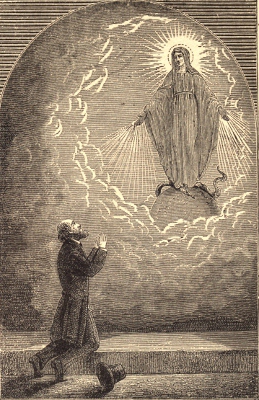
APPARITION OF THE MIRACULOUS MEDAL
To M. Ratisbonne, January 20, 1842, in the Church of St. Andrew,
delle Fratte, in Rome. "She did not speak one word to me," said M.
Ratisbonne, "but I understood it all."
He ceased, but this short account eloquently revealed the abundant
favors with which his soul had just been inundated. Reverend Father De
Villefort and the pious baron listened with a holy joy, mingled with an
involuntary feeling of religious awe, at thoughts of the infinite power
which had just triumphed by such a striking manifestation of mercy....
The mystery was revealed, but M. Ratisbonne, now the disciple of the
most humble of Masters, a God annihilated, expressed a wish to have the
wonderful vision kept a profound secret; he even earnestly entreated
that it should be, but Father De Villefort considered it wiser not
to yield to the neophyte's modesty, God's glory, the Immaculate
Mary's honor, demanding that such a miracle should be proclaimed. M.
Ratisbonne's humility gave way to obedience. In the brief narration
just quoted, one thing especially had struck the Reverend Father,
"She did not speak to me, but I understood all!" What, then, had he
understood, he who, having hitherto lived in the shades of darkness,
found himself in an instant instructed in heavenly knowledge? What,
then, had he understood, he who was suddenly recalled from the bosom of
death which he loved, to a new life which but a short time previous he
had solemnly declared he would ever ignore, 'a Jew he was born and a
Jew he would die?' What had he understood, he the young Jew, so lately
headstrong in his belief, an avowed enemy of Catholicity, but who now
humbly prostrates himself at the feet of our Lord's minister to retract
his words and renounce his own will, for he declares that, after what
he has seen, he obeys?... What has he understood? What has he seen? He
has seen the Mother of divine grace, the bright aurora of the Sun of
Justice; he has understood the gift of God, the eternal truth ... the
unity of the Church, its infallibility, the sanctity of its morals, the
sublimity of its mysteries, the grandeur and elevation of its hopes....
He has understood Heaven, and henceforth everything is changed for
him, everything is renewed within him, he is no longer the same. His
desires, projects, thoughts, earthly affections, where are they in the
brilliancy of this celestial radiance? Vain prejudices of error, where
are they?... The Immaculate Mother of Jesus has rent asunder the band
that veiled the young Israelite's eyes, and the shades of error are
dissipated, the blind man sees the light, and his joy is inexpressible,
for he knew not till then the true gifts, the blessings promised the
children of the true Church.——
M. Ratisbonne had heretofore been completely ignorant of the truths
of Catholicity, he acknowledges that he had never read even one book
calculated to enlighten him on the subject, his hatred of Christianity
kept him aloof from all that might change his views in regard to it.
He blasphemed without examining the object of his blasphemy, he judged
without hearing, he despised without investigating.... And behold!
in spite of himself, in an instant, in defiance of all his past
protestations, he bends, he falls, he is conquered!
Rejoice, O Mary! for the dew of grace has not descended upon an
ungrateful soil.... No; not in vain at your mysterious school has he
learned all this privileged soul of your love, this heart that your
incomparable beauty, your ineffable bounty have vanquished for Jesus
Christ!
We see, indeed, that, from the moment his eyes are opened to the
light, he adores the mysteries he formerly despised, loves what he
hated, venerates what he ridiculed, and proves himself as humble
and submissive to the Church as the most fervent Christian. That
very day, he goes to the basilica of St. Mary Major, in tribute of
gratitude to her who had just descended from Heaven, to bring him the
gift of Faith, and its attendant blessings; thence he repairs to St.
Peter's, to declare in that sanctuary dedicated to the Prince of the
Apostles, his belief in the truths that Peter taught. M. De Bussière,
who found a pious delight in offering to God this conquest of grace,
accompanied him on his holy pilgrimage, and conversed intimately with
him, they had but one heart and one soul. A new Paul, Ratisbonne, in
what he experienced, at the moment the Blessed Virgin gently forced
him to prostrate himself at her feet, to receive the light of Heaven,
recognized the strength of Him who vanquished His persecutors.... The
profound emotion, the holy awe that filled the neophyte on entering
a church, declared more fully the secrets that had been revealed to
him.... Penetrated with the liveliest faith for the great Sacrament
of love, he could not approach the altar, he was overwhelmed at the
thought of the Real Presence of the God who resides in the Most
Holy Sacrament. He considered himself unworthy to appear in this
august Presence, as he was yet stained with original sin, and M. De
Bussière relates, that he took refuge in a chapel, consecrated to the
Blessed Virgin, exclaiming: "I have no fears here, for I feel myself
under the protection of a boundless mercy." O Mary! you opened your
maternal heart, and there he concealed himself, knowing that divine
justice yields to mercy, when the guilty soul has found and invoked
with confidence the Refuge of Sinners.... So great was the fervent
neophyte's happiness when in the temple of the Lord, that he was unable
to find words expressive of his happiness. "Ah!" said he in a holy
transport, "how delightful it is to be here! How great reason have
Catholics to love their churches and to frequent them! How zealous
they should be in ornamenting them! How sweet to spend a lifetime in
these holy places! They are truly not of earth but of Heaven!" Ah! are
we not confounded and abashed by the fervor of him who has just been
born into the truth! What would he think of the coldness, the levity,
the ingratitude of the majority of Christians?... Let us acknowledge
it to our confusion; there is a Host who dwells in our midst, and
whom we know not; we who eat at His table, who feed upon His own
flesh, the Bread descended from Heaven, and behold! a young Israelite,
instructed but a few hours in the wonders of God's love, teaches us how
we must conduct ourselves in the presence of this Host, and with what
sentiments our hearts should then be filled.
Next day, the news of this wonderful conversion had spread through
Rome; every one was anxious to learn something about it, and collected
with pious curiosity the various statements in circulation; every one
wished to see the newly converted and hear his account.... General
Chlabonski even went to M. De Bussière's house. "So you have seen the
image of the Blessed Virgin," said he, accosting the neophyte. "The
image?" answered the latter, "ah! it was no image, but herself I saw;
yes, M. her real self, just as I see you now!" We must here remark that
to the Church alone, appertains the power of judging and qualifying
this vision; but every one was impressed with the fact, that mistake
or illusion seemed impossible, considering the young Israelite's
character, education, prejudices and horror for Christianity; moreover,
in this chapel there was neither statue, picture nor any representation
whatever of the Blessed Virgin. And we love to quote here the words of
a wise man, who, referring to the event, says, "that without one grain
of exaggeration, just as it happened, just as all Rome narrates it, the
unexpected fact, the public fact of this conversion, considering all
the circumstances, would of itself be a miracle, if a miracle had not
caused it."
M. Ratisbonne reluctantly gave the details of what he had seen. When
questioned closely as to what took place at the moment he found himself
environed by this celestial effulgence, he answers ingenuously that he
could not account for the involuntary impulse causing him to leave the
right hand side of the church for the chapel on the left, especially
as he was separated from it by the preparations for the morrow's
ceremonies; that, when the Queen of Heaven appeared before him in all
the glory and brilliancy of her immaculate purity, he caught a glimpse
of her incomparable beauty, but immediately realized the impossibility
of contemplating it, that urged by the desire, three times had he
endeavored to lift his eyes to the face of this Mother of mercy, whose
sweet clemency had deigned to manifest herself to him, and three times,
in spite of himself, had his gaze been stayed at sight of the blessed
hands, whence escaped a torrent of graces. "I could not," he told us
himself after his arrival, "I could not express what I saw of mercy and
liberality in Mary's hands. It was not only an effulgence of light,
it was not rays I distinguished, words are inadequate to depict the
ineffable gifts filling our Mother's hands, and descending from them,
the bounty, mercy, tenderness, the celestial sweetness and riches,
flowing in torrents and inundating the souls she protects."
In the first moments of his conversion, M. Ratisbonne gave vent to some
of those thoughts which strongly pre-occupied him, those outpourings
of a fervent heart which happily, are still preserved. "O my God!"
he exclaimed in a transport of astonishment and gratitude, "I, who
only half an hour before was blaspheming! I, who felt such violent
hatred against the Catholic religion!... Every one of my acquaintances
knew full well, that to all human appearances, it was impossible for
me ever to think of changing my religion. My family was Jewish, my
betrothed, my uncle were Jewish. In embracing Christianity, I know that
I break away from all earthly hopes and interests.... And yet I do
it willingly; I renounce the passing happiness of a future which was
promised me; I do so without hesitation, I act from conviction; ...
for I am not crazy, and have never been; they well know it.... Who,
then, could refuse to believe me, and believe in the truth?... The most
powerful interests enchained me to my religion, and consequently all
should be convinced that a man who sacrifices everything to a profound
conviction must sacrifice to a celestial light, which has revealed
itself by incontrovertible evidence. What I have affirmed is true. I
know it, I feel it; and what could be my object in thus betraying the
truth and turning aside from religion by a sacrilegious lie?... I have
not said too much; my words must carry conviction."
The Baron De Bussière had the consolation of entertaining at his own
home the new son Heaven had given him; the young Jew remained there
until the retreat preceding his baptism. It was right and just,
indeed, that this friend should gather the first bloom of a heart
refreshed by the dew of grace, that he should be the happy witness of
the wonders wrought in that soul.... M. Ratisbonne himself had need
of a confidant, some one that understood him thoroughly, and to whom
he could communicate the emotions of his heart.... It was in moments
of sweet intimacy, when alone with his friend, that he could give
full vent to his feelings, and, in unison with him, admire the loving
designs of divine Providence, and the means that had dissipated such
deplorable errors. He bewailed the blindness in which he had lived!...
"Alas!" said he, "when my excellent brother embraced Catholicity,
and afterwards entered into the ecclesiastical state, I, of all his
relatives, was his most unrelenting persecutor.... I could not forgive
his desertion of our religion—we were at variance, at least; I
detested him, though he had none but the kindest thoughts for me....
However, at the time of my betrothal, I said to myself that I must be
reconciled to my brother, and I wrote him a few cold lines, to which
he replied by a letter full of charity and tenderness.... One of my
little nephews died about eighteen months ago. My good brother, having
learned that he was seriously ill, asked as a personal favor that the
child be baptized before its death, adding, with great delicacy, that
to us it would be a matter of indifference, whilst to himself it would
be a veritable happiness, and he hoped we would not refuse. I was
infuriated at such a request!
"I hope, oh! yes, I hope that my God will send me severe trials, which
may redound to His honor and glory, and convince all that I am actuated
by conscience...." What generosity of heart! What knowledge! His eyes
are scarcely opened to the truths of Catholicity, ere he embraces
them in their full extent.... He knows already that the cross is the
distinctive mark of the children of the Church, of God's elect, and
this cross which so many Christians drag reluctantly after them, he
greets, he awaits, he desires.... Moreover, it had been shown to him in
a very mysterious manner; for he relates that the night preceding his
conversion there was constantly before his eyes a large cross without
the Christ, that the sight really fatigued him, although he considered
it of no importance. "I made," said he, "incredible efforts to banish
this image, but in vain. It was only later, when having, by chance,
seen the reverse of the Miraculous Medal, he recognized the exact sign
which had struck him.
Divine Providence, looking with a loving eye upon this young convert,
directed his steps, and in these early days of his conversion, led
him to a venerable Father who was to give him very precious counsel,
upon the life of abnegation and perpetual sacrifice he had embraced.
This servant of the Lord, immediately lay before him the importance
of the step he had taken, the trials awaiting him, the temptation that
would most assuredly beset his path, and without fearing to shake
his constancy, he read him a few verses of the second chapter of
Ecclesiasticus, upon the trials testing the virtue of the true servant
and friend of God. With pleasure we quote here a part of this good
priest's instructions:
"My son, when thou comest to the service of God, stand in justice
and in fear, and prepare thy soul for temptation. Humble thy heart
and endure; incline thy ear, and receive the words of understanding;
and make not haste in the time of clouds. Wait on God with patience;
join thyself to God and endure, that thy life may be increased in the
latter end. Take all that shall be brought upon thee; and in thy sorrow
endure, and in thy humiliation keep patience. For gold and silver are
tried in the fire, but acceptable men in the furnace of humiliation.
Believe God, and He will recover thee; and direct thy way, and trust in
Him. Keep His fear, and grow old therein."
M. Ratisbonne listened in respectful silence to these words of life; he
cherished the remembrance of them, and the eve of his baptism, he asked
the Reverend Father to put them in writing that he might meditate upon
them the rest of his days.... It was accomplished, the joys of earth
were sacrificed to the glory of bearing the cross of Jesus Christ....
He was initiated into heavenly secrets by reason of those favors the
Immaculate Mary had conferred upon him.... He already felt the strength
that God communicates to the soul, resolved to share the sorrows of its
divine Master.
Ten days elapsed between the happy moment of the young Israelite's
sudden comprehension of the truth, and his baptism. The Mother of Mercy
had brought him from Heaven, the torch of Faith; in enlightening his
intelligence, she had touched his heart; he sighed after the happy day,
when the Church would admit him among the number of her children, and
it was on the 31st of January, this tender Mother opened to him all
her treasures, clothed him with innocence, called down upon him the
plenitude of the gifts of the Spirit of love, and invited him to the
banquet of Angels that she might give him the Bread of life.
The Gésu was the church selected for this solemn ceremony. Long before
the appointed hour, it was filled with a devout, eager multitude, all
anxious to get as near as possible to the holy altar. Nothing disturbed
the beauty or serenity of the occasion, no cloud dimmed the brightness
of this heavenly festival, which inundated truly Christian hearts with
the purest joys.
M. Ratisbonne, clothed in the white robe of the catechumen, appeared
about half-past eight, accompanied by the Reverend Father Villefort,
(whose consoling duty it had been to prepare the neophyte for this
beautiful day), and the Baron De Bussière, his god-father. They
conducted him into the chapel of St. Andrew, where the touching
ceremony was to take place. An object of the most profound curiosity,
the fervent neophyte, wrapt in recollection, awaited with angelic
serenity, the solemn moment.... The pious Romans gave vent to their
feelings by words and gestures, kissing their chaplets in an effusion
of grateful love for Mary Immaculate, the cause of our joy.... They
pointed out one to another the zealous baron, whom divine Providence
had chosen to give the Miraculous Medal to the young Israelite. "He is
a Frenchman," they repeated, "He is a Frenchman! Blessed be God!"
His Eminence, the Cardinal Vicar, was to receive M. Ratisbonne's
profession of Faith. He appeared at nine, clothed in his pontifical
robes, and commenced the prayers prescribed for the baptism of adults.
The prayers terminated, His Eminence went in procession with the
clergy to the foot of the church; the young Israelite was conducted
to his presence. "What do you ask of the Church of God?" "Faith,"
was the immediate answer. "What name do you wish?" "Mary," said the
neophyte, in a tone of tender gratitude; Mary, who had opened to him
the path of salvation; Mary, who was to conduct him into the new life;
Mary, who will one day introduce him into the City of the Saints,
whence she descended to lead him to the divine fold.... Then followed
his profession of Faith, his solemn promises.... He believes all,
he promises all, he accepts all, he wishes to be a Christian, he is
already one at heart.... His desires are gratified, the vivifying
waters are poured upon his head, the grace of holy baptism has invested
him with all the rights of his eternal heritage, the spirit of darkness
is confounded. Behold the child of God, the brother of Jesus Christ,
the new sanctuary of the Spirit of love, the favorite of the Queen of
Heaven, the friend of Angels and the well-beloved son of Mother Church!
It was on this occasion that the Abbé Dupanloup, who happened to be in
Rome at the time, celebrated before an immense audience the infinite
mercies of God and the Immaculate Mary's miraculous protection of a
child of France. We cannot refrain from inserting here a few fragments
of the account printed at Rome. It is well calculated to increase
devotion to Mary:
"How admirable are the thoughts and ways of divine Providence, and how
deplorable the lot of those who neither comprehend nor bless them. For
such, the life of man is only a sad mystery, his days a fatal series
of events, man himself a noble but miserable creature, cast far from
Heaven upon this land of tears, to live here in perpetual darkness, to
die in despair, oblivious of a God who heeds neither his virtues nor
his sorrows.... But, no; Lord, Thou art not forgetful of us, and life
is not thus; despite our infinite misery, thy Providence watches over
us, it is far above the heavens, more boundless than the sea—it is an
abyss of power, wisdom and love.——
"Thou hast made us for Thyself, Lord, and our hearts are never at rest
until they repose in Thee! We feel an insatiable need, which stirs the
depths of our being, which consumes us, and when we yield to it, we
inevitably find Thee!
"I bless Thee especially, I adore Thee, when from the depths of Thy
eternity, Thou dost remember compassionately the lowliness of our
being, the dust of which we are fashioned; when from the heights of
heaven, Thou dost cast a glance of pity and love upon the most humble
of Thy children; when, according to the Prophet's expression, 'Thou
dost move heaven and earth,' and work innumerable marvels to save those
who are dear to Thee, to conquer one soul!
"O, you, upon whom, at this moment, all eyes are bent with
inexpressible emotion, with the tenderest love; for it is God, it is
His mercy we love in you, in you whose presence in this holy place
inspires these thoughts, tell us yourself what were your thoughts and
ways, by what secret mercy the Lord pursued and reclaimed you?
For who are you? What do you seek in this sanctuary? What are these
honors you seem to bear? What is this white robe in which I see you
clothed? Tell us whence you came and whither you were going? What
obstacle has suddenly changed your course? For walking in the footsteps
of Abraham, your ancestor, whose blessed son you are this day, like
him, blindly obedient to the voice of God, not knowing whither your
journey tends, you suddenly find yourself in the Holy City.... The
Lord's work was not yet accomplished; but it is for you to describe
to us the rising of the Sun of truth and justice upon your soul, for
you to picture its brilliant aurora.... Tell us why you enjoy, like
ourselves, perhaps more keenly than ourselves, the good word, the
virtues of the future and all our most blessed hopes.... Tell us, for
we have the right to know, why you enter into possession of our goods
as your heritage? Who has introduced you among us, for yesterday we
knew you not, or rather we knew you.... Oh! yes, I shall tell all; I
know the joy that will fill your heart at my revealing your miseries as
well as the celestial mercies.——
"You did not love the truth, but the truth loved you. To the purest and
most ardent efforts of a zeal that sought to enlighten you, did you
oppose a disdainful smile, an indifferent silence, a subtle response,
a haughty firmness, and sometimes blasphemous pleasantries. O patient
God! O God, who lovest us in spite of our miseries! Thy mercy has
oftentimes a depth, a sublimity, a tenderness and, allow me to say it,
a power and delicacy that are infinite!
"Suddenly a rumor is circulated throughout the Holy City, a rumor that
consoles all Christian hearts, he who blasphemed yesterday, who this
morning even ridiculed the friends of God, has become a disciple of
Christ; celestial grace has touched his lips, he utters now only words
of benediction and sweetness, the most vivid lights of the evangelical
law seem to beam from his eyes; we may say that a celestial unction has
taught him all things. Whence does he receive this enlightenment of the
eyes of the heart, that heart which sees all, which has understood all?
O God! Thou art good, infinitely good, and I love to repeat those sweet
words, so lately on the blessed lips of him, whose memory is henceforth
ineffaceably impressed upon our hearts. We wept over him a few days
ago, we still regret him, but we have dried our tears. 'Yes, Thou art
good, and the children of men have truly called Thee the good God!'
(Last words of M. de La Ferronays.) Thou dost set aside the laws of
nature, Thou dost account nothing too much to save Thy children! When
Thou dost not come Thyself, Thou dost send Thy angels!... O God! shall
I here relate all? I ought to enjoin reserve upon my speech.... But
who is she? Quæ est ista? I cannot say the word, and yet I cannot be
silent.
"Hail Mary! You are full of grace; Ave, gratia plena, and from the
plentitude of your maternal heart, you love to bestow your gifts upon
us. The Lord is with you, Dominus tecum, and it is through you He is
pleased to descend to us! And now to praise you worthily, I must borrow
the images of Heaven or speak the inflamed language of the prophets!
For, O Mary! your name is sweeter than the purest joys, more delightful
than the most exquisite perfumes, more charming than the harmony of
angels, in corde jubilus; more refreshing to the faithful heart than
honeycomb to the wearied traveler, mel in lingua; more encouraging
and cheering to the guilty but repentant heart than the evening dew to
the leaves parched and shriveled by the mid-day sun, ros in herba.
You are beautiful as the orb of night, pulchra ut luna; you, who
guide the bewildered traveler; you are brilliant as the aurora, aurora
consurgens; fair and pure as the morning star, stella matutina; and
it is you who precede the dawn of the Sun of Justice in our hearts.
"O Mary! I can never portray all your loveliness and grandeur, and
it is my joy to succumb beneath the weight of so much glory! But
since I speak in the midst of your children, your children who are my
brothers, I shall continue to proclaim your praises from the depths of
my heart's affection.... At your name, O Mary, Heaven rejoices, earth
quivers with joy, hell fumes with impotent rage.... No, there is no
creature so sublime or so humble, that invoking you, will perish. Those
august basilicas, erected by the piety of mighty nations, those golden
characters, those rich banners worked by royal hands, likewise the
modest offerings of the sailor in your lowly chapels, in the crevices
of the rock, on the shores of the sea, or even your humble picture
which martyr's hands have traced upon the catacombs, all attest your
power in appeasing the tempests of divine wrath, and attracting upon us
heavenly benedictions.
"O Mary, I have seen the most savage wilds of nature smile at your name
and blossom into beauty; the pious inhabitants of the deserts celebrate
your glory, the mountain echoes, the torrent billows, vie with one
another in repeating your praises. I have seen great cities bring forth
and cherish, under the shadow of your name, the purest and most noble
virtues. I have seen youth, with generous impulse, confident ardor, and
the inexpressible charm of virtue irradiating its countenance, prefer
your name and the happiness of celebrating your festivals to all the
enchantments of the world and its most brilliant destinies! I have seen
old men, after a godless life of sixty or eighty years, rise upon their
couch of pain, to remember at the sound of your name the God who had
blessed their early infancy; you were to them as a pledge of security
and of peaceful entrance into the Eternal City! O Mary, who are you
then? Quæ est ista? You are the Mother of our Saviour, and Jesus, the
fruit of your womb, is the God blessed from all eternity. You are our
Sister, soror nostra es; though a child of Adam like ourselves, you
have not participated in our sad heritage, and our woes excite your
deepest and most tender compassion.
"O Mary! you are the masterpiece of the Divine power! You are the most
touching invention of God's goodness! I could not say more—you are the
sweetest smile of His mercy! O God, give eyes to those who have them
not—eyes that they may see Mary and understand the beautiful light
of her maternal glance; and to those who have no heart give one, that
they may love Mary; for from Mary to the Word Eternal, to the Beauty
ever ancient and ever new, to that uncreated Light which strengthens
the feeble sight and appeases every desire of our souls, from Mary to
Jesus, from the Mother to the Son, there is but a step!——
"Our dearly beloved brother—and I am happy to be the first to call
you thus—behold under what favorable auspices you enter this new
Jerusalem, the tabernacle of the Lord, 'the Church of the living God,
which is the pillar and ground of truth. But before delivering your
heart to these emotions of joy, there is one severe lesson it should
learn this day; and since I am destined to be the first to announce to
you the words of the Gospel, I shall conceal from you nothing of the
austerity it inculcates. 'You have understood all,' you say; but let me
ask if you have understood the mystery of the cross. Ah! be careful,
for it is the foundation of Christianity. I speak now not only of that
blessed cross which you lovingly adore, because it places before your
eyes Jesus crucified in expiation of your sins, but borrowing the
emphatic language of an ancient apologist of our Faith, I shall say to
you: 'This is no question of the cross that is sweet for you to adore,
but of the cross to which you must soon submit.' Ecce cruces jam non
adorandæ, sed subeundæ. Behold what you must understand if you are a
Christian and what baptism must disclose to you!... Moreover, in vain
would I endeavor to dissimulate the truth, by saying that your future
may reveal no crosses; I see them in store for you. No doubt, we must
venerate them afar off, but it is infinitely better to bend beneath
their weight when laid upon us, and courageously carry them. I shall
be mistaken, if the evangelic virtues are not increased and fortified
in your soul by patience. And blessed be God for it! You have been
introduced into Christianity through Mary and the Cross!... It is an
admirable mode of introduction! And again I repeat, blessed be God for
it! For I say to you, He has given you ears to hear and a heart to feel
this language! Son of the Catholic Church you will share your Mother's
destiny! Look at Rome, Rome where you have just been born into the
Church; her heritage here below, is always to combat and always to
triumph. Moreover, nothing astonishes her; and after eighteen centuries
of combats and victories, it is here, in the centre of Catholic unity,
at the foot of the Apostolic See, that focus whence daily emanate the
most vivid and purest rays of Faith, piercing the shades of paganism,
error and Judaism, that the Church has poured over your forehead the
beneficent water of celestial regeneration. What do I say? It is Peter
himself, the Moses of the new law, worthily represented by the first
Vicar of his august Successor, who has struck for you the mysterious
rock, the immovable stone. Petra erat Christus, whence gush forth
those waters springing up unto eternal life.
"But I have said enough; I retard your happiness. Heaven, at this
moment, regards you with love, the earth blesses you and Jesus Christ
awaits you; go forward then; angels have commenced the feast, and the
friends of God continue it with you here below! And even he who seems
dead in our eyes, and whose heart is living in the hand of the Lord!
you know him, his supplications and prayers have been poured forth in
your behalf; the solemn moment has now arrived! Abraham, Isaac, Israel,
the patriarchs and prophets from their heavenly abode encourage you,
and Moses blesses you, because the law in your heart has developed into
the Gospel; mercy and truth sustain you, justice and peace attend you,
repentance and innocence crown you.... And finally, it is Mary who
receives and protects you!
"O Mary! it is a necessity and a duty for us to repeat once more
this prayer, this cherished prayer, and I know that not one of all
the multitude here assembled, but will fervently repeat it with me:
'Remember, O most pious Virgin Mary, that no one ever had recourse
to thy protection, implored thy aid or sought thy mediation, without
obtaining relief. Groaning under the weight of our sins, we come, O
Virgin of virgins, to cast ourselves in thy arms, and do most humbly
supplicate thee. O Mother of the Eternal Word, to remember the just,
remember sinners, remember those who know thee, and those who know thee
not; remember our woes and thy mercy.' I shall not say remember this
young man, for he is thy child, the sweet and glorious conquest of thy
love, but I shall say, remember all those dear ones for whom he offers
this day, the first prayers of his Catholic heart; restore them to him
in time and eternity.——
"And since I am a stranger here (no, let me recall my words, no one
is a stranger in Rome, every Catholic is a Roman), but since we were
both born on the soil of France, I think my prayers find an echo in the
hearts of all who hear me, when I say: remember France, she is still
the home of noble virtues, generous souls, heroic love.... Restore to
the Church in France her pristine beauty."
The Holy Sacrifice terminated the imposing ceremony. Our new Christian,
overwhelmed beneath the weight of so many favors, had to be assisted
to the Holy Table, where he received the Bread of Angels as the seal
of his celestial alliance. Inundated with happiness, the tears gushed
from his eyes, and after receiving, it was necessary to assist him
to his place.... A number of pious Christians participated in the
divine banquet, to which the Church so tenderly invites all her happy
children, and the admirable spectacle of a blessed union with their new
brother, was another edifying episode of this memorable day.
The Te Deum which followed, that most fervent hymn of gratitude,
arising from every heart and mingling with the sound of all the
bells, was not less impressive. "I pray God," wrote a witness of this
ceremony, "never to let the memory of what I experienced during these
three hours be effaced from my heart; such an impression is, beyond
doubt, one of the most precious graces a Christian soul can ever
receive."
Clothed with innocence, enriched with the gifts of Heaven, admitted
to its joys, buried in the sweet transports of gratitude and love, M.
Ratisbonne could not relinquish immediately his dear solitude. He had
made one retreat, as a preparation for the reception of these three
grand Sacraments, and he was filled with ineffable consolation; feeling
now the necessity, the imperative duty of returning thanks to his
Benefactor, he wished to commence a second retreat, so that afar from
the world, he might be deaf to the confused noises of its frivolous
joys, and amidst the silence of a sweet peace, celebrate the Lord's
magnificence, chant hymns of gratitude, taste in secret and at leisure
the gifts which had been imparted to him, and the new treasures he
possessed.
Another grand consolation was in store for him. He sighed after the
happy moment when he could prostrate himself at the feet of the
Sovereign Pontiff, and there testify his submission to and love for
that holy Church who had just admitted him into the number of her
cherished children. An audience was granted him. The two friends, M.
Ratisbonne and the Baron de Bussière, were conducted into the presence
of His Holiness by the reverend Father General of the Society of Jesus.
Having bent the knee three times before the Vicar of Jesus Christ, they
received in unison, that holy and desirable benediction, which many
pious Christians esteem themselves happy in obtaining, after long and
wearisome journeys. They were welcomed with truly paternal tenderness
by the venerable Pontiff, who conversed some time with them, and loaded
them with tokens of his favor. M. Ratisbonne knew not how to express
his admiration for the great simplicity, humility and goodness of this
worthy Successor of the Prince of the Apostles. "He was so exceedingly
kind," has M. Ratisbonne told me several times since, "as to take
us into his chamber, where he showed me near his bed, a magnificent
picture of my dear medal, a picture for which he has the greatest
devotion. I had procured quite a number of Miraculous Medals. His
Holiness cheerfully blessed them for me, and these are the weapons I
shall use in conquering souls for Jesus Christ and Mary."
The Holy Father crowns all his favors, by presenting M. Ratisbonne
a crucifix, a precious souvenir which the young Christian will ever
cherish, clinging to it in his combats and his sorrows, as a weapon
that must assure him the victory over hell. A new soldier of Jesus
Christ, he needs no other arms than the cross and Mary Immaculate,
signal protectors that will guide him in the ways of justice, and one
day, usher him into the light of eternal felicity.
Shortly after his second retreat, M. Ratisbonne made preparations for
his return to France, and bade adieu to the Holy City, though not
without the sweet hope of again offering there his tribute of fervent
thanksgiving. We have seen and conversed with him many times. The first
emotions of a boundless and almost unparalled happiness are past,
but the fruits remain; daily does the precious gift of Faith strike
deeper root into this soul regenerated by the waters of holy Baptism;
and the divine life, which was communicated to him on the day of his
baptism, our new brother nourishes by the frequent reception of the
Holy Eucharist, and a withdrawal from all worldly society; for whilst
awaiting the manifestations of the Lord's will in regard to his future,
he feels the necessity of preserving, in the secrecy of a peaceful and
recollected life, the treasures he has received.
M. Ratisbonne's conversion, publicly styled a miracle, excited too much
interest and comment for the Holy See to allow it to pass unnoticed.
The Sovereign Pontiff ordered a canonical examination according to the
rules of the Church. The Cardinal Vicar prescribed an investigation.
Nine witnesses were examined; all the circumstances weighed, and
after a favorable conclusion, the most eminent Cardinal Patrizzi,
"pronounced and declared the 3d of June, 1842, that the instantaneous
and perfect conversion of Alphonse Marie Ratisbonne, from Judaism to
Catholicity, was a true and incontrovertible miracle, wrought by the
most blessed and powerful God, through the intercession of the Blessed
Virgin Mary. For the greater glory of God and the increase of devotion
to the Blessed Virgin Mary, His Eminence deigns to permit the account
of this signal miracle, not only to be printed and published but also
authorized."—A picture commemorative of the apparition of the Blessed
Virgin to M. Ratisbonne, a representation of the Virgin of the medal,
was placed in the chapel of St. Andrew's Church, where the miracle had
taken place.
A few days after his return to France, M. Ratisbonne, in token of
his gratitude, and with the intention of obtaining his family's
conversion, felt urged to erect a chapel under the invocation of Mary
Immaculate, in the Providence orphanage of the Faubourg St. Germain,
Paris. The laying of the corner stone took place May 1st, 1842, and
the sanctuary was finished and dedicated May 1st, 1844, with great
solemnity, in the presence of the founder of the house, M. Desgenettes,
curé of Notre Dame des Victoires, the Baron de Bussière, M. Étienne,
Superior General of the Priests of the Mission and daughters of
Charity, M. Eugène Boré, then a simple layman, but afterwards M.
Étienne's immediate successor, the abbé de Bonnechose, later an
Archbishop and Cardinal, and many other distinguished persons.
The pious convert often repaired to this sanctuary to mingle his
prayers with those of the Daughters of Charity and their dear orphans;
and many times has he also enjoyed the ineffable consolation of
celebrating the Holy Sacrifice and thanking his celestial Benefactress,
before the beautiful picture of the Immaculate Conception placed above
the high altar, as a souvenir of the miracle of St. Andrew delle
Fratte, for M. Ratisbonne is now a priest. Not content with leading a
pious life in the world, he has renounced forever the joys and hopes
of time to embrace the ecclesiastical state, which consecrated him
unreservedly to God. For several years past he has been associated with
his beloved brother Theodore in the order of Our Lady of Sion, the
object of which congregation is the conversion of Israelites.
V.
Graces Obtained from 1843 to 1877, in France, Germany, Italy, America.
CURE OF A LITTLE GIRL (PARIS)—1843.
This account was sent us in the month of January, 1877, by the very
person who was cured:
"About the 15th of December, 1843, a little girl, Zénobie de M., just
one year old, was attacked, at the same time, by water on the chest, a
disease of the bowels, and cerebral congestion. Dr. Flandrin, a friend
of the family was called in immediately, and gave the child every
attention, but his skill was powerless, and the family was plunged in
the deepest grief. The child's eldest sister alone cherished a faint
hope in the depths of her heart; she had intended consecrating herself
to God in a religious state, and had always regarded the birth of this
little one as a gift of Providence, sent to take her place in the
family, and console her afflicted parents. God will not, she thought,
take back the child. In her room was a picture representing the
apparition of the Miraculous Medal; she knelt before it, begging the
child's recovery, and renewing her promises of embracing a religious
life should the petition be granted. This generous offering she kept
a secret. A little while after, the doctor came and declared the
child's case hopeless, and moreover, its recovery not desirable as
it would remain imbecile, paralyzed or blind. He proposed, however,
a consultation with M. Blache, physician of the Necker hospital, who
prescribed energetic treatment, but said, 'this child cannot live.'
The poor mother, deeming it inadvisable to cause the little creature
unnecessary suffering, gently laid it in the cradle, saying with the
faith and resignation seen in none but a Christian mother: 'The Lord
gave it to me, the Lord wishes to take it away, may His holy will be
accomplished!' In the afternoon, one of the aunts came to accompany
the elder sister to church, and whilst their prayers ascended to the
Most High, more for the mother than the child, this mother obeys
spontaneously a supernatural impulse, and taking the Miraculous Medal
as a last hope, she applies it to the body of the child, and repeats
with confidence the invocation: 'O Mary! conceived without sin, pray
for us who have recourse to thee!' The plaintive cries ceased, and
when M. Flandrin came that evening to see if the little one were still
alive, he was greatly surprised to perceive a faint improvement since
morning, the whole body covered with a gentle perspiration, and the
little paralyzed arm able to move in any direction. 'But what a pity,'
said he, 'the child will be blind,' which indeed it seemed to be
already, as a light passed several times before its eyes produced no
effect whatever.
"The mother who had not yet mentioned her secret, waited until all
had left the room, then taking her dear medal, she lay it upon her
infant's eyes and repeated the invocation. After a sound sleep of about
twenty-four hours, little Zénobie awoke, recognizing all around her,
and smiling upon all, her sight was restored!
"The child's father, penetrated with faith and piety, said: 'Assuredly,
God alone has restored our child to us; henceforth, she shall be
called Marie, that she may ever bear in mind to whom she is indebted
for life.' An attack of measles now supervened and finished the work,
according to the doctor, by absorbing the water on the brain, and
throwing out upon the surface of the skin the heretofore internal
malady. A small gold cross, having engraven upon it the memorable date
of this miraculous cure, was hung around the neck of little Marie, who
is now a Daughter of St. Vincent de Paul."
CONVERSION OF A CAPTAIN IN THE AUSTRIAN ARMY.
Letter from the Superioress of the Daughters of Charity, at the
Hospital of Gratz (Austria), 1860:
After the war in Italy, a Polish regiment passed through Gratz; the
captain, attacked by a violent hemorrhage, was obliged to stop at the
general hospital, in charge of the Daughters of Charity. Their constant
and unremitting attentions did not retard the progress of the disease,
and his life was in imminent danger.
Full of consideration, gratitude and politeness for those who nursed
him, he nevertheless expressed great displeasure whenever they
approached him on the subject of religion; he had requested to be
spared the visits of the chaplain of the regiment, and as to the
hospital chaplain, he dared not present himself. It was necessary
to keep the patient very quiet, and avoid all worry, for the least
excitement might cause a mortal hemorrhage.
A Sister, who had been watching by his couch one night, left, in
mistake, a little book containing an account of favors obtained through
the Blessed Virgin's intercession. The sick man took the book and read
a few pages; another Sister coming into his room, he showed her a
passage, and said, putting his hand to his forehead with a significant
gesture: "Here, Sister, just read this nonsense; as for myself, I
cannot understand how any one can write such books—if I may dare, let
me beg you to take this away."
Vain was every effort to reach his heart by pleasant distractions,
by engaging his attention or his interest; he was insensible to all.
A few days after the occurrence just mentioned, a Sister ventured to
offer him a medal of the Blessed Virgin suspended to a cord, so that he
might wear it if he wished. He was too polite to refuse the present,
but he let it remain just where the Sister had put it. His servant,
though a devout Christian, dared not speak to him of receiving the
Sacraments, and, although the patient expected to leave the hospital
soon, it was very evident to all else that the fever was daily sapping
his strength and rapidly conducting him to the tomb. Much grieved at
his condition, and especially his impenitence, the Sisters determined
to make one last effort to save this soul. And what was it? They wrote
the Blessed Virgin a note, as follows: "Grant that, by some means, most
holy Mother, he may accept your medal, prepare him yourself to receive
the Sacraments, and assist him at the hour of death. O Mary! conceived
without sin, pardon our temerity, we attach this note to your statue,
and leave it there till you deign to hear our prayers."
The chief physician of the hospital said, one day, to the Sister
on leaving this patient's room: "The captain will die without the
Sacraments, he seems inflexible." "Oh! as to that," she replied, "the
Blessed Virgin will not fail to overcome his obstinacy." Three or four
days elapsed; one morning the sick man requested the Sister to put the
medal around his neck, which she did most joyfully. In the afternoon,
he called her again: "Sister," said he, "I beg you to send for the
chaplain of my regiment to hear my confession, so that to-morrow I may
receive the Holy Eucharist and Extreme Unction." The worthy priest
was happy to answer the summons; he remained a long time with the
sick man, and next morning, after celebrating Mass at the altar of
the Immaculate Conception, he administered to him the Holy Viaticum
and Extreme Unction. We were all edified at the dying man's piety. He
cherished his medal with religious fidelity, often asking for it and
kissing it tenderly. A few days after receiving the Last Sacraments, he
rendered his soul to God, saved, as we have every reason to hope, by
the intercession of Mary conceived without sin.
CONVERSION OF A HARDENED SINNER.
A letter from the Superioress of the Daughters of Charity at Issoudun,
1862:
In the month of August, 1862, a young man aged twenty-nine, and who
had been married several years, was dying of consumption. Vainly did
his friends endeavor to turn his thoughts to eternity; every idea of
religion seemed extinguished in his heart, and he positively refused
to see the priest. A pious acquaintance informed the Sisters of his
deplorable state; one of them went immediately to see him. She met
with a cool reception, but was not the least disconcerted, and spoke
to him very kindly, proposing to send him a physician, and adding,
that she would supply all necessary medicines and nourishment. "I need
neither doctors nor medicines," was the reply, "I am going to die, and
I ask only that you will let me die in peace." His poor wife, who
was present, holding their little child in her arms, said to him with
tears: "Accept Sister's offer, and perhaps you will recover," but he
made no answer; and the Sister now turning to his wife, endeavored to
console her, by promising to send the doctor and return soon herself.
The doctor came and met with no better reception. In a few days the
Sister presented herself again, and was received as before, all her
advances eliciting no response save a frigid silence; but naught
discouraged, she returned day after day, though her reception was
always the same. As the young man grew worse, the Sister's prayers
increased, and she felt inspired to offer him a medal of the Immaculate
Conception, still hoping that the good God would lead back to the fold,
this poor strayed sheep. "I accept a medal!" he exclaimed vehemently,
"and what do you wish me to do with it? It would suit my wife or child
well enough, but as for myself, I want no medals!" The Sister withdrew
from the contest for the time, but not discouraged, she returned to the
charge next morning. "Ah," said she pleasantly, "you are going to take
the medal to-day?" "You know what I told you yesterday," he answered,
"besides, Sister, I am afraid of becoming imbued with your sentiments
should I accept it, for I perceive that you are much more unhappy
than I care about being." A ray of happiness illumined the Sister's
countenance, for she knew that he who fears is already conquered.
After plying her with questions about religion, he concluded thus:
"After all, death will be a great relief to me; I have twice made an
unsuccessful attempt at committing suicide. I suffer so much that I
desire nothing but to die as soon possible." Next day, the Sister asked
her Superioress to visit him and offer him the medal. She did so,
and he not only accepted it, but at last consented to see the priest.
When our Sister next saw him he was completely changed, and expressed
his joy at the priest's visit, and his desire of seeing him soon
again. "Sister," said he, "I am too miserable, I wish to be like you."
The priest did not delay his second coming, and the poor, suffering
creature, having made his confession, asked for Holy Communion,
which he had not received for many years, but this favor was denied
him, his throat being so inflamed that he could swallow only a few
drops of liquid. His last days were sanctified by the most admirable
resignation; no one ever heard him utter a complaint, he asked for one
thing only, the visits of the priest and Sister, which alone seemed to
afford him any consolation. And on the Feast of All Saints, evincing
every mark of a sincere conversion, he breathed his last.
CONVERSION OF A MALEFACTOR.
A Letter from the Superioress of the Daughters of Charity, at the
Hospital of Beuthen (Prussian Poland)—1865:
There was brought to our hospital, a young man of notoriously bad
character. He entered our doors blaspheming, and as the physician had
told the Sister that he had but a few days to live, she essayed a few
words of piety and consolation, to turn his attention to the state
of his soul; but he answered her by maledictions. At last, one day
she said to him, "My friend, since you will not listen to me, I will
ask my Superioress herself to come." "Let her come," was his reply,
"if she were to tell me to hang myself, I would obey her, but as for
confession, she may talk about that as much as she pleases, I shall
never yield." These words were followed by so many blasphemies, that
it was with a very heavy heart the poor Sister sought her Superioress.
"Have you given him a medal?" said the latter. "A medal!" was the
reply, "he would throw it away." "Ah, well, we must put one under his
pillow and trust to prayer, for it is useless to talk to him; tell him
only that I say he is not worthy of going to confession, and I forbid
his doing so."
As soon as the Sister who was nursing him left the presence of her
Superioress, the latter threw herself upon her knees and began to
repeat that beautiful prayer, the Remember. In a very few minutes the
Sister returned, this time shedding tears of joy. "Ah, Sister," said
she, "he wishes to confess; as soon as I had put the medal under his
pillow and recited the Remember for him, I delivered your message."
"Indeed!" said he, rising from his seat, "Well, I would just like
to see the person that could prevent it; tell your Superioress that
to-morrow morning at eight o'clock, I am going to pay the curé a visit."
The Sisters felt a little troubled concerning a confession apparently
dictated by the spirit of contradiction, but their fears were
dissipated when the penitent returned bathed in tears. He had just been
to Holy Communion; asking the Sisters' pardon for his past misconduct,
he begged them to implore the Blessed Virgin to let him live eight days
longer, that he might weep for his sins. This favor was granted him,
and daily did he bedew his pillow with tears. At the end of the eight
days he died, blessing God, and pressing the medal to his lips.
CONVERSION OF AN ACTRESS.
A letter from the Superioress of the Daughters of Charity, at the
Hospital of Beuthen (Prussian Poland), 1865:
Some years ago, a young Protestant woman, belonging to a troupe of
comedians, arrived in Beuthen with her company. The good God permitted
that she should find lodgings in a Catholic family, with whom she soon
essayed a controversy. "Mademoiselle," said the master of the house,
"it would be better for you to go see the Sisters about these things;
the Blessed Virgin has wrought wonders in their establishments, I am
sure you would return fully enlightened on the subject you have been
discussing." The young girl laughed at such a proposition; but a few
days after, impelled by curiosity, she repaired to the hospital and
asked for the Sister-Servant. "Invite her in," said the latter, who had
already heard of the young actress; "no doubt, the Blessed Virgin has
something in store for her here." After a few formalities of etiquette,
our visitor introduced the subject of religion, and attempted to enter
into a controversy with the Sister. "Alas! Mademoiselle," replied
the latter, "the poor Daughters of Charity have neither the time nor
learning necessary for a discussion of these subtle questions, but
they have other arms with which to vanquish you;" and, smiling, she
presented her disputant a little medal of the Blessed Virgin. "Promise
me to wear this slight souvenir, it will be a constant reminder that we
are praying for you." She allowed the Sister to put the medal on her
neck, and retired rather pleased with her visit.
From this day, the Sisters at the hospital began to recommend
the young actress to Mary conceived without sin. Not many weeks
after, the curé said to the Sister-Servant: "Do you know, Sister,
that Mademoiselle M., who spent the most of her time promenading
with gentlemen and smoking cigars, now comes to me for religious
instruction? In a little while she will make her abjuration." And,
indeed, it was not very long before she repaired to the hospital.
"Sister," said she to the Sister-Servant, "I am going to confession
to-day, and to-morrow I make my First Communion. On my first visit
here, I was enraged at you. I could have fought you, and cast to the
winds this medal that I now kiss. From the very moment you put it on my
neck, an unaccountable change was wrought in me." Next day, the church
was filled with Protestants and Jews, all anxious to witness a ceremony
which had excited so much comment. After her reception into the Church,
the young convert, on the eve of her departure, paid another visit to
the Sister Servant, and the latter saw by her very countenance what
great changes grace had wrought in this soul. "Well," said the Sister,
just to try her, "here is a silver medal to replace yours which has
become very black." "Oh, no," was the earnest, prompt reply, as she
tenderly pressed her own medal, "I would not exchange this for any
other in the world, for it is since I began to wear it my soul has
awaked to a new life."
Some years later, the Sister received a letter dated from Rome, it
was from the young convert, who wrote to her as follows: "Sister,
Providence has led me to Rome, and it is no longer Mlle. M. you must
address, but Sister St.—— of the B. convent. Your desires are
accomplished; I now belong entirely to God, as I once did to the
world; the Blessed Virgin vanquishes souls with other arms than those
of controversy."
We must add, to the praise of the young actress, that her moral
character was always irreproachable.
The Superioress of the hospital at Beuthen, in narrating these facts,
adds: "I could mention, for the greater glory of God and honor of the
Immaculate Mary, numberless incidents of this kind, but lack of time
and my weak eyes prevent my giving the details. I will say, however,
and that without the slightest exaggeration, that not a week passes
but the Blessed Virgin bestows upon our patients at the hospital some
new proof of her maternal bounty. The medal, so dear to us, is really
miraculous, and the instrument by which we snatch from destruction
souls that have cost Our Lord so much. Ah! how numberless, in this
unhappy land, the snares of the enemy of our salvation to entrap souls;
but to vanquish him, I everywhere circulate the Miraculous Medal (you
know what numbers we get), and my confidence in Mary is never deceived."
CONVERSION OF A PROMINENT FREE MASON.
New Orleans (United States), 1865.
Among the patients at the great Charity hospital, New Orleans, was a
very prominent Free Mason. His hatred of religion was displayed in a
thousand ways; not only did he interdict the Sister who nursed him any
allusion to his salvation, but he even habitually repaid by harsh and
injurious words her kindness and attention to his physical sufferings.
If others ventured to mention the subject of religion to him, they
were received with jeers and banters. Several times was he at the
point of death, and yet, sad to relate, his dispositions remained the
same. At last, when the Sister saw that he had but a few hours to live,
she stealthily slipped a Miraculous Medal under his bolster, and said
interiorly to the Blessed Virgin: "My dear Mother, you know I have
spared no effort to touch this poor man's heart, but in vain; now I
abandon him to you, it is you who must save him; I leave him entirely
in your hands, and shall try to divest myself of all anxiety concerning
him." That evening, in making her rounds, she glances at him and learns
from the infirmarian that ever since her (the Sister's) last visit, he
had been very calm and apparently absorbed in thought. On inquiring
of the patient himself how he felt, she was astonished at his polite
answer, but remembering that she had entrusted him entirely to the
Blessed Virgin's care, she did not venture a word about his soul, and
bidding him good night, she left the room.
About nine o'clock, he called the infirmarian, and asked for a priest;
knowing his former bitterness, the infirmarian thought it a joke and
treated it accordingly; the patient repeated his request, but with no
better success. Then he began to weep and cry aloud for a priest; all
the other patients were mute with astonishment, and the infirmarian
unable to resist such entreaties went for the chaplain and the Sister.
The dying man requested Baptism, which was administered immediately, as
well as Extreme Unction, and before morning he had rendered his account
to the Sovereign Judge. His body was interred with Masonic rites, but
his soul, thanks to the powerful protection of Mary Immaculate, had
been carried by angels to the bosom of its God.
CONVERSION OF A SICK PROTESTANT.
New Orleans (United States).
At the same hospital in New Orleans, a Sister for a long time had
vainly endeavored to convince a Protestant of the most essential
truths of religion, that he might receive Baptism, but he was deaf
to all her persuasions. One day she showed him a Miraculous Medal,
and related its origin. He appeared to listen somewhat attentively,
but when she offered it to him, "Take it away," said he, in a tone of
great contempt, "this Virgin is no more than any other woman." "I am
going to leave it on your table," was the Sister's reply, "I am sure
you will reflect on my words." He said nothing, but to put it out
of sight, placed his bible over it. Every day, under the pretext of
arranging and dusting his room, the Sister assured herself that the
medal was still there. Several days elapsed, during which the patient
grew worse; one night, whilst lying awake racked with suffering, he
perceived a brilliant light around his bed, though the rest of the
room was enveloped in darkness. Greatly astonished, he succeeded, in
spite of his weakness, in rising and turning up the gas, to discover
if possible, the cause of this mysterious light. Finding none, he
returned to bed, and a few minutes after, he perceived that the
luminous rays escaped from the medal. He then took it in his hands,
and kept it there the remainder of the night. As soon as the Sisters'
rising bell rang (which was four o'clock), he called the infirmarian,
and begged him to tell the Sister he desired Baptism. The chaplain
was immediately informed. "Impossible!" he exclaimed, for having had
frequent conversations with the sick man, he was well aware of his
sentiments, and could scarcely believe him in earnest. Nevertheless, he
obeyed the summons, and finding the patient really disposed to profit
by his ministry, he administered the Last Sacraments, and shortly after
receiving which the poor man died, blessing God and the Blessed Virgin
for the graces bestowed upon him.
CONVERSION OF A PROTESTANT GIRL.
New Orleans, (United States).
A poor young Protestant girl, brought to our hospital to be treated for
a grave malady, had so great a horror of our holy religion, that at the
very sight of a Catholic near her, she acted like one possessed. The
presence of a Sister was especially irritating, and one day she even
went so far as to spit in the Sister's face, but the latter, nothing
dismayed, and ever hoping that the God of all mercy would change this
wolf into a lamb, continued her kind attentions, the more disrespectful
her patient, the more gentle and considerate the Sister. The latter
was at last inspired with the thought of slipping a Miraculous Medal
between the two mattresses; she acted upon the inspiration, and the
following night the Immaculate Mary's image became an instrument of
salvation and happiness to a guilty soul. Pitching and tossing upon
her bed by reason of a high fever, the patient, in some unaccountable
manner, found the medal, and the Sister's astonishment next morning
at seeing her clasping it in her hands, and covering it with kisses,
was second only to that she experienced on perceiving the wonderful
transformation grace had wrought in this poor creature's soul. A
supernatural light had revealed to her the sad state of her conscience;
her criminal life filled her with horror, and, penetrated with regret
for the past, she sighed only for holy Baptism. After the necessary
instruction, she was baptized; and, during the remainder of her
sickness, which was long and tedious, her patience and fervor never
faltered. She persevered in these edifying sentiments, until a happy
death placed the seal upon the graces she had received through the
intercession of Mary Immaculate.
CONVERSION OF A PROTESTANT.
New Orleans (United States).
A Protestant gentleman had spent four years at the hospital, sometimes
in one hall, sometimes another. As his malady had not been very
serious, no one had considered it necessary to speak to him concerning
his soul. However, when his condition became more aggravated, the
Sister, after invoking the Blessed Virgin's assistance, told him the
physician considered his case dangerous, and she thought he ought to
receive Baptism, without which no one could be saved. He listened
attentively, then turning to her, said: "Sister, if I were to ask you
to become a Protestant, would you comply with my request?" "No," was
the decided answer. "Well, then," he continued, "rest assured that
it is just as useless for you to attempt persuading me to become a
Catholic."
In spite of this positive refusal, she let no occasion pass without
enlightening him, were it ever so little, upon some of the truths of
religion. One day, showing him a Miraculous Medal, she told him he
would confer a great favor on her by reciting the little invocation: "O
Mary! conceived without sin, pray for us who have recourse to thee!"
"What, Sister! a Catholic prayer! that is impossible, I cannot!" She
said no more, but slipped the medal under his pillow, and there it
remained untouched for several days, during which time she redoubled
her attentions to the physical necessities of the poor patient, who
gradually grew weaker. At last, one evening she said to him: "Well,
Henry, are you not going to do what I asked you?" "Yes, Sister, I
most earnestly desire to become a Catholic." The chaplain was called
immediately; he had barely time to administer Baptism and Extreme
Unction, ere the dying man's regenerated soul was carried by angels to
the abode of the blessed.
CONVERSION OF A YOUNG METHODIST.
St. Louis (United States), 1865.
A young man, a Methodist, arrived at the hospital in an extremely weak
condition. The physician at once pronounced his case hopeless, and said
he had but a few days to live. Consequently, the Sister's first care
was for his soul. Questioning him, she soon learned that he believed
neither in the efficacy nor necessity of Baptism, and all her efforts
to induce him to receive this Sacrament were unavailing. He had no
desire for any conversation on the subject, and his invariable reply to
all her arguments was: "I believe in Jesus, that suffices; I am sure
of being saved." The Sister redoubled her prayers, for in them lay her
only hope, and time was precious. A good priest visited him every
day; once, after a much longer visit than usual, he told the Sister on
leaving the room it was impossible to do anything with that man, unless
God wrought a miracle in his favor, and they must entreat Him to do
so. The poor man persisted, indeed, in refusing all spiritual succor,
though receiving gratefully the attentions bestowed upon his body.
His strength diminished day by day, and he calmly awaited death; one
thought alone disquieted him, that of never seeing his mother and dying
afar from her. Perceiving himself on the brink of the grave, he called
one of his companions whom he begged to be with him at that fearful
moment, and write the particulars of it to his mother. Whilst he made
this request, the Sister slipped a Miraculous Medal under his pillow,
confidently believing that Mary would not let this soul entrusted to
her perish; yet he was already in his agony. Two Sisters watched beside
his bed till midnight, when obliged to retire, they left him in charge
of an infirmarian and the young man who had promised to be with him
at the hour of death. Apparently he had not more than half an hour to
live, so next morning when the infirmarian came to meet the Sister, she
was prepared for news of the patient's death, but to her astonishment
the infirmarian exclaimed: "Come Sister, come see him, he is restored
to life!" He then told her that the patient, to all appearances, had
been dead an hour; that the friend and himself had rendered all the
last duties to the body, having washed and dressed and prepared it
for the grave; then the young man went to bed, and he alone remained
with the corpse. After watching near it some time, he approached to
bandage the jaws, but what was his fright whilst thus engaged, to
see the dead man open his eyes! The Sister heard no more, but eagerly
hastened to the spot, and found the man still breathing. With a great
effort he said: "Oh! what a blessing that you have come!" In reply,
she exhorted him to receive Baptism, and told him that he was indebted
to the Blessed Virgin for this prolongation of his life. "I wish to be
baptized," said he, and when the Sister replied that the priest would
come, "Oh! that will be too late!" was his pitiful answer. The other
patients now joined their entreaties to his, and the Sister, after
reciting aloud the acts of faith, hope, charity and contrition, which
the dying man endeavored to repeat, with hands clasped and eyes raised
to Heaven, baptized him. Whilst the regenerating waters flowed upon his
soul, transports of love and thanksgiving escaped his lips. Half an
hour later, he closed his eyes, never to open them here below. All that
the infirmarian related of his first death, was confirmed in the most
positive manner, by the Protestant friend who had assisted in preparing
him for the grave.
CONVERSION OF M. F——
St. Louis, (United States).
A Protestant named F—— was brought to our hospital in an advanced
stage of consumption. He detested the Catholic religion most heartily,
and received the Sisters' services with extreme repugnance. His
physical strength diminished perceptibly, but his mind retained its
energy and clearness. By degrees, the odor escaping from his decayed
lungs, became so intolerable that all abandoned him. M. Burke, a
missionary priest and the Sisters, being the only persons who had
the courage to go near him, and pay any attention to his comfort.
Yet neither priest nor Sister dare mention religion. They contented
themselves with putting a Miraculous Medal under his pillow, and
invoking her, who so often deigns to display her power in favor of
those who deny it. She did not delay in granting their petition. A few
days later, as the Protestant minister left the ward, after making his
usual distribution of tracts, the sick man said to the Sister, "Sister,
it is done; I am converted." "Ah," said the latter interiorly, "our
good Mother has accomplished her work." And it was indeed true; for the
patient requested a priest, was instructed, and in a few days received
the Sacraments of Baptism, the Holy Viaticum and Extreme Unction,
with inexpressible fervor. The very expression of his countenance was
changed; the happiness that inundated his heart beaming from every
feature. "Ah!" said he, "my sufferings are great, but I feel that
I am going to Heaven; the truth has made me free." In these happy
dispositions, he expired, promising that in heaven he would pray for
all who had been instruments of his conversion.
CONVERSION OF AN UNBAPTIZED PATIENT.
St. Louis, (United States).
A patient brought to the hospital in a hopeless condition, openly
manifested his hatred of Catholicity. Yet, as he was in imminent
danger of death, the Sister, profiting by a moment in which he seemed
a little better disposed than usual, ventured to ask him if he would
be baptized; he answered roughly, "No, that he scarcely believed
in baptism, and not at all in Catholic baptism, that in case of his
recovery, perhaps he would receive baptism by immersion, and become a
member of some church, but that would never be the Catholic Church."
"At any rate," added he, "I am not going to torment myself now about
such things." The poor Sister having no other resource than the Blessed
Virgin, and seeing that the young man approached his end, stealthily
slipped a medal under his pillow. Next morning it was picked up by the
infirmarian, who, thinking the Sister had dropped it accidentally,
was about to return it, but the patient opposed him; the little image
pleased his fancy, and he wanted to keep it himself. To quiet him, the
infirmarian was obliged to ask Sister if the patient might have it.
The request was granted. Towards evening some one came to the Sister
with a message from the patient, he wished to see her. "Sister," said
he as soon as she approached, "you have told me I could not be saved
without Baptism; let me be baptized, for I wish to be saved." Filled
with joy at this news, she began to instruct and prepare him for the
ceremony. It took place next morning, and during the course of the
day, this soul, now the child of God, went to repose in the bosom of
its celestial Father, to bless and thank Him for all eternity for His
mercies.
CONVERSION OF A YOUNG GIRL.
Buffalo (United States).
A young Protestant girl about twenty years of age came to the hospital,
covered from head to foot with a disgusting itch, which the physician
pronounced incurable. The Sister who dressed her sores, told her that
the Blessed Virgin could obtain her recovery, and would do so, if
she wore the medal and relied upon the Blessed Virgin's intercession.
The poor girl knowing her case was deemed hopeless by the physician,
answered bluntly: "I do not believe in your Blessed Virgin, and I want
no medal." "Very well," replied the Sister, "then you may keep your
sores." A few days after she asked for a medal herself, put it on her
neck, received instruction and was baptized, and in a short time she
left the hospital perfectly cured, greatly to the astonishment of the
physicians, who had all pronounced her malady incurable.
CONVERSION OF A SINNER.
Hospital of Gratz (Austria).
An artist whose life had been far from edifying, was an inmate of
our hospital. One morning the Sister was greatly surprised at his
expressing a desire to confess. Perceiving her astonishment, he said:
"This morning, Sister, the chapel door was slightly open, and from
my bed I could see the Blessed Virgin's statue." (It was that of the
Immaculate Conception.) "It appealed so strongly to my heart, that I
have had no peace since. I must put my conscience in order." He did
go to confession, not once, but several times, and he often expressed
great regret for his past life. "Ah!" he would say, "what a life I have
led, and how sad the state of my soul when Mary came to my aid." When
asked what he supposed had attracted Mary's compassion, he answered:
"I was merely looking at the statue, no thought of religion was in my
mind; when suddenly, recollections of my past life filled me with fear,
and Mary at the same time inspired me with a horror for sin." In this
instance, repentance and reparation were the immediate consequences of
the Immaculate Mary's merciful and maternal glance.
CONVERSION OF A GREEK SCHISMATIC.
Hospital of Gratz (Austria.)
A Greek schismatic, attacked by a mortal malady, was brought to the
hospital. He declared his intention of remaining attached to the
errors in which he had been educated, and the Sisters, seeing his
determination, entrusted him to the Blessed Virgin, consecrating him
to her by placing under his pillow a medal, which for him proved truly
miraculous. One day, a Franciscan Father visited the sick, and the
young man asked the Sister to bring the good Father to see him. He
conversed a long time with the latter, but manifested no intention
of becoming a Catholic. Meanwhile, he grew worse, and, one day, when
taken with a hemorrhage, he asked for this Father, "because," said he,
"I wish to embrace the Catholic religion." The Sister was surprised,
for she had said nothing to persuade him, but the Blessed Virgin had
accomplished her work without earthly assistance. He confessed and made
his abjuration; he even requested the Reverend Father to announce, in
a loud voice, to the other patients that he entered the Church of his
own free will. His attacks of vomiting made the priest hesitate to
give him the Holy Viaticum, but he insisted so strongly, and had so
ardent a desire to receive, that the good God permitted these spells of
vomiting to become less frequent, so that he could make his first and
last Communion at the same time, which he did with inexpressible fervor
and consolation. Interrogated on the subject of his conversion, he
answered: "For a long time I felt that everything earthly was of little
value, and I sought for the true and lasting." During the delirium
of his last moments, he spoke continually of a white robe. The grace
of Baptism had clothed his soul in spotless raiment, and to Mary's
intercession was he indebted for it.
CONVERSION OF AN APOSTATE.
Austria, 1866.
In one of the prisons confided to the care of the Daughters of Charity,
was a young man belonging to a respectable Catholic family, whose shame
and disgrace he had become. After a short stay, he fell sick, and
his condition necessitated removal to the infirmary; faithful to his
principles of impiety, he absolutely refused all spiritual succor, and
whenever he saw one of the chaplains pass, he either turned away his
head or concealed it under the bedclothes. All the Sisters begged the
Superioress to make one last effort for his soul. She paid him a visit,
and was received politely, but to rid himself of her importunity, he
avowed himself a Protestant, and related how he came to forsake the
Faith, after making the acquaintance of several very bad characters,
his companions in crime and his counselors in advising him to become
a Protestant. The Sister asked him if he felt no remorse for such
conduct, but he became enraged and exclaimed aloud: "I am a Protestant,
and I wish to live and die a Protestant!" Seeing it impossible to do
anything with the miserable creature, she interiorly recommended him
to the Refuge of Sinners, and merely asked him to accept the medal she
offered, to wear it and sometimes kiss it. He seemed quite pleased to
get rid of her so easily, and placing all her confidence in Mary, she
withdrew.
The poor man passed a sleepless night, our Blessed Mother touched
his heart, and very early next morning he sent word to the Sister
that he wanted a priest to receive his solemn profession of Faith, in
reparation of his scandalous apostasy and crimes. But his reputation
was such that the prison chaplain doubted his sincerity, and would not
go to him except upon repeated solicitations of the Superioress. He
was deeply affected at witnessing the change grace had wrought in this
soul, and the consequent compunction with which the prodigal confessed
his sins. The dying man then made a public abjuration of his errors,
and expired a few minutes after, in the grace of God and under the
protecting smile of Mary.
CONVERSION OF A SOLDIER AT THE HOSPITAL OF CAVA.
Cava, (Italy), 1866.
A young soldier suffering from disease of the chest, was brought to the
Military Hospital of Cava. His first question was to ask if the Sisters
had charge of that hospital; on receiving an affirmative answer, he
said to himself: "They will bother me about going to confession, so I
shall call myself a Jew to get rid of them," and Jew he was designated
on the card of admission. Perceiving the serious nature of his malady,
the Sisters to whose especial care he had been confided, visited him
as often as possible. One of them offered him a medal of the Immaculate
Conception; regarding it with a smile of pity, he said: "I accept it,
because it would not be polite to refuse, but believe me, I consider it
a mere plaything and nothing more."
Every time the chaplain visited the hall, to speak a word of
consolation to one and another, the poor Jew covered his head. The
Sister sometimes ventured a few words to him about the good God, but
he would never reply, and her approach was the signal for his feigning
sleep. One evening when he appeared worse than usual, two Sisters
went to see him just before they retired for the night. On hearing
them approach, he exclaimed: "O Sister, a priest!" The chaplain was
immediately summoned to his bedside, the poor dying man repeating all
the while: "A priest! a priest!" As soon as the chaplain came, the
patient made his profession of Faith in a very audible voice; he then
confessed, and just as the priest, in administering Extreme Unction,
was anointing the ears, the penitent rendered his soul to God, leaving
us the consoling hope that it had found mercy in its Maker's sight.
CONVERSION OF A WOUNDED SOLDIER.
Palermo (Italy), 1866.
In 1866, at the Military Hospital of Palermo, was a poor man who had
just undergone the amputation of his left arm. His impiety was so
great, that the Sister felt constrained to remove a large crucifix that
had been placed near his bed, for he covered it with invectives. The
miserable man's bodily infirmities were as hopeless as his spiritual,
yet no one could succeed in inducing him to give any attention to his
soul, or even to listen to a word about the good God. What could be
done in such an extremity? The poor Sister was in great distress, when
one day whilst dressing his wounds she was inspired to slip a medal of
the Immaculate Conception between the bandages around the stump of the
amputated member. Next morning, on witnessing the great change that had
been wrought in her patient's spiritual condition during the night,
she was less astonished than happy, for she had confidently relied
upon the Blessed Virgin. He asked for a priest, who came immediately;
he confessed, publicly repaired the scandals of his past life, and
received with piety the Holy Viaticum and Extreme Unction. His few
remaining days were spent in blessing that God who had shown him such
boundless mercy. "Oh! how good God is!" did he repeat incessantly to
his companions, "I have committed manifold sins and He has pardoned me
all!"
CURE OF AN AUSTRIAN OFFICER.
Hospital of Gratz (Austria), 1867.
An officer in the garrison at Gratz, suffered from a serious wound in
the right arm. He was brought to the general hospital, that he might
be more conveniently under the especial treatment of M. Rzehazeh, a
very eminent surgeon. The latter exhausted all his skill, but in vain,
and after a few weeks he saw the necessity of amputation to save the
officer's life. Learning the doctor's decision, the patient was deeply
grieved, and his oppressed heart sought refuge in piety. He who had
never spoken of God, who had accepted a proffered medal only from
courtesy, now appeared to experience a genuine satisfaction when the
Sisters told him they would implore the Blessed Virgin in his behalf.
During the few days immediately preceding the operation, he felt
inspired with a great confidence in his medal, and frequently repeated
the invocation engraven upon it: "O Mary! conceived without sin, pray
for us who have recourse to thee!" The danger was now imminent, and the
amputation, which must not be delayed, was to take place on the morrow.
One of the Sisters, perceiving that the young officer's confidence
expressed itself in continual prayer, suggested that evening that he
lay the medal upon his afflicted arm, and let it remain all night, a
suggestion which was joyfully received. Next morning she hastened to
ascertain her patient's condition, and get the medal. He had spent
a quiet night, his sufferings being less severe than usual; and the
Sister, whilst attributing his improvement to the anodynes prescribed,
understood full well that the precious medal had also been instrumental
in procuring relief, and that Mary had looked compassionately upon
him; but she did not yet realize the full extent of the blessing. The
surgeon came a few hours after, and whilst awaiting his assistants, he
carefully examined the wounded arm, he touched it, he probed it, and to
his great astonishment, perceived that amputation was not necessary.
The other doctors on arriving, confirmed his opinion of this surprising
change. The officer was mute with happiness, and not until he found
himself alone with the chief surgeon did he impart to the latter, as
a secret, his opinion as to the cause of this wonderful change. On
leaving him, the surgeon (notwithstanding the injunction of secrecy),
could not refrain from saying to the Sister: "I believe the Sisters of
Charity have engaged the good God in this case."
The officer's arm was entirely healed; a few weeks later he left the
hospital, taking with him the precious medal as a memento of gratitude
and love for Mary Immaculate.
CONVERSION OF M. N—— AT LIMA.
Letter from a Daughter of Charity in Lima (Peru), 1876:
M. N—— had been suffering a long time from hypertrophy of the heart,
the physicians having vainly exhausted all the resources of their
skill, were forced to tell the family that he was beyond the power
of human aid, and should look to the state of his soul, sad news for
this father of a family, and a man devoid of religion. In vain did his
relatives and friends, with all possible delicacy, endeavor to turn
his thoughts to religion and induce him to receive the Sacraments; he
would hear nothing on the subject; a priest, who was an intimate friend
of the family, attempted to second their efforts, but he met with no
better success; the sick man became exasperated at all allusions to
religion, he blasphemed everything relating to it, sparing not even the
Blessed Virgin.
One day, after listening to an account of the conversion of M.——, of
Lima, our patient's relatives expressed a desire of having recourse to
similar means for their dear one's conversion. "It is very simple,"
said the person addressed, "you have only to ask Sister N., of St.
Anne's Hospital for a medal, she got one for M. Pierre, she will not
refuse you." One of his nephews immediately repaired to the hospital
and returned with a medal. A niece offered it to him; "Mamma,"
said she, "sends you this medal and begs that you will wear it."
"Certainly," was the reply, "I will wear it for her sake, but I want
everybody to understand that I have no notion of confessing."
He spent a quiet night, and was quite pleased next morning to find
himself somewhat better. "Euloge," said he, to one of his nephews,
"what preparation should a person make who intends taking a long
journey?" Euloge, who thought he certainly must be in a dream to hear
his uncle speak thus, inquired to what journey he alluded. "Ah!" was
the answer, "I speak of Eternity." The poor young man, delighted at
such a happy change, replied that the best preparation was to put one's
conscience in order by making a good confession. "I will do so, send me
a priest," said his uncle. As soon as the clergyman arrived and heard
his confession, he administered the Holy Viaticum. All the assistants
were overcome with emotion when they saw the sick man, almost in his
last agony, supported by his children, to receive on bended knee, the
God who had just pardoned all the sins of his life. A few moments
after, he blessed his children, gave them his parting counsel, and died
in sentiments of piety rivaling his past irreligion. His family was
deeply grateful to Mary Immaculate for this token of her favor.
CONVERSION OF AN UNBELIEVER.
Letter from a Sister of Charity in Lima, Peru, 1877:
An old lady whose youth had been pious, having lost her Faith by
reading bad books, had not frequented the Sacraments for thirty-five
years. The Sister with whom she lived was carried to her grave, after
an illness of only five days, and it was natural to suppose that the
Christian death of one so dear would have softened her heart; on the
contrary, it embittered her the more, and she vented her grief in
blasphemies. A Sister of Charity witnessing this scandal, and not
being able to soothe the poor creature, was inspired with the thought
of giving her a medal of the Blessed Virgin; the old lady accepted,
and wore it for several days, during which she appeared greatly
pre-occupied, and somewhat less confident in her scepticism; but
having yielded to a diabolical suggestion, that urged her to lay the
medal aside, doubtless because grace tormented her conscience with
keen remorse whilst the medal was on her person, she fell back into
an habitual hardness and melancholy that she styled peace. The Sister
perceived this, and inquired if she still wore the medal; on receiving
a negative answer, our good Sister represented the danger to which her
soul was exposed without it, and the old lady promised to put it on
again. Many prayers were offered up for her, and at the end of fifteen
days, the Sister, who was greatly interested in this poor woman's soul,
paid her another visit; perceiving no change in her sentiments, she
inquired immediately if the medal had been resumed. The poor woman,
who was very uncouth, dared not speak, but made a sign with her head
which revealed all. "What have you done with it, and where is it?"
asked the Sister. The old lady replied that it was in her wardrobe,
and she had made several ineffectual efforts to put it on again. The
Sister understands that this miserable soul is under some diabolical
influence, holding her aloof from aught calculated to reclaim her to
God; she feels that now is the moment for prompt action, and in a tone
of severity, says: "Very well, since you will not wear the medal, I
abandon you entirely." These words produced the desired effect; the
old lady ran to the wardrobe, and taking up the medal, put it around
her neck this time to remain. Soon experiencing the sweet and powerful
influence of Mary Immaculate, so justly called the Gate of Heaven,
in a few days she assisted at the Holy Sacrifice and listened to the
instruction, and from that time was entirely changed; she confessed and
made her Easter Communion, and the deepest compunction and gratitude
are now the abiding sentiments of her heart. She wished to remain at
the church door, feeling herself unworthy to penetrate further into the
sacred edifice, and it was with the greatest difficulty her friends
could prevail upon her to accept a place nearer the altar. She never
ceases to thank God and Mary; and she told the Sister that, from the
moment the medal was on her neck, she knew neither peace nor rest till
she had returned to her duties, so great are the power and love of that
Virgin who is the sovereign Terror of demons.
CONVERSION OF A SCANDALOUS SINNER.
Moirans, 1877.
The Superioress of the Sisters of Charity at Moirans, relates as
follows a very consoling conversion, redounding to the glory of Mary
Immaculate:
"The most important manufacturer of our village, who employed from
four to five hundred men and women, has just died, and contrary to all
expectations, his death was penitent and consoling. He had been impious
and immoral, and the profligate characters in his workshops were a
curse to the surrounding country. His rudeness was such, that everybody
trembled before him. His wife and two daughters, pious Christians,
silently bewailed his misconduct; and as for myself, I had barely
sufficient acquaintance with him to render justifiable my calling upon
him in any urgent need.
"One morning I received a message in great haste; this person was very
sick and wished to see me. I went at once, but the disease was of so
serious a character and its progress so rapid, that I saw the poor
man on the verge of the grave ere I could find a means of turning his
thoughts to eternity. I had told his wife and daughters to give him a
medal of the Immaculate Conception, but he refused to accept it, and
we were reduced to the necessity of stealthily putting it under his
pillow. On the third day, as I was about to leave, after rendering him
all the care and attention in my power, he wished, in the effusion of
his gratitude, to shake hands with me. I profited by the opportunity
to tell him how much pleasure he could give me by consenting to
receive the curé, who had just come to see him. He made a sign in
the affirmative and with a smile that very rarely parted his lips.
We went out of the room, leaving him alone with the priest, whom he
had welcomed cordially. In half an hour the latter returned blessing
God, for the sick man had made his confession. He now consented to
wear the medal, and that evening he received Extreme Unction, but not
the Holy Viaticum, as he had spells of suffocation. I asked his wife
to let his employees see him, that they might be edified at their
patron's conduct. The request was granted, but not many came, as the
workshops were closed at this hour; those who did come, prayed a few
minutes beside him. Next morning his family was greatly rejoiced at
his apparent physical improvement, but their hopes were deceived, and
very soon his last agony began. He was recommended to the prayers of
the parish; the whole village manifested a touching interest in his
condition, and his employees all came to see him. The throng around
the dying man was renewed every quarter of an hour, and we recited
the Chaplet aloud, a most appropriate devotion for this occasion,
the last moments of one whom the Blessed Virgin had snatched from
eternal misery. Amidst this concert of praises to Mary, he expired. The
Christian Brothers, to whom he had been very hostile, willingly aided
us in rendering to him the last duties of religion."