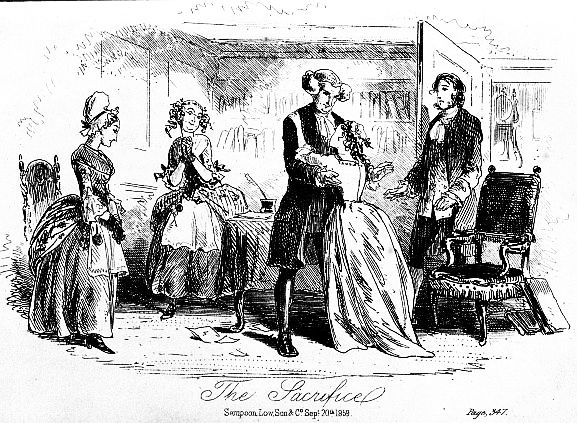
We suppose the heroine of a novel, among other privileges
and immunities, has a prescriptive right to her own private
boudoir, where, as a French writer has it, ‘she appears like
a lovely picture in its frame.’
Well, our little Mary is not without this luxury, and to its
sacred precincts we will give you this morning a ticket of admission.
Know, then, that the garret of this gambrel-roofed
cottage had a projecting window on the seaward side, which
opened into an immensely large old apple-tree, and was a
look-out as leafy and secluded as a robin’s nest.
Garrets are delicious places, in any case, for people of
thoughtful, imaginative temperament. Who has not loved
a garret in the twilight days of childhood, with its endless
stores of quaint, cast-off, suggestive antiquity,—old worm-eaten
chests,—rickety chairs,—boxes and casks full of old
comminglings, out of which, with tiny, childish hands, we
fished wonderful hoards of fairy treasure? What peep-holes,
and hiding-places, and undiscoverable retreats we made to
ourselves,—where we sat rejoicing in our security, and
bidding defiance to the vague, distant cry which summoned
us to school, or to some unsavoury every-day task! How deliciously
the rain came pattering on the roof over head, or the
red twilight streamed in at the window, while we sat snugly
ensconced over the delicious pages of some romance, which
careful aunts had packed away at the bottom of all things, to
be sure we should never read it! If you have anything, beloved
friends, which you wish your Charlie or your Susie to
be sure and read, pack it mysteriously away at the bottom of
a trunk of stimulating rubbish, in the darkest corner of your
garret;—in that case, if the book be at all readable, one that
by any possible chance can make its way into a young mind,
you may be sure that it will not only be read, but remembered
to the longest day they have to live.
Mrs. Katy Scudder’s garret was not an exception to the
general rule. Those quaint little people who touch with so
airy a grace all the lights and shadows of great beams, bare
rafters, and unplastered walls, had not failed in their work
there. Was there not there a grand easy-chair of stamped-leather,
minus two of its hinder legs, which had genealogical
associations through the Wilcoxes with the Vernons, and
through the Vernons quite across the water with Old England?
and was there not a dusky picture, in an old tarnished frame,
of a woman of whose tragic end strange stories were whispered,—one
of the sufferers in the time when witches were unceremoniously
helped out of the world, instead of being, as now-a-days,
helped to make their fortune in it by table-turning?
Yes, there were all these things, and many more which we
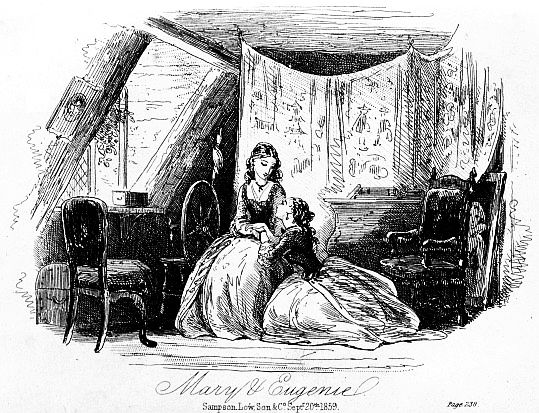
will not stay to recount, but bring you to the boudoir which
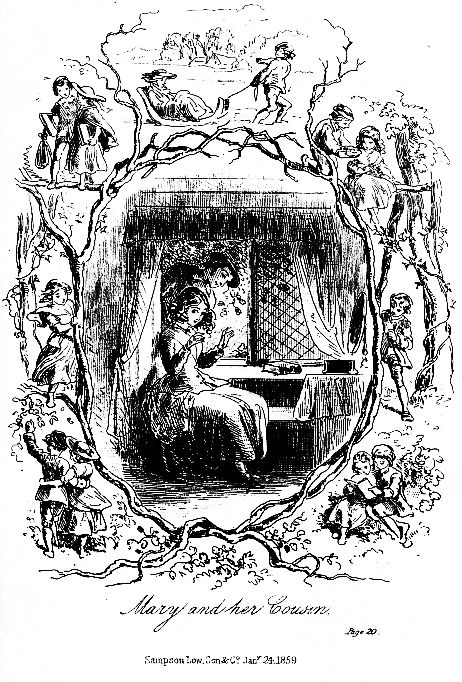
Mary has constructed for herself around the dormer-window
which looks into the whispering old apple-tree.
The enclosure was formed by blankets and bed-spreads,
which, by reason of their antiquity, had been pensioned off to
an undisturbed old age in the garret,—not common blankets or
bed-spreads, either,—bought, as you buy yours, out of a shop,—spun
or woven by machinery,—without individuality or
history. Every one of these curtains had its story. The one
on the right, nearest the window, and already falling into
holes, is a Chinese linen, and even now displays unfaded,
quaint patterns of sleepy-looking Chinamen, in conical hats,
standing on the leaves of most singular herbage, and with
hands for ever raised in act to strike bells, which never are
struck and never will be till the end of time. These, Mrs.
Katy Scudder had often instructed Mary, were brought from
the Indies by her great-great-grandfather, and were her grandmother’s
wedding-curtains,—the grandmother who had blue
eyes like hers, and was just about her height.
The next spread was spun and woven by Mrs. Katy’s beloved
Aunt Eunice,—a mythical personage, of whom Mary gathered
vague accounts that she was disappointed in love, and that
this very article was part of a bridal outfit, prepared in vain,
against the return of one from sea, who never came back,—and
she heard of how she sat wearily and patiently at her
work, this poor Aunt Eunice, month after month, starting
every time she heard the gate shut, every time she heard the
tramp of a horse’s hoof, every time she heard the news of a
sail in sight,—her colour, meanwhile, fading and fading as
life and hope bled away at an inward wound,—till at last she
found comfort and reunion beyond the veil.
Next to this was a bed-quilt pieced in tiny blocks, none of
them bigger than a sixpence, containing, as Mrs. Katy said,
pieces of the gowns of all her grandmothers, aunts, cousins,
and female relatives for years back,—and mated to it was one
of the blankets which had served Mrs. Scudder’s uncle in his
bivouac at Valley Forge, when the American soldiers went on
the snows with bleeding feet, and had scarce anything for
daily bread except a morning message of patriotism and hope
from George Washington.
Such were the memories woven into the tapestry of our
little boudoir. Within, fronting the window, stands the large
spinning-wheel, one end adorned with a snowy pile of fleecy
rolls,—and beside it, a reel and a basket of skeins of yarn,—and
open, with its face down on the beam of the wheel, lay
always a book, with which the intervals of work were beguiled.
The dusky picture of which we have spoken hung against
the rough wall in one place, and in another appeared an old
engraved head of one of the Madonnas of Leonardo da Vinci,
a picture which to Mary had a mysterious interest, from the
fact of its having been cast on shore after a furious storm, and
found like a waif lying in the sea-weed; and Mrs. Marvyn,
who had deciphered the signature, had not ceased exploring
till she found for her, in an Encyclopædia, a life of that wonderful
man, whose greatness enlarges our ideas of what is possible
to humanity,—and Mary, pondering thereon, felt the
sea-worn picture as a constant vague inspiration.
Here our heroine spun for hours, and hours with intervals,
when, crouched on a low seat in the window, she pored over
her book, and then, returning again to her work, thought of
what she had read to the lulling burr of the sounding wheel.
By chance a robin had built its nest so that from her retreat
she could see the five little blue eggs whenever the patient
brooding mother left them for a moment uncovered. And
sometimes, as she sat in dreamy reverie, resting her small,
round arms on the window-sill, she fancied that the little
feathered watcher gave her familiar nods and winks of a confidential
nature,—cocking the small head first to one side and
then to the other, to get a better view of her gentle human
neighbour.
I dare say it seems to you, reader, that we have travelled,
in our story, over a long space of time, because we have talked
so much, and introduced so many personages and reflections;
but, in fact, it is only Wednesday week since James sailed,
and the eggs which were brooded when he went are still unhatched
in the nest, and the apple-tree has changed only in
having now a majority of white blossoms over the pink buds.
This one week has been a critical one to our Mary: in it
she has made the great discovery that she loves; and she has
made her first step into the gay world; and now she comes
back to her retirement to think the whole over by herself. It
seems a dream to her, that she who sits there now reeling yarn
in her stuff petticoat and white short-gown is the same who
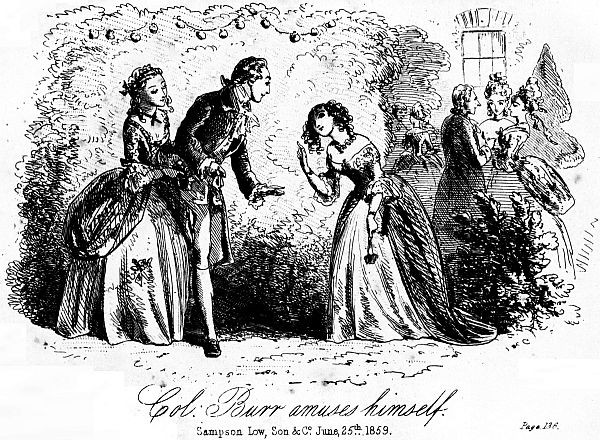
took the arm of Colonel Burr amid the blaze of wax-lights,
and the sweep of silks and rustle of plumes. She wonders
dreamily as she remembers the dark, lovely face of the foreign
madame, so brilliant under its powdered hair and flashing
gems,—the sweet, foreign accents of the voice,—the tiny,
jewelled fan, with its glancing pictures and sparkling tassels,
whence exhaled vague and floating perfumes; then she hears
again that manly voice, softened to tones so seductive, and
sees those fine eyes with the tears in them, and wonders
within herself that he could have kissed her hand with such
veneration, as if she had been a throned queen.
But here the sound of busy, pattering footsteps is heard on
the old, creaking staircase, and soon the bows of Miss Prissy’s
bonnet part the folds of the boudoir drapery, and her merry,
May-day face looks in.
‘Well, really, Mary, how do you do, to be sure? You
wonder to see me, don’t you? but I thought I must just run in
a minute on my way up to Miss Marvyn’s. I promised her at
least a half a day, though I didn’t see how I was to spare it,—for
I tell Miss Wilcox I just run and run till it does seem as
if my feet would drop off; but I thought I must just step in
to say, that I, for my part, do admire the Doctor more than
ever, and I was telling your mother we mus’n’t mind too
much what people say. I ’most made Miss Wilcox angry,
standing up for him; but I put it right to her, and says I,
“Miss Wilcox, you know folks must speak what’s on their
mind,—in particular ministers must; and you know, Miss
Wilcox,” I says, “that the Doctor is a good man, and lives
up to his teaching, if anybody in this world does, and gives
away every dollar he can lay hands on to those poor
negroes, and works over ’em and teaches ’em as if they were
his brothers;” and says I, “Miss Wilcox, you know I don’t
spare myself, night nor day, trying to please you and do your
work to give satisfaction; but when it comes to my conscience,”
says I, “Miss Wilcox, you know I always must
speak out, and if it was the last word I had to say on my
dying bed, I’d say that I think the Doctor is right.” Why!
what things he told about the slave-ships, and packing those
poor creatures so that they couldn’t move nor breathe!—why,
I declare, every time I turned over and stretched in bed, I
thought of it; and says I, “Miss Wilcox, I do believe that the
judgments of God will come down on us, if something a’n’t
done, and I shall always stand by the Doctor,” says I;—and if
you’ll believe me, just then I turned round and saw the
General; and the General, he just haw-hawed right out, and
says he, “Good for you, Miss Prissy! that’s real grit,” says
he, “and I like you better for it.”’—‘Laws,’ added Miss
Prissy, reflectively, ‘I sha’n’t lose by it, for Miss Wilcox
knows she never can get anybody to do the work for her that
I will.’
‘Do you think,’ said Mary, ‘that there are a great many
made angry?’
‘Why, bless your heart, child, haven’t you heard? Why,
there never was such a talk in all Newport. Why, you know
Mr. Simeon Brown is gone clear off to Doctor Stiles; and
Miss Brown, I was making up her plum-coloured satin
a’ Monday, and you ought to ’a’ heard her talk. But, I tell you,
I fought her. She used to talk to me,’ said Miss Prissy, sinking
her voice to a mysterious whisper, ‘’cause I never could
come to it to say that I was willin’ to be lost, if it was for the
glory of God; and she always told me folks could just bring
their minds right up to anything they knew they must; and I
just got the tables turned on her, for they talked and abused
the Doctor till they fairly wore me out, and says I, “Well,
Miss Brown, I’ll give in, that you and Mr. Brown do act up to
your principles; you certainly act as if you were willing to be
damned;”—and so do all those folks who will live on the blood
and groans of the poor Africans, as the Doctor said; and I
should think, by the way Newport people are making their
money, that they were all pretty willing to go that way,
though, whether it’s for the glory of God, or not, I’m doubting.
But you see, Mary,’ said Miss Prissy, sinking her voice
again to a solemn whisper, ‘I never was clear on that point;
it always did seem to me a dreadful high place to come to,
and it didn’t seem to be given to me; but I thought, perhaps,
if it was necessary, it would be given, you know,—for the
Lord always has been so good to me that I’ve faith to believe
that, and so I just say, “The Lord is my shepherd, I shall not
want;”’—and Miss Prissy hastily whisked a little drop out of
her blue eye with her handkerchief.
At this moment Mrs. Scudder came into the boudoir with a
face expressive of some anxiety.
‘I suppose Miss Prissy has told you,’ she said, ‘the news
about the Browns. That’ll make a great falling off in the
Doctor’s salary; and I feel for him, because I know it will
come hard to him not to be able to help and do, especially for
these poor negroes, just when he will. But then we must put
everything on the most economical scale we can, and just try,
all of us, to make it up to him. I was speaking to Cousin
Zebedee about it, when he was down here, on Monday, and
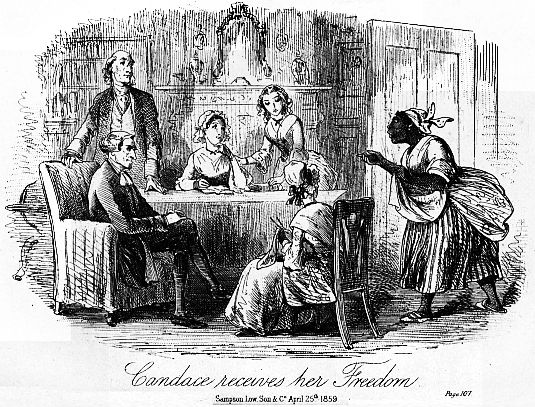
he is all clear;—he has made out three papers for Candace and
Cato and Dinah, and they couldn’t, one of ’em, be hired to
leave him; and he says, from what he’s seen already, he has
no doubt but they’ll do enough more to pay for their wages.’
‘Well,’ said Miss Prissy, ‘I haven’t got anybody to care
for but myself. I was telling sister Elizabeth, one time (she’s
married and got four children), that I could take a storm a
good deal easier than she could, ’cause I hadn’t near so many
sails to pull down; and now, you just look to me for the
Doctor’s shirts, ’cause, after this, they shall all come in ready
to put on, if I have to sit up till morning. And I hope, Miss
Scudder, you can trust me to make them; for if I do say it myself,
I a’n’t afraid to do fine stitching ’longside of anybody,—and
hemstitching ruffles, too; and I haven’t shown you yet
that French stitch I learned of the nuns;—but you just set
your heart at rest about the Doctor’s shirts. I always thought,’
continued Miss Prissy, laughing, ‘that I should have made a
famous hand about getting up that tabernacle in the wilderness,
with the blue and the purple and fine-twined linen; it’s one
of my favourite passages, that is;—different things, you know,
are useful to different people.’
‘Well,’ said Mrs. Scudder, ‘I see that it’s our call to be
a remnant small and despised, but I hope we sha’n’t shrink
from it. I thought, when I saw all those fashionable people
go out Sunday, tossing their heads and looking so scornful,
that I hoped grace would be given me to be faithful.’
‘And what does the Doctor say?’ said Miss Prissy.
‘He hasn’t said a word; his mind seems to be very much
lifted above all these things.’
‘La, yes,’ said Miss Prissy, ‘that’s one comfort; he’ll never
know where his shirts come from; and besides that, Miss
Scudder,’ she said, sinking her voice to a whisper, ‘as you
know, I haven’t any children to provide for,—though I was
telling Elizabeth t’other day, when I was making up frocks
for her children, that I believed old maids, first and last, did
more providing for children than married women: but still I
do contrive to slip away a pound-note, now and then, in my
little old silver teapot that was given to me when they settled
old Mrs. Simpson’s property (I nursed her all through her
last sickness, and laid her out with my own hands), and, as I
was saying, if ever the Doctor should want money, you just let
me know.’
‘Thank you, Miss Prissy,’ said Mrs. Scudder; ‘we all know
where your heart is.’
‘And now,’ added Miss Prissy, ‘what do you suppose they
say? Why, they say Colonel Burr is struck dead in love
with our Mary; and you know his wife’s dead, and he’s a
widower; and they do say that he’ll get to be the next President.
Sakes alive! Well, Mary must be careful, if she don’t
want to be carried off; for they do say that there can’t any
woman resist him, that sees enough of him. Why, there’s
that poor Frenchwoman, Madame —— what do you call her,
that’s staying with the Vernons?—they say she’s over head
and ears in love with him.’
‘But she’s a married woman,’ said Mary; ‘it can’t be
possible!’
Mrs. Scudder looked reprovingly at Miss Prissy, and for a
few moments there was great shaking of heads and a whispered
conference between the two ladies, ending in Miss
Prissy’s going off, saying, as she went down stairs,—
‘Well, if women will do so, I, for my part, can’t blame the
men.’
In a few moments Miss Prissy rushed back as much discomposed
as a clucking hen who has seen a hawk.
‘Well, Miss Scudder, what do you think? Here’s Colonel
Burr come to call on the ladies!’
Mrs. Scudder’s first movement, in common with all middle-aged
gentlewomen, was to put her hand to her head and
reflect that she had not on her best cap; and Mary looked
down at her dimpled hands, which were blue from the contact
with mixed yarn she had just been spinning.
‘Now, I’ll tell you what,’ said Miss Prissy,—‘wasn’t it
lucky you had me here? for I first saw him coming in at the
gate, and I whipped in quick as a wink and opened the best
room window-shutters, and then I was back at the door, and
he bowed to me as if I’d been a queen, and says he, “Miss
Prissy, how fresh you’re looking this morning!” You see, I
was in working at the Vernons’, but I never thought as he’d
noticed me. And then he inquired in the handsomest way
for the ladies and the Doctor, and so I took him into the
parlour and settled him down, and then I ran into the study,
and you may depend upon it I flew round lively for a few
minutes. I got the Doctor’s study-gown off, and got his best
coat on, and put on his wig for him, and started him up
kinder lively,—you know it takes me to get him down into
this world,—and so there he’s in talking with him; and
so you can just slip down and dress yourselves,—easy
as not.’
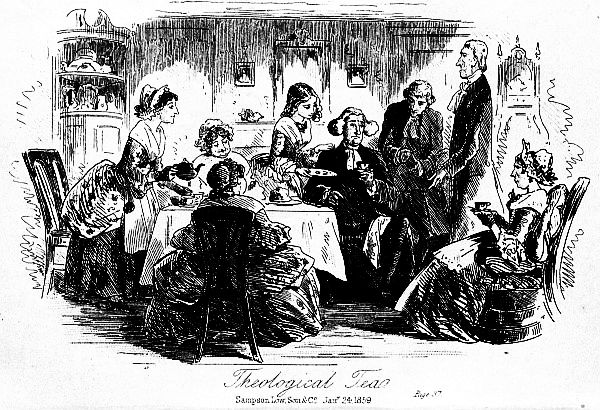
Meanwhile Colonel Burr was entertaining the simple-minded
Doctor with all the grace of a young neophyte come
to sit at the feet of superior truth. There are some people
who receive from Nature as a gift a sort of graceful facility of
sympathy by which they incline to take on, for the time
being, the sentiments and opinions of those with whom they
converse, as the chameleon was fabled to change its hue with
every surrounding. Such are often supposed to be wilfully
acting a part, as exerting themselves to flatter and deceive,
when in fact they are only framed so sensitive to the sphere
of mental emanation which surrounds others that it would
require an exertion not in some measure to harmonize with
it. In approaching others in conversation, they are like a
musician who joins a performer on an instrument,—it is impossible
for them to strike a discord; their very nature urges
them to bring into play faculties according in vibration with
those which another is exerting. It was as natural as possible
for Burr to commence talking with the Doctor on scenes and
incidents in the family of President Edwards, and his old
tutor, Dr. Bellamy,—and thence to glide on to the points of
difference and agreement in theology, with a suavity and
deference which acted on the good man like a June sun on a
budding elm-tree. The Doctor was soon wide awake, talking
with fervent animation on the topic of disinterested benevolence,—Burr
the meanwhile studying him with the quiet
interest of an observer of natural history, who sees a new
species developing before him. At all the best possible
points he interposed suggestive questions, and set up objections
in the quietest manner for the Doctor to knock down,
smiling ever the while as a man may who truly and genuinely
does not care a sou for truth on any subject not practically
connected with his own schemes in life. He therefore gently
guided the Doctor to sail down the stream of his own
thoughts till his bark glided out into the smooth waters of the
Millennium, on which, with great simplicity, he gave his
views at length.
It was just in the midst of this that Mary and her mother
entered. Burr interrupted the conversation to pay them the
compliments of the morning,—to inquire for their health, and
hope they suffered no inconvenience from their night ride
from the party; then, seeing the Doctor still looking eager to
go on, he contrived with gentle dexterity to tie again the
broken thread of conversation.
‘Our excellent friend,’ he said, ‘was explaining to me his
views of a future Millennium. I assure you, ladies, that we
sometimes find ourselves in company which enables us to
believe in the perfectibility of the human species. We see
family retreats, so unaffected, so charming in their simplicity,
where industry and piety so go hand in hand!
One has only to suppose all families such, to imagine a
Millennium!’
There was no disclaiming this compliment, because so delicately
worded, that, while perfectly clear to the internal
sense, it was, in a manner, veiled and unspoken.
Meanwhile, the Doctor, who sat ready to begin where he
left off, turned to his complaisant listener and resumed an
exposition of the Apocalypse.
‘To my mind, it is certain,’ he said, ‘as it is now three
hundred years since the fifth vial was poured out, there is
good reason to suppose that the sixth vial began to be poured
out at the beginning of the last century, and has been
running for a hundred years or more, so that it is run nearly
out; the seventh and last vial will begin to run early in the
next century.’
‘You anticipate, then, no rest for the world for some time
to come?’ said Burr.
‘Certainly not,’ said the Doctor, definitively; ‘there will
be no rest from overturnings till He whose right it is shall
come.’
‘The passage,’ he added, ‘concerning the drying up of the
river Euphrates, under the sixth vial, has a distinct reference,
I think, to the account in ancient writers of the taking of
Babylon, and prefigures, in like manner, that the resources
of that modern Babylon, the Popish power, shall continue
to be drained off, as they have now been drying up for a
century or more, till, at last, there will come a sudden and
final downfall of that power. And after that will come the
first triumphs of truth and righteousness,—the marriage-supper
of the Lamb.’
‘These investigations must undoubtedly possess a deep
interest for you, sir,’ said Burr; ‘the hope of a future as well
as the tradition of a past age of gold seems to have been one
of the most cherished conceptions of the human breast.’
‘In those times,’ continued the Doctor, ‘the whole earth
will be of one language.’
‘Which language, sir, do you suppose will be considered
worthy of such pre-eminence?’ inquired his listener.
‘That will probably be decided by an amicable conference
of all nations,’ said the Doctor; ‘and the one universally
considered most valuable will be adopted; and the literature
of all other nations being translated into it, they will
gradually drop all other tongues. Brother Stiles thinks it
will be the Hebrew. I am not clear on that point. The
Hebrew seems to me too inflexible, and not sufficiently copious.
I do not think,’ he added, after some consideration, ‘that it
will be the Hebrew tongue.’
‘I am most happy to hear it, sir,’ said Burr, gravely; ‘I
never felt much attracted to that language. But, ladies,’ he
added, starting up with animation, ‘I must improve this fine
weather to ask you to show me the view of the sea from this
little hill beyond your house, it is evidently so fine;—I trust
I am not intruding too far on your morning?’
‘By no means, sir,’ said Mrs. Scudder, rising; ‘we will go
with you in a moment.’
And soon Colonel Burr, with one on either arm, was to be
seen on the top of the hill beyond the house,—the very one
from which Mary, the week before, had seen the retreating
sail we all wot of. Hence, though her companion contrived,
with the adroitness of a practised man of gallantry, to direct
his words and looks as constantly to her as if they had
been in a tête-à-tête, and although nothing could be more
graceful, more delicately flattering, more engaging, still
the little heart kept equal poise; for where a true love has
once bolted the door, a false one serenades in vain under the
window.
Some fine, instinctive perceptions of the real character of
the man beside her seemed to have dawned on Mary’s mind
in the conversation of the morning;—she had felt the covert
and subtile irony that lurked beneath his polished smile, felt
the utter want of faith or sympathy in what she and her
revered friend deemed holiest, and therefore there was a
calm dignity in her manner of receiving his attentions which
rather piqued and stimulated his curiosity. He had been
wont to boast that he could subdue any woman, if he could
only see enough of her: in the first interview in the garden,
he had made her colour come and go, and brought tears to her
eyes in a manner that interested his fancy, and he could not
resist the impulse to experiment again. It was a new sensation
to him, to find himself quietly studied and calmly
measured by those thoughtful blue eyes; he felt, with his
fine instinctive tact, that the soul within was enfolded in
some crystalline sphere of protection, transparent, but adamantine,
so that he could not touch it. What was that
secret poise, that calm, immutable centre on which she rested,
that made her, in her rustic simplicity, so unapproachable and
so strong?
Burr remembered once finding in his grandfather’s study,
among a mass of old letters, one in which that great man, in
early youth, described his future wife, then known to him
only by distant report. With his keen natural sense of
everything fine and poetic, he had been struck with this
passage, as so beautifully expressing an ideal womanhood,
that he had in his earlier days copied it in his private
recueil.
‘They say,’ it ran, ‘that there is a young lady who is beloved
of that Great Being who made and rules the world, and
that there are certain seasons in which this Great Being, in
some way or other invisible, comes to her and fills her mind
with such exceeding sweet delight, that she hardly cares for
anything except to meditate on Him; that she expects, after a
while, to be received up where He is, to be raised up out of
the world and caught up into heaven, being assured that He
loves her too well to let her remain at a distance from Him
always. Therefore, if you present all the world before her,
with the richest of its treasures, she disregards it. She has a
strange sweetness in her mind, and singular purity in her
affections; and you could not persuade her to do anything
wrong or sinful, if you should give her all the world. She is
of a wonderful sweetness, calmness, and universal benevolence
of mind, especially after this great God has manifested Himself
to her mind. She will sometimes go from place to place
singing sweetly, and seems to be always full of joy and pleasure;
and no one knows for what. She loves to be alone,
walking in fields and groves, and seems to have some invisible
one always conversing with her.’
A shadowy recollection of this description crossed his mind
more than once, as he looked into those calm and candid eyes.
Was there, then, a truth in that inner union of chosen souls
with God, of which his mother and her mother before her had
borne meek witness,—their souls shining out as sacred lamps
through the alabaster walls of a temple?
But then, again, had he not logically met and demonstrated,
to his own satisfaction, the nullity of the religious dogmas on
which New England faith was based? There could be no
such inner life, he said to himself,—he had demonstrated it as
an absurdity. What was it, then,—this charm, so subtile and
so strong, by which this fair child, his inferior in age, cultivation,
and knowledge of the world, held him in a certain awe,
and made him feel her spirit so unapproachable? His curiosity
was piqued. He felt stimulated to employ all his powers
of pleasing. He was determined that, sooner or later, she
should feel his power.
With Mrs. Scudder his success was immediate: she was
completely won over by the deferential manner with which
he constantly referred himself to her matronly judgments;
and, on returning to the house, she warmly pressed him to
stay to dinner.
Burr accepted the invitation with a frank and almost boyish
abandon, declaring that he had not seen anything for years
that so reminded him of old times. He praised everything at
table,—the smoking brown bread, the baked beans steaming
from the oven, where they had been quietly simmering during
the morning walk, and the Indian pudding, with its gelatinous
softness, matured by long and patient brooding in the motherly
old oven. He declared that there was no style of living to be
compared with the simple, dignified order of a true New
England home, where servants were excluded, and everything
came direct from the polished and cultured hand of a lady. It
realized the dreams of Arcadian romance. A man, he declared,
must be unworthy the name, who did not rise to lofty sentiments
and heroic deeds, when even his animal wants were provided
for by the ministrations of the most delicate and exalted
portion of the creation.
After dinner he would be taken into all the family interests.
Gentle and pliable as oil, he seemed to penetrate every joint
of the ménage by a subtile and seductive sympathy. He was
interested in the spinning, in the weaving,—and, in fact,
nobody knows how it was done, but before the afternoon
shadows had turned, he was sitting in the cracked arm-chair
of Mary’s garret-boudoir, gravely giving judgment on several
specimens of her spinning, which Mrs. Scudder had presented
to his notice.
With that ease with which he could at will glide into the
character of the superior and elder brother, he had, without
seeming to ask questions, drawn from Mary an account of her
reading, her studies, her acquaintances.
‘You read French, I presume?’ he said to her, with easy
negligence.
Mary coloured deeply, and then, as one who recollects one’s
self, answered, gravely,—
‘No, Mr. Burr, I know no language but my own.’
‘But you should learn French, my child,’ said Burr, with
that gentle dictatorship which he could at times so gracefully
assume.
‘I should be delighted to learn,’ said Mary, ‘but have no
opportunity.’
‘Yes,’ said Mrs. Scudder, ‘Mary has always had a taste for
study, and would be glad to improve in any way.’
‘Pardon me, madam, if I take the liberty of making a suggestion.
There is a most excellent man, the Abbé Léfon, now
in Newport, driven here by the political disturbances in
France; he is anxious to obtain a few scholars, and I am interested
that he should succeed, for he is a most worthy man.’
‘Is he a Roman Catholic?’
‘He is, madam; but there could be no manner of danger
with a person so admirably instructed as your daughter. If
you please to see him, madam, I will call with him some time.’
‘Mrs. Marvyn will, perhaps, join me,’ said Mary. ‘She has
been studying French by herself for some time, in order to read
a treatise on astronomy, which she found in that language. I
will go over to-morrow and see her about it.’
Before Colonel Burr departed, the doctor requested him to
step a moment with him into his study. Burr, who had had frequent
occasions during his life to experience the sort of paternal
freedom which the clergy of his country took with him in
right of his clerical descent, began to summon together his
faculties of address for the avoidance of a kind of conversation
which he was not disposed to meet. He was agreeably disappointed,
however, when, taking a paper from the table, and
presenting it to him, the Doctor said,—
‘I feel myself, my dear sir, under a burden of obligation for
benefits received from your family, so that I never see a member
of it without casting about in my own mind how I may
in some measure express my good-will towards him. You are
aware that the papers of your distinguished grandfather have
fallen into my hands, and from them I have taken the liberty
to make a copy of those maxims by which he guided a life
which was a blessing to his country and to the world. May
I ask the favour that you will read them with attention? and
if you find anything contrary to right reason or sober sense, I
shall be happy to hear of it on a future occasion.’
‘Thank you, Doctor,’ said Burr, bowing, ‘I shall always
be sensible of the kindness of the motive which has led you to
take this trouble on my account. Believe me, sir, I am truly
obliged to you for it.’
And thus the interview terminated.
That night, the Doctor, before retiring, offered fervent
prayers for the grandson of his revered master and friend,
praying that his father’s and mother’s God might bless him
and make him a living stone in the Eternal Temple.
Meanwhile, the object of these prayers was sitting by a
table in dressing-gown and slippers, thinking over the events
of the day. The paper which Dr. H. had handed him contained
the celebrated ‘Resolutions’ by which his ancestor led
a life nobler than any mere dogmas can possibly be. By its
side lay a perfumed note from Madame de Frontignac,—one of
those womanly notes, so beautiful, so sacred in themselves,
but so mournful to a right-minded person who sees whither
they are tending. Burr opened and perused it,—laid it by,—opened
the document which the Doctor had given, and thoughtfully
read the first of the ‘Resolutions’:—
‘Resolved, That I will do whatsoever I think to be most to
God’s glory, and my own good profit and pleasure in the whole
of my duration, without any consideration of time, whether now
or never so many myriad ages hence.
‘Resolved, To do whatever I think to be my duty and most
for the good and advantage of mankind in general.
‘Resolved, To do this, whatsoever difficulties I meet with,
and how many and how great soever.’
Burr read the whole paper through attentively once or
twice, and paused thoughtfully over many parts of it. He
sat for some time after, lost in reflection; the paper dropped
from his hand, and then followed one of those long, deep
seasons of fixed reverie, when the soul thinks by pictures and
goes over endless distances in moments. In him, originally,
every moral faculty and sensibility was as keenly strung as in
any member of that remarkable family from which he was
descended, and which has, whether in good or ill, borne no
common stamp. Two possible lives flashed before his mind at
that moment, rapidly as when a train sweeps by with flashing
lamps in the night. The life of worldly expediency, the
life of eternal rectitude,—the life of seventy years, and that
life eternal in which the event of death is no disturbance.
Suddenly he roused himself up, picked up the paper, filed and
dated it carefully, and laid it by; and in that moment was
renewed again that governing purpose which sealed him, with
all his beautiful capabilities, as the slave of the fleeting and
the temporary, which sent him, at last, a shipwrecked man, to
a nameless, dishonoured grave.
He took his pen and gave to a friend his own views of the
events of the day.
‘My dear ——,
‘We are still in Newport, conjugating the verb
s’ennuyer, which I, for one, have put through all the moods
and tenses. Pour passer le temps, however, I have la belle
Française and my sweet little Puritan. I visited there this
morning. She lives with her mother, a little walk out toward
the sea-side in a cottage quite prettily sequestered among blossoming
apple-trees, and the great hierarch of modern theology,
Dr. H., keeps guard over them. No chance here for any indiscretions,
you see.
‘By-the-by, the good Doctor astonished our monde here on
Sunday last, by treating us to a solemn onslaught on slavery
and the slave-trade. He had all the chief captains and counsellors
to hear him, and smote them hip and thigh, and pursued
them even unto Shur.
‘He is one of those great, honest fellows, without the
smallest notion of the world we live in, who think, in dealing
with men, that you must go to work and prove the right and
wrong of a matter; just as if anybody cared for that! Supposing
he is right,—which appears very probable to me,—what
is he going to do about it? No moral argument, since
the world began, ever prevailed over twenty-five per cent. profit.
‘However, he is the spiritual director of la belle Puritaine, and
was a resident in my grandfather’s family, so I did the agreeable
with him as well as such an uncircumcised Ishmaelite could.
I discoursed theology,—sat with the most docile air possible
while he explained to me all the ins and outs in his system of
the universe, past, present, and future,—heard him dilate calmly
on the Millennium, and expound prophetic symbols, marching
out before me his whole apocalyptic menagerie of beasts
and dragons with heads and horns innumerable, to all which I
gave edifying attention, taking occasion now and then to turn
a compliment in favour of the ladies,—never lost, you know.
‘Really, he is a worthy old soul, and actually believes all these
things with his whole heart, attaching unheard-of importance
to the most abstract ideas, and embarking his whole being in
his ideal view of a grand Millennial finale to the human race.
I look at him and at myself, and ask, Can human beings be
made so unlike?
‘My little Mary to-day was in a mood of “sweet austere
composure” quite becoming to her style of beauty; her naïve
nonchalance at times is rather stimulating. What a contrast
between her and la belle Française!—all the difference that
there is between a diamond and a flower. I find the little
thing has a cultivated mind, enriched by reading, and more
by a still, quaint habit of thinking, which is new and charming.
But a truce to this.
‘I have seen our friends at last. We have had three or
four meetings, and are waiting to hear from Philadelphia,—matters
are getting in train. If Messrs. T. and S. dare to
repeat what they said again, let me know; they will find in
me a man not to be trifled with. I shall be with you in a
week or ten days at farthest. Meanwhile, stand to your guns.
‘Ever yours,
‘Burr.’