I was as sane that night as I had ever been in my life. I am quite sure
of this, though I had had a merry time enough earlier in the evening
with my friends in the old pavilion (that time-honored retreat of my
ancestors), whose desolation I had thought to dissipate with a little
harmless revelry. Wine does not disturb my reason—the little wine I
drank under that unwholesome roof—nor am I a man given to sudden
excitements or untoward impulses.
Yet this thing happened to me.
It was after leaving the pavilion. My companions had all ridden away and
I was standing on the lawn beyond my library windows, recalling my
pleasure with them and gazing somewhat idly, I own, at that bare portion
of the old wall where the tree fell a year ago (the place where the moon
strikes with such a glitter when it rides high, as it did that night),
when—believe it or not, it is all one to me—I became conscious of a
sudden mental dread, inexplicable and alarming, which, seizing me after
an hour of unmixed pleasure and gaiety, took such a firm grip upon my
imagination that I fain would have turned my back upon the night and its
influences, only my eyes would not leave that open space of wall where I
now saw pass—not the shadow, but the veritable body of a large, black,
hungry-looking dog, which, while I looked, turned into the open gateway
connecting with the pavilion and disappeared.
With it went the oppression which held me spell-bound. The ice melted
from my blood; I could move my limbs, and again control my thoughts and
exercise my will.
Forcing a laugh, I whistled to that dog. The lights with which the
banquet had been illuminated were out, and every servant had left the
place; but the tables had not been entirely cleared, and I could well
understand what had drawn this strange animal thither. I whistled then,
and whistled peremptorily; but no dog answered my call. Angry, for the
rules are strict at my stables in regard to wandering brutes, I strode
toward the pavilion. Entering the great gap in the wall where a gate had
once hung, I surveyed the dismal interior before me, with feelings I
could not but consider odd in a strong man like myself. Though the wine
was scarcely dry in the glass which an hour before I had raised in this
very spot amid cheers and laughter, I found it a difficult matter to
reënter there now, in the dead of night, alone and without light.
For this building, harmless as it had always seemed, had been, in a way,
cursed. For no reason that he ever gave, my father had doomed this
ancient adjunct to our home to perpetual solitude and decay. By his will
he had forbidden it to be destroyed—a wish respected by my guardians
and afterward by myself—and though there was nothing to hinder its
being cared for and in a manner used, the dismal influence which had
pervaded the place ever since his death had, under the sensations I have
mentioned, deepened into horror and an unspeakable repugnance.
Yet never having had any reason to believe myself a coward, I took
boldly enough the few steps necessary to carry me inside its dismal
precincts; and meeting with nothing but darkness and silence, began to
whistle again for the dog I had certainly seen enter here.
But no dog appeared.
Hastening out, I took my way toward the stables. As I did so I glanced
back, and again my eyes fell on that place in the wall gleaming white in
the moonlight. Again I felt the chill, the horror! Again my eyes
remained glued to this one spot; and again I beheld the passing of that
dog, running with jaws extended and head held low—fearsome, uncanny,
supernaturally horrible; a thing to flee from, if one could only flee
instead of standing stock-still on the sward, gazing with eyes that
seemed starting from their sockets till it had plunged through that gap
in the wall and again disappeared.
The occult and the imaginary have never appealed to me, and the moment I
felt myself a man again, I hurried on to the stables to call up my man
Jared.
But half-way there I paused, struck by an odd remembrance. This father
of mine, Philo Ocumpaugh, had died, or so his old servants had said,
under peculiar circumstances. I had forgotten them till now—such
stories make poor headway with me—but if I was not mistaken, the facts
were these:
He had been ailing long, and his nurses had got used to the sight of his
gaunt, white figure sitting propped up, but speechless, in the great bed
opposite the stretch of blank wall in the corner bedroom, where a
picture of his first wife, the wife of his youth, had once hung, but
which, for some years now, had been removed to where there were fewer
shadows and more sunlight. He had never been a talkative man, and in all
the five years of my own memory of him, I had never heard him raise his
voice except in command, or when the duties of hospitality required it.
Now, with the shadow of death upon him, he was absolutely speechless,
and his nurses were obliged to guess at his wishes by the movement of
his hands or the direction of his eyes. Yet he was not morose, and
sometimes was seen to struggle with the guards holding his tongue, as
though he would fain have loosed himself from their inexorable control.
Yet he never succeeded in doing so, and the nurses sat by and saw no
difference in him, till suddenly the candle, posed on a table near by,
flickered and went out, leaving only moonlight in the room. It was
moonlight so brilliant that the place seemed brighter than before,
though the beams were all concentrated on one spot, a blank space in the
middle of the wall upon which those two dim orbs in the bed were fixed
in an expectancy none there understood, for none knew that the summons
had come, and that for him the angel of death was at that moment
standing in the room.
Yet as moonlight is not the natural light for a sick man's bedside, one
amongst them had risen for another candle, when something—I had never
stopped to hear them say what—made him pause and look back, when he saw
distinctly outlined upon the white wall-space I have mentioned, the
figure—the unimaginable figure of a dog, large, fierce and
hungry-looking, which dashed by and—was gone. Simultaneously a cry came
from the bed, the first words for months—"Aline!"—the name of his
girl-wife, dead and gone for years. All sprang; some to chase the dog,
one to aid and comfort the sick man. But no dog was there, nor did he
need comfort more. He had died with that cry on his lips, and as they
gazed at his face, sunk low now in his pillow as if he had started up
and fallen back, a dead weight, they felt the terror of the moment grow
upon them till they, too, were speechless. For the aged features were
drawn into lines of unspeakable anguish and horror.
But as the night passed and morning came, all these lines smoothed out,
and when they buried him, those who had known him well talked of the
beautiful serenity which illumined the face which, since their first
remembrance of him, had carried the secret of a profound and unbroken
melancholy. Of the dog, nothing was said, even in whispers, till time
had hallowed that grave, and the little children about, grown to be men
and women. Then the garrulity of age had its way.
This story, and the images it called up, came like a shock as I halted
there, and instead of going on to the stables, I turned my steps toward
the house, where I summoned from his bed a certain old servant who had
lived longer in the family than myself.
Bidding him bring a lantern, I waited for him on the porch, and when he
came, I told him what I had seen. Instantly I knew that it was no new
story to him. He turned very pale and set down the lantern, which was
shaking very visibly in his hand.
"Did you look up?" he asked; "when you were in the pavilion, I mean?"
"No; why should I? The dog was on the ground. Besides—"
"Let us go down to the pavilion," he whispered. "I want to see for
myself if—if—"
"If what, Jared?"
He turned his eyes on me, but did not answer. Stooping, I lifted the
lantern and put it in his hand. He was quaking like a leaf, but there
was a determination in his face far beyond the ordinary. What made him
quake—he who knew of this dog only by hearsay—and what, in spite of
this fear, gave him such resolution? I followed in his wake to see what
it was.
The moon still shone clear upon the lawn, and it was with a certain
renewal of my former apprehensions that I approached the spot on the
wall where I had seen what I was satisfied not to see again. But though
I glanced that way—what man could have avoided it?—I perceived nothing
but the bare paint, and we went on and passed in without a word, Jared
leading the way.
But once on the threshold of the pavilion itself, it was for him to show
the coward. Turning, he made me a gesture; one I did not understand; and
seeing that I did not understand it, he said, after a fearful look
around:
"Do not mind the dog; that was but an appearance. Lift your eyes to the
ceiling—over there—at the extreme end toward the south—do you
see—what do you see?"
"Nothing," I replied, amazed at what struck me as utter folly.
"Nothing?" he repeated in a relieved voice, as he lifted up his lantern.
"Ah!" came in a sort of muttered shriek from his lips, as he pointed up,
here and there, along the farther ceiling, over which the light now
played freely and fully. "What is that spot, and that spot, and that?
They were not there to-day. I was in here before the banquet, and I
would have seen. What is it? Master, what is it? They call it—"
"Well, well, what do they call it?" I asked impatiently.
"Blood! Do you not see that it is blood? What else is red and shiny and
shows in such great drops—"
"Nonsense!" I vociferated, taking the lantern in my own hand. "Blood on
the ceiling of my old pavilion? Where could it come from? There was no
quarrel, no fight; only hilarity—"
"Where did the dog come from?" he whispered.
I dropped my arm, staring at him in mingled anger and a certain
half-understood sympathy.
"You think these stains—" I began.
"Are as unreal as the dog? Yes, master."
Feeling as if I were in a dream, I tossed up the lantern again. The
drops were still there, but no longer single or scattered. From side to
side, the ceiling at this one end of the building oozed with the thick
red moisture to which he had given so dreadful a name.
Stepping back for fear the stains would resolve themselves into rain and
drop upon my forehead, I stared at Jared, who had now retreated toward
the door.
"What makes you think it blood?" I demanded.
"Because some have smelt and tasted it. We have never talked about it,
but this is not an uncommon occurrence. To-morrow all these stains will
be gone. They come when the dog circles the wall. Whence, no one knows.
It is our mystery. All the old servants have heard of it more than once.
The new ones have never been told. Nor would I have told you if you had
not seen the dog. It was a matter of honor with us."
I looked at him, saw that he believed every word he said, threw another
glance at the ceiling, and led the way out. When we had reached the
house again, I said:
"You are acquainted with the tradition underlying these appearances, as
you call them. What is it?"
He could not tell me. He knew no more than he had already stated—gossip
and old wives' tales. But later, a certain manuscript came into my
possession through my lawyer, which I will append to this.
It was written by my unhappy father, some little time before his last
illness, and given into the charge of the legal representative of our
family, with the express injunction that its seal was to remain intact
if for twenty years the apparition which had haunted him did not present
itself to the eyes of any of his children. But if within that time his
experience should repeat itself in theirs, this document was to be
handed over to the occupant of Homewood. Nineteen out of the twenty
years had elapsed, without the dog being seen or the ceiling of the
pavilion dropping blood. But not the twentieth; hence, the document was
mine.
You can easily conceive with what feelings I opened it. It was headed
with this simple line:
I am cursed with an inability to speak when I am most deeply moved,
either by anger or tenderness. This misfortune has wrecked my life. On
the verge of old age, the sorrows and the mistakes of my early life fill
my thoughts so completely that I see but one face, hear but one voice;
yet when she was living—when she could see and hear, my tongue was
silent and she never knew. Aline! my Aline!
I married her when I was thirty-five and she eighteen. All the world
knows this; but what it does not know is that I loved her—toy,
plaything that she was—a body without a mind—(or, so I considered
her)—while she had but followed the wishes of her relatives in giving
her sweet youth to a cold and reticent man who might love, indeed, but
who had no power to tell that love, or even to show it in the ways which
women like, and which she liked, as I found out when it was too late.
I could not help but love her. It was ingrained within me; a part of the
curse of my life to love this gentle, thoughtless, alluring thing to
which I had given my name. She had a smile—it did not come often—which
tore at my heart-strings as it welled up, just stirring the dimples in
her cheeks, and died away again in a strange and moving sweetness.
Though I reckoned her at her worth; knew that her charm was all
physical; that she neither did nor could understand a passion like mine,
much less return it, it was none the less irresistible, and I have known
myself to stand before a certain book-shelf in the turn of the stairway
for many minutes together, because I knew that she would soon be coming
down, and that, when she did, some ribbon from her gown would flutter by
me, and I should feel the soft contact and go away happy to my books.
Yet, if she stopped to look back at me, I could only return her look
with one she doubtless called harsh, for she had not eyes to see below
the surface.
I tell you all this, lest you may not understand. She was not your
mother and you may begrudge me the affection I felt for her; if so,
thrust these leaves into the fire and seek not the explanation of what
has surprised you; for there is no word written here which does not find
its meaning in the intense love I bore for her, my young girl-wife, and
the tragedy which this love has brought into my life. She was slight in
body, slight in mind and of slight feeling. I first discovered this last
on the day I put my mother's ring on her finger. She laughed as I fitted
it close and kissed the little hand. Not from embarrassment or childish
impulse; I could have understood that; but indifferently, like one who
did not know and never could. Yet I married her, and for six months
lived in a fool's paradise. Then came that hall. It was held near here,
very near, at one of our neighbor's, in fact. I remember that we walked,
and that, coming to the driveway, I lifted her and carried her across.
Not with a smile—do not think it. More likely with a frown, though my
heart was warm and happy; for when I set her down, she shook herself,
and I thought she did it to hide a shudder, and then I could not have
spoken a word had my life depended on it.
I little knew what lay back of that shudder. Even after I had seen her
dance with him, not only once, but twice, I never dreamed that her
thoughts, light though they were, were not all with me. It took that
morsel of paper and the plain words it contained to satisfy me of this,
and then— But passion is making me incoherent. What do you know of that
scrap of paper, hidden from the whole world from the moment I first read
it till this hour of full confession? It fluttered from some one's hand
during the dance. I did not see whose. I only saw it after it had fallen
at my feet, and as it lay there open I naturally read the words. They
were written by a man to a woman, urging flight and setting the hour
and place for meeting. I was conscious of shame in reading it, and let
these last details escape me. As I put it in my pocket I remember
thinking, "Some poor devil made miserable!" for there had been hint in
it of the husband. But I had no thought—I swear it before God—of who
that husband was till I beheld her flit back through the open doorway,
with terror in her mien and searching eyes fixed on the floor. Then hell
opened before me, and I saw my happiness go down into gulfs I had never
before sounded, even in imagination.
But even at that evil hour my countenance scarcely changed—I was
opposite a mirror, and I caught a glimpse of myself as I moved. But
there must have been some change in my voice—for when I addressed her,
she started and turned her face upon me with a wild and pathetic look
which knocked so at my heart that I wished I had never read those words,
and so could return her the paper with no misgiving as to its contents.
But having read it, I could not do this; so, beyond a petty greeting, I
said nothing and let the moment pass, and she with it; for couples were
dancing and she was soon again in the whirl. I am not a dancing man
myself, and I had leisure to think and madden myself with contemplation
of my wrecked life and questions as to what I should do to her and to
him, and to the world where such things could happen. I had forgotten
the details of time and place, or rather had put them out of my mind,
and I would not look at the words again—could not. But as the minutes
went by, the remembrance returned, startling and convincing, that the
hour was two and the place—our old pavilion.
I walked about after that like a man in whose breast the sources of life
are frozen. I chatted—I who never chatted—with women, and with men. I
even smiled—once. That was when my little white-faced wife asked me if
it were not time to go home. Even a man under torture might find
strength to smile if the inquisitor should ask if he were not ready to
be released.
And we went home.
I did not carry her this time across the driveway; but when we parted in
the library, where I always spent an hour before retiring, I picked out
a lily from a vase of flowers standing on my desk and held it out to
her. She stared at it for a moment, quite as white as the lily, then she
slowly put out her hand and took it. I felt no mercy after that, and
bade her good-night with the remark that I should have to write far into
the morning, and that she need not worry over my light, which I should
not probably put out till she was half through with her night's rest.
For answer, she dropped the lily. I found it next morning lying withered
and brown, in the hall-way.
That light did burn far into the morning; but I was not there to trim
it. Before the fatal hour had struck, I had left the house and made my
way to the pavilion. As I crossed the sward I saw the gleam of a lantern
at the masthead of a small boat riding near our own landing-place, and I
understood where he was at this hour, and by what route he hoped to take
my darling. "A route she will never travel," thought I, striving to keep
out of my mind and conscience the vision of another route, another
travel, which that sweet young body might take if my mood held and my
purpose strengthened.
There was no moon that night, and the copse in which our pavilion stands
was like a blot against the starless heavens. As I drew near it, my dog,
the invariable companion of my walks, lifted a short, sharp bark from
the stables. But I knew whose hand had fastened him, and I went on
without giving him a thought. At the door of the pavilion I stopped. All
was dark within as without, and the silence was something to overwhelm
the heart. She was not there then, nor was he. But he would be coming
soon, and up or down between the double hedge-rows.
I went to meet him. It was a small detail, but possibly a necessary one.
In her eyes he was probably handsome and gifted with all that I openly
lacked. But he was shallow and small for a man like me to be concerned
about. I laughed inwardly and with very conceivable scorn as I heard the
faint fall of his footsteps in the darkness. It was nearly two and he
meant to be prompt.
Our coming together in that narrow path was very much what I expected it
to be. I had put out my arms and touched the hedge on either side, so
that he could not escape me. When I heard him drawing close, I found
the voice I had not had for her, and observed very quietly and with the
cold politeness of a messenger:
"My wife finds herself indisposed since the ball, and begs to be excused
from joining you in the pleasant sail you proposed to her."
That, and no more; except that when he started and almost fell into my
arms, I found strength to add:
"The wind blows fresh to-night; you will have no difficulty in leaving
this shore. The difficulty will be to return."
I had no heart to kill him; he was young and he was frightened. I heard
the sob in his throat as I dropped my arm and he went flying down to the
river.
This was child's play; the rest—
My portion is to tell it; forty years ago it all befell, and till now no
word of it has ever left my lips.
There was no sound of her advancing tread across the lawn as I stepped
back into my own grounds to enter the pavilion. But as I left the path
and put foot inside the wall, I heard a far, faint sound like the harsh
closing of a door in timid hands, followed by another bark from the
dog, louder and sharper than the first—for he did not recognize my
Aline as mistress, though I had striven for six months to teach him the
place she held in my heart.
By this I knew she was coming, and that what preparations I had to make
must be made soon. They were not many. Entering the well-known place, I
lit the lantern I had brought with me and set it down near the door. It
cast a feeble light about the entrance, but left great shadows in the
rear. This I had calculated on, and into these shadows I now stepped.
The pavilion, as you remember it, is not what it was then. I had used it
little, fancying more my own library up at the house, but it was not
utterly without furnishings, and to young eyes might even look
attractive, with love, or fancied love, to mellow its harsh lines and
lend romance to its solitude. At this hour and under these circumstances
it was a dismal hole to me; and as I stood there waiting, I thought how
the place fitted the deed—if deed it was to be.
I had always thought her timid, afraid of the night and all threatening
things. But as I listened to the sound of her soft footfall at the door,
I realized that even her breast could grow strong under the influence of
a real or fancied passion. It was a shock—but I did not cry out—only
set my teeth together and turned a little so that what light there was
would fall on my form rather than on my face.
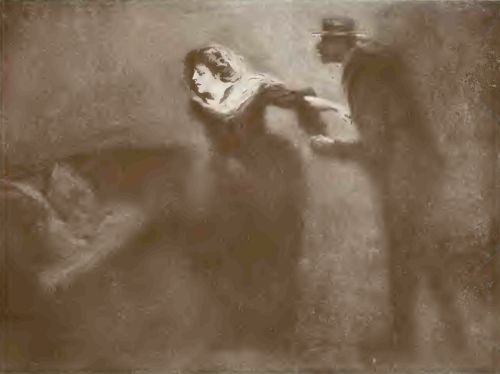
She entered; I felt rather than heard the tremulous push she gave to the
door, and the quick drawing in of her breath as she put her foot across
the threshold. These sapped my courage. This fear, this almost
hesitation, drew me from thoughts of myself to thoughts of her, and it
was in a daze of mingled purposes and regrets that I felt her at last at
my side.
"Walter!" fell softly, doubtfully from her lips.
It was the name of him the dip of whose oars as he made for his boat I
could now faintly hear in the river below us.
Turning, I looked her in the face.
"You are late," said I. God gave me words in my extremity. "Walter has
gone." Then, as the madness of terror replaced love in her eyes, I
lifted her forcibly and carried her to the window, where I drew aside
the vines. "That is his boat's lantern you see drawing away from the
dock. I bade him God-speed. He will not come again."
Without a word she looked, then fell back on my arm. It was not life
which forsook her face, and left her whole sweet body inert—that I
could have borne, for did she not merit death who had killed my love,
killed me?—but happiness, the glow of youthful blood, the dreams of a
youthful brain. And seeing this, seeing that the heart I thought a
child's heart had gone down in this shipwreck, I felt my anger swell and
master me body and soul, and before I knew it, I was towering over her
and she was cowering at my feet, crushed and with hands held up in
defense, hands that had been like rose-leaves in my grasp, futile hands,
but raised now in entreaty for her life to me, to me who had loved her.
Why did they not move me? Why did my muscles tighten instead of relax? I
do not know; I had never thought myself a cruel man, but at that instant
I felt that this toy of my strong manhood had done harm far beyond its
value, and that it would comfort me to break it and toss it far aside;
only I could not bear the cry which now left her lips:
"I am so young! not yet, not yet, Philo! I am so young! Let me live a
little while."
Was it a woman's plea, conscious of the tenderness she appealed to, or
only a child's instinctive grasping after life, just life? If it were
the first, it would be easy to finish; but a child's terror, a child's
longing—that pulled hard at my manhood, and under the possibility, my
own arm fell.
Instantly her head drooped. No defense did she utter; no further plea
did she make; she simply waited.
"You have deserved death." This I managed to utter. "But if you will
swear to obey me, you shall not pay your forfeit till you have had a
further taste of life. Not in my house; there is not sufficient freedom
within its walls for you; but in the broad world, where people dance and
sing and grow old at their leisure, without duty and without care. For
three months you shall have this, and have it to your heart's content.
Then you shall come back to me my true wife, if your heart so prompts;
if not, to tell me of your failure and quit me for ever. But—" Here I
fear my voice grew terrible, for her hands instinctively rose again.
"Those three months must be lived unstained. As you are in God's sight
this hour, I demand of you to swear that, if you forget this or
disregard it, or for any cause subject my name to dishonor, that you
will return unbidden at the first moment your reason returns to you, to
take what punishment I will. On this condition I send you away to-night.
Aline, will you promise?"
She did not answer; but her face rose. I did not understand its look.
There was pathos in it, and something else. That something else troubled
me.
"Are you dissatisfied?" I asked. "Is the time too short? Do you want
more months for dancing?"
She shook her head and the little hands rose again:
"Do not send me away," she faintly entreated; "I don't know why—but
I—had rather stay."
"With me? Impossible. Are you ready to promise, Aline?"
Then she rose and looked me in the eye with courage, almost with
resolution.
"As I live!" said she.
And I knew she would keep her word.
The next thing I remember of that night was the sight of her little
white, shivering figure looking out at me from the carriage that was to
carry her away. The night was cold, and I had tucked her in with as much
care as I might have done the evening before, when I still worshiped
her, still thought her mine, or at least as much mine as she was any
one's. When I had done this and pressed a generous gift into her hand, I
stood a minute at the carriage door, in pity of her aspect. She looked
so pinched and pale, so dazed and hopeless. Had she been alone—but the
companion with whom I had provided her was at her side and my tongue was
tied. I turned, and the driver started up the horses.
"Philo!" I heard blown by me on the wind.
Was it she who called? No, for there was anguish in the cry, the anguish
of a woman, and she was only a frightened, disheartened child whom I had
sent away to—dance.
One month, two months went by, and I began to take up my life. Another,
and she would be home for good or ill. I thought that I could live
through that other. I had heard of her; not from her—that I did not
require; and the stories were all of the same character. She was
enjoying life in the great city to which I had sent her; radiant at
night, if a little spiritless by day. She was at balls, at concerts and
at theaters. She wore jewels and shone with the best; I might be proud
of her conquests and the sweetness and dignity with which she bore
herself. Thus her friends wrote.
But she wrote nothing; I had not required it. Once, some one—a visitor
at the house—spoke of having seen her. "She was surrounded with
admirers," he had said. "How early our American women ripen!" was his
comment. "She held her head like one who has held sway for years; but I
thought her a trifle worn; as if pleasure absorbed too much of her
sleep. You must look out for her, Judge."
And I smiled grimly enough, I own, to think just how I was looking out
for her.
Then came the thunderbolt.
"I am told that no one ever sees her in the day-time; that she is
always busy, days. But she does not look as if she took that time for
rest. What can your little wife be doing? You ought to hurry up that
important opinion of yours and go see."
He was right; what was she doing? And why shouldn't I go see? There was
no obstacle but my own will; but that is the greatest obstacle a man can
have. I remained at Homewood, but the four weeks of our further
probation looked like a year.
Meanwhile, I had my way with the pavilion. I have shown you my heart,
sometimes at its best, oftenest at its worst. I will show it to you
again in this. I had a wall built round it, close against the thicket in
which it lay embedded. This wall was painted white, and near it I had
lamps placed which were lit at nightfall. Should a figure pass that wall
I could see it from my window. No one could enter that doorway now,
without running the risk of my seeing him from where I sat at my desk.
Did I feel easier? I do not know that I did. I merely followed an
impulse I dared not name to myself.
Two weeks of this final month went by. Then (it was in the evening) some
one came running up from the grounds, with the message that Mrs.
Ocumpaugh had ridden into the gate, but that she was not ready to enter
the house. Would I meet her at the pavilion?
I was in the library, at my desk, with my eyes on the wall, when this
was told me. I had just seen the fierce figure of that unmanageable dog
of mine run by that white surface, and my lips were open to order him
tied up, when he, and everything else in this whole world, was forgotten
in this crushing news of her return. For the three months were not up
and her presence here could mean but one thing—she had found temptation
too much for her, and she had come back to tell me so in obedience to
her promise.
"I will go meet Mrs. Ocumpaugh," I said.
The man stared.
"I will go meet Mrs. Ocumpaugh now," I repeated, and tried to rise.
But my limbs refused; death had entered my heart, and it was some few
minutes before I found myself upon the lawn outside.
When I got there I was trembling and so uncertain of movement that I
tottered at the gate. But seeing signs of her presence within, I
straightened myself and went in.
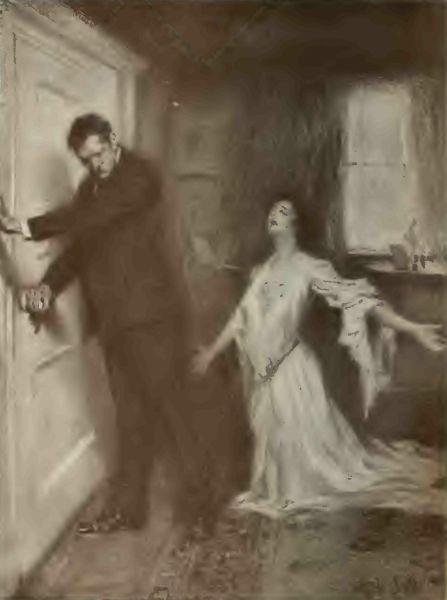
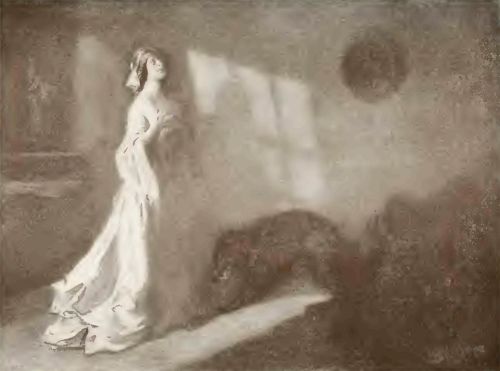 "I SHOULD NOT HAVE KNOWN THE WOMAN WHO STOOD THERE WITH MY NAME FORMED ON HER LIPS."
She was standing at the extreme end of the room when I entered, in the
full light of the solitary moonbeam which shot in at the western
casement. She had thrown aside her hat and coat, and never in all my
life had I seen anything so ethereal as the worn face and wasted form
she thus disclosed. Had it not been for the haunting and pathetic smile
which by some freak of fate gave poignancy to her otherwise infantile
beauty, I should not have known the woman who stood there with my name
formed on her lips.
"Destroyed!" was my thought; and the rage which I felt that moment
against fate flushed my whole being, and my arms went up, not in threat
against her, but to an avenging Heaven, when I heard an impetuous rush,
an angry growl, and the delicate, trembling figure went down under the
leap of the monstrous animal which I had taught to love me, but could
never teach to love her.
In horror and unspeakable anguish of soul I called off the dog; and,
stooping with bitter cries, I took her in my arms.
"Hurt?" I gasped. "Hurt, Aline?" I looked at her anxiously.
"No," she whispered, "happy." And before I realized my own feelings or
the passion with which I drew her to my breast, she had nestled her head
against my heart, smiled and died.
The shock of the dog's onslaught had killed her.
I would not believe it at first, but when I was quite sure, I took out
the pistol I carried in my breast and shot the cowering brute midway
between the eyes.
When this was done, I turned back to her. There was no light but the
moon, and I needed no other. The clear beams falling on her face made
her look pure and stainless and sweet. I could almost have loved her
again as I marked the tender smile which lingered from that passing
moment on her lips. "Happy," she had said. What did she mean by that
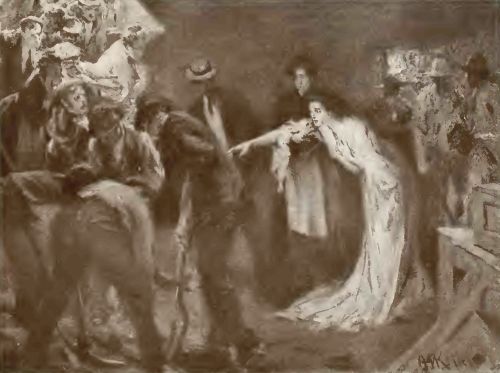
"Happy"? As I asked myself I heard a cry. The companion who had been
with her had rushed in at the doorway, and was gazing in sorrow and
amazement at the white form lying outstretched and senseless against
that farther wall.
"Oh," she cried, in a tone that assured me she had not seen the dog
lying in his blood at my back; "dead already? dead at the first glance?
at the first word? Ah, she knew better than I, poor lamb. I thought she
would get well if she once got home. She wearied so for you, sir, and
for Homewood!"
I thought myself quite mad; past understanding aright the words
addressed to me.
"She wearied—" I began.
"With all her soul for you and Homewood," the young woman repeated.
"That is, since her illness developed."
"Her illness?"
"Yes, she has been ill ever since she went away. The cold of that first
journey was too much for her. But she kept up for several weeks—doing
what no other woman ever did before with so little strength and so
little hope. Danced at night and—"
"And—and—what by day, what?" I could hardly get the words out of my
mouth.
"Studied. Learned what she thought you would
like—French—music—politics. It was to have been a surprise. Poor
soul! it took her very life. She did not sleep— Oh, sir, what is it?"
I was standing over her, probably a terrifying figure. Lights were
playing before my eyes, strange sounds were in my ears, everything about
me seemed resolving itself into chaos.
"What do you mean?" I finally gasped. "She studied—to please me? Why
did she come back, then, so soon—" I paused, choked. I had been about
to give away my secret. "I mean, why did she come thus suddenly, without
warning me of what I might expect? I would have gone—"
"I told her so; but she was very determined to come to you herself—to
this very pavilion. She had set the time later, but this morning the
doctor told her that her symptoms were alarming, and without consulting
him or heeding the advice of any of us, she started for home. She was
buoyant on the way, and more than once I heard her softly repeating your
name. Her heart was very loving— Oh, sir, you are ill!"
"No, no," I cried, crushing my hand against my mouth to keep down the
cry of anguish and despair which tore its way up from my heart. "Before
other hands touch her, other eyes see her, tell me when she began—I
will not say to love me, but to weary for me and—Homewood."
"Perhaps she has told you herself. Here is the letter, sir, she bade me
give you if she did not reach here alive. She wrote it this morning,
after the doctor told her what I have said."
"Give—give—"
She put it in my hand. I glanced at it in the moonlight, read the first
few words, and felt the world reel round me. Thrusting the letter in my
breast, I bade the woman, who watched me with fascinated eyes, to go now
and rouse the house. When she was gone I stepped back into the shadows,
and catching hold of the murderous beast, I dragged him out and about
the wall to a thick clump of bushes. Here I left him and went back to my
darling. When they came in, they found her in my arms. Her head had
fallen back and I was staring, staring, at her white throat.
That night, when all was done for her which could be done, I shut myself
into my library and again opened that precious letter. I give it, to
show how men may be mistaken when they seek to weigh women's souls:
My Husband:
I love you. As I shall be dead when you read this, I may say so
without fear of rebuff. I did not love you then; I did not love
anybody; I was thoughtless and fond of pleasure, and craved
affectionate words. He saw this and worked on my folly; but when
his project failed and I saw his boat creep away, I found that what
feeling I had was for the man who had thwarted him, and I felt
myself saved.
If I had not taken cold that night I might have lived to prove
this. I know that you do not love me very much, but perhaps you
would have done so had you seen me grow a little wiser and more
like what your wife should be. I was trying when—O Philo, I can
not write—I can not think. I am coming to you—I
love—forgive—and take me back again, alive or dead. I love you—I
love—
As I finished, the light, which had been burning low, suddenly went out.
The window which opened before me was still unshuttered. Before me,
across the wide spaces of the lawn, shone the pavilion wall, white in
the moonlight. As I stared in horror at it, a trembling seized my whole
body, and the hair on my head rose. The dark figure of a running dog had
passed across it—the dog which lay dead under the bushes.
"God's punishment," I murmured, and laid my head down on that pathetic
letter and sobbed.
The morning found me there. It was not till later that the man sent to
bury the dog came to me with the cry, "Something is wrong with the
pavilion! When I went in to close the window I found the ceiling at that
end of the room strangely dabbled. It looks like blood. And the spots
grew as I looked."
Aghast, bruised in spirit and broken of heart, I went down, after that
sweet body was laid in its grave, to look. The stains he had spoken of
were gone. But I lived to see them reappear,—as you have.
God have mercy on our souls!