The following are among the Collection of Curiosities in the Museum at
Poughkeepsie:—
Letter of Washington to Governor Clinton, acquainting him of a design
of the British to seize his person while residing at Poughkeepsie, and
convey him to New York. Dated at Dobbs's Ferry, 1780.
Letter of Washington to Brigadier-General Whiten on the subject of the
removal of the troops from Trenton to Philadelphia. Dated Plumpton
Plains, New Jersey, 1777.
Letter of Washington on the subject of promotions in the army. Dated
1779.
Note of invitation from Washington to Dr. John Thomas to dinner. Dr.
Thomas was surgeon of the Massachusetts line. Dated headquarters,
Newburgh, 1780.
Soldiers' discharge, signed by Washington, 1782.
Letter of the Marquis de Lafayette on the subject of fortifying the
North river. Written to Governor Clinton in 1778.
Letter of the Baron Steuben to Governor Clinton on the good appearance
of the New York line of the army. Dated New Windsor, 1780.
Letter of Lord Stirling to Governor Clinton on the discharge of the
command of Major Wessenfells. Dated Albany, 1782.
Letter of Clinton in reply.
Resolution drawn up in Congress, and signed by John Hancock,
requesting the state of New York to erect a monument, at continental
expense, to the memory of Brigadier-General Herkimer, killed on the
Mohawk in 1777. Dated in Congress, 1777.
Letter of Captain Abraham Schenck, of Fishkill, containing an order
for old linen rags, for lint, for the surgeon of his command. Dated
near Croton, 1776.
Letter of General Heath relating to beacons in the highlands. Dated
Robintson's House, 1780.
Letter of General Heath on the condition of the prisoners confined in
the Provost prison, at West Point. Dated Highlands, 1780.
Letter of Captain Nathaniel Toms, describing a chase after the British
over the Schuylkill in 1777.
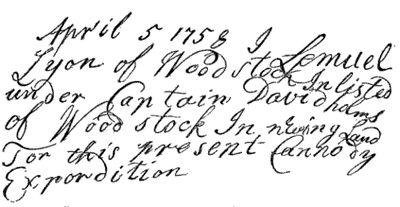
Journal of Lemuel Lyon, of Woodstock, Vermont, who served in the
French and Indian war, in the expedition against Ticonderoga,
commanded by General Abercrombie. The journal commences on the 5th of
April, 1758, and closes on the 16th of November, 1759.
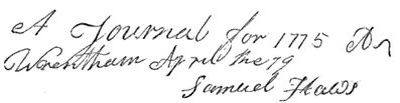
Journal of Samuel Haws, one of the minute-men called out on
the day of the battle of Lexington: commencing April 19, 1775, and
ending in January, 1776.
Three original letters of Washington to Colonel Marinus Willet,
relating to a secret expedition against Oswego in 1782. Dated at
Newburgh headquarters, 1782.
Letter of Joshua H. Smith, the person who conducted André toward the
British lines. Directed from Goshen jail to Governor Clinton,
complaining of the state of his health and the closeness of his
confinement. Dated 1780.
Letter of Ezekiel Hyatt, of Crompond, Westchester county, to James
Jackson, Esq., of Fishkill, in Dutchess county, informing him that
Husson, a notorious cowboy and freebooter, had gone up to steal his
horses, and was to have a hundred guineas if he got them. Dated
Crompond, 1777.
Letter of Lieutenant Lawrence on the subject of the departure of the
British fleet from the harbor of Newport. Dated Reading, 1780.
Letter by the direction of Washington to Abraham Schenck and others,
of Fishkill, to solicit shirts of the inhabitants of their precinct
for the soldiers of the army, many of whom were utterly destitute of
that article. Dated Kingston, 1780.
Letter of Samuel Barker, while confined in the Provost prison, New
York, to his wife in Westchester county. Dated Provost Prison, 1777.
Lock of Washington's hair—an unquestionable relic—derived from the
late Judge Thompson, of the supreme court of the United
States. Presented by his recent widow, the present Mrs. Lansing, of
Poughkeepsie.
Fragments of the first coffin of Washington. Presented by Lewis Grube,
Esq., artist, Poughkeepsie.
One of the points of the chevaux-de-frieze placed in the Hudson
river, near New Windsor, in 1780, to prevent the passage of the
British ships. It was raised accidentally by the anchor of a sloop
commanded by Captain Abraham Elting, in New Paltiz, Ulster county, in
1836. It is pointed with iron, and weighs some hundreds of pounds.
Wooden camp candlestick, used in General Smallwood's brigade while
encamped at Fishkill, in Dutchess county, in the Revolution. From
Jackson Diddle, Esq., Fishkill.
Homespun linen rifle-shirt, worn by Captain Abraham Duryea at the
battle of Long Island. From Charles Robinson, Esq., Fishkill.
Sheet of stamp-parchment, containing the stamps and duties of the
stamp-act.
Sword of Captain Archibald Campbell, killed at the skirmish at Ward's
house, in Weschester county, in 1776. Captain Campbell was the
commanding officer of the British party. From his grandson, Captain
Archibald Campbell, of Pawlings, Dutchess county.
Sword of one of Lee's legion, of Virginia. It has inscribed, on one
side of the blade, "Victory or Death!"—on the opposite side,
"Grenadiers of Virginia."
Tooth of Miss Jane M'Crea, found lying in her coffin when her remains
were disinterred and removed to Fort Edward in 1824, by Mr. George
Barker, of Sandy Hill, and presented by him to the late
Captain Matthew Danvers, of Sandy Hill, and to the collection by his
widow, Mrs. Mary Danvers, of Poughkeepsie.
Iron-pipe tomahawk, found on the battle-field of Saratoga. From Van
Wyck Brinkerhoff, Esq., of Fishkill.
Cannon-rammer, taken with Burgoyne at Saratoga. Purchased, with a lot
of other "lumber" (sold at West Point by order of the government,
after the Revolution), by Joseph Jackson, Esq., and others, of
Fishkill. From Van Wyck Brinkerhoff, Esq., of Fishkill.
Knapsack of Captain David Uhl, a captain of militia in the Revolution,
and worn by him when he joined his regiment at Harlem, in 1776. It is
made of homespun linen. From his daughter, Mrs. Henry Abell, of Union
Vale, Dutchess county.
Hessian camp-kettle, dug up on the battle-field of Bennington. By Mr.
Charles Hoag, of Dover, Dutchess county.
Iron spur, found on the battle-field of the Cowpens. It is much
rusted, and is believed to have belonged to one of Tarleton's men.
From B. J. Lossing, Esq., of Poughkeepsie.
United States musket, found on the line of the retreat of the
Americans from the battle-ground at Hubbardton, Vermont. It has the
date of 1774 on the breech. From B. J. Lossing, Esq.
Collection of relics from all the battle-fields of the Revolution.
From B. J. Lossing, Esq.
Cocked hat, worn by Lemuel Lyon on board the tea-ship in Boston
harbor. The wearer was the writer of the first Journal in this volume.
From his relative, Mr. J. Colby, of New York city.
Surgical instruments of Dr. John Thomas, a regimental surgeon
in the Revolution. They were used in several of the principal battles
of the war. From his son, Mr. Thomas, of Poughkeepsie.
Original portrait of Dr. John Thomas.
Broken United States bayonet, found on the battle-ground of Guilford
Courthouse, North Carolina. By Mr. Charles Ney, of Amenia, Dutchess
county.
Bayonet of John Woodin, a continental soldier. The point of this
instrument was broken off in the wall of the fort at Stony Point, when
in the body of a British soldier. Presented by a relative.
A Spanish dollar, taken from the cavity of the hip-bone of a skeleton
dug up at Bemis's heights, Saratoga, in 1841. With it were five other
dollars and an English guinea, and also a fragment of leather,
supposed to be the remains of a purse or pocket-book. From Mrs. John
Wing, of Washington, Dutchess county.
English musket, taken in a skirmish from a foraging-party of the
British in Westchester county, in the Revolution, by Captain Abraham
Meriot, of Newcastle, Westchester county, commander of a party of
American militia. From Mr. John Townsend, of Poughkeepsie.
Tory musket, hidden during the whole period of the Revolution, in a
hollow tree, in Dover, Dutchess county, to prevent its being seized by
the committee-men and used against the king.
English musket, brought off from the battle-field of White Plains by
Colonel Abraham Humphrey, of Smallwood's brigade. Presented by the
late Colonel Humphrey Cornell, of Beekman, Dutchess county.
Fragments of human-bones from the battle-field of Red Bank.
From B. J. Lossing, Esq., of Poughkeepsie.
Piece of one of the palmetto-logs of old Fort Moultrie, in Charleston
harbor. From B. J. Lessing, Esq.
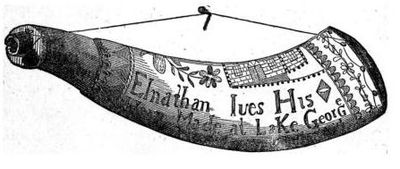
Horn of Lieutenant Charles Wallace, of the 1st Royal Highland
regiment, curiously engraved with the names and distances of all the
fortified posts from Quebec to Albany, together with the name and rank
of the wearer. It was obtained from an Indian after the battle of
Saratoga.
Metal button, ploughed up on Quaker hill, Dutchess county, where a
division of the American array encamped in the Revolution. It has the
letters "U. S. A." raised on the surface. A number of other articles
belonging to the camp have been found in the neighborhood. A long line
of the stone fireplaces of the soldiers still remain.
Spontoon of Lieutenant Alfred Van Wyck, of Fishkill, Dutchess county,
used in hunting the cowboys in Fishkill mountain, in the Revolution.
By his son, Theodorus Van Wyck, Esq., of Fishkill Hook, who remembers
to have been shown, within the last forty years, by an individual then
living, the bones of a "skinner," or cowboy, still lying unburied in a
defile of the mountains.
==> Also, a large collection of other curiosities.
Footnote 1: Canada expedition.(Back)
Footnote 2: Landlord. The proprietor of an inn or tavern was
universally called landlord. The title is still very
prevalent.(Back)
Footnote 3: To take carts for the military service. Under martial
law, any private property may be used for the public good. A just
government always pays a fair price for the same.(Back)
Footnote 4: Probably General Lyman, who was the commander-in-chief of
the Connecticut forces at that time.(Back)
Footnote 5: In Litchfield county, Connecticut.(Back)
Footnote 6: Cornwall.(Back)
Footnote 7: Canaan.(Back)
Footnote 8: Livingston's manor, in Columbia county. The estates of
Livingston, Van Rensselaer, and others, who received grants of land
from government, on certain conditions, in order to encourage
immigration and agriculture, were called Patroon Lands, and the
proprietors were entitled Patroons, or patrons.(Back)
Footnote 9: Kinderhook.(Back)
Footnote 10: Now East Albany, on the east side of the Hudson
river.(Back)
Footnote 11: Schenectady.(Back)
Footnote 12: Billeting-money—that is, money to pay for lodgings at
private houses. When soldiers are quartered at private houses, it is
said that such ones are billeted at such a house,
&c.(Back)
Footnote 13: Schenectady.(Back)
Footnote 14: Alarum, or alarm.(Back)
Footnote 15: Schenectady.(Back)
Footnote 16: Provincial troops, or American soldiers. The English
troops were called regulars.(Back)
Footnote 17: Massachusetts Bay troops. The Massachusetts colony was
called Massachusetts Bay until after the War for
Independence.(Back)
Footnote 18: Fort Edward was situated upon the east bank of the
Hudson, about fifty miles north of Albany. The fort was built by
General Lyman, of Connecticut, in 1755, while that officer was
encamped there with about six thousand troops, awaiting the arrival of
General William Johnson, the commander-in-chief of the expedition
against the French at Ticonderoga and Crown Point. A portion of the
site of the fort is now (1854) occupied by the flourishing village of
Fort Edward. Some of the embankments are yet visible near the river.
It was near this fort that Jane McCrea was killed and scalped, in
1777.(Back)
Footnote 19: Near Waterford, on the west side of the Hudson river,
thirteen miles north from Albany.(Back)
Footnote 20: Niskayuna, a short distance from Waterford, and
remarkable as a settlement of Shaking
Quakers.(Back)
Footnote 21: On the Mohawk, about five miles above Cohoes Falls. It
was the chief crossing-place for troops on their way north from
Albany. There the right wing of the American army, under Arnold, was
encamped, while General Schuyler was casting up entrenchments at
Cohoes Falls, a few weeks before the Saratoga battles, in
1777.(Back)
Footnote 22: Stillwater is on the west bank of the Hudson, in
Saratoga county, twenty-four miles north from Albany. The battle of
Bemis's heights was fought near there, in 1777, and is sometimes known
as the battle of Stillwater. Opposite the mouth of the Hoosick river,
at Stillwater, was a stockade, called Fort
Winslow.(Back)
Footnote 23: A batteau is a kind of scow or flat-boat, used on
shallow streams like the Hudson above
Waterford.(Back)
Footnote 24: Saratoga. This settlement was near the mouth of the Fish
creek, on the south side. The village of Schuylerville is just across
the stream, on the north side. On the plain, in front of the village
of Schuylerville, was a regular quadrangular fortification, with
bastions, called Fort Hardy. It was erected in 1756, and named in
honor of the governor of New York at that
time.(Back)
Footnote 25: On the west side of the Hudson, six or eight miles below
Fort Edward. The river is there broken by swift rapids. During this
campaign, Major (afterward General) Putnam was here surprised by a
party of Indians, and boldly descended the rapids in a canoe, and
escaped. It was a feat they never dared to attempt, and they felt
certain that he was under the protection of the Great Spirit. Here a
stream called Bloody Run enters the Hudson. It is so named because a
party of soldiers from the garrison, in 1759, went there to fish, were
surprised by the Indians, and nine were killed and
scalped.(Back)
Footnote 26: Lake George.(Back)
Footnote 27: Fever-and-ague.(Back)
Footnote 28: Fitch's.(Back)
Footnote 29: Afterward called Snook's creek. It enters the Hudson
three miles below Fort Edward.(Back)
Footnote 30: General Phineas Lyman, who built Fort Edward. He was a
native of Durham, Connecticut, where he was born in 1716. He completed
his education at Yale college, and afterward became an eminent lawyer.
He was appointed commander-in-chief of the Connecticut forces in 1755,
and in the expedition to Lake George deserved all the honor awarded to
General Johnson, who was jealous of Lyman's abilities as a soldier.
Lyman did his duty nobly, and was but little noticed. Johnson was
unfit for his station, but being a nephew of Sir Peter Warren, then a
popular English admiral, he received the honor of knighthood, and the
sum of twenty thousand dollars, for his services in that campaign!
General Lyman served with distinction until the close of the campaign
in 1760, and in 1762 commanded the American forces sent against
Havana. He was in England about eleven years, and, after his return,
went with his family to the Mississippi, where he died in
1788.(Back)
Footnote 31: Colonel David Wooster, of Connecticut, the eminent
general of the Revolution, who was killed at Ridgefield, while engaged
in the pursuit of Tryon, after the burning of Danbury, in the spring
of 1777. He was born in Stratford, Connecticut, in March, 1710,
graduated at Yale college in 1738, and soon afterward received the
appointment of captain of a vessel of the coast-guard. He was in the
expedition against Louisburg in 1745. He afterward went to England,
where he was a favorite at the court of George II., and received the
appointment of captain in the regular service, under Sir William
Pepperell. He was promoted to a colonelcy in 1755, and rose to the
rank of brigadier before the close of the French and Indian war. He
was one of the most active men in getting up the expedition against
Ticonderoga, in 1775, which resulted in the capture of that fortress,
and also Crown Point, by Colonel Ethan Allen and Benedict Arnold.
Wooster was appointed one of the first brigadiers of the continental
army, in 1775, and third in rank. He was also appointed the first
major-general of the militia of his state, when organized for the War
for Independence; and in that capacity he was employed, with Arnold,
Silliman, and others, in repelling British invasion in 1777. He lost
his life in that service. His remains were buried at Danbury; and in
1854 a monument was erected over his grave by his grateful countrymen,
at the expense of his native state.(Back)
Footnote 32: Chaplain.(Back)
Footnote 33: Commander of a corps of rangers, who performed signal
services during the greater part of the French and Indian war. He was
the son of an Irishman, an early settler of Dunbarton, in New
Hampshire. He was appointed to his command in 1755, and was a thorough
scout. In 1759, he was sent by General Amherst to destroy the Indian
village of St. Francis. In that expedition he suffered great
hardships, but was successful. He served in the Cherokee war in 1761,
and in 1766 was appointed governor of Michilimacinac, where he was
accused of treason, and sent to Montreal in irons. He was acquitted,
went to England, and, after suffering imprisonment for debt, returned
to America, where he remained until the Revolution broke out. He took
up arms for the king, and in 1777 went to England, where he died. His
"Journal of the French and Indian War" is a valuable
work.(Back)
Footnote 34: Israel Putnam, afterward the Revolutionary general. He
was born in Salem, Massachusetts, in January, 1718. He was a vigorous
lad, and in 1739 we find him cultivating land in Pomfret, Connecticut,
the scene of his remarkable adventure in a wolf's den, so familiar to
every reader. He was appointed to the command of some of the first
troops raised in Connecticut for the French and Indian war in 1755,
and was an active officer during the entire period of that conflict,
especially while in command of a corps of rangers. He was ploughing in
his field when the news of the skirmishes at Lexington and Concord
reached him. He immediately started for Boston, and, at the head of
Connecticut troops, was active in the battle of Bunker Hill. He was
one of the first four major-generals of the continental army appointed
by Congress in June, 1775, and he was constantly on duty in important
movements until 1779, when a partial paralysis of one side of his body
disabled him for military service. He lived in retirement after the
war, and died at Brooklyn, Windham county, Connecticut, on the 29th of
May, 1790, at the age of seventy-two years.(Back)
Footnote 35: General James Abercrombie, the commander-in-chief of the
campaign. He was descended from an ancient Scotch family, and, because
of signal services on the continent, was promoted to the rank of
major-general, the military art having been his profession since
boyhood. He was superseded by Lord Amherst, after his defeat at
Ticonderoga, and returned to England in the spring of
1759.(Back)
Footnote 36: Sabbath-day Point. This is a fertile little promontory,
jutting out into Lake George from the western shore, a few miles from
the little village of Hague, and surrounded by the most picturesque
scenery imaginable. It was so named, at this time, because it was
early on Sunday morning that Abercrombie and his army left this place
and proceeded down the lake. There a small provincial force had a
desperate fight with a party of French and Indians, in 1756, and
defeated them. Abercrombie's army went down the lake in batteaux and
whaleboats, and reached the Point just at dark. Captain (afterward
General) Stark relates that he supped with the young lord Howe that
evening, at the Point, and that the nobleman made many anxious
inquiries about the strength of Ticonderoga, the country to be
traversed, &c., and, by his serious demeanor, evinced a presentiment
of his sad fate. He was killed in a skirmish with a French scout two
days afterward. His body was conveyed to Albany, in charge of Captain
(afterward General) Philip Schuyler, and buried there. He was a
brother of the admiral and general of that name, who commanded the
British naval and land forces in America in
1776.(Back)
Footnote 37: "The order of march," says Major Rogers, "exhibited a
splendid military show." There were sixteen thousand well-armed
troops. Lord Howe, in a large boat, led the van of the flotilla,
accompanied by a guard of rangers and expert boatmen. The regular
troops occupied the centre, and the provincials the wings. The sky was
clear and starry, and not a breeze ruffled the dark waters as they
slept quietly in the shadows of the mountains. Their oars were
muffled, and, so silently did they move on, that not a scout upon the
hills observed them; and the first intimation that the outposts of the
enemy received of their approach was the full blaze of their scarlet
uniforms, when, soon after sunrise, they landed and pushed on toward
Ticonderoga.(Back)
Footnote 38: Rapids in the stream which forms the outlet of Lake
George into Lake Champlain. Here are now extensive saw and grist
mills. The distance from the foot of Lake George to Fort Ticonderoga
is about four miles.(Back)
Footnote 39: The English lacked suitable guides, and became
bewildered in the dense forest that covered the land. Lord Howe was
second in command, and led the van, preceded by Major Putnam and a
scout of one hundred men, to reconnoitre. The French set fire to their
own outpost, and retreated. Howe and Putnam dashed on through the
woods, and in a few minutes fell in with the French advanced guard,
who were also bewildered, and were trying to find their way to the
fort. A smart skirmish ensued, and, at the first fire, Lord Howe,
another officer, and several privates, were killed. The French were
repulsed, with a loss of about three hundred killed, and one hundred
and forty made prisoners. The English battalions were so much broken,
confused, and fatigued, that Abercrombie ordered them back to the
landing-place, where they bivouacked for the
night.(Back)
Footnote 40: This was Abercrombie's fatal mistake. He sent an
engineer to reconnoitre the fort and outworks. The engineer reported
the latter to be so weak, in an unfinished state, as to be easily
carried, without artillery, by the force of English bayonets. The
difficulties in the way of heavy cannons, in that dense forest, were
very formidable; and Abercrombie was willing to rely upon sword and
bayonet, on the strength of his engineer's report. That functionary
was mistaken; and when the English approached the French lines, they
found an embankment of earth and stones, eight feet in height,
strongly guarded by abatis, or felled trees, with their tops
outward. The English made a furious attack, cut pathways through these
prostrate trees, and mounted the parapet. They were instantly slain,
and thus scores of Britons were sacrificed, by discharges of heavy
cannons. When two thousand men had fallen, Abercrombie sounded a
retreat, and the whole British army made its way to the landing-place
at the foot of Lake George, with a loss of twenty-five hundred
muskets. They went up the lake to Fort William Henry, and the wounded
were sent to Fort Edward and to Albany. At his own solicitation,
Colonel Bradstreet was sent to attack the French fort Frontenac, where
Kingston now stands, at the foot of Lake Ontario; and General Stanwix
proceeded to erect a fort toward the head-waters of the Mohawk, where
the village of Rome now flourishes.(Back)
Footnote 41: The head of the lake was especially designated as "Lake
George." There was the dilapidated fort William Henry, built by Sir
William Johnson, in the autumn of 1755; and, about half a mile
southeast from it, Fort George was afterward erected. The ruins of its
citadel may yet (1854) be seen.(Back)
Footnote 42: Pomeroy.(Back)
Footnote 43: Flogging was facetiously termed "putting on a new
shirt." Seventy lashes was a pretty severe
punishment.(Back)
Footnote 44: This was the outlet of three little lakes, situated
about half way between the head of Lake George and the bend of the
Hudson at Sandy Hill. They are the head-waters of Clear river, the
west branch of Wood creek, which empties into Lake Champlain at
Whitehall.(Back)
Footnote 45: This was Diamond island, lying directly in front of
Dunham's bay, and not far from the village of Caldwell. It was so
called because of the number and beauty of quartz-crystals found upon
it. Burgoyne made it a depôt of military stores when on his way from
Canada, by the way of Lake Champlain, in 1777. It was the scene of a
sharp conflict between the little garrison and a party of Americans
under Colonel Brown, on the 25th of September, 1777, while Gates and
Burgoyne were confronted at Saratoga. Brown was
repulsed.(Back)
Footnote 46: Partridge's.(Back)
Footnote 47: They were
volunteers.(Back)
Footnote 48: M'Mahon?(Back)
Footnote 49: This locality can not be
identified.(Back)
Footnote 50: Rogers, in his Journal, speaks of this occurrence. He
says it was on the 27th, and that one hundred and sixteen men were
killed, of whom sixteen were rangers.(Back)
Footnote 51: He went out with seven hundred men, to intercept the
marauding party, but they escaped.(Back)
Footnote 52: Ingersoll.(Back)
Footnote 53: Rogers says that, on his return from his attempt to
intercept the marauding party, he was met by an express, with orders
to march toward the head of Lake Champlain, at South and East bays, to
prevent the French marching upon Fort Edward. There he was joined by
Major Putnam and Captain Dalyell or D'Ell.(Back)
Footnote 54: Packet.(Back)
Footnote 55: A severe engagement took place on Clear river, the west
branch of Wood creek, about a mile northwest from Fort Anne village
(then the site of a picketed blockhouse, called Fort Anne), between a
party of rangers and provincials under Rogers, Putnam, and Captain
Dalyell, or D'Ell, and about an equal number of French and Indians
under Molang, a famous partisan leader. The English troops were
marching when attacked: Putnam was in front, with the provincials;
Rogers was in the rear, with his rangers; and D'Ell in the centre,
with the regulars. Molang attacked them in front, and a powerful
Indian rushed forward and made Putnam a prisoner. The provincials
were thrown into great confusion, but were rallied by Lieutenant
Durkee, who was one of the victims of the Wyoming massacre twenty
years afterward. D'Ell, with Gage's light infantry, behaved very
gallantly, and the rangers finally put the enemy to flight. The latter
lost about two hundred men. Colonel Prevost, then in command at Fort
Edward, sent out three hundred men, with refreshments for the party,
and all arrived at Fort Edward on the 9th. This was the relief-party
mentioned in the text, under date of the
8th.(Back)
Footnote 56: This is an island in the Hudson, opposite Fort Edward,
and known as Rogers's island.(Back)
Footnote 57: Sutler's.(Back)
Footnote 58: Fitch.(Back)
Footnote 59: Ticonderoga.(Back)
Footnote 60: The Indian who seized Putnam tied him to a tree, and for
a time he was exposed to the cross-fire of the combatants. His
garments were riddled by bullets, but, strange to say, not one touched
his person. He was carried away in the retreat, his wrists tightly
bound with cords. The Indians rejoiced over the capture of their great
enemy, and he was doomed to the torture. In the deep forest he was
stripped naked, bound to a sapling, wood was piled high around him,
the death-songs of the savages were chanted, and the torch was
applied. Just then a heavy shower of rain almost extinguished the
flames. They were again bursting forth with fiercer intensity, when a
French officer, informed of what was going on, darted through the
crowd of yelling savages, and released the prisoner. He was delivered
to Montcalm at Ticonderoga, then sent to Montreal, and, after being
treated kindly, was exchanged for a prisoner taken by Colonel
Bradstreet at Frontenac.(Back)
Footnote 61: Picket.(Back)
Footnote 62: Fort
Misery was a breastwork at the mouth of Moses's
kill, or creek, a short distance from Fort Miller, on the east side of
the Hudson.(Back)
Footnote 63: At Fort George, at the head of Lake
George.(Back)
Footnote 64: Volleys.(Back)
Footnote 65: It was the king's birthday. The firing of twenty-one
heavy guns formed a royal salute.(Back)
Footnote 66: Bridge.(Back)
Footnote 67: Fort Musquito was a breastwork cast up at the mouth of
Snooks' creek.(Back)
Footnote 68: This was a nickname for the regular troops, who were
dressed in scarlet uniforms.(Back)
Footnote 69: Wrestled.(Back)
Footnote 70: Fort Anne was erected in 1757, a year before the
occurrences here narrated took place. It was a strong blockhouse of
logs, with portholes for cannon and loopholes for musketry, and
surrounded by a picket of pine-saplings. When the writer visited the
spot in 1848, he dug up the part of one of the pickets yet remaining
in the earth, and, on splitting it, it emitted the pleasant odor of a
fresh pine-log, though ninety years had elapsed since it was placed
there. This fort was near the bank of Wood creek, about eleven miles
from the head of Lake Champlain, at the village of Whitehall. It was
in the line of Burgoyne's march toward the Hudson, in 1777; and near
it quite a severe skirmish took place between Colonel Long, of
Schuyler's army, and a British detachment under Colonel Hill, on the
8th of July, the day after Ticonderoga was abandoned to the enemy.
Victory was almost within the grasp of Colonel Long, when his
ammunition failed, and he was compelled to
retreat.(Back)
Footnote 71: Canoe.(Back)
Footnote 72: Fort Misery.(Back)
Footnote 73: The Indian name of the site of Fort Frontenac (where
Kingston, Upper Canada, now stands), taken by Colonel Bradstreet, was
Cataraqua. That was also the Indian name for Lake
Ontario.(Back)
Footnote 74: Fascines—bundles of sticks, mixed with earth, and used
for filling ditches in the construction of
forts.(Back)
Footnote 75: Pomeroy.(Back)
Footnote 76: Militia.(Back)
Footnote 77: Pomeroy.(Back)
Footnote 78: The channel between Rogers's island, on which the great
blockhouse was built, and Fort Edward, does not exceed two hundred
feet in width.(Back)
Footnote 79: Christening.(Back)
Footnote 80: General Amherst.(Back)
Footnote 81: Amherst.(Back)
Footnote 82: Pomeroy.(Back)
Footnote 83: Halifax, Nova Scotia.(Back)
Footnote 84: Tomahawk.(Back)
Footnote 85: Scalped.(Back)
Footnote 86: British regular.(Back)
Footnote 87: A mixture of beer and rum, warmed by thrusting a hot
iron into it.(Back)
Footnote 88: Hinman's.(Back)
Footnote 89: Prebles.(Back)
Footnote 90: Waiter.(Back)
Footnote 91: Sutler.(Back)
Footnote 92: The "third fall," as it was called, in the Hudson, at
Sandy Hill.(Back)
Footnote 93: Reveillé.(Back)
Footnote 94: Provost.(Back)
Footnote 95: Hogeboom's.(Back)
Footnote 96: See note, page 13.(Back)
Footnote 97: Coventry.(Back)
Footnote 98: In Norfolk county, Massachusetts, thirty-two miles
southwest from Boston.(Back)
Footnote 99: See introductory remarks. The skirmishes at Lexington
and Concord occurred early in the morning of this day.(Back)
Footnote 100: See introductory remarks.(Back)
Footnote 101: Twenty-one miles from Boston.(Back)
Footnote 102: Thirteen miles from Boston.(Back)
Footnote 103: Colonel John Greaton. He was a bold officer, and
commanded a corps which performed a sort of ranger service. At this
time he was only a major. In June following he carried off about eight
hundred sheep and lambs, and some cattle, from Deer island. About that
time he was promoted to the rank of colonel. In the middle of July, he
led one hundred and thirty-six men, in whaleboats, to destroy forage
and other property on Long island, in Boston harbor; and at one time
he captured a barge belonging to a British man-of-war. In April, 1776,
he accompanied General Thompson to Canada. He was promoted to the rank
of brigadier in the continental army, in January, 1783.(Back)
Footnote 104: Jamaica Plain, six miles from
Boston.(Back)
Footnote 105: The isthmus that connected the peninsula of Boston with
the main, at Roxbury.(Back)
Footnote 106: The British soldiers were all called regulars. This
word denotes soldiers belonging to the regular army, as distinguished
from militia.(Back)
Footnote 107: Twelve miles southeast from
Boston.(Back)
Footnote 108: One mile from Boston.(Back)
Footnote 109: Three miles northwest from Boston.(Back)
Footnote 110: Thirty-one miles southeast from Boston.(Back)
Footnote 111: Tories were those who adhered to the British. It is a
name derived from the vocabulary of English politics in the time of
Charles II. A tory, then, was an adherent of the crown; a whig was
an opposer of the government. The word was first used in America about
1770.(Back)
Footnote 112: Twenty-one miles southwest from Boston.(Back)
Footnote 113: Rev. Amos Adams, a minister at Roxbury. He was a
graduate of Harvard college. He died of dysentery, which prevailed in
the camp, at Dorchester, on the 5th of October, 1775, in the
forty-eighth year of his age.(Back)
Footnote 114: On Sunday morning, the 21st of May, the British
commander sent two sloops and an armed schooner to take off a quantity
of hay from Grape island. They were opposed by the people who gathered
on the point nearest the island. These finally got two vessels afloat,
went to the island, drove the British off, burnt eighty tons of hay,
and brought off many cattle. There was some severe fighting during the
affair. Mrs. John Adams, writing to her husband, said: "You inquire
who were at the engagement at Grape island. I may say with truth, all
of Weymouth, Braintree, and Hingham, who were able to bear arms....
Both your brothers were there; your younger brother with his company,
who gained honor by their good order that day. He was one of the first
to venture on board a schooner, to land upon the island." Mr. Adams
was then in the Continental Congress, at Philadelphia.(Back)
Footnote 115: On Saturday, May 27th, a detachment of Americans was
sent to drive all the live stock from Hog and Noddle's islands, near
Boston. They were observed by the British, who despatched a sloop, a
schooner, and forty marines, to oppose them. They were fired on from
the vessels, and quite severe skirmishing continued through the night.
The Americans sent for reinforcements, and, at about nine o'clock at
night, some three hundred men and two pieces of cannon arrived,
commanded by General Putnam in person, and accompanied by Dr. Warren
as a volunteer. They compelled the British to abandon their sloop, and
the Americans took possession of it. The British lost twenty killed
and fifty wounded. The Americans had none killed, and only four
wounded. They captured twelve swivels and four four-pound cannon,
besides clothing and money.(Back)
Footnote 116: Noddle's.(Back)
Footnote 117: Probably the house of Joshua Loring, jr., near Roxbury,
who was a violent loyalist. General Gage made him sole auctioneer in
Boston. He was afterward commissary of prisoners in New York. His wife
is referred to in Hopkinson's poem, "The Battle of the
Kegs."(Back)
Footnote 118: Colonel John Robinson, who was second in command in the
skirmish at Concord on the 19th of April. He commanded the detachment
that guarded Boston neck, for some time. Speaking of that duty, Gordon
remarks: "The colonel was obliged, therefore, for the time mentioned,
to patrol the guards every night, which gave him a round of nine miles
to traverse."(Back)
Footnote 119: Harlots.(Back)
Footnote 120: General Thomas, who had command of the right wing,
extending from Roxbury to Dorchester. General Artemas Ward was the
commander-in-chief until the arrival of Washington, early in
July.(Back)
Footnote 121: Fascines. See note on page 35.(Back)
Footnote 122: This is a mistake. It was Breed's hill, nearer
Charlestown and Boston than Bunker's hill. Colonel William Prescott,
and not General Putnam, was entrenched there, and was in command
during the engagement. He had been sent with a company, the night
before, about a thousand strong, to throw up a redoubt on Bunker's
hill. He made a mistake, and performed the work on Breed's hill. The
British had no suspicion of the work that went on during that sultry
June night, and were greatly alarmed when they saw a formidable
breastwork overlooking their shipping in the harbor, and menacing the
city. During the engagement, General Putnam was on Bunker's hill,
urging on reinforcements for Prescott. Dr. Warren, just appointed
major-general, joined Prescott as a volunteer during the battle, and
was mortally wounded just as the conflict ended. It must be remembered
that the writer of this Journal was in General Thomas's division,
which did not participate in the battle of the 17th of
June.(Back)
Footnote 123: Prospect hill. The Americans retreated from Breed's and
Bunker's hills to Winter and Prospect hills, and Cambridge. The
remains of the American entrenchments on Prospect hill were demolished
in 1817.(Back)
Footnote 124: Colonel James Reed, of New Hampshire. He was active in
the battle of the 17th. He was a brave officer, and was at the head of
a regiment at Ticonderoga the following year.(Back)
Footnote 125: The Americans were alarmed on the 24th by indications
that the whole British army in Boston was about to force its way
across Boston neck. At noon they commenced throwing bombshells into
Roxbury, but the alert soldiers prevented damage from them, and saved
the town. Colonel Miller, of Rhode Island, said in a letter—"Such was
the courage of our men, that they would go and take up a burning
carcass or bomb, and take out the fuse!"(Back)
Footnote 126: The house and barns of Thomas Brown were on the neck,
about a mile from Roxbury meeting-house, and were occupied by the
British advanced guard. Two Americans tried to set fire to the barn on
the 24th, and were killed.(Back)
Footnote 127: The British again hurled some shells into Roxbury on
Sunday, the 2d of July, but the extent of the damage was setting fire
to one house, which was consumed.(Back)
Footnote 128: George Washington was chosen commander-in-chief of the
continental armies on the 15th of June, 1775. He set out for the
headquarters of the army at Cambridge on the 21st, reached there on
the 2d of July, and took formal command of the army on the morning of
the 3d.(Back)
Footnote 129: A party of volunteers, under Majors Tupper and Crane,
attacked the British advanced guards, drove them in, and set fire to
Brown's house. They took several muskets, and retreated without
loss.(Back)
Footnote 130: It is impossible to identify this place. A letter,
dated on the 12th, says, "We have just got, over land from Cape Cod, a
large fleet of whaleboats," &c., &c. The place alluded to in the text
was probably near Boston.(Back)
Footnote 131: This party went from Roxbury camp. The report says that
they brought from Long island "fifteen prisoners, two hundred sheep,
nineteen cattle, thirteen horses, and three hogs." The prisoners were
taken to Concord.(Back)
Footnote 132: The party under Colonel Greaton, mentioned in a
preceding note.(Back)
Footnote 133: Twenty miles south from Boston.(Back)
Footnote 134: A strong party of Americans took possession of an
advanced post in Roxbury, upon which the British kept up an incessant
fire.(Back)
Footnote 135: Upton is thirty-five miles southwest from Boston.(Back)
Footnote 136: The 20th was observed throughout the camps as a day of
fasting and prayer. Before daylight that morning, a party from Heath's
regiment landed on Nantasket point, set fire to the lighthouse, and
brought away a thousand bushels of barley and a quantity of hay.(Back)
Footnote 137: This was a very strong quadrangular work, on the
highest eminence in Roxbury. It had four bastions, and in every
respect was a regular work. It is now well preserved, the embankments
being from six to fifteen feet in height from without.(Back)
Footnote 138: On that day the British, five hundred strong, marched
over the neck, and built a slight breastwork to cover their guard. The
American camp was in alarm all the day, and that night the troops lay
on their arms. The tories in Boston were also alarmed, for they
dreaded an invasion of the city by their exasperated countrymen.(Back)
Footnote 139: Marines.(Back)
Footnote 140: The British commenced rebuilding the lighthouse on
Nantasket point. Major Tupper, with three hundred men, attacked the
working-party, killed ten or twelve men, and took the rest prisoners.
He then demolished the works, but, before he could leave, some armed
boats came to oppose him. In the skirmishing that ensued, fifty-three
of the British were killed or captured. Tupper lost one man killed,
and two wounded.(Back)
Footnote 141: A party of British troops sallied out toward Roxbury,
drove in the American pickets, and burned the tavern which was
situated upon the portion of the neck nearest Roxbury.(Back)
Footnote 142: When the British built their breastwork on the neck,
the Sunday previous, they had a floating battery brought into Charles
river, and moored it within three hundred yards of Sewall's point.(Back)
Footnote 143: The Brookline fort was on Sewall's point, between
Roxbury and Cambridge. It commanded the entrance to Charles river.(Back)
Footnote 144: The village and church of Dorchester was four miles
from Boston. The heights of Dorchester are in what is now called South
Boston.(Back)
Footnote 145: Joseph Willard, D.D., who was made president of Harvard
college in December, 1781. He died in New Bedford, in 1804, at the age
of sixty-four years.(Back)
Footnote 146: A nickname given to the British regulars, on account of
their red suits. They were so called in England, as early as the time
of Queen Anne.(Back)
Footnote 147: The large park, known as Boston Common, extended down
to the water's edge, before the flats were filled in.(Back)
Footnote 148: About nine o'clock on Sunday morning, the 27th, the
British opened a heavy cannonade from Bunker's hill (where they had
built a strong redoubt), and from a ship and floating battery in
Mystic river. The firing was directed upon the American works on
Winter, Prospect, and Ploughed hills. They continued to bombard these
works daily until the 10th of September.(Back)
Footnote 149: There was a famous tree in Boston, under which the
patriots had often held meetings since the time of the stamp-act
excitement. On that account it was called "Liberty-Tree." It was a
noble elm, and stood at the corner of the present Washington and Essex
streets. On the 31st of August, 1775, the British cut it down, with no
apparent motive but the indulgence of petty spite. An eye-witness of
the event says: "After a long spell of laughing and grinning,
sweating, swearing, and foaming, with malice diabolical, they cut down
a tree, because it bore the name of liberty." A tory soldier was
killed by its fall. A poet of the day wrote:—
"A tory soldier, on its topmost limb—
The Genius of the Shade looked stern at him,
And marked him out that same hour to dine
Where unsnuffed lamps burn low at Pluto's shrine.
Then tripped his feet from off their cautious stand:
Pale turned the wretch—he spread each helpless hand,
But spread in vain—with headlong force he fell,
Nor stopped descending till he stopped in hell!"
(Back)
Footnote 150: Colonel Jedediah Huntington, of Norwich, Connecticut.
The British now seemed determined to make a general assault upon the
besiegers, and a heavy cannonade was opened simultaneously upon the
Americans at Roxbury and in the vicinity of Cambridge.(Back)
Footnote 151: They threw up a slight breastwork a little in advance
of their lines on the neck, and not far from the George tavern.(Back)
Footnote 152: Lamb's dam was between Roxbury and Dorchester. There
the Americans completed a strong work on the 10th of September, and
mounted four eighteen-pounders.(Back)
Footnote 153: Skirmish.(Back)
Footnote 154: We can not explain this local allusion.(Back)
Footnote 155: The breastworks in the thicket were the Roxbury lines
of fortifications in advance of the fort.(Back)
Footnote 156: Mystic.(Back)
Footnote 157: The road leading from Roxbury across the neck into
Boston.(Back)
Footnote 158: Captain Pond was from New Hampshire, and was an officer
in Colonel Stark's regiment.(Back)
Footnote 159: From the vessels known as men-of-war.(Back)
Footnote 160: Coronation. George III. and his wife Charlotte were
crowned on the 22d of September, 1761. It was always a holyday next to
that of the king's birthday.(Back)
Footnote 161: Frothingham says: "On the 23d, the British discharged
one hundred and eight cannon and mortars on the works at Roxbury
without doing any damage."(Back)
Footnote 162: This expedition was under Major Tupper. They burnt a
fine pleasure-boat just ready to be launched, belonging to some
British officers.(Back)
Footnote 163: Of the Rhode Island "Army of Observation," under
General Greene.(Back)
Footnote 164: This was a sloop-of-war, carrying twenty
guns.(Back)
Footnote 165: He probably refers to the prisoners taken in the armed
schooner Margaretta, at Machias, Maine, in the month of May, by some
Americans under Jeremiah O'Brien; or they may have been of the crew of
two small cruisers afterward captured by O'Brien. They were taken to
Watertown, where the Provincial Congress of Massachusetts was in
session.(Back)
Footnote 166: The writer of this Journal.(Back)
Footnote 167: These riflemen were from Maryland. The company had been
raised by order of Congress, and placed in command of Captain Michael
Cresap, who, without a shadow of justice, was made to figure
unfavorably in the celebrated speech attributed to Logan, the Mingo
chief. Proof is abundant that the stain put upon the character of
Cresap, by the speech of Logan from the pen of Jefferson, was
unmerited. Captain Cresap was taken sick, and, at about the time here
indicated, he started for home, but died at New York, on the 18th of
October, 1775, at the age of thirty-three years. His remains yet lie
buried in Trinity churchyard, a few feet from Broadway.(Back)
Footnote 168: Shooting at a mark, for liquor.(Back)
Footnote 169: Communications are thus had between belligerent armies.
By common consent, as a rule of war, a person approaching one army
from another, with a white flag, is respected as a neutral; and to
"fire upon a flag," as the phrase is when the bearer is fired upon, is
considered a great breach of faith and honor.(Back)
Footnote 170: The wives of officers often visited permanent camps,
and formed pleasant social parties. Mrs. Washington visited her
husband at Cambridge, while he remained there. She also spent a
portion of the winter with him at Valley Forge, and likewise at
Morristown.(Back)
Footnote 171: Newton, seven miles north from Boston.(Back)
Footnote 172: When Major Tupper destroyed the lighthouse on Nantasket
point, he carried away all the furniture and the great lamp by which
it was lighted.(Back)
Footnote 173: The creek referred to is Stony brook, northward from
Roxbury fort.(Back)
Footnote 174: As early as July, 1775, Dr. Franklin had suggested the
propriety of a political confederation of all the colonies, and the
establishment of governmental relations with foreign powers,
especially with France, which, it was well known, hated England. In
November of that year, Benjamin Harrison, Benjamin Franklin, Thomas
Johnson, John Dickenson, and John Jay, were appointed a committee to
open and carry on correspondence with foreign governments; and in
March following, Silas Deane was appointed a special agent of Congress
to the court of France. Rumors of such intentions appear to have
reached the army, according to our Journalist, as early as the 24th of
October, 1775.(Back)
Footnote 175: A very natural consequence.(Back)
Footnote 176: During the whole of October, affairs were very quiet,
and no skirmish of importance occurred. The "Essex Gazette" of the
19th said, "Scarcely a gun has been fired for a fortnight." On the
4th, a small fleet, under Captain Mowatt, sailed from Boston harbor,
and destroyed Falmouth (now Portland), Maine. On the 15th, a committee
from Congress arrived, to consult with Washington concerning the
future, and a reorganization of the army.(Back)
Footnote 177: On this day there was quite a severe skirmish occurred
at Lechmere's point, now Cambridgeport.(Back)
Footnote 178: That is, a written permission from his commanding
officer, to leave for a specified time.(Back)
Footnote 179: At that time leather breeches were much in vogue,
because they were durable. The more costly ones of buckskin were worn
only by officers.(Back)
Footnote 180: Late in October a new organization of the army took
place, and enlistments for a certain term were commenced. Hitherto
there had been great confusion in the matter. The army had gathered
around Boston from sudden impulse, and it was continually changing.
The excitement which had brought them together had in a measure
subsided, and enlistments went on slowly. After a month's exertions,
only five thousand names were enrolled; and Washington, lamenting the
dearth of public spirit, almost despaired. Alluding to the selfishness
exhibited in camp, he says: "Such stock-jobbing and fertility in all
low arts, to obtain advantages of one kind and another, I never saw
before, and pray God I may never witness again."(Back)
Footnote 181: Generalissimo.(Back)
Footnote 182: On the previous day, General Putnam, with a strong
detachment, broke ground at Cobble hill, where the M'Lean Asylum now
stands. The object was to erect batteries for the purpose of
cannonading Boston. It was expected the British troops would sally out
of the city and attack them, and that expectation caused Washington to
issue the order for all the troops to be ready for action at a
moment's warning.(Back)
Footnote 183: Frothingham says, "Two British sentinels came off in
the night to the detachment" of General Putnam.(Back)
Footnote 184: This remark refers to several blots of ink which
disfigure the page of his Journal on which he was writing.(Back)
Footnote 185: That was the British storeship Nancy, captured off
Cape Anne, and carried into that harbor, by Captain John Manly,
commander of the American armed schooner Lee, one of the six vessels
fitted out at Boston under the direction of Washington, before
Congress had yet taken any measures to establish a navy. So valuable
were the stores of the Nancy, that Washington supposed General Howe
would immediately make efforts to recover her, and he had an armed
force sent to Cape Anne to secure them. There were two thousand
muskets, one hundred thousand flints, thirty thousand round shot for
one, six, and twelve pounders, over thirty thousand musket-shot, and a
thirteen-inch brass mortar that weighed twenty-seven hundred pounds.
The arrival of these produced great joy in the camp. Colonel Moylan,
describing the scene, says: "Old Put [General Putnam] was mounted on
the mortar, with a bottle of rum in his hand, standing parson to
christen, while god-father Mifflin [afterward General Mifflin] gave it
the name of Congress."
On the 29th of November, Washington commenced planting a bomb-battery
on Lechmere's point, with the intention of bombarding the British
works on Bunker hill. They completed it in the course of a few days,
entirely unmolested.(Back)
Footnote 186: The author did not expect to have his Journal
published, or he would have omitted the entry here made. There seems
nothing in it derogatory to his character, yet he has chosen words to
express his thoughts not suited "to ears polite."(Back)
Footnote 187: Washington was now in hourly expectation of an attack
from the British, and, knowing his own weakness, he considered his
situation very critical. In vigilance alone seemed a security for
safety.(Back)
Footnote 188: The Yankee love of trade and barter appears to have
been very prevalent in the camp.(Back)
Footnote 189: New militia recruits from the country, who had never
seen service.(Back)
Footnote 190: General Joseph Spencer, of East Haddam, Connecticut. He
remained in service until 1778, when he resigned, left the army, and
became a member of Congress. He held rank next to Putnam in the army
at Boston. He died in 1789, at the age of seventy years.(Back)
Footnote 191: Cobble.(Back)
Footnote 192: These, it is said, were the most perfect of any of the
fortifications raised around Boston at that time.(Back)
Footnote 193: Seven miles northwest from Boston. It was then the seat
of the revolutionary government in Massachusetts.(Back)
Footnote 194: Washington issued a notice, on the 28th of October,
that tailors would be employed to make coats for those who wished
them.(Back)
Footnote 195: This was a mistake. On the 13th of September, Colonel
Benedict Arnold left Cambridge with a detachment to cross the country
by the way of the Kennebec, to invade Canada and capture Quebec.
Arnold's army suffered terribly on the march, and arrived at Point
Levi, opposite Quebec, on the 9th of November, and prepared to attack
the city. He was obliged to postpone his attack, and Quebec never fell
into the hands of the patriots.(Back)
Footnote 196: Lechmere's.(Back)
Footnote 197: A nickname given to Bunker's hill.(Back)
Footnote 198: On the night of the 28th, an unsuccessful attempt was
made to surprise the British outposts on Charlestown neck, and then to
attack the enemy on Bunker's hill. The Americans started to cross from
Cobble hill, on the ice. One of the men slipped and fell when they
were half way across, and his gun went off. This alarmed the British,
and they were on their guard. It was computed that, from the burning
of Charlestown, on the 17th of June, until Christmas day, the British
had fired more than two thousand shot and shells. They hurled more
than three hundred bombshells at Plowed hill, and one hundred at
Lechmere's point. Gordon says that, with all this waste of metal, they
"killed only seven men on the Cambridge side, and just a dozen on the
Roxbury side."(Back)
Footnote 199: Anno Domini.(Back)
Footnote 200: Fascines.(Back)
Footnote 201: Delightfully.(Back)
Footnote 202: When Charlestown was burned, fourteen houses escaped
the flames. These were occupied by the British; and, on the 8th of
January, General Putnam sent Major Knowlton (afterward killed at
Harlem), with a small party, to set those houses on fire. The affair
was injudiciously managed, and, before all could be fired, the flames
of one alarmed the British in the fort. They discharged cannons and
small-arms in all directions, in their confusion and affright. At that
moment a play, called "The Blockade of Boston," written for the
occasion by General Burgoyne, was in course of performance in the
city. In the midst of the scene in which Washington was burlesqued, a
sergeant dashed into the theatre and exclaimed, "The Yankees are
attacking Bunker's hill!" The audience thought it was part of the
play, until General Howe said, "Officers, to your alarm-posts!" Then
women shrieked and fainted, and the people rushed to the streets in
great confusion.(Back)
Footnote 203: Sir James Wallace commanded a small British flotilla in
Narraganset bay, during the summer and autumn of 1775. He was really a
commissioned pirate, for he burnt and plundered dwellings, and stores,
and plantations, wherever he pleased. The fact above alluded to was
the plunder and destruction of the houses on the beautiful island of
Providence (not the town of Providence) by that marauder, at the close
of November, 1775. He also desolated Connanicut island, opposite
Newport; and every American vessel that entered that harbor was seized
and sent to Boston.(Back)
Footnote 204: Arnold, with only seven hundred men, appeared before
Quebec on the 18th of November, and demanded its surrender. He was
soon compelled to retire, and, marching up the St. Lawrence twenty
miles, he there met, in December, General Montgomery, with a small
force, descending from Montreal. They marched against Quebec, and,
early in the morning of the 31st of December, proceeded to assail the
city at three distinct points. Montgomery was killed, Morgan and many
of the Americans were made prisoners, and Arnold, who was severely
wounded, retired to Sillery, three miles above Quebec.(Back)
Footnote 205: Several of the prizes captured by Manly and others
contained powder and arms; and late in December, Colonel (afterward
General) Knox arrived from Ticonderoga with forty-two sled-loads of
cannons, mortars, lead, balls, flints, &c. By the close of January,
powder became quite plentiful in the American camp.(Back)
Footnote 206: Militia-men.(Back)
Footnote 207: Here the Journal ends abruptly, and we have no clew to
the writer afterward. As he had enlisted for the campaign of 1776, he
doubtless remained with the army until after the expulsion of the
British from Boston, in March following, unless he was killed in some
of the skirmishes that frequently occurred, or was obliged to leave
the army on account of sickness. Whatever was his fate, the veil of
oblivion is drawn over it, for he was one of the thousands who with
warm hearts and stout hands struggled in the field for the liberties
of their country, lie in unhonored graves, and have had no
biographers. If he lived until the conflict ended, and died in his
native town, no doubt his grave is in the old churchyard at Wrentham.
His family was among the earliest settlers there, for Daniel Haws was
a resident of the village when it was burnt, in the time of King
Philip's war, almost two hundred years ago; and on a plain slab in
that old burial-place is the name of Ebenezer Haws, who died in 1812,
at the age of ninety-one years.(Back)