Origin of the War in the Peninsula.—Siege of Saragossa.—Murderous
Character of the War.—Success of the French in Portugal.—Battle of
Rolica.—Battle of Vimiero.—Convention of Cintra.—The French
evacuate Portugal.—Preparations of Napoleon for another Campaign.—He
subdues the Country, and enters Madrid.—Address to the Spanish
People.—Napoleon recalled by the War with Austria.—Soult and
Ney intrusted with the Command of the French Army in Spain.—Retreat
of Sir John Moore.—Battle of Corunna.—Death of Sir John
Moore.—The British Army sail for England.
Before entering into a particular account of the
battles in which I was myself an actor, it might not
be uninteresting to my readers to take a hasty survey
of the war which was now raging in the Peninsula,
and the causes which led to British intervention. In
doing this, I can, of course, in so small a work, only
allude to its principal events, and relate some anecdotes,
interesting, as well from their authenticity, as
from the patriotism of which they were such bright
examples.
ORIGIN OF THE PENINSULAR WAR.
Charles IV., a descendant of the Spanish Bourbons,
in 1807, occupied the throne of Spain. He
was feeble in mind, impotent in action, and extremely
dissolute in his habits. Writing to Napoleon, he
gives an account of himself which must have filled
with contempt the mind of the hard-working emperor
for the imbecile king who thus disgraced a throne.
“Every day,” says he, “winter as well as summer,
I go out to shoot, from morning till noon. I then
dine, and return to the chase, which I continue till
sunset. Manuel Godoy then gives me a brief account
of what is going on, and I go to bed, to recommence
the same life on the morrow.” His wife, Louisa,
was a shameless profligate. She had selected, from
the body-guard of the king, a young soldier, named
Godoy, as her principal favorite; and had freely lavished
on him both wealth and honors. He was known
as the Prince of Peace. A favorite of the king, as
well as queen, the realm was, in reality, governed
by him. Ferdinand, Prince of the Asturias, and heir
to the throne, hated this favorite. Weak, unprincipled,
and ambitious, unwilling to wait until the crown
should become his by inheritance, it is said that he
concerted a scheme to remove both his parents by
poison. He was arrested, and imprisoned. Natural
affection was entirely extinct in the bosoms of his
parents. Louisa, speaking of her son, said that “he
had a mule’s head and a tiger’s heart;” and history
informs us that if injustice is done here, it is only to
the tiger and mule. Both king and queen did all
they could to cover his name with obloquy, and prepare
the nation for his execution. But the popular
voice was with Ferdinand. The rule of the base-born
favorite could not be tolerated by the Spanish hidalgos;
and the nation, groaning under the burdens
that the vices and misrule of Charles had brought
upon them, looked with hope to the youth, whose
very abandonment had excited an interest in his
favor. From the depths of his prison he wrote to
Napoleon, imploring his aid, and requesting an alliance
with his family. Charles, too, invoked the assistance
“of the hero destined by Providence to save
Europe and support thrones.” A secret treaty was
concluded between the emperor and Charles, whose
object was nominally the conquest of Portugal; and
thus French troops were brought to Madrid. A
judicial investigation was held on the charge against
Ferdinand, which ended in the submission of that
prince to his parents. But the intrigues of the two
parties still continued. In March, 1808, hatred of
Godoy, and contempt of the king, had increased to
such a degree, that the populace of Madrid could no
longer be controlled. The palace of the Prince of
Peace was broken open and sacked. The miserable
favorite, allowed scarcely a moment’s warning of the
coming storm, had barely time to conceal himself
beneath a pile of old mats, in his garret. Here, for
thirty-six hours, he lay, shivering with terror and
suffering. Unable longer to endure the pangs of
thirst, he crept down from his hiding-place, was
seen, and dragged out by the mob. A few select
troops of the king rushed to his rescue; and, half
dead with fright and bruises, he was thrown into
prison. The populace, enraged by the loss of their
victim, now threatened to attack the palace. Charles,
alarmed for his own safety, abdicated in favor of
Ferdinand, and that prince was proclaimed king, amid
the greatest rejoicings. But Charles wrote to Napoleon
that his abdication was a forced one, and again
implored his aid. Soon after, determined to advocate
his cause in person, he went to Bayonne to meet
the emperor, accompanied by Louisa and Godoy, and,
with them, his two younger sons. Ferdinand, jealous
of his father’s influence with Napoleon, determined
to confront him there. His people everywhere
declared against this measure. They cut the traces
of his carriage; they threw themselves before the
horses, imploring him, with prayers and tears, not to
desert his people. But Ferdinand went on. The
emperor received them all with kindness. In a private
interview with him, Charles, Louisa, and Godoy,
willingly exchanged their rights to the uneasy crown
of Spain for a luxurious home in Italy, where money
for the gratification of all their voluptuous desires
should be at their command. Ferdinand and his two
brothers, Carlos and Francisco, were not so easily
persuaded to surrender the crown of their ancestors.
But Napoleon’s iron will at length prevailed, and the
three brothers remained not unwilling prisoners in
the castle of Valencey. The throne of Spain was
now vacant. The right to fill it was assumed by the
emperor, in virtue of the cession to him, by Charles,
of his rights. The council of Castile, the municipality
of Madrid, and the governing junta, in obedience
to Napoleon’s dictate, declared that their choice had
fallen upon Joseph Bonaparte, King of Naples. He
was already on his way to Bayonne. On the 20th
of July he entered Madrid; and, on the 24th, he
was proclaimed King of Spain and the Indies.
SIEGE OF SARAGOSSA.
But, if the rulers of Spain, and a few of her pusillanimous
nobles, had agreed to accept a king of Napoleon’s
choice, not so decided the great body of the
people. They everywhere flew to arms. To acknowledge
the authority of the self-constituted government,
was to declare one’s self an enemy to the
nation. Assassinations at Cadiz and Seville were
imitated in every part of Spain. Grenada had its
murders; Carthagena rivalled Cadiz in ruthless cruelty;
and Valencia reeked with blood. In Gallicia,
the people assembled and endeavored to oblige their
governor to declare war against France. Prompted
by prudence, he advised them to delay. Enraged at
this, the ferocious soldiers seized him, and, planting
their weapons in the earth, tossed him on their
points, and left him to die. In Asturias, two noblemen
were selected, and sent to implore the assistance
of England. In England, the greatest enthusiasm
prevailed. The universal rising of the Spanish nation
was regarded as a pledge of their patriotism,
and aid and assistance was immediately promised and
given. Napoleon, with his usual promptness, poured
his troops into Spain. They were successful in many
places; but the enemy, always forming in small numbers,
if easily defeated, soon appeared in another
place. The first permanent stand was made at Saragossa.
Palafox had, with some hastily gathered followers,
disputed the passage of the Ebro, and, routed
by superior force, had fallen back upon this city,
whose heroic defence presents acts of daring courage
of which the world’s history scarcely furnishes a parallel.
It was regularly invested by the French,
under Lefebre Desnouttes. The city had no regular
defences, but the houses were very strong, being
vaulted so as to be nearly fire-proof, and the massy
walls of the convents afforded security to the riflemen
who filled them. The French troops had at one
time nearly gained possession of the town, but, for
some unknown reasons, they fell back. This gave
confidence to the besieged. They redoubled their
exertions. All shared the labor,—women, children,
priests and friars, labored for the common cause,—and
in twenty-four hours the defences were so strengthened
that the place was prepared to stand a siege.
But the next morning Palafox imprudently left the
city, and offered battle to the French. He was, of
course, quickly beaten; but succeeded in escaping,
with a few of his troops, into the city. A small hill
rises close to the convent of St. Joseph’s, called Monte
Torrero. Some stone houses on this hill were strongly
fortified, and occupied by twelve hundred men. This
place was attacked by Lefebre, and taken by assault,
on the 27th of June, 1808. The convents of St.
Joseph’s and the Capuchins were next attacked by the
French, and, after a long resistance, taken by storm.
The command of the besiegers was now transferred to
General Verdier. He continued the siege during the
whole of July, making several assaults on the gates,
from which he was repulsed, with great loss. The
Spaniards, having received a reinforcement, made a
sortie to retake Monte Torrero; but were defeated,
their commander killed, and most of their number
left dead. On the 2d of August, the enemy opened
a dreadful fire on the town. One of their shells
lighted upon the powder magazine, which was in the
most secure part of the city, and blew it up, destroying
many houses and killing numbers of the
besieged. The carnage, during this siege, was truly
terrible. Six hundred women and children perished,
and above forty thousand men were killed.
THE MAID OF SARAGOSSA.
It was at this place that the act of female heroism
so beautifully celebrated by Byron was performed.
An assault had been made upon one of the gates,
which was withstood with great courage by the besieged.
At the battery of the Portillo, their fire had
been so fatal, that but one artillery-man remained
able to serve the gun. He seemed to bear a charmed
life. Though shot and shell fell thick and fast around
him, he still stood unharmed, and rapidly loaded and
discharged his gun. At length, worn out by his own
exertions, his strength seemed about to fail. There
was little time, in a contest like this, to watch for the
safety of others; but there was one eye near which
not for a moment lost sight of him. Augustina, a
girl twenty-two years of age, had followed her daring
lover to his post. She would not leave him
there alone, although every moment exposed her to
share his death. When she saw his strength begin
to fail, she seized a cordial, and held it to his lips.
In the very act of receiving it, the fatal death-stroke
came, and he fell dead at her feet. Not for a moment
paused the daring maid. No tear fell for the
slain. She lived to do what he had done. Snatching
a match from the hand of a dead artillery-man,
she fired off the gun, and swore never to quit it
alive, during the siege. The soldiers and citizens,
who had begun to retire, stimulated by so heroic an
example, rushed to the battery a second time, and
again opened a tremendous fire upon the enemy.
For this daring act, Augustina received a small shield
of honor, and had the word “Saragossa” embroidered
on the sleeve of her dress, with the pay of an
artillery-man. Byron thus commemorates this heroism,
in his own transcendent manner:
“The Spanish maid, aroused,
Hangs on the willow her unstrung guitar,
And, all unsexed, the anlace hath espoused,
Sung the loud song, and dared the deeds of war.
And she, whom once the semblance of a scar
Appalled, an owlet’s ’larum filled with dread,
Now views the column-scattering bayonet jar,
The falchion flash, and o’er the yet warm dead
Stalks with Minerva’s step, where Mars might quake to tread.
Ye who shall marvel when you hear her tale,
O! had you known her in the softer hour,—
Marked her black eye, that mocks her coal-black veil,—
Heard her light, lively tones in lady’s bower,—
Seen her long locks, that foil the painter’s power,—
Her fairy form, with more than female grace,—
Scarce would you deem that Saragossa’s tower
Beheld her smile in danger’s Gorgon face,
Thin the closed ranks, and lead in glory’s fearful chase!
Her lover sinks—she sheds no ill-timed tear;
Her chief is slain—she fills his fatal post;
Her fellows flee—she checks their base career;
The foe retires—she heads the sallying host,
Who can appease like her a lover’s ghost?
Who can avenge so well a leader’s fall?
What maid retrieve, when man’s flushed hope is lost?
Who hang so fiercely on the flying Gaul,
Foiled by a woman’s hand, before the battered wall!”
DESPERATE CONFLICT.
On the 4th of August, the French stormed the
city, and penetrated as far as the Corso, or public
square. Here a terrible conflict was maintained.
Every inch of ground was manfully contested; but
the enemy’s cavalry was irresistible, and the besieged
began to give way. All appeared lost. The
French, thinking the victory gained, began to plunder.
Seeing this, the besieged rallied, and attacked
them. They succeeded in driving the enemy back
to the Corso. They also set fire to the convent of
Francisco, and many perished in its conflagration.
Night now came, to add its horrors to the scene. The
fierce contest still raged on. The lunatic asylum
was invaded, and soon the dread cry of “Fire”
mingled with the incoherent ravings of its inmates.
“Here,” says one writer, “were to be seen grinning
maniacs, shouting with hideous joy, and mocking the
cries of the wounded; there, others, with seeming
delight, were dabbling in the crimson fluid of many
a brave heart, which had scarcely ceased to beat.
On one side, young and lovely women, dressed in the
fantastic rigging of a mind diseased, were bearing
away headless trunks and mutilated limbs, which lay
scattered around them, while the unearthly cries of
the idiot kept up a hideous concert with the shouts
of the infuriated combatants. In short, it was a
scene of unmingled horror, too fearful for the mind
to dwell upon.” After a severe contest and dreadful
carnage, the French forced their way into the Corso,
in the very centre of the city, and before night were
in possession of one-half of it. Lefebre now believed
that he had effected his purpose, and required
Palafox to surrender, in a note containing only these
words: “Headquarters, St. Engrucia,—Capitulation.”
Equally laconic the brave Spaniard’s answer
was: “Headquarters, Saragossa,—War to the
knife’s point.”
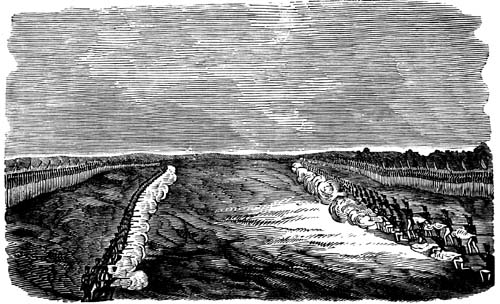
The contest which was now carried on stands
unparalleled. One side of the Corso was held by the
French soldiery; the opposite was in possession of
the Arragonese, who erected batteries at the end of
the cross-streets, within a few paces of those the
French had thrown up. The space between these
was covered with the dead. Next day, the powder
of the besieged began to fail; but even this dismayed
them not. One cry broke from the people,
whenever Palafox came among them, “War to the
knife!—no capitulation.” The night was coming
on, and still the French continued their impetuous
onsets. But now the brother of Palafox entered the
city with a convoy of arms and ammunition, and a
reinforcement of three thousand men. This succor
was as unexpected as it was welcome, and raised the
desperate courage of the citizens to the highest pitch
of enthusiasm. The war was now carried on from
street to street, and even from room to room. A
priest, by the name of Santiago Suss, displayed the
most undaunted bravery, fighting at the head of the
besieged, and cheering and consoling the wounded
and the dying. At the head of forty chosen men,
he succeeded in procuring a supply of powder for the
town, and, by united stratagem and courage, effected
its entrance, even through the French lines. This
murderous contest was continued for eleven successive
days and nights,—more, indeed, by night than
by day, for it was almost certain death to appear by
daylight within reach of houses occupied by the other
party. But, concealed by the darkness of the night,
they frequently dashed across the street, to attack
each other’s batteries; and the battle, commenced
there, was often carried into the houses beyond, from
room to room, and from floor to floor. As if not
enough of suffering had accompanied this memorable
siege, a new scourge came to add its horrors to the
scene. Pestilence, with all its accumulated terrors,
burst upon the doomed city. Numbers of putrescent
bodies, in various stages of decomposition, were strewed
thickly around the spot where the death-struggle was
still going on. The air was impregnated with the
pestiferous miasm of festering mortality; and this,
too, in a climate like Spain, and in the month of
August! This evil must be removed,—but how?
Certain death would have been the penalty of any
Arragonese who should attempt it. The only remedy
was to tie ropes to the French prisoners, and,
pushing them forward amid the dead and dying,
compel them to remove the bodies, and bring them
away for interment. Even for this office, as necessary
to one party as the other, there was no truce;
only the prisoners were better secured, by the compassion
of their countrymen, from the fire.
From day to day, this heroic defence was kept up,
with unremitting obstinacy. In vain breaches were
made and stormed; the besiegers were constantly
repulsed. At last Verdier received orders to retire;
and the French, after reducing the city almost to
ashes, were compelled to abandon their attacks, and
retreat.
Meanwhile, all over Spain the contest was continued,
and everywhere with the most unsparing cruelty.
Her purest and noblest sons often fell victims
to private malice. “No one’s life,” says one author,
“was worth a week’s purchase.” One anecdote
may serve as an example to illustrate the spirit
of the times.
ANECDOTE.
It was night. The rays of the full moon shed
their beautiful light on the hills of the Sierra Morena.
On one of these hills lay a small division of the patriotic
army. Its chief was a dark, fierce-looking
man, in whose bosom the spirit of human kindness
seemed extinct forever. A brigand, who had long
dealt in deeds of death, he had placed himself without
the pale even of the laws of Spain. But, when
the war commenced, he had offered his own services
and that of his men against the French, and had been
accepted. On this night he sat, wrapped in his huge
cloak, beside the decaying watch-fire, seemingly deep
in thought. Near him lay a prisoner on the grass,
with the knotted cords so firmly bound around his
limbs that the black blood seemed every moment
ready to burst from its enclosure. He might have
groaned aloud in his agony, had not the pride of his
nation,—for he, too, was a Spaniard,—and his own
deep courage, prevented. His crime was, that, yielding
to the promptings of humanity, he had shown
kindness to a wounded French officer, and had thus
drawn upon himself suspicion of favoring their cause.
Short trial was needed, in those days, to doom a man
to death; and, with the morning’s dawn, the brave
Murillo was informed that he must die.
With closed eyes and a calm countenance, his
heart was yet filled with agony, as he remembered
his desolated home and his defenceless little ones.
Suddenly, a light footstep was heard in the wood
adjoining. The sentinel sprang to his feet, and
demanded, “Who goes there?” A boy, over whose
youthful brow scarce twelve summers could have
passed, answered the summons. “I would speak
with your chief,” he said. The ruthless man raised
his head as the boy spoke this; and, not waiting for
an answer, he sprang forward and stood before him.
“What is your errand here, boy?” asked the brigand.
“I come a suppliant for my father’s life,” he
said, pointing to the prisoner on the grass. “He
dies with the morrow’s sun,” was the unmoved reply.
“Nay, chieftain, spare him, for my mother’s sake,
and for her children. Let him live, and, if you must
have blood, I will die for him;” and the noble boy
threw himself at the feet of the chief, and looked up
imploringly in his face. “He is so good!—You smile:
you will save his life!” “You speak lightly of life,”
said the stern man, “and you know little of death.
Are you willing to lose one of your ears, for your
father’s sake?” “I am,” said the boy, and he
removed his cap, and fixed his eyes on his father’s
face. Not a single tear fell, as the severed member,
struck off by the chief’s hand, lay at his feet. “You
bear it bravely, boy; are you willing to lose the
other?” “If it will save my father’s life,” was
the unfaltering response. A moment more, and the
second one lay beside its fellow, while yet not a
groan, or word expressive of suffering, passed the
lips of the noble child. “Will you now release my
father?” he asked, as he turned to the prostrate
man, whose tears, which his own pain had no power
to bring forth, fell thick and fast, as he witnessed the
bravery of his unoffending son. For a moment it
seemed that a feeling of compassion had penetrated
the flinty soul of the man of blood. But, if the spark
had fallen, it glimmered but a moment on the cold
iron of that heart, and then went out forever.
“Before I release him, tell me who taught you thus
to endure suffering.” “My father,” answered the
boy. “Then that father must die; for Spain is not
safe while he lives to rear such children.” And
before the morning dawned father and son slept their
last sleep.
While Lefebre and Verdier were prosecuting the
fatal siege of Saragossa, Marshal Bessières was pursuing
his victorious course in Castile, compelling one
force after another to acknowledge the authority of
Joseph. General Duhesme and Marshal Moncey, in
Catalonia, met with varied success;—repulsed at
Valencia and at Gerona, they yet met with enough
good fortune to maintain their reputation as generals.
In Andalusia, the French army, under Dupont, met
with serious reverses. At Baylen, eighteen thousand
men laid down their arms, only stipulating that they
should be sent to France. This capitulation, disgraceful
in itself to the French, was shamefully
broken. Eighty of the officers were murdered, at
Lebrixa, in cold blood; armed only with their
swords, they kept their assassins some time at bay,
and succeeded in retreating into an open space in the
town, where they endeavored to defend themselves;
but, a fire being opened upon them from the surrounding
houses, the last of these unfortunate men were
destroyed. The rest of the troops were marched to
Cadiz, and many died on the road. Those who
survived the march were treated with the greatest
indignity, and cast into the hulks, at that port. Two
years afterwards, a few hundreds of them escaped,
by cutting the cables of their prison-ship, and drifting
in a storm upon a lee shore. The remainder
were sent to the desert island of Cabrera, without
clothing, without provisions, with scarcely any water,
and there died by hundreds. It is related that some
of them dug several feet into the solid stone with a
single knife, in search of water. They had no
shelter, nor was there any means of providing it.
At the close of the war, when returning peace caused
an exchange of prisoners, only a few hundred of all
those thousands remained alive. This victory at
Baylen greatly encouraged the Spanish troops,
whose ardor was beginning to fail, before the conquering
career of Bessières, and the disgust and terror
occasioned by the murders and excesses of the
populace. When the news of the capitulation
reached Madrid, Joseph called a council of war, and
it was decided that the French should abandon
Madrid, and retire behind the Ebro.
FRENCH SUCCESSES IN PORTUGAL.
But if the French arms had met with a reverse in
Spain, it was compensated by their success in Portugal.
Junôt, at the head of twenty-five thousand
men, marched from Alcantara to Lisbon. At an
unfavorable season of the year, and encountering
fatigue, and want, and tempests, that daily thinned
his ranks, until of his whole force only two thousand
remained, he yet entered Lisbon victorious. This
city contained three hundred thousand inhabitants,
and fourteen thousand regular troops were collected
there. A powerful British fleet was at the mouth of
the harbor, and its commander, Sir Sidney Smith,
offered his powerful aid, in resisting the French; yet
such was the terror that Napoleon’s name excited,
and such the hatred of their rulers, that the people
of Lisbon yielded, almost without a struggle. When
Napoleon, in his Moniteur, made the startling announcement
that “the house of Braganza had ceased
to reign,” the feeble prince-regent, alarmed for his
own safety, embarked, with his whole court, and sailed
for the Brazils. Junôt himself was created Duke of
Abrantes, and made governor-general of the kingdom.
He exerted himself to give an efficient
government to Portugal; and met with such success,
that a strong French interest was created, and steps
were actually taken to have Prince Eugene declared
King of Portugal. The people themselves, and the
literary men, were in favor of this step; but it met
with the strongest opposition from the priests, and
this was nurtured and fanned into a flame by persons
in the pay of the English, whose whole influence
was exerted in making Napoleon’s name and nation
as odious to the people as possible. Among a
people so superstitious as the Portuguese, the monks
would, of course, exert great influence; and many
were the prodigies which appeared, to prove that
their cause was under the protection of Heaven.
Among others, was that of an egg, marked by some
chemical process, with certain letters, which were
interpreted to indicate the coming of Don Sebastian,
King of Portugal. This adventurous monarch, years
before, earnestly desirous of promoting the interests
of his country, and of the Christian religion, had
raised a large army, consisting of the flower of his
nobility, and the choicest troops of his kingdom, and
crossed the Straits into Africa, for the purpose of
waging war with the Moorish king. Young, ardent
and inexperienced, he violated every dictate of prudence,
by marching into the enemy’s country to meet
an army compared with which his own was a mere
handful. The whole of his army perished, and his
own fate was never known. But, as his body was
not found among the dead, the peasantry of Portugal,
ardently attached to their king, believed that he
would some time return, and deliver his country from
all their woes. He was supposed to be concealed
in a secret island, waiting the destined period, in
immortal youth. The prophecy of the egg was,
therefore, believed; and people, even of the higher
classes, were often seen on the highest points of the
hills, looking towards the sea with earnest gaze, for
the appearance of the island where their long-lost
hero was detained.
STATE OF AFFAIRS IN PORTUGAL.
The constant efforts of the English and the priests
at length had their effect, in arousing the Portuguese
peasantry into action; and the news of the insurrection
in Spain added new fuel to the flame. The
Spaniards in Portugal immediately rose against the
French; and their situation would have become dangerous
in the extreme, had not the promptness and
dexterity of Junôt succeeded in averting the danger
for the present. Such was the state of affairs in the
Peninsula, when the English troops made their
descent into Spain. It has often been said that
England was moved by pure patriotism, or by a
strong desire to relieve the Spanish nation, in being
thus prodigal of her soldiers and treasures; but
her hatred to Napoleon, and her determination, at
all hazards, to put a stop to his growing power,
was, in all probability, the real motive that influenced
her to bestow aid upon that people.
The English collected their army of nine thousand
in Cork, in June, 1808. Sir Hugh Dalrymple had,
nominally the chief command of the army, and Sir
Harry Burrard the second; but the really acting
officers were, Sir Arthur Wellesley and Sir John
Moore. These troops disembarked at the Mondego
river on the first of August, and marching along the
coast, proceeded to Rolica, where they determined
to give battle to the French. Junôt, having left in
Lisbon a sufficient force to hold the revolutionary
movement in check, placed himself at the head of
his army, and advanced to the contest. He was not,
however, present at the battle of Rolica. The
French troops were under the command of Generals
Loison and Laborde. Nearly in the centre of the
heights of Rolica stands an old Moorish castle. This,
and every favorable post on the high ground, was
occupied by detachments of the French army. It
was a strong position; but Sir Arthur, anxious to
give battle before the two divisions of the French
army should effect a junction, decided upon an immediate
attack.
BATTLE OF ROLICA.
It was morning, and a calm and quiet beauty
seemed to linger on the scene of the impending
conflict. The heights of Rolica, though steep and
difficult of access, possess few of the sterner and more
imposing features of mountain scenery. The heat of
summer had deprived them of much of that brightness
of verdure common in a colder climate. Here
and there the face of the heights was indented by
deep ravines, worn by the winter torrents, the precipitous
banks of which were occasionally covered
with wood, and below extended groves of the cork-tree
and olive; while Obidas, with its ancient walls
and fortress, and stupendous aqueduct, rose in the
middle distance. In the east Mount Junto reared
its lofty summit, while on the west lay the broad
Atlantic. And this was the battle-ground that was
to witness the first outpouring of that blood which
flowed so profusely, on both sides, during the progress
of this long and desolating war. Sir Arthur had
divided his army into three columns, of which he
himself commanded the centre, Colonel Trant the
right, while the left, directed against Loison, was
under General Ferguson. The centre marched against
Laborde, who was posted on the elevated plain. This
general, perceiving, at a glance, that his position was
an unfavorable one, evaded the danger by falling
rapidly back to the heights of Zambugeria, where he
could only be approached by narrow paths, leading
through deep ravines. A swarm of skirmishers,
starting forward, soon plunged into the passes; and,
spreading to the right and left, won their way among
the rocks and tangled evergreens that overspread the
steep ascent, and impeded their progress.
With still greater difficulty the supporting column
followed, their formation being disordered in the
confined and rugged passes, while the hollows echoed
with the continual roar of musketry, and the shouts
of the advancing troops were loudly answered by the
enemy, while the curling smoke, breaking out from
the side of the mountain, marked the progress of
the assailants, and showed how stoutly the defence
was maintained. The right of the 29th arrived first
at the top; and, ere it could form, Col. Lake was
killed, and a French company, falling on their flanks,
broke through, carrying with them fifty or sixty
prisoners. Thus pressed, this regiment fell back,
and, re-forming under the hill, again advanced to the
charge. At the same time, General Ferguson poured
his troops upon the other side of the devoted army.
Laborde, seeing it impossible to effect a junction with
Loison, or to maintain his present position, fell back,—commencing
his retreat by alternate masses, and
protecting his movements by vigorous charges of
cavalry,—and halted at the Quinta de Bugagleira,
where his scattered detachments rejoined him. From
this place he marched all night, to gain the position
of Montechique, leaving three guns on the field of
battle, and the road to Torres Vedras open to the
victors. The French lost six hundred men, killed
and wounded, among the latter of which was the
gallant Laborde himself. Although the English were
victors in this strife, the heroic defence of the French
served to show them that they had no mean enemy
to contend with. The personal enmity to Napoleon,
and the violent party prejudices in England, were so
great, that the most absurd stories as to the want of
order and valor in his troops gained immediate credence
there; and many of the English army believed
that they had but to show themselves, and the French
would fly. The bravery with which their attack
was met was, of course, a matter of great surprise,
and served as an efficient check to that rashness
which this erroneous belief had engendered.
Instead of pursuing this victory, as Wellesley would
have done, he was obliged to go to the seashore, to
protect the landing of General Anstruthers and his
troops. After having effected a junction with this
general, he marched to Vimiero, where the French,
under Junôt, arrived on the 21st of August. The
following brief and vivid sketch of this combat is
taken from Alexander’s Life of Wellington:
BATTLE OF VIMIERO.
“Vimiero is a village, pleasantly situated in a
gentle and quiet valley, through which flows the
small river of Maceria. Beyond, and to the westward
and northward of this village, rises a mountain,
of which the western point reaches the sea; the
eastern is separated by a deep ravine from the
height, over which passes the road that leads from
Lourinha and the northward to Vimiero. On this
mountain were posted the chief part of the infantry,
with eight pieces of artillery. General Hill’s brigade
was on the right, and Ferguson’s on the left, having
one battalion on the heights, separated from them by
the mountain. Towards the east and south of the
town lay a mill, wholly commanded by the mountain
on the west side, and commanding, also, the surrounding
ground to the south and east, on which
General Fane was posted, with his riflemen, and the
50th regiment, and General Anstruthers’ brigade,
with the artillery, which had been ordered to that
position during the night.
“About eight o’clock a picket of the enemy’s
horse was first seen on the heights, toward Lourinha;
and, after pushing forward his scouts, soon appeared
in full force, with the evident object of attacking the
British.
“Immediately four brigades, from the mountains
on the east, moved across the ravine to the heights
on the road to Lourinha, with three pieces of cannon.
They were formed with their right resting upon these
heights, and their left upon a ravine which separates
the heights from a range at Maceria. On these
heights were the Portuguese troops, and they were
supported by General Crawford’s brigade.
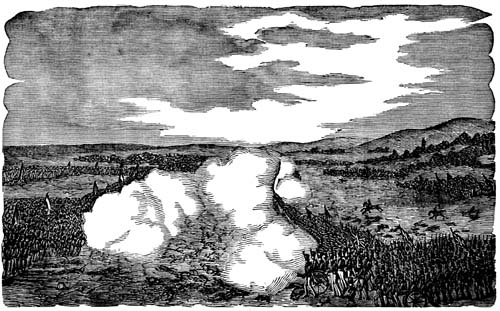
“The enemy opened his attack, in strong columns,
against the entire body of troops on this height. On
the left they advanced, through the fire of the riflemen,
close up to the 50th regiment, until they were
checked and driven back by that regiment, at the
point of the bayonet. The French infantry, in these
divisions, was commanded by Laborde, Loison, and
Kellerman, and the horse by General Margaron.
Their attack was simultaneous, and like that of a man
determined to conquer or to perish. Besides the conflict
on the heights, the battle raged with equal fury
on every part of the field. The possession of the
road leading into Vimiero was disputed with persevering
resolution, and especially where a strong body
had been posted in the church-yard, to prevent the
enemy forcing an entrance into the town. Up to
this period of the battle the British had received and
repulsed the attacks of the enemy, acting altogether
on the defensive. But now they were attacked in
flank by General Ackland’s brigade, as it advanced
to its position on the height to the left, while a brisk
cannonade was kept up by the artillery on those
heights.
“The brunt of the attack was continued on the
brigade of General Fane, but was bravely repulsed at
all points. Once, as the French retired in confusion,
a regiment of light dragoons pursued them with so
little precaution, that they were suddenly set upon
by the heavy cavalry of Margaron, and cut to pieces,
with their gallant colonel at their head.
“No less desperate was the encounter between
Kellerman’s column of reserve and the gallant 43d,
in their conflict for the vineyard adjoining the church.
The advanced companies were at first driven back,
with great slaughter; but, again rallying upon the
next ranks, they threw themselves upon the head of
a French column in a ravine, and, charging with the
bayonet, put them to the rout. At length the vigor
of the enemy’s attack ceased. They, pressed on all
sides by the British, had lost thirteen cannons and a
great number of prisoners; but were still enabled to
retire without confusion, owing to the protection of
their numerous cavalry. An incident occurred in
this battle, so highly characteristic of Highland courage,
that I cannot refrain from quoting it. It is
very common for the wounded to cheer their more
fortunate comrades, as they pass on to the attack. A
man named Stewart, the piper of the 71st regiment,
was wounded in the thigh, very severely, at an early
period of the action, and refused to be removed. He
sat upon a bank, playing martial airs, during the
remainder of the battle. As a party of his comrades
were passing, he addressed them thus: ‘Weel, my
brave lads, I can gang na langer wi’ ye a fightin’,
but ye shall na want music.’ On his return home,
the Highland Society voted him a handsome set of
pipes, with a flattering inscription engraved on them.”
The total loss of the French was estimated at
three thousand. Soon after the battle, General Kellerman
presented himself, with a strong body of
cavalry, at the outposts, and demanded an interview
with the English general. The result of this interview
was the famous convention of Cintra. By it, it
was stipulated that Portugal should be delivered up
to the British army, and the French should evacuate
it, with arms and baggage, but not as prisoners of
war; that the French should be transported, by the
British, into their own country; that the army should
carry with it all its artillery, cavalry, arms, and ammunition,
and the soldiers all their private property.
It also provided that the Portuguese who had favored
the French party should not be punished.
THE FRENCH EVACUATE PORTUGAL.
According to the terms of this convention, Junôt,
on the 2d of September, yielded the government of
the capital. This suspension of military rule was
followed by a wild scene of anarchy and confusion.
The police disbanded of their own accord, and crime
stalked abroad on every side. Lisbon was illuminated
with thousands of little lamps, at their departure;
and such was the state of the public mind, that
Sir John Hope was obliged to make many and severe
examples, before he succeeded in restoring order.
On the 13th, the Duke of Abrantes embarked,
with his staff; and by the 30th of September only
the garrisons of Elvas and Almeida remained in Portugal.
This convention was very unpopular in England.
The whole voice of the press was against it;
and such was the state of feeling, that Sir Harry
Burrard and Sir Hugh Dalrymple were both recalled,
to present themselves before a court of inquiry, instituted
for the occasion. After a minute investigation,
these generals were declared innocent, but it was
judged best to detain them at home.
Having seen Portugal under the control of the
English, let us return to the affairs of Spain. Immediately
after the battle of Baylen, which induced
the retreat of Joseph from Madrid, Ferdinand was
again declared king, and the pomp and rejoicings
attendant on this event put an end to all business,
except that of intrigue. The French were everywhere
looked upon by the Spanish as a conquered
foe, and they spent their time in the pageant of
military triumphs and rejoicings, as though the enemy
had already fled. From this dream of fancied security
Palafox was at length awakened by the appearance
of a French corps, which retook Tudela, and
pushed on almost to Saragossa. He appealed to the
governing junta for aid and assistance. Much time
was lost in intrigue and disputes, but at length the
army was organized by appointing La Pena and
Llamas to the charge. To supply the place usually
occupied by the commander-in-chief, a board of
general officers was projected, of which Castanos
should be chief; but when some difficulty arose as
to who the other members should be, this plan was
deferred, with the remark, that “when the enemy
was driven across the frontier, Castanos would have
leisure to take his seat.” Of the state of the Spanish
forces at this time, Napier says, “The idea of a
defeat, the possibility of a failure, had never entered
their minds. The government, evincing neither apprehension,
nor activity, nor foresight, were contented
if the people believed the daily falsehoods
propagated relative to the enemy; and the people
were content to be so deceived. The armies were
neglected, even to nakedness; the soldier’s constancy
under privations cruelly abused; disunion, cupidity,
incapacity, prevailed in the higher orders; patriotic
ardor was visibly abating among the lower classes;
the rulers were grasping, improvident, and boasting;
the enemy powerful, the people insubordinate. Such
were the allies whom the British found on their
arrival in Spain.” Sir Arthur Wellesley had returned
to Ireland, and the chief command was now given to
Sir John Moore. This general, with the greatest
celerity, marched his troops to the Spanish frontier,
by the way of Almeida, having overcome almost
insurmountable obstacles, arising from the state of
affairs in Spain. Sir David Baird, with a force of
ten thousand men, landed at Corunna, and also advanced
to the contest; but they soon found that they
were to meet an enemy with whom they were little
able to cope.
ENERGY OF THE FRENCH.
Napoleon, with that energy so often displayed by
him, when the greatness of the occasion required its
exercise, collected, in an incredibly short space of
time, an immense army of two hundred thousand
men, most of them veterans who had partaken of
the glories of Jena, Austerlitz, and Friedland.
These were divided by the emperor into eight parts,
called “corps d’armée.” At the head of each of
them was placed one of his old and tried generals,—veterans
on whom he could rely. The very names
of Victor, Bessières, Moncey, Lefebre, Mortier,
Ney, St. Cyr, and Junôt, speak volumes for the
character of the army.
These troops were excited to the highest pitch of
enthusiasm, by the emperor’s address, as he passed
through Paris, promising that he would head them
in person, to drive the hideous leopard into the sea.
What were the scattered and divided troops of the
Spaniards, to contend with such a force? The grand
French army reached Vittoria almost without an interruption.
Blake was in position at Villarcayo, the
Asturians were close at hand, Romana at Bilboa, and
the Estremadurans at Burgos. With more valor than
discretion, Blake made an attack upon Tornosa.
The enemy pretended to retreat. Blake, flushed
with his apparent success, pursued them with avidity,
when he suddenly came before twenty-five thousand
men, under the Duke of Dantzic, and was
furiously assailed. Blake, after a gallant defence,
was obliged to retreat, in great confusion, upon Bilboa.
He rallied, however, and was again in the field
in a few days, fought a brave action with Villate, and
was this time successful. With the vain-glory of his
nation, he next attacked the strong city of Bilboa.
Here, Marshal Victor gained a signal success, Blake
losing two of his generals, and many of his men.
Romana, who had joined Blake, renewed the action,
with his veterans. They were made prisoners, but
their brave chief escaped to the mountains. Napoleon
himself now left Bayonne, and directed his
course into Spain. Only one day sufficed for his
arrival into Vittoria. At the gates of the city, a
large procession, headed by the civil and military
chiefs, met him, and wished to escort him to a splendid
house prepared for his reception; but they were
destined to a disappointment. Napoleon was there,
not for pomp or show, but to direct, with his genius,
the march of that army which he had raised. Jumping
from his horse, he entered the first small inn he
observed, and calling for his maps, and a report of
the situation of the armies on both sides, proceeded
to arrange the plan of his campaign. By daylight
the next morning, his forces were in motion. The
hastily levied troops of the Conde de Belvidere, himself
a youth of only twenty years, were opposed to
him. These were routed, with great slaughter,—one
whole battalion, composed of the students of Salamanca
and Lecon, fell to a man.
THE PASS OF SOMOSIERRA.
NAPOLEON BEFORE MADRID.
The army of the centre, under the command of
Castanos, which was composed of fifty thousand men,
with forty pieces of cannon, was totally routed at
Tudela, by the French, under Lasnes and Ney; and
now but one stronghold remained to the Spaniards,
between the enemy and Madrid. This was the pass
of the Somosierra. Here the Spanish army, under
St. Juan, had posted their force. Sixteen pieces of
artillery, planted in the neck of the pass, swept the
road along the whole ascent, which was exceedingly
steep and favorable for the defence. The Spanish
troops were disposed in lines, one above another;
and when the French came on to the contest, they
warmly returned their fire, and stood their ground.
As yet, the grand battery had not opened its fire.
This was waiting for the approach of the centre, under
Napoleon himself. And now Napoleon, seeing that
his troops were not advancing, rode slowly into the
foot of the pass. The lofty mountain towered above
him. Around its top hung a heavy fog, mingled with
the curling smoke that was ascending from the
mouth of all those cannon, rendering every object
indistinct in the distance. Silently he gazed up the
mountain. A sudden thought strikes him. His
practised eye has discerned, in a moment, what
course to pursue. Turning to his brave Polish
lancers, he orders them to charge up the causeway,
and take the battery. They dashed onward.
As they did so, the guns were turned full upon them,
and their front ranks were levelled to the earth; but,
ere they could reload, the Poles, nothing daunted,
sprang over their dying comrades, and before the
thick smoke, which enveloped them as a cloud, had
dispersed, they rushed, sword in hand, upon the soldiers,
and, cutting down the gunners, possessed
themselves of the whole Spanish battery. The panic
became general. The Spaniards fled, leaving arms,
ammunition, and baggage, to the enemy, and the
road open to Madrid. Meanwhile, this city was in
a state of anarchy seldom equalled. A multitude of
peasants had entered the place. The pavements
were taken up, the streets barricaded, and the houses
pierced. They demanded arms and ammunition.
These were supplied them. Then they pretended
that sand had been mixed with the powder furnished.
The Marquis of Perales, an old and worthy gentleman,
was accused of the deed. The mob rushed to
his house. They had no regard for age. They
seized him by his silvery hair, and, dragging him
down the steps, drew him through the streets until
life was extinct. For eight days the mob held possession
of the city. No man was safe; none dared
assume authority, or even offer advice. Murder,
and lust, and rapine, and cruelty, stalked fearlessly
through the streets. On the morning of the ninth,
far away on the hills to the north-west, appeared a
large body of cavalry, like a dark cloud overhanging
the troubled city. At noon, the resistless emperor
sat down before the gates of Madrid, and summoned
the city to surrender. Calmness and quiet reigned
in the French camp, but Madrid was struggling like
a wild beast in the toils. Napoleon had no wish to
destroy the capital of his brother’s kingdom, but he
was not to be trifled with. At midnight, a second
summons was sent. It was answered by an equivocal
reply, and responded to by the roar of cannon
and the onset of the soldiery. This was an appeal
not to be resisted. Madrid was in no state to stand
a siege. At noon, two officers, in Spanish uniform,
and bearing a flag of truce, were observed approaching
the French headquarters. They came to demand
a suspension of arms, necessary, they said, to persuade
the people to surrender. It was granted, and
they returned to the city, with Napoleon’s message.
Before six o’clock in the morning, Madrid must surrender,
or perish. Dissensions arose, but the voice
of prudence prevailed, and the capital yielded. Napoleon
was wise; he had no wish to goad a people
already incensed to fury. The strictest discipline
was maintained, and a soldier of his own guard was
shot for having stolen a watch. Shops were reopened,
public amusements recommenced, and all
was quiet. In six short weeks every Spanish army
was dissipated. From St. Sebastian to the Asturias,
from the Asturias to Talavera, from Talavera to the
gates of Saragossa, all was submission, and beyond
that boundary all was apathy or dread.
An assemblage of the nobles, the clergy, the corporations,
and the tribunals, of Madrid, now waited
on Napoleon at his headquarters, and presented an
address, in which they expressed their desire to have
Joseph return among them. Napoleon’s reply was
an exposition of what he had done and intended doing
for Spain. Could the people but have yielded their
prejudices, and submitted to his wise plans, what seas
of tears and blood, what degradation and confusion,
might have been spared to poor, unhappy Spain!
ADDRESS TO THE SPANISH PEOPLE.
“I accept,” said he, “the sentiments of the town
of Madrid. I regret the misfortunes that have befallen
it, and I hold it as a particular good fortune,
that I am enabled to spare that city, and save it yet
greater misfortunes. I have hastened to take measures
to tranquillize all classes of citizens, knowing
well that to all people and men uncertainty is intolerable.
“I have preserved the religious orders, but I have
restrained the number of monks; no sane person
can doubt that they are too numerous. Those who
are truly called to this vocation, by the grace of God,
will remain in the convents; those who have lightly,
or for worldly motives, adopted it, will have their
existence secured among the secular ecclesiastics,
from the surplus of the convents.
“I have provided for the wants of the most interesting
and useful of the clergy, the parish priests.
“I have abolished that tribunal against which Europe
and the age alike exclaimed. Priests ought to
guide consciences, but they should not exercise any
exterior or corporal jurisdiction over men.
“I have taken the satisfaction which was due to
myself and to my nation, and the part of vengeance
is completed. Ten of the principal criminals bend
their heads before her; but for all others there is
absolute and entire pardon.
“I have suppressed the rights usurped by the
nobles during civil wars, when the kings have been
too often obliged to abandon their own rights, to
purchase tranquillity and the repose of the people.
“I have suppressed the feudal rights, and every
person can now establish inns, mills, ovens, weirs,
and fisheries, and give good play to their industry,
only observing the laws and customs of the place.
The self-love, the riches, and the prosperity, of a small
number of men, were more hurtful to your agriculture
than the heats of the dog-days.
“As there is but one God, there should be in one
estate but one justice; wherefore all the particular
jurisdictions have been usurped, and, being contrary
to the national rights, I have destroyed them. I have
also made known to all persons that which each can
have to fear, and that which they may hope for.
“The English armies I will drive from the Peninsula.
Saragossa, Valencia, Seville, shall be reduced,
either by persuasion or by force of arms.
“There is no obstacle capable of retarding, for
any length of time, my will; but that which is above
my power is to constitute the Spaniards a nation,
under the orders of a king, if they continue to be
imbued with divisions, and hatred towards France,
such as the English partisans and the enemies of the
continent have instilled into them. I cannot establish
a nation, a king, and Spanish independence, if
that king is not sure of the affection and fidelity of
his subjects.
“The Bourbons can never reign again in Europe.
The divisions in the royal family were concerted by
the English. It was not either King Charles or his
favorite, but the Duke of Infantado, the instrument
of England, that was upon the point of overturning
the throne. The papers recently found in his house
prove this. It was the preponderance of England
that they wished to establish in Spain. Insensate
project! which would have produced a long war without
end, and caused torrents of blood to be shed.
“No power influenced by England can exist upon
this continent. If any desire it, their desire is folly,
and sooner or later will ruin them. I shall be obliged
to govern Spain; and it will be easy for me to do it,
by establishing a viceroy in each province. However,
I will not refuse to concede my rights of conquest
to the king, and to establish him in Madrid,
when the thirty thousand citizens assemble in the
churches, and on the holy sacrament take an oath,
not with the mouth alone, but with the heart, and
without any jesuitical restriction, ‘to be true to the
king,—to love and support him.’ Let the priests
from the pulpit and in the confessional, the tradesmen
in their correspondence and in their discourses, inculcate
these sentiments in the people; then I will
relinquish my rights of conquest, and I will place
the king upon the throne, and I will take a pleasure
in showing myself the faithful friend of the Spaniards.
“The present generation may differ in opinions.
Too many passions have been excited; but your
descendants will bless me, as the regenerator of the
nation. They will mark my sojourn among you as
memorable days, and from those days they will date
the prosperity of Spain. These are my sentiments.
Go, consult your fellow-citizens; choose your part,
but do it frankly, and exhibit only true colors.”
The ten criminals were the Dukes of Infantado,
of Hijah, of Mediniceli, and Ossuna; Marquis Santa
Cruz, Counts Fernan, Minez, and Altamira; Prince
of Castello Franco, Pedro Cevallos, and the Bishop
of St. Ander, were proscribed, body and goods, as
traitors to France and Spain.
Napoleon now made dispositions indicating a vast
plan of operations. But, vast as his plan of campaign
appears, it was not beyond the emperor’s
means; for, without taking into consideration his
own genius, activity and vigor, there were upon
his muster-rolls above three hundred and thirty
thousand men and above sixty thousand horse; two
hundred pieces of field artillery followed his corps to
battle; and as many more remained in reserve. Of
this great army, however, only two hundred and
fifty thousand men and fifty thousand horses were
actually under arms with the different regiments,
while above thirty thousand were detached or in
garrisons, preserving tranquillity in the rear, and
guarding the communications of the active forces.
The remainder were in hospitals. Of the whole host,
two hundred and thirteen thousand were native
Frenchmen, the residue were Poles, Germans and
Italians; thirty-five thousand men and five thousand
horses were available for fresh enterprise, without
taking a single man from the lines of communication.
The fate of the Peninsula hung, at this moment,
evidently upon a thread; and the deliverance of that
country was due to other causes than the courage,
the patriotism, or the constancy, of the Spaniards.
The strength and spirit of Spain was broken; the
enthusiasm was null, except in a few places, in consequence
of the civil wars, and intestinal divisions
incited by the monks and British hirelings; and the
emperor was, with respect to the Spaniards, perfectly
master of operations. He was in the centre
of the country; he held the capital, the fortresses,
the command of the great lines of communication
between the provinces; and on the wide military
horizon no cloud interrupted his view, save the city
of Saragossa on the one side, and the British army
on the other. “Sooner or later,” said the emperor,
and with truth, “Saragossa must fall.” The subjugation
of Spain seemed inevitable, when, at this
instant, the Austrian war broke out, and this master-spirit
was suddenly withdrawn. England then put
forth all her vast resources, and the genius and vigor
of Sir John Moore, aided, most fortunately, by the
absence of Napoleon, and the withdrawal of the
strength of his army for the subjugation of the
Peninsula; and it was delivered from the French, after
oceans of blood had been spilt and millions of treasure
wasted, to fall into the hands of the not less tyrannical
and oppressive English. “But through what
changes of fortune, by what unexpected helps, by
what unlooked-for events,—under what difficulties, by
whose perseverance, and in despite of whose errors,—let
posterity judge; for in that judgment,” says
Napier, “only will impartiality and justice be
found.”
BONAPARTE LEAVES SPAIN.
Tidings having reached the emperor that the
Austrian army was about to invade France, he recalled
a large portion of his army, and appointing
his brother Joseph to be his lieutenant-general, he
allotted separate provinces to each corps d’armée,
and directing the imperial guard to hasten to France,
he returned to Valladolid, where he received the
addresses of the nobles and deputies of Madrid, and
other great towns; and after three days’ delay, he
departed himself, with scarcely any escort, but with
such astonishing speed as to frustrate the designs
which some Spaniards had, in some way, formed
against his person.
RETREAT OF SIR JOHN MOORE.
The general command of the French army in
Spain was left with Soult, assisted by Ney. This
gallant general, bearing the title of the Duke of
Dalmatia, commenced his pursuit of the English
army with a vigor that marked his eager desire to
finish the campaign in a manner suitable to its brilliant
opening. Sir John Moore had arrived in Salamanca
by the middle of November, and on the 23d
the other divisions of the army had arrived at the
stations assigned them. Sir David Baird had already
reported himself at Astorga, when Moore received
positive information that the French had entered
Valladolid in great force. And this place was only
three days’ march distant from the British. At a
glance, the great mind of Moore comprehended the
full difficulty of his critical situation. In the heart
of a foreign country, unsupported by the Spanish
government, his army wanting the very necessaries
of life, he found himself obliged to commence that
retreat in winter, over mountains covered with snow,
which proved so fatal to the British army, or wait to
meet the French troops, flushed with victory, and
sustained by an overwhelming force. In vain he
appealed to the junta of Salamanca for aid. In vain
he endeavored to arouse the spirit of patriotism,
which had shone forth so brightly in the first days
of the insurrection. Instead of aiding him either to
advance or retreat, they endeavored to direct him
what course to pursue; and painted, with true Spanish
pride and hyperbole, in glowing colors, what their
armies had done, and what they could do. His
camp was therefore struck, and he retreated through
the rocks of Gallicia, closely followed by the pursuing
army. Whenever the advance guards of the
enemy approached, the British rallied with vigor,
and sustained their reputation for bravery; but they
displayed a lamentable want of discipline in all other
parts of their conduct. The weather was tempestuous;
the roads miserable; the commissariat was
utterly defective, and the very idea that they were
retreating was sufficient to crush the spirits of the
soldiery. At Bembibre, although the English well
knew that the French were close behind, they broke
into the immense wine-vaults of that city. All effort
by their officers to control them was utterly useless.
Hundreds became so inebriated as to be unable to
proceed, and Sir John Moore was obliged to proceed
without them. Scarcely had the reserve marched
out of the village, when the French cavalry appeared.
In a moment the road was filled with the miserable
stragglers, who came crowding after the troops, some
with shrieks of distress and wild gestures, others
with brutal exclamations; while many, overcome
with fear, threw away their arms, and those who
preserved them were too stupidly intoxicated to fire,
and kept reeling to and fro, alike insensible to their
danger and disgrace. The enemy’s horsemen, perceiving
this, bore at a gallop through the disorderly
mob, cutting to the right and left as they passed,
and riding so close to the columns that the infantry
were forced to halt in order to protect them. At
Villa Franca even greater excesses were committed;
the magazines were plundered, the bakers driven
away from the ovens, the wine-stores forced, the
doors of the houses were broken, and the scandalous
insubordination of the soldiers was, indeed, a disgrace
to the army. Moore endeavored to arrest this disorder,
and caused one man, taken in the act of
plundering a magazine, to be hanged. He also
endeavored to send despatches to Sir David Baird,
directing him to Corunna, instead of Vigo; but his
messenger became drunk and lost his despatches, and
this act cost the lives of more than four hundred
men, besides a vast amount of suffering to the rest
of the army. An unusual number of women and
children had been allowed to accompany the army,
and their sufferings were, indeed, dreadful to witness.
Clark, in his history of the war, gives a heart-rending
account of the horrors of this retreat. “The
mountains were now covered with snow; there was
neither provision to sustain nature nor shelter from
the rain and snow, nor fuel for fire to keep the vital
heat from total extinction, nor place where the weary
and footsore could rest for a single hour in safety.
The soldiers, barefooted, harassed and weakened by
their excesses, were dropping to the rear by hundreds;
while broken carts, dead animals, and the piteous
appearance of women, with children, struggling or
falling exhausted in the snow, completed the dreadful
picture. It was still attempted to carry forward
some of the sick and wounded;—the beasts that drew
them failed at every step, and they were left to
perish amid the snows.” “I looked around,” says
an officer, “when we had hardly gained the highest
point of those slippery precipices, and saw the rear
of the army winding along the narrow road. I saw
their way marked by the wretched people, who lay
on all sides, expiring from fatigue and the severity
of the cold, their bodies reddening in spots the white
surface of the ground. A Portuguese bullock-driver,
who had served the English from the first
day of their arrival, was seen on his knees amid the
snow, dying, in the attitude and act of prayer. He
had, at least, the consolations of religion, in his dying
hour. But the English soldiers gave utterance to far
different feelings, in their last moments. Shame and
anger mingled with their groans and imprecations on
the Spaniards, who had, as they said, betrayed them.
Mothers found their babes sometimes frozen in their
arms, and helpless infants were seen seeking for
nourishment from the empty breasts of their dead
mothers. One woman was taken in labor upon the
mountain. She lay down at the turning of an angle,
rather more sheltered than the rest of the way
from the icy sleet which drifted along; there she
was found dead, and two babes which she had brought
forth struggling in the snow. A blanket was thrown
over her, to hide her from sight,—the only burial that
could be afforded; and the infants were given in
charge to a woman who came up in one of the carts,
little likely, as it was, that they could survive such
a journey.”
DESTRUCTION OF MAGAZINES AT CORUNNA.
Soult hung close on the rear of this unfortunate
army, and pursued them until they reached Corunna,
on the 12th of January. As the morning dawned, the
weary and unfortunate general, saddened by the
dark scenes through which he had passed, sensible
that the soldiers were murmuring at their retreat, unsupported
by his Spanish allies, and well aware that
rumor and envy and misunderstanding would be
busy with his name in his own native land, appeared
on the heights that overhung the town. With eager
and anxious gaze, he turned to the harbor, hoping to
perceive there his fleet, which he had ordered to sail
from Vigo. But the same moody fortune which had
followed him during his whole career pursued him
here. The wintry sun looked down upon the foaming
ocean, and only the vast expanse of water met
his view. The fleet, detained by contrary winds,
was nowhere visible; and once more he was obliged
to halt with his forces, and take up quarters. The
army was posted on a low ridge, and waited for the
French to come up. The sadness of the scene was
by no means passed. Here, stored in Corunna, was a
large quantity of ammunition, sent over from England,
and for the want of which both the Spanish
and English forces had suffered, and which Spanish
idleness and improvidence had suffered to remain
here for months, unappropriated. This must now be
destroyed, or fall into the possession of the enemy.
Three miles from the town were piled four thousand
barrels of powder on a hill, and a smaller quantity
at some distance from it. On the morning of the
13th, the inferior magazine blew up, with a terrible
noise, and shook the houses in the town; but when
the train reached the great store, there ensued a
crash like the bursting forth of a volcano;—the earth
trembled for miles, the rocks were torn from their
bases, and the agitated waters rolled the vessels, as
in a storm; a vast column of smoke and dust, shooting
out fiery sparks from its sides, arose perpendicularly
and slowly to a great height, and then a
shower of stones and fragments of all kinds, bursting
out of it with a roaring sound, killed many persons
who remained too near the spot. Stillness, slightly
interrupted by the lashing of the waves on the shore,
succeeded, and then the business of the day went
on. The next scene was a sad one. All the horses
of the army were collected together, and, as it was
impossible to embark them in face of the enemy, they
were ordered to be shot. These poor animals would
otherwise have been distributed among the French
cavalry, or used as draft-horses.
On the 14th, the transports from Vigo arrived.
The dismounted cavalry, the sick and wounded, the
best horses, belonging to the officers, which had been
saved, and fifty-two pieces of artillery, were embarked
during the night, only retaining twelve guns
on shore, ready for action. And now the closing
scene of this sad drama was rapidly approaching,
giving a melancholy but graceful termination to the
campaign.
DEATH OF SIR JOHN MOORE.
On the night of the 15th, everything was shipped
that was destined to be removed, excepting the fighting
men. These were intending to embark, as soon
as the darkness should permit them to move without
being perceived, on the night of the 16th; but in
the afternoon the French troops drew up, and offered
battle. This the English general would not refuse,
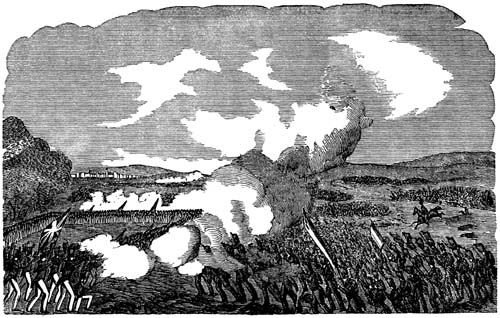
and the action soon became general. The battle was
advancing, with varied fortune, when Sir John Moore,
who was earnestly watching the result of the battle
in the village of Elvina, received his death-wound.
A spent cannon-ball struck him on his breast. The
shock threw him from his horse, with violence; but
he rose again, in a sitting posture, his countenance
unchanged, and his steadfast eye still fixed on the
regiments before him, and betraying no signs of pain.
In a few moments, when satisfied that his troops were
gaining ground, his countenance brightened, and he
suffered himself to be carried to the rear. Then was
seen the dreadful nature of his hurt. The shoulder was
shattered to pieces; the arm was hanging by a piece
of skin; the ribs over the heart were broken and bared
of flesh, and the muscles of the breast torn into long
strips, which were interlaced by their recoil from the
dragging shot. As the soldiers placed him in a blanket,
his sword got entangled, and the hilt entered the
wound. Captain Hardinge, a staff officer, who was
near, attempted to take it off; but the dying man
stopped him, saying, “It is as well as it is; I had
rather it should go out of the field with me.” And
in that manner, so becoming to a soldier, he was
borne from the fight by his devoted men, who went
up the hill weeping as they went. The blood flowed
fast, and the torture of his wound was great; yet,
such was the unshaken firmness of his mind, that
those about him judged, from the resolution of his
countenance, that his hurt was not mortal, and said
so to him. He looked steadfastly at the wound for a
few moments, and then said, “No,—I feel that to
be impossible.” Several times he caused his attendants
to turn around, that he might behold the field
of battle; and, when the firing indicated the advance
of the British, he discovered his satisfaction, and permitted
his bearers to proceed. Being brought to his
lodgings, the surgeon examined his wound, but there
was no hope. The pain increased, and he spoke with
great difficulty. Addressing an old friend, he said,
“You know that I always wished to die this way.”
Again he asked if the enemy were defeated; and
being told that they were, observed, “It is a great
satisfaction to me that we have beaten the French.”
Once, when he spoke of his mother, he became agitated.
It was the only time. He inquired after his
friends and officers who had survived the battle,
and did not even now forget to recommend those
whose merit entitled them to promotion. His strength
failed fast; and life was almost extinct, when he
exclaimed, as if in that dying hour the veil of the
future had been lifted, and he had seen the baseness
of his posthumous calumniators, “I hope the people
of England will be satisfied; I hope my country
will do me justice.” In a few minutes afterwards
he died, and his corpse, wrapped in a military cloak,
was interred by the officers of his staff, in the citadel
of Corunna. The guns of the enemy paid his funeral
honors, and the valiant Duke of Dalmatia, with a
characteristic nobleness, raised a monument to his
memory. The following is so beautiful and touching
a description of his burial, that we cannot refrain
from quoting it, even though it may be familiar to
most of our readers. It was written by the Rev.
Charles Wolfe, of Dublin.
“Not a drum was heard—not a funeral note—
As his corse to the ramparts we hurried;
Not a soldier discharged his farewell shot
O’er the grave where our hero was buried.
“We buried him darkly, at dead of night,
The sods with our bayonets turning,
By the struggling moonbeams’ misty light,
And the lantern dimly burning.
“No useless coffin enclosed his breast,
Nor in sheet nor in shroud we wound him;
But he lay like a warrior taking his rest,
With his martial cloak around him.
“Few and short were the prayers we said,
And we spoke not a word of sorrow;
But we steadfastly gazed on the face of the dead,
And bitterly thought of the morrow.
“We thought, as we hollowed his narrow bed,
And smoothed down his lonely pillow,
That the foe and the stranger would tread o’er his head,
And we far away on the billow.
“Lightly they’ll talk of the spirit that’s gone,
And o’er his cold ashes upbraid him;
But little he’ll reck, if they let him sleep on
In the grave where a Briton has laid him.
“But half of our heavy task was done,
When the clock struck the hour for retiring:
And we heard the distant and random gun
Of the enemy, suddenly firing.
“Slowly and sadly we laid him down,
From the field of his fame, fresh and gory;
We carved not a line—we raised not a stone—
But we left him alone with his glory.”
RESULT OF THE BATTLE.
The battle was continued until dark, under great
disadvantages on the part of the French, owing to the
difficulty they experienced in dragging their heavy
cannon on to the heights, and their small amount of
ammunition. The French loss has been estimated at
three thousand, and the British at eight hundred;
but the loss of the French was undoubtedly exaggerated.
The English availed themselves of the
darkness and the confusion among the enemy to
embark their troops; and so complete were the arrangements
of Sir John Hope, who succeeded to the
command, that it was all effected, without delay or
difficulty, before morning. The wounded were provided
for, and the fleet, although fired upon by the
French, sailed on the 17th for their home in England.
But their trials were not yet closed. It was Sir John
Moore’s intention to have proceeded to Vigo, that he
might restore order before he sailed for England;
but the fleet went directly home from Corunna, and a
terrible storm scattered it, many ships were wrecked,
and the remainder, driving up the channel, were glad
to put into any port. The soldiers thus thrown on
shore were spread all over the country. Their haggard
appearance, ragged clothing, and dirty accoutrements,
struck a people only used to the daintiness
of parade with surprise. A deadly fever, the result
of anxiety and of the sudden change from fatigue to
the confinement of a ship, filled the hospitals at
every port with officers and soldiers, and the terrible
state of the army was the all-absorbing topic of conversation.