In previous chapters it has been necessary to refer repeatedly to the
connection between migration and meteorology; either the relation of
periodic movements to the rotation of seasons, or the influence directly
or indirectly of weather conditions upon normal and abnormal migration.
That there is an overruling relation between the advance of spring and
the passage to northern breeding quarters, and the gradual cooling in
autumn and the retreat to winter quarters is, of course, evident, but
it must not be held, as contended by the early students of migration,
that this is the sole factor which regulates migration. The actual
relationship between the weather and the movement of birds is far more
complicated than one would imagine, and the stimuli of continental or
overland travelling differ from those of a cross-sea flight.
In the British Islands most of our larger movements are at their
start or their finish, or both (so far as our area is concerned),
oversea passages, and unless the weather be absolutely favourable, birds
do not undertake these voyages. No one has added more to our knowledge
of the connection, in what we may term British migration, than Mr Eagle
Clarke, but it must not for a moment be imagined that his conclusions
and the data from which he arrived at them are purely insular. The
British Islands are merely the field of observation, the centre of
the field, of the movements of Holarctic birds which travel regularly
or occasionally through Britain. Mr Clarke points out repeatedly
that in studying the phenomena it is the conditions at the point of
departure not at the point of arrival—generally the point of
observation—which are important.
The oft-repeated assertion that birds can foretell the nature of
approaching weather—that they are living barometers—is
not supported by any satisfactory evidence, but it is certain that
on many occasions the weather into which they have passed in moving
from one zone to another has not only retarded, checked, or exhausted
them, but has proved fatally disastrous. During the westward rushes in
winter, when exceptionally severe weather has cut off the food-supply
of ground-feeding birds, observers who have seen the birds moving in
front of the storm have maintained that they had felt its approach and
retreated in time. The truth seems to be that the birds start so soon
as the supply is cut off but in many cases speedily outstrip the storm.
When these exceptional winter migrations take place the birds in the
lowlands of Lancashire and Cheshire move westward towards Ireland, and
are observed at different points along the North Wales coast. They are
sometimes seen travelling in a snow-storm and sometimes in advance
of it. In eastern Cheshire I have seen parties of lapwings passing
over westward just in advance of snow, which when it reached the East
Cheshire fields, started the local lapwings after their relatives from
farther east.
During regular migration birds start in favourable weather but
frequently meet with unfavourable weather before their arrival at the
point aimed at; most of the bird "disasters" at the lighthouses and
lightships, and more occasionally inland, can be explained in this
way.
In his digest of the observations at lighthouses and lightships Mr
Eagle Clarke shows that spells of genial weather are favourable and
that during these spells migration is even flowing and continuous (15). Slightly unsettled conditions have
little effect, but an increase of the irregularities accelerates
migration. Sooner or later cyclonic disturbances interrupt regular
movements, and, if these are extraordinary, act as barriers, either
holding the birds in one place or forcing a hurried departure or "rush."
Favourable weather immediately following a check or "hold up" often
causes a rush; a sudden fall in temperature may force large numbers of
birds on in autumn or retard them in spring. Temperature, he declares,
is the main controlling factor in all extraordinary movements, other
meteorological conditions being suitable.
In the autumn migration to Britain, the chief movements take place
when a large and well-defined anticyclone has its centre somewhere over
Scandinavia, with gentle gradients in a south-westerly direction over
the North Sea. Coincident with this we usually find cyclonic conditions
prevailing to the west of the British area, with low-pressure centres
off the west or south-west of Ireland. The weather is clear and cold,
with light variable airs over Scandinavia, but in Britain the sky is
overcast, and the wind easterly and moderate to strong; not infrequently
these conditions mean fog on our eastern coasts. If the birds leave
Scandinavia under favourable conditions they may be met by the
approaching cyclonic system, which usually, though by no means always,
travels in a north-easterly direction across the Atlantic. Migration
is thus checked, but a return of favourable anticyclonic conditions
starts the birds again, often with a fresh impulse in the shape of
falling temperature. When the anticyclonic area is exceptionally
large, extending from the Scandinavian peninsula in a south-westerly
direction and embracing the whole of the British Islands, simultaneous
immigration and emigration may be witnessed.
Cyclonic spells are not always unfavourable to migration. In spring,
when they are of a mild type with soft rain and warm winds following
after a cold anticyclonic period, a northward movement is frequent.
Mr Eagle Clarke says that the importance of winds is overstated, but
as an incentive only. The direction of the wind has no influence as an
incentive but its force is an important factor; in a strong wind a bird
may be blown out of its course. Birds will not start in a high wind
but may pass into the influence of strong winds which may affect both
progress and direction. He adds that particular winds usually prevail
during the season of great autumn movements, which are not incentives
but are the result of pressure distribution which is favourable to
migration. These are usually north-east to south, but a westerly wind
would serve as well, but it indicates a pressure distribution which is
fatal to migration between north-west Europe and Britain—cyclonic
areas to the north-east and east of our area.
All this, no doubt, is perfectly true. It is founded on the analysis
of a huge number of carefully recorded observations, and upon a general
knowledge of migration which few can ever hope to equal. Mr Clarke
understands his subject. It appears, however, to me that he may put
rather too much weight upon the barometric influence, and too little
on one side of the wind question. Are we yet in a position to say that
birds do not make direct use of certain winds? It may be that the use
of the prevailing winds at migration time is far more unconsciously
intentional (if such an expression can be used) than is at first
apparent.
One or two points must be kept well to the front which are often
ignored by observers. Firstly, very much visible migration is abnormal;
that is to say, most of the incidents of passage which are noticeable,
especially observations at the lightships and lighthouses, are during
spells of weather which are described as unfavourable; it is the
"hold-ups," checks, and "rushes," which attract attention far more than
the even-flowing normal migration.
Mr J. Tomison, in his valuable notes on observations made at
Skerryvore (52), shows that in ordinary
clear weather birds pass at a great height, beyond the power of vision.
He proves this by instances of the diurnal passage of redwings, birds
which are generally supposed to migrate at night, and undoubtedly do
so frequently. He heard the well-known passage-note in the daytime,
but with the naked eye could see no redwings; he found them with
the telescope and later discovered others which were passing above
the range of normal vision. Mr Eagle Clarke, commenting upon the
extraordinary numbers of rare and exceptional visitors which are noticed
on many islands—Fair Island, the Flannens, the Isle of May, and
Heligoland may be taken as a few examples—says that it is their
detached position and comparatively small size which makes these islands
so useful to the observer. The same variety of birds and greater numbers
reach larger islands and tracts of land, but they are unobserved when
they are thinly distributed and not massed or confined in a small area.
"With all our great army of trained observers," he declares, "we in
Britain see only an infinitesimal number of the migrants which visit our
shores ..." and "this is especially the case on the mainland."
During an anticyclone there is a descending movement of air currents
from a centre of high pressure in all directions, and these currents
or winds are deflected "clockwise" in the northern hemisphere; and
when cyclonic conditions prevail the air currents are directed inwards
towards a low-pressure central area, rotating spirally at the surface
of the earth in the direction contrary to the hands of a watch. In the
southern hemisphere the directions are reversed. A cyclonic system
is usually carried forward by great drift winds like eddies upon
a swift stream, in the North Atlantic as a rule from south-west to
north-east.
Do we really know the force and direction of the winds at a high
altitude during these movements? Are we not merely guessing at the
real aerial conditions by the movements near the earth at the time
of the departure of the birds? Is it fair, if I am right that the
meteorological observations are founded upon only those observed at
comparatively low altitudes, to lay down laws as to the particular
conditions which are favourable or unfavourable, or the particular winds
which are used or avoided? The direction of the wind may be the same
up to a great height, many thousand feet, or it may vary within 500
feet of the earth. Nearly fifty years ago, when Glaisher made his great
ascents, he sometimes met with three or four currents moving in opposite
directions. The more recent upper air investigations show that though
as a rule the wind at various elevations is in the main from one point
of the compass, its degrees vary considerably, and its force at the
various heights shows remarkable differences. Generally the force rises
to about 5000 feet, but there is no invariable rule. I tabulate a few
examples taken more or less at random from the Weather Reports for 1908.
The altitudes above the ground are measured in metres, roughly converted
into feet; the letters indicate the direction of the wind, the figures
its speed in miles per hour. The last one in the table, observations
made at Brighton on September 20th, is particularly useful. The
conditions on this date were anticyclonic, and favourable to migration.
At 400 feet above the sea the wind was blowing at 5 miles an hour; at
between 5000 and 6000 feet its force was 20 miles per hour. What then
would happen to a bird leaving Brighton for say the Spanish Peninsula?
If it flew at 20 miles an hour towards the French coast about Dieppe,
it would meet the wind blowing at 5 miles an hour, and take between
five and six hours to reach the coast, head to wind. If it rose to the
height of 3000 feet it would meet a wind blowing at the same speed as
it was flying, and it could make no headway. If, however, it flew in
a south-westerly direction the more it turned westerly the farther it
would drift down channel towards Normandy or Brittany, and be carried
out to sea! But this is exactly what would not have happened, for on
this date a feeble cyclonic system was approaching from the Atlantic and
extending its area of influence over southern England. In the Channel
the bird would meet westerly winds which would bring it safely to the
Brittany shores, or if it missed them, to the western shores of the Bay,
where the wind was actually from the north. I mention this merely to
show that apparently unfavourable winds may be really favourable.
| Date. |
Station. |
Ground
Level. |
100 mtrs.
(330 ft.) |
500 mtrs.
(1660 ft.) |
1000 mtrs.
(3320 ft.) |
1050 mtrs.
(5000 ft.) |
| Jan. 2 |
Petersfield |
NE by E |
... |
ENE |
E by N |
E ½ N |
|
|
|
|
30 |
50 |
13 |
| |
|
|
|
|
|
|
| " 2 |
Glossop |
E by N |
... |
E |
E by S |
... |
|
1100 ft. |
8 |
|
15 |
30 |
|
| |
|
|
|
|
|
|
| " 3 |
Pyrton Hill |
... |
... |
E by N |
E |
... |
|
500 ft. |
14 |
|
35 |
53 |
|
| |
|
|
|
|
|
|
| " 4 |
" |
NE by E |
... |
... |
E by S |
E by S |
|
|
10 |
|
25 |
25 |
30 |
| |
|
|
|
|
|
|
| " 11 |
Petersfield |
S by E |
... |
S |
SW by W |
SW by W |
|
|
|
|
10 |
3 |
5 |
| |
|
|
|
|
|
|
| April 9 |
" |
SE |
... |
N by W |
... |
N ½ W |
|
|
|
|
7 |
|
20 |
| |
|
|
|
|
|
|
| " 18 |
Glossop |
N |
... |
N by W |
NW by N |
W |
|
|
|
|
9 |
16 |
7 |
| |
|
|
|
|
|
|
| " 30 |
" |
S |
S by E |
S |
W by N |
... |
|
|
14 |
27 |
30 |
46 |
|
| |
|
|
|
|
|
|
| May 16 |
" |
WSW |
W by S |
W by S |
W |
W by N |
|
|
16 |
26 |
27 |
29 |
33 |
| |
|
|
|
|
|
|
| Sept. 5 |
" |
WSW |
W by S |
W by S |
W by N |
W by N |
|
|
12 |
15 |
17 |
21 |
23 |
| |
|
|
|
|
|
|
| " 7 |
" |
S by W |
... |
... |
SW |
... |
|
|
9 |
16 |
20 |
33 |
|
| |
|
|
|
|
|
|
| " 10 |
" |
NW by N |
NW by N |
NW by N |
NW |
NW |
|
|
8 |
16 |
21 |
34 |
36 |
| |
|
|
|
|
|
|
| " 20 |
Brighton |
... |
... |
S |
... |
... |
|
380 ft. |
5 |
5 |
15 |
20 |
20 |
|
2000 mtrs. |
2500 mtrs. |
3000 mtrs. |
3500 mtrs. |
| Date |
(6,660 ft.). |
(8,320 ft.). |
(10,000 ft.). |
(11,660 ft.). |
| Jan. 2 |
ENE |
NE |
NE by N |
NE by N |
|
23 |
22 |
18 |
25 |
| |
|
|
|
|
| " 2 |
|
|
|
|
| |
|
|
|
|
| |
|
|
|
|
| " 3 |
|
|
|
|
| |
|
|
|
|
| |
|
|
|
|
| " 4 |
ESE |
SE by E |
SE by E |
|
|
35 |
20 |
15 |
|
| |
|
|
|
|
| " 11 |
N by W |
NW |
NNW |
N½W |
|
9 |
8 |
7 |
11 |
| |
|
|
|
|
| April 9 |
N |
NW½N |
NW½W |
... |
|
14 |
9 |
12 |
... |
|
|
|
|
|
| " 18 |
NE |
N by E |
W by N |
NNE |
|
6 |
8 |
8 |
9 |
| |
|
|
|
|
| " 30 |
|
|
|
|
| |
|
|
|
|
| |
|
|
|
|
| May 16 |
WNW |
|
|
|
|
35 |
|
|
|
| |
|
|
|
|
| Sept. 5 |
W by N |
|
|
|
|
28 |
|
|
|
| |
|
|
|
|
| " 7 |
|
|
|
|
| |
|
|
|
|
| |
|
|
|
|
| " 10 |
|
|
|
|
| |
|
|
|
|
| |
|
|
|
|
| " 20 |
|
|
|
|
| |
|
|
|
|
| |
|
|
|
|
|
4000 mtrs. |
4500 mtrs. |
5000 mtrs. |
6000 mtrs. |
| Date |
(13,320 ft.). |
(15,000 ft.). |
(16,700 ft.). |
(20,000 ft.). |
| Jan. 2 |
NE by N |
|
|
|
|
23 |
|
|
|
| |
|
|
|
|
| " 2 |
|
|
|
|
| |
|
|
|
|
| |
|
|
|
|
| " 3 |
|
|
|
|
| |
|
|
|
|
| |
|
|
|
|
| " 4 |
|
|
|
|
| |
|
|
|
|
| |
|
|
|
|
| " 11 |
E½N |
E by S |
E by NE |
ENE |
|
8 |
14 |
13 |
14 |
| |
|
|
|
|
| April 9 |
NW by W |
W by N |
|
|
|
18 |
20 |
|
|
| |
|
|
|
|
| " 18 |
NW |
SSW |
NNW |
SW |
|
1 |
3 |
5 |
7 |
| |
|
|
|
|
| " 30 |
|
|
|
|
| |
|
|
|
|
| |
|
|
|
|
| May 16 |
|
|
|
|
| |
|
|
|
|
| |
|
|
|
|
| Sept. 5 |
|
|
|
|
| |
|
|
|
|
| |
|
|
|
|
| " 7 |
|
|
|
|
| |
|
|
|
|
| |
|
|
|
|
| " 10 |
|
|
|
|
| |
|
|
|
|
| |
|
|
|
|
| " 20 |
|
|
|
|
| |
|
|
|
|
| |
|
|
|
|
Under ordinary circumstances are we justified in saying that birds
make use of the winds blowing with a certain force at the point of
departure, or that they ignore them? Certainly we cannot judge by either
the force or direction of the wind at the point of arrival, as Mr Clarke
points out. The bird may have dropped into most adverse currents.
In Hungary, where migration has been very carefully studied, we find
evidence supporting Mr Clarke's theory, and yet giving it a slightly
different complexion. Low atmospheric pressure, depression (the warm
cyclonic conditions of spring) very often shows the greatest rate in
the arrival of the swallow. If there is a centre of depression west of
Hungary, and its path is directed north or north-east, swallows appear
in crowds. The fair side of the depression, with its warm southerly
winds, is therefore favourable. A list of twelve other birds, which also
appear in spring under these conditions in greatest numbers, is added.
The "bad" side, with cool northerly winds causes delays in the arrival
of these thirteen species. The depressions often have a sphere of
influence extending so far as North Africa, so that birds, on the fair
side, can cross the Mediterranean with southerly winds all the way (31).
I have endeavoured to show that often the force of wind is greater
at a high than a low altitude, and there is ample evidence to prove
that birds fly at a great height when conditions are favourable. Birds
usually leave Scandinavia when there are descending currents flowing
outwards from the centre of high pressure; is it wild speculation to
suggest that it is the southward flowing currents, which are also
deflected westwards, upon which the birds intend to travel? Thus the
bulk of the Scandinavian birds might not touch Britain at all, but
those which started upon light to moderate north-east to easterly winds
from the western shores of Norway would be helped to Britain. Mr Clarke
mentions that when he was at Fair Island, north-west to westerly winds
did not stop migration from the north, but is it certain that the birds
did travel in or against these westerly winds? May they not actually
have travelled on the "good side" of the cyclonic system, with these
very winds carrying them towards Fair Island? their actual visible
approach from the north does not prove that they had travelled all the
way in this line.
On September 22nd, he says—"The favourable meteorological
conditions of yesterday—fine weather and moderate south-east
breezes,—has had a marked effect, for to-day goldcrests are
swarming everywhere." But what does he mean? Favourable to him as an
observer or to the goldcrests? Surely the birds did not aim for Fair
Island; were not these weak-winged birds probably making for the south,
when the south-east wind caught them and drifted them to the west?
Fair Island was a refuge, but hardly the objective of their flight (17).
Compare this with Cordeaux's notes of another goldcrest immigration,
this time to the Lincolnshire coast (23).
On October 13th the wind was north to north-east in the afternoon, light
but increasing in force, the weather clear and bright—a few birds
arrived. They had started under favourable circumstances. Shortly after
midnight on the morning of the 14th, the wind got full east, with quite
half a gale and heavy beating rain, continuous to the morning of the
16th; the nights were very dark. "During this time the immigration was
immense," and most of the birds were goldcrests. Cordeaux's idea that
these were not normal immigrants but birds which were passing probably
from north-east to south-west, when the easterly gale caught them, is
probably correct.
I have referred to birds starting at a high elevation. Service says
that in normal departure from the Solway, most birds mount to a high
altitude, but "a strong beam wind will bring the birds—even those
of strongest power—down to 200 to 500 feet of the surface, and it
is interesting to see whole flocks with heads turned almost completely
to wind, and yet travelling along at nearly their normal speed, at
right angles to their position" (46). Mr
Tomison mentions rooks, daws and hooded crows driven to Sule Skerry by
south-east winds in March, leaving two days later in a westerly gale.
They, at any rate, did not object to a strong wind which was in the
right direction.
I have mentioned Mr F. J. Stubbs' paper on the "Use of Wind" (50), and I believe that there is much more
in it than is actually proved by low-level observations. I doubt if
birds always intentionally make use of strong winds, currents which
would carry them for great distances at a considerable speed, but the
preliminary ascent may be to search for these currents. Cyclonic and
anticyclonic winds, even when at an altitude of some thousands of feet,
would carry them easily, and probably it is the wind-borne individuals,
parties, or even hosts, which drop for a refuge to the first island they
see when carried far from their migratory path. They are carried rather
than drifted from their pathway, borne in the moving current whether
they wish it or not. Provided that the cyclonic winds are fairly steady
in direction and force, sweeping round and inwards towards their centre,
we may in imagination trace the pathway of our so-called lost wanderers
to far distant islands; without many more upper-air observation
stations, we cannot actually prove the route.
But even putting aside the high altitude idea, and confining our
route-tracing to the known courses of air currents, we shall find
immense difficulty in mapping out the actual course of any bird on
any particular day. The study of some of the publications of the
Meteorological Committee, such, for instance, as the "Life History of
Surface Air Currents," by Shaw and Lempfert, published in 1906, shows
the great variation in the pathways, speeds, and formation of these
systems; a bird which accidentally entered a cyclone would unconsciously
alter its actual track and speed very many times before it passed beyond
the area of influence.
I am indebted to Mr Stubbs and Mr Herbert Taylor of King's College,
London, for some interesting mathematically worked-out routes of birds,
travelling at a given speed in a cyclone rotating at given speeds and
moving at a fixed rate; these show great variation both in direction and
speed according to the time and place of entering the system. The track
of the bird is, of course, influenced by its own rate of progress, by
the speed of the rotating currents, and by the rate at which the whole
system moves in any direction. Thus a migrant passing south and coming
within the influence of a cyclone which is moving north-east at a high
rate of speed, say 40 miles per hour, will, if it enters towards the
northern limits of the system, be at first retarded by the conflicting
forces of the easterly winds, the trend towards the north-east of
the rapidly travelling cyclone and its own southward flight. If it is
flying faster than the speed of the cyclone it will drift westward but
gradually approach the low pressure centre. After passing this its
course will at once change and its speed will be accelerated towards the
east.
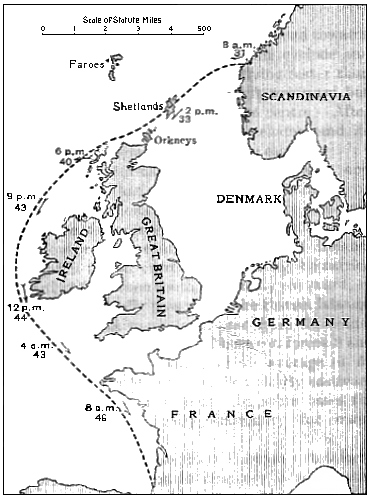
Map to show that a bird leaving Norway, near Aalsund, might be
carried round the British Islands in twenty-four hours. The arrows
indicate the actual directions and force of wind at the times marked
during a slow-travelling circular storm in autumn 1901. Speed of bird
about twenty-five miles per hour.
Even violent storms move at varying rates, and it is conceivable
that a bird leaving Scandinavia on favourable anticyclonic winds might
at once come into the influence of a large, slowly-moving, circular
storm, with a low-pressure centre to the west of Ireland, and might, if
the air currents were strong, be carried westward at first, then south
and finally eastward, so that it would actually pass round the British
Islands. I have taken this exceptional case from the actual course of a
storm, which varied between forces 9 and II on the Beaufort Scale (say
an average of 50 miles per hour) but only travelled slowly eastward at
about 17 miles per hour. In some cases the storm centres are nearly
stationary for many hours.
It is easy to appreciate Herr Herman's statement that spring
immigration in Hungary is accelerated on the good side of a mild
cyclone; the direction of the bird, of the circulating air currents and
of the whole system may be coincident. Given a low-pressure centre west
of the Bay of Biscay, spring migration would be accelerated through
Spain and France towards Britain.
Mr Stubbs points out that the pathways of several birds, or parties
of birds, which started at different hours, would be divergent, for they
would come within the influence of winds blowing in various directions
according to the position of the system; this he argues is contrary to
the accepted idea of routes. This, however, entirely depends upon what
we mean by a route, as I endeavoured to show in an earlier chapter. The
journey from point to point is a route, although the bird may be drifted
many miles in one direction or another on the way; it is only when the
bird fails to reach its objective, a suitable breeding place or winter
station, that the route is a failure.
The frequent occurrence of rare birds, some of them almost or quite
unknown elsewhere in Britain, on out-of-the-way islands, has led to
strange theories. One is that there are regular fly-lines over Fair
Island, the Flannens, St Kilda and elsewhere, similar to the one which
is said to pass over Heligoland. Mr Eagle Clarke's long expected book
will contain the ideas of the man who is best able to theorise on this
point; I write, now, with the feeling that his knowledge may lead me
to alter my ideas. The suggestion I can offer at present is that there
are ornithologists directing their attention to these spots which,
through geographical position and isolation, are the likely refuges
for wind-borne migrants. Also that the accidental departure from the
directions aimed at by the birds is, where wind and barometric systems
are so variable, far more frequent than is usually suspected. Direct
routes are doubtless aimed at, but only accomplished under favourable
conditions for the whole journey; migration is less infallible than we
have been led to think. It is, too, an evolving habit, strengthened by
those which survive its perils, now as it was in its early days.
During a long overland journey, winds will probably have less
influence, though for rapid passages high flights certainly appear to
be not uncommon. There is, however, another aspect of the connection
between migration and weather which we have hardly touched, migration
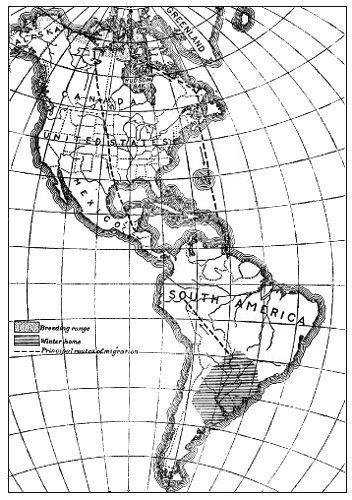
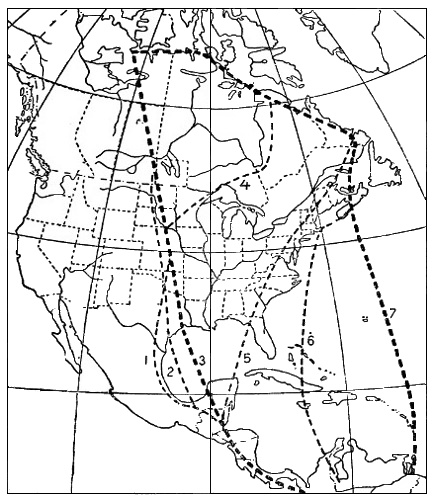
synchronal to the change of season. Mr Cooke shows that in North America
the push forward in spring is not in most species so soon as the weather
permits; they do not actually move on the spring wave. Many warblers
which nest in the Great Slave Lake region in an average temperature
of 47°, linger in the Tropics, and reach New Orleans when the
temperature is about 65°F. Then they hasten northwards, outstripping
the advancing spring, finding in Minnesota a temperature of about
55°, and 52° in Manitoba, and gain another 5° on the season
by the time they reach their home. Thus they continually reach colder
weather as they travel north.
The American robin, Turdus migratorius, moves more sedately; it
takes seventy-eight days for its 3000 mile trip, whilst spring takes
some ten days less to cover the distance. But the individual robins may
advance more quickly; it is the robin as a species which takes this
time to cover the area of distribution. The isotherm of 35°F.,
corresponding to the beginning of spring migration, advances north at
the rate of 3 miles per day from January 15th to February 15th; 10
miles a day is the average for the next month, and 20 for the following
month. But along the eastern foothills of the Rockies, isotherms
travel faster than in corresponding latitudes farther east; spring
rushes to this western land. In mid-April to mid-June—the height
of migration—the southern portion of the Mackenzie Valley has
about the same temperature as the region of Lake Superior 700 miles
farther south. This, coupled with the diagonal course of the birds
across the fast-moving region of spring, exerts a powerful influence
upon migration; the earliest robins reach southern Iowa on March 1st,
and travelling northward at about 13 miles per day, find in central
Minnesota a temperature similar to the one they left. Those which
breed near Lake Superior increase their speed to a daily average of 25
miles, and arrive at latitude 52°, when the temperature is still
about 34°. The isotherm, however, has reached central Athabasca,
and the Mackenzie Valley and Alaska robins double and quadruple their
daily average on the north-west diagonal to keep pace with the spring
(19, 20, 21).
Instances worked out in America and elsewhere might be quoted to
show how some species forge ahead and others lag behind the vernal
wave. Each species needs separate tracing in its routes and times and
habits, but on the whole the movements have relation to the changes in
seasonal temperature. In autumn the journey varies according to the time
of starting. Early fall migrants, and indeed the majority of autumn
migrants all the world over, travel more slowly than in spring; they are
neither impelled by sex-impulses nor the need to escape from failing
food supplies. A little later the supply does slacken and with it the
temperature cools, and if the changes are sudden southward migration
is accelerated. Migration, however, is such an advantageous and
well-established habit that it usually begins before hurry is necessary,
and the birds loiter southward, feeding as they go.
Mr Cooke shows that in spring, weather seldom influences the start
from the winter home, but the average weather conditions regulate
the average rate of northward advance and the date of arrival at the
breeding home (22).