New original cover art included with this eBook is granted to the public domain.
THE MIGHTY DEEP
By permission of the Apothecaries’ Co., Ceylon
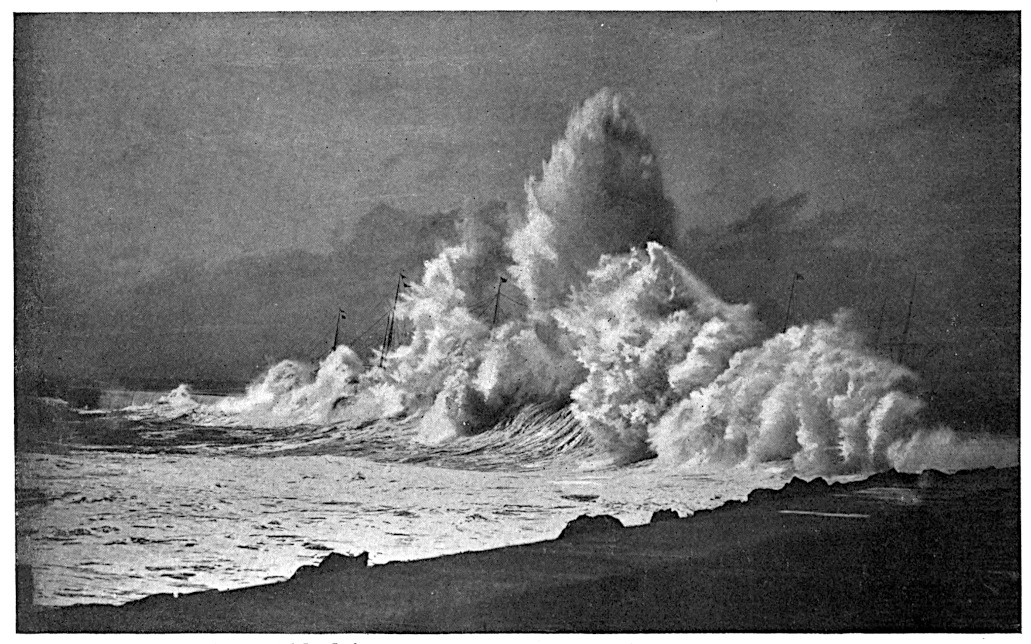
BURST OF THE SOUTH-WEST MONSOON AGAINST THE COLOMBO BREAKWATER
Frontispiece
AND WHAT WE KNOW OF IT
BY AGNES GIBERNE
AUTHOR OF “SUN, MOON, AND STARS”; “RADIANT SUNS”; “ROY, A TALE
OF THE DAYS OF SIR JOHN MOORE”; ETC., ETC.
“If I had asked thee, saying, How many dwellings are there in the heart of the Sea?
... peradventure thou wouldst say unto me, I never went down into the Deep.”
2 Esdras iv. 7.
WITH ILLUSTRATIONS
London C. Arthur Pearson Ltd.
Henrietta Street
1902
DEDICATED
TO THE REVERED MEMORY OF
VICTORIA THE GREAT, R.I.
SOVEREIGN LADY OF THE BRITISH EMPIRE
QUEEN OF THE OCEAN
AND
MOTHER OF HER PEOPLE
BY THE SAME AUTHOR
ROY
A STORY OF THE PENINSULAR WAR
Crown 8vo, cloth, with illustrations, price 5s.
PRESS NOTICES
“An interesting and well-studied romance of military
adventure.”—Scotsman.
“The illustrations are good, the writing is pithy, and
the tone well calculated to inspire youthful readers with
lofty ambitions.”—Morning Advertiser.
London: C. ARTHUR PEARSON,Limited
HENRIETTA STREET, W.C.
PREFACE
This little book makes no profession to be
a systematic text-book of Oceanography,
or to contain exhaustive discussions of the latest
discoveries and theories. The subject is far too
vast to be so dealt with in one small volume. A
library would almost be needed for the purpose.
Much information has been gained within the
last decade or two of years about the Ocean,
its make, the laws which govern its movements,
its dark and mysterious depths, the various
deposits upon its bed, and the innumerable
living creatures by which it is inhabited. All
that I have attempted has been to cull a certain
number of leading facts from the great storehouse
of knowledge, and to put them in order,
for the many who love sea-breezes and ocean-waves,
and who may like to know a little more
about the friend whom they so often visit.
With regard to Authorities, I must acknowledge
my indebtedness to the following books,
among many others: The Realm of Nature, by
Dr. H. R. Mill; Report of the Scientific Results
of the Voyage of H.M.S. Challenger—Deep
Sea; Coral Reefs, by Professor Dana; Standard
Natural History, edited by J. S. Kingsley;
The Microscope, by Carpenter, revised edition;
British Merchant Service, by R. J. Cornwall-Jones;
Resources of the Sea, by McIntosh;
Harvest of the Sea, by J. G. Bertram; also
numerous papers and articles in the Geographical
Magazine, National Geographical Magazine,
Scottish Geographical Magazine, Proceedings of
Royal Society of Edinburgh, Annual Report of
Smithsonian Institution, Natural Science, etc.,
etc., by such writers as Sir John Murray, Dr.
H. R. Mill, Professor James Geikie, Albert
Prince of Monaco, Admiral Sir W. H. L.
Wharton, Mr. John Milne, Mr. A. Günther,
Mr. John Aitkin, etc.
In conclusion, I beg heartily to thank the
Librarians of the Royal Geographical Society
and the Zoological Society of London for the
generous courtesy with which they have lent
me books and supplied latest information, without
which this little book could never have
been written; also to express my warm gratitude
for the invaluable help afforded by the criticisms
and suggestions of the kind and able friends who
have read my MS. and proofs.
“Therefore also do men entrust their lives to a little piece of wood.”
Wisd. of Sol. xiv. 5.
ONCE upon a time, over two thousand years
ago, our ancestors lived in a country smaller
than ours, to the north-east.
They had not yet taken possession of two
Isles, which in the then distant future were to become
the Headquarters of a world-wide Empire.
Already one characteristic of the race was prominent;
they delighted in the Sea. Within their
small limits of power they ranged the Ocean,
they wrestled with its fury, they subdued it to
their will, they rejoiced in its strength, they
found often their graves beneath its surface.
The English then, as now, were Ocean-folk.
May it not be that we in modern days love the
sea, and flock to its shores, and carry our Flag
to its furthest bounds, because our forefathers,
the Norsemen, the Angles, the ancient Vikings,
found their joy in it? Their march, like ours,
was on the mountain-wave; their Home, like
ours, was on the deep.
Probably with them, as with us, it was not
always an unchastened joy. Even a hardy
Viking might know the unpleasant consequences
of Ocean’s rougher moods. But no such discomforts
drove him to stay ashore.
Had our forefathers been made of feebler
stuff, had they been easily checked in their
enterprises, centuries of history must have been
changed. The development of English nature
would have followed other lines.
In those days the fight could not but be severe.
No mighty ironclads, no huge three-deckers,
existed. No P. and O. liners, no great merchant
ships ranged the seas. Our forefathers tackled
the waste of waters with what we should consider
the merest cockleshells. Even in these
days we know what is meant by “perils of the
seas;” but in those days the term must have
carried a hundred-fold deeper meaning, both to
the brave fellows who ventured on the stormy
main, and to the waiting wives and mothers on
land.
All the more honour to them that they were
not daunted. Each man’s victory or failure in
life’s battle cannot but help to shape the
course which his descendants in future ages
will pursue.
The Sea for us has a vivid personality. We
know grand old Neptune so well, with his trident
and his snowy hair, his dashing waves and his
impenetrable depths, his gentle breezes and his
furious gales, his moods of mild serenity and
his fits of vehement wrath. He has his faults;
but in spite of all we love him.
At one time the Sea was for men a type of
the Infinite, of the Immeasurable, of the Boundless.
We use still the same words; but they
have lost some of their force.
In these days the whole ocean has been
mapped out from shore to shore. We know
exactly what countries lie round each part of it.
We can tell how long and how wide it is in any
direction. As we stand on the shore, and talk
of the “boundless ocean,” we are perfectly well
aware that we are looking across to France or
Spain, to Germany or Ireland or America.
Grand and far-reaching the sea still is, but to
us no longer “boundless.”
In ages gone by, those who stood upon the
coasts of Palestine or Egypt, of Greece or Italy,
gazed towards unknown horizons, across what
was to them an illimitable ocean. The civilised
world consisted of a few countries bordering the
Mediterranean on the east; and those countries
shaded off into unexplored barbaric regions. As
for the “great Sea,” as they called that which
we regard as hardly more than a huge inland
lake, it was in their eyes the embodiment of
Infinitude.
At a very early period, long before the English
Nation was dreamt of, before the Roman Empire
had grown into being, while the polished
Greek of the future was still a semi-savage,
a nation of Ocean-lovers already existed. These
were the Phenicians, foreshadowing in their pluck
and enterprise the sea-going British of later times.
They, unlike the sailors of other nations, did
not merely hug the shore, but ventured out into
the trackless ocean. They, unlike the sailors
of other nations, did not go upon the sea only
in daylight, but they traversed it also in the dark
hours of night.
At first they were content with the nearer
reaches of the Indian Ocean, and with the more
eastern parts of the Mediterranean. But gradually
they wandered farther. Colony after colony
was planted beyond Egypt, till they reached the
Pillars of Hercules, known to us as the Straits
of Gibraltar, to face a wild and strange Ocean,
full of mystery.
There they made a startling discovery, enough
to impress the more thoughtful minds among
them. Far to the east, in the “Indian Ocean”
of our days, their sailors had been acquainted
with high and low tides; while throughout the
Mediterranean scarcely any tides existed. But
in the open sea, outside the narrow Channel,
they found the very same tidal changes as in the
eastern ocean.
It is hardly to be supposed that any one of
them had a mind of such far-seeing grasp that
he should be able to conjecture the grand truth
of eastern and western oceans being ONE—swayed
by the same influences, governed by
the same laws.
A Phenician of those days, catching a glimpse
of this truth, would have been worthy to take
rank beside our Sir Isaac Newton of after days.
They are believed to have observed the coincidence;
no doubt with a feeling of wonder; and
probably it was to them merely a coincidence.
Very little was then understood of the most
everyday and commonplace workings of Nature.
Not much, indeed, can be said with certainty
of what the Phenicians did truly discover.
Some observations they must have made of the
heavenly constellations; and the Pole-star at
least must have been known to them, otherwise
it is impossible to imagine how they could
have steered their vessels at night, in an age
when the Mariner’s Compass was unknown.
They are supposed to have sailed far south on
the west coast of Africa, if they did not actually
round the Cape of Good Hope.
It does not appear that their knowledge was
passed on to the Greek nation. Either they
were curiously reticent of what they knew, or
else such records as they may have left were
destroyed and forgotten.
In after times the Carthaginians, descendants of
Phenician Colonists, were, like their forefathers,
sea-lovers, sea-explorers, searching the main, not
as travellers search now from pure love of knowledge,
or from a liking for adventure, but for the
sake of commerce. The Carthaginians, however,
instead of being able to make use of previous
discoveries, and to work onwards from a point
already gained, had to start afresh and to find
their way—just as if it had never been found
before—to and beyond the Pillars of Hercules.
To the Greek imagination that wide mysterious
Ocean, opening out from the narrow Strait, was
unattractive and terrible. It was a sea of limitless
distances, of fog and gloom, of blackness
and death; not an unexplored Ocean of possible
glory and beauty and wealth.
Time glided by, and man advanced in his
acquaintance with Land and Sea; but with the
latter slowly. It was not until five centuries ago—and
five centuries are but as a day, compared
with the full stretch of history—that two weighty
steps were taken.
One step was southward. One step was westward.
The African Continent, all along its northern
region, had been the scene of very old-world
history. But the south was shrouded in darkness.
A brief glimmer of light, perhaps thrown
there in Phenician days, had been long long lost
sight of.
In the year A.D. 1486, a far leap from Phenician
and Grecian days, Bartholomew Diaz made discovery
of the Cape of Good Hope, and one year
later Vasco da Gama sailed round it. These
two explorers were only a little in advance of
two greater voyagers. In 1492 Christopher
Columbus started on his first cruise into the
unknown West—and touched Land. Less than
thirty years later, Magellan’s famous voyage was
accomplished to those Straits, between Patagonia
and Tierra del Fuego, which bear his name. By
that time the existence of the American Continent
had become an established fact.
But that Continent had to be searched out.
And the Ocean, though its limits were widened
in men’s imaginations, was very far from being
mapped and fenced around with definite boundaries.
Years of exploration still lay ahead; and
many a valiant explorer had to fall a martyr
in the cause of Science, before mystery should
yield to knowledge.
Doubtless, in those days as in these, there was
always somebody to ask, “But what is the use?
What good can it do to us to learn that there are
lands beyond the sea? What shall we gain by
it all?”
Time alone, with its developments, with the
growth of the human race, with the enormous
possibilities then undreamt-of, could answer such
questionings. Happily, brave explorers have
seldom been lacking, who loving knowledge
for its own sake have been content to labour
patiently, not for money, not for fame, not for
immediate results, but for the simple delight of
better understanding the world around them, and
for the benefit of future generations.
And indeed, if once we begin clearly to realise
that the things which we see and hear, the
wonders of Land and Ocean, are the outcome
and expression of Divine Thought, we shall
scarcely deem time wasted, which is spent in
trying to find out a little more about those
wonders.
CHAPTER II . SALT WATER
“The new sight, the new wondrous sight,
The waters around me turbulent.”
E. B. Browning.
“Water, water, everywhere,
And not a drop to drink.”—S. T. Coleridge.
THE annual stampede of Britons to the coast
says much for our National belief in Sea-breezes.
In other countries also people go to
the sea for change; but perhaps nowhere does
the rush excel that on our Island. This revivifying
gift, though partly due to the wide
and free expanse through which the breezes
have travelled, is largely owing to the briny
ocean with which they have been in contact.
Sea-water differs from rain-water, well-water,
river-water. True, it is made up of all these,
since sooner or later and in one mode or another
all water on Earth finds its way to the Ocean.
Water may travel openly by river-routes; it may
creep silently by dark and devious underground
passages; it may float lightly viâ cloudland; but
in any case its goal is the sea.
Still, though the ocean includes in its composition
every kind of land-water, Sea-water as such
is different from them all. Not only in its vast
extent, in its enormous depth, but in its strong
flavour of Salt.
One of the commonest of substances is Salt.
It is in the ground, in air, in water. We even
know that it does not belong to our earth alone,
but to many heavenly bodies also.
Perhaps one reason for this abundance, at least
upon our Earth, is that it is necessary for life.
There is salt in the make of blood and of brain,
of muscle and of tendon. Salt is perpetually
passing out of a man’s body; therefore continual
fresh supplies of it are needed. Without a
certain amount of salt in his food, he cannot
keep in good health.
This at one time was not understood; and salt
was looked upon as a mere luxury, easily to be
dispensed with. Condemned criminals were forbidden
that luxury; and they went through a
good deal of suffering, the reason for which was
not guessed. If plenty of animal and vegetable
food was given to them, they managed to get
along, since both contain salt; but if they were
kept on purely farinaceous fare, they broke
down.
Where all the salt in the Ocean comes from,
is a complex question. Large supplies are
brought down annually by rivers and streams,
from various minerals in their beds, as well as
from rock-salt regions. But if we ask, “How
comes the rock-salt to be there?” we are told
that it is a deposit, once formed beneath ocean-waters,
or at least left by the drying up of salt
lakes and seas. A proof of the latter theory is
found in multitudes of sea-shells, often distributed
through layers of rock-salt.
If much sea-salt came originally from rock-salt
on land, and if rock-salt came originally
from ocean-deposits, we are led into a curious
circle of cause and effect—not unlike that of oak
and acorn, or of hen and egg, with the attendant
puzzle of—Which first? It is a query which we
are not able to answer.
In former days the salt used for household and
mercantile purposes was almost entirely prepared
by the evaporation of sea-water. We no longer
depend on this, however; and in England the
sea-salt trade has gone down greatly before that
of rock-salt, which is found to be the better for
table use. It has not the same tendency to
stick together in lumps, after being packed in
sacks.
Great districts of rock-salt are found in many
places—such as those in the Carpathian Mountains,
in the Swiss Alps, in Germany, and in
Great Britain. One huge mine in Galicia has
been worked for six hundred years; and this
supply is said to reach through about five
hundred miles. From British works alone the
quantity carried away every year amounts to
a cubic mile of salt.
But land-supplies grow pale and insignificant
before the quantities which float in the ocean.
It has been reckoned that, if the waters of the
whole ocean could be dried up, the amount
of salt left lying on the ocean-bed would be
something like four-and-a-half millions of cubic
miles.
Such an enormous mass hardly conveys a clear
idea. Let us think of one single cubic mile of
sea-water, separated from the ocean, and see
how much it would contain. First, the whole of
that cubic mile of water has to be dried up;
and then the materials left behind have to be
weighed. We should find about thirty-three
millions of tons of various kinds of substances,
the names of which need not be given. We
should also find of common salt a supply which,
when weighed, would reach the great figure of
one hundred and seventeen millions of tons. All
this, be it remembered, floating unseen in a
single cubic mile of water. No wonder the sea
tastes salt.
In its make Water is always the same.
Whether it be cold or hot, freezing or boiling,
causes no difference. It consists of two gases,
united; and the union is remarkable in kind.
The two gases are not merely mixed together,
as sand and sugar may be mixed. They are
by the union changed into a fresh substance.
For the time the gases exist no longer. In
their stead, water has been formed.
And when the gases enter into this very close
relationship, they do it always in the same
manner. There is just so much of the one, and
just so much of the other. One portion of
hydrogen has to join with eight times as much
by weight of oxygen—neither more nor less of
either. The same is true, whether we are
speaking of a great mass of water, or of the
tiniest speck.
It is not actually correct to say, as is said
above, that water “consists” of the two gases.
So long as the water exists, the gases do not
exist. And when, through the action of heat
or electricity, the water is broken up and the
gases reappear, then the water no longer exists.
But at least we may say that it is the result of
the uniting of those two gases, and that it can
be made in no other way.
An interesting experiment has been tried. A
certain amount of hydrogen gas and eight times
as much of oxygen gas were weighed separately,
by means of very delicate instruments. Then
through great heat the two were caused to unite
into water, and the water also was weighed.
It was found to be just as heavy as the two gases
together had been; and quite naturally so, since
neither of the two gases had lost or gained
in weight. This kind of union is called
“chemical.”
French people are fond of “eau sucré.” A
lump of sugar is dropped into a glass of water,
and it disappears. But it has not been destroyed.
It has not ceased to be sugar. No
mysterious union has taken place between the
sugar and the water. Neither water nor sugar
has changed its nature; and no fresh substance
has come into existence in their stead. The
water is there, as it was before. The sugar
is there too, not visible, but to be found out by
our sense of taste. It has only been separated
by the water into such minute particles that we
cannot see them. This is a case of mixing, not
of chemical union.
When we think of the characteristics of Sea
Water, as compared with Fresh Water, we have
to do with simple mixing. As sugar floats,
unseen but not untasted, in tea or coffee; so salt
floats, unseen but not untasted, in ocean waters.
Such a thing as absolutely pure water is very
rare. No matter how clear a stream may seem
to us, it holds a vast number of specks of
material, collected from earth and air. Once
a scientific man had some, most carefully
distilled, which seemed to be of crystal purity.
But he put it under the strong beam of an
electric lamp, and, alas, for human powers!
after so doing he could only declare that the
idea of purity was ludicrous. If it is so with
distilled water, the less said the better about
common drinking-water. It may be well for
our peace of mind that we have not stronger
sight.
Ocean-water holds about two hundred times
as much dissolved material as ordinary fresh
water. The different kinds of substances found
in any particular water-supply determine the
character of that water, making it sweet or sour
or salt, rendering it health-giving or death-dealing.
Something has been said about the drying
away of sea-water, and the leaving of salt
behind. A remarkable instance of salt thus
left is seen in the Rann of Cutch, a flat Indian
plain, about a hundred and ninety miles long,
and half as wide.
During the south-west monsoon the ocean
waters are forced by powerful winds up the
Gulf of Cutch to a considerable height, overspreading
the Rann, which for a time is turned
into a shallow lake. When dry weather comes,
the water vanishes, partly retiring, partly
evaporating; and a salt-strewn desert is left,
varied by sand-ridges, green spots, and little
lakes, but covered principally by “sheets of salt
crust.” My father, when there many years ago
with his Regiment, noted down his impressions
of the scene.
“From this spot”—the spot on which he stood—“the
water is about eight miles distant, the
intermediate space being a flat surface, entirely
covered a quarter of an inch thick with salt in
crystals, looking much like snow, in such quantities
that it can be scraped up by the hand
perfectly free from earth; and on all this space
not a blade of grass to be seen.”
The same task is carried on by the working
of sun-heat, as by the fire under a kettle. All
day long in a warm climate the sun’s rays are
busily at work, lifting from the ocean-surface
a continuous stream of fine invisible vapour.
The water is drawn up particle by particle, not
in masses; and the sun’s rays have no power
to lift the ocean-salt, which remains behind,
floating still in the sea.
But when a strong wind lashes the surface into
waves, and rends the tops of billows into fine
spray, it often carries a great deal of salt to
a distance. We know how salt may be tasted
on the lips miles inland, and how windows near
the coast become encrusted with it in stormy
weather. Moving air, like moving water, can
carry weight; and it is thus, through the action
of moving air, and not through the heat of the
sun, that we have our health-giving breezes off
the sea, laden with salt.
CHAPTER III . EARTH’S VAST OCEAN
“Thou great strong sea.”—Auberon Herbert.
“Drop by drop He counts
The flood of Ocean as it mounts.”—C. Rossetti.
IN these days we know the Ocean as one vast
whole. Not like our early forefathers, standing
on the brink, to gaze with awe-stricken eyes
into mysterious distances, and to speculate upon
the unknown.
Minor oceans do exist, certainly. We have
the Atlantic, North and South; the Pacific,
North and South; the Arctic, the Antarctic, and
the Indian. Yet for us there is but one great
world-wide Ocean, encircling the Earth, every
part being in connection with every other part.
A drop of water which to-day floats in
southern seas may, months or years hence, have
found its way by currents into the far north.
A speck of ice, at this moment fast in the rigid
embrace of polar berg or floe, may, months or
years hence, be washing to and fro in tropical
waters.
A much greater area of water than of land is
found upon the Earth’s surface. So vast is the
amount of the former that, if the whole had to be
put into separate vessels, each vessel being one
cubic mile in size, the number of such vessels
required would amount to no less than three
hundred and thirty-five millions. This very
large order speaks for itself.
The outer Crust of our Earth, taking land
and sea together, may be divided into three
distinct parts. Like most such divisions in
Nature, the one is often found to glide by
gentle stages into another.
We have, first, Land, rising above the sea-level,
and consisting of plains, undulations, hills,
mountains. It covers altogether less than one-third
of the Earth’s surface, and it is called
The Continental Area, though Islands as well
as Continents belong to it.
We have, secondly, the Ocean-floor under
deeper parts of the Ocean; that which lies
beyond a depth of about two miles. This
division has been described as the “great submerged
plain,” and it comprises about one-half
of the Earth’s surface. It is known as The
Abysmal Area.
We have, thirdly, a middle region, which may
be spoken of as a kind of borderland under the
sea, connecting the dry land with the greater
ocean-depths. It amounts to about one-sixth
of the Earth’s surface, and it has been named
The Transitional Area.
By “connecting” the two, I do not mean that
it must always be between the two. It does
very generally so lie, but there are exceptions.
Some deeper portions of the sea are close to
land, and some parts of the Transitional Area
are found far out at sea.
The meaning of the word “Continental”
needs no explanation; and the very word
“Abysmal” carries its own sense. More, however,
will be said in future chapters about those
reaches of ocean known as the “Transitional
Area.”
A curious law seems to have governed the
grouping of land and water. Putting aside
innumerable small islands, scattered about, we
find that the great mass of land clusters towards
and round the north pole, with a water-and-ice-filled
hollow for its centre. While, on the
contrary, the greater mass of water may be
said to cluster towards and round the south
pole, with—so far as we can conjecture—a large
extent of land for its centre. The conditions
of north and south thus seem to be exactly
reversed.
Not long ago it was believed that the ocean’s
floor might be a fairly close imitation of that
which we see on land. The differences, however,
have been found to be greater than was expected.
Perhaps it is not surprising, when one thinks
of the immense levelling power of water.
That must be a firm make of rock which
can permanently resist the effect of sea waves
breaking upon or near the shore. And even
deeper down, where waves are not and currents
may be slow, some movement must still exist,
since the ocean is nowhere quite stagnant.
Such movements, no matter how gentle, would
tend to shift all loose and soft substances.
The ocean-bed is held to be generally flat,
though with gradual slopes here and there,
leading up or down to higher or lower levels.
Many submarine mountains rear their heads,
sometimes near the surface, sometimes above
it. In places high mountain-ridges run for a
long distance below the sea, with profound
depths on either side; and these again often
show their peaks, forming groups of islands.
Broad reaches of the ocean are between two
and three miles deep, and here and there spots
are found where the sounding-line goes sheer
down three miles, four miles, five miles, even six
miles, before touching bottom. These greater
depressions have been named “Deeps.”
At least fifteen of them are known in the
Atlantic, and twenty-four in the Pacific; many
of the latter lying close to islands. Some are
long in shape, some short; some are broad,
some narrow. One of the most profound, and
almost the only one known to exceed five
thousand fathoms, lies towards the south-east of
the Friendly Islands. A depth there has been
found five hundred and thirty feet beyond five
geographical miles; and five geographical miles
are equal to almost six of our common miles.
For a good while the notion was entertained
that, probably, the loftiest mountain-peak on
land, and the deepest depth in the ocean,
would about match one another, reckoned from
the sea-level. But this particular “deep” in the
Pacific sinks two thousand feet lower than the
topmost peak on Earth rises. Mount Everest,
in the Himalayas, is twenty-nine thousand feet
high; and this ocean-depth is about thirty-one
thousand feet deep. Only one other equal to it
has yet been discovered.
No abyss divides England from France. The
“silver streak,” though sufficient for purposes
of defence, is comparatively shallow. All West
Europe, indeed, rises from a plateau, reaching
from Norway into the Atlantic, on no part of
which is the water more than six hundred feet
in depth. The “transitional area” in this case
makes a true stepping-stone or ledge between
dry land and ocean’s abyss.
But another great plateau in the Atlantic,
which may be called the “backbone” of that
Ocean, is far from land, running roughly from
north to south. It follows the outlines of the
eastern and western shores, and rises often to
within a mile and a half of the surface. On
either side of the “backbone,” which seems to
be largely volcanic, is a deep trough, lying north
and south, and varying in depth from two to four
miles. This plateau unites Europe with Iceland;
and it forms a bond between the Islands of
the Azores, Ascension, and Tristan D’Acunha.
If by any means the whole ocean-surface could
be lowered six hundred feet, remarkable results
would be seen.
At once the British Isles would cease to be
Islands. They would become a part of the
Continent of Europe, joined thereto by dry land.
The Hebrides, the Orkneys, the Shetlands,
would share in this change. The Continents
of Asia and North America would be united
at the Behring Straits; Ceylon would find itself
a part of India; Papua and Tasmania would
be one with Australia; and all places hitherto
on the coasts of different countries would find
themselves six hundred feet above the sea.
Such a change in the position of the British
Isles, transforming them into a Continental
Country, would mean far-reaching consequences
to ourselves as a People. One such consequence
may be briefly given in the words of a recent
newspaper article: “Dry up the Atlantic to the
100-fathom line, and in six months we should
bear the load of Conscription as cheerfully and
more efficiently than any nation in Europe.”
Suppose that another great fall in the ocean-surface
could follow. Not this time to six
hundred feet, but to three thousand feet, below
its present level. The resulting alterations would
be still more sweeping. Not only Iceland and
the Färoe Islands, but Greenland also—and not
only Greenland, but the Continent of North
America itself—would become one with the
Continent of Europe, no longer cut off from the
Old World.
A word as to measurements. Two kinds of
“miles” have been mentioned. There is the
ordinary “Statute mile,” used in common conversation,
which is 880 fathoms, or 1,760 yards,
in length. There is also the “Geographical” or
“Nautical” mile—the “knot” of our Navy—which
is 1,013 fathoms or 2,026 yards in
length.
The difference between the two is not far from
one-eighth of a statute mile. Roughly, seven
miles are equal to six knots. A fathom is six
feet or two yards.
CHAPTER IV . SUBJECT TO LAW
“Thou rulest the raging of the Sea.”
Psalm lxxxix. 9.
“Nothing useless is or low,
Each thing in its place is best,
And what seems but idle show
Strengthens and supports the rest.”
Longfellow.
THINGS are what they are in this world very
largely because of the pull of opposing forces,
and among such forces not one is more universal
than that of Gravity. Many causes beside
Weight have their share in making our Earth
what it is; but if Weight were banished from
our midst, the Earth as we know it would exist
no longer.
The only way to get rid of weight would be
by getting rid of Gravity. And since no force
in Nature acts more steadily and incessantly than
this, we are no more likely to get rid of it
than we are to get rid of the world itself.
Gravity, or Gravitation, or Attraction—it is
known by all these names. Sometimes it is
called a Law; sometimes a Force. Neither
term may be counted amiss. No law is worth
anything without a sufficient force to back it
up; and no force is worth anything unless
it acts according to law. But we might almost
as reasonably call this behaviour of things “an
Obedience” as “a Law.”
Each particle of each substance draws and
is drawn by each other particle of every substance.
And each body in the Universe, from
a grain of sand to a sun, draws and is drawn
by each other body, whether far or near.
All these drawings are in obedience to that
mysterious something—that force, or power,
or influence—which has been named Attraction
or Gravitation. So much we know; and beyond
it we know very little as to the nature of the
said “Attraction;” but we find that the outcome
of it is Weight.
By means of weight, the sun, the moon, the
planets, yes, and even the countless multitudes
of stars, are kept in their paths; in each case
the inward pulling being counterbalanced by
the impetus and outward pulling of a rapid
rush. By means of weight, houses, rocks, stones
rest firmly on the earth; by means of weight,
the atmosphere is bound to the earth, the
Ocean to its bed. Had sea-water no weight
it might be scattered as fine water-dust through
Space.
A larger and heavier Earth would bind down
the ocean yet more strongly, while a smaller and
lighter Earth would have a weaker grip. Easily
as the sea is now stirred by every passing breeze,
an ocean such as ours on a little world like the
Moon or Mercury would be more rapidly
agitated. The waves would leap higher with
less cause.
So the Ocean, like the Land, is subject to law,
knowing neither repose nor action except in
obedience to Nature’s forces.
When ocean-waters lie still as a mill-pond,
they do so through an exact poise of contending
powers. When waves rush high and currents
pour strongly, each movement is still in strict
obedience to governing forces, which are themselves
governed by law. Each movement is
due to a long series of past movements; and
each in turn helps to bring about a long series
of future movements. There are no breaks
in the chain. Every effect is also a cause.
Currents here and drifts there; breezes here
and hurricanes there; all these disturb the calm
of the sea. Only for a brief spell, in one part
or another, is the pull of opposing forces so far
balanced that the water can lie still. And at
most the stillness is comparative. Even in a
so-called “dead calm” gentle heavings to and
fro will be found. Absolute placidity in the
ocean is a thing unknown.
Even when the waters are at their stillest
they are always being drawn steadily towards
Earth’s centre. A perfectly level ocean would
mean each portion of its surface being equally
distant from that centre. The ocean ever strives
after this ideal, but never attains to it; yet,
century after century that aim is pursued, with
a perseverance which might afford a lesson to
ourselves.
Despite all this change and restlessness, we
talk of the ocean having a “level” surface. We
picture it to our minds as being in outer shape
the same as that of the Earth—a sphere. But
this is not strictly true to fact.
If we could look upon the Earth, with large
far-seeing eyes, from a few thousands of miles
off, we should find curious irregularities in the
watery outline. Instead of showing all round a
smooth surface, the ocean would be found to
rise here and sink there, to be in one part
higher, in another part lower. A man roving
over the ocean, all about the Earth, would
have in places to ascend undulations like hills,
almost high enough sometimes to be called
mountains, in other parts to descend declivities.
Most of us have noticed in a cup filled with
water, that the water-surface is not perfectly
flat. Close to the sides of the cup may be
noticed a distinct rise. It is the same in a
tumbler, in a basin, in a slender glass tube.
For the sides of the cup or tumbler or tube
attract the water, drawing it upward; and this
is known as Capillary Attraction.
With the ocean the very same thing is seen.
If high land borders on deep water, the extra
attraction of mountain-masses will act just as
the sides of a cup or tumbler will act. They
draw upward the water of the ocean to a higher
level. When I say that this is “seen,” I do not
mean that any careless looker-on will be aware
of the fact. It has to be discovered by careful
measurement.
In some cases a marked difference has been
found. The enormous masses of the Himalayas,
for instance, exert a powerful drawing upon the
neighbouring sea; and at the delta of the Indus
the ocean-level, in consequence of that attraction,
is actually three hundred feet higher than on the
coast of Ceylon.
Besides land attraction, winds have an extraordinary
power to heap up waters in one place
more than in another. To some slight extent
this may be seen upon English shores, when a
strong gale happens to blow landward at high
tide. On such occasions the waters often rise
far beyond their usual mark.
Mention was made earlier of those Phenicians
who, having known an eastern ocean with tides,
and a Mediterranean Sea without tides, must
have been perplexed to find a western ocean
which corresponded with the eastern in its ebb
and flow.
We all know for ourselves in these later days,
how the tides rise and fall around our coast,
twice in twenty-four hours. Each high-water is
twelve hours and twenty-five minutes later than
the last; so each succeeding day sees a difference
of fifty minutes in the time of high or of
low tide.
To a very large extent Tides are due to the
attractive power of the moon. They are due
also to the sun, but in a much less degree,
which at first sight seems singular, since the
attraction of the sun, by reason of its greater
size, far exceeds that of the moon. From the
fact, however, that the powerful drawing of the
sun comes from an immense distance, it follows
that it has much less effect than the small attraction
of the moon, which comes from very near
at hand.
Her influence over our earth is exerted far
more strongly with respect to those ocean-waters
lying just under herself, and far less with respect
to those waters on the farther side of the globe.
The effect of these different pullings is to raise a
double wave or swell,—one on the surface of
the ocean just below the moon, and one on the
opposite side of the earth. The waves mean
high tides; and low tides occur at places half-way
between them.
Were the whole Earth covered by one continuous
sheet of water, these tidal waves would
travel round and round the globe, in a fashion
easy and pleasant for students of the subject.
Unfortunately for the said students, their motions
are very complicated. In the northern hemisphere,
where land is abundant, the tidal waves
are greatly interfered with by continents and
islands. Often the most that each can do, as
it sweeps along, is to send side-waves and
currents journeying northward into channels and
bays, estuaries and lesser seas.
Through the open ocean the tidal wave has no
great height. Probably in central regions of the
Pacific it rises only some three or four feet above
the usual sea-level. But when the flow enters
narrowing bays and channels, a very different
result is seen; and the waters are often piled
up in a wonderful manner,—as in the Bristol
Channel, where the level at high tide is sometimes
nearly forty feet above that at low tide.
A marked contrast to this is seen in the
Mediterranean. There, as already said, practically
no tides exist. The rise and fall amount
at most to only a few inches. Instead of a
wide entrance and a narrowing estuary, we have
just the opposite—a narrow entrance and a
widening sea beyond. Connection with the outside
ocean is too restricted to admit of any full
flow of the tidal wave.
Solar tides, or tides brought about by the sun’s
attraction, are much the same in cause and effect
as lunar tides, only far smaller in degree. When
Sun and Moon happen to be on the same side of
the Earth, or on different sides but in the same
line, so that their combined pull is exerted in
one direction, we have Spring Tides. These
are always at the time of New Moon and Full
Moon. Sun and Moon then work together, each
helping the other in a common aim; and the
ocean-waters rise higher and sink lower than
at other times.
When Sun and Moon are so placed with regard
to the Earth, that they exercise their pull
in a cross direction, Neap Tides result,—that
is tides which have small ebb and flow. In
this case the sun hinders instead of helping the
moon, and the moon does the same for the sun,
each tending to counteract the work of the
other.
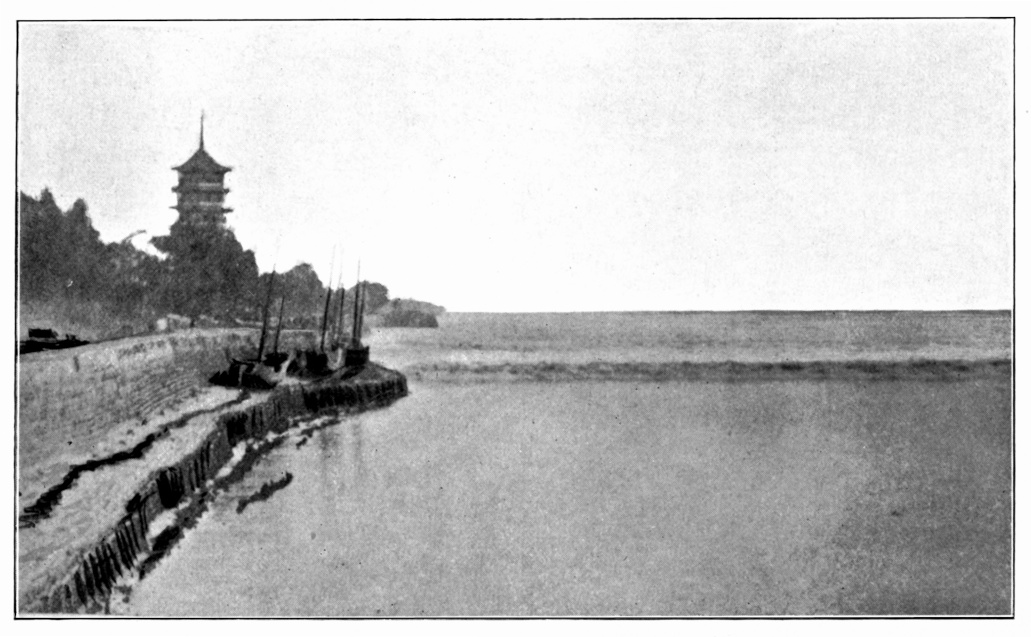
Connected with and partly caused by the rise
of the tide is the curious phenomenon known as
a “Bore”—a single high wave, moving onward
like a wall of water, with great rapidity and a
roaring noise. More usually this belongs to a
river, and thus it has not much connection with
the subject of the ocean; but it is also sometimes
seen in sharply narrowing estuaries or
ocean inlets.
BORE OF THE TSIEN TANG KIANG
Face page 34
To the inhabitants of a flat and unprotected
country, bordering on river or estuary, the bore
is often a thing of terror, for its advent is uncertain
and abrupt, and in its upward rush it
sweeps everything before it. The entering of
such a wave into the Severn is an almost daily
event, and it reaches often a height of many feet.
Bores are usual, too, in the River St. Lawrence,
in the Hoogly, in an estuary of the Bay of
Fundy, and in other places innumerable; and
they vary in height from two or three feet to
over twelve feet. The effect of such a wall of
water as this, deluging low lands, carrying away
trees and houses and living creatures, may be
easily imagined.
CHAPTER V . IN OCEAN DEPTHS
“My soul is full of longing
For the secret of the Sea.”—Longfellow.
“Of the old Sea some reverential fear
Is with me.”—Wordsworth.
THROUGH ages of the world’s history, man
knew nothing of the Ocean beyond its
surface.
He could sail on the sea; he could bathe in
the shallow waters near land. If a good swimmer,
he might go farther out, and might even
dive for one or two minutes out of sight. In
more recent times, with the help of a diving-bell,
he could descend thirty or forty feet; and in
a diving-dress he might even, if experienced,
get from one to two hundred feet down.
But that was all. Of the vast depths beyond
he was sublimely ignorant. He did not so much
as know of their existence. Until the late
scientific expedition made in the vessel Challenger,
that great world of the Under-Ocean
was swathed in mystery.
Nothing is known of it now by direct personal
observation. No living man may penetrate
those depths. The only mode in which we can
learn what is, what lives, what happens there, is
by means of “soundings,” by sending down and
drawing up specially prepared instruments, the
reading of which gives us information about that
Under-world.
Soundings made in earlier times did little
more than tell navigators how deep the sea
thereabout might be. Such instruments as were
then used could neither work beyond a limited
depth, nor say their say with accuracy.
Of late years immense improvements have
taken place, both in the make of the machines
employed, and in the methods of working them.
Past soundings were few and unsystematic;
whereas now they are many and by rule. Thermometers
have been made which bring up from
the bottom of the sea reports of the prevailing
heat or cold, moving unaffected through
warm or cold layers between. Specimens of
the materials which lie on the ocean-floor
have been brought to light, and analysed.
Living creatures in great numbers have been
hauled from their own domains, examined and
classified.
All this means progress. And though, no
doubt, fifty or a hundred years hence, that which
we now know will be looked upon as the barest
A B C of the science, still our knowledge is
growing year by year. The Under-Ocean is no
longer a vague fairy-land of possible mermaids,
or a waste region of death.
A region of death in one sense it is and must
be. All living creatures that die in the sea,
unless devoured by other creatures, sink to the
bottom, there to find a tomb. Covered at first
by a vast winding-sheet of water, they may be
slowly buried under the shifting mud and sand.
But in this sense the whole Crust of Earth may
be called one vast sepulchre, wherein all animals
that die are entombed.
People are slow to realise how modern is our
knowledge of ocean-depths. About three hundred
years ago a famous navigator made the first
sounding which went below two hundred fathoms—that
is, about one hundred feet deeper than the
height of Beachy Head from the shore. He at
once decided that, by a happy chance, he had
alighted upon the uttermost depth in the ocean.
To him it was an awe-inspiring profundity.
Yet, when viewed beside such abysses as have
been recently discovered, depths of five and six
miles, his little “deep” was as a saucer beside
a lake.
It is not easy to picture to ourselves the
changeless calm of those abysses—those five
or six miles of under-water, with nothing from
sea-level to sea-floor to break the dead monotony.
Throughout such regions storms, no matter
how terrible, have no power. Winds cannot
reach them. When Ocean’s surface is lashed
by a hurricane into wild commotion, that commotion
is superficial. It means a furious stirring
and flurry of upper layers; and it means
no more.
If at the height of some fierce tornado, a
sailor could leave his tossing straining ship, and
could dive far into the sea, keeping breath and
sense and life, he would soon quit the turmoil,
and would find himself in a scene of deep repose.
Strange to say, the idea of submarine ships
actually doing this has been mooted, as one
of the new projects in the beginning of the
Twentieth Century.
Wave-motion does not descend much below
the surface. It is believed that the depth of
water affected by a wave is usually about equal
to the space which divides crest from crest. So,
if we are looking at little ripples, flowing one
after another, with crests perhaps one foot apart,
we may suppose that the water is disturbed by
those ripples to a depth of about one foot. Or,
if we are watching larger waves, with crests
twenty feet apart, we may suppose the disturbance
to reach down to a depth of some twenty
feet. And if our gaze is fixed on dignified
Atlantic rollers, with crests six or eight hundred
feet apart, we may suppose that the sea
is affected to a depth of six or eight hundred
feet—less and less affected the deeper we go
down.
Six or eight hundred feet, compared with six
miles, are hardly more than a man’s skin compared
with his body. And beyond the shallow
depths where wind and wave have sway, we
come to a region of profound calm.
This repose does not mean stagnation.
Ocean’s waters are ever on the move, travelling
this way and that way. Currents exist far
below, as well as at the surface; but they are
generally slow and placid, not rough and
hurrying. Old Ocean’s excitability lies all outside.
Superficially he is soon upset; but deep
down he is composed.
A great deal of discussion has taken place
as to possibilities of Light in those depths. Are
they black with midnight darkness? or do faint
glimmers of daylight creep through?
Ocean-water, like other water, is transparent.
Any substance is transparent, when thin enough,—even
gold. A very thin film of water is not,
however, needed for transparency. Many feet,
even many yards, may be seen through, if clear
and pure. Few of us have not, at one time or
another, looked down from a boat, to see golden
sand, variegated pebbles, small fishes swimming
about, at a considerable depth.
Thus with water, as with denser materials,
transparency is merely a question of thickness.
As the thickness increases, more and more rays
of sunlight are taken captive, and the water
becomes less and less translucent, till at length,
if we could get deep enough, we should find
ourselves to be surrounded with blackness.
Another feature of ocean-depths is that of
immense pressure.
We bear a certain degree of it in that other
and lighter ocean—the Atmosphere. A man
of medium size has upon his body about thirty
thousand pounds’ weight, or some fifteen pounds
to the square inch. But this is nothing to what
he would have to endure down in ocean-waters.
At a depth of one mile, an extra ton would
be piled upon each square inch of his body; two
miles down, would mean two extra tons on each
square inch; three miles down, three extra tons;
and so on. The load would soon become intolerable.
For many years scientists maintained that in
such depths no life could exist, since no bodies
could withstand the awful pressure. Yet we now
know that frail jelly-fish, fragile shell-inhabitants,
do withstand it, flourishing there by myriads.
Perhaps the fact was somewhat overlooked,
that the pressure upon a living creature is not
only inwards from without, but also is outwards
from within. This is true of ourselves in the
ocean of air, breathing air. It is true of
creatures in the ocean of water, breathing water.
Much less than the weight of thirty thousand
pounds might crush a man flat, were it not for
the resisting pressure from within. If for one
instant he could empty his body of all inner air
and liquids, and could so harden his skin that no
air should squeeze through its pores, he would be
pressed as flat as a pancake by the surrounding
atmosphere.
A story has been told, illustrative of this.
Once upon a time a clever fellow started an
original idea. He proposed to make a balloon,
which should mount skywards, not from being
full of hydrogen gas, but from being emptied
of air. Being then lighter than the atmosphere,
it would, he said, of course rise.
So far as the reasoning went, it was faultless.
It only did not go far enough.
The balloon being made, he named a day for
its ascent, and asked many friends to witness his
triumph. At the last moment, all air was withdrawn;
and everybody waited in expectation,
hoping to see the novel balloon skim lightly
above their heads.
But the inventor, while using strong materials,
had failed to make full allowance for the tremendous
pressure of the air, when counteractive
pressure from within should have been done
away with. As the air was drawn out, the sides
of the balloon collapsed, being crushed together
as an empty egg-shell may be smashed in a
boy’s hand. Instead of soaring gaily upward, the
would-be aeronaut stood on earth, scanning with
disappointed eyes a flattened and useless shell.
A diver going down into the sea has a much
increased weight upon his body; but he does
not suffer from it to a serious extent, provided
that he is not raised or lowered too fast. Much
depends upon this. Both men and beasts can
endure a good deal of alteration in the degree
of pressure, whether from air or from water; but
they cannot bear very abrupt changes. Hearts
and lungs need time for growing accustomed to
a fresh condition. In early days of diving this
was not understood, and some divers lost their
lives through being too hurriedly hauled up.
The same has been noticed in animals brought
quickly from great depths. They have been constantly
found in the net or trawl, dying or dead,
their bodies swollen and even bursting from the
lessening of pressure. It was natural that at
first the belief should arise of Life being in those
parts impossible. Now we know that animals
die in the act of being drawn up, and that they
live and flourish in profound depths, unaffected by
the vast load of water.
The weight that a man can endure is not to
be compared with what fragile sea-creatures
thrive under. Beyond a depth of some two
hundred feet or more, the pressure becomes too
great for any human beings; yet animals are
found at depths of three or four miles. But the
fact that man breathes air, and that animals in
the sea breathe, in a sense, water, makes an
enormous difference in their power to resist
pressure.
One might suppose that the terrific weight
of miles of water would squeeze lower layers
to a smaller bulk. Water is, however, very
difficult to compress; unlike air.
At the bottom of the sea, four or five miles
deep, the weight is said to be equal to about
four tons upon the square inch. If this tremendous
load were pressing upon a mass of air,
eleven thousand cubic feet in quantity, the whole
would be crushed together into only twenty-two
cubic feet. But the same weight pressing upon
the same quantity of sea-water, would merely
reduce its size to ten thousand cubic feet. So
there is not much difference between the make
of sea-water near the surface and sea-water at
a great depth.
Not only are ocean’s depths calm and free from
storms; not only are they black with midnight
darkness; not only are they heavy with the
weight of miles of water overhead; but also for
the most part they are cold.
Changes from season to season, like changes
of weather, are superficial. At a depth of about
six hundred feet, Seasons have ceased to be.
There, summer and winter, autumn and spring,
exist no longer. The dead level of calm and
darkness is also a dead level of uniform weather
and unalterable climate. Where changes of cold
and heat do come about, they are very uncertain,
and usually they are due to other causes than
those which bring about the succession of seasons
upon Earth.
Many remarkable facts have lately come to
light with respect to Ocean’s temperatures. In
far northern and far southern regions, near the
two poles, the whole sea is very cold. One
might expect the converse of this in tropical
regions—a whole sea intensely warm. But this
we do not find. The shallower parts—those included
in the hundred-fathom limit—may be
nearly as warm below as above. When, however,
deep-sea soundings are made, when the
registering thermometer is despatched on its
mission of inquiry miles below the surface, then
the report brought up is generally of great cold.
In almost all deeper parts, the tale is told of
a frigid under-layer,—of water nearly and sometimes
quite down to the freezing-point of fresh
water. This, not only in Polar Seas, not only
in Temperate Oceans, but in the hottest portions
of the Tropics. The Atlantic, near the equator,
is icy in its depths.
A reckoning has been made that, if the floor
of the whole ocean, omitting shallower parts,
could be divided into one hundred equal portions,
ninety-two of those portions would be found
covered by water at a temperature of less than
40°; and only eight of them would lie under
warm water. The vast mass of the ocean is
cold, with a thin warm layer over certain
districts.
Little doubt can there be that this under-layer
is largely fed from polar regions.
We know that cold ocean-rivers pour from
north-polar regions to the south, both in the
Atlantic and in the Pacific. A general creeping
under-flow of icy waters towards the equator
evidently balances the general surface drift of
warm waters towards the poles. Since cold
water is heavier than warm, it would naturally
find its way to lower depths, leaving the warm
light liquid to float on the top.
In the Mediterranean Sea a marked contrast
is found. There no ice-cold layer is spread over
the bottom; and the water in its uttermost depths—over
two miles and a quarter—does not sink
below the temperature of 54° F. The heat of
the sun in South Europe can hardly be compared
with the heat of the sun over the Indian Ocean.
Yet the latter has water far below the surface
down to at least 35°.
Practically the Mediterranean, despite its depth,
may be looked upon as an inland sea. The one
opening which connects it with the open ocean is
not only comparatively narrow, but also is shallow,
being less than two hundred fathoms deep. The
water on this dividing ridge remains at about 55°,
and the Mediterranean throughout, to its greatest
depths, keeps to about that same degree of
warmth. No entrance is afforded to the heavy
cold currents from polar regions.
The Red Sea is separated from the Indian
Ocean by a similar ridge, and the same result
is seen there. Over the floor of the Indian
Ocean lies a carpet of chill water. But the whole
body of the Red Sea never sinks, in summer or
winter, below 70° F. Here, too, the cold streams
are not able to surmount the barrier.
In many deep mid-ocean hollows, cut off by
surrounding sub-ocean walls of rock, the same is
found again—warm water within the hollow, cold
water on the ocean-bed outside.
CHAPTER VI . RIVERS IN THE SEA
“Sinuous or straight, now rapid and now slow.”
Cowper.
“As winds that coerce the sea.”
C. G. Rossetti.
ACTUAL Rivers in the Ocean; distinct
streams of water, flowing over a bed of
water, with banks of water. Not merely one or
two such rivers, but scores of them, hundreds
of them, great and small, in all parts of the
world.
Chief perhaps in importance is the Gulf
Stream, that vast flood which pours out of the
Gulf of Mexico, and acts as a winter heating
apparatus for the west of Europe. Though by
no means the largest of ocean streams, it is one
of the most useful to man.
After quitting the Gulf, it hurries at speed
through the Straits of Florida; then spreads
out into a river, about fifty miles wide and over
two thousand feet deep, journeying at a rate
of some sixty miles in twelve hours.
For a while it hugs the American coast; but,
happily for Europe, it forsakes this friend of its
youth, and wanders to the north-eastward across
the Atlantic.
To call it a “river” is no mere fiction of
speech. Near Halifax the separation between
warm and cold water is so sharp, that those on
board a ship may know what latitude they have
reached, on entering or leaving the stream, by
simply dipping a bucket in the water and taking
the temperature. Literally the Gulf Stream is
a warm river, flowing over a bed of cold water,
with cold-water banks.
So far as Cape Hatteras the stream clings
to its early friend; and after that the American
coast knows it no more, being left to the mercies
of a very different acquaintance. An icy stream
flows southward from the far north, clinging to
the coast of North America, while we in western
Europe benefit by the presence of the warm
current which travels over to us. This stream
has been described as forming a “cold wall” to
the mild Gulf Stream.
Fan-like, the Gulf Stream spreads as it
journeys, growing gradually wider and wider,
shallower and shallower, cooler and cooler—yet
the last so slowly that, even off the coast of
Scotland, water nine hundred fathoms deep is
found to be at 40° F.
How strongly this mass of warm water affects
the air above it is well known to sailors. When
passing from the stream to the outside ocean,
or from the ocean to the stream, they often
change in a few hours from a warm to a cool
or from a cool to a warm climate. The
atmosphere is ever ready to tune its mood
sympathetically to that of the ocean over which
it sweeps.
We know well in Great Britain that our soft
south-west breezes seldom fail to bring us
warmth; though we do not always remember
the debt that we owe to our friend the Gulf
Stream.
But for the immense stores of heat carried
northward, and given over to us, our Island
climate would be different indeed from what it
now is. That is why our fellow-subjects in
eastern and central Canada, living no farther
from the equator than we do ourselves, suffer
from an intensity of cold in winter which we
never endure. It is difficult to realise that parts
of ice-bound Labrador and of Canada, where the
thermometer often drops to 40° below zero, are
no farther north than London and Paris; while
Newfoundland lies actually more to the south
than Erin’s green Isle.
Turning to the Pacific Ocean, we find there a
corresponding river, again flowing to the north-east.
Just as the Gulf Stream wanders across
the Atlantic, so this river wanders over the
Pacific, carrying stores of tropical warmth to
opposite coasts. At its quickest, it is less rapid
than the Gulf Stream, and about three times
as wide. It too, as it journeys, becomes gradually
broader, shallower, slower, colder.
This “Kuro Sivo” or “Black Stream,” so
named from its dark colour, flows outside Japan,
and then strikes freely for the northern coasts
of North America. And because of its work as
a winter heating apparatus in Alaska, the humming
bird is found at a latitude which, on the
other side of the American Continent, means,
not the play and whirr of humming-birds in a
soft air, but the disporting of walruses among
ice-floes.
As in the Atlantic, so in the Pacific, the warm
northward-travelling current is balanced by a
cold southward-travelling current. The Arctic
stream of the Pacific is not so marked as that
of the Atlantic, perhaps partly because of the
much shallower outlet from the Arctic Ocean;
still it is quite chilly enough in its effects upon
the Siberian climate. Here again the cold
stream acts as a “wall” to the warm river
flowing the other way.
More reasons than one may help to explain
why these two currents slant off to the eastward
instead of pouring due north. The shape of the
various coast-lines has something to do with it;
also the presence of ridges and hollows in the
ocean-beds, and the resistance of other contending
currents. A river, either on land or in
the sea, will always travel where it finds least
opposition.
One main cause, however, is the whirl of our
Earth upon its axis. This, which greatly affects
the directions of prevailing winds, alters also
the lines followed by ocean rivers.
A current starting from near the equator for
the north shares in the rapid rush of the Earth’s
surface, which at the equator spins eastward
at a rate of about one thousand miles each
hour. As the volume of water gets farther
north, it reaches parts of the Earth which are
whirling more slowly, while it has not lost much
of its own eastward whirl. A sideways flow is
the result, changing the northward into a north-eastward
direction.
But a stream starting from the far north for
the south is affected in the opposite way. Near
the north pole the Earth’s surface hardly moves
at all; and the southward-flowing current, being
weighted with northern inertia, takes a contrary
course to the current flowing north. It lags
more and more behind the faster-revolving
surface, and so wanders westward instead of
eastward. Or, if prevented by the land from
so doing, it hugs the coast which hinders it.
So the pull of the two great streams in the
Atlantic is exactly opposed, each to the other.
That of the Gulf Stream is towards the east;
that of the Labrador Stream is towards the
west; and the resolute manner in which the
two refuse to mingle may be partly due to
this fact.
If our Earth could be made to change the
present whirl from west to east, and to revolve
instead from east to west, those two great
currents would alter their directions. The
Gulf Stream would hug the American coasts,
and the Labrador would find its way over to
Europe. Then the British Isles in winter would
know a temperature of 30° or 40° below zero,
and the Canadians would experience soft damp
winters and moderate summers. Perhaps they
would no more welcome the exchange than we
should.
Then, too, the Black Stream would cling to
the Asiatic side, transforming the climate of
western Siberia, and the cold Arctic river
would put a speedy end to humming-birds in
Alaska. But abundance of ice floes would
soon be awaiting the walruses which would
have to emigrate from the other side of the
continent.
A good deal of discussion has been held as
to whether we do truly owe our mildness to
the Gulf Stream alone, or whether that Gulf
Stream is merely part of a general northward
movement of Atlantic waters from the tropics
towards the pole. The question has been warmly
contested; and no doubt on both sides, as
generally is the case, truth has been mixed
with error.
The Gulf Stream cannot be viewed as a
separate entity. Its very birth in the Gulf
of Mexico depends on a great mass of water
ever flowing from the south-east into the
Caribbean Sea. Since so much water pours in,
the same volume must pour out, and as it does
so it gains the name of the “Gulf Stream.”
But after quitting the Gulf of Mexico the
stream does not exist alone. It becomes a
leading part of the North Atlantic circulation.
The whole surface of that ocean is slowly
turning round and round—“whirling as if stirred
in the direction of the hands of a watch,”[1] and
the Gulf Stream occupies one side or more
of the vast maelström. In the centre of this
revolving mass of water lies a district where the
motion is slight, and at that centre floats an
enormous collection of drift and sea-weed called
the Sargasso Sea.
Suppose we pour some water in a large basin,
drop into it a handful of small leaves and
chips, and make the whole spin gently with
one hand. We shall then see how the chips
and leaves will collect at the centre, and will
float there, almost stationary. That is what
happens, on a large scale, in the North Atlantic
Ocean.
Other Oceans also have this steady circular
movement, not of the whole body of water,
but of the surface-water, down to a greater
or less depth—precisely how deep one cannot
say; it lessens gradually with increasing depth.
The same is found also in the South Atlantic,
in the North and South Pacific, and doubtless
in the Indian Ocean.
To find its direction in any part, one need
only lay a watch, face upwards, upon a map of
the North Atlantic or the North Pacific. In
both cases the water travels round with the
watch-hands. In the South Atlantic and the
South Pacific the flow is just in the opposite
direction.
So both the Gulf Stream and the Black
Stream are merely parts of a big oceanic whirlpool.
Each ocean on Earth has its own system
of circulation; and that system is part of a
world-wide system. The waters are in perpetual
and complicated motion. Streams pour incessantly
hither and thither, to north and south, to
east and west.
Two vast streams, known as the Equatorial
Currents, nominally pour round the world, but
really are best seen in the open Pacific, where
for long distances no land meddles with their
career. They flow steadily westward, one
to the north and one to the south of the
equator.
Between them flows a reverse stream, called
the “Equatorial Counter Current.” If a certain
amount of water travels north, an equal quantity
must travel south. Or if, as in this case, so
much water runs in a westerly direction, a corresponding
amount has to run in an easterly
direction. Water may be marvellously piled
up here or there, by influences of land or of
wind, but it cannot remain piled up, without
efforts on the part of the ocean to restore the
equilibrium.
Were the whole Earth covered by a single
unbroken sheet of water, these drift currents
might circle round and round the globe for ever,
undisturbed in their working. But the Earth has
lands as well as oceans; and when a current
strikes a coast its course is altered, part at least
being turned in a fresh direction.
Much discussion has taken place about the
causes which bring these great Drift Currents
into being.
Disturbing elements, many in number, may
have had a hand in the matter. So soon as one
part of the sea-surface becomes warmer than
another part, movements are set going; the
heavy cold water sinks, the light warm water
rises, and streams are started from the one place
to the other. There are also countless rivers
pouring into the ocean, each helping to upset
its equilibrium. Heavy downpours of rain raise
the level of the sea here or there, inducing more
currents.
But these are lesser causes. It is now recognised,
as a fact beyond question, that the main
power in starting and sustaining ocean-currents
is that of Wind.
CHAPTER VII . OF WIND AND WATER
“He commandeth and raiseth the stormy wind, which lifteth up
the waves thereof.”
Psalm cvii. 20.
“Measure me a measure of wind.”
2 Esdras.
OVER the great Deep of blue water lies the
greater Deep of blue air. And between
these two—the Ocean of Air and the Ocean
of Water, both dragged earthward by the perpetual
pull of gravitation—endless intercourse
takes place. Each finds its way in small fragments
into the other. There is always water
present in the air. There is always air present
in the water.
Perhaps the latter fact is not so widely recognised
as the former; yet it is equally true. Sea-water
contains large supplies of dissolved gases,
absorbed by the ocean-surface from the atmosphere,
and passed on into lower depths, for the
use of creatures living there.
But the presence of water in air is known to
us all. When we casually remark, “What a
damp day it is!” we mean, “What an amount
of water to-day is in the atmosphere!”
Water-vapour, drawn up from Ocean’s broad
bosom, is carried far and wide “on the wings
of the wind,” to fall as rain where needed; and
drying winds in their turn pass over regions
where much rain has fallen, to bear away superfluous
moisture.
A good deal was said in the last chapter about
oceanic currents; and mention was made of Winds
as their chief cause.
That the power of wind over water is great,
anybody may know who has watched the lashing
of the ocean into fury by a gale. But the degree
of that power was scarcely grasped, until within
the last few years. Rivers and streams in the
sea were long ascribed to any cause, except the
most weighty of all. No one supposed the immense
current-producing force to be that of Wind—not
of mere local breezes or gales here and
there, but of strong constant winds, which prevail
month after month over wide ocean-districts.
When a storm-wind pours up a narrowing gulf,
where the sea has no outlet, it often piles the
water up in an extraordinary manner. Hurricanes
have been known to turn the entire Gulf
Stream for a while out of its course, and even to
force the waters back so as actually to reverse
the current. Once the volume of water, thus
checked by a terrific gale, was heaped up some
thirty feet above the proper level, which of
course caused a fearful deluging of the land.
The above words had not been long written,
when papers told us of the awful hurricane of
September, 1900, in U.S. Texas. A deep cyclone
passed over the devoted town of Galveston, the
direction of the wind suddenly changing as the
centre of the cyclone went by: and the heaped-up
waters from either side coming together poured
their united volume over the land.
That was a flood which “turned the city into
a raging sea.” Buildings were levelled; houses
fell like packs of cards; vessels were carried
miles inland; men and women and children
perished by thousands. When the lessening
wind allowed the waters to retire, an inch-deep
layer of slime was found over everything.
Such facts as these help to show how vast is
the power of moving air over the ocean.
As a strong wind blows, the upper layer of
water slips along in obedience to its push; and
fresh lower surfaces are bared to the same influence.
Also, the movement of the upper layer
tends to drag on the layer just below, which
again affects the one lower still. By influence
thus exerted and passed from one to another, the
result of a long-continued wind-pressure in one
direction is to set going powerful streams, which
in the first instance were due chiefly or only to
wind.
Round the Earth, where fairly open sea permits
them to develop, are two wide belts of very persistent
winds—the Trades—which remain practically
the same all the year round; only shifting
their limits with the changing seasons.
They blow from the north-east and from the
south-east slanting towards the equator. So,
speaking roughly, they are easterly winds travelling
towards the west. As a consequence of their
steady pressure, we have the great Equatorial
Current of the tropics, pouring from east to west
in two halves, north and south of the equator.
This vast ocean-river, started and kept going by
the trade-winds, has been described in the more
important part of its course as a “magnificent
surface-current of hot water, four thousand miles
long by four hundred and fifty broad,” moving
“at an average rate of thirty miles a day”—and,
it may be added, at least over six hundred feet
in depth.
Between the Trade-wind belts is a belt of dead
calms, known to sailors as “The Doldrums.”
This belt divides in two the Equatorial Current;
and in it is found the inevitable “Counter Current,”
mentioned earlier, flowing from west to east.
Another belt of steadfast winds is that of the
“Roaring Forties,” in the Southern Ocean; a
wide stretch of all but landless sea, between 40°
and 50° south latitude. These “Brave West
Winds,” as they are called, being again the reverse
of the easterly Trades, blow all the year
round, and nearly all the world round, since only
the southern extremity of South America interferes
with them.
They too give birth to a powerful current,
flowing from west to east; and this mighty
stream, almost encircling the Earth, has a mission
to fulfil.
Already it has been said that each lesser ocean
in the world has its own separate circulation-system.
This southern stream, with the Roaring
Forties for its parent, has for its especial task to
unite all those smaller systems into one. It has
to refuse to the minor oceans a lonely and self-absorbed
policy, and to insist on the great truth
of a world-wide Ocean unity. It has to carry
gifts from the Pacific to the Atlantic, from the
Atlantic to the Indian, from the Indian to the
Pacific again. It has to despatch streams northward
into more distant regions, with messages of
goodwill to all.
Is this somewhat imaginative? Well, be it
so. The facts are scientifically true. Suggested
meanings, gathered therefrom, may be accepted
or rejected, according to the reader’s pleasure.
We see, at all events, that from the vast Drift-Currents
of the Ocean, born of the Winds,
spring the Grandchildren of the Winds, such
powerful rivers as the Gulf Stream and the
Black Stream; they in their turn giving birth to
an infinite number of lesser currents, Great-grandchildren
of the Winds;—one and all taking
their share in a world-wide circulation of Ocean-waters.
The southern belt of westerly winds, with its
resulting westerly current, would be repeated in
the northern hemisphere, but for the presence
of great masses of land. Continents work havoc
with schemes of ocean circulation.
That westerly winds do greatly prevail in corresponding
latitudes to the north is a well-known
fact, though we cannot boast the possession of
anything like the “Roaring Forties.” No broad
belts of unchanging air-currents can exist in the
neighbourhood of so much land, for the counter-influences
are too many.
From steadfast Wind-belts, giving birth to
steadfast Ocean-streams, we pass naturally to
those fitful storms which lash the ocean into
passing passions, and to the uncertain breezes
of temperate climes.
There are currents and counter-currents,
breezes and contrary breezes, winds from north
and south and east and west, over the whole
earth. Each separate movement of air helps
to stir the waters of the sea into renewed restlessness.
Though few things are more wonderful than
those vast rivers of air and water, pouring always
in the same direction, century after century, they
are perhaps less impressive from a man’s point
of view than many a mere whirling eddy, which
flings itself along, rousing a huge flurry of water,
and soon dying out of existence. A man cannot
grasp as a whole the Trades or the Roaring
Forties, with their companion ocean rivers. Practically
he knows only that little portion of each
which happens to be near his ship. If he is
overtaken by a hurricane, the whole life of which
is compressed into a few miles of space and a
few hours of time, he feels a greater awe.
Small wonder that he should. Those impetuous
and short-lived eddies are terrible in
their fury. Their winds blow with a fierceness
never approached by the stiffest Trade. A hurricane,
tearing over Earth’s surface at the rate of
one hundred and twenty miles an hour, reduces
the most muscular of men to helplessness.
None the less, such a hurricane is in itself
a mere accident, a mere passing incident, a
mere swirl of air, coming into being to adjust
a lost balance, and vanishing so soon as its
work is done. We have seen tiny swirls of
air dancing along the road, on a windy day,
sweeping up bits of straw or dried leaves into
their embrace. Such little swirls are hurricanes
in miniature. The real thing levels forests,
wrecks towns, lashes the ocean into mountainous
heights of water, sinks gallant ships, destroys
human lives. Yet the little swirl and the hurricane
are closely akin.
Only in recent years has the circular—more
strictly, the oval—shape of a hurricane become
known. It may be described as a revolving
eddy of air, the winds pouring in a corkscrew-like
fashion round the centre, inwards from without,
and upwards from within. Another kind of
air-eddy, called an anti-cyclone, gyrates just the
other way, downward and outward. This usually
brings light winds and dry weather, instead of
storms and rain.
One might imagine that in the centre of a
wild cyclone a ship could find safety, because
there calm reigns. But the furious whirl of
winds all around raises tumultuous billows; and
towards the centre, although the winds themselves
die down, the state of the sea is a perfect
“chaos” of tempestuous waves converging from
all sides. Sailors strive their utmost to avoid
that central chaos.
CHAPTER VIII . AN OCEAN OF AZURE
“The boom of the waves on the shingle.”
Lewis Morris.
“Roll on, thou deep and dark-blue Ocean, roll!”
Byron.
NOT that the Ocean is always and everywhere
blue. In a certain “arm of the sea,”
the Bristol Channel, it is commonly any tint
that you please rather than blue—brown, green,
yellow, chocolate, only not the colour that we
love. If by chance it dons for a few hours
a robe of azure, that robe is merely a passing
loan from the sky. And in dull weather it can
only be described as a huge puddle of muddy
liquid.
People often grow to like best that to which
they are accustomed. A lady, who had spent
most of her life on the borders of that brown
Channel, once assured me that she infinitely
preferred it to the “deep blue sea.” She had
been to stay by the latter, and had found its
monotony of tint so uninteresting that she was
charmed to get back to her old friend.
Tastes differ, certainly. Not many would
agree with her. Yet it is a fact that the great
Turner went to the Bristol Channel, with all
its mud, for many of his marvellous sea and
cloud effects.
“Deeply, darkly, beautifully blue,” sang Byron
of the ocean, and he sang truly, even though
the ocean itself, putting aside the Bristol Channel,
is not always and uniformly azure. Near land
the tint is often greenish. Sometimes it is pure
green. Often it is a pale and watery blue. At
other times we have a leaden grey. The genuine
ocean-blue, which resembles nothing else on
Earth, can seldom be enjoyed till one gets on
really deep water, far from land. Or—till one
is looking at the Mediterranean.
Why should the sea be blue? And why
should the sky be blue? For the matter of that,
why should anything be blue? What do we
mean by colour?—whether blue or green, red or
yellow?
We mean that particular tint—or sensation—which
the object in question causes us to see—or
feel. The object receives sunlight, and
reflects it to our eyes. And since sunlight is
white or yellowish-white, one might expect that
everything we look upon would appear to us
white or yellowish-white.
But everything does not. And the reason
is that a ray of sunlight is really a bundle of
lesser rays, each of which has its own colour.
If a ray of light is made to pass through a prism,
these lesser sub-rays are spread out upon wall
or floor, always in the same order, from violet
at one end to red at the other end. Light
is believed to be due to enormous numbers of
most minute wavelets; and for each colour the
wavelets have a definite but different size. They
are smallest at the violet end, and largest at the
red end.
Now when a ray of sunlight falls upon anything—leaf
or flower, earth or water—some of
the sub-rays are absorbed or taken in, and some
are rejected or refused admission. A healthy
leaf, for instance, absorbs the red, the yellow,
the blue, the violet, and refuses the green,
which is therefore thrown back from the leaf-surface
to our eyes, making it green to us. A
ripe tomato absorbs the yellow and green, the
blue and violet, and reflects the red. A lump
of blacklead absorbs greedily all the rays, reflecting
none, and so to our eyes it is black or
without colour. The petals of a white rose, on
the contrary, absorb so little colour of any kind,
that practically the entire ray is sent again to
us as white light.
If this is the manner in which the ocean is
blue, it means that sea-water, and indeed water
generally, must in itself be actually blue, as a
cake of ultramarine, a sapphire, a corn-flower, a
forget-me-not, are blue.
Could that be the case? For a long while
men decisively answered—No. Everybody knew
that water was colourless, so the idea was flung
aside as impossible. Another explanation came
up instead.
The sea is full of fine dust; and it was
suggested that, as vast multitudes of these
floating dust-particles are exceedingly small, they
might be able to reflect only the smaller blue
light-waves, and not the larger yellow or the
still larger red waves. Thus the sea would
naturally seem to be blue.
After much discussion, careful experiments
were made. Different objects were lowered
to various depths, and the effect upon their
colouring was noted. The outcome of these
and other tests went far to prove that the old
certainty was wrong, and that water is in itself
blue.
Somebody may feel inclined to protest.
“Water blue! But that is out of the question.
I have good sight, and I assure you there isn’t
the least sign of colour in water. Not the
faintest. If you dip a bucket in the sea, you
will see for yourself.”
Yet all the while the colour may be there,
actually existent, though not to be detected by
your eyes or mine in a pailful.
A short time ago I had to buy a piece
of lace; and my intention was to choose a
pale straw or deep cream. The lace was wound
in many folds round a large cardboard, and
it seemed to be exactly the right hue—a rich
yellow-cream, almost butter colour. Without
further demur, I ordered about a yard to be
cut off.
On reaching home, I found myself in possession
of a piece of wide dead-white lace—or all
but dead-white. It was actually a very pale
cream; and when a great many folds lay one
over another the combined effect was rich and
yellow. But a single thickness of the material
showed no colouring.
The same may be seen with a single piece
of very pale blue muslin. It will appear to be
white. But yards upon yards of the same,
folded together, will become quite a deep
blue.
A single thin layer of ocean-water, in like
manner, has too faint a hue to be visible to
ordinary eyesight. It is only when layers are
piled upon layers that the blue becomes distinct;
and the deeper the water, the deeper generally
will be the colour. Some yards of water-thickness
may be said to correspond to a single
thickness of lace or muslin.
While, however, we may say with tolerable
confidence that the blue of the ocean is a “True
Blue,” this alone will not explain all the varieties
of tinting, seen at different times and in different
places.
Sea-water is sometimes a rich profound blue,
and sometimes a pale sickly blue. It is sometimes
dull, sometimes brilliant. It is sometimes
green, and sometimes almost black. For
these variations, even while accepting the new
explanation, it has been found needful to revert
to the old theory in quest of added help. The
sea is blue, because it really and truly is blue.
But that is not all. It is a deeper or less deep
blue, a duller or brighter blue, a greenish blue
or even a dull yellow, because of the vast supplies
of dust floating in it.
The Mediterranean was particularly examined,
on account of its remarkable depth and brilliancy
of colouring; and it was found to be exceptionally
laden with dust, both fine and coarse, brought
from land by innumerable rivers, and also
pounded by breaking waves on the long surrounding
coast-lines.
Such floating particles, at all events the bigger
ones, are no longer supposed, as once they were,
to reflect only the tiny blue light-waves. On the
contrary, they are believed to reflect all the
waves of light indiscriminately, whether large
or small; while the sea, by virtue of its own
power as a Blue material, captures all those
reflected waves except the blue, and allows the
latter alone to reach our eyes.
Near British shores the water has often a
strongly green tint; and this may be due in part
to floating particles of sand. The yellow of the
sand, combining with the blue of the water,
would naturally form green. Possibly also the
sea, near shore, is sometimes affected in colour
by floating sea-weeds, green-tinted.
The blue of the sky is often reflected on the
sea-surface, and sometimes so powerfully as to
overcome the real ocean-colour. One hardly
understands how intense such a sky-reflection
may be, until one has watched the whole sea
transformed into glowing crimson or gold from
a radiant sunset.
Much the same perplexity has been felt about
the blue colour of air, as about the blue colour
of the ocean; and much the same course of
explanation has been followed. Its blueness
was long maintained to be due only or mainly
to the “scattering of sunlight” by infinite
numbers of floating dust-specks, which also
serve to account for the golden and crimson
tints of sunset. It now appears that oxygen,
an important element in the atmosphere, has a
faint blue tint of its own, like water, which
at least helps to answer for the blue of the
air.
We may therefore say of Water that it is
believed to be transparently and intrinsically
blue; and that its colour, though not actually
due to floating specks of dust and other impurities,
is a good deal affected by them. Such
materials in the Ocean help to modify its colouring,
sometimes deepening it, sometimes adding
to its brilliance, sometimes deadening its brightness,
sometimes turning it green or yellow. Careful
observation has also shown that, when water
is especially free from dust-specks, it is of a
darker and duller hue than when they are present
in large quantities to capture and reflect the
sunbeams.
CHAPTER IX . ICE-NEEDLES TO ICE-MOUNTAINS
“In all time,
Calm or convulsed,—in breeze or gale or storm,
Icing the pole, or in the torrid clime
Dark-heaving;—boundless, endless, and sublime—
The image of Eternity,—the throne
Of the Invisible.”—Byron.
SO far most of our thoughts have been given
to Earth’s milder regions; where, indeed, the
warm ocean water is at best but a thin slice laid
over vast depths of cold water, yet where, so far
as man is concerned, heat has the upper hand.
In other parts, far to north and south, the Reign
of Frost is a dire reality; and that chill monarch
“rules the roost” in a masterful fashion, lording
it over land and sea for months together, with
none to resist his sway.
Wherever King Frost waves his sceptre, one
result always follows. Water changes from a
liquid to a solid.
Nor is water the only liquid which so changes.
Quicksilver, known to us usually as a liquid, may
be frozen, though not without a greater amount
of cold than that which freezes water. Then,
again, molten iron—that is, iron made soft
through great heat—is a liquid which when cold
hardens into a solid. Iron as we most often see
it is simply in its frozen state; just as much the
frozen form of iron as ice is the frozen form
of water.
And the freezing of the two comes about in
the same mode. As molten iron cools and
hardens it crystallizes. Minute needles, far too
minute to be seen, take shape, crossing and re-crossing
at various angles, till the whole becomes
a solid mass of interlaced iron needles, held in
position by attraction. When water changes into
ice, the same thing happens. The water-particles
shape themselves into tiny needles, and these ice-needles
cross and re-cross, till they are knitted
into a compact mass, something like the mass of
iron needles.
Nor are needles alone found in ice. Exquisite
forms resembling ice-flowers are there also, commonly
invisible, but composed of ice-needles
woven into various shapes, which again are
woven into the fabric of the solid ice. So a
block of ice may perhaps be said to be formed
of ice-flowers, and the ice-flowers to be formed
of ice-needles.
Such flowers are of many shapes, but more
generally they have six petals each. If a ray of
sunlight is thrown upon a slab of ice, through a
lens, so as to concentrate the heat, then, as the
ice melts, the sparkling of these tiny florets can
be seen; and when their magnified image is cast
upon a sheet, the six-petalled flowers become
clearly visible.
Even more beautiful than the ice-flowers embedded
in solid ice are the ice-flowers embedded
in snow. They too are made of tiny spicules or
needles of ice; and they too, while varying much
in shape, are commonly six-petalled.
Solid blocks of ice are at first sight so unlike
masses of feathery snow that a child would be
surprised to hear a snowflake spoken of as “ice.”
Yet the difference between the two lies mainly in
the arrangement of the little ice-needles, in the
way they are put together. Those of hard ice
are more densely packed; those of snow are
more loosely joined, with open spaces between,
full of air. It is the abundance of air, mixed
in with ice-needles, catching and reflecting light,
which gives to snow its whiteness.
In some cases, however, as with glacier-ice,
the texture is so close—like that of glass—that
neither flowers nor needles are discernible.
The fact that snow may be, through hard
pressure, actually transformed into firm ice—and
this is an everyday occurrence in the high Alps—shows
how closely akin the two are.
Every country in the world has, at a certain
height, that which is called “the line of perpetual
snow,” or, more briefly, “the snow-line.” Below
that limit snow may fall in winter, and water may
freeze, but both vanish in the summer. Above
that limit snow and ice are found all the year
round, lessening to some extent in summer
months, but never disappearing.
Over the equator the snow-line is about
sixteen thousand feet high, or higher than
Mont Blanc; so if Mont Blanc were situated
on the equator it would not be a snow-clad
mountain. At the north and south poles the
snow-line is down at the sea-level. Summer
warmth there does not suffice to get rid of winter
ice and snow. Between the equator and the
poles the snow-line varies in each country,
according to that country’s position and climate.
Above the snow-line on lofty Swiss mountains
heavy falls add perpetually to the mass of
snow. During the summer a certain degree
of thawing goes on, but never anything like
enough to balance the wintry additions. Exactly
at the snow-line the quantity of snow which falls
and the quantity which thaws in the year are
about equal. Lower down the yearly thawing
exceeds the yearly snowfall.
But if, above that line, more snow is being
added year by year than can thaw and flow
away, must it not be that those mountains which
wear perpetual snow are always growing higher?
It certainly would be so if the snow heaped
upon those summits had no other outlet, no other
means of escape to the Ocean—the goal of all
Earth’s waters. But another mode of escape
is found. Superabundant snow on mountain
heights gets away by means of glaciers.
We have had to think about liquid rivers
flowing in the ocean, and here are solid rivers
flowing on the land. Liquid rivers with liquid
banks; solid rivers with solid banks. A curious
anomaly in either case.
The higher levels of land are drained by
rivers pouring down to lower levels and thence
into the sea; and it is the same with the mighty
snowfields of Switzerland as with any gentle
range of English hills, only here we have
rivers of ice instead of rivers of water.
But why not rivers of snow, if a glacier
means the draining away of snowfields?
Well, so they are—rivers of snow. But the
heavy weight of overlying snow above, and the
great pressure of descending masses later, welds
the light and delicate snow into hard ice. Those
tiny needles, of which the falling snow was made,
are crushed closer and closer, till they form a
solid block, which loses all resemblance to snow.
In summer the melting of the surface by day,
and its freezing again by night, help forward this
transformation.
Thus a glacier is literally an Ice-River, a huge
long tongue of ice, squeezed from beneath snowfields,
and creeping down a valley.
Such rivers vary much in size. Some of the
Swiss glaciers are between twenty and thirty
miles long, in parts two or three miles wide, and
often hundreds of feet deep. Starting above the
snow-line they sometimes reach thousands of feet
below it, the milder air failing to end their existence
sooner. So enormous are the ice-masses,
that not all the strength of the summer sun can
make away with them. Of course, each square
yard in turn does melt, and does help to feed
the river of water which rushes away from the
lower end of the glacier—sooner or later to reach
the ocean.
Switzerland’s grandest glaciers dwindle into
insignificance beside the enormous ice-rivers of
the frozen north. When the “Humboldt Glacier”
of Greenland gets to the ocean it is about forty-five
miles in width. A generous gift of water
indeed, from land to ocean. Another monster
glacier ends in a cliff of solid ice, rising in parts
to four hundred feet of height. Greenland lies
under one unbroken shield of snow and ice; and
the weight of this tremendous “ice-cap” presses
out numberless rivers of ice from its shores into
the sea.
These do not, like Alpine glaciers, end in
rivers of water, flowing through milder climates
to the ocean. The Greenland glaciers themselves
reach the sea, each thrusting an enormous “foot”
far into deep water. For a while, as it does so,
the glacier-ice holds firmly together in a solid
mass, gliding slowly over the ocean-bed, getting
deeper and deeper, till only a small part of it
shows above the surface.
But ice naturally floats. The upward pressure
of the sea becomes increasingly great, fighting
against the tenacity of the ice, and in the end
old Ocean has the best of the contest. A huge
mass of ice snaps off from the glacier-foot and
springs to the surface, making the waters
seethe and swirl with the shock, and sending
heavy waves in all directions. Then the
buoyant mass floats away as a newly made
Iceberg.
Some Icebergs, broken thus from a Greenland
glacier, are two or three hundred feet high.
That is to say, a sailor on board a ship can see
two or three hundred feet of solid ice above the
surface of the sea. But this is by no means the
true iceberg height.
When we talk of ice “floating,” we do not
mean that the whole piece of ice rests upon the
top of the water. It floats in the water. Only
about one-eighth of it is visible above, and the
other seven-eighths are hidden below. So in
the case of an iceberg rising two or three
hundred feet above the sea, we may be sure
that at least seven times as much ice is underneath
the ocean-surface. This shows what an
enormous mass the whole of a floating ice-mountain
must be.
AN ICEBERG, SHOWING THE SECTION UNDER WATER
For every cubic foot of ice above water there are seven cubic feet below
Face page 86
No wonder that a certain iceberg, which held
its head one hundred and fifty feet high, should
have run aground in water five hundred feet
deep! No wonder, either, that when two such
bergs come together, and an unfortunate ship
happens to lie between, it should be smashed
like an egg-shell. In Baffin’s Bay Dr. Kane
once counted a pack of two hundred and eighty
bergs, most of them being between two and three
hundred feet high.
The “birth” of such oceanic hills has been
watched by travellers, at the moment of their
breaking off from a glacier-foot, with no small
interest, and also with no small danger, if they
chanced to be within reach of the terrific billows
started by such an event.
Sometimes icebergs come into existence differently.
If the glacier comes to an end, not in but
above the sea, the mass breaks off above with
its own weight, and plunges downward, to float
away on its new career. This was lately witnessed
in far southern seas, and the travellers
barely escaped with their lives, so tremendous
was the rush of the ocean-wave following the
plunge of the new mountain.
A great deal of carrying work is done by
icebergs. Many and many a block of stone or
rock—not to speak of supplies of gravel and
sand and mud—is borne by them to mid-ocean,
and there dropped. In the Atlantic they seldom
get further south than the neighbourhood of
Newfoundland. As they journey, they slowly
weep and trickle out of existence.
In the Antarctic both glaciers and icebergs are
abundant. The northern bergs are generally
higher and more sharply peaked; the southern
bergs of a flatter shape, but much larger and
of a deeper blue.
Sea-water does not freeze so quickly as fresh
water. On account of the salt which it contains,
it does not become solid until it is four degrees
colder than fresh water needs to be. The freezing-point
of fresh water is 32° F.; that of salt
water is 28° F. As ocean-water freezes, most
of the salt is separated from it; and the ice
formed is practically fresh, though often it holds
unfrozen salt water in tiny hollows.
CHAPTER X . RECEIVING—TO GIVE AGAIN
“O end to which our currents tend,
Inevitable Sea!”—A. H. Clough.
“ALL the rivers run into the sea; yet the sea
is not full.”
So wrote the wisest of men, long centuries ago;
and the words are true in a world-wide sense,
which the writer with all his wisdom could not
then have fully grasped.
“All the rivers” meant to him a great many
streams, large and small, in southern Asia, and
in southern Europe, with some in northern Africa.
“All the rivers” of the world now—— Let us
see what it means.
The chief work of a river is to drain the
land; to bear superfluous waters into the great
deep. Water lying stagnant on land becomes
harmful. Immense supplies are perpetually
needed; but it must be fresh water, clear water,
running water, water newly fallen from the skies,
or newly received from ever fresh because ever
renewed springs. Never stagnant water.
So Earth’s rivers—we are talking of land-rivers
now—gathering to themselves the multitude
of lesser streams and tributaries, which in
their turn have been earlier fed by an infinite
number of burns and runnels in country and
town, hurry downward to the Ocean, with rich
presents from the Land. But all the while,
Land expects “to receive as much again.”
When we stand beside a broad river, watching
the steady flow, hearing the little murmurs of
sound and the soft suck and “swish” against the
banks, we do not often realise the greatness of
the task which that river may have in hand.
Suppose we are on the banks of the Seine, the
mother-stream of gay Paris. Many a century
has Paris lived; but the Seine existed countless
centuries before Paris was ever heard of. Year
by year the Seine drains away surplus water
from some twenty-three thousand square miles
of French territory. Year by year the Seine
carries down to the Ocean a gift of more than
five cubic miles of water. Five hundred cubic
miles in the course of a century!
Or suppose we turn to the Rhine, that river of
castles and legends, which starts with the meltings
of over one hundred and fifty glaciers, and
is said to be fed in its course by something like
twelve thousand lesser streams. The Rhine
drains, at the very least, between thirty and forty
thousand square miles of country; and it pays to
the Ocean an annual tribute of more than ten
cubic miles of water. More than a thousand
cubic miles each hundred years.
Let us take a look at the Yangtsekiang—a
Chinese river of special interest for British trade.
It drains over six hundred and fifty thousand
square miles of land; and each year it hands
over to the Ocean more than one hundred and
twenty-five cubic miles of water.
See the Mississippi. More than a million
square miles of American territory are drained
by it; and its annual gift to the Ocean amounts,
like that of the great Chinese river, to over one
hundred and twenty-five cubic miles of water.
Or once more—take the Amazon. By that
mighty stream more than two million square
miles of land are drained; and more than five
hundred cubic miles of water are poured annually
into the sea. So the Amazon presents to the
Ocean in the course of a year what the Seine
presents in the course of a century.
It has been reckoned that “all the rivers” of
Earth combined pour every year into the sea a
mass of water equal to about six thousand five
hundred cubic miles. This would suffice to fill a
vast tank, one mile broad, one mile deep, reaching
the whole way from the north of Scotland to the
south of Africa.
“All the rivers run into the sea; yet the sea
is not full.” It does not overflow its limits. And
long ago as King Solomon wrote these words,
he was able to give the reason. “Unto the place
from whence the rivers come, thither they return
again.”
The ocean receives these generous gifts from
the land, only to be generous in return. That
which the ocean freely accepts she gives again,
lavishly and royally. Enormous supplies of water
are needed on land, and it is the work of the
ocean to meet that need.
Throughout the world, and especially within
the tropics, a constant drying up of the sea-surface
is going on. This passing away of
visible water out of sight is, like countless other
everyday events, very extraordinary; though we
think nothing of it because of its familiarity.
A tumbler of water is spilt upon a boarded
floor. “Oh, never mind,” says a careless voice.
“It will soon dry up.” Yes, of course it will;
and who troubles himself to think what the
“drying up” means? Particle by particle the
spilt water will creep softly away, not as a liquid
but as a vapour, into the atmosphere, there to
float, hidden from sight, and to be carried hither
and thither wherever the air may be moving.
Had such a thing never been seen before, it
would arouse the wonderment of every thoughtful
mind in Europe. But miracles of daily occurrence
cease to be miracles.
Some few solids, such as camphor, have the
same property of passing slowly out of sight into
the air, though it is a much slower process with
camphor than with water. Snow and ice also,
when there is no thaw, dry off gradually. I
have known a whole slight fall of snow disappear
thus, without any thaw.
Vapour is always present in the air; sometimes
a large amount, as much as the atmosphere
is able at that particular temperature to hold;
sometimes a less amount, not so much as the air
could contain. In the latter case “drying” goes
on briskly; in the former case it languishes, and
wet clothes, wet pavements, remain long damp.
Warm air can hide away a much more abundant
supply of vapour than cold air; so the
hotter and drier the air, the quicker is the
evaporation or drying-up of water-surfaces.
This is remarkably seen in the Red Sea. An
amount of water passes away from that sea in
a single year, sufficient to bring down its level
some fifteen or twenty feet,—which it would do,
but for a powerful current always flowing in from
the Indian Ocean.
When sea-water thus passes off in vapour,
it leaves the salt behind. Were this amount
of evaporation to go on steadily in the Red Sea,
without any fresh supplies of water being received,
about two thousand years would suffice
to dry up the whole Sea, nothing but a great
mass of salt remaining in its bed.
If the Red Sea alone loses in one year a slice
of water, fifteen or twenty feet thick, imagine
what the enormous quantity must be which is
raised, year by year, from the surfaces of all
tropical oceans, and in a less degree from the
seas in colder regions. The weight of the whole
could only be told in hundreds of millions of
millions of tons. And this vast mass is drawn
up, gently and mildly, particle by particle; to
be wafted by breezes to regions where water is
urgently required, and there to be poured down
as rain upon the thirsty ground. Thus the
great exchange is carried on, with steady sequence,
between Land and Ocean, Ocean and
Land.
When showers come to gladden the hearts
of our farmers, and to provide food for the
people, they might sometimes give a thought
to the Ocean—to the manner in which, with
Sun and Air as helpers, he sends aloft millions
of tons of water, for the use of those
on land.
For “unto the place from whence the rivers
come, thither they return again.”
There are parts of the world where rains,
like winds, come at regular and almost unfailing
dates. In disappointing years, when
they fail, an Empire may be disorganised in
consequence.
But in our British Isles no such regularity
has sway; and a pleasing uncertainty prevails
about Weather in general. This gives scope
for something to talk about, and something to
grumble at. What the average Briton would do
without these perpetual possibilities is a serious
question.
No doubt our Weather is a very uncertain
quantity to be reckoned with. Yet it may be
that we are unfair to our friend the Ocean, who
does so much for us in the weather-line—ever at
work as he is, night and day, sending upward
supplies of water, bringing to our shore stores
of tropical heat, softening the westerly breezes
which excel.
Is English weather really so bad as is
popularly supposed? There are climates and
climates in the world; some worse, some better.
May it not be that ours really is, in many
respects, not worse but better? Perhaps a slight
digression here will be pardoned, for the sake
of Old Ocean’s good name, in his dealings with
the British Isles.
Foggy days, dull and damp days, are apt to
make a more lasting impression upon some
people’s memories than sunny days. One reason
for the generally mournful idea of British weather
may be due to the fact that foreigners, Frenchmen
especially, are by nature more light-hearted
than Englishmen, and that they keep chiefly in
mind their sunny days, while we perhaps keep
chiefly in mind our dull days.
To gain a fair estimate of average British
weather, long and careful observation is necessary.
There is absolutely no safe criterion, save
that of record-keeping. Not many people have
the perseverance to do this for any length of
time, and few non-scientific people have the
fairness of mind and judgment to do it dependably.
It is in my power to tell of a record which has
been kept, steadily, carefully, perseveringly, by
an English lady during many years, and to give
the results at which she arrived. Without being
strictly scientific she was—I have to say “was,”
since she has passed from our midst—accurate,
regular, conscientious, and fair-minded. For all
this I can vouch from personal knowledge. At
the same time that she kept records of the
weather, she registered day by day the readings
of her thermometer and the daily amount of
rainfall. With the two latter we are not now
concerned.
Her method as to weather-registration was
as follows. Four marks were used: X for a
thoroughly fine day; V for a day in which fine
and dull mingled, but in which the fine predominated;
I for a day in which again the two
mingled, but in which the dull or rain had the
best of the matter; and O for a day which could
only be described as decidedly bad.
Of course many days occur which it is difficult
to assign to either class, especially of the two
middle divisions. But a constant endeavour was
made to keep a fair proportion. If one doubtful
day were placed, for instance, in the V division,
the next equally doubtful day would be carefully
placed in the I division, to ensure accuracy.
At the end of each month all these four
classes were added up separately. Also, to
simplify results, the Good and the Half-good,
the Bad and the Half-bad, were classed in two
columns as comprehensively Good and Bad.
From these two columns curious results were
obtained.
It should be stated that the lady in question
lived at Reigate, and was seldom absent from
home, never more than for a few weeks at a time.
The record is thus mainly of one place. Now
and again a short absence occurred, and her
observations were then carried on wherever she
might be; but the absences were so few and
generally so short as to be unimportant.
Before going farther, it is worth while for the
reader to ask himself, perhaps also to ask one or
two friends, what might be the proportions of
“Good” and “Bad” days that he or they would
expect to find in the English climate, as the
result of such a computation?
Would it be three-quarters bad and one-quarter
good? Or could it be possibly half bad and half
good?
Here is the actual result:—
A.D.
Bad Days.
Good Days.
1886
89
276
1887
59
306
1888
85
280
1889
107
258
1890
85
280
1891
91
274
1892
77
288
1893
71
294
1894
109
242
1895
88
277
1896
86
282
If the second column be added up, the sum-total
amounts to three thousand and fifty-seven
days. If the first column be also added up, the
sum-total amounts to nine hundred and forty-seven
days. A very simple calculation, which
anybody may work out, will show that the proportion
of “Good” days towards “Bad” days
is that of about Three to One.
Who would have thought it? Not certainly
the majority of friends to whom I have appealed
for an opinion. Not even an able scientific man,
who frankly confessed his astonishment.
Over three-quarters of fairly Good Weather,
as opposed to under one-quarter of fairly Bad
Weather—and this the average of eleven years!
Have we not given the rein too freely to our
National grumbling tendencies? Would it not
be better if we thought more of the sunshine,
less of the clouds and rain?
It may perhaps be of interest to some to know
more exactly the proportions of the four classes
during those years. Both in these and in the
former columns it will be noted that one year
of the eleven is a few days short of the full
length—the year 1894. This seems to have
been the only lapse in regularity.
Here is the fuller statement:—
A.D.
Bad.
Half-bad.
Half-good.
Good.
1886
15
74
86
190
1887
16
43
116
190
1888
18
67
110
171
1889
12
95
113
145
1890
19
66
110
170
1891
21
70
107
167
1892
17
60
95
193
1893
17
54
87
207
1894
19
90
106
136
1895
19
69
84
193
1896
22
64
115
165
So if we owe our weather to the Ocean’s
influences, it appears that we have more to be
thankful for than to complain of.
King Charles II., wise in word though not in
deed, is reported to have said that in England
a man could work more days in the open air
than in any other country. Whether this be so
or not, it at least shows that the Merry Monarch
was not one in the army of weather-complainers.
CHAPTER XI . A STORY OF CONFLICT
“Thou Sea, who wast to me a prophet deep,
Through all thy restless waves and wasting shores,
Of silent labour and eternal change.”—Kingsley.
BETWEEN Land and Ocean a ceaseless
contest is carried on.
The land is always endeavouring to keep its
present state unchanged. The ocean is ever
trying to tear down and demolish the land.
Yet the very object of the ocean in so doing
seems to be that new land may be raised up
with the stolen materials.
There are Continents and Islands, moulded
long ago, which we see as finished structures,
that have reached the meridian of their existence
and entered upon their decadence. With many
of these Ocean’s efforts are chiefly employed
for destruction. Indeed, in all cases, the power
which once erected an island or a continent
is at work upon it still, not always and only
for destruction, but sometimes for modification,
altering its shape, making it larger or smaller,
rounding a curve here, adding a protuberance
there, giving finishing touches, and in the
end, if not from the beginning, acting also as
spoliator.
But the work of building has not ceased; it
never does cease. Through the ages it has gone
on, and it goes on yet. There are embryo
islands, perhaps embryo continents, being now
slowly fashioned in Ocean’s workshops, not ready
for use.
A great part of the work of land-building
takes place in darkness. It is carried on, not
merely from day to day, but from century to
century, never hasting, never pausing. The
materials are brought often from far distances,
not by men, but by streams, by rivers, by
glaciers, by ocean-waters; and the weight of
those waters helps to weld the gathered materials
into a solid whole.
Anybody who watches the results of even
one heavy downpour of rain on land may
gain some notion of what is going on everywhere.
If your house has a soft-water tank, you can
hardly have failed to note how black the water
becomes, after a pelting shower, following upon
a drought.
No wonder, for the rain has washed the
roof, and has carried off a supply of collected
dust and soot. Not the roofs of houses alone,
but the streets, the walls, the pavements, in a
town—the trees, hedges, grass, roads, in the
country—are all relieved of dusty layers, while,
if the rain be heavy enough, sand and soil also
are swept away.
Sometimes they are only taken to a lower
level in the same neighbourhood, but large
quantities find their way into the drains or
streamlets, which join bigger brooks, and thus
reach the nearest river, finally joining the sea.
Any moving stream is able to carry along
floating materials, which in still water would
sink to the bottom. The faster the current
the heavier is the weight which it can support.
A mountain torrent conveys pebbles, grinding
them to a smaller size as it rushes along; and
some of the more powerful torrents transport
even great stones.
If one is sceptical about this lifting power of
water, and if one cannot go to the mountains
to see for oneself, the next best thing is to watch
the breaking of waves upon a shingly beach.
The pebbles in rough weather are caught up and
whirled about like grains of sand; and after a
severe gale the whole look of a beach is often
completely changed. The shingle may have
been piled to an unusual height, or it may have
been borne away. So it is easy to recognise
that water has no mean carrying strength.
In the last chapter we saw what huge gifts of
water are handed over, year by year, from the
Land to the Ocean. But the Rivers, acting
as handmaidens to carry these offerings, do not
bestow water only. The water-gifts are laden
with solid materials, to be used for building
purposes.
A river tears earth and sand from its own
banks, and wears down the stones and rocks
in its bed; and to this growing collection, as
it flows, it adds contributions of earth and sand,
brought from higher reaches by its tributary
streams. Most of those materials are kept
afloat.
To make sure that they are so, we only have
to examine the mouth of a river. Floating mud
and sand may not be apparent in the river itself;
but just where the river joins the sea, just where
the outflowing stream encounters the inflowing
ocean-tides, a bank or banks of mud and sand
may be seen. These are a common feature of
river-mouths.
Many a larger river has at its mouth an
enormous network of banks, divided by streams,
and the whole is described as the “delta” of
that river; its shape being roughly like the
Greek letter “delta,” or like an opened fan.
Everybody has heard of the Delta of the Nile,
the Delta of the Ganges, the Delta of the
Mississippi. But hardly a river exists, no matter
how small, which on joining the sea does not
make its own little delta.
And the formation of these deltas comes about
in a very simple manner.
So long as a river flows onward, at a fair pace,
it is able to hold up its floating materials, to keep
the earth and sand in its embrace from sinking
to the bottom. But when it reaches the sea,
its progress is checked; and no sooner does it
slacken speed, than some of its buoyed-up
materials begin to sink. The heavier kinds are
the first to touch bottom, getting piled up so
as to form a bar or bank; and farther out, as
the stream grows yet more slow, lighter substances
find their way downward, making another
bank.
In fact, the river, with Ocean’s help, is busily
building Land, forming an island or a group of
islands, either of pebbles or sand or mud. In
the case of a great river such islands are often
very extensive.
The flow of a small river is quickly stopped
by the sea, but such powerful streams as the
Ganges or the Nile pour onward for many many
miles, before they begin to mingle with the salt
water, their speed slackening gradually. Not
only do they form great deltas of islands, but
they carry vast supplies of material far into the
ocean.
Recently an examination was made into the
waters of nineteen important rivers, to discover
what quantity of material was carried by each.
The result of this examination was somewhat
startling.
We have seen already how many cubic miles
of water a river may give over yearly to the
great deep. It was found that, on an average,
these rivers may be reckoned to give over also,
with each cubic mile of water, more than seven
hundred and sixty thousand tons of material, torn
from the land. These enormous collections,
together with vast quantities which the waves
have dug and wrenched from beaches and cliffs,
are dropped to Ocean’s floor.
Not indeed generally to her deepest parts.
So far as we yet know, the Ocean does not
build continents in those black profound abysses,
miles deep, flat-floored, calm, unchangeable. No
traces have been there discovered of such strata
as form the Continental parts of Earth’s Crust.
Ocean’s main work, as builder, goes on in “The
Transitional Area;” and most so in that part of
it which is called “The Continental Shelf,” where
the depth does not exceed about six hundred
feet.
“Transitional” regions are so named because
it is believed that some of them may once
have been Continents, that others of them may
yet become Continents. There was a time, in
the long past, when ocean-waters flowed over
all those parts of Earth which now are known
to us as dry land. There may be a time, in the
far future, when areas of comparatively shallow
water will become dry land.
Through ages the task of taking materials from
the land for building purposes has been carried
on by the Ocean, and it goes on still. The
Continents are being steadily worn away; the
Islands are becoming continually smaller.
Were this to continue always, with no counteracting
forces, islands and continents must in the
end disappear. It would take a very long time;
probably well over six millions of years, at the
present rate of demolition. Still, however long
deferred, the end would be sure.
But counteracting forces exist.
CHAPTER XII . ABOUT THE LONG PAST
“The cold and silent past.”—Whittier.
“Thou coveredst it with the Deep as with a garment; the
waters stood above the mountains.”
Ps. civ. 6.
THE very long past—how long no man can
say. Some rash attempts have been made
to name the numbers of thousands of years which
may have elapsed since this or that particular
stage in the world’s geological history. Such
reckonings can possess little or no true value.
It is better to confess frankly that we cannot fix
dates. We only know that certain changes did
come about—very long ago.
Our Earth has not always been as she is now.
She has altered greatly. She is altering still.
Development has gone on through the ages.
Development goes on still.
Continents and parts of Ocean have, so to
speak, changed places. Mountains have risen;
and tablelands, high uplifted, have sunk low.
Sea-beds have become dry land; and dry lands
have become sea-beds. Rivers have carved new
paths for themselves; and cataracts have worn
away vast masses of rock, carrying the débris to
the sea. Ocean-waves have battered down lines
of cliffs, and new cliffs have emerged from under
water. All these things have come about, not
in a few years, but in hundreds of years, in
thousands of years, some say in millions of years.
Such time-possibilities are not, however, without
limits. Sooner or later the Astronomer steps
in with a—“Hold! Enough! The Sun as a
light and heat giver could not have existed
then.”
But we may leave such perplexing comparisons
and calculations, and may content ourselves with
a general—“Very long since!”
There was a time when men believed our
Earth to be at rest, in the centre of a revolving
Universe. That notion had to be given up as
knowledge grew. There was a time, far more
recent, when we all felt confident that this firm
ground, on which we live and move, stand and
work, was solidly calm and immovable. That
notion too has had to be abandoned.
For the Earth-crust itself is in motion; certainly
in parts; probably as a whole. Here it is gently
heaving upward; there it is slowly sinking downward.
True, we do not see or feel such movements.
But neither do we feel the whirl of our
Earth upon her axis, or her rush around the sun.
Neither do we see from hour to hour the growing
of a boy into a man, or the change from a sapling
into a tree.
Straight through from side to side, the Earth
measures some eight thousand miles; and of
those eight thousand a very slight “skin” is all
that we can study, by anything approaching to
direct observation. No wells or mines on land
can be sunk so deep as the sailor’s plumbline
in the ocean. If we add the six miles or more
of the ocean’s greater depths to the five miles
or more of Earth’s higher mountains, we have
at most twelve miles, which, compared with the
whole diameter of the Earth, must be looked
upon as a mere nothing.
By one means we are able to learn something
of what lies deeper in the earth-crust.
Half a dozen deep wells may be sunk in
different places, the same boring apparatus being
used, and the same methods being followed. But
the same results would not be obtained. Earth’s
crust is not one solid continuous substance, like
a shell of iron. It is made up of different substances,
lying one upon another, or mixed confusedly
together. When men work their way
downwards, in well-sinking or in mine-sinking,
they come across a great variety of layers, each
unlike the rest.
Here perhaps is a stratum of stiff clay, and
there is a deposit of sandstone. Here hard
granite bars the path, and there an easy road
is found through crumbling chalk. Here a great
thickness of pebbles appears, bound together into
a rock-like conglomerate; and there seams of
coal alternate with limestone.
Each whispers a tale of Earth’s past history;
and not the same tale. They were not all made
in the same workshop, or after the same mode.
Each has its own separate biography.
And the various layers do not lie flat and
even, one upon another. Once upon a time
they may so have lain, but since those days
they have been moved and shoved about, tilted
and lowered, heaved up and dragged down, so
that some of the upper layers have in places
disappeared below the pile, and in other places
some of the undermost layers have been pushed
to the top. It is by studying the latter, where
they happen to crop up within reach, that the
geologist can learn a little about deeper portions
of the earth-crust and about the rocks of which
it is made.
By that word “rock” must be understood, not
only such hard kinds as granite and marble, but
softer materials, such as chalks, clays, sands, and
even muds.
Rocks generally have been roughly divided
into two classes—the Stratified and the Unstratified.
Stratified Rocks, known also as Sedimentary,
have been put together in the past, grain by
grain, layer by layer, under water, built gradually
through ages, and slowly welded into firmness.
Unstratified Rocks, known also as Igneous,
from the Latin word for “fire,” have been melted
down by great heat into a liquid state, and have
then cooled into solid crystallized masses.
When these fire-made rocks have been heaved
up from lower depths and are exposed to the
wearing effects of rain and wind, rivers and
waves, they too have to part with much of their
material, like stratified rocks, only more slowly,
owing to their harder make. These materials are
carried seaward, to be used in the building of
fresh stratified rocks. Then again, some kinds
of stratified rocks, when exposed to intense heat,
will crystallize into igneous rocks. So the one
kind may be the child of the other; and many
rocks partake of the characteristics of both.
With regard to the wearing away of rocks,
the destruction of land by water, it was said in
the close of the last chapter that, but for certain
“counteracting forces,” the whole of the Continents
might in the course of ages be slowly
carried off by the Ocean, and be buried in the
mighty deep.
This sounds like what, in modern parlance,
may be termed “a very large order.” Who could
imagine a feeble substance like water having any
effect upon massive granite cliffs?
Few people grasp the tremendous battering
force of ocean-waves upon a rocky coast, and
fewer still realise the wasting power of running
rivers, or of endless successions of raindrops.
Here is a fact as to the strength of ocean-waves.
Some of us may have watched the
majestic ground-swell which beats upon the
western coast of Scotland. It is said that, upon
a rough average, taking smooth and tempestuous
weather together, each summer wave that breaks
upon that shore from the Atlantic does so with
a force of over six hundred pounds upon the
square foot. For winter months alone, when
gales have sway, the average blow rises to
about one ton; and some mighty billows are
known to batter with a weight of three tons.
Such a fierce assault as this, continued through
thousands of years, might well in time wear away
the hardest rocks, demolish the loftiest cliffs.
A counteracting force, however, exists, and has
already been named. Our earth-crust is in
motion. Parts of it are sinking, and in those
regions the ocean has the best of the contest;
for fight as man may, raise walls and bulwarks
and breakwaters as he will, he can but retard the
inevitable. If the sinking continue, no matter
how sluggishly, he must in the end be beaten,
and the persistent sea will encroach upon the
land’s domain. But many coasts are slowly
rising, slowly lifting themselves out of the sea,
slowly shaking themselves free from Ocean’s
dominion; and in those regions, no less inevitably,
the action of the sea is thwarted.
As to the why and the wherefore of such
Crust-movements, science suggests explanations.
Once upon a time, long ago, our Earth was
a glowing molten mass. Since that period it has
been cooling, and it is cooling still. Many facts
point to the great probability of a still molten
centre.
Not only do we find volcanoes scattered over
the Earth, on land and under the ocean; but
numberless hot-water springs exist, some of them
a thousand miles away from any known volcano.
Then again, when deep mining or boring operations
take place, it is noted that the degree of
warmth for a while corresponds to the state
of the weather above, but that beyond the
limits of seasonal change the temperature rises
with increase of depth. This looks like greater
heat below.
Many scientists have held strongly that, as
above suggested, the whole inside of our Earth
is so far heated as to be in a molten condition,
contained within a cool hard crust, which may
be from twenty to fifty miles in thickness.
Others have maintained that the said crust
cannot be less than two thousand miles thick,
with a small molten core.
Others believe that the entire Earth is actually
solid throughout; the outer parts from coolness;
the inner parts from great pressure.
Again, a theory has been started of a solid
centre and a solid crust, with an intervening
“fire-sea” of molten rocks; and another of a
gaseous inner globe, surrounded first by molten
layers, then by a firm inclosing crust.
All these different explanations rest upon one
foundation—that of a steadily cooling Earth—that
of a more or less heated interior, and of
a hardened crust.
The cooling of the inside goes on slowly, and
not uniformly, since conditions differ in different
places. As the heated materials become cooler
they lessen in size. Thus the nucleus is constantly
getting a little too small for the inclosing crust.
If the said crust were a solid shell, compact
and strong enough in all its parts to resist the
strain of its enormous weight, it might be expected
to keep its shape and position unchanged,
holding loosely within itself the shrinking centre.
But it is formed of a great number of materials,
some hard, some soft and yielding. Therefore,
as the central parts lessen in size, the crust sinks
downwards, and in so doing it wrinkles into huge
folds, like the rind of a shrivelling orange or the
skin of a very old man’s face. A ridge is
pushed up here; a furrow extends there. Here
a long range of mountains is found; there we
see a succession of valleys.
By these movements the Ocean is both helped
and hindered in its “building.” As new land
is formed under water, the “crust-creep” perhaps
raises it gently, and a strip of sea becomes dry
land. But another portion of the work, that
of pulling land to pieces, is checked; for let the
waves strive as they may to wear away a coast-line,
a very slight upheaval is enough to counterbalance
their utmost exertions.
Such changes are usually gradual—so quiet,
so deliberate, as only to become apparent in the
course of centuries.
Not that crust-movements are always sluggish.
The ceaseless sinking and crinkling of vast
extents of country, the crowding together into
a smaller space of immense masses of material,
cannot but cause enormous pressure; and here
or there a portion suddenly gives under the
strain. Then the ground shakes and heaves,
or some terrible landslip takes place.
Earthquakes are now looked upon generally
as signs of abrupt yielding to intense pressure.
Sometimes they indicate that a huge weight of
material deep down has slid to a lower level,
packing more closely or pushing aside other
masses, and causing what miners call “a fault”—that
is a break or dislocation in the regular
lines of the stratified rocks. Or slip after slip
may take place, one mass being disturbed by
the movements of a neighbouring mass; and so
the ground above may tremble again and again
with recurring shocks.
Such shocks are fearfully common in some
parts. In Japan, for instance, it was noted that
nine thousand had been felt in the course of
only eight years; and in one great earthquake
alone—that of October 26th, 1891—almost ten
thousand human beings perished.
Movements of the crust, whether slow or
rapid, are not due always and only to the
shrinkage of the central portions of our globe,
and to the sinking and re-adjustment of the
strata.
There are mighty fire-forces below; molten
materials pent up, waiting for the slightest yielding
of the solid crust to fight their way out;
heated and imprisoned gases struggling for
freedom. Sometimes these captive giants escape
through what may be termed the orthodox safety-valves,
old volcanic vents. Sometimes they break
open new craters for themselves. Sometimes
they fail to get out, and only shake the ground,
or force it gently upward. Though earthquakes
are more usually ascribed to the effects of a
steady “crust-creep,” they are sometimes caused
by heated gases seeking liberty.
These heavings and twistings, these crumplings
and swayings, of the earth-crust do not belong
only to land, but go on in the same manner
under the ocean. Many an earthquake felt on
land has its origin under the sea; and others are
so far out as to be felt only by passing ships.
In the Pacific alone it is said that about two
thousand five hundred shocks occur in the course
of a year. Of the eight or ten thousand shocks,
believed to be about the average number throughout
the world annually, fully half have their
origin beneath ocean-waters.
CHAPTER XIII . OLD OCEAN AS A BUILDER
“Grain by grain His Hand
Numbers the unmeasurable sand.”
C. G. Rossetti.
“... The ever changing strand
Of shifting and unstable sand
Which wastes beneath the steady chime
And beating of the waves.”—Whittier.
AS a vast Cathedral is made of separate blocks
of stone, laid one upon another and cemented
together, so a stratified rock is formed of tiny
particles of substance, placed one over another
and pressed into solidity.
Let us scoop up a little sand from the sea-shore,
and look at it under a magnifying-glass.
We shall find a number of loose yellow grains,
not all alike in shape, but all somewhat rounded.
Most of them are characterised by a glittering
hardness, and probably some are transparent.
For the most part these grains are of a
substance called quartz, which may be almost
any colour from white to black. Some beautiful
forms of it are known to us, such as amethyst,
agate, and jasper. But we have now to do with
the humbler relatives of those aristocratic gems;
with the more commonplace kinds of quartz, such
as sandstone.
Sandstone rock is chiefly made of grains of
sand, firmly compacted together. An especial
interest belongs to the rounded shape of these
little grains. Like many voiceless things in the
world of inanimate Nature, it tells its own tale,
if only we will pause to hear.
Why should grains of sand be rounded? Why
not square, or pointed, or angular?
That is just what they were, not very long
ago. Each sand-speck, when first detached from
rock or stone, had its angles and corners. But
these have been gradually rubbed away; and by
the very same process which, in the course of
years, rubs away angularities and eccentricities
from the characters of human beings.
The work has been done through contact with
its neighbours—not by an occasional rub, but
by steady friction, long continued. Each grain of
sand, rubbing against and being rubbed by its
companion-grains, has been rounded, smoothed,
polished, till it has grown into the finished
specimen, without any obtrusive points or disagreeable
angles remaining.
An unpleasant discipline, perhaps; yet, in the
case of sand-grains and also of human beings,
worth undergoing for the sake of results.
Looked upon from a geological point of view,
this shape of the sand-grains means merely the
wearing and wasting away of substance, with
no pretty explanation attached, though with a
very definite underlying story of their past
history.
“No workman ever manufactured a half-worn
article, and the stones were all worn.” So wrote
Hugh Miller when describing his first boyish
experience of toil in a Scotch quarry twenty
years earlier. Boy as he then was, his keen
eyes noted the stones, “rounded and water-worn,
as if they had been tossed in the sea or in the
bed of a river for hundreds of years.” Boy
as he was, he knew that stones, broken off
from larger stones or rocks, have at first their
irregular shapes, their corners and jagged points,
which can only be worked into smoothness by
the action of water. Boy as he was, he realised
that these quarry inland stones had once been
rubbed and shaped by ocean-waves.
He made a mistake in his assertion. Some
workmen do manufacture articles, not indeed
really half-worn, but with the look of being
half-worn though actually new, for mercantile
purposes—to pass off the new, as if it were
old, when the old has greater value. But it may
safely and with confidence be declared that the
Divine Architect of Earth and Heaven never
so puts forth His mighty power. When we see
in Nature a thing worn in appearance we know
that it has been worn in reality.
In his first day of quarry work Hugh Miller
saw more than this. He noted surfaces of
sandstone rock, laid bare by blasting, all
“ridged and furrowed, like a bank of sand
that had been left by the tide an hour before.”
He had seen the latter hundreds of times when
sailing over shallows near the shore. But here
the ridges and furrows were petrified, changeless,
and on dry land, where no ocean-waves could
reach. No wonder he was puzzled.
Such ripple-marked sandstone is far from
uncommon. It gives a perfect reproduction of
the little sand-ripples or rounded ridges and
hollows, often to be found on a sandy shore,
either visible through a thin layer of water or
left bare after the tide goes down. And it shows
us how the sandstone rock must originally have
been put together, under water. Soft undulations
were made in the wet sand by one high
tide, becoming in a measure hardened before
the next high tide, and so keeping their shapes,
while a fresh supply of sand was dropped upon
them, partaking of the same outlines.
As time passed, more and more sand would
be thus deposited, the ground probably sinking
and the weight of sand increasing, until the
lower layers had stiffened into rock. In after
days a slow upheaval of the ground came about,
and where ocean waters had flowed would be
dry land.
By-and-by—who can say how long after?—the
ripple-marked slabs of sandstone, petrified
memorials of the past, would be found; perhaps
far inland, if the country had risen much; perhaps
in a quarry by a young Scotch working-lad,
to be marvelled over as a specimen of old
Ocean’s bygone work.
Another such token of the past is found in
hardened raindrop traces, impressed on solid
sandstone.
The rain fell on a soft sandy shore, making
tiny holes in the sand, with splashed-up ridges
round each small hole. Have we not all seen
this? If not, we might have used our eyes
better. Before the coming in of the next tide
the surface hardened, like the sand-ridges already
described, and so, being covered over by new
layers of sand and gradually transformed into
rock, it was later uplifted above the sea, and
the holes have lasted intact until now.
It may be objected that the time between one
high tide and another is hardly long enough for
any such hardening process—even on the hottest
and driest of summer days.
Then the hardening may have taken place only
on that slender belt of sand, which is covered for
a day or two by the spring tides, and is not again
reached by ocean-waves for nearly a fortnight.
In earlier chapters it was shown—first, how the
Ocean is ever striving to keep a level surface;
and secondly, how the object sought is never
attained to.
Not only are the waters in ceaseless motion,
heaving to and fro under the influence of every
passing breeze, borne hither and thither by mighty
streams, disturbed by innumerable storms. But
also the powerful attraction of the land, particularly
of great mountain ranges, lifts the sea-surface
in some regions hundreds of feet higher
than in others. So that a ship, passing from
the neighbourhood of a mountainous coast to
mid-ocean, may be actually sailing or steaming
downhill, actually descending a vast gentle
watery slope.
Another question as to Ocean’s level has much
exercised the minds of men.
Throughout the world, remains of sea-creatures
in countless multitudes are found embedded in
the substance of water-built rocks: sometimes
the very rocks being made up of them. This,
not only on the tops of lesser hills, but at the
summits of mountains eight thousand feet high,
twelve thousand feet high, sixteen or eighteen
thousand feet high.
Very ancient remains they often are, certainly
many tens of thousands of years old. But whatever
their age may be, they echo and add to the
story which is told by the rocks themselves.
From the rocks we learn that, once upon a
time, long ago, they were put together, scrap by
scrap, under water, not upon dry land. And from
the fossil remains in those rocks we learn with
equal certainty that, once upon a time, they lay
under ocean-waters.
Fossil remains, buried in rocks, are of many
kinds.
Not only relics of animals, or of parts of
animals, such as teeth and bones and shells.
Not only relics of sea-weeds and other ocean
vegetation. Not merely the actual remains,
hardened into stone; but also the casts or
shapes of all such remains, found impressed in
the substance of the rocks. The whole of these
various records of the past must be included
under the term “fossils.”
Firmer substances, like shells and bones, have
become often transformed into actual solid stone.
But softer living substances have more frequently
passed out of existence, leaving only an impress
or cast, which is filled up later by some other
substance.
When upon high mountain-tops such fossils
are found—the remains of sea-weeds and sea-creatures
embedded in rock—the question must
naturally arise, How could these ocean-inhabitants
have found their way to such a height?
That the sea must once have flowed over them
cannot be doubted. But how did it come about?
Were those water-built heights under the sea,
because in those times the land lay lower, or because
the sea-surface stood higher?
That the earth-crust is restless, heaving, disposed
to rise and sink, to crumple into furrows,
to fold into ravines and mountain ranges, we now
know. Yet this may not be the whole explanation
of sea-shells upon high summits. It may be
also that the surface of the sea itself—the general
level of the ocean—has not been always the same.
It too may have risen and sunk; not once only,
but many times.
Between one and two hundred years ago there
was a theory that the sea had as a whole sunk
lower, on account of the enormous drying up of
its surface. Of course the surface does dry up
very much and very rapidly. Yet this deficit in
ocean-waters being met by equally enormous
down-pourings of rain and gifts of river-water,
evaporation will not serve to account for a
lowered ocean-level all over the earth. So the
notion had to be given up; and in later years it
was looked upon as certain that the land must
have risen, and that the ocean-level must have
been changeless.
Until recently this was regarded as established;
but in the curious see-saw of scientific
theories the pendulum has begun to swing
back.
Not all the way. That the land has risen in
parts, shaking its skirts free from ocean-tides, is
not doubted. Scientists are, however, maintaining
that while this is true, the other need not be
untrue. They hold that, while land in many
places has undoubtedly risen and sunk, the ocean-surface
may have risen and sunk also.
The ocean could not, indeed, like the land have
risen or sunk only in parts. Except where it is
forcibly held at a higher level by some strong
force of local attraction, this would be impossible.
Yet causes might exist which should affect the
whole ocean-surface.
One such may be mentioned. The rising or
sinking of great tracts of land could not fail to
affect the ocean-level.
That it must do so may be easily understood.
Let us fill a basin with water, to within an inch
of the brim, and then slowly lower into the water
a ball, or any other solid body. As the ball
enters, the level of the water rises—must rise.
Then let us slowly lift the ball out again; and as
it leaves the water, the level of the latter sinks—must
sink.
Precisely the same result would follow upon
the rising or sinking of some great continental
mass. When it rises, the ocean contains less
land, and the water-level must go down. When
it sinks, the ocean contains more land, and the
water-level must go up.
This question has been long under discussion.
For many years, as with other questions, each
side looked upon its own view for the time being
as the only right one. But—as again with many
difficult problems—the fairer and wider view
recognises the possibility of truth in both explanations,
and probably in the end both will
prove to be in a measure right.
Many other kinds of rock, as well as sandstone,
have been built under ocean-waters in past
ages, constructed of minute particles, piled together,
and hardened. Some sorts, like sandstone,
are only or chiefly mineral; while others
are only or chiefly “organic”—that is, are mainly
composed of the remains of “organised” or living
beings. About the latter much has to be said in
future chapters.
A very few words in the close of this chapter,
as to the classifying of different kinds of Rocks,
may not be amiss.
Ocean-deposits, or Ocean-buildings, are often
roughly divided into three groups.
In “Deep-Sea Deposits” are included all that
lie beyond the Hundred-fathom Line, or a depth
of six hundred feet.
In “Shallow-water Deposits” are included all
that lie between six hundred feet deep and low-water
mark.
In “Littoral Deposits”—the word coming from
the Latin for “shore”—are included all deposits
that lie on shore-lines, between the highest and
the lowest tides.
At first sight the tide-deposits might seem to
be but a small matter. Not so small, really!
Earth’s coast-lines reach to something like one
hundred and twenty-five thousand miles in length.
Since the medium breadth of ground affected by
tides is about half-a-mile, the whole tidal area
amounts to over sixty thousand square miles.
No mean workshop this, under the auspices of
crushing and grinding billows. On shore-lines
building takes place rapidly.
The “Shallow” zone is much more extensive,
reaching to some ten millions of square miles.
Its principal deposits are much the same as those
of the tidal zone—muds, sands, gravels, pebbles.
In parts of the Earth they also include volcanic
and coral muds.
Greater, far greater, far more widely reaching,
are the regions of “Deep-Sea Deposits,” which
cover more than one-half of the whole surface of
our globe.
In those cold and dark and silent workshops,
hidden from the eyes of men, building goes on,
very quietly, very slowly, through interminable
ages. In those workshops are deposited divers
materials—Red Clay, Red Mud, Blue Mud,
Green Mud, Volcanic Mud, Diatom Ooze,
Globigerina Ooze, and many others, forming
Ocean’s carpet.
Almost any of these muds and oozes may
occasionally be found in the second division, but
they more generally belong to the “Deep Sea.”
CHAPTER XIV . HOW CHALK IS MADE
“Peace, moaning Sea, what tale have you to tell,
What mystic tidings, all unknown before?
Whether you break and thunder on the shore,
Or whisper like the voice within the shell,
O moaning Sea, I know your burden well!”
Lewis Morris.
“The tiny cell is forlorn,
Void of the little living will.”—Tennyson.
ONE of the tasks carried on in Ocean waters
is Chalk-Building.
The “White Cliffs of Albion” and those also
of Gaul are vast masses of chalk, containing
layers of flint, and mixed with many other
materials, but chiefly composed of the crumbling
white substance, which is familiar to all who live
near the North and South Downs.
This formation stretches a long way. The
heights of Salisbury are of chalk. The Chiltern
Hills are of chalk. The Yorkshire Wolds are
of chalk. It is found in Norfolk; it is found in
Kent; it is found in Surrey; it is found in
Sussex. There are chalk-beds in France, in
Germany, in other parts of Europe—not to
speak of Asia—which, with those of Great
Britain, extend through many hundreds of
miles.
And wherever these masses of chalk are found,
there we know that, once upon a time, the land
lay under ocean-waves.
For Chalk, like Sandstone, was not formed on
dry land. It could not be formed on dry land.
It was built—it could only be built—under
the sea, to be in later ages uplifted as dry
land.
During those far-back days, when the chalk-beds
of Europe were being made, a different
state of things prevailed from that of the present.
By far the greater part of Europe must
have lain under water, from which the summits
of the Alps, the Pyrenees, and other mountains
emerged as groups of islands. Great Britain
must have been chiefly or entirely hidden.
So far I have spoken of sandstone and chalk
together. But a marked distinction—a vital distinction—exists
between the two.
In the mode of their building they may be
alike. In the materials of which they are built
they are utterly different.
If a lump of chalk is examined by the chemist,
its principal substance is found to be Carbonate
of Lime.
Now there is something very remarkable about
Carbonate of Lime. It is absolutely different
from the materials of which sandstone and
granite are made. Wherever we stumble upon
carbonate-of-lime, there we are on the track
of Life. And the moment that we touch upon
Life, even in its simplest and lowest forms, we
rise to a higher level.
Hitherto, in this subject of the Mighty Deep,
we have had to do with things inanimate; things
without consciousness; things blindly controlled
by the forces of nature. In the story of ocean-waters,
of ocean-salt, of ocean-rivers, of icebergs
and ice-floes, Life has no part. There is
no life in a grain of sand, no life in a granite
rock.
But here, suddenly, we are arrested. Here, in
the composition of Chalk, we come across a
difference. Here, at one step, we pass over
a vast dividing chasm, and stand face to face
with that which has Life.
Not indeed that which lives now, but with that
which did live, the signs of which may better
help us to understand Life in the present.
Is this so new? Have we not already in
former chapters found tokens of creatures which
once existed, of fossil remains embedded in
rock?
Yes; but that was not the same. Fossil
remains are discovered in many kinds of stratified
rock. Here we are not concerned with separate
remains, buried in masses of chalk, but with the
actual substance of chalk itself. The mere building
of it, as earlier told, closely resembles the
building of sandstone. Chalk, like sandstone,
was formed in past ages out of tiny particles,
carried by ocean-waves, dropped upon ocean’s
bed, slowly consolidated, then gradually upheaved.
Particles of——
Ah, there we reach the great distinction!
Not particles of inanimate mineral substances,
such as grains of quartz. No; but particles
which once formed the habitation of living
creatures. More than this—particles which once
shared in the Life of the beings with which for
the time they were in touch. Infinitesimal
specks, often so minute as to appear only as fine
dust to man’s unaided sight; yet real organic
remains, each one of which has been the home
of an active animal.
A lump of chalk is a mass of densely packed
tiny fossil shells, more or less crushed and
broken. It has been reckoned that a cubic
inch of chalk probably holds at least one million
shells.
Try to imagine what this means. The work
of the Ocean in building solid sandstone, from
unnumbered myriads of myriads of grains of
sand, is marvellous enough. But here we have
something far more wonderful.
Here we have rocks and cliffs, ranges of hills
and extents of country, to a great degree composed
of almost invisible sea-shells, so small,
so numerous, that a million or more of them may
be packed into one little cubic inch of space,
while the chalk-beds lie through hundreds of
miles.
Think of continuous piles of these shells,
many hundreds of feet in thickness, all built
out of the dead shells of dying millions of tiny
creatures. Deep, deep below the surface, where
waves had no power, where currents were sluggish,
fell a ceaseless gentle rain of these minute
shells. Life had fled from each jelly inhabitant;
its brief day was over; and the empty shell went
quietly down, whether from near the surface or
from lower depths, till it reached the ocean-bed.
There it lay, forming part of a gathering sticky
ooze or mud, which in later times should be
slowly hardened into chalk.
But the greater wonder has yet to be told
about these shells—these tiny highly-finished
constructions.
Not only did a speck of living jelly once
inhabit each shell. That speck of living jelly
actually MADE the shell.
Not deliberately. Not with intention. Not
even consciously. The “making” is in no sense
to be confounded with voluntary effort, with the
labour which means exertion and fatigue. It was
as instinctive, as involuntary, as the “making”
of bones in your body and mine.
“But we do not make our bones,” somebody
may protest, with a touch of indignation.
Undoubtedly, in a sense, we do. The jelly-speck
does not more surely “secrete” its shell,
than a man “secretes” his skeleton. Personal
will has not to do with the task in either case,
beyond the taking in of necessary food; and
neither man nor jelly-speck may claim any credit
on the score of the pattern worked out.
We have all seen a garden-snail, carrying
lightly upon its back its shell or “house,” or
outside skeleton. That shell is formed of carbonate-of-lime.
In the snail’s slimy body exists
a small manufactory for producing or “secreting”
carbonate-of-lime. The materials are obtained
by the snail through its food. The deposits of
it—made as the snail’s nature, certainly not the
snail’s reason—dictates, grow into a sheltering
framework for its protection.
In a Dictionary we may find the strict meaning
of this word “secrete.” It is given as—“to
hide; to conceal; to deposit in some secret or
private place; to separate from the blood in
animals, or from the sap in vegetables, and
elaborate into a new product.”
One cannot deny that the word, though used
for all such “elaborations,” is more appropriate
in the case of a man’s hidden and private framework
of bones, than in a snail’s or jelly-creature’s
outside shell.
That which the garden-snail so deftly does,
is done also by countless billions of minute
jelly-specks in the ocean; though with the
latter the mechanism is far simpler, because
the animal belongs to a far lower and more
primitive type.
Still, simple though the apparatus may be, the
tiniest of these jelly-specks has power to separate
lime from ocean-waters, to unite it with carbonic
acid in its own frame, to form carbonate-of-lime
from the two, and to build of the manufactured
carbonate-of-lime a shell for its own use.
Thenceforward, for a little space, the jelly-speck
lives in that shell, and feeds in that shell,
and then it dies in that shell. When it exists no
longer, down sinks the lifeless skeleton, to serve
a new purpose at the bottom of the sea.
No mere shapeless lumps are these shells,
flung together without care or plan. Each one,
however infinitesimal in size, is a delicate and
elaborate construction; each one shows the carrying
out of a definite and beautiful plan. A
different design serves for each species and kind
of jelly-speck—not for each individual.
Such Design we must ascribe to a Mind
lying beyond that which we see; not to the
jelly-speck itself, which acts as an unconscious
architect, working automatically, as you and I
work in the early growth and later renewal of
our bony frameworks, the “secreting” of our
skeletons.
No chance tossing together of particles of
carbonate-of-lime could result in the exquisite
forms, the intricate patterns, of these little shells;
still less, in such patterns being faithfully reproduced
by millions of living jelly-specks, each
according to its own class or variety.
For all this the present tense is as true as the
past tense.
Those white cliffs along the coast were formed
ages ago. But the ocean is working still, building
still, piling grains of sand together still,
heaping specks of mud together still, and laying
shells, shells, shells, together still, in amounts
beyond all reckoning.
Chalk-building went on in ages past; it goes
on now; and doubtless it will go on in centuries
to come.
Not only beyond reckoning, but beyond imagination,
are the enormous multitudes of these
creatures, which live and die in the ocean, forming
their shells, and adding their skeletons to the
ever-growing pile below.
Over a large part of the Atlantic bed, as over
other Ocean-beds too, lies a thick ooze. When
this was first brought to the surface, in soundings
that were made before the laying of the earliest
Atlantic cable, it was supposed to mean a thin
deposit of no particular importance.
Then a deep-sea dredge, plunged into the
ooze, carried away half-a-ton of it, and men
began to realise what its presence might mean.
By a long succession of soundings, its true
nature became slowly manifest.
The ooze was found to be composed chiefly
of tiny rounded shells, called “Globigerina,”
which belong to a larger class, known as
“Foraminifera.” And the white chalk of our
British cliffs is made principally of Foraminifera
shells.
This last name springs from two Latin words,
meaning “I bear a hole.” The Foraminifera
shells bear many holes. Each is in shape a tiny
collection of rounded compartments, usually not
more than sixteen in number; and each compartment
has numerous minute holes in its walls.
Its inhabitant, a speck of jelly, is one of the
least of living creatures, belonging to the great
Division of “Protozoa,” or “First Animals.”
None rank below them, for they are on the first
or lowest rung in the ladder of life.
A jelly-speck has no head, no limbs, no
stomach, not even a mouth. It can take in food
at any part of its soft body. When it wishes—and
apparently even a jelly-speck can wish,
which at once separates it from inanimate
materials—it makes a temporary tentacle or
“foot,” by pushing out a slender filament of its
own substance through one of the tiny holes
in its shell. Whence the name “Rhizopod.”
Not all the Foraminifera specks live in the
same kind of sheltering skeletons. Some construct
delicate domes or many-chambered discs
of sand-grains, joined together with enough
carbonate-of-lime to act as building-cement.
Such skeletons are called “tests,” to distinguish
them from “shells” proper.
Hardly anything can be more remarkable than
the way in which these tests are put together
by mere specks of jelly, alive indeed, but without
parts, without development, without understanding.
How and why they should choose from
one place, each the especial materials which go
to form its own kind of “test,” is one of the
mysteries in Nature for which Science has no
explanation. We can but look and marvel.
One kind of jelly-speck will use the larger
grains of quartz, arranging them, and joining
them into a bottle-shaped test or shelter.
Another, in the same spot, belonging to a
different species, will select tinier grains of the
same substance, and will build out of them a
rounded sphere, exquisitely modelled, with tiny
holes at intervals for the protruding “limbs.”
Another, of yet a different species, picks out
the minutest of sand-grains and of bits of
sponge-spicules, and knits them together, without
any cement, into delicate white globes, “like
homœopathic globules,” giving to each a single
opening.
And still another, of again a different species,
forms a test of divers compartments, with a tiny
doorway leading from each into the next.
Behind all these extraordinary constructions
lies a Mind. But—not the mind of the jelly-speck!
Soft oozes, formed chiefly of Foraminifera and
other shells, varying in size from a pin’s head
to almost invisible specks—though some few
kinds are larger—cover immense reaches of the
ocean-bed, extending, it is said, over fifty
millions of square miles.
Yet they are not found everywhere below the
sea. Near to Continents, if they exist they are
lost sight of amid the masses of sand and mud
carried down from the land. And in the profounder
abysses of the ocean they are lacking.
This last fact was long a puzzle. If the waters
above were swarming with live Foraminifera,
the dead shells of which must be ever pouring
in a quiet rain to the ocean-bed, why should not
the same ooze be found there, as elsewhere?
That the waters above, at least in all warmer
climates, do swarm thus, is certain. Towards
north and south, in colder seas, they rapidly
lessen; but in tropical regions, and in warm
ocean-streams their numbers are legion. Yet,
from depths beyond about two miles, the ooze
was not brought up.
One explanation can be given; and it is that
of the strong dissolving power of sea-water.
After a depth of about two miles, the delicate
little shells fail to resist that power. Once at the
bottom, they might be covered up and preserved;
but they cease to exist en route thither.
So in this as in many other instances, we see
opposite forces at work. The one force is perpetually
undoing what the other force is perpetually
doing. Innumerable multitudes of living
creatures are at work, taking lime from the
water, and constructing carbonate-of-lime. But
the ocean is ever seeking to re-dissolve that
carbonate-of-lime.
Another difficult question as to the ooze was—whether
the shells of which it is mainly made
were those of Foraminifera living in the deep
sea, far down below the surface, or of Foraminifera
living near the surface. Able men took
both sides of the discussion, some ascribing the
ooze entirely to deep-sea jelly-specks, others
ascribing it entirely to surface jelly-specks.
The question cannot be said yet to have met
with complete settlement. But here once more
it seems that both sides have been partly in the
right.
There are Foraminifera which live only at
great depths, and there are Foraminifera which
live only near the surface. The ooze is found
to consist of shells belonging to both kinds,
though it may be that the surface species carry
away the palm in point of greater multitudes.
CHAPTER XV . OF OCEAN-WEEDS
“Have hung
My dank and dripping weeds.”—Trans. Horace.
“The tide is full, the moon lies fair
Upon the Straits; on the French Coast the light
Gleams, and is gone; the Cliffs of England stand,
Glimmering and vast, out in the tranquil bay.”
Matthew Arnold.
SCATTERED through the vast Chalk-beds
of Great Britain and the Continent are
thousands of layers of Flint, such layers as
any of us may have seen intersecting the
smooth white face of Chalk Cliffs. And as with
Chalk, so with Flint—we at once find ourselves
upon the track of Life.
Not indeed always of animal life. Sometimes
vegetable life takes its place. Though the
highest Vegetables stand on a lower level than
the lowest Animals, they too have Life, and
thereby they are entirely apart from the whole
world of inanimate Nature.
Widely distinct are the Animal Kingdom and
the Vegetable Kingdom; yet on the borderland
between the two is found a hazy belt of
uncertainty.
So gently does the one glide into the other
that, though a line of demarcation does exist, it is
not always easily made out. But the transition
from the lowest form of that which lives to
any and every form of that which has no Life
is abrupt, absolute, precipitous. Here we see
no quiet sliding of the one into the other, no
wavering hesitancy as to whether a certain
something may belong to this or that side of
the dividing parapet.
The term “Vegetables,” used scientifically
about Land Vegetation, includes all manner of
growths, from the lichen to the forest tree.
But by that word, used in connection with
the Ocean, is meant, not cabbages and cauliflowers,
not garden-plants or forest-trees, but
an enormous variety of Sea-Weeds.
And among ocean-vegetables of humblest
form, flourishing in salt water, is that of
Diatoms—Flint-makers.
It need not be imagined that the manufacture
of Flint is a monopoly of the Diatom tribe.
That would be a mistake.
We have had to do in the last chapter with
small carbonate-of-lime building jelly-specks.
We shall have to do in the next chapter with
carbonate-of-lime building jelly-polyps. But
there are also little vegetable-growths in the
sea which form carbonate-of-lime, and some of
these add their quota to the work of rearing
Coral-reefs.
We have to do in the present chapter with
small flint-building vegetable-growths. But there
are also little animal jelly-specks in the sea which
form flint.
So neither Carbonate-of-lime nor Flint can
be spoken of as belonging only to Animal or
only to Vegetable Life. They must both be
described in general terms as the outcome of
that which Lives.
Among other Flint-builders in the ocean are
the Radiolarians; living jelly-specks, and makers
of the most exquisite shells, so tiny in size that
millions of them may be packed into one cubic
inch. These belong to the Animal Kingdom.
They rank with the Foraminifera, differing
from them chiefly in the fact that their shells
or skeletons are formed of silica, not carbonate-of-lime.
But in this chapter we are concerned with
the Vegetable Life of the ocean, and we must
therefore let the wonderful Radiolarians alone.
Properly the chapter on Vegetables ought
to have come before any chapter on Animals,
since we have been climbing upward from inanimate
Nature, and since all vegetables rank
below all animals. When on the topic of
Ocean-building, however, the subject of Chalk
seemed to follow naturally after that of Sandstone.
And this little volume makes no pretensions
to stiff classification.
No surprise need be felt at vegetables being
able to make or “secrete” flint and chalk.
This making is, as we have seen, an unconscious
work. The living jelly-speck secretes automatically,
not with intention.
Such secreting is not confined to ocean
vegetables. Trees and plants on land manufacture
a host of substances—sweet oil, cocoa-nut
milk, indiarubber, and countless others.[2]
Forest trees in like manner grow their own
framework of hard wood, which may be said
to take the place with them of a skeleton.
[2] The spicules of silica may be seen on coarse grass, secreted
by the grass.
All this is a part of Life. Inanimate rocks
and stones may lie for centuries unchanged,
except through friction with other rocks and
stones, or with running water. But where Life
reigns, though it be of the simplest kind, there
growth and development must follow.
Life, from its very nature, cannot mean stagnation,
or standing still. It must always be
assimilating. It must always be expanding.
It must always be doing. When these things
cease, death has begun.
So much alike are the lower forms of life in
the two classes, that many an animal has been
for a time mistakenly called a vegetable, and
many a vegetable has been for a while supposed
to be an animal. The foraminifera were once
ranked as vegetables, and the diatoms were
ranked as animals.
In deep-sea regions, dark and cold, no vegetable
life can possibly exist, not even the almost
ubiquitous diatoms. But their remains are
present in vast multitudes. As the tiny plant-life
dies out, the little hard vegetable-cases sink
to the ocean-bed, there to mingle with gathering
muds and oozes—there, too, in the course of ages,
to be transformed into Flint.
Diatoms flourish on land as well as in the
ocean; in cold climates as well as in warm. On
the whole they prefer the colder regions, therein
differing from the warmth-loving foraminifera.
Sometimes immense floating banks of these
microscopic plants are found, reaching through
many miles. A net, lowered into such a bank
and then drawn up, is filled with a “brown-coloured
slimy and felt-like mass,” made up
chiefly of uncountable myriads of diatoms.
Such masses are held together by a kind of
sticky jelly, and if the hand is passed through
it a very slight roughness may be perceptible,
caused by the flinty diatom shells or cases.
Mere specks indeed they are, individually too
minute to be seen by a human eye, unaided. Yet
how marvellous in their make!
A Diatom plant or vegetable or sea-weed,
whichever we choose to call it, is like a Foraminifer
of the simplest possible structure. It
consists of a single cell, with an outside flinty
coating or inclosure, answering to the wood of
a tree or the skeleton of an animal.
This flint casing, though infinitely small and
delicate, is yet firm enough to prevent the passage
of water through it; and also it is practically
indestructible by ordinary forces. Diatom-cases,
dropping to the ocean-bed, may lie there for
ages.
DIATOM CASES (ARACHNOIDISCUS JAPONICUS)
Reproduced by permission of Messrs. R. and J. Beck, Ltd., and Messrs.
J. and A. Churchill, publishers of Carpenter’s “The Microscope”
Face page 154
The living cell is inclosed in the said “case,”
which is a kind of box, consisting of two halves
or “frustules,” neatly joined together by a ring
or girdle.
Diatoms increase in numbers, like many of the
Foraminifera, by simply dividing into two.
When the living cell thus parts, each half takes
as its share one side of the box, and each then
makes another side, or “frustule,” to complete
itself. For this operation, the tiny ring or hoop
doubles into a pair of hoops, one of which clings
to each half of the case.
Perhaps in all the world no greater marvels
are to be seen than these extraordinary minute
vegetable-cases.
PART OF DIATOM CASE (PLEUROSIGMA ANGULATUM)
Magnified 4,900 diams.
From a photo-micrograph by Dr. R. Zeiss
Reproduced by permission of Messrs. C. Zeiss and Co. and Messrs. J. and A.
Churchill, publishers of Carpenter’s “The Microscope”
Face page 156
Minute! Yes. A mass of millions upon
millions, held together, may be perceived and
felt. But let a light scattering of them be
dropped upon a slip of glass in broad daylight,
and let a man of keen eyesight set himself to
examine them. He will see—nothing! Not
even an appearance of delicate dust. The
diatoms are to him as if they did not exist.
Then let him put that fine scattering under
a good microscope, changing lens after lens, to
higher powers. A world of beauty, of finish, of
originality, of unbounded variety in construction,
will open out before him.
Each little shell is exquisitely shaped, exquisitely
put together, exquisitely ornamented.
Though thousands, nay, millions, of them might
be packed into a cubic inch, yet there has
been no carelessness, no scamping, in the work,
no saying, “Nobody will see, so anything
will do.”
The different kinds of Diatoms are innumerable;
and each kind, each species, even each
variety, has its own especial form, its own complex
design, followed out and faithfully reproduced
in hundreds of millions of individuals.
Pattern-markings, by which each variety is
distinguished, formed of an infinitude of delicate
lines and dots, arranged in every imaginable
fashion, vary to an extent almost beyond conception.
There are cases round, triangular,
lengthy, many-sided, chain-like—but to picture
them in words is hopeless. They have to be
studied in their own wonderful minuteness and
delicacy, complexity, and loveliness, before they
can be known.
In all this again we surely find unmistakable
evidence of a Mind, hidden, out of sight, inventing
and designing.
Not the mind of the vegetable-speck, which
for a brief space is sheltered in the ornate little
flint-box, but of a Higher Intelligence—whether
that of the Creator Himself directly, or whether,
as may seem to some more probable, the mind of
some intermediate Worker, Divinely appointed
to the task.
Why should not Angelic or other beings, in
the Unseen World, be allowed to exercise their
powers in such wise, even as man upon Earth is
allowed to think, to plan, to discover, to devise,
to invent, according to his mental gifts?
Some such possibility may well suggest itself
to a thoughtful imagination, as the variety of
developments in these tiny sea-shells or cases
becomes apparent. All the more, because the
developments are not found scattered, haphazard,
in single specimens, but—as above stated—are
accurately followed out by the multitudes belonging
to each variety.
It seems that every individual of every separate
kind has power to form certain shapes, with
certain markings, and no more. It is as if upon
each minute speck of vegetable life had been
originally impressed its own—not individual
character, but class character. This character
unconsciously expresses itself in such and such
a form of shell, just as with men the individual
character expresses itself in such and such outlines
of face. The same may be said of Foraminifera
and Radiolarian shells.
Some Diatoms have a singular power of movement;
and from this sprang early mistakes, through
which they were wrongly classed as animals.
Many of them grow, like ordinary plants, fixed
in one spot. But many others are in continuous
and regular motion. Careful study has, however,
made it clear that the movements of Diatoms are
purely mechanical, purely involuntary, like those
of some sensitive land-plants. It is probably due
to the working of food, taken into the little organism,
and not obedient to any Will on its part.
It may be that herein lies the great difference
between a Diatom and a Foraminifer. The one
exists, but has no approach to consciousness; or,
at least, probably no approach to any power of
choice. The other, though of the very lowest
and feeblest type of Animal-life, may yet be
supposed in its infinitesimal measure to have a
wish, and to be able to act upon that wish.
But here we do not get beyond conjecture.
Where Life exists, it may be that in all cases
some dim form of consciousness exists also,
which may involve some faint power of choice.
Flint-making, like Chalk-making, is not only an
old-world and long-past operation, but a present
one. Diatoms lived and died in ages gone by,
and their remains are found hardened into flint.
Diatoms live and die in these days; and their
remains may yet, in centuries to come, be transformed
into the same substance.
From Diatoms one might range upward through
an enormous variety of Ocean-weeds, of all kinds
and descriptions.
Though they are the “last and lowest of all
the tribes of plants,” yet it is a wide step from the
undermost to the uppermost of even this humble
Vegetable Tribe.
At least five or six thousand species of Sea-weeds
are known to Naturalists. Each ocean,
each lesser sea, has its own particular vegetation,
largely affected by the varying degrees of saltness,
the warmth or coldness of the water, and
the faster or slower currents which happen there
to prevail.
Sea-weeds of all sizes are found, from the invisible
diatoms to enormous growths in Pacific
waters, reaching to yards upon yards in length,
with solid trunk-like stems, and huge fronds like
those of a tropical palm.
Near Tierra del Fuego immense growths have
been seen, with stems between three and four
hundred feet in length. Great sub-ocean forests
of kelp are there, and floating fucus-islands, with
leaves or fronds seven or eight feet from base to
tip, covered with living animals, and having air-vessels
several inches long.
In the matter of colour no great variety exists.
Sea-weeds are generally either grass-green, olive-brown,
or red. The green are usually close to
land, and they never grow beyond touch with direct
sunlight. The olive-brown are the more abundant;
and the red belong, perhaps, more often to
deep water.
A large majority grow attached either to
stones or to the shallow sea-bottom, but some
kinds float unattached. To this last class belong
the masses of weed in the Sargasso Sea—the
centre of the North Atlantic currents.
Round that huge collection of weeds and drift,
which reaches over something like two hundred
and sixty thousand square miles, the entire North
Atlantic slowly revolves. And of these weeds—called
“Sargassum”—none are attached to rock
or ground, but all float loosely in mid-ocean.
They seem to flourish thus, though the fact that
fructification is not found upon them points to a
somewhat unusual condition of things.
Sea-weeds more often multiply by means of
spores, which is a form of vegetable-growth inferior
to that of seeds. All spore-growing plants,
whether on land or in the sea, take a lower rank
than seed-growing plants.
A still lower and humbler method has been
earlier described—that of simply dividing into half.
There is yet another way by which ocean-weeds
increase, and it reminds one curiously of
the gardener’s plan of growth by cuttings.
In rough weather, on shallow reaches not far
from land, the waves tear quantities of sea-weed
fronds from their moorings, and carry them to
shore or to rocky parts, where they become
entangled, and are held fast.
There, if later waves do not again dislodge
them, and if other circumstances are favourable,
the wandering fronds settle down, attach themselves,
and become fresh plants. So in this case
the waves act as gardeners, and make cuttings
of ocean-plants.
While plant-life in the ocean is plentiful in
amount and abundant in variety, it is confined
within limits. By far the greater part of Sea-weed
existence is contained in the Hundred-fathom
limit—that is, within six hundred feet of
the surface. Not many kinds, indeed, can grow
in anything like as much depth as five or six
hundred feet.
Sea-weeds in abundance are found on shallow
shores, near continents and islands; on the zone
between high and low tides; and on gently-shelving
slopes beyond that zone. Floating
unattached sea-weeds, of the type which belongs
to the Sargasso Sea, may be anywhere, over
the deepest depths of the ocean. These, however,
are not found living and growing very
far beneath the surface: and Ocean’s depths
are without any kind of vegetable-life, except
probably bacteria.
CHAPTER XVI . CORAL ARCHITECTS
“Who layeth the beams of His chambers in the waters.”
Ps. civ. 3.
“And surges roaring from below.”—Dibden.
CORAL is a familiar enough object with us
all, whether in the shape of a child’s first
plaything, or a girl’s first trinket, or a Museum
curiosity. It may be red or pink or white; it
may be polished into smoothness or left in its
natural state of jagged roughness, dotted over
with tiny pits. In any case, it is a thing of
interest and beauty. In any case, it is the dead
skeleton of a once-living animal.
In the Red Sea alone about one hundred and
twenty kinds of Coral are found, and in Ocean
waters the numbers rise rapidly.
Perhaps one of the species best known to us
is the small red coral of the Mediterranean,
usually gathered from shallow parts, though
sometimes fished up from a thousand feet deep.
This kind seldom exceeds ten or twelve inches
in length; and when alive, the pretty branching
skeleton is clothed in a thin tinted jelly-like
vesture, which, though in a sense one, is yet
no “single individual.” It is formed of many
polyps, all united together, while each has its own
separate mouth, and each holds out its own tiny
feelers for food. Once let the branch be taken
from the water, and only one result can follow.
Life quickly fades; the enfolding vesture disappears;
and a bare red skeleton is left for
use in the market, to be made into toy or
ornament.
The word Coral has other associations. It
carries our thoughts far from home to fair isles
in tropical seas—isles connected in our memories
with tales of shipwrecked mariners and hair-breadth
escapes, of dashing waves and peaceful
lagoons, of breadfruit trees and waving palms,
of perpetual sunshine and endless holidays, of
Robinson Crusoe adventures and interesting
islanders, of poisoned arrows and ferocious
sharks.
Such islands do exist, and in numbers far
greater than we commonly realise.
At this moment I have before me a map of
the world, made for the express purpose of
showing “Coral Seas,” or the regions where
Coral islands are constructed. And the red
patches are astonishingly plentiful, dotting a
broad belt of ocean all round the world, except
where that belt is interrupted by Continents,
within the limits, roughly, of 30° north latitude
and 30° south latitude.
In the West Indies coral islands abound.
Travelling westward from America we come
across the same material, in extensive regions
to the north-east, the north, and the north-west
of Australia. Tahiti, Samoa, the Fijis, the
Solomons, the New Hebrides, the Carolines, the
Marshall Islands, the Seychelles, and innumerable
others, are literally made of coral.
Not made as sandstone and chalk are made,
put together by the slow action of the sea, far
below the surface. This is another kind of
making.
Coral is built by living creatures, near the
surface of the water. All that the waves have
to do is, firstly, to bring abundance of food to the
polyps, when alive, since by reason of their
ponderous rock-skeletons they cannot go in
search of food; and secondly, after the death
of the polyps, to break and grind and heap
together the skeleton-remains.
We have seen something of ocean “stone-makers,”
in the story of Chalk. Here we have
the same thing again. As the tiny shells, which
go to the building of chalk, are the dead
remains of once-living jelly-specks, so these
great masses of coral, forming islands and reefs
in southern seas, are largely the skeletons of
once-living polyps.
A coral-polyp, like a jelly-speck, has power
to take lime from sea-water. It has power
to secrete carbonate-of-lime. It has power to
deposit that carbonate-of-lime in solid masses.
But whereas the jelly-speck lives inside its
shell, putting out tiny temporary limbs through
holes for food, the coral-polyp more often lives
outside its skeleton, clothing the dry bones with
translucent jelly. This is rather more after the
fashion in which man clothes his skeleton. Yet
because of its make the coral-polyp cannot
properly, in the full sense of the word, “secrete”
or hide its internal framework.
It is hardly fair to speak of “the polyp” and
of “it” in this connection. “Polyps” and “they”
are more correct.
For the coral-polyps live in close communities,
in very near fellowship, acting on co-operative
principles of the most advanced kind. Each
individual may, it is true, have its own mouth, its
own tentacles, and even its own small stomach.
But the latter at least can hardly be reckoned
as personal property, since all are so connected
that liquids pass freely from one to another, and
the food which is taken in by one polyp helps
to nourish its neighbours.
And again, while we speak of coral as being
“built,” that really is not the right word; unless
we may also talk of the “building” of a man’s
skeleton, or of an elephant’s framework.
“Built” undeniably it is; but the building
implies no conscious effort, no deliberate intention,
no praiseworthy exertions, on the part of
the builder. Coral is simply “secreted”—is unknowingly
and without choice put together by
the polyps.
There is invention; there is plan; there is
design. But these belong to a Mind, above
and beyond and out of sight; not in anywise
to the live jelly which clothes the coral-skeleton,
or to the extremely limited understanding of
that co-operative jelly-sheet.
Not all polyps have stony skeletons. On our
sea-shores we have species many, and individuals
by tens of thousands, which secrete no coral.
They are known to us as Sea-Anemones: and
the first-cousins of these dainty flower-like
beings, inhabiting British salt-pools, construct
miles and miles of coral far off in southern
seas.
Some few even among coral-polyps live
individual lives, but the greater number follow
the community-system. This must always be
looked upon as an inferior way of existence.
The most usual way in which polyps increase
is by “budding”—not unlike the growth of a
plant by buds. A small lump appears on one
side of the parent, which increases fast in size,
develops a mouth and tentacles, and by-and-by
gives birth itself to other buds. The increase
of numbers is enormous. One polyp may
produce in a short time thousands or even
tens of thousands of descendants.
But in the case of coral-polyps the children
do not leave the parents or go out into the
world. They cling to the old stock; they partake
of the united family-life; and each little mouth
and stomach works for the benefit of all the
little stomachs of the whole community.
Some polyps, instead of budding like a plant,
increase by division. One polyp separates into
two parts, each of which becomes a full-grown
animal; and each then divides anew; this plan
continuing ad infinitum. Here again the growth
of numbers is not slow.
Occasionally, in place of spreading in branch-like
shapes, they grow in solid rounded masses.
Such a sphere-like mass in tropical waters of
the Pacific may be twenty feet in diameter—one
huge family of united beings, each perhaps
under a twentieth of an inch across, and all
together clothing a skeleton common to the
entire clan.
In these cases the tips of the branches or
the outer edges of the rounded mass are the
young polyps, while the older ones lie lower
down or more inward.
As the tree or ball of coral grows, spreading
farther, giving birth to fresh generations of
polyps, the old ones die off. So the living
and the dead are found in one community,
in close touch, on a single branch or a single
mound of coral. At the tip of each twig may
be the brightly-coloured active jelly, while the
stem below is a dead skeleton. On a solid
mass of coral, twenty feet in diameter, the
whole outside may be alive, down perhaps to
a depth of half-an-inch, while the whole inside
is lifeless bone. That is how the coral grows.
Living coral is seldom found at any greater
depth in the sea than about twenty fathoms,
and the limits of temperature which the polyps
can endure are narrow. Their growth is quickly
checked by water a little too deep or a little too
cold, and by water not very pure. Abundance of
lime also is needful.
An “atoll” is a coral-reef standing alone,
generally of a round or oval shape, with a lake
of calm sea-water in its centre, while ocean-billows
thunder on the outer margin. The
polyps love those waves; but they fade and die
in the inclosed lagoon, where the water is not
often enough renewed to supply them with food.
Much the same in make are the Fringing
Reefs and Barrier Reefs, except that the former
skirt the shore more closely, while the latter
may lie at a distance of many miles from island
or mainland.
It is impossible for the polyps to raise their
stony structure above the sea. Some kinds
can endure exposure to the air for a short
time without dying, but only for a short time.
A coral island, when first built, is merely level
with the ocean-surface at low tide.
But old Ocean carries on the work which the
polyps have begun. Heavy rollers break incessantly
against the reef, loosening blocks of coral,
some of which are flung bodily upon it, while
others are pounded into sand, which fills up
holes and crevices. Gradually thus the whole
becomes cemented into hard reef-rock.
As this goes on the low island slowly rises,
until it has climbed above high-tide level.
Then the task can only be completed by waves
of exceptional reach. Still the grinding of coral
to fine sand goes on; and in time it gains a
depth of some inches. And the waves carry
seeds and cocoa-nuts to the spot; and shrubs
and trees spring up, to sow again their own
seeds, and by gradual decay to form mould.
Thus it comes about that a little island is made
ready for man to live on.
One might expect these stages to be very slow
indeed, but such events march at the double in
tropical climates. In the Low Archipelago one
atoll was found, in the space of only thirty-four
years, to have been transformed from a mere
rock-reef to a lagoon island, fourteen miles in
length, with tall trees growing along almost the
whole of one side.
As a specimen of the sizes to which coral-buildings
reach, the Maldive Archipelago may
be named. It is a vast collection of islands and
reefs, stretching to a length of four hundred and
seventy miles, and in parts fifty miles broad.
Barrier-reefs, reaching through many hundreds
of miles, are even more remarkable.
Travellers write stirring descriptions of the
beauty of these erections. The vivid pen of
Miss Gordon-Cumming, for instance, has painted
many a picture of Pacific reefs, of thundering
breakers, and dazzling white surf.
We are told by her of “the patches of coral,
sea-weed, and sometimes white sand, lying at
irregular depths beneath a shallow covering
of the most crystalline emerald-green water,”
producing “every shade of aqua-marine, mauve,
sienna, and orange, all marvellously blended.”
And, again, of the wonderful masses of living
coral which grow like garden-plants below the
clear water, and of branching shrubs of all
imaginable tints, such as pink, blue, mauve, and
primrose.
To pluck and carry off these ocean-blossoms
would be a vain attempt, for the “gelatinous
slime” to which the colours belong “drips
away, as the living creatures melt and die,
when exposed to the upper air.”
From the pen of another eye-witness[3] we have
a description of a visit at low-tide to the barrier-reef
of Levuka, the old Fiji capital. We learn
that the reef itself consists mainly of dead
coral—“rough, uninteresting, shapeless limestones,
with a very small covering of seaweed.”
But after about a quarter of a mile of difficult
walking, the travellers drew near to the “roaring
surf on the outside,” where “fingery lumps of
beautiful live coral began to appear, of the palest
lavender-blue colour.” By the time that they were
nearly within touch of the spray, “the whole floor
was one mass of living branches of coral.”
It was not, however, until they ventured actually
into the water, beyond the outer verge of the
“great sea-wall,” that they could see for themselves
the true nature of the reef.
This was the description given. “You look
down, and see a steep irregular wall, extending
deeper into the ocean than the eye can follow,
and broken into lovely grottoes and holes and
canals, through which small resplendent fishes
of the brightest blue or gold flit fitfully between
the lumps of coral. The sides of the natural
grottoes are entirely covered with endless forms
of tender-coloured coral, but all beautiful, and
all more or less of the fingery or branching
species, known as madrepores. It is really impossible
to draw or describe the sight.”
Equally impossible was it to photograph these
fairy grottoes, “seen through twenty feet of
surging water,” though some snapshots were
taken in moments when the vast billows withdrew
themselves.
One difficult question in connection with coral
reefs has been—How can they rise, as they do,
out of considerable depths, when coral-polyps
cannot live below some twenty fathoms from the
surface?
Two chief explanations have been offered,
each of which has been warmly taken up and
defended.
One meets the difficulty by means of the
theory of a rising and sinking earth-crust. A
mountain-top might have been first heaved up
to within twenty fathoms of the surface. Then
later, while the polyps were building upon it,
the mountain might have slowly sunk. In that
case the polyps below would die, as the water
deepened; but the wall of dead coral would
remain, reaching in time very far down.
The other explanation also admits that coral-reefs
have been generally built upon sub-ocean
heights. But it supposes that height to have
been partly raised by volcanic forces, and afterwards
built up to the needed height by a growing
collection of oozes and animal-remains, deposited
through ages.
Many proofs have been found in recent years
of the probable truth of the latter theory. Still,
it does not of necessity do away with the earlier
explanation. Here, once more, the question may
be asked—Why should not both be true? If
some submarine peaks have been lifted to just
the right level by gradual building up of
sediment, others may have been so raised by
volcanic action or crust-crinkling.
Either way, it is a marvellous tale.
Thousands of miles of solid reef-rocks; hundreds
of substantial inhabited islands, all reared, inch
after inch, by a mere “gelatinous slime,” by soft-bodied
jelly-like creatures, first cousins to the
dull though pretty anemone of our shores!
The thing sounds incredible! A stranger from
some far-off world—a stranger even from polar
regions on our Earth, unlearned in the lore
of warmer oceans—might scout the story as
absurd.
Yet no fact in Natural History is better
attested, or stands on a firmer foundation.
There is a good deal more in the philosophy
of this small world than appears at first sight.
CHAPTER XVII . OVER THE OCEAN-BED
“The wrecks dissolve above us: their dust drops down from afar;—
Down to the dark, the utter dark, where the blind white sea-snakes are.
There is no sound, no echo of sound, in the deserts of the deep,
O’er the great grey level plains of ooze, where the shell-burred cables creep.”
Rudyard Kipling.
BY way of variety, shall we take a little excursion
together, you and I, into those
under-sea regions of which so much has been
said in past chapters? Regions which the foot
of man has never trod; which the eye of man
has never seen; which, except in death, the
hand of man has never touched.
Shall we leave behind the fair Earth that
we love, the sunshine, the bright sky, the fields
and hedgerows, the blue sparkles of Ocean’s
surface, and go down and down, through a waste
of lonely waters, till our feet rest upon firm
ground below?
“Eh, but it’s eerie!” we might say, were we
of Scots descent. Sunlight is at once lost sight
of, and twilight deepens fast.
A heavy cyclone may be raging above, but
the troublous turmoil soon ceases to affect us.
Stormy billows, with their showers of spray,
cannot disturb the calm of these depths. As
we sink lower, we find ourselves enwrapped in
stillness. A creeping current is around us, yet
with movement so gentle that we are not aware
of it.
During the early part of our descent we come
across innumerable sea-weeds; delicate floating
red fronds, and long brown ribbons tangled
together.
Presently we pass through a sticky slimy mass
of Diatoms, reaching far to right and left, and of
great depth. Untold millions of those tiny
vegetables are living and growing together, in
one enormous floating bank.
Now we have reached the “hundred-fathom
limit,” and as we go beyond it, we find marked
changes from the life we have known above.
No seasons here. No variations from summer
to winter, from spring to autumn. Only one
dead level of perpetual chill, becoming colder
and colder.
No light here. No variations from night to
day, from evening to morning. Nothing but
continuous midnight blackness, unrelieved by the
faintest gleam of sunshine.
No plant-life here. No ocean-weeds of any
kind. Those things we have left behind us, far
above.
Dead sea-weed fronds are indeed abundant,
sinking slowly downward, in company with ourselves;
and dead Diatoms, with dead microscopic
creatures of many kinds, rain incessantly from
the surface waters to the ocean’s bed. But they
are far too minute for us to feel them, as they
slip noiselessly past. Seeing anything, small or
large, is out of the question.
No light; no waves; no colour; no beauty.
Only unbroken stretches of silent water, with
intense and penetrating cold.
A mile or more below we find ourselves on
firm ground. This is the topmost peak of a sub-ocean
mountain range, rising from the bottom
of the sea. In the darkness we grope our way
to the verge, then slowly walk down its sloping
side, under a ponderous weight of water, while
our feet are upon a sticky unpleasant ooze, which
seems to be everywhere.
Only not quite everywhere. The nature of the
ocean-floor varies.
Here, for instance, we come to a patch of hard
ground, reaching some little way. But the sticky
ooze mainly prevails, varied by less sticky mud.
And neither ooze nor mud is always of the
same description, as we should discover if we
walked far and examined specimens from each
district. There are muds and muds—oozes and
oozes.
Crabs in abundance scuttle over the ground,
as we may know by feeling, if we have left our
boots behind. And slimy creatures of various
kinds flourish, none of them precisely the same
as those which inhabit our sea-beaches in regions
of light, yet their near relatives. Stooping down,
we touch a rough-coated hedgehog; and then our
fingers come into contact with a mass of slimy
tentacles, which sting sharply.
One would like to be able to see, as well as to
feel. But into these depths no gleam of sunlight
may ever penetrate.
Yet, as we stroll onward, plodding through
the thick plastic ooze, in the pitchy darkness we
become aware of a light, a hazy light, drawing
near.
One does not expect to find a lantern down
here in the deep ocean-waters. It positively
seems to be a lantern, moving as if it had a will
of its own. And about the small living lantern,
during its approach, we see many creatures congregated,
swimming and whisking round, evidently
making use of the glimmer to catch their prey.
When it has come close, we find the light to
proceed from a soft-bodied jelly-like animal,
which, as it travels, carries its own illumination
with it. Had we in upper regions such power
to shine for ourselves, we should be delightfully
independent of artificial light after dark.
At first our impression is that the sub-ocean
lamp must be a very uncommon phenomenon.
But as we go on we encounter another and another—different
indeed in species, yet alike in
the possession of natural light-giving organs.
It dawns upon our minds gradually that, even
in ocean-depths, the law of compensation is not
unrepresented. Even those dark regions, cut
off though they are from all rays of sunlight,
do not lie under total midnight blackness unrelieved.
Even here, in these desolate nethermost
parts of the ocean, creatures with eyes may
live, and may find a good use for those eyes.
For glimmer after glimmer is seen; and jelly-like
animals under our feet, when accidentally
touched, give forth rays, sometimes rays of many
colours; and fishes, as they flash past, lend occasional
gleams; and larger uncouth monsters do
the same—all helping to light up a world beyond
reach of the sun.
Talk of depths! We are in them at last, and
no mistake. Down—down! Deeper and deeper!
Above our heads are piled three or four miles of
water, and the pressure upon our unfortunate
bodies is terrific.
Here creatures of simplest form abound,—Protozoa,
or First Animals, tiny jelly-like specks,
mere living cells, too small by far for us to see,
even with the help of animated deep-sea lanterns,
unless we have carried with us a powerful microscope.
But we know them to be there. The
ooze and mud alone, when carefully examined,
prove the fact.
Here are foraminifera, living and dead; and
skeletons of reef-coral, all dead; and specimens
of deep-sea coral, both living and dead; and
remains of bigger creatures innumerable, which
have disported themselves in the waters above.
Yet not so many of these last as one might have
expected, because of the destructive power of
sea-water.
There are also plant-like zoophytes, and disc-shaped
jelly-fishes. There are sea-urchins and
starfishes. There are sponges in great numbers,
wandering young ones and old ones settled down
for life, once looked upon as vegetables, now
known to be animals. There are molluscs of
various kinds. There are long slimy wriggling
worms. There are the inevitable crabs, large
and small. There are countless fishes swimming
about, not in the least embarrassed by the astounding
fact that they have something like three
and a half miles of water between them and fresh
air and sunlight.
DEEP-SEA FISHES
Face page 182
Unexpectedly we come upon a great ship,
lying where it has lately sunk.
The busy sea, always busy even when most
quiet, is hard at work demolishing the structure
of the vessel; though still in the darkness we can
feel the tall mast, the solid sides, of the noble
craft, which once floated buoyantly far above,
in light of day. Now it reposes on the ocean-bed,
never again to be of service to man. Its
race is run; its tale is told. Alas! good ship!
which, but for one fatal storm, might still be
actively engaged in its country’s service.
But we find no human remains. If they be
there, our searching has failed to alight on
them.
Small wonder, in the great space and the
blackness. A medusa gleam of light has little
power to aid us in this search.
Perhaps slow currents have carried elsewhere
the bodies of men who went down with the
ship. Or perhaps the bones have succumbed
already to the destructive working of ocean-waters.
Or perhaps all on board were saved,
when the gallant vessel sank. Let us hope
that it was so.
We are leaving the sticky ooze and getting
into a region of stiff clay. If there were light
enough, we should find it to be of a reddish
tint. Here we do find bones—remains of
creatures of a higher class, though not of man,
the highest of all. Here are sharks’ teeth in
great abundance, and many earbones of whales.
Not much, after all, but something that tells
of Life.
Another lofty mountain height under water,
rising from the ocean-bed. Shall we climb it, and
see whither it may lead us? Have we not had
enough of these black mysterious depths?
Now up and up, cautiously feeling our way
and using any such glimmers of living light
as we come across. By-and-by we find ourselves
getting into shallower water. Evidently
this sub-ocean mountain approaches near to the
surface. It will not end, like the last, a mile or
more beneath.
Here is a region of solid limestone rocks,
made of reef-coral, which has been ground
and pounded by the waves, and afterwards
cemented firmly together. We are getting into
levels where the waves have power.
Presently the firm limestone is exchanged for
coral mud, and later that gives place to reef-sand.
By this time we have around us, not only living
animals but living sea-weeds, which fact tells of
our nearness to sunlight. It may still seem dark
to us, but some light must be able to filter
through, or plant-life could not exist.
A few more fathoms of ascent, and we too
are aware of light—dim and faint at first,
yet steadily increasing.
Shall we step out into the fresh air, the radiant
sunshine, of a South-Sea coral island—into a
world of light and life and beauty, all the
fairer and the sweeter in its contrast with
those gloomy under-ocean regions through which
we have been wandering?
CHAPTER XVIII . MULTITUDINOUS LIFE
“This great and wide sea, wherein are things creeping innumerable,
both small and great beasts.”
Ps. civ. 25.
“The dense immensity
Of ever-stirring Life, in thy strange forms
Of fish and shell and worm and oozy mud.”
Kingsley.
SOME thirty or forty years ago the knowledge
which man had of the “Great Deep”
was practically nil.
We know a good deal more now, thanks to
the famous voyage of the Challenger, and to
many other observations, though still the full
sum of our information is small compared with
the much that we do not know.
In the year 1872 the good ship Challenger
quitted British shores for her long tour of discovery.
During nearly three years and a half
she cruised about the world, dipping her instruments
into the water at frequent intervals,
measuring the depths, studying the temperatures,
making note of other conditions, and
bringing up from the ocean-bed materials
whereby to judge of the state of that dark
nether-world, hidden from our eyes by intervening
miles of water.
Three and a half years of steady work;
hundreds upon hundreds of soundings; thousands
upon thousands of miles traversed; tens
of thousands of specimens hauled up; days and
weeks and months devoted to unremitting study
of those specimens! This is what the Challenger
Expedition meant. No wonder our
knowledge of the Under-Ocean has grown by
leaps.
And yet no wonder it is still confined within
narrow limits. So enormous is the extent of
the Ocean,—so few comparatively are the parts
which have been under close examination!
Imagine a monster giant striding with vast
steps over the sea, and at intervals of a mile or
two dipping a long arm into the depth, to bring
away a handful of whatever might lie upon the
bed below. No doubt he might and would thus
learn a good deal that he had not known before.
Still, at the best, tens of thousands of square
miles would lie around in all directions, untouched
by his searching fingers.
This is very much what the Expedition was
able to do. A handful here and a handful there
was brought up, as a specimen of what might
be found below. But tens of thousands of square
miles, to north and south and east and west,
remained untouched.
None the less, from these occasional “dips,”
however few by comparison with reaches not
examined, we know far more than our forefathers
could have dreamt of as within the bounds of
possibility.
Instruments, many and complicated, are used
in deep-sea researches—far too many and too
complicated to be described here. Two or three
may be mentioned.
Sounding-machines proper are largely employed,
sometimes carrying water-bottles, and
always brass tubes, weighed down by “sinkers,”
which remain behind when the tubes are drawn
up full of mud or ooze.
Small dredges are dragged along the sea-bottom,
gathering whatever may lie there loosely,
and bringing it to the surface.
Trawls also are necessary, with beams from
ten to seventeen feet in length. Such trawls,
held by strong steel cables thousands of fathoms
long, can often lift seven tons of material.
Into the bottom of a dredge-bag and of a trawl-net
fine cloth is frequently sewn, so that mud
and small animals may not slip through and
be lost.
DRAGGING THE TOW-NET TO CATCH MINUTE
SURFACE ANIMALS
Note sailors with small nets
BEAM-TRAWL AND TOW-NET EMPLOYED IN DEEP-SEA RESEARCH
Face page 188
Immense supplies have been thus dredged and
hauled up from the bottom of the sea. Muds
and oozes, sands and pebbles, stones and rocks,
shelly deposits, volcanic deposits, remains innumerable
of dead plants, remains still more
abundant of animals, including earbones of
whales and teeth of sharks, and more rarely
other parts of animal-skeletons—large, small,
microscopic, these all have been, with infinite
care, with infinite patience, sorted and examined
and classified.
Teeth and earbones! But where are the great
shark-skeletons? Where are the mighty bone
frameworks of whales?
If a whale’s earbones lie here, surely here also
must have sunk the enormous carcase. Yet all
the rest has vanished. All has been dissolved—disintegrated—eaten
up, as it were, by the
black and silent waste of water. Sea-water has
an extraordinary dissolving power, much intensified
by added pressure at great depths, and
few substances can long withstand that power.
Not even the massive skeletons of sharks and
whales, with the exception of the teeth and
earbones, which are formed of peculiarly hard
material.
And never once, throughout the whole cruise,
was any single bone of Man brought up from
the ocean-bed.
After all is this surprising? Where even
whale-skeletons are mastered, small chance can
remain for a human skeleton to stand out long
against absorption.
The marvel is how tiny foraminifer shells
can last as they do. The majority no doubt
disappear. Unless they reach the bottom quickly,
and are there covered up and protected, they
must soon be dissolved.
Yet that vast numbers do thus escape we
know by the masses of ooze found over the
sea-bottom; by the fifty millions or more of
square miles of the ocean-floor carpeted with
coral muds and sands, and with oozes of foraminifera
and kindred shells.
Only down to a depth of about two miles.
Beyond that, carbonate-of-lime shells are seldom
found. It is believed that these light shells
take as much as three or four days to sink one
mile; and in about two miles they all succumb
to the power of sea-water. But the hard little
diatom cases are present in all depths, more
especially in Earth’s colder regions, where they
abound most freely.
The ocean-bed has been described as one huge
sepulchre, full of the remains of once-living
creatures. And this is true; yet by itself it
gives a very one-sided view. Not less is the
ocean-bed to be described as a world of abounding
Life.
Everywhere, throughout the whole sea, in all
parts, above and below and between—near the
surface, on the floor, in all intermediate reaches—living
creatures flourish in numbers past imagination.
Not everywhere equally. Here may be found
a wonderful richness of animal-life. There the
explorer may alight on a barren region. Yet
even those parts more scantily supplied need not
be always thus. Living creatures in vast hordes,
in enormous companies, drift to and fro, rise upwards
and sink downwards; and the district
which to-day seems almost devoid of life may to-morrow
be thronged with active beings.
The Ocean’s inhabitants have been roughly
divided into three Classes—Deep-Sea Life,
Intermediate Ocean Life, and Surface Ocean
Life.
The first of these includes all animals which
crawl upon the sea-bed, or which live within
about three hundred fathoms of it.
The second includes all animals which live
between about three hundred fathoms of the sea-bottom
and three hundred fathoms of the ocean-surface.
The third includes all animals which live within
three hundred fathoms of the surface, and those
on shallow shores.
By far the greater number of living creatures
appear to inhabit the surface regions; and it
may be that the next in number are those on
and near the ocean-bed. This, however, is
uncertain. It is difficult to judge about the
intermediate depths. All creatures living there
must be extremely good swimmers, and they are
very shy of nets.
We cannot readily picture to ourselves the
manner of life which goes on in those intermediate
parts. Creatures there have, as it seems,
no connection with either the ocean-bed or with
shallow shores—no resting-place to which they
may turn—in short, no home. Though one may
not realise the fact, few animals within our ken
have not something in the shape of a home, a
pied à terre, to use a familiar term, though that
“terre” may be under water.
The very idea of a life spent always in swimming
or floating through boundless depths, never
touching firm ground, having no kind of home or
retreat, suggests vagabondage, and sounds disconsolate.
It may be that the difficulty is at least partly
met by those great floating banks of living
creatures which are often found.
Diatom-Banks have been already spoken of.
But other animals of larger growth also band together,
forming vast companies. To each individual
in such a congeries the Floating Bank
would be a home. It would matter little to
that individual whether the bank as a whole
floated here or drifted there, whether it rose
at night to the surface of the sea, or whether
in daytime it sank lower to escape from the
sun’s glare.
Many such banks of life belong strictly to the
Surface Class rather than to the Intermediate.
But the want of a home applies equally to all
creatures who live a free and roving life in the
Ocean, unattached to shore or to sea-bed, whether
they live above or below the three-hundred fathom
limit.
Another puzzling question has been as to how
deep-sea creatures are fed.
In Life on terra firma, generally, the work of
plants is to make ready food for animals. Many
substances, which are needful for animal-structure,
cannot be taken in by them until broken up and
re-made by plants. And plants can only carry
out this task in sunlight. Where the light of
the sun fails, there plant-life fails also.
But direct vegetable food is not always necessary.
Arctic animals—bears, seals, walruses,—cannot
get it except at second or third hand,
through the bodies of other animals. Perhaps
this was forgotten by some who maintained that
no animals could, by any possibility, flourish in
ocean’s greater depths.
Numberless observations have now thrust that
theory on one side. By the dredgings and
trawlings of the Challenger, not to speak of later
explorations, it has been conclusively proved
that, even down to great depths, animal life is
marvellously plentiful.
Two or three examples may be given. A
single haul, made in water more than a mile
deep, brought up animals of two hundred different
kinds. Another haul, in a depth of two miles,
had the same result. Another, in a depth of
three miles, brought up fifty different kinds. All
these it was known, by tokens learnt from close
study and much experience, had certainly lived
near the bottom. Again, from depths of four
miles many creatures, including fishes, appeared.
Even in a depth of over five miles, signs of life
were not lacking.
Who, after this, may venture to name a depth
at which Life is altogether impossible?
Although plants cannot live and grow in the
darkness of nether ocean, their decaying remains
are incessantly raining downward from higher
levels. Animals in the intermediate parts, and
perhaps also near the sea-bed, can feed largely
upon these falling sea-weeds. Immense quantities
are doubtless snapped up en route; but many
also reach the ocean-floor undevoured, since
vegetable-remains often figure in the muds and
oozes brought up thence.
Deep-sea animals are very extensively eaters
of mud and ooze and clay. It does not sound
like appetising fare, or what our grandparents
used to describe as “palatable.” But the
palate of a deep-sea fish or crab differs from
that of a man; and since no better vegetable-food
offers itself, they are probably content.
That the said creatures do really subsist in
a measure upon such materials, is known for a
fact. When drawn up to the surface, they are
found often to have their stomachs full of the
mud or ooze or clay which in that particular
place carpets the ocean-bed.
Even in far shallower waters, not much
removed from the “hundred-fathom line,” though
still beyond the region of living sea-weed, crabs
dredged up are found to have indulged freely
in the same frugal rations.
There is of course no difficulty as to animal-food
in any depth. The fight for life goes on
below, as above; and the weaker succumbs to
the stronger, or the less cunning to the more
subtle, in the deep as within reach of sunlight.
CHAPTER XIX . OCEAN FLOWERS AND LAMPS
“These are the works of the Lord and His wonders in the Deep.”
Ps. civ. 24.
“Every track
Was a flash of living fire.”—Coleridge.
“WE have already learned,” wrote Albert,
Prince of Monaco, not long since, in
reference to recent Ocean researches—“that
a whole world of Fishes, Molluscs, Annelids,
Medusæ, Cephalopoda, and Crustaceans, come
to the surface at night, and return before day to
a depth of some hundreds of fathoms, forming a
living tide which ebbs and flows in every sea.”
Letting alone for the moment other creatures
mentioned in the above list, let us think about
the vast world of Medusæ—of Jelly-fishes and
their relatives—with which the Ocean is largely
peopled.
Whether Hydroids, Jelly-fishes proper, Coral-polyps,
or Sea-Anemones, they all belong to a
low order in the Animal Kingdom. Higher,
certainly, than the minute specks of life described
in past chapters; higher than Foraminifers;
higher than Sponges; but lower than
Sea-urchins and Starfishes; very much lower
than Worms and Oysters.
They vary immensely in size, ranging from
minute jelly-bags, without limbs or heads, mouths
or stomachs, to great masses of jelly-like substance,
with eyes and mouths and powerful
stinging apparatus.
All these are included in the circle of near
relatives to the “Medusæ,” which name was first
bestowed upon the anemones from a supposed
likeness between the snaky tresses of the mythological
Medusa and the tentacles of these soft-bodied
animals.
“Ocean-flowers,” many of them may truly
be called, since they live and grow, rooted like
a plant to one spot; since also they put forth
veritable buds and blossoms. Only they are
in nature not vegetable, but animal. Many
of these ocean blooms are exquisitely beautiful;
but they may not always be gathered with
impunity.
“Ocean-lamps,” too, many may with truth
be named. Large numbers of the coral-polyps,
large numbers of the hydroids, and perhaps
all of the free-swimming medusæ or jelly-fishes,
carry with them their own little lanterns, wherewith
at night to make bright the surface of the
sea—wherewith also to bear glimmers of light
downward into those black depths where sunlight
cannot reach.
That Jelly-fish which “swam in a tropical sea,”
and said, “This world it consists of ME!” must
have been an unusually intelligent specimen of
its kind. Jelly-fishes in general are not credited
with even much bodily sensation, far less with
mental originality.
Coral-polyps have had their meed of attention
in an earlier chapter. There is a near relationship
between the reef-builders of equatorial seas
and the anemones of British sea-beaches. But
the anemone is a creature of distinctly higher
development than the co-operative coral-polyp.
It has at least the great gift of individuality,
which its reef-cousins have not.
Sea-anemones have been compared to garden
asters, and indeed the resemblance is not slight.
The living tentacles of the one might almost be
taken for a rough copy of the thick petals of the
other.
In general form sea-anemones are round soft
disc-like bodies, surrounded or trimmed by a
border of fleshy tentacles, and mounted on a
thick fleshy stalk or cylinder, which is usually
either fastened to a rock or buried in the sand.
They vary in size between half-an-inch and
more than a foot in diameter. A splendid
specimen, to be found in the Pacific, is fourteen
inches across the disc.
These creatures are not without a limited
power of moving from place to place; though,
in the case of most “attached” anemones, movement
is extremely slow. A few kinds do not
attach themselves at all, but rove freely through
ocean-waters, after the fashion of their cousins
the jelly-fishes.
One particular species, which seems to approve
of change of scene, and yet not to love
exertion, has hit upon a clever dodge.
When quite young it fixes itself upon the shell
of a certain kind of crab; and as it grows larger,
it gradually covers the whole back of the crab.
Where the crab goes, the anemone goes; when
the crab rests, the anemone rests. Oddly
enough, the crab does not appear to object to
his burden.
This is no mere accidental comradeship, seen
only in rare cases; for that special description
of crab is never seen without its friend the
anemone perched confidingly upon its back;
and that special description of anemone is never
seen without its friend the crab for a steed.
A sea-anemone, like a coral-polyp, has a mouth
and a stomach. But unlike the coral-polyp, it
has the mouth and stomach for its own use, not
merely in trust for the benefit of the whole
community.
When the pretty flower-like creature wishes
to open itself out, it takes in a quantity of salt
water. When it wishes to shut itself up, it
spurts the water out, drawing its tentacles close.
Both mouth and stomach are elastic; and it is
able to swallow animals that are very little
smaller than itself. Sometimes it gulps up
greedily a whole crab or bivalve, digesting the
soft animal parts, and getting rid of the useless
shell as easily as it gets rid of water, when about
to close.
Soft and mild and helpless as a sea-anemone
may seem, it is really far from being defenceless.
Within that plump body, around the mouth,
in the skin, about the tentacles, and along the
slender hanging white cords, lie concealed thousands,
even millions, of weapons. Each weapon
is a very fine and delicate thread of hollow make,
curled tightly up in a minute cell, ready for use.
When a sea-anemone desires to injure or to kill,
either in defence or in attack, it darts out a
number of these little “lassos” as they are called.
Each lasso is not merely unwound, but is
actually turned inside out, as you may turn a
stocking inside out, when drawing it off. And
as the instantaneous process takes place, poison
flows with the tiny dart into the wound that is
made. Small though each lasso may be, when
dozens or hundreds of them are launched together,
the result is not contemptible, even as
regards man; and ocean creatures die fast from
the poison.
A cell which contains a lasso is about one five-thousandth
of an inch across; and two hundred
lassos, placed end to end, would reach to about
an inch in length. When once a lasso has been
darted forth, it can never again be used, because
it cannot be returned to the cell. But so great
are the supplies of them, that a sea-anemone
never gets to the end of its armoury. Even
if all were used, others would speedily grow in
their place.
Some kinds of animals, living in the sea and
of service to man, are in danger of being thinned
out of existence by the incessant ravages of net
and trawl, of hook and harpoon. Not so the
world of Anemones. So vast are their numbers,
so rapid is their increase, that no antagonistic
forces can annihilate them.
It has been said that if every anemone on
British shores were one day swept away, carried
off by an army of ardent naturalists, or destroyed
by waves in some tremendous tempest, the next
inflowing tide would bring a fresh supply, sufficient
to fill all gaps.
Not less numerous, perhaps far more numerous,
are the countless hordes of Jelly-fishes, so called,
though they are not fishes—of Sea-nettles, so called,
though they are not nettles.
They travel freely through the ocean depths,
like fishes; and they sting sharply, like nettles.
Yet they are neither.
Another name given to them is that of “Sun-fishes,”
because in calm weather they often float
close to the surface of the sea, as if delighting
to bask in sunshine. One could almost imagine
that, after the fashion of modern “luminous
paint,” they are taking in sunlight, to carry stores
thereof later into dark depths, for the benefit
of less favoured comrades. But let a heavy
storm arise, and swiftly these fragile creatures
wend their way into the placid depths, beyond
reach of wind and wave.
Many years ago a story was told of a certain
farmer, who had heard that medusæ were
particularly good as manure. He had large
supplies of them carted to his land, with much
expense and trouble. Not till later did he learn
how small a part of the creatures consisted of
anything but water; how easily he might have
had the whole mass of them dried, and then
carried by hand, at almost no cost.
Medusæ, as earlier stated, are of all sizes,
from tiny translucent bags of liquid to huge
discs of jelly-like substance, rivalling a man’s
umbrella in diameter.
They are also of all kinds and shapes. Many
of umbrella-shape have, in place of a handle,
bundles of fleshy tentacles hanging down below,
and thin streamers reaching to a length of a
hundred feet. Some are more like saucers or
bowls. Others of longer and narrower make
have been likened to large thimbles. Some
are ribbon-like beings, moving in graceful
serpentine folds. Others have the outlines of
elegant tubes. Many, again, are like little inverted
delicate shrubs, or fairy-seaweed fronds,
hanging downward. Some carry sail upon the
surface of the water.
While all are of a more or less jelly-like
substance, some are so frail and watery that
they can only be lifted out of the sea in a pail.
Any other mode causes them to drop to pieces.
But the most wonderful and beautiful characteristic
of the jelly-fish is that of its self-illuminating
power.
Here is a description of one kind, found in the
Atlantic, near the coast of North America:—
“Objects of more exquisite beauty than some
of these hydroid-medusæ do not perhaps exist.
Each minute crystal chalice, with its beautifully
curved outline, elongated delicate tentacles,
gently coiling and uncoiling, and its slender
proboscis which hangs like a lamp in the centre,
lighting it with a soft phosphorescent glow, is
the very type of delicate beauty, suggesting the
wonders of fairyland.”[4]
And here is another description, no less
striking; not this time of a floating medusa,
but of a small coral-zoophyte, about ten inches
long, common in the Mediterranean and in the
Atlantic:—
“Nothing can exceed the beauty of the
elegant opaline polyps of this zoophyte when
fully expanded, and clustered like flowers on
their orange-coloured stalk; a beauty, however,
almost equalled by night when, on the slightest
irritation, the whole colony glows from one
extremity to the other with undulating waves
of pale green phosphoric light. A large bucketful
of these Alcyonaria was experimentally
stirred up one evening, and the luminosity
evolved produced a spectacle too brilliant for
words to describe. The supporting stem appeared
always to be the chief seat of these
phosphorescent properties, and from thence the
scintillations travelled onward to the bodies of
the polyps themselves.”[5]
Travellers in all ages have described the
marvellous illuminations seen at night on the
ocean surface; illuminations long a mystery
to those who gazed with admiration. At times
the whole sea is one blaze of light; and the
ship cleaves her way through liquid silver, or
crimson glory, through milky whiteness or flames
of blue and red.
And the greater part, if not the whole, as
we now know, is due to uncountable multitudes
of jelly-creatures, floating close to the surface,
each contributing its tiny share to the radiant
sheen. Sometimes they are large enough to
be visible to the naked eye, but more generally
they are minute microscopic beings, far too
small individually to be seen by us, yet apparent
in the mass by their united brilliance.
If millions of their glowing lamps shine in
ocean’s deeper parts, we need no longer marvel
to find deep-sea animals with large and well-developed
eyes.
While on this subject, it should be added that
the Medusæ have not a monopoly of ocean-lamps.
Other creatures share in the task of
lighting up those midnight depths.
Not long since two new species of fishes
were discovered off the Azores, both of which
possessed delicate organs of light-giving power.
In one of them the rows of tiny lamps could
be used or hidden “at will”—allowed to shine
upon the world around, or shut off by a thick
dark skin, somewhat after the fashion of a
policeman’s “dark lantern.” Cuttlefishes too
have been found carrying natural lamps for sub-ocean
use.
CHAPTER XX . ARMOURED MYRIADS AND MONSTERS
“The Sea hath its Pearls.”—Longfellow.
“From out thy slime
The Monsters of the Deep are made.”—Byron.
AMONG the multitudinous hosts of living
creatures which throng the Ocean, vast
hordes are furnished with some kind of protective
armour, the better to take their part in
the ceaseless warfare for existence.
Though the armour differs widely in different
kinds of animals, they offer one and all a great
contrast to the soft jelly-like Medusæ.
Starfishes and Sea-urchins, for example, are
guarded by tough or hard skins, with actual
plated armour and sharp prickles. Limpets are
sheltered behind single firm shields, and in
any moment of peril become instantly glued by
suction to a rock. Oysters dwell within stout
bivalve shells. Hermit-crabs carry with them
empty purloined shells, of other creatures’ construction.
Crabs and Lobsters wear strong suits
of sheltering armour, joined together bit by bit,
as knights and squires of old were clothed from
head to foot in the many “pieces” of a
mediæval soldier’s military suit.
The armoured hosts belong to various divisions
in the Animal Kingdom,—starfishes and sea-urchins
to one; limpets and oysters to another;
crabs and lobsters to a third. And all three,
together with microscopic jelly-specks and
sponges and coral-polyps and medusæ, belong
to a much greater Division, which embraces all
“Invertebrate” or Backboneless creatures.
If they have not backbones and ribs, they
have skeletons of a kind. Only, as a general
rule, the skeletons lie outside or are visible
through the transparent body, instead of being
hidden away inside, as in most fishes.
The prickly-skinned starfishes and sea-urchins
are familiar objects with most of us.
Both belong to a Division in the Animal
Kingdom which is well above the level of jelly-fishes.
Both have arms or rays, proceeding
from a central disc. But in the starfish the
rays are separated; in the sea-urchin they are
joined together.
Starfishes and sea-urchins are able to move
and even to travel, though in most cases with
extreme deliberation. Both can put out little
tube-feet suckers, by means of which they can
change their position, and can even slowly right
themselves, when turned the wrong way up.
Sometimes the sea-urchin uses its sharp spines
as an additional means of getting along. And
while the common starfish can seldom advance
faster than at a rate of about one half-inch per
minute, there is a species which flings itself
forward in a more reckless and rapid style, by
using its rays as limbs.
Starfish and sea-urchin are alike protected
by an armour of hard little plates, arranged in
neat rows upon the skin. Not plates made in a
workshop, and purchased by the owner for its
use, but unknowingly secreted by the animal
itself; formed, like Foraminifera shells, from
lime drawn out of the water.
Between these plates are tiny openings; and
through those openings are put out the minute
tube-feet. Even in armour made by skilled
workmen for human beings, joints have always
been necessary; and we know from history how
many a gallant fighter in past centuries was slain
by an arrow piercing where a joint allowed it to
enter.
Certain members of the immense Worm
Family, living in the sea, wear protective scales
and bristles; but these can only be named in
passing.
The great Mollusc Family is found throughout
the whole Ocean, from sea to sea, from shore
to shore, from the surface to the utmost depths.
It includes numberless subdivisions, and enormous
varieties in shape and size, in colouring
and kind. It contains millions of the tiniest
little fragile shells, such as those described by
the poet in well-known lines:—
“Slight, to be crushed with a tap
Of my finger-nail on the sand.”
It contains also the giant clams of southern seas,
the hugest bivalves ever seen, one pair of which
may weigh five hundred pounds.
A Mollusc is usually a soft-bodied creature,
with a so-called “foot,” a nervous system, a
mouth, a “mantle,” and a protecting one-valve
or two-valve shell.
The “mantle”—a peculiarity of this family—is
a curious loose fold of the skin or wall of
the body, wrapped round like a mantle. From
the “mantle” is formed or secreted the hard
shell, largely composed of carbonate-of-lime. In
the shell itself there are no blood-vessels, there
is no actual life; and it cannot grow, as the
creature within it grows. Yet in a sense it
grows, since by the addition of constant fresh
layers to the edges it becomes larger and larger,
thus accommodating itself to the increased size
of its inhabitant.
Mollusc shells are of all imaginable shapes
and kinds; and often they are of extraordinary
beauty.
Sometimes they are thick and hard, so as to
refuse the passage of light. Sometimes they are
so thin as to be translucent. Sometimes they
are exquisitely pearly or iridescent. The latter
effect, seen in the mother-of-pearl lining of
oyster shells, is due to enormous numbers of
most fine and delicate lines, close together, which
reflect and break up the rays of sunlight, much
after the manner of a prism.
Perhaps in the whole Mollusc Family none of
the members are so interesting to man as the
oyster—partly as a much-relished food, partly as
the manufacturer of pearls.
Among gems worn by women few are fairer,
none more emblematic of purity and grace, than
these. Yet, so far as relates to any intention on
the part of the oyster, any idea of forming that
which is lovely and valuable, no thanks whatever
are due to the producer.
An oyster makes pearls simply for its own
convenience. As in the case of other bivalves,
if any foreign substance happens to get inside the
shell, and cannot be pushed out, it is straightway
covered over, and thereby rendered harmless.
Sometimes the intruder is a grain of sand,
sometimes a parasite. Oftener yet, it is an
oyster-egg which has proved a failure. In any
event, the oyster promptly clothes it in that
beautiful material—pearl—which it secretes by
nature, and because it cannot do otherwise.
We know well enough the ordinary size of
“edible” oysters. The pearl-forming relatives
are often much larger, having shells from eight
to twelve inches in diameter.
One does not commonly associate the idea
of Mind with a Limpet. Yet it appears that
even limpets are not without the organ of
locality.
Human beings, brilliant in other respects, are
sometimes woefully deficient in this quality. But
a limpet knows what he is about as to the
geography of his own locality. He chooses
his resting-place with care, much preferring a
smooth rock-surface to one that is broken or
dented. Then he clings fast, and the shell in its
growth is studiously adjusted to the outlines of
that selected surface. When the limpet “excursionises”
in search of sea-weeds, vegetables
being a needful part of his diet, it is remarkable
that he returns to the same spot. Evidently he
prefers his own home to new quarters.
These lower Molluscs have to be passed over
quickly. A whole volume might be filled in
merely indicating the different species and
varieties of them.
At the top of the Mollusc ladder, cousin to
limpets, whelks, oysters, clams, and shell-fish
innumerable, but in status far above them all, we
find the powerful Cuttlefish. A “fish” in popular
language; yet no fish truly, but a very highly
developed Mollusc.
“Cephalopod” or “Head-footed” is the distinguishing
name for this sub-class of Molluscs.
Very unpleasant creatures they are to tackle—more
particularly those described by the familiar
titles of “Octopus,” “Squid,” and “Devil-fish.”
More particularly too when an individual of large
dimensions has to be reckoned with.
The species that make their home near British
shores seldom reach any great size. They cannot
for a moment be compared with the great
creatures of warmer climes; still less with the
monsters of Ocean’s depths. Yet it is not
desirable to have a hand or a foot in their
tenacious grip.
Most of us have seen small specimens in an
aquarium—evil-looking at the best. Sometimes
individuals of the large species visit us from a
distance, though they probably do not take up
their abode by choice in our neighbourhood.
The body of a cuttlefish, like the bodies of
most Molluscs, is enwrapped in a loose mantle,
which in this instance is of strong and muscular
make, perpetually enlarging and contracting.
From the one opening in the mantle emerges the
head, with two large eyes and a mouth; and
round the latter, which generally boasts a sharp
beak like that of a parrot, spring eight or ten
long lissom powerful “arms” or limb-like tentacles,
each furnished with a row of suckers,
which in the smaller kinds look rather like
buttons.
Through the opening at its neck the creature
draws in and pours out water—breathes it in and
out, in fact. When in repose, this breathing
goes on quietly and automatically. But if the
animal wishes to move, it forces the water out
in a violent spurt through what is called the
“siphon,” always in a direction opposite to that
in which it intends to go. So great is the force
thus employed that the cuttlefish rushes with
wonderful speed, often with lightning-like rapidity,
through the water.
While not protected by outside armour, like
limpets and oysters, it really does secrete a shell;
but the shell is inside instead of outside the
mantle, stiffening the latter, though not protecting
it from injury. In its case, however, the
weapons of offence are sufficient, and there is
less need for defensive armour.
In the cuttlefish we have a very tiger of the
ocean, haunting vast areas in numbers which
cannot be calculated.
One or two kinds are known which prefer to
live solitary lives, but usually they herd together.
Woe betide all weaker creatures where they
abound! Once caught in those powerful arms,
within reach of the fierce beak, no chance for
them remains. Molluscs, crabs, fishes, all alike
fall victims to this ruthless destroyer. It is said
that the cuttlefish, like its striped prototype on
land, will kill when not hungry for the pure
pleasure of killing.
The smaller species are a principal article in
the diet of dolphins and of codfishes. But the
giants of the race would be in all cases too much
for these puny foes.
Even a Bengal tiger, however, may be
mastered by an elephant; and the mightiest
of squids has to succumb before the yet mightier
sperm whale.
“The monsters vast of ages past” received
attention in a well-known poem. But the monsters
vast of ocean-depths in the present may
surely compete with them. Happily for mankind,
these awful creatures do not frequently
come out of their “ocean-caves” to be interviewed.
Now and again one is caught, or is flung
ashore by a storm, or its dead remains are found
and examined.
One huge creature, captured near Labrador,
was reported to have a body thirteen feet long,
with arms reaching to a distance from the head
of thirty-seven feet. Another, left by the retreating
tide on a Newfoundland beach, had a
body twenty feet long, and arms about the same
in length as those last mentioned.
But no more striking description has been given
than that of Mr. Frank Bullen, in his fascinating
volume,[6] when he tells of the tremendous midnight
conflict between a large sperm whale and, surely,
the monarch of the squids, “almost as large as
himself, whose interminable tentacles seemed to
embrace the whole of his great body.” The
whale’s head “seemed a perfect network of
writhing arms,” and by its side “appeared the
head of the great squid, as awful an object as
one could well imagine even in a fevered dream,
with immense black eyes, at least a foot in
diameter.” As the “titanic struggle went on,”
the whale, “in a business-like methodical way,”
munched at his huge enemy, gradually overcoming
its resistance.
Such a battle-royal as this is perhaps very
seldom to be seen, even by those who spend their
lives upon the sea. It may be that these terrible
creatures rarely come to the surface, unless compelled
to do so by a hungry whale.
What they must be to the denizens of the
deep, ever watching for prey, or pursuing it with
swift determination in the darkness—“every cup-shaped
disc of the hundreds with which the
restless tentacles are furnished ready at the
slightest touch to grip whatever is near, not only
by suction, but by the great claws set all round
within its circle—and in the centre of this network
of living traps ... the chasm-like mouth,
with its enormous parrot-beak”—all this and
more has been pictured by Mr. Bullen, from
personal observation, in words which cannot be
strengthened. No tale of monsters in bygone
ages can well exceed it.
If further proof be needed of the part played
by cuttlefishes in the larder of Sperm whales, it
is given by those whales, which, when harpooned
and in their dying agonies, throw up the contents
of their vast stomachs. Out of the stomachs
come great masses of undigested cuttlefish, cubic
blocks many feet in diameter, swallowed whole
and not yet broken up.
In 1895 an immense cuttlefish was thus disgorged
by a whale, and was found on examination
to belong to a new and unknown species. The
head had vanished; but the body was clothed in
a strong armour of neatly arranged scales. So
this was veritably an “armoured” kind.
Another monster, ejected from the stomach of
another whale, had great suckers, each sucker
being supplied with “claws as powerful as those
of a tiger.”[7] This last also had ocean-lamps, or
“phosphorescent organs,” doubtless a help to
himself in ocean depredations, and an added
terror to myriads of fleeing fishes.
Yet neither strength nor speed, nor grasping
arms, nor clinging suckers, nor tiger-like claws,
nor parrot-like beak, can protect the cuttlefish
against its supreme foe, the Sperm whale.
But it has a method of defence, or rather
of escape, often efficacious even here. When
in danger, it is able to pour forth a copious
stream of black liquid, which so thickens and
darkens the water around, that the wily creature
is hidden, and slips away beyond reach of its
pursuer.
The nervous system of the Cuttlefish is more
developed than that of other Molluscs. Indeed,
from the remarkable changes of colour seen when
it is excited, and the tubercles which spring to
view on its skin if it is made angry, one would be
inclined to speak of its temperament as “highly
irritable.” It also shows much more understanding
than its cousins, the oysters and the
clams.
CHAPTER XXI . A GOODLY COMPANY OF CRABS
“The slimy bottom of the Deep.”
King Richard III.
IN all the wealth of Ocean-life, perhaps no
creature flourishes more abundantly than do
Crabs and their relatives.
We still talk of Jelly-fishes, Starfishes, Craw-fishes,
Cuttlefishes, but no longer of Crab-fishes.
Once upon a time that name was equally
common. Everything that had its home in the
sea was popularly supposed to be a fish. We
know now that not one of the above belongs to
any Fish tribe; yet in Conservative style we
keep the old titles going.
Crabs and Lobsters, Shrimps and Prawns,
are members of the vast Crustacean division
or family. They are so called on account of
the hard protecting crust, or armour, by which
their soft bodies are guarded. Chief and
foremost among the numberless kinds included
under this head is the busy vigorous sidling
Crab.
And very important animals are crabs, in the
economy of the Ocean. Not only from their
enormous numbers; not only from the wide
extents of land and sea which own to their
presence; not only from the fact that they form
a principal item of food to fishes and even to
whales; but also because at least one species
is reckoned excellent eating for man.
There are land-crabs as well as sea-crabs.
There are deep-sea crabs, as well as shallow-water
and shore crabs.
A DEEP-SEA CRAB
The holes in front are for the admission of water containing nutritious animal food
Face page 220
There are crabs much less than half-an-inch
across; and there are giant Japanese crabs,
carrying heavy back-armour or “carapace,”
about a foot in length and breadth, while the
sprawling limbs extend to a yard and a half
or more on either side.
Those of ordinary sizes are found everywhere;
in numbers beyond reckoning. Not only in
tropic waters, but in moderate climes, and in
frigid zones; alike near the poles and under the
equator. Different species, of course, in different
parts, but all connected.
Moreover, they are quite as much at home in
the depths of the sea, with miles of water piled
over their heads, as on shelving beaches near to
land.
During the Challenger Expedition crabs were
fished up from all depths—from one mile, two
miles, three miles, even between three and four
miles. In those dark and icy regions the cold
must be great, the pressure tremendous; still
crabs innumerable are there.
Some sub-ocean kinds have displayed what
may be looked upon as an inquiring disposition.
A ship passing near the Azores brought up in
a trap many large ones, belonging to a then new
species. And the curious part of the matter was
that not all of them need have come. Some
were entrapped, and could not get away; but
others rose to the surface of their own free will,
clinging to the outside of the trap, and not
attempting to escape, even when drawn out of
the water, and on deck.
Perhaps they were dazzled by the unaccustomed
brightness of light, after the few
and feeble glimmers below. But the puzzle
remains—why, in the beginning, they should
have chosen to leave their home, and to journey
upward into unknown regions? Were they of
an aspiring character? Had they friends caught
in the net, from whom they would not be parted?
Or was the attraction merely that of the appetising
food which those friends were enjoying?
An interesting haul was one day made by the
Challenger while crossing the Bay of Biscay;
not indeed from a great depth, since the Bay
is in no part very profound, but from the sea-bed.
More than five thousand small sharp-clawed
crabs came up in company; and they
took quite kindly to the new conditions of life
on board. They cheerfully explored the whole
vessel, turning up in every direction, during the
next few days.
Something in the nature of a love for home
has been shown by crabs, at least in one instance.
Many years ago a singular story to this effect
was told in a scientific paper.[8]
The fishermen of Falmouth, capturing crabs
off the rocks at Lizard Point, brought them by
boat to Falmouth Harbour, and kept them there
till needed, in a box sunk under water, some four
miles out. Each crab had been branded on the
back with its owner’s mark.
By accident one of these boxes was broken;
and all the prisoners made good their escape.
Naturally, no one expected to see them again.
But only two or three days later those very
same crabs—with branded carapaces—were
caught anew by the fishermen; not near Falmouth,
but as before, off the Lizard. How they
had managed to get there, how they had first
found their way to Falmouth Harbour, a distance
of four miles, and then for miles more along
the coast, are questions more easily put than
answered. The word “instinct” fails to meet
the difficulty.
One thing only is clear, that they preferred
the neighbourhood to which they were accustomed.
Very fearless creatures are small crabs,
generally; brave, no doubt, partly because of
their numbers.
In nets and trawls, where animals of many
kinds are together for long hours of captivity,
the weak are often destroyed by the strong,
before they can be drawn up.
But sometimes the weak combine together,
and prove too much for the strong. Notably
this was the case, when a dog-fish, brought
up from a depth of over fourteen hundred
fathoms, was entirely disposed of in twenty
hours by crowds of hungry little crustaceans.
Most of the crabs and lobsters, shrimps and
prawns, which live on or near the bottom, send
their young ones up into higher levels for education.
There for a while the juveniles swim and
develop, till old enough in their turn to take to
the ocean-bed. Great numbers have meanwhile
been preyed upon by multitudes of fishes in those
upper levels.
Crabs undergo curious changes in the course
of their growth from infancy to adult age. At
certain stages they are so utterly unlike in
appearance to what they become later, that for
a long while they were classed by naturalists
under separate names, being actually reckoned
as different creatures.
Since the protecting armour of a crab is far
too rigid to admit of its stretching, it becomes
from time to time too tight for the growing body
within. When it can no longer be endured, it
has to be cast off, and a new suit, larger in size,
has to form in its place.
This armour, like the shells of foraminifers,
and the skeletons of coral-polyps, is unconsciously
secreted by the crab; and during the
formation of a new suit of armour the crab has
a time of weakness, of delicate health, and also
of dangerous exposure to the attacks of enemies.
Some kinds of crabs have sunk to the miserable
level of parasites, living on the exertions of
others, and refusing to exert themselves. One
prefers to think of the active and independent
and intelligent kinds; and really, crabs have a
good deal of intelligence. Quite as much as an
average insect; though perhaps few of them
could compete in an examination with ants or
bees.
If any might do so successfully, it would be in
all probability some member of the Spider-crab
family.
To this slender-limbed untidy class belongs
the unwieldy Giant-crab of Japan. But it is
his smaller relatives who excel in sense. The
spider-crab has a slovenly appearance, because
he attaches to himself stray bits of sea-weed and
scraps of sponge or other growths, with the plain
intention of becoming less easily seen.
He keeps to no regular or permanent style
of adornment. The nature of his trimmings
depends entirely on the character of his surroundings.
Many years ago my father had been for a
short dredging excursion, near Worthing; and
he brought home with him one of these small
creatures, elaborately ornamented with slim strips
of bright-red sea-weed.
He placed the crab in a basin of water, which
contained a supply of green sea-weed. And next
morning a change was seen. The crab had cast
aside his red ribbons, and had decked himself
out with a smart array of green ribbons instead.
Such conduct may, if we choose, be accounted
for by the magic word “instinct;” but it certainly
wears the aspect of deliberate intention, and even
of some dim consciousness of cause and effect,
not to speak of a knowledge of colour.
This habit of the spider-crab is now well
known and recognised; and he has been closely
watched during the “dressing” process.
It has been noted that he always puts each
slip of sea-weed or scrap of sponge, or aught else
that he uses for the purpose, to his mouth, before
fastening it to his body or limbs. A suggestion
has been made that his object in so doing is to
lick it and render it sticky.
Perhaps in some cases it could not otherwise
be attached; but many of the spider-crabs have
hooked hairs, exactly adapted for holding fast
such objects as they love to adorn themselves
with.
Nor are the adornments always merely stuck
on. Both sea-weeds and sponges frequently take
root, and flourish as healthy growths upon the
crab’s back. It is an extraordinary fact that the
crabs seem to know perfectly well from which
kinds of sea-weed or zoophyte they may snip off
little bits, with a prospect of not killing them.
So unerring, indeed, is their knowledge in this
respect, that, as an authority on the subject has
stated, “the keepers of Aquaria have only to
consult the crabs to learn what kinds of sea-animals
will bear being thus transplanted piecemeal.”[9]
Many a time baits were lowered in the nets
of the Challenger to attract victims. Oddly
enough, it was found that no more effective bait
could be used for crabs and their kindred than—pieces
of looking-glass! May one imagine that
some friendly Medusa lent her little glimmer, far
below, to enable the Hermit-crabs, when putting
on fresh ribbons, to see their reflections, and
judge of the effect? It reads rather like a page
of Alice in Wonderland.
Hermit-crabs or Soldier-crabs, having an insufficient
protective armour of their own, are in
the habit of using empty Mollusc shells to shelter
that part of their bodies which is not guarded.
One of these crabs, when young, chooses a
shell, fitted to its size; and when grown too
large for it, that shell is discarded in favour of
a new one.
But whether the said crab commonly contents
himself with an empty habitation, the occupant
of which has died earlier, or whether he first
kills and eats the live Mollusc, and then “commandeers”
the shell, does not seem to be known
with certainty.
CHAPTER XXII . THE WORLD OF FISHES
“He giveth food to all flesh.”
Ps. cxxxvi.
“Which giveth food to the hungry.”
Ps. cxlvi. 7.
A WORLD abundantly peopled. A world
which holds its myriads, uncountable in
kinds, beyond reckoning in numbers.
No part of the wide Ocean may be found
where fishes are not, and in places, at seasons,
the water positively teems with them, so that
they may be said almost to hustle one another
for want of space. Fishes, taken by themselves,
letting alone jelly-inhabitants and shell-inhabitants
and crab-inhabitants, would suffice to keep the
whole sea alive.
No picture of the Great Deep would be, even
in the humblest sense, complete without some
little description of the world of Fish-life contained
therein.
But the subject is one of hopeless magnitude
to be dealt with in a couple of short chapters.
A mere list of the names and chief characteristics
of the principal “Orders” of Fishes,
putting on one side the immense array of “sub-orders”
and “varieties,” would speedily outrun
the limits of these pages. Besides, such a list
would be to the ordinary reader unreadable.
Natural History savants have not troubled themselves
to curtail syllables in titles so used.
On land we have beasts and birds, which serve
as food for man; beasts and birds of prey; beasts
and birds that are simply harmless, attractive,
pretty, or interesting.
In the Ocean also we find fishes good for food;
fishes of prey; fishes which may be classed as
merely pretty, or curious, or remarkable.
This rough classification will do well enough
for our present purpose. Many fishes belong of
course to more than one of the divisions. That
which is good for food may be also curious. That
which acts as an ocean “beast of prey” may be
also beautiful.
The speed with which fishes can dart along
is often very great. Both fins and tails are used
as a means of advance; and the smooth scale-clothed
skin glides with the least possible friction
through the water. No better form than the
“boat-shaped” outline could be devised for rapid
progress in a heavy element.
Not only are fishes light in make, often weighing
hardly more than the water which upholds
them; but also, unlike most backboned animals,
they are cold-blooded. A few deep-sea kinds
have no eyes, though commonly they can see and
hear and smell well.
In the sense of feeling they are believed to be
very deficient, and it is doubtful whether they
suffer any pain at all, in the true sense of
the word. Probably they can be conscious of
discomfort.
One of their unfailing characteristics is the
possession of a stupendous appetite, and with it
of a superlatively good digestion. They live to
eat; and they are at it incessantly. Perhaps in
their case it does not always mean greediness,
but only a due satisfying of Nature’s needs.
Certainly, as a race, they are not troubled with
daintiness; and if they love variety of fare, they
can have the same with ease. Pretty much whatever
comes in their path is gulped down without
hesitation—“gobbled up in the twink of an eye.”
Most of them, in cannibalistic style, feed without
compunction upon other fishes.
While they may be popularly said to “breathe
water,” because they take in water instead of air,
they depend upon life-sustaining oxygen every
whit as much as do land animals, only in a
different mode.
Large quantities of oxygen are ever present,
dissolved, in the sea. It is not the water
flowing through the fish’s gills, but the oxygen
dissolved in that water, which carries on combustion
in the body, and so keeps it in life
and health.
The amount of oxygen thus obtained is small;
therefore the combustion is slow; therefore the
blood is cold. But if, for a very short time, all
oxygen could be withdrawn from the ocean, the
whole multitude of fishes therein would fast die
of suffocation. Sea-water alone, without oxygen,
could not keep them alive.
The gills are, however, so constructed that,
while they can use small supplies of oxygen
dissolved in water, they cannot use large supplies
of oxygen forming part of the free air.
So when a fish out of water draws in atmospheric
air, its gills become dry and useless, and
it dies of suffocation.
A world of rapid living and dying is this which
we have now in view—of killing and being killed—of
an incessant struggle for existence.
Many of its inhabitants have no means of
defence, save by flight; and these feed only on
beings weaker than themselves; largely on the
vast hordes of the young of crabs and jelly-fishes.
Others are furnished with formidable
weapons, wherewith they can actively attack
powerful foes.
Cold-blooded though they be, and probably
without the sense of physical pain, they yet
have their little range of emotions.
According to one thoughtful and competent
observer,[10] they can be frightened, they can be
angry, they can endure pangs of jealousy,
they can be excited by a spirit of curiosity.
And though one may perhaps hardly go so far
as to speak of “fishy” affection, shown by one
to another, yet some faint reflection of maternal
anxiety seems occasionally to exist.
They also display a real enjoyment of life,
a pleasure in “being,” a delight in playing with
water and wave, and even a sportiveness, such
as one might imagine to belong only to creatures
of a higher grade.
On the whole, the brain of a fish is better
developed than the brains of any other animals
of low rank, excepting only that of the Cuttlefish.
Some instances have been known of tame
fishes recognising, or seeming to recognise, human
beings. It is open to doubt how far the “recognition”
meant more than an expectation of something
to eat, following upon certain familiar
sounds.
Fishes good for food—these are and have
been through ages by far the most important
to man. Other kinds may be dangerous or
interesting. But without the “Food-fishes” of
the Ocean the difficulties of feeding mankind
would be largely increased.
For they are always there. They come
without exertion on our part. No sowing, no
digging, no tending of the waters, is needed
to bring forth the mighty harvest. Year after
year, multitudes past imagination come into existence,
and any number of them may be had
for the trouble of taking.
All that man did in the past was his level best,
by reckless destruction, to kill the goose which
lays the golden eggs, to exterminate the creatures
which are to him of so incalculable a value.
Of late years some steps have been taken in
the other direction, some efforts have been made
towards the preservation of fish and the culture
of spawn. But much more remains to be done.
The incessant use of line and net and trawl
through centuries has thinned the multitudes
of some species very greatly, and in the course
of time they may even cease to exist.
That the harm done thus far has not been
far greater must be ascribed to the enormous
numbers of each kind, and to the vastness of
those ocean-regions, where they may at any
time retreat beyond man’s reach. For this
we have to be thankful. It would be an ill
day for us, on which the chief food-fishes should
fail.
Herrings, for example. What would the
poorer throngs of our large cities do, without
that useful little cheap dish?
The amount of herrings caught yearly around
British shores almost exceeds belief. They
appear often in mighty shoals, swimming closely
packed throughout a mile or more, being devoured
as they swim, to the tune of millions,
and being captured by fishermen in masses.
Yet year by year the supply goes on, apparently
undiminished.
One fisherman alone, at work near the French
coast, reckoned that in the course of a single
night he had taken over five hundred thousand
herrings, half which he threw back into the sea.
An unusual amount, of course. But what must
be the sum-total captured in a year by the combined
efforts of all fishermen?
In a year, however, a herring produces somewhere
about thirty thousand eggs. What, then,
must be the sum-total of eggs produced by all
herrings in the ocean?
True, vast numbers of the eggs come to
nothing; vast numbers serve as food for other
creatures. Yet enormous supplies escape countless
dangers, and succeed. Thus the poor man’s
food is bountifully given, in an ever-recurring
harvest.
Among “Food-fishes” the “White” kinds are
prominent, belonging mainly to two large families.
One of these families includes Cod, Whiting, and
Haddock. The other consists of Flat Fishes,
such as Turbot, Halibut, Sole, Dab, Plaice.
At the head of the first family stands the Cod,
that most useful and abundant creature, found
throughout the deeper waters of northern seas.
During particular seasons the multitudes of
cod are accompanied by multitudes of cuttlefishes—rather
singularly, since cuttlefish are the
favourite food of cod. But perhaps it would be
more correct to say that the cuttlefish are accompanied
by the cod—the latter doubtless going
where they can find the food that they like. At
these seasons millions of cuttlefish are caught,
to be used as bait, by means of which enormous
supplies of cod are taken for the market.
A calculation has been made that, in the course
of a single spring, on the banks not far from
Newfoundland, something like one hundred and
twenty millions of cod are the result of combined
British and American and French exertions.
Happily, this fish also is very prolific. An
individual often produces three or four millions
of eggs in a season; and as many as eight
millions have been found on one fish. Here,
again, immense numbers of the eggs fail to
develop, immense numbers are devoured. Yet
multitudes come to perfection, and the ocean is
still furnished with cod.
There is, however, a very serious danger,
beginning to be recognised, in the case of cod
and yet more of some other “white-fish” kinds;
and this is that in time the reckless havoc worked
may outrun even these wonderful sources of renewal.
Fishing has been carried on in the past,
without thought for the future. Little or no
attention has been paid to sparing the young;
and the valuable roe itself has been used as an
article of food. Man may by-and-by have to
pay dearly for his lack of foresight and common-sense.
As an illustration of the numbers of fishes
in the sea, a curious tale is told about a deep-water
kind of Mullet, known as the Tile-fish.
This particular species had not been discovered
before the year 1879. A few specimens were
then taken from over a bank about eighty miles
from the coast of Massachusetts—large and
brightly coloured. Near that bank, where they
had made their home, they could at any time be
easily caught.
But in the spring of 1882 a heavy gale took
place; after which these fishes were seen in
enormous quantities, floating at the surface of
the water, covering a space of three hundred
miles in length and fifty in breadth. One who
saw the singular sight reckoned that something
like fourteen hundred millions of them must
have been there—enough to have supplied every
man and woman and child in the United States
with between two and three hundred pounds’
weight of fish.
In the following autumn, when fishermen went
again to the bank for tile-fish, they found none.
Not a single specimen turned up. The storm,
probably by shifting the direction of the Gulf-stream
and its “cold wall,” had either destroyed
them all, or had slain so many as to frighten the
survivors to a distance. In that particular district
they had not, when the story was written,
been seen again.
CHAPTER XXIII . SOME ODDITIES OF FISH-LIFE
“3 Fish. Master, I marvel how the fishes live in the sea. 1 Fish. Why, as men do a-land; the great ones eat up the little ones.”
Pericles.
OF fishes which are remarkable for beauty
names might be mentioned by the hundred;
alike of food-fishes, of powerful and fierce-tempered
kinds, and of those which may be
described as purely ornamental. Not all are
graceful in shape; but vast numbers are exquisite
in colouring, especially when first drawn
from the water. As they gasp out their lives,
the brilliant tinting fades.
Among harmless and lovely kinds, perhaps
not many could vie with the small radiant
creatures of Coral-reefs, described by many a
traveller in terms which tell of a lack of
sufficient variety in adjectives. But words in
these cases convey a dim impression of the
reality. Fish-beauty must be seen, and seen
at its best, to be appreciated.
Among curiosities of Fish-existence, too many
to name, a few may be cited in passing.
Flying-fishes, with their blue bodies and wing-like
fins of silver, are well known to voyagers.
They rise from the water with a vigorous
upward spring, which will bear them to a
height of fifteen feet or more above the surface;
and there they skim lightly along, with
apparently thorough enjoyment. Sometimes
thousands are seen at once, all leaping out of
their native element, and taking to the air for
a variety.
Often they do this to escape from a pursuing
foe below; but the plan is not always successful,
since they have other enemies above. Many
a flying-fish in its aerial career is snapped up
by a hungry gull.
One uncouth specimen is the “Frog-fish,”
known also as the “Fishing-frog” or “Goose-fish,”—a
flat thick rounded creature, with a
cocked-up tail, an enormous mouth nearly as
wide as its whole body, and knowing eyes. It
bears a certain resemblance to a frog.
Many instances are related of fishes “imitating”
or “copying”—to use very inadequate terms—different
land animals. The Bat-fish, for example,
bears a curious likeness to a Bat. The
Snipe-fish might be mistaken for first cousin to
a Snipe.
There is also the Pelican-fish, an inhabitant
of deep-water. It has a mouth of portentous
dimensions, with a huge pelican-like pouch
hanging loosely below. Little is known of its
habits; but it is supposed to swim about near
the ocean-bed, with its enormous jaws extended
in a stereotyped yawn, taking food in a vast
and wholesale fashion.
Another oddity, known as the Spook, though
not interesting in its ways, has a most “bizarre”
look. Its body is long and winding, almost
like that of an eel; its fins are large; its eyes
are big; and, judging from its picture, its head
seems to be a cross between that of a fish and
that of a quadruped.
Among innumerable fish gormandisers one
particular specimen carries off the palm, and
might win the first prize in a world-wide competition
for excellence in voracity.
The Black Swallower, most appropriately
named, manages, at least now and then, to
accomplish the rare feat of swallowing a morsel
many times larger than itself. It is a fish of
slender make; but after such a meal the slenderness
disappears.
It seizes upon a fish, perhaps six or eight
times as large as its own body, and “gradually
climbs over it with its jaws”—a truly marvellous
exploit! Its mouth and stomach stretch
elastically during this process, till the whole
of the large fish has passed inside the little
fish, and a vast pouch hangs below, filled with
the meal just taken. This bag is the distended
stomach.
But the tale carries its own moral. The
greediness of the fish—and apparently it is a
case of individual greediness, though it springs
from a family tendency—is punished as it
deserves by death. As the swallowed “mouthful”
decomposes, it loads the bag with gases,
like an inflated balloon; and like a balloon the
stomach acts, bearing the unhappy victim to the
sea-surface, where it floats wrong way up. A
sufficiently tragic ending!
A stout-built animal is the Wolf-fish, varying
in length from three to seven feet; and in
his ways a veritable “wild beast,” powerful and
savage, with strong jaws, teeth fashioned like
those of a tiger, a vicious temper, and a ferocious
scowl. An abnormal appetite too is his, though
hardly equal to that of the Black Swallower. In
Maine these brutes have been known to attack
fiercely human beings wading in the sea at low
tide.
Sometimes the above is called also the “Sea
Cat-fish;” but true Cat-fishes belong to quite
another family; and they can hardly be described
as more desirable acquaintances. With
their solemn Grimalkin-like expression, their
love of fighting, their sharp serrated spines, with
which they can give most painful wounds, the
Cat of the Ocean is not likely to be transformed
into a domestic pet, for at least some time to
come.
These two last quarrelsome creatures may lead
us from “interesting” specimens of Fish-life to
those which have been roughly classed above
as “Fishes of Prey.”
Prominent among the latter stands the dreaded
Shark. In common parlance we speak of a shark
as a fish. Yet scientifically the description is
incorrect. Sharks and Skates are now looked
upon as apart from Fishes proper, being described
rather as “Fish-like Vertebrates,”—not
true fishes.
One very marked difference is found in the
numbers of their young. With true fishes, as
already shown, eggs are produced in enormous
quantities. But with sharks and skates, only one
or two or at most a very few young ones are
brought into existence at a time, as with higher
animals.
If among wild beasts of the Ocean cuttlefishes
represent tigers, then perhaps we may say
that sharks represent lions or panthers. But
the reputed nobility of the lion is never found
in sharks.
Fearsome creatures they are; often huge in
size, long-shaped, flat-tailed, with cavernous
mouths, cruel teeth, immense strength, and
bloodthirsty dispositions. Cannibals too, since
they feed largely on lesser fishes. To the bigger
kinds a human being is merely a tasty morsel,
which may be disposed of in two snaps and a
couple of gulps.
Though exclusively inhabitants of the salt
sea, they sometimes chase their prey into a
river, putting up with fresh water for the
nonce.
Sharks are found nearly all over the world,
but much more abundantly in hot climates.
Their numbers gradually diminish, farther and
farther from the equator. In tropical waters they
are often present in overwhelming multitudes;
and a man who should venture to bathe in such
parts, would be as a scrap of bread flung to a
horde of hungry little fishes. In less than a
minute nothing of him would remain.
Off Kurrachee, where the catching of them
is systematically carried on, about forty thousand
are slain every year. This is for the sake of
their fins, from which gelatine is obtained for
the Chinese. That so many are killed, as a
regular thing, says much with respect to the vast
hordes which are not killed.
Of small shallow-water sharks, the most widely
known are varieties of Dog-fishes. Though not
large enough to be a terror to man, they are
an endless trouble to fishermen, destroying great
numbers of captured fish in the nets, and biting
off the hooks from fishing-lines.
Among larger species, one kind found in the
North Atlantic is the huge mild-mannered
Basking Shark, which at times lies long and
lazily close to the surface of the water, in company
with a school of comrades. Its teeth are
unimportant, and it feeds on smaller creatures,
not attempting to include man among its eatables.
But since it often has a length of thirty
feet, and, like most sluggish natures, is capable
of being roused, it becomes dangerous when
excited. A blow of its tail may easily smash
in the side of a whaling boat.
The largest of these creatures is the vast
Whale-shark, belonging to the Indo-Pacific Seas,
sometimes over fifty feet in length, and stated
even to reach seventy feet.
However, if accounts be correct, this giant
is much less of an enemy to the whale than the
Greenland Shark. In the fashion of some savage
nations, the latter feeds deliberately upon the live
whale, biting raw steaks at pleasure from the
worried leviathan—“scooping and gorging lump
after lump,” so long as it feels “dispoged.”
The Greenland Shark is credited with feeling
no pain, and it is extremely difficult to kill, as
the unfortunate whale attacked by it finds to his
cost.
Worse than all, so far as human beings are
concerned, are the famous Man-eating Sharks of
tropical waters, which occasionally, but not very
often, find their way to colder latitudes.
Among them, the Great Blue Shark, from
fifteen to twenty-five feet long, and the awful
White Shark, known sometimes to reach a length
of thirty-seven feet, have an undesirable pre-eminence.
These monsters are furnished with teeth, the
reverse of “unimportant.” In shape they are
generally triangular, serrated, and sharply pointed.
In arrangement they occupy rows, the foremost
only of which is in actual use. Other rows are
folded back and kept in reserve, to be brought
forward when required. Thus a shark is never
without a ready supply of his formidable
weapons.
White sharks are much given to keeping in the
wake of ocean-ships, on the look-out for scraps
thrown overboard. One such persistent follower
having been killed, an inventory was made of
the contents of its stomach, as follows—“A tin
can, a number of mutton bones, the hinder
quarters of a pig, the head and forequarters of
a bull-dog, and other and smaller things, as the
auction-bill says, too numerous to mention.”[11]
Closely related to the Sharks are those savage
creatures known as Rays or Skates.
The larger number of them live usually at the
bottom of the sea, in somewhat shallow waters,
lying on the ocean-floor, or swimming about just
above it. Thus they do not so often come into
contact with man as do sharks. But it is want of
opportunity, not want of will, which keeps them
from doing harm. When they have a chance
they seldom fail to use it.
Among different branches of the “Ray”
division is found the tropical Saw-fish, with its
long sharp teeth-laden snout, ever ready to fight
the whale. In youth the saw-fish has a strong
resemblance to a shark.
Then there are the Sting-rays, with barbed
spines, a mere touch from which causes a man
terrible suffering, as if from poison; while a
severe sting may end in death. These are found
in South America.
There is also the family of Torpedo Rays,
quite distinct from the better-known South
American Electric Eel, but able to administer
electric shocks strong enough to render a man
for the time helpless. They are found in many
waters—large creatures, rounded in shape, smooth-bodied,
thick, with longish tails.
Worst of all are the huge ungainly Eagle-Rays
and Sea-devils, with their powerful grinding
teeth. These grow to an enormous size; and
the larger ones are quite capable of upsetting
a big boat. Nor would they hesitate so to do, if
attacked.
One such creature was said to be fifteen feet in
breadth, with a tail several feet long; another to
have been twenty feet in length; another to have
been three or four feet in thickness; another to
have weighed well over twelve hundred pounds;
another to have needed fourteen oxen to drag its
dead body. They sometimes share with Cuttlefish
the distinction of being called “Devil-fishes.”
These monstrosities are found off Barbadoes,
off Jamaica, and in the tropical waters of the
Atlantic and Pacific.
A particularly vicious kind hovers about the
Pearl Fisheries near Panama, to the terror of the
divers. The creature is reported to fold its vast
“wings” about any unfortunate man within
reach, and then to devour him. This answers to
the usual method of ground-rays in feeding.
They glide over the object they wish to devour,
settle down upon it, hold it fast by the grip of a
broad and heavy body, and deliberately tear it
to pieces.
CHAPTER XXIV . BEHEMOTHS OF THE OCEAN
“There is that leviathan, whom Thou hast formed to take his pastime
therein.”
Ps. civ. 26, R.V.
“Canst thou draw out Leviathan with a fish hook?
Or press down his tongue with a cord?
Canst thou put a rope into his nose?
Or pierce his jaw through with a hook?”
Job xli. 1, R.V.
FROM the company of hungry merciless
Sharks and their relatives, an easy transition
carries us to the largest of Ocean-inhabitants—the
Whale.
Not that sharks and whales belong to the same
division in the Animal Kingdom. Not that they
have aught in common beyond the possession of
great size and power. But because of that size
and power, they naturally come together at the
close of a sketch of Ocean Life.
Sharks, if not in every respect to be regarded
as fully and entirely Fishes, are yet in most
essentials “fish-like.” But Whales belong to a
higher level.
When we reach Whales we leave lower animals
behind us; we step upon the uppermost rungs of
the Ladder of Life; we are in the society of
Mammals.
At the bottom of that ladder we found microscopic
beings, specks of living jelly, so minute
as to be invisible, so primitive as to be without
development, without separate organs. At the
top of that ladder stands Man; far more than
animal, by virtue of his mental and spiritual
being; and yet an animal, by virtue of his
bodily development.
The physical part of a man marks him as a
Mammal. To Mammals belong all Quadrupeds;
but not Birds, not Reptiles, not Fishes.
A whale is not a fish. He is a Mammal.
He is warm-blooded. He breathes air through
lungs. He—or rather, she—feeds the young of
the race, as they are fed by quadrupeds and
human beings on land. A whale-mother will
fight to the death in defence of her little one.
Nor is the whale the only Mammal of ocean-waters.
To this highest division of backboned
creatures belong also the Porpoise, a near relative
of the Whale; and the fierce Walrus, met often
by Arctic travellers; and the gentle Seal, with
its pathetic human eyes, and its warm soft coat,
for the sake of which it suffers too frequently
cruel treatment at the hand of man.
Many different kinds of whales inhabit the
sea,—such as the Rorqual, the Hump-backed,
the Ziphoid. The two which are most widely
known, and which may be regarded as foremost
though unconscious rivals in human favour, are—the
Right Whale, of higher latitudes, and the
Sperm Whale of tropical regions.
A BLUE WHALE
Face page 254
There is a Right Whale of Atlantic waters,
closely related to the Right or Greenland Whale
of Arctic Seas, though in some respects different.
But the Greenland Whale may be taken as the
typical specimen of its race.
And a mighty creature it is; often fifty feet,
and sometimes sixty or seventy, in length. A
ribbon passed belt-wise around that massive form,
at its thickest, would need to be something like
forty feet in length. So the Right Whale does
not boast a slim waist.
The enormous head, with its capacious cavern
of a mouth, takes up about one-third of the
whole body.
An individual of this size weighs some seventy
tons. And yet so light is its make—partly due
to the construction of its bones, partly no doubt
to its great lung capacity—that it actually weighs
less than water, and can with the utmost ease
float close to the surface.
Indeed, a Greenland whale seldom by choice
wanders very far below. He much prefers to
come up and breathe every ten or fifteen
minutes; though, when fleeing from the deadly
harpoon, he has been known to stay under water
at a stretch more than three-quarters of an hour.
But this is exceptional.
At the top of the head are a couple of “blow-holes,”
through which, when he rises to the surface,
he breathes.
In colouring he is black above, white below.
A skin about one inch thick covers enormous
masses of fat, more than a foot in thickness; a
fine warm blanket to guard him from cold, but
also, unfortunately for the whale, an attraction to
human beings, for the sake of the oil which it
yields. The outer skin is often thickly overgrown
with masses of barnacles.
Perhaps the most singular thing about this
great creature is that it has no teeth, and that it
feeds in consequence upon the lightest possible
fare.
In place of teeth, inside the mouth are massive
fringes of whalebone plates, side by side, smooth
on the outer side towards the lips, but covered
within by long dense supplies of hair. Similar
horny plates depend from the roof of the mouth.
Since the plates of this “baleen,” as it is called,
are often ten or twelve feet long, and amount in
number to many hundreds, one cannot but
imagine that the whale’s mouth must be packed
unpleasantly full of furniture. But they have
their use.
As he swims he holds his mouth habitually
open—somewhat after the fashion of the Pelican-fish—and
into the vast cave flow multitudes of
small creatures of every kind and description.
Presently a good supply has been collected, all
lying on the enormous tongue, a mass of flesh
often as big as a room, some eighteen feet long
by ten wide.
He then nearly closes his jaws, and forces out
the water. But the dense hairy fringes hold
back the living creatures, which he proceeds to
swallow. After which he again goes forward,
open-mouthed, as before.
In a good many respects the Sperm Whale is
a contrast to the Greenland Whale.
He too is of leviathan-like dimensions; generally
from sixty to seventy feet in length, and not
more slender as to his waist. But only the male
Sperm boasts these proportions. The female is,
by comparison, a dainty little being, seldom more
than thirty or thirty-five feet long.
A Sperm has one spout-hole, instead of two;
and in colour he is black above, grey below.
In his outlines a marked difference is visible.
Looked upon sideways, the form of the huge
square head is precisely like the trunk of an
immense forest tree, cut off short; and the
“blow-hole” is situated close to the end or
front of this “truncated” head. The latter is
really a reservoir, containing a large supply of
valuable spermaceti oil, for the sake of which
the creature is killed by man.
Instead of a mouth full of hair-fringed
“baleen,” these whales have proper teeth, better
suited, one would think, to their size. Their
food too is of a far more substantial kind.
It was told in an earlier chapter how Sperm
Whales live mainly on cuttlefishes; and how
sometimes, in midnight combat, they fight and
conquer even the mightiest of those loathsome
monsters of the deep.
Sperms are found through wide ranges of the
ocean, in most tropical waters, as far north and
as far south as 60° in each direction from the
equator.
But whereas Right Whales of colder seas prefer
to hunt in couples only, Sperm Whales crowd
together in large companies. Sometimes, it is
true, lonely specimens are found. They, however,
are usually morose and ill-conditioned brutes,
ready to fight even men. It has been suggested
that perhaps they are thus solitary because of their
morose temperament, which has made it impossible
for their fellows to put up with their presence.
Both these huge whales have powerful fluked
tails and small flippers. It is curious that inside
the flippers are separate branching bones, not
unlike the bones of a human hand, only covered
with thick skin in one piece, like a fingerless
glove.
This rather seems to indicate that the flippers
may be of the nature of hands in embryo.
The Sperm does not come to the surface for
air nearly so often as his Greenland cousin.
Regularly once in each hour and ten minutes is
the plan he follows; and then he remains for
several minutes at the surface, going through a
series of sixty or seventy mighty puffings and
blowings. After which he vanishes for another
hour and ten minutes.
Some pathetic tales have been told of the
devotion of a mother-whale to her infant—she
usually has but one at a time.
Early in the present century a harpooner
deliberately sent his harpoon into an infant-whale,
hoping thus to take the mother. And
he had not miscalculated the strength of maternal
love.
No thought had that poor mother of saving
herself by flight. She came fearlessly close to
the boat, seized her wounded little one, and
dragged it away with extraordinary rapidity,
using up six hundred feet of line.
Then she rose again, dashing to and fro in
such evident “extreme agony” that one can
only marvel at the men who were able to watch
it unmoved. Two harpoons were flung at her,
and failed to strike. A third succeeded; but
still, absorbed in her little one’s peril, she paid
no heed to her own injury, made no effort to get
away, and “in the course of an hour” she was
killed.
That was in 1811. The same deed has been
lately described by Mr. Bullen—the slaying of a
mother-whale, which, with her infant by her side,
refused to use her great strength in self-defence,
lest she might hurt that little one. Such love as
this should surely be respected, even by rough
fishermen.
If not in pity to the whale, another reason
would suggest the same line of conduct. The
folly of recklessly slaying the rising generation is
beginning to be apparent. Already the supply of
whales threatens to run short.
Although one may speak of “little ones,” and
although they are genuinely “little,” compared
with grown-up specimens, one must not be led
astray by the term. One very young baby-whale,
when measured, was found to be about
twenty feet long. A fine strapping infant!
CHAPTER XXV . “DOWN TO THE SEA IN SHIPS”
“With Ships the Sea was sprinkled far and wide.”
Wordsworth.
“Fair is our lot—O goodly is our heritage!
(Humble ye, my people, and be fearful in your mirth!)
For the Lord our God Most High,
He hath made the Deep as dry,
He hath smote for us a pathway to the ends of all the Earth.”
Rudyard Kipling.
WITH Whales we have reached the highest
class among Ocean creatures. Yet it is
impossible to end here. Some few pages must
be given to those among men who “go down
to the Sea in ships,” who “do business in great
waters.”
Not that in any sense can Man be reckoned
as an inhabitant of the “Mighty Deep.” But
thousands of men spend the greater part of their
lives upon the Deep; tens of thousands more
continually pass and repass over its surface.
In the beginning of history ships became soon
a necessity, partly as a means of going from
place to place along the coasts or of travelling
to other Continents and Islands, and partly for
the purpose of catching fish. Those early
vessels were crude and ramshackle affairs, from
a modern point of view.
Unclothed and woad-stained Britons, ancestors
to the Welsh of our day, had their boats, wood-ribbed
and skin-covered, or osier-framed and
hide-clothed. Rickety constructions at the best.
Yet in them half-savage sailors went over the
stormy Channels, to Ireland and to France, and
even ventured into the Bay of Biscay.
Enterprising Romans, with better ships, did
more; and before the close of the First Century
they had made their way round Great Britain.
No light feat this, in days when lighthouses and
buoys existed not; when the geography of sand-banks
and rocks was unknown.
The boats in which our Saxon and Viking
ancestors came to invade the wild little Island
of Britain, though of light structure, were
superior to the primitive British skiffs; and in
the contest which followed they had the upper
hand.
Later on the Danes, with vessels sixty or
seventy feet long, built of heavy timbers and
rowed by thirty men apiece, proved in their turn
too much for Saxon resistance, at a time when
the Saxons had become established as the people
of the Island.
King Alfred, of noble memory, coming to the
throne, found his country a prey to these marauding
Danes. He then and there grasped the
principle, which still has sway in England’s
counsels, that the very existence of Britain as
a Nation rests upon the strength of her Navy.
With all possible despatch he had a new
fleet built, composed of vessels which were
for the most part double the size of the
largest Danish boats. They were longer, wider,
stouter, and were rowed each by from forty to
sixty men.
The first Naval battle which followed may be
looked upon as a foreshadowing of Trafalgar;
for the English boats gained a complete victory
over those of the enemy, and thereby England
obtained command of the sea.
In those times no clear distinction existed
between war-ships and merchant-ships. All
were prepared to defend themselves when need
arose; and any might be used, either to carry
fighting-men, or to convey merchandise.
Not until the reign of Edward I. did a difference
grow up, separating those vessels which
as a rule kept to more peaceful occupations,
merely fighting in self-defence when attacked,—and
those vessels which devoted themselves to
aggressive warfare. From that date, gradually,
the Royal Navy grew into being.
Even in the time of Queen Elizabeth the
separating line was not very marked.
There was a Royal Navy, which took its
share in repelling the Spanish invasion; and
the whole of that Navy in tonnage was far
from equalling one huge ship of modern days,
the Celtic, White Star Liner.
Of the hundred and ninety-seven vessels,
however, which met the vast array of the
Armada, only thirty-four were in any sense
strictly Men-of-War; and of those thirty-four
one alone was over a thousand tons in weight.
The remaining hundred and sixty-three were
Merchant-ships, fitted up as best they might
be for warlike purposes; most of them being
under four hundred tons.
But no mistake existed about the way in which
these pigmies set to work, like bulldogs, to worry
the great Spanish ships.
Century after century the Navy grew, adding
in each generation to its size and strength.
English sailors found their way hither and
thither, in the interests of their country, for
war, for exploration, for purposes of trade, discovering
unknown lands, penetrating towards the
North Pole, mapping out the Ocean.
Other Nations took their part in these explorations,
and the honour of finding a New World
did not rest with our ancestors. But in more
recent days the Lion’s share of research has
undoubtedly fallen to the British; and the coast-lines
of the world have been surveyed and
mapped out chiefly by ships of the British
Royal Navy.
Up to the beginning of the Nineteenth Century,
all vessels, small or large, moved by means
of the wind or by oars.
Then began a change of immense importance,
due to the use of steam for carrying ships across
the sea, not only with but in the teeth of the
wind.
This method took hold and prevailed, though
at first very slowly. Even in the present day
hosts of merchant-ships still travel by means of
sails only, making systematic use of the Trades
and other steadfast winds. When time is not
a prime consideration, sailing is of course far
cheaper than steaming. On the other hand, the
carrying power of a steamer is about three times
that of a sailing-vessel of the same size, since
it can generally perform three journeys in the
same time that a sailing-vessel can manage one.
All over the world, in every sea, are thousands
upon thousands of ships of every kind and description,
night and day speeding onward, each
to its destined port. Lines of Passenger-ships
regularly plough the main, starting on fixed days,
and seldom failing to arrive on fixed days.
Merchant ships innumerable follow certain routes,
going from country to country over the Ocean,
carrying the world’s produce. Mighty Navies
of war-vessels, huge in bulk and terrible in
possibilities, rest like sleeping leviathans upon
the bosom of the deep, or steam from point to
point with resistless energy.
All this denotes a wonderful change since the
days, when a few roughly-made boats used to
creep round the coasts of a few inhabited
countries.
Wide though the ocean be, with thousands of
miles of water unbroken save by occasional
islands, the number of ships now always at sea
is so great, that the perils of collisions are much
increased. But this, of course, is chiefly in the
more frequented routes, not in Ocean’s lonelier
wastes.
Definite rules are laid down for the avoidance
of collisions. When two vessels meet, each must
steer “to the right.” All ships have to carry,
after dark, two powerful lights: a green one on
the starboard or right side; a red one on the
port or left side; and in the case of steamers,
a white light also must be seen upon the
mast.
The gradual development of ships, in the
course of centuries, from rude skin-covered
coracles to top-heavy mediæval vessels; from
them to the stately Wooden Walls of Old
England,—and, lastly, to the massive Ironclads
of the Empire; is full of interest. By far the
more rapid part of this development was witnessed
in the years of the Nineteenth Century.
Perhaps a slight comparison between past and
present sizes of ships may be worth giving.
To begin with Passenger Vessels.
In 1829 the Cunard wooden paddle steamers,
of about two hundred tons, perhaps from one to
two hundred feet in length, carrying sails as well
as using steam, and able to advance at the rate of
eight knots an hour, were counted good enough
for the Atlantic.
By about the middle of the century the same
Line had taken to screw-steamers, built of iron,
some three hundred and forty feet in length, of
four thousand tons burden, and able to get along
at the rate of twelve knots.
In 1893 steel-built vessels replaced the iron-built;
the length had grown to four hundred and
seventy feet; and the speed had increased to
seventeen or eighteen knots.
The Celtic, mentioned above, launched in
1901, of over twenty thousand tons, is seven
hundred feet in length, and though not equal
to many modern ships in speed, can do her
seventeen knots with ease.
The same advance was seen in another line of
steamers, plying their way to and from the Cape.
Before the middle of the century, ships two
hundred feet in length, and going at the rate of
seven knots an hour, were reckoned sufficiently
up to the mark. Now vessels five hundred feet
in length, steaming at a pace of twenty or more
knots, are in use. One cannot but question how
long it would have taken, under the old régime,
to transfer two hundred thousand soldiers from
Great Britain to South Africa. Under the new
order of things that feat was lately accomplished
in less than eight months.
The same steady growth is apparent in Merchant
vessels generally—in their gradual increase
from small to large, from slow to fast.
Again, the same development is seen in Men-of-War.
Up to the year 1860, twelve or thirteen knots
for the best speed of a battleship was regarded
as eminently satisfactory. By 1870 this had
risen to nearly fifteen knots. There for many
years it stood still; but since 1880 the outside
speed of battleships has arrived at nineteen
knots.
Fast Cruisers have exceeded the Battleships.
Up to 1870 they had reached nearly nineteen
knots; and since 1880 they have risen to twenty-three
knots. These, again, have been excelled
by Torpedo Destroyers, which can go at the
rate of twenty-six or twenty-seven knots.
Together with increase of speed has come
growth in size. A modern fast Cruiser has often
from ten to fourteen thousand tons displacement;
a modern Battleship from thirteen to fifteen
thousand tons.
But the popular notion, that Men-of-War exceed
in size and weight all Passenger and
Merchant vessels, is a delusion. It arises from
a difference in the mode of measurement.
The “tonnage” of a Man-of-War refers to
its actual and literal weight. The “tonnage”
of a merchant-ship refers to its space for goods
or passengers—its “carrying power,” in short.
The two can no more be fairly compared by
mere figures, than could a measurement by
pounds and one by quarts.
Many a first-class merchant or passenger ship
actually weighs more and exceeds in length the
largest battleship. With the latter, size and
space cannot be the principal aim, but rather
strength and endurance, with speed.
A vessel lately constructed may have a most
important bearing on warships of the future.
This “turbo-motor,” as it is called, with a new
kind of engine, has reached the unexampled
speed of thirty-four knots an hour; and there
seems to be no reason why in time it should
not do much more. Such a success threatens to
revolutionise the life of ships at sea.
Thus far British ships have been mainly spoken
of; and naturally so. Not only because a British
subject might be expected to put them first, but
because of their enormous preponderance in
numbers and tonnage over the ships of all other
Nations.
American and German merchant-shipping has,
it is true, of late years made huge strides; and
the last thing to be done is to underrate their
diligence and energy, or to wish them non-success.
Yet still we, Children of the Empire
which dominates the Ocean, must desire our
Empire to hold her own, must strive our utmost
to keep ahead of all competitors in the race.
Perhaps not everybody realises how far ahead
we have been up to the present day.
Other nations indeed have made great advance.
What the future may mean for them and for us,
Time alone can show. But as yet they do not
seem likely to outstrip us, unless Great Britain
grows lazy and lies upon her oars.
In the year 1900, the Merchant Shipping of
the whole world, including all vessels of more
than one hundred tons, was reckoned to amount
in round numbers to over Twenty-eight Thousand
Ships, and in burden to over Twenty-nine
Millions of Tons.
Of that vast world-fleet Eleven Thousand
vessels were British. And since the British
ships were, on an average, larger than the
foreign ships, it meant that nearly one-half of
the tonnage of the whole world’s merchant shipping
sailed under the Red Ensign.
To put the matter differently. In 1892 another
reckoning was made; the comparison being expressed
by numbers, for the Merchant-Navies
of several Nations. It stood as follows:—
The Merchant fleet of Italy was taken as
slightly over One. Then, in proportion, the
French fleet was represented by something over
Two; the Norwegian, by the same; the United
States, by Three; the German, by something
over Three; and the British, by something over
Twenty-two! This included the whole tonnage
or carrying power of the fleets in question, both
sailing and steam-driven vessels.
The figures speak for themselves.
Or, again, let us take all the steam fleets of
the world, reckoning only vessels over one
hundred tons, and only those used for merchandise;
not Men-of-War.
These steam-fleets shall be pictured in our
minds or on paper by broad black lines, one-tenth
of an inch wide. Now let us see how long such
lines would have to be, at two different dates, for
a few of the leading fleets.
In the year 1889 they would have been given
thus:—
Japanese.—Less than one-tenth of an inch
long.
American.—Three and a half tenths of an
inch long.
French.—Four and a half tenths of an inch
long.
German.—Six and a half tenths of an inch
long.
And next, after a great dividing gap—
British.—Fifty-one tenths of an inch, or over
five inches long.
Once more, the figures speak for themselves.
But this was a good many years ago. Let us
have the same plan repeated for the year 1897,
or eight years later, noting the advance made in
each case.
Here, again, the tonnage of the whole steam-driven
fleet of each Nation may be represented
by a black line, one-tenth of an inch in width,
and varying in length according to the size of
the particular fleet. Some changes have taken
place in those few years. The Japanese, instead
of being quite at the end of the list, rank above
the Spanish and the Norwegian; and the Americans
have outstripped the French.
The results now stand thus:—
Japanese.—Nearly three-tenths of an inch.
French.—Five-tenths of an inch.
American.—Over five-tenths of an inch.
German.—Over a whole inch, or more than
ten-tenths.
And once more, after another big dividing
gap:—
British.—About sixty-seven tenths of an inch;
or over six inches and a quarter.
We hear a good deal of the rapid growth
of the German and American Merchant fleets,
and not so much of the growth of our own.
Yet certainly we have not stood still.
According to the above comparison, which
is taken from an American, not a British report,[12]
we have not held our own badly during recent
years. British transport has actually grown the
most. True, we have merely added sixteen
tenths to an already great length; whereas,
in the same period, the German fleet, adding
three and a half tenths, has nearly doubled
itself, and the Japanese, adding about two-tenths,
has trebled itself. But a very small amount is
easily doubled or trebled; and the nearest is still
a long way behind the British total.
[12] Merchant Marine of Foreign Countries, vol. xviii.
This should not be allowed to induce a spirit
of over-confidence, which might probably mean
in time the tortoises overtaking the hare. And
although our Merchant fleet is still almost the
double of all other Merchant fleets upon Earth
put together, yet the proportionate difference has
begun to grow less than it once was. Other
countries are straining every nerve in the race;
and if Great Britain would keep her present
position, this is no time for slackening of effort.
Powerful though our Royal Navy undoubtedly
is, it has not that vast preponderance over other
Fleets of War which our Merchant Navy has
over other Mercantile Fleets.
The aim generally set before Great Britain
of late years has been to make and to keep the
Royal Navy strong enough to be able to cope
with any two other War Navies existing.
But if we had a War Navy proportioned to
our Merchant Service, which might seem only
reasonable, it would have to be nearly equal in
tonnage to all the other fighting Navies in all
the world.
Is our present aim high enough, in view of
the tremendous interests, the enormous risks,
involved?
CHAPTER XXVI . AN EMPIRE: OCEAN-WIDE
“This Royal throne of kings; this sceptred Isle;
This earth of majesty; this seat of Mars;
* ****
This happy breed of men; this little world;
This precious stone, set in a silver sea.”
King Richard II.
“Never was isle so little, never was sea so lone,
But over the scud and the palm trees an English flag was flown.”
Rudyard Kipling.
“See what a glorious throng they come,
Turned to their ancient Home,
The Children of our England.”—Lewis Morris.
DEEP down under the sea, on the sloping
ocean-floor, amid dead vegetable and
animal remains, lie strange snake-like forms.
Not natural creations, but made by man and
placed there for his own benefit.
Up to the year 1840 anything in the shape
of a submarine telegraph was not only non-existent,
but, so far as is known, it had not even
been thought of.
Some wild dreams may have been indulged
in here or there; but if so, the dreamers kept
their dreams to themselves. On land the electric
telegraph was getting into wider and wider use.
The bare idea, however, of so uniting lands
separated by the ocean had not been brought
forward.
Between 1840 and 1850 the notion did come
up, and was discussed. A small attempt was
made in America, with what may be called a
baby-cable, across a slight extent of water, near
land. The Professor who made this experiment[13]
ventured on a prediction that, in days to come,
an electric cable might unite Great Britain and
America. His friends probably pitied him as
a visionary.
Through that decade there was no further
advance. But in 1850 another step was taken.
The first “open-sea” submarine cable was laid
down between Dover and Calais; one of copper
wire, covered with gutta-percha, outside which
was a thick leaden tube.
For the moment a slender line joined England
to the Continent.
Then an enterprising French fisherman, in
quest of conger-eels, caught the cable in his
powerful hook, and hauled it up. He took it for
a stout sea-weed stem, and tried the effect of a
nibble. It was not appetising, and he flung it
back into the water. Somewhat later, however,
he hooked it up again; and this time he secured
his spoil, cutting off a length, which he carried
to his native town, as a rare ocean-curiosity.
Naturally, no further telegraphic messages
could be exchanged between the two countries.
Nothing daunted, the projectors started afresh;
made another cable; and put that down. This
time they met with good success; and since 1851
England and France have talked in confidential
whispers below the Channel.
Many more cables under the sea were laid
in different places with success. But all these
were short ones.
A great scheme, dimly foretold in 1842 by
one far-sighted American, was stirring. Why
should not the New World be united to the
Old, even as Great Britain was united to the
Continent? Why not bind Europe and America
together by cables beneath the Ocean?
Not twenty or forty or sixty miles would this
require, but two thousand miles of cable. And
in any part of those two thousand miles, one
slight break, one little flaw, would undo the
whole. The plan meant thousands of pounds
risked, with perhaps no return.
Yet it was persevered in. Before the close
of 1857, that year of Indian Mutiny horrors,
the first attempt was made. Four hundred miles
of cable slid safely down, and lay upon the
ocean-bed. Then as it ran out from the ship,
it snapped. That was a failure.
Next year another attempt was made. Two
ships, each bearing half of the great coil, came
together in the middle of the Atlantic, and
“spliced” the ends. After which they parted,
one going east, one going west, each laying its
own share. But again the cable broke.
Enough remained on hand to supply the place
of the lost length. A third effort followed quickly.
For a while success seemed to crown perseverance.
The whole cable was safely down; and
messages were exchanged. Whispers from the
Old World to the New went under two thousand
miles of ocean, and answers came back. Then
the wire ceased to speak. In some manner,
connection was severed.
Time passed, and for a space no more was
done. But in 1864 the Great Eastern started,
carrying the whole of a new and much stronger
cable—more than two thousand two hundred
miles long; and of so solid a make that each
mile of it weighed three thousand pounds.
Once again disappointment lay ahead. More
than half the task had been accomplished, when
the cable broke anew, the lower end as usual
vanishing.
Many days the great ship hovered round,
hunting for that lost line; but she had to give
up the quest, and to go home. A year later,
however, the search was resumed; and the cable,
lying quietly upon the ocean-bed more than
two miles below, was found and pulled up by
powerful grapnels.
Not yet was man beaten in his contest with
the Ocean. It takes a good deal of beating
to make the Anglo-Saxon give in. Wind and
wave, depth and distance, all were against him;
but he went on. The plan had to be carried out.
He meant to see this thing through. He had
made up his mind to have his verbal under-sea
intercourse, between Continent and Continent.
And at last he had his way. A new cable
was manufactured; and this time, not only was
it laid safely, but it held good.
Side by side with the new was laid also the
old lost cable, which had been fished up from
the deep. So a double line of connection existed
between Great Britain and her Daughter-land
across the Atlantic.
That aim fulfilled, after so much of failure
and discouragement, other cables were put down
in many other parts of the world. Beneath the
sea in all directions they lie, joining countries
widely separated.
A year or two ago it was reckoned that the
full extent of all submarine cables in the world
had already reached a grand total of about two
hundred thousand miles. Not much more will
bring it to a length which might span the
distance between Earth and Moon.
Lately a splendid new scheme has come up,
and has been adopted. This is—to unite the
entire British Empire by one vast “All-British”
telegraphic system. As is the nervous system
to a man, so will be the said telegraphic system
to the Empire.
At present many telegrams have to be sent to
outlying parts through foreign dominions—which
is much as though a man’s brain should have
to send messages to his fingers through another
man’s arm. But when once this scheme has
become a reality, the Mother-land will be able
to convey, under the broadest ocean-reaches, to
any of her Children in distant parts, her requests,
her warnings, her sympathy, her secrets, her
congratulations, without fear of being heard by
outsiders; without risk of having her utterances
stopped by perhaps “unfriendly” hands, at some
critical moment.
In this vast plan the chief cable will cover
a distance of nearly nine thousand miles; and
that will include a single stretch from Vancouver
to Fanning Island, more than half as long again
as the wire between Ireland and the United
States, or about three thousand five hundred
miles.
No surprise need be felt at the frequent
breaking of cables, strong though they may be.
The great depth of water into which they have
to be lowered, their own weight, the increased
difficulties attendant upon stormy weather, and—when
once they are down—the uneven character
of the ocean-bed, have all to be reckoned with.
Careful previous soundings are of course
made, with a view to avoiding, if possible, abrupt
descents and precipitous breaks in the line where
the cable is to be. One can easily understand
how, if a cable lies taut across from one ridge to
another, it may snap with its own weight.
But even upon a fairly smooth bed, other
dangers exist. Sometimes, deep down, a big
“landslip” takes place, and a vast mass of débris
slides to a lower level. If such a mass happens
to descend upon a cable, the breakage of the
latter is no unlikely event.
A hundred years ago, and less, Englishmen
living and toiling in India reckoned themselves
happy if, when they wrote “home,” a reply came
by return of post in ten or twelve months.
Now answers to questions can be obtained in
a few weeks, by post; and in cases of emergency,
news of life or death, of safe arrival or
recovery from illness, within a few hours.
Before the close of the Eighteenth Century,
a British Embassy was sent to China, to interview
the then Emperor of that always difficult
country. The Ambassador and his suite were
received with elaborate politeness, at the end of
their tedious voyage. China was verbally polite
then, as now. But an intimation followed, warning
the visitors that, if they wished to escape
unpleasant consequences, they had better take
themselves off so soon as might be. Which they
had to do, since no Army was at hand to back
them up against a good many millions of yellow
barbarians.
The story of all this reached England, and
was given in the Times, exactly one year after it
happened.
Now the contrast! We know at breakfast
one morning what has gone on, the previous
afternoon, in China, in India, in Australia, in
America, in Africa.
During the days of the Peninsular War, battles
were fought, reverses took place, victories were
won—and the news filtered slowly home by
hand. Larger items of information arrived
generally in the course of a few weeks; particulars
as to individuals often not for months.
Now, not only does a check or a success on
one day become known to the Empire at large
on the day following; but even while a hard-fought
battle is being carried on, we at home
sometimes hear of it, and strain our mental
vision, and watch in suspense for the ending.
What would our forefathers have thought of
that historic day, when the beleaguered garrison
of Ladysmith was fiercely assaulted, and we—seven
thousand miles distant—knew what was
being done; hearing that the heroic defenders
were “hard-pressed,” and no more? Hours of
agonised impatience were lived through; not
only in England, but in many a far-off Colony
beyond the Ocean, all waiting for the result.
Not that the news might not have been sooner
sent from South Africa. Delay was due to the
cutting short of local sunshine, so that a heliographic
message could not be flashed across a
few miles of veldt.
This great advance has come about, not by
improvements in the world’s shipping, though
such improvements have not been small, but by
means of the Electric Cable.
Not over the Ocean, but under the Ocean,
messages are despatched with lightning speed,
from man to man, in all parts of the civilised
Earth.
Nor is this all. Quite lately another and still
more marvellous means of communication has
been discovered; a means which, if successfully
followed out, as seems now probable, will tend
still further to revolutionise the life of ships at sea.
By means of Wireless Telegraphy man can
exchange thoughts with man, when the two are
separated by many miles of distance. Watchers
on a lonely lightship, far from land, can appeal
in trouble to their friends on shore. The
Admiral of a great war fleet can send his voiceless
commands through space, unhampered by
wire or cable, unhindered by fog or storm.
Not under the water, but through or above the
water these messages journey; and in the course
of time, this last new method of signalling may
even largely supersede the use of submarine
cables. Smaller and smaller grows our world,
as greater and greater become the possibilities
of intercourse between places and countries, the
inhabitants of which, not very long ago, were
cut off from one another by months of arduous
travel. Distance is a matter of time, not of
miles. England is nearer now to her Indian
Dominions than she was two hundred years ago
to Italy.
The enormous importance of the command
of the sea to the inhabitants of Great Britain
is, perhaps, more fully realised at the present
time by Britons generally than ever before.
Other Nationalities are compact, homogeneous,
self-contained, self-supporting. They have sometimes
their Colonies over the water, more or
less mere excrescences, additions hooked on for
a purpose, separation from which would entail
no vital loss to the ruling country. The
word “Mother-country” would be a misnomer in
such cases.
But with Great Britain her over-sea Colonies
are an essential part of the “body-politic”—no
more to be lopped off without injury and peril
to the whole Empire, than a man’s limbs can
be lopped off without suffering, and loss of blood,
and danger to his life.
This great Empire of modern days is reckoned
to contain “between eleven and twelve millions
of square miles” of land; and “in round numbers
four hundred millions” of subjects.
The four hundred millions are not, like the
hundreds of millions of Chinese, all together
in one part, all surrounded by a single containing
border.
They are everywhere; in every clime; on
every ocean; under tropical skies; around
temperate seas; amid frozen plains. Each
fraction of the Empire is divided from other
fractions by the Ocean; and this makes needful,
as an absolute essential to the integrity of the
Empire, the command of leading Ocean-highways,
by which the different portions are united.
From England to India; from England to
Canada; from England to Australia; from
England to South Africa; from England to
Gibraltar and Malta and Egypt; from England
to lesser Dependencies innumerable—always the
“roadway” is over-sea; always the route is
across the ocean-waters. Those ocean highways
are thronged by the Empire’s ships; and under
those seas thousands of miles of stout cable in
all directions serve as do the “speaking tubes”
in some large business establishment.
As surely as the existence of Great Britain
depended in earlier days upon the strength of
her Navy, so surely does the existence of the
British Empire depend in these later days upon
her command of the sea. Once let that vanish,
and the Empire must fall to pieces.
A little Island in northern waters, clothed often
in fogs, small in extent, crowded in population,
without the means “aboard” of feeding its
own people;—yet, from that same little Island
are extended wide sheltering Wings around the
whole globe, guarding her Dependencies, warning
off interference on the part of other Powers.
So that, in the infancy of many a young
Daughter-land, and even in later more vigorous
growth, the Children have been protected; and
no man, no potentate, whatever his ambitions
might be, has dared to lay a finger on them.
But the benefit is not all or only on one side.
As years go by, children repay their parents’
care. These young sheltered lands across the
Ocean are growing strong. And in the day
when the Mother-land found herself in difficulties,
they joyously sprang one and all to her
help, giving freely of their time, their money,
their strength, their bravest and best, their very
life-blood, in her service.
God-given, surely, is this mighty Empire into
the hands of the Anglo-Saxon Race, to be used
for God and for the good of Man, to be governed
in the Name and in the Spirit of Christ.
It is a marvellous and unique sight. A world-wide
Empire of modern days; divided by broad
extents of Ocean; held together, not by fear, not
by the sword, not by the iron heel of despotism,
not even primarily by self-interest, but by Bonds
of Love.
A congeries of free Nations, Mother and
Children, united into ONE, by the noblest and
purest of all ties; having had through over sixty
years for its centre, for the controlling idea and
motive of Empire, a Woman of tender heart and
Royal spirit, a Queenly figure on Her Throne,
to whom those hundreds of millions in many
Lands were dear, since one and all they were
to Her—“My People.” And though She has
passed away, that thought has been taken up
by Her Royal successor, one of whose first
Kingly utterances was in the form of letters
addressed—not only to “My People,” but to
“My People beyond the Seas.”
Thus around the whole world, in every zone,
through both hemispheres, about every ocean, the
Union Jack never ceases to flutter in the breeze.
A Frenchman lately, speaking in public, described
half humorously how, as he journeyed
round our globe, at each halting-place, at each
coaling-station, he found invariably “that bit of
Rag,” so dear to the Briton.
And no wonder! for it is the Rag which stands
for Freedom.
In the lower Creation, under ocean-waters, we
have seen how the fierce perpetual struggle for
existence goes on; how, with scarcely more than
one exception, that of the mother for her little one,
each creature lives and thinks and fights for itself
alone. But man is capable of better things. A
man may forget self for his Country’s sake. He
may lose sight of ease and gain, in thought for
the poorer, the weaker, the darker tribes of
Earth—under that protecting Flag.
Wherever it goes, north or south, east or west,
there go also Freedom, Justice, and a liberal
recognition of the rights of Man, even of the
feeblest, even of the blackest-skinned. For the
first time in the World’s History this grand and
high ideal rules in the counsels of an Empire
wide as the Ocean itself.
Transcriber's Notes
The following changes have been made to the text as printed.
1. Illustrations and footnotes have been located in appropriate
paragraph breaks.
2. Obvious typographical errors have been corrected.
3. Where a word is used repeatedly in the same way, hyphenation has
been made consistent, preferring the form most often used in the
printed work, or failing that the more usual form in general use at the
time of publication. No typographical change has been made within
direct quotes from other works.
4. Page 8: "Vasco de Gama" has been changed to "Vasco da Gama".
Read The Mighty Deep (1902) by Agnes Giberne — Full Text Online Free | Open Old Books