The small boys had been marched to bed at eight o'clock. We, the Middle
Five, who, for the first time, were permitted to stay up until ten,—a
privilege hitherto enjoyed only by the Big Seven,—sat around the fire
listening to Indian tales told by Edwin in his animated way. There
was no light in the room save that which came through the open door
of the stove, in front of which the story-teller had taken his place.
The flickering fire cast a ruddy light upon the fine features of the
boy, and the shadows on the wall danced to the caprice of the restless
flames. We laughed heartily at the mishaps of Ish-te'-ne-ke, a comical
character that figures in the folk-tales of the Omahas, as they were
vividly portrayed in language and gesture.
Outside the wind was moaning and sighing through the trees around the
house, at times rattling the windows vigorously, as though threatening
to rush in upon us; and from the neighborhood of the graveyard came
the mournful sounds of the hooting owl.
In the back part of the school-room, where it was dark, sat the Big
Seven, carrying on an earnest conversation in low tones, as though to
exclude us from their confidence.
The leader of this "gang" was a youth of peculiar appearance and
manner. He was tall and muscular, with prominent nose and cheek-bones.
Although he took an active part in the amusements and sports of the
school, often inaugurating them himself, we never knew him to change
the expression of his face, either in pain, anger, or mirth. We five
often had talks about the peculiarities of this singular youth. Brush
said that "Aleck" (the boys addressed him by this name, for he was
called after the Macedonian conqueror) was turned outside in, that all
his laugh, anger, and sorrow were inside and couldn't be seen. Edwin
declared that the boy had ceased laughing since the killing of his
father by the Sioux, and that he was reserving his laugh for the time
when he should take revenge.
The mysterious consultation in the back part of the school-room came
to an end, and one by one the Big Seven approached the stove and
mingled with us. Aleck, who was the last, did not sit down in the
space left for him, but drew up a desk and perched on one end of it,
resting his feet on the bench where he should have sat. He leaned over,
supporting his body with his elbow on his knee, and shaded his eyes
with his hand. We could feel that for some purpose he was looking into
the faces of the Middle Five.
As the Seven took their places among us, Edwin brought his story to a
close, and we fell into silence. After a few moments Aleck cleared his
throat, and, without change of attitude, said in the Omaha language,
fearlessly breaking one of the rules of the school:
"Boys, to you of the Five I speak. There is not a 'gang' in the school
that has not its secrets. You of the Five have yours, no doubt; we
of the Seven, who now sit with you, have ours. We respect yours, and
we have every confidence that you respect ours. Ordinarily we do not
interfere with each other's affairs; but now that you have the same
privilege that we have had, and we are thrown together, we of the Seven
think that your 'gang' should unite with ours in a secret that up to
this time has been ours alone, and share in its pleasures. Are you
willing to join in it?"
"Yes," answered Brush, knowing as the rest of us did, what this secret
was; "we are willing."
"You of the Seven, are you satisfied with the answer?"
There was silence. "Then," continued the leader of the Seven, "I must
have the answer of each one of the Five."
Brush again signified his assent, and the rest of us followed. Having
arrived at a mutual understanding which awakened in each one a
fraternal feeling, there ensued among all the boys a lively chattering.
When the fervor of the friendly demonstration abated, Aleck, in his
deep voice, said, "Wa'-tha-dae shu-ge'ha!" (The Word of Command
approaches.)
Immediately there was silence, and each one held his breath
expectantly, for we recognized the ritual words of "the Leader" in the
game, "Obeying the Command," words which had been sacred to generations
of boys who had preceded us.
"Those are the very words," whispered Edwin to me; "now listen, hear
where the Command will come from, and where it will go."
"The Word of Command approaches," continued Aleck, with unmoved face;
"from the head of the Ne-shu-de [the Missouri] it comes, wrapped in
a black cloud, the mantle of thunder, like the mighty whirlwind it
comes; the great trees of the pine-clad mountains bend to its fury;
its voice echoes through the valleys, and the animals, big and little,
tremble with fear. On it comes, sweeping over the wide plains; the
angry lightnings dart from the cloud; it approaches the village of
the Ponkas, at the mouth of the Niobrara, passes it and continues its
course down the Ne-shu'-de; now it has come to the pictured rocks;
it reaches the bluffs of the Cut-lake; but on it comes, swifter and
swifter it comes; it is now at the old Omaha village, at the graves of
the little ones; it comes—it is here!"
There was a pause, and we all waited in suspense. Just then the wind
rattled the windows and the owl up in the graveyard hooted.
"George!" called the leader, in a solemn tone.
"Present!" promptly responded George in English, as though answering
Gray-beard's roll-call. A ripple of suppressed laughter spread among
the boys. Aleck, I doubt not, was giggling inside.
"Edwin!" continued the leader, in the same tone.
"Ah-ho!" said Edwin, giving the response and imitating the voice of a
grown-up and serious warrior.
"The Word of Command is before you two," continued Aleck, "the Leader;"
"and it is, that soon after Gray-beard has gone to bed you are to go
to the village and enter the house of Hae'-sha-ra-gae, where you will
see a woman making pemmican. You will say to her, 'Woman!' we are the
commanded and the bearers of the word of Command. Of you we demand a
bag of pemmican. Give willingly, and you shall go beyond the four
hills of life without stumbling; there shall be no weariness in the
pathway of life to hinder your feet, and your grandchildren shall be
many and their succession endless!' Fail not in your mission. Your way
out of the house shall be through one of the windows in our dormitory,
and by a rope."
"It is bed-time, boys, come right up," called Gray-beard, from the head
of the stairs. "See that the large doors are bolted."
When we were in bed, Gray-beard went softly downstairs, and we heard
him open his door, close it, then lock it. Some of the youngsters were
still awake, and, when they heard the closing of Gray-beard's door,
began to talk. It seemed as though they would never stop and go to
sleep, so that we could carry out the Word of Command. After a while
Aleck thought of a plan, and started a game often played by small boys
at night; he said, loud enough for the little boys to hear, "Tha'-ka!"
Brush and the rest of us repeated the word, one after the other, and
each of the wakeful little fellows, according to the rules of the game,
was obliged in his turn to utter the word, and then there was silence,
for no one can speak after he has said the word. Soon heavy breathing
among the little ones gave sign that they had entered the land of
dreams.
It was near the middle of the night when one by one the members of the
Big Seven and the Middle Five noiselessly arose. George tiptoed to a
corner and brought out a large coil of rope. We went with it to the
window directly over that of Gray-beard's bed-room. I do not know why
we selected that window, the only dangerous one in the dormitory, but
there seemed to be a fatality about it. Very softly the window was
raised; George slipped the noose at the end of the rope around his
body, then climbed through the window. Slowly we let him down the three
stories to the ground. Then we hauled the rope up again, and let Edwin
down in the same manner. We closed the window, leaving space enough for
the rope, which remained dangling.
On entering the village, the two boys were met by a pack of noisy curs
that snapped and snarled at their heels. As the dogs became bolder in
their attacks, the lads struck right and left with the heavy sticks
they carried; one dog limped away yelping, and another lay thumping his
tail on the ground, stunned.
The door of the house designated by the leader of the Big Seven
squeaked loudly on its rusty hinges as the boys swung it open without
the ceremony of knocking. A woman at work in one corner of the room
looked up at them, smiled good-naturedly, and said in a sympathetic
tone:
"Such a dark night as this! On what errand do they come, and little
White-chests, too?"
Four men were sitting on the floor around a flickering candle playing a
game; they too looked up at the sound of the door.
"Oho!" said the man of the house, who was one of the players, "for a
long time you have not entered my dwelling on a visit; I fear you will
make it rain! Walk around the stove and break the charm."
"Don't mind him," said the woman, kindly; "tell me what you want. Won't
you sit down?"
The two boys stood hesitating, then George began in a sepulchral voice,
"Woman, we are the commanded, the bearers of the Word of Command. We
come to demand of you a bag of pemmican. Give plenty—"
"Willingly," corrected Edwin, in a whisper.
"Willingly, and you shall go beyond the four hills of life
without—without—"
"Stumbling," prompted Edwin.
"Stumbling; there shall be no weariness in the pathway of life—" and
so on to the end of the ritual.
The woman clapped her hands, and shouted with laughter, as she
exclaimed, "If your cloud and lightning and thunder do all you say they
will do, they have more power than I supposed they had! Sit down and
wait a while, and I will have some pemmican ready for you."
"Did those old White-chests teach you all that?" asked the husband. "If
they did, they have been stealing the rituals of some of our priests,
and—"
"Oh, let them alone!" said the wife; "they came to see me."
"They came in without knocking on the door; that's bad luck!" the
husband continued in his banter; "before entering a house they should
knock, as the White-chests do."
"Be careful, and don't spill it!" said the wife, as she handed a bag to
George, who thanked her.
"There they come!" said one of the Seven in a loud whisper, as he felt
a tug on the rope that was tied to his arm.
We hastened out of bed, being careful not to make any noise. George and
Edwin sent the bag of pemmican first, then they were each pulled up and
safely landed.
We had built a fire in a vacant room adjoining our dormitory; into
this warm room we repaired with our bag, and sat in a circle on the
floor, Indian fashion. On a little table stood the one candle allowed
us, shedding a feeble light. Two of the boys had stolen down to the
dining-room for plates. Alexander, before whom the bag was placed,
divided the pemmican equally, while we listened to George and Edwin's
account of their adventure. The plates were passed around; I put out
my hand to help myself from my plate, when a member of the Big Seven
stopped me. "Wait," said he; "there is something more to be done."
Aleck looked up; we all became silent; then he took a tiny bit of the
pemmican, and held it toward the sky for a moment as a thank offering
to Wakonda, then placed it with great solemnity on the floor in the
centre of the circle. This done, we fell to eating, telling stories as
we feasted, and had one of the most enjoyable nights of our lives.
From time to time through the winter we had these nocturnal banquets,
taking turns in going to the village for our supplies; but misfortune
overtook us before the season was fairly over.
One dark night we had our meeting as usual, and the Word of Command
came to Lester and to Joel of the Big Seven. When the small boys had
gone to sleep, we brought out our rope and let Joel down through the
window. Then we put the noose around Lester and proceeded to lower him.
It chanced that Gray-beard had lain awake from toothache, and was at
that very moment looking through his window, the curtain of which
he had neglected to pull down when he retired, and he saw, slowly
descending outside, two dark objects; they grew longer and longer, then
they suddenly ceased to move. For an instant he felt a slight shock of
fright; but quickly recovering, he gradually made out the form of two
feet and two legs without a body. He sprang out of bed, threw open the
window, and in a severe tone demanded, "What's this! Who are you; what
are you doing?"
Lester struggled frantically to climb the rope; we tried to help him,
but a large knot caught the edge of the window-sill, and we could not
lift it over, nor could we let Lester down, for one of the Seven had
entangled his legs in the coil, and before he had extricated himself,
it was too late to save our companion.
"Who are you?" again called Gray-beard, grasping the boy by the
trousers.
"It's me, Lester," replied the lad.
Seeing that the game was up, we gently let Lester farther down, and he
entered Gray-beard's room through the window.
In the mean time one of the boys had run softly downstairs to open the
hall door for Joel, who had not been discovered.
Gray-beard woke us up in the morning at the usual hour, but of the
disturbance during the night he said nothing. At breakfast the subject
was not mentioned, although we listened with anxious expectation.
To the twelve boys who were engaged in the escapade of the night,
it seemed as though the preliminary exercises of the morning school
session would never end, so desirous were we to have the punishment,
whatever it might be, come quickly and we be rid of suspense. The last
name on the roll was called; Gray-beard slowly closed the Register, put
it in his desk, and during an impressive silence turned his eyes upon
us to scan our faces.
"Lester!" said he, at last, "you will step up to my desk, if you
please."
If there was a serious matter on hand, Gray-beard always said, "If you
please."
Notwithstanding the very polite invitation extended to him, Lester
reluctantly walked to the desk. Every eye but two, those of Alexander,
was fixed upon Gray-beard and Lester. Aleck had taken out his
writing-book and was carefully copying the example given at the head of
the page, "Honesty is the best policy." He took particular pains with
the capital H, finishing the last part with concentric circles.
"What were you doing last night," asked Gray-beard of Lester, "when I
caught you outside of my window?"
"I was going down to the ground."
"Were you running away?"
"No, sir."
"Where were you going?"
"I was going to the village."
"What were you going to the village for?"
No answer.
"Who was letting you down; some one must have held the rope in the
dormitory, who was it?"
No reply.
"If you don't answer my questions, I shall have to whip you; who else
was going with you?"
Lester looked appealingly to Brush, then to Alexander. Aleck was
writing the sentence in his book; but, when he heard Gray-beard's
threat to whip Lester, he arose without finishing the last word. All
eyes turned upon him, and there was a stir among the pupils.
"What is it, Alexander," asked Gray-beard, "what do you know about this
strange performance?"
"Lester is not to blame, sir; I made him go out of the window, and I
held the rope to let him down."
"And I helped him to do it," came from a voice in another part of the
room; it was Brush, who had silently risen; "we compelled the two—we
compelled Lester to go out of the window."
"You said there were two boys who were going out of the window, who
was the other?" asked Gray-beard, determined to find out all the
participants in the mischief.
Those of us who knew, looked toward Joel; an expression of fear stole
over his face and he anxiously awaited Brush's answer.
"I did not say that, sir," he replied; "Lester was going down alone."
Joel gave a sigh of relief.
"What made you force the boy to go out of the window; where were you
sending him?"
"We were sending him to the village."
"What were you sending him to the village for?"
"I refuse to answer," was the bold reply.
Gray-beard, seeing that there would be no use in questioning Brush,
turned to Alexander and asked, "What were you sending Lester to the
village for?"
"I was sending him to go there and return."
"Alexander, I want no foolishness; tell me what you were sending Lester
to the village for?"
"I refuse to answer."
"This abusing of smaller boys by the large ones, and making them do
things that are improper, must be stopped; it has gone far enough.
Lester, you may take your seat. Frank, take this knife and get me two
good hickory switches. Do you know a hickory-tree?"
"Yes, sir," I answered, as I took the knife. I knew every kind of
tree growing around the school, and I had a suspicion that Gray-beard
did not know the difference between a hickory sapling and some others.
I cut two formidable-looking switches of linden, closely resembling
hickory. I had time to fully doctor only one of the switches, by
driving the knife-blade deep into the wood every two or three inches.
When I entered the school-room, Gray-beard took a glance at the
switches, then said:
"Alexander and Brush will step to my desk and take off their coats."
The two boys stood in their shirt sleeves; I kept watch of Gray-beard's
eyes, and saw that he was going to take Brush first; so when he was
ready I handed him the fully doctored switch.
"Is that hickory?" he asked, trying it on the air; "I suspect it isn't."
I made no reply.
"Stand in the middle of the floor," said Gray-beard to Brush.
He did so. Gray-beard brought down the stick heavily on Brush's
shoulders, an inch of the sapling broke; then he struck faster and
faster, and at each stroke a piece flew off. Brush stood with clenched
fists, determined not to show any flinching; but we could see that he
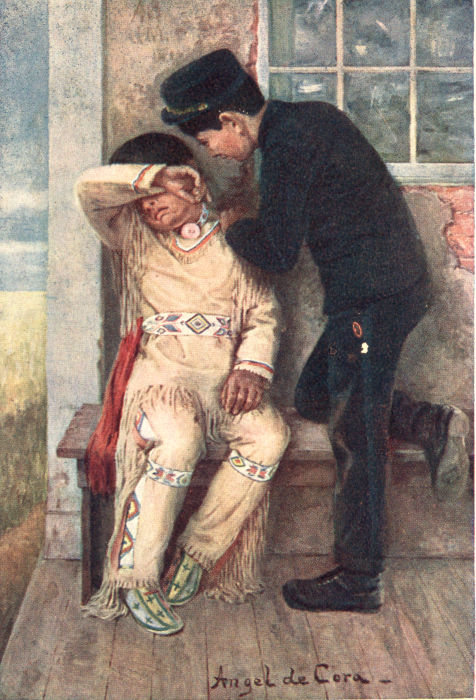
felt keenly the blows. He went to his desk, and buried his face in his
arms.
"I am afraid this isn't hickory," said Gray-beard, throwing on the
floor the stump of the switch. "I know this one is," and he dealt
blow after blow on the broad shoulders of Alexander, who gave no sign
of pain. The boy stood unmoved, every muscle relaxed, even his hands
were open, showing no emotion whatever. The stick was worn out, and
Gray-beard threw the stump on the floor.
Aleck put on his coat, then, with head uplifted and unfaltering steps,
went to his desk, took his pen, and completed the unfinished word of
the motto.