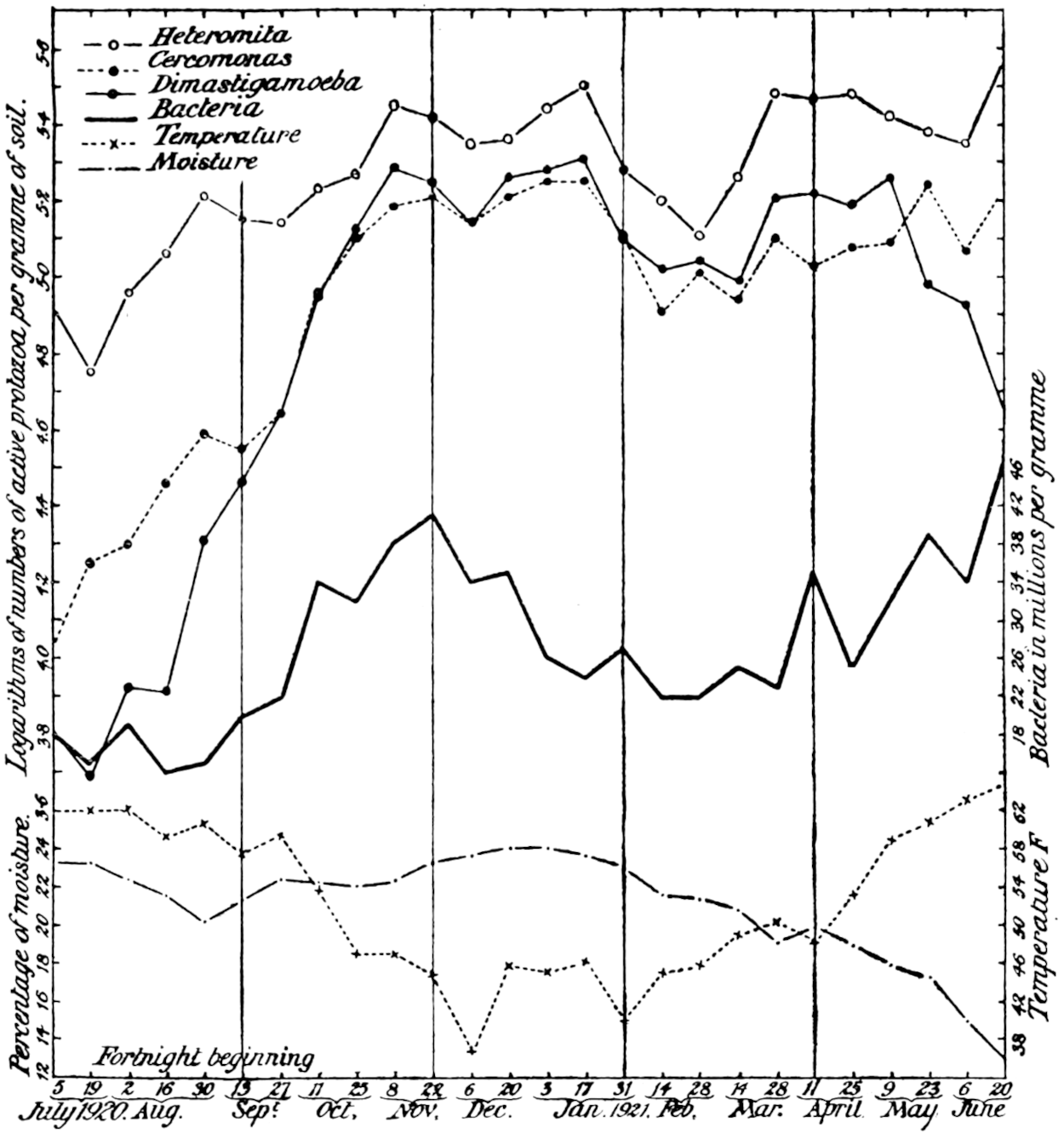
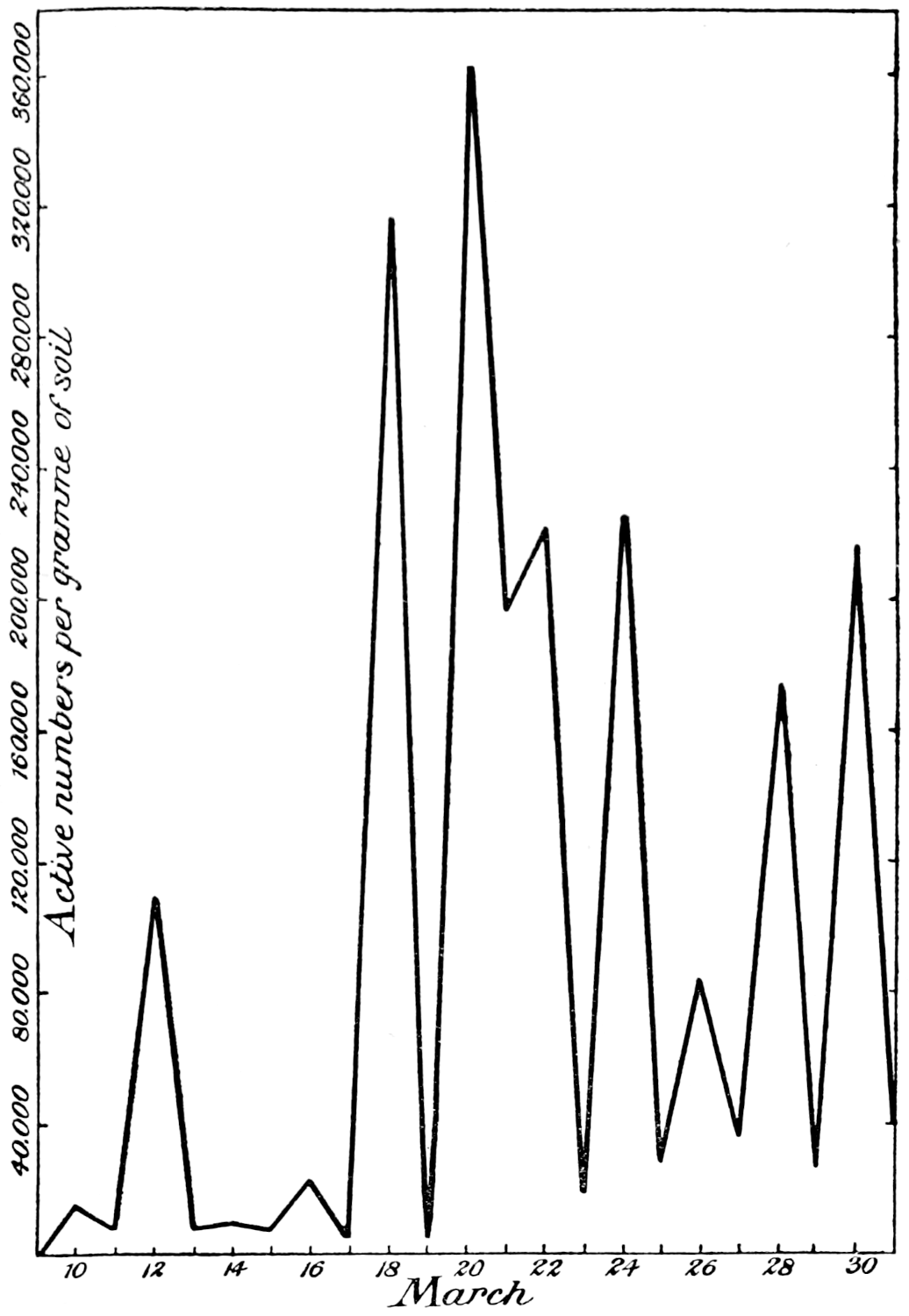
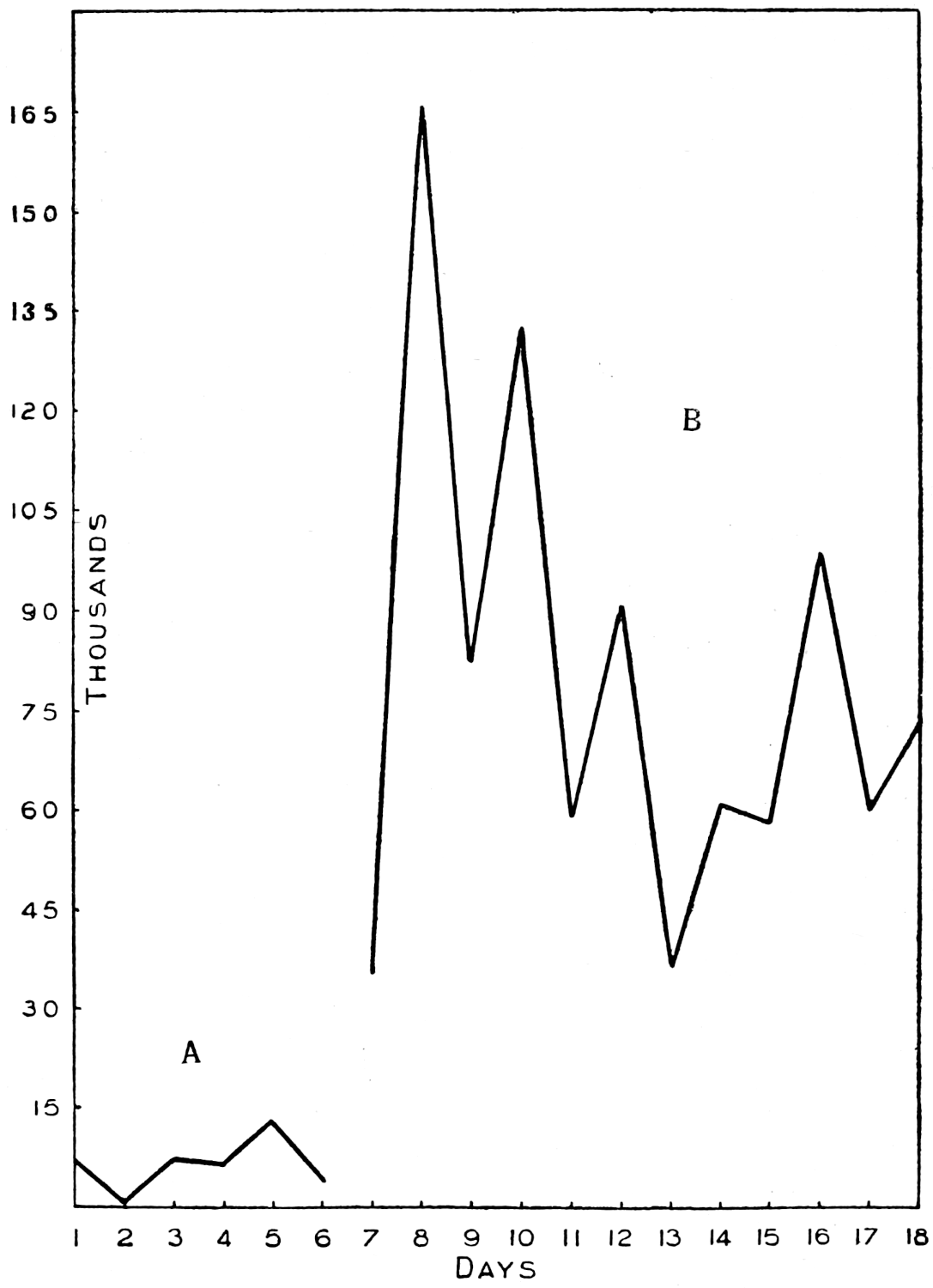
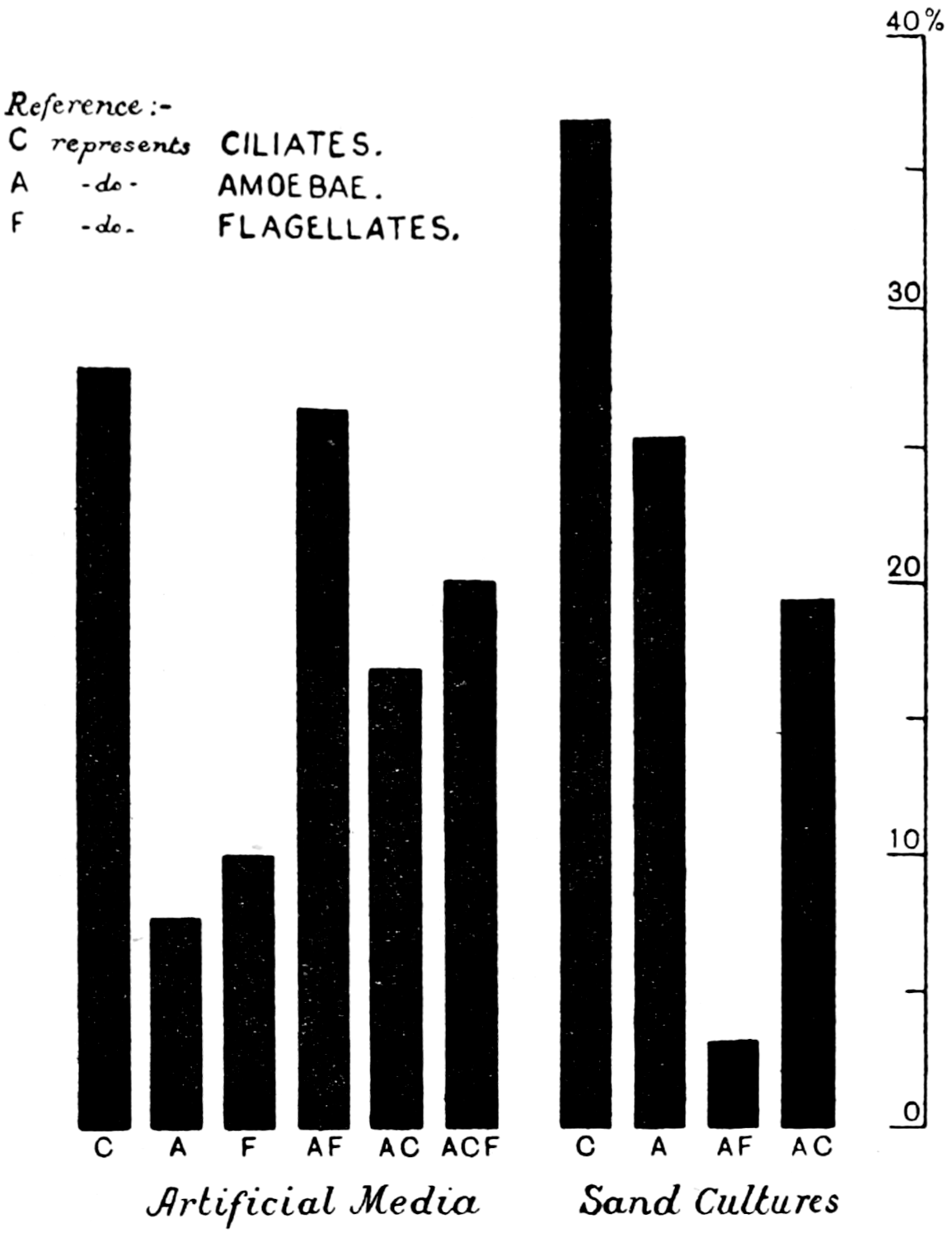
The cover image has been created for this text and is in the public domain.
THE ROTHAMSTED MONOGRAPHS ON
AGRICULTURAL SCIENCE EDITED BY Sir E. J. RUSSELL, D.Sc. (Lond.), F.R.S.
THE MICRO-ORGANISMS OF THE SOIL
THE ROTHAMSTED MONOGRAPHS ON
AGRICULTURAL SCIENCE. Edited by Sir E. JOHN RUSSELL, D.Sc., F.R.S.
During the past ten years there have been marked developments
in knowledge of the relations between the soil and the
growing plant. The subject involves physical, biological, and
chemical considerations, and its ramifications are now so wide
that they cannot be satisfactorily dealt with in detail in any
one book. These monographs collectively cover the whole
ground. In “Soil Conditions and Plant Growth” the general
outlines are presented: in the monographs the various divisions
are fully and critically dealt with by the Heads of the Departments
concerned at Rothamsted. A homogeneous treatment
is thus secured that will, it is hoped, much facilitate the use of
the series.
SOIL CONDITIONS AND PLANT GROWTH, Fourth Edition.
By Sir E. John Russell, F.R.S. 16s. net.
The following volumes are in preparation:—
MANURING OF GRASS-LANDS FOR HAY
By Winifred E. Brenchley, D.Sc., F.Z.S.
THE MICRO-ORGANISMS OF THE SOIL
By Sir E. John Russell, F.R.S., and Members of the Biological Staff of
the Rothamsted Experimental Station.
SOIL PHYSICS
By B. A. Keen, B.Sc.
SOIL PROTOZOA
By D. W. Cutler, M.A., and L. M. Crump, M.Sc.
SOIL BACTERIA
By H. G. Thornton, M.A.
SOIL FUNGI AND ALGÆ
By W. B. Brierley, S. T. Jewson, B.Sc., and
B. M. Roach (Bristol), D.Sc.
CHEMICAL CHANGES IN THE SOIL
By H. J. Page, B.Sc.
LONGMANS, GREEN AND CO., LONDON, NEW YORK, TORONTO, BOMBAY, CALCUTTA, AND MADRAS.
BY Sir E. JOHN RUSSELL, F.R.S. AND MEMBERS OF THE BIOLOGICAL STAFF OF THE
ROTHAMSTED EXPERIMENTAL STATION
WITH DIAGRAMS
LONGMANS,
GREEN AND CO.
39 PATERNOSTER ROW, LONDON, E.C. 4 NEW YORK, TORONTO
BOMBAY, CALCUTTA and MADRAS
1923
Made in Great Britain
INTRODUCTION.
The purpose of this volume is to give the broad outlines
of our present knowledge of the relationships of the
population of living organisms in the soil to one another
and to the surface vegetation. It is shown that there is
a close relationship with vegetation, the soil population
being dependent almost entirely on the growing plant
for energy material, while the plant is equally dependent
on the activities of the soil population for removing the
residues of previous generations of plants and for the
continued production in the soil of simple materials,
such as nitrates, which are necessary to its growth. It
is also shown, however, that the soil population takes
toll of the plant nutrients and that some of its members
may directly injure the growing plant.
The soil population is so complex that it manifestly
cannot be dealt with as a whole in any detail by any one
person, and at the same time it plays so important a part
in the soil economy that it must be seriously studied.
Team work therefore becomes indispensable, and fortunately
this has been rendered possible at Rothamsted.
Each group of organisms is here dealt with by the
person primarily responsible for that particular section
of the work. The plan of the book has been carefully
discussed by all the authors, and the subject matter has
already been presented in a course of lectures given at
University College, London, under the auspices of the
Botanical Board of Studies of the London University.
The interest shown in these lectures leads us to hope
that the subject may appeal to a wider public, and above
all to some of the younger investigators in biological
science. They will find it bristling with big scientific
problems, and those who pursue it have the satisfaction,
which increases as the years pass by, of knowing that
their work is not only of interest to themselves, but of
great importance in ministering to the intellectual and
material needs of the whole community.
CHAPTER I. THE DEVELOPMENT OF THE IDEA OF A SOIL POPULATION. — A SELECTED BIBLIOGRAPHY.
From the earliest times agriculturists have been familiar
with the idea that decomposition of vegetable and animal
matter takes place in the soil, and that the process is intimately
connected with soil fertility.
By the middle of the nineteenth century three different
ways were known in which the decomposition occurred.
One had been since early times specially associated with soil
fertility, in that it gave rise to humus, the black sticky
substance in farmyard manure or in soil—which was supposed
up to 1840 to be the special food of plants. No good account
of the process or of the conditions in which it occurred is,
however, given by the older writers.
A second resulted in the formation of nitrates. This
process became known as nitrification: it was described by
Georgius Agricola (1494-1555) in his book “De Re Metallica,”
and it was of great importance in the seventeenth and
eighteenth centuries, because it was used for the manufacture
of gunpowder in the great wars of that period. The conditions
for the making of successful nitre beds were so
thoroughly investigated that little fresh knowledge was
added to that of 1770[A] until quite recently. This process,
however, was not usually associated with soil fertility,
although both Glauber (1656) and Mayow (1674) had insisted
on the connection.
[A] See the remarkable
collection of papers entitled “Instructions sur l’établissement
des nitrières,” publié par les Régisseurs-généraux des Poudres et
Salpêtre. Paris, 1777.
A third type of decomposition was brought into prominence
by Liebig in 1840.[7][B] Reviewing the decomposition
of organic matter in the light of the newer chemistry, he
concluded that the process was a slow chemical oxidation,
to which he gave the name “Eremacausis.” He recognised
that humus was formed, but he regarded it only as an intermediate
product, and emphatically denied its importance in
soil fertility. The true fertility agents, in his view, were the
final products—CO2, potassium and other alkaline salts,
phosphates, silicates, etc. He went on to argue brilliantly
that instead of applying farmyard or similar manures to the
soil it was altogether quicker and better to apply these
mineral compounds obtained from other sources than to
wait for the slow process of liberation as the result of decomposition.
For some reason, difficult to understand, he overlooked
nitrification and the part that nitrates might play in
soil fertility. Lawes and Gilbert[6] were much attracted by
this new idea; they showed that it was incomplete because
it took no account of the necessity for supplying nitrogen
compounds to the crop. When ammonium salts were added
to Liebig’s ash constituents the resulting mixture had almost
as good a fertilising effect as farmyard manure. Lawes at
once saw the enormous practical importance of this discovery,
and set up a factory for the manufacture of artificial fertilisers.
He did not, however, follow it up more closely on
the scientific side.
[B] The numbers refer to the short bibliography on
p. 18.
Both Lawes and Gilbert were in constant touch with the
idea of decomposition in the soil, and they attached so much
importance to nitrogen compounds in plant nutrition that it
is not easy to understand how they missed the connection
with nitrification. But they did so, and like other English
and German workers of the day, considered that plant roots
assimilated their nitrogen as ammonia. For the first ten
years of the history of Rothamsted only few experiments
with nitrates were made, and not till thirty-five years had
elapsed were they systematically studied.
It was by Boussingault[2] and in France that the connection
between nitrification and soil fertility was first recognised.
The news came to England, but it was not accepted,
although Way, one of the most brilliant agricultural chemists
of his time, showed that nitrates were formed in soils to
which nitrogenous fertilisers were added, and that they were
comparable in their fertiliser effects with ammonium salts.[12]
“The French chemists,” he wrote in 1856, “are going further,
several of them now advocating the view that it is in the
form of nitric acid that plants make use of compounds of
nitrogen. With this view I do not at present coincide, and
it is sufficient here to admit that nitric acid in the form of
nitrates has at least a very high value as manure.” Indeed,
Kuhlmann went so far as to argue that the nitrates found in
the soil were there reduced to ammonia before assimilation
by plants could take place. The water-culture work of the
plant physiologists of the ’sixties finally showed the correctness
of the French view.
Even when the importance of nitrification was realised
its mechanism was not understood: some thought it was
chemical, some physical. Again the explanation came from
France. Pasteur in 1862 had expressed the view that nitrification
would probably be a biological action, since purely
chemical oxidation of organic matter was of very limited
occurrence. “Pénétrés de ces idées,” as Schloesing tells us,
he and Müntz in a memorable investigation cleared up the
whole problem, and in 1877 opened the way to a most
fruitful field of research.[10] The formal description is given
in his papers in the “Comptes Rendus,” but a more lively
account is given in his lectures before the École d’application
des Manufacteurs de l’état, which, though not printed, were
collected and issued in script by his distinguished son, and
a copy of this work is among the treasures of the Rothamsted
Library.
He had been asked to study the purification of sewage,
and he and Müntz showed that it was bound up with nitrification.
The process was slow in starting, then it proceeded
rapidly. Why, they asked, was the delay? There should
be none if the process were physical or chemical, and the
fact that it occurred strongly suggested biological action.
The process was stopped by chloroform vapour, but could be
restarted after the removal of the vapour by the addition
of a little fresh soil.
The importance of this work in connection with soil
fertility was immediately realised by Warington, who had
recently come to Rothamsted.[11] He quickly confirmed the
result, and made the valuable discovery that two stages
were involved—the conversion of ammonia to a nitrite by
one organism, and of the nitrite to nitrate by another. He
made long and persistent attempts to isolate the organisms
from the soil, using the best technique of his time, but though
he found many bacteria none of them could nitrify ammonium
salts; yet the soil did it easily. For years he continued his
efforts to find the nitrifying organism, but always failed.
His health was not good, his life at Rothamsted was not
happy owing to disagreements with Gilbert, and although
his other research work was succeeding, this investigation on
which he had set his heart was not coming out; bacterial
technique was not yet sufficiently far advanced. Ten bitter,
disappointing years passed, and the crown of disappointment
came when Winogradsky, a young bacteriologist in Paris,
changed the technique and succeeded at once in isolating
both the nitrite and the nitrate-forming organisms.[13]
The numerous bacteria found by Warington in the soil
suggested the presence of a soil population, and this idea was
greatly strengthened by another line of investigation which
was being followed up in France. Boussingault had shown
that soils absorb oxygen and give out carbon dioxide;
Schloesing extended this discovery, as also did Wollny. It
was concluded that oxidation was the result of the activities
of the soil organisms in decomposing the organic matter of
the soil, and thus preparing the way for the nitrifying
organisms.
A third important function of soil bacteria was revealed
by Berthelot.[1] It was known that considerable loss of nitrogen
from the soil took place as the result of the conversion
of nitrogen compounds into nitrates, which were subsequently
washed out in the drainage water. It followed inevitably
that the stock of nitrogen compounds in the soil must long
ago have become exhausted had there been no addition of
nitrogen compounds to the soil. Berthelot argued that there
must be fixation of atmospheric nitrogen, and, following the
prevailing trend of thought in France, he attributed it to
bacteria. He confirmed the anticipation by exposing soil to
air in such conditions that dust, rain, etc., were excluded,
and he found an increase in the percentage of nitrogen.
Looking back over the work, it is difficult to understand
the result. The fixation of nitrogen is a process that absorbs
energy, and should have necessitated some source of energy,
which apparently was not supplied. But in spite of this
drawback the investigation was immediately fruitful in that
it gave the key to another problem which had long puzzled
agriculturists.
It had long been known that the growth of leguminous
crops, unlike that of others, enriched the ground,[C] and
Lawes and Gilbert had shown that this was due to an increase
of soil nitrogen. But no explanation could be found till
Hellriegel and Wilfarth solved the problem.[4] In studying
the nitrogen nutrition of gramineous and leguminous crops,
they discovered that the gramineous plants died in absence
of nitrate, and in its presence made growth which increased
regularly with nitrate supply; while leguminous plants
sometimes died and sometimes flourished in absence of
nitrate, and behaved equally erratically with increasing
nitrate supply. When the plants flourished nodules were
invariably present on the roots, but not otherwise. They
concluded, therefore, that the nitrogen nutrition of leguminous
plants differed from that of the gramineæ, and depended
on some factor which sometimes came into their
experiments and sometimes did not, and, in any case, was
associated with the nodule. Knowing that the nodules on
the roots of leguminous plants contained bacteria-like bodies,
and remembering Berthelot’s results, they explored the
possibility of bacterial fixation. They sterilised the sand
and found that peas invariably failed to develop nodules and
died, but after adding a little garden soil nodules were found
and vigorous growth was obtained.
[C] “Of the leguminous plants the bean best reinvigorates the ground ...
because the plant is of loose growth and rots easily, wherefore the people of
Macedonia and Thessaly turn over the ground when it is in flower” (i.e. dig it
into the ground if the soil is poor). Theophrastus, “Enquiry into Plants,”
bk. viii. 2, and bk. ix. I. This book is of profound interest to agriculturists
and botanists. An excellent translation by Sir Arthur Hort is now available.
(Loeb’s Classical Library.)
Chemical analysis showed considerable fixation of gaseous
nitrogen, which Hellriegel associated with the nodule
organism. This has proved to be correct, and the fixation
of nitrogen by bacteria is now a well-recognised process,
the conditions of which are being thoroughly worked out.
Two types of organisms are known—those associated with
leguminous plants, and those living in a free and independent
state in the soil. Of the latter the Clostridium, isolated by
Winogradsky, is anaerobic, and the Azotobacter of Beijerinck
is aerobic. The essential conditions are that a source of
energy must be supplied—usually given as sugar—that the
medium must not be acid, and that sufficient phosphate
must be present.
All this brilliant work had been accomplished in the
short space of the ten years 1880 to 1890. The inspiration
had in each instance come from France, and is traceable
direct to Pasteur, although coming long after his own work
on bacteriology. It is impossible for us now to realise the
thrill of wonder and astonishment with which students,
teachers, and writers of those days learned that the nutrition
of plants, and therefore the growth of crops and the feeding
of themselves, was largely the result of the activity of
bacteria in the dark recesses of the soil. It is not surprising
that the ideas were pushed somewhat too far, that the soil
population was regarded as solely bacterial, and that important
chemical and physical changes were sometimes overlooked.
Gradually there came the inevitable reaction and a somewhat
changed outlook. Continued examination showed the
presence in soil of almost every kind of bacteria for which
search was made. Some of them were almost certainly in
the resting condition as spores, and the new generation of
workers had an uneasy feeling that the case for the overwhelming
importance of bacteria in the economy of the soil
was not too well founded. It was shown that the decomposition
of nitrogen compounds to form ammonia would
take place without micro-organisms if, as presumably would
happen, the plant enzymes continued to act after they got
into the soil. Even the oxidation of ammonia to nitrate—the
great stronghold of the biological school—was accomplished
by chemical agents. The fixation of nitrogen in soil
conditions was beyond the power of chemists to achieve,
and here it was universally agreed that bacteria were the
active agents. And finally, chemists were themselves bringing
into prominence a set of bodies—the colloids—whose
remarkable properties seemed indefinitely expansible, and
were in addition sufficiently incomprehensible to the ordinary
student to attain much of the magnificence of the unknown.
All the time, however, a faithful body of workers was
busy exploring the ground already won, improving the
technique, making counts of the numbers of bacteria in the
soil, and trying to measure the amount of bacterial activity.
Much of the value of this work was limited by the circumstance
that the bacteria were regarded as more or less constant
in numbers and activities, so that a single determination
was supposed to characterise the position in a given soil.
This was the condition of the subject when it was seriously
taken up at Rothamsted. Before turning to agriculture,
the writer had been studying the mechanism of certain slow
chemical oxidations, and one of his first experiments in
agriculture was to examine the phenomena of oxidation in
soil. The results accorded with the biological explanation
of Schloesing: when the soil was completely sterilised oxidation
almost ceased. But the striking discovery was made,
as the result of an accident to an autoclave, that partial
sterilisation increased the rate of oxidation, and therefore
presumably the bacterial activity. This remarkable phenomenon
had, however, already been observed, and it had been
shown that both bacterial numbers and soil fertility were
increased thereby. A full investigation was started in 1907
by Dr. Hutchinson and the writer.[9] From the outset the
phenomena were recognised as dynamic and not static, and
the rates of change were always determined: thus the
bacterial numbers, the nitrate and ammonia present were
estimated after the several periods. Close study of the
curves showed that the chemical and bacterial changes were
sufficiently alike to justify the view that bacteria were in
the main the causes of the production of ammonia and of
nitrate; although non-biological chemical action was not
excluded, there was no evidence that it played any great
part. Thus the importance of micro-organisms in the soil
was demonstrated.
The factor causing the increased bacterial numbers after
partial sterilisation was studied by finding out what agents
would, and what would not, allow the numbers to increase,
e.g. it was found that the bacterial increases became possible
when soil had been heated at 56° C., but not at 40° C. Again,
it was shown that the high numbers in partially sterilised
soils rose for a time even higher if a little fresh untreated
soil were incorporated into the partially sterilised soil, but
afterwards they fell considerably. Putting all the results
together, it appeared that some biological cause was at work
depressing the numbers of bacteria in normal soils, but not—or
not so much—in the partially sterilised soils. Studied in
detail, the data suggested protozoa as the agent keeping
down bacterial numbers, and they were found in the untreated,
but not in the treated, soils. The hypothesis was
therefore put forward that bacteria are not the only members
of the soil population, but that protozoa are also present
keeping them in check, and therefore adversely affecting the
production of plant food.
This conclusion aroused considerable controversy. It
was maintained that protozoa were not normal inhabitants
of the soil, but only occasional visitants, and, in any case,
they were only there as cysts; the soil conditions, it was
urged, were not suitable to large organisms like protozoa.
The objection was not to be treated lightly, but, on the other
hand, the experiments seemed quite sound. As neither
Dr. Hutchinson nor the writer were protozoologists, Dr. T.
Goodey and (after he left) Mr. Kenneth R. Lewin were
invited to try and find out, quite independently of the partial
sterilisation investigation, whether protozoa are normal inhabitants
of the soil, and if so, whether they are in a trophic
condition, and what is their mode of life and their relation to
soil bacteria. Had it turned out that protozoa had nothing
to do with the matter, search would have been made for
some other organism. Goodey showed that the ciliates were
not particularly important; Lewin soon demonstrated the
existence of trophic amœbæ and flagellates. Unfortunately
he was killed in the war before he had got far with the work.
After the Armistice, Mr. Cutler accepted charge of the work:
he will himself relate in Chapters IV. and V. what he has
done.
At first sight it might be thought comparatively easy to
settle a question of this kind by examining soil under a
microscope or by sterilising it and introducing successively
bacteria and known types of protozoa. Unfortunately
neither method is simple in practice. It is impossible to
look into the soil with a microscope, and methods of teasing-out
small pieces of soil on a slide under the high, or even the
low power, give no information, because the particles of
soil have the remarkable power of attracting and firmly
retaining protozoa, and no doubt bacteria as well; indeed,
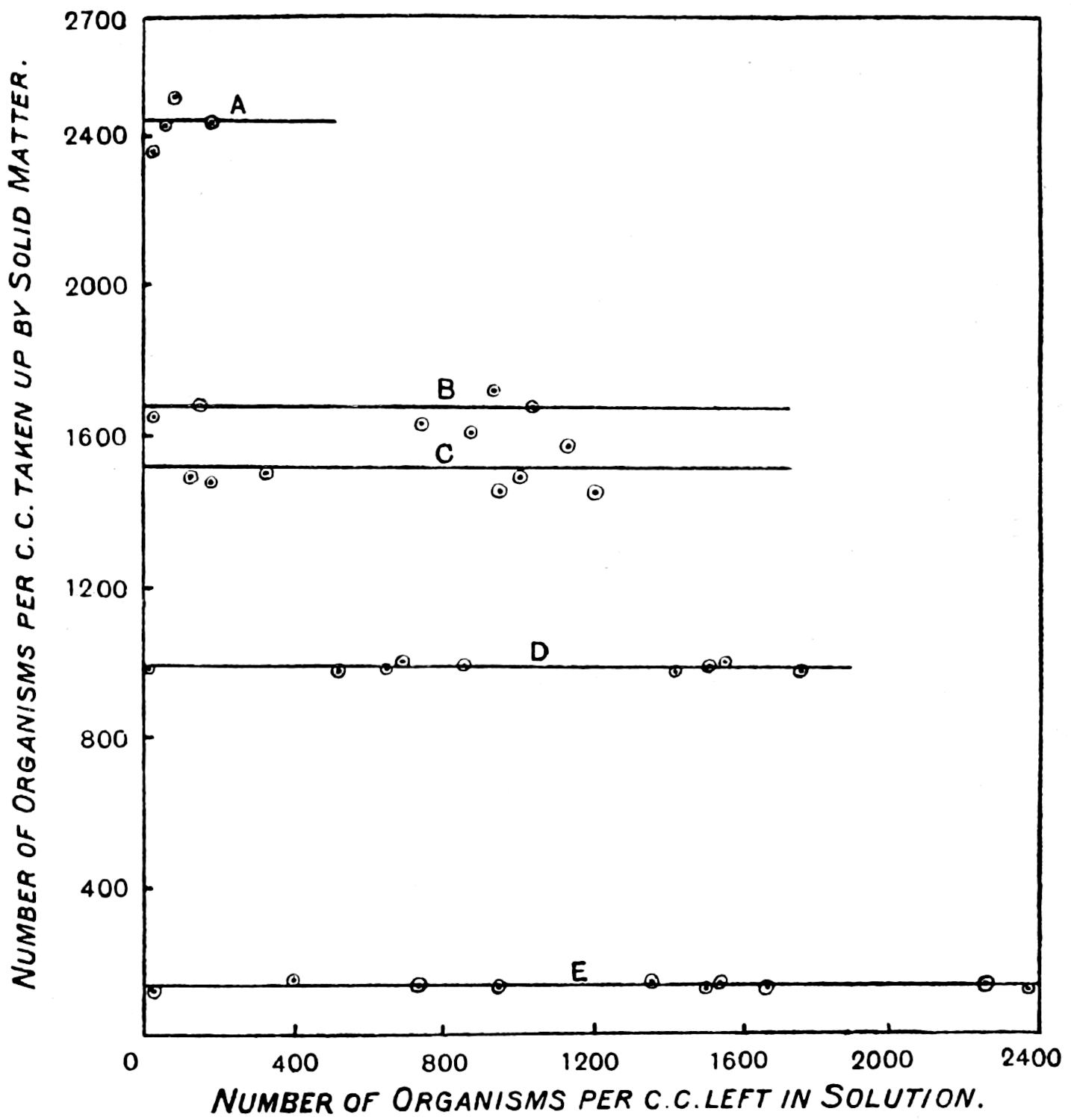
for protozoa (which have been the more fully investigated)
there seems to be something not unlike a saturation capacity
(see Fig. 9, p. 78). Further, complete sterilisation of soil
cannot be effected without at the same time altering its
chemical and physical properties, and changing it as a
habitat for micro-organisms. Cutler has, however, overcome
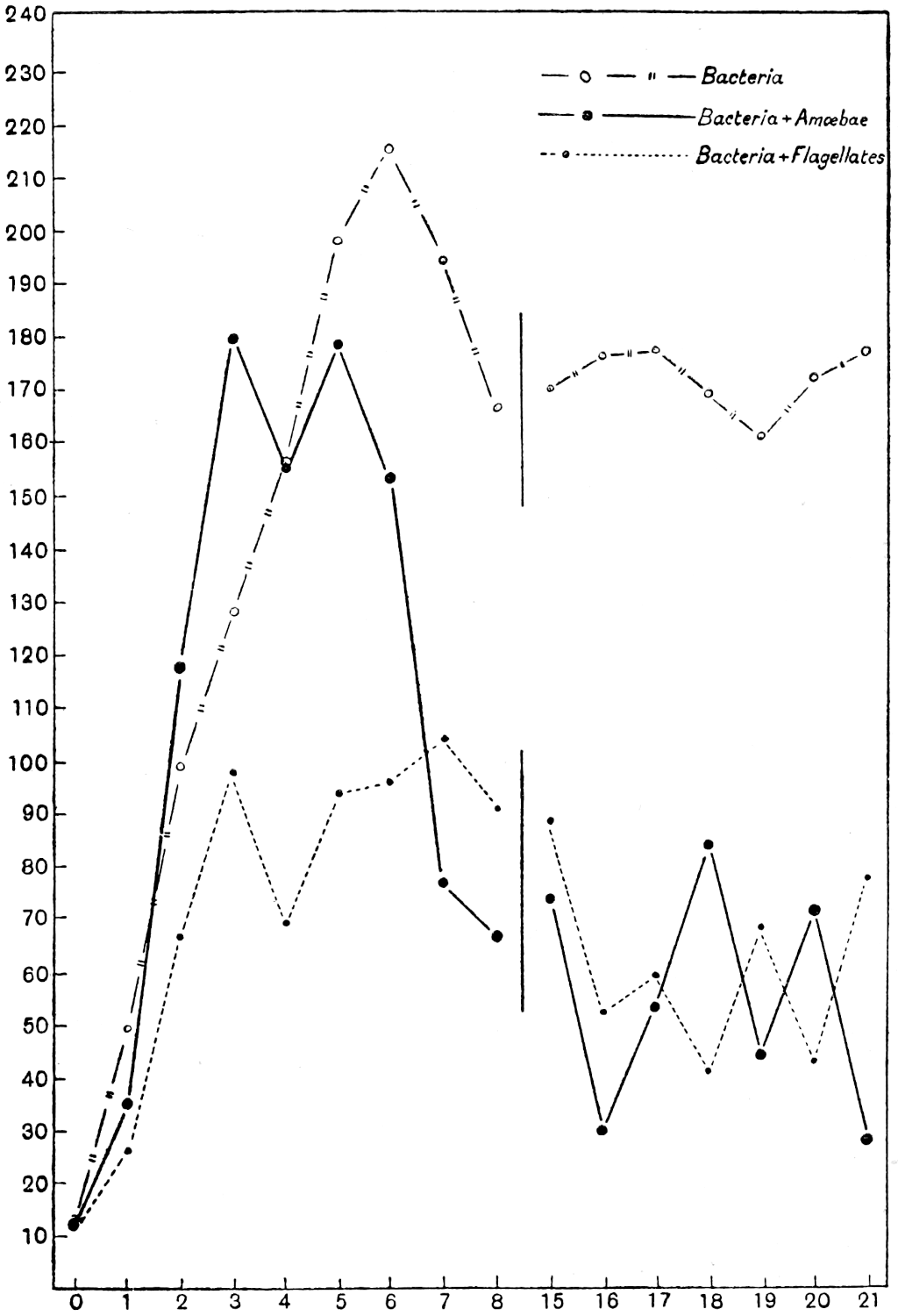
the difficulties and shown that the introduction of protozoa
into soils sterilised and then reinfected with bacteria
considerably reduces the numbers of these organisms.
The method adopted, therefore, is to take a census of
population and of production. Counting methods are
elaborated, and estimates as accurate as possible are made
of the numbers of the various organisms in a natural field
soil at stated intervals. Simultaneously, wherever possible
some measure is taken of the work done. The details of the
census are finally arranged in consultation with the Statistical
Department, to ensure that the data shall possess
adequate statistical value. From the results it is possible
to adduce information of great value as to the life of the
population, the influence of external conditions, etc.
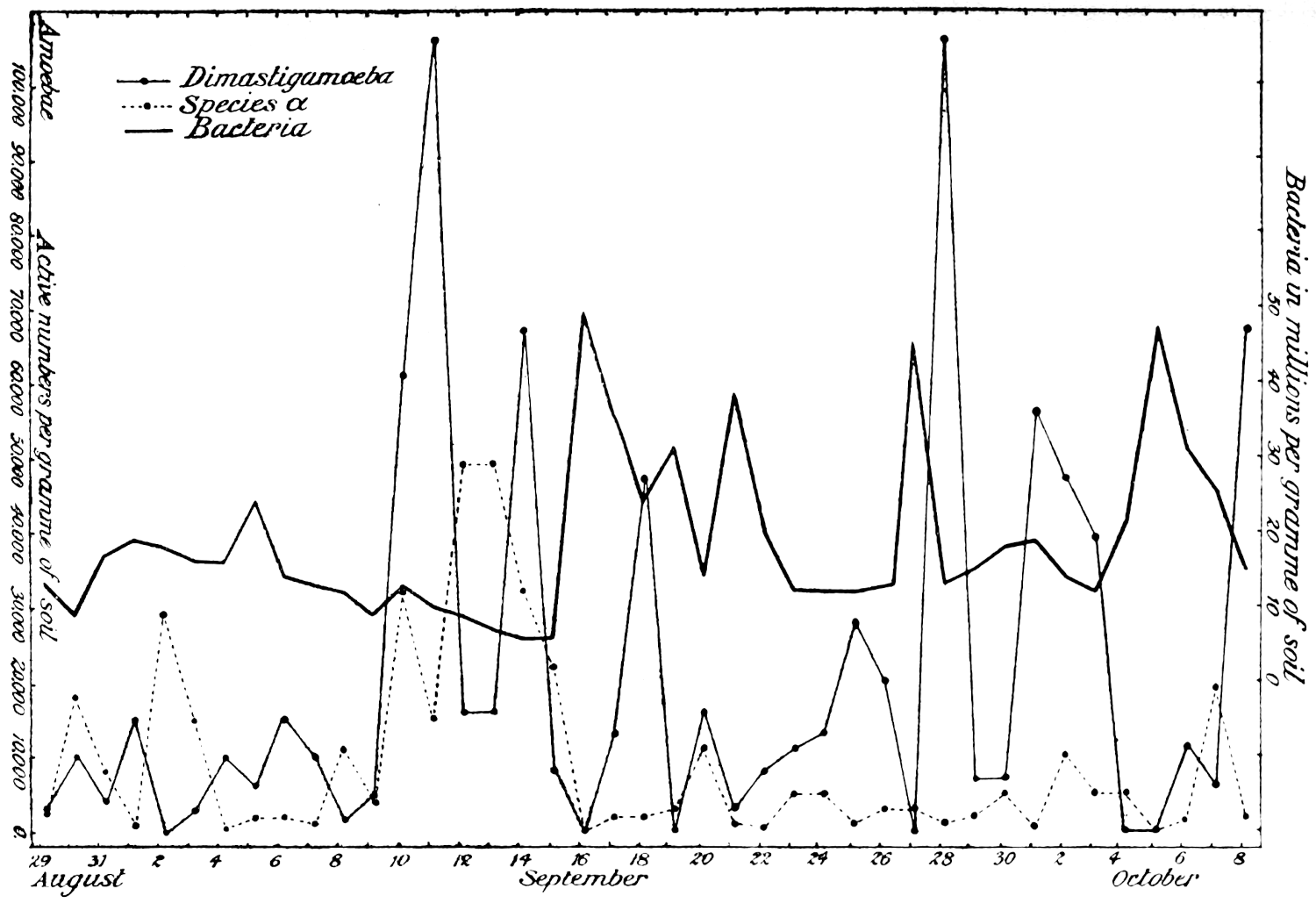
The most important investigation of this kind carried out
at Rothamsted was organised by Mr. Cutler.[3] A team of
six workers was assembled, and for 365 days without a
break they counted every day the ciliates, the amœbæ,
the flagellates, and the bacteria in a plot of arable ground,
distinguishing no less than seventeen different kinds of
protozoa. The conclusions arrived at were carefully tested
by the Statistical Department.
Of the protozoa the flagellates were found to be the most
numerous, the amœbæ came next, and the ciliates were by
far the fewest. The numbers of each organism varied from
day to day in a way that showed conclusively the essentially
trophic nature of the protozoan population. The numbers
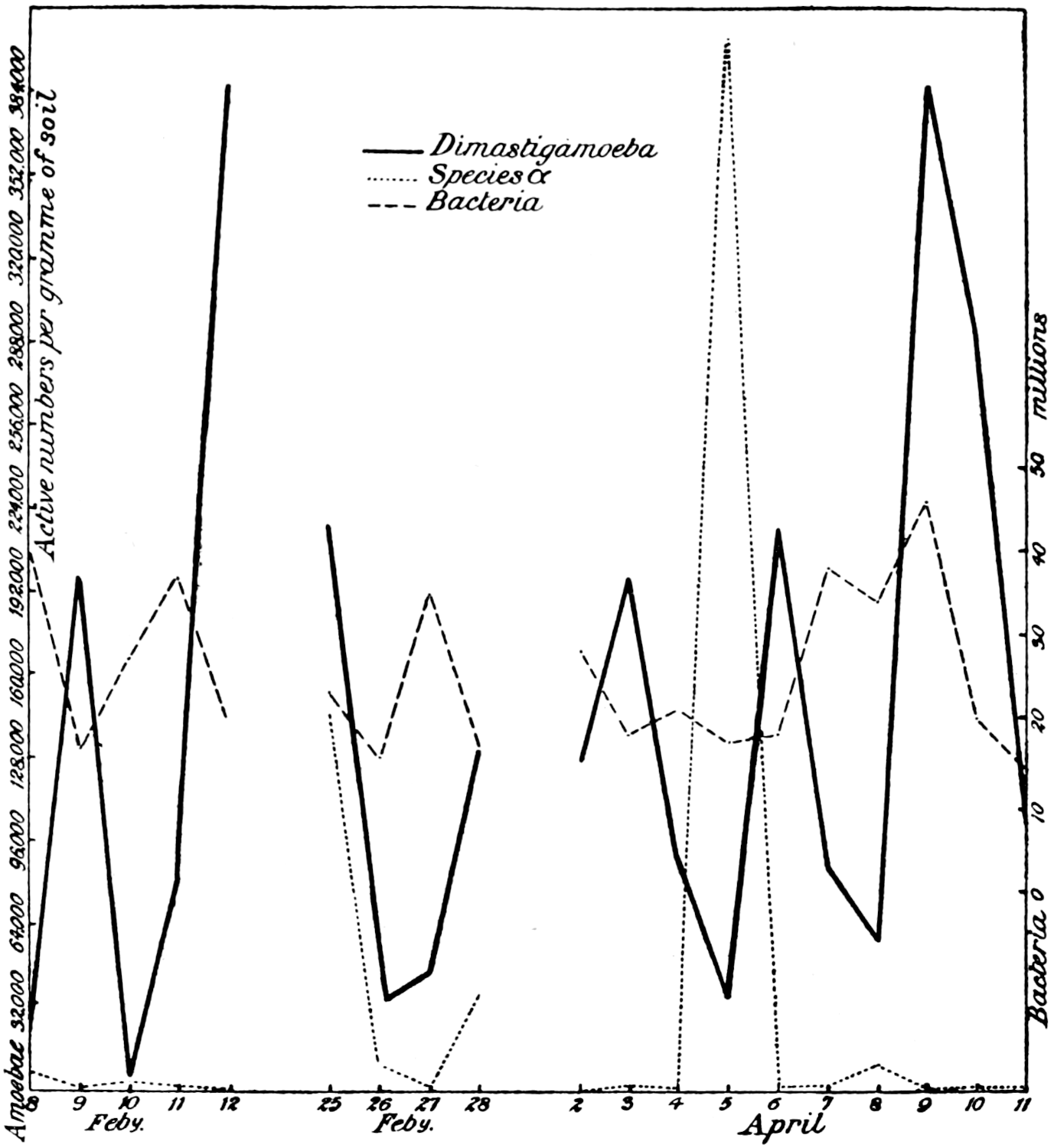
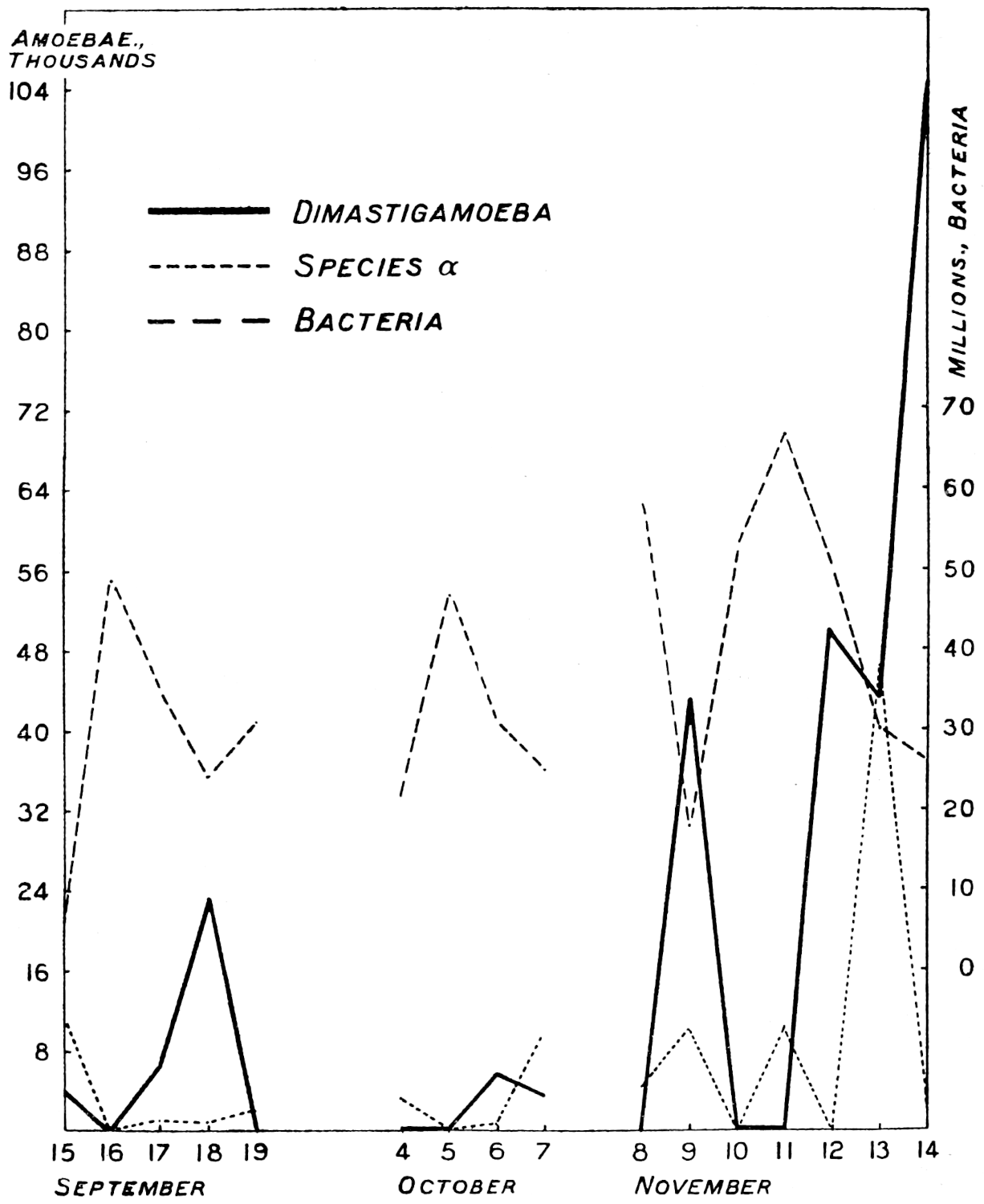
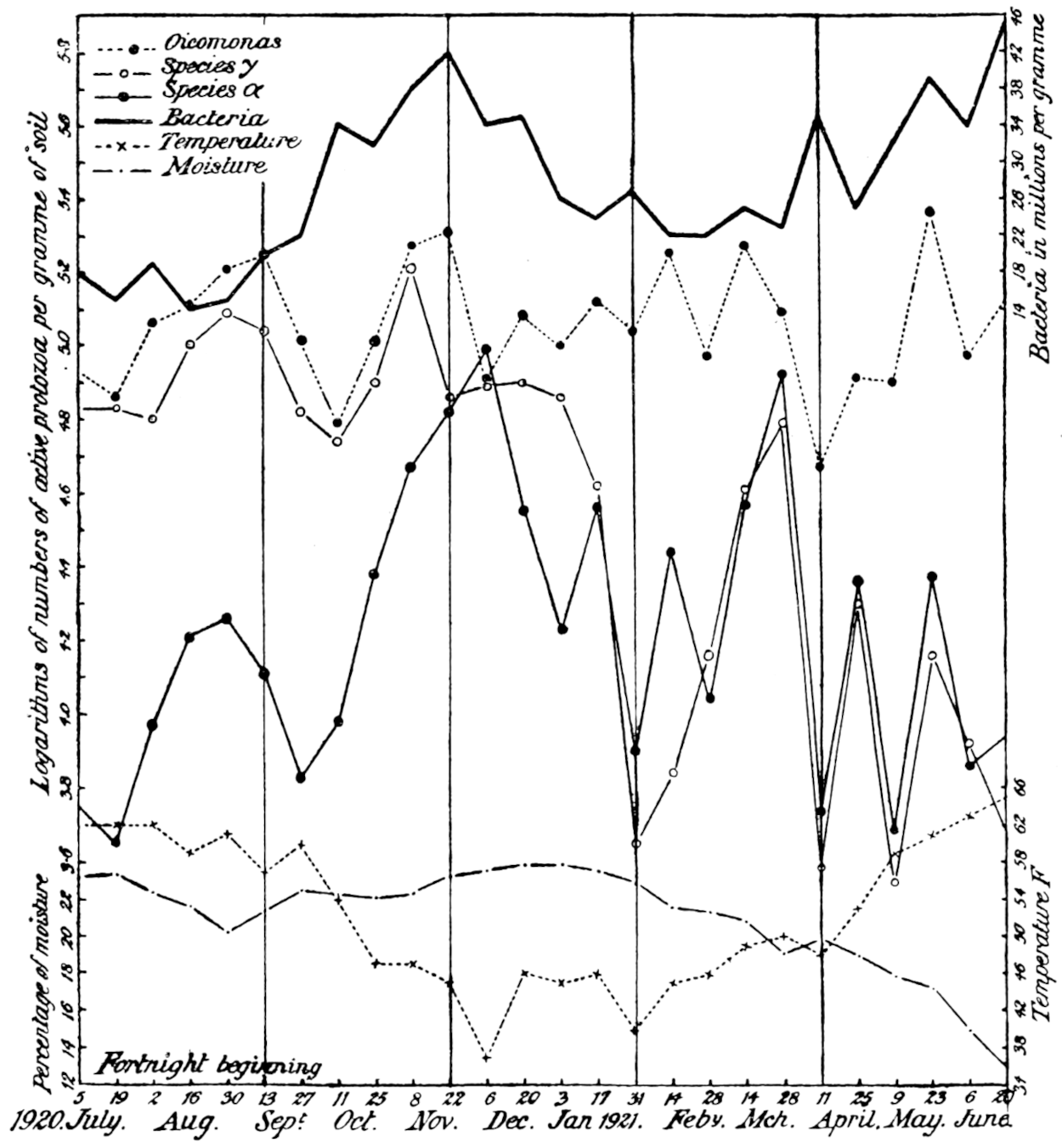
of amœbæ—especially Dimastigamœba and of a species called
α—were sharply related to the numbers of bacteria: when the
amœbae were numerous the bacteria were few, and vice versa.
Detailed examination showed that the amœbæ were probably
the cause of the fluctuations in the bacterial numbers, but
Mr. Cutler has not yet been able to find why the amœbæ
fluctuated; it does not appear that temperature, moisture
content, air supply or food supply were determining causes.
The flagellates and ciliates also showed large fluctuations,
amounting in one case—Oicomonas—to a definite periodicity,
apparently, however, not related to bacterial numbers, or,
so far as can be seen, to external conditions of moisture,
temperature and food supply, and showing no agreement
with the fluctuations of the amœbæ. However, one cannot
be certain that lack of agreement between curves expressing
protozoan numbers and physical factors implies absence of
causal relationships: the observations (though the best that
can yet be made) are admittedly not complete. If we saw
only the end of the bough of a tree, and could see no connection
with a trunk, we might have much difficulty in finding
relationships between its motion and the wind; whatever the
direction of the wind it would move backwards and forwards
in much the same way, and even when the wind was blowing
along the plane of its motion it would just as often move
against the wind as with it.
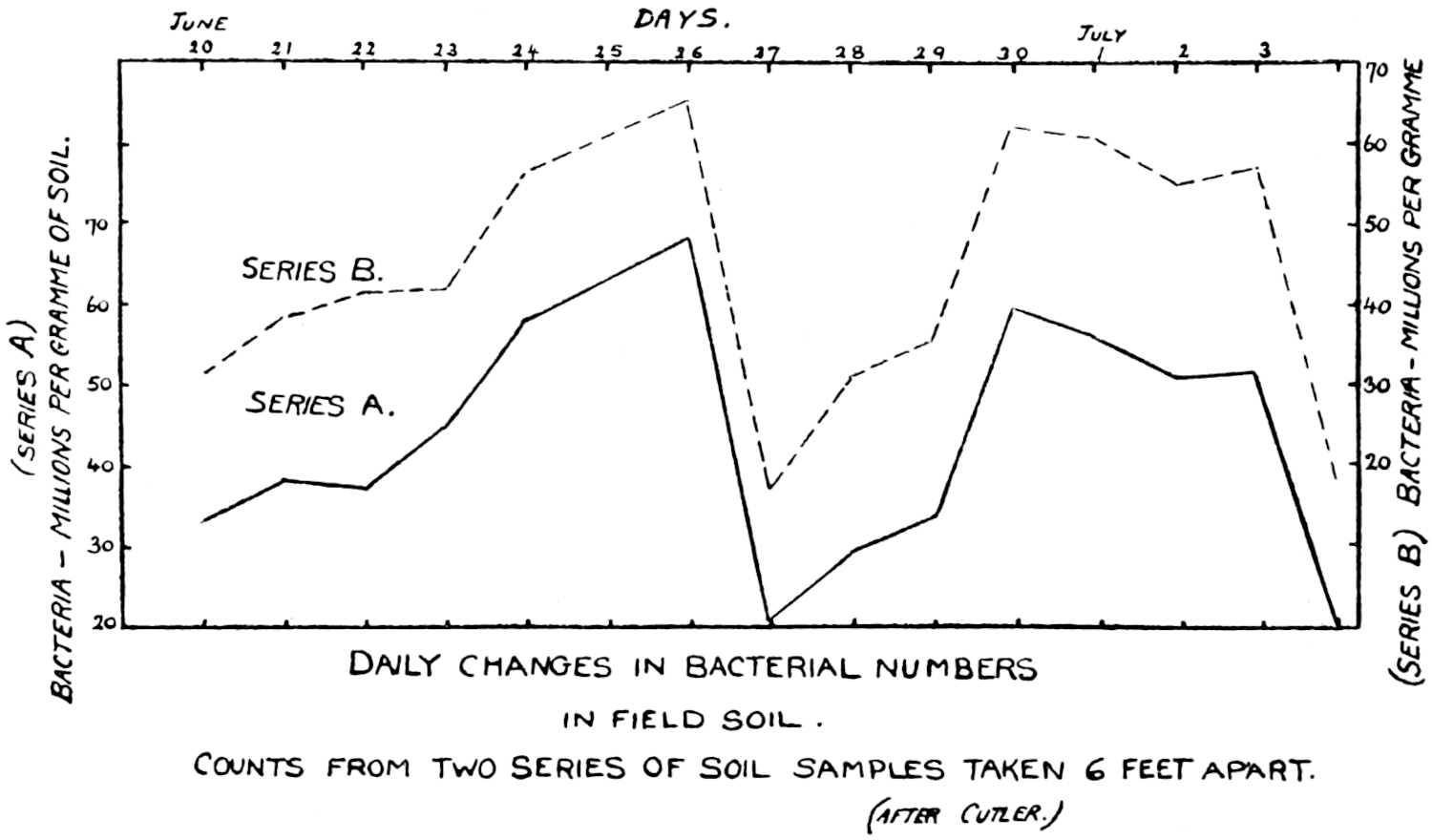
Meanwhile evidence was obtained that the twenty-four
hour interval adopted by the protozoological staff was too
long for bacteria, and accordingly the Bacteriological Department,
under Mr. Thornton, refined the method still further.
Bacterial counts were made every two hours, day and night,
for several periods of sixty or eighty hours without a break.
The shape of the curve suggests that two hours is probably
close enough, and for the present counts at shorter intervals
are not contemplated. But there is at least one maximum
and one minimum in the day, although the bacterial day
does not apparently correspond with ours, nor can any relationship
be traced with the diurnal temperature curve.
The nitrate content of the soil was simultaneously determined
by Mr. Page and found to vary from hour to hour,
but the variations did not sharply correspond with the bacterial
numbers; this, however, would not necessarily be
expected. The production of nitrate involves various
stages, and any lag would throw the nitrate and bacterial
curves out of agreement. There is a suggestion of a lag,
but more counts are necessary before it can be regarded as
established.
Examination of these and other nitrate curves obtained
at Rothamsted has brought out another remarkable phenomenon.
No crop is growing on these plots, and no rain fell
during the eighty hours, yet nitrate is disappearing for a
considerable part of the time. Where is it going to? At
present the simplest explanation seems to be that it is taken
up by micro-organisms. A similar conclusion had to be
drawn from a study of the nitrogen exhaustion of the soil.
The whole of the nitrate theoretically obtainable from the
organic matter of the soil is not obtained in the course of
hours or even days; in one of our experiments at Rothamsted
nitrification is still going on, and is far from complete,
even after a lapse of fifty-three years. The explanation at
present offered is that part of the nitrate is constantly being
absorbed by micro-organisms and regenerated later on.
Now what organisms could be supposed to absorb nitrates
from the soil? Certain bacteria and fungi are known to
utilise nitrates, and one naturally thinks of algæ as possible
agents also. Dr. Muriel Bristol was therefore invited to
study the algæ of the soil. Her account is given in Chapter
VI. She has found them not only on the surface, but
scattered throughout the body of the soil, even in the darkness
of 4 inches, 5 inches, or 6 inches depth, where no light
can ever penetrate, and where photosynthesis as we understand
it could not possibly take place. Some modification
in their mode of life is clearly necessary, and it may well
happen that they are living saprophytically. Dr. Bristol
has not yet, however, been able to count the algæ in the soil
with any certainty, although she has made some estimates of
the numbers.
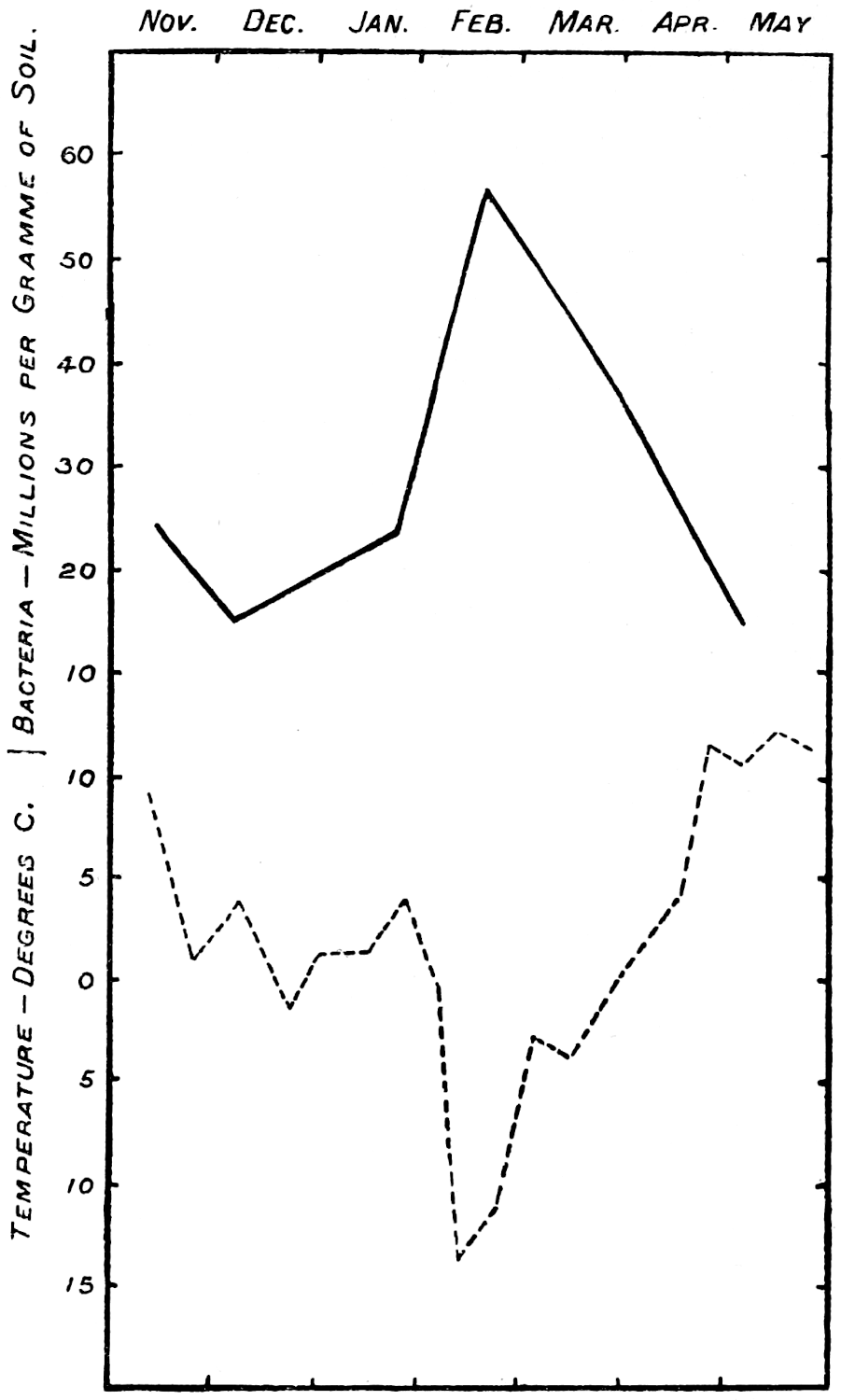
The quantitative work on the soil population indicates
other possibilities which are being investigated. There is not
only a daily fluctuation in the numbers, but so far as measurements
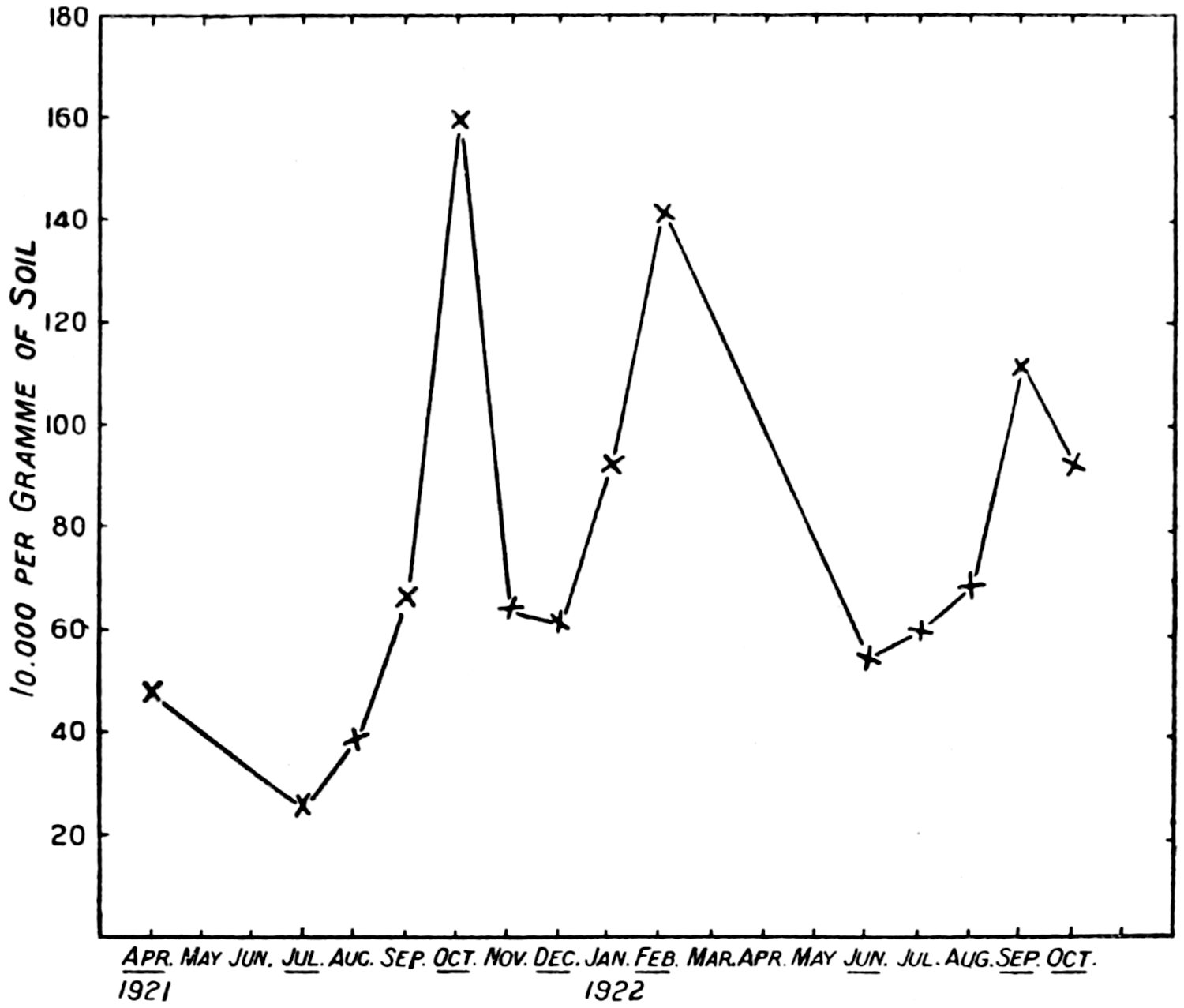
have gone, a seasonal one also. There seems to be
some considerable uplift in numbers of bacteria, protozoa, and
possibly algæ and fungi in the spring-time, followed by a fall
in summer, a rise in autumn, and a fall again in winter. At
present we are unable to account for the phenomenon, nor
can we be sure that it is general until many more data are
accumulated.
In the cases of the protozoa and the algæ, there was a
definite reason for seeking them in the soil.
Another section of the population, the fungi, was simply
found, and at present we have only limited views as to their
function. The older workers considered that they predominated
in acid soils, while bacteria predominated in
neutral soils. Present-day workers have shown that fungi,
including actinomycetes, are normal inhabitants of all soils.
The attempts at quantitative estimations are seriously complicated
by the fact that during the manipulations a single
piece of mycelium may break into fragments, each of which
would count as one, while a single cluster of spores might be
counted as thousands. Little progress has therefore been
made on the quantitative lines which have been so fruitful
with protozoa. Dr. Brierley gives, in Chapters VII. and
VIII., a critical account of the work done on fungi.
In addition to the organisms already considered there are
others of larger size. The nematodes are almost visible to the
unaided eye, most of them are free living and probably help
in the disintegration of plant residues, though a few are
parasitic on living plants and do much injury to clover,
oats, and less frequently to onions, bulbs, and potatoes.
Further, there are insects, myriapods and others, the effects
of which in the soil are not fully known. Special importance
attaches to the earthworms, not only because they are the
largest in size and in aggregate weight of the soil population,
but because of the great part they play in aerating the soil,
gradually turning it over and bringing about an intimate
admixture with dead plant residues, as first demonstrated
by Darwin. Earthworms are the great distributors of energy
material to the microscopic population. Systematic quantitative
work on these larger forms is only of recent date,
and Dr. Imms, in Chapter IX., discusses our present knowledge.
TABLE I. Soil Population, Rothamsted, 1922.
(The figures for algæ and fungi are first approximations only, and have considerably
less value than those for bacteria and protozoa.)
Total organic matter (dry weight) in this soil = 126,000 lb. per acre.
Total nitrogen = 5700 lb. per acre. (1 lb. nitrogen per acre = 0·4 parts per
1,000,000 of soil.)
[D] To a depth of 9 inches. The weight of
soil is approximately 1,000,000 kilos.
Are there any other members of the soil population that
are of importance? As already shown, the method of
investigating the soil population in use at Rothamsted is to
find by chemical methods the changes going on in the soil;
to find by biological methods what organisms are capable of
bringing about these changes; and then to complete the
chain of evidence by tracing the relationships between the
numbers or activities of these organisms and the amount of
change produced. The list as we know it to-day is given
in Table I.
The method, however, does not indicate whether the
account is fairly complete, or whether there are other
organisms to be found. We might, of course, trust to
empirical hunting for organisms, or to chance discoveries
such as led Goodey to find the mysterious Proteomyxan
Rhizopods, which cannot yet be cultured with certainty, so
that they are rarely found by soil workers. It is possible
that there are many such organisms, and it is even conceivable
that these unknown forms far outnumber the known. The
defect of the present method is that it always leaves us in
doubt as to the completeness of the list, and so we may
have to devise another.
Reverting to Table I., it obviously serves no purpose to
add the numbers of all the organisms together. We can
add up the weights of living organisms, of their dry matter
or nitrogen, so as to form some idea of the proportion of
living to non-living organic matter, and this helps us to
visualise the different groups and place them according to
their respective masses. But a much better basis for
comparing the activities of the different groups would be
afforded by the respective amounts of energy they transform,
if these could be determined. It is proposed to attempt
such measurements at Rothamsted. The results when
added would give the sum of the energy changes effected
by the soil population as we know it: the figure could be
compared with the total energy change in the soil itself
as determined in a calorimeter. If the two figures are of
the same order of magnitude, we shall know that our
list is fairly well complete; if they are widely different,
search must be made for the missing energy transformers.
There are, of course, serious experimental difficulties
to be overcome, but we believe the energy relationships
will afford the best basis for further work on the soil
population.
Finally, it is necessary to refer to the physical conditions
obtaining in the soil. These make it a much better habitat
for organisms than one might expect. At first sight one
thinks of the soil as a purely mineral mass. This view is
entirely incorrect. Soil contains a considerable amount of
plant residues, rich in energy, and of air and water. The
usual method of stating the composition of the soil is by
weight, but this is misleading to the biologist because the
mineral matter has a density some two and a half times that
of water and three times that of the organic matter. For
biological purposes composition by volume is much more
useful, and when stated in this way the figures are very
different from those ordinarily given. Table II. gives the
results for two Broadbalk arable plots, one unmanured and
the other dunged; it includes also a pasture soil.
The first requirement of the soil population is a supply
of energy, without which it cannot live at all. All our
evidence shows that the magnitude of the population is
limited by the quantity of energy available. The percentage
by weight of the organic matter is about two to four or five,
and the percentage by volume runs about four to twelve.
Not all of this, however, is of equal value as source of
energy. About one-half is fairly easily soluble in alkalis,
and may or may not be of special value, but about
one-quarter is probably too stable to be of use to soil
organisms.
A second requirement is water with which in this country
the soil is usually tolerably well provided. Even in prolonged
dry weather the soil is moist at a depth of 3 inches
below the surface. It is not uncommon to find 10 per cent.
or 20 per cent. by volume of water present, spread in a thin
film over all the particles, and completely saturating the
soil atmosphere.
TABLE II. Volume of Air, Water and Organic Matter in 100 Volumes of
Rothamsted Soil.
Solid Matter.
Pore Space.
In Pore Space. Values Commonly Obtained.
Mineral.
Organic.
Water.
Air.
(1)
62
4
34
23
11
(2)
51
11
38
30
8
(3)
41
12
47
40
7
(1) Arable, no manure applied to soil.
(2) Arable, dung applied to soil.
(3) Pasture.
The air supply is usually adequate owing to the rapidity
with which diffusion takes place. Except when the soil is
water-logged, the atmosphere differs but little from that of
the one we breathe. There is more CO2, but only a little
less oxygen.[8] The mean temperature is higher than one
would expect, being distinctly above that of the air, while
the fluctuations in temperature are less.[5]
The reaction in normal soils is neutral to faintly alkaline;
pH values of nearly 8 are not uncommon. Results from
certain English soils are shown on p. 18.
The soil reaction is not easily altered. A considerable
amount of acid must accumulate before any marked increase
in intensity of pH value occurs; in other words, the soil is
well buffered. The same can be said of temperature, of
water, and of energy supply. Like the reaction, they alter
but slowly, so that organisms have considerable time in
which to adapt themselves to the change.
[1] Berthelot, Marcellin, “Fixation directe de l’azote atmosphérique
libre par certains terrains argileux,” Compt. Rend., 1885, ci.,
775-84.
[2] Boussingault, J. B., and Léwy, “Sur la composition de l’air
confiné dans la terre végétale,” Ann. Chim. Phys., 1853,
xxxvii., 5-50.
[3] Cutler, D. W., Crump, L. M., and Sandon, H., “A Quantitative
Investigation of the Bacterial and Protozoan Population of the
Soil, with an Account of the Protozoan Fauna,” Phil. Trans.
Roy. Soc., Series B, 1922, ccxi., 317-50.
[4] Hellriegel, H., and Wilfarth, H., “Untersuchungen über die
Stickstoffnahrung der Gramineen und Leguminosen,” Zeitsch.
des Vereins f. d. Rübenzucker-Industrie, 1888.
[5] Keen, B. A., and Russell, E. J., “The Factors determining Soil
Temperature,” Journ. Agric. Sci., 1921, xi., 211-37.
[6] Lawes, J. B., and Gilbert, J. H., “On Agricultural Chemistry,
Especially in Relation to the Mineral Theory of Baron Liebig,”
Journ. Roy. Agric. Soc., 1851, xii., 1-40.
[7] Liebig, Justus, “Chemistry in its Application to Agriculture and
Physiology,” 1st and 2nd editions (1840 and 1841), 3rd and
4th editions (1843 and 1847); “Natural Laws of Husbandry,”
1863.
[8] Russell, E. J., and Appleyard, A., “The Composition of the Soil
Atmosphere,” Journ. Agric. Sci., 1915, vii., 1-48; 1917, viii.,
385-417.
[9] Russell, E. J., and Hutchinson, H. B., “The Effect of Partial
Sterilisation of Soil on the Production of Plant Food,” Journ.
Agric. Sci., 1909, iii., 111-14; Part II., Journ. Agric. Sci.,
1913, v., 152-221.
[10] Schloesing, Th., and Müntz, A., “Sur la Nitrification par les ferments
organisés,” Compt. Rend., 1877, lxxxiv., 301-3; 1877,
lxxxv., 1018-20; and 1878, lxxxvi., 892-5. “Leçons de
chimie agricole,” 1883.
[11] Warington, R., “On Nitrification,” Part I., Journ. Chem. Soc.,
1878, xxxiii., 44-51; Part II, Journ. Chem. Soc., 1879, xxxv.,
429-56; Part III., Journ. Chem. Soc., 1884, xlv., 637-72;
Part IV., Journ. Chem. Soc., 1891, lix., 484-529.
[12] Way, J. T., “On the Composition of the Waters of Land Drainage
and of Rain,” Journ. Roy. Agric. Soc., 1856, xvii., 123-62.
[13] Winogradsky, S., “Recherches sur les organismes de la nitrification,”
Ann. de l’Inst. Pasteur, 1890, iv., 1e Mémoire, 213-31;
2e Mémoire, 257-75; 3e Mémoire, 760-71.
“Recherches sur l’assimilation de l’azote libre de l’atmosphère par
les microbes.” Arch. des Sci. Biolog. St. Petersburg, 1895, iii,
297-352.
For further details and fuller bibliography, see E. J. Russell,
“Soil Conditions and Plant Growth,” Longmans, Green & Co.
CHAPTER II. SOIL BACTERIA. — A. Occurrence and Methods of Study.
To understand the development of our knowledge of soil
bacteria, it must be remembered that bacteriology is under
the disadvantage that it started as an applied science.
Although bacteria were first seen by Leeuwenhoeck about the
middle of the seventeenth century, and some of their forms
described by microscopists of the eighteenth and early nineteenth
centuries, it was only with the work of Pasteur on fermentation,
and of Duvaine, Pasteur, and their contemporaries
on disease bacteria, that bacteriology may be said to have
started. From the outset, therefore, attention has been
directed mainly to the bacteria in their specialised relationship
to disease or to fermentation and similar processes. As
a result, little research was done on the pure biology of the
bacteria, so that even now many of the most fundamental
and elementary problems concerning them are quite unsolved.
In their work on fermentations and disease bacteria, the
earlier workers were assisted by the fact that under both
sets of conditions the causative bacteria exist, as a rule,
either in practically pure culture, or else in preponderating
numbers. The study and elucidation of such a mixed
micro-population as exists in the soil, became possible only
when methods had been devised for isolating the different
kinds of bacteria, and thus studying them apart from each
other. It was the development of the gelatine plate method
of isolating pure cultures by Koch[36] in 1881 that made the
study of the soil bacteria practicable. The plating method
opened up two lines of research. In the first place, it provided
a simple means of isolating organisms from the mixed
population of the soil, and thus enabled a qualitative study
to be made of each organism in pure culture, and, in the
second place, from it was developed a counting technique
for estimating differences in bacterial numbers between
samples of soil, from which has sprung much of our knowledge
of the quantitative side.
The earliest studies of the soil bacteria consisted of such
estimations of numbers, and showed that the soil contained
a very numerous population of bacteria. About 20,000,000
bacteria per gram of soil is now considered a fair average
number. The number and variety of bacteria existing in the
soil is so enormous that the method of separating out all the
different forms, and of discovering their characters and
functions, has proved impracticable. In practice, therefore,
the problem has been approached from the biochemical
standpoint. That is to say, the special chemical changes
that the bacteria produce in the soil have first been investigated,
and this has been followed by the isolation and study
of the various groups of bacteria that bring about the
changes under investigation.
The method commonly employed in isolating the organisms
that produce a given chemical change in the soil
is called the “elective” method. The soil is inoculated into
a culture medium that will especially favour the group of
bacteria to be isolated, to the exclusion of others. For
example, if it is desired to isolate the organisms that attack
cellulose, a medium is made up containing no other organic
carbon compounds except cellulose. Such a selective
medium encourages the growth of the group of organisms
to be investigated, so that after several transfers to fresh
medium a culture is obtained containing only two or three
different types of organisms. These are separated by plating
and pure cultures obtained.
Another difficulty which has not yet been completely
overcome is that of adequately describing an organism when
it is isolated. The morphology of bacteria is not the constant
thing that is seen in the more stable higher organisms. In
many cases the appearance of a single strain is entirely
different on different media, and may be quite altered by
such conditions as changes in acidity of the medium or
temperature of incubation. Even on a single medium
remarkable changes in morphology occur, at any rate, in
some bacteria. This is well seen in a cresol-decomposing
organism under investigation at Rothamsted. In cultures a
few days old this organism develops as bent and branching
rods; these rods then break up into chains of cocci and
short rods, which separate, and in old cultures all the organisms
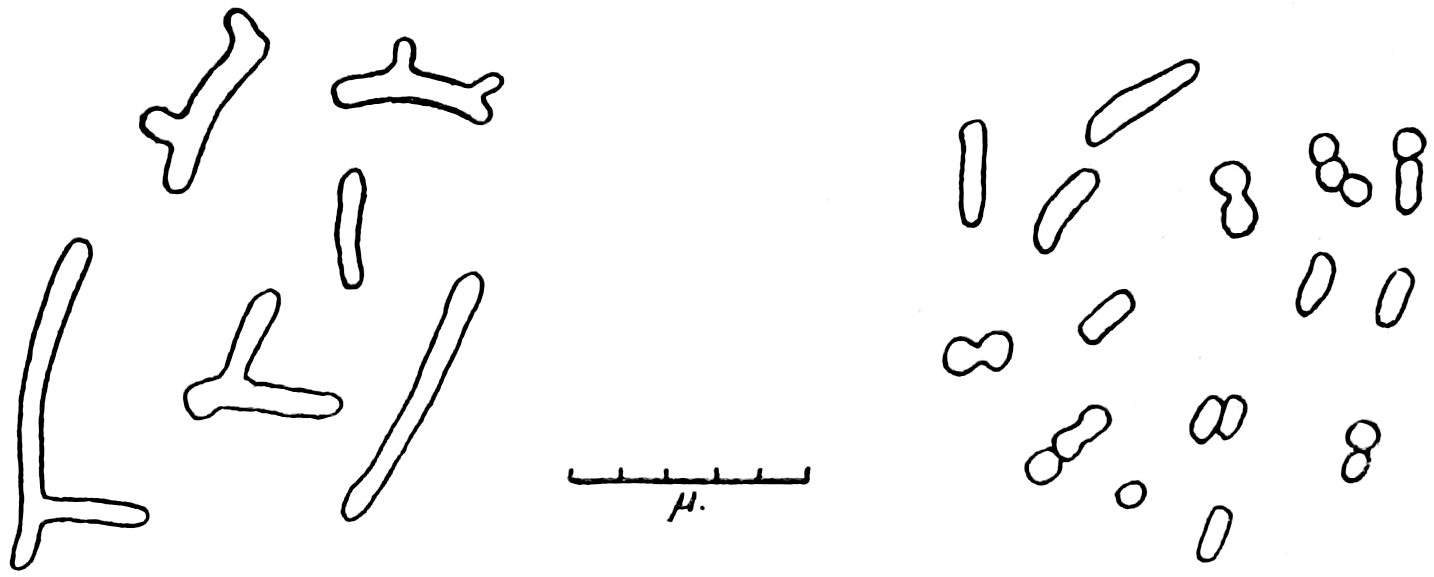
may be in the coccoid form (Fig. 1). It is claimed
by Löhnis[47b] that the possession of a complex life-cycle of
changing forms is a universal character in the bacteria. The
instability of shape in many bacteria makes it necessary
to standardise very carefully the cultural conditions under
which they are kept when their appearance is described.
Culture 15 hours old.
Culture 3 days old.
Fig. 1.—Change in appearance, in culture,
of a cresol decomposing bacterium.
The inadequacy of mere morphology as a basis for
describing bacteria led to the search for diagnostic characters,
based on the biochemical changes that they produced in
their culture media, and the appearance of their growth in
the mass on various media. These characters unfortunately
have also proved to be very much influenced by the exact
composition of the medium and other conditions of culture.
Recently an attempt has been made by the American Society
of Bacteriologists to standardise the diagnostic characters
used in describing bacteria, and also the media and cultural
conditions under which they are grown for the purpose of
description. The need for such precautions, however, was
not sufficiently realised by the early workers, many of whose
descriptions cannot now be referred to any definite organism.
The large number of organisms found in the soil, and the
difficulty and labour of adequately describing them, is such
that even now we have no comprehensive description of the
common soil bacteria that appear on gelatine platings. A
careful study based on modern methods of characterisation
has been made of certain selected groups of bacteria, and it
is hoped that the laborious systematic work of describing
the common forms will gradually be completed.
Several attempts have been made to classify the bacteria
that appear commonly on gelatine platings. This
work was commenced by Hiltner and Stormer in Germany,
and continued by Chester, Harding, and Conn in America.
Conn[10],[14]
found that the common organisms fell into the
following main groups:—
(1) Large spore-forming bacteria, related to Bacillus
subtilis, which form about 5-10 per cent. of the numbers.
He adduced evidence[12],[13]
that these organisms exist in the
soil mainly as spores, so that they may not form an important
part of the active soil population.
(2) Short non-sporing organisms, related to Pseudomonas
fluorescens, that are rapid gelatine liquefiers. These form
another 10 per cent. of the numbers.
(3) Short rod forms that liquefy gelatine slowly or not at
all, and develop colonies very slowly. These form 40-75 per
cent. of the numbers, and may therefore be of considerable
importance in the soil.
(4) A few micrococci also occur.
These groups comprise the larger portion of the bacterial
flora of the soil, but, in addition to these organisms, that
develop on the media commonly used for plating, there are
special and important groups that appear only on special
media, either owing to their being unable to grow on ordinary
media or because they get swamped by other forms. Examples
of such groups are the ammonia and nitrite oxidising
bacteria, the nitrogen fixing groups, the cellulose decomposing
organisms, and the sulphur bacteria.
In order that we may apply the results of the study
of a definite organism to other localities, a knowledge of
the geographical distribution of the soil bacteria is clearly
needed. We have, unfortunately, very little knowledge of
the distribution of soil organisms. The common spore-forming
groups appear to be universally distributed. Thus
Barthel, in a study of the bacterial flora of soils from Greenland
and the island of Disko, obtained soil organisms belonging
to the groups of Bacillus subtilis, B. amylobacter, B.
fluorescens, B. caudatus, and B. Zopfii, which are common
groups in European soil, indicating that the general constitution
of the bacterial flora of the soil in arctic regions is
not widely different from that of Western Europe. Bredemann,
who made an extensive study of the Bacillus amylobacter
group, obtained soil samples from widely scattered
localities, and found these organisms in soil from Germany,
Holstein, Norway, Italy, Morocco, Teneriffe, Russia, Japan,
China, the East Indies, Samoa, Illinois, Arizona, German
East Africa, and the Cameroons. Some soil organisms, on
the other hand, are apparently absent from certain districts.
This may be due to the conditions, such as climatic environment,
being unfavourable to them. A study has recently
been made at Rothamsted of the distribution over Great
Britain of a group of bacteria that are capable of decomposing
phenol and cresol. One of these organisms, apparently
related to the acid-fast B. phlœi, has an interesting
distribution. It has been found in 50 per cent. of the soils
samples examined from the drier region, where the annual
rainfall is less than 30 inches, but in only 20 per cent. of the
samples in the wetter parts of Britain. Another example of
limited distribution is found in the case of Bacillus radicicola,
the organism that produces tubercles on the roots of leguminous
plants. The distribution of the varieties of this
organism follows that of the host plants with which they are
associated, so that when a new leguminous crop is introduced
into a country, nodules may not appear on the roots unless
the soil be specially inoculated with the right variety of
organism. In cases where a group of soil organisms is
widely distributed over the globe, it may yet be absent
from many soils owing to the soil conditions not suiting it.
Thus, phenol decomposing bacteria, though abundant in the
neighbourhood of Rothamsted, are yet absent from field
plots that have been unmanured for a considerable period.
The occurrence of the nitrifying organisms and the nitrogen
fixing Azotobacter is also very dependent on the soil conditions.
Owing to the method by which our knowledge of soil
bacteria has been acquired, by studying first the chemical
changes in the soil and then the bacteria that produce them,
it is natural for us to divide them into physiological groups
according to the chemical changes that they bring about.
This grouping is the more reasonable since so little is known
as to the true relationships of the different groups of bacteria
that a classification based on morphology is well-nigh
impossible. In considering the activities of bacteria in the
soil, it is convenient to group the changes which they bring
about into the two divisions into which they naturally fall
in the economy of the organisms.
In the first place, there are the changes that result in a
release of energy, which the bacteria utilise for their vital
processes.
In the second place, there are the processes by which the
bacteria build up the material of their bodies. These building
up processes involve an intake of energy for their accomplishment.
It will be convenient to deal first with the release of
energy for their own use by bacteria, and its consequences.
B. Activities Connected with the Acquirement of Energy. — (1) Decomposition of Non-nitrogenous Compounds. — (2) Ammonia Production. — (3) Nitrate Production. — (4) Anaerobic Respiration.
Unlike the green plants, most bacteria are unable to
obtain the energy that is required for their metabolism from
sunlight. They must, therefore, make use of such chemical
changes as will involve the release of energy.
As an example of the acquirement of energy in this way
may be taken the oxidation of methane by B. methanicus.
This organism, described by Söhngen, obtains its energy
supply by the conversion of methane into CO2 and H2O.
CH4 + 2O2 = CO2 + 2H2O 220 Cal.
A further example is the acetic organism that obtains its
energy through the oxidation of alcohol to acetic acid.
C2H6O + O2 = C2H4O2 + H2O 115 Cal.
The decomposition processes brought about by micro-organisms
in obtaining energy are usually oxidations, but
this is not necessarily so, as can be seen in case of the fermentation
of sugar into alcohol.[E]
C6H12O6 = 2C2H6O + 2CO2 50 Cal.
[E] These examples are from Orla-Jensen (Centralblatt f. Bakt., II., Bd. 22,
p. 305).
By far the greater part of the decomposition of organic
matter is brought about by bacteria in the process of acquiring
energy. In the soil, nearly the whole of the material utilised
by bacteria as a source of energy is derived ultimately from
green plants. The energy materials left in the soil by the
plant fall into two groups, the non-nitrogenous compounds,
which are mainly carbohydrates and their derivatives, and
the nitrogenous compounds, principally derived from proteins.
The simpler carbohydrates and starches are attacked and
decomposed by a large variety of bacteria. The addition
of such substances to soil causes a rapid increase in bacterial
numbers. In nature the sugars are in all probability among
the first plant constituents to be destroyed during the decay
processes.
A large proportion of plant tissues consist of cellulose
and its derivatives. These compounds are consequently of
great importance in the soil. Unfortunately our knowledge
of the processes by which cellulose is broken down in the
soil is very inadequate. The early experimental study of
cellulose decomposition, such as that of Tappeiner[60] and
Hoppe-Seyler,[33] was mostly carried out under conditions of
inadequate aeration, and the products of decomposition were
found to include methane and CO2, and sometimes fatty
acids and hydrogen. The bacteriology of this anaerobic
decomposition was studied by Omelianski,[54] who described
two spore-bearing organisms, one of which attacked cellulose
with the production of hydrogen, and the other with the
production of methane. Both species also produce fatty
acids and CO2. It is probable that these organisms operate
in the soil under conditions of inadequate aeration. In
swamp soils, in which rice is grown, it has been shown that
methane, hydrogen, and CO2 are evolved in the lower layers.
In these soils, however, the methane and hydrogen are
oxidised when they reach the surface layers. This oxidation
is also effected by micro-organisms. Bacteria capable of
deriving energy by the oxidation of hydrogen gas have been
isolated and studied by Kaserer,[37] and by Nabokich and
Lebedeff,[52] while
Söhngen[57] has isolated an organism which
he named Bacillus methanicus, that was capable of oxidising
methane.
Under normal conditions in cultivated soils, however, the
decomposition of cellulose takes place in the presence of an
adequate air supply, and so follows a different course from
that studied by Omelianski. Our knowledge of this aerobic
decomposition is very scanty. A number of bacteria,
capable of decomposing cellulose aerobically, are known.
A remarkable organism was investigated by Hutchinson and
Clayton,[30] who named it Spirochæta cytophaga. This
organism, which they isolated from Rothamsted soil, though
placed among the Spirochætoidea, is of doubtful affinities.
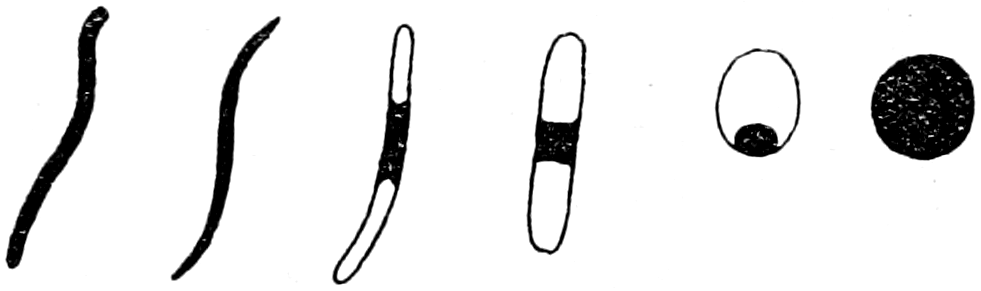
During the active condition it exists for the most part as
thin flexible rods tapered at the extremities. This form
passes into a spherical cyst-like stage, at first thought to be
a distinct organism (Fig. 2). Spirochæta cytophaga is very
aerobic, working actively, only at the surface of the culture
medium. It is very selective in its action. It appears
unable to derive energy from any carbohydrate other than
cellulose. Indeed, many of the simple carbohydrates, especially
the reducing sugars, are toxic to the organism in
pure culture. An extensive study of aerobic cellulose decomposition
by bacteria was made by McBeth and Scales,[50]
who isolated fifteen bacteria having this power. Five of
these were spore-forming organisms. Unlike Spirochæta cytophaga,
they are all able to develop on ordinary media such
as beef agar or gelatine, and are thus not nearly so selective
in their food requirements.
Fig. 2.—Spirochæta cytophaga. Changes occurring in culture. (After
Hutchinson and Clayton.)
We are at present ignorant as to which organisms are
most effective in decomposing cellulose in the soil under
field conditions, or what are the conditions best suited to
their activity. It is possible that fungi also help in the
decomposition of cellulose to a great extent. This subject
of the decomposition of cellulose offers one of the most
promising fields of research in soil bacteriology. The difficulty
of the subject is further increased by our present ignorance
of the chemical aspect of cellulose decomposition. It
has been supposed that the early decomposition products
are simpler sugars, but these are not found under conditions
in which cellulose is being decomposed by pure cultures of
the bacteria mentioned above. Hutchinson and Clayton
found that their organism produced volatile acids, mucilage,
and a carotin-like pigment. The organisms isolated by
McBeth and Scales also produce acids, and in some cases
yellow pigments. It is known, however, that the decomposition
products of cellulose can be utilised as energy supply
for other organisms, such as nitrogen fixing bacteria.
When plant remains decompose in the soil there are
ultimately produced brown colloidal bodies collectively
known as humus. The processes by which this humus is
produced are not yet properly understood. Humus is of
great importance in the soil, in rendering the soil suitable
for the growth of crops. It affects the physical properties
of the soil to a great extent. In the first place, it improves
the texture of the soil, making heavy clay soils more friable,
and loose sandy soils more coherent. Secondly, it has great
water-retaining powers, so that soils rich in organic matter
suffer comparatively little during periods of drought. And
lastly, it exerts a strong buffering effect against soil acids.
Now, it is one of the problems of present-day farming that
soil is becoming depleted of its humus. This is due to the
increasing scarcity of farmyard manure in many districts,
and the consequent use of mineral fertilisers to supply
nitrogen, potash, and phosphate to the crop. A need has
therefore arisen for a substitute for farmyard manure, by
means of which the humus content of soils may be kept up
in districts where natural manure is scarce.
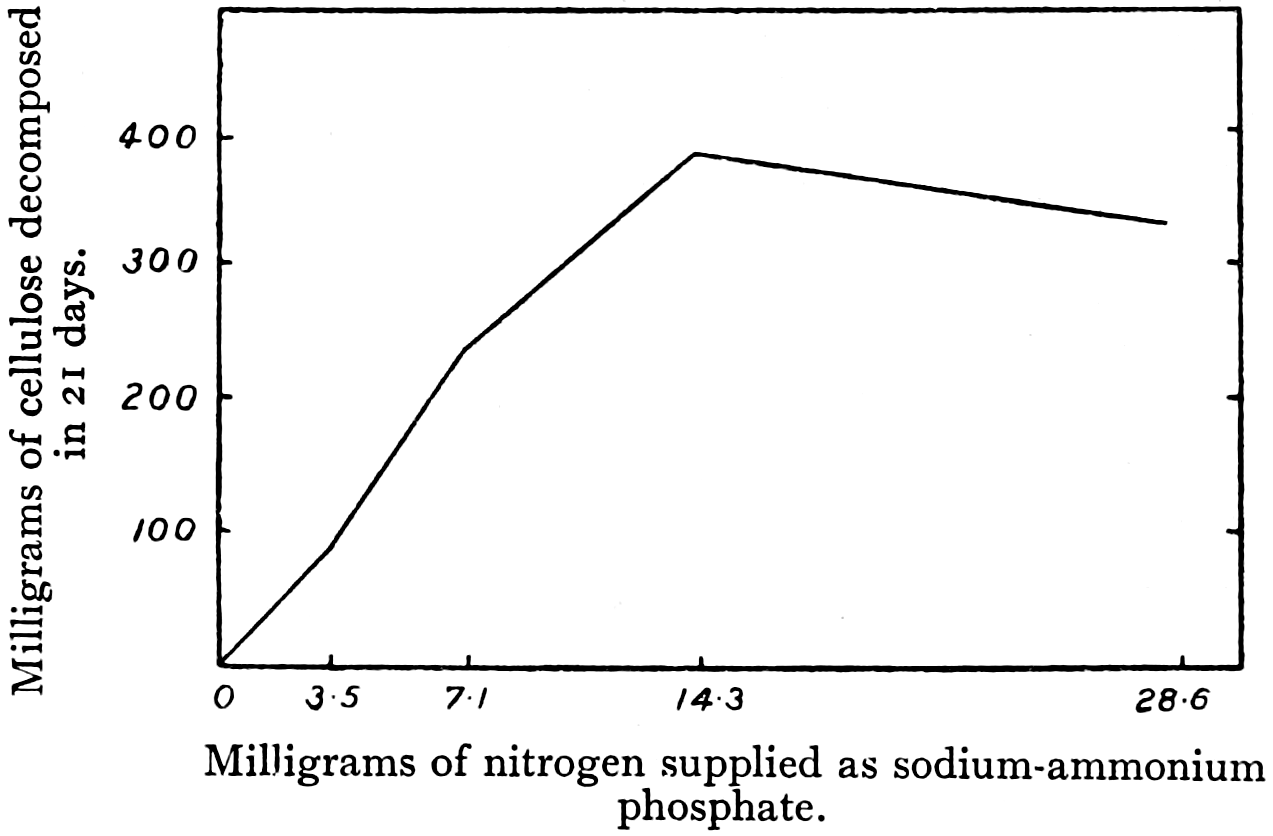
Fig. 3.—Cellulose decomposed by S. cytophaga in media with increasing
amounts of nitrogen. (After Hutchinson and Clayton.)
X-axis: Milligrams of nitrogen supplied as sodium-ammonium phosphate.
Y-axis: Milligrams of cellulose decomposed in 21 days.
It is well known that if fresh unrotted manure or straw
be added to the soil, it often produces harmful effects on the
succeeding crop. The problem, therefore, was to develop a
method by which fresh straw, before application to the soil,
could be made to rot down to a mixture of humus compounds
such as occur in well-rotted farmyard manure. The
solution of this problem came as a result of an investigation
by Hutchinson and Richards,[30b] at Rothamsted, into food
requirements of the cellulose decomposing bacteria. They
realised that since more than 10 per cent. of the dry weight
of bacteria consists of nitrogen, it would be necessary to supply
the cellulose decomposing bacteria with a supply of nitrogen,
in order that they should attain their greatest activity.
Experiments with cultures of Spirochæta cytophaga showed
that the amount of cellulose decomposed depended upon
an adequate supply of nitrogen for the organism (Fig. 3).
Similarly, materials such as straw will scarcely decompose
at all if wetted with pure water. An adequate supply of
nitrogen compounds is needed to enable decomposition to
take place. Hutchinson and Richards tested the effect of
ammonium sulphate, and discovered experimentally the proportion
of ammonia to straw that produced the most rapid
decomposition. They found that if a straw heap was treated
with the correct proportion of ammonia, it decomposed into
a brown substance having the appearance of well-rotted
manure. This has resulted in the development of a commercial
process for making synthetic farmyard manure from
straw. The method of manufacture is as follows: A straw
stack is made and thoroughly wetted with water. The
correct amount of ammonium sulphate is then sprinkled on
the top and wetted, so that the solution percolates through
the straw. The cellulose bacteria attack the straw, breaking
it down and assimilating the ammonia. This ammonia is not
wasted, as it is converted into bacterial protoplasm that
eventually decays in the soil. Field trials of this synthetic
manure show that it produces an effect closely similar to
that of natural farmyard manure.
While cellulose and related carbohydrates are by far the
most important non-nitrogenous compounds left in the soil
by plants, there are other compounds whose destruction by
bacteria is of special interest. Such, for example, is the case
of phenol. This compound is produced by bacterial action
as a decomposition product of certain amino-acids. It
occurs in appreciable amounts in cow urine. It is probable
that it forms a common decomposition product in soil
and also in farmyard manure. If this phenol were to
persist in the soil, it would eventually reach a concentration
harmful to plant growth. It does not, however,
accumulate in the soil; indeed, if pure phenol or cresol
be added to ordinary arable soil, a rapid disappearance
occurs. This disappearance is of some practical importance,
since it limits the commercial use of these compounds as
soil sterilising agents. The cause of the disappearance has
been to some extent elucidated at Rothamsted,[58] where it
was found to be in part a purely chemical reaction with
certain soil constituents, and partly due to the activity of
bacteria capable of decomposing it. A large number of soil
bacteria have now been isolated that can decompose phenol,
meta-, para-, and ortho-cresol, and are able to use these
substances as the sole sources of energy for their life
processes. These organisms have a wide distribution,
having been found in soil samples taken from all over Great
Britain, from Norway, the Tyrol, Gough Island, Tristan da
Cunha and South Georgia. Soil bacteria have also been isolated
that are able to decompose and derive their energy from
naphthalene and from toluene. The ability of the bacteria
to break up the naphthalene is very remarkable, and all the
more so since they can hardly have come across this compound
in the state of nature. The naphthalene organisms
have a distribution as world-wide as the phenol group.
The second main group of products left in the soil by
higher plants are the nitrogen-containing compounds, such as
the proteins and amino-acids. Plant remains are not the
only source of organic nitrogen compounds available to soil
bacteria. There are, in addition, the dead bodies of other
soil organisms, such as protozoa and algæ. The relative
importance of these sources of nitrogen is not known, but
almost certainly varies greatly with the state of activity of
the various groups of the soil population. Bacteria are able
to utilise organic nitrogen compounds as energy sources, as
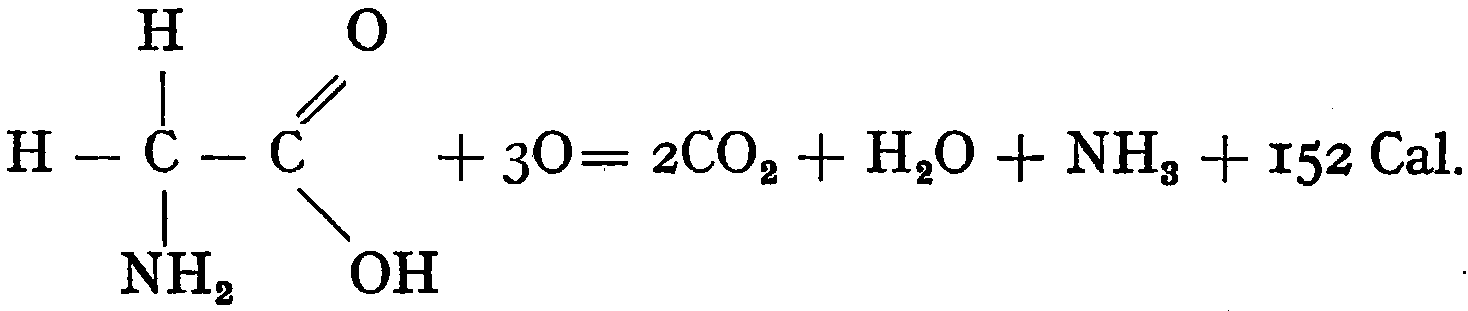
can be exemplified in the oxidation of a simple amino-acid:—
It will be seen that, in the acquirement of energy from
such a compound, ammonia is released as a by-product. It
is not certainly known what is the exact course of the
reactions brought about by bacteria in soil during the breaking-down
of organic nitrogen compounds, but they result in
the splitting off of most of the nitrogen as ammonia. Herein
lies the great importance of the process, for the production
of ammonia is an essential stage in the formation of nitrate
in the soil, and on the supply of nitrate the growth of
most crops largely depends.
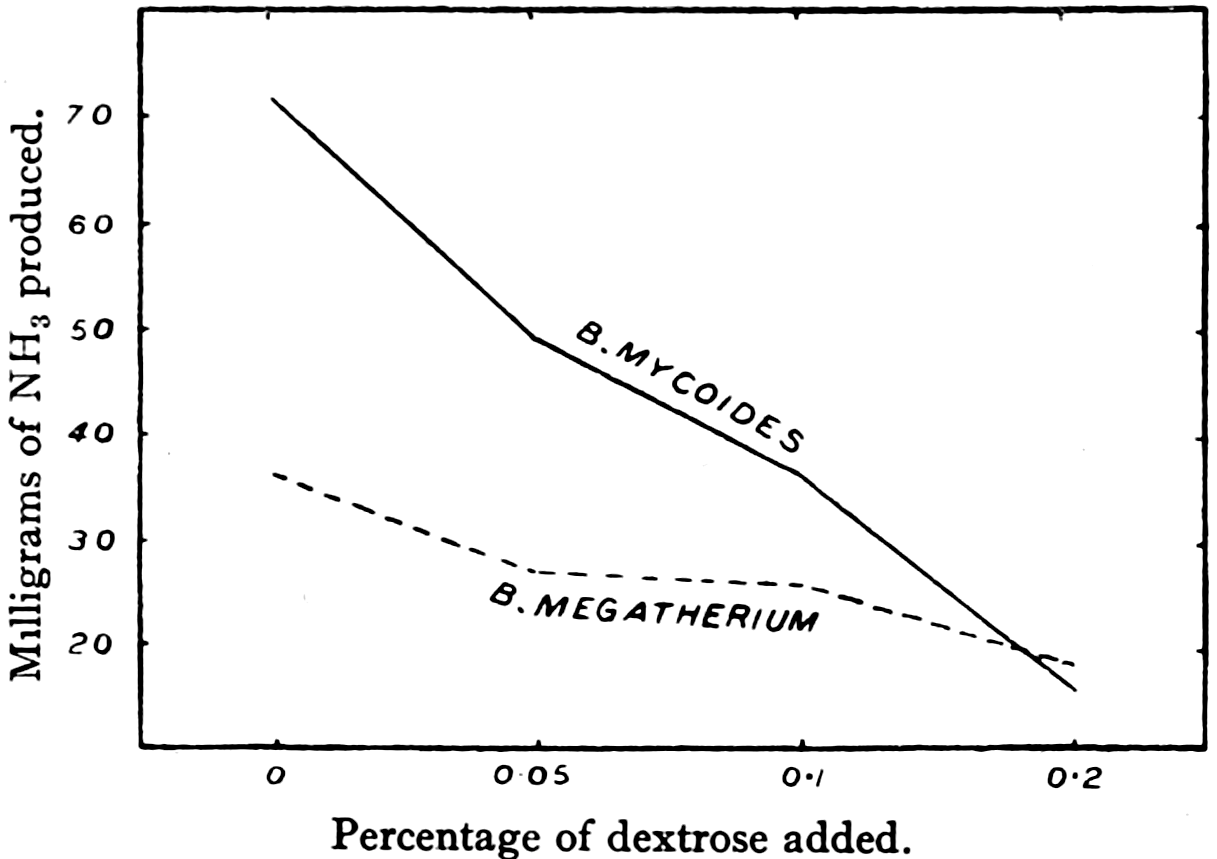
Fig. 4.—Quantities of ammonia produced by pure cultures from 5 grams of
casein in the presence of varying quantities of dextrose. (After Doryland.)
X-axis: Percentage of dextrose added.
Y-axis: Milligrams of NH3 produced.
It is very important to note that the production of this
ammonia is only a by-product in the economy of the bacteria,
the benefit that they derive from the reactions being due to
the release of energy involved in the decomposition. The
common ammonia-producing bacteria in the soil have been
found equally capable of deriving their energy by the oxidation
of sugars and similar non-nitrogenous compounds.
Fig. 4 shows an experiment by Doryland,[17] in which
cultures of common soil bacteria were grown in peptone
solution, to which increasing quantities of sugar were
added. One can see that, as the amount of sugar is increased,
the production of ammonia is lowered, since the
bacteria are obtaining energy from the sugar instead of
from the nitrogen compound, peptone. Consequently, if
soil contains a quantity of easily decomposible carbohydrate
material, bacteria will derive their energy from
this source, and the production of ammonia and nitrate will
be lowered. Thus the addition of sugar or unrotted straw
to the soil often lowers the nitrate production, and consequently
reduces the crop yield. If the soil is sufficiently
rich in carbohydrate material, the bacteria may multiply
until the supply of organic nitrogen is used up, and then will
actually assimilate some of the ammonia and nitrate already
existing. There is thus a balance of conditions in the soil
due to varying proportions of nitrogenous and non-nitrogenous
energy material. When nitrogen compounds are the
predominant energy source, the bacteria utilise them, and
ammonia is released. When a non-nitrogenous energy source
predominates, this is utilised and little or no ammonia is
released, and in extreme cases ammonia may be assimilated.
Although a large number of the common organisms in
the soil produce ammonia in culture media containing peptone,
the relative importance of these in the soil has yet to
be decided. It was supposed that the spore-forming organisms
related to Bacillus mycoides were of chief importance.
This supposition dates from the work of Marchal,[49] who
studied the production of ammonia by an organism of this
group in culture solution, and found it to be a very active
ammonifier. As already mentioned, however, there is some
doubt as to whether the large spore-forming organisms are
very active under soil conditions.[12],[13] The existence of
rapid fluctuations in nitrate content, found to exist in soil,
may in the future indicate which are the most active of the
common bacteria in the soil itself by enabling us to observe
which types increase during periods of rapid ammonia and
nitrate formation.
The ammonia produced in the soil under normal field
conditions is rapidly oxidised successively to nitrite and to
nitrate, a process known as nitrification. The process of
nitrification is more rapid than that of ammonia production,
with the consequence that no more than traces of ammonia
are able to accumulate. The rate at which nitrate is formed
in the soil is consequently set by the slower process of
ammonia production.
The work of Schloesing and of Warington showed that the
oxidation of ammonia was the work of living organisms. It
is, however, to Winogradsky’s isolation and study of the
causative organisms that we owe our present knowledge of
the biology of the process. By a new and ingenious technique,
he isolated from soil two remarkable groups of bacteria
that bring about nitrification. The first group oxidises
ammonium carbonate to nitrite, and was divided by
Winogradsky into the two genera, Nitrosomonas, a very
short rod-like organism bearing a single flagellum, and
Nitrosococcus, a non-motile form found in South America.
The second group oxidises nitrites to nitrates. They are
minute pear-shaped rods to which he gave the name Nitrobacter.
Winogradsky found that the first, or nitrite-producing
group, would live in a culture solution containing:—
2·25
grams
ammonium sulphate,
2·0
„
sodium chloride,
1·0
„
magnesium carbonate,
to the litre of well water.
Nitrobacter would grow in a similar medium containing
sodium nitrite instead of ammonium sulphate. There being
no organic carbon in these media, the organisms had no
source of carbon for their nutrition, except the CO2 of the
air, or possibly that of bicarbonate in solution. It therefore
followed that the organisms must obtain their carbon supply
from one of these sources. Unlike green plants, the nitrous
and nitric organisms are able to carry on this carbon assimilation
in the dark, and must therefore obtain the energy
needed for the process from some chemical reaction. The
only sources of energy in Winogradsky’s solutions were the
nitrogen compounds, and it consequently followed that the
organisms must derive their energy supply by the oxidation
of ammonia and nitrite respectively. The release of energy
obtained by these two reactions has been calculated by Orla-Jensen
to be as follows:—
(NH4)2CO3 + 3O2 = 2HNO2 + CO2 + 3H2O + 148 Cals.
KNO2 + O = KNO3 + 22 Cals.
The exact process by which ammonium carbonate is
converted into nitrite is not at present known. The two
groups of organisms are extremely selective in their source
of energy. The nitrous organisms can derive their energy
only by the oxidation of ammonia to nitrite, and the nitric
organisms only by the oxidation of nitrite to nitrate. In
culture media they are, indeed, inhibited by soluble organic
compounds such as sugars. Under natural conditions, however,
they appear to be less sensitive, since ammonium carbonate
is readily nitrified in substrata rich in organic matter.
The rapid nitrification that takes place during the purification
of sewage is an example of this. The conditions in
culture, with regard to aeration and the removal of metabolic
products from the neighbourhood of the organisms, are
very different from those in the soil, and perhaps account
for the discrepancies found.
The oxidation of ammonium carbonate by nitrosomonas
results in the formation of nitrous acid. The organisms are
very sensitive to acidity, and can only operate if the nitrous
acid produced is neutralised by an available base. In normal
soils calcium carbonate supplies this base, and in acid soils
the formation of nitrite is, as a rule, increased by the addition
of lime, or of calcium or magnesium carbonate. There is
evidence that in the absence of calcium carbonate, other
compounds can be used as a base. It was found by Hopkins
and Whiting[32] that in culture solution the nitrifying organisms
could use insoluble rock phosphate as a base, producing
therefrom the soluble acid phosphate. There is evidence,
however, that in ordinary soil containing calcium carbonate
very little solution of phosphate takes place in this way.
The further oxidation of nitrite to nitrate by Nitrobacter
does not produce acid, and requires no further neutralising
base.
The nitrate produced in this way is the main source of
nitrogen supply to plants under normal conditions. Experiments
have shown that a number of plants are capable of
utilising ammonia as a source of nitrogen, and Hesselmann[34]
has found forest soils in Sweden where no nitrification was
proceeding, and where, therefore, plants would presumably
obtain their nitrogen in this way, but such cases must be
regarded as exceptional.
Another group of bacteria capable of deriving their energy
from an inorganic source exists in the soil. This comprises
the sulphur bacteria, which are able to derive energy by the
oxidation of sulphur, sulphides, or thiosulphates to sulphuric
acid:—
S + 3O + H2O = H2SO4 + 141 Cals.
One organism studied by Waksman and Joffe[63] is able
to live in inorganic solution, deriving its carbon from carbon
dioxide. The sulphur bacteria have recently come into
prominence in America owing to their faculty for producing
acid. Thus Thiospirillum will increase the acidity of its
medium to a reaction of PH 1·0 before growth ceases. The
potato scab disease in America is now treated by composting
with sulphur. This treatment depends on the production of
sulphuric acid by the sulphur oxidising bacteria, which
renders the soil too acid for the parasite. There is some
evidence also that acid thus produced can be used to render
insoluble phosphatic manures more available in the soil.
Analogous to the sulphur organisms are certain bacteria
isolated from sheep dig tanks in South Africa by Green,[28b]
which can derive energy by the oxidation of sodium arsenite
to arsenate.
As is seen in the examples mentioned, energy is commonly
obtained by bacteria through an oxidation process
in which free oxygen is utilised. In water-logged soil, however,
or in soil overloaded with organic matter, anaerobic
bacteria may develop, which obtain their oxygen from oxidised
compounds. Thus there are soil organisms described
by Beijerinck[2] and others which can obtain oxygen by
reducing sulphates to sulphides.
A more important source of oxygen under these conditions
is nitrate, which can supply oxygen to a larger
number of bacteria. The stage to which the reduction can
be carried varies according to the organism. A very large
number of bacteria are capable of reducing nitrates to
nitrites. Many can reduce nitrate to ammonia, and some
can produce an evolution of nitrogen gas from nitrate. The
effects of nitrate reduction, therefore, appear under water-logged
conditions in soils. For example, in swamp soils in
which rice is grown, it has been found by Nagaoka,[53] in
Japan, that treatment with nitrate of soda depresses the
yield, probably owing to the formation of poisonous nitrites
by reduction.
Under normal conditions of well aerated soil, however, it
is unlikely that the reduction of nitrate is of great importance.
In such soils the activities through which bacteria acquire
their energy are, as we have seen, of vital importance to the
plant, resulting in the disintegration of plant tissues, with
the ultimate formation of humus, and in the production of
nitrate.
In their activities connected with the building up of their
protoplasm, bacteria may, on the other hand, compete with
the plant. These activities and their consequences will be
reviewed in the following chapter.
CHAPTER III. SOIL BACTERIA. — C. Activities Connected with the Building-up of Bacterial Protoplasm. — (1) Composition of Bacteria. — (2) Sources of Carbon. — (3) Assimilation of Nitrogen Compounds. — (4) Fixation of Free Nitrogen. — D. The Relation of Bacterial Activities to Soil Fertility. — E. Changes in Bacterial Numbers and Activities, and their Relation to External Factors. — REFERENCES TO CHAPTERS II. AND III.
The activities of the soil bacteria that we have yet to
consider are those connected with the building-up from
simpler materials of the protoplasm of the bacterial cell.
It is important to bear in mind that this process is one
requiring an expenditure of energy on the part of the
organism. The sources of energy we have already considered.
The bodies of bacteria contain the same elements common
to other living matter. Analyses of various bacteria have
been made by a number of workers. About 85 per cent. of
their weight is made up of water. This analysis of Pfeiffer’s
Bacillus by Cramer[15] shows the typical percentages of
carbon, nitrogen, hydrogen, and ash in the dry matter:—
Composition of Pfeiffer’s Bacillus (Cramer).
C
50
per cent.
N
12·3
„
H
6·6
„
Ash
9·1
„
About 65-70 per cent. of the dry matter of bacteria consists
of protein.
The biggest constituent of the dry matter of bacteria is
therefore carbon. In the soil, bacteria find an abundance of
organic matter from which they may derive their carbon
supply. A special case, however, is furnished by the nitrifying
organisms, certain sulphur oxidising bacteria, and others
that derive their carbon from the CO2 of the soil atmosphere.
The sources from which these special groups obtain the
necessary energy to accomplish this, we have already
considered.
Of chief importance in its consequences are the means
adopted by bacteria to obtain their nitrogen supply.
There is some reason to believe that soil bacteria do not
take up protein and peptones as such, but must first break
down these bodies into simpler compounds. When a sufficient
amount of easily decomposable organic nitrogen is
present in the soil, the ammonifying bacteria use such
compounds as sources of energy, and in this case have a
nitrogen supply exceeding their requirements.
But where there is an excess of carbohydrate or other
non-nitrogenous source of energy available in the soil, the
case is different. Here the organisms have a supply of
energy which enables them to multiply rapidly until the
organic nitrogen is insufficient for their needs. Hence they
turn to the ammonia and nitrate present in the soil, and
build up their proteins from this source. Doryland[17] has
shown that many common soil ammonifiers assimilate
ammonia and nitrate when supplied with carbohydrate.
There may thus be a temporary loss of nitrate from soil
when sugar, starch, straw, or such materials are added to it.
The bacteria that we have so far considered take up their
nitrogen directly from compounds containing this element.
There remain, however, a comparatively small but very
important group of bacteria possessing the power of causing
elemental nitrogen to combine, and of building it up into
their proteins. This fixation of nitrogen by micro-organisms
is a vital step in the economy of nature. Losses of nitrogen
from the land are continually occurring through the washing-out
of nitrates by rain, and through the evolution of gaseous
nitrogen during the processes of decay. To maintain the
supply of combined nitrogen which is essential to living
organisms, there must therefore be a compensating process
by which the supply of nitrogen compounds in the soil is
kept up.
It was discovered in the middle of the nineteenth century
that if soil were kept moist and exposed to the air, there was
an increase in the amount of nitrogen compounds present.
Berthelot, in 1893, studied the nitrogen relationships of soil,
and recognised that this fixation of nitrogen in soil was the
work of micro-organisms.
Winogradsky followed up his work and isolated from soil
a large anaerobic spore-forming organism, capable of fixing
nitrogen, to which he gave the name Clostridium pasteurianum.
In 1901 the investigations of Beyerinck, in Holland, led to
the important discovery of a group of large aerobic organisms,
which he named Azotobacter. These were found to be very
active in fixing free nitrogen. More recently, a number of
other nitrogen-fixing bacteria have been described, and the
property has been found to exist to a small extent in several
previously well-known organisms.
It becomes important to determine which are the groups
of bacteria whose nitrogen-fixing powers are of chief importance
in the soil.
On account of its energetic fixation of nitrogen in culture
media, Azotobacter has attracted the greatest attention of
workers. The evidence seems to be consistent with the view
that Azotobacter is of importance in the soil. Thus the
distribution of Azotobacter would appear to be world-wide.
It is found all over Western Europe and the United States.
Lipman and Burgess[45] found it in soils collected from Italy
and Spain, Smyrna, Cairo, the Fayum, the Deccan in India,
Tahiti, Hawaii, Mexico, Guatemala, and Canada. C. M.
Hutchinson[29] found it to be distributed throughout India.
It was found by Omelianski[55] to be widely distributed in
European and Asiatic Russia, and by Groenewege[28] in Java.
Ashby[1] at Rothamsted, isolated it from soils from the
Transvaal, East Africa, and Egypt. Also, an association
has sometimes been found between the ability of a soil to
fix nitrogen and the occurrence and vigour of its Azotobacter
flora. Thus Lipman and Waynick[46] found that if soil from
Kansas were removed to California, its power to produce
a growth of Azotobacter, when inoculated into a suitable
medium, was lost, and, at the same time, its nitrogen-fixing
power was greatly reduced. Moreover, it is known that
conditions favourable to the fixation of nitrogen by Azotobacter
in cultures on the whole favour nitrogen fixation in
soils. The conditions that favour other aerobic nitrogen-fixing
bacteria are, however, not sufficiently distinct to make such
evidence of great value.
It is usually found that nitrogen fixation is most active
in well-aerated soil. Thus Ashby,[1] at Rothamsted, found
the nitrogen-fixing power of a soil to decrease rapidly with
depth. Similar results were obtained in Utah by Greaves.
This suggests, at first sight, that anaerobic nitrogen fixers
are unimportant under normal soil conditions. It is, however,
quite possible that they may assume an importance
when acting in conjunction with aerobic organisms. Thus
Omelianski and Salunskov[55] found that beneficial association,
or symbiosis, could occur between Azotobacter and
Clostridium pasteurianum, the former absorbing oxygen from
the surroundings, and thus creating a suitable anaerobic
environment for the Clostridium.
The question of symbiosis of nitrogen-fixing bacteria with
each other and with other organisms offers an inviting field
for research. There is evidence that this factor may have
considerable importance. Beijerinck and Van Delden[3] early
recognised that Azotobacter in mixed cultures fixed more
nitrogen than in pure cultures. Granulobacter, an organism
which they found to be commonly associated with Azotobacter
in crude cultures, appears to increase its nitrogen-fixing
powers (Krzeminiewski).[41] It
was also found by Hanzawa[31]
that a greater fixation of nitrogen was obtained when two
strains of Azotobacter were grown together. A symbiosis
between Azotobacter and green algæ has been described, and
will be further discussed by Dr. Bristol. It is likely that this
association may be of importance under suitable conditions
on the soil surface where the algæ are exposed to light.
The combination of elemental nitrogen is an endothermic
process which requires a very considerable amount of energy
for its accomplishment. This fact is well illustrated by the
various commercial processes in use for fixation of atmospheric
nitrogen. The nitrogen-fixing bacteria obtain this
energy from the carbon compounds in the soil. A number
of compounds were compared as sources of energy by Löhnis
and Pillai,[47] who tested their effect on the amounts of nitrogen
fixed by Azotobacter in culture. It was found that mannitol
and the simpler sugars give the best results as sources of
energy, but that other organic compounds can also be used.
Mockeridge[51] has adduced evidence that ethylene glycol,
methyl-, ethyl-, and propyl-alcohol, lactic, malic, succinic,
and glycocollic acids could also be utilised. Since so large
a part of the organic matter added to soil is in the form of
celluloses, it is of great importance to ascertain how far these
compounds and their decomposition products can be utilised
in nitrogen fixation. Stubble, corn-stalks and roots, oak
leaves, lupine and lucerne tops, maple leaves, and pine
needles may all serve as useful sources of energy to nitrogen-fixing
organisms in the soil. Pure cellulose cannot apparently
be used as a source of energy, but when acted upon
by cellulose decomposing organisms, it becomes available as
a source of energy. Hutchinson and Clayton, at Rothamsted,
found that a fixation of nitrogen could be brought about by
mixed cultures of Azotobacter, and of the cellulose attacking
Spirochæta cytophaga, when grown in cultures containing
pure cellulose. It is not known how far cellulose decomposition
must proceed to produce an effective source of energy,
nor what are the substances thus produced that are utilised.
This point will not be decided until something more is known
of the course of changes in the breaking-down of cellulose in
the soil.
The amount of nitrogen fixed per unit of energy material
decomposed varies greatly, according to the organism and
the conditions. Winogradsky found that his Clostridium
assimilated 2-3 mgs. of nitrogen per gram of sugar consumed.
Lipman found that Azotobacter fixed 15-20 mgs. of nitrogen
per gram of mannite consumed.
Fig. 5.
Caption: Azotobacter. Decrease in efficiency in N fixation with age of culture. (Koch & Seydel.)
X-axis: Days.
Y-axis: Milligrams of Nitrogen fixed per gram of dextrose consumed.
It is found, however, that in liquid culture, the ratio of
nitrogen fixed to carbohydrates oxidised varies according to
the age of the culture, falling off rapidly as the age increases[42]
(Fig. 5). This decreasing efficiency in cultures may be due
to the accumulation of metabolic products such as would
not occur under soil conditions. Indeed, the efficiency of
Azotobacter in a sand culture has been found by Krainskii[39]
to be considerably greater than in solution. It is thus probable
that in soil the nitrogen-fixing organisms are less
wasteful of energy material than under the usual laboratory
conditions. It is to be hoped that future research will indicate
what are the conditions that produce the greatest
economy of energy material in nitrogen fixation.
The fixation of nitrogen in soil is depressed by the presence
of considerable amounts of nitrates. This is, in all probability,
due to the fact that nitrogen-fixing organisms are able
to utilise compounds of nitrogen where these are available.
The energy needed to build up amino-acids and proteins
from nitrate or ammonia is, of course, far less than that
required to build up these substances from elemental nitrogen.
It is, therefore, not surprising that where nitrate is
available, Azotobacter will use it in preference to fixing
atmospheric nitrogen.[5]
TABLE III.—ASSIMILATION OF NITRATES. By Azotobacter in Pure Culture—(Bonazzi).
Nitrate and Nitrite Present.
Organic Nitrogen and Ammonia Present.
Total Fixed or Lost.
mgs.
mgs.
mgs.
Culture with nitrate—
At beginning
8·55
0·76
—
After growth
0·2
8·71
- 0·4
Culture without nitrate—
At beginning
—
0·76
—
After growth
—
4·50
+ 3.74
(Growth period—24 days at 25° C.)
The chemical process by which nitrogen is fixed is quite
unknown, although a number of speculative suggestions
have been made. The appearance of considerable amounts
of amino acids in young cultures of Azotobacter suggests that
these may be a step in the process, but at present the data
are too inconclusive to form a basis for theorising.
Azotobacter is very rich in phosphorus, an analysis of the
surface growth in Azotobacter cultures, made by Stoklasa,
giving about 60 per cent. of phosphoric acid in the ash. In
cultures it has been found that a considerable amount of
phosphate is needed to produce full development. As would
be expected, therefore, nitrogen fixation in soil is often
greatly stimulated by the addition of phosphates. Christensen
has, indeed, found soils where lack of phosphate was the
limiting factor for Azotobacter growth.
Azotobacter is very intolerant of an acid medium, and is
very dependent on the presence of an available base. In
cultures this is usually provided in the form of calcium or
magnesium carbonate. Gainey[21] found that Azotobacter
occurred in soils having an acidity not greater than PH 6·0,
and Christensen,[7],[9]
in Denmark, has found a close association
between the occurrence of Azotobacter in soils and the presence
of an adequate supply of calcium carbonate. So close was
this association that he devised a technique based on this
fact for detecting a deficiency of lime in a soil sample.
In addition to the groups already discussed, there is a
remarkable and important group of nitrogen-fixing bacteria
that inhabit and can carry on their functions within the root
tissues of higher plants. It has been known at least from
classical times that certain leguminous plants would, under
suitable conditions, render the soil more productive. On
the roots of leguminosæ small tubercles are commonly found.
These were noted and figured by Malpighi in the seventeenth
century, and for a long time were regarded as root-galls. As
was described in Chapter I., the true nature of these tubercles
was finally elucidated by Hellriegel and Wilfarth in 1886.
As the result of a series of pot experiments, they made the
very brilliant deduction that the ability to fix nitrogen,
possessed by the legumes, was due to bacteria associated
with them in the tubercles.
These bacteria were finally isolated and studied in pure
culture by Beijerinck. Since then a very great deal of
literature has accumulated on the subject of the nodule-producing
bacteria, which it is impossible to deal with in a
small space. The nodule organism, Bacillus radicicola, when
grown on suitable media, passes through a number of different
changes in morphology. The most connected account of
these changes is given in a paper by Bewley and Hutchinson.[4]
In a vigorous culture the commonest type is a rod-shaped
bacillus which may or may not be motile. As these get
older they often become branched, or irregular in shape, the
formation of these branched forms being perhaps due to
conditions in the medium. These irregular forms, known
as “bacteroids,” are a characteristic type in the nodules.
Their production in culture media has been found to be
stimulated by sugars and organic acids such as would occur
in their environment within the host plant. In the older
rods and bacteroids the staining material becomes condensed
into granules, and finally the rods disintegrate or break up
into coccoid forms. By suitable culture conditions, Bewley
and Hutchinson obtained cultures consisting almost entirely
of this stage. If such a culture be inoculated into a fresh
medium rich in sugar, the swarmer stage appears in great
numbers. These swarmers are very minute coccoid rods,
·9 × ·18 in size, that are actively motile. They apparently
develop later into the rod stage.
Fig. 6.—Bacillus radicicola.
Stages in the life cycle. (After Hutchinson and
Bewley.)
Motile Rods
Vacuolated Stage
“Swarmers”
“Bacteroids”
“Pre-swarmers”
Very little is known as to the life of the organism in the
soil. It is able, however, to fix nitrogen in cultures, and it
has been claimed[35],[48]
that it can do so in the soil outside
the plant, so that it is possible that we must take it into
consideration in this connection. More knowledge is needed
as to the optimum conditions for the growth of the organism
in the soil. It seems to be more tolerant of acid soil conditions
than Azotobacter. The limiting degree of acidity has
been found to vary among different varieties of the organism
from PH 3·15 to PH 4·9.
A long controversy has been held as to whether the nodule
organisms found in different host-plants all belong to one
species, or whether there are a number of separate species,
each capable of infecting a small group of host-plants. As
the term “species” has at present no exact meaning when
applied to bacteria, the discussion in this form is unlikely
to reach a conclusion. The evidence seems to show that
the nodule organisms form a group that is in a state of
divergent specialisation to life in different host-plants, and
that this specialisation has reached different degrees with
different hosts. Thus the organisms from the nodule of the
pea (Pisum sativum) will also produce nodules on vicia,
Lathyrus, and Lens, but seem to have lost the ability normally
to infect other legumes. On the other hand, the bacteria
from the nodules of the Soy Bean (Glycine hispida) have
become so specialised that they do not infect any other
genus of host-plant, and soy beans are resistant to infection
by other varieties of the nodule organism. Burrill and
Hansen,[6] after an extensive study, divided the nodule
bacteria into eleven groups, within each of which the host-plants
are interchangeable. The existence of different
groups of nodule organisms has been confirmed by the
separate evidence of serological tests (Zipfel, Klimmer, and
Kruger).[40] The results of cross-inoculation tests have sometimes
been conflicting. It seems, indeed, that the host-plant
has a variable power of resisting infection, so that when its
resistance is lowered it may be capable of infection by a
strange variety of the nodule organism. The question that
has thus arisen of the ability of the legume to resist infection
is of fundamental importance, and its elucidation should
throw light on the relation of plants to bacterial infection
as a whole.
The stage of the organism that infects the plant is not at
present known. It may be supposed that it is the motile
“swarmer.” The entry is normally effected through the
root-hairs. The hair is attacked close to the tip, and an
enzyme is apparently produced which causes the tip to bend
over in a characteristic manner. The organisms multiply
within the root hair and pass down it, producing a characteristic
gelatinous thread filled with bacteria, in the rod form.
This “infection thread” passes down into the cells of the
root tissue, where it branches profusely. In young stages of
nodule formation the branches can be seen penetrating cells
in the pericycle layer. Rapid cell division of these root
cells is induced. In the course of this cell division abnormal
mitotic figures are sometimes found, such as occur in pathological
growths. The cells push outward the root cortical
layer, and so form a nodule.
Certain of the cells in the centre of the nodule become
greatly enlarged, and in the fully grown nodule are seen to
be filled with bacteria. Differences have been described in
the morphology of the organisms in different parts of the
nodule.[62] Whether the different stages of the organism are
equally capable of fixing nitrogen, or what is the significance
of these stages within the nodule, is not certainly known.
It has been held that it is the irregular bacteroid forms
that are chiefly concerned with nitrogen fixation. In older
nodules the organisms become irregular and stain faintly,
and the bacteroidal tissue breaks down, the nodule finally
decaying. In the fixation of nitrogen that occurs in the
nodules, the bacteria without doubt derive the necessary
energy from the carbohydrates of the host-plant. There is
evidence that the plant assists the process of fixation by
removing soluble metabolic products from the neighbourhood
of the bacteria. Golding[22] was able to obtain a
greatly increased fixation of nitrogen in artificial cultures
by arranging a filtering device so as to remove the products
of metabolism.
The great practical importance of leguminous crops in
agriculture has led to numerous attempts being made to
increase their growth, and the fixation of nitrogen in them,
by inoculating the seed or the soil with suitable nodule-bacteria.
This inoculation can be effected either with soil in
which the host-plant has been successfully grown, and which
should consequently contain the organism in fair numbers,
or else pure cultures of the organisms isolated from nodules
may be used. Very varying results have been obtained with
inoculation trials.
In farm practice a leguminous crop has often been introduced
into a new area where it has never previously grown.
In such soil it is very probable that varieties of the nodule
organism capable of infecting the roots may not exist. In
such cases inoculation with the right organism or with
infected soil often produces good results.
The more difficult case, however, is that in which the
legume crop has been grown for a long time in the locality,
and where the soil is already infected with right organisms.
This, the more fundamental problem, applies especially to
this country. Here it would seem that inoculation with a
culture of the organism will benefit the plant only (1) if the
naturally occurring organisms are present in very small
numbers; or (2) if the organisms in the culture added are
more virulent than those already in the soil. The problem
of successful inoculation would therefore seem to be bound
up with that of grading up the infective virulence of the
organism to a higher level.
Successful nodule development in a legume crop is also
dependent to a large degree on the soil conditions. The
effects of soil conditions on nodule development have been
studied by numerous workers. Moisture has been found
very greatly to affect the nodule development. Certain salts
have a very definite effect on nodule formation.[64] Their
effect on the number of nodules developing has been studied,
but the reason for this effect is unusually difficult to decide.
The action is usually a complex one. Thus phosphates are
known to stimulate nodule formation. They probably act
in several ways. In the first place, they may cause the
nodule organisms to multiply in the soil; in the second
place, they produce a greater root development in the plant,
thus increasing the chances of infection; and in the third
place, Bewley and Hutchinson[4] have found that phosphates
cause the appearance of the motile stage of the organism in
cultures. A real understanding of the influence of environment
on nodule production will produce great improvements
in our methods of legume cropping.
The various activities of the soil bacteria have a vital
importance to the growth of higher plants, which are dependent
for their existence on certain of these processes. In
the first place, as we have seen, bacteria decompose the
tissues of higher plants and produce humus materials, which
are essential to the maintenance of good physical properties
in the soil. Then the nitrate supply on which most higher
plants depend is produced by the decomposition of organic
nitrogen compounds by bacteria in their search for energy.
The depletion of the total nitrogen content of the soil through
rain and through the removal of nitrogen in the crops, is to
some extent compensated by the fixation of atmospheric
nitrogen by certain bacteria. On the other hand, in the
assimilation of nitrogen compounds to build up protein, the
bacteria are competing with higher plants for one of their
essential food constituents, and their action may, under
certain conditions, cause a temporary nitrogen starvation.
One must remember, however, that large quantities of
nitrate are lost from field soils by washing-out through rain
action, especially in winter. The assimilation of nitrate and
ammonia by micro-organisms keeps some of this nitrogen in
the soil, and at certain periods may thus be beneficial.
There is another important respect in which soil bacteria
influence plant growth. Their activities result in the release
of inorganic salts, such as potash and phosphates, in a form
available for the use of plants. The release of phosphorus
and potassium compounds takes place in two ways. In the
first place, organic matter containing phosphorus and potassium,
in an insoluble form, is attacked by bacteria, resulting
in these elements being set free as inorganic salts available
to the higher plant. Secondly, much of the phosphorus
supplied to the soil from rock minerals is present as insoluble
phosphates, such as apatite and iron phosphate. Much of
the potassium, too, is derived from insoluble silicate minerals.
In both cases the conversion of the insoluble minerals into
soluble phosphates and potassium compounds is brought
about to a large extent by solution in water containing carbonic
and other acids. These acids are largely produced by
micro-organisms, which, in addition to carbonic acid, produce
organic acids, and in specialised cases, sulphuric and nitrous
acids. It has been found, for example, that in a compost of
soil with sulphur and insoluble phosphate, sufficient sulphuric
acid may be produced by the oxidation of the sulphur by
bacteria to convert an appreciable amount of phosphate into
a soluble form. When we consider the functions performed
by soil bacteria, therefore, it is not surprising to find that
high bacterial activity in the soil is associated, as a rule, with
fertility.
The object of soil bacteriologists is to discover means
of favouring the activity of soil bacteria, especially those
activities that are useful to the higher plant. Knowledge is
therefore needed of the changes in numbers and activities of
the soil bacteria, and of the influence of soil conditions on
them. The necessity of studying these changes has required
the development of a quantitative technique by which the
numbers of bacteria in the soil and their activities can be
estimated.
The method commonly used in counting bacteria in soil
is a modification of the plating method of Koch. In counting
bacteria two difficulties have to be overcome—their immense
numbers and their small size. The numbers of bacteria in
soil are so large that the bacterial population of a gram of
soil could not, of course, be counted directly. The method
adopted, therefore, is to make a suspension of soil in sterile
salt solution, and to dilute this suspension to a convenient
and known extent, which will depend on the numbers of
bacteria expected. In ordinary field soils it is found convenient,
for example, to dilute the soil suspension so that
one cubic centimeter of the diluted suspension will contain
1⁄250,000th of a gram of soil. Such a volume will commonly
contain a number of bacteria sufficiently small to count. The
second difficulty is that the organisms are microscopic, and
yet cannot be readily counted under the microscope owing
to the presence of soil particles in the suspension. Hence
recourse is had to plating. One cubic centimeter of diluted
suspension is placed in a petri dish and mixed with
a suitable nutrient agar medium, melted, and cooled to
about 40° C. The medium sets, and after a few days’ incubation
the organisms multiply and produce colonies visible to
the naked eye. By counting these colonies we obtain an
estimate of the number of bacteria in the one cubic centimeter
of suspension, it being assumed that every organism has
developed into one colony, and by multiplying this number
by the degree of dilution we obtain the numbers per gram
of soil. In practice a number of parallel platings are made
from one cubic centimeter portions of the diluted suspension
and the mean number of colonies per plate is taken.
By this means the error due to the random distribution of
bacteria in the suspension is reduced, because of the greater
number of organisms counted.
In drawing conclusions from bacterial count data, it is
necessary to distinguish between the indication which the
method gives of the absolute numbers of bacteria in the soil
and the accuracy with which it enables the numbers of
two soil samples to be compared. The method cannot be
used for the former purpose at present. We do not know
how far the figures obtained by this counting method fall
short of the actual number of bacteria in the soil. One
reason for this is the difficulty of effecting a complete separation
of the clumps of bacteria into discrete individuals in
the suspension. Then again, there is no known medium
upon which all the physiological groups of bacteria will
develop and produce colonies. And even on a suitable
medium some of the individuals may fail to multiply.
In comparing the bacterial numbers in two soil samples,
however, the case is different. Within each bacterial
group investigated the plate method should give counts
proportional to the bacterial numbers in the soil. Thus,
by the method one should be able to tell whether the
bacterial numbers are increasing or decreasing over a period
of time, or whether a certain soil treatment produces an
increase or a decrease. With this end in view the technique
of the method has been improved by recent workers. It
was found that, when carefully standardised, the process of
dilution of the soil could be carried out without significant
variation in result (Table IV.), and that the accuracy of the
method is limited mainly by the variation in colony numbers
on parallel platings, due in part to random distribution of
bacteria throughout the final suspension, and partly to the
uneven development of colonies on the medium. The question
of the medium was therefore taken up with a view to
improving the uniformity of results obtained with it. Lipman,
Conn, and others effected an improvement by using
chemical compounds as nutrient ingredients, thus making
their media more closely reproducible. On most agar media,
an important disturbing factor is the growth of spreading
colonies, which prevent the development of some of the other
colonies. A medium has been devised at Rothamsted on
which these spreading organisms are largely restricted.[61]
A statistical examination[19] has shown that on this medium
errors due to the uneven development of colonies, except in
special cases, are prevented, so that in fact the variation in
colony numbers between parallel plates is found to be that
produced merely by random distribution of bacteria in the
diluted suspension (see Table IV.). In this case the accuracy
of the counts of the bacteria in the diluted suspension depend
directly on the number of colonies counted, and can be
known with precision.
TABLE IV.—BACTERIAL COUNTS OF A SOIL SAMPLE. Parallel Plate Counts from Four Sets of Dilutions made by
Different Workers.
Counts of Colonies on each Plate.
Plate.
Set I.
Set II.
Set III.
Set IV.
1
72
74
78
69
2
69
72
74
67
3
63
70
70
66
4
59
69
58
64
5
59
66
58
62
6
53
58
56
58
7
51
52
56
54
Mean
60·86
65·86
64·28
62·86
Standard deviation between the four sets = 5·62.
Standard deviation between plates within the sets = 7·76.
The knowledge obtained from counts of soil bacteria is
subject to another serious limitation. We do not know
which of the bacteria counted are the most effective in
bringing about the various changes that take place in the
soil. It is not even known which of them are active in the
soil and which are in a resting condition. It is thus possible
to have two soils containing equal numbers of bacteria but
showing widely different biochemical activity, if one soil
contains organisms of a higher efficiency. Moreover, as has
been pointed out, many important groups of soil bacteria
do not develop on the plating media, and so are not counted.
These considerations led to the development of supplementary
methods by which it was hoped to estimate the actual biochemical
activity of the soil microflora. The first of these
methods was developed by Remy, who attempted to study
the biochemical activity of a soil by placing weighed amounts
into sterile solutions of suitable and known composition,
keeping them under standard conditions for a definite time
and then estimating the amount of the chemical change that
was being studied. Thus, to test the activity of the organisms
that produce ammonia from organic nitrogen compounds, he
inoculated soil into 1 per cent. peptone solution and measured
the amount of ammonia produced in a given time. By
similar methods the power of a soil to oxidise ammonia to
nitrate, to reduce nitrate, or to fix atmospheric nitrogen, is
tested. This method has been extensively used and developed
by more recent workers. It suffers, however, from the
same serious disadvantage that it was designed to avoid, for
we cannot be certain that those bacteria that develop in the
nutrient solution are the types that are active in the soil, and,
moreover, even where the same types do function in the two
conditions, we do not know that the degree of their activity
is the same in soil and in solution cultures. For instance,
Nitrosomonas appears to show very different degrees of
activity in soil and in culture.
Another method, therefore, of studying the activity of
soil micro-organisms is the obvious one of estimating the
chemical changes that they produce in the soil itself. This
method has obvious advantages over the unnatural methods
developed from Remy’s, but it has a number of limitations
that make its actual application difficult. In the first place,
we cannot always tell whether changes found to occur in
soil are due to the activity of micro-organisms, or are purely
chemical reactions unassisted by biological agencies. Then,
if we succeed in showing that the changes are due to micro-organisms,
it is very difficult to determine which organisms
are effecting them. This cannot be definitely tested by
isolating suspected organisms and testing their activity in
sterile soil, because in sterilising soil its nature and composition
is altered. In spite of these difficulties, however, the
study of the chemical changes that take place in the soil has
produced valuable knowledge, when it has been combined
with a study of the changes in the number and variety of
the micro-organisms that accompany these reactions. This
method of investigation is well illustrated by the work of
Russell and Hutchinson on the effects of heat and volatile
antiseptics on soil, where a study of the chemical changes
such as ammonia production, that occurred in these treated
soils, combined with a study of the changes in bacterial
numbers, led to the realisation that the soil micro-population
was a complex one, containing active protozoa.
A great difficulty in applying quantitative methods to
bacteria in the field is the great variation in the density of
the bacterial population over a plot of field soil, which may
be so great that a bacterial count from a single sample is
quite valueless. For example, the distribution of bacterial
numbers over a plot of arable soil near Northampton was
studied by taking sixteen samples distributed over an area
about 12 feet square. The result showed that in some cases
the bacterial numbers in samples taken 6 inches apart
differed by nearly 100 per cent. Fortunately, under favourable
conditions, a remarkably uniform distribution of bacterial
numbers over a plot of soil can be found.
On such a plot it is possible to investigate the rapidity
with which the numbers of the soil micro-organisms alter in
point of time. For example, on the dunged plot of Barnfield,
Rothamsted, which has been cropped with mangolds
for forty-seven successive years, the area distribution of
bacteria has been found to be so uniform that if a number
of samples of soil are taken from the plot at the same time,
the difference in bacterial numbers between the samples
cannot be detected by means of the counting technique (see
Table V.). The work of Cutler, Crump, and Sandon[16] on this
plot showed that the bacterial numbers vary very greatly
from one day to the next, and that these fluctuations took
place over the whole plot, since two series of samples, taken
in two rows 6 feet apart, showed similar fluctuations (see
Fig. 7). The discovery of these big daily fluctuations in
numbers led to an inquiry as to how quickly bacterial
numbers change, and samples from Barnfield, taken at two-hourly
intervals, showed that significant changes in numbers
took place even at such short intervals.
TABLE V.—BACTERIAL COUNTS OF FOUR SOIL SAMPLES. From Barnfield, Taken Simultaneously.
Counts of Colonies on each Plate.
Plate.
Sample I.
Sample II.
Sample III.
Sample IV.
1
38
45
43
27
2
32
40
34
41
3
52
45
52
35
4
32
31
55
36
5
40
43
38
45
Mean
38·8
40·8
44·4
36·8
Standard deviation between the four samples = 7·25.
Standard deviation between parallel plates within the sets = 7·55.
Fig. 7.
X-axis (top): Days.
Y-axis (left): (Series A) Bacteria—millions per gramme of soil.
Y-axis (right): (Series B) Bacteria—millions per gramme.
Caption: Daily changes in bacterial numbers in field soil.
Counts from two series of soil samples taken 6 feet apart.
(After Cutler.)
Since the bacteria involved in this fluctuation are of
great importance to the crops, being for the most part
ammonia producing types, further knowledge as to the cause
of this fluctuation and of its effect on the ammonia and
nitrate in the soil is of fundamental importance. There is
evidence, which will be discussed later, that the cause is
connected with the changing activities of certain soil protozoa,
since the daily changes in the numbers of active
amœbæ in the soil have been found to be in the reverse
direction to those of the bacterial numbers. It appears,
therefore, that we are dealing with an equilibrium between
the various members of the soil population, the point of
equilibrium changing at frequent intervals.
In addition to daily changes, it is possible to detect
changes in the numbers and activity of the soil population
related to the season. There is a well-marked increase in the
spring and autumn (see Figs. 15, 16, pp. 89, 90). This is well
seen when the fortnightly averages of the daily bacterial and
protozoal counts from Barnfield soil are plotted. These spring
and autumn increases comprise both the bacterial and the
protozoal population, and therefore differ from the short time
fluctuations in being due, not to a disturbance of the bacteria-protozoa
equilibrium, but to a general rise in activity of both
groups of organisms.
When we consider the action of external conditions on the
soil bacteria, the existence of a complex soil population and
the interdependence of its members must be borne in mind.
Changes in external conditions may affect the different components
of the population in different ways or to different
degrees, thus upsetting the equilibrium between the various
groups. For example, the addition of a mild aromatic
antiseptic to the soil apparently affects the protozoa in such
a way as to disturb the bacteria-protozoa equilibrium in
favour of the bacteria, while in some cases the aromatic
compound affords a food supply to special bacteria, causing
these to increase, upsetting the equilibrium between the
different bacterial groups. When our knowledge of the
effect of external factors on the soil population becomes
sufficient, it will probably be found that in nearly all cases
a change in the soil conditions produces some disturbance in
the equilibrium between the components of the soil population,
though at present there are only certain examples where
this disturbance is a probable explanation of the facts.
Since bacteria are dependent on adequate supplies of
energy and food, it is to be expected that additions of organic
matter or of inorganic food materials will greatly benefit
their activities. The effect of added farmyard manure in
increasing bacterial activities has been much studied.[27]
Some of the increased bacterial numbers and activities in
this case may be due to the addition of bacteria with the
manure, but it is thought that this factor is of less importance
than the added energy and food supply which the
general soil flora obtain from it. Nutritive salts such as
phosphates and salts of potassium usually increase the
bacterial activities.
The effect of alkali salts on soil bacteria has been especially
studied in the Western United States, where the existence of
alkali in the soil is a serious problem.[23] Soil bacteria are
usually stimulated by small doses of alkali salts that are toxic
in higher concentration. As a rule, chlorides are the most
toxic salts, the electronegative ion playing an important part
in the effect of the salt. Salts affect bacteria both owing to
the changes in osmotic pressure which they produce, and
through their specific action on the bacterial protoplasm.[26]
When equal weights of various salts are added to soil, their
toxic action on bacteria shows so little association with their
respective osmotic pressures that we must conclude that this
factor is the less important. There is reason to suppose
that the toxic action of salts on bacteria is often connected
with an effect of the specific ions on the permeability of the
bacterial cell-wall. This conclusion is based on the changes
in electrical conductivity of bacterial suspensions in the
presence of various salts.[59]
A definite antagonism between various salts has been
found to exist. It is possible that future work in this line
may indicate what are the proportions of common electrolytes
which will produce a properly “balanced” soil solution
so that the harmful excess of one salt may be antagonised.
Certain salts, such as those of arsenic[24] and manganese,
seem to exercise a stimulating action on bacterial activities;
the causes of this action are not at present understood.
The acidity of the soil has an important effect on the
bacterial processes. The acidity of soils may increase to
such a point that the decomposition of plant tissues by
bacteria is hindered, a peat layer being thus produced. The
degree of acidity that is toxic varies very greatly with different
soil bacteria, some of them, like Azotobacter and Nitrosomonas
being very intolerant of acidity.
The conditions of aeration, water content, and temperature
are inter-related in field soil. Ammonifying organisms
are not greatly dependent on aeration, but this factor is
sometimes a limiting one in the case of the very aerobic
nitrifying bacteria. Hence efficient soil cultivation is beneficial
to nitrification.
Many attempts have been made to correlate the temperature
and moisture of field soils with the bacterial numbers
and activities. These attempts have given very discordant
results. It is generally agreed that a plentiful moisture
supply is beneficial. Thus Greaves, in Utah, found the optimum
water content for ammonia and nitrate production to
be about 60 per cent. of the water-holding capacity. On the
other hand, Prescott[56] found that the summer desiccation of
soil in Egypt was followed by increased bacterial activities.
Fabricius and Feilitzen,[18] using moor soil, found a direct
relationship between soil temperature and bacterial numbers,
showing that temperature can be a limiting factor under
certain conditions. With normal arable soils, however, no
such direct effect of temperature or moisture can be found[16]
(see Fig. 8). It has even been found by Conn[11] that
freezing of the soil may cause a marked increase in bacterial
numbers. The erratic effects of temperature and moisture
on the soil bacteria probably afford instances of a disturbance
of the equilibrium between the bacteria and other
components of the soil micro-population. Thus desiccation
and freezing, though they harmfully affect the bacteria, may
inhibit other micro-organisms to a greater degree, thus freeing
the bacteria from competition. It is in the investigation of
this equilibrium, and of the factors that can control it to
our benefit, that the great advances in soil biology in the
future are to be expected.
Fig. 8.—Effect of frost on the bacterial numbers in the soil. (After
Conn.)
X-axis: Nov.-May
Y-axis (bottom): Temperature—Degrees C.
Y-axis (top): Bacteria—Millions per Gramme of Soil.
[1] Ashby, S. F., Journ. Agric. Sci., 1907, vol. ii., p. 35.
[2] Beijerinck, M. W., Centr. f. Bakt., 1900, Abt. II., Bd. 6, p. 1.
[3] Beijerinck, M. W., and Van Delden, A., Centr. f. Bakt., 1902,
Abt. II., Bd. 9, p. 3.
[4] Bewley, W. F., and Hutchinson, H. B., Journ. Agric. Sci., 1920,
vol. x., p. 144.
[5] Bonazzi, E., Journ. Bact., 1921, vol. vi., p. 331.
[6] Burrill, T. J., and Hansen, R., Illin. Exp. Sta., 1917, Bulletin 202.
[7] Christensen, H. R., Centralblatt. f. Bakt., 1915, Abt. II., Bd. 43,
p. 1.
[8] Christensen, H. R., Centralblatt. f. Bakt., 1907, Abt. II., Bd. 17,
pp. 109, 161.
[9] Christensen, H. R., and Larsen, O. H., Centralblatt. f. Bakt., 1911,
Abt. II., Bd. 29, p. 347.
[10] Conn, H. J., Centralblatt. f. Bakt., 1910, Abt. II., Bd. 28, p. 422.
[11] Conn, H. J., Centralblatt. f. Bakt., 1914, Abt. II., Bd. 42, p. 510.
[12] Conn, H. J., Journ. Bact., 1916, vol. i., p. 187.
[13] Conn, H. J., Journ. Bact., 1917, vol. ii., p. 137.
[14] Conn, H. J., Journ. Bact., 1917, vol. ii., p. 35.
[15] Cramer, E., Arch. f. Hyg., 1893, Bd. 16, p. 151.
[16] Cutler, W., Crump, L. M., and Sandon, H., Phil. Trans. Roy. Soc.,
1923, Series B, vol. ccxi., p. 317.
[17] Doryland, C. J. T., N. Dakota Agr. Exp. Sta., 1916, Bulletin 116.
[18] Fabricius, O., and Feilitzen, H., Centr. f. Bakt., 1905, Abt. II.,
Bd. 14, p. 161.
[19] Fisher, R. A., Thornton, H. G., and Mackenzie, W. A., Ann. Appl.
Biol., 1922, vol. ix., p. 325.
[20] Fred, E. B., and Hart, E. B., Wisconsin Agr. Exp. Sta. Research,
1915, Bulletin 35.
[21] Gainey, P. L., Journ. Agric. Research, 1918, vol. xiv., p. 265.
[22] Golding, J., Journ. Agric. Sci., 1905, vol. i., p. 59.
[23] Greaves, J. E., Soil Sci., 1916, vol. ii., p. 443.
[24] Greaves, J. E., Journ. Agric. Res., 1916, vol. vi, p. 389.
[25] Greaves, J. E., Soil Sci., 1920, vol. x., p. 77.
[26] Greaves, J. E., and Lund, Y., Soil Sci., 1921, vol. xii., p. 163.
[27] Greaves, J. E., and Carter, E. G., Journ. Agric. Research, 1916,
vol. vi., p. 889.
[28] Groenewege, J., Arch. Suikerindust., 1913, Bd. 21, p. 790.
[28b] Green, H. H., Union of S. Africa Dept. Agr., Rept. of Director
Vet. Res., 1918, p. 592.
[29] Hutchinson, C. M., Rept. Agr. Res. Inst. and Col. of Pusa, 1912,
p. 85.
[30] Hutchinson, H. B., and Clayton, J., Journ. Agric. Sci., 1919,
vol. ix., p. 143.
[30b] Hutchinson, H. B., and Richards, H. H., Journ. Min. Agric.,
1921, vol. xxviii., p. 398.
[31] Hanzawa, J., Centr. f. Bakt., 1914, Abt. II., Bd. 41, p. 573.
[32] Hopkins, C. G., and Whiting, A. L., Ill. Agr. Exp. Sta., 1916,
Bulletin 190, p. 395.
[33] Hoppe-Seyler, G., Ztschr. Phys. Chem., 1886, vol. x, pp. 201, 401;
1887, vol. xi., p. 561.
[34] Hesselmann, H., Skogsvårdsför. Tidskr., 1917, No. 4, p. 321.
[35] Joshi, N. V., Mem. Dept. Agr. in India, Bact. Ser., 1920, vol. i.,
No. 9.
[36] Koch, R., Mitt. Kais. Gesundh., 1881, vol. i., p. 1.
[37] Kaserer, H., Centr. f. Bakt., 1906, Abt. II., Bd. 16, p. 681.
[38] Kaserer, H., Centr. f. Bakt., 1905, Abt. II., Bd. 15, p. 573.
[39] Krainskii, A. V., Centr. f. Bakt., 1910, Abt. II., Bd. 26, p. 231.
[40] Klimmer, M., and Kruger, R., Centr. f. Bakt., 1914, Abt. II., Bd.
40, p. 257.
[41] Krzeminiewski, S., Centr. f. Bakt., 1909, Abt. II., Bd. 23, p. 161.
[42] Koch, A., and Seydel, S., Centr. f. Bakt., 1912, Abt. II., Bd. 31,
P. 570.
[43] Lipman, C. B., Bot. Gaz., 1909, vol. xlviii., p. 106.
[44] Lipman, C. B., and Burgess, P. S., Centr. f. Bakt., 1914, Abt. II.,
Bd. 41, p. 430.
[45] Lipman, C. B., and Burgess, P. S., Centr. f. Bakt., 1915, Abt. II.,
Bd. 44, p. 481.
[46] Lipman, C. B., and Waynick, D. O., Soil Sci., 1916, vol. i., p. 5.
[47] Löhnis, F., and Pillai, N. K., Centr. f. Bakt., 1908, Abt. II., Bd. 20,
p. 781.
[47b] Löhnis, F., and Smith, T., Journ. Agric. Res., 1914, vol. vi., p. 675.
[48] Mackenna, J., Rept. Prog. Agric., India, 1917, p. 101.
[49] Marchal, E., Bull. Acad. Roy. Belgique, 1893, vol. xxv., p. 727.
[50] McBeth, I. G., and Scales, F. M., U.S. Dept. Ag., Bureau Plant
Indus., 1913, Bulletin 266.
[51] Mockeridge, J., Biochem. Journ., 1915, vol. ix., p. 272.
[52] Nabokich, A. J., and Lebedeff, A. F., Centr. f. Bakt., 1906, Abt. II.,
Bd. 17, p. 350.
[53] Nagaoka, M., Bull. Coll. Agr., Tokyo, 1900, vol. vi., No. 3.
[54] Omelianski, W. L., Comptes Rendus Acad. Sci., 1895, vol. cxxi.,
p. 653; 1897, vol. cxxv., pp. 907, 1131; Arch. Sci. Bio., (St.
Petersburg), 1899, vol. vii., p. 411.
[55] Omelianski, W. L., and Sohmskov, M., Arch. Sci. Biol., Publ.
Inst. Imp. Med. Exp. (Petrograd), 1916, vol. xviii., pp. 327,
338, 459; vol. xix., p. 162.
[56] Prescott, J. A., Journ. Agr. Sci., 1920, vol. x., p. 177.
[57] Söhngen, N. L., Centr. f. Bakt., 1905, Abt. II., Bd. 15, p. 513.
[58] Sen Gupta, N., Journ. Agr. Sci., 1921, vol. xi., p. 136.
[59] Shearer, C., Journ. Hyg., 1919, vol. xviii., p. 337.
[60] Tappeiner, Ber. Deut. Chem. Gesell., 1883, vol. xvi., p. 1734;
Zeitsch. Biol., 1884, vol. xx., p. 52.
[61] Thornton, H. G., Ann. Appl. Biol., 1922, vol. ix., p. 241.
[62] Wallin, I. E., Journ. Bact., 1922, vol. vii., p. 471.
[63] Waksman, S. A., and Joffe, J. S., Journ. Bact., 1922, vol. vii.,
p. 239.
[64] Wilson, J. K., Cornell Agric. Exp. Sta., 1917, Bulletin 386.
CHAPTER IV. PROTOZOA OF THE SOIL, I. — Classification. — Life Histories. — Distribution of Soil Protozoa.
That protozoa could be isolated from the soil was a matter
of common knowledge to the biologists of the nineteenth
century, but not until the early part of the present century
was it suggested that these organisms might be playing
some part in the general economy of the soil micro-population.
Of recent years a great deal of our knowledge of the cytology
of the different groups of protozoa, especially the Amœbæ,
has been obtained from the study of representatives normally
living in the soil; but unfortunately little or no knowledge
has been gained of the biology of these animals in their
natural habitat.
The view that the presence of these organisms in excessive
numbers may lead to “soil sickness” was first put forward
by Russell and Hutchinson in 1909, and elaborated in their
further papers dealing with “Partial Sterilisation of the
Soil.”
It is unnecessary to discuss in detail this important branch
of agriculture, but to obtain a clear idea of the development
of the study of soil protozoa it is necessary to give as
briefly as possible the conclusions deduced by Russell and
Hutchinson from their extensive experiments on soils treated
with steam and various volatile antiseptics[21],[22]:—
“(1) Partial sterilisation of the soil causes first a fall, then
a rise, in bacterial numbers, which goes on till the numbers
considerably exceed those present in the original soil.
“(2) Simultaneously there is a marked increase in the rate
of accumulation of ammonia which is formed from organic
nitrogen compounds.
“(3) The increase in bacterial numbers is the result of
improvement in the soil as a medium for bacterial growth,
and not an improvement in the bacterial flora.
“(4) The improvement in the soil brought about by partial
sterilisation is permanent, the high bacterial numbers being
kept up even for 200 days or more. It is evident from
(3) and (4) that the factor limiting bacterial numbers in
ordinary soil is not bacterial, nor is it any product of bacterial
activity, nor does it arise spontaneously in soils.
“(5) But if some of the untreated soil is introduced into
partially sterilised soil, the bacterial numbers, after the
initial rise, begin to fall. Thus the limiting factor can be
reintroduced from untreated soils.
“(6) Evidence of the limiting factor in untreated soils is
obtained by studying the effect of temperature on bacterial
numbers. Untreated soils were maintained at 10°, 20°, 30° C.
in a well-moistened aerated condition, and periodical counts
were made of the numbers of bacteria per gram. Rise in
temperature rarely caused any increase in bacterial numbers.
But after the soil was partially sterilised the bacterial numbers
showed the normal increase with increasing temperatures.
TABLE VI.
Temperature of Storage. °C.
Untreated Soil.
Soil Treated with Toluene.
At Start.
After 13 Days.
After 25 Days.
After 70 Days.
At Start.
After 13 Days.
After 25 Days.
After 70 Days.
5°-12°
65
63
41
32
8·5
73
101
137
20°
65
41
22
23
8·5
187
128
182
30°
65
27
50
16
8·5
197
145
51
40°
65
14
9
33
8·5
148
52
100
“(7) It is evident, therefore, that the limiting factor in
the untreated soils is not the lack of anything, but the presence
of something active. The properties of the limiting
factor are:—
“(a) It is active and not a lack of something.
“(b) It is not bacterial.
“(c) It is extinguished by heat or poisons.
“(d) It can be re-introduced into soils from which it has
been extinguished by the addition of a little untreated
soil.
“(e) It develops more slowly than bacteria.
“(f) It is favoured by conditions favourable to trophic
life in the soil, and finally becomes so active that
the bacteria become unduly depressed.
“It is difficult to see what agent other than a living
organism can fulfil these conditions. Search was therefore
made for a larger organism capable of destroying bacteria,
and considerable numbers of protozoa were found. The
ciliates and amœbæ are killed by partial sterilisation. Whenever
they are killed the detrimental factor is found to be put
out of action; the bacterial numbers rise and maintain a
high level. Whenever the detrimental factor is not put out
of action, the protozoa are not killed. To these rules we
have found no exception.”
From such premises as the above Russell and Hutchinson
founded the “protozoa theory of partial sterilisation,” and
at Rothamsted there was commenced the serious study of
these soil organisms.
Goodey was one of the early workers on this new subject,
and added considerably to our knowledge of the species
living in normal soils, and of the chemical constitution of
the cyst wall of ciliates. He also made investigations on
the effects of various chemicals on the micro-population of
soils, but was unable to draw very definite conclusions.[11]
One of the first criticisms raised against the protozoa
theory of partial sterilisation was that the protozoa were not
normal inhabitants of the soil, and were present only in
small numbers, all of them in the cystic, quiescent condition.
It was further held that these cysts were carried by the wind
from dried-up ponds and streams. It is difficult to trace the
origin of this view, since early observers, viz., Ehrenberg
and Dujardin, in 1841, were of the opinion that the protozoa
were living in the trophic active condition in the soil, and it
was not until 1878 that Stein showed that free living protozoa
can encyst. To Martin and Lewin, however, must be ascribed
the distinction of first proving that the soil possesses an
active protozoan population, for by a series of ingenious
experiments these observers isolated several flagellates and
amœbæ in a trophic condition from certain of the Rothamsted
soils.[18] The more recent work in this country has been in the
direction of devising new quantitative methods of research,
since by this means alone is it possible to elucidate many
fundamental questions.
In America and elsewhere experiments have been devised
for testing the conclusions of Russell and Hutchinson. Cunningham
and Löhnis,[2] in America, Truffaut and Bezssonoff,[24]
in France, supply evidence in favour of the theory, but
most of the American work is in opposition to it.
Sherman[23] is perhaps the most prominent in opposing
the phagocytic action of protozoa on soil bacteria in spite
of the fact that certain of his experimental results apparently
show enormous decreases in bacterial numbers in the
presence of protozoa. In many of his soil inoculation
experiments, however, it was not demonstrated that his
active cultures remained alive after entering the soil.
The experimental difficulties of dealing with soil protozoa
are considerable, and without a thoroughly sound technique
investigators may easily go astray.
The animal kingdom is divided into two main groups or
sub-kingdoms—the Protozoa and the Metozoa. In the latter
the characteristic feature is that the body is composed of
several units, called cells, and consequently such animals are
often spoken of as multicellular. The Protozoa, on the other
hand, are usually designated as uni-cellular, since their bodies
are regarded as being homologous to a single unit or cell of
the metozoan body. For various reasons exception has been
taken by Dobell[9] and others to the use of the term uni-cellular,
for, as Dobell says, “If we regard the whole organism as an
individual unit, then the whole protozoan is strictly comparable
with a whole metozoon, and not with a part of it.
But the body of a protozoan, though it shows great complexity
of structure, is not differentiated internally into cells,
like the body of a metozoon. Consequently it differs from
the latter not in the number of its cellular constituents, but
in lacking these altogether. We therefore define the sub-kingdom
of the protozoa as the group which contains all
non-cellular animals.”
It should be pointed out that this view does not find
favour with many zoologists, but it is useful in bringing into
prominence the fact that each protozoan is comparable as
regards its functions with the multi-cellular animals.
The protozoa are again further divided into four main
classes:—
I.
Rhizopoda.
II.
Mastigophora.
III.
Ciliophora.
IV.
Sporozoa.
Of the above classes, representatives of each of the first
three are found living in the soil, but up to the present there
is no evidence that any sporozoon is capable of living an
active life in the soil, though the cysts of such organisms
may be present.
The class RHIZOPODA consists of those protozoa whose
organs of locomotion and food capture are pseudopodia, that
is, temporary extensions of the living protoplasm. The body
is typically naked, that is to say, without any cuticular
membrane, though in some forms, ex. Amœbæ terricola, the
external layer of protoplasm is thickened to form a pellicle.
A skeleton or shell may be present.
The class is further sub-divided into various sub-classes,
only two of which concern the soil protozoologist, viz., the
Amœbæ and the Mycetozoa, of which the most important
representative is Plasmodiophora brassicæ, which attacks the
roots of many cruciferous plants, causing the disease familiarly
known as “Fingers and Toes.”
The Amœbæ are again divided into two orders:—
(a) Nuda, without shell or skeleton;
(b) Testacea, with shells often termed Thecamœbæ.
Representatives of the “naked” amœbæ commonly
found in soils are Nægleria (Dimastigamœba) gruberi, Amœba
diploidea (possessing two nuclei) and A. terricola, the last
two forms possessing a comparatively thick skin or pellicles.
Trinema enchelys, Difflugia constricta and Chlamydophrys
stercorea are examples of soil Thecamœbæ.
The class MASTIGOPHORA consists of those protozoa
whose typical modes of progression are by means of flagella,
whip-like filaments which, by their continual lashing motion,
cause movement of the animal.
The body may be naked or corticate. The only organisms
which concern the soil biologist belong to the Flagellata order.
The Flagellates differ considerably among themselves,
both as regards their mode of feeding, and the number of
flagella, thus making their classification difficult and outside
the scope of this book. Suffice it to say that in the soil such
organisms occur possessing one, two, three or four flagella,
ex. Oicomonas termo, Heteromita globosus, Dallengeria and
Tetramitus spiralis. Further, their mode of feeding may be
saprophytic in which nourishment is absorbed by diffusion
through the body surface in the form of soluble organic
substances, holozoic where solid food particles are taken in,
or holophytic in which food is synthesised by the energy of
sunlight. This last group is commonly spoken of as the
Phyto flagellates, which are to all intents and purposes unicellular
algæ, and as such will be dealt with in Chapter VI.
The class CILIOPHORA consists of those protozoa whose
typical organs of locomotion are threads or cilia. These
organisms can in one sense be regarded as the highest of
the protozoa, since in no other division does the body attain
so great a complexity of structure. Moreover, they are
typically characterised by a complicated nuclear apparatus
with the vegetative and generative portions separated into
distinct bodies, the macro-nucleus and the micro-nucleus.
Their mode of nutrition is holozoic, though recently Peters has
brought forward evidence that certain species can obtain their
nourishment saprophytically.
The sub-class Ciliata comprises four orders, all of which
are represented in the soil.
I. Holotricha. The cilia are equal in length and uniformly
distributed over the whole body in the primitive
forms, though restricted to special regions in the specialised
forms. Typical soil forms are Colpoda cucullus, Colpidium
colpoda.
II. Heterotricha. There is a uniform covering of cilia,
and a conspicuous spiral zone of larger cilia forming a
vibratile membrane and leading to the mouth.
III. Hypotricha. The body is flattened dorso-ventrally
and the cilia are often fused to form larger appendages or
cirri confined to the ventral surface. Movement is typically
a creeping one. Typical soil forms are Pleurotricha, Gastrostylis,
Oxytricha.
IV. Peritricha. Typically of a sedentary habit and the
cilia are reduced to a zone round the adoral region of the
body. A typical soil form is Vorticella microstomum.
The above classification is far from complete, but should
be sufficient to give an idea of the general grouping of the
organisms. For a more detailed account reference must
be made to the numerous text books on protozoa.
The life history of each species has its own characteristic
features as regards nuclear division, etc., and in many forms,
notably the amœbæ, it is impossible to identify them with
certainty unless the chief stages of the life history are known.
In general, however, the soil protozoa pass through very
similar phases and develop in a perfectly straightforward
way. Broadly speaking, there are two main phases of the
life history—a period of activity often mistermed vegetative,
and a period of rest. In the former the animal moves,
feeds and reproduces, while in the latter there is secreted
round the body a thick wall, capable of resisting adverse
external influences. This condition is termed the cystic
stage, and by means of it the animals are distributed from
place to place by air, water, etc. Indeed, so resistant are
the cysts that many of them are capable of withstanding
the action of the digestive juices of the intestines of animals,
through which they pass to be deposited by the fæces on
fresh ground.
This cystic stage of the life history is found in practically
all free-living protozoa, though it is not formed in exactly
the same manner in every case. In the majority of instances
the cyst is the product of a single organism, round which is
formed a delicate gelatinous substance which soon hardens
and gradually acquires the peculiar characters of the wall.
Concerning the chemical nature of this wall there is little
known, but Goodey,[11] working on the cysts of Colpoda
cucullus, found it to be formed of a carbohydrate, different
from all carbohydrates previously described, to which the
name “Cytose” was given. When in this state the animals are
able to remain dormant for considerable periods until favourable
conditions once more obtain when the wall is ruptured
and the animal again resumes the active phase of its life
history. This simple process is characteristic of such species
as Heteromita globosus, Cercomonas spp., and many others.
It will be noted that no increase of numbers, i.e. reproduction,
occurs. A more complex condition is, however,
sometimes found, as, for example, in the ciliate Colpoda
steinii, where actual reproduction into small animals takes
place within the cyst.
Finally there is the less common type of cyst formation,
such as is found in the flagellate Oicomonas termo described
by Martin.[19] This flagellate, in common with all other forms,
reproduces by dividing into two; the division of the nucleus
initiating the process. At certain undetermined periods of
the life history, however, conjugation occurs between two
similar animals forming a large biflagellate body known as
the zygote. After swimming about for varying periods of
time, during which the size increases and a large vacuole
appears, the zygote secretes a thick wall, loses its flagella,
and becomes a cyst. While in this condition the two gamete
nuclei fuse to form one, and eventually a single Oicomonas
emerges from its cyst.
Similarly in A. diploidea the cysts are formed after two
individuals have come together. In the young cysts two
amœbæ are found in close association, and according to
Hartmann and Nägler[12] a sexual process occurs inside the
cyst involving a “reductive” division of the nuclei. This
requires confirmation, but it is certain that only one individual
comes out of the cysts, which originally contained two
amœbæ.
Such cysts have been termed by some writers “reproductive,”
evidently a misleading term, since no increase in
numbers, but rather a decrease, results from the process.
A better term is, perhaps, conjugation cyst.
In soil protozoa, then, three different modes of cyst
formation obtain, and failure to make the distinction
inevitably leads to confusion.
Before leaving the question of life histories, reference
must be made to a peculiar and characteristic feature of
Nægleria gruberi. This amœba under certain circumstances
assumes a free-swimming biflagellate stage. After variable
periods of time the flagella are lost and the ordinary amœboid
condition resumed. What are the factors concerned
in the production of flagellates is unknown, but flooding the
coverslips with distilled water is an effective method for
causing their appearance.
For both the bacteria and algæ observations have been
made regarding their distribution through successive depths
of the soil; little can be said, however, about the protozoa
in this connection. It is certain that they occur throughout
the first six inches of the Rothamsted soils, though their
relative frequencies in the successive inches has not been
determined, but probably they are most abundant in the
2nd to the 4th inch.
In this country experiments have not been made to determine
whether sub-soil normally contains protozoa; but
from some South African soil, taken under sterile conditions
4 ft. down and examined in this laboratory, large numbers
of protozoa were cultivated.
This soil, however, could not, for various reasons, be
regarded as a typical sub-soil.
Kofoid records the presence of Nægleria gruberi in clay
and rock talus taken from the sides of excavations of over
20 ft. depth, but the possibility of external infection does not
appear to have been excluded.
The presence of protozoa is not peculiar to British soil
since they have been found by various workers in Germany,
France, the United States, and elsewhere. In view of their
probable importance in the soil economy there has been instituted
a survey of the protozoan species of soil from all parts
of the world.
This work is in charge of Mr. Sandon, to whom I am indebted
for the following summary of his as yet unpublished
research.
“The majority of soil protozoa (like the fresh-water
forms) appear to be quite cosmopolitan, for the species
found in such widely separated localities as England, Spitsbergen,
Africa, West Indies, Gough Island (in the South
Atlantic) and Nauru (in the Pacific) are, with few exceptions,
identical. This distribution indicates an ability to withstand
an extremely wide range of conditions, for the same
species occurring in Arctic soils, which are frozen for the
greater part of the year, are found also in soils exposed to
the direct rays of the tropical sun. Even sand from the
Egyptian desert contains protozoa, though it seems probable
that in such cases they must be present only in the encysted
condition for the greater part of the time.
“Not every sample of soil, however, contains all the
species capable of living in soil, but the local conditions
determining the presence or absence of any species are at
present unknown. In general the numbers, both of species
and of individuals present, follow the number of bacteria.
They are consequently most numerous in rich moist soils.
The statement sometimes made that protozoa are most
numerous in peaty soils is based solely on the number of
Rhizopod shells found in such localities; but as most of
these shells are empty, their abundance is probably due
simply to the slowness with which they disintegrate in these
soils where bacterial activity is low, they do not indicate a
great protozoal activity. Active protozoa do occur even in
extremely acid soils, but their numbers in such cases are
low. The common soil protozoa, in fact, appear to be as
tolerant of differences in soil acidity as they are of differences
in climate, for many of the same forms which occur in acid
soils are found also in soils containing high percentages of
chalk. It is possible that some of the less common species
may be confined within closer limits of external conditions
but the information available on this point is inadequate.
All the species, however, which in Rothamsted soils occur
in the highest numbers (e.g. Oicomonas termo, Heteromita
spp., Cercomonas crassicauda, Nægleria gruberi, Colpoda
cucullus, C. steinii) occur in practically every soil which is
capable of supporting vegetation, though, of course, in very
varying numbers.”
It is evident, therefore, that the protozoa must be regarded
as constituting part of the normal micro-organic population
of soils, and as such are probably playing an important
rôle. Unfortunately our knowledge of the physiology
of these organisms is extremely scant, and much of future
research must be directed towards elucidating their functions
and their responses to varying environmental conditions.
CHAPTER V. PROTOZOA OF THE SOIL, II. — Seasonal Changes. — Soil Reaction. — Protozoa and the Nitrogen Cycle. — SELECTED BIBLIOGRAPHY.
In the preceding chapter an outline has been given of the
development of the study of soil protozoa, with especial
reference to its qualitative aspects.
Here it is proposed to deal with the quantitative methods
which have been devised for studying these organisms and
the results obtained.
From the beginning great difficulty has been encountered
in finding means for counting protozoa; and most of
the early results have been obtained by the use of one of the
following methods: (1) direct counts in a known volume of
soil suspension by means of a microscope; (2) dilution method
as used for counting bacteria, and suggested by Rahn, who
made dilutions of the soil and determined, by examination
at periodic intervals, the one above which protozoa did not
grow; (3) Agar plating as used by Killer; (4) counting per
standard loop of suspension as devised by Müller. Of these
the two last have been little used, and for various reasons are
now discarded by most workers. Direct methods have been
used extensively in the United States by Koch[13]
and others,[16]
who claim to have got satisfactory results; they are, however,
highly inaccurate and should be discontinued. The present
writer[3] has shown that there exists a surface energy relationship
between the soil particles and the protozoa, so that the
two are always in intimate contact; thus rendering it impossible
to count under the microscope the number of organisms
in a given weight of soil suspension (Fig. 9). Further,
in a clay soil, such as is found at Rothamsted, the clay
particles alone make it very difficult to use such methods.
The demonstration of this surface energy relationship
affords an effective rejoinder to the criticism made against
Russell and Hutchinson’s hypothesis, viz., that soil protozoa
must be very few in numbers, since it was impossible to see
them on examining soil under the microscope.
Fig. 9.—Showing the number of amœbæ and flagellates withdrawn from
suspensions of varying strengths by different types of solid matter. A =
clay: B = partially sterilized soil: C = ignited soil: D = fine sand: E =
waste sand. Since complete withdrawal occurs when the numbers of organisms
added are less than the capacity of the solid matter, the first part of
each of the above curves is coincident with the ordinate. The numbers of
organisms are given in thousands. (From Journ. Agric. Soc., vol. ix.)
X-axis: Number of Organisms per c.c. left in Solution.
Y-axis: Number of Organisms per c.c. taken up by Solid Matter.
The second or dilution method is the one, therefore, that
has been most extensively developed.
Cunningham obtained concordant results in this way,
and his method, modified by L. M. Crump, was as follows:
10 grams of soil were added to 125 c.c. of sterile tap-water
and shaken for three minutes. This gives a 1 in 12·5 dilution.
From it further dilutions were made until a sufficiently
high one was obtained. Petri dishes, containing
nutrient agar, were inoculated with 1 c.c. of each of the
dilutions and incubated. At intervals covering 28 days
the plates were examined and the presence or absence of
protozoa on each recorded. In this way the approximate
number of organisms per gram of soil could be found.
By methods essentially similar to this numerous counts
have been made of the bacteria and protozoa in field soil
and in partially sterilized soils. They were, however, inconclusive;
thus, on the one hand, Goodey and several American
observers, found no correlation between the numbers of
protozoa and bacteria, while Miss Crump and Cunningham
obtained evidence pointing to the reverse conclusion.
Such divergence of opinion was probably mainly due to
two causes: firstly, that the time elapsing between the
successive counts was too long, for it has been shown recently
that the number of bacteria and protozoa fluctuate very
rapidly; and secondly, the method was not completely
satisfactory since only the total numbers of protozoa were
considered, no means having been found of differentiating
between the cystic and active forms. This was a particularly
serious source of error for it is possible for soil to contain
large numbers of bacteria and protozoa, of which a
high percentage of the latter are in the form of cysts. A
count made on such a soil would give results apparently
opposed to the theory that protozoa act as depressors of
bacteria.
This difficulty has, however, been overcome by a further
modification of the dilution method, and it is now possible
in any soil sample to count both the numbers of cysts and
active forms. Also a further advance in technique has made
it possible to recognise and enumerate the common species
of protozoa, instead of simply grouping them as Ciliates,
Flagellates, and Amœbæ, as was done in the past.[7]
Briefly the method consists in dividing the soil sample
into equal portions (usually 10 grams each) one of which
is counted, thus giving the total numbers of protozoa
(active + cystic) present. The second portion is
treated over-night with 2 per cent. hydrochloric acid, the
HCl used being B.P. pure 31·8 per cent. Previous experiments
have shown that such acid kills all the active protozoa,
leaving viable the cysts. The number of cysts is therefore
found by counting this treated sample, and the number
obtained subtracted from the total gives the active number.[F]
[F] The proof of the accuracy of this method will be found in the following
papers:—
(1) Cutler, D. W. (1920), Journ. Agric. Sci., vol. x., 136-143.
(2) Cutler, D. W., and Crump, L. M. (1920), Ann. App. Biol., vol. vii., 11-24.
The discovery of this method at once puts into the
hands of the investigator a much more efficient instrument
for studying the activities of the soil micro-population,
especially since at a slightly later date Thornton’s method
for counting bacteria was devised.
Early in 1920 Cutler and Crump[6] decided to make a preliminary
survey of the protozoon and bacterial populations of
one of the Rothamsted field soils (Broadbalk dunged plot).
The investigation was continued for 28 days, daily soil samples
being taken. The results so obtained showed that an extended
investigation of the micro-population of field soil
would yield interesting and important results, especially as
it was evident that certain views held by soil biologists
required modification.
In July of the same year, therefore, it was decided to start
an extended investigation of the soil protozoa and bacteria.
The method adopted was to make counts of the numbers of
bacteria and of six[G] species of protozoa in soil samples taken
daily direct from the field (Barnfield dunged plot) and by
statistical methods to correlate these counts one with another
and with the data for external conditions. Observations at
shorter periods than 24 hours could not be made, but it
was found possible to continue the research for 365 days.[7]
[G] Actual counts were made of six species,
though, as stated on p. 10,
observations were made on seventeen.
Fig. 10.—Daily numbers of active amœbæ (Dimastigamœba and
Species α) and bacteria in 1 gram of field soil,
from August 29 to October 8, 1920. (From Phil. Trans. Roy. Soc., vol. ccxi.)
X-axis: August September October
Y-axis (left): Amoebae Active numbers per gramme of soil
Y-axis (right): Bacteria in millions per gramme of soil
Legend: Dimastigamoeba Species α Bacteria
The number of all the organisms showed large fluctuations
of two kinds, daily and seasonal. The size of the
changes that took place within so short a period as 24
hours was, perhaps, the most surprising fact that the experiment
revealed. Thus three consecutive samples gave 58·0,
14·25 and 26·25 millions of bacteria per gram respectively;
and the changes exhibited by any of the species of protozoa
were at times even larger. This fact is of extreme importance,
since in the past it has always been assumed that the
number of bacteria remained fairly constant from day to
day, and investigators have not hesitated to separate the
taking of soil samples by long periods. It is now obvious
that such a procedure is of little use for comparative
purposes (Fig. 10).
It has usually been assumed that the changes in the
external conditions markedly affect the density of the soil
population. To test this the environmental conditions—temperature,
moisture content and rainfall were examined;
but contrary to all expectation no connection could be
traced between any of these and the daily changes in numbers
of any of the organisms investigated, and moreover
the species of protozoa appeared in the main to be living
independently of one another.
It is difficult to believe that external conditions are
as inoperative as appears from the above; and in view of the
known complexity of the soil it is possible that further
research will show that certain combinations of external
conditions are important agents in effecting the changes.
Fig. 11.—Numbers of active amœbæ (Dimastigamœba and Species α) and
bacteria to 1 gram of field soil for typical periods in February and April,
1921. (From Phil. Trans. Roy. Soc., vol. ccxi.)
X-axis: Feby. Feby. April
Y-axis (left): Amoebae Active numbers per gramme of soil
Y-axis (right): Bacteria millions
Legend: Dimastigamoeba Species α Bacteria
In the case of the bacteria, however, the agent causing
the fluctuations is mainly the active amœbæ. This was
well shown during the year’s count, for with only 14 per
cent. of exceptions, 10 per cent. of which can be explained
as due to rapid excystation or encystation, a definite inverse
relationship was established between the active numbers of
amœbæ and the number of bacteria (Figs. 11 and 12). Thus
a rise from one day to the next in the amœbic population
was correlated with a fall in the numbers of bacteria and
vice versa. It must not be supposed that the flagellates
are of no account in this process; some species, known to
eat bacteria, undoubtedly induce slight depressions, but,
owing to their small size, any effect is masked by the greater
one of the amœbæ.
Fig. 12.—Numbers of active amœbæ (Dimastigamœba and Species α) and
bacteria in 1 gram of field soil for typical periods in September, October,
and November, 1920.
X-axis: August September October
Y-axis (left): Amoebae, thousands
Y-axis (right): Millions, Bacteria
Legend: Dimastigamoeba Species α Bacteria
These experiments seem to admit of no doubt that in
field soil the active protozoa are instrumental in keeping
down, below the level they might otherwise have attained,
the numbers of bacteria; but a further proof of this contention
ought to be obtained by inoculation experiments.
It should be possible, by inoculating sterile soil with bacteria
alone and with bacteria plus protozoa, to demonstrate
fluctuations in bacterial numbers in the latter, while those
of the former remained constant. This admittedly crucial
test has often been tried, but owing to difficulties in technique,
etc., has always failed. Recently, however, by using new
methods confirmatory results have been obtained.[5]
Ordinary field soil was sterilised by heat at 100° C.
for 1 hour on four successive days; it was then divided into
equal portions, one of which was inoculated with three
known species of bacteria, and the other inoculated with
the same number of bacteria plus the cysts of the common
soil amœba Nægleria gruberi. The numbers of bacteria in
each soil were counted daily for the first eight days and then
daily from the 15th to the 21st day after the experiment
started. The results are given in Table VII. and Fig. 13.
TABLE VII.
Numbers of Days after Inoculation.
Control (Bacteria alone).
Control Bacteria + Amœbæ.
0
13·0
12·2
1
48·6
35·4
2
97·6
117·2
3
127·0
178·4
4
154·8
154·4
5
196·8
177·0
6
214·4
151·8
7
193·4
75·6
8
165·2
65·8
15
169·2
72·8
16
174·8
30·2
17
175·6
53·2
18
168·4
82·8
19
160·4
43·8
20
171·2
70·8
21
176·2
28·2
The numbers of bacteria are given in millions per gram of soil.
Fig. 13.—Numbers of bacteria counted daily in soils containing
A. Bacteria alone.
B. Same Bacteria as in A + Amœbæ.
C. Same Bacteria as in A + Flagellates.
(From Ann. Appl. Biol., vol. x.)
It will be noted that the numbers of bacteria in each
soil rose steadily until a maximum was reached 6-8 days
after inoculation. This is in accordance with expectation,
since the reproductive rate of bacteria is much greater than
that of the amœbæ, which, until their active forms are
numerous, will not exert any appreciable influence on the
bacterial population. Further, since the protozoa were
inoculated as cysts an appreciable time would elapse before
excystation took place. The last seven days of the experiment
are of particular interest. During this period the
amœbæ were known to be active in the soil, and were depressing
the bacterial numbers, for in the control (protozoa-free)
soil the variation in numbers was within experimental error,
while in the other soil the variations were considerable and
well outside experimental error. In fact the variations
were comparable with those found from day to day in untreated
field soils. Finally, the experiment shows that the
bacteria in protozoa-free soil are able to maintain high
numbers for a longer period than those living in association
with protozoa.
Superimposed on the daily variations in numbers there
are seasonal changes, as is clearly shown when fourteen day
averages are made of the numbers for each species. Bacteria
have long been known to show autumn and spring
rises, but recent research has demonstrated that the protozoan
population also rises to a maximum at the end of
November, with a less marked spring rise at the end of
March and beginning of April (Figs. 14 and 15).
It has sometimes been claimed that the numbers of soil
organisms are closely linked with the soil moisture, but no
support for this view was found during the course of the
experiment. Similarly, as in the case of the daily variations,
no connection could be traced between the seasonal changes
and any of the external conditions considered.
It is interesting to note, however, that the seasonal
variations in the numbers of soil organisms is very similar to
those recorded for many aquatic organisms. Miss Delf,[8]
for
instance, found that in ponds at Hampstead the algæ are
most numerous in spring and again in the autumn, and like
changes are recorded in British lakes by West and West[25]
and in the Illinois river by Kofoid.[14]
Fig. 14.—Fortnightly averages of total numbers of Oicomonas, Species γ, and
Species α, and of bacteria, moisture, and temperature. (From Phil. Trans.
Roy. Soc., vol. ccxi.)
X-axis: Fortnight beginning 1920. July. Aug. Sept. Oct. Nov. Dec. Jan 1921. Feby. Mch. April. May. June.
Y-axis (bottom left): Percentage of moisture
Y-axis (top left): Logarithms of numbers of active protozoa per gramme of soil
Y-axis (bottom right): Temperature F
Y-axis (top right): Bacteria in millions per gramme
Legend: Oicomonas Species γ Species α Bacteria Temperature Moisture
It is difficult to resist the conclusion that these annual
variations are produced by similar causes, from which it
follows that the increase in the numbers of protozoa in the
soil is not wholly conditioned by an increased food supply—the
bacteria—for the algæ are not dependent on such a form
of nourishment. This is substantiated by the fact that the
numbers of protozoa, except those of Oicomonas, rose during
March, whereas the corresponding increase in the bacteria
was delayed till the early part of April.
Fig. 15.—Fortnightly averages of total numbers of Heteromita, Cercomonas,
and Dimastigamœba and of bacteria, moisture, and temperature. (From
Phil. Trans. Roy. Soc., vol. ccxi.)
X-axis: Fortnight beginning July 1920. Aug. Sept. Oct. Nov. Dec. Jan. 1921. Feb. Mar. April May June
Y-axis (bottom left): Percentage of moisture.
Y-axis (top left): Logarithms of numbers of active protozoa per gramme of soil.
Y-axis (bottom right): Temperature F
Y-axis (top right): Bacteria in millions per gramme
Legend: Heteromita Cercomonas Dimastigamoeba Bacteria Temperature Moisture
Owing to the variations in the numbers of both protozoa
and bacteria, little reliance can be placed on figures obtained
from an isolated count, since on one day the total numbers of
flagellates may be nearly 2,000,000 per gram and drop by
more than half this figure in 24 days. It is certain, however,
that the numbers recorded in the past are much too low,
since the total flagellate and amœbæ species were lumped
together in two groups. Some idea of the size of the soil
population can be obtained, nevertheless, by using the fourteen-day
averages mentioned above. In Table VIII. are
tabulated the average total numbers of flagellates, and
amœbæ for the two periods of the year when the population
was at its maximum and minimum respectively. An
endeavour has also been made to strike a rough balance
sheet as to the amount of protoplasm represented by protozoa
and bacteria in a ton of soil. For this purpose it has
been assumed that the organisms have a specific gravity of
1·0 and are spheres of diameters, 6μ for the flagellates, 10μ
for the amœbæ, and 1μ for the bacteria; and that they are
uniformly distributed through the top nine inches of soil.
The top nine inches of soil is taken as weighing 1000 tons.
TABLE VIII.
Maximum Period.
Minimum Period.
No. per Gram.
Weight in Gram per Gram.
Weight in Tons per Acre.
No. per Gram.
Weight in Gram per Gram.
Weight in Tons per Acre.
Flagellates
770,000
0·000087
0·087
350,000
0·000039
0·039
Amœbæ
280,000
0·000147
0·147
150,000
0·000078
0·078
Bacteria
40,000,000
0·000020
0·02
22,500,000
0·000012
0·012
It must be remembered that the above figures are minimum
ones, as many species of bacteria and protozoa, known
to occur in the soil, are not included in the statement owing
to their not appearing on the media used for counting
purposes.
Fig. 16.—Daily variations in the numbers of active individuals of a species of
flagellate, Oicomonas termo (Ehrenb.) during March, 1921. (From Phil.
Trans. Roy. Soc., vol. ccxi.)
X-axis: March
Y-axis: Active numbers per gramme of soil
Before leaving the discussion of daily variations in
numbers of protozoa, reference must be made to the flagellate
species. As already mentioned, their active numbers
fluctuate rapidly, and for the most part entirely irregularly.
One species, however, Oicomonas termo, is characterised by
possessing a periodic change; high active numbers on one
day being succeeded by low, which are again followed by
high on the third day. This rhythm was maintained, with
few exceptions, for 365 days (Fig. 16), and has been shown
to take place in artificial culture kept under controlled
laboratory conditions (Fig. 17).
Fig. 17.—Daily variations in the numbers of active individuals of Oicomonas
termo (Ehrenb.) in artificial culture media kept at a constant temperature
of 20° C. A, in hay infusion; B, in egg albumen.
X-axis: Days
Y-axis: Thousands
It was thought that an explanation of this phenomenon
might be found in alternate excystation and encystation,
since the latter is a constituent part of the animals’ life
history (see p. 73). This, however, does not hold, for the
cyst curve is not the inverse of that of the active; and,
moreover, statistical treatment demonstrated that cyst formation
is wholly unperiodic in character.
An explanation must therefore be sought in the changes
in the organisms during the active period of their life, and the
deduction can be drawn that, increased active numbers tend
to be followed by death, conjugation, or both, while decreases
in the active numbers are followed by rises in total numbers,
i.e., reproduction, and this rhythmically.
This somewhat surprising conclusion appears to hold, in
a lesser degree, for other soil protozoa, and is of sufficient
importance to warrant further research. The direction in
which this is being pursued is by a study of the reproductive
rates of pure cultures of certain ciliates and flagellates under
varying external conditions. Space does not admit of adequate
discussion of this problem, but the results already
obtained justify the view that such lines of work will elucidate
some of the baffling problems of soil micro-biology.
The development of the artificial fertiliser industry
has in many ways revolutionised farm practice, with the
inevitable result that new problems have arisen, not the least
of which are biological in character.
If, as seems to be indubitable, the micro-organisms of
the soil are of importance to soil fertility, it is necessary for
us to know in what way this population is affected by the
application of fertilisers, and a start has been made by
investigating the effects of hydrogen ion concentration on
soil protozoa. Much has already been written concerning
this question, but almost entirely on results obtained in
artificial cultures. It is always dangerous to argue from
the artificial to the natural environment of organisms and
particularly so in respect to the soil. Also, as Collett has
shown, the toxic effects of acids are probably not entirely
a function of the hydrogen ion concentration, but that the
molecules of certain acids are in themselves toxic, an
action which can, however, be diminished by the antagonistic
powers of many substances such as NaCl.
In this laboratory S. M. Nasir, by unpublished work,
has shown that the limiting value on the acid side for Colpoda
cucullus was PH 3·3; for a flagellate (Heteromita globosus),
3·5; and for an amœba (Nægleria gruberi), 3·9.
Also Mlle. Perey, investigating the numbers of protozoa
in one of the Rothamsted grass plots of PH 3·65, found a
total of 13,600 protozoa, of which 90 per cent. were active.
The tolerance, therefore, of these organisms to varying
external conditions is greater than has formerly been supposed,
a conclusion which is becoming more evident from the
researches mentioned in Chapter IV. on soils from different
parts of the world.
In partially-sterilised soil from which protozoa were absent
Russell and Hutchinson obtained an increased ammonia
production, a result also obtained by Cunningham. Hill, on
the other hand, concluded that protozoa have no effect on
ammonification, but his technique is open to criticism.
Lipman, Blair, Owen and McLean’s work[17] contains many
figures obtained by adding dried blood, tankage, soluble
blood flour, cottonseed meal, soy-bean meal, wheat flour,
corn meal, etc., to soil. It is difficult to understand how
accurate results could be expected when, to an already little
understood complex substance, such as soil, is added a series
of substances whose effects are practically unknown.
Free nitrogen-fixation in soils is an important process,
more especially in soils of a light sandy nature, from which
crops are taken year after year without any application of
manure. The effect of protozoa on the organisms causing
this process has in the past received little attention. Recently,
however, Nasir[20] has studied the influence of protozoa
on Azotobacter, both in artificial culture and in sand. From
a total of 36 experiments done in duplicate or triplicate,
31 showed a decided gain in nitrogen fixation over the control,
while only 5 gave negative results.
Fig. 18.—Showing the highest fixations of nitrogen above the control recorded
for Azotobacter in the presence of different species of Protozoa.
(From Ann. Appl. Biol., vol. ii.)
X-axis (left): Artificial Media C A F AF AC ACF
X-axis (right): Sand Cultures C A AF AC
Legend: C represents CILIATES. A -do.- AMOEBAE. F -do.- FLAGELLATES.
As might be expected, the fixation figures varied from
culture to culture, the highest recorded being 36·04 per cent.
above the control and this in a sand culture (Fig. 18).
Reference to the details of the experiments shows that the
criticisms made against similar work done in the past do
not hold here, and one must conclude that Azotobacter is
capable of fixing more atmospheric nitrogen in the presence
of protozoa than in their absence.
At present it is impossible to say how this occurs, but
it is highly improbable that the protozoa are themselves
capable of fixing nitrogen. A more likely explanation is
that the protozoa, by consuming the Azotobacter, kept down
the numbers, and transfer the nitrogen to their own bodies.
This will tend to prevent the bacteria from reaching a maximum
density, and reproduction, involving high metabolism,
will be maintained for a longer period than would have
otherwise occurred. This and other possible explanations,
are being tested.
Little has been said regarding the application of protozoology
to the question of soil partial sterilisation. As
already pointed out, in the past much work has been done,
but the results were conflicting. In view, however, of our
recently acquired knowledge of the life of protozoa in ordinary
field soil, most of the early experiments require repeating.
A beginning has already been made, but the work is not
sufficiently advanced to warrant discussion.
What is urgently needed, however, is to increase our
knowledge of the general physiology of these unicellular
animals. Until we know what are the inter-relationships
between the members of the micro-organic population of
normal soil it is almost impossible to hope that means will
be devised by which they can be controlled.
At present we are almost entirely ignorant of the simplest
of physiological reactions, such as the exact effect of various
inorganic salts found in the soil.
Also some experiments in Germany and the States indicate
that amœbæ are selective as regards the bacteria they
ingest. If this is substantiated it may prove of importance
to economic biology.
It has been shown that the flagellates occur in the soil
in large numbers, and many of them feed on bacteria. It is
probable, however, that certain of them feed saprophytically
and must therefore exert some influence on the soil
solution, though what this may be is entirely unknown.
Finally, as Nasir has shown, the protozoa play a part in
the complicated nitrogen cycle, and work of this type needs
extending.
Such, then, are a few of the outstanding problems that
confront the soil protozoologist; but he must always remember
that the organisms he studies are but a small
fraction of the total, and that any influence affecting one
part of the complex will be reflected in another. As Prof.
Arthur Thomson said in his Gifford Lectures, “No creature
lives or dies to itself, there is no insulation. Long nutritive
chains often bind a series of organisms together in the very
fundamental relation that one kind eats the others.” Such
nutritive chains obtain in the soil as markedly as in other
haunts of living creatures.
* Papers giving extensive bibliographies.
[1] Cunningham, A., Journ. Agric. Sci., 1915, vol. xvii., p. 49.
[2] Cunningham, A., and Löhnis, F., Centrlb. f. Bakt. Abt. II., 1914,
vol. xxxix., p. 596.
[3] Cutler, D. W., Journ. Agric. Sci., 1919, vol. ix., p. 430.
[4] Cutler, D. W., Journ. Agric. Sci., 1920, vol. x., p. 136.
[5] Cutler, D. W., Ann. App. Biol., 1923, vol. x., p. 137.
[6] Cutler, D. W., and Crump, Ann. App. Biol., 1920, vol. vii., p. 11.
[7] * Cutler, D. W., Crump and Sandon, Phil. Trans. Roy. Soc. B.,
1922, vol. ccxi., p. 317.
[8] Delf, E. M., New Phytologist, 1915, vol. xiv., p. 63.
[9] Dobell, C. C., Arch. f. Protisenk., 1911, vol. xxiii., p. 269.
[10] * Goodey, T., Roy. Soc. Proc. B., 1916, vol. lxxxix., p. 279.
[11] Goodey, T., Roy. Soc. Proc. B., 1913, vol. lxxxvi, p. 427.
[12] Hartmann, M., and Nägler, K., Sitz-Ber. Gesellsch. Naturf.
Freunde, 1908, Berlin, No. 4.
[13] Koch, G. P., Journ. Agric. Res., 1916, vol. li., p. 477.
[14] Kofoid, C. A., Bull. Illinois State Lab. Nat. Hist., 1903 and 1908.
[15] * Kopeloff, N., Lint, H. C., and Coleman, D. A., Centrlb. f. Bakt.
Abt. II., 1916, vol. xlvi., p. 28.
[16] Kopeloff, N., Lint, H. C., and Coleman, D. A., Centrlb. f. Bakt.
Abt. II., 1916, vol. xlv., p. 230.
[17] Lipman, J. G., Blair, A. W., Owen, L. L., and McLean, H. C.,
N.J. Agric. Exp. Sta. 1912, Bull., No. 248.
[18] Martin, C. H. and Lewin, K. R., Journ. Agric. Soc., 1915, vol. vii.,
p. 106.
[19] Martin, C. H., Roy. Soc. Proc. B., 1912, vol. lxxxv., p. 393.
[20] * Nasir, S. M., Ann. App. Biol., 1923, vol. x., p. 122.
[21] Russell, E. J., Roy. Soc. Proc. B., 1915, vol. lxxxix., p. 76.
[22] * Russell, E. J., “Soil Conditions and Plant Growth,” 1921, 4th ed.
[23] * Sherman, J. M., Journ. Bact., 1916, vol. i., p. 35, and vol. ii.,
p. 165.
[24] Truffaut, G., and Bezssonoff, H., Compt. Rend. Acad. Sci., 1920,
vol. clxx., p. 1278.
[25] West, W., and West, G. S., Journ. Linn. Soc. Bot., 1912, vol. xl.,
p. 395.
CHAPTER VI. ALGÆ. — I. General and Historical Introduction. — II. The Soil as a Suitable Medium for Algal Growth. — III. Relation of Algæ to the Nitrogen Cycle — IV. Relation of Algæ to Soil Moisture and to the Formation of Humus Substances. — V. Relation of Algæ to Gaseous Interchanges in the Soil. — SELECTED BIBLIOGRAPHY. — I. General. — II. Relation of Algæ to Light and Carbon. — III. Relation of Algæ to Nitrogen.
Speaking broadly, the organisms of the soil may be classified
into several distinct groups differing conspicuously in their
general characters and physiological functions and therefore
in their economic significance; among such groups may
be mentioned the bacteria, protozoa, algæ and fungi. It is
found, however, that though typical members of these groups
are conspicuously different from one another, yet there
exist a number of unicellular forms which have characters
in common with more than one of these big groups, and the
lines of demarcation between them become difficult to define.
It becomes advisable, therefore, to depart a little from the
systematist’s rigid definitions and to adopt a somewhat
more logical grouping of the soil organisms based on their
mode of life.
To give but a single example: Euglena viridis occurs
quite commonly in soil. Through its single flagellum, its
lack of a definite cellulose wall, its changeable shape and its
ability to multiply by simple fission in the motile state it
definitely belongs systematically to the group of protozoa.
But its possession of chlorophyll, in enabling it to synthesise
complex organic substances from CO2 and water in a manner
entirely typical of plants, connects it physiologically so closely
with the lower green algæ that in studying the biology of
the soil it seems best to include it and other nearly related
forms with the algæ.
On this physiological basis “soil-algæ” may be defined as
those micro-organisms of the soil which have the power,
under suitable conditions, to produce chlorophyll. Such a
definition has the advantage that it is wide enough to include
the filamentous protonema of mosses, which, though alga-like
in form and in physiological action, is nevertheless
separated from the true algæ by a wide gulf. A more
accurate name for such a group of organisms would be the
“chlorophyll-bearing protophyta” of the soil; they may
be classified briefly as follows (Table IX.):—
TABLE IX.
Group.
Colour.
Pigments.
I.
Flagellatæ.
Euglenaceæ. Cryptomonadineæ.
Green.
Chlorophyll.
II.
Algæ—
1.
Myxophyceæ.
Mostly filamentous, chiefly Oscillatoriaceæ and Nostocaceæ.
Blue-green to violet or brown.
Phycocyanin. Chlorophyll. Carotin.
2.
Bacillariaceæ.
Mostly pennate, chiefly Naviculoideæ.
Golden-brown.
Carotin. Xanthophyll. Chlorophyll.
3.
Chlorophyceæ.
(i)
Protococcales, Ulotrichales, Conjugatæ, etc.
Green.
Chlorophyll.
(ii)
Heterokontæ.
Yellow-green.
Chlorophyll. Xanthophyll.
III.
Bryophyta.
Filamentous moss protonema.
Green.
Chlorophyll.
The importance of the lower algæ from a biological standpoint
has long been recognised, since their extremely primitive
organisation, coupled with their ability to synthesise organic
compounds from simple inorganic substances, singles them
out as being not very distantly removed from the group of
organisms in which life originated upon the earth. But the
possibility of their having a very much wider economic
significance was completely overlooked until about a quarter
of a century ago, when Hensen demonstrated their importance
in marine plankton as the producers of the organic substance
upon which the whole of the animal life of the ocean is
ultimately dependent. In consequence, it has been generally
assumed that the growth of algæ, since they contain chlorophyll,
is entirely dependent on the action of light. Hence
the recent idea of the existence of algæ which actually
inhabit the soil has been received with a certain amount of
scepticism, though the results of modern physiological
research on a number of the lower algæ show that there
is very good reason to believe that such a soil flora is entirely
possible.
In considering the alga-flora of a soil it is necessary
to distinguish between two very different sets of conditions
under which the organisms may be growing. In the first
place, they may grow on the surface of the soil, being
subjected directly to insolation, rain, the deposition of
dew, the drying action of wind, relatively quick changes of
temperature and other effects of climate. Certain combinations
of these conditions present so favourable an environment
for the growth of algæ that at times there appears on
the surface of the soil a conspicuous green stratum, sometimes
so dark in colour as to appear almost black. Strata
of this nature are well known, and in systematic works
there are constant references to species growing “on damp
soil”; for instance, of the 51 well-defined species of Nostoc
recognised by Forte, no less than 31 are characterised as
terrestrial. Such appearances, however, seem to have been
regarded as sporadic and more or less accidental, rather than
as the unusually luxuriant development of an endemic
population, and have been frequently attributed to an
excessively moist condition of the soil due to defective
drainage.
In the second place, the algæ may be living within the
soil itself, away from the action of sunlight and under somewhat
more uniform conditions of moisture and temperature.
Up to the present time the greater number of the investigations
carried out in this subject have been of a systematic
nature, and extremely little direct evidence has
been obtained which can throw any light on the subject
of the economic significance of the soil algæ.
The earliest systematic work was carried out by Esmarch,
in 1910-11, who investigated by means of cultures the blue-green
algæ of a number of soils from the German African
Colonies, the samples being taken from the surface and also
from the lower layers of the soil. He obtained a considerable
number of species and observed that in cultivated soils
they were not confined to the surface but occurred regularly
to a depth of 10-25 cms. and occasionally as low as 40-50
cms. He attributed their existence in the lower layers to
the presence of resting spores carried down in the processes
of cultivation, since his samples from uncultivated
soils were unproductive.
Later, Esmarch extended his investigations to a far larger
number of samples, 395 in all, of soils of different types from
Schleswig-Holstein. He found that blue-green algæ were
very widely distributed in soils of certain types, though
they occurred rarely in uncultivated soils of low water-content,
and he described no less than 45 species of which
34 belonged to the Oscillatoriaceæ and Nostocaceæ. Certain
of the commoner species were obtained from soils of widely
different types, as shown in Table X., while other forms
occurred only rarely and with a much more limited distribution.
TABLE X.—FREQUENCY OF OCCURRENCE OF CERTAIN
COMMON SPECIES IN ESMARCH’S SOIL SAMPLES.
Species.
Percentage of Samples containing given Alga.
Uncultivated Damp Sandy Soil.
Cultivated Soils.
Shores of Elbe.
Shores of Lakes.
Sea- shore.
Sandy.
Clay.
Marsh- land.
Anabæna variabilis
46
43
9
10·3
60
46
Anabæna torulosa
31
14·3
63·6
27·6
34·3
56·4
Cylindrospermum muscicola
23
28·6
0
24
48·6
59
Cylindrospermum majus
0
14·3
0
38
40
33·3
Nostoc Sp. III.
7·7
0
0
38
37
48·7
Taking the number of samples containing blue-green
algæ as a rough measure of their relative abundance, Esmarch
obtained the following interesting figures (Table XI.):—
TABLE XI.
Kind of Soil.
Percentage of Samples Containing Blue-green Algæ.
Number of Samples Examined.
Cultivated marshland
95
40
Cultivated clay soil
94·6
37
Uncultivated moist sandy soils
88·6
35
Cultivated sandy soil
64·4
45
Uncultivated
-
Woodland
12·5
40
Sandy heathland
9
34
Moorland
0
35
In noting that the soils fell into two groups, those relatively
rich and those poor in blue-green algæ, Esmarch
concluded that the two chief factors governing the distribution
of the Cyanophyceæ on the surface of soils are, (1) the
moisture content of the soil, (2) the availability of mineral
salts, cultivated soils being especially favoured in both of
these respects. He further distinguished between cultivated
land of two kinds, viz. arable land and grass land, and
found that on all types of soil grassland was richer in species
than was arable land.
Esmarch examined, in addition, 129 samples taken from
the lower layers of the soil immediately beneath certain of
his surface samples, 107 at 10-25 cms. and the rest at 30-50
cms. depth.
In cultivated soils, whether grassland or arable land, he
found that blue-green algæ occurred almost invariably in
the lower layers in those places bearing algæ on the surface
and that, with rare exceptions, the algæ found in the lower
layers corresponded exactly to those on the surface, except
that with increasing depth there was a progressive reduction
in the number of species.
In uncultivated, moist, sandy soils the agreement was
far less complete, for though algæ were rarely absent from
the lower layers their vertical distribution was frequently
disturbed by the action of wind and rain. Other uncultivated
soils not subject to periodic disturbance were found
to be uniformly lacking in algæ in the lower layers, but as
the limited number of samples examined came completely
from places where there were no algæ on the surface this
means very little.
By direct microscopic examination of soil Esmarch
claims to have found living filaments of blue-green algæ at
various depths below the surface. He realised, however,
that there was no indication of the length of time that such
filaments had been buried, and therefore conducted a series
of experiments from which he concluded that the period
during which the algæ investigated could continue vegetatively
in the soil after burial varied with different species
from 5-12 weeks, but that during the later part of the period
the algæ gradually assumed a yellowish-green colour.
It is unfortunate that Esmarch’s investigations were
directed only towards the blue-green algæ since observations
made in this country indicate that such a series of records
gives but a very incomplete picture of the soil flora as a
whole.
Petersen, in his “Danske Aërofile Alger” (1915) added
considerably to our knowledge of soil algæ, especially of
diatoms. Unfortunately he confined his investigations of
the green algæ to forms growing visibly on the surface of the
ground. He observed, however, that acid soils possessed
a different flora from that commonly found on alkaline or
neutral soils, the former being dominated by Mesotænium
violascens, Zygnema ericetorum, and 2 spp. of Coccomyxa,
while the latter were characterised by Mesotænium macrococcum
var., Hormidium, 2 spp., and Vaucheria, 3 spp.
Of diatoms he obtained no less than 24 species and varieties
from arable and garden soils, and five characteristic of
marshy soils, while from forest soils and dry heathland they
appeared to be often absent. He omitted all reference to
blue-green algæ.
Meanwhile Robbins, examining a number of Colorado
soils that contained unprecedented quantities of nitrate,
obtained from them 18 species of blue-green algæ, 2 species
of green algæ, and one diatom. Moore and Karrer have
demonstrated the existence of a subterranean alga-flora of
which Protoderma viride, the most constantly occurring
species, was shown to multiply when buried to a depth of
one metre.
In this country attention was first called to the subject
by Goodey and Hutchinson of Rothamsted who, in examining
certain old stored soils for protozoa, obtained also a
number of blue-green forms which were submitted to Professor
West for identification. This ability of certain algal
spores to retain their vitality for a long resting period
was so very striking that an investigation was begun
at Birmingham in 1915 to ascertain whether other forms
were equally resistant. The investigation was carried out
on a large number of freshly collected samples of arable
and garden soils which were first aseptically air-dried for
at least a month and then grown in culture. No less than
20 species or varieties of diatoms, 24 species of blue-green
and 20 species of green algæ were obtained from these
cultures (Table XII.). In the majority of the samples there
was found a central group of algæ, including Hantzschia
amphioxys, Trochiscia aspera, Chlorococcum humicola, Bumilleria
exilis and rather less frequently Ulothrix subtilis var.
variabilis, while moss protonema was universally present.
These species were thought to form the basis of an extensive
ecological plant formation in which, by the inclusion of other
typically terrestrial but less widely distributed species
smaller plant-associations were recognised.
In certain of the soils, associations consisting very largely
of diatoms were present, and it is to be noted that the majority
of the forms that have been described are of exceedingly
small size. It is doubtless this characteristic which enables
them to withstand the conditions of drought to which the
organisms of the soil are liable to be subjected, small organisms
having been shown to be better able to resist desiccation
than are larger ones. Since the soil diatoms belong to
the pennate type, they are further adapted to their mode of
life by their power of locomotion, which enables them in
times of drought to retire to the moister layers of the soil.
In the soils examined in this work blue-green algæ were
less universally present than were diatoms or green algæ,
and the species found appeared to be more local in occurrence.
There seemed to be, however, an association between the
three species, Phormidium tenue, Ph. autumnale, and Plectonema
Battersii, at least two of the three species having
been found together in no less than 16 of the samples,
while all three occurred in 7 of them.
TABLE XII.—ALGÆ IN DESICCATED ENGLISH SOILS.
(BRISTOL.)
Group.
Number of Samples Productive.
Number of Species.
Maximum per Sample.
Average per Sample.
Total.
per cent.
Diatoms
95·5
9
3·7
20
Blue-green algæ
77·3
7
2·5
24
Green algæ
100
7
4·3
20
Moss protonema
100
—
—
—
Total
—
20
10·5
—
It was generally noticeable that those soils found to be rich
in blue-green algæ contained only a few species of diatoms,
and vice versa. Diatoms appeared most frequently in soils
from old gardens, whereas blue-green algæ were more characteristic
of arable soils. The green algæ and moss protonema,
on the other hand, were distributed universally.
The majority of green algæ typically found in soils are
unicellular, but a few filamentous forms occur. With the
exception of Vaucheria spp. these are characterised, however,
by an ability to break down in certain circumstances
into unicellular or few-celled fragments, in which condition
identification is often very difficult.
It was also found by cultural examination of a number of
old stored soils from Rothamsted that germination of the
resting forms of a number of algæ could take place after an
exceedingly long period of quiescence. No less than nine
species of blue-green algæ, four species of green algæ, and one
species of diatom were obtained from soils that had been
stored for periods of about forty years, the species with
the greatest power to retain their vitality being Nostoc muscorum
and Nodularia Harveyana.
Were it not for the recent advances that have been made
in our knowledge of the mode of nutrition of many of the
lower algæ, it would be very difficult to account for the widespread
occurrence of algæ in the soil, for it is undoubtedly
true of some of the more highly evolved algæ that their
mode of nutrition is entirely typical of that of green plants
in general. The application of bacteriological technique to
the algæ, however, by Beijerinck, by Artari, and by Chodat
and his pupils, and the introduction of pure-culture methods
have led to a study of the physiology of some of the lower
algæ, in the hope of getting to understand some of the
fundamental problems underlying the nutrition of organisms
containing chlorophyll. It is impossible here to do more
than mention the names of a few of the more important of
those who have worked along these lines, such as Chodat,
Artari, Grintzesco, Pringsheim, Kufferath, Nakano, Boresch,
Magnus and Schindler, and to condense into a few sentences
some of their more important conclusions.
It is now established that although in the light the algæ
are able to build up their substance from CO2 and water
containing dilute mineral salts, yet in such conditions
growth is sometimes very slow, and with some species at
any rate it is greatly accelerated by the addition of a small
quantity of certain organic compounds. The ability of the
lower algæ to use organic food materials varies specifically,
quite closely related forms often reacting very differently
to the same substance, but there have been shown to be a
considerable number of forms which can make use of organic
compounds to such an extent that they can grow entirely
independently of light. In such cases the nutrition of the
organism becomes wholly saprophytic, and the chlorophyll
may be completely lost; it has frequently been observed,
however, that on suitable nutrient media, even in complete
darkness, certain algæ continue to grow and retain their
green colour, provided that a sufficient supply of a suitable
nitrogenous compound is present.
Chlorella vulgaris, an alga frequently found in soil, has
been shown to be extremely plastic in its relations to food
substances. Given only a dilute mineral-salts solution as
food source, it absorbs CO2 from the air, and grows in sunlight
with moderate rapidity. The addition of glucose to
the medium in the light greatly increases the rate and
amount of growth and the size of the cells, while in the
dark the colonies not only remain green but have been shown
to develop more vigorously than in full daylight. The
organism is also able to use peptone as a source of nitrogen
in place of nitrates.
Stichococcus bacillaris and Scenedesmus spp., also occurring
in soils, have been shown to be almost equally adaptable,
though in these cases the organisms grow more slowly in
the dark than on the corresponding medium in the light.
Liquefaction of gelatine by the secretion of proteolytic
enzymes has been shown to be a further property of certain
species, resulting in the formation of amino acids such as
glycocoll, phenylalanine, dipeptides, etc. This property is,
however, possessed by only a limited number of species and in
varying degree.
Up to the present very little work of this kind has been
done upon algæ actually taken from the soil, and our knowledge
is therefore very scanty. Of the species so far examined
all show considerable increase in growth on the
addition to the medium of glucose and other sugars, and
tend to be partially saprophytic; a few have been shown
to liquefy gelatine to some extent.
Servettaz, Von Ubisch, and Robbins have also demonstrated
that the protonema of some mosses can make use
of certain organic substances, especially the sugars, and grow
vigorously in the dark. It has been shown, however, that
light is essential for the development of the moss plant.
It was thought at Rothamsted that some light might be
thrown upon the activities of the soil-algæ by making
counts of the numbers present in samples of soil taken
periodically within a circumscribed area. A dilution method
similar to that in use in the protozoological laboratory
was adopted and applied to samples of arable soil taken
from the surface, and at depths of 2, 4, 6 and 12 inches
vertically beneath. A considerable number of samples
were examined in this way from two plots on Broadbalk
wheat-field, viz.: the unmanured plot and that receiving
a heavy annual dressing of farmyard manure. The numbers
in the unmanured soil were observed to fall far short of
those in that containing a large amount of organic matter,
while in both plots the numbers varied considerably at
different times of the year. The chief species in both plots
were identical, and their vertical distribution was fairly
uniform, but it was observed that the numbers of individuals
varied according to the depth of the sample. The 6th and
12th inch samples contained very few individuals of comparatively
few species, but the 4th inch samples yielded
numbers that were not significantly less than those in the
top inch. The 2nd inch sample was usually much poorer
in individuals than either the top or the 4th inch.
It is unfortunate that this method of counting is not
really satisfactory for the algæ, chiefly because it takes no
account of the blue-green forms. The gelatinous envelope
which encloses the filaments of these algæ prevents their
breaking up into measurable units. Assuming, as appears
to be the case for the two plots investigated, that the blue-green
algæ are at least as numerous as the green forms, the
total numbers should probably be at least twice as great
as those calculated. Taking 100,000 as a rough estimate
of the number of algæ per gram of manured soil in a given
sample, and assuming the cells to be spherical and of average
diameter 10µ, it has been calculated that the volume of algal
protoplasm present was at least 3 times that of the bacteria
though only one-third of that of the protozoa. This is
probably only a minimum figure for this sample.
A soil population of this magnitude can not be without
effect on the fertility of the soil. When growing on the
surface of the ground exposed to sunlight the algæ must,
by photosynthesis, add considerably to the organic matter
of the soil, but when they live within the soil itself their
nutrition must be wholly saprophytic, and they can be
adding nothing either to the energy or to the food-content
of the soil. How these organisms fit into the general scheme
of life in the soil is at present undetermined, and there is a
wide field for research in this direction.
Probably the most important limiting factor in British
agriculture is the supply of nitrogen available for the growing
crop, and it seems likely that the soil-algæ are intimately
connected with this question in several ways.
Periodic efforts have been made during the last half
century to establish the fact that a number of the lower
organisms, including the green algæ, have the power of fixing
atmospheric nitrogen and converting it into compounds
which are then available for higher plants. This property
has been definitely established for certain bacteria, and rather
doubtfully for some of the fungi, but until recently no
authentic proof had been produced that algæ by themselves
could fix nitrogen. The subject is too wide to be discussed
in much detail here.
Schramm in America, working with pure cultures of
algæ, tried for ten years to establish the fact of nitrogen
fixation, and failed completely; more recently Wann has
extended Schramm’s work, and claims to have proved
indisputably that, given media containing nitrates as a
source of nitrogen and a small amount of glucose, the seven
species of algæ tested by him fixed atmospheric nitrogen to
the extent of 4-54 per cent. of the original nitrogen content
of the medium. So important a result needed corroboration,
and Wann’s experiment, with some slight improvements,
was therefore repeated at Rothamsted last summer.
This work has not yet been published, but in the whole
series of ninety-six cultures, with four different species, each
growing on six different media, there is no evidence that
nitrogen fixation has taken place; but there has been a
total recovery at the end of the experiment of 98·93 per
cent. of the original nitrogen supplied. On the other hand,
a flaw has been detected in Wann’s method of analysing
those media containing nitrates, sufficiently great to account
for the differences he obtained between the initial and
final nitrogen content of his cultures. Hence, though one
hesitates to say that the algæ are unable, given suitable
conditions, to fix atmospheric nitrogen, one must admit
that no one has yet proved that they can do so.
It is far more likely, however, that the experiments of
Kossowitsch and others throw more light on the relation
of soil algæ to nitrogen fixation. They affirm that greater
fixation of nitrogen is effected by mixtures of bacteria and
certain gelatinous algæ than by nitrogen-fixing bacteria
alone, and that the addition of algæ to cultures of bacteria
produces a stimulating effect only slightly less than that of
sugar. It is probable, therefore, that the algæ, in their
gelatinous sheaths, provide easily available carbohydrates
from which the bacteria derive the energy essential to their
work, and that nitrogen fixation in nature is due to the
combined working of a number of different organisms rather
than to the individual action of single species.
Russell and Richards have shown that the rate of loss of
nitrogen by leaching from uncropped soils is far less than
would be expected from a purely chemical standpoint, and
suggest that certain organisms are present in the soil which,
by absorbing nitrates and ammonium salts as they are formed,
remove them from the soil solution and so help to conserve
the nitrogen of the soil. It is probable that the soil algæ
act in this manner, though to what extent has not yet been
determined.
In warmer countries than our own, especially those with
an adequate rainfall, the significance of soil algæ is perhaps
more obvious to a casual observer. Treub states that after
the complete destruction of the island of Krakatoa by
volcanic eruption in 1883, the first colonists to take possession
of the island were six species of blue-green algæ, viz.,
Tolypothrix sp., Anabæna sp., Symploca sp., Lyngbya 3 spp.
Three years after the eruption these organisms were observed
to form an almost continuous gelatinous and hygroscopic
layer over the surface of the cinders and stones
constituting the soil, and by their death and decay they
rapidly prepared it for the growth of seeds brought to the
island by visiting birds. Hence the new flora which soon
established itself upon the island can be said to have had its
origin in the alga-flora which preceded it. Fritsch has also
emphasised the importance of algæ in the colonisation of
new ground in Ceylon.
Welwitsch ascribes the characteristic colour from which
the “pedras negras” in Angola derive their name to the
growth of a thick stratum of Scytonema myochrous, a blue-green
alga, which gradually becomes black and completely
covers the soil. At the close of the rainy season this gelatinous
stratum dries up very slowly, enabling the underlying
soil to retain its moisture for a longer period than would
otherwise be the case.
The gelatinous soil algæ are probably very important in
this respect, for their slow rate of loss of water is coupled
with a capacity for rapid absorption, and they are therefore
able to take full advantage of the dew that may be
deposited upon them and increase the power of the soil to
retain moisture.
In the cultivation of rice the algæ of the paddy field have
been found to be of extreme importance. Brizi in Italy
has shown that although rice is grown under swamp conditions
yet the roots of the rice plant are typical of those
of ordinary terrestrial plants and have none of the structural
adaptations to aquatic life so characteristic of ordinary marsh
plants. Hence the plants are entirely dependent for healthy
growth upon an adequate supply of oxygen to their roots
from the medium in which they are growing. A serious
disease of the rice plant, characterised by the browning and
dying off of the leaves, which was thought at first to be due
to the attacks of fungi, was found to be the effect of the
inadequate aeration of the roots, while the entry of the
fungi was shown to be subsequent to the appearance of the
physiological disease. The presence of algæ in the swamp
water was found to prevent the appearance of this disease,
in that they unite with other organisms to form a more or
less continuous stratum over the surface of the ground,
and add to the gases which accumulate there large quantities
of oxygen evolved during photosynthesis. The concentration
of dissolved oxygen in the water percolating through
the soil is thereby raised to a maximum, and the healthy
growth of the crop ensured.
This work has been corroborated by Harrison and Aiyer
in India, and a sufficient supply of algæ in the swamp water
is now regarded as one of the essentials for the production
of a good rice crop.
From what has been said, it appears that, although our
knowledge of the soil algæ is extremely limited, and our
conception of the part they play is largely based on speculation,
yet the subject is one of enormous interest and
worthy of investigation in many directions. In its present
undeveloped state, it is a little difficult to foresee which lines
of study are likely to prove most profitable, but there is
little doubt that eventually the soil algæ will be shown
to play a significant part in the economy of the soil.
* Papers giving extensive bibliographies.
[1] Bristol, B. M., “On the Retention of Vitality by Algæ from Old
Stored Soils,” New Phyt., 1919, xviii., Nos. 3 and 4.
[2] Bristol, B. M., “On the Alga-Flora of some Desiccated English
Soils: an Important Factor in Soil Biology,” Annals of Botany,
1920, vol. xxxiv., No. 133.
[3] Brizi, U., “Ricerche sulla Malattia del Riso detta ‘Brusone,’
Sect. IV. Influenza che le alghe verdi esercitano in risaia,”
Annuario dell Instituzione Agraria Dott. A. Ponti, Milan, 1905,
vol. vi., pp. 84-89.
[4] Esmarch, F., “Beitrag zur Cyanophyceen-Flora unserer Kolonien,”
Jahrb. der Hamburgischen wissensch. Anstalten, 1910, xxviii.,
3. Beiheft, S. 62-82.
[5] Esmarch, F., “Untersuchungen über die Verbreitung der Cyanophyceen
auf und in verschiedenen Boden,” Hedwigia, 1914, Band
lv., Heft 4-5.
[6] Fritsch, F. E., “The Rôle of Algal Growth in the Colonisation of
New Ground and in the Determination of Scenery,” Geog.
Journal, 1907.
[7] Harrison, W. H., and Aiyer, P. A. Subramania, “The Gases of
Swamp Rice Soils,” Mem. Dept. Agr. in India, Chem. Ser. (I.)
“Their Composition and Relationship to the Crop,” 1913, vol.
iii., No. 3; (II.) “Their Utilisation for the Aeration of the
Roots of the Crop,” 1914, vol. iv., No. 1; (IV.) “The Source of
the Gaseous Soil Nitrogen,” 1916, vol. v., No. 1.
[8a] Hensen, V., “Ueber die Bestimmung des Planktons oder des im
Meere treibenden Materials am Pflanzen und Thieren.” Fünfter
Ber. Komm. wiss. Unters. deutschen Meere, 1887.
[8] Moore, G. T., and Karrer, J. L., “A Subterranean Alga Flora,” Ann.
Miss. Bot. Gard., 1919, vi., pp. 281-307.
[9] Nadson, G., “Die perforierenden (kalkbohrende) Algen und ihre
Bedeutung in der Natur,” Scripta bot. hort. Univ. Imp. Petrop.,
1901, Bd. 17.
[10] Petersen, J. B., “Danske Aërofile Alger,” D. Kgl. Danske Vidensk.
Selsk. Skrifter, 7 Raekke, Naturv. og mathem., 1915, Bd. xii.,
7, Copenhagen.
[11] Robbins, W. W., “Algæ in some Colorado Soils,” Agric. Exp.
Sta., Colorado, 1912, Bulletin 184.
[12] Treub, “Notice sur la nouvelle Flora de Krakatau,” Ann. Jard.
Bot. Buitenzorg, 1888, vol. vii., pp. 221-223.
[13] Artari, A., “Zur Ernährungsphysiologie der grünen Algen,” Ber.
der D. bot. Ges., 1901, Bd. xix., S. 7.
[14] Artari, A., “Zur Physiologie der Chlamydomonaden (Chlam.
Ehrenbergii);” (I.) Jahrb. f. Wiss. Bot., 1913, Bd. lii., S.
410; (II.) Ibid., 1914, Bd. liii., S. 527.
[15] Adjarof, M., “Recherches expérimentales sur la Physiologie de
quelques Algues vertes,” Université de Genève—Institut Botanique,
Prof. R. Chodat—1905, 6 serie, vii. fascicule, Genève.
[16] Beijerinck, M. W., “Berichte über meine Kulturen niederer Algen
auf Nährgelatine,” Centr. f. Bakt. u. Paras., 1893, Abt. I.,
Bd. xiii., S. 368, Jena.
[17] Boresch, K., “Die Färbung von Cyanophyceen und Chlorophyceen
in ihrer Abhängigkeit vom Stickstoffgehalt des Substrates,”
Jahrbücher für Wiss. Botanik., 1913, lii., pp. 145-85.
[18] Chodat, R., “Étude critique et expérimentale sur le polymorphisme
des Algues,” Genève, 1909.
[19] Chodat, R., “La crésol-tyrosinase, réactif des peptides et des
polypeptides, des protéides et de la protéolyse,” Archiv. des
Sciences physiques et naturelles, 1912.
[20] Chodat, R., “Monographie d’Algues en Culture pure: Matériaux
pour la Flore Cryptogamique Suisse,” 1913, vol. iv., fasc. 2,
Berne.
[21] Dangeard, P. A., “Observations sur une Algue cultivée à
l’obscurité depuis huit ans,” Compt. Rend. Acad. Sci. (Paris),
1921, vol. clxxii., No. 5, pp. 254-60.
[22] Étard et Bouilhac, “Sur la présence de la chlorophyll dans un Nostoc
cultivé à l’abri de la lumière,” Compt. Rend., t. cxxvii, 1898.
[23] Grintzesco, J., “Recherches expérimentales sur la morphologie
et la physiologie expérimentale de Scenedesmus acutus,” Meyen.
Bull. herb. Boiss., 1902, Bd. ii., pp. 219-64 and 406-29.
[24] Grintzesco, J., “Contribution à l’étude des Protococcoidées:
Chlorella vulgaris Beyerinck,” Revue générale de Botanique,
1903, xv., pp. 5-19, 67-82.
[25] * Kufferath, H., “Contribution à la physiologie d’une protococcacée
nouvelle, Chlorella luteo-viridis Chod. n. sp. var., lutescens Chod.
n. var.,” Recueil de l’institut bot. Léo Errera, 1913, t. ix, p. 113.
[26] Kufferath, H., “Recherches physiologiques sur les algues vertes
cultivées en culture pure,” Bull. Soc. Roy. Bot. Belgique, 1921,
liv., pp. 49-77.
[27] Magnus, W., and Schindler, B., “Ueber den Einflusz der Nährsalze
auf die Färbung der Oscillarien,” Ber. der D. Bot. Gesellschaft,
1912-13, xxx., p. 314.
[28] * Nakano, H., “Untersuchungen über die Entwicklungs- und
Ernährungsphysiologie einiger Chlorophyceen,” Journ. College
of Sci. Imp. Univ. Tokyo, 1917, vol. xl., Art. 2.
[29] Pringsheim, E., “Kulturversuche mit chlorophyll-führenden
Mikroorganismen,” Cohns Beiträge Z. Biol. d. Pflanzen. (I.) Die
Kultur von Algen in Agar, 1912, Bd. xi., S. 249; (II.) Zur Physiologie
der Euglena gracilis, 1913, Bd. xii., S. 1.; (III.) Zur Physiologie
der Schizophyceen, 1913, Bd. xii., S. 99.
[30] Radais, “Sur la culture pure d’une algue verte; formation de
chlorophylle à l’obscurité,” Comptes Rendus, 1900, cxxx., p.
793.
[31] Richter, O., “Zur Physiologie der Diatomeen.” (I.) Sitzber.
d. kais. Akad. d. W. in Wien, math, naturw. Kl., 1906, Bd.
cxv., Abt. I., S. 27; (II.) Denkschrift d. math. naturw. Kl. d.
kais. Akad. d. W. in Wien, 1909, Bd. lxxxiv., S. 666; (III.)
Sitzber. d. Kais. Akad., etc., 1909, Bd. cxviii., Abt. I., S. 1337.
[32] Richter, O., “Ernährung der Algen,” 1911.
[33] Robbins, W. J., “Direct Assimilation of Organic Carbon by
Ceratodon purpureus,” Bot. Gaz., 1918, lxv., pp. 543-51.
[34] Schindler, B., “Ueber den Farbenwechsel der Oscillarien,” Zeitsch.
f. Bot., 1913, v., pp. 497-575.
[35] Ternetz, Charlotte, “Beiträge zur Morphologie und Physiologie
der Euglena gracilis,” Jahrb. f. Wiss. Bot., 1912, Bd. 51, S. 435.
[36] Berthelot, “Recherches nouvelles sur les microorganismes fixateurs
de l’azote,” Comptes Rend., 1893, cxvi., pp. 842-49.
[37] Bouilhac, R., “Sur la fixation de l’azote atmosphérique par
l’association des algues et des bactéries,” Comptes Rend.,
1896, cxxiii., pp. 828-30.
[38] Bouilhac and Giustiniani, “Sur une culture de sarrasin en
présence d’un mélange d’algues et de bactéries,” Comptes
Rendus, 1903, cxxxvii., pp. 1274-76.
[39] Charpentier, P. G., “Alimentation azotée d’une algue: Le Cystococcus
humicola,” Ann. Inst. Pasteur, 1903, 17, pp. 321-34.
[40] Fischer, Hugo, “Über Symbiose von Azotobacter mit Oscillarien,”
Centr. f. Bakt., 1904, xii.
[41] Frank, B., “Uber den experimentellen Nachweis der Assimilation
freien Stickstoffs durch Erdbewohnende Algen,” Ber. der D. Bot.
Gesellsch., 1889, vol. vii., pp. 34-42.
[42] Frank, B., “Ueber den gegenwärtigen Stand unserer Kenntnisse
der Assimilation elementaren Stickstoffs durch die Pflanze,”
Ber. der. D. Bot. Ges., 1889, vii., 234-47.
[43] Frank, B., and Otto, R., “Untersuchungen über Stickstoff Assimilation
in der Pflanze,” Ber. der D. Bot. Ges., 1890,
viii., 331-342.
[44] Gautier and Drouin, “Recherches sur la fixation de l’azote par le
sol et les végétaux,” Compt. Rend., 1888, cvi., pp. 1174-76;
General Conclusions, p. 1232.
[45] Kossowitsch, P., “Untersuchungen über die Frage, ob die Algen
freien Stickstoff fixiren,” Bot. Zeit., 1894, Heft 5, S. 98-116.
[46] Krüger, W., und Schneidewind, “Sind niedere chlorophyllgrüne
Algen imstande, den freien Stickstoff der Atmosphäre zu assimilieren
und Boden an Stickstoff zu bereichern?” Landwirtschaftliche
Jahrb., 1900, Bd. 29, S. 771-804.
[47] Moore, Benjamin, and T. Arthur Webster, “Studies of the photosynthesis
in f.w.a.” (I.) “The fixation of both C and N from
atmosphere to form organic tissue by green plant cell”;
(II.) “Nutrition and growth produced by high gaseous dilutions
of simple organic compounds, such as formaldehyde and methylic
alcohol”; (III.) “Nutrition and growth by means of high dilution
of CO2 and oxides of N without access to atmosphere,”
Proc. Roy. Soc., London, 1920, B. xci., pp. 201-15.
[47a] Moore, B., Whiteley, Webster, T. A., Proc. Roy. Soc., London, B.,
1921; xcii., pp. 51-60.
[48] Reinke, J., “Symbiose von Volvox und Azotobacter,” Ber. der
d. Bot. Ges., 1903, Bd. xxi., S. 481.
[49] Russell, E. J., and Richards, E. H., “The washing out of Nitrates
by Drainage Water from Uncropped and Unmanured Land,”
Journ. Agric. Sci., 1920, vol. x., Part I.
[50] Schloesing, fils, and Laurent, E., “Recherches sur la fixation de
l’azote libre par les plantes,” Ann. de l’Institut Pasteur, 1892,
vi., pp. 65-115.
[51] Schramm, J. R., “The Relation of Certain Grass Green Algæ to
Elementary Nitrogen,” Ann. Mo. Bot. Gard., 1914, i., No. 2.
[52] Wann, F. B., “The Fixation of Nitrogen by Green Plants,”
Amer. Journ. Bot., 1921, viii., pp. 1-29.
CHAPTER VII. THE OCCURRENCE OF FUNGI IN THE SOIL. — Qualitative Study. — Quantitative Study. — Conclusion.
Note.—I am indebted to my late colleague Miss Sibyl S. Jewson, M.Sc.,
for permission to include unpublished data from our investigations on the soil
fungi.
In 1886 Adametz,[1] investigating the biochemical changes
occurring in soils, isolated several species of fungi. It was,
however, only with the work of Oudemans and Koning,[17] in
1902 when forty-five species were isolated and described, the
majority as new to science, that the real study of the fungus
flora of the soil commenced. There is now no doubt that
fungi form a large and very important section of the permanent
soil population, and certain forms are found only
in the soil. Indeed, Takahashi[22] has reversed the earlier
ideas by suggesting that fungus spores in the air are derived
from soil forms. The majority of investigations on this
subject fall, perhaps, into one or more of three classes: (a)
purely systematic studies such as those of Oudemans and
Koning,[17] Dale,[5] Jensen,[9] Waksman,[25a] Hagem,[8c] Lendner,[12]
and others, which consist in the isolation and identification
of species from various soils: (b) physiological researches,
such as those of Hagem[8c] on the Mucorineæ of Norway, or the
many investigations on the biochemical changes in soils
produced by fungi, such as those of Muntz and Coudon,[15]
McLean and Wilson,[15] Kopeloff,[11] Goddard,[7] McBeth and
Scales,[14] and others: (c) quantitative studies, such as those
of Remy,[20] Fischer,[6] Ramann,[18] Waksman,[25c] and Takahashi,[22]
which involve numerical estimates of the fungus
flora in soils.
With very rare exceptions soil fungi cannot be examined
in situ, and the necessary basis of any qualitative research is
the isolation of the organisms in pure culture. Most soil
forms belong to the Fungi imperfecti, and often show considerable
plasticity on artificial media. This makes it very
difficult to determine them by comparison with type herbarium
specimens or published morphological diagnoses.
In consequence many soil fungi have not infrequently been
given new specific names, as humicola, terricola, and so forth,
which is very unsatisfactory, and means that the determinations
have little significance.
Furthermore, most artificial media are slight variations
on a few common and simple themes, and are very selective,
permitting the growth of a moiety only of the fungi present.
In addition, many fungi grow so slowly that they are overwhelmed
by the more rapidly germinating or spreading
forms, or on the other hand, they may be eliminated by the
metabolic products of different adjacent colonies. The extremely
selective nature of the technique commonly used
is shown if one tabulates systematically all the fungi which
have been recorded or described in soil investigations.
Of Phycomycetes there are fifty-six species of eleven genera;
of Ascomycetes twelve species of eight genera; and of Fungi
imperfecti, including Actinomycetes but not sterile Mycelia,
197 species of sixty-two genera. Rusts and Smuts one
might not expect, but that of the multitudes of Basidiomycetes
growing in wood and meadow not one should have
been recorded is indeed startling. It was at first thought
that many imperfect fungi might be conidial stages of Basidiomycetes,
but much search among forms isolated at Rothamsted
has, up to the present, failed to reveal clamp connections
in the hyphæ.
Since various species of soil fungi have different optimum
temperature, humidity and other conditions[3] one would not
expect to find an even geographic distribution. Very little
is yet known of this aspect, but Rhizopus nigricans, Mucor
racemosus, Zygorrhynchus vuilleminii, Aspergillus niger,
Trichoderma koningi, Cladosporium herbarum, and many
species of Aspergillus, Penicillium, Fusarium, Alternaria, and
Cephalosporium have been commonly found throughout
North America and Europe wherever soils have been examined.
Species of Aspergillus, however, would appear to
be more common in the soils of south temperate regions
and species of Penicillium, Mucor, Trichoderma, and Fusarium
more abundant in northern soils.
It is well known that in many plant and animal communities
there occurs a definite rhythm, various species
following each other in a regular sequence as dominants in
the population. Although it is not yet possible to make
any definite statement there would seem indications that
this may also be true of the soil fungi.
Much work has been done on the distribution of species
at different depths in the soil, but the results are still confusing.
Thus, examining eighteen species, Goddard[7] found no
difference in relative distribution down to 51⁄2
inches. Werkenthin[26]
found identical species from 1-4 inches, and then
an absence of fungi from 5-7 inches, which latter was the
greatest depth he examined. Waksman[25] found little difference
in the first six inches, but very few species below
8 inches except Zygorrhynchus vuilleminii, which extended
down to 30 inches and was often the only species occurring
below 12 inches. Taylor[23] has reported species of
Fusarium at practically every depth to 24 inches. Rathbun[19]
found Aspergillus niger, Rhizopus nigricans, and
species of Fusarium and Mucor down to 34 inches, and
Oospora lactis, Trichoderma koningi, Zygorrhynchus vuilleminii
and species of Penicillium, Spicaria and Saccharomyces
as deep as 44 inches. Eleven species were isolated from
the alimentary canal of grubs and worms, and Rathbun concluded
that soil fungi may be spread by these organisms.
On an unmanured grass plot at Rothamsted twenty
species were isolated from a depth of 1 inch, nineteen
from 6 inches, and eleven from 12 inches, whereas on the
unmanured plot of Broadbalk wheat field twenty-six species
were obtained from 1 inch, seven from 6 inches, and
five from 12 inches. There appeared to be no conspicuous
differences between the floras of the two plots save
that in the Broadbalk plot there were fewer Mucorales,
and Zygorrhynchus mœlleri and Absidia cylindrospora were
absent. In the grass plot samples about one-half the forms
occurring at the lower levels were isolated also from the
upper levels, but in the Broadbalk sample the five forms
isolated from 12 inches, and five out of seven of those at
6 inches occurred only at those levels, i.e. each of the
three levels appeared to have a specific flora. The difference
in depth distribution in these two cases may be due to the
fact that in the Broadbalk plot the stiff clay subsoil occurs
at 5-7 inches, whereas in the grass plot the depth of soil
is greater than 12 inches. Much further work needs to
be done on this aspect before any definite conclusion can be
reached.
Much scattered information is available concerning the
effect of soil type, manuring, treatment, cropping, and so
forth upon the fungus content, but no clear issue as yet
emerges from the results. Hagem[8] found that cultivated soils
vary greatly from forest soils in the species of Mucor present,
and that certain species seem to be associated in similar
environments. Thus in pinewoods Mucor ramannianus is
usually found, together with M. strictus, M. flavus, and
M. sylvaticus, and with this “M. Ramannianus Society,”
M. racemosus, M. hiemalis, and Absidia orchidis, are frequently
associated. The differences found by Hagem between
the species of Mucor from forest and cultivated land
could not, however, be confirmed by Werkenthin.[26]
Dale,[5] examining sandy, chalky, peaty and black earth
soils, found specific differences, although many of the species
were common to all. A soil which had been manured continuously
for thirty-eight years with ammonium sulphate
alone, contained twenty-two species, whereas the same
soil with the addition of lime only had thirteen species.
Both Goddard[7] and
Werkenthin,[26] in their investigations,
found a constant and characteristic fungus flora regardless
of soil type, tillage, or manuring. Waksman’s[25]
studies of
forest soils showed few species of Mucor but many of Penicillium
and Trichoderma[2]; orchard soil contained no species of
Trichoderma, very few of Penicillium, but a large number
of species of Mucor; species of Trichoderma were common in
acid soils, whilst cultivated garden soil contained all forms.
The examination of very differently manured plots on the
Broadbalk wheat field at Rothamsted has not shown any
striking differences in the fungus flora, all the more important
groups of species being represented in every plot,
but significant minor differences are present. Thus, plot
13, manured with double ammonium salts, superphosphate
and sulphate of potash, is especially rich in “species” of
Trichoderma, whereas the unmanured plot contains large
numbers of species of green Penicillium, Trichoderma, and
a species of Botrytis (pyramidalis?).
The effect of the crop upon the fungus flora is seen in
cases where the same crop is grown year after year as in
certain flax areas, where species of Fusarium accumulate
in the soil and tend to produce “flax sickness.”[13]
As it is not possible to count the soil fungi in situ, any
estimation of the numbers present in a soil must be arrived
at by indirect means. The method adopted is to make
as fine a suspension as possible of a known quantity of soil
sample in a known amount of water, dilute this to 1⁄5000,
1⁄10000, and so forth by regular gradations, incubate cubic
centimetres of the final dilution on artificial media in petri
dishes, and count the colonies of fungi developing in each
plate. Using the average figures from a series of duplicate
plates, the number of “individual” fungi in a gram of
the original soil sample may then be calculated. The very
few students who have made quantitative estimations have
obtained very unsatisfactory results. In bacterial or protozoal
estimations, the shaking of the soil suspension separates
the unicellular individuals, so that in the final platings
each individual from the soil theoretically gives rise to one
colony on the medium. In the case of fungi, the organisms
may be in the form of unicellular or multicellular spores
or larger or smaller masses of unicellular or multicellular
mycelium differing for each particular species or phase of
development within the single species. The organisms may
be sterile in the soil or form fruiting bodies, consisting
of few or myriads of locally or widely distributed spores.
In the process of shaking the soil-suspension fungi of different
organisation or of differing developmental stages may be
broken up and moieties fragmented in totally different ways
or to very different degrees. With protozoa and bacteria
the relation of soil individual to plate colony is direct;
with fungi we do not know what is the soil “individual”
nor whether it is the same for different fungi; nor can we
yet profitably discuss any significant numerical relationship
of plate colonies to soil organisms. Thus Conn[4] has pointed
out that the plate count of a fungus indicates only the
ability to produce reproductive bodies and found that the
spores of one colony of Aspergillus, if distributed evenly
through a kilogram of soil, could produce the average plate
counts obtained by Waksman. Abundant vegetative growth
may, in some species, reduce or inhibit spore formation,
so that of two species the one giving a lower count might
really be much the more important and plentiful in the
soil. Further, the colonies developing in the final plates
represent only a selected few of the fungi present in the soil
sample, the Basidiomycetes, and no doubt many other forms,
being absent. In addition, different media differ among
themselves in the average number of colonies developing
on the plates, each medium giving, as it were, its own point
of view. Thus, in one experiment carried out at Rothamsted
by Miss Jewson, using the same soil suspension, twenty
plates of Coon’s Agar gave 357 colonies, of Cook’s Agar 246,
of Czapek’s Agar 215, and of Prune Agar 366. Thus if one
only used Coon’s Agar and Prune Agar one would obtain
a total of 723 colonies, whereas the same suspension on
Cook’s Agar and Czapek’s Agar would give only 461, and the
calculated numbers of fungi per gram of soil would be
totally different. Further, if a single medium be taken, it
is found that slight alterations in the degree of acidity may
make very considerable differences in the final numbers.
Thus Coon’s Agar acidified to a hydrogen ion concentration
of 5·0 gave as the results of four series the following average
numbers of colonies per plate, 17, 23·75, 18, 23. When,
however, the medium was acidified to a PH of 4·0 to 4·3,
corresponding averages from three series were 38, 46·3, and
44·8; i.e. the final estimations of numbers of fungi in the
soil was about twice as great. Again, the degree of dilution
of soil suspension used in plating may also be a very serious
factor. Thus, if a series of dilutions be made of 1⁄80,000,
1⁄40,000, 1⁄20,000, 1⁄10,000, 1⁄5,000 and 1⁄2,500, the average plate
numbers should be in the proportions of 1, 2, 4, 8, 16, and 32
respectively. In an actual experiment, the following average
plate numbers were obtained, 15·4, 32·8, 59·1, 104·0,
150, 224·5, which show a very decided reduction in the
higher numbers. If, however, dilutions of a suspension of
spores of a single species be made, this reduction does not
occur.
These are but three of the very numerous factors involved
in the technique of quantitative estimation, and every
single factor may be the source of errors of similar magnitude,
minute fluctuations in the operations leading to the
final platings having very considerable effect upon the
numbers of colonies that develop.
By critically evaluating each particular factor in the
method, and making statistical correction, it has, however,
been found possible to obtain series of duplicate plates
comparing very favourably and thus to extract certain
figures which, whilst not possessing any final value, have yet
a certain general and comparative worth. Thus, 20·0, 18·2,
and 16·8 were obtained as the averages of six plates each,
of a soil suspension divided into three parts, and the individual
plate numbers in all three series were within the range
of normal distribution. The meaning of these numerical
estimates in relation to fungi per gram of soil sample is,
however, entirely hypothetical, and to have value quantitative
comparison should only be made between single
species or groups of species closely related physiologically,
and where the technique is standardised.
Fig. 19.—Monthly Counts of Numbers of Fungi per gramme of Dry Soil.
Broadbalk Plot 2 (Farmyard Manure), Rothamsted.
X-axis: Apr. 1921 May Jun. Jul. Aug. Sep.
Oct. Nov. Dec. Jan. 1922 Feb.
Mar. Apr. May Jun. Jul. Aug. Sep.Oct.
Y-axis: 10.000 per Gramme of Soil
No comparative estimations have been made of the
number of fungi in the soils of different regions. There
are, however, certain figures which show that decided
seasonal differences exist. Thus, correcting and averaging
certain of Waksman’s results[25] the following numbers of
fungi per gram of soil at 4 inches deep are obtained;
September, 768,000; October, 522,000; November, 310,000;
January, 182,000. At Rothamsted results have been obtained
which would appear to mark a clear seasonal rhythm,
corresponding in the time of its maxima in Autumn and
Spring with the periodicities known for many other ecological
communities (Fig. 19).
The numbers of fungi at various depths in the soil show
very clearly marked differences. The distribution in the
top 4-6 inches depending probably upon the depth of soil,
is more or less equal, but there is a very rapid falling off in
numbers, especially between 5-9 inches, until at 20-30 inches
fungi are either very few in number or absent. Thus Takahashi[22]
found 590,000 fungi per gram at a depth of 2 cms.
and only 160,000 at 8 cms.
TABLE XIII.—INFLUENCE OF SOIL TREATMENT UPON THE
NUMBERS OF FUNGI AS DETERMINED BY THE PLATE
METHOD—(AFTER WAKSMAN).
Soil Fertilisation.
Reaction.
Numbers of Fungi per Gram of Soil.
P.H.
Minerals only
5·6
37,300
Heavily manured
5·8
73,000
Sodium nitrate
5·8
46,000
Ammonium sulphate
4·0
110,000
Minerals and lime
6·6
26,200
Ammonium sulphate and lime
6·2
39,100
The type of soil and its treatment exercise a great influence
over the number of fungi present. Fischer[6] found
that farmyard manure increased the number of fungi in
uncultivated “Hochmoor,” cultivated “Grunlandmoor,”
and a clay soil by two, three, and five times respectively.
Waksman’s results[25] indicate that the more fertile soils
contain more fungi, both in number and species, than the
less fertile ones, and if one averages his results, the following
figures are obtained: garden soil, 525,000 per gram; orchard
soil, 250,000; meadow soil, 750,000; and forest soil, 151,000.
Recently Waksman[25e] has found that manure and acid
fertilisers increase the numbers of fungi in the soil, whereas
the addition of lime decreases them (Table XIII.).
Jones and Murdock[10] examined surface and sub-surface
samples of forty-six soils representing seventeen soil types
in eastern Ontario. Molds were fairly uniform in numbers
in all soils except a sandy clay loam and sandy clay shale,
in which they were absent.
It has also frequently been pointed out that acid and
water-logged soils are richer in fungus content than normal
agricultural soils. On the other hand, Brown and Halversen[2]
found, examining six plots receiving different
treatment and studied through a complete year, that the
numbers of fungi were unaffected by moisture, temperature,
or soil treatment. Against this, however, must be
set the work of Coleman[3] who studied the activities of
fungi in sterile soils and found such factors as temperature,
aeration and food supply to exercise a deciding
control.
Investigations at Rothamsted show that Broadbalk plot
13, receiving double ammonium salts, superphosphate and
sulphate of potash and yielding 31 bushels per acre, and
plot 2, receiving farmyard manure and yielding 35·2 bushels,
contain approximately equal numbers of fungi. This
figure is about half as high again as that for plot 3, which is
unmanured and yields 12·6 bushels, plot 10, with double
ammonium salts alone and yielding 20 bushels, and plot
11, with double ammonium salts and superphosphate and
yielding 22·9 bushels per acre. A primary factor, however,
in all considerations such as these is the equality of distribution
of fungi laterally in any particular soil. There are
probably few soils so homogeneous as the Broadbalk plots
at Rothamsted, and on plot 2 (farmyard manure since
1852) samples taken from the lower and upper ends and the
middle region gave average numbers of colonies per plate
of 24, 23, and 25 respectively. On the other hand, soil
samples taken only a few yards apart in the middle region
of the plot gave average plate counts of 33·7 and 56·8.
Surveying generally the field covered in this chapter,
one can only be impressed with the fragmentary character
of our knowledge and with the fact that, owing to the selective
nature of the technique, the data we possess, if assumed to
be representative, give an entirely partial and erroneous
picture of the soil fungi. From the qualitative aspect,
the chief impediment is the impossibility of obtaining
reliable specific determinations of very many of the soil
fungi. Lists of doubtfully-named forms from particular
soils or geographic regions are useless or a positive evil, and
there is imperative need for the systematising of selected
genera by physiological criteria, such as has been partially
done for Penicillium, Fusarium, and Aspergillus. Furthermore,
until a standardised and non-selective technique has
been devised, or a number of standardised selective methods
for particular groups, comparative investigations into
specific distribution can give little of value. This latter
criticism is also very applicable if regard be paid to the
quantitative aspect of soil work, for progress here largely
depends upon the elaboration of a standardised fractionation
technique. Every single factor in these methods needs
exact analysis, for each gives opportunity for great error,
and each error is magnified many thousand times in the
final results. Much has been done in this direction at
Rothamsted, but more remains to do. Finally, working
with single species in sterilised soil under standardised
conditions, there is fundamental work to be done on the
relation of plate colony to soil “individual.”
[1] Adametz, I., “Untersuchungen über die niederen Pilze der Ackerkrume,”
Inaug. Diss., Leipzig, 1886.
[2] Brown, P. E., and Halversen, W. V., “Effect of Seasonal Conditions
and Soil Treatment on Bacteria and Molds in Soil,”
Iowa Agric. Expt. Sta. 1921, Res. Bull., 56.
[3] Coleman, D. A., “Environmental Factors Influencing the Activity
of Soil Fungi,” Soil Sci., 1916, v., 2.
[4] Conn, H. J., “The Microscopic Study of Bacteria and Fungi in
Soil,” N.Y. Agric. Expt. Sta., 1918, Bull. 64.
[5] Dale, E., (a) “On the Fungi of the Soil,” Ann. Mycol., 1912, 10;
(b) “On the Fungi of the Soil,” Ann. Mycol., 1914, 12.
[7] Goddard, H. M., “Can Fungi living in Agricultural Soil Assimilate
Free Nitrogen?” Bot. Gaz., 1913, 56.
[8] Hagem, O., (a) “Untersuchungen über Norwegische Mucorineen I.,
Vidensk. Selsk, I.,” Math. Naturw. Klasse, 1907, 7; (b) “Untersuchungen
über Norwegische Mucorineen II., Vidensk. Selsk.
I.,” Math. Naturw. Klasse, 1910, 10.
[9] Jensen, C. N., “Fungus Flora of the Soil,” N.Y. (Cornell) Agric.
Expt. Sta., 1912, Bull. 315.
[10] Jones, D. H., and Murdock, F. G., “Quantitative and Qualitative
Bacterial Analysis of Soil Samples taken in Fall of 1918,”
Soil Sci., 1919, 8.
[11] Kopeloff, N., “The Effect of Soil Reaction on Ammonification by
Certain Soil Fungi,” Soil Sci., 1916, 1.
[12] Lendner, A., “Les Mucorinées de la Suisse,” 1908.
[13] Manns, S. F., “Fungi of Flax-sick Soil and Flax Seed,” Thesis,
N. Dak. Agric. Expt. Sta., 1903.
[14] McBeth, I. G., and Scales, F. M., “The Destruction of Cellulose by
Bacteria and Filamentous Fungi,” U.S. Dept. Agric. Bur. Plant
Indust., 1913, Bull. 266.
[15] McLean, H. C., and Wilson, G. W., “Ammonification Studies with
Soil Fungi,” N.J. Agric. Expt. Sta., 1914, Bull. 270.
[16] Muntz, A., and Coudon, H., “La fermentation ammoniaque de
la terre,” Compt. Rend. Acad. Sci. (Paris), 1893, 116.
[17] Oudemans, A. C., and Koning, C.J., “Prodrome d’une flore mycologique,
obtenue par la culture sur gelatin préparée de la terre humeuse du Spanderswoud,
près de Bussum,” Arch. Néerland. Sci. Exact et Nat., 1902, s. ii., 7.
[18] Ramann, E., “Bodenkunde,” Berlin, 1905.
[19] Rathbun, A. E., “The Fungus Flora of Pine Seed Beds,” Phytopath.,
1918, 8.
[20] Remy, T., “Bodenbakteriologischen Studien,” Centr. f. Bakt.,
1902, ii., 8.
[21] Sherbakoff, C. D., “Fusaria of Potatoes,” N.Y. (Cornell) Agric.
Expt. Sta., 1915, Mem. 6.
[22] Takahashi, T., “On the Fungus Flora of the Soil,” Anns. Phytopath.
Soc., Japan, 1919, 1.
[23] Taylor, M. W., “The Vertical Distribution of Fusarium,” Phytopath.,
1917, 7.
[24] Thom, Ch., “Cultural Studies of Species of Penicillium,” U.S.
Dept. Agric. Bur. Animal Indus., 1910, Bull. 118.
[25] Waksman, S. A., (a) “Soil Fungi and their Activities,” Soil Sci.,
1916, 2; (b) “Do Fungi Actually Live in the Soil and Produce
Mycelium?” Science, 1916, 44; (c) “Is there any Fungus
Flora of the Soil?” Soil Sci., 1917, 3; (d) “The Importance of
Mold Action in the Soil,” Soil Sci., 1918, 6; (e) “The Growth
of Fungi in the Soil,” Soil Sci., 1922, xiv.
[26] Werkenthin, F. C., “Fungus Flora of Texas Soils,” Phytopath.,
1916, 6.
CHAPTER VIII. THE LIFE OF FUNGI IN THE SOIL. — Relation of Soil Fungi to Living Plants. — Relation of Fungi to Soil Processes. — Carbon Relationships. — Nitrogen Relationships. — Mineral Relationships. — Control of Soil Fungi. — Relation to Soil Fertility.
In the last chapter fungi were considered as so many specific
but functionless units in the soil. Unless, however, they
are regarded merely as inert spore contaminations from the
air, a view which is now no longer tenable, their very presence
implies the existence of innumerable vital relationships
between the organisms and their environment. From this
point of view the studies treated in the previous chapter
are but the necessary first steps to an understanding of the
relation of soil fungi to living plants and of the part played
by them in the soil economy.
Older classifications of fungi frequently divided these
organisms into four categories—parasites, saprophytes,
facultative parasites, and facultative saprophytes, but the
further mycological studies are carried the more clearly it
is seen that these groups are entirely artificial. There are
probably few fungi that cannot, under particular conditions,
invade living tissues, and it only seems a question of time
before at all events the vast majority of fungi will be grown
on synthetic media in the laboratory. From our present
point of view the importance of this lies in the fact that
fungi living saprophytically in the soil may, given the right
conditions or the presence of some particular host plant,
become parasites or symbionts, and conversely well-known
pathogens may live a saprophytic existence. Thus Cucumber
Leaf Spot is caused by Colletotrichum oligochætum, and
Bewley[3] has repeatedly isolated this fungus from glasshouse
manure and refuse of various kinds. In his early
studies, Butler[13] isolated many parasitic species of Pythium
from Indian soils, and the presence of P. de Baryanum as
a soil saprophyte has been confirmed by Bussey, Peters, and
Ulrich.[11]
De Bruyn[17] has recently found that most species
of Phytophthora, including P. erythroseptica and P. infestans
may live as saprophytes in the soil, whilst Pratt[53] has
isolated from virgin lands and desert soils various fungi,
which cause disease in potatoes. In 1912 Jensen[29] gave a
list of twenty-three “facultative parasites” isolated from
soil, and these are but a moiety of those which could be listed
to-day.
Furthermore, it was shown by Frank[24] many decades
ago that forest humus is not merely a mass of the remains
of animals and plants, but that a considerable part of its
organic substance is made up of fungus hyphæ, which ramify
and penetrate in all directions. Evidence is rapidly accumulating
that this is also true of most other soils containing
organic matter. It is well known that many of the higher
plants live in symbiotic or commensal relationship with
these humus fungi, which are present in the host tissues
as mycorrhiza, and further studies only serve to show the
widespread and fundamental nature of this relationship.
Thus many Basidiomycetes[50] (species of Tricholoma, Russula,
Cortinarius, Boletus, Elaphomyces, etc.) possess a mycorrhizal
relationship with various broad leaved trees, such as
beech, hazel, and birch[57] and with various conifers and
certain Ericales. Other Ericales show this relationship with
species of the genus Phoma,[62] many orchids, with species
of Rhizoctonia[2]
(or Orcheomyces[10]), whilst Gastrodia elata
contains Armillaria mellea.[36] Certain species of Pteridophyta
and Bryophyta are also known to certain mycorrhizal
fungi. Of the numerous fungi taking part in these mycorrhizal
relationships, only a small number have yet been
identified, but there is little doubt that perhaps the majority
of these organisms must be regarded as true soil forms.[14],[45]
The mycological flora of the soil thus plays an important
part in the life of many higher forms of vegetation, and
this relationship is a very fruitful field for study.
The great cycle of changes occurring in the soil whereby
organic matter is gradually transformed and again made
available as plant food is entirely dependent upon micro-organisms.
Until a decade ago it was thought that bacteria
were by far the most important group concerned in the
bringing about of these changes, but recent studies have
shown that, in at all events certain arcs of this great organic
cycle, the fungi have, perhaps, an equal part to play.
The life of fungi in the soil may, for our purposes, be considered
from three points of view—their part in the decomposition
of carbon compounds, their nitrogen relationships,
and their work in the mineral transformations of the
soil.
Of primary importance in the carbon relationships of
soil fungi is the part played in the decomposition of the
celluloses, which compose almost all the structural remains
of plant tissues. Our first real knowledge of this subject
was given by Van Iterson[28] in 1904 when he showed the wide
extent of cellulose destruction by fungi, and devised methods
whereby fifteen cellulose-decomposing forms, many of which
have since proved to be common soil fungi, were isolated.
Three years later Appel[1] published his account of the genus
Fusarium, and showed that many of the species could
destroy filter paper. A difficulty was introduced in 1908
by Schellenberg,[60] who, working with common soil forms,
found that only hemicelluloses and not pure cellulose were
destroyed. This has recently been supported by Otto,[48]
but from the practical point of view the discussion is academic
for the amount of pure cellulose in plants is insignificant.
In 1913 McBeth and Scales[43] showed that a considerable
number of common soil fungi were most active cellulose
destroyers, pure precipitated cellulose and cotton being
readily attacked. This was supported by McBeth in 1916,[42]
whilst Scales[59] has found that most species of Penicillium
and Aspergillus decompose cellulose, especially where ammonium
sulphate is the source of nitrogen. Waksman[65]
tested twenty-two soil fungi and found that eleven decomposed
cellulose rapidly and four slowly, whilst Dascewska,[16]Waksman,[66],[67] and others have concluded that soil fungi
play a more important part in the decomposition of cellulose
and in “humification” than soil bacteria. Schmitz[61]
has recently shown that cellulose-destroying bacteria play
no important part in the decay of wood under natural
conditions.
In addition to the celluloses, practically all simple and
complex organic carbon compounds are attacked by soil
fungi, and in many cases the decomposition is very rapid.[26]
Many Actinomycetes, Aspergilli and Penicillia are active
starch splitters, and it is of interest to note that some of the
strongest cellulose decomposers (Melanconium sp., Trichoderma
sp., and Fusaria) secrete little diastase.[66] The
Mucorales apparently do not attack cellulose, but can only
utilise pectin bodies, monosaccharides, and partly disaccharides.[26]
Dox and Neidig[19] have shown that various species
of Aspergillus and Penicillium are able to attack the soil
pentosans. Roussy,[58]
Kohshi,[24] Verkade and Söhngen,[64]
and many other workers have found that fats and fatty
acids are readily used as food by soil fungi, and Koch and
Oelsner[33] have recently shown that tannins are readily
assimilated. Klöcker,[32]
Ritter,[56] and others have shown
that the utilisation of many carbon compounds is to a
large extent determined by the source of nitrogen and its
concentration in the pabulum.
There would seem, therefore, no doubt that the decomposition
of celluloses and other carbon compounds is
of primary importance in the life-activities of soil fungi.
In this section we shall consider the problems of nitrogen
fixation and nitrification, of ammonification, and of the
utilisation of nitrogenous compounds by soil fungi.
As soil fungi form so large a part of the soil population,
the question of whether they can make use of the free
nitrogen of the air is of primary importance. During the
last two decades many investigators have attempted to
solve the problem, often studying allied or identical species;
but if one consults some thirty researches published during
this period, opinion is found to be about equally divided.
Even, however, in those studies where nitrogen fixation has
been recorded the amounts are very slight, usually being
below 5 mgrms. per 50 c.c. of solution, and often being
obviously within the limits of experimental error. Latham,[37]
however, working on Aspergillus niger, recorded variations
ranging from a nitrogen loss of 42·5 mgrms. to a nitrogen
fixation of 205·1 mgrms. per 50 c.c. of medium. Ternetz[63]
found that different strains of Phoma radicis may fix from
2·5 mgrms. of nitrogen in the lowest case, to 15·7 mgrms.
in the highest per 50 c.c. of nutrient solution. Duggar
and Davis[20] report that Phoma betæ may fix nitrogen in
quantities of 7·75 mgrms. per 50 c.c. of medium. The latter
authors, in a very able critique of the problem, indicate
certain possible sources of error in previous work, and if
one examines the studies in which nitrogen fixation has
been recorded in the light of these criticisms, it is difficult
not to think that, with the exception of the genus Phoma,
good evidence for nitrogen fixation by fungi is lacking.
Phoma betæ is a common pathogen attacking beets, whilst
P. radicis is a mycorrhizal form inhabiting various Ericales.
Apart from these exact quantitative studies, which have
given a negative verdict, there is a considerable amount of
positive but indirect evidence for nitrogen fixation by mycorrhizal
fungi,[55] and it is very unfortunate that more of these
forms have not been investigated quantitatively. As the
evidence stands to-day, one must conclude that the fungus
flora does not play any part in the direct nitrogen enrichment
of the soil.
Equally obscure is the question of nitrification and
denitrification by soil fungi, but this is the result of a lack
of study rather than of a plethora of indeterminate researches.
Direct nitrification or denitrification has not been established,
but the work of Laurent[38] and a few other workers
appears to show that soil fungi can reduce nitrates to nitrites.
The second primary nitrogen relationship that we have
to consider is the process of ammonification. The ammonifying
power of soil fungi was first demonstrated by Muntz
and Coudon,[46] and by
Marchal[40] in 1893, the former showing
that Mucor racemosus and Fusarium Muntzii gave a larger
accumulation of ammonia in soil than any of the bacteria
tested; and the latter that Aspergillus terricola, Cephalothecium
roseum and other soil fungi were active ammonifiers,
especially in acid soils. Shibata,[62]
Perotti,[49] Hagem,[26]
Kappen,[31] Löhnis,[39]
and others, have observed that urea,
dicyanamide and cyanamide are decomposed with the
liberation of ammonia; and Hagem[26] has recorded the
same process for peptones, amino acids, and other organic
nitrogen compounds in plant and animal remains in the
soil. The latter author considers soil fungi more important
ammonifying agents in the soil than bacteria, a conclusion
in which McLean and Wilson,[44] and perhaps most later
workers concur. McLean and Wilson[44] found large differences
in the ammonifying powers of various soil fungi,
the Moniliaceæ being the strongest ammonifiers, the Aspergillaceæ
the weakest. Generic and specific differences have
been confirmed by Coleman,[15]
Waksman,[67] and other
authors. Waksman and Cook[70] suggested that such variations
may be due, not to innate differences in the metabolic
activities of the several organisms, but to differences in
reproductive times, and that there might be some relationship
between sporogeny and the ability to accumulate
nitrogen. Kopeloff[35] has
carried out experiments on the
inoculation of sterilised soil with known quantities of spores
and found that, although the amount of ammonia accumulated
increased with the number of spores the proportion
was not direct but modified by the food supply. After the
first five days’ growth, the rate of ammonia production
varied markedly in a two-day rhythm which seemed to be
due to the metabolism of the fungus rather than to recurrent
stages of spore formation and germination in the
life history. The amount of ammonia liberated has been
shown by recent work[66] to depend upon the available
sources of carbon and nitrogen. In the absence of a carbohydrate
supply the protein is attacked both for carbon
and nitrogen, and since more of the former is required much
ammonia is liberated. In addition, however, to the carbon
and nitrogen control, the process of ammonification by soil
fungi is intimately related to physical conditions. Working
with pure cultures, McLean and Wilson,[44]
Coleman,[15] Kopeloff,[35]
Waksman and Cook,[70] and other students, have shown
that the amount of ammonia accumulated depends upon
such factors as the presence of phosphates, the period of
incubation of the fungi, aeration, the moisture in the soil,
the temperature, the degree of soil acidity, the type of soil,
and so forth.
That fungi take a very important place as ammonifying
agents in the soil can no longer be doubted, but the question
yet remains to be considered of the balance of profit or loss
resulting from their activities. It has usually been considered
that a part of the ammonia freed is used by the fungi
themselves, but that the greater part is liberated, and so
rendered available to nitrifying organisms. Both Neller[47]
and Potter and Snyder[51] found that typical soil fungi
inoculated into sterile soil grew with a vigour approximately
equal to the growth induced by an inoculation of the entire
soil flora. This is largely to be accounted for by the fact
that when soils are sterilised by heat or by certain chemicals,
breaking-down changes occur, and substances are liberated
which are peculiarly favourable to fungus growth. This
fact must be borne in mind when interpreting ammonification
and other studies where the method is that of inoculation
of fungi into sterilised soil. In many cases it tends to
nullify any application of the results to normal soils, whilst
in others the conclusions must be accepted with some reserve.
In all cases Potter and Snyder[51] found that fungi caused
a diminution in the amount of nitrates, that the ammonia was
not much changed in amount, and that there was a decrease
in the quantities of soluble non-protein nitrogen. The range
of organic and inorganic nitrogenous compounds utilisable
by soil fungi is very great. Ritter[56] has shown that certain
forms can use the nitrogen of “free” nitric acid in the medium;
Ritter,[56]
Hagem,[26] and others, that soil fungi can use ammonia
nitrogen equally with nitrate nitrogen, and Ehrenberg[21]
concluded that soil fungi play a more important part in the
building of albuminoids from ammonia than bacteria do.
Ehrlich[22] has shown that various heterocyclic nitrogen
compounds and alkaloids can serve as sources of nitrogen
to soil fungi, whilst Ehrlich and Jacobsen[23] have found that
soil fungi can form oxy-acids from amino-acids. Hagem,[26]
Povah,[52]Bokorny,[6],[8] and others, state that for many soil
forms organic nitrogen sources are better than inorganic
sources, and that peptones, amino-acids, urea, and uric
acids, etc., are very quickly utilised by species of Mucor,
yeasts, and so forth. Butkevitch,[12]
and Dox[18] have recently
found that it depends on circumstances which compounds
of protein molecule can be utilised by particular
fungi, and that soil fungi can utilise both amino and amido
complexes for the formation of ammonia. In 1919 Boas[4]
showed for Aspergillus niger that if a number of nitrogenous
compounds are available the fungus absorbs the most
highly dissociated.
In the welter of scattered observations on the utilisation
of nitrogenous compounds, it is difficult to trace any
clear issue. That proteins, amino-acids, and other complex
organic compounds are readily broken down to ammonia by
soil fungi is clear, and, on the other hand, it is also clear that
soil fungi utilise extensively ammonia and nitrates as sources
of nitrogen. On which side the balance lies it is yet impossible
to say.
Heinze[27] and
Hagem[26] have stated that soil fungi
make the insoluble calcium, phosphorus, and magnesium
compounds in soil soluble and available for plant food;
and Butkevitch[12] has used Aspergillus niger in determining
the availability of the mineral constituents, but practically
no work has yet been carried out on these problems. A
further matter on which sound evidence is greatly to be
desired is the part played by soil fungi in the oxidation
processes of iron and sulphur.
A point which may be mentioned here, as it is of some
considerable practical importance, is the large quantity of
oxalic, citric, and other acids formed by certain common
soil fungi. Acid formation is partly dependent upon the
species of fungus—even more the physiological race within
the species—and partly upon the substratum, particularly
the source of carbon.[5],[54] It is interesting that as a group
Actinomycetes do not form acids from the carbon source but
alkaline substances from the nitrogen sources.[69]
In the preceding sections an attempt has been made to
sketch rapidly the chief outlines of the widespread relationships
of soil fungi and of the fundamental part that they
play in the biochemical changes occurring in the soil. It
will be evident, even from this survey, that their occurrence
is of the utmost agricultural importance, both when helpful
as in mycorrhizal relationships or as agents in making
complex organic materials available as plant food, or when
harmful as when causal agents of disease in plants. It is
clear that could the soil fungi be controlled to human ends
by the encouragement of the useful forms and the elimination
of the harmful, a valuable power would be placed in
the hands of the grower of plants. Certain aspects of this
control, the cruder and more destructive perhaps, are already
practicable, whilst the finer and more constructive
aspects remain possibilities of to-morrow.
Theoretically, the technique of control is selective in
that it aims to determine one or more particular fungi,
leaving the remaining flora untouched. Its highest expression
is seen, perhaps, in the utilisation of pure cultures of
mycorrhizal fungi for horticultural purposes, such as orchid
cultivation, but there is no reason why this should not be
done for other purposes on a field scale similar to the way
in which cultures of special strains of the root nodule organisms
of legumes are employed. A second aspect is the
direct encouragement of special components of the fungus
flora for particular purposes by selective feeding. Thus,
in a laboratory experiment, McBeth and Scales[43] record
an increase of 2000 times in cellulose-destroying and other
soil fungi by this method. It has been pointed out that
soil fungus activities such as ammonification, proteolysis
and carbohydrate decomposition are controlled by factorial
equilibria, and for special purposes it would seem feasible
to weight the balance so that particular activities may be
favoured. A further step in this direction is the controlling
of particular physical conditions so that the activities
of certain fungi may be restricted. Professor L. R. Jones[30]
and his colleagues at Madison have shown the primary
importance of the control of the soil temperature in certain
parasitic relationships; the work of Gillespie and Hurst[25]
and later workers has demonstrated that the parasitism of
certain species and strains of Actinomyces upon the potato
is conditioned by definite ranges of soil acidity; and many
other relationships of similar nature are known. Data
along such lines are rapidly accumulating, and in certain
cases are already susceptible of practical application. In
other cases, particular soil fungi are less open to persuasive
influences, and more drastic treatment needs to be adopted.
Certain chemicals mixed intimately with the soil increase
or diminish the numbers of particular fungi or groups of
fungi; whilst these organisms may be totally eliminated
from the soil by wet or dry heat for definite periods or by
treatment with potent fungicides such as formaldehyde.
Although soil sterilisation and crude treatment in other ways
has been practised for decades, the possibility of a more
delicate control of soil fungi is only now being realised.
Its concrete expression will depend upon the progress that
is made in exact knowledge of the activities of soil fungi
under natural and controlled conditions, of the balance of
factors in the environment which controls any particular
function and of the genetic nature of the soil fungi which
occur. Each of these aspects is a fruitful field of study.
From a general survey of the researches that have been
carried out on soil fungi during the past two decades certain
issues emerge. It would seem clear that fungi occupy,
perhaps, a primary place as factors in the decomposition
of celluloses, and thus may be the chief agents in the transformation
of plant remains to humus and to soluble compounds
which can be used as food by the nitrogen-fixing
bacteria. Furthermore, soil fungi are very important
ammonifiers, but whether the balance of ammonia freed is
utilised by the fungi themselves, or whether it is made
available to nitrifying bacteria is not yet clear. If the latter
is the case, soil fungi play a valuable indirect rôle in the
accumulation of available plant food in the soil. On the other
hand, by utilising nitrates as sources of nitrogen, fungi
may play an important part in the depletion of the nitrogenous
food in the soil available to crop plants. Thirdly,
soil fungi apparently take no part in the direct nitrogen
enrichment of the soil. Thus, soil fungi would seem to be
the most important factor in the first half of that great
cycle whereby organic remains become again available as
organic food.
The impression left on one’s mind by the study of the life
of fungi in the soil is of an infinitely complex series of moving
equilibria, the living activities being determined by both
biological and physico-chemical conditions. All these factors
play an integral part in the life of the soil fungi and must
be considered if a true picture is to be drawn. The principal
factors may be classified into the following groups: Most
evident, perhaps, are the natures and specificities of the fungi
and the relative composition of the fungus flora. Equally
important, however, are the quantity and quality of the foods
available and the non-biological environment which results
from the complex series of physical and chemical changes
occurring in the soil causally independent of the organisms
present, which interacts with the equally vast series of
changes resulting from fungus activities. Finally, one must
consider the interacting biological environment of surface
animals and plants and the microscopic fauna and flora.
The complexities are such that only the application of
Baconian principles can unravel them. A beginning has
been made in the study of pure cultures of soil fungi on
synthetic media, and much valuable data have accrued, but
it is obviously not possible to apply directly to soil the results
obtained in such work. They remain possibilities; in
certain cases probabilities, but nothing more. A further
step, one already taken and of great promise, is the investigation
of the changes occurring in sterilised soils inoculated
with known quantities of one or more pure cultures of
particular soil fungi. Such intensive study of single factors
in a standardised natural or artificial soil, to which has been
added a pedigreed fungus, is, perhaps, the most fruitful
avenue of progress. In all such work, however, one must
bear acutely in mind the fact that a sterilised soil and,
still more, an artificial soil, is a very different complex from
a normal soil, and that results obtained from the inoculation
of such soils are not applicable directly in the elucidation
of ordinary soil processes. At present there is no method
known of completely sterilising a soil which does not destroy
the original physico-chemical balance. It is evident that
the complexities are such that chemist, physicist, and
biologist must all co-operate if the significance of the processes
is to be understood, and a solid foundation laid for
future progress and for practical application.
[1] Appel, O., “Untersuchungen über die Gattung Fusarium,” Mitt.
Biol. Reichanst. Land- u. Forstw., 1907, 4.
[2] Bernard, N., “L’évolution dans la symbiose. Les Orchidées et
leurs Champignons commensaux,” Ann. Sci. Nat. (Bot.), Ser.
9, 1909, 9.
[3] Bewley, W. F., “Anthracnose of the cucumber under glass,” Journ.
Min. Agric., 1922, xxix.
[8] Bokorny, T., “Verhaltung einiger organischer Verbindungen in der
lebenden Zelle,” Pflügers Archiv., 1917, 168.
[9] Brown, P. E., “Mould action in soils,” Science, 1917, 46.
[10] Burgeff, H., “Die Wurzelpilze der Orchideen,” Jena. 1909.
[11] Bussey, W., Peters, L., and Ulrich, P., “Ueber das Vorkommen
von Wurzelbranderregern im Boden,” Arb. Kais. Biol. Anst.
Land- u. Forstw., 1911, 8.
[12] Butkevitch, V. S., “Ammonia as a product of protein transformations
caused by mould fungi, and the conditions of its formation,”
Recueil d’articles dedié au Prof. C. Timiriazeff, 1916.
[13] Butler, E. J., “An account of the genus Pythium and some
Chytridiaceæ,” Mem. Dept. Agr. India, 1907, Bot. Ser. 5, 1.
[14] Christoph, H., “Untersuchungen über die mykotrophen Verhältnisse
der Ericales und die Keimung von Pirolaceen,” Beihefte
Bot. Centr., 1921, 28.
[15] Coleman, D. A., “Environmental factors influencing the activity
of soil fungi,” Soil Sci., 1916, 2.
[16] Dascewska, W., “Étude sur la désagrégation de la cellulose dans
la terre de bruyère et la tourbe,” Univ. Genève, Inst. Bot., 1913,
S. 8.
[17] De Bruyn, H. L. G., “The saprophytic life of Phytophthora
in the soil,” Meded. v. d. Landbouwhoogeschool Wageningen,
1922, xxiv.
[18] Dox, A. W., “Amino acids and micro-organisms,” Proc. Iowa
Acad. Sci., 1917, 24.
[19] Dox, A. W., and Neidig, R. E., “Pentosans in lower fungi,” Journ.
Biol. Chem., 1911, 9.
[20] Duggar, B. M., and Davis, A. R., “Studies in the physiology of the
fungi. (I.) Nitrogen fixation,” Ann. Mo. Bot. Gard., 1916, 3.
[21] Ehrenberg, P., “Die Bewegung des Ammoniakstickstoffs in der
Natur,” Mitt. Landw. Inst., Breslau, 1907, 4.
[22] Ehrlich, F., “Yeasts, moulds, and heterocyclic nitrogen compounds
and alkaloids,” Biochem. Ztschr., 1917, 79.
[23] Ehrlich, F., and Jacobsen, K. A., “Über die Umwandlung von
Aminosäuren in Oxysäuren durch Schimmelpilze,” Ber. Deut.
Chem. Gesell., 1911, 44.
[24] Frank, B., “Ueber die auf Wurzelsymbiose beruhende Ernährung
gewisser Bäume durch unterirdische Pilze,” Ber. d. Deut.
Bot. Gesell., 1885, 3.
[25] Gillespie, L. J., and Hurst, L. A., “Hydrogen-ion concentration—soil
type—common potato scab,” Soil Sci., 1918, 6.
[26] Hagem, O., “Untersuchungen über Norwegische Mucorineen,”
Vidensk. Selsk. I., Math. Naturw. Klasse, 1910, 7.
[27] Heinze, B. H., “Sind Pilze imstande den elementaren Stickstoff
der Luft zu verarbeiten und den Boden an Gesamtstickstoff
anzureichen,” Ann. Mycol., 1906, 4.
[28] Van Iterson, C., “Die Zersetzung von Cellulose durch Aërobe
Mikroorganismen,” Centr. f. Bakt., 1904, ii, 11.
[29] Jensen, C. N., “Fungous flora of the soil,” Agric. Expt. Sta. Cornell,
Bull. 1912, 315.
[30] Jones, L. R., “Experimental work on the relation of soil temperature
to disease in plants,” Trans. Wisc. Acad. Sci., 1922,
20.
[31] Kappen, H., “Ueber die Zersetzung des Cyanamids durch Pilze,”
Centr. f. Bakt., 1910, ii, 26.
[32] Klöcker, A., “Contribution à la connaissance de la faculté assimilatrice
de douze espèces de levure vis-à-vis de quatre Sucres,”
Compt. Rend. Trav. Lab., Carlsberg, 1919, 14.
[33] Koch, A., und Oelsner, A., “Einfluss von Fichtenharz und Tannin
auf den Stickstoffhaushalt des Bodens und seiner physikalischen
Eigenschaften,” Centr. f. Bakt., 1916, ii, 45.
[34] Kohshi, O., “Ueber die fettzehrenden Wirkungen der Schimmelpilze
nebst dem Verhalten des Organfettes gegen Fäulnis,” Biochem.
Ztschr., 1911, 31.
[35] Kopeloff, N., “The inoculation and incubation of soil fungi,” Soil
Sci., 1916, 1.
[36] Kusano, S., “Gastrodia elata and its symbiotic association with
Armillaria mellea,” Journ. Coll. Agric., Imp. Univ., Tokyo, 1911,
iv.
[37] Latham, M. E., “Nitrogen assimilation of Sterigmatocystis niger
and the effect of chemical stimulation,” Torrey Bot. Club,
Bull. 1909, 36.
[38] Laurent, “Les reduction des nitrates en nitrites par les graines
et les tubercles,” Bull. Acad. Roy. Sci. Belg., 1890, 20.
[39] Löhnis, F., “Ammonification of cyanamid,” Ztschr. f. Gärungsphysiol., 1914, v.
[40] Marchal, E., “Sur la production de l’ammoniaque dans le sol
par les microbes,” Bull. Acad. Roy. Sci. Belg., 1893, 25.
[41] Mazé, P., Vila et Lemoigne, “Transformation de la cyanamide
en urée par les microbes du sol,” Compt. Rend. Acad. Sci.,
Paris, 1919, 169.
[42] McBeth, I. G., “Studies on the decomposition of cellulose in soils,”
Soil Sci., 1916, I.
[43] McBeth, I. G., and Scales, F. M., “The destruction of cellulose by
bacteria and filamentous fungi,” U.S. Dept. Agric, Bur. Pl.
Ind., 1913, Bull. 266.
[44] McLean, H. C, and Wilson, G. W., “Ammonification studies with
soil fungi,” New Jersey Agric. Expt. Sta., 1914, Bull. 270.
[45] Melin, E., “Ueber die mykorrhizenpilze von Pinus silvestris (L.)
und Picea abies (L.), Karst.” Svensk. Botan. Tidskr., 1921, xv.
[46] Muntz, A., and Coudon, H., “La fermentation ammoniaque de la
terre,” Compt. Rend. Acad. Sci., Paris, 1893, 116.
[47] Neller, J. R., “Studies on the Correlation between the production
of carbon dioxide and the accumulation of ammonia by soil
organisms,” Soil Sci., 1918, 5.
[48] Otto, H, “Untersuchungen über die Auflösung von Zellulosen
und Zellwänden durch Pilze,” Dissert., Berlin, 1916.
[49] Perotti, B., “Uber das physiologische Verhalten des Dicyanamides
mit Rücksicht auf seinen Wert als Düngemittel,” Centr.
f. Bakt., 1907, ii, 18.
[50] Peyronel, B., “Nuovi casa di rapporti micorizici tra Basidiomiceti
e Fanerogame arboree,” Bull. Soc. Bot. Ital., 1922.
[51] Potter, R. S., and Snyder, R. S., “The production of carbon dioxide
by moulds inoculated into sterile soil,” Soil Sci., 1918, 5.
[52] Povah, A. H. W., “A critical study of certain species of Mucor,”
Bull. Torrey Bot. Club, 1917, 44.
[53] Pratt, O. A., “Soil fungi in relation to diseases of the Irish potato
in Southern Idaho,” Journ. Agric. Res., 1918, 13.
[54] Raistrick, H., and Clark, A. B., “On the mechanism of oxalic
acid formation by Aspergillus niger,” Biochem. Journ., 1919,
13.
[55] Rayner, M. C., “Nitrogen fixation in Ericaceae,” Bot. Gaz., 1922,
73.
[56] Ritter, G. E., “Contributions to the physiology of mould fungi,”
Voronege, 1916.
[57] Rosseels, E., “L’influence des microorganismes sur la croissance
des végétaux supérieurs,” Bull. Soc. Centrale Forest. Belg.,
1916, 23.
[58] Roussy, A., “Sur la vie des champignons en milieux Gras,”
Compt. Rend. Acad. Sci., Paris, 1909, 149.
[59] Scales, F. M., “The Enzymes of Aspergillus terricola,” Journ. Biol.
Chem., 1914, 19.
[60] Schellenberg, H. C., “Untersuchungen über das Verhalten einiger
Pilze gegen Hemizellulosen,” Flora, 1908, 98.
[61] Schmitz, H., “The relation of bacteria to cellulose fermentation
induced by fungi with special reference to the decay of wood,”
Ann. Mo. Bot. Gard., 1919, vi.
[62] Shibata, K., “Uber das Vorkommen vom Amide spaltenden Enzymen
bei Pilzen,” Beitr. Chem. Physiol. u. Path., 1904, 5.
[63] Ternetz, C., “Über die Assimilation des atmosphärischen Stickstoffs
durch Pilze,” Jahrb. f. wiss. Bot., 1907, 44.
[64] Verkade, P. E., and Söhngen, N. L., “Attackability of cis- and
trans-isomeric unsaturated acids by moulds,” Centr. f. Bakt.,
1920, ii, 50.
[65] Waksman, S. A., “Soil fungi and their activities,” Soil Sci., 1916, 2.
[66] Waksman, S. A., “The influence of available carbohydrate upon
ammonia accumulation by micro-organisms,” Journ. Amer.
Chem. Soc., 1917, 39.
[67] Waksman, S. A., “Proteolytic enzymes of soil fungi and Actinomycetes,”
Journ. Bact., 1918, 3.
[68] Waksman, S. A., “On the metabolism of Actinomycetes,” Proc.
Soc. Amer. Bact. Abstract Bact., 1919, 3.
[69] Waksman, S. A., “The influence of soil reaction upon the growth
of Actinomycetes causing potato scab,” Soil Sci., 1922, xiv.
[70] Waksman, S. A., and Cook, R. C., “Incubation studies with soil
fungi,” Soil Sci., 1916, 1.
CHAPTER IX. THE INVERTEBRATE FAUNA OF THE SOIL (OTHER THAN PROTOZOA). — Method of Investigating the Soil Fauna. — Groups of Invertebrata Represented in the Soil. — Number of Organisms Present and their Distribution in Depth. — Dominance of Certain Species and Groups. — Classification of Soil Invertebrates According to Feeding Habits. — The Influence of Environmental Factors upon The Invertebrates of the Soil. — The Relation of Soil Invertebrates to Agriculture. — LITERATURE REFERRED TO.
The micro-organisms of the soil have been fully discussed
in the preceding chapters of this volume. There now
remains to be considered the fauna of invertebrate animals,
other than protozoa, which inhabit that same medium.
In the first place, it is necessary to define what groups of
invertebrate animals are to be regarded as coming under
the category of soil organisms. The latter expression has
rather a wide application and, for the present purpose, is
held to mean any organism of its kind which, in some stage
or stages of its life-cycle, lives on or below the surface of
the soil. It will be obvious that, with so comprehensive a
definition, the intimacy of the association of these animals
with the soil will vary within very wide limits. Some
animals pass their whole life-cycle in the soil; others are
only present during a limited phase, and not necessarily
in a trophic condition, but since their occurrence is constant,
they cannot be entirely omitted from consideration.
Unlike the groups of organisms which have been dealt with
in the foregoing pages, the invertebrates of the soil do not
admit, as a rule, of investigation in culture media. It is,
in consequence, much more difficult to achieve in the laboratory
the same control over their environmental conditions.
This fact in itself largely explains why the interpretations
of field observations in animal ecology have not usually
been subjected to the test of laboratory experimentation.
The study of animal ecology, in so far as the denizens of
the soil are concerned, is of very recent birth. It has not,
as yet, passed the preliminary stage of cataloguing empirical
data, and much spade work will be necessary before the
various factors controlling the phenomena actually observed
are understood.
Owing to the paucity of information available, this
chapter is essentially based upon observations conducted
at Rothamsted. Its object is not so much to attempt to
evaluate the invertebrate fauna of the soil, as to suggest
a line of ecological work demanding investigation on land
of many different types.
The method adopted at Rothamsted consists in taking
weekly soil samples from a given area for a period of twelve
months. Each sample is a cube of soil, with a side dimension
of nine inches, and a total content of 729 cubic inches.
The samples are taken by means of an apparatus consisting
of four iron plates, which are driven into the ground down
to the required depth so as to form a kind of box, which
encloses a cube of soil (vide Morris, 1922 A). The latter is
then removed in layers, each layer being transferred to a
separate bag for the purpose. When the complete sample
has been extracted, there are five bags containing layers of
soil taken from the surface to a depth of 1″, from 1″ to 3″,
from 3″ to 5″, from 5″ to 7″, and 7″ to 9″ respectively.
Below a depth of 9″ no samples have been taken.
The sample obtained in this manner may be gradually
worked into small fragments by hand, and examined whenever
necessary under a binocular microscope for the smaller
organisms present. This procedure, however, is very
tedious and has been replaced by the use of an apparatus
consisting of a series of three sieves, with meshes of decreasing
size (vide Morris, 1922). The soil is washed
through these sieves by means of a stream of water, and the
meshes of the final strainer are small enough to retain all
except the most minute organisms present, while at the same
time they allow the finest soil particles to be carried away.
When desirable, the effluent can be passed through a bag
or sieve of bolting silk, in order to collect such organisms
that may have passed through the third sieve.
In addition to the actual taking and examination of
the samples, a botanical survey of the area under investigation
is made; chemical and mechanical analyses of the soil
are also required. It is further necessary to take soil temperature
readings, to determine the moisture content of
the samples taken, and the amount of organic matter which
they contain.
The various groups of invertebrates represented in the
soil may be briefly referred to in zoological order.
Nematoda.—The Nematoda or thread-worms are chiefly
animal parasites, nevertheless they usually lead an independent
existence in the soil in certain stages of their development.
The numerous small species belonging to the family
Anguillididæ, or eel-worms, form a definite constituent of
the soil fauna; they are generally free-living and non-parasitic.
Certain members of this family, however, are
enemies of cultivated plants.
Annelida.—Terrestrial Annelida are almost entirely
confined to the order Oligochæta, the majority of which are
earthworms (Terricolæ), whose whole life-cycle is passed
within the confines of the soil. The small white worms of
the family Enchytræidæ belong to the aquatic section
(Limicolæ) of the order, but they have various representatives
which are abundant in damp soil containing organic matter.
Mollusca.—The terrestrial Mollusca are included in the
sub-order Pulmonata of the Gastropoda. These organisms,
which include the snails (Helicidæ) and slugs (Limacidæ),
regularly deposit their eggs in moist earth. Slugs adopt the
soil as a frequent habitat, only leaving it for feeding purposes
in the presence of sufficient moisture. They are frequent
consumers of vegetation, with the exception of Testacella,
which is carnivorous.
Crustacea.—The few species of Crustacea inhabiting the
soil belong to the order Isopoda, family Oniscidæ, which are
popularly referred to as “woodlice,” “slaters,” etc.
Myriapoda.—The Diplopoda or millipedes include enemies
of various crops and are common denizens of the soil.
The Chilopoda or centipedes are usually less abundant and
are carnivorous. The minute Symphyla are often evident
but are of minor importance.
Insecta.—Insects form the dominant element in the
invertebrate fauna. Phytophagous species devour the subterranean
parts of plants, and notable examples are afforded
by the larvæ of Melolontha, Agriotes and Tipula.
Saprophagous forms are abundantly represented by the
Collembola, and by numerous larval Diptera and Coleoptera.
Predaceous species preying upon other members of the
soil fauna are exemplified by the Carabidæ and many larval
Diptera. Parasitic species pass their larval stages on or
within the bodies of other organisms. The groups of
Hymenoptera, and the dipterous family Tachinidæ, which
exhibit this habit, constitute, along with predaceous forms,
one of the most important natural agencies controlling
the multiplication of insect life. There are also insects
(ants, and other of the aculeate Hymenoptera) which utilize
the soil as a suitable medium wherein to construct their
habitations or brood chambers, without necessarily deriving
their food from the soil. Lastly, there are many insects,
notably Lepidoptera, which only resort to the soil for the
purpose of undergoing pupation. The insect fauna is,
therefore, a closely inter-connected biological complex;
for a discussion and an enumeration of its representatives
reference may be made to papers by Cameron (1913, 1917),
and Morris (1921, 1922 a).
Arachnida.—The two principal classes represented in the
soil are the Areinida, or spiders, and the Acarina, or mites,
and ticks. The Areinida, which are well-known to be
carnivorous, are an unimportant constituent of the fauna.
Acarina, on the other hand, are abundant, and exhibit a
wide range of feeding habits; most of the soil forms are
probably carnivorous, and either free-living or parasitic.
In computing the number of invertebrates normally
present in a given type of soil, the method adopted consists
of making individual counts of all such organisms as occur
in each sample of a series taken over a period of twelve
months. This method considerably reduces errors due to
season and to the possible deviation of one or more samples
from the average. If the total number of these organisms
is known for the samples taken, it becomes a simple procedure
to arrive at their approximate numbers per acre.
TABLE XIV. (Based on Morris, 1922 A.)
Unmanured Plot.
Manured Plot.
Insects
2,474,700
7,727,300
Larger Nematoda and Oligochæta Limicolæ
794,600
3,600,400
Myriapoda—
Diplopoda
596,000
1,367,000
Chilopoda
215,400
208,700
Symphyla
64,000
215,500
Total
875,400
1,791,200
Oligochæta (Terricolæ)
457,900
1,010,100
Arachnida—
Acarina
215,400
531,900
Areinida
20,200
20,200
Total
235,600
552,100
Crustacea (Isopoda)
33,700
80,800
Mollusca (Pulmonata)
13,500
33,700
Total Invertebrata
4,885,400
14,795,600
Fig. 20.—Distribution in
depth of the more important groups of soil invertebrates in
the manured and unmanured (or control) plots at Rothamsted. (From Morris, “Annals
of Applied Biology,” vol. ix., nos. 3 and 4, Cambridge University Press.)
Table XIV. represents a numerical estimate of the invertebrate
fauna of two plots of arable land at Rothamsted.
The soil is clay with flints overlying chalk, and the land
in question has been devoted for eighty years to continuous
cropping with wheat; one plot (No. 3) receives an annual
dressing of farmyard manure at the rate of 14 tons per acre,
and the other plot (No. 2) receives no natural or artificial
fertilizer. The significant feature in a comparison of the
fauna of the two plots is the great numerical increase in
organisms due to the addition of manure. From the point
of view of distribution in depth, Fig. 20 clearly demonstrates
that the bulk of the fauna is concentrated in the
first three inches of the soil. With the exception of the
Acarina it is evident that the limits of vertical distribution
extend below the depth of nine inches investigated, although
the numbers of organisms likely to be present are inconsiderable.
The Oligochæta, or true earthworms, occur in
Rothamsted soil in numbers very much in excess of the
figures given by Darwin, who quoted observations by Hensen.
The latter authority calculated that there were 53,767
earthworms in an acre of garden soil, and estimated that
about half that number would be present in an acre of corn
field. In the Rothamsted investigations their numbers
exceeded Hensen’s estimate over 16 times in unmanured
land, and over 36 times in manured land.
In an area of pasture-land in Cheshire few insects occurred
below a depth of 2 inches, and they reached the
limit of their vertical distribution at or near 6 inches. Their
number (3,586,000 per acre) is considerably in excess of
that present in unmanured arable land at Rothamsted.
Fig. 21.—Number of individuals
in the different orders of insects in manured and unmanured
arable land at Rothamsted. (From Morris, “Annals of Applied Biology,” vol. ix.,
nos. 3 and 4, Cambridge University Press.)
In Fig. 21 a numerical analysis is given of the different
orders of insects represented in Rothamsted soil.
The ascendency of the Hymenoptera and Collembola is
almost entirely due to the occurrence of three species in
large numbers, viz., the ant Myrmica lævinodis and the
Collembola, Onychiurus ambulans and O. fimetarius. In
the unmanured plot these two Collembola constituted
13 per cent. of the insects and the species of ant accounted
for nearly 28 per cent. In the manured plot they amounted
respectively to 27 per cent. and 36 per cent. of the insects
present. Next in order of numerical ascendency are larval
Diptera, mainly belonging to the families Cecidomyidæ,
Chironomidæ, and Mycetophilidæ. The Diptera are followed
by the Coleoptera, whose most abundant representatives
are larval Elateridæ (wireworms).
Fig. 22.—Number of species of different orders of invertebrates present in the
manured and unmanured (or control) plots at Rothamsted. (From Morris, “Annals of
Applied Biology,” vol. ix., nos. 3 and 4, Cambridge University Press.)
In point of view of number of species present (Fig.
22), Coleoptera take the front rank; in the unmanured
plot they are very closely approached by Collembola and
Diptera.
Passing from the insects, the next assemblage of organisms
in point of number of individuals are the smaller worms.
The difficulties attending the specific identification of these
organisms are great, and, in the present survey, the Nematodes
and all the smaller Oligochætes have not been separated.
The abundance of the Myriapoda is mainly due to the
prevalence of Diplopoda, which are represented by four
species. The Chilopoda almost entirely consist of a single
species Geophilus longicornis.
The dominant group of the Arachnida is the Acarine
family Gamascidæ, which are represented by about a dozen
species.
Phyto- phagous.
Sapro- phagous.
Carniv- orous.
Hetero- phagous.
Unmanured plot
14
48
13
20
Manured plot
13
58
9
20
From the point of view of the fauna as a whole, the
zoological classification of the soil invertebrates is only
significant when the various groups are analysed according
to the feeding habits of their members. All animals are
directly or indirectly dependent upon plant life for their
nutrition. For the present purpose they are divided into
four categories, and the position of each class of animals
in the scheme is based upon the habits of its chief representatives
in the soil. Definite information on this subject,
however, is not always forthcoming, and it is only possible
to achieve approximate estimates. In the table above the
percentages in number of individuals present in the two
plots investigated at Rothamsted are given under each
type of feeding habit.
It must be borne in mind that these estimates only
apply to average conditions; the outbreak of a plant
pest in any one year must naturally materially alter the
proportions given. The phytophagous organisms are represented
by a certain number of the Insecta together
with the pulmonate Mollusca. Carnivorous forms which
are mainly beneficial from the agricultural standpoint, include
Insecta, together with the Chilopoda, many Acarina
and the Areinida. Saprophagous forms constitute the
dominant element of the soil fauna. More than 30 per cent.
of the Insecta exhibit this habit, which is also the dominant
one in the Oligochæta, Symphyla, and in many of the soil
Nematodes. Heterophagous species include all those of somewhat
plastic habits; for the most part they are saprophagous,
but, on the other hand, a considerable proportion
of the species attack growing plants or exhibit both habits.
Under this category are included a certain number of the
Insecta, the Diplopoda, Isopoda, and some Acarina.
Since animals are endowed with powers of independent
locomotion: they are not necessarily tied to their environment
to the same extent that plants are. The investigation
of the influence of environmental factors sooner or later
involves a study of the tropisms of the animals concerned.
Until these are adequately understood it is scarcely possible
to arrive at any exact conclusions relative to their behaviour
in the soil. Insects, for example, respond to the stimuli of
various, and often apparently insignificant forces, acting upon
their sensory organs. Such responses are known as chemotropism,
phototropism, hydrotropism, thermotropism, and so
forth according to the nature of the stimuli. Tropisms are
automatic and, so far as they distinguish sensations, are
independent of any choice, and consequently of psychic
phenomena. Animal automatism, however, does not present
the rigidity of mechanical automatism. Differential sensibility,
vital rhythms, or periodicity, etc., are other important
aspects of animal behaviour.
The environmental factors, affecting more especially the
insect population of the soil, have been discussed by Cameron
(1917) and Hamilton (1917), and certain broader aspects
of animal ecology by Adams (1915) and Shelford (1912).
These factors are so numerous and so inter-connected, that
it is only possible to refer to them briefly in the space available.
As might be expected, soils that are of a light and
open texture are the ones most frequented by soil insects,
nutritional and other factors being equal. Furthermore, it
has already been shown that in arable land insects and other
animals penetrate to a greater depth than in pastures.
This fact is primarily due to the greater looseness of the
soil occasioned by agricultural operations, which ensure
at the same time better drainage aeration, and greater
facilities for penetration. Hamilton found that soil insect
larvæ are very sensitive to evaporation, and especially so
if the temperature is 20° C. or over. In their natural habitat
the relative humidity of the air, in moist or wet soil, is not
far below saturation, and the temperature of the soil rarely
goes above 20°-23°C., and then only in exposed, dry, hard
soil in which these larvæ do not occur.
The significance of the rate of evaporation as an environmental
factor was first emphasised by Shelford. According
to him the best and more accurate index of the varying
physical conditions affecting land animals, wholly or in part
exposed to the atmosphere, is the evaporating power of air.
By means of a porous cup-atmometer, as devised by Livingston,
Shelford has carried out an important series of experiments
on the reactions of various animals to atmospheres
of different evaporation capacities, and reference should be
made to his text-book.
The importance of the organic matter present in the soil
is well illustrated in the table on p. 152. The great increase
in the number of insects and other animals is partly due to
their direct introduction along with the manure, and partly
to their entry into the soil in response to chemotropic stimuli
exerted by fermentation. Organic matter influences the
fauna in other ways also; it increases the moisture content
of the soil, and it provides many species with an abundance
of food material. Also, the amount of carbon dioxide
present in the soil is partly dependent upon decaying organic
matter. Hamilton conducted experiments on the
behaviour of certain soil insects in relation to varying
amounts of carbon dioxide. Although his work is of too
limited a nature to be accepted without reserve, it lends
support to the conclusions of Adams who says: “The
animals which thrive in the soil are likely to be those which
tolerate a large amount of carbon dioxide, and are able to
use a relatively small amount of oxygen, at least for considerable
intervals, as when the soil is wet during prolonged
rains. The optimum soil habitat is therefore determined,
to a very important degree, by the proper ratio or balance
between the amount of available oxygen and the amount
of carbon dioxide which can be endured without injury.”
Little is known concerning the occurrence of ammonia
in the soil atmosphere, but its presence in minute quantities
is probably an important chemotropic factor in relation to
saprophagous organisms which are the largest constituent of
the fauna. A great increase in Dipterous larvæ occurs on
the addition of farmyard manure, and this is noteworthy
in the light of Richardson’s experiments (1916), which indicate
that ammonia exercises a marked attraction for
Diptera, which spend some part of their existence in animal
excrement in some form or another.
The nature of the vegetation supported by the soil is of
paramount importance in relation to phytophagous organisms,
and examples need scarcely be instanced of certain
species of soil insects being dependent upon the presence
of their specific food plants.
The relation of these organisms to agriculture may be
considered from three points of view: (a) their influence
upon the soil itself; (b) their relation to the nitrogen cycle;
and (c), their direct influence upon economic plants.
(a) The behaviour of earthworms as a factor inducing
soil fertility is discussed by Darwin in his well-known
work on the subject, and their action may be briefly summarised
as follows. In feeding habits they are very largely
saprophagous, and consume decaying vegetable matter
including humus, which they swallow, together with large
quantities of soil. Earthworms come to the surface to
discharge their fæces (“worm casts”), and in this process
they are continually bringing up some of the deeper soil
to the air. Darwin estimated that earthworms annually
brought to the surface of the soil in their “casts” sufficient
earth to form a layer ·2 inch in depth, or 10 tons per acre.
Their action, along with the atmosphere, are the chief
agencies which produce the uniformity and looseness of texture
of the surface soil. By means of their burrows earthworms
facilitate the penetration of air and water into the
soil, while their habit of dragging leaves and other vegetable
material into these burrows increases the organic matter
present below the surface. These facts are generally agreed
upon, but it is a disputed point whether earthworms, by
devouring organic matter, aid the conversion of the latter
into plant food more rapidly than takes place solely through
the activities of micro-organisms.
Soil insects and other arthropods, by their burrowing
activities, are also instrumental in loosening the soil texture
and thereby facilitating soil aeration and the percolation of
water. The action of termites in warmer countries is discussed
by Drummond in his “Tropical Africa,” who compares
the rôle of subterranean termites to that of earthworms.
The great abundance of ants renders them also significant
in this same respect, and very few species are direct enemies
of the agriculturist.
Fig. 23.—Diagram showing the Relation of the Soil Invertebrata (other than
Protozoa) to the Nitrogen Cycle.
(b) In their relation to the nitrogen cycle (videp. 174),
the activities of the soil invertebrates may be expressed
diagrammatically, as a side-chain in the process (Fig. 23).
The proteins, elaborated by plants, are utilised as nitrogenous
food by the phytophagous animals present. The waste
products of the latter, which contain the nitrogen not used
for growth or the replacement of loss by wear and tear,
are returned to the soil. Here they disintegrate, and are
ultimately converted into ammonium salts, mainly by
bacterial action. The dead bodies of these animals are also
broken down by various means, becoming eventually
chemically dissociated and available as plant food. Animal
(and plant) residues serve, however, as food for the large
number of saprophagous invertebrates present in the soil.
In this event the nitrogen contained in such residues becomes
“locked up,” as it were, for the time being in their
bodies. Both saprophagous and phytophagous animals
are preyed upon by carnivorous species, but ultimately
the nitrogen is returned to the soil upon the death of those
organisms. The amount present in the bodies of the whole
invertebrate fauna has been calculated by Morris (1922)
upon analyses furnished by chemists at Rothamsted. It is
estimated that the fauna of manured land contains about
7349 grm., or 16·2 lb. of nitrogen per acre, and that of
untreated land, 3490 grm., or 7·5 lb. per acre. These amounts
are equal respectively to the nitrogen content of 103·6 lb.
and 48 lb. of nitrate of soda.
The primary question affecting agriculture is, whether
any notable loss of nitrogen is occasioned by the presence of
these organisms in the soil. It has been mentioned that their
nitrogenous waste material, and their dead bodies, ultimately
undergo disintegration; any loss, if any, takes place during
the latter process. With the more complex compounds it
probably consists in the production of amino-acids and their
subsequent hydrolysis or oxidation. During this process
an appreciable loss of nitrogen in the gaseous form occurs.
This loss, which is discussed on p. 173 would represent the
net deficit occasioned by the incidence of invertebrates in
the soil. Against this loss must be placed the beneficial
action of such organisms as earthworms, which, in all probability,
more than counterbalances it.
(c) Many soil insects, on account of their phytophagous
habits, are well-known to be some of the most serious
enemies of agriculture. Certain of these, and also other
classes of invertebrates, which are likewise directly injurious,
have been instanced in the earlier pages of this chapter.
Detailed information on this subject will be found in textbooks
of economic zoology, notably the volume by Reh
(1913).
Adams, C. C., “An Ecological Study of Prairie and Forest Invertebrates,”
Bull. Illin. St. Lab. Nat. Hist., 1915, xi.
Cameron, A. E., “General Survey of the Insect Fauna of the Soil,”
Journ. Econ. Biol., 1913, viii. “Insect Association of a Local
Environmental Complex in the District of Holmes Chapel,
Cheshire,” Trans. Roy. Soc. Edin., 1917, lii.
Darwin, C., “Vegetable Mould and Earthworms,” London, 1881.
Hamilton, C. C., “The Behaviour of some Soil Insects in Gradients
of Evaporating Power of Air, etc.,” Biol. Bull., 1917,
xxxii.
Morris, H. M., “Observations on the Insect Fauna of Permanent
Pasture in Cheshire,” Ann. App. Biol., 1921, vii. “On a
Method of Separating Insects and other Arthropods from Soil,”
Bull. Entom. Res., 1922, xiii. “The Insect and Other Invertebrate
Fauna of Arable Land at Rothamsted,” Ann. App.
Biol., 1922 A, ix.
Reh, L., In Sorauer’s “Pflanzenkrankheiten,” 1913, iii.
Richardson, C. H., “The Attraction of Diptera to Ammonia,”
Ann. Ent. Soc. Amer., 1916, ix.
Russell, E. J., “The Effect of Earthworms on Soil Productiveness,”
Journ. Agric. Sci., 1910, iii.
Shelford, V. E., “Animal Communities in Temperate America,”
Chicago. 1914, “The Importance of the Measure of Evaporation
in Economic Studies of Insects,” Journ. Econ. Entom.,
1912, vii.
CHAPTER X. The Chemical Activities of the Soil Population and their Relation to the Growing Plant. — Material Changes.
In the preceding chapters it is shown that the soil is normally
inhabited by a very mixed population of organisms, varying
in size from the smallest bacteria up to nematodes and
others just visible to the unaided eye, on to larger animals,
and finally earthworms, which can be readily seen and
handled. These organisms all live in the soil, and therefore
must find in it the conditions necessary for their growth.
We have dealt in the first chapter with the supplies of
water, air, and heat, without which life is clearly impossible.
Equally necessary is the source of energy, for the organism
requires energy material as surely as the motor engine
requires petrol, and it ceases to function unless an adequate
supply is forthcoming.
All the energy comes in the first instance from the sun,
if we exclude the unknown but probably small fraction
coming from radio-active elements. But this radiant energy
is not utilisable by the soil population, excepting surface
algæ; it has to be transformed into another kind. So far,
chlorophyll is the only known transformer; it fixes the energy
of sunlight and stores it up in bodies like hemicellulose,
sugar, starch, protein, etc. The transformation is imperfect;
even the heaviest yielding crops grown under glass, in conditions
made as favourable as our knowledge permits,
utilise only about 4 per cent. of the total energy available
during their period of growth; in natural conditions not
more than 0·4 per cent. is utilised. Such as it is, however,
the energy fixed in the plant represents all, indeed more
than all, that the soil organisms can obtain.
In the state of Nature, vegetation dies and is left on the
soil. Two things may then happen. It may become drawn
into the soil by earthworms and other agents; the energy
supply is thus distributed in the soil to serve the needs of
the varied soil population. This is the normal case, associated
with the normal soil population and the normal
flora. If, however, the mingling agents are absent, the
dead vegetation lies like a mat on the surface of the soil,
only partially decomposing, unsuitable for the growth of
most seedlings, and effectually preventing most of the
vegetation below from pushing a way through: thus there
comes to be no vegetation at all, or only a very restricted
and special flora. The soil population becomes also specialised.
Peats and acid grassland afford examples.
On the neutral grass plots at Rothamsted, the dead
vegetation does not accumulate on the surface but is rapidly
decomposed or drawn into the soil, leaving the surface of
the earth bare and free for the growth of seedlings. On
the acid plots dead vegetation remains long on the surface,
blotting out all new growth excepting two or three grasses
which form underground runners capable of penetrating the
mat, and sorrel, the seedling roots of which seem to have
the power of boring through a fibrous layer of this sort.
It is possible to remove the mat entirely by bacterial action
alone, if sufficient lime be added periodically to make the
reaction neutral, but failing these repeated additions the
mat persists.
We shall confine ourselves to the normal case where
earthworms bring the source of energy into the soil.
Directly the energy is available, it begins to be utilised.
Two laws govern the change. The first is well-known to
biologists: it states that the total energy of the system remains
constant and can neither be increased nor diminished except
from outside; in other words, that energy can be neither
created nor destroyed. The second law is less familiar: it is
that energy once transformed to heat by one organism
cannot be used again by another. It is not destroyed;
it remains intact, but is useless to the organism. One
cannot have an indefinite chain of organisms living on
each other’s excretory products; there was a certain
quantity of energy in the food eaten by the first, and no more
than this quantity can be got out whether one organism
obtains the whole or whether others share it.
The outside value for the amount of energy fixed in the
soil is obtainable by combustion of the soil in a calorimeter,
but much of this is not available to the soil organisms.
The normal sedimentary soils of England still contain
decomposition products of the débris of plants and animals
originally deposited with them, but in the long course of
ages much of the extractable energy has been utilised.
The soil population is thus dependent on recently grown
vegetation, and it is therefore largely confined to the layer,
usually in this country about 6 inches thick, through which
the recently dead vegetation is distributed. Below this level
there may be sufficient air, water, temperature, etc., but
there is insufficient source of energy for any large population.
Unfortunately there is no ready means for distinguishing
between the total and the actually available quantity of
energy in the soil. But it is not difficult, by adopting the
Rothamsted analytical method, to ascertain the approximate
amount of energy that has been transformed in a given
period. The Rothamsted plots are periodically analysed
and a balance sheet is drawn up showing how much of each
constituent has been added to and removed from the soil
in the intervening period. For two of the Broadbalk plots
the results are shown in Tables XV., XVI.
The dunged plot receives 14 tons farmyard manure per
annum, a quantity in excess of what would usually be given;
the unmanured plot, on the other hand, has received no
manure for many years and is abnormally poor. Normal
soils lie somewhere between these limits, but tending rather
to the value for the dunged than for the unmanured plot.
It will be seen that each acre of the dunged land loses on an
average 41,000 calories per day, while each acre of the
unmanured land loses on an average 2700 calories per day.
TABLE XV.—MATERIAL BALANCE SHEET: BROADBALK SOIL,
ROTHAMSTED. (Lb. per Acre per Annum.)
TABLE XVI.—ANNUAL ENERGY CHANGES IN SOIL: BROADBALK.
APPROXIMATE VALUES ONLY. Millions of Kilo Calories per Acre per Annum.
Farmyard Manure Added.
No Manure Added.
Added in manure
14
nil
Added in stubble
2
0·3
Total added
16
0·3
Taken from soil
nil
0·5
-1
Stored in soil
0·5
-1
nil
Dissipated per annum
15
1
Per day: calories
41,000
2700
Equivalent to
12 men.
3⁄4 man.
The human food grown provides for
2 men.
1⁄2 man.
These numbers are interesting when we reflect that the
human food produced on the dunged land yields only 7000
calories per day, from which it is clear that our agricultural
efforts so far provide more energy for the soil population,
for which it was not intended, than for ourselves.
The account is not complete; we have omitted all
reference to the oxidation of ammonia and of elements other
than carbon. Nature seems to be in an unexpectedly
economical mood in the soil, and all compounds which can
be oxidised with liberation of energy seem to have corresponding
organisms capable of utilising them. Even phenol,
benzene, hydrogen, and marsh gas can all be oxidised and
utilised as energy sources by some of the soil population.
Even with this remarkable power the soil population
has insufficient energy to satisfy all its possibilities; our
present knowledge indicates that energy supply is, in this
country at any rate, the factor limiting the numbers of the
population. Increases in the water supply or the temperature
of the soil produce no consistent effect on the population,
but directly the energy supply is increased the numbers at
once rise.
These transformations of energy involve transformations
of matter. The original plant residues may be divided
roughly into substances forming the structure of the plant,
such as the hemicelluloses, the pentosans, gums, and the
contents of the cell—the protoplasm and the storage products,
protein; in addition, there are smaller quantities of
fats and waxes and other constituents. Some of the easily-decomposable
carbohydrates never reach the soil at all,
being broken down by intracellular respiration or attack of
micro-organisms. But much of the structure material—hemicelluloses,
pentosans, etc.—remains.
Once the plant residues pass through the earthworm
bodies they become completely disintegrated and lose all
signs of structure.
The only visible product so far known is humus, the
black sticky substance characteristic of soil and of manure.
Two modes of formation have been suggested. Carbohydrates,
sugars, pentosans, etc., are known to yield furfuraldehyde
or hydroxymethylfurfuraldehyde on decomposition,
and it has been shown at Rothamsted that this readily
condenses to form a humus-like body, if not humus itself.
In the laboratory the reaction is effected in presence of acid,
but even amino-acids suffice. All the necessary conditions
occur in the soil, and humus formation may proceed in this
way.
Some of the structure material—the lignin—contains
aromatic ring groupings. Fischer and Schrader have shown
that in alkaline conditions these ring substances absorb
oxygen and form something very like humus. It is quite
possible that humus formation also proceeds in the soil
in this way. Whether the two products are chemically
identical is not known.
The scheme can be represented thus:—
Cell structure material
Aliphatic (Hemicelluloses, Pentosans, etc.)
Aromatic (Lignin, etc., in presence of oxygen and under aerobic conditions)
Fatty acids
Furfuraldehyde or Hydroxymethylfurfuraldehyde (in presence of acid)
Calcium carbonate.
Humus.
The disintegration of the cell and the first stages in the
decomposition of the structure material are almost certainly
brought about by micro-organisms. Whether they
complete the process is not known: purely chemical agencies
could easily account for part.
The decomposition of protein in the soil has not been
studied in any detail. From what is known of the acid
hydrolysis and the putrefactive decompositions, however, it
is not difficult to draw up a scheme which, at any rate,
accords with the facts at present known. It is probable
that the protein gives rise to amino-acids, which then break
down by one of the known general reactions.
Two types of non-nitrogenous products may be expected:
The aliphatic amino-acids give rise to ammonia and fatty
acids; these form calcium salts which break down to calcium
carbonate. The aromatic amino-acids—tyrosin, phenylalanine,
etc.—which would account for about 6 per cent.
of the nitrogen of vegetable proteins, would be expected to
give ammonia and phenolic substances. Now phenols are
poisonous to plants and if no method existed for their
removal the accumulation would ultimately render the soil
sterile. Matters would be even worse on cultivated soils,
since cows’ urine, which enters into the composition of
farmyard manure and is the chief constituent of liquid
manure, contains, according to Mooser, no less than 0·25
to 0·77 grams of p-cresol per litre,[I] a quantity three to ten
times that present in human urine. Fortunately this
contingency never arises, for the soil contains a remarkable
set of organisms capable of decomposing the phenols and
leaving the soil entirely suitable for plant growth. This
affords an interesting case of an organism—in this case
the plant—growing well in a medium in spite of some adverse
condition, not because it is specially adapted to meet
this condition, but because some wholly different agent removes
it.
[I] Mooser, Zeitschrift physiol.
Chem., 1909, lxiii., 176. No phenol was
found. It is possible that the p-cresol is not entirely derived from the protein,
but that some comes from the glucosides in the animals’ food.
Other ring compounds, e.g. pyrrol, arise in smaller
quantity in the decomposition of protein, but their fate in
the soil is not known.
We may summarise the probable changes of the protein
as follows:—
Protein.
Aliphatic amino-acids
Aromatic amino-acids
Other compounds (Pyrrol, etc.)
Fatty acids and hydroxy acids
Ammonia
Phenolic compounds
Nitrite
Calcium carbonate
Nitrate
CO2
It must be admitted that the evidence is indirect. The
rate of oxidation of ammonia by bacteria in the soil is
more rapid than the rate of formation, so that ammonia is
practically never found in the soil in more than minimal
amounts (1 or 2 parts per 1,000,000); indeed, the only
evidence of its formation was for a long time the fact that
no compound other than ammonia could be oxidised by the
nitrifying organism. It has, however, since been shown
at Rothamsted that ammonia accumulates in soils in which
the nitrifying organism has been killed.
Nothing is known of the mechanism of the oxidation of
ammonia beyond the fact that it is biological; the reaction
is not easily effected chemically at ordinary temperatures.
Possibly the organism assimilates ammonia at one end of a
chain of metabolic processes and excretes nitrates at the other.
Or, the reaction may be simply a straight oxidation for energy
purposes, the ammonia changing to hydroxylamine and then
to nitrous and nitric acids.
The nitrate does not remain long in the soil. Some is
taken up by the plant and some is washed out from the soil.
Part, however, either of the nitrate itself or of one of its
precursors is converted into an insoluble form: probably it
is changed into protein by the action of micro-organisms;
it then goes through the whole process once more.
These are the general outlines; they present no particular
chemical difficulties. When we come to details,
however, there is much that cannot be understood.
First of all, there is the slow rate at which complex
nitrogen compounds disappear from the soil in comparison
with the rate of oxidation of the carbon. Thus, in the
original plant residues, there is some forty times as much
carbon as nitrogen: before they have been long in the soil
there is only ten times as much carbon as nitrogen; this
seems to be the stable position. What is the reason for this
preferential oxidation of the carbon? No explanation can
yet be given.
Fig. 24.
X-axis: 1887-8 1890-1 1900-1 1910-11
Y-axis: ℔ per acre
An equally difficult problem arises in connection with
the length of time the process will continue. Decomposition
of the nitrogen compounds never seems to be complete
in the soil; it dribbles on interminably. In the year 1870
Lawes and Gilbert cut off a block of soil from its surroundings
and undermined it so that the drainage water could be
collected and analysed. The soil has been kept free from
vegetation or addition of nitrogen compounds from that time
till now; yet it has never failed to yield nitrates, and the
annual yield falls off only very slowly (Fig. 24). This
same peculiarity is seen in the yield of crops on unmanured
land: it decreases, but very gradually; even after eighty
years the process is far from complete, and there is no sign
that it will ever come to an end.
TABLE XVII.—APPROXIMATE LOSS OF NITROGEN FROM
CULTIVATED SOILS: BROADBALK WHEAT FIELD,
ROTHAMSTED, FORTY-NINE YEARS (1865-1914.)
Rich Soil: Plot 2. Lb. per Acre.
Poor Soil: Plot 3. Lb. per Acre.
Nitrogen in soil in 1865
·175 per cent. = 4340
·105 per cent. = 2720
Nitrogen added in manure, rain (5 lb. per annum), and seed (2 lb. per annum)
[J] Gains.
Possibly the result of bacterial action.
A further remarkable fact connected with the decomposition
of the nitrogen compounds is that it seems invariably
to be accompanied by an evolution of gaseous
nitrogen. Apparently there are two cases. Under anaerobic
conditions many of the soil organisms have the power of
obtaining their necessary oxygen from nitrates, thereby
causing a change in the molecule which leads in some cases
to liberation of gaseous nitrogen; but the same result seems
to be attained in aerobic conditions, especially when carbon
is being rapidly oxidised.
It is possible that the reaction is the same, and that
in spite of the general aerobic conditions there is locally an
anaerobic atmosphere. But it is also possible that some
direct oxidation of protein or amino-acids may yield gaseous
nitrogen. However it is brought about it affects a considerable
proportion of the entire stock of nitrogen, and it becomes
more serious as cultivation is intensified. Thus, on
the Broadbalk plot receiving farmyard manure the loss is
particularly heavy; on the unmanured plot it cannot be
detected. The nitrogen balance-sheet is shown in Table
XVII.
The oxidation of carbonaceous matter, however, is not
invariably accompanied by a net loss of nitrogen; in other
circumstances there is a net gain. In natural conditions
there seems always to have been some leguminous vegetation
growing; the gain may, therefore, be ascribed to the activity
of the nodule organism. In pot experiments, however,
it has been found possible, by adding sugar to the soil, to
obtain gains of nitrogen where there is no leguminous vegetation,
and this is attributed to the activity of Azotobacter.
The nitrogen cycle as observed in the soil is as follows:—
Protein
By certain organisms and by growing plants
Ammonia
Mechanism uncertain
By Azotobacter, Clostridium, nodule organisms, etc.
Nitrite
Nitrate
Gaseous Nitrogen
By denitrifying organisms
There has been but little study of the process of decomposition
of the other compounds in plants. Part, if not all,
of the sulphur is known to appear as sulphate, and some
of the phosphorus as phosphate. It is certain that the
plant constituents decompose, for there is no sign of their
accumulation in the soil. They may exert transitory effects,
but there is nothing to show permanent continuance. The
toxic conditions which cause trouble in working with pure
cultures of organisms in specific cultures media do not, so far
as is known, arise in the soil. All attempts to find bacterio-toxins
or plant toxins in normal soils have failed. The product
toxic to one organism seems to be a useful nutrient
to another, and so the mixed population keeps the soil
healthy for all its members.
There is little precise knowledge as to the part played
by the different members of the soil population in bringing
about these changes.
We know in a general way that earthworms effect the
distribution of the plant residues in the soil, and serve to
disintegrate them; there is no evidence, however, that
they play any indispensable part in the decomposition.
Many root and other fragments do not go through this
process; observation shows that fungi can force a way in,
and they may be followed by nematodes which continue the
disintegration. Possibly some of the flagellates help, and
certainly the bacteria do. After that nothing is certain.
We cannot, with certainty, assign any particular reaction
in the decomposition to any specific organism, with the
exception of the oxidation of the phenolic substances, the
conversion of ammonia to nitrite and nitrate, and the fixation
of nitrogen. With these exceptions many organisms
seem capable of bringing about the reactions, and indeed
some of the reactions may be purely chemical and independent
of biological agencies.
The relationships between the soil population and soil
fertility are readily stated in general outline, but they
are by no means clear cut when one comes to details;
fertility is a complex property, and some of its factors are
independent of soil micro-organisms.
The general relationship between plants and soil organisms
is one of complete mutual interdependence. The
growing plant fixes the sun’s energy and converts it into a
form utilisable by the soil organisms; without the plant
they could not exist. The plant is equally dependent on
the soil organisms in at least two directions: their scavenging
action removes the dead vegetation which would, if
accumulated on the surface of the soil, effectively prevent
most plants from growing. Further, the plant is dependent
on the soil population for supplies of nitrates. Nothing
is known about the relative efficiencies of the various soil
organisms as scavengers. Numerous fungi and bacteria are
effective producers of ammonia, the precursor of nitrates;
it is not known, however, whether flagellates and such
higher forms as nematodes act in this way.
This widespread power of producing ammonia makes it
impossible in our present knowledge to regard any particular
group of organisms as par excellence promoters of fertility.
Indeed, it is safest not to attempt to do so. The primary
purpose of the activities of a soil organism is to obtain
energy and cell material for itself; any benefit to the plant
is purely incidental. For cell material it must have nitrogen
and phosphorus; here it competes with the plant.
If it produces more ammonia than it utilises—in other words,
if it is driven to nitrogen compounds for its energy, then the
plant benefits. If, on the other hand, it absorbs more
ammonia than it produces, as happens when it derives its
energy from non-nitrogenous substances, the plant suffers.
Thus, addition of peptone to the soil or an increase in bacterial
numbers effected without addition of external energy
(e.g. by partial sterilisation) leads to increased ammonia
supply, and, therefore, to increased fertility. But addition
of sugar to the soil causes so great an increase of numbers
of bacteria and other organisms that considerable absorption
of ammonia and nitrate occurs, and fertility is for a time
depressed.
Both actions proceed in soils partially sterilised by
organic substances, such as phenol, which are utilised
by some of the soil organisms; there is first a great rise
in numbers of these particular organisms with a depression
of ammonia and nitrate, then a drop to the new level,
higher than the old one, and an increased production of
ammonia and nitrate resulting from the partial sterilisation
effects.
We must then regard the soil population as concerned
entirely to maintain itself, and only incidently benefiting
the plant, sometimes, indeed, injuring it; always essential,
yet always taking its toll, and sometimes a heavy toll, of
the plant nutrients it produces.
This effect makes it difficult to deduce simple quantitative
relationships between bacterial activity and soil fertility,
and the difficulty is increased by the fact that bacteria and
plants may both be injured or benefited by the same
causes, so that high bacterial numbers in a fertile soil would
not necessarily be the cause, but might be simply the result
of fertility.
The circumstance that certain soil organisms—bacteria,
algæ, and fungi—themselves assimilate ammonia and nitrate
may account for the remarkable slowness of nitrate accumulation,
to which reference has already been made. The
protein formed from the assimilated nitrogen remains in the
bodies of the organisms, living or dead, till decomposition
sets in. It is not difficult to picture a cycle of events in
which much of the nitrate formed is at once reabsorbed
by other organisms, and only little is actually thrown off
into the soil. Such a process might continue almost
interminably so long as any carbonaceous material remained.
Finally, we come to the very interesting problem—is it
possible to control the population of the soil?
The problem may seem superfluous in view of the
difficulties just mentioned. Some aspects of it, however,
are fairly clearly defined.
In the first instance, some organisms appear to be
wholly harmful to the plant; among them are parasitic
eelworms and fungi, and bacteria causing disease.
Control of these organisms can be brought about by
partial sterilisation, and of all methods heat is the most
effective, but it is costly, and attempts are now being
made to replace it by chemical treatment. The results are
promising, but the investigation is laborious; the organisms
show specific relationships, and in finding a sufficiently
potent and convenient poison it is necessary in each case
to make an investigation into the relationship between
chemical constitution and toxicity to the particular organism
concerned. Formaldehyde is usually potent against fungi,
and the cresols, and particularly their chlor- and chloronitro-derivatives,
are potent against animals (eelworms, etc.).
One group of organisms is wholly beneficial, those
associated with leguminous plants. Attempts have been
made to increase their activities by inoculating the soil
with more vigorous strains. The practical difficulties
still remain very considerable, but there is hope that they
may be overcome.
It is also possible to shift the balance of the soil population
in certain directions. Special groups of soil organisms
can be caused to multiply temporarily, if not permanently,
by satisfying their particular requirements. Thus, when a
soil has been heated above 100° C. it becomes specially
suited to the growth of fungi, and quite unsuited to certain
bacteria such as the nitrifying organisms and others; if
this heated soil is infected with a normal soil population
the fungi develop to a remarkable extent. The nodule
organisms appear to be stimulated by addition of farmyard
manure and of phosphates, and the phenol-destroying
organisms by successive small additions of phenol.
Finally, quite apart from the control of disease organisms,
it is possible to alter the soil population considerably by
partial sterilisation, using a temperature of only about
60° C., or a poison like toluene that favours few of the
soil organisms. This problem has already been discussed
in Chapter I.
The control of the soil population is still only in its
infancy, but it already promises useful developments. It
cannot, however, be too strongly insisted that the only
sure basis of control is knowledge, and we cannot hope to
push control further till we have learned much more about the
soil population than we know at present.
Algæ, agents causing disappearance of nitrate from soil, 12; associations of, in soil,
105, 106; blue green, 102 sqq. (see also
Cyanophyceæ and Myxophyceæ); colonisation of new ground by,
112; conditions of growth for, 101, 104,
107, 108; distribution of, 102, 104,
106, 109; economic significance of, 100,
102; filamentous, 106; flora of soil, 101,
112; formation of humus substances, 112; fragmentation of filaments,
107, 110; frequency of occurrence, 102 sqq.; glucose,
effect of, on growth, 108, 109; green, 104 sqq. (see
also Chlorophyceæ); importance in cultivation of rice, 113; numbers in soil of, 109,
110; nutrition of, 107, 108, 110;
producers, of organic substance, 100; pure cultures of, 107,
111; relation to gaseous interchange in soil, 113; relation to soil moisture,
112; seasonal changes in numbers of, 88; subterranean, 105.
Amino-compounds, decomposition of, by fungi, 136, 138.
Ammonia, assimilation of, by bacteria, 33, 40, 45; effect of
partial sterilisation on soil content of, 66; formation in soil, 170; formation in soil
by bacteria, 32 sqq.; formation in soil by fungi, 135 sqq.,
141; influence of physical conditions on formation of, 137; property of attracting
Diptera, 159; utilisation by higher plants, 36.
Ammonium sulphate, effect on fungi, 121, 126, 127.
Bacillus radicicola, 24, 46 sqq.; inoculation of soil with,
50; life cycle of, 47.
Bacteria, association with algæ in nitrogen fixation, 111; anærobic respiration of,
37; effect of arsenic on, 61; cellulose destroying, 134; changes
in morphology in culture, 22, 47; classification of main groups,
23, 25; composition of cells of, 39; inverse relationship with
protozoa, 10, 79, 82 sqq.; isolation from soil,
21; methods of describing, 21; method of estimating numbers of, 53
sqq., 80; nitrogen fixation by, 110, 111; numbers in
relation to algæ, 110; numbers in soil, 52 sqq.; oxidation of hydrogen by,
27, 37; effect of partial sterilisation on, 8,
9, 66, 67; part played in soil fertility
by, 7; pure cultures, isolation by plating,
20; seasonal changes in numbers of, 59, 87 sqq.; effect of
salts on, 60; short time changes in numbers of, 11, 57,
58; effect of temperature on, 67; uneven distribution of, 57.
Carbohydrates, decomposition by bacteria, 26 sqq.; decomposition by fungi,
140; decomposition in soil, 168; effect on ammonia production in soil,
33; presence in algal sheath and bacteria, 111.
Carbon, changes in amount in soil, 167; relationships of bacteria, 27;
relationships of fungi, 133; source of, for soil bacteria, 39; sources of, for soil
fungi, 139.
Carbon dioxide, assimilation by algæ, 99, 107, 108;
assimilation by soil bacteria, 35, 36, 40.
Carotin, in algæ, 100; formed by Spirochæta cytophaga, 29.
Cellulose, decomposition by bacteria, 27, sqq.; decomposition by fungi, 133,
134, 141; relation of nitrogen supply to decomposition of, 30;
decomposition in soil, 168; as source of energy for nitrogen fixation, 43.
Fertility of soil, views on, 2; effect of decomposition of plant residues on,
1, 165; effect of organisms on, 175.
Filter paper, destruction of, by fungi, 133; destruction of, by Spirochæta cytophaga,
28.
Fixation of nitrogen, discovery of, by Berthelot, 5; by bacteria, 40 sqq.;
by algæ, 110, 111; by mixtures of bacteria and algæ, 111; by
fungi, 135 sqq. (see also Nitrogen Fixation).
Humus, the food of plants, 1; formation of, by fungi, 134,
141; formation of, in soil, 168; forest, 132; fungal hyphæ as
constituent of forest humus, 132.
Hydrogen ion concentration, in soil, 17; effect on fungi of,
124.
Invertebrata, definition of, 147; method of investigating, 148; groups
represented, 149; distribution in the soil, 151; dominant species and groups,
153; environmental factors of, 157; feeding habits, 156;
relation to agriculture, 160; relation to nitrogen cycle, 161.
Manure, farmyard, effect on algæ, 109, 110; effect on numbers of
bacteria, 60; effect on numbers of fungi, 126; effect on numbers of insects,
154, 155.
Nitrogen, changes in amount in soil, 167; cycle in soil, 161;
fixation by bacteria, 6, 40 sqq.; fixation by fungi, 135,
136, 141; fixation of, in clover plant, 5; increase by protozoa
of fixation of, 94, 95 (fig.); fixation sources of energy for,
43, 49; gain of, in soil, 174; in invertebrates,
162; loss of, by leaching, 112; loss of, from cultivated soils,
173; relationships of fungi, 135; relationships of algæ,
110-112; relationships of bacteria, 32 sqq.,
40 sqq.; relationships of insects, 162.
Soil; comparison of, by volume, 17; effect of depth below surface on algæ, 101,
104, 109, 110, 113; effect of depth
below surface on insects, 151; effect of depth below surface on fungi, 121,
126, 127; effect of various treatments on fungi, 126,
127, 132; environmental factors in, 16; inoculation of, for
leguminous plants, 50; moisture (see Water supply); population, control of,
177 sqq.; population, methods of investigation, 10, 15;
sterilisation and fungi, 137, 138, 141 (see
Partial Sterilisation); stored, survival of algæ in, 107; type and fungi,
121, 126, 127.
Soil conditions, effect on bacteria, 33, 36, 37,
40, 46, 48, 50, 59
sqq.; effect on protozoa, 82.
PRINTED IN GREAT BRITAIN BY THE UNIVERSITY PRESS, ABERDEEN
Inconsistent and archaic or unusual spelling, capitalisation, italicisation, hyphenation, etc. have been retained, unless
mentioned below. The names and classifications of the organisms as used in the book do not always conform to modern names and
classifications; these have not been changed.
Depending on the hard- and software used and their settings, not all elements may display as intended.
Page 14, table, lower right hand cell: the data given add up to 8, not to 9.
Page 47, ·9 × ·18 in size: the source document does not include the units; presumably the sizes are in microns.
Page 118, endnote 8c (2×): this note does not exist.
Subject Index, entry Zygorrhynchus mœlleri: also refers to Zygorrhynchus vuilleminii.
Changes made:
Footnotes, tables and illustrations have been moved out of text paragraphs.
Several minor obvious typographical, punctuation and spelling errors (including accents) have been corrected silently. In
several cases spelling differences (mainly of proper names) between the text and the index and endnotes have been standardised.
In the indexes and in tables some ditto marks have been replaced with the dittoed text. Some page references
have been corrected to indicate the correct page number.
Text in a dashed box is not present as such in the source document, but has been
transcribed from the illustration for legibility and ease of reference. Some tables have been re-arranged or split to
fit the available width.
Page 28, 29: MacBeth changed to McBeth as elsewhere (in the Author Index the entries MacBeth and McBeth have been merged).
Page 32, formula: 30 changed to 3O.
Page 58: From Barnfeild, ... changed to From Barnfield, ....
Page 85: closing bracket deleted after ... Table VII. and Fig. 13.
Page 90, Table VIII, column 5: 350·000 and 150·000 changed to 350,000 and 150,000.
Page 97: No creature lies or dies to itself, ... changed to No creature lives or dies to itself, ...
Page 104: Danske Aerofile Alghe changed to Danske Aërofile Alger.
Page 114: Recherche sulla Malattia del Riso ... changed to Ricerche sulla Malattia del Riso ....
Page 115: ... sur de polymorphisme ... changed to ... sur le polymorphisme ....
Page 116: literature notes 38 (Robbins) and 48 (Schindler) changed to 33 and 34 respectively.
Page 120: Zygorrhynchus vuillemini changed to Zygorrhynchus vuilleminii as elsewhere.
Page 126: references to Waksman[24] and [24e] changed to
[25] and [25e].
Page 129: ... preparée de la pres de Russum ... changed to ... préparée de la terre humeuse du Spanderswoud, près de
Bussum ....
Page 134: reference to Kohshi[24] changed to [34].
Page 143: Sämenbildung changed to Säurenbildung (entry 5); Wurzelbranderregern im Baden changed to Wurzelbranderregern im
Boden (entry 11).
Page 144: ... Umwandlung von Aminosamen in Oxysämen ... changed to ... Umwandlung von Aminosäuren in Oxysäuren ....;
... Wirkungen der Schimmelze ... changed to ... Wirkungen der Schimmelpilze ....; Hydrogen-iron concentration changed to
Hydrogen-ion concentration.
Page 145: Ztschr. f. Garungs. Physiol. changed to Ztschr. f. Gärungsphysiol.
Page 146: einige Pilze gegen Hemizellulosen changed to einiger Pilze gegen Hemicellulosen.
Page 157: Such responses are known chemotropism ... changed to Such
responses are known as chemotropism ....