If I recall the conversation of that evening so
minutely as to appear tedious, I must plead that
this was the last occasion on which I saw Sir Spofforth
alive. In such a case, one naturally remembers
incidents and recalls words that otherwise might have
been forgotten; besides, here were the two opposed
opinions of life, as old as Christianity, confronting
each other starkly. And, as will be seen, the test
was to come in such manner as only one of us could
have imagined.
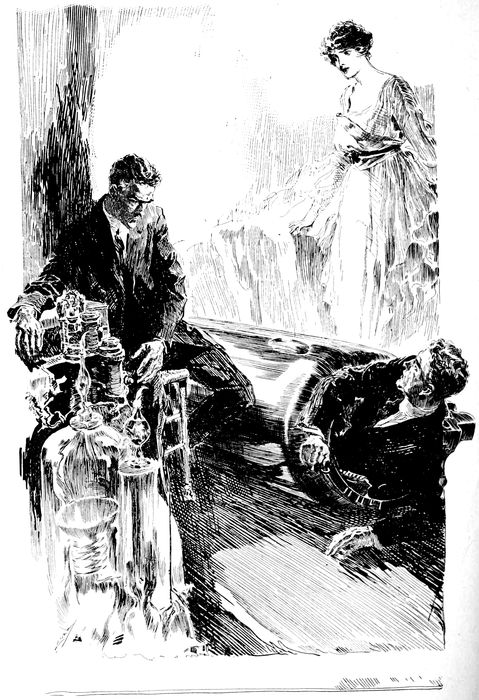
I picture old Sir Spofforth as on that evening:
courteous, restrained, yet with the heat of conviction
burning in his measured phrases; and Esther
listening with quaint seriousness, turning from her
father to Lazaroff and back, and sometimes to me,
as each of us spoke. Outside, in the moonlight,
the shadow of the Institute lay black across the garden
of Sir Spofforth’s house. The dining-room was
fragrant with the scent of the tea-roses that grew
beneath the windows.
2The Biological Institute was less than five years
old, but the London smoke, which drifted beyond
Croydon, already had darkened the bright-red
bricks to a tolerable terra cotta. The ivy had grown
a good way up the walls. The Institute was accommodating
itself to the landscape, as English buildings
had the knack of doing. Lazaroff and I had
been there under Sir Spofforth since the foundation,
and there never had been any others upon the
staff, the Institute being organized for specialized
work of narrow scope, though of immense perspective.
It was devoted to private research into the nature
of life, in the application of the Mendelian law to
vertebrates. The millionaire who had endowed it
for this purpose and then died opportunely, had not
had time to hamper us with restrictions. Next to
endowing us, his death was, perhaps, the most imaginative
thing that he had ever accomplished. The
Government concerned itself only about our vivisection
certificates. But our animal experimentation
was too innocuous for these to be much more than
a safeguard. Carrel’s investigations in New York,
a year or two before, had shown the world that cell
and tissue can not only survive the extinction of the
general vital quantity, but, under proper conditions,
proliferate indefinitely. We were investigating tissue
life, and our proceedings were quite innocuous.
3It will be seen that we already had gotten away from
Mendel, though we did breed Belgian hares, whose
disappearance always caused Esther distress, and
we made fanciful annotations inside ruled margins
about “agoutis” and “allelomorphs.”
I am conscious now that we worked constantly
under a sense of constraint; there was an unnecessary
secrecy in all our plans and actions. Why? I
think, when I look back, that it was not because of
what we were doing, but rather of what it might
become necessary some day to do. The work was so
near to sacrilege—I mean, we viewed the animal
structure as a mechanism rather than as a temple.
That, of course, was then the way of all biologists;
but that, I think, was the cause of our rather furtive
methods. We were hot on the trail of the mystery
of life, and never knew upon what intimacies we
might stumble. We sought to discover how and
where consciousness is born out of unconscious tissue
vitality. Lazaroff had the intuition of genius,
and his inductions were amazing. Still, that problem
baffled him.
“Pennell,” I hear him say, “at a certain period of
growth, when millions of cells, working cooperatively,
have grouped themselves in certain patterns,
completing the design, consciousness comes into play.
Why? Is it a by-product, the creak that accompanies
the wheel? But Nature produces nothing in
4vain. Then why should we know that we exist?
Why?”
Lazaroff was a Prussian Pole, I believe, though
he spoke half a dozen languages fluently. Keen and
fanatical, daring, inflexible, he seemed to me the
sort of man who would welcome the chance to proclaim
a Holy War for Science and die in the front
rank. He had the strange old German faith that was
called monism, and his hope for the human race was
as strong as his contempt for the man of our day.
“The race is all, Pennell,” I hear him say again.
“We of this age, who pride ourselves on our accomplishments,
are only emerging from the dawn of
civilization. We are still encumbered with all the
ghostly fears that obsessed our ancestors of the
Stone Age. But others will build the Temple of
Truth upon the foundations that we are rearing.
Oh, if I could have been born a hundred years
ahead! For the change is coming fast, Pennell!”
And, when I professed to doubt the nearness of
that change: “If your frontal area varied by only
five centimeters, Pennell, you would believe. That
is your tragedy, to fall short of the human norm
by five centimeters of missing forehead.”
I can see his well-proportioned figure, and the
mane of black hair thrown back; the flashing eyes.
Animated by religious impulse, Lazaroff would have
gone to the stake as unconcernedly as he would certainly
5have burned others. He had invented a system
of craniometry by which he professed to discover
the mentality of his subject, and I was his
first.
Certainly the conditions were ideal for our work.
We were both young men, enthusiasts; and Sir Spofforth
Moore, our chief, was nearing eighty. The
Trustees had picked him for the post because of his
great name in the medical world. He was an ideal
chief. He interfered with us no more than the
Trustees did. He asked for no results. The Institute
existed only for patient research. Yes, the
millionaire had certainly displayed imagination for
a millionaire, and it was fortunate that he died before
his hobby, whose inception came to him, I
believe, from reading sensational newspaper articles,
grew into an obsession.
The Trustees refused to accept Sir Spofforth’s
resignation when he became infirm. He lent the
Institute dignity and prestige. I doubt whether he
knew much of Mendelism, or had followed the work
of the past five years. He knew little of what we
were doing, and initialed our vouchers without ever
demurring. Of course he tried to keep in touch with
us, and I will confess that our routine work was
mainly a cover for the daring plan that Lazaroff
had, bit by bit, outlined to me.
“You see, Pennell,” he explained in self-justification,
6“the work must be done. And where are
there such opportunities as here? Science cannot
be bound by the provisions of a dead man’s deed.
It is not likely that Sir Spofforth would object,
either, but the Trustees might have intelligence
enough to pick up the idea from the quarterly reports
if we were entirely frank, and a biologist with
imagination is called a charlatan. And we must
work quickly, while we have this chance. When
Sir Spofforth dies the Trustees will probably pick
some fussy little busybody who will want to poke
his nose into everything and take personal charge.
Then—what of our experiment?”
The idea aroused me to as much enthusiasm as
Lazaroff. And yet there was disappointment in the
knowledge that we should never know the results
of it.
In brief, Lazaroff’s scheme was this: If animal
tissues, removed from the entire organism, can
exist in a condition of suspended vitality for an indefinite
time, at a temperature suited to them in conditions
which forbid germ life to flourish, why not
the living animal? Lazaroff had selected three
monkeys from among our stock for the experiment.
They were to be sealed each in a vacuum cylinder
of special design, and left for a century.
“The more I think about the plan, the more enthusiastic
I become, Pennell,” Lazaroff cried. “If
7the unconscious cell life survives indefinitely, why
not the entire organism plus consciousness?”
“Much may happen in a hundred years, Lazaroff,”
I answered.
“True, Pennell. But they will never find the
vault. Even now, before it is sealed, it would not be
looked for, built as it is into the cellar wall beneath
the freezing-plant. It was to this end, you know,
that I brought down workmen from London, instead
of employing local talent. Well—we shall
leave papers. Earthquakes and revolutions may happen
overhead, but a hundred years hence, when the
papers are opened, a search will be made. Our traveling
simians will be found by a very different world,
I assure you, Pennell!”
He had the light of an enthusiast in his eyes, and
his mood aroused my own imagination.
“What use is that, Lazaroff?” I cried. “We shall
not know the results of our experiment. And what
message can monkeys carry to that world concerning
ours? If monkeys, why not men?”
He looked at me fixedly, smiling ever so little, and
I perceived that he had drawn the expression of
that thought out of the depths of my own mind by
his strong will. Now he nodded in approbation.
“Pennell—” he began, with hesitation, “do you
want to know why I myself do not—?” He
stopped. “I am almost ashamed to tell you what it
8is that makes me wish to live out my life among my
contemporaries,” he continued. “How strong the
primal instincts are in all of us, Arnold! Nature,
with her blind, but perfectly directed will, warring
on mind, and mind rising slowly to dominate her,
armed, as she is, with her dreadful arsenal of a thousand
superstitions, instincts, terrors. It is a fearful
battle, Arnold, and many of us fall by the way.”
He turned aside abruptly, as if he regretted the
half-confidence. I thought I knew what he meant,
and I was stirred too.
We dined that night with Sir Spofforth and Esther
in their new house within a stone’s throw of the Institute.
Esther was the only child; her mother had
died during her infancy. We four had been intimates
during the whole five years of the Institute’s
existence; strangely alone, we four, in the busy Surrey
town. The memory of that last night is the most
poignant that remains to me. How far away it
seems, and how long ago! If I could have known
then that our companionship was ended!
The argument to which I have referred began
after dinner, over our coffee. It was our usual hour
for disputations, but they had never been so keen,
nor Lazaroff so outspoken. Sir Spofforth was a
man of the old school of thought, religious, tolerant,
and withal more disquieted than he himself was
aware, by the dominant materialism of the younger
9men; and Lazaroff had all the tactlessness of his
Jena training. There were rumors of war with
Germany, but Sir Spofforth was too old to adjust
his mind immediately to this conception. He grew
heated, as always, on the cynical scheme of the
democratic government, dictated by its greed for
power, to force Ulster beneath an alien yoke, upon
the loud and stunning silence of our English pacifists
and lovers of oppressed nations where their sincerity
would be best proved. He deplored the new
and dangerous doctrines that were permeating society,
the decay of morals, the loss of reverence and
pride in service. Civilization, he said, seemed dying,
and democracy its murderer.
“Dying! It is still struggling in its birth throes!”
cried Lazaroff impetuously. “I grant that the democracy
of today has proved its futility. But there
is a new democracy to come. We are enslaved by
the traditions of the past, by a worn-out religious
system based upon the primitive animistic notion of
a soul. There is the fatal weakness of our democracy.
Science has never found the smallest trace of a soul;
on the contrary, we know beyond doubt that we live
in a mechanistic universe of absolute determinism.”
I see Sir Spofforth’s tolerant, yet eager look as
he answered him.
“I grant you that the soul is not to be found in
the dissecting-room, Herman,” he answered. “I, as
10you know, have devoted my life to the empirical
investigation of truth, and I do not decry the method.
But you cannot ignore the interior way of analysis,
through the one thing we know most intimately—consciousness.”
“A by-product of matter,” answered Lazaroff contemptuously.
“Or, if we want to be precisely true,
the sum and substance of cell consciousness.”
“Well, throw the blame on the cell, then, in the
modern fashion,” said Sir Spofforth, smiling. “I
doubt, though, whether you have solved the one big
problem by creating some million smaller ones. On
the contrary, you are postulating a hierarchy of intelligences,
quite in the Catholic fashion. If brain consciousness
is not a specialized form of omniscient
consciousness, how does the brainless amoeba find its
food and engulf it, or the vine its supports? If you
have robbed us of the abortive hope of saving the
little empire of the brain beyond the change of death—and
I deny even that entirely—some of us have
identified consciousness with a non-material personality
functioning through all life and fashioning it.”
“Vitalism!” scoffed Lazaroff.
I watched Esther’s eager face as she looked from
one speaker to the other. Sir Spofforth seemed more
agitated than the situation warranted, and I saw
him glance at his daughter a little nervously before
he answered.
11“Herman, I repeat that I have given my life to
scientific investigation,” he replied. “But I have
always recognized the validity of the metaphysical
inquiry. I believe Faith and Science have found
their paths convergent. Lodge thinks so, too. Kelvin
took that stand. James, your great psychologist,
shifted before he died. Science must confine her
activities within their natural bounds and not seek to
play a pontifical part, or the excesses of the Scholastics
will be repeated in a new and darker age.”
“I cannot agree with you,” cried Lazaroff vehemently.
“An age is dawning when, relieved from
their chains, men will look open-eyed into Nature to
learn her secrets. Today civilization is being choked
to death by the effete, the defective, whom a too benign
humanitarianism suffers to live beneath the
shelter of a worn-out faith. The fearful menace of
a race of defectives has laid hold of the popular
imagination. Soon we shall follow the lead of progressive
America, and forbid them to propagate their
kind. Here any statesman who dared suggest sterilization
would be hounded from office. But England
is awakening.
“It will go, that relic of degrading, savage superstition
called the soul, the barbarous legacy of the
ages enshrined in a hundred fairy stories. Science
will rule. Man will be free. The logical State,
finely conceived by Wells, without its rudimentary
12appendixes and fish-gills, will be the nation of the
future. For we are outgrowing childish things. Man
is coming of age. If only I could live to see it! But
I was born a century too soon!”
The expression on Lazaroff’s face at that moment
was so singular that I could not take my eyes away
from it.
“It will be a world of physical and mental perfection,
too,” he cried. “Of free men and women,
freely mating, separating when the mating impulse
is dead—”
“Yes, he is right, Father,” Esther interposed
eagerly. “Whatever else may come, the hour of
woman’s liberation is striking.”
“That hour struck many times in the ancient
world, my dear,” her father answered. “And it
brought, not liberation, but slavery.” He turned to
Lazaroff. “You want a world of men and women
reared like prize cattle and governed by laws as
mechanistic as your universe,” he said. “Well, Herman,
you have had that world. That was the pre-Christian
world. Your free love, your eugenics has
been tried in Rome, in Sparta, in many an ancient
kingdom. And we know what those civilizations
were.
“If you eugenists only knew the dreadful crop of
dragon’s teeth that you are scattering today upon the
fertile soil of the unthinking mind! Because we,
13fortunately, live in the millennial lull of a transitional
age, you think that human nature has changed;
that the fury of the Crusades will never be renewed
in fantastic social wars, and the madness of religious
fratricide in the madness of Science become
Faith. All the old evils are lying low, lurking in the
minds of men, ready to spring forth in all their
ancient fury when the wise and illogical compromises,
evolved through centuries of experience, have
been discarded. I sometimes think that Holy Russia
has man’s future in her charge. For without
Christianity the moral nature of man will be where
it has been in ages past. Social and economic readjustments
leave it unchanged.”
“A religion of slaves, of the weak and incompetent,”
said Lazaroff loudly.
“You think, then, that human passions have become
emulsified by education? What a delusion!”
“Unquestionably. Permit me to refer to myself
as an example of the crass materialist. For I do not
believe in anything but matter. Matter is soul, as
Hæckel proves. Yet, I am not on that account a man
of base impulses. I do not want to wound, to kill,
to steal, to torture—”
“Are you quite sure you know yourself,
Herman?”
“But I utterly reject the efficacy of your Christianity,
except in this low order of civilization. It
14is a dead faith, with its foolish miracles, its preposterous
and unscientific dualism.”
“And I say,” cried Sir Spofforth, rising out of
his chair, “that it is precisely the Christian norm, the
unattainable ideal of Christ, working in the human
heart, that has freed civilization from cruelty and
shame. Why, look backward before Christ lived,
and forward: don’t you see that we are actually
indwelling in Him, according to His promise? Think
of the Christians burned as living torches in Nero’s
time, and read the writings of contemporary Romans,
men of disciplined lives and a mentality as
great as ours. Read Pliny, Tacitus, Seneca; read
of the hopelessness of life when Rome was at her
highest, and see if this stirred them. Picture Marcus
Aurelius, the noble Stoic, presiding over the amphitheater.
Study the manners and morals of Athens
when her light burned most brightly. Contrast a
thousand years of man’s abasement, and try to set
the Inquisition against that.
“Future ages will say this: that nobody, not one
of our statesmen saw the course that had been set
when the civil State was first established. Never
before in history had tribe or nation existed but grew
up round the focus of some god. The churchless
State is a body without a soul. Warnings multiply—in
France and in America—but who can read them?
When religion goes, the spirit of the race is dying.
15It is just the ideal of Christ, enshrined in the minds
of a few leaders of character and trained conviction,
that has kept the world on its slow course of progress.
And nothing else saves us from the unstable
tyrannies of ancient days.”
I was so stirred by Sir Spofforth’s eloquence that
I clapped my hands vigorously, although I did not
wholly agree with him. Esther was staring at
Lazaroff; she was partly convinced and wanted him
to answer her father. But Lazaroff, ignoring her
gaze, scowled at me across the table.
“So you are of the same mind, are you, Pennell?”
he asked, not trying to disguise his sneer. “And
you don’t imagine that it is your missing five centimeters?
Well, I hope that you may have your
chance to find out for yourself. I hope you may,
indeed.” He nodded and smiled in a rather evil
fashion.
“Well, I must really offer you all an apology,”
said Sir Spofforth, penitently. “Enough of these
debatable subjects for a week at least. We two shall
never agree on politics or religion, Herman. Let
us go upstairs.”
CHAPTER II THE GREAT EXPERIMENT
16
Since Sir Spofforth was a little infirm, and
leaned on my arm to make his slow ascent of
the stairs, we entered the drawing-room a full minute
after the others. The room was empty; Esther
and Lazaroff had gone into the big conservatory that
opened out of the south side. I heard the rustle of
the girl’s dress as she moved among the palms, and
Lazaroff speaking earnestly in a low voice.
“Sit down, Arnold,” said Sir Spofforth, subsiding
stiffly into his arm chair. “Thank you, my boy. I
feel old age coming swiftly upon me nowadays. No,
I am not self-deceived. It is strange, this sense of
the daily diminution of the physical powers, and
not at all unpleasant, either. It seems familiar, too,
as if one had passed through it plenty of times
before. It is something like bedtime, Arnold, but
I hope and believe there will be a tomorrow, for I
assure you I have an almost boyish zest for life,
though rather contemplative than energetic for a
while, till I have rested. There is a little forgetfulness
of names and places, but memory seems to
become more luminous as it falls back upon itself.
Well, some day you will experience this. You two
17must carry on the work of the Institute. Herman
is an able fellow, in spite of his mechanistic notions.
But I wonder whether any woman could be happy
with him?”
He watched me rather keenly as he said that.
“There’s only one thing makes me want to live a
little longer, Arnold,” he continued, “and that is
Esther’s future. It would be a great satisfaction to
me to see her settled happily before I go. Forgive
an old man’s frankness if I say that sometimes I
have almost thought you two cared for each other.”
“You are quite right in part, sir,” I replied. “I
do care for Esther a good deal.”
“And she, I am sure, has a very warm feeling for
you, Arnold. There is nobody whom I would rather
have for Esther’s husband than yourself.”
“Well, sir, the fact is, we are not sure that our
views are altogether harmonious,” I confessed. “I
am, as you know, rather sceptical about the newest
views for revolutionizing woman’s status, while
Esther—”
“Is a full-fledged suffragist and has exalted notions
about the race of the future. Tush, my boy!
Never hold back proposing marriage because of intellectual
differences. The race spirit, sitting up aloft
and pulling the strings, is laughing at you.”
“But, Sir Spofforth, to be candid, it was not I
who held back,” I answered.
18“Hum! I see!” he answered, nodding his head.
Then, very seriously, “My boy, I want you to win
her. It would embitter my last days to see my
daughter the wife of Herman Lazaroff. I have
watched and tried to study him: it isn’t his materialism,
Arnold, it’s his infernal will. He’ll break
everything and everybody that conflicts with it when
he wakes up and knows his powers. Now he doesn’t
understand himself at all. He can see nothing
interiorly, as good old Swedenborg would say. I
tell you, Herman Lazaroff, able fellow as he is, and
splendid brain, is a machine of devilish energy, and,
unfortunately, fashioned for purely destructive
purposes.”
Like most old men, he had the habit of falling
into soliloquy, and toward the end of his speech his
voice dropped, and he spoke rather to himself than
to me. Though I remembered his words afterward,
at the time I regarded his indictment as the prejudice
of an octogenarian. He was in his eightieth
year, and there was no doubt his keen mind was failing.
I was searching for a reply when Esther and
Lazaroff came back from the conservatory.
Esther’s face was flushed and she looked utterly
miserable. But I was amazed to see the expression
upon Lazaroff’s. He was deathly white, and his
black eyes seemed to gleam with infernal resolution.
At that moment it did occur to me that Sir Spofforth
19might be wiser in his judgment than I. Lazaroff
came forward quietly and sat down, and I tried to
make the occasion for conversation. But he, seated
motionless and abstracted, seemed hardly to hear
me, and rose from his chair after a few moments,
looking toward Esther, who was standing near the
conservatory entrance. Her brown-colored gown
gleamed golden in the lamplight.
“Sir Spofforth, Miss Esther is interested in our
new freezing-plant,” he said. “I thought, with your
permission, that I would take her to see it lit up by
electricity. You’ll come too, Pennell?”
“Wouldn’t daytime be better, Lazaroff?” I suggested,
and I did not know what was the cause of the
vaguely felt distrust that prompted my words. Certainly
I had no fears of any sort, or reason for any.
Yet, looking at Lazaroff’s face, now flushed and
somehow sinister, I remembered Sir Spofforth’s
words again.
“Let us go tonight,” said Esther, and it seemed to
me that there was a note of penitence in her voice,
as if she wished to make Lazaroff amends.
She came slowly across the room toward us.
She looked at Lazaroff—I thought remorsefully,
and at me with an expression of understanding that
I never had seen in her eyes before. My heart leaped
up to meet that message. But that was the instant
signal-flash of souls, and the next moment I detected
20in her glance the same sense of foreboding that mine
must have shown her.
It is strange how instantaneously such complexities
present themselves with convincing power.
Though the knowledge lay latent in my mind, I am
sure now I was aware that I should never set eyes
upon Sir Spofforth, in life or death, again.
He rose up slowly. “Don’t be long, my dear,”
he said to Esther. “I shall not wait up for you.
Good night, Herman. Good night, Arnold.” He
passed the door and began to ascend the stairs. He
turned. “Arnold!” he began. “No, never mind.
I will tell you tomorrow.”
He never told me. He was gone, and we three
went downstairs, out of the house, and crossed the
garden toward the Institute, whose squat form
blocked the view of the road. Croydon, in the distance,
hummed like a huge dynamo. The Bear
dipped slantingly above; the wind was shaking down
the fading petals of the rambler roses. I remember
the picture more vividly than I perceived it then;
the intense darkness, the white lights of the distant
town, the yellow lamp glow on the short grass, cut
off squarely by the window-sash and trisected by
the window-bars. Lazaroff led the way, walking a
little distance in front of us, toward the annex, a
building just completed, in which was the new freezing-plant,
with our few guinea-pigs, and the monkeys
21that had been bought recently, out of our own money,
for the great experiment. He drew a key from his
pocket and began fumbling with the lock. Esther
stopped in the shadows at my side.
“He asked me to marry him,” she said. “I told
him never—never! That was the word I used. I
used to think that I could care for him, Arnold, but
in that instant I knew—yes, I knew my heart.”
I knew mine too, and I took her in my arms in
the shadow of the Institute. She lifted her mouth
to mine. All the while Lazaroff was fumbling
with the lock. Yet I am sure he was aware,
by virtue of that intuition which tells us all vital
things.
When he had opened the door he turned a switch,
and the interior leaped into view round twenty points
of light that pierced the shadows.
“Come in, Arnold,” he said, turning to me—and
I thought there was blood on his lip. “I will lead,
and you and Miss Esther can follow me. Don’t
be alarmed, Miss Esther, if you hear the monkeys
screaming. They grow lonely at night.”
“Poor little things! How dreadful!” Esther
said.
“We shall not keep them here very long,” Lazaroff
answered in extenuation. He stooped over a
cane chair and picked up a warm shawl. “You will
need to put this about you,” he continued, standing
22back and leaving me to adjust it about Esther’s
shoulders.
So he had planned to bring her here; his subtle
mind had foreseen even this detail. He left nothing
to the unexpected. He lived up to his principles.
We passed between two silent dynamos. The
freezing-plant was already in operation, but George,
the machinist, went off duty at six, after stopping
the dynamos, and the temperature did not rise much
during the night. It was very cold. The moisture
on the brick walls had congealed to a thin film of ice,
and a frosted network covered the ammonia pipes.
Lazaroff stopped in front of a large wooden chest,
with a glass door.
“In this very ordinary-looking icebox we keep
our choicest specimens,” he said to Esther.
“Don’t open that!” I exclaimed.
He laughed disagreeably. “I had no intention of
doing so,” he answered. “You applauded Sir Spofforth’s
mediaeval vitalistic views tonight, Pennell,
and the transition from the dream to the reality
might prove too disturbing for your peace of mind.
Dream on, by permission of those five missing centimeters.
It is such an extinguisher of the soul theory
to see parts of the organism flourishing in perfect
health, all ready to work and grow, devoid of consciousness
and brain attachments. We have two-fifths
of a guinea-pig’s heart, Miss Esther, that is
23yearning to begin its pulsations as soon as it is placed
in a suitable medium.”
He passed on. Esther’s fingers gripped my wrist
tightly. “What an abominable man!” she whispered.
“Arnold—my dear—to think I didn’t
know my mind until an hour ago! When he asked
me, something seemed to strip the mask from his
face and the scales from my eyes. I hate him—but
I’m afraid of him, Arnold.”
I drew her arm through mine and held her hand.
Lazaroff preceded us down a flight of new concrete
steps which had just dried. The cellar into which
we descended had been used for storing packing-cases,
and we had always gone down by a short ladder.
It was here that the experiment was to be
made. I had been shown nothing of Lazaroff’s
preparations.
The cellar had been paved with concrete since my
last visit, and I thought it looked smaller than formerly.
As we went down we heard the monkeys
begin to chatter. Lazaroff switched on a light. I
saw a cage of guinea-pigs close at hand. They
squealed and scurried among their straw. Two
monkeys, awakened by the light, put their arms
about each other and grimaced at me. A tiny marmoset
stretched out its black, human-like arms between
the bars appealingly. It looked very lonely
and child-like as it blinked at us. What a terrific
24journey into the future Lazaroff, like some god,
planned for that atom of flesh.
He stopped at the end of the cellar. I perceived
now that the brick wall was new; it seemed to be an
inner wall, bounding a partition; that was why the
cellar looked smaller. The half-dried mortar clung
flabbily to the interstices.
“Can you find the entrance, Arnold?” asked
Lazaroff.
“The entrance?” The light was not strong, to be
sure, but still it seemed impossible that there could
be an ingress into that solid wall.
Lazaroff touched a brick, and a large mass swung
inward, like a door. In fact, it was a door, with
bricks facing it, the outer edge contiguous with the
outer edge of the fixed rows, so that the deception
was perfect.
“You didn’t tell me that the chamber was completed,
Lazaroff!” I exclaimed in surprise.
“No, Arnold? Well, but I don’t tell you everything,”
he answered.
We stepped through the doorway, and Lazaroff
switched on a tiny light within. Now I perceived
that we were standing in a long and very narrow
space, with cement-faced walls and roof, making
the chamber impervious to sound and light. It was
below the level of the ground, and thus, as Lazaroff
had said, earthquakes might happen above, and it
25would never be discovered, not even though the
annex were pulled down, unless one blasted out the
foundations.
The sole contents were three large cylinders of
metal, looking like giant thermos bottles. Each was
about six feet long—too long for a monkey, it
seemed to me—and had a glass plate in front.
Lazaroff drove his heel against the glass of the
nearest cylinder with all his might.
“It is quite unbreakable, you see,” he said. “It
will turn a rifle bullet. ‘Suffragette glass,’ the maker
calls it.”
“But what are these for?” asked Esther.
“These, Miss Esther, are to convey three monkeys
into the twenty-first century,” answered Lazaroff.
“By instantaneously suspending animation at a temperature
of twenty-five degrees, we hope to maintain
the bodily organism without change until the time
for their awakening comes. The problem is, whether
that mysterious by-product of matter called consciousness
will return.”
“How dreadful!” exclaimed Esther, shuddering.
“But the temperature will rise, Lazaroff,” I interposed,
“and however carefully your cylinders are
made it is impossible to hope to maintain the internal
heat at only twenty-five degrees during a century.”
“You forget that our monkeys will be sealed in a
vacuum,” he answered. “There is an inner and an
26outer case of vanadium steel mixed with a secret
composition which will resist even thermite. And
even if the temperature does rise—well, if a homely
instance may be allowed—you are aware that
canned beef, as the Americans term it, will remain
fresh in an air-tight tin even in the tropics. That is
dead matter, while our monkeys will be millions of
living cells. The vacuum is created by simply screwing
on this cap.”
“But not a perfect vacuum,” I interposed. “That
is impossible.”
“Sufficiently near to eliminate the aerobic bacilli
which flourish on oxygen, and the infinitesimal
amount of that remaining in the cylinder is probably
absorbed and transmuted by the surface capillaries
and lungs, leaving simply carbon dioxide, neon,
crypton, et cetera.”
I examined the cylinder nearest me with interest.
A small dial was set into its cap. Lazaroff anticipated
my question.
“That is the most ingenious part of the mechanism,”
he explained. “It is a hundred-year clock,
made specially for me by Jurgensen, of Copenhagen,
and, to salve your conscience, paid for, like the cylinders,
out of my private purse. It runs true to
within three-tenths of a second. The alarm can be
set to any year, if necessary. A good alarm clock
for lazy people, Miss Esther. This one, you see, I
27have already set to a hundred years ahead. This is
at sixty-five; I shall set that to a hundred presently,
for we don’t want one of our monkeys to awaken
several generations ahead of his friends. This one
is not set. Now, observe, I turn the hands on the
dials. The large figures are years. The smaller
ones are days. Now as soon as the cap is screwed
on, the internal vacuum causes this lever to fall,
catching this cam and starting the mechanism. We
have then a bottled monkey in an indestructible shell,
for really I do not know what could make much
impression on steel of this thickness, which is both
resistant and malleable, and fireproof too. It is impossible,
in short, to release the inmate before the
appointed time, and, even then, immediate death
would ensue.”
“Why?” I asked.
“Because resuscitation must be gradual. I base
my hopes upon the chance that the lungs and heart
will automatically resume their functions, being in
their most perfect medium. But if air were admitted
before the bodily machine had become, so to say,
synchronized, the swarm of micro-organisms would
make short work of our subject. Besides, the hasty
respiration produced by this rush of air would produce
immediate death by its transformation into
carbon dioxide. The air must enter under slight
pressure, in minute quantities, during a period of
28about ten days. Very well! As the timepiece gradually
runs down, the cap slowly unscrews, and a tiny
quantity of filtered air leaks in. It is so arranged
that, at the exact end of the period, the cap flies off,
and the subject awakes.”
“Herman,” said Esther, hurriedly, “I don’t like
this. It isn’t right. And I am sure my father does
not know about it.”
“My dear Miss Esther, I assure you that it is a
very ordinary scientific experiment,” Lazaroff answered,
laughing. “Come, Arnold,” he added, “why
not get in yourself and try how it feels? You are
not afraid?”
“In my clothes?”
“Certainly.”
“Arnold, I don’t want you to get into that thing,”
Esther protested.
“Of course, if our friend is afraid that I am going
to screw him up for a century—” began Lazaroff.
“I am not at all afraid,” I returned, a little nettled.
“How do I get in?”
“I’ll have to help you,” Lazaroff answered. “It
was not made for a big man in clothes. Button your
coat. Now—put your arms down by your sides.”
He rolled a cylinder upon the floor, and I put my feet
inside rather reluctantly and squeezed down to the
bottom. Lazaroff looked at me and burst into loud
laughter.
29“Not much room to turn round, is there?” he said,
raising the cylinder with an effort and standing it
on its base again.
“Come out, Arnold,” pleaded Esther; and I saw
that her face was white with fear.
But I was quite helpless, and above me I saw
Lazaroff, smiling at my predicament.
“Now if I were going to be so unkind as to send
you into the next century,” he said, “to be the only
animist, with a defective skull, in a world of vile
materialism—”
“Please, Herman, for my sake!” Esther implored.
“I should put on the cap,” he said, and fitted it.
He must have touched some mechanism that I had
not seen, for instantly the cap began to whir on the
screw. Through the glass face I caught a last
glimpse of Esther’s terrified eyes. The image
blurred and vanished as my breath dimmed the glass
and frosted it. I heard the swift jar of the cap
mechanism end in a jarring click. I gasped for air;
there was none. My head swam, my throat was
closed; the blackness was pricked into flecks of fire.
I groped for memory through unconsciousness—and
ceased.
CHAPTER III IN THE CELLAR
30
I have heard patients, emerging from the chloroform
swoon, describe how, before awakening,
they had seemed to view themselves lying unconscious
upon their beds, detailing the posture of their
motionless bodies and inert limbs. In this way, now,
I seemed to see myself.
I am sure that was no dream of the vague borderland
between death and life. I saw the pallid face,
so shrunken that the skin clung to the edged bones,
and the dry hair, the pinched lips and waxen hands.
I saw myself as if from some non-spatial point,
and with singular indifference, except that one
fragment of knowledge, detached from my serene
omniscience, troubled me. I had to return within
that physical envelope; and behind me lay dim
memories, quite untranslatable, but ineffably rapturous,
which made that projected incarnation an
event of dread.
Vague images of earthly things began to float upward
out of the dark, as it were, symbols of physical
life whose meaning remained obscure. I pictured a
spring-board, on which a swimmer stood poised,
waiting to dive into the sea and set the plank behind
31him quivering, and a large roll of some material, like
a carpet, blocking a cellar door.
Gradually, through an alternation of dreams and
blankness, I began to be aware of the parched and
withered body that cloaked me. The point of consciousness
had shrunk within its earthly envelope.
Soon it diffused itself throughout my members. Now
I could translate my symbols into ideas. That coiled-up
substance that blocked the door was my tongue,
fallen back into the throat. And the spring-board
on which the swimmer stood—that was my heart,
waiting to beat. And unless and until the swimmer—I—made
that plunge into life’s ocean, it could
not. Slowly the need of physical resurrection urged
me onward.
A thousand darts were stabbing in my flesh, like
purgatorial fire. No motor nerve had yet awakened,
but the capillaries, opening, pricked me like red-hot
needles. Faint memories of the past flashed through
my mind, and, though I recalled no intervening
period, I was sensible that those events had happened
infinitely long before.
Suddenly I plunged. I felt as if a sword had
pierced my body. I felt the waters of that living
ocean close over my face, and gasped. I breathed.
Simultaneously, with a loud click, the cap of the cylinder
flew off, air rushed in, a stabbing light broke
through my closed eyelids; I fainted.
32It was, of course, the gradual unscrewing of the
cylinder cap as the mechanism ran down, and the
consequent admission of minute quantities of oxygen,
that had begun to restore me. I must have
passed several days in semi-consciousness before the
cylinder opened. When the last thread of the screw
was traversed, the inrush of air caused the respiration
to begin.
I was breathing when I became conscious once
more, and my heart was straining in my breast. I
got my eyes open. There followed hours of light-tortured
delirium, during which I struggled to regain
the motor powers. With infinite endeavor I placed
one hand upon the other and passed it up the wrist
and forearm. The muscles were all gone. The
ulna and radius were perfectly distinguishable, and
I could encircle either with my fingers, after I had
managed to flex them. I noticed that my joints
creaked like rusty hinges.
I tried to bend my elbows, and this next grim
battle lasted an incalculable time. Gradually I became
aware of some obstacle on each side of me.
Then, for the first time since my awakening, I knew
that I was inside the cylinder. But I did not know
that it had fallen upon its side until it slid forward,
and my puny struggles dislodged me and flung me
free into a pool of water. I drew in a deep breath,
feeling my lungs crackle like old parchment, and
33plunged my face and shoulders beneath the surface.
My skin sucked up the moisture like a sponge,
and I contrived to get a few drops past my swollen
tongue. I had just sense enough and time to
turn my face upward before I became unconscious
again.
I must have slept long, for, on my next awakening,
the light was brighter and still more torturing. Memory
began to stir. I recalled my conversation with
Sir Spofforth, our journey into the annex, Lazaroff’s
invitation to me to enter the cylinder. He must have
shut me in for a moment by way of a practical joke,
and gone away with Esther, persuading himself and
her that I could free myself and would follow. I
tried to call him. But only a croaking gasp came
from my lips. I tried again and again, gradually
regaining the power of vocal utterance. But there
came no answer, and each time that I called, the
echoing, hoarse susurrus brought me nearer to the
realization of some terror at hand which I did not
dare to face.
I looked about me. Beside me lay the cylinder,
almost buried in mud. I was still within the secret
vault, but a part of the brick partition had fallen
inward in such a way as to screen the few visible
inches of the steel case that had housed me, so
that nobody would have suspected its presence in
the mud of the little chamber. I remembered that
34there had been two more; I looked about me, but
there was no sign of them.
Now I began to realize that there had been a considerable
change in my surroundings since I became
unconscious. The light which had distressed me
came through a hole in the roof of the adjoining
cellar, filtering thence through the aperture in the
broken wall, and was of the dimmest. In place of
the concrete floor there was a swamp of mud, with
pools of water here and there, and the dirt was
heaped up in the corners and against the walls.
Moss and splotched fungi grew among the tumbled
bricks, and everywhere were spore stains and microscopic
plant growth.
I was bewildered by these signs of dilapidation
everywhere. The guinea-pigs and monkeys were
gone; the cellar was empty, save for some low, rough
planks of wood fitted on trestles and set about the
floor. On the wall at the far end hung something
that gradually took form as I strained my aching
eyes to a focus.
It was a crucifix. The cellar had become a subterranean
chapel. The cross was hewn coarsely of
pine, and the figure that hung upon it grotesquely
carven; yet there was the pathos of wistful, ignorant
effort in the workmanship that bespoke the sincerity
of the artist.
I made my difficult way toward the stairs
35I made my difficult way upon hands and knees
through the gap in the wall, across the mud floor
of the cellar, toward the stairs, resting several
times from weariness before I reached my destination.
But when I arrived at the far end, where the
stairs should have been, I received a shock that
totally unnerved me. The stairs were gone. In
place of them was a debris of rubble and broken
stones, as firmly set as if workmen had built it into
the wall. The mass must have been there for years,
because, out of the thin soil that had drifted in, a
little oak tree sprang, twisting its spindling stem
to rear its crown toward the patch of daylight.
At last I understood. I had come to realize the
fact that my sleep had been a prolonged one; it
might have lasted weeks—even months, I had
thought, as with cataleptics; but an entire century!
that idea had been too incredibly grotesque for consideration.
That Sir Spofforth, with whom, it
seemed, I had dined almost yesterday, had gone,
ages ago, to his long home; Lazaroff; Esther, whom
I loved; that generations had come into birth and
died ... it seemed too cruel a jest. I wept. I
raved and called for Esther. Surely a hundred years
had never passed, turning her brown hair to gray,
lining her gentle face, bringing at last the gift of
death to her, while I lay underground, encased in
steel and air!
I cried aloud in terror. I hammered helplessly
36upon the walls. Again I called Esther, Lazaroff,
George. There was no answer of any kind.
Presently a ray of light quivered through the hole,
falling upon the heap of debris that blocked the stairway.
The yellow beam moved onward, and now it
bathed the thin branches of the little twisted tree
that, by the aid of those few minutes of sunlight
daily, had ventured into life. It had grown cunningly
sidewise, so as to expose the maximum of
wood to the light. I watched the ray till it went out;
I wanted to show the plant to Lazaroff, to ask him
whether the mechanics of heliotropism could suffice
to answer the problem of the tree’s brainless consciousness;
and my chagrin that this whim could not
be fulfilled assumed an absurd significance. It was,
in fact, the realization of this loss of responsiveness
to the reality of the situation that constantly urged
me to find some way of escape when I might have
relapsed otherwise into an acquiescence which would
have brought insanity and death.
The stairs being gone, I turned my consideration
to the cellar roof. To reach this it would be necessary
to drag one of the planks beneath the hole and
scramble up, clinging to the sides with my fingers
and bracing my feet against the wall. This feat was
not a difficult one for a normal man, but for me
clearly impossible. I must wait until I became
stronger.
37It is a strange thing, but I had not associated the
need of waiting with the idea of food until I found
the box of biscuit. I stumbled upon the box by the
accident of scratching my wrist against the edge as
I crawled along the wall. I saw the corner projecting
from a mound of earth, and, scraping some of
the dirt away, I lifted the pine-wood lid.
Inside the box I found a quantity of biscuit which
seemed to have been baked recently. It was crisp,
and too hard for me to break. I dipped a piece in
the stagnant water, and, as I swallowed the first morsels,
became aware of my ravenous hunger.
I can hardly estimate the duration of the imprisonment
that followed. It was of days and nights
which succeeded each the other in monotonous succession,
during which, like a hibernating beast, I
crouched and groped within the cellar, dozing and
shivering, and gnawing incessantly at my food. Only
those few minutes of sunshine daily saved my reason,
I am convinced now. My evening clothes, which
at first had appeared to have suffered no injury during
my century of sleep, had begun to disintegrate,
and hung upon me in tattered fragments. It was a
period of despair, with very little alternating hope.
Sometimes I prayed wildly beneath the crucifix,
sometimes, in an access of madness, I cried for
Esther and Lazaroff again. And for whole hours I
convinced myself that this was a dream.
38But my strength returned with amazing swiftness.
As in the case of a typhoid convalescent, every
particle of food seemed to build up my body. I
must have put on pounds each day. The barrel
framework of my ribs filled out, the muscles showed
their old outlines beneath the skin, the fluid rushed
into the joints and restored their suppleness. And
daily I practiced exercises. I managed to drag one
of the benches beneath the hole at last, and, standing
on this, tried often to draw myself up; but on each
occasion my struggles only brought down a shower
of earth and stones, and I resigned myself to a period
of further waiting, watching for dawn like a troglodyte,
and for the sun like a fire-worshiper.
In the end my escape developed in a manner the
least imaginable. It began with my discovery of a
second box in another of the mounds. I opened it
hastily, in the greedy anticipation of finding something
more palatable than biscuit.
Instead of this I found a number of strange batons
of wood. They resembled policemen’s truncheons,
but each had a tiny rounded plate of glass near the
head, and there evidently was some sort of mechanism
near the handle, for there was a push-button,
fitted with a heavy guard of brass, so strong that I
could not raise it with my fingers. It was indeed
providential that I was unable to do so.
I carried the strange implement beneath the hole
39in the roof and laid it on the bench, intending to
examine it more carefully as soon as the sun appeared.
Meanwhile, this being the time for my daily
exercise, I mounted the bench and tried to pull myself
up. I failed; yet I detected a considerable improvement
in my muscular power, and, becoming exhausted,
I prepared to descend. Inadvertently, but
without anticipating any serious result, I placed my
foot against the truncheon in such a way as to elevate
the guard.
I heard it click as it rose into position, and, in
setting down my foot again, depressed the push-button.
The truncheon tipped to the ground, pointing
upward. I saw a ray of blinding light, of intense
whiteness tipped with mauve, shoot from the head,
and, with a crash, a shower of stones fell on me,
bearing me to the ground and enveloping me in a
cloud of dust.
I must have lain half stunned for some minutes.
I was aroused by feeling the sunlight on my eyelids.
I started to my feet. The hole in the roof was
nearly twice the former size, and a heap of fallen
stones and pieces of brick afforded me a perfect
stepway. I was scratched by the falling debris, but
happily the explosion, as I deemed it, seemed to
have been in an upward direction.
In a moment I was scrambling up the stones. I
40slipped and clutched and struggled; I got my head
and shoulders in the air and pulled my body after
me; I trod upon leaves; I looked about me.
I was standing in the midst of what appeared to
be an ancient forest of oak and beech trees, whose
bare boughs, covered with snow, shook under a gray
sky above a carpet of withered, snow-spread leaves,
and under these were endless heaps of disintegrating
bricks. In vain I looked about me for the Institute.
There was no sign of it, nor of Sir Spofforth’s
house. Nowhere was anything to be seen but the
same forest growth, the dead leaves scurrying before
the chill wind, and the vast brick piles. I had
emerged from the cellar into a trackless wilderness.
And now at last my final doubt, which had bred
hope, was gone. I ran through the forest, on and on,
shouting like a madman and beating my breast, stumbling
over the brick heaps that lay everywhere, plunging
through thorny undergrowth, heedless of any
course. I must have been running for ten minutes
when my strength failed me, and I collapsed beside
an ancient road, overgrown with shrubs and saplings,
yet discernible in its course between the tall
trees that bordered it. Before me, far away through
the vista line, I saw a white bank against the gray
horizon.
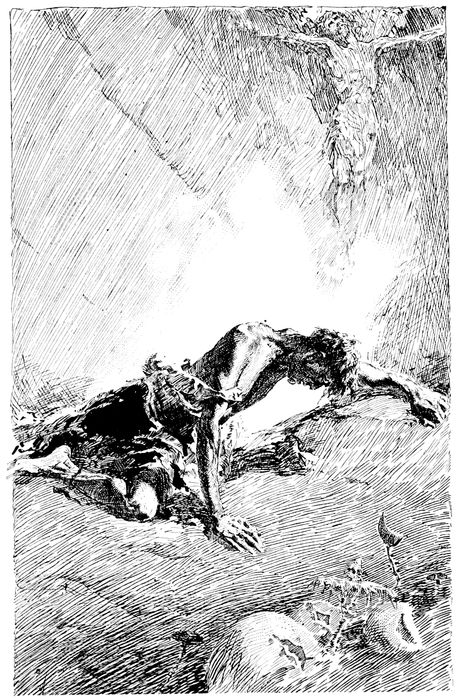
I flung myself upon my face and prayed, with all
my will, to die.
CHAPTER IV THE ROAD TO LONDON
41
A shadow swept over me, and, looking up, I
saw an airplane gliding noiselessly above; it
stopped, hung poised and motionless, and then
dropped slowly and almost vertically into the road,
coming to ground within a dozen yards of where
I lay.
There stepped out a man in a uniform of pale
blue, having insewn upon the breast a piece of white
linen, cut to the shape of a swan. He came toward
me with hesitancy, and stood over me, staring at me
and at my clothes with an expression indicative of
the greatest bewilderment.
“Where’s your brass, friend?” he inquired after
a few moments, speaking in a high-pitched, monotonous,
and rather nasal tone. He rubbed his smooth-shaven
face in thought. “Where’s your brass?” he
repeated.
I perceived that he wore about his neck a twisted
cord whose ends were tied through the loop of a
brass plate, stamped with letters and figures.
“For God’s sake tell me what year this is!” I cried.
At the profane expletive, which had been drawn
from me by my anguish, he recoiled in dismay; he
42seemed less shocked than frightened; he glanced
about him quickly, and then cast a very searching
look at me. But next he began to smile in a half-humorous,
kindly way.
“You’re one of the escaped defectives, aren’t
you?” he inquired. “You have nothing to fear from
me, friend. We airplane scouts have no love for the
Guard. You can go on your way. But where are
you lying up? Are your friends near?”
“Will you tell me what year this is?” I demanded
frantically.
“Yap, certainly,” he answered. “This is Thirty-seven,
Cold Solstice less five.” He shook his head
and began staring at me again.
I laughed hysterically. “I don’t know what that
jargon means,” I answered, “but I went to sleep in
the vault of the Biological Institute in the year 1915.”
Perplexity had succeeded alarm. The airscout
shook his head again. He was one of those deliberate,
slow-moving men whose resolutions, tardily
made, harden to inflexibility; I recognized the type
and found the individual pleasing. He was a good-looking
young fellow of about eight and twenty,
with straight, dark hair and a very frank countenance.
He looked like a sailor, and the rolling, open
collar, which fell back, sailor fashion, revealed a
muscular throat, tanned, like his face, to the color
of the bricks around us.
43“I don’t know what to make of you,” he said
thoughtfully. “I don’t want to trap you, but you
were better off in the art factories. I don’t know
what to do with you.”
I sprang to my feet, and for an instant I ceased
to realize my predicament. “Will you take me to my
friends in London?” I asked. In my mind was the
memory of a university acquaintance who lived in
St. John’s Wood. But then the swift remembrance
came back to me, and I hung my head and groaned.
“Back to London!” exclaimed the airscout. “But
you’ll be put to the leather vats. Doctor Sanson is
furious, and the police are searching for you everywhere.
You’re crazed! What’s the sense of running
away from painting pictures and going back
to sweat ten years over the hides?”
“Take me to London!” I implored. “I have nowhere
to go. Perhaps—I don’t know—”
I was hoping wildly that somebody whom I had
known might still survive. But by this time I was
beginning to pull myself together. I resolved to
wait for his decision.
“Now, friend,” he said, as if he had made up his
mind, “your top got stuffed making those factory pictures,
as was very natural. Now, I think you had
better go back to London, and I’ll take you there,
since your friends have shaken you. But of course
it must be the police station. I can’t risk my own
44liberty. Once more, are you sure you want to go?
If not, I haven’t seen you.”
“I’ll go,” I answered indifferently.
“Yap? Step in, then!”
I took my seat beside him. It will seem incredible,
but I had never ridden in an airplane before. In
my other days only a few had seen these craft. It
was hardly more than six years since the Wrights
had flown when my long sleep began. In spite of
my oppression of mind, or perhaps because the days
of horror that I had spent in the cellar produced the
unavoidable reaction, I began to feel the exhilaration
of the flight as we ascended to a height of perhaps a
thousand feet and drove northward. The sensation
was that of sitting still and seeing the trees flit by
beneath me, and would have been pleasing but for
the intense cold, which pierced through my rags and
numbed me. I perceived that the airplane was under
perfect control, and could be stayed without falling.
After a while I realized that there was no motor.
My companion saw me looking at the machine.
“Improved solar type,” he said, patting her caressingly.
“Better than a bird, isn’t she?” He turned
toward me. “You’ve been sleeping in the wood
these three days?” he asked. “And find the factories
best? I don’t score you for that. Where’s the rest
of you? Five, weren’t there? Why didn’t you keep
together? Where’s that bishop of yours?”
45But, seeing that he could elicit no comprehensible
answer to his repeated questions—in truth, I did
not know how to reply—he relapsed into an equal
silence. And now the white bank that I had seen
on the horizon began to assume crenellations, which
in turn became buildings of immense height and symmetrical
aspect. And I forgot my situation in admiration
and amazement at the panorama that began
to unfold beneath us.
The county of Surrey appeared to be an extensive
forest, ending about a waste of dismantled brick,
the suburbs of old London, which extended on each
side as far as I could see. Then the modern town
began: an outer ring of what I took to be enormous
factories and storage warehouses; an inner ring, no
doubt, of residences; and then the nucleus, the most
splendid city that the imagination could have
devised.
London seemed to be smaller than the metropolis
of a century ago. I could see from the height of
Hampstead, in the north, to the region of Dulwich,
and from Woolwich to Acton, all clearly defined,
like a great map unrolled beneath me, though I could
recognize none of the old landmarks, save the unchanging
Thames. The interior city was laid out
in squares, huge buildings, sometimes enclosing
interior courts, occupying the blocks formed by the
parallel and intersecting streets. As we drove inward
46from the outskirts, the buildings became
higher, but always uniformly so, the city thus presenting
the aspect of a succession of gigantic steps,
until the summit, the square mile comprising the
heart, was reached.
This consisted of an array of enormous edifices,
with fronts perfectly plain, and evidently constructed
of brick-faced steel-work, but all glistening a dazzling
white, which, even at that height, made my eyes
water, and rising uniformly some forty-five or fifty
stories. The flat roofs were occupied by gardens
or what I took to be gymnasia, sheltered beneath
tarpaulins. I saw innumerable airplanes at rest,
suspended high above the streets, while others flitted
here and there above the roofs, and a whole fleet lay,
as if moored, some distance away, apparently over
the center of the city, above a singular building,
which awakened associations in my mind, though I
was unable to name it.
It had a round dome, being, in fact, the only
domed building that I could see. This covered only
the central portion of the enormous architectural
mass, and appeared to float in the air above an aerial
garden, laid out with walks that radiated from a flat
building, which filled the space between the floating
dome and the roof beneath it. I surmised that this
must be the new House of Parliament. The entire
mass was surrounded by a double wall, with a roofed
47space of perhaps ninety feet from rear to front,
castellated. Mounted on this were what appeared
to be a number of large, conical-shaped implements,
of great size. Long, graceful bridges on arches
connected this wall with the domed building;
and wall and building glistened from top to base
so brilliantly that the glow seared my eyes like
sunlight.
As we were now flying at a low altitude, I turned
my attention to the streets, which appeared like
canyons far beneath. Along these swarmed a multitude
of travelers, dressed in two colors only, white
and blue, the latter vastly predominating. I could
see no vehicles, and I imagined, what proved to be
correct, that the streets themselves were moving.
Most of those journeying seemed content to lean
back against the railings, the lowest bars of which
projected, forming a continuous seat, and rest.
Nearly all the streets were traveling in the same
direction, those that reversed this movement being
small and comparatively empty. From the presence
of what seemed to be iron stanchions, set along the
edges of these moving ways, I surmised that they
were roofed with crystal.
Along the front of the buildings ran single tracks,
connecting at regular intervals with the streets beneath
by means of elevators, which shot up and down
continuously, bearing their freight. These tracks
48were placed above each other at ten-story intervals,
so that there were three or four rows of these aerial
streets, ranging from the ground to the upper portions
of the buildings, all filled with travelers. The
buildings, each comprising an entire block, the elevated
streets, with their graceful bridges flung forth
across the chasms, the absence of any of the old poverty
and dirt, and that huge gathering of human
beings, going about their business in so systematic
a fashion, fascinated me, and even aroused my
enthusiasm.
Signs evidently indicated to persons approaching
in airships the purpose of each building and landing-stage,
but these were in characters entirely unintelligible
to me.
My companion stayed the vessel in the air and
tapped me on the arm. I started, to see him regarding
me with the same expression of humorous
perplexity.
“I must put you off here, friend,” he said. “I
think I have done the best I could for you. You
would have died in the forest, while here—well,
there’s a chance for you. And it’s better to go to
the leather vats for a few years than to die and go
nowhere. I’ll know you if we meet again. What’s
your name?”
“Arnold Pennell,” I answered, clasping the hand
that he held out to me.
49He almost jumped. “Don’t tell that to the Council,
unless you want the Rest Cure,” he said.
“Don’t tell them my name?”
“Not both names, friend. You know what I
mean. If you don’t know—” He shrugged his
shoulders. “Mine’s Jones,” he said. “My father’s
was Williams. My grandfather’s was Jones again.
They say it’s one of our oldest names—common
in the days before civilization. Now down we
go.”
The airplane swooped down and came to rest upon
the roof immediately beneath us. On this I saw a
number of men, apparently practicing gymnastic
exercises; and hardly were we at a standstill when
two of them came running up to us. They were clad
in blue uniforms resembling that of the airscout, but
instead of a swan each wore a shield-shaped piece of
linen upon his back and breast.
“What’s this?” they demanded in a breath, pointing
at me and bursting into bellowing laughter.
“One of your defectives,” answered Jones. “I
found him in the forest while patrolling.”
They rushed at me and dragged me from the airplane,
swiftly patting me about the body, as if in
search of weapons. Satisfied that I was unarmed,
they turned to the airscout.
“You’ll share the reward!” they cried, again
simultaneously.
50“Keep it!” replied the airscout tartly, and rose
into the air, waving me a cordial good-bye.
They rushed me across the roof through a crowd
of other men, similarly clad, down an elevator, and
into the street. They dragged me upon one of the
moving platforms and conveyed me a short distance,
descending at the entrance to one of the innumerable
shining buildings, over which was inscribed something
in the same undecipherable letters.
But, quickly as we had gone, the report of my
arrest seemed to have preceded us, for our way was
blocked by a vast and constantly increasing crowd,
that came running up with lively and shameless
curiosity, and, attracted by my rags, I suppose,
pressed closely about us and uttered hoots of laughter.
I heard the word “defective” bandied from
mouth to mouth.
I looked at these people attentively. There were
both men and women present, all wearing clothing
of the same pale blue color, which seemed to be prescribed,
although the cut of each garment was to
some extent individual. In effect, the men wore sack
suits of a coarsely woven woolen material, with short,
loose trousers fastened with laces about the ankles,
and square-cut coats having wide lapels extending to
a broad, turned-back collar that fell over the shoulders
like a sailor’s, revealing a neckpiece of blue
linen. The women’s short skirts reached to the tops
of their high boots, and the fashion seemed to run
to large buttons and loose sleeves. They wore no
hats. Upon the breast, near the shoulder, each person
wore a small linen badge, indicative of his
occupation.
I glanced from one to another, and met hard, mirthless eyes, and mouths twisted in sneering mockery
51What disconcerted me was the shrewd, mocking
smile upon each face. I glanced from one to another,
seeking to find something of the same friendly interest
that animated me, and met hard, mirthless eyes,
and mouths twisted in sneering mockery.
Another thing that startled and almost terrified
me was the absence of a certain conventionality of
restraint that had ruled everybody in that other
world of mine. For instance, among those gibing
at me was a gray-bearded man who danced before
me like a small urchin. Another made an expressive
pantomime of death. A girl stuck out her tongue at
me. I remembered the plaint, that never since the
glorious age of Greece had the code of public morality
coincided with that privately held. This we all
knew; the statesman in parliament was not on bowing
terms with the same statesman in the smoking-room.
Some said it was Christianity, others respectability
that bound us in this organic hypocrisy; but
now the two codes seemed to have coalesced. A
grandfather grimaced at me; a gray-haired woman
put out her foot to trip me; if there had been stones
I think they would have flung them at me. But
52suddenly a youngish lad in white appeared, and the
crowd, hastening to make a path for him, shrank
back with servile demeanor. Taking advantage of
this, my captors, linking their arms in mine, made a
rush forward, scattering the mob right and left, and
bore me through a swinging door into a small rotunda,
in which a number of other policemen were
seated with their blue-clad prisoners.
CHAPTER V LONDON’S WELCOME
53
Inside the rotunda a burly man in blue, with the
white shield on his breast, was standing on guard
in front of a second swinging door, above which
was painted something in the same strange characters.
A few words to him from my captors apparently
secured us precedence, for he stared at me curiously,
opened the door, and bawled to some person
inside. I was pushed into a large courtroom. It
contained no seats, however, for spectators or witnesses.
The only occupants were the magistrate
and his clerk, and a group of policemen who lounged
at one end of the room, joking among themselves.
The clerk, a little, obsequious man in blue, was seated
at a desk immediately opposite that of his chief, a
pompous, surly fellow in white, wearing about his
shoulders a lusterless black cape, which seemed to
be a truncation of the old legal gown. Placing me
on a platform near the clerk’s desk, the two policemen
who were in charge of me stepped forward and
began an explanation in low tones which was not
meant to meet my ears, and did not.
The magistrate started nervously, and, putting his
hand beneath his desk, pulled up a truncheon similar
54to those that I had seen in the cellar. He handled
this nervously during our interview.
“Well, what have you to say, you filthy defective?”
he shouted at me, when the police had ended.
I heard a suppressed chuckle behind me, and then
became aware that all the police had gathered about
me, convulsed with amusement at my rags.
“Stand back, you swine!” bellowed the magistrate.
“Give me the Escaped Defectives Book,” he added,
to his clerk.
The clerk handed up to him a small publication
which I could see contained numerous miniature
photographs in color. He began studying it, looking
up at me from time to time. Occasionally, at
his nod, one of the policemen would seize my face
and push it into profile. At last the magistrate thrust
the book away petulantly.
“This isn’t one of them,” he announced to the
policemen. “Who are you?” he continued, glaring
at me. “You’re not on the defectives’ list. Where
do you come from? Tell the truth or I’ll commit
you to the leathers. Why are you in masquerade?
Where’s your brass? Your print? Your number?
Your district?”
The clerk wagged his middle finger at me and,
drawing a printed form from a pile, pushed it toward
me. I took it, but I could make nothing of it, for
it was in the same unknown characters.
55“I can only read the old-fashioned alphabet,” I
said.
The room echoed with the universal laughter.
The magistrate almost jumped out of his chair.
“What!” he yelled. “You’re lying! You know
you are. You have an accent. You’re from another
province. What’s your game?”
The clerk, ignoring his superior’s outburst, pulled
back the form, and, taking in his hand a sort of
fountain pen, began to fill it in with a black fluid that
dried the instant it touched the paper.
“Number, district, province, city, print, and
brass?” he inquired. He paused and looked up at
me. “Brach or dolicoph? Whorl, loop, or median?
Facial, cephalic, and color indexes? Your Sanson
test? Your Binet rating?”
But, since I made no attempt to answer these utterly
baffling questions, the clerk ceased to ply me
with them and looked up at the magistrate for instructions.
The magistrate, who had been leaning
forward, watching me attentively, now smiled as if
he had suddenly grasped the situation.
“I’ll tell you what you are,” he said, shaking his
finger at me. “You’re a Spanish spy, masquerading
as a defective in order to get into the workshops and
corrupt the defectives there.”
“Now I should call him a Slav,” said the clerk
complacently. “He’s a brach, you see, Boss. And
56that makes his offense a capital one,” he added complacently.
“Put him up for the Council, then,” growled the
magistrate. “Standardize him,” he added to the
policemen, “and commit him to the Strangers’ House
pending the Council’s ascription.”
My captors hurried me away. In the street a large
crowd, which had assembled to see me emerge,
greeted me with noisy hooting. And, looking again
into these hard faces, I began to realize that some
portentous change had come over mankind since my
long sleep, whose nature I did not understand; but,
whatever it was, it had not made men better.
However, the moving platform quickly carried us
away, and the mob dwindled, so that when we
reached our destination only a nucleus remained.
This, however, followed me persistently, gathering
to itself other idlers, who ran beside me, peering up
into my face, and fingering my tattered clothes, and
pulling at the tails of my coat in half-infantile and
half-simian curiosity.
The building which we entered contained a single
large room on the ground floor, with desks ranged
around the walls. Behind each desk a clerk in blue
was seated, either contemplating the scene before
him or listening disdainfully to applications. I was
taken to a desk near the door. One of the policemen
now left me, and the other, who had contrived,
57without my knowledge, to possess himself of the
gold watch that had been in my pocket for the last
century, placed it upon the desk before the clerk,
who came back slowly and resentfully from a fit of
abstraction.
“Committed stranger?” he inquired.
“Yap,” said the policeman. “He had this.”
The clerk stared at the watch, raised it, and let it
fall on its face. The glass splintered, and he jumped
in his seat as if a pistol had been discharged.
“What is it?” he screamed.
“It looks like an antique chronometer,” said the
policeman, examining it curiously. “See the twelve
hours on the dial.”
“Well, they aren’t listed,” the clerk grumbled.
“You lie, you thief,” retorted the policeman.
With some reluctance, but without resentment,
the clerk opened a large book in a paper cover,
closely printed in fine hieroglyphics interspersed with
figures. He turned from place to place until he
found what he was trying not to find.
“Museum chronometers, first century B.C. Listed
at two hektones,” he mumbled, and began unlocking
a drawer.
“B. C.!” I exclaimed. “What do you mean?”
He paused in the act of pulling the drawer out
and glared at me.
“I said ‘museum chronometer of the first century
58before civilization,’ you fool!” he snarled. “That’s
what it is, and that’s what it’s listed at. Here!”
Extracting some metal counters from the drawer,
which he closed with a bang, he thrust them toward
me.
“What am I to do with these?” I asked.
The policeman winked at him, and I caught the
word “Spain.” The clerk’s amazement changed to
malignant mirth.
“The value of your chronometer,” he screamed in
my ear, as if I were deaf.
“But I don’t intend to sell it,” I retorted.
A shriek of laughter at my side apprised me that
the crowd had gathered about me. The space about
the desk was packed with the same sneering, mirthless
faces, and fifty hands were raised in mimicry or
gesticulation.
“What a barbarian!” murmured a young woman
with a typewriter badge on her shoulder.
The clerk looked at her and winked maliciously.
Then he addressed me again.
“If you don’t understand now, you will before the
Council ends ascribing you,” he said. “However,
I’ll explain. Your museum chronometer, not being
an object of necessity, is the property of this Province.
This is a civilized country, and you can’t have
hoard-property here, whatever you can do in Spain.
Strangers’ effects are bought by the Province at their
59listed value, and your chronometer is listed at two
hundred labor units, or ones—in other words, if
you have ever heard of the metric system, two
hektones.”
“Ah, give him the Rest Cure!” said the girl with
the typewriter badge, swinging about and stalking
away contemptuously.
I picked up the metal counters and began examining
them. They were crudely made, and without
milled edges. Two of them appeared to be of aluminum;
on one side was an ant in relief, and under it
the inscription,
LABOR COMMON
37
on the other side, in bold letters, were the words,
HALF HEKTONE
FIFTY ONES
There were two smaller pieces, of a yellowish-gray,
each stamped,
TWENTY-FIVE ONES
It did not take me more than a moment’s calculation
to see that if the hektone was a hundred units
of currency, or labor hours, I had only a hektone and
a half instead of two. I told the clerk of the
deficiency.
60“Don’t lie! Sign that!” he shouted, pushing an
inkpad and printed form toward me.
“I shall not sign, and I shall bring this theft to
the attention of—Doctor Sanson,” I said, suddenly
recollecting the name.
It was a chance shot, but its effect was extraordinary.
The mob, which had begun to jostle me, suddenly
scurried away in the greatest confusion. The
clerk turned white; he picked up the money with
trembling fingers.
“Why, that is so!” he exclaimed. “It was a mistake,
Boss. I didn’t mean it. I’m sorry. I—I
thought you were a blue,” he muttered, looking up
at me beseechingly. And he returned me a whole
half-hektone too much.
I tossed this back to him and returned no answer.
I was looking about for a pen with which to sign the
receipt when the policeman took hold of my thumb
in a comically obsequious manner and pressed the
inkpad against it. So I made my mark upon the
paper.
In the corridor outside he turned toward me
humbly.
“Are you a trapper, Boss?” he asked.
“A what?”
“A switch. A wipe. I mean a council watcher.”
“A spy, you mean?” I asked. “Certainly not.”
He shook his head in perplexity, and seemed uncertain
61whether to believe me or not. “He thought
you were,” he said. “That was an old list he used.
You should have had more. Of course I couldn’t
get in bad with him by telling you, but you’d have
had nothing if I hadn’t stood up for you. Isn’t that
worth something, Boss?”
I offered him one of the smaller pieces, rather in
fear of giving offense, but he pocketed it at once,
and then, with a new aggressiveness toward the
gathering crowd, took me upstairs to the Strangers’
Bureau. Here I was stripped and examined by two
physicians, and photographed in three positions; my
finger prints were taken, and the three indexes.
Then a dapper little clerk in blue passed a tape measure
in several ways about my head and beckoned to
me mysteriously to come to his desk.
“It’s too bad,” he exclaimed.
“What is too bad?” I inquired.
“The difference is five centimeters, and—well,
I’m afraid you’re a brach. I’d like to help you out,
but—well, if I can—”
The meaning of the word suddenly revealed itself
to me. “You mean my head is brachycephalic?” I
asked.
“There is, unfortunately, no doubt,” he answered,
and, coming closer under the pretense of measuring
me again, began to whisper. “You know, the measure
is flexible,” he said, glancing furtively about him.
62“The revising clerk passes all my measurements
without referring back to the doctors. There’s an
understanding between us. Now I could get you
into the dolicoph class—”
“The longheads?”
“Yes,” he murmured, looking at me with an expression
of mutual understanding.
“But what advantage would that be to me?” I
inquired.
“They say,” he whispered, “that the Council is
going to penalize the brachs several points. It is
Doctor Sanson’s new theory, you know, that the
brachs are more defective than the dolicophs. Now
I’d risk making you a dolicoph for—would it be
worth a hektone to you?”
I flushed with indignation. “Do you suppose I
am going to bribe you—?” I began loudly.
The clerk leaped back. “This subject is a brach!”
he yelled, and gave the figures to a clerk at the next
desk, who made a note on a form and looked at me
with intense disgust.
So I was set down as broad-headed. Then I was
made to sit before a Binet board, containing wooden
blocks of various shapes, which had to be set in corresponding
holes within a period timed on a stop-watch.
Word associations followed, a childish game
at which I had played during the course of my medical
training; we had regarded this as one of those
63transitory fads born in Germany and conveyed to us
through the American medium, which came and
went and left no by-products except a little wasted
enthusiasm on the part of our younger men. I
accomplished both tasks easily, and I thought the
physicians seemed disappointed.
Finally I received a suit of bluish-gray color, the
strangers’ uniform, I was informed, and a pair of
high, soft shoes. A metal badge, stamped with
letters and figures, was hung about my neck by a
cord, and I was turned over to the charge of a blue-clad,
grizzled man of shortish stature, with a kindly
look in the eyes that strongly affected me. For I
realized by now that all these persons about me, all
whom I had seen, with whom I had conversed, had
lacked something more than good-will; they gave
me the impression of being animated machines, reservoirs
of intense energy, and yet not ... what?
I could not determine them.
There was a patient humility about his bearing,
and yet, I fancied, a sort of stubborn power, a consciousness
of some secret strength that radiated
from him.
He came up to me after conversing with the doctors,
blue-clad men with white capes about their
shoulders, all of whom had eyed me curiously during
their speech with him.
“I am the District Strangers’ Guard,” he said
64to me. “You are a foreigner, I understand, and
waiting to be ascribed by the Council. It is not
necessary to make any explanation to me. I am the
guard, and nothing more, and it is my task to provide
you with food and lodging in the Strangers’
House until you are sent for, S6 1845.”
“I beg your pardon?” I asked, before I realized
that he was addressing me by the number on the
brass badge that hung from my neck.
“My pardon?” he answered, looking at me with
a puzzled expression. “That is an antique word,
is it not?”
“I mean, I did not know the significance of these
numbers,” I replied.
“Your brass,” he said, still more bewildered.
“That is, of course, your temporary number until
the Council assigns you to your proper place in the
community. It means, as you must be aware,
Stranger of the Sixth District. My unofficial name
is David. What is yours, friend?”
He almost jumped when I told him, and glanced
nervously about him. We had just passed through
the doorway, and he drew me to one side, looking
at me in a most peculiar manner.
“You must know only one name is legal in this
Province,” he whispered. “Surely you will not hazard
everything by such bravado. I mean—”
He checked himself and searched my eyes, as if
65he could not understand whether my ignorance was
assumed or real.
“Arnold,” he said suddenly, as if he had reached
a swift and hazardous decision, “you are to be my
private guest. If you are assuming ignorance for
safety, you shall learn that there is nothing to fear
from me. And when you trust me, you shall give
me the news of Paul and all our friends. If you
are actually a Spaniard—no, tell me nothing—it is
essential that you should learn what all our inmates
know, before you go to the Council. Doctor Sanson
is not tolerant of strangers unless they learn to conform....
I shall help you in every way that is
possible. The Bureau Head has asked me to watch
you carefully. It is a special order from headquarters.
There is some rumor about you ... but it
will be all right in my own apartment.”
I felt too heartbroken more than to thank him
briefly. The sense of my isolation in this new world
swept over me with poignant power. David must
have guessed something of my feeling, for he said
nothing more. We halted for a moment at the entrance
to the building, and he pulled a watch from
his pocket. I saw that the dial, which was not faced
with glass, and had the hands inset, was divided into
ten main sections, each comprising ten smaller ones.
“Ten hours and seventy-four,” he said. “We dine
at one-fifty. Seventy-six minutes to get home.”
CHAPTER VI THE STRANGERS’ HOUSE
66
During my brief journeys through the streets
earlier in the day I had been too conscious of
my surprise and perplexity to examine my surroundings
with any concentration of mind. Now, standing
on the middle platform of what seemed to be one
of the principal streets and traveled at a speed of
about eight miles an hour, I looked about me with
increasing astonishment. I do not know which attracted
my attention more, the crowds or the buildings.
I asked David for information as we proceeded,
stating that I was unable to read the signs,
as I was acquainted only with the old alphabet. Seeing
his incredulity, I added:
“When you are willing, I shall be glad to tell you
my history, though I shall hardly hope to be believed.
For the present, let me say that I know nothing at
all of your modern civilization.”
“But surely in Russia—” David began, and
checked himself. Thereafter he seemed to admit
the possibility that I was not dissembling, and to
consider me as a bona fide traveler from some interior
Russian province.
“Our writing is syllabic,” he said. “We have
67gone the round of the circle and now make the syllable
the unit instead of the letter, as the Assyrians
did, and the Chinese.”
“And what is the purpose of this blue paint on the
buildings?” I asked, shielding my eyes from the dazzling,
blue-white luster.
“Blue?” repeated David in surprise.
“There—and there.”
“Why, that is glow, of course,” he answered.
“Surely you are not color-blind, Arnold? Or can
it be that in—where you came from they have only
the old seven colors in the spectrum?”
“From red to violet.”
He shook his head and looked at me whimsically.
“We have had nine for at least twenty years,” he
said. “Mull, below red, and glow, above violet;
what our ancestors called ultra-violet and believed
to be invisible, though it was staring them in the face
everywhere all the time. There used to be a theory
that the color sense has developed with civilization.
Don’t make any reference to that color-blindness of
yours, Arnold,” he continued, after a brief pause.
It occurred to me that he had not explained the
choice of this color, though he had named it.
“Here is the Bureau of Statistics,” he went on,
as we traveled past another of the interminable buildings.
“This is the Bureau of Prints and Indexes;
there are more than a thousand million records
68within. This is the Bureau of Economics; this
of Pedigrees and Relationships; this of Defective
Germ-Plasm; and this is our Sixth District School.”
The streets were scrupulously clean; they occupied
only the central part of the space between the fronts
of the buildings, that which would have been called
the pavement formerly, being used as resting and
lounging places.
“Here is our district store,” he added. “Would
you like to look inside?”
I assented, and we stepped off the moving portion
of the street into an open space surrounded by telephone
funnels, at which small groups of men and
women were listening. As he halted, a loud voice
began calling:
“Latest news! Rain is expected. Don’t forget
Freedom Day! Muster for your amusement in Picnic
Park, or the Council will make it hot for you!
The escaped defectives all caught and sent to the
leathers. A foreign spy captured this morning after
a desperate resistance and now under guard. The
miserable defective has confessed, involving numerous
others. He is a low-class brach and a filthy
degenerate. Boss Lembken is on the job. Praise
him!”
“Hurrah!” shouted the mob.
“Come,” said David, plucking me by the sleeve.
It was only then I realized that the reference was
69to me. I must have uttered an indignant exclamation,
for he drew me away hurriedly.
“Hush! You must keep your tongue guarded in
public,” he whispered. “One can hear at both ends
of the telephone.”
“But it is a lie!” I said indignantly. “Who can
spread such news as that, and why?”
I noticed that one or two people were watching
me curiously. Then, glancing up, I was amazed to
see my face outlined upon a screen beneath a
hood that formed a dark circle around it. It was
an execrable caricature, designed to arouse hate
and contempt; and yet the likeness was plainly
discernible.
Somehow David got me away. “It will be all
right,” he kept repeating. “It doesn’t mean anything.
See, here is our store.”
Bewildered, I allowed him to lead me toward the
entrance of a large building, before which a woman
sat within a cage of crystal.
“Change pieces!” she cried at intervals, in a high-pitched
voice. “Change pieces or show brasses!”
“We change our money here,” David explained.
“Purchases of more than half a hektone are made on
the credit system. Our brasses are identification
checks. The district clearing-house keeps the complete
record of each citizen’s financial status.”
I had expected to see all the products of the world
70spread out within. I found, instead, only a single
sample of each kind of merchandise, the goods themselves
being stored in warehouses. Seeing an excellent
blue overcoat of fine cheviot, I paid thirty ones
for it, and David ordered a similar coat to be sent to
me at the Strangers’ House.
“Watch the street!” he said, as we emerged.
I perceived the passengers scrambling off the moving
portion of the roadway. A moment later the
track began to travel in the opposite direction.
“We reverse our streets according to the stream
of travel,” said David. “The mechanism is controlled
by solar power, transmitted from the
Vosges.”
We journeyed for some five and twenty minutes
by the new reckoning—what would have been a
quarter of an hour. We changed streets frequently,
and it seemed to me, although I could not be sure
of it, that David purposely selected a roundabout
route. At length, we stopped in front of a large
building of the uniform height and style. Upon the
front was sculptured a man in a laborer’s blouse with
a protecting hand laid upon the head of one who
cowered before him—presumably the stranger.
“I shall take you in by the basement and internal
elevator,” said David, “so as to give you a glimpse
of our traffic system.”
We had passed numbers of subway entrances, with
71gentle ramps descending into clean, white-walled
passages, along which I had seen an endless series of
trucks proceeding on single rails. Beneath the
Strangers’ House I saw the termination of a branch
line; and, as we stood watching, a porter in blue
seized a small truck which had detached itself from
the rail, and, with a slight push, sent it spinning into
a goods elevator.
“Gyroscopic action,” explained David. “Above
this is the House kitchen, connecting with the district
sub-kitchen by means of a two-foot tube.”
And every now and then he would stop in the
midst of his explanations and cast that searching
look at me, as if to inquire whether I could be ignorant
of all this.
We stepped into an elevator, David pressed a
button, and the cage shot up to the top story. Opposite
us was a door with a bell at the side, as in the
old-fashioned apartment. David rang, and the door
opened, revealing a girl about eighteen years of age,
who looked at me with parted lips and an expression
that was unmistakably fear.
“Arnold, this is my daughter Elizabeth,” said
David, kissing her. “Arnold is under our special
care,” he continued. “He comes from a very distant
city outside the Federation, and is waiting to be
ascribed. He knows no more about civilization than
if he had just awakened after a sleep of a century.”
72The girl shot a quick, dubious, searching glance
at me. I met it steadily, and she turned her eyes
away. Again she looked at me, and my gaze apparently
reassured her, for she gave me her hand in a
very unaffected manner, and we went through a
living-room into a simply furnished dining-room. It
much resembled one of my own century, except that
the furniture was in good taste; the curves and
spirals and volutes of our machine-carved chairs and
tables were gone; the wall was of a plain gray, without
paper or pictures; the carpet was plain, and the
absence of curls and twists even on the handles of
the cutlery was extraordinarily restful. Between the
two rooms was a small enclosed space containing a
telephone funnel with knobs and levers disposed
about it, and a dumb-waiter. The table linen was of
a peculiar lusterless black. Looking out of the window,
I saw that the uppermost street ran past it,
and occasionally the hatless head of a pedestrian
appeared.
“Anything new to you, Arnold?” inquired my
host, as we took our places at the table.
“Principally the color of the table linen,” I answered.
“Black seems strange to me.”
“Black! Do you call that black?” asked David
in surprise. “Why, that is mull, and not at all like
black to me. For my part I prefer the old-fashioned
white, but two years ago, when the plans to dress us
73in mull instead of blue were rescinded, the Wool and
Linen bosses had accumulated a large quantity of
mull goods in the warehouses on speculation, the
loss of which would have hurt them badly—so we
were asked to use mull-colored table linen.”
“Do you like chicken?” inquired Elizabeth. “It is
of last year’s freezing, and I got it as a special favor,
for the supply for 34–5 is not yet exhausted, and
they are supposed not to draw on the new cellars.
If father had told me that he was going to bring
home a guest—”
“But I didn’t know it myself,” said David. “Of
course, I could have telephoned, but—”
“Never do that!” exclaimed Elizabeth impetuously;
and I saw the look of fear upon her face again.
A bell sounded, the shaft door clicked open, and a
tray lay in the orifice. Elizabeth carried it to the
table, and a well-cooked meal was smoking before us.
“You may be surprised to know that this tea was
made two miles away,” said David, “in the district
sub-kitchen. It came to us at seventy miles an hour.
Before we had the gyroscopic attachments, fluids
were occasionally spilled.”
“And how do you clean the apartment?” I asked
Elizabeth.
“In the old-fashioned way,” she answered, smiling.
“I am an expert with the solar vacuum and
duster.”
74“I believe our friend is accustomed to the existence
of a servant class,” said David, laughing at me.
But there was a subdued melancholy about him,
as well as about Elizabeth. The sense of it, and the
constraint it bred, grew on me momentarily. After
dinner the dishes were sent down the shaft, and
David handed me a typical twentieth-century cigar.
“In a sense, this is one of our compromises,” he
said, as we sat down in the adjoining room. “Doctor
Sanson wants to forbid the use of nicotine as impairing
the productive efficiency of the race. But
the Council thinks the narcotic has a restraining
influence—”
He broke off as Elizabeth looked at him rather
significantly.
“I understand, then, that the old tendencies toward
the illogical and the unnecessary have not been
entirely conquered?” I asked.
“No, no!” said David emphatically. “Private
apartments, for instance, instead of the phalanstery.
And then the tabloid floods! The human stomach
still demands bulk as well as nutriment. Still, it is
claimed that with education—”
“Do you remember the legend of the man who
educated his ass to live on a single straw a day?”
asked Elizabeth.
We laughed; but I was still conscious of the
restraint.
75“Then, of course, people are too lazy, when
hungry, to weigh their food and calculate it in calories,”
David continued. “Doctor Sanson is fighting
the abuse of protein. He claims that its decrease
will set free more workers to apply themselves to
more productive labor instead of food-raising, and
will also lengthen the productive life of the individual.
But we are still protein gluttons.”
“The chicken—” interposed Elizabeth.
It seemed to me that the girl had some serious
purpose in her interruptions. I was beginning to
realize that she still feared me; I wondered why.
“And you may have observed that the eternal
feminine has baffled Doctor Sanson’s desire to abolish
the skirt,” continued David. “In fact, human
nature seems to flow on in much the same old way
beneath the surface of civilization. I am inclined
to think that our economic changes have not seriously
amended it.”
“Father, if you are going to talk like a heretic, I
shall leave you!” exclaimed Elizabeth, rising.
She left the room, and David followed her. Presently
he came back alone.
“Arnold,” he began, seating himself and knocking
the ashes from his cigar, “my daughter is
troubled about my frankness with you. You know
there is a period of necessary restraint just now,
owing to the final adjustment being incomplete.
76Some of the oldest men remember the former régime.
The Council is strict, and—in short, Arnold, I am
putting my own safety in your hands because I trust
you, and also because—” He broke off in confusion.
“You need to know so much before you face
the Council,” he resumed. “Arnold, some time I
will receive your confidence, and then—well, this
misunderstanding will be cleared away.”
I shook his hand warmly. “I suppose I am not
permitted to leave the apartment?” I asked.
“By all means. Go where you will. Your gray
uniform shows you to be an unascribed stranger, and
every policeman has your photograph in his thumb-book
by now. Only, remember that you must
decline to enter into conversation with anyone who
may accost you. Please remember this point scrupulously,
for your own sake. But, Arnold, do you
know, I think you can spend the rest of your day
very profitably in learning to read.”
“Learn in a day?”
“To some extent. There are only thirty-five principal
characters, and all the sub-characters are readily
discernible as coming under these heads. I believe
Elizabeth has an old spelling-book, and she will be
delighted to instruct you.”
The idea aroused his enthusiasm, and a few minutes
later Elizabeth had begun to give me my lesson.
By supper time I had already mastered the elements,
77and we continued to study in the evening under the
soft solar light, which, issuing from small, shaded,
glass-covered apertures in the walls, made the room
as bright as day.
Soon after dinner the dumb-waiter shaft clicked
open and a package lay there. Inside was my overcoat.
At least, it was meant for me. But instead of the
fine cheviot, I discovered a wretched mixture of cotton
and shoddy. I was indignant.
David advised me to do nothing. “A stranger
sometimes gets poor service,” he explained.
“It is a deliberate fraud, then?” I demanded.
He placed his hand restrainingly on my arm. “Is
it worth while quarreling with the Wool Boss before
you go to the Council?” he asked.
He went on to explain that each industry was
autonomous, and had its own boss, elected annually
by the workers, in theory, but for life in practice.
The Wool Boss, like the other bosses, received one
per cent upon the value of every article made by his
department.
“At present our social organization is a little
upset,” he explained again. “When the Russian
troubles are ended we shall resume our normal
life. There will be more spaciousness, more freedom
... liberty will be enlarged....”
We went to bed early. I was grateful to discover
78that the old-fashioned bed had not been sent into
limbo. But then the bed, of course, antedates
history.
David apologized for mentioning bedtime.
“Nine is the curfew hour,” he explained. “At
nine-half the solar light goes out. It is only a temporary
restriction until—” Again he checked
himself.
I mused so long that the solar light, which flooded
the bedroom within and made London a vivid picture
in a black frame without, was suddenly turned off,
leaving me to grope my way into bed in the darkness.
I lay thinking of Esther, who had died so long ago,
and I knew that when the first bewilderment of the
new life had passed away my loss would seem as
unbearable as before. I was as helpless as a savage
in this fantastic city. It seemed incredible that I had
been groping in the cellar that same morning.
I thought of Elizabeth and the terrified look in
her eyes; I heard a city clock strike ten, and, an hour
later, one, and it was long before I remembered that
ten was midnight; my last resolve was to try to forget
my former life and fling myself with all my
power into the new. At last I fell asleep, to be
awakened by the sun shining into my eyes along
a canyon that stretched between the high buildings
as far as I could see.
CHAPTER VII HIDDEN THINGS
79
It was not until a week had passed that the first
stimulus of the amazing life into which I had
been plunged abated, leaving me a prey to melancholy
reflections. The memory of Esther, which I
had tried so hard to put away, began to recur incessantly.
I felt shut off from humanity, a survival
from a generation whose memory, even, had become
legendary.
They seemed to understand my feelings, although
they could not know their cause, and tried to keep
me from brooding. By tacit understanding no references
were made to my past. They accepted me as
a stranger, and yet there was the same latent suspicion
on Elizabeth’s part. And I could not help
seeing that some heavy grief or apprehension hung
over them. And I felt that I was an intruder upon it.
At night I would hear David pacing his room for
hours, and sometimes a groan would break from his
lips.
He gave me to understand that the summons to
appear before the Council might be delayed for days
or weeks. It was always presented unexpectedly,
and always peremptory, he said. During the week
80following my arrival at the Strangers’ House I
never went out alone. Whenever I made the suggestion,
David either volunteered to accompany me
or found some excuse to detain me. In particular,
he requested me to stay within doors during the four
hours when he was at the Bureau, in the morning.
Finally I became almost exasperated. “You have
told me that I am free,” I protested.
“And you are free, Arnold,” he answered. “It is
for your own sake that I make this request of you.
There are hidden things, shadows against the sunlight
of our civilization, and transitory, I hope, which
you would hardly understand. You must learn them
by degrees, Arnold. To me they have seemed necessary
in this transitional epoch; but they are hard,
Arnold; hard to endure.”
And he sighed in so melancholy a fashion that I
suspected one of those shadows rested on his own
home.
Yes, there were hidden things, and I got no nearer
the heart of them, although I had hints as to their
nature. For instance, there was the Animal Vivisection
Bureau. I wondered why David spoke of the
Animal Vivisection Bureau, and not of the Vivisection
Bureau.
I never had realized before how large a share animals
played in our lives. The horse, I was told, had
not existed in the British Province for a generation.
81Cats disappeared when the rodent virus was invented,
and were now only to be found in a wild state in the
woods. There seemed to be no dogs, and I did not
ask David about them.
There was no social life at all. The other inmates
of the Strangers’ House were lodged on the different
floors and ate in common, living under the watchful
care of the deputies, who occasionally came to David
for advice or instructions. Our only neighbor on
the top floor was a little woman with two children
who had come from a northern city and intended to
return as soon as passes for leaving London, which
had been stopped, were again issued. Inspectors
from the Children’s Bureau visited her nearly every
day, always leaving her in a condition of terror, as
I inferred from a remark dropped by Elizabeth. Her
husband had dropped dead in the street two months
before. David told me that these sudden deaths
were common, and were considered a triumph for
medical science.
And yet I knew that David had visitors after the
solar lights went out. My room was at the end of
the apartment near the street; but I heard strangers
tiptoe along the passage, and whispered colloquies
in David’s room. My host would appear abstracted
the next morning, and watch me very thoughtfully.
At such times I felt more than ever an intruder in
the household.
82Yes, it was a world Lazaroff would have appreciated,
could he have had his wish fulfilled, to be born
into it. Would his viewpoint have changed, I wondered?
It was a world from which all the amenities
and charities of life seemed to have been banished.
I tried to lead up to that subject in my talks with
David, but he appeared unable to understand me.
Was it an atheistic world? I had not ventured to
question David about this. But I knew that there
was no Sunday upon the calendar, and that the tenth
day was the civil holiday. That day had fallen
already, and endless crowds had marched through
the streets, to the music of bands, to play-places in
waste spots outside London. The Council supervised
the games, which were compulsory. Of all the
paternal regulations of the Council, this seemed to
me the most arbitrary and oppressive.
“We have to keep the people under discipline,”
David explained. “Once they were allowed to wander
at will; but they tore up the trees and flowers
and strewed paper and broken bottles everywhere.”
That was true. I remembered the public fields of
my own age. I recalled how one writer had seen
in them a complete indictment of democracy itself.
I was amazed and alarmed increasingly by what I
saw in my journeys about the town with David: the
large brass tags that gave each person his label, the
occupation badges, the insolence of the whites, passing
83with bodyguards of blues who elbowed all out of
their way. And once there came a frantic scramble
to make a passage for a tall, black-bearded man in a
dark-blue uniform, who passed in the midst of his
retinue with clanking sword.
I had noticed these men in uniform about the
streets. They strode like conquerors amid a servile
populace. I learned that the tall man was Mehemet,
a Turk in command of an international force, the
bodyguard of Sanson, and devoted to him.
Perhaps it was as well that, before my enlightenment
came, I completed a cursory survey of the new
civilization. At my request David took me to one of
the public schools. I was astonished to discover that
no history prior to 1945 was taught, and no geography.
The greater part of the curriculum was
devoted to scientific and economic subjects. So great
had been the progress in knowledge that, on opening
some of the text-books, I discovered that I was
quite unable to understand them.
I learned that Oxford and Cambridge had disappeared,
with the old public schools, in 1945, after
a revolution, the anger of the people having been
kindled against them on account of their moral influence
and the distinctive stamp of character that they
produced. To prevent tutors of personality from
imparting to their pupils the elements of humane
tradition, David told me, the text-books were so
84written as to eliminate entirely the personal element
in instruction, a reform that the prophet Wells had
urged rather furiously, and perhaps invidiously, in
his own century.
“The Council shapes each citizen’s education from
the cradle to the workshop,” said David. “It is very
anxious to secure precision of knowledge. For instance,
it is a criminal offense for mothers to teach
their children fairy stories. It is the duty of the
inspectors to question children rigorously, in order
to ascertain whether they are acquainted with any
of this unscientific, heretical folk-lore.”
“Which has doubtless all perished,” I said.
“On the contrary,” he answered, “an immense
quantity of it has come down to us, practically unchanged,
through all the revolutions of the past
century, and not only that but new tales have arisen.
The authorities are at their wits’ end to discover who
is responsible for the existence of this masonic secret
among the younger generation.”
From the school we went to the workshop. On the
way home we stopped at one of the open-air moving
picture shows, and saw two or three dramatized versions
of public affairs. Ingenious mechanism synchronized
the movements of the figures upon the
screen, which were in stereoscopic relief, with
speeches made through the telephone funnels. These,
David said, took the place of newspapers when the
85socialized State destroyed the printed news-sheet by
the simple process of killing the advertising.
We also looked inside the district art gallery.
None of the pictures antedated the year 1978, and
each illustrated some phase of the new civilization
in an educational way. I must not forget to say that
later I found a novel in David’s home, which Elizabeth
must have read in her schoolgirl days. The
scene was laid in the early twentieth century, and
the story dealt with the adventures of a young man
of property, depicting the romance of his care-free
life. A moral at the end, and copious footnotes,
inserted by the Council’s order, drew attention to the
improvement in the human lot since that barbarous
period.
So, day by day, I waited, and my eyes were opened
more and more to my environment. Daily I expected
the Council summons that did not come, and
daily the constraint grew. I was thinking of suggesting
to David that I should be located among the
other strangers in place of continuing to accept his
hospitality; but before I could decide to approach
him an incident occurred which revealed to me the
existence of conditions which, unintelligible though
they were, made me decide to approach David again
with a view to a mutual understanding.
David was at the Strangers’ Bureau and would not
return for at least two hours. Under Elizabeth’s
86instruction I had made swift progress in understanding
the combinations of syllables that make up the
written language. I had just begun, in fact, to master
the ingenious Brebœuf system, whereby the simpler
of the syllables have been combined to form the
written speech of four of the five Provinces. David
had told me that the Council’s inability to enforce
the invented language Spekezi as the universal
tongue, had been one of the severest shocks that the
new civilization had received. Then came Brebœuf
with his universal syllabic symbols.
Now, if the written language were merely pictorial,
it could have been used to represent all the languages
on earth. But since it is syllabic, and therefore
depicts words instead of ideas, it was a supreme
achievement to have invented a written language
adapted to four tongues. The Brebœuf system is
based, of course, upon the common Latin and Sanskrit
elements. Brebœuf, who was one of the last of
the classical scholars, was rewarded, as is well
known, by being freed from the defectives’ art
factories in his old age, and pensioned.
However, it was not my purpose to touch upon
this matter. My interest was beginning to flag, and
I was paying more attention to Elizabeth than to the
lesson. I was trying to trace in her features some
elusive resemblance to Esther. I was wondering
whether I could ever become a normal citizen of
87this strange world. Suddenly the telephone funnel
shouted Elizabeth’s name.
She sprang from her chair and rushed into her
bedroom, which was next to the external elevator
shaft. Her expression and gestures alarmed me so
greatly that I ran after her. When I reached her
door I saw her standing in the middle of the room,
deathly white, and clenched in her hand was a knife,
which she was aiming at her heart.
I ran into the room and wrested the weapon from
her grasp. She fell upon the floor unconscious. All
the while this was happening the funnel was shouting
stridently, “Elizabeth!” “Elizabeth!” together
with the string of letters and figures that completed
her nomenclature.
I went to the funnel and lied to the voice. “She
is not here,” I said.
“Then tell her, when she returns, that the price of
the dress will be five units more, on account of the
new wool schedule,” the voice responded.
Such was the half-comic ending of what had
nearly been a tragedy. I revived the girl and explained
the matter to her, but for some time
she remained in a condition approaching collapse.
When she began to regain consciousness she wept
hysterically.
It was only the fear of causing David anxiety that
enabled her to resume her accustomed demeanor by
88the time he returned. She begged me to make no
mention of the matter to him, and I agreed on condition
that she would never use the knife except
in the last extremity. But I was working in the
dark, for, though she consented to the bargain,
when I begged her to tell me what it was she feared,
she remained mute, shaking her head and closing her
mouth obstinately.
“Will you not trust me, Elizabeth?” I pleaded.
Then, to my surprise, she looked accusingly at me.
“Will you trust me?” she asked. “Will you not trust
my father and me? Haven’t you news of Paul?”
Her expression was indescribably beseeching.
“We don’t know who you are,” she went on rapidly.
“My father trusts everybody. But I know
your assumed ignorance is impossible. You don’t
trust us, Arnold, and you are playing with us. You
have been here three weeks and the Council has not
sent for you. If you were what you claim to be
you would know your danger. Trust us, and, if you
are what we hoped you were, tell me about Paul. Is
he safe? Is he well?”
“I never heard of him,” I stammered. “I—”
She looked at me with reproach and glided quietly
away. I heard her sigh mournfully. And still I
groped in a fog of mystery and could learn nothing.
CHAPTER VIII HOW THE WORLD WAS MADE OVER
89
David possessed a small library of books, nearly
all of a scientific nature. Among them, however,
I found two histories, and, in spite of their
obvious bias and violent character, I was enabled to
understand what had happened in the world since
my long sleep began.
I learned of the great war that had begun a few
days after I entered the cylinder, when Russia and
the democracies of Europe stamped out German
autocracy and laid the foundations of democratic
government. I learned how this democratic spirit
burst out in 1945, when all the experiences of the
social order, accumulated by mankind since the dawn
of history were jettisoned, with all their lessons
and all their warnings.
It was extraordinary to me that none of us had
realized the changes which had been impending.
Warnings there had been, as there always are. They
were the decay of parliamentary government in all
lands, the breaking down of tradition and authority
in every phase; only there was nobody to heed them.
Then, previously, whether by acknowledgment or in
spite of denial, society had always been founded on
90servile labor. The harnessing of the tides, and, later,
the control of solar power, threw millions out of
employment, millions of hungry men with time to
think and nothing to reverence.
The book said that the movement could have been
stayed by wise measures. But it was doubtful, for
a frenzy for change was spreading like wildfire over
the civilized world. Now only Spain, restored Russia,
and monarchical and prosperous South America
resisted it, among Occidental nations.
I read that in 1945 democracy initiated the millennium
by bursting all the dykes. Millions were
slain. London, Paris, Berlin, New York, Chicago,
Winnipeg were burned to ashes, with scores of other
cities. Peace was restored fifteen years later by a
few military chiefs who came into power owing to
the universal exhaustion. At that time whole populations
were turning cannibal. All organized industries
had been destroyed. The path for reconstruction
was clear.
Men called that the period of reaction, but it might
have been the period of reconciliation. Both sides
failed in the ensuing years; the mob, because it lacked
idealism; the leaders, because they failed to recognize
the unassailable truth in the old Socialist propaganda,
that the era of machinery and of an inexhaustible
supply of industrial power had made the systematization
of production inevitable. With half the people
91workless, it was ridiculous that they should suffer
and starve because they could not buy the goods rotting
in the stuffed warehouses. The system did not
fall because it was ridiculous, however, but because
it had become unworkable. Production had to be for
use, not profit. When profit went, rent had to go,
and interest, that leech of society, so long forbidden
by the Catholic Church, and no doubt the direst result
of the Reformation. Failure to realize this need
dragged down the old order in 1978. It fell forever,
and with it died all hope of a civilization built on
that of the past.
It was then that the writings of the great Wells,
since called the Prophet, were discovered and proved
the inspiration of the new order. In place of the
illogical instinct of nations there was to be a New
Republic, based on pure reason, and shining with
facets of unanswerable facts. The world was to
forget its past as thoroughly as it had forgotten the
Stone Age. The new revolution was led by Sanson,
I gathered, and swiftly conquered. There ensued
two years of worse anarchy than before. India was
lost to Britain, and became a democracy, convulsed
with civil strife. Our savage wards reverted to
barbarism. Australia fell to China. All the world’s
archives were destroyed. Picture galleries went up
in flames; statues were smashed to pieces; monuments
were blasted. The Parthenon perished, the
92British Museum, the Louvre; east of the Bosphorus
there remained hardly a memorial of the past, except
St. Peter’s and Cologne Cathedral. But, at the end
of the two years, the five Provinces of Britain,
France, Skandogermania, Italy, and Hungary found
themselves the nucleus of the future Federation of
Man, under a pure democracy.
Here, amid fulsome plaudits, the tale ended; but
I went to David to ask him for some more particulars.
He had seen me reading, and I think he had
been prepared for my question.
“I shall be glad to explain anything, Arnold,” he
said.
“I have been reading about the new Federation,”
I said. “England is, then, no longer independent?
And the United States? And Russia and Spain?”
He smiled. “Of course, if you do not know these
things, Arnold—” he began. “But surely you are at
least aware of the history of your own country?”
“I know nothing,” I answered.
“Well, then, the United States is an independent
nation. We have made proposals for a union, but
the bosses have not yet come to terms. Spain
stamped out her revolution. We were on the point
of compelling her to come in when she discovered the
secret of the Glow Ray, which would have made the
effort unremunerative.”
“What is this Ray?”
93“It is a combustion by old light, stored solar
energy being transmitted for that and all other power
purposes from the great solar works on the Vosges
Mountains. Its invention made the old warfare
obsolete. Our small-arms are miniature Ray mirrors,
charged with a single unit; our big ordnance is
supplied from the Vosges by cable connection. The
Ray destroys everything that it encounters, not protected
by the glow paint which you may have observed
on the fronts of our buildings. This is the
last and greatest of the coal tar discoveries, and its
manufacture is based upon the exact relationship
between the disintegrating glow rays and an exact
color having a fixed number of vibrations.
“Russia,” he continued, “crushed her revolution,
too, as she had crushed earlier anarchistic outbreaks.
But though she has discovered the glow paint, she has
not the Ray. The Federation is consequently at war
with her, for her antiquated ideals make her a
menace to civilization. Besides, we need her wheat-fields.
We have an army of ten thousand men, two
from each of the five Provinces, and have cooped
up the young Tsar, Alexander, with his army of a
million men, in Tula. His surrender is expected
daily.”
“Ten thousand against a million?”
“Yes, with the Ray. However, even ten thousand
were difficult to secure, though the pay of each soldier
94is five units hourly. Twelve men have been
killed already. That is the weak point in our civilization,
Arnold. In spite of daily lectures by the most
gifted orators that the Council can obtain, showing
that the desire for immortality is an inherited perversion,
and that we are immortal anyway, in the
germ-plasm, man is unwilling to die. In time the
Council hopes, by reason and education, to rid men
of this ancient terror.”
“What is the ethical basis of our government?”
I asked.
“Science, which alone survived the destruction of
knowledge. The scientific books were saved from
the twelve million tons of printed paper, chiefly from
the British Museum shelves, that burned for twelve
days upon Blackheath; and from the contents of the
Bibliotheque Nationale that heated Paris during an
entire month.
“A commission quickly synthesized the discoveries
of earlier investigators. World councils of scientists
laid down the dogmas of universal knowledge in the
Vienna Creed, which was adopted without dissentients
after those who objected had been put to death.
The famous quarrel whether Force is of the same
substance as Matter, or a like substance, was decided
here. The Sames conquered the Similars, by virtue
of a proclamation from Boss Rose.
“We know now that Science has given Nature’s
95complete and final revelation to mankind. We tolerate
no heresies, no independent judgment. In vital
matters toleration means only a dead faith. The
Modernist idea of criticizing the basic principles of
our Science becomes a capital offense, if preached,
because the Boss is himself the repository of all
knowledge, and the pronouncements of Boss Lembken
supreme. It is not that we are bigoted, you
understand. It is, indeed, suggested that Science
unfolds like a flower, revealing herself in larger
scope to each generation. But new discoveries can
only be adaptations of what is already known.”
I almost thought that there was irony in his
tone; but he met my gaze steadily, challengingly,
as if to say, “If these are not your views, declare
them.”
“One thing I want to know is this,” I said. “The
history books make no mention of the blues and the
whites. On what do you base the division of the
State into these two groups of citizens?”
“That is Doctor Sanson’s doing,” he answered.
“The blues are the defectives, the whites the perfect
specimens of the race. The whites alone are admitted
to posts of responsibility. But most of them prefer
not to labor, and live in seclusion upon State pensions
for the sake of the race.
“This is considered Doctor Sanson’s crowning
achievement for humanity,” David continued. “Before
96his advent to power, defectives had been living
among the normal population since the dawn of history
unrecognized. We have now an intricate system
of points of deficiency whereby they can be
detected infallibly, based partly upon heredity, partly
on measurements, partly craniometry and the Binet-Sanson
tests.
“Doctor Sanson has long been anxious to pass his
sterilization measure, but he has been unable to persuade
the Council to face the fierce, ignorant, popular
resentment that it would incur, although this practice
is of respectable antiquity in China and the Mohammedan
world, and was reintroduced to the Occident
by progressive America a whole century ago. Of
course, the morons and all below a certain grading
are not allowed to reproduce their kind; but Sanson
wishes to include the high-grade defectives also.
However, that would reduce the total productivity,
and thus the question bristles with difficulties.”
As I listened to all this jargon I felt more and
more bewildered.
“You appear to have created a new aristocracy,
then, based on physical perfection,” I said.
“No, there you are wrong, Arnold,” said David.
“Our democracy will never endure hereditary privileges.
What it has introduced is hereditary disabilities.
We simply disqualify from the white, or
normal class, the ninety-five per cent who are below
97the standard. It was progressive America that first
conceived the plan of raising man to the level of the
hound and the blooded horse.
“Yet,” he continued, “defectives do crop up, even
among the offspring of the whites. They are hard to
discover; but by the Sanson tests we can discover
defectives who are, to all appearance, flawless. This
class exists especially among those of unusual mental
power, which is in itself a stigma of deficiency. Then
there are the men who write our books and paint our
pictures in the art factories. They present an anarchical
longing for personal license. But they are
isolated and never allowed to mingle with the world.
Yes, there are odd kinks in the human brain. For
instance, there still exists a preposterous sense of
nationality, which is being remedied by a system of
forced emigration. The Prophet Wells did not entirely
estimate in its exactness the tenacity of this
illogical notion.
“Then there was that extraordinary outbreak, the
Name War. Who could have anticipated that human
beings would object to being classified under letters
and numbers, for the sake of statistical simplicity?
Yet a misguided fifty thousand chose to meet death
rather than give up their names. However, Britain
is said to be the province of compromises, and it was
agreed that the whites should retain two names, and
the blues one.”
98“But surely,” I said, “the people did not vote for
these restrictions?”
“You do not understand our system of government,
Arnold. Naturally there can be no voting in
matters of science, sanitation, or statistics. Yet,
even here there is an indirect control, for our rulers,
who are whites, are elected by ballot annually, by the
high-grade defectives of both sexes. The Federal
Council, which is not now in session, meets once a
year in London, the capital, and consists of five lay
bosses, of whom Lembken is chief, and five Science
bosses under Sanson. You will appreciate the stability
of our government when I tell you that
for twenty years every nominated boss has been
re-elected.”
I was almost certain of an undertone of irony in
his words now.
“You see,” he continued, “non-votes are counted
as ayes. Then those opposing the Council must give
their reason, which is filed in the Bureau of Complaints.
And again all such objections have been
found to be invalid, since they have invariably been
made by undetected morons, who have been sent to
the workshops for life in consequence. Every applicant
at the Bureau of Complaints is examined by
physicians. That was Sanson’s idea.”
A most ingenious one. Suddenly I became sure
that David was testing me; the whole tenor of his
99conversation had been ironical, hesitating, perhaps,
and carefully weighed, lest he was running into danger,
but corresponding in no wise to his convictions.
But why was he afraid of me?
“Who is this Doctor Sanson?” I asked him.
To my surprise his voice dropped, and, before
answering, he cast a cautious glance toward the
telephone funnel. Then, rising, he stuffed a sofa
cover into it.
“An illegal act,” he said, reseating himself. “If
that were known I should be liable to forced labor
in the leather factories for several years. Now,
Arnold, you see my faith in you. Well, then, I cannot
answer you. He is a man of superhuman powers,
more feared than any man has ever been feared.
There is a popular belief that he was born a thousand
years ago, and has wandered from land to land,
waiting for the new age to dawn. The Christians
called him Antichrist. Nothing has ever been learned
as to his origin. He appeared like a conqueror, about
the year 1980, to lead the hosts of the revolution to
victory.”
“He is the ruler?”
David shook his head. “Boss Lembken is the titular
head. But all know that Sanson is supreme,
although he chooses to let Boss Lembken hold the
reins of power. He could do anything, make any
laws he wished, become supreme ruler of earth. He
100is believed to be immortal, and to have the power
of renewing his youth whenever he wishes. Arnold,
the people believe that he can bestow immortality
upon them and overcome their last enemy, death.
That is the secret of their terror of him. And—”
His voice sank to a whisper:
“You have come at a critical time. For this
expectancy has set a date. None knows how the
rumor started, but during the next few months, ‘soon
after the Cold Solstice,’ the prophecy runs, a Messiah
is to come to earth, ignorant of his destiny.
When he learns it he will offer mankind its ancient
liberty. Sanson will offer immortality in place of it.
Then will come the most titanic of all struggles, and
the result is not known.”
His voice quavered and ceased. And, staring at
him, incredulous at first, I realized that David was
repeating no foolish, popular tale, but what he himself
believed.
Even Science had not succeeded in banishing faith
from the hearts of men. She had made it superstition
instead. My brain reeled as the dreadful picture
David had drawn came home to me.
“David,” I exclaimed impulsively, “you are an
educated man and an intelligent one. Why do you
not wear the white uniform? Surely you are not a
defective?”
“Yes,” he replied. “Under the Sanson law. My
101father had epileptic seizures in his youth. He had to
hide—but some day I will tell you about that. It
penalizes me twelve points, and Elizabeth six, thank
God!”
And, just as the airscout’s face had expressed fear
at my own expletive, so David recoiled in horror at
the word that had burst from his lips.
“Arnold,” he said, taking me by the arm, “there
is a book—an illegal book, to possess which would
mean death. I am going to lend it to you—and
after you have read it you can tell me your story.”
CHAPTER IX THE BOOK
102
I found the book beneath my pillow. David
had been afraid to hand it to me, and I was not
surprised. For assuredly the anonymous author
would have received the utmost penalty from the
Council.
He was a Christian, and he took the ground that
democracy, in itself bad, had become impossible
when the atheistic deism of the eighteenth century
pervaded the minds of the voting masses and took
the form of Hæckel’s materialism and that of his
school of thinkers.
He claimed that, so far from indicating the spread
of enlightenment, it was due to national decay, and
had always preceded periods of national reconstruction,
instancing Rome and Athens, and the America
of a century ago, where democracy had become incompatible
with free speech and assembly, an independent
judiciary, and a broad and secure freedom.
Written for circulation among those opposed to
the Sanson régime, it was a fervent prayer for the
deliverance of the world. In it I gathered more of
the meaning of the new civilization than I had
learned from David.
103I read that the War of the Nations was caused
by one thing alone: the breaking down of Christianity
in Germany, and the revival of the old pagan
doctrines, with the ensuing challenge against all that
humanity had built up during two thousand years.
But in that period of ferments only a few had
seen this meaning. The challenge had been interpreted
as one of aristocracy against democracy,
largely because democracy, then in the saddle, was
the creed of the loudest publicists. For this the
writer Wells, known posthumously as “The
Prophet,” a man whose penetrating judgment and
synthetic mind were fogged by class consciousness,
was largely responsible.
The hope of democracy was fair in those after-years,
when nations, purged by their ordeal of blood,
revived the noble hopes of liberty. Men would have
sacrificed everything for their brethren during that
first decade of peace. There was a splendid spiritual
awakening among the nations. Democracy was
the young, smiling god, the guardian of universal
peace.
If only, the writer said, that spiritual enlargement
had been joined to Christian faith. But the backwash
of nineteenth century atheism swamped it.
The doctrines of materialism were rooted in the
masses. The German virus could not be rooted out
without trained leadership and ideals. I recalled
104Sir Spofforth’s words when I read that. “It must
not happen again!” all men had said, when at last
peace triumphed. No, not if the spirit of Christ,
governing all men, had drawn them into brotherhood.
But what if insults had been heaped upon
the German people? What hope of peace was
there when hate such as this ruled in the mind of the
leader of the new faith?
Instead of Christ, these blind philosophers set up
their democratic god. They labelled war “dynastic,”
and believed democracy would destroy it. Had they
not used their eyes? Did they not know that war
was the embodiment of hate? Had they never
looked on a mob, shouting for war, or was human
nature to be changed by education, and through prosperity,
so that no nation would ever again gather to
itself false doctrines, with hate, and scorn, and pride,
and go forth to destroy?
As every century produced its dominant illusion,
so now in the twentieth this singular delusion of a
democracy progressing through graded virtue unto a
perfect day possessed the race. And here the writer
paused to draw another instance from America, not,
as he was painstaking to explain, because her inhabitants
were different from other men, but because they
were the same.
He showed how decadence had spread exactly as
democracy had spread. He told of the two counties
105of Ohio where investigation showed the inhabitants
to have sold their votes universally—merchants and
clergymen, professional men and laborers. Corruption
radiated from the English-speaking centers.
Law, principle, and integrity had gone first in New
England and the South, in the withered branches of
Anglo-Saxondom that had broken from the bough.
One by one all the traditions of civic honesty had
died; and if life was still tolerable in the early twentieth
century, when justice was a byword and faith
in public men had almost ceased, it was because the
State was still largely an abstraction and people
could still keep aloof from politics.
All the while there existed the same pitiable belief
that this democracy would some day become honest,
all-good, all-wise; but this was democracy and the
fruits of it, and nowhere had it had a fairer chance
to inaugurate the millennium. And the same mob
that ran blindly after its blind leaders, responsive to
every prejudice, to the old Moloch of race-hatred and
the old Mammon of dishonesty, would, had it been
allowed, have followed an ideal with its fund of
inexhaustible loyalty and self-sacrifice.
Men had not changed. The Amazon and Congo
valleys were drenched with the blood of murdered
natives, and democracy yawned, just as the blood
of Polish women and children, massacred by State
troops, cried from the Colorado mining camps. In
106former days Christian orders arose to uphold justice
and to keep down the devil in man. When Christendom
was one, labor guilds had arisen under Catholic
auspices whereby all men could live in freedom; now
the Pope, impotent, could only issue an encyclical
against that oppression of labor which, in its turn,
begot hatred and war. The sword of Justice had
been snapped in the scabbard.
Was this the hope of the world, he asked, this
barren, Christless democracy? How many hearts
had it broken? How many idealists had sacrificed
themselves before this idol, dying with blind faith
in a deity that devoured its votaries? Was there no
higher hope? Were millions of colored men and
women in America to be born forever, black cattle
without hope, and die without a part in life? Had
not the race at last turned on itself, when the eugenics
madness thrust the sword into the heart of every
family and made life a more loathsome slavery than
any the world had known? What a sinister end to
human hopes!
The persecutions of the mob always struck to
degrade humanity. And when England developed,
in proportion to her democracy, the same corruption
as the United States, the same lack of loyalty and
public sense, the same violence and the same vindictiveness,
that was suspected which happened afterward—that
the same types of men would rise to
107leadership, and her faithful, loyal heroes vanish like
smoke in a gale.
And all the time the remedy was at hand; no
Moloch of hate, no stock-farm theory of human
bodies, but the principles of Christ, imposed to save
the world by leaders who had abdicated their responsibility.
The mob could never understand the need
of abstract justice nor subordinate greed to duty.
But for some ideal, however dimly seen, it could
obey and sacrifice itself with matchless zeal, even
to death.
Truly the Prophet Wells had prophesied of the
years to come: “Not only will moral standards be
shifting and uncertain, admitting of physiologically
sound menages of very variable status, but also vice
and depravity, in every form that is not absolutely
penal, will be practiced in every grade of magnificence,
and condoned.”
A shadow fell across the book. I looked up and
saw David. He had been glancing over my shoulder
as I read, unconscious of him; and he had reached
these words with me.
His eyes flashed, he shook his fist in vehemence
of passion. “No, Arnold!” he cried. “We’ll fight
as long as we live to remain something better than
the beasts; if life is a lie, or a dream, we’ll fight for
that!”
CHAPTER X THE DOMED BUILDING
108
“Arnold! Arnold!”
The funnel in the room was calling me, not
in its customary strident tones, but with a muffled,
intimate appeal.
David was at the Bureau, and Elizabeth had gone
out on one of her infrequent journeys. It was as if
the voice knew I was alone, for it had never spoken
to me before, and had never called in that particular
tone of intimacy and understanding.
“Arnold, I am your friend,” the voice continued.
“You will come to no good in the Strangers’ House.
Go out quietly by the external elevator at once and
proceed toward the Temple, where everything will
be explained to you.”
My bewilderment changed to intense expectancy.
The Temple was, I knew, the domed building that
seemed to dominate London; I had seen it from afar
each time David and I had gone out together, and
each time David had seemed sedulously to avoid
approaching it, proceeding and returning in a circuitous
manner.
“See for yourself the heritage of the new civilization,”
the voice continued. “Do not allow yourself
109to be made a prisoner by those who wish you no
good. Go out at once by the external elevator. Turn
to the right. Walk slowly. Look about you. Your
friends are watching you.”
I went out and descended the building by the
external elevator. A minute later I was upon the
traveling street, feeling like a runaway schoolboy,
and animated by an intense desire to solve the secret
that lay before me.
Presently, remembering that I was to proceed
slowly, I had the curiosity to step off the traveling
platform into a large, open space on which a crowd
was seated. I took my post beside one of the funnels
that surrounded it, and saw that I was at one of the
moving picture performances. Spelling out the title
upon the curtain, I understood that news from Russia
was to be given.
There was none of that blur of vision which was
a common defect of the old-fashioned pictures, and
the words spoken from the funnels synchronized so
perfectly with the actions on the screen that the illusion
was complete. Upon the parapet of the fortress
reared by our besieging troops I saw machines with
conical tops, faced with large, glow-painted shields.
As I watched, there rushed across the field of vision
a number of men of the most degraded, savage aspect,
armed with long swords, which they brandished
furiously, while the funnels yelled like demons.
110“These are the Russian savages, filthy defectives
who are attacking the army of the Federation,” announced
the funnel at my side, in such a personal
way that I started, imagining for a moment that
someone had spoken to me.
As the horde neared the fortress a short command
was uttered, and from each of the conical machines
a glare of light shot forth. The Russians
wilted and crumpled up. They did not fall; they
were rather consumed like lead dropped into fire,
and the next line wilted too as the Ray caught them,
tumbling in charred masses upon the bodies of their
companions. Higher and higher rose the dreadful
pyramid of mortality, until the field was empty.
“The victory of Science over Superstition,” announced
each funnel simultaneously. “The Russians
do not possess the Ray. They are degraded outcasts,
refuse from the pre-civilization period, starving in
Tula, and will all die unless they surrender soon.
What a pity to have to destroy so much potential
productivity! It is the Tsar’s fault. He is a dirty
moron, full of germ life, and has never produced a
hektone in his life. We shall next see him before
the Council. Boss Lembken is on the job. Praise
him!”
“Hurrah” yelled the spectators, rising in their
seats to cheer.
The curtain darkened, and the next scene of the
111drama was displayed. It was laid in the Council
Hall; but inasmuch as the Council was not in session,
and the Tsar was not yet captured, it possessed a
certain unreality for me which the audience did not
seem to share. With considerable interest I watched
the ten about the Council table. At the head sat a
figure of enormous girth, dressed in white, with a
black, or probably mull robe about the shoulders.
The face, appalling in its grossness, must be that of
Lembken, titular ruler of the Federation, a fat old
man with huge paunch and shrunken throat, on
which the sagging cheeks hung like a dewlap. A fit
head for such a people!
Beside him sat a man of about the same age, perhaps
sixty years, but lithe and lean and muscular,
and with the keenest, cruelest face that I ever had
seen. His whitening hair was brushed back from
his forehead, and his expression was so full of sinister
and malignant power that I knew this could be
none other than Sanson, the devil of this devil’s
world, who ruled the superstitious multitude by the
terror of “Science become Faith,” as old Sir Spofforth
had so aptly phrased it.
And, as I looked at him, I seemed to see the features
of Herman Lazaroff, as he might have been in
his old age. There was the same self-confidence,
become arrogance, and self-assertion grown with
power, the same demoniac energy and will, trained
112by its use upon a servile multitude. Thus Lazaroff
might have been, if he could have had his wish to
live again.
What struck me, as I gazed upon the strong, clean-shaven
faces about the Council board, was that they
seemed to reproduce the aspect and gestures of the
degenerate emperors of Rome. Was history repeating
itself; a state-fed mob, state-governed industries,
the fist of autocracy beneath the glove of impotent
democracy, and those terrific incarnations of
cruelty and insane pride in power?
I saw the Tsar, a dwarfish, wretched figure in a
tinsel crown, dragged, groveling, to Lembken’s feet,
while Lembken assumed an attitude of inflexibility;
and then once more the curtain darkened.
“Praise your Boss!” hooted the funnels. “He is
the people’s friend. That’s how he deals with kings!
He shows no mercy to the people’s enemies. The
Tsar is a low-grade moron. His heredity is horrible.
He cannot pass Test 1 upon the Binet board.
He is a wretched brach, and will now work in the
leathers till he dies, producing for you.”
“Hurrah!” screamed the spectators. “Out with
him! To the Rest Cure!”
And the absurdity of the display came home to
none except myself. These citizens were in deadly
earnest. How shrewd the mind that had contrived
a pabulum so well calculated to appeal to the mob
113palate! The contrived crudeness, the planned abuse
betrayed an intimate and assured acquaintance with
the people’s psychology.
“Praise louder!” whispered the intimate voice
beside me. “Why do you not praise when the others
do?”
And then I realized that the funnel was speaking
to me! Nobody else had heard, nobody else was
meant to hear. I knew that the funnels had a tele-photophonic
attachment whereby one could see as
well as hear. Somewhere, then, the person who had
spoken to me that morning was watching and playing
with me. For an instant I felt caught in a trap.
“You do not seem to be an admirer of Boss Lembken,”
said a voice upon my other side; and I swung
around to see a little, sallow man in blue, with a plank
badge on his shoulder, indicating that he was a carpenter.
“I see you are a stranger,” he continued,
with a glance at my gray uniform. “What do you
think of London?”
“I have not seen much of it as yet,” I answered,
remembering David’s warning.
“Ah, you are diplomatic,” he returned suavely.
“One has to be diplomatic in these days, do you not
think? You are of the same opinion as many of us,
only you lack the courage to say it, that certain features
of our civilization are over-developed. Now
let us take Doctor Sanson, for instance—do you not
114consider that he is pushing his prosecution of morons
to undue lengths? Has he not, in other words, a
mania about them?”
“I think,” I answered, hotly, “that a man whose
chief amusement consists in torturing his fellow-men
needs to have his own mentality investigated.”
“A worthy sentiment,” answered the little man,
nodding his head briskly. “In short, you are with us
on that subject. And as for Lembken?”
“I know nothing of him,” I answered shortly.
“No, of course not. You are wise not to commit
yourself,” said the little man eagerly. “One must
not pass judgment without investigation. But still,
our democracy has, in some respects, retained the
features of the old despotisms, do you not think?
And then, do you consider that the people are really
omnipotent?”
He cocked his head as he spoke, and he had the
objectionable habit of thrusting his face forward,
so that he had been forcing me, step by step, around
the circumference of a circle.
“The truth is, you say, we are actually in a condition
of slavery,” he persisted. “We are no better
off than our ancestors, for all our boast of civilization.
Is that not so, to your way of thinking?”
“You are very quick,” I answered, “to put words
into my mouth before I speak them.”
“But you think them. Don’t you think them?”
115he urged, cocking his head again and watching me
with intense eagerness.
The little man had ceased crowding me, and suddenly
I saw that he had contrived to have me speak
almost into the mouth of the funnel. It was only
then that the meaning of his pertinacity and of his
repulsive trade grew clear to me.
“Take yourself away!” I cried in anger.
“Oh, certainly! By all means! Yap, yap, if you
wish it,” he answered, drawing back and watching
me with a sarcastic smile.
I went upon my way, filled with indignation. I
wondered whether the Council was watching me before
summoning me, and why they attributed so
much importance to my views. I stared about me
at the streets and the crowds, the dazzling fronts
of the high buildings, and even then I half believed
that this was a dream. Life could not have grown so
accursed as this.
Before I became aware of it I had drawn near to
the domed building, toward which the street was
running. The houses suddenly fell away, and the
splendid structure, which had seemed to float above
the house-tops elusively, revealed itself to me. I
was near the summit of a rather steep hill, whose
superior portion consisted of a smooth glacis composed
of neatly-jointed stones, across which the converging
streets moved toward the castellated fortification,
116each terminating before a gate in this wall.
The gate in front of me was composed of huge blocks
of stone, probably with a steel foundation, and swung
upon thin hinges of some metal that must have had
enormous tensile strength. It was open and, like
the fortification, was covered with glow paint or
plaster, a dazzling mirror, now white, now blue, and
bright as sunlight. Above the wall were the great
conical, glow-painted Ray guns.
I passed through the gateway under a massive
arch. Now I saw that the double wall enclosed a
barracks or circular fortress, surrounding the inner
courtyard, and connected with the dome by long
bridges, stretched upon arches. The court within
was laid out in grass plots, and was most spacious.
I stood still and gazed in admiration at the stupendous
architectural scheme of the great building
that occupied the center of the circular space. The
dome covered only a small portion of the entire mass,
and on each side was a succession of halls and porticos,
approached between Corinthian columns, and,
I thought, intercommunicating. The part immediately
beneath the dome appeared to be of older date
than the rest, and formed the nucleus of the complete
conception.
As I stood staring in astonishment, suddenly I
knew what the domed building was. It was St.
Paul’s Cathedral; but the cross was gone.
117My wonder grew as I watched it. The dome designed
by Sir Christopher Wren remained intact;
yet it no longer rested on the summit, but seemed
to soar, supported on numerous low pillars, and,
twenty feet beneath it, on a flat under-roof, was a
garden of luxuriating palm trees, and therefore presumably
enclosed by invisible crystal walls. I saw
the gorgeous coloring of tropical flowers, and scarlet
creepers that twined around the trunks of old
trees. What a magnificent pleasure-ground for the
Council of the Federated Provinces, high up above
the London streets in the December weather!
An elderly, bent man in blue, with the sign of a
hammer on his shoulder, came slowly toward me.
“Can one obtain a permit to go to the Council
garden?” I inquired of him.
He stopped and looked dully at me. “Eh?” he
inquired.
“I want to go up and see the aerial garden,” I
responded, pointing.
“You want to go up there?” he exclaimed, and
then began to chuckle. He slapped first one knee
and then the other.
“Ho! Ho!” he roared. “That’s good. But listen!
You don’t know who you’re talking to. My daughter
lives up there. I’ll never see her again, but I like to
walk here and look up and think about my luck. It
gives me standing. I’ve got to earn a hektone and
118a quarter monthly, haven’t I? But I tell you I don’t
earn fifty ones a month, and I lay off when I want to,
and there’s not a Labor Boss dares say a word to me.
And down I go on the register for my hektone and
a quarter every month, as sure as the sun rises.”
His hard, shrewd laughter convulsed him again,
and he slapped his legs and leered at me. Then he
drew closer to me and laid his hand on my arm
confidentially.
“You’ve heard of this new freedom the people are
whispering about?” he asked, glancing apprehensively
about him. “They’re never satisfied, the people
aren’t. They want to get back to the old, bad
ways of a hundred years ago, when there wasn’t
food to go around, and the rich sucked the poor men
dry. I’ve read about those days. But the people
are forgetting. Sanson will crush them when they’re
ready to break out. Do you know what they want?
Do you? Do you?
“They want God back again, after we’ve put him
down. They want their heaven after their rotten
hides are turned into fertilizer. I know. I know
those Christians. London’s full of them today. The
defective shops are full of them. They’re talking
and planning for an uprising that will turn back the
hands of the clock. But Sanson will oust them when
he gets ready. He’ll give them the Rest Cure.
“They say there’s a Messiah coming to mate the
119Temple goddess and bring back the old, bad days.
Do you know what Sanson means to do? He’s going
to mate her himself. And then he’s going to make
us all immortal. We’ll have our heaven on earth
then, and keep our bodies too. What’s the use of
a heaven when you haven’t a body to enjoy it with?
Sanson will make us all young again. We don’t
want freedom, we want immortality.”
I was so astonished by his gabbling that I remained
silent after he had ended, not knowing how
to answer him. He began scanning me slowly from
my feet upward.
“You’re a stranger,” he said, with slow suspicion.
“Yes,” I replied. “Now tell me how I can go up
to the Council garden.”
“Garden,” he replied, in apparent stupefaction.
“Don’t you know that’s Boss Lembken’s palace?
That’s the People’s House, where Boss Lembken
lives. People can’t go up there. Don’t you know
that’s the People’s House? Who are you?”
Suddenly he started back and a malignant look
came over his face.
“You’re a wipe!” he shrieked. “You want to trap
me and send me to the Comfortable Bedroom because
I’m too old to work. Never a month passes
but I put up my hektone and a quarter. Look on the
register. You want to switch an old man who minds
120his own business and puts up his hektone and a quarter,
you rotten moron!”
His old face worked with fear and excitement,
and he raised his fist in a threatening manner; then,
suddenly changing his intention, he swung on his
heel and hurried away toward the gate. I saw him
glance back furtively at me and then increase his
speed.
As I turned to look at him I perceived that a
small wooden gate on the interior side of the
circular fortification stood partly open, and inside
I saw a troop of the international guards at
drill.
I crossed the court and came to a halt before the
Corinthian columns that I had seen; and now I perceived
that the pedestal of each contained a bas-relief,
a conventionalized figure beneath which was
engraved a tribute to some great leader of mankind.
The engravings were in the old Roman characters,
which seemed to have been retained on statues,
coins, and brasses, just as we in our day still
inscribed coins and statue pedestals in Latin. I
walked around the columns, reading these inscriptions.
The first that caught my eye was in honor of
Darwin, and read simply, “The Father of Civilization.”
The next was to Karl Marx. “He interpreted
121history in the light of materialism, and gave us the
social State, with food for all,” I read.
There was one in honor of Wells, “the Prophet of
the Race.”
There was one to Weismann, “who gave us immortality,
not in a ghostly heaven, but in the germ-plasm.”
The next was to Mendel, who had “interpreted
man’s destiny in terms of the pea.” Poor, patient,
toiling Abbot, what were you doing in this galaxy?
And there was one to Nietzsche, “the scourge of
Jesus of Nazareth, a peasant god.”
CHAPTER XI THE GODDESS OF THE TEMPLE
122
The man in blue with the machine badge on his
shoulder, who was waiting for me at the entrance,
surveyed me with a smile of tolerant amusement.
“You are now at the heart of civilization,” he
began. “Let me act as your guide, for I see that
you are a stranger. Is it not wonderful to contemplate
that here, upon a space of a few hektares, man
has erected a monument that shall endure forever!
This wing,” he added, “is Doctor Sanson’s domain,
while Boss Lembken exercises his priestly function
from the People’s House, under the dome.”
He led me within the portico and through a swing
door on the north side of the building. I found
myself within a circular chamber like a hospital
theater, with marble seats rising almost to the roof
around a small central platform, on which were a
crystal table, a large silver tank, and a cabinet with
glass doors, through which I could see surgical
appliances.
“This is the Animal Vivisection Bureau,” said
my guide. “It is not open to the public while demonstrations
are being given. The Council does not permit
123the laity to acquire medical knowledge. We
have several hundred dogs constantly kenneled beneath,
in the sound-proof rooms; they are born
there and, in general, die here.”
“You use only dogs?” I asked.
“At present, yes. Their trustfulness and docility
make them the best subjects, for we are demonstrating
to our classes the nature and symptoms of pain.
Now here—”
I followed him through another swing door into
a similar room, but at least twice the size.
“This is the Vivisection Bureau,” he continued,
taking his stand beside a table of reddish marble mottled
with blue veins, with a cup-like depression at
the head. “The people call it, jocularly, of course, the
Rest Cure Home. You can guess why. Criminals
and other suitable subjects are never lacking for experimentation.
Doctor Sanson is said to be making
investigations which will prove of a revolutionary
nature. Then, the supply of moron children appears
to be inexhaustible. Again, of course, there is the
annual Surgeons’ Day, when we round up the populace.
The date being movable, the ignorant are kept
in a state of wholesome apprehension. But let us
follow that throng.”
Through the glass of the swing door I perceived a
large crowd pouring into another part of the building,
following in the wake of an old man, perhaps
124eighty years of age, who was being conducted by two
of the blue-coated guards. Behind him trailed a
little rat-faced man in blue, who glanced furtively
about him with a smile of bravado. We went with
the mob into a third chamber.
It was about the size of the second, and in the
center was a large structure of steel, with a swing
door. The brass rail which surrounded it kept back
the spectators, who lined it, heaving and staring, and
uttering loud exclamations of interest and delight.
The room was filled with the nauseating stench of
an anaesthetic.
One of the guards raised a drop-bar in the rail,
and the old man passed through and walked with
firm steps toward the steel structure. His white
beard drifted over his breast, his blue eyes were
fixed hard, and he had the poise of complete resignation.
At the door he turned and addressed the
spectators.
“It’s a bad world, and I am glad to go out of it,”
he said. “I remember when the world was Christian.
It was a better world then.”
He passed through, and the anaesthetic fumes suddenly
became intensified. I heard the creak as of a
chair inside the structure, a sigh, and the soft dabbing
of a wet sponge. That was all, and the mob,
struck silent, began to shuffle, and then to murmur.
I saw the rat-faced man slinking away.
125“This,” said my guide, “is popularly called the
Comfortable Bedroom. The old man can no longer
produce his hektone and a quarter monthly, and his
grandson, who has the right to take over the burden,
has just been mated. Most of our old qualify for
life in senility, but no doubt he dissipated his credit
margin in youth. Again, many prefer to go this way.
Now if he had been a woman he would have been
accredited thirty hektones for each child supplied
to the State. That is Doctor Sanson’s method of
assuring productivity.”
But I broke from the man in horror, forcing my
passage through the crowd, which was dispersing
already. I ran on through hall after hall, approaching
the central part of the building, until I was again
blocked by a crowd, this time of young men and
women in blue, who were reading a lengthy list of
letters and figures, suspended high in the center of
this chamber. Most of these young people were in
pairs, and, as they read, they nudged each other and
exchanged facetious phrases.
But one pair I saw who, with clasped hands, turned
wretchedly away and passed back slowly toward the
entrance.
“This is more cheerful than the Comfortable Bedroom,”
murmured a voice at my side.
The new speaker was a dapper young fellow with
a small, pert mustache and an air of insinuating
126familiarity. He placed his hand upon my arm to
detain me as I started to move away.
“The kindly Council, which relieves old age of the
burden of life, also provides that the life to come
shall be as efficient for productivity as possible,” he
said. “I see you are a stranger and may not know
that these young people are here to learn the names
of their mates.”
“Do you mean that the Council decides whom each
man or woman is to marry?” I asked.
“To mate? Yap, in ordinary cases. There is no
mating for one-fourth of the population—that is to
say, those of the morons whose germ-plasm contains
impure dominants, and who are yet capable of sufficient
productivity to be permitted to reach maturity.
Grade 2, the ordinary defectives, who number another
fourth of the people, are at present mated,
though Doctor Sanson will soon abolish this practice.
The sexes of this class are united in accordance
with their Sanson rating, with a view to eliminating
the dominants.”
“And these are defectives of what you call Grade
2?” I asked.
“No, these are all Grade 1 defectives,” he answered,
regarding me with amusement. “Defectives
such as us. We number forty-five per cent of
the population and form the average type. They are
free to choose within limits. The Council prepares
127periodically lists of young men and young women
in whom the deficiencies are recessive, and those on
one side of the list may mate with any of those upon
the other side. Monogamy is, however, frowned
upon. I suppose you, in your country, never heard
of this plan?”
“Yes, it used to be called the totem, or group marriage,
and was confined to the most degraded savages
on earth, the Aborigines of Australia,” I answered.
But the little man, who had evidently not
heard of Australia, only looked at me blankly. A
rush of people toward the next hall carried us apart,
and, not loath to lose my companion, I followed the
crowd, to find myself in the immense central auditorium,
within which orators were addressing the
people from various platforms.
Upon that nearest me a lecturer was holding
forth with the enthusiasm of some Dominican of old.
“Produce! Produce!” he yelled, with wild gesticulations.
“Out with the unproductive who cannot
create a hektone and a quarter monthly! Out with
the moron! Out with the defective! Out with the
unadaptable! Out with the weak! Out with him
who denies the consubstantiality of Force and Matter!
No compromise! Sterilize, sterilize, as Doctor
Sanson demands of you! There are defectives in
the shops today, spreading the moron doctrines of
Christianity. There are asymmetries and variations
128from the Sanson norm, cunningly concealed, legacies
of malformations from degenerate ancestors,
impure germ-plasm that menaces the future of the
human race. Let us support Sanson, citizens! Go
through the city with sickle and pruning-hook for
the perfect race of the future, in the name of democracy!
Praise the great Boss!”
“Hurrah!” shrieked the mob enthusiastically.
“Will you not go up and see the Temple goddess?”
whispered a voice in my ear.
I started, but I could not discern the speaker. I
looked up. On either side of the auditorium a high
staircase of gleaming marble led to a gallery which
surrounded it. Doors were set in the wall of this in
many places, and above were more stairs and more
galleries, tier above tier. At the head of each stairway
one of the guards was posted. He stood there
like a statue, picturesque in his blue uniform, which
made a splotch of color against the white marble
wall.
“Go up and ask no questions,” whispered somebody
on my other side; and again I turned quickly,
but none of those near me seemed to have spoken.
I went up the stairway, passing the guard, who
did not stop or question me. As I stopped in the
gallery, high above the auditorium, a door opened,
and there came out a man of extreme age, dressed in
white, with a gold ant badge on either shoulder. He
129propped himself upon a staff, and stood blinking and
leering at me, and wagging his head like a grotesque
idol.
“A stranger!” he exclaimed. “So you have come
to see the goddess of the Ant Temple! Would you
like to stand upon the altar platform and see her
face to face? It only costs one hektone, but it is
customary to offer a gratuity to the assistant priest.”
I thrust the money into the shaking hand that he
stretched out to me. At that moment I did not know
whether I was still free, or whether this was that
peremptory summons to the Council of which David
had warned me. I realized that the spies who had
dogged my path were all links in some subtle
scheme.
The old man preceded me into a large room on the
south side of the auditorium, beyond which I saw
another door. This seemed to be a robing-room
for the priests, for white garments with the gold
ant badge hung from the walls, which were covered
with mirrors, from each of which the horrible old
face grimaced at me.
“You are to go through that door,” said the old
man, pointing to the far end of the room. “It is a
great privilege to look upon the face of the goddess.
Not everyone may do so, but you are not an ordinary
man, are you?”
He shot a penetrating glance at me.
130“Thus the Messiah will look upon her when he
comes,” he continued. “At least, so runs the prophecy,
and remember, you may be he, for it is foretold
that he will come unknowing his mission. But
wait!”—for I was hastening toward the door—“you
must put on a priest’s robes. It is not proper
for a layman to look upon the goddess.”
He indicated a white robe with the ant badge that
hung on a table beside me.
“Don’t be in a hurry,” he mumbled. “It is a great
pleasure to me to talk with strangers from remote
countries. Where do you come from? You look
like a man of the last century, come back to life.
How the barbarians of that period would stare if
they could see our civilization!”
“What is this Temple?” I inquired. “Do men
worship an ant, and are you its priest?”
He chuckled and leered at me. “Oh, no, I am a
very humble old man,” he answered. “I am only
an assistant priest. Boss Lembken is the Chief
Priest. And you ask about the Ant? The people
worship it, but it is not known whether they see it
as the symbol of labor, or whether they think it is a
god. The religious ideas of the people were always
a confused and chaotic jumble, even in the old days
of Christianity. But the Ant is only the transition
stage from God to Matter. We know there is no
God, nothing but Matter, and man is born of Matter
131and destined to be resolved into it. But the people
are still ignorant, and it keeps them calm, to have
an ant to pray to. Besides, if there were not the Ant
they would turn to Christianity again and set back
the clock of progress.
“I remember Christianity well. In my young
days it used to be a power. I used to go to church,”
he cackled. “Not that I believed in God, any more
than the rest. Only the aristocrats and the intellectuals
did that. I didn’t believe in the Devil either,
but I do now. Do you know the Devil’s name? It
is human nature.”
I remained speechless beneath the spell that the
wretch cast over me.
“Yes, the Devil is human nature,” he resumed.
“For it would thwart progress forever, groveling
before its idol of a soul. But already, when I was a
young man, only the intellectuals believed in Christianity.
Once it had been the masses. But Science
proved that there was nothing but Matter, and the
momentum of the materialistic impulse was too
strong for the reviving faith. The aristocrats should
have guarded their faith instead of letting the people
rise to control. But they were fools. They set up
in little rival bodies when Christ prayed for them
to be one. They permitted divorce when He said no.
They tried to compromise with Him, all except Rome
and barbarous Russia, and that is why St. Peter’s
132still stands as a Cathedral while St. Paul’s is the Ant
Temple. I remember it all.
“Christ knew. He knew they would go under if
they tried to sail with the wind. When Science said
there were no miracles they cut out the miracles.
And when the visionary Myers made his generation
think there might be miracles after all, they put some
of them back again, but very cautiously. They didn’t
know that the people weren’t going to follow them
into rationalism and then out again. Nobody was
going to believe when the leaders themselves didn’t
believe.
“When He taught them how to heal the sick they
preferred to mix His prescription with drugs. They
couldn’t believe in one thing and they couldn’t believe
in the other. He told them to leave Caesar’s
things to Caesar, and they went into politics. They
tried to bargain with Socialism when it became
strong, but it wouldn’t have anything to do with
them. Then they preached housing reform and a
good living, when He praised poverty and told them
to preach resignation. They couldn’t obey in anything;
they thought they knew better; they tried to
follow the times after they split into pieces; of course
they went under.”
“Is there no Christianity anywhere?” I asked.
“In your native Russia,” he jeered. “In St.
Peter’s, because the Italian Province segregates the
133evil to keep it under observation. In Cologne, because
the bishop learned the secret of the Ray. And
in the defectives’ shops. They say they have the
Scriptures hidden in there, but the Council has put
dozens to the torture and has never found them. It
is hard to clear the human mind of its inherited rubbish.
After the Revolution, Christianity continued
to be taught among other myths. But it aroused anti-social
instincts. Christians were the enemies of
human progress. They used to go into the Rest
Cure Home and ask to be vivisected in place of the
wretched morons there. You can’t build up a progressive
civilization out of people like that. So the
teaching was made a capital offense. That was
after we burned the bishops.”
“What!” I cried.
“Death by burning came to us from the great
trans-Atlantic democracy, you know,” he said, leering
at me. “Europe had forgotten it. But we set
up the stakes again. I saw Archbishop Tremont, of
York, and the Roman Catholic Archbishop of Westminster
burned side by side in the ruins of Westminster
Hall. Then there was Bonham, of London,
and Bethany, of Manchester, and Dean Cross, of
Chichester; we put them in plaster of paris and unslaked
lime first. The morons could have fled to
Skandogermania, which was not free then. But they
went, all three, into the Council Hall, and preached
134to the Council. That was in Boss Rose’s time. So
they had to go. And they blessed us while their
bones were crackling. You can’t make a progressive
nation out of people like that.”
I hurried toward the door. I pushed it open, and
it swung back noiselessly behind me.
Within the vastness of the Temple I heard a murmur
rise, a wail of misery that made the ensuing
silence more dreadful still. For here I encountered
only thick gloom and emptiness, and soundless space,
as though some veil of awful silence had been drawn
before the tabernacle of an evil god. My knees shook
as I advanced, clutching the rail beside my hand.
I found myself upon a slender bridge that seemed
to span the vault. It widened in the center to a small,
square, stone-paved enclosure, like a flat altar-top,
surrounded by a close-wrought grille that gleamed
like gold. I halted here, and, looking down, saw,
far beneath, a throng whose white faces stared upward
like masks. Again that chant arose, and now
I heard its burden:
“We are immortal in the germ-plasm; make us
immortal in the body before we die.”
Then something beneath me began to assume
shape as my eyes grew used to the obscurity. It
was a great ant of gold, five hundred tons of it, perhaps,
erected on a great pedestal of stone; where
should have been the altar of the Savior of the world,
135there the abominable insect crawled, with its articulated,
smooth body, and one antenna upraised.
The symbol was graven clear. This was the
aspiration of mankind, and to this we had come,
through Science that would not look within, through
a feminism that had sought new, and the progressive
aims of ethical doctrinaires that had discarded the
old safeguards; Christ’s light yoke of well-tried
moral laws, sufficient to centuries; through all the
fanatic votaries of a mechanistic creed; polygamy
and mutilation, and all the shameful things from
which the race had struggled through suffering upward.
All the old evils which we had thought exorcised
forever had crept in on us again, out of the
shadows where they had lain concealed.
I stood there, sick with horror, clinging to the rail.
How far from gentle St. Francis and St. Catherine,
and all the gracious spirits of the dead and
derided ages, progress had moved! Were those things
false and forgotten, those saintly ideals which had
shone like lamps of faith through the night of the
world? Was this the truth and were those nothing?
I heard a sobbing in the shadows beneath. I
looked down and perceived, immediately before the
Ant, an aged man prostrate. He muttered; and,
though I heard no words that I could understand, I
realized that, in his blind, helpless way, he was groping
toward the godhead.
136Then I looked up and saw something that sent the
blood throbbing through my head and drew my voice
from me in gasping breaths.
At the edge of the platform on which I stood, out
of the gloom, loomed the round body of the second
cylinder. And inside, through the face of unbroken
glass, I saw the sleeping face of Esther, my love of
a century ago.
The cap of the cylinder was half unscrewed.
CHAPTER XII THE LORDS OF MISRULE
137
I saw her eyelids quiver and half unclose an instant,
and, though there was no other sign of
awakening upon the mask-like face of sleep, I knew
she lived. The indicators upon the dials showed that
five days remained before the opening of the cylinder.
And, as I stared through the glass plate, so
horror-struck and shaken, some power seemed to
take possession of me and make me very calm. An
immense elation succeeded fear and rendered it impotent.
Esther was restored to me. We had not
slept through that whole century not to meet at last.
How many years we two had lain side by side
within our cylinders, down in the vault, I could not
know. Yet there had been a sweetness behind those
misty memories of my awakening as if our spirits
had been in contact during those hundred years of
helpless swoon.
The eyelids quivered again. But for the emaciation
and the dreadful pallor I might have thought
she was only lightly sleeping, and would awaken at
my call. The love in my heart surged up triumphantly.
For her sake I meant to play the man
before the Council.
138I meant to go there now. I think my instinct
must have been the courage born of hopelessness,
such as that which had carried the bishops to their
death. For only a desperate stroke could win me
Esther; and such a stroke must be made, should be
made. With steady steps I returned to the priests’
room.
The dotard was waiting for me, and he came forward,
smiling and blinking into my face, searing my
soul with eyes as hard as agates.
“I am going to the Council,” I said quietly.
He looked at me in terror. He seized me by the
arm.
“No, no, no!” he exclaimed. “You are to go to
your friends. The Council is not in session.”
“It is in session. I have been held for it.”
“You don’t understand. That is the Provincial
Council. This is a matter for the Federal Council,
and Sanson is not your friend. Don’t you understand
now? Sanson is working on the problem of
immortality and doesn’t suspect. Boss Lembken is
your friend. Don’t you know he is your friend?”
“No,” I answered contemptuously.
The old man clutched me in extreme agitation.
“If you are headstrong you will go to ruin,” he
cried. “Boss Lembken is your friend. He sent for
you. Not Sanson. Boss Lembken discovered who
you were while Sanson was dreaming over his victims.
139If Sanson knew he would get you into his
power and overthrow the priesthood. He means to
destroy the Ant and have no god. He is going to
mate the goddess when she awakens—”
He saw me start and clench my fists, and a deep-drawn
“Ah!” of relief came from his lips. For I
had betrayed my identity beyond all doubt; and it
was to make sure of this that I had been sent into
the Temple. I could see it all now.
“Now listen to me,” he said, coming near and
thrusting his repulsive old face into mine. “Boss
Lembken wants you. He wants to help you and
give you power. But he was not sure of you; and
so he had to use craft and caution. When the Messiah
comes Lembken will overthrow Sanson and
make the world free again. It was Lembken who
sent for you.”
He was becoming incoherent with fright at my
obduracy.
“The People’s House is above the Temple,” he
continued. “Boss Lembken lives there. He has a
beautiful palace. You will be happy there. And
Sanson has no palace and no delights. He wants
nothing except to vivisect the morons. So you will
not want to go to Sanson. He can offer you nothing.
We must be cautious, and if he is in the Council
Hall we must wait till he has gone, for he controls
the Guard, and if he saw you he would have you
140seized. That is why I gave you a priest’s robes—because
Sanson dares not stop the priests, who are
under Lembken. Come with me, then.”
I accompanied him out into the gallery above the
auditorium, in which the orators were still declaiming
to a lessening crowd. Sanson or Lembken, it
mattered little to me. I felt enmeshed in some plot
whose meaning was incomprehensible. But I meant
to win Esther. I walked like a somnambulist, feeling
that the dream might dissolve at any moment. A
shaft from the western sun struck blood-red on a
window. A pigeon that had perched among the columns
fluttered to the ground. Above me I saw tier
upon tier of galleries.
We ascended the marble stairway, the guards making
no attempt to stop us, nor were we challenged.
I noticed that they were armed with Ray rods, similar
to those that I had seen in the cellar; and they
raised them in salutation as we passed.
We ascended flight after flight, and always the
guards posted at the top of each saluted us and
stepped aside. We passed across a little covered
bridge and presently entered a small rotunda, in
which a dozen guards were seated, sipping coffee
and chatting in low tones. Behind them was an
immensely high door marked in large letters
COUNCIL HALL
To the right and left of it were smaller doors.
141We entered the door on the right, and the priest,
stopping, whispered to me:
“You must make no sound. If Sanson is in Council
he must not discover us.”
I found myself in a small room, with the inevitable
door at the farther end. Upon one side were two
apertures in the wall, disclosed by sliding panels that
moved noiselessly—spy-holes, each as large as the
bottom of a teacup. The priest stooped before one
and I looked through the other.
The immense Council Hall was dim, and it took
a few moments for my eyes to grow accustomed to
the obscurity. Then I saw at the distant end a raised
platform, on which stood two high chairs, like
thrones.
There were three men upon this platform, one
occupying each chair, and the third standing.
One was unmistakably Lembken, the obese old
boss of the Federation. He wore a trailing gown
of white, with a short mull cape about his shoulders,
and there were golden ants—as I discovered afterward—stamped
all over the fabric. He was lying
rather than standing, and his feet rested upon a stool.
He was smiling in evil fashion, and he was stout to
the verge of disease. I could not see his face
distinctly.
Upon the second throne sat a man with a fanatic’s
face and a square beard of black that swept his
142breast. He had a large ant badge on either shoulder
of his white gown, and on one finger was an immensely
heavy ring of gold that projected beyond
the knuckles. This was the Deputy Chief Priest.
Standing between the two in the shadows, lolling
back half-insolently against Boss Lembken’s chair, to
whisper in his ear, and again turning to the priest,
was Sanson. I could not mistake the whitening hair
brushed back, the gestures of intense pride and
power, though I could hardly see the face. He wore
a tight tunic of white, without a badge, and he bore
himself with a complete absence of self-consciousness.
There was not a trace of pose in the completeness
of that manifested personality, with its alert
poise, cat-like and tense, as if each nerve and sinew
had been disciplined to serve the master-soul within.
As I watched I heard a strident, metallic voice call
in loud tones:
“Wait till the Goddess awakens and the Messiah
comes! He’ll make an end of Sanson and his cruelties,
and give us freedom again!”
Now I perceived that behind Sanson and between
the two thrones stood a telephone funnel, attached
to some mechanism. It was from this that the voice
had issued. It was followed by the clacking sound
of a riband of paper being run off a reel. Sanson
stepped back, picked up the riband, and ran it
through his fingers, glancing at it indifferently.
143“The speaker lives in District 9, Block 47, but we
do not yet know his name. A trapper is watching,”
said the voice in the funnel.
A bell rang, the door on the left of the Council
Hall was opened by a guard, and a girl of about
eighteen entered. She was robed in white and on
her shoulder was the sign of a palm tree. She stood
before Boss Lembken’s throne with downcast face
and clasped hands, trembling violently.
“They sent for me,” she said in a low voice.
I saw the smile deepen on Lembken’s face. He
sat leering at her; then he shifted each foot down
from the stool and gathered himself, puffing, upon
his feet. He put his hand under her chin and raised
it, looking into her face. The girl twisted herself
away, screamed and began running toward the
door.
“Let me go home! Please—please!” she cried.
The guard at the door placed one hand over her
mouth and dragged her, struggling, through a small
door behind the funnel, which I had not seen.
I clenched my fists; only the thought of Esther
held me where I was.
“Ascribe the heretics,” said Lembken to the deputy
priest, and puffed out behind the guard.
Sanson stepped backward and touched the funnel
mechanism, which instantly began to scream.
“Heresy in the paper shops!” it howled. “Examine
144District 5. They say there is a God. Weed out
the morons there!”
The writing mechanism began to clack again. I
saw the paper riband coil like a snake along the floor
between the thrones. Sanson stopped the machine,
which was beginning to screech once more. He
moved to the vacant throne and sat down.
Again the bell tinkled, and there came in a man
of about thirty years, in blue, leading a little boy by
the hand. He looked about him in bewilderment,
and then, seeing the priest, flung himself on his
knees and pressed his lips to the hem of his robe.
“It is not true that I am a heretic, as they say,” he
babbled. “I believe in Science Supreme, and Force
and Matter, coexistent and consubstantial, according
to the Vienna Creed, and in the Boss, the Keeper
of Knowledge. That man dies as the beast dies.
And that we are immortal in the germ-plasm,
through our descendants. I believe in Darwin,
Hæckel, and Wells, who brought us to enlightenment—”
“That boy is a moron!” screamed Sanson, interrupting
the man’s parrot-rote by leaping from his
chair.
He dragged the child from the father, switched
on the solar light, and set him down, peering into
his face. He took the child’s head between his hands
and scanned it. His expression was transformed; he
145looked like a madman. And then I realized that the
man was really mad; a madman ruled the world, as
in the time of Caligula.
The father crept humbly toward Sanson; he was
shaking pitiably.
“He is a Grade 2 defective,” he whispered. “You
don’t take Grade 2 from the parents. He is Grade 2—the
doctors said so—” He repeated this over and
over, standing with hands clasped and staring eyes.
“I say he is a moron!” Sanson shouted. “The
doctors are fools. He is a brach. Look at that index
and that angle! Look at the cranium, asymmetrical
here—and here! The fingers flex too far apart, a
proof of deficiency. The ears project at different
angles, my eighth stigma of degeneracy. He is a
moron of the third grade, and must go to the
Vivi—”
With an unhuman scream the father leaped at Sanson
and flung him to the ground, snatched up the
boy in his arms and began running toward the door.
From his throne the priest looked on impassively; it
was no business of his. The guard appeared.
But before the man reached the guard at the door
Sanson had leaped to his feet and pulled a Ray rod
from his tunic. He pointed it. I heard the catch
click. A stream of blinding, purple-white light
flashed forth. I heard the carpet rip as if a sword
had slashed it. A chip of wood flew high into the
146air. On the floor lay two charred, unrecognizable
bodies.
I confess my only impulse then was of fear. How
could I confront that devil, or Lembken, in his hell,
when for Esther’s sake I must be cautious and wise?
I plunged toward the farther door. The priest caught
at me, but I shook him off and flung him, stunned,
to the floor. I opened the door and rushed through.
I was amazed to find myself upon a long, slender
bridge that spanned the central court of the vast
structure. I stopped, bewildered, not knowing where
to turn, and the whole scene burned itself upon my
brain in an instant.
The immense mass was divided into four separate
buildings. The Council Hall, from which I had
emerged, was on the southern side, and, looking
beyond it, I saw the Thames, winding like a silver
riband into the distance. Facing me was the north
wing, by which I had entered, containing the Vivisection
Bureau and other halls of nameless horrors,
with Sanson’s quarters. On my left hand the Temple
towered high over me. Above my head I saw the
outlines of the noble dome, and the palm trees behind
their crystal walls. A blood-red creeper trailed
down through a chink in the wall.
Upon my right was a massive fortress that I had
not hitherto perceived, floating above which was a
whole fleet of airships, evidently the same that I
147had seen when I flew into London. There must
have been more than a hundred of them, ranging
from tiny scoutplanes to huge monsters with glow
shields about them, projecting conical machines like
those that studded the top of the enclosing wall, but
smaller. On their prows were great jaws of steel,
in some cases closed, in others distended, fifteen feet
of projecting jaw and mandible, capable, as it looked,
of crushing steel plate like eggshells.
The bridge on which I stood ran from the Council
Hall to the wing where Sanson dwelled. A bridge
from the Temple building ran straight to the fortress
of the airships at right angles to this, the two thus
crossing, forming a little enclosed space in the center.
At various spots, bridges from the enclosing fortress
crossed the court and entered the pile of buildings.
And the whole concept was so beautiful that even
then I stopped to gaze.
But I did not know whither to turn. In front of
me, where the bridge entered Sanson’s wing, a guard
stood watching me. As I approached the central
place where the two bridges met he raised his Ray
rod with a threatening gesture.
I turned to the right. Here, where the bridge
from the Temple entered the fort of the airships, I
saw an airscout in blue, with the white swan on his
breast, watching me. Again I stopped. My mind
was awhirl with the horrors that I had seen; I could
148not think! I did not know what to do. All exit
seemed barred to me except that whereby I had come.
Beneath me lay the court, a broad expanse of
white, inlaid with geometrical figures of green grass.
On it crawled tiny figures in blue. I was halfway
between the court below and the Temple dome above;
yet everything was so still that the voices below came
up to me.
A group had gathered, chattering excitedly, about
something that lay hard by the Temple entrance. As
they moved this way and that I saw that it had been
a woman. She had been young; her garments had
been white; there was a gold palm on a torn-off fragment
that a gust of wind drove up toward me. I
caught at it, but it went sailing past and fluttered
down in the central court between the buildings.
I saw the spectators look up toward the aerial
gardens. The blood-red creeping vine now swung
from an open crystal door. That paradise of tropic
beauty, those flame-colored flowers were such as
blossom in hell.
The crystal door above me clashed to and reopened
as the wind caught it. It seemed to clang rhythmically,
like a clear tocsin, high up beneath the dome, a
bell of doom to warn the blood-stained city. Again
it sounded like a workman’s hammer; and the
silence that covered everything made the sounds
more ominous and dread, as if Fate were hammering
149out the minutes remaining before she slashed
her thread.
An old man pushed his way through the gathering
crowd. He peered into the white face, and
wrung his hands, and wept, and his voice rose in a
high, penetrating wail.
“It’ll all be ended,” I heard him cry. “I can’t work
now. I can’t make up my time. I’ve spent my credit
margin. I’m old and outed and done with. I’ll have
to go to the Comfortable Bedroom.”
It was the old man whom I had seen earlier that
day. The crowd jeered and pressed forward, those
who were behind craning their necks and rising on
their toes to see the joint spectacle of death and grief.
The old man shook his gnarled fist at his dead
daughter.
“You’ve killed me,” he sobbed in rage. “Why
couldn’t you have stayed up there till Sanson has
made us all immortal? I’m going to the Comfortable
Bedroom now, and my body will die like a beast’s,
and I’ll be ended.”
And he broke into atrocious curses, while the
crowd screamed with delight and mocked his passion.
The little gate on the inner side of the fort opened,
and a troop of the Guard emerged, carrying a
stretcher. At the sight of them the mob scuttled
away. The guards picked up the body and carried
it within the gate. One began scattering sand.
150Out of the crowd leaped an old man with flowing
hair and beard. He stood out in the court and shook
his fist toward the Temple dome.
“Woe to you, accursed city!” he screamed. “Woe
to you in the day of judgment! Woe to your whites
and harlots when the judgment comes!”
The crystal door banged and clashed open. A
woman in white put out her hand and closed it. A
latch-click pricked the air. The sun gilded the dome
and turned it to a ball of fire. Down in the court
the madman cried unceasingly.
“Woe to you, accursed city!” he screamed. “Woe to you in the day of judgment! Woe to your whites and harlots when the judgment comes!”
CHAPTER XIII THE PALACE OF PALMS
151
The sun dipped behind the western buildings,
and the glare of the glow on fort and Temple
and encircling wall was like phosphorescent fire. I
saw the guards stirring in their enclosure. The
Airscouts’ Fortress shone, hard and brilliant, against
the sky.
I gathered my wits together. I had seen the hidden
things, and, because I knew of none other to
whom to turn, I resolved to appeal to David. Esther,
the prey of these insane degenerates when she
awakened ... David’s own secret troubles ...
could we not aid each other? Might not two men
accomplish something in these evil days?
I turned to the right across the bridge that led to
the Airscouts’ Fortress. The sentinel stood still,
watching me. He raised his Ray rod, not to threaten
me, but to salute, and I remembered that the airscouts
had no love for the Guard, and hence must
be under Lembken’s control. He took me for a
priest. But the weapon shook in his hand, and the
astonishment upon his face matched that on mine.
I recognized the man Jones, who had brought me
to London.
152“I want to leave this hell!” I cried. “Which way?
Which way?”
“You want—you want—?” he stammered.
“The Strangers’ House. I am lost here—”
He looked at me in utter perplexity.
“Help me!” I pleaded. “Show me the way!”
The door behind him opened, and there stepped
out a man of about fifty years, dressed in white,
with a golden swan on each shoulder. Jones stepped
aside and saluted him. The newcomer approached
me. His hard, clean-shaven face was impenetrable,
and his eyes burned with a dull fire. Behind him
crept a second figure; it was the old priest.
“There he is! Seize him!” he shrieked.
The first man laid his hand on my shoulder. “I
am Air-Admiral Hancock,” he said. “You are to
accompany me to Boss Lembken.”
I went with him across the bridge into a doorway
set in the west side of the Temple building. I expected
again to see the vast interior beneath me, but
we entered a narrow corridor and stepped into a
small automatic elevator. In a moment we had shot
up and halted inside the Palace entrance. Hancock
opened the door of the cage.
We were standing in a spacious hall, bare, save for
the hanging tapestries and heavy Persian rugs on the
mosaic floor. It was half dark, and there was a perfume
that made my head swim. Before the curtained
153aperture opposite us stood a negro boy, with a Ray
rod in his hand. As we approached he threw the
curtain aside and saluted us.
There were soft solar lights in the next room,
which was rose-red, and decorated and furnished in
the style of Louis Quatorze. Another negro stood in
the doorway opposite; he, too, saluted and threw the
curtain back.
The third room was enameled in blue. The blue
lights gave it an unearthly aspect, which was increased
by the baroque style of its ornamentation.
The perfume was stronger.
The negro at the door of the fourth room was a
giant. He wore the uniform of an eighteenth century
grenadier. His scarlet coat and white pigtail
formed vivid spots against the dull-gold curtain.
The room within was dark. We waited on the
threshold.
At first I could see nothing. Then, gradually, the
outlines of the room came into sight. There were
low divans and rugs, and mirrors on every wall multiplied
them. I heard a rasping sound, and a blotch
of crimson and green became a brilliant macaw that
scraped its way with its sharp claws from end to end
of a horizontal perch. Behind it I now saw the white
gleam of Lembken’s robe; then the couch on which
he lay; then the girl who crouched, fanning him, at
his feet; then the rotund form of the old man, the
154sharp eyes and the heavy jowl with the pendulous
cheeks.
“I have executed your orders, Boss,” said the Air-Admiral.
The old man rose upon his feet heavily and
came puffing up to us. His heavy soft hands
wandered about my robes, patting me here and
there, while he puffed and snorted like some sea
monster.
“You haven’t a knife or a Ray rod?” he inquired
suspiciously. “You haven’t anything to harm me?
I am an old, weak man. I am the people’s friend,
and yet many want to kill me.”
He seemed to satisfy himself with the result of his
inspection, and withdrew to his couch, picking up a
Ray rod and resting it across his knee.
He dismissed Hancock and the girl. She rose to
her feet briskly, with a mechanical smile. She was
about twenty years old, it seemed to me, but there
was a hardness and cruelty about her mouth that
shocked me, and the soul behind the mask of youth
seemed centuries old.
“Amaranth wanted to stay, to hear what I was
going to say to you,” said Lembken, “but I make
everybody mind his own business in the People’s
House. Besides, she might have fallen in love with
you. I like to have good-looking people about me.”
He looked at me and at the Ray rod, and then at me
155again; then, with a petulant gesture, he sent the
weapon flying across the room.
“There! You see I trust you!” he said, smiling.
“Sit down beside me. We understand each other, so
we will be frank. Men such as we are above deceptions.
You ought to be about a hundred and twenty-eight
years old!”
He spoke jocularly, and yet I could see that he
wished to be sure I was the man he sought. Evidently
he knew my history. He heaved a sigh of
immense satisfaction when I acquiesced.
“I was not sure it was you,” he said. “One has
to be cautious when so much depends on it. And
Sanson was beginning to suspect, but he does not
know that I discovered Lazaroff’s papers. Sanson
does not know everything, you see, Arnold. What
do you think of his Rest Cure, as the people term it?
It is his, not mine, you know.”
“I think he is Satan himself,” I answered quickly.
Yet I was not sure that I preferred this perfumed
degenerate to Sanson, with his maniac cruelty.
A smile crept over the flabby face. Lembken
looked pleased. He placed his hand upon my
shoulder.
“A classical scholar,” he said. “You refer to the
mythical ruler of the infernal realms. Assuredly we
shall soon understand each other. Sanson is a strong
man. When I meet strong men I let them be as
156strong as they want to be. They break themselves
to pieces. In a democracy like ours there is no room
for strong men. Sanson doesn’t understand that.
He thinks the Mayor of the Palace is going to step
into the shoes of the Roi Fainéant. But the Roi
Fainéant always wins—if he sits still. I am the Roi
Fainéant.”
I was so amazed at the strange psychology he was
disclosing that I found no answer ready. I knew he
was dissembling some deep-laid purpose, but why
he had need of me I could not imagine. And the
man’s affectation of good-will almost began to
delude me.
“Do you like David’s daughter?” he began, so
suddenly that I started. “Ah!” he continued, shaking
his finger waggishly, “one seldom sees a woman
approximating so closely to the Sanson norm. There
is an attachment, if I know young men. How
would you like her for your own? I hit the mark,
then?”
Before I could reply he was on another tack.
“Now, there is Hancock,” he resumed. “He is a
Christian, and ought to go to the defectives’ shops,
according to the law Sanson made. But I don’t care.
I would just as soon have Christianity as the Ant, or
Mormonism, as they have in America. I don’t like
tyranny. If I had my way everyone would be perfectly
free. Sanson doesn’t see that he has embittered
157the people. He is harrying them with his laws,
and they blame me. I am the people’s friend.”
With a sudden, hoarse scream the macaw flew
from the bar and perched on Lembken’s shoulder,
where she sat, preening her plumage and croaking
at me. “The people’s friend,” she screamed, and
broke into choking laughter.
“So you see it is entirely to your interest to help
me and not Sanson,” Lembken continued. “Reasonable
men cement their friendships with self-interest.
Come, let me look at you.”
He touched some switch near him, and the room
was illuminated with a blaze of solar light. The
golden ants upon his robes leaped into view. He
turned on the divan heavily and stared into my
face.
“Yes, I can trust you,” he said in approbation.
“Well, Sanson will learn his error in four days’ time.
You shall live here with me and have a life of pleasure.
You need never think about the world below.
We do exactly what we please; that is my rule in the
People’s House.”
“The People’s House!” screamed the macaw, leaving
his shoulder and fluttering back to her perch,
from which she surveyed us coldly, head on one side.
“The People’s House! The people’s friend!” she
alternated, in a muttering diminuendo.
“My head aches today,” said Lembken petulantly.
158“That is why I am sitting here. There has been an
accident: one of our ladies fell down through an
open door. It made my head ache.”
I knew he lied when he spoke of an accident. I
knew that she had thrown herself down. The lie
brought back my mind to its focus; and in that
instant my lips were sealed, and my half-formed
intent to throw myself on Lembken’s mercy, pleading
for Esther and our love, died.
“So we shall talk tomorrow,” Lembken continued.
“For the present you are one of us. You see your
interest lies in joining us, and the part you have to
play in return will be short and not difficult for a
man of your discernment. That small part will be
paid, four days hence—”
I was sure that it concerned Esther now. “And
will be all, and afterward your life will be free from
all laws and bonds. You never need leave the
People’s House unless you want to. Here everyone
does as he pleases. Come, Arnold, I will show
you the gardens.”
He stood up, puffing, and gave me his arm like an
old friend. The man’s manners were fascinating.
I could well understand how he had worked his way
to power. There was the good-fellowship of the
twentieth-century demagogue, but there was more;
there was discernment and culture; and there was
more still; there was a corrupting influence about his
159candor that seemed to strike its deadly roots down
into my moral nature and shrivel it.
We passed out through the empty rooms. The
Palace was level with the Temple roof; there were
no steps. There was no stairway at all, for the whole
structure, which seemed to extend from side to side
of the vast roof, consisted of a single story. We
passed out between two giant negroes, who stood
like ebony statues. And now I saw that the four
rooms in which I had been, comprised only the smallest
portion of the building, which was set out irregularly,
receding here to leave space for a little lawn,
projecting there, evidently to enclose a garden. And
I discovered why the interior was so dark; there were
no windows—at least, on this side of the Palace.
It was a fairyland. I thought of the old palaces at
Capri. Here, high above the swarming streets, a
man might take his pleasure in ease indeed. The
crystal walls must have been sound-proof, for not a
murmur from below reached us. I heard the music
of bubbling brooks, the cries of birds among the
trees, the faint tinkle of a guitar or mandolin struck
somewhere in the recesses of the ramified buildings.
We were traversing a graveled path that ran
between the Palace and the crystal wall. Looking
down, I could see the glow circle of the fortress.
It had grown dark; the lights which lit our way, that
I had thought daylight, were from the solar vents,
160concealed so skilfully that they shed a soft, diffused
radiance everywhere, as of afternoon. We turned
the angle of the building, and I stopped short
and looked in involuntary admiration at the scene
before me.
We might have stepped into the heart of some
Amazonian forest, for we were in a tangled wilderness
of palms and other tropical trees. The air was
filled with the scent of orange flowers, and in a grove
near me clusters of the bright fruit hung from the
weighted boughs. From the dank earth sprang clusters
of exotic, flaming flowers, and ferns. Huge
vines knotted themselves about the trunks of trees,
through whose recesses flew flocks of brilliantly
plumaged birds. The path became a trail, meandering
between the trees and crossing rushing brooklets.
The vast concavity of the dome above was like an
arched heaven of blue, studded with golden stars.
“What do you think of the People’s House,
Arnold?” Lembken inquired, turning heavily upon
me.
“It is a paradise,” I answered.
I was amazed to see two tears roll down his cheeks.
It was the same strange yielding to emotional impulse
that I had discerned before. So might Nero have
wept over his fiddle.
“It is the reward of those who are the chosen of
the people,” he answered. “It will be your reward,
161Arnold. You must dream over this tonight, and
tomorrow we will make our compact. I have reserved
quarters for you. You will meet nobody you
do not wish to meet. That is the chief charm of the
People’s House; we meet only for our festivities;
otherwise we are quite free. Come, Arnold!”
The scene, the atmosphere, the fearful personality
of Lembken seemed to appeal to some being in me
whose hideous presence I had never suspected. A
deadly inertia of the spirit was conquering me.
Esther, my love of a hundred years, became in memory
elusive as a dream to me. The sensuous appeal
of this wonderland swept over me.
We had threaded the recesses of the groves, passing
secluded arbors of twisted vines, pergolas and
rustic cottages about which clung the scarlet trumpets
of pomegranate flowers; now the crystal walls
came into sight again, and, as we approached, a gust
of wind blew the door open. Instantly, to divert
my senses from that soul-destroying dominance,
there rushed in, the murmurs of the city, the voices
of the multitude below, and, above all, clear and distinct,
the wild accents of the whitebeard, who had
denounced the pleasure-palace that afternoon.
“Woe to you, London, when your whitecoats sit
with their harlots in the high places! Woe! Woe!”
I could not see him; through the door I saw only
the circle of the enclosing walls, a luminous orb
162beneath, and the glare of the huge Ray guns; beyond
were the mighty buildings. Lembken put out his
hand and closed the door. The voices were cut off
into silence. I glanced at him, but his brow was
untroubled and serene.
He led me across a little, shelving lawn, through
a small gateway. There was nobody in the tiny close,
surrounded by a high marble wall. There were no
windows in the little house before me. It might have
held two rooms.
“Three rooms,” said Lembken, as if he had read
my thoughts. “Good night, Arnold. Remember,
we do what we like to do in the People’s House.
There are no laws, no bonds. Dream of this paradise
that shall be yours, and open the third door
softly.”
He left me. I pushed the first door open and
entered.
It was a bedroom, furnished in the conventional
style which had not changed appreciably during the
century, but all in ebony or teak, and luxurious
almost beyond conception. The floor was covered
with a thick-piled Bokhara rug, of red and ivory,
and exquisite texture.
I passed through the inevitable swing door. The
second room was fitted as a combination library and
dining-room. There was an ebony bookcase, filled
with magnificently bound books, a sideboard on
163which stood wines and distilled liquors, a heavy
dining-table, armchairs.
This room had a window, and, looking out, I was
surprised to see beneath me the bridge that led to the
Airscouts’ Fortress, and, at the end of it, a figure in
blue, the white swan on his breast brilliant in the
glare of the solar light over his head.
I passed on. But instead of the swing door the
further wall contained a door of heavy, iron-bound
wood, with bolts of steel. Then I remembered Lembken’s
words: “Open the third door softly.”
The bolts moved in their sockets with hardly a
sound. I drew them; I opened the door and passed
into a tiny chamber.
A girl in white, with the palm badge upon her
shoulder, was standing there. The room had been
dark; the sudden influx of the solar light from the
library showed me the pallid face and blazing eyes
of her whom I had least thought to see before me—Elizabeth!
CHAPTER XIV THE HOUSE ON THE WALL
164
She stared at me with eyes that seemed to see
nothing; and then a look of recognition came
into them, and a twitching smile upon her lips. She
put her arms out and came unsteadily toward me.
She threw her right arm back. I caught her hand
as it swung downward, and the dagger’s razor edge
grazed my shoulder.
The next moment she was fighting like a trapped
panther. I could not have imagined that such
strength and fierceness existed in any woman. She
twisted her wrists out of my grasp time and again,
and we wrestled for the dagger till the blood from
my slashed fingers fouled my priest’s robe. Each
of the stabbing blows she dealt so wildly would
have driven the dagger in to the hilt.
I grappled with her, caught her right arm at last,
and forced it upward, but we swayed to and fro
for nearly a minute before I mastered her. Even
then she had one last surprise in store, for, when
she saw that she was beaten, she drew her dagger
hand quickly backward, and I seized the point of the
blade within an inch of her breast. I forced her
fingers open brutally, and the steel fell to the floor.
165Then she wrested herself away, and crouched in the
corner, watching me, motionless, but still ready to
leap. Her gasping breaths were the only sound in
the room.
“Elizabeth!” I cried. “I am not here to harm
you. Look at me; listen to me!”
Her eyes were fixed on my face in terror that precluded
speech. How she watched me! Only once
did her glance waver, and that was toward the dagger
on the floor. I kicked it backward with my
heel.
“Elizabeth, listen to me!” I implored her. “I did
not know that you were here, and I do not know
how you came here. I want to help you. I want to
take you home to David!”
“Ah!” she said, shuddering. “This is what you
whites call a romance in the style of the first century
B.C., a fashionable pastime, to dress yourselves as
blues or grays and worm your way into the homes
of your prospective victims, in order to study them,
and see whether they suit your taste and are worth
adding to your collection. I have read of that in
the Council factory novels. But there was never
any romance in it to me. So I appeared to suit
you, after my father had taken you into his home
so trustingly? You deceived him; but you never
deceived me.”
I saw her glance turn to the dagger again.
166“Elizabeth, you are talking nonsense,” I said, with
an affectation of brusqueness. “Let us sit down in
the next room, and I propose a compact. You shall
take the dagger, provided you do not attempt to
harm yourself with it till you have heard me. Is that
agreed?”
She scrutinized me for half a minute. Then she
nodded. I preceded her into the library with an
affectation of indifference which I was far from
feeling, for I heard her stoop to pick the dagger up,
and wondered each instant whether I was about to
feel the point between my shoulders. However, my
faith appeared to inspire her with a measure of confidence,
for she followed me into the middle room
and consented to sit down.
But when I faced her, toying with the blade and
all aquiver with the reaction from the terrific nerve-tension,
I could hardly find words to utter. Whatever
purpose Lembken might have in using me, I had
the full measure of his mind. He had thought that
my three weeks spent in David’s house had inspired
me with a passion for the girl; and he had brought
her here, to leave her helpless in my power, a lure
to bind me to his interests beyond the possibility of
double-dealing.
Before I could begin, Elizabeth collapsed. She
began to weep without restraint. I could only wait
till she grew more composed. I stared out through
167the window, looking down toward the Airscouts’
Fortress, whose roof rose perhaps twenty feet
beneath me.
I saw the sentry with the swan badge, pacing
below. Above him was the luminous wall of the
fortress, and over it, floating in the air, was a host
of ghostly shapes, airplanes encased in their phosphorescent
glow armor, which, as I watched them,
rose one by one into the air, circled, and flitted noiselessly
away toward the south, like bubbles blown by
children.
It could not have been late, for curfew had not
come into operation, and London was ablaze with the
solar light; but the crowds had gone home and everything
was quite still. As I withdrew from the window
Elizabeth rose and came timidly toward me.
“Arnold, have I done you a wrong?” she whispered.
“You misunderstood me,” I answered. “But you
could not have thought otherwise. If we understand
each other now we can help each other—isn’t that
so?”
She seized me by both arms and gazed into my
face with an imploring, pitiful appeal that wrung
my heart.
“Then I thank God,” she said, “for that impulse
which held me from self-destruction. Arnold, do
you remember that promise I made to you one day?
168I remembered it; I remembered it, and it was that
alone which stayed my hand this afternoon, when the
emissary from Lembken came, and there was only
the one barred door between us, and I stood behind it,
with the knife at my breast. Then I resolved to keep
my promise to you, and to let them bring me here,
and—to kill Lembken—but it was you! When you
disappeared from the Strangers’ House this morning
we feared for your safety. We thought you had
been seized or lured away. Then my father was
summoned on some pretext back to the Strangers’
Bureau, and the airscout came—Lembken’s man. I
thought I was for Lembken—”
She broke off, and I took her hands in mine.
“Elizabeth,” I said, “my dear, I do not understand
anything of what you tell me. How could they bring
you here against your will?”
She looked at me in amazement.
“No, I see you do not understand,” she answered.
“And yet you are dressed as a priest. I cannot tell
you now. But the airscout who had been sent for
me was sorry when he saw that I was not willing, like
most women. He took the knife from me, but afterward
he let me keep it; he was kind and promised to
carry the news to Jones, our friend. The airscouts
are disloyal to Lembken, and hate his cruelty, but he
dared not disobey. We went by scoutplane from the
roof, and Lembken’s women took me and clothed me
169in this dress of palms, and carried me here, laughing
at me. They did not find the knife. I hid that; I
meant to serve the Province and the world by killing
Lembken. But then I saw you, Arnold, and—and—”
She burst into a new storm of weeping. I drew
her to me and placed her head on my shoulder. I
felt a cold, burning fire of resolution in my heart
which never disappeared. Something, some spiritual
door was opened in me. I became part of the
wretchedness of the world and suffered its sorrows;
pleasure seemed the worst part of life then. I think,
too, I loved Esther the better because of that compassion.
When at last Elizabeth raised her head I was
struck by the transformation in her appearance. It
seemed the reflection of my own determination. I
had put forth my will and conquered, and her own
seemed one with mine.
“I am going to save you, Elizabeth,” I said. “You
are not destined for this earthly hell.”
“Arnold, are you yourself in danger here?” she
asked.
“Only of hell-fire,” I answered.
“You must save yourself and not think of me,”
she said.
I bade her sit down, and went back to the entrance
of the little house. I had half expected that the door
170would have been locked, but it stood open, having
become unhasped, and the sickly odor of the pervading
perfume clung to the warm, stale air. I crossed
the close to the gate that led into the garden of palms,
and stood there in hesitation.
The solar lights had been turned off, and all was
dark, except for varicolored lanterns twinkling
among the trees. Yet I was aware of souls peopling
that darkness. I heard the tinkle of stringed instruments;
I had the sense of hidden beings in the undergrowth.
If hell can wear the mask of beauty, surely
it did that night.
I crossed the lawn and began to skirt the graveled
path that extended before me, working my way
toward the front of the Palace. The squat, white
building glittered against the darkness. Nobody
stirred at the entrance; there were no lights, but
always I had the sense of something watching me.
At last I saw the crystal walls on the west side,
and, beyond them, the phosphorescence of the glow
buildings. I stood in hesitancy. On my right stood
the thickets; on my left the crystal ended in a stone
wall. There was no egress except through the Palace
itself. Lembken left nothing to surprise.
As I turned I heard the rustle of stealthy footsteps
near me. A red spark drew my eyes along the
vista of the orange trees, whose perfumed flowers
dispelled the cloying odor of the scented night. I
171saw a Mænad’s face, framed in a leopard skin, peering
at me above a bank of hibiscus. I thought I recognized
the girl Amaranth; but it vanished with the
dying of the spark, and subdued laughter followed it.
All that was evil in the world seemed to have its
focus there. I felt it, breathed it, once more its
psychic dominance oppressed me heavily. I saw with
sudden intuition why, in a world less stable, witches
were burned, how passionately the souls of simple
men fought for their heritage of truth and law. This
was the negation of life, of all that struggling life
that aspired upward, and set its heel upon the serpent’s
head. Old myths, made real in this new light,
flashed into memory.
I hurried back to the close and fastened the gate
behind me. The sweat was dripping from my forehead
when I regained the safety of the little house.
I burst from the first room into the second.
Elizabeth was not there.
I ran into the third room. She was not there,
either. Terror gripped me. Had she been lured
away during the few minutes of my absence? It
seemed impossible. She would have died there.
Then my eyes fell on something that hung outside
the window, dangling, as it seemed, from a fixed
point above. It was a rope ladder, and moving outward.
As I watched, I saw it begin to rise in a succession
of short jerks.
172I grasped it with my hands. It pulled me from the
floor. I clung to it, striving to get my feet upon
the rungs. It drew me to the level of the window,
but I would not let go. It pulled me through the
window-gap, and I swung far out above the Airscouts’
Fortress. Over me I saw the dark outlines
of an unshielded scoutplane, high in the air.
I swung by my hands at the rope’s end, like the
weight of a pendulum, making great transverse
sweeps that carried me high above the bridge, from
end to end of the fortress roof. I saw the courts
revolve beneath me. I swept from the crystal wall
out into nothingness, and London was a reeling dance
of phosphorescent maze. Then the ladder began to
descend. I felt the roof of the fortress touch my
feet, wrenched my numbed hands away, and fell.
A moment later the airplane dropped beside me as
noiselessly as an alighting bird, and two men sprang
from it and seized me.
One was the airscout Jones. He caught me by
both arms and forced me backward. But the other
leaped at my throat. It was David; and he would
have strangled me, had not Jones pulled him away.
Then, to my vast relief, Elizabeth ran forward,
interposing herself between us. “Arnold is not to
blame!” she cried. “He tried to save me!”
It pulled me through the window-gap, and I swung far out above the Airscouts’ Fortress
173David’s hands fell to his sides. The airscout
caught me by the arms and pulled me toward an elevator
entrance. He forced me into the cage, the
others following, and we descended a few feet,
emerging into a small, bare room with walls of
unsquared stone.
Jones sent the elevator up and pulled the door of
the shaft to.
“Now you can speak. You have five minutes to
explain yourself,” he said. He pulled a Ray rod
from his tunic and looked at David, who nodded.
CHAPTER XV THE AIRSCOUTS’ FORTRESS
174
So I told them my story from the beginning. I
spoke of the days of the Institute and Lazaroff’s
experiment, of my awakening within the cylinder
at the end of a century of sleep, my flight from the
cellar and my discovery by Jones. I continued, telling
of my first bewilderment in London, of David’s
kindness which had saved my reason, described my
summons that morning and the relays of spies who
had led me to the Temple. When I narrated my discovery
of the cylinder containing Esther’s living
body I raised my eyes to David’s and perceived that
I was no longer in the position of a prisoner awaiting
death.
David’s aspect had changed; he was trembling
violently and struggling to speak. He looked fearfully
at me, and Jones was hardly less moved. Then
Elizabeth slipped her hand into mine.
“We believe you, Arnold,” she said.
Three times David attempted to speak while I was
sketching briefly the remainder of my story up to the
point of my encounter with Elizabeth, and each time
his voice failed him.
“Arnold, forgive me,” he managed to say at last.
175“We know that every word you have told us is true,
if only you had told me before! But I see how incredible
you must have thought your story. Now
listen to me!
“The horrors of this government will not last
much longer. Plans are well under way to make an
end of democracy and restore liberty to the world.
You have unwittingly placed a wonderful weapon in
our hands. No man can be neutral in such times.
Now, Arnold, you have to make a decision which will
affect not yourself only, but all of us, Britain, the
Federation, and the race of men. You must choose
your party.” He turned to Jones. “He must be
told nothing until the time arrives,” he continued,
assuming a tone of authority. “You will say nothing—nor
you, Elizabeth.”
He turned to me again.
“Arnold,” he said, “you must make your choice
now. Lembken needs you for reasons which are
patent to us, thanks to your statement. If you go
back to him he can give you power and liberty to lord
it over the people until the quick day of reckoning
arrives. If you join us you must become an outlaw
and an associate in the most desperate endeavor, play
a leading part and share our dangers.”
“How can you doubt me?” I asked. “I am with
you, now, and at all times.”
David held up his hand. “Wait!” he said. “You
176must first understand our situation, and why we are
here tonight.”
“It is not necessary, David,” I answered.
“Yes, it is necessary. Because you do not
know the depth of our intolerable bondage. I am
going to tell you of my own life, that you may
judge.
“I begin with my father. As I told you, he was
epileptic in youth. He outgrew the attacks, and
because the Liberal government never dared to enforce
the Defectives’ Law which it passed in 1930,
he was able to marry, much later, a girl to whom he
had been engaged for many years. They had lived
quietly in what was then called Wales, in a rural
community that had somehow managed to escape
the excesses which began in 1945.
“But my father was a marked man, because he
was on the secret defectives’ list, and a Conservative.
A few weeks after his marriage the storm of revolution
burst over Dolgelly. The army of clerks and
civil officers that followed the troops of the victorious
democracy raked the country fine for victims. With
his young bride my father fled to the mountains,
where I was born, and they existed there, heaven
knows how, till an opportunity arrived for flight
abroad. When the restoration came he returned,
and rebuilt his ruined home.
“My father was a student of history, and he knew
177that the peace which had descended over the distracted
country was only a lull in the storm of violence.
He resolved to teach me all the old knowledge,
which had fallen into decay. He wanted me
to play a leading part in political life, as his forebears
had done. But the second revolution was upon us
when I was a youth of nineteen. Fortunately, my
parents were both dead.
“The mob started burning defectives then. For
many there was the chance of submission to the new
government, nominally under Boss Rose, which Sanson
was constructing; but there was none for me,
since epilepsy was then, owing to the ephemeral
theory of some forgotten scientist, regarded as the
unpardonable sin. I managed to escape to Denmark,
and spent the next sixteen years upon the Continent,
wandering from place to place as the Federation
came into being. I married a Swiss lady at Lausanne,
where Elizabeth was born. We had to fly
by night, when the child was a week old. My wife
could not survive the journey over the mountain
passes in the middle of winter. She died in what was
called Austria, two days after our arrival there.
With Elizabeth I continued my flight eastward, and
found refuge in Greece.
“I said that the mob had begun to burn defectives.
But the Council changed that. The word ‘productivity’
was the new fetish, and, seeing that the murder
178of half the population would decrease the output,
the Council resolved to imprison defectives in the
workshops for life instead. But even this did not
work. In 1999 Boss Rose became alarmed at the
depopulation caused by the universal terror. Men
denounced their brothers for small rewards, and
wives their husbands, when they grew tired of them.
Men and women were crossing the North Sea in tiny
skiffs, or perishing in the waves, flying into the glens
of Scotland, organizing in bands and living a hunted
life within the forests that had begun to cover the
country. Boss Rose issued an amnesty decree.
Defectives who returned and were able to produce a
hektone and a quarter monthly were not to be proscribed.
I returned to Britain and secured employment
in the Strangers’ Bureau, which had just been
established, a post for which my education and experiences
abroad qualified me.
“Ten years ago Boss Rose fell under an assassin’s
dagger. The Council, under the influence of Sanson,
issued a decree that no faith was to be kept with
defectives. Sanson, then supreme behind the mask
of Lembken, began to harry the people. It was then
he introduced his system of mating under Council
supervision.”
“It is abominable!” I cried.
“Yet, like all our institutions, it has its roots far
back in the past,” said David, “and only needed the
179abandonment of the Christian ethic to spring full-fledged
into existence. The Prophet Wells foreshadowed
it, as did also Ellen Key; and on this point
the followers of Galton joined the Socialist government
in a concerted attack upon monogamy. This, in
fact, has been the crux of the old battle between Socialism
and the Church: on the one hand the old ideal
of the family as the unit of society, and marriage an
indissoluble bond; on the other the individual, free
from responsibility and seeking his own fancied freedom.
Even in the Prophet’s time America had practically
abandoned monogamy, while the anti-social
propaganda was being secretly carried on by the
teaching of what was called sex hygiene in the
schools. When the churches compromised with divorce,
Protestantism finally collapsed, and flung half
the civilized world back into paganism.”
“It was said that the children—” I began.
“The answer was State rearing, Arnold, as had
been urged by many men and some women of liberal
and progressive minds. We tried that in 2002. Elizabeth
was torn from me. For six months we had
public crèches in every city. There was much public
dissatisfaction, though the children were not taken
from their mothers till they had been weaned. That
was the time when the Guard was formed, consisting
of Janissaries trained from youth by the Council
and pledged to them. However, what caused the
180abandonment of the crèche system was a quite unexpected
happening. Despite the utmost care, despite a
process of automatic feeding in germ-proof incubators,
which made it impossible for any of the little
inmates to lack the advantages of the latest hygienic
theories, the children died.
“This phenomenon was never explained satisfactorily,
and the mortality, which ranged from eighty
to ninety per cent, shocked the Province profoundly,
for it meant an intolerable lessening in the productivity
of the next generation. The children were returned
to their parents. Elizabeth, who was above
the age curve of maximum mortality, came back to
me, and, in spite of rigorous inspection by the officials
of the Children’s Bureau, I have managed to
keep her.
“But I must be brief, Arnold. I have told you
that it was decreed no faith was to be kept with
defectives. The net was cast over all who, trusting
to the proclamation, had returned from the forests
and waste places, and from abroad. Gradually they
were sorted out and ascribed. Many records of
heredity had disappeared during the Revolution, but
they had my father’s in the Bureau of Pedigrees and
Relationships. Since then I have waited in suspense
daily. They know it, and, if I have not been condemned
to the workshops, it is through Lembken’s
favor, for he was head of the Strangers’ Bureau
181before the assassination of Boss Rose, and I worked
under him.”
“But is there no law?” I cried. “Is there no
charter of liberty at all?”
“Why, yes, Arnold. We still have Magna Charta,
and Habeas Corpus, and many other documents, and
occasionally these are invoked. There is an old man
in the paper shops who has appealed against imprisonment
and carried his case through twenty or thirty
courts since he was shut up as a boy, and if he lives
long enough his appeal will come before the Council.
But you see, Arnold, one of the first acts of the victorious
democracy was to institute the election and
the recall of judges.
“They think I fear for my own liberty,” he continued,
beginning to pace the floor. “They do not
know—happily they do not know.”
Then he went on to tell me that which concerned
the girl’s arrest that afternoon.
It appeared that Elizabeth was one of those very
few who were physically almost perfect, and, as
such, she had been in danger of being placed on the
list of those who were to enter the harems of the
whites. David’s sole hope of saving her lay in the
fact that she was penalized six points because her
grandfather had had epileptic seizures. But she
approximated so closely to the Sanson norm—and
the child had been innocent enough to head the district
182list of those qualifying in mentality by examination
upon the Binet board—that there had been
little hope for her. This fear had been increased by
the fact that Lembken had seen Elizabeth, and had
recently summoned her and her father to the Council
Hall, under the pretext of wishing to confer some
favor upon an old subordinate.
Now I gathered in the last threads of the skein.
David had returned from the Strangers’ Bureau that
afternoon to find the apartment empty. Jones had
conveyed the news to him, and had secreted him in
the Airscouts’ Fortress, pending a plan of rescue, a
task which was only rendered possible through the
disaffection of Lembken’s airscouts. Jones had seen
me in my priest’s robes, and the two had come to the
natural conclusion that I had been a spy, playing one
of the romantic parts in fashion among the whites,
and approved in the Council’s novels, in order to see
Elizabeth before selecting her. We had been discovered
at the window, the position of the little house
had given Jones the opportunity of rescuing the girl
with his scoutplane, and, but for my return while the
rope still dangled before the aperture, I should never
have known the secret of Elizabeth’s disappearance.
No wonder David had flown at my throat.
“Now, we must act at once,” said David. “We
are going to seek refuge in the forests where our
friends are hiding. Jones will carry us there tonight
183when he starts in his scoutplane on patrol duty. It
is a difficult problem to pass the night patrol. But
Jones can get us through. And now, Arnold, what is
your decision?”
“I made it long ago,” I answered.
“You are with us?”
“Indeed, I am.”
David wrung my hand hard. “You have decided
wisely,” he said, “and by your decision you have
taken the only means possible to save the woman you
love. For the Sanson régime is crumbling, and your
presence means, what you cannot yet imagine, to the
cause of liberty. We have five thousand outlaws and
fugitives from the defectives’ shops, scattered in
secret hiding places about London. We have made
Ray rods in the shops and have secreted provisions.
Tonight the heads of the movement are to
assemble—”
“In the cellar where I lay so long!” I exclaimed,
with sudden intuition. “And Jones had been there
with Ray rods when he found me!”
“Correct,” answered Jones, in his laconic manner.
“We remain here until midnight,” said David.
“Then Jones will take us when he starts to relieve
the first patrol.”
“Be assured that I am with you to the end,” I
said. And I swore that I would do all in my power,
so long as I had life and liberty, to fight for human
184freedom. And as I swore I had a vision of the girl,
mangled and crushed upon the stones beneath that
tropical, aerial hell beneath the noble dome of England’s
shameful temple.
I think the resolution in my manner must have
enkindled David’s hopes, for he put out his hand
and caught mine again, and wrung and held it.
“You do not know, Arnold, how necessary you are
to us,” he said. “But tonight you shall be told. I am
old, Arnold, and I have little courage. I have lived
through too many changes and frustrated hopes. I
had grown used and resigned to things that had come
to seem unchangeable. The freedom of my youth
was only a dream to me. Sometimes I doubted
whether men had ever been free. It was your surprise,
your ignorance, then the indignation which you
thought I did not see that made me begin to understand
my own degradation. And it was today’s
events that gave me heart to work with all my might
for the cause to which I had only languidly adhered.
I have been one of the revolutionary committee for
months, and now I shall fight whole-heartedly, and
you with me.”
“David,” I said with sudden conviction, “you are
a Christian.”
His eyes suddenly seemed to blaze. “I am!” he
cried. “As we all are. I have temporized with evil
all these years, but now I cannot do so any more.
185The hope of the world can never be crushed out; it is
spreading everywhere. All of us are enlisted under
that flag that was raised on the Mount two thousand
years ago. We see that without Christ, life is intolerable.
I knew your faith from the first, Arnold,
although I dared not speak, I knew it at the beginning
because I thought you were a Russian. That
was why I befriended you. We know our own!”
he cried triumphantly.
Elizabeth put one arm about her father’s neck and
extended her free hand to me. I clasped it, and then
the airscout’s; and so we pledged ourselves.
CHAPTER XVI THE MESSIAH’S ANNUNCIATION
186
Jones left us and came back with some food.
Upon his arm he carried a stranger’s uniform,
which he handed to me.
“You cannot wear those robes,” he said. “Take
this. It should fit you; it belonged to one of our
recruits who was ascribed last week and has not yet
returned it to the Wool Stores.”
I was glad to see the last of the priest’s robes. He
carried them away, promising to return for us in an
hour. Elizabeth made us eat, but we had little heart
to do so. At her insistence, however, we made the
best display of appetite that was possible.
The room was only faintly illumined by the reflected
solar light that issued up the elevator shaft.
With it there mounted the sound of the voices of the
airscouts in their barracks below. Sometimes the
elevator rushed by, arousing a thrill of fear in each
of us.
David drew me toward him and began speaking
softly.
“You know nothing of Paul,” he said. “His name
is Paul Llewellyn—for we observe Sanson’s laws no
longer. He was to have mated Elizabeth.”
187“Married?”
“Yes, married, before the Cold Solstice. His
grandfather was my father’s steward at Dolgelly.
Our families remained in touch through all the civil
turmoil, and he is the last of his, as Elizabeth is the
last of mine. He was given the name Paul, the
father retaining the family name, which was to alternate
in each generation, as is the custom nowadays.
That law of Sanson’s must be one of the first to go.
It aimed, of course, to destroy the vestiges of the
family that remained.
“Paul was a Grade 1 defective, and we felt sure
that Elizabeth would come under the same classification,
so that they would be free to mate. They were
waiting for the lists to be published, but Elizabeth
had not been ascribed when the last list went up, and
meanwhile Paul was sent to the defectives’ shops.
Arnold, did you ever hear of the doctrine called
Apostolic Succession?”
“Of course, David.”
“That the functions of the priesthood are transmitted
by the laying on of hands? The English
Church possessed the tradition, and it has never been
lost, though most of our people attach, I am afraid,
some magical idea to the ancient rite. Our bishop
is a poor, illiterate old man, a machinist by trade, but
Bonham laid his hands on him before he was burned
in Westminster Hall. Bishop Alfred was to have
188blessed the union. A week before Fruit Equinox,
Paul was taken in the bishop’s home by Sanson’s
spies. Both were condemned to life imprisonment
in the defectives’ shops as Christians. Both escaped
among the last batch of fugitives. Elizabeth hopes
to meet Paul tonight.”
“And I hope so, with all my heart,” I answered.
The cage stopped at the door and Jones came in.
“We can go now. The last of the scoutplanes has
gone,” he said.
We went up to the roof. Deep night was over
and about us. The phosphorescent fronts of the
glow-painted buildings gave London the aspect of
long lines of parallel and intersecting palisades of
ghostly light; but the glow paint illumined nothing,
and the deep canyons of the streets were of velvety
blackness. The white circle of the fortress wall surrounded
us. Outside the region of the glow, London
was an indistinguishable blurred shadow, save where
the searchlights from the departing scoutplanes
illumined it. They hovered in a long line above the
city, their position only discernible from the white
searchrays that emanated from them as they swept
the city below. Slowly they made their way into
the southern distance.
I groped for reality in this succession of bewildering
scenes, and hardly found it. Rain began to fall,
spattering on the crystal walls of the adjacent gardens,
189in which the flickering colored lights still
twinkled. My face was wet with it. I was thinking
of the old days, when life was free: Sir Spofforth’s
rain-swept garden, the scent of Esther’s tea-roses,
and the hum of the ungainly, noisy town of Croydon
that last evening. I saw Esther’s face vividly upon
the velvet screen of the night.
Elizabeth’s hand stole into mine.
“You are our hope, Arnold. You can inspire us
to victory,” she whispered.
Jones had gotten the scoutplane ready, and the
vessel now rested on the flat roof, as a bird on its
perching place. It was a little craft, even smaller
than my memory of it had been, and it carried no
Ray shield to betray its presence. Jones drew David
aside and held a whispered colloquy with him.
“We are about ready,” he said, as they came back
to us. “I’ve shifted the searchlight to the rear socket
to balance the extra weight. She’ll carry us. I’ll
have time to take you to your destination and report
for scout duty when Hancock comes the round. But
if I fly with the searchlight showing, any of the
planes may signal me to stop—”
He rubbed his chin, and the old irresolution came
upon his face.
“If I fly dark it’s a leather vat offense,” he added.
“And the battleplanes would fire on us.”
He paused and rubbed his chin again.
190“I’ll fly dark,” he said, and so settled the matter
firmly in his own mind. And, his mind thus made
up, I knew nothing would change it.
There was some difficulty in disposing of us.
Finally Jones placed us three in the double seat,
Elizabeth in the center and David and I on either
side of her. He himself squatted upon the chassis
before us, the wheel in his hands. He touched the
starting lever with his right foot, and the craft rose
heavily into the air, straining beneath her burden.
In spite of the counterbalance of the searchlight
behind, the nose of the plane dipped constantly, so
that our flight was a succession of abrupt ascents
and declinations.
It was freezing cold up in the air. Gradually we
ascended, till I felt the fresh wind from the Thames
estuary beat on my face. Presently the south was
cleft by flaming serpents, with eyes of fire.
“The food airvans from France,” said David,
pointing.
Now we soared over the outlying factories and
warehouses. A huge, glow-painted building sprang
into view out of the shadows below.
“The defectives’ workshops for this district,”
David continued. “Yonder is the Council’s art
factory.”
The darkness in front of us began to be studded
with long parallelograms of dazzling glow, set at
191wide intervals, each capped with the conical Ray
guns. From these, extending fanwise toward the
ground, appearing pink in contrast with the glow’s
intensely purple white, the searchlights wavered.
Jones halted the scoutplane. “The battleplanes,”
he said, pointing. “They are posted nightly around
London now. You know the reason, David?”
David started and placed his hand in inquiry upon
the airscout’s shoulder. Jones’s voice sank to a
whisper.
“It is the merest rumor among our men,” he said.
“One reads it in their faces rather than hears it
spoken, for we are afraid of one another. One can
be sure that Sanson has his spies among us. But
the scoutplanes are sufficient to patrol London and
detect fugitives, and if the battleplanes are sent out
there is hope the rumor may be true. If the Tsar
has broken out from Tula—”
“Thank God!” said David in a tense whisper.
“He will overrun Skandogermania in a week, for
it is as disaffected as Britain. The airscouts there
will go over to him. There is no force to stop him,
except our planes and the Guard.”
I saw the joy on David’s face. Could barbarous
Russia indeed bring freedom to the Western World?
“It is only a rumor,” continued Jones. “A rumor,
you understand, David, backed by the presence of the
battleplane squadron around the city nightly, words
192let fall in the People’s House, retailed by gossiping
servants, the sudden summons last night of Air-Admiral
Hancock—”
“But the Russians have been slaughtered in thousands!”
I exclaimed. “I saw the picture upon the
screen.”
Jones laughed and David smiled.
“Those pictures are for the people,” said the airscout.
“They were taken by night inside the fortress
here. The Guard dressed for the part.”
“Still, how could the Russians win without the
Ray?” asked David doubtfully.
“I can answer that,” I said. “All history shows
that no weapon is strong enough to conquer men who
are ready to die for a right idea against an evil one.
Ideas are stronger than the deadliest arm man has
contrived. That has always been so and always
will be so.”
Again Elizabeth’s hand crept into mine. “You
must tell our people that, Arnold,” she said. “You
know the secret of stirring them.”
“But Hancock will stand by Lembken?” inquired
David.
“Yap, and will hold at least a quarter of our men
to him,” said Jones. “He will serve Lembken
through Sanson, so long as Sanson remains loyal.
If Sanson turns against Lembken to seize the
supreme power, Hancock will fight him to the death.
193Sanson sent the Air-Admiral’s son to the Rest Cure
as a moron, years ago, when Hancock was unknown.
Sanson doesn’t remember it, but Hancock remembers.”
I shuddered. “Why, then, is not Hancock with
us?” I asked.
“There are traditions of loyalty in his family,”
answered Jones. “Hancock is queer. Now we go
up. Hold fast.”
The scoutplane creaked and rocked and plunged
like a ship in a gale as, foot by foot, he jerked her
head into the higher air. The gleaming glow parallelograms
of the battleplanes seemed to shoot downward
as we soared above them. We had passed
them when, like some black air monster, a large, dark
plane glided beneath us. I felt our scoutplane thrill
as she shot upward, so suddenly that she rose almost
to the perpendicular, jerking us back against the
uprights.
Jones was straining madly at the wheel, and I
realized that the dark plane was in pursuit of us. I
saw her swoop out of the night, missing us by a yard.
She disappeared. I heard the divided air hiss as she
approached again, and the next instant the blinding
searchlight enveloped us, and a voice hailed us,
piping thin through the frosty night. Then the light
was astern, and groping impotently beneath us as we
rose to a higher level. Jones strained at the vertical
194rudder, pushing the plane’s nose up and still upward,
battling like a weather-beaten bird against the wind.
Again the searchlight found us, and then, out of
the heart of it, turning the keen white glare to a baby
pink that fringed it, there hissed a light ten times
more brilliant, snapping and crackling, into the void.
Jones veered, still mounting. The dazzling light
flared out again. The upright that I held snapped
in my hand. I slipped in my seat, but David reached
out and held me.
Once more the Ray flash came, but under us. The
darkness and our pilot’s courage had saved us. The
searchlight groped far underneath. Our scoutplane
dipped, soared, dipped, caught the wind, and we volplaned
at furious speed for miles down a gradient of
cushiony air.
I felt Elizabeth tremble, and placed my arms
around her to hold her. Jones stayed the plane and
clapped his numbed hands together, whistling
through his teeth. He jerked his head around. The
moon was beginning to rise; it was a little lighter,
and I saw that his face was dripping wet.
“A thread of an escape!” he said. “If she had
struck us fair with the Ray we’d have buckled up like
paper. Snapped one upright, didn’t it?”
There was a cut of two inches in the steel—a
clean cut, and the edges fused as if from fire.
“That was Hancock’s dispatchplane,” said Jones.
195“He carries no light. But—the voice didn’t sound
like Hancock’s.”
“Are we safe now?” asked David, looking back
to where the shrunken figures of the battleplanes
were ranged behind us on the horizon.
“Safe long ago,” said Jones. “But it was touch-and-go
while I was trying to top that southeaster.
He lost us at the summit, though, and he couldn’t
have caught us on that down-grade.”
We started again, traveling more slowly, at a
lower altitude, and planing downward until I heard
the wind in the tree boughs and saw the glistening
snow beneath. We brushed the top-most twigs. The
scoutplane flitted backward and forward, seeking the
old road.
“I ought to know it in the dark,” said Jones. “I
don’t want to turn on the searchlight if I can help it.”
To and fro we went like a fluttering bird, until the
cleft of the road appeared among the trees. Then
we dropped softly to the ground. I was almost
too cramped and cold to move. With difficulty I
descended and helped Elizabeth out. David followed,
and we three stood chafing our hands and stamping
until the circulation was restored.
Jones leaned forward from the airplane. “I’ll run
her into the trees in case anyone comes along and
sees her,” he said.
“We shall not see you until—?” asked David.
196“I’m not going back,” answered the airscout.
“Not after this night’s work. You’ll see me in ten
minutes.”
“You are going to join us?” inquired David, joyfully.
“Is it—do you mean Hancock knew you?”
“No. That wasn’t Hancock, either. I know who
it was—at least, I think I know. No, I’ve had
enough of the Twin Bosses, after Elizabeth’s adventures.
Put me down as the first airscout who went
over.”
David grasped him by the hand and shook it
warmly. Jones whistled again, drew back, and the
scoutplane rose to the tops of the trees, beat about,
and vanished.
David turned to me. “Arnold, are you prepared
for a great and stunning revelation?” he asked.
“Yes, he is prepared,” answered Elizabeth for me.
We set off through the trees along a small, well-worn
trail, until the crumbling bricks beneath us
heaped themselves into a mound, and I saw the
ruined foundations of the Institute before me, and
the hole in the cellar roof. A sentinel leaped out
at us.
“For man?” he asked, leveling a Ray rod.
“And freedom,” answered David.
The sentinel called, and in a moment a crowd came
rushing up a short ladder, wild-looking men with
beards and hanging hair, all dressed in tatters and
197rags, a woman or two, and a youth who ran forward
with a cry and caught Elizabeth in his arms. I saw
the happiness they shared.
David led me to a tall old man with bowed
shoulders and a ragged white beard that spread fanwise
across his breast. His hands were seared and
twisted like those of one who has lived years of
hardest toil, and the staff on which he leaned had
a crooked handle.
“Bishop Alfred,” he said, “this is the Messiah who
was to come.”
CHAPTER XVII THE CHAPEL UNDERGROUND
198
In the subterranean chapel, lit by rushlights that
sent the shadows scurrying and made fantastically
unreal the eager faces and the dissolving
groups that clustered now around me, now around
David, and again gathered about the tall old bishop
with his peasant’s face and child’s eyes, David told
them my tale, and then in turn told me the legend
that I had brought so wonderfully to fulfillment.
The more bewildered I appeared, the stronger
grew their faith, for the legend foretold that I was
to come unknown to myself, and with no expectation
of my own mission. They saw the cylinder, and
there was none who doubted.
There were some thirty men and women present,
of whom a dozen formed an inner council which had
already formulated the plans for the new government.
Some were delegates from outlaw bands in
the recesses of the forests, some, like David, fugitives
from the government bureaux, and three or four,
Paul among them, those who had most recently
escaped from the defectives’ shops. There were
representatives of various trades, who had come
from London at imminent risk, intending to return:
199one from the traffic guild I noticed in particular, a
giant of a man with a black beard as crisp as an
Assyrian king’s, who said that, at his signal, his
guild would rise and fling themselves, to a man, upon
the Guard.
It was a touching reunion. Two generations had
gone by while men remained in ignorance of all that
we and our ancestors had known: popular freedom,
public rights, liberty to choose their trades, the
sanctity of family life, and, above all, the absence
of the galling inquisition and atrocious tyranny of
Science run mad.
The elder men remembered with horror the period
of the revolutions, in which a man would have given
all that he had for life and bread. They regarded
the epoch that had preceded this as the dark age of
the world, much, I think, as we, in our turn, looked
back upon the freer age before the Reformation.
They had a misty tradition of a century in which
men starved, in which the rich oppressed the poor
and the poor dwelled in foul, sunless tenements and
dressed in rags.
That tradition was true, and of the Moyen Age,
before these things, of course they knew nothing.
Now all had bread to eat, and light and air; but they
lived in a world with neither hope nor joy, resource
nor initiative, nor happiness in labor, in which one
cherished the home ties furtively, while over their
200children always hung the menace of the defectives’
workshops, or the horrors of the Temple. And on
them preyed the privileged caste of whites, taking
toll of their daughters, lording it as judges and
bureau bosses, in the name of Science emanating
from a madman’s brain.
I began to gather, to my relief, that only the very
ignorant believed that the Messiah would be a supernatural
being. There was superstition enough hidden
in the hearts of all, for faith, denied, creeps in, in
strange guises; but the world awaited, rather, the
inevitable leader who must come to set free a people
grown over-ripe for freedom. For the horrors of
the new civilization had reached the point where men
had grown reckless of life. Everywhere was the
anticipation of the approaching change, and even
Sanson must have seen that neither his Guard nor
his great Ray artillery could save his crumbling
power. Science had overplayed her part when she
had bankrupted human hearts.
Everywhere the deep sense of intolerable wrong
was spreading. And although not even the very old
remembered the time when Christianity was a living
faith, yet the hopes of all hinged on it. There was
no other hope for the world but the same Light that
lit the darkness in the most shameful days of Rome’s
high civilization. So they had enrolled themselves
beneath that ancient banner of human freedom;
201dozens had died under torture rather than disclose
the hiding place of their treasured Scriptures—of
such parts as had come down to them, rewritten in
the new syllabic characters. There was a rich harvest
to come from many a martyr’s blood.
So, then, there had filtered down through the years
the faith that in 2015, or seven and thirty years after
the institution of the new era, a Messiah was to arise
and restore freedom to man. It had begun with the
discovery of the cylinder that contained Esther’s
body, somewhere about the middle of the preceding
century, and after the first revolutionary outbreak.
In some manner unknown the cylinder had made
its appearance in the world. At first it was believed
that it contained only the embalmed body of a
woman, within a case fashioned so cunningly that
none could open it. But later the rumor spread that
at the end of a certain time the case would open of
itself, and the woman awaken and come forth.
I inferred that Sanson, in spite of Lembken’s statement
to me, had obtained access to Lazaroff’s papers,
and had shrewdly resolved to turn the popular legend
to his own use by placing the date of the fulfillment
of the prophecy. He set the cylinder within the
Temple and diffused the report that, when Esther
awakened, they two would rule the world together
and offer immortality to man.
The cylinder had, then, first appeared about 1950.
202It had become the symbol of the Revolution—Freedom
sleeping. It had been carried before marching
armies. It had been a rallying point for the
defeated. Men had fought and died over it. It had
been struck by unnumbered bullets. It had been lost
and regained upon a dozen battlefields. Then it had
vanished with the inauguration of the reactionary
régime, to appear once more, the inspiration of new
hopes, when Sanson sprang to his leadership, like a
god, about the year 1980.
And all this while I had been sleeping within the
vault, as heedless of the passing years as Esther in
her undreamed of journeyings. That I had escaped
notice was due, no doubt, to the single fact that the
wall of the vault had fallen in and hidden my cylinder
from sight, embedded, as it was, in mud up to the
neck. Those who had read of me in the papers might
not have prosecuted their search hard, thinking that
the cylinder had been removed already.
As the years went by an amplification of the legend
had spread until it grew to be a rooted popular belief
that the Messiah who was to come would issue from
a second cylinder. That was the reason why neither
David nor Jones, nor any in the cellar doubted me.
Old Bishop Alfred grasped my hands in his.
“This is not chance, but a wonderful sign from
God,” he said. “To think that while we met here
you lay within that case a few feet from us! I have
203doubted and dreaded, as all have, but nothing can
daunt me now. We shall win freedom, we shall have
our two names again.”
David whispered to me that, grown a little childish
with age, the poor old man longed for the day when
he could assume the ancient episcopal pomp. To
sign himself, Alfred London, was his life’s dream,
and he had vowed that till that day came his family
name should never pass his lips.
After I had heard the story we kneeled in prayer,
and the Bishop read to us from the syllabic version
of the Bible, as it was known. It comprised only a
few portions of the Old Testament, chiefly parts of
Isaiah which some scribe had thought prophetic and
necessary to be saved. Of the Synoptic Gospels
there existed only a few fragments, too, but there
was the “Sermon on the Mount” from the “Beatitudes”
to the end, and the whole of the magnificent
“Gospel According to St. John,” together with most
of “Acts” and “Corinthians,” debased to some extent,
and containing interpolations that had crept in, but
on the whole faithful to the original. Though the
entire Bible has, of course, been recovered, I am
convinced, and many agree with me, that the world
has gained immeasurably by the removal of the
scaffolding of the Temple of Truth during more than
two generations. Never again will literal interpretation
be placed upon Old Testament mythology, the
204poetic allegory of “Creation and the Fall,” or the
chronology that offered the life cycles of tribes as
the events of one man’s life; nor will the warrior
god, Jehovah, be considered anything but an incompletely
discerned aspect of the divine.
Afterward, at David’s urging, I rose to speak. I
hardly knew what I should say, but, as I stood in
hesitation before the meeting some Pentecostal power
seemed to lay hold of me, and a torrent of impassioned
words broke from my lips, till I felt all minds
and hearts enkindled from the flame in mine. I
spoke of the old, free world, of old, illogical, and
cherished customs, preserved through centuries,
uniting men in a fellowship that logic could not give;
of ideals and traditions carried onward from age to
age, ennobling faith and strengthening a nation’s
soul; of pride of family other than that of pedigreed
stock; of initiative and resourcefulness, charity and
good-will for weak as well as strong; of a ruling
class bound by its traditions to public service, and
open to all below who had the character and gifts to
enter it.
But one thing I could not explain; when Bishop
Alfred, rising, incredulous that the weak should have
been protected, that they aroused pity instead of
wrath, inquired, if we had really had this Christian
use, why we had lost it.
When I ended I came back to myself, to find that
205I was standing tongue-tied before them. I heard a
sigh ascend from every lip; and then they were about
me, falling upon their knees, grasping my hands,
imploring me to accept their service and devotion.
Elizabeth was weeping happily.
“I knew, Arnold,” she said.
Then the revolutionary committee took their seats
upon the benches and, while the rest gathered about
them, proceeded to consider the reports brought in.
It was an informal meeting, hampered by none of
those rules made by democracy for the restriction
of free speech, and conducted with earnestness and
quiet decorum. Man after man rose up and made
his report, the leaders of the guilds pledging so many,
describing their enthusiasm, stating the number of
Ray rods in his possession, and pledging absolute
obedience to instructions.
Then I was acquainted, as succinctly as possible,
with the progress of the movement. It was known
that during the next few days Sanson meant to
address the people in the Temple, using some anniversary
celebration as his occasion. He was universally
credited with the plan to effect a coup d’etat,
deposing Lembken and assuming the rulership of the
Federation. He had attached the Guard to him with
favors and gifts, so that intense hatred existed
between it and Lembken’s airscouts. There was thus
a triangular contest between Sanson, Lembken, and
206the revolutionaries; and the fear was that, if the airscouts
were split by faction, the Guard would overwhelm
them and establish Sanson in Lembken’s
place, making a greater tyranny still.
It was, therefore, debated whether it might be
possible, as unhappily it seemed necessary, to make
some terms with Lembken that should ensure Sanson’s
overthrow.
“We have gained one piece of priceless information
from you, Arnold,” said David. “We know
now that Sanson’s plans relate to the awakening of
Esther. Five days is almost too short a period for
our plans to mature; yet we know that Sanson’s coup
must synchronize with the opening of the cylinder.
It is believed that he has actually made some discovery,
not, of course, of immortality, but for prolonging
life, which he intends to offer the populace,
should any champion, posing as the Messiah, come
forth to challenge him. That will be a test such as
has never yet been made in the world’s history, the
choice between liberty and immortality, so-called.
And it will be difficult for the multitude to choose
the former and to reject the latter.”
“If the people have the choice they will choose
wisely,” said Elizabeth, from within Paul’s arm.
“Have no doubt as to that.”
“How do you know?” asked David.
“Because they want the love that is their birthright,”
207she answered boldly, “and love knows it is
immortal and does not fear death.”
I saw the committee leader smile, and there came
upon his face a very affecting look. An elderly man,
a member of the privileged caste, he had voluntarily
laid aside the white robes of his order and taken to
the forests, to organize the beginnings of the Revolution.
As he spoke, the detailed scheme began to be
clear to me, and I understood that the rulers of the
world were matched by no mean antagonists.
First he alluded to the belief, already current
among all the revolutionary bands, that the Federation’s
troops had been overwhelmed before Tula,
and that the Tsar’s forces were already pouring
through Skandogermania to seize the battleplanes
from the disaffected airscouts in Hamburg and
Stockholm and launch them against London. It was
believed that the Council must be in desperate straits
to have had recourse to the moving picture lie, as
worthless as the falsehood that the escaped defectives
had been retaken.
What seemed to me a psychological confirmation
of this report was the circumstance asserted by him,
that the torture of heretics, the activities of the
vivisectionists, and the weeding out of morons were
proceeding with unexampled rigor. For tyranny
always becomes most cruel when it approaches its
downfall, by inspiring terror, to create submission.
208“You have heard,” continued the old man, “how
Lembken lured Arnold to the People’s House.
Lembken knows who he is. Then he must be aware
of Sanson’s plans and is plotting to use Arnold in
a counterstroke.
“He is old and obese and pleasure-loving. But
you must not forget that he rose to power by the most
cunning craft, inspiring, as he undoubtedly did, the
murder of Boss Rose, and buying over the airscouts.
Sanson underrates the old fox, but Lembken
has his ear to the ground all the while he is supposed
to be roystering in his devil’s palace. Now,
friends, we can despise no weapon that will aid our
cause. If we have to use Lembken, as the lesser
evil, in order to unite the airscouts under Hancock
against Sanson—”
“Never!” shouted the black-bearded leader of the
traffic guild. “He has taken—taken—taken—”
The giant broke down and covered his face with
his hands.
“My daughter,” he raved, raising his face with
the tears streaming down his cheeks, and clenching
his enormous hands. “Only today—today—I
would not desert the cause, or I should have
forced my way into the People’s House and killed
him—”
I thanked God, the father did not know that I had
seen her in the Council Hall.
209The old leader got up and put his arm about the
giant’s shoulder.
“But for the sake of freedom you will consent,”
he said.
The other threw back his head. “Yes—for the
cause, yes,” he answered quietly, and moved away.
He stood with head drooping upon his breast, like
some huge statue. I understood then the strength
of the enmity to the government. No Ray artillery
could withstand such a wild passion as the deviltries
of Science had awakened.
“I can only offer the outlines of my plan,” resumed
the old man, returning to his place, “because, at such
a time, we must trust as much to the spontaneous
instincts of our people as to a detailed scheme which
may go wrong. But it seems to me that it is essential
first to enter into communication with Lembken.
We will offer him his palace, perhaps, and an
untroubled life hereafter. It is a hard compromise,
but there seems no other way, for Sanson
must be destroyed, and everything depends on
Hancock.
“Five days hence, when Sanson summons the
people into the Temple, as many as possible of our
men will assemble there, with Ray rods beneath
their tunics. Arnold will advance and challenge
Sanson. We shall spring forward, seize him, possess
ourselves of the cylinder, assume possession of the
210Temple buildings, and set up our government.
Meanwhile the airscouts will take possession of the
barracks and Ray artillery.”
Here I interposed. “Is this the only way?” I
asked. “Are there not annual elections? Would it
not be possible—”
I was unprepared for the outburst of bitter
laughter that answered me.
“Do you really believe, Arnold,” asked David,
“that anything can be done like that? Even in your
other life, history—the history that is not taught—informs
me that the election of popular representatives
had become farcical, especially in the home of
democracy, America, through the refusal to permit
unauthorized candidacies, through the demand for
large sums of money to be deposited as a preliminary,
by ballots drowned with names of unknown men,
representing nobody knew whom, and fifteen to
twenty feet in length; by ruffians at the polls—a device
much used in Rome when she started on the democratic
down-grade that led to tyranny; by stuffed
ballots and lying counts, and voting machines ...
in short, Arnold, we have so far improved upon those
crude devices that the ballot is now the strongest
weapon in our masters’ hands. And when freedom
has been restored it will never be seen again. We
shall never count heads, except among small bodies
of committees, and the days of so-called representative
211government will never recur so long as men
remain free.”
It was evident that his words had touched their
imaginations in some way unknown to me, for they
sprang to their feet and cheered him wildly. I
learned afterward that all the laws, the most subversive
of human rights, all the most fearful promulgations
of Sanson were put to the farcical test of
public approbation. The democratic State had killed
itself, as it always does, but the shell remained
to protect the tyranny that followed, as it always
does, too.
Before the noise had quite subsided, Jones, who
had come in quietly, stood up in the midst of the
assembly.
“The plan to seize the Ray artillery is impossible,”
he said bluntly.
“Why?” demanded a dozen voices.
“Because the small Ray guns upon the battleplanes
are useless against the glow paint on the Guards’
fortress, and the Guards’ great Ray artillery will
pick off our battleplanes one by one as they expose
their unprotected parts while evolving in the air.
It is impossible to protect the parts of a plane around
the solar storage batteries, because the glow rays
disturb their action. Then, again, when each of our
men has discharged his Ray rod, where is he to
replenish it without access to the solar storage within
212the Guards’ fortress? Even our airplanes, with their
week’s supply, have to be replenished there.”
“Hold a battleplane where we can gain access
to it, so that the rods can be recharged from its
supply.”
“Not practicable,” said Jones.
“If each man has three Ray rods, he can kill three
of Sanson’s men.”
“But unless you take the fortress the Ray artillery
can make a desert of London.”
“What would you do, then?” asked the committee
leader.
“Cut the solar supply cables.”
“Twelve feet underground, in steel and concrete?”
“No. At the heart of the world’s power system,”
said the airscout. “In the Vosges. It is not impossible.
The Ray artillery there is not carefully
guarded; the early nights are dark. Make Sanson’s
Ray guns useless at a stroke, and then storm the
fortress in the old way, man against man.”
I saw the face of the black-bearded leader redden
with blood. “Yes!” he cried, “that is the way.”
“And then we shall have two names again and
life will be free,” said Bishop Alfred, musing. “Two
names, as our fathers had.”
All caught the enthusiasm. The committee leader
held up his hand for silence. “Wait! Who will
go?” he demanded.
213“I can. I will,” replied Jones, boldly. “I was
born there. My father was a Frenchman, removed
to England because he cherished national aspirations.
I will succeed or die there.”
“Where will you get the airplane?”
“I have it here,” said Jones, as simply as if he
could produce it from his pocket.
Again the mad clamor burst forth. Jones, as the
first airscout to come over, filled all with enthusiasm,
and belief in our success.
“And who will go to Lembken as our emissary?”
asked the committee leader presently.
“I will,” I answered.
David started toward me. “No! The risk is too
great,” he cried. “We need you in the Temple on
the appointed day. We need your leadership for the
sake of the cause. If Lembken refuses, or tricks
you, all will be lost.”
I answered rather sadly. “You forget,” I said,
“that I, too, have all I hold dear at stake. For this
cause, too, I shall succeed or die.”
CHAPTER XVIII SANSON
214
For a long time I could not persuade them to
let me go. But I pleaded so hard and set out
the arguments so forcibly that at last I persuaded
them. For it was clear that if Lembken, realizing
that his power was waning, should accept our offer,
then my plan was the wisest; and, if he refused, our
desperate chance would lose but little by my death.
It was even possible that the rôle for which he had
cast me was the same that I was to play for the
Cause. He had meant to use me against Sanson;
and the more I thought of it the stronger grew my
conviction that he had meant to have me challenge
Sanson in the Temple.
So, one by one, the opposing arguments ended, and
the committee leader gave me my instructions.
“You must evade the battleplanes and enter London
afoot,” he said. “You will proceed to the
People’s House, demand admission, and offer Lembken
our terms: his palace, honors, wealth and pleasures.
If he accepts you will return to us bearing his
acceptance in the form of writing, that we may have
a hold on him to use with Sanson, should he betray
us afterward. If you are detected by the searchlights
215before you reach London, you will be taken
before Hancock, to whom you will make your
demand for an interview with his chief. A messenger
will remain posted near this meeting place
in order to convey you to us on your return, wherever
we may be. Now, God be with you, Arnold!”
I think they understood the turmoil in my heart,
for they were very considerate, and troubled me with
no more suggestions than these. For myself, I confess
that the thought of Esther’s peril obliterated
from my mind nearly all other considerations, and,
in truth, I cared more for her safety than for the
Cause. I could do nothing till the time of her
awakening came; but, when she awakened, I meant
to be at her side.
The rushlights were blown out, and we bade each
other adieu at the cellar entrance, and separated.
Many of those who were present had traveled miles
through the forests in order to attend the meeting.
It had been arranged that David and Elizabeth
should make their quarters with the band commanded
by the leader, to which the bishop and Paul
belonged. I was to accompany them as far as the
old road, where our paths divided.
When we reached it, Elizabeth turned and, putting
her hands upon my shoulders, looked very earnestly
at me.
“Arnold,” she said, “the day is near when we four
216shall be friends in a happier world. God bless you
and protect the woman you love.”
I pressed her hands. Then David grasped my own
in his.
“Good-bye, Arnold,” he said. “The Providence
that brought you to me will act to save us all.”
And he, too, was gone. I waited at the edge of
the old road, watching them disappear among the
trees. The last thing that I saw was the bishop’s
white beard, a spot in the darkness. Then I was
alone, with the London road before me, and a mission
as desperate as any that was ever undertaken,
and as pregnant with possibilities.
I do not know how long I had been traveling,
whether five minutes or twenty, nor whether I walked
or ran. I became conscious of a soft whistling in the
air, and, glancing up, saw a dark airplane, black
against the risen moon.
I sprang from the road and hid myself in the
underbrush.
The airplane dipped, passed me, and dipped again,
with the purpose, evidently, of alighting in the road.
It passed beyond my sight, flying low, and veering
from side to side as its occupant examined the
ground for a resting place.
As I rose to continue my journey I heard a low
hail among the trees. I started around, to see the old
bishop approaching me at a jog-trot. He came up
217panting, and stood before me, holding his pastoral
staff against his breast.
“Did you see the airplane?” he asked, following
the road with his eyes.
“What are you doing here, Bishop Alfred?” I
asked in astonishment, for there was an expression
of supreme, benignant happiness upon his face. “Are
you alone?”
“Yes, alone,” he answered, smiling. “I left them
quietly. They would not have let me go. I followed
you until I saw the airplane. I am going to
Lembken in your place.”
“But you will be put to death!” I cried. “Surely,
you know—”
“Yes, but that is all right,” he answered. “It is
three years now since any priest was burned for the
faith. I have been thinking about it for a long time.
Now I am ready. I am going into the People’s House
to preach the Gospel. I—I ran away from David,”
he added, chuckling at the success of his maneuver.
I threatened and pleaded in vain, for the old man’s
face had the joyousness of a child’s.
“It’s no use talking, Arnold,” he said, patting my
arm affectionately. “I am a stubborn man when
my mind is made up, and it is made up now. I have
thought about it a long time. You see, I am the last
bishop in England. I am not a learned man, but
the Lord Bishop of London”—how happily he said
218that!—“laid hands on me an hour before they
burned him in Westminster Hall. Now it is right
that I should follow him and take on martyrdom. It
will give inspiration to the people. It will be a wonderful
encouragement to them to see me among the
fagots. I have prayed the Lord to give me strength,
because I am a cowardly old man, and He has done
so. I should like to consecrate my successor before
I die. But the Russians will take care of that, and
it is fitter that they should renew the line in England.
They will be here in a few days to save the world, and
then we shall all be one.”
“How do you know?” I cried.
“It is given to me to know,” he answered, wagging
his white head. “So there is no longer any reason
why I should not go into the People’s House and
bear testimony to the truth. You can go back
now. I will carry your message to Lembken before
I die.”
Before I could restrain him he had started off
along the road, and his quick jog-trot gave him
almost as much speed as my scrambling, wild
pursuit. I caught him, however, a hundred yards
away.
“Bishop Alfred, you must go back to your
friends,” I said. “Your idea is nonsense. There is
no need to sacrifice yourself.”
He shook his head and detached himself. I
219stumbled over a projecting root, and when I was on
my feet again I saw the old man another fifty yards
away. Once more I was approaching him. And
then I halted suddenly and drew back among the
trees, for just beyond the bend in the road lay the
dark airplane, and the old man had stopped beside
it, evidently waiting to be taken in.
However, since he continued to wait there, I
advanced noiselessly toward it, with the hope of
rescuing him, until I realized that the dark airplane
was empty.
The occupant had left it, but for what reason, or
where he had gone, I could not surmise.
I was just where the old road joined with a small,
twisting path that struck back among the trees.
Some instinct cautioned me to silence. If I had
spoken ... but I did not speak, and then, among
the trees, following the crooked trail not fifty
paces away, I saw the aviator, walking with head
bent downward, evidently unconscious of human
proximity.
I held my breath in terror lest the old man should
speak. But he stood motionless as a statue beside
the dark airplane; he seemed wrapt in a reverie.
The hope arose of saving him. That was Hancock’s
airplane; his fate, then, lay with Hancock, and
Lembken had told me that the Air-Admiral was a
Christian. Surely he would take pity on the old,
220childish man. He knew me. I might appeal to
him....
The twisting track, which had hidden him from
my eyes, brought him into view once more, clear
against the low moon that made the moving figure
a silhouette against its circle. I crept up, until suddenly
I reeled and nearly fell, overcome by the magnitude
of my discovery. For this was not Air-Admiral
Hancock, but Hugo Sanson, the madman
who ruled the Federation!
For a few moments I was powerless to stir. A
raiding beast of night went rustling through the trees
behind me. I heard an owl hoot. I lurked like some
savage in the underbrush, and everything went from
my memory, save Esther in peril, and Sanson, the
evil genius of humanity, powerless in my hands if I
could spring on him and strangle him before he had
time to draw his Ray rod.
Then the tracking instinct awoke in me. I began
stalking him as stealthily as any moccasined redskin
followed his quarry. He was now only twenty
paces away, and his walk showed that he suspected
no danger.
It was a trail unknown to me, and I could only
follow in patience. It wound to right and then to
left, until at last it blended in a wider trail. And then
I knew where I was. We were on the road that led
to the cellar.
221The scattered bricks became the heaping piles. I
crouched low. Almost upon this site Sir Spofforth’s
house had stood. There, where the beeches waved
their leafless arms had been Esther’s tea-roses. And
here were briers, sprung, perhaps, from those. It
did not need these remembrances to make my resolution
firm.
Sanson was going down. If he had gone there
an hour earlier he would have walked alone into the
presence of men who had a thousand deaths laid up
against him. But Fate had saved him for me!
For an instant the thought occurred to me that
possibly Sanson, acquainted with the details of the
popular conspiracy, had come to offer terms against
Lembken. But I dismissed that thought as impossible.
Sanson would hardly have come there for
such a purpose; at least, he would have come with
the Guard.
The short ladder had been removed and hidden
among the trees, but Sanson seemed to know the
way intimately. Lying upon my face among the
bricks, I saw Sanson enter the cellar, holding in one
hand a little solar light. He passed through the gap
in the wall into the vault.
I made my own descent with infinite care, taking
pains to dislodge no stone that might betray my
presence. Now I was in the cellar on hands and
knees, watching Sanson as he moved to and fro inside
222the inner chamber. My brain was working like
a mill—and yet I did not know wholly what I should
do. If I killed Sanson, could I be sure that his death
would set Esther free? Could I seize him and exact
terms from him? Then there was a certain difficulty
in springing upon the man quickly enough to prevent
him from drawing his Ray rod; and there was the
innate revulsion against choking a man to death.
As I deliberated, Fate seemed to solve my problem,
for my fingers touched and closed about a
smooth object that lay on the ground. For a moment
I thought it was the branch of a tree. But no branch
grew so smooth. A polished stave? It had been
fashioned and grooved.... It was a Ray rod.
If I had doubted my mission I ceased to do so in
that moment. I felt along the weapon in the darkness,
from the brass guard, which stood up, leaving
the button unprotected, to the little glass bulb near
the head, through which the destroying Ray would
stream. I raised the Ray rod and aimed it.
The solar light moved in the vault, and the shadow
cast by the wall went back and forth as Sanson
tramped to and fro. He was muttering to himself.
He passed across the gap, and the little light shone
on me. But he did not look toward me, and then he
was behind the wall again and the light vanished.
Next time he passed I would fire. Yet I did not
fire, and back and forth, and forth and back he
223tramped, talking to himself as any lesser man might
have done. I had no compunction at all; I would
have killed him as I would have killed a deadly
snake; and yet, so diabolical was the fascination he
exercised over me, I could not press the button.
I gathered my resolution together. I would fire
when he passed the gap again. No, the next time.
Well, the next, then. My fingers tightened on the
handle. I saw Sanson emerge, the spark of light in
his hand. The tight, white tunic was in the center of
the gap. Now! I pressed the button, aiming at his
heart.
The glass of the Ray rod grew fiery red. The
button seared my hand, and a smell of charred wood
filled my nostrils. I dropped the weapon, and it fell
clattering to the ground. Sanson was standing in
the gap, unharmed.
My Ray rod was the one that I had unwittingly
discharged on the occasion when I scrambled for the
cellar roof. It had given me life then; it seemed now
to have brought me death. Of course it was useless
till it had been recharged; now it emitted only the
red-mull rays: heat, not cold combustion.
Sanson had halted as I aimed. Now, at the sound
of the falling Ray rod he sprang forward and turned
his solar light on me. His poise was a crouching
leopard’s. In his left hand he held the light, and in
his right was his own Ray rod, covering me.
224I looked at him, I stared at him, I rose upon my
feet and staggered to him. Something in his poise,
the whitening hair, brushed back, something in the
man’s soul that the years could not conceal reminded
me.... I stood looking into the face of Herman
Lazaroff!
CHAPTER XIX THE STORY OF THE CYLINDERS
225
“So it was you, Arnold,” said Sanson quietly.
“Well ... what do you think of Sir Spofforth’s
theories now?”
All my hatred and fear of him had died in that
blinding revelation. Bewilderment so intense that it
made all which had occurred since my awakening
dim, a sense of pathos and futility at once deprived
me of my fears and robbed him of his power; and
we might have been the fellow-workers of the old
days again, discussing the problem of consciousness.
He seated himself on the mud mound, and his
voice was as casual as if we had just returned to the
laboratory after escorting Esther home. And indeed
I could with great difficulty only convince myself
that I had not fallen asleep and dreamed this
nightmare.
“You see, it has all come to pass, Arnold,” said
Sanson, twirling the Ray rod idly between his fingers.
“A world such as I foretold—a world set
free. Enlightenment where there was ignorance;
the soul delusion banished from the minds of all but
the most foolish; the menace of the defective still
with us, but greatly shrunken; the logical State so
226wonderfully conceived by Wells, with Science supreme,
and almost a world citizenship. It is a
glorious free world, Arnold, to which humanity has
fallen heir, and the fight for it has been a stupendous
one. And it is a world of my creation! I have done
what Caesar, Charlemagne, and Napoleon failed to
do; I have brought humanity under one sway, out
of the darkness into light, out of ignorance to knowledge.
I have set man, poor plantigrade, on his feet
firmly. He looks up to the skies, not in the blind and
foolish hope of bodiless immortality, but knowing
himself the free heir of the ages. Wasn’t it worth
the battle, Arnold?”
My sense of pity deepened. Surely there can be
no worse fate for any man than to accomplish his
desires! I thought of all the unknown idealists who
had given their lives to the accomplishment of great
projects and failed, achieving nothing—inventors,
dreamers, a gray, fantasmal legion whose lost hopes
ranged back from age to age; and I saw how their
works were blessed and their failures glorified in
contrast.
“Yes, I thought that it must be you as soon as I
examined the sheets from the Strangers’ Bureau,”
continued Sanson, in his matter-of-fact manner.
But it seemed so incredible that the cylinder had
erred that I allowed my pressing duties to let me
forget my impulse to take immediate action. Unfortunately,
227while we were fellow-workers I did not
take your finger prints, but I had, of course, observed
your characteristic indexes, and also, if you
remember, you were kind enough to my fad to permit
me to take your cranial measurements. I did not
think that there could exist two heads like yours,
combined with those indexes, within a single century.
For your occipital region is excellent, approximating
my norm, while your frontal area is that of a moron.
In short, you are a typical Grade 2 defective, Arnold—essentially
so; and I have no doubt that, thanks
to your five centimeters of asymmetrical frontal development,
you have emerged into this universe of
reality still clinging fondly and affectionately to your
dualistic soul theory.
“But never mind!” he continued, smiling rather
grimly. “I have no intention of handing you over
to Lembken’s ridiculous priests to be tried for heresy.
There will be no more priests after a little while.
The public mind is now ripe enough for the abolition
of this stupid compromise of the transition period
from God to Matter. One more animist will do little
harm in a world in which they are still far from
uncommon. And then, I am not a man of cruel impulses,
Arnold, and I do not want to penalize you
for having come into a world in which you are an
anachronism. So you have spent three weeks in
London?” he ended, scrutinizing me sharply.
228“Yes.”
“And came back by night to see your birthplace,
I suppose,” he said maliciously. “I don’t know how
you escaped the battleplanes. Unless they are growing
slack.... I found one scoutplane without its
searchlight working, and shall send its commander
to the leather vats if I discover him ... well, Arnold,”
he resumed, “I could not believe that you
had come out of your cylinder before your time.
You came within an ace of disrupting my work, my
world, if you only knew it—you with your missing
five centimeters! I put implicit faith in Jurgensen’s
mechanism, and, as it proves, I was to blame. I
came here tonight to see if you could really be gone.”
“You knew that I was here?”
“Why not, Arnold, since I put you here?” he returned,
looking at me in a quizzical manner. “I have
paid you periodical visits during the last five and
thirty years. You looked charming in your sleep,
Arnold! The fact is, it was a difficult situation.
There was no way of destroying you, even if I had
been so minded. I might have buried you ten feet
underground, or thrown you into the sea, I suppose,
but the men who moved you would have betrayed
me unless I murdered them—in short, it was a
problem how to dispose of you without violating my
naturally humane impulses. So I did the best thing—covered
the cylinder with mud and let you lie here.
229“That Jurgensen timepiece was splendidly contrived,
Arnold,” he continued. “Too splendidly, in
fact, for in the haste of sealing you I left the pointer
six months ahead of time, as well as with Esther.
It has perhaps occurred to you that you went to
sleep in June and awoke in December?”
It had not occurred to me, but I made no answer
to his sneering question.
“In fact, Jurgensen gave me a six months’ leeway
on his hundred-years clock, and the complication of
figures prevented me from discovering it. I moved
the pointer to the end of the dial, assuming that the
last point was a hundred, and not a hundred and a
half. And then, Arnold, there was another most
regrettable mistake. You remember that you were
sealed up quickly, and rather impulsively, so to say?
I found that, in hurriedly capping you down, I forgot
entirely to add twenty-four days upon the smaller
dial for the leap-years; and so you returned that
much ahead of Esther. It was a very bungled arrangement
excusable in you, but not in me.”
“Lazaroff!” I began, and then corrected myself
with an apology as I saw his brows contract.
“Sanson—”
“Thank you,” he replied ironically.
“You will at least answer two or three questions,
will you not?” I pleaded. “How did you induce
Esther to enter the second cylinder? Why did you
230trick me? And how have you contrived to outlive
the century without appearing more than half your
age? I think my questions pardonable.”
“I shall answer them all,” said Sanson. “I may
tell you that it was never my plan to send our monkeys
ahead of us into this world. I meant to go,
Arnold. But unexpectedly there came into my life
something against which I had made no provision.
In other words, absurd as it sounds, I fell in love.
Then I planned to take Esther with me. But this
plan, too, was changed, for, to be quite frank, I
gathered that she preferred you to me. I then conceived
the entertaining idea of taking you both with
me, so that our rivalry might be renewed in a world
where your advantages of personality would be counterbalanced
by my power. Arnold, I never for an instant
doubted that I should stand where I stand today.
So, having persuaded you to enter the cylinder—and
how I laughed at your imbecile complaisance—I
invited Esther to follow you. There was no difficulty.
On the contrary, she could hardly be convinced
that I was in earnest. However, I speedily
convinced her by the simple process of putting on the
cap. Then, since the cylinders can be manipulated
from within, I myself entered the third.”
“You, Sanson!” I gasped. “You, too, have slept
a hundred years?”
His look became envenomed, and the quick gust
231of passion that came upon him was, to my mind, evidence
of a mentality unbalanced by unrestrained
authority.
“Arnold,” he cried, “would you believe that an
end so carefully planned, so mastered in each detail,
could be thwarted by an instant’s lack of balance?
You remember that, of the three cylinders, one was
already set a century ahead? That, save for the six
months’ leeway that existed on all the dials, and was,
therefore, immaterial—that one, calculated to the
utmost nicety, leap-years and all, was the one I had
selected for myself already. That was the one
Esther entered. The dial upon the second cylinder I
set in your presence, but omitted the four and twenty
days. That was your cylinder. And the third—mine—do
you remember?—was set to sixty-five.
“I removed this cylinder to a second vault of which
you do not know. I awoke in 1980. Arnold,
I entered it and forgot the dial! When I recovered
strength—and I had supplied some food products
to last me during that brief period of recovery—I
hurried to this vault. I found only your cylinder,
behind the fallen bricks. When I saw that
you still slept I thought your mechanism had gone
wrong. Then, going back to examine my cylinder,
I realized the truth. I, who had loved Esther with
all my power, and vowed with all my will to win her,
I, a young man of twenty-five, must wait for five
232and thirty years before she awakened. When my
time came to claim her I would be old. O, Esther,
what I have endured during these years!”
The baffled love of half a life-span overcame him.
I watched him, almost as shaken. The tyrant of half
the world, greater than any man had been since the
days when the Caesars reigned, he had bound himself
to a more awful law than any he could contrive.
It wrung my heart even then, the man’s grim hopes
and long enduring love, checked by so slight a chance.
“I found Esther was gone,” continued Sanson
presently, rising and beginning to pace the vault.
“I might have re-entered my cylinder, but I did not
know whether she survived in hers. I knew my
ambitions claimed me, and my duty to save humanity
and raise it up from the ape. Even she had to yield
to that sacred and pitiful impulse. I learned soon
that the cylinder which contained her had been discovered
and adopted as a symbol of freedom. I
found the world aflame and flung myself into the
heart of the revolution. By will I made myself the
master of men. In six months my dominance was
unquestioned. I could have become supreme, but I
chose to work through others, that I might have the
leisure to devote myself to my plans for the regeneration
of man. I have succeeded; I have made the
world better, Arnold, and I have made it free. But
now, when at last the reward of my long toil
233approaches, when at last I can show Esther what I
have achieved for her, and lay the world at her feet, I
am an old man, and the prize has turned to ashes.”
His grief conquered him again, and he paced the
vault like a madman, weeping with all the abandonment
of one who is above the need of conventional
repressions. I remembered the antics of the crowd
that followed me to the court. Sanson’s grief was
as unrestrained as their malice. But I was brought
back from pity by the realization of this new and
dreadful complication. Sanson loved Esther still.
And he had worked for her. I recalled her immature
feminist views. He had believed her youthful
impatience of authority rested upon as firm a conviction
as his beliefs! He thought he had freed
humanity. And all the uncountable wrongs of earth
had been heaped up by him as a love-offering to lay
at Esther’s feet.
I flung my prudence away. I clasped him by the
hands.
“Sanson,” I pleaded, “don’t you see, don’t you
understand what the world is today? Each age has
its own cruelties and wrongs; but, if poverty has been
abolished, have you not set a heavier yoke upon
men’s necks? Their children torn from them, the
death-house for the old, the vivisection table—”
“That is all true, Arnold,” he answered, “and
sometimes, even now, that old, inherited weakness
234that men termed conscience stirs in me. That fatal
atavistic folly!—for what is death, after all? A
painless end, a placid journey into nothingness, a
resolution of the material atoms into new forms,
which shall, in turn, create that consciousness men
used to term a soul. Their children? Bah! Arnold,
through suffering we win upward. In the
world-nation that is to come, the narrow, selfish
instinct called parental love—a trick of Nature to
ensure the rearing of the race—will not exist. It
will have served its purpose. All I have done is
nothing in comparison with the great secret now
almost within my grasp. That is the meaning of the
vivisection table—the research work that will enable
me to offer man immortality!”
I recoiled in horror at the sight of the fearful
fanaticism upon his face.
“Yes, it is that, Arnold, which I am almost ready
to bestow upon the world!” he cried triumphantly.
“The old problem of consciousness and tissue life on
which we worked so long has practically been solved
by means at my disposal in a civilized world. Then
we shall live indeed. There will be no requirement
that knowledge should progress painfully through
the inheritance of our fathers’ labors. We ourselves
shall climb the ladder of omniscience. The fit shall
live forever, and we shall weed out the moron and
defective without scruple, preserving a race of mortal
235slaves to labor for us in the factories and in the
fields, holding them subdued by the threatened loss
of that life which we shall control and permit to
them so long as they are obedient. That is the noble
climax of man’s aspirations. Immortal life, in these
bodies of ours, and Esther mine, not for a span, but
for eternity!”
I believed him—I could not help but believe.
Can anything be impossible, so long as man is gifted
with free will for good and evil? Must he not have
the ladder to scale Olympus, and thereby learn of
heights beyond? I flung myself upon my knees
before Sanson, like some poor father pleading for
his son’s life, and implored him to draw back. As
he stood watching me I babbled about the terror in
the world, the boon of death, the long-linked chain
of humanity, bound all together as a spiritual unit,
which he would sever. I reminded him of the old
days under Sir Spofforth, of the old, free world we
had lost. How had he bettered it? I think I moved
him, too, though, when I ended, he was regarding
me with a cold smile of negation.
“You want me to turn back, Arnold,” he said.
“Once there was a time when I hesitated. But ...
can even that God of yours turn back? Come with
me, Arnold, and for the sake of the old friendship
to which you have appealed I will give you power.
Defective as you are, you shall live your life to the
236full capacity of your talent. You shall not suffer
because you came so unkindly into this world of ours.
If your mind turns toward pleasures such as that
foul defective Lembken enjoys, they shall be yours.
If not, then you shall work with me as you used to do.
When I and Esther rule the world together, immortal
as the fabled gods, you shall sit at our feet and be
our confidant.”
That I hoped still to win Esther had never entered
the man’s mind. The sublimity of his egotism
was the measure of his blindness. Just as he had
entered the cellar, so self-absorbed that he had failed
to see the benches and the crucifix, nor dreamed that
here, where his evil dreams began, their end was
planned, so, now, he did not see. The devilish will
that had carried him thus far would bring him to
destruction.
At my hands, if I played the part shrewdly. But
I lost all self-command.
“Though you have all the world at your feet,
Sanson,” I cried, “you can never hold me to obedience,
nor Esther either. I love her, and we shall
both die before we yield!”
For an instant I saw his face before me, twisted
with all the passions of his thwarted will; then I saw
the blinding white light leap from his Ray rod as
he fired at me.
CHAPTER XX THE SWEEP OF THE NET
237
“I am not at all afraid,” I retorted, nettled at
Lazaroff’s sneer, “but how do I get in?”
A dog was yelping somewhere outside the Institute,
and all the dogs in Croydon seemed to have
taken up its challenge. It was difficult for me to
make my voice audible above the uproar.
“I am not at all afraid,” I repeated, “but—”
I was back in the cellar with Esther and Lazaroff,
and we were examining the cylinders. As I looked
about me, I seemed to be in the cylinder still, but
gradually it expanded, until it became a vast hall,
dark, save for a little window near the ceiling,
through whose half-opaque crystal a little light filtered
in dimly.
Lazaroff seemed to have aged. He wore a white
beard, and his touch was very gentle as he bathed my
face with water. As I stared at him he became
... somebody whom I had once known ...
Bishop Alfred!
“Now you are better,” said the old man, with his
child-like smile.
I put my hand up to my aching head. There was
a scarred groove along the top of the scalp, where
238the glow ray had plowed its passage. I began to
remember now.
The howling of the dogs broke out afresh. The
din was terrific, and the mournful tones of the poor
animals’ cries made the place a pandemonium.
“Arnold!” whispered a soft voice at my side.
Elizabeth was kneeling there, and David stood
behind her. Next to David stood the little woman
who had been our neighbor in the Strangers’ House,
and a multitude of men and women, and children,
too, watched me through the gloom.
“Where am I? Who are all these?” I asked.
Then, lighting upon a more momentous question,
“How long have I been here?”
“Three days, Arnold,” whispered Elizabeth.
“Then in two days—two days—” I gasped.
“No, Arnold, tomorrow is the day,” interposed
David, coming up to me softly. “Sanson has proclaimed
a meeting in the Temple at sunrise, and it
is now late afternoon. We are all in his trap. He
must have found you, taken you unaware, and fired
at you, but afterward he changed his mind and
brought you here in his dispatchplane, where he
found Bishop Alfred awaiting him, and Elizabeth
and myself, who had gone back to find him. I
bought a few days’ respite by surrender, and there
was even pleasure in the thought that my daughter
will not meet her fate in Lembken’s palace.”
239“Where, then?” I asked, struggling painfully up.
“In the Vivisection Bureau—with these,” he answered,
indicating the assemblage.
“Where are we, David?” I cried in anguish.
“Beneath it. In the vaults where Sanson keeps
his morons, Christians, criminals, and dogs, to await
the table.”
I was upon my feet raving like a madman, making
my way round the vault, striking my fists against
the damp stone walls, crazed with the thought of
Esther. They followed me, and some laid their
hands on me in restraint, but I thrust them away.
They thought I could not bear to share their wretched
fate. But the nearness of the crisis, the thought of
Esther in Sanson’s power deprived me of my senses.
The vault was an enormous one, the only access
being at the far end, by means of an oak gate, heavily
barred. In this further portion were chained, all
along the walls, the dogs destined for the experimental
work above. As I drew near the gate the
howling broke forth afresh. It steadied me; I came
back to my senses; somebody was at my side, clasping
my arm and speaking a few timid words in my
ear.
I swung around and caught at the little woman
who had been our neighbor. She had her children
with her, and the three held each other closely, as
if their last hour had begun.
240“What are you doing here?” I asked.
I did not know David was near, but at the words
he clasped me in his arms.
“She is here, Arnold,” he answered, “because the
last act of terrorism has brought her. Sanson’s reason
has left him, and he has flung his net wide over
London for victims. He has gathered everyone:
morons, Christians, criminals, suspects. She taught
her children fairy stories. The inspectors had long
suspected it, and they terrified the little girl into
admission by threatening to kill the mother. They
were then adjudged morons. The mother pleaded to
be allowed to accompany them to the table, alleging
that her father had been color-blind. Her prayer
was granted; she is going, Arnold; we all are
going—”
“No,” said the old bishop in a regretful tone,
“not one of us is going. You see,” he added in explanation,
“the Russians are in Stockholm, and it
will not be long before they arrive in London to free
the world. That is why Sanson lost his self-control.
He knows. He wants to finish his enemies at home
before they come.”
“How do you know?” demanded David, while
everyone grew still and listened.
“It is given to me to know,” said Bishop Alfred
simply, beaming and rubbing his hands. “I should
like to have followed my dear master, the Lord
241Bishop of London, to the fagots, but none of us
will go to the tables now, and we shall all have our
two names again.”
David drew me aside. “Arnold,” he said, “this
situation would have robbed stronger men of their
wits. I am afraid that our case is hopeless. One
of the Guard, who knows me, has told me that Sanson
is preparing for a holocaust of victims tomorrow,
to celebrate his coup. He will stop at nothing to
appease his blood thirst. Arnold, all our people know
who you are. For their sake you must lead and
show them how to die, as the first Christians died.
It is hard, my dear boy—”
I knew he was not thinking of death, but of my
tragedy.
“Your capture has rendered our plans abortive,”
he went on. “But still there may be some hope
unguessed by us. Unto the last we will not impugn
God’s power. Now, my friends,” he added, turning
toward the crowd, which circulated in the vault
slowly, always following me, “let us show the Guard
where our strength lies.”
In the gloom of the vast vault, above the howling
of the dogs, the hymn was raised, old Bishop Alfred
leading, in a voice singularly sweet, although in
speech the tones were broken. All kneeled.
Afterward David spoke briefly. He reminded us
of the brave traditions of martyrdom and its happy
242expectancy. We were going to face our fate together,
strengthened by our companionship and in
the knowledge that our death would create a revulsion
of sentiment that would sweep Sanson from
power and restore Christianity to the world. They
cried out their approval, and there was no face but
reflected David’s dauntless resolution. Then it was
as if some soul of merriment swept over us all. I
saw strangers embracing, there was clapping of
hands, and the concluding hymn was shouted so
joyously that a slit in the little window overhead
was thrust back, and I saw the face of a sentinel stare
in on us with something of superstitious awe.
The glass must have been sound-proof, like that
which enclosed Lembken’s gardens, for, as the slit
was pushed back, I heard the cries of the multitude
in the courts above:
“Sanson! Sanson! Sanson!” they howled. “Out
with the Christian morons! To the Rest Cure! The
Rest Cure!”
The slit was pushed into place, cutting off all
sound. Darkness was falling. The little light within
the vault faded. Gradually the voices died away.
Sometimes a hymn would be started, but mostly we
sat silent now, and even the dogs ceased howling,
and only stirred and whined at intervals. I heard
the little woman’s children whimper, and fancied
her motherly face bent over them as she quieted their
fears. I only felt Elizabeth’s presence, and that of
David, good, fatherly man, on whom I leaned more
than he knew. At last the only sounds were the
bishop’s mumbling voice, as he talked to himself,
and the staccato tapping of his stick on the stone
floors.
A man near me leaped up and craned his neck, looking into the gloom
243“They are coming,” I heard him say. “They are
gathering up the Stockholm fleets. They will be
here—”
“Who?” I burst out.
“The Russians,” he answered gently. “See them
coming; big men, with bloody crosses on their
breasts.”
A man near me leaped up and craned his neck,
looking into the gloom. One or two cried out at
the old bishop’s words, and some listened and whispered
eagerly. Time passed. Most of the prisoners
slept. I was still too sick and dizzy from my wound;
I waited in a sort of apathy, and I seemed to see
Esther within the opening cylinder, and Sanson,
creeping like a foul beast of prey toward her.
I had been dozing. I started up at the sound of
bolts being withdrawn, the heavy door at the far end
of the vault was opened, and flashing lights shone in
on us. The dogs, awakened, began to howl again.
There was the stamping of heavy boots upon the
stones, and a detachment of the Guard appeared
before us.
244They numbered seven. Six of them were privates,
carrying solar torches and Ray rods; and in
their midst stood a tall man with a black beard and
a curved sword sheath that clanked on the stones.
I recognized in him Mehemet, the Turkish commander.
Some, who had slept and mercifully forgotten all,
sat up in bewilderment, others leaped up, thinking
the hour had come. As we stood blinking at the
lights, Mehemet spoke a few words, and the soldiers
flashed their torches into our faces until they lighted
on mine. Then Mehemet stepped forward and laid
his hand on my shoulder, and drew me toward him;
and the soldiers closed about us.
David sprang toward them.
“You shall not take him alone!” he cried. “Let us
go with him, every one of us. We shall go to death
together.”
And others sprang forward too, clamoring, beseeching.
“Take us all!” they cried. “Take us
together!”
Mehemet shrugged his shoulders and turned away.
The captives flung themselves before the soldiers,
who hesitated.
It was then that the old bishop, who had never
ceased to mumble, I think, came quietly up to us.
“It is all right. Let him go,” he said gently. “He
will come to no harm.”
A tall man with a black beard and a curved sword sheath that clanked on the stones.
I recognized in him Mehemet the Turkish commander
245“It is my orders,” said Mehemet, looking with
respect at Bishop Alfred. “I have come for him
alone.”
Half quieted by the bishop’s intervention, my
fellow-prisoners ceased to offer forcible resistance.
But they wept and prayed, and David grasped me
by the hand.
“We shall be together in spirit, Arnold!” he
cried. “God be with you. God be with you.” He
flung his arms about me, and the guards, touched
by the scene, permitted him to accompany me as far
as the door. They picked their way carefully by
the light of their torches, to avoid treading on the
dogs, which crept to their feet or strained, yelping,
upon their chains. At the door I found Elizabeth.
“We shall be with you in your hour, Arnold!” she
said, embracing me and fighting back her sobs valiantly.
“We shall all think of you tomorrow.”
The crowd dispersed. The last thing that I saw
was the white, terrified, maternal face of the little
woman, as she clutched her children to her breast,
and, over her, the bishop’s pastoral staff, held up as
if to shield her.
The door was closed behind me, and the soldiers
shot the bolts home. In front of me was a flight of
winding concrete stairs, dividing at a central space
into two portions that ran right and left respectively.
We took the left. I expected to emerge into the Vivisection
246Bureau, to see the eager students of the medical
school, and Sanson, the presiding devil, there.
But instead I saw a gate above me; a guard unlocked
it. Then I found myself standing alone
beside Mehemet, in the interior court between the
Temple and the Airscouts’ Fortress, between the Science
Wing and the Council Building.
High above me the bridges crossed, spanning the
gulf in whose recess we stood. I saw once more the
palms against the upreared crystal walls.
As I watched I saw the battleplanes take their
flight once more, one by one, from the roof of the
Airscouts’ Fortress, rising into the dark night like
luminous balloons. In the distance London glowed
like day.
Behind us, in the outer courts, a multitude was
shrieking curses upon the Christians; and, for the
first time, I heard threats against Lembken, and
realized that Sanson’s plans were made for that coup
which I was never to see.
“We are going to Sanson?” I asked Mehemet,
nerving myself for his affirmative reply.
He spat. “The jackal!” he said. “Sooner would
I become a Christian than serve such spawn. We
are going to the People’s House.”
Evidently Sanson did not know that the main
prop of his new house had fallen.
CHAPTER XXI AMARANTH
247
I stepped out of the elevator into a part of the
Palace that I had not seen before. The room into
which the waiting negro ushered me was completely
dark, though a thin line of light at the further end
showed me that there was a lighted room beyond.
I strained my eyes, striving to penetrate the gloom.
I took a few steps forward, stretching out my hands
to feel if any obstacle were in the way. Looking
back, I could not even discern the heavy curtain that
had dropped soundlessly behind me.
I knew that there was someone in the room, and
that it was not Lembken. I waited; I heard the
rustle of a woman’s garment. Then swiftly the
room was flooded with the soft solar light.
It was bare, except for the rugs and a low divan
pushed against one wall, with a little table beside it.
Everything was of the color of gold: the walls, the
ceiling, the rugs upon the floor. And before me,
clothed from head to foot in a sheer, trailing garment
of dull gold, stood the girl Amaranth.
Her dark hair was bound back in a loose Grecian
knot, her sandaled feet gleamed white on the gold
fabric under them; she stretched out her white arms
248to me and, taking me by the hand, led me to the divan
and placed me at her side.
“Poor Arnold!” she began in a caressing tone,
“you have suffered so much in your ignorance and
your desire to help your friends. But all your troubles
are ended now, and your friends shall not be
harmed. Do you think you can love me, Arnold?”
She looked at me with neither boldness nor hesitation,
and then, folding her arms, drummed her sandal
heels against the foot of the divan.
“Are you not lucky, Arnold, to have won my
love!” she continued. “I gave my love to you from
the moment when I first saw you enter the room in
which I sat with Lembken, looking so stern, so resolute,
like one of those adventurous heroes of the
twentieth century of whom we read in our romances.
That is why I made Lembken tell Mehemet to bring
you here. He was so hurt by your departure that I
think he would have let his plans go to ruin rather
than himself plead with you. He is very sensitive
and kind.
“You are not afraid to love me, Arnold?” she
continued, looking at me with curious scrutiny.
“You need not be afraid. Lembken has grown tired
of me, so I must find another. He has taken a fancy
to Coral, my blue, an absurd little yellow-haired
thing. You shall see her.”
She clapped her hands twice, and a door opened,
249apparently a part of the wall. A fair-haired girl,
dressed in a loose blue tunic and Zouave trousers,
entered, carrying a tray on which were two golden
winecups.
Amaranth took the nearest cup in her hands,
touched the rim with her lips, and held it out to me.
“Drink with me, Arnold,” she said.
But I would not drink, lest the corruption of the
wine should dull me and disarm my strength in the
spell of that enervating hell. I handed back the cup
to her.
Amaranth looked at me for an instant with quivering
lips. Then she burst into tears and hurled the
cup at the maid. She flung the other also. The first
missed its mark and fell against the base of the wall,
where it shed its ruby contents in a widening stain.
The second cup struck the maid’s cheek and cut it,
and the wine drenched the blue tunic.
The maid smiled, biting her lips, stooped down,
picked up both cups, and, placing them on the tray,
departed silently. Amaranth sobbed as if her heart
was broken. Then suddenly she turned and flung
her arms about me.
“Arnold, I love you!” she cried. “You saw her?
She is Lembken’s favorite now, that yellow-haired
fool with the blue eyes like saucers. Lembken means
us for each other. Can you not love me?”
I sat in silence, trying to pick my path cautiously
250through the mists of bewildering doubt. Amaranth
unclasped her arms from about my neck, and her
face assumed a look of mockery.
“Oh, I know!” she said, “it is that Elizabeth of
yours whom you think you love. And you think you
can only love one at a time, in your romantic twentieth-century
way. Well, I will match myself against
her. You shall bring her here, Arnold, and I will
fight her for you, and I will be your blue and she
shall be your white, and I will serve you obediently
till I have won your heart. Look on me, Arnold!
See how beautiful I am! For I was born here; I
am Boss Rose’s daughter, and I have never left the
People’s House. Look at the whiteness of my skin!
The sun has never shone on it. Look at my lips,
Arnold! Put your mouth to my cheek—it is as
soft as the bloom upon a nectarine. Do you think,
then, I am afraid to match myself against your
Elizabeth?”
She smiled contemptuously, and tilted back her
head, and clasped her hands behind it, and watched
me through her lashes. Yet I detected a resource of
feverish resolve in her; and I knew that she and I,
Mehemet, Sanson, were that night weaving the
threads in a fabric upon the loom of destiny, and
that each word we spoke flashed like the thread-bearing
shuttle over it.
So, piecing my words together with infinite care,
251because the lives of Esther and all those who were
dear to me hung on them, I answered her:
“Forgive my sullen mood. You have promised
that my friends shall go free; yet they expect to die
at sunrise, and it is hard to be at ease. How can I
save them?”
Amaranth unclasped her hands and turned to me
with a quick gesture of penitence.
“Ah, it was wrong of me to speak of love first,
when you have such a burden of sorrow, Arnold!”
she answered. “I had forgotten that men’s minds
are troubled in the world below. Here we are free
and have no cares, except how we shall take our
pleasures. And to think that you left us to help
your friends, when Lembken would have done everything
you wished!
“Now I will set your mind at rest. Lembken has
already given the command that your friends shall
live until Sanson has spoken in the Temple, and when
he has spoken he will no longer have power—if you
obey Lembken. But he was deeply hurt by your
leaving him, for he is very sensitive to unkindness,
and so he asked me to speak to you on his behalf.
Now, if you act loyally, you may save your friends
and the world. Tomorrow there will be an end to all
of Sanson’s mad schemes of tyranny. Mehemet and
his guards have abandoned him. Lembken knows
everything; he knows all the desperate plans his
252poor people have made, and his heart is wrung for
them.”
She paused, and placing her hand on mine, looked
very earnestly at me.
“Arnold, you know that Sanson has been poisoning
the people’s minds against Lembken, in pursuance
of his plan to depose him,” she continued.
“So your part, which will be detailed to you later,
will be to enter the Temple tomorrow among
the priests. You will defend Lembken against Sanson.
You will remind the people how they elected
him from year to year, because he was their friend.
Tell them he has not changed. And in return
liberty shall be established and the hated Guard
disbanded. Lembken asks only for his dignity
and wealth, and his friends in the People’s House.
He is growing old, Arnold, and desires power no
more.”
She watched me with that centuries-old look, and
in my heart I knew I had not fathomed hers. This
was what I had meant to propose. Yet—yet I
doubted her.
“It is agreed, then,” she cried gaily, “and now
you will be one of us. It is past midnight, Arnold,
and in a few short hours you shall be hidden in the
priests’ room to be coached for your part. Till
then—”
She ceased suddenly, as the sound of voices came
253from the room beyond the further door. She slipped
from the divan.
“Sanson has been with Lembken,” she whispered.
“He is coming this way. Arnold, do you want to see
your enemy broken? That will be a glorious beginning
to this first night of ours, and afterwards we
shall go to the revels in the garden. I shall be proud
of you, Arnold, for now the girls are taunting me
because Lembken is tired of me. How I shall be
envied! But come here quickly!”
She took me to the door in the wall through which
the girl Coral had come. At a distance of a few
paces it was invisible. I wondered how many
more such doors were set in the walls of Lembken’s
palace.
“You shall listen here,” she said, “I trust you
Arnold. You will not lose your self-control and
enter, no matter what you hear? Ah, I shall test
your love for that Elizabeth! But I trust you, and
the beginning of this night’s masque shall be the
humbling of your enemy. Stay here until I call
you!”
She thrust me behind the door and withdrew,
closing it. I heard the rustle of her garment as she
crossed the room—then nothing.
I found myself standing in a dim corridor that
ran as far as I could see in either direction. The
nameless horror of the Palace overcame me, and it
254was with a strong effort that I controlled my wild
impulse of flight.
As I stood there I heard the sound of stealthy footsteps,
and, looking up, saw the maid Coral coming
softly toward me. She was carrying the tray, with
two full winecups, and she stopped beside me and set
it down on the carpet.
She stood looking at me. Her eyes were blazing
with anger, and her slim body shook under the blue
tunic. But on her mouth was the same set smile
that I had seen when she picked up the cups.
She said nothing, but, placing her hand against the
door, opened it an inch or two without the slightest
sound. At that moment I heard a door opened, the
rustle of Amaranth’s robe, and a lithe tread on the
floor.
Sanson spoke. “I have said all that there is to
say,” he answered. “Why do you plead with me?
Do you think a woman can plead with me where
Lembken failed? He shall have his honors and residence
here—no more.”
“But spare your prisoners, Sanson,” said Amaranth
softly. “Spare Arnold. For my sake,” she
said, pleading.
Sanson spoke curtly. “All Christians and all
morons must be tomorrow’s sacrifice to the new era,”
he answered.
“Do not go, Sanson,” Amaranth besought him,
255as he moved away from her. “Listen to me! You,
who are so merciless and cruel, why do you not take
all?”
“I have all that I need,” he said impatiently.
“What more?”
“Why have you spared Lembken? Why do you
not slay him and rule with us? We hate him. He is
a tyrant, and you know the fate of his women when
they have ceased to please. You who have made
yourself the master of the world, for whose sight we
throng the sides of the crystal walls as you cross the
courts below—why have you refused the pleasures
that are for the world’s masters?”
He stood still; I fancied that he was looking at
her, trying to measure his problem in the balances
once more. Coral cast a glance at me. The smile
was still on her face, but she nodded her head
thoughtfully, as if she, too, had her problem.
“Listen, Sanson,” continued Amaranth fiercely,
“when Boss Rose climbed to power he built the
People’s House and made it a pleasure-palace for the
world’s elect. Then he died under a murderer’s
dagger, and Lembken, who had long envied him,
came to rule in his place. He, too, has lived his time.
Now he is broken. You, the next ruler of the world—why
do you not do as he did? We are tired of
him. We want another lord, Sanson.”
I knew that she was clinging to him as she had
256clung to me. I did not look at Coral, but I knew
that she was still smiling.
“You can set us free, Sanson,” continued Amaranth
gently. “You can rid us of our tyrant.”
The murmuring voice went on and on, and Sanson
made no answer.
“You have not entered the People’s House for
seven years until tonight. Do you think we have
forgotten that you exist? Do you think we have
not wondered why the master of the world has left
us to the whims of that fat old man? Sit by me,
Sanson. Do you not see how you have toiled while
Lembken has taken his ease? You have waited so
long for one woman. Oh, yes, I know; all a great
man’s secrets are known everywhere, though he
thinks them in sanctuary, securely guarded. You
can take her—but take us too. Live your life,
Sanson! Save us and reign over us! Take me,
Sanson—”
I heard the man breathe as if in a trance. That
strange pity which he inspired in me awoke again.
All the long tragedy of his life, the vigil of five and
thirty years, the love that must prove vain—I realized
it all. For this vain love he had ensnared the
world, and now the world leaped at him to ensnare
him. Devil as he was, in will his life had been, in
one respect, a hero’s.
“Drink with me, Sanson,” I heard Amaranth murmur.
257“You do not know the taste of wine. A pledge
to our love. A pledge to our lives!”
She was conquering. The tyrant of the world was
almost prostrate at the feet of this girl of twenty
years. Attila’s fate was to be his. I heard him
groan in bitterness of conflict.
Amaranth clapped twice. Instantly the girl Coral
stooped down, pushing me fiercely from the door,
and, taking up the tray, went in. Amaranth took
the brimming winecup and touched it with her lips.
“Drink, Sanson!” she murmured.
I was watching them now. I saw Sanson rise and
raise the cup in his hand. He did not drink, neither
did he reject it, but stood like one in a daze, all movement
inhibited by the fierceness of that inner struggle.
Amaranth seized the second cup from the tray,
leaped from the couch, and raised it on high.
“To our love, Sanson!” she cried, and drained it.
At that moment the jagged cut on the girl Coral’s
face grew red with blood again.
Coral stood holding the tray, and she looked at
Amaranth and smiled. She stood like a tinted statue.
Sanson was still standing in front of the divan.
He had not drunk; he held the cup in his hand and
was himself as immobile as a statue.
“Will you not drink the pledge that I have drunk?”
asked Amaranth, laying her fingers lightly on his
arm and leaning toward him.
258And I had underestimated Sanson after all. Now,
at the moment of surrender, his indomitable will
flamed out, seeming to possess his body and mold
each feature, every muscle to its unconquerable
resolve.
“I will not drink!” he cried, and flung the cup to
the floor.
He turned and strode from the room like the conqueror
he was. He passed the curtain, which fell
behind him. He had won his hardest battle, taken
unaware, fighting against a cunning ambush; and I
knew now that hardly an earthly enemy could conquer
him.
I was in the room now, for there was no need to
hide myself any longer. I watched Amaranth, who,
as statuesque as Sanson had been, stood looking after
him. A minute passed.
Suddenly she wheeled about and clapped her hands
to her side. She staggered; a spasm of pain crossed
her face, and she looked searchingly at Coral. The
maid in the blue tunic looked back at her, smiling.
Their eyes did not waver until Amaranth swayed
backward and fell on the divan. A scream broke
from her lips, and then another; a third; she wrung
her hands and moaned.
I kneeled before her. “What is it, Amaranth?”
I cried.
Sanson’s indomitable will flamed out. “I will not drink!” he cried, and flung the cup to the floor
259She raised herself and looked wildly at me. Her
face was ashen pale, the features pinched; dark rings
had crept beneath her eyes.
“She gave me the—wrong cup,” she whispered.
I tried to go for aid, but Amaranth clung to me.
“There is no hope,” she sobbed. “I must die. Stay
with me, Arnold!”
Her head fell back and she breathed heavily. I
turned and saw Coral beside me, a smiling, waxen
doll, the new queen of the harem by the dying one.
“Go!” I thundered at her.
She shrugged her shoulders daintily and went,
leaving the winecups on the floor.
Amaranth’s hand trembled upon my sleeve. I
bent over her. Her eyes fixed themselves on mine.
“Put your hand under me,” she muttered; “raise
me. All is lost now. Sanson has beaten Lembken,
and everything is ended. Save your Elizabeth if you
can.”
She drew my face toward hers and spoke in panting
accents:
“It was Lembken’s plot. He learned that Sanson
held you in the vaults. His case was desperate. He
asked Mehemet’s aid. Mehemet said he—his men
would not desert Sanson while he lived, but if he
died they would follow him for Lembken. I was
to poison Sanson and thus win over the Guard. I was
to drug you only, and keep you out of the way.
Lembken liked you; he would not let you be killed.
260He has been communicating with the American
bosses. The plan—the plan—”
She gathered her strength with a last effort of will.
“The plan was of long standing. Events hastened
it. Mehemet knew it. Britain was to have a God
again, Mehemet’s God, and the American Mormons
were to unite with us, for their faith is nearly the
same. The people would have a god, and this would
unite all nations against the Christian Russians.
They are in Stockholm. The American battleplanes
are on their way to help us against them. When
Sanson was dead the guards were to join the airscouts.
Now you must go. Save your Elizabeth.
Kill Sanson. I can say no more. Escape—”
She muttered something that I could not hear, and
then her eyes, which had closed, reopened and wavered
on mine again.
“I loved you, Arnold,” she said in a weak, clear
voice. “I’m glad I died before I lost you. I used
to wish I had been born in other days ... the
twentieth-century days, when ... women were
different ... all different ... men mated one
only ... give the people those days again if you
beat Sanson, Arnold.”
She tried to stretch out her hands to me. Her
eyelids quivered, and she sighed very deeply.
I saw a crimson stain upon my hands. It was the
wine from Sanson’s winecup.
CHAPTER XXII ESTHER
261
I left the dead girl on the divan and went into
the hall. My head ached, and I was still dizzy
from my wound, but I had grown suddenly composed,
and all my perplexities had vanished in the
face of Esther’s imminent need of me.
There was nobody in the hall. The negroes were
gone, and the palm gardens were dark and seemed
deserted. Silence had descended everywhere.
Withal it was the silence of hushed voices, I knew,
and not of emptiness. Within those walls, in hidden
rooms, lurked those who waited yet for the death
agony of the man who had already escaped the
baited trap.
I wondered whether Sanson had bought the attendants,
if he had come alone, whether the fear of
him forbade an ambush in case Amaranth’s plot
should fail. He had evidently gone down in the
elevator, for it was not in the cage, but it came up
to me when I pressed the button, and I descended,
stopping at the first door I saw, which must, I knew,
give access to the Temple.
The corridor into which I stepped was as empty as
the palace hall above. The airscouts who should
262have been on duty here were gone. I did not realize
that I had formed no plans and felt no fear until I
found my way unopposed. Before me was a door,
leading into one of the numerous small rooms
through which one entered the Temple, and at my
side was a little window, through which the cries
of the mob beneath were borne to me fitfully on the
gusty air.
I stopped and looked out. The sky was thick with
battleplanes. No longer at their stations about the
city, they cruised hither and thither, approaching
one another and retiring in a manner seemingly confused
and aimless. Sometimes a group would gather
as if conferring, forming a polygon of light with
changing sides as they maneuvered; and presently
a single impulse seemed to animate them all, for, like
a flock of wheeling birds, they swung around and
sailed off together, till they were only pin-points
of light in the southwest.
Beneath me the courts were packed with a vast
multitude that had assembled for the morrow’s ceremonies.
Looking down on them, I saw that they
were held back by two lines of the guards, armed
with Ray rods, drawn up before the Temple.
They jostled and swayed and howled fearlessly,
as if they knew the imminence of change; yet their
cries were not all against the Christians and the
morons, nor yet against Lembken, nor all for
263Sanson. I tried to fancy that among them were
groups of our few thousand, gathered out of the
forests to play their rôle at dawn.
Yet for the moment Sanson had triumphed. I
thought upon how little hung the fate of the world.
A palace women’s intrigue, the jealousy of a girl,
a cup of wine, and Lembken’s schemes were
broken.
Then it came to me that the conical, glow-painted
Ray guns on the encircling wall were trained no
longer outward but inward, dominating the Temple
courts and all the multitude within them. And in a
flash of comprehension I saw the scheme of Sanson.
If the people rejected him on the morrow he meant
to kill all those within the walls, all human beings
inside the circle of the fortress, confident that thereby
he would destroy all his enemies. He meant to level
the Temple and the palace above, the Council Hall,
the Airscouts’ Fortress, involving everything in one
colossal ruin which he would bestride—the unchallenged
master of the Federation.
This done, the Russian fleet would be attacked and
destroyed, and with it the last obstacle to world
dominion.
I saw this with one flash of intuition. Perhaps I
lingered in all for forty seconds beside the window.
It was hardly longer, for the thought of Esther drove
me through the doorway in front of me. I found
264myself within the dark, enormous area of the
Temple.
I was in a circular gallery surrounded by a brass
railing, which ran high up around the interior. The
only light was the faint reflection from a single
solar bulb that shone across the gulf. Beneath it I
could discern the shining, golden surface of the
Ant.
I felt my way around the gallery, working toward
the light, which seemed to descend as I approached it,
until, standing immediately above it, I looked down
and saw it shining an unknown distance beneath. It
showed now the uplifted antenna of the idol, the
edge of the stone altar in the center of the bridge
that spanned the Temple, and the round body of the
cylinder, which seemed to hang in space above it.
I had entered the Temple upon a floor one stage
too high, and there was no way down from the gallery;
it would be necessary to go back to the elevator
and descend to a lower level, that of the bridges that
spanned the interior court.
But that was too dangerous, and I could wait no
longer. I estimated that the light was five and
twenty feet below. I swung from the brass rail and
dropped into space. It was a mad plunge in the dark
toward that slender bridge a hundred feet above the
Temple floor. But fortune was with me, for I struck
the golden grille around the altar-stone and tumbled
265inside, rising upon my feet with only a bruise or two.
The grille was about four feet high, and the ends
formed gates which, when opened, made the altar-stone
one with the two bridge spans that extended
to meet it from either side of the building. It formed
thus a sort of keystone in aspect, though not architecturally,
since it did not support the spans, which
seemed to be on the principle of the cantilever. I
saw now that the stone was suspended by steel chains
from the roof, and over it, hung by two finer ones,
was the cylinder.
Presently I could grasp the meaning of the mechanism.
Cylinder and stone altar were in counterpoise,
so that, when the first was drawn up, the second
would descend from between the spans to the
level of the Ant’s pedestal, forming, as it were, a
sacrificial stone immediately before the idol, disrupting
the continuity of the bridges also, and leaving a
gap between them.
But I spared no thoughts on this. I looked through
the cylinder’s face of glass, and, though I saw but the
dimmest outlines there, I knew that I had found
Esther again, and that there were to be no more partings,
so long as we both lived.
I do not know what follies I committed there, for
I forgot everything but her. Forgotten was the
imminent danger, remembered only our reunion. I
flung my arms about the iron case and called to her,
266telling her of my love, as if she heard me. I came
back to sanity at length to find myself kneeling before
the case upon the stone, with the tears raining down
my cheeks.
It was a mad wooing of a sleeping woman upon
that giant slab, swung by its chains from the vault
above, and vibrant under me. Each movement set
the heavy mass to trembling as the chains quivered,
and the cylinder, too, danced before me, like some
steel marionette.
I stretched my hands up, feeling for the cylinder
cap. It was still on the neck, but it had almost
reached the end of the thread and moved under my
fingers. I could not see the figures upon the dial,
but I knew that Esther’s awakening was not many
hours away.
I twisted the cap between my fingers. I could
dislodge it. If I did so ... Lazaroff had told
me that would bring death, but surely not when
there remained only a few short hours before the
awakening. Air must have been entering in
measurable quantities during some days. And,
even if Esther died—better that than to awaken in
Sanson’s arms!
It was a terrific choice. I hesitated only a few
moments, but they were a century of agony to me.
Then I set my fingers to the cap, wrenched it free,
and flung it from me. It tinkled upon the stones
267beneath. And, hardly venturing to breathe, I clung
to the cylinder and waited.
No sound came from within. I clung and tried to
place my ear against the opening.
At last, in maddened resolution, I swung the cylinder
toward me by the chains, tilting it downward
until I got purchase upon it. I bore with my full
weight upon the metal edge. I plunged my arms
within. I felt the heavy coils of Esther’s hair, her
eyelids, cheek, and chin; I placed my hands beneath
her arms and drew her forth. How I contrived it I
do not know, for platform and cylinder rocked fearfully
as they swung; but in a moment, it seemed, I
held her light and wasted body against my own. And
we were on the rocking altar-stone together, while
the cylinder swung rhythmically above, passing our
heads in steady, sweeping flights as I crouched with
Esther in my arms behind the golden grille.
I pressed my lips to hers, I chafed her hands and
pleaded with her to awake. And presently, as if in
answer to my prayer, I heard a sigh so faint that I
could scarcely dare believe I heard it.
A deeper sigh, a sobbing breath—she lived; and
with amazed, awed happiness I felt her thin arms
grope instinctively toward my neck. She knew!
I kneeled beside her on the altar-stone, listening
with choked sobs and wildly beating heart to the
words that came from her lips in faltering whispers:
268“Herman! What have you done? You have
killed him! Then kill me, too! I don’t want to live!
Murderer! Kill me! O Arnold, my love, to think
that neither of us knew!”
Then:
“Yes, I love him, Herman, and I have told him
so. You were too late to prevent that. I saw your
heart tonight. Kill me, I say! Yes, I am ready a
thousand times to go where Arnold has gone. Be
sure that I shall follow him, through any hell of your
devising!”
So Esther whispered, living over again those minutes
of dreadful anguish that she must have passed
in the cellar after Lazaroff had put the cap on my
cylinder and driven me on that strange voyage of
mine. The little solar light shone on Esther’s brown
gown, turning it golden. And I remembered—with
how strange a pang—the night when she had worn
that gown in the drawing-room of Sir Spofforth’s
house.
“Esther,” I whispered, bending over her, “it is I.
It is Arnold.”
I saw her eyelids quiver half open, but I knew
that she could not see me. She moaned. I interposed
my body between her and the light.
“You have been ill, dearest Esther,” I said. “But
now everything is well. You know me, Esther?”
“Arnold,” she whispered, “I have been with you
269all the time. I dreamed ... Herman had sent
you ... a hundred years away.”
She became unconscious the next moment. I knew
the mighty grip of that first sleep. It was in truth
twin brother to death, for, with my head against her
breast, I could discern hardly the slightest stirring.
But she lived; all was well. And now the need of
saving her came over me. I caught her into my
arms—she weighed no more than a small child—and
hurried across the bridge. I believed that the
outer door upon this lower level communicated with
the bridge over the interior court that led to the Airscouts’
Fortress.
I traversed the little room and pushed the swing
door open. Before me was an elevator shaft, evidently
that up which I had made my first journey to
Lembken’s palace. But as I emerged into the corridor
I saw, not ten paces away, their backs toward
me, two of the Guard.
I was too late. The Guard had occupied the posts
vacated by the airscouts. The Temple and all the
approaches to Lembken’s palace were in Sanson’s
hands.
They had not seen or heard me, and in a moment
I had withdrawn within the little room. There still
remained one chance. By crossing the bridge again
and passing through the priests’ robing-room on the
other side of the Temple, I could reach all parts of
270the buildings. Perhaps there were no sentries in the
gallery above the auditorium. I knew how vain the
hope was, but there was none other.
I carried Esther upon the bridge again. As I was
about to set foot upon the altar-stone, which still
rocked slightly, I fancied that the bridges themselves
were moving. I leaped on the stone, stumbling
against the grille. One moment I hesitated, to assure
myself that Esther still breathed. A piece of her
brown dress had come away and broke like burned
paper in my hand. I raised her higher in my arms,
so that her head rested against my shoulder, and
opened the grille gate to step upon the farther span.
That moment of delay had ended all my hopes.
There was no second span. For swiftly, noiselessly,
the span was swinging away from me, pivoting upon
its further end. It was already too far away for me
to make the leap, encumbered as I was with Esther.
I glanced backward in horror. The span that I had
crossed was moving also, acting in unison. They
vanished in the gloom at the sides of the Temple.
I stood with Esther in my arms upon the altar-slab,
poised on that unsteady resting place high in
the Temple void. There was no refuge anywhere.
Over me was the vault; far underneath the Ant with
its gleaming, upraised tentacle.
As I stood there the little solar light went out.
CHAPTER XXIII THE HEART OF THE PEOPLE
271
The Temple was profoundly dark. Crouched on
the swinging stone, helpless in Sanson’s power,
I was not conscious of fear. Rather, a melancholy
regret possessed me that this was the end, as it inevitably
must be. A hundred years of separation, the
knowledge of each other’s love—no more; and all
had gone for nothing. Yet, there was cause for
happiness that this much had been granted me, to
die with Esther; and the loss of all hope brought
calmness to my spirit and acceptance of the
inevitable.
It may have been two hours later when I heard the
cries of the mob once more. I heard the tramp of
feet upon stone; and then, through every swinging
door below, invisible forms came trooping in until
they covered the whole of the vast floor. They
shouted against the Christians in an unceasing pandemonium,
and the walls and hollow roof re-echoed
that infernal din until another spirit that underlay
the mob fury, something of awed expectancy, swept
over the concourse, and the last shout died down,
and a new and dreadful silence arose.
It lasted minutes, perhaps, broken only by the stir
272of feet on the floor, the rustle of robes, the sighs that
whispered through the darkness; then, out of that
silence a low chant began. It was that dreadful
chant that I had heard before, crooned first by a few
and then by many, tossed back and forth from
side to side of the Temple floor, until all caught it up
and made the walls echo with it:
“We are immortal in the germ-plasm; make us
immortal in the body before we die.”
There was a dreadful melody, one of those tunes
that seem to rise spontaneously to a people’s lips as
the outpouring of its aspirations. Again and again
that dreadful, hopeless chant rose from below,
swelled into a din, and died.
Then shouts broke out again as the mob spirit
seized upon some who had assembled there:
“Make us immortal in these bodies of ours!”
“Make us immortal, Sanson!”
“Give me eternal life!” raved the cracked voice of
an aged man; and that blasphemy against Nature
seemed to shock the mob into silence, until once more
the low chant swelled and echoed and died away in
wailing overtones of helplessness.
Suddenly a single solar light flashed at one side of
the Temple, and, high above the multitude, where the
end of the bridge span rested against the curve of
the wall, I perceived Sanson. He was standing alone
upon the drawn-back span, which, shadowy and
273vague, gave him the aspect of a figure poised in the
air.
He was a master of stage-craft. It even awed me,
that calculated effect of the dark Temple and the
crowd, invisible each to his neighbor; and the hypnotic
mise en scène of the solitary figure aloft beneath
the single light. I, too, felt the contagion of the
universal expectation.
Sanson uttered no word, but stretched one arm out
and pointed across the Temple. Then I heard the
tramp of men coming from the direction of the elevator
shafts; and suddenly a second light burned
across the vast void of the dark.
Upon the second span, now dimly visible, drawn
back against the wall opposite Sanson, I saw the prisoners
from the vaults, marshaled under the charge of
the Guard. There, at the extreme edge, Elizabeth
stood, a slender, virginal figure, her hands clasped
over her bosom; at her side David, behind them the
patriarchal figure of Bishop Alfred. Behind him
were ranged the other victims of Sanson’s rage.
They, too, under that single light, seemed to be poised
in air.
At the sight of them, hysteria swept the minds of
the mob into frenzy.
“The Christians!” they screamed. “Kill them!
Kill them! Out with the dogs who hold their bodies
cheap! To the Rest Cure! Ah—h!”
274The groaning end was drawn out as the vibration
of a G-string. The air was heavy and foul with hate;
I felt it as something ponderable.
A woman’s voice rang shrill through the Temple,
and the devil that goaded her had raised his head
now after two thousand years of stupor. He returned
into a world that had forgotten him since the
first shapings of Europe’s peoples began, out of the
deepest place in hell.
“Sacrifice them!” she shrieked. “A human sacrifice
upon the altar-stone!”
The whistling, strident voices of the mob answered
her: “Sacrifice them! A human sacrifice!”
Surely Sanson’s stage-craft was working well.
He stood there, facing his victims across the void.
He raised his hand, and every voice was stilled.
“I have called you together, citizens, upon this
day,” he said, “because, as you once chose freedom in
place of bondage, so, now, the time has come to
choose again. I have given you liberty, I have given
you peace, I have enlightened you and raised you to
man’s true dignity. The Christians used to say that
man was half ape and half that mythical vertebrate
known as the angel. I have driven the ape out of
you and made you all angel. That is to say, all man,
standing on his own feet, not leaning against imaginary
gods to prop him. It has been a difficult battle,
for all the vested evils in the world have fought
275against me. But I have won: your God, your Christ,
the superstitious, stubborn heart of man have yielded.
Now the old order is ripe to perish everlastingly.
There remains one more enemy—”
“Death!” screamed the shrill woman’s voice.
“Make us immortal in our beautiful bodies, Sanson!
Give us life, everlasting life!”
“The Ant,” pursued the speaker patiently.
It was an unexpected anticlimax. The crowd
groaned in disappointment, and the silence that followed
was of unutterable grief. That Sanson would
bestow his boon upon them, all had believed. Nor
had they anticipated Sanson’s declaration. For the
idolatrous symbol, which was all they knew of worship,
had possessed itself of their imaginations, their
aspirations had cleaved to it, and, as must be, what
had begun as a symbol had ended as a god.
Sanson was too shrewd not to see immediately that
he had struck the wrong note. He swung himself
about, facing the captives on the opposite span, and
his voice reverberated through the Temple.
“You have demanded sacrifices, human sacrifices,”
he cried, “and you shall have them, but not in honor
of the Ant. There is no Ant, no God. But there is
Freedom, hidden within the cylinder where she has
lain since the beginnings of time, waiting for this
day to dawn, now ready to emerge into a world set
free. To her we sacrifice!”
276He stood there, a dramatic figure, the incarnation
of rebellious pride, Lucifer defying God, or some old
Titan in revolt against Olympus. But, as he paused,
the cracked voice of the old bishop piped through
the Temple.
“But I can give you eternal life, my people,” he
cried clearly. “I have the Word that alone can set
you free. It is the same that Bonham spoke to you in
Westminster Hall while he was burning. You heard
him and went home, and some were afraid, some
wondered, and some forgot; but that Word never
dies, and it will be told soon in a million homes,
because, by God’s mercy, the Russians are at hand to
set you free.”
The deep-breathed “Ah!” that followed was not of
hate but of fear. Something was stirring in the
hearts of the multitude, molding them against knowledge
and will. I felt it, too: a mighty spiritual
power, a Light that clove the darkness. I saw the old
bishop stand out at the end of the span and shake his
clenched hand at Sanson, silent, opposite.
“You cannot raise one finger save by the will of
Him whom you deny, Sanson!” he said. “You are
not going to make any sacrifices. You, who have
raised your will against heaven, this night your soul
will be required of you!”
The sense of something imminent and mighty
shook my limbs. I stood up, clinging against the
277grille. There was no sound in all the Temple. Protagonists
in the eternal drama, the bishop and Sanson
faced each other.
Suddenly I perceived that the solar light above
the bishop had moved. It had moved outward; and
now it was approaching me. And the light above
Sanson was moving, too. I understood what was
happening. Sanson had quietly given the command
for the bridges to be swung together.
An instant later the little lights that crossed the
gloom were dissipated as ten thousand more flashed
out, illumining the vast interior of the Temple. I
saw the packed multitudes below, thousands on thousands,
their faces upturned, each with the same stamp
of fear on it, as if the same workman had carved the
features. I saw the groins and arches, the gallery
above me, filled with the Guard; Sanson upon one
nearing bridge, his Guard about him, too; upon the
other, David, Elizabeth of the slender figure and the
clasped hands, and Bishop Alfred and the rest of the
prisoners. I waited, my arms about Esther.
Once more I heard a single sigh float upward.
Then the woman’s voice that had shrieked before
cried piercingly:
“The Messiah has come, who is to make us free!”
I saw Sanson stiffen and catch at the rail of the
nearing bridge. I saw David, now only an arm’s
length from me, staring incredulous; Elizabeth with
278wide-open eyes, the bishop’s calm face, the Guard
like carven effigies.
Then, as if the power that held the populace in
unison were suddenly dissolved, they broke from
their places. They sprang with frantic, exultant
cries toward the Ant; they formed a dozen human
chains that reared themselves above the pedestal, dissolved,
and poured over the golden idol. Among
them I saw clusters of men—our men—with Ray
rods in their hands. They poured out into the rooms
that lined the passages. They swarmed up pillars
and reached out hands to the captives. They howled
at Sanson, whose bodyguard, closing about him,
formed an impenetrable defense. The conspiracy
had not miscarried.
But all were shouting at me, and the fanatic spirit
of hate that Sanson had evoked seemed to have
recoiled and turned on him to his destruction.
Suddenly the approaching spans stood still. They
remained motionless, each end some three feet from
me. Then, slowly, they began to recede.
“Jump, Arnold!” I heard David scream above the
uproar.
I saw the plan to isolate me there, where none
could reach me, helpless in the mid-Temple. I gathered
Esther high in my arms, stepped back, and
sprang; I felt myself falling. Still clutching Esther
with one hand, I groped in blindness with the other.
279I struck the edge of the span. Hands held me; hands
pulled Esther free; I stood among our friends, and
behind us already the Guard was beaten backward.
I saw the tattered outlaws’ figures everywhere.
Only around Sanson were the Guard still potent. He
saw the situation; he knew his power was crumbling
as Lembken’s had crumbled; and, pushing his bodyguard
aside, strode forward and held up his hand
for silence. Even then—so great was his power—at
the gesture, all motion in the Temple ceased; I
saw arrested Ray rods, not yet discharged, held
stiffly, limbs halted in air, necks craned toward the
speaker and immobile.
“Choose, then!” Sanson called in words that rang
like a trumpet’s blast. “It is your supreme moment.
Will you have your Messiah or will you have my
gift—immortality?”
“Give us God!” screamed the woman’s voice; and
then a thousand and ten thousand answered him:
“Give us God!”
“The God of Bonham!”
“Our fathers’ God, Whom we denied.”
The people had answered truly in the supreme
moment, as they must always, that the world may not
cease. For, in the words of Renan, “the heart of the
common people is the great reservoir of the self-devotion
and resignation by which alone the world
can be saved.”
CHAPTER XXIV LEMBKEN
280
The maneuvers of our party had been so skilfully
planned and carried out so surely that the
Temple fell into our hands almost immediately. Entering
upon that side which faced the Airscouts’
Fortress, our men had surprised and overpowered
the guards posted about the elevators, and driven
them in flight toward the Science Wing, into which
Sanson withdrew to rally them about him.
The Council Hall and offices beneath it were
occupied as quickly. Including the Airscouts’ Fortress,
we had thus three-fourths of the quadrilateral
in our possession; but the Guard held the Science
Wing in strength, and, of course, the surrounding
wall, armed with the Ray artillery and commanding
everything within it.
The change of fortune was so swift that I could
hardly grasp its significance immediately. Carrying
Esther, and surrounded by a frenzied mob, I was
dragged from the bridge to the corridor of the elevators,
between Elizabeth and David, pent up among
five hundred men, some carrying Ray rods and trying
to force their way through the Temple in the
direction of the Science Wing, others returning,
281realizing the impossibility of pushing through the
crowds, and others, merely spectators, unarmed, who
had gone mad with delirious joy. The confusion
was indescribable, and, to make it worse, these people
seemed to look to me for leadership, while I was
caught in the throng and helpless. Precious moments
were passing.
Into the mob burst a man heading a little group of
revolutionists.
“Follow me!” he shouted. “To the Science Wing!
Capture the bridges! Follow me!”
As he spoke the Temple lights went out. I was
not yet clear of the bridge. Inch by inch I struggled
onward, but in the darkness the confusion was still
more undisciplined; and while the oncoming party
still fought for a foothold I heard a rending, straining
sound behind me, a crash of wood, and a mighty
fall that set the whole building echoing. Shouts,
oaths, and groans came from below; the span on
which we stood shook from the concussion.
There was no need to ask what had occurred.
Sanson had cut down the farther half of the bridge,
securing himself against attack from the upper floor
of the Temple.
Then a voice, bellowing with rage and ferocity,
arose:
“Follow me! Seize the elevators! To Lembken!
To the People’s House!”
282The mob broke and dissolved, carrying me with it
into the corridor. I saw the leader with the Assyrian
beard heading the rush for the elevator shafts. He
carried all with him. But the shafts were empty; the
elevators had been drawn up. There followed howls
of fury.
“Lembken!” shrieked the mob. “Out with him!
Out with the defective!”
It was queer, that word; but one impulse animated
all. They plunged after their leader, scrambling up
the ironwork of the interior, and clinging there like
flies as they worked their way upward. The little
band of disciplined men alone stood still, and their
chief turned to me with a wry look.
“We are too late,” he said. “Sanson has got his
men together. We shall have to storm the Wing
from below. Half our men have joined in that
mad attack on Lembken, who is helpless, whereas
Sanson—”
He shrugged his shoulders in despair. Then David
turned to me.
“You must bring them back, Arnold,” he said.
“They will obey and follow you. Leave Esther—”
He saw the look on my face, and began to plead
with me. “It is your duty, Arnold,” he cried. “All
will be lost unless you can draw off our men from
the Palace. I will protect her with my life.” He
bent down and looked into Esther’s face, and an
283expression of amazement came upon his own. It
occurred to me afterward that he had never believed
that Esther really lived. But at the time only the
thought of this flickered through my brain, and it
yielded to more urgent ones.
“They will follow you!” cried David.
I hesitated no longer. I placed Esther’s unconscious
body in Elizabeth’s arms, and, without stopping
to glance at her, lest it sap my resolution,
I plunged into the shaft and began to scramble
upward.
Somehow I reached the summit. I fell upon my
hands within the Palace. The mob was swarming
everywhere, in every room, it seemed, and through
the gardens. I ran out under the dome. The winter
sun shone through a gray fog, a blood-red ball of
fire.
The yelling mob swept through the groves. Its
fury was unleashed, and the remembered wrongs of
years impelled it to universal destruction. I saw at
the first glance that these men were beyond the power
of argument. With their bare hands they tore up
palms and tossed them down into the courts through
jagged holes in the transparent walls. They tore the
panes out of their settings, twisting the thin, un-splintering
glass until it writhed everywhere, coiled,
crystal snakes among the uprooted flowers. They
spared nothing. The yellow orange spheres gleamed
284in the rank grass. The scent of orange flowers was
choking.
I ran among them, calling on them to follow me
back, for the sake of our cause, to join their comrades,
hard pressed by Sanson. Most of them did
not seem to hear me; some raised their heads from
their work, stared at me for a moment, and resumed
their wild task of ruin. It came to me then that I
was unknown to them. Not one in a hundred of
these men had seen my face more than a moment or
two upon the altar platform.
I turned and ran through the Palace rooms, still
calling, and still unheeded. The mob was sweeping
onward like an avalanche. They had torn the costly
hangings from the walls. From the blue rooms, mull
rooms, red rooms, purple rooms, all the baroque,
fantastic, and depraved trappings of Lembken’s
gleaning were heaped into great rolls at which the
furious army hacked and tore. In one place it was
venting its rage upon a heap of masquerade clothing.
Pieces were flung from man to man, and some, tearing
great rents in garments, thrust their heads
through them and continued in the pursuit, with
skirts about their shoulders and leopard skins about
their bodies. A tun of wine had overturned and
spilled, and the contents crept like a rivulet along
the floor, seeping from room to room. The conduit
that fed the artificial brooks, being slashed, poured
285out a muddy stream that dogged our heels, befouling
the slashed rugs and tattered coverlets. And ever
the cries became more furious.
The mob was yelling with one universal voice.
Palm trees were hurled from man to man, clods of
earth clung to walls, mud spattered everything. I
followed, breathless, imploring, pleading in vain. No
one paid me the least attention. Some, indeed,
scowled at me, but the spirit of destruction, seizing
them before the words were framed on their lips,
hurled them along. They swept me with them. At
the head was the giant, bellowing in frantic wrath.
The mob followed him, hypnotized; and he, armed
with a spiked stanchion which he must have
wrenched from some portion of the wall supports,
dashed the weapon in furious assault against each
door, and shattered it, leading the chase down every
corridor of the bewildering place, returning, hot on
the scent, dog-like, and the great arms thrashing the
club from side to side.
The Palace was enormous. We had not covered
half of it, and we had seen no one. But, as we ran,
shouts came from another party behind us, roars
mingled with shrieks, and, keening above all
clamor, I heard that bloodhound cry that breaks from
human throats when the death hunt draws near to
its finale.
With an answering roar our mob turned and
286sprang toward its victims, smashing down doors
and wrenching weapons from legs of tables and
woodwork of the walls. The quarry was found.
Like bolting hares they turned and scuttled into the
small, hidden room, where they cowered, women and
negro eunuchs, still dressed in the masquerade of the
revels that Lembken had held that night even while
his empire was breaking from his hand. Horned
women, women in dominoes, in striped and spotted
hides, Elizabethans wearing hooped skirts and huge,
starched neck frills, Victorian girls with parasols
and corseted bodies, a motley, cowering crew, less
abject only than the cringing blacks, eyed their pursuers
with terror-stricken looks that sought their
eyes for pity and found only hatred.
The giant leaped out before his followers and
whirled his spiked club. “Where is Lembken?” he
roared. “Where are his men?” All the while his
eyes searched the women’s faces; but he did not find
her whom he sought.
“There are no men,” a frightened woman gasped.
“There were never any but Lembken. We have
never seen any others in our lives.”
He had lied to me, then, when he spoke of his
friends. How long would he have endured me there
before the poisoned cup came to me? I felt my own
hate and wrath become implacable as that of the mob.
The giant leaped out before his followers. “Where is Lembken?” he roared. “Where are the men?”
287The giant clutched at a cringing negro boy and
pulled him from his knees. “Where is he?” he
shouted.
The boy was tongue-tied with fear. But a girl
stepped forth bravely. “That way!” she said, pointing
toward a door.
The mob whirled through in a torrent, following
the Assyrian-bearded giant. I heard their shouts
grow fainter. The women bolted, scattering through
the dismantled rooms, seeking some other refuge.
But one of them stopped and then came toward me
quickly.
“She lied! He is there,” she whispered, pointing
toward a wall. “Kill him, but whisper my name in
his ear before he dies.”
I looked at the girl and recognized Coral, the
maid who had supplanted Amaranth. I turned
quickly toward the wall, and my eyes discovered the
hidden door, flush with the wall. I burst it open
and ran through.
I raced along a winding passage, hearing the mob’s
cries far away as they ran on the false scent they
had taken up. I emerged suddenly upon a little platform
fronting a part of the crystal wall that was still
standing in the rear of the Palace. The mob had not
yet found the approaches to this secret refuge.
A glass gateway within the wall stood open, and
outside, at rest in the air, I saw the dark airplane,
with Hancock at the wheel. And at the gate, hesitating
288to set his feet upon the narrow plank that led
to safety, was Lembken. His arms were filled with
bundles, and on his shoulder a monkey perched,
mouthing and gibbering. At his side kneeled a
young girl, with hands clasped, urging Lembken to
flight.
The old man heard me and turned around. I saw
Hancock start forward, raise a Ray rod, and aim it
at me. But Lembken stood in the way, and he could
not fire.
The girl leaped at me, clutching me by the arms
with surprising strength, and crying to Lembken to
fly. But the obese old man only stared into my face.
Fear seemed to have paralyzed him. He did not
remember me, but my presence seemed to awaken
some association in his mind, and, as I watched, I
saw it flash into consciousness.
“Jacquette!” he screamed in a tremulous falsetto.
“I have forgotten her. I must go back for her.”
He scrambled past me, and the girl, releasing me,
ran after him. I followed. On we ran, till Lembken
turned into a tiny room, once meant to be a
hiding place, no doubt, but now doorless and bare.
Again I heard the shouting. The mob was drawing
near.
On a perch beside the entrance sat the gaudy
macaw, head on one side, preening her plumage.
“The people’s friend!” she cackled. “The people’s
289friend! Friend—friend—friend—friend—frien—”
With a cry of delight Lembken snatched at her.
She fluttered to his shoulder. He turned, and, with
monkey and bird against his sagging cheeks, he began
to make his way along the passage. As he ran I saw
another corridor at right angles to this, and, at the
end, daylight and the waste of uprooted palms. The
mob was sweeping past. They saw him; they
howled and dashed to cut off his flight.
Lembken saw them, doubled back, dashing in panic
from room to room. The mob was everywhere about
him, searching for him, blocking all exits; their
howls were a continuous sound.
They were upon him. Lembken fell on his knees
and pulled a Ray rod from his robes. With shaking,
nerveless fingers he forced up the guard. He held
it to his breast; but it fell from his hand.
“Kill me!” he muttered to the girl.
She flung her arms about him; and thus the mob
found them.
The giant leaped at them. His bellowings shook
the walls. He sprang for Lembken, caught him by
the throat, and forced his head upward. I saw the
loose spike in his hand. The monkey chattered, the
parrot stretched out her neck and snapped, shrieking
her phrases. Between the men the frail girl wrestled,
dashing her weak fists into the giant’s face.
290The roaring mob choked the narrow corridor on
either side. “Death to him!” they shrieked. “Death!
Death!”
The old man caught the words upon his tongue
and screamed.
“Not death!” he yelped. “I’m Lembken. I
can’t die. I never thought of death—dying—going
nowhere—nowhere—nothing—I want to
live—”
He cowered behind the girl, thrusting her between
himself and his enemy. So furious were her struggles
that she forced the giant away. She dashed
her fists into his eyes again and again, until he turned
on her and gripped her by the wrists, twisting her
backward. He looked into her face for the first
time.
“Let him go!” she screamed. “Don’t hurt him.
He is old—he is old—he has done no harm—he is
the people’s friend—he has told me so—I love
him—”
The giant dropped her wrists and staggered back.
His horror-painted face became a tragic mask. He
moaned, and his hands groped impotently in the air
for something that he failed to find. It was not the
blood in his eyes that blinded him. For this was she
whom he had sought, torn from his home, the last
to share Lembken’s favor, the child whom I had seen
dragged from the Council Hall, her innocent child’s
291heart loyal in his last hour to the only lover she
knew.
It wrung my heart, the pity of it: this blossom of
love that sprang from that festering, rank soil of
human baseness.
The next instant the mob swept over us. They
seized their prey and stamped out the life beneath
their feet. I saw the quivering body tossed high in
the air and dashed from wall to wall, trampled on,
hacked, and torn. I saw it poised against the crystal
walls, saw the dark airplane swoop to safety amid
a hail of Ray fire; and then the air was filled with
zig-zag flashes of blinding light.
CHAPTER XXV THE COMING OF THE CROSS
292
I stood with a small group of our men beneath
the dome, where Lembken’s gardens had been.
The havoc that had been wrought is almost indescribable.
The beauty molded by the most cunning hands
in Europe had been obliterated in one short hour.
The gardens were a waste of uprooted trees and
trampled earth, while from the broken conduit a
dozen muddy streams were pouring like high waterfalls
upon the courts below. The Palace was a mass
of wreckage, in which the mob still moved, shouting
for fire to finish the work of destruction.
I had been recognized at last, and we were searching
for our men among the rabble, gathering the
nucleus of a force to render aid to our party, hard-pressed,
below. I had managed to achieve something
at last: I had detailed a dozen men with Ray
rods to guard the women. That was all I could
accomplish.
The ground about the Temple was already strewn
with blackened, twisted figures. From the conical
Ray guns on the enclosing walls swept sheets of
blinding flame, a soundless cannonade that pecked at
the interstices in the walls of the Temple and of the
293Airscouts’ Fortress, seeking for some unpainted spot
between the blocks of stone, some small, abraded
surface where the cold Rays might find lodgment. I
heard the crumbling of disintegrating mortar and
saw fragments of stone flying from cornice and pediment.
Soon gaps would open and the whole splendid
pile tumble into a heap of shapeless ruins.
The Rays flashed to and fro like brilliant lightning.
I was half blinded; all I could discern was
that Sanson still held the Science Wing, from whose
windows the Guard were picking off our men beneath
them. I surmised from the shouting that we
were attacking the Wing from the ground floor of
the Temple.
We had gathered most of our men together, and
we plunged for the elevator shafts and scrambled
down. My pulses hammered with fear as I entered
the corridor below. But there stood David, and
Elizabeth kneeled beside him, with Esther’s head in
her lap. She looked at me and smiled with so brave
an effort that I realized her own anxiety. Somewhere
in the deadly tumult Paul was fighting, unless,
indeed, he lay among those shapeless masses that
strewed the courts.
Our men swept by me and poured along the corridor
toward the bridge.
“I have fulfilled my promise, Arnold,” said David.
“Now I must take Elizabeth within the shelter of
294the Airscouts’ Fortress, and you will follow with
Esther. Then each of us must do his best to rally
parties to the assault. All is not going well, Arnold.
Our Ray rods are emptying fast, and the storage
batteries within the Airscouts’ Fortress have been
destroyed, so that we cannot recharge them; the
attack upon the lower level of the Wing has failed.
Sanson has placed a Ray gun there. All hangs upon
the battleplanes, and they have not returned.”
He put his arm about his daughter and hurried
her toward the bridge, while I picked up Esther, still
plunged in that first sleep, and followed him. I saw
him lead Elizabeth to safety, but as I was about to
follow, a sheet of purple light swept past me, tearing
a stanchion from the bridge and knocking down a
part of the brick house on the wall above, where
Lembken had taken me that night of our first
meeting.
A gun was playing on the bridge. It was impossible
to cross at present. I drew back, waiting.
Then a babel of cries broke out on the opposite
side, so fierce and wild that, grasping Esther more
tightly, I rushed to a window at the further end of
the corridor, commanding a view of the exterior
courts. The long bridges were packed with our men,
making a mad sortie to scale the enclosing walls.
Streaks of light, pitiably thin, flashed from their
Ray rods, and, with exultant shouts, the Guard
295sprang forward to meet them. They were dragging
lighter Ray guns behind them. For an instant it
seemed as if the revolutionists would scale the walls
before the heavy Ray artillery could be reaimed at
them. The foremost files of the opposing forces
clashed and surged and swayed in a rain of meteor
flashes. The blackened corpses heaped the bridges,
hung, toppled over, and went to swell the heaps
below. Then, with a renewed outburst of shouting,
the Guard drove back the attack and placed their
guns.
The blinding flashes swept the bridges, playing like
ribands of silvery blue along the course of their
discharge. Everywhere along the bridges swarmed
the stampede of flight, checked where the Rays
caught the fugitives and twisted them into charred
lumps, sweeping away the superstructure also, and
the bridge rails. I saw one bridge go down, as a deflected
Ray wrenched it from its piers. It spewed its
burden upon the stones below, and from among the
dead, little figures leaped up and began to run for
refuge toward the Council Wing; and there a blast
from a Ray gun found them, and the heavy doors
crumbled upon them, and wood and men were
ground into the same pulpy blackness. The Ray had
found the weak spots of the great buildings, and
from the Temple top huge stones came crashing
down, rebounding along the courts and splintering
296into fragments. Clouds of dust rose up like smoke
from conflagrations.
The flowing tide of the Guard’s victory rolled on
unchecked. Their shouts were frightful. They held
the courts, now piled with debris from the buildings
above them. I ran with Esther back toward the
bridge, crossed it, and gained the shelter of the Airscouts’
Fortress. Before me was a flight of stone
steps; I ran up, shouting. Nobody answered me. I
gained the summit and found myself alone there.
Looking down from the roof I saw that the Guard
were swarming in the Temple. They had regained
that; they had driven our men from the Airscouts’
Fortress, on which I stood, trapped, since it was
impossible to cross the courts. Where were our
forces? I saw the locust cloud of attack break
against the doors of the offices beneath the Council
Hall. That was our last stronghold. The Ray
flashes played on the walls, but they held fast.
Then out of the south a flock of giant birds came
wheeling. They swooped toward us and resolved
themselves into the airplane fleet. They dipped their
luminous wings and circled around us, and a mazy
pattern of light shot downward upon the ranks of the
Guard.
The battleplanes had settled their differences, and
three-fourths of them had returned to fight for us.
I saw the Guard race back for their sheltering
297walls. The Ray artillery shot upward to meet the
challenge of the battleplanes. To and fro overhead
wheeled the great shining birds in soundless duel.
The conflict appeared the more frightful because of
this silence. Only those at the guns knew what was
happening.
But presently, as the flock wheeled, I saw one
tower like a shot pheasant and then tumble. It
plunged into the court and lay, a shapeless mass,
upon the stones. The Ray gun had found its defenseless
parts as it maneuvered. A second battleplane
came hurtling down. It struck the Temple
wall, seemed to cling there like a bat, and, fluttering
like a dying thing, plunged to the stones beside its
shattered mate.
The Guard was winning. The enclosing walls
stood fast. Our last hope seemed to be gone. The
sun was dipping into the west.
I dared not carry Esther through that fire-swept
zone. It was my plan, should Sanson’s men reoccupy
the Airscouts’ Fortress, to seek refuge within the
little, half-secret room where Jones had hidden us.
Meanwhile I waited on the roof, behind the glow-painted
shield of a single empty airplane that was
resting there. Twilight fell, and the soundless fight
went on. The battleplanes were circling higher, and
their fire was utterly ineffective. I judged, from its
growing infrequency, that their solar batteries were
298becoming emptied. Meanwhile our men, pent in the
council offices, waited for the finale.
Hourly our situation grew more desperate. Another
battleplane went down. The game was in
Sanson’s hands after all. Our only chance had been
in the surprise, and the mad rush to the People’s
House and the confusion in the Temple had spoiled
all plans and allowed our enemy to concentrate his
men. Where was he, I wondered.
Suddenly shouts broke out again from the walls,
and were caught up and echoed back from the Council
Hall. Southward, high in the sky, pin-points of
light appeared, like vagrant stars, which became
larger, wheeled, extended.
The Guard cheered frantically. I heard the cry
“America!”
If this was the Mormon fleet, come to aid Lembken,
there was no doubt with which side it would
join. Perhaps the Guard knew already that Sanson
had outwitted Lembken and outbid him for its
support.
The airfleet shot upward, drew together, and a
single light, detaching itself, flew like a rocket upward,
moving in the direction of the oncoming battleplanes,
which seemed to hang poised above, like a
new group of Pleiades. The rocket’s apparent speed
dwindled, until it seemed to move as slowly as any
star. I saw a second light shoot downward, detaching
299itself from those clustered orbs, to meet it. I
held my breath, as all must have done, for not a Ray
was fired, nor was there any sound as the fate of the
world hung upon those nearing points. They circled
about each other, a binary star; they moved together;
and suddenly they plunged downward, the whole
oncoming fleet following them, and the roar of a
thousand throats rang from the Council Hall:
“The Russians! The Russians! The Tsar! The
Tsar!”
The lights grew larger and resolved themselves
into the glow parallelograms again, and the great
fleet of battleplanes descended toward the wall.
Again the pattern of light interplayed with the answering
fire from the Ray artillery of the Guard.
The new squadron was armed with Rays almost
as strong, taken in Stockholm, and worked by Swedish
gunners. Searchlights and glow rays blended in
heliotrope and pink and blue, playing about the walls,
carrying the most murderous death that man had
ever devised. And it appeared incredible that death
lay hidden within that warp and woof of color that
intercrossed through space, blending and twisting,
and forming a thousand patterns upon the night.
Once a battleplane, caught as she wheeled, came
crashing down; but the next moment the persistent
Ray found an unprotected place in the walls at last,
and hammered at it, dislodging mortar and stones,
300till, with a mighty roar, a tower fell toppling into
the court, leaving a great breach in the Guard’s
fortress.
Instantly two battleplanes lit like great birds, and
behind their shields a score of men swarmed out,
carrying swords and Ray shields, interlocked. The
line swept onward, to encounter the Ray rods of the
defense. I saw it crumple and twist. But other battleplanes
had alighted along the breach, and everywhere
small groups were forming between the Ray
guns, which could not be aimed before they were
attacked, the gunners sabered, and the great conical
machines made useless. The valor which had overthrown
the Federation’s troops before Tula was not
helpless here.
But from each wing a blast of fire caught the
downward swooping battleplanes and crumpled them.
No attack could live before that devastating crossfire.
I saw the groups of swordsmen wither, fall
back, until the bodies heaped before them, on which
they planted their glow shields, formed an impregnable
rampart. But the artillery was retaken, the
battleplanes, surprised and broken in the ebb-tide of
defeat, were piled in indistinguishable heaps within
the courts. The Guard turned the artillery upon the
stubborn line that mounted the breach. Once more
the fortune of the day was turning.
Upon the walls the Guard were swarming toward the defenders. Out of their midst the Ray artillery belched
301I saw the ragged figures of our men run from the
Council Hall across the courts. Then the Guard
about Sanson in the Science Wing streamed forth to
meet them. The Ray rods flashed, and the ghastly
murder began once more.
Upon the walls the Guard were swarming toward
the defenders. Out of their midst the Ray artillery
belched. It found the chinks among the shields,
and a sheet of white flame swept through the Russians’
ranks. Their wall of interlocked shields had
carried them into death’s jaws, but now the jaws
were closing. I closed my eyes in anguish.
I opened them in darkness.
There was no flash from the conical guns, which
glittered in impotence upon the walls. For an instant
I did not understand. The next I knew. Jones
had cut the supply cables in the Vosges Mountains.
He had kept his promise, and in the moment of
defeat.
The same mad exultation seized all. I heard the
new note of victory as our men from the Council
Hall bore back the defeated remnants of Sanson’s
army. I saw the Russians leap from behind their
shields and swarm into the fortress; saw the flash of
their swords against the spurting fire of the Ray
rods; saw the defeated Guard fly through the courts,
to meet death there.
Then I stood face to face with Sanson.
CHAPTER XXVI THE ADMIRAL OF THE AIR
302
I saw defeat written upon his face, but there
was no sign of fear. He stood alone, unarmed,
confronting me, and if he had fled when he saw that
his cause was lost I do him the justice to believe it
was his undaunted will which drove him to flight,
that he might plan new havoc for the world.
No chance remained for him. By the glare of the
searchlights I saw the last vestige of rout end at the
Temple doors. Trapped and surrounded, the Guard
begged for quarter. This was accorded them; but
instantly the prisoners were lost to sight in the presence
of the enormous multitudes that came from
London, swarming into the courts.
Sanson’s gaze shifted from my face to Esther’s,
and, as if she felt the man’s presence, she stirred,
and her eyelids unclosed.
“Arnold!” she whispered.
“Yes, dear,” I answered, bending over her.
“I dreamed that—they had run up the annex
thirty stories, Arnold, and painted it shining white.”
“You must sleep and dream no more,” I told her.
She murmured and her eyelids closed. Again the
kindly unconsciousness of sleep held her.
303I placed her against the anchored airplane and
turned to Sanson. He was facing me with that
strange and half-quizzical look that I remembered
so well. It had in it more of humanity than the
expression of any other of his moods.
“Arnold,” he said softly, “if I were an ignorant
man I might be tempted to believe that there is a
God, sometimes.”
And that was his way also, to speak of other things
in moments of imminent alarm.
“Why?” I inquired.
“Because He is so merciful to His defectives,
Arnold. To think that you, with your missing five
centimeters, should have defeated me!
“Come,” he continued, clapping his hand on my
shoulder. “A truce for a few minutes. A truce, for
the sake of our old friendship. You are not to blame
for your share in this night’s ruin of civilization.
You were the victim of circumstances. And then—you
are a defective and could not understand.
Arnold, I have never had any friend but you. And
sometimes I feel the need of one. Even the gods
felt that, and I am far from a god, though, later,
perhaps....”
He broke off and resumed, after a short pause:
“Join me. Here is my frank proposal: join me,
and, since indeed I would not hold any woman
against her will, if Esther chooses you she shall be
304yours. This night has undone the labor of many
years, but those that are past are but as a drop of
water in an ocean to those which are to come. I
have the secret of immortal life at last—not ghostly
life in some gold-decorated heaven, but life in the
flesh. I will bestow the gift on you—”
“Let it die with you,” I answered passionately.
He laughed.
“This night’s work, which seems so wonderful
to you, is but an episode,” he said. “Come with me
to America, Arnold. In six months I can build up
my world anew. I shall be less scrupulous and
humane in the future with this miserable mob. No
moron shall live, no defective go free. I have resolved
that. Man can rise only by crushing out
weakness and setting himself upon the necks of those
who were born to serve. In six months America
will be mine; in twelve, the world. From this time
onward it is a battle to the death against all that
retards the human race.”
His features flushed with the energy of his voice.
I looked at him, almost in admiration. I was dumfounded
at the audacity of his designs. Trapped
here, a prisoner upon the fortress roof, his life
already gone when he was found, this man of sixty
years planned his universal empire. He was mad,
beyond doubt, mad enough to dream impossible
things and make them his in his brain’s fertile kingdom;
305and it was such madness as moves mountains.
“Sanson, I will do this much for you,” I said.
“I will hide you from the mob’s fury in a little room
near this roof, so that you may not be torn in pieces.
I will assure you a fair trial at the hands of the new
government. That is all I can promise.”
Would this dream vanish in the realization of
fact? I saw his face fall, as if he had come to understand
his position at last.
“Where is it?” he said presently. He spoke
slowly, and in a bewildered manner, as if he were
still struggling with his dreams.
I took him by the arm and led him to the elevator
entrance. “It is a little room under the roof,” I
said. “The elevator passes it, but it is hardly more
than a hole in the wall. One would not look for
you there.”
I pressed the button, but of course the elevator
did not ascend, since the solar power was cut off.
Sanson withdrew his arm from mine. I saw him
assume a listening attitude. “Arnold!” he cried
weakly, “they are coming! Listen!”
As I relaxed my guard, he dealt me a buffet that
sent me flying down the empty shaft.
I had a confused consciousness of falling through
space, of clutching at the shaft walls; and then I
was upon my knees, bruised and staring up at the
light overhead.
306Fortunately the elevator had stopped a few feet
from the top. Still dazed, I sprang to my feet and
began scrambling up the ironwork. At last I
staggered out upon the roof once more. I saw
a dozen Sansons, each of whom carried Esther in
his arms.
I tried to force reality into these visions, to snatch
the living Sanson from among that crowd of ghosts.
But they had sprung into the dozen airplanes that
lay upon the swaying roof top. A touch of the
starting lever, a half turn of the wheel, and as my
power of vision came back to me I saw Sanson rise
with Esther into the air. He held her on the seat
against him, the arm that encircled her controlling
the wheel, and he was gone into the heart of the
giant moon that was just rising in the east, blood-red
behind her veil of clouds.
I stared after him. The airplane was rapidly
diminishing in size. He had outwitted me at the
last, by one of those clumsy tricks he loved, such as
a schoolboy plays.
I staggered toward the edge. I was minded to
fling myself down on the stones below. One more
victim of the day’s work would mean nothing, and
doubtless David and Elizabeth believed that I had
died long ago. I tottered upon the brink; but then
a shadow glided toward me, and a small airplane
stopped at my side. It was unshielded, and at the
307prow was a pair of the elongated jaws. Air-Admiral
Hancock leaned out of it toward me.
“Where is Sanson?” he asked quietly. “He was
here. He was seen here.”
I pointed into the west, where the parallelogram
of light was diminishing to an irregular star. I
leaped into the plane beside him. “Take me with
you!” I cried. “He has stolen Esther—the goddess
of the cylinder.”
Hancock said nothing but touched the lever. Instantly
we shot upward and raced like a swallow
across the void, skimming and dipping as the wind
caught us and the heavy prow plunged through the
unequal air-banks.
The buildings drew together beneath us. The
shouts of the multitude grew faint and died. The
luminous point in the west grew larger, and against
the sky, now whitened by the rising moon, I saw
the dark body between the glow lines, as one sees
a ship at sea from a mountain top. Sanson was
heading southward, perhaps with the intent of
reaching France and rallying the forces of the Federation
there. We mounted higher. The forests
stretched beneath us. Always we mounted. I cast
a glance at Hancock’s face. There was a look on
it that boded ill for Sanson. I was trying to remember
something that Jones had told me about
him, but my own anxious thoughts beat down the
308elusive memory. I, too, felt that there would be no
mercy for Sanson when the accounts were squared.
Would anyone have mercy? I saw the answer
to that question swiftly, for, looking back, I saw two
lanes of airships, strung out behind, like flying geese,
converging toward our leadership. Battleplanes,
scoutplanes, dark against the brightening heaven,
came hot on the chase. They were in pursuit of
the common enemy of the human race, and there
was none among them, no man in London but had
some outrage to avenge.
We mounted higher through the bitter cold. My
hands were numb, but Hancock kept his wheel, seated
there, a grim, immovable, resolute figure. Now we
burst into the heart of a fierce, rocking snowstorm,
which blotted out the fugitive; but by some instinct
Hancock seemed to know his course, and he held it
surely till we rose above the storm and saw the glow
parallelogram nearer.
Sanson rose too. He must have sighted us and
resolved to test his endurance against ours. We were
in air so rarefied that I was choking for breath.
The moon rode high; dawn was not far away. We
were rushing toward the sea, which lay, a blur of
inky blackness, underneath, edged by the white line
of the chalk cliffs of the south shore. We were
gaining steadily.
The giant jaws upon our aircraft gaped. I saw steel teeth within them
309But Sanson did not mean to cross the Channel.
I do not know what new scheme he had conceived;
perhaps he meant to turn and seek some English city
where he could defy the new order and reorganize
the old. He wheeled; and the long line of the pursuing
planes, struggling upward, wheeled together,
trying to cut off his flight. He mounted still and
struck out eastward. But, with a furious downward
swoop Hancock drove in toward him. I could
see Sanson sitting at the wheel, his arm still clasping
Esther. He stopped in the air and waited for
our approach.
“What do you want?” he shouted.
The tone of Hancock’s voice was implacable. “My
son, Sanson,” he answered.
He wheeled away, and, as he turned placed his
hand on a lever. The giant jaws upon our aircraft
gaped. I saw steel teeth within them. We dashed
for Sanson with terrific force. I shouted in horror,
laying my fingers upon Hancock’s sleeve and pointing
to Esther. But Hancock did not seem to hear
or feel me, perhaps he had never known that I was
there; all his mind seemed intent on the accomplishment
of his deadly purpose. He drove home before
his enemy could evade his course, and like a hawk
we plunged, struck Sanson’s vessel amidships, and
smashed through steel and glow shield.
One instant, in the dead interval of the stopped
momentum, we rested motionless together, the gaping
310jaws choked with their meal and fast within
the heart of Sanson’s plane. I flung myself across
the side, grasped Esther, held her in my arms, and
dragged her across our bows. Then Hancock leaped
at Sanson’s throat.
Our airplane tipped, righted herself, and drifted
away. I did not know how to steer or guide, but
Hancock must automatically have locked the mechanism
to the halt, for we drifted idly, balancing upon
the wind. Watching, I saw the two struggling in
Sanson’s plane.
She shuddered as she hung poised there, mortally
gashed, yet fighting still for her dominion of the
air. She quivered from prow to stern, and then,
of her own accord, shot upward. Up she went till
she was but a dark blot in the sky. Then from
above something came falling toward the earth,
plunged like a projectile, and disappeared.
I saw a tiny figure standing on the doomed airplane
alone, and, infinitely small though it appeared,
I knew that it was Sanson. I fancied I could see
the man’s proud bearing; I thought his arms were
folded across his breast. The moonlight gilded him,
and others have told me that he seemed to ride
through the air resplendent, as if transfigured by
some demoniac power.
He stood like Lucifer, high above all the world,
over his wrecked dominion. I picture his disdain,
311and the contempt for man with which he shrouded
himself in that last moment. The world had broken
him in the end, but his colossal spirit could never
be quenched.
Then the air vessel plunged into the moon’s heart
and vanished.
CHAPTER XXVII THE NEW ORDER
312
Three months have passed. It is Easter Day,
and we have only begun to struggle with the
difficulties before us.
But we are working with a faith that will overcome
all obstacles. All the world is at work, for
the same impulse was felt simultaneously in every
land. The Mormon airplanes never arrived, because,
practically at the same hour, America rose in revolt
against her masters. And the Sanson régime has
been swept away forever.
We were rescued from our airplane by the airscouts
who had followed us, and brought back to
London. Our friends, who had thought us dead,
were overjoyed at our return. It was a wonderful
reunion, with not a shadow to mar it, for Paul had
passed uninjured through the fighting and was there
to welcome us. And gradually, when she awoke,
we broke the news of everything to Esther.
The amazing thing about it was that she was much
more calm in learning the truth than we were in
telling it. She accepted our statements almost as
commonplaces of history.
I call to mind the second huge public gathering
313on the day after the Revolution, when the dread of
massacre had proved unfounded. The populace had
been taught to believe that the Russians were blood-thirsty
savages, instead of which we discovered
child-like enthusiasts. It was a shock to most of
us to discover that they considered themselves Crusaders,
upon a mission to restore Christ to the world.
I recall vividly the great red crosses on the breasts
of their white uniforms, the icon banners that are
still flapping everywhere; then the people’s wonder
and terror at the horses; lastly the young Tsar’s entrance
into the capital, to attend the reconsecration
of the Temple, and the amazing influence of kingship
upon a crowd that had never known reverence
or loyalty, except through fear.
Then the universal joy at the release of all the
inmates of the defectives and moron shops, the tears
and shouts that accompanied the restoration to their
families, of those who had been believed lost forever;
husbands and wives, parents and children,
brothers and sisters, friends and friends. No one
was afraid to be glad. It was as if a dark cloud
had rolled away and disclosed the sun.
And the astonishment and enthusiasm as the
people listened to the teachings of Christianity.
After three months there are still crowds at all the
street corners, hearing the doctrines and the story
of Christ from priests and missionaries.
314And Bishop Alfred: at the consecration, when,
stepping forward to declare himself, he found, to
his surprise and dismay, that the secret of his surname,
which he had vowed never to reveal until
that day, had passed forever from his own memory.
And how proudly he redeemed himself with his
ancient title, Alfred London.
There is so much to do, and only a tithe of it has
been begun. Indeed, it would have been impossible,
but for the agreement that the old national boundaries
should be restored, and each State work out
its problems independently. Then there was the
question as to the composition of the new government,
and it was resolved that the committee should
avail themselves to the utmost of the established
order, eliminating all cruelties. Thus, for the present,
because no better scheme can come forth, ready-made,
from human brains, the socialized State will
continue. It would be impossible to go back to the
old days of competition, and we shall never return
to those days of squalor, poverty, and destitution,
recognizing that, if ever revolution was justified,
our fathers’ was against the commercial greed of a
materialistic world.
The hardest part of this problem will be to steer
a course between the corruption of Social Democracy
and the tyranny of Social Autocracy. But we have
an ideal in the separation of wealth from power,
315the latter to be the attribute of the few who are born
and fit to rule, the former the possession of the
bulk of the nation. Whatever our judges, their
office will be for life, and they will be appointed and
not elected.
In time custom will crystallize into laws again;
but, since the existing laws were too cruel to survive,
and the old are too arbitrary and antiquated
to be renewed, we choose to exist law-free rather
than live by paper schemes.
But if we are tolerant and lax, so that we resemble
more a benevolent anarchy than an organized State,
we have set our faces like flint against two things.
First of these comes divorce. It will be recognized
under no circumstances whatever; and so far is this
from being considered tyrannous that the vast bulk
of the people never desired it. In the old days it
was the shameful privilege of a small caste alone—that
same caste that, by abandoning its duties and
responsibilities and cutting free from the Catholic
conception of civilization, brought down the old
order. We are convinced that the permanence of
the marriage bond is the foundation of every society
of free people.
The second is eugenics. Looking back, we see
how this madness over-ran the world until, within a
century from the time of its inception, it had enslaved
humanity. The theory of Galton, that because the
316university-trained son of a distinguished man became
distinguished, while the illiterate son of a burglar
died unknown, ability is inherited, may have
appealed powerfully to our ancestors, but to us it
is symptomatic of that inability to reason which we
think characterized the twentieth century. Eugenics
was the natural product of a time which, steeped
in materialism, laughed at the belief in a human soul,
or its concomitant, that each soul needed to work
out its earthly pilgrimage in a body adapted to its
abilities. But even from the material viewpoint we
see that the movement was fallacious. We know that
the proportion of those afflicted with inherited maladaptations
has remained constant through history;
moreover, since there was no human norm, the demands
of the eugenists increased continually, till they
had bound nine-tenths of the world to their hideous
Juggernaut car.
So the first act after our victory was to burn the
Bureaux of Prints and Indexes and Pedigrees and
Relationships. That was our only vandalism.
But more than everything we hold to Christianity
as the foundation of our State. We see now that
the nineteenth and twentieth centuries were the worst
since pagan times. Our ancestors read, without
qualms, of negroes burned at the stake, of equatorial
nations massacred, not in excess of misplaced zeal,
as heretics, but only for—rubber! We know that
317without Christian ethics human nature is back in
the days of Rome, Bagdad, and Carthage. We hope
that there will be established, as in the olden days,
Christian orders of young men, who shall serve three
years in them before they come of age, bound by
the triple vow, to fight these renascent wrongs wherever
they can be found.
Having found truth once more, we are not greatly
troubled by doctrines. The critical investigation
which destroyed the Protestant theory of the Bible’s
literal inspiration has only strengthened the older
claim of the universal Church to be herself the repository
of truth. Not rejecting the claims of criticism,
we feel the living truth of Christianity so far
to transcend its theological garb that, if the formula
has been misstated, many would revise it. The consensus
of opinion is, however, that the minds which
drew up the Apostles’ and Nicene creeds arrived as
nearly as possible at a correct formula.
But the Visible Church is humble in her hour of
success. She feels no triumph. Reverently, penitently,
at the huge consecration meeting in the
Temple her leaders asked for guidance and inspiration.
At present sectarianism inspires in us the same
horror that schism inspired centuries ago. The first
act was to reunite the ancient Greek and English
churches by omitting from the Creed that clause
beginning “proceeding from,” which had, it was felt,
318no significance that was essential. The next will be
to negotiate with the Vatican for union. But the
stupendous difficulties of this reconciliation are acknowledged.
The Age of Faith is coming back to the world,
and, as in that splendid twelfth century, when it was
in its zenith, there is a sense of youth in us. We
feel that we are upon the threshold of a new epoch,
uniting the triumphs of every preceding age. It is
an age of joy, and will be vitalized by that art which,
since the Reformation, has been sundered from
human life. Its first achievement will be the magnificent
cathedral that is to rise upon the site of the
old Ant Temple. It will be a new world indeed.
We know each age has its own cruelties and wrongs:
the Inquisition of the sixteenth century; religious
massacres in the seventeenth; in the nineteenth factory
slavery and the prisons with their silent cells.
We do not hope greatly to lessen this sum of suffering.
There will be injustice always, new wrongs
will arise, new evils that must be fought; but we believe
the Christian norm will always remain with
us as a corrective.
Tomorrow bands of axemen are to leave London
to settle Kent and Surrey. Paul and Elizabeth are
to go, and later Esther and I intend to follow them.
David will join us when he can be spared from his
work in the government.
319It is Easter Day, and in the consecrated Temple
I hear the anthem rise:
“Christ our Passover is sacrificed for us; therefore
let us keep the feast:
“Not with the old leaven, nor with the leaven
of malice and wickedness: but with the unleavened
bread of sincerity and truth.
“Christ being raised from the dead dieth no more:
death hath no more dominion over him.”
The crowds in the great courts are kneeling. I
kneel with Esther among them. We know that
the sacrifice has leavened the world with truth that
shall never pass away.
TRANSCRIBER’S NOTES
Silently corrected typographical errors and variations in spelling.
Retained anachronistic, non-standard, and uncertain spellings as printed.