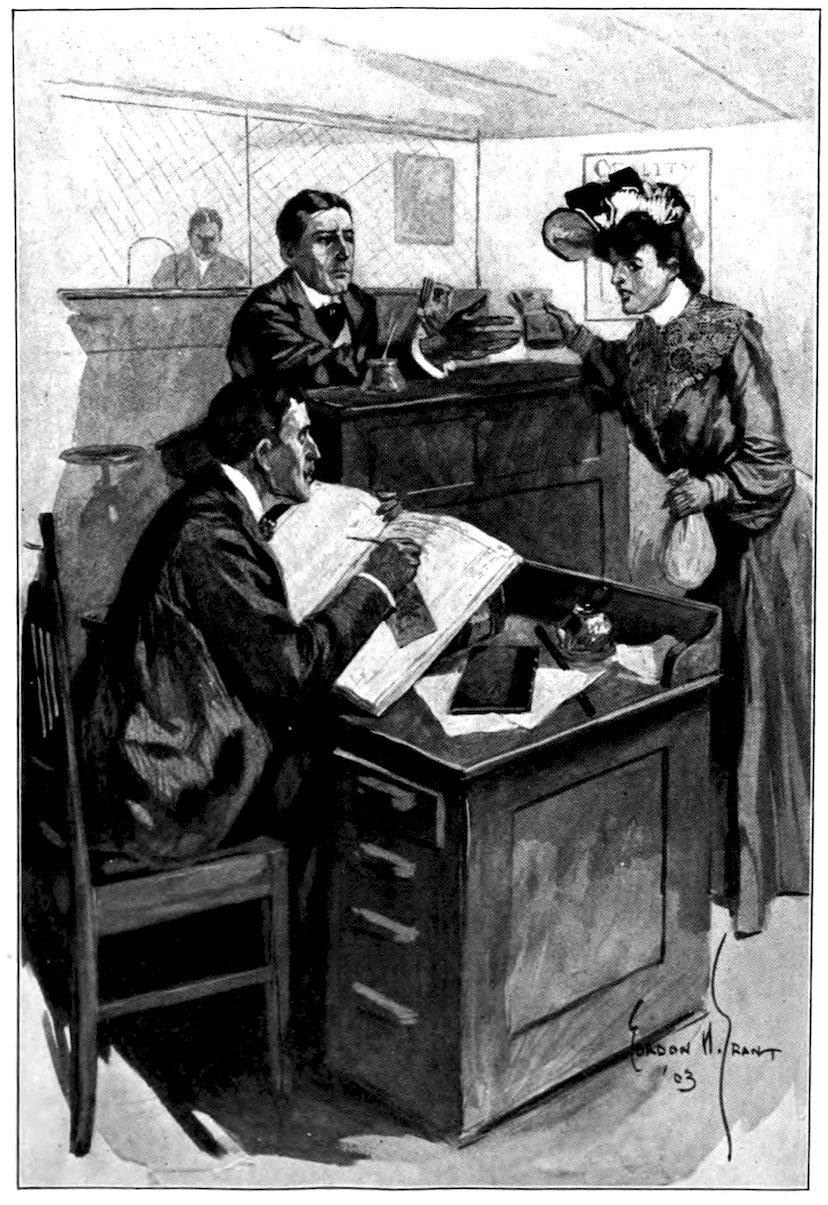
There were two of them: the First National,
familiarly known as the White Bank, and a private
bank, known as the Grey Bank, and they stood side
by side in the same imposing block, with marble
front and massive doors of oak, and broad granite
steps. High up in the cornice was an inscription
telling that the building had been erected in 1875
by Robert White, Esq. He would like to have had
Judge Robert White, instead of Robert White,
Esq., so proud was he of the title held for a year
only, and for which he was indebted to the resignation
of an intimate friend and the influence of
money. But his wife dissuaded him from it, but
could not keep off the “Esq.” He was both a
judge and a ‘squire, he said, having held the office
of Justice of the Peace for two terms, and being
called ‘squire before he became a judge, and one of
the titles should go down to posterity.
He was a weak man, and a proud man; weak in
6judgment and common sense, and very proud of his
birth as son of a General and grandson of a Governor,
with a line of ancestry dating back nearly to
the flood. He was proud, too, of his money, and
his house, the finest in Merivale, and his handsome
grounds, and of his marble block, the third floor of
which was occupied by a Masonic lodge, the second
by law offices and club-rooms, and the first by the
two banks. Of one of them—the National—he
was president, and that fact added to his high opinion
of himself as the first man in Merivale.
“Yes, my boy—the first man in Merivale, and
don’t you forget it, or that you are my son—the
grandson of a General and the great grandson of
a Governor, with all sorts of high blood behind
them,” he said to his only son and heir, Herbert.
“Pick the best there is in society or none,” was his
injunction, and by the best he meant those with the
most money, without reference to character or
morals.
In some respects Herbert was a son worthy of his
father, and when a lad, had built a wall of reserve
between himself and the boys whom he thought
second-class in the Merivale High School.
With the girls, however, it was different, and
when Louie Grey’s bright brown eyes looked fearlessly
at him, and when Louie called him a blockhead
because he failed to work out a simple problem
in algebra upon the blackboard, and then, to make
7amends, whispered to him the answer to a question
in history over which he was hopelessly floundering,
he forgot the White blood of which his father
had taught him to be so proud—forgot his pedigree,
and went over the wall to meet the young girl with
the brown eyes and hair, who had no pedigree, so
far as he knew, and who certainly had no money.
The Greys were new-comers in Merivale, and no
one knew anything about them, except that they
had come from Denver and seemed to be very
poor. But both Mr. Grey and his wife were so
affable and had about them an air of so much
good breeding and refinement that it won them
friends at once, and a place in the best society
of the town—always excepting, of course,
Judge White, who held aloof from strangers until
he knew the length of their purse, or their pedigree,
both of which he considered indispensable if he
were to take them up. The Greys had neither, he
was sure, for they rented one of his cheap cottages
in what was known as White Row; and Louie,
when questioned by Herbert as to her pedigree, said
at first that she didn’t think they had one; or if
they had, they didn’t call it by that name; and
when he explained to her what he meant, citing his
grandfather and great-grandfather as examples of
his meaning, she answered at once:
“Oh, yes, I have, or did have, a grandfather and
great-grandfather, like you—captains of ships,
8which sailed from Nantucket out upon the seas, and
were called either smugglers or pirates, I don’t
know which. I’ll ask father.”
She did ask him, and, with his fondness for
humor and jokes, Mr. Grey replied, “Tell him
both, by all means, and that you have quite as
blooded a pedigree as he can boast.”
How much of this Herbert believed, it were difficult
to tell. Smugglers and pirates had an ugly
sound, and for a time he kept aloof from the girl
whose ancestry was so questionable; then her sunny
face and saucy eyes prevailed over prejudice, and
they became inseparable. She was no end of fun,
he said, and followed fearlessly where he led her.
She was not afraid of snakes, nor bugs, nor beetles,
nor worms, for he had tried them all upon her, and
she had neither screeched nor flinched, but paid
him in his own coin, and made him more afraid of
her than she was of him. She could climb a fence
or a tree as fast as he could, and faster, too, as he
knew by experience; for once, when he started up
an elm in which there was a robin’s nest, with four
blue eggs in it, she went after him like a little cat,
and, seizing him by the coat collar, nearly threw him
to the ground and made him give up the nest, to
which the father and mother robins, who had been
uttering cries of distress, returned in peace, finding
their eggs unmolested.
“I’ll never speak to you again,” she said to him
9when she had him safe on the ground, with her
hand still holding to his collar, while he made frantic
efforts to get away from her.
She didn’t speak to him for two days; but when,
on the third, she found an orange in her desk, with
a few words scrawled on a piece of paper, “Haven’t
you been mean long enough, and ain’t you never
going to give in?” she gave in, and allowed him
to walk home with her after school, past his own
handsome house, with its grounds sloping down to
the river, and on to the narrow back street where
she lived in one of his father’s tenement houses. It
was not a very attractive house, and Herbert always
shuddered when he saw it and thought that Louie
lived there. There were six cottages in a row, all
of the same size and architecture, except one at the
north end, where the only shade tree on the street
was growing. This was a little larger and had in
front a double bay window, which gave it an air of
superiority over its humbler neighbors. When Mr.
Grey came to Merivale houses were scarce and rents
high. In White Row, Bay Cottage, as it was called
on account of its window, chanced to be vacant,
and after searching in vain for a house in a more
desirable neighborhood, Mr. Grey took it and became
one of the White Row tenants.
“My tenants,” Judge White was wont to say,
with a strong emphasis on the my, as if they belonged
to him, body and soul, while to the tenants,
10when he came in contact with them, he had an air
as if they were as far beneath him in the social scale
as it was possible for them to be. “A wretched
lot,” he said, “who never seem to think it as incumbent
upon them to pay their rent as their
grocer’s bill; act as if I or’to give it to ’em. In
fact, old Nancy Sharp once told me I or’to, because
I was rich and she poor.”
To this, however, Mr. Grey was an exception.
His rent was always ready, and he paid it with a
manner which made his landlord feel that if there
were any superiority, it was not on his side.
On the afternoon when Herbert accompanied
Louie home, carrying her books and her umbrella,
for the day had been showery, he found his father
in the cottage, receiving his money for the quarter’s
rent, and looking puzzled and disconcerted.
“I’ll think about it, and let you know; but I
warn you now that I don’t believe it will work.
It takes experience and a pile of money. No, sir;
I don’t believe it will work,” he said, as he placed
his rent in a pocketbook bulging with bills, for this
was the day when he went the rounds among his
tenants himself, instead of sending an agent.
What wouldn’t work, he didn’t explain to Herbert,
whom he took away with him, questioning
him closely as to the frequency of his visits to the
Greys, and telling him to remember who he was
and what his ancestry.
11At dinner that night he was more communicative,
and said to his wife, “What do you suppose Tom
Grey wants to do?”
Mrs. White could not guess, and her husband
continued: “In the first place, he has given notice
that he will quit my tenement for a larger house at
the end of the next quarter; and I don’t like it.
No, sir! I don’t like it. I never fancied the fellow.
Puts on the fine gentleman too much for a
chap as poor as I suppose he is. But he’s a good
tenant—one of the very best; pays up to the hour,
and never asks for repairs, papering nor nothing;
while the rest of ’em in White Row hound me,
spring and fall, for paper or paint, but mostly
paper, which I believe they tear off as fast as it is
put on. Old Nancy Sharp had the impudence to
ask me for screens to keep the flies out! Lord
Harry! they’ll want gas or electric lights next!
But what beats me is Tom Grey’s setting up so
high. Says he has lately come into possession of
quite a little money. He has been West for some
weeks, and has just got home, and is going to take
a better house, and wants to rent the vacant rooms
next to the Bank; and for what, do you suppose?
You’d never guess.”
Mrs. White didn’t try, and he went on: “For a
bank! A private bank! To be known as Grey’s
Bank! Think of it—a one-horse bank, side by side
with mine! It’s a piece of impertinence, and I
12would have refused outright, if the place had not
been vacant so long, and I hadn’t had such pesky
work with the last man, who went off leaving me
in the lurch to the tune of three hundred dollars.”
Here the judge stopped to take breath, while his
wife asked, “Where did he get the money to start
a bank with?”
“The Lord only knows,” her husband replied.
“Was poor as Job’s turkey when he came here.
Why, didn’t his wife do some sewing for you?”
Mrs. White nodded, and the judge went on:
“And now he has money for a bank! Gambled
for it, maybe, when he was gone. He is just the
quiet, sly sort of a fellow to do that thing.”
“Mr. Grey never gambled, I know he didn’t,”
Herbert spoke up. “He’s a gentleman, if he is
poor, and he has been through college. Louie told
me so, and you have only been to common schools!”
Herbert was quite eloquent in his defense of Mr.
Grey, but his father frowned him down by saying,
“You seem to be posted in Mr. Grey’s affairs—too
much so—and I want you to keep away from there—carrying
home that girl’s books and umbrella!
Remember who you are.”
Herbert’s answer was to leave the room and slam
the door behind him, while his father continued:
“That boy is too thick with the Grey girl, and if
her father gets into a bank, it will be worse yet.
I think I’ll not let him have it.”
13“But,” his wife rejoined, “if you do not rent to
him some one else will, and your rooms will stay
vacant. Don’t be foolish. It isn’t likely he can
run more than a year.”
“No, nor half that, before he bursts up. Who
is going to deposit with him, when there is the
First National? Nobody; but I’ll have the lease
drawn for a year, and he’ll have to pay whether or
no, half down anyway! Said he had had some
experience in a bank, and liked it. Well, let him
try. I’ll give him six months before he closes up.”
As a result of this conversation, the rooms next
to the National Bank were leased for a year to Mr.
Grey, who also hired and moved into a more fashionable
part of the town than White’s Row, where
he had at first lived. There was some speculation
as to where he got the money so suddenly for so
great an expenditure when he was not in any business.
But on this point he was non-committal, as
he was on most subjects. He never talked much,
but his pleasant, genial manners had made him
popular, and people were glad to see him prosper,
and glad to have a second bank in town. They
needed it, they said, for Bob White was getting so
bigheaded and overbearing, that it was well to
take him down a bit, and they hoped Tom Grey
would succeed.
He had no fear of it himself, and entered heart
and soul into the fitting up of the new bank, and
14never asked patronage from any one. He knew he
should get it, and he did. Slowly at first, as people
were a little timid, and those who had money in the
National did not care to draw it out and place it
elsewhere. As time went on, however, and there
was no sign of the blow-up Judge White had predicted,
confidence increased. There were more deposits
and larger, and by the end of the year the
Grey Bank was doing a good business—small, of
course, compared with the White Bank, but good,
and constantly increasing.
“Can’t go on long. Mark my words. Can’t
go on,” Judge White would say, shaking his head
warningly to some customer who, he knew, was
taking a part of his funds from his bank to place it
with his rival. “There goes Widow Brown now
with five dollars, I dare say, and old maid Smith
with ten, maybe. What is that to what we have?
A drop in the bucket. You’ll see, you will, where
he’ll land with his washerwomen’s and servant
girls’ deposits.”
This was Judge White’s opinion of the Grey
Bank, and when the first lease expired, he would
have liked some good reason for refusing to renew
it. But there was none. The rent was paid as
regularly as it had been in the little tenement in
White’s Row. There was no other applicant for
the premises, and he contented himself with raising
the rent a hundred dollars, to which Mr. Grey made
15no demur. He was satisfied and happy, and an
ideal banker, greeting every one with a pleasant
smile and word, and making loans in small amounts
where the risk was so great that the White Bank
would never have taken it. To all human appearance
he was on the top wave of prosperity and enjoyed
it to the full.
He was building a new house now, on a lot a
little out of the town, and on the same street with
Judge White. It was to be first-class in every respect,
and people watched it as it progressed, and
were glad for Tom Grey. He was a good fellow
every way, and a good citizen, giving freely of his
means and working for the public good, and they
rejoiced in his good fortune, and made him one of
the Village Board and School Board, and would
have made him a vestryman if he had not declined
that office, saying he was not worthy of it. That
Judge White should be a little jealous of him was
natural, but he was too proud to own it, and only
shook his head ominously whenever he was mentioned.
“Let him run,” he would say to himself. “Yes,
let him run. He will soon reach the end of his
rope, if my surmises are correct. Then we’ll hear
howling from those washerwomen who are putting
their weeks’ earnings in his bank. Yes, let him
run!”
CHAPTER II HERBERT AND LOUIE
16
Four years passed, and the Grey Bank had not
come to the end of its rope. Many besides Widow
Brown and old maid Smith, and washerwomen generally,
deposited in it, and Mr. Grey seemed to be
increasing in wealth and prosperity.
The new house had long been finished and occupied,
and was a model of simple elegance, outside
and in. The Greys had good taste, and whatever
they touched fell into the right place, and harmonized
with whatever was nearest to it. Louie’s artistic
eye detected an incongruity at once, and as she
directed the most of her surroundings, people said
of the grounds and the house that they were like
pictures in which the outline and coloring were perfect,
while Louie was the fairest picture of all.
She was nearly seventeen, with a face of rare
beauty, especially her eyes, which Herbert White
thought the handsomest he had ever seen. She did
not climb fences or trees with him now. She was
getting too old for that, but she went rowing with
him on the river, after the white lilies, and took
long rambles in the woods, searching for the early
17spring flowers, and later on for ferns and the red
sumach berries. Sometimes she drove with him in
the fancy turn-out which his father had given him
on his birthday. But this did not occur often, for
such drives were highly disapproved by Judge
White, who read his son many a lecture on his bad
taste in admiring a girl in Louie’s low estate.
“Good thunder, father,” Herbert said to him
one morning when the lecture had been longer than
usual, “isn’t Louie Grey as good as I am, if her
father hasn’t quite as much money as you? He is
a banker and a gentleman, and folks like him, and
put him in office. Why, he is President of the village
now, and—and—I never told you—but that
time Mr. Smith, our church warden, died and we
had to have a new one, they offered it to Mr. Grey,
who refused it, just as he refused being vestryman,
saying he was not good enough. So they took you,
because you had a lot of money, I know; I heard
about it. They said you were proud and overbearing,
but on the whole a good man, and if Mr. Grey
wouldn’t take it, there was no one else, so they
elected you. I wanted to tell you then, but you
seemed so pleased I didn’t.”
The judge was very pale by the time Herbert finished
this statement, and for a church warden very
angry, too. He didn’t swear, but he wanted to,
and did say some things not very complimentary to
the church generally and Mr. Grey in particular.
18He was proud of being church warden, and that
Tom Grey should have been mentioned in preference
to himself was galling to his pride, and increased
his dislike for the man and everything pertaining
to him, while Herbert was again told in
strong terms to let the Grey girl alone.
“Nobody knows what her father was before he
came here, or how he lived either. No business till
he opened a bank, I’ve heard it hinted—but I ain’t
going to slander anybody; this I’ll say, though, I
don’t believe Tom Grey’s record is the cleanest that
ever was. Needn’t tell me that one-horse bank of
his can pay for the big swath he is cutting. Stands
to reason he has some other way of getting money,
and always has had. Time will tell. Warden of
the church! I’d laugh. He had sense enough to
decline, and I’ll resign, too, by the Lord Harry!
Took me because I had money and there was
nobody else! Yes, sir! I’ll resign, and let ’em
have Tom Grey if they want him.”
The judge was very red in the face by the time
he had finished this tirade, to which Herbert had
listened impatiently. He had seen a plaid skirt and
red waist down the street, and was anxious to get
away; but his father was not yet through, and,
after mopping his face and taking breath, he went
on:
“The girl is all right in her place, but my son
should look higher, and remember the kind of
19family he belongs to. Do you think your cousin,
Fred Lansing, would go scampering round the
country with Tom Grey’s girl? No, sir! There’s
a young man who knows how to demean himself,
and it would be well for you to imitate him. He is
coming here, too. I’ve just got a letter from his
mother, my sister and your aunt, Mrs. George
Lansing. They will visit us this summer and bring
that young lady who lives with them. There’s a
chance for you. What is her name? Blanche—Blanche—?”
“Blanche Percy—old enough to be my grandmother,”
Herbert answered contemptuously, as
he turned on his heel and walked away, declaring
he didn’t care for a hundred Blanche Percys and
Fred Lansings. “I have had him dinged into my
ears as a model to imitate ever since I can remember,”
he said to himself as he went rapidly down
the street in the direction of the plaid dress and red
jacket.
And yet in his heart he had a great admiration
for his cousin Fred, who was six years his senior,
and every way his equal in money and position and
pedigree, if indeed he was not his superior. His
mother was a White, with all the prestige of the
White lineage, while on the Lansing side was a
long line of judges and governors and bishops, and
two generals, both in the Confederate army. One
of them was Fred’s father, who was a Virginian,
20and had been killed at Gettysburg. Judge White
was very proud of his connection with the Lansings
and very proud of his nephew Fred, who had been
to college, and travelled round the world, and carried
himself as if he had in his veins the blood of a
hundred kings. He had not been often in Merivale,
and it was two or three years since Herbert
last saw him, in Washington, where his mother had
lived for some time, and where her house was a
resort for the best society in that cosmopolitan
city. But he was coming now, and Herbert felt
a thrill of pride as he thought of showing off his
distinguished relatives to the plain people of Merivale.
“I wonder what he will think of Louie, and what
she will think of him, and what father meant about
Mr. Grey’s record,” he said to himself, as he turned
a corner and met the girl face to face.
“Hallo,” he said, and she replied, “Hallo,” as
if they were talking through a telephone; and then,
unmindful of his father’s orders that he should let
the Grey girl alone, Herbert continued: “Come on
down to the river. I have a lot to tell you.”
It did not take them long to reach the river, and
the boat which Herbert had named for Louie was
soon floating out upon the water, with the two
young people in it.
“Well, what is the lot you have to tell me?”
Louie asked, removing her hat with one hand, and
21letting the other hang over the side of the boat in
the river.
Once or twice Herbert had heard insinuations
from his father and a few others with regard to
Mr. Grey’s career before he came to Merivale, and
of the possible way in which he was running his
bank and having so much money to spend, and had
always been very angry.
“I’ll ask Louie some time,” he had thought, but
had never brought himself to do it until now, when
his father’s hints were fresh in his mind. It was
rather an awkward thing to do, and he hesitated a
moment before he began:
“What did your father do before he came to
Merivale?”
It was a strange question, and Louie looked her
surprise as she replied, “Do you mean, how did he
get his living?”
“Why, yes, I guess that is what I mean. Was
he a banker, or merchant, or what?”
Louie’s brown eyes looked steadily at him, and
her face flushed as she replied very frankly:
“I hardly know what he did; there were so
many things, and he did not stay long in any. Got
tired and tried another. He was in a bank for a
while, and in a store and insurance office, and I
don’t know what else; a rolling stone, mother used
to call him, but he managed at times to make a lot
of money, which he spent very freely, and then
22didn’t have much till he made some more. He is
doing a great deal better now. Why do you ask
me? Have you any particular reason?”
Louie’s eyes were very bright, and Herbert felt
his own droop beneath them. He had not realized
all his question might lead to, and was wondering
how to answer her, when she again said to him:
“What is it? Tell me!”
“Oh, nothing much,” he began. “There are a
heap of liars in the world—jealous pates—who hint
that your father is—a—or was—a—”
Here he came to a dead stop, for Louie’s eyes
were getting dangerous.
“Is—er—was—er—what? Speak out, or I’ll
get up and go straight home.”
“I’d like to see you do it,” Herbert answered
laughingly. “Don’t bounce about so. You’ll upset
the boat, and I can’t swim.”
“I can,” she said, contemptuously; “and what
is it? What do the liars say of father? That he is
a thief, or murderer, or gambler, or what?”
“Why, no—or, yes—er—you’ve hit it partly,”
Herbert stammered, but got no farther, for Louie
sprang to her feet with a movement as if she were
going to jump overboard, and did nearly upset the
boat.
“Sit down, Louie. Sit down. Don’t be so peppery,
and I’ll tell you. Some folks do say that he
gambled before he came here, and speculates now.”
23“It’s false!” Louie exclaimed. “It’s false!”
and she struck her hand in the river with such
force that great splashes of water were thrown into
the boat.
“Of course it’s a lie, I know that,” Herbert said,
trying to quiet her. “I don’t know why I told
you, only I wanted to contradict it.”
“You may. You can. He never gambled, and
as to speculating, lots do that all the time in New
York and Chicago and everywhere. You would do
it if you could make money by it. But I don’t
believe father does. I know he never gambled;
that’s different,” Louie answered vehemently; then,
suddenly, as if some wave of memory had swept
over her, there came a hard look into her eyes, and
drops of sweat stood around her lips, which were
very white, as was the rest of her face.
Herbert thought she was going to cry, but she
only said very low:
“Let’s go home.”
“No, no—not yet. It is so nice out here,” Herbert
replied. “There is more I want to tell you.”
“If it is about father, I do not wish to hear it,”
Louie said.
“It isn’t,” Herbert replied. “It is about my
cousin, Fred Lansing. You have heard of him?”
Louie had heard of him, as a relation of whom
Herbert was very proud, but in her excitement she
cared to hear nothing more. She wanted to go
24home, she said; but Herbert pulled farther up the
river toward a bed of white lilies, and kept talking
to her of Fred and his Aunt Esther, who were coming,
with a Miss Blanche Percy, to whom his Uncle
Lansing had been guardian, and who lived with his
aunt. This Miss Percy, he said, was born in Richmond,
where his aunt lived before the war. She
once had a twin brother, he had heard, who killed
himself, or was killed, or something. They never
talked about it. She was a great heiress, and his
father would like him to marry her.
At this point Louie began to show a little interest,
and looked up quickly, while he continued:
“But that’s absurd. She is as old as Fred, if not
older. Boys don’t marry their grandmothers, do
they?”
“I should think not,” Louie replied, and her
head went up a little more squarely on her shoulders.
“When are these fine folks coming?” she
asked.
“Before long, I guess, and then there’ll be some
grand times in town, you bet. I heard mother say
once that if the Lansings ever came here she’d give
a party which would astonish the natives. She’d
have a brass band and a string band and a caterer
and everything O. K., and have people from Worcester
and Springfield, and only the very first in
town.”
“Then I shall not be invited,” Louie said, with
25a snap in her voice corresponding to the snap in
her eyes.
“Why not?” Herbert asked in surprise.
“Because you would not invite the daughter of
a gambler to meet your fine friends, and that is
what you said my father was,” Louie answered.
“I said nothing of the sort,” Herbert responded
hotly. “I told of some hints I wanted to contradict.
I am sorry I told you, and I know it isn’t
true.”
To this Louie made no reply, but there came into
her eyes a second time the same hard look which
had been there once before as she talked of her
father. Ordinarily she would have been greatly
interested in the party, of which there were never
many in Merivale, but she was too anxious to get
home and confront her father with what she had
heard, to care much for Fred Lansing, or Blanche
Percy, or the party to which she probably would
not be bidden.
Herbert was now rowing back to the boathouse,
and almost before the landing was reached Louie
sprang on shore, and, without a word, sped away
like a deer in the direction of her home.
Her mother was out, but she found her father in
the little room he called his den, where he spent a
good deal of his leisure time smoking and reading,
and looking over papers and letters, of which he
had a great many.
26Louie never hesitated when a thing was to be
done, and, rushing in upon him, she startled him
with the question:
“Father, are you a gambler?”
If she had knocked him down, Mr. Grey could
not have been more surprised.
“A gambler!” he repeated, the pen with which
he was writing dropping from his hands and his
face white as a corpse. “What do you mean?
Who has said this of me?”
“It does not matter. I have heard that it was
hinted. I said it was a lie, and it is. You are not
a gambler. If I thought you were and that the
money you give us so freely was obtained that
way, I’d—I’d—burn my dresses! I’d smash the
furniture! I believe I’d set fire to the house!”
She looked like a little fury, with her flashing
eyes and flushed, eager face, and Mr. Grey drew
his chair back from her as if afraid she might do
him bodily harm.
Two or three times he tried to speak, but the
words he wanted to say were difficult to utter and
his lips twitched nervously.
“Say, father,” she continued, “are you a gambler?”
He was glad she put the question that way, and
answered her clearly and distinctly:
“No, daughter, I am not.”
“I knew it, and I’m so glad,” and Louie’s arms
27were around his neck, and she was smothering him
with kisses, each of which seemed to burn the spot
it touched, as he tried to disengage himself from
her, and asked her to tell him what she had heard.
She told him all at last, and although it was not
much, it was the first breath of suspicion which had
reached him in his prosperous career, and it struck
him harder than Louie ever dreamed.
“Don’t tell your mother,” he said. “It is not
necessary to trouble her.”
“Of course not,” Louie answered, “but what
are you going to do? Won’t you arrest ’em? Sue
’em for slander, or something?”
Mr. Grey laughed and answered: “Sue whom?
That boy, or his father, from whom, I think, the
whole story started, because he is jealous of my
success? No, Louie, that is not my nature, and it
is the wiser plan to pay no attention to a story
which will die of itself if it is given nothing to feed
upon. I am not a gambler. Perhaps I speculate a
little now and then in a safe, legitimate way, but
that is very common. And now go.”
He was quite himself again, and, with a load
lifted from her mind, Louie went out to meet her
mother, who had just come in.
She did not see Herbert again, to speak with
him, that day or the next, although he passed the
house two or three times very slowly, and she knew
he was hoping to get a sight of her. The next day
28a new wheel came to her, and, anxious to show it
and try it, she started out for a spin, going past the
White house, at which she looked almost as anxiously
as Herbert had looked for her the day before,
and with better success, for she had scarcely turned
from that street into the Boulevard when she heard
the whir of a wheel behind her, and Herbert came
scorching to her side, nearly running her down in
his headlong haste.
“I say, Louie,” he began, “where have you kept
yourself? It’s an age since I saw you. I hope you
are not mad at what I told you. I wish my tongue
had been cut out before I did it; and isn’t your
wheel a dandy? Don’t ride so fast. I want to see
it. Are you mad?”
“No,” Louie answered curtly, stopping short.
“I told father what you said, and it isn’t true, and
if you ever hint it again, I’ll have you arrested,
and your father, too. I know he is at the bottom
of it, because he is jealous of father, and I’ll never
speak to you again if you don’t contradict it every
time you hear it. My father a gambler! Not much!”
She had said what she had to say, and was
ready to forgive and be forgiven, and to talk of her
wheel, which, she said, had cost seventy-five or a
hundred dollars, she didn’t know which.
“It was not bought with gambling money,
either,” she continued with a toss of her head.
“Father gave a check on his bank.”
29Herbert thought of some things he had heard
with regard to the management of the bank, but
wisely forebore any comment. He was too glad to
have Louie back on any terms, and the two were
soon bowling far out into the country, Louie keeping
a little in advance, but near enough to Herbert
to hear what he was telling her of the Lansings,
who, he said, were coming the next day on the two
o’clock train from New York. The party was a
sure thing, for his father and mother had settled it
that morning at breakfast. They decided, too,
that no one in Merivale should be invited except
those to whom his mother was indebted and those
who called upon Mrs. Lansing and Miss Percy. “So
you be sure and call with your mother,” he added.
Louie laughed, and said she shouldn’t trouble
herself to call upon such old people, nor would they
expect it, but she would tell her mother. Then she
made a long, rapid sweep, and turned towards
home, followed by Herbert, who with all his scorching
could scarcely keep up with her, for she seemed
to fly, and her wheel was proving worthy of its
name, “The Flyer,” stamped upon it in silver letters,
with the date of its gift to her.
“I don’t suppose I shall see you while your
grand folks are here,” she said as she dismounted
at her gate.
“Oh, but you must see Fred,” Herbert replied,
and the last thing she heard from him as he went
30down the road was something about Fred, the best
fellow in the world.
The next day, when Louie heard the New York
train, she took a book, and seating herself upon the
piazza, waited for the White carriage. She had
seen it go by with Herbert in it, and in the course
of half an hour it came back, with Herbert and a
young man on the front seat, and two ladies behind
them, presumably Mrs. Lansing and Blanche Percy.
The former was short and fat and sat very erect,
looking curiously about her through a gold-handled
lorgnette.
“Dumpy and Frumpy and Proud,” was Louie’s
mental verdict of her; then she scanned the lady
beside her, who was tall and slender and fair, and
dressed in mourning, with a look of care or fatigue,
or both, on her face, which was very pale and very
sweet: “Rather pretty, with an air about her,”
Louie thought, and turned next to the young man,
Fred Lansing, who was sitting on the side of the
open carriage nearest to her.
As he was looking another way, she could not see
his face until, from something Herbert said to him,
he turned quickly and she saw a pale, refined face,
with perfectly regular features and a pair of large,
dark eyes, which met hers, while his hat was lifted
for a moment, as she bowed to Herbert, who had
removed his cap and was waving it towards her.
“I believe he is a gentleman, but proud, of
31course. I wonder if Herbert will tell him what
people say of my father,” she thought, and grew
hot and dizzy as she recalled the insult.
“The Lansings are here,” she said to her father
when he came home to lunch.
“The Lansings? Who are they?” he answered
abstractedly.
“Why, the grand relations of Judge White,”
Louie replied; “his sister, Mrs. Lansing, and her
son Fred. They live in Washington now, but they
did live in Richmond before the war, and there’s a
Miss Blanche Percy with them, a great heiress and
Mr. Lansing’s ward before he died. She had a
brother who was killed, or something, and I guess
that is why her face is so sad. I saw her just a
minute as she went by,” Louie added, too intent
upon her strawberries and cream to notice the
change in her father as she talked, from one of indifference
to absorbing interest.
The Lansings made no impression upon him, but
when Blanche Percy was mentioned, he became all
attention, and had Louie been observing him, she
would have seen a pallor about his lips as he
listened.
“Blanche Percy—from where?” he asked, and
Louie replied, “From Washington now—from
Richmond formerly, where I told you the Lansings
lived. They are Southerners, and big swells, Herbert
says.”
32To this her father made no comment, but asked,
“What was it about the brother? What did you
say his name was?”
“I didn’t say. I don’t know—Percy, most
likely,” Louie replied. “Herbert told me she had
a twin brother who killed himself, or was killed—the
latter probably; those Southerners are so hot-headed.”
As Mr. Grey made no reply, Louie branched off
upon the big party the Whites were to have in
honor of their guests, and to which no one was to
be invited from the town except those to whom
Mrs. White was indebted, and those who called
upon Mrs. Lansing and Miss Percy.
“You’ll call, mother, won’t you? I want you
and father to attend the party, and tell me about
it,” she said.
There was a sudden movement as of dissent from
Mr. Grey, but before he could speak his wife replied:
“I don’t think I shall trouble myself. I was
here five years before Mrs. White called upon me,
and then she came when I am certain she knew I
was out. When I returned it, she was engaged,
and she has never been near me since. I shall not
call on her or the Lansings.”
“Of course not,” Mr. Grey rejoined, with an
asperity of manner unusual with him.
He did not seem himself at all. He had a headache,
33he said, and, declining the strawberries Louie
urged upon him, left the table and went to his
room, where his wife found him lying upon the
couch, either asleep or pretending to be, for he
neither spoke nor moved when she entered the
room. He was subject to headaches, and they had
increased in frequency within the last few years.
This one seemed harder than usual, and it was not
till the next day that he went to the bank, before
which the White carriage was standing, with two
ladies in it, Mrs. Lansing and Blanche Percy, while
Judge White was just coming down the steps to
join them.
Mr. Grey would rather have passed them unnoticed,
but he never forgot to be a gentleman, and
in response to the judge’s rather gruff “good morning,
Grey,” he answered pleasantly and lifted his
hat politely to the two ladies.
“Who is that splendid-looking man?” Blanche
asked as the judge entered the carriage.
“That? Oh, that’s Tom Grey, the one-horse
banker who has set up business right under my
nose; but he can’t run long, you’ll see,” the judge
replied, as they drove away, while the one-horse
banker looked after them till they were out of sight,
with thoughts from which Louie would have shrunk
aghast if she could have known them.
CHAPTER III INVITATIONS FOR THE PARTY
34
Merivale was one of those quiet New England
towns where, compared with larger places, the people
seemed more asleep than awake, there was so
little to interest or excite them outside the routine
of daily life. There were no very poor people, for
work of some sort was plenty, and there were no
very rich people, except Judge White, whose walk,
as he put down his heavy gold-headed cane, indicated
money and the self-importance he felt on
account of it. There were four churches—Episcopal,
Presbyterian, Methodist and Roman Catholic—two
banks, a weekly paper, a high school, a book
club, a struggling literary society, three dry goods
stores, six groceries, and ten saloons, which the
W. C. T. U.’s were vainly trying to suppress.
Once in two weeks the Presbyterians and Methodists
had a sewing society, which few attended, as
it closed at five and every one went home to supper.
Once a month the Episcopalians had a meeting
of the Guild, with supper and a large attendance,
especially at supper time, when the young
people came in, glad of any break in their rather
35monotonous lives. For a time Mrs. White was
president of the Guild, but when at an annual
meeting Mrs. Grey was made vice-president she resigned,
giving as a reason that it made her nervous
to read the prayers with which the meetings were
opened. Mrs. Grey was elected to fill her place,
and made a most popular president. Under her
jurisdiction, with Louie as coadjutor, entertainments
of various kinds were instituted, and the
little town put on quite an air of hilarity compared
with what it had worn.
The Grey house was the centre of many gatherings
where hospitality was dispensed with a liberal
hand, and all who chose to come were welcome.
But there were few parties or receptions, and when
it was rumored that Mrs. White was intending to
give one, the town awoke to great activity of speculation
as to who would be invited and who slighted.
Somehow the news got abroad that only those who
called upon the guests were to be honored, and at
once the tide set in toward the White house, where
there were more calls made and more cards left
than had been left and made in a year. Mrs.
White was very reserved in manner and had no intimate
friends. She had her days when she was at
home to those who chose to call. Sometimes three
or four came, and sometimes none, and she was
equally pleased either way, as she preferred the
quiet of her own room to society, if she were expected
36to exert herself. On the two occasions
when as president she had felt obliged to entertain
the Guild, and Herbert, who was socially inclined,
had invited everybody, she had been greatly bored
and scandalized by the crowd which came, glad of
a chance to see the inside of the grand house and
say they had been there. She did not suppose there
were so many common people in the Episcopal
Church, she said. She thought they belonged
somewhere else, and after she resigned her office as
president of the Guild she withdrew from it and
thus freed herself from the obligation to entertain
it again. And still she liked the bustle and excitement
of watering places and fashionable life—if
she could be in it and not of it—could see it go on,
and not feel obliged to talk to anyone unless she
chose to do so.
People called her proud, and Herbert called her
indolent, and she was both. Now, however, with
the advent of the Lansings she roused up and
opened all her treasures. They dined in the state
dining-room. The best silver and glass and linen
were brought out. The carriage and horses stood
at the door at all hours. She went to Worcester
and interviewed the best caterer and the best florist
there, and then with Herbert sat down to address
the invitations for the party which was to astonish
the people in Merivale, and so far eclipse a little
party which Mrs. Grey had given the previous winter
37that people who attended it would never know
they had been there. To this gathering Mrs. White
had not been bidden, as Mrs. Grey had confined her
invitations to those to whom she was indebted, or
who had been polite to her. Mrs. White would
have scorned to acknowledge that she cared for
being left out. “Why should I be invited?” she
had said to Herbert, who was expressing his surprise
and saying he knew there was a mistake,
“Why should I be, when I scarcely know Mrs.
Grey?”
“It is your fault and loss, too,” Herbert replied,
while his father, who was present, chimed in, “Invited
by the Greys, who used to live in White’s
Row with Nancy Sharp! I’d laugh! They have
come up like mushrooms, the Lord only knows how,
but I can guess. I consider it a compliment not to
be invited to their blow-out. Music from Springfield,
with a caterer and flowers by the bushel!
Must have cost him a pretty sum, decorator and
all!”
“They did not have a decorator,” Herbert had
said. “Louie did it herself. She has more taste
than half the decorators in the country, and they
say the party was elegant every way, and Mr. and
Mrs. Grey were ideal host and hostess. I wish I
had been there, but young folks like me were not
in it.”
“Glad you wasn’t. I believe you are Grey mad,
38and everybody else, but I tell you I won’t have
it! No, sir, I won’t have it!” The judge growled
as he left the house.
This was in the winter, and not long after the
Grey party, which had been much talked of as
recherché in every respect. Notwithstanding what
the judge and Mrs. White had said, their slight
had secretly rankled and increased their prejudice
against the Greys. And now that the White party
was in progress, there was a chance not only to retaliate,
but to outdo all the Greys had done.
“If we are to have a blow-out we’ll do it brown
and beat the Greys. The idea! That one-horse
banker riding over my head!” the judge said to
his wife when discussing the matter with her. “If
the Greys had their truck from Springfield, do you
go to Boston or Worcester, and get the best there
is to be had. Don’t stop at prices. Did the Grey’s
have a brass band? No, only a string for dancing?
Then we will have a brass—two if you like. Beat
the Greys anyhow! That’s all I ask. Judge White
is good for any amount. We haven’t had a party
for years, and the Lansings don’t come every day.”
This was the judge’s attitude, with which his
wife sympathized to a certain extent. She really
had more good sense than her husband, but she was
largely dominated by his opinion, and when she at
last sat down with Herbert to direct the cards of
invitation, two facts were prominent to her mind.
39Her party was to surpass that of the Greys, and the
Greys were not to be invited. “We will take the
townspeople first,” she said, and began to read the
names upon her list, hesitating over some and crossing
some out as not quite worthy to meet the Lansings.
Herbert had jotted down several names, which
he submitted to his mother, and among them were
those of two Sheldon girls in the country, who, he
said, were good dancers and ought to be invited.
Mrs. White shook her head. She did not know the
Sheldons. She had already exceeded the limit set
at first to her invitations, and had drawn the line
on all country people except the Gibsons, whose son
had called on Fred, with whom he had been in college.
The Sheldons were thrown into the wastepaper
basket, with others who had preceded them,
and Mr. and Mrs. and Miss Grey were next suggested.
“Certainly not,” his mother said, more decidedly
than she had to the Sheldons. “I scarcely know
Mrs. Grey, and have never been in her house, nor
has she been here, and your father has a strong dislike
to Mr. Grey.”
“Better say ‘unreasonable prejudice.’ It’s nothing
but that,” Herbert answered hotly. “Father
has treated them like dogs, and people know it.
Why, Mr. Grey is by far the finest-looking man in
town, and Mrs. Grey is a lady, and Louie is a——”
Here he stopped, for Fred Lansing just then entered
40the room, and hearing the last words and
seeing Herbert’s flushed face, said laughingly:
“Louie is a what? and who is Louie? Oh, I
know; she is that pretty, bright-eyed girl I have
seen two or three times riding her wheel like the
wind. Is she to be one of the guests? I hope so.”
“Yes, she is,” Herbert answered emphatically,
“and she has a wonderful voice. Maybe we can
get a song from her. I am writing the names now—Mr.
and Mrs. Grey. He is in the bank, you
know, next to ours. You can help put the cards in
the envelopes, if you want to do something.”
Herbert was in a hurry to get the Greys settled
before any further demur from his mother. They
should be invited anyway, and he wrote the addresses
and passed the envelopes to his cousin, who
put in the cards of invitation and dropped them
into the basket with others ready to be delivered.
Mrs. White did not care for a controversy before
Fred, and said nothing, thinking she would remove
the envelopes before the basket went out. But she
forgot it; and when, next morning, David went his
rounds with the invitations, two were left at Mr.
Grey’s.
“Oh, mamma! Look! Invitations for us all,
and you have not called, either,” Louie cried, taking
out one of the cards and reading that Mr. and
Mrs. White would be at home Thursday evening,
June —, from eight to twelve.
41She was greatly excited, for she had thought a
good deal of the party, of which so much was being
said in town, but her mother’s decided “We shall
decline” dampened her spirits at once. There was
a storm of tears, under which Mrs. Grey might
have given way but for her husband, who, when
consulted, was more decided than his wife, and the
regrets of the three were sent to the White house
on the day preceding the party, bringing Herbert
at once to the Greys with inquiries as to the reason
why Louie, at least, could not come, even if her
parents stayed away.
“I’ve told Fred so much about you,” he said,
“and he wants to see you, and I was going to have
mother get you to sing; Miss Percy is so fond of
singing, and such a good judge; and now everything
is going wrong. The head caterer cannot
come, and will send some one in his place, and most
likely the crew will be drunk and serve ice cream
first, and leave the sandwiches in the pantry, as
they did at Alice Rogers’; and now you are not to
be there, and I wish we were not to have the blow-out,
and I don’t care if it rains cats and dogs to-morrow.
I hope it will.”
Having delivered this speech, which did not at all
move either Mr. or Mrs. Grey, Herbert flung himself
out of the house, with a feeling that he was a
much-abused young man, and that without Louie
the party would be a failure.
CHAPTER IV THE MORNING OF THE PARTY
42
“Yes, I hope it will rain,” Herbert said to himself
as he went tearing along the road towards
home.
Just why he wished it to rain he did not know,
except to spite somebody—his father, perhaps, who
was so unreasonably bitter against the Greys, “the
very nicest people in town, while Louie was certainly
the prettiest girl, and would cast in the shade
anyone, whether from Springfield or Worcester or
Boston,” and he wanted Fred Lansing to see her.
It was a decided shame that she was not coming.
Yes, he hoped it would rain so hard nobody would
come.
It did not rain, but there was a shower in the
night, which laid the dust and made the morning
fresher and more delightful.
“Just the time for a drive,” the judge said to
his guests after breakfast was over. “We want to
get away from this clatter, with things generally
upside down and Susan so rattled she don’t know
what she is about.”
A part of the waiters from Worcester had come
43to look over the premises and make suggestions,
and they were already in the kitchen and butler’s
pantry and rousing the ire of the cook and housemaids
with their criticisms. A florist was there
with his assistants, and the rooms were full of palms
and flowers and potted plants. Crash was being
laid down for the dancing on a very broad and long
piazza, which was screened from public view by
wide awnings, which could be rolled up if the night
proved hot, as it bade fair to do. At one end of
the piazza the orchestra was to sit, and the piano
had to be moved into its place, with chairs and rugs
and divans for the lookers-on.
In the grounds preparations were making for the
band which was to play between the dances.
Chinese lanterns were being suspended in fanciful
lines from the trees and from the house to the entrance
of the grounds, and everywhere were the
hurry and bustle attending preparations for a large
entertainment, both outdoors and in. Not accustomed
to giving companies, Mrs. White was threatened
with a nervous headache, and was in a state
of wild excitement, giving the most contradictory
orders and bewildering her assistants generally.
Taken as a whole, the house was topsy-turvy, with
sixteen people at work, and none of them seemingly
level-headed except Fred Lansing, who, if allowed
to do it, would have brought order out of confusion,
so quiet and systematic were all his plans and movements.
44But the judge insisted upon taking him for a
drive, saying they would go to the bank first, as he
wanted to see his cashier, who had sent him a note
early that morning, telling him that Godfrey Sheldon,
a farmer, who lived in the country and was his
heaviest depositor, had told him the night before
that he was coming the next day to draw out his
five thousand dollars.
“Of course, we can stand a great deal more than
that,” the cashier wrote, “but wouldn’t it be safe
to ask Sheldon to leave a part for a day or two,
until we receive that loan due to-morrow?”
“No, sir!” the judge said, as he read the note.
“I’ll never ask any man to wait for a dollar. My
bank asking time! I’d laugh. Let Sheldon have
his money. He is an old curmudgeon, anyway,
and has to be handled with gloves. I wonder if he
was invited to our party. It is like him to take a
miff if he isn’t; he feels himself of so much importance
because he was sent to the Legislature one
winter and had Hon. before his name. Susan,
where are you?”
Susan came with a big white apron on, her mouth
full of pins and a ball of twine in her hands.
“Susan, were the Godfrey Sheldons invited?”
“Godfrey Sheldons—who are they?” Mrs. White
replied, spitting the pins from her mouth.
“Why, that red-headed chap in the country who
went to the Legislature and thinks he knows all
45creation; biggest depositor in my bank, with two
red-headed girls like himself. You must know ’em.
They sit three pews from us in church, across the
aisle, and wear infernal big hats, while he reads the
loudest of anybody, as if the Lord was deaf, and
looks round to see who is listening to him. You
must know him.”
Mrs. White did remember the big hats and the
pompous man, who read scarcely louder than her
husband. “But I have no acquaintance with
them,” she said. “I believe Herbert did suggest
that they be invited, with a lot of others, who went
into the waste basket. I asked the Gibsons from
the Corners. Their son was in Yale with Fred,
and their daughter has been to Vassar, but I didn’t
suppose you wanted all the country people invited
who deposit with you, or I would have taken your
bank list.”
“Of course not,” the judge replied. “That
would have included Nancy Sharp and a lot more
like her. Maybe that is what ails Sheldon, who is
drawing all his money at one lick, five thousand
dollars, without giving us notice. Not that it will
burst the bank, but it looks queer when he has
always been so friendly with me.”
There was a call for Mrs. White, and she hurried
away, giving no more thought to Godfrey Sheldon
and his red-headed daughters.
The carriage was at the door by this time, and
46the judge, with his sister, Miss Percy, and Fred
Lansing, were soon driving in the direction of the
bank. As they turned into a cross street they
passed Louie, resting on her wheel and talking with
a young man, also on a wheel, who seemed to have
come from the opposite direction, and was evidently
telling something which excited them both. As the
carriage came up their voices dropped, but Fred
Lansing was sure he caught the word “bank,” and
remembered afterward the peculiar look both gave
to the judge.
“That’s an awfully pretty girl,” Fred said to
Miss Percy. “A Miss Grey, isn’t it?” and he
turned to the judge, who answered, rather coldly:
“I didn’t notice particularly. There is a Grey
girl in town some people think pretty. She is generally
on the street—quite a gadder. She is Tom
Grey’s daughter. He is running a little one-horse
bank beside mine. But he can’t hold out, with no
capital that anybody knows of. I gave him six
months when he started, and he’s been at it four
years, but he’ll come to the end of his rope. Yes,
sir! you’ll see. Hallo! what under the heavens
are those women running like that for? Is there a
fire?” he added, as on passing a corner he saw several
women running rapidly in the direction of
Main Street, headed by Nancy Sharp, the washerwoman
from White’s Row, a part of whose small
savings were deposited in his bank, and who worked
47for his wife at intervals by way of paying her
rent.
Two of the women had on sun-bonnets, but
Nancy was bareheaded, with her sleeves rolled up
and her big apron on, showing she had just come
from her washtub.
“What has happened?” he continued, as a
woman came from another door and ran bareheaded
down the street, where she was joined by three
more, all evidently greatly excited, and talking
loudly as they ran.
They had now reached a point from which they
could see the white marble walls of his bank in the
distance. In front of it quite a crowd was gathered,
while it seemed to be the point toward which
the women were running. David, the coachman,
called the judge’s attention to it, and the latter was
standing up to look when Louie Grey darted by on
her wheel.
“Hallo, girl! what’s your name? Louisa, ain’t
it? What’s up? What’s that mob about? Stop,
can’t you?” the judge called, with a feeling that
Louie was bound for the mob, and could tell him
what it meant.
His voice was like a trumpet, and the “Louisa”
reached Louie, who turned quickly, and, coming
back to meet the carriage, replied in some surprise,
“Why, it’s a run on the bank. Don’t you know?
Haven’t you heard?”
48With a slight inclination of her head to the ladies
and to Fred Lansing, who had lifted his hat, she
was off like the wind, while the judge sank down
upon the seat, and, rubbing his fat hands complacently
together, said:
“A run on Grey’s bank! I told you so. I
knew he couldn’t go on much longer. No, sir!
He’s come to the end of his rope; speculated a little
too often. I knew he would. Drive faster, Dave;
I want to get there.”
Dave touched the spirited blacks, which sprang
forward at so rapid a rate that they came near running
into a van full of household goods before it
could turn aside.
“Hallo, there, Dave! Stop a minute,” the
judge said to the driver, who pulled up suddenly.
Then to the truckman, whom he knew, the judge
continued, “I say, Pete, when did the run on
Grey’s Bank begin, and what started it?”
There was a look of immense surprise on Peter’s
face as he stared at the judge for a moment; then
a broad grin spread over his features as he replied:
“For the Lord’s sake, jedge, don’t you know
’tain’t Grey’s Bank the runs on. Hain’t you heard?
It’s your’n, and looks as if they meant to clean you
out, and I guess they’ll do it, too, if you hain’t a
pile on hand. The whole town is up in arms. See
’em runnin’ like ants when their nest is broke up.”
49He was not a depositor, and he did not like the
judge, and with another grin, he chirruped to his
horses and passed on, while the judge fell back in
his seat again, gasping for breath and pulling at his
collar as if it were too tight and choked him.
CHAPTER V THE RUN
50
As the judge was a warden, he seldom swore.
He didn’t think “the Devil” was a swear word,
and he said it now very emphatically, as he clutched
his collar.
“A run on my bank! On the First National!
That’s as firm as a rock. Inspectors here only a
month ago. Why should anybody run, and what
for? I can pay every dollar—give me time,” he
said.
Then, as he remembered the five thousand dollars
Godfrey Sheldon was to draw that morning, and
probably had drawn by that time, he gave a little
groan, for in case of a prolonged run that might
cripple him, he had so much money loaned out.
“Drive on, Dave. Drive like thunder—right
into the midst of ’em, an’ run ’em down if they
don’t get out of the way,” he shouted, standing up
again and gesticulating with the hand which was
not fumbling at his throat, in which his heart
seemed swelling.
There was no need to urge Dave to drive on.
He was as anxious to reach the place as his master,
51and in a few minutes the black horses were reined
up at the door of the bank, the crowd dividing
right and left to give them way, and staring at the
figure the judge presented, standing now on the
seat and shaking his fist at the faces confronting him.
There were at least one hundred people there—men,
women and children, especially boys, some
frantically pushing and elbowing each other in their
efforts to get to the door, from which two or three
were emerging with a satisfied look on their faces
and something held tight in their hands. Others
were spectators drawn there from curiosity, but all
filling the walk and the street, and making Fred
Lansing think of a mob he once saw in Paris. He
had sprung to the ground and said to his uncle:
“David had better take the ladies home at once.
This is no place for them.”
“Yes, yes,” the judge replied, and when his
sister asked if she should tell his wife to stop the
party, he answered: “Stop the party! Thunder!
No; why should she? That would be confessing
I was broke. I ain’t by a long shot. I’ve money
enough to pay these cattle a hundred times over.
Not in the bank this minute, of course. But I can
get it. The cusses! What do they mean? Running
me! Me!”
He shook his fist threateningly at the crowd, one
of whom, a ragged boy, called out derisively:
“Shake away, old money bags; nobody’s afraid
52of you, but my mother wants her fifty dollars, and
she’s goin’ to have it. She put ten dollars in Saturday,
and nobody told her you was busted.”
The judge did not hear him. He was struggling
up the steps, assisted by Fred to the door, where he
was met by Herbert, who was white as a corpse,
with a scared look on his face.
“Oh, father,” he cried, “I’m so glad you have
come. I should have sent for you, but thought you
were off in the country driving. There’s the old
Harry to pay.”
“Pay him then! There’s money enough,” the
judge roared, going behind the screens and facing
the two women presenting their claims and demanding
their money, which they promptly received.
It was a genuine run, such as small places like
Merivale seldom see, and just how it commenced,
or why, no one could tell, unless it were Godfrey
Sheldon, who was a weak-brained, pig-headed, jealous
man, thinking far too much of himself since his
one term in the Legislature. He was very proud of
his friendship with Judge White, whom he would
sometimes slap on the shoulder and call “old boy,”
by way of showing his familiarity with the great
man of the town. He knew he was the heaviest
depositor in the White Bank, and presumed a good
deal on that account, and sometimes chafed because
no attention was ever paid his family by Mrs. White
and not much by Herbert.
53“My girls are as good as anybody,” he was wont
to say of his two red-headed daughters, who fully
concurred with him in his opinion of themselves.
They certainly were as good as the Gibsons, they
thought; and when the grand party came to the
front and the Gibsons were invited and they were
not, their jealousy was at once excited, but did not
reach the boiling point, which meant mischief, until
a report reached them that Mrs. White had been
heard to say that, aside from the Gibsons, she drew
the line on all country bumpkins, and especially the
Sheldons. This, of course, was an exaggeration of
what she did say, but, passing through the many
lips it did, it is strange it had not assumed greater
proportions by the time it reached and fired the
Sheldon household.
The girls were furious, and their father was not
far behind them. For him, an Honorable, to be
classed with country bumpkins was an insult not to
be borne meekly; and, like most small natures, revenge
of some sort was his first thought.
But how should he take it? What could he do
that a man like Judge White would feel? Suddenly
he remembered his money, which he had always
kept in the White Bank, and as he was needing a
small part of it soon, he would take it all out and
deposit it with Tom Grey. There was a man who
did not feel so all-fired big, and whose daughter
was nice to his girls and had once spent a day at his
54house and had Sarah and May at a musicale the
winter before. Yes, he’d withdraw his money from
Bob White and give it to Tom Grey, he decided,
without any thought of creating a panic which
might result in a run; nor had he any such idea
when he spoke to two or three of his neighbors
and told them what he was going to do, giving no
reason, when asked for one, except that he knew
what he was about and accompanying the words
with a gesture which was more suggestive than
words.
Some people are always suspicious of the soundness
of a bank, and the few to whom Mr. Sheldon
told his intentions were of this class, and all had
money in White’s Bank.
If Godfrey Sheldon, who was hand in glove with
the judge, was going to take out his money, there
must be something wrong. They would go to the
village and see.
Accordingly, that night there was quite a number
of people from the country in town, talking low
and confidentially to others; and before bedtime
there was scarcely a depositor who had not heard it
hinted that the White Bank was shaky. A few
disbelieved it, while others thought it well to be on
the safe side and take out what money they had
before it was too late. The country depositors were
specially cautious, and on hand early. Before nine
o’clock many vehicles were in town. Some were
55at the hotel; others were under shade trees and in
the shed behind the church, while the owners were
congregated near the banks, waiting for them to
open. These were joined at intervals by some of
the villagers, and as the news spread the number
increased and more were coming, until the street
was black with them.
Herbert, who was downtown on an errand for his
mother, had stepped into the bank to speak to the
cashier, with whom he was talking for some time,
unconscious of what was taking place outside.
Hearing the sound of many voices, followed at last
by a vigorous shaking of the heavy doors, which
had not yet been opened to the public, he looked
from the window and, seeing the crowd, exclaimed
to the cashier:
“Harry, Harry, what is all this? and why are
there so many people in front of the bank acting as
if they meant to get in?”
One glance at the crowd, and it flashed upon the
cashier like a presentiment that here was a run.
He had been in one before, when the bank, which
if left to its ordinary business, was safe, went down
under the overwhelming tide, and his voice shook
as he said:
“It looks like a run!”
“A run!” Herbert repeated. “Not on father’s
bank, sure. It must be on Grey’s.”
“No, it is this one,” the cashier replied. “They
56are all looking at our windows, and don’t you hear
the pounds on the door; and see, there are more
coming—a lot of women, headed by old Nancy
Sharp, with her arms akimbo and her hair down her
back. It is a regular run, and no mistake!”
“Well, let them run. There’s money enough
to pay all their demands, isn’t there?” Herbert
asked.
The cashier shook his head doubtfully.
“If we had on hand all we have loaned out we
could stand it. But no bank has that. The loans
are greater, of course, than the amount kept for
emergencies, and if all the depositors spring upon
us, as most are likely to do if one does, we may be
swamped for a time. There’s Sheldon gave notice
last night that he must have his five thousand to-day.
If he would wait till to-morrow, when a
heavy loan we have out will be paid, we shall be all
right. But he won’t; he is a kind of a dog in the
manger, and something has gone wrong. He’ll
draw his money, and others will follow. Men are
like sheep, and women are worse. There is Sheldon
now talking to some men and pointing this way.”
The pounding on the door was loud by this time,
mingled with calls:
“Let us in! It’s time! It’s after nine. You
have no business to keep us out, and we mean to
come in.”
“Shall we keep them out till father comes?”
57Herbert asked, his teeth chattering with the cold
chill which had come over him and increased with
the sounds outside. It was a kind of roar now, as
the cries, “Open the door!” became louder—cries
of more women than men, as the former were more
excited. “Say, shall we keep them out till father
comes?” Herbert asked again.
“By no means,” the cashier replied. “That
would confess our fear. Possibly we can persuade
Sheldon to leave a part of his till to-morrow. Open
the door, Charlie,” and he turned to the office boy,
whose eyes were like saucers as he shot back the
bolts and threw open the doors so suddenly that
two or three of the foremost ones, pushed by those
behind, fell headlong across the threshold.
Mr. Sheldon, who was in advance, was the first
on his feet and inside the bank.
He knew by this time what the crowd meant, and
he had explained, as far as he could, that he was
only drawing his money because he wanted it, and
not because he was afraid. He might as well have
talked to the wind. Their minds were made up.
If he wanted his money, they wanted theirs, and
meant to have it.
When Mr. Sheldon presented himself before the
cashier and said to him, “You know I told you I
was coming for my money. I suppose it’s ready?”
the cashier replied very blandly, “Certainly it is.”
At this point Herbert, who was standing by the
58cashier, with a face white as marble, interposed and
said:
“Of course, you can have it, but it seems to me it
is a large sum to draw out without a moment’s
warning. Can’t you wait for a part of it till to-morrow?
Suppose those fellows behind you should
all demand their money at once, what should we do?”
This was like a red flag to a maddened bull.
Herbert was the son of the house, and it was undoubtedly
his doings that the Gibsons were invited
and his daughters slighted. Any regret Sheldon
might have had for what he was doing vanished,
and he replied:
“Hanged if I care what you do,” while the
cashier, who was counting out the bills, kicked Herbert
with his foot trying to stop him, as he saw he
was making matters worse by showing fear.
The cashier, however, tried what he could do by
saying very cheerfully:
“You can have more if you wish, but it would
be a convenience if you could wait till to-morrow,
when a heavy loan is to be paid.”
He had half the money counted, and paused for a
reply, which was, “I shan’t wait an hour. I want
my money now!” the words accompanied by a nod
to emphasize each word.
“All right,” the cashier answered, going on with
his work, while one or two standing behind Mr.
Sheldon said:
59“What’s that he says? Wants us to wait till
to-morrow? Not much! We will have it now.”
The words were caught up by those outside, and
ran through the crowd like wildfire, gaining
strength as they ran, until by the time they reached
the outer circle it was affirmed that the bank could
pay no more that day.
Those who have witnessed a run on a bank know
how the excitement grows until people, ordinarily
cool and sane, grow wild and mad, and howl sometimes
like beasts at the prospect of losing their
money. And so it was now at the White Bank,
where the excitement was intense, especially among
the small depositors—the women, whose little was
all in the bank. These were furious, and made
their way to the door just as Mr. Sheldon came out,
with a half sheepish look on his face, as if he had
done a mean thing, and was half sorry for it.
“But Bob White can stand it,” he thought, as
he walked into Grey’s Bank, where the consternation
and excitement was nearly as great as in the
other bank, and where Louie on her wheel had just
arrived, breathless and panting.
When Mr. Grey first saw the crowd gathering in
the street he had no suspicion of the cause until he
heard the pounds upon the door and the cries to be
let in. Then he said to Mr. Wilson, his cashier:
“What upon earth is the matter? Looks like a
run?”
60“’Tis a run,” Mr. Wilson answered dryly, opening
their own door and stepping outside, where he
stood, occasionally exchanging a word with some
one asking if he thought the bank could stand the
pressure.
Wilson didn’t know. All depended upon how
much ready cash it had on hand. No bank expected
to be called on any minute for every dollar, he said.
Bob White could pay all he owed twice over, give
him time, and his advice was that the howling
idiots disperse and go home.
The howling idiots had no thought of going
home. Some of those who at first had no intention
to draw out their money concluded to do so now,
if they could get a chance. And there lay a
trouble. It took some time to pay off the applicants
who were first in, and some time for them to
get out, so thickly were the people packed upon the
steps, and so unwilling were they to yield an inch
of ground, and the excitement was increasing when
the judge’s carriage dashed down the street and up
to the door.
The sight of the judge standing on the seat and
flourishing his hands brought a slight lull in the
storm of voices, and the people watched him curiously
and wondered what he was going to do. He
did not know himself—the whole thing was so appalling
and unexpected that he trembled with fear
as he went up the steps, anxious to get inside, where
61he felt he should be safer than outside in the midst
of that cyclone. When at last he was in the bank
and stood inside the screen facing the two women,
he felt better, and glaring at them savagely,
asked:
“How much do you want?”
“Twenty-five dollars that I earned with my eggs
and chickens,” and “Thirty dollars I earned by
washing,” were the replies, as two pairs of brown,
hard hands were stretched out eagerly toward
Harry Groves, the cashier.
“Twenty-five dollars and thirty dollars! A big
sum to make such a row about. Pay ’em, Groves;
and now get out of here,” the judge said angrily;
then, to the office boy, “Shut those doors a minute,
and keep that infernal rabble out till I can think
and hear what you’ve done and how much money
there is left.”
It was not so easy a matter to shut the doors with
that human wall pressing against them, and only
the tact of Fred Lansing availed to do it. He was
very cool and calm and reassuring, asking the people
to stand aside a moment, and telling them the
doors should certainly be opened again.
“The judge has just come,” he said, “and this is
a great surprise. He wants to hear something
about it from his clerks, and can’t very well with so
much noise in the street, if the door is open. So,
my good lady, if you will please step out, I am
62sure others will follow you. That’s right; thank
you.”
This was to Nancy Sharp, who had fought her
way into the vestibule and was holding aloft her
bank-book and flourishing her bare, red arms, which
showed frequent acquaintance with soapsuds. She
had money in both banks, and, although she had
not much in White’s, she didn’t propose to lose it,
she said, and she at first looked defiantly at Fred
Lansing, when he tried to clear the vestibule. But
when he beamed upon her a smile which few women
ever resisted and called her “my good lady,” she
was vanquished at once, and walked out, saying to
her companions, who were all women, “Come on,
gals, but stick close to the door, so’s to get in the
minit it is opened. It will be opened?” and she
looked at Fred, who answered:
“Certainly, madam. I give you my word of
honor. It will be opened and you will be paid.”
“All right,” and Nancy nodded familiarly to
him as she took her place on the steps outside and
stood very near to Louie, who had entered her
father’s bank at the rear and had come to the front
door, where she stared astounded at the scene and
thankful that it was not her father’s bank on which
the run was made.
There was a brass railing in the centre of the
stone steps leading to the entrance of the two
banks, and as Louie leaned against it her arm was
63seized by Nancy, who began to talk loud and volubly
of the failure, as she called it, and the loss to
her if the judge did not pay.
“I was a fool to put any with him,” she said,
“but I thought two places safer than one, and now
see what I’ve got by it. Twenty good, round silver
dollars in the bank, and every one means a hard
day’s work a-washin’—two for the Whites, two for
your folks, one for Miss Smith, one for Mrs. Dr.
Adams, and one for——”
She would probably have enumerated every family
represented by her twenty round silver dollars if
Louie had not stopped her with a “Hush-h! Look
up there. He is going to speak,” and she pointed
to a balcony in the second story, where Judge
White stood, waving his hands to enforce silence.
He had inquired into matters a little, and learned
from his cashier how much had already been drawn
from the bank, and about how much currency there
was left.
“Godfrey Sheldon’s five thousand was a blow,”
the cashier said. “There are three more who have
each a thousand deposited. They haven’t appeared
yet, and I hope they won’t. It is the small depositors
who are making the biggest row, and there is
a pile of ’em.”
The judge knew this, and knew, too, that within
the last year or two, when his rival had seemed to
prosper, he had tried in underhand ways, by sly
64insinuations and sneers against the Grey Bank, to
secure the patronage of these very people, who in
a panic lose all sense and reason, and now he was
reaping his reward.
“If those big fellows keep quiet, and I think they
will—they are a different class—we may pull
through; or if you could persuade them that everything
is sound and square and there is no need for
this run. But I doubt if you can. They keep coming
from every quarter, like bees round a honeypot.
There’s a whole load of fresh ones!” the
cashier said, pointing to a democrat wagon full of
men and women from the country, driving up in
hot haste, either to see what was going on or to get
what was due them, the latter most likely, as the
moment they alighted they pushed through the
crowd, asking eagerly, “Are we too late? Has it
bust?”
The judge groaned, and thought a moment. He
was perspiring at every pore, and had removed his
coat and necktie and collar, so as to breathe more
freely.
“I’ll speak to ’em,” he said. “I’ll tell ’em to
go home. By the Lord, I wish I had a shotgun!
I’d fire into ’em. It’s like a strike, and against me—me!”
He was purple in the face, and shaking with rage,
and Fred Lansing doubted the expediency of his
speaking to the crowd in his present mood. But he
65was determined, and nothing could stop him. The
idiots would listen to him, Judge White, and going
up the stairs which led from his rear office to the
hall of the second floor, he entered a law office
along whose windows a narrow balcony ran. This
was filled with the occupants of the second floor,
but they made room for the judge, whose voice,
always strong and powerful, rang out like a great
horn, and attracted every eye to him as he stood,
coatless and hatless, with collar and necktie gone,
his face purple, except his nose and lips, which were
ghastly white. He was not much like the faultlessly
attired man the people had been accustomed
to see driving in his handsome carriage behind his
black horses and his coachman in brown-coated and
brass-buttoned livery, a thing some had ridiculed as
airs, and others had resented as a badge of servitude
not fitted to a small place like Merivale. The
judge was not popular, and had never tried to make
himself so, except when there was something to be
gained by it. As a rule, he was haughty and arrogant,
ignoring the common people entirely, or
noticing them with a nod which told the distance
he thought there was between them and himself.
At sight of him and the sound of his voice shouting,
“Order, you fellows! Order, I say! Don’t
you hear me?” a hush fell for a moment on the
crowd; then, a group of boys, some of whom had
felt the weight of his gold-headed cane when he
66caught them in his melon patch, set up a caterwauling,
with cries of:
“There he is! There’s old money bags! Isn’t
he a beauty? He’s going to make a speech. Better
give us what you owe us than your gab.”
But for Fred Lansing, Herbert would have rushed
into the street and collared the boys insulting his
father, who tottered as if about to fall and leaned
heavily on his cane, as the cries came up to him,
louder and more vociferous.
“Silence, you ragamuffins, you villains, you
fools!” he roared, flourishing his cane in the air,
and in his backward sweep almost hitting Fred Lansing,
who had hurried up the stairs and stood at his
side, with an arm on his shoulder to steady him, and
something in his manner which commanded attention
and respect.
“My dear friends, ladies and gentlemen,” he began.
“Please keep quiet and let the judge speak
and explain matters, which he can do to your entire
satisfaction.”
Cries of “Go on, go on; hear, hear!” now came
from the boys, one of whom was knocked down by
a sympathizer with the judge, who saw the act and
called out, “Yes, that’s it; knock ’em all down;
wring their necks; send for the police and have ’em
arrested, every mother’s son of ’em.”
“Hush! Hush!” Fred Lansing said in a whisper.
“Go it mild, or you are lost.”
67It was not in the judge’s nature to “go it mild,”
but he made an effort and began to explain that
there was no earthly reason for this outrage, and he
didn’t know how it happened or who started it.
Whoever did was an infernal fool, and ought to be
tarred and feathered. “Running on me! Me!
who has inspectors reg’lar. Now, if ’twas t’other
bank, that runs itself, with nobody to oversee what
was going on, there might be some sense in getting
up this hullabaloo! But to spring it on me—me!
It’s an outrage. Lord Harry, don’t you know who
I am!”
“Oh, rot, rot. We know who you be, so come
to business and tell us how many cents on a dollar
you can pay,” came from the boys, who belonged
to the worst class in town, and were glad for this
opportunity to scoff at a big bug without fear.
“Hush! Go a little easier,” Fred Lansing said,
and the judge replied, “‘Tain’t so easy goin’ easy
with such dirt.” Then, to the dirt, he continued:
“Look here and listen. I can pay every red
cent and a hundred times more—only give me time.
I’m an honest man, I am. Nobody ever said I
wasn’t, but no bank wants a thing sprung on it like
this, and few can stand it if everybody calls for
their deposit and wants every dollar taken out at
once. Heavens and earth,” he continued, warming
up to the subject and growing more and more
excited as he warmed, “are you fools enough to
68suppose that all your deposits are lying just where
I put ’em when you brought ’em in? Where, I’d
like to know, would I get my pay for my trouble,
if I didn’t loan ’em out, keeping enough on hand to
satisfy all reasonable demands, though not enough
to meet a general run sprung on me unawares. It’s
something like this: Suppose you owed somebody,
and somebody else owed you enough to pay the
somebody you owed, and the somebody you owed
should come up and insist on being paid, the day
before the somebody who owed you was going to
pay what he owed, what would you do?”
He was getting rather hazy with “the somebody
who owed him” and “the somebody whom he
owed,” but his audience followed him pretty clearly
as he went on: “Just so with me. You come
howling for your money, set on by the Lord only
knows who; but I can guess pretty well,” and he
glanced toward Grey’s Bank, while a low murmur
of dissent began to run through the crowd, and one
or two voices called out, “You are off the track,
old chap.”
To this the judge paid no attention, and went on:
“Yes, I say you come howling like dogs, as if
you thought every cent of your money was lying
loose in the bank, ready to be called out in a minute.
I tell you ’tain’t so; but to-morrow a big loan
is coming in and you shall have every d——”
He paused a moment, thinking to use a swear
69word, then changed his mind, and added, “every
darned dollar. Are you satisfied? If you are, go
home about your business, and be ashamed for the
way you have treated me—me! If not, do your
worst, and be——” he did use a swear word then,
and added: “What are you going to do with your
money when you get it? Keep it in your houses
till it is stolen by burglars, or what?”
The majority of his audience had seen the truth
in his remarks, and a few, who had intended to
withdraw their money, if they could get a chance,
slipped to the opposite side of the street, where they
stood watching, what one of them said was “as
good as a circus.” In response to the judge’s question,
“What are you going to do with your money
when you get it?” an answer came from a dozen
throats: “Put it in Grey’s Bank, where Sheldon
has put his’n. It’s safe there. Grey is the man for
us. Grey is all right!”
“Put it there and be ——,” the judge swore
again, while from the boys, whose numbers had
considerably increased, there went up “Three
cheers and a tiger for Grey, the honest banker, and
a groan for “money bags.””
The cheers and tiger were given, but before the
groan for “money bags” the fence on which the
boys were seated went down with a crash, diverting
the interest for a moment from the judge, who
left the balcony and returned to the bank, where
70he sank exhausted into a chair, looking so white
that Herbert was alarmed, and asked if they should
not send for a doctor.
“Thunder, no!” his father said. “What do we
want of a doctor? More like send for the police.
Hear that thundering on the door, will you! Open,
and let ’em in; the sooner the farce is over the better.
I b’lieve we can stand it.”
CHAPTER VI LOUIE COMES TO THE RESCUE
71
When she heard the cry, “Put it in Grey’s Bank,
where Sheldon has put his,” she started quickly,
struck with a thought of something she had read
about. Going into the bank, where two or three
were already depositing their money, she drew her
father aside and said:
“Do you think the White Bank can stand the
run?”
“Doubtful, if the most of them pitch in as they
seem likely to do. They are just crazy, and one
excites the other.”
“Then we must help him,” Louie said.
“Help him? We can’t disperse that rabble, and
the entire scum of the town is here. Every depositor
may ask for his money. No bank can
stand that,” her father answered.
“I don’t mean to disperse the rabble,” Louie replied.
“Many of them are bringing their money
to you, and as fast as they bring it we can take it
through our back door into the back door of the
other bank and keep it circulating.”
Mr. Grey knew what she meant, and remembered
72having heard of one bank helping another in such
an emergency and had thought it a big joke, and
now the idea struck his sense of humor, and made
him laugh.
“By George, Lou,” he said, “that would be
heaping coals of fire on the old reprobate’s head.
He has never let a chance slip for a fling at me when
he could get it. Why, on the balcony when making
his speech he hinted that I was the instigator of
the run. Yes, I’ll help him—but how, and keep it
dark?”
“I know. I’ll manage it,” Louie said. “As
the money comes in at the front door and is recorded,
I’ll take it through the rear door to the
other bank. I’ll go now and tell Herbert.”
She was off in a flash through the back door of
her father’s bank, and into the rear office of the
White Bank, where she found both Fred Lansing
and Herbert conferring together. The latter was
pale and trembling with anger and excitement, and
looked perfectly dazed when she told why she was
there.
“I don’t quite understand. I’m all used up and
could be knocked down with a feather,” he said.
Louie saw he was no good, and, turning to Fred
Lansing, she continued:
“You know what I mean. I will bring the
money in here. Somebody must be ready to take
it and write down how much there is and whose it
73is, as it will have to go back to us when the run is
over.”
She had not been formally presented to Mr. Lansing,
but it didn’t matter. He knew who she was,
and looked at her in unbounded admiration for her
forethought and bravery as well as for her beauty,
which blazed with unwonted brilliancy in her excitement
and earnestness.
“I understand,” he said. “I’ll keep tally, while
Herbert gets the money quietly into the cashier’s
hands.”
“All right,” Louie responded, and was off before
Herbert fully realized what she meant to do.
When Fred explained to him, he brightened at
once, and hurrying into the front room told the
cashier, who, having heard of something like it,
nodded that he understood and would do his part
to hoodwink the crowd again trying to get in.
“Open the door, I tell you,” the judge said
feebly, fanning himself with a newspaper and
wiping the sweat from his face with his shirt
sleeve.
He had been wet with perspiration when he went
out upon the balcony, and now there was scarcely
a dry thread on him, and he hardly knew what he
was about. His head ached. His heart was beating
with great thuds, which he could hear above
the noise outside, and a spasm of fear seized him
when a face appeared at the window. Some one
74had climbed up the water-pipe and was looking at
him threateningly.
“Oh,” he gasped, “this is terrible. I shall have
to go home. I b’lieve I am dying. Herbert!
Herbert! Come here!”
Herbert came quickly, and said to him: “Brace
up and put on your coat. We are going through.
They can run till doomsday, and we’ll hold out.”
The judge did not know what he meant, but he
felt cheered in some way, and put on his coat,
and was standing up when the door swung open a
second time and four women came in, headed by
Nancy Sharp, who thrust her great bare red arm
through the opening in the screen and said to the
cashier, “I want my money—twenty good round
silver dollars, honestly earned by washing.”
She might have told for whom she had washed,
as she did to Louie, if the woman behind her had
not struck her in the back and bidden her “hold
her yap and hurry up,” while the clerk replied,
“You shall have it,” and he counted it out in bills.
“No you don’t,” Nancy said, drawing back. “I
put in round silver dollars, and I want ’em.”
She had reasoned that a bank which was shaky
might pass spurious bills, and she would have none
of them. She wanted silver dollars, and she meant
to have them.
“Very well,” the clerk said, taking back the bills
and counting out twenty silver dollars. “Was
75there a private mark on them, by which you can
know if these are the same?” he asked, with a
merry twinkle in his eyes.
“No,” she answered, “but I’ll put one on ’em,
so if they are not good I can bring them back.
Give me a pencil.”
He gave her one, and, wetting it with her lips,
she made a little cross on each of her twenty dollars,
and stood aside for the women crowding against
her. Within ten or fifteen minutes her account in
the Grey Bank was increased by twenty dollars,
and rather reluctantly she went back to her washing,
finding the fire out and her water cold. But
she did not mind it. She was safe, and cared but
little how the tide of battle ebbed and flowed,
although she would like to have stayed and seen it
out.
It was moving briskly now and very satisfactorily
on both sides, although for a few moments there
had been a tremendous panic when a rumor went
through the crowd that the cashier had deserted his
post and the bank had stopped paying. This arose
from the fact that Herbert had asked the cashier to
step into the rear office, while they explained more
fully to him what was being done, and how they
were doing it.
Seeing his place vacant, and no one in the room
but the office boy and the judge, who, having got
his coat on, was sitting quietly by himself, the
76whispered words “The bank has bust” went from
lip to lip, eliciting something like an angry growl
from those who fancied themselves left out in the
run. But this ceased as soon as the cashier returned,
more bland, more smiling than ever, and
business began again, while Herbert and the boy
made frequent trips to the rear office without any
one suspecting what they were doing, or that their
money was scarcely deposited in the Grey Bank
before it was carried out by Louie, who was entering
heart and soul into the matter.
It was fortunate that the rear doors of the banks
opened into the same yard, which was shut in from
the street by a close high fence over which no one
could look. And thus no one saw Louie hurrying
back and forth with flushed cheeks and eyes like
stars as they confronted Fred Lansing, who, in
watching her, sometimes came near forgetting what
he was doing, until her voice, asking if he understood
and had it down all right, made him pull himself
together and go on with his business of keeping
account of all the money which passed through his
hands into the bank beyond, with the names of the
owners.
“Tom Carson, one hundred dollars,” she would
say to him, and he would write it down and report
“Tom Carson, one hundred dollars.” “John
Brown, two hundred dollars;” “John Brown, two
hundred dollars;” “Sarah Jones, fifty dollars;”
77“Sarah Jones, fifty dollars;” “Joel Carpenter,
twenty-five dollars;” “Joel Carpenter, twenty-five
dollars;” “Nancy Sharp, twenty dollars;”
“Nancy Sharp, twenty dollars—all in silver, too,”
Fred said, as he received and recorded the amount.
Louie had said to her father’s cashier, “Give me
silver when you can. Some of the women ask for
it;” so Nancy’s twenty dollars, with the pencil
cross upon them went through four times, till they
were as familiar to Fred as an old friend. At last,
“Godfrey Sheldon, one thousand dollars,” was reported
to him, with the whispered words, “He has
four thousand more we can have, but father thought
he’d better start with one. Aren’t they nearly
through?”
She was very tired—not so much with fatigue as
with the pitch of excitement, to which she was
strung up, and she wondered if it would never end,
and the last depositor depart.
The end came at last, as the town clock struck
twelve, and the crowd began to disperse rapidly—some
with their money in their hands, while others
left it in the Grey Bank, and others still, when they
saw how readily the payments were made, had concluded
to leave what they had in the White Bank,
which had shown no signs of giving out.
Not so many had demanded their money as would
seem from this written account, but the withdrawal
and transfer had all taken time, and three hours
78had elapsed between the opening of the doors and
the closing of them upon the last claimant for forty
dollars. Quiet was restored. The run was over,
and Judge White was listening with wonder to the
cashier’s account of the manner in which the bank
had been saved.
“The Grey girl did it! Where is she?” he
asked, and the cashier motioned him toward the
outer room, where Louie lay fainting in Fred Lansing’s
arms.
The day was hot and sultry, and, overcome by
the heat and the excitement, she had felt her
strength giving way for some little time before.
Herbert said to her, “Don’t bring any more. The
people are going home.”
Then everything began to turn dark; the floor
came up to meet her, and with a cry she fell forward,
while Fred Lansing, who had seen how white
she was growing, sprang forward and caught her.
When she came to herself her head was lying on
his shoulder. His arm was round her, and her hair
and shirtwaist were as wet as if she had been in a
bathtub. Her father and Wilson, his cashier, the
judge and his cashier, with Herbert were fanning
her and calling her by name. They could think of
nothing else to do except to drench her with water,
which they did effectually, while Fred, with his
handkerchief, tried to wipe some of it from her
face and hair.
79With a long gasp she came back to consciousness,
but did not try to lift up her head. It seemed to
her she could never lift it again, she was so tired
and exhausted. Raising her eyes she saw who was
holding her so carefully, and for a moment a hot
flush stained her face, then faded and left it as pale
as before. She did not at first realize that quiet
was restored, and said:
“I must have fainted. I am so sorry, but there
are piles of money yet. Mr. Sheldon’s three thousand,
and Nancy Sharp’s twenty dollars ready to
circulate again, if they must have silver.”
Then Fred laughed and said, “We are through
with Nancy Sharp’s twenty dollars, though I confess
I’d like to see them once more. The run is
over and you are the heroine of the day. You
saved the bank!”
“Yes, by George, you did,” the judge exclaimed
in a shaky voice. “You are a plucky girl and
I shan’t forget it. No, sir; I shan’t forget it.
Not but we could have pulled through, but you
were plucky just the same. And now, as soon as
things are straightened and everything made right
with ‘tother bank—the accounts, I mean—and the
money returned which we didn’t use, we ought to
go home. Susan has telephoned two or three times.
Lunch is early to-day, because of the party.”
“Yes, it is time Louie was home,” Mr. Grey
said, asking if she felt equal to mounting her wheel.
80Up to this time the judge had paid no attention
to Mr. Grey, but now he turned to him and said,
“I must say, Grey, that girl of yours has a head
on her. Yes, sir, a head on her to think of such a
plan, though ’tain’t original. Such things have
been done before, but all the same I’m obliged to
you, I am sure. I guess, though, we could have
pulled through.”
“No we couldn’t,” Herbert exclaimed, chagrined
that his father evinced so little gratitude for Mr.
Grey’s help. “I was in it—was behind the scenes
and I know we would have gone to the wall if the
other bank hadn’t helped us, and we ought to be
eternally grateful.”
The judge frowned, straightened himself up,
threw out his stomach, and said, “Certainly, of
course, we are grateful and glad the thing is over.
I was never so insulted in my life. Yes, sir, we
are grateful.”
He bowed rather stiffly to Mr. Grey, on whose
face there was an amused smile as he replied, “You
are quite welcome to any service we rendered you.
I am very glad your bank stood the test.”
“Stood! of course it stood,” the judge answered
testily, unwilling, in his small soul, to acknowledge,
as he ought, the great favor which had been shown
him, or that his bank, the First National, could
possibly have been in any real danger.
At this moment the White carriage with the
81black horses drew up before the door, and Fred
suggested that Louie be sent home in that. She
was too dazed to object to anything, and was soon
seated, with the judge beside her, and Fred and
Herbert in front of her, and was driven in state
through the village, where knots of men were still
congregated at the corners of the streets, talking the
matter over and feeling ashamed of the part they
had had in it.
“Stood like a rock!” they said, referring to the
bank; “and it almost seemed as if the more we
took out the more there was to take.” And not
one of them had a suspicion of the truth, so well
had it been managed.
As the White carriage passed them a few turned
their faces away, while others nodded hesitatingly,
and one, bolder than the rest, called out, “Hello,
Judge, I congratulate you. Yes, I do. The old
bank stood fire well.”
The judge neither looked at the men, nor answered
the salutation, but his face was like a thunder
cloud as he muttered to himself, “Go to the
d—— with your congratulations. Nobody wants
them.”
Fred Lansing, on the contrary, touched his hat,
and his example was followed by Herbert, who,
however, felt more like fighting than being civil to
the men who had made them so much trouble.
When Mr. Grey’s gate was reached both Fred and
82Herbert accompanied Louie to the house, one on
either side of her, and each with a hand on her arm
as if she needed support.
“I trust your fatigue will not prevent you from
coming to-night. You will be the star of the evening,”
Fred said, as they reached the door.
Louie looked at him half bewildered at first; then
she replied:
“Oh, no, we have sent our regrets. Didn’t you
know it? I shall not be there.”
“Not be there!” Fred repeated, feeling that the
party, for which he did not particularly care, would
lose all interest for him if this girl, to whom he had
never spoken until this morning, were not there.
There was no time for further remark or expostulation,
for Mrs. Grey had come to meet her daughter,
whose long absence had made her very anxious,
and whom she took at once into the house, asking
in much concern what had happened and why her
dress was so wet.
Herbert tried to explain, but he was too much
excited and fatigued himself to make it very clear,
and as his father was growing impatient, he said
good-by, and with Fred returned to the carriage,
which was driven rapidly away.
CHAPTER VII THE JUDGE
83
Lunch had waited a long time at the White’s,
where the ladies were in a state of great anxiety,
which deepened into alarm, as no attention was paid
to the message sent to the bank, asking how matters
were progressing. Mrs. White had heard of
the run from Mrs. Lansing and Miss Percy, without
much emotion. It seemed absurd that such a thing
could happen to them.
“It can’t amount to much. The judge will soon
stop it. There must be money enough to meet
every claim,” she said, and turned her attention to
the upheaval in her house, where workmen of different
kinds were constantly consulting her.
Lunch was ready promptly at twelve, but before
that they had ‘phoned to the bank twice in quick
succession. The first time there was no response.
The second time the judge’s voice came back like
a fog horn:
“Quit telephoning. Nobody can pay attention
in this infernal racket. There’s the very old boy
to pay!”
Alarmed now and almost hysterical, Mrs. White
84sent a boy to the scene of action, and as he did not
at once return, she sent another, with injunctions
to come back immediately, which he did with the
news that the run was over and things quieting
down, but there had been a great row and the street
was full of people. Then a third message was sent
to the judge to hurry, as lunch was waiting.
At the bank the judge had thought himself hungry,
and during the drive he had sat up straight
and proud, holding his head high, not deigning to
look at anyone, but the moment he reached home
he collapsed entirely, and it was a very crushed and
trembling man who crept up to his room, and, lying
down upon the couch, said to his wife with quivering
lips and a shaky voice:
“Cover me up, Susan. I’m cold, and don’t speak
to me of victuals. My stomach is all in a broil, and
my head feels as if it was full of bumble-bees. I’ve
had an awful time! Yes, an awful time!”
He was almost crying, and held his wife’s hand
tightly while in broken sentences he tried to tell
her what he had been through.
He seemed perfectly humiliated, and could not
realize why he should have been thus maltreated.
He, Judge White, with a pedigree going back to
William the Conqueror, had been set on by dogs
who had run on his bank! His bank! The White
Bank! The First National Bank, of whose stability
he had been so proud; and worse even than this,
85if anything could be worse, he had heard himself
called “Old Money Bags” and derided with groans
and caterwaulings from boys; and men, too, he
believed, had joined in the howls, he could still hear
as he lay upon his couch with his hands to his ears.
He could see, too, with closed eyes the scowling
faces which had looked up at him when he stood
upon the balcony, trying to bring order out of confusion,
and the threatening face which had looked
in at him from the window. It was dreadful, and
the proud man writhed under his load of mortification,
made worse by the fact that his friends in
Worcester and Springfield, who were coming to the
party, would hear of it, and naturally have a little
less faith in his solidity as a banker. How he
wished they were not coming; and that the party
was in perdition; and he consigned his wife there
with it, when she tried to make him take something
to eat, saying he would not be able to appear in the
evening if he kept on in this way.
He didn’t much think he should appear in the
evening, to be talked to and sympathized with by
people who, all the time, were wondering if his
bank were safe.
“Go away about your business,” he said at last,
crossly, “and shut the door to keep out that confounded
clatter which makes me think of the noise
the mob made when they came tearing in—Nancy
Sharp with the rest. Think of that? Nancy
86Sharp! Didn’t I give her half a ton of coal that
winter she had the rheumatism, and hasn’t she
cleaned the floor and windows of the bank every
month for the last year, and wasn’t she among the
first to stretch her great red, soapy arm for her
‘twenty silver dollars?’ Must have silver, as if we
had kept her dirty money intact, and didn’t she
say to the cashier, as she turned to go out, ‘I kinder
pity the poor old man after all,’ meaning me!
Susan, me! and I not yet sixty! I wonder I’m
alive. Yes, I do. A run on my bank! If it had
been Grey’s nobody would have wondered, but mine—mine!
The First National! and me, pitied by
Nancy Sharp and called a poor old man! Me!
Susan, me!”
The poor old man was wounded in more points
than one. He had held himself so high, and in his
foolishness had taken the people’s deference to him
as real, and had believed himself as popular as he
was rich, and in a moment the cobweb film had
been torn away, and he saw himself as he really was
in the estimation of the people. “And I am not
as nice a man as Grey,” he thought bitterly, as he
reviewed the events of the morning, and wondered
again and again how it happened. “That was a
plucky girl,” he said to himself, thinking of Louie,
“and I can’t say but what Grey acted a friend’s
part; but I believe there was something behind it.
He had some axe to grind, and what he did was
87perfectly safe so long as the money did not come
from him, but was just what we’d paid out.”
When lunch was over, Fred Lansing came in to
see the judge, and succeeded in soothing him somewhat,
telling him that his bank was not the first on
which there had been a run, nor the first to be
helped through in the way he had been; and that
the fact it had stood the run would insure it greater
prestige in the future. Then he spoke of Louie,
and said: “I am sorry she is not to be here to-night.
I think she ought to come. Everybody
will want to see her.”
“Wasn’t invited,” the judge said quickly, his old
feeling against the Greys beginning to return upon
him, now that Richard was somewhat himself
again.
“Oh, yes she was. I saw the invitation myself,”
Fred answered. “They have sent their regrets.
Miss Grey told me so.”
“Knew they wasn’t wanted, and showed their
good sense in declining,” the judge answered
gruffly, while Fred looked at him in surprise.
“Not wanted! What is the matter with the
Greys?” he asked, and the judge replied, “Prejudice,
I suppose; all prejudice, most likely; but I
don’t like the man, and never have.”
“Do you know anything against him?” Fred
asked.
“Not a blessed thing, for sure. It’s all a surmise
88that there is something behind that smooth
tongue and manner of his which takes the crowd.
Nobody knows what he was before he came here,
so poor that he lived in one of my tenements in
White’s Row—cheapest place in town, where Nancy
Sharp lives. Think of it!” and the judge looked
at Fred as if White’s Row, and the tenement house
and Nancy Sharp would settle the matter.
But Fred did not seem at all disconcerted. He
was seeing all the time the face which had rested
on his arm and the light in the beautiful eyes when
they first opened and looked up at him.
“Nobody knows where the fellow got his money,
so sudden, to start a bank with,” the judge went on.
“Poor as Job’s turkey when he came here; clerked
a little while in a grocery, I believe. Susan didn’t
call on ’em. Then he went west, and after being
away a spell came back rich enough to open a bank
and build a fine house with a five hundred dollar
piano and things to match, they say. I’ve never
been inside, nor Susan either. Somehow or other
a breath of something did get here about him, and
I shall always believe him a gambler, though he did
do the fair thing to-day, that’s a fact.”
The word gambler had a bad sound to Fred, for
it recalled the dead face of one of his dearest
friends, who, after a night’s debauch in some gambling
den in the West, had taken his own life. But
Mr. Grey was not proven to be a gambler because
89Judge White surmised it, and certainly Louie was
not one, and, he said:
“The young lady is not to blame for what her
father may be, and I wish very much for her to be
here to-night, and so does my mother and Blanche
and Herbert.”
At the mention of his son’s name the judge
frowned gloomily.
“That’s it,” he said. “Herbert is daft on that
girl. That is the trouble, and if she came this
evening he wouldn’t see another blessed woman
here.”
“I don’t think him so far gone as that,” Fred
answered, laughingly. “I’ll take her off his hands
part of the time; and I wish Aunt Susan would
send a note asking her to reconsider her regret.
I’ll take the note myself, if there is no one else at
leisure to do it.”
Fred was getting quite in earnest, with the result
that his uncle finally said:
“Don’t bother Susan. Her hands are full now
and she don’t know what she’s about or whether
she is on her head or her feet. I’ll write a line or
two, myself.”
Going to his desk, he sat down and wrote.
“Miss Grey: We want you to come to-night,
even if you have regretted. I hope you will not
disappoint us.
“Yours,
“Judge White.”
90“That’ll fetch her,” he said, passing the note to
Fred, with a feeling that he had only to express his
wish, for her to comply at once. “Isn’t it right?”
he asked, as he saw Fred looking at the note doubtfully.
“Why, yes—so far as it goes,” Fred answered;
“but ought you not to have included Mr. and Mrs.
Grey?”
“Oh, thunderation, maybe so! Give it back,”
the judge replied, taking the note and adding as a
P. S.: “Bring your father and mother, of course.”
“I don’t know what Susan will say when the
three walk in. She didn’t s’pose they were invited.
She don’t fancy ’em any more than I do,” he said;
but Fred didn’t hear him.
He was half way down the stairs with the note,
which seemed to him almost an insult, it was so
crisp and short. But if any one could smooth it
over, he could, and he meant to do it. He did not
care a picayune whether Mr. and Mrs. Grey accepted
or not. He wanted Louie, and he meant to
have her, and he wouldn’t tell Herbert where he
was going, for fear he would insist upon going himself.
“I’ll tell him afterwards that I was doing
him a favor and giving him a surprise,” he thought,
as he walked rapidly in the direction of Mr. Grey’s
house.
CHAPTER VIII LOUIE AND FRED
91
Louie was very tired, and after telling her mother
what had taken place at the bank, she went to bed,
for her head was aching slightly and she wished, if
possible, to forget the exciting scene through which
she had passed. A quiet sleep, followed by a bath,
refreshed her, and in a pretty white wrapper she
was sitting at the end of the piazza, covered with
woodbine, which sheltered it from the sun. Her
eyes were closed, and she was nearly asleep again
when Fred’s step, coming rapidly up the walk and
on to the piazza, roused her. Before he touched
the bell he saw her and went toward her, offering
his hand and hoping she was not suffering any bad
effects from her efforts of the morning.
“Only tired, that’s all,” she said, feeling chagrined
at being caught by Fred Lansing en deshabille,
as she fancied her loose wrapper to be.
She did not guess how the young man was admiring
her in it, and thinking it the most becoming
dress she could have worn, with its flowing sleeves,
which showed her arms every time she moved them.
Bringing a chair to her side, he told her why he
92had come, giving her the judge’s note, and drawing
a good deal upon his imagination as he dwelt upon
the pleasure it would give them all to have her present.
Mrs. White, he said, was very busy; and the
judge had written for her—a little formal, to be
sure, but she knew the judge and would make
allowance. He was very grateful, very, for what
she had done, or been the means of doing. They
were all very grateful and wanted to see her and
thank her personally. The party would not be a
success unless she were present. They would send
the carriage for her, and send her home.
This last was said as he fancied he saw in her
signs of declining, and it did not occur to him that
it sounded as if she alone were expected to go. She
understood it, however, and believed the P. S. an
afterthought, and resented it. Her father and
mother were not wanted, and for a moment she
resolved not to go. But something in Fred Lansing’s
eyes and the tone of his voice, as he talked to
her, won upon her and made her change her mind.
“I must ask mother,” she said at last; and just
then her mother appeared, a good deal surprised at
the sight of this elegant young man sitting close to
her daughter, with his hand on the arm of her
chair.
She had seen Fred in the morning, when Louie
was brought home, and bowed pleasantly to him
now, while wondering what his errand could be.
93Louie told her and gave her the judge’s note, while
Fred again began to apologize and explain why his
aunt did not write it, and said he hoped Mrs. Grey
would waive every consideration and accept. They
must have Louie. The party without her would be
like a play with the star actor left out.
Mrs. Grey was very polite, but very firm in declining
for herself, but said at last, that Louie could
go if she liked and her father approved, and that
probably Mr. Grey might accompany her. She
couldn’t tell until she saw him.
The brightening of Fred’s face and the assurance
with which he assumed that Louie would go, and
asked what time the carriage should call for her,
was conclusive proof that it was Louie alone who
was specially wanted. Mrs. Grey understood, and
smiled at the enthusiasm of the young man whose
magnetism she felt, as did everyone with whom he
came in contact.
For half an hour or more he stayed, talking to
Louie of the events of the morning, which she
would have liked to forget. It seemed to her like
some horrid dream rather than a reality, and she
would gladly have shut from her mind, the memory
of some of the faces of which she had a glimpse,
and to have forgotten the hum of angry, excited
voices which she had heard as she passed from one
bank to the other.
“What if it had happened to father?” she had
94often asked herself, with a feeling that it would
have been ruin to him, for the National Bank would
never have helped him out.
As it was, he had profited by the run, for thousands
of dollars were deposited with him which had
been drawn from the other bank. She did not understand
the business very well, but she had fancied a
certain exultation in her father’s manner after all
was over which she did not quite like, and which
she knew he was trying to conceal. There was no
trace of it when he came home, an hour or so after
Fred’s departure. On the contrary, he seemed
rather depressed, and when told of the second invitation
for the evening, answered quickly:
“Nothing could tempt me to go. I have had all
of Judge White’s society I care to have. I wonder
how many times he will tell his guests that his bank
could have stood the pressure without help. Stood!
It would have gone down in a crash. Couldn’t
have helped it. No small bank could have stood
against that mob. It nearly took the life out of
me. I feel more like going to bed than to a
party.”
He did not, however, object to Louie’s going, if
she liked; but regretted that he had not a carriage
of his own in which to send her.
“I mean to have one very soon,” he said; his
spirits beginning to rise as he talked of the handsome
turn-out which had been offered him, and
95which now, with the increase of funds in his bank,
was made possible for his means.
“But, father,” Louie said, “you can’t take that
money—Mr. Sheldon’s, for instance—and use it for
yourself, can you? I supposed it was given you in
trust.”
“Certainly,” Mr. Grey replied, his usually pale
face flushing a little. “It is in trust, but I can
loan it out on good interest, which will be mine.
You don’t suppose, do you, as some of those loggerheads
seemed to think, that their money lies in the
vault untouched and ready to be called for at any
moment, even to the identical bills or silver, like
Nancy Sharp’s?”
Louie confessed herself rather hazy with regard
to banking affairs, and only answered that she
hoped there would never be a run on her father’s
bank.
“It will be teetotal failure when it comes, and
not a run,” her father answered, while a shadow
passed over his face and he seemed to be thinking
of something far away from his surroundings.
Meanwhile Louie was wondering what she should
wear.
“If I had accepted in the first place I could have
had a new dress. Now, I must go in an old one,”
she thought; her choice falling at last upon a simple
white muslin, with knots of crimson ribbon, very
becoming to her style of beauty. At least Fred
96Lansing thought so when about half-past eight he
came himself, faultlessly attired in his evening dress
and bringing a cluster of hot-house roses for Louie.
“Oh, awfully sorry you are not going,” he said
to Mr. Grey, while waiting for Louie, “and—er—well,
you see, I was not quite sure about your
going, and so I came myself as a chaperone. I did
suggest to Miss Percy that she come—that is my
father’s ward, you know—Blanche Percy—but she
couldn’t, and so I came,” he added in an explanatory
way, as he saw an expression, he could not
understand, pass over Mr. Grey’s face at the mention
of Miss Percy.
In the excitement at the bank, after the run was
over, Fred had not observed Mr. Grey particularly,
but now, as he sat talking with him, he began at
once to feel the charm of his manner and personality.
“He may have been a gambler or a highwayman
for aught I know, but he is every whit a gentleman,”
he thought, and involuntarily contrasted
him with the pompous judge, of whom he felt a
little ashamed, and for whom he felt he must apologize.
“My uncle is greatly upset by the humility
put upon him,” he said, “and is not himself at all.
He is, of course, deeply grateful to you, although
his manner is rather unfortunate. But you know
him well and can understand how terribly he was
hurt.”
97With a wave of his hand Mr. Grey silenced Fred,
and replied, “Don’t speak of it, please. I have
lived by the side of the judge four years. I know
him and his peculiarities, which only amuse me. I
was glad to help him, but should not have thought
of that way except for Louie. Oh, here she
comes,” and he turned towards the door where
Louie stood with her white evening cloak on her
arm.
“Ready, I see,” Fred said, springing up and putting
her cloak around her and pulling the hood over
her head, for the night had set in a little chilly.
“You are looking charming,” he said, as she
lifted her eyes and thanked him.
“Oh, no,” she answered gayly. “I have only
my old gown to wear; but it does not matter. Nobody
will look at me, among all those young ladies
from Worcester and Springfield. They say the
hotel is filled with them. Cynthia, our maid, saw
several carriage loads coming from the station.”
Fred gave a little shrug as he replied: “I have
not seen them yet, but you need have no fears of
eclipse.”
It was strange, how he, who was usually so grave
and dignified, unbent to this little girl, whose fan
and flowers he held as he escorted her to the carriage,
which was driven rapidly away.
The White house stood at a little distance from
the street, and the avenue leading to it was lined
98with lanterns suspended from the trees, whose
branches met in graceful arches here and there
across the road. Overhead the summer moon was
sailing through a rift of feathery clouds, which
broke occasionally and left the grounds flooded with
light. Nearer the house there was a soft plash of
water falling into the deep basins of the fountains,
and the odors of many flowers—roses, hundreds of
them—trained on trellises and twining around the
Corinthian pillars of the handsome, stately house.
From every window lights were gleaming, and before
some of them in the upper rooms, airy forms
were flitting, showing where the guests were laying
aside their wraps before descending to the drawingroom,
where the judge stood, in all the pride and
dignity befitting a man, with a William the Conqueror
pedigree behind him.
He had felt a little abashed when he met the first
of his city friends, but their congratulations upon
the solidity of his bank and the firmness with which
it had withstood the attack, reassured him, until he
began to look upon himself as a man of more consequence
than he had been before, inasmuch as he had
been a kind of martyr and had passed unscathed
through the fire. The scowling faces of the crowds,
the jeers of the boys, calling him old Money Bags,
and Nancy Sharp’s sympathy for the poor old
man, were for the time forgotten. He was himself
again—proud, conceited, arrogant and showing it
99in every expression of his face as he received his
guests.
Louie’s story had somehow been circulated among
the strangers who had arrived, and great was the
curiosity to see her. Herbert had, with his father,
heard with some surprise Fred’s assertion that he
was going for her in the brougham, taking it for
granted that every carriage in the White stable was
at her disposal. Such heroic conduct as hers could
not be too highly appreciated, Fred thought, and
was a little disgusted with his uncle’s reply:
“Why, yes; take the carriage if she isn’t able to
walk. I wonder her father hasn’t set up a turn-out
by this time. He will soon, you’ll see. He has a
lot of fresh depositors in his bank. Five thousand
from Godfrey Sheldon, who very likely will come
sneaking back, but I shall tell him better stay
where he is. Yes, sir! I don’t ask no odds of
him.”
This answer would have decided Fred to go for
Louie himself, if he had not already made up his
mind to do so. If attention from him could repay
her in part, she should have it. It was not difficult,
either, to be attentive to her. She was so pretty,
with the white hood on her head and the eager light
of expected enjoyment in her bright eyes, that he
found himself wishing the drive from the Greys’ to
the Whites’ longer than it was, and was not sorry
when they found the avenue blocked with carriages.
100With the exception of the Greys, not many had
sent regrets, either from Springfield or Worcester,
or the adjoining towns, or Merivale. Of those invited
in the latter place, a few had been so fearful
of losing their money that they had demanded it
with the rest, and now were repenting their haste.
To face Judge White so soon was not to be thought
of, and they stayed at home, but were scarcely
missed in the crowd which, as early as eight, began
filling the house. From Springfield a private car
had been chartered, bringing fifty or more, and it
was the carriages taking these from the station
which were keeping the White carriage back.
“There will be a great crush; here’s a regular
block, such as is sometimes seen at the White House
in Washington,” Fred said. “I hope you do not
mind the waiting?”
“Not in the least. Do you?” Louie replied.
“Indeed, I don’t. I’d rather be here, where it
is cool, than in rooms as hot as those must be, with
all the people, to say nothing of the gas,” Fred answered,
leaning back in the carriage, with a feeling
that he could stay there for hours watching Louie’s
face, on which the lights of the lanterns and the
moonbeams fell, bringing out every point of beauty
and making it very fair and sweet.
Fred Lansing, as a rule, did not care particularly
for women—that is, he did not care for any particular
woman. He knew that if he chose he could
101have his choice among the best of his acquaintances,
and possibly this was a reason why he had no
choice. He did not like to feel that every girl he
talked with was thinking of him as a possible husband,
and that every mother to whom he was polite
was hoping he might be her son-in-law. As Fred
Lansing, with a large fortune already at his disposal,
and a larger one when his mother died, and
as the scion of one of the oldest and best families in
the South on his father’s side, to say nothing of the
White pedigree on his mother’s side, he was not
insensible to his value as a desirable parti, but he
never presumed upon it. To be a man whom every
one could respect, independent of his money or
position, was his object, and if he at times seemed
cold and reserved, it was not from pride or a sense
of his superiority, but rather from indifference, if
not from contempt for the deference amounting
sometimes to toadyism, paid to him because he was
Fred Lansing. Louie had not seemed at all overawed
or impressed, even when she found herself in
his arms on her return to consciousness in the bank.
She had only turned her face away with a flush, as
a timid child might have done if caught in some
questionable act, and had said: “Oh, I didn’t mean
it! I am sorry.”
Some girls whom he knew would have affected a
vast amount of modesty and self-consciousness, but
Louie was sensible, and he didn’t believe she
102thought half as much of lying in his arms as he had
of having her there. He could feel the pressure of
her small head yet, with its mass of crumpled hair,
and see the death-white face, which had looked so
pathetic in its unconsciousness, and which, had he
been of a different temperament, he might have
wanted to kiss. As it was, he had had no thought
of it. In her helplessness she was sacred in his
eyes; and even now, when she sat beside him in the
moonlight, her eyes as bright as the stars overhead
and her face glowing with excitement, he did not
know that there was any thought of love in his
mind. He only felt that she attracted him as no
other girl had ever done. She was so natural and
innocent, and so filled with anticipation of what
was in store for her if they ever reached the house.
Near it a large platform had been erected for the
band, which, when the White carriage came up, had
just struck up a lively strain, to which Louie kept
time with her head and feet and hands.
“Oh, I could dance till morning and not feel
tired a bit,” she said. “I like it so much, and I
hope somebody will ask me.”
Fred was not very fond of dancing; it was too
hard work, he thought, and he was prudish enough
not to fancy the way some girls had of “making
a pillow out of a fellow’s arm or bosom,” as he had
expressed it to some of his acquaintances who had
rallied him for refusing to join in a waltz, and who
103enjoyed being made pillows for the heads of their
fair partners. Now, however, he suddenly changed
his mind. He wanted to dance, and be not only a
pillow, but bolster, too, if necessary; and to what
seemed like a challenge, although he knew it was
not meant for that, he responded at once.
“I will ask you now. What shall it be—round
or square, or both?”
“Oh, the two-step, if you know it,” she answered,
with a laugh. “I could dance that forever.
If you don’t like that, the lancers.”
“We’ll have both,” Fred said, with a shiver, as
he knew he might not be able to acquit himself
creditably in the two-step, which he had never tried
but once, and had then failed miserably. “But she
will keep me going,” he thought, as he lifted her
from the carriage and led her into the house.
CHAPTER IX THE PARTY
104
The most of the guests had arrived by this time,
and the dressing-room was full when Louie entered
it. Nearly all were strangers from out of town,
and few paid any attention to her. Those who did
glance at her saw a very pretty girl, whose bright
face and eyes made them wonder who she was.
In the midst of silks and satins and laces and
diamonds and city-made toilets, Louie felt herself
quite out of place, and was beginning to wish she
had not come or could see some one she knew, when
among the men in the room opposite she caught
sight of Fred near the door, and felt sure he was
waiting for her. Not till then had she realized how
awkward it would be to go down to the drawingroom
alone, and she felt a thrill of gratitude that
she was not to be subjected to this ordeal. This
gratitude was augmented with something like pride
when she heard one of the city girls say in a low
voice:
“There’s Mr. Lansing talking to Rob. I wonder
if he can be waiting for any one.”
Instantly a dozen heads were turned in the direction
105where Fred stood, his fine face in profile, with
a look upon it which most people called pride, but
which really arose from his indifference to what
was passing around him, and a half feeling of boredom
that he was obliged to be a part of it.
“Oh, is that Mr. Lansing?” “Isn’t he handsome?”
“Isn’t he proud-looking?” “I hope I
shall be introduced.” “They say he has two or
three millions, and is the greatest catch in Washington,
but does not care a straw for ladies.”
These and similar remarks Louie heard, and then,
being human, she accelerated her movements a little,
gave another look at her hair, fastened her own
gloves, as she saw there was no prospect of immediate
help from the two maids in attendance, and
walked into the hall, where the gentlemen, who
were now filling it, stood back as she came, wondering
who was to claim this dainty bit of white
muslin, brilliant color, and beautiful eyes, which
flashed on them for an instant and were then cast
down.
They did not have long to wait, for at sight of
her all Fred’s indifference vanished, and, stepping
forward, he said:
“Oh, here you are. I was waiting for you.
Shall we go down?”
He offered her his arm, and the two descended
the stairs, while the men looked curiously at each
other, and some of the ladies from the dressing-room
106came and leaned over the stair railing for a
better sight of the young girl who had suddenly
acquired a new interest for them, and must be somebody,
possibly a visitor, they thought. At all
events Mr. Lansing seemed to know her well.
In the large drawingroom the receiving party
were standing, Judge and Mrs. White, Mrs. Lansing,
Blanche Percy, and Herbert, the latter of
whom was very impatient for Louie to arrive. His
impatience was in a measure shared by Miss Percy,
who had evinced a great interest in the young girl
and a desire to meet her.
“I am so glad she is coming,” she said. “I
hoped she might be early so I could talk with her
before the rooms are filled.”
“She ought to be here. Fred went for her more
than an hour ago. It can’t be she has changed her
mind and is not coming after all,” Herbert replied,
going into the hall once or twice and looking from
the door for a sight of his father’s carriage. “There
she is at last,” he said, going forward to meet her
as she came in, and running his eye rapidly over her
from her head to her feet, with a feeling that she
was on exhibition, and he wanted her to pass muster
with the city girls present in so large numbers.
She was not dressed like them, he knew, and he at
first felt a little pang of disappointment at the
plainness of her attire, but Blanche Percy’s exclamation,
“What a lovely face!” reassured him, and
107he felt very proud as he presented her to his mother,
saying, “Mother, this is Louie—Miss Grey—the
girl who saved our bank.”
Mrs. White had seen Louie many times, and had
once had her to tea when she invited the choir and
teachers in the Sunday school, as a matter of duty.
She knew Herbert’s partiality for her, and had felt
annoyed by it; but she was very gracious now, and
kept Louie’s hand in hers, while she expressed her
gratitude, and then passed her on to the judge, who
was rather more demonstrative, although there was
in his manner an air of superiority and patronage
which Louie felt and resented. She did not like the
judge, and she held her head high while she said she
was glad if she had been of service, and had only
done what she should wish a friend to do for her
father if he were in a similar strait.
“Not a strait,” the judge said, a little testily.
“That means a tight place; and I believe in my
soul we should have pulled through somehow without
any help; but I thank you just the same.”
With the trouble over and in the past, he was not
as grateful as he had been at first, and it annoyed
him that he had been beholden to Tom Grey of all
other men. But he could not help himself. He
had been helped, and the girl instrumental in helping
him was there, and being made much of by
Fred and Mrs. Lansing and Blanche Percy, the
last of whom could hardly wait to tell her what she
108thought of her heroism. There was something
about Louie which fascinated Miss Percy—a feeling
that she had known her always, or that there was
a tie between them of some kind, which would have
drawn her to the girl if there had been no bank
episode in the morning. She could not, however,
keep her long to herself, for the people from upstairs
were coming down and filling the space
around the receiving party.
Fred had now taken his place at a point where
he could easily receive or stand aloof, as he chose.
He preferred the latter, for meeting strangers was
not to his taste. He had had a surfeit of it in
Washington, and would far rather be a spectator
and watch the different guests as they came. Then
his mind was considerably distracted with thoughts
of a white muslin gown, with baby waist and red
ribbons, and a pair of brown eyes which had looked
at him just as no other eyes had ever looked, with
no shade of coquetry in them, or sign of elation
because of notice from him. He saw the muslin
gown and red ribbons at last in the distance near
the piazza, and when the dancing commenced he
saw one or two young men making their way
toward it and knew they were asking Louie for the
dance.
Herbert saw it, too, and leaving Blanche Percy,
he went to the dancing room and waited while
Louie was whirled around by a Merivale boy, who
109knew no more of time than a cow, Herbert said to
Fred, who was standing beside him, watching the pair.
“Is knowledge of time necessary to a good dancer?”
Fred asked.
“Certainly,” Herbert replied. “Otherwise you
bob around like a cork in hot water and make yourself
ridiculous, besides jerking your partner awfully.
Look at Jim Carter, will you, holding Louie’s arm
up like a pump-handle and hopping like a toad.
Louie is splendid, give her half a chance, but what
can she do with such a clown? Look at his knees
bent nearly double!”
Herbert was pretty severe in his criticisms on
Jim Carter’s waltzing, while Fred laughed and said,
“I am afraid I shall bob like a cork and hop like
a toad with my knees bent, for I have no idea of
time.”
Herbert, who knew his cousin’s habits pretty
well, rejoined in some surprise:
“Are you going to dance? I thought you detested
it.”
“Of course I am going to, and I have already
engaged Miss Grey for the lancers and the two-step.
I am waiting for her now,” was Fred’s answer;
and, as just then Louie was led to a seat near
him, he pushed past Herbert to her side and said,
“Shall we try it next time, and what is it? Oh,
I see—a two-step. I am not very good at that, and
shall depend on you to keep me going.”
110Louie looked at him a moment with a troubled
expression on her face, and when he continued
“You remember you promised me,” she said.
“Yes, I know; but, Mr. Lansing, I have been
thinking about it, and it seems to me I made you
ask me by my foolish remark that I hoped somebody
would. You couldn’t very well help it after
that, you know, and I release you from all obligations
to me. I have danced once, and am promised
to Will Travers and one or two more, and shall do
very well if I stand the rest of the evening. There
are so many city girls here for you.”
“Bother the city girls,” Fred thought; but, he
said, “I have no intention to be released, although
you may wish I had before we get through with it,
for I have no more idea of time than a cow, as Herb
said of your late partner.”
“That’s so; he didn’t have much time in him,
and he jerked me around terribly. I hope he won’t
ask me again. He will, though; he always does,
when we are where they dance. I guess I can manage
you if you really like to try,” Louie answered
with a laugh. “It is very simple when you once
get into it.”
With a long breath, and a hope that he should
not fall down, or step on some one’s dress, Fred
was soon struggling with the two-step, of which he
knew very little; but Louie kept him going, and
infused so much of her own enjoyment of the dance
111into him that he began to like it himself, provided
always that Louie could be his partner.
Emboldened by his success, he tried a spirited
waltz with her, in which she neither made of him a
pillow nor a bolster; and he did not quite believe he
bobbed like a cork, although he saw Herbert’s eyes
fixed disapprovingly upon him whenever he passed
near him, and felt sure he was not acquitting himself
very creditably. Louie told him he did splendidly,
and promised one or two more dances beside
the lancers.
“Now, go and ask some of the other young
ladies. They are all waiting for you, I know,” she
said.
But Fred shook his head. He was tired with the
exertion he had made. He was beginning to sweat.
He had had enough dancing unless Louie were his
partner, and handing her over to his successor he
went out for a breath of cool air, but came back
very soon and watched the white muslin dress and
red ribbons as they floated up and down the broad
piazza, while Louie’s face told how she was enjoying
it all.
“She is airy and graceful as a bird, and by far
the best dancer here, if I am any judge,” he
thought, and was glad that she had no lack of
partners.
Every young man who did not know her asked
to be presented, and invited her to dance, until she
112had a surfeit of it and began to feel tired, and was
glad when Herbert came to her with a request from
Miss Percy that she would sing something for those
who did not dance.
“I have told Blanche about your voice, and she
is anxious to hear it,” he said.
Louie was nearly as ready to sing as to dance,
and her voice had that bird-like quality which too
much training sometimes spoils by taking away its
naturalness. All her life she had been in the habit
of imitating the birds, succeeding so well that it
was sometimes difficult to tell whether it were herself
trilling the roundelay or the robin, sitting on
a high branch of a tree, with his head bent in a
listening attitude as if trying to decide whether the
sounds he heard were human or came from some
new-comer in the field. She had had several
months of instruction in vocal music, but her best
teachers had been the birds, and especially her
canary, whose notes she imitated so closely that he
often stopped in his song for an instant, and then,
as if reassured, began again with her, the two voices
blending together without a discord on her part, so
accurately did she follow him. One song, whose
music she had changed to suit her voice, she called
her bird-song, as it gave scope to her especial talent,
and ended with a medley of sounds—the twitter of
the sparrow, the robin’s whistle, the oriole’s notes,
and the tones of her canary when in its happiest mood.
113“Give us the bird-song, by all means,” Herbert
said, when she asked what she should sing, and in
a moment Louie was standing in the music-room,
facing as large an audience as she had left in the
dancing-hall.
They were mostly elderly people from the city,
who, tired of watching the dancers, were glad of
any new diversion, although a few yawned behind
their fans when told that the girl in white muslin,
who stood by the piano, was to sing for them.
The Worcester people, who were accustomed to
hear the finest singers, and looked upon their city
as the head centre for all that was best in music,
wondered what this little country girl could do in
that line to interest them. It would probably be some
simple ditty, sung either in a nasal or loud, harsh
strain, with contortions of the body; but they were
well bred, and must listen and affect to be pleased.
Some were still talking in low tones when Louie
struck a few notes upon the piano and began,
quietly, without contortions of body or face, and
without any apparent effort, except that the cords
of her throat expanded and stood out full and round,
when, in the chorus, her voice rose higher and
clearer and was more and more like a bird’s, or
many birds’, making some of the audience look
around to see if a stray robin or canary had not
alighted near them and was joining in the song.
The music-room was so far from the dancing-room
114that one did not interfere with the other, but not
so far that the clear, ringing notes were not heard
by the dancers above the sounds of violin and horn;
and, before she was through, half of those not
dancing were crowding around the music-room to
catch a sight of the singer.
“It’s the girl who saved the bank. She must be
a marvel,” they said, as they saw her bowing in
acknowledgment of the storm of applause which
greeted her when the song was finished.
Among them was Fred Lansing, whose hands
were nearly blistered, so loud and long-continued
were his encores as he made his way to the front
until he stood very near to her. He had been persuaded
to waltz with a girl from Boston, who tried
to make him a pillow, but he drew back from her
and was so awkward every way besides getting his
feet entangled in her dress that she was quite as
glad as he when it was over. He knew Louie was
singing and was impatient to get to her.
“Sing it again. I never heard anything like it,”
he said as he at last reached her side.
“Yes, sing it again,” Miss Percy said, laying a
hand on her shoulder.
Louie sang it again, better than at first, it seemed
to those who heard her, and this time she had for
her audience the whole party, for the dancing had
ceased, and musicians and all were listening to her.
There were cheers and clapping of hands and bravoes
115heard on all sides when she was through, with a
call for more. But Louie had done enough. Her
brain was reeling with the vociferous applause, and
a pallor was setting about her mouth, which Miss
Percy was quick to see.
“Come with me. You need some fresh air after
this,” she said, and taking Louie’s hand she led her
out upon the veranda, where she made her sit down,
while she stood over her and asked, “Where did
you learn all this?”
“From the birds,” Louie answered. “I am always
imitating them. I cannot help it. I began
when I was a child, first with the crows and bobolinks
and then with the robins. I liked them best,
and I’ve kept on till I guess I can sing like them
all. Did I do well?”
She looked up at Miss Percy, who stooped and
kissed her as she replied:
“Do well? I should think you did. Why,
every musician and dancer stopped to listen to you.
Do you know, you have a fortune in your voice—hundreds
of dollars a night, perhaps.”
“Oh!” Louie gasped; “I couldn’t do it; it tires
me so, and makes my heart beat so fast when the
people cheer—not the singing, but the cheering. If
I were all alone, I could sing on and on forever,
but I could never sing on the stage.”
“Who is talking of the stage for Louie? You,
Fred?”
116It was Herbert who spoke, and who had come
out upon the veranda, preceded by Fred Lansing.
“I am talking of Miss Grey’s voice,” Miss Percy
said. “I told her there is a fortune in it.”
“But not for the stage. Louie on the stage,
with footlights and green rooms and powder and
paint, and all sorts of people! I should not like it.
Ugh!” and Herbert gave a whistle indicative of
his opinion of all sorts of people with powder and
paint and footlights. “Would you like to see her
there?” he continued, turning to Fred, who answered:
“I can scarcely imagine it, although I believe
she might be a second Patti.”
“But she won’t—she shan’t! I could never respect
a girl who sang on the stage,” Herbert
rejoined, with so much spirit that Louie burst into
a merry laugh and said:
“What are you so excited about? I am not on
the stage and never shall be. I am here on the
veranda, and awfully hot and thirsty. I wish you
would bring me some water.”
Both Herbert and Fred started for the water, but
Herbert was first, and Fred returned to Louie and
told her what a wonderful voice she had, and that
it ought to be cultivated to the utmost, while Miss
Percy said she could undoubtedly make a great success
as a public singer, if circumstances required.
“Oh, don’t,” Louie answered, closing her eyes
117wearily. “I have a presentiment that I may have
to sing, and sometimes feel as if I were living in
the future instead of thousands of years ago, as
some say we did, and that I am before the footlights—real
footlights—and there are seas of faces
looking at me and thunders of applause, and I hate
it all, but must do it for something, or some one.
I wonder who it is?”
She seemed to be talking to herself rather than
to Miss Percy and Fred, both of whom looked curiously
at her, while Fred suggested:
“Doing it for fame, perhaps.”
Louie shook her head. “Never for that. Only
duty, or love for some one, could make me do in
reality what I have so often done in fancy.”
Herbert had brought her the water by this time,
and she drank it eagerly.
“Now I am all right,” she said, “but think I’d
better go home. What time is it?”
Against this there was a quiet protest from Fred,
and a louder one from Herbert, who resolved to be
ahead of his cousin, and said:
“Fred brought you here, but I am to see you
home, and must wait till the people from Springfield
and Worcester leave, at twelve o’clock. That
is not late, and I want you for the next dance.”
He looked a little defiantly at Fred, and there
was an air of ownership in his manner as he took
her on his arm and went back to the piazza, where
118the awnings were now rolled up to admit the cool
night air, and showed nearly as many spectators
gathered outside as there were dancers within.
It was a brilliant scene, with the lanterns and
moonlight, and flowers and music, and gayly
dressed people, and Louie was the star around which
everything revolved. There was no lack of partners
for her, and except when she was singing, she
danced every set but one, which she sat through
with Herbert, who kept close to her as if she were
his particular property.
Fred had relinquished the field, and only came
near her once when she was sitting with Herbert.
There was a sudden lighting up of Louie’s eyes at
sight of him, for she had missed him, and, without
knowing why, was glad to have him near her,
although he said nothing except to ask if she were
too tired to give them another song.
“Yes, she is,” Herbert answered for her. “We
are to have one dance more before the thing breaks
up, and then I am to take her home. The walk
will do us both good.”
“Walk!” Fred repeated, in some surprise.
“Walk, and she so tired?”
Herbert’s countenance fell, but brightened again
when Louie rejoined:
“Oh, I’d rather walk; but it is not necessary for
you to go with me. The Adams live next to us. I
can go with them.”
119“I’d laugh,” was Herbert’s answer, while Fred
turned away without a word, and Louie did not see
him again until the party was over and the carriages
taking the city guests to the station were
rolling down the avenue, and the other people were
saying good-night.
As the son of the house, Herbert felt obliged to
wait until the last guest was gone, so that it was
after twelve o’clock when Louie was making her
adieus, with Herbert at her side, ready to accompany
her home.
“I thought you came in my carriage. Why
don’t it take you home?” the judge asked, not
quite pleased that his son should be the escort, on
a half-mile walk, to this girl, who, if she had been
instrumental in saving his bank, was still the
daughter of Tom Grey, and far beneath him in the
social scale.
“She prefers to walk, and so do I,” Herbert replied,
taking Louie’s arm and leading her to the
door, where they found Fred Lansing.
Offering his hand to Louie, he said: “I hope you
will feel no bad effects from all the excitement and
dissipation. If I may, I will call in the afternoon
to inquire how you are. Good-by, and pleasant
dreams. I rather envy you the walk. It is what
one needs after hours of heat and exertion.”
“Why don’t you come, too?” sprang to Louie’s
lips, but she repressed it as something unmaidenly;
120but her eyes had in them a wistful look as she raised
them to Fred, who did not quite understand the expression,
or know why he stood outside, watching
the little figure in the white dress and cloak until
it disappeared among the trees in the avenue.
CHAPTER X ON THE GREY PIAZZA
121
When Herbert left the house for that moonlight
walk with Louie, he had no idea of doing what he
finally did do. He felt elated that he had outwitted
Fred, who he was sure had intended seeing Louie
home, in the carriage, most likely, if he did say the
walk was what one needed after so much heat and
excitement. He might have added dancing, too,
and such dancing—more like a bear than a man,
Herbert thought, and wondered how Louie liked it.
She was very silent, while he, too, did not care
to talk much at first. He was satisfied to have
Louie to himself, away from all the cads who had
dangled after her, and, more than all, away from
Fred, who, he believed, had shown her more attention
than he had shown in his life to all the girls he
had known.
What if he should really fall in love with her,
and propose? She would of course accept him.
No girl in her right mind would refuse Fred Lansing.
The thought was like wormwood, and he
found himself growing more and more jealous of
Fred, who was going to call on Louie that afternoon,
122and his jealousy increased her value tenfold.
He had always liked her better than any girl he
knew. In fact, she was the only girl he had ever
cared for at all. But, then, his knowledge of girls
was rather limited. Those from the city who had
been at the party had about them a different air
from Louie, it was true, but were not half as pretty
and winsome, nor had the whole of them received
as much attention as she had, especially from Fred—confound
him! He was never known to notice a
girl before, or scarcely look at one, and he would
have appropriated Louie entirely if he had not interfered
and asserted his rights.
These and similar thoughts ran swiftly through
Herbert’s mind. Then they took another turn.
There was some of his father’s nature in him, and
he began to wish she was not Mr. Grey’s daughter.
True, neither he nor anyone knew anything against
Mr. Grey, but his father disliked him and suspected
him, and looked down upon him. He had once
been their tenant in White’s Row, where Nancy
Sharp lived, and he had heard that Mrs. Grey had
done plain sewing for his mother, and that Louie
had helped her. All this was pretty bad, and Herbert
felt himself grow hot as he thought of taking
for his wife a girl who had lived in White’s Row
and whose mother had sewed for his mother.
“But I love her. I couldn’t give her to anyone
else, and Fred Lansing is quite too attentive to her.
123Such cold-blooded chaps as he go off quick when
they go at all,” he kept saying to himself, and jealousy
of Fred Lansing had a good deal to do with
his final decision.
The village clock was striking one when they at
last reached the Grey house. The moon was now
a little past the zenith, and pouring a flood of light
over everything. The piazza under the vines, with
its rugs and chairs and table, where Louie kept her
books and work when sitting there, looked very inviting,
but Louie made no movement toward it.
She was going into the house, when Herbert said to
her:
“Hold on a minute. Let’s sit here a while and
talk. There’s a lot I want to say to you, and the
night is too fine to go indoors.”
He led her to a chair at the end of the piazza,
where she sat down, and, leaning back in a reclining
position, said:
“I shall not stay here long, for I am half asleep
and dead tired, so say what you have to say, quickly,
and excuse me if I shut my eyes, my lids are so
heavy. Don’t be too long and prosy. What is it?
Nothing about that bank affair, I hope. I am sick
and tired hearing of it.”
Herbert would rather have looked into Louie’s
eyes, which always inspired him, but he made no
protest against her closing them, and thought how
lovely she was with her long, dark lashes, resting on
124her cheeks and the light which came in patches
through the vines making her face like a piece of
marble. He wanted to kiss her, but the time had
not come yet. She was queer about some things,
and would resent it unless he had a right, which he
meant to have before he left her.
It was a little difficult to begin, and he was not
quite sure whether he wanted to commit himself or
not, but after sitting a few moments in silence,
watching her and gloating over her beauty, which
was sure to be his own if he chose, he put his hand
on hers, which lay on the arm of the chair. She
did not move or try to take it away, and, emboldened
by this, he bent down and whispered:
“Louie, I love you.”
There was no sign that she heard, but of course
she did, and he went on to say, that he had loved
her ever since she was a little girl and chased him
up the tree, when he was about to rob a bird’s nest.
It was a boy’s love then, but now that he was
nearly twenty, it was a man’s love he offered her.
He laid great emphasis on the “man,” and told her
that he wanted to be engaged—not openly at first,
because his father (he called him the governor) had
some unreasonable prejudices which must be overcome.
“Thinks the Queen’s daughter none too high up
for me; but a fellow marries for himself and not for
his father,” he said, adding that he was going to
125college in the autumn and it would be four years
before he could be graduated. By that time she
would be nearly twenty-one and he twenty-four,
and old enough to act for himself, independent of
his father; in the meantime it would be just as well
not to announce the engagement. It would save
him some unpleasantness, and her, too; as his father
would be very uncivil to her, and his mother was
nearly as proud as his father, and would be influenced
by him—not because Mr. Grey had not always
been as well off as he was now, but—er— Herbert
hesitated, feeling that he could not speak of his
father’s suspicions of Mr. Grey. He had done so
once and Louie had nearly torn his eyes out. He
could not risk it again, especially after all the Grey
Bank had done for them. So he continued to speak
of the necessity for secrecy. She would be sure of
him and he sure of her. Of course, she would not
allow attentions from anyone, no matter who he
was. There were plenty of cads who would like to
hang round her, but as his promised wife she must
keep them at a distance, even if Fred Lansing were
of the number, as he might be. He had seemed a
good deal impressed at the party, but he was not
a marrying man—was as cold as marble—a terrible
iceberg where women were concerned, and his attentions
would mean no more than that he was
pleased for the time.
Having had his fling at Fred, Herbert waited for
126some sign of assent to what he had said. But there
was none. Louie still lay with her eyes closed, and
perfectly motionless. Nothing had moved her,
neither his words of love nor the honor he felt he
was conferring upon her, nor what he had said of
her father’s not having always been as rich as he
was now. She was breathing very regularly, and
something in the sound made him bend close to her
with a suspicion of the truth.
“Louie,” he said. “Louie, do you hear me?”
There was no answer, and, starting up, he exclaimed,
not in a whisper, but aloud, as he grasped
her shoulder, and shook her:
“Thunderation! I believe you are asleep.”
That roused her, and, opening her eyes, she stared
at him for a moment vacantly, as if wondering why
he was there. Then as he said again, “I do believe
you have been asleep,” she answered, with a yawn:
“I think I have, and I don’t know at all what
you have been saying. I heard in a confused way
something about that robin’s nest you tried to break
up years ago, and I half thought I had you by the
collar again; then your voice began to sound like
bees humming, and I was so tired and sleepy, I went
off. I beg your pardon. It was not very polite.
What have you said to me? Anything important?”
“Great guns!” Herbert replied, not knowing
whether to laugh or be angry. “Don’t you know
I have asked you to be my wife?”
127She was wide awake now, with every faculty
alert, and the hot blood was staining her face, as
she sat up erect and looked at him wonderingly.
She had half expected that something of this sort
might happen sometime, but not so soon. Herbert
seemed more like a lover than a friend, and she certainly
cared more for him than for anyone she had
ever met, if indeed, she did not already love him.
Still, it was very sudden, being roused from a sound
sleep with an offer of marriage at one o’clock in the
morning, and, besides that, a thought of Fred Lansing
crossed her mind unpleasantly, and the light
faded a little from her eyes, which drooped under
Herbert’s ardent gaze.
“Asked me to be your wife?” she said at last.
“Oh, no, you can’t mean it. I am too young, not
quite seventeen; and your father would not like it.
He looks upon us as dirt, I know, and has said
mean things of my father, and made insinuations
worse than lies, which can be met and contradicted.”
She was growing warm in her defence of her
father, and as her warmth increased so did Herbert’s.
“I don’t care for a hundred fathers when you
are in the scale,” he said. “I know he has acted
mean at times, but after yesterday he will do better,
and if he don’t, I want you and am going to
have you!”
Then very rapidly he repeated in substance and
128with some additions what he had said to her when
she was asleep. She was listening attentively, and
managing to get a tolerably clear idea of his meaning
and wishes, although they were somewhat confusing.
She was to promise to marry him as soon
as he was graduated, when they would go abroad
for a year or more, and see everything there was to
see in the Old World. In the meantime she was to
persuade her father to send her to some finishing
school, either in Boston or New York, where she
would be rooted and grounded in everything his
wife ought to know of the society into which she
would be introduced. He did not say this in so
many words, but that was what he meant, and he
went on to say that the engagement must be kept
a secret, partly because his father would make it
unpleasant for him and for her if he knew it, and
partly because if either he or she changed her or his
mind, it would be better not to have a prior engagement
known; not that he could change—that was
impossible; and it was equally impossible that she
could; but it was well to guard against contingencies.
He further intimated that during the years of
their engagement she was to receive but little attention
from the other sex, but keep herself wholly for
him. Just what he was to do in that respect was
not quite plain, and it struck Louie as a kind of
one-sided affair. A secret engagement did not commend
129itself to her, and she said so at once, and that
she did not like the way Herbert talked, as if she
were not quite his equal and must be polished to
become so.
“You had better leave me and take some city
girl, who is up to your standard and your father’s,”
she said hotly, with a flash in her eyes which Herbert
knew was dangerous.
He had blundered somehow and must commence
again. “I say, Lou,” he began, “don’t be so peppery.
I mean all right, but am awkward telling it.
I love you. I want you to be my wife. I don’t
care for father, nor anything. Listen to me,” he
continued, as she made a movement to get up. He
put her back in her chair and urged his cause, until
her scruples began to give way. He seemed a part
of her life. He was young, and handsome, and
masterful in his pleading. He was Judge White’s
son, and that went for something. The trip to
Europe was very alluring, although four long years
in the distance, and she was at last overcome by his
eloquence, and by the fatigue which made her weak
to resist or to reason clearly.
“Then it is settled,” he said, triumphantly.
“You are to be my wife, and for the present no
one is to know it but ourselves. We are to appear
to the world as we always have, the best of friends—lovers,
if they choose to call us so; they have done
that, you know, but the secret is ours.”
130He stooped to kiss her, as a seal to their betrothal,
but she drew her head back quickly and put up her
hands, with a warning gesture.
“No, Herbert,” she said. “You cannot kiss me
till the world knows we are engaged. I do not consider
myself fully pledged till then, although I shall
keep my promise.”
Herbert knew she was in earnest, and stood a
moment aghast at being denied what he felt he had
a right to claim. He was not accustomed to opposition,
and a frown settled on his face, as she said in
the tone in which she used to command him when
they were children:
“Now you must really go, or I shall fall asleep
again, and hark! the clock is striking two, and I do
believe I hear father coming. Yes, there he is,”—she
continued, as the front door opened and her
father appeared, calling to her:
“Daughter, come in. Do you know what time
it is?”
“Yes, father, I’m coming,” Louie replied, waving
her hand to Herbert, who went down the steps
farthest from Mr. Grey, so as not to speak to him
in passing.
He was not in a mood to talk to anyone, and
wanted to be alone, and think over what he had
done, and decide if he had acted wisely in being so
precipitate.
Meanwhile Louie went to her father, who said:
131“Was that young White, hurrying down the walk
as if he had been stealing sheep? or was it a lamb
he was after?” he added, facetiously, his love of
humor coming to the surface.
He had always been proud of Herbert’s evident
liking for Louie, and nothing would have pleased
him better than to know there was an engagement
between them. This Louie suspected, and wanted to
tell him what had passed between herself and Herbert,
but her promise restrained her, and she answered:
“He brought a lamb back to the fold, and waited
a little till the shepherd appeared.”
Then with a good-night she hurried to her room
and tried to sleep. But the excitement of the day
and evening had driven her drowsiness away, and
the twitter of birds was heard outside her window,
and the early sun was stealing into her room before
she fell into a troubled sleep, in which she dreamed,
sometimes of Herbert, sometimes of Fred Lansing,
but oftener of the scene of the morning, which she
seemed to be living over again, with this difference:
that now it was her father’s bank the mob surrounded,
with darker, angrier faces than she had
ever seen before, while she stood in their midst
alone, vainly trying to stem the tide, which bore
her at last off her feet and away into darkness and
unconsciousness, from which she at last awoke
bathed in perspiration, with a cry upon her lips for
Herbert to help her.
CHAPTER XI KEEPING THE SECRET
132
It took Herbert some time to reach home, the
night was so fine and he had so much to think
about. The run on his father’s bank was a mortification
which, now that he had time to think,
smarted more than it had before. That his father
should have been treated thus was an outrage, and
that he should have been helped by a bank so much
smaller than his own, was something of a humiliation.
And still he was glad that help had come
from Mr. Grey, and at Louie’s instigation. It
might make matters easier for him when his engagement
became known.
Then there crossed his mind a thought that possibly
he had been rash in proposing to Louie just as
he had done; not that he did not love her, for he
did, and always should, but he had about him
enough honor to feel that it was wrong to bind her
to secrecy because he feared his father’s displeasure,
and then suddenly he felt his face grow very red
when the ugly thought presented itself that in four
years he might change his mind, with all the advantages
he should have of seeing the world.
133“I am a villain to think that. I shall never
change,” he said, as he came in sight of the veranda
on which Fred Lansing was sitting, enjoying the
moonlight and wondering why Herbert was gone
so long.
At sight of him Herbert’s thought took another
turn. Fred was evidently pleased with Louie—“mashed”
Herbert called it. He was going to see
her that afternoon. He was cold-blooded, it was
true, but then he might warm up under the spell of
Louie’s beauty, and make things awkward by proposing
to her himself.
“I believe I’ll tell him. I can trust him,” he
thought, and in response to Fred’s “Hallo! old
fellow, what have you been doing all this time?”
he went half way up the steps and seating himself
on one of them, replied, “Been offering myself to
the prettiest girl in the world!”
“You have!” Fred exclaimed, his feet dropping
suddenly from the railing where they had been resting,
while he straightened himself in his chair and
looked his surprise at Herbert, who answered:
“Yes, I have, and was accepted, too; but you
are not to speak of it. I shall tell no one but you.
It is to be kept a secret at present.”
“Why?” Fred asked in a hard tone which
roused Herbert to defend what he had done.
“Why, you see, we are both young, I twenty
and she seventeen, or thereabouts, and we cannot
134think of marrying for a long time—four years at
least.”
“Well?” Fred said in the same tone, while
Herbert went on:
“I must go to college and Louie must go to
school and get polished up in the ways of the world,
different from Merivale—a one-horse town, you
know.”
The hardness of Fred’s voice seemed to have
passed to his face, but Herbert was not looking at
him, as he continued:
“It is better to keep quiet if I want any peace.
Father would row it awfully, if he knew, and I
might not be able to stand four years of blowing.”
“Not for Louie?” Fred asked.
“Why, yes,” Herbert replied, “for her, if for
anybody, but continual dropping wears the stone
and father is terrible at a nag. He has a great
antipathy to Mr. Grey, although he doesn’t know
a thing against him, for sure, except that he came
here poor, and lived in the White Row, as our tenant,
and Mrs. Grey took in sewing.”
“That does not hurt Louie any,” was Fred’s
prompt response.
“Certainly not,” Herbert said very cheerfully,
glad that Fred saw it in the right light. “But it
hurts her with father, who might get so furious as
to disinherit me. It is in him. You don’t know
father.”
135“And if he did, would you give up Louie?” Fred
asked, and something in his voice made Herbert
look at him quickly.
“By George!” he exclaimed, “I believe you are
half in love with her, yourself.”
The cigar Fred had been smoking when Herbert
came up had gone out, and, brushing the ashes
from it, he stood up and said:
“It would be absurd to be in love with a girl to
whom I never spoke until yesterday. I think her
the prettiest girl I have ever seen, and the pluckiest;
and congratulate you upon having won her. But
don’t keep it a secret. It is unjust to her and a
harm to yourself. Better stand the storm at once,
if there is to be one. Good-night, or rather morning—for
see, the sky is brightening in the east.”
He walked away, while Herbert looked after him
and said, “I am glad I got ahead of him, for if he
isn’t in love with her now, he soon would be,” and
that thought went a long way toward reconciling
the young man to White’s Row and the plain sewing
done for his mother.
Breakfast was very late at the White house that
morning, and partly for this reason, and partly
because he was still smarting under the indignity
put upon him the day before, the judge was not in
the best of humor, and did not try to conceal it.
He had not slept, and he was cross. The coffee
tasted as if it were warmed over from the night previous,
136and he had no doubt it was; one of his eggs
was too hard, the other too soft; his toast was cold,
and his napkin— “Well, this is a nice thing for a
gentleman’s table,” he said, and he held up a small,
thin bit of linen, which had evidently seen much
service.
“Can’t you do better than this?” and he turned
to his wife, who replied:
“Not this morning. Every large napkin was
used last night, as the caterer did not bring enough,
and I have only this half-dozen that are fresh. I
don’t know how long I have had them. Mrs. Grey
hemmed them for me, when they first came to
town, or rather her daughter did. She was a little
girl then, and I remember her bringing them home
and looking so pleased as she told me she hemmed
them, because her mother was ill. I thought her
very pretty in her white sun-bonnet and bib apron.
She looked pretty last night. Yes, they are very
thin, and I do believe there’s a hole in yours, Fred.
Let me change with you.”
It was Mrs. White’s habit to stick to a subject
when once she was upon it, and she rambled on
about the napkins Louie Grey had hemmed years
before, while Herbert’s face grew crimson, and his
eyes sought those of Fred, who looked at him with
no change of expression whatever until the judge,
roused by the name of Grey, began:
“Strange how things work. The world is one
137big teeter; sometimes your end of the board is up
plumb, sometimes down. That’s the way with
Grey. End of the teeter was on the ground when
he came here, and hadn’t anything that anybody
knew of; and now, my land! he thinks himself at
the top of the heap. Did me a good turn yesterday,
to be sure; but, upon my soul, I mistrust the
man just the same. Can’t help it. There was
something behind. Girl is well enough, but is a
chip of the old block, or I am mistaken. Looks
like him; has his ways, purring and soft. By the
way, Herbert, it took you a good while to walk
home with her. I heard you when you come in,
and the roosters were crowing, and I b’lieve the
sun was rising. Where were you?”
Before Herbert could reply, Fred spoke for him
and said:
“He sat with me on the piazza after he came
back. It was late when we came in. I hope we
did not greatly disturb you.”
The judge was always suave to Fred Lansing,
who represented a large fortune and a lineage as
good and long as his own.
“Oh, no,” he said, with a wave of his hand, “I
couldn’t sleep, thinking of that infernal row at the
bank. I wonder I did not lose my mind with all
that howling Babel. I don’t want Herbert bamboozled
by the Grey girl. She is all right in her
place, and did grand work yesterday. My wife
138will write her a note of thanks, and I shall make
her a present at Christmas, if somebody will remind
me of it. She sings well. How would it do to
give her one of those things, you know, that pull
out with a bellus!”
He looked at Herbert, who had gulped down his
coffee and was clenching his fists under the table.
At his father’s last words he sprang up and exclaimed:
“Oh, heavens, father! don’t insult Louie with an
accordion; better give her a jew’s-harp!” and left
the room, banging the door behind him.
The judge gave a knowing nod to his wife and
said:
“I told you so. He is half gone with that Grey
girl. Better get him out of town as soon as possible.
Can’t you take him with you to Newport?
I’ll trust you to cure him.”
He turned to Fred, who was also leaving the table
in something of a hurry, and affected not to hear
him.
“I don’t know but Bert is right. His father
would make it rather hot for him, if he knew; but
it is hard on the girl. I wonder how much she
really cares for him, and if there will not come an
awakening,” Fred was thinking as he went to his
room and busied himself for a time with his portmanteau,
putting something very carefully away in
it. “I ought to know all the commandments. I
139have said them at Sunday school often enough, and
hear them in church. One of them is, ‘Thou shalt
not steal!’” he said. “I reckon I have broken it,
and the worst of it is, I don’t care,” he continued,
as he locked his valise and went downstairs to join
his mother and Blanche Percy on the piazza.
There were fresh napkins for lunch that day, but
only five of the six used at breakfast were put into
the basket for soiled linen by the maid, who, with
her mind on many duties, did not notice the absence
of the sixth. Nor was it missed for a long time,
and when search was made it was not to be found.
Nancy Sharp, who sometimes worked for the White
house was accredited with taking it home and forgetting
to return it, but as it was very thin, nothing
was said to her about it and it was finally
forgotten.
“I want you at the bank to help straighten matters,”
the judge said, after lunch, to Herbert, who
made a wry face, for he was intending to call on
Louie and forestall Fred, if possible, and keep him
from being alone with Louie.
But there was no help for it, and in rather a bad
humor he accompanied his father to the bank, where
they found a few people re-depositing what they
had drawn out the day before, and looking ashamed
as they did it. Godfrey Sheldon was not among
140the number. His grievance at not having received
an invitation to the party was not at all diminished,
but rather increased by the Gibsons, who had lost
no time in reporting the grand affair to their less
fortunate neighbors. “Such a perfectly lovely
time, with everybody there but you,” they said.
“Strange you were not invited. There must have
been a mistake.”
The Sheldon girls knew there was no mistake,
and their resentment grew as they talked of the
affair at dinner, and asked their father if he was
going to return his money to the “White Bank.
“Not if I know myself,” was his reply, as he
went out to harness his horse preparatory to driving
into town, where his first call was at Grey’s
Bank. “No, sir! Not a red of my money shall
ever see the inside of White’s Bank again,” he said
to Mr. Grey, who asked if he wished to return it.
“If my girls are not good enough for an invite, my
money is not good enough for his bank, and I shall
leave it here. It is a big sum not to be drawing
interest, but my wife has got it into her head that
savings banks are going to burst, and if it wasn’t
here she’d be hidin’ it all over the house. So I
shall leave it here till I get a good investment on
bond and mortgage for part of it, anyway. She
hain’t no fear of your bank, and I hadn’t none of
White’s. ’TwanO’t for that I took it out, and I’d
no idea of a run. But the old thing was game,
141wasn’t it? I don’t see how it stood so square, do
you?”
Mr. Grey only smiled and said he was glad it did
stand, and thanked Mr. Sheldon for his confidence
and big deposit, and hoped it would be safe with
him. The story of Louie’s part in the run had not
yet become known, and Mr. Grey did not wish to
be the first to tell it. He was satisfied and pleased
with the large amount of money left with him, and
the trust reposed in him, and once when alone in
his rear office, he buried his face in his hands and
whispered:
“Keep me from temptation and sin!”
He had not yet seen the judge, but when a little
later the latter appeared, and with his old pomposity
ascended the steps, he went to the door with
a cheery good-afternoon, which was returned civilly,
but hastily. The judge was in a hurry to
know how he stood, and how many “dumb fools”
had left their money in Grey’s Bank. There were
more than he supposed, and his face grew cloudy as
he said to his cashier:
“We couldn’t stand much of a run without help
to-day, could we? But that money from New
York, due to come on the next train, will fix us up
straight. Here, you, Herbert, look over the books
and see just how much has gone to that man Grey.”
Herbert was not in a very good mood to look
over books. He had greeted his prospective fatherin-law
142very cordially, but had felt a little twinge of
conscience, knowing he ought to be honest and outspoken
and say to him: “I have asked Louie to be
my wife, and she has consented.”
He was in a great hurry to get to Louie, and
while looking over the books kept wondering if
Fred were there with her, or would he give up the
call after what had been told him.
Fred was there, and Blanche Percy was with him.
She had signified a wish to see Louie again, and
Fred had asked her to accompany him. But for his
knowledge of the engagement he would have preferred
going alone, but now it didn’t matter; nothing
mattered much, and he wondered why he felt
so dull and depressed, scarcely hearing what
Blanche was saying to him as they drove to the
Grey’s, where they found Louie just as he had
found her the previous day, sitting alone on the
piazza.
She had not been as happy that day as newly
engaged girls are wont to be. The secret weighed
upon her, and she wondered how she could keep it
four years, and why she must keep it at all. She
would do a good deal to save Herbert from unpleasant
relations with his father, but wouldn’t they be
just as unpleasant at the last, when the truth was
known? Would four years lessen them at all?
She doubted it, and was sorry she had given the
promise.
143Then, in spite of all she could do to prevent it,
thoughts of Fred Lansing would obtrude themselves
into her mind, with a feeling that he would never
have required so hard a thing of her if a hundred
fathers had stood in the way. He had said he
should call that afternoon, and it was partly in anticipation
of his call that she had taken a seat upon
the piazza, just where she had met him the day
before. There was nothing of the coquette about
Louie. She had promised to be Herbert’s wife and
would be true to him as steel; but just what her
feeling was with regard to Fred Lansing, she did
not know. Comparatively he was a stranger, and
yet he did not seem so. He had been so kind and
thoughtful, and was so wholly a gentleman in every
act, and his voice had been so pleasant and winsome
when he spoke to her, and his eyes had looked so
kindly at her that her pulse throbbed with a delicious
kind of exultation whenever she thought of
him, and she was glad he was to be her cousin.
The possibility that he might have been anything
nearer to her did not enter her mind. He was far
above her and above Herbert, who was more on her
plane and suited her better. Then she wondered
why Herbert had not been to see her, and was feeling
a little piqued at his neglect, when the White
carriage drew up and Miss Percy and Fred alighted.
It was scarcely possible that there should not be
an air of consciousness in Louie’s manner as she
144went forward to meet the people with whom she
expected to be allied. Fred saw it, and felt a little
pang he could not define as he looked at her bright
face, suffused with a flush of joy, as she greeted them.
Herbert had asked if he were in love with her, and
he had not answered except to say, that it was absurd,
but the bit of linen hidden so carefully in his
valise, for the sake of a little girl in a bib apron
and white sun-bonnet, seemed to tell a different
story and to prove that love is not always of slow
growth. Herbert’s announcement of his engagement
had taken him by surprise, and the secrecy
attending it offended his sense of openness and
honor. Then he knew Herbert pretty well, and
had detected in him a drawing away from Louie’s
father and mother, as if they were inferior to the
White’s. Had he been in Herbert’s place he would
not have cared who Louie’s parents were, or what
they were. Louie was just as sweet as if she had
never lived in White’s Row, or hemmed the napkin
he had purloined.
“I shouldn’t wonder if I were more than half in
love,” he thought, but there was nothing in his
manner to show his real feelings, as he offered her
his hand and said laughingly that she did not look
at all as if she had danced all night till broad daylight.
“Oh, I didn’t,” Louie answered in the same
strain. “You forget that I sat through one dance,
145and then sang that ridiculous bird-song twice, which
nearly split my throat. It aches now.”
“And it is about that throat I have come to
talk,” Miss Percy said, entering at once upon the
principal object of her call. “You have the most
wonderful voice I ever heard in one so young. You
must cultivate it. You ought to go abroad—to
Marchesi, in Paris. Don’t you believe your father
would let you go with me in the autumn? I have
a great desire to see what can be made of your
voice.”
Louie’s eyes were like stars as she thought of
Paris, but a shadow fell on her face when she remembered
Herbert, who at that moment came
bowling up the street on his wheel, looking flushed
and not altogether pleased when he saw who
Louie’s visitors were. He knew Fred was watching
him, and felt annoyed at the seeming indifference
with which Louie received him. She merely
bowed to him and gave him her hand, and then kept
talking to Miss Percy as if he were not there. She
was only carrying out his instructions, he knew,
but he would have liked more warmth in her manner,
and was not at all pleased when Miss Percy
began to speak again of Paris and Marchesi, and
taking Louie abroad.
“Not with a view to the stage?” he said, and
he laid his hand heavily on Louie’s shoulder, as if
to protect her from a threatened danger.
146Miss Percy looked curiously at him, wondering
why he should be so excited, or why he should care
whether Louie sang on the stage or not. Neither
could she define her own interest in a young girl
she had known so short a time. She was passionately
fond of music, and Louie’s voice had impressed
her greatly. She was also rather fond of attending
to other people’s business and having her own way
about it. When once her mind was made up, she
held on with a firm grip, and usually carried her
point. With nothing in particular to do and plenty
of money to spend, she would like to have a girl
like Louie under her wing; it would help to divert
her mind from a horror which was ever present
with her when she was unoccupied, and she talked
on of Paris and Marchesi and Europe generally as if
it were settled that Louie was to go abroad with her
in the autumn.
“Consult your father and mother. I will see them
another time, and remember, it is to be at my own
expense. You will be my companion,” she said at
last, as she arose to go.
She had done the most of the talking, leaving
Fred and Herbert quite out of the question; but the
latter bided his time, knowing he should have a
chance to express his opinion of Paris and Marchesi
after the lady and Fred were gone. Fred was in
no hurry to leave, but as he came with Miss Percy,
he felt obliged to go when she did, and rather reluctantly
147said good-by, and left the field to Herbert,
who began to air his opinion of the stage rather
hotly and of Miss Percy meddling with what didn’t
concern her. Foreign travel would be a good education
in many respects, he said, and help to fit
Louie for the position she would occupy as his wife,
and on that account he would like to have her go
abroad with Miss Percy, who knew a great many
nice people both in London, Paris and Geneva, but
he would not have her sing in public, and it would
come to that if Miss Percy had her way. As it
was, his father would be angry enough when he
heard of the engagement, and if the stage were
added, it might mean disinheritance. Then, what
would they do? Stay in hum-drum Merivale and
work for a living, he a clerk in her father’s bank,
perhaps, and she on the road half the time with a
troupe, leaving him to be spoken of, if he were mentioned
at all, as Mrs. White’s husband; if, indeed,
she did not take a stage name, and his identity be
lost entirely. A good deal more he said of the same
nature, with sundry suggestions with regard to
Louie’s conduct as his promised wife, until she began
to think that being engaged was not the state
of bliss she had fancied it might be.
From a joking, teasing boy, Herbert seemed to
have changed suddenly into an exacting master,
who was to exercise his will over all her actions,
while he was to be as free as ever. She was not to
148receive the attentions of any young man, but maintain
a dignified reserve towards them all. They
might think her proud, but no matter. When she
was his wife they would understand. As to Paris
and Marchesi, they were not to be thought of. She
must go to some finishing school either in Boston or
New York. He would himself make some inquiries
as to where it was better for her to go.
For a time Louie listened in silence, but as Herbert’s
restrictions continued, her temper got the
ascendant, and a smart quarrel ensued, which
threatened to end affairs between them. Louie said
they were ended, and she would do as she pleased.
She was not a child to be dictated to in that way.
If she chose to be civil to a young man she should
do so. She should not shut herself up like a nun,
while he was having his freedom. As to the stage,
she did not believe Miss Percy had thought of such
a thing in connection with her going abroad. For
herself—she certainly had no desire, but if she had,
she would sing on a hundred stages if she chose.
Then Herbert grew angry, and told her to sing
and make a spectacle of herself if she wanted to,
but he hoped she would remember what she was
giving up, when she threw him over, with all he
could do for her and the position he could give her.
To this Louie retorted that she did not think him
of as much consequence as he thought himself. She
considered a daughter of Thomas Grey quite as
149good as a son of Robert White, and others thought
so, too. He needn’t trouble himself to look up a
finishing school for her. If she cared to go to one,
her father was capable of finding it.
And so, boy- and girl-like, they quarrelled on until
Herbert’s love triumphed over every other feeling,
and the quarrel was made up as such quarrels usually
are, each taking upon himself the most blame.
Louie, however, held out the longest. Her pride
was sorely wounded. She resented Herbert’s assumption
of superiority over her and her family,
and refused for a long time to listen to his conciliatory
words. But he prevailed at last, and peace
was restored. Herbert had called her a little cat
during the quarrel, but she was a kitten now, gentle,
purring and submissive, and he left her at last,
in a very complacent state of mind, thinking as he
walked home that he had commenced right, that
though he had quarrelled, he had conquered, as he
ought to do; that the man should be the master,
and if he didn’t assert himself on the start, Louie,
who was a little hot-headed, would get the upperhand,
which would never do, and he a White.
Three days after this the Lansings left Merivale,
but not until Miss Percy had seen Louie again with
regard to her voice, and had also interviewed Mr.
Grey, after two or three ineffectual attempts to see
him. Evidently he tried to shun her, but she captured
him at last in his bank, when he could not
150get away. When he found that the ordeal must be
met, he made the best of it, and nothing could have
been more polite or courteous than his manner as
he took her into his rear office, and listened to her
proposition to take his daughter abroad and give
her the benefit of a musical training in Paris or
Berlin, or both.
Nothing was said of the stage as a future possibility,
and it is doubtful if Miss Percy had a thought
of it. She wanted Louie, and meant to have her,
and had planned many things she would do when
once the young girl was with her.
Accustomed to have her own way, she was not
prepared for Mr. Grey’s decided refusal. He
thanked her for her interest in Louie, but said he
could not part with her. Later, when she was
through school, he meant to take her abroad himself
and possibly give her some instructions in music,
although he doubted if it would help her much.
Her voice suited him; training might spoil it. He
was very firm, and Miss Percy left him with a feeling
that he was a very obstinate man and a very
peculiar man, whom she could not understand. He
was a gentleman in every respect, but he impressed
her as being very shy for one who had seen much
of the world. Evidently he was under restraint in
her presence, and was relieved when she arose to go,
after exhausting every possible argument in favor
of taking Louie with her to Europe. He was certainly
151standing in his own light, or rather in
Louie’s, and when she bade the latter good-by she
said to her:
“If anything ever happens and your father
changes his mind, let me know at once.”
Nothing ever could happen, Louie was sure, and,
although Paris and Marchesi seemed very alluring,
she was happy to stay at home with Herbert, who,
since their first quarrel, had been very lover-like in
his attentions to her when alone with her, but quite
indifferent when in public. He did this, he said, to
blind his father, who would give him Hail Columbia
if he had a suspicion of their relations to each other.
Still the secret weighed heavily on Louie, nor was it
made easier because of the exquisite diamond ring
Herbert put upon her finger the night before he
started for college. She could only wear it in her
room, or when alone, and it seemed to her a mockery
to call it an engagement ring. Her nature was
open as the day, and she rebelled against the secrecy
imposed upon her, and told Herbert so in every letter
she wrote him. These were not many, for here
again his caution came in play. If too many letters
passed, the post-office clerks might comment, and
the gossip reach his father, of whom he seemed
more in fear than when he was a boy.
“If he knew the truth, he would either remove
me from college or cut my allowance, and I should
not be pleased with either,” he wrote.
152He was posing at Yale as a young man of unbounded
wealth, and spending money freely, and
his father paid the bills without a protest, rather
proud than otherwise that they were so large, so
long as Herbert was involved in no disgrace. It
was his son, and he was glad to have him hand in
glove with the high bucks, he said, and glad he was
seeing the world. He managed to see a good deal
of it in one way and another, and at the close of his
first year came home, with a great sense of his own
importance, and a still greater sense of the dullness
of Merivale.
“A one-horse town every way, and a century
behind the times, with nothing going on—nothing
to interest a fellow. Everybody at work as if his
life depended upon the amount accomplished from
sunrise to sunset. Nobody with any leisure—no
ball-game, no hops, no anything!” he said to
Louie, who did not think him improved by his first
year in Yale, and resented his criticisms upon the
town generally and her father in particular, because
he had refused to send her to a school in New York,
where Herbert could see her often and could occasionally
show her to his classmates. All this and
much more he had written to Louie, who spoke to
her father of New York, and expressed a desire to
go there. After some inquiries with regard to different
schools, Mr. Grey said to her, “Which do
you care for most, a thorough education, or knowing
153how to walk and stand and sit and enter a
room?”
Louie laughed, and replied that she would like
both—the accomplishments and a thorough education.
“I think, then, Bryn Mawr is the place, rather
than a large city, where there are so many attractions
and distractions. They turn out splendid
scholars there.”
For a moment Louie’s brow was puckered with a
frown. New York represented to her everything
that was desirable. But with her usual docility she
yielded to her father’s judgment, and Bryn Mawr
was decided upon greatly to the disgust of Herbert,
who said several things not very complimentary to
that institution as compared with the New York
school which he had in mind.
“Why, if you take the whole course at Bryn
Mawr you will be an old maid before you get
through, with your head crammed full of musty
stuff, which, as my wife, will be of no earthly use to
you,” he said.
She ought to see the girls he had met, and whose
brothers were in his class—tip-top girls, and up-to-date;
wore big hats and tailor gowns and smoked
cigarettes, some of them. He didn’t quite like
that, of course, but then—well—a lot of girls did
it, and one must keep in the swim. The Merivale
boys called him a snob, and he mentally called them
154country clowns and kept mostly to himself so far as
they were concerned. He saw Louie often, but did
not hesitate to criticise her whenever she failed to
come up to the standard of the tip-top girls with
tailor gowns and big hats. Sometimes Louie took
his criticisms meekly, and sometimes turned upon
him furiously, telling him to go to his tip-top girls,
who smoked cigarettes, and leave her alone. On
the whole, however, she was very happy and very
proud of him, and longed to have it known that he
belonged to her. But at any suggestion of this
kind Herbert resolutely shook his head. One year
had passed quickly, he said, and three more would
pass quicker, when, if she had had enough of Bryn
Mawr and Greek and Latin, she would be his, and
his arguments prevailed to quiet Louie, if not to
convince her.
CHAPTER XII MR. GREY
155
It was now nearly a year since the great run, as
it was called. The story of the part Louie had in it
had gotten abroad, and at first the people had some
misgivings with regard to the solidity of a bank
which, but for the novel help given it, might have
toppled over. But this feeling gradually died out,
and the National came up like a strong ship out of
a storm which had scarred, but not weakened it.
Many of its patrons returned to it, and others
didn’t. Godfrey Sheldon still held his grudge, and
two thousand dollars of his money still reposed, or
were supposed to repose, in the Grey Bank, which
gave no sign of bursting up, as the judge had predicted
it would. To all human appearances, Mr.
Grey was more prosperous than ever, and no one in
Merivale spent money as freely as he did. He gave
to everything; he drove a finer carriage than Judge
White, and his bays were far handsomer than the
judge’s blacks. His coachman wore a dark grey
livery and tall hat. He had made his wife a Christmas
present of an exquisite set of diamonds; Louie
had a new Steinway, which cost seven hundred dollars,
and a diamond ring whose value was estimated
156anywhere from three hundred to five hundred dollars.
There were frequent visits to Boston and
New York, where the family stopped at the Touraine
and the Waldorf. There was to be a trip to
Narragansett Pier for the month of August, and a
suite of rooms was engaged at one of the most expensive
hotels. For this trip several costumes were
being made in Boston and Worcester for Mrs. Grey
and Louie, who, Mr. Grey said, should not be behind
anyone in dress, if money could buy it.
In the midst of her prosperity Louie did not lose
her head at all, but was the same bright, friendly
girl, with a pleasant, familiar word for every one.
She was too familiar, Herbert thought, trying to
repress her. But here he failed. It did not hurt
her, she told him, to talk with Nancy Sharp and
people like her, and she should do it for all of him!
In this respect she was like her father, who never
forgot to be polite to every one, and his good-morning
to Nancy Sharp was just as cordial as to Judge
White.
But gradually a change had come over Mr. Grey;
a feeling of depression which he could not shake
off, and which was more perceptible at home than
when mixing with people outside. There was nothing
much the matter, he said to his wife and Louie
when questioned as to what ailed him. He had
some indigestion and was tired of business and
wanted to get away from it awhile, that was all.
157“There is nothing the matter with the business,
is there? No trouble, I mean?” Louie asked.
“Trouble!” he repeated quickly, with a sharp
glance at her. “Of course not. What trouble can
there be? I am having deposits all the time; not
large ones, but every little helps.”
Louie had learned a good deal of the workings
of a bank since the White run, and she continued:
“And these deposits are loaned on good securities?
They are safe?”
“Safe! Of course they are safe! Did you think
they were not?” her father replied.
“Oh, no,” she said. “I only wanted to be sure,
and if these securities should fail you still have
enough to pay the depositors if they should run on
you as they did on Judge White?”
What ailed the girl? She was certainly a little
disagreeable in her questioning, and for almost the
first time in his life her father answered crossly,
“Pay! Of course I could! What are you worrying
about? I can manage the bank.”
After that he tried to seem more natural and
cheerful, but it was at last a dismal failure. His
headaches were more frequent. He could not sleep;
he ate scarcely anything, and would sometimes sit
for an hour without speaking, with his eyes closed,
as if thinking intently. His trips to New York
were more frequent. He was consulting a physician
158for nervous dyspepsia, he said, but he usually returned
worse than when he went. To his wife’s
and Louie’s inquiries he would answer lightly that
he would be all right with a change of air. Narragansett
Pier and sea baths would bring him up at
once, and days came and went, and in the social
atmosphere of Merivale there was no sign of the
impending storm which would make the great run
seem like a bubble.
The beginning of the end came one Saturday
afternoon when the bank was to close earlier than
usual. Knowing this, Nancy Sharp hurried to get
in a few dollars she had been laying by, and which
she thought too large a sum to be quite safe in her
house over Sunday. Her example was followed by
Widow Brown and two or three more, one of whom
made a deposit of a hundred dollars which he said
he should want on Monday.
There was a strange look in Mr. Grey’s eyes, and
he seemed half uncertain whether to take the
money, but as he could give no good reason why he
should not, he took it, but put Nancy’s five dollars
in the box where he had kept her twenty marked
dollars. The rest went into the common fund, and
then the work of the day was done.
Wilson, who had been in the bank since it
started, closed the doors, put up the shutters and
went out for his few hours’ holiday, leaving both
keys with Mr. Grey, who was alone but not idle.
159Every account was gone over again and again,
every dollar counted, and some of it transferred
from the safe to his pocket.
“I shall put it back on Monday, of course,” he
said to himself; “but I must have something to
pay bills to-night and for church to-morrow. I
have never failed to put a dollar on the plate. I
shall pay it Monday.” He kept repeating this,
“I shall pay it Monday. Help will surely come
then, or to-morrow.”
Many a time during the last few weeks he had
said, “Help will come to-morrow,” and he had
waited with feverish impatience for the morrow
and the help which did not come. He was usually
among the first at the post-office, his pulse throbbing
and his heart beating, as he waited for his
mail. As he took his letters from his drawer, and
glancing at the addresses, knew that the one he
wanted was not among them, there always came
over him a feeling of nausea and blackness for a
moment, and he stumbled against the people jostling
him as the eager crowd came in. Then with
a mighty effort which made every nerve quiver, he
recovered himself, bowed to every one he knew,
and with a pleasant word passed out into the fresh
air where he could breathe more freely. This had
been repeated for days and days, and the strain was
becoming unbearable.
“Better know the worst than endure this suspense
160any longer,” he said on the Saturday when
matters were reaching a crisis.
A few small depositors who wanted their money,
took it out in the morning, and he could have
shouted for joy when they did so.
“There will be less to consign me to perdition
when the crash comes,” he thought, and was sorry
for any fresh deposit made that day.
Nothing could help him now but the aid so long
looked for. Why had fortune turned against him
so persistently when she had once been so lavish
with her favors that he had only to try his luck and
win. Now it was constant loss until this last venture,
which had promised so much and must bring
success, or he be ruined with many who had trusted
him and looked upon him as a soul of honor and
integrity. No one stood higher in Merivale than
he did, or would fall lower if he fell. He thought
of the mob which had surrounded White’s Bank
during the run, and said to himself, “That was a
ripple compared to the storm which will beat
against me when all is known. Then there was a
chance to get something, for it was a run; with me
it will be a total failure, with no hope of payment,
and so many of them are my personal friends.”
He almost knew the list of depositors by heart,
but he went over it again, and, strong man that he
was, his tears fell like rain as he saw the names of
those whose little all, which meant so much hard
161work, had been trusted to him. Among the names
was Louie’s. She had thought it a fine thing to
have a bank account, and from the liberal allowance
paid to her weekly she had saved and deposited
one hundred and fifty dollars, and had nearly
tormented his life out with asking where it was invested
and what per cent. it was paying him.
“Poor little Louie! She shall not lose,” he said,
and going again to his safe he took out one hundred
and fifty dollars, and putting it in the box with
Nancy Sharp’s marked silver, charged it to Louie as
withdrawn, and then his work was done and he sat
down in his rear office, conscious of a great weakness
and throbbing of his heart in his throat, giving
him a sensation of smothering.
He had felt this before when returning from New
York, or waiting for news from that city. But the
feeling had never been quite as intense as it was
now, nor quite as painful, making him gasp and put
his hands to his throat, which felt as if swelling to
twice its usual size. The room was dark with the
heavy shutters drawn, and the gas extinguished, but
the future outlook was darker still, with no ray to
lighten it unless it came in the morrow’s mail, or
Monday’s. He had reason to expect it on the
morrow.
“And it will come; it must,” he said, his natural
hopefulness beginning to assert itself. “To-morrow
will put things right, and then, as I hope for heaven,
162I’ll do business on the square. I’m not naturally a
bad man, nor a dishonest one. It is this infernal
disease born in me, which has mastered me.”
He heard the town clock strike five, and started
up quickly. They were expecting him home to
drive, but it was so late now he might as well be
later, and pay the weekly bills. There was the
butcher and baker and grocer and fruit-stall, and
very likely there was something at the candy store,
for Louie was fond of candy, and never bought an
inferior kind. Then he remembered with a start
that his quarter’s rent was due on Monday. Should
he pay that, or let it take its chance?
“I’ll risk it,” he said. “Judge White can stand
a loss better than the trades-people.”
Once he thought of going to the judge for a loan.
But he put that aside with a laugh which sounded
strangely in the silent, shadowy room.
“I could not bear his exultant sneer as he refused.
I’d rather face the mob,” he said, and
began to put on his coat which he had laid aside.
Very slowly he went around the rooms, sitting a
moment in his chair near the window, standing
next where he had so often stood to receive or pay
out money, and then where the depositors stood
when they paid it in or received it. Thousands and
thousands had passed through that opening. Where
was it now?
“Gone like the dew,” he whispered, involuntarily
163stretching out his hands as if to take something
from an unseen presence.
Then, relighting the gas, he went a second time
to the safe, counting what was there to see if he
had not made a mistake, and feeling the tears in his
eyes again because there was so little.
“I must go now,” he said. “Good-by, old
bank! I shall know the worst or best perhaps
when I am here again.”
He shut the safe, put out the gas, and went out
into the sunshine, with a feeling that he had closed
the door on all that was respectable in Thomas
Grey. Every one he met had for him a cheery
good-afternoon, which he returned, as cheerily, but
with a feeling that he ought not to be spoken to in
this way. Once, as he walked, he found himself
stooping from sheer humility, as he thought what
he was and what the world would know him to be
erelong if help did not come. He paid the butcher
and the baker and the grocer and the confectioner,
and a small bill at his tailor’s, which he remembered
had been owing for some little time. Then
he started for home, where he found his wife anxious
to know what had detained him, and Louie
absorbed in the contents of two express boxes which
had just arrived from Boston and contained the
finery intended for Narragansett Pier.
“Isn’t this be-u-tiful!” she said to him, holding
up an evening dress of silk and lace and chiffon.
164“Only it cost twice as much as I thought it would.
Look,” and she handed her father a bundle of bills,
which had come with the express packages, and
which made Mr. Grey gasp for a moment.
Then he smiled and said: “Nearly a thousand
dollars for gewgaws! That is pretty steep. But never
mind; they will be paid like the rest. And now give
me some strong, clear coffee. My head is splitting.”
He looked very pale, and said he could not go to
dinner, but would lie on the couch in his den.
Headaches were very frequent with him now, but
this seemed worse than usual, and at an early hour
he retired to his room, saying sleep would do him
good, and he should be all right in the morning.
He was all right, or seemed so, when he went
down to breakfast, and to Louie’s question, “How
did you sleep?” he replied:
“Sleep? Why, there was not a single break
from the time I put my head upon the pillow until
I heard Jane open the blinds.”
He did not explain that the “no break” was in
wakefulness rather than in sleep, for he had not
closed his eyes. Once, when he knew by his wife’s
breathing that she was sleeping soundly, he arose,
and going to the drawer where he kept his revolver,
took it out and examined it carefully, holding it
once to his head, and thinking how easy it would
be to end everything in this world so far as he was
concerned.
165Then there came before him the picture of a
ghastly face he had once seen with a bullet-hole in
the temple. He could not subject his wife and
Louie to that horrid sight, and, returning the revolver
to its place, he crept back to bed, shivering
with cold, although the night was hot and sultry
and a storm was coming up. He could hear the
faint mutterings of thunder, and listened as it grew
nearer and nearer, until the house shook with the
terrific peals and every corner of the room was
ablaze with electricity.
“If it would only strike me!” he thought; and,
going to the window, he watched the storm with a
wish that the forked flame darting so viciously
through the sky and seeming so near would take
him with it—somewhere, he cared not where, so
that he escaped what by some premonition he felt
sure awaited him on the morrow.
It was to-morrow now, for as the storm passed,
the early summer morning broke in all its fresh
loveliness, and he thought how beautiful were the
grounds around his house, with the raindrops on
flower and shrub and grass. When he built the
house he had deeded it to his wife, and was glad he
had done so. The law could not touch that—nor
his horses, nor carriage, nor piano. All were his
wife’s and Louie’s, unless they gave them up, as
perhaps they would. Well, it didn’t matter.
Nothing would matter much if things went wrong.
166It was Sunday, and in a few hours he would know
what that day would bring him. He should go to
church, of course, he said, and sit once more in his
pew, for which he paid nearly as much as Judge
White paid for his.
He went to church behind his handsome bays,
and never stood straighter, or read louder, or seemed
more devout, or paid stricter attention to the sermon,
although during the last of it his ears were
strained to catch the first rumble of the train which
was to bring him heaven or hell.
He heard the scream of the engine as it stopped
at the station, heard it as it went on, heard the ‘bus
as it passed the church with the mail, which he saw
in fancy opened in the office, and saw the letters
put into his drawer—four of them—he could have
sworn there were four, but only one had any interest
for him, and that lay on the top. He did
not know whether he were in a trance or not,
with a gift for far-seeing. He only knew he was
at the office and at the church, too. He was very
conscious of that last fact, and conducted himself
becomingly—stood when he ought to stand, bowed
his head when he ought to bow it, and dropped his
silver dollar on the plate with a thud, which made
the judge, who was passing it, frown disapprovingly.
“Blowing his own trumpet—thinks, maybe, he
is setting me an example,” he thought, as he placed
his quarter more quietly upon the plate.
167Church was out at last, and Mr. Grey was among
the first to reach the door.
“Take us to the post-office,” he said to his coachman,
who, with the smart carriage and prancing
bays, was waiting for him.
Joe touched his hat and drove to the post-office
where the mail was distributing. Mrs. Grey and
Louie did not alight, but waited while Mr. Grey
went in, unlocked his drawer, and found, as he had
expected, four letters, the one on the top bearing
the New York postmark and directed in the handwriting
he knew so well.
He could not wait till he reached home before
knowing the truth, and, tearing open the envelope,
he read that his worst fears were fulfilled. There
was no hope from any quarter. He was absolutely
ruined, and for a moment everything turned black,
and he felt blindly for something to lean upon.
There was a deadly nausea at his stomach, and the
people’s voices sounded like the hum of a swarm of
bees which once settled on a tree over his head when
he was a boy. Then he rallied, and wondered that
he could be so calm—that he didn’t feel anything.
Something had benumbed him completely, so that
his head was just as erect and his smile as pleasant
as of old, as he made his way through the crowd
and out to the street, where his high-mettled horses
were pawing the road, anxious to be off. Two or
three times he stopped to speak to people—to Godfrey
168Sheldon, and Nancy Sharp. She went to the
office for the excitement, rather than because she
expected anything. The sight of Mr. Sheldon gave
him a twinge, but Nancy’s money was safe and his
“Hallo, Nancy!” was more hearty than usual.
“Hallo, Mr. Grey! Will you be wantin’ your
bank cleaned this week?” was Nancy’s rejoinder.
“Perhaps so. I’ll let you know,” Mr. Grey replied,
as he walked past her to his brougham, where
Herbert White stood talking to Louie of a moonlight
sail on the river the next night, and saying he
should call for her at half-past seven.
Mr. Grey had suspected that there was, or might
be something serious between the young man and
his daughter, and he found himself wondering if
the trouble would end it.
“Probably,” he said to himself, but greeted Herbert
cordially and invited him to go home with
them to dinner.
Herbert might have accepted but for his father,
who came puffing from the post-office, his hands full
of letters, one of which he handed to his son, saying:
“It’s from Fred, and I have one from Esther.
They sailed yesterday for Europe, where they are
to join Miss Percy. Come, hurry; I want to get
home out of this heat. How are you, Grey?”
This last was in response to Mr. Grey’s cordial,
“Good-afternoon, judge. Hot day, isn’t it?”
169Herbert bowed to Mrs. Grey and Louie, and
walked toward his carriage, but the Grey brougham
was ahead of it, sending back clouds of dust which
made the judge sneeze and choke and wipe his eyes
as he wondered “Why in thunder Grey wanted to
drive so fast and raise such an infernal dust!”
“Don’t he know it’s blowing right in my face,
or don’t he care?—the upstart, with livery!”
No dust could have been so bad as the Grey dust,
and the judge went on grumbling until the obnoxious
carriage turned into a by-street, leaving the
road unobstructed.
Arrived at home, Mr. Grey tried to seem natural,
and joked Louie about her new dresses, which she
could not help looking at, if it were Sunday; but
there was a glitter in his eyes and a drawn look
about his mouth which his wife remembered afterward
and understood. When dinner was over he
said he was going for a walk, to see if it would not
clear his head, which felt a little heavy. Taking a
circuitous route, he came at last to the house of
Lawyer Blake, a personal friend whom he could
trust, and who had done business for him. There
was no hesitancy now on his part, and his manner
was cool and collected as he began:
“I am totally ruined! Bank will be closed to-morrow,
and I have come to you for advice.”
Mr. Blake looked at him in astonishment, as he
went on; “I don’t know much about such matters,
170but I suppose there must be an assignee, and I want
you for that and want you to see to things generally.
There’ll be a terrible row—worse than the
White’s—and I feel as if I were losing my mind.”
The lawyer asked no questions as to how it had
happened. He thought he knew, and promised to
do whatever he could.
“Have you thought of preferred creditors? Are
there none whom you wish to have paid in full?”
he asked.
“It is a farce to name any,” Mr. Grey replied.
“There is so little that to select a big depositor
would be wrong. But, yes”—and in his eyes there
was a laugh as he saw the absurdity of what he was
about to suggest—“I will name one—old Nancy
Sharp.”
“Nancy Sharp!” the lawyer repeated in surprise.
“Are you crazy?”
“Very nearly so,” Mr. Grey replied; “but
Nancy shall be the one. She took twenty dollars
from White’s Bank, and put them into mine, where
she already had a small sum. I have them intact
yet, with her private mark upon them, and I want
you to pay her back the same dollars. She has
added small sums from time to time—put in five
dollars yesterday—and now has in all some seventy-five
dollars. I have quite a regard for Nancy.
She’ll lead the mob, if there is one, and show fight,
too!”
171Nothing the lawyer said could dissuade Mr. Grey
from his purpose, and he gave it up, and Nancy’s
name went in as the sole preferred creditor.
For an hour or more the interview lasted, and at
its close the preliminary steps for the closing of the
bank had been decided; the assignment was drawn
ready for execution the next morning, and Mr.
Grey went home in quite a cheerful state of mind.
Now that he had made a beginning, and the burden
was in a way shifted from his shoulders to another’s,
he felt better. It was not often that Mrs.
Grey attended service in the evening, and as it was
so warm, Louie decided to remain at home. Mr.
Grey, however, went, and shook hands with a good
many people, and appeared so affable and friendly
and talked and laughed so much that it was commented
upon by his friends and remembered afterwards
as a sign that he was a little off in his brain.
When service was over, he walked part way home
with a neighbor, then saying good-night, he went
to his bank, and, locking the door and lighting the
gas, took a sheet of foolscap, and with a blue crayon
wrote upon it in letters which could be read across
the street: “THIS BANK CLOSED FOR THE PRESENT.”
He made two or three copies before he was suited.
“I want it so plain that he who runs may read,”
he said, holding the paper off to get the effect.
“This will do. This will catch their eyes the first
thing in the morning,” he said, and pinning the
172paper on the wall sat staring at it until the letters
were like blue tongues before his eyes. Many times
he repeated the words, “THIS BANK IS CLOSED FOR
THE PRESENT,” until they burned like fire in his
brain, and he laughed aloud as he thought of the
consternation they would produce and the rapidity
with which the news would spread, and the crowd
it would bring to the spot. He could not put the
paper outside that night, for the moonlight would
betray him. It must be done in the early morning,
before anyone was up.
“And I shall be here at the opening of the play,”
he said, as with a last glance at the blue letters he
put out the gas, locked the door and started for
home, wondering why his legs trembled so and why
he felt so weak.
Once he sat down on a bench by the side of the
road near his home with a feeling that his strength
was gone.
“This will never do. If I die, I’ll die game,” he
said at last, and rousing up and pulling himself
together he walked very steadily to his house, finding
both his wife and Louie waiting for him with a
tempting little lunch on the dining-room table.
“Service was either very long, or you have been
somewhere. It is nearly ten o’clock,” Louie said,
as she gave him the cup of cocoa which he usually
had on Sunday nights after church.
“I’ve been somewhere,” he said, taking the
173cocoa and compelling himself to eat and to talk and
seem natural, and when lunch was over, he asked
Louie to sing him something before she retired.
“What shall it be?” she said, seating herself at
the piano.
“Oh, anything,” he answered. “Or, yes, I
think I’d like
‘Abide with me; fast falls the eventide;
The darkness deepens; Lord, with me abide.’
That will suit my case.”
Louie did not hear the last remark, and her sweet,
clear voice rang out in the evening air with the song
her father had chosen. Sometimes he sang with
her, but now he only whispered to himself, “Yes,
the darkness deepens, and it is so dark, and I don’t
believe the Lord would abide with me if I asked
him to. It’s too late for that.”
It was almost a prayer, and whether God heard
or not there stole over the wretched man a sense of
quiet and rest. The tension of his nerves relaxed.
His head drooped, and when Louie finished singing
and turned towards him, she saw that he was
asleep.
“Poor, tired father,” she said, rousing him very
gently, while he looked at her in a bewildered kind
of way and asked, “Is it to-morrow yet, and has
the mail come?”
174“Almost to-morrow, as it is nearly eleven, and
time you were in bed. Mother went long ago,”
Louie replied.
He was fully awake now, and getting up from his
chair he stooped over Louie to give her the good-night
kiss which he never omitted.
“God bless you, daughter,” he said, putting his
hands on her shoulders and looking her steadily in
the face; “God bless you, and whatever happens,
remember I thought only of your happiness and
your mother’s. Good-night.”
He kissed her again, and went slowly to his room,
while Louie looked after him wonderingly.
“Something is the matter. He is not well. I
must speak to mother in the morning and have him
see a doctor,” she thought, as she, too, went to her
room and was soon asleep, with no suspicion of
what the morrow was to bring.
Mr. Grey could not sleep. There was work for
him to do, and it must be done early, before the
town was awake.
Fortunately his wife slept very soundly, and did
not hear him when, just as the day was dawning,
he rose stealthily and made his way to the bank,
meeting no one but a half-drunken man reeling
home after a night’s debauch. He recognized Mr.
Grey, and half staggering against him hiccoughed
out, “Evenin’, Mr. Grey. Been on a lark same’s
I have. Wall, all right. I ‘low, and everybody
175‘lows you are a good feller” (the man prefixed an
adjective to the good, which made it sound like an
oath); “good, honest feller. Yes, sir. My wife
Sally has some money in your bank and knows it’s
safe. Yes, sir, she does. Wall, good-night. I
must be goin’, or Sally will lam me for bein’ late;
but if I tell her I met Mr. Grey it’ll be all right.
Yes, sir, all right. Sally swears by you, she does.
By-by.”
The man moved on a few rods and then fell
sprawling upon the walk, where he lay like a log.
For an instant Mr. Grey looked at him, half resolving
to go to his aid. But time was passing, and he
had work to do before the sun was up. The man’s
words of commendation and assurance of Sally’s
trust in him stung him to the quick. Everybody
trusted him, but that trust was soon to be destroyed,
and Sally, who he knew was a hard-working
woman, would lose her little hoard.
“It is such people I am most sorry for,” he said,
clenching his fists in an agony of remorse and
trembling so that he could hardly unlock the door
of the bank. It was dark inside, but he did not
need a light. He knew where the blue words were.
There were tacks and a hammer in one of the
drawers, and the paper which was to fire the town
was soon fastened upon one of the outside doors.
“I’ll stay and see it begin,” he said, and, returning
to the office and locking the door, he took out
176the revolver he had brought with him, and again
asked himself if he should end it all, as he could do
in a second.
When before he had been thus tempted it was a
dead face which stopped him. Now it was Louie’s,
his fair, sweet daughter. What would she say to
find him there, with his brains bespattering the
floor, and where would he be when she found him?
“No, I can’t do it,” he said. “Better State’s
prison than hell, where suicides go. Maybe I can
repent and be forgiven, and maybe it won’t be
State prison. I’ll risk it, anyway.”
He returned the pistol to his pocket and lay down
upon the couch, wondering who would be the first
to see the words which danced before his eyes like
the blue flames of perdition.
He had not slept well for weeks, and for two
nights he had not slept at all except the few minutes
when Louie was singing to him. Nature could
endure no longer, and he fell at last into a sleep so
heavy that he did not waken until there was the
sound of many voices outside, and he knew the mob
was there, clamoring to get in. Sick with fear, he
thought again of his revolver, when he heard Louie
calling to him:
“Father, father! are you here? Let me in. It
is Louie.”
CHAPTER XIII THE CRASH
177
The first to see the blue letters was a milkman
driving his wagon into town. At first he thought
it some advertisement such as was often posted in
conspicuous places, and wondered a little to see it
where it was. Then, as he drew near enough to
read it, he nearly fell over among his cans, while
his hair seemed rising on his head. He was one of
those who had taken his money from the National
and deposited it in Grey’s Bank, where there were
now nearly one hundred and fifty dollars. Not a
large sum, but representing a great deal to him—a
new range his wife had set her heart upon, and his
winter’s coal; a new overcoat for Johnny, and one
for himself, and so on. The whole list came up
before him as his lips formed the words, “This
bank closed,” but gave no sound. Men have lost
their thousands and never felt it more keenly than
the milkman, who did not notice that his horse had
started on, thinking he had been long enough in
one place. The first stop was near by, and as the
maid came out with her bowl the milkman said to
her with long-drawn breaths:
178“Grey’s Bank has busted! Got anything in it?”
In a moment the bowl, milk and all, were on the
walk, and the girl was staring open-mouthed across
the street at the placard on the door.
“Failed! Burst! and my money gone! It can’t
be,” and she began to cry, while the milkman drove
on, carrying the news with him, until every house
on his beat knew it, and half-dressed men, and
women, too, were in the street, hurrying towards
the bank, as they had done on the morning of the
great run.
The cashier, who boarded near by and had just
risen, was pounced upon to tell what he knew. He
knew nothing, except that funds were rather low,
as they had been several times when the bank had
righted again.
“Good heavens! I ain’t to blame,” he said to
the excited crowd, which looked as if about to lay
violent hands on him. “I can’t help it. I didn’t
know it,” and he started for the street, putting on
his coat as he ran.
By this time there was quite a crowd of people
around the bank, reading the notice and giving vent
to their feelings as they read.
“Let us in,” some said to the cashier; but he
knew better than that, and shook his head.
“I haven’t the key. Wait for the boss,” he said.
“Where is he? Where’s Grey? Call him up.
We want to know what he has to say for himself,”
179was heard on every side, while two or three rushed
to a store near by, where there was a telephone,
each trying to reach it first.
“Leave it to me,” the cashier said, and the Central
was rung up and “Grey at his house” called
for, while “Halloo!” soon came in response, in
Louie’s voice.
“I want your father,” the cashier screamed in
his excitement, and Louie replied:
“He is not here. We don’t know where he is.
What is the matter?”
“The bank is closed—failed! Where can he
be?” was shouted, but Louie didn’t answer.
She had dropped insensible upon the floor, where
the housemaid found her a few minutes later. Her
mother had missed her father, and was making inquiries
for him when the message came through the
‘phone, bringing alarm and dismay and an insight
into some things which had seemed strange of late.
It did not take long to restore Louie to consciousness,
and in a few minutes she was on her wheel,
speeding away to the bank, where she felt her
father was.
On her way she passed the White House, and
glanced towards it with a thought of Herbert, and
what he would say and do, and with a thought,
too, of Fred Lansing on the ocean that summer day,
with no suspicion of what was transpiring in Merivale.
This she did not know, as she had not heard
180what the judge said to Herbert when he gave him
Fred’s letter the day before.
The village was thoroughly roused by this time,
and the country, too. No one could tell who carried
it, but the news had reached Godfrey Sheldon,
as he was washing himself in a tin basin by the
well, and thinking what a hot day it was going to
be for him to drive to an adjoining town to pay for
some oxen and a Jersey cow, the money for which
he must get from Grey’s Bank. To say that he
swore is putting it mildly, and between his swearing
and excitement he emptied the tin basin into
the well and finished his ablutions in the pail of
water drawn for the house. He called himself a
fool for leaving so much in the bank as he ran his
horse into town, hoping against hope, and finding
that the worst had happened when he saw the
notice on the door and the crowd in the street.
“Heavens and earth!” he exclaimed, clutching
first one and then another. “How much do you
s’pose he’ll pay on the dollar? or be we tee-totally
swamped?”
Nobody answered him. Nobody knew. Each
was intent upon himself, and Nancy Sharp was the
most intent of all. She had heard the news in
White’s Row, where as usual on Monday morning
she was busy over her washtub. For a moment she
seemed paralyzed, and stood with her mouth wide
open and a wet towel dangling high in the air and
181dripping up her arms and down to the floor. Then
she started for the scene of action, outrunning every
one who joined her. If she was excited at the great
run, she was now a howling hyena, threatening to
tear out Grey’s heart if she could get at him.
“All my savings in hard, round silver dollars
gone, and wasn’t it only Saturday I put in the last,
and he took it—the wretch, knowin’ he was
busted!” she said, and this was the plaint of three
or four more who had hurried to place their money
with the man they trusted, and for whom now
there were not names bad enough.
Even Louie, the favorite of the town, was greeted
with a low hiss from some quarter as she rode into
their midst and, dismounting, said:
“Hasn’t father appeared? He must be in the
bank. Open the door, somebody.”
She looked helplessly round, while many voices
cried:
“Yes, open the door, and bring him out and
make him tell us what he has done with our money,
or we’ll hang him up on a tree,” one brutal fellow,
who had only twenty dollars in the bank, said.
“Easy enough to tell. Spent it in fine carriages,
and horses, and diamonds, and pianos, and party
gowns,” some one replied.
“And hundred-dollar bicycles!” was added, with
a glance at Louie, who was leaning on her wheel,
sick at heart as she heard what was said, and
182thought how soon the loss of money would transform
seeming friends into cruel foes.
She had beckoned the cashier to her, and asked
for a key. On being told that her father had both,
she said:
“I am sure he is here. He is not at home. We
must get to him somehow.”
She did not think of suicide, or that he was
asleep. He was there, and afraid to come out, and
she kept calling to him, “Father, let me in! It is
Louie!” while there fell a kind of hush upon the
people waiting for the answer, and pressing into the
rear yard near the door.
“Oh, keep back, please,” she said, as she heard
her father trying to unlock the door.
“Not much back. I’m going to have my silver
dollars—seventy-five of ’em! He can’t have spent
’em all since Saturday night,” Nancy Sharp
screamed, crowding up to the door, which was
opened slowly, disclosing a face before which the
crowd recoiled, it was so corpse-like and haggard,
with a wild look in the bloodshot eyes, and a tremor
about the lips which tried to smile as Mr. Grey said:
“Good-morning, friends. Excuse me for not
coming to you before. I must have overslept.
Please let my daughter in a moment, and I’ll come
out and explain, or Lawyer Blake will do it for me.
Isn’t he here?”
He had listened for the muttering of the storm,
183and when it came and increased in violence and he
knew that a crowd was gathering in the street and
would soon be clamoring for him, all his courage
left him, and as the angry voices grew louder and
there were kicks and thumps on the door, with
cries for Grey to show himself, he cowered in a
corner in abject fear of what awaited him beyond
the heavy doors of his bank. Was there no friend
outside? No one to stand between him and bodily
harm? he was asking himself, when Louie’s voice
came to him like a pæan of safety. No one would
touch him with her at his side, and summoning all
his courage he unlocked the door, greeted the people
with his old-time courtesy, and asked for Lawyer
Blake, who had just arrived, and with the cashier
and Louie entered the room, the door of which was
closed.
“Good-morning, Blake,” Mr. Grey said, as if it
were an ordinary meeting. “I suppose you have
brought that paper. Get at it, please, while I have
my wits. That noise outside drives me half crazy.”
The paper was hastily produced, signed by Mr.
Grey, and acknowledged before the cashier as
notary and delivered to Mr. Blake.
“There, that’s over,” Mr. Grey said, “and now
please step into the front room. I must speak to
Louie.”
They left him alone with his daughter, who stood
gazing at him in horror, he was so changed. Alone
184with her he broke down entirely, and covering his
face with his hands, sobbed like a child, while she
regarded him fixedly and almost sternly.
“Oh, Louie,” he began feebly and in a whisper,
“I dreaded you more than any one else—more than
your mother. She is my wife and must stand by
me and will not feel it as keenly as you, who have
thought me so perfect. Oh, Louie, when I kissed
you last night, I thought it might be for the last
time. Let me sit down and I’ll tell you about it.”
He tottered to the couch, and she came and stood
beside him, listening while he told her of his speculations,
first with his own money and then with the
depositors’; and how, when funds were needed for
the house, he had drawn from the bank, when he
had none there which lawfully belonged to him.
“And that isn’t the worst,” he said, as if resolved
to make a clean breast of it; “it was not
always stocks. It was regular gambling at the last.
You asked me once if I were a gambler. I told you
no. I wasn’t then. I have been since. I had a
friend in New York who for a percentage did it for
me with money I sent him—sometimes my own but
oftener other people’s. Sometimes he won; sometimes
he lost, and latterly it was more loss than
gain. Everything was loss. I expected a big sum
yesterday which would have put me on my feet,
and had sworn to be an honest man if it came. I
did, Louie, and I prayed in church all the time that
185it might come, and I’d begin new. The news came,
and it was ruin. Your money is safe. I couldn’t
let you lose that, and I took one hundred and fifty
dollars from the funds and put away for you.”
There were little spots of red in the eyes which
flashed angrily as Louie exclaimed, “I shall not
touch it! I shall share with the rest! I can afford
to lose far better than many of them!”
To this Mr. Grey made no reply, but continued:
“I’ve made Blake my assignee. I saw him yesterday,
and I made Nancy Sharp a preferred creditor.
It’s a big joke,” and he laughed as he thought of
the joke. Then he went on: “Stand by me,
Louie. No matter how bad I am, I am your father,
and love you so much. Don’t let them send me to
prison. They can do it if they want to. And
don’t look so at me,” he added, as Louie’s face
grew paler and her eyes darker with a look she had
never given him before, and from which he shrank.
“I thought to end my life last night, and again this
morning, but a thought of you restrained me. I
have the means—see!” and held up the revolver,
while Louie drew back from him a moment.
Then, with a quick movement she took it from
him, and said:
“Father, would you kill yourself? Shame on
you! Better State’s prison than that. I would
rather think of you a felon than a suicide. How
many balls are there in it?”
186“Three,” he answered, and in rapid succession
three reports rang through the room, the balls entering
the floor, at which they were aimed.
Outside there was comparative quiet, for Mr.
Blake had left the bank by the front door, and was
explaining as well as he could, and advising the
people to go home. Everything would be settled
in time, and matters might not be as bad as they
seemed. Mr. Grey would do everything he could
for them, and they could do no good hanging round
the bank.
“But we want to see Grey, and give him a piece
of our mind,” several said.
These were mostly the small depositors who, like
the milkman, had lost their all. One woman had laid
by thirty dollars for some teeth to be made that
week and she wrung her hands in despair over her
loss.
Nancy Sharp was worst of all, and tore round
like a wild beast, shaking her fists and threatening
all sorts of harm if once “she got that Grey in her
clutches.” At last she grew so violent and noisy
that Mr. Blake whispered to her,
“Be quiet, Nancy! you are the preferred creditor!”
Just what a preferred creditor meant, Nancy did
not know, until Mr. Blake explained what it was,
and that she would be paid in full. She understood
that, and from a tigress, ready to tear Mr. Grey in
187pieces, she became at once a lamb so far as he was
concerned, and ready to do battle with all who were
censuring him.
It was at this point that the pistol shots were
heard, sending consternation through the crowd,
which could not be kept back any longer. The
cashier, who had been standing guard at the door
outside, opened it, and a few of those nearest to
him rushed in, expecting at least to find Mr. Grey
dead and possibly his daughter. What they found
was Louie with the smoking revolver in her hand,
and her father lying upon the couch, white and still
as a corpse.
“Go back,” she said, advancing towards them.
“No one is hurt. I have made that impossible. See!”
and she pointed to the three bullet holes in the floor.
“Yes, go back, you spalpeens, and mind your
business,” Nancy Sharp cried, plunging into the
crowd, which she shoved right and left until the
room was cleared of all but Mr. Blake and the
cashier, who had re-entered it.
“You must get your father home. I have telephoned
to have the carriage sent. It will soon be
here,” the latter said.
Louie scarcely heard him. Her ears were strained
to catch a voice she did not hear, and her eyes were
looking through the open door for a face she did
not see. Where was Herbert in this her hour of
trouble, and would he not come to her?
188This was a question she had asked herself many
times during the terrible ordeal through which she
had passed. He must have heard the news. Everybody
had, it seemed, and why did he not come to
her. Of course all was over between them now
that this disgrace had come upon her. Her father
was a gambler, and remembering what Herbert had
once said to her on that subject, she could not expect
him to be loyal to her.
“But he might come and speak to me for the
sake of what has been,” she thought, and her lip
quivered and she had hard work to keep back her
tears.
“’Tother bank is open. Maybe the judge will
help out as Mr. Grey helped him,” she heard someone
saying.
But she knew better than to expect that. Judge
White would not help her father, and could not
now if he would. It was too late for that. The
crash had come. Failure was declared. The mob
was there howling for their money, and she was
left alone to battle with the wild storm without a
sympathetic face or word to cheer her. If the
White Bank was open Herbert was probably there,
or would be soon, and then he will come, she said
to herself over and over again as the minutes passed
and still he did not come. Where was he?
Breakfast at the White House was always late,
and the family were at the table when the news
189reached them, brought by the servant, who, after
passing the coffee, said:
“The Grey Bank has burst and the street is full
of people.”
“What!” both the Judge and Herbert exclaimed
together, the former putting his coffee down so
quickly that some of it was spilled on the cloth.
The girl repeated her news with additions and
told how she knew it. There could be no mistake,
and although he would not like to acknowledge it,
the Judge was only conscious of a stir of exultation,
such as mean natures feel when misfortune has befallen
a rival. He certainly did not seem greatly
disturbed as he said:
“Bust at last, has he? I told you so. I knew
he couldn’t go on cutting such a swell and kicking
up such a dust as he did yesterday. I haven’t got
it out of my eyes and throat yet.”
The dust of the Grey carriage was the last grievance,
and the Judge dwelt upon it, while Herbert
looked at him in surprise.
“Father,” he said, at last, “never mind the
dust. Think of the trouble Mr. Grey is in; can’t
you help him?”
“Can’t I help him?” the Judge repeated. “Help
him—how? Pay his debts? No, sir! He has
made his bed and must lie on it!”
“But he helped us,” Herbert continued.
“I know he did,” his father replied, “but played
190right into his own pocket. We were honest, and
not to blame for the run, while I’ll be hanged if I
think he is honest. I wonder how Sheldon feels
now. Serves him right, and the rest of ’em. I
don’t believe he’ll pay ten cents on a dollar. He
can’t, spending as he has—dressing up his wife and
that girl. I am sorry for her; but s’posin’ your
tomfooling with her had amounted to something,
where’d you be now.”
“Just where I’m going,” Herbert said, leaving
the room and going for his wheel, on which he rode
rapidly to Mr. Grey’s house, expecting to find Louie
there.
The maid told him she was at the bank, and that
Mrs. Grey was in hysterics, with two physicians
attending her.
Herbert started at once for the bank, where he
heard a wonderful story.
Louie had stayed there all night with her father,
who had tried to kill himself, and would have done
so if Louie had not snatched the revolver from him
and fired it off, wounding him, it was said. She
was with him now, and the lawyer and cashier were
with her and no one else was allowed to go in.
Herbert did not believe the first of the story, but
was glad of the last, for if no one was allowed in
the bank, he would not be expected to go in. He
was sorry for Louie, but too cowardly to identify
himself very prominently with her in the face of
191this trouble and before the curious world. Fear of
his father restrained him, and although he expressed
himself strongly as sorry for Mr. Grey, and even
asserted his belief that he would pay every indebtedness
in time, he made no effort to enter the bank,
but hovered near the door, hoping to get a sight of
Louie, and hearing her voice once as she said:
“I wish the carriage would come. Will they
molest father, do you think, when they see him?”
Then all his manhood rose to the surface. Molest
Louie’s father! He guessed not, when he was there,
and he waited for the carriage and talked to the
crowd, which, in some respects, was different from
that on the day of the run. Then there had at first
been fierce anger, which had resolved itself into
excitement and haste when it was known that the
money was forthcoming. Here the anger was more
intense because more quiet. The case was probably
a hopeless one—they would never get their money—and
some of the men had a dangerous look as
they spoke together in low tones and watched the
entrance to the rear yard to the bank.
When the Grey carriage came up, there was a
murmur like the low muttering of distant thunder,
and Herbert drew near to the gate, around which
some of the most angry men were standing.
But whatever the people felt was kept down by
the sight of the man, who had aged ten years since
they saw him. All his elasticity and erectness of
192figure was gone, and he stooped as he walked, with
Louie and the cashier on either side of him.
The crowd was very quiet as it watched him with
something like pity in their hearts. Then suddenly
a stone crashed against the side of the carriage and
bounded off upon the walk. Then a second followed,
hitting one of the horses and making him
rear upon his hind feet. The stones came from the
same group of boys who, during the run, had
shouted themselves hoarse for Grey, the honest
banker, and given three groans for Old Money
Bags. Now Grey was down, and Money Bags was
up, and the boys were carrying out the brutal
instincts of their class.
“It’s a shame!” Herbert said, starting for the
boys; but Nancy Sharp was there before him, her
brawny arms scattering the boys right and left, and
her big hand seizing one by the hair and holding
him fast while she shook him vigorously.
The preferred creditor business was bearing fruit
and the volubility of her tongue was something
wonderful. She was sure of her money—Mr. Blake
had said so—and Mr. Grey was a “misfortunate
man whom she would not see insulted.”
Something in her attitude shamed Herbert, who
went at once to Louie’s side and said to her:
“I cannot tell you how sorry I am. Let me help
your father.”
“Oh, Herbert,” Louie cried, “I am so glad you
193have come. I wanted you so badly—wanted somebody
to help me bear it. No one has said a kind
word but Nancy Sharp.”
“I came as soon as I heard of it. I went to your
house first,” Herbert said, offering again to help
her father.
But she did not relinquish her hold. She only
put her hand on Herbert’s arm to steady herself,
she felt so faint.
Not until he was in the carriage did Mr. Grey
seem conscious of the crowd. Then he lifted his
hat and bowed, while a smile broke over his pallid
features and his lips moved as if he would speak.
Louie saw it and whispered, “Don’t father. Don’t
say anything now. It can do no good.”
Then she turned to Herbert, who helped her in
and held her hand a moment with a warm pressure
which she felt during all the rapid drive home—past
stores and shops, and houses, from which curious
faces were looking, as if Mr. Grey were some new
species of the genus homo which they had never
seen before.
Louie had half hoped Herbert would go with her,
and for a moment he had thought to do so. But
his father had just come up, puffing and blowing
with heat and impatience, and glad that the thing
was over and Grey going quietly home.
“This must seem kinder nateral to you, seein’
’tain’t long sence you was in the same boat,”
194Nancy Sharp said, as she elbowed her way up
to him.
The Judge glared at her, but made no reply. He
had never forgotten the poor old man whom she
pitied, and had raised her rent a dollar a month in
consequence of the part she had played in the run.
He knew her twenty silver dollars were in Grey’s
bank, and did not feel particularly sorry for her.
She had lost it, of course, and after he passed her
something impelled him to turn and say, “How
much are you out?”
“Not a red cent,” she answered. “I’m a preferred
creditor, I be. Mr. Grey done the square
thing by me, same as he did by you, and here in
his trouble you stalk away without a word to these
folks thet they’d better go home. I’ve been advisin’
’em, but they won’t hear me.”
For a moment the judge hesitated. He did not
want them standing around in front of his bank.
It reminded him too much of a day he would like
to forget, and he finally said, “What are you waiting
for? You can’t get your money to-day, if you ever
do. You’d better go home. There’s no good
standing here, gaping at the bank!”
Most of them took his advice, and went home
with heavy hearts as they thought of their hard
earnings gone through the recklessness of a man
they had trusted implicitly, and who was lying in
his own house, white and still as the dead, speaking
195to no one and only answering in monosyllables
when spoken to.
He had not seen his wife. The physicians did
not think it best, as she was growing quiet when he
came, and the sight of him would set her off again
with hysterics, which, complicated with heart
trouble, might prove serious.
Louie had a double task, caring for her father
and mother, and she faced it bravely. She saw
Mr. Blake when he came in the afternoon and heard
from him how little there was left of the wreck,
and asked for a list of the depositors, especially the
smaller ones—the working women and men to
whom their loss meant more than to Godfrey Sheldon.
She called the four servants together—the
coachman and cook and laundress and housemaid—and
said to them:
“We can pay you up to Saturday night. After
that we can’t afford it, and you must go.”
“What will you do?” they asked, and she
replied:
“I am young and strong. I can get along somehow.”
The coachman and laundress knew they were not
necessary, but the cook and housemaid felt that
they were, and said:
“We will stay a few days, and matters may
brighten.”
Louie thanked them, but knew that things would
196not brighten. She had talked with her mother,
and made her understand how poor they were, and
won her consent to sell everything which belonged
to them, and pay the small depositors as far as possible.
She was reckoning on paper how much the
house and furniture and horses and carriage and
diamonds and piano and plate would probably bring,
when Herbert was announced. The moment she
was alone with him Louie began to cry. Then, repressing
her tears, she said, “It was kind in you to
come. I knew you would, but you know everything
is ended now.”
“What do you mean?” Herbert asked, pretending
not to understand her.
“I mean,” she said, with a catch between every
breath, “I cannot expect you to think of me as you
have done, after what has happened. You asked
me once if father was a gambler, and I was very
angry. Now, I am too hurt to be angry at anyone.
I feel as if every nerve was bruised with a
sudden blow. We shall never rise above this disgrace,
and you must not share it. You cannot.
You are free, except as a friend. I do want you
for that. Oh, Herbert!”
She broke down a little, then rallied, and her
eyes bright with tears looked at the young man,
who was silent a moment; then he said, “You mistake
me if you think I wish to be free. I do not,
but am so hedged in that I cannot do what I ought
197to do—come out openly as your future husband and
stand by you. Father is like a raging lion. I must
give him time to cool, and then I’ll tell him the
truth, but give you up—never!”
He meant what he said, but he seemed depressed,
and his visit was on the whole unsatisfactory, as he
had no comfort to offer, except that others had
failed besides Mr. Grey and come out all right, and
that in any event he should love her always. He
had not passed a very happy day, but he did not
tell her so, or of the wild stories afloat with regard
to the failure and its cause. Speculation and gambling
were words freely used, and from being the
most popular man in town, Mr. Grey was dragged
so low that Louie would have shuddered had she
heard all that was said of him. Herbert had heard,
but what affected him most was his father’s attitude.
“Sorry? Of course I am. I am always sorry
for the dog that is under, and Grey is so far under
that he’ll never get up again,” he said to some men
who were discussing the failure. “I always guessed
he wasn’t square, and now I know it. There’s a
family come to town, who lived in Denver. Quiet
folks, who mind their own business. They didn’t
know Grey personally, but they heard of him as a
gambler. Yes, sir—a gambler, who kept a room
on purpose for it, where young men went and old
ones, too. They weren’t going to blab, but they’ve
198told it now he’s burst. Yes, sir—a gambler, and
has kept it up with other folks’ money, I’ll bet you,
and see what he’s got by it.”
This was told in the bank, while to Herbert,
when alone, he said:
“See what your fooling with that girl would have
come to if you had gone on. I haven’t been so
blind as you think, and I know you’ve been with
her a sight. Nice enough girl, but Tom Grey’s
daughter—a man who may go to State’s prison.
There’s that in the air, already, headed by Sheldon,
who is madder’n a March hare. Serves him right,
and Blake don’t give much hope of a dividend. I
tell you, if things between you and that girl had
amounted to anything, you’d been in a hole; and if
you’d stuck to her, by the Lord Harry, I’d cut you
off! Yes, sir!”
Had Herbert been Fred Lansing, he would have
said to his father: “Louie Grey is my promised
wife, and I shall stand by her.”
But he was not Fred Lansing, and he made no
reply, although tempted to blurt out the truth. He
had no thought of giving Louie up, but he had not
the moral courage to face the storm by her side,
and she was left to stem the tide alone.
CHAPTER XIV LOUIE’S COURAGE
199
A week passed, and the town was full of rumors
of every description. That the assets could not
begin to meet the liabilities was a certainty, and
the losers were furious. Mr. Grey was called a
liar, a cheat, a spendthrift and gambler, who had
used the money of the poor to enrich himself.
A little lull occurred when it was known that his
house was for sale, with his horses and carriage, his
wife’s and Louie’s diamonds, the grand piano, and
Louie’s wheel, and that the proceeds were to go
toward liquidating the debts.
“That’s fair, and they or’to pay me first,” Godfrey
Sheldon said, when he heard of it. “All them
gimcracks without the house, will bring more’n two
thousand dollars, the sum I have in the bank now.
Fool that I didn’t take it all out. I’ll go at once
and see ’em.”
Harnessing his horse, he drove to the Greys’ residence
and asked to see Mr. Grey. It was Louie
who met him and told him her father was ill, and
saw no one but Mr. Blake and the doctor.
“Then I’ll see your mother,” Mr. Sheldon said.
“She is ill, too,” was Louie’s reply.
200“Well, who in thunder can I see?” was the next
question, roughly spoken.
“Me!” Louie answered, with quiet dignity.
“What can I do for you?”
“Pay me my two thousand dollars,” was the
rude reply, which brought the hot blood to Louie’s
face; but she answered calmly:
“I wish we might, but it is impossible at present.”
“Why impossible? I hear your house, with its
fixin’s, is for sale. Is that so?” Mr. Sheldon
asked.
“Yes, that is so.”
“And they belong to your mother, or you?”
“Yes, to mother.”
“Horses, and carriages, and all?”
“Yes.”
“And the pianner, and wheel, and diamonds?”
“Yes—the piano and wheel were mine, and are
already sold, the diamonds are in Boston, to be
disposed of.”
“Jess so. I call that honest on your part. They
all or’to fetch a nice sum, and don’t you think that,
as the biggest creditor, I or’to be paid out of it?
I do.”
It seemed to Mr. Sheldon that Louie grew two
inches in height as she replied:
“The money will belong to mother and me, to
do with as we please, and we shall pay the small
201depositors first—the poor people, who worked hard
for their money, and cannot afford to lose it. What
is left will go in with the assets, and you will have
your share.”
“Heavens and earth! Do you think I can afford
to lose two thousand dollars? No, sir!” Mr. Sheldon
exclaimed, beginning to get angry. “Assets!
There won’t be any, if the truth is told; the way
you’ve lived—four servants, and two bath-rooms,
with porcelain tubs. I s’pose you keep ’em still—the
hired help, I mean.”
“I don’t know that you have any business to ask
me that question,” Louie said, with a gleam in her
eyes which warned the rude man that he was going
too far.
“Mebby I hain’t,” he replied, “but when a man
has lost two thousand dollars, he don’t feel very
fine, I tell you. Look a here, girl,” he continued,
as Louie showed signs of leaving him, “I want
them horses and carriage. Name a fair price, and
I’ll take ’em, turnin’ it toward my debt, and mebby
I’ll take the house if the figger ain’t too high.”
Louie shook her head. “The poor men and
women must be paid first. I have already paid
some with my piano and wheel money,” she said.
Finding that he could not move her, and must
take his chance with the rest, Mr. Sheldon left the
house in a very angry state of mind. When Judge
White slighted him he had taken his revenge by
202withdrawing his money from the bank and creating
a panic. Now he had no money to withdraw. It
was gone—lost—and he had no redress, unless he
took it on Grey himself.
“And he deserves it,” he said, as he drove into
the village. “He or’to be made to tell what he did
with the money, and then sent to prison. I’ll do
my best to get him there, too.”
It did not take long for Mr. Sheldon to bring
others beside himself into his state of mind. Something
should be done to Grey, who was probably
shamming sickness to keep out of sight. They’d
call a meeting, anyway, and decide what to do.
The meeting was called for the next night, and,
as it was not kept secret, the news reached Louie in
the morning, brought by Nancy Sharp, who, having
espoused the cause of the Greys, was taking the
place of the cook, who had left, and kept them
posted with whatever was being said or done in
town, thinking it a kindness to do so. On this
occasion her report was, of course, exaggerated.
There was to be a meeting of the creditors in the
village hall that night at half-past eight, she said,
and they were going to decide when to arrest Mr.
Grey and take him to prison; probably it would be
the next day, or two days later at the farthest.
Lottie was white as death when she heard it. She
had just come from her father’s room, where, since
the day of the failure, he had lain, with his hands
203folded on his breast, his eyes closed, and seldom
moving or speaking, except to Louie and his wife,
who had insisted upon being with him, and was
lying in the same room, almost as white and still as
her husband. The blow had struck her hard, for
her love for and faith in her husband had been
great, and no suspicion whatever of his integrity
had ever entered her mind. Now, in the light of
recent revelations, she had begun to look backward,
understanding some things which, in her confiding
and rather weak nature, she had scarcely thought
of before. Her love was the same for the erring
man, but her faith in him was gone, and when, with
outstretched hands, he had said to her when they
first met, “Fanny! oh, Fanny, I am so sorry,” she
had answered him, “Thomas, how could you, when
we trusted you so?” Then she had collapsed entirely
and gone into by hysterics, as she had done when
she first heard the news. Now, however, she was
more calm, and stayed in the room with him, while
Louie ministered to them both.
On this morning, as if something had told him
what was in the air, or else because he was delirious,
her father had roused a little and said to her:
“Don’t let them, Louie. I shan’t last long, and
it will do no good. It will not bring back their
money.”
Louie had returned from her interview with
Nancy, and her face grew whiter as she asked:
204“Do what, father?”
“Oh-h, I don’t know. I think I was dreaming
of prison and that they were taking me there; but
you will save me,” he moaned.
“Yes, father,” she said, kissing his pallid face.
“I will save you. But how?” she asked herself,
while a thought of Herbert crossed her mind.
He had been there every day, or, rather, evening—for,
like Nicodemus, he chose the night for his
visits, and it seemed to her that every time he came
he appeared more and more under constraint. Still,
he was very kind, and had said to her more than once:
“I am so sorry; and I wish I could help you.
Command me if I can.”
Remembering this, there came into Louie’s mind
the thought: “He can help me. They will listen
to him.”
She did not expect him till evening, and then it
might be too late. She could not go for him, but
she could telephone, and she did, first to the house,
and then to the bank, from which the judge’s voice,
asking, “Who are you?” came back so loud that
it made her start.
“Louie Grey,” was the response.
“What do you want?”
“I want Herbert.”
“The devil you do!” the judge said, in an aside;
then, through the ‘phone, “He is in the street.
What shall I tell him?”
205“Please say that I want to see him at once. I
am in great trouble,” Louie answered, frankly and
fearlessly, with no thought of the storm she was
provoking.
Taking his son into the rear office when he came
in, the judge said to him:
“Don’t you call it pretty brassy for a girl to
send word to a young man that she wants to see
him at once?”
“What do you mean?” Herbert asked, with a
thought of Louie.
“I mean that Grey girl has ‘phoned that she
wants you at once. That looks as if she had a
claim, or thinks she has; and, by the Lord Harry,
if that is so, you are no son of mine. I’ve told you
that a dozen times, and I mean it, too. You must
choose between me and that Grey girl.”
He did not ask direct questions, and Herbert was
glad, for he could not tell a square lie, and he dared
not acknowledge his engagement. So he listened
in silence until his father paused a moment, and
then replied:
“It is hardly worth your while to expend so
much breath on me. I know enough to study my
own interest. But if Louie has sent for me, it certainly
would be very unmanly in me not to go to
her. Remember what she did for us.”
“I do remember, and if I didn’t it has been
thrown in my face often enough; but that is no
206reason why she should be my daughter-in-law, and
I tell you I won’t have it. No, sir; I won’t have
it; and if you’ve got entangled with the daughter
of a gambler and a thief, and maybe a State-prison
bird, get disentangled, for I tell you I won’t have
it!” the judge answered, angrily, going from the
room and leaving Herbert alone.
It was very indiscreet in Louie to telephone, but
he must go to her, he thought, and he was soon at
the house, asking why she had sent for him, and
why she was looking so terrified.
She was white as marble, and trembling like a
leaf, for Nancy Sharp had come with more news of
the excitement in town, and of Godfrey Sheldon’s
threat to leave no stone unturned till Grey was
punished.
“Oh, Herbert,” she said, bursting into tears and
leaning her head on his arm, “have you heard they
are to meet to-night to talk about arresting father?”
Herbert said he had heard something of the kind,
but did not think it was true.
“It is true,” Louie cried, in a tremor of distress,
“and you must stop it!”
“I stop it! How?” Herbert asked, and Louie
replied:
“Go to the meeting, and plead for him. Tell
them how sorry and broken he is. Tell them it
will all be paid in time, if I live. I can do it, and
I will. Tell them everything we have will be sold,
207if they will only leave father alone. You will do
this for me?”
She was looking at him now, with the tears running
down her cheeks, and her lips quivering with
the pain it gave her to ask this of her lover, whose
hesitancy she saw before he spoke. If she had
asked him to walk through a fire he could have
done it more readily than to attend the meeting of
angry citizens and plead for Mr. Grey. It would
be too marked, and life would be intolerable with
his father when he heard it, as he was sure to.
This he tried to explain, and Louie understood
him, and knew she must stand alone. There was
no one to help her, and in her eyes, dry now, and
very bright, there was a look, which Herbert would
never forget, and in coming years he would give
much if he could recall the words which had brought
it there.
“Father will be wanting me, and I must go to
him,” she said, when he tried to detain her while
he explained, further why it would be of no use for
him to do her bidding. “I shall only be one
against many, and I am sorry to say some of the
creditors have lost their good sense with their
money, and they would only laugh at me if I told
them you would pay the debts. How can you
do it?”
“I know,” was Louie’s reply, as she drew away
from him.
208He did not try to caress her. She would not
have permitted it had he tried. In her mind there
was fast forming the idea that he was a weak reed
to lean upon—that her idol was falling from its
pedestal, and there was a constraint in her voice
and manner as she bade him good-by and went to
her father, who was growing delirious and talking
of stocks, and prison, and a dead face with a
bullet in the brain. This she did not understand,
unless it referred to his thought to kill himself.
The prison she understood, and tried to soothe and
quiet him by saying he would never go there—that
she would save him from it. How she could do it
she scarcely knew. There seemed to be but one
way. She must face that night session alone, and
beg them to spare her father. It was a terrible
ordeal, and she shrank from it with inexpressible
dread, for she must do it, and her resolution was
kept up by the news Nancy Sharp brought her at
intervals during the day of the arrangements making
for the session and the intensity of feeling
among the people as the sense of their losses grew
upon them.
“Don’t tell me any more, or I shall go crazy,
and I need all my wits about me,” Louie cried at
last when Nancy came late in the afternoon with
more harassing details of what was being done in
town.
“I done my best to shet ’em up,” Nancy said,
209“but land’s sake, ’tain’t no use. They are jest
ravin’. But I’d like to see ’em try to take your
father, sick as he is. They’d walk over my body
fust, and I told ’em so, but they jest laughed in my
face, and that sneak of a Sheldon said it was all
very well for me, a preferred creditor, to feel that
way, but if I’d lost all he had I’d talk out of ‘tother
side of my mouth. The hound! He’s settin’ ’em
on.”
Nancy was doing her duty religiously, and had
been in two or three fights with boys and innumerable
quarrels with others in her zeal to defend the
Greys. And Louie knew it, and while she felt
grateful for the old woman’s kindness, she grew
sick at heart and more and more nervous as she
thought of what she must do, and wondered how
she could face a set of men as excited and determined
as Nancy represented them to be. She had
known them all as friends, and to meet them now
as enemies was hard to do, but she must do it.
As the sun went down a heavy rain began to fall,
and the night closed in dark and stormy, with gusts
of wind which shook the house and bent the trees
and shrubs in the yard, breaking some of the
smaller limbs and scattering the leaves in showers.
It was a wild night for any woman to be out, and
much less for a young girl like Louie. Her wheel
was sold, and, though the horses were still in the
stable, she dared not take them out, for Nancy
210Sharp had brought her rumors of stones and eggs
laid up for the carriage, should it appear in the
street. She must walk and go alone, for the one
servant who had not left them must stay with her
father and mother, and she would not take Nancy
with her.
Nancy had said the meeting was to be at half-past
eight, and at quarter-past she started in her
waterproof cloak, the hood of which was drawn
over her head the better to shield her from the rain,
and from observation, too, as she did not care to be
recognized by any she chanced to meet.
There was little danger of her meeting anyone,
for few were abroad that night except the men who
had the appointment at the village hall, and no one
noticed the slight figure moving rapidly through
the street and keeping as much as possible in the
shadow until the hall was reached.
There was a light shining from the windows and
streaming down upon the walk where Louie stood
for a moment, trying to gather courage for the
trial.
“God help me, and give me strength and success,”
she said, and then ascended the stairs to the
upper hall, which was dimly lighted by a defective
gas jet.
In a little recess, where he was unobserved, a
young man was standing, or, rather, sitting, on a
dry-goods box, motionless as a statue, and with a
211curse in his heart for his own cowardice. He had
been there a long time, watching the men as they
came up, now half resolving to join them and do
Louie’s bidding, and now held back by the fear of
his father, with whom there had been a second interview
stormier than any which had preceded it.
At lunch the judge, who seemed unusually irritable,
had said to him:
“Did you go to see that Grey girl?”
“Yes, sir; I did,” was Herbert’s answer, and his
father continued:
“More fool you! What did she want?”
He hesitated a moment and then replied, “She
thought, perhaps, I could do something to quiet the
men who are to meet to-night to take steps with
regard to her father.”
For a moment the judge could not speak. His
anger was so great that it brought on a fit of coughing,
and the big gulp of claret he had taken was
thrown out upon the napkin tucked under his chin.
“Strike me on the back, can’t you! and not sit
staring at me while I choke to death,” he gasped.
Herbert struck him on the back with so good
effect that the paroxysm was soon passed, and after
two or three sneezes, he began:
“Great Peter! Why did you hit me so hard.
You nearly broke my spine. Mad, I s’pose, because
I asked you about the Grey girl—a pretty
kind of modest piece, too, I must say, to think
212you’d appear as her advocate. I like that! Yes,
I do! Did you tell her you’d go? If you did and
do go, I’ve told you what’s what, and I mean it,
too. Asked you to plead for that wretch, who
deserves State’s prison—if ever a feller did!”
“So do a great many who are not there,” Herbert
answered, adding, “I did not tell her I’d go.
It would do no good, but it would be different with
you. They would listen to you if you advised them
not to arrest Mr. Grey. They would have to take
him on a stretcher, he is so ill. I wish you’d go,
I know Fred Lansing would if he were here.”
Herbert was growing courageous as he talked,
with a thought of Louie’s face as it had looked at
him an hour before. Something had brought Fred
Lansing to his mind with a wish that he were there.
Fred would not hesitate to brave the whole town,
and, knowing the esteem in which he was held by
his father, Herbert had used his name as an argument.
But Fred was promptly consigned to perdition,
and Herbert was sent after him in very
emphatic language, and the interview was closed
by Herbert’s leaving the table. He had intended
going to Worcester that afternoon to attend a concert
in the evening, but he gave that up and went
instead into the town, dropping into three or four
places of business, ostensibly to look at something,
or make some little purchase, but really to hear if
anything was said of the expected investigation.
213Only once was allusion made to it or the failure,
and then a dry-goods merchant asked if he had
heard there was to be a meeting of Mr. Grey’s
creditors that night?
“Yes,” he replied, “and I am sorry, and hope
they will decide not to molest him. It can do no
good, and I suppose you know he is very ill. They
would never attempt to touch him in his present
state. Give him time if he lives, and I dare say he
will try to pay every thing he owes.”
This was quite a speech for Herbert in Mr. Grey’s
behalf, and after he had made it he felt that he had
done a good thing for Louie, especially as the merchant
to whom he was talking and who was not a
heavy loser by the failure, replied, “That’s so.
Grey is a good sort, and I don’t s’pose he has done
worse than hundreds of bankers are doing all the
time. He had bad luck and was caught, that’s all
the difference. I had only fifty in the bank, and
I’d rather lose that than see him dragged to prison
as a few hot-heads seem to want to do; but I guess
they won’t.”
There was comfort in this. Others might feel
like this man. Matters were not so threatening as
Louie feared. There might not be a meeting after
all, and if there were nothing rash would be done.
His presence was not needed, even if he were willing
to go, and reasoning thus Herbert went home
in a comparatively quiet state of mind. When dinner
214was over he started again for the main street of
the town. If there was to be a meeting he would
like to know it and see who attended it himself unseen.
He accordingly took his post in the dark
alcove and watched to see who came, wondering
that there were so many and fearing a little for the
result. He heard Louie’s step as she came up the
stairs, but did not suspect who it was until as she
stopped under the gas jet to shake the water from
her dripping cloak and push her damp hair from
her forehead, he saw her face, and nearly fell off
the box in his surprise.
He knew why she was there, and his first impulse
was to go to her and stand by her and make her
cause his own. Then, thinking that perhaps he
would go in later, and that she would produce a better
effect at first without him, he let her go alone, and
felt himself growing cold and dizzy, when the door
opened and the light streamed for a moment out
into the hall, showing him several men inside, with
Louie in their midst; then the door was closed, and
he was in darkness again.
CHAPTER XV THE SESSION
215
Judge White had been consulted with regard to
the meeting and asked to attend it, but had declined,
inasmuch as Mr. Grey only owed him for a
quarter’s rent. But he made no effort to restrain
the people.
“The dog deserves it, for, of course, he’s been
dishonest,” he said. “I have been in the business
long enough to know how it can be done, and I
always mistrusted he was up to it.”
This did not help matters, and, stormy as was
the night, a dozen men or more were in the hall by
half-past eight, some of them hardly knowing why
they were there, or what they were going to do.
Godfrey Sheldon knew. He had come early, and
meant to have Tom Grey punished; and when the
meeting was called to order he made an opening
speech, in which he went over the ground, dwelling
upon Mr. Grey’s extravagance and the money he
had spent, and which he could not have come honestly
by.
“No, sir,” he said: “He has used our money
unlawfully for his own purposes, and it’s all gone—every
216sumarkee of it gambled away and used for his
fine house, and horses, and diamonds, and the Lord
knows what. At the very best we shan’t get more
than ten cents on a dollar, and what is that?
Where have my two thousand dollars gone to? I
ask you, and echo answers, Where?”
He was getting quite eloquent, and gesticulating
wildly, calling Mr. Grey an embezzler, a gambler,
a cheat and a villain, who should be made to feel
the weight of the law.
As he said this he brought his fist down upon a
shaky little table with such force that it fell with a
crash to the floor. Two or three sprang forward to
pick it up, and in their excitement they did not hear
the door open or see the drooping figure which
came in time to hear “feel the weight of the law,”
and see the blow which emphasized it.
When they did see her, every man rose to his feet
and stared at her as she advanced into their midst
and stood with the water falling from her cloak and
hood, her face very pale and her eyes unnaturally
bright. Had a ghost appeared to them they could
scarcely have been more startled, and they began to
be sorry for what Sheldon had said, and to hope
she had not heard it.
“Miss Grey,” one of them began, going toward
her and offering her a chair, “we did not expect
you here. What can we do for you?”
Louie had been buffeted by the wind and drenched
with the rain. The stairs were long, and she was
217breathless with climbing them and with excitement.
Her heart was beating rapidly, her tongue felt
thick, and for a moment she could not speak.
Turning back her hood and undoing her cloak,
which seemed to be choking her, she threw it off
with such force that the drops of water upon it
were shaken over the man who had brought her a
chair and stood close to her. He was their nearest
neighbor, who had sat often at their table and
shared their hospitality, and “et tu Brute” came
to Louie’s mind, as she looked up at him.
Drawing two or three long breaths, she said:
“I heard you were to meet to-night, to see what
you would do with my father. Is that so?”
She turned to Mr. Sheldon, who answered:
“That’s about the size of it, but we didn’t expect
you.”
“No,” and her lips quivered. “But, you see, I
had to come; there was no one else,” and her voice
shook a little as she thought of Herbert, who was
still sitting on the dry-goods box and cursing himself
for a coward.
“Did your father send you?” Mr. Sheldon
asked, and Louie’s voice was very steady as she
replied:
“My father? No. He knows nothing of the
meeting. He does not know me all the time.
Haven’t you heard how bad he is?”
There was no reply, and she went on:
“He is completely crushed, and so sorry. Why,
218he is an old man in looks. I know he has done
wrong, and I am so sorry, and mother is, too.
Neither of us had any suspicion of the truth. If
we had had, do you think we would have allowed
so much expenditure? Never. I don’t know why
he did it, but it is done, and I have come to ask you
not to proceed against him; not to have him arrested,
as I have heard you mean to do. It will do
no good. It will not restore your money, and it
cannot add to your happiness to know that my
father, whom you have professed to like so much,
is in prison. He may die,” here her voice broke,
but she steadied herself and went on, “but, whether
he lives or dies, his debts shall be paid. It will
take time—years, maybe—but I am young, only
eighteen, and I know how I can pay them. I have
thought it all out, and feel sure I can do it.”
“Have you an idee how much they be?” Godfrey
Sheldon asked.
“Yes,” she replied; “but, much or little, if God
spares my life, I’ll pay them. Believe me, I will.
Our house is for sale, with the horses and carriage
and diamonds. The piano is sold, and my wheel,
and with part of the money they brought I have
paid some of the smaller debts. We shall give up
everything, and we shall take a small, cheap house
by and by; but I want father to stay where he is
till he is better, or worse, and perhaps you won’t
mind if we keep enough to live on a while. We
must have something.”
219Her voice broke again, but she had said all she
came to say, and, covering her face with her hands,
the tears trickled through her fingers and dropped
into her lap. For a moment there was perfect
silence, and more than one wiped his eyes at sight
of this young girl, pleading for her father, and
promising to pay a debt which would stagger many
a strong man, and which they felt sure she could
never do. But that did not matter. They were,
most of them, men with kind hearts, and Louie had
done more for her father than Herbert could ever
have done. It was a little awkward, not knowing
who should speak first, or what he should say, or
how his companions were feeling. The neighbor of
the Greys finally took the initiative.
He had hesitated about coming, for he knew Mr.
Grey was ill, he said. The doctor had told him so.
All broke up, he understood, which proved he was
not a hardened wretch. Nothing could bring back
the money, and why not let him alone? His own
thoughts would be punishment enough, and he did
not believe in kicking a fellow when he was down.
Better give him a chance to get up again.
Louie’s eyes were very bright as she smiled upon
him and turned to the others for their decision.
“Yes, let him go,” every one said, except Godfrey
Sheldon, who was silent.
His two thousand dollars weighed heavily upon
him, and Louie’s refusal to turn the horses and carriage
toward his debt weighed heavier.
220He wanted those bays—the finest in town—and
he wanted the carriage and his daughters wanted it,
and at last he said:
“Girl, what’ll you take for them horses and kerridge,
anyway? I don’t mean a turnin’ but a
square sale. You’d as lief sell ’em to me as anybody,
I s’pose. I’m good to my dum critters,
I be.”
Louie looked bewildered a moment, and then replied:
“I don’t know. Mr. Blake will see to that.
We shall sell them to someone”; then to the men:
“It is settled, then, that you will not trouble
father. I thank you so much, and I promise again
that you shall be paid if I live.”
It was a great deal to promise, and not one of her
hearers believed she could do it, but she did, and
looked very brave and hopeful as she put on her
cloak and started to leave. The neighbor, Mr.
Clark, asked her to wait and he would go with her.
But she said: “No, thanks; I came alone, and can
go alone. I would rather. Father is wanting me
by this time.”
She pulled her hood over her head and left the
room, hearing, as she closed the door, Mr. Sheldon’s
saying:
“Don’t promise them horses to anybody till you
hear from me.”
Herbert was still sitting on the dry-goods box in
the dark recess when she came out, and he knew by
her face that she had been successful.
221“Louie,” he said, coming forward with a suddenness
which made her start. “Louie, I am here.”
She did not cry out, but she stopped quickly and
looked at him in amazement. He had declined
going there to speak for her father, and yet here he
was waiting for her, and for an instant she felt
something like gratitude that he should thus think
of her. But his answer to her question, “How did
you know I was coming here?” dispelled that
illusion.
“I didn’t know,” he said. “I came, hoping to
find out what they meant to do. I never dreamed
of your venturing out in this storm, and was astonished
when I saw you come up the stairs.”
“Where were you?” Louie asked next, and he
answered her truthfully:
“In that recess. Confound it, I am a coward
and a sneak, that’s a fact, and I didn’t care to have
you or anyone see me.”
“So you kept in the dark, and let me go in
alone,” Louie replied, in a tone Herbert did not like.
He could not see her face, as they were going
down the stairs, but he could feel that something
had come between them, and was very uncomfortable.
The wind had gone down, but the rain still fell
heavily, and he drew her cloak around her and her
arm closely in his, and held her umbrella over her,
and tried to talk naturally, asking what the men
had said, and if they were civil to her.
222“If they hadn’t been, I’d—” he began, then
stopped suddenly as he thought of himself on the
dry-goods box in the recess, wondering how he was
to know whether they were civil or not.
He made light of the idea that they ever thought
seriously of molesting her father. Godfrey Sheldon
might, for he was a revengeful dog; but no one
would follow him, and if they had, his father would
have spoken to them. In fact, he had been asked
to attend the meeting, and had declined. He was
drawing a good deal upon his imagination as to
what his father would do, for he knew very well
what he would not do. But he wanted to reassure
Louie and talked on in the same strain, but Louie
did not answer, and with every word he said it
seemed to her he was cutting the tie which bound
them. She had pledged herself to her father’s
creditors, and meant to keep the pledge, although
she knew it would in all human probability separate
Herbert from her.
“And why not do it at once?” she kept asking
herself, and by the time she reached home her resolution
was taken.
There was a moment of blindness, when she did
not even see the light from the hall, as she went up
the steps—a long breath, which was something like
a sob, and then she said: “Come in a moment; I
want to speak to you.”
CHAPTER XVI SEVERING THE TIE
223
Herbert went in, with a presentiment that something
was going to happen deleterious to himself.
Leaving him a moment, Louie went to her father’s
room. Both he and her mother were asleep; and,
assured of that, she returned to Herbert and told
him very briefly what was in her mind. She did not
say that anything in his conduct had influenced her.
She spoke at first only of her own changed position,
and her wish to shield him from what he would
regret.
“They call my father bad names,” she said, “and
perhaps he deserves them; but he is my father, and
I shall stand by him. With you it is different, and
you must not be bound to the daughter of a speculator—a
thief—a gambler—and they say my father
is all three, and they have threatened to tar and
feather him if he appeared in the street, and have
talked of arrest and State’s prison. I cannot expect
you to bear that disgrace, together with your
father’s anger, when he knows, as he must know
some time. I told you you were free when the crash
first came, and you would not accept your freedom,
224but you must now, I am in earnest. And then—”
She hesitated, breathing hard before she continued,
“I have promised to pay his debts, and if I live I
shall keep my word.”
“How?” Herbert asked.
“By my voice,” she answered. “You remember
what Miss Percy said of it. She may be right—she
may be wrong. I believe she was right. At all
events I shall try. She has not forgotten me. I
had a letter from her to-day after you left me.
God moved her to write, I am sure, when my need
was greatest, for she has never written before since
she went abroad last fall. She is in Paris, and still
has Marchesi in mind for me, and offered to bear
the expense of my lessons if father would send me
there. I think, if we sell everything, the creditors
will not care if I keep enough for us to live on, and
take me to Paris, when father and mother get well.”
She paused and Herbert said, “You mean the
stage, of course; opera, perhaps?”
“Yes, if that brings the most money,” Louie
answered. “It will take years to pay the debts,
and I may be old—thirty perhaps—before it is done.
You cannot wait all that time, and it is better to
end the relations between us now. They have always
been rather peculiar, and I have never liked the
secrecy which put me in a false position. Hush!”
she continued, as she saw how white Herbert turned
as he tried to speak. “I do not say you have not
225loved me, but the chain has fretted you at times,
and fettered your actions, as it has mine; and it is
better for us both to be free—friends always,
but free. There will then be no more fear
of your father; and if you wish to call upon me
sometimes, you will not have to come by stealth
as if afraid some one would know it. Don’t interrupt
me, please,” she continued, warming up to the
subject. “I have seen it, and felt it, and it has hurt
me a little; and only the belief that you really loved
me has kept me from telling you that I must be one
thing or the other—either acknowledged as your
promised wife, or nothing more to you than a friend.
Father’s failure has precipitated matters, and I give
you your freedom, and your ring. I will get it.”
She left the room, while Herbert sat unable to
realize what had befallen him, or that Louie could
mean what she said. He could hear her moving in
the chamber overhead, but he could not see her holding
the ring to the light, and kissing it once as she
had never kissed him.
She did not cry, but was dangerously near it when
she at last returned to the room where Herbert was
walking up and down, nervous and excited, and shaking
as if he were cold.
“Here it is,” she said, offering it to him. “I
have never worn it except in my room, where it
seemed a mockery rather than a symbol of the tie
between us. Take it,” she persisted, as he made no
sign that he heard her.
226“Louie,” he began, in a choking voice. “You
must not cast me off like this. It is very sudden,
and you don’t give me time to think. I have been
a coward, I’ll admit, but try me again. There is
some manhood in me, although I admit I have not
shown much since your father’s failure. I was a
cad not to join you to-night, but upon my soul I
believe you did better alone. Try me again, I will
tell father everything. I will, upon my word, and
every one shall know you are to be my wife. Try
me, Louie.”
Louie shook her head. With every step she had
taken she had felt herself growing lighter and happier,
with a sense of freedom, and Herbert’s persuasive
words did not move her.
“You can’t wait ten or twenty years for me, and
you cannot marry the daughter of a man disgraced
as my father is. In a short time you will see it as
I do. You couldn’t speak for father to-night, and
you surely could not identify yourself with him as
his son-in-law if the worst should happen, although
in your excitement you think you can.”
This fling at his cowardice stung Herbert to the
quick, making him redouble his arguments why she
should reconsider. It was of no use. Louie was resolved,
and when at last he left the house, the ring
was in his pocket, and there was an ache in his heart
such as he had never known before, and the world
looked very dark.
227When he reached home he found his father up
and evidently waiting for him.
“Where have you been?” he asked. “Not to see
the Grey girl again on such a night as this?”
“Yes, I have been to see the Grey girl,” Herbert
answered, doggedly, and in a moment his father
grew angry.
“Haven’t I told you to quit it?” he asked.
There was a moment’s silence, a shutting of his
teeth together, and then Herbert began:
“I have quit it, or she has. She has thrown me
over—given me my congé. I hope you are satisfied.”
“Given you what? Thrown you over? Grey’s girl
thrown you over? Given you the mitten? What do
you mean?” the judge exclaimed.
All Herbert’s fear of his father was gone—how
or why, he did not know, but it was gone, and his
voice was very distinct and steady as he told the
story of his engagement from beginning to end,
omitting nothing, while his father listened with his
jaw dropped and every possible expression upon his
face. Herbert expected a storm and was prepared
for it, and there was one, but not for him, although
he was called a “fool” several times, and told that
he was well out of the Grey girl’s meshes; then the
storm burst on her head.
“The hussy! the upstart! Who does she think
she is to throw you over?” the judge began. “She’s
like her father, who, I’ve no doubt, thinks this
228minute he is better than I am. He always did think
so; never paid me his rent without making me feel
that he was the landlord and I the tenant, even when
he lived in White’s Row. That’s his cut. No doubt
his chin is in the air now. The gambler! the cheat!
And his daughter refused my son! She, that Grey
girl! The trollop! Does she know what she is
doing when she refused you? I wouldn’t have believed
it. The minx!”
“Stop, father!” Herbert said. “I’ll not hear a
word against Louie. She was to have been my wife,
and my heart aches for her now.”
“Let it ache a spell! Do you good! You’ll get
over it, and be glad; for, by the Lord Harry, as I’ve
told you, if you had stuck to her, I’d ‘a’ cut you.
Yes, I’d ‘a’ cut you! But she—well she’s plucky.
Refused you! My son! It beats me! Yes, it does.
Going to pay the debts? I’d laugh. Why, she’ll be
a hundred before she can do it. Who is going to
hear her sing? Nobody! It’s a good riddance for
you—but that girl! I wouldn’t have thought it.
No, sir! Going on the stage, is she! I like that.
How would Mrs. Herbert White, the actress, sound?
Or would she take some fancy name? Most of ’em
do. Going to sing and pay the debts! Lord Harry,
it makes me laugh! I must tell your mother the
kind of a daughter she has missed!”
He might have rambled on an hour longer if
Herbert had not stopped him by saying,
229“Don’t talk any more about it, now or ever. You
will never be disgraced by having an actress in the
family. I would not mind. I love her so much that
I would take her no matter what she did, or what
her father has done. I have not thought so all the
time. I’ve been a coward, and now that I have lost
her I’d give a great deal to get her back. I hate
myself when I think how I sat hiding in the dark
and let her go in alone among those men, and she
so dainty and pretty, and—”
“Bold!” the judge interrupted him.
Herbert made a gesture of impatience and went
on:
“She is not bold. She is far from it. She was
pleading for her father and her face was white as
a sheet when she came out, and she accomplished
more single-handed than both you and I could have
done.”
“I don’t know ‘bout that. Don’t know ‘bout
that,” the judge exclaimed, not willing to admit that
any one could have more influence than he—Judge
White, if he chose to exert it.
“I know,” Herbert continued, “and there was
not a man there who did not think more highly of
her and less hard towards her father for what she
said. I am ashamed that we who owe her so much
have done nothing. But, father, it is not too late
and if you can do a favor to Mr. Grey, do it. Show
him some attention for my sake and Louie’s. Remember
230what she did for us a year ago. It was her
suggestion that saved our bank. She worked till
she fainted. You were grateful then. You were
going to make her a present and mother was to write
her a note, and you have done nothing of the sort.
You have slighted her and let no occasion pass to
speak ill of her father, and I don’t like it.”
Herbert was showing a courage and manliness, for
which Louie would have respected him could she
have seen him. And strange to say, his father did
not resent it, neither did he reply, but when Herbert
had finished his speech and left the room he said to
himself:
“The boy is hard hit with that little filly, but he’ll
get over it, and by George, he is more than half
right. I hain’t done the square thing, and it’s funny
how different I feel towards Grey from what I did
now I know there’s no danger in that quarter. I’m
sorry I didn’t make her a present last Christmas, as
I said I would; but Herbert blew so about that bellus
thing I thought to get her, that I forgot it.
I did, upon my soul, and I s’pose Susan forgot to
write, but I’ll do something. I don’t know what.
I’ll speak to Susan.”
He found her in their sleeping room preparing
for bed and putting her front hair in crimping
pins.
“Susan,” he began, “I’ve got the greatest yarn
to tell you. What do you think that Grey girl has
231been and done? In the first place she was engaged
to Herbert—”
Mrs. White stopped crimping her hair and
dropped into a chair.
“Is engaged to Herbert!” she exclaimed, and the
judge replied, “Was engaged, but isn’t now. She
has thrown him over! Think of it! Refused Herbert!
My son! And is going to sing on the stage
to pay her father’s debts. There’s grit for you!
And the boy is all broke up, and says he aches all
over.”
“What do you mean?” Mrs. White asked, resuming
her crimping, while her husband repeated in
substance what Herbert had told him of his engagement
and of Louie’s visit to the Session and its result.
“I could have stopped it, of course, but I didn’t,”
he said, “but I must say the girl is plucky, and she
did do me a good turn and no mistake, and, Susan,
I don’t b’lieve you ever wrote that note.”
“What note?” his wife asked, and the judge replied,
“Lord Harry, is your memory so short? You
was going to send her a nicely worded note of
thanks, and I was to give her a present at Christmas,
and we didn’t do neither, but ’tain’t too late. Their
house is to be sold, they must live somewhere, and I
b’lieve I’ll let ’em have that house in White’s Row,
where they used to live, free, if they want it. Yes,
sir, that’ll be better than the bellus thing, and will
be heaping coals. Yes, sir!”
232Just why he was to heap coals, unless it were
that Louie had refused his son, was not clear to him;
but having decided on the house in White’s Row, he
went to bed in a much calmer frame of mind than
Herbert, who sat through nearly the entire night,
reviewing the past as connected with Louie, and feeling
that life could never be again to him just what
it had been when she was his guiding star. There
was much for which he blamed himself—much for
which he was sorry, and yet—he could not help the
little word yet, which came stealing into his mind
with a suggestion that the present condition of things
was better than the old. His father knew all, and
had not annihilated him. Then, Mr. Grey might
die. He did not quite believe he hoped he would;
but, if he should, and the disgrace be forgotten, and
Louie get over the Quixotic idea of the stage, and
paying the debts, which would take so many years,
she might come back to him, and he be able to take
her, without fear of his father or the world.
There was comfort in this, and his heart was not
quite as sore, or the world as dark, when, just as it
was growing light, he fell into a troubled sleep.
CHAPTER XVII THE SHADOW OF DEATH
233
Mr. Grey had been so impressed with a conviction
that his creditors would proceed against him and was
so nervous on the subject that Louie decided to tell
him that nothing was to be done. This was the
morning after the meeting, when his mind seemed
clearer and he said to her, “What are they doing
about me? I mean, will they proceed against me?
They can, you know.”
“No,” Louie replied. “Some of them are a good
deal excited, of course; but they will do nothing.
I have that from the best authority, so, don’t worry
any more.”
“They are kind,” he answered, “to leave me in
peace. I am punished enough with my conscience,
which goads me like so many demons.”
He was silent a moment and then his eyes grew
brighter again, with an expression Louie did not
like, and his old comical smile played round his
mouth as he said,
“It would be a big thing to send a dying man to
prison, wouldn’t it? and do a lot of good. I deserve
it, though, but am glad not to go. And now, cover
me up. I am very cold all the time—some like
234Harry Gill, you know, shivering with his three coats
and I don’t know how many blankets.”
He laughed again—a laugh pitiful to see; and
Louie covered him up and wiped the cold sweat
from his face, and sat down beside him with a
sinking heart as she saw how fast he was failing, both
bodily and mentally. The strain he had endured for
years, with the recent excitement, was telling fearfully
upon a constitution never very strong. As the
days went by he asked no questions about the business,
and answered none very coherently, but lay all
day with his eyes closed as if asleep. Louie knew
he was not sleeping, for if she left the room he always
looked after her, and smiled when she came
back. Once, when he heard the sound of wheels
in the lane, he said to her:
“That is our horses, Jack and Jill; where are they
going?”
Louie’s eyes were full of tears which she could
not keep back, as she told him that Jack and Jill
had been sold with the carriage, and were being
driven away.
“Sold to whom?” he asked.
“Godfrey Sheldon,” she replied. “He offered so
big a price that Mr. Blake advised us to take it. Do
you care?”
“No,” he said. “Nothing matters now for me,
but I would like to see my bays once more. Do
you think you could help me to the window?”
235“I’ll try,” Louie replied, and stepping from his
bed he tottered to the window just as the carriage
reached the highway.
Jack and Jill had not been exercised for some
time and their heads were high in the air and it was
with difficulty the driver could keep them from
breaking into a run in their delight to be out again.
“Beautiful bays! I hope Mr. Sheldon will be
kind to them. They have never had a blow from me.
They wouldn’t know what it meant,” Mr. Grey said,
and Louie replied, “He will be kind; he told me so,
and promised faithfully not to cut off their tails,
as is the cruel fashion of the day, or curb them with
one of those straight checks which fret them so. I
never see a horse with his head reined so high that
he can almost see his own back that I do not wish
his master was obliged to have his head pulled back,
while he was driven up hill and down, in heat and
cold, dragging heavy loads after him and trying in
vain to ease his aching neck.”
“Yes, yes, Mr. Grey answered feebly. “It is
wicked; it is cruel; and I am glad Jack and Jill will
not be subjected to it. Good-bye, my pets, good-bye.
I shall never see you again.”
He waved his hands towards his horses just disappearing
from sight and then went back to bed,
where he lay for a while very quiet. Then he roused
up and said:
“I don’t know anything about the business.
236Everything is misty and unreal, except that terrible
day when the mob came, and I wanted to kill myself.
That, with what led to it, is always before me. Just
now my brain is clearer and I want to know what
has been done.”
Very briefly Louie told him what had been sold
and what debts were paid.
“And the house?” he asked. “Is that sold?”
“No,” Louie said. “It is in the market but
no one has bought it. The price is so high, but Mr.
Blake advises us not to sell for less. He has a purchaser
in mind.”
“Yes,” Mr. Grey replied. “The price may seem
high, but I have spent more than that upon it and
I’d like to stay here as long as I live. It is a beautiful
place, but if a purchaser is found, don’t hesitate
on my account. We can find some cheap place. May
be we can move into the little house in which we
once lived in White’s Row. Nancy told me it was
vacant. That would be a joke and a kind of retributive
justice, too. I guess the judge would be glad to
rent it to us again. He’d say the end of our see-saw
was down pretty low.”
He laughed aloud and then relapsed into silence,
with his eyes closed and his whole body as motionless
as if he were dead.
Mrs. Grey had been persuaded to take another
room, and was nearly as helpless as her husband
with nervous prostration, from which she did not
237rally, and thus every care was left to Louie, whose
burden grew heavier as the summer waned and the
autumn came on.
On the day after her interview with Herbert she
had answered Miss Percy’s letter, telling her of the
trouble which had come upon them and of her resolve
to pay the debts, if possible, and adding that
when her father and mother were able to be left
she should come to Paris if they could afford the expense
of the journey.
“Whatever you expend for me I shall pay again,
for something tells me I shall succeed,” she wrote,
taking upon herself another debt in addition to the
one already assumed. But she felt brave and hopeful,
knowing nothing of the difficulties which attend
the career she had marked out for herself.
Miss Percy seemed to her a tower of strength,
and she waited anxiously for a reply to her letter.
It came at last, full of sympathy and hope and
promises to do whatever could be done should the
chance come to do it. Evidently Miss Percy had
heard more of the failure than Louie had told her,
and her great, kind heart went out warmly towards
the young girl buffeting the tide of misfortune
alone.
No mention was made of the Lansings, and Louie
did not know they were abroad. Occasionally a
thought of Fred crossed her mind with a feeling that
in some way he would have stood by her as Herbert
238had not done. But she resolutely put such thoughts
aside as a wrong to Herbert. She was no longer
bound to him, and she was glad; but sometimes in
the night, when she was too tired and anxious to
sleep, there would come over her a feeling of desolation
which made her heart ache for the love she
had put from her, and which at times had made her
very happy. Then she would rally and say, “It is
better so; a great deal better,” and be herself again.
She did not see Herbert after her talk with him
until just before he went back to college in the
autumn. He had been to the Adirondacks, with
some of his classmates and their sisters,—girls with
big hats and tailor gowns, who were up-to-date in
every way, and while rambling and climbing and
hunting among the mountains and lakes he began to
find that life might be tolerably endurable without
Louie. There had been full accounts of the failure
in the papers, and he had heard it discussed many
times, and Mr. Grey spoken of as a man who deserved
the weight of the law, if he did not get it.
His companions knew nothing of his former relations
with Louie, nor did he enlighten them, and he
was conscious of a feeling of relief that the Greys
were nothing to him.
“If Louie were all alone it would be different,”
he thought, “and I would not give her up, but I
cannot take the family.”
He went to see her on his return from the Adirondacks,
239and just before he left for Yale. He had
a little time to wait, and as he glanced around the
elegantly furnished room he wondered how long the
family could stay there, and where they would go
when obliged to leave. His father had wondered
so, too; and as the house in White’s Row was still
vacant, and his generous fit still on him, he had said
to Herbert, in speaking of the Greys:
“Yes, sir. They’ve done the fair thing, or the
girl has, for she is boss and all hands. Her mother
don’t amount to shucks! They’ve sold their diamonds
and paid debts, and sold their horses and carriage,
and, Lord Harry, who do you s’pose has
bought ’em, the horses and carriage, I mean: Godfrey
Sheldon! Yes, sir! Godfrey Sheldon! Rides
round town with his girls, big as life; and, if you’ll
b’lieve it, has got the Grey coachman, too, and his
clothes! Think of it! I stripped Dave quicker than
wink! It was bad enough to have Tom Grey in
livery, but Godfrey Sheldon! Lord Harry! What
a farce! I wonder he didn’t buy the diamonds and
have his wife and girls flaunt ’em morning, noon
and night as they would! They don’t know any
better! Why, your mother won’t wear hers except
it’s something swell like our party! I hear
their house is sold, or going to be, and they’ll have
to leave, and I’ll tell you what I’ve thought of doing
as a kind of recompense for what the Grey girl did
for us. I hain’t forgot it. No, sir! I didn’t send
240that bellus thing, you made such a row, and now how
would it do to offer them, rent free, the house in
White’s Row where they used to live? It is empty
and has been for quite a spell. I’d paper some of
the rooms. You always have to with new tenants!”
“I think it would be an insult!” Herbert answered
hotly, expressing himself so fully on the subject
that his father gave up his magnanimous intentions
with regard to the tenement in White’s Row.
Herbert was thinking of this and what a change
it would be for the family when Louie came in,
looking so hollow-eyed and worn that he could
scarcely suppress a cry of dismay as he arose to meet
her.
“Louie! Louie! Poor little Louie!” he said, and
his chin quivered, while Louie broke down entirely
and cried for a moment as Herbert had never seen
any one cry before.
Then she brushed her tears away, and, smiling
up at him, said, “I did not mean to give way like
this, but the sight of you brought the old happy times
back, before I knew what sorrow was; and father is
bad this morning, and mother, too, and everything
is so changed; but I am glad to see you. I knew
you would come.”
She tried to seem natural and asked him of his
trip, and how soon he was going back to college, and
told how kind everybody was to her, from Nancy
Sharp, who, now that all their old servants had gone
241and they had only a young girl, was their mainstay
in the kitchen. The house was sold at last she said,
to a stranger, whose name she didn’t know.
“It is very curious. Don’t know his name!
How can that he?” Herbert asked, and Louie replied:
“No one would buy it, the price was so high,
till Mr. Blake bought it and paid the money down,
and then in a few days told us he had sold it to
some one who does not care to occupy it at present,
and said we could stay here rent free as long as
we like. Mr. Blake will not tell me who it is—says
he is not at liberty to do so. Who do you suppose
it can be? I wish I knew.”
Something in Herbert’s face made Louie start
suddenly and exclaim, “It isn’t you?”
“No,” Herbert said bitterly. “It isn’t I. I
wish to Heaven it were or that I had the means to
help you. Oh, Louie, Louie! is it all over between
us?”
A strong suspicion of the unknown friend had
entered Herbert’s mind, and with it a fierce pang
of jealousy which prompted him to cry out for what
he had lost, and which had never seemed dearer to
him than now when she stood before him, like some
fair flower beaten by the storm, but sweet and lovely
still.
Louie was surprised and drew away from him
quickly. She had no wish to renew their old relations
and knew it could not be.
242“It is all over; it must be,” she said. “We
settled that, you know; but we are friends; the best
of friends, always; and I am glad you came to see
me. There is no one in the world except father and
mother whom I like half as well as I do you; and
now good-by. I hear Nancy Sharp’s voice in the
kitchen, and that means a battle with the maid, if
there is anything out of order, as there probably is.
Nancy is sharp by nature as well as by name! and
makes no allowance for what she calls ‘sozzlin
ways,’ and Betty is rather that way. I must go to
them. Good-by.”
She gave him her hand, which he pressed hard
between both his own, but could not speak, for the
lump in his throat choking him. So, without a word,
he went away, feeling that everything was surely
over between himself and Louie, and feeling envious
and jealous of the stranger who had bought the
Grey house and whose identity he guessed.
What business had he to meddle, and what would
Louie say if she knew, as she must some time know,
but not from him? he thought. He would be
generous enough to both to keep his suspicions to
himself, and not even hint them to his father, to
whom he merely said that the house was sold to
some stranger, who, for the present, would allow the
family to stay there rent free.
Such generosity the judge could not understand.
He had suggested the tenement in White’s Row,
243and thought himself very magnanimous to do it,
and had even spoken of his intention to some of his
acquaintances, who elevated their eyebrows and said
he was very kind, while inwardly they laughed at
the idea. The judge, however, was not one to understand
insinuations derogatory to himself, and felt
that he was exceedingly generous.
“Same as givin’ ’em a hundred dollars, square!”
he said, and he was thinking of writing his offer to
Louie, when Herbert dampened his zeal, first by
telling him it was an insult, and next that the Grey
house was given to the family rent free, and there
would be no necessity for them to move either into
White’s Row or elsewhere.
Such kindness from a stranger passed him, he
said, and the man must be either crazy or a millionaire.
The fact, however, helped the Greys in
his estimation. Somebody with money must think
a great deal of them, and the day after Herbert left
for New Haven he suggested to his wife that they
should call at the Greys.
“Most everybody is calling,” he said, “and I
don’t want to be the only dog in the manger.”
Mrs. White, who had a headache, declined, and
the judge went alone, gotten up with a good deal of
care, in his second best clothes, with a flower in his
button hole, and gloves, which he seldom wore, on
his hands. He wished to impress Louie with a sense
of what she had lost when she declined an alliance
244with his family. She received him courteously, but
did not seem at all abashed, and answered his questions
civilly.
Neither her father, nor her mother could see him,
she said, but she would tell them he had called, and
she thanked him for coming.
“Oh, that’s a mere nothing,” he replied, with a
pompous wave of his hand. “We are taught in the
good book to have charity, you know, and I mean
to have it. Yes, I do, and I was goin’ to offer you
my tenement for nothing—the one you used to live
in, when I heard you was to stay here. You’ve no
idea who the man is that gives you the rent? It’s
amazing!”
Louie had been growing stiffer and more dignified
as he talked, for she understood perfectly that he
was trying to patronize her and did not wish for
his patronage. His mention of the White Row
tenement brought a scarlet flush to her cheek and
an angry gleam to her eyes. She could go back to
Bay Cottage willingly, if they went of their own
free will and seeking, but as dependents on Herbert’s
father, never! And she did not even thank
him for what he had proposed to do.
It would not be necessary for them move at
present, thanks to some kind friend whom they did
not know, but whom they should pay in time, she
said, with her head held high and something in her
manner which made the judge feel small beside her.
245She would not shame the White pedigree, he
thought, admiring her in spite of his pride.
“Oh, yes, certainly. We all hope your father
will be on his feet again before long. Remember
me to him and your mother; if there’s anything we
can do, call on us. I hain’t forgot the run. No, I
hain’t! and I feel friendly, I do, and don’t care a
cent about losing the back rent on the bank. No,
I don’t! I can afford that. Yes, I can! Good day!”
he said, with another wave of his hand, which he
might have offered to Louie, if she had not stood
with her hands clasped behind her.
“Good-morning, sir!” she said, standing quite
still, as he went out, thinking to himself, “Gritty and
plucky and proud, and, by the Lord Harry, handsome
as blazes. Herbert might do worse—if she wa’n’t
Grey’s daughter. Well, I’ve done my duty, and
needn’t pray to be delivered from uncharitableness.”
The judge was in quite a peaceful frame of mind,
as he drove away behind his blacks, while Louie
looked after him with a feeling of contempt and
a wonder that Herbert could be so nice with such
a conceited father. It was the first time she had
given a thought to the back rent on the bank, of
which he had reminded her, and for which he did
not “care a cent!”
“But it shall be paid at once. We will not be
indebted to Judge White,” she said, as she went
to her father, telling him of the judge’s call and
246imitating his manner so perfectly that her father
laughed aloud and told her she would make a good
actress if she chose to employ her talent in that
direction.
“The judge meant to be kind,” he said, “and I
am much obliged to him for his intended offer of
Bay Cottage. I might have been glad to accept it
but for this unknown friend who so generously
allows us to stay here. I’ve no idea who it is?”
“No,” Louie answered. “I’ve no idea, for Mr.
Blake does not give me the slightest hint, but it is
very kind in him, whoever he is. Everybody is
kind. I did not know we had so many friends.”
“It is for you and your mother, not for me, I
do not deserve any consideration,” Mr. Grey replied,
the old sad, hopeless look settling on his face
which had brightened a little when Louie described
the judge’s visit; but whether he deserved kindness
or not he had it from almost every source and the
failure seemed forgotten as the days went by, and
the shadows grew darker and darker in the room
where Louie kept her tireless watch. Even Godfrey
Sheldon came over with Jack and Jill, offering to
take the sick man for an airing, if he were able to go.
Louie thanked him and said, “Father will never
go out again till he is carried out. The doctor says
so, and I know it without his saying. He is weaker
than usual this morning, but I will tell him of your
kindness.”
247Her father was sleeping when she returned to
him, and continued drowsy until late in the afternoon,
when he roused up, seemingly in possession
of all his faculties, which for a few days had been
rather misty. How his eyes were bright and his
voice natural, as he asked first how his wife was
and then what time it was.
“You are better,” Louie said, smoothing his hair,
which was growing white so fast.
“No, daughter,” he answered, “not really better;
it is the reaction which sometimes comes before the
last change, and is given me so that I may tell you
what I must tell to somebody. Confession is good
for the troubled conscience, they say, and I must
try it, and see if there is help for this conscience
of mine, which constantly conjures up all the specters
of the past—and there are so many of them.”
He was silent a moment, and then said, “Sit
down by me while I tell you, and hold my hand,
and when you drop it I shall know that you think
of me as I deserve.”
She sat down by him, and, taking his hand, said
to him, “I am listening and I shall not drop your
hand.”
CHAPTER XVIII MR. GREY’S STORY
248
“Louie,” he began, “do you remember asking me
once if I were a gambler?”
“Yes, father.”
“And I told you I was not?”
“Yes, father.”
“It was true at that time, for I had quit it, and
was trying to be respectable; but I had been one
in the worst sense of the word.”
Louie tightened her grasp on his hands as he
continued:
“It began away back—was born in me, I think,
for my father had it—a love for gambling, I mean,
and a desire to live luxuriously. The first time I
tried it was at Monte Carlo, where I went with my
father when only eighteen. They will not let a
young man into the play rooms unless he is twenty-one,
but I was tall and looked old for my years, and
an unscrupulous friend got me in somehow, and I
nearly lost my head in the good luck which came
to me. Why, within a week I gained a thousand
dollars and I left the place with the love of gaming
boiling in my veins so hotly that it has never cooled.
249I feel it yet, and do believe I should try it again
if I had the chance. It is a disease, and you have
no idea how it works like madness in the brain
when once it has a foothold there. I was always
thinking about it and planning how to make something
for nothing, and my father encouraged me
and laughingly called me his mascot. I was always
betting and generally won. Then I began to try
my luck with cards and was known as the most
successful player in the set with which I was associated.
For me to play was to win as a rule. I had
no particular method. I simply won, and felt so
sure of it that I think the assurance helped me to
keep my nerves steady and my head cool, or else
it was his Satanic Majesty who, some said, stood by
my side and helped me. This went on until after I
was married and you were born, and your mother
never suspected it so well did I cover my tracks
and so great was her faith in me. But it is a long
road which never turns, and in Denver I began to
lose as much as I gained. You remember we were
sometimes poor and again had plenty of money and
you thought it was the hard times which affected
my business.”
“Yes, and, oh, father,” Louie gasped, remembering
the story Nancy Sharp had told her; “Is it
true that you had a room there where young men
and old, too, met at night and played for money!
The Smith family who have moved here from Denver
250have told it and I have said it was a lie. Tell
me it is!”
“I wish to Heaven I could!” her father replied,
great drops of sweat beginning to gather upon his
face. “It is true. I had a room fitted up with
everything to make it attractive, for cards and
games of all kinds. It was first-class in every way
as to order and appearance, and books and magazines
for those who cared to read were there, and
men and boys frequented it night after night, sometimes
losing, sometimes gaining, while I looked on
unconcernedly at the harm I was doing, but excitedly,
like the war horse rushing into battle. I had fits
of conscience, which shook me like an ague, and I
would close the room and swear to myself never to
open it again. But the disease was greater than I
could conquer. It mastered me and I went back to
my old ways. I was a gambler of the worst type,
while passing for a high-souled, honorable gentleman;
popular with everybody, I believe. But if that
were all, my dying pillow would not be as full of
thorns as it is now, nor would the faces of those I
have lead to ruin confront me as they do. There is
a blacker sin on my soul than gambling. I am a
murderer!”
“Oh, father!” Louie cried, starting back from
him in horror, and trying to withdraw her hand.
“Don’t let go, Louie,” he said, holding fast to her.
“I shall sink to perdition, if you do. I never
251killed a man the way you think. I was the means
of his death, and this is how it was:
“When we came to Merivale I had firmly resolved
to reform and earn my living honestly. But
life was monotonous, and I longed for the flesh pots
I had left behind. I would try once more, I thought
and then renounce gambling forever. I felt sure of
winning and I wanted to raise you and your mother
to a better position than we occupied in White’s
Row.
“You remember I went to Butte after we had
lived there awhile. I used to go there sometimes
from Denver when my funds were low. It was my
field, where I reaped a golden harvest from the
miners, for I was an expert at the kind of play
for money common among them. I was not known
there by my right name. I was Tom Crary, the
professional gambler, and I played for high stakes,
and to win. On my last visit I met a young man
from Washington with piles of money, and no end
of conceit as to his methods of play. He had been
successful a few times, and, inflated with pride,
challenged me to a trial of skill, telling me I must
keep my eyes open if I played with him. He was
from the East where the people were up to the
times. He said a good deal more in the same strain
and evidently looked upon us all as a species of
heathendom. It was easy to take his measure, while
something about him attracted me. He was different
252from most of the men with whom I had dealt,
and I felt a strange unwillingness to play with him.
But he insisted, and at the first sitting I let him
win a few hundreds, and said I was too tired to go
on. I knew he would come for me again, and he
did the next night, more conceited than ever and
ready to stake any amount I pleased to name.
“Something prompted me to try to dissuade him
from playing. I might as well have talked to the
wind. I was afraid, he said, with a sneer which
decided me, and we sat down, with a number of men
around us whose faces I see so often in my dreams,
just as I see his, flushed and eager at first, then anxious
and pale, but still determined as the game went
on, and I won almost continually. I meant business
this time, and gave him no quarter until he was
nearly cleaned out for that night, and I was the
richer by thousands.
“He was not, however, discouraged. His luck
would turn, he said, and if it didn’t he could stand
it, and the next night he came for me again, with
the same result. Still, he did not lose his courage,
and the third night found us again sitting face to
face with something in his expression which reminded
me of a young Englishman I once saw at
Monte Carlo, playing desperately, while the sweat
stood in great drops on his forehead and around his
mouth. The next morning he was found dead behind
a clump of shrubbery in the grounds of the
253Casino, and was buried in a suicide’s grave. My
opponent was like him, young, handsome and determined,
and his face grew whiter and the sweat
drops larger as the night went on, and my pile increased
while his lessened, until he declared himself
ruined and arose from the table.
“I pitied him, he was so young and fair, so like
a boy, and I offered to return half I had won from
him. He repulsed me with angry hauteur, and left
the room, saying he was not a sneak, or whining
coward; but there was a look in his eyes I did not
like, and it haunted me all night, making me resolve
to find him the next morning and insist upon his
taking back more than half I had gained. But
when morning came and I inquired for him, he was
dead, with a bullet in his brain. His body was sent
to his friends, and I made a vow never to gamble
that way again, and I never have, nor have I been
able to forget that boyish face whose dead eyes, half-open,
seemed to look at me so reproachfully.
“His money was a curse to me, but I tried to
make you and poor mother happy with it. I built
this house, and opened a bank and passed for a
highly respectable man. But the demon of gain by
gambling was with me still. I told you once of my
career in the bank which ended in ruin. I cannot
rehearse it again. I am getting tired and nearing
the end. Something has been sapping my life for
a long time, and when the crisis came, and took my
254good name away, I went down with it and shall
never rise again, nor do I wish to. I could not face
a people with whom I have stood so high. I am
dying; and, when I am gone, what will you and your
mother do? Is there anything between you and
Herbert White?”
“No, nothing,” Louie answered, in a whisper.
She could not at once speak aloud, for she was
seeing the face of the dead boy, whose half-open
eyes had looked reproach at her father as hers had
looked at times while listening to his story. She
had once said that if she knew their money came
by gambling she would smash the furniture and burn
the house. She did know it now, but she must keep
silent and never let even her mother know what she
knew of her father’s past.
He had not told her the name of the young man,
and she did not ask him. She didn’t care, her heart
was so full of pain and humiliation at what she had
heard. It was worse than she supposed, and she was
glad that everything was over between herself and
Herbert. It must have been ended now. She could
never marry any one, knowing what she did. Her
life work must be to make some amends by paying
the creditors in Merivale.
When her father asked again, “What will you
do when I am gone?” she cried, “Oh, father, you
must not die, and leave mother and me alone! I
have promised to pay all you owe, and I can do it.”
255“How?” he asked, and she replied by telling
him what had passed between herself and Miss
Percy.
“Percy,” he repeated, sitting up in bed with
a strength he had not shown in days. “You mean
the lady who was at the Whites’ a year ago, and
wanted to take you abroad?”
“Yes, father,” she answered; and, with a laugh
which made Louie’s blood curdle, it was so unnatural,
Mr. Grey fell back upon his pillow, whispering
words she could not understand.
The next moment he was shivering with a frightful
chill, from which he never fully rallied.
CHAPTER XIX THE END AND AFTER
256
Nowhere is an error forgotten so readily, or more
kindness shown to the erring one when in trouble,
than in a small place, and Merivale was not an exception.
The payment of the smaller debts had done
much towards restoring good feeling among a certain
class of creditors. The dresses intended for Narragansett
Pier had been returned to Boston. The
milkman had his range and winter coal and
Johnny’s overcoat. Other Johnnies would be
clothed and warmed through the coming winter.
The back rent on the bank was paid, the judge
smacking his lips as he received the money and saying,
“them women folks are trying to do the
square thing.” The woman with the thirty dollars
was rejoicing in her new teeth, while Nancy Sharp
had been paid in full, part of the payment consisting
of the identical twenty silver dollars which
had gone round so many times on the day of the
run, and nothing could exceed her fidelity to the
Greys or the bitterness of her tongue if aught was
said against them. Others of higher degree than
Nancy followed her example, and words of sympathy
257and offers of help, if needed, were daily left at the
house where the master lay dying.
Mrs. Grey had recovered sufficiently to be in the
sick-room a part of the time, but it was Louie who
bore the burden and whispered comfort to the repentant
man, who, in his anguish, often cried out:
“God have mercy upon me, a miserable sinner.”
“He will; He will. He knows how sorry you
are. Don’t be afraid. He has said that whoever
comes to Him He will not cast out, and though your
sins are as scarlet He will make them white as snow,”
Louie would say to him at intervals, and cheered by
her words, hope came at last, and though he did not
talk much, there was a look of peace upon his face
which deepened as the great change came, and when
Louie bent over him and asked, “Father, do you
know me? And is it well with you?” he answered,
“Yes, all is well,” while his old-time smile settled
around his mouth and made his face more natural
in death than it had been during his illness.
The first intimation the judge had of his death
was in church, where prayers were said for a family
in affliction. He felt sure it was for Mrs. Grey and
Louie, and his amen was so loud as to make his wife
start and glance sideways at him. The next morning
he said to her:
“We’d better drive to the Greys and leave cards
of condolence. Which corner do we turn down?
Hanged if I know.”
258Mrs. White didn’t know, either, but ventured a
guess that it used to be the lower left-hand; so the
cards bearing the names of Judge White and Mrs.
White, with the lower left-hand corner turned down,
were left at the Greys, where other cards were received
as the day wore on, and words of sympathy
were spoken and offers of help made and accepted.
Mrs. Grey had collapsed again, and everything
was left to Louie, who, with white face and dry eyes
saw everybody, even to Godfrey Sheldon, who came
to her and said:
“You’ll want a carriage for the grave, and I
thought mebby you’d like your old one with Jack
and Jill and the driver. I’ll put a knot of crape on
his arm.”
Louie thanked him and accepted his offer, and
then hurried from him to read a note from Herbert,
who wrote:
“Dear Louie: I have just heard of your father’s
death, and am awfully sorry for you. I wish I could
be there; but as I cannot, I shall send some flowers,
which are for you as much as for your father.
“Herbert.”
He sent the flowers—a pillow of pansies—with
“Father,” in the center, and the first tears Louie
had shed fell upon the floral offering, which was followed
by many more, until on the day of the funeral
the house was like a garden and filled with the perfume
259of roses and lilies and pinks. So many flowers
seemed out of place for a man who had wrought so
much mischief as Mr. Grey, but the memory of his
misdeeds was forgotten for the time in sympathy for
his wife and daughter. Nancy Sharp was not behind
with her gift, and one of the silver dollars which Mr.
Blake had paid her, and which she had kept tied up
in a stocking, was spent for a bouquet which she laid
upon the coffin, with a rather soiled card, bearing the
words, “Nancy Sharp, Her flours. Rest your sole.”
It was a very large funeral, for nearly every creditor
was present, with many who had never done business
with the dead man. Judge White came early,
and when he saw Jack and Jill, he said to the undertaker:
“Take my carriage. Yes, sir—take mine for
the mourners.”
There were only two real ones, Louie and her
mother, but many went to the grave; Nancy Sharp,
with a black ribbon on her bonnet and a black shawl
on her shoulders, riding in state in Judge White’s
carriage, with three more of her companions. As
the preferred creditor, she felt herself entitled to a
prominent place, and when the White carriage came
up she was the first to get in, saying to her friends
who stood near her:
“Come in, girls. It’s your only chance to ride
on satin cushions.”
As the judge had given up his carriage he decided
to walk into town and wait for it. Standing aside
260to let the procession pass he caught sight of Nancy
her face radiant with triumph, although she tried
to look solemn, as befitted the occasion. For a moment
the judge stood speechless. Then he began
with his favorite expression, “By the Lord Harry,”
but remembering that was hardly the time for an
explosion, he bottled his wrath till he reached home,
which he did on foot, without waiting in town.
“What do you think?” he said to his wife, “I
gave up the carriage, thinking the widder might
go in it, and was padding along in the dirt and dust—and
such a dust and heat for October—when who
should come riding by in my carriage—on my cushions—but
old Nancy Sharp and three more fishwomen
like her. I tell you I won’t stand it. Who
knows what catching thing they had in their clothes?
I’ll have it fumigated with a sulphur candle, by the
Lord Harry, I will! Nancy Sharp riding in my
carriage! mine! to Tom Grey’s funeral! and such
a funeral! Why, you’d s’pose ’twas the Governor
they was burying. Yes, sir! the Governor! Everybody
was there but you. House full—yard full—ten
carriages full, besides the hearse and clergyman
and bearers—and honorary bearers—and more’n
a hundred dollars worth of flowers, I’ll bet. Why,
they couldn’t do any more for me, than they’ve
done for Tom Grey; and Nancy Sharp in my carriage!
Mine! and bobbing at me as she passed! I won’t
stand it! No, sir!”
261Just what he did to his carriage is not known.
Probably nothing, as his mind was diverted into another
channel by a letter David brought him when
he came from the burial, after having deposited
each of the fishwomen at her door in White’s Row.
The letter was from Herbert, asking his father to
interest himself a little in Mrs. Grey and Louie, now
that they were left alone.
“I don’t know what they have to live on as I
hear they are paying debts with the money received
for the house, and I don’t suppose they would take
anything from me,” he wrote; “but you and mother
can help them, and you owe them something for
what Louie did for us.”
“Great guns! Why is he everlastingly harping
on that?” the judge exclaimed. “And he is fool
enough to s’pose that a girl who threw him over
would accept help from me? No, sir! Proud as
Lucifer, but it won’t do to let ’em starve. I’ll sound
Blake, and find how the land lays, and maybe I’ll
start a subscription. I’ll head it with ten dollars.”
The judge felt himself a very generous man after
this decision, but his ten dollars were never needed.
Other forces were at work for Mrs. Grey and Louie,
and within three weeks after Mr. Grey’s death there
came a letter from Miss Percy, urging Louie to
come abroad at once with her mother, who would
be greatly benefited by the sea voyage.
“I have pleasant apartments,” she wrote, “where
262you will be welcome as my guests; and, when you
are rested, we will see about that voice. Don’t hesitate
for any scruples whatever, but come. I want
you, and when I want a thing, I want it, and generally
get it. Come.”
It took Louie some little time to make up her
mind with regard to going abroad. For herself
there was no hesitancy. It was her mother’s health
which troubled her. Could she endure the voyage
and the change; she seemed so feeble and lifeless?
She could endure both, Mrs. Grey said, evincing an
eagerness to go which surprised Louie. They could
not stay where they were, Mrs. Grey argued. It
would be wrong to trespass upon the kindness of a
stranger much longer. They must make a change
soon. They had money enough to pay their passage,
which would be second-class. She had heard
that many respectable people went that way on the
big steamers and were very comfortable. They could
live inexpensively in Paris until Louie was able
to earn something, either by her voice or teaching
English.
This was Mrs. Grey’s reasoning, while, although
Louie’s better judgment told her how unfit her
mother was for the undertaking, her whole soul
went out for the chance offered her to begin her
life work—the paying of her father’s debts.
A second letter from Miss Percy, more urgent
than the first, finally decided her, and a bleak,
263dreary November day found her and her mother on
board the “Teutonic,” as second-class passengers.
Everything which kind wishes at home could do for
her had been done, and she had thankfully accepted
the gifts brought to them—the warm sea hoods
made by loving hands, the afghan and cushions for
the deck, the basket of delicacies which the table
would not furnish, and the bed-shoes Nancy Sharp
had knit, and presented with hot tears suffusing her
hard face. Mrs. White sent them a cure specific for
sea-sickness, which Louie packed in a box with half
a dozen more specifics, each warranted to cure.
Jack and Jill carried them to the station, where
a large number of people were assembled to bid
them good-by. Nancy Sharp’s voice was the loudest
of all, and her hands waving her red shawl, the last
image which stamped itself on Louie’s tear-blurred
vision as the train shot through the deep cut in the
hill and hid the station from view.
When she decided to leave Merivale she had
begged Mr. Blake to tell her the name of the stranger
who had so kindly given them the use of the
house. But the old lawyer shook his head. The
man didn’t want his right hand to know what his left
had done. He had money enough, and the little
rent they would have paid was only a drop in the
bucket, he said, adding, “I can’t say that he isn’t
something of a crank; but I promised to keep dark,
and I have. You can write to him if you like. I
264haven’t sworn not to send him a letter, and I think
maybe it would please him.”
“I wonder I never thought of that,” Louie said,
and that night she wrote:
“My Dear Unknown Friend: We are going away
from Merivale—from our home, where you have
been so kind as to let us stay. I don’t know who
you are, but I want to tell you how much I thank
you for myself and mother and dear father, who
died in his old home through your great kindness to
us, entire strangers. Every day I ask God to bless
you, and I am sure He will. Written words seem
so inadequate to express all I feel, but some time I
hope I may meet you face to face, and perhaps repay
you for all you have done for us. God bless
you, whoever you are; and if there is any good thing
you desire more than another, may He give it to
you. Very truly and gratefully yours,
“Louie Grey.”
This letter Mr. Blake directed, laughing to himself
as he dropped it into the mail box, and thought,
“I shouldn’t wonder if it went with her across the
sea, and maybe she’ll hear from it personally.”
This was the day before Louie left Merivale, and
now she was on the great ship and feeling inexpressibly
lonely as she watched the people around her
receiving the good-bys from friends, while she had
no one to speak to—no one in all that crowd who
knew or cared who she was—a second-class passenger,
jostled from side to side and once nearly
run down as she turned to go back to her mother,
265whom she had seen in her berth before she came
across to the first-class deck.
“I am better there,” she thought, just as some
one said to her, “Louie! Louie!”
It was Herbert, and he soon had her hands in his
and was saying to her:
“I’ve found you at last, when I had nearly given
you up. I couldn’t let you go without seeing you;
and as it is Saturday, I ran over from New Haven
to say good-by. There are some friends of mine on
the ship—Mr. Le Barron and his sisters. I want to
present you to them, and to the doctor. I have met
him at a club dinner. He is a good fellow, and may
be more attentive to you if he knows you are my
friend; and you are sure to need him, or your
mother is. Where is she? I have been all over the
ship and peered into nearly every state-room, hoping
to find her or you.”
He had talked rapidly, and as he talked they had
gone to a part of the vessel a little removed from
the crowd.
“Oh, Herbert,” Louie said, when he gave her a
chance to speak, “I am so glad you came. It is
dreadful to be here all alone, with no one to say
good-by.”
“Of course I’d come,” he replied: “but where is
your mother I must see her.”
Louie hesitated a moment, and then replied, “We
are second-class passengers and she is with them. I
266left her and came over here where I do not belong.
I shall only stay a few minutes.”
“Second-class! Heavens and earth! You
second-class!” and Herbert leaped to his feet and
stared at Louie as if she had told him she was guilty
of a crime.
“Yes, second-class,” she answered. “We cannot
afford the high price of the first, and really we are
very comfortable, and the voyage will be short. We
shall be divided from the first, like goats from sheep,
you know; but that doesn’t matter. There are ever
so many respectable people second-class with us—professors
and clergymen and students. We shall
do very well.”
“Yes, but I don’t like it, and if I could I’d pay
the difference and have you moved,” Herbert said.
“I should not allow it,” Louie replied. “We
might have gone first-class, for the people in Merivale
were very kind and offered to send us that way,
but I could not take anything from them. They
have lost too much by us. We have paid some of
them, though—all the poor depositors and some of
the others who were needing the money. The sale
of the house and horses and carriage and diamonds
did that. We had, of course, to keep enough to live
upon. I have never heard who the man was who
bought the house of Mr. Blake and let us live there
free. I have written to him and thanked him.”
She was talking rapidly, for time was passing and
267she had much to say, while Herbert listened with
his eyes fixed on her face, which was flushed with
excitement as she talked.
“You have written to him?” he repeated.
“Yes,” she replied. “Mr. Blake was to direct
and mail the letter, and some time I hope to see or
hear from him. Do you think I ever shall?”
“I think you will,” Herbert answered, half resolved
to tell her his suspicions, and wondering if
she did not know that Fred Lansing was abroad, and
probably in Paris. But he merely said, “I suppose
you still have the stage in mind?”
“Yes, if it will help pay father’s debts. I am
pledged to that, you know,” she replied.
“Oh, Louie,” Herbert went on, “I’d almost
rather see you dead than a public singer. You can’t
know what it involves. Don’t do it. Let the debts
go. Other people do and are just as well respected.”
He did not know what he was saying in his excitement.
The crowd was moving toward the gangway.
The signal for visitors’ departure had been
given, and he must go and leave behind the girl who
never seemed dearer to him than now, when he was
losing her forever—not on the stage, but with Fred
Lansing. He was sure of it, and felt that he could
not give her up. Had he had the money for his
passage, he would have gone with her—second-class,
if necessary—and as it was, there passed through his
mind the wild idea of making himself a stowaway
268and going at all hazards, paying after he reached
Liverpool and could send to his father.
There was a great rush for the gangway, and he
was in the midst of it, holding Louie’s hand, when
some one called to him.
“Why, Mr. White, you here? Are you going?
I’m so glad.”
It was a tall young girl, and at the sound of her
voice Herbert dropped Louie’s hand, and with a
“God bless you; good-by,” lost himself in the crowd
nearest the young girl.
When Louie next saw him he was on the wharf,
waving his hat first to her and then to a group of
three who were presumably Mr. Le Barron and his
sisters. Herbert had not presented her to them, nor
to the doctor, who was to be more attentive to her
because of the presentation.
CHAPTER XX. ON THE OTHER SIDE
269
The voyage was a short one, but to Louie it seemed
an eternity. The weather was very rough, and almost
with the first beat of the engine as the ship
left the wharf Mrs. Grey succumbed to sea-sickness
and never left her state-room during the voyage.
A part of the time she was delirious, and raved of
her dead husband and her home in Merivale, begging
Louie to take her back there to die, or stop the
ship, whose rolling and pitching was killing her.
Nearly all the second-class passengers were ill except
Louie, who, with a mighty will, withstood the
sickness and ministered to her mother night and day
until her strength gave way, and the young doctor
whom Herbert knew found her lying insensible on
the floor when he came to see her mother. It made
no difference to him whether his patients were first
or second-class; and if it had, Louie’s face and helplessness
would have enlisted his sympathy. He
knew nothing of her acquaintance with Herbert,
although he had exchanged a few words with that
young man as he left the vessel. She was a stranger
in trouble, and he cared for her till she was able to
270resume her post at her mother’s side. As the voyage
neared its end, and the sea became smoother, Louie
hoped her mother would improve. But she seemed
to have no life left and was as helpless as a child.
“Oh, what shall I do when we get there?” Louie
often asked herself; and when at last the tug from
the great ship was sailing slowly into port, there was
not on board so forlorn and hopeless a creature as
the young girl who stood looking wistfully at the
shore and the people upon it, some waiting for expected
friends, and some of them the custom-house
officers, waiting to pounce upon their prey the
moment they landed.
It was these Louie dreaded, not knowing what
she had to expect or how to cope with them. She
had nothing dutiable, but she knew there must be
a delay before she could get her baggage. And
what, meantime, should she do with her mother,
who could scarcely hold up her head, and was taking
little heed of what was passing around her?
“God help me,” she whispered as she went to
her mother and said, “Mother, we are at the landing.
Can you walk?”
“No,” came faintly from the sick woman. “You
go and leave me here to die.”
At this point an officer, who chanced to be near,
said to Louie:
“Go on shore and get some one to bring a chair.
She is too ill to walk.”
271“Oh, thank you! And will you stay by her?”
Louie said.
It was a great deal to ask an officer of a British
steamer to do, but something in Louie’s face and
eyes pleaded for her, and the man answered with a
smile:
“I will see that she is not left alone; and, stay,
there is a deck steward now, just off the boat.
Hurry and speak to him. Say I sent you.”
Louie needed no further bidding, but made her
way on shore as quickly as she could for the crowd
jostling each other, and each intent upon his or her
own business. The deck steward had disappeared,
and, turn which way she would, Louie could see no
one on whom she dared call for help. The crowd
was pushing her farther from the boat. Friends
were greeting friends; there were calls for hands
to help with the baggage, and to Louie it seemed as
if pandemonium reigned, and she felt her strength
giving way, when suddenly heaven opened before
her as Fred Lansing put both his hands upon her
shoulders, and said, not “Louie,” as Herbert had
done, but “Miss Grey, you are here. What can I
do for you?”
She did not stop to ask why he was there, or how
he knew she was there, but answered:
“I am trying to find some one to help mother.
She is sick on the boat.”
He asked no more questions, but seemed to know
272exactly what to do. Passing his arm around Louie,
who, he saw, was near fainting, he said:
“Take me to your mother, and don’t be afraid.
I will see to it.”
Louie could never remember exactly what he did,
or how it was done. She only knew that in a short
time her mother was on shore, in a carriage nearly
as luxurious and easy as their own had been. Then
Mr. Lansing said to her:
“Come with me, please, and show me your baggage.”
She went with him and felt herself growing
stronger as she saw how cool and masterful he was,
and how every one listened to him. Returning with
her to the carriage, he said:
“Give me your keys, please. Those custom-house
officers will ask for them. I will send you to
the hotel, and join you there later.”
He spoke a few words to the driver, touched his
hat to the ladies, and walked rapidly back to where
bags and boxes were being opened, and brandy and
tobacco and dynamite looked for by the officers.
Mrs. Grey was wholly bewildered and half unconscious
when the carriage reached the hotel, from
which a lackey came out, and was joined by one or
two more when Louie gave the names, “Mrs. and
Miss Grey.” The former was taken carefully into
the house and up to the second floor to a large, airy
room with which a smaller room communicated. A
273highly respectable-looking woman, who called herself
Mrs. Brown, came in, and offered her services
in getting Mrs. Grey into bed, where she dropped
asleep at once.
Turning to Louie, the woman said: “If Miss will
allow me, I will suggest that she, too, go to bed in
the next room. You look wholly, utterly exhausted.
I will sit with your mother till the gentleman
comes.”
Louie shook her head, thinking she must wait
till Mr. Lansing came, to know what it all meant.
These handsome rooms she had not ordered, and
this woman, whose attentions were almost obsequious
was a puzzle to her. Was there a mistake and
had she and her mother been taken for some distinguished
and expected guests, and what would the
people say, if they knew they were only the widow
and daughter of a bankrupt?
“I must stay with mother,” she said, “and I
don’t believe these rooms were meant for us.”
“Yes, they were,” the woman replied, “if you
are Mrs. and Miss Grey, from America. The young
gentleman was very particular about them. Your
cousin, perhaps?”
Louie did not answer. Her head was in a whirl,
and she felt so dizzy and faint and tired that she
made no remonstrance when Mrs. Brown suggested
again that she lie down in the next room.
“I’ll take the lounge, so as to be ready to get up
274the moment mother wants me, or Mr. Lansing
comes,” she said.
She took the lounge, which was so wide and comfortable,
and the cushions were so soft, and she was
so tired, that she fell into a heavy sleep, from which
she did not waken until it was dark, and she heard
voices in the next room. Fred Lansing and a stranger
were talking together, and the latter, who she
guessed was a physician, said:
“I hope it is nothing more serious than nervous
prostration and extreme exhaustion, caused by
severe sea-sickness. After a few days’ rest you can
safely take her to London. I will send a good nurse,
if you wish it.”
They were talking of her mother, she knew, and
in a moment she was in the room, looking at Fred
Lansing with her great brown eyes full of inquiry
and entreaty.
“I think this young lady needs some attention,”
Fred said, and Louie felt her wrist grasped in a
strong hand which held her a moment, while the
doctor counted her pulse and studied her face.
Then, releasing her, he said, with a laugh:
“Needs a good dinner more than anything, and
then a good night’s rest. She has youth and
health.”
He would have liked to have added “beauty,” for
Louie’s face stirred even his sixty-year-old heart a
little.
275“She shall have the dinner at once,” Mr. Lansing
said, bowing him out, and returning to Louie, who
felt that she did not know exactly where she was or
why she was there.
One fact stood distinctly before her. They could
not afford all this luxury. Perhaps Mr. Lansing did
not know what had happened, and how poor they
were, and she must tell him.
“Mr. Lansing,” she began, when he said to her,
“We will go to dinner as soon as Brown comes up to
stay with your mother.”
“Mr. Lansing, I don’t know how you happened
to come to meet us. But am so glad you did. I
think I was nearly crazy with fright when I met
you, and you have been so kind since, but I must
tell you. Don’t these rooms cost a great deal of
money?”
“Why, no; not so very much,” he answered, and
she continued:
“This is the Northwestern, isn’t it? We expected
to go to some cheap place, if I could find it.
Maybe you don’t know how poor we are, and father
is dead—failed, and couldn’t pay, do you know?”
Her face was crimson with shame as she talked,
and when she was through she covered it with her
hands and cried like a child.
Fred would like to have taken her hands from her
face and kissed her tears away, so fast had his love
grown for this little girl since he last saw her in
276Merivale. He could not forget her, and the bit of
worn linen he had purloined was kept sacred for her
sake, because it was all he had as a souvenir of her
except the memory of her bright face and beautiful
eyes, which had always brightened when he came
and been downcast when he looked at her.
“If my cousin were not in the field before me, I
believe I could win her,” he had often said to himself,
wondering how it fared with the young people,
and if the secret were still kept from the public.
He had heard from Herbert several times after
leaving Merivale, and in his letters there was always
a mention of Louie. It was Herbert, too, who had
first written him news of the failure, saying very
little of Mr. Grey’s delinquencies, and nothing of
Louie, except that she was keeping up bravely. He
had said that Mr. Blake was assignee, and Nancy
Sharp preferred creditor, and Fred had laughed immoderately
as he recalled the red-armed woman
with her twenty hard silver dollars which had been
the rounds so many times, and hoped she had received
them intact. From Boston and Worcester
papers he learned a good deal which Herbert had
not told him, but it was from Mr. Blake that he received
full particulars in response to a letter sent to
the assignee. He knew of the sale of the piano and
wheel and diamonds and horses, and Louie’s wish to
sell the house, and it was at his instigation that Mr.
Blake bought it in his own name, to blind the people,
277and then resold it to Fred, whose injunction was
“Keep me out of sight at all hazards.”
“Perhaps I am rash,” he said to Miss Percy and
his mother, “but I cannot begin to spend my income,
and a few thousands may as well be sunk in
Merivale as anywhere.”
When Mr. Grey died it was Mr. Blake who wrote
the particulars to Fred, and in his letter no mention
was made of Herbert, nor had there been in any of
the correspondence. Evidently the engagement was
still a secret, if, indeed, it were not broken. Fred
thought the latter contingency possible, knowing
Herbert’s nature and his fear of his father.
It was Fred who encouraged Miss Percy to insist
upon Louie’s coming abroad as soon as possible, and
then went to meet the ship in which she was to sail.
He had not expected to find Mrs. Grey so ill, and at
first all his care was given to her. Now, however,
as she was sleeping quietly, he had a little time for
Louie, and when she told him of her poverty, and
asked if he knew of her father’s failure and death,
he said to her:
“Yes, I think I know everything. Mr. Blake has
kept us posted. I know what you did to save your
father, and what you have done to pay his debts.
You have been a brave girl, and I want to help you,
and that is why I came to meet you, knowing as I
did how forlorn it would be for you to land alone in
a foreign country and encounter those sharks at the
278Custom House. Miss Percy thought of coming with
me, but that was not necessary. This is the Northwestern,
and these rooms are perhaps a trifle more
expensive than you would have chosen. But for the
present you are my guests. We are old acquaintances,
and Herbert will be glad to know you are
comfortable. You and he are good friends still?”
Fred had not hinted a word of the engagement,
but he felt that he must know something from which
to draw a conclusion, and said what he did to Louie,
who, without thinking what his question implied,
answered at once:
“Oh, yes, good friends still and always will be.
We agreed to that. He came to the boat to see us
off, which was very kind of him. Do you hear from
him often?”
Fred could scarcely answer for the gladness beating
in his heart. Surely Louie’s words meant that
whatever had been between herself and Herbert
was over now, and they were only good friends.
Still, he would go slowly and bide his time. She
was young and he was not very old. She had that
idea of paying her father’s debts in her mind, and
until that was given up he must watch over and help
her without her knowing it. She told him of the
stranger who had bought their house for ten thousand
dollars, which had gone far toward paying the
smaller debts.
“We had to keep some to live on. Mr. Blake
279said we could as it was ours to do with as we pleased,
but I shall pay it back. It was very kind in the
stranger to let us stay in the house and I shall pay
him the rent. Mr. Blake would not tell his name,
nor where he lived, but I wrote to him just before
I left home, and I hope he will answer me.”
“You wrote to him?” Fred asked, with a glad
light in his eyes. “I am sure he will be pleased to
get your letter. Perhaps he had heard what a
heroic little girl you were and wanted to help you;
but here comes Brown, and now for that dinner—your
first on English soil. I hope you will like it.”
She could not help liking it, and felt her strength
and life coming back to her, while Fred saw the
change in her face and eyes, and thought how fair
she was, and thought, too, of a time in the future
when she would be fairer still, because of the great
love with which he would encircle her, taking every
care away and making her life all a holiday.
They had hoped Mrs. Grey would rally the next
day sufficiently to sit up a little, but she didn’t; nor
did she seem to realize where she was, but talked of
Merivale and her old home and her husband, who
seemed to be with her. Still the physician said there
was no danger in moving her after a little, they were
so near the train, and she would have every possible
comfort in the special car in which the journey to
London was finally accomplished, easily and quickly.
Once when they stopped at a station, a dispatch
was handed to Fred, who, after reading it, seemed
280very happy and almost gay, until London was
reached.
It was a cold, raw day, and a fog was settling in
the streets through which they drove very slowly in
the large, roomy carriage in which Mrs. Grey half
sat, half lay among cushions and shawls, and attended
by the nurse who accompanied them from
Liverpool.
Very anxiously Louie peered out into the darkness
and fog, seeing nothing distinctly until they
drew up suddenly before a brilliantly lighted hotel,
where many hands were extended to carry Mrs.
Grey to rooms far more luxuriously furnished than
those in Liverpool. There was a salon and two
sleeping-rooms and bath attached, and into one of
the sleeping-rooms Mrs. Grey was taken and laid
upon the bed, saying as she felt the warmth of the
soft pillow and blankets around her:
“This is like home in the best room. Let’s stay
here awhile. I’m so tired, and the ship rolled so
terribly.”
Nothing surprised her, nor mattered, so long as
Louie was with her; nor did she open her eyes
when a voice different from Louie’s or Fred’s or the
nurse’s said to her:
“How are you feeling, Mrs. Grey? Don’t you
remember me?”
Louie, who was in the other bedroom, heard and
recognized the voice, and hurrying into her mother’s
room was met and embraced by Miss Percy.
CHAPTER XXI AT THE SAVOY
281
It had been Fred’s intention to hurry on to Paris
and the pleasant house near the Arch of Triumph,
occupied by his mother and Miss Percy. But when
he saw how weak Mrs. Grey was, he gave up that
idea, and wired to Miss Percy to meet him, if possible,
at the Savoy, in London, and have rooms ready
for Mrs. Grey and Louie. It was her answer received
on the train, which made him so glad by relieving
him from a load of anxiety. He felt that
Mrs. Grey was seriously ill, and needed the support
of some woman besides the nurse. Something, too,
in Louie’s face warned him that the excitement of
the last few months, and the fatigue of the voyage
were telling upon her. He might nurse her himself.
He would rather like the job; but somebody must
care for Mrs. Grey, and no one could be better than
Miss Percy, who had hurried to London, and secured
the best accommodations possible for the party.
“Don’t say a word. You are to keep quiet,” she
said, when Louie began to protest and try to explain.
“I know everything from Mr. Blake, to whom I
wrote, asking for particulars, and only wish I had
282been there to help you. I have long wanted something
to do—something to care for and divert my
mind. I have you at last, and am glad. So
sit still and take the good the gods provide.”
And Louie took the good. In fact, she was too
tired and worn to do much else than sit still and let
others care for her and her mother. The latter did
not improve as they hoped she might. It was more
than nervous exhaustion. It was a general breaking
up of all the life centers of her being, and she could
not rally. For the most of the time she thought
herself at home, but nearly always seemed to know
that her husband was dead. Sometimes she talked
to him, and told him she was coming to join him and
that everything he had left in a tangle would be
straightened by Louie and Mr. Lansing. She frequently
coupled their names together; and Louie’s
cheeks would burn as she heard it, and then turn
white, with the fear gathering strength day by day
as she sat by her mother’s side, and watched the
flickering flame brightening at intervals and then
dying down until it went out forever: and Louie
was alone so far as her mother was concerned, but
surrounded with everything which love and sympathy
could devise to comfort her.
For weeks a chilly fog had hung over the great
city, but it cleared at last, and the wintry sun shone
bright and warm upon the grave in Kensal Green
where Mrs. Grey was buried, while Miss Percy and
283Fred Lansing stood on either side of Louie, whose
face was white as that of the corpse the coffin covered
from her sight.
“I know you are trying to comfort me,” she said,
as they were driving back to the hotel, “and by and
by I shall thank you, but I can’t talk now, I am so
sorry, and so tired and so sick.”
They knew she was sick, and the physician and
nurse who had attended her mother were retained
for her during the weeks which followed, when she
hovered between life and death, battling with exhaustion
and brain fever in its worst form, and
cared for with all the sympathy of a sister by Miss
Percy, and all the devotion of a lover by Fred Lansing,
who watched by her constantly, with a terrible
fear in his heart that the treasure he coveted might
be snatched from him just as its possession seemed
possible. Mrs. Lansing, too, who seldom evinced
much interest in anyone outside her family, was interested
in this young girl, who she felt intuitively
would some day be her daughter-in-law, and she sat
by the bedside many an hour when she would otherwise
have been resting in her own room.
A cablegram announcing Mrs. Grey’s death and
Louie’s illness had gone to Merivale, where Herbert
was spending his Christmas vacation. Prayers were
said for the sick in the little stone church, where the
judge’s amen was louder, if possible, than it had
been when Mr. Grey died; while the book Herbert
284held was wet with tears for the girl who was to have
been his wife, and for whom his heart was aching
with a dull, heavy pain. He knew she could never
be his. If she lived Fred Lansing would claim her,
and “he ought to have her,” he said to himself; and
that day he wrote to Fred, telling him of the broken
engagement and saying:
“I am human, and sometimes feel that I would
rather know she was dead than the wife of another
than myself. But that is selfish and mean, and I
give her to you, knowing how worthy you are of her,
and how happy she will be with you.”
Other letters came from Merivale, and among
them one from Nancy Sharp, wonderful in composition
and spelling. She had heard, she said, that
the Grey house was to be closed for the winter, so
far as a genteel family was concerned, but that
some honest, respectable person, or persons were
wanted to live in the rear, and take charge of it
until the owner claimed it; and as she was both respectable
and honest, she had applied for the situation
and got it, and was, as she expressed it, “happy
as a clam,” with stationary tubs and plenty of
room for her clothes to dry in the back yard. She
did not suppose the Almighty cared for the prayers
of an old scrub like her, but she prayed, just the
same, three times a day—on her knees, too—that
Louie might get well, and she felt it in her bones
that she would, and come back some day to the old
home which she would find in apple-pie order.
285“I don’t use the drawin’, nor sittin’, nor dinin’,
nor best sleepin’ rooms, of course,” she wrote. “I
keep ’em swep’ and dusted and aired, and live in the
kitchen and but’ry, and bedroom off, and am happy
as the day is long, for it’s quite a hist from White’s
Row to this grand house.”
This letter, with others directed to Louie, from
Merivale, Fred put away, waiting for the time when
she would understand their contents, if that time
ever came. She was very ill, and every day seemed
going lower down into the shadow of death. From
the first she was delirious and talked of the failure,
and the hours passed with her father in the bank
listening to the angry roar of the crowd outside; of
the wild, rainy night when she faced the Session
alone, while Herbert sat on the dry-goods box in the
hall. Once she spoke of a young man with a bullet
in his brain and his half-open eyes staring at her
as they did at her father, but only Fred heard her,
and he did not understand. From her ravings he
learned more of what she had passed through than
Mr. Blake had told them, and his great, kind heart
yearned with sympathy and pity for the young girl
who seemed so crushed and broken and ashamed.
She dwelt a great deal upon that, as if she in some
way were to blame for what had happened. “We
didn’t suspect the truth or we would have lived differently,”
she said, “but I shall pay it all.” Sometimes
it seemed to dawn upon her that she might
286never be able to pay the debts; then she would wring
her hands and cry piteously, “Who will do it, if I
can’t?”
Once, when alone with her, and her plaintive cry,
“Who will do it?” was repeated again and again,
Fred bent so close to her that her hot, feverish
breath stirred his hair, and said, “Louie! Louie!”
He had always called her Miss Grey, and now, at
the sound of her old familiar name, she opened her
eyes, bright with delirium, and asked, “Who is calling
me Louie, as they used to do so long ago?”
“I,” Fred answered her, “Fred Lansing. Don’t
you know me?”
“I don’t quite think I do,” she said, with her eyes
still fixed upon him. “You seem a little like Herbert.
I knew him long ago, in the woods and on
the river, and everywhere. But that is all over, and
I gave him back the ring, which I never wore, for
fear of his father, you know.”
“Yes, I know,” Fred said, taking the hot hands
which were beating the air. “I know; and, Louie,
don’t be troubled about those debts. I will pay them
all if you never can. Be quiet now and get well.”
“Yes, get well, so as to sing. That’s what I must
do; and I am so tired, and the keys in my throat
are all out of tune. Listen,” and she tried a few
notes of her famous bird-song on which so much depended.
At first her voice was clear as a canary’s, and
287some like it, and then it broke and died away in a
faint, gurgling sound pitiful to hear.
“What a discord!” she said, with a laugh which
was half a cry; “and hark! how the people hiss and
jeer, when I expected applause. I can’t do it. I can’t.”
This was her cry many times a day, as she tried
to sing, and always broke down with the sobbing
words, “I can’t, I can’t! There is something choking
me, and they hiss me so for my father. I didn’t
know it. I was not to blame, and he was so sorry
for it all.”
At last the effort to sing ceased, and she was so
still that the stillness was worse than the singing; it
was so much like death, as she lay with her eyes
closed, and the hands which had beaten the air so
restlessly lying just where they were put, with no
appearance of life in them.
It was better so, the doctor said, as she was not
wearing her strength away. She was young. She
had strong recuperative powers, and would recover
with close care and nursing.
There was no lack of these. The best nurses London
could afford were called to her aid, while either
Miss Percy, or Fred, or his mother, who had joined
them, was with her constantly. Fred’s voice she
always knew, and it was Fred who, when she seemed
drifting far out on the tide which has no turning,
brought her back to a semblance of life and consciousness.
288“Louie! Louie!” he cried in an agony, when the
pallor settled around her mouth and the pinched
look came upon her face, which made the trained
nurse throw up her hands in despair, “Louie!
Louie, come back to us! You must not die!” he
said, and something in his voice penetrated through
the films of darkness settling upon her.
There was a slight movement of her head, as if
listening, and the doctor, who was watching, said,
“Speak to her again. Call her name.”
“Louie! Louie! come back. I want you,” Fred
said, his voice trembling with the intensity of his
feelings.
There was a movement of suspense, a long, gasping
sigh like a sob of relief, and Louie whispered,
“I am trying to come, but it is so dark, and I am
so tired, and the river runs so fast. Somebody must
meet me on the way. I cannot come alone!”
Whether Fred or any one met her on the way,
none could tell, but from that time she rallied, and
within a few days the joyful message went across
the water to Merivale:
“The crisis is passed; she will live.”
As the physician had said, she had youth and
strength and great recuperative powers, and her recovery
was rapid when once it commenced; and
after a week or two the family returned to Paris,
and then went by easy stages to Florence, where
the remainder of the winter was passed, and where
289Louie’s health and strength and beauty came back to
her, the latter enhanced by the tinge of sadness her
face always wore when she thought of the two
graves, one in America and one in Kensal Green,
where Fred told her he had ordered a stone erected
in memory of her mother, but did not add that he
had ordered a similar one to be placed at her father’s
grave in Merivale.
CHAPTER XXII IN PARIS
290
With renewed health Louie began to be impatient
to begin her life work, as she called it. Miss Percy
and the Lansings would like to have spent the late
spring among the Italian lakes, and the summer in
Switzerland; but they yielded to Louie’s wishes,
and the last of April found them again in Paris,
occupying what, during the empire, had been a
palace, but was now let to anyone with money
enough to rent and keep it up, with the grounds
around it. Both Miss Percy and the Lansings had
the money, and no princess was ever more luxuriously
lodged and cared for than Louie, who for a
few days abandoned herself to the pleasure of seeing
the city, sometimes with Mrs. Lansing and Miss
Percy, but oftener with Fred, who knew every
point of interest, and made it doubly interesting by
his own enthusiasm. For the gay shops Louie cared
nothing. She should never wear anything but
black, she said, and she looked so pure and sweet in
her simple mourning, which so effectively brought
out the brilliancy of her complexion and the brightness
of her eyes, that strangers turned to look at
291her as she walked through the picture galleries, or
drove in the Bois de Boulogne. The French called
her La Belle Americaine, and the English and Germans
called her Fred Lansing’s fiancée, the young
men envying him the prize he had won, and the
young women envying her her beauty, of which she
seemed wholly unconscious.
Her looks were of small moment to her. Nothing
mattered much but her voice, which was soon
to be tested—not to see if it were worth cultivation,
she thought, but to see how much it was worth and
how long it would take before she could try her
wings. If occasionally a spasm of pain contracted
her throat, or something rose up and choked her
when she tried a high note, it caused her no fear.
She had experienced the like before, and it had
passed away. She was a little nervous, that was
all, she said, and did not guess how anxious Mrs.
Lansing and Miss Percy and Fred were when the
day of trial came. She only thought how very
kind and gentle and tender they were towards her,
as a mother is towards her child when a painful
ordeal is in store for it. She had no real fear. She
was eager for the trial, hoping that in a year she
could begin to earn something to send home, to
show the people she was keeping faith with them.
She had a list of all the debts, and knew just how
much was owing still, and to whom, and which
ones she should pay first. It looked like a heavy
292load, and as she went over the amounts with Fred,
who was quite as much interested as herself, her
lips quivered a little as she said, “It is a big lot,
but I can do it in time. Don’t you think so?”
Fred pretended not to hear her, as he was writing
down the names of the creditors and the amount
of indebtedness; but he pitied her, for with Miss
Percy, who was a better judge than himself, a suspicion
had been growing in his mind which boded
no good for poor little Louie; and when the voice
which was to do so much was tried and found wanting,
because the quality which had made it so rich
and musical, and the power to raise the higher
notes, without huskiness or breaking, were gone, it
was Fred’s arms which encircled the half fainting
girl, and Fred who first tried to comfort her.
“Please don’t speak to me now; go away,” she
said to him when, after their return home, he found
her in a little recess off from the salon, lying upon
a couch in an abandonment of grief. “I can’t cry,
and my throat feels like bursting. It is worse than
death,” she said, at last, as he did not go away.
“Everything has failed me. Father and mother
dead—my home gone, and now my voice, with
which I meant to do so much. It may come back,
they said, but I know it never will. Something
gave way in my throat when they told me, and I
don’t believe I could sing a note now if my life depended
upon it. I wish I had died with mother!”
293It was hard, and for a time nothing they could
say or do comforted her, or availed to rouse her
from the state of apathy into which she had fallen.
It was in vain that Miss Percy said to her, “I have
adopted you as my young sister. You will live
with me always. I want you.” Louie only answered,
“It isn’t that. It isn’t myself I care for.
I can earn my own living somehow. It is the people—father’s
creditors. I promised to pay them,
and I never can.”
She did not cry. If she had, it would have been
better, and her eyes would not have looked so dry
and red and unnaturally bright as they did, or her
smile have been so rare and sad.
As there was no longer any necessity for staying
in Paris, they went to Switzerland, where, in the
exhilarating atmosphere and among the grand
scenery, her spirits rallied a little, and occasionally
her merry laugh was heard in the châlet which they
occupied, near Geneva.
It was here that a pile of papers came to Fred
one morning, together with two or three letters for
Louie, one of them in Nancy Sharp’s unmistakable
handwriting. Nancy had written at intervals, feeling
it her duty to keep Louie posted with regard to
the house and the news of the town, every little
item of which she wrote in her own peculiar style.
These letters had usually interested Louie greatly,
Nancy’s descriptions were so graphic and to the
294point. Sometimes there was a fling at Judge
White, who “grew more fussy and big feelin’ all
the time,” she wrote, “but hadn’t a dollar of her
money in his bank. That was safe—some in a
sugar-bowl, some in a tea-pot, and some in—she
guessed she wouldn’t tell where, for fear it might
leak out.” Godfrey Sheldon, too, came in for a
share of sarcasm. “A nobody and an upstart,
ridin’ with liver on the box; but she must say he
kept Jack and Jill lookin’ well; if he didn’t, she
would complain’ to the humanes and have him
‘rested.” Such and similar items were the substance
of Nancy’s letters; and when Fred saw her
handwriting on the last one received, he knew there
was a budget of home news for Louie such as no
one else could write, and knew, too, that in all
human probability there was one item which would
startle her, and he meant to be present when the
blow fell.
“Here is a letter from Nancy,” he said, giving
it to her. “I am always interested in what the old
lady says.”
Louie was alone in the salon, as Mrs. Lansing and
Miss Percy had gone that day to Coppet with a
party. Taking the letter, she broke the seal and
began to read, her eyes growing larger and darker
and her face whiter as she read,
“I must tell you fust of the hullabelloo there was
in town when word come that the dets was awl to
295be pade, as soon as the clames was bro’t to Mr.
Blake. Such a runnin’ of wimmen tellin’ the nuse
was never seen since the run and the failure. One
woman stood on her steps and yelled to the fokes
passin’ up and down, four men rung the bell to
call the fokes together, and Godfrey Sheldon come
ni’ havin’ a fit, he was so tickled to get his money
agin. Awl pade, every scent, by Mr. Lansing, they
say, for of course you hain’t sung long enuff to git
all that money, and fokes do say they’s somethin’
betwixt you an’ him. I hope to the land there is.
He’s ’nuff site better’n that white-livered Herbert,
who’s got to partin’ his hare in the middle and
carryin’ a cain.”
Louie read no further than this before she burst
into a paroxysm of weeping such as she had not
known for weeks.
“Oh, this is too much! How could he?” she
said aloud, and in a moment the he referred to had
his arm around her, holding her so fast that she
could not get away.
“Louie,” he said, “I think I know what Nancy
has written, and I want you to listen to me a
moment.”
She would not listen at first, but kept saying,
“How could you? How could you?”
“Louie,” he persisted, “which would you rather
do—owe a great many people, some of whom need
the money, or, owe one who does not need it, and,
if necessary, can wait forever? Try and consider
yourself my debtor.”
His arm had tightened round her, and he was
296holding her very close to him as he talked, till
gradually she grew calm and said:
“I know it is very kind in you, and few would
have done it. But it will be so long before I can pay
you, if I ever do, and that is very humiliating. I
owe you so much already.”
Herbert had once said of Fred that if he were
ever in love he would leap over the precipice without
a thought of the consequences, and that was
just what he did do. Without stopping to consider
whether it were the time or the place, or Louie in
a condition to hear him, he got both her hands in
his, and held them while he told her how she could
pay him, and that he believed he had loved her ever
since the day when she worked so bravely to save
his uncle’s bank.
“It certainly began then,” he said, “and has
gone on increasing ever since, until now it will be
very hard to give you up.”
He did not speak of the worn napkin he had kept
because her hands had hemmed it, and that it
always brought to his mind the picture of a little
girl in a bib apron and white sun-bonnet, whom his
aunt had described. To tell her that would remind
her of a time he would have her forget, and he
dwelt most upon his present feelings and his great
love for her.
When Herbert proposed to her, she fell asleep,
and she seemed to do so now, she sat so still, with
297her head bent so low that Fred could not see her
face. During her illness, and the excitement which
had preceded and followed it, she had not had time
to ask herself what her real feelings were for Fred
Lansing, or what his were for her. His attentions
had been so delicate and unobtrusive, and she had
received them without questioning until now, when
it came to her that she loved him as she had never
loved Herbert White, and that it would be such
bliss to put her tired head upon his breast and lay
all her care upon his broad shoulders.
“Speak to me, Louie,” he said at last, trying to
look in her face. “Say you will be my wife, and
cancel that debt.”
“Oh, if I only could,” she said; “but I can’t,
because of my family history, and then—” She
hesitated a moment and went on, “I once thought
I loved Herbert; I was engaged to him.”
“Yes, I know,” Fred answered, succeeding in
getting her face where he could see the side of it.
“He told me at the time, or I should have proposed
to you myself. It gave me an awful pang, which
I covered as well as I could, though I think Herbert
half suspected it. He has been man enough to
write and tell me that you had severed the tie, and
he said some things not very complimentary to himself
for his cowardice in keeping his engagement a
secret. I think he expects this finale to our acquaintance.
I know Miss Percy does, and my
mother, and both will be glad.”
298“But,” Louie said, “my debt, and my voice,
and my career?”
“The debt is paid when you give yourself to
me,” Fred answered. “Your voice will come back
in time, and be all my own; and, as for the career,
I have not the prejudice against the stage which
Herbert has, but I always hoped you would be
saved from it in some way. I would rather not
have my wife before the footlights, for a promiscuous
crowd to admire and applaud, and you are to
be my wife.”
He spoke both interrogatively and affirmatively,
and stooped to kiss her; but she drew back from
him, as she had from Herbert, and said:
“I have not promised yet. I must have time to
think. I must talk with Miss Percy.”
Fred knew his cause was safe in that direction,
and did not urge his suit further then. He felt so
sure that he could wait, and when his mother and
Miss Percy came from Coppet, he told them what
he had done, and that he depended upon them as
coadjutors, with no misgivings as to the result.
CHAPTER XXIII LOUIE AND MISS PERCY
299
It was a rather wakeful night which Louie passed,
but a happy one. With Fred Lansing’s love, life,
which had seemed so black and dreary, looked very
bright to her, although there was a feeling of
humility in her heart that her father’s debts should
be paid by him. And yet the thought that it was
his great love which prompted it robbed the humility
of much of its bitterness, and it was a very
happy young girl who went to Miss Percy the next
morning as she was taking her coffee in her room.
“I think I know what you have come to tell
me,” Miss Percy said. “I saw Fred last night,
and I am very glad. I knew it was coming long
ago. You have won a noble man with, I may
almost say, no faults, unless it be that he is a little
too chary of his real feelings, which make him seem
cold and proud when he is neither.”
“But it hurts me that he should pay the debts
for me when I wanted to do it myself,” Louie said.
“Yes, dear, I know,” Miss Percy replied; “but
God has willed it otherwise. He has taken away
your voice for a time, and in its place has given you
300this friend to do your work for you. He often
opens one door when he shuts another. He does
not forget us when we feel the most alone. The
mother who leaves her little child in one room
while she goes into another, does not forget it. She
hears its cry, and in time goes back to it full of tenderness
and love for the disquiet she has caused it.
So with God, he comes back to us when we have been
shut in the darkest of rooms, groping blindly for a
ray of light. I found it so once, when the darkness
was so thick that I felt it covering me like a pall,
and in the whole world there seemed nothing worth
living for, because my twin-brother Brant was
dead.”
Louie had never seen her in such a mood before,
or heard her talk in this way. She was very pale,
and said her head ached; but when Louie arose to
leave her she bade her stay, and said:
“I am not myself this morning, but I want to
talk to some one. I have taken you for my sister.
I will have no secrets from you. This is the anniversary
of my brother’s death. You know I had
one, and lost him.”
Louie nodded, and Miss Percy continued: “Let
me tell you about him, and you will know better
why I always wear black, and am sometimes so sad.
He was all the world to me, for we were orphans,
and wards of Fred’s father. Although my twin,
he seemed younger than myself, with his fair, boyish
301face, and I watched over him as if I had been
his mother. Somehow and somewhere—possibly at
Monte Carlo, where we spent some weeks, he acquired
a taste for play. Perhaps it was born with
him and he could not help it, although he tried at
times. It was a mania, stronger than his will, and
nothing could win him from it. I am afraid he was
weak in some respects, for he fancied himself an
expert, able to cope with the most experienced gamblers,
and success turned his head. Some years ago
he made a trip West, promising me before he left
that he would not touch a card. But he broke his
word; and at Butte, in Montana, he fell in with a
professional, who tempted him to play, letting him
win at first, they said, so as to lure him on, and
then wiping him out. I believe that is the term
they used when telling me of it. He lost thousands
and then took his own life—shot himself through
the temple—my fair-faced brother whom I idolized.
That was six years ago, when the dreadful news
flashed across the wires to Washington, ‘Brant
Percy shot himself early this morning. We await
orders.’
“I could have died for him, I think, and in my
first bitter anguish I cursed the man who lured him
to ruin. Cursed him and his. I don’t know who
he was, except that his name was Tom Crary, and
he was well known in that region as an accomplished
gambler. Where he is now, if still living
302and carrying on his nefarious work, I do not know,
but I have learned to pray for him since the bitterness
is gone, and I hope my curse has not followed
him.”
“It has! It has!” Louie cried, stretching out
her hands for something to keep herself from falling,
everything around her was so dark, and there was
such a buzzing in her head and nausea at her
stomach.
Miss Percy was alarmed at the whiteness of her
face and the strained look in her eyes, and put out
her hand to steady her as she saw her falling in her
chair.
“Don’t touch me,” Louie said, “I am only
worthy to kneel in the dust at your feet and beg
your pardon for my father’s sin. It was he who
played with the young man in Butte. I didn’t
know it till just before he died, when he told me
the story, but not the young man’s name, and I
never dreamed who it was. But, oh, Miss Percy,
listen to me. Father didn’t want to play at first,
but the young man insisted; and when all was lost,
father offered to refund a part. He told me so, and
he would not lie with death resting on his pillow,
and that young man’s face always before him, as
he said it was. He never gambled that way again,
and he repented bitterly and was so sorry, and died
a good man. I know he did. But your curse followed
him, and has fallen so heavily on me, to
303whom you have been so kind, but can never be
again. I know it, and I must go away from you
all into the world alone and do the best I can. I
wish I could die as mother did! Oh, oh, this is
worse than all the rest—that father’s sin should
confront me now, just as I was beginning to be
happy. I remember he never seemed to want to see
you in Merivale, or hear about you. He must have
known who you were, and why didn’t he tell me
and save me from this humiliation. You can never
want to speak to me again, or look at me. But I
didn’t know, and I could go down on my face at
your feet, but it would do no good. It would not
bring your brother back. Truly the sins of the
fathers are visited upon the children, and I can’t
bear it.”
She had talked steadily until now, when she
broke down and cried bitterly, while Miss Percy
sat for a moment immovable. The blow had fallen
heavily upon her, taking away all her strength and
filling her with dismay that the girl she had loved
and cared for was the daughter of the man whom,
in her anguish, she had cursed as the cause of her
brother’s death. Then her strong principle and
sense of justice came to her aid. Louie was not to
blame, and something in the girl’s distress touched
every chord of pity in her heart.
“Louie,” she said, winding her arm around her,
“don’t give way like this and blame yourself for
304what you could not help. It is a strange Providence
which has brought us together and drawn me
so to you. God’s hand is surely in it; and if you
were my sister before, you are doubly so now—taken
in the place of my poor brother. Don’t cry
so hard; you frighten me.”
“I must, I must cry,” Louie said. “Please let
me go to think it out and decide what to do.”
She wrested herself from Miss Percy and left the
room, meeting in the corridor Fred, who was looking
for her.
“Louie,” he said, “I want to take you to
mother. I have told her, and she is so glad.”
At sight of him Louie’s tears burst out afresh,
but she did not repel him. Something in his voice
drew her to him, and with a great cry she threw
herself into his arms and sobbed:
“Just this once let me lean on you, and it shall
be the last. I cannot be your wife. I must not.
Miss Percy will tell you why. Oh, Fred, I do not
mind telling you, now that it is all over, that I do
love you and always shall; but it cannot be.”
He did not at all understand her. He only knew
she had called him Fred and declared her love for
him. Nothing else mattered, even if the heavens
fell. Neither Miss Percy nor mortal man should
take her from him; and he kissed her passionately
again and again, while he tried to find what had
affected her so strangely.
305She managed to tell him at last, while he listened,
surprised and shocked, but with his love in
no sense abated for the girl, who, while telling him
all was over between them, clung to him as a
drowning man clings to a straw. Brant Percy had
been his best boy friend. They had been in school
together for two years in Germany. They had
travelled over Europe, and been together at Yale
until Brant, who never cared much for books, left
college and gave himself to the life which ended in
his tragic death. The last letter he ever wrote was
addressed to Fred from Butte.
“The gamest place out,” he said, “and no end
of fun with the fellows who think they know something
about play. You must not tell Blanche that
I have backslidden. I promised her I would not
touch a card while I was gone, and I have not till
I came here, where there is so much of it that I
caught the infection again, and it is a disease which
comes upon me with such force that I cannot resist
the temptation. I have been pretty lucky, and last
night tried my hand with an expert, Tom Crary,
who is looked upon as a champion player. Some
say that the devil helps him; others, that he is
Satan himself, capable of seeing what his opponent
holds, and playing accordingly. But if so he is a
very fascinating Satan; in short, a perfect gentleman,
with a face like a saint and manners as winsome
as a woman’s. I challenged him last night,
and the look of surprise he gave me was much like
the look Goliath must have given David when he
saw the stripling coming out to fight with him.
He didn’t seem to want to play with me—evidently
thought me too small fry for his net. But I insisted,
and won, too, much more than I lost. He
306did not appear to care, and said to me, ‘Well, my
boy, we are quits now. I hope you are satisfied.
Better let cards alone while you are in luck.’ That
just fired my blood. I am not a boy, and I was not
satisfied. It was something to beat Tom Crary as
I had done, and to-night we try it again. He held
off and said he’d had enough, till I hinted that he
was afraid because I knew some points of which he
was ignorant. Then he consented, and if I am not
richer to-morrow by at least a thousand, and maybe
more, my name is not Brant Percy.”
Before this letter was received news came to
Washington of poor Brant’s death. His boasted
skill had not prevailed against his experienced adversary,
and he had played the coward’s part by
taking his own life. With Miss Percy Fred had
felt indignant at the man who had been indirectly
the cause of Brant’s death, and although he did not
curse him as she had done, he never thought of him
without a feeling of horror. And now it was
proven that he was the father of the girl he loved
more than his life, and with his recollection of Mr.
Grey he knew that he was not the unprincipled
man he had imagined Brant’s adversary to be. He,
like Brant, was infected with a disease he had not
the strength to resist, and his life had paid the penalty
of his misdeeds. Louie was his daughter, and
he felt all his animosity against her father slipping
from him, and thought of him only as the
courteous, gentlemanly man whom he had known
in Merivale.
307“Louie,” he said, “you must not think I will
give you up for anything your father did. From
what Brant wrote I can understand how headstrong
he was, and can see that your father tried to dissuade
him from his folly. Don’t cry so, you
frighten me—and don’t talk of going away. Where
can you go. Your place is here with me,” and he
folded her more closely in his arms until her sobbing
ceased and she lay very quiet, listening to his
words of love, with only an occasional long-drawn
sigh and great hot tears on her cheek.
She knew he meant all he said, but did not understand
how he or anyone could care for her now, and
it was days before Miss Percy’s unchanged kindness
and Fred’s persistent love-making could win her
back to anything like herself.
“If anything more comes to me I shall die; and
I should want to die now but for you,” she said to
Fred one day; and he knew then that the state of
morbid depression into which she had fallen was
passing, and he watched over her with all the care
of a fond mother for the child which has been hurt
and is slowly recovering.
For this recovery Miss Percy did much, while
Mrs. Lansing treated her as if she were already her
daughter.
In this manner the summer was passed in Switzerland,
at different points; and in September Italy
was talked of as a place where to spend the winter.
308Fred was anxious for the marriage to take place at
once, but Louie refused.
“So much has happened to me and so fast,” she
said, “that I feel as if I were weak in mind as well
as body, and I must have time to rally and know
what I am doing.
“And then,” she added, with a quaver in her
voice, “when I am married, if I ever am, I want to
go to Merivale and see the old place once more, and
the people, and father’s grave. Then I will go
wherever you like, and try to forget the past, which
makes me sad.”
She put up her lips to be kissed, for she had
learned Fred’s habit when talking with her; and
so the matter was settled for the present, and the
marriage deferred until some time in the spring,
when it was to take place in London, and the party
was to sail at once for America.
CHAPTER XXIV AT HOME
309
The month of May that year was unusually wet,
with warm sunshine between the rains, so that with
the sun and the rain June came on apace, and by
the middle of the month the roses and the early
summer flowers were in full bloom, and nowhere in
Merivale was there a lovelier spot than the grounds
around the Grey house. They had been well cared
for during the previous year, and now special pains
were taken with them, and the house as well.
The proprietor, about whom there had been so
much speculation, was expected, Mr. Blake said,
and had given instructions for everything to be put
in order, from the stables to the attic, while every
nook and corner of the garden and grounds was to
be cleared from weeds and put under the highest
state of cultivation.
To Nancy Sharp the news that the master was
expected came as a crusher, for that might mean a
return to White’s Row, which would be a great
descent from her present quarters; but when told
that she could stay on as laundress for the family,
she assumed her old assurance of manner as preferred
310creditor and occupant of the finest place in
town, not excepting that of Judge White, which, if
more massive and solid, could not compete with the
Grey house in grace and artistic beauty.
It was when curiosity with regard to the owner,
who had been incog. so long, was at its height that
a message came from England to the effect that
Fred Lansing and Louie had been married quietly
in London, and that later on “they were coming to
Merivale for a few days,” Mr. Blake said, with a
knowing wink, which told as much as words could
tell, and confirmed the people in the suspicions
which had been strengthening ever since Mr. Grey’s
debts were paid by Fred Lansing.
Evidently Judge White, who had received a letter
from Fred, knew more than was in the cablegram,
but he was not to tell it.
“No, sir! When I’m bound, I’m bound,” he
said to some friends who were questioning him.
“I don’t know nothing, and if I did, I’m not to
tell. Wait and you’ll see. Fred Lansing has a
right to do as he pleases—marry anybody he likes;
and, by George, he’s got a smart little cat, if she is
Grey’s girl; might have had—” Here he checked,
himself, thinking it better not to tell that Grey’s
girl had declined the honor of a marriage with his
son. “Yes, sir,” he continued, “Fred has a right
to do as he pleases, with all his money and blood—the
bluest in the land, and his pedigree going back
311to the Garden of Eden, for what I know. Yes, sir;
and if he brings his wife here we ought to do something
out of the common—fireworks, or something—set
pieces; one the two banks as they used to be;
only you couldn’t blow up one without the other,
and mine stood. Yes, sir, it stood!”
Every word the judge said was repeated, and
more, too; and when next morning Nancy Sharp
saw Mr. Blake, who came to the house, she pounced
upon him and nearly shook the breath out of him
in her fierce demands for the truth.
“Can you keep a secret, Nancy?” Mr. Blake
asked; and for answer she produced a Bible nearly
a hundred years old, which had belonged to her
mother, and offered to swear upon it to be silent as
the grave if he would tell her what she believed she
already knew.
He did not require the oath, but he told her; and
with a cry of “Glory Hallelujah!” the old woman
began to imitate a skirt dance she had seen in a
travelling show, and thought rather immoral.
Nothing was immoral now, if it gave vent to her
joy; nothing too complicated; and she not only
tried the skirt dance, but the Highland fling she
had learned when a girl. She was sure to stay
where she was, and she refused the next washing
brought her; said she was out of the business, and
if folks waited a spell they’d know why.
The next two weeks she devoted to cleaning the
312part of the house she had occupied, and picking up
every dried leaf and stick in the grass, and pulling
every weed in the garden and flower beds.
More artistic hands than hers had arranged the
rooms with flowers and ferns and potted plants and
palms on the June day when Fred Lansing and his
bride were expected. They had been in New York
a week, and now, with Fred’s mother and Miss
Percy, were coming to Merivale—as guests of Judge
White, Louie thought; and the belief marred a
little the pleasure of her home-coming.
Herbert had written a letter of congratulation, in
which he had said:
“I am glad for you, Louie, but cannot forget
that I once hoped to be to you what Fred is. If
there is any good in me, I owe it to you. God
bless you. I shall never marry.
“Herbert.”
There were tears in Louie’s eyes when she read
this, but Fred kissed them away, and then began to
talk of the joy of being in Merivale again and meeting
her friends, who, Mr. Blake wrote, were anxiously
waiting to see her.
“Yes,” Louie said; “I am very glad, but I wish
there was some place for us besides Judge White’s.
You don’t know how I shrink from going there.
Would it be very bad to stop at the hotel?”
“Yes, darling; very bad,” Fred answered, laughing,
as he thought of the surprise in store for her.
313It was one of the loveliest days in June when the
New York train stopped at the Merivale station,
where, it seemed to Louie, the whole town was
assembled, reminding her of the run and the failure.
This crowd, however, was animated by very different
feelings; and as cheer after cheer went up, and
her hands were grasped by friend after friend, eager
to welcome her home, she began to feel faint and
nauseated as she had felt sometimes when the
shadows were darkest around her. Fred saw it and
tried to draw her from the swarming throng to his
uncle’s carriage, which the judge told him was
waiting for him.
“Godfrey Sheldon is here with Jack and Jill,”
he said, “and it’s like his impudence to ask you to
ride with him, but it’s fitting you should go in my
carriage, seeing I’m your kin;” then to Louie he
said, as a band struck up a lively strain of welcome,
“’Pon my soul, it beats all, how glad the folks are.
Why, if ’twas the President and his lady they
couldn’t make more of a cotouse. See what ’tis to
belong to my family and the Lansings’.”
He straightened himself back till he nearly fell
over, and Louie straightened, too, and held herself
proudly erect, not because she was allied to the
Whites and Lansings, but because of some feelings
the judge’s words had stirred within her. It was
not for him or his pedigree the people were making
this demonstration. They were her friends and her
314father’s; they had forgotten the past, and were
glad to have her back, and there was nothing to
mar her joy except a wish that she was not going
to Judge White’s, where, heretofore, she had only
been received as an inferior, to be civilly treated, or
patronized, which was worse.
She was in the carriage now and Fred was with
her, holding her hand, which she had involuntarily
stretched out to him in her excitement. The crowd
was dispersing rapidly—some in the vehicles which
had brought them there, some on wheels, some on
foot, and nearly all hurrying in the same direction
the carriage was taking.
“Where is Nancy Sharp?” Louie asked, as they
drove through the town.
“That’s so,” Fred answered, as naturally as if her
non-appearance had struck him as something strange.
“I hear the owner of the house is expected. Perhaps
that is keeping her. Shall we drive there
first? It will please the old lady.”
“No—yes,” Louie answered, with conflicting
emotions—a longing to see her old home and a
shrinking from it.
The horses’ heads were turned into the street,
through which people were hurrying as if eager to
reach some point of interest. David had driven
very slowly all the way from the station, and now
he drove more slowly still, and finally made a detour
through a side street, which gave more time to the
315pedestrians and others hastening to the Grey house,
every door and window of which stood open, while
in the grounds and on the piazza were many people
who had been at the station.
Conspicuous among the crowd was Nancy Sharp,
with the tears rolling down her face and her voice
raised above all others as she said:
“Thank God for this day, and welcome home to
Mis’ Fred Lansing; and if she can find a speck of
dust, my name ain’t Nancy Sharp.”
The truth was dawning upon Louie by this time,
making her so weak that Fred was obliged to lift
her from the carriage and support her after she was
upon the ground, where more cheers greeted her,
with more handshakes of welcome.
None of the people entered the house. They
were only there to see “how Louie took it,” and
when they saw how pale she was, with the tears
streaming down her cheeks as she tried to smile
upon them, they felt that she “took it” as she
should, and were satisfied.
There was a cheer or two more, and the people
departed, leaving Fred and Louie alone, as Mrs.
Lansing and Miss Percy had gone with the judge
and Mrs. White.
“Oh, Fred, it was you all the time, and I was so
stupid not to suspect who our generous landlord
was,” Louie said, going from room to room with
the eagerness of a happy child.
316Nothing had been changed, and everything was
in perfect order. “Spick and span,” Nancy said,
following her mistress at a respectful distance, but
not so far away that she could not see “kissin’ and
huggin’ that went on every minute or two,” she
confided to the cook and housemaid, who, having
lived with the Greys before the failure, had been
hired to take their former places, and, not being
preferred creditors, were not supposed to take the
same liberties as Nancy.
Every deep wound leaves a scar after it has ceased
to ache, and Louie had been hurt so sorely that
there would always be a slight shadow on her life
when she thought of the past, but she was as near
perfect happiness now as she ever could be, and the
happiness seemed to increase as the summer day
waned and the moonlit night came on.
They were sitting upon the piazza, and Fred’s
arm was around her, while he told how he had
planned buying the house and keeping his name
from the public, because he thought she might feel
more willing to accept the favor from a stranger
than from him.
“It was sometimes hard work to keep it from
you when we were abroad, and especially when I
received the letter you wrote to your unknown
friend, and which came to me on the ship which
brought you. In it you said, “if there is one thing
more than another which you desire, I hope God
317will give it to you,” and he has given me you—my
heart’s desire—and I am more than repaid. I
thought you would like your old home, and meant
to give it to you. We have another house in Washington,
you know. My mother and Miss Percy
like it, and we will spend our winters there and our
summers here, if it pleases you.”
“Pleases me! Oh, Fred, everything pleases me,
and I am so happy that I can scarcely breathe,”
Louie said, clutching at her throat as if for breath.
The high collar choked her, and she tore it off.
“There!” she said, at last, with a long gasp,
“something which closed up in Paris has given
way. I began to feel it when the people at the
station cheered so loud. I believe I can sing
again.”
She did not wait for Fred to reply, but, standing
up, began a song in which she had failed in Paris,
her voice rising louder and clearer, and striking the
higher notes without a quiver. Then a few bars of
the bird song rang out on the air, and was answered
by the faint twitter of a robin roused from its first
sleep, and thinking, perhaps, that its mate was
calling it.
“My voice has come back. I might have sung
on the stage and paid my debts myself,” she cried,
in an ecstasy of joy, while the moonlight fell around
her like a halo, making her face seem to Fred like
the face of an angel.
318He watched her till her transport of joy subsided.
Then, drawing her down beside him, he said:
“Louie, which would you rather be, a star before
the footlights or my wife, plain Mrs. Fred Lansing?”
Just what Louie’s answer was only the night
wind heard, or the robin, if she was still awake;
but Fred was satisfied.
THE END
POPULAR NOVELS
BY
MRS. MARY J. HOLMES.
Tempest and Sunshine.
English Orphans.
Homestead on Hillside.
’Lena Rivers.
Meadow Brook.
Dora Deane.
Cousin Maude.
Marian Grey.
Edith Lyle.
Daisy Thornton.
Chateau d’Or.
Queenie Hetherton.
Bessie’s Fortune.
Marguerite.
Mrs. Hallam’s Companion.
The Tracy Diamonds.
Darkness and Daylight.
Hugh Worthington.
Cameron Pride.
Rose Mather.
Ethelyn’s Mistake.
Milbank.
Edna Browning.
West Lawn.
Mildred.
Forrest House.
Madeline.
Christmas Stories.
Gretchen.
Dr. Hathern’s Daughters.
Paul Ralston.
The Cromptons.
The Merivale Banks.
“Mrs. Holmes is a peculiarly pleasant and fascinating writer. Her books are always entertaining and she has the rare faculty of enlisting the sympathy and affection of her readers, and of holding their attention to her pages with deep and absorbing interest.”
Handsomely bound in cloth. Price, $1.00 each, and sent free by mail on receipt of price.