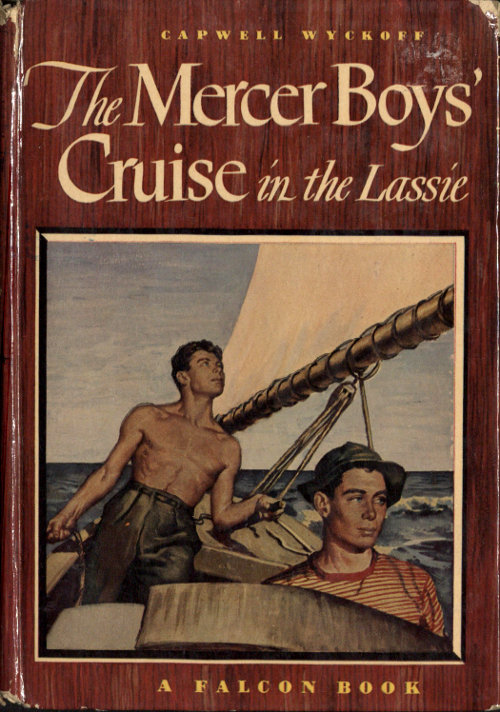
The Mercer Boys’ Cruise in the Lassie BY CAPWELL WYCKOFF — THE Mercer Boys’ Cruise IN THE LASSIE
FALCON BOOKS
When Don and Jim Mercer and their buddy Terry
Mackson set out in their sloop, Lassie, for a visit
to Mystery Island, they were in search of adventure
and fun. But they quickly found they were getting
more than they bargained for—real danger, a skirmish
with marine bandits, and a fight for their lives.
This is a thrilling adventure story of three modern
boys—with action and excitement on every page.
Other titles in The Mercer Boys’ Series
THE MERCER BOYS AT WOODCREST
THE MERCER BOYS ON A TREASURE HUNT
THE MERCER BOYS’ MYSTERY CASE
THE MERCER BOYS WITH THE COAST GUARD
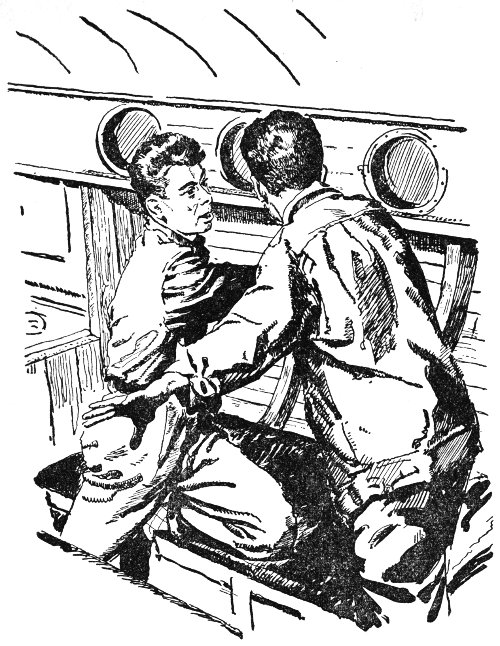
Don joined Jim at the porthole.
By CAPWELL WYCKOFF
THE WORLD PUBLISHING COMPANY CLEVELAND AND NEW YORK
Falcon Books
are published byTHE WORLD PUBLISHING COMPANY 2231 West 110th Street · Cleveland 2 · Ohio
W 4
COPYRIGHT 1948 BY THE WORLD PUBLISHING COMPANY
MANUFACTURED IN THE UNITED STATES OF AMERICA
Don Mercer straightened up from the marine motor
over which he had been bending and gave a whoop to express
his feelings. At the same time a browned face, topped
off by a wind-blown mass of brown hair, looked down at
him from the companionway of their sloop, the Lassie.
“What’s up?” Jim Mercer grinned. “Are you getting
old and talking to yourself, Don?”
His older brother returned the grin from the bottom of
the tiny cabin of the sloop. “Not so you could notice it.
But I’ve got the engine hooked up, and now we can start
our summer cruise, as soon as I see if she works.” He
mopped his forehead. “Boy, that was some job. Lucky
thing I learned something about marine engines down at
Stillwell last year.”
10
Jim slipped one foot over the edge of the companionway
and dropped into the hold, joining his brother beside
the engine. “It surely was. Every connection hooked up?”
“Everything. I thought there was a little leak in that
exhaust pipe, the one we had brazed over at Tarrytown,
but it’s all right. I had a little trouble hooking up the
switch wires, because I had never seen just this type of
motor before, but I got it at last. How does it look to you,
kid?”
Jim bent down to look at the motor. The two Mercer
boys were much alike in every way, and were devoted
to each other. Their father owned a large lumber business
in the Maine woods, and the boys had never wanted anything
in their young lives, but as they were fine, healthy
boys, their comparative wealth had never spoiled them.
Don was the older of the two, being seventeen, and Jim
was one year his junior. Both of them were well built
physically, with fine gray eyes, sandy hair, an abundance
of freckles, and good-humored grins. They had graduated
from the Bridgewater High School the year before.
Besides the two boys there was one sister, Margy, aged
fifteen, and their mother. They had grown up in Bridgewater
and were well known and liked in the town. Mr.
Mercer believed in keeping his boys interested in wholesome
things, and during their early years they had had one
or two cat-boats. On the first week of the summer, however,
the boys were surprised and delighted to find a fine
30-foot sloop riding gently at anchor in the creek which
ran through their own back yard. Their father, who had
done considerable cruising in his younger days, taught
them how to handle the larger-sized boat, and had given
them permission to go for a cruise down the Maine coast
that summer.
11
For the last week Don, who was mechanically inclined,
had been hooking up the motor. He had always been
interested in motors and had studied them carefully while
spending a week at the house of an uncle. He had learned
more than he had thought. The motor had been in the
boat at the time Mr. Mercer purchased it, but the connections
had not been fitted. Late on this July afternoon Don
had succeeded in finishing it.
Jim straightened up from his inspection of the motor.
“Looks all right to me,” he declared. “Although I don’t
know as much about them as you do. But before we crow,
I guess we had better give it a spin and see if it works.”
“OK,” agreed Don. “Go up and push the starting lever
over a couple of notches, while I spin the flywheel, will
you?”
Jim skipped up the four steps that led to the deck, and
bending down beside the tiller, grasped the lever. Don
gave the flywheel a vigorous turn, and a slight chug answered
him. He gave it a second spin, it coughed, chugged
and began to turn over. Jim moved the lever a notch,
slowly.
The engine broke into a regular, steady run, and a thin
streak of smoke issued from the exhaust pipe above the
water line. Don’s cheerful face appeared above the rim of
the companionway.
12
“Jeepers, it works!” he exulted.
Jim nodded. “It sure does. Nice work, old man. Want
to let it run?”
“Yes, let it go for awhile. It needs a little breaking in;
I notice it’s stiff in spots.” He climbed up alongside his
brother and wiped his moist brow. “Wow, that was quite
a job while it lasted.”
“I’ll bet it was. Nothing to stop us from taking our
cruise, now.”
“You are right there. But the question is: who are we
going to take along with us? Dad wants us to take at
least one other fellow. He thinks just the two of us won’t
be enough. I’ve thought of most of the fellows round here,
but either they have summer jobs or they are away. Who
do you think we ought to take?”
“What time is it?” Jim asked, casually.
Don looked at his watch. “Half past three. What has
that to do with who we’ll take on a cruise with us?”
“Maybe a whole lot!” Jim answered mysteriously.
“Want to take a walk?”
“Where to?”
“Oh, nowhere in particular. Just up to where the highway
touches the Lane.”
“Sure, I’ll go. I can’t see what you’re driving at, but I’ll
go along.”
13
They stepped into the dock, walked the long stretch
that made up their back yard, passed the house and walked
out to the shady street on which their home stood, a street
appropriately called the Lane. They walked slowly down
it, making plans concerning provisioning the sloop for the
cruise, which they expected to begin on the following day.
About half a mile from the house the Lane ran into the
State highway, and here Jim said he wanted to sit on a
stone wall. So they sat down and continued to talk for a
time.
Don finally became restless. “Let’s go to town and get
some of the things we need,” he suggested. “No use sitting
here all day.”
But Jim was not ready to go yet. He was looking down
the road, to where a single car was coming toward them.
It was a battered old rattletrap of a car, with sad-looking
mudguards, no top, and doubtful looking tires on it. The
wheels, which were the least bit crooked, made weird
movements as it came toward them.
“Wait a minute,” Jim said. “I want to see who’s in
this car.”
The driver of the car was a red-headed boy of seventeen,
tanned by the sun and endowed with a multitude of
freckles. Two laughing gray eyes peered from his long
face. He looked Scotch. He was whistling as he drove the
battered old car, and his sandy hair, decidedly red in the
sun, stood up almost straight. There was no glass in the
windshield of his car, and now and then he pretended to
wipe the missing glass, greatly to the amusement of as
many of the Bridgewater inhabitants as chanced to be
on the road.
“Why do you want to see who the driver is?” Don
began, impatiently. “You don’t——”
14
He broke off as Jim waved to the driver, and the driver
waved back and brought his bounding car to a halt beside
them. Don gasped.
“Why ‘Chucklehead’ Mackson!” he cried, while Jim
grinned.
Terry Mackson, known as chucklehead, from his habit
of bobbing his auburn head when laughing, ignored him
completely. He carefully adjusted one soiled glove on his
hand and asked Jim gravely: “Pardon me, old fellow, but
could you by any chance direct me to the residence of the
Mercers?”
“I think I could, if you give me time enough to think,”
Jim grinned.
“Then please do so, without unnecessary loss of time,”
Terry drawled. That was as far as he got. With a whoop
the Mercer brothers piled into the car and thumped him
on the back.
Terry Mackson had gone to grammar school with the
boys, but had moved to a distant town, where he had
worked hard on a farm for his old father. The boys had
always admired him for his cheerful kindliness and respected
him for his fine self-sacrificing nature. He had
worked without complaint for a mean old father, who had
even begrudged him his brief time in grammar school.
Recently his father had died, and Terry had been living
somewhat more happily with his mother and one sister.
When Terry was out of breath, and the old car had
jounced dangerously, the boys stopped to catch their
breath.
15
“How in the world did you get here?” Don asked.
“Jim wrote me to come down for a summer cruise,”
Terry explained, as he started his car. “Didn’t you know
it?”
“He didn’t know a thing about it,” Jim declared, sinking
into the back seat. “We were looking for someone to
take on our cruise with us, and I heard from Bill Bennet
that you were living in Berrymore, so I didn’t say a thing
to Don, but wrote to you. Thought I’d put one over on
him.”
“And you certainly did that,” Don nodded. “But that’s
OK. I’d rather it be Terry than anyone else.”
“Many thanks,” the newcomer murmured.
“How is everything at home?” Jim asked.
“Very well, thanks. We’re getting in nice shape.
Mother said it was high time I had a vacation, when I
read her your letter. Oh, I beg your pardon!”
“What’s the matter?” both boys asked.
“I’ve been guilty of a grave social error. I want you to
meet my trusted chariot, my car. Boys, this is my intimate
friend ‘Jumpiter.’”
To make it seem real, he drove the car over a bump,
and the car bounced like a thing alive. Both boys acknowledged
the introduction gravely.
“Happy to meet you, Jumpiter,” Don said.
“Me too,” Jim added. Terry made it rattle furiously,
and vigorously wiped the imaginary windshield.
16
Mrs. Mercer made Terry feel right at home, and then
the boys took him down to see the Lassie. To Terry it
was quite a treat, for his life had been spent in working
hard, far from any of the pleasures of life. He was delighted
with the trim little ship, and the boys led him
down the companionway.
Inside, there was plenty of room to move around without
being cramped. There were four bunks built along the
side of the hull, a tiny sink with running water, a refrigerator,
a small stove and two compact closets for knives
and forks and linen. Toward the bow it became narrow,
and before the mast a small storage room took up the
waste space. The engine was in the stern, under the steps
that led down into the cabin. The center of the cabin was
taken up with the centerboard, which the boys told Terry
was an extra keel weighing two hundred and fifty pounds.
“That’s in addition to the regular keel,” Don explained.
“There is about two tons of lead in the keel, but it isn’t
enough when the canvas is spread. When we’re sailing
under full sail, without reefs, we have to let the centerboard
down. The 250 pounds makes just enough weight
to balance the weight of the sails and keeps us from
capsizing. When we come up the creek, or when we are
using motor power, we don’t use the centerboard.”
The boys spent the rest of the afternoon running down
to the village and getting supplies. Terry insisted on using
his car for the work, so they bought food from the
grocery stores and loaded several gallons of gasoline.
With Terry’s car they were able to run right down to the
sloop and carry the supplies aboard.
“There!” exclaimed Jim, finally. “We’re all set to go.”
17
The boys went up to supper, where Terry saw Mr.
Mercer again. While they were eating they discussed plans
and Mr. Mercer gave them a word of warning.
“There has been quite a little trouble lately with a
gang of marine bandits,” the lumber man said. “They’ve
been working up and down the coast, robbing boats
and boathouses, and no one has been able to catch them.
They steal all kinds of ship materials that they can lay
their hands on. People think they store it all somewhere
and then go down to Boston or other seaports where
they sell it to dishonest ship chandlers. Nowadays a
good many people are going in for sailing, and the
ship chandlers have quite a business. I suppose people
buy things where they can get them cheapest, and so there
is quite a trade in it. I want you boys to keep your eyes
wide open.”
“We certainly will,” Jim said. “You mean that they
may try to take things off the Lassie?”
“Yes, you’ll have to be careful.”
“I’d like to run those fellows down,” Don declared.
After supper they went down to close up the sloop.
The sails were tied down firmly and the portholes closed.
After making an inspection Don pulled the top of the
companionway closed, and snapped the lock.
“There,” he said, with satisfaction. “I don’t think anybody
will get aboard the Lassie tonight. Nor any other
night, if we can help it.”
18
2. The Marine Bandits
After they had locked up the sloop the boys took Terry
around town, showing him the sights, and then they returned
to the house, where they pored over a map of the
Atlantic coast. Since they would naturally keep inshore in
a boat as small as the sloop was, the boys paid particular
attention to channel markings. Then, bidding the family
good night, they left the house and went down the yard
to the little shack that the boys always slept in.
19
A few years ago, during one of their summer vacations,
the boys had built a small two-room house at the end of
the yard, near the boathouse and the dock. There was
plenty of room for all of them in the house, but they had
thought that when they had company during the summer
it would be a little more convenient for their mother if
they had a small place of their own down in the yard;
so their parents had allowed them to build the bungalow.
Whenever company came they took them to the cottage
and they slept there, going to the main house for their
meals. The arrangement had been handy in many ways,
and had taught the boys to be self-reliant, as they had to
keep things clean and attend to their own beds and the
daily airing of their blankets. Just outside their cottage
they had built a workbench, with a tool shed at the end of
it, and on clear days they worked out there, making small
things for the house and their boats. Jim had made the
stand for the ship’s clock and other small pieces.
It was to this cottage that they now took Terry, and
he was delighted with the cozy little place. The boys had
wired it for electric lights, and on a back porch, protected
from intrusion by lattice work, they had installed a
shower bath and a small sink. The front room of the
cottage was taken up with a table, some chairs, lockers,
and a few boxes, and the walls were covered with pictures
of boats and the teams at school. It was a typical boy’s
room. The back room was given over to sleeping, and
three cots occupied most of the floor space. In the glow of
a ship’s lantern, now made over into an electric lamp, the
boys undressed and prepared for bed.
“I won’t be a bit sorry for these blankets,” Terry
decided, as he crawled into his cot.
“No, it gets quite cold here at night, no matter how
warm the days may be,” Don said, as he settled down
on his cot.
20
They talked for a few minutes and then, saying good
night, dropped off to sleep. That is, the two Mercer boys
did. They were so used to the place that they wasted no
time lying in bed thinking, and they were usually so
active in the daytime that they dropped into a healthy
sleep as soon as they went to bed. But everything was
new to Terry, and he lay there thinking about it.
He had been used to a life of constant work, and the
prospect of this vacation, spent with boys like the Mercer
brothers, held a fascination to him. His mother had been
right when she said that he needed a vacation, and as
things at home were in much better circumstances than
they ever had been before, Terry felt justified in going
away. So he lay there, staring out of the window over his
head, seeing the black outline of the boathouse, and beyond
it the mast and rigging of the sloop, moving gently
with the motion of the tide.
Finally, Terry dozed off, enjoying to the last the cool
wind that brushed over his brown face, and the slight
and refreshing tang of the salt air. How long he had been
asleep he did not know, but suddenly he awoke. He sat
up, leaning on one elbow and listened. The brothers were
asleep, as he could tell from their deep and regular
breathing, and the boy was at a loss to know what had
awakened him. He listened keenly, thinking that some
sound, usual to the place, but new to him, had awakened
him, but as a few minutes went by and he heard nothing,
he lay down again.
Then a sound reached his ears, a thin, screaming sound
as though someone was pulling nails out of a board.
Wondering what it could be, Terry looked in the direction
from which the sound had come.
21
Terry’s eyes were good, and he could make out the
boathouse perfectly even in the darkness. At first he could
see nothing, but as he continued to watch, a shadow detached
itself from the corner of the boathouse and went
around the side. Terry tossed aside his blanket, stepped
over to Don and shook him, at the same time placing his
hand over the boy’s mouth. Don sat up quietly, pushing
Terry’s hand away.
When Terry had whispered his message to Don they
woke up Jim, and standing at the window, the three boys
looked toward the boathouse. While looking they were
hastily dressing, tossing on a few clothes and pulling on
rubber boots.
“I don’t see anybody,” Don whispered.
“He went around the side,” Terry answered. “Is there
a window there?”
“Yes, there is. Are you ready, Jim?”
“Sure thing. Let’s go.”
They cautiously opened the back door, crossed the yard,
and arrived at the front of the boathouse, where they
paused for a moment to listen. Inside, they could hear
someone walking around.
“Somebody in there, all right,” nodded Jim. “Shall we
rush ’em?”
“Yes. We’ll catch them in a trap. Come on, kids.”
22
With that Don stepped around the corner of the boathouse.
There was a small stick lying on the ground, and
the boy stepped on it, causing it to break with a loud,
snapping sound. Realizing that caution was now useless
Don called out:
“Who is there?”
From the shadows beside the boathouse a man stepped
into view. He darted to the window of the boathouse and
called out: “Beat it, Barney, the kids is coming!”
Don dashed forward, clutching at the man, who was
tall and thin, but the man twisted savagely and got away.
At the same time Terry and Jim ran to the window, but
they were too late. A small man leaped nimbly over the
sill and joined his companion in flight.
“After them!” shouted Don, as they heard the men
thrashing their way through the tangled undergrowth.
All three boys joined in the chase, following the men
with ease by the sound of their headlong progress. The
chase led them to the edge of their own creek, where the
men jumped into a small boat and pushed away from the
shore.
“The dinghy!” gasped Jim.
The Mercer boys turned and ran to where the sloop
was anchored, and Terry followed them. Riding gently on
the waters of the creek, attached to the Lassie by a rope,
was a new dinghy. Into this rowboat the boys piled, Don
and Jim seizing the oars.
“Cast off, Terry,” Don called.
23
Terry slipped the rope from the deck of the sloop and
the brothers began to pull toward the other boat, which
was drifting aimlessly along the creek. Both men seemed
to be in the back of their boat, bending over something.
Just as the boys got within hailing distance one of the
men whirled his arm, there was a flash of a spark, and a
small motor began to hum.
“I knew it!” Don groaned. “He’s got an outboard
motor.”
One of the men seized the tiller and the other boat
ran rapidly down the creek, leaving the rowboat with the
boys in it far behind. Although they knew it was useless
they followed, reaching the broad expanse of the ocean.
But once in the open water they lost track entirely of the
other boat and its occupants.
“It’s no use,” Jim declared. “We haven’t a chance to
find them.”
“I’m sorry to say that you’re right,” Don agreed. “I
don’t even hear the sound of their motor. More than
likely they shut it off and rowed up some creek, to throw
us off. Well, there is nothing to do but to go back, I
guess.”
They turned the dinghy, which bobbed like a cork in
the ocean waves, and headed back for the creek.
“Do you suppose they were the marine bandits your
father mentioned at supper?” asked Terry.
“I wouldn’t wonder,” Don replied. “But we’ll see when
we get back to the boathouse. I hope it all didn’t wake the
family up.”
But it had. When they finally tied the dinghy up to
the sloop they found Mr. Mercer standing at the dock,
anxiously watching for them.
“Hello,” he hailed. “What’s going on down there?”
24
Don briefly related the events of the last few minutes
and then led the way to the boathouse. Using a key, which
he had in his pocket, Don led them into the boathouse.
It was a neat little building, with various grades of
wood stacked along the walls, a work bench in one corner,
and some extra canvas piled on racks. A small rowboat lay
bottom up in the center of the floor. They examined the
window, to find that several wooden bars had been pried
out and the sash raised.
“Is there anything missing?” Mr. Mercer asked. “There
doesn’t seem to be.”
But Jim shook his head sadly. “Sorry to say that there
is, Dad. That swell ship’s clock that you bought me down
in Boston is missing. It was over there on the bench, and
I was making a new case for it. I guess those guys were
the marine bandits, all right.”
25
3. The Start of the Cruise
As the clock which Jim had lost was a very valuable
one, they wasted no time in reporting the circumstances
to the police. Early in the morning the boys were up, and
spent the time immediately after breakfast in loading last
minute articles on the sloop. Don found that the lock on
the companionway had been tampered with.
“Somebody tried to get in here,” he said, showing the
others the lock, which was slightly twisted. “But I guess
they found it too much of a job.”
After they had reported the entire matter to the chief
of police, who promised to have the waterfront searched
for the thieves, the boys ran down in Terry’s car to the
local drugstore and bought a case of cokes. When they
had loaded it on the boat, and final instructions had been
half-jokingly given them by Mr. and Mrs. Mercer, the boys
were prepared to go.
26
Don went below, bending over the engine, while Jim
sat at the tiller, his fingers on the starting switch. Terry,
feeling useless as a sailor, sat in the cockpit, watching the
proceedings. Jim nodded to him.
“Cast off the painter, will you, Terry?”
Terry looked helplessly around. “When did a painter
get aboard?” he asked.
Jim laughed. “The painter is that rope at the bow,”
he explained. “Throw it to Dad.”
Terry took the painter and tossed it to Mr. Mercer,
who caught it and placed it on the ground. Don turned
the flywheel and the motor began to churn. Slowly, Jim
advanced the spark, pushing the tiller from him. Like
some graceful bird the Lassie turned in the creek, her
nose pointing toward the ocean.
The boys waved goodbye to Mr. and Mrs. Mercer and
Margy and the sloop headed out to the mouth of the
creek. As it cleared the banks at the mouth of the channel
it struck the small ocean waves, bounding and dipping
like a thing alive. The little ship seemed glad to get out
on its own element. The boys were fairly launched on
their cruise.
“Well, we’re off,” exclaimed Don, coming up the ladder
and stepping into the little cockpit.
“Off on a nice start,” Jim nodded, watching a buoy
about half a mile ahead of him.
“This is swell,” Terry struck in, his eyes dancing.
27
The wind was blowing a lively little breeze, and the
Lassie rose and fell with the action of the waves. It was a
bright, clear day, and they could see for miles over the
tossing, tumbling Atlantic. On the port side they could see
the long coast of Maine stretching along before them.
“Just think,” sighed Don. “Nothing to do but sail for
a month or more.”
“It surely is great,” Terry agreed. “I hope in that month
you’ll teach me something about sailing. I feel awfully
ignorant.”
“You needn’t,” Jim told him. “We’re not any too good,
ourselves. We’ve been used to sailing cat-boats around,
but this is the first time we’ve had an opportunity to
handle this boat in any kind of weather. I think we’ll all
learn things together.”
After they had sailed down the coast for five miles Don
said to Jim: “How about putting on sail?”
Jim considered the sky. “I guess we can. But we’ll
have to take two reefs in it. With a small gale like this,
we can’t risk putting on full canvas.”
“No, you’re right. Teach Terry how to hold the tiller,
while I shut the motor off.”
“All you have to do,” Jim told Terry, while Don turned
the motor off, “is simply to drive the bow straight toward
that buoy. See the buoy? Now, hold the tiller loose in your
hand. Just as soon as the bow moves away from pointing
straight at the buoy, move the tiller the least little way
in either direction. No, not so far over. That’s it, just a
fraction. Now you have it.”
28
While Terry held the tiller somewhat gingerly, secretly
as proud as a prince, the Mercer boys sprang to the sails,
and began to untie the straps that held down the spread
of canvas on the boom. When this was finished they
jumped to the halyards and pulled the canvas up the
mast, the wooden rings slipping with a clattering sound.
While Don held the halyard ropes Jim tied the sail down
at the second reef. Then, pulling up the jib sail, the boys
walked back over the heaving cabin roof.
“All right, Terry my friend,” said Don. “You can let
me have the tiller now. I have to guide the mainsail and
jib from the tiller. Let down the centerboard, Jim.”
Terry surrendered the tiller. “Here you are,” he announced,
with dignity. “Any time you want your boat
tillered straight, call for Mr. Mackson!”
Under the spread of canvas the Lassie sped along before
the wind, the sails cracking with a stinging, invigorating
sound, the mast creaking and the pulleys straining and
squealing occasionally. The sloop was heeled far over on
her port side, and the water boiled furiously over the rail,
much to the wonder of Terry, who was perched far up on
the starboard side.
“Gosh, this boat leans far over,” he observed. “Doesn’t
it ever go all the way over?”
Jim winked at Don. “Well, once in a while. I think
the most times it ever capsized was three times.”
“Three times!” repeated Terry, aghast. “In how many
cruises?”
“Oh, all in one cruise,” Jim replied.
29
Terry’s eyes narrowed. “Look here! If the boat went
over a good-sized derrick would have to come out here
and right it. And if I remember correctly, this is the first
time you have ever been out for any length of time in this
boat.”
Jim opened his eyes in surprise. “That’s so! It must
have been some other boat!”
“I think you mean you fell out of bed three times on
one cruise,” Terry retorted.
Jim was the cook, and on the little galley stove he
prepared an excellent meal at noontime. Rather than
bother with the sails while eating, the boys had taken the
canvas in, and were at present simply drifting idly with
the tide. A few miles down the coast they could see the
Midland Amusement beach, and Don proposed that they
go there for a swim in the afternoon.
After the meal was over they cruised under motor
power to the beach and, locking the companionway door,
went ashore in the dinghy. They hired a bathhouse and
soon emerged onto the beach in their trunks. From a
long dock they dived into the water, amusing themselves
for fully an hour in the sparkling water. Then, as the
afternoon sun showed signs of going down rapidly, they
dressed and climbed into the dinghy, pushing out from
the shore.
“Hey, look!” exclaimed Terry. “There is someone on
our boat.”
The boys stopped rowing and looked toward the sloop.
A small rowboat was tied to the stern, and two men were
walking around in the cockpit, peering down into the
cabin through the portholes in the companionway.
“Wonder what they have in mind?” Jim said.
30
“Let’s get out there and see,” advised Don. Accordingly,
they rowed with all their strength, until they were
alongside.
The men had seen them coming, and one of them, a
stocky individual with an unpleasant face, stepped to the
side and smiled at them. Although the boys did not like
the looks of either of them, they were polite and open in
their manner.
“How d’you do?” the stocky individual hailed. “This
your boat?”
“Yes, it is,” said Don, stepping on deck. The others followed,
and Jim tied the dinghy to the stern.
“Thought likely it was,” the leader of the two went on.
“Nice boat.”
“It surely is,” Don agreed, waiting. He felt sure that
the man wanted him to open the companionway slide, and
he had no intention of doing so. The shorter of the two
men was standing back of him, evidently waiting.
“You—you don’t want to sell it, do you?” the leader
asked.
Don shook his head. “No, it isn’t for sale. I don’t think
you would have any trouble in having one like it built,
though.”
“I couldn’t wait for one to be built,” the heavy man
murmured. He turned to his companion. “Come on,
Frank, time we were getting along. Thanks for letting us
look it over, boys.”
“You are welcome,” Don replied. The men entered
their boat and pulled rapidly for the shore.
31
“I don’t know that we could help letting them look at
it,” Jim remarked.
“We couldn’t,” Don agreed, sliding back the hatch.
“I wonder who those guys were? They must have come
aboard while we were getting dressed.”
“Maybe they belong to the marine gang, and were
looking us over,” Terry suggested.
“You may be right,” Don replied. “We’ll have to keep
our eyes open for them in the future.”
After supper the boys continued the cruise, sailing for
a time and then, as darkness came down, using the motor.
Jim put on the lights and Terry asked concerning them.
“The green one is the starboard light,” Jim said. “The
port is the red one. The danger side of a ship is the port
side; the watch has to be keenest there. The easiest way
to remember which is which is to think that port wine
is red, and then you can always remember that the port
light is the red one.”
Two miles off shore, on a lonely section of the coast,
the boys lowered the anchor and prepared to spend the
night. Terry, who had looked forward eagerly to his first
night on the water and his first sleep in a bunk, was
disappointed to find that they intended to sleep on deck.
“You can sleep inside, if you want to,” Don told him.
“Only, I think you’ll like it better sleeping out on deck,
under the stars. If we have stormy weather—and I think
we are going to, because the barometer is going down—you’ll
sleep indoors quite enough. But suit yourself.”
32
Terry decided that he would sleep on deck, and they
accordingly carried the blankets out on deck and spread
them out. As it was too early to go to sleep yet, they talked
for a time of general subjects.
“Suppose a storm, like a fog, comes up in the night?”
Terry asked.
“Well, we can go close to shore, or anchor out, but if
we anchor out, we’ll have to toll the bell all night. If
anyone feels particularly like sitting up all night and
pulling on the rope, they are perfectly welcome to do so.”
“Count me out,” Terry decided. “We might use Jim,
however.”
“How is that?” Jim asked, suspiciously.
“When you give that little imitation of a snore that
you do, your mouth half opens and shuts,” Terry explained.
“I was just thinking that we might hitch the rope
up to your front tooth and have it tolled all night without
anyone having to sit up or keep awake!”
“I see. Well, look here. When you are lying under the
bell, don’t you ever yawn!”
“And why not?”
“Because we’ll never find it again, and we’ll have to
hang you to the mast and shake you back and forth every
time we have a fog,” said Jim, soberly.
“Meaning that I’ll swallow the bell, I suppose?”
“Something like that.”
The boys turned in around ten o’clock, thoroughly tired
out. Before Don put out the light he looked at the
barometer.
33
“Going down,” he muttered. “Doesn’t look any too
good for the morning.”
The last thing that Terry remembered was lying on
the gently heaving deck, looking up at a multitude of
soft glowing stars. Then a deep sleep fell upon him.
34
4. Stormy Weather
Terry Mackson was dreaming. He dreamed that he was
sitting on a bench and that Jim was hurling buckets of
water over him. The bench was heaving up and down and
the water continued to pour over him. The part that made
him angry was the fact that he couldn’t seem to get up.
And now, to make matters much worse, someone, he
couldn’t see who it was, was shaking him.
He woke up with a start, to find Jim bent over him
shaking him roughly, and shouting something in his ear.
Jim was saying, “Get up, it’s raining,” and Terry, struggling
to his feet, found that Jim was putting things mildly.
The rain was coming down in sheets, and Don was heaving
the bedding down the companionway. Terry took a
brief look before going below.
35
The millions of stars that he had looked at earlier in
the evening had all disappeared, and only a dense, heavy
gray sky hovered over the sloop now. The waves, which
had been so gentle, now reared angry heads alongside
the little craft, and the deck was soaked with the spray.
The world had turned completely upside down in the farm
boy’s eyes.
“Go on down,” Don shouted. Terry obeyed, but Don
ran forward and examined the anchor cable. When he
came back downstairs, he was wringing wet. He slipped
the companionway shut and Jim closed and bolted the
portholes.
“The anchor is holding all right,” Don reported. “I
think we can weather it.” He slipped out of his pajamas
and vigorously rubbed himself down with a rough towel.
“Well, we’ll sleep indoors, like Terry wanted us to, sooner
than we expected.”
“I never saw a storm come up so fast,” declared Terry.
“I’ll bet you didn’t see it at all,” Jim retorted, rubbing
down. “Judging by the way I had to shake you, you didn’t
see much of anything.”
In the light of the electric lamp the boys changed into
dry night clothes, and sat on the edge of the bunks talking.
The experience was slightly weird to Terry, but the Mercer
boys did not seem to mind it. The sloop tossed madly,
causing dishes to clatter inside the cupboard and other
things to rattle and clink all over the boat. The fog
bell clashed and clanged with each roll of the boat, and
the electric lamp oscillated continually. Each time the
sloop slid down a wave it pulled with a jerk on the anchor
cable. To Terry, as he looked around, it seemed like being
boxed in a trunk, at the mercy of the waves that slapped
overhead.
36
“Well,” yawned Don, at last. “No use sitting up any
longer, I suppose. We’ll see how things look in the
morning. Do you feel all right, Terry?”
“Sure I do. Why?”
“I was just thinking that if you are going to get seasick
at all, you’ll get that way tonight,” grinned Don, as he
put out the lamp.
“Thanks for your cheerful thoughts,” grumbled Terry,
as Jim snickered.
Terry was the first to awake in the morning, and he
lay for a moment looking around the interior of the Lassie.
The storm had evidently not subsided, for the floor continued
to heave and sink, and the continual clinking and
bumping went on. The portholes were still wet and a faint
trickle of water ran out from the bottom of the engine.
Outside, he could hear the whistle of the wind and the
slap of the waves, and now and then a particularly big
one ran across the deck. The brothers were still asleep.
At seven-thirty they woke up together and the three
boys got dressed. Getting breakfast was no easy job, and
Jim was hard put to it, especially in the matter of making
coffee. Don, clad in oilskins, went on deck and examined
the anchor cable, which he found to be bearing the strain
very well. It was decided that they would cruise along
with the storm during the morning and see what they
thought best to do later in the day.
37
On the side of the centerboard casing, which came up
from the floor of the cabin, dividing it somewhat, a board
on hinges served as a table. This board, when raised, made
a good substitute for a regular table, and on this Jim
placed the eggs, bacon and coffee. The meal was a gay one
because the food slipped back and forth with the rolling
of the sloop. On one occasion, just as Terry was about to
spear a piece of egg, his plate slipped downhill to the
other side of the board, where Don was eating.
“Would you mind giving me back my plate?” Terry
asked.
A particularly violent roll dumped the remaining egg
from his plate and spread it dismally all over the board.
Don pushed the plate back to him gravely.
“How about my breakfast, too?” Terry asked.
“Oh, do you want that too? You only asked for your
plate, you know.”
All three boys pitched into the job of washing plates
and then they pulled in the anchor and continued the
cruise. Terry, outfitted in a coat of oilskins, enjoyed the
rough sailing much more than the smooth. The little ship
dipped joyously down into the troughs, plunging its nose
beneath the waves and flinging them right and left in a
smother of foam. Then, riding magnificently up the side
of a gray green monster, it rushed with speed down the
watery hill, to bury its nose in another small mountain.
Quantities of water rushed across the deck, soaking them
in spite of their oilskins, but as the weather was warm,
the boys did not mind it. At times Terry was allowed to
hold on to the tiller, a job that amounted to something,
and he found it vastly different from the easy job it had
been on the day before, when the water had been smooth.
38
They brought a portable radio on deck and listened to
it throughout most of the morning, but the static was
very bad and they finally gave up. After several unsuccessful
attempts at playing a losing game of gin rummy
against the wind, the boys decided it was easier just to
watch the sea and the dark clouds as they scudded across
the sky.
Another meal was eaten under conditions similar to
those of the breakfast, and the sail continued. The day was
dark and the sky threatening, and Don thought seriously
of running inshore and tying up at a dock until the blow
was over. Late in the afternoon they decided to swim.
“Want to go in for a real swim?” Jim asked Terry.
Terry looked toward the shore. “Where is a beach?”
he asked.
“Jim doesn’t mean at a beach,” Don supplied. “He
means to go swimming from the boat. Like to try it?”
“With the waves running like that?” Terry demanded.
“Sure thing. It will be the best swim you ever had.”
Terry was not sure, but as the Mercer boys got into
their trunks he slowly followed, secretly appalled at the
size of the waves that broke against the side of the sloop.
Don was first to go over. Poised for an instant on the
cabin roof, he suddenly launched out into a splendid
curving dive. Right into the heart of a wave he went,
to reappear some yards away, puffing.
“Oh, boy!” he called. “Get in, it’s great.”
39
Jim followed his brother, and Terry, whose swimming
had been confined to quiet water all his life, hesitated
for a few minutes before he made his plunge. Then,
standing on the stern, he shot himself forward into a
smother of gray-green water, instantly shooting below a
small, churning mountain. An instant later he came to the
surface, bobbing up and down on the waves.
Don swam to him. “How do you like it, kid?”
“It’s great stuff,” Terry gasped. “There certainly is
plenty of room to swim in!”
Under these conditions the boys only swam for fifteen
minutes, keeping close to the sloop. When they were once
more clad in dry clothes they felt invigorated and healthy
as they never had before. Supper, consisting of beans and
potatoes and some peaches, tasted very good to them.
As evening came on the sea became rougher and
rougher, and the brothers agreed to anchor somewhere in
port for the night. They were now out of sight of the
mainland, and Jim proposed that they run back to the
coast. But Don, who was looking intently across the starboard
bow, called his attention to a long low black mass
just visible above the waves.
“Isn’t that Mystery Island?” Don asked.
Jim looked and then went down the companionway
steps, to unfold the marine map and look at it closely.
Presently his head appeared above the combing.
“That’s it, all right. Not thinking of anchoring near
there, are you?”
40
Don nodded. “Yes, I am. It is a whole lot nearer the
boat than the main shore is. I don’t see why we can’t run
in and heave to.”
“The place hasn’t got a very good reputation, Don!”
“Nonsense, Jim. Most of the tales you hear about
Mystery Island are false to begin with, and besides, I’m
not afraid of a lot of old legends. I guess we can find a
good cove there to anchor in until this storm blows over.
Spin the motor, will you?”
Jim spun the flywheel and the Lassie, under Don’s
guiding hand at the tiller, turned her nose to the low
island in the distance. Terry turned to Don.
“What is all this business about Mystery Island,
skipper?”
“Oh, just a collection of idle stories, mostly. It was
supposed to have been the hiding place for pirates once,
and for smugglers later on. I guess most of it is all foolishness,
but people around this part of the country have a
habit of saying, ‘Keep away from Mystery Island.’ Personally,
I don’t believe there is a thing the matter with the
place at all.”
It took them less than an hour to reach Mystery Island,
and they found a fine cove to anchor in. It was now too
dark to see the island clearly or to make out any details
of it. After sitting around and talking over old school days
for some time, the boys turned in and went to sleep.
A loose pan rattled around the top of the sink, annoying
Jim as he tried to sleep. Finally, completely disgusted,
he got up and captured the utensil, placing it firmly in a
small closet.
41
“Should have done that in the first place,” he murmured,
moving about in the darkness.
The rolling of the sea had abated somewhat, and Jim
looked out of an open porthole. Close to them lay the
black island, and Jim wondered idly what secrets it did
contain. Then, uttering an exclamation, he looked intently
out of the porthole.
Don stirred uneasily in his bunk. “Coming to bed,
Jim?” he inquired.
“Sometime, yes. But come here, Don.”
Terry, awakened by the whispering, joined Don and
Jim at the porthole and looked toward the island. On a
sort of bluff, fronting the cove, a lantern was flickering
in the breeze. Although they could not see clearly, they
could nevertheless make out the outline of a man back of
the lantern.
“Somebody standing there and looking us over,” Jim
whispered.
“Wonder who he is?” Don asked.
“Mighty strange that he should come out on the shore
on a night like this to look at the sloop,” muttered Terry.
For two or three minutes longer the man stood perfectly
still, evidently looking toward the sloop, although
the boys could not make out his face. Then, swinging the
light as he walked, the mysterious watcher passed along
the bluff and out of sight.
“All I hope is that it is the right kind of a reception
committee,” grumbled Jim. Don sought his blankets. “I
guess it’s OK. Maybe they don’t have many boats stop
here, and the sight is a novelty. Well, we won’t worry
over it. I’m dead tired.”
43
5. Mystery Island
When the boys woke up in the morning they found that
most of the storm had subsided, but the day was anything
but fair. The sky was gray and overcast, and the sea rose
and fell in short, choppy billows. The wind, however,
had gone down altogether, and that made a big difference.
Before dressing the three boys stepped out on deck and
dove overboard into the stinging water that tumbled
alongside the sloop. After this invigorating swim they
enjoyed a wholesome breakfast, eaten out on the deck
under the leaden sky.
“Sure does seem good to eat without having your plate
run up and down hill every second,” Terry affirmed.
“It seems good to get out of the heat of the cabin,”
Don said.
44
Jim showed a perspiring face above the companionway.
“That goes for everybody but the cook,” he observed. “I
will admit, though, that getting breakfast today has been
easier than it was before.”
They ate slowly, not being pressed in any way for time.
“Looks like an idle day,” Don ventured.
“I agree with you there,” his brother answered. “Until it
clears up we won’t want to sail on, and so it looks as
though today might be a trifle dull. But we’ll get through
it somehow.”
“There will be plenty to do.” Don looked off toward
the island, to where the top of a long house showed
through the trees. “I know what I’m going to do. See
that house?”
“I see it,” Terry replied. “Thinking of renting it for the
summer?”
“No,” Don retorted. “But I saw smoke coming from a
chimney on it this morning, and I’m going up there.
They may have some fresh eggs, and if so, we want them.
I’ll row over in the dinghy and take a trip to the house.”
“How about that man we saw last night with the
lantern?” asked Jim.
“What about him?”
“I just didn’t like the looks of things, that is all. I’m
wondering why anyone should take the trouble to come
out on a bluff at three o’clock or thereabouts in the morning
and look at us so long. It doesn’t look right to me.”
“Maybe it was someone that couldn’t sleep, and decided
to go out for a morning stroll,” grinned Terry.
“With a lantern in his hand?”
45
“Well, believe me, I’d hate to go wandering around
that black island at night without a light of some kind
with me!”
“Oh, there is no doubt about that. But I feel that he
came down to look at us, and I don’t think there was any
good in it all, either.”
“Nuts, Jim,” Don broke in. “You’re letting your imagination
run away with you. Just as soon as I help you
clean up, I’m going ashore.”
They all cleaned up ship after breakfast. A large
amount of bilge water had crept in under the floor during
the storm, and as the boys had no pump aboard, they
were forced to dip it out by the bucket. Terry scooped
the water up in a pail down below, passed the pail up
the ladder to Don, who passed it to Jim in the stern.
From there Jim emptied it overboard. This task took them
the better part of an hour, and when it was over Don
announced: “I’m going ashore now.”
Jim was airing out the blankets and Terry decided that
he would write to his mother and sister, so Don stepped
down into the dinghy alone. Grasping the oars he called
up to them, “See you later,” and rowed toward Mystery
Island.
He found that it was a hard pull. The waves were
choppy and troublesome, and the dinghy climbed and
slipped backward. It took all his strength to keep it going
forward, and the distance to the shore seemed long because
of the energy necessary to reach it. After a half-hour’s row
Don beached the dinghy on the sand at Mystery Island.
46
He pulled the boat far up on the sand, to make sure
that the tide, creeping in, would not carry it away while
he was gone. He stood for a moment and looked around
him. He was in a sheltered cove, ringed around with
trees and thick undergrowth, with a shelving sandy beach
running down to the water. If any of the stories about
pirates and smugglers were true, he reflected, this island
was just the place for such things. It was a black, silent
sort of a place, well named Mystery Island. Although Don
had laughed at Jim’s fears he admitted to himself that he
did not feel altogether comfortable. There was a brooding
sense of mystery over the place, an air of evil watchfulness
that he did not like.
Quite sharply he pulled himself together, realizing that
he was allowing the wrong impressions to play upon his
mind. “You’ll never get anywhere that way, Donald my
son,” he murmured. To fortify himself, he began to
whistle as he found the path through the woods.
The path was well beaten and he wondered who used
it so much. Obviously someone lived on the island most
of the year, possibly all year around, though Don could
not imagine anyone living on the bleak waste in the
wintertime. He wondered why there was no boat to be
seen, since the inhabitants must have a boat. It would be
impossible otherwise to get across to the mainland for
supplies, and no one could live for any length of time on
the place without renewing supplies from time to time.
Possibly the boat was on the other side of the island. He
knew that it would have to be a good-sized boat, too, for
no rowboat or small power boat would do. But as the
map had showed the island to be a large-sized one, he
wondered why the people who lived at the house kept a
boat on the far side of the island, especially as there was
such a perfectly good harbor on this side.
47
He followed the path through a dense growth of trees
and small shrubbery, finding that it had been worn down
by many feet. The ground had been worn down hard
and there was no sign of cluttering grass. Admitting that
a rather large family lived in the house just ahead, he
wondered why they went so often to the beach as to keep
in perfect order a path through the undergrowth.
The path dipped slightly and then wound up a small
hill, and at length he saw before him the low house. Before
going any further he stopped to study it. It was old,
built of boards that looked rough and weatherbeaten, and
if it had ever had a coat of paint on it, the fact was not
evident now. One crooked chimney stood unsteadily at the
back. The windows of the upper floor had all been broken
and were boarded up, but those on the ground floor were,
for the most part, whole. The glass was dirty and the
frames warped and bent. Don walked nearer, looking
closely for signs of life about the place.
The front door was boarded up, and he saw at once
that he could not get in there. A rotting front porch
sprawled across the width of the house, and one corner
of the roof was falling down. Don took a path around
the house, looking closely to see if anyone was around, but
there was no sign of movement in the place. But he felt
sure that someone lived in the place, for a thin line of
smoke drifted upward from the crooked chimney.
48
The back yard of the house was an overgrown plot,
with a few rotting outhouses standing near the dense
woods that pressed close to the place. Don stepped on the
low porch and knocked gently. While he waited, he
turned once more and looked around him. It struck him
that there was not a sign of a chicken about the property,
and he felt that his journey for eggs would be useless.
“Nothing like trying, though,” he thought, and
knocked again. There was no response, and he was inclined
to think that there was no one at home. But just
then the tempting odor of bacon assailed his nose.
“Surely there is someone at home,” he decided. “No
one would leave the house and allow bacon to fry on the
stove. I wonder why they——”
He heard a bolt rattle on the inside of the door and it
slowly opened. At first the interior of the place seemed
so dark that he could not make out the person of the one
who had opened the door. Then he saw that it was an old
woman, with a severe face and untidy white hair.
“What do you want?” she asked, somewhat harshly.
“Pardon me,” Don said politely, “but I’d like to know
if you have any eggs for sale? I just came from a boat
which we have anchored in the cove, and I thought that
you might have some eggs you could sell us.”
The woman nodded slowly. “Oh, eggs, certainly! Step
in, young man, and I’ll wrap you up some.”
49
She stepped back from the doorway and Don entered.
He found himself in a kitchen, which was furnished with
a rickety table, three chairs, a couch and a sink and stove.
The bacon that he had smelled was still sending forth a
fascinating odor from the back of the iron stove.
While the old woman stepped out of the room to get
the eggs Don noticed that although it was broad daylight
all of the shades had been pulled down, creating a semi-gloom
which he thought quite unnecessary. Three doors
opened from the kitchen into other rooms, he also noticed.
It seemed to him that the old lady was gone an unnecessary
length of time, when she returned, but without any
package.
“They are in the next room, young man,” she said,
going to the stove. “Pick out as many as you want of ’em.”
With her thumb she pointed to one of the doors which
opened from the kitchen.
Wondering a bit, Don pushed the door open and
stepped into a large room, which had evidently at one
time been the dining room of the house. It too was almost
dark, and a big table took up the center. He looked around
but saw no eggs. He turned to the door again.
“Where are—” he began, but got no further. The door
back of him went shut with a bang, and he heard a bolt
shot. He tried the knob, to find that he was locked in and
a prisoner.
50
6. The Inner Room
It was with something of a start that Don realized that
he was caught in a trap. He shook the door furiously, but
it was firmly bolted, and his efforts were entirely in vain.
Stepping off, he sent a heavy kick against it.
The old woman shuffled over to the door. “Here!” she
shrilled. “You quit that! It’s no use of you tryin’ to git
yourself out.”
“What am I in here for?” cried Don.
“Don’t ask me. Ask the Boss,” she replied.
“Who is the boss?”
A chuckle came from the other side of the door. “Soon
you’ll find out. He’ll be in to see you before very long.”
51
Seeing that a display of temper would get him nowhere
Don gave up his attempt to break the door and fell to
examining the room with care. The windows had been
boarded on the inside, and he gave up any thought of
trying to pry loose any of the boards without the necessary
tools. There was only one door in the room beside the
one he had entered by, and he soon found that this door
was as firmly locked as the other one. The walls, cold and
wet to his touch, gave him no hope, for they were firm
enough. Finally, he gave it all up in disgust.
“Nothing doing anyway,” he muttered. “I wonder what
the heck the game is?”
He did not have long to wonder. Fifteen minutes after
he had entered the room he heard a key rattle in the lock
on the opposite door. Evidently the lock was quite rusted,
for it took a few minutes for the other to unlock it, but at
length the task was completed, and the door opened.
Two men entered the room, and at sight of them Don
felt a shock of recognition. One of them was the stocky
individual who had offered to buy their boat the day
before, and the other was the smaller man who had been
called Frank. Both of them were smoking cigars and
seemed pleased with something.
“How do you do, young man?” nodded the older of the
two.
“What is the idea of locking me in here?” Don
demanded.
The man called Frank laughed and turned to the other.
“He’s a very inquiring sort of a kid, isn’t he, Benito?”
“I certainly am,” retorted Don. “I’d like to know what
you mean by locking me in here.”
“Well, to tell you the truth,” answered Benito, “we
don’t know ourselves yet. We saw you anchor last night
and we just waited for you to walk into our trap. We
haven’t decided what we’re going to make out of it yet.”
52
“I see,” nodded the boy. “But you’re sure you are going
to make something out of it, aren’t you?”
“To be sure. Frank, be kind enough to hand me the
boy’s wallet.”
Don eyed Frank and clenched his fist. “He’s liable to
see a whole collection of stars before he sees that wallet,”
he said, determinedly. Frank hesitated and looked at the
other man.
Benito’s manner changed instantly from the friendly
to the business-like, and he frowned in an ugly manner.
“Look here, kid, none of that. You hand over your wallet
or we’ll just put you to sleep and take it. Don’t think we
let you walk in here for nothing. Come on now, hurry up.”
Boiling with anger, Don handed over his wallet. He
realized that resistance, under the circumstances, was absolutely
useless. Benito took the wallet and glanced through
its contents.
“Hum,” he commented. “Fifty dollars in cash and your
name is Mercer. Is your father the lumber man?”
“Yes, he is, and he will make things hot for you, if you
don’t let me out of here,” Don promised.
Frank raised his eyebrows and looked significantly at
Benito. “That means big money, Boss.”
Don laughed outright. “I think you’ll have to go a
long way to make any big money on it,” he said.
53
But Benito shook his head easily. “Oh, no, we won’t.
Your father will be willing to pay a heavy price for your
safe return, my boy. So we’ll just keep you here until he
does come across with a neat little day’s pay. All you have
to do is write a letter to your father, telling him where
you are, or about where you are, and asking him for a
sum I will name for you. That will be your end of the
game.”
Don grinned. “That’s all I have to do, huh?”
“Yes, that’s all.”
“Well, that’s just twice as much as I intend to do. I
won’t write a line for you, and you can do what you like
about it.”
Benito jerked the cigar from his lips. “You’ll do just
as we tell you!”
“I’ll not write one single line,” Don came back, steadily.
They glared at each other for a moment, Benito inwardly
raging, Don angry but perfectly calm. Then Benito
smiled evilly.
“So that’s the way you feel about it, is it? Well, I don’t
think you’ll feel just that way after you haven’t eaten
for a few days. You’ll change your tune by that time.”
Don’s thoughts flew to Jim and Terry aboard the sloop,
but as though the man could read his thought he said:
“You needn’t think your friends on the boat can help you
any. We’re going out there as soon as it gets dark and
take that little ship for our own. Then we’ll put those
two boys in here with you, for company.”
“You wouldn’t dare touch that boat!” Don gasped.
“No? You just watch and see. Come along, Frank. This
young man wants to be alone to think, I can see that.
Pretty soon he’ll want something to eat, too, but he won’t
get it. Maybe then he’ll be able to listen to reason.”
54
Don smiled coolly. “They say the emptier your stomach
is, the clearer you can think. I think you are both a fine
pair of scoundrels now, so I don’t know what I’ll think
you are when I get hungry!”
“Be careful of that tongue of yours, young man!”
snapped Benito.
“As long as I won’t be able to use it for eating, I’ve
got to use it for something,” Don retorted.
“The healthiest thing for you to do would be to keep
it quiet,” the man warned as they left the room, taking
Don’s wallet with them.
“Well, here’s a pretty mess!” thought Don, as soon as
he was left alone. “I’m not a bit afraid as far as my own
safety goes, but I don’t want those fellows to get hold of
the Lassie. I’ve got to get out of here.”
He now went to work in deadly earnest to seek a difficult
job’s solution. A few minutes’ work on the two doors
with his pocket knife showed him that all hope in that
direction was at an end. Then he once more examined
the boarded windows, to find that it would take him hours
to remove one board. That would do only as a last resort.
From the windows he walked around the darkened room,
examining walls and floor.
55
Near one of the windows he found a straight, pointed
iron rod which was screwed to the wall. He decided that it
had formerly held a bird cage, and as it was loosely held
in place he soon pulled it out. It would act as a lever or
some kind of a tool, and he decided to keep it to use. If
he found that he was to be kept a prisoner for a long time
this weapon might come in handy as a lever for prying
loose the window boards. Meanwhile, he continued to
roam around.
The men and the old woman had an appetizing meal
in the next room, for he could still smell the bacon, and
he heard them sit down and talk. He decided that he was
to be kept next to the kitchen purposely, so that each meal
might undermine his resolution as some particular smell
of cooking food assailed him.
“They’ll never get me to write a letter to Dad,” he told
himself, doggedly.
He was beginning to feel hungry, for he had a healthy
appetite, but he pulled his belt tighter and resolved to
fight it out. He began to examine the floor more carefully,
knowing that darkness would necessarily limit his range
of effort. Inch by inch he went over the rough boards, and
at the far end of the room he made a discovery.
A stove had stood in a corner at some time and under
it a section of the floor had been cut away, probably to
allow the ashes to drop into the cellar of the old house.
The boards had been replaced later, but he could see just
where they joined to the rest of the floor, and there was
space enough to insert his improvised lever under the end
of the first board. Carefully he pried the first board loose
and took it out.
56
To his surprise he found that he could put his arm
through the hole and feel only the cold, damp air of the
cellar beneath. A second board was soon taken out, and
the opening was much bigger, though not large enough
to admit his whole body. He went to work rapidly on the
third board.
This was not nearly so easy. While he was working
he could hear the old woman moving around the kitchen,
washing dishes and humming to herself in a high, cracked
tone. The men had gone to another part of the house and
all, with the exception of the woman in the kitchen, was
silent. Once he heard her approach his door and listen,
and he became very quiet, scarcely daring to breathe. But
she went away again and he continued his work.
At last the third board came up and the hole was large
enough to permit him to go through. He lay on his
stomach, peering down into the dark void, sickened by the
rank, foul odor which rose in force to his nose. But he
was unable to make out a thing in the dark hole, as he
had not brought any matches with him from the sloop.
“Nothing to do but take a chance at it,” he decided.
“Anything is better than staying here.”
He lowered himself over the hole, dropping his legs
down slowly, until his body hung over the black pit.
Down and down he went, until he hung by his finger
tips. He had hoped to feel something beneath his feet,
but there was nothing, so, with a prayer for his safety,
he let go, and shot down into the inky blackness of the
mysterious cellar.
57
7. Jim Starts Out
After Don left the sloop Jim busied himself in straightening
up the little ship, talking to Terry as the latter
wrote his letter home. When the sloop was in first class
order Jim sat idly in the cockpit, watching the ocean and
the shore alternately. After a time, wearying of doing
nothing, he got out a book on navigation, and began to
study it.
In this manner an hour went by, and it was Terry who
called his attention to the fact that Don had been gone a
long time. Jim put the book down and looked toward
the shore.
“That’s so, he has,” he replied. “He should be back by
now. From the looks of things, that house isn’t ten minutes’
walk from the shore.”
58
They waited around for another hour, and at the end of
that time they were really worried. Jim was for going
ashore at once, but Terry proved to have better sense.
“I wouldn’t do it,” he urged. “It may be that someone
has captured Don and is just waiting to have one of us
walk right into their trap. But if Don doesn’t come back
by nightfall we’ll have to do something, that’s sure.”
“If Don doesn’t show up by nightfall we’ll swim ashore
and hunt him up ourselves,” Jim decided.
“Sure. It isn’t a pleasant outlook in any way, because,
beside having to swim ashore, we’ll be forced to find our
way around that island in the dark. What in the world do
you suppose could have happened to him?”
“I haven’t any idea, but I keep thinking of that man
with the lantern. There isn’t any doubt that something
has happened to him, or he would at least let us know
somehow that he was all right. I hate to sit here and wait.”
Waiting, Jim found, was the hardest part of all. They
spent a miserable afternoon just sitting there, eagerly
watching the dinghy on the shore. But no one came to
move it and it lay there on its side. Both of the boys had
the sensation of being watched.
“I just feel it,” Jim said, as they discussed it. “I’ll bet
you someone is hiding there in that dense undergrowth,
just watching us. After all, I think it would be useless to
go ashore at this point. As soon as it gets dark we’ll pull
up anchor, drop down the shore a way, and I’ll go ashore.”
“I’m going with you,” declared Terry, promptly.
59
But Jim shook his head firmly. “Nothing doing, Terry.
Somebody has got to guard the Lassie. What would happen
to us if the ship was taken? If the worst comes to the
worst you’ll have to sail to the main shore and get help.
I mean if I should fail to show up.”
“I don’t know how to sail it alone,” Terry objected.
Jim leaped to his feet. “Then I’ll show you right now.
We’ve got to prepare for an emergency. There isn’t much
to learn.”
For the next half hour Jim showed Terry how to start
the engine, and how to control it from the tiller. When
he had finished a slight dusk was beginning to steal over
the water, and the boys impatiently awaited the time for
action. Both of them went through the motions of eating,
though neither was at all hungry. Slowly, almost painfully,
the darkness crept over the sea.
When it had grown so dark that they could not see the
shore Jim went into action. “We’ll have to hoist the sail
and move down the shore,” he said, walking forward.
“And we’ve got to be careful about it, too. The night is
pretty still, and they’ll hear the creaking of the blocks on
shore if we don’t take care. First, I’ll lash down the tiller.”
This having been accomplished, Jim instructed Terry
in the method of hauling the mainsail up. On opposite
sides of the mast they pulled the halyards, until the sail,
still with the two reefs in it, was spread against the black
sky. When the jib had been placed in position Jim took
the tiller, and under a gentle breeze the Lassie began to
sail quietly down the coast.
60
In fifteen minutes Jim was satisfied, and he and Terry
quickly lowered the sails and trimmed them, lashing them
fast to the boom. Then Jim went below and changed into
an old shirt and a pair of trousers, reappearing on deck
a few minutes later. Although they could not see the
shore, they knew that it lay off their bow.
“If I don’t show up by noontime tomorrow,” Jim said,
as he dangled his feet over the stern, “don’t wait around
any longer. Sail across to the mainland and get help. You
may find it a bit hard to sail the sloop alone, but it can be
done. Simply give any other boat a wide berth and you
won’t run into ’em. Keep your eyes open all night, either
for my return or for some enemy. I hate to go away and
leave you alone all night.”
Terry grasped his hand. “I hate to think of you wandering
around all night alone on the island. Good luck,
kid.”
“Thanks. See you later.”
Noiselessly, Jim slid over the side and into the water,
disappearing from Terry’s view as he sank under the
waves. In a second he reappeared and struck out vigorously
for the shore. Both Terry and the boat were lost to
his view as he forged his way through the water that was
as black as the sky.
It was not long before Jim struck bottom, and he stood
upon his feet. The island was just ahead of him, and he
pushed his way steadily through the water, his upward
progress steady, until he stood upon the shore of the
dark island. Then, after pausing to listen for a time, he
walked up the sand and entered the woods.
61
He was at a complete loss as to which way to turn,
but judging that the house lay north, he walked in that
direction. His clothing was dripping wet, but as the night
was hot, he did not mind it. He found that he was at the
bottom of a hill, and at first decided not to climb it, but
realizing that he could see any light on the island from a
hilltop, he resolved to go on. So he pushed his way forward
through the undergrowth, feeling his way with
infinite care, and at length stood on the top of the hill.
As soon as he had looked around with care, he was glad
that he had come. For, although he could not make out
the details of the island, he could see below him, distant
by a half mile, the light from a house. It was indistinct,
but he knew that it was flooding out of a window on a
ground floor room.
“That’s the place,” Jim decided, and hastened down
the other side of the hill, guiding himself by the light as
it came to him through the trees. When he reached the
ground level, however, he could not see it any more, and
he was compelled to trust to a general sense of direction.
But he had fixed it firmly in his mind, and in less than an
hour’s painful toil through the black woods he arrived
at last at the front of the house.
Somewhere inside Don must be, perhaps a prisoner,
perhaps even hurt. The light still shone from the single
window, which was a front one just off the main section
of the house, in a wing, and there were no shutters or
shades over it. The long, rambling porch ran under it.
62
Stealing silently over the rank grass that choked the
front yard of the house Jim cautiously approached the
beam of light. He had hoped to stand on the ground and
look in, preferring to trust the firm earth rather than the
boards of the porch, but he found that in order to see in
at all he would be compelled to mount the rickety steps.
So he went to the short flight, stepping quietly up them,
and tiptoed across the rotting porch. Coming to the window,
he carefully thrust his head forward and looked into
the room.
Benito and Frank were seated in the room, before an
open fireplace, in which a wood fire snapped and smoked.
The house was wet and cold, and the men had made the
fire earlier in the evening. Benito was smoking, and the
smaller man was chewing on a piece of straw, staring into
the fire. A corner of the window glass had been broken
and Jim could hear perfectly everything that was said.
Frank was speaking when Jim, after having looked
around the room for a trace of Don, turned his full attention
to the men. Scarcely daring to breathe, Jim listened
breathlessly.
“Marcy says the boys moved the boat about a half mile
down the shore,” the little man was saying.
Benito nodded, blowing a ring of smoke toward the
ceiling. “They must have suspected that we’d be out after
them before long. They won’t dare to go away from the
island while we have the brother, and they will be on the
lookout. Soon as Marcy comes back we’ll go after the
other two.”
63
Jim felt his blood chill as the facts of the case came to
him. The men had Don and were coming to take Terry
and himself prisoner. They even knew where the Lassie
was anchored. For the moment he was at his wit’s end,
unable to decide whether to go back and warn Terry to
sail away, or stay and try to save Don. He was trying to
figure out just what their object was when Frank unconsciously
helped him.
“You figure it’ll be worth while to take in all three of
them?” he asked.
Benito nodded. “I don’t know a thing about that third
fellow,” he admitted. “But I do know that Mr. Mercer
will pay plenty to get his boys back home. Meanwhile
we’ll grab the sloop, give it a new coat of paint, and
realize a pretty little penny from it. By the time the new
owner finds out how we got it, we’ll be out of the country
and safe.”
Jim’s eyes flashed fire, he clenched his teeth, and for a
moment he had the impulse to smash his way through the
window and hurl himself upon the two men. Realizing
how rash and foolish such a move would be he controlled
himself and waited, still uncertain as to what to do. He
was tormented by the thought that he must decide wisely,
for the wrong move might ruin everything. He wondered
if Don was safe, and he was overjoyed to hear
Frank’s next remark.
“We’ve got the older Mercer boy safe enough. Like
enough he’ll soon get hungry and write that note to his
father.”
64
“Oh, of course. It’s merely a matter of time. I judge
that the boy is used to eating regularly and plenty, and I
don’t think he’ll hold out long.”
“How are we going to get the other two?” Frank asked.
Benito looked at his watch. “Just as soon as Marcy gets
back we’ll take the power boat and go out after them.
We’ll muffle the oars and sneak up on ’em. I suppose
they’ll be awake but it won’t take us long to overcome
them. We’ll tow their sloop up the creek and take good
care of it.”
Jim was beginning to wonder uneasily where Marcy
might be, but Frank’s next remark reassured him. “Marcy’s
taking a look in on young Mercer, ain’t he?”
“Yep. Just seeing if he is fixed for the night. The boy’s
been very quiet, and I was just wondering——”
At that moment rapid footsteps sounded in a hall outside
of the room in which Benito and Frank sat, causing
the two men to look in alarm at each other. Jim strained
forward to see what was to happen next.
A door opened hurriedly, and a rough-looking man
with a week’s growth of beard burst into the room. Benito
sprang to his feet.
“What is it, Marcy?” he snapped.
“That kid is gone!” the man gasped. “Pulled up some
boards out of the floor and dropped into the cellar. We
got to get him, or he’ll find the——”
“Never mind,” shouted Benito. “You go down the hole
after him. Frank and I will look around the grounds.
That kid must not get away. What’s that?”
65
“That” was an accident of serious nature. Jim had forgotten
the porch he had been standing on, and he had
pressed too near the house. The boards at that point
were rotten, and with a crash that sounded like the explosion
of a cannon they went through.
66
8. The Old Captain
At the sound caused by Jim’s fall through the rotted
boards the three men paused for an instant in stunned
surprise. But it was only a brief second. Suspecting that
some enemy had been spying on them the men made
haste to pursue.
Marcy, upon the repeated demand of Benito, went back
down the hall to capture Don, but the chief and Frank
rushed to the window. Jim’s right leg had plunged into
the hole as far as his knee, and he was at first frantic, believing
that he could not get out in time, but realizing that
losing his head would not help him, he calmed himself
and pulled more easily. His leg came out of the hole just
as Benito and Frank sighted him from the window.
“It’s one of those kids!” shouted Benito. “Get him!”
67
The door was several yards from the window and to
that circumstance Jim owed the start that he got. He
sprinted across the shaking porch and jumped to the
ground just as the two men opened the door back of him.
They gave chase, running swiftly, but Jim had just
enough of a start to enable him to outdistance them. But
as the country around the old house was new to him, and
he believed that the men knew it perfectly, he thought
that it would only be a matter of minutes before they
took him captive.
It was useless to keep on running. Benito was too heavy
to run well, but with Frank it was a different story. The
little man was fast, and Jim could hear him gaining inch
by inch, beating through the undergrowth like some evil
bloodhound. The boy determined to find some spot and
hide, trusting to luck to keep from being found, and as he
ran, he kept his eyes open for some shelter.
It was almost useless in such darkness, but at last,
after ducking back and forth and doubling on his tracks
several times he saw before him a dense tangle which
had been created by two trees falling together, forming
an arch over which a screen of vines had grown. Close
in under one of the trunks he ran, worming his body
in under the mass of vines. Then, smothering his heavy
breathing as best as he could, he waited to see what would
happen.
68
Frank had been several yards back of him, crashing his
way recklessly through the bushes, but now the noise
stopped abruptly. Either the little man knew where he
was hiding, or he was at a total loss. Jim’s groping hand
encountered a fairly hard stick of wood and he grasped
it firmly. If they found him, he could at least put up a
fight, he decided. A sudden dash, while plying vigorously
about him with the stick, might earn his liberty for him.
Determined on this point, he waited tensely.
But a moment later it was evident that Frank was lost.
Benito joined him and the little man growled profanely.
“He ain’t far off,” Frank said. “All of a sudden I heard
him quit running. He’s hiding right around here in the
bushes, I tell you.”
“Then we’ll root him out,” answered Benito. “I wish
we’d brought a flashlight, but it’s too late now.”
They began to beat around in the thicket, and Jim was
in an agony of suspense as they approached his hiding
place. Once they saw it he was lost, for they would surely
investigate so promising a place. But they had halted just
far enough away to keep them from reaching his place of
concealment, and after a half-hour’s search they gave it up.
“It’s no use,” decided the leader. “He got away somewhere,
but he won’t get off of the island. Now, we’d better
not waste any more time fooling. We’ve got to get under
way and capture that other kid out on the boat.”
“Going out after him now, eh?”
“Oh, sure! They wouldn’t have left that boat unguarded,
and I guess that one boy is on board. We’ve got
to go out there and take the boat away from him. We had
better get started before this other kid swims out there and
warns him.”
69
With that they moved away, leaving Jim with a relieved
mind, but with another problem confronting him.
He knew that he must get back and warn Terry of the
coming danger; in fact, if he could get back before the
men got out to the boat he and the red-headed boy could
sail out to sea. The question now was to find his way
back to the house, from there to the hill, and then swim
back to the boat. Carefully, he worked his way free of the
vines and stood out in the woods, looking for his path.
This was not as easy as he had at first supposed, for he
had turned and twisted so much in his flight that he was
by no means sure of his direction. He walked in the direction
that he supposed the two men had taken, but even
that was guesswork, for they had made very little sound
as they went away. Trusting to a sense of direction more
than anything else Jim began to work his way back toward
the house.
But after a half hour of such traveling he was sure that
he was wrong. Admitting that he had been running quite
fast when leaving the vicinity of the house, he was sure
that he should have been back by this time. He stopped
and looked around him, but was not able from this to tell
anything, so he kept on walking, in hopes that he would
come out somewhere near the house. But it seemed to him
that the undergrowth became thicker and thicker and at
length he realized that he was lost.
He stopped now in earnest and pondered his problem.
He had lost so much valuable time that he felt he
would be too late to help Terry. While he was reflecting
he noticed a booming sound that he had disregarded completely
up to that time. Hope awoke again as he recognized
it.
70
“Why, that’s the sea pounding on the shore,” he murmured.
“I must be near the water after all.”
Guided by the sound Jim forced his way through the
brush and after another fifteen minutes’ walk he was close
to the shore. Breaking at last through the grass and scrub
he found himself on the top of a small hill, looking down
on the tumbling water. But as he looked up and down
the shore line a bitter conviction was forced upon him.
“I’m on the other side of the island,” he cried. “I’ve
walked completely across the place.”
For a single instant he felt crushed under the realization
and then he made up his mind. The island was not very
big, and might in reality be only a mile or little more
from where the Lassie was anchored. By hastening along
the shore he might see her any minute and he could swim
out. In any case it was better to be moving than to be
standing still undecided. Accordingly, he hastened down
the sand hill and began a rapid walk along the beach.
He had no idea in which direction to go first, and finally
decided to go north along the shore, hoping that he
had picked the correct direction. His running around
the island had so confused him that he had no idea
in which direction the sloop might lie, so he wasted no
time in idle wondering. Finding the sand hard down near
the water he walked rapidly along, occasionally breaking
into a run. In this way he had covered a mile when he
was halted by the sight of a small hut with a light streaming
out of a window.
71
It was the hut of a fisherman, as Jim could tell from
the nets which were stretched out on a huge windlass to
dry. His first thought was to pass by without going near
the house, for he had no idea who the lone fisherman
was, or how friendly he might be to the men in the
house. It might even be one of the gang, and in that case
he had no desire to fall into his hands. But on the other
hand it might be a man he could trust, a man who would
help him to find the Lassie, and in that case the find
would be one of intense value. Acting under an impulse
Jim walked to the door of the hut and knocked.
A chair banged down on the wooden floor and a voice
that was a trifle sharp cried out: “Who is it, eh?”
“I’m lost and I’d like to find my way around the
island!” Jim called.
There was a moment’s hesitation and then the door was
opened by a tall old man clad in boots, rough fishing
clothes, and an old red sweater. He had white hair and
his sharply defined face was tanned by the brisk sea air.
Two deep brown eyes glowed from under shaggy locks.
In his hand he had a newspaper.
He looked sharply at Jim for a minute and then waved
his paper. “Come inside,” he bellowed, and Jim felt an
instant friendliness in his voice.
72
Jim stepped inside, to find himself in a room which
was a hodge-podge of jumbled furniture, from fishing rods
and nets to shells and flower pots filled with strange
plants. A single oil lamp burned on the table and the old
man pointed to a box near the door, on which Jim sat
down. Picking up a battered black pipe, the sea captain
lit it and studied Jim.
“Lost, eh?” questioned the old man, unexpectedly.
“Lost, eh! Ha, ha, ha!”
The words, harsh and rasping, came from back of Jim,
and the boy whirled around, to find a brilliantly colored
parrot standing on a short perch back of him. The captain
addressed the parrot shortly.
“Close your hatch, Bella,” he ordered.
“Close your hatch!” repeated the parrot.
“Yes, sir, I’m lost,” Jim said, as the fisherman looked
once more at him. And feeling that the truth would serve
him more than half a story, he told the man everything.
The old man’s face took on a look of great interest as he
listened, and his eyes danced.
“I want to know!” he roared, when Jim had finished.
“I always mistrusted that gang up there. I can’t figure
out what they’re doing on this island. The miserable
dogs!” He jumped to his feet and took down a battered
blue hat which he clapped on his head. “Come on, Jim
Mercer, we’ll put a spoke in them fellows’ wheel, or my
name ain’t Captain Blow.”
“Do you think you can locate the Lassie?” Jim asked.
“Sure thing. I got a power dory out front that’ll chase
up anything on the water.” He leveled his finger at the
parrot. “Keep your eye on the ship ’till I get back, Bella
Donna.”
“Oh, my! Mind your eye!” croaked the parrot, blinking.
73
The captain and Jim went out, and the captain closed
the door after him but did not lock it.
“Don’t you lock your door?” Jim asked, in surprise.
The captain chuckled. “No, I don’t. I got Bella trained
so that if anybody that don’t belong comes cruisin’ around
she starts to groan like someone was dead inside. That
keeps ’em out.”
Down at the edge of the water lay a fine power dory,
and the captain shoved it into the water. He and Jim
leaped aboard, the motor was started, and the captain
sent it out to sea in a wide swing.
“Your boat is clear around on the other side of the
island,” the captain said, as he headed the dory around
the island. “It’ll take us about fifteen minutes to get there.
You walked straight across the land when you ran away
from those fellows.”
The dory was swift and followed the coast under the
skilled hand of Captain Blow. It was not long before
they were opposite the cove where the Lassie had anchored
that day. The captain gave the dory engine an
additional spurt of power and began to head slightly out
to sea. To Jim’s surprised look he replied: “I want to come
up on the other side of your boat. If I come in from the
port side your friend will think we’re after him. Providin’,
of course, that he’s still there.”
“I certainly hope so,” Jim said, anxiously.
“In a minute we’ll find out.”
74
Scarcely had he spoken when Jim stood up excitedly.
“There she is! Off to your right. There’s a light aboard,
so I guess Terry is still there. I’ll give him a hail.”
“Don’t you do it!” ordered the captain, shutting off his
power. “Because there’s a small boat over near the shore
sneaking up on him! Grab that boathook and get ready
to jump aboard your boat when I row up to it!”
As the captain bent to the oars Jim tried to see the
small boat which he had spoken of, but he was unable to
make it out. He picked up the boathook and waited,
standing in the stern. Looking toward the sloop, he saw
that a steady light was pouring out of the companionway.
At that moment Terry stepped out on deck, looking
toward the shore. “Who are you?” they heard him call.
There was no answer and the red-headed boy picked up
the sloop boathook.
“Keep off this boat,” they heard him call, and the next
moment they saw him strike at someone with all his
strength.
“Just in time, by Godfrey!” muttered Captain Blow,
as he sent the dory alongside the sloop.
75
9. Alone on the Sloop
After Jim had dropped over the stern of the sloop Terry
strained his eyes to follow his progress toward the shore.
For a brief distance he was able to see the boy, but very
soon the dense blackness swallowed Jim up. He listened
intently, following his progress through the water, and at
last was pretty sure that Jim had landed safely on the
shore. Then, realizing that he was left alone on the sloop
for an indefinite period of time, Terry settled down to
wait.
76
In any other circumstances he would have felt the thrill
of being alone and being heir to such an important trust,
but just now he felt very lonely. There was such uncertainty
regarding the whereabouts of Don, and all their
plans hinged on issues that might easily work out to
their disadvantage. If Don escaped from wherever he
was and went down to the cove he would be puzzled
to find that the sloop was gone, and he would be at a
loss, though Terry was inclined to think that he would
get in the dinghy and row all around the island looking
for them. With that thought in mind the boy decided to
keep a careful lookout for a boat.
Waiting under such circumstances was not easy, and
Terry found the time hanging heavily on his hands. He
sat in the cockpit and on the top of the cabin, and walked
around the deck several times, keeping a sharp glance
directed toward the shore. He wished that he was with
Jim, to share with him whatever danger or problem he
might encounter, but he by no means underrated the
importance of his own position. He knew that he must
at all costs guard the sloop well, and that all would be
lost if the boat fell into other hands. With this thought
in mind he made a thorough inspection of the sloop, examining
it in every respect. Down below he found a long
boathook, which he brought up on deck, determined to
use it as a weapon if necessary.
The electric light was burning steadily in the cabin and
he wondered if he should extinguish it, but on second
thought he decided not to. If Don or Jim returned they
would miss the Lassie in the darkness, and he knew that
would never do. The light must be kept going at all costs,
and if it went out there was an oil lamp and plenty of
fuel aboard.
77
Jim had taught him how to run the sloop and he wondered
if he remembered how to do it. He went through
the motions, without turning the flywheel however, for it
would never do to have the sound of the motor explosions
heard on the shore. He found that he remembered perfectly,
and was confident that he could put on power and
run away if necessary. He hoped that he would not be
compelled to.
In this way an hour passed, a long dragging hour and
to Terry it seemed like an eternity. Time and again he
strained his eyes in the direction of the island, but no sign
of a light did he see. Realizing that he was visible in the
light that shone from the companionway he closed the
slide until only a crack of light streamed up against the
black sky, enough of a guide to Jim or Don if they needed
it.
Suddenly he sat up straight, listening. There had been
a sound, and he was not sure if it had been the lapping
of waves against the beach or some other sound. After a
time it came again, and there was no mistaking it this
time, it was the squeaking of oarlocks. It was off toward
the shore, and drawing closer.
For a moment he hesitated, uncertain. If it was Don
he must hail, but if it was some unfriendly person he
would risk everything by calling out. It was a hazard
either way, but he saw that he must take it. Grasping the
boathook in one hand he called out over the water:
“Ahoy, there! That you, Don?”
78
His voice sounded alarmingly loud, and the noise of
the oars stopped abruptly. Thinking that the other had not
fully heard him, Terry repeated his call. There was no
answer, and he knew that it was not Don or Jim. But
there was certainly someone out there in a boat, and Terry
felt his skin prickle as he knew that he was being watched
by eyes that he could not see.
His thoughts raced. Was somebody softly stealing up
to him in the darkness, prepared to rush aboard the sloop?
The hand which held the boathook tightened and his
eyes narrowed. If they were, they could count on a good
stiff fight. If there were not too many of them he felt that
he could hold his own against them, as the boathook was
long, and he could use it vigorously. But as time went on
and there was no movement, he began to be reassured.
Perhaps his fears were groundless, perhaps he had only
thought he heard someone out there.
A moment later and he knew that that was not so. The
squeaking began again, but this time it was going away
from him. Whoever had been in the boat had either been
there with the avowed purpose of spying on him or had
been somehow scared off by his call. The sound rapidly
drew away until it was lost in the distance.
“Now, I wonder what the dickens that man wanted?”
the boy muttered, uneasily. He looked out toward the sea,
to be sure that it was not a trap. In his present state of
mind he was not sure that someone would not appear
suddenly out of the darkness on the starboard side and
spring over the rail.
79
He continued his watch. He wished he knew just when
the boys were coming back, in which case he could have
made coffee for them. It was then that he realized that
he was hungry, for they had only made a pretense at
eating. Knowing that there was some cold meat in the
refrigerator he went below and got it, together with some
bread, and fixed himself a sandwich. While doing this he
paused frequently to thrust his head out of the companionway
opening and look around and listen. But the only
thing that he heard was the lapping of the water on the
shore.
He sat on the deck and ate his sandwich, enjoying it
more than he had thought possible under the circumstances.
After that time dragged, and he found himself
getting sleepy. The salt air had been having that effect
on the country boy since he had been with the boys, and
he found in spite of his excitement that he was nodding.
Realizing sharply that the last thing he must do was to
go to sleep he stirred restlessly and wondered what he
should do to keep himself awake. Surely there was something
he could do to make the time pass.
But when he came to look around he found that there
was not. One of the first things Mr. Mercer had taught his
boys when he had bought the sloop for them was that it
must always be kept in the best order, and immediately
after meals the boys cleared up all rubbish and aired out
blankets, setting the sloop in shipshape order before undertaking
any of the pleasures of the day. And Jim had
left the ship in the best of order before he had gone. Every
blanket was folded and in place, and Terry could not
find a thing to do.
80
A tiny splash near the sloop caused him to come to
attention like a flash. It was a bit unusual, and he knew
that it was not like anything else that he heard before. It
sounded as though someone had dropped an oar in the
water with a little more force than was intended, and he
was instantly on the alert. No sound followed it, but
Terry bounded up on deck.
His fears were realized. About ten feet from the sloop
was a rowboat, with two men in it. They were rowing
toward the sloop rapidly, and the oars had been muffled in
burlap. When they saw Terry they bent to the oars with
increased vigor.
“Who are you?” Terry called, but he received no
answer. He stooped over, picked up the boathook and
raised it aloft.
“Keep off this boat,” he called, but one of the men,
whom he now recognized as the short man, Frank,
dropped his oars and made a clutch at the rail of the sloop.
Terry struck downward with all his strength.
81
10. Blown Out to Sea
The boathook, flashing down with all Terry’s muscular
strength, landed heavily on Frank’s shoulder, causing the
little man to drop back into the boat with a sharp cry.
But with Benito he was not so fortunate. While Terry
was busy with the smaller man the leader of the men had
flung a rope loosely over the stern rail of the sloop and
was even now springing aboard. Before Terry could raise
the boathook again the powerful man had thrown his arms
about the boy.
“No use to struggle, bub,” he grumbled. “We’ve got
you.”
82
Encouraged by the success Benito had met with, Frank
scrambled on the deck, casting an ugly look at Terry. As
for the boy himself, he suddenly felt sick and disgusted. He
had been left with the sloop in his care, and now he had
allowed the men to creep up alongside in the darkness.
Deep down in his heart he knew that resistance was
useless, but he still struggled.
“Look here, young fellow—” began Benito when the
sloop heeled over slightly as a sudden weight was added
to the starboard side. Terry, twisting in Benito’s grasp,
found Jim standing behind him, a boathook in his hand.
For a moment the two outlaws, thinking that Jim was
alone, started toward him, Benito dragging Terry.
But as Terry began to kick and squirm Captain Blow
leaped on deck. The old man looked the picture of fury
as he bore down on the two men from the other side of
the island. Jim, springing at Frank, just missed him with
a swing of the boathook, and the little man, uttering a
howl of terror, rolled off the deck and splashed into the
water. Benito, seeing the grim look in the captain’s eyes,
attempted to let go of the boy, but Terry, realizing that he
was to be captured, in turn held on to him.
Captain Blow’s haste spoiled the whole scheme. Like a
battering ram the captain’s knotted old fist caught the
bandit on the side of the head, knocking him clean overboard.
Without touching the low rail or any portion of
the sloop Benito simply flew in a back dive into the water.
“Get him!” yelled Jim, “don’t let him get away!”
Frank had succeeded in climbing into the rowboat and
was rowing swiftly to where Benito was bobbing around
in the water. As they watched the leader climbed into the
boat, and they started to row rapidly for the island.
“We’ll get ’em in the dory,” Captain Blow said shortly.
“Hop in, you two.”
83
Terry and Jim piled into the dory without loss of speed
and the captain started the engine. The little boat ran
around the Lassie and then started in toward the shore.
“Oh, shucks!” snorted the captain. “I wish we’d thought
to bring a flashlight along. My boat’s got no light on it.
We’ll sort of have to feel our way along after them
fellows.”
It was not too much like feeling, for the captain had a
remarkably sharp pair of eyes, but although they patrolled
up and down the shore for a good half hour they saw no
signs of the two men in the rowboat.
“Must have headed right in to the shore,” Jim suggested.
“Yes,” the captain agreed. “Probably hiding in some
black creek right now, where we’d never find ’em in a
year of Sundays. Well, I suppose we go back now.”
“Aren’t you going to the house to get Don?” Jim cried.
The captain shook his head and headed the dory out to
sea. “Nope, sorry to say. It wouldn’t be the sensible thing
to do just now. Somebody has got to stay aboard the ship
to watch her, and those fellows might come out again.
Besides, we’d have a mean job finding the house in the
dark and we couldn’t get in and roam around. Anyhow,
you said your brother had escaped, so he may be somewhere
on the island, just waiting for daylight.”
“I hope so,” Jim muttered. “But we’ll go ashore in the
morning, won’t we?”
84
“Don’t you hang any doubts on that!” the captain declared,
with emphasis. “We’ll just land all troops and
clean up that place in fine style!”
They boarded the Lassie again, where Jim told Terry
of his adventures of the last few hours. Terry was very
much pleased with Jim’s new find, Captain Blow. On his
part, the old sailor was much impressed with the boys.
“You’re real shipshape lads,” he declared, warmly.
“None of these softy loafers. I must say you keep this
little boat in first class order. I’ve sailed in some worse
rattletraps than this, in my time. Galloping smelts! there
goes my fool tongue again. I mean I’ve sailed in some
ships in my time that was rattletraps, not that your boat
is one. Good thing my boats don’t navigate like my
tongue.”
Hope that Don had managed to get away from the
island house safely in some measure eased the minds of
the two boys, and they ate some food. The captain asked to
look at their barometer and frowned at it, but said nothing.
In another hour, as they sat on the deck, a moaning
breeze began to blow through the halyards of the sloop,
and it began to rock with increasing force.
“In for bad weather,” growled the captain.
His words were scarcely out of his mouth before a
violent gale swept over them, and the fury of the storm
was on. Shouting to them to get below the captain forced
his way to the bow to examine the anchor cable. Presently
he dropped through the hatchway, soaking wet from head
to foot from the flying spray.
85
“If it gets any worse we’ll have to weigh anchor and
scoot,” he reported. “That baby hawser is getting quite a
strain on it.”
For the next half hour the sloop rocked without stopping,
and the three sat and talked in low tones. Each time
a wave hit the little ship it jerked roughly at the anchor
cable. Finally, shaking his shaggy head, the captain got up.
“Turn your power on,” he ordered Jim. “We’ve got to
get that mud-hook up. If we don’t the cable’ll bust in two
and then we’ll be bouncing all over the ocean.”
While Jim turned on the power the captain scrambled
outside to pull up the anchor. Even under full power the
Lassie made little headway, only enough to slack up the
strain on the taut cable. Bending double in the raging
storm the old sea captain slowly and painfully cranked up
the hand windlass. Reluctantly, the anchor came up.
Immediately the captain flew to the tiller, for, once released
of the controlling power of the anchor the sloop
bucked and rolled like a thing alive. Jim shut off the
power and the boys looked out of the companionway,
which was opened on a crack, at the captain, where he sat
holding the sloop firmly on its course.
“What shall we do now?” Jim shouted to the skipper.
“Toss me out a good oilskin and then go to bed,” he
returned, looking through narrowed eyes at the huge
waves that rolled around them.
Terry handed him a suit of oilskins. “We don’t want
to go to bed, sir,” he said. “Too much excitement.”
86
The captain slapped his knee. “Excitement, by golly!
What kind of sailors do you two calculate to be? Don’t
you know a real jack tar don’t let anything bother his
sleep but the sinkin’ of the ship! And answer me this:
either of you ever try to hold a small vessel in line in a
blow?”
The boys shook their heads. The captain chuckled. “If
you tried this tonight, you’d be flappin’ back and forth in
the breeze like a shirt on a line. Get into bed and get some
sleep!”
“Aye, aye, sir!” laughed Jim. He and Terry climbed
into their bunks, but for a time found sleep impossible.
“My gosh!” gasped Terry. “I was never in a bed that
threw you up in the air like this.”
Finally, however, almost worn out by the events of the
day, the boys went to sleep, to wake up several hours
later. They sprang up and opened the companionway
slide, to find that they were far from the island. The wind
had gone down and the stalwart old captain still sat at the
tiller.
“Good morning, Captain Blow,” nodded Jim. “I feel
guilty to have slept while you sat here on this wet deck
all night with the tiller.”
“I do, too,” agreed Terry.
“Pull in your sail!” ordered the captain, good-naturedly.
“It didn’t hurt me any. We’re a considerable spell further
out than we were yesterday, ain’t we?”
“Yes,” Jim agreed, anxiously. “Can we get back?”
The captain tossed his oilskins aside. “We sure can.
We’re about three miles off of that island now. The
water’s running pretty heavy right now, but put on the
power anyway. We’ve got to get back to that island.”
87
The sloop was soon under full power, headed back
toward the low island. The captain surrendered the tiller
to Jim and went below to make coffee, which warmed
them and buoyed up their spirits.
It took them more than an hour to run back to the
island, but at the end of that time they dropped anchor
in the cove, where the dinghy had been placed on the
sands. But there was no dinghy there now, and Jim was
worried.
“Let’s hope Don didn’t take to the dinghy and was lost
in the storm,” he said.
But the captain shook his head. “Don’t believe it,” he
declared, stoutly. “Well, here is where we raid that nest
in the woods. Only this time I suggest that Jim stays on
the ship, and you, Terry, come with me.”
“Can’t we all go?” Jim cried.
“Nope. I’d like you to stay here, while Terry and me
see what we can stir up in that place.”
So Jim was left alone to pace restlessly around the deck
of the Lassie while the other two, in the captain’s dory,
went ashore. He watched them land and then settled
himself to wait.
Terry and the captain took the path and soon reached
the old house. It looked every bit as deserted as it ever
had, but the captain wasted no time in wondering. He
marched up the shaking front steps, raised his foot, and
kicked the door off its hinges. With a roar the door flew
into the damp hall.
88
“Nobody can say I didn’t knock!” he grinned.
Both of them had armed themselves with heavy sticks,
although Terry was sure that the captain had something
cold and steel in an inside pocket, something which reassured
him, but which he hoped the captain would not
have to use. They were now in a large hall, off which
ran a number of rooms. A winding staircase ran to the
floor above, and on a turn in it they saw a large old
redwood clock.
“A grandfather clock,” breathed Terry.
“Sure! See the whiskers on it!”
Terry laughed. “Those are cobwebs,” he said. The captain
moved away in the direction of another room, but
the red-headed boy remained where he was, looking up
the stairs.
“Come on,” ordered the captain, impatiently, “What
are you standing there for? Your feet sprouting lead?”
“No,” answered Terry slowly. “But I do think I just
saw that grandfather clock move, Captain Blow!”
89
11. The Storage Room
When Don let go of the edge of the flooring in the old
house and dropped into space he had no idea of how far
he would fall or how he would land. His teeth gripped
together firmly, he felt himself shooting through a black
void, to land suddenly on something wet and soft. The fall
had not been long, and he was not even shaken up.
By feeling about him he soon came to the conclusion
that he had landed on a heap of ashes, long ago soaked
down by the dampness of the cellar. Don stood up and
slowly moved his arms around in circles to gauge his
distance, and then, finding that he was not near any wall
or partition, began a careful advance. The place was pitch
dark, and he had no idea what terrible holes or traps
might exist in the loathsome place.
90
After traveling slowly in one direction he found that
his hands encountered a wall, and with that as a guide he
began a systematic journey around the place, seeking
some sort of an opening. He had traveled around three of
the four walls when his groping hands felt an iron door.
He ran his hand up and down it from top to bottom and
found that it was only five feet high and about three feet
wide. The iron, much to his surprise, did not feel badly
rusted. He wondered how that could be, and concluded
that it had not been there for any length of time.
Continuing his explorations with his fingers he found
a sliding bolt on the door which he had no difficulty in
working. The bolt slipped back without protest, and the
door opened inward, toward him. But when Don had
opened the door, he felt rather disappointed. He had
hoped to feel a rush of cold air, but there was none. Only
a drier odor and one heavily tinctured with canvas. It was
evidently good dry canvas, too, and that fact surprised him.
He stepped over the sill into the blackness and nearly
pitched headlong. Only a good hold on the door frame
saved him from going down, and he realized that this
room was a few steps below the main cellar. So he lowered
his foot until he felt the top step, and then found the second,
and so on, until he had walked down four of them.
Then he had made the level of the floor.
He felt a table to one side of him, and found that the
top was covered with miscellaneous articles. Fortunately,
he found a candle among the odds and ends which lay
there.
91
“Now to find some matches,” he thought, and with increasing
care he felt around the table until he came across
a small box of safety matches. With an inward whoop of
joy he scratched a match and lighted the candle. When the
glow was steady he held the light above his head and
looked around.
He was in a storage room that was quite large, and it
was evident that some things were kept here with care.
Several shelves ranged along the walls and these shelves
seemed to be loaded with articles, all of which were covered
with canvas. Don approached a bottom shelf and
lifted a piece of canvas.
What he saw made his eyes bulge out. Quickly he lifted
other coverings and examined the articles under them. In
each case the same conviction was forced upon him.
“Jeepers!” he breathed. “These fellows are the marine
bandits all right!”
Each piece of canvas covered some stolen object from
a boat or a boathouse. Here there was a clock, there a
sextant, there a binnacle, under another cover a compass
and in a corner a telescope. There must have been almost
a hundred pieces of ships’ goods there, and Jim’s clock was
there, too.
“So,” decided Don, “this is where they store the stuff
and then afterward they run it down the shore and sell it
to cheap ship chandlers. No wonder they were never
caught. It was easy for them to run out here and hide
the stuff, and no one thought that they were so near
home.”
92
He was trying to make up his mind just what to do
when a sound outside startled him. Someone was walking
around, and had gone into the room where he had been
confined. With a swift movement Don blew out the light
and waited, his heart pounding furiously. He knew that if
they caught him in that room his life might be in grave
danger, for they would realize that he controlled their
secret.
The man in the room uttered a startled cry and then
ran from the room. Don heard him running about the
house, and then he heard other voices raised in excited
talking. He also heard Jim fall through the porch, without
knowing what it was, however. But when he heard a
patter of feet returning to the room above he knew that
he must seek safety at once.
His first impulse was to leave the storage room, but
on second thought he dismissed it. Out in the dark cellar
he would be at a distinct loss, and he dared not go out
there with a light. No, he remembered that there was
some extra canvas piled on the floor at the end of the
storage room, and it was under this that he hid himself,
hoping against hope that he was fully concealed.
He heard the man drop through the opening that he
had made earlier in the evening and he could follow his
progress as the man cautiously made his way around the
cellar. It was not long before he heard the iron door open
and a light, evidently from a lantern, flashed into the
storage room.
93
From a split in the canvas Don could gain a fairly
good view of what was going on. He saw the shaggy
individual that Jim had seen come into the room and
look about him carefully. Don could not understand why
Benito and Frank were not with this man. Sizing him up,
Don felt quite capable of handling him if it became necessary
for him to try, but he hoped that it would not. Meanwhile,
the man looked in each corner of the room, ducking
his lantern down into the dark places.
At last, apparently satisfied that Don was not in there,
the man turned and started for the steps. But as his foot
touched the first one he paused and looked fully at the
canvas under which Don lay. There was something burning
in his glance, and Don felt his skin grow tight. Then,
placing the lantern on the lowest step, the man headed
straight for the heap of canvas.
Don gritted his teeth and clinched his fists, prepared to
carry his adversary off of his feet in the first rush. But
just as the man was about to lean down to pick up a strip
of the covering Benito’s voice hailed him from above.
“Hey! Did you find that kid?”
“No!” the man shouted. “He’s got away.”
“Well, then come on up. What are you doing down
there now?”
“Just gettin’ a strip of canvas to cover that hole with.”
Benito snorted. “Never mind that now. I want you to
go down to the cove and row those kids’ dinghy around
to the creek. Frank and me are going out and capture the
sloop.”
94
The man went out, taking the lantern with him, and
the room was in absolute darkness. Don heard them all
go out, and as soon as he knew that he had the place to
himself he sprang from his place of concealment. Lighting
the candle, whose light he did not fear, since there were
no cellar windows in the house, he went to the door, hoping
to find a way upstairs. But to his intense disappointment
he found that the man had slipped the bolt into
place as he went out.
Don was once more a prisoner.
The realization at first staggered him, and then made
him angry. He realized that if he did not get out of here
at once he would probably never have a chance to get out.
He hoped fervently that Terry and Jim would not fall into
the hands of the men, and groaned as he realized that he
could not help them any. But the one fact remained: he
must get out.
A thought occurred to him that made him pause. Suppose
the men were ever trapped down in that room by
someone entering the house above, how would they get
out? Was it possible that they had made no provision for
that? He could not believe it, and he felt certain that there
was an opening somewhere in that very room. So, holding
the dripping candle in front of him, he made his way back
of the shelves, which were built out a bit from the walls,
and began to search thoroughly.
He almost uttered a cry of triumph at what he found.
Right back of the main section of the shelves he found
a square piece of canvas hung up, and when he pushed it
back a doorway, leading to a flight of iron stairs, was
disclosed. These iron stairs ran upward at an abrupt angle
and terminated at a small door. Don stepped through the
canvas and walked up the steps, until he stood on the
tiny platform before the door.
95
Not knowing where the door might lead, he blew
out the candle and opened it.
He was astonished to hear the sound of a loud ticking
burst on his ears. Thrusting his hand forward, he encountered
wood, and at last, sure that he was not yet in the
old house, itself, he relighted the candle and looked at
the object before him.
It was the back of a big, redwood grandfather clock,
and Don was further amazed to see that a hook held one
side of it to the doorway. Undoing this hook he found that
the big clock swung outward on hinges, and then it came
to him. The clock was a real one, but it was a clever disguise.
If anyone raided the house the men would open the
concealed doorway by pushing forward their clock, and if
they happened to be in the storage room at the time they
could make their escape into the house by way of the
clock. The clock, for all its works and its ticking, was in
reality a door, leading either into the storage room or into
the house from the storage room.
Don now found himself on the landing of the stairway
and alone in the house, unless the old woman was about.
Fearful that she was, and not wishing to meet her, Don
was at a complete loss as to what to do. He might find
his way to the cove in the darkness, overpower the man
who had been sent for the dinghy, and then make his way
out to the sloop.
96
He made his way down the stairs, which creaked loudly
under his feet, and got as far as the front door. This he
could not open, but a full length window on the other
side was much easier. After raising the window, he threw
one leg over the sill, which was about a foot high. Suddenly
a thin old voice shrilled out from upstairs.
“Who is it? Who is it?”
Don knew that it was the old woman, and so he lost
no time in getting away. He found that he was lost in the
intense blackness of the night, and was almost as hopelessly
mixed up as he had been in the dark cellar. But he
had a general idea of the direction of the cove, and he
made his way in that direction rapidly.
It took him longer to get there than it had taken him
to get to the house earlier in the day, but when he did get
there he found he was doomed to disappointment. The
dinghy was gone, and there was no sign of the men.
Thinking that they might have gone somewhere along the
shore he followed it, puzzled by another circumstance.
The Lassie was nowhere to be seen. But that in itself was
not hopeless, for he thought that Jim might have moved
it purposely.
Continuing on around the shore he was in time to
witness the battle aboard the sloop. He saw it all, from
the appearance of Terry to the victory for his side. He
exulted gleefully, mourning the fact that he could not be
in on it, but he dared not swim out, for the distance was
great and it was possible that they might weigh anchor
and sail, leaving him to swim back to shore.
97
He missed the scene of the escape and the chase because
of the darkness. He would not have seen the fight,
except that vivid light poured up from the companionway
of the Lassie. Realizing that he must stay there until morning,
he sat down in the wet undergrowth to wait.
But when the storm came up he was forced to go back
to the old house. He knew that he must find some kind
of shelter, and so he followed the beach around to the cove
and went back over the trail to the house. The place was
absolutely black, without a light of any sort, but fearing
a trap, he took refuge in a well-built henhouse until
morning.
It was a long, dreary night, and he was glad to see the
gray dawn. He watched the house for a full hour, and at
last, convinced that there was no one around the place,
he boldly entered the back door and roamed around. No
one was in the place, and only one bed had been occupied,
that of the old woman. They had fled somewhere during
the storm and had taken her with them.
It was as he was coming down the front stairs that he
heard two men tramp up on the front porch. Quickly he
slipped in back of the clock and waited. In another moment
the door was kicked off its hinges and the two
entered. Don listened intently, and then, to his joy, he
discovered that one of them was Terry.
98
12. The Beach Party
To Terry’s statement that he had seen the clock move
the captain was prepared to give a contemptuous snort,
but as he looked he too saw it move and then open wide.
A moment later and Don Mercer was bounding down the
stairs and thumping Terry on the back.
“Chucklehead, you character,” Don cried. “I sure am
glad to see you!”
“Don’t say a word,” replied his chum, fairly dancing
around in his joy. “We’re more than glad to see you, even
if you did come out of a clock!”
“A little story which might be entitled ‘Once upon a
time!’ eh?” grinned Don.
Terry frowned. “You must have been treated horribly
here, to spring such a bad pun as that one. Don, I want
you to know Captain Blow, who saved the sloop from
capture.”
99
Don and the captain shook hands warmly. “Glad to
meet you, young fellow,” the captain said. “We was prepared
to rip up this island to find you.”
“You certainly took the gates of the mansion off in
great style,” Don nodded. “I’m very happy to know you,
captain. I appreciate what you have done.”
“It’s nothing,” declared the captain, waving his hand.
“Anybody in this place?”
They went through the house from top to bottom and
Don showed them the storage room. But now there remained
but a few of the smaller articles, everything else
had been carted off.
“After we chased them off last night they must have
loaded their stuff into a boat and run off with it,” remarked
the captain. “But what I want to know is what
kind of a boat have those fellows got? Must have some
kind of a power cruiser that runs up here close to the
house by way of a creek.”
A little later on, they found that this was so. While
looking over the cellar which Don had not seen at all,
owing to the darkness, they found at one end a door which
led directly out into a thicket. Through the midst of this
thicket was a path, and soon they came across a narrow
creek, in which lay their own dinghy.
“Sure,” nodded the captain. “They run their boat up
here and kept out of sight. Last night they loaded that
stuff and slipped away.”
100
Don and Terry rowed out in the dinghy, while the
captain went around to the cove for the dory. Soon the
captain caught up to them under power and they arrived
at the Lassie at the same time. Jim was overjoyed to see
his brother safe and sound, and they all united in thanking
the old captain.
“Avast there, stow that stuff!” he protested. “Nothing
to thank me for. I never liked the looks of that crew, and
I always felt that they had no business on my island. I’ve
lived there for twenty years. Now, it’s time we got down
to business. We’ve got to get over to Stillwell at once.”
“What for?” asked Don.
“We must make a report to the authorities about these
fellows and have that house taken over. Start your engine
running. It won’t take us long.”
They started the engine and headed the sloop across
the gray water toward the town of Stillwell. Don was
starved, of course, and Jim, as soon as his duties permitted,
made him a hearty meal. The captain insisted upon taking
the tiller and in a few hours they were gliding in beside
the long dock at the town. Jim stood at the bow while
Don slowly throttled the engine down, and when the bow
was close to the dock he leaped ashore, snubbed the rope
around a post, and then pushed the bow off with one foot,
so as not to allow it to scrape. The Lassie came to a halt,
riding quietly up and down.
Stillwell was a town of some importance, and they
wasted no time in laying their case before the harbor
authorities. The chief was much interested and listened
eagerly to their story. When Don had finished the chief
pushed a button on his desk.
101
A man in uniform entered briskly and saluted. The
chief directed him to proceed to Mystery Island at once
and take possession of the old house there. After the man
had gone the chief turned to the boys and the captain
again.
“It is always possible that they might go back there for
something, and if they do we’ll be able to lay hands on
them. But frankly, I’m afraid that they have gone. There
is a heavy reward out for them, and I’m rather sorry you
weren’t able to hold onto them. But you have done well
as it is. I promise you that we’ll bend every effort to catch
those fellows and put them behind bars.”
After this interview the boys walked around Stillwell,
where they were pretty well known, and made a few purchases.
The captain had refused to join them, and when
they went back to the sloop they found him sitting on the
cabin of the Lassie calmly smoking his pipe, his broad
back against the sail.
“What you been doing, captain?” hailed Terry.
“Thinking,” replied the captain. “How’d you fellows
like to go in for a beach party tonight?”
“A what?” asked Jim.
“Beach party. Long’s there isn’t anybody on the island
now except me, what do you say we go back, build a fire
on the sand, eat out there, and if you are agreeable, I’ll
spin a yarn or two. What say?”
“I say yes,” voted Don, quickly.
“I second that yes,” cried Jim, and Terry nodded.
102
The captain got up. “That’s fine. Let’s get back; that
parrot of mine’ll think I’m dead or something. There’s a
fair breeze, so let’s see you sail back.”
While the captain held the tiller the boys ran up the
sails, and soon the sloop was heeling over under a cracking
load of sails. The canvas curved out under the force of
the breeze until it looked to Terry as though they must
burst, but the Mercers and Captain Blow did not seem to
mind it in the least. It took them about two hours, and
just as the feeble sun was going down they ran past the
cove on the island and rounded the point that sheltered
the captain’s little bit of land.
The sloop was anchored and they went ashore in the
dory. After they had beached the dory the captain led the
way to the door of the shack and, after winking at the
boys, suddenly began to rap on the door.
Instantly a medley of groans and sobs sounded from
the inside of the shack. Jim, remembering the captain’s
words when they left the shack, grinned, but the others
looked startled. The captain laughed heartily.
“Ahoy, Bella!” he yelled.
The groaning and sobbing ceased abruptly and there
was a moment of silence. Then the parrot cried out, “Open
the door, open the door!”
The captain opened the door and they went in. The
parrot, who had been sitting on top of the cold stove,
flew to the captain’s shoulder and perched there.
“Quit that, you lubber,” the captain growled, as the
parrot bit him lovingly on the ear. “Well, what about it,
old girl? Any visitors?”
“Bella was a good girl!” the polly answered.
103
The captain hung his hat on a peg. “Well, now, I’m
real glad to hear that. It don’t happen very often.” He
turned to the boys. “Make yourselves at home, as much as
you can in such a little place. I’ll get things together and
we’ll tramp up the shore aways.”
The captain began to wrap up beans, fish, bread and
butter in a large package. The boys looked over his fishing
tackle and some models of sailing ships that he had carved
out of wood.
“Where did you ever get this piece of wood, captain?”
Jim asked, holding up a small dory carved out of red
wood.
“Oh, I get most of my wood right here on the beach.
The tide washes it up and I find it. I found that piece
about three miles down the shore. Don’t even know what
kind of wood it is, and it was tough to whittle.”
It was now beginning to get dark and the captain and
the boys left the shack and started down the rough beach.
The storm of the evening previous had littered it with
driftwood, and they had to watch the sand before them as
they walked. When they got to a point about a mile from
the shack the captain stopped and placed his bundles on
the sand. Terry and Don, who also carried bundles which
the captain had given them, did likewise.
“Now,” said the captain, briskly. “We’re ready to go to
work. Gather up a load of dry driftwood. Don’t bother
with any of the stuff that came ashore last night, but get
good stuff. Jim, you help me with the eats, while the boys
get the wood.”
104
Getting the wood was no task, as the beach was covered
with it. While Terry and Don gathered it the captain
put beans in a pot, added water from a jug, and as soon
as the fire was going, set them to boiling. On a second
fire he started to broil fish. Soon the air was filled with
the smell of good cooking.
The night was pitch dark and the fire, leaping up into
the still air, made a pleasing picture. Far to the south a
light flashed out across the water, and Don asked the
captain about it.
“That’s the Needle Point Lighthouse,” the captain answered.
“Run by a friend of mine, Timothy Tompkins.
Rather queer old boy, but a good fellow, once you get
to know him. We used to have a scheme that if anything
went wrong at the lighthouse he would burn a red light
and I would come over to help him, but I haven’t seen
him for a year or more, and we never did have any use
for that light.”
The captain dug a hole in the wet sand, made a fire of
embers and then put the pot of beans on them. “Beans
cooked like this are called bean hole beans,” he told them.
“It works a lot better when you are out in the woods,
though. Well, how’s that fish? We might as well start in.”
That meal was one of the most enjoyable meals the
boys ever had. They settled themselves in the sand, listening
to the beat of the waves on the beach, and ate the
beans and fish with wholesome and hearty appetites. The
fire blazed merrily upward toward the sky, and the sand
hills back of them seemed to crouch down and ring them
around.
105
When the meal was over the captain filled his pipe and
began to tell them stories. He had had a wide career on
the sea, and had visited many lands on many ships, so they
enjoyed his stories immensely. Stories of storms and
staunch old sailing ships, of mutiny on the high seas and
the people of the southern seas, of the great old shipping
days in Boston, and many others. The boys listened attentively
and with respect to their friend as he told it all
in his own, vivid way.
It was Don who first interrupted. He had been looking
off across the sea and now he said, “I beg your pardon,
Captain Blow, but wasn’t your friend to burn a red light
if he needed you for anything?”
“Eh?” said the captain, coming abruptly out of a story.
“Yes, he was. Why?”
“Because,” answered Don, pointing across the tumbling
black waters, “there is some kind of a red light burning
from a window in the lighthouse right now!”
106
13. The Red Lamp
The captain jumped to his feet with a startled exclamation
and looked in the direction of the lighthouse. Sure
enough, a red light was burning high up in a window
near the top.
“Well, I’ll be darned!” the captain exclaimed. “It’s the
light, sure enough. Let’s get over there and find out what
is wrong.”
Leaving everything just as it was on the sand the boys
and the captain ran down the beach until they came to
the shack and there they piled in the dory. The captain
started the engine and headed out to sea toward the south
shore and the lighthouse.
107
“This Timothy is a pretty queer sort of a fellow,” Captain
Blow explained, as the dory cut her way into the
bobbing waves. “I think so much solitude in that lighthouse
has been too much for him. Like as not we’ll find
that it is nothing at all. I told him more than once that
he ought to get over being so sort of nervous, but he just
keeps on his merry way. ’Taint very merry, though. Timothy
is just the opposite of merry, but he is a good lighthouse
keeper.”
It took them more than a half hour to arrive at the
black spur of rock which ran abruptly out into the water
and which was named Needle Point. When they got there
the captain ran his boat alongside the dock and tied it up
securely. The beacon itself stood about a hundred yards
away from the dock.
“Come on,” said the captain. “We’ll find out what’s
wrong here.”
Led by their friend the boys approached the tall structure
of stone and brick that rose high into the air above
their heads. It was the first time that they had ever been
close to a lighthouse. The base of the light was a regular
house, they discovered, with several rooms in it, while the
column tapered and became much smaller as it became
higher. Just now Captain Blow was at the main front
door, hammering with all his might.
“Open up, Timmy Tompkins!” he bellowed. “What in
time’s the matter?”
There was no reply to his knock or his question, and
after waiting for a moment the captain opened the door
and looked in. After hesitating for a brief second he
walked in and the boys followed him.
108
They found themselves in a large room, the central
room of the lighthouse. In the center of the room stood a
table, faced with a few chairs and an old sofa. The walls
of the room, plainly whitewashed, were covered with one
or two old prints, some framed official documents, and a
large map. The room was in perfect order and the place
empty of life. Off this room the party could see the other
rooms: a kitchen, a bedroom, and what appeared to be a
storeroom. Led by the captain they visited each room and
looked around, without finding anything.
“He isn’t down here,” said the captain. “More than
likely he’s up in the tower. You boys ever see a real lighthouse?
Well, then come on. You’re going to see one now.”
On the other side of the room an iron ladder led to a
trap door in the ceiling, and that door had been pushed
open. The captain mounted the ladder and disappeared
through the trap, closely followed by the boys. When
they stepped through the trap door they found themselves
in the shaft of the lighthouse.
It extended straight upward for many feet, a spiral
staircase leading up to the room which housed the light
itself. The whole shaft was brilliantly illuminated by electric
lights spaced along the wall, giving a steady light to
the spiral stairs. At intervals along the shaft narrow slits
served for windows, through which, in the daytime, sunlight
poured into the column. Taking in all these details
briefly the boys followed their friend up and around the
shaft, step by step, until they came to another trap door,
through which they made their way, and so entered a
small room.
109
It appeared to be the keeper’s chief room while on duty.
Through it a heavy beam ran straight up to the lamp
itself, which was in the room directly above. A metal shaft
with a handle came into this room through the floor
overhead, and the captain told them what it was.
“This is the room where Timmy stays when the light
ain’t working any too well,” he said. “Sometimes the automatic
machinery gets out of order and don’t turn the
light, and then Timmy has got to sit up all night and work
the thing by hand. Not the kind of a job to go looking
for, unless you have to.”
“Here is where he placed the light, Captain Blow,”
called out Don.
A narrow slit which served as a window had been cut
in the east side of the tower and on that small window
sill the keeper had placed the red lantern. They crowded
around it and examined it with interest and curiosity. It
was quite hot and there was no means of knowing how
long it had been lighted.
“Got any idea of how long that lamp was there before
you sang out?” the captain asked Don.
“Not a bit,” confessed the boy. “But I am sure it wasn’t
long. I had glanced at the lighthouse several times during
the beach party, in fact, I guess you all did, and it wasn’t
there. It was while you were telling your South Sea Island
story that I looked over this way and happened to see it
burning here.”
“Mighty funny,” muttered the old seaman. “If Timmy
isn’t up in the light, I can’t figure what could have happened
to him.”
110
The lamp itself was in the small room above the one
in which they were standing and they climbed the short
length of iron ladder and entered the room. A terrific burst
of heat smote them in the face, and their eyes smarted
from the blinding light which beat upon them as the lamp
automatically swung toward them. The lamp was a huge
affair, of shining brass, polished to the last degree, inside
of which a powerful light burned. The light turned away
from and then toward a thick plate glass window, and
each time it turned toward the window a long arm of
brilliant light stabbed out across the tumbling sea.
“He isn’t up here,” the captain said. “Let’s get down and
look for him below.”
The boys were glad to leave the heat and the unbearable
light and in silence they walked down the spiral
steps to the room below. Once there they halted in the
main room and looked blankly at each other.
“He seems to be gone completely,” remarked Jim.
“Yes, and that’s bad,” nodded the captain. “Something
out of the ordinary must have popped up, or he would
never have left the light. That’s against the law, and
Timmy knows it. But the funny part is this: he must have
known that he was going, because he left a warning light.
I don’t know what to make of it.”
“I’ve got an idea,” said Terry, slowly. “Don’t know
whether there is anything in it, though.”
“What is it?” asked the captain.
111
“I was just wondering if the marine bandits had anything
to do with it all. You see, they ran away during the
storm, and we thought that they ran down the coast, but
we don’t really know just where they did go. Maybe we’re
just getting in the habit of blaming everything on those
fellows, but I was just wondering.”
“Could be,” agreed the captain. “What is that?”
An urgent buzzing reached their ears, and they looked
in perplexity around the room. The buzzes came in regular
order, and after looking in a distant corner Jim gave a
shout.
“It’s the lighthouse telephone,” he said. “The receiver
is hanging off the hook.”
The captain went to the telephone which was a wall
affair, and which was in a corner. Just as Jim had said,
the receiver was hanging off the hook, dangling at the end
of its cord. The captain picked it up and shouted into the
mouthpiece.
“Hello! Who is this?”
An impatient voice reached him over the wire. “This is
the night telephone operator, over in Maplebrook. What
in the world is the matter with you people. Your receiver
has been hanging off the hook for at least an hour,
and I’ve been buzzing my head off. Don’t you know that
makes a button on my board light up and a bell ring?”
“Sorry,” explained the captain. “This is Captain Blow,
from Mystery Island, speaking. I came over here to answer
a distress signal and I find the keeper has disappeared.
The receiver’s been off the hook an hour, you say?”
112
“Yes, about that. I’ve got a special line here from the
lighthouse, and earlier in the evening the button lighted
up and the bell began to ring. I answered it, but didn’t
get anything or hear anything. I thought somebody must
have just knocked it off and forgot about it, so I’ve been
buzzing every once in a while. You say Timothy is missing,
eh?”
“Yup. Guess you’ll have to get the police on the wire
and hustle ’em out here. Is there a lighthouse keeper anywhere
around that can be sent out here?”
The voice on the other end of the wire hesitated for a
second and then replied: “Yes, the retired keeper lives
here, and I can get ahold of him. Guess I better get him
on the job until Timothy is located, eh?”
“Sure thing,” the captain concluded. “And get the
police out here on the jump, will you, bub?”
The night operator agreed to do so at once, and the
captain hung up the receiver. He explained the situation
to the boys and then proposed that they look further.
“I don’t think he is anywhere around,” he said. “But
we’ll look all over the place. No use in missing anything.
All I hope is that he hasn’t met with any foul play. I’m
going to look through these rooms again. Suppose you
fellows look around the grounds, only don’t go too far
away.”
The boys went out of the door as the captain once more
looked through the rooms of the station. Jim and Don
walked out to a shed in the back of the lighthouse grounds
and Terry walked away alone, toward the end of the rock
upon which the lighthouse stood. He was soon lost in the
darkness and Don and Jim forgot him in their interest.
113
A single shed, in which they found a rowboat and some
canvas and rope, was at the back of the lighthouse and the
boys made a thorough search of the place, but found no
clue. They followed the spur of rock back toward the
mainland until they came to low and marshy ground.
Then, remembering the captain’s warning, they walked
back toward the lighthouse, skirted it and walked out on
the point of rock where it ended abruptly in the ocean.
Several minutes later the captain, standing in the middle
of the floor of the bedroom, heard them enter. Don
poked an anxious head in the doorway.
“Say, Captain Blow,” he said. “Isn’t Terry in here?”
“No,” answered the captain. “He’s outside somewhere.”
But Don shook his head. “He isn’t. We just went over
the whole point, and he isn’t around. I’m afraid Terry has
disappeared, too!”
114
14. Terry’s Adventure
Upon leaving the two boys Terry wandered down a path
that led to the other side of the narrow strip of dirt and
rock which formed the needle-like point. He had no definite
object in mind other than a hazy idea that each foot
of the place must be gone over in the search for clues.
So he headed for the side of the point directly opposite to
that upon which they had arrived.
Although the underlying surface of Needle Point was
of solid rock, the top, for a depth of a foot at least, was
composed of soft soil, and Terry began to scan it for footprints.
He had no difficulty in finding them, and when he
did he was more than interested. Evidently two persons
had passed from the north side of the point to the lighthouse
and when they had gone back again their feet had
made deeper prints in the earth. It occurred to him that
they might have been carrying someone, and he had no
doubt that it had been the keeper. Deeply intent on the
tracks Terry followed them down to the shore and there
paused.
115
There was a single rock there that formed a natural
landing place, though no dock had been constructed of
wood. Here the prints of the men’s footsteps stopped and
it was evident that they had taken to a boat. Where had
the boat been? Terry looked out across the water as far
as he could see but there was no craft of any kind in sight,
except a very small rowboat that bobbed up and down a
few feet away, tugging at the painter which held it captive
to a stake which had been driven in the ground.
Terry glanced back at the lighthouse. He wondered if
he should tell the others of his findings immediately or
wait until he could find something else. After all, he had
found out so little, and he wanted to push his search a
little further before he told anything. Off to his right
stretched the shore, a low-lying, swampy mass of mystery,
bound up in a heavy fog which rose from the ground.
He wondered if there might be some creek there which
might shelter a small boat, and deciding to investigate,
he pulled the small rowboat to him and got in.
“Won’t be gone but a minute,” he decided, remembering
the captain’s warning. He found the boat a trifle wet,
but making the best of it all, he bent to the task of
rowing. The boat was light and he sent it toward the misty
shore with swift, sure strokes.
116
His idea was to press close to land and examine the
mouth of any little inlet that he might find, so, quickly
gaining the shore, he began to row more slowly, watching
carefully. There were a few openings, he discovered, but
none large enough to hide anything of importance, and
so he kept moving onward, fascinated with the search he
was conducting. In time the lighthouse got further and
further away and he came at last to a point of land, shaped
like Needle Point and jutting out into the water in the
same manner. Realizing that he was getting quite some
distance from his friends, Terry determined to round the
point and give one sweeping look, and then, if he found
nothing, to row back to the lighthouse.
Accordingly, he rounded the point rapidly, and almost
ran into a long, low black cruiser which seemed to crouch
beside the reedy shore. As soon as the boy saw it he knew
from the way it was drawn up beside the bushes that it
was there for no good. Hastily backing water with his oars,
so as not to run into it, Terry sat motionless in the rowboat,
looking at the cruiser which loomed not ten feet
away from him.
He had feared at first that someone might see him, but
no one was on the deck, although a light stabbed the
darkness from a side cabin window. The cruiser itself had
light, fast lines, with a sharp bow, narrow cabin with a
foot of deck space on each side of it, and a small after
deck, from which the pilot operated the wheel and the
motor. Terry’s first thought was to row the boat silently to
the side of the cruiser, stand up and look in the window
of the cabin; but fearing to make a noise which might
betray him, he decided not to do it. But he was more
than anxious to see what was in there, and he considered
the possibility of boarding the craft and looking in from
the narrow deck.
117
At first he rejected the thought. The better thing was to
row back, get the captain and the boys, and come back in
a body, trusting to luck that the cruiser would be there.
But there was always the chance that there was nothing
wrong with the cruiser and he would be wasting time.
If the cruiser should sail away while he was gone he would
never know for sure if it had belonged to the men they
sought or not. No, he must find out at once and alone,
so carefully pulling in his oars he quietly paddled the
boat nearer to the cruiser, cautiously using only one oar.
Balancing himself and keeping the nose of the little
boat from thumping the cruiser was a job that required
skill, but Terry, concentrating every nerve, managed to do
it. He knew that if any one suddenly opened the companionway
door he would be lost, for a flood of light would
instantly give him away. If that emergency came he was
determined to push off and row for the shore with all his
strength. When he got to the rail of the cruiser he slipped
the rope around a support and breathlessly stepped onto
the small afterdeck.
118
It was one of the hardest jobs he had ever done in his
life. The cruiser was light and weight, placed in the wrong
place, would surely make it tip enough for those inside to
realize that something or someone was aboard that had no
business there. The chances were that the deck was tight
enough to keep from creaking under his steps, but he had
to look out for loose ropes or any other thing which might
be underfoot. It was with a rapidly beating heart that
Terry stood on the deck of the cruiser, listening intently
for sounds, ready to take to flight at an instant’s notice.
But after a few seconds, during which a low murmuring
of voices from inside reached him, he came to the conclusion
that nothing was likely to happen at the moment
and he crept slowly and carefully to the starboard side of
the cruiser, toward the strip of deck and the window which
showed on that side.
Here again he had to be careful that his weight did not
careen the boat, but fortunately for him the cruiser had
been built broadly and it would have taken someone
with greater weight than Terry Mackson to have
tipped it. He gained the narrow deck and went down
on his hands and knees, creeping along until he was
underneath the window. Then, with infinite care, he thrust
his head forward inch by inch and looked in the window.
Benito and Frank were playing cards at a small table.
Both men, with cigars in mouth, were intent on the game.
Beside them, on a bunk, lay the lighthouse keeper, or so
Terry judged, for the man, who was tall and thin, was
tied to the bunk and at the present moment lay looking
sullenly up at the roof of the cabin.
Evidently Frank had won, for he pocketed some money
with a grin, while Benito pushed the cards from him with
a savage growl. The leader picked the cards up and placed
them in a dirty box and Frank looked at his watch.
“Guess Marcy ain’t coming,” he said, looking inquiringly
at the big man. “What are we going to do?”
119
“We’ll go on down without him,” decided Benito.
“Something must have come up that kept him. We might
as well get back to the hide-out before somebody comes
prowling around. No use in getting caught with him on
our hands.” He jerked his thumb toward the man on the
bunk, who turned and glared at him.
“The government’ll fix you for this, you’ll see,” the
captive lighthouse keeper shrilled.
“Aw, dry up,” snorted the leader of the gang. “If you
hadn’t put up such a holler because we tried to walk off
with your brass telescope you wouldn’t be here. Lucky
thing I dragged you away from that telephone, or you’d
have the country down on us.”
“I will yet,” shouted the keeper. “Stealin’ government
property and kidnappin’ a lighthouse keeper is a pretty
serious crime. See what you get out of it.”
Frank looked at the big man. “What he says is true,”
he muttered. “What are we going to do with the old fool?”
Benito shrugged his shoulders impatiently. “Don’t
know yet. We’ll have to drop him somewhere far down
the shore.” He got up quickly. “Let’s get underway.”
120
So great had been Terry’s interest that he had not
stopped to consider that he would not have time to get
away, but he realized it now. It was but one step from the
cabin to the afterdeck and before he could move Frank
had made that step. Terry groaned inwardly, not so much
because he felt that he would be seen at once as from the
realization that the rowboat would be discovered. He
waited for the shout that would herald the discovery, but
it did not come, and in another moment the throb of the
cruiser’s engine came to him as he lay there face downward
on the narrow deck.
Later on he discovered that the thing which prevented
his immediate discovery was the fact that he had but
loosely roped the painter of the rowboat, and that it had
slipped off and drifted away while he was listening to the
conversation at the window. But at the time he was not
even wondering, but was thinking seriously of escape. He
could slip overboard and swim away, trusting to luck to
remain hidden in the darkness long enough for them to
get away on their run to their hiding place. The shore
was not far off and he would have no difficulty in reaching
it. But as he swiftly reflected upon his difficult position,
he resolved to see it through and go with the bandits to
their secret retreat.
The men evidently had some secret place to which they
could retreat in case of a general hunt, and to find that
place was worth the risk that he might run. Another
thought was the fact that he did not wish to abandon the
lighthouse keeper. He might be able to go for help later
on and so be of great value to the man who was tied up
inside. These thoughts shot rapidly through Terry’s head
as he lay there in the darkness, and awaited the turn of
events.
121
With a speed that was breath-taking the cruiser began
to forge ahead, and Frank, turning the little wheel at the
top of the low cabin, sent it out to sea in a wide arc. The
sharp bow of the cruiser hissed into the tiny waves like a
hot iron, and the water, in long, graceful and curling
billows, raced smoothly past the side. Benito went out on
the deck and joined the smaller man and they talked together
in low tones as the cruiser began its journey down
the coast.
From where Terry lay he could still see in the window
and he watched the captive on the bunk. As soon as Benito
had left the room the man began to wrench at his bonds,
but after ten minutes of futile effort he gave it up and
settled back on the bunk with a groan of despair and rage.
Terry was fairly comfortable where he was but his chief
fear was that either one of the men might look over the
edge of the cabin and ruin his plans. But in all the time
required to run ten miles down the coast neither of them
looked in his direction, and Terry was carried securely
onward.
They were now before a wild section of the country.
There was not a light to be seen along the shore and the
only sound, other than the steady and powerful throb of
the marine engine, was the hollow boom of the huge
waves on the shore. Terry judged by the sound that there
was some shoal near the shore which accounted for the
booming sound, for he had read of such things. And then
his thoughts were diverted by the fact that Frank was
throttling down the engine and swinging the cruiser
around toward the shore.
122
Little as Terry knew about sailing it nevertheless puzzled
him as to why the engine should be shut down while
so far from the shore, for he knew that they could not
possibly drift in that distance. While he puzzled over this
the answer was suddenly presented to him.
Something huge and black rose up alongside the cruiser
and Terry very nearly cried out in astonishment. It was
two or three full minutes before the explanation came
to him. They were moored beside the wreck of a huge
old ship, one which had been hard and fast aground
for years, and because it was in this lonely stretch of
beach it had never been burned or destroyed, except by
the slow action of the waves. Frank was tying the bow
of the cruiser to the splintered rail of the ship, and passing
close to Terry while doing so. The task completed, Frank
jumped to the deck and called to Benito.
“All tied up, boss,” he said. “Shall we lug that old boy
aboard?”
Benito gave gruff orders and the keeper, protesting and
a little frightened, was lifted from the bunk and carried
out on deck. He was somewhat roughly shoved over the
rotting rail of the wreck and the two bandits followed
him. For another minute Terry could hear their voices
and then all became still.
123
He raised himself slowly, realizing for the first time
that he was stiff and sore. Waiting for an instant to be
sure that the men would not return for something, and
finding at last that they apparently had no intention of
doing so, Terry stood up and surveyed the old ship before
him. He did not fully realize just what type it was, but
it was a three-masted schooner of the old type, long and
low, with splintered stumps of masts and broken wood
littering the decks in every direction. Although it had been
battered fearfully by the waves it had nevertheless been
sturdy enough to resist total destruction, and as it was
practically certain that no one ever visited it, it was indeed
an ideal hide-away for the gang.
Terry was at first tempted to steal the boat of the gang
and run back down the coast to summon aid, and could
have done so had he known how to run the thing, but he
knew that he could not and so gave the project up. The
only thing left for him was to do some further spying
and see just what the inside of the schooner looked
like. To try landing on an uninhabited coast was pure
folly, and as the future was uncertain he decided that his
best move lay in inspecting the craft. Accordingly, he
stepped from the cabin roof to the deck of the schooner,
noting as he did so that it had been named the Alaskan
in the days of its pride and glory.
There was a large cabin in the very center of the
schooner and toward it Terry made his way, stepping
carefully over wreckage which littered the deck in every
direction. He doubted if the men were in that particular
cabin, for there was no light, but as there was pretty
certain to be a good-sized hold under the ship he concluded
that the actual place of concealment was there. At
the doorway of the cabin he halted and looked around,
but no one was in sight and he made his way down three
steps, coming at last to the floor. It was wet and slippery
but perfectly firm, and treading carefully Terry made his
way toward another door which he could see at the other
end of the cabin. A faint light shone through this door
and he knew he was close to the nest which the outlaw
band had made.
124
When he gained this door he found a new and safe
ladder leading down into a large hold that took up much
of the space of the ship. At the far end of this hold a
small room had been partitioned off, and from this room
a lantern sent its rays out into the big, barn-like hold.
Terry crossed the hold, conscious of the lapping of water
against the sides of the ship, and looked into the smaller
room.
Benito and Frank were seated before a table, and the
old lady who had been at the house on Mystery Island
was setting some meat and potatoes before them. Terry
had never seen the woman himself, but he was sure it was
the same one from Don’s description of her. The keeper
was sitting in a chair bound and apparently awaiting his
turn to eat with sullen grace. From time to time Benito,
who seemed in high spirits, turned to joke with his captive,
but Timothy received all his advances with grunts and
disagreeable faces, all of which amused the leader hugely.
Pressing back into the shadow Terry began to form plans
for the rescue of the keeper. The schooner was large and
he could hide away until the men were asleep and then,
with the aid of the knife which he had in his pocket, he
could liberate the keeper and they could make a dash for
liberty. He would have to be careful in his prowling
around the big ship, for it might be full of pit-holes which
would seriously hinder his work. When he had rescued
the keeper they could plan a way to escape, and possibly
capture the gang. Of course there would be difficulties,
but—
125
A step sounded behind him and he whirled swiftly.
But before he could do anything else a heavy hand fell
on his shoulder and a man stepped out into the light. He
was a heavy set man with a dirty, half-bearded face, and
just now there was a leer of triumphant satisfaction on it.
It was the man Marcy, the third member of the gang.
“So!” shouted Terry’s captor. “What are you doing
here, young fellow?”
126
15. The River Barge
Surprised as Terry was by the unexpected attack from
the rear he nevertheless lost no time in getting into action.
A second of numbed surprise took possession of him, and
then, as he heard Frank and Benito jump to their feet, he
pitched savagely at Marcy. A short-distance blow in the
ribs almost doubled the man up and he grunted loudly,
but his grip on the red-headed boy was not loosened.
Twisting rapidly in the man’s grasp Terry tried to break
away, but before he could wrench his coat free the others
were upon him. They recognized him at once and lost no
time in overpowering him. Flat on his back went the
boy, with the three men sprawling over him.
“Let up!” gasped Terry, half smothered. “I know when
I’m out of order!”
The men scrambled from him and Benito jerked him
roughly to his feet. “What are you doing here?” snarled
the leader, thrusting his face close to Terry’s.
127
“Had no intention of staying,” panted Terry. “In fact,
I was leaving when this fellow insisted upon my staying.”
“Don’t be funny, young fellow,” thundered Benito.
“Come in here, where we can see you.”
Roughly propelled by a shove Terry shot into the
smaller room and the men gathered around him. “Now,
out with it,” commanded the leader. “How did you get
here?”
“I was out rowing and I stepped aboard your boat,
which brought me here,” said Terry. “All the way from
the lighthouse.”
“Spying on us, eh? Well, young fellow, it will be a
sorry night’s work for you.” Benito glared at him. “Where
are the others?”
“Still at the lighthouse, I’m afraid,” confessed Terry.
Benito turned to Marcy. “Where did you come from?”
“Been on the boat all night, boss,” explained the other.
“I didn’t go up the line at all. I was back in the old cook
galley when I heard you come on board, and when I came
in this way I saw this boy standing back in the shadows, so
I jumped him.”
“Lucky thing you did,” put in Frank. “We’re having
entirely too much trouble with these kids.”
“But we won’t have any more with this one,” promised
Benito, grimly. “Put him in the cell.”
“I suppose it is no use trying to bluff you fellows into
letting me go,” said Terry. “But I’m warning you that
you’ll get in big trouble for this.”
128
“That’s right, young fellow,” cried the lighthouse
keeper, who was an interested onlooker. “We’ll make
things warm for these boys once we get loose.”
“You’d better worry as to when you’ll be loose first,”
sneered Benito. “Put him away, Frank.”
Frank opened a small door at the back of the room
and Terry was pushed into a black cell. The door slammed
shut and he heard a lock snapped. He was a prisoner on
the old wreck.
Without loss of time he explored the small room in
which he found himself and was at once convinced of
the idea that escape was impossible. The cell was only a
cubbyhole, with no opening anywhere, and the only
article of furniture was a single chair. When he had become
fully aware of his helplessness he went back to the
door, and applying his ears to a crack, listened to the conversation
of the men.
“Going to put him on the barge, eh?” he heard Marcy
say.
“Yes,” answered Benito. “I’ll tell the captain to take
him a good two hundred miles up the river and turn him
loose. By the time he gets anywhere and joins his friends
we’ll be out of the country and safe.”
Terry judged that they were talking about him and he
listened for further details, but the conversation drifted
off into other channels and none of it concerned him.
After a time the men finished their meal, fed the keeper
and then took him away somewhere. It was evident that
there was a bunk room somewhere on the ship for the
gang, for they put out the light in the next room and went
away. A silence, broken only by the slapping of the waves
against the wreck, settled down over the place.
129
He made a few more efforts to escape, but all of them
were in vain. The door was solid and resisted all his
efforts, and there was no other outlet to the cell. Convinced
finally that all effort would be useless, Terry at last
surrendered to the inevitable and went to sleep on the
floor.
He was tired and slept soundly in spite of the hardness
of his bed and he was finally aroused by the rattling of the
lock on the door. He had gotten very hungry and he hoped
that food was being brought to him, but when Benito and
Frank opened the door their hands were empty. He faced
them defiantly, awaiting the next move.
“Good morning, son,” greeted Benito. “Nice day, don’t
you think?”
“Is it?” inquired Terry. “I haven’t had my morning
walk yet, so I really can’t agree with you.”
“You’ll get your morning walk right now,” chuckled
the leader. “Come along with us.”
“Where are you taking me?” demanded Terry.
“You’ll find out in a minute. Hurry up, we haven’t
any time to waste.”
130
Knowing that resistance was useless Terry followed the
men through the wreck and climbed the ladder to the
deck. It was broad daylight and he judged it to be about
seven o’clock. The day was not brilliant but the light was
good, a smudgy sort of a sun peering out from behind the
clouds. Terry looked anxiously over the water but there
was no sign of any craft in sight except a dirty-looking
barge which was moored to the side of the wreck. This
barge was a large, sprawling affair, with weatherbeaten
planks and a single raised cabin forward, from which a
smoke stack protruded. Black smoke was pouring from the
stack. A single companionway led down into the hold of
the barge. Benito stepped to the side of the wreck and
hailed an old man who was leaning against the doorway
of the barge cabin.
“Hey, Ryder! Here’s your passenger!”
The captain of the barge, an evil-looking old man with
white hair and long side whiskers, took a black pipe out
of his mouth long enough to shout back: “Hurry up and
put him aboard. I haven’t any time to lose.”
“Jump down there on deck,” directed Benito. “Lively,
now.”
Terry obediently jumped down over the rail onto the
deck of the barge and faced its captain. He looked briefly
at the boy and then looked up at Benito.
“What do you want done with this boy?” he growled.
“Take him as far up the river as you are going and let
him go,” replied the leader. “If he gets fresh, use your
own judgment.”
The captain looked contemptuously at Terry. “If I hear
one word out of him I’ll stretch him out with a marlinspike.
That all you want me for?”
“Yes,” nodded Benito. “You do that and I’ll see that
you get what is coming to you.”
131
The captain of the barge looked over his shoulder and
into the cabin. “Get up steam, Tod,” he called. “You,
Maxwell, cast off.”
A lumbering big man appeared out of the barge cabin
and cast off from the wreck. Someone inside started a
thumping engine. After having cast off Maxwell went to
the clumsy tiller and steered the barge away from the
wreck.
“Look here,” challenged Terry, to the captain, “if you
don’t want to get into trouble you had better let me go.”
The captain looked him over briefly. “Get down below
deck and help the cook,” he commanded, and turning on
his heel, went into the cabin.
All thought of leaping overboard and swimming ashore
was out of the question for the mate Maxwell was keeping
a sharp eye on him, so Terry went down the short
ladder into the ill-smelling hold of the barge. He found
that it had been used for carrying bricks but was now
empty. In the cook’s galley he found the cook, a tall, thin
fellow with the air of a country farmer. The cook nodded
briefly.
“Hello, bub. You’re the new passenger, eh? Had anything
to eat?”
“No,” answered Terry, and studied the man before him.
The cook was only about twenty-five years old, and had a
rather kindly, simple face, which habitually wore a serious
look. The man did not look like one of the river men and
Terry decided that he might find help here.
132
The cook bustled around and got him some breakfast,
talking all the while. Terry liked him more and more as
the time went on, and afterwards he helped him clean
up the galley.
“My name’s Jed Dale,” the cook told him. “Used to
farm upstate a ways, but things got poor and I shipped on
this here barge to go cook. I wish to goodness I was back
on a farm again. We carry brick all winter and just now
we’re goin’ to tie up at Summerdale for overhauling.
How’d you get aboard?”
Terry told the man the truth, figuring to get the best
results by doing so, and he was not disappointed. The cook
shook his head when he heard the story.
“There’ll be big trouble when this is known,” he advanced.
“I always cal’lated this outfit was more or less
crooked. I’m signed with ’em for another year, but I sure
would like to slip out and go back farming.”
“Then why don’t you?” urged Terry. “You have every
right to break your contract because this bunch is not on
the level. The very fact that they are kidnapping me is
enough to get all hands in serious trouble. Help me to
escape, and incidentally get yourself out of a bad mess.”
But the cook shook his head sadly. “You don’t know
this Captain Ryder, or you wouldn’t talk so foolish,” he
said. “A terrible man, this captain. Nobody dares to stand
up to him. No, sonny, I couldn’t think of nothing so crazy
as that.”
133
All of Terry’s arguments failed to move the cook and
at length the boy went on deck to look around. The barge
was slowly steaming up a broad but deserted river, the
banks of which were thickly lined with dense trees and
bushes. Terry reflected that had there been the slightest
chance of escape he would gladly plunge overboard and
attempt it, but he was never allowed out of sight of the
three men who ran the barge. The engineer, Todd, was a
short, black-bearded man with a sullen expression, a
fitting member of the crew of the barge.
After the evening meal something happened which
won the cook to Terry’s side completely. The three men
were on deck smoking, the captain sitting on a capstan,
the engineer at the door of the cabin, and Maxwell at the
tiller. Jed was below and Terry, who had wasted no words
on the three men, was silently gazing shoreward, wondering
what his friends must think of his absence. Realizing
that he was each moment drifting further and further
away he found his patience and temper hard to control,
but knowing that any rash act on his part would make
things harder, he waited with what resignation he could
for some shift in his fortunes.
Jed came up on deck to empty a bucket of bilge water
over the stern, and passing the morose captain, nervously
spilled some of it near him. It splashed his trousers and
one boot, causing the cook to tremble violently. A mean
look crossed the face of the old captain, and he raised his
boot, and launched an ugly kick at the cook.
134
But Terry was too fast for him. He caught the foot
before it connected with the dumb-stricken cook and
diverted it enough to make the skipper miss his aim. And
as the captain jumped to his feet, his gray eyes aflame,
Terry clenched his fists and faced him firmly.
“I’ll break your neck, you meddling young soft baby!”
roared the captain, raising his knotted fist.
Terry’s blood was up, for he hated cowardice with all
his being. “You just try it!” he fairly hissed. “Go ahead,
if you think it wise.” Suddenly he dropped his fists and
stood face to face with the barge captain. “Do whatever
you like, but I won’t hit you back. You’re an old man,
and I wouldn’t hit an old man. But if you were twenty
years younger and you tried to carry out your threat, I’d
do my best to lick the ugliness out of you. I know I’d do
it, too, because anybody can lick a bully and a coward.
So go ahead and break my neck!”
The captain and his mates stared in amazement at the
firm jaw and calm eyes of the red-headed boy. The captain
swore loudly.
“You’d lick me if—if I wasn’t an old man!” he yelled
with rage.
“You bet I would! But I’d be ashamed to hit an old
man who is so wicked that he doesn’t know what he’s
doing. I wish you were younger and I’d make you make
good on that grandstand threat!”
The captain was not troubled with his heart, but it
certainly looked as though he was. He seemed to be on the
point of hitting the boy, but at last, muttering between
his teeth, he walked into the cabin. The two mates gazed
after him in speechless wonder. Terry walked quietly
down into the galley and the cook followed him, dazed.
135
“You stood up to him!” the cook exulted, over and
over again. “By gosh!” Suddenly he smote Terry on the
back. “Sonny, I’m with you! Let’s get off this old scow.”
They put their heads together and for the next half
hour they made plans. At length, lighting his pipe
and trembling with excitement, the cook went on deck
and looked all around. The captain and Maxwell were
nowhere in sight and Todd sat at the tiller, idly gazing at
the shore. Jed Dale looked up and down the river and then
returned to the galley.
“The sand bar I told you about is just two hundred
yards ahead,” he whispered.
“Good!” nodded Terry. “Are you all ready?”
“Yes,” replied the cook, nervously wiping his hands on
his coat.
“Then let’s get going,” said Terry, pulling his belt
tighter.
136
16. An Important Clue
To Don’s statement that Terry had disappeared the captain
gave an astonished shout and hastened to join the
brothers. Don and Jim explained once more how they had
been all over the point without seeing anything of the
missing boy. The captain was equally certain that Terry
had not come back into the station, and with this new
problem confronting them the three friends left the lighthouse
and made a thorough search of the point.
But as Don and Jim had said there was no trace of the
red-headed boy. They found the prints of the footsteps in
the mud leading down to the other side of the rock, and
Jim was sure that one of the prints at least was Terry’s,
but that was the extent of their findings. They stood on
the rock dock and looked out over the water.
137
“This beats all,” the captain muttered, in perplexity.
“We know that he went this far and then we don’t know
nothing else. I’ve got too good an opinion of that boy’s
common sense to think for a minute that he jumped
overboard.”
“Yes,” nodded Jim, seriously. “He wouldn’t have done
that, unless there was a good reason for it. But apparently
the lighthouse keeper went the same way as Terry did.
I wonder what it all means? Someone in a boat must have
been waiting for Terry and carried him off.”
“I don’t see how that could be,” Don said. “No one
even knew that we were coming.”
“Probably not. But it does look as though the keeper
was carried off to sea, and Terry must have wandered
down here, too. Somebody may have hailed him and taken
him off in a boat, though I don’t see why he went without
telling us about it.”
“Far as that goes,” observed the captain, “a good many
things may have happened. If he doesn’t show up by
morning we had better go back, get your sloop and beat
up the coast looking for him. He may have lighted on the
trail of that gang and is following it up alone.”
They went back to the lighthouse then and waited
anxiously for further developments. From time to time the
boys went out and looked around the lighthouse in the
hope of seeing something that would give them encouragement,
but nothing happened. The telephone operator
called back to say that the police and the ex-keeper were
on their way out, and three-quarters of an hour later they
heard them arrive in an automobile. The police captain
and four men arrived with the relief keeper and the captain
told the story.
138
“Mighty funny,” commented the police chief, while the
new keeper went up to inspect the light. “If anyone took
him away by force they’ll find themselves in for a lot of
trouble. My men will make another hunt and I’ll look
over every inch of ground.”
The police, with the aid of flashlights, examined the
point, but found nothing new. As it was now growing
very late the chief left one man at the station as a guard
and the rest of them went back to town. The new keeper,
a good-natured old man with quiet, refined manners,
asked the captain and the boys to put up overnight at the
lighthouse. Fearing that Terry might come back and miss
them if they were gone they agreed readily enough, and
the keeper was glad enough to have them stay. So they
took blankets which the keeper furnished them and went
to sleep on the floor, the captain, under protest, accepting
the bed. The keeper expressed his desire to stay awake all
night and watch the light.
“Not that there is any use of doing it,” he explained,
with his slow smile. “But I’ve surely missed this old light
in the last ten years. Seems good to be back on the job,
though I don’t care for the thing that brought me back.
But more’n likely Timothy will turn up again, and then
I’ll have to go back to home life, so I want to set up and
play lighthouse keeper once more.”
139
The boys slept but poorly and were up with the sun,
to go outside and look eagerly across the water for some
trace of their missing companion. But there was nothing
to be seen and they went back to the lighthouse, to find
the captain busy preparing breakfast for all hands. The
meal, which was an excellent one, was eaten in silence
for the most part, and when it was over, and they had
cleared things up, they left the lighthouse.
The relief keeper accompanied them to the boat and
wished them luck. “If anything comes up here I’ll let you
know if I can,” he promised. “If the boy turns up here
I’ll hold him here until you return. Don’t you worry a
mite, everything’ll work out fine.”
The run back to Mystery Island was accomplished in
a very short time and the boys stopped only long enough
to load fresh water on the sloop. A fine spring back of
the captain’s shack supplied them with the water, and
they filled the tanks while the captain arranged for a prolonged
absence. The preparations on his part consisted of
the act of leaving a big supply of seeds for the parrot and
some final and solemn instructions, and then they boarded
the Lassie for their search.
Under motor power they headed out for the south shore
and passed the lighthouse at fair speed. They all agreed
that the shore beyond the lighthouse would be the logical
region to investigate.
“As long as Terry went down to that natural dock,”
argued the captain, who sat at the tiller, “it looks like he
may have been carted off—providin’ he was carted off—down
the shore that way. Of course, it is possible that he
was run up the coast, but we’ll have to chance that. The
whole problem is a mighty ticklish one, and we’ll have
to take chances.”
140
They kept in toward the shore as closely as they dared,
watching the shore for signs of large creeks or rivers, and
twice during the morning they actually rowed up inlets for
some distance to see if any strange craft might be hidden.
But in each instance their search was in vain and they returned
to the sloop, to resume their sail. From time to time
they passed towns, small villages, most of them, but for
the most part the coast in that section of the country was
wild and empty of life. They ate lunch while still sailing,
and the early part of the afternoon went by in the same
manner as the morning had.
It was about three o’clock in the afternoon when they
approached a small town which their map assured them
was Scarboro, and Don decided to go ashore and buy
some food. The chief of police had assured them on the
previous night that he would have a general description
of both Terry and the keeper sent all along the coast.
The party knew that if anyone in any of the coast towns
saw the missing men they would be held and rescued.
They decided, therefore, after talking the matter over, to
anchor for the night in the little bay at Scarboro and press
on the next day. The job of simply sailing onward in hopes
of learning something was disappointing in the main, but
they had no other way of accomplishing anything. Rather
than sit around at the lighthouse and wait for something
to happen they decided to keep on hunting.
141
They tied up at the dock and Don went ashore and to
the town, a small community of shingled houses which
clustered around a few stores and a postoffice. His first act
was to seek the local switchboard and get the operator to
put through a call to the lighthouse at Needle Point.
That took him a good twenty minutes, and the result was
disappointing. Nothing had been learned of the whereabouts
of either the missing keeper or Terry. Greatly discouraged,
Don went to the local grocery store and began
to order supplies.
He was moving from counter to counter, picking out
fresh and canned goods with a critical eye to their fitness,
when a woman came into the store. At the time the place
was unoccupied except by Don and the storekeeper, and
she imitated Don in picking out her own goods. Don had
glanced idly at her when she came in, and then looked
away, his mind busy with his shopping. But as he waited
for the storekeeper to wrap up butter he looked once
more at the woman.
“Now, where in the world have I seen that woman?”
the boy wondered. He looked searchingly at her sharp
face, the plain black hat and the long musty looking coat.
“It can’t be—jeepers, it is!”
142
He turned his face away swiftly, his heart beating more
rapidly as the recognition came to him. It was indeed the
woman who had been in the house at Mystery Island, the
one from whom he had tried to buy the eggs. Don could
not help regarding the circumstance as a wonderful piece
of luck. If the woman was in the neighborhood it was
more than likely that the marine gang was there too. Of
course it was always possible that they might have split up
and she might be living here in the town, but Don believed
that through her some clue might be found which
would prove worth while.
He was careful to keep his face away from her during
the remainder of the time that he was in the store and
when his purchases were all made he left hurriedly. He
feared that if the woman looked at him closely she would
recognize him and be on her guard, but apparently she
did not, for when he left the store she was busy selecting
articles and paid no attention to him. Securely hidden
behind a large tree on the other side of the street Don
watched until the woman came out of the store and then
began to follow her.
He at once marked her manner as she came out. In
the store she had been free and easy, paying no particular
attention to anyone who went by or to Don himself. The
boy felt sure that she was not known to the storekeeper,
for as he had gone out he had heard the man say, “What
else do you want, lady?” Don felt sure that had the storekeeper
known the woman he would have called her by
some name, in the manner of most country storekeepers,
but he had not done so, and Don felt that she was a
stranger in the town. It was possible that the bandits’
boat was near and that she had landed to buy provisions
for the men.
143
Her first move, after looking all around the crooked
street, was to go to the tobacco store and remain there
for two minutes. When she came out she had a good-sized
bundle, and Don was sure that she had bought a good
supply of the cigars and cigarettes for the men. She had
now apparently made all the purchases that she intended
to, for, after another sharp glance about, she took the
road leading away from the town and toward the beach.
Don was now sorry that he had such a large bundle
with him, and after thinking it over for a moment he ran
across the street and back into the store, where he asked
the man in charge if he might leave the bulky package
there. Permission was readily granted and when he had
deposited the bundle behind a counter Don hastily left the
store and took the road to the beach. He hurried on, fearing
that he would lose the warm trail which he had been
fortunate enough to stumble across, but when he topped
a small rise he saw her below him, still hurrying along,
looking from side to side and making for a particularly
deserted spot on the beach.
Don was on a rise of ground which made it unnecessary
for him to go any further. There were few houses below
him and no part of the beach or sand dunes which could
hide the woman, and he realized that it would be foolish
to go any further. He crouched down behind some bayberry
bushes and watched the woman, and a minute later
he was glad that he had done so. The woman was glancing
back of her now and she would surely have seen him had
he been standing up.
144
Arriving at the beach the woman waved her hand, and
from the arm of the land which formed one side of the
little bay a rowboat shot out. Don was now on the other
side of the bay and could not see his own boat nor indeed
any of the few craft which were tied up at the Scarboro
dock. He was now overlooking a stretch of the beach and
ocean which they had not yet seen from the Lassie, that
stretch which they intended to examine in the morning.
The only object in view on the water, beside the little
rowboat, was an old wreck of a three-masted schooner,
which lay on a sand bar a mile to the south of him.
The boat came up to the shore, and the man who was
rowing took the packages from the woman and placed
them in the boat. Next he handed her in and then resumed
his place at the oars. With long, sweeping strokes he sent
the rowboat along the shore.
“That looks like Frank,” reflected Don. “But I wonder
where he’s heading for?”
It was some time before he found out. Until almost
abreast of the wreck the rowboat was kept parallel with
the shore. But as they drew nearer the wreck the man
headed the boat out to it, and to Don’s amazement they
went on board. Then, for the first time, he noticed the top
of a small black cruiser beside the wrecked schooner.
With this information, Don turned and went back to
the store, retrieved his package and fairly ran down to the
sloop. Jim and the captain were sitting on the deck,
anxiously watching for him.
“Hello,” hailed the captain. “We thought you had disappeared,
too. Was just goin’ to send out a rescue party to
look you up, wasn’t we, Jimmie?”
145
Jim nodded. “We sure were. What’s the matter, Don?
You look as though you had discovered something. Have
they heard anything at the lighthouse?”
Don put down his bundle. “No, not a thing, but listen
to this.” And he proceeded to tell them what he had seen.
When he had finished the captain jumped to his feet.
“That sounds like somethin’ promising at last,” he declared.
“The dusk is coming on and we’ve got just enough
time to climb that hill and take a look at that wreck.
Just lock up and we’ll go.”
Don locked the sloop and they went ashore, making for
the hill which formed an arm of the bay. From the top
of it they looked down the coast and Don pointed out the
wreck. The captain studied it with interest.
“Big enough to make quite a hangout,” he said. “And
just the place for them to keep under cover. Well, mates,
what do you say we go aboard the three-master as soon as
it gets good and dark?”
They agreed at once, and after going back to the sloop
they ate a hearty meal. The prospect of action after so
many hours of uncertainty was like a refreshing drink of
cold water after intense heat. Impatiently they waited for
total darkness, and even when it came the captain seemed
to be wasting valuable time. The town and the bay had
been wrapped in complete blackness for half an hour
before the captain again told Don to close his hatch and
get ready.
146
They piled into the dinghy, the captain stowing a good
flashlight in his side pocket. He insisted upon rowing out
to the wreck, and although the boys protested, they finally
stopped, knowing that he was better at it than they were.
With long, steady strokes the old seaman sent the dinghy
through the water, around the point, and toward the
wrecked schooner.
147
17. Aboard the Wreck
The row out to the wreck was a long one, but the captain,
who was used to rowing, energetically bent to the task.
The water was fairly quiet and the dinghy cut its way
without undue bobbing through the gently rising sea.
Before long the boys saw the great advantage of allowing
the captain to row. The night was dark and the task of
rowing toward the distant schooner had to be performed
with accurate guesswork. They were sure that they would
have had great difficulty in finding their way, but the captain,
with his one view of the wreck and the direction of
it, knew just how to keep the bow of the dinghy headed.
148
Very little was said and the row took more than an
hour. No plan of action was agreed upon, as they knew
that events must mold their actions once they got aboard
the hulk. Although they realized that there was a chance
that Terry was not aboard and never had been aboard they
refused to pay any heed to the possibility. This was the first
opportunity they had had for action, a chance to release
the energy stored up by their anxiety, and even if the
object of their search was not there they hoped to capture
the bandit gang.
They were almost upon the wreck before they saw it,
and a half dozen strokes served to bring them under its
stern. There was no other boat there at the time, and Don
thought that the better plan would have been to tie up to
the power boat which was probably on the side, but the
captain was taking the lead in the silent attack and Don
said nothing. They waited a moment before going aboard
and listened, the captain holding the oars motionless. But
no sound came to them, so the oars were carefully placed
along the sides and the painter was uncoiled by Jim. Without
making a sound he stood up, cast the loop over a
broken upright of the stern rail, and made fast. They were
now firmly tied up to the Alaskan and ready to go aboard.
Jim went first, pulling himself up by his arms, finding
it quite a struggle but making it without noise. Don followed
and then came the captain, and they were safely
aboard. Their first thought was to look all around and get
their bearings. The deck was deserted and only a faint
light shone up from the companionway, but the captain
hesitated to use the flashlight. Someone might be lurking
on the deck and he did not want to take unnecessary
chances.
149
They could dimly make out the outlines of the wreck,
and the little that they could see was clear to them from
the glimpse they had had of her that afternoon. Right
before them rose an after deckhouse and they paused behind
this while they looked around. Satisfied with his observations
the captain turned to his companions.
“All right, let’s go,” he whispered, and started around
the low deckhouse.
But at that moment Don seized his arm and pulled him
back. Down on his knees went the boy and the captain
followed, as did Jim. They had not seen anything and
the captain looked at Don.
“What is it, boy?” he asked.
Don’s whisper was the least bit agitated. “I don’t believe
in ghosts, but look at that!”
They looked and the captain’s breath came in a sudden
gasp. Jim clicked his teeth together. In front of them,
between the first and the second mast, a white figure was
slowly rising up into the air. Silently it rose, a shape
clothed in white, and when it cleared the deck it hung
suspended in the air a foot from the planks. The form was
very much like that of a man, with a white head, arms and
a body in a long flowing robe, though there were no feet
to the thing. It swayed back and forth, dancing a bit, and
then began a silent and weird advance toward them.
150
The three crouching in the lee of the deckhouse did not
know what to make of the thing. Being healthy human
beings they scorned a belief in anything unearthly, but
the apparition which danced in front of them was unlike
anything that they had ever seen. The very way it advanced
without a sound took their breath away, and the mocking
way that it danced was more than disconcerting. The time
of night, the mystery surrounding the old battered wreck,
and the very blackness of the sea, was enough to make
them feel their blood chill and to think all kinds of wondering
thoughts.
The ghostly shape advanced to the mainmast and there
stopped, gently swaying and dancing. Then it commenced
to retreat at first slowly and then with increasing speed.
When it had reached a point midway between the first
and second masts it stopped altogether and remained suspended
in the air, now almost motionless.
The captain reached out and touched the boys on the
shoulder, and they drew close to him. When they had
placed their heads close to him he whispered: “Looks like
some kind of a game. They must have seen us coming
and they are trying to scare us off. I guess the best thing
we can do is to rush ’em, in spite of their flour-bag ghost.
What say?”
The boys whispered assent, falling in at once with the
captain’s theory of the dancing ghost. They had risen
on their knees when something happened that checked
them. A man came up the companionway and stepped out
onto the deck, looking off over the stern.
151
That checked them completely and bewildered them.
If, as the captain thought, the unearthly shape had been
placed there to scare them, the presence of the man, whom
Don knew to be Marcy, was enough to disrupt the plan.
It did not seem logical and so they halted, uncertain.
Marcy looked over the side and then turned slowly toward
the bow. And as he did so, his eye fell on the shape.
They saw his form become rigid and a low cry burst
from him. At the cry the dangling ghost began its terrifying
advance, jerking up and down as it came. At the same
time a low, hollow whistle accompanied it, rising high
and sinking to a sort of mournful sigh. Marcy gave a
shriek of fear and mental agony and rushed in a panic
down the companionway ladder, stumbling part way
down. They could hear him shouting for Benito as he
went.
No sooner had he disappeared than the shape retreated
rapidly, and gaining the original position of midway between
the forward and center mast, dropped out of sight
like a flash. They saw it go down and apparently melt
right through the boards of the deck. It did not crumple
up on the deck, but went on through, a faint squeaking
sound accompanying its disappearance.
“Well, by jumping thunder!” gasped the captain,
“What in tunket do you suppose that was?”
Before the amazed boys could venture a guess, Benito,
Frank and Marcy rushed on deck. That is to say that
Benito and Frank rushed, but Marcy very cautiously stuck
his head out of the companionway. The two men on the
deck looked all around and then turned to Marcy.
“Where’s a ghost?” roared Benito. “Come out of that
hatch and speak up.”
152
Marcy ventured to creep forth from the shelter of the
companionway and looked fearfully around. There was
nothing to be seen and he was clearly at a loss. But he
pointed in the direction in which the ghost had hung.
“It was right there,” he stammered, running his fingers
uncertainly over his chin. “I saw it as plain as day, I tell
you. It was about seven feet high and it burned all over,
just like fire. It had a couple of horns and it looked at me
with a horrible look on its face.”
The captain chuckled silently. “That lad saw more than
we did,” he whispered.
Benito went around the mainmast and made a hasty
inspection. When he returned he was thoroughly out of
patience, and the waiting party strongly suspected that a
secret fear was mostly responsible for it.
“Look here,” he growled. “You cut this stuff out and
turn in. I’d like to know what your game is, scaring us
like this? Do you think it’s funny?”
“It’s no game,” the bandit protested. “Anyway, it’s
mostly your fault. If you and Frank hadn’t been talking
so much about the ghosts that you say hang around all
wrecked ships, I wouldn’t have felt the way I did. I tell
you I saw something, and I’m leaving this beastly old hole
in the morning.”
“You’ll feel different in the morning,” put in Frank.
“What you need is a good sleep. Come on down and turn
in.”
153
The men were just turning to go down when the old
lady appeared at the companionway opening. She was not
looking at the men but beyond them, pointing toward the
deckhouse behind which the boys and the captain were
hiding.
“Well, old lady,” challenged the leader, gruffly. “What
are you looking at?”
“I just saw a head over the top of that deckhouse,” the
woman said, sharply.
The captain groaned aloud. He had been so interested
in the proceedings that he had raised himself up higher
than he had intended, and the top of his captain’s hat had
protruded over the edge of the deckhouse. The old lady
had seen it against the faint light of the sky.
“What!” shouted Benito, whirling around.
Don and Jim held their breath, but the captain saw
that the time for action had come. Slapping them sharply
with either hand on the arms he leaped around the deckhouse.
“Up and at ’em, mates,” he roared. “Give ’em all you’ve
got!”
Alone, he charged across the deck at the three men,
and the boys lost a precious second in gathering their wits.
But when they did awaken to the situation in hand they ran
around the shelter and raced after the captain. The three
outlaws, seeing one man, had intended to stand their
ground, but when they saw the two boys loom up out of
the darkness they sprang into action in their turn.
154
“Down the hatch!” roared the leader. The old lady,
with surprising agility for one so old, had gotten out of the
way and disappeared from sight. Marcy hurtled through
the opening and jumped into the hold. Frank followed
and Benito was halfway through when the aroused captain
caught him by the coat tail.
“Not so fast, my friend!” panted the captain. “I have a
little business with you!”
For a brief second Benito was in a bad fix, but his companions
below seized his legs and pulled hard. The tail
of his coat ripped off, the captain staggered back, and
Benito thudded to the floor of the hold. Before Jim, who
was foremost, could reach the companionway, the door
was slid shut and a bolt slipped into place.
“Well, I sure spoiled things that time, didn’t I?” grumbled
the captain, as he scrambled to his feet.
Jim was pushing fruitlessly at the slide but the captain
pushed him aside. “No use in doing that,” commented the
captain. “Hunt up a good-sized piece of timber and we’ll
smash the hatch in.”
They located a spar that had at one time, probably
during the wreck, fallen to the deck, and with this they
savagely assaulted the sliding door. There was room for
all three of them to get in place on this battering ram
and they started at several paces from the door and ran
at it, picking up speed as they approached it. The ram,
guided by their arms, smote the door a thundering crack,
and it shook and creaked.
“That won’t last long,” gasped the captain. “At it
again.”
155
They rammed it again and the door cracked from end
to end. On the third attack it gave way with the sound of
splintering wood, and the spar went through with a rush.
With his aroused strength the old captain pulled the wood
away from the frame.
“Now to clean these pirates out!” cried the captain,
thrusting one foot over the broken frame.
But Don pulled him back. “What is that, captain?”
Beside the schooner the sound of an engine reached
them. With one accord they raced to the starboard rail and
looked over. Just as they did so the black cruiser drew
away from the side of the wreck and made for the open
sea. Frank standing at the stern, waved them a derisive
farewell.
“So long, boys,” the little man hailed. “Say goodbye
to the rats for us. We didn’t have time!”
“All the rats there was is on that boat!” rumbled the
captain. “Slipped through our fingers again, by golly!
Now, how in thunder did they get on that cruiser?”
“Search me,” shrugged Don. “There must be an outlet
somewhere.”
Jim leaned over the side of the wreck. “Why, sure,
there it is. The whole side of this boat is one big hole.
While we were battering the door down they just walked
out the hole and got aboard their boat.”
“That’s about it,” agreed the captain, looking over the
side. “They had that opening in case they were ever bottled
up in the place. Well, no use crying over things as
they stand, but I am sorry I’m such a blundering windjammer.”
156
“Oh, never mind that,” said Don, hastily. “All I hope
is that they didn’t take Terry with them, provided they
ever had him. Let’s take a look through this place.”
They descended into the wreck and readily found their
way into the room lately occupied by the men. It was
evident that they had left in a hurry, for a pack of cards
was scattered over the table and an oil lamp burned in a
bracket. A fire burned in an iron stove in the galley near
the bunk room, and a few articles of clothing were hanging
on a line near the stove. In a smaller room three bunks
were ready for occupancy, with the covers turned back,
and in a somewhat better room, nearby, evidently occupied
by the old lady, a comb and brush stood on a rough
box. There was no sign of any stolen articles anywhere,
and they concluded that any such things were stored on
the cruiser.
“Now, we’ll see how those boys got out,” announced
the captain. Guided by his flashlight they went back to
the main hold and walked in between the timbers. Before
they had gone very far they found water on the floor of
the bunk room and then they arrived at the opening itself.
It was a great, gaping hole which the storm had beaten in
the side of the ship, and because the hull was already resting
on the bottom of the ocean it had not done any great
damage. The hole was big enough to permit the men to
pass out in safety to their cruiser, and a heavy plank had
been placed from the floor to the boat. Don stepped forward
but the captain drew him back.
157
“No use in going any further,” he cautioned. “We don’t
know where this floor ends and you might suddenly fall
right in.” He flashed the light all around on the timbers,
and the ray of light showed them to be covered with moss
and green scum. “This craft has been under water during
every good storm,” the captain commented. “They
wouldn’t dare to use it during the stormy season, because
they might be caught like rats in a trap if the sea came
up. Maybe they just stumbled across it, or maybe they have
been using it right along. I’d say that they had been doing
that, judging by the way the blankets are on the bunks.”
“What are we going to do now?” inquired Jim. “If
Terry was aboard they have taken him with them. I guess
there is no use in looking further.”
But Captain Blow shook his head. “We’ve got some
more investigating to do,” he announced. “Don’t forget
that ghost. You know, we thought at first that those fellows
had rigged that thing for our benefit, but it must
have been rigged for their benefit. It looked mighty
spooky the way it sank down in that deck, but there is
some every day explanation to it, and we’ve got to find out
what it was.”
“But we’ve been over the whole ship,” protested Don.
The captain shook his head. “No, we haven’t. There is
quite some room up in the bow, and it doesn’t connect
with this section of the ship. That ghost, or whatever it
was, is up in the bow, and we want to find it right away.
If we don’t it may run off with our dinghy and then we’ll
be marooned for fair. Jim, step in the galley and get that
axe by the stove, will you?”
158
Jim procured the axe and joined the other two in the
hold. Captain Blow led the way up the companionway
ladder, and after making sure that the dinghy was still
tied to the after rail, led the way forward.
“Now we’ll find out whether the ghost belongs to this
ship, or the ship belongs to this ghost,” he said.
159
18. The Ghost of the “Alaskan”
The stretch from the forward to the center mast was one
waste of wreckage and the captain and the boys picked
their way with care. At the time of the wreck and since
then the waves had beaten that portion of the old schooner
into a mass of tangled wood and rope, with hideous
clusters of seaweed flapping over the rail. The captain
played his flashlight over the planks and they arrived
safely.
“Now,” said Captain Blow. “It was right about here
that that spook was performin’. Let’s look this place over.”
He flashed the light all around and up the mast. What
he found there seemed to interest him, for he stepped
forward and looked more closely. Then he grunted.
“Look,” he said. “Here is a wire, running from this
mast. Where’s it go to, I wonder?”
160
The wire was just above the level of his head and he
followed its course, to find that it ran from the forward
mast to the center. It had evidently been hastily hung
there, for it was simply twisted around the shattered poles.
It passed directly over the forward hatch, which was flush
with the deck, and that seemed to give the captain an idea.
“We’ll heave up that hatch,” he announced.
Don tugged at the hatch, his fingers curled under the
overhang, but it refused to come up.
“Locked tight, captain,” Don said.
Captain Blow tried but was no more successful than
Don had been. “We’ll have to smash it open, then,” he
said. “Pass over that axe, Jim.”
Jim handed the captain the axe, and the latter, heaving
it high above his head, sent it crashing down into the
boards of the hatch. The crash sounded startlingly loud
out there in the silence of the sea, but the captain paid no
attention. Once more he raised the axe and sent it flashing
down, and this time it broke through the wood. The captain
began to chop around the hole and soon scattered the
wood right and left.
“That’s finished,” he said, laying the axe aside. “Now
we’ll look this ship over in earnest.”
He turned the beam of the light down and they saw a
short flight of black wooden steps running down to the
forward hold. The captain hung his feet over the edge
and began to descend. Jim followed and Don came last.
161
They made the hold in safety and paused to listen. The
ship was silent except for the gentle lapping of the waves,
and the captain turned the light on all sides of the hold.
It had evidently once been a storage room for the schooner,
for closets and chests were built into the hull and shelves
ran to the roof that the deck formed. There was one bunk
well forward and the light stopped there. They looked
closely and at length Don spoke.
“Doesn’t that look like some one to you, captain?”
Before the old sailor could reply a blanket was tossed
aside on the bunk and a man sprang up. He was tall and
thin, with unnaturally bright eyes, and the captain roared
recognition.
“Why, Timmy Tompkins! What the devil are you
doing here?”
The missing lighthouse keeper came eagerly forward.
“I thought it was you, Jerry Blow, but I wasn’t takin’
chance. I was lying down on the bunk in case it was one
of them other swabs, though I couldn’t understand what
all the noise was about. How’d you get here?”
“It’s a long story,” answered the captain. “No use in
talking about it here. Suppose we go into the room that
gang was using and talk it all over?”
They climbed out of the hold and made their way back
to the after compartment of the schooner. There in the
room where the gang had been they settled down to talk,
after the boys had been introduced to the keeper. As soon
as he learned that Terry was a friend of theirs the keeper
had news for them.
162
“They shipped your friend up the river in a barge,” he
told them. “They ain’t going to hurt him, just going to
dump him ashore when they get way out in the woods and
let him walk home, that’s all. I heard them talking about
it and this morning I heard the young fellow go aboard.
He put up a dandy fight when he first came aboard but
there was too many against him.”
The boys were relieved to find that they were on the
right track and were anxious to start in pursuit at once,
but both the captain and the keeper were against it.
“No use,” decided the captain. “We don’t know the
river, and we might run aground. In the morning we’ll
start early and run down on them. It won’t take your sloop
long to run down a slow barge, and we’ll sure get ’em.
They don’t know we’re coming and we’ll pounce on ’em
sudden like. Eh, Timmy?”
“Sure thing,” agreed the keeper. “I’ll show you the
mouth of the river when we go back.”
“Sure,” nodded the captain, lighting his pipe. “Timothy,
do you know anything about a certain ghost that was
playing around tonight?”
The lighthouse keeper’s eyes twinkled. “Well,” he
drawled. “I shouldn’t wonder if I didn’t. I was the ghost,
myself. But maybe I’d better tell you everything, from the
beginning.”
“Maybe you had,” nodded the captain. “Spread your
canvas, son.”
163
“You know that you and me had agreed on that red
lamp signal,” began Timothy, “and on the night of the
storm I thought likely I might have to use it. I was up all
night, watchin’ the light, as I mostly always do when
there is a storm, anyway, and after awhile, along in the
morning, I see a long black cruiser run up to the stone
dock and ride the storm out there. Thinking that it just
meant to stay there until the storm went down I paid no
attention to it, but the next day, after the storm was
over, it was still there, though nary a sign of life did
I see on it. The door was closed and there was no
movement on it, although I watched it pretty close all day.
Late in the afternoon, when my curiosity got to fever heat,
I went down and hailed ’em, but not a peep out of them.
I thought there was something funny about it, but there
wasn’t nothing I could do about it.
“Along about nightfall I got uneasy, wonderin’ if somebody
wasn’t watchin’ the lighthouse and me, much of me
as they could see, and so I thought I’d light the lamp and
hang it up, so you could run over and keep me company.
But I felt kind o’ foolish about it, especially as you always
josh me about being scared, anyway, so I let it go for
awhile. I kept looking out at the cruiser, and there wasn’t
a light to be seen on it; either they didn’t have any or the
shades was pulled down tight. After a time I got over my
bashfulness as far as you were concerned, Jerry Blow, and
I lighted the lamp and went up the steps to put it on the
sill. I had just placed it there when I thought I heard
someone open the downstairs door and come into the
lighthouse.
164
“It come to me then that if those fellows wanted to get
into the lighthouse they must have seen me going up the
stairs. You know what I mean, every time I came to a
window in the shaft the red lantern shined out and I guess
they must have seen it. So I hustled down the stairs, thinking
that even if somebody hadn’t come in, it was high
time I locked the door. I very seldom do that, you know,
and I thought it was high time.
“But when I got down there I found the door open,
though there wasn’t anyone in the center room. I knew I
hadn’t left the door open myself, and I was suspicious,
so I went and closed it, looking all around while I did so.
Thinks I, maybe I had better look in the supply room and
I opened the door. By mighty whales! what a start I got!
There was two of ’em, that man Benito and the little
fellow, examining one of the government service telescopes,
a small one. I’d heard about them marine bandits
and I knew these fellows was them.
“I guess they hadn’t expected to see me so soon and
they looked mighty startled, too; though not for long. I
tried to shut the door and hold ’em in, but they rushed
it open and come for me. Remembering the telephone, I
ran to that and got the receiver down, but it was too late
to say anything. They caught ahold of me, tied me up,
and lugged me down to their boat.
“I judged that they hadn’t intended to do anything like
that at first, just thought they could steal a few things
while I was up there in the tower and get away. But as
long as I had busted up their party they decided that they
had to take me with them, so they loaded me on that
cruiser and started off. But we didn’t go far just then. They
was expecting some sort of a visit from a fellow named
Marcy, so they just run around a point and waited there.
Kept me trussed up and stole the telescope.
165
“Near as I can judge you and these boys arrived soon
after and that boy Terry somehow got out to their boat,
the cruiser, and was on it when they started up and ran
down the coast to this wreck. He was caught out there in
the hold by Marcy, and dragged in here. They put him in
a cell and then turned him over to the barge captain first
thing in the morning, with orders to drop him off a hundred
miles or so from here. I wasn’t bothered much, in
fact, those fellows didn’t know what to do with me, so
today they put me in the forward hold and locked me in.
“I worked around in there and finally managed to open
that forward hatch and I got out. I didn’t know how to
run their cruiser and I couldn’t swim to shore, so I decided
to play ghost. All the time I was in the hold I could hear
those fellows talking, and they finally got talking about
ghosts, in such a way that I knew they were pretty superstitious.
Thinks I to myself, maybe I can scare ’em off of
the wreck and in the morning make a raft and get to
shore, so I went back into the hold and found a piece of
wire, a string, and some white cloth in an old locker.
I stretched the wire across the two masts, hung a loop
over the top of the cloth, which looked to be somebody’s
nightgown, and rigged up the string. From down there in
the hold I sent it up and tried it out, making it go backward
and forward. Just then this Marcy comes up on deck
and gosh didn’t he holler! Soon’s he dived down the companionway
I just let the sheet drop down through the
hatch, closed and bolted it and waited developments. Next
thing I knew there was a terrible poundin’ and running,
and playing safe, I lay down on the bunk until I was sure
it was friends that was coming down the forward hatch.
When I heard Don’s voice, ’course I didn’t know it, but
I was sure it wasn’t one of the gang, and I came forward
to see you.”
166
“Well,” said Jim, when the keeper stopped. “Your
ghost gave us a scare, too. We couldn’t make it out at all,
especially when it seemed to drop right through the deck.”
“Yes, you’re quite a spook, Timmy,” said the captain.
He went on to relate the story in full to the keeper and
then got up. “Well, let’s be getting back. We’ll have to
pull up anchor and run Tim right back to the lighthouse,
get a little sleep, and light out first thing in the morning
after Terry.”
They left the schooner, after making sure that there
was nothing of importance on her, and piled into the
dinghy. This time Jim and Don insisted upon taking turns
at rowing back and the captain allowed them, guiding
them so as to keep in near the shore. Timothy pointed out
the mouth of the river which he felt sure was the one up
which the barge had gone. In a short time they were back
on the Lassie and the sloop was speedily gotten under
way and headed back toward the lighthouse.
167
It was a long voyage, and pushed at top speed, and it
was four o’clock in the morning when they got back to
the lighthouse. Timothy and the captain ordered the boys
to their bunks soon after starting, the keeper explaining
that he could sleep during the day, the captain insisting
that they would have a hard day before them. He promised
to call them if anything unusual came up, but nothing
did, so the boys slept soundly until the captain called them
as they approached the dock at the point. Don shut down
the engine and Jim tied up. In a body they went up to the
lighthouse, to find the relief keeper and a police guard on
duty.
Explanations were made and the guard and the relief
keeper prepared to go back to town at daybreak. Seeing
that everything was now in good order the captain and
the boys went back to the sloop and slept for two hours.
A mild sun was shining when Captain Blow awoke them.
“Let’s eat and get going,” he said. “That barge has
taken a long lead and we’ve got to cut it down.”
Half an hour later the Lassie headed out to sea and the
chase was on.
168
19. The Escape
Jed Dale stepped on the deck of the river barge, smoking
his pipe. Anyone, looking at him, would have noticed that
he puffed at it with unnecessary force, and that he was
highly nervous.
But no one was looking. The captain of the barge and
Maxwell were in the cabin, and Todd, at the tiller, was
gazing off toward the shore. They were coasting gently
along a narrow part of the inland waterway, between two
avenues of tall, thick trees. Tangled underbrush showed
along the banks through the trees, but there was no sign
of a single farmhouse. Only the puff of the barge’s steam
engine broke the silence. The sun was going down, as
faint and uninspiring as it had been all day. The barge
swished unhurriedly through the black water.
169
The only one who was watching Jed was Terry. The
cook, still smoking, was slowly edging nearer to the man
at the tiller. Todd, always contemptuous of the quiet cook,
paid no attention to him. Terry, his jaw set and his mind
alert, stepped casually on deck and moved nearer the cook.
Todd looked at him for a moment curiously and then
resumed his shore gazing. Jed had sat down on the top of
a small deck locker which was close to the man at the
tiller. Terry glanced over his shoulder and watched the
water ahead. On all sides but one it moved rapidly, but
in the one stretch, that near the right hand bank, it was
still and black. There, Terry knew, was the sand bank, the
instrument which he intended to use for his escape.
Jed Dale looked at the quiet stretch of water, which
was now drawing rapidly nearer, and then nodded to the
red-headed boy. Terry nodded back and gave a final look
at the cabin. The door was closed and all seemed well.
Jed knocked the ashes out of his pipe and drew his long
legs up under him.
The next few seconds were filled with action. Without
warning the cook threw himself on Todd. The man at the
tiller was taken by surprise and crumpled up under the
sudden and astonishing attack. At the same time Terry
seized the tiller and pulled it toward him with all his
might. The barge changed its course with a jerk. The
blunt prow swung for the shore and the barge ground
with a ripping, jarring sound on the sand bank, hard
aground.
170
Sounds of crashing woodwork came from the forward
cabin, the funnel of the engine collapsed and a cloud of
steam poured from the engine room. A chorus of astonished
shouts came from the cabin as the barge trembled
on the sand, helpless. Without wasting time to look
around Terry went to Jed’s rescue.
Todd had gone down like a log but now he had one
hand firmly fixed in the collar of the cook. Terry realized,
as he threw himself into the fray, that the loss of a minute
would mean the end of their game. He could have easily
leaped overboard and saved himself, but he had no intention
of leaving the cook alone in the hands of the barge
crew. What they would do to the unfortunate man was
past thinking, and Terry put any thought of leaving Jed
behind out of his mind. Todd’s hold was not any too good,
and Terry seized his arm.
He bent the arm backward, savagely twisting at the
stubborn fingers and the bargeman’s hand came loose.
Jed was on his knees, out of breath and for the moment
bewildered at the turn of events. He was not the type who
leaps rapidly into a strange situation, and he hesitated
now. But not so Terry. The door of the cabin was opening
as Terry grasped the arm of the cook.
“Overboard, and make for the shore,” Terry gasped,
just as Maxwell and the Captain stormed out on deck.
Fairly dragging the cook Terry leaped over the rail and
into the water. He had no idea how deep the water was,
but he hoped it was not very deep. Both he and Jed were
breathing heavily, as much from excitement as anything
else, and he hoped they would not have to swim far.
171
As a matter of fact, they did not have to swim at all.
The water was just up to their armpits, and when they
bobbed up out of it they found that they could wade to
shore. The three men had now rushed to the rail and were
shouting to them, and Todd was making their flight perilous
by hurling at them large pieces of coal, which he got
from a deck bunker close at hand. Besides wading forward
as rapidly as possible they had to watch the flying
coal, as one hit, especially on the head, would surely prove
their undoing. Their flight through the water was maddeningly
slow, as wading always is, and to increase their
anxiety Maxwell leaped into the water and started after
them.
“We’ve got to go faster,” Terry gasped in Jed’s ear. The
cook nodded and plowed on, glancing back of him. Had
not Terry urged him forward he would have fallen into
the hands of the crew in short order, for his daring had
quite melted away under the violence of past events.
Luckily for them the barge had no small boat, and their
immediate peril was the mate, who was forcing his way
through the water toward them with savage determination.
The ground was becoming firmer under their feet and
they were slowly but surely gaining the bank. A final
desperate flounder and they reached the edge of the
stream, to stagger onto the land. They would have gladly
stopped there, but Maxwell was close to them and Todd
was in the water following. Out of breath as they were,
they had to start running as rapidly as possible through
the woods.
172
Terry’s first thought had been to stop and fight, but he
soon realized the futility of that. Maxwell was a huge
man and a brutal one, and even if Terry could have depended
on Jed’s help, it would have been a severe and
doubtful battle. But the cook was no help in the present
emergency and Todd was coming fast. Abandoning the
thought of anything so rash as a stand Terry did the only
sensible thing and took to flight, the silent cook with him.
The fact that the light had disappeared rapidly was
greatly in their favor. It had been just at sunset that they
had attacked Todd, and now the sun had gone down altogether.
Out in the open it would not have made any
difference, but here under the thick trees a welcome darkness
was wrapping the woods like a cloak. It was not yet
dark enough to hide them completely, but just enough to
aid them materially. If they could keep away from the
bargemen long enough to allow total darkness to settle
over the countryside they would surely escape.
Maxwell had reached the shore and was plunging recklessly
into the bushes after them. They could hear him
coming and a few seconds later Todd followed his mate.
Terry decided not to try to hide for a time yet, but to
trust to luck to outrun the men. They were active men
and likely to give the escaped pair a lively race of it, but
Terry was sure that he at least could outrun them. His
anxiety was the cook, but so far the man had made no
complaint and was running well.
173
It did not last long, however. The cook seemed to lose
his strength all at once. Even Terry, with all his athletic
life to his credit, found the race cruel. His breath was
coming fast, hurting his lungs severely, his legs felt as
though lead weighed them down, and his eyes hurt. The
cook began to falter and stumble, and Terry found his
own progress slowed down as a result of having to give
his arm to the man.
“I—I can’t make it, no—how,” gasped the cook. “You
run on, bub. I’ll be all right.”
“Nothing doing,” breathed Terry. “We’ll look for cover
and take a breathing spell.”
A dry brook supplied them with the very place of concealment
that they wanted and they crawled into it. But
instead of lying there Terry began to crawl along its bed
on his hands and knees, finding relief in the fact that the
leaves were wet and therefore helped by deadening all
sounds. They followed this brook for two hundred yards
and then lay still, listening.
The pursuing men made a lot of noise, but by its very
nature the two in the brook knew what was going on.
The men were uncertain, for they slowed down and began
to talk together. Terry now had no fear of discovery, for
the real darkness was coming over the woods and no
human being could see them. Unless someone actually
fell over them the chances of being captured were small.
So they lay there, gradually getting their breath and recovering
from the strain of the long chase. From time to
time they heard a movement from the men and now and
then a brief word.
174
They had lain there for perhaps half an hour when
they heard the whistle of the barge blown three times, little
sharp blasts. “The skipper’s callin’ them back,” whispered
Jed, close to his ear. Terry nodded but did not move.
They heard the men making their way back through the
woods.
Just to be sure they lay there for another half hour
and then crawled out. After a conference they decided
that they would be wiser to go away from the river and
seek some nearby town, where the matter could be reported
to the local authorities. Accordingly, they struck
off in a direction north of the river and walked for two
hours. At the end of the time they gave it up and came
to a halt.
“Nothing to do but call a halt until daylight,” decided
Terry. “We don’t know whether we’re walking around in
circles or not. Perhaps we can get a little sleep, if we can
find a dry place.”
“What do you think of building a small fire?” inquired
Jed.
“Where will we get the matches? The few I had in my
pocket are soaked.”
Jed brought out a metal case. “I’ve got some in a
waterproof case. Do you think it is all right to make a
fire?”
“I don’t see why not,” said Terry, thoughtfully. “We
must be far enough away now to be able to do it with
safety. It isn’t what you’d call cold out tonight, but a small
fire will dry us out and help a lot. Anyway, the captain
blew the whistle for those fellows, so I guess we needn’t
worry.”
175
“No, I think not,” answered Jed, beginning to gather
what dry wood he could find. “They know that we have
escaped and they’ll want to clear out as soon as possible.
But I’m thinkin’ they’ll have one sweet job getting that
barge off’n that sand bank.”
Jed made a good fire and they were grateful for its
warmth. Under the spell of it the cook regained his spirits.
He was glad to be rid of his association with the river
crew and his admiration of Terry was tremendous.
“My goodness!” he exclaimed, talking about it. “I always
sort of worshipped that captain, that is, I was scared
to death of him. But you stood right up to him and told
him if he wasn’t such an old man you’d lick him.”
Terry grinned. “I guess I said a few things that sound
foolish now. That captain, old as he is, could probably
break me in two if he wanted to. I guess the only reason
he didn’t do it was because he realized that if he was ever
caught he would suffer heavily for it. As to standing up
to him, that wasn’t so hard, because I was thundering
mad. I hate anything cowardly, and when I see it I always
feel sure that I can lick the bully. Maybe you heard what
Roosevelt said once, about Spain’s attitude toward little
Cuba. He said: ‘When I see a bully beating a child, I
want to beat the bully!’ Not classing you as a child, of
course, but it made me boil to see him aim a kick at you.”
“I’m pretty much of a child in some ways,” answered
Jed, seriously. “If it hadn’t been for you, I’d have been
caught by that gang, and what they wouldn’t have done
to me! You’re all right, bub!”
“Nonsense,” said Terry, hastily. “Do you want to get
some sleep, Jed?”
176
It was finally arranged between them that they would
each take two hours of sleep at a time while the other
stood watch, and Jed was the first to turn in. Finding a
fairly dry spot under a tree the cook slept well until awakened
by Terry, who then took his turn. In this manner
they spent the night and when the morning came they felt
much better, though very hungry.
“Now to find a town,” said Jed, as they started out.
After walking for a half hour they came to a road and
followed it into a fairly large-sized town. A sign on the
railroad station told them that it was Brockport. They
were lucky enough to find a restaurant open and they
bought breakfast, which Terry paid for, as the cook had
left all his money on the barge. Once out on the street
again they paused to consider.
“There is the sheriff’s office,” said Terry, pointing to a
weather-beaten place down the street. “I guess we had
better report to him. Shall we go down?”
Jed, assenting, they walked into the sheriff’s office, to
find the man sitting at his desk reading a morning paper.
He was a keen looking man, with iron gray hair and a
face that spelled outdoor life in every line.
“’Morning, boys,” he hailed, looking at them searchingly.
“What can I do for you?”
Terry told his story in detail and the interest of the
sheriff grew as it was unfolded. When Terry had finished
he reached for a battered hat and took a shotgun from a
corner.
177
“I’ve had a few bits of trouble with this Captain Ryder
before,” he said, grimly. “And I’m goin’ to get him now,
if that barge is still stuck on that flat. Do you think that
you can find your way back? If you can’t, we can go
up the river bank.”
Realizing that they had turned and twisted in their
flight on the previous evening the two told the sheriff
that they were not sure that they could, so he decided to
lead them up the river bank.
“I think that is the best way, after all,” explained Sheriff
Atkins. “They may have gotten the barge afloat and we
may see them coming down. I hope we get them. If we do
I’ll lock them all up on your charge and others that I
have.”
They gained the river bank and followed it up in the
direction from which the boys had come. It was a good
five miles to the point where the sand bar jutted out, and
as they rounded a bend they could see the barge still stuck
in the mud.
“Good huntin’,” nodded the sheriff, satisfaction in his
tone. “Now, let’s hope the men are aboard. Say, what is
that other boat near it?”
Terry looked and then shouted, “That’s my boat—my
friends’ boat, the Lassie. I guess they were looking for me
and somehow they got down the river. I wonder what they
are going to do?”
178
They could see the sloop making for the barge, with
Captain Blow standing on the bow. Don and Jim stood
in the cockpit, Don holding onto the tiller. The sloop
was drifting. They heard the captain call out.
“Ahoy there, barge! Hand over that boy of ours!”
The three members of the barge’s crew appeared from
the cabin at his hail. Ryder walked to the rear rail and
shook his fist at Captain Blow. Todd and Maxwell picked
up handles from the hand winch and waited.
“You keep off o’ here!” they heard Ryder snarl. “We
ain’t got your darned old boy. Do you hear? Keep off!”
Captain Blow turned to the boys back of him. “Get
ready to board ship!” he roared.
Terry grasped the sheriff by the arm. “They’re no match
for that crew! Let’s hurry up!”
“Don’t worry, son,” said the sheriff. “I’ll see that no
one gets hurt.”
179
20. The Voyage Resumed
Securely screened behind a convenient clump of bushes
the sheriff, Jed and Terry watched the scene before them,
the sheriff smiling grimly, Jed intensely interested, and
Terry frankly anxious. Totally unaware of their nearness
the two crews faced each other, prepared for battle.
It was apparent that Captain Blow was thoroughly
angry or he would never have even thought of risking the
boys in a fight with the tough barge crew. He himself was
well able to take care of Captain Ryder, but Todd and
Maxwell would make short work of Jim and Don. And
even with this knowledge in mind the cowardly members
of the barge crew faced the crew of the sloop with clubs in
hand.
180
Don and Jim might have wondered at the outcome,
but if they were at all worried, the fact did not show in
their looks. The sloop was drifting straight for the barge
and Don was trying to steer it so as to move up broadside
to the barge, on the side turned toward the open water,
for Don realized that the barge was aground and he did
not want to ground the sloop. Jim was standing beside
his brother, quiet and a bit pale, but determined nevertheless.
All three of them felt sure that Terry was aboard
the barge and they were determined to rescue him, in spite
of the menacing attitude of the men aboard.
The sloop scraped alongside the barge and the captain,
disregarding the nearness of Ryder, tied it fast. The work
had to be done swiftly, for the barge captain, who had not
believed the three on the sloop would go through with it,
rushed to the point where the captain looped the rope.
Blow sprang over the rail and faced the captain of the
barge, and Don and Jim, with clenched fists followed over
the stern of the Lassie. As Captain Blow closed with the
old barge man, Todd and Maxwell rushed furiously at the
two boys, their ugly clubs upraised.
To Terry’s intense relief the sheriff stepped out in plain
sight on the bank and roared across the water. His voice
acted like a shock on the combatants.
“Hey, there!” the sheriff bellowed. “Hold up that there
play!”
All action came to an abrupt end and the party on the
deck of the river barge swung around. The sheriff with
Terry and Jed beside him, stood on the bank, his shotgun
leveled at the crew. With his eyes sighted along the barrel
he waved the gun slowly back and forth between the
three men.
181
“It’s Terry!” shouted Jim, and Terry waved to his
friends. Captain Blow, who had a firm grip on the arm
of Ryder, slowly released his hold.
“Get over here in your dinghy,” shouted the sheriff,
keeping an alert eye on the barge crew. “Never mind those
fellows. I’ll take care of them.”
Don, who was nearest, sprang over the rail of the
sloop, untied the dinghy, and quickly rowed to the shore,
where he was soon enthusiastically pounding Terry on the
back.
“Chucklehead, you old rascal!” he exulted. “I’m mighty
glad to see you.”
“Not nearly so glad as I am to see you,” drawled Terry,
with a grin. “Let’s get the sheriff out to the barge.”
When Sheriff Atkins reached the barge and faced the
sullen crew he nodded curtly to Captain Ryder. “’Morning,
Ryder. Thought it was time I got hold of you. Didn’t
think these two fellows would get to me, did you?”
“What do I care where they got?” snarled the captain.
“You can’t hold me, Atkins.”
“Can’t, eh?” remarked the sheriff. “I can hold you on
a couple of charges, but this one is the most serious. Kidnapping
and attempted assault is a pretty mess, Ryder. If
we hadn’t popped up in a short time you would have done
some damage to these boys and this captain.”
“Right, sheriff,” put in Captain Blow. “We wouldn’t
have thought of taking on these men except we thought
Terry was tied up somewhere and we didn’t know where
to get help. Much obliged for coming along when you
did.”
182
“Never mind the much obliged,” said the sheriff,
briskly. “Pile these fellows onto your sloop and we’ll run
them down to Brockport and the county jail. This is your
last job, Ryder.”
With ugly looks but in utter silence the crew passed
over to the sloop and the boys followed. A hasty search of
the cabin of the barge was made by Blow and Jed, under
the direction of the sheriff, who never lowered his gun,
but as nothing valuable was found they left it and the
sloop took to the middle of the river on the way to Brockport.
The barge crew sat on the top of the cabin, while
the others clustered in the cockpit, the sheriff’s gun
pointed unwaveringly at the men.
“How’d you fellows come to arrive when you did?”
the sheriff asked the captain.
“We got the direction from the kidnapped lighthouse
keeper,” Captain Blow explained, “and we’ve been coming
down the river all night. It wasn’t long after daylight
when we drew near the spot where these fellows was,
and we saw their barge stuck in the mud. So, thinkin’ our
boy was on board, we got ready for a fight, but your artillery
saved us from a terrible drubbing, I’m thankful to
say.”
“Yes, I guess it did. Your boy Terry and this Jed, who
was cook of the barge, run the craft on the mud bank last
night and escaped. Oh, you fellows needn’t glare at Jed
like that! Pretty soon you’ll be behind bars and Jed’ll be
out free, where he can enjoy life like an honest man. So
instead of clearing country you stayed to get the barge
off of the mud bank, eh? Pretty poor judgment, wasn’t it,
boys?”
183
“We didn’t think that these two would get to anybody,
and it looked like we could get the barge off’n the mud,”
began Maxwell, but his captain interrupted savagely.
“Shut up, Max! Don’t tell ’em nothing!”
The sheriff laughed at the captain’s outburst of temper.
Just then they sighted the dock at Brockport and sailed
up to it.
The inhabitants were greatly excited when the sheriff
marched the three men to the local jail, but Atkins calmly
locked his men up and then rejoined the boys and the
captain and Jed. They went to his office and signed a
formal warrant, after which they went back to the sloop.
It was there that they said goodbye to Jed.
They had tried to persuade him to come with them
but Jed had other plans. “I’m going to work here in
Brockport for a time and then move on, probably to get
back to farming somewhere. The sheriff says he can get
me a job in a store.” He shook hands heartily with Terry.
“I won’t never forget you, bub. My gosh! how you stood
up to that captain, and now he’s behind the bars. Some
little fun we had together, eh?”
“We certainly did, Jed,” laughed Terry, his red hair
bobbing up and down in the manner which had given
him his nickname. “But don’t forget that if it hadn’t been
for you I would never have made it. It was you who told
me of the sand bar and you jumped on Todd. The best of
luck, Jed.”
184
Jed shook hands with the rest of the boys and then
waved to them as they sailed back up the river. As soon
as things were settled they all sat down and explanations
came from each side. When Terry finished his story the
captain was hugely tickled.
“So you just up and shoved that barge on the sand
bank, eh? Jumping thunder, if that don’t beat all. You
fellows do the darnedest things I ever heard of.”
The run back to Mystery Island took them two days,
and they were glad to get there. They spent one delightful
day with the captain and then got ready to resume their
cruise. The captain went out to the sloop with them just
before they were ready to cast off and shook hands.
“Come to see me again,” he invited. “I’m real happy to
have known you. You will come again, won’t you?”
“We surely will,” promised Don. “And please accept
our thanks for your very fine friendship and service, captain.
We won’t forget it in a hurry, you may believe.”
“Oh, say, you’ve had that bandit gang almost in your
hands a couple of times. If you run afoul of ’em again, try
to hold on to them, will you?”
“We surely will,” said Jim, grimly. “I think we’re
going to get those fellows, yet. If we don’t, it won’t be
because we haven’t tried.”
“I bet it won’t! Well, so long, boys. And good luck.”
As the Lassie headed out to sea the boys turned more
than once to wave to their old friend, until they could
not see him any longer. Then they settled down once more
to enjoy their cruise.
185
21. The “Black Mummy”
“Say Jim, there’s a good-sized freighter.”
Don sitting at the tiller of the Lassie called his brother’s
attention to a large black freighter that could be seen
some distance off their starboard bow. It was several days
later, and the three boys had cruised leisurely down the
coast, stopping now and then at cities to buy provisions
and see the sights. They were now near the coast of Massachusetts,
not far from Boston, which was their ultimate
destination. They had been sailing along under motor
power all afternoon, and now, toward evening, Don
sighted the black freighter.
The weather had been stormy, as Captain Blow had
assured them it would be. He had made the prediction
just before they had sailed, and the boys took his word
for it. Wind and rain had taken up most of the cruise,
but as sailing under such conditions was more interesting
than calm sailing the boys had not complained or greatly
minded.
186
Terry and Jim looked toward the strange freighter with
interest. It was a shabby-looking boat, with the paint peeling
off the sides. It wallowed in the choppy waves about a
mile to windward. During the cruise the boys had not
seen many freighters and they looked eagerly at this one.
“Wonder where she’s from?” said Jim.
“Haven’t any idea,” Don returned. “Maybe it’s just
some old coaler or lumber carrier. Quite a number of the
old ships have been turned into carriers. Funny thing,
look at those smokestacks.”
“What’s wrong with ’em?” asked Terry.
“There isn’t any smoke coming out of them,” Don said.
“I can’t hear its engine running and from here it looks as
if there’s nobody on deck. Get out the glasses, will you,
Jim?”
Jim went below, to return a few minutes later with a
pair of marine glasses. He looked toward the freighter.
“You’re right about the smokestacks,” he said. “And I
wonder where the crew is? What kind of a skipper must
they have on that ship?”
“He must be a poor one,” Don commented. “Hold the
tiller while I take a look.”
Jim took over the tiller and Don looked steadily in the
direction of the big ship. After a time he lowered the glass.
“I can’t make out anyone on the bridge,” he said.
“Could you?”
Jim shook his head. “No. Take a look and see if the flag
is upside down.”
“Why should it be upside down?” Terry asked.
187
“If it is upside down it is a signal of distress.”
“The flag is all right,” Don reported a moment later.
“That freighter looks strange to me. Shall we run close
and look it over?”
“Yes, let’s do that.” And suiting his words with instant
action Jim moved the tiller until the Lassie was heading
toward the freighter.
“Gosh, we surely look awfully small alongside that
baby,” Terry remarked.
“Yes, that’s a big ship. I notice that it is pretty low in
the water, too. It must be loaded with something heavy,”
said Don.
The sloop moved through the water at a lively clip and
rapidly cut down the distance that separated the two boats.
As they drew nearer Don trained his glass on the bow of
the freighter.
“Well, jeepers, that’s a name for you!” he said suddenly.
“What’s its name?” asked Terry.
“Nice cheerful one,” grinned Don. “It is called the
Black Mummy!”
“Oh, boy!” breathed Jim. “Some undertaker or grave
digger must own it!”
They drew so near to the freighter that the aid of the
glass was no longer necessary. Both Don and Jim discovered
an important fact at the same time.
“There is no one at the wheel!” they said, in a chorus.
“What does that mean?” Terry asked.
188
“I don’t know,” Don confessed. “The wheel isn’t lashed
down, either. It must mean that either the captain and
crew are all sick or there is no one on that freighter!”
“An abandoned freighter?” cried Terry.
“Possibly. If everything was normal there would surely
be someone around. But something is wrong when there
isn’t a man anywhere on deck.” He turned to Jim. “Suppose
we ought to hail them?”
“Yes,” nodded the younger boy, promptly. “It might be
that someone is ill there, and if that is the case we
wouldn’t want to pass by without finding it out. Sure, go
ahead.”
They were now close beside the freighter, and Don
stepped to the rail. As the boys had noted before, boxes
and fragments of rope lay tumbled about the deck, and the
freighter was in anything but shipshape condition. The
door to the companionway was open.
“Ahoy!” yelled Don, cupping his hands. “Anybody
aboard the Black Mummy?”
They waited for a moment, Jim turning off the motor,
but no reply came back. The deck of the freighter remained
deserted, and the wheel continued to turn back
and forth. Don repeated his hail but there was no answer.
“Well,” remarked Terry. “I guess we’ll have to go
aboard.”
“Yes,” agreed Don. “We’ll have to tie up to the
freighter, too. Our anchor cable won’t be long enough to
do any good out here, so we’ll have to moor on to the
rail of the freighter. Give her a little power, Jim, and I’ll
tie fast.”
189
Jim gave the Lassie a little power and drove the bow
toward the stern of the Black Mummy. The rail of the
freighter was three or four feet higher than that of the
sloop, but Don waited until the bow of the sloop was
almost to the ship.
“Give it the reverse,” he directed, and Jim sent the
motor into reverse. With its speed visibly slackened the
sloop approached the rail and Don threw the painter over
the rail and made fast. Jim shut off the motor and the
sloop rode gently beside the bigger ship.
“Well, let’s get aboard,” said Jim. “We’d better watch
our step, however. No knowing what we may find on that
ship.”
With hearts beating the least bit rapidly the three boys
swung over the rail of the freighter and dropped onto the
deck. They made their way across the deck, past the wheel
and came to the companionway. Don called down.
“Anybody aboard?”
Only a mocking echo came back to him and they began
their climb down the ladder. They found themselves in a
passageway, with the galley back of them and cabins on
each side. One look into the galley showed them that the
crew had evidently left in a hurry, for pots and pans were
scattered right and left over the sink, the table and the
floor. Some scraps of food had been partially devoured by
rats and the refuse lay on the floor.
“Well, there’s something funny here,” said Don, as he
walked down the passageway.
190
They looked into the rooms, to find each one of them
empty. The largest of all had evidently been a bunkroom
for the crew.
“Must have had a crew of twelve or more,” decided
Jim, after counting the bunks.
There now remained only the hold to explore and they
prepared to descend. The hold was reached by a trap door
at the end of the passageway, although there was a large
door on the deck opening to it. The boys raised the trap
and looked down.
“Awfully dark down there,” Terry remarked. “Too bad
we didn’t bring a light with us.”
“Yes, it is,” Don agreed, beginning to descend. “But
we’ll just give a glance around. We won’t be down there
long enough to need a light.”
The short ladder ended abruptly and the boys found
themselves at the bottom of the hold. In the darkness
they could see lumber piled around them. It had been
originally stacked high, but the movement of the waves
had caused it to fall together in the middle, forming a complicated
and tangled barrier.
“Just as I figured,” said Jim. “It’s a lumber barge. But
whoever stacked that lumber made a lousy job of it. It
should have been braced, and instead of that it was allowed
to stand by itself. Now look at it!”
They decided that lumber was the only thing to be
found in the hold, and turned to leave. At that moment
there came a terrific pounding somewhere near them.
Startled, the boys looked at each other.
191
“Hey, what’s that?” gasped Jim.
“Must be something knocking on the bottom of the
boat,” guessed Terry.
The knocking came again, and the boys listened keenly.
Don turned startled eyes toward the others.
“What do you make of it?” Jim whispered.
“Someone, or something, is down under those boards!”
was Don’s reply.
For a moment Jim stared at him. “What are we going
to do?”
“We’ll have to go back to the Lassie, bring lanterns and
go to work on that tangle of lumber,” Don answered.
192
22. The Secret of the Freighter
The boys left the hold of the freighter and made their
way over the deck to the sloop. What little light there had
been was now dying down and a wall of darkness was
sweeping over the ocean. Unnoticed even by themselves,
a silence had fallen over the boys.
They got lanterns in the hold of the Lassie and paused
long enough to light them. When this had been done they
once more climbed aboard the freighter, their lights
twinkling out against the darkness. The freighter was
gently pitching and tossing, and the loose gear was sliding
all over the deck.
“I guess I’ll lash that wheel down,” Don decided, as
they crossed the deck. He handed his lantern to Terry
and locked the thrashing wheel in place. Instantly, the
lumber boat rode more smoothly and evenly.
193
“That will keep the lumber from bouncing around
when we go to work down there,” said Jim. “But say, suppose
it was only a rat that we heard!”
“It could hardly be that,” Terry answered. “A rat could
never make a pounding like that. We’ll just have to go to
it and shift that lumber.”
Once more they descended into the hold and looked for
pegs to hang up the lanterns. Finding convenient nails
hanging from crossbeams they hung the lamps and looked
over the tangle of lumber.
“Let see how this works,” suggested Don. Cupping his
hands he called: “Hello! Anybody in this place?”
Almost immediately the thumping came to them from
beneath the lumber. The boys looked at each other.
“Somebody is under there, sure as I’m standing here,”
said Jim.
“Yes, that’s sure,” nodded Don, stooping over the first
piece of lumber. “Let’s get going.”
He dragged one board toward him and Jim quickly
took hold of the other end. Between them they swung it to
one side and began the base of an orderly pile. Terry had
started another and they swung that up.
“It is going to take us some time,” said Don. “But we
can do it if we’re careful of the way we pile it.”
194
The lumber had been originally piled in orderly stacks,
but a lack of proper bracing had allowed it to fall, probably
under the pitching and rolling of the freighter. It
had evidently been tossed around like match sticks, for it
was badly tangled, and the boys found some difficulty in
getting hold of some of the pieces. Fortunately for them
there was enough room to one side to pile the pieces up
neatly, and they worked rapidly and silently, realizing that
it was necessary to save breath.
From time to time the thumping continued, and the
boys shouted encouragement to the author of the noise. As
nearly as they could judge the sound came from the very
center of the pile, and they were puzzled as to how anyone
could be held captive under such a load and still make a
noise.
“Unless,” decided Terry. “The lumber has formed some
kind of a house or shelter over his head and he is safe in
there.”
Before very long the perspiration was running in small
streams down the foreheads of the toiling boys, and their
breath was coming with increasing difficulty. The air in
the hold was not good, as not very much circulated down
from above, and they found themselves longing for a
breath of the invigorating salt air. But they did not slow
up in their job; they piled lumber to one side with a will,
the new pile riding above their heads.
“We’re getting near to the bottom,” panted Jim, after
they had worked for an hour and a half.
He spoke the truth, for they were now within a foot of
the bottom of the pile. Gathering their strength together
the boys increased their speed and gathered up the remaining
boards. As they got to the bottom Don said:
“This explodes Terry’s theory. There isn’t room enough
under these boards for anyone to even lie down.”
195
They had now reached the last board and they cleared
it aside. As soon as it was disposed of they saw an iron
ring and a trap door in the floor of the hold.
“Oh,” exclaimed Jim, as he bent over the ring. “The
banging must have been coming from underneath this
door.”
They took hold of the ring and pulled, and the trap
door swung upward, to drop over backward with a crash.
There was a movement in the darkness below and then a
shaggy head was poked out of the trap. It was a wild-looking
face, thickly bearded, with two burning eyes fixed
in sunken skin. The man reached toward them, clutched
with one hand, and then fell forward, his eyes closed.
“Quick,” ordered Don, bending over him. “He’s fainted.
No knowing how long he has been down there. We’ve
got to get him on deck.”
It was not easy to raise the man out of the hole and
carry him on deck, for he was a heavy-set man, but the
boys did it somehow. The hardest part was getting him
up the ladder, but that, too, was accomplished and they
placed him on the deck. Then, while Terry went to get the
lanterns Don and Jim poured water over the man’s face
and rubbed his wrists. After Terry had set the lanterns in
a circle on the deck the man opened his eyes and looked
around him.
“By golly,” he said in a deep voice. “Vot der dunder
happened to dis ship? Vere is der crew?”
196
Don shook his head. “You’ve got me. We were cruising
by in a sloop and we saw the freighter apparently deserted.
We were down in the hold when we heard your knocking
and we moved the lumber to find you. How long have you
been down there?”
The captain sat up and rubbed his shaggy head. “I dink
a million years, but more like idt iss a day. You zee, my
crew one terrible superstitious bunch of foreigners, and I
vind t’at some of dem get ahold of some licker. I dink to
myself dat maybe somebody hide it in dat hole down dere,
so I go down to look. Well, at dere time de ship she roll
and roll and dat lumber not too steady, I see, and I say
to myself, ‘Captain Jan Vulfer, you beeg fool,’ but I go all
der same. I not dell my crew dat I go. Vell, ven I am in dat
hole der boat give vun beeg rock and down come de lumber,
making of me a prisoner. I yell and pound but nobody
come near me. Vun leetle candle dat I had vent oudt, and
I been dere until I hear you boys and den I pound some
more.”
“Yes,” said Jim. “We thought somebody was caught
under the lumber and we dug you out. Good thing we
came along when we did, or you would have died in
there.”
The skipper nodded solemnly. “You bet you! You nefer
know how much I appreciate vot you done.” He looked
around the ship. “Dot cowardly crew must haf thought I
was took avay py spooks and dey run avay from der ship.
By golly, I get dem back!”
“I guess that’s the answer,” said Don. “Suppose we get
you something to eat, captain?”
197
The captain jumped to his feet with alacrity. “Done!”
he shouted. “Vot you got to eat? If you run short, ve got
plenty on der Plack Mummy.”
“We have plenty,” laughed Jim. “Want to come aboard
the sloop, captain?”
The captain assented and they helped him over the rail
to the sloop, where Jim quickly prepared a substantial meal
for him. While he ate he told them that he was a skipper
for a local firm from Maine, who shipped lumber, and
that he had been given an especially unruly crew on this
last voyage. He was determined to get them back to the
ship. Meanwhile, he assured the boys of his gratitude to
them.
“Look at your hands,” he said, “all filled up mit blisters.
By golly, you fine fellows to work like der dickens for me.”
“Nonsense,” laughed Terry. “You wouldn’t expect us
to go away and leave you there in that hold, would you?”
Captain Vulfer shrugged his heavy shoulders. “Maype
lots of fellows vouldn’t go down in dot hold ven dey hear
dot hammering. I bet you my life idt sounded mighty like
spooks, eh?”
“Yes, it was a bit scary,” the boys admitted.
The boys and the skipper slept on the deck of the
freighter that night and early in the morning the captain
was up and moving about. He was in good spirits and the
boys found that they liked him very much. He combined a
fund of good humor and keen business sense, and he could
be authoritative and energetic when he wanted to be. He
thought his crew would be found close by at some shore
resort and asked the boys if they would run him ashore.
198
This they readily agreed to do, and after a hearty breakfast
on the sloop they got under way. It took them three
hours to run to shore, and they visited two small towns
without finding any trace of the runaway crew. But the
Dutch captain was not cast down.
“Ve’ll surely vind dem,” he told them. “You zee, dey
run away from der ship in fear, but dey von’t know vot
to do mit demselfs. Dey can’t get anodder job until dey
bring dat ship in, and I bet you ve find dem drinkin’ dere
head off in some blace.”
In a cheap hotel in the third town they found the missing
crew. All of them were sitting in the bar when
Captain Vulfer walked into the place, his arms folded and
his brows knitted together. Surprise and disbelief greeted
the skipper as his motley crew saw him towering before
them.
“So!” thundered the skipper, as the boys looked on from
the doorway. “Dis iss vere I vind you, hey? Joost because
I go down der hold and take maype a little nap behind der
lumber. You cowardly children! Unless you make one
hurry up back to der boat I get you all put behind der
bars in Portsmouth ven I get dere. Scatter, you dunder and
blitzen mice!”
The crew scattered. With eyes popping out of their
heads they made a rush for the long boat in which they
had come ashore. And right behind them, cruising slowly
in the Lassie, came their watchful skipper. He made them
row back to the freighter, and once aboard he drove them
with a will of iron to clean up the ship.
199
Just before leaving the boys the skipper shook each one
cordially by the hand and pressed a beautiful hand-carved
model of a full-rigged ship upon them.
“Joost something dot I make myself,” he said. “You
maybe keep it vor your clubhouse, eh? Bye, bye. I never
forget you, py golly.”
They waved to the captain as he leaned over the rail,
until the low-lying Black Mummy passed out of sight
under full power.
200
23. The Chandler’s Shop
A few days after the events aboard the black freighter
the boys landed from the Lassie in Boston. They had been
to the city once before when they were younger, but
neither of them remembered the place. Terry had never
been there, although he had always wanted to go. So it
was with eager interest that the three boys looked around
the famous city.
Before leaving on the cruise their father had given them
a letter to a former business partner by the name of Ferris,
and soon after landing in the city the boys looked him up.
They found him in his office, busily engaged in his work
as an importer. He scanned the letter Don handed to him
from his father and his clear-cut face lighted up in
recognition.
201
“Well, well,” exclaimed Mr. Ferris, as he smilingly
shook hands with the boys. “So these are the Mercer boys
and their friend, eh? I’m very happy to know you, I’m
sure. How is dad?”
Mr. Ferris turned out to be an excellent host. He
insisted on finishing up his business with unusual rapidity
and then taking them around Boston. Some of the sections
of particular interest were covered on foot and some in
Mr. Ferris’ own car. The boys visited all of the historic
houses in the city and the monument at Bunker Hill. And
at the end of the day their host took them to his own
house, a magnificent place on one of the fine, secluded old
drives of the city. There the boys were made perfectly at
home, and that night, after a delightful evening spent
with the Ferris family, which consisted of two young
daughters and Mrs. Ferris, beside Mr. Ferris, they slept in
real beds once more.
“By golly, it surely feels good,” commented Jim, as he
snuggled down in the large bed which had been made
ready for him.
“No doubt that it does,” retorted Terry, who was to
occupy the same bed. “But I’d thank you to move over,
instead of sprawling all over the bed as if it was yours.”
“If you want any of it, you’ll have to fight for it,
Chucklehead,” taunted Jim.
But when Don saw the light of mischief that leaped
into Terry’s eyes he promptly vetoed the proposition.
“Nothing doing, you two,” he warned. “That would be
all right if we were out on the boat, but we’re not. You
can’t roughhouse in here. You’ll have to move over, Jim.”
202
Jim sighed. “Suppose I’ll have to. But anywhere else
Terry would have to win his half of this bed! I got here
first!”
On the following day, after the boys had enjoyed a
splendid night’s rest, Mr. Ferris took the day off to entertain
them. Although the boys did not know very much
about the gentleman they did know that he had been very
intimate with their father several years ago, and so they
appreciated his efforts in their behalf. They spent most of
the day simply enjoying themselves around the house, and
in the afternoon Don proposed that they visit some chandler
shops near the waterfront.
“We might be able to pick up something useful for
the sloop,” he suggested. “We broke the frame of one
porthole, and I’d like to hunt up a new one.”
Mr. Ferris knew the location of several ship shops and
the boys visited one or two of them, but were unable to
find a porthole frame to fit the one which had been broken
on the Lassie. After they had visited the larger shops Don
was ready to give it up.
“I guess we’ll have to order one, to be made special,”
he said.
But Mr. Ferris knew of one more shop that they had not
visited. It was down in a small alley that ran off the docks,
he said, and while it was not much of a place, he felt that
they might have the good luck to find what they were in
search of. So they drove down to the docks in his car and
parked near the mouth of the alley. Midway down this
dark street they found the place, a dark little hole in the
wall, and they entered.
203
The proprietor, a little humpbacked man, appeared
with wonderful rapidity from a green curtain at the back
of the darkened store and waited on them. Don looked
over his badly arranged stock of ship fittings in the corner
and Terry and Jim wandered around the store, examining
various articles. The store was not in any way neat, ropes,
clocks, wheels, anchors, glasses and other articles being
piled carelessly all over the place. Mr. Ferris stood with
Don, looking over the porthole fittings.
Don had found what he was looking for, and he examined
it with unusual care, to make sure that there was no
flaw in it. The portholes on the sloop were of an odd size
and he had had to use unusual care in selecting one to fit
it. After looking this particular one over he decided that
it would do.
“This one is all right,” he told the proprietor. “I’ll
take it.”
The owner went to wrap it up and Don turned his
attention to other objects. He noticed that Jim was standing
apart examining a ship’s clock, but thought nothing
further about it at the time. But he would have been more
curious had he known what was attracting his brother’s
attention.
204
Jim had been picking up various articles during the
time in which Don was looking over the porthole frame,
and his attention had been especially drawn to the few
ships’ clocks that the chandler had on display. One of
them attracted him more than the others and he picked it
up and looked closely at it. He turned it over in his hand,
a puzzled look on his face.
“Jeepers, that looks like my clock, the one that was
stolen,” he muttered.
Out of the corner of his eye he noted that the dealer
was wrapping up Don’s purchase and he acted upon a
thought which came to him. It was more of a memory
than a thought, for he had just remembered that he had
scratched his initials on one of the flanges on the back of
his clock. Quickly he turned the clock over, tilted it up,
and on the ornamental overhang of the clock he saw
faintly the markings “J. M. M.” Without a doubt it was
his own clock.
Without saying anything he put the clock back and
they all went out of the shop. It was not until they had
left the neighborhood that he asked Mr. Ferris to draw up
to the curb while he told his story. It created quite a
sensation.
“Then that’s the headquarters of the marine bandits,”
declared Don, with conviction.
“Well, you can’t be sure of that,” said Mr. Ferris. “It is
possible that the man might have simply bought stolen
goods. But we’ll report this to the police at once. It is well
worth knowing, and we may be on the right track, or have
a very valuable clue.”
205
Without loss of time they went to the nearest police
station and reported the matter to the local chief. He was
much interested.
“This may prove to be a big thing,” he said, pushing a
row of buttons on his desk. “We’ve been after these fellows
all along the waterfront for a long time, but up
until now they have managed to slip through our hands
with ease. This may be the finishing touch. I’ll put my
men on the trail at once.”
Several detectives reported to the chief, who informed
them of the details of a raid which he planned. He decided
to go down personally and the boys begged to be allowed
to go. He assented and they rode down in Mr. Ferris’ car.
“We’ll go around to the alley at the back,” the chief
decided. “I have men who are to raid the place in the
front and I think it best that we look in at the rear. There
may be some means of exit there that will bear watching.”
They ran down the alley that passed back of the ship
chandler’s place and sat in the car, waiting. After what
seemed like a long time a whistle suddenly shrilled out
from the other street. Instantly the captain was out of the
car, the boys and Mr. Ferris following.
“I guess we can get in this way,” the chief said, leading
the way between two narrow houses. They arrived at the
back of the shop in time to see two detectives come out
with two men, one of whom was Frank and the other the
man called Marcy.
206
“Got these two sleeping in the back, chief,” one of the
detectives said. “The boss of the place is out front, safely
collared. I guess this is a dumping ground, all right. The
cellar is full of stuff.”
“Do you boys know either of these men?” asked the
chief.
“Indeed we do,” answered Don. “This man Frank
helped to imprison me, and later on he tried to capture
the sloop when Terry was on board. The other man is the
one who followed me through the cellar at Mystery
Island.”
“I wonder what became of Benito the leader?” mused
Jim.
One of the detectives shook the two captives. “Where
is your leader?” asked the detective.
“Don’t know,” said Frank, sullenly.
“Look here,” said the detective. “We——”
At that moment a small door in a house a short distance
from the chandler’s shop opened suddenly and a man
bolted out. The boys recognized him at once.
“Benito!” shouted Don and Jim, in a breath.
The man hesitated for a second and then began to run.
But that second was his undoing. Just as the chief started
after him Terry launched into action. He was nearest and
he moved swiftly. A few running steps he took and then
dived in a fine football tackle, catching the running bandit
just at the knees. Benito went down like a log, and before
he could get up the chief and the boys were upon him.
“Got you this time,” panted Terry. “First down and
goal to go, though you won’t be worrying about that
now.”
207
They lifted the leader of the gang to his feet and handcuffed
them all. The chief was pleased with the day’s work.
“Fine work, my boys,” he cried, enthusiastically. “I
think this spells the end of that marine bandit gang.”
208
24. The End of the Cruise — For Girls — For Boys
The boys learned that there was a large reward due them
for the capture of the marine bandits, for several wealthy
boat owners who had suffered from the outlaws had long
ago banded together and offered a reward for any information
leading to the arrest of the men. There would be
some little official delay, they learned, but it would come to
them in the near future.
On the following day they left their kind host and his
family and began the return cruise. The summer was now
drawing to a close and they were beginning to think
seriously of the fall activities. They found that they had
just time to sail home without rushing and it was with
light hearts that they sailed out of Boston harbor on their
return trip.
209
“Presuming that we won’t meet up with any more
bandits or old houses on mysterious islands, we ought to
get home in about one-third less time than it took us to
sail down,” Don remarked, as he sat by the tiller.
“We’ll try hard to keep out of trouble,” grinned Jim.
“Maybe if we steer far enough away from the shore we
can manage to do it!”
“Oh, I don’t know,” Terry put in. “I rather enjoyed
it all.”
“No doubt,” Don agreed. “It is great sport when it is
over. Only, at the time you don’t know what is going to
turn up and you get to worrying pretty much. When I
was a prisoner in the old house I couldn’t see any way out
to save my neck.”
“That’s the big part of it,” said Jim. “We might have
been unlucky enough to have lost the Lassie. That would
have been a real tragedy.”
“As long as we owe so much to Captain Blow, why not
stop off long enough to see him?” suggested Terry.
“A good idea, Chucklehead,” said Don. “We’ll do that.”
The sail back to Mystery Island was uneventful, and
they arrived at the captain’s cove five days after leaving
Boston. They had sailed steadily and had covered the
distance in much shorter time than they had required to
run down the coast. The captain had not seen them come
in, and they had their canvas down before he did come to
the door and hail them.
210
He knew the sloop at once and put off in the dory,
running out to them. In high good humor he shook hands
all around and invited the boys up to his shack. They went
ashore with him and spent a jolly evening at his home.
There they told him of their discovery and the final capture
of the marine bandits.
“That’s fine,” the captain boomed, nodding his shaggy
head. “I cal’late you boys’ll have a little money when you
get that reward, won’t you? What you got in mind for the
fall?”
“We’re hoping to go to school somewhere,” answered
Don. “We haven’t decided as yet where it will be. About
the first thing we’ll have to do when we get home is to
look up some schools and find out about them.”
“Sure ’nough, sure ’nough.” The captain turned to
Terry. “You thinkin’ of going to school on your reward
money?”
“Well, I don’t know,” said Terry, slowly. “I’d like to
very much. I’d like to go where Don and Jim go, but
that money will help so much around home that I feel I
couldn’t do it with a clear conscience.”
Although the Mercer boys said nothing, the fact that
they were soon to lose Terry was not a pleasant one. They
had grown very fond of the red-headed fellow with his
extreme good nature, and they knew that in the days to
come they would miss him.
211
They spent the night with Captain Blow, sleeping on
the floor of the shack on their own blankets. They were
awakened in the morning by Bella, who was perched on
the back of a chair. With her head on one side and her
feathers outspread she was croaking: “Get up! Turn out!
Get up! Turn out!” over and over. Finding that it was
broad daylight, and that no further sleep could be considered
while the critical parrot was there, the boys left
their blankets and helped the captain get a hearty breakfast.
It was one of the few clear days that they had had,
and they ate their final meal with the captain in the
shack, the door wide open to the streaming sunlight. After
they had helped the captain clean up, over his protests, the
boys said goodbye once more and shook hands heartily
with their friend.
“Drop me a line now and then,” the captain urged, as
he took them out in his dory. “I’ll be anxious to hear from
you at any time. And if you ever get down this way, say
on another summer cruise, drop in and see me. I reckon
I’ll have new neighbors by that time. I hear they’re going
to turn this island into a summer place, and if that’s so
I won’t be bothered with bandits for neighbors. Don’t
forget old Cap’n Blow.”
They assured him earnestly that they had no intention
of forgetting him and then the captain said a final goodbye
and went back to shore. The boys waved until they
were out of sight.
“A swell guy,” said Jim, as they sailed along. “We’ll be
glad to write to him, and if we ever get the chance we’ll
surely drop in again and see him.”
All of the following days were dull and gray, and they
were held up for a full day in heavy fog. During the fog
they tied up at a dock, and when they felt that the fog
had cleared sufficiently they resumed their sail. At ten
o’clock one morning they sailed up the creek to the Mercer
house, bringing the cruise to an end.
212
“It was what you’d call a stormy cruise, but an exciting
one,” Don said, as they furled all sail.
“It certainly was,” agreed Terry. “I enjoyed every minute
of it.”
Mr. and Mrs. Mercer were glad to see them safely back
and they made a happy party out of it. Afterward the boys
went upstairs to clean up for dinner, and when they came
down Mrs. Mercer met them in the library. She had a long
letter in her hand.
“This is for you, Terry,” she said. “It is something
special that your mother had forwarded here. It has been
here about two weeks now.”
Terry took the letter, glanced at the envelope and then,
excusing himself, began to read it. They saw a look of
surprise, wonder and pleasure shoot over his long lean
face. It became violently red, and he looked up in confusion.
“Jeepers!” he exclaimed.
“What’s the matter, Terry?” asked Don, anxiously. “No
bad news, I hope?”
Terry shook his head. “It—it isn’t so bad,” he stammered.
“It says that I’ve won a scholarship to Woodcrest
Military School, up in New York State!”
“No kidding!” cried Jim.
213
“Oh, it’s true, that is—I—I guess it’s true. Early in the
spring I took a special examination that the school puts
out, never thinking that I’d win in it. There was a chance
for three winners, and, well, I’m one of them!”
They congratulated him heartily. “How many were entered
in the competition?” asked Jim.
“A hundred or more, I’m told. I don’t know just how
many,” replied the dazed Terry.
“Where did you come in?” Don asked.
“I don’t remember,” Terry said. Don looked at him
sternly.
“Come on now, Chucklehead. Was it first?”
“Yes,” confessed Terry. “It was.”
“I’m very glad to hear that,” nodded Mr. Mercer. “That
means you can go without worrying over it in the least.
You won’t be a drag on your family or in any way inconvenience
them.” He turned to his boys. “Where are you
fellows going to school?”
“We don’t know,” said Don. He turned to Terry.
“What is this Woodcrest School like?”
“Well, it’s a high class military school, located at Portville,
New York, on Lake Blair,” said Terry. “They have
a four-year course, and I hear that there are about three
hundred students there. All phases of active military life
are offered to teach the importance of honor, obeying
orders, and mature thinking. Outside of that I don’t know
anything about it, but it sounds pretty good to me.”
“It sounds pretty good to me, too,” promptly seconded
Don. “What do you think of sending us there, Dad?”
214
“It is just my idea of the right place to send you,” said
Mr. Mercer, heartily. “I know the three of you will be
happy together, and I think a military academy life will
do you a world of good. If you think you would enjoy it
at Woodcrest, go there by all means.”
The boys spent the rest of the day talking about the
coming year at school. On the following day Terry
climbed into Jumpiter and prepared to leave them.
“Thanks a lot for a swell time,” the red-headed boy
said. “I’ve had a marvelous time, I assure you. But the best
of it all is that we’ll be together in the fall.”
“That’s right,” the Mercer boys agreed. “We’ll see you
at the academy in a few weeks. So long, Terry.”
“So long,” nodded the pilot of Jumpiter. With the
cheerful grin which characterized him he whirled out of
the drive in his battered car.
“Well,” said Jim, as they turned back to the house, “I
suppose we’ll have some more adventures when we get to
school. Wonder what they’ll be?”
Jim was right in more ways than one. What adventures
did befall the brothers and their red-headed friend will be
set forth in the second volume entitled, The Mercer
Boys at Woodcrest.
215
FALCON BOOKS
Champion’s Choice BY JOHN R. TUNIS
Patty and Jo, Detectives BY ELSIE WRIGHT
BY KAY LYTTLETON
Jean Craig Grows Up
Jean Craig in New York
Jean Craig Finds Romance
Jean Craig, Nurse
Jean Craig, Graduate Nurse
BY JEAN MCKECHNIE
Penny Allen and the Mystery of the Haunted House
Penny Allen and the Mystery of the Hidden Treasure
The Spirit of the Border BY ZANE GREY
The Last Trail BY ZANE GREY
Call to Adventure BY ROBERT SPIERS BENJAMIN
Champs on Ice BY JACK WRIGHT
The Strike-Out King BY JULIAN DE VRIES
The Winning Basket BY DUANE YARNELL
Over the Hurdles BY EMMETT MAUM
Boys’ Book of Sea Battles BY CHELSEA CURTIS FRASER
Through Forest and Stream BY DUANE YARNELL
BY CAPWELL WYCKOFF
The Mercer Boys’ Cruise on the Lassie
The Mercer Boys at Woodcrest
The Mercer Boys on a Treasure Hunt
The Mercer Boys’ Mystery Case
The Mercer Boys with the Coast Guard
Transcriber’s Notes
Copyright notice provided as in the original—this e-text is public domain in the country of publication.
Silently corrected palpable typos; left non-standard spellings and dialect unchanged.
Generated a Table of Contents from the chapter headings.
In the text versions, delimited italics text in _underscores_ (the HTML version reproduces the font form of the printed book.)