THE MENTOR SERIAL NUMBER 37 — THE CONQUEST OF THE POLES — EARLY POLAR EXPLORATION — ARCTIC EXPEDITIONS — THE NORTH POLE ATTAINED — ANTARCTIC EXPLORATION — “FARTHEST SOUTH” — THE SOUTH POLE — THE POLAR REGIONS—A COMPARISON — THE FUTURE OF POLAR EXPLORATION — THE MENTOR — Editorial
Transcriber’s Note
Cover created by Transcriber and placed in the Public Domain.

BY
REAR ADMIRAL ROBERT E. PEARY
Discoverer of the North Pole
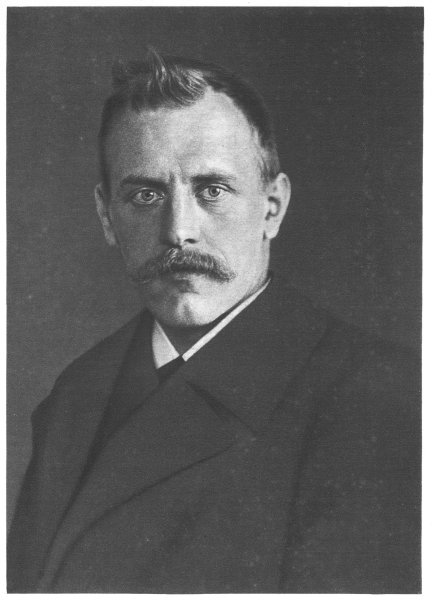
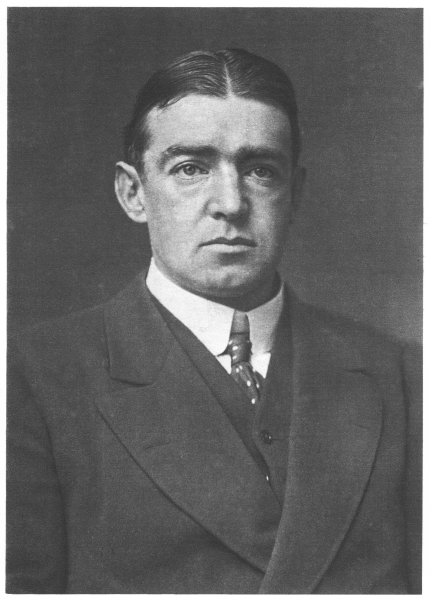
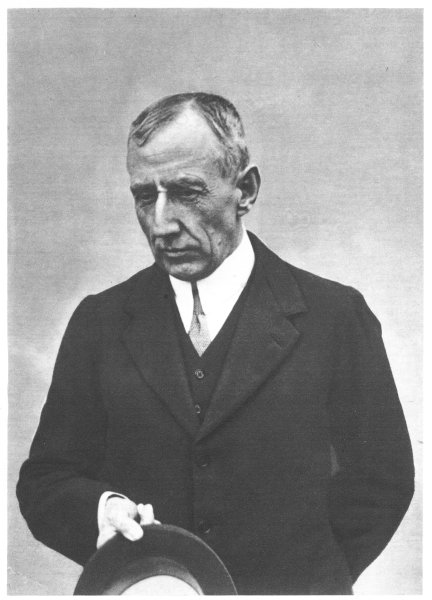
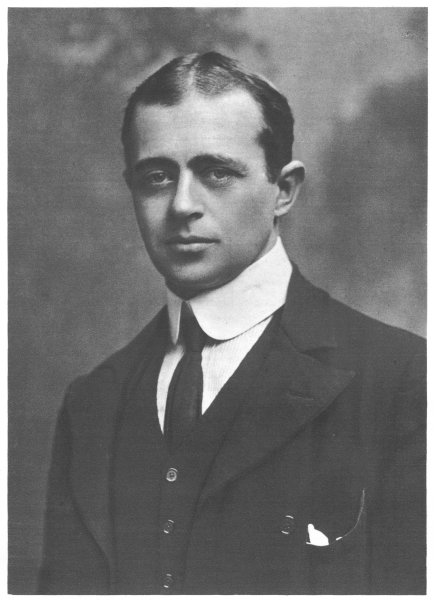
FRIDTJOF NANSEN · SIR ERNEST H. SHACKLETON
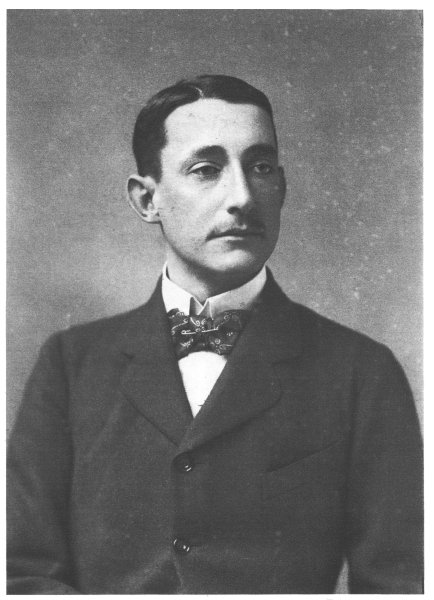
DUKE OF THE ABRUZZI · ROALD AMUNDSEN
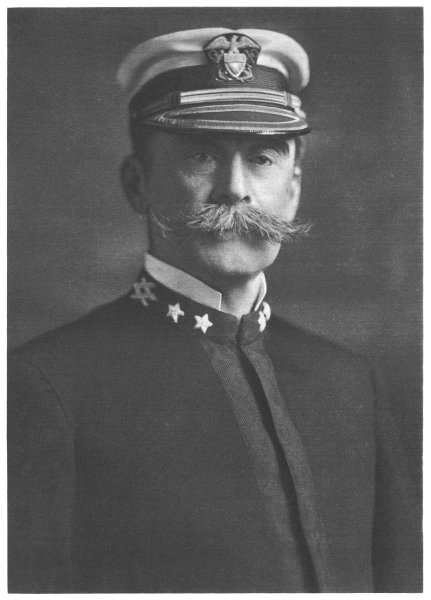
ROBERT E. PEARY · ROBERT FALCON SCOTT
Ten years ago many, perhaps the majority, of intelligent people doubted if the Poles of the earth would ever be reached by man. From east to west, and west to east, the world seemed small. Jules Verne’s “Round the World in Eighty Days” dream of not so many years ago had been cut in two; but from north to south the world still stretched in apparently unattainable infinity.
Within the last four years the two Poles have been reached three times, and in their attainment the globe has shrunk to commonplace dimensions. With the attainment of the Poles the climax of polar discovery has been reached, the last of the splendid series of great world voyages and mighty adventures has been finished. But while the glamour, the mystery, the speculation, as to what exists at the ends of the earth are gone, the work of detailed exploration, of continuous scientific observations and investigations, will continue until to the scientist and geographer the polar regions will be as well known as the more favored regions of the earth.
It is nearly four hundred years (1526) since the first recorded expedition went forth to seek the North Pole under the initiative of England.
Trade, the great prize of the commerce of the opulent East, land lust, and the spirit of adventure in turn played their part as incentives for the earlier expeditions. It seems to be generally accepted that nothing had a more powerful influence on the work than England’s determination to have a trade route of her own to the riches of the East, independent of the southern routes controlled by Spain and Portugal. It was this determination that made the terms Northeast Passage and Northwest Passage historic, and brought about years of search that, though latterly scientific, have been largely the acme of adventure and sentiment.
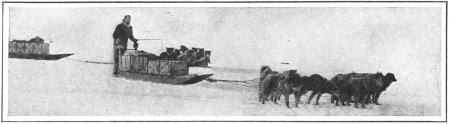
TRAVELING IN THE FAR NORTH
Dog sledges used by Peary on his expedition to the North Pole.
From the misty date of Pytheas (325 B.C.) down through the succeeding centuries, the record of polar exploration contains much of interest, of mystery, of superstition, followed by some of the grandest epics, most heroic efforts and sacrifices, and somberest catastrophes and tragedies in all the wide field of exploration. Briton and Scandinavian, Teuton and Latin, Slav and Magyar, and American, have entered the lists and struggled for the prize.
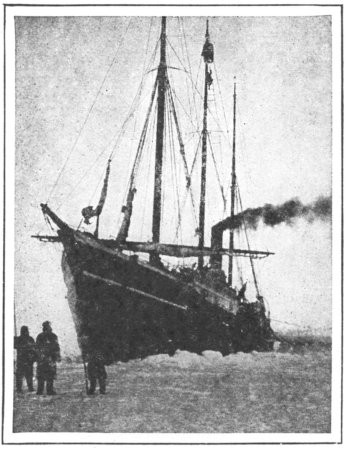
THE ROOSEVELT
Peary’s ship, in which he sailed to discover the North Pole.
In the earlier years of this long record occurred the strange voyages of the Zeni, and Eric the Red, Icelandic outlaw, with his discovery and colonization of Greenland,—strange stories of hot springs in that far country, with which the monks warmed their monastery and cooked their food; a tribute of walrus tusks toward the expenses of the Crusades; tales of the rich green pastures, and herds of grazing cattle, of these colonists, and later their mysterious and complete disappearance, leaving only a scattered ruin here and there to show that they ever existed.
Beginning with the earliest authentic expedition (1526), it is possible to touch only on the most important incidents of the record of this later phase of the subject. The time from 1526 to date may be roughly and generally divided into three periods:
The first, from 1526, the time of the first North Polar expedition by England, to about 1853, the close of Great Britain’s Franklin search expeditions. In this period the preponderance of British efforts over those of all other nations combined was so great as almost to obscure them and make this period preëminently British.
In this period British navigators essayed every route to the polar regions, attempted the Northeast and Northwest Passages again and again, and wrote some of the most brilliant pages of Great Britain’s history over the names of Hudson, Davis, Baffin, Ross, Parry, Franklin, McClintock, and others.
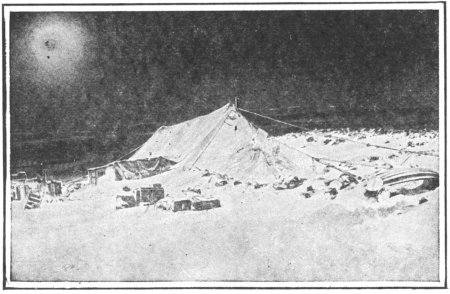
From “On the Polar Star,” by the Duke of the Abruzzi. Copyright, Dodd, Mead & Co.
THE HUT OF THE DUKE OF THE ABRUZZI
From a photograph taken by moonlight in the Arctic regions.
The second period covers from about 1850 to 1895, In this period other nations—the United States, Germany, Austria, Sweden, and Norway—showed equal activity with Great Britain, and the names of Kane, Hayes, Hall, Lockwood, Brainard (United States), Nares and Markham (Great Britain), Koldewey and Weyprecht (Germany), Payer (Austria), Nordenskjöld (Sweden), and others were written indelibly into Arctic history. In this period the record of farthest north which had been held by Great Britain was wrested from her in 1882 by Lockwood and Brainard of the United States.
The third period is from 1895 to date. In this period, while other valuable work was being done,—as Amundsen’s navigation of the Northwest Passage, Sverdrup’s extensive discoveries in the North American archipelago, Erichsen’s completion of the last gap in the north Greenland coast line,—three men, Nansen, Abruzzi, and Peary, each having for his object the attainment of the North Pole, pushed in succession far beyond the farthest of their predecessors, penetrating the inmost regions of the north, and the last named attaining the Pole which had been the prize of centuries.
Briefly summarized, from 1526 to 1882 Great Britain held the palm of nearest approach to the Pole, slowly pushing the record up till Markham reached 83° 20´ north latitude. Then the lead came to the United States with Lockwood and Brainard’s 83° 24´. In 1895 Norway went to the front in a great leap in Nansen’s 86° 14´, and in 1900 Italy grasped the blue ribbon with Abruzzi’s 86° 33´. In 1906 the United States took the lead again with Peary’s 87° 6´, and finally closed the record with his attainment of the Pole on April 6 and 7, 1909.
The exploration of the Antarctic regions dates back much less far than that of the Arctic. In 1772 Captain James Cook first crossed the Antarctic Circle and penetrated the Antarctic regions. After him came the Russian Bellingshausen in 1819, who discovered the first land within the Antarctic Circle. Then came Weddell the British sealer, who in 1823 pushed his sailing ship south into the great bight southeast of Cape Horn, named after him Weddell Sea, to 74° 15´ south latitude, 241 miles beyond Cook’s record, and not exceeded in that region until the last year. At Weddell’s farthest no land or field ice was to be seen, and only three icebergs were in sight.
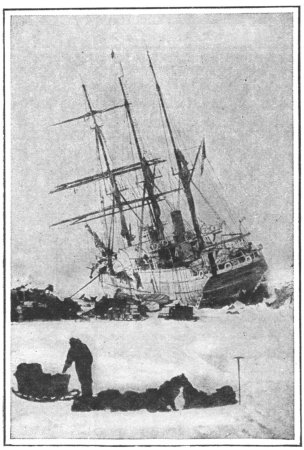
From “On the Polar Star,” by the Duke of the Abruzzi. Copyright, Dodd, Mead & Co.
THE POLAR STAR
Landing the stores while the ship was nipped by the ice.
In 1839–1841 occurred the important voyage of Sir James Ross. Ross a few years before had located the North Magnetic Pole. He was now in command of the Erebus and Terror, two ships that a few years later were to bear the Franklin expedition to its fate near the same North Magnetic Pole. Ross discovered South Victoria Land, directly south of New Zealand, with its long stretch of southerly trending savage coast line from Cape Adare to 78° 10´ south latitude, where he found an active volcano, Mt. Erebus. From here Ross followed the edge of the great ice barrier some three hundred miles to the eastward. The great indentation in the Antarctic continent thus discovered and navigated by Ross, and named after him Ross Sea, has since been the base of operations from which the South Pole was twice attained.
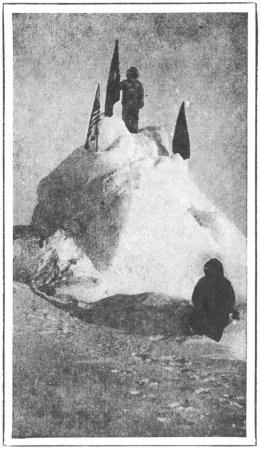
AT THE NORTH POLE
Photograph taken at the “Top of the World.”
After Ross came various minor expeditions contributing to the knowledge of the Antarctic regions, and in the 1890’s began a renaissance of Antarctic interest and exploration. In 1892, 1893, 1894 Scottish, German, and Norwegian whalers reconnoitered the Antarctic seas of Ross and Weddell in search of new whaling grounds, and in 1894 the first landing was made upon the Antarctic continent by some members of Bull’s Norwegian crew; in 1895 Newmayer introduced in the sixth Geographical Congress in London a resolution upon the importance of Antarctic exploration; and in the years following there was an international attack upon the problem by Belgium, Great Britain, Germany, Scotland, Sweden, and France. In 1898, for the first time in the history of Antarctic exploration, an expedition (the Belgian under Commander de Gerlache), passed a winter within the Antarctic Circle beset in the ice; and a year later, in 1899, a British expedition under Borchgrevink passed a winter on the Antarctic continent itself, and made at Cape Adare, in Ross Sea, the first attempt at land exploration.
In 1901–1902 a German expedition under Drygalski determined a new part of the coast of the Antarctic continent south of Africa, and three others, under Bruce of Scotland, Nordenskjöld of Sweden, and Charcot of France, made valuable discoveries in Weddell Sea, and the regions southeast, south, and southwest of Cape Horn. In 1901–1903 Scott of Great Britain, selecting the Ross Sea region discovered by Ross sixty years before as his base, effected the first serious land exploration of the Antarctic continent. In a magnificent sledge journey he covered three hundred and eighty miles due south, reaching a point within four hundred and thirty-seven miles of the South Pole. Following Scott, his lieutenant, Shackleton, in 1908–09, using essentially the same base and route as Scott, made an even more brilliant journey, and reached a point within ninety-seven miles of the Pole, January 9, 1909. At that time this was the “farthest south” record.
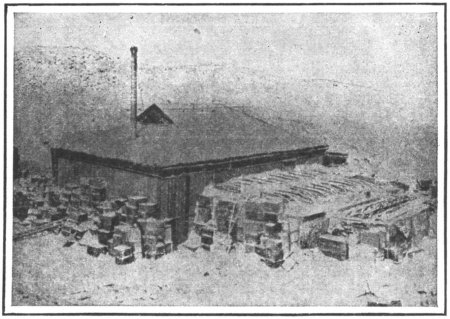
Reproduced from “The Heart of the Antarctic,” by Sir Ernest H. Shackleton. Copyright, J. B. Lippincott Co.
SHACKLETON’S EXPEDITION
The hut in the early winter quarters near Mt. Erebus, the Antarctic volcano.
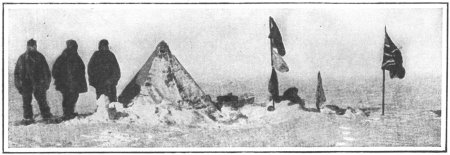
Reproduced from “The Heart of the Antarctic,” by Sir Ernest H. Shackleton. Copyright, J. B. Lippincott Co.
THE “FARTHEST SOUTH” CAMP AFTER A SIXTY-HOUR BLIZZARD
The successes of Scott and Shackleton still further stimulated interest in the Antarctic problem, and in 1910 and 1911 Great Britain, Norway, Germany, Australia, and Japan sent expeditions into the field; the United States unfortunately, as in the past, being unrepresented. Four of these expeditions—the Japanese, Australian, Norwegian, and British—selected the Ross Sea region south of New Zealand and Australia for their work; while the German expedition selected the Weddell Sea region southeast of Cape Horn, the most promising of all points of attack upon the Antarctic continent. All these expeditions have now returned. The Japanese expedition explored an unknown section of the coast of King Edward VII Land east of Ross Sea, the Australian expedition explored a long stretch of Wilkes Land west of Ross Sea, the German expedition made new discoveries in Weddell Sea, reaching a point farther south than ever before attained in that region; while Amundsen’s Norwegian expedition, from its base in the southeast angle of Ross Sea, attained the South Pole, December 14 to 17, 1911, and Scott’s British expedition, from its base in the southwest angle of Ross Sea, attained it a month later, January 18, 1912, Scott and his four companions dying of cold and starvation on the return.
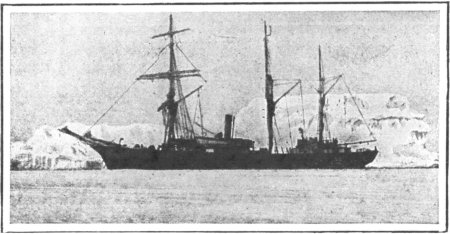
Reproduced from “The Heart of the Antarctic,” by Sir Ernest H. Shackleton. Copyright, J. B. Lippincott Co.
SHACKLETON’S SHIP, THE NIMROD
Moored to a stranded iceberg about a mile from winter quarters, the Nimrod was sheltered from blizzards.
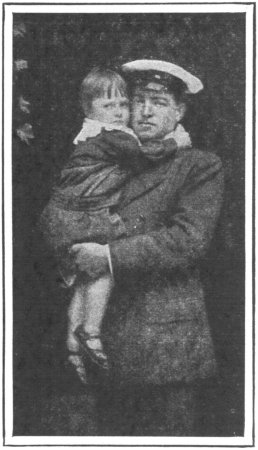
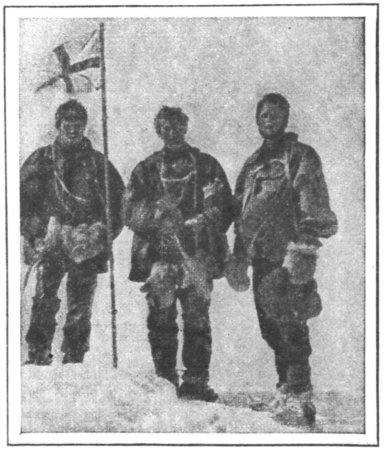
Reproduced from “The Heart of the Antarctic,” by Sir Ernest H. Shackleton. Copyright, J. B. Lippincott Co.
DISCOVERERS OF THE SOUTH MAGNETIC POLE
Part of Shackleton’s expedition reached for the first time the South Magnetic Pole—that is, where the south part of the compass needle points. Those in the picture, reading from left to right, are Dr. Mackay, Professor David, and Douglas Mawson.
The record of Antarctic exploration from 1772 to date may be divided into two periods; the first from 1772 to 1898 and 1899, a period of summer voyages only, the work carried on entirely by ships, with no land or sledge work, and no attempt to winter in that region. During this period, though other nations, notably the United States and France, took part in the work, the work of Great Britain was so pronouncedly preponderant as to more than equal all the others combined. The second period is from 1899 to date, and is the period of overland exploration with sledges. In this period, as in the last period of Arctic exploration, three men, Scott, Shackleton, and Amundsen, each having for his object the attainment of the South Pole, pushed so far beyond all predecessors as to be in a class by themselves, two of them, Amundsen and Scott, actually reaching the Pole.
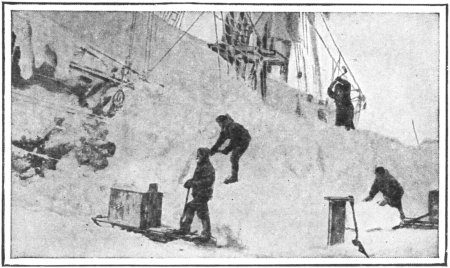
Copyright, 1897, Harper & Bros.
NANSEN’S EXPEDITION
Digging the Fram out of the ice.
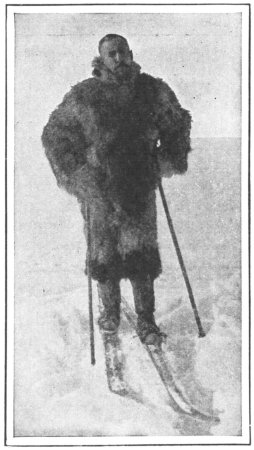
Copyright by Wilse Studio.
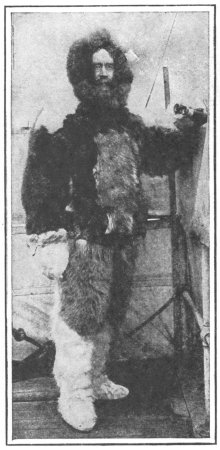
AMUNDSEN IN POLAR COSTUME
Discoverer of the South Pole.
After the foregoing condensed résumé of Arctic and Antarctic exploration and discovery, I feel sure the reader will be interested in noting some of the striking contrasts between the two Poles and their surroundings. These contrasts are as great as the Poles are far apart. The North Pole is situated in an ocean of some fifteen hundred miles’ diameter, surrounded by land. The South Pole is situated in a continent of some twenty-five hundred miles’ diameter, surrounded by water. At the North Pole, Peary stood upon the frozen surface of an ocean more than two miles in depth. At the South Pole, Amundsen and Scott stood upon the surface of a great elevated snow plateau more than two miles above sea level. The lands that surround the North Polar Ocean have comparatively abundant life, musk oxen, reindeer, polar bears, wolves, foxes, arctic hares, ermines, and lemmings, together with insects and flowers, being found less than five hundred miles from the Pole. On the great South Polar continent no form of animal life is found.
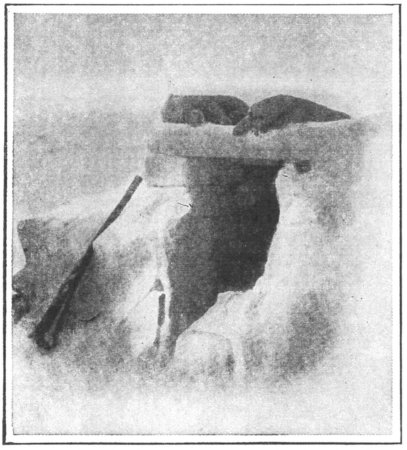
From “On the Polar Star,” by the Duke of the Abruzzi. Copyright, Dodd, Mead & Co.
ENTRANCE TO HUT
A “home” in the polar regions.
Permanent human life exists within some seven hundred miles of the North Pole; none is found within twenty-three hundred miles of the South Pole. The history of Arctic exploration goes back nearly four hundred years. The history of Antarctic efforts covers one hundred and forty years. The record of Arctic exploration is studded with crushed and foundering ships, and the deaths of hundreds of brave men. The record of Antarctic exploration shows the loss of but one ship, and the death of a dozen men.
Copyright, Underwood & Underwood
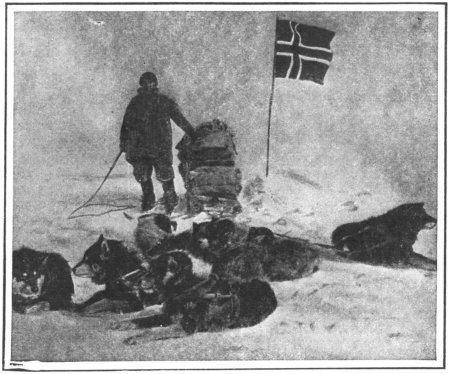
AT THE SOUTH POLE—PHOTOGRAPHED BY AMUNDSEN
For all those who aspire to the North Pole, the road lies over the frozen surface of an ocean, the ice on which breaks up completely every summer, drifting about under the influence of wind and tide, and may crack into numerous fissures and lanes of open water at any time, even in the depth of the severest winter, under the influence of storms. For those who aspire to the South Pole, the road lies over an eternal, immovable surface, the latter part rising ten thousand and eleven thousand feet above sea level. And herein lies the inestimable advantage to the South Polar explorer which enables him to make his depots at convenient distances, and thus lighten his load and increase his speed.
Copr., 1913, by International News Service
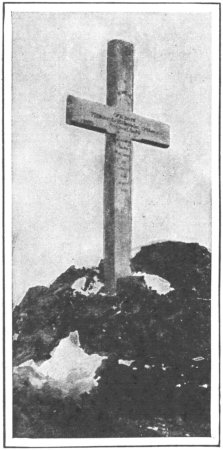
IN MEMORY OF BRAVE MEN
The cross erected on Observation Hill to Scott and his courageous companions.
Copyright, 1913, by International News Service
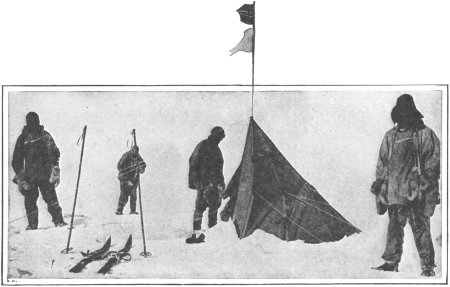
PRECEDED BY AMUNDSEN
When Captain Scott and his party reached the South Pole they found that Amundsen had been there before them. Captain Scott is peering into the tent left by Amundsen’s expedition.
The efforts and successes of the last fifteen years in the Antarctic regions ought to, and I hope will, spur us as individuals, as societies, and as a nation to do all in our power to enable the United States to take its proper part and share in the great work yet to be done in that field. There are three ways in which this country could make up for its past lethargy in regard to Antarctic work, and take front rank at once in this attractive field.
One is to establish a station at the South Pole for a year’s continuous observations in various fields of scientific investigation. With the practical experience in methods of travel and transportation now at the command of the United States as the result of our last twenty-five years of North Polar work, this would not be so difficult as it may seem to the layman.
Copyright, 1913, by William H. Rau
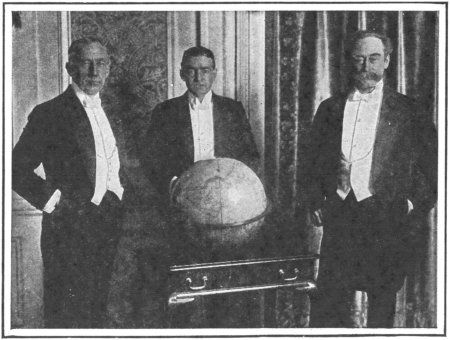
THE THREE POLAR STARS
A photograph of Captain Roald Amundsen, Sir Ernest H. Shackleton, and Rear Admiral Robert E. Peary, taken at Philadelphia, January 16, 1913.
Another is to inaugurate and carry out, in a special ship, with a corps of experts, through a period of several seasons, a complete and systematic survey and study of the entire circumference of the Antarctic continent with its adjacent oceans, with up to date equipment and methods. This plan would probably be the most attractive to scientists, as it would secure a large harvest of new and valuable material to enrich our museums and keep our specialists busy for years. It would also be the most expensive.
The third would be the thorough exploration of the Weddell Sea region southeast of Cape Horn, which is specially within our sphere of interest, together with a sledge traverse from the most southern part of that sea to the South Pole. Such a traverse, with the journeys of Amundsen, Scott, and Shackleton from the opposite side, would give a complete transverse section across the Antarctic continent.
This last would promise the largest measure of broad results in the shortest time, and least expense, and would probably be the most attractive to geographers.
The successful accomplishment of any one of these ventures would put the United States in the front rank of Antarctic achievements.
SUPPLEMENTARY READING—“Nearest the Pole” and “The North Pole,” Peary; “On the Polar Star,” Duke of the Abruzzi; “The Heart of the Antarctic,” Shackleton; “Farthest North,” Fridtjof Nansen; “The Uttermost South—the Undying Story of Captain Scott,” Everybody’s Magazine, July, August, September, and October, 1913.
ISSUED SEMI-MONTHLY BY
The Mentor Association, Inc.
381 Fourth Ave., New York, N. Y.
Volume 1 Number 37
ANNUAL SUBSCRIPTION, THREE DOLLARS. SINGLE COPIES FIFTEEN CENTS. FOREIGN POSTAGE, 75 CENTS EXTRA. CANADIAN POSTAGE, 50 CENTS EXTRA. ENTERED AT THE POST OFFICE AT NEW YORK, N. Y., AS SECOND-CLASS MATTER. COPYRIGHT, 1913, BY THE MENTOR ASSOCIATION, INC. PRESIDENT AND TREASURER, R. M. DONALDSON; VICE-PRESIDENT, W. M. SANFORD; SECRETARY, L. D. GARDNER.
This week’s issue of The Mentor and that of last week are so distinguished in authority that we ask special attention to them. An interesting article on the Conquest of the Poles could have been prepared by any good writer. The Mentor article was written by the supreme authority on the subject, Rear Admiral Robert E. Peary. The article on “Famous American Sculptors,” published last week, was written by Mr. Lorado Taft, one of the best-known sculptors in America. When Mr. Taft writes about Barnard, French, Bartlett and the other American sculptors he is giving an account of his fellows in art. It is fortunate that so able and so interesting a critical writer on sculpture as Mr. Taft could be found among sculptors. He has given to us in The Mentor just what we want—information imparted in a simple, interesting way, and with authority.
It is worth a great deal to us to read what others have to say about The Mentor. It is a genuine satisfaction to receive from far-off California a message of “surprise and great delight over this ‘wise and faithful guide and friend,’ which surely fills a need in the lives of busy people.” A friend nearer by, in Brooklyn, offers thanks for our “wonderful weekly. The pictures are lovely,” she says. “Already I have shown it to many of my friends, and they are just as interested and pleased as I am. You most certainly deserve a vote of thanks from the people for placing this beautiful educational magazine within easy reach of everyone.”
The thanks we appreciate, but what we value most is that our Brooklyn correspondent showed The Mentor to many of her friends and that they were just as pleased and interested as she was. A letter like that from every reader of The Mentor would mean an aggregate membership for The Mentor Association that would make it unique among the educational institutions of the world. There is a prospect that we hold fondly before us—that of every reader showing The Mentor to every friend that might be interested.
And then, when all of these friends have seen The Mentor, they will want the numbers from the beginning. We say they “will want” them, for that is what most of our subscribers demand. A teacher in Kansas writes, “The Mentor is a delight, and its value is beyond expression. I feel that I cannot miss a single issue, so please send me the numbers from the beginning.” A teacher from Pittsburgh, immediately on receiving the first copy of the magazine, asks for all previous issues. An agent in insurance writes from Arkansas for the preceding numbers, adding, “I cannot afford to lose one copy.”
So from St. Louis we hear, “Send me all preceding issues,” and from New Haven a college student writes, “I like the publication so much that I do not wish to miss even one number.” We lack space to cite all cases of this kind, but as we turn over the mail we find here a request from Toronto for “all numbers, beginning with the first,” another from Charleston, and a third from Hyannis, Massachusetts, demanding “all preceding numbers.”
It has become a regular daily incident, and it shows the unique character of The Mentor publication. It is not simply a magazine. Subscribers do not send for all back numbers of the ordinary magazine from the beginning of its existence. Every number of The Mentor is part of an interesting educational plan. The members of The Mentor Association want all parts of that plan.