THE MENTOR 1913.11.10, No. 39, The Mediterranean
LEARN ONE THING
EVERY DAY
NOVEMBER 10 1913
SERIAL NO. 39
THE
MENTOR
THE
MEDITERRANEAN
By DWIGHT L. ELMENDORF
Lecturer and Traveler
DEPARTMENT OF
TRAVEL
VOLUME 1
NUMBER 39
TWENTY CENTS A COPY
Whole book · 12 sections
LEARN ONE THING
EVERY DAY
NOVEMBER 10 1913
SERIAL NO. 39
THE
MENTOR
THE
MEDITERRANEAN
By DWIGHT L. ELMENDORF
Lecturer and Traveler
DEPARTMENT OF
TRAVEL
VOLUME 1
NUMBER 39
TWENTY CENTS A COPY
ESTABLISHED FOR THE DEVELOPMENT OF A POPULAR INTEREST IN ART, LITERATURE, SCIENCE, HISTORY, NATURE, AND TRAVEL
CONTRIBUTORS—PROF. JOHN C. VAN DYKE, HAMILTON W. MABIE, PROF. ALBERT BUSHNELL HART, REAR ADMIRAL ROBERT E. PEARY, WILLIAM T. HORNADAY, DWIGHT L. ELMENDORF, HENRY T. FINCK, WILLIAM WINTER, ESTHER SINGLETON, PROF. G. W. BOTSFORD, IDA M. TARBELL, GUSTAV KOBBÉ, DEAN C. WORCESTER; JOHN K. MUMFORD, W. J. HOLLAND, LORADO TAFT, KENYON COX, E. H. FORBUSH, H. E. KREHBIEL, SAMUEL ISHAM, BURGES JOHNSON, STEPHEN BONSAL, JAMES HUNEKER, W. J. HENDERSON, AND OTHERS.
The purpose of The Mentor Association is to give its members, in an interesting and attractive way the information in various fields of knowledge which everybody wants and ought to have. The information is imparted by interesting reading matter, prepared under the direction of leading authorities, and by beautiful pictures, reproduced by the most highly perfected modern processes.
The object of The Mentor Association is to enable people to acquire useful knowledge without effort, so that they may come easily and agreeably to know the world’s great men and women, the great achievements and the permanently interesting things in art, literature, science, history, nature and travel.
The purpose of the Association is carried out by means of simple readable text and beautiful illustrations in The Mentor.
The annual subscription is Four Dollars, covering The Mentor Course, which comprises twenty-four numbers of The Mentor in one year.
SUBSCRIPTION, FOUR DOLLARS A YEAR. FOREIGN POSTAGE 75 CENTS EXTRA. CANADIAN POSTAGE 50 CENTS EXTRA. SINGLE COPIES TWENTY CENTS. PRESIDENT, THOMAS H. BECK; VICE-PRESIDENT, WALTER P. TEN EYCK; SECRETARY, W. D. MOFFAT; TREASURER, ROBERT M. DONALDSON; ASST. TREASURER AND ASST. SECRETARY, J. S. CAMPBELL
Copyright, 1913, by The Mentor Association, Inc. Entered as second-class matter March 10, 1913, at the post office at New York, N. Y., under the Act of March 3, 1879.
SERIAL NUMBER 39

THE MEDITERRANEAN
BY
DWIGHT L. ELMENDORF
Lecturer and Traveler
ALGIERS · THE RIVIERA · MONTE CARLO · NICE · GENOA · NAPLES
Across the straits from Gibraltar is another and very different world. Start with Tangier (tahn-jeer´) and wander along the Barbary coast, and you will find yourself in such contrasting conditions, and in a civilization so different from those north of you in Spain and in France, that it will be hard for you to believe that you are separated from those countries by distances varying from the narrow straits of Gibraltar to a mere matter of two or three hundred miles.
You will seem to have been transported to the other side of the world. No traveler can find greater variety in scene and life, in language and habit, in climate and condition, than he gets in the course of a full Mediterranean tour. Few travelers make the whole circuit of the Mediterranean. This great inland sea is usually visited only in parts, and while the traveler is in transit from one point to another. There is no general description that can apply to the whole of this interesting body of water. On every shore there is something that is new and different, and somewhere on these shores there is something to delight each one. If scenery is desired, the French and Italian Riviera (ree-vee-ay´-rah) will draw one irresistibly. A life full of gaiety will hold him there. If historic associations interest him, he will turn naturally to the shores of Italy and Greece, and he will spend months pleasantly in the Adriatic or Ægean Sea. There is in those countries an endless amount to learn and a wealth of natural beauty. When you have cruised through the Ægean (ee-jee´-an), visit the coast of Greece, and of Asia Minor. There you will know the feelings that stirred Lord Byron when he wrote:
The Mediterranean has been the arena of the world’s history for several thousand years.
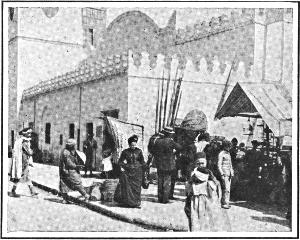
ALGIERS
A street scene in Algiers near the mosque.
As your eye traces the coast line on the map and you note the countries whose shores are washed by the Mediterranean, you realize what a trip throughout that sea must mean in instruction as well as in delights of travel. Besides the countries I have named, there are Turkey, Asia Minor, Palestine, and Egypt, to say nothing of the great stretch on the African coast. The shore line is so extended, and the life and customs at different points vary so, that we think of the Mediterranean as not one thing, but many things. What is usually called a “Mediterranean trip” rarely comprises more than ten or fifteen points. With limited time, the traveler naturally selects the points of which he has heard most.
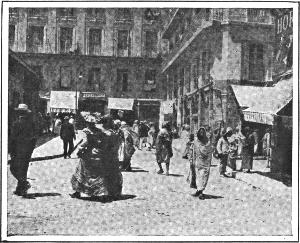
ALGIERS
A scene near the busy market.
A Mediterranean trip to many travelers means Algiers (al-jeerz´), as far as the African coast is concerned, and the Riviera, with all the points on that beautiful north shore line. Then they must see Naples, of course, and after passing down the Italian coast they are likely to go straight on to Egypt. After passing through the straits of Gibraltar the attention of the traveler is soon centered on Algiers.
From the entrance to the harbor Algiers appears like a white diamond set in a circle of emeralds. The town consists of two parts, the French and the Arab quarters. To the visitor from the west Algiers is most interesting; for there he meets characters of all kinds, European peoples mixing with those of North Africa. The French quarters show that the Frenchman, when compelled to live in another country, takes a bit of Paris with him; for there is found the typical French café, with its little tables on the sidewalk, contrasting with the Arab café where natives, in their picturesque white costumes, sit and sip their coffee and gossip with wild gesticulation. Even in its African population Algiers is oddly mixed. Each tribe has its own peculiar costume, the marketplace often looking like a stage of a comic opera, only much more artistic and natural.
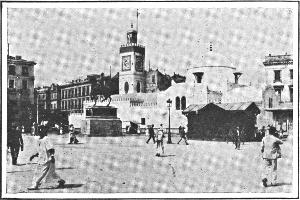
MOSQUÉE DE LA PÊCHERIE, ALGIERS
The “Mosque of the Fishery” was erected by Turkish architects in 1660. It is a cruciform building, with a large central dome painted inside, and a square minaret, now a clock tower.
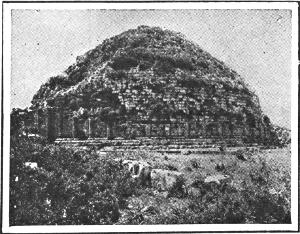
TOMBEAU DE LA CHRÉTIENNE
This large tomb near Algiers, 108 feet high, was built as a tomb for Juba II and his family. It serves as a landmark for sailors. Its present name is derived from the cruciform moldings of the door panels.
The government house, and in fact all the buildings except those in the French quarters, are Moorish in design and generally whitewashed, so that they masquerade as glittering white marble. The town is beautifully situated, and is surrounded by a very interesting country filled with relics of Punic War times, and ruins of structures of even a more remote period. Near Algiers is the building called the “tomb of the Christian woman.” This is really the tomb of Juba II, who married Cleopatra Selene (se-lee´-nee), daughter of the celebrated Cleopatra and of Marc Antony. Juba II had a son, Ptolemy, and a daughter, Drusilla, who was the wife of Felix, procurator of Judea, who, it will be remembered, said to Saint Paul, “Go thy way for this time; when I have a convenient season, I will call for thee” (Acts xxiv, 25).
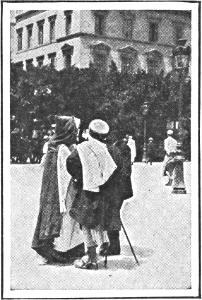
A STREET SCENE IN ALGIERS
Showing three different styles of costume.
All the coast about Algiers is filled with just such interesting relics of Biblical times. Perfect French roads now make it possible to reach the most interesting places by carriage or motorcar.
Across the Mediterranean is a stretch of shore that no traveler in Europe should miss. It is called “The Riviera,” and it extends from Cannes (kahn) to Ventimiglia (ven-tee-meel´-yah), thence to Spezia (spet´-see-ah), beyond Genoa (jen´-o-ah); the former section French, the latter Italian. From one end to the other is a chain of health resorts, some most fashionable, others the very opposite; the latter on that account more desirable to those who wish peace and quiet. Even in the most retired spots, however, there is no escape from the honk-honk of the motorcars; for Riviera highways are the favorite touring roads of southern Europe.
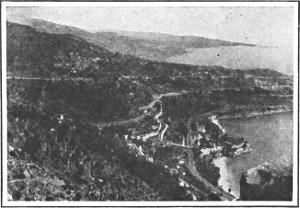
LOOKING TOWARD MENTONE
Mentone belonged to Monaco until 1861. It is beautifully situated on the Golfe de la Paix, consisting of two bays separated by a rocky promontory.
Beginning at Cannes, the necklace of the sea contains such jewels as Antibes (ong-teeb´), Nice (nees), Villefranche-sur-Mer (veel-frongsh-soor-mare´), Beaulieu (bo-lee-eh´), Monaco (mon´-ah-ko), Monte Carlo, and Mentone (men-to´-ne). These are followed by the Italian section,—Ventimiglia, Bordighera (bor-dee-gay´-rah), Ospedaletti, San Remo (ray´-mo), Alassio (ah-lahs´-see-o), Savona (sah-vo´-nah), Pegli (pel´-yee), and Genoa. This section is called the Riviera di Ponente (po-nen´-teh), followed by Riviera di Levante (le-vahn´-te) to the east of Genoa,—Nervi (ner´-vee), Recco (rek´-ko), Santa Margherita Ligure (lih-goor´-eh), Rapallo (rah-pahl´-lo), Sestri Levante, and Spezia.
The French section is more fully developed, and therefore more comfortable and fashionable. The Italian section, while beautiful, leaves much to be desired by the ordinary tourist.
There nestles in the southeast corner of France a tiny little principality called Monaco, the most remarkable place of its kind in the world.
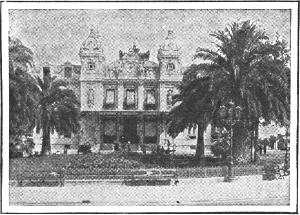
MONTE CARLO
The front of the Casino.
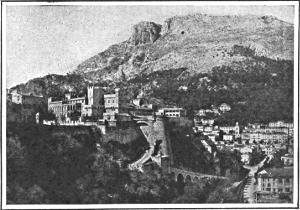
MONACO
The palace of the Prince of Monaco, and in the background the “Tête de Chien” or “Dog’s Head Mountain.”
It is only about eight square miles in area, and contains nineteen thousand inhabitants. Strange as it may seem, there are no taxes there, as the Société des Bains de Mer, which is simply a name for the society or company that runs the Casino gambling tables at Monte Carlo, pays the tribute. From the millions of francs paid by this society to the Prince of Monaco and his government every year, the natural inference is that most of the visitors to Monte Carlo get nothing except experience.
The Casino building is very theatrical in style, built expressly for its purpose, and superbly placed on a promontory overlooking the sea and town. It is surrounded by beautiful gardens, carefully kept. In fact, the whole place is a delight to the eye and the most beautiful spot on the Riviera. It is attractive enough to detain one for days, even if the great magnet, the Casino, were not there. On account of the gaming, the whole district is filled with characters that one had rather not meet except in the Casino, where perfect order is assured by the presence of numerous detectives, ready to check disorder when it threatens, or to notify politely anyone of suicidal tendency to leave the Casino and the principality. There is no place in the world where arrangements are so well planned to satisfy the desire of human beings to get something for nothing. And it is not simply a gaming place. The spectacle of Monte Carlo has a great fascination even for those who never play at the tables, everything is so beautiful, so orderly, and so well kept. Many who visit there prefer, however, to stop at Mentone, which is but a few minutes distant by trolley or motorcar.
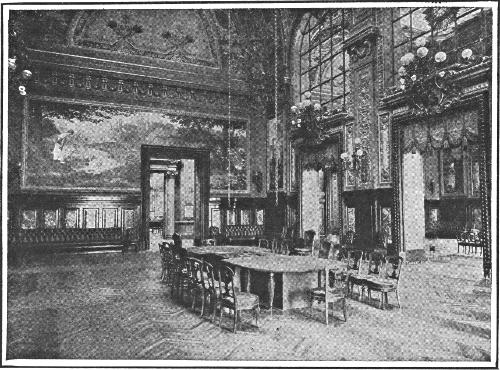
THE CASINO, MONTE CARLO
One of the beautiful gaming rooms, the “Salle du Trente-Quarante.”
The Nicæa (ny-see´-a) of ancient times, founded by Massilians in the fifth century B.C., Nice is the birthplace of Masséna (mah-say-nah´) and Garibaldi, (gah-ree-bahl´-dee). Sheltered by the Maritime Alps, and because of the great limestone cliffs along shore, which absorb the heat rays of the sun, the temperature is so modified that flowers bloom the year round. Nice and its near neighbors have become a famous resort for invalids, especially of the English, who flee to this part of the world to escape their own disagreeable winter. In summer the temperature is fifteen to twenty degrees lower than Paris. The best view of the town is obtained from Castle Hill, overlooking the shore of the Promenade des Anglais, constructed by the English in 1822, in order to give work to the unemployed. One of the secrets of the great success of Nice as a resort is the great variety of entertainment offered by the clever Frenchmen. Fine hotels, theaters, casinos, promenades, and roads (the best in the world), especially the Petite and the Grand Corniche (kor-neesh´), together with a superb climate, are quite enough to attract people from all parts of the world. The business part of the town is a miniature Paris. Fine avenues, lined with shops filled with all kinds of attractive things, inveigle the tourist into extravagant expenditure; while casinos and gambling places relieve the venturesome of their spare cash most politely.
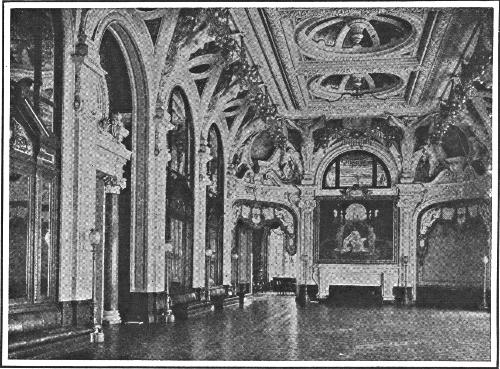
THE CASINO, MONTE CARLO
The richly decorated “Salon de Conversation.”
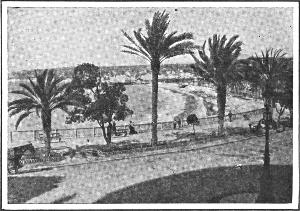
NICE
The town and the promenade from Castle Hill.
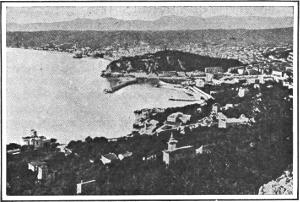
NICE
Nice is a superb winter resort. In the summer it is less frequented.
From being a republic and a great naval power in the Middle Ages, and as such a rival of Venice, Genoa has come to be now a city of great enterprise and activity. It stands next to Marseilles (mahr-saylz´) in importance as a seaport. It is advantageously situated, the Gulf of Genoa affording an attractive harbor, and the slopes of the Ligurian hills at the back offering many spots of advantage for the display of the city’s beautiful buildings.
The city is finely constructed. As you enter the harbor you find just before you that part of the lower town that is on the level of the water. Beyond that and up the hillslopes beautiful structures have assembled themselves on the different levels of a great natural theater, as if to watch your coming and to greet you on your arrival.
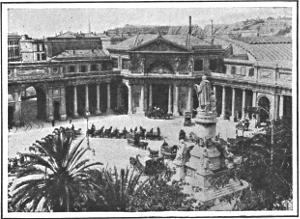
THE RAILWAY STATION, GENOA
On landing at the pier the traveler quickly finds himself in the attractive Palazzo Doria, named after Andrea Doria, (do´-ree-ah) the famous admiral of Charles V. It is well for the visitor, especially if an American, to take this course, following up the Via Doria to the square in front of the railway station; for there, surrounded by flowers and palms, stands a fine monument of Christopher Columbus; who, it will be remembered, was a native of the city. Genoa is full of stirring activity. If you have gone there from some of the quieter towns along the Riviera, you will feel a change in spirit. You are inclined to move a little faster. Things are happening all the time. There is much to be seen, and all that you see tells a story of years of vigorous, successful civic life. The most notable physical features of Genoa are its fine medieval churches and its many splendid sixteenth century palaces.
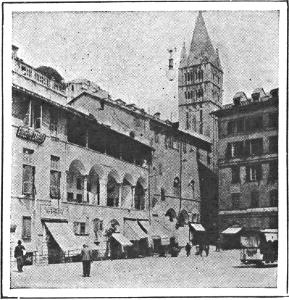
GENOA
Houses in the old town near the port. The old town is a network of narrow and steep streets; but the newer quarters have broad and straight thoroughfares.
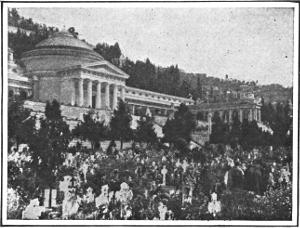
CAMPO SANTO, GENOA
This cemetery was laid out by Resasco in 1844-51. The central point is a rotunda, with a dome borne by columns of black marble.
Follow up the Via Garibaldi, a magnificent street with many beautiful palaces on both sides. To vary the impressions of fine architectural display take a ride in the tramway up to San Nicolo (nee-ko-lo´) and Castellaccio (cahs-tel-ah´-cho), where you will find yourself over a thousand feet high, and commanding a superb view of the Bisagno (bih-sahn´-yo) Valley and the Campo Santo (kahm´-po sahn´-to) below you. The cemetery called Campo Santo is one of the most interesting features of Genoa. It is beautifully situated, and is filled with remarkable monuments, some of them executed by the leading sculptors of Italy. In the burial spots of the Genoese, as well as in the homes where they live, there is much of luxury and elegance. In its business activities, its social life, its climate, and its customs, Genoa is attractive, and holds the visitor there for sometime content.
On the most beautiful site in Europe stands Naples, the Neapolis of the Athenian colonists. After the Romans conquered it, it still retained Greek culture and institutions. It became the favorite summer resort of the Romans, and the delight of the poets Horace, Ovid, and Virgil. It was when living in Naples that Virgil wrote his famous verses on agriculture, the “Georgics.” After many vicissitudes Roger de Hauteville formed the kingdom of Naples in 1130.
Medieval Naples is traceable in its walls and great gates. The Porta Capuana is one of the best preserved.
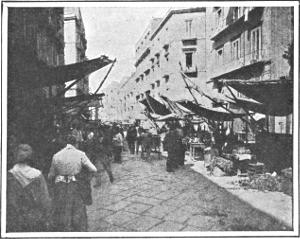
NAPLES
The market street in the old quarter.
After the young Conradin (kon´-rah-deen), the last of the Norman dynasty in Naples, was executed, the country was ruled by the house of Anjou (English, an´-jo; French, ong-zho´), then by the French (Louis XII), and then by Ferdinand of Spain. Don Carlos improved the city and surrounding country. In 1806 the city was invaded by Napoleon, who established his government there for a short time. The Bourbon (boor-bong´) rule came to an end in 1860, when Frances II was dethroned by Garibaldi. From the time it was founded till the present day poor Naples has been so torn to pieces by the many nations contesting for it that there is but little left of its ancient beauty or grandeur, and it now depends upon its wonderful situation, which, with the beautiful places about it, holds the visitor enchanted.
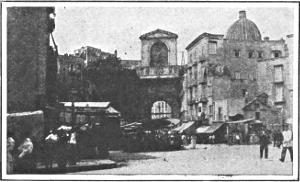
PORTA CAPUANA, NAPLES
Capua Gate, one of the finest of Renaissance gateways, was built by the Florentine Giuliano da Maiano, with sculptures by Giovanni da Nola.
There are travelers of years of experience who have declared that the site and surroundings of Naples are not excelled in beauty anywhere in the world. You enter the Bay of Naples with the island of Ischia (es´-kee-ah) on one side and on the other the island of Capri (kah´-pree). Immediately before you lies Naples, stretching out from the water’s edge up the hills beyond; the second largest city in Italy, with a population of over five hundred thousand. Back of it and to the southeast is Vesuvius. History has taught us to look with feelings of respect and awe upon that smoke-crowned cone. On the shore, to the south, Herculaneum (her-kew-lay´-nee-um) and Pompeii (pom-pay´-yee) are to be seen, and as the coast curves out to the peninsula you come to Sorrento (sore-ren´-to) and the road along the mountainside that takes you on a scenic tour of matchless beauty, including Amalfi (ah-mahl´-fee), Vietri (vee-ay´-tree), and Salerno (sah-ler´-no).
The interest in Naples is not only scenic, but historic. It is not the achievements of monarchs nor the monuments of artists that attract you. In such matters Naples is poorer than other towns in Italy. But the relics rescued from the explorations in Herculaneum and Pompeii afford an interest that is unique and compelling—an interest, too, that is continually growing, for new discoveries are being made from time to time.
Many are the scenic trips to be taken from Naples. It is a point of departure for pleasure tourists in almost every direction. The ascent of Mount Vesuvius is interesting; but that is the interest of curiosity. Where visitors find the greatest happiness is in the trips to outlying points, especially to the peninsula of Sorrento, to the island of Capri, and to Amalfi and Ravello. It is at these points that we find the greatest beauty of the Mediterranean. It seems indeed as if the great inland sea and mankind had joined there to make a pleasure ground beyond compare.
It is in and about Naples that the traveler will care to linger longest. There is so much to be seen there—and, when satisfied with pleasure jaunts and scenic trips, there is a serenity of life in Naples, and a soft, sunny climate that, to repeat Byron’s words, “lend to loneliness delight.” One friend of mine prolonged a trip, planned for a week, until it filled out twelve months. There is much to interest and delight one in all the seaport towns of the Mediterranean. After all has been said of its varied shores, however, one is apt to conclude by giving the palm of distinction in beauty and interest to Algiers, to Monte Carlo, and to Naples with its environs.
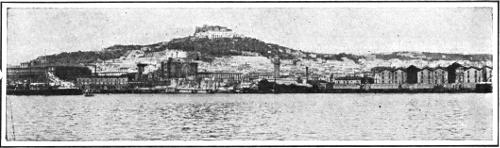
NAPLES FROM THE BAY
SUPPLEMENTARY READING—“Mediterranean Winter Resorts,” E. Reynolds-Ball; “Algeria and Tunis,” Frances E. Nesbitt; “The Barbary Coast,” H. M. Field; “The Garden of Allah,” R. S. Hichens; “Servitude,” Irene Osgood; Burckhardt’s “Cicerone,” translated by Mrs. A. H. Clough; “Afloat and Ashore on the Mediterranean,” Lee Meriwether; “Mediterranean Trip,” N. Brooks; “Italian Cities,” E. H. and E. W. Blashfield.
THE MENTOR
ISSUED SEMI-MONTHLY BY
The Mentor Association, Inc.
381 Fourth Ave., New York, N. Y.
Vol. 1 No. 39
ANNUAL SUBSCRIPTION, FOUR DOLLARS. SINGLE COPIES TWENTY CENTS. FOREIGN POSTAGE, SEVENTY-FIVE CENTS EXTRA. CANADIAN POSTAGE, FIFTY CENTS EXTRA. ENTERED AT THE POST OFFICE AT NEW YORK, N. Y., AS SECOND-CLASS MATTER.
The Mentor has reached the farm. We have heard of its work in cities and towns and small settlements. We have had assurance of its acceptance by professional men, business men, educators, reading societies and of the place it has assumed in the home. We have been waiting to hear from the farm—and wanting to hear, for it seems to us that a plan that carries information in a popular and interesting way to the public must be a welcome visitor to any intelligent farm family.

And now comes the first voice from the farm, and it is in its way the finest, freshest, and cheeriest message that we have had. It is so full of simon-pure human notes that we are going to give it to the readers of The Mentor in full. We are sure it will interest all of our readers as much as it gratifies us:
“The Mentor Association, Inc., New York City.
“Dear Sirs: Thank you so much for your offer for becoming a charter member. I think The Mentor is splendid and I desire most keenly to accept, but alas, I am poor. My husband and I are young and struggling farmers. We are in a way of becoming comfortably situated, but at present, though we own quite a bunch of stock, implements, some property, etc., we really have little actual cash, and have to plan with economy and care to make every penny count. The grain in the bins means money, but must pay for labor and other expenses until another crop is harvested next year. The cream from the cows pays for food and clothing and incidentals.
“I have decided to save my dimes for The Mentor, and to forego a renewal of one of my magazines. My husband spends some of his dimes for tobacco; I will save mine for The Mentor, even if it takes fifty, and share my joy with him. When I read the list of previous numbers, I longed for a complete set; but I am of a cheerful disposition, so am consoling myself in thinking I will some time have some of them. Best wishes to you in your great plan, and many thanks also for the two blue coupons for my friends.”
We have always claimed for The Mentor a “wide human reach.” Surely it must have it when a single number can bring a message like this back to us from a far western farm.
And now a word about the blue coupons. They are Mentor Presentation Coupons, and they have been prepared for the use of members of The Mentor Association. We believe that every member of The Mentor Association has many friends who would be delighted to know The Mentor, and to become acquainted with the advantages which the Association affords. In this busy work-a-day world people are often too busy to pass on a good thing to their friends. Sometimes it is not because they are too busy; it is simply because there is no convenient way of passing on the information. Some of our readers have told us that if we would supply them with convenient material for making The Mentor known to others it would be appreciated and used.
So we have prepared the blue coupon specially with the thought of interesting your friends. Send to us for some of these coupons. They will enable you to place free copies of The Mentor with friends that you think will appreciate them. You enjoy The Mentor. Give your friends a chance to enjoy it too.
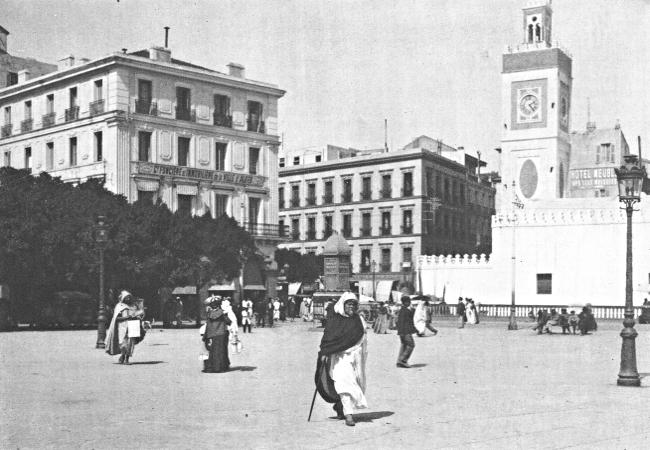
ALGIERS, ALGERIA
ALGIERS, ALGERIA, formerly a nest of pirates, but now a fine, modernized city in possession of the French, is the subject of one of the intaglio-gravure pictures illustrating “The Mediterranean.”
Monograph Number One in The Mentor Reading Course
PREPARED BY THE EDITORIAL STAFF OF THE MENTOR ASSOCIATION
Less than a century ago the Barbary Coast, and the city of Algiers in particular, was a nest of pirates. All the principal nations of the world paid them tribute. Their nation was known as the “scourge of Christendom.” Up to the year 1800 the United States alone had poured over $2,000,000 into the coffers of the dey, or ruler. But it was our country, the youngest of all, that put a stop to this cowardly practice of paying toll for immunity from attack on the high seas.
In 1800 Captain Bainbridge, in a United States warship, went to Algiers, taking the usual “presents.”
The dey commanded him to become his messenger and carry his despatches to Constantinople. “The English, French, and Spanish captains have always done this for me. You also pay me tribute, and you also are my slaves,” he said insultingly.
Not daring to disobey without orders from home, Bainbridge did as he commanded; but this was too much for the American people. After the War of 1812 Commodore Decatur served notice on the dey that never again would the United States pay him tribute in money. The dey replied that some powder for his fleet would be acceptable.
“The powder you shall have, if you insist,” answered Decatur; “but the bullets go with it.”
The dey refused the present; but ordered his ships to destroy all American shipping hereafter. These orders having been carried out, Commodore Decatur sailed again for Algiers, and forced the terrified dey to sign a treaty which gave to American ships immunity forever after.
In 1816 the English attacked Algiers; but it was not until fourteen years later that the pirates’ nest was destroyed for good. On June 13, 1830, the dey of Algiers slapped the French consul in the face, and brought down upon himself the wrath of France in the shape of an army of forty thousand men. On the fourth of July, Algiers surrendered, and the “scourge of Christendom” was ended.
Algiers, the French capital of Algeria, has 154,000 inhabitants. It is located on the west side of the Bay of Algiers, and is the most important coaling station on the whole coast of northern Africa.
In Roman times the famous Biblical town of Cæsarea occupied almost the same site. The present city was founded about 935; but Algiers was of little importance until after the expulsion of the Moors from Spain, many of whom settled in the city. From then on until its capture by France, Algiers was the chief seat of the Barbary pirates. The French have greatly improved the place.
COPYRIGHT, 1913, BY THE MENTOR ASSOCIATION, INC.
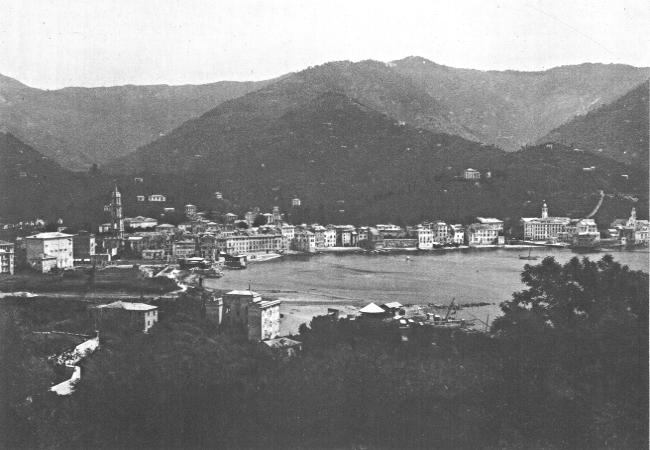
RAPALLO, ITALY

RAPALLO ON THE RIVIERA, an extremely beautiful stretch of shore which extends along the Mediterranean Sea, is the subject of one of the intaglio-gravure pictures illustrating “The Mediterranean.”
Monograph Number Two in The Mentor Reading Course
PREPARED BY THE EDITORIAL STAFF OF THE MENTOR ASSOCIATION
The Riviera is a narrow belt of coast that lies between the mountains and the sea all round the Gulf of Genoa in the north of Italy, extending from Nice on the west to Spezia on the east. Part of the Riviera is in France and part in Italy. The Riviera di Ponente (“the coast of the setting sun”) lies between Nice and Genoa. The part between Genoa and Spezia is called the Riviera di Levante (“the coast of the rising sun”).
The climate of the Riviera is very mild, and it is one of the most beautiful regions on earth. All this district is open to the south and sheltered by the mountains on the north and east. The landscape is delightfully varied,—here a bold and lofty promontory, there a wooded hill, and down near the coast richly cultivated plains. The traveler passes steep and frowning cliffs, whose bases are washed by the surf of the Mediterranean, whose summits are crowned by the venerable ruins of towers erected in bygone ages for protection against pirates.
Many of the towns in the Riviera are situated in fertile valleys or on picturesque hills; while others are perched like nests among the rocks. Little churches and chapels peering from the somber foliage of cypresses, and gigantic gray pinnacles of rock frowning upon the smiling plains, frequently enhance the charms of the scenery; while the vast expanse of the Mediterranean, with its ever changing hues, dazzles the eye with its beauty.
Olives, with their grotesque and gnarled stems, are grown on great plantations in the Riviera. The warm climate produces luxuriant growths of figs, vines, citrons, oranges, oleanders, myrtles, and aloes. Bright green pine forests meet the eye, and even palms are seen occasionally.
Thousands of visitors spend the winter in the chain of towns and villages that stretches from one end of the Riviera to the other,—Nice; Monte Carlo in Monaco, the little independent principality; Mentone, the last town in the French Riviera; Bordighera; Pegli; Nervi; Spezia; and many others. In summer the Italians visit these resorts for sea bathing.
The only drawback to the Riviera is its liability to earthquakes, of which there were four in the last century alone.
A railway runs close along the shore all through the Riviera. The distance from Nice to Genoa is 116 miles, and from Genoa to Spezia 56 miles. In the latter stretch the railroad burrows through the many projecting headlands by means of more than 80 tunnels.
The poets Lord Byron and Shelley both lived and wrote on the shores of the Gulf of Spezia, and Charles Dickens, the great English novelist, wrote his well known story, “The Chimes,” at Genoa.
COPYRIGHT, 1913, BY THE MENTOR ASSOCIATION, INC.
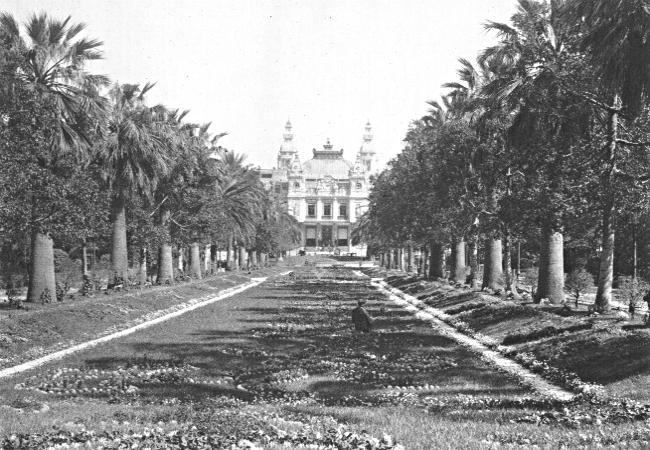
CASINO, MONTE CARLO

MONTE CARLO CASINO, a famous spot in the smallest independent country in the entire continent of Europe, is the subject of one of the intaglio-gravure pictures illustrating “The Mediterranean.”
Monograph Number Three in The Mentor Reading Course.
PREPARED BY THE EDITORIAL STAFF OF THE MENTOR ASSOCIATION
It is a curious thing that the smallest country in Europe is also one of the most visited. This is the little independent principality of Monaco. Monaco is only about eight square miles in area; and it is two and a quarter miles long. The population of the entire principality is only 19,000.
Monaco—the city of Monte Carlo in particular—is so greatly visited for two reasons,—its charming climate and situation, and its gaming tables. It is an excellent health resort, but is world famous as a gambling place. It was in 1861 that a man named François Blanc obtained a gambling concession in Monaco for fifty years from Charles III. A stock company later got hold of this concession, and in 1898 it was extended to 1947, in return for a payment to the prince of $2,000,000 in 1899 and another payment of $3,000,000 in 1913. In addition to this Monaco obtains from the company an annual tribute of $350,000, increasing to $400,000 in 1917, $450,000 in 1927, and $500,000 in 1937. These great tributes make it possible for the inhabitants of Monaco to be entirely exempt from taxation.
In the principality of Monaco there are three cities,—Monaco the capital, Condamine, and Monte Carlo. At one time the towns of Mentone and Roquebrune belonged to Monaco; but they were ceded to France in 1861 for $800,000. The city of Monaco occupies the level summit of a rocky headland, rising about 200 feet from the shore. Here the prince has his palace.
Monte Carlo lies to the north of the Bay of Monaco, where are gathered the various buildings of the Casino of Monte Carlo, with the beautiful gardens, and many villas and hotels.
The history of this little principality is an interesting one. It seems that long ago a temple of Heracles was built on the Monaco headland by the Phoenicians. The same god was worshiped there by the Greeks at a later date, and they gave the place its name. The Grimaldis, the present ruling family of Monaco, became associated with the place in the tenth century; but they did not come into permanent possession until much later.
Monaco in the fourteenth century was notorious for its piracies, and the right to exact toll from vessels passing the port continued to be exercised until the end of the eighteenth century.
For many years Monaco was an ally of France; but in 1525 it came under the protection of Spain. Then in 1641 Honoré II threw off the Spanish yoke and made himself an ally of France. The National Convention annexed the principality to France in 1793; but by the Treaty of Paris in 1814 it was restored to the Grimaldis. Finally in 1860 Monaco passed again under French protection.
The present ruler of Monaco, Prince Albert, was born in 1848 and succeeded his father, Prince Charles III, in 1889. The prince is absolute ruler, as there is no parliament in the principality. He appoints a small council to advise him on matters of state. He also has power to appoint the mayors and other municipal authorities.
COPYRIGHT, 1913, BY THE MENTOR ASSOCIATION, INC.
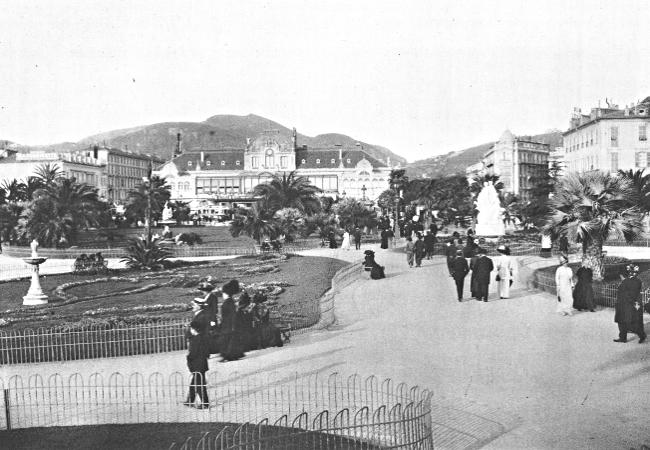
NICE, FRANCE

NICE, FRANCE, a very ancient and charmingly beautiful town, is the subject of one of the intaglio-gravure pictures illustrating “The Mediterranean.”
Monograph Number Four in The Mentor Reading Course
PREPARED BY THE EDITORIAL STAFF OF THE MENTOR ASSOCIATION
The Massilians founded Nice 2,500 years ago. Its situation soon made it one of the busiest trading stations on the Ligurian coast. But in those days the price of prosperity was continual warfare. The Saracens descended on Nice in 729; and though at that time they were repulsed, in the next century they captured the city and burned it.
All through the Middle Ages, Nice had its share in the wars and disasters of Italy. It had to fight both Genoa and France, and on the sea its merchantmen were attacked by Barbary pirates. Finally in 1388 it placed itself under the protection of the counts of Savoy. In this way it was protected on land and could devote its strength to taking care of the pirates.
But bad fortune seemed to hover over the city. Invading armies devastated the land, and then pestilence and famine raged for several years. In 1543 Nice was attacked by the united forces of Francis I and Barbarossa. After a brave resistance the city was compelled to surrender, and was pillaged by the conquerors.
Then followed many years of alternate war and peace; until finally Nice was captured in 1792 by the armies of the French republic. It continued to be a part of France till 1814; but at that time it reverted to Sardinia. Then, in 1860, by a treaty between the Sardinian king and Napoleon III, it was again transferred to France, in whose possession it is today.
The city of Nice is a great winter resort for invalids and others from all parts of Europe. It is situated on the Mediterranean 100 miles east of Marseilles. A steep limestone hill, 308 feet in height, running back for some distance from the shore, is the historical nucleus of the town. It used to be crowned by a castle, which, previous to its destruction by the Duke of Berwick in 1706, was one of the strongest fortresses on the coast. Now it is a public pleasure ground.
Nice is a great commercial town. Grapes, olives, oranges, and mulberries are grown profusely, and in the city there are perfumery factories, oilworks, furniture factories, confectionery works, a national tobacco factory, and many others.
For the comfort and entertainment of visitors every provision is made. Autumn is the best season. Nice is at its liveliest during the carnival festivities. In these carnivals battles are waged with sweetmeats and flowers.
COPYRIGHT, 1913, BY THE MENTOR ASSOCIATION, INC.
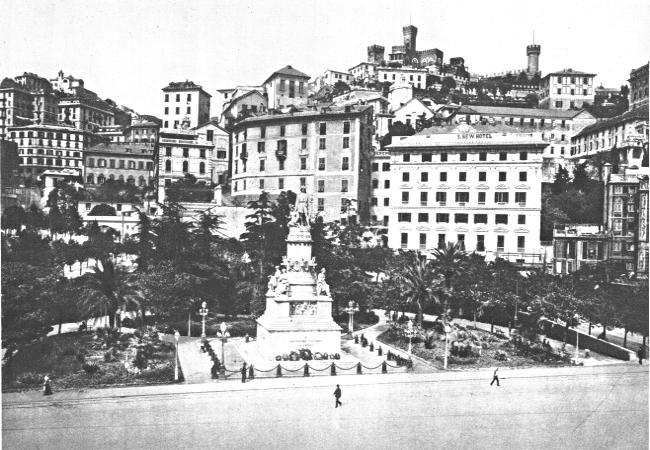
GENOA, ITALY
GENOA, ITALY, a busy center of modern enterprise and activity, is the subject of one of the intaglio-gravure pictures illustrating “The Mediterranean.”
Monograph Number Five in The Mentor Reading Course
PREPARED BY THE EDITORIAL STAFF OF THE MENTOR ASSOCIATION
“Seas without fish, mountains without trees, men without honesty, women without modesty,”—that was what her enemies said about the republic of Genoa in olden times. And historians seem to agree that the character of the Genoese in those days was not of the best. All their energy was concentrated on commerce and the pursuit of money. They took no interest in art nor in any of the intellectual development of Italy during the Middle Ages. But these bad traits of the Genoese have all disappeared.
The city of Genoa now has 275,000 inhabitants, and is the seat of a university and an archbishop. It is the headquarters of the fourth Italian army corps, and is a strong fortress, as well as being the chief commercial town in Italy.
Genoa, with its many beautiful palaces, rising above the sea in a wide half-circle, is called “La Superba” (the superb). The old town is a network of narrow and steep streets, lined with many-storied buildings; but the newer part of the city has broad and straight thoroughfares.
In the seventeenth century the Genoese built as a protection against their enemies a rampart over nine miles long. They also erected on the heights around the town ten detached forts.
From the earliest times Genoa has been famous as a seaport. Today it still possesses its great mercantile supremacy, and in addition is an important emigration harbor. Far back in 400 B. C. its trade with the Greeks, Etruscans, and Celts was large, and as time went on it increased greatly.
In the Middle Ages the little rival Italian states were constantly at war with one another. Genoa had a war with Pisa, and in 1284 shattered the power of that city forever in a terrible naval battle at Meloria. Then came the struggle with Venice which ended in the defeat of Genoa at the battle of Chioggia in 1380.
The city of Genoa was also filled with internal political strife. Two or three different factions were continually fighting with one another, and this finally led to Genoa’s being always under the rule of some foreign prince. Finally in 1797 the aristocratic government of Genoa was superseded by the democratic Ligurian Republic, established by Napoleon, and in 1805 Liguria was formally annexed to the empire of France. Ten years later it was annexed to the kingdom of Sardinia.
Giuseppe Mazzini, the patriotic writer, was born at Genoa in 1805, and Garibaldi, the great Italian patriot and leader, with whom he worked, though born at Nice in 1807, was the son of a Genoese of Chiavari.
COPYRIGHT, 1913, BY THE MENTOR ASSOCIATION, INC.
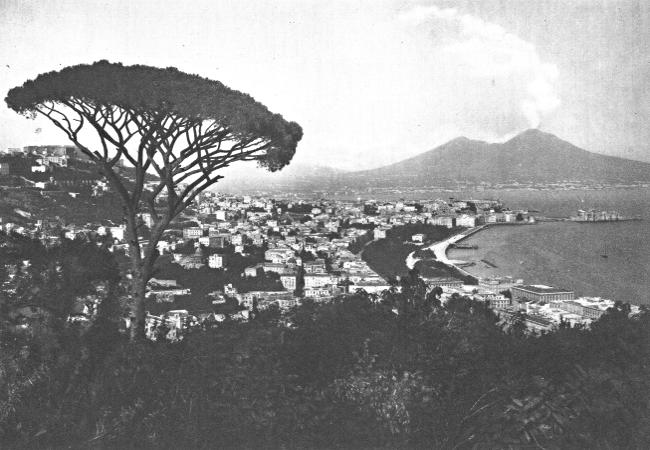
NAPLES, ITALY
NAPLES, ITALY, which is considered by many people to be the most beautifully situated city in Europe, is the subject of one of the intaglio-gravure pictures illustrating “The Mediterranean.”
Monograph Number Six in The Mentor Reading Course
PREPARED BY THE EDITORIAL STAFF OF THE MENTOR ASSOCIATION
Naples, the most important seaport in Italy, is also its largest city. In addition to this it is one of the most beautifully situated cities in the world.
The ancient Greeks founded Naples away back in olden times. They came from Cumæ and founded a city which they named Parthenope. Afterward this was divided into Palacopolis, the “old town,” and Neapolis, the “new town.” It was from the second that Naples got its name.
Later many other nations came into possession of the city,—Ostrogoths, Byzantines, and Normans. At one time Charles of Anjou made Naples his capital. Ferdinand I of Aragon, the Spanish viceroy, Don Pedro de Toledo, and the Bourbon Charles III all extended the city. Finally in 1860 the kingdom of which Naples was the capital was united to the kingdom of Italy.
Naples has not so many historic and artistic monuments as other Italian cities; but in the museum are preserved valuable treasures from Pompeii and Herculaneum, the old Roman cities that were destroyed by Vesuvius, and only within recent years have been excavated.
The best view of Naples may be had from the Bay of Naples. The city is built at the base and on the slopes of a range of volcanic hills, and rises from the sea like an amphitheater. The Castle of St. Elmo occupies a hill, from which a transverse ridge runs south to form the promontory of Pizzofalcone and divides the city into two natural crescents. The western part, the Chiara ward, is a long, narrow strip between the sea and Vomero Hill. This is the fashionable quarter. To the east lie the oldest and busiest quarters, of which the long Via Roma is the main street.
One cannot speak about Naples without mentioning Vesuvius. As one writer said, “Mount Vesuvius is to the Neapolitan bay what Fujiyama is to many a landscape of Japan,—the lofty background of the picture, and the grand presiding genius of the place. By day it proudly waves its plume of smoke, by night its torch of fire, as if it claimed to be the champion of destruction.”
A cable railway ascends Vesuvius now, and for many years the mountain has been quiet. But it is only slumbering. Some day it will break loose again and pour forth its streams of redhot lava, its agents of destruction.
COPYRIGHT, 1913, BY THE MENTOR ASSOCIATION, INC.
The Course for One Year Provides:
1—A growing library of the world’s knowledge—twenty-four numbers a year.
2—A beautiful art collection for the home—one hundred and forty-four art prints in sepia gravure and color.
3—One hundred and forty-four crisp monographs—one to accompany each Mentor Gravure.
4—A reading course throughout the year.
5—An education for all the family, under the direction of the foremost educators in this country—in art, literature, science, history, nature, and travel.
Send the names of three friends whom you wish to nominate for membership, and to whom you would like to have us send presentation copies of The Mentor.
THE MENTOR
This service covers the needs of those who want to gain knowledge by an easy and agreeable method.
Send for our booklet descriptive of The Mentor Club Service. It presents many varied Mentor courses specially planned for the use of reading clubs.
The Mentor Association will supply to its members supplementary reading courses dealing with any or all of the subjects in The Mentor Courses. These courses of reading are prepared under the direction of the Advisory Board of The Mentor—all of them prominent educators.
The Mentor Association will also secure books for members, supplying them postpaid at publishers’ prices.
The Mentor Inquiry Department gives to its members a full and intelligent service in answering inquiries concerning books, reading, and all matters of general information having a bearing on The Mentor Courses.
MANY READERS HAVE COME TO KNOW THE VALUE OF THE MENTOR SERVICE. IN THE FULLEST SENSE IT SUPPLEMENTS AND ROUNDS OUT THE PLAN OF THE MENTOR. ALL MEMBERS OF THE ASSOCIATION ARE INVITED TO TAKE ADVANTAGE OF THIS SERVICE
Every page of The Mentor, cover included, contains matter that readers want to keep. The Mentor Association is now supplying to its members a binder which holds twelve or thirteen Mentors and has proved satisfactory in every way. This binder has been arranged so as to hold The Mentor complete and it has tapes to which the pictures are attached, so that they swing freely in their place and the pictures can be enjoyed as well as the text on the back.
The price of these binders is One Dollar each.
MAKE THE SPARE
MOMENT COUNT