“I pray you let us satisfy our eyes
With the memorials, and the things of fame
That do renown this city.”
Shakspeare.
The parish church of St. Margaret,
Westminster, is the mother church of this locality.
Although the Decree of 1222, before referred to, limited the
western boundary of that parish to the Tyburn stream, it declared
that beyond that stream lay the town of Knightsbridge, which
belonged to it. In what parish the manor of Eia was
situated is not stated, but it is most likely that the higher
portion of it was a forest, and the lower, it is certain, was
partly a marsh, and consequently altogether unnoticed by the
assessors; for the growth of parishes was very gradual, and their
proper boundaries for ages undefined. St.
Martin’s-in-the-Fields is mentioned as early as 1225, but
did not become a regular parish till after 1337, and not
independent of St. Margaret’s till 1535. In St.
Martin’s the whole of the manor of Eia was then included;
it consequently reached as far as the Westbourne, and included a
part of Knightsbridge; this arrangement continued till the parish
of St. George, Hanover Square, in 1724, was formed out of St.
Martin’s, and then this distant part was included, absurdly
enough, within the new parish.
On the west of the rivulet, which here divides St.
George’s parish from St. Margaret’s and Chelsea, the
hamlet stands partly in those and partly in Kensington
parish. St. Margaret’s stretches from William Street,
behind Lowndes Terrace, across the top of Sloane Street, behind
Brompton Road, continuing the line behind Arthur Street to the
bottom of Ennismore Mews, where, abutting on the north wall of
Brompton Churchyard, it strikes off in a north-west direction and
crosses the Kensington Road just below Hyde Park Terrace, whence
it runs along the road into the town, and, including a few houses
on the
north side of High Street, it enters the Royal Gardens, including
a considerable portion thereof, and the whole of the palace,
within its boundary; it joins Paddington at a point on the
Uxbridge Road, and thence returns through the Serpentine to
Knightsbridge.
The parish officers of St. Margaret alone beat the bounds now,
and they appear always to have been strict in this duty, which,
from some entries in their books, one would consider to have been
a little festive occasionally:—
1595.
|
Item, paid for bread, drink, cheese, fish, cream, and
other victuals, when the worshipfull of the parish, and very many
others of the poorer sort, went the perambulation to Kensington,
in this hard and dere time of all things, as may appear by a bill
of particulars
|
£7
|
10s.
|
0d.
|
1597.
|
Item, for the charges of diet at Kensington for the
perambulacion of the parish, being a yere of great scarcity and
deerness
|
£6
|
8s.
|
8d.
|
1642.
|
Item, spent at Knightsbridge, when divers of the burgesses
and vestriemen of this parish went the perambulation
|
£2
|
19s.
|
9d.
|
1668.
|
Item, expended at a perambulation this yeare at
Knightsbridge
|
£26
|
13s.
|
4d.
|
Henry VIII.’s corpse passed through Knightsbridge for
interment at Windsor. In the St. Margaret’s books is
the following entry:—
1547.
|
Paid to the poor men that did bere the copis and other
necessaries to Knightsbridge, when that King Henry the Eighth was
brought to his burial to Wynsor, and to the man that did ring the
bells
|
£0
|
3s.
|
0d.
|
Chelsea parish includes Lowndes Square and the adjoining
streets, while Kensington includes Queen’s Buildings, and a
few houses in Sloane Street. Thus is Knightsbridge absurdly
divided, when for generations there has existed within it a place
of worship which could have been easily rendered the focus of a
new and independent parish, had its patrons been so minded.
The opportunity was lost when St. George’s was formed, and
Trinity Chapel, from having been, as it were, the nursing-mother
around which the village gathered, was permitted to dwindle,
without a thought for it, into comparative insignificance.
This ancient religious edifice I will now give an account of.
Was anciently attached to a Lazar-house or Hospital, with the
history of which it is most intimately connected. When or
by whom founded is not known—at least, if such is recorded,
it is not mentioned by any writer on ecclesiastical affairs; but
as it appears always to have been attached to the Abbey of
Westminster, we may conclude its foundation was connected with
that establishment.
The earliest mention I have met with of the Lazar-house is in
a grant of James I., preserved in the British Museum, [52] as follows:—
1605, James R. By ye king,
Trustie and welbeloued wee grete you well. Whereas we
are given to understand that the sick, lame, and impotent people
in our hospitall of Knighte-bridge, in our county of Middlesex,
are greatly distressed for want of wholesome water, both for the
dressing of their meat, and for making condiment potions for
their sores, and that in our park called Hyde Park, in our sayd
county, adjoyning to the sayd hospitall, there is within of 140
paces of the sayd hospitall a meete spring of good water,
wof by pipe of lead of the charge of five and thirty
pounds, may safely be brought to serve the sayde house, for their relief in
yt behalf, without any inconvenience growing thereby to our said
parke; in consideration of ye poverty, and for the contynuall use
and ease of ye sayd impotent and distressed people, wee are
graciously pleased to bestow uppon them ye sayd sum of
xxxvl., lawful money of England, for and towards the
charge of bringinge the sayde springe water to the sayde house by
pipe of lead. Wherefore our pleasure is, that you, our
warden of our Mint, shall appoint workmen, and give order for the
doing thereof, and defray the charge, not exceeding the sayd sum
of xxxvl.; ffor the which wee do hereby give you full
allowance out of those our moneys as remayne in your hande,
lately coyned in our Tower. And this shall be our
sufficient warrant unto you, and the duplicate of this published
by you a sufficient warrant and discharge to ye keeper and
keepers of ye sayde parke, and to all other persons that may
consent for the doing hereof. Given under our sign,
&c., at or Castle of Windsor, the sixth day of
September, in ye thyrd yere of our raigne of England,
France, and Ireland, and of Scotland the thirty-eighth.
To our trusty and welbeloued servant Sr Thomas
Knyvett, Knight, warden of our mynt. C. C. Inwood.
But, although this is the earliest document concerning the
Lazar-house I have seen, there exist earlier, to which the public
have not access. Lysons says there is, among the records of
the Dean and Chapter of Westminster, a statement of its condition
in 1595, drawn up by John Glassington, Governor of the House, by
profession a surgeon, and whose family rented the hospital,
&c., from the Church of Westminster (at the rent of 4s. per
annum) for many years. In this document he states that
there were no lands belonging to this hospital, nor a groat of
endowment; that there had been a certain piece, which was then
enclosed within Hyde Park, to the great detriment of the
charity. He also states that when he became governor, the
building was ready to fall; that he had expended above £100
on it; that there were commonly thirty-six or thirty-seven persons in
the house, who were supported by voluntary contributions; that
the charge of the previous year, in provisions only, and
exclusive of candles, linen, woollen, salves, medicines, burials,
&c., had been £161 19s. 4d. He adds a list of
fifty-five persons whom he had cured, some of whom had been
dismissed as incurable from other hospitals. An account of
the regulations of the house is subjoined by him, by which it
appears that the patients attended prayers every morning and
evening, and that on Sundays there was morning and evening
service for the neighbours; that those who were able were obliged
to work; that they dined every day on “warm meat and
porrege,” and that every man had his own “dish,
platter, and tankard, to kepe the broken from the whole.”
[55]
In the parish accounts of St. Margaret’s are several
entries relating to this hospital:
1634.
|
Item, for a pair of sheetes for Jane Clare, when wee sent
her to the Spittle at Knightsbridge
|
|
3s.
|
6d.
|
1638.
|
Item, to Mr. Winter, keeper of the hospitall at
Knightsbridge, for the keeping of the Three Innocents for one
month
|
|
|
16s.
|
1639.
|
Item, to Mr. Thomas Neale, for three paire of shoes, two paire for
the poore Innocents at the Spittle at Knightsbridge, &c.
|
|
6s.
|
6d.
|
1646.
|
Disbursements for the poore Innocents in the Spittle, or
Lazar-house, at Knightsbridge; sum total,
|
£4
|
2s.
|
11d. [56]
|
There are no books or accounts of the Lazar-house existing at
the Chapel now, neither have I been able to ascertain whether
they exist elsewhere, or even at all. But in one of the
register books still preserved is a list of persons discharged
from it; the date of the year is not given, but I have reason to
think it about 1676. There are twenty-seven entries, of
which the following may serve as samples:—
March 5—Priscilla Knight to London,
criple.
,, 6—Mary ffranklin to Berkshire.
,, 9—John Wordner, his wife, to children, to Bristow,
criple.
,, 10—Nicholas fflood, his wife, 4 children, to Wales,
criple.
,, 18—Robert Dicerson, his wife, 2 children, to
Gloster.
These unfortunate creatures most probably begged their way up
from the country, and, while inmates here, owed their subsistence
to charitable contributions, and, when cured, had to beg their
way home again. There was also the following entry in another book,
date about 1695:—
“Thomas Pirkin, a soldier under Captain John
Callipfield, in Brigadier Solwin’s regiment, died in
Hospital in August last past.”
Like its origin, its end is obscure: I cannot trace when, or
from what causes, its useful and Christian career was
terminated. It was certainly existing when Newcourt was
collecting materials for his “Repertorium,” published
in 1720, and that is the last allusion to it I can find.
It has always been traditionally related in Knightsbridge,
that during the fatal year of the plague, 1666, the institution
was for a while given up to those who had been attacked by that
scourge; and it is also said that the enclosed plot on the Green
was the spot where its victims, here and elsewhere in the
locality, were buried.
In Butler’s “Hudibras” (III. c. ii. v.
1110), among other charges Cooper urges against the Presbyterians
is, that they
“Fill’d Bedlam with predestination,
And Knightsbridge with illumination.”
And the last editor of Gray’s “Hudibras” supposes that
by the Presbyterian Illuminati here, Butler alluded to the
unfortunate inmates of this Lazar-house! [58a]
There were three other similar establishments in the suburbs
of London—namely, at Southwark, Kingsland, and
Mile-end. Great care was taken that those afflicted with
leprosy, or other such disorder, should be immediately conveyed
to one of these places. The law was strictly carried out,
and where resistance was made, the sufferers were tied to horses,
and dragged thither. [58b]
That the chapel attached to this hospital was of ancient
foundation, we may justly infer from its being described as
“very old and ruinous, and ready to fall,” as far
back as 1629. In that year, for that cause, the inhabitants
petitioned Laud, who then filled the see of London, for leave to
rebuild it at their own cost, it being the place to which they
usually resorted “to perform their religious duties and
devotions.” The Bishop, by his licence, dated July 7th,
1629, gave them permission so to do (the consent of the vicar and
churchwardens of St. Martin’s being first obtained),
“therein to frequent Divine Service and sermons, which
Divine offices were to be performed by a sufficient minister,
lawfully licensed from time to time,” by the Bishops of
London, or their Chancellors for the time being; “provided
that the said inhabitants, or their families, did once every
quarter of a year repair to their respective parish churches to
perform their devotions, and every Easter receive the Holy
Communion there, and pay all rights, duties, and profits to their
respective ministers to which they did belong,” and this
licence was to continue in force during the pleasure of the
Bishops of London.
The Chapel was accordingly rebuilt, and “consecrated to
the use of the poor of the Hospital,” who “having no
maintenance but what they received of alms,” and not being
“able to maintain a curate, repair the Chapel, or relieve
themselves,” it was, on October 3rd, 1634, according to an
arrangement made by the Master of the Hospital, the curate, and
some of the principal inhabitants of Knightsbridge, ordered by
Dr. Duck, then Chancellor of London, that they, or the major part
of them, should let certain pews and seats in such manner as
should best effect these objects; that they should keep a
register of their accounts, which were to be adjusted every six
months, reserving to the incumbents of St. Margaret’s and
St. Martin’s their respective rights and emoluments.
Dr. Duck presented one piece of the plate used in the celebration
of the Communion.
In 1650 the Parliamentary Commissioners appointed to inquire
into the state of ecclesiastical benefices, reported that
Knightsbridge Chapel, in the parish of St. Martin-in-the-Fields,
belonged to a Lazar-house there; that twenty years before the
date of inquiry it was re-edified and enlarged by public
contributions; and that Henry Walker, the minister, placed there
on probation by order of Parliament, received £10 per annum
from the inhabitants. The Commissioners afterwards allowed
him £40 per annum. [60]
Among the records of the Dean and Chapter is a petition
from John Glassington, surgeon, dated 1654, praying to be
admitted Governor of the Hospital, which his ancestors had always
rented of the church at Westminster; which petition is
accompanied by a certificate of Sir John Thorowgood, one of the
Commissioners for Middlesex, and an active public officer in this
locality at the time of the Commonwealth; but I infer the
application was unsuccessful for a time, for in the next year
Henry Walker was presented to the curacy by Cornelius Holland and
George Reeve, joint-governors of the Chapel. John
Glassington was, however, Governor in 1659.
In 1699, Nicholas Birkhead, who was then lessee of the Chapel,
rebuilt it, and the present building is mainly his work. In
1789, it was enlarged by its front being brought in a line with
the adjoining houses, a grass-plot eight feet deep having
previously occupied this space. The present front,
galleries, &c., were then erected. At the end of the
last century Dixon Gamble, Esq., became lessee, but now it is
held direct from the Dean and Chapter of Westminster, who
nominate the incumbent. There is an endowment of £30
per annum payable by them, but the income is derived
chiefly from the pew rents.
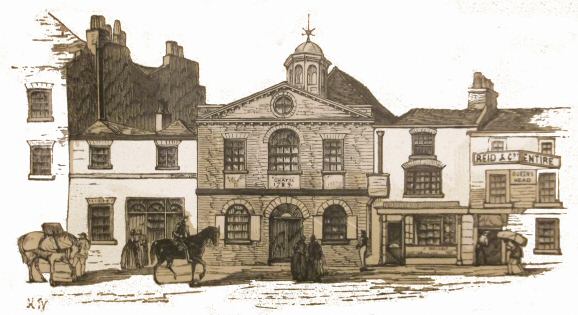
The Chapel is as plain an edifice as possibly can be; there is
no ornament of any kind about it. It is built of brick, and
is 53 feet long, by 30 feet broad. The gallery is round
three sides of the building; the organ, built by Hancock, 1770,
being on the south side. The communion-table is at the
north end. The front terminates in a pediment, over
which is a small cupola containing one bell, thus
inscribed—
“Mrs. Mary Birkhed gaue me, 1733.”
In the brickwork are let in three stone slabs, the centre of
which is inscribed “Knightsbridge Chapel, 1789;” that
on the right is inscribed, “Rebuilte by Nicho Birkhead,
Gouldsmith of London, Anno Dom. 1699;” the left or western
one has the following emphatic dedication cut in it, [62] “Capella sanctæ Indiuidux
Trinitatis.”
The Communion Plate consists of five pieces, all of silver;
they are inscribed as follows:—
The Large
Chalice.—Sanctæ et Indiuidæ
Trinitati—Rest to the Lord:—Mary Birkhead (about
1708.)
The Paten.—Sanctæ et
Indiuidæ Trinitati.—The Guift of Arthure Duck, Docter of
the Ciuell Lawe and Chancelor of London (1628 or 1629).
The Small
Chalice.—Sanctæ et Indiuidæ
Trinitati.—The Gift of the Right Honbl. and
Right Reverent Willm. Lord Bishop of London. [63a]
The Plate.—The Gift of
Elizebeth Knightly to Knights-Bridg Church, Oct. 18th, 1705. [63b] There is a coat of arms engraved
on the edge of this piece, doubtless that of the donor.
The Flagon is modern, being the
gift of the Rev. J. Foyster (about 1825).
The list of its ministers is, as far as I have been able to
trace them, as follows:—
1630. Nathaniel White, licensed May 24th.
1637. William Pope—as curate.
1640. Nehemia Dod—as curate.
—
Henry Walker on probation till 1655, when he was nominated
curate.
1658. Christopher Lee appears to have been minister, but
various other names also appear in the registers till May
23rd.
1660. Thomas Wheatley then signs himself “Minister
of Knightsbridge.”
1661 (Feb.). Henry Tilley.
1662 (April). Nathaniel Barker.
1663 (April). — Herring (whose name occasionally
appears between 1658–60.)
1666. Robert Hodson, till October 20th.
1667. Francis Hall, licensed October 25th.
1669. Henry Herbert or Hubert, S.T.P., licensed April
26th. His signature, however, occasionally appears before
this date.
1671. John Cull.
1683. — Sanby, who was minister from January 1st,
1683, to December 31st, 1685.
1686. Henry Watts, who quitted in May, 1695; strangers
appear to have officiated till
1696. Thomas Bobar entered on his duties December
4th. He made way for in
1699. Philip Horneck, who officiated from March 9th to
October 16th.
1699. Thomas Knaggs appointed curate October 16th;
he stayed till January 10th, 1707, when Francis Jeffrey
succeeded. But in February, 1708, Mr. Knaggs returned, and
was minister till May 17th, 1713.
1713. Robert Hicks, to June 10th, 1719.
1719. Humphry Persehouse, who was minister forty-one
years. He resigned in December, 1759, when
1760. — Bailey, chaunter of Westminster Abbey, was
appointed on January 1st by the Dean and Chapter. I believe
he was succeeded by the Rev. John Gamble, nominated by his
father, as lessee. He died in 1811.
1811. — Harris. [65]
1822. J. G. Foyster, M.A. of Queen’s College,
Cambridge. He published a volume of sermons preached
here. In 1832, Lord Brougham gave him the rectory of St.
Clement’s, Hastings, on which he quitted
Knightsbridge. He died there May 17th, 1855.
1832. John Martin, who shortly resigned, and was
succeeded by the Rev. Hibbert Binney, D.C.L., the late minister,
who, since June, 1838 (when he was appointed rector of Newbury),
left the chapel to the ministry of the Rev. John Wilson, now
D.D., and the present incumbent. Dr. Binney died June 6th,
1857. Among assistant ministers here have been the Rev.
Alexander Cleeve, author of several devotional works, who died
September 23rd, 1805; the Rev. H. J. Symons, LL.D., who read the
burial service over Sir John Moore at Corunna. He gained
the notice of the Duke of York in this pulpit, and quitted it for
the Peninsula with a regiment, to which he was chaplain.
Baptisms and marriages were formerly solemnised here, and
twenty register-books, some very small, and others quarto and
folio size, are still preserved. Many of them, however, are
but duplicates of the others, and three are memorandum-books of
the clerks, with registrations, expenses, notices, and other
entries therein. The regular register of baptisms
has been missing a very long while, but duplicates of several
years have been preserved; with the exception of a few leaves,
all the books of expenses are lost also. [67] I have stated
before that the books of the Lazar-house are also missing, and so
is the burial book, if such ever existed. I shall be glad
to quit this statement, so disgraceful to some of the former
officials of the Chapel, and give a few extracts from those still
fortunately preserved.
Previous to the passing of Lord Hardwick’s celebrated
Marriage Act, in 1753, it was not necessary to the validity of a
marriage that such should be performed in a church, or solemnised
by any religious ceremony. And although the law of the
Church visited with censure those who neglected its canon in this
respect, yet the Common Law recognised other and more private
modes. Consequently around and in London, at almost all the
chapels, marriages were performed, and at some in a very
discreditable manner. Lord Hardwick’s bill made it
necessary to the validity of a marriage that it should be
solemnised in a parish church or public chapel where banns had been
regularly published. The result was, that as at these
chapels banns were not published, marriages therein solemnised
were no longer legal; and among others obliged to succumb to this
law, Knightsbridge Chapel was one.
It would almost appear that our Chapel had some reputation for
its irregularities in this solemnity, if we are to trust some of
the pointed allusions in the literature of a bygone
currency. Shadwell, in his play of “The Sullen
Lovers,” published in 1668, makes Lovell say:—
“Let’s rally no longer: there is a
person at Knightsbridge, that yokes all stray people together;
we’ll to him, he’ll despatch us presently, and send
us away as lovingly as any two fools that ever yet were condemned
to marriage.”
And in the Guardian (No. 14, March 27, 1713), a
run-away marriage is spoken of as being celebrated “last
night at Knightsbridge.” Although such references
seem to illustrate what could be only known as a fact, I yet
think they were but a jocular remark as regards Knightsbridge,
and not indications of a reality. It is scarcely possible
to think such would have been allowed in a place of worship, so
much under the control of the Dean and Chapter as this was; and many
memoranda in the books vindicate its ministers from the charge of
winking at wrong, as these allusions insinuate. Of these
curious entries I give the following as specimens:—
“Mem.—Thomas Palmer and Ann Clarke: if
they come to be maryed, stop them, and send for Mr. Clarke, next
doore to the Mitre Tavern in Duppin’s Ally, King Street,
Westminster.”
“William Squire, silver-smith, living in Long Acre, who
stood father to Elizabeth Goldingham, who was married to Edward
Keyn ye 20th of ffebruary, 1690/1, does give this account of the
said Elizabeth Goldingham, that she has lodged at his house for 2
years, that she is no heyress, but ffollows the trade of a
manta-maker for her living, and further he adds that she has
neither ffather or mother liveing, nor no relation who does any
way look affter her, but that she is really at her own
disposal.”
But although such entries show the rule, I must admit that at
a certain period before the time to which the foregoing entries
refer, are others which appear suspicious; and if any irregularities occurred I should place them between the
two extreme dates, shown in the following extracts:—
1678, April 28. Jacob Stent and Mary Crouch, secrecy for
life.
1678, April 28. James Gibson and Anne Tarrant,
secrecy.
1678/9, April 28. William Taylor and Elizabeth Steward,
great secrecy.
1680, April 25. Edward Charlton and Alice Robinson,
secret for 14 years.
1682, May 7. Andrew Barry and Mary Elton, secrecy.
With these curious notices of old systems, habits, and ideas,
I proceed to give some extracts from the registers, selecting
those referring to eminent persons, and which contain allusions
of interest and peculiarity. The earliest entry of baptisms
is the following.
1663, Aug. 28. Will, ye sone of will birke of this
hamlett, by Mr. Herring.
1667, Jan. 23. Sofiah London, the daughter of Richard
London and Mary his wife.
A family named London lived in this locality many years, and
there are several entries of the name. Probably the
celebrated gardener so named, who will be afterwards
noticed, belonged to it.
1668. Nathaniel, son of William Ipsley, baptised,
September 8th.
Most probably this name should be Hipsley. Persons of
this name were clerks here many years.
1670, Nov. 3. James, son of James and Mary Rouse.
1675, Feb. 19. Dorothy, daughter of James Took, Esq.,
and Magdalen his wife. Westminster parish.
1675, April 11. William Lord, son of Robert and Anne
Thurlow.
A family of this name lived in the St. Margaret’s part
of the hamlet in the 17th century.
1675, Nov. 5. Joan, daughter of Robert and Hester
Gunter, baptised.
Persons of this name may be traced from this period to the
present time in our locality. It is the earliest entry of
the name I have found.
1676, Jan. 8. Margerite, the daughter of Elizabeth
Bedford by Mr. Philip Thomas.
1677, June 17. Tristram, the son of Tristram and Anne
Huddlestone.
1677, July 20. George, son of Berkley Trye, Esq., by Mary
his wife, baptised by Jo. Andrews, entered at St.
Martin’s.
The Tryes are a very ancient Gloucestershire family.
1678, Jan. 3. Robert, son of Robert and Hester
Gunter.
1681, April 11. Anne, the daughter of George Sams by
Martha Wheatley, his servant, as ’tis told me.
1682, May 27. Thomas Dennis, 30 years of age, was
baptised.
1683, March 4. Jane Rutter was baptised. A black
woman.
1689, June 27. ffrances Wharton, the daughter of Jane
Wharton, a child of base (birth).
1691, Dec. 21. Hannah Hipsley, daughter of Thomas and
Mary Hipsley, by Mr. Watts. Born Dec. 6th.
1692, Feb. 14. Margaret Tarbet, the daughter of Margaret
Perryvil; being a woman-child that fell in travail in ye
street.
1702. Mary, daughter of Thomas Werd by Mary his wife,
was baptised the 3rd of May by Mr. Killberk.
This is the last baptism recorded, and only one is
entered between October 16th, 1694, and this date: the others are
missing; and though I know baptisms were occasionally solemnised
here even to the end of the last century, no later record has
been preserved.
There are no registers of marriages here now, anterior to
April 1st, 1658, but in the Bishop’s register are some
earlier ones, the first of which is the following:—
16th April, 1632. Thomas Herbert, of Hammond Head, com.
York, Esq., bachelor, 24; and Lucy Alexander, spinster, 20,
daughter of Sir William Alexander.
The earliest in the Chapel register book is as
follows:—
1658, April 1. William Eaton and Jane Hurley were
married.
1661, ffeb. 10. Richard Steele and Eliza Cotterill per
me Ant. Dode.
1666, July 17. William Adkins and Katherine Edwards at
ye Bowling Green.
The Bowling Green was perhaps at the Spring Garden, afterwards
to be noticed.
1666,
Oct. 14. Thomas Clark and Elizabeth Milton.
1667, April 16. Philip Wharton and Hester Bewley.
1672, June 11. Sir Philip Harcourte and Eliz Lee married
by Mr. Cull.
1672, July 13. Robert Chaloner, esq., and Dorothy
Britten.
The Chaloners were one of the few old Middlesex
families. They were seated at Chiswick.
1675, Feb. 16. Christopher Benson and Eliz. Hilliard,
belonging to ye vice chancellor.
1675, Nov. 24. Gabriel Hipsley and Penelope ffry.
1676, May 7. Nicholas Brady and Bethia Chapman.
1676, Oct. 27. Arthur Deavereux and Anne Ireland in
pompe Courte in ye midle temple, 3 payre of stayres.
1677, July 17. Hugh Middleton, esq., and Mrs. Dorothy
Oglander, married by Mr. Nath. Cole, dd, his majesty’s
Chaplain in ordinary.
1678, Feb. 21. William Harbord, esq., and Mrs. Katherine
Russell by Mr. James Symonds.
1678, July 23. Sir James Hayes and Grace Clavering.
1678,
August 3. Sir John Lenthall and ye Lady Catherine Lant,
secrecy, by Mr. Joseph Stretch, minister.
Sir John Lenthall, only son of the Speaker, was Governor of
Windsor, under Cromwell, and knighted by him in 1657. On
May 21, 1660, he moved in the House of Commons that all who had
borne arms against the king should be exempted from pardon; and
for such was called to the bar, reprimanded, and degraded his
knighthood. He afterwards lost his seat upon petition
against his return. He died in 1681.
1678, August 15. Robert Grime and Barbara January, the
king’s taylor, nexte doore to 3 tuns taverne lane.
1679, April 10. Thomas Lant, esq., and Mrs. Jane
Bromfield.
1681, Feb. 20. John Stibbs and Sarah Cromwell.
For the last 250 years a family named Cromwell—and
which, in the last century, branched out considerably—has
been resident in this part of Middlesex. Cromwell, the
minister of Henry VIII., was born at Putney, not far out of the
county; and Sir Richard Cromwell (grandfather to Oliver the
Protector), signed himself in letters to the “Mauler of
Monasteries” his most bounden nephew. In 1691
a Robert Cromwell lived at Kensal Green, and is probably the
person of the same name who sat on the jury at the trial of
Daniel Axtell. For many years a brewery at Hammersmith has
been conducted by persons of this name, not improbably
descendants from the Putney blacksmith.
1682, January 31st. John Cull, curate of Knightsbridge,
and Martha Turner, by Mr. Yearwood.
Mr. Cull was minister here twelve years. He died in
1683, and was buried at Kensington on the 21st September.
1682, Dec. 24. Sir John Hatton and Mary Hinton.
1683, July 3rd. Heale Hooke, Baronet, and Hester
Underhill by Seyward of Kensington.
Sir Hele Hooke, for many years a resident in Kensington
Square, died there in July, 1712, by which the title became
extinct. Mr. Seward was curate there. (See
Faulkner’s “History of Kensington.”)
1685, Sept. 12. David Gunter and Eliz. West.
1686,
Sept. 4. Sir Francis de Geilhausen and Flora Bishop for
Feb. 6, 1685.
1687, Feb. 1. Sir Samuel Morland, Knight, and Mrs. Mary
Aylif, secrecy.
This entry records the unfortunate marriage of the celebrated
inventor, described by himself in such terms of misery, to the
diarist Pepys. In all the biographies of Morland I have
referred to, and even in Burke, his wife’s name is not
given, and therefore I presume it has hitherto been
unknown. The wedding was, as the register tells, private;
and eighteen days after it took place, he wrote to Pepys, that,
“being in very great perplexities, and almost distracted
for want of moneys,” a person whom he had befriended in
time of need proposed to recommend him an heiress, “who had
500l. per ann. in land, and 4,000l. in ready
money,” and property of other kinds. “Believing
it,” he writes, “utterly impossible,” that one
whom he had assisted, “should ever be guilty of so black a
deed” as to betray him in his distress, “I was, about
a fortnight since, led as a fool to the stocks, and married a
coachman’s daughter, not worth a shilling,” and whose
moral character proved to be none of the purest. He, procuring
evidence (shortly after) of adultery, took the case into the
Ecclesiastical Court, which granted a divorce on that ground on
May 17. [78] It was the fourth time Sir
Samuel tied the matrimonial knot, and the last.
1687, May 3. Sir William Moet, and Antonetta
Willobe.
1687, Sept. 1. John Atley and Mary Crumwell.
1689, Jan. 7. Richard Bailey and Eliz. Shakespeare.
1690, July 20. Sir Thomas Fautherly and Mrs. Frances
Brown.
1690, July 31. John Lenthall and Eliz. Wildman.
1693, Jan. 8. Thomas Cromwel and Ann Smith.
1694, Aug. 12. Edward Shaxspear and Eliz. Ward.
1695, May 26. Tristram Huddleston, Gentleman of St.
James’, Wmr., and Mrs. Mary Darker of the
same.
1695,
Nov. 16. John Baptist Renoult, Minister of the parish of
St. Ann’s, Westminster, and Amery Henri, Widd.
1696, July 23. John Line of St. Martin’s Neat
Houses, and Dorothy ffall, spinster of St. Margaret’s,
Westminster.
1697, Jan. 30. Jasper Arnold, Gent., of St. James,
Westminster, and Antonett Culmer of Kensington, spinster.
The Arnolds were a numerous and opulent family long resident
in Westminster. Families of the same name, and probably
connected, also resided in Knightsbridge and Kensington for above
a century. One of the Westminster Arnolds was a brewer, and
a juryman on the trial of the Seven Bishops. (See
“Macaulay’s History.”)
1698, August 21. George Cumming, Taylor, at ye
Woolstaple, near great Tom, St. Margaret’s, Westminster,
and Mary Watson of the same place.
1698, Dec. 18. William ffinton, Life Guardsman in
college-street, near ye Black dog: Catherine Llewyllen in
Dean’s Yard, Westmr.
(Black Dog Alley still exists in College Street.)
1699,
Jan. 1. Thomas Lewsie, peruke maker in ye pel-mel at ye
sign of ye two pidgeons, in St. James’ Westmr,
and Mary pigot, of St. Paul’s, Covent Garden, in maiden
lane.
1699, Jan. 23. Richard Green, Barber, in St. Brides, at
ye Barber’s pole near ffleet-bridge, ye corner house but
one, and Mary Truby of ye same place.
1699, May 23. Thomas Fenwick of St. Margaret’s,
Westminster, servt to Storey at ye Park Gate, and Mary
Gregory of ye same.
This notice is curious: Story’s Gate, named from the
person here noticed, is the entrance into St. James’s Park
from Bridge Street. Story was keeper of the Aviary to
Charles II., hence Birdcage Walk.
1699, August 18. Cornelius Vander Velde, Limner, of St.
Giles’, living in Dyot street, over agt ye Sparrow’s
Nest, and Bernada Vander Hagen, of ye same.
Cornelius Vander Velde was brother to William Vander Velde the
elder, the great painter of sea pieces. He was himself a
painter of nautical subjects, and in the employ of Charles
II. This is an addition to Walpole’s notices.
1699,
Nov. 16. Charles Goring, Gentleman of Heysdown, in the
parish of Washington, and Frances Bridger of Hams in ye same
county. (Sussex) by Mr. Knaggs.
Mr. Goring afterwards succeeded to the baronetcy.
1700, July 30. Robt Walpole, Esquire, of
Houghton in ye County of Norfolk, and Katharine Shorter, of ye
Parish of St. James, Westm. by Mr. Prevoste.
This record is that of the celebrated minister of the first
two Georges. His wife was daughter of a Lord Mayor of
London, and mother of the celebrated Horace.
1700, Nov. 22. Miles Pennington, Gent., living in Tuttle
Street, at ye sign of ye Green Dragon, and Eliz. D’oyley of
the same.
1703, March 4. John Oldmixon and Elizabeth Parrey.
1703, Dec. 25. Benjamin Houghton and Eliz.
Mandeville.
1704, April 28. John Every, Esq., and ye
Honble Martha Thompson.
Mr. Every afterwards succeeded his brother in the baronetcy;
his wife was daughter of John, Lord Haversham.
1705,
Jan. 6. Sir William Humphrey and Eleanor Lancashire.
Sir William was Lord Mayor in the first year of George I., and
entertaining the new king at Guildhall, was made a baronet.
His wife was widow of a London merchant.
1705, Jan. 8. Charles Danvers and Margaret Evans.
Danvers has been a name in Chelsea these 250 years past, and
is still to be found there. Sir John Danvers, of Chelsea,
was one who signed the death-warrant of Charles I.
1705, May 23. Henry Graham, Esq., and Mary, Countess of
Darentwater.
This lady was the youngest natural daughter of Charles II., by
Mrs. Davis the actress, and known before marriage as Lady Mary
Tudor. On August 18, 1687, being then only in her
fourteenth year, she was married to Edward Radcliffe, afterwards
second earl of Derwentwater, by whom she became mother of that
ill-fated earl executed on Tower Hill for his share in the
Rebellion of 1715; of Charles Radcliffe, who also perished on the
scaffold thirty years after, and of two other children. Her
husband, from whom she separated in 1700, died April 29, 1705; and
within a month, as this record shows, she married Henry Graham of
Levens, Esq., who died the following year. She married
thirdly James Rooke, whom she likewise survived. She died
at Paris, November 5, 1726, in her fifty-fourth year.
1710, May 30. Sir Tho. Robinson, Baronet, and Mrs.
Elizabeth Hare by license. Tho. Yalden, S.T.P.
Sir Thomas Robinson, grandson of Sir Thomas Robinson, killed
in jumping from a window to escape from a fire in his chambers in
the Temple. His wife was daughter of Sir Thomas Hare of
Stow Bardolph. The officiating clergyman was doubtless the
poet of that name.
1710, Dec. 13. Charles May, esq., and Mrs. Jane
Middleton.
1712, Jan. 19. Mr. Martin Purcell and Mrs. Mary
Glagg.
1721, June 19. Charles Vanbrugh, esq., of the parish of
St. Martin in the Fields, and Anne Burt of ye same, married by
Dr. Hough, rector of St. George’s.
Most probably this gentleman was brother of the celebrated
architect and dramatist, Sir John Vanbrugh. His brother Charles
was baptised Feb. 27, 1680.
1721, July 22. The Hon. Josias Burchett of St. Martin in
ye Feilds, esq., widower, and Margaret Aris, of St. Anne’s,
Westminster, widow.
1726, June 8. Francis Bytheway of St. Clement’s
Danes, Batchelor, and Ann Persehouse of St. Martin’s in ye
feilds, spinster.
1730, May 7. Noel Broxholme, M.D., St. James, Bachelor,
40, and Mrs. Amy Dowdeswell, St. Ann’s Westminster,
widow.
1741, May 26. The Rev. Mr. John Pettingall of St.
Margaret’s, Westminster, Batch: and Susanna Long of ye
same, spinster.
Mr. Pettingall was minister of Duke Street Chapel,
Westminster.
1752, Dec. 2. John Fry ye younger, of Bromley in ye
County of Middx, and Elizabeth Eveleigh, of ye same, spins.
This is the last entry; and the blank pages after show it to
have been the last marriage solemnised here.
In Wilkinson’s “Londina” the following
curious extracts from the Accounts are given:—
Monye laid out for and toward ye reparation
of the said Chappell as followeth:
* October 17,
1655.
|
To the plumer for a gutter of lead 18 of April, 1656 (Qy.
1655)
|
01
|
10
|
3
|
To Edward Rowles
|
00
|
08
|
3
|
To Robert Darwinn, for mendinge the great window nexte the
pulpit
|
00
|
12
|
0
|
* 1656.
|
To John Fitzwalter and his labourers
|
00
|
06
|
0
|
ffor lathes, nails, and lime, and sand
|
00
|
06
|
0
|
ffor three hundred of tiles
|
00
|
09
|
0
|
To Rowles his man for mendinge the Chappell doore, and
bell
|
00
|
02
|
0
|
* 24th October,
1657.
|
To Thomas Austin and his labourers
|
01
|
04
|
8
|
To Darwinne for mendinge the north windows
|
00
|
08
|
0
|
Memorandum undated, but I think 1658 is the year:—
Monnies gathered by the inhabitants of
Knightsbridge for & towards the Reparations of the Chappell
called Trinitie Chappell, belonginge to the Hospitale, Spittle,
or Lazar House of Knightsbridge:
|
lb.
|
s.
|
d.
|
The Lady Stonehouse
|
00
|
10
|
0
|
Mr. Hall
|
00
|
05
|
0
|
Mr. Pate
|
00
|
02
|
0
|
Mr. Callaway
|
00
|
02
|
0
|
Mr. White
|
00
|
02
|
6
|
Mr. Harris
|
00
|
02
|
0
|
Mr. Boll
|
00
|
01
|
6
|
Mr. Lewis
|
00
|
01
|
0
|
Goodman Paldin
|
00
|
01
|
0
|
Mr. Hickman
|
00
|
01
|
0
|
Som toto
|
01
|
08
|
0
|
More Collected the 29th day of June at the Chappell
doore at the Requeste of Mr. Anthony dod, minister of
Paddington:
More Collected the 01th day of April att Chappell
doore att the Request of Mr. Lee, Minister now present of
Trinitie Chappell of Knightsbrige the some of fiftye eight
shillings two-pence, by us 58s. 2d.
Christopher Lee
Tho. Turner
Richard Halloway.
July, 1659.
Received of the Lady Langton (for her entrance into her
yere) towards the repayringe of the Chappell, the some of 2
|
02
|
00
|
0
|
Received of Mr. Hall the same month
|
00
|
02
|
6
|
* The 9th of June,
1659. [86]
Received of John Glassington, Governour of the Hospital of
Knightsbridge the some of 10s.—which was collected for a
breefe for and towards the losses by fire in the parish of
Brides’, London, I say received by me,
Witness, Anthony Dod.
John
Gray.
* The 27th Day of ffebr,
1658.
Then received of Mr. Glassington of the Hospitall of
Knightsbridge, for the use of the Bayliffe and Burgesses of East
Thetford (Retford), in the County of Nottingham, the some of ten
shillings, which was gathered for the rebuilding of the church of
East Thetford aforesaid.
Tho.
Mason.
The
following entry refers, perhaps, to the law which made conformity
to the Church of England a necessary qualification for official
employment:—
Mr. Gamaleon Capell and Mr. John Adams received
the Communion in Trinitie Chappell at Knightsbridge the 14th day
of July, 1680.
And the next is an instance of the operation of a very absurd
and immoral law:—
August ye 6, 1695. Recd of Mr.
Tho. Hipsley [87] ten pounds and seven shillings and six
pence by order of ye Comishenors for Marridges in Knightsbridge
Chappell, at to shillings and six pence per Marridg:
By us
Jos.
Radliff
Laine Mease.
The next extract informs us the rental received by the
Birkheads as lessees; for I presume it to be a receipt for the
whole year:—
Recd the third day of Jany,
1701, of Mr. Thomas Hipsley the sum of fforty nine pounds for
Rent, allowing all the King’s Taxes to Christmas day last
past, it being in full for Rent to the said Christmas day.
p. me,
Mary
Birkhead.
In
Chelsea Register (1699) is the following entry—“Gave
to the Beadle of Knightsbridge, [88] yt brought Sir
Thomas Ogle’s childrens clothes, at their first coming to
the parish 0 . 0 . 6.”
Regarding burials, the only entry in the books recording such
is the following:—“Mrs. Smith the wife of Edward
Smith of Bromtone deced the 5th day of March, and was bereed the
6th day of ye same month 1667.” If persons were
interred here in any number, the interments ceased most probably
before 1683, when Mr. Cull was buried at Kensington. No
register of such is to be found now, although the tradition was
very strong that the enclosure on the Green was consecrated for
the resting place of the dead.
Before concluding this account of the Chapel I must notice the
Birkhead family, with whom it was so many years connected.
They appear to have held considerable property in the hamlet, but
I have not been able to trace their history, other than what the
following extracts from the registers inform us:—
1672
May 28th. “Nicholas Birkhead and Susan Robinson,
married by Dr. Littleton.”
This, doubtless, was the “gouldsmith” who
“rebuilte” the chapel: Dr. Littleton was rector of
Chelsea, and celebrated for his Dictionary and other literary
productions.
1678. Nicholas ye son of Nicholas Birkhead, junior, by
Susanna his wife, bapt. Aprill 30th 1678: in the parish of
Buttolphe’s, Aldersgate, London.
This relates evidently to the same person: the other notices
are as follow:—
1688 July 1. John Clements and Eliz. Birkhead.
1689 Aug 20. Edward Nowell and Eliz. Birkhead.
1693 April 27. Thomas Rouse and Hester Birkhead.
1694 July 15. Richard Wright and Eliz. Birkhead.
1694 Aug 27. James Birkhead, Joyner, of St. Andrews,
Holborn; and Anne Jinks, spinster of St. Giles’ in ye
fields.
1705 Feb 10. John Birkhead and Ann Gurney.
1723 June 18. Edward Brind of Buckingham, Batch, and
Elizabeth Birkhead, of St. Martin’s in ye fields, spinster.
[90]
Here my account of this ancient foundation, which has
afforded, bodily and spiritually, aid to thousands, before the
more splendid structures which now eclipse it were erected, must
close. I own I feel a deep interest in the old place, shorn
as it is of its usefulness in great measure; and it is with
regret I am compelled to bear witness against those superiors of
the venerable Abbey, to which it was attached, for permitting its
decay to go on, without one single attempt to renovate it with
fresh life and vigour. I cannot find that they have for the
last 150
years aided it, or held out the parental hand in any way.
They have appointed its ministers, have allowed them a miserable
endowment, and this is the sum of their support. With the
rentals they have drawn from Knightsbridge for so lengthened a
period, Church and Hospital ought now to stand, both flourishing
in useful prosperity, monuments alike to the piety of our
ancestors, and to the conservative care of their descendants, who
had striven to emulate their goodness by the extension of the
blessings their bounty bestowed. Is it so, that in this
district nothing can be done in the nineteenth to remedy the
faults of the eighteenth century?
In connection with Trinity Chapel was a school, founded in
1783, chiefly by the exertions of John Read, who will be
hereafter further noticed. The education afforded was
substantially good, better than most schools of the same kind
generally afforded, and was entirely free. Its support was
derived from the contributions of the public, and collections at
the Chapel. For many years the number was limited to 34
boys and 18 girls, but in 1832 it was increased to 45 boys and 25
girls, beyond which number the income of the Committee would not
allow them to extend. To Mr. Kember, its Treasurer, for
many years the institution mainly owed its existence; but at
length, in 1844, the subscribers at a general meeting transferred
the institution, and attached it to the new church of St.
Paul.
Before this school was founded it would seem one of a similar
kind had previously existed, for Northvouck mentions one here,
but with 6 boys and 6 girls only.
St. Paul’s Church.—In
this section the two churches to which the Hamlet of
Knightsbridge mainly pertains will be described. St.
Paul’s claims priority.
The first stone of St. Paul’s was laid November 6th,
1840, in presence of nearly 500 persons, by George Drummond,
Esq., of Wilton Crescent. The want of Church accommodation
had been greatly felt, and in this year measures were taken to
realise that want. Public subscriptions were commenced, and
a large sum subscribed; [92] but after the work
had for some time been progressed with, it was stopped from lack of
resources; this difficulty was, however, surmounted, and on June
30th, 1843, the edifice was consecrated by Dr. Blomfield, Bishop
of London, who preached on the occasion from the 4th chapter of
St. John’s Gospel, verse 14.
The site on which it stands was formerly an exercising ground
belonging to the foot-barrack, and was given by the Marquis of
Westminster (who likewise contributed £500 towards the
organ), the lease being purchased of the late Mr. Phillips.
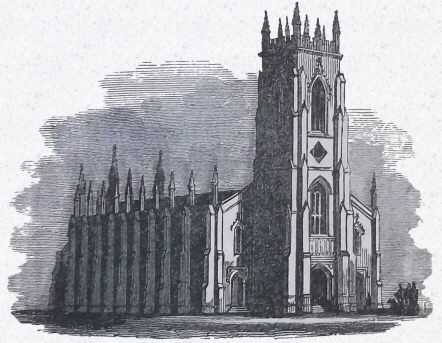
The Church is one of the most handsome of modern architecture
in London, and a great credit to its designer Mr. T. Cundy.
Its style is that known as Early Perpendicular; it is 106 feet in
length, by 59 feet 6 inches in breadth; the height is nearly 50
feet. It consists of a nave and two aisles, with a chancel
at the east end on an ascent of four steps; around the Church,
along three of its sides, galleries are placed; in the west
gallery is the organ, and on this side are also galleries above
for the school children. At the west end is a lofty and
very handsome tower, having an arch open on three sides at its
base to form the porch, above which it is carried to the height
of 121 feet, in two storeys, each containing a large and
beautiful window, sides and front. It terminates with an
embattled parapet of open-work, and eight crocketted pinnacles,
four of which rise from the angles. The tower contains a
clock by Dent, and three bells by Meares; the tenor weighs 22
cwt. 11 lbs., second 8 cwt, the small one 6 cwt. 4 lbs.
The
chancel forms a very handsome termination to the interior; the
reading-desk and pulpit respectively occupy places at the north
and south corners of its entrance, while in advance, occupying a
central position, is the lectern, presented by the Rev. W.
Bennett. In the south side of the chancel are three
sedillæ; over the Communion table are three
compartments of stonework, on which are inscribed the
Lord’s Prayer, the Ten Commandments, and the Creed; above
the stonework it terminates in a rere-dos, over which is
the great window of stained glass by Wailes, pourtraying the
Prophets and the Twelve Apostles. This window and
ornamental stonework cost about £1,000.
The font is of Caen stone, of beautiful design, and five feet
eight inches in height; it is of octagonal form, the panels being
divided by buttresses, the projecting portion of each resting on
an angel, each angel either clasping its hands, or holding a
shield or book bearing some symbol corresponding with the subject
of the panel immediately preceding. Under each panel is a
boss, representing some plant answering to the subject on the
panel. The shaft, supporting the whole, is placed on two
steps; it consists of eight mullioned arches, and as many buttresses
decorated. It is the work of Mr. Charles Physick, of Gower
Street, and was presented by the Rev. D. A. Beaufort, Mr.
Bennett’s successor at Portman Chapel. Its cost was
£100.
The organ is a very powerful one; its case was designed by Mr.
Cundy, and harmonises with the general character of the
Church. It covers 14 feet square, and is 30 feet high.
The roof is open, and is said to be the largest unsupported by
pillars of any ecclesiastical edifice in the metropolis. It
is of timber, and the tie beams are filled with tracery.
Of the eight handsome windows of each side of the church, two
in the north and six in the south are filled with stained glass,
all by Wailes, of Newcastle, representing the most remarkable
scenes and actions of St. Paul, and of those Apostles whose names
are to be read on each window. Four of these windows were
erected to the memory of various members of his family by J. T.
Horne, Esq.; one to John Backhouse, Esq., of the Foreign Office,
born October 14th, 1784, died November 13th, 1845; one to the
late Viscount Newry, to the Misses Alice and Caroline Colvile, and one
to Miss Caroline Carr. There is one also to Patrick Fraser
Tytler, born August 30th, 1791, died December 24th, 1849: he was
author of “A History of Scotland,” “Lives of
Sir Walter Raleigh,” “Henry VIII.,” and other
works that have assumed a standard position in our
literature.
The church will hold nearly 1,600 persons; 600 of the sittings
are free.
The Rev. W. J. E. Bennett was nominated to the incumbency by
the Bishop of London; but certain differences having arisen
between him and the Bishop, he resigned in March, 1850, when the
Hon. and Rev. Robert Liddell was appointed in his stead.
The following is a list of the Churchwardens:—September
30, 1845, Hon. Eliot Yorke, M.P.; Charles Briscoe. (These
gentlemen were re-elected also for the three following
years.) 1849, April 10, Sir John E. Harington, Bart.;
Charles Briscoe. 1850, Sir J. E. Harington; Charles
Briscoe. 1851, April 21, T. H. Sotheron, Esq., M.P.; J. H.
Tuck. 1852, April 13, Viscount Castlereagh; J. H.
Tuck. 1853, March 29, T. H. Horne, Esq.; Charles Westerton. 1854, April 18. This was a
contested election: opposition having been made by Mr. Westerton
to the mode of conducting Divine Service, and other matters
connected with the Church, he was opposed by Thos. Davidson,
Esq.; but after a poll, the numbers were declared to be—for
Mr. Westerton, 203; Mr. Davidson, 200. Mr. Horne was
renominated; but a caveat being entered against this election,
the case came on for adjudication before Dr. Phillimore, in the
Archdeacon’s Court, on May 30th, 1854, who declared the
election null, in consequence of the rejection of the votes of
certain parishioners; and a new election taking place on June
15th, the same gentlemen were again nominated, and, after a poll
of two days’ duration, the result was declared to
be—for Mr. Westerton, 651; Mr. Davidson, 323. 1855,
April 10, W. H. Jackson, Esq.; Charles Westerton: and the same
gentlemen still fill the office.
All Saints’
Church.—This handsome edifice was consecrated by the
late Bishop Blomfield on Saturday, July 21st, 1849. It was
erected to supply a very great want, for previously this isolated
portion of St. Margaret’s parish was destitute of a place
of worship for the members of the Church of England. Within
the last twenty years the population has vastly increased; and
houses of first-class character have covered the nursery-grounds
and fields formerly abounding.
All Saints’ Church was erected from the designs of Mr.
Vulliamy, in the Lombardic or Byzantine style of architecture,
and when completed will be one of the most original and striking
edifices in London. It consists of a nave, and side aisles,
divided by pillars polished to imitate marble, terminating in an
apse, forming the chancel, and the roof of which is a blue ground
spangled with gold. Galleries are erected round three
sides; in the western one is a very fine organ. The roof is
open, of woodwork, and harmonises pleasingly with the other parts
of the building, although comparatively plain.
A tower at the west end, and a suitable enclosure before the
entrance, yet remain to be accomplished, ere the work of
completion is done. The estimated cost of these works
amounts to £2,100; and it is to be hoped that the
necessary funds may not be long forthcoming, to hinder their
commencement.
The minister is the Rev. William Harness, known for his
edition of Shakspeare and other contributions to current
literature; and the senior curate is the Rev. Mackenzie Walcot,
whose “Memorials of Westminster,” and other works on
the ancient city, have rendered him its most popular and pleasing
historian.
Charles R. Harford and James Baber, Esqs., were the first
chosen churchwardens, and filled the office continuously till the
present year, when W. Aldridge, Esq., was instituted in room of
Mr. Harford.
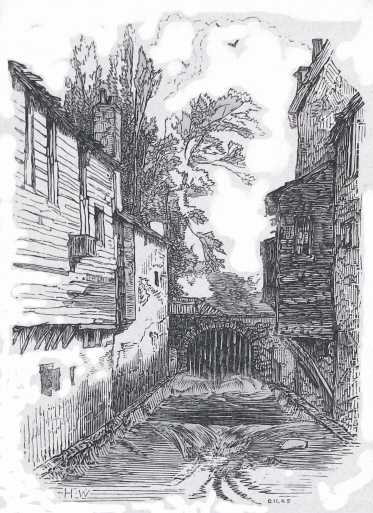
Albert Gate occupies an arched
surface over the bed of the Westbourne, which was here open and
crossed by two bridges, one just within the Park, and erected
about 1734; the other, the old bridge from which our Hamlet is
named. On its west side was the “Fox and Bull;”
on its east a low court of very old houses, named after the
“White Hart,” which, with these other buildings and
the Cannon Brewhouse, were entirely removed by authority of an
Act of Parliament (4 Vict., c. 12) passed March 10th, 1841, which
empowered the Commissioners of Works to purchase the land on
which these tenements stood and the buildings thereon, for the
purpose of forming a new entrance to Hyde Park.
Accordingly, these improvements were carried out, and the iron gates,
which are of a very chaste design, were fixed August 9th,
1845. The two stags on the side pedestals formerly
performed the same watch and ward at the Ranger’s Lodge in
the Green Park. They were modelled from a pair of prints by
Bartolozzi.
Part of the ground bought by the commissioners they leased for
ninety-nine years to Mr. Thomas Cubitt, who immediately built on
the eastern side a large mansion, for which it is said Mr.
Hudson, M.P., paid him £15,000. It is now the
residence of the French Ambassador: here our Queen paid a visit
in state on May 12, 1854; and the Emperor Napoleon held a Levee
on his visit to her in May, 1855.
This house was at first the butt of the London wits, who named
it Gibraltar House, affirming it would never be
taken. This opinion did not deter Mr. Cubitt from
erecting another, now the London and County Bank Branch; and a
third is now nearly finished for Captain Layland.
Architecturally, there is nothing in these mansions to admire,
notwithstanding the arrogance with which they force
attention. Though so gigantic, they are not imposing; of an
unusual altitude, they are destitute of ornament,
and can only be likened to some “tall bullies,”
determined even in vulgarity to lord over their fellows.
Brompton Road: a row of houses
built about twenty years since on the garden of Grosvenor
House. The National School House attached to Brompton
Church was built in 1841, in the Tudor style, from designs by Mr.
George Godwin.
Ennismore Place and Terrace, built by Elger on land belonging to
the Earl of Listowel, from whose second title the name is
derived; commenced in 1848, and finished in 1855. Along the
curve at the bottom of the Terrace (now called Princes Terrace)
the boundary of St. Margaret’s parish abuts on that of
Kensington. No. 11, Princes Terrace, is the residence of
Mr. Bonamy Price.
High Road: a heterogeneous row of
houses between the Green and Rutland Gate is so called.
They are built without any attempt at uniformity, and are
generally of a mean description. Parts of the western end
are now called Trevor Terrace, and South Place. The oldest
houses in the Hamlet are in High Road: Chatham House (why so
called I know not), built in 1688, now a broker’s, was for many
years a boarding-school, and originally surrounded by a
garden. Three doors beyond is an ancient inn, now known as
the “Rose and Crown,” but formerly the “Oliver
Cromwell,” and which has been licensed above three hundred
years. It is the oldest house in Knightsbridge, was
formerly its largest inn, and not improbably the house which
sheltered Wyatt, while his unfortunate Kentish followers rested
on the adjacent green. A tradition told by all old
inhabitants of the locality that Cromwell’s body-guard was
once quartered here, is still very prevalent, and an inscription
to that effect was till lately painted in front of the house; [104] and on an ornamental piece of
plaster-work was formerly emblazoned the great Protector’s
coat-of-arms. Although I have not been able to find any
mention of this place in connection with the Civil War, or with
Cromwell, yet nothing is more certain than that (as I have before noticed)
our neighbourhood was frequently the scene of skirmishes during
that contest, or more probable than that it should be so,
considering it was the main road from the west to the
capital. In 1647 the Parliament Army was encamped about
here, and Fairfax’s head-quarters were for awhile at
Holland House; so also immediately before and after the fight at
Brentford. At all events, Mr. Corbould, the distinguished
painter, took this old inn as a subject; and “The Old
Hostelrie at Knightsbridge,” exhibited in 1849 at St.
George’s Gallery, formed a pleasing and animating
picture. He laid the scene as early as 1497; and opposite
the inn stands a well, surmounted by a figure of St. George,
while beyond is the spacious green, the meandering stream, the
bridge over it, surmounted by an embattled tower; while still
further appears the old hospital and chapel. All this is
likely to be summarily condemned as the painter’s fancy,
but it nevertheless proves that an interest in the place was not
confined to the lower orders alone. The house has of late
been much modernised, and in 1853 had a narrow escape from
destruction by fire; but enough still remains in its
peculiar chimneys, oval-shaped windows, the low rooms, large yard
and extensive stabling, with the galleries above and office-like
places beneath, to testify to its antiquity and former
importance. [106]
The “Rising Sun” was for many years the residence
of Major Eyre of the Volunteers. It is built of red brick,
and on the coping is the date 16—. There was formerly
much carved work about the rooms, but all has disappeared: a
plain, old-fashioned staircase still exists. It has not
been licensed above thirty years.
Trevor Terrace consists of but ten houses. At the last,
Mr. Pocock, the architect, resides.
At the corner of South Place, which contains only three
houses, is the celebrated floor-cloth manufactory belonging to
Mr. Baber. It was the earliest one ever established, and
first erected, in 1754, by Nathan Smith. The first block
used for patterns was cut by him, and is still preserved in the
factory. A woodcut of it is given in “Dodd’s
British Manufactures,” where full particulars of the
process of this manufacture are given. In 1794 the building
was entirely destroyed by fire, but restored the ensuing
year; the whole was rebuilt in 1824, and presents a remarkable
appearance from its great height. At the north end is a
clock, over which is placed a figure of Time cut in stone.
The adjoining house (No. 2) was formerly called the
“Parsonage,” because inhabited by the Rev. J. Gamble,
of Trinity Chapel. This gentleman was in 1796 appointed
Chaplain of the Forces, and in 1799 Rector of Alphamstone and
Bradwell-juxta-Mare, Essex. For many years also he was
private chaplain to the Duke of York, who generally attended his
ministry at the Chapel. Mr. Gamble was a Fellow of Pembroke
College, Cambridge, a very able preacher, and a highly popular
man. He died in this house July 27, 1811.
Of late years this unpretending house has gained a world-wide
celebrity, having been the residence of Edward Sterling, the
“Thunderer of the Times.”
Edward Sterling was born at Waterford on the 27th February,
1773. He entered Trinity College, Dublin, and qualifying
himself for the bar, was duly called thereto; when the Irish
Rebellion breaking out, in his twenty-fifth year, the barristers
resolved to raise a corps of volunteers; and thus a
complete change in Sterling’s career was commenced.
He fought at Vinegar Hill, and doubtless fought well. He
quitted the bar, joined the Cheshire Militia, whence he and his
company afterwards volunteered into the line. In 1805 the
regiment was disbanded, and he removed to Kaimes Castle, Bute,
where he cultivated a farm. Afterwards he went into Wales,
and was appointed Adjutant of the Glamorgan Militia; and in 1810
published a pamphlet on Military Reform. It was dedicated
to the Duke of Kent, and went through a second edition the
following year.
In 1812 he wrote a series of letters to the Times,
under the signature of “Vetus,” which were afterwards
collected and reprinted. In 1814 he was at Paris, and
witnessed the entry of Napoleon after his return from Elba.
He made the best of his way to London, which he never quitted as
a residence again. He resided at various places in the
suburbs, but ultimately settled at Knightsbridge, a more
congenial home with its military air; and from this modest nook
poured forth the able, torrent-like articles, which gained their
unknown author the title of the “Thunderer.”
He
died here in the year 1847; his wife, the excellent mother of
John Sterling, died here also, on April 16th, 1843. [109]
This house was also a home to John Sterling when in London;
and here Carlyle, Maurice, Mill, and other gifted men, visited
him. It is now the residence of his brother, Colonel
Sterling; and here also came, after his honourable campaign in
the Crimea, the brave Sir Colin Campbell, who for his services in
India was created Lord Clyde.
Kent House.—H.R.H. the Duke
of Kent, about fifty years ago, rented a small house, to which he
added till it attained its present size, and was named after him,
Kent House. He resided here but a few years. After
him, Lord George Seymour inhabited it; and in 1817 the Hon.
George Villiers resided here. He was next brother and
heir-presumptive to the second Earl of Clarendon, and held
several official employments. He married the Hon. Theresa
Parker, only daughter of John, first Lord Boringdon, and brother
of the Earl of Morley, and died at Kent House, March 21st, 1827,
leaving a numerous family, three of whom at least have attained a
high reputation, viz., the present Earl of Clarendon, the Hon. C.
P. Villiers, M.P. for Wolverhampton, and Lady Theresa Lewis,
author of “The Friends and Contemporaries of Lord
Chancellor Clarendon.”
At Kent House (divided now) reside Earl Morley, and Sir G. C.
Lewis, the late Chancellor of the Exchequer. He married
Lady Theresa (noticed above), relict of P. H. Lister, Esq., and
is author of many important historical and political works, some
of which were written in this house.
Stratheden House.—This was
many years the residence of a highly respected family named
Marsh. Charles Marsh, Esq., was a magistrate of the county,
and William Marsh was senior partner in the house of Marsh,
Graham, and Co., with which the forgeries of Fauntleroy were so
interwoven. In the misfortunes occasioned by this man Mr.
Marsh was innocently, but bitterly, involved. He was a very
public spirited man, and greatly respected in the locality.
Stratheden House was afterwards the residence of Francis
Bassett, Lord de Dunstanville. He was created baronet for his
prompt heading of the Cornish miners, and bringing them to the
relief of Plymouth, when the combined fleets of France and Spain
cast anchor in the Sound in 1779. He sat in the House of
Commons many years, supporting Lord North, and afterwards Pitt,
by whom, in 1799, he was raised to the peerage. He
supported the Tory interest in the Upper House, and, though not a
prominent member, drew down on him the ire of the veteran
reformer, Cartwright. He died in 1835.
This mansion is now the town residence of Lord Campbell and
Lady Stratheden, after whom it is named. The first volume
of the “Lives of the Chancellors” is dated from this
house.
High Row extends from Albert Gate
Houses to the Barracks; part of it, in an absurd spirit of
sycophancy, is now called Albert Terrace. At the west side
of the stream, till the improvements were effected, stood a
celebrated inn, known as the “Fox and Bull,”
traditionally said to have been founded in the time of Elizabeth,
and used by her on her visits to Lord Burleigh at Brompton.
Its curious sign is said to be the only one of the kind
existing. At the “Fox and Bull” for a long
while was maintained that Queen Anne style of society, where
persons of “parts” and reputation were to be met with
in rooms open to all. A Captain Corbet was for a long while
its head; a Mr. Shaw, of the War Office, supplied the London
Gazette; and W. Harris, of Covent Garden Theatre, his
play-bills. [112a] Sir Joshua Reynolds is said to
have occasionally been a visitor, as also Sir W. Wynn, the patron
of Ryland; and George Morland frequently so. The sign was
once painted by Sir Joshua, and hung till 1807, when it was blown
down and destroyed in a storm. The house is referred to in
the “Tatler,” No. 259.
The “Fox and Bull” was for many years the
receiving house of the Royal Humane Society; [112b] and here was brought the poor frame
of the first wife of the poet Shelley, who had drowned herself in
the Serpentine. She had lodged in Hans Place, a short time
before, and was known to the landlord’s daughter, Miss Mary
Ann Phillips; hence, her remains were treated “tenderly,” and laid out “with
care.” An inquest was held, and a verdict returned,
which saved her the revolting burial then awarded to the
suicide.
A magistrate used to sit here once a-week: the last was Mr.
Bond, of Sloane Street. The present is the third house that
has existed under the same sign. The first was undoubtedly
of Elizabethan build; most of its rooms were panelled and carved,
with ornamented ceilings, &c.; and it was not till 1799 that
the immense fire-places and dog-irons were removed for
stoves. This house was pulled down about 1836, and the
second immediately built on its site; this stood till the
alterations at Albert Gate made necessary the removal of the
business to its present situation.
In 1809 the landlord, digging to form a grain pit for his
cows, discovered six entire male skeletons, supposed to be
remains of some who had been slain (perhaps attempting to cross
the bridge) in the Civil War.
The Cannon Brewhouse, a large unsightly brick building,
occupied the remainder of the site of the Albert Gate
houses. Formerly here stood a row of mean dwellings, with
open cellars in front, and at the west end a filthy court.
They were all removed for the brewhouse, the first stone of which
was laid by the late Mr. James Goding, on April 10th, 1804; at
the top was a huge wooden cannon. [114] In 1841 the
whole was pulled down, and for ten years the ground was
unoccupied; in 1851 a temporary building for the Chinese
Collection of Mr. Dunn was erected, which in 1852 made way for
the large mansion not yet entirely finished.
The house now inhabited by Mr. Murray was, rather more than
thirty years since, the residence of Lady Ann Hamilton—the
faithful attendant of Caroline of Brunswick. Afterwards Mr.
Chalon, and then Mr. Davis, both artists of repute, inhabited
it. To Mr. Davis succeeded Mr. White, a naturalist, who had
here a large collection of wild beasts and birds. I have
heard he was tutor to Van Amburgh.
Mr. Woodburn, when living supposed to be the first judge in
matters relating to ancient art, once lived in this house.
He died in 1854. The staircases still bear proof of
the residence of these artists here.
Captain Corbet, a comrade of St. Vincent, lived at No. 19;
Ozias Humphry at 13; Maurice Morgann, opposite Sloane Street,
John Taylor, the singer, Paul Bedford (for several years at 18),
Mr. Justice Burton, and Mr. McCarthy, the sculptor, at
17—were all residents of High Row. Of these, Humphry
will be noticed here. He was born at Honiton in 1742; and
early evincing a taste for drawing, was taken from the Grammar
School of his native town and sent to London, where he prosecuted
his studies most assiduously. Having, after two
years’ stay, been compelled to return through the death of
his father, he engaged himself to Mr. Collins, a miniature
painter at Bath. But in 1763, by the advice of Reynolds, he
returned to London, and was brought under public notice through
his auspices. For some years he practised with increasing
success, and in 1773 set out for Italy with Romney; he returned
in September, 1777, and his fame rapidly increased.
Miniatures he had chiefly devoted himself to, but now he turned
to full-portrait painting, to which Hayley in his poem addressed
to Romney refers:—
“Thy graces, Humphry, and thy colours
clear,
From miniatures’ small circle disappear:
May their distinguished merit still prevail,
And shine with lustre on the larger scale.”
In 1785 he sailed for India; but the climate compelling him to
return before he had attained his object, he, in 1789, again
exhibited in London, confirming his former reputation, and next
year he was elected R.A. He was employed to paint a series
of original portraits of the Sackvilles by the Duke of Dorset;
but ere he had completed them his sight failed him, and though
various attempts were made to pursue his art, they were
unsuccessful, and he was compelled to terminate his professional
career.
Humphry was held in high estimation by some of the greatest
men of his time; by Reynolds, Hastings, and Sir W. Jones.
He is one of the heroes, too, of Boswell’s inimitable
biography: Johnson placed under his care his godson, “a son
of Mr. Paterson, eminent for his knowledge of books.”
As an artist, though he suffered many disadvantages, he ranked
high; as a man of moral worth, and kind affections, he was
“zealous in good offices, and strenuous in his efforts for
rising genius;” and it was to him Dr. Walcot first
introduced Opie.
Besides the poetic niche of Hayley, Owen Cambridge mentions
him—
“But, Humphry, by whom shall your labours be
told,
How your colours enliven the young and the old?”
And Cumberland likewise—
“Crown’d with fresh roses, grateful
Humphry stands,
While beauty grows immortal from his hands.”
Humphry resided several years in Knightsbridge; he died at 13,
High Row, March 9th, 1810, and was buried in St. James’
Chapel ground, Hampstead Road. [117]
Out of the High Row runs Mills’ Buildings, so called
from a builder of that name who erected them in 1777. At
the top, abutting on the Park, is Park Row: at No. 5, Mr. Thomas
Cooper for several years resided; and Mr. F. Matthews once lived
in this row.
The spot of ground now occupied by the Duke of
Wellington’s stables, just erected from designs by
Hardwick, was purchased by the Duke from a Mr. Williams, whose
freehold property it was. Several houses in Park Place, the
“Nag’s Head,” [118] and five other
houses, were removed for these stables. Two of them touched
on the Park, and were called Williams’ Cottages.
At the west end of High Row is the barrack for the
Horse-Guards, an extensive range of brick buildings, built in
1795, and capable of accommodating 600 men and 500 horses.
In the centre of the chief building is an oblong parade, around
which are the apartments for the men, and the chief stabling for
the horses. A mansion for the officers, riding school,
&c., stand at the western end.
Hyde Park.—Of the glories of
Hyde Park it is almost superfluous to speak; it has been a place
of great popular resort since the days of Charles II. It
was then visited, not as now, for air and exercise only, but was
much used by the citizens for their sports. May 1st, 1654,
a great hurling match was played before the Lord Protector.
We read that on that day also “great resort came to Hyde
Park, many hundreds of rich coaches, and gallants in attire; but most
shameful powdered-hair men and painted and spotted
women.” Horse and footraces were also held
here. “Shall we make a fling to London, and see how
the spring appears there in Spring Garden, and in Hyde Park to
see the races, horse and foot?”—(“Merry
Beggars, or Jovial Crew,” 1641.)
Many and famous have been the reviews here, some of them of
deep historical interest. In October, 1803, as
before-mentioned, George III. reviewed the different Volunteer
Corps raised by the metropolis, when the total number inspected
amounted to 27,077 men, of whom our local contingent mustered in
force of 124. The enthusiasm created by the appearance of
the Guards on their return from the Crimea, and the first
distribution of the Victoria Cross by her Majesty in person, are
fresh in the public memory.
It is well diversified with wood and water; the Serpentine in
its space amply supplying the latter.
“Well may the coyest of the Nine
Be proud to sing the Serpentine;
For never breeze has swept, nor beam
Shed light upon a luckier stream.
’Tis but a brook, whose scanty source,
Hard by, just struggles in its course,
But
scarce has reached, slow trickling thence,
The bounds of royal influence,
When, such the favour and protection
That flows from interest and connection,
’Tis bidden a nobler form to take,
And spreads and widens to a lake.” [120a]
Would that its waters were kept sweet and pure; how much more
enjoyable would its ride and walks be. Life at the
Serpentine in the height of the London season, and after a few
days’ sharp frost, presents characteristics that can be
seen in the metropolis only.
The Hyde Park river, which no
river is,
The Serpentine—which is not
serpentine,
When frozen, every skater claims as his,
In right of common, there to
entertwine
With countless crowds, and glide upon the ice.
Lining the banks, the timid and
unwilling
Stand and look on, while some the fair entice
By telling, yonder skaters are
quadrilling;
And here the skateless hire the “best skates”
for a shilling. [120b]
As the Serpentine is at these two seasons productive of so
much enjoyment, so it is also at the same time the source of much
danger. The skater, the bather, and he who is sick of
life’s miseries, too often afford employment for the staff
at the Receiving House of the Royal Humane Society.
This
edifice was erected on its north bank in 1834. One devoted
to the same purpose had previously occupied the same spot.
In it are beds, warm baths, tables, and apparatus of all kinds
for the restoration of those apparently drowned, in the hope that
“perchance a spark may be concealed.” Every
effort of science is here exercised on the cases requiring such
attentions; the inspection of the public is invited by a notice
to that effect affixed outside.
Some little distance north and west of the Receiving House,
formerly stood a very ancient edifice, known by the name of
“The Cake House;” it was built with timber and
plaster, and roofed with flat tiles. It was a place for the
sale of refreshments to those who visited the park—hence
its name. Pepys says, April 25th, 1669:—“Abroad
with my wife in the afternoon to the Park, where very much
company, and the weather very pleasant. I carried my wife
to the Lodge the first time this year; and there in our coach eat
a cheesecake, and drank a tankard of milk.” We may
imagine by the following that it was the best known and more
visited than any other spot in the Park:—“Comely!
nay, ’tis no London female; she’s a thing that never saw
cheesecake, tart, or syllabub, at the Lodge in Hyde
Park.”—(“The English Monsieur,” by the
Hon. James Howard. 4to. 1674.)
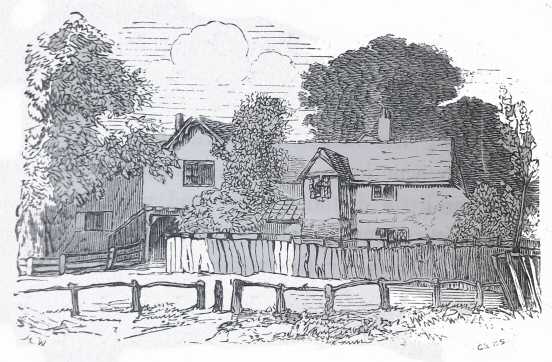
Adjacent to this old Lodge was the famous Ring, where the
racing and other amusements were carried on; and where the ground
was often dyed with the blood of the duellist.
The Ring, or parts of it, can still be distinctly traced on
the east of the Ranger’s Grounds. Here fell the Duke
of Hamilton, after his duel with the Lord Mohun. Swift, in
his journal to Stella, Nov. 15th, 1712, says, “The Duke was
helped towards the Cake House, by the Ring, in Hyde Park (where
the duel was fought), and died on the grass, before he could
reach the house:” a graphic picture, and a sad one, of that
fashionable and cruel custom now happily abolished in this
country. The journals a century ago were replete with
notices of duels fought in the Ring in Hyde Park.
Turn we now from these painful reminiscences. From the
Ring, we have in view the costly toy of George IV., the Marble
Arch, which, for want of a better destination, was removed to
Cumberland Gate from Buckingham Palace; it was designed by Nash,
after the arch of Constantine at Rome, and originally was
intended to have been surmounted with a chariot and horses, and
afterwards with a classic equestrian statue of his Majesty; this
was actually executed by Chantry at a cost of 9,000 guineas, but
it never reached its intended elevation, and now occupies the
pedestal at the north-east corner of Trafalgar Square.
Perhaps the most satisfactory work of art in connection with the
structure is the very beautiful pair of gates. They are
said to be the largest in Europe; are designed in scroll, having six
openings, two filled with St. George and the Dragon, two with the
royal cypher G.R., and two with lions passant gardant;
they cost 3,000 guineas, and are cast in an alloy composed
largely of copper.
At present the erection produces a somewhat poor effect, but
it is not fair to criticise it, seeing that its original design
has not been carried out; were it surmounted with a
well-harmonised group, as at first intended, no doubt its
appearance would have been much more imposing.
We have in the Park, just within the entrance at the
“Corner,” the statue of Achilles, cast from cannon
taken from the French, erected in honour of the late Duke of
Wellington, by a subscription of his “Countrywomen,”
as told by the inscription thus:—
To
Arthur, Duke of Wellington,
And His Brave Companions in Arms,
This Statue of Achilles,
Cast from Cannon taken in the Victories of Salamanca,
Vittoria, Toulouse and Waterloo,
is inscribed
By their Countrywomen.
Placed on this Spot
on the XVIII. day of June, MDCCCXXII.
By command of
His Majesty
George IIII.
We
give a passing reference to Rotten Row, where, every evening
during the season, may be seen one of the most animating and
national spectacles of the metropolis; the fine gravelly road is
then filled with equestrians of both sexes mounted on the most
beautiful horses, and parading up and down to the admiration of
the lounging spectators, whiling away their evening hour on the
seats or rails skirting the road. This road has lately been
injudiciously widened, being unused some eight months in the
year, and the crossing thereby rendered the more dangerous the
remaining four.
It is needless to speak here of the Great Exhibition of 1851:
these pages are not to tell of its beauties, its results, or the
enthusiasm it called into play; suffice it to say that our dear
old Park was the scene of its glories. We will hope that
its peaceful memories may never be effaced from among the
nations.
Hyde Park Corner.—The
earliest mention of this name I have met with is in the
“Chronicle of Queen Mary,” &c., published by the
Camden Society, where Wyatt is described planting his
“ordenance over agaynst the parke corner.” The
name properly applies to that triangularly-shaped portion of the
Park formed by the line from Stanhope Gate to Apsley House.
Several interesting incidents have occurred at this spot
deserving notice. Here James I., in March, 1606, was met by
his whole court and the House of Commons, with the Speaker at
their head, to welcome him on his safe return from a hunting
excursion near Woking, where it was stated he had been
murdered. Here, in 1625, Judge Whitelock sat on the grass
which grew in the road, and with his retinue ate the dinner
brought with them from the country, afraid to stay longer in
London than absolutely necessary, the plague having just carried
off thousands of people. After his meal, he galloped to
Westminster Hall, adjourned the courts, and quickly retired.
By this road, on August 6th, 1647, Fairfax and his army, all
with a laurel branch in their hats, entered from Kensington,
accompanied by the House of Commons, to go to Westminster, the
matter of the Declaration having been agreed to. From
Kensington to the fort here, a guard stood three feet deep; and
at Hyde Park Corner they were met by the Lord Mayor and Corporation, come to congratulate them on their
arrival. “Lieut. General Cromwell’s regiment of
horse” was among them, we are told: this was not his last
appearance here. When he returned from his Irish campaign,
Fairfax and others met him at Hounslow; and as he approached,
Colonel Barkstead’s regiment, drawn up in the highway at
the Park Corner, saluted him. In the journal of George Fox,
the Quaker, too, is an anecdote of his meeting the Protector
here.
After the fight at Brentford, consternation being felt by the
Londoners at the near approach of the Royal Army, a chain of
forts was thrown up by the citizens, connected with each other by
means of earth works and ramparts. Whitelock says it was
wonderful to see how the women and children, and vast numbers of
people, would come and work at digging and carrying earth to the
fortifications. The newspapers of the day teem with curious
particulars of the prevailing excitement; one day we read of five
thousand felt-makers, another of four thousand porters, then of
five thousand shoemakers, and six thousand tailors, all to assist
in the pressing work. Nor were the fair sex
behindhand; Butler, in his “Hudibras,” alluding to
this, says they
“March’d rank and file, with drum and
ensign
T’ intrench the city for defence in,
Raised rampiers with their own soft hands
To put the enemy to stands;
From ladies down to oyster-wenches,
Labour’d like pioneers in trenches;
Fall’n to their pickaxes and tools,
And helped the men to dig like moles.”
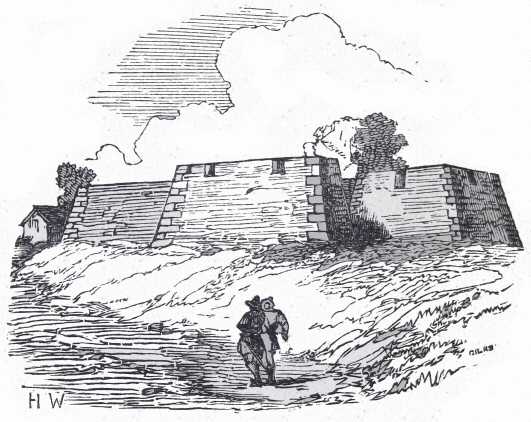
And Nash, in a note on this passage, says:—
“Ladies Middlesex, Foster, Anne Waller, and
Mrs. Dunch, were particularly remarkable for their
activity.”
One of these forts stood on the brow of the hill at
Hyde Park Corner; it was a large one, consisting of four
bastions, commanding the ascent and the adjoining fields.
Four years afterwards—no further use remaining for
them—the House of Commons ordered their removal.
Dr. King relates an interesting anecdote of Charles II.
meeting his brother James at this spot, on his return from a
hunting excursion, and escorted by a party of the Guards.
Charles, who was out for a stroll in the Park, of which he was
very fond, was attended by but two of his Court. The Guards
recognising the King, halted; and James being acquainted with the
cause thereof, stepped from his coach, and saluted his brother,
but expressed his surprise to meet him there almost unattended,
and thought he exposed himself to some danger. “No
kind of danger, James,” replied Charles, “for I am
sure no man in England will take away my life to make you
king.” [129]
Respecting this interesting anecdote, a tradition tells us
that Charles II. was very partial to a walk in Hyde Park, and
that at the spot to which he limited himself generally he planted two
acorns from the Boscobel Tree. The trees from them grew at
the north side of the Serpentine, just where the road turns off
by the magazine towards Bayswater. For many years they were
fenced in, but one only now remains; the other, much decayed, was
removed in 1854.
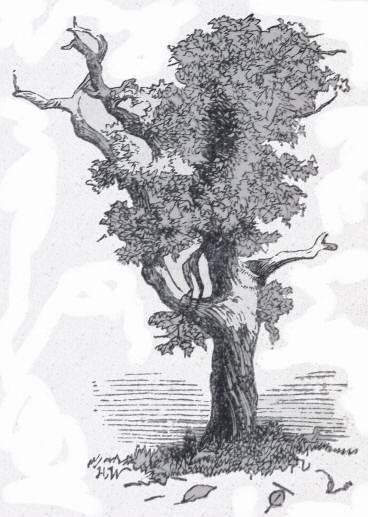
Hyde Park Corner is now the most magnificent entrance to the
metropolis; the entrances to the Parks, Apsley House, and, in the
background, the glorious towers of Westminster, form a
scene at once imposing and national. Formerly the entrance
was very mean; a turnpike blocked the way, and instead of the
classic archways, paltry lodges and iron gates led to the
parks. Between the lodge and park side was a dead wall,
eight feet high, built in the reign of Charles II., but removed
in 1828. The toll-house was sold by auction, October 4th,
1825, and cleared away immediately.
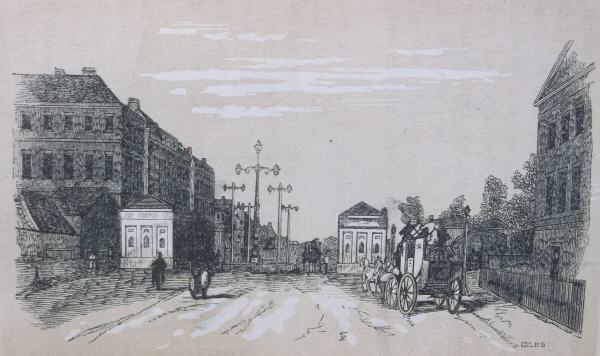
The existing entrance to Hyde Park was completed in 1828, from
designs of Mr. Decimus Burton; the frieze was designed by
Archibald Henning; the ironwork by Bramah. The Triumphal
Arch leading to Constitution Hill was built about the same time;
its beautiful gates were likewise the work of Bramah.
From Hyde Park Corner the distances to the west are measured;
a standard stood near to Apsley House till about 1827.
Kensington Gore was, as before
shown, originally called Kyngsgore—firstly, because it
belonged to the king; and secondly, from its peculiar shape;
gore, an old English word, meaning “a narrow slip of
land,” according to the old glossaries. In Kent,
the peasantry call a triangularly-shaped piece of ground a gore;
and seamstresses use the word in a similar manner to the present
day, to express a gusset or piece of stuff let into their
work. The early history of the Gore in connection with
Kilburn Priory has been noticed; and here its modern story must
be told. From Prince Albert’s Road to Noel House is
generally now considered as the Gore.
Brompton Park Nursery was established during the reign of
Charles II. During the greater part of the seventeenth
century the land appears to have belonged to the Percivals,
ancestors of the Earl of Egmont. Philip Percival, the
friend of Pym and Hollis, was born here in 1603. Brompton
Park appears to have extended from what is now called Cromwell
Road to the road from Knightsbridge to Kensington. Various
properties were cut out of it; but the Percivals were here at
least till 1675. Soon after this date about sixty acres
appear to have been formed into a nursery garden, the first ever
established in this country. It early excited great
attention, more particularly about 1690–1700, when it
belonged to George London and Henry Wise, the most celebrated
gardeners of the time. Evelyn, in his “Diary,”
records, on April 24th, 1694, taking “Mr. Waller to see
Brompton Park, where he was in admiration at the store of rare
plants, and the method he found in that noble nursery, and how
well it was cultivated.” Evelyn again alludes to the
nursery in his “Sylva,” declaring that the
“sight” of it “gave an idea of something
greater” than he could express. He speaks highly of
the skill and industry here shown, and says the like is not to be
met with in this or any other country. Bowack, writing in
1705, affirms that if the plants were valued but at one penny
each, they would be worth above £40,000.
Messrs. London and Wise translated from the French “The
Complete Gardener,” published in 1701. They were
gardeners to William III.; and Kensington Gardens were laid out
by them. Wise also superintended the laying-out of Hampton
Court; and Evelyn mentions visiting him there. After them,
the establishment went through various hands; but when the
surrounding fields were built on, the smoke injured the plants;
and the railways bringing up fruit and vegetables cheaper than they
could be brought to perfection at here, the business gradually
diminished, and in 1853 entirely ceased.
Along an ancient wall separating the grounds from those of
Cromwell House, a valuable collection of vines was planted, which
were cultivated with great success. This wall, the contents
of the gardens, and the dwellings therein, were cleared away in
1855. The following list of owners is chiefly taken from
Faulkner:—
1681.
|
Lukar and Co.
|
1714.
|
Smith and Co.
|
1686.
|
Cooke and Co.
|
1756.
|
Jefferies and Co.
|
1689.
|
Wise.
|
1788.
|
Gray and Co.
|
1694.
|
London and Wise.
|
—
|
Gray, Adams, and Hogg.
|
1700.
|
Swinhoe.
|
1849.
|
Adams and Hogg.
|
Mr. James Gray, who was chief partner in this concern so long,
died at Brompton in 1849. He is mentioned with respect in
Faulkner’s “History of Kensington.”
Park House, a plain but spacious mansion, pulled down in 1856,
adjoined Princes Gate. It was divided from the road by a
brick wall, part of that ancient one just mentioned, for this
house stood within Brompton Park: hence its name. Probably
a more ancient mansion stood here; but the late one was for many
years the seat of the Veres, bankers of the city of London.
Afterwards it became the residence of William Evans, Esq., M.P.,
soon after whose death it was sold.
Eden Lodge was the residence of Lord Auckland,
Governor-General of India. Here he retired after his
return, and died in 1849.
Mercer Lodge, a small brick residence, was inhabited by Frank
Marryat, son of the novelist, and himself an author of one or two
books of travel. Mr. Henry Mayhew now resides here.
Immediately adjoining is a row of five houses, called
emphatically Kensington Gore. All are faced with white
stucco, are very small, and appear as if intended for the lodge
of some great mansion never erected. Two of them, which
seem to contain but one room, have, however, second storeys at
the back, and good gardens, which, with the Park in front, render
them very pleasant residences. At one of these houses, in
1816, Mrs. Inchbald inquired after some lodgings which were to
let. The landlady was too fine a personage for the writer
of “The Simple Story,” and so exacting in her demands
that her applicant indignantly wended her way elsewhere. No.
2, now called Hamilton Lodge, was once the occasional residence
of John Wilkes. The house was kept by Mrs. Arnold, mother
of his second daughter Harriett, who married Mr. Serjeant Rough,
afterwards an Indian judge. Wilkes sometimes had high
visitors here: Mr. Leigh Hunt quotes a memorandum of his,
regarding a dinner here to Counts Woronzow and Nesselrode; and if
we are to set down Sir Philip Francis as Junius, here Junius
visited, as Mrs. Rough said, frequently; and when a child he once
cut off a lock of her hair. Wilkes to the last walked hence
to the city, attired in his scarlet and buff suit, with a cocked
hat and rosette, and military boots, a dress authorised by his
position as colonel of militia. The urn over the doorway
Mr. Leigh Hunt imagines to have been placed there by him as an
indication of his classic taste, and the supposition is most
probably correct. No. 5 was the residence for awhile of
Count D’Orsay.
Gore House.—In 1808, Mr.
Wilberforce took this mansion (which had previously been the
residence of a Government contractor) for his home. He
found it, he says, more salubrious than his house at Clapham; and
writes further, “We are just one mile from the turnpike at
Hyde Park Corner, having about three acres of pleasure-ground
around our house, or rather behind it, and several old trees,
walnut and mulberry, of thick foliage. I can sit and read
under their shade, with as much admiration of the beauties of
nature as if I were two hundred miles from the great
city.” Here he passed many years of his happy and
useful life, his house the resort of those men who awoke our land
from the deadly torpor into which years of fearful warfare had
plunged it. Here came Clarkson, Zachary Macaulay, Romilly,
and others, to commune together on those measures which, to quote
Channing, brought about “the most signal expression
afforded by our times of the progress of civilisation and a purer
Christianity.”
Wilberforce was exceedingly partial to Gore House, and his
friends appear to have always found a ready home within it.
In 1814, Mr. Henry Thornton, for many years M.P. for Southwark,
and one of his most earnest supporters, came here for the benefit
of the air and medical aid. He lingered a few weeks, and died
here January 17th, 1815, aged fifty-three. Isaac Milner,
too, an early friend, who came to London to attend the Board of
Longitude, died here after five weeks’ illness, on April
1st, 1820.
The following year Wilberforce quitted Gore House. He
retired to Marden, in Surrey, a lovely spot and an interesting
locality; but he regretted leaving
“The still retreats that soothed his
tranquil breast,”
and often in after years alludes to his old home, its
associations, and his “Kensington Gore
breakfasts.”
Great is the contrast Gore House next presents: strange are
the mutabilities of a metropolitan mansion. After the
philanthropist, a few unknown persons held the place ere the next
celebrity, one of a totally opposite character, reigned.
Lady Blessington—for to her allusion is made—came
here in 1836; and the opposition of ideas called forth by such
persons seems to have suggested to James Smith his
GORE HOUSE: AN
IMPROMPTU.
Mild Wilberforce, by all beloved,
Once own’d this hallow’d spot,
Whose zealous eloquence improved
The fetter’d Negro’s lot;
Yet here
still slavery attacks
When Blessington invites:
The chains from which he freed the Blacks,
She rivets on the Whites.
Lady Blessington came to Gore House in 1836; and the brilliant
circle which thronged around her in Seamore Place was increased
with the greater capabilities of the new residence. Haydon,
writing February 27th, 1835, says, “Everybody goes to Lady
Blessington’s. She has the first news of everything,
and everybody seems delighted to tell her. She is the
centre of more talent and gaiety than any woman of fashion in
London.” To Gore House came novelists and dramatists,
artists and actors, statesmen and refugees. Here Louis
Napoleon, just escaped from captivity at Ham, first came for the
shelter of an English roof; and afterwards—deep lesson
too—a few years later she went forth as privately perhaps
as her guest had entered, from the palace of which she had been
Queen, to seek in the capital of him whom she had harboured, that
support she had so freely bestowed on him; the late refugee then
having an empire rapidly falling into his hands; her object was
not gained, and on this occasion “hope left a wretched one
that sought her.” Lady Blessington finally quitted Gore
House April 14th, 1849.
Marguerite, Countess of Blessington, was daughter of Edmund
Power, a coarse, unfeeling squire of Tipperary. She was
born September 1st, 1790, and at fifteen married to a Captain
Farmer, as brutal a character as her father. They separated
in 1807, and he, compelled to go to India, died there.
Being denied a home under her father’s roof, she for
some years lived in seclusion and study, but becoming acquainted
with the Earl of Blessington, married him in February,
1818. Then another phase of her life commenced, and their
mansion in St. James’s Square was the resort of the most
fashionable of the day. Her beauty at this time was very
great, and afforded a theme for the pen of Byron, and the pencil
of Sir Thomas Lawrence. With the poet she became acquainted
during her well-known continental tour, during which the
introduction to D’Orsay also took place. Lord
Blessington dying at Paris in 1825, his widow remained there till
after the Revolution of 1830, when she returned to London.
Connected with the story of Lady Blessington, that of
Count D’Orsay is intimately woven. He was a great
favourite of Lord Blessington, whose daughter by his first wife
was, when quite a young girl, fetched from school to marry him;
and a promise also is said to have been given from the Count to
his Lordship, and from the Count’s mother to Lady
Blessington, that they (the Count and her Ladyship) would never
leave each other. Be that as it may, they lived together
for above a quarter of a century, and increase of years seemed
still stronger to consolidate the engagement. D’Orsay
led a gay and extravagant life in London, considerably beyond his
means, in great measure appearing to consider his patronage
sufficient payment. He undoubtedly possessed great
abilities, was an excellent artist, and a humourist of the first
water. But his conduct to his wife was cruel in the
extreme; she was spurned by him entirely; he still pocketing an
income from her father’s estates! For a long time he
could only make his exit from Gore House on Sundays, for fear of
arrest, and his extravagancies vastly accelerated the day of
retribution. He and Lady Blessington retired to Paris, and
Gore House was stripped of its contents by public
sale. There, whatever was the cause, they met not with the
reception anticipated. Lady Blessington died soon after, on
June 4th, 1849. D’Orsay designed her monument, and in
little more than three years after his career was ended. He
died July 1st, 1852.
Gore House became, in 1851, Monsieur Soyer’s
“Symposium for all Nations.” Here that
celebrated minister of the interior provided international
feasts, farewell banquets, &c.; and various amusements in the
highly-decorated rooms conduced to the public pleasure. The
gardens were beautifully laid out and ornamented with sculpture,
while the interior testified to the industry and taste of Madame
Soyer in the art of painting. In February, 1852, all was
again dismantled, its Baronial Hall and Encampment of
all Nations being sold by auction.
Gore House was shortly afterwards purchased by the Royal
Commissioners of the Great Exhibition of 1851. The whole
estate comprised about twenty-one acres, added to which were
Gray’s Nursery Grounds, Park House, and Grove House, and
various market-gardens, the grounds of Cromwell House, and other lands
belonging to the Earl of Harrington and the Baron de
Villars. Acts of Parliament were passed legalising the
plans of the Commissioners, and in accordance various old
footpaths, &c., were stopped, and houses removed. A
complete revolution has been effected, two magnificent roads
leading from the Gore to Cromwell Road at Brompton have been
formed, and at length Gore House itself was doomed. Its
materials were sold by lots on July 17th, 1857, and soon after
the building was removed.
Grove House, adjoining Gore House, was for many years the
residence of Lady Elizabeth Whitbread, widow of the celebrated
statesman. With Gore House it has, since 1852, been used
for schools and offices of the department of Science and Art.
Beyond this spot our description does not extend: the district
of All Saints and manor of Knightsbridge stretch much further,
but such parts have been already described by Mr. Faulkner.
Ere, however, I quite leave the Gore, it must be mentioned that,
among others, Carrington Bowles, the celebrated printseller, had
a house, and died here June 20th, 1793. The Rev.
Thomas Clare, vicar of St. Bride’s, Fleet Street, and an
author of some repute, also at one time resided here.
Kinnerton Street is so called from
an estate belonging to the Grosvenor family. Here is a
dissecting school and anatomical museum attached to St.
George’s Hospital.
Knightsbridge Green, formed by the
junction of the Kensington and Fulham Roads, was formerly of
greater extent than at the present time. It was formerly
the village green in reality, and its last Maypole was preserved
as lately as 1800. At its east end was, till about 1835, a
watch-house and pound, and Addison, in a humorous paper in the
“Spectator,” alludes to it. Proposing to
satisfy by home news the craving for intelligence occasioned by
the just concluded war, he writes,—“By my last
advices from Knightsbridge, I hear that a horse was clapped into
the pound on the third instant, and that he was not released when
the letters came away.”—(Spectator, No.
142.)
The greater part of the Green is now covered by Middle Row, a
medley of very inferior houses. On the north side is an old
inn (rebuilt in 1851) called after the bluff Marquis of Granby. The soldier has been dethroned, and Sir
Joseph Paxton promoted in his stead.
Vernon, the Butcher Cumberland, Wolfe, Hawke,
Prince Ferdinand, Granby, Burgoyne, Keppell,
Howe,
Evil and good, have had their tithe of talk,
And fill’d the sign-posts
then as Wellesley now.
William Moffatt, who in conjunction with Frederick Wood,
surveyed London and published a valuable and clever map of the
levels thereof, lived at this time in Middle Row. His
coadjutor still lives (in indigent circumstances) in the
locality.
The small plot of ground railed in, is said, by a very general
tradition, to have been the spot where the victims of the plague
from the Lazar House and elsewhere in the hamlet were
buried. I have strong reasons for placing faith in this
tradition; and in 1808, some human remains found where now stands
William Street were buried here, it being considered the proper
spot for such. King’s Row, built in 1785, has not a
cellar to a single house for this reason. At its end is a
detached brick building, the school-house of All Saints
district.
A market was held here till the beginning of the present
century for cattle every Thursday; the last pen-posts were not removed
till 1850. A fair was also held here annually on July
31st.
Grosvenor House, which formed with Mr. Rogers’ premises
one tenement, was for many years the residence of the Gosling
family, who were for a long while connected with the
hamlet. Francis Gosling, Esq., an eminent banker, lived
here; he died February 25th, 1817. Bennett Gosling, Esq.,
his nephew, resided in Lowndes Square, where he died, May 12th,
1855.
The “Pakenham” was built as the hotel for an
intended railway terminus. On its site was an old house,
many years the residence of Mr. Egg, the founder of the
well-known firm of gunsmiths in Piccadilly.
Knightsbridge Terrace till within
the last five-and-twenty years had not a shop in it. Every
house was private, and had a deep basement area in front.
The corner house, now divided, was for many years Mr.
Telfair’s “College for the Deaf and
Dumb.” James Telfair died in 1796, aged 84; his son,
Cortez Telfair, died April 23rd, 1816, aged 65. Both were
buried at Kensington, and in the church is a tablet
to their memory. It states Cortez Telfair to have been
celebrated for his literary attainments; but what these were I
have not been able to learn, other than that, in 1775, he edited
“The Town and Country Spelling Book.” [147]
In one of the houses immediately facing the Chapel resided for
many years Maurice Morgann, Esq., author of an “Essay on
the Character of Falstaff,” and Under-Secretary of State to
the first administration of Lord Shelburne. He was also
Secretary to the Embassy for ratifying the Peace with the United
States in 1783.
Besides his remarkable “Essay on Falstaff,” he
published “Remarks on the Slave Trade,” a useful and
earnest pamphlet. In the “Gentleman’s
Magazine,” December, 1815, a writer endeavoured to fix on
him the authorship of the “Heroic Epistle to Sir William
Chambers,” now known to have been concocted by Mason and
Walpole, but published under the pseudonyme of “Malcolm
M‘Gregor, of Knightsbridge, Esq.” But Dr.
Symmons, Morgann’s friend and executor, denied the
ownership, and declared his repeated injunctions were, that all
his papers should be destroyed, and that he never published any
but those with his name. Symmons had previously said,
“Some of those writings destroyed, in the walks of
politics, metaphysics, and criticism, would have planted a
permanent laurel on his grave.” [148] Mr. Morgann is one who has an
honourable niche in Boswell’s inimitable “Life of
Johnson.”
Morgann afterwards removed to High Row, where he died March
28th, 1802, in his seventy-seventh year. “As a man,
he stood detached from the general contagion of the age he lived
in; neither complying with the vices of the great, however
familiar or seductive, nor with their frivolities, however
general or imposing. His mind was compounded of pure and
simple elements, which inseparably mixed in his business, his
friendships, and intercourse with all mankind; and it was often
no less pleasing to his friends, than to the lovers of virtue in
general, to see with what lustre those plain but prepossessing
colours outshone the glare of fashion, and the accommodating
varnish of modern morals.” [149a]
Lowndes Square, so named from
William Lowndes, Esq., of Chesham, to whom the land
belongs. According to Dr. King, rector of Chelsea (1694 to
1732), in his MS. account of that parish, [149b] this site at one time belonged to a
Benedictine convent. It certainly formed part of the gift
of Edward the Confessor to the Abbey, but has been in lay hands
ever since the Reformation. At about where William Street
joins the Square stood a large detached house, formerly a place
of amusement, and known as Spring Garden. Dr. King mentions
it as “an excellent Spring Garden.” [149c] And among the entries of
“The Virtuosi, or St. Luke’s Club,” Established
by Vandyke, is the following allusion:—
“Paid and spent at Spring Gardens, by
Knightsbridge, forfeiture £3 15 shgs.” [149d]
That enjoyable chronicler, Pepys, too, I fancy alludes to
Spring Gardens in the following entry in his
“Diary.” It must be premised that the hearty
clerk of the Admiralty had been to Kensington, and there, as was
frequently his wont, had had what he innocently and amusingly
terms a “frolic”:—
“June 16, 1664. I lay in my drawers,
and stockings, and waistcoat till five of the clock, and so up,
and being well pleased with our frolic, walked to Knightsbridge,
and there ate a mess of cream, and so to St. James’,”
&c.
And again he chronicles (April 24th, 1665) a visit to the
Park. “But the King being there, and I now-a-days
being doubtful of being seen in any pleasure, did part from the
town, and away out of the Park to Knightsbridge, and there ate
and drank in the coach and so home.”
Spring Gardens was at this time a name applied to almost all
places of outdoor recreation, the appellation being borrowed from
the celebrated garden near Charing Cross. But Pepys speaks
also of a place of entertainment called “The World’s
End,” at Knightsbridge, which I believe could have been
only the sign adopted by the owner of this garden for his
house. Pepys, on another occasion relating that he went
forth to Hyde Park, was “too soon to
go in, so went on to Knightsbridge, and there ate and drank
at the World’s End, where we had good things, and then back
to the Park, and there till night, being fine weather, and much
company.” (“Diary,” May 9th, 1669.)
Again, on May 31st in the same year, he records going “to
the World’s End, a drinking-house by the Park, and there
merry, and so home late.”
Congreve, in his “Love for Love,” alludes, in a
regular woman’s quarrel, to the place:—
Mrs. Frail.—Pooh, here’s a
clutter!—Why should it reflect upon you?—I
don’t doubt but you have thought yourself happy in a
hackney coach before now. If I had gone to Knightsbridge,
or to Chelsea, or to Spring Garden, or Barn Elms, with a man
alone—something might have been said.
Mrs. Foresight.—Why, was I ever in any of those
places! What do you mean, sister?
Mrs. Frail.—Was I? what do you mean?
Mrs. Foresight.—You have been at a worse
place.
Mrs. Frail.—I at a worse place, and with a
man!
Mrs. Foresight.—I suppose you would not go alone
to the World’s End?
Mrs. Frail.—The World’s End! What do
you mean to banter me?
Mrs. Foresight.—Poor innocent; you don’t
know that there is a place called the World’s End.
I’ll swear you can keep your countenance—surely
you’ll make an admirable player.
Mrs. Frail.—I’ll swear you have a great
deal of impudence, and, in my mind, too much for the stage.
Mrs. Foresight.—Very well, that will
appear who has most. You never were at the World’s
End?
Mrs. Frail.—No.
Mrs. Foresight.—You deny it positively to my
face?
Mrs. Frail.—Your face! what’s your
face?
Mrs. Foresight.—No matter for that, it is as good
a face as yours.
Mrs. Frail.—Not by a dozen years’
wearing. But I do deny it, positively, to your face,
then.
Mrs. Foresight.—I’ll allow you now to find
fault with my face; for I’ll swear your impudence has put
me out of countenance. But look you here now; where did you
lose this gold bodkin?—Oh, sister!—oh, sister!
Mrs. Frail.—My bodkin!
Mrs. Foresight.—Nay, it is yours—look at
it.
Mrs. Frail.—Well, if you go to that, where did
you find this bodkin? Oh sister! sister! sister every
way!
Mrs. Foresight.—Oh! devil on’t that I could
not discover her without betraying myself.
(Aside.)
The house belonging to this garden stood till about
1826. For many years it was the residence of a Dr. C.
Kelly, who here had an anatomical museum. He resided here
in 1773, and quitted it about 1805. The house was
afterwards tenanted by a gentleman named Bowes; and the museum
became the auction-room of Mr. Herring. About 1818, Warren,
builder to George III., took the premises; he turned the whole
into workshops. After him came Mr. Cubitt, who, about 1828,
procuring a lease from Mr. Lowndes, pulled the whole down, and
laid out the ground for buildings. The first houses were
erected about 1836–7, but it was not till 1849 that the
square was wholly completed.
Various relics of the Civil War have been found on this site:
arms, spurs, bits, cockades, &c.; and relics telling of a
different kind of struggle—staves and handcuffs, evidences
of successful rencontres between the footpad and the
constable. A path by the stream’s side ran along to
Bloody Bridge, proceeding thence to Ranelagh. On grand gala
nights such paths were protected by patrols and the more able of
the Chelsea Pensioners.
Among the eminent inhabitants of Lowndes Square may be
enumerated the late Sir William Molesworth and Mr. Leader, M.P.
for Westminster, at No. 1; Mr. M. J. Higgins, celebrated for his
contributions on military matters to the Times, also lived
at No. 1. He is thus delineated by Mrs. Gascoigne in her
poem, “Belgravia:”—
“Nor whilst my muse still haunts these
favourite bounds,
Shall she forget to sing thy Square, O Lowndes!
Harbour
of peace, near which the troubled sea
Of human traffic roars unceasingly,
Yet enters not—though day by day it swells
Fiercer and fiercer; at the opening dwells
A man whom rage and clamour ne’er withstood,
The well-known champion of the neighbourhood!
Him all who seek oppression view with fear,
For sharp his wit, his mind acute and clear!
With subtlest force, he wields the powerful pen.
But aims it at abuses, not at men!
Him Vestries know, and Rate Collectors dread,
For cool his spirit—hard his reasoning head;
And though a giant in his strength he be,
Yet free from Tyrant’s love of rule is he;
And whilst men seek, and to his judgment bend,
They find in him a leader and a friend.” [154]
Mrs. Gascoigne, author of “Belgravia,”
“Spencer’s Cross Manor House,” “The Next
Door Neighbours,” and other works, resides at No. 14.
Admiral Sotheby, one who fought at the Nile, lived at No. 38, and
died January, 20th, 1854. Sir Henry Campbell, who died in
1856, Sir Willoughby Cotton, Mr. Tite, M.P., Mr. Brassey, the
extensive contractor, Mr. Whiteside, M.P., Mr. R. B. Wingfield,
and Mr. Malins, M.P., number also among the inhabitants of
Lowndes Square.
The row of houses on the south side was designed by Mr. Lewis
Cubitt, and with greater regard to architectural effect than
anything of its kind then in the metropolis. It was built
in 1843.
Lowndes Terrace—A row of
shops between William Street and Sloane Street, occupying the
site of a row of old-fashioned houses, of two storeys high, with
pleasant gardens in front and rear, giving the roadway quite a
rural appearance. The house at the eastern end belonged to
one Banting, who built some projecting shops over the front
gardens in 1815, and named the row Waterloo Market. His
expectations were not realised; and in 1823 these old premises
were removed, and the present houses erected. There were
but six houses. At No. 5 resided, fifty years ago, Andrews,
an artist of some repute in his day; and at No. 6 for some years
lived the mother of Rodwell, the author and composer; and her
son’s early years were partly passed at this pleasant
spot.
At the west end of this row a narrow lane, called
Porter’s Lane, led to the fields. On its right-hand
side, and divided from it by a hedge, stood a large detached
mansion, known as Knightsbridge Grove, approached through a fine avenue
of stately trees from the highway. For many years a man
named Hicks, a “sporting character,” kept the place,
and George IV., when Prince of Wales, and others of similar
tastes, were led hither. Mr. Egg, the gunmaker, once
erected a large wooden building for some balloon experiments in
the grounds. And this was, I believe, the house where the
notorious Teresa Cornellys attempted to recover her bygone
reputation.
Teresa Cornellys was a native of Germany; and early showing an
inclination to music, was brought up to it as a profession, and
soon became celebrated on the Continent as a public singer.
Having accumulated a considerable sum of money, she came to
England, about 1757; and her fame gradually becoming known, she
was induced, in 1763, to open Carlisle House, Soho Square, as a
place of public entertainment. None but the upper classes
were admitted, and the rooms were decorated in the most costly
manner. Her balls, concerts, and masquerades soon gained
great celebrity, being carried on in a most glaring and
extravagant style. And this was not all: her masquerades were
characterised, not only by indecency, but also by mockery of the
most solemn feelings and principles. [157a] The lessees of the theatres
were injured by her popularity, and stimulated the outcry which
began to arise; and at length she was convicted before Sir John
Fielding for performing dramatic entertainments without a
licence. The opposition of the managers, and the Pantheon
opening with a class of amusements somewhat similar in 1772, with
the restraint imposed by the magistrate’s decision,
combined to ruin her; and in August, 1772, her effects were sold
by auction, and she became a bankrupt. [157b]
The allusions to Mrs. Cornellys in contemporary literature are
innumerable; Murphy, in his Epilogue to Zobeide, 1771,
refers to her popularity:—
“Oh,
farewell!
For her each haunt that charms a modern belle!
Adieu, Almack’s! Cornellys’! masquerade!
Sweet Ranelagh! Vauxhall’s enchanting shade!”
&c.
This
allusion will suffice for one view of her career. The
opposite is severely described by Combe, in his satire “The
Diabolady,” published in 1777:—
“The ready ministers of hell’s
commands,
Obedient fly, and take their several stands
At Court, Cornellys’, and the Coterie;
Where vice, more vicious by effrontery,
Fearless, unblushing, braves the eternal laws
Of God and man to aid the devil’s cause.”
After her bankruptcy she followed her profession for several
years at various places in London, but in 1785 was obliged to
retire from the importunities of her creditors. Ten years
after, to the great surprise of the public, she reappeared at
Knightsbridge as Mrs. Smith, a retailer of asses’
milk. A suite of breakfast-rooms was opened; but her former
influence could not be recovered. The speculation utterly
failed; and at length she was consigned to the Fleet
Prison. There she ended her shallow career, dying August
19, 1797.
Immediately beyond the entrance to the Grove stood Messrs.
Downing’s floor-cloth manufactory, formerly Morley and
Downing’s. It was a pleasant detached house, with a
clean white front, and conspicuous green verandahs. It
was pulled down in 1823, and the manufacturing department removed
to the King’s Road.
Montpelier Square, so called from
the salubrity of its air, [159] was built about
1837. Mr. Fairholt, the distinguished artist and antiquary
(at No. 10), Mr. Walter Lacy (38), Dr. Morison (27), and the Rev.
Mackenzie Walcot, to whose writings on the city of Westminster I
owe several obligations, are among its residents.
New Street, built, I believe, about
1773, was a new street across the fields to Sloane Street, and is
the point dividing Knightsbridge and Brompton—formerly,
according to the landladies, a very “respectable”
street; it has in our day sadly changed. At No. 7, Chalon,
the animal painter, resided; and at No. 6, the Right Hon. David
Pigott in 1824 and ’25, while studying under Mr.,
afterwards Chief Justice, Tindal. Mr. Godwin, the editor of
the Builder, also in his boyhood. In Exeter Street
resided a family named Perrin, one of whom it has been said was
employed by the Duchess of Kingston to furnish a place of
meeting between Prince George, afterwards George III., and his
fair inamorata, Hannah Lightfoot. [160] The Perrins appear to have long
resided in Knightsbridge; entries of the name occur in the
registers of Trinity Chapel as far back as 1680.
Park Side, abutting on the south
side of Hyde Park, is a part of the manor of Knightsbridge,
although eastward of the stream, and is the freehold of the Dean
and Chapter of Westminster. The Birkheads were once the
lessees; at present it is rented by the descendants of Mr.
Gamble, of Trinity Chapel. The row of petty shops at its
east end were erected about fifty years since, the houses
formerly extending no further than the one now occupied by Miss
Marshall. The Knightsbridge Bank, a private concern, was
carried on in Mr. W. Stocken’s house, and these shops were
offices belonging thereto.
Just within the park is a conduit, which supplies the palace
with spring water; a descent of three steps in the main road led
to a receptacle for its supply to the inhabitants of
Knightsbridge, which still exists in another form. Close to this
“spring,” as it is termed, the stocks were placed for
the punishment of village sots and rogues. No hamlet around
the “great wen,” as Cobbett called the metropolis,
was without one. Taylor, the water-poet, says—
“In London, and within a mile, I ween,
There are of jails or prisons full eighteen,
And sixty whipping-posts, and stocks, and cages!” [161a]
At No. 10 resided for many years John Read, a man of great
benevolence of character, of scientific celebrity, and of high
repute in the locality. He was born in 1726, and being
brought up as a mathematical instrument-maker, settled in
Knightsbridge about 1754. He became known for his
researches into electricity, [161b] and published,
in 1793, an octavo volume, entitled “A Summary View of the
Spontaneous Electricity of the Earth and Atmosphere,” an
accurate and judicious work; but it led him into a controversy
with Dr. Peart, a writer on the same subject. He also
studied meteorology, and a journal on that subject he
contributed to the “Philosophical Transactions.”
Other points of his history are told on the stone to his
memory in St. George’s Ground, Bayswater, where he was
buried. The inscription I subjoin:—
Sacrum Memoriæ
of
Mr. John Read,
Mathematical Instrument Maker,
a Native of
Whalley in Lancashire,
who died at
Knightsbridge
(where he had resided nearly sixty years)
on the 22nd day of September, 1814,
in the 88th year of his Age.
Without Patron, or Patrimony, by the honest fruits of
Industry, he laid the foundation of an easy competence.
More indebted to Prudence than Fortune for his acquisitions; but
to Temperance alone for his length of days. A deep
Researcher of the latent causes of Nature’s Phenomena; her
vital Principle, he held in obedience, while he enriched the
science of Electricity with his experiments. Pleased in the
pursuit of Knowledge, and happy in the practice of Virtue; He was
a Philosopher with a benevolent heart, the Father of the
Knightsbridge Charity School; of the Free School of his native
place the Revivor. He lived an Example worthy of imitation,
and died without a groan.
Thus lived John Read, and so his spirit fled
And here his ashes mingle with the Dead.
Mr. Thomas Goding, founder of the well-known brewing firm,
lived at No. 12.
The
Queen’s Head, an old inn next the Chapel, was pulled down
in 1843. The house was once very curious inside, but had
been considerably altered. On its removal the date 1576 was
found inscribed in the brickwork.
The White Hart was more curious than the Queen’s Head,
and retained its characteristics to the last, when it was removed
for the Albert Gate improvements. Human remains, various
ancient implements, and coins were turned up below its
foundation. A filthy court ran from it along the bank of
the stream. I have seen a memorandum of agreement by which
a house next door to the White Hart was let in 1694 for five
pounds per annum.
Princes Gate.—Two terraces
are so called, very absurdly. [163] The real
gate is an entrance to the Park opposite, named after the Prince
of Wales, and opened in October, 1848. It stands on the
highest plot of ground between Hyde Park Corner and Windsor
Castle.
Of the western terrace Mr. Leigh Hunt complains that
“each house is too high for its width,” and says
“they resemble a set of tall thin gentlemen squeezing together to
look at something over the way.” I cannot agree with
Mr. Hunt’s humour, and consider them a very handsome and
pleasing row. Mr. Elmes, architect of St. George’s
Hall, was designer, I believe, and Mr. Elger the builder; the
eastern row was finished in 1851, the western in 1855. At
No. 23, Vice-Chancellor Parker resided for a short while before
his death. Between the two terraces stands
Kingston House, built about 1770, a
large and pleasant mansion, and when first erected attracting
notice by the conservatory attached to it. In this
conservatory is a large window, representing a garden scene,
painted by John Martin when a pupil of Charles Muss, the enamel
painter.
Elizabeth Chudleigh was daughter of a Devonshire gentleman,
who died when she was very young; but her mother having interest
with Mr. Pulteney, she was appointed, at the age of eighteen,
maid of honour to the Princess of Wales, mother to George
III. In the aristocratic circle into which she was now
introduced, she soon became a great favourite, and more than one
young scion of nobility cast a lover’s eye towards
her. The young Duke of Hamilton was, however, the
successful one; and the pledge of affiance passed mutually.
He set forth on his travels, and she retired to the residence of
an aunt, Mrs. Hanmer, where she found one of the most frequent
visitors was the Hon. Mr. Hervey. He seems to have made up
his mind instantly; but aware of her pledge to the duke, he
induced Mrs. Hanmer to intercept their letters. The result
of the scheme was as Hervey expected: no letters arriving, Miss
Chudleigh believed herself slighted; and wrought on by the
persuasions of Mrs. Hanmer, agreed to accept Captain
Hervey. They were married privately, August 4th, 1744, but
separated the day after, she continuing to fill her office as
maid of honour. The dissimulation this compelled her to
practise was probably the main cause of her after misfortunes; it
was only by the knowledge that he would be compelled to maintain
her, that Captain Hervey could be induced not to assert his
claim; and her union being unknown at Court, she was still as
much courted as ever. Home came Hamilton—he had been
faithful to her—and demanded that explanation she was not
able (unaccountably to him) to give, offered his hand again,
which, of course, she was compelled to refuse. His despair
was excessive; inquiries were made, and the duplicity of Mrs.
Hanmer unveiled.
Unfortunately, instead of allowing time to soothe her sorrows,
she began to drown them in a manner which showed a disregard of
her sex and position. To escape the torrent of torment, she
resolved to travel; but unwilling to go alone, was indiscreet
enough to advertise in the newspapers for a companion. She
succeeded, and off they started; but, as might have been
expected, were soon tired of each other, and separated at
Berlin. Here she was introduced to the great Frederick, who
treated her with great distinction.
Returning home, she plunged into all the dissipation which
then characterised society in the metropolis; but again her
husband crossed her path and seemed determined to claim her, and
finding remonstrance useless, she resorted to the dishonest
stratagem of tearing out the leaf bearing the register of her
marriage. Her husband had now no power to prove their
union, as the clergyman who performed the ceremony
was dead. This step she soon regretted; for Captain Hervey,
succeeding to the Earldom of Bristol, by his father’s
death, her vanity made the rank of Countess very acceptable, and
through the clerk she succeeded in replacing in the register-book
the leaf she had abstracted.
Such was her position when the Duke of Kingston offered her
his hand. Of course such was impossible; and accordingly
they lived together for several years, but with such observance
of external decorum, that though a moral, it was not an evidenced
certainty. Her husband, on negotiations being opened,
refused to gratify her with the title of Duchess; but a
separation afterwards suiting his own wishes, he agreed not to
oppose her application for a divorce, and the necessary proofs
being withheld, it was granted. She now attained her
wishes, and was married to the Duke March 8th, 1769.
While the Duke lived, the legality of the marriage was not
questioned; but he died September 24th, 1773, and left her his
whole fortune, on condition she did not marry again—a
restraint she was by no means inclined to abide by. She,
however, set out for Rome, where Ganganelli gave her apartments in
the palace of one of his cardinals, and otherwise showed her
distinction. Here, however, her gaiety was soon stopped by
news of a disagreeable nature from home.
A Mrs. Cradock had been present as a domestic at her marriage
with Lord Bristol, and, being in reduced circumstances, applied
to the Duchess’s solicitor for relief; he, discrediting her
tale, refused any, on which she went to Mr. Evelyn Pierrepoint,
nephew of the Duke, and informed him of every particular.
He thereupon preferred an indictment for bigamy against the
Duchess, of which being informed, she, after surmounting various
obstacles, landed at Dover, and was immediately bailed before
Lord Mansfield, preparatory to taking her trial.
Before, however, that came on, an unexpected enemy
appeared. Foote, imagining the case to afford capital
material for his wit, wrote a piece, called “The Trip to
Calais,” in which the Duchess was cleverly satirised as
Lady Kitty Crocodile. Foote, whose real object was
to obtain a sum of money to suppress the piece, contrived to let
her know what was astir; and the Duchess, alarmed for once most
terribly, sent for him. He waited on, and read her a part
of his play. She felt the sting, and rose in great passion,
declaring his delineation scandalous. He denied that the
character was intended for her ladyship, and the play was left
for her perusal. An intimation was made as Foote expected;
but he refusing the offer of £1,600, and declaring he would
not abate one shilling from the £2,000 demanded, he lost
all; for her friends interceding with the Lord Chamberlain, he
sent for, and censured the play. Foote published a letter
of remonstrance, but the Duchess making every preparation for an
action at law, he was completely defeated. A paper-war
ensued, in which Foote had the advantage, greatly to the
amusement, if not edification, of the public.
On April 15th, 1776, her trial commenced in Westminster Hall,
Lord Bathurst sitting as Lord Steward. She was convicted;
but pleading the privilege of the peerage, was discharged with a
caution.
She left England immediately, and passed the rest of her life
abroad. She purchased a magnificent estate near
Fontainebleau, where she died, August 20th, 1788. [170a]
After the death of the Duchess of Kingston, her mansion at
Knightsbridge became the residence, successively, of Sir George
Warren, Lord Stair, Lord Listowel, and the Marquis of Wellesley,
brother of the great Duke of Wellington, and himself one of the
foremost statesmen of the time. He resided at Kingston
House some years, living in great retirement, and died in it
September 26th, 1842, in his 83rd year. [170b]
Kingston House was, after Lord Wellesley’s death, again
the residence of the Earl of Listowel, to whom the freehold
belonged; and it is at present inhabited by his son, the present
earl. [170c]
Queen’s Buildings, commenced
about 1770, and was named after Queen Charlotte. That part of
it between Sloane Street and Hooper’s Court was originally
called Queen’s Row, the remainder Queen’s Buildings,
Knightsbridge, and at one time Gloucester Buildings.
First, I will notice Queen’s Row. Here, in 1772,
the celebrated engraver, William Wynne Ryland, resided.
Ryland was born in 1732, and, inclining towards the profession of
an engraver, became a pupil of Simon Revenet, then established in
this country. On quitting him, his godfather, Sir Watkin
Williams Wynne, sent him to Paris, where he studied under Francis
Boucher, and J. P. Le Bas. After four years sojourn he
returned to England, and was appointed engraver to the
King. He was the first person who introduced into this
country the style of engraving in the chalk manner, applying
himself chiefly to the pictures of Angelica Kauffman. This
system he greatly improved, and in it had no equal.
Strutt laments that his “mercantile engagements should
have occupied so valuable a part of his precious time, and
prevented his pursuing the art with that alacrity his genius
required, which seemed formed for great and extensive exertions.” He commenced business
originally in Cornhill, but here became bankrupt. He
afterwards came to Knightsbridge, where he resided till the
dreadful act was discovered which consigned him to the
gallows.
On July 26th, 1783, he was tried before Judge Buller, for
forging a bill of exchange for £200. He well-nigh
escaped; the forgery being so beautifully executed that it was
only the evidence of the paper-maker which convicted him.
Great exertions were made to save him, but fruitlessly; and he
was executed at Tyburn, August 29th, 1783. A few months
after, the stream being cleared of some of its mud, in order to
widen the roadway within the Park, a tin box containing some of
the unfortunate man’s plates for counterfeiting banknotes,
was discovered. [172]
No. 14 (corner of Hooper’s Court) was from 1792 to 1797
the residence of Mr. J. C. Nattes, an artist of celebrity in his
time. About the year 1800 this house became the residence
of the celebrated Arthur Murphy.
Arthur Murphy was born at Cork in 1727. Early in life he
was sent to St. Omer’s, where he studied till his eighteenth year,
when he returned to Cork, and passed two years as clerk in a
merchant’s counting-house. At the end of this time he
came to London, and entered a banking-house in a similar
capacity. But literature captivated him, the drama
especially, and it soon absorbed his mind.
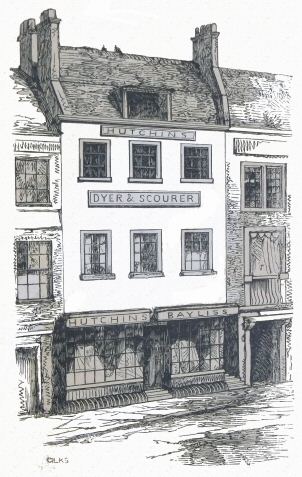
His first publication, the “Gray’s Inn
Journal,” commenced October 21st, 1752, and continued for
nearly two years. But his prospects changing by an
uncle’s death, he, in October, 1754, betook himself to the
stage, appearing at Covent Garden, and performing Othello,
Hamlet, Macbeth, &c. But it was apparent
an actor’s life he could not follow; Churchill severely
lashed him in the “Rosciad,” and Murphy retaliated in
an ode, an effusion as coarse as his opponent’s attack.
To literature he now mainly turned his attention. In
1756 he produced “The Apprentice,” a farce, for
Garrick; in 1758 “The Upholsterer,” and in the
ensuing two years “The Orphan of China,” “The
Desert Island,” and “The Way to Keep Him;” and
in 1761 he published “All in the Wrong,” “The
Citizen,” and “The Old Maid.”
In
the year 1757 he applied for admission to the Middle Temple, but,
on the ground of being an actor, was refused; he, however,
induced Lord Mansfield to interfere on his behalf, and through
this influence he entered Lincoln’s Inn. He was
called to the Bar in 1762, and eventually became leader of the
Norfolk Circuit. Lord Loughborough also gave him a
Commissionership of Bankrupts—an office he held till his
death.
The study of “Coke upon Littleton” was not,
however, sufficiently attractive to wean him from his literary
pursuits, and several plays, all of which were highly popular,
appeared in rapid succession. Among these were his
celebrated “Grecian Daughter” and “Know your
own Mind.” This latter piece, published in 1777, was
written for Mr. Harris, and was the last he brought on the
stage.
Besides these he also published an edition of Fielding’s
works, with a preliminary essay on his life and writings, an
“Essay on the Life and Genius of Dr. Johnson,” a
translation of Tacitus, and various others.
In 1788 he retired to Hammersmith, where he resided till 1800;
he then came to Knightsbridge, and here, with the exception of a
short time in Brompton Row, he resided till his death.
In this house his “Life of Garrick” was written; he
appears to have been happy and comfortable in it, occupying the
first and second floors, and having a neat and intelligent
landlady, whose interest he secured by procuring her son a
presentation to Christ’s Hospital. He died June 18th,
1805, frequently repeating during the day the couplet of
Pope—
“Taught half by reason, half by mere
decay,
To welcome Death, and calmly pass away.”
It was to Murphy, Johnson owed his introduction to Mr.
Thrale. “I question,” says Madame
D’Arblay, “if Mr. Thrale loved any man so
well.” With Reynolds and Burke, too, he was intimate,
and reviewed the latter’s “Essay on the Sublime and
Beautiful.” At Knightsbridge he became intimate with
Maurice Morgann; but from the singular construction put by the
latter on the characters of Shakespeare’s plays, silence on
these points was bespoke in their interviews. Morgann died
before Murphy, who deeply regretted, Mr. Foote tells us, his
friend’s death. [175]
At
the corner of Sloane Street, and occupying the site of the first
four houses in it, was the Swan, an ancient and well-known
hostelrie—a place of great trade in former times. The
sign still exists at No. 5, Sloane Street; and that of the
“Clock House” is also the same. Indeed the
latter was only the “tap” to the former, and the
separation of interests has not occurred above forty years.
The old house was pulled down about 1777 or 1778. Otway, in
“The Soldier’s Fortune,” alludes to
it:—
Sir Davy Dunce.—“I have surely
lost, and ne’er shall find her more. She promised me
strictly to stay at home till I came back again; for aught I
know, she may be up three pair of stairs in the Temple now; or it
may be, taking the air, as far as Knightsbridge, with some
smooth-faced rogue or another; ’tis a damned house that
Swan,—that Swan at Knightsbridge is a confounded
house.”
Tom Brown also celebrates the Swan; and Dr. Wolcot (Peter
Pindar) lays the scene of one of his coarse effusions
there:—
“At Knightsbridge, at a tavern called the
Swan,
Churchwardens, overseers, a jolly clan,
Ordered a dinner for themselves—
A very handsome dinner of the best, &c.”
Beyond Hooper’s Court (so called from its owner) Mr. J.
G. Huck, an artist, lived at No. 11; Ozias Humphry in 1792 and
1793 at No. 19 (Mitchell’s). At 21, Thomas Trotter,
an ingenious engraver and draughtsman, especially in
portraits. He died February 14th, 1803, and was buried in
the Broadway ground, Westminster.
At No. 7 resided Michael Underwood, M.D., one of the most
distinguished members of the medical profession then
living. He wrote several professional works, which,
notwithstanding the advance of the science, yet maintain their
reputation. He attended Caroline of Brunswick at the birth
of the Princess Charlotte. Was a very benevolent man and
the gratuitous adviser to the poor of the whole
neighbourhood. He died here March 14th, 1820.
Rutland House, a large red-brick
mansion, occupied the site of the present Rutland Gate.
John, Duke of Rutland, who bore the sceptre at the coronation of
George III., and once filled the office of Lord Lieutenant of
Ireland, died here May 29th, 1779, aged 88. The celebrated
Marquis of Granby, his son, also resided here. [177] The whole estate, consisting of
above six acres, was offered for sale by Mr. Robins in 1833, but
was bought in, and in a year or two after the house was pulled
down, and the land let for building. It belongs to Furzon
Manners, Esq., now, a descendant of the Viceroy.
Rutland Gate was commenced in 1838, and completed as far as
Clytha House in 1840. The remainder has been built since,
the whole being completed in 1856.
The large detached house on the western side (24) was built by
John Sheepshanks, Esq., the distinguished patron of British Art,
who here gathered together that choice and valuable collection
which he has so nobly presented to the nation. The
collection was removed early in 1857.
Clytha House, the residence of Lord Edward Howard, was built
for Mr. Jones, of Clytha, who here gathered a collection, chiefly
of the early Italian schools, which was sold May 8th, 1852.
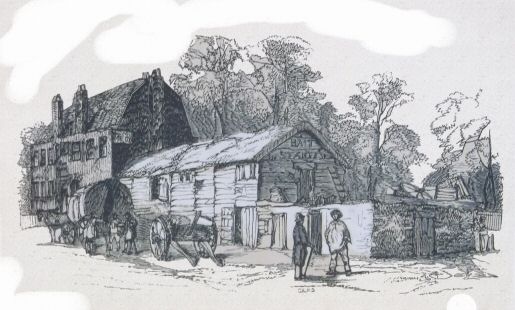
Poor
Eliot Warburton dated the second edition of his “Crescent
and the Cross” from Rutland Gate; at 21 resides Mr. Edward
Corbould, one of our finest delineators of female beauty; No. 22
was the residence of the Marchioness Wellesley, widow of the
eminent statesman; Mr. Albert Way, the antiquary, Mr. Cotton and
Mr. Prescott, both governors of the Bank of England, also number
among the residents of Rutland Gate. Nearly opposite the
western end of Rutland Gate, built in the roadway, stood an old
inn, of very bad character at one time, called the “Halfway
House.” An unusual array of stabling, troughs,
pig-styes, &c., in a very unsightly manner, were built along
the causeway; and over the door were several proofs of the faith
in the old superstition that horse-shoes were a preventive to the
visits of evil spirits. In one sense the charm was not
efficacious, the house, from its lonely situation, being a resort
for the highwayman and footpad. A curious notice of a trial
is given in “Knight’s London,” where the
thief-taker stated that if not met about this spot, they should
not have caught the robber at all: a proof of their frequency,
indeed! Jerry Abershaw is said to have been a visitor here,
and when the house was pulled down a secret staircase from a
small chamber in the western part of the house was found built in
the wall, to lead gradually down into the stables. Many a
villain, doubtless, thus escaped when the officers of justice
were close upon him.
The “Halfway House” was pulled down in 1846 at an
expense of £3,050, in addition to the purchase of the fee.
[180]
St. George’s
Hospital.—A number of gentlemen of the medical
profession, dissenting from the system of management carried on
at Westminster Hospital, broke off their connection with it, and
engaged Lanesborough House for a new institution, conducted under
their own auspices.
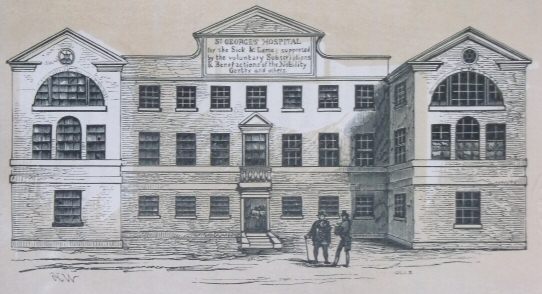
Lanesborough House is described by Pennant as the country
house of the eccentric nobleman immortalised by
Pope:—
“Old politicians chew on wisdom past,
And totter on in business to the last,
As weak, as earnest, and as gravely out,
As sober Lanesbro’ dancing with the gout.”
He caused the following quaint distich to be inscribed
on the house front in reference to its situation:—
“It is my delight to be
Both in town and country.”
The allusion of Pope to the dancing propensities of this
nobleman is curiously borne out by the fact, that when Prince
George of Denmark died he sought an interview with the widowed
Queen, and advised her to dispel her grief by following his
favourite amusement. Not till disabled entirely by the gout
did he give up this relaxation. The “Golden
Gallery” around the dome of St. Paul’s was gilded at
his expense.
Lanesborough House was of red brick, three storeys high, with
one small doorway, approached by three or four steps to the
centre; the new authorities added two wings, also of red brick,
and on January 1st, 1734, the institution was opened, having been
established on October 19th, 1733.
One of those who took a leading part in this foundation was
John Allen, apothecary to the household of George I., George II.,
and George III. successively. He remained a governor till
his death, on March 17th, 1774. Another staunch supporter was the
celebrated anatomist, Cheselden, the friend of Pope and other
literary men. Some of his greatest operations were
performed here. He was also surgeon to Chelsea Hospital,
and in its graveyard lies buried.
The hospital gradually increased in wealth and usefulness,
till in 1784 the governors issued advertisements asking for
increased aid to prevent its decay. This arose from the
fact that a large legacy left by a Mrs. Crayle caused an idea to
be spread abroad that further aid of this kind was hardly
wanted. Its legacies had been a main source of income; they
now fell off, and the Crayle bequest being reversionary, the
income rapidly fell, and at Christmas, 1783, the institution was
above £1,900 in debt; but a third of the profits of the
Handel Festival held in Westminster Abbey in 1784 enabled the
governors to overcome their difficulties.
The celebrated John Hunter was one of the eminent men who have
been connected with St. George’s Hospital. He was
appointed surgeon in 1768, and always took an active part in its
management. Here on October 16th, 1793, his
life was suddenly terminated. He had long disputed a matter
of right with his colleagues, and in an altercation he was flatly
contradicted, when a trifling address might have turned aside the
quarrel. He rushed into an adjoining room and there fell
into the arms of Dr. Robertson, one of the physicians, and his
life was gone in an instant.
The increasing prosperity and demand on the Hospital proved at
last that the old building did not afford the necessary
accommodation, and accordingly its destruction was resolved
on. This was effected in 1827, and the present building
erected from designs by Wilkins. The old front was towards
Hyde Park; the new one faces the Green Park, and is rendered
imposing by its bold and massive tetrastyle portico, supported by
square columns. Besides its numerous wards, here are a
chapel, museum, lecture-room, and private apartments. The
museum, so valuable to the surgeon, is not adapted for the
public, unless to point a moral to the vicious and unwary.
The mere curiosities are interesting; among them is the
half-sovereign taken from Mr. Brunel’s windpipe, by Sir
Benjamin Brodie, presented by its proprietor; the hide of
the cow from which Jenner took the first vaccine matter; a packet
of needles, which came simultaneously from the frame of a young
lady, money and knives from patients’ stomachs, and other
similar relics.
One regular fund is yet wanting to render the institution
complete. Many a fellow-creature, who is entirely
destitute, enters here, and, when recovered, re-enters the world,
without a roof to shelter his weakened frame, or the wherewithal
to obtain the common necessaries of life. Of late this has
been to a certain extent remedied. A porcelain slab has
been let into the wall (a corner-stone of faith it has been
called) bearing the simple inscription—“In aid of
those patients who leave this Hospital homeless and in
need.” Ought such an appeal to rest solely on the
charity of the busy multitudes passing by? To announce such
a fund would, I believe, ensure its success.
In the burial-ground of St. George’s parish at
Bayswater, is a headstone inscribed—
“Sacred to the
Memory of the Rev. James Clarke,
who died June 9th, 1811, aged 85 years.
During fifty-one of which he discharged the duties of Chaplain
to St. George’s Hospital, with credit to himself, and
benefit to
the Institution.”
St.
George’s Hospital formed a theme for one of Miss
Landon’s poems.
St. George’s Place, till of
late years, consisted of old-fashioned houses, about two storeys
high. About 1827 the first improvement was made by the
opening of Wilton Place, and gradually these old houses have been
pulled down to make room for superior ones. Towards the
upper end, these houses were detached. In one of them lived
a Captain Warner, one of the heroes of Quebec. About 1829,
Liston lived at No. 7, and at No. 12 for many years resided Mr.
Richards, a well-known London auctioneer, who died here in
1810.
At No. 14 resided for many years the mother of Mr. Justice
Burton, to whom belonged the freehold of this strip of
land. She died here in 1799. Her son, Mr. Justice
Burton, resided for many years in the house at the west corner of
the entrance to the Barrack. Bred to the law, he became
Recorder of Oxford and a King’s Counsel, and in July, 1778,
was appointed one of the judges of Wales and Chester. He
represented Woodstock and Oxford in several Parliaments,
supporting the ministry of William Pitt, and at last became Father of
the Benchers of Lincoln’s Inn. He died in Brook
Street, December, 1832, aged 89. The freehold mentioned was
originally vested in the Laremar family. The first one of
whom anything is known, was one William Laremar, captain of the
Loyal Rebecca, a ship trading to Virginia in 1676, a time when
the colony was disturbed by the rebellion of Nathaniel Bacon; the
use of the vessel was given to the governor, Sir William
Berkeley, by whom Laremar was appointed Commodore in St. James
River, and was “maynly instrumental in the suppression of
that rebellion and mutiny,” for which good service he
received compensation from the Admiralty, the secretary of which
was then Samuel Pepys. From the Laremars the property
passed to the Burtons, from them to the Coles, and it is now
enjoyed by Owen Blayney Cole, Esq. Liston also resided at
14 many years; and the next house was once tenanted by the
Tathams, one of whom married Adam Adolphus, brother of the
celebrated counsellor.
In No. 3 of the present houses lived General Campbell, an old
Peninsular veteran. He died in June, 1852. No. 10 is
the residence of Mr. Coningham, M.P. for Brighton, and
11, of James Goding, Esq.
The “White Horse Inn” was formerly established on
the site of No. 11.; afterwards it was removed to the corner of
the entrance of the Foot Barracks, but was pulled down in
September, 1856, with three houses, one of which was
Liston’s. Nos. 15 to 20 were built in
1849–50.
From the corner of Wilton Place the row extends ten houses
further. No. 28 was Mr. Blore’s, the
statuary’s. A house which stood at the corner, and
narrowed the entrance to Wilton Place very considerably, was
removed about 1841. For many years a Mrs. Dowell carried on
the business of tobacconist here. She was an eccentric old
damsel, and so exceedingly partial to the late Duke of
Wellington, that she was continually inventing some new plan
whereby to express her regard. She sent him occasionally
patties, cakes, and other similar delicacies, and as it
was useless to attempt to defeat the old woman’s
pertinacity, everything was taken in. To such a pitch did
she carry this mania, that I have heard she regularly laid for
him at her table, constantly expecting he would
call in. With her lodged William Pickett, who lived in
Knightsbridge the greater part of his life. A gravestone in
St. George’s ground tells his short history:—
“Sacred to the
memory of Mr. William Pickett, artist,
who died at Knightsbridge, on the 23rd day of May, 1821,
aged 45 years.”
I must not leave St. George’s Place without a notice of
John Liston. He was born in 1776; and his father, who lived
in Norris Street, giving him a superior education, he, in 1795,
became second master at Archbishop Tennison’s school near
Leicester Square; but thus early the stage appears to have
fascinated him, for he quitted his situation for acting plays
with the elder boys. He then went into a mercantile house
in the City.
When Liston first appeared on the stage is not accurately
known; but the following note from a celebrated manager of the
time appears to prove that to him, at least, he was well
known. It is as follows,—verbatim:—
“Sir,
“Your not favoring Me with an answr Relative
to the I-dea of the Cast, I at Random (tho’ very ill)
Scratch’t Out, Makes it Necessary for Me to have
Your Opinion, in Order to Prevent Aney Mistake. I am,
“Sir,
“With every Good Wish,
“Yours, &c.,
“Tate Wilkinson.”
He now followed the stage as a profession, and obtained
engagements at various provincial establishments; among others,
at Newcastle-on-Tyne, under Stephen Kemble. The first comic
part he performed was the very subordinate one of Diggory,
and even in this little part contrived to throw that irresistible
originality of humour for which he afterwards became so
celebrated. I have seen the copy the actor learnt from,
with his erasures, interlineations, &c.
His first acknowledged appearance on a London stage was at the
Haymarket, on June 10th, 1805, as Sheepface, in “The
Village Lawyer.” On the same evening Miss Tyrer made
her re-appearance after a lapse of three years. She was
soon after to become his wife, and they were married on Sunday,
March 22nd, 1807, at St. Martin’s-in-the-Fields.
Their mutual friend, Charles Taylor, the celebrated
Noodle, in “Tom Thumb,” gave the wedding breakfast. The union proved a happy one; one son
and daughter were its issue. The former entered the army;
the latter married Rodwell, the composer.
It is impossible, in this sketch of Liston’s life, to
notice all his various performances and successes. His
leading triumphs can alone be glanced at. In January, 1823,
he commenced a £50 per week engagement at Drury Lane, as
Tony Lumpkin; and in May, 1824, George IV. commanded the
“Hypocrite,” and heartily encored
Mawworm’s mock sermon. It was a favourite part
of Liston’s, and his performance of it inimitable. I
have seen a letter from a distinguished living actor, who had
played the part, he says, “greatly against the grain, well
recollecting Mr. Liston’s unapproachable excellence in
it.”
In the ensuing year he reached the pinnacle of his fame by his
impersonation of Paul Pry. The popularity of the
piece was immense, and chiefly through the unequalled ease and
skill with which he acted his part. His well-known
countenance was to be met with in every conceivable form, in
plaster and clay, in china and butter, in the centre of pocket
handkerchiefs, tobacconists’ “screw” papers, and in
a variety of other ways, his unbounded success with the public
was attested.
In 1831 he joined Madame Vestris, and performed with
increasing popularity until the end of the season 1837. He
never took a farewell formally of the stage; and the last time he
ever performed was for the benefit of James Vining, in
Planché’s “Peculiar Position;” and as
Monsieur Champignon he ended his professional
career. It was, I believe, known to his friends that this
would be his last appearance, and the following address was
written by Rodwell on this occasion. It has never, I
believe, been published:—
“Liston, farewell! for once the Comic
Muse
Looks vex’d and dismal, griev’d with thee to part;
And heaves true sighs from her reluctant heart,
While virgin tears her clouded eyes suffuse,
By sorrows forc’d, despite of struggling art.
Her mask avails not now. Her faltering voice
Betrays the o’er-mastering passion in her soul;
For she must lose the servant of her choice,
Who made her chariot merrily to roll,
When he the Coachman played; and not less great
As the mock Marquis help’d her mimic state
Absurdly grave; or at his tricks again
As gay-hair’d Figaro swell’d her menial train,
Pompous and plausible, serene and sly,
With witty impudence, and humour dry.
Expert
at all trades, too, with last or block
Alike to comb or cobble wig or sock;
This he exactly fitted to her toe,
In walk, or jig, or gallopade to go;
And that so quaintly, whimsically curl’d,
It grew the merry wonder of the world.
Ney, just to keep the top or sole together,
He’d patch the Sock ev’n with the Buskin’s
leather,
That she might follow in her sister’s path
With pewter poison-pot, and dirk of lath;
While he stalk’d on in Dollabella’s train,
A lord, of whom the Court might well be vain.
Our tears, O Liston! must with hers be blended
To see, too soon, thy comic labours ended.
And haply, oft when other servants bear
Some mawkish viand of our bill of fare,
Oft shall we turn dissatisfied, and wish
For Liston’s sauce, to help th’ insipid dish;
Whose very look and air were quite enough
To win our favour for the cook’s worst stuff.
Or, if the dish be good, provoked to see
Some clumsy serving-man instead of thee.
How shall we think, regretful of thy merit,
Who served up all with such bewitching spirit,
As made the best seem better, and the cook
To thee beholden, more than to his book,
However puff’d by papers, or by rumour:—
Thou great Original in comic humour!”
31st May, 1837.
Nor was this the only tribute Liston received; numerous were
the attempts made to induce him to alter his decision, but he was
inflexible, and it remained irrevocable. One of several
letters I have seen I include here, notwithstanding its writer
is living; but he cannot regret to see a letter given to the
world showing such ability and excellent feeling. It is as
follows:—
T. R. C. G., Dec. 18,
1839.
My Dear Mr. Liston,—My mother
has told me of one or two half-laughing conversations she has had
with you, on the subject of your delighting the public with a few
performances. Jest sometimes leads to earnest, and, on the
principle of never throwing away a good chance, I venture to send
you this to say, that should such a joyful occurrence be within
the verge of possibility at any time, you may consider yourself
King of Covent Garden; act when you please, what you please, and
as long as you please; stop when you please, take what money you
please, and be sure that, do whatever you please, you cannot fail
to please. More than this I cannot say, except that you
shall be allowed to sweeten your own tea, and, when you are too
late for rehearsal, beat the prompter. In plain English,
and in sober earnest, if you will make up your mind to gratify us
by playing a few of your old parts, everything that mortals can
do to make you comfortable and happy shall be done, and we
shall be most proud in being the caterers of a national
treat.
I will not bore you more—only say the word, and we are
“at your feet.”
Ever yours, with kind regards to Mrs. Liston, very truly and
very faithfully,
C. J. Mathews.
Liston wrote a copy of his answer on the fly-leaf of this
letter as follows:—
My Dear Mr.
Mathews,—Notwithstanding the skill you exhibit in
endeavouring to arouse my dormant vanity, be assured, once for
all, it cannot prevail to overcome the unalterable determination
I came to when I quitted the stage, never to reappear
professionally before the public. Not only should I
consider my reassuming the cap and bells, at my advanced age, a
moral indecorum; my decaying strength also would render the
experiment too hazardous, and I have no doubt were Mr. Wakley the
coroner to have to preside at an inquest on my remains, he
would—as he did the other day, in the case of a poor old
woman who drank herself to death—suggest to the jury the
propriety of returning a verdict of Felo-de-se.
Accept, however, my very grateful thanks for your
liberal proposal, as well as for the terms in which the offer has
been conveyed; they bring back a pleasing remembrance of the
position we stood in to each other a few years back, to which,
though for a time interrupted, I trust we are once again happily
restored.
Mrs. Liston joins me in sincere hopes for the continual
prosperity of you and yours, and believe me (once again my
dear Charles),
Your friend and well wisher,
J. Liston.
This correspondence, so interesting and so creditable to both
parties, shows Liston to have had a kind heart and joyous
disposition, and that such can exist with the highest notions of
moral responsibility. Liston’s private life was
retired and becoming, the love of literature, acquired early,
never left him; few persons were greater students than he, and
his knowledge of the Scriptures is said to have been very
extensive.
The illness which terminated his life first attacked him four
years previously, in the form of apoplexy. The last attack
came on suddenly, on March 16th, 1846, and he never spoke
again. He lingered till the ensuing Sunday, when he died in
the arms of his wife. That same day, and almost that same
hour (half-past ten), thirty-nine years previously, and on a
Sunday too, she had sworn “to love and to cherish till
death should them part,” and thus literally she fulfilled
her vow.
He lies at Kensal Green; over his grave rises a column,
bearing the following inscription:—
“Sacred to the Memory of John Liston, who
died March 22nd, 1846, aged 73. He lived many years an
ornament to his profession, and died much respected and
regretted.”
Mrs. Liston survived her husband eight years. Born about
1780, she became a pupil of Kelly, and made her first London
appearance in 1800. She was always a favourite with the
public, the very appropriate part of Queen Dolabella, in
“Tom Thumb,” being generally considered her
best. She died at No. 28, Brompton Square, whither she
removed from Knightsbridge, September 19th, 1854.
Behind St. George’s Place was formerly a foot-barrack,
established about 1758. It continued to be used as a depot
until 1835 or 1836, when Government sold the remainder of their
lease. On part of the drill ground St.
Paul’s Church is built, and the barracks are let out as
tenements. Over a portion of its parade-ground Mr. Dunn
built the St. George’s Gallery, for his “Chinese
Collection;” the “Exhibition of Modern Art” was
also, with other attractions, located here; among them Mr. Gordon
Cumming, with the relics of his African exploits. The lease
of this property is just expiring, and various improvements are
contemplated.
Tattersall’s.—Richard
Tattersall, founder of this well-known establishment, was born in
1723. He became training-groom to the last Duke of
Kingston, after whose death, I presume, he started on his own
account at Hyde Park Corner, as I find he sold off the
Duke’s stud, and an injunction was applied for, December
14th, 1774, to prevent payment of the money to the Duchess, then
under indictment. In 1775 frequent advertisements of
Tattersall’s show that his business rapidly progressed, and
his establishment soon became the head-quarters of the sporting
world. That it early gained an aristocratic fame is proved
by the
allusion in “The Belle’s Stratagem,” first
performed in 1782:—
“Flutter: Oh, yes! I stopped at
Tattersall’s as I came by, and there I found Lord James
Jessamy, Sir William Wilding, and Mr. —. But, now I
think of it, you sha’nt know a syllable of the matter; for
I have been informed you never believe above one-half of what I
say.”
Richard Tattersall died February 20th, 1795, aged 72.
Two portraits of him are still in his descendants’
possession; from one of them a portrait in “Knight’s
London” is engraved. [198] He was
succeeded in his business by his only son, Edmund, who carried it
on until his death, January 23rd, 1810. His son, Edmund,
who founded the foreign trade, then succeeded; who dying December
11th, 1851, the business came to its present proprietors.
The entrance to Tattersall’s is from Grosvenor Place,
down a deep descent under an unpretending archway. At the
bottom is a tavern, bearing the appropriate sign of “The
Turf,” opposite to which is a gateway, leading into a
circular-shaped inclosure, on the skirt of which is a gravel
path encircling a grass-plot, from the centre of which rises a
solitary tree; here the horses are tried and examined. The
subscription room—a well proportioned one—was
designed by Mr. George Tattersall, author of “Sporting
Architecture.” Over the mantelpiece of the
counting-house hang the regulations, dated 1780. In the
courtyard is a domed structure surmounted by a bust of George IV.
in his eighteenth year, at which period of life he was a frequent
visitor. Beneath this dome is a pump, surmounted by the
figure of a fox. A writer in the “Sporting
Magazine” (June, 1852) stated that
“Tattersall’s annual average of horses brought to the
hammer, is estimated at £45,000,” and that he
believed “there were 97 stalls, and 13 loose boxes, or
standing for 110.” The chief business days are
Mondays and Thursdays.
Trevor Square, so named from Sir
John Trevor, who had a house on its site, was built about
1818. The freehold is still that of his descendant, Lord
Duncannon; hence the names to be met with here are derived, such
as Hill Street, Arthur Street, Duncannon Cottage, &c.
At No. 1 in the square lived the notorious Harriette
Wilson; and Mrs. Andrée, a descendant of the Umfreville,
whom William the Conqueror styled his kinsman, died here in
1836.
Trevor Chapel, one of the largest places of worship in the
metropolis, belonging to the Independents, was built about 1817,
under the ministry of the Rev. John Morrison, D.D. He is
still its nominal minister, but his great age and infirmities
preclude any active duty. The officiating pastor is the
Rev. John Statham. Dr. Morrison is beloved not only by his
congregation, but by the whole community of London
Dissenters. He is known also as the author of several
theological works, the best of which is a “Commentary on
the Psalms.”
In the last century a portion of the land about this part was
rented by a French Protestant refugee family, named Moreau, of
which General Moreau was a member. They returned to France
about eighty years since. [200]
All this land one hundred and fifty years ago was the property
of Sir John Trevor, many years Master of the Rolls. He was
second son of John Trevor, of Bynkinsalt, Denbighshire, Esq., by
an aunt of the infamous Chancellor Jeffreys, and was born about
1638. After a very lowly education, he was taken by a
relative, Arthur Trevor, a barrister, as his clerk. Here he
assiduously applied himself to the study of the law, and
afterwards entered the Inner Temple, and was called to the
bar. His advancement was very rapid, for, entering the
House of Commons, he upheld the Royal Prerogative to an extreme,
denying the right of Parliament to inquire into its
exercise. He took a prominent part in the unjust
prosecution of the unfortunate Lord Strafford, and strenuously
defended Jeffreys when he obstructed the right of petitioning in
the great controversy between the Petitioners and
Abhorrers.
When James II. called his only Parliament in May, 1685,
Trevor, who sat for Denbigh, was, through the Government
influence, elected Speaker. [201] The new
Parliament, however, did not suit James, and at the commencement
of a second session was dissolved. Trevor’s
obsequiousness was rewarded with the Mastership of the Rolls, an
office to which he was appointed October 20th, 1685. It is said
he aimed now at the Chancellorship, and, with that object,
endeavoured to injure Jeffreys by aiding the outcry against him
on the occasion of the shameless case of Alderman Cornish.
In July, 1688, Trevor was sworn of the Privy Council; but
William of Orange soon after landing, with characteristic
meanness he held aloof, but when James returned after his first
flight, imagining a reaction was come, declared in his favour;
his hopes proved transitory, and he therefore joined the High
Tories, who wished to make William Regent only. He,
however, was declared King, and Trevor was removed from the
Rolls.
In 1690 a new Parliament was called, and Trevor joined the
more moderate of the two sections into which his party was
divided; and having offered to support the new King, and also
bring over partisans from the opposite camp, if restored to the
Speaker’s chair, his proposal was agreed to; and so well
did he perform his part, that William in a few weeks appointed
him First Commissioner of the Great Seal, he still retaining the
Speakership, and in less than two years, his successor at the
Rolls dying, he was restored to that position also. But
great inconvenience resulted, and on May 2nd, 1693, the Great
Seal was given to Somers.
In 1694 a great agitation was manifested in the House of
Commons, in the belief that the Court, and even the House itself,
was tainted with bribery. A committee was appointed, and on
the 12th March, 1695, Mr. Foley, the chairman, read its report,
which implicated Trevor; and a debate arising, a resolution was
proposed “That Sir John Trevor, Speaker of this House,
receiving a gratuity of 1,000 guineas from the City of London,
after passing of the Orphans’ Bill, is guilty of a high
crime and misdemeanour.” This motion Trevor had the
mortification to put from the chair, and the unparalleled
humiliation of declaring it unanimously carried. The House
immediately adjourned, and two days after he resigned the chair,
and on the 16th a motion for his expulsion from the House was
carried, and a new writ issued for the borough he represented. [203] He was, strangely enough,
permitted to retain his Mastership of the Rolls, and no
further proceedings were taken against him. The rest of his
life he wisely spent in his judicial office, never again
withdrawing from it for politics. He died at his house in
Chancery Lane, May 20th, 1717, and was buried in the Rolls
Chapel.
Trevor’s character, on the whole, is but a poor one; a
selfish ambition appears to have made him consider the end, and
not the means, the chief object of his care.
His circumstances, doubtless, compelled him to practise a
rigid economy, which, as he advanced in years and position, grew
into meanness. But it would be unjust not to mention the
redeeming points in his career. Lord Campbell states that
“he was not only an upright but an enlightened judge, and
he pronounced many decrees which to this day are considered of
high authority.” No charge of bribery or favouritism
was ever brought against him in the fulfilment of his judicial
duties. “He had a villa at Knightsbridge,” says
Lord Campbell, “then almost a day’s journey from
London, and he has been absurdly censured for occasionally
hearing cases at his private residence, a practice all equity
judges sometimes must necessarily follow.” And
notwithstanding his niggardly disposition he founded six
almshouses in St. Martin’s parish, Shropshire, and provided
also several other charities. He left issue an only
daughter, Anne, who married Michael Hill, of Hillsborough,
Esquire, who had two sons—Trevor, who became heir to the
Hills, and was ancestor of the Marquis of Downshire, and Arthur,
who inherited this property, assumed the name of Trevor, and was,
April 27th, 1765, raised to the peerage as Viscount Duncannon;
and from him the present freeholder is descended.
William Street was built about 1830. At No. 11 resided
for many years Lady Morgan, whose works occupy too distinguished
a place in our literature to need mention here. Mrs.
Gascoigne, in her poem, “Belgravia,” after sketching
the portrait of Mr. Higgins, as before given, describes Lady
Morgan as follows:
“Nor his the only pen Belgravia’s
bounds
Can boast, whose glory far and wide resounds!
Endowed with manly powers, a woman’s quill
Can treat and master every theme at will;
And in her wisdom’s energetic scope,
Put down a Wiseman, and unchair a Pope.”
The
last line alludes to the controversy so cleverly sustained by her
ladyship, as to the genuineness of St. Peter’s
Chair—a paper war, forming a capital chapter for a future
Disraeli, and the only amusing episode connected with the Papal
Aggression of 1851.
Wilton Crescent was commenced in
1826 by Mr. Seth Smith. At No. 24 for many years lived Mr.
Hallam, the celebrated historian. Here the great
literati of our times were wont to meet, for Mr.
Hallam’s assemblies were of the most celebrated and
intellectual. At No. 16 the late Lord Dudley Stuart once
resided; it is now the residence of Mr. Richardson. No. 20
is the town-house of the Earl of Winchelsea, the
“Protestant Earl;” 39 was the residence of the Rev.
W. Bennett; and 30 of Lord John Russell, before his removal to
Chesham Place. Mr. Baron Watson resides at 38; and Mr.
Milner Gibson at No. 50. Lord Chewton, who so gallantly
fell in leading his men at the Battle of Alma, lived at 37.
Wilton Place, occupying the site of
a cow-yard, into which there was a narrow entrance from the main
road, was built in 1827. At No. 15 Sir James Macdonald, the
gallant defender of Hougoumont, lived, and died there in May, 1857; also
the Hon. Thomas Stapleton, an antiquary, at 13; Mr. Westmacott at
21. The Chisholm used to occupy 35; and Miss Reynolds, the
actress, still resides at No. 4.
With Wilton Place these notices of Knightsbridge (proper)
close; mention of those eminent persons whose locale
cannot be traced will, I think, appropriately finish this
chapter.
Richard Bensley, the celebrated
actor of the last century, resided the latter part of his life at
Knightsbridge. Appearing for the first time, in 1765, as
Pierre in “Venice Preserved,” he maintained a
good reputation as an actor for a lengthened period, not quitting
the stage till May 6th, 1796. He had the honour to deliver
Johnson’s prologue to Goldsmith’s “Good-Natured
Man;” and as Pierre, Iago, and
Hotspur, his fame stood high among his
contemporaries. He was appointed barrack-master at
Knightsbridge (he had in early life been in the army), which
appointment he held till his death in 1817.
Thomas Harrison, a poet, a friend
of Addison and Swift—“my own creature,” the
latter calls him—who brought over the celebrated Treaty of
Utrecht, died at Knightsbridge, on February 14th, 1713. He
was a protégé of Swift, who describes him,
in 1710, as “a young fellow we are all fond of; a little
pretty fellow, with a great deal of wit, good sense, and good
nature.” He was then tutor to a son of the Duke of
Queensbury on forty pounds a year; Swift introduced him to
the Ministry, and he was sent out as Secretary to the Embassy to
arrange the Peace of Utrecht, St. John presenting him with fifty
guineas to bear his expenses. Less than two years had
elapsed on February 11th, 1713, when Swift, returning from a
dinner, found a letter on his table from Harrison, telling him he
was ill, and desired to see him. He went in the morning,
found him suffering from fever and inflammation, harassed and
penniless; got thirty guineas for him from Bolingbroke, and a
Treasury order for £100 of his arrears of salary. He
then removed him to Knightsbridge for change of air. On
February 14th, Swift writes,—“I took Parnell (the
poet) this morning, and we walked to see poor Harrison. I
had the £100 in my pocket. I told Parnell I was
afraid to knock at the door. My mind misgave me. I
knocked, and his man, in tears, told me his master was dead an
hour before.” Swift seems to have loved Harrison, and
felt his loss acutely. “Think,” he says,
“what grief this is to me! I went to his mother, and
have been ordering things for his funeral with as little cost as
possible, to-morrow at ten at night. Lord Treasurer was
much concerned when I told him; I would not dine with Lord
Treasurer, or any one else. No loss ever grieved me so
much.” And the next day he records, “At ten at
night I was at his funeral, which I ordered to be as private as
possible. We had but one coach with four of us; and when it
was carrying us home, after the funeral, the braces broke, and we
were forced to sit in it, and have it held up, till my man went
for chairs, at eleven at night, in terrible rain.” [209]
Tickell, in one of his poems, mentions Harrison as—
“That much loved youth, whom Utrecht’s
walls confine;”
and indeed, though little is known of him, he seems to have
been a favourite with his contemporaries.
Bernard Lens, miniature painter to George
II., retiring from his profession, settled at Knightsbridge,
where he died, December 30th, 1740. According to Vertue, he
was buried at Kensington, but his name does not appear on the
register. He was tutor to the celebrated Duke of
Cumberland, and excelled as a copyist of Rubens and Vandyke,
whose colouring he imitated admirably.
Robert Miller, a loyalist in the
American War of Independence. He held two official
situations in Virginia, which he lost in the revolution. He
died at Knightsbridge, February, 17th, 1792.
Francis Xavier D’Oliveyra, a
Portuguese chevalier, born in 1702, and filled the office of
Secretary to the Embassy at Vienna. He was persecuted by
the Inquisition on account of the publication of his travels, and
accordingly came to England, where he abjured the Romish
creed. Thus sacrificing fortune to the dictates of
conscience, he first encountered great difficulties, but found
friends, especially Archbishops Potter and Herring.
Frederick, Prince of Wales, also assigned him a pension. He
resided some years at Knightsbridge, which he quitted
in 1775. He died October 11th, 1783. [211]
The Countess of Orrery, friend of
Swift, died at Knightsbridge, October 27th, 1758. He
esteemed her highly “as a person of very good
understanding, as any he knew of the sex.” In his
will, Swift bequeathed to Lord Orrery “the enamelled silver
plates to distinguish bottles of wine by,” given him by his
“excellent lady.”
Seth Ward, Bishop of Salisbury, had his town residence
at Knightsbridge. He was born April 15th, 1617, at Aspedon,
near Buntingford. Brought up at the Free School of his
native place, he was removed to Sydney Sussex College; but
refusing to subscribe the covenant, lost his fellowship, and in
1643 removed to the neighbourhood of London. Part of his
time he spent at Albury, in company with Oughte, and there the
two prosecuted their mathematical studies together.
In 1649, the Savilian Professors of Astronomy and Geometry
being removed from their offices by the Parliamentary
Commissioners, Ward was chosen to fill the former chair. On
this he took the oath of allegiance to the Commonwealth, and exerted
himself to restore the lectures, which had been greatly
neglected, and under him they speedily revived.
In 1652, he took his Doctor’s Degree, and in 1659 was
made Principal of Jesus College, and afterwards Master of Trinity
College; but at the Restoration he was compelled to resign these
appointments. While at Oxford he gained the acquaintance of
some of the most eminent men of the time, especially of Wilkins,
afterwards Bishop of Chester. Their meetings led to the
formation of the Royal Society, which Ward strongly supported,
and of which he was one of the most efficient members.
Although he had taken office under the Commonwealth, he had
friends under the Monarchy, who were able to forward his
interests. Among them were Monk and Clarendon; and through
their intercessions he was presented to St. Lawrence Jewry, and
afterwards to the Precentorship of Exeter. His rise was now
rapid, for in 1661 he was appointed Dean, and in the ensuing year
Bishop of that Diocese.
In 1667 he was translated to the Bishopric of Salisbury, and
in the House of Lords, being an able speaker, took a prominent
part in the debates. He has been accused of lending rather
too complying an ear to the Court, both in Parliament and the
rule of his diocese; probably these charges arose from his
supporting the ill-advised and tyrannical Conventicle Act, which
his predecessor, Bishop Earl, a man beloved by all parties, had
opposed. On the other hand, it must be borne in mind he
approved of the opposition to James II., and to two copies of the
petition his signature was affixed.
His residence, when his duties called him to the metropolis,
was at Knightsbridge, and here he was visited by all the leading
literary and scientific men of the day. Evelyn, in his
“Diary,” March 25th, 1674, writes, “I dined at
Knightsbridge, with the Bishops of Salisbury, Chester, and
Lincoln, my old friends.” The celebrated Isaac Barrow
was also a frequent guest; and it was at the Bishop’s table
he was seized with the illness which in a short time ended his
days. The celebrated Sir Charles Scarborough was another
friend—he also was Ward’s medical adviser; and Burnet
states he was at Knightsbridge with him when the Queen’s
coach came for him to attend her at the birth of the future
Pretender.
The
Bishop’s health towards the close of his life was very
indifferent, and at length he was deprived of his faculties
altogether, and died at Knightsbridge, January 6, 1689, in his
seventy-second year. He was a very learned man, as his
writings abundantly show, and a very charitable one. At his
native place he founded almshouses, and also left a sum for
apprenticing its poor boys. I know nothing more beautiful
or pure in a great man’s character than to see him
remembering in his old age those villagers among whom, in a
comparatively humble sphere, he first drew breath. Such
conduct indicates a benevolent mind and a good heart; and such
public acts which seem to show a different spirit, I would rather
attribute to a temporary fear or extraneous motive, other than
the genuine constitution of the mind. A life of Ward was
published by Dr. Pope, author of the celebrated ballad,
“The Old Man’s Wish.” [214]
William Penn resided at Knightsbridge, at No. 8, St.
George’s Place, it is said; in order to be nearer the
Court, where he was a great favourite with the Queen; he left it
in 1706. Sir John Chardin, the famous Persian Ambassador of
the time of Charles II., lived once in this same house. So
imbued was he by his travels with Eastern ideas, that on Persian
festivals he used to illuminate his windows with candles.
He was buried at Chiswick, 29th December, 1713. The clever
but unfortunate George Anne Bellamy also lived here in
1747. Dr. Richard Wright, F.R.S., and physician to St.
George’s Hospital, died here, October 14th, 1786. J.
Marshall, a botanist and gardener, and well known as a writer on
such subjects, lived at Knightsbridge many years; and Edward
Wakefield, author of “Ireland, Political and
Statistical,” died here, May 18th, 1854, aged
eighty-six. John Allen, of Knightsbridge, in 1685, left to
the parish of Hammersmith 10s. annually to twenty poor
people. The Countess of Yarmouth, mistress of George II.,
also numbered among its inhabitants.


