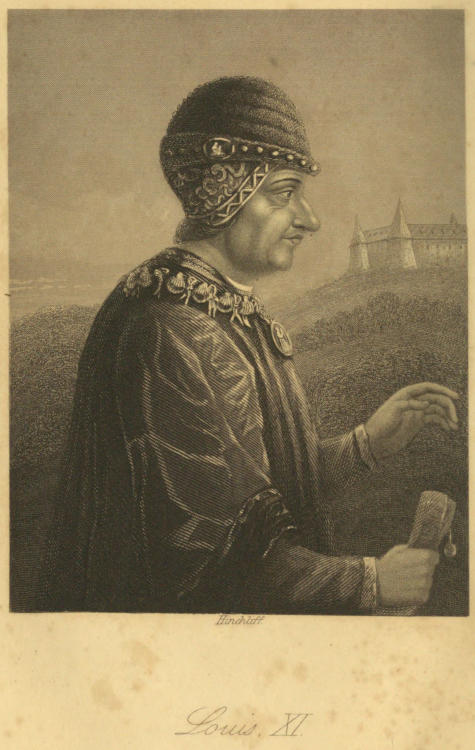
The Scandalous Chronicle. — 1460. — Strange Adventures that happened in England in the same Year, 1460. — 1461. — 1462-3. — 1464. — 1465.
THE CHRONICLES
OF THE
VERY CHRISTIAN AND VERY VICTORIOUS
LOUIS OF VALOIS,
LATE KING OF FRANCE (WHOM
GOD ABSOLVE),
WITH
VARIOUS OTHER ADVENTURES WHICH OCCURRED BOTH IN THE REALM
OF FRANCE AND IN NEIGHBOURING COUNTRIES, FROM THE
YEAR 1460 UNTIL 1483, INCLUSIVELY.
To the honour and praise of God, our sweet Saviour and
Redeemer, and the blessed glorious Virgin Mary, without
whose assistance no good works can be performed. Knowing
that several kings, princes, counts, barons, prelates, noblemen,
ecclesiastics, and abundance of the common people, are
often pleased and delighted in hearing and reading the surprising
histories of wonderful things that have happened in
divers places both of this and other Christian states and
kingdoms, I have applied myself with abundance of pleasure,
from the 35th year of my age, instead of spending my time
in sloth and idleness, to writing a history of several remarkable
accidents and adventures that happened in France, and
in other neighbouring kingdoms, as far as my memory would
permit me; but especially from the year 1460, in the reign
of Charles VII., to the death of Louis XI., his son, who
died on the 30th of August, in the year 1483. However,
I neither design nor expect that this historical essay of mine
should be called a Chronicle, being wholly unfit for so
bold an undertaking; neither indeed was I ever employed
or permitted to write one; but what I have here ventured
to record, is purely by way of amusement to please and
divert those who will give themselves the trouble of reading
it or hearing it read; whom I also humbly entreat to excuse,
and supply my ignorance, by correcting and altering whatever
they find amiss; for abundance of these remarkable
accidents have happened after so very different and so
strange a manner, that it would have been a very difficult
task, either for me or any other writer, to have given an
exact and particular account of every thing that happened
during so long a period of time.
And first of all, then, I must speak concerning the goodness
and fertility of the earth in the year 1460, which was
so prodigiously fruitful throughout the whole kingdom of
France, and bore such plenteous crops of corn, that at the
very dearest time a quarter of wheat was sold for only
twenty-four Parisian sols; but there was a great scarcity of
fruit, and as for the vines, there was but little wine, especially
in the Isle of France, so that they had scarce an hogshead
to every acre of ground, but the wine was extraordinarily
good, and that which grew in the fat vineyards
round Paris was sold very dear, and bore the price of ten or
eleven crowns a hogshead.
About that time several poor indigent wretches that were
guilty of thieving, sacrilege, house-breaking, and other
enormous crimes, were made an example of, and severely
punished at Paris; amongst whom some were only whipped
at the cart’s tail, and afterwards pardoned, as being their
first offence; and others, who were old offenders, and had
been often guilty of crimes of the like nature, were condemned
to be hanged, and executed accordingly.
Much about that time also a certain woman, named
Perrette Mauger, was condemned to be burnt alive for
having committed several robberies, and for harbouring and
concealing several notorious thieves and house-breakers, who
had committed divers robberies in and about Paris; as also
for having sold and disposed of the said goods that were
stolen by these thieves, and sharing with them the money
that arose from the sale thereof: for which crimes, and
several others besides, which she confessed at last, she was
condemned by M. Robert Destouteville, mayor of Paris, to
be burnt alive at the stake before the gallows, and all her
goods and chattels to be forfeited to the king. From which
sentence she formally appealed to the court of parliament,
upon the account of which appeal her execution was deferred
for some time; but after the parliament had examined
into her trial, they confirmed the above-mentioned sentence,
and having declared that the said Perrette Mauger had no
manner of grounds for her appeal, ordered it immediately to
be executed; upon which she declared herself to be with
child, which deferred the execution a little longer; and
presently a jury of midwives and matrons was impannelled,
and ordered to search her, who, upon a strict examination,
reported to the judges that she was not breeding, upon which
report she was immediately ordered to be burnt before the
gallows by Henry Cousin, hangman of Paris.
In this year the Pope sent a legate into England, who
preached to the people of that country, but especially in
London, the chief city of that kingdom; where he made
several remonstrances to the inhabitants of that and the
adjacent parts, much to the prejudice, and contrary to the
interest of, Henry VI., king of England; which remonstrances
the Cardinal of York, who accompanied the legate,
explained in their own language, with a long exposition on
the same. Upon which the common people, who were
wavering and fickle enough at the best, began to rise up in
rebellion against King Henry, and his queen, daughter of
René, King of Sicily and Jerusalem, and their son the
Prince of Wales. The common people chose the Earl of
Warwick for their head, who was governor of Calais, in the
room of Richard, Duke of York, who pretended to be king,
and boldly maintained the kingdom of England belonged to
him, as being the next heir of the family of King Richard
II. A little time afterwards the Duke of York, who had
assembled a great number of the populace in arms, took the
field, and marched directly to a park where Henry VI. was
attended by several dukes, princes, and other lords, all in
arms also. There were eight avenues that led to this park,
and these were guarded by eight barons of the kingdom, all
of them traitors and rebels to King Henry; who, as soon as
they were informed of the Duke of York’s arrival, immediately
gave him admittance into the park, with the Earl of
Warwick, and several others, who went directly to the place
where the King was, whom without any farther ceremony[517]
they seized upon. Immediately after this action, they slew
several princes and great lords of the blood royal that were
with him. When the Earl of Warwick had so done, he took
King Henry and brought him directly to London, carrying
the naked sword before him, as if he had been his constable;
and, upon his arrival at London, he led him straight to the
Tower, in which there were four barons of the kingdom of
King Henry’s party, that were kept prisoners there; to
whom King Henry some time after, and the Earl of Warwick,
gave very fair words, and released them out of the
Tower, after they had solemnly promised them that their
persons should be protected from all manner of danger
whatsoever, and in confidence of these fair promises they
consented to go out of the Tower. But as they were leading
these four barons after King Henry and the Earl of Warwick,
there happened to be an insurrection of the mob, and some
of them came and killed one of the barons, and gave him
several blows and contusions; and the next day, notwithstanding
all the fine promises that were made them, the
three other barons were executed on Tower-hill.
At the same time there arose a great quarrel between the
king’s officers belonging to the Court of Aids, and one of the
beadles of the University of Paris, for some affront the said
beadle had given to two counsellors of the same court; for
which misdemeanor the said beadle was put into the common
gaol of Paris; which method of proceeding the whole University
highly resented, and were so extremely displeased
with it, that, till the affair was accommodated, and the
beadle restored to his liberty, they refused either to preach,
pray, or read to the people; but, upon his enlargement,
they were well satisfied, and performed their usual duty.
About this time a certain person, called Anthony the
Bastard of Burgundy, came into Paris in a disguise, and
staid there only one day and a night; and when the inhabitants
of the city were informed of his coming in that manner,
several officers and men of note could not imagine what
should be the meaning of it, and immediately despatched
certain persons to carry the news of it to the king, who
spoke very favourably of the citizens, and declared they
were not in the least privy to his coming in that clandestine
way. Upon which the king in all haste sent the Marshal
de Loheac, and M. John Bureau, Treasurer of France, to
inquire into the truth of the relation that was brought him,
and to take all the care imaginable to prevent whatever
designs this emissary of the house of Burgundy might have
formed in the city. At the same time also the citizens of
Paris, (to free themselves from all manner of suspicion of
their consenting to his coming incognito,) deputed some of
the chief of their citizens, among whom were M. John de
Lolive, Doctor of Divinity, and the Chancellors of the
Church of Paris, Nicholas de Louviers, M. John Clerebourg,
Master of the Mint; M. John Lullier, Town Clerk; James
Rebours, Attorney; John Volant, Merchant, and several
others, to represent the matter fairly to the king. His
majesty received them very graciously; and, after they had
ended their speech, which was made to clear their innocence,
he was extremely well satisfied with them, and having given
them a very mild and gracious answer, they returned to
Paris with great joy and gladness of heart.
At that time M. Robert Destouteville, who was mayor of
Paris, was committed prisoner to the Bastille, and afterwards
to the Louvre, by the command of the Marshal de Loheac
and M. John Bureau; for some injustice and abuses he had
committed in the exercise of his office, though it was never
fairly proved upon him. About that time also several rude
and uncivil actions were committed by M. John Advin,
counsellor of the parliament of Paris, in the house of the
said Destouteville, such as searching of boxes, trunks, and
other places for letters; not to mention the several incivilities
he offered to the Lady Ambroise de Lore, his wife,
who was a woman of great virtue, honour, and wisdom.
In this year the rivers Seine and Marne were swollen
so prodigiously, that in one night’s time the Marne rose
above six feet high about St. Maur des-Fossez, and did a
great deal of damage in several places; but among the
rest, the river came up so high in a village called Claye, in
which there was a palace belonging to the Bishop of Meaux,
that it washed away all the brick-work of the front of it,
where there were two stately towers newly erected, in which
there were fine and large apartments richly furnished and
adorned with tapestry, pictures, &c., but the river swept all
away.
About that time also it happened, that the body of the
church of Fecamp in Normandy was burnt down to the
ground by a fiery exhalation that came from the sea towards
the Marches of Cornwall; and caught hold of the steeple of
the said abbey which was quite consumed, and all the bells
melted down, to the great loss and detriment of the abbot
and his whole fraternity.
At the same time there was a great noise and discourse all
over the kingdom of France, and other places, of a young
girl of about eighteen years of age, who lived in the city of
Mans, and played several ridiculous pranks and follies;
such as foaming at the mouth, leaping into the air, screaming
out aloud, putting her body into a thousand convulsive motions,
and pretending to be tormented by the devil; by
which antic tricks, and several others too tedious to mention
here, she imposed upon and cheated abundance of people
that came to see her. But at last she was discovered to be
an idle hussy, and that she played all her devilish pranks by
the instigation and contrivance of some of the officers belonging
to the Bishop of Mans, who maintained her for that
purpose; and had so far brought her to their beck, that she
would do anything they bid her, and they had trained her up
from her infancy to play these pranks.
About the same time it happened in England, some time
after the Earl of Warwick’s seizing upon the person of King
Henry, that the Duke of Somerset the king’s cousin, in conjunction
with several young noblemen, relations and heirs to
those who were slain at the taking of King Henry, having
got together a considerable body of men, took the field, and
marched directly against the Duke of York, found him encamped
in the plains of St. Albans[518], where they gave him
battle, and cut him and his whole army to pieces. In this
battle the Duke of York was slain himself, and when his
body was found they cut off his head, and by way of derision,
because he pretended to the crown of England, they fixed it
upon the point of a lance, and put a crown of straw in the
form of a royal crown upon it. With him there fell in the
battle six and twenty barons, knights, esquires, and persons
of note in the kingdom; besides a great number of common
soldiers, amounting in all to above eight or nine thousand
men.
And on Wednesday the third of February in the same
year 1460, were read and published at Rouen, and in several
other places in the duchy of Normandy, in the public
market-places by sound of trumpet, the king’s letters patent;
by which he declared it was his royal will and pleasure that
the whole country of Normandy, together with its seaports,
should be free and open to all English men and women, of
what rank or condition soever; and in what habit soever
they shall think fit to wear, (provided they were of King
Henry’s party,) and without having any passport, to have
free liberty of trade and commerce throughout his whole
kingdom.
In the year 1461, in the month of July, it happened that
King Charles VII. fell sick at the castle of Meun upon the
Yevre, of a distemper that was incurable, and of which he
died on Wednesday the 22nd of July, between one and two
o’clock, in the afternoon, much lamented by the whole kingdom;
as being a very wise and valiant prince, and leaving
his kingdom in a very peaceful and flourishing condition.
Immediately after the death of the king was publicly
known, the greatest part of the officers of Paris, and several
others of the kingdom, went to pay their respects to the
Dauphin, who resided at the Duke of Burgundy’s court at
Hainault; and who by the decease of his father came to the
crown of France. The occasion of their waiting on him
there, was, to know his royal will and pleasure; and whether
they should be continued in the same posts and employments
they enjoyed under his father: At which place after his
death he made a promotion of several officers in the chamber
of accounts or exchequer, at Paris: Amongst the rest, he
made M. Peter l’Orfevre Lord of Ermenonville and Nicholas
de Louviers counsellors of the same exchequer, and M.
John Baillet master of the requests and reporter of the
court of chancery: He also confirmed M. Simon Charles,
who was carried in a litter into Hainault, in the place he
was possessed of in the exchequer: and the rest of the
officers that came thither to beg the favour of being continued
in their respective posts and employments, were ordered
back to Paris to wait for the king’s coming thither.
And upon the 24th of July, 1461, M. Etienne Chevalier,
who was treasurer or chief director of the finances in the
reign of the late King Charles, and whom he appointed to be
one of the executors of his last will and testament, and also
M. Dreux Budé, the grand audiencier[519] of France, went
from Paris to see the king’s corpse that lay in state at
Meun; but the Lord d’Aigreville, captain of Montargis, at
the earnest solicitation of a certain gentleman named Vuaste
de Morpedon, caused them both to be seized at Montargis;
where they remained prisoners for some time, till the king
sent orders for their release, and continued them both in
their respective employments of treasurer and audiencier.
But it was very observable, that on the 23rd of July, in
1461, which was the next day after the king’s death, a large
blazing star was seen in the sky about seven o’clock at night,
which cast such a glaring and resplendent light through the
air, that all Paris seemed to be in a flame; but Heaven in
its mercy has been still pleased to preserve that good city.
On Thursday the 6th of August, 1461, the body of the
late King Charles VII. was brought from Meun with great
solemnity, to the Church of Notre-Dame in the Fields, without
the gates of Paris; and the next day the clergy, nobility,
officers, citizens, and abundance of the populace repaired
thither, and conducted it from thence to Paris, with
a great deal of pomp, ceremony, and respect, as is usual
upon such occasions. The funeral procession was thus regulated.
Before the corpse were borne two hundred wax-candles
of four pounds each, adorned and painted with the
arms of France, and carried by two hundred inferior persons
dressed in long mourning robes and black caps. The body
was borne in a litter by the salt-porters of Paris, and it was
lined and covered with a rich cloth of gold, valued at one
thousand two hundred crowns of gold; and upon the top of
it was placed the effigies of the late king Charles dressed in
his royal robes, with a crown on his head, holding in one
hand a sceptre, and in the other a regal truncheon. And in
this state it was carried to the great Church of Notre-Dame
in Paris; all the bellmen of the city clothed also in black,
and bearing on each side of their gowns the arms of France,
marching before it; and after them came those that bore
the candles, adorned and painted with the same arms, before
the litter. After the litter came the Duke of Orleans and
the Count d’Angouleme as chief mourners, accompanied by
the Counts d’Eu and Dunois; M. John Jouvenelle des
Ursins, knight and chancellor of France, and the master of
the horse; all clothed in deep mourning, and mounted on
horseback. Next to them marched all the officers of the
household to the late king, on foot, by two and two, dressed
in deep mourning also; and close to the litter rode six pages
in black upon six fine horses covered all over with black
velvet, which was a very dismal and melancholy sight to
behold. And there was such an universal concern and lamentation
for his death, that scarce a dry eye was left in the
whole city; nay, it is reported, that one of his pages took
his master’s death so to heart, that for four whole days together
he neither ate nor drank anything. The next day,
which was the 9th of August, his body was removed from
the Church of Notre-Dame, in Paris, about three in the
afternoon, and carried with the above-mentioned pomp and
ceremony to St. Denis, where it was deposited, and now
lies.
Towards the end of this month our most gracious sovereign
Louis XI., then only dauphin and eldest son of Charles
VII. lately deceased, was crowned King of France at
Rheims by the Archbishop Jouvenal, where he was attended
by the greatest part of the nobility of his kingdom.
Upon the last day of this month of August, the king set
out from an hotel named Les Porcherons, which was in the
suburbs near the gate of St. Honoré, belonging to M. John
Bureau, who was knighted at his coronation at Rheims, in
order to make his public entry into Paris; upon which the
whole body of the nobility, clergy, and gentry came out to
pay their homage to him, and welcome him to their city;
amongst whom were the Bishop of Paris named William
Chartier, the whole University, the Court of Parliament,
the Mayor of Paris, all the officers of the Exchequer, and the
provost of the merchants, with the aldermen in their damask
robes lined with sables. And the mayor and aldermen,
after they had saluted and paid their respects to the king,
presented him with the keys of the city gates, through which
he was to make his entry, which he very graciously returned;
and then the way was ordered to be cleared, to make room
for others to approach his majesty, and make their compliment
to him, of which number he made a great many
knights on the spot. As the king passed through the gate
of St. Denis, he found near the Church of St. Ladre a
herald mounted on horseback, and clothed in the city livery,
who presented to him five ladies on the part of the city,
richly dressed, and mounted on five fine horses sumptuously
accoutred with rich furniture, on which were embroidered
the city arms; and these five ladies were habited after a sort
of manner representing the five letters of Paris, and every
one of them made a speech to the king, which was prepared
for them beforehand.
There was a very great appearance at the king’s public
entry into Paris, both of his own nobility, and of foreign
princes and noblemen, amongst whom were the Dukes of
Orleans, Burgundy, Bourbon, and Cleves, the Count de
Charolois, the Duke of Burgundy’s eldest son, the Counts
d’Angouleme, St. Paul, and Dunois, besides several other
earls, barons, knights, captains, and a great number of persons
of note and distinction, who, in honour of the day, and
to augment the splendour and magnificence of the triumphal
entry, had bestowed vast sums in rich and costly furniture,
with which their horses were caparisoned: some of their
housings were of the richest cloth of gold, made after different
fashions, and lined with sables; others were of crimson
velvet, lined with ermine or rich damask, embroidered with
gold and silver, and hung round with great silver bells, which
were of a considerable value; and upon the horses rode fine
young pages, the very flower of youth and beauty, richly
dressed, and wearing embroidered scarfs over their
shoulders, that hung down to the crupper, which made a
very noble and gallant show.
The Parisians on this occasion caused a very fine ship to
be cast in silver, which was borne aloft upon men’s shoulders,
and just as the king made his entry through the gate of St.
Denis, it was placed upon the drawbridge near the said
gate, to represent the city arms. In it were placed three
persons representing the three estates of the kingdom; and
in the stern and the poop sat two more personating justice
and equity; and out of the scuttle, which was formed in the
shape of a fleur-de-lis, issued a king dressed in royal robes,
and attended by two angels. A little farther, at the fountain
du Ponceau, there were wild men that played the parts of
gladiators, and near them were placed three handsome
wenches, representing mermaids, sporting and singing gay
enlivening airs, which were humoured and accompanied with
the melodious harmony of soft music. And to comfort and
refresh the people, there were several pipes in the said
fountain that ran milk, wine, and hippocras, of which every
one drank what he pleased; and a little below the fountain,
the passion of our Saviour was represented as he was crucified
between two thieves. At a little distance from this crucifix
there were posted a band of men richly dressed, representing
hunters that had just run down a stag, whose death was
accompanied with the melodious noise of dogs and horns;
and in the Rue de la Boucherie there were large scaffolds
erected in the form of the Bastile at Dieppe. And when
the king had passed by them, the English who were within
the Bastile were furiously attacked by the king’s soldiers,
taken prisoners, and had all their throats cut. Opposite to
the gate of the Chastellet there was a fine appearance of
persons of quality; all the windows were hung with rich
tapestry, and the streets through which the king passed were
crowded with a prodigious number of people. In this pompous
manner he proceeded to the Church of Notre-Dame;
and having performed his devotions to the blessed Virgin, he
returned to his royal palace, where he had a splendid and magnificent
entertainment, and lay there that night. The next
morning, which was the first of September in the year 1461,
he removed from thence into his Hotel des Tournelles, near
the Bastile de St. Antoine, where he staid some time, during
which he made several acts and ordinances, and turned
several of the officers of his kingdom out of their posts and employments,
amongst the rest the Chancellor Juvenal des
Ursins, the marshal, the admiral, the first president of the
Court of Parliament, and the provost of Paris, and put new
ones in their places.
He also made a new regulation in all his courts of justice
and offices belonging to the crown, especially in the Exchequer,
Treasury, and the Mint, turning out abundance
of counsellors, secretaries, receivers-general, clerks, and
other officers of an inferior nature, and putting others in
their room.
The 3rd of September, 1461, the king, attended by some
of the lords and gentlemen of his court, was entertained at
supper in the house of one M. William de Corbie, a counsellor
of the court of Parliament, whom he made President
of Dauphiny that very night. There were abundance of
fine ladies and honest citizens’ wives to see the king at
supper; and during his stay at Paris he ordered several
feasts and entertainments to be made in divers places of the
city on purpose to treat and divert them.
About this time it happened, that a beautiful young
woman named Joan du Bois, wife to a certain officer belonging
to the Chastellet of Paris, made an elopement from her
husband, but afterwards, by the counsel and advice of his intimate
friends, he took her home again. She became a very
good woman, and lived a sober and virtuous life with her
husband afterwards.
In the years 1462 and 1463 nothing material or worth
recording happened, and therefore I have passed them over
in silence. And as for the year 1463, as I have already
observed, there was nothing happened in it worth taking
notice of, unless it was the shortness of the winter and the
length of the summer, which was extremely pleasant, and
very favourable to the vines, so that we had plenty of good
wine that year, but a great scarcity of all other fruits of the
earth.
In the year 1464, upon Tuesday the 15th of May, the
king came from Nogent le Roy, where the queen was
brought to bed of a young princess; and on the same day in
the evening supped at the house of M. Charles d’Orgemont
Lord of Mery, and from thence he set out for the frontiers
of Picardy, where he expected to have found the ambassadors
whom Edward King of England had promised to
send thither to him, but they never came; whereupon the
king left Picardy and made a progress to Rouen, and several
other places in Normandy. About that time it happened
that a small vessel of Dieppe was seized upon the coast of
Holland by some of the Duke of Burgundy’s ships, in which
there was a person named the Bastard of Rubempré, who, with
the rest of the ship’s crew, was immediately clapped into
prison, upon pretence that their design of hovering about
those parts was purely to seize upon the person of the Count
de Charolois: and this report the Flemings spread abroad
everywhere, but there was nothing in it.
About that time the king set out from Normandy in his
return to Nogent, from whence he went to visit Tours,
Chinon, and Poitiers, at which place arrived the deputies
that were sent by the city of Paris to desire his majesty to
grant them farther privileges; but all they were able to
obtain of him was, only to be exempted from a small tax
called the Foreign Impost, which was no great matter; and
even that small gift they did not enjoy, for the clerks
of the Exchequer, to whom their letters patent were directed,
were negligent, and would not despatch their business
in time. The ambassadors of the Duke of Bretagne were
likewise to wait on him there, whom he heard upon several
articles that were brought him in relation to the affair
between the duke and him; which articles, or at least the
greatest part of them, were granted and allowed by his
majesty; and by those articles of agreement the said ambassadors
did promise and engage that their master the Duke of
Bretagne should wait on his majesty, either at Poitiers or
elsewhere, to confirm and ratify the said articles. After
which, the ambassadors took their leave of the king, pretending
to return into Bretagne; but they did quite the contrary,
as you will find hereafter. The day they set out
from Poitiers, which was Saturday, they went but four
leagues, where they stayed till the Monday following; and
upon Sunday the Duke of Berry, the king’s own brother,
departed from Poitiers also, and lay that night with the
ambassadors, who received him with abundance of kindness
and civility, and the next morning early in great haste they
all set out together for Bretagne, fearing lest the king
should be informed of his brother’s going with them, and
upon that account follow them: besides the Count de Dunois
was already arrived at the Duke of Bretagne’s court, which
would be apt to give the king a suspicion of some secret
designs on foot against him.
Soon after the departure of these ambassadors, the Duke
of Bourbon declares war against the king, and invades his
dominions, seizing upon whatever belonged to the king, in
his territories, and putting the Lord de Croussol, a great
favourite of the king’s, under an arrest. This Lord de
Croussol was only passing through his country with his lady
and the rest of his family; however, they were all of them
arrested and confined in the city of Cosne in Bourbonnois.
After this, William Juvenal des Ursins Lord of Traynel,
formerly chancellor of France, and M. Peter Doriolle the
late treasurer, were also arrested in the city of Moulins,
where they endured a long imprisonment; but at last the
Duke of Bourbon released them, and gave them liberty to
go back to the king.
On Sunday the 12th of March, in the year 1464, after
the Duke of Berry’s departure from Poitiers, Anthony
Chabannes Count de Dammartin, who was a prisoner in
the Bastile de St. Antoine, made his escape and fled into
Berry and Bourbonnois, where he was kindly received.
But several who were suspected to have been accessary to his
escape, were immediately committed to prison.
On Wednesday the 15th of March, M. Charles de Melun
the king’s lieutenant, M. John Balue Bishop of Evreux, and
M. John le Prevost, with the king’s secretary, met together
in the Hotel de Ville, where they caused several articles, that
the king had given them in charge, to be read; and after the
reading was over, they made several acts and ordinances for
the better defence and security of the city. Amongst the rest,
there was a particular order to appoint a strong watch to
guard the city gates by night, to shut them at a fixed
hour, to have iron chains fastened at the end of every street,
to bar them up upon any occasion; and several others,
which being too long to be inserted here, I shall for brevity’s
sake omit them.
But after the escape of the Count de Dammartin, the
king found out a stratagem to surprise the two strong places
of Fourgeau and Morue, which were defended by Jeffery
Cœur, son of the late Jacques Cœur, whom he made prisoner,
and seized upon all the riches he found in them.
As soon as this business was over, the king, attended by
the King of Sicily and the Lord du Maine, marched towards
Angers and Pont de Ce, to demand of those who had so
basely deserted him what reasons induced them to retire
and withdraw themselves into Bretagne. He ordered his
army, which was chiefly composed of the standing forces of
the kingdom, and amounted to twenty or thirty thousand
men, immediately to follow him; but after he had been
there for some time, and found he could not possibly finish
the war on that side so soon as he expected, he marched
with a strong detachment and some cannon into the duchy
of Berry, towards Yssoudun, Viarzon, Dreux, and other
neighbouring towns, leaving the King of Sicily and the
Count du Maine with a good body of troops to defend and
guard the passes, and to hinder the Bretons from penetrating
either into Normandy, or into any other part of his
kingdom.
The king made but a short stay in the Duchy of Berry,
and from thence he marched into Bourbonnois, leaving the
city of Bourges behind him, in which there was a strong
garrison commanded by Monsieur the Duke of Bourbon’s
bastard, who held it for the Duke of Berry. He marched into
Bourbonnois, where the town and castle of St. Amant Lalier
were taken by storm on the day of our Lord’s ascension, and
a little after the town and castle of Molucon surrendered
upon articles of capitulation, in which were James de Bourbon
with about thirty-five lances, who took an oath never to
bear arms against the king again, upon which they were
suffered to march out without being plundered, and had the
liberty of going where they pleased.
Upon Ascension-eve the Chancellor Traynel, M. Estienne
Chevalier, Nicholas de Louviers, and M. John de Molins
arrived at Paris, by whom the king wrote to his good people
and citizens of that place, thanking them for their good inclinations
and loyalty to him, exhorting them to continue
firm and steadfast in their allegiance, and commanding them
to conduct the queen safe to Paris, where he would have her
lie in, as he loved that city above any in his kingdom.
On Thursday the 30th of May, in 1465, it happened that
one John de Hure, merchant of the city of Sens, came with
his nephew and some other company to lodge in a mill,
which was called the Little Mill, on the other side of Moret
in Gastinois; and about midnight thirty or forty horse, well
armed, came and beat up their quarters, plundered them of
all they had, and carried away the merchant and his whole
company prisoners. At the same time the king ordered the
bridges of Chamois and Beaumont on the Oise, with several
others, to be broken down.
About that time the Bastard of Burgundy and the Marshal
of Burgundy, with a considerable body of the Count de
Charolois’s forces, invaded the king’s dominions, and took
from him the towns of Roye and Montdidier. Upon which
the Count de Neversand Joachim Rouault Marshal of France,
who were in Peronne with a garrison of about four thousand
men, retired with part of them to Noyon and Compiegne,
leaving some of the nobility with about five hundred Frank
archers in Peronne for its defence.
At the same time the king, who was then in Bourbonnois,
left that country and retired to St. Poursain, whither his
sister the Duchess of Bourbon and Auvergne came also to
wait on him, being extremely concerned at the difference
that there was between the king her brother and her husband
the Duke of Bourbon, and she hoped by that means to have accommodated
matters between them; but it was not in her
power to do it. In the mean time, however, the Duke of
Bourbon evacuated Moulins, and retired to Riom.
About this time came orders for the besieging of St.
Maurice, which the Count de Dammartin obstinately held
against the king. M. Charles de Melun, Bailiff of Sens,
with several others of the same corporation, had the direction
of that siege, but finding the body of men that were
under their command too weak for such an undertaking, M.
Anthony Bailiff of Melun was ordered thither with a
strong reinforcement of archers and cross-bow-men from
Paris, and upon the arrival of these forces, the count beat
a retreat, and surrendered the town upon articles of capitulation.
On the 25th of June, it was ordered by the magistrates of
Paris assembled in the Hotel de Ville, that the streets should
be unchained, but that the iron chains should still remain
hanging at the corner of every street to which they belonged,
in order to have them in a readiness upon any occasion;
that persons should be deputed to examine what condition
they were in, and if they wanted mending to get
them instantly repaired, and keep them always fit for service;
which was accordingly done. There was also another
order issued out, by which every citizen was obliged to take
arms, and to lay in a stock of provision and ammunition for
the defence of the city in case of need; and this order
was sent in writing to every particular housekeeper in
Paris.
It was much about this time that a great body of Burgundians,
Picardians, and of other nations subject to the Count
de Charolois, marched into France as far as Pont St. Maxence,
which one Madre, who was the governor of it, delivered up
to the Count de Charolois for a certain sum of money: upon
which he advanced with his army into the Isle of France,
where he committed great ravages and devastations, notwithstanding
he pretended this war was undertaken purely for
the public good, and to free the subjects of France from the
tyranny of their king.
Soon after this business of Pont St. Maxence, the Burgundians
took Beaulieu, which a party of the Marshal Joachim’s
own regiment had a long time defended, and held
out against them; who at last surrendered upon articles,
and marched out with bag and baggage, and the usual
marks of honour.
And as soon as the Burgundians had entered the Isle of
France, they dispersed themselves in small bodies all over
the county, and took Dammartin, Nantouillet, Villemonble,
and several other inconsiderable places, and afterwards at
Laigny they committed great disorders and outrages, tearing
and burning all the papers relating to the public accounts of
the province, ordering that all commodities should be free
from taxes in the town, and commanding the salt which was
stored up in the public granaries for the king’s use, to be
given to whomsoever had occasion for it, upon paying custom
for it.
About this time the king, who was in Bourbonnois, laid
siege to Riom, in Auvergne, in which were the Duke of
Bourbon and Nemours, the Count d’Armagnac, the Lord
Albret, and several other persons of note. The king had,
at that time when he invested the town, the finest army that
ever was seen; having, in all, including the nobility and
persons of note and distinction, above 24,000 effective men of
regular troops.
And, on Wednesday, the 4th of July, in the same year,
the king, who was still before Riom, wrote letters to M.
Charles Melun, his lieutenant in Paris, the Marshal Joachim,
and the citizens of Paris, which he sent by M. Charles
de Charlay, the captain of the watch; and in these letters
he heartily thanked his good citizens of Paris for their steadfastness
and loyalty to his person, desiring and exhorting
them to continue in their duty and allegiance, and assuring
them that within fifteen days he would be at Paris, with his
whole army. He also ordered the said Charles de Charlay
to acquaint them by word of mouth of certain terms and
articles of agreement that he had made with the Dukes of
Bourbon and Nemours, and the Lords d’Armagnac and
Albret, and how by the compact all and every of them had
solemnly and sincerely promised henceforth never to bear
arms against him, but to live and die in his service; and
that the said dukes and lords above-mentioned had faithfully
promised to do their duty, in endeavouring to persuade
the other lords that were engaged in the confederacy to
accept of the same terms of accommodation; and that the
four above-mentioned lords had agreed to send, before the
feast of August, their ambassadors to the king at Paris, in
order to treat of peace; and that if they could not induce
the other lords engaged in the same confederacy to hearken
to a peace, they had solemnly vowed and sworn to keep the
promise they had made of never bearing arms against the
king, but to live and die in defence of him and his kingdom.
And, that, as a farther confirmation of this promise,
the above-mentioned lords had caused it to be registered
by two public notaries at Mossiat, near Riom, agreeing and
consenting to be excommunicated, provided they, or either
of them, should act to the contrary.
On the Friday following, a large body of the Count de
Charolois’s forces, the greatest part of them Burgundians,
arrived at St. Denis, from whence they sent a detachment
to Point St. Cloud, in hopes of making themselves masters of
it, but not being able to effect their project, they marched
back to St. Denis.
On Sunday, the 12th of July, 1465, the Burgundians
appeared before Paris, but finding they could not carry
their point, they retired to St. Denis with the loss of a
few men, who were endeavouring to scale the walls.
On Monday, the 8th of August, the Burgundians came
a second time before Paris, with all their artillery and
heavy cannon; but before their army appeared in sight of
the town, they sent four heralds to the Gate of St. Denis,
at which M. Peter l’Orfevre, Lord of Ermenonville, and M.
John de Pompaincourt, Lord of Cercelles, commanded as
captains of the guards that day. Their pretended message
was to demand provision for their army, and a free admittance
into Paris in a peaceful and friendly manner; and to
let the citizens know, that if they refused to grant their
demands, they would enter the town by force, and give it
up to be plundered by their soldiers.
Scarce had the four heralds delivered their message, when
the Burgundians (who thought to have surprised the town,
and cut in pieces the guard that defended the gate of St.
Denis, without giving the citizens time to return an answer)
appeared with a considerable body of forces, and
penetrating as far as St. Ladre, were in hopes of getting
within the barriers that led to that gate, which they designed
to have forced with their cannon and other warlike engines:
but the citizens made a vigorous resistance, and the Marshal
Joachim with his own regiment gave them a very warm
reception; so that the Burgundians finding that they could
not succeed in their design, retired to their camp, with the
loss of abundance of men killed and wounded. Immediately
their whole army invested the town, in which they did great
execution with their cannon, culverins, and other warlike engines,
and killed and wounded a great many men. During
this bombardment, there was a cowardly rascal of a bailiff
named Casin Chollet, that ran up and down the streets, like
one frightened out of his wits, crying out, “Get you into
your houses, O Parisians, and shut the doors, for the Burgundians
are entered the town;” which put the inhabitants
into so dreadful a consternation, that several women with
child miscarried, and others died of the fright.
No action happened before Paris on the Tuesday following,
only the Count de St. Paul, who was at St. Denis,
with the Count de Charolois, marched from thence with a detachment
of Picardians and Burgundians, in order to possess
himself of Point St. Cloud; but the project failed at that time.
And on the Wednesday following, there arrived in his camp
a fine train of artillery, consisting of about fifty or sixty
pieces of cannon, which the Count de Charolois had ordered
to be sent him; and on the same day, a brigade of M. Peter
de Brézé’s regiment marched out of Paris, to intercept the
Burgundians in their march to St. Cloud, two of whom they
killed, and took five prisoners; one of whom received so
terrible a blow as clove his head asunder, and the fore part
of it hung down by a bit of skin upon his breast. The
Burgundians also took an archer, servant to M. John Noyer,
of the same regiment; and in the evening they made a
vigorous attack upon St. Cloud, and storming the outworks,
put the garrison, who held it for the king, into such a consternation,
that they agreed to capitulate, and surrendered
the town immediately upon condition to be safely conducted
to Paris, and to deliver up the five Burgundians they had
taken that day; and for performance of these articles, hostages
were exchanged on both sides.
On the Friday following, the magistrates of Paris held a
great council in the Hotel de Ville, to advise and consider what
answer they should return to the Burgundians, who required
of them to send some commissioners to treat with
the Count de Charolois, who would privately inform them,
by word of mouth, of the reasons that had induced him to
take up arms against the king. At last, after some debate,
they resolved to acquaint the Count de Charolois with their
resolution of sending some commissioners (provided he
would send them a passport to Paris), to treat with him,
and to hear what propositions he had to make; letting him
know, at the same time, that they would communicate whatever
he had to offer, either to the king, who was at Orleans,
or to his privy council at Paris; who might return what
answer they thought most proper in the present posture of
affairs. The same day, about six in the evening, two heralds
from the Count de Charolois came to the gate of St. Honoré
for the answer you have already heard; who were told, that
if the Count de Charolois would be pleased to come anywhere
near Paris, and send a passport, commissioners
should be sent to wait on him, but nothing farther could be
granted. After this, they desired leave to buy some paper
and parchment, which was granted them, but were denied
sugar and other things that they wanted in their camp for
their sick and wounded; so that they were forced to return
without these commodities, which they took very ill of the
Parisians.
On Sunday, the 14th of July, 1465, early in the morning,
arrived at Paris the Count de la Borde and M. Cousinot,
who brought letters from the king to his good citizens of
Paris; in which the king, as he had done before, thanked
them for their zeal and affection to his person, and for their
brave resistance and defence of his capital against the Burgundians,
desiring them withal to depend upon whatever
the said De la Borde and Cousinot should tell them in his
name; the substance of which was, that the king thanked
them heartily for their loyalty and good affection towards
him, desired them to continue firm and steadfast in it, and
that they might depend on his being at Paris (as a place he
desired the most to be in) on the Tuesday following; and
that he had rather lose half his kingdom than any misfortune
or inconveniency, that was in his power to prevent, should
happen to his good citizens of Paris; whom he desired by
the said Cousinot to provide lodgings and quarters for his
men at arms, and the retinue that he should bring with him,
and to set a reasonable price on all manner of provision;
to which M. Henry de Livre, the mayor of Paris, immediately
consented, and took all the care imaginable to see it
done.
On the Monday following, the Burgundians broke up from
St. Cloud, and marched with all their artillery and heavy
cannon to Mont l’Hery, where they encamped, in order to
join the Dukes of Berry and Bretagne, the Count de Dunois,
and several others that were coming in to the Count de
Charolois. The news of this movement was immediately
despatched to the king, who was on this side Orleans on his
march towards Paris, and who in all haste, by long and
tedious marches, on Tuesday morning, the 6th of July,
arrived at Chartres, near Mont l’Hery; from whence, without
staying so much as to refresh himself, or to wait for the
coming up of his whole army, which was composed of the
finest horse (considering their number) that ever were seen,
he marched directly towards the Burgundians, whom he attacked
with so much vigour and intrepidity (though but
with a handful of men), that at the first charge he broke
and entirely defeated their vanguard, of which a great number
were killed and taken prisoners. As soon as the news
of this defeat had reached Paris, above thirty thousand sallied
out of the gates, some of whom being horse, scoured
the country round, defeating and taking several small bodies
of the flying Burgundians, as did also the inhabitants of the
neighbouring towns round Paris. The Burgundians lost in
this action great part of their bag and baggage; and the
whole damage they sustained, reckoning everything, was
computed to amount to two hundred thousand crowns of
gold. The king, not being content with defeating the
enemy’s vanguard, and hoping to gain a complete victory
over them, without refreshing either himself or his troops,
once more attacked, with only his own guards and four hundred
lances, a strong party of Burgundians, who had rallied
under the command of the Count de St. Paul, who did the
Count de Charolois good service that day. The Burgundians
gave the king’s troops a warm reception, and being
drawn up in order of battle, with their cannon playing upon
them, sorely galled them, and killed abundance of them,
among whom were several officers of the king’s own guard,
who behaved themselves handsomely during the whole action,
and stood firmly by the king, who was hard put to it
that day, and several times in danger of his own person; for
he had but a handful of men, and no cannon. The king
was pressed so hard by the Burgundians, that he knew not
which way to turn himself, and was forced to charge at the
head of his troops during this engagement; and though he
had but a small body with him, yet he still maintained his
ground; and if he had had a reinforcement but of five
hundred Frank archers to have pushed the Burgundians
when they began to give way, he would have gained the
completest victory over them that ever was known in the
memory of man. The Count de Charolois lost all his guards,
and the king a great part of his; the Count de Charolois
was twice taken prisoner by Jeffery de St. Belin and Gilbert
de Grassay, but was afterwards rescued. Abundance of
men and horses were killed that day, the greatest part of
which were killed by the rascally Burgundian foot, with
their pikes and other weapons tipped with iron, and not
a few men of note fell on both sides. And after the battle
was over, the number of the slain was computed at three
thousand six hundred men; and towards night, the Scotch
guards, considering the danger the king was in, and the
great loss they had sustained, and finding that the Burgundians
were still pursuing those squadrons they had already
broken, took his majesty, who had been in arms all day
without eating and drinking, and was much fatigued and dispirited,
and conducted him safe to the castle of Mont l’Hery;
which was the reason that several in the army, who knew
nothing of the king’s removing thither, and not knowing
where to find him, reported he was either killed or taken
prisoner. Upon the news of which the greatest part of his
army ran away, and among the rest the Count du Maine,
the Admiral de Montauban, the Lord de la Borde, and
several other officers, with about eight hundred lances, without
ever being engaged at all that day; by which means the
Burgundians remained masters of the field of battle, on
which were found amongst the slain several persons of
quality and distinction on the king’s side, to wit, M. Peter
de Brézé, knight and seneschal of Normandy; Jeffery de
St. Belin, bailiff of Chaumont; Floquet, bailiff of Evreux,
besides several other knights and esquires. The Burgundians
also lost abundance of men, and had more taken prisoners
than they took of the king’s army. After the king
had refreshed himself a little at the castle of Mont l’Hery,
he marched with a strong detachment of his forces to Corbeil,
where he stayed till the Thursday following, on which
he arrived very late in the evening at Paris, and supped
that night at M. Charles de Melun’s, his lieutenant-general,
with several lords and ladies of his court, besides several of
the chief citizens and their wives, to whom his majesty
related the particulars of the action at Mont l’Hery in such
moving and pathetic terms, as drew tears from the eyes of
the whole company; adding withal, that he designed by the
blessing of God to attack the enemy once more on the Monday
following, and either die on the spot, or drive them out
of his dominions; but he was advised not to hazard another
battle, considering the cowardice and desertion of his troops,
that would not stand by him in the late engagement. However,
it was to no purpose, for he was a prince of an undaunted
courage and resolution.
On Friday, the 19th of July, 1465, M. William Chartier
Bishop of Paris, with several counsellors and clergymen,
went to wait on the king at his Hotel des Tournelles, and
humbly besought his majesty that he would be pleased to
make choice of some wise and prudent council to aid and
assist him in the administration of public affairs for the
future, to which he graciously consented; and immediately
it was ordered that six city counsellors, six counsellors of
the court of parliament, and six doctors of the University
of Paris, should be added to the king’s ordinary council.
And because the king found he had many enemies in his
kingdom, they went upon ways and means to raise more
forces, and recruit those regiments that had suffered most in
the late action of Mont l’Hery. In order to try how many
men they could raise in Paris, it was proposed that the
number of the inhabitants of every ward should be taken in
writing, and that each ward should furnish ten men; but
there was nothing done in it.
Upon the king’s arrival at Paris, abundance of his troops
were forced to be quartered in the villages round that city,
Brie, and other neighbouring places, where they committed
great disorders, not being content with eating and drinking
on free cost, but also plundering the inhabitants of all they
had, and seizing upon whatever they could find, though belonging
to some of the citizens of Paris. Nay, the king
himself was under some difficulties of raising a sufficient
sum of money to pay those forces he had in Paris, for some
of the princes that had taken up arms against him were in
possession of those very towns on which the taxes assigned
for that use were to be levied, and they refusing to let any
be raised in their dominions, he was forced to borrow money
of his officers and wealthy citizens of Paris, some of whom,
upon their refusal to lend him as much as he proposed, were
immediately put out of all their posts and employments, both
military and civil: among the rest, M. John Cheneteau,
clerk in parliament, M. Martin Picard, counsellor of the
exchequer, and several others.
On Wednesday, the 24th of July, 1465, the king ordered
the bridge of St. Maxence to be broken down, upon intelligence
that the Lord de Saveuses was marching with a great
body of forces in order to beat out the king’s troops, and put
a garrison of his own into it. On the same day his majesty
gave the command of it to John l’Orfevre, who was the
governor of it, and charged him to defend it to the last extremity,
which he did with so much bravery and resolution,
that there was no occasion to break down the said bridge;
and on the Friday following the king ordered that two hundred
lances, under the command of the Bastard d’Armagnac,
Count de Comminges, the Sieur Giles de Symon, bailiff of
Senlis, the Sieur de la Barde, and Charles des Mares, should
stay at Paris; and on the same day, at the desire and request
of the Mayor of Paris and some churchmen, his majesty continued
M. Charles de Melun in his former post of lieutenant
of the city.
After the battle of Mont l’Hery, the lords and princes that
were engaged in the confederacy against the king retired to
Etampes, where they stayed for the space of fifteen days,
and upon their breaking up from thence, they marched
towards St. Mathurin de l’Archant, Moret in Gastinois,
Provins, and the neighbourhood of those countries; upon
which the king, having intelligence of their motions, throws
small bodies of forces with some cannon into Melun, Montereau,
Sens, and other neighbouring towns, to reinforce the
garrisons, and make frequent sallies whenever they had an
opportunity of falling upon the enemy.
On Saturday, the 3rd of August, 1465, the king, being
willing to oblige his good city of Paris by some singular
act of grace and favour, changed the tax of the fourth
penny on retailed wines to that of the eighth, and granted
to all the inhabitants the same privileges they enjoyed in the
reign of his father Charles VII. He also took off all the
taxes that had formerly been levied in the city, except those
on wood, cattle, and cloth, sold by wholesale, which were let
out to the farmers of the revenue; and on the same day it
was proclaimed by sound of trumpet in all the public streets
of Paris, by Denis Hesselin, chief collector of the subsidies;
upon the news of which the common people were so
overjoyed, that they flocked together from all parts of the
city, and filled the streets with bonfires and acclamations
of joy.
About this time the Bretons and Burgundians passed the
Seine and the Yonne upon a bridge of boats, which were
brought from Moret in Gastinois and other places. M.
Sallazart, with a brigade of Marshal Joachim’s regiment, had
posted himself on the other side to dispute the passage with
them; but finding himself too weak, and having no cannon
(of which the enemy had great store), he thought fit to retire
upon their approach. The Burgundians, to favour the
passage of their troops, cannonaded the enemy all the
while, and killed abundance of the king’s men; at last a
random shot took off a page’s arm, struck a gentleman named
Pamabel, a relation of Marshal Joachim’s, in the belly, and
killed three soldiers afterwards.
On Thursday, the 8th of August, the Lord de Pretigny,
one of the king’s counsellors, and president of the exchequer,
and Chrisstofle Paillart, a counsellor, also of the same court,
arrived at Paris with an answer to some letters that the king
had sent by them to the Duke of Calabria, who was then in
Auxerrois; and on Saturday the 10th of the same month,
the king set out from Paris in order to visit Rouen, Evreux,
and several other places in Normandy, and lay that night at
Pontoise; but before he left Paris, he ordered several companies
of Frank archers that were newly arrived from Normandy,
and about four hundred lances drawn out of the
regiments of the late Floquet, of the Boulonnois, of the late
Jeffery de St. Belin, of the Lord de Craon, and the Lord de
la Barde, to remain in garrison for the defence of the city.
About this time M. John Berard, counsellor of the court
of Parliament, went over to the Duke of Berry, who was
then in Bretagne, being highly disgusted at his wife’s being
committed to prison, and afterwards banished the city for
holding correspondence with the said duke and the rest of
the princes, who were the king’s open and professed enemies.
About this time M. Charles de Melun, who had hitherto
been the king’s lieutenant in Paris, resigned his place, which
was immediately given to the Count d’Eu; but the king, in
consideration of the many services M. Charles de Melun had
done, made him steward of his household, and gave him the
government of the bailiwick and towns of Evreux and
Honfleur.
About this time also a party of Burgundians and Bretons,
who had been refreshing themselves in the town of Provins,
returned to Laigny upon the Marne, and the Friday following
they came and took up their quarters at Creteil, a house
upon the Seine, Sheelle, Saincte, Bapteur, and several other
places in that neighbourhood. And because the Parisians were
fearful that the Burgundians would once more invest Paris,
there being a report that M. Gerauld, their chief engineer,
had given out that he designed to erect a battery in the lay-stall
before the gates of St. Denis and St. Anthony, in order
to bombard the town, and at the same time to make a breach
in the walls, they caused an order to be immediately published,
by which every one was obliged to repair the next
morning to the lay-stall with a pick-axe and shovel, to break
it up, and render it unfit to erect a battery on, and accordingly
the order was put in execution; but what they did
signified little or nothing, so that they were forced to build
a great many sheds, erect bulwarks, and throw up trenches
to cover and defend the city, as also the soldiers employed
in its defence.
On the Monday following, the same party of Burgundians
and Bretons that were quartered at Creteil and thereabouts,
being joined by some more forces of their own country,
came to Pont de Charenton, where they erected a battery;
and began to play upon the tower that defended it, upon
which the garrison, without making the least opposition,
retired to Paris, and the Burgundians and Bretons took
possession of it, and in the evening of the same day they
appeared before Paris, in which several of them were taken
prisoners, and two of the Frank archers of Caen killed. And
that night a body of Burgundians and Bretons, amounting
to about four thousand men, came and encamped in a park
belonging to the Bois de Vincennes. The Tuesday following,
the Count d’Eu sent one M. de Rambures to the princes to
know their intentions, and the next day he returned to
Paris, but the answer they made him was kept very secret;
and the same day the Burgundians came before Paris, upon
which the Parisians made a sally, but scarce any action
happened between them, only one of the Frank archers of
Alençon happened to be killed by a random shot.
On Thursday, the 22d of August, the Duke of Berry, who
had taken up his head quarters at Beaulcé, with several
other princes near allied to him, sent his heralds with four
letters to Paris, one to the citizens, one to the university,
and one to the ecclesiastics, and one to the court of parliament.
The contents of which were, in short, that he and
the rest of the princes engaged in the same confederacy had
taken up arms for the public good of the kingdom, and that
if they would make choice of five or six able men in the
character of commissioners to treat and confer with them,
he would let them know the reasons that had induced him
and the rest of the princes to appear in this open and
hostile manner. Accordingly, in pursuance of these letters,
the following commissioners were deputed to wait on the
princes to hear what they had to propose. On the part of
the city were chosen M. John Choart, the civil lieutenant
of the Chastellet of Paris, M. Francis Hasle, advocate in
parliament, and Arnold Lullier, banker at Paris. The church
of Paris made choice of M. Thomas de Courcelles, Dean of
Paris, M. John de Lolive, doctor of divinity, and M. Eustace
Lullier, advocate in parliament. For the court of parliament
were chosen M. John de Boulenger, M. John de
Sellier, Archdeacon of Brie, and M. James Fournier. And
by the university for the sciences in general were chosen
M. James Minglisant, for divinity, M. John Lullier, for the
law, M. John Montigny, and for physic, M. Auerant de Parenti;
and all these commissioners were introduced and
presented to the princes by William Chartier, Bishop of
Paris.
On Saturday following, all the above-mentioned commissioners
sat in the Hotel de Ville, where several persons of
quality and distinction were assembled on purpose to hear
what proposals the princes had made them, but they came
to no manner of conclusion that morning; however, it was
agreed that in the afternoon the whole body of the university,
church, court of parliament, and the chief magistrates,
should meet together, to take into consideration what
the princes had proposed to the commissioners. At this
meeting, after some debate, they unanimously agreed, that
the calling an assembly of the three estates of the kingdom,
which was the chief thing the princes insisted on, was
highly just and reasonable; that they would consent to
supply their army with provisions for money, and that they
should have free admittance into Paris, provided they
could give them security that neither they nor their soldiers
would commit any act of hostility within the town to the
prejudice of the inhabitants; and the king consented to it.
After which the commissioners went a second time to wait
on the princes, and acquaint them with their final resolution.
During the whole time that this assembly were sitting in
council, all the cross-bow men and archers were drawn up
before the Hotel de Ville, to hinder the mob from crowding
and disturbing them, as they would certainly have done,
had they not been prevented by this means.
On the same day there was a review made of all the
king’s forces in Paris, which made a very fine appearance.
First of all marched the archers of Normandy on foot;
these were followed by the archers on horseback; and last
of all came the men-at-arms belonging to the companies of
the Count d’Eu, the Lord de Craon, the Lord de la Barde,
and the Bastard of Maine, which might make in all about five
hundred men, well armed and mounted, without reckoning
the foot, which were about one thousand five hundred, or
more. And on the same day the king wrote letters to
Paris, by which he acquainted the inhabitants of his being
at Chartres with his uncle the Duke du Maine, and abundance
of soldiers with him, and of his resolution of coming to
Paris on the Tuesday following. In the afternoon the
Admiral de Montauban arrived at Paris with a good body
of troops, and towards the evening the Duke of Berry broke
up from Beaulcé, and marched towards St. Denis; but being
told by some of his officers that were with him that Beaulcé
was a much safer place for him to be in than St. Denis,
which lay too near the enemy, and upon hearing the news
of the king’s coming to Paris, he marched back to his old
quarters.
On the Wednesday following the king came to Paris, attended
by his uncle the Duke du Maine, the Lord de Pantheure,
and several other officers of note; he also brought
back the fine train of artillery he carried with him, and
a great number of pioneers from Normandy, who were all
quartered in his Hotel de St. Paul. And when the king
made his entry into Paris, he was received with the universal
shouts and acclamations of the people; and the next
day, very early in the morning, the Burgundians and the
Bretons, planting themselves over against the tower of Billy,
saluted him with a triple discharge of their cannon, accompanied
with drums, trumpets, clarions, and other warlike
instruments of music. The same thing they did also
over against the bastille St. Anthoine, shouting and huzzaing,
and crying out, “To arms, to arms!” which put the whole
city into a dreadful consternation, and immediately they
mounted the walls, and prepared all things for a vigorous
defence. In the afternoon the Burgundians and Bretons
appeared again before Paris, upon which a considerable body
of the king’s regular forces, with some cannon and field-pieces,
were immediately ordered to march out of Paris to
beat off the enemy, who, falling in with a party of them,
killed and took several prisoners that day.
On Saturday, the last of August, the king went with a
strong guard as far as the tower of Billy, to take a view of
the enemy, and commanded the four hundred pioneers that
came from Normandy to cross the Seine, and throw up a
trench over against the English port, and before the Hotel
de Conflans, which was directly opposite to the place where
the Burgundians were posted, quite down to the river Seine.
And because the Burgundians had given out that they designed
to pass that river, the king ordered a good body of
troops to be posted there, to hinder them from laying a
bridge over it, and to dispute the passage with them; and
as soon as the pioneers had passed the river, the king passed
it also in a ferry-boat without alighting from his horse.
On Sunday, the first of September, the Burgundians laid
a bridge over the Seine at the English port; and just as they
were preparing to pass it, a great number of Frank archers,
and other soldiers of the king’s party, arrived there, who,
immediately planting some cannon and field-pieces at the
end of the bridge, fired briskly on the Burgundians, and
obliged them to retire, with the loss of several men killed and
wounded; and a certain Norman swam across the river,
and cutting the ropes with which the bridge was fastened,
it went cleverly down the stream. Abundance of cannon
was fired that day from several batteries that the Burgundians
had erected, but from one especially, which played
so briskly on the king’s troops that were posted at the English
port, that they were forced to retire.
And on the Tuesday following, ambassadors were chosen
by the king and the Burgundians, in order to adjust the
difference between them. On the king’s side were chosen
the Duke du Maine, M. de Pretigny, president of the exchequer,
and M. John Dauvet, president of the parliament
of Toulouse; and the Burgundians chose the Duke of Calabria,
the Count de St. Paul, and the Count de Dunois. And
as soon as they were nominated, and had received their instructions,
they went immediately upon the business of accommodation;
and there was a truce granted till the Thursday
following, during which no acts of hostility were committed
on either side; but both parties took care, in the mean time,
to fortify themselves, and make what preparations they could,
not knowing how matters might happen.
On Monday, the ninth of September, the Bretons and
Burgundians marched into the territories of Clignancourt,
Montmartre, La Courtille, and other vineyards about Paris,
where they spoiled and destroyed the whole vintage, cutting
down all the grapes, green as they were, to make wine for
present drinking; upon which the Parisians were forced
to do the same with all their vineyards round Paris that
had escaped their fury, though the grapes were scarce half
ripe, and it was not the usual season for their vintage;
besides, it was the worst year for vines that had been known
in France for many years; so that they called the wine of
this year’s growth by the name of Burgundy.
About this time several of the nobility of Normandy
arrived at Paris to serve the king in his wars, all which
had their quarters assigned them in the Faubourg de St.
Marcel, amongst whose retinue there were some particular
persons that committed great thefts and disorders, two of
whom were seized by some of the citizens as they were
forcing their way into the city; and upon the citizens stopping
them, the Normans began to abuse and rail at the citizens,
calling them traitors and rebellious Burgundians,
vowing to be revenged of them, and telling them that they
came from Normandy with no other design but to plunder
and destroy the whole city. Of which words a complaint
being made, and an information given by the said citizens
to the mayor of Paris, the principal offender, who spoke
these dangerous words, was condemned to the ignominious
punishment of walking barefoot and bareheaded, with a
lighted torch in his hand, through the streets, and in the
public market-place before the Hotel de Ville, in this shameful
condition, to acknowledge his offence before the town-clerk,
and to ask the good citizens of Paris pardon and forgiveness
for what he had falsely and maliciously spoken, and afterwards
to be bored through the tongue, and banished the city.
On the Monday following, the Burgundians came and showed
themselves before Paris, amongst whom was the Count de
St. Paul, to meet whom the king went out of Paris, and
they had a conference together, which lasted two hours; and
as a surety for the Count’s safe return, the king delivered
up the Count du Maine, who staid in the Burgundians’
army till the return of the said Count de St. Paul.
And on the same day a great council was held in the exchequer-chamber,
at which, amongst the other officers and
magistrates of that court, the sixteen quarteniers[520],
the cinquanteniers[521],
and some of the councillors belonging to the
court of parliament, were present; to whom, by the king’s
order, Morvillier, chancellor of France, made a speech, in
which he acquainted them how honourably his majesty had
acquitted himself towards the princes, and what generous
offers he had made them upon their demanding the duchy
of Guienne, Poitou, with the country of Saintonge, or the
duchy of Normandy, as an appanage for the Duke of Berry.
He farther told them that the king’s council, who were
there present, had informed the princes that it was not in
his majesty’s power to give away or dismember anything
belonging to the crown; and that since he was pleased to
offer the countries of Champagne and Brie, reserving only
to himself Meaux, Montereau, and Melun, in lieu of the
said appanage, they were of opinion that the Duke of Berry
ought not in reason and honour to refuse it. After this the
assembly broke up, and (all hopes of an accommodation being
vanished) the young seneschal of Normandy was ordered
out with six hundred horse to skirmish with the Bretons
and Burgundians, who were drawn up in order of battle on
the other side of the Seine, and, firing upon them, killed a
gentleman of Poitou belonging to M. Panthieu’s regiment,
called John Canreau, Lord de Pampelie.
On the Saturday following, at break of day, one Lewis
Sorbier, whom Marshal Joachim Rouault had left in Pontoise
as his lieutenant, basely and treacherously betrayed
his trust, and suffered the Bretons and other troops belonging
to the enemy to possess themselves of the town, having
agreed with them beforehand, that whoever of the Marshal
Joachim’s regiment refused to enter into their service, should
have the liberty of marching out with their bag and baggage,
without being examined or molested. And as soon as
he had delivered up Pontoise into the enemy’s hands, he
marched with some of his confederates to Meulan, where,
not believing that his treason was already known, he thought
that, by showing Marshal Joachim’s colours, he would get an
easy admittance; but upon his arrival at the gates, the inhabitants
of Meulan, who had been informed of his treachery,
and were in arms upon the walls, cried out, “Get you
gone, vile and despicable traitor,” and fired their cannon
upon him and his party, which obliged him to retire with
the utmost shame and confusion to Pontoise; and on Sunday,
by break of day, the enemy came and gave the city an
alarm on the side of St. Anthony’s gate, and a great body of
them penetrated as far as St. Anthoine des Champs; and
in order to dislodge them, several cannon, field-pieces, and
culverins were fired, but there were no sallies made.
About this time the Bretons and Burgundians who lay
before Paris made songs, ballads, lampoons, and other scandalous
verses, on some of the chief officers of the court, which
set the king so against them, that he turned them out of
their places. Neither did the king’s own soldiers, who were
quartered in Paris, behave themselves much better, but
spent their time in all manner of lewdness, debauching and
seducing the hearts of several wives, maids, and widows,
who left their children, husbands, and places to follow and
live with them.
In the evening, M. Balue, Bishop of Evreux, was set
upon by some people that owed him a spite, in the Rue de
la Barre du Bec, who at the first stroke beat the two torches
that were carried before him out of the servants’ hands, and
afterwards they came up to the bishop, who, being mounted
on a stout mule, carried him off cleverly to his own hotel in
the cloister of Nostre-Dame; by which means he saved his
life, for his servants, who were afraid of being knocked down,
had quite forsaken him; however, before he made his escape
he received two wounds, one in his hand, and another in one
of his fingers. The king was extremely concerned at this
accident, and ordered a strict inquiry to be made after the
assassins; but they were never discovered.
On the Thursday following, there was a great complaint
made in the Hotel de Ville by some of the citizens against the
soldiers for having spoken and published certain words and
speeches of a dangerous consequence to the inhabitants.
Among other things, they boldly affirmed that neither the
city of Paris nor anything in it belonged to the inhabitants,
but to them who were quartered in it; that they would have
the citizens know that the keys of their houses were at the
soldiers’ disposal; that they would turn out the present possessors,
and live in them themselves; and, in short, if the citizens
pretended to make resistance, they should find, to their sorrow,
they were able to conquer them. And the very same
day a foolish Norman said openly at St. Denis’s gate that the
Parisians were very weak to think that chaining up their
streets would signify anything against the forces of their
country. A report of these dangerous and insolent words
being made to some of the officers of the Hotel de Ville, they
immediately issued out an order commanding several streets
to be chained up, and that every quartenier of Paris should
cause great fires to be made in every ward under his jurisdiction,
and that one of them should be in arms upon the
watch before the Hotel de Ville all night, which was accordingly
done. And that very night there was a hot report
that the gate of the Bastille St. Anthoine was left open on
purpose to let the Bretons and the Burgundians into the
town; and, to confirm it the more, several cannon were found
nailed up, and rendered unfit for service.
On the Friday following, two pursuivants-at-arms arrived
at Paris; one was despatched from Gisors to acquaint
the king of the weak condition of that place, which was
wholly unprovided with everything necessary for its defence,
and to let his majesty know that if he did not send them a
speedy supply of men, arms, ammunition, and provision, they
must be forced to surrender to a body of six hundred horse
that lay before the town. The other pursuivant was sent
by one Hugh des Vignes, a man-at-arms belonging to M. de
la Barde’s regiment, and who at that time was at Meulan,
to inform the king that he was assured from very good
hands that the Bretons had a design of surprising Rouen as
they did Pontoise, if they were not prevented. And on
the same day the ambassadors that were chosen on both
sides dined together at St. Anthoine des Champs without
Paris; and on the next day the same ambassadors on both
sides were assembled again, but in two distinct parties, that
is to say, the Duke du Maine and those of his party, who
were for the king, with the rest of the lords and princes,
were all of them together at the Grange-aux-Merciers.
There were also several others nominated by the king, who
were at St. Anthoine des Champs; but notwithstanding
this meeting, very little business was despatched this day.
In the afternoon the king received letters from the widow
of the late Peter de Brézé, by which she informed his majesty
of her having caused the Lord Broquemont, captain of
the palace at Rouen, to be apprehended upon suspicion of not
being well affected to his government, and having a design
to deliver it up to the Bretons; but that he need not give
himself the least pain about Rouen, for he would certainly
find all the citizens hearty and true to his interest. The
same day, in the afternoon, arrived the unwelcome news of
the taking of Rouen by the Duke of Bourbon, who entered
the town by the castle of Rouen, which was the weakest side,
and lay towards the fields.
As soon as the princes that lay before Paris heard of the
taking of Rouen, they sent to acquaint the king that his
brother, the Duke of Berry, who was before contented with
Champagne and Brie, would accept of no other appanage
than the duchy of Normandy; so that the king was forced,
notwithstanding the former agreement, to give the Duke of
Berry the duchy of Normandy, and reserve for himself that
of Berry. The Count de Charolois had for his share the
towns of Feronne, Roye, and Mondidier, for him and his
heirs for ever; besides, the king gave him during his life
all the lands and towns that were lately redeemed for four
hundred thousand crowns, and had been pawned to his
father Philip, Duke of Burgundy, to which he added the
countries of Guynes and Boulogne, to be enjoyed by him
and his heirs for ever. He also gave to the Duke of Calabria
a great sum of money, and lent him a certain number
of troops, which were to be paid by the king, and to be employed
wherever the Duke of Calabria thought fit. The
Duke of Bourbon was to have the same pension, and the
same quota of troops allowed him that he formerly had in
the reign of the late King Charles, besides the remainder of
his wife’s marriage dower, which was left unpaid; and this
was all he demanded. The Count de St. Paul was restored
to all his places that had been taken from him during this
unhappy rupture between the king and the princes, and a
considerable pension settled upon him for life. The Count
de Dammartin was also restored to all his lands and possessions
that were confiscated by a decree in Parliament, and
had considerable presents made him by the king. As for
the other lords, they had every one of them a large share,
and departed well satisfied with what they had got.
And on Tuesday, the 1st of October, a peace was proclaimed
between the king and the princes, and that day
the Count de St. Paul came to Paris, and, having dined with
the king, was conducted into the Hotel de Ville, where he was
created Constable of France, and took the oaths accordingly.
And on the same day the king ordered a proclamation to be
issued out, by which free leave was granted to all the inhabitants
to supply and furnish the Bretons and Burgundians
with whatever necessaries they wanted; upon which proclamation
several merchants of Paris immediately sent a great
quantity of all sorts of provision into the fields before St.
Anthony’s gate, which was quickly bought up, especially
the wine and the bread, by the whole army, who instantly
repaired thither half starved, and in a miserable condition,
with their thin, lank cheeks over-grown with hair, and full
of lice and nastiness, and the greatest part of them without
stockings or shoes. But every one will be amazed at
the inconceivable strength and richness of Paris, which was
able to maintain four hundred thousand horse, including the
Burgundians, Bretons, Calabrians, Picardians, and the rest
of the enemy’s forces for a long time, and plentifully to
supply them, without ever raising the price of any manner
of provision; nay, immediately after the enemy had left
it, things were sold cheaper than they were before; and
the whole Thursday following was spent in victualling the
Burgundian camp. The same day the king went to make
a private visit to the Count de Charolois near Conflans,
which was looked upon by all persons that had a respect
and concern for his majesty, as a very indiscreet action;
nay, the very Picardians themselves and the rest of the
army could not forbear reflecting upon him, and breaking
their jests upon the Parisians after this manner: “Here, take
your king, who has at last submitted to the Count de Charolois,
and meanly condescended to visit him in private; in
a little time we shall have him at our command.”
On Friday, the fourth of the same month, the king gave
orders for the admittance of the Burgundians into the city
through St. Anthony’s gate, who, upon that permission,
came in large bodies, and committed several riots and
disorders, which certainly they would never have done
had they not been encouraged by the king’s late condescension
in visiting the Count de Charolois in so private a
manner.
On the Sunday following several men of quality and
officers of the army came and supped with the king at Paris
in an hotel belonging to M. John Lullier, the town-clerk, at
which entertainment several ladies of quality and distinction
were also present.
And in this month of October a detachment of the Count
de Charolois’s troops came before Beauvais, and summoned
the town to surrender; upon which the inhabitants set
down the summons in writing, and sent it to the king, who
immediately sent it to the Count de Charolois, with whom
he had lately concluded a peace. The Count de Charolois
sent back word to the king that he knew nothing of the
summons; and that whosoever had done it, did it without
his knowledge or order. The king returned a very civil
answer to the Count de Charolois, and told him it was not
a fair way of proceeding; that for the future, in pursuance
of the articles of peace that had been lately concluded between
them, he must forbear committing such acts of hostility;
and that if he had a mind to Beauvais, he should have it.
On the Thursday following, several waggon-loads of gold
and silver, for the payment of the Count de Charolois’s
troops, arrived in the Burgundian camp, under a strong
convoy both of horse and foot, commanded by the Lord de
Saveuses; and on the same day the Duke of Bretagne and
the king came to an agreement in relation to the affair that
was between them, by which compact the king was obliged
to restore the county of Montfort and several others; besides
a vast sum of money to pay that very army which he,
in conjunction with the rest of the princes, had raised to
invade the king’s dominions. The next day M. John le
Boulenger, president of the court of parliament, was sent by
the king’s order to the Hotel de Ville to acquaint the mayor
and aldermen of Paris that the Burgundians had a design
to review their army that day before the city gates, and to
desire them to acquaint the common people with it, lest
they should be surprised and astonished to see them thus
drawn up against the town. But after all, the review was
not made in sight of Paris that day, but from the Pont de Charenton
to the Bois de Vincennes, whither the king, attended
only by the Count de Charolois, the Duke of Calabria, and
the Count de St. Paul, very imprudently went to see the
review. As soon as the review was over, the king came
back by water to Paris; and the Count de Charolois, upon
his taking leave of his majesty, in the presence of those
lords that attended the king thither, made the following
acknowledgment in these words:—“My lords, you and I are
subjects to the king here present, our lord and sovereign, and
ought to serve him whenever he pleases to command us.”
Not long before this, the king had received a private information
of a design formed by some of his enemies either
to kill him or seize upon his person; upon which he immediately
ordered his guards to be doubled, great fires to be
made every night in the streets, the number of the watch to
be augmented, as well upon the walls as in the streets, and
took all the care imaginable to prevent their designs and
secure his own person; and upon hearing of the surrender
of Caen and several other towns in Normandy, he immediately
reinforced the garrison of Mantes with a considerable
body of men-at-arms and Frank archers.
On Tuesday, the 22d of October, the king made a private
visit to the princes at the Grange-aux-Merciers, where all
but the Duke of Berry were met together; and the next day
the Duke of Bourbon had a long conference with the king
in a place without the gates of Paris, on this side of the
ditch of the Grange de Ruilly.
On the Saturday following, the Count de Charolois, with
a small detachment, left the army, having first caused an
order to be published in his camp, by which all soldiers
were obliged, under pain of death, to hold themselves in
readiness to march against the Liegeois, who with fire and
sword had invaded his territories. Sunday, Monday, and
Tuesday the Duke de Berry lay ill of a fever at St. Maur
des Fossez; but being pretty well recovered of his illness by
Wednesday, the 30th of October, and able to go abroad, he
went to wait upon the king at the Bois de Vincennes, where
he did homage to him for the Duchy of Normandy, which the
king gave him for his appanage; and on the same day the
articles of peace between the king and the princes were
read and published in the court of parliament, and ordered
to be registered in the same court.
And on the Thursday following, the Duke of Berry, the
Count de Charolois, and the rest of the princes, separated,
and went different ways. The Duke of Berry, whom the
king waited on some part of the way to Pontoise, went
into Normandy; and afterwards the king and the Count de
Charolois retired to Villiers le Bel, where they stayed two
or three days, and from thence the count marched with all
speed through Picardy to make war upon the Liegeois.
On the Monday following, M. Robert Destouteville, Lord
of Beine, who was mayor of Paris in the reign of the late
King Charles, and had been displaced by the king upon his
accession to the crown, was restored to his former office,
which had been given to James de Villiers, Lord of Lisle
Adam, and that day he sat in the Hotel de Ville as mayor,
and despatched a great deal of the king’s business.
On Thursday, the 7th of November, 1465, M. Robert Destouteville
was conducted to the Chastellet of Paris by M.
Charles de Melun and M. John Dauvet, first president of
the parliament of Toulouse, whom the king had acquainted
with the said Robert Destouteville’s having taken the oaths
already as mayor of Paris in the room of James de Villiers,
whom, upon his first accession to the crown, he had advanced
to that office. And after the letters patent, by which the
king appointed and constituted the said Robert Destouteville
mayor of Paris, were read, he was immediately put
into possession of his office, without giving the said Villiers
any time to lodge an appeal against him.
On Saturday, the 9th of November, M. Peter Morvillier,
Chancellor of France, resigned the seals, and was succeeded
in the chancellorship by Juvenal des Ursins, who was in the
same post at the death of the late King Charles VII.
About this time also the king made several alterations
and promotions in his court; amongst the rest, he turned
M. Peter Puy out of his office of Master of the Requests,
and gave it to M. Regnault des Dormans.
After the settling of this affair the king went to Orleans
and took with him Arnold Lullier, banker and citizen of
Paris, whom he commanded to attend him during his stay
there; he also carried along with him M. John Longuejoye
the younger, who was newly married to Madame Genevieve,
daughter of M. John Baillet, and made him one of his counsellors
of state. Before he left Paris, he made M. Charles
d’Orgemont, Lord of Mery, Treasurer of France, Arnold
Lullier Treasurer of Carcassonne, and M. Peter Ferteil
Comptroller of his Household.
The king during his stay at Orleans, made several acts,
laws, and ordinances, turned out several officers of the army,
and gave their commissions to others; amongst the rest he
took away the command of a hundred lances from Poncet de
Rivière, and made him Bailiff of Mont Ferrant, upon which,
in disgust, he went beyond sea, and visited Jerusalem, and
the Holy Hill of St. Catharine. Several other officers had
their commissions taken from them, and given to others that
did not so well deserve them. The king also restored
Monsieur de Loheac, Marshal of France, to all his former
places in the government, some of which had been given to
the Count de Comminges, Bastard of Armagnac; and after
he had settled these regulations, he left Orleans, and
marched with his whole army and artillery directly into
Normandy towards Argentan, Exmes, Falaise, Caen, and
other places, in order to reduce them to his obedience, where
he found the Duke of Bretagne, who stayed there some time
with his majesty.
A little after this, the Duke of Berry went from Rouen to
Louviers, thinking to find the Duke of Bourbon there, but
being disappointed of meeting him, he immediately came
back again. Upon his return to Rouen, he was with great
pomp and ceremony conducted into the town-hall by the
magistrates of the city, who, according to the usual custom
of the place, acknowledged him for their duke by putting a
ring on his finger; afterwards he took an oath to maintain
and support them in their privileges and franchises, and immediately
remitted to them half the taxes they were formerly
used to pay. This act of generosity won the hearts of the
whole city, and so firmly united them to his interest, that
the nobility, gentry, clergy, and the common people, vowed
to sacrifice their lives and fortunes in his service, and to remain
his faithful and loyal subjects for ever. And afterwards
they presented him an old book of records that was in the
town-hall, and made him read an article in it aloud before
all the people, which gave an account of a king of France
heretofore who at his death left two sons, the eldest of whom
succeeded his father, and the youngest had the duchy of
Normandy for his appanage: how that the elder brother, as
soon as he was settled in his kingdom, demanded a restitution
of the said duchy, and being denied, how he made war
upon his younger brother, and thought to have taken it
from him by force, but his subjects unanimously joining
with him, they dethroned his brother the King of France,
and set up their duke for king. After he had done reading,
they boldly told him they feared nothing; that their fortifications
were strong and in good repair; that they had
great store of cannon, arms, ammunition, and provision, and
could upon occasion make a brave defence, assuring him they
would one and all to a man stand by him, and defend him,
themselves, and the town, against any opposers whatsoever.
On the 30th of December of the same year the king in his
return from Lower Normandy arrived at Pont Audemer, and
from thence marched into the county of Neufbourg, from
whence he detached the Duke of Bourbon with a body of
forces to summon Louviers, which surrendered on the Wednesday
following, and the Duke of Bourbon took possession
of it for the king, into which his majesty made a public
entry the same day after dinner. From Louviers the king
marched to a town called Pont des Arches, about four
leagues from Rouen, which he formally besieged.
On Monday, the 6th of January, 1466, a proclamation was
issued at Paris, commanding all the sutlers that were used to
supply the army with provisions, to repair immediately to
the camp before Pont des Arches, and all the prisoners
were ordered to be ready by the next morning, to set out
for the same place, under the command of M. Denis, one of
the four aldermen of the city, who was appointed to take
care of them.
On the Wednesday following the king entered Pont
des Arches, and M. John Hebert with several others who
were in the town retired to the castle, which three days after
was also surrendered to the king. After the surrender of
the town and castle, the citizens of Rouen sent deputies to
treat of an accommodation, who highly complained of the
Dukes of Bourbon and Bretagne. And amongst other requests
and remonstrances that the said deputies were ordered to
make to the king, one was, that his majesty would be pleased
to be reconciled to them, notwithstanding what they had
done; that he would openly declare that they had not been
wanting in their duty, nor acted contrary to his interest; and
that he would grant them the same privileges and immunities
he had granted his good city of Paris; to which his
majesty answered, he would consult his council about it.
Whilst this affair was in agitation, several of the king’s
party had free admittance into Rouen, and conversed familiarly
with the citizens; in the mean time, the Duke of
Berry and several of his adherents retired to Honfleur and
Caen, where they stayed for some time. During these
transactions, M. John de Lorrain thought to have made his
escape into Flanders, but was taken and brought before the
king, who disposed of most of the officers belonging to the
duchy of Normandy, putting in new officers, and turning
out the old ones. And after the Duke of Berry’s leaving
Rouen, the city was reduced to the king’s obedience, upon
which the king dismissed all his Frank archers from his
service till the 1st of March following, sent all his artillery
to Paris, and retired to Mount St. Michael in Lower Normandy.
About that time the king gave the command of
one hundred lances which belonged to M. Charles de Melun
to the Count de Dammartin, who was with him, and not
long after deprived him of his office of high steward of his
household, and gave it to M. de Craon; however, several
people were of opinion that M. de Melun had done the king
signal services, and been very faithful to him, especially in
his great care and defence of Paris in the king’s absence in
Bourbonnois, which he managed and regulated so well, that
many sincerely believe that the preservation of that city
and the whole kingdom is in some measure owing to his
conduct and vigilance in that affair.
About that time the king commanded Chaumont upon the
Loire (belonging to M. Peter of Amboise, lord of the same
place) to be burnt; and it was accordingly done.
On Monday, the 3rd of February, one Gauvain Manniel
lieutenant-general of the bailiwick of Rouen, was taken in
the city and carried prisoner to Pont de l’Arche, and there,
upon a scaffold erected near the town bridge, was beheaded
by the provost-marshal for high treason, his head fixed on a
lance on the same bridge, and his body thrown into the river
Seine. Just after this the Dean of Rouen and six canons
were banished the city, and expelled the duchy of Normandy.
After this the king went to Orleans, where he stayed a considerable
time with the queen, and then retired to Jargeau and
the neighbourhood of that place, where ambassadors from several
potentates upon different affairs came to wait upon his
majesty. And about that time he resolved to send an embassy
to the King of England; and accordingly the Count de
Roussillon Bastard of Bourbon and Admiral of France, the
Lord de la Barde, the Bishop and Duke of Langres, M. John
de Pompaincourt, and M. Oliver le Roye one of the counsellors
of the exchequer, were chosen to go in that embassy,
and they set out for England in April, 1466.
On Saturday, Whitsun Eve, an order was published by sound
of trumpet in all the public streets of Paris, by the command
of the Constable of France, in which order was inserted the
royal mandate he had newly received from the king, the
substance of which was, that the king (having received
certain advice that the English, his ancient enemies, had a
design to invade the kingdom of France with a powerful
army, and for that descent were fitting out a strong squadron
of men-of-war,) was resolved to make what preparations he
could to oppose and defeat their designs, and therefore had
given full power and command to his Constable of France to
make proclamation of it in all the cities, towns, villages, and
hamlets of the kingdom, in order that all the nobility and
gentry holding any lands by homage or fealty of the crown,
not excepting the Frank archers, should be ready in arms
by the 15th of June following, under pain of imprisonment
and confiscation of goods.
At the same time a peace was concluded with the English
both by sea and land, which was publicly proclaimed; and
about that time also, the Duke du Maine was for some
secret reason turned out of his government of Languedoc by
the king, which was given to the Duke of Bourbon.
After the consummation of marriage between the Admiral
of France and the king’s natural daughter, the king gave
the said admiral the castle of Usson in Auvergne, which was
looked upon to be the strongest place in the whole kingdom,
with the government of Honfleur, and several other places
in Normandy.
In July, several prelates, lords, churchmen, and counsellors,
that the king had sent for to make some new regulations
in all the courts of justice, and to reform some abuses,
arrived at Paris, to whom the king gave full power and
authority; and by virtue of the same, he nominated and
appointed twenty-one commissioners, of which M. Charles
d’Orleans, and the Counts of Dunois and Longueville were
chief commissioners; and even these commissioners had no
powers of acting, unless thirteen of them, besides their presidents
the Counts de Dunois and Longueville, were assembled
together; and in pursuance of the commission that had
been granted them, they began their sittings on Tuesday the
16th, and were called by the people the reformers of the
nation. This was just a year since the battle between the
king and the Count de Charolois at Mont l’Hery.
About this time a war broke out between the Liegeois and
the Duke of Burgundy, upon which he immediately took the
field with his whole army, and being a little indisposed, was
carried in a litter, commanding his son the Count de Charolois,
with all the nobles and officers that were with him,
to march forward with a strong detachment to invest Dinant,
and leave him to come up with the rest of the army. Upon
his arrival the town was formally besieged, which occasioned
several sallies and bloody actions on both sides, much to the
disadvantage of the Burgundians in the beginning of the
siege, but at last, whether by force of arms or treason, the
town was taken by the Burgundians, who, only reserving a
few of the chief citizens, whom they made prisoners of war,
turned out men, women, and children, and gave the town up to
be plundered by their soldiers. Nor were they contented with
this; they set fire to the churches and the houses, and having
burnt and consumed everything they could lay their hands
on, they ordered the walls to be demolished, and the fortifications
to be blown up, by which means the poor inhabitants
were reduced to extreme want and necessity, and abundance
of young women were forced to betake themselves to a vile
and shameful way of living.
In August and September in the same year, the heats were
so violent as to breed the plague and several other contagious
distempers in France, which swept away, in a little space
of time, above forty thousand people in Paris and the
neighbouring towns. Some persons of note and learning
died also of it, amongst whom we may reckon M. Arnoul,
the king’s astrologer, a very worthy, learned, and facetious
person, several eminent physicians, and abundance of officers
belonging to the city.
During the plague, the king and his council stayed at
Orleans, Chartres, Bourges, Meun, and Amboise, and
during his abode in that neighbourhood he received several
embassies from foreign princes and states, especially from
England and Burgundy; and it was there he declared in
council his resolution of making war upon the Duke of
Burgundy, and his son, the Count de Charolois, upon which
the ban and arriere-ban were ordered to be raised, and a considerable
augmentation to be made to the body of Frank
archers.
After this affair was despatched, the king made several
new ordinances and establishments for the better defence of
his kingdom, and the garrisoned towns in it, and accordingly
he made the Marshal de Loheac his lieutenant of Paris and the
Isle of France, M. de Geilon had the government of Champagne,
and the government of Normandy was given to the
Count de St. Paul, Constable of France, who formerly was the
king’s enemy, and had joined with the Duke of Burgundy
and the Count de Charolois.
Some time after this, in February 1467, an ambassador
from Bretagne arrived at Paris, who, after he had had
audience of the king, set out for Flanders, to wait on the
Duke of Burgundy and the Count de Charolois his son.
The many civilities that the king showed this ambassador
made some persons of note imagine that the affair between
the king and his brother was amicably adjusted, at which
they were extremely glad.
Immediately after this, the king set out from Paris, in
order to visit Rouen and several other places in Normandy,
and during his stay at Rouen he sent for the Earl of Warwick
out of England, and went by water, attended by several of
his nobility, as far as Bouillé, to meet him, which was
situated on the Seine, about four leagues from Rouen. He
arrived there on the 7th of June, 1467, about dinner-time,
where he found a magnificent entertainment ready prepared
for him and his nobility, and after dinner the Earl of Warwick
came to pay his compliments to the king, after which
he went to Rouen by water, and the king and his nobility by
land. The magistrates of Rouen, in their formalities, were
ordered to go out to meet the Earl of Warwick, and receive
him, upon his landing, at the Key-Gate of St. Eloy, with
abundance of pomp and ceremony, bearing before him
crosses, banners, holy-water bottles, and the relics of several
saints, attended by the priests in their copes; and after this
manner he was conducted to the church of Notre Dame,
where he made his offering, and from thence to a magnificent
apartment prepared for him in one of the religious houses.
Soon after this, the queen and the young princesses came to
Rouen, and the king stayed there with the Earl of Warwick
about a fortnight; after which the earl took leave of his
majesty, and returned to England, accompanied by the
Admiral of France, the Bishop of Laon, M. John de Pompaincourt,
M. Olivier le Roux, and several others, whom
the king had ordered to wait on him thither.
The king presented the Earl of Warwick, during his stay
at Rouen, with several valuable and rich presents, amongst
the rest a piece of gold plate, and a large gold cup set with
precious stones. The Duke of Bourbon also presented him
with a fine diamond, and several other things of value;
besides which, he and his whole retinue had all their expenses
borne by the king from their first landing in France to
their embarking for England. After the earl’s departure
the king returned from Rouen to Chartres, where he stayed
some time; and in this month died Philip, Duke of Burgundy,
and his body was carried with great solemnity to
Dijon, and interred in the church of the Carthusians.
Immediately after this, the king ordered a proclamation
to be published, by which (in order to repeople his good city
of Paris, that had been greatly diminished by war, sickness,
and other misfortunes) his majesty gave leave to strangers
of all nations, of what crimes soever they had been guilty,
except high-treason, to come and settle in the city, suburbs,
or precincts thereof, promising to grant them the same privileges
as his own subjects, and to defend and protect them,
even not excepting those that had been banished to St.
Maloes and Valenciennes. At the same time, also, by sound
of trumpet, was published an order, commanding all the
nobles and gentry holding any lands or tenures by homage
or fealty, even not excepting those in the Isle of France, as
well in Paris as elsewhere, to be ready in arms by the 15th
of August.
About this time, the Admiral of France, and those that
were ordered by the king to wait on the Earl of Warwick
into England, returned, where they had stayed a long while
without doing any thing, and brought with them some
hunting-horns and leathern bottles, as a present from the
King of England to the King of France, in return for all the
valuable gifts his majesty and the Duke of Bourbon had
made the Earl of Warwick at his departure from Rouen.
And on Friday, the 18th of August, the king arrived at
Paris, about nine at night, attended by the Duke of Bourbon
and several of the nobility.
On Tuesday, the 1st of September, the queen also came
from Rouen to Paris by water, and landed at Notre Dame,
where her majesty was received by all the presidents and
counsellors of the court of parliament, the Bishop of Paris,
and several persons of quality in their robes and formalities.
There was also a certain number of persons richly dressed
to compliment her on the part of the city, and abundance of
the chief citizens and counsellors of Paris went by water to
meet her majesty in fine gilded boats covered with tapestry
and rich silks, in which were placed the choristers of the
Holy Chapel, who sang psalms and anthems after a most
heavenly and melodious manner. There was also a great
number of trumpets, clarions, and other softer instruments of
music, which altogether made a most harmonious concert, and
began playing when the queen and her maids of honour entered
the boat; in which the citizens of Paris presented her
majesty with a large stag made of sweetmeats, besides a
vast quantity of salvers heaped up with spices and all sorts of
delicious fruits, roses, violets, and other perfumes being strewed
in the boat, and as much wine as every body would drink.
After the queen had performed her devotions to the blessed
Virgin she came back to her boat, and went by water to the
Celestines’ church-gate, where she found abundance of persons
of quality ready to receive her majesty, who, immediately
upon her landing, with her maids of honour, mounted
upon fine easy palfreys, and rode to the Hotel des Tournelles,
where the king was at that time, and where she was received
with great joy and satisfaction by his majesty and the whole
court; and that night there were public rejoicings and bonfires
in Paris for her majesty’s safe arrival.
On the 14th of September, the king, who had ordered the
Parisians to make standards, published a proclamation,
commanding all the inhabitants, from sixteen to sixty, of
what rank or condition soever, to be ready to appear in
arms that very day in the fields, and that those that were
not able to provide themselves with helmets, brigandines,
&c., should come armed with great clubs, under pain of
death; which orders were punctually obeyed, and the
greatest part of the populace appeared in arms, ranged under
their proper standard or banner, in good order and discipline,
amounting to eighty thousand men, thirty thousand of
whom were armed with coats of mail, helmets, and brigandines,
and made a very fine appearance. Never did any city
in the world furnish such a vast number of men, for it was
computed there were sixty-seven banners or standards of
tradesmen, without reckoning those of the court of parliament,
exchequer, treasury, mint, and chastellet of Paris,
which had under them as many or more soldiers than what
belonged to the tradesmen’s banners. A prodigious quantity
of wine was ordered out of Paris, to comfort and refresh
this vast body of men, which took up a vast tract of ground,
extending themselves from the end of the Lay Stall, between
St. Anthony’s gate and that of the Temple, as far as the
Town-ditch upwards to the Winepress, and from thence
along the walls of St. Antoine des Champs, to the Grange
de Ruilly, and from thence to Conflans, and from Conflans
back again by the Grange-aux-Merciers, all along the river
Seine, quite to the Royal Bulwark over against the tower of
Billy, and from thence all along the Town-ditch on the outside
to the Bastile and St. Anthony’s gate. In short, it
was almost incredible to tell what a vast number of people
there were in arms before Paris; yet the number of those
within was pretty nearly as great.
About this time a terrible war broke out between the
Liegeois, and the Duke of Burgundy, and their bishop,
cousin to the Duke of Burgundy, and brother to the Duke
of Bourbon, whom they besieged in Huye, and after a long
siege took the town, but the bishop made his escape; and
towards the latter end of it the king sent four hundred
lances under the command of the Count de Dammartin,
Sallazart, Robert de Conychan, and Stevenot de Vignolles,
with six thousand Frank archers, picked and chosen out of
Champagne, Soissonnois, and several places in the Isle of
France. As soon as the Burgundians heard that the Leigeois
had taken Huye, they resolved immediately to take the
field with their whole army, and to march against them and
destroy them with fire and sword, to be revenged of them,
for the Burgundians they had slain upon their taking the
town. Accordingly they declared war against them throughout
all their dominions by the ceremony of a naked sword in
one hand, and a burning torch in the other, signifying that
this was a war of blood and fire.
About the same time the king sent the Bishop of Evreux,
who was lately made a cardinal at Rome, M. John de Ladrische,
treasurer of France, and several others, on an embassy
to the Count de Charolois, to negotiate some secret
affair with that prince.
On Sunday night about nine, there was such terrible
thunder and lightning as had scarce been known in the
memory of man; and during the whole month there were
such prodigious heats as surprised every body, which was
looked upon to be very strange and unnatural.
On Thursday the fifteenth of the same month, the king
received advice that a great detachment of Bretons had
possessed themselves of the town and castle of Caen, in
Normandy, and from thence marched to Bayeux, which they
also surprised, and turning out the garrison, put some of
their own troops in it. The king was extremely concerned
at this news, and immediately sent the Marshal de Loheac,
who had the command of one hundred lances of Bretagne,
into Normandy, to see how affairs stood there.
About this time, M. Anthony de Chasteauneuf (Lord of
Lau, great butler of France, and seneschal of Guienne, great
chamberlain to the king, and the most beloved and rewarded
of any favourite the king ever had) was, by his majesty’s
order, moved front the castle of Sully upon the Loire, where
he had been long a prisoner, to the castle of Usson in
Avergne, by M. Tristan l’Ermite the king’s provost-marshal,
and William Serisay, newly chosen register in parliament;
and upon this removal there was a discourse, which lasted
some time, that he was executed, but it was a false report.
On Tuesday, the 20th of October, the king set out from
Paris for Normandy, and lay that night at Villepereux, and
the next at Mantes. Before he left Paris he sent for several
of his captains and officers of his army, and ordered them to
get the troops that were under their command in readiness to
follow him into Normandy, or wherever there should be
most occasion for them; and on the same day he published
certain letters and ordinances, by which he declared that it
was his royal will and pleasure that for the future all the
officers of his kingdom, both civil and military, should continue
in their places, and that no place should become vacant
but by death, resignation, or forfeiture, resolving to dispose
of no places but what became vacant by one of the three
before-mentioned ways, and therefore it would be in vain
for any one to expect or solicit for a post upon any other
terms, since he designed to do justice to every one. After
this declaration, he set out from Mantes for Vernon on the
Seine, where he stayed some time, during which the Constable
of France, who came thither to pay his respects to the king,
found out an expedient how to conclude a peace between
his majesty and the Duke of Burgundy, for six months from
the date of the articles, without including the Liegeois,
who were actually in arms against the Duke of Burgundy,
in hopes of being assisted by the king, as they were
promised; but by this treaty they were balked in their expectations,
and left in the lurch. As soon as the treaty was
signed and sealed by the king, the Constable of France went
to wait on the Duke of Burgundy to acquaint him with it.
Soon after this M. John de Balue, Bishop of Evreux, M.
John Ladrische, and the rest that had been sent into
Flanders to negotiate an affair at the Duke of Burgundy’s
court, came to Vernon, to give the king an account of their
embassy; immediately after which the king left Vernon, and
came to Chartres, where he stayed till the arrival of the
greatest part of his artillery from Orleans, which was to be
employed in the reduction of Alençon, and several other
towns in the same province. And afterwards the king sent
M. John Prevost into Flanders with the articles of peace to
the Duke of Burgundy.
On the 16th the Bishop of Evreux, the Treasurer de
Ladrische, M. John Berart, and M. Jeffery Alnequin, arrived
at Paris, in order to review the banners, and to inspect
several other things that the king had given them in charge.
After that the king went from Chartres to Orleans, Clery,
and other towns in that neighbourhood, and afterwards to
Vendôme, from whence he marched with great part of his
artillery and a considerable body of troops to Mount St.
Michael. In the mean time the Bretons with a strong army
left their own country, and penetrated into Normandy as far
as the city of Orange, and other towns of that province, and
also dispersed themselves in small bodies all over Normandy,
as far as Caen, Bayeux, Coutances, and other places.
About the same time the Duke of Burgundy, taking advantage
of the peace that was concluded between him and the
king, in which the Liegeois were excluded, marches against
them with his whole army, and lays siege to their capital city;
and they being balked in the expectation of those succours
that the king promised to send them, and seeing their ruin
near at hand, were at last forced to surrender all their towns
to the Count de Charolois, besides giving him a vast sum of
money, and consenting to have their gates pulled down, and
part of their walls demolished.
On Saturday, the 22nd of November, the Bishop of
Evreux, and the rest of the commissioners appointed for
that purpose, reviewed the bands of the tradesmen as they
were drawn up and ranged under their respective banners
in several places in the city. And the very same day the
king commanded a proclamation to be issued out, commanding
all persons that were used to serve in the wars to
repair forthwith to certain commissaries appointed to receive
and give them pay. And the next day M. John Prevost
returned from the Duke of Burgundy’s court, whither the
king had sent him with the articles of peace, and brought
his majesty back the answer the Count de Charolois had
given him in relation to that affair. On Thursday the 16th
of November, there was another review made of all the
banners without the gates of Paris. As soon as the review
was over, the Bishop of Evreux, and the rest of the commissioners,
with M. John de Ladrische, Treasurer of
France, M. Peter l’Orfevre, Lord of Ermenonville, and several
other of the king’s officers, set out from Paris to wait upon
the king, who was between Mans and Alençon with a prodigious
army consisting of one hundred thousand horse, and
twenty thousand foot, in order to oppose the Bretons; upon
which his majesty ordered the greatest part of his artillery
to be brought up, to be employed in the siege of Alençon.
During these transactions there were some overtures of
peace which hindered the king from entering upon action;
and so by consequence his army was forced to destroy and
eat up all the flat country for twenty or thirty leagues round
Mans and Alençon. In the mean time the Count de Charolois,
who had already destroyed the Liegeois, and overrun
the country, retired to St. Quentin; and ordered a proclamation
to be issued out through his whole dominions,
commanding all his subjects that were able to bear arms,
and those forces that were already raised, to repair to St.
Quentin by a certain day upon pain of imprisonment, in
order to be reviewed by certain commissaries appointed for
that purpose. The same proclamation he caused to be published
in Burgundy, commanding all his subjects of that
duchy to repair to Montsavion by the 22nd of December, as
a place of general rendezvous, where several commissaries
were also appointed to enlist and enter them in his service;
from whence they were ordered to march and join the
forces at St. Quentin, which were to act in conjunction with
those of the Dukes of Berry and Bretagne, against the king
of France. Upon publishing of this proclamation, several
merchants of Paris that were gone into Burgundy to buy
up some commodities, made a quick return, without doing
any business; and the Count de Charolois ordered all his
forces to rendezvous at St. Quentin on the 4th of January
following.
On Innocents’ day, which was the 28th of December, the
Duke of Bourbon, who came by the king’s order to put
strong garrisons into his frontier-towns, and to cover his
country, that the Burgundians might not penetrate into it,
arrived at Paris, and with him the Marshal de Loheac, who,
according to common report, was to be lieutenant of the
city. The Duke of Bourbon made some stay at Paris; but
the Marshal de Loheac set out two days after for Rouen, and
several other towns in Normandy, to put them in a posture
of defence, according to the king’s orders; where he stayed a
considerable time. The Parisians were extremely civil to
the Duke of Bourbon, and during his stay there he was caressed
by several of the chief citizens, who made feasts and
entertainments on purpose for him. In the mean time the
city of Alençon, which was in the hands of the Bretons,
was surrendered to the king by the Count du Perche, son
to the Duke of Alençon, who commanded in the castle at
the same time that the Bretons were masters of the town.
All this time the king did not stir from Mans; and during
his stay there, he sent the Pope’s legate, whom we have
already mentioned, Anthony de Chabannes, Count de
Dammartin, the Treasurer Ladrische, and several others,
on an embassy to the Duke of Berry, to offer terms of accommodation;
and at last the king consented to the calling
the three Estates of the kingdom. Tours was the place appointed
for their meeting, where, according to order, they
were assembled on the first of April, 1467, upon which the
king left Mans, and came to Montils near Tours, Amboise,
and thereabouts.
As soon as the three Estates of the kingdom were assembled,
the king came and acquainted them with the occasion
of their meeting; and had, from time to time, several debates
and conferences with them concerning the affair between
him and his brother the Duke of Berry, till the time of
their breaking up, which was on Easter Day, 1468. There
were present at this assembly, the king, the King of Sicily,
the Duke of Bourbon, the Count du Perche, the Patriarch
of Jerusalem, the Cardinal of Angers, several other lords,
barons, archbishops, bishops, abbots, and abundance of other
persons of quality and condition, besides several ambassadors
from all parts of France. And by this august assembly it
was agreed and resolved (after a long and mature deliberation,
in order to end the dispute between the king and his
brother Charles concerning his appanage), that his majesty
should allow him twelve thousand livres a-year in
land, with the title of count or duke; and that he should
be obliged to give and allow him besides, an annual pension
in money of sixty thousand livres more, without any prejudice
to the rest of his majesty’s children, who hereafter
might come to the crown, and be required to give the same
appanage. To which the king (being extremely desirous
to live in perfect peace and union with his brother) at last
consented, and willingly gave him the annual allowance of
sixty thousand livres, seeing he generously relinquished the
duchy of Normandy, saying it was not in the king’s power
to dismember or give away any thing that belonged to the
crown. And as for the Duke of Bretagne, who had sided with
Lord Charles, and had taken several towns in Normandy,
being suspected to hold a correspondence with the English,
the ancient enemies of France, it was agreed by the said assembly,
that he should be summoned to surrender the towns he
was possessed of, and that, upon refusal, and the king’s
having certain advice of his having made an alliance with
the English, his majesty should immediately endeavour to
recover them by force of arms, and the three Estates of the
kingdom promised to stand by and support him; the clergy,
with their prayers and estates; and the nobility, gentry, and
commonalty, with their estates and persons. And, moreover,
the king was extremely desirous that justice should be fairly
and impartially administered through the whole kingdom;
and therefore he proposed to this assembly the choosing
some persons of honour and quality out of the three Estates,
to regulate and take care of that matter; and the whole assembly
were of opinion that nobody was so fit to be employed
in that office as the Count de Charolois, who was a
peer of France, and nearly allied to the crown. After
this debate was over, the king left Tours, and went to Amboise;
and a little after he sent to the assembly, then sitting
at Cambray, to know how they approved of the resolution
that had been taken by the three Estates of the kingdom
that were convened at Tours, as you have already heard.
After the king had despatched this affair, he went to
Meaux, in Brie, where he ordered a certain person, born in
Bourbonnois, to be beheaded for some crimes he had committed,
and amongst the rest for discovering the king’s secrets
to the English, the ancient enemies of France. Just
before this, the king was graciously pleased to grant an act
of grace and indemnity; and the Prince of Piedmont, the
Duke of Savoy’s son, was sent to Paris with full power and
authority to release all the prisoners out of jail.
About the same time, the Burgundians or the Bretons,
who had invaded Normandy, surprised the Lord de Merville
between St. Sauveur de Dive and Caen, and made him deliver
up his castle into their hands, in which there was a
small number of Frank archers. As soon as they had surrendered
it, they hanged the Lord de Merville, plundered
the castle, and afterwards set fire to it. After this the king
left Creil, and went to Compiegne, where he stayed some
time, and then returned to Senlis, and from thence the
Duke of Bourbon went to Paris, where he arrived on the
Assumption of Our Lady. Some time before this, the king
had sent M. de Lyon, the Constable of France, and several
other lords, on an embassy to the Duke of Burgundy, to endeavour
to adjust the difference between them, without
coming to an open war, notwithstanding he had already
sent an army into Normandy under the command of
the Admiral of France, who had been so successful as in a
month’s time to drive the Bretons out of Bayeux. On
Saturday, the 20th of August, 1468, M. Charles de Melun,
Lord of Normanville (who had formerly been steward of
the king’s household), was brought out of the castle of Gaillart,
where he had been newly committed prisoner, under
the command of the Count de Dammartin, and publicly beheaded
in the market-place of Andely, according to the sentence
that had been pronounced against him by the provost-marshal.
After this, the king staid some time at Noyon,
Compiegne, Chavay, and other places thereabouts, till the
15th of September, where he received the agreeable news
of the Duke of Bretagne and his brother Charles’s readiness
to consent to the terms of accommodation that his majesty had
proposed to them, and that his brother Charles was ready
to accept of his annual pension of sixty thousand livres tournois,
till his appanage could be fully settled by the Duke
of Calabria and the Constable of France, who were the persons
he had chosen to settle and manage that affair. The
Duke of Bretagne, on his part, offered to surrender all the
towns he had taken from the king in Normandy, provided
his majesty would restore all those that his troops were in
possession of in Bretagne, to which the king readily consented.
The king immediately sent an express to the Duke of
Burgundy, who lay encamped between Esclusiers and Cappy,
to acquaint him with this accommodation, but he would give
no credit to it till it was farther confirmed by certain advices
from the Duke of Bretagne and Lord Charles; however,
he would not retire with his army, but still continued in the
same post between Esclusiers and Cappy, behind the river
Somme. During his encampment there, several persons of
quality were deputed to wait on the Duke of Burgundy,
amongst whom were the Constable of France, the Cardinal
of Angers, and M. Peter Doriolle, in hopes of accommodating
matters amicably between him and the king, which his majesty
was extremely desirous of; but the officers of his army
were of another mind, and begged the king that he would
give them leave to attack the Duke of Burgundy in his
camp, not questioning but that they should defeat him, and
oblige him to accept of what terms his majesty should propose;
but the king would not hear of it, and upon pain of
death forbade them to attempt anything against him. And
from that time to the 12th of October there was a great discourse
of the king’s having made a truce with the Duke of
Burgundy till the April following; and upon the hopes of
that truce the king resolved to return from Compiegne to
Creil and Pontoise; wherefore he sent harbingers before
to prepare his lodgings, but afterwards he altered his
resolution, and went in great haste from Compiegne to
Noyon, where he had been but a little time before. In the
meantime Philip of Savoy, Poncet de Rivière, the Lord du
Lau, and several others that were confederate with them,
did abundance of mischief. And on Saturday, the 8th of
October, a proclamation was issued out, commanding all the
nobility and gentry within the precincts of Paris, that held
any lands or tenures by homage or fealty of the crown, to be
ready in arms at Gonesse, and to march from thence, on
the Monday following, wherever they should be commanded;
at which several persons at Paris were astonished, believing,
by this preparation, that no truce had been made. After
this, the king left Noyon, and the Duke of Burgundy set
out from the army for Peronne, whither the king, attended
only by the Duke of Bourbon, the Cardinal of Angers, and
a few of the officers of his household, went immediately to
pay the Duke of Burgundy a visit, who received him with
all the respect and honour imaginable, as in duty he was
obliged to do; and after a long conference together, the difference
that was between them was amicably adjusted. The
Duke of Burgundy, on his part, swore homage to the king, and
vowed never to attempt anything against his majesty for the
future; and the king confirmed and ratified the treaty of Arras,
and several other things; upon which a courier was immediately
despatched to acquaint the nobility, gentry, and commonalty
with the news of this accommodation, and to order the
Bishop of Paris to cause a general procession to be made, and
Te Deum to be sung in the church of Notre Dame, which was
accordingly performed; and the night concluded with bonfires,
fountains running with wine, and the usual solemnities
on such occasions. In the meantime news came that the
Liegeois had taken and killed their bishop and all his
officers; at which the king, the Duke of Burgundy, and the
Duke of Bourbon, were extremely concerned, and there was
great talk that the king and the Duke of Burgundy would go
in person to destroy the Liegeois, and ruin their country, to
be revenged on them for their late barbarous action of murdering
their bishop. But, immediately, the news of the bishop’s
death was contradicted; however, the Liegeois obliged him to
say mass, and afterwards humbly submitted to him, and acknowledged
him for their sovereign lord, being willing to put
an end to those calamities and misfortunes they had already
brought upon themselves.
About this time the king went to Halle, in Germany, where
he made but a short stay; during which, at the Duke of
Burgundy’s intercession, he pardoned Philip of Savoy and
the rest of his confederates, and received them into his
favour again. From Halle his majesty went to Namur to
visit the Duke of Burgundy, whom he resolved to accompany
to the siege of Liege, and had his quarters assigned
him in the suburbs of that city during the whole siege,
which lasted some time, and he was attended by the Duke
of Bourbon, M. de Lyon, M. de Beaujeu, and the Bishop of
Liege, who were all brothers. It seems the Bishop of Liege
was sent out of the town to wait on the Duke of Burgundy,
in order to make terms of capitulation with him in behalf of
the Liegeois, who offered to surrender the town and all that
was in it, provided he would spare the lives of the inhabitants;
but he would not grant them those conditions, vowing
to sacrifice his whole army rather than not force them to surrender
at discretion, and he ordered the Bishop of Liege to
be detained, notwithstanding he told him he had solemnly
promised the Liegeois to return into the city, and live and
die with them, if he could not obtain any honourable conditions
for them. As soon as the Liegeois were informed that
the Duke of Burgundy had detained their bishop against
his will, they made several sallies upon the Burgundians
and the king’s forces, and all they took prisoners they put to
death. However, notwithstanding all this, on Sunday, the
30th of October, the Duke of Burgundy ordered his men to
prepare for storming the town, which was done the same
day, and after little or no resistance the king, the Dukes of
Burgundy and Bourbon, with the Lords de Lyon, de Liege,
and de Beaujeu, entered it, out of which the greatest part of
the inhabitants that were in health had retired just before
the last attack, leaving only a few old men, women, children,
priests, and nuns, whose throats were all cut by the soldiers,
who committed a thousand other barbarous and inhuman
actions, such as ravishing the women, and killing them
afterwards, defiling of nuns even in the very churches, and
murdering the priests while they were consecrating the host
at the altar. And not being satisfied with this scene of
blood and horror, they plundered the town, set fire to it,
and demolished the walls.
After this action was over, the king returned to Senlis
and Compiegne, where he ordered the court of parliament, the
exchequer treasurers, and the rest of the civil officers of his
kingdom to attend him, and upon their arrival he made
several laws and ordinances; and having no design of staying
there long, he ordered the Cardinal of Angers to acquaint
them with the terms of accommodation between him
and the Duke of Burgundy, which were specified and contained
in forty-two articles, which were openly read to
them by the said Cardinal, who told them that it was the
king’s royal will and pleasure that these articles of peace
should immediately be ratified and confirmed in parliament
under such penalties as he declared to them. The king,
having despatched this affair, drew nearer to Paris, but
would not enter the city; however, the Duke of Bourbon,
M. de Lyon, M. de Beaujeu, the Marquis du Pont, and
several other great lords, came and staid there some time.
On Saturday, the 19th of November, the peace between
the king and the Duke of Burgundy was proclaimed by
sound of trumpet in all the public streets in Paris. At
the same time there was another proclamation issued out
by the king’s order, commanding everybody for the future
not to speak against or reflect upon the Duke of Burgundy,
either by speeches, signs, pictures, libels, or scandalous
verses, under very severe penalties, which were explained
and specified in the said edict.
In February the Duke of Burgundy’s ambassadors arrived
at Paris, to hasten the signing the articles of peace that had
been concluded between the king and him, upon which the
king wrote expressly to the mayor and the rest of the civil
magistrates of Paris to treat and entertain them handsomely;
and his majesty’s orders were punctually obeyed, and the
ambassadors were nobly entertained and feasted. In the
meantime the articles of peace we have already mentioned
were registered in all the courts of Paris.
In April 1469, M. John Balue, Cardinal of Angers (on
whom the king had in a short time conferred vast riches
and honours, doing more for him than for any prince of the
blood, and whom the Pope, by his majesty’s recommendation,
had advanced to a cardinal’s hat), most shamefully betrayed the
confidence the king had reposed in him; and having neither
God in his thoughts, nor the honour nor interest of the
kingdom before his eyes, basely betrayed his majesty into
the Duke of Burgundy’s hands at Peronne, where he advised
him to that ignominious peace which was there concluded
between them, and then persuaded him to accompany
the Duke of Burgundy to the siege of Liege, who had
taken up arms against him purely upon the king’s account;
so that, in short, his majesty’s going thither was the chief
occasion of the ruin and desolation of the poor Liegeois.
But to aggravate the matter, the king, the Duke of Bourbon,
and the rest of the nobility that attended his majesty, were
very near being all killed or taken, which would have been
the greatest blow the kingdom of France had ever received
since its first establishment. The Cardinal, not being contented
with this piece of villany, immediately contrived how
to do a greater; and therefore, upon the king’s return to Paris,
in his way to Tours, he used his utmost endeavours to induce
his majesty to fall out with his good citizens of Paris, who
had hitherto expressed so much zeal and loyalty for his
person. After this he employed all his cunning arts and
stratagems to foment and inflame the difference that was
between the king and his brother Charles. But finding
himself disappointed there, and having certain advice that
all matters were amicably adjusted in the late journey the
king made to Tours and Angers, and that they were perfectly
reconciled to each other, he tried to raise jealousy and
misunderstanding between the king and the rest of the nobility,
as he had formerly done. And, in order to create
as much trouble and confusion as he possibly could in the
kingdom, he despatched a certain emissary of his with
letters to the Duke of Burgundy, to acquaint him that
the peace or agreement that was lately concluded between
the king and his brother Charles was directly contrary
to his interest and advantage, and made on purpose to turn
their arms jointly against him, wherefore he advised him to
stand upon his guard, and immediately take the field, to
prevent their designs. Several other arguments he made
use of to induce the Duke of Burgundy to invade the kingdom
of France with a powerful army; but by good fortune
his letters were seized and carried to the king, who, upon
the discovery of his treacherous designs, immediately ordered
him to be sent prisoner to Montbason, where he was
committed to the charge and custody of M. de Torcy and
several other officers. After this, the king seized upon all his
goods, lands, and chattels, of which he ordered an inventory
to be made, and also appointed M. Tanneguy du Chastel
governor of Roussillon, M. William Cousinot, M. de Torcy,
and M. Peter Doriolle as commissioners to examine him.
The king some time afterwards disposed of the Cardinal’s
goods as his majesty thought fit; his set of plate was sold,
and the money carried into the treasury for the king’s use;
the fine hangings of his palace were given to the governor
of Roussillon; his library to M. Peter Doriolle; a fine piece
of cloth of gold, valued at one thousand two hundred crowns,
with a great quantity of sables, and a large piece of scarlet
embroidered with gold, was given to M. de Crussol; and his
robes, with a little more of his furniture, were sold to pay
the clerks and other officers that were employed to take the
inventory.
In the meantime the King and Queen of Sicily came to
pay a visit to the king at Tours and Amboise, and were
nobly and kindly entertained by his majesty. After which,
attended by the Duke of Bourbon and several other lords of
his kingdom, he made a tour to Niort, Rochelle, and several
other places in that neighbourhood, where he met his
brother the Duke of Guienne, and, by the grace of God and
the assistance of the blessed Virgin, a firm union and friendship
was settled between them, to the great joy and satisfaction
of the kingdom; upon which Te Deum was ordered
to be sung in the church of Notre Dame in Paris, and bonfires
and rejoicings were made in all the cities and towns in
France, and after that the king came back to Amboise, where
he had left the queen, who had been very instrumental in
his late reconciliation. Some time afterwards the king resolved
in council to attempt the reduction of the earldom of
Armagnac, and if the enterprise succeeded, promised to give
it to his brother the Duke of Guienne; and in order to
reduce it to his obedience, he sent a considerable body of
forces with some cannon, which were to be followed, in
case of need, by the whole army. After the king had finished
his preparations for this expedition, he went to Orleans,
where he stayed five or six days, and then returned to Amboise
again.
On Saturday, the 4th of November 1469, was published,
by sound of trumpet in all the streets of Paris, the league, offensive
and defensive, that had been lately concluded between
France and Spain, in the presence of both the criminal and
civil lieutenants of that city, and the greatest part of the examiners
of the Chastellet. And from that time the king, the
Duke of Bourbon, and the rest of the nobility that attended
on his majesty, stayed at Amboise and in that neighbourhood
till Saturday the 23rd of December, upon which day the
Duke of Guienne, attended by all the nobility of his duchy,
came to wait on the king at his Chateau de Montils, near
Tours, where his majesty was extremely glad to see him.
And as soon as the queen was informed of the Duke of
Guienne’s being there, her majesty immediately left Amboise;
and being attended by the Duchess of Bourbon, her
maids of honour, and several other ladies of the court, came
to pay him a visit, and to feast and entertain him. In the
meantime the country of Armagnac was delivered up into
the king’s hands without any manner of bloodshed, and the
king, queen, Duke of Guienne, and Duchess of Bourbon,
spent their time at the Chateau de Montils in feastings
and diversions till Christmas. And after the Duke of
Guienne had taken his leave of the king and queen and the
whole court, and was set out for his dukedom, the king went
back to Rochelle, St. Jean d’Angele, and other neighbouring
countries, where he called an assembly of the three Estates of
the kingdom to consult about some important affair, and
to appoint new officers in the duchy of Guienne, who might
fairly and impartially administer justice to his subjects.
And after the king had settled that affair, he returned to
Amboise, where he stayed some time, during which he sent
his ambassadors to the Duke of Bretagne with the order of
St. Michael, which he had lately instituted, as he had done
to several other lords of his kingdom; but the Duke of Bretagne
at first refused the honour his majesty designed him,
and would not wear it, pretending he could not take the oath
belonging to that order, as he had already accepted of that
of the Golden Fleece from the Duke of Burgundy, and was
become his friend and confederate in arms; at which the
king, being highly incensed, and not without cause, immediately
ordered a considerable body of his men-at-arms and
archers, with some cannon and field-pieces, to be ready to
march into Bretagne, and lay the country under contribution;
but before those forces were ordered to march, the king gave
the Duke of Bretagne ten days’ time to consider of it, and to
acquaint his majesty with his resolutions.
On Wednesday, the 13th of February, 1470, was published
in all the public streets of Paris the king’s mandate, by which
his majesty acquainted the mayor of Paris that he had received
certain advice from England that King Edward IV.,
and the nobility, gentry, and commonalty, with whom that
king had been at war for some time, were reconciled to
each other, and that they had unanimously agreed in Parliament
to invade the kingdom of France with a powerful
army; wherefore the king (in order to oppose and prevent
their designs) had commanded the ban and the arriere-ban
to be raised, and ordered the mayor of Paris forthwith to
summon all nobles and not nobles, all the privileged persons
and not privileged persons, within the precincts of that city,
holding any lands by homage or fealty of the crown, to be
ready in arms on the first of March following, on pain of
imprisonment and confiscation of goods. By the same letters
patent, the mayor of Paris and all other officers belonging
to the king were forbidden, under the same severe penalties,
to admit of any excuse or certificate from any persons whatsoever
holding lands or tenures by homage or fealty of the
crown; and that whosoever should refuse to obey the summons
should be looked upon as enemies to the king and
government, and be punished as rebels and traitors to their
country. On the same day news was brought to Paris that
the Duke of Burgundy had been seen in Ghent with a red
cross and garter upon one of his legs, which was the order of
Edward IV., King of England; upon which the Duke of
Burgundy was immediately declared an enemy to the kingdom,
and looked upon as an Englishman.
In May, 1470, the Earl of Warwick and the Duke of
Clarence, with their ladies, who had been driven out of England
by Edward IV., with a slender retinue, and some ships,
landed at Honfleur and Harfleur in Normandy, where
they were kindly received and entertained by the admiral of
France, who lodged the Earl of Warwick, the Duke of
Clarence, with their ladies, and some of the chief of their retinue,
in his own palace, and took care to have their ships
laid up safely in the harbours of Honfleur and Harfleur.
A little after the ladies and their attendants removed to
Valognes, where fine apartments were prepared for them.
As soon as the Duke of Burgundy had advice of the Earl
of Warwick’s arrival in France, he immediately sent letters
to the parliament to let them know he was informed that the
king had favourably received and entertained the Earl of
Warwick in some of his towns in Normandy, which was
acting directly contrary to the treaty that was concluded at
Peronne between his majesty and him; and humbly desired
the court of parliament that they would make the king sensible
of this infringement, and persuade him not to countenance
the Earl of Warwick and his party, whom he had declared
were enemies to the kingdom; otherwise he should be obliged
to seize upon his person wherever he found him, though it
was in the very heart of France; however, the Earl of Warwick
stayed at Honfleur till the latter end of June. In the
meantime the king drew his forces out of several garrisons,
and ordered them to march into Normandy and Picardy,
where they ruined and destroyed all the flat country thereabouts.
In the meantime the king still kept about Tours,
Amboise, Vendôme, and other places thereabouts, whither
the Queen of England and her son the Prince of Wales, with
several of the English nobility, came to wait upon the king;
and after a long conference with his majesty, the English
returned to Honfleur, Valognes, St. Lo, and other places
in Normandy. During these affairs, the Duke of Burgundy
ordered all the effects belonging to the merchants of France,
that were in his dominions, to be seized, till some restitution
was made to the merchants of his country, from whom the
English had taken several ships.
On Saturday, the last of June, 1470, between two and
three in the morning, the queen was brought to bed, at the
castle of Amboise, of a prince, who was christened Charles
by the Archbishop of Lyons; the Prince of Wales, son to the
late King of England, Henry VI., standing godfather, and
the Duchess of Bourbon godmother. The birth of this prince
occasioned great joy at court, Te Deum was ordered to be
sung at Paris, and bonfires and rejoicings were made in all
the cities and towns in France. And soon after this the
King of Sicily, the Duke of Guienne, the Duke of Bourbon,
the Lords de Lyon and Beaujeu, and several others, were
sent to Angers, Saumur, and other places thereabouts, to
endeavour to accommodate matters between the king and the
Duke of Bretagne, where they stayed some time before they
could settle the point; but, at last, the business was determined
to the satisfaction of both of them; upon which the
Duke of Bretagne sent his ambassadors to the Duke of Burgundy
to deliver up the treaty of alliance that had been lately
made between them; and when they informed him of the
Duke of Bretagne’s reconciliation with the king, he seemed
highly displeased and out of patience. In the meantime,
while the Earl of Warwick (whom we mentioned before,)
was making all the preparations imaginable in Normandy,
to return to England, the Duke of Burgundy fitted out a great
fleet, and having well victualled and manned it with English,
Burgundians, Picardians, and seamen of other nations, he
put to sea, and sailing round by the coast of Normandy,
thought to fall in with the Earl of Warwick’s squadron near
Havre, and fight them; but not finding them there, he
dropped anchor, and waited in expectation of them, during
which time the king left Amboise, and went a pilgrimage
to Mount St. Michael; and after he had performed his devotions
there, he returned by Orange, Granville, Coutances,
Caen, Honfleur, and several other places on the
coast of Normandy, where the Admiral of France put in to
victual his fleet; on which the Earl of Warwick, the Duke
of Clarence, and their whole retinue, went on board, together
with a few archers and other soldiers that the king had
ordered for the safety and defence of their persons. As soon
as they were ready to set sail, the poor English, Burgundians,
and Picardians, who had lain all this time in expectation of
the Earl of Warwick’s squadron, and had spent all their provision,
weighed anchor, and sailed home to their duke with
hungry stomachs, without doing anything; at which his
highness laughed heartily, though he had no reason for it,
having spent a great deal of time and money to no purpose.
No sooner was the Burgundian fleet out of sight, but the
Earl of Warwick, attended as you have already heard, set
sail, and, the wind serving, in a little time arrived on the
coast of England, and landed in the night at Dartmouth or
Plymouth; and immediately upon his landing, he sent a
party of his men ten miles up into the country, to seize upon
a baron of the kingdom, who little dreamed of that descent,
and was sleeping quietly in his bed; but they soon roused
him, and giving him but just time to put on his clothes, hurried
him away to the Earl of Warwick, who ordered him to be
beheaded the next morning. After this he marched from Dartmouth
to a neighbouring town, where he was well received,
and where he had left his artillery and heavy baggage when
he escaped to Normandy. He had scarce been landed three
days, and put what forces he had with him into a little order,
when sixty thousand men in arms, came, voluntarily to him,
offering to venture their lives and fortunes in his service;
whereupon he immediately took the field, and marched directly
in search of King Edward, so that it was above a fortnight
from the day of his landing before we could hear any
news of him in France. And then the king received certain
advice that the Earl of Warwick and the Duke of Clarence
were in full march with a powerful army in search of King
Edward, and that their affairs were in such a prosperous
condition that all the nobility, gentry, clergy, and commonalty
of England (but especially the people of London) had
forsaken King Edward, and were come in to the Earl of
Warwick, who had delivered King Henry VI. out of the
Tower, where he had been long a prisoner, and reinstated
him in the possession of his kingdom. Upon which the Earl
of Warwick was made governor and protector of England
under Henry VI., and immediately marched into the city of
London, where the citizens feasted and entertained him nobly.
After which he released all the French prisoners that were
in England, and sent them home without any ransom, but
seized upon all the effects belonging to the Duke of Burgundy’s
subjects. At last King Edward, finding himself
abandoned and forsaken by all his subjects, left his queen
in England, and went over to his brother-in-law, the Duke of
Burgundy, with a very slender retinue, to solicit troops and
money to recover his kingdom.
After this the king wrote letters to Paris to acquaint them
that the Queen of England, wife to Henry VI., the Prince
of Wales and his princess, daughter to the Earl of Warwick,
the Countess of Warwick her mother, the Lady Wiltshire,
and several other ladies of the English court, were coming
to Paris, attended by the Counts D’Eu, De Vendôme, De
Dunois, Monsieur De Chastillon, and several other noblemen
and persons of quality; and that it was his Majesty’s command
that the bishop, university, court of parliament, and
the mayor and aldermen of Paris, in their robes and formalities,
should go out and meet them, and compliment the
Queen of England in his name.
Soon after this the Queen, the Duchess of Bourbon, the
maids of honour, and several other ladies of the court, came
along with his majesty to Paris, where they all stayed till
the 26th, and then his majesty set out from thence for
Senlis, Compiegne, and the neighbourhood of those places
where the greatest part of his army that was to act against
the Duke of Burgundy lay.
He ordered a large train of artillery to be brought from
Compiegne, Noyon, and elsewhere, both by sea and land,
into Picardy and Flanders; and published a proclamation by
sound of trumpet in Paris, commanding all the nobility and
Frank archers of the Isle of France to be ready in arms to
follow him, and join the rest of the army. During this time
great preparations were making at Paris, and a great quantity
of cannon, ammunition, and provision were getting ready
for the army.
About this time all the handicraftsmen in Paris, such as
masons, carpenters, joiners, and the like, were pressed by the
king’s orders; not excepting those belonging to the towns
and cities that had lately surrendered to his majesty. The
command of this body of workmen was given to M. Henry
de la Cloche, the king’s attorney in the Chastellet at Paris,
who was a loyal subject, and was to lead them to the town
of Roye, where they were to be employed in repairing the
old fortifications, and in making new ones; and when they
had finished their work there, they were employed in doing
the same in other towns that had lately submitted to the
king, which took up a great deal of time, and kept them employed
till Easter Day, at which time the king made a truce
for a little while with the Duke of Burgundy, who was
closely besieged in his camp between Bapaume and the city of
Amiens by the king’s army, and was reduced to so miserable
a condition that had it not been for the truce, both he and his
whole army must certainly have perished, or surrendered themselves
prisoners at discretion. Since the beginning of the war,
to the day the truce was agreed on, the king’s army defeated
the Burgundians and the Picardians in several smart engagements,
and took a considerable booty from them in the
duchy of Burgundy, not to mention their incursions
into the countries of Charolois and Maconnois, where they
enriched themselves by the plunder they got, and took a vast
number of prisoners, amongst whom were several persons of
quality, who paid handsomely for their enlargement, besides
a greater number killed in several actions that happened
between them. Some persons of quality on the king’s side
would have been prodigious gainers by this war, had not his
majesty obliged them, upon the treaty, to deliver up all they
had taken from the enemy; at which, abundance of the nobility
that had a great respect for the king were highly displeased.
During this cessation of arms, the king, the Duke
of Guienne, and several other lords and men of quality went
to Ham, and stayed there with the Constable of France, who
was extremely proud of the honour his majesty did him.
During the king’s abode at Ham, several ambassadors arrived
from the Duke of Burgundy, and as many were sent by the
king to the Duke of Burgundy’s camp; but notwithstanding
all their embassies forward and backward, it was a long time
before they came to any resolution. At last, a truce for one
year only was agreed upon between the king and the Duke
of Burgundy, and commissioners were chosen on both sides
to accommodate the difference between them, and to terminate
the dispute between the soldiers of each side. As
soon as this affair was settled, every one retired to his own
house, and the towns that had been taken before the treaty
were garrisoned by the king’s soldiers.
About that time great quarrels and contests arose in
England between Henry of Lancaster, King of England,
the Prince of Wales his son, the Earl of Warwick, and the
rest of the lords of the kingdom who were of King Henry’s
side, against Edward de la Marche, who had usurped the
crown from Henry. This civil war had occasioned already
abundance of murder and bloodshed, and was not like to be
at an end yet; for in June, 1471, the king received certain
advice from England that Edward de la Marche, with a
puissant army of English, Easterlings, Picardians, Flemings,
and other nations that the Duke of Burgundy had sent him,
had taken the field, and was going to oppose King Henry’s
forces, which were commanded by the Earl of Warwick, the
Prince of Wales, and several other lords of that party. In
short, the battle was bravely fought, and a vast number of
men were killed and wounded on both sides; but at last
Edward de la Marche gained the victory, and King Henry’s
army, partly by the treachery of the Duke of Clarence, and
partly for want of conduct, was entirely defeated. The poor
young Prince of Wales, who was a lovely youth, was barbarously
murdered after the action was over; and the
valiant Earl of Warwick, finding himself betrayed, and scorning
to fly, rushed violently into the thickest of his enemies,
and was killed upon the spot. Thus died this great man,
who was so desirous of serving his king and country, and
who had cost King Henry so much money to bring him over
and fix him in his interest.
In July, 1471, died the Count d’Eu, a person of great
wisdom, honour, and probity, heartily devoted to the interest
of his country, and one that faithfully served the king to the
utmost of his power. Upon his death the king took possession
of the earldom of Eu, which he gave to the Constable of
France, which was highly displeasing to his brother the
Count de Nevers, who thought to have enjoyed that earldom,
with the rest of his estate, after his brother’s decease, as
being his right and lawful heir.
From this month of July to Christmas nothing of importance
happened in the kingdom of France; several conferences,
indeed, there were in the mean time between the
commissioners chosen on both sides to adjust the difference
and dispute that were between the king and the Duke of
Burgundy, in order to settle a firm and lasting peace.
In the same year the Duke of Guienne, after his return
from Amiens, began to grow a little dissatisfied with the
king, and sent for the Count d’Armagnac, whom the king
had banished the kingdom at the same time that he deprived
him of his earldom. The count, immediately upon that
summons, waited upon the Duke of Guienne, who gave him
the greatest part of his earldom, against the king’s consent
and positive commands to the contrary.
In May, the Duke of Calabria, nephew to the King of
Sicily and Jerusalem, and to whom the king had offered his
eldest daughter in marriage, left his duchy of Lorraine,
and went in person to the Duke of Burgundy’s court, to treat
of a marriage with his daughter, which was very strangely
and unaccountably done by him (after the honour which the
king, who was his sovereign lord, had designed him) to
think of marrying the Duke of Burgundy’s daughter, who
was only a subject and a vassal to the king. But before
this the Duke of Burgundy had often made war in France
in favour of the Duke of Guienne, pretending his design
was to give him his daughter in marriage; but he never
intended it, and did quite the contrary, deluding him, as he
had done several other lords, with fair promises and hopes
of that match.
On Thursday, the 14th of May, 1472, the king received certain
advice from M. Malicorne, a great favourite of the Duke
of Guienne, that his master was dead at Bordeaux. And
immediately after M. de Craon, M. Peter Doriolle, general
of the finances, M. Oliver le Roux, and the rest of the ambassadors
that were sent to the Duke of Burgundy, returned,
and gave the king an account of their negotiation, and the
truce which was prolonged till the 15th of June following.
However, the Duke of Burgundy, notwithstanding the truce,
took the field with his army, and fortified his old post
between Arras and Bapaume, in a place called Hubuterne,
in Artois.
After this the Duke of Burgundy still continued to play
his mad pranks, and went on in his old obstinate ways, as
he had formerly done. On Tuesday, the 11th of June, 1472,
he sent a great detachment of his forces to summon Nesle,
in which there was one named Le Petit Picart, that commanded
five hundred Frank archers of the Isle of France,
who refused to obey his summons, and sent him word that
he would defend the town and castle to the last extremity;
upon which the Burgundians made several attacks, but
were always repulsed by Captain Picart and his garrison.
The next day, about five in the morning, the Countess of
Nesle, attended by Captain Picart and the chief of the town,
went out to wait on the Bastard of Burgundy, who commanded
that detachment, in order to capitulate and make
some honourable terms for the garrison. At last the Bastard
of Burgundy agreed to spare their lives, provided they
would immediately surrender the town, and march out,
leaving their arms, horses, bag, and baggage behind, to
which they were forced to submit. Upon their return they
acquainted the garrison with what hard terms they must
submit to; and accordingly Captain Picart, having drawn up
his men in a body in the market-place, commanded them to
dismount and lay down their arms, and imprudently delivered
up the town to the Burgundians before the articles of capitulation
were signed. No sooner were the Burgundians
masters of the town but they immediately fell upon the
garrison, who were naked and unarmed, and killed several
of them, not sparing even those that fled to the churches for
protection, without any manner of regard to the promise
they had made them to spare their lives. Towards the latter
end of this barbarous and inhuman action the Bastard of
Burgundy entered the church on horseback, which swam in
blood; and when he beheld the pavement all strewed with
the dead bodies of these poor wretches, he said it was a glorious
sight, and was pleased to find he had such good butchers
in his company. Neither did his thirst of blood and vengeance
cease here, for the next day he ordered the captain to
be hanged, and the town to be set on fire. After this glorious
expedition they marched the next day, which was Sunday,
to Roye, in which there was a strong garrison, consisting of
one thousand four hundred archers, commanded by Peter
Aubert, bailiff of Melun and Nugon. Besides these forces,
there were several volunteers and captains of the army, and
amongst the rest Loisel de Balagny, governor of Beauvais,
M. de Moüy, the Lord de Rubempré, and several others,
who had with them about two hundred lances well armed
and mounted. However, the king had just before caused
the old fortifications of the town to be repaired, and new
ones to be made, which had added considerable strength to
the place, and had provided it with everything necessary for
a long defence; yet they surrendered the town on the 16th
of May, to the Burgundians, and marched shamefully out,
leaving their cannon, horses, arms, bag and baggage behind
them, after the king had been at the expense of one hundred
thousand crowns of gold in erecting magazines, and putting
it into a posture of defence. After the Duke of Burgundy
had turned out the king’s garrison in this naked and miserable
condition, he took possession of the town, and after
some stay there he came before Beauvais, which he likewise
summoned, and upon their refusing to surrender, he resolved
to besiege it; and immediately upon his arrival, which was
on Saturday the 27th of June, 1472, he commanded his
soldiers to storm it on every side, but they were bravely
repulsed by the inhabitants of the same place. The very
same night William de Valce, the Seneschal of Normandy’s
lieutenant, came to their relief with a reinforcement of two
hundred lances, just as the Burgundians were going to make
a vigorous attack, upon which they mounted the walls, and
repulsed the Burgundians, who little expected so warm a
reception. The next day, M. de Crussol, Joachim Rouault,
Marshal of France, M. de Bueil, Guerin le Groing, M. de
Torcy, and several other noblemen of Normandy, with a
strong detachment, arrived there also, who behaved themselves
handsomely during the whole siege, and gave signal
marks of their courage and conduct. The Parisians were
serviceable also to the besieged, and constantly supplied
them with ammunition and provision; and during the siege
several warm disputes and bloody actions happened between
the Burgundians and the king’s troops, in which several of
the former were killed and wounded.
On Thursday, the 2nd of July, the Lord de Rubempré
arrived at Paris from Beauvais and brought letters from the
governor of that place directed to M. Gaucourt, the king’s
lieutenant in Paris, and to the mayor and aldermen, in which
he acquainted them with the miserable condition that the
Duke of Burgundy and his whole army were reduced to,
that a halfpenny loaf was sold for threepence in their camp,
that the Duke of Burgundy himself was grown desperate,
and was resolved to have the town though with the loss and
ruin of his whole army, and therefore begged of them that
they would immediately send him some of their field-pieces,
a body of their cross-bow men, and a supply of provision
and ammunition, which were accordingly sent him under a
guard of sixty cross-bow men of Paris, commanded by the
bastard Rochechouart, Lord of Meru. And on Thursday, the
9th of July, about seven in the morning, the Duke of Burgundy
began to batter the town wall over against the gate
of the Hotel Dieu with all his great and small cannon;
and having made a breach, ordered his men to fill up the
ditch with fascines, timber, and hurdles, and to be ready with
their scaling-ladders; which orders were instantly performed,
and a party of Burgundians came with great boldness and
resolution, and furiously attacked that part of the wall that
was opposite to the Hotel Dieu, but they were warmly
received and repulsed by M. Robert Destouteville, lord of
Beyne and mayor of Paris, who was posted there with some
of the king’s troops. This attack lasted from seven in the
morning till eleven, during which action the Burgundians
had fifteen or sixteen hundred men killed and wounded; and
the number would have been greater, and their loss more
considerable, had not all the gates facing the Burgundian
army been so strongly barricadoed, that in the hurry and
confusion of storming the town they could not get them open
to make a sally and fall upon the enemy at the same time;
at which all the noblemen and officers were extremely concerned,
for if they could have come handsomely to have
engaged them, they would certainly have made a terrible
slaughter among them, for at that time the garrison consisted
of fourteen or fifteen thousand men, commanded by the
Count de Dammartin, Joachim Rouault, marshal of France,
Sallazart, William de Valce, Mery de Coue, Guerin le
Groing, the Lords de Beyne and Torcy, and several other
experienced officers of note and quality. During the whole
action the besieged lost but four men, and that through their
own rashness, as the report goes; neither did the Burgundians,
from their first investing the town to the 9th of July,
kill any more than four soldiers with their cannon, notwithstanding
their constant firing from their batteries. The
next day after the attack, M. Denis Hesselin, mayor of
Paris, sent another body of cross-bow men to Beauvais with
arms, ammunition, provision, and some surgeons to dress
and take care of the sick and wounded.
On Friday, the 10th of July, which was the next day
after the attack, Sallazart, with a brigade of his own regiment,
sallied out of Beauvais, and by break of day got
into the Burgundian camp, where they killed all they met
with, and burnt three fine tents with all that was in them,
in one of which there were two men of quality killed, that
offered a vast sum of money to save their lives. At last the
whole camp took the alarm, and his soldiers shouting out,
“A Sallazart, a Sallazart,” made the Burgundians immediately
run to their arms, and in a moment’s time they were
ready with a considerable body to oppose him; upon which
Sallazart thought fit to retire, which he did in very good order,
and brought with him to Beauvais two pieces of cannon,
one of which was a fine brass cannon, named one of the
twelve peers, that the king lost at the battle of Mont l’Hery,
and the rest that they could not bring off, they flung into a
ditch by the way. Sallazart was closely pursued, and received
several wounds: his horse was also wounded in several
places of the body; however he made a shift to carry
him to Beauvais, where he dropt down dead immediately
upon arriving there. From that sally to the 21st of July, no
great action happened on either side.
On Wednesday, the feast of St. Magdalen, the Duke of
Burgundy shamefully raised the siege of Beauvais, after
having lain twenty days before it, and bombarded it night
and day, without doing any considerable damage to the
town, or killing many men. Twice in that time, indeed, he
attempted to storm the place, but was as often repulsed, and
in both actions lost a considerable number of men; amongst
the rest, several persons of note and distinction. In his
retreat he lost the greatest part of his artillery, which the
garrison of Amiens, who fell upon his rear, took from him.
The Duke of Burgundy, being disappointed in his design of
taking Beauvais, grew desperate, and commanded his army
to burn the standing corn, and to destroy and set on fire all
the towns and villages through which they marched in their
way to St. Valery near Crotoy, which was immediately surrendered
to him, there being but a small garrison in it, and
the place itself not being capable of making a long defence
against such a powerful army. From thence they marched
to Eu, which was also surrendered to him on the same account.
On Wednesday, the 29th of July, the Constable of
France, with several other officers of the garrison of Beauvais,
marched out with eight hundred lances, and took the
route towards Arques and Monstiervillier, in the county of
Caux, to intercept the Burgundians, who, it was believed,
would march that way; and so they did, and encamped
between that place, Eu, and Dieppe, near a village called
Ferriers, where they lay a long time without doing anything,
except taking the new castle of Nicourt, which made no
resistance. After staying there three days, and upon their
retreat, they set fire to the town and castle, which was a
thousand pities, for it was a fine town and castle, and
capable of being made a place of great strength. After
this the Duke of Burgundy set fire to Longueville, Fahy,
and several other towns and villages in the bailiwick of
Caux; and all the mighty actions his army performed from
their raising the siege of Beauvais, to the 1st of December,
1472, was only burning and destroying wherever they
came. In the meantime, the king, who was in Bretagne,
with an army of fifty thousand men, lay still and did nothing,
being wheedled and cajoled by the smooth words
and fair promises of the Duke of Burgundy’s ambassadors,
who still flattered him with the hopes of peace; besides,
his majesty was tender of the lives of his subjects, and was
willing, on any reasonable terms, to prevent the effusion
of Christian blood, not delighting in war and slaughter, as
the Duke of Burgundy did, who had already given a sufficient
demonstration of his bloody and revengeful temper, by the
many cruel and inhuman actions he had committed, and the
barbarities he was daily guilty of. After the Duke of Burgundy
was returned from Caux, where he had burnt and
destroyed everything, as you have already heard, and had
been vigorously repulsed before Arques and Dieppe, he
broke up from that country and marched to Rouen, where he
met with a warmer reception than he had hitherto found
before any town he had already besieged; so that after some
time spent in vain, and a great number of his men being
killed and wounded by frequent sallies, he was at last forced
to abandon the siege, and shamefully march off towards
Abbeville; upon which there was a report that he designed
to form the siege of Noyon, whereupon the Lord de Crussol
and several others of the king’s officers were immediately
sent thither with a good body of troops to garrison the town,
who ordered some new works to be thrown up, on which
they planted a fine train of artillery and supplied it with
ammunition, provision, and whatever else was necessary for
putting the place in a good posture of defence. But after
all these preparations, the Burgundians never invested the
town; however it suffered considerably on their account, for
the officers were obliged to burn down the suburbs to hinder
them from making a lodgment there.
About this time there was a report that the Burgundians
were marching towards Lorraine and Barrois, upon
which the king sent a detachment of five hundred lances,
with all the nobles of the Isle of France and Normandy, besides
a great number of Frank archers under the command
of M. de Craon, his lieutenant-general, which were quartered
in several towns in Champagne, where they lay above two
months, and then marched back without doing anything.
In the meantime the Duke of Burgundy prevailed with
the Emperor of Germany to go as far as Luxembourg, and
from thence to the City of Metz, to persuade the inhabitants
to admit a Burgundian garrison; but his imperial
majesty, finding them utterly averse to it, returned to Luxembourg,
and from thence to Germany.
About the same time, the Duke of Burgundy sent an
agent to Venice to borrow money of the Venetians to pay
the six hundred lances belonging to that state, which he
had agreed to take into his service for three months. They
were forced to march through the Duchy of Milan, and
from thence to Upper Burgundy, being too weak to engage
the king’s army, which was posted on the frontiers of
Burgundy, and hindered them from joining the Duke of
Burgundy’s forces any other way.
At the same time, the king married his eldest daughter,
Anne of France, who was offered to the late Duke of Calabria,
to M. de Beaujeu, the Duke of Bourbon’s brother.
About this time, the Duke of Burgundy, partly by treason,
and partly by surprise, entered Nivernois, where he took
several places from the Duke of Nevers, as Roche, Chastillon,
&c. At that time also the king’s ambassadors that
had been assembled before at Senlis, met together at Compiegne
in hopes of finding the Duke of Burgundy’s ambassadors
there according to their appointment, but they did
not come; so that after a long stay there to no purpose, the
king’s ambassadors returned to Paris; afterwards they went
back again to Compiegne in January, and stayed there till
the 5th of that month.
About the 20th of January, 1473, the Constable of France,
who had turned the Lord de Creton and the whole garrison
out of St. Quentin, and taken possession of it for himself,
made his peace with the king, and his majesty was very
well reconciled to him; and by the agreement that was
concluded between them, the constable was to remain in
St. Quentin, and to have Meaux and several other places
that the king had taken from him, restored again; commissioners
were likewise appointed by the king’s order to
inquire after those persons that had spoken reflectingly of
the Constable concerning the seizure of St. Quentin, in
order to have them severely punished; he had also a great
sum of money remitted for the payment of his troops, which
had been stopped immediately after the taking of St. Quentin.
About this time the king came from Amboise to Senlis, and
stayed some time in that neighbourhood; during which, the
king’s ambassadors and those of the Duke of Burgundy
held several conferences, and at last a truce was agreed
upon till the middle of May, in hopes that matters might be
so ordered in that time, as to have a firm and lasting peace
concluded between their two masters.
On Wednesday the 20th of April, 1474, the king ordered
all the officers, citizens, and inhabitants of Paris to be reviewed;
which was accordingly done, and they were all in
arms, and drawn up in order without the gates of Paris,
from the Bastille St. Antoine all along the town-ditch as
far as the Tower of Billy, and from thence to the Grange-aux-Merciers.
On the other side also they were drawn up
in the same order of battle, and made a gallant appearance
in their red coats with white crosses, and were computed to
be in all about eighty thousand men, including those that
belonged to the train of artillery, of which there was a great
store brought out into the field that day. The king, attended
by the Count de Dammartin (who made a great
figure that day), Philip de Savoy, M. du Perche, Sallazart,
and several other general officers of the army, with all his
guards, was at the review. The King of Arragon’s ambassadors
were also there to wait upon his majesty; and
were extremely surprised to see one city produce such a
vast number of men in arms. After the review was over, the
king went to the Bois de Vincennes to supper, and took the
ambassadors along with him; and some time after presented
the two chief ones with two gold cups richly embossed, that
weighed forty marks of gold, and cost three thousand two
hundred crowns, and after that his majesty returned to
Senlis, where he stayed some time; during which he received
two embassies, one from the Duke of Bretagne, and the
other from the Emperor of Germany. The chief ambassador
of the last embassy was the Duke of Bavaria, and the
chief of the first was Philip des Essars, Lord of Thieux, the
Duke of Bretagne’s steward of his household, who had formerly
declared himself against the king; however, his
majesty, laying aside all animosities, received him very
kindly, gave him a present of ten thousand crowns, and
made him inquisitor-general and justice in eyre of Brie
and Champagne, turning M. de Chastillon out of that post
on purpose to oblige the said Philip des Essars.
About the same time of the king’s being at Senlis, Ermenonville,
and thereabouts, the Duke of Burgundy sent his
ambassadors to wait on his majesty, who stayed there a great
while, but did nothing; and presently afterwards the king
went to Compiegne, Noyon, and several other places in that
neighbourhood, where the Constable of France came to wait
on the king, in order to adjust some difference that was between
them. The king and he had an interview in the
open field near a certain village thereabouts, and both were
attended by a strong guard for the security of their persons.
The Constable of France having thus made his peace with
the king, who generously forgave and pardoned all his rebellious
actions, solemnly swore never to be guilty of the
like for the future, but henceforward to obey and serve the
king, as a loyal and dutiful subject ought to do, against all
invaders and opposers whatsoever.
About this time, the king, who had a singular love for his
people, and was willing to prevent the effusion of Christian
blood, prolonged the truce with the Duke of Burgundy, his
mortal enemy, for another year, and in April 1475, though
he had received several embassies from the Emperor of
Germany, humbly to intreat his majesty not to make any
longer truce with him, but that he would give him leave to
enter his territories by force of arms, and make him submit
to what terms his majesty should offer; promising, moreover,
that whatever conquests or acquisitions he should
make in any of the Duke of Burgundy’s dominions, should
be made over to the king, without putting him to the expense
of either men or money. But notwithstanding all these advantageous
offers, a truce was concluded between the king
and the Duke of Burgundy, who immediately broke it, and
committed several acts of hostility, ruining and destroying
abundance of the king’s subjects living in those countries
that bordered upon his dominions, for which he never made
any reparation, and which was looked upon to be a base and
audacious action for a vassal thus to ruin the countries and
subjects of his sovereign lord and master.
About this time the Duke of Burgundy (whose restless
ambition would not suffer him to sit still), had invaded some
part of Germany, and besieged Nuz, a large and strong
town, situated upon the Rhine, near Cologne, before which
place he lay a considerable time with his whole army, and
all his artillery. Not long after this the Burgundians surprised
a town in Gastinois called Molins Engelbert, whither
his majesty sent also another body of forces with some
cannon, in order to retake it. In short, the Duke of Burgundy
and his allies (notwithstanding the truce), still continued
to make incursions into the king’s dominions, to seize
his towns whenever they had an opportunity, and to ruin
and destroy his subjects.
About this time Edward IV., King of England, sent his
heralds to the king, to demand the duchies of Guienne and
Normandy, which he claimed as his lawful right, and upon
refusal, to declare war against him. The king returned a
very civil answer by the heralds, and also sent King Edward
the finest horse he had in his stable as a present.
In February following, the Germans who were besieged
in Nuz, by the assistance of the inhabitants of Cologne, and
some other Germans of the circle of Austria, found out a
way to throw some provisions into the town in spite of the
Duke of Burgundy, who kept it closely besieged, and had
caused several large vessels well manned to come up the
Rhine, in order to intercept the convoy, but to no purpose,
for it safely arrived in the town, and all his ships (in which
were about six or seven thousand Burgundians, who were
all drowned), were sunk or split in pieces, and besides those
a vast number of them had already been killed before Nuz.
About the same time the city of Perpignan was surrendered
to the king, on condition that the garrison should
march out with their arms, horses, bag and baggage, leaving
only their artillery, of which they had a very fine train, for
the king’s use.
On the 7th of April, 1475, the league that had been lately
concluded between the emperor and the king was published
in Paris, but first of all the king ordered it to be proclaimed
before the lodgings of M. du Maine, the Duke of Calabria,
and the Duke of Bretagne’s ambassadors. In the same
month the king received two embassies, one from the Duke
of Tuscany, and the other from the Emperor of Germany,
and the ambassadors were nobly treated and entertained not
only by the king, but by all the nobility of the court. In
the beginning of May the king, attended by the Admiral of
France, and the other officers of the kingdom, set out from
Paris for Vernon on the Seine, whither his majesty went to
consult about the military operations of the ensuing campaign,
the truce being expired on the last day of April, and from
whence he returned to Paris on the 14th of the same month.
On the feast of the Holy Cross the king’s army invested
Montdidier, which had also refused to surrender upon the
summons, but afterwards they considered better of it, and
finding the king’s forces were actually preparing to storm
the town, on Friday the 5th of April, they beat the chamade,
and offered to surrender, provided they might march out,
and be safely conducted to the next garrison town belonging
to the Duke of Burgundy, which was granted on condition
of leaving their horses, arms, bag and baggage behind them;
so the king’s troops immediately took possession of the town,
which they afterwards demolished, as they did Tronquoy.
On Saturday the 6th of May, the town of Roye and the
castle of Moreul was surrendered to the king upon the same
terms. The taking of these towns in so short a time by the
king’s army struck such a terror into the Duke of Burgundy’s
subjects, that they either fled before it, or else came
in and joined it; so that the king’s army being daily augmented
by the Burgundian troops that came over to them,
all the cities and towns in Burgundy, Flanders, and Picardy,
were soon reduced to the king’s obedience.
In July, notwithstanding the news that the Constable of
France had written to the king, his majesty received advice
from the emperor, that he had thrown a fresh supply of
troops into Nuz, had taken out all the sick and wounded,
and provided the town with provisions and all other necessaries
for a year longer, and that some action had happened
between his forces and the Duke of Burgundy’s, in which the
latter had lost great part of his artillery, plate and money,
which was sent to pay his army. On Tuesday the 27th of
June, the Admiral of France, whom the king ordered to
march with a body of men into Flanders and Picardy to
plunder and destroy the countries with fire and sword, drew
near Arras, and having placed his men in an ambuscade, he
ordered forty men at arms to advance towards the city gates,
upon which part of the garrison of Arras immediately sallied
out and attacked them, who according to their orders retired
to the place where the rest of their detachment lay in ambush,
who all on a sudden fell so furiously upon the Burgundians,
that they entirely broke and defeated them, several of whom
were killed, and abundance taken prisoners, and among the
latter M. James de St. Paul, Governor of Arras, and several
other persons of note and distinction, whom the Admiral of
France carried with him when he went to summon the city,
and told the inhabitants, that if they would not instantly
surrender the town to the king, who was their lawful sovereign,
he would certainly behead their governor and the
rest of the men of quality he had taken prisoners.
On Tuesday the 29th of August the king, attended by the
Duke of Bourbon, M. de Lyon, and several other persons of
quality, besides a vast number of officers of the army, consisting
of one hundred thousand horse, marched from Amiens
to Picquigny, which was the place that had been appointed
for the interview between his majesty and Edward IV. King
of England, who had brought with him his vanguard and his
rear, which were drawn up in order of battle near Picquigny.
Upon Picquigny bridge, the king had ordered two large
pent-houses to be erected opposite to each other, one for himself,
and the other for the King of England. In the middle
between these two pent-houses was built a large wooden
grate somewhat like a lion’s cage, about breast high, so that
the two kings might lean over it, and discourse together.
The King of France came first to the grate, upon which an
English baron, whom King Edward had commanded to wait
there for his majesty’s arrival, was despatched in all haste to
acquaint King Edward with it, who lay strongly encamped
with twenty thousand English at a place about a league from
Picquigny, and who came attended only by twenty men at
arms of his guards, who were ordered to stay on the other
side of the river at the foot of the bridge during the whole
conference between the two kings. In the mean time it fell
a raining prodigiously, which did a considerable damage to
the housings and furniture that the nobility and officers of
the French court had prepared on purpose for this interview,
and which were rich and magnificent. As soon as the King
of England came within sight of the king, he threw himself
upon one knee, and so he did twice before he came up and
saluted his majesty, who received him with all the marks of
honour and respect imaginable. After some compliments
had passed between them, they began to discourse about the
affair for which this interview was appointed, in the presence
of above one hundred persons, among whom were the Duke
of Bourbon, M. de Lyon, several other lords, and all the chief
officers of the finances. After they had talked together for
about a quarter of an hour, the king ordered every one to
withdraw, and the two kings had a private conference, which
lasted a considerable time, and when it was over, the king
openly declared that there was a truce concluded between
them for seven years, which was to begin from this day the
29th of August, 1475, and end on the same day in 1482. This
truce, which was soon after proclaimed in Paris, and all other
cities and towns of the kingdom, related chiefly to trade and
commerce; and by this treaty the English, whether armed
or unarmed, provided they were not more than one hundred
in one company, were permitted to go and come when and
where they pleased all over the kingdom of France. As soon
as this affair was concluded, the king ordered seventy-five
thousand crowns to be remitted to King Edward, made considerable
presents to some of the lords that attended on him,
and ordered money to be given and distributed among his
trumpets and heralds, who highly extolled the bounty and
generosity of the king. The King of France besides all this
promised King Edward to pay him fifty thousand crowns of
gold yearly, and nobly entertained the Duke of Gloucester,
the King of England’s brother, to whom he also made considerable
presents. King Edward immediately ordered all the
English that he had sent to reinforce the garrisons of Abbeville,
Peronne, and other towns in the Duke of Burgundy’s
possessions, to evacuate those places, and join the army, with
which he marched back to Calais, where he embarked for
England. M. Herberge the Bishop of Evreux waited on
King Edward as far as Calais, where he left two English
barons till he had sent the king something out of England
that he had promised him. The Lord Howard was one of
these barons that were left as pledges for performance of
King Edward’s promise, and the Master of the Horse to the
king was the other; they were both of them highly valued
and esteemed by the King of England, and were very instrumental
in concluding the late treaty between the two kings.
When the English barons took their leave of the king, his
majesty presented them with a set of gold and silver plate,
and sent an order to Paris to let them have what quantity of
wine they pleased to carry over with them into England, provided
they paid for it.
On Monday the 16th of October 1475, the truce in relation
to trade and commerce that had been concluded for nine years
between the king and the Duke of Burgundy, was solemnly
proclaimed by sound of trumpet in all the public streets of
Paris, and it was to commence on the 14th of September
1475, and to end on the same day of the month in 1484. By
this treaty all the subjects of Burgundy were to have full
liberty of trading in any part of France, and during the term
of nine years to settle and live there if they pleased.
The Duke of Burgundy having promised by his ambassadors
in October last, when the truce was concluded between
him and the king for nine years, to deliver up the Constable
of France to his majesty, was now forced, much against his
inclinations, to do it, and he was accordingly delivered up
into the hands of the Admiral of France, M. de Bouchage,
M. William de Cerisay, and several others, who brought
him to Paris, where he was afterwards beheaded on Tuesday
the 19th of December, 1475, and his goods confiscated to
the king.
After the Constable of France’s death, it plainly appeared
that he had been guilty of several notorious crimes, and the
whole course of his villanous and treasonable practices were
openly declared in parliament, and all his underhand dealings
and correspondence with the Duke of Burgundy were fully
discovered. Then we perfectly knew the whole mystery of
that affair, and how the Duke of Burgundy and he had often
endeavoured to corrupt and debauch the Duke of Bourbon’s
principles, and draw him over to their party, and that at
last, after many fruitless attempts, how he despatched a
subtle agent of his named Hector de l’Ecluse to the Duke of
Bourbon, to acquaint him that the English had a design to
invade France, and that if he would join with them and the
Duke of Burgundy, he questioned not but to conquer the
whole kingdom, and that a great part of it should be annexed
to his territories as a reward for his assistance. This
was the master-piece of his villany and treason: but it
seems the Duke of Bourbon had too much honour to hearken
to such proposals, and told the said Hector de l’Ecluse that he
would have no hand in it, and that he had rather be reduced
to beggary, than ever consent to the ruin of either the king
or kingdom.
In February, 1476, the king, who was at Tours or Amboise,
set out from thence for Bourbonnois and Auvergne,
from whence he went to Notre Dame de Puy to perform his
devotions, and afterwards into Lionnois and Dauphiny.
While the king was at Notre Dame de Puy he received an
express that brought him the news of the defeat of the Duke
of Burgundy’s army by the Swiss, as he was endeavouring
to penetrate into Switzerland, which happened after the following
manner. After the taking of Granson the Duke of
Burgundy marched with his army along the lake of Verdun
towards Friburg, and by the way took two small castles
situated upon the mountains, just at the entrance of them;
but the Swiss, who had intelligence of his approach, and
were also informed of his taking Granson, marched towards
him; and on Friday the first of March, towards night, they
arrived at the two above-mentioned castles, which they immediately
invested after such a manner as to prevent the
garrisons from making any sallies, and placed about 6000
men with fire-arms in a little copse between the two castles
near the place where the Duke of Burgundy lay encamped
with his whole army. The next day very early in the
morning, as the Duke of Burgundy was marching forward
with all his artillery, bag and baggage, this body of Swiss,
upon a signal given them, started out of the ambush where
they had lain all night, and all on a sudden made so terrible
a fire with their small arms upon most of the Burgundian
vanguard, as killed most of the chief officers, and entirely
broke and dispersed them; and notwithstanding the Duke
of Burgundy did all he could to rally his men, and make
them face the enemy once more, their consternation was so
great, that he could not bring them up to stand a second
charge; and the Swiss being animated by this success, and
eager to improve the advantage they had gained over the
enemy, as soon as they had discharged their muskets, fell on,
sword in hand, and entirely routed the whole army. At
last, the Duke of Burgundy finding the battle was lost, and
that he was in danger of being taken prisoner, in great
agony and confusion mounted his horse, and being attended
by only four officers of his army, made his escape to Joigny,
which was sixteen French leagues from the place where
this defeat happened. In this action, which happened on
Saturday the 2nd of March, 1476, the Duke of Burgundy
lost the greatest part of the chief officers and men of quality
of his army, besides all his artillery, bag and baggage. The
Swiss also retook both the castles, and hung up all the
Burgundians they found in them. Afterwards they retook
the town and castle of Granson, and ordered the Germans
to the number of 512, that the Burgundians had hanged,
to be cut down, and so many of the Burgundians that
were in Granson to be hanged up in the same halters.
In May, 1476, the Duke of Burgundy, notwithstanding
his defeat near Granson, was resolved still to push on the
war against the Germans, and to besiege Strasbourg, but
not being in a condition to do it without a fresh supply of
men and money, he sent M. William Hugonet and twelve
other deputies into his own dominions to acquaint his subjects,
that though he had been defeated by the Swiss, yet he
was resolved to be revenged on them, and to push on the
war with greater vigour; and therefore, being unable to do
it without a great supply of men and money, he commanded
all his subjects by these deputies of Ghent, Bruges, Brussels,
and other towns in Flanders, to exert themselves upon this
occasion, and give him the sixth part of their estates, and
such a number of men as he should demand. And in order
to prevail with them to consent to his demands, he bid the
deputies tell them that the Germans were got between him
and home, and that without a fresh supply of forces he could
not return into his own dominions. To which remonstrance
the inhabitants of the above-mentioned towns made answer,
that they were resolved to grant no more supplies of either
men or money to carry on the war, but that if the German
army was too strong for him, and hindered him from coming
home, they would venture their lives and all they were
worth to bring him safely into his own dominions.
In the mean time the king stayed at Lyons feasting and
enjoying himself, where the King of Sicily his uncle came to
wait on him, whom his majesty entertained very nobly,
showed the diversions of the fair that was kept in that city,
and gave several balls and entertainments, to which the
handsomest ladies of Lyons were always invited on purpose
to divert and entertain him.
Some time after this, the king, who was at Lyons, and had
great part of his army with him, received advice that the
Duke of Lorraine, in conjunction with the Swiss and Germans,
besides a good body of Lorrainers, were in motion to
oppose the Duke of Burgundy, who had rashly and imprudently
penetrated into Switzerland, and with his whole
army was set down before a little town in that country
named Morat. And on Saturday, the 22nd of June 1476,
between ten and eleven in the morning, the Duke of Lorraine
at the head of all those forces we have already mentioned,
attacked the Duke of Burgundy, and at the first charge entirely
broke and defeated his vanguard, which consisted of
twelve thousand men, and the slaughter and confusion was
so very great, that the Count de Romont who commanded
them had much ado to make his escape. After this defeat
the garrison of Morat joined the Duke of Lorraine’s army,
which forced the Duke of Burgundy’s entrenchments, where
they gave no quarter, but killed all they found in them, so
that the Duke of Burgundy was at last forced to retire with
the remains of his broken army that had saved themselves
by flight; nay, he himself fled as far as Joigny, which was
sixteen French leagues from the field of battle, and in this
action he lost all his artillery, plate, money, jewels, tents,
pavilions, and in short, every thing of value that was in the
camp. As soon as the battle was over, the Germans and
Swiss returned the Duke of Lorraine many thanks for his
care and conduct in the action, and in consideration of the
great services he had done them, they presented him with all
the Duke of Burgundy’s artillery to make him amends for
what he lost at Nancy, when the Duke of Burgundy by
force of arms sacked that town, and carried away all the
cannon that he found in it. The heralds that were appointed
to take an account of the slain, reported that there
were twenty-two thousand five hundred Burgundians killed
on the spot, besides a vast number in the rout, for the Duke
of Lorraine’s army pursued them as far as Joigny, and afterwards
burnt and destroyed the whole earldom of Romont in
Savoy, putting all to the sword they could meet with, without
any distinction of age or sex.
After this the Duke of Lorraine marched to Strasbourg,
and from thence with a body of four thousand men detached
from the grand army, went and besieged Nancy, in which
there was a garrison of one thousand two hundred Burgundians,
and after he had given some directions to the officer
that commanded a body of troops under him, he returned to
Strasbourg again, from whence he sent several convoys of
provision and ammunition, and afterwards set out himself
for the camp before Nancy, to command at the siege of that
place in person.
After the Duke of Burgundy’s defeat at Morat, and the
besieging of Nancy, the town was surrendered to the Duke
of Lorraine, on condition that the garrison (who were all
Burgundians) should march out with bag and baggage, and
the usual marks of honour, which was granted them; and as
soon as the Duke of Lorraine was master of it, he immediately
put a strong garrison of his own troops in it, and provided
it with ammunition, provision, and all things necessary for a
long defence; and it was well he acted so prudently, for
scarce had he been a month in possession of the town, when
the Duke of Burgundy, who was retired to Rivière, a town
near Salins in Burgundy, with what forces he could raise,
came and besieged it again, upon which the Duke of Lorraine
marched into Switzerland to solicit more troops, in order to
relieve the garrison, and raise the siege of Nancy.
After this, the King of Portugal, who laid claim to the
kingdom of Castile, and, in short, to all Spain, in right of his
queen, left his kingdom and came to the frontiers of France,
and from thence to Tours to visit the king; and to desire
his majesty to assist him with some troops to recover those
kingdoms. He was received by the king with all the marks
of honour and respect imaginable, and during his stay at
Tours, he was nobly treated and entertained by the king
and several of the nobility of the court.
In the mean time the Duke of Burgundy, who, as you
have already been informed, had besieged Nancy in Lorraine,
put the garrison to such great straits and necessities, that
for want of provision they were forced to capitulate, and
surrender the town upon articles. And on Sunday the 5th
of January, the Duke of Lorraine arrived with an army of
twelve or fourteen thousand Swiss and Germans, in order
to raise the siege of Nancy, and fight the Duke of Burgundy.
On Saturday the 4th of January, the Duke of Lorraine arrived
with an army of ten thousand Swiss, besides Germans
and Lorrainers at St. Nicholas de Varengeville.
On the Sunday following, the Lords of Switzerland and
Lorraine marched from thence to Neufville, and a little
beyond that place they halted some time, to consider how
they might draw up their forces to the best advantage; and
accordingly they divided their army into two bodies, one of
which was commanded by the Count d’Abstain, and the
governors of Fribourg and Zurich; and the other by the
chief magistrates of Berne. About noon, the two bodies
began to march at once; one towards the river, and the
other along the high road leading to Nancy. The Duke of
Burgundy, who had intelligence of their coming, had quitted
his intrenchments, and drawn up his army in order of
battle ready to receive them. In the front between him
and one of the enemies’ bodies there was a little brook
and two strong hedges; and on the high road, along
which the other was marching to engage him, he had
planted all his cannon and field-pieces; and as soon as
ever the Swiss came within bow-shot, the Burgundians
discharged a whole volley of arrows, which did no execution,
upon which that body quitted the high road, and
marched higher towards the wood, till they had gained an
eminence opposite to the Duke of Burgundy’s army. In
the mean time, the Duke of Burgundy commanded his
archers (who were all on foot) to face about; and at the
same time ordered two squadrons of his men-at-arms, commanded
by James Galiot and M. de Lallain, to attack the
enemy. As soon as the Swiss had gained the rising ground
opposite to the Duke of Burgundy’s army, they immediately
faced about; and marching up to him with all the fury
and intrepidity imaginable, made such a terrible fire upon
the body of foot that he commanded, that they entirely broke
and defeated them. The other body of Swiss marched at
the same time to engage the two squadrons commanded by
James Galiot and M. de Lallain, whom they entirely routed
at the first charge. Upon this, the right wing of the Burgundians,
who had not yet been engaged, attacked the Swiss,
by whom they were repulsed, and at last entirely defeated;
so that when the foot began to give ground and run away, the
horse presently followed them, and endeavoured to make their
escape by the bridge of Bridores, which was about a league
from Nancy, in the way to Thionville and Luxembourg.
But the Count di Campobasso having secured that pass by a
good body of troops, and the Duke of Lorraine and his men
following them close at the heels, vast numbers of them threw
themselves or were driven into the river, where they were
drowned; and the rest were either killed or taken, very few
or none making their escape; so that there was a greater
number killed in the rout than on the field of battle.
Some of the Burgundians, finding they could not get over
the bridge, retired to the woods in hopes of saving themselves;
but they were pursued thither by the peasants of
the country, who killed them as fast as they could find
them, so that for four leagues round, the fields and highways
were strewed with the bodies of dead men. The
pursuit lasted till two hours after night, and then the
Duke of Lorraine began to inquire what was become of
the Duke of Burgundy, whether he had made his escape or
was taken prisoner; but nobody could give any account of
him, and immediately the Duke of Lorraine despatched a
certain person to one John Dias of the city of Metz, to know
if he had passed through that place in his retreat, who sent
his highness word the next morning that he had not; that he
was not at Luxembourg; neither could any body tell what
was become of him. On Monday, which was Twelfth-day,
the Count di Campobasso met with a page that was taken prisoner,
belonging to the Count de Chalon, who was with the
Duke of Burgundy in the battle. This lad, upon examination,
confessed the Duke of Burgundy was killed; and the
next day, upon diligent searching after him, they found him
stripped stark naked, and the bodies of fourteen men more
in the same condition, at some distance from each other.
The duke was wounded in three places, and his body was
known and distinguished from the rest by six particular
marks; the chiefest of which was, the want of his upper teeth
before, which had been beaten out with a fall; the second
was a scar in his throat occasioned by the wound he received
at the battle of Mont l’Hery; the third was his great
nails, which he always wore longer than any of his courtiers;
the fourth was another scar upon his left shoulder; the fifth
was a fistula on his right groin, and the last was a nail that
grew into his little toe. And upon seeing all these above-mentioned
marks upon the body, his physician, the gentleman
of the bed-chamber, the Bastard of Burgundy, M.
Oliver de la Marche, his chaplain, and several other officers
that were taken prisoners by the Duke of Lorraine, unanimously
agreed it was the body of their lord and master the
Duke of Burgundy.
Immediately after the defeat and death of the Duke of
Burgundy, the Duke of Lorraine and the rest of the generals
of the army called a council of war, the result of which was,
that a considerable body of forces should immediately be
sent into the Duchy of Burgundy and other provinces, to
reduce the towns that were garrisoned by Burgundian
troops, to the king’s obedience; which was put in execution,
and most of the towns surrendered without any opposition,
as did likewise the country of Auxerre, the subjects of
which took the oath of allegiance to the king.
In June, the Prince of Orange, who had been highly
affronted by M. de Craon, lieutenant-general of the king’s
army in Burgundy, was resolved to be revenged on him and
the king also, who, it seems, had taken the government of a
province from him, and given it to M. de Craon; and therefore,
he persuaded all the countries, cities, towns, and other
places, which before had submitted to the king at his request,
to revolt and rise up in rebellion against him. There
was a Burgundian knight named M. Claude de Vaudray,
that joined with the prince in this undertaking, and managed
the war with tolerable success against M. de Craon.
But at last, M. de Craon having intelligence that the Prince
of Orange was in a little town called Guy, marched immediately
and besieged it, and about two days after he had
invested it, he received advice that M. Chasteauguyon was
marching to relieve it, upon which he left a few troops
before the town, to hinder the garrison from making any
sally, and with the rest of the army, advanced to meet
M. Chasteauguyon, the Prince of Orange’s brother, whom he
entirely routed and defeated; and in this action, there were
above one thousand four hundred persons of note and
distinction killed on both sides; and for this victory, the
king ordered general processions to be made in the church
of St. Martin in Paris.
In July, 1477, the Duke of Guelders, with about fourteen
or fifteen hundred Germans, came and encamped at Pont
d’Epierre near Tournay, with a design to burn the suburbs
of that place, upon which, the garrison of Tournay made
two sallies; in the first, the duke himself was slain, and
in the last, the whole body of Germans and Flemings were
entirely defeated, two thousand of them killed upon the spot,
and seven hundred taken prisoners, for which, the king
ordered Te Deum to be sung, and bonfires to be made in the
streets of Paris.
About the same time, the king, who was in Picardy, left
that country; having first made the Bastard of Bourbon,
(who was Admiral of France,) his lieutenant-general, with
whom he left a good body of forces to secure the country,
and cover the frontiers of his kingdom. The king’s troops
under the Bastard of Bourbon’s command were quartered in
Arras, Tournay, la Bassee, and in several other towns upon
the frontiers of Flanders, and in those countries that still
held out for the Lady of Flanders, daughter to the late Duke
of Burgundy.
May, 1478.—All that the king did during this whole
month in Picardy, was only taking a little town called Condé,
which was still in the hands of the Burgundians, and which
stood very incommodiously for the garrison of Tournay;
for all the convoys both of provisions and ammunition must
of course pass by it. There happened to be some German
troops belonging to the Duke of Austria in it, who at first
seemed resolved to stand a siege, but when they saw the
prodigious army with which the king had invested it, they
immediately surrendered the town upon honourable terms,
as they did also the castle some time after.
About this time the king, who was gone into Picardy
with a design to reduce all the countries, towns, and places
that were in the possession of the late Duke of Burgundy at
his decease, and which belonged to his majesty, had assembled
the greatest army, and provided the largest train of
artillery that ever was seen in France. He forebore entering
upon any action for a long time, in hopes of accommodating
matters between him, the Flemings, and the Duke Maximilian
of Austria, whom they acknowledged for their sovereign,
to facilitate which the Duke of Austria sent ambassadors to
Cambray and Arras to treat with the king about it, who
talked mightily of surrendering up to the king the countries
of Artois, Boulogne, Douay, Orchies, St. Omers, and other
towns, besides the whole Duchy of Burgundy; and upon the
bare promises only of these ambassadors the king imprudently
delivered up Cambray, Quesnoy, Bouchain, and several other
towns. The Duke of Austria, upon the pretence of being
near the king, and having the conveniency of frequent conferences,
came and encamped with an army of twenty thousand
men between Douay and Arras, where he amused the
king with specious words and fair promises till the end of
June; and then, notwithstanding the king had so generously
given up those towns to him, he openly declared he would
not stand to the promises his ambassadors had made in his
name, neither was that affair brought to any conclusion.
In this month the king had better success in Upper Burgundy;
whither his majesty had sent a considerable body
of forces under the command of M. d’Amboise, governor of
Champagne, to recover some troops that had revolted from
him. M. d’Amboise was so fortunate, that in three weeks
he retook Verdun, Monsauion, and Semur in Auxois, partly
by storm and partly by composition. Afterwards he besieged
Beaune, which also was surrendered to him upon
certain articles, the chief of which were, that the inhabitants
should pay forty thousand livres to preserve the town from
being plundered; that they should discharge all their debts
that were owing to the merchants of Paris, and of other
cities in the kingdom, and that the garrison should be allowed
to march out with their bag and baggage, and be
conducted to such a place mentioned in the articles.
In July the king, who was at Arras, received two extraordinary
embassies, one from Maximilian, Duke of Austria,
and another from the Flemings; and when the ambassadors
had been heard by the king and his council, a cessation
of arms was agreed upon between the king, Duke
Maximilian, and the Flemings, for one year, during which
time there was to be a free intercourse of trade between the
subjects of both princes.
In April 1479, the king, who was in the county of Touraine,
began to make preparations for the ensuing campaign,
being resolved to push on the war with vigour as soon as
the cessation of arms between him and the Duke of Austria,
which was almost expired, was ended. Besides, the Duke of
Austria had sent no ambassadors to him to treat of a prolongation
of the truce, and therefore his majesty might
reasonably conclude that his intentions were to renew the
war as soon as the treaty was expired.
In May following (notwithstanding the truce was not expired)
the inhabitants of Cambray treacherously admitted
the Flemings, Picardians, and other soldiers belonging to
the Duke of Austria’s army, into their city, which his
majesty thought had been safe enough in the hands of so
vigilant and loyal a governor as the Lord de Piennes. As
soon as the Duke of Austria’s forces were masters of the
town, they drove the king’s garrison out of the castle, and
immediately after a detachment of three or four hundred
Flemings and Picardians presented themselves before the
town and castle of Bouchain, upon intelligence that the inhabitants
would murder the king’s garrison, and open their
gates to them, which accordingly they did upon their first
approach, and killed all the king’s soldiers except one archer,
who had the good luck to escape. The king was extremely
incensed and provoked at this unfair and treacherous manner
of proceeding, seeing his troops had not committed the least
act of hostility, nor given them any occasion or pretence for
violating the truce, and therefore he immediately sent a
considerable body of the nobles and Frank archers of the
kingdom, with a large train of artillery, under the command
of the governor of Champagne, to reduce the towns and
places in the duchy of Burgundy and Franche-Comté that
had lately revolted from him, who was so very fortunate as
to retake the strong castle of Rochefort by storm, which he
plundered, and put all the garrison to the sword. From
thence the governor of Champagne, who was also the king’s
lieutenant-general, marched with his army to Dole, which,
upon their refusing to surrender, he immediately attacked,
carried it by storm, plundered it, put all the inhabitants to
the sword, and razed the city to the ground.
On Saturday the third of July, 1479, the Bishop of
Lombes, abbot of St. Denis in France, arrived at Paris
as ambassador extraordinary from the King of Spain, and
was met and complimented without the city gates by the
mayor and aldermen, and all the persons of quality of that
city, whom he afterwards nobly entertained at St. Denis.
About the same time a young prince of the kingdom of
Scotland, named the Duke of Albany, who had been driven
out of the kingdom by the king his brother, arrived at
Paris, where he was received with all the marks of honour
and civility imaginable, and treated and entertained at the
king’s expense during his stay in France.
In the year 1480, the Lord Howard, and several other
ambassadors from England, arrived in France, to treat with
the king about prolonging the truce that was concluded
between him and the King of England. The king received
the ambassadors very kindly, feasted and entertained them
nobly, and made them considerable presents when they left
France in order to return to England.
During winter, and even till April (at which time the
truce between the king and the Flemings was to expire)
nothing was attempted on either side; for the Flemings had
sent ambassadors to the king at Tours to desire the cessation
of arms might be continued a year longer, to which his
majesty readily consented, in hopes some expedient or another
might be found in all that time to settle an honourable
and lasting peace between him and them, which would put
an end to a war that had already been the occasion of
spilling so much Christian blood.
About the same time ambassadors from Edward IV.,
King of England, arrived in France, to treat with the king
about the prolongation of the truce, and his majesty did
them the favour to meet them at Chateau Regnault; and,
as soon as they had despatched the affair which they were
sent to negotiate with the king, they returned into England,
and afterwards the prolongation of the truce between the
two kings was proclaimed by sound of trumpet at Paris.
Some time after this the king fell very ill at Plessis du Parc,
near Tours, and his physicians were of opinion that his
majesty was in a dangerous condition, but in a little time he
grew better, and in less than a month was perfectly recovered
of his illness.
In the year 1481, notwithstanding the cessation of arms,
the king’s troops in the garrison towns upon the frontiers of
Picardy committed several hostilities, and had frequent skirmishes
with the Duke of Austria’s men, and all the prisoners
that were taken on both sides were immediately hanged,
without permitting any, of what degree or rank soever, to
be ransomed.
About the same time the king, who had been very ill at
Tours, removed to Thouars, where his majesty grew worse,
and his physicians were of opinion he was in a dangerous
condition, whereupon he made several large offerings and
gifts to abundance of churches in the kingdom, in hopes to
recover his health by these pious acts of charity and devotion.
In his sickness he made a vow to go a pilgrimage
to St. Claude, which he accordingly performed as soon as
he recovered strength enough to undertake the journey.
Before he left the county of Touraine, he went to see the
dauphin, whom he had scarce ever seen before, and when
he took his leave of him he gave him his blessing, and
having committed him to the care and tuition of the Lord
Peter de Bourbon, whom he had made his lieutenant-general,
he commanded him to obey that lord, and be ruled by him
in everything till his return.
In the year 1482, on Thursday, the 4th of May, between
four and five in the morning, died the most noble and illustrious
Princess Joan of France, wife to John Duke of
Bourbon and Auvergne, in the castle of Moulins, in Bourbonnois,
of a violent fever, and was buried at the church of
Notre Dame, at Moulins. She was a lady of great wisdom
and piety, and was extremely lamented by the duke, her
husband, her servants, and all the people of France, upon
account of the many extraordinary virtues and amiable perfections
she was endowed with.
In the same year, about October, the king fell violently
ill, and thought he should have died at Plessis du Parc,
near Tours; and, therefore, as soon as his majesty had recovered
a little strength, he went to Amboise, where he
made several long remonstrances to the dauphin in behalf
of his servants and officers of his household and kingdom,
exhorting and desiring him to be kind to all of them, but
especially to Monsieur Oliver, his barber, and M. John de
Doyac, governor of Auvergne, who had done him many
considerable services, and always been very loyal and faithful
subjects. He also recommended the Lord de Bouchage
and the Lord Guyotpot, bailiff of Vermandois, as being very
wise and able counsellors, and desired the dauphin to make
use of their advice in all state affairs. Moreover, he entreated
him to continue all the officers in their posts and
employments, and to have a tender regard to his people,
whom he had already too much harassed and oppressed.
Lastly, he recommended the Lord des Querdes for military
affairs, as being an officer of great valour and conduct, and
the fittest person to make a general of any in the kingdom
of France. After this, the king returned to Montils, near
Tours.
In October and November several ambassadors arrived
from Flanders to treat of a peace between his majesty and
the Flemings, which at last was concluded to the great joy
and satisfaction of both parties, by a marriage between the
dauphin of France and the Duke of Austria’s daughter,
upon which the king immediately ordered Te Deum to
be sung, and bonfires to be made in the public streets of
Tours.
In January, 1483, the ambassadors that had concluded the
peace between the king and the Flemings upon the marriage
between the dauphin and the Countess of Flanders,
daughter to the Duke of Austria, arrived at Paris, and were
met and complimented in the king’s name by the Bishop of
Marseilles, the mayor and aldermen of the city, and several
other persons of quality, who nobly feasted and entertained
them, and the next day they set out from thence to wait on
the king at Amboise, who received them very kindly, as did
also the dauphin; and upon their taking leave of the king,
his majesty presented them with thirty thousand crowns,
and afterwards they returned to Paris, where the articles of
peace were ratified and confirmed in the court of parliament,
and afterwards read, and published by sound of
trumpet in all the public streets of that city; and as soon
as the publication was over, Monsieur le Picard, bailiff of
Rouen, treated the ambassadors and all the king’s officers
with a splendid and magnificent dinner.
On Saturday, the 19th of April, 1483, the Lord de
Beaujeu and his lady came to Paris, in order to go into
Picardy to meet and compliment the dauphiness, whom, by
the treaty of peace, the Flemings were to deliver to the
Lord de Beaujeu, who was to conduct her to Paris.
In April, Edward IV., King of England, died of an apoplexy,
though some say it was of a surfeit, occasioned by
drinking too much of some rich wines that the king had
made him a present of; however, he lived long enough to
settle the affairs of his kingdom, and to leave the succession
of the crown to his eldest son, Edward V.
On Monday, the 2d of June, the dauphiness, accompanied
by Madame de Beaujeu, the Admiral of France’s lady, and
several other ladies of quality, made her public entry into
Paris about five in the afternoon, and all the streets through
which the dauphiness passed were lined with soldiers, hung
with tapestry, and crowded with persons of quality, richly
dressed, who came thither on purpose to compliment and pay
their respects to her; and in honour to the day of her arrival,
all the prisoners in Paris were immediately set at
liberty.
In July, the nuptial ceremony between the dauphin and
the Lady Margaret of Austria was performed with great
pomp and solemnity at Amboise, at which all the nobility
and chief persons of the kingdom were present.
On Monday, the 25th of August, the king fell very ill at
Montils, near Tours, and in two hours’ time lost his speech
and his senses, and the news of his death came to Paris on
Wednesday, the 27th of the same month; upon which the
mayor and aldermen ordered the city gates to be shut up,
and a strong guard to be placed at each of them, that none
might go out or in without being examined, which made
the common people cry out that the king was dead; but it
was a false alarm, for his majesty was only in a fit, out of
which he presently recovered, and lived till Saturday, the
30th of August, and then died about six or seven in the
evening of the same day.
As soon as he was dead his body was embalmed, and
buried in the church of Notre Dame de Clery, near Montils,
having, in his life-time, ordered it should be so, and positively
commanded the dauphin not to bury him in the
church of St. Denis, where three kings of France (his illustrious
predecessors) were interred. He never gave any reason
for it, but some people were of opinion it was for the
sake of the church, which he had liberally endowed, and
out of a singular veneration for the blessed Virgin, who was
worshipped there after a more solemn manner than in any
other place in the kingdom. The king had during his whole
reign, by the evil advice of M. Oliver, his barber, M. John
de Doyac, and several other wicked counsellors that were
about his person, committed great injustice in his kingdom,
and so miserably oppressed and harassed his people, that the
very reflection of his tyrannical usage of them stung him to
the heart, and almost drove him to despair; so that when he
lay upon his death-bed he sincerely repented of all his sins,
and gave prodigious sums of money to the clergy to pray for
his soul, and rewarded them for their prayers with what he
had by violence and extortion gotten of his subjects. It
must be owned that his was a very busy reign, and full of
many great and important actions, yet he managed his
affairs so well, that he forced all his enemies to submit to
his mercy, and was equally dreaded both abroad and at
home. He lay for a long time before his death under very
sharp and severe illnesses, which forced his physicians to
make use of violent and painful applications, which though
they were not so successful as to recover his health and save
his life, yet, doubtless, they were very beneficial to his soul,
and, perhaps, the chief means of saving it from eternal
damnation, and fixing it in paradise, through His tender
mercy who liveth and reigneth world without end. Amen.
END OF THE SCANDALOUS CHRONICLE.