THERE are people foolish enough to make every family history the object
of their ridicule and satire. For the sake of wits of this sort I shall
give a short but truthful account of my ancestry, in order that they may
have something to quiz.
Our stock springs in the fourteenth century from a certain Pezòlo
de'Gozzi. This is proved by an authentic genealogy, which we possess;
the authority of which has never been disputed, and which has been
accepted as evidence in law-courts, although it is but a dusty document,
worm-eaten and be-cobwebbed, not framed in gold or hung against the
wall. Since I am no Spaniard, I never applied to any genealogist to
discover a more ancient origin for our race. There are historical works,
however, which derive us from the family de'Gozze, extant at the present
epoch in Ragusa, and original settlers of that venerable republic. The
chronicles of Bergamo relate that the aforesaid Pezòlo de'Gozzi was a
man of weight and substance in the district of Alzano, and that he won
the gratitude of the most serene Republic of Venice for having
imperilled his property and person against the Milanese in order to
preserve that district for her invincible and clement rule. His
descendants held office as ambassadors and podestàs for the city of
Bergamo, which proves that they were members of its Council; while two
privileges of the sixteenth century show that two separate branches of
the family obtained admission to the citizenship of Venice.[96] They
erected houses for the living and provided tombs for their dead in the
quarter and the Church of San Cassiano, as may be seen at the present
day.[97] One of these branches was honoured with adoption into the
patrician families of Venice in the seventeenth century,[98] and
afterwards expired. The branch from which I am descended remained in the
class of Cittadini Originari, on which they certainly brought no
discredit whatsoever.
None of my ancestors aspired to the honourable and lucrative posts which
are open to Venetian citizens.[99] They were for the most part men of
peaceful unambitious temper, contented with their lot in life, or
perhaps averse from the disturbances of competition. Had they entered
upon a political career, I am quite sure that they would have served
their Prince faithfully, without pride and without vain ostentation.
About two centuries ago, my great-great-grandfather purchased some six
hundred acres of land,[100] together with buildings, in Friuli, at the
distance of five miles from Pordenone. A large portion of these estates
consists of meadow-land, and is held by feudal tenure. All the
heirs-male are bound to renew the investiture, which costs some ducats.
Upon this point the officials of the Camera de' Feudi at Udine are
extremely vigilant. If the fine is not paid immediately after the death
of the last feudatory, they confiscate the crops derived from the
meadows subject to this tenure. That happened to me after my father's
decease. A few months' negligence cost me a considerable sum in excess
of the customary fine. It is probably by right of some old parchment
that we own the title of Count, conceded to our family in public acts
and in the addresses of letters.[101] I should feel no resentment, if
this title were refused me; but it would anger me extremely, if my hay
were withheld.
My father was Jacopo Antonio Gozzi; a man of fine and penetrative
intellect, of sensitive and delicate honour, of susceptible temper,
resolute, and sometimes even formidable. His father Gasparo died while
he was yet a child, leaving this only son to the guardianship of his
mother, the Contessa Emilia Grampo, a noble woman of Padua. The estate
was sufficient to sustain his dignity with credit; but he indulged
dreams of magnificence. Sole heir, and educated by a tender mother, who
humoured every fancy of her son, he early acquired the habit of
following his own inclinations. These led him into lordly
extravagances—stables full of horses; kennels of hounds;
hunting-parties; splendid banquets—nor did he reflect upon the
consequences of a marriage, which he made without deliberation in his
early manhood, to indulge a whim of the heart. My mother was Angela
Tiepolo, the daughter of one branch of that patrician house, which
expired in her brother Almorò Cesare.[102] He died, a Senator of the
Republic, about the year 1749.
I shall perhaps have wearied my readers with these facts about my
pedigree and birth. Satirists will not, however, find in them anything
to excite ambition in myself or to wing their pen with ridicule. Social
ranks have always been regarded by me as accidental, though necessary
for the proper subordination on which our institutions depend. As for my
birth, I think less of whence I came than of whither I am going. Conduct
unworthy of a decent origin might cause sorrow to my deceased parents,
whose memory I hold in honour, and might cover myself and all my
posterity with shame.
My name is Carlo. I was the sixth child born by my mother into the
light, or shall I say the shadows of this world. I am writing on the
last day of April in the year 1780. I have passed fifty, and not yet
reached the age of sixty.[103] I shall not put the sacristan to trouble
in order to view the register of my baptism, being quite sure that I was
christened, and not having the stupid vanity to pass for a curled
dandy. That is obvious, and has been always obvious, from the fashion of
my clothes and the way I dress my hair. Besides, I set no value on the
age of men. Human beings die at all ages; and I have seen boys who are
adult, while grown-up men or grey-beards are often nothing better than
peevish and ridiculous children.
Our family consisted of eleven children, male and female. I could record
nothing but what is creditable of my brothers and sisters, had I
proposed to write their memoirs. But this is not my thought; and they
are capable of writing their own, if the whim should take them; for the
epidemic of literature was always chronic in our household.
A succession of priests with little learning were our domestic
pedagogues up to a certain age. I say a succession advisedly; each in
turn having earned his dismissal by impertinent behaviour and intrigues
with the serving-maids.
From early childhood I was always a silent observer of men and things,
by no means insolent, of imperturbable serenity, and extremely
attentive to my lessons. My brothers used my taciturn and peaceable
temper to their own advantage. They accused me to our common tutor of
all the naughtinesses of which they had been guilty. I did not
condescend to excuse myself or to accuse them, but bore my unjust
punishments with stoicism. I venture to affirm that no boy was ever more
supremely indifferent than I was to the terrible penalty of being sent
away from table just as we were sitting down to dinner. Smiling
obedience was my only self-defence. Enemies may conclude from these
traits of character that I was a stupid lout, and friends that I was a
philosopher in embryo. Nothing is rarer than the eye of equal justice.
Yet any one who takes the trouble to inquire of my acquaintances and
servants, will learn that my taciturnity, my tolerance, my stoical
endurance, have not changed with years—that I continue to view the
events of this life with a smile, and that only those have nettled me
which touched my honour.
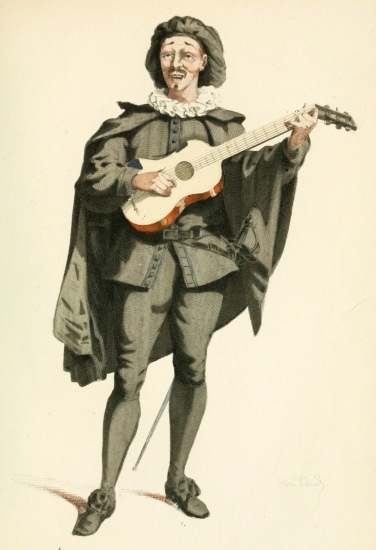
SCARAMOUCH (1645)
Illustrating the Italian Commedia dell'Arte, or Impromptu Comedy
The growing disorder in our family affairs did not at first deprive us
boys of a sound education. My two elder brothers, Gasparo and Francesco,
went to public schools,[104] and were in time to drink at all the
fountains of the regular curriculum. Extravagant expenditure, however,
combined with the needs of a numerous progeny, soon rendered anything
like an adequate course of studies impossible for the younger
children. I was intrusted for some years to a learned country-parson,
and then to a priest in Venice, of decent acquirements and excellent
morality. After this I entered the academy of two Genoese priests, who
supplied instruction to some youths of noble birth, and to some of no
nobility whatever. There were about twenty-five pupils in this academy.
We pursued the same studies, with some difference according to our
classes. Here I had the opportunity of observing that teachers are very
valuable guides to youths who love learning, and mere images of
ineffectual deities to such as hate it. For my part, being fond of books
and eager for information, I imbibed my fill of such instruction as a
boy can acquire before the age of fourteen. But sloth and vicious habits
extirpate the seeds of learning planted by preceptors in the minds of
ill-conditioned lads. Therefore I saw, and still see, more than
two-thirds of my fellow-pupils sunk in a slough of baseness. Grammar,
the classics, and rhetoric only taught them to get drunk in taverns, to
carry sacks for hire upon their shoulders, and to cry "Baked apples,
plums, and chestnuts!" about the streets, with a basket on their heads
and a pair of scales slung round their waists. Wretched fate to be a
father!
When I became aware that our domestic difficulties would prove an
obstacle to my remaining long at school, I determined to utilise the
little I had already learned, and to carry on my education by myself. My
elder brother Gasparo's example, whose passion for study had won public
recognition, and my own good-will, kept me nailed to books of all sorts;
nor could I imagine any pleasure worth a thought, beyond reading,
meditating, and writing.
Poetry, choice Italian, and correct style were then in vogue. The young
men of Venice met to discuss these three topics, which have now been
utterly forgotten—possibly for the greater advantage and convenience of
our citizens. I see crowds of young people, hair-brained, conceited,
idle, frivolous, presumptuous, and harmful to society. Heaven knows what
their studies are! Not poetry, not the niceties of the Italian language,
not correction of style. And then, forsooth, I am to admire a
hurly-burly of well-born persons, who claim in their foolhardiness to be
omniscient, who produce nothing whatsoever, who cannot write three lines
of a letter which shall express their sentiments, and which shall not
swarm with revolting faults of grammar and of spelling!
I will omit to observe that respect for nobles in a state is necessary;
but that the respect shown simply for their birth and wealth is not
respect but false feigned adulation. I will refrain from asserting that
a daily correspondence, maintained with a large variety of
persons—people who may not perhaps be scientific, but who understand
whether a letter is well written or ridiculous—may be capable of
securing a large part of the regard, or of occasioning a large part of
the contempt, bestowed on nobles. I make no mention of the rich man in
Signor Mercier's comedy of Indigence, who found it impossible to write a
letter of the utmost importance because his secretary was away from
home. I will say nothing to those scientific tutors of the scions of our
aristocracy, who instil derision and disdain for polite literature and
the art of elegance in diction into the brains of their pupils, moulding
them into geometricians, mathematicians, philosophers, physicists,
astronomers, algebraical professors, naturalists, a whole deluge of
sciences, but who cannot after all their labour express in writing what
they have taught or what the common business of life requires.
All these things, and everything which imposture has presented to my
senses and impressed upon my mind, must remain unwritten in my pen. I
have no wish to make enemies.
Yet we cannot prevent drops of ink from falling sometimes from the pen
and making blots upon our papers. Just so, while I am dictating these
memoirs of my life, I shall not be able to avoid splutterings, however
out of place and inconvenient.
I am almost ashamed to confess the intense assiduity with which I
applied myself to those frivolous literary studies of which I have been
speaking. They brought on a hæmorrhage from the nostrils, so violent
and so frequent, that I was more than once or twice given up for dead in
the manner of Seneca.[105] In their anxiety about my health, my friends
hid away all my books, and deprived me of paper and inkstand; but I was
the cleverest of thieves in searching for them, and went on doggedly
reading and writing by stealth in the uninhabited attics of our mansion.
After relating this fact about my boyhood, malicious people may think
that I am claiming to be considered worthy of a panegyric. They are
quite mistaken. I fix them with my eyeglass, and assure them that it is
rather my intention to provide them with another good reason for
quizzing me. The famous Doctor Tissot angrily rebukes excessive
application to those studies which are universally esteemed as useless.
He reserves his praise for folk who ruin their health in pursuits
considered beneficial to humanity; and such, I do not doubt, are the
studies affected by himself and his admirers.
The Abbé Giovan Antonio Verdani, keeper of the select and extensive
library of the patrician family Soranzo, was a man of vast literary
erudition. He felt compassion for my weakness, which coincided with his
own, and directed my reading by lending me the rarest books,
masterpieces of pure Italian diction in prose and poetry. To estimate
the quantities of paper which I covered with my thoughts in verse and
prose, would be beyond my powers. I tried to imitate the style of all
the early Tuscan writers who are most admired. Assuredly I never
approached the perfection of their language; but I am none the less sure
that the diligent and attentive perusal of a mass of the best works,
treating of a vast variety of subjects, cannot fail to furnish a better
head than mine with instruction and ideas, with the power of making just
reflections and probable conjectures, and with the principles of sound
morality. I am also convinced that the imitation of style in writing,
pursued methodically, enables a man to express his own thoughts with
facility, propriety of colouring, exactitude of phrase and term,
according to the variety of images, grave or gay, familiar or dignified,
which we desire to develop and to communicate under their true aspect in
prose or poetry.
Without attaining to the mastery of style at which I aimed, I acquired
the miserable satisfaction of finding myself in the very select group of
persons who know this truth. I also earned the wretchedness of being
forced to read with insuperable aversion and disgust the works of many
modern Italian authors, which are full of false fancies and sophisms,
the rhetoric and diction of which never vary however the subject-matter
changes, which are defiled by all manner of gibberish, bombast,
nonsense, with periods involved in unintelligible vortices, and with
preposterous phraseology. The sciences, the discoveries, the branches
of new knowledge which are now so loudly vaunted, ought to be accepted
as useful, and are worthy of respect. For this reason it is wrong to
profane them and to render them contemptible by barbarous impurity and
impropriety of diction. Francesco Redi, that great man, great
philosopher, great physician, great naturalist, confirms my doctrine by
his written works.[106] As regards the literature of art and wit and
fancy, it is obvious that without correction of style this is absolutely
worthless and condemned to merited oblivion. No one could count the fine
and ample sentiments which perish, smothered in the mire of inartistic
writing. Not less numerous, on the other hand, are the small but
brilliant thoughts, duly coloured with appropriate terms, and placed at
the right point of view by a master-hand, which sparkle before the eyes
of every reader, be he learned or simple.
There is no disputing about tastes. Yet I think it could be easily
maintained that our century has lapsed into a shameful torpor with
regard to these things. I have written and printed quite enough upon the
subject; without effect, however; and now I see no reason why I should
not utter a last funeral lament over the mastery of art I longed to
possess. That mastery, which nowadays is reckoned among the inutilities
of existence, has been freely conceded to me by the verdict of
contemporaries—blind judges, governed not by intelligence but by
ignorant assumption—so that their opinion does not sustain me with the
sure conviction of having attained my purpose. Nevertheless I am
grateful even to the blind and deaf, who see and hear what gives them
pleasure in my writings.
My pursuit of culture advanced on the lines I have described, whether
for my happiness or my misfortune it is worthless to inquire. I read
continually, and wasted enormous quantities of ink; paid close attention
to men and manners; profited by the encouragement of the Abbé Verdani
and Antonio Federigo Seghezzi; walked in the steps of my brother
Gasparo; and frequented a literary society which met daily at our house.
From a Piedmontese, who knew how to read and nothing more, I learned the
first rudiments of French; not that I wished to talk French in Italy, an
affectation which I loathed; but because it was my desire, by the help
of grammar and dictionary, to study the books, most excellent in part,
in part injurious to society, which issue daily from the French press.
It was thus that I formed those literary tastes, to which I have always
clung for innocent and disinterested amusement, and which, now that my
hairs are grey, will be my solace till the hour of death. The giants of
science, to whom I dare not raise my quizzing-glass for fear of
committing an unpardonable sin, will perceive that in describing the
scanty sources of my education, I am only painting the portrait of a
literary pigmy in all humility.
As regards my moral training, it is only necessary to observe that the
family of which I was a member has always cherished a deep and fervent
reverence for the august image of religion, and that my father, careless
as he was in matters of economy, never neglected religious duties or the
good ensample of honourable conduct. He was a bitter enemy of falsehood.
His delicate susceptibility detected a lie by the inflection of the
voice, and he punished it upon the spot with sounding boxes on the ears
of his offspring.
Being a bold rider and passionately fond of horses, he taught us to
ride, and liked to see us every day on horseback during our summer
visits to the country. It was useless to plead timidity, or to shrink
from the snortings and jibbings of some half-broken beast he wanted us
to back. Up we went; a cut or two of the switch across our legs set us
off at a gallop; and there we were in full career, without a thought for
broken shins or necks. Some jockeys, who came to break in vicious colts,
put me up to tricks for mastering a hard-mouthed bolting animal. One of
these tricks stood me in good stead upon an occasion I shall afterwards
relate. Indeed, I may say that I owe my life to a jockey.
We had a little theatre of no great architectural pretensions in our
country-house; and here we children used to act.[107] Brothers and
sisters alike were gifted with some talent for comedy; and all of us,
before a crowd of rustic spectators, passed for players of the first
quality. Beside tragic and comic pieces learned by heart, we frequently
improvised farces with a slight plot upon some laughable motive. My
sister Marina and I had the knack of imitating certain married couples
notorious in the village for their burlesque humours. We used to
interpolate our farces with scenes and dialogues in which the famous
quarrels of these women with their drunken husbands were reproduced to
the life. Our clothes were copied from the originals; and the imitation
was so exact that our bucolic audience hailed it with Homeric peals of
laughter, measuring their applause by the delight it afforded their
coarse natures. My father and mother took a fancy to see themselves
represented in this way. My sister and I were shy at first, but we had
to obey our parents. Finally, we regaled them with a perfect
reproduction of their costume, their gestures, their way of talking, and
some of their familiar household bickerings. Their astonishment was
great, and their laughter was the only punishment of our dutiful
temerity.
I learned to twang the guitar with a certain amount of skill, and vied
with my brother Gasparo in improvising rhymed verses, which I sang to
music in our hours of recreation. This was done with all the
foolhardiness inseparable from a display which the vulgar are only too
apt to regard as miraculous. Since I have touched upon the point, I will
digress a little on this so-called miracle. In my opinion, the immense
crowds of people hanging with open mouths upon the lips of an
improvisatore only prove that, in spite of the contempt into which
poetry has fallen, it still possesses that power over the minds and the
brains of men which their tongues deny it. Cristoforo Altissimo, a poet
of the fifteenth century, is said to have publicly improvised his epic
in octave stanzas on the Reali di Francia; the words were taken down
from his lips, just as he composed them at the moment. The book was
published; and though it is extremely rare, I have read it through the
kindness of the Abbé Verdani. Only a few stanzas, out of all that ocean
of verse, are worthy of the name of poetry; and yet we may believe that
before the work was given to the press, some pains had been bestowed
upon it. I have listened to many extempore versifiers, male and female,
the most famous of our century. It has always struck me that if the
deluges of verses which they spout forth with face on fire, to the
applause of frantic multitudes, were written down, they would have very
little poetical value, and that nobody would have the patience to read
the twentieth part of them. Padre Zucchi, of the Olivetan Order, whom I
heard in my youth, surpassed his rivals; now and then he produced
sensible stanzas; but he improvised so slowly that reflection may have
had some part in the result. I do not deny that these extempore
rhymesters may be people of culture and learning, qualified to discourse
well upon the themes proposed to them. Yet they would not be listened
to, if they spoke ever so divinely in prose. In order to draw a crowd,
they are forced to express their thoughts and images, just as they come,
with voluble rapidity, in bad rhymed verses, which often are no better
than a gabble of words without sense. This throws their audience into a
trance of astonishment. Humanity has always quested after the marvellous
like a hound. If a painter sought to depict foolhardiness or imposture
wearing the mask of poetry, I could recommend nothing better than the
portrait of an improvisatore, with goggle-eyes and arms in air, and a
multitude staring up at him in stupid dumb amazement. These being my
sentiments, I am willing, out of mere politeness and good manners, to
approve the coronation of a Cavaliere Perfetto or a Corilla on the
Capitol. But I can only accept with cordial and serious enthusiasm the
honours of that sort paid to a Virgil, a Petrarch, and a Tasso.
The Arcadians will laugh when I proceed to speak about an improvisatore,
whom I knew and whom I have listened to a hundred times. Yet I should be
committing an injustice if I did not mention him, and declare my opinion
that he was the single really wonder-worthy artist in this kind, with
whom I ever came in contact. He used to pour forth anacreontics, octave
stanzas, any and every metre, extempore, to the music of a well-touched
guitar. His verses rhymed, but had no Clio, Euterpe, Plettro,
Parnaso, Aganippe, Ruscelletto, Zefiretto, and such stuff, in
them. They composed a well-developed discourse, flowing evenly, not
soaring, but with abundance of well-connected images, and natural,
lively, graceful thoughts. He invariably used either the Venetian or the
Paduan dialect; which will augment the derisive laughter of Arcadia, and
make the Campidoglio ring. On one occasion, while he was improvising on
the theme: diligite inimicos vestros, it happened that two enemies
were present. At another time, he dilated on his own grief for a
cavaliere[108] who had been kind to him, and who was then dying, given
over by the doctors. Not only did the audience hang upon his lips with
rapt attention; but in the former case, the enemies were reconciled,
while in the latter tears were freely shed for the poet's expiring
benefactor. Such influence over the passions of the heart reveals a true
poet; for such a man I reserve the laurel crown upon my Campidoglio. His
name was Giovanni Sibiliato, brother of the celebrated professor of
literature in the University of Padua.
Returning from this digression, I will resume the narrative of my
boyhood. I learned to fence and to dance; but books and composition were
my chief pastime. Before a numerous audience in our literary assemblies
I felt no shyness. In private visits, among people new to me, the
reserve of my demeanour often passed for savagery. My first sonnet of
passable quality was written at the age of nine. Beside the applause it
won me, I was rewarded with a box of comfits; and for this reason I have
never forgotten it. The occasion of its composition was as follows. A
certain Signora Angela Armano, midwife by trade, had a friend at Padua
whose pet dog died and left her inconsolable. Signora Angela wished to
comfort her friend; indulged in condolements for her loss; and sent a
little spaniel of her own, called Delina, to replace the defunct pet.
Delina was to be given as a present, and a sonnet was to accompany the
gift, expressing all the sentiments which a lady of Signora Angela's
profession might entertain in a circumstance of such importance. Though
our family was a veritable lunatic asylum of poets, no one cared to
translate the good creature's gossipping garrulity into verse. Moved by
her entreaties, I undertook the task; and the following Bernesque sonnet
was the result:—
| "Madama io vi vorrei pur confortare |
| Con qualche graziosa diceria, |
| Ma la sciagura vuole, e vostra, e mia, |
| Che in un sonetto la non vi può stare. |
| Non vi state, mia cara, a disperare, |
| Che la sarebbe una poltroneria, |
| L'entrar per un can morto in frenesia; |
| Chi nasce muor, convien moralizzare. |
| Vi sovvenite, ch' egli avrà pisciato |
| Alcuna volta in camera, o in cucina, |
| Che in quell' istante lo avreste ammazzato. |
| Io vi spedisco intanto la Delina |
| Che più d'un cane ha d'essa innamorato, |
| E può farvi di cani una dezina. |
| È bella, e picciolina; |
| Di lei non voglio più nuova, o risposta, |
| Servitevi per razza, o di supposta." |
Two years later, a new edition of the poems of Gaspara Stampa appeared
in Venice, at the expense of Count Antonio Ramboldo di Collalto of
Vienna, a prince distinguished for his birth and writings. Scholars know
that this sixteenth-century Sappho sighed her soul forth in love-laments
to a certain Count Collaltino di Collalto, doughty warrior and polished
versifier, and that she was reputed to have died of hopeless passion in
her youth.[109] The ladies of our century will hardly believe her
story; for Cupid has changed temper since those days, and kills his
victims with far different and less honourable weapons. Some verses by
contemporary writers in praise of our literary heroine were to be
appended to this edition of her works. I dared to enter the lists, and
wrote a sonnet in the style of the earliest Tuscan poets. Such as it is,
the sonnet may be found printed in the book which I have indicated. It
appears from this juvenile production that I already acknowledged a
mistress of my heart; compliance with fashion was alone responsible for
my precocity.
This trifling composition was read by the famous Apostolo Zeno. He
deigned to inquire for the author, who had reproduced the antique
simplicity of Cino da Pistoja, Guittone d'Arezzo, and Guido Cavalcanti.
On my presenting myself, Signor Zeno politely expressed surprise at
discovering a mere boy in the learned writer of the sonnet, treated me
with kind attention, and placed his choice library at my disposal.[110]
The encouragement of this distinguished poet, true lover of pure style,
and foe to seventeenth-century conceits, added fuel to the fire of my
literary passion. From that day forward not one of those collections of
verses appeared, in which marriages, the entrance of young ladies into
convents, the election of noblemen to offices of state, the deaths of
people, cats, dogs, parrots, and such events, are celebrated in Venice
and other towns of Italy, but that it contained some specimen of my Muse
in grave or playful verse.
Books, paper, pens and ink formed the staple of my existence. I was
always pregnant, always in labour, giving birth to monsters in remote
corners of our mansion. I scribbled furiously, God knows how, up to my
seventeenth year. Besides innumerable essays in prose and multitudes of
fugitive verses, I wrote four long poems, entitled Berlinghieri, Don
Quixote, Moral Philosophy (based upon the talking animals of
Firenzuola), and Gonella in twelve cantos. The Abbé Verdani took a
fancy to this last, and wished to see it printed. Signor Giulio Cesare
Beccelli, however, had published a poem at Verona on the same subject,
which robbed my work of novelty; and though mine was richer in facts
drawn from good old sources, I did not venture to enter into competition
with him. The three years' absence from home, which I shall presently
relate, and the revolution in our domestic affairs which surprised me on
my return, exposed these boyish literary labours to ruin and
dispersion. It is probable that pork-butchers and fruit-vendors
exercised condign justice on the children of my Muse.
In the course of these years, the early deaths of a brother and a sister
had reduced our numbers from eleven to nine. Meanwhile, our annual
expenditure exceeded the resources at our command, and left but little
for the needs of a numerous offspring, too old to be contented with a
toy or plaything. Some lawsuits, which we lost, diminished the estate.
Clouds of doubt and care began to obscure the horizon, and in a few
years the family was plunged in pecuniary embarrassment.
My brother Gasparo had taken a wife in a fit of genial poetical
abstraction. Even poetry has its dangers. This man, who was really
singular in his absolute self-dedication to books, in his indefatigable
labours as an author, and in a certain philosophical temper or
indolence, which made him indifferent to everything which was not
literary, learned to fall in love from Petrarch. A young lady, ten years
older than himself, named Luigia Bergalli,[111] better known among the
shepherdesses of Arcady as Irmenia Partenide, a poetess of romantic
fancy, as her published works evince, was my brother's Laura. Not being
a canon, like Petrarch, he married her in Petrarch's spirit, but with
due legal formalities. This woman, of fervent and soaring imagination,
which fitted her for high poetic flights, undertook to regulate the
disorder in our affairs. Impelled by the instincts of a good nature,
with something of ambition and a flattering belief in her own practical
ability, she did the best that in her lay. Yet all her projects and
administrative measures revolved within a circle of romantic raptures
and Pindaric ecstasies. Thirsting with soul-passion after an ideal
realm, she found herself the sovereign of a state in decadence. It was
the desire of her heart to make us all happy, in the most disinterested
way. Yet she accomplished nothing beyond involving every one, and
herself to boot, in the meshes of still greater misfortune. Her
husband, poring perpetually upon his books, could only oppose her at the
sacrifice of ease and quiet. This he was incapable of doing.—In order
to judge people equitably, it is necessary that character, temperament,
and circumstances should be thoroughly explained.
I know how unphilosophical it is to ascribe the discords of a family to
malignant planetary influences. Our domestic circle consisted of a
father, a mother, four brothers, and five sisters, all of them
good-hearted, honourable, mutually well-inclined; and yet it became the
very mirror of infelicity at every moment and in each of the persons who
composed it. Minute investigation into the causes of this painful fact
would probably reveal them. But it is better to adopt the language of
the vulgar, and to say that a bad star pursued our family. Otherwise,
analysis might lead one into acts of unkindness, and involve one in
hatred.
The confusion in which we lived at that period, and the bitter
discomforts we had to bear, were augmented by expenses due to my
brother's increasing progeny. Our worst disaster, however (and this
wound I carry in my heart even to the present day), was a cruel stroke
of apoplexy which laid my beloved father low. He continued to exist, an
invalid, for about seven years after the sad event; dumb and paralytic,
but in possession of all his mental faculties—a circumstance which
rendered his deplorable condition almost unbearable to a man of my
father's extreme sensibility.
The tears of five sisters, the births of nephews and nieces, a house
swarming with female go-betweens, brokers, and the Hebrew ministers of
our decaying realm—all this whirlpool of economical extravagance and
folly, to utter one word against which was reckoned mutiny or treason,
drove my second brother, Francesco, into exile. He went into the Levant
with the Provveditore Generale di Mare,[112] his Excellency the
Cavaliere Antonio Loredano, of happy memory. At that period I was about
thirteen.
Letters written from Corfu by this brother describing the kindness shown
him by his Provveditore, and the rank of ensign to which he soon
attained, awoke in me a burning desire to escape like him from those
domestic turmoils, the gravity of which I felt in experience and
measured by anticipation, but which my state of boyhood rendered me
unable to remedy. Our uncle on the mother's side, Almorò Cesare Tiepolo,
recommended me to his Excellency Girolamo Quirini, Provveditore Generale
elect for Dalmatia and Albania. Furnished with a modest outfit, in which
my book-box and guitar were not forgotten, I bade farewell to my parents
at the age of seventeen,[113] and went across seas as volunteer into
those provinces, to study the ways and manners of my fellow-soldiers,
and of the peoples among whom we were quartered.
I Embark upon a Galley, and Cross the Seas to Zara.
I was not slow to perceive that I had adopted a career by no means
suited to my character, the proper motto for which was always the
following verse from Berni:
"Voleva far da se, non commandato."
My natural dislike of changeableness kept me, however, from showing by
outward signs of any sort that I repented of my choice; and I reflected
that abundant opportunities were now at least offered for observations
on the men of a world new to me. This thought sufficed to keep me in
good spirits and a cheerful humour through all the vicissitudes of my
three years' sojourn in Illyria.
According to orders received from his Excellency, the Provveditore
Generale Quirini, I embarked before him on a galley called
Generalizia, which was riding at the port of Malamocco. There I was to
wait for his arrival. A band of military officers received me with
glances of courtesy and some curiosity. In a Court where all the members
are seeking fortune, each newcomer is regarded with suspicion. Whether
he has to be reckoned with or may be disregarded on occasions of
promotion, concerns the whole crew of officials, who, like him, are
dependent on the will of the Provveditore. It was perhaps insensibility
which made me indifferent to these preoccupations; this the sequel of my
narrative will show; and yet such thoughts are very wood-worms in the
hearts of courtiers.
I had to swallow a great quantity of questions, to which I replied with
the laconic brevity of an inexperienced lad upon his guard. Some of
those gentlemen had known my brother Francesco at Corfu. When they
discovered who I was, they seemed to be relieved of all anxiety on my
account, and welcomed me with noisy demonstrations of soldierly
comradeship. I expressed my thanks in modest, almost monosyllabic
phrases. They set me down for an awkward young fellow, unobliging, and
proud. This was a mistake, as they freely confessed a few months later
on. I had retired into myself, with the view of studying their
characters and sketching my line of action. The quick and penetrative
intuition with which I was endowed at birth by God, together with the
faculty of imperturbable reserve, enabled me in the course of a few
hours to recognise in that little group some men of noble birth and
liberal culture, some nobles ruined by the worst of educations, and some
plebeians who owed their position to powerful protection.
Gaming, intemperance, and unbridled sensuality were deeply rooted in the
whole company. I laid my plans of conduct, and found them useful in the
future. My intimacies were few, but durable. The vices I have named,
clung like ineradicable cancers to the men with whom I associated. Sound
principles engrafted on me in my early years, regard for health, and the
slenderness of my purse helped me to avoid their seductions. At the same
time, I saw no reason why I should proclaim a crusade against them.
Holding a middle course, I succeeded in winning the affection of my
comrades. They invited me to take part in their orgies. I did not play
the prude. Without yielding myself to the transports of brutal appetite,
I proved the gayest reveller at all those lawless meetings. Some of my
seniors, on whom a career of facile pleasure had left its inevitable
stigma, used to twit me with being a reserved young simpleton. I did
not heed their raillery, but laughed at the inebriation of my comrades,
studied the bent of divers characters, observed the animal brutality of
men, and used our uproarious debauches as a school for fathoming the
depths of human frailty.
Now I will return to the point of my embarkation on the galley
Generalizia in the port of Malamocco. While awaiting the arrival of
the Provveditore, I had two whole days and nights to spend in sad
reflections on humanity. These were suggested by the spectacle of some
three hundred scoundrels, loaded with chains, condemned to drag their
life out in a sea of miseries and torments, each of which was sufficient
by itself to kill a man. An epidemic of malignant fever raged among
these men, carrying away its victims daily from the bread and water, the
irons, and the whips of the slavemasters. Attended in their last passage
by a gaunt black Franciscan friar, with thundering voice and jovial
mien, these wretches took their flight—I hope and think—for Paradise.
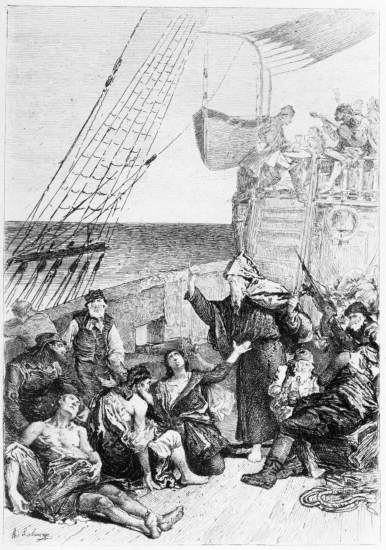
THE FRANCISCAN FRIAR ON THE GALLEY
Original Etching by Ad. Lalauze
The Provveditore's arrival amid the din of instruments and roar of
cannon roused me from my dismal reveries. I had visited this gentleman
ten times at least in his own palace, and had always been received with
that playful welcome and confidential sweetness which distinguish the
patricians of Venice. He made his appearance now in crimson—crimson
mantle, cap, and shoes—with an air of haughtiness unknown to me, and
fierceness stamped upon his features. The other officers informed
me that when he donned this uniform of state, he had to be addressed
with profound and silent salaams, different indeed from the reverence
one pays at Venice to a patrician in his civil gown.[114] He boarded the
galley, and seemed to take no notice whatever of the crowd around him,
bowing till their noses rubbed their toes. The affability with which he
touched our hands in Venice had disappeared; he looked at none of us;
and sentenced the young captain of the guard, called Combat, to arrest
in chains, because he had omitted some trifle of the military salute. My
comrades stood dumbfounded, staring at one another with open eyes. This
singular change from friendliness to severity set my brains at work. By
the light of my boyish philosophy I seemed to comprehend why the noble
of a great republic, elected general of an armament[115] and governor of
two wide provinces, on his first appearance in that office, felt bound
to assume a totally different aspect from what was natural to him in his
private capacity. He had to inspire fear and a spirit of submission into
his subordinates. Otherwise they might have taken liberties upon the
strength of former courtesy displayed by him, being for the most part
presumptuous young fellows, apt to boast about their favour with the
general. For my own part, since I was firmly bent on doing my duty
without ambitious plans or dreams of fortune, this formidable attitude
and the harsh commands of the great man made a less disheartening
impression on me than on my companions. I whispered to myself: "He
certainly inspires me with a kind of dread; but he has taken immense
trouble to transform his nature in order to produce this effect; I am
sure the irksomeness which he is suffering now must be greater than any
discomfort he can cause me."
The general retired to his cabin in the bowels of our floating hell, and
sent Lieutenant-Colonel Micheli, his major in the province, to make out
a list of all the officers and volunteers on board, together with the
names of their protectors. Nobody expected this; for we had been
personally presented to the general at Venice, and had explained our
affairs in frequent conversations. Once more I reflected that this was
his way of damping the expectations which might have been bred in
scheming brains before he exchanged the politenesses of private life for
the austerities of office. The Maggiore della Provincia Micheli—a most
excellent person and very fat—bustled about his business, sweating, and
scribbling with a pencil on a sheet of paper, as though the matter was
one of life or death. Everybody began to shy and grumble and chafe with
indignation at passing under review in this way. When my turn came, I
answered frankly that I was called Carlo Gozzi, and that I had been
recommended by the patrician Almorò Cesare Tiepolo. I withheld his title
of senator and the fact that he was my maternal uncle, deeming it
prudent not to seem ambitious.
The Generalizia, convoyed by another galley named Conserva and a few
light vessels of war, got under way for the Adriatic;[116] and the night
fell very dark upon the waters. I shall not easily forget that night,
because of a little incident which happened to me, and which shows what
a curious place of refuge a galley is for young men leaving their homes
for the first time. A natural necessity made me seek some corner for
retirement. I was directed to the bowsprit; on approaching it, an
Illyrian sentinel, with scowling visage, bushy whiskers, and levelled
musket, howled his "Who goes there?" in a tremendous voice. When he
understood my business, he let me pass. My next step lighted on a soft
and yielding mass, which gave forth a kind of gurgling sound, like the
stifled breath of an asthmatic patient, into the dark silent night.
Retracing my path, I asked the sentinel what the thing was, which
responded with its inarticulate gurgling voice to the pressure of my
feet. He answered with the coldest indifference that it was the corpse
of a galley-slave, who had succumbed to the fever, and had been flung
there till he could be buried on the sea-shore sands in Istria. The hair
on my head bristled with horror. But my happy disposition for seeing the
ludicrous side of things soon came to my assistance.
After twelve days of much discomfort, and twelve noisome nights, passed
in broken slumbers under the decks of that galley, which only too well
deserved its name, our little fleet entered the port of Zara. We went on
shore at first privately and quietly; and after a few days the public
ceremonies of official disembarkation were gone through. The
Provveditore Generale Jacopo Cavalli handed his baton of command over to
the Provveditore Generale Girolamo Quirini with all the formalities
proper to the occasion. This solemnity, which is performed upon the open
sea, to the sound of military music, the thunder of artillery, and the
crackling of musket-shots, deserves to be witnessed by all who take an
interest in imposing spectacles. An old man, fat and short of stature,
with a pair of moustachios bristling up beneath his nostrils, a merry
and most honest fellow to boot, who bore the name of Captain Girolamo
Visinoni, was appointed master of these ceremonies, on account of his
intimate acquaintance with their details. I had no other duty that day
but to wear my best clothes, which did not cost much trouble.
I Fall Dangerously Ill; Recover; Form the only Intimate
Acquaintance I made in Dalmatia.
When the new Regency had been established and the Court settled, I had
but eight days to learn my duties as volunteer or adjutant[117] to his
Excellency, as it is called there, before I fell ill of a fever which
was declared to be malignant. Alone among people whom I hardly knew, at
the commencement of my career, poorly provided with money, and lying in
a wretched room, the windows of which were closed with torn and rotten
paper instead of glass, I could not but compare my present destitution
with the comforts of our home. Here I was battling with a mortal disease
in solitude. There, at the least touch of illness, I enjoyed the tender
solicitude of a sister or a servant at my pillow, to brush away the
flies which settled on my forehead. Fortunately, I was not so strongly
attached to life as to be rendered miserable by unavailing recollections
and gloomy forebodings.
It happened one day, as I lay there burning, that a convict presented
himself at the door of my miserable den, and asked me if I wanted
anything which he could fetch me. He was one of those men who prowl
around the officers' quarters, wrapped in an old blanket with a bit of
rope about the waist, ready to do any dirty business and to pilfer if
they find the opportunity. I gave him a few farthings and told him to
send me a confessor—an errand very different from what he had expected.
Before long a good Dominican appeared, who prepared me to die with the
courage of an ancient Roman. Our modern sages may laugh at this plebeian
wish of mine to make my peace with Heaven; but I have never been able to
dissociate philosophy from religion. Satisfied to remain a little child
before the mysteries of faith, I do not envy wise men in their
disengagement from spiritual terrors.
The chief physician, Danieli, a man of prodigious corpulence and
blackness, who had been sent to my assistance by the Governor, spared no
attentions and no remedies. As usual, they proved unavailing; and he
bade me prepare myself for death by receiving the holy sacrament. I
summoned what remained to me of vital force, and went through this
ceremony with devotion. There seemed to be so little difference between
a sepulchre and the room in which my body lay, that I felt no disgust at
relinquishing my corpse to the grave-diggers. I was now ready for the
last unction, when an attack of hemorrhage from the nostrils, like those
which had already nearly brought me to death's door, recalled me for the
nonce to life. All the ordinary remedies—ligatures, powders, herbs,
astringent plasters, sympathetic stones, muttered charms, old wives'
talismans—were exhibited in vain. After filling two basons with blood,
I lapsed into a profound swoon, which the doctor styled a syncope. To
all appearances I was dead; but the blood stopped; in a quarter of an
hour I revived; and three days afterwards I found myself, weak indeed,
but wholly free from fever and on the road to recovery. My ignorance
could not reconcile this salutary crisis with Danieli's absolute
prohibition of blood-letting in my malady. But I suppose that a score of
learned physicians, each of them upon a different system of hypotheses,
conjectures, well-based calculations, and trains of lucid argument,
would be able to demonstrate the phenomenon to their own satisfaction
and to the illumination or confusion of my stupid brain. Stupendous
indeed are the mental powers which Almighty God has bestowed on men!
The readers of these Memoirs will hardly need to be informed that my
slender purse had nothing in it at the termination of this illness.
Under these painful circumstances I found a cordial and open-hearted
friend in Signor Innocenzio Massimo, nobleman of Padua, and captain of
halbardiers at the Dalmatian Court. This excellent gentleman, of rare
distinction for his mental parts, the quickness of his spirit, his
courage, energy, and honour, was the only intimate friend whom I
possessed during my three years' absence from home. When they were over,
our friendship continued undiminished by lapse of time, distance, and
the various vicissitudes of life. I have enjoyed it through thirty-five
years, and am sure that it will never fail me. Some qualities of his
character have exposed him to enmity; among these I may mention a
particular sensitiveness to affronts, an intolerance of attempts to
deceive him, and a quick perception of fraud, together with a firm
resolve to stem the tide of extravagance and fashionable waste in his
own family. His many virtues, the decent comfort of his household, his
hospitality to friends and acquaintances, his careful provision for the
well-being of his posterity, his benevolence to the poor and afflicted,
his successful efforts as a peacemaker among discordant fellow-citizens,
his expenditure of time and trouble upon all who come to him for advice
or assistance, have not sufficed to disarm the malignity of a vulgar
crowd, corrupted by the false philosophy of our century, which goes from
bad to worse in dissolution and ill manners.
On the restoration of my health, his Excellency placed me under
Cavaliere Marchiori, Lieutenant-Colonel of Engineers, to learn
mathematics as applied to fortification. This gentleman sent for me, and
said that he had heard from my uncle of my aptitude for study, adding
that the subject he proposed to teach me was of the greatest consequence
to a soldier. I perceived at once that I was being treated on a
different footing from the other volunteers, and that the studied
forgetfulness of the Provveditore had been, as I suspected, a politic
device to humble ambitious schemers. I thanked Signor Marchiori, and
followed his instructions with pleasure, without however abandoning my
own interest in literature.
He questioned me regarding my knowledge of arithmetic, which was only
elementary; and when I saw that I must master it, in order to pursue the
higher branch of study, I gave my whole head to the business. In the
space of a month, I could cipher like a money-lender, and was ready to
receive my master's teaching. My friend Massimo possessed a good
collection of instruments for engineering draughtsmanship, and a
library of French works on geometry, mathematics, and fortification,
both of which he placed at my disposal. Signor Marchiori's lectures,
long discussions with Signor Massimo, perusal of Euclid, Archimedes, and
the French books, soon plunged me in the lore of points and lines and
calculations. I burned with the enthusiasm, droll enough to my way of
looking at the world, which inspires all students of this science. Yet I
did not, like them, regard moral philosophy and humane literature as
insignificant frivolities. I bore in mind for what good reasons the
Emperor Vespasian dismissed the mathematicians who offered their
assistance in the building of his Roman edifices. I knew that
innumerable vessels, fabricated on the principles of science, have
perished miserably in the tempests; that hundreds of fortresses, built
by science, have been destroyed and captured by the same science; that
inundations are continually sweeping away the dykes erected by science,
to the ruin of thousands of families, and that the inundations
themselves are attributable to the admired masterpieces of science
bequeathed to us by former generations; that, in spite of science and
her creative energy, the buildings she erects are not secured from
earthquakes, conflagrations, and the thunderbolt. It remains to be seen
whether Professor Toaldo's lightning-conductors will prove effectual
against the last of these disasters. Then I reckoned up the blessings
and curses which this vaunted science has conferred on humanity,
arriving at the conclusion that the harm which she has done infinitely
exceeds the good. I shuddered at the hundreds of thousands of human
beings ingeniously massacred in war or drowned at sea by her devices;
and took more pleasure in consulting my watch, her wise invention, for
the dinner-hour than at the hour of keeping an appointment with my
lawyer. Without denying the utility of sciences, I stuck resolutely to
the opinion that moral philosophy is of more importance to the human
race than mechanical inventions, and deplored the pernicious influence
of modern Lyceums and Polytechnic schools upon the mind of Europe.
Signor Massimo and I kept house together in a little dwelling on the
city walls, facing the sea. The sun, in his daily revolutions, struck
this habitation on every side; and there was not an open space of wall
or window-sill without its dial, fabricated by my skill, and adorned
with appropriate but useless mottoes on the flight of time. A lieutenant
named Giovanni Apergi, upright and pious, especially when the gout he
had acquired in the world's pleasures made him turn his thoughts to
Heaven, gave me friendly lessons in military drill. I soon learned to
handle my musket, pike, and ensign; and sweated a shirt daily, fencing
with Massimo, who was ferociously expert in that fiendish but
gentlemanly art. We also spent some hours together over a great
chessboard of his, covered with wooden soldiers, which we moved from
square to square, forming squadrons, and studying the combinations which
enable armies to kill with prodigality and to be killed with
parsimony,—fitting ourselves, in short, for manuring cemeteries in the
most approved style.
I was already half a soldier, and meant to make myself perfect in my
profession; not, however, without a firm resolve to quit the army[118]
at the expiration of my three years' service. Twelve months spent in
studying my comrades convinced me that, though some worthy fellows might
be found among them, their society as a whole was uncongenial to my
tastes. I had neither the ambition nor the greed of gain which might
have sapped this resolution; and my persistence during the appointed
time was mainly due to a dislike of seeming fickle. I wanted to gain the
respect of my relatives, whom I hoped to help one day with my counsel,
my credit, and the example of my perseverance.
After eight months spent in the study of fortification, I lost my poor
master. He died suddenly of a fit of spleen a few days after winning his
company in a regiment called Lagarde. This promotion he obtained by
competition; and some insulting words dropped upon the occasion, which
he was unable to resent, caused his mortal illness. Every one deplored
the death of Marchiori; but no one more than I did. His goodness,
sweetness, affability, and friendly patience left a powerful impression
on my memory. Gradually my interest in geometry declined, and I resumed
my former studies with fresh ardour, attending meanwhile to my military
duties, and waiting philosophically till the three years should be over.
I am bound to confess that my weakness for poetry and Italian literature
was great. In the Venetian service, and particularly in Dalmatia, there
were very few indeed who shared these tastes. I wrote and read my
compositions to myself, without seeking the applause of an audience or
boring my neighbours with things they do not care for, as is the wont of
most scribblers.
The secretary of the Generalate, Signor Giovanni Colombo, took some
interest in literature. I may mention, by the way, that he afterwards
rose to high dignity, which involved a calamity for him, sweetened,
however, by a splendid funeral; in other words, he died Grand Chancellor
of our most serene Republic.[119] This man, of gentle spirit and jovial
temper, knowing the epidemic of poetry which possessed the Gozzi family,
encouraged me to read him some of my trifles, and seemed to take
pleasure in listening to them. He owned a small but well-chosen library,
which he courteously allowed me to use. My verses, satirical for the
most part and descriptive of characters—without scurrility indeed,
though based on accurate observation of both sexes—were communicated to
him and Massimo alone.
The town of Zara was bent on testifying its respect for our Provveditore
Generale Quirini by a grand public display. A large hall of wood was
accordingly erected on the open space before the fort, and hung with
fine damask. Tickets of invitation were then distributed to various
persons, who were to compose an Academy upon the day of the solemnity.
Every academician had to recite two compositions in prose or verse, as
he thought fit. The subjects were set forth on the tickets, and were as
follows:—First, Is a prince who preserves, defends, and improves his
dominions in peace, more praiseworthy than one who seeks to extend them
by force of arms? The second was to be a panegyric of the Provveditore
Generale. An old nobleman of Zara, named Giovanni Pellegrini, was chosen
to preside in the Academy and to dispense the invitations. He wore a
black velvet suit and a huge blonde wig, done up into knotted curls, and
possessed a fund of eloquence in the style of Father Casimir
Frescot.[120]
I did not receive an invitation, which proves either that I was an
amateur of poetry unknown to fame, or that Signor Pellegrini, in his
gravity and wisdom, judged me a mere boy, unworthy of consideration in
an enterprise which he treated with true Illyrico-Italian seriousness.
Signor Colombo and my friend Massimo urged me to prepare two
compositions on the published themes; but I reminded them that I had no
right to appear uninvited. Nevertheless, I amused myself by scribbling a
couple of sonnets, which I consigned to the bottom of my pocket. As may
be imagined, I defended peace in the one, and did my best to belaud his
Excellency in the other.
The Provveditore Generale, attended by his officers and by the magnates
of the city, entered the temporary hall, and took his seat upon a rich
fauteuil raised many steps above the ground. A covey of literary
celebrities, collected Heaven knows where, ranged their learned backs
along a row of chairs, which formed a semicircle round him.
Strolling outside the damasked tabernacle, I saw some servants who were
preparing beverages and refreshments with a mighty bustle. I was
thirsty, and thought I should not be committing a crime if I asked one
of them for a lemonade. He replied that express orders had been given
not to quench the thirst of anybody who was not a member of the Academy.
This discourteous rebuff, repeated to the sitio of several officers,
raised a spirit of silent revolt among us. I resolved to put a bold face
on the matter, and to proclaim myself an academician, thinking that the
title of poet might win for me the lemonade which was denied to the
dignity and the weapons of an officer.
This little incident confirmed my opinion of the usefulness of poetry
against the universal judgment which regards it as an inutility. Poetry
stood me in good stead by procuring me a lemonade and saving me from
dying of thirst. Having swallowed the beverage, I proceeded to one of
the seats in the assembly, exciting some surprise among its members, who
were, however, kind enough to tolerate my presence. For three whole
hours the air resounded with long inflated erudite orations and poems
not remarkable for sweetness. A yawn from the General now and then did
honour to the Academy and the academicians. I must in justice say that
some tolerable compositions, superior to what I had expected, struck my
ears. A young abbé in holy orders gushed with poetic eloquence. I have
heard that he is now become a bishop. Who knows whether poetry was not
as serviceable to him in the matter of his mitre, as she was to me in
the matter of my lemonade!
I declaimed my sonnets in their turn; the second of which, by Apollo's
blessing, pleased his Excellency, and consequently was received with
general approval. It established my reputation among the folk of Zara,
and led to a comic scene two days later. The Provveditore Generale was
in the habit of riding in the cool some four or five miles outside the
city; a troop of officers galloped at his heels, and I galloped with
them. While we were amusing ourselves in this way, his Excellency took a
fancy to hear my sonnet over again; for it had now become famous, as
often happens with trifles, which go the round of society upon the
strength of adventitious circumstances. He called me loudly. I put spurs
to my horse, while he, still galloping, ordered me to recite. I do not
think a sonnet was ever declaimed in like manner since the creation of
the world. Galloping after the great man, and almost bursting my lungs
in the effort to make myself heard, with all the trills, gasps,
cadences, semitones, clippings of words, and dissonances, which the
movement of a horse at full speed could occasion, I recited the sonnet
in a storm of sobs and sighs, and blessed my stars when I had pumped
out the fourteenth line. Knowing the temper of the General, who was
haughty and formidable in matters of importance, but sometimes whimsical
in his diversions, I thought at the time that he must have been seeking
a motive for laughter. And indeed, I believe this was the case. Anyhow,
he can only have been deceived if he hoped to laugh more at the affair
than I did. Yet I was rather afraid of becoming a laughing-stock to my
riding-companions also. Foolish fear! These honest fellows, like true
courtiers, vied with each other in congratulating me upon the partiality
of his Excellency and the honour he had done me. They were even jealous
of a burlesque scene in which I played the buffoon, and sorry that they
had not enjoyed the luck of performing it themselves.
I related in the second chapter of this book that I once owed my life to
a trick taught me by a jockey. The incident happened during one of our
cavalcades with the Provveditore Generale.
At the hour appointed for riding out, all the officers of the Court sent
their saddles and bridles to the General's stables, and each of us
mounted the animal which happened to be harnessed with his own gear. Now
the Bashaw of Bosnia had presented the governor with a certain Turkish
stallion, finely made, but so vicious that no one liked to back the
brute. One day I noticed that the grooms had saddled this untamable Turk
for me. Who knows what motives determine the acts of stable-boys? I am
not accustomed to be easily dismayed; besides, I had ridden many
dangerous horses in my time, and this was not the minute to show the
white feather before a crowd of soldiers. I leapt upon the animal like
an antique paladin, without looking to see whether the bit and trappings
were in order. Our troops started; but my Bucephalus reared, whirled
round in the air, and bolted toward his stable, which lay below the
ramparts. Pulling and working at the reins had no effect upon the brute;
and when I bent down to discover the cause, I found that the bit had not
been fastened, either through the negligence or the malice of the
grooms.
Rushing at the mercy of this demon through the narrow streets and low
doors of the city, I began to reflect that I was not likely to reach the
stables with my head upon my shoulders. Then I remembered the jockey's
advice, and rising in my stirrups, leaned forwards, and stuck my fingers
into the two eyes of the stallion. Suddenly deprived of sight, and not
knowing whither he was going, he dashed furiously up against a wall,
and fell all of a heap beneath me. I leapt to earth with the agility of
a practised rider, and made the Turk get up; he was trembling like a
leaf, while I with shaky fingers fastened the bit firmly; then I mounted
again, and rejoined my company among the shouts of applause which always
greet dare-devil escapades of this kind. The middle finger of my left
hand had been flayed by striking against the wall. I still bear the scar
of this glorious wound.
Our forces had little to occupy them in those provinces, so that my
sonnet in praise of peace exactly fitted. Some interesting incidents,
and several journeys which I undertook, furnished me, however, with
abundant matter for reflection. I shall here indulge myself by setting
down a few observations which occur to my memory.
The regular troops which garrison the fortresses of Dalmatia had been
recalled to Italy, in order to defend the neutrality of Venice during
the wars which then prevailed among her neighbours. In these
circumstances the Senate commissioned our Provveditore Generale to levy
new forces from the subject tribes, not only for maintaining the
military establishment of Dalmatia, but also for drafting a large number
of Morlacchi[121] into Italy. It was a matter of no difficulty to enrol
garrisons for the Illyrian fortresses; but the exportation of the
Morlacchi cost his Excellency the greatest trouble. These ruffianly wild
beasts, wholly destitute of education, are aware that they are subjects
of Venice; yet their firm resolve is to indulge lawless instincts for
robbery and murder as they list, refusing obedience in all things which
do not suit their inclinations. To reason with them is the same as
talking in a whisper to the deaf. They simply resisted the command to
form themselves into a troop and leave their lairs for Italy.
Their chiefs, who were educated men, brave and loyal to their prince,
strained every nerve to carry out these orders. It was found needful to
recall the bandits, who swarm throughout those regions, outlawed for
every sort of crime—robberies, homicides, arson, and such-like acts of
heroism. Bribes too were offered of bounties and advanced pay, in order
to induce the wild and stubborn peasants to cross the seas. I was
present at the review of these Anthropophagi; for indeed they hardly
merited a more civilised title. It took place on the beach of Zara under
the eyes of the Provveditore, with ships under sail, ready for the
embarkation of the conscripts. Pair by pair, they came up and received
their stipend; upon which they expressed their joy by howling out some
barbarous chant, and dancing off together with uncouth gambols to the
transport ships. I revered God's handiwork in these savages while
deploring their bad education, and felt a passing wish to explore the
Eden of eternal beatitude in which the Morlacchi dwell.
It is certain that the Italian cities under our benign government were
more disturbed than guarded by these brutal creatures. At Verona, in
particular, they indulged their appetite for thieving, murdering,
brawling, and defying discipline, without the least regard for orders.
At the close of a few months, they had to be sent back to their caves,
in order to deliver the Veneto from an unbearable incubus. Even at the
outset, their spirit of insubordination let itself be felt. Scarcely had
the transports sailed, when the sight of the Illyrian mountains made
them burn to leap on shore. The seamen did their best to restrain the
unruly crew; but finding that they ran a risk of being cut in pieces,
they finally unbarred the pens before this indomitable flock of rams.
What I am now writing may seem to have little to do with the narrative
of my own life, and may look as though I wished to calumniate the
natives of Dalmatia. The rulers of those territories will, however, bear
me out in the following remarks. I have visited all the fortresses,
many districts, and many villages of the two provinces. In some of the
cities I found well-educated people, trustworthy, cordial, and liberal
in sentiment. In places far removed from the Provveditore Generale's
Court the manners of the population are incredibly rough. All the
peasants may be described as cruel, superstitious, and irrational wild
beasts. In their marriages, their funerals, their games, they preserve
the customs of pagan antiquity. Reading Homer and Virgil gives a perfect
conception of the Morlacchi. They hire a troop of women to lament over
their dead. These professional mourners shriek by turns, relieving one
another when voice and throat have been exhausted by dismal wailings
tuned to a music which inspires terror. One of their pastimes is to
balance a heavy piece of marble on the lifted palm of the right hand,
and hurl it after taking a running jump. The fellow who projects this
missile in a straight line to the greatest distance, wins. One is
reminded of the enormous boulders hurled by Diomede and Turnus.
In their mountain homes the Morlacchi are fine fellows, useful to the
State of Venice on occasions of war with the Turks, their neighbours,
whom they cordially detest. The inhabitants of the coast make bold
seamen, apt for fighting on the waters. Toward Montenegro the tribes
become even more like savages. Families, who have been accustomed for
some generations to die peaceably in their beds or kennels, and cannot
boast of a fair number of murdered ancestors, are looked down upon by
the rest. On the beach outside the city walls of Budua, for which these
men and brothers leave their hills in summer-time to taste the coolness
of sea-breezes, I have witnessed their exploits with the musket and have
seen three corpses stretched upon the sands. A member of one of the
pacific families I have described, being taunted by some comrade, burned
to wipe out the shame of his kindred, and opened a glorious chapter in
their annals by slaughtering and being slaughtered. Fierce battles and
armed encounters between village and village are frequent enough in
those parts. The men of one village who kill a man of the next village,
have no peace unless they pay a hundred sequins or discharge their debt
by the death of one of their own folk. Such is the current tariff, fixed
without consulting their sovereign, among these people, who regard
brutality as justice. I learned much about these traits of human nature
from a village priest of Montenegro, who conversed with me nearly every
day upon the beach at Budua. He talked a strange Italian jargon,
narrated the homicides of his flock with complacency, and let it be
understood that a gun was better suited to his handling than the vessels
of the sanctuary.
The thirst for vengeance is never slaked there. It passes from heir to
heir like an estate in tail. Among the Morlacchi, who are less
bloodthirsty than the Montenegrins, I once saw a woman of some fifty
years fling herself at the feet of the Provveditore Generale, extract a
mummied head from a game-bag, and cast it on the ground before him,
weeping as though her heart would burst, and calling aloud for pity and
justice. For thirty years she had preserved this skull, the skull of her
mother, who had been murdered. The assassins had long ago been brought
to justice, but their punishment was insufficient to lay the demon of
ferocity in this affectionate daughter. Accordingly, she presented
herself indefatigably through a course of thirty years before each of
the successive Provveditori Generali, with the same maternal skull in
her game-bag, with the same shrieks and tears and cries for justice.
I liked seeing the Montenegrin women. They clothe themselves in black
woollen stuffs after a fashion which was certainly not invented by
coquetry. Their hair is parted, and falls over their cheeks on either
shoulder, thickly plastered with butter, so as to form a kind of large
shiny bonnet. They bear the burden of the hard work of the field and
household. The wives are little better than slaves of the men. They
kneel and kiss the men's hands whenever they meet; and yet they seem to
be contented with their lot. Perhaps it would not be amiss if some
Montenegrins came to Italy and changed our fashions with regard to
women; for ours are somewhat too marked in the contrary direction.
Climate renders both the men and women of those provinces extremely
prone to sensuality. Legislators, recognising the impossibility of
controlling lawless lust here, have fixed the fine for seduction of a
girl with violence at a trifle above the sum which a libertine in Venice
bestows on the purveyor of his venal pleasures. At the period of my
residence in Dalmatia, the cities retained something of antique
austerity. This did not, however, prevent the fair sex from conducting
intrigues by stealth. It is possible that, since those days, enlightened
and philosophical Italians, composing the courts of successive
Provveditori Generali, may have removed the last obstacles of prejudice
which gave a spice of danger to love-making.
In Dalmatia the women are handsome, inclining for the most part toward a
masculine robustness; among the Morlacchi of the villages, a Pygmalion
who chose to expend some bushels of sand in polishing the fair sex up,
would obtain fine breathing statues for his pains. These women of
Illyria are less constant in their love than those of Italy; but merit
less blame for their infidelity than the latter. The Illyrian is blinded
and constrained by her fervent temperament, by the climate, by poverty
and credulity; the Italian errs through ambition, avarice, and caprice.
I consider myself qualified for speaking with decision on these points,
as will appear from the chapter I intend to write upon the
love-adventures of my youth.
The land of those provinces is in great measure mountainous, stony, and
barren. There are, however, large districts of plain which might be
extremely fertile. Neither the sterile nor the fertile regions are under
cultivation, but remain for the most part fallow and unfruitful. Onions
and garlic constitute the favourite delicacies of the Morlacchi. The
annual consumption of these vegetables is enormous; and it would not be
difficult to raise a large supply of both at home. They insist, however,
on importing them from Romagna; and when one takes the peasants to task
for this sluggish indifference to their own interests, they reply that
their ancestors never planted onions, and that they have no mind to
change their customs. I often questioned educated inhabitants of those
regions upon the indolence and sloth which prevail in rural Dalmatia.
The answer I received was that nobody, without exposing his life to
peril, could make the Morlacchi do more than they chose to do, or
introduce the least reform into their agriculture. I observed that the
proprietors might always import Italian labour and turn those fertile
plains into a second Apulia. This remark was met with bursts of
laughter; and when I asked the reason, my informants told me that many
Dalmatian gentlemen had brought Italian peasants over, but that a few
days after their arrival, they were found murdered in the fields,
without the assassins having ever been detected. I perceived that my
project was impracticable. Yet I wondered at my friends laughing rather
than shedding tears, when they gave me these convincing answers.
It is a pity that Illyria and Dalmatia cannot be rendered fertile and
profitable to the State. As it is, they cost our treasury more than they
yield, through the expenses incidental to their forming our frontier
against Turkey. But I never made it my business to meddle in affairs of
public policy; and perhaps there are good reasons why these provinces
should be left to their sterility. The opinion I have continually
maintained and published, that we ought to begin by cultivating heads
and hearts, has raised a swarm of hostile projectors against me. Such
men take the truths of the gospel for biting satires, if they detect the
least shadow of opposition to their views regarding personal interest,
personal ambition, or particular prejudice. Yet the real miseries which
I noticed in Dalmatia, the wretched pittance which proprietors draw from
their estates, and the dishonesty of the peasants, suffice to
demonstrate my principles of moral education beyond the possibility of
contradiction.
During my three years in Dalmatia I used to eat superb game and
magnificent fish for a mere nothing; often against my inclination, and
only because the opportunity could not be neglected. When you are in
want of something, you rarely find it there. The fishermen, who live
upon the rocky islands,[122] ply their trade when it pleases them. They
take no thought for fasts, and sell fish for the most part on days when
flesh is eaten. The fish too is brought to market stuffed into sacks. I
could multiply these observations; but let what I have already said
suffice. It is my firm opinion that the economists of our century are at
fault when they propose material improvements and indulge in visions of
opulence and gain, without considering moral education. Wealth is now
regarded by the indigent with eyes of envy and the passions of a pirate;
rich people act as though they knew not what it was to possess wealth,
and make a shameless abuse of it in practice. The one class need to
learn temperance, moderation, and obedience to duty; the other ought to
be trained to reason and subordination. The sages of the present day
entertain very different views from these. In their eyes nothing but
material interest has any value; and instead of deploring bad morals and
manners, they seem to glory in them.
Some fifteen months of my three years' service had elapsed, when the
recall of our regular troops and the enrolment of fresh forces in
Dalmatia, which have been described by me above, took place. I have now
to mention that the Provveditore Generale chose this moment for placing
me upon the roll of the Venetian service.
He had me inscribed as a cadet noble[123] of cavalry. Accordingly I
blossomed out into a proper soldier at the age of about eighteen. Signor
Giorgio Barbarigo, the paymaster,[124] a short, fat, honest fellow,
informed me that my commission was registered, and that I was qualified
to draw the salary of thirty-eight lire in good Venetian coin monthly at
his office. The news surprised me, and I went at once to pay my
acknowledgments to his Excellency.
He told me that, nearly all the regular troops having been recalled to
Italy, he saw no prospect of awarding me a higher rank during the term
of his administration, a considerable part of which had already
elapsed. To this he added some ironical remarks to the following
effect—"Although, indeed, I do not think you mean to follow a military
career, having observed from many points in your behaviour that you are
rather inclined to assume the clerical habit." I chose to interpret the
irony of my chief to my advantage, and answered cheerfully that although
I felt little inclination for the military profession, nothing would
ever induce me to become an ecclesiastic; meanwhile I was glad to have
studied human nature as one finds it in an army and in those provinces;
above all things, I recognised the advantage of having been allowed to
serve his Excellency during the three years of his office. I perceived
that this reply had not been unacceptable, and retired after making the
regulation bow.
I discharged my military duties with punctuality; and if my courage had
been put to the test, I feel sure that I should have faced death with
romantic enthusiasm. Yet I cannot boast of having earned my monthly pay
by any particular services. In addition to the daily and nightly routine
of discipline, I attended his Excellency upon visits of inspection by
sea and land to the various fortified places of the territory. When the
plague broke out, I spoiled my shirts and ruffles in fumigating the mass
of correspondence which used to reach the Provveditore Generale from
infected villages. I delivered sentences of arrest by word of mouth to
Venetian patricians, noblemen, and officers—always much against the
grain. I lay, together with several of my comrades, under arrest on a
false charge of malpractice, and owed my liberation after a few hours to
the intercession of a gentle lady of the Veniero family. While
enumerating these martial deserts, I ought not perhaps to include the
sufferings endured upon my journeys, whether riding the worst of nags
under a fierce sun and sleeping in jackboots upon the open fields, or
rocking at sea all night aboard some galley on a coil of cable, half
devoured by myriads of bugs. Great as these sufferings were, I must
admit that I endured greater in the disorderly garrison amusements which
I joined of my own accord. Some account of these I intend to give in
another chapter.
It will be observed that my services to the State were but slender. Yet
many men have gained promotion or a pension on the strength of nothing
better. And now I think upon it, I will mention one notable achievement,
which, though it be not martial, might have put some other soldier
laddie in the way of rising to his colonelcy. I hardly expect to be
believed, but I am telling the truth, when I affirm that I acquired
renown throughout Dalmatia as a soubrette in improvised comedy upon
the boards of a theatre.
All through the carnival, tragedies, dramas and comedies used to be
performed by amateurs in the Court-theatre, for the amusement of his
Excellency, the patricians on the civil staff, officers of the garrison,
and the good folk of Zara.[125]
Our troop was composed exclusively of male actors, as is the case in
general with unprofessional theatres; and young men, dressed like women,
played the female parts. I was selected to represent the soubrette.
On weighing the tastes of my audience, and taking into account the
nation for whom I was to act, I invented a wholly new kind of character.
I had myself dressed like a Dalmatian servant-girl, with hair divided at
the temples, and done up with rose-coloured ribbands. My costume
corresponded at all points to that of a coquettish housemaid of
Sebenico. I discarded the Tuscan dialect, which is spoken by the
soubrettes of our theatres in Italy, and having learned Illyrian
pretty well by this time, I devised for my particular use a jargon of
Venetian, altering the pronunciation and interspersing various Illyrian
phrases. This produced a very humorous effect, and lent itself both in
dialogue and improvised soliloquies to the expression of sentiments in
keeping with my part. Courage and loquacity were always at my service;
after studying the plot of a comedy, which had to be performed
extempore, I never found my readiness of wit at fault. Accordingly, the
new and unexpected type of the soubrette which I invented was welcomed
with enthusiasm alike by Italians and natives. It created a furore in
my audience, and won for me universal sympathy.
My sketches of Dalmatian manners studied from the life, my satirical
repartees to the mistresses I served, my piquant sallies upon incidents
which formed the talk of town and garrison, my ostentatious modesty, my
snubs to impertinent admirers, my reflections and my lamentations, made
the Provveditore Generale and the whole audience declare with tears of
laughter running down their cheeks that I was the wittiest and most
humourous soubrette who ever trod the boards of a theatre. They often
bespoke improvised comedies, in order to enjoy the amusing chatter and
Illyrico-Italian jargon of Luce; for I ought to add that I adopted this
name, which is the same as our Lucia, instead of Smeraldina, Corallina,
or Colombina.
Ladies in plenty were eager to know the young man who played Luce with
such diablerie and ready wit upon the stage. But when they met him face
to face in society, his reserve and taciturnity were so unlike the
sprightliness of his assumed character, that they fairly lost their
temper. Now that I am well stricken in years, I recognise that their
disappointment was anything but a misfortune for me. The conduct of
those few who concealed their feelings and pretended that my
self-control and seriousness had charms to win their heart, justifies
this moral reflection. Meanwhile my talent for comedy relieved me of all
military duties so long as carnival lasted. Each year, at the
commencement of this season, the Provveditore Generale sent for me, and
affably requested me to devote my time and energy to his amusement in
the Court-theatre.
During summer he set the fashion of pallone-playing, which had hitherto
been unknown at Zara.[126] I had made myself an adept in this game at
our Friulian country-seat. Accordingly his Excellency urged me to
display my accomplishments for the entertainment of the public. In a
short time my seductive costume of fine white linen, with a waistband of
black satin and fluttering ribands, cut a prominent figure among the
competitors in this noble sport. My turn for study, literary talent,
grave demeanour, and seriousness of character made far less impression
on the fair sex than my successes on the stage and the pallone-ground.
It was these and these alone which put my chastity to the test and
conquered it, as will appear in the chapter on my love-adventures. I
might here indulge in a digression hardly flattering to women. But I
prefer to congratulate them on their emancipation from the ideality of
Petrarch's age. Now they are at liberty to float voluptuously on the
tide of tender and electrical emotions, in company with youths congenial
to their instincts, who have abandoned tedious studies for occupations
hardly more exacting than a game at ball or the impersonation of a
waiting-maid.
The truth of history compels me to touch upon some incidents which put
my boyish courage to the proof; yet I must confess that my deeds of
daring in Dalmatia were nothing better than mad and brainless acts of
folly. While recording them, I dare hardly hope—although I should
sincerely like to do so—that they will prove useful to parents by
exposing the kind of life which young men lead on foreign service, or to
sons by pointing out the errors of my ways.
We had no war on hand, and our valour was obliged to find a vent for
itself. I should have passed for a poltroon if I had not joined the
amusements and adventures of my comrades. These consisted for the most
part in frantic gambling, serenading houses which returned our serenades
with gunshots, entertaining women of the town at balls and
supper-parties, brawling in the streets at night, disguising ourselves
to frighten people, and breaking the slumbers of the good folk of the
towns and fortresses where the Court happened to be fixed. I remember
that one summer night in the city of Spalato, eight or ten of us dressed
up for the latter purpose. Each man put on a couple of shirts, thrusting
his legs through the sleeves of one and his arms through the other, with
a big white bonnet on his head and a pole in his hand. Thus attired, we
scoured the town like spectres from the other world, knocking at doors,
uttering horrid shrieks to rouse the population, and striking terror
into the breasts of women and children. Now it is the custom there to
leave the stable-doors open, because of the great heat at night.
Accordingly we undid the halters of some fifty horses, and drove them
before us, clattering our staves upon the pavement. The din was
infernal. Folk leaped from their beds, thinking that the Turks had made
a raid upon the town, and crying from their windows: "Who the devil are
you? Who goes there? Who goes there?" They screamed to the deaf, while
we went clattering and driving on. In the morning the whole city was in
an uproar, discussing last night's prodigy and skurrying about to catch
the frightened animals.
My guitar-playing accomplishments made me indispensable in these
dare-devil escapades of hair-brained boys, which by some miracle never
seemed to reach the Provveditore Generale's ears. Had they done so, I
suppose they would have been punished, as they deserved; for he was a
man who knew how to maintain discipline. The Italians and Illyrians do
not dwell together without a certain half-concealed antipathy. This
leads to frequent trials of strength and valour, in which the Italians
are most to blame. They insult the natives and pick quarrels with a
people famous for their daring and ferocity. The courage displayed in
maintaining these quarrels and facing their attendant dangers deserves
the name of folly rather than of bravery. After stating this truth, to
which indeed I was never blind, I dare affirm that no one met
musket-shots and menaces with a bolder front than I did. Physicians
versed in the anatomy of the human frame may be able to explain my
constitutional imperturbability under all circumstances of peril. I am
content to account for it as sheer stupidity.
We were at Budua, toward Montenegro, my friend Massimo and I. In this
city women are guarded with a watchful jealousy of which Italians have
no notion; while homicides occur with facility and frequency. Massimo
began a gallant correspondence from the window of our lodging with a
girl who was our neighbour. She belonged to one of the noblest families
of the place, and was engaged to a gentleman of the city. Nevertheless,
she returned my friend's advances with the eagerness of one who has been
kept in slavery. I must add that the future bridegroom obtained some
inkling of this aërial intrigue. He was a rough Illyrian of no breeding.
One morning this fellow opened conversation with us officers in a little
square, where we were seated together on stone benches. With much
circumlocution and a kind of awkward sprightliness, addressing himself
to Massimo, and smiling half-sourly and half-sillily, he expressed his
own stupid contempt for Italian customs with regard to women. The long
and the short of this involved discourse was simply that all the men in
Italy were cuckolds, and all the women no better than they should be.
Massimo took care not to emphasise the meaning of the fellow's
innuendoes, which would have called for blood and vengeance; but
contented himself with bluntly defending our social institutions. In the
course of his argument he proved that the barbarity and tyranny of men
toward women, who are always sharp of wit and full of cleverness in
every climate, caused more of immorality and intrigue in Illyria than
freedom of intercourse between the sexes caused in Italy. To my mind,
he spoke what was partly true and partly false; for it cannot be
maintained that the facilitation and toleration of licentiousness remove
it from our midst. The Illyrian, however, lacked eloquence, and felt ill
at ease in carrying on a wordy warfare. So he did not attempt to confute
Massimo; but rolled his head and knit his brows, and told him that he
might soon be taught at his own cost how badly the Italians conduct
themselves in this respect.
Nothing more was wanted in the way of challenge to set us Italians on
our mettle. A trifle of this sort turned us at once into knights-errant,
championing our nation's cause among half-savages, who murder men with
the same indifference as they kill quails or fig-peckers. Massimo turned
to me and said that, when night fell, I must take my guitar and follow
him. Obeying the rash romantic impulse of my heart, I replied that
nothing should prevent me from attending on him. The other Italians who
were present at this interview, with more prudence than ourselves,
affected to hear nothing.
It happened that a young Florentine named Steffano Torri was at this
time clerk in the secretary's office of the Generalato. He played female
parts in our comedies and tragedies with much ability, and sang like a
nightingale. In order to give our nocturnal enterprise the character of
a serenade—a thing quite alien to the customs of that district—Massimo
invited this poor lad to warble, without informing him of what, had
happened. He was only too glad to let his fine voice be heard; and being
besides an obliging creature, he gave his promise on the spot.

IL CAPITANO (1668)
Illustrating the Italian Commedia dell'Arte, or Impromptu Comedy.
Night came. It was September; the season warm, and the moon shining
brightly. We girt our swords, stuck a brace of pistols in our belts, and
took up our station in the principal street, which was long and
straight, beneath the windows of Massimo's Dulcinea. Torri sent melody
after melody forth into the silent air, while I twanged my
guitar-strings for a good hour's space. Suddenly a window, belonging to
the mansion we were honouring with our duet, flew violently open. A
great black head appeared, from which there issued a hoarse voice like
that of Charon in Dante's Inferno. "What insolence!" it uttered with a
bad Italian accent. We knew that the huge skull was consecrate, and
belonged to a certain Canon, uncle of the girl. But something more was
needed than the big bovine voice of an ecclesiastic to disturb our
tranquillity. Torri, however, being a civilian and no soldier, began to
be aware that his melodious airs were out of place. The prudence which
is born of fear made him reflect upon the situation, and he asked leave
to retire. We persuaded him to stay awhile, pointing out that the street
was public, that our amusement was lawful and innocuous, and that it
conferred an honour on our nation. He resumed his singing; but from this
moment the melodies had a certain quaver in them, which the composer had
not calculated. The first assault by the Canon was sustained and
repulsed; for after roaring out "What insolence!" three or four times,
he shut the window in our faces with a crash.
The second attack upon our obstinacy was something very different and
far more formidable than a priest's voice, however horrible. It
effectually shut the mouth up of our young musician. By the light of the
moon we could discern six men at a distance entering the street with six
lowered and gleaming muskets; the cowls of their cloaks concealed their
faces, and they advanced at a slow pace toward us. At this apparition
our musician took to his heels, and did not stop running till he reached
his lodging. Massimo and I stood our ground like Orlando and Rodomonte.
I went on playing; my friend, to keep the singing up, howled out some
rustic ditties in a bold voice, which was however, I am bound to say,
even less agreeable than the Canon's. His discords were enough to cast
eternal shame upon Italian music; and if the young lady heard them, they
must have frightened her out of her wits instead of giving her the
pleasure of a serenade.
Observing our determination to stand firm, the six cowled men advanced
to within twenty paces. We heard the click of their six gunlocks, as
they cocked them, ready to give fire. At this point our intrepidity
deserved no other name than madness; it called for the lancet,
hellebore, strait-jackets, a good drubbing. Without budging an inch, we
raised our pistols at the muffled band. They looked at us, we looked at
them, for good two minutes. Then they made their minds up to defile
past, leaving us at a little distance, but always keeping their eyes
fixed with a haughty defiance on our faces. We, on our part, made our
minds up to let them pass, returning no less haughty glances. Perhaps
they wished to give us time for repentance, or for wholesome
reflections, which should make us quit our post. Anyhow, they moved
onward till they reached the end of the street, when once again they
turned and faced us.
Little did those cowled and mantled fellows know the length and breadth
of our stupidity! We recommenced our duet with a more hideous din than
ever. They retraced their steps, and advanced steadily toward us. But
when they found the pair of little fighting-cocks still standing with
raised pistols on the watch, they judged it wiser to pursue their course
and disappear. The removal of the Court from Budua, which took place one
day after this memorable exploit, probably saved us from being shot down
by an ambuscade. I also imagine that the men only wished to frighten us
away. Possibly our expected departure from the city, or else respect for
our staff-uniform, restrained their fingers on the trigger. Such
considerations had certainly more weight with those fierce natives than
the insane bravado of two insects armed with pistols. Anyhow, I have
always regarded our courage in this danger as fool-hardiness rather than
magnanimity.
I could relate an infinity of such adventures, in all of which we risked
our lives on some puerile point of honour, or in pursuit of some
impertinence which called for castigation. One night at Spalato our
serenading party was welcomed with a storm of heavy stones, which made
us skip like kids, but could not drive us from our post. We were paying
this compliment to a handsome girl of Ragusa, the mistress of one of the
chief nobles of the city, and we maintained our station for the honour
of Italy, with skulls unbroken, till the day rose.
In the society of unemployed and lazy officers, a young man may be said
to have worked miracles who preserves the good principles implanted in
him at home. Unless he conforms to the tone and fashion of his comrades,
he is sure to be derided and despised. If he does conform, he is likely
to lose substance, health and reputation at cards, with women, or by
drinking. Besides this, he constantly risks life and limb in the
so-called pastimes I have just described.
I am able to boast without exaggeration that I never played for high
stakes, that I never surrendered myself to debauchery, that I preserved
the sound principles of my home education, and yet that I was popular
with all my comrades, owing to the clubbable and fraternal attitude
which I assumed at some risk, it is true, yet always with the firm
determination to leave a good character behind me when my term of
service ended.
Having described the dangers to which my system of conduct in the army
exposed me, I ought in justice to myself to show that I was able on
occasion to reconcile our absurd code of honour with prudence and
diplomacy. With this object I will relate an incident, which is neither
more nor less insignificant than the other events of my life.
The city of Zara is traversed by a main street of considerable length,
extending from the piazza of San Simeone to the gate called Porta
Marina. Several lanes and alleys, leading downwards from the ramparts on
the side toward the sea, debouch into this principal artery. It so
happened that some of the officers, wishing to traverse one of these
lanes on their way to the promenade upon the ramparts, had been
intercepted by a man muffled in a mantle, who levelled an eloquent
enormous blunderbuss at their persons, and forced them to change their
route. This act of violence ought to have been reported to the
Provveditore Generale, and he would have speedily restored order and
freedom of passage. Our military code of honour, however, forbade
recourse to justice as an act of cowardice; albeit some of my comrades
found it not derogatory to their courage to recoil before a blunderbuss.
My readers ought to be informed that a girl of the people, called
Tonina, one of the loveliest women whom eyes of man have ever seen,
lived in this lane. She had multitudes of admirers; and the cozening
tricks she used to wheedle and entice a pack of simpletons, made her no
better than any other cheap and venal beauty. Yet she contrived to sell
her favours by the sequin. A gentleman, whom I shall mention lower down,
was madly in love with this little baggage. Wishing to keep the treasure
to himself, he adopted a truly Dalmatian mode of testifying his
devotion, and stood sentinel in her alley. On two consecutive evenings
the passage was barred; we talked of nothing else in the ante-chamber of
the General, and laid plans how to reassert our honour. A number of
officers agreed to face the blunderbuss; I received an invitation to
join the band; and acting on my system of good-fellowship, I readily
consented.
Our discussion took place in the ante-chamber; silence was enjoined; we
settled that each of the conspirators should wear a white ribband on his
hat, and that three hours after nightfall we should assemble under arms
at our accustomed mustering-place. This was a billiard-saloon, whence
we were to sally forth to the assault of Budua.
An Illyrian nobleman, Signor Simeone C——, of handsome person,
honourable carriage, and a resolute temper, which inspired even soldiers
with respect, although he held no military grade, was sitting in a
corner of the ante-chamber, half-asleep, and apparently inattentive to
our project. I knew him to be frank and genial, and he had often
professed sentiments of sincere friendship for myself. After our scheme
had been concerted, I passed into the reception-room of the palace. He
followed, and opened a conversation on indifferent topics, in the course
of which he drew me aside, changed his tone, and began to speak as
follows:—
"The moment has arrived for me to testify the cordial friendship which I
entertain for you. I regret that you have promised to join those
fire-eaters this evening. On your honour and secrecy I know that I can
count. I am sure that you will not reveal what I am about to disclose;
else the higher powers, whom we are bound to regard, might be involved,
and cowardice might be suspected in those whose courage is indisputable.
This preamble will enable you to judge what I think of you, and to
measure the extent of my friendship. I am the man in the mask. To-night
there will be four blunderbusses in the alley. I shall lose my life; but
several will lose theirs before the lane is forced. I am sorry that you
are in the affair. Contrive to get out of your engagement. Let the rest
come, and enjoy their fill of pastime at the cost of life or limb."
This blunderbuss of an oration took me by surprise. But I did not lose
my senses or my tongue, and answered to the following effect:—
"I am amazed that you should have begun by professing friendship and
preaching caution. You do not seem to understand the first elements of
the one or the simple meaning of the other. I am obliged to you for one
thing only, your belief that I am incapable of divulging what you have
just told me. Upon this point alone your discernment is not at fault. I
would rather die than expose you. Yet you want me, under threats, to
break my word, and to render myself contemptible in the eyes of all my
comrades. This you call a proof of friendship. It is as clear as day,
too, that you have yielded to a hussy's importunities, risking your own
life and the lives of your friends upon a silly point of honour in a
shameful quarrel. This is the proof of your prudence. If you withdraw
from the engagement, no harm will be done, and cowardice will only be
imputed to a nameless mask. But if I break my word, you cannot free me
from the imputation of having proved myself a renegade and a dastard. I
shall become an object of scorn and abhorrence to the whole army. If I
act as you desire, my oath of secrecy to you will violate the laws of
friendship, prudence, everything which men hold sacred. Your promise of
secrecy again puts my honour in peril. How can you be sure that one of
your accomplices will not privily inform his Excellency of your name and
your mad enterprise? Where shall I then be? No: it is clearly your duty
to obey the counsels dictated by my loyal friendship and my sound
prudence. Leave the alley open; and then you will in truth oblige me.
Make love to your Tonina with something more to the purpose than a
blunderbuss. Her physical shape excuses your weakness for her; her mind
deserves your scorn; but I am not going to preach sermons on objects
worthy or unworthy of love; I feel compassion for human frailty."
It was obvious that Signor Simeone C—— felt the force of these
arguments. But he writhed with rage under them, and showed no sign of
consenting. In his fierce Dalmatian way he burst into bare
protestations, swore that he would never quit the field, and wound up
with a vow to sell his life as dearly as man ever did.
At this point I judged it needful to administer a dose of histrionic
artifice. After gazing at him for some seconds with eyes which spoke
volumes, I assumed the declamatory tone of a tragedian, and exclaimed:
"Well then, I promise to be the first to enter the lane this evening,
and, without attacking you, I shall offer my breast to your fire. I have
only this way left of proving to you that you are in no real sense of
the word my friend." Then I turned my back with a show of passion,
taking care, however, to retire at a slow pace. Except for the ferocity
instilled by education, he was at bottom an excellent good-hearted
fellow. Seizing me by the arm, he begged me wait a moment. I saw that he
was touched, and maintaining the tragic tone, I persuaded him to leave
the access to the alley free, without resigning his exclusive right to
the Tonina. For my part, I undertook never to reveal our secret. This
promise I have kept for thirty-five years. Lapse of time and the
probability of his decease—for he was much older than I—excuse me for
now breaking it.
On three following nights I joined the allied forces at the
billiard-room, armed to the teeth, and with a white ribbon flying from
my hat-band. I was always the first to brave the blunderbusses, being
sure that no resistance would be offered. Indeed, the victory, on which
we piqued ourselves, had been won beforehand in my battle of words. The
culpable conduct of Tonina, a girl of the people, who had exposed so
many gentlemen to serious danger, remained fixed in my mind. I shall
relate the sequel to this incident, which took a comic turn, in the next
chapter. For the present, it is enough to add that Signer Simeone C——'s
infatuation for this corsair of Venus rapidly declined, as is the wont
of passions begotten by masculine appetite and feminine avarice.
Tonina, however, did not lack lovers, and the badness of her nature
continued to spread discord and foment disorder in our circle.
One evening during the last carnival of my three years' service, the
Provveditore Generale bespoke an improvised comedy at the Court-theatre.
The officers arranged a supper-party and a ball in private rooms,
intending to pass the night gaily when the farce was over. I had to play
the part of Luce, married to Pantalone, a vicious old man, broken in
health and fortune. I was reduced to extreme poverty, with a daughter in
the cradle, the fruit of my unhappy marriage.
There was a night-scene, in which I had to soliloquise, while rocking my
child and singing it to sleep with some old ditty. This lullaby I
interrupted from time to time with the narrative of my misfortunes and
with sallies which made the audience die of laughter. Bursts of applause
brought the house down as I told my story, enlarged upon my reasons for
marrying an old man, related the incidents of my life, alluded in
modest monosyllables to what I had to bear, described what a fine figure
of a woman I had been, and what a scarecrow matrimony had made me. I
complained of cold, hunger, evil treatment. I did not make milk enough
to suckle my baby; and what I made was sour, nay, venomous from fits of
rage and all the sufferings I had to go through. This bad milk gave my
darling, the fruit of my womb, the stomach-ache. It kept bleating all
night like a lamb, and would not let me close an eye. The night was far
advanced. I was waiting for my old fool of a husband. What could be
keeping him abroad? He must surely be in the Calle del Pozzetto,
notorious at Zara for its evil fame. I had a presentiment of coming
troubles, moralised upon the woes of life, and burst into a flood of
tears, which made everybody laugh. The truth was that one of our
officers, Signor Antonio Zeno, who played the part of Pantalone
excellently, had not turned up at the proper time to enter into dialogue
with me. Until he arrived, I was forced to continue my soliloquy, which
had already occupied the attention of the audience full fifteen minutes.
A good extempore actor ought never to lose presence of mind, or to be at
a loss for material. In order to prolong the scene, I pretended that my
baby was crying, and that it would not go to sleep for all my lullabies
and cradle-rocking. In a fit of impatience I took it up, unlaced my
dress, and laid it with endearing caresses to my breasts to quiet it.
This fresh absurdity, together with my lamentations over the
non-existent teats I said the greedy little thing was biting, kept my
audience in good-humour. From time to time I turned my eyes to the
sides, being really disturbed at Signor Zeno-Pantalone's non-appearance,
and racking my brains in vain for some new matter to sustain the
soliloquy.
Just then I happened to catch sight of Tonina seated in one of the front
boxes of the theatre, resplendent with beauty, and attired in a gala
dress which cast a glaring light upon her dubious career. She was
laughing with more assurance and sense of fun than anybody at my jokes.
The catastrophe which she had nearly caused flashed suddenly across my
mind. I felt that I had discovered a treasure; and plunged like
lightning into a new subject. What I proceeded to do was bold, I admit,
yet quite within the limits of good taste upon our amateur stage, where
personal allusions were allowed perhaps a little too liberally. I called
my doll-baby by the name of Tonina, and addressed my speech to it. I
caressed it, admired its features, flattered my maternal heart with the
hope that Tonina would grow up a lovely girl. So far as I was concerned.
I vowed to give her a good education, by example, precepts,
chastisement, and watchful care. Then, taking a tone of gravity, I
warned her that if, in spite of all my trouble, she fell into such and
such faults, such and such acts of imprudence, such and such immoral
ways, and caused such and such disturbances, she would be the worst
Tonina in the world, and I prayed God to cut her days short rather in
the cradle. All the evil things I mentioned were faithfully copied from
anecdotes about Tonina in the front box, with which my audience were
only too well acquainted.
Never in my whole life have I known an improvised soliloquy to be so
tumultuously applauded as this of mine was. The spectators at one point
of the speech turned their faces with a simultaneous movement towards
Tonina in her gala dress, clapping their hands and laughing till the
theatre rang again. His Excellency, who had some inkling of the siren's
ways, honoured my unexpected satire with explosions of unconcealed
merriment. Tonina backed out of her box in a fit of fury, and escaped
from the theatre, cursing my soliloquy and the man who made it.
Pantalone finally arrived, and the comedy ended without any episode more
mirthful than the scene between me and my baby.
Do not imagine that I have related this incident to brag about it.
Although the young woman in question was a girl of the people, whose
dissolute behaviour and ill-nature had been the cause of many
misadventures, and though the Provveditore Generale applauded my
performance, I blamed myself, when it was over, for yielding to a mere
impulse of vanity, and exhibiting my power as a comedian at the cost of
committing an act of imprudence and indiscretion. Much has to be
condoned to youth which is never conceded to maturity.
I have mentioned that a ball and supper-party had been arranged by us
officers after the play, and that I was a member of the company. I went
in my costume of Luce, partly to save time, and partly to carry on the
joke. Tonina was among the guests. She did not expect me, and was
sitting in a corner, angry and out of spirits. When she saw me, one
would have thought she had set eyes on the fiend; she looked as though
she meant to leave the room. I took her hand, and protested I would
rather go than that the company should lose its loveliest ornament. I
vowed that she was adorably beautiful, and that it was a pity she was
not equally good. I begged her in gentle terms to take the accident of
the evening into account, to reflect upon the universal verdict given by
the audience on her ways of life, and to guard against the private
flatterers who blinded her to the truth. I told her that God had meant
to send in her an angel, and not a devil into this world. I interwove so
many praises with so many insolences, and with such complete frankness,
that she could not but laugh. Everybody laughed, down to her very
lovers. She expressed a wish to dance with me. I accepted the
invitation. This looked like a token of peace; but it was only
treachery. While dancing, she exerted all the charms, enticements,
captivating humours, pressures of the hand, and so forth, which her bad
vindictive and seductive nature could suggest to enslave me.
A woman's coquetries directed to some purpose of revenge are always
blind, and give the best advantage to a clever roué. The reason is that
the woman, piqued to the point of seeking a victory at any price, lowers
herself to the utmost, without being aware of what she is conceding. I
was not a roué; and woe to me if I had let myself be snared by the wiles
and artifices of that viper smarting under the sense of recent insult!
Our pleasure party was resumed soon after supper, during which my fair
foe kept me at her side. We broke up about sunrise; and Tonina never
ceased to call me her accursed little devil; that was the sweet
Dalmatian term of endearment which she used. Compelled by these
compliments, I promised to pay her a visit, but I did not keep my word.
I have now given some general notion of my ways of thinking and acting,
my character and conduct, up to the age of eighteen on to twenty.
Nothing but the truth has dictated these reminiscences, from which I
have undoubtedly omitted many things of similar importance. I am sure
that if I had been guilty of anything really wrong during this period,
it would not have escaped either my memory or my pen. I have never
hardened my heart against the stings of remorse, and I would far rather
frankly record facts to my discredit than bear the stings of conscience
by suppressing what is true. Reviewing the veracious picture of myself
which I have painted, friends will see in me a somewhat eccentric young
man, but of harmless disposition; enemies will take me for a worthless
scapegrace; the indifferent, who know me superficially by sight, will
discover some one very different from their conception based on my
external qualities. At the proper place and time I shall account for
this not unreasonable and yet fallacious conception formed of me by
strangers. The reasons will appear clearly in the detailed portrait I
intend to execute of myself, and which will surpass the best work of any
painter.
The three years of my military service were nearly at an end, when I
contracted a slow fever, not dangerous to life, but tedious. The time
had come for settling accounts, and seeing how I stood. My family, since
I left home, had furnished me with only two bills of exchange, one for
fourteen, the other for six sequins. My useless duties to the State had
brought me thirty-eight lire per month. Against these receipts I
balanced my expenses: so much for my daily food; so much for my lodging,
clothing, and washing; so much for a servant, indispensable in my
position; so much for two illnesses, together with the small sums spent
on unavoidable pleasures of society. The result was that I found myself
in debt to my friend Massimo for exactly the sum of fifty-six sequins
and sixteen lire, or 200 ducats.[127]
If the necessities of life are not to be considered vices, this debt was
certainly a modest one. Still it weighed upon my mind. I consoled myself
by recalling my friend's nobleness of nature, and felt sure that I
should be able to repay him on reaching home. I computed that the gross
sum I had received during those three years amounted to 480 ducats; and
I did not think I had been a spendthrift in consuming about 150 ducats a
year on my total expenditure. I could indeed have saved something by
attending the table which the Provveditore Generale kept daily for the
officers of his Court and guard, but which his sublime Excellency never
honoured with his presence. Little did he know what a gang of ruffians,
with the exception of a few patient souls constrained by urgent need,
defiled his table, or what low tricks were perpetrated at it. Since the
day of my arrival I had heard the infamous and compromising talk which
went on there, had watched the squabbles between guest and guest, and
guests and serving-men, had seen the cups and platters flying through
the air—and, like a naughty boy perhaps, I preferred to contract a debt
of 200 ducats rather than accept a hospitality so prostituted to vile
uses. I attended this table of Thyestes, as it seemed to me, only when I
could not help it, on the days when I had to mount guard.
The financial statement I have just made will appear to many of my
readers a mere trifle, unworthy of recording here. They are mistaken.
When they have learned in what a state of desolation I found my father's
house, and how I strove to stem the tide of prodigality and waste which
was bringing our family to ruin, they will understand my reasons for
insisting on these trifles. Heads heated by anger and resentment are
only too ready to invent false accusations; and I shall soon be made to
appear a prodigal, a reckless gambler, a consumer of the substance of my
family during the three years I spent abroad. This is why I am so
scrupulous in telling the plain truth about my cost of living in
Dalmatia. I have never been ashamed of letting the whole world know how
modest are my fortunes. I should think it a greater shame to pretend to
possess more than I really own. Riches have always seemed to me to be a
name, and to reside in the imagination. If I cast my eyes on a
carpenter, then raise them to a duke, and finally lift them to a king, I
obtain convincing demonstration of the fact that he alone is rich who
has the mental wealth—to be contented with his lot. Alas! that only I
and many millions upon their deathbed recognise this truth.
My three years were over. The new Provveditore Generale, Jacopo Boldù,
arrived in Dalmatia, and received the staff of office with the usual
formalities from his Excellency Quirini. In my moments of leisure I had
composed several poems in honour of the latter, and had procured others
from Venice. These I copied out in the beautiful handwriting which I
then possessed, sewed them together, added a respectful dedication, and
had them bound in a fine velvet cover. Then I paid my respects to his
Excellency in company with my friend Massimo, and laid my literary
tribute at his feet. I was no Virgil, nor was I born in the golden age
of Augustus. Only my fanaticism for the art of poetry made me imagine
that verses could be anything worth offering as a gift.
The Cavaliere accepted my donation with affability. He said: "I thank
you. At least I have the wherewithal to show that, while a member of my
Court, you have remained at school."
Afterwards I learned that he made a present of this book to the Very
Eminent Cardinal, his uncle, Bishop of Brescia. His Excellency inquired
whether I preferred to return to Venice or to stay in Dalmatia,
occupying the post of cadet noble of cavalry on my promotion. I begged
him to take me in his train to Venice, and he graciously accepted.
Some one else than I would have looked around for testimonials little to
be trusted, which might have kept me fraudulently drawing pay upon the
muster-roll of Venice from a too indulgent Government. But I had
renounced the military career, and had no mind to spunge upon the public
treasury. Our Prince I regarded as a common father, but did not think it
just to saddle him with thievish sons, each one of whom by coaxed
protections, adulations, hypocrisies, and the vilest offices, eats into
the common patrimony of the nation, which ought to be reserved for
urgent needs. I was a poor lad, with a debt of 200 ducats; but I knew
that the services rendered to the State by me constituted no claim upon
the public purse. If I was poor, this came from our being too many in
our family and from the maladministration of our property.
My wants were moderate. I flattered myself that I could satisfy them by
attending to the management of the estate; and I felt sure that my
father, paralysed and speechless as he was, would never refuse to pay
the trifling debt I had contracted. Meanwhile it is not improbable that
my name remained upon the muster-roll long after I left Dalmatia.
Somebody may have pocketed my pay and pilfered from the treasury to this
extent. I was not responsible for this, and had no right to inquire into
the matter, since I never asked to be cashiered in form. Poor I was,
poor I am, and poor I expect to die. At any rate, I am sure that I
should die in desperation if I felt on my deathbed that I had earned a
fortune by deceit, injustice, and intrigue.
It was in the month of October when at last I embarked for Venice on the
galley of his Excellency. Wind and weather were against us. After a
painful voyage of twenty-two days, we came in sight of home, and I drew
breath again. After paying my respects and returning thanks to the
Cavaliere who had brought me back, I set off for our ancestral mansion
at San Cassiano, accompanied by Signor Massimo, whom I had invited to
stay with me upon his way to Padua. There I hoped to be able to pay my
friend some attention by giving him good quarters during his sojourn in
Venice.
Leaving the horrors of the galley for the ancient home of my ancestors,
I palpitated between pleasure at escaping into freedom, hope of being
able to make my friend comfortable, and uneasiness lest this hope might
prove ill-founded.
We reached the entrance, and my companion gazed with wonder at the
stately structure of the mansion, which has really all the appearance of
a palace. As a connoisseur of architecture, he complimented me upon its
fine design. I answered, what indeed he was about to discover by
experience, that attractive exteriors sometimes mask discomfort and
annoyance. He had plenty of time to admire the façade, while I kept
knocking loudly at the house-door. I might as well have knocked at the
portal of a sepulchre. At last a woman, named Eugenia, the
guardian-angel of this wilderness, ran to open. To my inquiries she
answered, yawning, that the family were in Friuli, but that my brother
Gasparo was momently expected. Our luggage had now been brought from the
boat, and we began to ascend a handsome marble staircase. No one could
have expected that this fine flight of steps would lead to squalor and
the haunts of indigence. Yet on surmounting the last stair this was what
revealed itself. The stone floors were worn into holes and fissures,
which spread in all directions like a cancer. The broken window panes
let blasts from every point of the compass play freely to and fro within
the draughty chambers. The hangings on the walls were ragged, smirched
with smoke and dust, fluttering in tatters. Not a piece remained of that
fine gallery of pictures which my grandfather had bequeathed as
heirlooms to the family. I only saw some portraits of my ancestors by
Titian and Tintoretto still staring from their ancient frames. I gazed
at them; they gazed at me; they wore a look of sadness and amazement, as
though inquiring how the wealth which they had gathered for their
offspring had been dissipated.
I have hitherto omitted to mention that our family archives contain an
old worm-eaten manuscript, in which are registered the tenths[128] paid
to the public treasury. From this document it appears that the father of
my great-grandfather was taxed on upwards of ten thousand ducats of
income. It is perhaps a folly to moralise on such things; yet the
recollection of those mournful portraits gazing down upon me in the
squalor of our ancient habitation prompts me to tell an idle truth.
Nobody will be the wiser for it; certainly none of our posterity in
this prodigal age. My grandfather left an only son and a good estate
settled in tail on heirs-male in perpetuity. Four excellent residences,
all of them well-furnished, one in Venice, another in Padua, another in
Pordenone, another in the Friulian country-town of Vicinate, were
included in this entail, as appears from his last will and testament.
Little did he think that the solemn appointments of the dead would be so
lightly binding on the living.
I had informed my friend Massimo of the exact state of our affairs at
home, so far as these were known to me. I could not acquaint him with
the grave disasters which had happened in my three years' absence, being
myself in blessed ignorance as yet. The news that my two elder sisters
had been married inclined me to expect that our domestic circumstances
were improving. Cruel deception wrapped me round, and a hundred
speechless but eloquent mouths were now proclaiming, from the walls and
chambers of my home, how utterly deceived I had been.
Before long I broke, as usual, into laughter, and gaily begged my
comrade's pardon for bringing him to such a wretched hostelry. I assured
him that my heart, at any rate, was not so ruined as my dwelling, and
engaged him in conversation, while we roamed around its chambers, every
nook of which increased my mirth by some new aspect of dilapidation.
Then I bade him refresh his spirits with a survey of the noble façade;
till at last we settled down as well as circumstances permitted. Two
days afterwards, my brother Gasparo arrived. I presented the stranger I
had brought to share our hospitality, frankly expressing my sense of his
worth and my obligations to him as a friend. Upon this we established
ourselves in a little society of three, enlivened by the conversation of
my brother, who, even with a fever on him, never failed to be witty.
Gasparo and I were anxiously awaiting an opportunity to talk alone like
brothers after my long absence. When the moment came, I inquired after
my poor father, our mother, and the circumstances of the family. What I
had already seen on my arrival prepared me for the disagreeable news I
had to hear. With his usual philosophy, but not without an occasional
sign of painful emotion, he gave me the following details. The family
was reduced to really tragic straits. Our father lived on, but
speechless and paralytic, in the same state as when I left him. My two
elder sisters, Marina and Giulia, were married respectively to the Conte
Michele di Prata and the Conte Giovan-Daniele di Montereale. About ten
thousand ducats had been promised for their dowries. To raise this sum,
such and such portions of the estate had been sold, and a debt of more
than two thousand ducats had been contracted. A lawsuit was pending
between the family and the Conte Montereale concerning part of the dowry
still due to him. Our other three sisters, Laura, Girolama, and Chiara,
were growing into womanhood, and gave much to think of for their future.
I saw, to my great annoyance, that it would be impossible to liquidate
my debt upon the spot. But all these terrifying details did not make me
regret my resignation of the post of cadet noble in the cavalry. A few
days later, Signor Massimo left for Padua, with the assurance that his
two hundred ducats would be paid in course of time by me. Upon this
matter he only expressed the sentiments of cordial friendship.
It was not too late in the season for a visit to the country. I felt a
strong desire to reach Friuli, and to kiss the hands of my unhappy
father. Thither then I went, together with my brother, armed with a
giant's fortitude, which was not long in being put to proof.
Our country-house had been originally constructed on an old-fashioned,
roomy, and convenient scale, with numbers of out-buildings. It was now
reduced to one of those dilapidated farms, which I have described in my
burlesque poem La Marfisa Bizzarra, canto xii., stanza 126.[129]
Two-thirds of the edifice had been demolished, and the materials sold.
The remaining fragments were inhabited, but bore written on their front:
"Here once was Troy."
Prepared as I was by the misery of our town-house for the desolation of
this rural mansion, I hardly cared to cast a glance upon it. What I
noticed on arriving was a certain air of jollity and gladness, breathing
health, betokening contentment, which all the faces of the village
people wore. Amid the jubilations of relatives, guests, serving-folk and
lads about the farm, not omitting a pack of barking dogs, I descended
from the calèche with my brother. A whole crowd of people, whom I did
not know and could not number, fell upon my neck to bid me welcome.
Something of a military carriage, which I had picked up abroad, but
which had no relation to my real self, made our farm-folk stare upon me
like a comet.
Then I raised my eyes, and saw my poor father at a window in the upper
storey, with trembling limbs, dragging himself forward on his stick to
catch a glimpse of me. All the blood turned suddenly and galloped
through my veins. I rushed up the stairs, burst into the room where he
was standing, seized one of his hands, and kissed it in a transport of
filial affection. He fell upon my shoulder, more paralytic than he had
been when I last embraced him, and, in his inability to speak, broke
into a piteous fit of weeping. The effort I made to restrain my own
tears, lest they should add to his unhappiness, made me feel as though
my lungs would burst. Leaning on my arm, he slowly tottered after me,
and little by little we reached another room which he frequented.
October was nearly over, and the cold in that Friulian climate was very
sensible. A good fire burned on the hearth, near which stood the
arm-chair of my father, who for seven years had dragged his life out in
this wretched state. All the resources of medical science had been tried
in vain. Physicians sometimes agreed and sometimes differed about his
treatment. But their concord and their discord were equally impotent to
effect a cure; and he had not yet reached the age of fifty-five.
I found my mother in the same apartment. She uttered sentiments which
were not inappropriate to her maternal character, but in a frigid tone
and with an air of stately self-control. I always loved and respected
her, not merely from a sense of duty, but with a true filial instinct.
She, on her side, used frequently to protest when there was no need for
protestation, that she loved all her nine children with exactly the same
amount of affection. She often repeated the following words with
gravity, raising her eyebrows as she spoke: "Cut off one of my fingers
and I suffer pain; cut off a second and I suffer;" and so on through
nine fingers, amputated by the same figure of speech, with equal agony
in each case. Notwithstanding this, I believe that the loss of eight
fingers would not have given her the same pain as that of the first-born
finger, in other words, of my brother Gasparo. He is still alive, a man
of honour, and a sage if ever sage existed; and I feel sure that he
would admit the truth of this statement, if called on to confirm it.
In my long and anxious study of human nature, I have seen so many
mothers with the weakness of my own, that I never dreamed of blaming
her. It seemed right to me that my brother's mental gifts and noble
qualities should earn for him more of her love than she bestowed on all
her other eight children. Mothers, however, who are so devoted to a son
generally spoil him, notably by extolling what is good in his character,
but also by defending his natural frailties. Acting thus, my mother
favoured Gasparo's marriage, which subjected her beloved son to a real
martyrdom. Her lifelong devotion to him, and the prejudice displayed in
his favour by her will, only served to increase the unhappiness of a man
whom I always loved, loved still, and shall love as friend and brother
till the end of my days on earth. This digression was rendered necessary
by what will follow in my Memoirs.
The room was soon full of relatives and intimate friends, all curious
about me. My father strove to ply me with questions, but his tongue
refused its office, and he relapsed into weeping. Sad at heart as I was
for him, I contrived to relate the most amusing anecdotes I could
remember concerning my life in Dalmatia and my travels. In this way I
kept him laughing, together with the whole company, through the rest of
that day.
The perfect country air; a table abundantly served with rural dainties,
though somewhat deficient in elegance; the joviality, wit, and pleasant
sallies which never failed in our domestic circle,—all this prevented
me from attending to the defects of our establishment. Next day I began
to discover that the real cause of trouble was not in the building, but
in the minds of its inhabitants. I could not have explained why, but I
seemed to be a person of importance in the eyes of everybody. My three
sisters confided to me in secret that my brother Gasparo's wife, in
close alliance with my mother, who doted on her as the consort of her
favoured first-born, ruled all the affairs of the family, which were
rapidly going from bad to worse. My father's authority as head of the
house had ceased to be more than a mere instrument for carrying out what
my sister-in-law advised and my mother sanctioned. Unless I managed to
stem the tide of extravagance, we should all be plunged into an abyss of
ruin. One of my sisters, Girolama, a girl devoted to reading, writing,
and translating from the French—for she too was bitten with our family
cacoethes—spoke like a sibyl, gravely and eloquently, on these painful
topics. At the same time, my brother's wife contrived secret interviews,
in which she explained to me that her husband was indolent, torpid,
drowned in fruitless studies, devoted to the company of a certain clever
person, and wholly averse from thoughts or cares about domestic matters.
She had done everything in her power—God knew she had. She would go on
doing her best—God should see she would. Then she described her plans
and projects, which, to tell the truth, were pure poetical stupidities.
She vowed that she was not in any sense the mistress of the
establishment, the administrator of the estate, or the disposer of its
revenues; she merely gave advice, made suggestions, and exerted herself
for the common benefit and to supply the needs of the family in general.
She exhorted me to speak seriously to her husband; I was to make him
abandon his unprofitable studies, make him, above all things, give up
those visits of taste and soul, which did so much harm; in fine, I was
to force him to sustain his wife in her stupendous labours, and to
concentrate his thoughts upon his children, who were five in number.
When I came to analyse the curious compound of truths, lies, and fancies
which issued from the fevered brains of this poor lady—always hard at
work, always embarrassed in a labyrinth of business—I seemed to
perceive that what moved her most was the fear of being made herself
responsible for our financial failure. It was also clear that her
original ambition of acting the part of prime minister in a realm which
only existed in her own imagination, kept her always on the stretch;
while a certain little devil of feminine jealousy against her husband
added to her disquietude. He, good fellow, had forgotten the long
collection of Petrarchan poems written by him for her honour in the
past, and which she had repaid with the gift of five children. Not the
least little sonnet issued from his pen to celebrate her now. His lyrics
were addressed to another idol of the moment.
Meanwhile she set great store upon her personal importance. Every member
of our family, who wanted a ducat, a pair of shoes, or something of the
sort, came to her with humble supplications, imploring her good offices
at head-quarters—and Heaven knew where head-quarters were. This honour
and glory made up to her for all her heroic labours in the little
realm, which she administered with real authority, though her right to
do so was contested, and her schemes were pindarically unpractical.
My younger brother, Almorò,[130] was also at our villa, on a holiday
from school—the non-existent school he never went to. His education
seemed to have been of the slightest, and his wardrobe left even more to
be desired. A boy of good heart and parts, however; gay-spirited and
innocent; he was not old enough and had not time to reflect upon our
troubles; setting snares for little birds was all his pastime, and when
he talked to me, I heard only of the number and the kinds of birds he
caught, and the important adventures he had met with in his fowling
expeditions.
My father did not converse with me, because he could not; my mother,
because she would not. Gasparo's five children with their quarrels and
their games broke in upon the only solace which I had, that of reading
and writing.
To all the complaints I heard, to all the exhortations which were daily
heaped upon me, I gave one only answer: we will see and think it over.
One thing emerged with distinctness from this hurlyburly of our family.
If I attempted any salutary innovation in the wasp's nest of my
relatives, I should find no difficulty in gaining supporters to assist
me in my opposition to the government; but the government was in the
hands of women, under the shadow of my father's authority; I should
therefore be misrepresented to him, prejudiced as he was by education,
susceptible and hot-blooded by temperament, enfeebled by chronic
illness; and he was still the master, still my father, loved and
respected by me. I doubted whether anything which I could do would not
prove ineffectual or worse. I was afraid of becoming the object of
everybody's hatred; for I observed that personal considerations, rather
than wise reflection and moderate ambitions, were the motive principles
of all the folk I had to deal with. Finally I dreaded giving such a
shock to my father's declining frame as would cut short the few days of
life which still remained to him. The sequel will show that these
anticipations were not ill-founded.
In these circumstances I determined to exercise the strictest
self-control, and to bear with everything during my father's lifetime.
Literature and my favourite studies of the world meanwhile would suffice
to entertain me. Knowing that my uncle Almorò Cesare Tiepolo was in the
country on an estate of his not far from where we lived, I went to pay
him my respects. He inquired how I had been treated in Dalmatia by his
Excellency Quirini. I answered that he had treated me very well indeed,
but that he could not give me any permanent commission, because our
troops had been drafted into Italy. He then proposed to recommend me to
his Excellency the Provveditore Generale at Verona. I replied that I was
grateful for his interest on my behalf, but that Mars had not inspired
me with a vocation for military service. I foresaw that I should have to
employ all my energies upon the affairs of my family, which were calling
loudly for my assistance. Shaking his head and pursing up his lips, he
answered that what I said was only too true.
The month of November was wearing away when our family began to think of
Venice. It amused me to watch the preparations for our journey and our
luggage, which in no wise resembled that of the General's suite I had
been used to. My father, an invalid; my mother, serious and
diplomatical; my sister-in-law, the woman of business; my brother
Gasparo, wool-gathering; our little sisters, intent upon the custody of
their old-fashioned bonnets; Almorò, plunged in grief at leaving his
birds and cages, which he consigned by something like a last will and
testament to the bailiff; I, giving myself military airs, quite out of
season; some serving-maids and men in worn-out livery; a few cats and
dogs; these composed our travelling party, which might have been
compared to a troupe of comedians upon the march.
I shall perhaps be told that there was no reason to enumerate these
humiliating circumstances. But I have never had to blush for unworthy
actions in my family; and it seems to me a poor philosophy that feels
ashamed where no shame is. Such as it was, our caravan arrived in
Venice, joking and laughing all the way. There we installed ourselves
with as much disorder and as little comfort as was proper to a fine
large mansion with nothing to fill its empty spaces.
For my own use I chose out a little room at the top of the house, where
I set up a rickety table, provided myself with a huge inkstand and
plenty of pens and paper, and spent at least six hours a day in reading
and scribbling poetic nonsense. This was my best amusement; but I ought
to add that I devoted some of my time to the cafés, studying types of
character and listening to conversation; nor did I neglect our theatres,
where I saw the various tragedies and comedies which appeared. My
brother Gasparo had already given several serious pieces to the stage.
They pleased the public then; and though they may be out of fashion
now, they would not fail to please me still. I know the instability of
taste too well to change my old opinions.
I had mixed with all sorts of men and learned to know their
characters—generals, admirals, noblemen, great lords, officers,
soldiers, the people of Illyrian cities, the Morlacchi of the villages,
Mainotti, Pastrovicchi, convicts, galley-slaves. It was time, I thought,
to become acquainted with my own Venetians. I began by cultivating a set
of men who go in Venice by the name of Cortigiani.[131] My companions of
this kind were chiefly shopkeepers and handicraftsmen, with a priest or
two among the number; clever fellows, respectable, and versed in all the
ways of our Venetian world. Their courage and readiness to take part in
quarrels won them the respect of the common people, and they carried the
art of getting the maximum of pleasure at a minimum of outlay to
perfection. On certain holidays I joined their boating-parties, and went
to shoot birds on the marshes with them. Or else we lunched together on
the Giudecca, at Campalto, Malcontenta, Murano, Burano, and other
neighbouring islands. My share of the expense on these occasions was
not much above sixpence, and I gained the hearty good-will of my
companions by contributing some slices of excellent Friulian ham to our
common table. The characters and manners of these men delighted me; I
took pleasure in listening to the stories of their quarrels,
reconciliations, love-adventures, misfortunes, accidents of all kinds,
told in racy Venetian dialect, with the liveliness which is natural to
our folk. What is more, I learned much from them. Alas! the race of
Cortigiani has degenerated, like everything else in this corrupt age.
When I chance to meet a survivor of the honest jolly crew, he strikes
his forehead, and confesses that the good days of his youth are
irrecoverable, and that the Cortigiano is an extinct species.
Meanwhile I took good care to interfere with nobody and nothing in the
household. This I did for my poor father's sake. But I kept my eyes open
to observe the intrigues, schemes, and movements of the government. Some
Jews, some brokers, and a crowd of women were always coming and going on
secret conferences with my sister-in-law. These attracted my attention,
and formed the subject of my earnest cogitations. It grieved me to see
my brother Gasparo immersed in his philosophy and poetry, never for one
moment giving the least thought to domestic economy. It grieved me; but
I grieved in silence. There was one circumstance, however, which fairly
put me out of patience. We had three sisters in the house; and a swarm
of drones, hulking young fellows of the freest manners, kept buzzing
round them. When I came home and found these visitors at their
accustomed chatter, I used to scowl at them, lift my hat and put it on
again, turn my back, and climb the stairs to my own den, with the fixed
intention of making the gentlemen perceive how little their company
attracted me. This manœuvre had its effect. My sister-in-law took it
upon her to read me a matronly lecture on the impropriety of insulting
friends of the family by my rough ways. I replied that I knew very well
what friendship was, but that I could distinguish the false from the
true; I was not conscious of having been rude to anybody; my father was
the master, and if he did not mind some things which seemed to my
inexperience imprudent and irregular, a mere lad's opinions were not
worthy of consideration. This hint of my displeasure made all the women
of the house regard me like a serpent. Even my three sisters, who loved
me sincerely, and were excellent creatures, imbued with the soundest
religious principles, could not help harbouring a trifle of suspicion in
their feminine brains. For the rest, I said what I thought when I was
consulted upon affairs of no importance. My advice in such matters
pleased nobody. I ran on little errands if these were intrusted to me;
and above all, I devoted some hours of every evening to my father, who
always received me with tenderness and tears.
From conversation with my sisters I learned that the five thousand
ducats raised by sale of lands in Friuli, ostensibly to make up portions
for my married sisters, had either not been paid by the purchasers or
had only reached the hands of the husbands in part. The same had
happened with the drapery, linen, and jewels, for which a large debt had
been contracted with a company of merchants. These and similar
confidences made it clear to my mind that the marriages of my two
sisters had not been arranged for their settlement in life so much as
with the view of raising money under colourable pretexts, and of
alienating entailed property with some show of legality. In fact, I
scented disastrous dealings of the sort which are known at Venice by the
name of stocchi.[132] As natural consequences of this crooked policy,
urgent needs for ready money and embarrassments of all sorts had ensued,
which led to fresh expedients and ever-growing financial distress.
Without attributing malice to any one, I merely blamed the bad luck of
our family, owing to which my grandfather's fine estate had passed into
the hands of women under two administrations, and had been wasted by a
course of insane irregularities. I took care to send an accurate report
of our domestic circumstances to my brother Francesco at Corfu. And now
I must embark upon the sea of my worst troubles.
It had not escaped my notice that my mother and sister-in-law were in
the habit of going abroad together in the mornings. During the five
winter months they wore masks, and their proceedings had all the
appearance of some secret business.[133] Now Carnival was over. We had
reached the month of March 1745, a date which will be always painful to
my recollection. Every morning the two ladies left the house together,
no longer masked, but wearing the zendado.[134] I asked my sisters if
they knew the object of these daily expeditions. They answered to the
following effect: all they knew for certain was that my father's invalid
condition made a residence in Venice irksome to him; now that the spring
was advancing, he wished to go into Friuli with my mother, leaving our
sister-in-law at the head of affairs in Venice; meanwhile the treasury
was empty, the barns and cellars of our country-house had nothing left
in them. I shrugged my shoulders, and kept silence.
A few days afterwards, while I was attempting to drive away care by
study in my little upper chamber, my three sisters entered. They were
weeping, and my first fear was lest my father should have died.
Reassuring me upon this point, they passionately besought me to
interpose between the family and shameful ruin. I alone was capable of
doing this. The secret expeditions of my mother and sister-in-law had
resulted in a contract with a certain Signor Francesco Zini, cloth
merchant. He undertook to pay down six hundred ducats in exchange for
our ancestral mansion, agreeing, moreover, to hand over a little
dwelling of his own in the distant quarter of San Jacopo dall' Orio.
They added that my father was ready to give his assent to this bargain,
and my brothers Gasparo and Almorò would offer no opposition. I felt
deeply moved by the distress of these poor girls as well as by my own
keen sense of humiliation; and when they concluded by enjoining the
strictest secrecy upon myself in the transaction, a gulf of dissensions,
disagreeableness, and misery of all kinds seemed to yawn before my feet.
Our pressing want of money, the contract verbally completed by my mother
and sister-in-law, my father's consent, the adhesion of my brothers to
the scheme, the obligation to secrecy laid upon me by my sisters, my own
bad reputation in the household as a disturber of domestic quiet, my
lack of friends and supporters in Venice, all filled me with terror. Yet
I resolved to try what I could do to gratify my father's desire for the
country, and to put a stop to this humiliating contract. With that
object in view I also undertook a secret mission and went to visit
Signor Francesco Zini.
I laid myself open to him in terms of flattering politeness, appealing
to his excellent disposition, and pointing out that he was about to
enter on a business which would expose him to risk and us to notable
humiliation. I told him that my father had been an invalid for many
years, that our ancestral mansion was subject to a strict entail, that
on my father's death he would lose his money and the house, that all
the sons of the family were not prepared to sanction the contract, that
one of them was in the Levant, that I had not the least intention of
assenting, and that the utmost I could do would be to abandon the house
at my father's express command. Then I passed to the pathetic. I
described a numerous family departing with their scanty bundles from the
loved paternal nest, bowed down with grief and shame before the eyes of
all their neighbours, who would be exclaiming: "See those gentlefolk
upon the move, because their home has been sold over their heads!" I
proved to him that if he gained a fine house to live in, he would also
gain an odious and ugly reputation. Finally, I besought him, as a man of
worth, to seize some plausible pretext for breaking a bargain which,
happily for his advantage and our own, had not been ratified.
Over the fat, red, small-pox-pitted features of Signor Zini spread
amazement and perplexity. He did not understand my rigmarole, he said;
he was an honest man, pouring out his blood, not water, to obtain the
house; my mother and sister-in-law, together with the broker of this
honourable bargain, had assured him that my father wished to conclude
it, and that all his sons were prepared to emancipate themselves from
the paternal authority, in order to be able to sign the contract, thus
giving it validity, and securing the rightful interest of the innocent
purchaser. The affair had been settled, the necessary deeds were
waiting on the bureau of Marchese Suarez, his advocate. Most assuredly,
unless my father's male heirs procured their emancipation, in order to
give validity to the contract in perpetuity, he would not unbutton his
pockets to disburse a penny; he was not a fool, to be imposed upon with
fibs and fables.
I commended the fat gentleman's perspicacity and caution; repeated that
I had no intention of procuring my emancipation, and that nothing on
earth would force me to consent; once more I begged him to find some
excuse for breaking off the bargain; and wound up by imploring him to
keep silence upon my interference in the matter. I made it clear that
only a brute, devoid of Christian charity, would reject a son's
entreaties, and render him odious to mother and father without any
advantage to himself. He promised to respect my secrecy, wagging his
huge scarlet jowl and lifting his night-cap, with so many protestations
of being touched to the heart, that I ought to have been put upon my
guard. I did not yet know human nature, and retired as happy as if I had
taken Gibraltar by assault, feeling confident that my prudence and
discretion had averted a lamentable catastrophe.
Nothing was said by me about the course which I had followed, even to my
three sisters. I reflected that they were women, and awaited a quiet
termination of the affair, trusting to Signor Zini's humanity.
Meanwhile I ruminated how to procure my father's removal to the country,
and how to help the family without waiting for the harvest, which would
be finished in three months. I computed the value of my clothes, my
watch, my snuff-box; prepared as I was then, to sell everything I
possessed. But these calculations only reduced me to despair. My one
real friend was Signor Massimo, then at Padua. I remembered that I
already owed him two hundred ducats, and that he was living on an
allowance from his father. Yet I knew that both father and son, as well
as a brother of my comrade, were no less generous toward persons on
whose character for loyalty and friendship they relied, than they were
suspicious of intriguers and impostors. I was also aware that they were
in a position to render me substantial services. How often, during the
tempestuous vicissitudes of my existence, have I not had the opportunity
to verify this fact!
While thus engaged in studying ways and means, Signor Zini broke rudely
in upon my meditations. Possessed with the desire to obtain our dwelling
for his own, he divulged the secret of my visit, and exposed what I had
said to him in terms of his own choosing. My belief is that his
communication amounted to this:—unless the hot-headed impetuous young
fellow, who had come to treat with him, were brought to reason, and
compelled to sign the contract, he refused to disburse two shillings.
I was in my upper chamber, studying as usual, and talking with my
brother Almorò about his wretched schooling, when my mother appeared one
day. Something of philosophical severity in her toilette, something
imposing in her manner, which concealed, however, an internal
irritation, proclaimed the gravity of her mission. She addressed herself
pointedly to me, with the features of a judge rather than a mother, and
began a long narration of the straits to which we were reduced. She said
that, God be blessed, she had been inspired and assisted to discover six
hundred ducats in the hands of a benevolent merchant, which would be
placed immediately at her disposal upon such and such conditions. The
notary was ready to engross the necessary deeds; and she begged me to
declare what I thought about this special providence.
At the bottom of her heart I read Signor Zini's act of treason, and saw
that I was lost. However, I answered respectfully that a contract of
this kind struck me as anything but providential; still my father had
full power to do what he thought fit, without rendering an account of
his actions to his sons. She flamed up, and cried with a threatening air
that my consent was also needed; she could not believe that I should be
so rash and headstrong as to prevent a plan which would relieve my
father and the family in our present painful circumstances. I could have
uttered several truths without a wish to wound; but certain truths,
once spoken, wound incurably. Therefore, I contented myself with
observing that I was ready to shed my blood for my father, but that I
could not assent to a contract so humiliating and ruinous, the last of a
whole series dictated by suicidal policy. People who understood economy
were in the habit of calculating and making provision for the future,
not of selling or mortgaging their property to meet embarrassments
created by their own extravagance. The latter course was rapidly
bringing our whole family to the workhouse. Under a disastrous financial
system our income had been reduced to three thousand ducats; yet I could
not comprehend how we were in such straits as she had described. When
people were unable to maintain a decent state in the capital, they could
live at ease in the country at one-third of the same cost. Houses ought
to be let, and not sold. Still my father had the power to make any
contract he thought right; only I did not believe him capable of forcing
me to give consent against my will and judgment.
The gestures of submission, respect, and supplication with which I
accompanied this speech had no power to mollify the pungency of its
significance. My mother rose, with her arms akimbo, and inquired who it
was I meant to blame for our misfortunes. Instead of telling the bitter
and irrefutable truth, I said that I only blamed fate and the
misfortunes themselves. "I reckon," she replied with a smile of fury,
"that you will give in your adhesion." "Indeed I shall not," was my
answer; and the profound bow with which I spoke these words had the
appearance of impertinent irony, although God knows I did not mean it.
This was enough to fan the smothered flames into a Vesuvius in eruption.
My mother bent her stormy brows upon me—upon the sixth finger of her
maternal hands—and broke into the following declamation. "From the
moment of my return she had prophesied, like Cassandra, that I should
turn the household upside down. She did not know me for one of her own
children. The intimacy of a certain friend to whom I had attached myself
was ruining the family, as it had ruined me. (Poor innocent generous
Signor Massimo!) If I had behaved well during my three years' service,
his Excellency Quirini would certainly have rewarded me with some good
military situation. As it was, my excursion into Dalmatia had been a
source of burdensome expense. I had led a vicious life there ... she
knew ... she did not mean to speak ... but ... enough ... and my debt of
two hundred ducats to Massimo was merely a sum lost by me at basset."
Now this debt had not yet been paid, and had therefore been of no
inconvenience to my family. Such extravagant accusations took me by
surprise; and the reader will now perceive the reason of the accounts
which I rendered in a former passage of these Memoirs. I should perhaps
have flown into a fury alien to my real nature, if these reproofs had
been based on truth. The wounding allusion to Signor Massimo nearly
roused me, but I preserved my self-control. It was clear that my mother
had been deeply prejudiced and cruelly instigated against me. The
consciousness of my innocence and a sense of duty made me stand before
her rigid and mute as a statue. With an impulse of affection, maternal
as it seemed, my mother took my brother Almorò by the arm, and gazing at
me with contempt, which strove to be compassionate, she addressed these
words to him: "Come away, my dear boy; let us leave that madman to the
error of his ways!" Then she turned her back and led him from the room,
as though she were saving an innocent creature from some fearful danger.
Convinced by this tragi-comedy that I was the victim of a family cabal,
I saw no other course open but to resume my commission as a cadet of
cavalry. I left my room, went downstairs, and found all the family
(except my father) assembled in commotion, listening to the
commiserations of their usual friends enraged against me. It had been
proclaimed aloud that I had called them all thieves, retorted against my
mother with scandalous and impious audacity, and betrayed my
determination to make myself the tyrant of the household. Even my three
sisters, who had urged me into opposition, showed themselves sulkily
scornful; and though I might have exposed them before the whole
company, I did not deign to do so. Confirmed in my resolve to leave
Venice for Dalmatia, I buckled on my sword, wasted no words about my
intention, and repaired to the Riva dei Schiavoni, to see if I could
find a ship for Zara. There I discovered that a trabacolo would set
sail in four or five days. The captain was a certain Bernetich. I took
down his name, and, wrapped up in my own dark thoughts, spent all that
day in exile, wandering far from home.
On my return, I noticed that, though everybody wore a crabbed face
against me, something had happened to their satisfaction. Signor Zini,
it appeared, was willing to execute the contract without requiring my
consent. I did not know that my brother Francesco had left a power of
attorney to act for him in Gasparo's hands. With voices of triumph they
all exclaimed together that the great sacrifice was to be solemnly and
legally performed next day. I did not care to inquire how things had
been brought to this conclusion; but putting on as cheerful a face as
possible, I went to keep my poor father company as usual for a few hours
in the evening.
It will be as well at this point to describe the topography of our
house. It was originally built for two separate residences, with double
entrances upon the street and water-side, two staircases and two
cisterns. At the time when it was planned, the Gozzis formed two
families, which were afterwards reduced to one. We occupied the lower
floor and some apartments in the highest storey. The second floor was
let for 150 ducats a year to an honest iron-monger called Uccelli; but
this portion of the mansion had also been sold upon my father's life, by
one of those contracts which were only too frequent in our family, for
the sum of 1200 ducats to his Excellency the Procuratore Sagredo.
I did all in my power to avoid the least allusion to the painful scenes
of the preceding day; but my dear father kept gazing earnestly at me,
and shedding tears from time to time. In vain I tried to inspire him
with happier thoughts. Would that I could banish all recollection of
that night, which was one of the most sombre, the most painful, in the
whole course of my existence. Paralysed and dumb for seven long years,
he yet retained his mental faculties in their full vigour. Summoning all
his force, by signs and stammerings and tears, he made it only too clear
how much he suffered from the miserable straits to which the family had
been reduced. He also continued to express his sympathy with me for my
dislike to sign the projected contract. To my surprise and grief, he
intimated that I had only a brief time to wait; his swift approaching
death would restore to us the upper dwelling, which had been sold upon
his life, and which was much better than the one we occupied. This
inarticulate but eloquent discourse ended in a flood of tears. Deeply
moved to the bottom of my heart, I strove to tranquillise his mind, and
direct his thoughts from such afflicting topics. I perceived that no
pains had been spared to make me odious in my father's eyes, and that
this had been done without the least regard for his infirmity. Yet I did
not attempt to justify my conduct, and said nothing about my firm
resolve to leave home. His departure for Friuli had been fixed on the
third day after this fatal evening, and I mentally decided to set out
for Dalmatia two days later on. My assumed cheerfulness, and the merry
turn I gave to all those dismal subjects of reflection, seemed to
tranquillise him. Then he tried to lift himself from his arm-chair, as
though to get to bed. I helped to raise him, but he tottered more than
usual, and sank with his knees toward the ground. I took him in my arms
to keep him from falling. Agonising moment! It was clear that a last
stroke of apoplexy was carrying away my father from my arms. In a loud
voice and with perfect articulation he pronounced the words: "I am
dying!" They fell like lead upon my heart, with such cruel force that I
nearly dropped. My mother, who was present, fled from the room. I called
aloud for aid. Servants hurried in; one of these I dispatched for
medical assistance, while the others helped me to place my poor dear
father, now quite incapable of any movement, on his bed. A physician,
Doctor Bonariva by name, had him bled at once. But nothing could be done
to save his life. Assisted by Don Pietro Pighetti, now Canon of S.
Marco, in the last religious duties of our creed, he displayed all the
signs of Christian resignation and intelligence; and after eight hours
of oppression, toilsome suffering, and the pangs of death, my unhappy
parent closed his eyes upon the vast obscurity in which his family was
plunged.
No sooner had my father breathed his last than my lady sister-in-law,
all activity and bustle, issued from the room of mourning, and took upon
her to console his sorrowing children with the convincing statement that
he was the most lovely corpse which eyes of men had ever seen. This
wholly unexpected statement, which had nothing of humanity, morality, or
philosophy in it, and which she kept repeating and affirming upon oath
for our relief, filled me then, and fills me now, with such fury, that I
should be angry to think that any of my readers could laugh at it.
One disastrous thought kept breaking in upon our sorrow at this tragic
moment. Am I to record it? We had neither the wherewithal to provide a
decent interment for my father, nor the credit to obtain it. The
habitués of the house gave words in abundance, but no pecuniary aid. I
had only one friend, Massimo, my creditor, the object of my relatives'
calumnies. Grief inspired me with the thought of writing to lay our
difficulties before his generous mind. The special messenger by whom I
sent this letter returned with a sum of money more than sufficient to
defray the expenses of a becoming funeral. On receiving it, I took my
brother Gasparo apart, placed the money in his hands, and told him who
had given it. Then I begged him not to misinterpret what I was about to
say. He was my elder, and I willingly acknowledged him to be the head of
our family. He could not be blind to the deplorable condition into which
we had declined. Duty required that he should take the reins with manly
resolution, and should withdraw the management of our affairs from the
hands of those who had brought us to utter shipwreck. My brother
accepted the money and my speech as well as might have been expected
from a man of his excellent disposition and superior intelligence. He
admitted that he saw the necessity of a thorough economical reform,
carried through with virile firmness. Some increase of income, owing to
the expiration of contracts made upon my father's life, would facilitate
the undertaking. He was willing to relinquish literary occupations,
which were neither appreciated nor remunerated in Italy, for the sake
of being able to devote his energy and time to the administration of our
common property.
I did not flatter myself that anything so much to be desired would come
to pass. I knew how impossible it is for people to change their
character and nature. I knew his wife's meddlesome, restless, imperious
thirst for ruling—his own peaceable temperament, averse from
opposition, addicted to the habits of a student. Yet I saw the necessity
of taking the step I did, if only to correct the bad impression of
myself, which had grown up under malevolent influences in the family.
I had no heart to follow my father to the grave, but shut myself up in
my little chamber, where I gave way through three days and three nights
to grief, not unmingled with remorse for having innocently helped to
hasten his death. Nothing less than this tragedy was needed to cancel
Signor Francesco Zini's contract.
I feel some repugnance at sitting down to write what happened at this
epoch in my family. I wish that I could tell the tale without appearing
to censure any of my relatives and without seeming to draw a
vain-glorious picture of myself. The truth at any cost has to be
reported; but I protest with emphasis, and this is also true, that I
always experienced real pain when I beheld the disastrous consequences
which the faults of others brought upon themselves, and that I neither
took pleasure in revenge, nor cherished sentiments of ambition in doing
good to my family—if indeed I did do good. The reader will be able to
judge of that from the sequel of these Memoirs.
When a group of closely related persons in one household fall to
quarrelling, all the causes which perpetuate faults of character and
conduct begin to operate. Each member of the company is perfectly
acquainted with the weak side of his neighbour, and knows exactly how to
sting him to the quick. Exacerbated tempers and prejudiced minds judge
everything awry, while partisans and flatterers add fuel to the fire.
Zeal is misconstrued into craft and tyranny; no protestations and no
arguments suffice to remove such false impressions. The torment of the
hell in which one has to live blinds reason and enslaves the freedom of
volition; years of unhappiness pass by before the weapons of vindictive
rage are blunted by constant acts of toleration and disinterested deeds
of kindness, and the innocent are seen in their true light. To blame the
doings of a family divided against itself is much the same as blaming
the actions of somnambulists.
We had never used the outward demonstrations of affection, kisses and
caresses, in our domestic circle. Yet we were bound together by real
sentiments of friendliness and love on all sides. Unluckily the seeds of
discord had already begun to germinate in our brains. Besides my mother,
three brothers and three sisters, my sister-in-law was there, with her
hot, headstrong, vindictive temperament, her aptitude for colouring
everything to suit her own purpose, and her established dominion over
the minds of my relations. During my father's long illness there had
been no real head in the household. Everybody passed for master. No one
learned the virtues of submission and filial obedience. Each member of
the family had his own engagements, his own separate obligations,
together with the passions proper to himself as a human being. There was
no defect of intelligence or mental energy. But lacking a central
authority which might have brought man's egotistic passions into
wholesome subjection, self-love and caprice turned the individuals of
the group into so many political agents, bent on achieving their own
ends, without regard for the common interest. I must not omit the
chronic malady under which we suffered—that predilection for poetry,
which tinged all we thought and planned with romanticism. During a
period of many years no records had been kept either of the income
derived from our estate, or of the sales which had been made. With
perfect justice each in turn denied that he had directed our affairs. In
such circumstances the death of the father leaves a family exposed to
direst intestine warfare; and I should be both indiscreet and inhuman if
I were to lay the whole blame of what ensued upon any of the six
relatives whom I have mentioned.
A young man like myself, of little more than twenty years, prone to
thinking rather than to speaking, with a military air acquired abroad,
when he found himself in the middle of so many working brains, and
attempted to effect a total revolution, could not but raise
irascibilities of all sorts and expose himself to odious suspicions. The
portrait which I mean to paint of my own physical and other qualities
will perhaps reveal defects which rendered such suspicions, unjust as
they are, at any rate excusable.
My mother was not so overwhelmed by the recent loss of her husband as to
be unable to think of business. She demanded the repayment of her dowry,
small as it was, like one who feels the coming shipwreck and seeks a
skiff for his salvation. My sister-in-law, bent as usual on displaying
her talent for affairs, called the brokers, Jews, and female go-betweens
around her. My sisters were always conferring in secret among
themselves, or with my sister-in-law, who kept promising them husbands
and marriage-portions. My brother Gasparo, at the very moment when he
solemnly promised to assume the reins of government, handed over the
money I had got from Padua to his wife, to do as she thought best with,
reserving only a few coins for his own purse. Then he relapsed into his
ordinary ways of life, his literary studies, his society of wit and
genius, and gave no signs of any firm intention to make himself the
master.
About twenty days had passed since my father died, when I was summoned
to a serious conference with my elder brother, my mother, and my
sister-in-law. We seated ourselves upon four straw-bottomed rickety
chairs, and my sister-in-law, with an air betokening the gravity of the
occasion, moved the following resolution. Signor Massimo ought to be
repaid (this, mark well, was meant to gain me over). With a view to
discharging the debts we owed him, and for other urgent necessities, it
would be advisable to sell the upper dwelling in our town-house for the
sum of 1200 ducats on the lives of us four brothers. A purchaser was
ready (possibly Signor Francesco Zini). The capital left over would
enable us to put our affairs in order, and to go forward swimmingly upon
a new and proper method of administration. My mother blinked approval of
this fine idea. My brother declared that it was the only course left
open to us. They all looked at me and waited for my assent. I did not
comprehend by what right my mother and sister-in-law took part in the
conference, or how my brother was not ashamed of cutting the figure he
did there, and of following his wife's suggestions with such docility. A
hell of squabbling yawned before me, and I answered as coldly as I could
that, so far as Signor Massimo was concerned, I could trust his generous
indulgence towards a friend in difficulties, and that I did not approve
of selling property upon our joint lives. Such a step seemed to me mere
progress on the former road to ruin. I should prefer to let our mansion,
removing the whole family to the country, where we could live for
one-third of the expense, until our debts were paid and the estate was
nursed into comparative prosperity.
This scandalous ultimatum, which wounded the inclinations and the
self-interest of every member in the family, won me the reputation of a
very Dionysius of Syracuse. Day by day, in secret conclaves, the storm
against me grew and gathered strength. My brother Francesco, however,
had written from Corfu that he was coming home, and I judged it prudent
to await his arrival. Until I gained his support, I stood alone, hated
and dreaded like a fatal comet by my kindred. To distract my mind from
painful thoughts, I summoned all my mental forces, and poured forth
torrents of verse and prose and bizarre fancies upon paper. All through
my long and troubled life I have drawn relief from two main sources. One
is my own robust and democratic[135] bent of mind. The other is my
aptitude for studying human nature and for writing. I may truly say
that the exercise of fancy and the art of composition have been to my
mental pains what opiates are to physical torments.
When my brother Francesco arrived from the Levant, I explained to him
the state of our affairs, and my own wishes with regard to their
administration. We both decided that he should repair to Friuli, and
undertake the management of our estates there. Gasparo was to remain
titular head of the family, while Francesco received rents, kept strict
accounts, and provided for the common household. Meanwhile we begged our
mother to charge herself with certain domestic duties, and our
sister-in-law with certain others, hoping by this apportionment of
officers to introduce harmony and order into the establishment. My
sister-in-law displayed a really exemplary resignation, merely
expressing her desire that, at this juncture, the account-book of
expenditure which she had kept for some years past should be signed by
her husband and his three brothers, in token of approval and in
discharge to her of all pecuniary obligations.
I strove to make her understand that there was no need for such a
receipt in form; nobody would dream of calling her to account, and we
were all very grateful for her services. She would not listen to my
arguments, but insisted on our signing a certain notebook scrawled with
cabalistic characters and numbers. Francesco observed that we might
safely sign, for the sake of peace and quiet. Having entered our family
without a farthing, accompanied by her father and mother, whom we had
supported for many years and buried at our own charges, she was
incapable of making claims on the estate. To this he added that he had
consulted lawyers, and that he was quite convinced of the propriety of
yielding to her wishes.
The sequel of this history will show that his reasoning, though
plausible enough, was faulty, and that the policy he recommended led to
further complications. Gasparo and Almorò had already signed; Francesco
was prepared to follow suit; I did not care to take the odium of
standing out alone. Accordingly, four signatures were generously
appended to the mass of undecipherable hieroglyphics, without any
attempt on our part to examine the accounts, which by this act we
formally accepted.
Francesco set off for Friuli, after promising to maintain a detailed
correspondence with Gasparo on the state and management of our farms
there, and not to let himself be wheedled out of money or produce at the
demand of every one and anybody. I did not then know what a worthless
coadjutor I had summoned to support my policy. Without the least
intention to defraud, he was governed by an insect's blind instinct for
his own particular advantage. Under a compliant exterior, he concealed
the subtlety of a diplomatist. His sole aim was to temporise and make
concessions, with the view of bringing matters to a rupture and of
obtaining his own share in the division of our common patrimony. This
end he pursued in secrecy and silence, without reflecting on his duties
to the family, or the position of our three unmarried sisters, and the
discords which his pursuit of self-interest was bound to foment.
What followed after his departure for Friuli seemed conclusively to
prove that a plan had been laid to drive him to the Levant and me to
Dalmatia by involving us in embarrassments of all sorts. I accuse
nobody; the heated passions which raged round us, and the injuries from
which I suffered, deserve compassion more than blame.
Scarcely a day passed without letters being sent from Venice, begging my
brother to dispatch provisions or money on various pretences. He
complied with every application, whether it bore the name of Gasparo or
of my mother or my sister-in-law. In the course of some seven months he
had exhausted the whole harvest of that year, without asking for
accounts or disputing the claims made upon the property he managed. In
like manner the profits of certain houses in Venice, and of some farms
at Bergamo and Vicenza, amounting to 800 ducats, had been dissipated.
When letters still kept coming, demanding supplies and setting forth our
urgent needs, my brother could only answer that there was nothing left
to send. It was vain to inquire how the casks of wine and sacks of corn
and bags of cash had vanished. Everybody had taken something to defray
his own particular expenses. One said, "I got only so much;" another, "I
got so much; I did this, and I did that." Gasparo knew less than anybody
how matters had been managed, and had kept no account of the least
article. The conclusion arrived at was that we must all die of hunger
unless we sold some piece of the estate upon our joint lives.
| "Ora incomencian le dolenti note." |
| "And now begins the Iliad of our woes." |
At this point I resolved to step forth boldly and to take the whole
weight of our affairs upon my shoulders, without troubling my head about
being called a tyrant and disturber of domestic peace. I proclaimed
aloud that the family must retire for some time into the country and
economise. Nothing would induce me to consent to sales or mortgages.
Then I began to contract debts on my own account, and to part with my
personal trifles for the support of the household. I soon saw that it
was impossible in this way to keep fifteen people, servants included, at
Venice. Whenever I insisted upon the necessity of leaving for the
country, all the women rose in revolt, and turned their backs without a
word of answer. Our dining-table became the scene of daily quarrels,
sullen faces, surly glances, biting speeches. I was deeply grieved to
observe that a final division of the estate was drawing nearer and
nearer. To avert this catastrophe seemed impracticable, and I reflected
gloomily upon the condition to which my brother Gasparo would be
reduced, with a wife and five children to support upon the fourth part
of our encumbered property. Meanwhile I could not blame him except for
his incurable indolence and absolute immersion in studies for which I
shared his weakness.
Among the habitués of the house, none of them friends of mine, were
certain lawyers. I noticed that these gentlemen had frequent conferences
with the ladies of the family who ruled my brother. They were clearly
plotting against me, and seeking means to set the machinery of the law
in movement in order to hamper my free action. There was also a lady to
whom the female members of my family paid visits every evening. She was
the Countess Elisabetta Ghellini of Vicenza, widow of the patrician
Barbarigo Balbi, who died some years before this epoch, leaving her the
mother of an only son. It is exceedingly rare to find a lady endowed
with the excellent qualities of heart and head which she possessed in a
supreme degree. About forty years of age, infirm of health, and exposed
to constant litigation through various claims advanced against her
moderate estates, she bore the trials of life with steady courage and
constant trust in Heaven. Her chief interest was the education of her
son, a boy of eight or nine, for whom she had provided masters, while
she herself instilled into his mind the principles of sound religion and
morality. Gifted with a lively intellect, and fond of literature, she
spent a large part of the day in reading poetry, and opened her house to
a society composed mainly of persons who had suffered in the battles of
life. Her extreme sympathy for the afflicted led her to despoil herself
with admirable intrepidity, and to bestow on others what was needed for
her own support. This compassionate and pious lady had for her adviser
and advocate in the numerous lawsuits to which she was condemned, the
celebrated Conte Francesco Santorini.
It will appear from the sequel that this digression upon the Countess
Ghellini was needed to explain an important passage in my life. Amid the
din and squabbles of our home, I used at times to catch fragments of
the panegyrics poured forth by my female relatives and Gasparo upon this
lady, and heard them rehearse the sonnets which they intended to recite
in her honour, or to offer for her recreation. Such was the common
custom at that period, observed by poets in the houses they frequented.
I speedily divined that a plot was in process of formation to secure the
assistance of a very famous advocate against me. Trusting this
intuition, I resolved to introduce myself, although I had received no
invitation, to the lady whom my enemies so warmly praised.
She received me, and asked who I might be. On giving my name, the noble
and yet kindly distance of her manner changed suddenly to sternness. A
few phrases which I thought it right to utter about her interest in my
relatives increased this expression of reserve; and she began to speak
as follows, with the happy choice of words which was peculiar to her:
"Sir, I am a poor woman as regards the wealth of this life, but by the
grace of God I am rich in the possession of good sentiments and a sound
education. Your family is cultivated, and deserves to meet with kindly
feeling and esteem from all the world. It is a pity that such a family
should be annoyed and brought to sorrow by a certain individual bound to
it by ties of blood, duty, and respect. A mother of very noble birth
treated with contempt, sisters domineered over, persons of merit
regarded with hatred—all kinds of extravagances and injustice—such
things dishonour the individual of whom I speak." This preamble made me
feel inclined to bow myself out of the room in silence, since I am by
nature far from prone to justify my innocence; but politeness and a fear
that a certain famous advocate, if prejudiced against me, might upset my
plans, kept me where I was. I suffered, however, keenly from the
barbarous picture which had been presented to me, and began to plead in
self-defence. She interrupted me by saying that she did not believe me
to be entirely bad-hearted, and that if I ceased to follow the counsels
of a certain friend of mine, I might become a rational and right-feeling
young man. So then, here was Signor Massimo once more made a
scape-goat—the friend who had assisted me in Dalmatia, succoured my
family in our distress, and who still remained our uncomplaining
creditor. The impropriety of this attack stung me so sharply that I
could not hold my tongue. I had been treated as a knave and fool without
losing patience; but never in my life have I heard my friends insulted
without resenting the injustice.
I told the lady, knitting my brows and speaking seriously, that she was
bound to listen to me: unless, as I thought not, she was indifferent to
equity. Prejudice, I said, is a very unjust judge, and I did not wish
her to fall into that category. Then I entered into a candid narration
of our family affairs. I described the ill results of reckless
mal-administration. I related what had already happened and was sure to
happen, what I wanted, how I was opposed, my honourable intentions, the
plots and schemes to thwart me, the services rendered by my friend and
his guiltlessness of any machinations. I could see that she was both
surprised and penetrated by my reasoning. Just at this point Conte
Francesco Santorini entered the apartment, tired and drowsy. We
exchanged greetings, and the lady spoke to him in this way: "Count, you
were quite right to doubt about the Gozzi. This gentleman has put a very
different face upon the matter, and I know not what to think." The Count
sank sleepily into a chair, murmuring: "Did I not tell you that you
ought to hear both sides? The chatter of women, heated brains" ... And
having said these words, he subsided into slumber.
I begged this noble lady to continue her protection to our family, and
to receive the visits which I hoped to pay her; if she sought to help
us, she could do so by allaying the fever which was burning in so many
irritated bosoms. For my part, I cultivated her friendship through many
long years, until death forced me to deplore the loss of one whom I
esteemed and reverenced. My relatives, on the other hand, gradually
relaxed in their attentions, ceased to visit her, and changed their
eulogistic sonnets into petty satires.
As time went on, my steady intention to remove our family into the
country, and my other plans of reform, roused my domestic antagonists to
various pettifogging stratagems. The black-robed seedy myrmidons of the
courts began to haunt our dwelling, taking inventories of every nail on
the pretext of my mother's dowry, delivering demands in form from my
three sisters for maintenance and marriage portions, presenting bills
for drapery and jewels furnished by a company of merchants to the tune
of 1500 ducats, and suing on the part of my two brothers-in-law for some
4000 ducats owed to them. Little creditors of all descriptions rose in
swarms around us; and what was still more astounding, my sister-in-law
advanced a claim of 900 ducats, due to her, she said, upon the statement
of accounts which we had signed so negligently. One would have thought
the myrmidons and ban-dogs of the law had been unleashed by hunters bent
on driving a wild beast from his lair; while the satisfaction and
triumph depicted on the faces of my relatives showed too clearly who
were the real authors of this legal persecution.
I bore the brunt of these attacks with my habitual philosophy of
laughter, drew closer to my brother Almorò, and informed Francesco by
letter of what was being conspired against us. Count Francesco Santorini
helped me at this pinch with excellent advice. Under his direction I
took the following measures. Francesco received instructions to hold
fast by every rood of our Friulian property, and to send me copies of
any writs which might be served upon him there. I recognised my mother's
dowry, and offered annual payments to the merchants and my
brothers-in-law. To my sisters I replied in writing that their
maintenance should be duly attended to, but that it was impossible to
create marriage portions for them under the conditions of entail to
which the estate was subjected. With regard to the monstrous claims
advanced by my sister-in-law, I flatly denied their validity until they
had been submitted to a court of justice. Then I proceeded to meet the
current expenditure of our establishment as well as I was able, while
waiting for the time of harvest; and all this I did without mooting the
question of Gasparo's separation from our brotherhood, in the hope that
little by little things would settle down in peace and quietness. Vain
and idle expectation! My reforms, by cutting at the root of vested
interests, and checking the arbitrary sway of Heaven knows whom, merely
fanned the flames of rage which burned against me. In a private
memorial, addressed to my mother, brother, sister-in-law, and sisters,
I finally explained the impossibility of supporting the family any
longer at Venice, exposed as I was to annoying and expensive litigation
with the very persons who ate and drank at the same table. I might just
as well have talked to images. Writs issued by my mother, my
sister-in-law, my sisters, fell in showers. Slights and insults
thickened daily. Our common table had become a pit of hell, worthy to be
sung by Dante. To such a state of misery had irrational dissensions
brought a set of relatives who really loved each other.
In order to shelter Almorò and myself from the wordy missiles which fell
like hail all dinner-time, I had a little table laid for us two in a
separate apartment. The covers were removed with rudeness, on the
pretext that the linen, plates, dishes, &c., belonged to my mother's
dowry, and that if I wanted such furniture I must buy it. Pushed in this
way to extremities, I decided to leave a house which had become for me a
hell on earth. Perhaps it was impolitic to take this step. But I could
not stand these petty persecutions longer. Before quitting the infernal
regions, I begged permission from my mother to take away the beds in
which my brother Almorò and I enjoyed our troubled slumbers, offering to
pay their price to the credit of her dowry. She replied with a sardonic
smile of discontent that she could not grant my request, since the beds
were needed by the family. I accepted this refusal with hilarity.
| "E quindi uscimmo a riveder le stelle." |
| "And thence we issued to review the stars." |
I had hardly settled down with my brother Almorò in the remote quarter
of S. Caterina, where lodgings are cheap in proportion to their
inconvenience and discomfort, before the whole town began to talk about
our doings. Three of the brothers Gozzi, it was rumoured, had laid
violent hands upon the family estate; their eldest brother with his wife
and five children, their three unmarried sisters, and their mother, a
Venetian noblewoman worthy of all respect, had been plunged in tears and
indigence by the barbarous inhumanity of these unnatural monsters. The
hovel I had hired, and where I suffocated with Almorò in the smoke of a
miserable kitchen, ill-furnished and waited on by an old beldame called
Jacopa, was besieged by the myrmidons of the law. Everything was done to
dislodge me from the city, and to make me abandon the line of action on
which I had resolved. Democritus and my innocence came to my aid; and I
determined to stand firm with silent and passive resistance.
In these painful circumstances I heard to my great sorrow that my
brother's wife had persuaded him to become the lessee of the theatre of
S. Angelo at Venice.[136] Her romantic turn of fancy, together with her
love of domination, made her conceive wild hopes of profit from this
scheme. A company of actors were engaged at fixed salaries; and she was
to play the part of controller, purse-holder, and stage-manager for the
troupe at Venice and on the mainland. Moved by pity for my brother and
his innocent children, I did everything I could, without appearing
personally in the matter, to dissuade this hot-headed woman from so
perilous an enterprise. She repelled all such attempts with scorn, being
firmly convinced that she would gain a fortune and make her
brothers-in-law bite their nails with envy.
I saw that the division of our patrimony could no longer be postponed,
and civilly intimated to Gasparo that the time was come for taking this
supreme step. Articles were accordingly drawn up, whereby the several
parcels of our estate in Friuli, Venice, Bergamo, and Vicenza were
partitioned into four lots. Provision was made for the repayment of my
mother's dowry and for the proper maintenance of my three sisters, all
of whom elected to reside with Gasparo. A fund was formed for the
liquidation of debts, the charge of which devolved on me. I undertook to
render an annual report of this operation, showing how I had bestowed
the monies in my hands as trustee for the family. Nothing was fixed
about my sister-in-law's claims for reimbursement; but it will be seen
that when her theatrical speculation proved a ruinous failure, I had to
take these also into account. Gasparo expressed a wish to obtain the
upper dwelling in our mansion as part of his share. The lower dwelling
was conceded to Francesco, Almorò and myself. To my mother and sisters
we offered the hospitality of sons and brothers, in case at any time
they should repent of their decision to abide with Gasparo.
It might be imagined that, while these negotiations were in progress, I
had no time to spend on literary occupations. Nothing could be further
from the fact. I found in them my solace and distraction, pouring forth
multitudes of compositions, for the most part humorous and alien to the
cares which weighed upon my mind. The course of my Memoirs will bring to
light many curious incidents which these literary pastimes occasioned,
and the narration of which will prove, I hope, far from saddening to my
readers.
I should have been an arrant fool had I flattered myself with the hope
that this partition would introduce the olive-branch of peace into our
midst. On the contrary, I looked forward, and with justice, to all kinds
of coming troubles. Two-thirds of the estate were saved from extravagant
administration by the process; but the minds of Gasparo's family had
been almost incurably embittered by the same cause. When I wanted to lay
my hands upon our documents, in order to study the nature of various
entails and trusts under which the estates were settled, I found that
all these papers had been sold out of spite. Who had done this I did not
learn, but I was informed in great secrecy by a servant-maid that they
had been sold to a certain pork-butcher. I repaired immediately to his
shop, and was only just in time to repurchase some abstracts and wills,
which had not yet been used to wrap up sausages. Then I set to work in
the cabinets of notaries and advocates and in the public archives,
following the scent afforded by my recovered papers. More than eighty
bulky suits in my own handwriting remain to show how patiently I
studied the rights and claims of our estate, and now I prepared myself
for the task of laying these before the courts.
At this epoch I made acquaintance with the celebrated pleader, Antonio
Testa, under whose direction and advice I embarked upon a series of
litigations which kept me fully occupied for eighteen years, and in the
course of which I became acquainted with the men who haunt our palace of
justice, and learned the chicaneries of legal warfare. Inveterate
abuses, introduced in the remote past, and complicated by the ingenuity
of lawyers through successive generations (most of them men of subtle
brains, some of them devoid of moral rectitude), have been built up into
a system of pleading as false as it is firmly grounded and imbued with
ineradicable insincerity. This system consists, for the most part, of
quibbling upon side-issues, throwing dust in the eyes of judges,
cavilling, misrepresenting, taking advantage of technical errors, doing
everything in short to gain a cause by indirect means. And from this
false system neither honourable nor dishonest advocates are able to
depart.
In justice to the legal profession, I must, however, say that I found
many practicians who combined the gifts of eloquence and intellectual
fervour with urbanity, cordiality, prudence, and disinterested zeal.
Outside the vicious circle of their system they were men of loyalty and
honour. Among these I ought to pay a particular tribute to my friendly
counsel and defender, Signor Testa. Knowing my circumstances and my
upright motives, he refused to take the fees which were his due, and not
unfrequently opened his purse to me at a pinch in my necessities. I have
never met with a lawyer more quick at seizing the strong and weak points
of a case, more rapid in his analysis of piles of documents, more
sagacious in divining the probable issue of a suit, or more acute in
calculating the mental powers, the bias, and the equity of judges. Time
and the circumstances of our several lives have drawn us somewhat apart.
But nothing can diminish the feeling of deep gratitude which I shall
always cherish for one who helped to heal the distractions and to
improve the fallen fortunes of my family.
The final result of eight or nine tedious lawsuits, carried through with
the assistance of Signor Testa, was that I received several parcels of
our estates in Friuli, Vicenza, Bergamo, and Venice, which had been
alienated by fraudulent evasions of entail.[137] Meanwhile I found time
to visit my mother and Gasparo's family. The latter were busily engaged
in concocting and translating plays for my brother's theatre. These
visits, paid with cordiality and frankness on my side, were usually the
occasions of requests for money on my mother's. She begged with maternal
dignity for little loans. I complied to the best of my ability, and
forgot to remind her of her debts. My sister-in-law forced herself to
treat me with an affectation of flattery. My sisters looked upon me with
real affection, checked in its expression by I know not what untoward
influence. My brother accepted me with philosophical indifference.
My brother Gasparo's income, derived from his portion of the family
estates, from the interest on my mother's dowry and the annual allowance
for my sisters' maintenance, together with the profits of his writing
and of certain literary services rendered to his Excellency Marco
Foscarini,[138] late Doge of glorious memory, amounted to about 1500
ducats, free of all debts and obligations. This was certainly nothing
very splendid; but neither would the wealth of Crœsus have been
anything to boast of in the hands of an extravagant family, ruled only
by the caprice of its component members.
I have mentioned above that Gasparo obtained the upper dwelling in our
house at Venice, which was let for 150 ducats, while we three brothers
received the lower dwelling, at that time inhabited by him. Some few
months were allowed him to remove from the one apartment to the other.
But no sooner had he entered into legal possession of his new habitation
than he, or perhaps I ought to say his wife, let it again to the noble
lady Ginevra Loredan Zeno. She paid the rent of several years in
advance, and installed herself in Gasparo's part of the mansion, while
he, with all his family, continued to inhabit our part with the utmost
sang-froid, taking no further heed of the engagement he was under to us
three brothers. Now we had resolved to put this tenement into good
repair and to let it for some years, until the debts of the estate had
been discharged and we could go to live in it at peace. With this view
we had already found a tenant, who was no other than the Contessa
Ghellini Balbi. She, on her side, had given up her old apartment, which
was already let in advance to other tenants by her landlord. Time went
on, and I saw no sign of our house being abandoned to our use, according
to the family agreement. It appeared only too clearly that the
partition I had demanded, my resolve to pay the family debts out of
income without resorting to sale or mortgage, and my application to the
courts for annulment of contracts made during my father's lifetime, were
all of them unpardonable offences in the eyes of those who had made the
debts, the mortgages, the contracts.
I began by gently asking for the house which was our portion, seeing
that we had resigned the upper dwelling to our brother at his particular
request. No answer reached me; but rumours ran around the city that I
was now attempting to turn my old mother, my three marriageable sisters,
my brother, his wife, and five innocent children into the streets. At
this point I expected that one of those interminable lawsuits, which are
the dishonour of the legal profession, but which never lack advocates to
keep them going, would be commenced against me. In order to lend colour
and substance to their false report, my relatives determined to give me
a wife without consulting me. It was impossible to fix definite
calumnies upon Mme. Ghellini Balbi, because of her exemplary life and
conspicuous piety. But my daily visits to her house offered a pretext
for injurious insinuations; and I soon heard it announced that I was
secretly married to this lady, and that all my plots had only this one
end in view. Such gossip did me honour in some respects. Yet I was
grieved that a lady of excellent conduct, devoted to her only son, and
old enough to be my mother, should be made the butt of malignant
animosity.[139]
Without wasting time or breath in contradicting these unjust and lying
vociferations of my private enemies, I made my mind up to obtain
possession of my house by all the straightforward means in my power.
Accordingly I managed to meet my brother apart from the din of women,
and laid a clear statement before him of my obligations to Mme. Ghellini
Balbi (who ran the risk of remaining without a roof to shelter her) and
of my well-founded rights which were being iniquitously set at nought.
The poor fellow seemed on the point of weeping. His gestures reminded me
of patient Job, while he protested that he had nothing whatever to do
with a state of affairs the injustice of which he frankly admitted. He
added that he had to put up with infernal clamourings—that he was
called a chicken-hearted poltroon, a father without entrails for his
offspring—in short, that he was neither obeyed nor listened to at home.
Then, to convince me that it was not he who opposed my entrance into our
part of the house, he took a pen and wrote and signed a declaration to
the effect that he fully acknowledged the title of his brothers
Francesco, Carlo, and Almorò, and that he would never interfere to
prevent our taking possession of our lawful property.
All these steps proved fruitless. Time pressed, and I found myself
obliged to bring my cause before a judge, who chanced to be his
Excellency Count Galean Angarano, at that time Avvogador del
Comune.[140] What was my astonishment when I saw my sister-in-law, like
an advocate in petticoats, at the head of my mother and my sisters, with
my hen-pecked brother to bring up the rear, come marching into court. I
will not dwell upon this too too comic scene—
"For my Thalia takes no thought to sing."
The judge recognised that my claims were indisputable. But before
pronouncing sentence in my favour he strove to settle matters by
mediation. Conferences took place; first between the bench and his
Excellency the Senator Daniele Reniero, who acted for Mme. Ghellini
Balbi; then between the Senator and my sister-in-law, who was the rock
and stone of our vexation. I was curious to know the upshot of these
whispered confabulations. At length Senator Reniero came up and told me
that if I was willing to disburse sixty ducats, which my sister-in-law
had pressing need of, I might enter at once into possession of the
house without a verdict from the bench. Such a verdict would be appealed
against and would certainly lead to indescribable delays. I thanked his
Excellency for suggesting this arrangement. My sister-in-law received
her ducats, and we obtained our dwelling. I had it straightway put into
repair, for it looked as though it had sustained a siege. Mme. Balbi
went at once to live there with a lease of five years only, while I
retired with my brothers into a cheap house, which I had taken at S.
Ubaldo and furnished with strict regard to economy. Here I arranged for
Almorò's tuition by an excellent ecclesiastic. For my own part, I went
on paying off debts, rebuilding such of our houses as needed it,
prosecuting my lawsuits, and amusing myself in leisure hours with
literature.
A very long time had elapsed since I visited my maternal uncle, the
Senator Almorò Cesare Tiepolo. I imagined that my mother and the persons
about her, who were assiduous in paying court to him from motives wholly
alien to my nature, might have prejudiced the good old man against me.
Still I did not choose to undergo the mortification of defending
myself, especially as I could only do so by accusing those for whom at
the bottom of my heart I felt both love and reverence. I knew, moreover,
that our Venetian patricians, though just and dispassionate upon the
bench in their capacity of judges, were singularly liable to be
influenced by what they heard in private at their own homes from suitors
or clients, and that it was extremely difficult to remove impressions
which had once been made upon their minds. This weakness I have always
ascribed to their amiability, and have regarded the nobles of our
Republic as really adorable for qualities of the heart, in spite of the
sentimental bias I have mentioned.
My habitual taciturnity and solitary ways of life, my neglect of petty
social duties, my habit of asking and desiring nothing from fortune,
together with the freedom of my pen, might have won me formidable
enemies, if any such had deigned to look down upon a person of so little
consequence as I am.
My wise and good uncle, who was suffering from a dropsy in the chest,
and not far from death's door, let me know that he should like to see
me. I went at once to his house; and was bidden to take a seat at his
bedside. He began to complain gently that I had so long neglected to
visit him. I answered frankly that I had stayed away through fear of his
having been wrongfully prejudiced against me, and also because I heard
that he was angry with me, perhaps on account of my prolonged absence.
"If I complained," he said, "that my sister and your mother was being
exposed to ill-treatment and affronts, this was no reason why you should
suspend your visits." "I see," I replied, "that my suspicions and my
fears are not without foundation. But this is not the proper time to
trouble you with lengthy narratives in self-defence. Your health is a
matter of concern to me for your sake and for my own. I have tried
everything in my power to avert discords and divisions, even to the
point of doing violence to my naturally pacific temper. I feel sure,
when you recover, as I hope you will with all my heart, that I shall
make it clear to you that I have hurt nobody and attacked nobody, and
that I am only doing all I can to benefit our family, without the least
regard for my mere private interest; nay, that I am bearing the burden
of enormous cares and weighty business, not to speak of exposing myself
to risks and dangers, for the common good."
He was just, prudent, a philosopher, and ill. Therefore he made no
immediate answer. I renewed my daily visits, and had the satisfaction of
hearing afterwards that the venerable old man expressed himself in these
words to my mother: "Believe me, your son Carlo is a good young fellow."
His illness kept increasing, and I perceived, by the persons whom he
urged to visit him, that he was anxious to be reconciled with all of his
acquaintances who might be under the impression that he bore a grudge
against them. A certain Frate Bernardo of the Gesuati, who then passed
for a learned ecclesiastic, acted as his spiritual director, and used to
read at his request portions of the Holy Scriptures aloud to him.
Observing his indifference upon the point of death, this excellent friar
was moved to say: "I do not want you to prepare yourself for death too
much like a philosopher."
Though he had filled important posts in the Government, and had
frequently sat as member of the sublime Council of Ten, he was never
heard, throughout his last illness, to utter the least word regarding
the tribunals of justice or the state.
During his whole lifetime he had taken delight in gathering company
around his hospitable board, and seeing the table furnished with good
cheer, especially with the choicest kinds of fish. Now that he was sick
unto death, and could only take some spoonfuls of such broth as are
administered to dying persons, he still would have the table served as
formerly for guests. Every morning he used to send for one of his
gondoliers, and inquire what sorts of fine fish were that day in the
market. On receiving the man's report, he commented in praise or blame,
as this might be, upon the season and the quality of the fishes for
sale, and the various waters in which they had been caught. After
settling these affairs of the household, he proceeded to religious
exercises, grave discourses with his spiritual director, and prayers of
fervent piety. I ought further to testify that he breathed his last in
the spirit of a great man, philosophically Christian, and that his
example inspired me with the desire to imitate his end.
He possessed the virtue of patience in the highest degree. No one ever
saw his temper stirred by any untoward accident which happened to him.
In order to give a single instance of his intrepid constancy, I will
relate an event which happened some years before his death. One evening,
while alighting from his gondola, he caught his foot in the long and
ample robes of the patrician mantle, and was upon the point of falling
into the canal. The gondolier, in his anxiety to catch and keep him up,
let the oar go which he was holding in his hands. The oar fell with
violence upon the right arm of his master, and broke it. The gondolier
was not aware of what had happened; and my uncle, though he knew very
well, uttered no complaint. He ascended the stairs, and when he reached
his apartment, the valet came forward to help him off, as usual, with
his cloak. Then at last he remarked with imperturbable long-suffering:
"Pull gently, for my right arm is in two pieces." The uproar among the
servants, who were greatly attached to him, was tremendous. The
gondolier ran up, weeping bitterly and begging to be pardoned. He bade
them all be calm, and said to the man: "You did me harm when you were
meaning to do me good. What fault have you committed, which requires my
pardon?" After this he had to lie forty days in bed without altering his
position, at the surgeon's orders; yet he never uttered a syllable that
betrayed any impatience. I could relate a number of such traits of
character, but they have nothing to do with the Memoirs of my life.
After his death, which I felt very deeply, as every one could see, a
certain Signor Giovannantonio Guseò came to call on me. This man
practised as notary, land-surveyor, advocate, registrar, and judge in
certain courts of Friuli. He was known to be more wily than the old
Greek Sinon, and had assisted my brother's wife in procuring the
alienation of certain portions of our entailed estates. Now he suggested
that it would do me great honour, as a sign of affectionate remembrance,
if I were to contribute ten sacks of flour and two casks of wine
annually to my mother, in addition to her dowry. I saw at once from whom
this proposal emanated, and admired the address with which the proper
moment had been chosen for working on my feelings. Such artifices,
however, were repugnant to my nature; and changing my tone from sadness
to cold reserve, I replied to the following effect. "I thought my
mother's preference for my brother Gasparo's family unfortunate; my own
house was always open to her, and here she would be revered and loved by
three respectful sons. Here she would enjoy her yearly maintenance, and
the income of her dowry. By refusing our offer, she only affronted us.
By accepting it, she would confer a benefit on Gasparo, the number of
whose family would be diminished. Meanwhile, the obligation I was under
of reducing debts, repairing buildings on the property, and reclaiming
parts of the entailed estates, rendered it impossible that I should
weaken the insufficient resources at my command by any such donation as
Signor Guseò had proposed." This answer set tongues wagging again, and
revived the opinion that I was a downright Phalaris.
The estate of my uncle Tiepolo had gained nothing by his regency of
Zante and by other lucrative appointments. The probity of his character
did not suffer him to enrich himself at the expense of the State.
Accordingly, he provided by will that all his debts should be paid off,
appending a schedule of his creditors. The residue he bequeathed to his
sister Girolama for her lifetime, with reversion to my mother. On the
same sad occasion my mother inherited a portion of some landed property
in Friuli, which had belonged to an old aunt Tiepolo, who died
intestate. This, united to her dowry, formed a sufficient fund for her
establishment.
My mother continued to regard me as her sixth finger, amputated without
any suffering on her part. Of course she had the right to dispose of her
affections as she felt inclined, and to keep her tender heart open for
the persons who possessed her favour. It was my misfortune not to
possess it, but I did not envy those who had that privilege; and I can
assure my readers that what caused me the greatest annoyance with regard
to my mother, was seeing her always without a ducat to spend according
to her fancy. This state of things continued when the whole property of
that branch of the Tiepolos passed into her hands upon the death of her
sister Girolama, who left furniture and a considerable amount of money
to my mother, jointly with my brother Gasparo and his children.
An event happened which clenched the gossip of my imaginary marriage to
the Contessa Ghellini Balbi. The patrician Benedetto Balbi, Canon of
Padua and Abbot of Lonigo, a gentleman abundantly endowed with gifts of
nature and of fortune, who was this lady's brother-in-law, had caused
himself to be legally appointed sole guardian of his nephew Paolo, the
widow's only son. The lad may have been about ten years old at this
epoch; and his uncle resolved to separate him from his mother, and to
place him in a school kept by the Somascan fathers, at San Cipriano on
the island of Murano.[141] His mother, who was tenderly devoted to her
son, did not oppose his entrance into this college, but resented his
being torn from the arms which had nursed and fostered him till now, as
though she were a peril to his youth and had no claim to supervise his
education in the school. Sharp and angry words passed; and Mme. Balbi
applied to the courts, demanding to be nominated guardian together with
her brother-in-law. The conflagration spread, and I, innocent as I was,
found myself involved in it. With the object of strengthening his case,
the Cavaliere went about the town, loudly protesting that his
sister-in-law had contracted a second alliance with Count Carlo Gozzi;
that she had ceased thereby to be a Balbi, and had lost all rights over
the boy, who belonged to his family. I laughed, as usual, with the lady
over the pertinacity of folk in thinking we were married. But my
laughter was turned to seriousness, when the Cavaliere finally declared
his intention to be free of legal quarrels, and to abandon all the
schemes which he had formed for his nephew's advantage, leaving him
entirely to his mother's authority.
Assuming a Catonian gravity, I pointed out to Mme. Balbi that she ought
to waive her just claims and to stomach her natural resentment for the
sake of her son. I firmly believed in my own soul that an ounce of
sincere love was worth more than a hundred pounds of gold. Yet I
reminded her that she was not in the position to make up to her boy for
the loss of his uncle's property. This reasoning, which I regard as mere
sophistry, but which the world accepts as irrefutable, made the lady
burst into a flood of tears and then exclaim: "You are right! I am a
poor woman, and should be condemned by everybody, perhaps even in the
future by my own son. I am ready to sacrifice my rights; I will bury in
my breast the stirrings of maternal love, the sense of insult and of
injury, all that may prove prejudicial to the interests of my adored
son, on whom I am unable to confer those benefits which lie within his
uncle's power. Pray do me the further kindness of undertaking to explain
the unalterable decision at which I have arrived."
I praised her virtuous resolution, and reported to the noble gentleman,
her brother-in-law, from whom I have always received distinguished marks
of politeness, the decision she had come to. In doing so, I attempted to
draw a picture of her merits, and to maintain that her feelings were not
merely excusable, but worthy of the highest commendation. The Cavaliere
replied with some emotion: "You must not take me for a wild beast! I
mean that the boy shall be visited by his mother, and looked after in
all his wants, the charge of supplying which I take for the future on
myself. I am quite willing to let her bring him back from time to time
to dine with her, and only stipulate that her demonstrations of
tenderness shall not interfere with his education and discipline." These
solemn words of covenant having been exchanged, I was the instrument of
separating the boy from his mother's embraces, and of conducting him to
his appointed school. His behaviour on this occasion, in which firmness
blent with filial emotion, made me feel sure that he was destined to
reward his mother's virtues and his uncle's benevolence with conduct
worthy of the highest honours of his country. Only death, which spared
neither of his relatives, and which prevented them from reaping the
fruits of their respective love and kindness, defeated these
prognostications. The mother died twelve, and the uncle fifteen years
after the events I have narrated. Young Balbi grew up to be an ornament,
by his intellectual and moral qualities, by his probity and purity of
manners, by his sympathy for the oppressed, and by his thoroughly
national temper, to the Venetian Republic, in the administration of
which his birth opened for him a career of usefulness and honour.
Family jars and discords have this effect upon embittered minds that
each member, wherever the wrong may really lie, is apt to think, not
only that he is in the right, but that the right is absolutely and
wholly on his side. For my part, I am not altogether sure that I was
justified in doing what I did, and what I have described above with
perfect candour.
I was aware that the theatrical speculation into which my brother had
been induced to enter had taken a bad turn, and that worse might be
expected in the future. A malignant and vindictive spirit would have
found some satisfaction in these circumstances. As it was, I felt
sincerely sorry, and flattered myself on being therefore free from
malice. In proportion as things went from bad to worse, the rancour
against myself increased, as though I had been responsible for an
enterprise which I had always solemnly condemned by act and word.
I kept up relations with my brother's family, wishing to maintain the
links of relationship unbroken, and to explain from time to time what I
was doing for the common good. In spite of these demonstrations of a
kindly feeling, which I admit were never very gushing, I saw to my deep
regret that the wounds caused by the partition of our patrimony had not
ceased to bleed.
The youngest of my sisters, Chiara by name, induced perhaps by some
presentiment of coming trouble, asked me one day to take her under the
protection of us three brothers. I cordially acceded to her request, and
would have done the like by my mother and our two other sisters, had
they not spurned the acceptance of what they had hitherto rejected as a
great misfortune.
I told this youngest of my sisters that, our mother not being under my
roof, my brother Francesco occupied with the estates in Friuli, Almorò a
mere boy engaged in studies, and I absorbed in legal affairs for the
common interests of the family, she could not with any propriety be left
to the custody of a rough and stupid serving-woman. I therefore begged
her to enter a convent for a while, until we should have changed our
mode of living, and should be in a position to receive her more suitably
and to take thought for her proper establishment. My sisters are neither
foolish nor ill-natured. Chiara accepted my proposal, and was placed in
the convent of S. Maria degli Angeli at Pordenone, as a young lady in
charge of the Superior.
Any one exposed, as I was, to the rage of angry tongues, blackening me
with the epithets of unjust, inhumane, tyrannical, marrying me against
my will, and capable of insinuating the worst of charges against me for
my guardianship of a sister, would act rightly if he took the
precautions I did. Yet the precautions of the most prudent man on earth
do not always bear the good results expected of them. I speak with
experience derived from long study of ill-inclined men and
worse-inclined women, who have invariably taken my unalterable good
faith for venomous maliciousness.
I was excessively pained to observe that the bitterness created in my
brother Gasparo's family by the events I have narrated remained
unconquerable. It is true that they concealed, as far as possible, their
grudge against me, whenever I paid them visits and treated them with
brotherly good-will. This grudge, however, could not help showing itself
in public; and it did so in a monstrous fashion, which I should not have
credited unless I had been an eye-witness of the scandal.
My brothers and I were in the habit, during carnival-time, of frequently
attending the theatre of S. Angelo, which was under the direction of my
sister-in-law far rather than her husband. Amusement was less our object
than the wish to support, so far as in us lay, a speculation to which we
feared our brother had been sacrificed. We persuaded Mme. Ghellini Balbi
to accompany us; and she entered into our designs by applauding as
heartily as any of the audience.
They had given at this theatre a translation of the French comedy called
Esop at the Court, which succeeded partly by the elegance of my
brother's Italian version, and partly by its novelty. Rumour told us
that the sequel, by the same French author, entitled Esop in the Town,
was being translated and would soon appear. We were eager to be present
at the first night, to back the piece with our approval, and to witness
its triumph.
A worthy fellow, who aired his eloquence at Gasparo's house and also in
our own, took me apart one day, and spoke with an air of secrecy and
consternation to the following effect: "You must know that the
forthcoming play of Esop in the Town will contain a scene,
interpolated, not translated from the original, in which you, your
brothers Francesco and Almorò, and Mme. Ghellini Balbi, are held up in a
cruel satire to the public scorn. Do not let my name transpire; but take
means to prevent this scandal; the comedy will be represented in five
days from now." I was far from disbelieving that what my friend said was
the truth; yet I took care to let no sign of my belief escape me. I
thanked him for the friendly interest which had prompted him to warn me,
but laughed the matter off as something beyond the range of possibility.
He strained every nerve to convince me, but got nothing for his pains
beyond smiles and ironical protestations of gratitude. I left him there
fuming with anger at my obstinate hilarity.
I kept guard over my tongue in the presence of my brothers and the lady,
and made a show of great anxiety to see the new play produced upon the
boards. At last the first night came, and we all provided ourselves with
a convenient box for the occasion. We were disappointed to find the
theatre ill-attended, and to notice that the comedy dragged. Esop at
the Court had caught the public by something piquant in its chief
character, by his grotesque, crook-backed figure, and by the appropriate
fables which had been written with real dramatic skill for the part.
Esop in the Town was no less worthy of attention, but the novelty had
evaporated; it seemed a plagiarism of the former piece, and wearied the
audience like a composition which has lost its salt. At length the
interpolated scene, of which my friend had warned me, came on.[142]
An ancient dame, attired in black, made her entrance, and unfolded the
tale of her self-styled calamities to Esop. Pouring forth an
interminable catalogue of woes, she enumerated all the lies which had
been circulated against myself and Mme. Balbi at the period of our
family dissensions. The ancient dame summed up by saying that she had
been turned out of house and home, together with a loving son, three
daughters, a daughter-in-law, and five grandchildren, by three of her
own male children, the barbarous perverted offspring of her womb. Then
she appealed with tears for counsel and advice to Esop, who expressed
his sympathy in a frigidly elaborated fable. The ancient dame, attired
in black, was an exact image of our poor mother, who had been blinded by
a touch of spite against me and by the mud-honey of her favouritism into
allowing herself to be exposed in this way on a public stage for the
mirth of the populace.
The scene was very long; it had nothing to do with the action of the
piece, having been foisted in to gratify a private animosity. The
audience, ignorant of what it meant, began to yawn; and it contributed
in no small measure to the failure of the play.
While this indecent and malignant episode was dragging its slow length
along, I saw Mme. Ghellini Balbi becoming momently more taciturn and out
of humour, my two brothers flaming into anger and preparing for some act
of violence. The shouts of laughter with which I greeted this abortion
of a satire added fuel to their fire, and Francesco, spurred by martial
ardour, was on the point of defying the players. He only made me laugh
the louder; but I had some difficulty in persuading my companions to
quench their indignation in a cup of water, and to wrap themselves
around with imperturbable indifference. They obeyed me. If we had made a
disturbance, we should have put the cap on our own heads. As it was, our
cold behaviour snuffed out the whole episode, without awaking anybody's
interest. And such will, peradventure, be the fate of these Memoirs I am
writing of my life.
In after days I was glad to have laughed at this indecent exhibition.
The perusal of an anecdote in Ælian confirmed my self-congratulation. It
was to the following effect. "When," says he, "a firm courageous spirit
is attacked before the public in quizzical caricatures and gibing
insults, these trifles vanish like mist before the wind; but if they
meet with a nature which is base and proud and abject all at one and the
same time, they fill it with melancholy and madness, which often lead it
to the grave.[143] Take the proof of these remarks. Socrates, when he
was ridiculed upon the public stage by Aristophanes, enjoyed the fun and
laughed at it. Poliagros, under the same circumstances, went mad and
hanged himself."
In concluding this episode, which I leave my readers to characterise
with stronger epithets than I shall use, I wish to affirm that I never
have believed, or can believe, that my brother Gasparo lent his pen or
his assent to the production of the scene in question.
While busily engaged in prosecuting my many lawsuits, I was unpleasantly
surprised by the revival of my sister-in-law's old claim for
reimbursement of monies expended by her in the management of our affairs
during my father's lifetime.[144] This preposterous claim had long been
lying dormant, and the better terms on which we were gradually coming to
live together made me forget it as a chimera of the past.
My brother Gasparo's direction of the theatre of which he was the sole
lessee bore such fruits as every one predicted. Instead of the pecuniary
profits he had been encouraged to expect, the poor fellow was worried
with vexatious and aggressive opposition, peculiarly trying to one of
his gifts and temperament, but only too usual in enterprises of this
kind.
Wounded pride and thirst for vengeance, together with the hideous
necessity of meeting debts contracted in this unsuccessful speculation,
were the causes which roused his wife to bring her alleged claims upon
the family into a law-court. The defendants in this suit were myself and
my two brothers Francesco and Almorò. It will be remembered that she had
induced us to sign her cabalistic book of magic numbers with the sole
object of freeing her from any possible pretensions upon our side. My
elder brother, who had been the first to sign, in order to give a good
example to his juniors, was not prosecuted by his wife.
Our legal advisers maintained, with some show of reason, that Gasparo
was the real mover in this matter. For my part, knowing as I did his
peaceful character, I felt certain, that though he was capable of
countenancing irregularities through indolence and the desire to live a
quiet life, he was incapable of stirring up litigious strife on such
foundations. I was not ignorant that he had stooped to the theatrical
speculation in order merely to escape from a vortex of domestic
intrigues. I knew, moreover, that, after the partition of our patrimony,
his wife and family had changed their residence at least six times,
through restlessness, without informing him; so that he had gone to
knock at empty house-doors, and had casually learned from neighbours in
what quarter of the town his flighty brood had nested last. It also
reached my ears that his wife was selling property upon his life, and
that he had finally been driven by the tempest of his home to take a
distant lodging of two rooms,[145] where he installed himself with his
little heap of books and abandoned himself to study, seeking the peace
he could not find. After all, the father of a family who flies domestic
cares, only brings upon himself more carping cares than those which he
has fled from. All these considerations put together enabled me to
convince my counsel that Gasparo had no share in the proceedings of his
wife.
In the pleadings which set forth my sister-in-law's cause, Signor Guseò,
already named by me above, deposed on obviously false oath that he had
been commissioned by us three brothers to examine her accounts, and that
he had found her claim for reimbursement in the sum demanded to be just.
To cut a long story short, our arguments upon the other side were
useless. It was in vain that we expounded the inability of a woman who
had entered our family without dowry, and had got the management of
affairs into her hands through the indolence of its real head, to
constitute herself its creditor; in vain that we denounced the collusion
of one brother with his wife against the interests of three innocent
brothers, who had been absent many years without burdening the estate;
in vain that we showed how the father and the mother of the plaintiff
had been received into our house and maintained for full fifteen years
until their death, and how her relatives had been more the masters there
than its legitimate owners; in vain that we brought forward the chaotic
account-book, signed by us in compliance with our elder brother for the
sole sake of calming troubled tempers; in vain that we pointed out
figures, garbled, cancelled, altered in these precious documents; in
vain that we offered to discharge sums due to creditors for money or
goods rendered to the plaintiff in her administration of the family
affairs. All these solid pleas were like words thrown to the winds
before the impudence of two scoundrelly pettifoggers, the very scum of
the Venetian law-courts, who managed to convince our sapient judges that
men ought to open their eyes wide before they signed papers. From that
moment until now, I have always read my letters through ten times before
appending my signature.
As usual, I consoled myself by laughing over the inevitable. Nor did I
dream of complaining to Francesco, who had drawn me into the affair by
his desire to settle matters. He, good fellow, met my laughter with a
sorry countenance, protesting that he could never have anticipated such
an abominable trick of fortune.
Seven hundred ducats were passed to my sister-in-law's credit on the
termination of this suit. They did my brother's family no good. Debts to
comedians had eaten up the capital beforehand; and I was obliged to pay
a set of hungry fellows with the consent of him and his wife. The
annoyance, however, did not stop here. In order to bolster up her claim,
my sister-in-law had raked together a multitude of soi-disant creditors,
who pretended to have supplied money or goods to our family; and
declarations signed by them, recognising her as their sole debtor, were
put into court as evidence. When they found their expectations
frustrated, the wasp's nest swarmed out against us three brothers, and
sequestrated our house-property for payment of their alleged debts.
Before I succeeded in finally shaking them off, I had to transact much
tiresome business and to fight several lawsuits.
In the midst of these annoyances, I found the time and strength to
pursue my literary studies, especially in the now neglected art of
poetry, and enjoyed excellent health; when suddenly, one night, a
violent hemorrhage from the lungs warned me that the life of mortals
hangs upon the frailest thread.
Bleeding, vegetable diet, and a frugality in food, which few, I think,
are capable of continuing for as long a space of time as I can,
together with my philosophical indifference to death, restored me to
something like a tolerable state of health.
It seemed to me at this period that my two brothers and I, who always
kept together, were in a position to settle down again into our paternal
home. Mme. Ghellini Balbi, who had rented the house for more than five
years, politely retired at my request, and found another habitation at
S. Agostino. I furnished our ancestral nest as decently as I was able;
and we were soon installed there. It was then that I invited my youngest
sister to leave her convent and join us, travelling myself to Pordenone
for this purpose.
Whether through weakness, or human influence, or Divine inspiration, I
know not; but I found the good girl obstinate against my prayers, my
anger, and my threats. She entreated with a holy stubbornness to be left
in prison, to be indulged in her desire to pass her lifetime in that
blessed aviary of virgins. I commanded her to come home for at least
three or four months. At the end of that time, if she still persisted in
her pious fanaticism, I promised to play the part of executioner at her
request. She replied with a serious enthusiasm, which made me laugh,
that she knew enough of the world to be experienced in its wickedness;
and when I insisted, she met me with rather less than heavenly
doggedness by remarking that nothing short of cutting her in pieces
would make her quit the convent-gratings. Though I did not believe that
this ultimatum was dictated by the angels, I bent my head in order to
avoid a scandal. On taking the veil, she received those appointments and
allowances which are usually bestowed upon the brides of Christ.
Were I to fix my thoughts upon the troubles which my four married
sisters have had to suffer and still suffer—and I am only too well
informed about them—I should be obliged to admit that the youngest
chose the better part in life. They were always in straits, always
weeping, with their gentle natures and their illimitable powers of
endurance. One of them died before my eyes, to my deep sorrow, only
because she was a wife. Meanwhile, the nun, beloved by her sisters,
placidly smiled at things which we, refined in pleasures, finding
nowhere solid pleasure for our satisfaction, would call barbarous
tortures, and took delight in little treats, which we philosophers,
past-masters in the arts of greed, are wont to scorn and turn our backs
upon. In due course she attained the highest rank of Abbess in her
convent; and I believe she was more gratified with this honour than
Louis XVI. with his titles of King of France and of Navarre.[146]
Time had at length allayed the discords of our family. My two remaining
sisters found husbands. My brother Gasparo obtained a post at the
University of Padua, which brought him six hundred ducats a year,
besides pecuniary gratifications for extraordinary services.[147] This
proves that literature is not wholly unremunerated in Venice. In
addition to these emoluments, he found another way, legitimate indeed,
but one which seems incredible, for accumulating the sequins so much
needed after his theatrical disaster. There was not a marriage, a taking
of the veil among our noble families, an election of a Doge, or
procurator, or grand chancellor, without my brother being engaged to
produce the panegyrics or poems which are usual on such occasions—more
sought perhaps by fashion than by studious readers. The patricians made
it their custom to reward him with a hundred sequins, which contributed
to the splendour of their families, but did him little good, for in his
hands money found wings and flew away.
These details have little to do with my Memoirs; yet they are honourable
to my nation, and are not without a certain bearing on my subject.
Poetical trifles, published by me in collections, found favour by some
aspect of novelty and by genial satire on contemporary fashions.
Unluckily, they got me the reputation of a good poet and good writer.
Accordingly, many of our lords tried to press me into the ranks of the
Raccoglitori—collectors and compilers of occasional verse-books.
They did not know that I had adopted for my motto that line of Berni:—
| "Voleva far da se, non comandato." |
| "His master he would be, and no man's man." |
Whenever they did me the honour to force this function on me, I civilly
declined, and sent their messengers on to my brother, without, however,
refusing compositions of my own, which swelled the collections, to their
gain or loss as chance might have it.
I never abandoned the scheme I had formed of moving at law against the
Marchese Terzi of Bergamo in a suit for the recovery of lands and rights
belonging to us.[148] But while I was engaged on the preliminary
business, a fresh attack of pulmonary hemorrhage cooled my ardour. Many
learned physicians whom I consulted, looked upon me as a victim of
consumption, at the point of death. Beggars in the street, when they saw
me pass, promised to pray for my life if I would fling them a copper.
The cleverest professors of medicine at Padua prescribed ass's milk,
which was tantamount to saying: "Phthisical creature, go and make your
peace with Heaven!" My own doctor in ordinary, Arcadio Cappello by name,
now dead—an old man, experienced, well acquainted with my
constitution, and a philosopher to boot—forbade me milk as though it
had been poison. "You," he said, "are suffering from a nasty malady. Yet
it has not the origin, nor has it made the progress, which these eminent
physicians fancy. If you let your illness prey upon your mind, you will
die. If you have the strength and heart to throw aside all thoughts
about it, you will recover. It has in you no other basis than a
hypochondriacal habit, which you have contracted by a sedentary life of
worry, business, and excessive study. Raw milk of any kind is a pure
poison in your case. Live regularly, cast aside reflections on your
symptoms, take horse-exercise two or three hours a day. These are your
best medicines."
Marchese Terzi owes no thanks to my malady. Bloodless as I was, through
what I lost by hemorrhage and venesection, my intellect enjoyed the
highest qualities of penetration and acumen. Stretched out upon my bed,
I had the necessary papers for my lawsuit brought to me—abstracts and
wills recovered from the pork-butcher—a whole paraphernalia of
documents forbidden by my doctors—and set up a scheme of proofs and
arguments, so clear and so convincing that they subsequently drove my
enemy to desperate measures.
These annoying relapses of my malady continued for two years and a half
to fall upon me when I least expected them. They were enough to
dishearten any man less stupid than myself, and make him despair of
living. Contrary to the advice of several physicians, who protested with
wide-open horror-stricken eyes that riding would inflame my blood and
burst the arteries of my lungs, I followed the prescription of Doctor
Arcadio Cappello, half-suffocated as I was with hemorrhage. He proved to
be right. Regular diet, contempt for my symptoms, and horse-exercise
completed my cure. It is now twenty years and more since I have been
reminded that I was ever subject to this indisposition.
As I have often had occasion to remark, no business, no quarrels, no
lawsuits, and no illnesses prevented me from devoting some hours every
day to poetry. This being the case, when controversies arose in Venice
on philology and the higher Italian literature—controversies of which I
mean to render some account in the following chapters—I went on
vomiting blood from my veins, and scribbling sonnets, satires, essays in
defence of our great writers, treatises on style, polemics against
Chiari and Goldoni and their followers. All these trifles, when I read
them aloud, made my friends laugh, as well as my doctor and the surgeon
who attended on me.
Before engaging in the circumstances which led to my becoming a writer
for the theatre, I will wind up the history of our private affairs.
First of all, I let the lawsuit with Marchese Terzi drop. My reasons
were as follows:—With the best intentions in the world, and the
strongest desire to reunite the scattered members of our family under
one roof, I found this task impossible. My sisters married. My brothers
Francesco and Almorò in course of time took wives and begat children. My
mother's inheritance of the Tiepolo property (though strictly speaking
it ought to have been treated as entailed upon her sons) ran to waste in
the hands of Gasparo and his wife. I had the old debts of our estate
still weighing on my shoulders. It seemed to me, in this condition of
affairs, best to remain a bachelor, and to devote myself to the duties I
had undertaken, without ambitious projects and without assuming heavier
obligations. Freed from further responsibilities to my family, whom I
had loyally served in their material interests, and against none of whom
I harboured any rancour, I was master of my time and could devote myself
to the literary exercises which were so congenial to my temper.
END OF VOL. I.
PRINTED BY BALLANTYNE, HANSON AND CO.
EDINBURGH AND LONDON.
| The following typographical errors have been corrected by the etext transcriber: |
| Many years have elasped since Tartaglia married=>Many years have elapsed |
| since Tartaglia married |
| twirls his moustachioes=>twirls his moustachios |
| Philarete Chasles=>Philarète Chasles |
| whence we were to sally forth to the assault of Buda.=>whence we were to |
| sally forth to the assault of Budua. |


