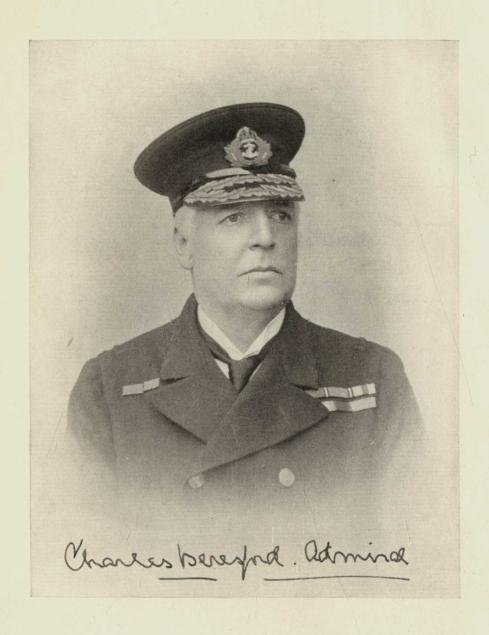
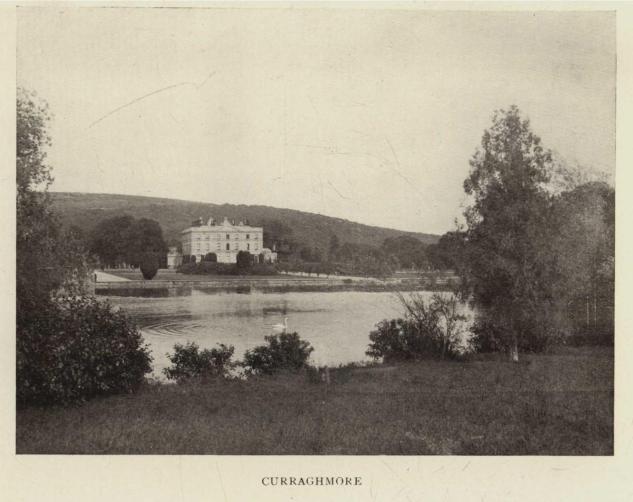
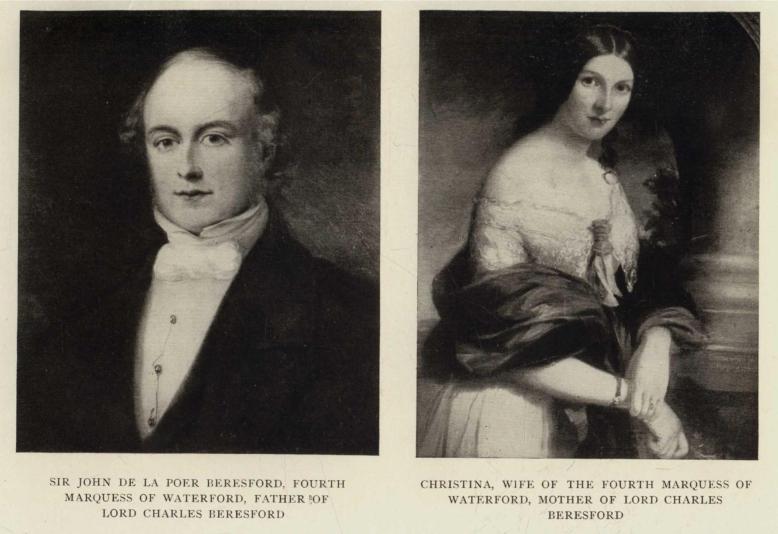
I saw the Navy for the first time in the year 1858,
when I was twelve years old. The Channel Squadron
came into the Downs; the admiral, who was a friend
of my father, invited me to visit his flagship. The admiral
put off from Deal in a six-oared galley, and I was taken
into a second boat. Both crews began to pull with all their
might. I remember being intensely excited, beating with
my hand on the gunwale and urging the men to row faster.
We were overhauling the admiral, when the boat in which
I was slackened her pace.
"Row!" I shouted. "Why don't you go on rowing?"
"We can't pass the admiral, sir," said the coxswain.
And that was my first lesson in naval etiquette.
As we drew near to the ships, there arose a great tumult
of shouting, and I could see the men running to and fro and
racing aloft, and presently they stood in rows along the
yards, manning yards in honour of the arrival of the
admiral.
The neatness and order of the stately ships, the taut
rigging, the snowy sails, the ropes coiled down neatly on
deck: these things left an abiding impression upon my
youthful mind.
It was in the winter of the same year, 1858-9, that a
certain young soldier, who had fought throughout the
Indian Mutiny with great gallantry and conspicuous ability,
came to his home in County Waterford on his first furlough.
He was Lieutenant Roberts, V.C.; now Field-Marshal Earl
Roberts of Kandahar.
"During the winter months," he writes, "I hunted with
the Curraghmore hounds, and was out with them the day
before Lord Waterford was killed. We had no run, and at
the end of the day, when wishing us good-bye, he said
'I hope, gentlemen, we shall have better luck next time.'
'Next time' there was 'better luck' as regarded the hunting,
but the worst of all possible luck for Lord Waterford's
numerous friends; in returning home after a good run, and
having killed two foxes, his horse stumbled over quite a
small ditch, throwing his rider on his head; the spinal cord
was snapped, and the fine sportsman breathed his last in
a few moments." (Forty-one years in India. By
Field-Marshal Lord Roberts of Kandahar. Bentley. 2 vols.
London, 1897, p. 451, vol. 1.)
My father, the Rev. Lord John Beresford, succeeded to
the marquisate. In the same year, 1859, I joined the Naval
Service. I remember, some years afterwards, thinking with
some degree of envy of my two younger brothers, each of
whom had three hunters, while I was only the "blood-boat"
(the jolly-boat bringing beef to the ship) midshipman of a
man-of-war.
At that time the Navy consisted of both sailing ships and
steamships. Steam was used as seldom as possible in those
ships which were fitted with masts and yards. The flagships
of the Cape of Good Hope, East Indies and China, South-east
Coast of America, Pacific and North America and West
Indies stations were all sailing ships. The Navy List of
1859 gives the names of no less than 548 "effective" ships,
together with a list of 185 "steam gunboats" and a list of
121 vessels employed in Harbour Service.
That there was so large a number of "steam gunboats"
was the result of the Crimean war, during which very
many were built for service in the Baltic. There is a story
that an admiral returning from foreign service noticed eight
gunboats aground on the Spit. Upon his inquiry, he was
informed by one of his crew that they were "commanded
by these old Baltic War mates and second masters, the
sort what knows nothing and fears nothing." But of the
sailing master there will be more to say.
The line-of-battle sailing ships which were flagships on
naval stations abroad were:—the Boscawen, 70 guns,
Rear-Admiral Hon. Sir Frederick W. Grey, Cape of Good Hope;
Calcutta, 84, Rear-Admiral Sir Michael Seymour, East
Indies and China; Cumberland, 70, Rear-Admiral Sir
Stephen Lushington, S.E. Coast of America; Ganges, 84,
Rear-Admiral R. L. Baynes, Pacific; Hibernia, 104,
Rear-Admiral H. J. Codrington, Malta; Indus, 78, Vice-Admiral
Sir Houston Stewart, North America and West Indies.
The number of ships distributed among the various
stations in 1859 was no less than 130. "Trade follows
the flag."
  East Indies and China . . . . . . .  36
  Pacific . . . . . . . . . . . . . .  12
  W. Coast of Africa  . . . . . . . .  17
  N. America and W. Indies  . . . . .  14
  S.E. Coast of America . . . . . . .  13
  Mediterranean . . . . . . . . . . .  22
  Cape of Good Hope . . . . . . . . .   5
  Australia . . . . . . . . . . . . .   4
  River Gambia  . . . . . . . . . . .   1
  Channel . . . . . . . . . . . . . .   6
                                      ---
                             Total    130
                                      ===
The presence of so large a force in Chinese waters was
due to the affair of "the lorcha Arrow," which occurred on
8th October, 1856, in the Canton River. The Arrow, a small
vessel flying the British flag, was captured by the Chinese
authorities and the crew were arrested on a charge of piracy.
In the result, Admiral Sir Michael Seymour bombarded
Canton. Operations were suspended during the Indian
Mutiny, to be resumed in 1858, with the assistance of
France. Canton was captured, and the treaty of Tien-Tsin
was concluded with China. It was not, however, ratified,
and in June, 1859—six months before I entered the
Navy—hostilities were resumed, to terminate in the burning of
the Summer Palace at Pekin, and the subsequent signing of
a convention.
I was sent to sea for the somewhat vague reasons which
so often determine a boy's future. There was a belief
that I was of a delicate constitution, and an impression—perhaps
justified—that I needed discipline. I was sent
to Bayford School in England when I was very young,
together with two of my three brothers. We were known
as the three "wild Irish." Among my schoolfellows were
the present Lord Rosebery, James Lowther, Lord Newport,
Lord Claud Hamilton and Lord George Hamilton, Lord
Worcester, and Lord Methuen. From Bayford I went to the
educational establishment of the Rev. David Bruce Payne
(afterwards Canon) at Deal, where I first saw the ships of
the Royal Navy, as already related. Canon Payne was a
splendid type of the best British clergyman, and I had a
great respect and affection for him. I was afterwards a
pupil of the Rev. Mr. Foster, of Stubbington, Fareham.
I received my nomination from Captain Charles Eden,
C.B., and qualified as a naval cadet on 12th December, 1859.
The qualifying certificate must be signed by the candidate; a
regulation which, simple as it seems, was nearly my undoing.
"Do you always sign your Christian name William with
one 'l'?" asked the examiner.
It was a critical moment. Irish resource supplied the
answer.
I said, "Only sometimes, sir."
The examiner smiled grimly. But he passed me. It
was my first narrow escape in the Navy.
I have the faded blue paper before me as I write. The
signature, laboriously written in a round hand, is "Charles
Wiliam Delapoer Beresford."
The qualifying examination was not very formidable in
those easy days. The knowledge required consisted of a
little "English," less French or Latin (with the "aid of a
dictionary"), a "satisfactory knowledge of the leading facts
of Scripture and English History," a certain amount of
geography, and an elementary knowledge of arithmetic,
algebra and Euclid. The preliminary course of education
afforded to "Volunteers," as the naval cadets used to be
called, at the Royal Naval College, Portsmouth, had been
abolished in 1837, and for the next twenty years cadets
were sent straight to sea. In 1857, cadets were entered for
training in the Illustrious, Captain Robert Harris. The
number of cadets exceeding the accommodation in the ship,
the Britannia was commissioned on 1st January, 1859, by
Captain Harris. But not for many years did the entrance
examination become the competitive ordeal for which
cramming is the only preparation, known to the present
generation. But I remember Admiral William Bowles,
commander-in-chief of Portsmouth, taking me kindly by
the shoulder and saying, "Well, my little man, you are very
small for your age. Why are you being sent to sea?"
I said that I wanted to go to sea.
"Are you good at your books?" asked the admiral.
"Bless me, I know many an admiral who could not pass
the examination you have passed. Good Heavens, what
they expect boys to do nowadays!"
The Britannia was then moored at the entrance to
Haslar Creek in Portsmouth Harbour, where the depot
ships of the submarines are moored to-day. Alongside
her, in the following year, lay the training frigate Eurydice,
which was afterwards capsized off the Isle of Wight on
24th March, 1878, when 318 lives were lost out of a
complement of 320. I learned to heave the lead from the chains
of the Eurydice.
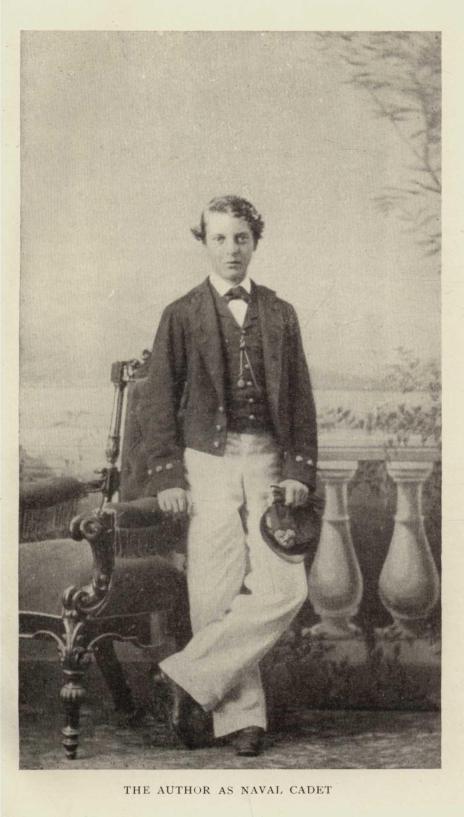
THE AUTHOR AS NAVAL CADET
In addition to the ordinary school curriculum on board
the Britannia, the cadets were taught seamanship, gunnery
and navigation. Book-work did not interest me, but I took
great pains to become proficient in seamanship, in which
I always secured a high place.
A cadet entering the Britannia under 14 years of age,
would be rejected from the Service if he failed to pass the
fourth quarterly examination after his entrance. Having
entered the Britannia in December, 1859, I was sent to sea
in March, 1861. I was very happy during my time in the
Britannia. Out of school time, we did a great deal of
boat-pulling. My boat was called the Gazelle. I remember
that one day, when I borrowed a private boat to put off to
the Gazelle, my comrades pushed me out into the stream,
and I drifted out to Spithead, without oars. There was
nothing in the boat but a painter, which I considered it
to be my duty neatly to coil down. Then I sat still and
waited until a boat came to fetch me.
Seamanship was taught by the use of models, and
sail-drill was taught upon the mizen-mast. I remember being
haunted by a doubt lest the handling of small models, and
going aloft in a stationary ship, might not enable me to
practise the knowledge thus acquired when I came to deal
with the real full-size objects and to go aloft in a ship at
sea. My prevision was largely justified; and when I came
to command a ship, I made the youngsters learn their
business by handling real things and not the models of
them. For if anything goes wrong while teaching a
youngster, for instance, to lay out a 6-ton anchor upon a
model, he puts it right with his finger and thumb and thinks
he can do the same with the real anchor.
The captain of the Britannia was Robert Harris, to
whom the Service owes the inestimable benefit of cadet
training ships. The first lieutenant was George S. Nares
(now Vice-Admiral Sir George S. Nares, K.C.B.). He
commanded the Challenger in her voyage of scientific
discovery of 1872, during which he was recalled to proceed
upon his celebrated voyage of Arctic exploration. Another
lieutenant was William H. Heaton, whose long whiskers
afforded the cadets much innocent amusement. On a
windy day his whiskers used to stream backwards over his
shoulders. Lieutenant Heaton chose to wear his stripes
running longitudinally up his arm, a peculiarity which
exemplifies the prevailing latitude with regard to uniform.
There was no rule prescribing the pattern of cap or
great-coat worn in the Service. Officers might wear the mohair
band and badge on any kind of cap that took their fancy.
Some of them used to transfer plain clothes buttons to a
uniform coat or greatcoat, if they were going ashore, for the
sake of economy; for we were nearly all poor in those days.
The chaplain and naval instructor was the Rev. Robert
M. Inskip.
My chest on board the Britannia stood between the
chests of poor "Andy" Wauchope and Henry John
Thoroton Hildyard. Both subsequently left the Navy for
the Army. The late Major-General Andrew Gilbert
Wauchope, D.S.O., was fatally wounded at Magersfontein
during the South African war. General Sir Henry
J. T. Hildyard, G.C.B., K.C.B., retired in 1911, after long and
distinguished service. I was strongly inclined to follow the
example of my comrades and to join the Army; and I have
since occasionally regretted that I remained in the Navy,
in which Service there is less opportunity for attaining the
highest rank.
I was raised to the rank of "captain" in the Britannia;
but I regret to say that my enjoyment of that dignity was
singularly brief, for I was disrated upon the same day,
even before I had time to put on the stripe. For my
delight at my promotion so exhilarated me, that I forgot
to resist the temptation to empty a bread-barge upon the
head of the old master-at-arms as he was coming up the
hatchway, and the spectacle was so amusing that I stayed to
laugh at it.
When I entered the Service, the system of training
young seamen, as well as cadets, was in operation. To
Sir James Graham, First Lord of the Admiralty, is due the
credit of introducing the training of seamen. In 1854,
he caused the Illustrious, two-decker, to be commissioned
for that purpose, under the command of Captain Robert
Harris. The fact was that as sails gave place to steam and
as the science of gunnery progressed, it became necessary
to enter seamen as boys and to train them for continuous
service. For some time the short service and long service
systems were concurrent. When I went to sea, captains
still entered men direct from the merchant service, and very
good seamen they were. They were engaged for a commission,
at the end of which they could re-engage or not as
they pleased. But in the meantime, under the admirable
administration of Captain Harris, "Jimmy Graham's
novices," as they were called, earned an excellent reputation
in the Fleet; and continuous service gradually replaced
intermittent service. In the continuous service system
resided our chief superiority over foreign Navies. The
objection to it on the part of the Government was (and is)
the increasing permanent charge of pensions. But in the
interests of the Service and of the country, it cannot be too
clearly understood that the system is well worth the cost,
and that the revival of the short service system is profoundly
to be regretted.
NOTE
H.M.S. Britannia.—She was the seventh ship of her
name. She was launched at Plymouth in 1820, was pierced
for 120 guns, and her complement was 900 men. Her
length, beam and draught were 205 feet, 53 feet and 18 feet
respectively. In the Crimean war, she landed 200 men
as part of the naval brigade which assisted the Army at
the siege of Sevastopol, and took part in the bombardment
of that town. She was commissioned on 1st January, 1859,
by Captain Robert Harris, as a training ship for cadets.
The Britannia was stationed first in Portsmouth Harbour,
then at Dartmouth. She was broken up in 1869. The
memory of Captain Robert Harris deserves to be held in
high honour. Vice-Admiral Sir William Fanshawe Martin,
who himself achieved great reforms in the discipline of
the Fleet, while in command of the Mediterranean Fleet,
wrote to Captain Harris under date 18th January, 1861,
"There is no man in England whose opportunity of doing
good to our country for ages to come is greater than yours;
and assuredly the Navy is greatly your debtor." (The Story of
the Britannia, by Commander E. P. Statham, R.N. Cassell.)
The successor of the Britannia in which Lord Charles
Beresford received his training, the eighth of her name,
known and remembered with affection by all naval officers
save the new generation, lay at Dartmouth for more than
forty years, when her functions were transferred to the
colleges on shore. (The King's Ships, by H. S. Lecky,
Lieut. R. N. Muirhead. Vol. 1.)
On the 25th of March, 1861, I was appointed naval
cadet in the Marlborough. As I climbed up her side
by the hand-rungs, while my chest was being hoisted
in over all, I perceived two huge men looking down upon me,
and I heard one say to the other:—
"That white-faced little beggar ain't long for this world,
Dick."
The speaker was John Glanville (called Clamfy Glanville),
boatswain's mate (of whom more anon), and he addressed
this lugubrious remark to Dicky Horne, the quartermaster,
a very fat man. It was a far from encouraging welcome to
the sea; but the fact was that I had been ill, and was feeling
very cold as I climbed up the side of the ship. At first, I
was much disappointed at having been sent to a large
ship, for we youngsters had a notion that there were more
freedom and independence in a small ship; and besides,
I wanted to go to China. But I went to China all in
good time.
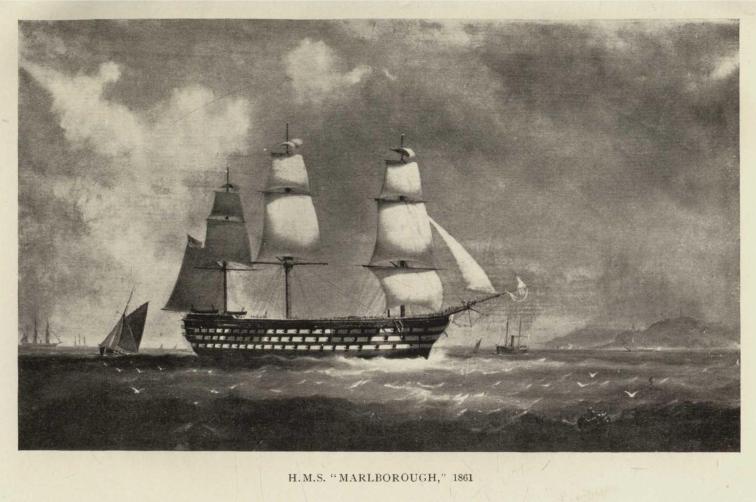
The Marlborough was the flagship of the Mediterranean
station. She was a wooden line of battleship, three-decker,
launched in 1835, 4000 tons burthen old measure, 6390
displacement new measure, fitted with single screw horizontal
Maudslay engines. The length of her gundeck was 245 feet
6 inches, her extreme beam was 61 feet, her maximum
draught was 26 feet. Her complement was 950, and she
always carried 100 or more supernumeraries. She was
pierced for 131 guns and she carried 121 guns. She was
one of the first ships to be fitted with wire lower rigging.
In the Marlborough the old 24-inch hemp cable was used for
laying out anchor at drill. It was the same class of cable as
that which was used in Nelson's time; it was superseded by
the chain cable.
The vice-admiral in command of the Mediterranean
station was Sir William Fanshawe Martin (called "Fly"
Martin); the captain, William H. Stewart; the commander,
Thomas Brandreth: three of the finest officers that ever lived.
The captain of the Fleet was Rear-Admiral Sydney C. Dacres,
C.B. His duties were those of what we should now
call a chief of staff. The office was subsequently abolished;
and it was always my desire to see it restored.
Ships in those days were manned according to the number
of guns they carried. The theory was that if the boats'
crews were absent from the ship, there should always be
sufficient men on board to work the sails and the guns. The
watch-bills were made out upon this principle, the men being
distributed among what were called the "parts of the
ship." In the case of a newly commissioned ship, the making out
of the watch-bills and assigning his place to each man, was
the first thing to be done. It was no small task, especially
as no printed forms were supplied for the purpose. The
watch-bills were ruled and entered by the officers on paper
supplied by themselves, and were arranged upon the tradition
handed down for centuries. Even the signalmen supplied
their own pencils and paper. Each ship made its own
arrangement. It was not until 1860 that uniform watch-bills,
quarter-bills and station-bills were instituted.
H.M.S. "MARLBOROUGH," 1861
The men were classed in the following categories, each
"part of the ship" being divided into port watch and
starboard watch.
The Forecastlemen
The Foretopmen
The Maintopmen
The Mizentopmen
The Gunners
The Afterguard
The Royal Marines
The Idlers
The Forecastlemen were most experienced seamen. They
wore their caps a little differently from the others. They
manned the foreyard, and worked the foresail, staysail, jib,
flying jib, jibboom, flying jibboom and lower studdingsails.
The Foretopmen worked the foretopsail, foretopgallant
and foreroyal yards, foretopgallantmast, foretopmast and
topgallant studding-sails.
The Maintopmen worked the maintopsail, maintopgallant
and main-royal yards and maintopgallantmast, maintopmast
and topgallant studding-sails.
The Mizentopmen worked the mizentopsail, mizentopgallant
and mizen-royal yards, and mizentopgallantmast,
mizentopmast and mizencourse (if there was one), also the
driver.
The upper-yard men were the smartest in the ship, whose
character largely depended upon them.
The Gunners, assisted by the Afterguard, worked the
mainsail and mainyard. These were generally old and steady
men, who were not very quick aloft. The gunners were
also responsible for the care and maintenance of the gun
gear, side tackles, train tackles and the ammunition. The
senior warrant officer was the gunner.
There were only three warrant officers:—gunner,
boatswain and carpenter.
The Royal Marines were divided between fore and aft,
working on forecastle and quarterdeck. I remember seeing
a detachment of Marines, upon coming aboard, fallen in
while the blacksmith, lifting up each man's foot behind him,
wrenched off and dropped into a bucket the metal on the
heel of his boot, lest it should mark the deck.
The Afterguard worked on the quarterdeck and helped
with the mainyard. They were the less efficient men and
were therefore employed under the eye of the commander.
The Idlers were not idlers. They were so called because
(theoretically) they had their nights in, although actually
they turned out at four o'clock a.m. They were artificers,
such as carpenters, caulkers, plumbers, blacksmiths, etc.
They worked all day at their several trades until their
supper-time. They were nearly all old petty officers, steady and
respectable. It was part of their duty to man the pumps
every morning for washing decks. I made up my mind
that, if ever I was in a position to do so, I would relieve them
of an irksome and an inappropriate duty.
In action, the carpenters worked below decks, stopping
holes with shot-plugs, while many of the other Idlers worked
in the magazines. Among the Idlers was the ship's
musician—unless the ship carried a band—who was a fiddler. He
used to play to the men on the forecastle after working hours
and when they manned the capstan. Personally I always
considered the name of Idlers to be anomalous. They are
now called Daymen.
Among the ship's company were several negroes. At
that time, it was often the case that the captain of the hold
and the cooper were coloured men.
An instance of the rapidity and efficiency of the organisation
of the Marlborough occurred upon the night before she
sailed for the Mediterranean. She was newly commissioned,
and she carried a large number of supernumeraries on
passage. We took out 1500 all told. A fire broke out on
the orlop deck; the drum beat to quarters; every man
instantly went to his station, to which he had previously been
told off; and the fire was speedily extinguished. The event
was my first experience of discipline in a big ship.
The nature of the discipline which was then in force, I
learned on the way out to the Mediterranean. In the modern
sense of the word, discipline was exemplified by the Royal
Marines alone. I cannot better convey an idea of the old
system than by means of an illustration. Supposing that a
Marine and a bluejacket had each committed an offence.
The Marine was brought up on the quarter-deck before the
commander, and the charge was read to him. The
commander asked him what he had to say. The prisoner,
standing rigidly to attention, embarked upon a long rambling
explanation. If his defence were invalid, the commander
cut him short, and the sergeant gave his order. "Right
turn. Quick march." The Marine, although continuing
to protest, obeyed automatically, and away he went. He
continued to talk until he was out of hearing, but he went.
Not so the bluejacket. He did not stand to attention, not
he. He shifted from one foot to the other, he hitched his
breeches, fiddled with his cap, scratched his head.
"Well, sir," said he, "it was like this here, sir," ... and
he began to spin an interminable yarn.
"That'll do, my man," quoth the commander. But, not
at all. "No, sir, look here, sir, what I wants to say is
this"—and so on, until the commander had to order a file of Marines
to march him below.
But both Marine and bluejacket had this in common:
each would ask the commander to settle the matter rather
than let it go before the captain; and the captain, to
sentence him rather than hold a court-martial.
The explanation of the difference between the old system
of discipline and the new is that in the sailing days it was of
the first importance that the seaman should be capable of
instant independent action. The soldier's uniformity and
military precision were wholly unsuited to the sailor, who, at
any moment, might have to tackle an emergency on his own
initiative. If a seaman of the old days noticed anything
wrong aloft, up he would run to put it right, without waiting
for orders. Life and death often hung upon his promptitude
of resource.
In the old days, we would often overhear such a conversation
as the following:—
Officer: "Why the blank dash didn't you blank well do
so-and-so when I told you?"
Man: "Why didn't I? Because if I had I should have
been blank well killed and so would you."
Officer: "Damn you, sir, don't you answer me! I shall
put you in the report."
Man: "Put me in the ruddy report, then."
And the next day the commander, having heard both
sides, would say to the officer,
"Why, the man was quite right." And to the man, "You
had no right to argue with the officer. Don't do it again.
Now get away with you to hell."
And everyone would part the best of friends.
The change came with the improvement and progress in
gunnery, which involved, first, the better drilling of the
small-arm companies. In my early days, the small-arm companies
used to drill with bare feet. Indeed, boots were never worn
on board. It was of course impossible to wear boots going
aloft for a sailor going aloft in boots would injure the heads
and hands of his topmates. Occasionally the midshipmen
went aloft barefooted like the men. So indurated did the
feet of the sailors become, that they were unable to wear
boots without discomfort, and often carried them when they
were ashore.
A sailor's offences were hardly ever crimes against honour.
They rather arose from the character induced by his calling.
Its conditions were hard, dangerous and often intensely
exciting. The sailor's view was devil-may-care. He was
free with his language, handy with his fists and afraid of
nothing. A smart man might receive four dozen for some
violence, and be rated petty officer six months afterwards.
Condemnation was then the rule. Personally, I endeavoured
to substitute for it, commendation. For if there are two
men, one of whom takes a pride in (say) keeping his rifle
clean, and the other neglects it, to ignore the efficiency of
the one is both to discourage him and to encourage the other.
Before the system of silence was introduced by the
Marlborough the tumult on deck during an evolution or
exercise was tremendous. The shouting in the ships in
Malta Harbour could be heard all over Valetta. The
Marlborough introduced the "Still" bugle-call. At the
bugle-call "Still" every man stood motionless and looked
at the officer. For in order to have an order understood,
the men must be looking at the officer who gives it. During
the Soudan war, I used the "Still" at several critical
moments. Silence and attention are the first necessities for
discipline. About this time the bugle superseded the drum
in many ships for routine orders.
There were few punishments, the chief punishment being
the cat. The first time I saw the cat applied, I fainted.
But men were constantly being flogged. I have seen six
men flogged in one morning. Even upon these painful
occasions, the crew were not fallen in. They were merely
summoned aft "for punishment"—"clear lower deck lay aft
for punishment" was piped—and grouped themselves as they
would, sitting in the boats and standing about, nor did they
even keep silence while the flogging was being inflicted.
The officers stood within three sides of a square formed by
the Marines. Another punishment was "putting the admiral
in his barge and the general in his helmet," when one man
was stood in a bucket and the other had a bucket on his
head.
Very great credit is due to Admiral Sir William Martin,
who reformed the discipline of the Fleet. The Naval
Discipline Act was passed in 1861; the New Naval Discipline
Act in 1866. In 1871 a circular was issued restricting the
infliction of corporal punishment in peace time. Flogging
was virtually abolished in 1879. (Laird Clowes' The Royal
Navy, vol. 7.) Now we have proper discipline and no cat.
In former days, we had the cat but no proper discipline.
The men were granted very little leave. They were often
on board for months together. When they went ashore,
there they remained until they had spent their last penny;
and when they came on board they were either drunk or
shamming drunk. For drunkenness was the fashion then,
just as sobriety is, happily, the fashion now. In order to be
in the mode, a man would actually feign drunkenness on
coming aboard. In many a night-watch after leave had been
given have I superintended the hoisting in of drunken men,
who were handed over to the care of their messmates.
To-day, an intoxicated man is not welcomed by his mess, his
comrades preferring that he should be put out of the way in
cells. It was impossible to keep liquor out of the ship. Men
would bring it aboard in little bladders concealed in their
neckties. Excess was the rule in many ships. On
Christmas Day, for instance, it was not advisable for an
officer to go on the lower deck, which was given up to license.
I remember one man who ate and drank himself to death on
Christmas Day. There he lay, beside a gun, dead. Other
cases of the same kind occurred in other ships.
The rations were so meagre that hunger induced the men
constantly to chew tobacco. For the same reason I chewed
tobacco myself as a boy. Nor have I ever been able to
understand how on such insufficient and plain diet the men
were so extraordinarily hardy. They used to go aloft and
remain aloft for hours, reefing sails, when a gale was blowing
with snow and sleet, clad only in flannel (vest) serge frock and
cloth or serge trousers, their heads, arms and lower part of
their legs bare. Then they would go below to find the decks
awash in a foot of water, the galley fire extinguished, nothing
to eat until next meal time but a biscuit, and nothing to
drink but water.
Seamen often curse and swear when they are aloft
furling or reefing sails in a gale of wind; but I have never
heard a sailor blaspheme on these occasions. Their language
aloft is merely a mode of speaking. Although in the old
days I have heard men blaspheme on deck, blasphemy was
never heard aloft in a gale. To be aloft in a whole gale or in
a hurricane impresses the mind with a sense of the almighty
power of the Deity, and the insignificance of man, that puny
atom, compared with the vast forces of the elements.
In later life, I once said to a young man whom I heard
using blasphemous language in a club:
"If you were up with me on the weather yard-arm of a
topsail yard reefing topsails in a whole gale, you would be
afraid to say what you are saying now. You would see
what a little puny devil a man is, and although you might
swear, you would be too great a coward to blaspheme."
And I went on to ram the lesson home with some
forcible expressions, a method of reproof which amused
the audience, but which effectually silenced the blasphemer.
The fact is, there is a deep sense of religion in those who
go down to the sea in ships and do their business in the
great waters. Every minister of God, irrespective of the
denomination to which he belongs, is treated with respect.
And a good chaplain, exercising tact and knowing how to
give advice, does invaluable service in a ship, and is a great
help in maintaining sound discipline, inasmuch as by virtue
of his position he can discover and remove little
misunderstandings which cause discontent and irritation.
The discomforts of the Old Navy are unknown to the
new. The sanitary appliances, for instance, were placed
right forward in the bows, in the open air. If the sea were
rough they could not be used. On these occasions, the state
of the lower deck may with more discretion be imagined than
described. As the ship rolled, the water leaked in through the
rebated joints of the gun-ports, and as long as a gale lasted the
mess-decks were no better than cesspools. It is a curious fact
that in spite of all these things, the spirits of both officers
and men rose whenever it came on to blow; and the harder
it blew, the more cheery everyone became. The men sang
most under stress of weather; just as they will to-day under
the same conditions or while coaling ship. After a gale of
wind, the whole ship's company turned-to to clean the ship.
In those days the men used to dress in cloth trousers
and tunic with buttons. The men used to embroider their
collars and their fronts with most elaborate and beautiful
designs. They had two hats, a black hat and a white hat,
which they made themselves. The black hats were made of
straw covered with duck and painted. Many a man has lost
his life aloft in trying to save his heavy black hat from being
blown away.
The fashion of wearing hair on the face was to cultivate
luxuriant whiskers, and to "leave a gangway," which meant
shaving upper lip, chin and neck. Later, Mr. Childers
introduced a new order: a man might shave clean, or cultivate all
growth, or leave a gangway as before, but he might not wear
a moustache only. The order, which applied to officers and
men (except the Royal Marines) is still in force.
Steam was never used except under dire necessity, or
when entering harbour, or when exercising steam tactics as a
Fleet. The order to raise steam cast a gloom over the
entire ship. The chief engineer laboured under considerable
difficulties. He was constantly summoned on deck to be
forcibly condemned for "making too much smoke."
We were very particular about our gunnery in the
Marlborough; although at the same time gunnery was regarded
as quite a secondary art. It was considered that anyone
could fire a gun, and that the whole credit of successful
gunnery depended upon the seamanship of the sailors who
brought the ship into the requisite position. The greater
number of the guns in the Marlborough were the same as
those used in the time of Nelson, with their wooden trucks,
handspikes, sponges, rammers, worms and all gear complete.
The Marlborough was fitted with a cupola for heating
round-shot, which were carried red-hot to the gun in an iron
bucket. I know of no other ship which was thus equipped.
The gunnery lieutenant of the Marlborough, Charles
Inglis, was gifted with so great and splendid a voice, that,
when he gave his orders from the middle deck, they were
heard at every gun in the ship. We used to practise firing
at a cliff in Malta Harbour, at a range of a hundred yards
or so. I used to be sent on shore to collect the round-shot
and bring them on board for future use. I remember that
when, in the course of a lecture delivered to my men on
board the Bulwark more than forty years afterwards, I
related the incident, I could see by their faces that my
audience did not believe me; though I showed to them the
shot-holes in the face of the cliff, which remain to this day.
On gunnery days, all fires were extinguished, in case a spark
should ignite the loose powder spilt by the boys who brought
the cartridges to the guns, making a trail to the magazines.
At "night quarters," we were turned out of our hammocks,
which were lashed up. The mess-tables were triced up
overhead. The lower-deck ports being closed, there was no
room to wield the wooden rammer; so that the charges for
the muzzle-loading guns were rammed home with rope
rammers. Before the order to fire was given, the ports were
triced up. Upon one occasion, so anxious was a bluejacket
to be first in loading and firing, that he cherished a charge
hidden in his hammock since the last night quarters, a period
of nearly three months, and, firing before the port was triced
up, blew it into the next ship.
In those days, the master was responsible for the navigation
of the ship. He was an old, wily, experienced seaman,
who had entered the Service as master's mate. (When I
was midshipman in the Defence, the master's assistant was
Richard W. Middleton, afterwards Captain Middleton, chief
organiser of the Conservative Central Office.) The master laid
the course and kept the reckoning. As steam replaced sails,
the office of master was transferred to the navigating officer,
a lieutenant who specialised in navigation. The transformation
was effected by the Order in Council of 26th June, 1867.
The sail-drill in the Marlborough was a miracle of
smartness and speed. The spirit of emulation in the Fleet
was furious. The fact that a certain number of men used
to be killed, seemed to quicken the rivalry. Poor Inman, a
midshipman in the Marlborough, a great friend of mine, his
foot slipping as he was running down from aloft, lost his
life. His death was a great shock to me.
The men would run aloft so quickly that their bare feet
were nearly indistinguishable. Topmasts and lower yard
were sent down and sent up at a pace which to-day is
inconceivable.
I once saw the captain of the maintop hurl himself bodily
down from the cap upon a hand in the top who was slow in
obeying orders. That reckless topman was Martin Schultz,
a magnificent seaman, who was entered by the captain
direct from the Norwegian merchant service, in which he
had been a mate.
Mr. George Lewis, an old topmate of mine, who was one
of the smartest seamen on board H.M.S. Marlborough, has
kindly sent to me the following interesting details with
regard to the times of sail-drill and the risks incidental to
the evolutions.
                                   Time allowed       Time in
                                    by Admiral.    _Marlborough_.
                                      Min.  Sec.      Min.  Sec.

  Cross topgallant and royal yards      1     0        0     30
  Down topgallant yards with royal
      yards across                      2     0        1     13
  Up topgallant mast, cross upper
      yards and loose sails             2    30        1     27
  Shift topgallant masts from royal
      yards across                      7     0        5     40
  Up topgallant mast and make all
      plain sail                        4     0        2     40
  Up topgallant mast and make all
      possible sail                     6     0        3      0
  Shift topsails from plainsail         6     0        4     50
  In all boom boats from away aloft     7     0        6      0
  Out all boom boats                    7     0        5     40
  Away lifeboat's crew                  0    30        0     20
What Mr. Lewis means by "admiral's time," let him
explain in his own words. "When our admiral" (Sir
William Martin) "was captain of the Prince Regent, which
was considered the smartest ship in the Navy, he brought
all her times of all her drills to the grand old Marlborough
along with him; and you know, my lord, that he allowed
us six months to get our good old ship in trim before we
drilled along with the Fleet; but we started to drill along with
the Fleet after three months, and were able to beat them all."
"Now, my lord," continues Mr. Lewis, "I come to one
of the smartest bits of our drill. When we were sailing in
the Bay of Naples under all possible sail, our captain wanted
to let the world see what a smart ship he had and what a
smart lot of men was under him. From the order 'Shift
topsails and courses make all possible sail again'"—which
really means that the masts were stripped of sails and again
all sails were hoisted—"Admiral's time 13 minutes, our time
9 minutes 30 seconds. All went without a hitch, within 400
yards of our anchorage."
Mr. Lewis proceeds to recount a very daring act of his
own. "We were sending down upper yards and topgallant
mast one evening, and it was my duty to make fast the
lizard. But I could only make fast one hitch, so I slid down
the mast rope and it turned me right over, but I managed to
catch the lizard and hold on to it, and so saved the mast
from falling on the hundred men that were in the gangway.
No doubt if it had fallen on them it would have killed a
good many...."
What happened was that Lewis, in the tearing speed of
the evolution, not having time properly to secure the head
of the mast as it was coming down, held the fastening in
place while clinging to the mast rope and so came hurtling
down with the mast. He adds that he "felt very proud"—and
well he might—when the captain "told the admiral on
Sunday that I was the smartest man aloft that he had ever
seen during his time in the Service." He had an even
narrower escape. "I was at the yard-arm when we had
just crossed" (hoisted into place). "I was pulling down the
royal sheet and someone had let it go on deck, and I fell
backwards off the yard head-foremost. I had my arm
through the strop of the jewel block, and it held me, and
dropped me in the topmast rigging, and some of my
topmates caught me."
Mr. Lewis himself was one of the smartest and quickest
men aloft I have ever seen during the whole of my career.
The men of other ships used to watch him going aloft. "My
best time," he writes—and I can confirm his statement
"from ''way aloft' to the topgallant yard-arm was 13
seconds, which was never beaten." It was equalled, however,
by Ninepin Jones on the foretopgallant yard. The topgallant
and royal yard men started from the maintop, inside
of the topmast rigging, at the order '"way aloft." The
height to be run from the top, inside of the topmast rigging,
to the topgallant yard-arm was 64 feet. From the deck to
the maintop was 67 feet. At one time, the upper-yard
men used to start from the deck at the word "away
aloft"; but the strain of going aloft so high and at so
great a speed injured their hearts and lungs, so that they
ascended first to the top, and there awaited the order
"away aloft."
The orders were therefore altered. They were: first,
"midshipmen aloft," when the midshipmen went aloft to
the tops; second, "upper-yard men aloft," when the
upper-yard men went aloft to the tops, and one midshipman went
from the top to the masthead.
At the evening or morning evolution of sending down
or up topgallant masts and topgallant and royal yards, only
the upper-yard men received the order, "upper-yard men
in the tops." The next order was "away aloft," the
upper-yard men going to the masthead.
At general drill, requiring lower- and topsail-yard men
aloft, as well as upper-yard men, the orders were: first,
"midshipmen aloft"; then "upper-yard men in the tops";
then, "away aloft," when the lower- and topsail-yard men
went aloft to the topsail and lower yards, and the upper-yard
men went aloft to the masthead.
These arrangements applied of course only to drill. In
the event of a squall or an emergency, the men went straight
from deck to the topgallant and royal yards.
Mr. Lewis's performance was a marvel. Writing to me
fifty years afterwards, he says:—"I think, my lord, it
would take me a little longer than 13 seconds now to get
to the maintopgallant yard-arm and run in again without
holding on to anything, which I have done many hundreds
of times."
The men would constantly run thus along the yards—upon
which the jackstay is secured, to which again the sail is
bent, so that the footing is uneven—while the ship was
rolling. Sometimes they would fall, catching the yard, and
so save themselves.
The foretopgallant-yard man, Jones, was as smart as
Lewis, though he never beat Lewis's record time. These
two men were always six to ten ratlines ahead of the other
yard men, smart men as these were. One day Jones lost a
toe aloft. It was cut clean off by the fid of the
foretopgallant mast. But Jones continued his work as though
nothing had happened, until the drill was ended, when he
hopped down to the sick bay. He was as quick as ever
after the accident; and the sailors called him Ninepin
Jack.
Another old topmate, Mr. S. D. Sharp, writing to me in
1909, when I hauled down my flag, says:—"I was proud of
the old Marlborough and her successor up the Straits, the
Victoria. They were a noble sight in full sail with a stiff
breeze. No doubt the present fleet far excels the old wooden
walls, but the old wooden walls made sailors. But sailors
to-day have to stand aside for engine-men. Going round
Portsmouth dockyard some few years since, I was very sad to
see the noble old Marlborough a hulk" (she is now part of
H.M.S. Vernon Torpedo School), "laid aside, as I expect we
all shall be in time" (Mr. Sharp is only between seventy and
eighty years of age). "I am doubtful if there are many men
in the Navy to-day who would stand bolt upright upon the
royal truck of a line-of-battle ship. I was one of those who
did so. Perhaps a foolish practice. But in those days fear
never came our way."
There speaks the Old Navy.
When a ship was paid off out of Malta Harbour, it was
the custom that there should be a man standing erect on each
of the trucks, main, mizen and fore. Many a time have I seen
these men balanced more than 200 feet in the air, strip off
their shirts and wave them. And once I saw a man holding
to the vane-spindle set in the truck, and I saw the spindle
break in his hand, and the man fall....
In the course of my experience, I have seen a man fall
off the main-royal yard, be caught in the belly of the
mainsail slip down the sail, catch the second reef-line with his
legs, and hold on until a topmate ran aloft with a bowline
and saved him.
I have seen a man fall off the maintopsail yard, and be
caught in the bight of the mainsheet in the main rigging,
and run aloft again. And this was at sea.
And several times I have seen a man fall from aloft to be
dashed to pieces upon the deck.
One of the closest escapes I have ever had occurred aloft
in the Marlborough. Being midshipman of the mizenroyal,
I was furling the sail, leaning forward upon the yard,
gathering in the canvas, my feet braced backward upon the
footrope, when another midshipman, leaping upon the
footrope, accidentally knocked it from under my feet. For
two or three seconds I hung by the tips of my fingers, which
were pressed against the jackstay of the mizen-royal yard
(the rope running taut along the top of the yard to which
the sail is bent) under which I could not push my fingers,
and then, at the last moment, I found the footrope again. I
have never forgotten my feelings, when I saw certain death
approaching while my feet were clawing about for the
footrope.
When the hands were turned out to bathe, John Glanville,
chief boatswain's mate, would go up to the main-yard, stand
with one foot on the yard and the other on the preventive
braceblock, and thence take a header. The height was
between 50 and 60 feet. Once he struck the sea sideways,
and was injured, so that he was never quite the same man
afterwards. But any other man would have been killed.
On another occasion, when the ship was hove-to for the
hands to bathe, the captain of the forecastle hauled the jib
sheet aft, and the ship began to glide away from the officers
and men, myself among them, in the water. Luckily all got
on board again.
In the spirit of emulation, I fell into deserved disgrace at
sail-drill. In order to be first in the evolution, I secretly
unbent the foretopgallant sheet before the men arrived at
the masthead. Another midshipman did likewise at the
main. He was Arthur Gresley, one of the smartest
midshipmen aloft, and one of the best oars in the Service, a
splendid, cheery, chivalrous, noble-minded lad. We were
discovered; and, before all the men, we were ordered down
on deck, and were severely reprimanded for having
endeavoured to gain an unfair advantage, thereby staining the
character of a ship justly noted for her scrupulous fair play.
I was taken out of my top, deprived of the command of my
boat, and disrated to cadet; and I had serious thoughts of
ending a ruined career by jumping overboard. I have never
been so genuinely unhappy before or since. But upon the
following day I was rated up again, and replaced in my
top and my boat.
At first in the Marlborough I was midshipman of the
mizentop, and in charge of the jolly-boat. The midshipman
in charge of a boat learned how to handle men. As he was
away from the ship with them for long periods, he was
forced to understand them and to discover how to treat
them, thus learning the essential elements of administration.
As all my delight was in seamanship, I contrived to miss a
good deal of school. It was not difficult, when the naval
instructor desired my presence, to find a good reason for
duty with my boat. I was afterwards midshipman of the
foretop, and when I was promoted from the jolly-boat to
the second pinnace, and to the command of the first
subdivision of the three-pounder division of field-guns for
landing, being placed in charge of one three-pounder gun, I
thought I was an emperor.
We used to land with the guns for field-battery exercises,
setting Marine sentries all round to prevent the men getting
away to drink. Returning on board, we used to race down
the Calcara Hill at Malta to the harbour. On one occasion,
we were going so fast that we couldn't turn the gun round
the corner, and gun and all toppled over the wharf into the
water.....
I fell into another scrape in excess of zeal for
marksmanship. We used to practise aiming with rifles and
muzzle-loading Enfields, the Service rifle of that day. We
fired percussion caps without charges, at little bull's-eyes
painted on a strip of canvas, which was stretched along the
bulwarks below the hammock-nettings. The marksman
stood on the opposite side of the deck. Another midshipman
and myself contrived to fire a couple of caps as projectiles,
which of course entered the woodwork behind the targets,
making dreadful holes. This appalling desecration, involving
the fitting in of new planking, was discovered by the
commander, Brandreth. His rage was justifiable. We
were stood on the bitts, and also mastheaded.
Captain Houston Stewart used to fish from the stern
gallery when the ship was at anchor. He tied his line to
the rail, and went back into his cabin, returning every few
minutes to see if he had a fish. Beneath the stern gallery
opened the ports of the gunroom. With a hooked stick
I drew in his line, attached a red herring to the hook,
dropped it in again, and when the captain came to feel his
line I jerked it. He hauled it up in a hurry. Instantly
after, he sent for all the midshipmen; and, for some reason
or other, he picked me out at once.
"You did that, Beresford," he said. "Most impertinent!
Your leave will be stopped."
Next day, however, he let me off.
Among the most delightful incidents were the boat-races.
It was before the time when fleet regattas were
instituted. What happened was that a boat would row
round from their ship, to the ship they wished to race,
and toss oars under her bows in sign of a challenge.
Then the boat's crew of the challenged ship would practise
with intense assiduity until they felt they were fit to meet
the enemy. The bitterest feeling was aroused. Even the
crews of "chummy ships" could not meet without fighting.
Hundreds of pounds were wagered on the event. In the
Marlborough we had the cutter, Black Bess, specially built
for racing. Her stroke was John Glanville, the gigantic
boatswain's mate, who, when I joined the ship, told Dicky
Horne, the quartermaster, that I was not likely to live
long. He was the son of Ann Glanville, the redoubtable
West country woman who pulled stroke in the crew of
Saltash women that raced and beat a crew of Frenchmen
at Cherbourg, under the eyes of the Queen, the Prince
Consort, the Emperor Napoleon III., and the British and
French navies. That notable victory was won in 1858,
when Queen Victoria, accompanied by the Prince Consort,
visited Napoleon III. The Queen and the Prince sailed
in H.M.S. Victoria and Albert, escorted by a squadron
of men-of-war. They were received by the French Navy.
After the race, the Queen invited the Saltash women on
board the Royal yacht. Later in life, it was my privilege
to remove anxiety concerning her livelihood from fine old
Mrs. Glanville.
I steered the Black Bess, and we beat the two best boats
in the Fleet; and then we were challenged by the St. George.
The St. George had taken the upper strake off her boat to
make her row easier. Now the stroke of the St. George
was George Glanville, brother to John, and of the same
formidable weight and size. The race was rowed in Malta
Harbour, over a 3½-mile course, and we were beaten. We
could not understand it; but beaten we were. That night
George Glanville came aboard the Marlborough with a bag
containing some £300 the money put up to cover the
stakes. George came to receive the stakes, and according to
custom he brought the cover-money to show that all was
above-board. To him came John his brother; and scarce a
word was said ere the two big men were fighting furiously,
the bag of gold on the deck beside them. They were torn
apart with difficulty. Nor could the respective crews be
landed together for a long time afterwards. Next year we
beat the St. George.
When we lay in Corfu Harbour, the Marlborough was
challenged by a crew of artillerymen. It was I think on
this occasion that John Glanville headed a deputation to me,
asking me to be the coxswain.
"Well, sir," he said, "it's like this here, sir, if you'll
pardon me. Yew be young-like, and what we was thinking
was whether you have the power of language that du be
required."
I said I would do my best. I did. I astonished
myself. As for the artillerymen, they rowed themselves
right under. There was a little seaway, and they rowed
the boat under and there they were struggling in the
water.
"What! Yew bain't never going to pick 'em up?" cried
John Glanville, in the heat of his excitement.
I also rowed bow-oar in the officers' boat, the second
cutter. I was young and small, but I had great staying
power. I could go on rowing for ever.
When my leave was stopped—which did occur occasionally—I
had a system by means of which I went ashore at
night. I lashed a hammock-lashing round the port stern-ring,
crawled out of the stern port, lowered myself to the
water, and swam to a shore boat, waiting for me by arrangement.
Maltese boats are partly covered in, and I dressed
in a spare suit of clothes. On one occasion, upon landing,
I nearly—but not quite—ran into the arms of the
commander.
One night I went ashore, taking a painter and two men.
We lowered the painter over the edge of the cliff, and he
inscribed on the cliff in immense letters, "'Marlborough,' Star
of the Mediterranean." Next morning the whole Fleet,
not without emotion, beheld the legend. Another brilliant
wit went ashore on the following night and altered the word
"Star" into "Turtle." My reply was the addition "Until
the 'Queen' comes out." After this exploit I was sent
ashore to clean the cliff.
There were numerous horses in Malta, and the midshipmen
and bluejackets used to hire them for half-a-crown a
day. When the horses had had enough of their riders, they
used to gallop down to the Florian Gate, kick them off, and
return to their stable. I heard one sailor remark to another,
who, sticking to his horse, was bounding up and down in
his saddle:
"Get off that there 'orse, Jack, 'e's a beast!"
"He aint no beast at all," retorted Jack. '"E's the
cleverest 'orse I ever see. He chucks me up and he catches
me, he chucks me up and he catches me—why, 'e's only
missed me three times in a hour!"
There used to be very bad feeling between English and
Maltese. Both sailors and soldiers frequently lost their
lives on shore. The seamen used to be stabbed, and the
soldiers were sometimes thrown over the fortifications at
night. I have seen a dead soldier lying on the rocks where
he was thrown. A party of Marlborough officers drove out
in "go-carts" (two-wheeled vehicles in which passengers lay
on cushions) to Civita Vecchia, to hear the celebrated Mass
on New Year's Eve. The Cathedral was the richest church
in Europe until Napoleon confiscated its treasure. Somehow
or other, there was a row, and we were fighting fiercely with
a crowd of Maltese. A clerk of our party, a very stout
person, was stabbed in the belly, so that his entrails
protruded. We got him away, laid him in a go-cart, drove
back to Malta, a two-hours' drive, and put him on board,
and he recovered.
At nine o'clock p.m. the seniors in the gunroom stuck
a fork in the beam overhead, the signal for the youngsters
to leave their elders in peace—too often to drink.
Sobriety—to put it delicately—was not reckoned a virtue. I
remember visiting a ship at Bermuda (never mind her
name) to find every member of the mess intoxicated. Two
were suffering from delirium tremens; and one of them was
picking the bodies of imaginary rats from the floor with a
stick, His case was worse than that of the eminent member
of a certain club in London, who, when a real rat ran across
the carpet, looked solemnly round upon the expectant faces
of his friends, and said, "Aha! You thought I saw a rat.
But I didn't!"
There was no rank of sub-lieutenant, the corresponding
grade being a "mate." Many of the mates were men of
thirty or more, who had never gained promotion and who
never would gain it. I remember an old mate who used
to earn his living by rowing a wherry in Portsmouth
Harbour. He was then (1862) on half-pay, with seniority
of 1820. His name was Peter B. Stagg, as you may see in
the Navy Lists of the period. In the Navy List of 1862,
Stagg is rated sub-lieutenant, the rank of mate having been
abolished in the previous year.
Wisdom spoken by babes was not approved in the
Marlborough. I ventured to remark a thing I had observed,
which was that the masts of men-of-war were out of
proportion tall as compared with the sails they carried; or, in
technical language, that the masts were very taunt, whereas
the sails were not proportionately square. I said that the
masts ought to be lower and the sails squarer, thus
increasing the sailing power.
"D—n it! Listen to this youngster laying down the
law as if he knew better than Nelson!" cried an old mate.
I was instantly sentenced to be cobbed; and received twelve
strokes with a dirk scabbard.
It was true that the rig had been inherited from the men
of Nelson's day; but it was not true that I had pretended
to know better than the late admiral; for, since his death,
the ships had become longer; so that, whereas in Nelson's
time the masts, being closer together, were made taller,
with relatively narrow sails, in order that in going about the
yards should not lock, in my time the reason for the
disproportion had ceased to exist. Very shortly after I had
been beaten for the impiety of thinking for myself, the
merchant clippers adopted the very plan I had in mind,
lowering masts and increasing the size of sails and thereby
gaining a speed which was unrivalled.
I visited Corfu during my time in the Marlborough when
that island, together with the rest of the Ionian
Islands—Cephalonia, Zante, Ithaca, Santa Maura, Cerigo and
Paxo—was an independent State under the protection of Great
Britain. In the following year, 1864, the Islands were
annexed to Greece. When the Great Powers agreed that
a sovereign should be nominated to reign over Greece, it
was suggested that, as the integrity of his kingdom could
not be guaranteed, he should be provided with a place of
refuge in case of trouble. So at least ran the talk at the
time. In any case, Great Britain was induced to relinquish
these magnificent Islands, which she had won from the
French in 1809. Their loss was greatly deplored by the
Navy at the time; for Corfu has one of the finest harbours
in the world; a harbour in which a whole fleet can be
manoeuvred. The Islands, moreover, had magnificent roads,
and were furnished with barracks, and in all respects formed
an invaluable naval base. Prince William of Schleswig-Holstein
was proclaimed King George I of Greece on 30th
March, 1863. The late King was a most admirable sovereign,
whose personal friendship I was privileged to enjoy. When I
was in Corfu there was a story current to the effect that when
Mr. Gladstone came to the Islands on his mission of inquiry
in 1858, he delivered a superb oration in the Greek tongue.
He was, of course, an excellent scholar in ancient Greek;
but modern Greek differs in pronunciation and other respects.
When he had finished, the official in attendance, while
complimenting him upon his eloquence, observed what a pity it
was that Mr. Gladstone delivered his speech in the English
language.
As I am writing, it is the fiftieth anniversary of the
marriage of the late King Edward with Queen Alexandra,
who is still spared to us. I remember that on the 10th
March, 1863, the Marlborough was illuminated with a dainty
splendour I have never seen surpassed, even in these days of
electricity. Every port-hole was framed in sixteen little
Maltese glass lamps; the rails and yards were set with them;
so that, ports being triced up, and the ship being lit within,
she was as though wrought in a glow of mellow fire.
Early in the year 1863 I was ordered home, to my great
grief. I was discharged to the Hibernia stationed in Malta
Harbour, to await the homeward bound P. and O. mail
steamer. Many years afterwards, when commanding the
Undaunted, I was tried by court-martial in the old Hibernia
for running my ship ashore and was acquitted of all blame.
While waiting in the Hibernia for a passage, I learned that
the Marlborough had gone to the rescue of a Turkish liner,
carrying troops, which had run aground on the Filfola rocks,
twelve or fifteen miles by sea from Malta Harbour. I was
so eager to see my old ship again, that I hired a duck-punt
and pulled all by myself to the Filfola rocks. Fortunately
the sea was calm, or I must have been drowned. I found a
party from the Marlborough rolling the Turkish vessel to get
her off. Each British sailor took a Turkish sailor by the scruff
of his neck, and ran with him from side to side of the ship, until
she rolled herself into deep water. I had a delightful dinner
on board the Marlborough and then I pulled all the way
back in the dark to the Hibernia. I was sad indeed that
my time in the Marlborough was ended; for, in the words
of George Lewis, my old topmate, "the dear old Marlborough
was the smartest and happiest ship that ever floated."
I took passage home in the mail steamer, and was
appointed midshipman to the Defence by Rear-Admiral
Charles Eden, C.B., my "sea-daddy." He very kindly said
he wished me to gain experience of one of the new iron ships.
NOTE
The Old Navy.—The Marlborough was a survival of the
Old Navy, in whose traditions Lord Charles Beresford and
his contemporaries were nurtured. It was a hard-fisted,
free-living, implacable, tragic, jovial, splendid Service; it was
England at her valorous best.
The present generation hardly realises that the naval
cadets, who, like Lord Charles Beresford, entered the Service
in the mid-nineteenth century, were taught their business by
the men who had served with Nelson. The admirals and
old seamen of fifty years' service who are alive to-day, therefore
represent the direct link between Nelson's time and our
own. When they entered the Navy, many of the admirals
and the elder seamen had actually fought under Nelson, and
the Service was in all essentials what it was at Trafalgar.
Admiral of the Fleet Sir Edward Seymour relates (in My
Naval Career) that as a cadet he often talked with
Master-Commander G. Allen, who saw Nelson embark from the
sally-port at Portsmouth for Trafalgar.
The change from sails to steam was just beginning.
Never again will the Royal Navy be administered by men
who were brought up in that stern school, which produced a
type of men unique in history.
The time-honoured divisions of the Fleet into Red,
White and Blue were still in use while Lord Charles
Beresford was a midshipman. They were abolished by an
Order in Council of 9th July, 1864.
In the year 1858-9 there was only one admiral of the
Fleet, Sir John West, K.C.B. He entered the Navy in 1788,
as a "first-class Volunteer," as a naval cadet was then called.
West served on the coast of Guinea, in the West Indies,
Newfoundland and the Channel in the Pomona. He was
midshipman in the Salisbury, 50, and the London, 98, and was
in the Hebe, Captain Alexander Hood. He was lieutenant
in the Royal George, Captain Domett. He was present at the
action of Île de Groix of the 23rd June, 1795, under Lord
Bridport. He was promoted to captain in 1796. In 1807,
commanding the Excellent, 74, he was engaged off Catalonia,
helping the Spaniards to defend the citadel of Rosas, which
was besieged by 5000 French. He was promoted to
rear-admiral in 1819, and to admiral of the White in 1841.
Here was an instance of an officer becoming a captain
at the age of 22, after no more than eight years' service;
remaining a captain for 23 years; and a rear-admiral for
22 years; and in 1859 he was still alive as an admiral of
the Fleet, being then 85 years of age.
The Board of Admiralty in 1858-9 consisted of: the
Right Hon. Sir John Somerset Pakington, Bart., M.P.;
Vice-Admiral William Fanshawe Martin, who entered the
Navy in 1814; Vice-Admiral the Hon. Sir Richard Saunders
Dundas, K.C.B., who entered the Royal Naval College in
1814; Rear-Admiral Sir Alexander Milne, K.C.B., who
entered the Royal Naval College in 1817; and the Right
Hon. Lord Loraine, M.P.
A very brief survey of the services of the admirals of the
Red, White and Blue shows that they derived directly from
the French wars and the time of Nelson.
Admiral of the Red Sir William Hall Gage, G.C.H., had
been acting-lieutenant of the Minerva, when she bore the
broad pennant of Commodore Nelson; had fought in the
battle of St. Vincent under Sir John Jervis; and commanded
the Indus under Sir Edward Pellew in the action off Toulon
of 13th February, 1814.
Admiral of the Red Sir Edward Durnford King, K.G.H.,
in command of the Endymion, watched 26 sail of the line and
nine frigates put into Cadiz on 16th April, 1805, and carried
the information to Vice-Admiral Collingwood, who was
cruising off Gibraltar with four ships. He had the ill-luck to
be detailed for special service at Gibraltar on Trafalgar Day.
Admiral Sir George Mundy, K.C.B., fought in the battles
of St. Vincent and of the Nile, and had a deal of other
distinguished fighting service in his record.
Then there was Admiral of the Red the Right Hon. Thomas,
Earl of Dundonald, G.C.B., whose skill in privateering
amounted to genius. As Lord Cochrane, commanding
in 1800 the Speedy sloop, 14 guns and 54 men, he captured
in one year and two months 33 vessels containing 128 guns
and 533 men. Among other spirited exploits, he boarded
and carried the Spaniard El Gamo, 32 guns, 319 men.
Falling under the displeasure of the politicians, his rank and
his seat in Parliament were forfeited. In 1818, he accepted
the chief command of the Chilian Navy, then of the Brazilian
Navy, and then entered the Greek naval service. King
William the Fourth upon his succession reinstated Dundonald
in his rank in the Royal Navy.
Admiral of the Red Sir William Parker, Bart, G.C.B.,
went with Nelson in pursuit of the French Fleet to the West
Indies and back in 1805.
Admiral of the White Sir Lucius Curtis, Bart, C.B.,
served in the Mediterranean in 1804 and 1805.
Admiral of the White Sir John Louis, Bart., served in
the Mediterranean in 1804.
Admiral of the White John Ayscough was flag-lieutenant
in the Queen Charlotte, Lord Rowe's flagship, in the Channel
in 1797; he afterwards served with distinction in Holland,
Quiberon, Cadiz, Egypt, the West Indies; and, with two
frigates and some sloops, protected Sicily against the invasion
of Joachim Murat.
Admiral of the Blue Sir Edward Chetham Strode, K.C.B.,
K.C.H., served under Lord Hood in the Victory in the
Mediterranean, taking part in the evacuation of Toulon, in
the sieges of St. Fiorenza, Bastia and Calvi, in Corsica. In
August, 1794, he was lieutenant in the Agamemnon, commanded
by Nelson. He performed much distinguished service
until, in 1841, he attained flag rank and went on half-pay.
Admiral of the Blue William Bowles, C.B., entered the
Navy in 1796, was employed in the Channel and off Cadiz,
in the North Sea, West Indies, and North American station.
In command of the Zebra bomb, he went with Lord Gambier
to Copenhagen. In 1813, and again in 1816, he performed
excellent service in protecting British trade in Rio la Plata
and the neighbouring coasts.
Admiral of the Blue James Whitley Deans Dundas, C.B.,
entered the Navy in 1799, took part in the blockade of
Alexandria in 1800, and served with distinction in the North
Sea, Baltic and Mediterranean.
Admiral of the Blue Henry Hope, C.B., took part in
the blockade of Alexandria in 1800, and served in the
Mediterranean.
Admiral of the Blue the Hon. Sir Fleetwood Broughton
Reynolds Pellew performed long and gallant fighting
services in the Dutch East Indies.
Admiral of the Blue Sir Charles Napier, K.C.B., etc. etc.,
had a most distinguished fighting record in the West Indies
and on the coast of Syria. In 1841 he represented Marylebone
in Parliament, in which respect, as in others, his career
resembled that of Lord Charles Beresford.
In 1854, Sir Charles Napier was appointed to the
command of the great fleet which sailed for the Baltic in the
spring of that year. Admiral Penrose Fitzgerald, who
received his nomination to the Navy from Sir Charles Napier,
and who served in the second Baltic expedition of the following
year, makes some instructive observations in respect of
the treatment of Sir Charles Napier by the authorities.
"... The issue was really decided in the Black Sea, and
both Baltic expeditions were, practically speaking, failures.
The admirals were told by the Government that they were
not to attack stone forts with their wooden ships, and were
then censured by the same Government for doing nothing,
when there was really nothing else to do. Sir Charles
Napier, who commanded the British Baltic fleet in the
summer of 1854, was shamefully treated by the politicians,
and, being a hot tempered old gentleman, he couldn't stand
it. He got into Parliament as member for Southwark and
gave them back as good as they gave.... It was the old
story—the politicians shunting the blame on to the soldiers
or the sailors when they fail to achieve such success as is
expected of them, but quite ready to take credit to themselves
for their magnificent strategy and foresight when it turns
out the other way.... When Sir Charles was peremptorily
ordered to haul down his flag, as a punishment for not
disobeying orders, he was superseded in command by
Admiral Dundas, who had been a Lord of the Admiralty
in 1854...."
Sir Charles Napier requested the Prime Minister, Lord
Palmerston, to grant an inquiry into his case. He then
addressed the following letter to Lord Palmerston:—"I sent
your Lordship my case, which I requested you to lay before
the Cabinet, but you have not favoured me with a reply. I
am aware of the various occupations of your Lordship, but
still there ought to be some consideration for an old officer
who has served his country faithfully, and who has held an
important command. Had my papers been examined by
your Cabinet, and justice done, instead of dismissing me,
and appointing one of the Lords of the Admiralty my
successor, you would have dismissed Sir James Graham
and his Admiralty, for treachery to me." (Life of Sir
Charles Napier, by General Elers Napier. Quoted by
Admiral Penrose Fitzgerald, in Memories of the Sea.)
Sir Charles Napier, remarks Admiral Fitzgerald, "thus
gave his wary enemies a chance of accusing him of disrespect
towards those in authority."
Admiral of the Blue Phipps Hornby, C.B., was promoted
acting-lieutenant from the Victory, flagship of Lord Nelson,
to the Excellent, 74. As captain of the Volage, 22, he
received a gold medal from the Admiralty for gallant conduct
in the action off Lissa of March, 1811, when a British
squadron of 156 guns and 859 men defeated after six hours'
action a Franco-Venetian force of 284 guns and 2655 men.
Such is the tale of the admirals of the Red, White and
Blue in the year 1858-9. Several of them had actually
served in Nelson's ships; the most of them had served under
Nelson's command, when Lord Charles Beresford joined the
Navy.
In the same year, the number of officers receiving
pensions for wounds on service was 104.
  Admirals . . . . . . . . . . . . .   2
  Vice-admirals  . . . . . . . . . .  10
  Rear-admirals  . . . . . . . . . .   4
  Captains . . . . . . . . . . . . .  27
  Commanders . . . . . . . . . . . .  22
  Lieutenants  . . . . . . . . . . .  24
  Masters  . . . . . . . . . . . . .   5
  Surgeons . . . . . . . . . . . . .   2
  Mates  . . . . . . . . . . . . . .   2
  Second masters . . . . . . . . . .   1
  Paymasters . . . . . . . . . . . .   5
                                     ---
                                     104
                                     ===
The total number of men in the Royal Navy in 1858-9
was 53,700: 38,700 seamen, 15,000 Marines. In 1912-13,
the total number was 137,500: 118,700 seamen, 15,800
Marines. In 1810, the number of seamen and Marines was
145,000: 113,600 seamen, 31,400 Marines.
I did not like the Defence. I thought her a dreadful
ship. After the immaculate decks, the glittering
perfection, the spirit and fire and pride of the Marlborough,
the "flagship of the world," I was condemned to a slovenly,
unhandy, tin kettle which could not sail without steam;
which had not even any royal-masts; and which took
minutes instead of seconds to cross topgallant yards, a
disgusting spectacle to a midshipman of the Marlborough.
Instead of the splendid sun and blue waters of the Mediterranean,
there were the cold skies and the dirty seas of the
Channel. I wrote to my father asking him to remove me
from the Navy.
The Defence was one of the iron-built, or iron-cased,
armoured, heavily rigged, steam-driven, broadside-fire vessels
launched from 1860 to 1866. They represented the transition
from the Old Navy to the New, inasmuch as they retained
large sailing powers and broadside fire, combining with these
traditional elements, iron construction and steam propulsion.
They were the Warrior, Black Prince, Defence, Resistance,
Hector, Valiant, Achilles, Minotaur, Agincourt, and
Northumberland. The Defence, launched in 1861, was (in modern
terms) of 6270 tons displacement, 2540 h.p., 11.6 knots
speed, carried 22 guns, and had a complement of 450
men. She was commanded by Captain Augustus Phillimore,
and was one of the Channel Squadron, which, in
the year 1863, was commanded by Rear-Admiral Robert
Smart, K.H.
    CHANNEL SQUADRON
  (NAVY LIST, 1863, DESCRIPTION)

    Rate      H.P.      Name        Guns  Tons   Com. Officer   Complement

  2nd       S.  800   Revenge (Flag) 73   3322   Capt. Charles     800
                                                    Fellowes
  Iron-cased
    ship    S. 1250   Warrior        70   6109   Capt. Hon. A.     704
                                                  A. Cochrane,
                                                  C.B.
      "     S. 1250   Black Prince   40   6109   Capt. J. F. A.    704
                                                  Wainwright
      "     S.  600   Defence        16   3720   Capt. Augustus    457
                                                  Phillimore
      "     S.  600   Resistance     16   3710   Capt. W. C.       457
                                                  Chamberlain
  Gunboat   S.   60   Trinculo        2    ---   Tender to          24
                                                  Revenge
The Channel Squadron at that time was employed in
cruising round the coasts of the British Isles, in order to
familiarise people on shore with the Fleet. In later life it
fell to me, as commander-in-chief, to conduct similar cruises,
of whose object I thoroughly approve.
The Warrior and Black Prince, in particular, were stately
and noble vessels whose beauty was a delight to behold.
Their great spread of sail, their long hulls and yacht bows,
the vast expanse of flush wooden decks, their solidity and
grace, set them among the finest ships ever built.
I was somewhat consoled in the Defence by being placed
in charge of the cutter; in which I succeeded, by a small feat
of seamanship, in earning the rare commendation of the
first lieutenant. I was about to sail off to the Fleet from
Devonport, when I discovered that the yard of the dipping
lug was sprung. This was serious, as it was blowing fairly
hard. Fortunately, I had one of those knives so dear to
boyhood, containing a small saw and other implements; and
with this weapon I shaped a batten and fitted it to the yard,
woolded it with spun-yarn and wedged it tight. I did not
expect it to hold; but, double-reefing the sail, I put off. All
the way to the ship I had an eye on the yard, and it held.
Of course I was late on board; and the first lieutenant
declined to believe my explanation of the delay until he
had had the yard hoisted on deck. Then he was kind
enough to say, "Well, my boy, if you can do a thing like
that, there's hope for you yet." Every little ray of hope is
worth having.
But by reason of my love for the cutter, I fell into trouble.
In the dockyard at Devonport, there stood a mast newly
fitted with beautiful new white signal halliards, the very thing
for the cutter. I should explain that, as we were kept very
short of stores, stealing in the Service from the Service for
the Service, used to be a virtue. There was once an admiral
who stole a whole ship's propeller in order to melt the brass
from it; and it was another admiral who boasted to me
of his brother officer's achievement. Of course, no one
ever steals anything nowadays; nothing is ever missing
out of store; and no midshipman would dream of attempting
to convey signal halliards from the dockyard into his
boat.
But I did. I brought an end of the halliard into an
adjacent shed, concealed in which I revolved swiftly upon
my axis, winding the rope about me. Then I put on an
overcoat, borrowed for the purpose. But my figure presented
an appearance so unnaturally rotund that a policeman
experienced in diagnosing these sudden metamorphoses,
compelled me to divest and to revolve, unwinding, in the public
eye. He also reported me for stealing Government stores.
"Zeal, all zeal, Mr. Easy!"
It was during my time in the Defence that I was so
fortunate as to be enabled to save two lives. On one
occasion, the ship was lying in the Mersey, and visitors
were on board. A party of these was leaving the ship,
when their boat was slewed round by the strong tide, and
one of them, a big, heavy man, fell into the water. I dived
after him. Luckily there was a boat-keeper in the galley
secured astern of the ship. He held out a boat-hook,
which I caught with one hand, holding up my man with
the other.
I received the gold medal of the Liverpool Shipwreck
Humane Society, and the bronze medal of the Royal
Humane Society. The name of the man who fell overboard
was Richardson. More than forty years afterwards, the
son of Mr. Richardson sent me a kind letter, enclosing a
photograph of his father, who had died in 1882, nineteen
years after his rescue.
"My mother," wrote Mr. J. Richardson, "was in very
great terror, as my father could not swim a stroke. He was
a very fine man, and this made your task you so quickly
undertook not any the easier.... The clothes he wore on
that memorable occasion were, after their thorough wetting,
too small for him to wear again, so they were cut down for
my elder brothers, and were called by them their 'Channel
Fleet' clothes, and jolly proud they were to wear them too."
The boys' sentiment is pleasing, whether it arose from
the exciting fact that Mr. Richardson had fallen overboard
in them—a thing which might happen to any gentleman—or
from his having in them been picked out by an officer
(however junior) of the Channel Fleet.
The second occasion when I was successful in saving a
man from drowning was in Plymouth Sound. A string
of boats from the Fleet carrying liberty men was pulling
ashore, when a shore-boat crossed their bows and was run
down by the leading boat. I jumped in and held up one of
the passengers; and was again awarded the bronze medal of
the Royal Humane Society.
In the Defence, as in my other ships, my Service
transgressions were few and venial, as in the case of the signal
halliards. My troubles arose from my intervals of relaxation
on shore. It is now so long ago that perhaps I may without
imprudence relate a sad episode in which I fell under the
condemnation of the law, with all that attendant publicity
which—as one journalist rather unctuously remarked at the
time—is so often worse than the penalty.
"Defence, PLYMOUTH
"MY DEAREST FATHER,—I am writing to you at once
to tell you what a sad scrape I have just come out of. On
Friday night I was with some other wild fellows on the
outside of a cab, pea-shooting, myself the worst, when
unfortunately I hit a lady who was leaning on a gentleman's arm in
the face. The man chased us and with a good deal of
difficulty, caught us; we were then taken to the station-house,
and given into custody. The hotel-keeper we always
go to, very kindly bailed us for the night. In the morning
we went to the station-house according to promise; and
were tried; the result was my paying £2, 10s. and costs,
or one month's imprisonment, and another £1, or 7 days.
The other two got off, no peas being found upon them. You
will see all about it in the papers I am sending you. I am
writing to you in such a hurry, as I am afraid you might
believe the papers if you saw them before my letter. I most
solemnly swear to you on my honour that I was quite sober
the whole of the day that this took place. And as for
behaving unbecoming a gentleman in the Court, I certainly
did laugh, but the judge made me, and all did so, as he was
chaffing all the time. The reason I did not apologise to
the man was because he swore on his oath that I was drunk;
which was a lie. I had been dining with Hutchinson (see
in the paper), who was giving a dinner as he was leaving the
ship. All I drank was two glasses of Moselle. The papers
I sent you are Radical so of course they run me down....
All that remains to be said is, I hope you will look upon it
as a boyish lark and not as a disgraceful action ... and
will you send me 5 pounds as I have but 3 shillings left;
and I must have some money to pay mess, wine, etc. etc.
So now write soon to your prodigal son,
"CHARLIE BERESFORD"
I received in reply a severe but affectionate reproof from
my father.
The gentlemen of the Press took upon themselves to
improve the occasion, having first taken care, of course, to
describe the affair as a great deal worse than it was. "Let
this lesson be taken," says one kind journalist, "it may be a
guide and a warning for the future. The days are gone—gone
for ever—when the pranks of a Waterford would be
tolerated; but while we would hope his follies are lost, we
would likewise hope that his manly, frank, chivalrous nature
is still inherited by his kinsmen."
Another reporter did me the justice to record that, on
being called on for my defence, I said: "I certainly do
apologise if I did strike the lady, because it was not my
intention to do so; but I certainly don't apologise for striking
Mr. Yates." I trust he bears me no malice.
Yet another guardian of public morals observed that
"his Worship, in announcing the penalties, called attention
to the inequalities of the law, which exacted fines for the
same offence alike from the man with whom sovereigns were
plentiful as hours and the man whose night's spree must
cost him a week's fasting." Had his Worship taken the
trouble to refer to the scale of pay granted by a generous
country to midshipmen, comparing it with the scale of
rations and the price we paid for them, and had he (in
addition) enjoyed the privilege of perusing the financial
clauses of the letter addressed to me more in sorrow than in
anger by my father, he might perhaps have modified his
exordium.
As an illustration of the strict supervision exercised by
the senior officers, I may record that I received—in addition
to my other penalties and visitations—a severe reproof from
Captain Stewart, my old captain in the Marlborough.
The Channel Fleet visited Teneriffe. It was the first
iron fleet ever seen in the West Indies.
In the cutting-out action off Teneriffe, Nelson lost his
arm, and several ensigns of the British boats were captured
by the French. Ever since, it has been a tradition in the
Navy that the flags ought to be recaptured. A party of
bluejackets did once succeed in taking them from the
cathedral and carrying them on board; but the admiral
ordered their restoration. They were then placed high up
on the wall, out of reach, where I saw them. We held a
meeting in the gun-room of the Defence to consider the best
method of taking the flags. But the admiral, who was of
course aware that all junior officers cherished the hope of
recovering the relics, issued orders that no such attempt was
to be made.
I was invited by an old friend of my father, a religious
old gentleman living in Cornwall, to a couple of days'
rabbit-shooting. I was overjoyed at the opportunity, and was the
object of the envy of my brother midshipmen. Arriving
after lunch, I was brought into the great room where the
old gentleman was sitting in an arm-chair, with his feet,
which were swathed in masses of cotton-wool, resting on
gout-rests. Near him was a turn-table laden with books.
"Don't come near me, my boy," he shouted, as I entered.
"I am very glad to see you, but don't come near me. I
have a terribly painful attack of gout, the worst I ever had
in my life. Go and sit down on that chair over there."
With the breadth of the polished floor between us, we
chatted for a while; and then the old gentleman, pointing
to the table of books, asked me to give him a particular
volume.
"Now be very careful," said he.
Full of ardour, delighted to think that I should now
escape to the keeper and the rabbits, I jumped up, ran to
the table, my foot slipped on the parquet, and I fell face
forward with my whole weight upon the poor old man's feet,
smashing both foot-rests. The agonising pain shot him into
the air and he fell on my back. I have never heard such
language before or since. As he rolled off me, he shouted:
"Ring the bell, you —— ——!"
In came the butler.
"Take that —— —— out of my house! Send him back
to his —— ship! Never let me see his —— face again!"
screamed my host.
So I departed in the dog-cart. It was many a long
day ere I heard the last of my rabbit-shooting from my
messmates.
A few months afterwards, when I had been less than a
year in the Defence, Rear-Admiral Charles Eden appointed
me to the Clio as senior midshipman. He said he wanted
me to learn responsibility.
NOTE
The New Ships.—The predecessors of the Defence and
her class were wooden vessels plated with iron armour.
The first iron-built, armoured, sea-going British vessel was
the Warrior, launched in 1860. She was laid down in the
previous year, in which Lord Charles Beresford entered the
Navy. Several wooden ships (Royal Oak, Caledonia, Prince
Consort, Ocean, Royal Alfred, Repulse, Favorite, Research)
were converted into armoured ships during their
construction. These were launched from 1862 to 1864. For some
years the Admiralty built wooden armoured ships and iron
armoured ships simultaneously. From 1860 to 1866, ten
iron-built, armoured, sail and steam ships were launched:
Warrior, Black Prince, Defence, Resistance, Hector, Achilles,
Valiant, Minotaur, Agincourt, Northumberland. In 1864 and
1865, five wooden-built, armoured ships were launched:
Lord Clyde, Lord Warden, Zealous, Pallas, Enterprise.
The Royal Sovereign, launched in 1857 as a wooden
line-of-battle ship, was converted in 1862 to an armoured vessel
and was equipped with four turrets. She was thus the first
turret-ship in the British Navy. The next step was to
group the guns in a central armoured battery, and to belt
the ship with armour along the water-line. At the same
time, more turret-ships were constructed. Earnest
controversy was waged among naval authorities as to what
were the most important qualities of the fighting ship, to
which other qualities must be partially sacrificed; for,
broadly speaking, all warships represent a compromise
among speed, defence and offence—or engines, armour and
guns. The controversy still continues. The disaster which
befell the Captain decided, at least, the low-freeboard
question in so far as heavily rigged sailing steam vessels
were concerned, for the Captain, a rigged low-freeboard
turret-ship, capsized on 6th September, 1870. (The Royal
Navy, vol. i., Laird Clowes.)
Lord Charles Beresford, entering the Navy at the
beginning of the changes from sails to steam, from wood to
iron, and from iron to steel, learned, like his contemporaries,
the whole art of the sailing ship sailor, added to it the skill
of the sailor of the transition period, and again added to
that the whole body of knowledge of the seaman of the New
Navy. He saw the days when the sailing officers hated
steam and ignored it so far as possible; as in the case of
the admiral who, entering harbour under steam and sail,
gave his sailing orders but neglected the engineer, and so
fouled the wharf, and said, "Bless me, I forgot I was in a
steamship!"
Admiral Penrose Fitzgerald, who entered the Navy five
years before Lord Charles Beresford, describes the transitional
period in his Memories of the Sea. Speaking of the
Hercules, one of the new central-battery, armoured-waterline
ironclads, to which he was appointed first lieutenant when
she was first commissioned in 1868, Admiral Fitzgerald
writes:—"The Hercules was the most powerful ironclad
afloat, in this or any other country. She carried 18-ton
guns—muzzle-loaders—and nine inches of armour, though
this was only in patches; but she had a good deal of
six-inch armour, and her water-line and battery were well
protected, as against ordnance of that date. She was
full-rigged, with the spars and sails of a line-of-battle ship, and
she could steam fourteen knots—on a pinch, and could sail
a little. In fact she was the masterpiece of Sir Edward
Reed's genius.
"Up to the advent of the Hercules the three great five-masted
ships of 10,000 tons, the Minotaur, Agincourt and
Northumberland, had been considered the most powerful
ships in the British Navy, and probably in the world, and
Sir Edward Reed's triumph was, that he built a ship of
about 8500 tons which carried a more powerful armament,
thicker armour, fifty feet shorter and thus much handier,
steamed the same speed, and I was going to say—sailed
better; but I had better say—did not sail quite so badly;
and it must ever be borne in mind that at this transition
stage in the development of the Navy, our rulers at Whitehall
insisted that our ships of all classes should have sail power
suitable to their tonnage. 'For,' said they, 'the engines
might break down, and then where would you be?'"
(Memories of the Sea, Admiral Penrose Fitzgerald, chap. xiv.)
I wish I could convey to my readers something of the
pride and delight which a sailor feels in his ship. But
who that has never had the luck to be a deep-water
sailor, can understand his joy in the noble vessel, or the
uplifting sense of his control over her matchless and
splendid power, born of a knowledge of her every rope and
sail and timber, and of an understanding of her behaviour
and ability. For every ship has her own spirit, her own
personality. You may build two ships or twenty upon the
same design, line for line the same, and each will develop
her own character. As there are no two people alike, so
there are no two ships the same.
What can be more glorious than a ship getting under
way? She quivers like a sentient thing amid the whole
moving tumultuous lusty life. Men are racing aloft; other
men, their feet pounding upon the white decks, are running
away with the ropes; the ringing commands and the shouting
fill the air; the wind strikes with a salt and hearty sting;
and the proud and beautiful creature rises to the lift of the
sea. Doctor, paymaster, idlers and all used to run up on
deck to witness that magnificent spectacle, a full-rigged ship
getting under sail. As for me, I blessed my luck when I
returned from the Defence to a sailing ship.
The Clio was a corvette pierced for 22 guns, of 1472 tons
burthen, and 400 h.p. The screw was hoisted when she was
under sail, which was nearly all the time. She was an
excellent sailer, doing fourteen to sixteen knots.
The midshipmen's mess was so small, that there was no
room for chairs. We sat on lockers, and in order to reach
the farther side, we must walk across the table. One of our
amusements in this tiny cabin was racing cockroaches, which
were numerous. We used to drop a bit of melted tallow
from a purser's dip upon their backs, plant in it a piece of
spun-yarn, light the spun-yarn, and away they would go
from one end of the table to the other. There was once a
cockroach—but not in the Clio—which escaped, its light still
burning, and set the ship on fire.
I began in the Clio by immediately assuming that
responsibility of senior midshipman desired by Rear-Admiral
Charles Eden. I purchased the stores for the gunroom
mess, expending £67, accounting for every penny, with the
most sedulous precision. We paid a shilling a day for
messing, and the stores were to supplement our miserable
rations. They were so bad that I wonder we kept our health;
indeed, only the fittest survived.
We sailed from Portsmouth in August, 1864. It was my
first long voyage. It is curious that the first week of a long
voyage goes very slowly, and the rest of the time very fast.
I used to keep the first dog watch and to relieve the officer
in the morning watch. In the keen pleasure of handling the
ship—loosing sails, sheeting them home, reefing, furling, and
all the rest of the work of a sailor—I regained all my old
delight in the sea which I had lost in the Defence. Keeping
watch under sail required unremitting vigilance, perpetual
activity, and constant readiness. The officer of the watch
must be everywhere, with an eye to everything, forward and
aft; while the helmsman handling the wheel under the break
of the poop, keeps the weather leach just lifting.
The memory of the continuous hard work of the daily
routine, makes the sober and pleasant background to the
more lively recollection of events, which were after all but
the natural reaction from the long monotony of sea life.
It was my duty to preserve order in the gun-room; and
a lively lot I had in charge. One of the midshipmen, a
big fellow, was something of a bully. He used to persecute
a youngster smaller than himself, and one day the boy
came to me and asked what he could do to end the tyranny.
I thought that this particular bully was also a coward—by
no means an inevitable combination—and I advised his
victim, next time he was bullied, to hit the bully on the point
of the nose as hard as he could, and I promised that I
would support him in whatever came afterwards. He did
as he was told; whereupon the bully came to me with a
complaint that a junior midshipman had struck him. I
formed a ring and put the two to settle the matter with
their fists. The little boy was a plucky youngster, and
clever with his fists. He knocked out his enemy, and had
peace thereafter.
I crossed the Line for the first time. In going through
the usual ceremonies, being ducked and held under in the
big tank, I was as nearly drowned as ever in my life, being
hauled out insensible. We towed out the Turtle, a
Government vessel, bound for Ascension with stores. While
towing, it is necessary to wear instead of tacking, for fear
of coming on top of the tow. But the first lieutenant
thought he would tack; so he tried to go about. There was
a gale of wind; the ship missed stays, and came right on
top of the unfortunate Turtle, dismasting and nearly sinking
her. I was sent on board her to give assistance; and I
made excellent use of the opportunity to collect from the
Turtle's stores many useful little ship's fittings of which the
Clio was in need. We took the Turtle into Ascension,
where the midshipmen landed, collected the eggs of the
"wideawake" gulls, and bottled them for future consumption.
We put in at the Falkland Islands in November. The
population consisted of ex-Royal Marines and their families.
It was considered necessary to populate the Islands; and
we always send for the Royal Marines in any difficulty.
There were also South American guachos and ranchers.
The governor came on board to ask for the captain's
help. The governor wanted a man to be hanged, and his
trouble was that he was afraid to hang him. The prisoner
was a guacho, who had murdered a rancher, whom he had
cast into the river and then shot to death. The governor
was afraid that if he executed the murderer, the other
guachos would rise in rebellion. So he wanted the captain
to bring the murderer on board and hang him to the
yard-arm. The captain refused this request; but he offered to
hang him on shore, a proposal to which the governor agreed.
The boatswain's mate piped: "Volunteers for a hangman—fall
in." To my surprise, half the ship's company fell in.
The sergeant of Marines was chosen to be executioner.
He took a party on shore, and they constructed a curious
kind of box, like a wardrobe, having a trap-door in the top,
above which projected the beam. The man dropped
through the trap door into the box and was no more seen,
until the body was taken out under cover of night and
buried.
The shooting on that island was naturally an intense
delight to a boy of my age. We midshipmen used to go
away shooting the upland geese. I managed to bring
aboard more than the others, because I cut off the wings,
heads and necks, cleaned the birds, and secured them by
toggling the legs together, so that I was able to sling four
birds over each shoulder. The whole island being clothed
in high pampas grass, it was impossible to see one's way.
Officers used to be lost in the Falklands. The body of a
paymaster who was thus lost was not discovered for eight
years. The cold induced sleep, and a sleeping man might
freeze to death.
Admiral Penrose Fitzgerald, in his Memories of the Sea,
relating his experience as a midshipman in the Falkland
Islands, says, "Everybody has heard of the Falkland Island
geese, and they may be seen to-day in St. James's Park.
The upland geese—as they are generally called—are
excellent eating; but there are also immense numbers and
different varieties of other geese and these are known as
'kelp geese.' Alas! our ornithological education had been so
sadly neglected that we did not know the difference with
the feathers on, though we soon found it out, when we came
to cook and eat them. All the birds we shot were kelp
geese, about as fishy as cormorants; but they were not
wasted, for we gave them to our Marine servants, who ate
them all and declared them to be excellent. 'Some flavour
about them,' as they said."
While we lay at the Falkland Islands a merchant ship
came in whose whole company was down with scurvy.
When I joined the Navy, lime-juice, the prophylactic, was
served out under the regulation; but in the mercantile
marine scurvy was still prevalent. It is a most repulsive
disease. The sufferer rots into putrid decay while he is yet
alive. If you pressed a finger upon his flesh the dent would
remain. He is so sunk in lethargy that if he were told the
ship was sinking he would decline to move. His teeth drop
out and his hair falls off. It is worthy of remembrance that
the use of lime-juice as a prophylactic was discovered, or
at least largely introduced, by Captain James Cook the
navigator; whose statue, erected at Whitby, I had the
privilege of unveiling in 1912. Historically, I believe that
Captain Lancaster, commanding the Dragon, in the service
of the Honourable East India Company in the time of
James I, was the first to cure scurvy by administering three
spoonfuls of lemon to each patient, with his breakfast.
From the Falkland Islands we proceeded to the Straits
of Magellan, where the natives of Terra del Fuego came off
to us in boats. They were totally naked, and were smeared
all over with grease. It was snowing, and they had made
a fire in the boats; and when the sea splashed upon the
fire and put it out, they beat the sea in anger with their
paddles.
At the convict settlement there used to be a box to
hold mails fixed on the top of a pole. The letters were
taken on board the next ship passing homeward bound.
I posted a letter addressed to my mother, who received it in
due time.
We dropped anchor off Port Mercy. It came on to blow
a hurricane. We had two anchors down ahead, struck
lower yards and topmast, and kept the screw moving to
ease the cables. Without the aid of steam, we should have
been blown away. Even so, the captain became anxious
and decided to put out to sea. We battened down and
went out under trysails and forestaysail. Instantly we were
plunged into a mountainous sea, and the wind whipped
the canvas out of us. We set close-reefed foretopsail. A
tremendous squall struck us, we shipped water and were
blown upon our beam ends. So strong was the wind that
each successive blast listed the ship right over. The captain
then determined to run back to Port Mercy. The master
set the course, as he thought, to clear the headland; and
we steamed at full speed. I was standing half-way up the
bridge ladder holding on to the man-rope in a violent squall
of hail and snow, the hail cutting my cheeks open, when I
saw land right ahead. The fact was that the master had
mistaken his course, and the ship was driving straight on
shore, where every man would have perished. I reported
my observation to the first lieutenant, who merely
remarked that it was probable that the master knew better
than I did. But presently he too saw the high rocks
looming ahead through the smother of snow and spray, and the
course was altered just in time. The wind was on the port
beam; we edged into it out to sea; and so were able to
clear the headland and get under the lee of the land. The
first lieutenant afterwards handsomely admitted that it was
a good job I was standing where I was "with my eyes
open" at the critical moment. It was in the height of this
emergency, that I first heard the pipe go "Save ship."
We proceeded to Valparaiso, where the ship put in to
refit. At Valparaiso, we were able to get horses, and we
organised paper-chases.
It was about this time that the incident of the Impresario
occurred. He was conducting the orchestra from the stage
itself, being seated in a hole cut in the stage, so that his legs
rested upon a little platform below. The refreshment room
was underneath the stage, and the Impresario's legs projected
downwards from the ceiling into the room, where were two
or three midshipmen and myself. The temptation was
irresistible. We grasped the legs; hauled on them; and
down came the Impresario. Overhead, the music faltered
and died away.
From Valparaiso we proceeded to the Sandwich Islands,
whence we were ordered to take Queen Emma to Panama,
on her way to England to see Queen Victoria. Queen
Emma was born Miss Emma Booker. She married
Kamehameha IV in 1856. We took the Queen on board
with one native lady as her attendant. The natives were
devoted to their queen, and they insisted on loading the
ship with presents for her. They brought pigs, masses of
yams, sweet potatoes, water-melons and other fruit. The
pigs were housed forward on the main deck, and the other
offerings were piled on the rigging and hammock nettings
and about the davit guys, so that the ship looked like an
agricultural show when we sailed for Panama.
We sighted a schooner flying signals of distress. The
life-boat was called away to go to her assistance. I was in
charge of the life-boat. When a boat is called away at sea,
the crew of course take their places in her before she is
lowered. The whole operation, from the sound of the pipe
to the moment the boat touches the water, occupies no
more than a few seconds in a smart ship. There was a
little sea-way on, and the movement of the boat caused a
jerk to the falls, unhooking the safety catch, and dislodging
an enormous water-melon, which fell through about eighteen
feet upon the top of my head. I was knocked nearly senseless.
It was the melon that split upon the impact, deluging
me with red pulp; but I thought that it was my skull which
had cracked, and that they were my brains which were
spoiling my uniform, and I remember wondering that my
brains should be so queerly and vividly coloured.
But I recovered from the shock in a few minutes.
Boarding the schooner, I found she was short of water.
But the remarkable thing about that schooner was that
although she carried a cargo of six thousand pounds in
Mexican dollars, they had only four men on board, all
told—an easy prize for a pirate.
After touching at Acapulco, which was all heat and flies,
we landed the Queen of the Sandwich Islands at Panama.
Some years afterwards, I went to call upon her Majesty.
In all my voyages, I carried with me a set of tandem harness;
and on this occasion, I hired a light cart and a couple of
ponies, and drove them tandem. Approaching the royal
residence, I took a corner too sharply, the cart capsized, I
was flung out, and found myself sitting on the ground in the
Queen's presence.
But before we quitted the Sandwich Islands, an event
occurred (of which I was the humble and unwitting instrument)
which nearly brought about what are called international
complications. I should explain that feeling ran
pretty high between the English and the Americans in the
Sandwich Islands with regard to the American Civil War,
which was then waging. It was none of our business, but
we of the Clio chose to sympathise with the South. Now
that these unhappy differences have been so long composed,
there can be no harm in referring to them. But it was not
resentment against the North which inspired my indiscretion.
It was the natural desire to win a bet. A certain lady—her
name does not matter—bet me that I would not ride down a
steep pass in the hills, down which no horse had yet been
ridden. I took the bet and I won it. Then the same fair
lady bet me—it was at a ball—that I would not pull down
the American flag. That emblem was painted on wood upon
an escutcheon fixed over the entrance to the garden of the
Consulate. I took that bet, too, and won it.
Having induced two other midshipmen to come with me,
we went under cover of night to the Consulate. I climbed
upon the backs of my accomplices, leaped up, caught hold
of the escutcheon, and brought the whole thing down upon
us. Then we carried the trophy on board in a shore-boat.
Unfortunately the boatman recognised what it was, and
basely told the American consul, who was naturally
indignant, and who insisted that the flag should be nailed
up again in its place. I had no intention of inflicting
annoyance, and had never considered how serious might be
the consequences of a boyish impulse. My captain very
justly said that as I had pulled down the flag I must put it
up again, and sent me with a couple of carpenters on shore.
We replaced the insulted emblem of national honour, to
the deep delight of an admiring crowd. The Clio put to sea.
We heard afterwards that the American Government
dispatched a couple of ships of war to capture me, but I
do not think the report was true.
Having landed the Queen of the Sandwich Islands at
Panama, as I have said, about the middle of June, 1865, we
left the Bay early in July, and proceeded to Vancouver,
arriving there in the middle of August. There we remained
until early in December.
I was placed in charge of a working party from the Clio,
to cut a trail through the virgin forest of magnificent timber
with which the island was then covered. I was pleased
enough to receive an extra shilling a day check-money.
Where the flourishing town of Victoria now stands, there
were a few log huts, closed in by gigantic woods. When I
revisited the country recently, I found a tramway running
along what was once my trail, and I met several persons
who remembered my having helped to cut it, nearly fifty
years before.
I believe that Canada will eventually become the centre
of the British Empire; for the Canadians are a splendid
nation, gifted with pluck, enterprise and energy.
The free forest life was bliss to a boy of my age. To
tell the truth, we were allowed to do pretty well what we
liked in the Clio, which was so easy-going a ship that she
was nicknamed "the Privateer." We used to go out fishing
for salmon with the Indians, in their canoes, using the
Indian hook made of shell. To this day the Indians fish
for salmon in canoes, using shell hooks. I made a trot, a
night-line with a hundred hooks, and hauled up a goodly
quantity of fish every morning. I remember that a party of
midshipmen (of whom I was not one) from another ship
were playing cricket on the island, when a bear suddenly
walked out of the forest. The boys instantly ran for a gun
and found one in an adjacent cabin, but there were no
bullets or caps. So they filled up the weapon with stones
from the beach. In the meantime the bear had climbed a
tree. The midshipmen levelled the gun at him and fired it
with a lucifer match.
We used to go away into the forest deer-shooting, and
on one occasion we were lost for a day and a night. It
was at this time that I made the acquaintance of the
celebrated Mr. Dunsmuir, who became a mayor and a
millionaire, simply because he slept one night in the
forest—for the sake of coolness. When he awoke in the morning,
he found that he had pillowed his head upon a lump of coal.
He subsequently obtained an enormous concession of land
from the Government and amassed a huge fortune in coal.
Two of our lieutenants put money in the scheme. I wrote
at the time to my father, asking him to let me have a
thousand pounds to invest in the coal business. But he
replied affectionately but firmly that, until I ceased to exceed
my allowance, he did not think it right that I should embark
in a gambling project. The two lucky lieutenants were
eventually bought out by Mr. Dunsmuir for a very large
sum of money.
I was very happy in the Clio; but, for reasons, it was
considered expedient that I should be transferred to the
Tribune. Accordingly, I turned over to the Tribune early
in December, by the orders of my constant friend, Admiral
Charles Eden. He said it would do me good to serve under
Captain Lord Gillford. He was right. It did.
Captain Lord Gillford, afterwards Lord Clamwilliam,
was one of the finest seamen, and his ship was one of
the smartest ships, in the Service. The Tribune was
what we used to call a jackass frigate. She was pierced for
31 guns, was of 1570 tons burthen, and 300 h.p.—not that
anything could ever induce the captain to use steam.
Before I joined the Tribune, she had sprung her foremast
so she went up the Fraser River to cut a new spar out of he
forest. Such things were done in those days. But on the
way up she grounded on the bar. Everything—guns, coal,
stores—was taken out of her; anchors were got out; and
every effort was made to warp her off. Still she would not
move. In this desperate pass, when every man in the ship,
except one, was hauling on the purchases, it is on record
that when the chaplain put his weight on the rope, away
she came. The power of the man of God is remembered
even unto this day. Then the Tribune sailed up the river,
and they cut a new spar, set it up and rigged it, and she
came home with it.
Captain Lord Gillford prided himself on the speed of his
ship under sail. He had fitted her with all sorts of extra
gear, such as they had in the famous tea-clippers. His tacks
and sheets were much thicker than was usual; strengthening
pieces were fitted to the sails; there were gaffs for topgallant
backstays, and extra braces. His order book was a curiosity,
Day after day it bore the same entry: "The course. Carry
sail." Sailing from Vancouver to Valparaiso, the Tribune
beat the Sutlej, another fine sailing ship commanded by
another first-class seaman, by two days.
Captain Lord Gillford's orders were that sail should never
be shortened without his permission. One night when it
was blowing hard I went down to the captain's cabin to ask
him if we might take in the topmast studding-sail. The ship
was then heeling over. The captain stuck one leg out of
his cot and put his foot against the side of the ship. "I don't
feel any water here yet," says he, and sent me on deck again.
The next moment the sail blew away.
I can never be too grateful for the seamanship I learned
on board the Tribune. The captain lost no opportunity of
teaching us. On one occasion, for instance, we carried away
the starboard foremast swifter, in the fore rigging—the
Tribune had rope lower rigging. Captain Lord Gillford,
instead of splicing the shroud to the masthead pennants,
chose, in order to educate us, to strip the whole foremast to
a gantline. We got the whole of the lower rigging over the
masthead again. I was in the sailmaker's crew; and another
midshipman and myself, together with the forecastle men,
fitted in the new shroud, turned it in, wormed, parcelled, and
served it; put it over the masthead, and got the fore rigging
all a-taunto again. I also helped to make a new foresail and
jib out of number one canvas, roped them, put the clews in,
and completed the job. Lord Gillford's object was to teach
those under him to carry out the work in the proper
shipshape manner. The sailmaker's crew, among whom was
another midshipman, named Morrison, and myself, numbered
15 or 20 men, including able seamen, and we were all as
happy as possible. We were taught by one of the best
sailmakers in the Service, who was named Flood. We always
worked in a sailmaker's canvas jumper and trousers made by
ourselves. I could cut out and make a seaman's canvas
working suit, jumper and trousers, in 30 minutes, using the
sailmaker's stitch of four stitches to the inch.
I had a complete sailmaker's bag with every sailmaker's
tool necessary—serving and roping mallets, jiggers, seaming
and roping palms, all-sized marling-spikes, fids, seam-rubbers,
sail-hooks, grease-pot, seaming and roping twine, etc. etc.
Morrison and I worked together at everything. We
turned in new boats' falls, replaced lanyards in wash-deck
buckets, as well as taking our turn at all tricks sailmaker's
crew. We put in new clews to a topsail and course. We
roped a jib and other fore-and-aft sails. Both of these jobs
require great care and practice, and both of them we had to
do two or three times before we got them right. A sailmaker
knows how difficult it is to keep the lay of the rope right in
roping a sail. We used also to go aloft and repair sick seams
in the sails to avoid unbending.
Captain Lord Gillford himself could cut out a sail, whether
fore-and-aft or square. I have heard him argue with Flood
as to the amount of goring to be allowed, and Lord Gillford
was always right. It was he who put it into my head to try
to teach myself all that I could, by saying, "If a man is a
lubber over a job, you ought to be able to show him how to
do it, not tell him how to do it."
We were never so proud as when Lord Gillford sent for
us and told us that we had made a good job of roping the
new jib. Among other things, I learned from the "snob,"
as the shoemaker was called, to welt and repair boots. In
after years, I made a portmanteau, which lasted for a long
time, for my old friend, Chief Engineer Roffey; and I made
many shooting and fishing bags for my brother officers.
Merely for the sake of knowing how to do and how not
to do a thing, in later years I have chipped a boiler (a devil
of a job), filled coal-sacks, trimmed bunkers, stoked fires and
driven engines.
We used up all our spare canvas in the Tribune; and I
remember that on one occasion we were obliged to patch
the main-royal with a mail-bag, so that the main-royal bore
the legend "Letters for England" on it thereafter.
While in the Tribune, two misfortunes occurred to me
on the same day. As we all know, misfortunes never come
singly. The sailmaker had reported me for skylarking; and it
occurred to me that if he was going to put me in the report,
he might as well have a better reason for that extreme
action. I therefore rove a line attached to a sailmaker's
needle through the holes of the bench upon which he sat.
When he seated himself to begin his work, I jerked the line,
and he leaped into the air with a loud cry. That was my
first misfortune. The second was entirely due to the rude
and thoughtless conduct of another midshipman, who, in
passing me as I sat at my sailmaker's bench, industriously
working, tilted me over. I took up the first thing which
was handy, which happened to be a carpenter's chisel, and
hurled it at his retreating figure. It stuck and quivered in
a portion of his anatomy which is (or was) considered by
schoolmasters as designed to receive punishment. I had, of
course, no intention of hurting him. But I was reported for
the second time that day. I was put on watch and watch
for a week, a penance which involved being four hours on
and four hours off, my duties having to be done as usual
during the watch off in the daytime.
We sailed from Vancouver early in December, 1865. On
2nd January I was promoted to be acting sub-lieutenant.
I find that Captain Lord Gillford endorsed my certificate
with the statement that Lord Charles Beresford had
conducted himself "with sobriety, diligence, attention, and was
always obedient to command; and I have been much
pleased with the zealous manner in which he has performed
his duties."
We arrived at Valparaiso towards the end of January.
I continued to discharge my duties in the Tribune until the
middle of February, when I was transferred to the Sutlej.
I was as happy on board the Tribune as I had been in
the Marlborough and the Clio, and for the same reason: the
splendid seamanship and constant sailorising.
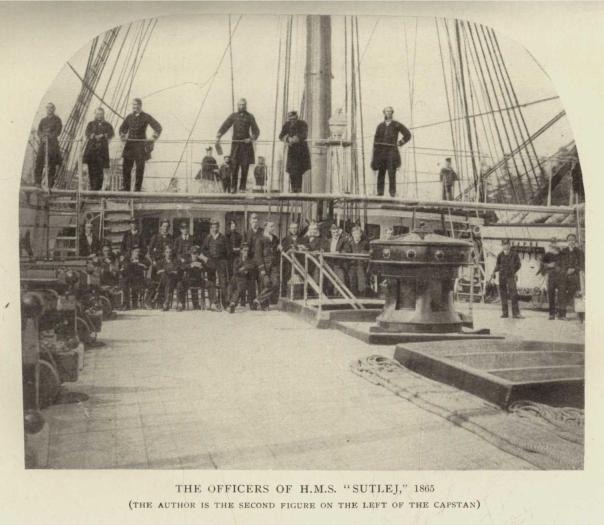
THE OFFICERS OF H.M.S. "SUTLEJ," 1865. (THE AUTHOR IS THE SECOND FIGURE ON THE LEFT OF THE CAPSTAN)
The Sutlej was a steam frigate pierced for guns, of 3066
tons and 500 h.p., flagship of the Pacific station. Before
I joined her, the commander-in-chief of the station was
Admiral Kingcome, who had (as we say) come in through
the hawse-pipe. It was the delight of this queer old admiral
to beat the drum for night-quarters himself. He used to
steal the drum, and trot away with it, rub-a-dub all along
the lower deck, bending double beneath the hammocks
of the sleeping seamen. On one of these occasions—so
runs the yarn—a burly able seaman thrust his bare legs over
the edge of his hammock, clipped the admiral under the
shoulders, swung him to and fro, and, with an appropriate
but unquotable objurgation, dispatched him forward with
a kick.
Such (in a word) was the condition of the flagship to
which Rear-Admiral the Honourable Joseph Denman succeeded,
after the enjoyment of twenty-five years' profound
peace in the command of the Queen's yacht.
The captain, Trevenen P. Coode, was tall and thin,
hooked-nosed and elderly, much bent about the shoulders,
with a habit of crossing his arms and folding his hands
inside his sleeves. He was a taut hand and a fine seaman.
He nearly broke my heart, old martinet that he was; for
I was mate of the upper deck and the hull, and took an
immense pride in keeping them immaculately clean; but
they were never clean enough for Captain Trevenen P. Coode.
In those days we had little bright-work, but plenty of
whitewash and blacking. The test of a smart ship was that the
lines of white or black should meet with absolute accuracy;
and a fraction of error would be visited with the captain's
severe displeasure. For he employed condemnation instead
of commendation.
There was an old yarn about a mate of the main deck,
who boasted that he had got to windward of his captain.
We used to take live stock, poultry and sheep to sea in
those days. The captain found fault with the mate because
the fowls and coops were dirty. The mate whitewashed
the chickens and blacked their legs and beaks. Now the
poultry in question belonged to the captain. Thereafter the
fowls died.
It was the custom for the admiral to take a cow or two
to sea, and the officers took sheep and fowls. There is a
tradition in the Navy that the cow used to be milked in the
middle watch for the benefit of the officer on watch; and
that, in order that the admiral should get his allowance of
milk, the cow was filled up with water and made to leap
backwards and forwards across the hatchways. Another
tradition ordains that when the forage for the sheep ran
short, the innocent animals were fitted with green spectacles,
and thus equipped, they were fed on shavings.
When we put into Valparaiso the Spanish fleet was
threatening to bombard the town. Rather more than a year
previously, in 1864, Spain had quarrelled with Chile, alleging
that Chile had violated neutrality, and had committed other
offences. In March, 1864, Spain began the diplomatic
correspondence with Chile in which she demanded reparation,
which was refused. Chile sent artillery and troops to
Valparaiso. The Spanish admiral, Pareja, then proclaimed a
blockade of the Chilian ports, and Chile declared war.
The European residents in Valparaiso, who owned an
immense amount of valuable property stored in the custom-houses,
were terrified at the prospect of a bombardment, and
petitioned Admiral Denman to prevent it. An American
fleet of warships was also lying in the Bay. Among them
was the Miantonomoh, the second screw ironclad that ever
came through the Straits of Magellan, the first being the
Spanish ironclad Numancia.
When the Miantonomoh crossed the Atlantic in 1866,
The Times kindly remarked that the existing British Navy
was henceforth useless, and that most of its vessels "were
only fit to be laid up and 'painted that dirty yellow which is
universally adopted to mark treachery, failure, and crime.'"
The British and American admirals consulted together
as to the advisability of preventing the bombardment. The
prospect of a fight cheered us all; and we entered into
elaborate calculations of the relative strength of the Spanish
fleet and the British-American force. As a matter of fact,
they were about equal. The Spanish admiral, Nunez, who
had succeeded Pareja, visited the Sutlej and conversed with
Admiral Denman. It was reported by the midshipman who
was A.D.C. to the admiral that, upon his departure, the
Spaniard had said: "Very well, Admiral Denman, you
know your duty and I know mine." The information
raised our hopes; but at the critical moment a telegram
forbidding the British admiral to take action was received
from the British Minister at Santiago.
So the British and American fleets steamed out to sea
while the Spaniards fired upon Valparaiso from eight in the
morning until four in the afternoon, setting the place on fire,
and then retired to their anchorage outside. The British
and American fleets then returned to the Bay, and I
accompanied a landing-party to help to extinguish the
conflagration.
Five of us were standing on the top of the high wall of a
building whose roof had fallen in, so that the whole interior
was a mass of burning wreckage, upon which we were
directing the hose, when the men below shouted that the
wall was falling. We slid down the ladder, and no sooner
had we touched the ground than the whole wall tottered and
fell inwards.
We put the fires out, but the inhabitants were so angry
with us because we had not prevented the bombardment,
that they requested that the landing-party should be sent
back to their ships. Then the flames broke out afresh. For
years the resentment of the Valparaisians remained so hot
that it was inadvisable to land in the town men from British
ships.
The meeting of the British and American seamen gave
rise to much discussion concerning the respective merits
of the British and American theories of gunnery. The
Americans advocated the use of round shot to deliver a
"racking blow"; the British preferred firing a pointed
projectile which would penetrate the target instead of
merely striking it. When an American bluejacket asked
his British friend to explain the new English system of
shell-fire, the British bluejacket said: "We casts our shot
for the new gun so many fathoms long, and then, d'ye see,
we cuts off a length at a time, regulatin' the length required
according to the ship we uses it against. For your ship,
I reckon we should cut off about three and a half inches."
The Spanish fleet was afflicted with scurvy; and we used
to pull over to the Spanish ships in the evenings, bringing
the officers presents of chicken, fresh meat and fruit.
Having done with Valparaiso, the Spaniards went to
Callao; but there they had a more difficult job; for Callao
was fortified, and the Spaniards were considerably damaged
by the gun-fire from the forts.
During the progress of hostilities between the Chilians
and the Spaniards, the Chilians constructed one of the first
submarines. It was an American invention worked by
hand and ballasted with water. The Chilians intended, or
hoped, to sink the Spanish fleet with it. The submarine
started from the beach on this enterprise; but it was never
seen again. It simply plunged into the sea, and in the sea
it remains to this day.
We left Valparaiso about the middle of April, 1866,
and proceeded to Vancouver. On the way, the Sutlej ran
into a French barque, taking her foremast and bowsprit
out of her. Captain Coode stood by the rail, his arms
crossed, his hands folded in his sleeves, looking down upon
the wreck with a sardonic grin, while the French captain,
gesticulating below, shouted, "O you goddam Englishman
for you it is all-a-right, but for it it is not so nice!"
But we repaired all damages so that at the latter end
he was better off than when he started.
We arrived at Vancouver early in June, and left a few
days later, to encounter a terrific hurricane. It blew from the
18th June to the 22nd June; and the track of the ship on
the chart during those four days looks like a diagram of
cat's-cradle. The ship was much battered, and her boats
were lost. On this occasion, I heard the pipe go "Save ship"
for the second time in my life.
We put into San Francisco to refit. Here many of our
men deserted. In those days, it was impossible to prevent
desertions on these coasts, although the sentries on board
had their rifles loaded with ball cartridge. Once the men
had landed we could not touch them. I used to meet the
deserters on shore, and they used to chaff me. As we had
lost our boats, the American dockyard supplied us with
some. One day the officer of the watch noticed fourteen
men getting into the cutter, which was lying at the boom.
He hailed them from the deck. The men, returning no
answer, promptly pushed off for the shore. The officer of
the watch instantly called away the whaler, the only other
boat available, intending to send a party in pursuit. But
the deserters had foreseen that contingency, and had cut
the falls just inside the lowering cleat, so that the whaler
could not be lowered.
While I was at San Francisco, I had my first experience
of the American practical view of a situation. Bound
upon a shooting excursion, I had taken the train to Benicia,
and alighted with a small bag, gun and cartridges. I asked
a railway man to carry my bag for me to a hack (cab). He
looked at me, and said,
"Say, is it heavy?"
"No," I said, "it is quite light."
"Waal then," said he, "I guess you can carry it
yourself." I had to, so I did.
Benicia is celebrated as the birthplace of John Heenan,
the "Benicia Boy," the famous American boxer. The great
fight between Heenan and Tom Sayers was fought at
Farnborough on the 17th April, 1860. Heenan was a huge
man, six feet and an inch in height; Sayers, Champion of
England, five feet eight inches. The fight was interrupted.
Both men received a silver belt. I remember well the event
of the fight, though I was not present at it. More than
three years afterwards, in December, 1863, Tom King beat
Heenan.
From San Francisco we proceeded to Cape Horn,
homeward bound. On these long sailing passages we used to
amuse ourselves by spearing fish. Sitting on the dolphin-striker
(the spar below the bowsprit) we harpooned albacore
and bonito and dolphin, which is not the dolphin proper
but the coryphee.
We rounded the Horn, buffeted by the huge seas of
that tempestuous promontory. On that occasion, I actually
saw the Horn, which is an inconspicuous island beaten upon
by the great waves, standing amid a colony of little black
islands. And off Buenos Aires we were caught in a
pampero, the hurricane of South American waters. It blew
from the land; and although we were three or four hundred
miles out at sea, the master smelt it coming. Indeed, the
whole air was odorous with the fragrance of new-mown hay;
and then, down came the wind.
We were bound for Portsmouth. And when we rounded
the Isle of Wight, and came into view of Spithead, lo! the
anchorage was filled with great ships all stationed in
review order. They were assembled for a review to be held
for the Sultan of Turkey.
We took in the signal containing our instructions, and
fired a salute; and then, standing in under all plain sail
and starboard studdingsails, we sailed right through the
Fleet, and all the men of the Fleet crowded rails and yards
to look at us, and cheered us down the lines. For the
days of sails were passing even then; we had come home
from the ends of the world; and the splendid apparition
of a full-rigged man-of-war standing into the anchorage
moved every sailor's heart; so that many officers and men
have since told me that the Sutlej sailing into Spithead
through the lines of the Fleet was the finest sight it was
ever their fortune to behold.
In the Tribune and in the Sutlej it was my luck to serve
under two of the strictest and best captains in the Service,
Captain Lord Gillford and Captain Trevenen P. Coode. I
may be forgiven for recalling that both these officers added
a special commendation to my certificates; an exceedingly
rare action on their part, and in the case of Captain Coode, I
think the first instance on record.
Part of the test for passing for sub-lieutenant was bends
and hitches. Captain Lord Gillford was highly pleased with
a white line which I had spliced an eye in and grafted myself.
Knowing that I was a good sailmaker, he once made me
fetch palm and canvas and sew an exhibition seam in public.
From the Sutlej I passed into the H.M.S. Excellent, in
order to prepare for the examinations in gunnery. In those
days, the Excellent was a gunnery school ship of 2311 tons,
moored in the upper part of Portsmouth Harbour. The
Excellent gunnery school is now Whale Island.
While in the Excellent I had the misfortune, in dismounting
a gun, to break a bone in my foot; and although the injury
seemed to heal very quickly under the application of arnica,
I have felt its effects ever since.
In 1867 I was appointed to the Research, which was
stationed at Holyhead, and in which I served for a few
months. There was a good deal of alarm felt with regard
to the Fenians, who were active at the time, and the
Research was ordered to look out for them. With my
messmates, Cæsar Hawkins, Lascelles, and Forbes, I hunted
a good deal from Holyhead with Mr. Panton's hounds. I also
hunted with the Ward Union in Ireland. I used to cross from
Holyhead at night, hunt during the day, and return that night.
Among other memories of those old days, I remember
that my brother and myself, being delayed at Limerick
Junction, occupied the time in performing a work of charity
upon the porter, whose hair was of an immoderate luxuriance.
He was—so far as we could discover—neither poet nor
musician, and was therefore without excuse. Nevertheless,
he refused the proffered kindness. Perceiving that he was
thus blinded to his own interest, we gently bound him hand
and foot and lashed him to a railway truck. I possessed a
knife, but we found it an unsuitable weapon: my brother
searched the station and found a pair of snuffers, used for
trimming the station lamps. With this rude but practicable
instrument we shore the locks of the porter, and his hair
blew all about the empty station like the wool of a sheep at
shearing-time. When it was done we made him suitable
compensation.
"Sure," said the porter, "I'll grow my hair again as
quick as I can the way you'll be giving me another tip."
We had an old Irish keeper at home, whose rule in life
was to agree with everything that was said to him. Upon a
day when it was blowing a full gale of wind, I said to
myself that I would get to windward of him to-day anyhow.
"Well, Harney," said I. "It is a fine calm day to-day."
"You may say that, Lord Char-less, but what little wind
there is, is terrible strong," says Harney.
A lady once said to him, "How old are you, Harney?"
"Och, shure, it's very ould and jaded I am, it's not long
I'll be for this worrld," said he.
"Oh," said she, "but I'm old, too. How old do you
think I am?"
"Sure, how would I know that? But whatever age ye are,
ye don't look it, Milady."
I. TO THE ANTIPODES
After a brief spell in the royal yacht, I was promoted
out of her to lieutenant, and was appointed to the
Galatea, Captain H.R.H. Alfred Ernest Albert, Duke
of Edinburgh, K.G., K.T.
H.M.S. Galatea had four months previously returned from
the long cruise of seventeen months, 24th January, 1867, to
26th June, 1868, during which the Duke visited South Africa
and Australasia. While he was in Australia, an attempt had
been made to assassinate his Royal Highness, who had a
very narrow escape. The pistol was fired at the range of
a few feet, and the bullet, entering the Duke's back, struck a
rib and ran round the bone, inflicting a superficial wound.
A full account of the voyage is contained in The Cruise of
H.M.S. Galatea, by the Rev. John Milner and Oswald
W. Brierley (London, 1869; W. H. Allen). The Galatea frigate
was built at Woolwich and launched in 1859. She was of
3227 tons burthen, 800 h.p.; she was pierced for 26 guns;
maindeck, 18 guns, 10-inch, 86 cwt., and 4 guns, 10-inch,
6½ tons; on the quarterdeck, 2 guns, rifled, 64-pounders; in
the forecastle, 2 guns, rifled, 64-pounders. The 6½-ton guns
threw a shot of 115 lb., and a large double-shell weighing
156 lb. She stowed 700 tons of coal and 72 tons of water.
Previously the Galatea, commanded by Captain Rochfort
Maguire, had been employed from 1862 to 1866 in the Baltic,
and on the Mediterranean and West Indian stations. She
took part in the suppression of the insurrection at Jamaica,
and, after the loss of H.M.S. Bulldog, destroyed the batteries
on Cape Haitien. Her sister ship was the Ariadne, and
Admiral Penrose Fitzgerald, who served in the Ariadne, in
1861, writes: "It would not be too much to say that she
and her sister ship, the Galatea, were the two finest wooden
frigates ever built in this or any other country" (Memories
of the Sea). Personally, I am inclined to consider, that fine
sailor as the Galatea was, the Sutlej was finer still.
The Duke of Edinburgh was an admirable seaman. He
had a great natural ability for handling a fleet, and he would
have made a first-class fighting admiral. The Duke's
urbanity and kindness won the affection of all who knew
him. I am indebted to him for many acts of kindness,
and I was quite devoted to him.
The voyage of the Galatea lasted for two years and a half.
We visited Cape Town, Australia, New Zealand, Tahiti, the
Sandwich Islands, Japan, China, India, and the Falkland
Islands. It is not my purpose to describe that long cruise
in detail; but rather to record those incidents which emerge
from the capricious haze of memory. In many respects, the
second long voyage of the Galatea was a repetition of her
first voyage, so elaborately chronicled by the Rev. John
Milner and Mr. Brierley. In every part of the Queen's
dominions visited by her son, the Duke was invariably
received with the greatest loyalty and enthusiasm. It
should be understood throughout that, when his ship was
not in company, or was in company with a ship commanded
by an officer junior to his Royal Highness, he was received
as the Queen's son; but when a senior officer was present,
the Duke ranked in the order of his seniority in the Service.
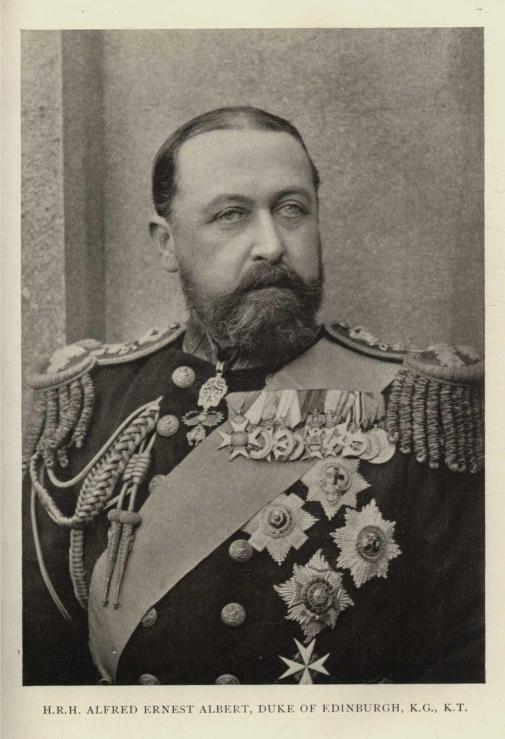
H.R.H. ALFRED ERNEST ALBERT, DUKE OF EDINBURGH, K.G., K.T.
We left Plymouth early in November, 1868, and once
more I was afloat in a crack sailing ship, smart and well
found in every detail, and once more I entered into the
charm of the life in which above all I delighted. We
touched at Madeira, where I grieve to say some of the
junior officers captured a goat and some other matters during
a night on shore; touched at St. Vincent; and arrived at
Cape Town on Christmas Day.
At Cape Town, my set of tandem harness came again
into requisition. From the Cape we proceeded to Perth.
The fact that an attempt upon his life had been made in
Australia, was one of the reasons why the Duke chose to pay
the Colony another visit.
Upon a part of our voyage to Australia we were accompanied
by my old ship, the Clio, and so admirably handled
was she, that she sometimes beat the Galatea in sailing. In
every place to which we went in Australia and New Zealand,
we received the most unbounded hospitality, of which I shall
always retain the most pleasant recollections. We were
asked everywhere; livery stables were put at the disposal of
the officers; we went to shooting parties, and to every kind
of festivity.
At Perth I visited the convict settlement; and there I
found a relative or connection of the Beresford family, who
had been so unfortunate as to be transported for forgery.
He appeared to be a most respectable old gentleman, and
(with the permission of the governor) I presented him with
a small cheque. Alas! incredible as it may seem, the sight
of my signature awoke the ruling passion; and my gentleman
promptly forged a bill of exchange for £50, and (as I
found when I came home) got it cashed.
It was in Perth, too, that I visited a prisoner, a
fellow-Irishman, who had been convicted of murder. He had been
a soldier, and had slain his corporal and his sergeant. This
man inspired me with some ideas with regard to criminals
which later in life I tried to put into practice; and also
aroused in me an interest in prisons and prison discipline
which I have always retained. He was a gigantic person, of
immense physical strength, with receding forehead and a
huge projecting jaw. He was considered to be dangerous;
five or six warders accompanied me into his cell; and they
spoke to him as though he were a dog. I looked at the
man's eyes; and I was convinced then, as I am convinced
now, that his intellect was impaired. Criminal psychology
then hardly existed; and although it is now recognised as
a science, it must be said that existing penal conditions
are still in many respects awaiting reform. Subsequent
experience has proved to me that I was right in believing
that many crimes of violence are due to a lesion of the
brain, and cannot therefore be treated as moral offences. I
heard some time subsequently that the Irishman had been
shot for the attempted murder of a warder. Perth and New
South Wales were the only places in the British Dominions
in which there was a death penalty for attempted murder.
I may here mention that in after years I was appointed,
together with the (late) Duke of Fife, as civil inspector of
prisons; an office which I held for a year or two. I was
able to institute a reform in the system then in force of
mulcting prisoners of good conduct marks. These were
deducted in advance, before the man had earned them, if he
gave trouble. A prisoner sentenced to a long term—who
usually gives trouble during his first two years—found, when
he began to run straight, that good marks he earned had
been deducted in advance. I was able to change the system,
so that no marks should be deducted before they were
earned.
It was after I had been placed in command of the police
at Alexandria, in 1882, that I was offered the post of chief
commissioner of police in the Metropolis; and I was
honoured by a gracious message from a very distinguished
personage, expressing a hope that I would accept the
appointment; but, as I wished to remain in the Navy, I
declined it.
We returned to Australia on our homeward voyage, but
for the sake of convenience I may here deal with the two
visits as one. At Sydney, I purchased a pair of horses.
They were reputed to be runaways, and I bought them for
£9 a pair, and I drove them tandem with ring snaffle bits.
They never ran away with me—except once. When they
came into my possession, I found that their mouths were
sore, and I did what I could to cure them. Many a drive I
had, and all went well. Then one day we all drove to a
picnic. The Duke, who was very fond of coaching, drove a
coach. I drove my tandem, taking with me the commander,
Adeane. On the way home, the road was down a steep hill.
We were beginning to descend, when one of the Duke's
mounted orderlies mixed himself up with the traces between
the leader and the wheeler. The leader, taking fright,
bolted, and the sudden tightening of the traces jerked the
orderly head over heels into the bush. Away we went down
the hill as hard as the horses could gallop. The next thing
I saw was a train of carts laden with mineral waters coming
up the hill and blocking the whole road. The only way to
avoid disaster was to steer between a telegraph pole and the
wall. It was a near thing, but we did it. I gave the reins
of one horse to the commander and held on to the reins of
the other.
Then I was aware, in that furious rush, of a melancholy
voice, speaking close beside me. It was the voice of the
commander, speaking, unknown to himself, the thoughts of
his heart, reckoning the chances of mishap and how long
they would take to repair. It said: "an arm, an arm, an
arm—a month. A leg, a leg, a leg—six weeks. A neck, a
neck a neck—O! my God!" And so on, over and over,
saying the same words. Thus did Jerry Adeane, the
commander, think aloud according to his habit. He
continued his refrain until we pulled up on the next rise.
"Thank God, that's over," said Jerry Adeane.
Before leaving Australia, I sold my pair of horses for
more than I gave for them.
When the Galatea was in New Zealand, Sir George Grey,
who owned an island called the Kanwah, gave me permission
to shoot there. He had stocked it for years with every
sort of wild bird and beast. Indigenous to the island were
wild boar and wild cattle, which were supposed to have been
turned down there by the buccaneers. I landed early one
morning to stalk the wild cattle, with my servant, a pulpy,
bulbous sort of rotten fellow who hated walking. He carried
my second rifle. We climbed to the top of a hill with the
wind against us, to get a spy round. When I came near
the top, I perceived the unmistakable smell of cattle; and,
on reaching the top, there, within thirty yards of me, were a
great black bull and two cows.
The bull saw me. He shook his head savagely, bellowed,
pawed the ground, put his head about, and charged straight
for me. I was standing in a thick sort of tea scrub which
was level with my shoulders, so that I could see only the
beast's back as he charged. I thought it was of no use to
fire at his back; and, remembering that the scrub was thin,
having only stems underneath, I dropped on my knee,
hoping to see his head. Fortunately, I was able to see it
plainly. I fired, and he dropped within about five yards
of me.
I said to my man:
"Well, that was lucky; he might have got us."
As there was no reply, I turned round, and saw my trusty
second gun half-way down the hill, running like a hare. I
was so angry that I felt inclined to give him my second
barrel. On returning on board I dispensed with his
services, and engaged a good old trusty Marine to look
after me.
I killed six of these wild cattle altogether, and a landing
party bringing them off to the ship, there was beef enough
for the whole ship's company.
There was a number of sheep on the island, under the
care of a shepherd named Raynes, who was a sort of keeper
in Sir George's service. He said to me, "You have not killed
a boar yet. Come with me to-morrow, and I will take you
where we can find one." I said, "All right, I will come at
four o'clock to-morrow and bring my rifle." "No," said he,
"don't bring a rifle, bring a knife. I always kill them with
a knife."
I thought he was chaffing, but I said, "All right, I will
bring a knife, but I shall bring my rifle as well."
In the morning he met me at the landing-stage with
three dogs, one a small collie, and two heavy dogs like
half-bred mastiffs, held in a leash. We walked about three miles
to a thick swampy place, with rushes and tussocks. He
chased the collie into the bush, and in about twenty minutes
we heard the collie barking furiously. Raynes told me to
follow him close, and not on any account to get in front of
him. The heavy dogs fairly pulled him through the bush.
We soon came up to the collie, and found him with an
immense boar in a small open space.
Raynes slipped the heavy dogs, who went straight for
the boar, and seized him, one by the ear and the other by
the throat. The boar cut both the dogs, one badly. When
they had a firm hold, Raynes ran in from behind, seized one
of the boar's hind legs, and passing it in front of the other
hind leg, gave a violent pull, and the boar fell on its side.
Raynes immediately killed it with his knife, by stabbing it
behind the shoulder. I never saw a quicker or a more
skilful performance.
I suggested to Raynes that I should like to try it.
"Well," he said, "we will try and find a light sow
to-morrow. A boar would cut you if you were not
quick."
On the following day, we got a sow, but I made an
awful mess of it, and if it had not been for the heavy dogs,
she would have cut me badly; as it was, she bowled me
over in the mud before I killed her.
In New Zealand, we went up to the White Springs and
we all bathed with the Maories. You stand in the water
warm as milk, close beside springs of boiling water, and
occasionally a jet of steam makes you jump. The person
of one of the guests, a very portly gentleman, suggested a
practical joke to the Maori boys and girls, who dived in and
swam up to him under water, pinched him and swam away
with yells of laughter. The old boy, determined to preserve
harmony, endured the torment with an agonised pretence of
enjoyment. "Very playful, very playful!" he kept miserably
repeating. "Oh, very playful indeed. Tanaqui (how do you
do), Tanaqui."
We had an excellent lunch, of pig, fowls, and yams, all
boiled on the spot in the hot springs. I saw a live pig chased
by some Maori children into a hot spring, and it was boiled
in a moment.
In this region I rode over soil which was exactly like
dust-shot; the whole ground apparently consisting of ore.
We visited the White Terraces, where, if you wrote your
name in pencil upon the cliffs, the silicate would preserve
the legend as if it were raised or embroidered. Some of the
signatures had been there for years. I have since heard that
the place was destroyed by volcanic eruption.
We witnessed the weird and magnificent war dances of
the Maoris. Never have I seen finer specimens of humanity
than these men. When, after leaping simultaneously into
the air, they all came to the ground together, the impact
sounded like the report of a gun. A party of the Chiefs
came to pay a ceremonial visit to the Duke. It struck me
that they looked hungry, and I said so. They want cheering
up, I said. I went to forage for them. I took a huge silver
bowl, and filled it with chicken, whisky, lobster, beef,
champagne, biscuits and everything else I could find, and presented
it to them. You never saw warriors more delighted. They
ate the whole, using their fingers, and were greatly cheered.
It was in New Zealand that I had an interesting conversation
with a cannibal—or rather, an ex-cannibal. I
asked him if he ever craved for human flesh, and he said no,
not now—unless he happened to see a plump woman. In
that case, he said he lusted for the flesh of the ball of the
thumb, which (he gave me to understand) was the prime
delicacy.
Some of the half-caste women were of great beauty.
Their savage blood endowed them with something of the
untamed, implacable aspect of their ancestry. I heard of
one such woman, who, outwardly attuned to every tenet of
white civilisation, and received everywhere in white society,
suddenly reverted. A native rebellion breaking out, she
rejoined her tribe and slew a missionary with her meri—the
native chief's badge of office. She cut off the top of the
missionary's skull, and used it thereafter as a drinking-vessel.
Poor lady, she was (I heard) eventually captured and was
executed.
II. MY TWO FAITHFUL SERVANTS
They came to me first in the Galatea, so that their
story may fitly be related in this place. Tom Fat
the China boy came to me at Kowloon. He was
brought to me by his uncle, who desired to dispose of his
nephew, for a consideration. The consideration was £5.
Lest I should be accused of Chinese slavery—and anything
is possible in these days—I should explain that the fiver
was not the price of Tom Fat, but was in the nature of a
delicate compliment paid to his uncle. Tom was a free boy;
he was entered in the ship's books as my servant, at so much
wages per month. Not that he valued his wages particularly;
he had wider views. He was an invaluable servant,
clever, orderly, indefatigable and devoted. I attired him in
gorgeous silks, and he bore my crest with perfect unassuming
dignity. He kept my purse, and expended my money
with prudence, even with generosity. When I wanted
money, Tom Fat had plenty of ready cash. I sometimes
wondered how it was that he always seemed to be provided
with a margin, for I was not conscious of practising economy.
The fact was, I was careless in those days, and kept no
accounts. It was not until he had been in my service for
some years, that I discovered the secret of his wealth. It
was simple enough. He was in the habit of forging cheques.
Altogether, he forged cheques for nearly twelve hundred
pounds. How much of that amount he kept for himself I
never knew; but it is certain that a great deal of it he spent
upon me. Nor do I know why he did not ask for a cheque
instead of forging it. Apparently it was a point of honour
with Tom not to ask for money. When I asked him if he
wanted a cheque to defray expenses, he usually replied
cheerfully that he had no need of it. Certainly he acquired
a reputation for economy by these means.
His methods were subtle. He was well aware that I
kept no private account book of my own, and that my
bankers did not enter the names of payees in my pass-book,
but only the numbers of the cheques cashed, and also that
the bank returned cashed cheques from time to time. On
these occasions, Tom, finding pass-book and cashed cheques
among my papers, would abstract both the counterfoils and
the cheques which he had forged, knowing that as I should
not take the trouble to compare the numbers of the cheques
with the numbers in the pass-book, I should not notice that
some cheques were missing. He was always careful to
arrange that the last counterfoil filled up—at which one
naturally looks—should be that of my cheque and not that
of his; and he never drew large sums, varying his amounts
between £5 and £20, except on one occasion, when he
forged a cheque for £50. The Oriental mind is inscrutable;
but whether or no Tom considered that he was robbing me;
whether, if he considered that he was robbing me, he
believed he was justified in so doing; he took the most
sedulous care that no one else should enjoy that privilege.
Tom was universally popular. I took him everywhere
with me. In his way, he was a sportsman. One day,
hunting with the Duke of Beaufort's hounds, I mounted
him on a skewbald pony. We came to a nasty slippery
place, a bad take-off, a wall to jump, and the road beyond.
Tom's pony took it safely. A big, hard-riding guardsman
who was coming up behind us, not liking the look of the
place, shouted to me, "Is it all right?"
"That hideous Chinaman has just done it!" I shouted
back. Not to be outdone by a Chinaman, the guardsman
rode at the fence, his horse went down, and he got a
dreadful toss. When he got up, he was furiously angry
with me.
When Tom had been with me for some years, he came
to me and said, "Master, you never give me leave! You
give others leave but not me leave. I want leave."
The request was reasonable enough, and I sent Tom to
my house in town, there to amuse himself for a week. At
the end of the week he did not return. He was reported
missing. I advertised for him, offering a reward. The next
day he was arrested at the Criterion Restaurant, being one
of a party of thirteen (of whom twelve were ladies) to whom
Tom was about to play the host.
It turned out that during his week in town, my faithful
servant had spent £70. He had also raised money at one
of my clubs.
"Lord Charles want twenty-five pounds," he said to the
porter, who took him to the cashier.
"His lordship must give me his I.O.U.," says the cashier.
"What thing that?" says Tom.
The cashier explained.
"All-light," says the man of resource, and promptly
forged my I.O.U. for thirty-five pounds.
"You said twenty-five," remarked the cashier.
"I tink Lord Charles like little more," Tom replied.
Of course, the cashier sent me the document. When I
investigated Tom's transactions, I found a few of his forged
cheques in the bank, and I could hardly tell the difference
between my signature and his forgeries. The cheque-books
were compared with the pass-book, and counterfoils were
found to be missing. I took legal action against him, and
he was sentenced to five years. Shortly afterwards, when
I was in Scotland, I received a letter from the hapless Tom,
saying he was dying, and asking me to come and see him.
I went at once. I found him in the infirmary, a dying
man indeed, with his face to the wall. A Chinaman dies
at will. He simply lies down and dies; but by the same
token, he can continue to live. So I determined to rouse
him. I hailed him in a loud and cheerful voice.
"Tom! Cheer up, Tom! What's the matter? You're
not ill. Rouse up."
"Me die, master," said Tom.
"Not you," I said. "Come! Cheer up, and I'll try to
get you out of this."
And sure enough, he turned back, became quite well,
and I secured his release after he had served a short term.
I found him a place in China, sent him East, and never saw
him again. When I went to China subsequently, I failed
to find him. After his interval of Western service, China
took him and swallowed him up. And that was the end of
Tom Fat.
He was in my service when, upon the return voyage to
Australia of the Galatea, we touched at Mauritius. In that
strange island I came across a youthful negro savage. I
learned his history from his master, an amiable French
gentleman. Punch, as I named him, had been brought to
Mauritius by a British cruiser. The warship had chased a
slaver, whose crew jettisoned the slaves. They were fettered
in chains and hove over the side. When the British seamen
boarded the vessel they found her holds empty, except
for the odour. In a dark corner was stowed a bundle of
rags, into which a bluejacket thrust his cutlass. The rags
sprang to life with a yell, and there was Punch with a
wound in his thigh, of which he carried the scar to his end.
It occurred to me that Punch would serve me for a groom,
and I said so to his master.
"Tiens!" said that gentleman pleasantly. "You shall
have him for five shilling."
"Done!" said I, and paid him the money. He did not
think I was serious; but he made no bones about ridding
himself of his garden-boy.
Punch was the most hideous savage I have ever viewed.
He was black as a boot; even his lips were black; his face
was seamed with the cicatrices which were the totem marks
of his tribe, whatever that may have been; and his countenance
was exactly like the countenance of a bull-dog. The
scars wrinkled his cheeks, like a bull-dog's jowl. He was
densely stupid, and wild of temper. He attacked one of the
men on board with his teeth. But he was utterly fearless,
and although he knew nothing about horses, he was never
afraid of them. He was apparently constructed of
india-rubber. Nothing hurt him. When I drove a tandem, it
was his duty as tiger to spring up behind as we started.
But as my horses started at speed, Punch had not always
time to run from their heads to the back of the vehicle.
I have known him catch a spoke of the wheel and be
whirled into the air, and the wheel to pass over him, without
harming him in the least.
At a race meeting in Australia, Punch begged for a
mount, and I borrowed a horse, which galloped away down
the course, Punch clinging to him with arms and legs
exactly like a monkey. He took two big fences like a bird;
but at the third, the horse breasted it, fell backwards and
rolled over upon his rider. I thought he was killed, but he
wasn't. He was not even damaged.
When I went on half-pay, I placed Punch in the stables.
The women servants took a fancy to him; but Punch,
whatever he may have thought of the women, had no love
for the head groom, in whose arm he made his teeth meet.
So I found him a billet in a hairdresser's shop, which bore
the legend, "Hairbrushing by machinery." Punch was
the machinery. I saw him at it, turning a wheel in the
window. I never saw him again, and know not what became
of him.
III. TAHITI AND THE SANDWICH ISLANDS
We arrived at Tahiti in June, 1869. Here is the
most lovely climate in the world. The inhabitants
never seemed to do any work, with the single
exception of carrying bananas. In this exercise they were
extraordinarily expert, bearing enormous weights upon the
shoulders, the skin of which becomes hard like leather. I
considered myself to be fairly strong; but when I tried to
carry one of the masses of bananas under which the natives
march swiftly all day long, up hill and down, I found that
I was able to carry it only for a short distance, and with
difficulty, on level ground. The people were perfectly
delightful. We went ashore and lived among them; and it
was then that I understood how it was that the men of the
Bounty mutinied. The fact was that those discontented
mariners could not bear to leave islands so delectable. I do
not of course, desire to justify their very reprehensible
conduct. All I say is that I can understand the strength of
its motive. It was simply the desire to remain in an earthly
paradise which inspired the men of the Bounty when they
left Otaheite in April, 1789, to set Captain Bligh adrift in
an open boat, with the nineteen men who stayed by him, and
a small stock of provisions. The captain and his men made
an astonishing voyage of nearly 4000 miles, and fetched up
at the island of Timor, south of the Malaccas, in the
following June. Some of the mutineers were subsequently
brought to justice in the year 1792. Six of them were
condemned and three were executed. In 1814 it was
discovered that ten among the mutineers had colonised
Pitcairn Island.
We in the Galatea stayed at Tahiti as long as we
possibly could, and enjoyed every moment of the time.
One of our amusements was to float down a narrow and
swift stream and shoot the waterfall. At a point some
little distance from the coast, the stream ran deep and rapid
between banks which were about three feet apart. The
natives, boys and girls, used to drop into the stream and let
themselves be carried down feet foremost to a waterfall,
which descended some 40 or 50 feet in a wide pool; and
it occurred to me that what they could do, I could
accomplish. I watched these intrepid children very carefully,
and I observed that they always came to the surface some
distance away from the fall. In spite of some dissuasion, I
determined to attempt the enterprise. I floated down the
stream feet foremost, shot the fall, and the moment I reached
the foot of it I struck out under water. I was amazed to
find that the water was just like air, or an enormous
cauldron of soda water, buoying one up, and I came to the
surface without the slightest difficulty. Afterwards I went
down head first. The only thing to remember was not to
come up under the fall itself. Shooting the waterfall became
a popular amusement.
Another of our diversions was surf-playing. This
enchanting exercise is performed with the aid of a long board
shaped like a wedge. The swimmer takes his board, pushes
it before him over the breakers, while he dives through them,
then turns, and, leaning on the board, rides back on the
crest of the surf. The speed, whatever it may be, feels like
sixty miles an hour. It is one of the most exhilarating
pastimes in the world.
I remember that we all went to church on Sunday.
During the service, the Queen of Tahiti suddenly clapped
her hands, whereupon the clergyman desisted from his
ministrations, while her Majesty distributed tobacco among
the congregation. When it was well alight the Queen again
clapped her hands, and the clergyman went on with the
service.
We left Tahiti with profound regret, receiving and giving
many presents on parting. From Tahiti we proceeded to
the Sandwich Islands, where I met many old friends, made
during my sojourn four years previously. The American
population had quite forgiven and forgotten my boyish
freak, which had so agitated them at the time. Our old
friend Queen Emma, whom we had taken to Panama on her
way to England to see the Queen, had returned. I went to
call upon her, driving tandem, as already related. Turning
in at the gate, I took the corner too sharply, the wheels
locked, and the buggy capsized. In the meantime the
Queen, having heard the jingling of the Canadian sleigh
bells attached to the harness, came out to find her visitor
sitting on the grass at her feet. The horses galloped on and
wrecked the vehicle and also themselves. Altogether it was
a very expensive drive.
IV. OLD JAPAN
NOTE
When Lord Charles Beresford visited Nippon (from
the Chinese Jih Pun, the place or rising of the
sun, changed by English pronunciation to Japan),
it was the old Japan that he saw; the Japan of centuries
of isolation, inviolate save for the intrusion of the Jesuit
missionaries in the sixteenth century, and the little wedge
of Dutch traders. It had been the Japan of the Mikado,
who was as a god; of the Tycoon, his temporal representative,
who, like a man walking the tight-rope above a
wood of transfixing swords, maintained a delicate equipoise
of power among the feudal seigneuralty, the great Daimios,
each lord of his domain and master of life and death over
thousands of retainers. It was the Japan of the Samurai,
the two-sworded rufflers; of the Ronins, the masterless men,
the outlaws, who roved the country in bands, patriotic,
ferocious and pitiless. It was still the Japan in which the
common people, men and women and maidens, walked naked
and unashamed; in which the warriors went to battle clad
in armour wrought of tortoise-shell and silk, girt with
swords and carrying bows and arrows; in which the life
of a barbarian foreigner was never safe from hour to hour,
so that he must be guarded by the two-sworded Yaconins,
the Government officers, who, knowing the hatred of the
Government towards their charges, seldom drew sword in
their defence until it was just one blood-stained second too
late; in which a fault in honour was instantly expiated by
hara-kiri, the fatal cross-cut upon the belly, performed in
the public eye, which was justly offended if the incision
were so clumsily executed that the entrails protruded.
Such, at least, is the ceremonial theory. In practice, the
dagger is driven in below the ribs, drawn horizontally across
the belly, and up the other side; an operation requiring
inconceivable courage.
It is the land of tea-houses and temples, of running
footmen and palanquins; where houses and string and
handkerchiefs are made of paper; where the people wash
themselves every day and their clothes never; where the
oldest profession in the world is counted honourable service,
and the pictures of courtesans adorn the temples in which
the bonzes intone prayers in the midst of games and dances:
where the writing is done from top to bottom, from right
to left, and keys are turned from left to right, and carpenters
draw their planes towards them, and the houses are built
from the roof downwards, and horses are mounted on the
off-side, and ladies black their teeth. It was a land of
immense processional pageants: the processions of the high
Daimios, who once a year quitted their ancestral homes with
a great train to dwell in Yedo, the capital of the Tycoon,
for six months; and returned again, leaving as hostages
for their loyalty their wives and children for another six
months. The two-sworded Samurai march in front, crying
"Shitanirio!" and all the spectators drop upon their knees
and hide behind their legs while the long procession ambles
by, spearmen and banners and baggage-carriers and palanquins;
the norimons, which are the palanquins of the notable,
and the cangos, which are the palanquins of the humble.
When the foreigner rode abroad in state, he was attended
by the Ward-guards, who marched in front, striking the
earth at every step with their long staves whereon loose
iron rings were strung, so that their jingling warned the
populace to make way.
At night, festivals were celebrated by immense processions
filling the streets, in which everyone carried a lighted lantern
swaying upon the end of a flexible bamboo, and the lanterns
were painted with bats and dragons, and the people wore
horrible masks, distended with the monstrous rictus of the
devil-gods. In the Yoshiwara, where the women, painted
and gilded, sashed and bedecked, sit in a double row, each
with her price placarded upon her knee, there were the
great priapic processions, concerning which the English
works upon Japan preserve a shocked reticence.
In old Japan, the common ideal of the ruling classes
was that their country should maintain for ever intact its
immemorial laws, traditions and customs; an ideal whose
attainment the entrance of the foreigner would render
impossible. As for the common people, they had no
aspirations beyond the day's work. Japan, in her own
view, was complete, self-sufficient and wholly satisfied with
a civilisation compared with which the politics of the
Occident were of yesterday. The Islands of Nippon were
ensphered in holy crystal, whose flawless preservation was
the highest duty of a patriot.
Into that rare atmosphere, surcharged with perilous
elements, sailed Commodore Perry of the United States Navy
in the year 1853. Some fifty years later, Pierre Loti entered
Japanese waters in a French warship. "Et nous entrions
maintenant dans une espèce de couloir ombreux, entre deux
rangées de très hautes montagnes, qui se succédaient avec
une bizarrerie symétrique—comme les 'portants' d'un décor
tout en profondeur, extrêmement beau, mais pas assez
naturel—on eut dit que ce Japon s'ouvrait devant nous,
en une déchirure enchantée, pour nous laisser pénétrer dans
son cceur même" (Madame Chrysanthème).
It was Commodore Perry who rent open the heart of
Old Japan, and her blood flowed. The gallant commodore,
anchoring off Cape Idzu on 8th July, 1853, with two steam
frigates and two sloops of war, demanded no more than a
treaty securing help and proper treatment to sailors shipwrecked
on the coasts of Japan. The Japanese Government
said neither yes nor no; whereupon Perry gave them a
year to consider the matter, promising to return at the
end of it with a "larger fleet." And on 12th February,
1854, there was Commodore Perry in the Bay of Yedo
with three steam frigates and four sloops of war. After
long negotiations, a treaty of amity was signed, including
a promise to succour ships in distress, and (above all)
opening two new ports. From that moment the isolation
of Japan was ended. The door opened but a crack; but
into that crack the wedge of commerce, driven by the lust
of gain, was thrust by America (1854), Russia (1857),
England and France (1858).
In 1859, Mr. (afterwards Sir) Rutherford Alcock, British
representative of H.B.M. Government in China was
appointed her Majesty's Envoy Extraordinary and Minister
Plenipotentiary in Japan. His book, The Capital of the
Tycoon (London, 1863. Longman, 2 vols.), gives one of the
first authoritative accounts of Old Japan presented to the
British public. During his three years in that country
he was constantly in peril of assassination. In August,
1859, an officer and a sailor from one of the Russian ships
lying in the harbour were cut down and slashed to pieces
in the streets of Yedo, and a steward was severely wounded.
In the following year the Japanese linguist attached
the British Legation was stabbed to death, and two
Dutch ship-captains were cut to pieces in Yokohama. The
next demonstration of the hatred of foreigners was the
murder of the Gotairo, the Regent, Iko-mono-no-kami. His
escort was suddenly attacked as it was leaving his castle
by some twenty swordsmen, wielding the terrible Japanese
two-handed weapon. The hands of the bearers of his
norimon were severed on the pole and the Regent himself
decapitated, his head being carried away as a trophy.
In 1861, Mr. Heuskin, attached to the American
Legation, was murdered. Soon afterwards, one of the
Governors (or Under-Secretaries) of Foreign Affairs,
Oribeno-no-Kami, who had been especially friendly in his
intercourse with the Legations, "died," in the Japanese
phrase, "without the effects of medicine." To be more
precise, he had committed hara-kiri.
In July, 1861, the British Legation at Yedo was attacked
at night by a band of swordsmen, who passed the guards
and rushed the building. Mr. Oliphant, who had recently
been appointed Secretary to the Legation, was severely
wounded. One of the guards, a porter, and a groom, and
two of the assailants, were killed outright. One of the
assailants was severely wounded, to six of the Legation
party who were severely wounded and eleven slightly
wounded.
Such were the beginnings of Western influence in Japan.
Sir Rutherford Alcock's voluminous account of his three
years' ministry reveals a gallant, honest, kindly gentleman
sorely perplexed by the ethical problems involved in the
forcible interference of one powerful nation in the affairs of
a weaker nation, whose sole ambition was to be let alone.
Hampered, on the one hand, by the greed and discourtesy
of the European traders, and on the other, by the immitigable
duplicity and the furtive and implacable enmity of the
Japanese, yet singly determined to do his duty to his
Queen and country, Sir Rutherford Alcock honourably
fulfilled a task of extreme danger and incredible difficulty.
Thenceforward, until the year 1869, the duel between
East and West continued with increasing ardour. The
whole polity of old Japan was shaken as by the earthquakes
which agitate and rend its soil. There were frequent
assassinations of the foreign barbarians; the governing
classes, which consisted wholly of the military caste,
employed every invidious method to restrict trade with
Europeans; while the Western nations, on their side,
brought their armed strength to bear in the enforcement of
treaty rights, which by the same means had originally been
wrung from the Tycoon's government. And here it falls to
distinguish between the divine prestige of the Mikado,
descendant of the sun-goddess, and the temporal administration
of the Tycoon, or Shogun. In that dual administration
resided a main factor of the extraordinary difficulty of
the situation. Both the spiritual and temporal rulers, the
Imperial Court and the Bakufu, or Tycoon's Government,
were equally inspired by hatred of the foreigner. But
whereas the Mikado, dwelling majestically apart, could avoid
all contact with the barbarians, the Tycoon was compelled
by superior force to negotiate with them. He was thus
placed between two fires; on the one side, the Mikado
ordered him to expel the foreigner; on the other, the
foreigner threatened him with war unless the treaties were
carried into execution.
For long the Tycoon, or his advisers, maintained his
position with singular address. But no man born of
woman could have solved its complications. For the
great Daimios, the feudal nobility, held allegiance primarily
to the Mikado. The Tycoon could and did detach some
of the clans to his side; but the great body of the western
clans defied him. The influence of the Tycoon began
swiftly to decline. At the same time the Imperial
party began to perceive that the expulsion of foreigners
had become impossible. The immediate result was the
revolt of some of their adherents. Inspired as it was by
hatred of the foreigner, it was directed equally against
Mikado and Tycoon, and accompanied by expressions of
loyalty to both parties.
In 1864 the troops of the Choshiu clan attempted to
capture Kioto and to obtain possession of the person of the
Mikado. They were defeated after heavy fighting. In
June of the previous year, the Choshiu men had fired upon
the American ship Pembroke while she was passing through
the Inland Sea, and also upon the Dutch corvette Medusa.
The French commander-in-chief of the station, Admiral
Jaurès proceeded to Shimoseki and destroyed the batteries.
In August a British naval force under the command of
Vice-Admiral Kuper proceeded to Kagoshima in order to enforce
the payment of the indemnity due for the murder of
Mr. Richardson, bombarded the town and destroyed the batteries.
It was these two actions which for the first time really
convinced the ruling classes in Japan that it was hopeless
any longer to endeavour to prevent the intrusion of foreign
influence.
In 1866 the Tycoon Iyemochi died. In the same year
a new and enlarged Convention was concluded with Great
Britain, France, America and Holland. In the following
year Keiki, very unwillingly, became Tycoon, an office which
by this time had become exceedingly insecure. In the same
year the Mikado, Komei, died and was succeeded by his
son Mutsuhito, a minor. In the following year the Mikado
assumed the whole administrative power hitherto vested in
the Tycoon, and a new system of Government was promulgated.
Followed, civil war and the defeat of the Tycoon,
who retired into seclusion. In the meantime the Mikado
had invited the Representatives of Foreign Powers to visit
him at Kioto.
"That the Mikado of Japan, who claims to be descended
from the sun-goddess, and in whose person a peculiar odour
of sanctity was considered to exist, should voluntarily invite
to his palace at Kioto the Envoys of nations who had
hitherto been looked upon as outer barbarians, and
intercourse with whom was a profane thing, was indeed a great
step in advance. No foreigner had ever yet crossed the
Imperial threshold, or looked upon the face of the sacred
Emperor of Japan. It was a proof that a new order of
things was inaugurated, and gave good hopes for the future"
(Adams, History of Japan. Lond., 1875).
But although the Imperial Government perceived the
wisdom of accepting the inevitable, the hatred of the
foreigner, bred in the blood of the military caste, could
neither be dissembled nor controlled; and the attack made
upon the British Envoy, Sir Harry Parkes, while actually
on his way to the Imperial Palace on 23rd March, 1868,
illustrates the condition of affairs. On the road to Kioto
and in the sacred city itself, the Europeans had been regarded
by the people with a polite and respectful curiosity, nor was
there any sign of hostility.
Sir Harry Parkes left the temple of Chi-on-in, where he
lodged, to proceed to the audience, with a mounted escort
of twelve ex-Metropolitan mounted police, under the
command of Inspector Peacock, with whom rode a
Japanese officer, Nakai Kozo. Behind these massive
veterans rode Sir Harry himself, accompanied by Goto
Shojiro, of the Japanese Foreign Department, and followed
by Mr. Mitford, Mr. Satow, Dr. Willis, and other members
of the Legation. Then came a guard of forty men of H.M.'s
9th Regiment under the command of Lieutenant Bradshaw
and Lieutenant Bruce. A native guard preceded the train,
and another guard followed it. Just as the policemen were
turning the corner of a narrow street, Sir Harry observed
signs of confusion, and the next moment a Japanese, his
great sword flashing and hewing, dashed round the corner,
closely pursued by two policemen. Sir Harry cried out to
the soldiers behind him to stop the Samurai. Turning his
head, he saw his companion, Goto Shojiro, on foot, sword in
hand rushing forward to attack a second Samurai, who was
already fighting hand to hand with Nakai Kozo, the Japanese
officer who had been riding alongside Inspector Peacock at
the head of the policemen. Behind Sir Harry, shots rang
out as the soldiers fired at the first assassin. Sir Harry
Parkes was suddenly aware of the wild figure of a Japanese
warrior, advancing towards him through the press. His face
was a mask of blood; in one hand shone a long sword,
dripping red from hilt to point; in the other, the victor
lifted the bloody head, shorn clean from the shoulders, of
his countryman. It was Nakai Kozo. Nakai gave the
following ingenuous account of his deed of arms to
Mr. Adams, secretary of the Legation, who quotes it in his
History, as follows:—
"I saw a man running down the line cutting at one man
after another. I jumped off my horse, drew my sword, and
rushed after him; he turned and we engaged; he cut me on
the head. Then Goto came up and dealt him a blow which
felled him to the ground. Unfortunately Goto's sword-hilt,
which was of lacquer, slipped from his hands, and I had to
cope with the fellow alone. I could only see out of one eye,
the other being covered with blood, but I kept chopping at
him, and after about ten blows I managed to cut his head
off. I then took the head and showed it to Sir H. Parkes."
The soldiers bayoneted the first Samurai, who was still
alive when he was finally secured by Mr. Mitford. He was
afterwards beheaded by the Imperial Government. But
those two desperate enemies of the foreigner wounded
thirteen men and five horses ere they were cut down. One
of the wounded was a soldier, another a native groom; the
remaining nine, of whom two were so seriously hurt that they
were invalided home, were ex-Metropolitan policeman to
whom the methods of the Samurai must have been startling.
These trained fighters wield their two-handed swords, heavy,
perfectly balanced, razor-sharp weapons, with an appalling
swiftness and dexterity. At a single blow they can cleave
a man to the chin, or cut off his head, or lop off a limb.
In May, 1868 Sir Harry Parkes presented his credentials,
which had hitherto been addressed to the Tycoon, to the
Emperor. On the 23rd was celebrated the Queen's birthday,
when many Japanese of high rank, some of whom had never
before made acquaintance with a foreigner, were entertained
by Vice-Admiral Sir Henry Keppel, commander-in-chief of
the China Station, on board H.M.S. Rodney. It was not
until November that the civil war was ended by the
submission of the rebels. The Emperor then took up his
residence for a time in Yedo—now called Tokio—which had
been the capital of the Tycoon, and which was henceforth to
be the eastern metropolis of the Emperor, as Kioto was the
western capital. In the following year, after another
insurrection had been suppressed, the great Daimios made
their memorable sacrifice, offering their lands and servants
to the Emperor; thereby deliberately exchanging their
almost independent state for a condition of subservience to
the central Government.
Such, in brief, was the beginning of the New Japan; and
it was at this stage in its development that, for the first time
in history, a foreign prince, in the person of H.R.H. the
Duke of Edinburgh, visited the Mikado.
V. WITH THE DUKE IN JAPAN
The Galatea arrived at Yokohama on the 29th
August 1869. The Duke with his suite, including
myself, went up to Tokio (the old Yedo) and took
up his quarters at Hama-go-ten, which had been the summer
residence of the Tycoon. The estate marched with a piece
of water opening into the bay; here were many summer-houses;
and a commodious building equipped for the Duke
by the orders of the Mikado. The name was changed to
Yen-Rio-Kan, signifying a place set apart for distinguished
foreigners.
We were entertained with the most delicate and
sumptuous hospitality by this charming people whose
courtesy greatly impressed us. Conjurers, acrobats and
wrestlers performed for the entertainment of his Royal
Highness; whenever we went abroad, thirty two-sworded
Yaconins attended us.
The Duke went in state to visit the Mikado in his palace.
All along the route the upper windows of the houses were
sealed with paper, so that none should look down upon he
royal visitor; a precaution only taken in the case of the
highest nobility. The Duke, attended only by Sir Harry
Parkes, Admiral Sir Harry Keppel and Mr. Mitford (afterwards
Lord Reedsdale and author of the delightful Tales of
Old Japan), had a private audience of the Emperor, who was
presented by his Royal Highness with a diamond snuff-box.
Six of us were afterwards admitted to the presence. I
remember the dim figure of a young man seated behind a
screen at the end of the audience chamber. Many years
afterwards, when I again visited Japan, the Mikado, who
remembered my former visit, graciously invited me to lunch,
and entertained me with the royal sport of catching ducks
in a hand-net. The ducks are preserved in the royal
gardens, which are charmingly diversified with lawns and
running water, and flowering shrubs. As you enter, the
ducks rise suddenly, and the sport was to net them as they
rose.
As we remained no longer than a week in Tokio, my
recollections are few. I was tattooed by the native artificers,
to the astonishment of the Japanese officials and nobles; for
in Japan none save the common people is tattooed. The
Japanese artist designs in white upon dark, working upon
the skin round the chief ornament in his scheme; whereas
the English tattooer designs dark upon white, using the
natural skin as a background. Both methods are beautifully
illustrated upon my person.
I witnessed the decapitation of six criminals. The
victims stand in a row, their hands bound behind them:
each in turn is tapped on the shoulder, when he kneels down,
and bows his head. With a single half-arm stroke, the
executioner slices through the neck. I also saw a crucifixion.
The man's hands and feet are extended and tied to
cross-bars, so that he makes a figure like an hour-glass.
Then he is transfixed with a spear.
On the 8th September, the Duke returned to Yokohama
by sea, taking with him as his guest in the Galatea,
Hiobukio-no-Miya, Prince of the Blood, Minister of War, and other
high dignitaries, who attended a ball given at the British
Legation. On the 16th, the Galatea sailed for China.
VI. THE HOMEWARD VOYAGE
From Japan we proceeded to China, touching at Chefoo,
Shanghai and Hongkong. Nothing could exceed the
princely hospitality of the great British mercantile
firms in China. It was then that I learned, what subsequent
experience confirmed, the remarkable integrity of the business
dealings of the Chinese. The head of the Chinese Bank
told me that he never had a bad account with a Chinaman.
The Chinese keeps agreements to the letter, quite irrespective
of documentary contracts.
From China we proceeded to Manila, then a Spanish
possession. My principal recollection of Manila is the
extraordinary prevalence of cock-fighting. There was a
cockpit in every street; and the sole occupation of the
inhabitants appeared to consist of betting upon their birds.
One used constantly to meet men walking in the street with
their birds under their arms. The cocks were armed with
steel spurs shaped like a scythe, and sharpened to a razor
edge. I have seen a bird spring up and slice the head of its
adversary clean off, and I have seen the chest of a bird
slashed open, almost cutting its body in two. The use of
the artificial spurs affected the betting, making the fight very
much more uncertain and therefore more exciting. For,
whereas if a cock uses its natural spurs, the best bird
probably wins, an inferior bird armed artificially might gain the
victory.
From Manila we proceeded to Calcutta. Upon landing,
I met my brother, Lord Marcus, and with him I rode up,
together with the staff, to Government House. It is a
singular coincidence that when I landed at Calcutta, six
years afterwards, on the corresponding date, when I was a
member of the staff of the Prince of Wales (afterwards King
Edward VII), I met my other brother, Lord William, and
rode up with him to Government House.
The Galatea lay alongside the wharf. It was necessary
to take the most stringent precautions against cholera.
Only one boy in the ship's company was taken ill during
our stay. He died inside an hour. But in the merchant
ships lying in the port there were many deaths. Men were
employed in working parties to push off with long bamboos
the corpses that were continually floating down from the
Hooghli, lest they should foul the moorings. The bodies
used to come floating down with the birds perching and
feeding upon them.
We went up country, and enjoyed a great deal of excellent
sport. We went out pig-sticking, which is the finest
sport in the world; we went out tiger-shooting upon
elephants; and riding upon elephants, we shot partridges—a
form of sport by no means easy. I remember an irascible
old colonel of artillery, who became very hot, and who missed
a good many partridges, saying indignantly to the Duke:
"This is all d——d rot. I could shoot more partridges
on Woolwich Common."
It was the same peppery soldier who, when one of the
members of the staff had fallen ill, went with me upon a
visitation to the sick. We found the invalid in a state of
extreme agitation, and surrounded with books of a religious
nature.
"I think—I hope—" he kept saying, "that I shall be
forgiven. I think I shall—I hope so."
"What's he saying? What's he saying?" cried the
colonel, who, as often happens to people in hot weather,
had become rather deaf.
"He thinks he's dying," I shouted.
Whereupon the colonel, turning angrily to the invalid,
shouted,
"You d——d fool, you have only over-eaten yourself!"
The sick man was so infuriated that he hurled his books
of religion at the colonel, and sprang out of bed. Next day
he was quite well.
Another member of the staff was mounted one day upon
a red horse (they paint their horses in India), a wild,
half-broken Arab steed, which was giving its rider a deal of
trouble. I advised my friend to dismount, and left him.
Presently I rode back to find him on foot and alone. I
asked him, where was his horse?
"Gone," said he. "Whenever that d——d horse saw a
mosquito, it sat down and cried like a child. So I kicked
it in the belly and it ran away into the jungle."
We visited Trincomalee, where the elephants built the
dockyard. They carried the timber and they carried the
stones, and they lifted the stones into position and adjusted
them with their feet. The remarkable thing about the
climate of Ceylon is its intermittent showers of tropical
violence, followed by bursts of sunshine. In the result, you
actually see the foliage growing. I remember the
extraordinary beauty of the native decorations, which are
fabricated of palms and leaves and flowers.
From Colombo we went to Mauritius, arriving there in
May, 1870. Here I climbed the famous mountain called
Pieter Botte, or, more correctly, Pieter Both.
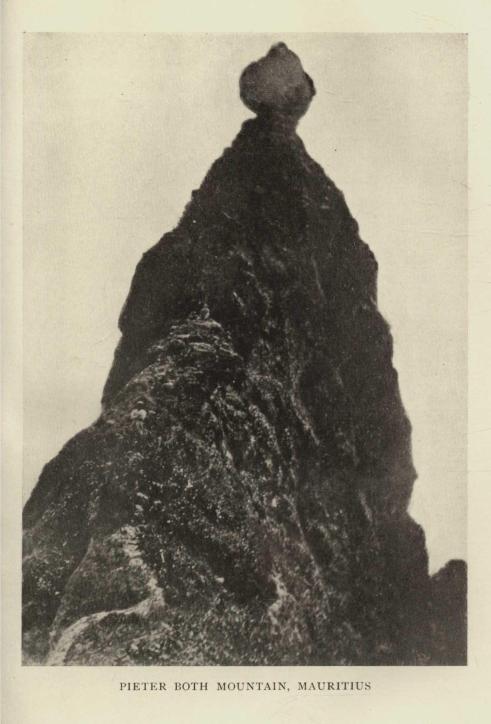
PIETER BOTH MOUNTAIN, MAURITIUS
The mountain is so named after Pieter Both, Governor-General
of the Dutch East Indies in the early part of the
seventeenth century, and the founder of Dutch power in that
region. On his homeward voyage he was wrecked in the
bay overlooked by the mountain, which thereafter bore his
name. Previous ascents are recorded in the archives at
Mauritius, from which it appears that mine was the
fourteenth. Admiral Sir William Kennedy ascended Pieter
Botte in 1861; he gives an account of his climb in his
interesting book, Hurrah for the Life of a Sailor (London,
Nash). Kennedy started with a party of fourteen persons,
of whom five reached the summit.
At nine o'clock in the morning I started, together with the
captain of the maintop, Edward Hele. We took with us
ropes, a rope ladder, cod-line, and a small lead. These
were all our appliances. We drove to the foot of the
mountain and began the ascent at 11.5 a.m. Now the
mountain of Pieter Botte is shaped like a church with a
steep roof, from one end of which rises a spire. This
pinnacle of rock is crowned with a huge, rounded,
overhanging boulder.
Part of the ridge was so sharp that we were forced to
sit on it and to proceed astride. Then we came to the
pinnacle. The ascent was so sharp and difficult that we
were obliged to take off both shoes and socks. At one
point, I lost my balance, and was only saved from falling
backwards by Hele's ready hand. Climbing the pinnacle
was far more difficult than scaling the overhanging boulder
at the top. At the top of the pinnacle there was just room
to stand beneath the overhanging boulder. The only
possible method of climbing the boulder was to get the rope
ladder over the top of it. Accordingly, one end of the rope
ladder was attached to the lead-line. In order to swing the
lead, one of us was roped with a round turn round his body,
while the other, lying on his back, held the rope while the
leadsman, leaning right backwards and outwards over the
sheer precipice of some 3000 feet fall, swung the lead. We
took it in turns to swing the lead; as we leaned outwards,
the rock spread over our heads like an umbrella; and it was
an hour and a half before we succeeded in casting it over
the boulder. Then we hauled the rope ladder over and
made all fast. It was too short, and the last few yards we
hauled ourselves up hand over hand. So we climbed to the
top, which is a platform of about 20 feet square. It was
then 1.59 p.m. We took off our shirts, and waved them to
the warships lying far below in the bay, from which we were
plainly to be distinguished with the aid of a telescope. The
ships each saluted us with one gun. We planted on the
summit a flag upon whose staff were carved our names and
the names of our ships. When we returned, my brother
officers gave us a dinner to celebrate the event.
Hele was eventually promoted to warrant officer. When
Hele died, I was able to help his son to gain his education,
and he did very well. It was in Mauritius that we went out
shooting with the native population; one of the most
dangerous amusements in which I have ever taken part, for
the bullets used to whistle in the air all round us.
From Mauritius we proceeded to Cape Town. Here, on
the 12th July, 1870, the Duke inaugurated the new harbour,
breakwater and docks. I kept a team on shore, and used
to drive up from Simon's Bay to Cape Town. Every now
and then we stuck in a quicksand. On one such occasion
I had a brother officer with me; and as he was afflicted
with a cold, I took him on my back to save him from wet
feet. But I fell with him, and we were both soaked to the
skin. Upon another day, when we stuck, I put two of my
messmates on the leaders, and they pulled the coach right
through. If you want horses to pull a weight out of a tight
place, put weight on their backs.
The Colonial Secretary at Cape Town was Mr. Southey.
He was a most delightful and sagacious person, and became
a great friend of mine. He prophesied in a most wonderful
way what would be the future of South Africa.
"If," said he, "we could only get a big man, a master-mind,
to come out here, all that I foresee would come true."
The right man presently arrived in the person of the late
Cecil John Rhodes, and my friend's prophecies have been
most singularly fulfilled.
While at the Cape, we went up country, shooting. Both
Dutch and English families were most kind and hospitable
to us. Upon one of these expeditions, a member of the
staff went out by himself very early in the morning to
shoot. Observing some ostriches in the distance, he stalked
them with immense labour and patience, and presently
succeeded in shooting a couple of birds. When he returned,
he complained that it had been very difficult to get his sights
on, owing to some high rails which were between himself
and the birds. It had not occurred to him that he had been
stalking tame ostriches on a farm.
I once rode from Cape Town to Simon's Town and back,
between lunch and dinner, galloping the whole distance,
with four changes of horses. The distance between the two
places is about 35 miles as the crow flies. My errand was
merely to postpone the arrival of a visitor who was to come
to the Galatea.
The ride, however, showed that I was in good condition.
I have always tried to keep myself fit, holding that
condition of body regulates condition of mind. Cheery people
deserve small credit, because their frame of mind is due to
their being right inside. Quarrelsome people are wrong
inside.
On our way to England we touched at the Falkland
Islands where I visited a relative of mine who kept a ranch.
He used bull-dogs to catch his bulls, when he required them
for branding. The dogs seized the bulls by the nose and
held them while they were lassoed by the guachos.
When we touched at Montevideo, I remember conversing
with various persons, who foretold the immense profit which
must eventually accrue if the land there was purchased at
that time. Their opinion has since proved true. But I had
no money to invest; so that the opportunity was only
another instance of what might have been.
The Galatea was badly strained in a gale of wind, her
deck seams opening so that the water streamed into the
cabins beneath. One lieutenant used to say to another:
"How did you sleep last night? It was pretty rough.
"Woke at one o'clock and saw them reefing tops'ls"—meaning
that, lying in bed, he could see clear through the
seams.
I used my sail-making ability to make a canvas awning
for my bed; fitted it with a ridge rope, laced it down and
hauled it taut, led a trough from it to take the water into
the slop-pail; and slept dry under it.
It was during the visit of the Galatea to Australia that
I was made a Freemason; and I have always regretted that
I have never been able to devote as much time to Masonry
as I should have liked to give to the Craft. The Australian
Lodge into which I was admitted was under the impression
that I was the most timid neophyte who had ever
joined it.
When the ceremony was ended, one of the members
of the Lodge said to me:
"You are safely through it. But do you know that of all
the men we have had through this lodge, we never had one
so paralysed with fear as yourself. You were shivering like
an aspen!"
The fact was that during the initiatory ceremonies
something unaccountably struck me as extraordinarily funny.
The effort to subdue my emotions caused me to tremble
all over.
One of our diversions in the Galatea when she was at
sea, was to listen to the conversations which used repeatedly
to occur between a certain worthy member of the Duke's
suite and the old quartermaster. The member of the staff
in question had endeared himself to us by his high seriousness.
He dealt with the most trifling incidents of life in a
spirit of preternatural and wholly sincere solemnity.
Supposing that you told him that a common friend had fallen off
his horse and bruised his leg, our member of staff would
instantly ship a countenance of intense concern.
"Bruised his leg? You don't say so! Good God! Has
he indeed?"
"Yes—he's bruised his leg!"
"Has he now? Well, well. Bruised his leg! I hope
it's not serious. I do hope it's not serious. Tut-tut! Bruised
his leg, you say?"
"It's not serious. But he's bruised his leg."
"I'm delighted to hear it's not serious. But—bruised
his leg. I am really distressed."
And so on.
Among other matters, our friend took his family very
seriously. One of his ancestors had been an admiral; and
it was this distinguished officer who made the link between
the member of staff and the quartermaster. The member
of staff used to stroll on the quarterdeck in the evening,
and fall into talk with the seamen.
"Well, Jones. Good evening, Jones. I suppose, now,
you've heard of my uncle, the admiral?"
"Heard of 'im, sir? I should think I 'ad heard of 'im.
Ah, he was a man, he was. He could handle a ship, he
could—ah, and handle the men, too!"
"Why, where did you serve with him, Jones?"
"Where, sir? Where not? All over the world, sir. Ah,
he was a man!"
"I'm delighted to meet anyone who knew a member of
my family so well, Jones—delighted, I assure you."
"Knew 'im? Why, sir, to know 'im was to admire 'im,
as the saying is. Many a time I've seen the men turn out
for to admire 'im, sir.
"Have you indeed, Jones—have you indeed! Dear me.
Most interesting, I am sure. I daresay a glass of grog
would not come amiss to you, Jones?"
"Wery kind of you, I'm sure, sir. It 'ud be a pleasure
to drink your health, and the admiral's too, sir. Ah, he was
a man!"
Mr Jones, afterwards, forward on the lower deck, to
envious friends:
"Pretty sweet conversation that, mates. I wonder 'oo
the b——y h—l 'is uncle might 'a been!"
There was another member of the suite who surely
deserves record—the elephant. He was really a member of
the ship's company, for he could do, and did, the work of
twenty men. He joined the ship in India, when he was
quite small, and he grew enormously on board. He lived in
a house built aft, and fed upon branches of trees and bran
and biscuits and anything he could get. I trained him
myself. I taught him to obey the words of command, and he
would do anything for me. He would hoist me upon his
shoulders with a fore foot, or upon his back with a hind foot.
In the dinner hour, when most of the men were below, he
used to take his share in working the ship. We slung the
rope in a bowline round his neck, and he would clew up the
mainsail by walking on till he was told to stop. He was
never seasick. He used to balance himself, swaying to and
fro as the ship rolled. One night when the midshipmen and
I, having supper on deck aft, were called forward to trim
sails, the elephant finished the meal for us. He ate
everything on the table, put his foot on the plates and smashed
them, and squashed the big coffee-tin quite flat. Then he
looked at us like a naughty child.
I was the only person who could persuade him to leave
the ship or to come on board again when he had been ashore.
When we reached home, he was put in a railway truck and
directed to the Zoological Gardens. His keeper, a marine
artilleryman, went with him in the truck. Elephants have
a habit of rolling on their feet and squirming their vast bulk.
When the marine was trying to pass the elephant, the great
beast unconsciously pinned his keeper against the side of the
truck, and against a projecting bolt, which broke the man's
rib, forcing it into his heart. He was taken out dead.
In 1871, I was appointed flag-lieutenant to Admiral
(afterwards Admiral of the Fleet) the Hon. Sir Henry
Keppel, commander-in-chief at Plymouth. His flag was
flown in the Royal Adelaide. Sir Harry, as already recorded,
had been commander-in-chief upon the China station when
the Duke of Edinburgh visited Japan, and had accompanied
his Royal Highness upon his visit to the Mikado. It was at
Plymouth that I first had the honour of serving under Sir
Harry Keppel: a splendid seaman, a most distinguished
officer, a fine sportsman, one of the best and kindest of men.
Admiral the Hon. Victor Montagu, who served as a midshipman
under Sir Harry, relates in his Reminiscences some
interesting actions of his old captain, which I may be
permitted to quote. Commodore Keppel distinguished himself
by his personal gallantry and skilful leadership in the battle
of Fatshan Creek, 1st June, 1857; of which a full account is
given in Laird Clowes' The Royal Navy; and Admiral
Montagu records his own recollections of the affair:
"During the many years in which I knew him I never once
Sir Harry lose his temper, except when the Chinese
war-junks beat us back on the first attack we had made on
them.... John Chinaman, seeing us retire, took the hint,
and began making off himself, which so infuriated Harry
Keppel that he jumped up on our paddle-box, shook his fist
at the war-junks, some 500 or 600 yards away, and shouted
out: 'You d——d rascals! I'll pay you out for this! Man
the boats, boys—man the boats at once! The beggars are
trying to escape!' I never saw such a rush. At no regatta
could men have rowed faster."
Commodore Keppel commissioned the Raleigh frigate,
50 guns, for the China station. Admiral Montagu states
that she was "the last man-of-war that ever sailed out of
Portsmouth Harbour." Keppel would have none of your
steam-tugs. "We ran out with a fair wind with studding-sails
set on both sides." Alas! the Raleigh never came back
any more. On 14th April, 1857, she struck a sunken rock
in the China Seas, near Macao. Keppel's indomitable
conduct turned a disaster into an achievement.
"Shortly afterwards," writes Admiral Montagu, who was
a midshipman on board at the time, "we descried a French
squadron lying at anchor in Macao Roads, with an admiral's
flag flying, and, though we were firing minute guns of
distress as the water gained on our pumps, Keppel, nothing
daunted, called out: 'Up with the French flag. Give him
his salute. Sinking or not, let the Frenchmen hear us.'"
A French frigate coming to the assistance of the Raleigh,
her captain asked permission "to go below to see how high
the water had risen in the ship. 'Oh,' said Keppel, 'don't
go below; look down the hatchway.' 'Ah! mon Dieu!'
exclaimed the captain." ...
Keppel kept the pumps going, crowded sail on the ship,
and finally beached her off Macao, just in time. He landed
the ship's company, but himself stayed aboard the vessel,
sleeping on the bridge. The stores and guns were saved.
Keppel was deeply distressed at the loss of his fine ship,
"which," he wrote, "brings my career as a captain to an
end." Fortunately he was mistaken. In after years, when
I told him that the Admiralty were about to build a second
Raleigh, Keppel replied, "Very glad to hear it, my dear boy.
I had the honour of losing the first one."
Admiral Montagu records that Keppel, while in command
of the Raleigh, challenged an American clipper ship to race
from Penang to Singapore. "We were constantly going at
a speed of thirteen knots, during heavy squalls, close-hauled,
and trailing the muzzles of our main-deck guns through the
water on the lee side, and I sometimes used to turn into my
hammock in abject terror, fearing that at any moment we
might capsize."
Sir Harry Keppel was famous throughout the Service
when I was appointed his flag-lieutenant. One of my first
recollections of that office concerned an old-fashioned
"Eighteen-hundred-and-war-time," peppery, strict-service
captain, who, having just come home from the West
Coast of Africa, asked to see the commander-in-chief. It
happened that Sir Harry and myself were on the point of
going out hunting when the old captain called, and the
admiral was attired in hunting kit.
"Tell him I'll see him to-morrow," said Sir Harry.
But that wouldn't do at all, nor would any other excuse
serve.
"I insist on seeing the admiral," said the captain. "I
have just come home and it is my duty to see him at
once."
"Bring him in, then," said Sir Harry impatiently, "Now,
sir," said he, "my flag-lieutenant informed you that I
was engaged. Why couldn't you see the secretary?"
"The secretary, sir? The secretary!" says the old
captain wrathfully staring at Sir Harry's informal attire.
"Indeed I am told, sir, that the secretary is the
Commander-in-chief here. That's what they say, sir—that's
what they say!"
"Do they?" returned Sir Harry placidly. "And a
d——d good commander-in-chief too!" says he.
When, in later years, I became commander-in-chief, I
made it a rule that all admirals and captains should have
direct access to myself, no matter how trifling the occasion.
In those days, there was a turnpike-gate outside the
town. I was driving a brother officer home late one night,
after dining at a house some distance away and when we
came to the toll-gate, the keeper was in bed, and all my
knocking and shouting failed to wake him up. So I
proceeded to heave a large stone through his window. That
fetched him; and down he came, grumbling and swearing.
I thrust a sovereign—the only coin I had—into his hand to
pay for his broken window and the toll. It was bad tactics,
for he promptly retreated into his house (with my sovereign)
leaving us still on the wrong side of the gate. There was
nothing for it but to break the rest of his windows, but still
he wouldn't come out. Evidently a surly fellow, unfit to
take charge of turnpike gates, an office demanding tact and
courtesy; and we thought it well to remove his temptation.
So my companion and I wrenched the gate from its hinges
and lashed it to the cart, vertically, so that it projected over
our heads like a kind of ornamental roof, its weight nearly
lifting the mare between the shafts off her legs and making
her kick like blazes. Then we drove into Plymouth, gate
and all. The gate was reduced to firewood before sunrise.
Next day, the town was placarded with vain offers of reward
for information concerning "some evil-disposed person or
persons unknown who," etc.
At that time, I used to ride steeple-chases whenever I
had an opportunity, and kept myself in regular training by
hard exercise; a habit which on one occasion involved the
commander-in-chief in an alarming rumour. It arose from
the trifling circumstance that I had borrowed his overcoat.
The Fleet was at Holyhead, to celebrate the opening of the
new breakwater by the Prince of Wales; I was just going
for a training run up and down that breakwater, when, finding
I had no coat, I took Sir Harry Keppel's uniform overcoat.
I took it, without thinking, merely because I wanted it. The
next thing that happened was that the signalmen in the
Fleet reported that the Admiral must have gone mad on the
breakwater, seeing that he was racing up and down it clad
in a shooting-cap, grey trousers, muffler and uniform
overcoat. As my face was almost hidden by cap and muffler,
the signalmen were deceived by the gold lace, took me for
the admiral, and thought that poor Sir Harry was smitten
with insanity.
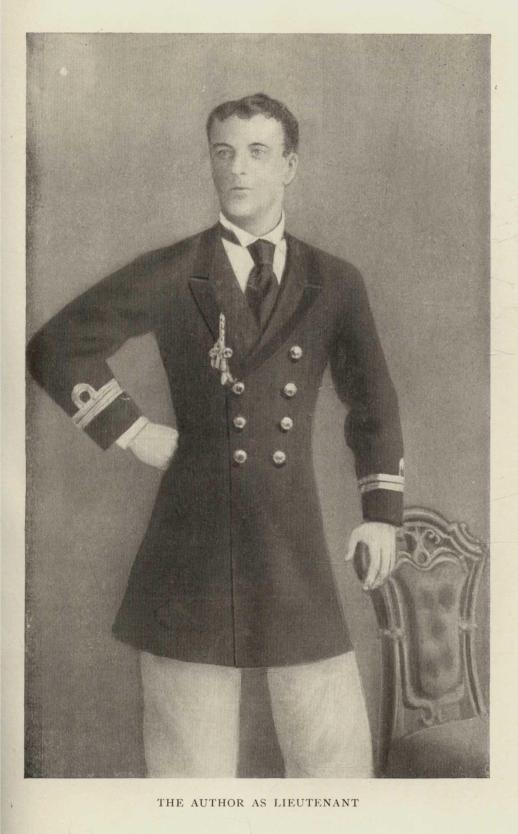
THE AUTHOR AS LIEUTENANT
We used to hunt a good deal with the Dartmoor hounds;
and upon a day when there was no run, and everyone was
bored, one of the ladies present begged me to provide some
kind of sport, kindly suggesting that I should personate the
fox, a part I declined.
"You must do something to amuse us," she said.
"Very well, I will," said I.
Among the officers there were an elderly admiral and an
elderly general, and I pointed them out to the lady.
"I will get up a race between the two of them," said I.
She bet me I would not, and I took it. I began with
the soldier.
Ambling alongside the general, I asked him casually if
he had ridden much in his life.
"Of course I have," says he irritably. "What do you
mean, sir?"
"Nothing at all," says I. "I thought I would ask. The
admiral——"
"What about the admiral?" cries the general, staring
suspiciously at the distant and unconscious officer.
"He was saying he didn't think you knew very much
about a horse."
The general lost his temper. He swore. He said he
would show the admiral what he knew about a horse.
"You can easily prove it," said I; and before he
understood what was happening, he had agreed to ride a race.
Then I went over to the admiral.
"Do you know what the general says? He says you
look like a monkey on a horse," said I; and it was the
admiral's turn to swear.
"D——d impertinence!" says he. "I'll race him, and
beat him any day in the week." And he continued to use
forcible language.
"You can do that," I said, for the admiral was riding
one of my best horses.
"If you really want a race, I'll arrange the whole thing,"
said I. And I brought the two wrathful old gentlemen
together, rode with them to the starting-point, gave the word,
and off they went as hard as they could pelt. I followed,
cheering them on. The general began to draw ahead, when
his horse baulked at a soft place. The admiral's horse did
the same, throwing his rider upon his neck.
"Get back into the saddle and he'll go through," I
shouted, for I knew the horse. The admiral hove himself
into his seat, and won the race. He wouldn't have won, if
his adversary hadn't baulked.
The members of the Board of Admiralty came down
to Plymouth to witness the autumn military manoeuvres.
I offered to drive them all in my coach; and they were
settled in their places—Mr. Goschen the First Lord, Admiral
Sir Alexander Milne, the Earl of Camperdown and
Mr. Shaw-Lefevre—when out of the house came Rear-Admiral
Beauchamp Seymour.
"Get down!" he shouted. "Gentlemen, you must get down."
They asked him why.
"You don't know that boy," said Seymour. "He's not
safe. He'll upset you on purpose, just to say he's upset the
whole Board of Admiralty!"
And he actually ordered my guests off my coach, so that
they had to go in barouches.
Sir Harry Keppel often came sailing with me in my little
yacht. We were out together, when I said to him,
"I cannot weather that ironclad, sir."
"Then run into her, my dear boy," said Keppel placidly.
"All right, sir—obey orders."
I held on, and we cleared the jib-boom of the ironclad
by an inch.
Sir Harry had an old friend of his to stay with him,
Captain Clifton, a most remarkable and interesting man.
In the old days, the passage for the opium trade existing
between China and India was taken only once a year—the
opium ships running up to China with one monsoon and
down to India with the other. Clifton went to the Government
of India and undertook, if the Government would
permit him to build vessels to his own design, to build
clippers to thrash up against the monsoon as well as run
before it, and so double the income accruing from the
opium trade. The Government consenting, Clifton designed
the Blue Jacket and the Red Jacket and vessels of that
class, which were the famous opium clippers of the "roaring
forties" and fifties.
The Indian Government gave Captain Clifton a lakh
of rupees. On his way home, Clifton, touching at what
is now the city of Melbourne in Australia, but which was
then a small assemblage of wooden shanties, noticed the
possibilities of the magnificent harbour. He told me that
he could have bought the whole site of Melbourne for a
lakh; but on consideration, he decided against the project.
One of my great friends, Sir Allan Young, a brilliant
seaman of the old school, commanded, at the age of
twenty-four, one of Clifton's opium clippers.
Upon the occasion of the Prince of Wales's opening the
new breakwater at Holyhead, in 1873, his Royal Highness
was entertained together with a large party at a country
house in the neighbourhood. The Prince called to me,
and said:
"This is very slow. You really must do something to
enliven the proceedings."
"Well, sir," said I, "I will run a hundred yards race with
Lord ——. As he is Irish, he is sure to take me up if
I challenge him."
Sure enough, Lord —— accepted the challenge, but on
conditions. These were: that I should race in full uniform,
excepting my sword, while himself should "take his wardrobe
from off himself." Lord —— then proceeded to divest
himself there and then of his Patrick ribbon, coat, waistcoat,
and boots, which he confided to the care of the wife of a
certain distinguished Liberal statesman. He dropped his
Patrick ribbon into her lap, saying:
"Madam, will ye have a care now of me Jewel, for glory
be to God there's no saying what twist this mad one might
give me!"
Entirely at ease, with the seat of his breeches patched
with stuff of another colour from the rest, and his toes
sticking from his stockings, he was wholly unperturbed by
the laughter of the assemblage.
Although attired in cocked hat, frock coat, and
epaulettes, I had the speed of him, and waited on him.
Then the devil entered into me; and when Lord ——
drew abreast of a big plant of pampas grass, I cannoned
into him, pitching him head first into the grass, not, of
course, intending to harm him. But to my consternation
and sorrow, Lord ——'s leg was broken below the knee. I
put the poor lord into his coach—he had a coach and
four-in-hand—and drove him back to his hotel. That excellent
and magnanimous sportsman was perfectly unconcerned.
"You hit me a bad skelp, and I am destroyed," said he.
"Never mind, they all laughed, anny way."
It was about this period of my life, when, returning from
a ball in London in the early morning, I came upon a
person selling whelks. He invited me to sup—or
breakfast—upon a plate of these delicacies.
"How much do you charge for a plateful?"
"Threepence," said he.
"I'll give you sixpence for every plateful you eat
yourself."
"Done," said he.
He finished two platefuls, and had begun a third, when he
was overtaken by rebellion from within, swiftly followed by
catastrophe.
"That's not fair," I said. "You can't count those two
platefuls."
"O my Gawd," he said. "'Ave I got to begin again?"
To this time, too, belong my memories of a certain
famous naval captain, who was extraordinarily particular
both as to his own dress and the wearing of proper
uniform by others. His regard for appearances, however,
did not prevent his diving overboard in full and
immaculate uniform, including white gloves, to save a
seaman. Exceedingly precise in his speech, he owned the
singular trait of becoming deprived of utterance when he
was angry; and few things made him more angry than
faulty attire in the Service.
He was driving with me in a cab towards Plymouth,
when we met an old warrant officer, who was wearing a
purple woollen waistcoat and green gloves. My friend,
stopping the cab so suddenly that the horse slithered
along on its haunches, leaped from the vehicle. The old
warrant officer, his attention arrested, had halted and turned
round. My friend went up to him. Then I perceived
that he was stricken speechless with wrath; for, continuing
to swallow nothing, as his habit was in these crises of
emotion, he tapped the warrant officer's waistcoat and gloves.
Glaring at him and still silently swallowing, he turned about
and got into the cab. The old warrant officer stood staring
with dropped jaw, like a man petrified.
It was my friend who, being asked at a court-martial
what he would have done in certain difficult circumstances,
replied deliberately:
"If I was where I was not I might have done something
I did not do."
In after years, when he was commander-in-chief at the
Nore, he was walking along the road to Sheerness, dressed
in plain clothes, when a bluejacket, who was slightly
intoxicated, lurched against him.
"Man, man," said my friend, with his picked elocution,
"do you know what you are doing? Man, you are colliding
with the commander-in-chief."
"Ho," returned the seaman, totally unimpressed. "Har
you, indeed? Then all I've got to say, is to say you've got
a ruddy good billet—an' wha's more, you take care you don't
lose it by getting drunk."
Despite of my diversions, I did a good deal of hard work.
As flag-lieutenant I was in charge of the signalling, a
science which, as it was understood in those days, I mastered
completely.
My first independent command was the Goshawk
gunboat, to which I was appointed as lieutenant-commander
for the manoeuvres and for review in 1873, while I was still
flag-lieutenant to Sir Harry Keppel. I had a narrow escape
from disaster at the very beginning. Fortunately I noticed
that the navigator was going the wrong side of the buoy
off Drake's Island, and I was just in time to point out his
mistake. I remember my feeling of horror at the prospect
of running on a rock in Plymouth Sound in my first
command.
The first thing I did in the Goshawk was to get from the
flagship a big working party of a hundred men to work at
holystoning our decks until they were as clean as a hound's
tooth. From that day onwards I set myself steadily against
bright-work and spit-and-polish. My objection to bright-work
is that you have first to dirty it with brick and oil in
order to clean it afterwards. There are certain things in a
ship which must be kept bright, and these I would burnish;
but everything that could be painted I would paint, and
then scrub the paint with soap and water. I remember the
shock it was to the commander when I told him to cover
the brass rails with canvas and paint it. Under the
spit-and-polish system no doubt the men take a pride in keeping the
ship bright, but such a process involves perpetual extra
bother and worry and black-list, which are quite unnecessary.
Cleaning bright-work makes the men's hands filthy at
divisions; and after ten minutes of bad weather, the copper
turns blue and the brass green, and the whole of the work
must be done over again.
At one time the bright-work system was carried to absurd
extremes. I have known a ship actually to have a bright
cable. I have known another ship with bright hammock
hooks. The hatchways of some vessels were polished and
decorated with inlay and all kinds of ocean ornament until
the ship looked like a lady's boudoir or a transatlantic liner.
The custom came in as the old sailing ships gave place to
steam ships, when the time hitherto devoted to making a
vessel all a-taunto, ropes taut, sail furling and mending and
so forth, was given instead to polishing, burnishing and
making bright-work shine, until the present system of
gunnery and gymnastic training was introduced. Captains
and officers used to spend on their ships large sums out of
their private income, which very often they could ill afford.
"Promotion by paint" was not unknown. A ship ought to
be scrupulously clean, but she should have paint wherever
possible, and soap and water should replace spit-and-polish.
NOTE
The following brief summary of political and
international affairs is introduced for convenience of
reference. It may be skipped by the reader, should
he disdain politics.
The Government of Mr. Gladstone, returned to power in
1868, began to disintegrate in 1873. The proximate cause
was the Irish University Education Bill, announced in the
Speech from the Throne at the opening of the session on
6th February, 1873. Irish affairs have always been the
curse of the Liberal Party. But a popular Government
would have survived even the Irish University Education
Bill, which, designed to please all parties, failed of course to
please any. The truth is that, as people soon or late weary
of all administrations, so they turned from the Liberal
Government. Mr. Disraeli summarised the history of the
Government in a piece of invective which has become
classic: "You have had four years of it. You have
despoiled churches. You have threatened every corporation
and every endowment in the country. You have examined
into everybody's affairs. You have criticised every
profession and vexed every trade. No one is certain of his
property, and no one knows what duties he may have to
perform to-morrow. I believe that the people of this country
have had enough of the policy of confiscation."
The Government were beaten on the Irish University
Education Bill; Mr. Gladstone resigned; but Mr. Disraeli
declined to take office. Mr. Gladstone was therefore
compelled to carry on the Government. Early in 1874 he
suddenly appealed to the electorate; which, however, chose
to give his opponents a majority. Mr. Gladstone resigned,
or partly resigned, his leadership, and plunged into the
esoteric joys of a controversy dealing with the doctrine of
Papal infallibility. It would seem that a great ecclesiastic
was sacrificed, when the young Gladstone chose to give to
politics talents which would have won him the Archbishopric
of Canterbury.
In Mr. Disraeli's Cabinet Lord Cairns was Lord
Chancellor; Lord Derby, Foreign Secretary; Lord Salisbury,
Secretary of State for India; Lord Carnarvon, Colonial
Secretary; Mr. Cross, Home Secretary; Mr. Gathorne
Hardy, Secretary of State for War; Mr. Ward Hunt, First
Lord of the Admiralty; Sir Stafford Northcote, Chancellor
of the Exchequer. The Duke of Richmond, as Lord
President of the Council, led the Conservative party in the
House of Lords. The Liberal leader, walking in the
Gladstonian shadow, was Lord Hartington.
In 1874 the Bill for the Regulation of Public Worship
was passed. In the following year Mr. Plimsoll, by the
exercise of that dogged determination and gallant defiance
of Parliamentary conventions, by means of which Parliament
can sometimes be goaded into acts of justice, forced the
Government to pass the Merchant Shipping Bill. Mr. Cross,
the Home Secretary, introduced the useful Artisans'
Dwellings Bill, which was passed. Upon 25th November, 1875,
the Government, at the suggestion of Mr. Frederic Greenwood,
purchased from the Khedive of Egypt, 176,000 Suez
Canal shares for the sum of £4,000,000.
In the same year, the Prince of Wales, afterwards King
Edward VII, went to India, whither he was accompanied by
Commander Lord Charles Beresford, M.P., as A.D.C. (Lord
Charles was promoted to the rank of commander on 2nd
November, 1875.) The Prince received a telegram informing
him of the purchase of the Suez Canal shares when his ship
was passing through the Canal on the way to India. Lord
Lytton was appointed Viceroy of India. In 1876 it was
announced that the Queen was to assume the additional
title of "Empress of India."
In July, 1875, there was trouble in the Near East, which,
nearly two years later, in April, 1877, resulted in the
declaration by Russia of war against Turkey. The Mediterranean
Fleet was ordered to pass the Dardanelles. In March, 1878,
Lord Derby resigned, and Lord Salisbury succeeded him at
the Foreign Office. Mr. Gathorne Hardy went to the India
Office, Colonel Stanley to the War Office, and Mr. James
Lowther became Chief Secretary for Ireland. Sir Michael
Hicks-Beach had already succeeded Lord Carnarvon at the
Colonial Office.
In the Parliament of 1875-80, young Mr. Parnell began
his career. Indomitable, subtle, cold and inscrutable, he
speedily became a power. A Protestant in faith, he had his
foot on the necks of the Irish Roman Catholic Nationalist
members; half an Englishman by birth, he was an implacable
enemy of England. Utilising the tactics of obstruction,
he succeeded in bringing discredit upon a Government which
was powerless to control him and his led captains. He forced
the Government to pass a Bill for University Education in
Ireland; and as the measure was no better, if no worse, than
the Gladstonian scheme which had been rejected, so the result
upon the Conservative administration was equally injurious.
Mr. Gladstone emerged from his studies in Papal infallibility
to denounce Bulgarian atrocities and the like. But
the country declined to become excited on the subject. In
the meantime the Russian army was approaching Constantinople.
The British Government took public measures of
military and naval precaution clearly implying that Russia
would not be permitted to occupy Constantinople. Prince
Bismarck thereupon intervened, and invited the nations
concerned to discuss matters at Berlin. Lord Beaconsfield (he
had received his peerage in 1876) and Prince Bismarck were
the two most powerful men in Europe. Beaconsfield chose
himself to represent Great Britain at the Congress, which
opened at Berlin on 13th June, 1878. Lord Beaconsfield
returned in triumph, bearing with him "Peace with
Honour."
The advance of Russian influence in Afghanistan induced
the British Government, in 1878, to dispatch an expedition
to Cabul, which was occupied by British troops, and from
which the Amir, Shere Ali, fled. Followed, the signature of
the treaty of Gandamak by Yakoob Khan, son and successor
of Shere Ali; the treacherous murder of Sir Louis Cavagnan,
British Envoy, and the greater number of his staff; and the
recapture of Cabul by British troops. The true history of
the whole affair, much distorted at the time (and since) by
political malice, is lucidly set forth in Lord Roberts's
Forty-one Years in India, by the great soldier who took so
distinguished a part in it.
Another frontier war broke out in 1879. In South Africa,
Sir Theophilus Shepstone had annexed the Transvaal; Sir
Bartle Frere, Lord High Commissioner, announcing to the
Zulu king Cetewayo, that Cetewayo was entitled to a strip of
territory claimed both by Cetewayo and the Transvaal
Republic, ordered him to disband his army. The advance
of British troops was checked by their total defeat by the
Zulus on 22nd January, 1879, at Isandhlwana. Lord
Chelmsford the commander-in-chief, prosecuted the campaign,
defeated Cetewayo and took him prisoner. During the war
the young Prince Louis Napoleon, son of the Empress
Eugenie, lost his life.
In the meantime, the trade of the country had been
profoundly depressed, with the natural result that there was
much discontent. On 24th March, 1880, Parliament was
dissolved; and the Liberal party were returned with a majority
of some hundred and twenty. The Queen sent for Lord
Hartington; sent for Lord Granville; and finally, for
Mr. Gladstone.
The Russo-Turkish war of 1877 had brought Russia into
opposition to Austria-Hungary, thus destroying the alliance
of the three Emperors; and although Bismarck made peace
between the two Powers at the Congress of Berlin, Russia
became estranged from Germany. In order to restore her
security, Germany concluded an alliance with Austria-Hungary
and shortly afterwards with Italy, which had
quarrelled with France concerning her occupation of Tunis.
Thus was formed the Triple Alliance. Its counterpoise was
the drawing together of France and Russia, in view of whose
possibilities Prince Bismarck in 1887 increased the German
Army. In 1900 Germany passed the Navy Law, which
ordained that the German Fleet should be so strong that any
attack upon it would be dangerous to the attacking party.
Nothing but the strength of the British Fleet, which had
been largely increased by the action of Lord Charles
Beresford in 1888, and again by the naval programme of 1893,
and whose organisation had been brought to a high state of
efficiency by Admiral Sir Frederick Richards (afterwards
admiral of the Fleet), prevented the outbreak of war between
England and France at the time of the Fashoda incident in
1897.
The affair caused both nations to reconsider the situation;
with the result that they settled all outstanding difficulties;
and the Triple Entente of Great Britain, France and Russia
balanced the Triple Alliance. Germany, in 1912, added
some 70,000 men to her army, while Austria and Italy
increased their fleets. By the time the Allied nations of the
Near East had declared war upon the Turkish Empire, in
1912, Russia had recovered from the disastrous results of
her war with Japan, so that the Triple Entente once more
balanced the Triple Alliance. But the war in the Near East,
with the heavy losses it inflicted upon Turkey, had opened
anew the whole Eastern question. The settlement concluded
at the Berlin Conference thirty-four years previously was
abolished in a moment.
It has been thought worth while to trace the main
developments of European politics from 1873 to the present
time; as it happened to Lord Charles Beresford to be a
member of that Parliament which saw the triumph of the
Beaconsfield policy in foreign affairs, and to be a member
of subsequent Parliaments confronted with the emergence
of new and sinister international conditions.
The political situation in Ireland at the time when I
entered politics was characteristically exemplified in
the Kerry election of 1872, in which I took part. It
was fought entirely on the Home Rule issue, which had
been revived by Isaac Butt when, in 1870, he formed his
Home Government Association.
In the Kerry election of 1872, the Roman Catholic
hierarchy was opposed to Home Rule. The anti-Home
Rule candidate, Mr. Deas, was a Roman Catholic, a local
landlord and extremely popular. His opponent, Mr. Blennerhasset,
was a Protestant and a stranger to the locality.
But because he was a Home Ruler, he was elected in spite
of the priests and of the personal claims of Mr. Deas,
winning by 839 votes. I may add that he won in spite
also of my exertions, which were considerable. I started
at two o'clock in the morning with Mr. Harry Herbert of
Muckross, and led a band of 350 tenants to the poll. (The
Ballot Act was not passed until 18th July of the same year,
1872.)
Having polled the tenants, I was strolling in the street,
when I was stopped by one of my grand fellow-countrymen,
a huge man of about six feet five.
"Are ye for Home Rule?" says he.
"To hell with your Home Rule!" said I. Whereupon
he hit me on the point of the nose, knocking me over
backwards, and effectually silencing my arguments for the
space of an hour and a half.
The nature of the problem of the land in Ireland may
be exemplified from my own experience as a landlord. I
came into my property in 1866, and when I returned from
the sea two years later, being in need of money, I wrote to
my agent, telling him that I intended to inspect the estate.
He replied asking me to come as soon as I could, and
adding that I should be able to raise the rents all round.
I told him to do nothing until my arrival. When I went
over, I drove to one of my farms upon which it was
proposed to raise the rent. The farm was about 48 acres
in extent, situated in the middle of a bog. Here I was
entertained by one of the finest old Irishmen I have ever
seen, and his three sons. Said I to him:
"I want to talk to you about the rent. I hear that you
are paying me only 2s. 6d. an acre, whereas I can get
18s. an acre in the market."
I shall never forget how the poor old man's face fell as
he said:
"For the love of God, do not turn me out, Lord Charles,
I will give you 12s. an acre sooner than you should turn
me out."
And then he told me that he had occupied the farm
during 48 years; and in that time he and his sons had
raised the original value to 18s. an acre. Of course I told
him to stay where he was at the old rent. But by the
law of the land I could have turned him out and put in a
new tenant who would have paid me 18s. an acre, the
increased value being solely due to the exertions of the old
man and his sons. Had I been an absentee landlord, it
would have been an ordinary matter of business to have
instructed my agent to turn the man out and to raise the
rent; and that very course was taken in thousands of cases.
There was no compensation for tenants' improvements
before 1870; and a farmer who did his best for the land,
and to whose exertions alone increased value was due, must
pay the increased rent or go.
The monstrous land system in Ireland naturally caused
the tenants to feel distrust and enmity towards the
landlords; for, although not many landlords abused their powers,
the knowledge that they could abuse them was alone
sufficient to create suspicion and hostility. Again, the great
companies which bought land on speculation, exacted rents
at the outside market value. A company cannot be
expected to make allowances. Nor did the companies know
the tenants or care for them. But under the Irish custom
they were the tenants who had themselves by their
improvements raised the value of the land.
In fairness to the landlords, it should be understood that
the tenants objected to the improvement of property by the
landlord. "If you, the landlord," the tenant argued,
"improve the land, you will be raising the rent on me. I would
rather make my own improvements."
The terms of tenure in Ireland were quite different from
the terms of tenancy in England, except in the north of
Ireland, where was the custom of tenant-right. In the
south and west, the majority of tenants had a yearly
tenancy, and were liable to six months' notice, known as
"the hanging gale." When a landlord desired to get rid
of a tenant, he "called in the hanging gale." And a tenant
habitually owed six months' rent.
I stood for Waterford at the request of my brother Lord
Waterford. That I was elected was due to his great
personal popularity as a landlord and as a sportsman and
also to the powerful influence of a certain prominent
supporter of Home Rule, which he exercised on my behalf
because, although I was opposed to Home Rule, I supported
denominational education. I believed then, as I believe
now, that a man's religion is his own affair, and whatever it
may be, it should be respected by those who own another
form of faith. I have always held (in a word) that the
particular form of a man's religion is necessarily due to
his early education and surroundings.
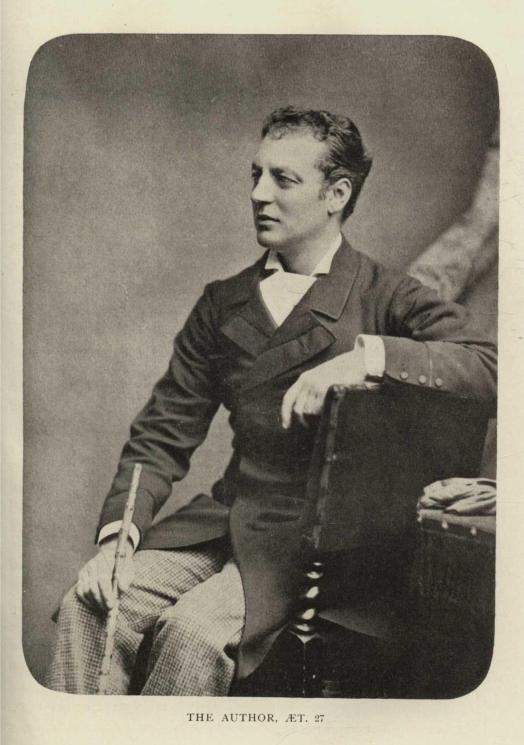
THE AUTHOR. ÆT. 27
But when in the House of Commons I publicly declared
that conviction, I received about four hundred letters of a
most violent character, most of which were written by
clergymen of my own persuasion. I have never asked a man for
his vote in my life. When I stood for Marylebone, in 1885,
there was a controversy concerning the Sunday opening of
museums and picture galleries. I was in favour of opening
them, upon the ground that people who were hard at work
all the week might have opportunities for recreation, which
I would have extended beyond museums and galleries.
But I was waited upon by a solemn deputation of clerical
gentlemen of various denominations, who desired to make
their support of me conditional upon my acceptance of their
views.
"Gentlemen," I said, "has it ever occurred to you that
I have never asked you for your vote? Let me tell you
that if you disapprove of my opinions, your only honest
course is to vote for my opponent."
They were so astonished that they withdrew in shocked
silence.
When I was in Parliament, Isaac Butt, who was failing
in his endeavour to promote an agitation, begun in 1870, in
favour of Home Government, or Home Rule, did his best
to persuade me to join the Irish party, and to obtain for it
Lord Waterford's influence, because, he said, Lord Waterford
was so universally popular and so just. Although I was
unable to join the Irish party, I was much impressed with
Butt's arguments in so far as the land question was
concerned; and I discussed the whole matter with Lord
Waterford. I suggested to him that he should form a
league of landlords pledged not to rack-rent their tenants;
pointing out that if the Irish landlords failed to take the
initiative in reform, it was certain that the people would
eventually prevail against them, and that the reforms which
would be enforced by law would bear hardly upon the good
landlords.
Lord Waterford sympathised with my view of the
matter; but after long consideration he came to the
conclusion that the course I proposed might do more harm than
good. The question was inextricably complicated by the
fact that many of the landlords who had raised their rents,
had been compelled to raise them by force of circumstances;
as, for instance, when they had been obliged to pay very
high charges upon succeeding to their estates. In his
position, Lord Waterford shrank from associating himself with a
scheme which must inflict hardship upon landlords poorer
than himself. Events took their course, with the result I had
foreseen. My proposal was inspired by that sympathy with
the demands of the Irish people, and that recognition of
their justice, which had been accorded by both great political
parties in turn, and which ultimately found expression in
the Wyndham Land Purchase Act.
Not long ago I asked one of my tenants, who had
bought his holding under the Wyndham Act, and who was
a strong Home Ruler:
"Now you own the farm, are you still for Home Rule?"
"Faith, Lord Char-less," said he, "now I have the land
behind me, shure if it was a choice I could be given between
Home Rule and a bullock, I'd take the bullock."
In recording the beginning of my Parliamentary career,
I may say at once that I have always disliked politics, as
such. I entered Parliament with the desire to promote the
interests of the Service; and in so far as I have been
successful, I have not regretted the sacrifices involved.
But in 1874 my approval of denominational education—in
other words, my support of the right of every parent to
have his child educated in his own religion—outweighed
my opposition to Home Rule. One of my principal
supporters, himself a Home Ruler, suggested as an ingenious
compromise that I should so print my election address that
the words Home Rule should appear large and prominent,
and the qualification "an inquiry into," very small: a
proposal I declined.
My opponents were Mr. J. Esmonde and Mr. Longbottom,
who was celebrated for his achievements in finance.
He stood for Home Rule. Concerning Mr. Longbottom, a
certain parish priest, who was also a Home Ruler, addressed
his congregation one Sunday morning as follows:—
"Now, boys," says he, "a few words about th' Election
that's pending. First of all, if ye have a vote ye'd give ut
to a genuine Home Ruler, if ye had one standing. Ye have
not. Secondly, ye'd give it to a good Conservative, if ye
had one standing. Well, ye have one in Lord Char-less
Beresford, the gr-reat say-captain. And thirdly, ye'd vote
for the Divil, but ye'd never vote for a Whig. But as for
this Mr. Long-what's-'is-name, I wudn't be dhirtying me
mouth by mentioning the latter end of him."
One of my opponent's supporters retorted by urging the
boys to "Kape th' bloody Beresford out, for the Beresfords
were never known to shmile except when they saw their
victims writhin' on th' gibbet": an amiable reference to
John Beresford, First Commissioner of Revenue at the
period of the passing of the Act of Union, and de facto ruler
of Ireland.
Other incidents of that cheery time occur to my recollection.
There was the farmer who, ploughing his field, cried
to me as I rode by, "Hurroo for Lord Char-less."
I went up to him and asked him whether he really meant
anything, and if so, what.
"Will you do anything?" said I.
Said he, "Lord Char-less, if 'tis votes you want me to
collect, begob I'll quit th' plough an' travel for a
fortnight."
There was the car-boys' race I arranged on Waterford
quay. Ten of them started, and I won, because I had
taken the precaution to stuff some hay under the pad, which
I lit with a match. The horse was stimulated but quite
uninjured.
Then there was the affair of the bill-poster. I had
been driving round the country all day in a side-car, seeing
the boys, and late at night we stopped at a small inn. I
was standing in the doorway smoking a pipe, and feeling
cold and rather jaded, when I noticed a bill-poster hard at
work, pasting placards upon the wall of an adjacent
building. I could see that they were the green placards of
my opponent, my own colours being blue and white.
I strolled across, and sure enough, there was my bill-poster
sticking up "Vote for Longbottom, the Friend of
the People."
"And what are ye doing, my fine peacock?" said I.
"Sure I'm posting the bills of Misther Longbottom, the
Friend of the People," said he.
"'Tis a grand occupation," said I. "Vote for Longbottom,
the Friend of the People, and to hell with Lord
Char-less," said I.
"To hell with Lord Char-less," says he.
"Come," says I, "let me show ye the way to paste bills,
ye omadhaun."
"And what do ye know about pasting bills?"
"Haven't I been a billposter all me life, then?" says
I. "Here, let me get at it, and I'll shew ye the right way
to paste the bills of Longbottom, the Friend of the People."
He handed me his long hairy brush, and a pailful of a
horrible stinking compound, and I pasted up a bill the way
I was born to it.
"Sure," says he, "ye can paste bills with anny man that
God ever put two legs under. 'Tis clear ye're a grand
bill-poster," says he.
"Didn't I tell ye?" says I.
And with that I caught him a lick with the full brush
across the face, so that the hairs flicked all round his
head, and with a loud cry he turned and fled away. Armed
with the pail and the brush, away I started after him,
but my foot caught in the lap of the long coat I had on,
and down I came, and knocked my nose on the ground,
so that it bled all over me, and I had to go back to the
inn. I took the rest of the placards, and the pail and the
brush, and drove home, arriving very late. My brother Bill
was in bed and sound asleep. Without waking him, I
pasted the whole of his room with bills, "Vote for Longbottom,
the Friend of the People." I pasted them on the
walls, and on the door, and on his bed, and on his towels,
and on his trousers, and on the floor. Then I went to bed.
In the morning he awakened me, wearing a pale and
solemn countenance.
"Charlie," said he, "there's some bold men among the
enemy."
"What do you mean?" said I.
"They are great boys," says he. "Why, one of them got
into my room last night."
"Impossible," said I.
"Come and see," said he. "When I woke this morning
I thought I had gone mad."
Upon the eve of the election, a man whom I knew to be
a Fenian, came up to me and said, "I shall vote for ye,
Lord Char-less. I don't agree with your politics, but I shall
vote for ye."
"And why would you?" I said. "You that's a Fenian,
you should be voting for Mr. Longbottom, the Friend of the
People, like an honest man."
"Not at all," says he. "When ye go to the market to
buy a horse, or a cow, or a pig, what is it ye look for in 'um?
Blood," says he. "An' it's the same in an iliction. Ye are
well-bred, annyway," says he, "but as for this
Mr. Longwhat's-'is-name, he's cross-bred."
When I was holding a meeting, one of the audience kept
interrupting me; so I invited him to come up on the platform
and have it out.
"Now what is it, ye old blackguard," I said. "Speak
out."
"Lord Char-less," says he, "ye're no man."
"We'll see about that," says I. "Why do you say so?"
"Lord Char-less," he said solemnly, "I remimber the
time one of your family stood for th' county of Waterford,
I was up to the knees in blood and whisky for a month, and
at this iliction, begob, devil a drop of eyther have I seen."
The old man referred to the election of 1826, in which
Lord George Beresford was beaten by Lord Stewart de
Decies, an event which was partially instrumental in bringing
about the emancipation of the Roman Catholics in 1829.
I have always preferred a hostile political meeting to a
peaceable assembly; nor have I ever failed to hold a hostile
audience except upon one occasion, during the York election.
I had sent a speaker to occupy the attention of an audience,
largely composed of my own countrymen, till I came, and
by the time I arrived he had succeeded in irritating them
beyond the power of pacification.
But one can hardly save oneself from one's friends.
During the Waterford election I came one evening to
Youghal and went to the hotel. I was peacefully smoking
outside the inn, when a party of the boys came along, hooting
me, and presently they began to throw stones. When I
advanced upon them they ran away and were lost in the
darkness. As I turned to go back to the hotel, a large
missile caught me behind the ear, knocking me over.
Next morning I related the incident to one of my most
enthusiastic supporters in the place.
"'Tis a disgrace," said I, "throwing stones in the dark.
And as for that boy who made a good shot, if I could get
hold of him I would scatter his features."
"Ye would not," said he.
"And why wouldn't I?" said I.
"Because," says he, "it was myself that threw that brick.
An' didn't I get ye grand!" says he. "But ye're not hurted.
Sure ye're not hurted, or I wudn't have told ye annything
about it."
It wasn't disloyalty on his part. It was simply that he
couldn't resist what he considered a joke.
The result of the polling was: Beresford, 1767;
Esmonde, 1390; Longbottom, 446.
A salient characteristic of the Irish race is that they will
not endure condescension towards them. They admire
resolution and determination, and will submit to the sternest
discipline if it is enforced upon them by a man who understands
them and whom they respect. Conversely, they will
yield nothing to weakness, and will return any assumption
of superiority with hatred and contempt. Hence it is that
the English have so often failed in their dealings with the
Irish. In spite of the violence the Irish often exhibit in
politics, their pride of race and pride in one another remain
their notable characteristics.
I recently overheard a remark which illustrates the Irish
master sentiment. During the debates upon the Home
Rule Bill which took place in the House of Commons in
1912, one of his Majesty's Ministers, having made a long
and an eloquent speech in support of that measure, punctuated
by enthusiastic cheers by the Nationalist members, had
it knocked to smithereens by Sir Edward Carson. Afterwards,
I heard one Nationalist member say to another,
"Wasn't that grand, now, to see the Irishman knocking
spots out of the Saxon!" Yet it was the Saxon who was
fighting for the Nationalist cause, which the Irishman, Sir
Edward Carson, was strenuously opposing.
I shall never forget my first impressions, when, in
1874, I entered Parliament. There was a discussion
upon a matter of Local Government. I listened to
the speeches made on both sides of the House, each speaker
taking a different point of view, and I became more and
more doubtful concerning the solution of the problem in
hand. At last a Radical member, whose name I forget,
drew all the yarns into one rope, making what appeared
to me to be a clear, concise and reasonable proposal.
Sitting among my friends, several of whom had been at
school with me, I said:
"That is the only man who has solved the difficulty, and
if he divides I shall vote with him."
My innocent remark was received with a volley of
expostulations. I was told that I had only just joined
political life, and that I did not understand it; that the
Radical speaker's plan was excellent, but that the other side
could not be allowed to take the credit of producing a good
scheme, because it would do our side harm in the country;
that the scheme would be thrown out for the time, in order
that our side might be able later on to bring in the same
scheme and reap the credit of it, and so forth.
"Well," I said, "if this kind of tactics is required in
politics, it is no place for me. I had better go back to sea."
Whereupon I was told that I should shake down to
political methods when I had been a year or two in the
House. But I have spent years in politics and I have never
shaken down to political methods. A thing is either right
or wrong. I have never scrupled to vote against my own
party when I thought they were in the wrong.
Upon one occasion, someone told Disraeli that I was
intending to vote against the party. He put his arm on my
shoulder, and said in his orotund, deliberate enunciation:
"My boy, don't you know that it's your first duty to
vote with your party? If everyone voted according to his
convictions, there would be no party system. And without
a party system the Government could not be carried on, as
you will discover in time."
I have also discovered that when politicians think only
of issues as affecting themselves and not as affecting the
State, party politics fall to a very low level, and those who
believe in great national and Imperial ideas are regarded as
freaks and faddists.
Disraeli was very friendly both to my brother Waterford
and myself. Upon the first occasion of a division in which
I took part, he walked through the lobby with his arm on
my shoulder, rather to the surprise of the old members.
"Who the devil is that young man to whom Dizzy is
talking?" I heard them murmur.
I sat immediately behind Disraeli; and one night, Lord
Barrington, a great friend of his, hurried into the House,
and squeezing himself in between me and the next man,
leaned over and said to Disraeli in a whisper:
"Poor Whyte-Melville has been killed!"
Disraeli turned slowly round, fitting his glass into his
eye.
"Dear, dear," said he deliberately; "and pray, how did
that happen?"
"Killed in the hunting-field!"
"How very dramatic!" said Disraeli solemnly.
We stayed at Sandringham, and went for long walks
together, during which Disraeli talked and laughed with the
greatest enjoyment. But I remember how, in the pauses of
the conversation, he would stand still, and, glass in eye,
dreamily surveying the landscape, would make some such
observation as "The air is balmy ... and serene!" or
"The foliage is stunted ... but productive!" with the most
weighty and measured emphasis, as though these were
prophetic utterances. I was quite bewildered; for I did not
then know whether he were serious, or were indulging a
recondite wit. He was a visionary, dwelling much in a world
of his own; and I know now that he was perfectly natural
and serious on these occasions.
He and his wife were devotedly attached to each other.
Having taken Lady Beaconsfield in to dinner one evening,
I noticed some red marks upon her arm and her napkin.
She was wearing red roses, and at first I thought some petals
had fallen from them. Then I saw that she was wearing a
bandage on her arm, and that blood was oozing from under
it. I told her that her arm was bleeding.
"Please don't say a word, Lord Charles," she said hastily,
"it would distress Dizzy so much." And she furtively
twisted her napkin about her arm. Lord Beaconsfield, who
was sitting opposite to us, stuck his glass in his eye and
stared across the table—I was afraid for a moment that he
had overheard what his wife had said. Poor lady, she died
shortly afterwards.
When I entered Parliament in 1874 it was still the day
of the great orators: of Disraeli, Gladstone, Bright, David
Plunkett, O'Connor Power; whose like, perhaps, we shall
not see again. There was a tradition of eloquence in the
House of Commons of that time; members declined to
listen to a bore; and debate was conducted almost entirely
by the two Front Benches. It was in my first Parliament
that Disraeli touched the zenith of his extraordinary and
splendid career; during which he formulated the principles
of a national policy, a part of which himself carried into
execution, but whose complete fulfilment remains to be
achieved. Disraeli established a tradition; and like all
those who have a great ideal—whether right or wrong is
not here the question—he still lives in the minds of men, and
his name still carries inspiration. His great rival, who wore
him down at last, bequeathed no such national inheritance.
It was in this my first Parliament that Mr. Parnell
emerged as the leader of the Irish party. He was a cold,
unapproachable person; he kept his party under the most
rigid control, with a tight hold upon the purse. He had
great ability. I have often seen him stalk into the House
in the middle of a debate, receive a sheaf of notes from
his secretary, Mr. O'Brien, with whom he would hold a
whispered consultation, then rise and deliver a masterly
speech. He sat with me on the committee of the Army
Discipline Bill; speaking seldom, but always to the point.
Lord Randolph Churchill entered Parliament at the same
time as myself; and he was always a great personal friend
of mine.
Although we were opposed in politics, the other four
Waterford members were on excellent terms with the only
anti-Home Ruler in the five. There were Dick Power,
F. H. O'Donnell, J. Delahunty, and Purcell O'Gorman, who
weighed twenty-eight stone or so; and they all came to my
wedding. Another Waterford man was Mr. Sexton. As a
boy, he manifested so brilliant a talent for oratory, that he
was sent into Parliament, where, as everyone knows, he
speedily made his mark. I remember, too, The O'Gorman
Mahon, who, if I am not mistaken, fought the last formal
duel in this country.
When I entered Parliament the automobile torpedo was
a comparatively recent invention. Mr Whitehead had begun
his experiments in 1864; after four years' work and at the
cost of £40,000, he produced the formidable engine of war
known as the Whitehead torpedo, the type from which all
subsequent improvements have been evolved. I have heard
it stated that the British Government could have bought the
invention right out for £60,000. Whitehead invented the
device of using hydrostatic pressure to regulate the depth of
the immersion of the torpedo, and employed compressed air
as its motive power. The new weapon was adopted by the
British Navy and by other naval powers. In the year 1876
the type in use was the 14-in., length 14 ft. 6 in., weight
525 lbs.
In my view, the capabilities of the new weapon had not
been fully appreciated; that opinion may or may not have
been justified; but I considered it to be my duty publicly to
insist upon the importance of the torpedo in naval warfare.
I spoke on the subject both inside the House of Commons
and on the platform, and was so fortunate as to win the
approval of The Times.
The Admiralty, however, were deeply affronted. The First
Lord, Mr. George Ward Hunt, informed me that the Board
took great exception to my speaking in the House upon
naval subjects, and desired me to understand that I must
choose between the career of a sailor and that of a politician.
My reply was that I considered the request to be a breach of
privilege. Mr. Ward Hunt admitted the point; but argued
that the employment in the House of Commons of my
knowledge of the Service was prejudicial to discipline. He
was of course right in so far as the conditions did
undoubtedly afford opportunities for prejudicing discipline;
but as there was no regulation forbidding a naval officer to
sit in Parliament, a dual position which had been frequently
held by members of the Board of Admiralty, the responsibility
rested upon the individual.
However, it was not a case for argument; and I appealed
directly to Mr. Disraeli, telling him that I regarded the
request of the Admiralty as a breach of privilege; that I had
no intention of relinquishing my naval career; and that I
had entered Parliament solely in the interests of the Service.
Disraeli listened with his customary sardonic gravity.
"What," he asked, "do you intend to do?"
I said that if the matter were pressed to a conclusion, I
should resign my seat, in which event Waterford would very
probably be captured by a hot Home Ruler.
"My dear boy," said Disraeli, in his deliberate way, "I
am quite sure that you will do nothing heroic. I," he
added,—"I will see the Secretariat."
And that was the last I heard of the affair.
Among other Service matters in which I did what I
could in the House of Commons to obtain reforms, were the
training of the personnel, the more rapid promotion of
officers, promotion from the lower deck to officers' rank,
and the necessity for building fast cruisers to protect the
trade routes. I advocated more time being spent by the
men upon gunnery training, and less upon polishing
bright-work; and brought forward a motion to stop the men of
the Fleet "doing 'orses" (as they called hauling carts laden
with stores about the dockyard), instead of being trained in
their proper work. These subjects no longer possess any
interest save in so far as the circumstances resemble those of
the present day. But I find recurring to-day many of the
difficulties of thirty or forty years ago.
At that time the Admiralty had abolished the short
service system under which highly efficient seamen were
recruited direct from the mercantile marine, and the Board
had become responsible for the whole supply and training of
men for the Fleet. But the Admiralty had neglected to
constitute an efficient system of training. A very large
proportion of men were employed at sea upon duties which
precluded them from receiving war training of any kind;
another large contingent was kept idle in hulks and receiving
ships while waiting to be drafted into sea-going vessels. The
suggestion was that barracks should be erected for their
accommodation and provided with attached vessels; and
that a complete system of training should be organised; so
that every man upon going to sea in a ship of war should be
acquainted with his duties. Commander Noel (now Admiral
of the Fleet Sir Gerard H. U. Noel, K.C.B., K.C.M.G.)
kindly sent to me a most valuable memorandum upon the
subject, in which he presented an admirable scheme of
organisation, the principles of which were afterwards carried
into execution. Of late years those principles have been
infringed; but the exigencies of the Service will compel the
authorities to return to the essential conditions laid down by
Sir Gerard Noel, whose authority is entitled to the greatest
respect. I also received a sagacious letter on the same
subject from Commodore John Wilson, under whom I
afterwards served as commander in the Thunderer, indicating
the necessity of framing a scheme of organisation to come
into force as soon as the barracks were completed.
With regard to the promotion of officers and men, the
state of things nearly forty years ago finds a parallel to-day.
Then, as now, a very large proportion of officers, from the
rank of commander downwards, cannot hope to be promoted.
It was then suggested that the retiring allowance should be
increased. It is true that in 1873 Mr. Goschen, by granting
an increased retiring allowance for a limited period, had done
his best to effect a temporary relief. But the permanent
reform, which is more necessary now than ever before, still awaits
achievement. In the meantime the discontent to which I
drew attention in 1875, is by no means less detrimental than
it was. The whole difficulty, as usual, is financial.
Government after Government, of what political complexion soever,
refuse to pay the Services properly. The condition of affairs
is a national disgrace.
At that time, too, the Fleet was highly deficient in
cruisers; and, in consequence, the sea-borne trade of the
country was exposed to great danger in the event of war, as
I explained to the House of Commons. In later years the
requisite ships were provided; only, in a moment of retrograde
impulse, to be abolished. After a period of insecurity and
uneasiness, the cruiser force is once more being slowly
increased.
In later years my political opponents found great solace
at elections in saying that I had objected to the abolition
of flogging in the Navy. The question arose in my first
Parliament. What I actually did—as a reference to Hansard
will confirm—was to point out that in many cases they
were the best men, the men who had the pluck to get
into a row. High-tempered, full of exuberance, they
were flogged for offences against discipline, and whereas
a flogging was soon over and done with, the alternative
proposed would break a man's heart in prison and deprive
the Navy of valuable services. Which, then, was the more
humane course? To-day, the circumstances and conditions
have changed. Discipline is better, and flogging, thank
goodness, is abolished.
But when the matter was under discussion, a certain
ex-naval officer assembled a public meeting, at which he
attacked me with great vehemence and impassioned
eloquence. He was interrupted by an old fellow at the back
of the hall, who, refusing to be silenced, was asked to speak
from the platform. He did. He gave the meeting a dose
of lower-deck phraseology, hot and strong; and told the
audience they were not to believe a word they had heard
concerning myself; that he had been shipmates both with
the speaker of the evening and with myself. He devoted
some complimentary remarks to me, "but," says he, "as
for the other, he flogged every man in the ship three or
four times." Whereupon the audience rose in its wrath and
drove my opponent from the platform.
Mr. Disraeli asked me to survey the three battleships building
for Turkey and the one battleship building for Chile, and to
give him my opinion as to whether or not they were worth
buying. Disraeli said he preferred to ask me rather than
the Admiralty, as I could, if necessary, speak on the matter
in Parliament. "And," said Disraeli, in his pontifical way,
"I like young brains." I advised the purchase of the ships;
and purchased they were, being added to the British Navy
under the names of Superb, Belleisle, Orion and Neptune.
In those days I owned a bull-dog of marked personality.
He never fought unless he were attacked; but his favourite
recreation was to rush at full speed, head down, at every dog
bigger than himself. The instant he caught sight of a big
dog, he shot away like a projectile discharged from a gun;
nothing stopped or turned him; and the unsuspecting object
of the manifestation would go down like a ninepin. Then,
unless he were detained by reprisals, Butcher would return
to his master with the air of a dog who knew his duty and
who had done it. At that time the streets of London were
haunted by Italian image-venders, who carried the Twelve
Apostles and other sacred statuettes neatly arranged upon a
board, which the merchant balanced on his head. One of
those pious venders was walking directly in the headlong
path of Butcher, who flashed between his legs. Down came
the Apostles, who were dashed to fragments, for which I
had to pay about £12 to the pedlar of saints.
When my dog thought I wanted a hansom, he used to
scramble into it, jump upon the seat, and sit there panting
with his tongue hanging out. He performed this feat one
day when an old gentleman, without noticing him, had
hailed a hansom. The old gentleman, climbing slowly into
the cab, suddenly saw the dog on the seat, and was so
startled that he tumbled backwards and knocked his head
on the pavement.
In 1876, having passed in torpedo work in the Vernon, I
applied for the appointment of second in command in a big
snip, holding then, as I hold now, that every officer who
hopes to obtain flag rank should gain experience in detailed
routine work and in handling and organising men, which can
only be acquired as first lieutenant or commander. The
second in command of a man-of-war gains invaluable
experience. He must always look ahead in order to prevent
things occurring which would cause confusion or discomfort.
He has literally not one minute to himself in the day;
thinking ahead, waylaying the wishes of his captain, and
providing not only for what will occur but for what may
occur, and being ready to encounter the constant unforeseen
emergencies inseparable from life at sea in a man-of-war.
I was accordingly appointed to the Thunderer as
commander. Her captain was John Crawford Wilson
(afterwards Rear-Admiral). The Navy lost one of the best
officers that ever sailed the seas when he died in 1885. He
was mentioned in the Admiral's dispatch for gallant conduct
in the affair of the Peiho Forts in 1859, served on the
Pacific Station, and was commodore of the Australian
station. He was commander of the Bombay screw wooden
first-rate, when she was burned off Montevideo on the
14th December, 1864, and when 97 officers and men
perished. Many of those who were lost had climbed out
on the bowsprit, and when they were forced overboard by
the heat, the melting lead of the gammoning (the lead
covering to the chain gammoning securing the bowsprit)
dropped on them and killed them. It was largely due to
the splendid discipline maintained by Wilson that the loss
was not far greater. The men held their posts although
the flames were licking up through the skids, so that the
falls of the last boat, lowered from the yard-arm, were
actually burned through. It should be added that in
this disaster the Royal Marines enhanced their unrivalled
reputation, 34 out of 97 lost belonging to the corps, the
sentries dying at their posts.
The Thunderer was of 9190 (4407) tons, 6270 (800) h.p.,
and belonged to the Channel Squadron. She was an
improved central battery twin-screw ironclad, designed,
with the vessels of a similar type, Devastation and
Dreadnought, by Mr. E. T. Reed, C.B. In these ships there was
no propulsion by mast and sail power. They also embodied
the idea of limiting the armament to heavy guns, the
secondary armament of lighter guns being omitted. This
arrangement, after having been wisely abandoned for many
years, was repeated in the Dreadnought of the year 1906,
only to be once more recognised as a mistake. One of
many reasons why a secondary armament was essential,
particularly with muzzle-loading guns, was that, lacking it,
the men might have been exposed to the enemy's fire for
some time before they could reply, a most demoralising
position. These considerations were constantly represented
by Captain Wilson to the Admiralty. While the science of
gunnery progressed, the element of time has remained a
factor in the problem, though under different circumstances.
The Thunderer carried two pairs of muzzle-loading guns in
two turrets; the foremost pair being 38-ton guns, hydraulic
loading, the after pair 35-ton guns, hand-loading. She was
belted with 14-inch armour along the water line; and the
armour projecting squarely from the hull, its edge struck the
water so hard when the ship rolled, that she was shaken
throughout her structure. To remedy this defect, wedge-shaped
pieces were fitted along the lower edge of the armour.
Before I joined the ship she had burst a boiler, the
escaping steam causing great loss of life. Captain Wilson,
who was in the engine-room at the time, was saved by his
stature; although he was scalded, his face was above the
level of the steam, being between the deck-beams where
there was an air cushion.
That the boiler exploded was due to the remarkable
coincidence of two factors. The box safety-valve jammed,
owing to the two different metals of which it was constructed
expanding in different degrees. And the pressure-gauge
tell-tale, which was fitted in a cogged circle, had the
needle forced right round the circle twice or more, so that
it showed a normal pressure. The actual pressure must
have been terrific.
And after I left the ship one of her guns burst. This
accident contributed another instance in favour of
breech-loading as opposed to muzzle-loading guns.
The accident occurred during practice at quarters in
the Gulf of Ismid, on 2nd January, 1879, in the fore-turret.
Captain Alfred John Chatfield had succeeded Captain
Wilson in command. Two officers and nine men were killed,
and thirty-five persons injured. The muzzle was blown
off from about two feet in front of the trunnions. There
was much discussion then and subsequently concerning the
cause of the accident. The probability is that the bursting
of the gun was due to its having been double-loaded, after
a previous miss-fire, which, in the simultaneous discharge of
the rest of the guns, had not been noticed. The committee
which reported on the matter on 1st March, 1879, adopted
this hypothesis, in preference to the theory that there had
been a flaw in the material.
Captain Edward Seymour (afterwards Admiral of the
Fleet the Right Hon. Sir E. H. Seymour), who was then in
command of the troopship Orontes, in his book, My Naval
Career and Travels, thus refers to the incident:—
"From Malta I brought home the main part of the ship's
company of H.M.S. Thunderer, on board which ship the
terrible explosion of the 38-ton muzzle-loading gun had
lately occurred in her foremost turret. Both turret guns
were being fired simultaneously, but evidently one did not
go off. It may seem hard to believe such a thing could
happen and not be noticed, but from my own experience
I understand it. The men in the turret often stopped their
ears, and perhaps shut their eyes, at the moment of firing,
and then instantly worked the run-in levers, and did not
notice how much the guns had recoiled. This no doubt
occurred. Both guns were then at once reloaded, and the
rammer's indicator, working by machinery, set fast and
failed to show how far home the new charge had gone.
This, too, may seem unlikely, but no doubt it happened;
and the gun on being then fired burst, killing two officers
and several men, and wrecking the turret. Experiments
made with a similar gun double-loaded, burst it in exactly
the same way."
I agree. I have frequently been in the turret during
practice, and I have myself fired several rounds and I can
testify that the concussion was so tremendous that it was
impossible to hear whether one gun was fired or both guns
were fired. Without insisting upon details, it was also the
fact that the men in the turret could not tell by the position
of the hydraulic rammer whether or not the gun had already
been charged, as the rammer was three-jointed and telescopic:
the indicator which was designed to show the position of
the rammer was totally unreliable; while the actual loading
of the gun was done upon the battery deck below the turret.
Hence the loading crew must also have been unaware that
there had been a misfire. The system in use in the
Thunderer was experimental, and after the accident its
defects were remedied. I then wrote to The Times explaining
what the system had been and how it had been improved,
in order both to remove any misapprehension there might
have been with regard to the efficiency of the officers and
men who perished in the disaster, and with regard to the
future safety of guns' crews. I was reprimanded by the
Admiralty for having published the letter while on full
pay in the command of the Osborne; but the reprimand
was (like the Bishop's apron) a mere form, for I also
received a private letter of thanks.
After the bursting of the boiler, but before the gun
accident, the Prince of Wales at my suggestion very kindly
came on board, in order that the men's belief that the
Thunderer was an unlucky ship should be removed. The
Prince fired the fore turret guns at a target from the captain
of the guns' firing position, and made a rattling good shot.
The Thunderer was employed in experimental work,
such as measuring her turning-circle (the diameter of which
is the smallest distance the ship can set between the point
at which she begins to describe a semi-circle and the point
at which she ends it), and noting her behaviour under
various circumstances and stresses of weather. I gained
much valuable experience in her, and I shall always
remember Captain Wilson as one of those officers from
whose skill and experience I learned the most.
While I was in the Thunderer (1876-7) I made one
of the first working models of the telephone used in this
country, and had the honour of presenting it to H.R.H. the
Princess of Wales. The invention was first exhibited
before the British Association by Mr. W. H. Preece on
23rd August, 1877; and it was shown to Queen Victoria
at Osborne on 15th January, 1878. The Telephone
Company was established during the same year.
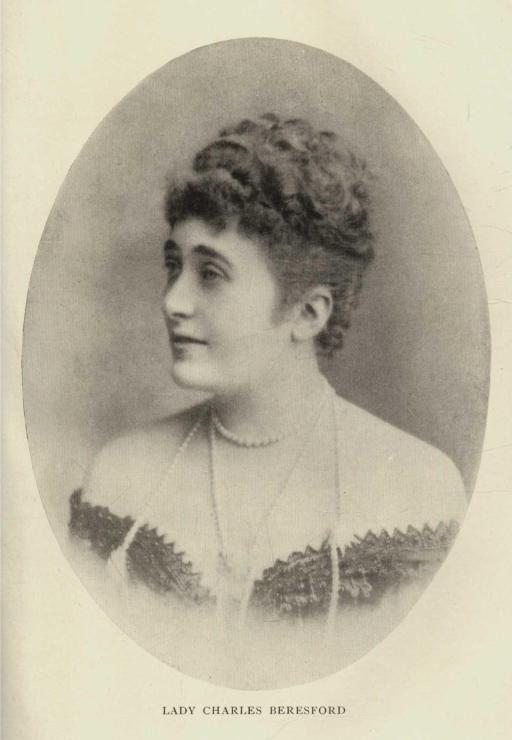
LADY CHARLES BERESFORD
The Thunderer was sent to blow up a vessel which had
capsized and which was floating in the Channel, a danger
to mariners. Explosives attached to her side tore pieces
out of her, but the wreck continued to float. In these
cases it is necessary to disintegrate the vessel, whether
sunk or floating, into fragments. I suggested that the hull
should be girdled with an iron hoop to which explosives
were attached at intervals, and the device was successful.
The explosion cut her into holes like the perforations of
a sheet of postage stamps and she broke up.
The Thunderer was lying off Queenstown, and I was
watching a cutter which was running out of the harbour.
On the deck was a group of Irish farmers. The cutter
suddenly gybed, the boom knocking down the farmers.
Getting up, they instantly fell upon one another with sticks;
and they were hard at it when over came the boom again,
and again felled them all to the deck. It could be they
had had a drop of liquor taken, which confused their
intellects.
In the year 1878 I married Miss Jeromina Gardner,
daughter of the late Richard Gardner, M.P. for Leicester,
and of Lucy Countess Mandelsloh, whose father, Count
Mandelsloh, was for some years Minister in London,
representing Würtemberg.
Shortly afterwards I was appointed to command the
royal yacht Osborne. The Osborne was used by the Prince
of Wales (afterwards King Edward VII). In those days
she was not kept in commission for more than a few months
in each year.
Several cruises were made to Denmark, and there were
many shooting expeditions. On one such occasion I was
the only person present who was not either a king actual
or a king prospective. There were the King of Denmark,
the King of Norway and Sweden, and the King of Greece,
the Prince of Wales, the Cesarewitch, the Crown Princes of
Denmark, of Norway and Sweden, and of Greece. We shot
foxes, hares, deer, and anything that came along; and I was
laughed at when my instincts forbade me to shoot a fox.
Upon a return voyage, when all the Royal children were
on board, a gale sprang up just off the Skaw. The starboard
paddle-wheel was smashed upon some wreckage; and the
next thing I saw was a small craft being driven on a lee
shore. The Osborne dropped anchor, in order both that
the paddle-wheel should be repaired and that the crew of
the driving vessel might be assisted. The only way to
rescue them was to veer a boat astern with a hawser. Just
as the arrangement was ready, to my delight I perceived
the crew—there were four—embarking in their own boats.
They reached the shore in safety, but their ship was
wrecked.
It was then the system in the royal yachts to retain the
officers in her for long periods. One officer had been in
the Osborne for fourteen years. I ventured to suggest to the
Prince of Wales that under these conditions his acquaintance
with the officers of the Fleet was necessarily limited, and
that by means of restricting the time of service in the Osborne
to two years, he might become acquainted with a succession
of officers. With his habitual courtesy and address, the
Prince adopted the suggestion.
Queen Victoria was, however, a little perturbed by the
change. Her Majesty said to me that she hoped I should
not endeavour to change the officers in the royal yacht.
"No, ma'am," I replied. "I have no such power. I only
made a suggestion to the Prince."
"You may be right," said the Queen, "but I am an old
woman now, and I like to see faces I know about me, and
not have to begin again with new faces."
We had some excellent boat-racing in the Osborne. One
famous race was rowed at Cowes between the officers of the
royal yachts Victoria and Albert and Osborne, in six-oared
galleys. Her Majesty Queen Victoria came down to the
jetty to witness the contest. The stroke of the Victoria
and Albert was my old comrade in the Marlborough and
Bellerophon, Swinton Holland. I was stroke of the Osborne's
crew. At first the Osborne drew ahead—rather, I think, to
the Queen's dismay—but eventually the Victoria and Albert
won the race, to the delight of Her Majesty.
Another great race was rowed between the Osborne
six-oared galley and the Dockyard boat. It took place off
Southsea, the whole of the foreshore being lined with people.
The Osborne won. Her boat was manned by Irish
bluejackets whom I had trained myself.
While I was commanding the Osborne one of the crew
met with a singular accident. We were shooting the seine
off Calshot, and, as it fouled, I sent a man down to clear it.
When he came up, he said that he had been stabbed through
the hand "by some beast." I examined the wound and
found that his hand had been pierced right through, and I
thought that he must have come upon a nail or a splinter in
a piece of wreckage. But when we hauled up the seine,
there was a huge sting-ray. I cut out the sting and gave
it to the Princess. There is no doubt that the fish had
transfixed the man's hand. The sailor is still alive, and is
well known in Portsmouth for his political enthusiasms. It
was in the same haul that we caught a red mullet weighing
about six pounds, the biggest I have ever seen.
I ought here to record the very great interest taken
by the Royal Family in all matters connected with the
Navy. While I was in command of the Osborne, the Prince
of Wales graciously consented to attend one of the gatherings
of members of Parliament who came at my invitation
to see something of the Navy. On this occasion they visited
Portsmouth Dockyard, where they were shown everything
of interest.
One of the experiments performed for the entertainment
and the instruction of the party was firing at a floating cask
with bombs thrown by hand, a method of warfare since
discontinued owing to the danger it involves to the person
bombarding. When the cask exploded, a stave flew between
the Prince and the general commanding at Portsmouth,
Sir Hastings Doyle. Had it struck either of them he must
have been killed.
The general's brother, Percy Doyle, a dear old gentleman
well known in society, had very bad sight. I once saw
him trying to eat a red mullet done up in paper. After a
good deal of harpooning, he got it out, but put the paper
in his mouth. We always told him he had swallowed the
births, deaths, and marriages column of The Times.
On Sunday the 24th of March, 1878 (the date of
my engagement to Miss Gardner), the Eurydice, training
frigate, capsized off the Isle of Wight in a sudden squall
and sank. The total loss of life was about 300, only two
being saved. She was on her way home from the West
Indies. Coming under the Isle of Wight, she hauled her wind
for Spithead, thus closing the land, so that it was impossible
for the watch to see a squall coming up from windward.
The captain, the Hon. Marcus A. S. Hare, was anxious to
reach the harbour as soon as possible in order to give the
men Sunday leisure. It was about four o'clock in the
afternoon when a sudden squall struck the ship, and she heeled
over; the lee main-deck ports being open, according to
custom, she took in a good deal of water, depressing her
bows; so that instead of capsizing, she simply sailed straight
to the bottom, her fore-foot being broken off with the force
of the impact, and her topgallant masts remaining above the
surface. There was no time to shorten sail. When she was
raised it was found that only one rope, the mainroyal sheet,
had carried away.
Rear-Admiral Foley, admiral-superintendent of Portsmouth
Dockyard, kindly invited me to be his guest to take
part in the salvage operations arranged for the raising of the
Eurydice. That occasion was, I think, the first upon which the
newly invented wire hawsers were actually tested in practical
work. When they were introduced it was thought that they
would not be flexible enough for their purpose. They were,
however, used with great success in raising the Eurydice.
The hawsers were passed under the hull of the sunken ship
and secured to lighters moored on either side of her. As the
tide went down, the hawsers were hove taut, and water was
let into the lighters so that they should be brought as low
in the water as possible. The water was then pumped out
of the lighters, thus putting the utmost strain upon the
hawsers. Then, as the rising of the tide exerted a powerful
lift upon lighters and hawsers, the lighters were towed
towards the shore, in order to drag the wreck upon the
beach. As soon as she grounded, the hawsers were
fleeted and the whole process gone through again until at
low tide she was nearly high and dry.
My old ship, the Thunderer, which took a hawser to her
after capstan to tow the Eurydice, had the solid iron spindle
of the capstan pulled right out of her, as a long nail is
bent and dragged out of a piece of timber. I well remember
the intense excitement when the wreck first shifted from
her bed. Eventually we hauled her up the beach. I was
just then taking a bearing for Admiral Foley, and could not
have given a better holloa if I had viewed a fox.
Before the water was pumped out of her, and as she lay
on her side on the beach, I climbed in at a porthole, and sat
there waiting till I could enter. As the water fell, I saw
emerge the sentry's clock on the main-deck. The hands
had stopped at 4.5. The bodies lay in heaps, tangled amid
ropes; some had lost a head and some a limb. Black mud
had filtered in everywhere, even (as Sir Edward Seymour
remarks) into the closed drawers of the chests in the
cabins.
When, as a cadet, I was learning to heave the lead from
the chains of the Eurydice, which, as I have already related,
was then moored off Haslar Creek in Portsmouth Harbour,
I little thought I should one day help to raise her from the
bottom of the sea.
Dr. Boyd Carpenter (late Bishop of Ripon), in his
charming volume of recollections, Some Pages of my Life,
narrates a remarkable story concerning the Eurydice, as it
was told to him. Sir John MacNeill was the Bishop's
cousin and, like other members of his family, had the gift
of second sight.
"Sir John MacNeill," writes the Bishop, "was looking
out of the window in Sir John Cowell's room at Windsor,
when suddenly he exclaimed: 'Good Heavens! Why don't
they close the portholes and reef the topsails!' Sir John
Cowell looked up and asked him what he meant. He said,
in reply, that he hardly knew; but that he had seen a ship
coming up Channel in full sail, with open portholes, while a
heavy squall was descending upon her. At the very time
this conversation was taking place the fatal storm fell upon
the Eurydice, and she foundered as she was coming in sight
of home."
In 1880, while I was still in command of the Osborne, I
lost my seat at Waterford. In the following year, desiring
to hold another independent command before my promotion
to captain, I applied to go to sea again, and was appointed
to command H.M.S. Condor.
In September, 1875, I was appointed A.D.C. to the
Prince of Wales (our late King) to accompany his
Royal Highness upon his visit to India. The complete
list of the suite was as follows: The Duke of Sutherland,
K.G.; Sir Bartle Frere; Lord Suffield, Head of the Prince's
Household; Major-General Lord Alfred Paget,
Clerk-Marshal to H.M. the Queen; Lord Aylesford;
Major-General Probyn, V.C., Equerry to the Prince, in charge of
the transport and sporting arrangements; Colonel Arthur
Ellis, Grenadier Guards, Equerry to the Prince; Mr. Francis
Knollys (afterwards Lord Knollys), the Prince's private
secretary; Surgeon-General Fayrer, Physician to the Prince;
Captain H. Carr Glyn, Royal Navy, A.D.C. to H.M. the
Queen commanding H.M.S. Serapis; Colonel Owen
Williams; Lieutenant Lord Charles Beresford, Royal
Navy, A.D.C. to the Prince; Lord Carington, A.D.C. to
the Prince; the Rev. Canon Duckworth, Chaplain;
Lieutenant (afterwards Colonel) Augustus FitzGeorge, Rifle
Brigade extra A.D.C. to the Prince; Commander Durrant,
Royal Navy, commanding royal yacht Osborne; Dr. W. H. Russell,
hon. private secretary to the Prince, chronicler of the
voyage; Mr. Albert Grey (afterwards Lord Grey), private
secretary to Sir Bartle Frere; Mr. Sydney Hall, artist.
The Indian officers, who joined the suite at Bombay,
and whose energy and ability were beyond all praise, were
Major-General Sam Browne, V.C., in charge of transport;
Major Williams, in charge of horses and grooms; Major
Bradford, head of the police and responsible for the safety
of the person of the Prince; Major Sartorius, V.C., in charge
of tents and servants; and Major Henderson, linguist.
The first announcement of the intention of the Prince to
visit the Indian Empire was made by Lord Salisbury to the
Council of India on 16th March, 1875. The matter was
subsequently discussed at length both in Parliament and in
the Press. The condition of affairs in India, where the
mass of the ruling princes and chieftains had still to realise
that the rule of the Honourable East India Company had
given place to a greater governance, rendered the visit of the
future Sovereign of paramount importance; and the Prince's
sagacity was seldom more admirably exemplified than in
his determination to visit India as the Heir-Apparent of
the Crown. That the scheme was entirely and supremely
successful in achieving the object for which it was designed,
was due to the Prince's zeal, ability, tact and indomitable
vigour. He gave his whole mind to the enterprise; thought
of everything in advance; and set aside his personal comfort
and convenience from first to last. Only one regret was
present in the minds of all: the regret for the unavoidable
absence of the Princess.
The whole history of the episode has been so excellently
well told by the late Dr. William Howard Russell, the famous
war correspondent, who was a member of the suite, in his
The Prince of Wales's Tour (London, 1877; Sampson Low)
that any detailed account of it on my part would be
superfluous.
The Prince left England on 11th October, 1875, and
embarked in H.M.S. Serapis at Brindisi on the 16th. In
the Suez Canal we heard of the purchase of Suez Canal
shares by the British Government. The Serapis arrived at
Bombay on 8th November.
Thenceforward the Prince's tour was an unresting progress
of Durbars, receptions, dinners, visits, processions, ceremonies,
speeches, addresses, fireworks, entertainments, investitures,
reviews, varied only by intervals of sport. From Bombay,
the Prince went to Goa, and thence to Ceylon, visiting
Colombo, Kandy, where he viewed the sacred tooth of Gotama
Buddha, and Ruanwalla, where there was an elephant hunt.
Then he went to Tuticorin, Madura, Trichinopoly, Madras,
Calcutta, Bankipoor, Benares, Lucknow, Cawnpore, Delhi,
Lahore, Cashmir, Umritsar, Agra, Gwalior, and Jeypoor.
From Jeypoor he went into camp in the Terai and enjoyed
excellent sport. Then, in Nepal, under the auspices of Sir
Jung Bahadur, there was the great elephant hunt. From
Nepal the Prince went to Allahabad, then to Bombay,
whence he sailed on 11th March, 1876, having been in India
seventeen weeks exactly. "The Prince," wrote Dr. Russell
on that date, "has travelled nearly 7600 miles by land and
2300 by sea, knows more Chiefs than all the Viceroys and
Governors together, and seen more of the country in the time
than any other living man."
On the outward voyage his Royal Highness visited the
King of Greece. When the King and Queen were leaving
the Serapis after dining on board, we showed them
compliment and honour by setting them alight. The blue
lights burning at the main-yard being exactly above the
boat in which their Majesties were going ashore, dropped
flakes of fire upon them. The Prince also visited the
Khedive. On the return voyage, the Prince met at Suez
Lord Lytton, who was on his way to India to succeed
Lord Northbrook as Viceroy; was again entertained by the
Khedive; visited Malta; called at Gibraltar; and visited
the King of Spain and the King of Portugal. The Serapis
was accompanied by the royal yacht Osborne, Commander
Durrant, and H.M.S. Raleigh, Captain Tryon. The Prince
landed in England on 11th May, 1876.
It is worth noting that Lord Lytton went out in the
Orontes, one of the Imperial Service troopships, as they
were called. The troopship service was then at times
conducted by the Royal Navy, a practice since discontinued.
The Orontes was commanded by Captain E. H. Seymour
(afterwards Admiral of the Fleet the Right Hon. Sir Edward
Seymour, G.C.B., O.M., G.C.V.O., LL.D.) In his very
interesting book, My Naval Career and Travels, Sir Edward
Seymour writes: "At Suez, by arrangement, we met
H.R.H. the Prince of Wales (our late King) on his way
home in the Serapis. At Aden Lord Lytton landed in
state, it being the first point reached of his new
dominions." The point illustrates the working in detail of the great
scheme of Imperial organisation which was conceived by the
master-mind of Disraeli, and which he continued to carry
into execution so long as he was in power.
Upon landing at Bombay, I rode up to Government
House with my brother, Lord William, precisely as I had
ridden up with another brother, Lord Marcus, exactly six
years previously, on the same day of the year. Lord William
was then extra A.D.C. to the Viceroy, Lord Northbrook,
having been appointed to that post as a subaltern in the
9th Lancers. He was subsequently appointed A.D.C. to Lord
Lytton, in which capacity he attended the Viceroy at the
Durbar at which Queen Victoria was proclaimed Empress
of India. He was afterwards military secretary to three
successive viceroys, Lords Ripon, Dufferin and Lansdowne;
altogether he served on the personal staff of five viceroys.
From 1877 to 1879, while nominally in attendance upon the
Viceroy, Lord William fought in the Jowaki expedition of
1877-78, the Afghan war, during which he was present at
the capture of Ali Musjid, and the Zulu war of 1879. "In
the latter," wrote a military correspondent of The Times
(31st December, 1900), "he served as a staff officer during
the reconnaissance across the White Umvolusi River and
at the battle of Ulundi. It was in Zululand, in July, 1879,
that Beresford won the V.C. for halting, when closely
pursued by the enemy, to take a wounded non-commissioned
officer on his horse. When the soldier at first declined to
risk the officer's life by giving the latter's horse a double
burden, Beresford is understood to have hotly declared that
unless the man immediately got up on the saddle he would
himself dismount and 'punch his head.'"
For his services in the Burmese expedition of 1886, he
received a brevet-colonelcy; and in 1891 he was promoted
full colonel; in 1894 he received the K.C.S.I.; and
thereafter remained on the active list of the Army, but
unemployed. Of his exploits on the turf it is not here the place
to speak; but I may be pardoned if I have placed on record
in this place some account of Lord William's Indian service
which extended over nearly twenty years. Few men have
earned so universal an affection as that which Lord William
inspired, alike in European and native. His ability in
matters of administration was remarkable, and he acquired
an extraordinary influence over the natives of India. The
correspondent of The Times, already quoted, observes that
Lord William might have had a distinguished career in any
profession; that he might have been a great soldier, a great
diplomat, a great political officer, had not his passion for
the turf diverted a part of his energies. It may be so; but
perhaps one may be allowed to say that one liked him for
what he was and not for what he might have been; and
also that he did not do so badly. The warmest affection
existed between my brother and myself; and his death,
which occurred in 1900, was a great grief to me. But that
was in the far future when I landed from the Serapis and we
rode up to Government House together.
Of the other members of the Prince's suite I retain the
most pleasant recollections. Among them I especially
recall Major-General Probyn (afterwards General the Right
Hon. Sir Dighton Macnaghten Probyn, V.C., etc. etc.);
Major-General Sam Browne, V.C. (afterwards General Sir
Samuel James Browne, V.C., K.C.S.I., etc.); Major Bradford
(afterwards Sir Edward Ridley Colborne Bradford, Bart.,
K.C.S.I., G.C.V.O.); Surgeon-General Fayrer (afterwards Sir
Joseph Fayrer, Bart.); and Dr. Russell (afterwards Sir
William Howard Russell, C.V.O., LL.D.).
Major-General Probyn, of magnificent presence, black-bearded,
hawk-eyed, a hero of the Mutiny, was universally
respected and beloved by the native population, over
whom he owned a great influence. He was one of
the finest soldiers and most delightful companions it has
been my fortune to know. In 1876, he already had twenty-five
years' service, including the Trans-Indus frontier affair
of 1852-57, the Mutiny (in which his name was a terror), in
China in 1860, in the Umbeyla campaign of 1863. He was
Colonel of Probyn's Horse, 11th King Edward's Own
Lancers; afterwards Keeper of the Privy Purse, Comptroller
and Treasurer of the Household of the present King
when he was Prince of Wales; and since 1901, extra Equerry
to the King.
Probyn and I assisted at a surgical operation. A mahout
had his hand smashed; and we held him while the surgeon
amputated his finger and thumb.
Major-General Sam Browne, V.C., had served in the
second Sikh war with distinction, and during the Mutiny
led the surprise attack upon the rebels at Sirpura, at dawn
upon 31st August, 1858. Almost single-handed, he charged
the guns, receiving the wound resulting in the loss of his
arm. For this service, he was awarded the V.C. During
the Prince's tour he represented the Indian Army; nor could
a finer or more efficient representative have been selected.
Major Bradford had performed gallant and distinguished
service in the Mutiny. He had lost an arm, under
circumstances which may be worth repetition. Together with a
brother officer, Captain Curtis, and a trooper, Bradford was
tiger-shooting. Seated in a mechan (tree-shelter), he wounded
a tiger, breaking its back; his second barrel missed fire;
and Bradford fell from the mechan on the top of the tiger,
which seized him. Bradford thrust his fist down the beast's
throat; and while Curtis was trying to get another shot, the
tiger mangled Bradford's arm up to the shoulder. Curtis
eventually killed the animal. The party had a long and
painful distance to traverse before they reached help.
Bradford's arm was amputated without chloroform. In 1890,
Bradford was appointed commissioner of police in the
Metropolis, at a time when there was a good deal of
discontent in the Force, and speedily proved the worth of his
unrivalled experience and ability.
Surgeon-General Fayrer, I remember, had a remarkable
way with snakes. He kept a selection of the most deadly
reptiles in a wheelbarrow, nestled in straw. With his naked
hands he would uncover them, and, deftly catching them by
the neck, force them to exhibit their fangs.
Someone composed a set of irreverent verses dedicated
to the surgeon-general:
"Little Joe Fayrer
Sent for his bearer
And asked for his Christmas pie.
e put in his thumb,
And pulled out a plum,
And found it a K.C.S.I."
Dr. W. H. Russell, the famous war correspondent, who
in his letters to The Times during the Crimean war did so
much good service, was a most delightful companion. He
is remembered by all who knew him, both for his talents and
for his sympathetic and affectionate disposition and his
unfailing sense of humour. He was one of my greatest friends.
During the voyage, he occupied the cabin next to mine.
The Prince having requested him to provide himself with
a uniform, Dr. Russell designed a kind of Ambassadorial
dress of great splendour, with so generous a gold stripe to
his kersey breeches, that we told him he had gold trousers
with a white stripe inside. These effulgent garments
unfortunately carried away when the doctor was climbing upon an
elephant, on his way to a Durbar. I executed temporary
repairs upon his person with safety pins; and implored him
not to stoop. But when it came to his turn to bow, bow he
must; the jury rig parted, and a festoon of white linen, of
extraordinary length, waved behind him. Fortunately, the
assembled Indian Princes thought it was part of his uniform.
At Mian Mir, during the ceremony of a great review of
troops, Dr. Russell, who was riding among the suite mounted
on a half-broken Arab, was suddenly heard to shout, "Whoa,
you villainous brute!" At the same moment, several of the
suite were knocked endways. The Arab then got the bit in
his teeth, and tore away past the Prince down the whole line.
Dr. Russell's helmet was jerked to the back of his head, his
puggaree unfurled in a long train floating behind him, he
vanished into the distance and we did not see him again
until dinner-time. He passed so close to the Prince, that
had the doctor another thickness of gold on his gold trousers,
there would have been an accident to his Royal Highness.
The Duke of Sutherland, during the Prince's journeys
overland in India, took an intense delight in driving the
engine, from which it was hard to tear him away. We had
halted at a station where the customary ceremonial had
been arranged, and had changed into uniform, all save the
Duke, who was nowhere to be seen.
"Where can he be?" said the Prince.
I submitted that he might be on the engine, and went to
see. Sure enough, the Duke was sitting on the rail, his red
shirt flung open, his sun-helmet on the back of his head. In
either black fist he grasped a handful of cotton waste, with
which he was mopping up the perspiration of honest toil.
He hurried to his carriage to change into uniform; and
presently appeared, buttoning his tunic with one hand. In
the other he still grasped a skein of cotton waste. The
Prince looked at him.
"Can nothing be done?" said the Prince sadly.
The great elephant hunt in Nepal took place on the
25th February, 1876, under the auspices of Sir Jung Bahadur
(afterwards the Maharaja Sir Jung Bahadur, G.C.B., G.C.S.I.).
A herd of wild elephants, captained by a male of gigantic
size and valour, who had already vanquished Sir Jung's most
formidable righting elephants, had been tracked down in
the forest. Sir Jung determined that, come what would, he
should be captured. Sir Jung led the Prince and several of
his suite, all well mounted on horses, into the forest, to the
rendezvous, to which the wild herd was to be driven. But in
the meantime, the big elephant had given the hunters the slip.
I was of the hunting party, and I had the stiffest run of
my life, and at the end of it there were left besides myself
only my companion—I think he was Mr. Greenwood—and
six Indian notables. Mounted on swift pad elephants, we
pursued that tremendous beast at top speed from four o'clock
in the morning till six in the evening, bursting through the
jungle, splashing through rivers, climbing the rocky steeps
of hills upon which there appeared to be no foothold except
for monkeys, and down which the elephants slid upon their
bellies. So we rode hour after hour, hanging on the ropes
secured to the guddee, lying flat upon the steed's back to
avoid being scraped off his back by branches, until the
quarry, escaping us ran straight into Sir Jung Bahadur's
party of horsemen.
There, in an open space set with sword-like reeds, stood
the elephant, his flanks heaving, his head and trunk moving
from side to side. He had one huge tusk and the stump of
the other.
It was the business of the horsemen in front to keep him
employed in the open while the champion fighting elephants,
Jung Pershaud and Bijli Pershaud, were being brought up.
Again and again he charged, the riders eluding his rushes,
the Prince among them. A stumble or a fall—and nothing
could have saved the rider. Presently the elephant,
wearying of these profitless tactics, wheeled and took refuge in a
swamp, where the reeds and rushes hid him. But there was
nothing to do but await the arrival of the fighting elephants.
The fugitive employed his respite in cooling himself by
pouring water over his heated person. In the meantime, Jung
Pershaud, the terrible rogue elephant, somewhat fatigued
like his quarry, was drawing near. Jung Pershaud, in order
to give warning of his very dangerous presence, was hung
about the neck with a large bell, like a railway-station bell.
When he was not in action he was secured with ropes.
Presently, from out the jungle, there sounded the uneven,
minatory clangour of the bell. Everyone shouted that Jung
Pershaud was coming. The hunted elephant paused in his
ablutions, turned about, and, pushing the foliage aside with
his trunk, gazed in the direction of the warning note. Then
emerged into view the vast head of Jung Pershaud, painted
scarlet. He moved steadily and directly upon his quarry,
who lowered his head, presenting his long sharp tusk. The
tusks of Jung Pershaud were four to five feet long and
ringed with brass.
Jung swung his trunk and dealt the hunted elephant a
blow on the head, then charged him in the flank with a
resounding impact, drew back and charged the reeling beast
from behind. The hunted elephant took to flight, pursued
by Jung Pershaud, heading straight for the place where I
was watching the combat among the pads and smaller
fighting elephants. These turned and fled in terror.
The hunted elephant plunged into the wood, ploughing
his way through the undergrowth, leaving Jung Pershaud
behind him. Sir Jung Bahadur, following with the Prince
and the rest of the party, adjured us to keep out of the way
of the fleeing beast while keeping him in sight. The quarry
checked at an opening in the forest and remained in the
shelter of the trees, while the Prince, with Sir Jung Bahadur
and Dr. Russell, rode across a stream into the open space.
Sir Jung Bahadur sat on his horse and cursed the elephant;
who, after hearkening attentively for a few minutes, suddenly
charged the horsemen.
At the same instant, the second fighting elephant, Bijli
Pershaud, burst out of the jungle, and the two animals met
forehead to forehead with a crash. Bijli Pershaud drew off
and charged again, striking the hunted elephant on the
shoulder, and running beside him, charged him heavily
again and again, until the poor driven beast dropped his
trunk and uttered a pitiable cry. He was beaten at last.
As we came up, it was discovered that the elephant was
blind of one eye; everyone commiserated the defeated
gladiator; and Sir Jung Bahadur offered to let him go
free should the Prince so desire.
The Prince having accepted the suggestion, the elephant
was led captive away and was secured with thick ropes to a
tree. He bent his vast strength to a last effort to escape, so
that the tree creaked and shook under the strain. He cried
aloud in despair, and then stood silent, refusing all food.
They set him free upon the following day, having sawn
off his great tusk; which was presented by Sir Jung Bahadur
to the Prince.
A few days before the great hunt took place in Nepal,
Sir Jung Bahadur's regiment of elephants paraded before
the Prince. They numbered more than 700, and were
drilled to manoeuvre in companies to the sound of the
bugle. After the hunt, the Prince reviewed Sir Jung's
army: a corps which, as the message from the Queen
delivered by the Prince recalled in gracious terms, had
tendered valuable help to the British arms upon an
important occasion. The total strength of the army was
114,000 infantry and 420 guns. The infantry, in addition
to rifle and bayonet, carried the kukri, or curved knife, the
national weapon. We witnessed an exhibition of its use
by the soldiers, who vied with one another in cutting, with
a single action, slices of soft wood from a baulk, the cut
making a diagonal section. More by good luck than by
merit, I succeeded in cutting the widest section; and
perceiving it to be extremely improbable that I could
repeat the performance, I refused the invitation to try
again. Sir Jung Bahadur presented me with the kukri I
had used. I have the weapon now.
With this weapon, I slew a boa-constrictor. Riding an
elephant after tiger, on which occasion shooting at any other
game was forbidden, I saw a boa-constrictor, and dismounted.
The great snake was lying asleep, coiled in a hole in the
ground and half hidden in foliage. Selecting a narrowing
coil, I cut nearly through it. The snake darted at me, and
I finished it with a stick. Although it was dead, its body
continued to writhe until sunset. For a long time I kept
the skin, but unfortunately it decomposed.
My brother Lord William and I were out pig-sticking,
and were riding after a boar. I got first spear, when the
boar knocked both me and my horse clean over. The boar
went on, then turned, and as I was in the act of getting up,
came right at me. Remembering what an old pig-sticker,
Archie Hill, had told me a man should do if he were bowled
over and a boar attacked him, I rolled over on my face,
presenting my least vital aspect to the enemy. But my
brother, cleverly turning his horse, killed the boar within
a few feet of me. The beast's head is preserved at
Curraghmore.
During the whole time of the Prince's stay in India, one
of his suite, the members of which took it in turns to
discharge the duty, remained on guard over his person at night.
I have in my possession the pair of pistols with which the
gentleman on watch was armed.
On 10th January, 1876, the Prince visited the Cawnpore
Memorial. "There was deep silence," writes Dr. Russell,
"as the Prince read in a low voice the touching words, 'To
the memory of a great company of Christian people,
principally women and children, who were cruelly slaughtered
here'—the name of the great criminal and the date of the
massacre are cut round the base of the statue. No two
persons agree as to the expression of Marochetti's Angel
which stands over the Well. Is it
pain?—pity?—resignation?—vengeance?—or triumph?" Perhaps
my aunt, Lady
Waterford, could have enlightened the learned doctor; for
she it was who designed the monument, which was carried
into execution by Marochetti.
A certain officer in high command was extremely
agitated concerning the exact degree of precedence due to
him—or rather, to the Service to which he belonged; a
matter not easy to settle amid the throng of British
dignitaries and Indian potentates. The officer chafed sorely
at the delay; nor was he soothed by the injurious remarks
of a junior member of the suite, who dealt with his dignity
in a spirit of deplorable frivolity. At last, however, the
junior member approached him with the aspect of
sympathetic gravity proper to the occasion.
"I congratulate you, sir. That matter of your order of
precedence has been settled at last."
"I am glad to hear it—very glad to hear it," said the
officer. "The delay has been simply scandalous. What is
to be my position?"
The junior member appeared to reflect.
"Oh, of course," he said, at length. "Now I remember.
Your place, sir, is between the Ram of (something) and the
Jam of (something else)!"
The distinguished officer: "...!!!"
On 30th November, 1875, while the Serapis was on her
way from Bombay to Colombo, the Prince kindly presided
at a dinner given in honour of my promotion to the rank of
commander. In a letter written to me by his Royal
Highness some years afterwards, he recalls that festivity,
with a note of regret that those jolly days were gone. Three
years afterwards, upon the occasion of my marriage, the
suite presented me with a most beautiful silver bowl, which
remains one of my most highly prized possessions.
There were many Babu poems composed to celebrate
the Prince's prowess as a hunter. Among them, I remember
the following:—
"Beautifully he will shoot
Many a royal tiger brute;
Laying on their backs they die,
Shot in the apple of the eye."
Seven years afterwards, I visited India again. It seemed
to me that in the interval the relations between the Indian
and the Englishman had changed for the better; in that the
natives were less afraid of the white man, and that a
better feeling had grown up between East and West. The
principle upon which India is governed is the principle of
establishing justice and humanity. India is governed by
the sword; but the sword is sheathed.
I. THE BEGINNING OF TROUBLE
NOTE
The story of the Egyptian war may conveniently
begin with an account of the affair of the 9th
September, 1881, when Tewfik, Khedive of Egypt,
met Arabi Pasha face to face in the Square of Abdin at
Cairo, and failed to take advantage of the greatest
opportunity of his life. Had he acted there and then upon the
counsel of Mr. (afterwards Sir) Auckland Colvin, British
Controller, it is possible that the Egyptian war might have
been avoided.
The beginning of the trouble was the jealousy existing
between the native Egyptian and the Turkish, or Circassian,
elements of the army. Rightly or wrongly, the Egyptian,
or fellah, officers believed themselves to be slighted. The
Turkish, or Circassian, officers, being of the same race as the
ruling family, regarded themselves as the dominant caste.
In the time of Ismail Pasha, the predecessor of Tewfik, the
Minister of War, Osman Pasha Rifki, a Circassian, perceived
that his dignity was compromised by his being obliged to
receive orders from the Khedive through Ali Fehmi, captain
of the Guards at the Palace, a fellah. In the East, such a
situation does not continue. Ali Fehmi mysteriously fell
into disgrace. Naturally, he had a grievance; and he
joined himself to two other officers of his race, who also had
grievances. These were Abdel-el-Al and Ahmed Arabi,
who was to become better known as Arabi Pasha. They
were called the "Three Colonels," and to them came
Mahmoud Sami Pasha, an exceedingly astute politician.
Arabi's particular injury was that he had been punished
by Ismail for creating a disturbance under the Palace
windows, when he was one of the officers of the guard.
Ismail had bluntly remarked that Arabi was more noisy but
less useful than the big drum. Arabi joined a secret society
of discontented officers, and shortly afterwards again fell into
trouble under a charge of corruption while he was in
command of transports during the war between Egypt and
Abyssinia. Subsequently, Ismail allowed Arabi to join a
regiment, whereupon he became chief of the secret society.
One of its members divulged the secret to the Khedive, who
adopted the Oriental method of buying the allegiance of
the disaffected officers by promoting in one day seventy of
them to be lieutenant-colonels. He also presented one of
his slaves to Arabi to wife.
So much for Ismail Pasha. When, by order of the
Sultan, he was superseded by Tewfik, Arabi made haste to
do obeisance to the new Khedive, who made him a full
colonel. But when Tewfik reduced the army, the Three
Colonels presented a petition to the Khedive, demanding,
among other matters, that an Egyptian should be made
Minister of War in place of Osman Rifki. The Three
Colonels were thereupon arrested. Mahmoud Sami Pasha,
a member of the Cabinet, secretly arranged that when they
were brought before the Court-martial, the soldiers should
rescue them. On the 1st February, 1881, accordingly, the
soldiers burst into the court, turned it inside out, and carried
the Three Colonels to the Palace. The Khedive, confronted
with physical force to which he had nothing to oppose,
consented to supersede his War Minister in favour of the crafty
Mahmoud Sami, to increase the army by 18,000 men, and
to abolish favouritism.
The Khedive very soon discovered that Mahmoud Sami
was by no means a desirable Minister of War, and also that
the Three Colonels and their friends continued to stir up
trouble. He therefore dismissed Mahmoud Sami and
appointed in his stead the Khedive's brother-in-law, Daoud
Pasha, a Circassian, and ordered the disaffected regiments
to leave Cairo. At the same time it was rumoured that the
Khedive had obtained a secret decree from the Sultan
condemning Arabi and his friends to death. When the order
to remove his regiment from Cairo was received by Arabi,
that leader of revolt informed the Minister of War on 9th
September, 1881, that the troops in Cairo would proceed the
same afternoon to the Palace of Abdin, there to demand of
the Khedive the dismissal of the Ministry, the convocation
of the National Assembly, and the increase of the army.
Then came Tewfik's opportunity, which, as already observed,
he let slip.
When the Khedive entered the Square, accompanied by
Mr. Colvin, British Controller, and a few native and European
officers, he was confronted with some 4000 soldiers and
thirty guns. The following account of the critical moment
is given by the Hon. Charles Royle, in his excellent history
of The Egyptian Campaigns (London, 1900).
"The Khedive advanced firmly towards a little group of
officers and men (some of whom were mounted) in the
centre. Colvin said to him, 'When Arabi presents himself,
tell him to give up his sword and follow you. Then go the
round of the regiments, address each separately, and give
them the "order to disperse."' The soldiers all this time
were standing in easy attitudes, chatting, laughing, rolling
up cigarettes, and eating pistachio nuts, looking, in fact, as
little like desperate mutineers as could well be imagined.
They apparently were there in obedience only to orders,
and, without being either loyal or disloyal, might almost be
regarded as disinterested spectators.
"Arabi approached on horseback: the Khedive called
out to him to dismount. He did so, and came forward on
foot with several others, and a guard with fixed bayonets,
and saluted. As he advanced, Colvin said to the Khedive,
'Now is the moment, give the word.' He replied, 'We are
between four fires. We shall be killed.' Colvin said, 'Have
courage.' Tewfik again wavered, he turned for counsel to
a native officer at his side, and repeated, 'What can I do?
We are between four fires.' He then told Arabi to sheathe
his sword. Arabi did so at once, his hand trembling so with
nervousness that he could scarcely get the weapon back into
its scabbard. The moment was lost. Instead of following
Colvin's advice, and arresting Arabi on the spot, a step
which would have at once put an end to the whole disturbance,
the Khedive walked towards him and commenced to parley."
The Khedive subsequently agreed to dismiss the Ministry
at Arabi's request; and Arabi thus advanced another step
towards obtaining military control of the country. For a
time he prevented Cherif Pasha from forming a Ministry,
and summoned to Cairo the Chamber of Notables. The
members of the Chamber, however, whose office was purely
advisory, supported Cherif Pasha. By means of a skilful
intrigue, Mahmoud Sami contrived to obtain the appointment
of Minister of War. Arabi then effected a temporary retreat
with his regiment to El Ouady, in the Delta, and waited
upon events. It was then October. The Khedive had
convoked an assembly of the Chamber of Notables at the
end of December, and in the meantime the elections were
proceeding.
It should here be observed that Arabi did not merely
represent discontent in the army. He had behind him a
genuine and largely just popular agitation, the result of
many evils suffered by the natives. "Ismail's merciless
exactions, and the pressure of foreign moneylenders, had
given rise to a desire to limit the power of the Khedive, and,
above all, to abolish the Anglo-French control, which was
considered as ruling the country simply for the benefit of
the foreign bondholders. The control was further hated by
the large landholders, because the law of liquidation (with
which the Controllers in the minds of the people were
associated) had in a measure sacrificed their claims for
compensation in respect of the cancelling of a forced loan
known as the 'Moukabaleh,' and it was still more detested
by the Pashas and native officials, because it interfered with
the reckless squandering of public money, and the many
opportunities for corruption by which they had so long been
benefited. In addition to this, there was a great deal of
irritation at the increasing number of highly paid European
officials which the reformed administration inaugurated in
the latter days of Ismail involved. The people began to
suspect that what was occurring was only part of a plan for
handing the country over to Europeans. The examples
lately set by England with regard to Cyprus, and by France
in Tunis, were, it must be owned, but little calculated to
inspire confidence in the political morality of either of these
two Powers" (Royle, The Egyptian Campaigns).
In these things consisted the reserve strength of Arabi;
and while he was ostensibly in retirement at El Ouady
(probably spending a good deal of time in Cairo with his
fellow-conspirators), the native press continued to excite
irritation against the Europeans; and when the new Chamber
of Notables assembled on 25th December, 1881, they at once
presented demands which brought the whole situation in
Egypt to the notice of Europe. The Chamber demanded
control of the revenues outside those assigned to the Public
Debt, together with other new powers directly infringing
the prerogatives of the Sultan and of the Khedive. It seems
that Mahmoud Sami inspired these manifestations, not with
any hope or desire that the demands of the Chamber would
be granted, but because, as they were inadmissible, the
Ministry of Cherif Pasha would be wrecked, and Mahmoud
Sami thereby advantaged.
The British and French Governments declared that the
demands of the Chamber were unacceptable. At the same
time they learned that the coast fortifications were being
strengthened and that the army was to be increased. On
behalf of the two Powers, a Joint Note was presented
to the Khedive in Cairo, on 8th January, 1882, stating
that England and France were united in opposing "the
dangers to which the Government of the Khedive might
be exposed."
The presentation of the Joint Note marks the beginning
of that European intervention which might have prevented,
but which did not prevent, the massacre in Alexandria of
the 11th June, 1882, and which eventually resulted in the
bombardment of that city on 11th July, 1882. The jealousy
existing between France and England at that time in respect of
intervention in Egypt, nullified the effective action of either
party. Had M. Gambetta continued in power, he would
probably have forced Lord Granville to adopt a decisive
policy. But M. de Freycinet, who succeeded Gambetta while
the question was still under discussion, was as much afraid
of responsibility as Lord Granville was. Diplomacy thus
returned to its customary routine of addressing Circular
Notes to the European Powers, and generally avoiding
definition as long as possible. Arabi seized his opportunity
and announced that intervention on the part of England
and France was inadmissible. The Chamber of Notables
also saw their chance, and demanded the dismissal of the
Ministry. The Khedive, apparently deserted by England
and France, and much afraid of offending the Sultan, had no
choice but to dismiss Cherif Pasha and to appoint in his
stead Mahmoud Sami, who thus attained his object.
Mahmoud Sami immediately appointed Arabi Pasha
Minister of War. Arabi thus achieved a military dictatorship.
It will be observed that his success was directly due
to the vacillation of the English and French Governments.
Mahmoud Sami at once forced the Khedive to assent to the
demands of the Chamber, and the English and French
Controllers resigned, upon the ground that "the Khedive's
power no longer exists."
The dictators, Mahmoud Sami and Arabi (now Arabi
Pasha), strengthened the coast fortifications, ordered ninety
guns of Herr Krupp, and rapidly increased the army.
Then the dictators, considering that the hour of their
vengeance had arrived, arrested fifty of the hated Circassian
officers, (it is said) tortured them, and sentenced forty of them
to perpetual exile. The Khedive refused to sign the Decree;
whereupon Mahmoud Sami threatened that his refusal would
be followed by a general massacre of foreigners. A month
later, on 11th June, such a massacre occurred. In the
meantime, the open quarrel between the Khedive on the one side,
and his Ministers, backed by the army, on the other, created
general alarm. Mahmoud Sami convoked the Chamber;
only to discover that the Notables were afraid to support
him. Under these circumstances, Mahmoud Sami and
Arabi Pasha informed the Khedive that, on condition that
he would guarantee the maintenance of public order, they
would resign. The Khedive replied in effect that it was not
he but Arabi that troubled Israel. On the next day, 15th
May, 1882, the English and French Consuls-General warned
Arabi that in the event of disturbance, England, France
and Turkey would deal with him. Arabi retorted that if
a Fleet arrived, he could not be responsible for the safety
of the public. Upon the same day the Consul-General
informed the Khedive that an Anglo-French Fleet was
on its way to Alexandria, whereupon Mahmoud Sami and
the rest of the Ministry made a formal submission to the
Khedive.
Such was the first influence, exerted from afar, of naval
power. But when, upon the 19th and 20th May, the ships
arrived at Alexandria, the effect was considerably lessened;
for the force consisted of no more than one British line-of-battle
ship, H.M.S. Invincible, with two gunboats, and
one French line-of-battle ship, La Gallisonière, with two
gunboats. The object of the Granville-Freycinet diplomacy,
to do something and yet not to do it, had thus been
triumphantly achieved.
The instructions given to the British and French
admirals respectively are worth noting.
The British admiral was told to:
"Communicate with the British Consul-General on
arrival at Alexandria, and in concert with him propose to
co-operate with naval forces of France to support the
Khedive and protect British subjects and Europeans, landing
a force, if required, for latter object, such force not
to leave protection of ships' guns without instructions from
home."
It will be observed that Admiral Sir Frederick Beauchamp
Seymour was not given enough men to form an efficient
landing party; so that the futile clause concerning "the
protection of the ships' guns" is hardly worth considering.
The French instructions were at least logical. The
French admiral was plainly told to do nothing except in
an emergency.
"On arrival at Alexandria communicate with the
Consul-General, who will, if necessary, indicate to you what
you will have to do to give a moral support to the Khedive.
You will abstain, until you have contrary instructions, from
any material act of war, unless you are attacked or have to
protect the safety of Europeans."
Acting on the advice of the Consuls-General, the Khedive
endeavoured to induce Mahmoud Sami and Arabi to
resign. The dictators refused. The Consuls-General
thereupon presented them with an ultimatum, and the Ministry
resigned; but the Khedive was subsequently compelled by
the threats of the army and the prayers of the terrified
notables to reinstate Arabi Pasha. That leader at once
published a proclamation stating that he guaranteed the
public safety, which failed, however, to allay the public
fears. On 29th May the European population of
Alexandria drew up a memorial, which was telegraphed to
the Foreign Office, stating that they were placed in extreme
peril, against which the force at the disposal of the British
admiral was totally inadequate.
Upon the same day, Admiral Seymour reported that
earthworks were being raised on shore, and asked for
reinforcements. On 30th May another line-of-battle ship
arrived, with two gunboats, and three French warships.
The rest of the British squadron in the Mediterranean were
directed to cruise within touch of the admiral.
On the 7th June an Imperial Commissioner, Dervish
Pasha, dispatched by the Sultan, arrived at Cairo. He was
instructed to play a double part, the object of his mission
being to counteract European influence. It was a
complicated intrigue; but it is not worth unravelling, because
Dervish Pasha presently discovered that the ruler of Egypt
was Arabi Pasha.
Such is a summary of events up to the eve of the riots in
Alexandria. At that moment, Arabi Pasha was military
dictator; backed by the army and supported by popular
sentiment: the Khedive, still nominally ruler, was deprived
of power and went in peril of his life; the Sultan, his
overlord, whose dominant motive was the desire to avoid foreign
intervention in Egypt, wrapped himself in diplomatic
ambiguity; England and France, the only interested foreign
Powers, each afraid of the other and both afraid of incurring
responsibility, were in a state of miserable vacillation, for
which (as usual) many helpless and innocent persons paid
with their lives and property. In these circumstances, the
advantage lay with the man who knew his own mind.
That man was Arabi Pasha.
It seemed that nothing could better serve his ends than
an organised massacre of Europeans by the populace, during
which the police and the army should remain passive; for
nothing could more effectually demonstrate the power of
the dictator, bring the Khedive into contempt, flout the
foreign Powers which had exhibited so contemptible a
weakness, and delight the populace.
Accordingly, on Sunday, 11th June, 1882, a devastating
riot broke out in Alexandria. The natives had been armed
beforehand with naboots, or long sticks; the mustaphazin,
or military police, joined in the attack; the soldiers remained
immobile until Arabi telegraphed his orders from Cairo,
when they at once stopped the disturbance. During the
day, men, women and children, European and native, were
shot, beaten, and murdered, and the town was looted. The
loss of life was estimated at 150 persons.
In the evening the troops restored order, and subsequently
maintained it up to the day of the bombardment. During
that period, large numbers of persons left the city. Refugees
of all nations were embarked in the harbour.
Lord Salisbury, who was then in Opposition, trenchantly
exposed the true character of a policy whose direct result
was that British subjects were "butchered under the very
guns of the Fleet, which had never budged an inch to save
them." The Government had not given the admiral an
adequate force. It was the old story of the naval officer
being forced to subserve the ends of the politicians.
In England, public indignation forced the Government
to take action. The Channel Squadron was dispatched to
Malta, there to remain at Admiral Seymour's disposal.
Two battalions were sent to Cyprus.
Arabi Pasha brought more troops to Alexandria and
continued to fortify the coast defences. In the meantime
the Navy was helping to embark the refugees.
From this point, the general course of events may
conveniently be related in the form of a diary, thus supplementing,
for the purposes of reference, the detailed narrative
of Lord Charles Beresford.
On 11th July the British Fleet bombarded the coast
forts. The warships of other nations took no part in the
action. The British force consisted of fifteen vessels and
5728 men; eight ironclads, five gunboats, a torpedo vessel
and dispatch vessel. The forts were silenced and the
gunners were driven from their batteries.
On 12th July the city was set on fire by the Egyptian
troops. These, accompanied by civilians, looted the city
and so departed.
On 13th July the British admiral landed 800 men. It
will be observed that had Admiral Seymour been permitted
to land a force upon the preceding day, he could have
disarmed the Egyptian troops and prevented the conflagration.
The Khedive had taken refuge in his Palace at Ramleh, and
the Condor, Commander Lord Charles Beresford, was
sent to lie off the Palace to protect him. Captain John
Fisher, H.M.S. Inflexible, was ordered to take command of
the landing party. Upon occupying the outer lines, Captain
Fisher, finding chaos in the town, in rear of his position,
applied for an officer to exercise the duties of provost-marshal
and chief of police, and suggested that Lord Charles
Beresford should be appointed.
On 14th July the British force was occupying all important
positions.
On 15th July Admiral Dowell, commanding the Channel
Squadron, arrived in the Monarch. Lord Charles Beresford
was appointed provost-marshal and chief of police to
restore order.
Mr. John Ross, the British merchant in Alexandria who
gave unsparing and generous assistance to the British
forces,—services for which he has never received
recognition—writes to me as follows:—
"Lord Charles Beresford saved millions' worth of property,
causing the indemnity paid by the European Government
to be much less than it would otherwise have been. I can
assure you that there was a chance of the whole of Alexandria
being burnt to the ground, had it not been for the wonderfully
prompt, energetic, and scientific arrangements made by
Lord Charles Beresford... I do not think England can
ever be made to know properly and understand and appreciate
enough with regard to what Lord Charles Beresford did
for his country as well as for Egypt in 1882."
On 17th July 1000 Marines and 1700 soldiers arrived.
General Sir Archibald Alison took command of the whole
of the land forces, now numbering in all, 3686.
On the 20th July the British Government decided to
dispatch an expedition to Egypt.
On the 21st July the water supply of Alexandria began
to fail, Arabi having dammed the flow from the Nile into
the Mahmoudieh Canal, and let salt water into it from Lake
Mareotis. Hitherto the supply had been maintained by the
gallant exertions of Mr. T. E. Cornish, manager of the
waterworks. Sir Archibald Alison began his attacking movements.
On the 22nd July the Khedive dismissed Arabi Pasha
from his post of Minister of War. Arabi Pasha was now at
Kafr Dowar with 5000 to 30,000 men. A battalion of
British troops sailed from Bombay.
On the 24th July Mr. Gladstone informed Parliament
that the country was "not at war." On the same day the
British troops occupied Ramleh, a suburb of Alexandria.
At this time Captain Fisher fitted out the armoured
train.
On the 30th July the Scots Guards sailed for Alexandria.
From the beginning to end of the war, there were dispatched,
or under orders, from Great Britain and Mediterranean
stations, 1290 officers and 32,000 men. Add the Indian
contingent, 170 officers, 7100 men, consisting of 1st
Seaforths, 1st Manchester, 1 Bombay and 2 Bengal battalions
Native Infantry, 3 regiments Bengal Cavalry, 1 field battery,
1 mountain battery, and a section of Madras Sappers and
Miners. Add to these, 3500 followers, 1700 horses, 840
ponies, 5000 mules.
On the 1st August Lord Charles Beresford, having in
the space of a fortnight saved the town of Alexandria from
destruction and restored complete order, was relieved by
Major Gordon.
On the 2nd August Admiral Sir William Hewett, with
six vessels of war, occupied Suez.
On 3rd August the National Council declared its support
of Arabi Pasha.
On 5th August General Alison attacked and defeated
the enemy on the Mahmoudieh Canal.
On the 7th August the Khedive issued a proclamation
directed against Arabi Pasha and rebellion.
On the 10th August Sir John Adye, chief of staff, with
the Duke of Connaught, arrived at Alexandria.
On the 12th August the Brigade of Guards, the Duke of
Connaught at their head, marched through Alexandria to
Ramleh, greatly impressing the populace.
On the 15th, General Commanding-in-Chief Sir Garnet
Wolseley and Major-General Sir Evelyn Wood arrived at
Alexandria.
On the 18th August the greater part of the troops
embarked for Port Said, the transports being escorted by
five ironclads.
On the night of the 19th-20th August the Navy took
entire possession of the Suez Canal. The Monarch and Iris
took Port Said. The Orion, Northumberland, Carysfort
and Coquette took Ismailia. Admiral Hewett had already
seized Suez.
On the 20th of August the troops and warships from
Alexandria arrived at Port Said, together with Admiral Sir
Beauchamp Seymour in the Helicon. M. Ferdinand de
Lesseps had done his utmost to prevent the seizure of the
Canal, which, he insisted, was neutral. It is said that when
the troops began to disembark at Ismailia, M. de Lesseps,
erect upon the landing-place, announced that "no one
should land except over his dead body"; to which defiance
a bluejacket, gently urging aside the heroic engineer,
replied, "We don't want any dead bodies about here, sir;
all you've got to do is to step back a bit" (Royle,
Egyptian Campaigns).
On the 21st August Sir Garnet Wolseley arrived at
Ismailia in the Salamis, and, by orders of the Khedive,
issued a proclamation announcing that the sole object of
Her Majesty's Government was "to re-establish the authority
of the Khedive."
The advance into the Delta was begun.
On the 24th August Wolseley captured the dam on the
Fresh Water Canal.
On the 25th August the enemy were driven back upon
Tel-el-Kebir. Mahmoud Fehmi Pasha, one of the original
"Three Colonels," now Arabi's chief of staff, was captured
at Mahsameh railway station.
On the 28th August occurred the action at Kassassin,
in which the Egyptians were defeated. Kassassin was
occupied. During the next few days men and stores were
assembled there.
On the 9th September Arabi attacked Kassassin in force
and was driven back to Tel-el-Kebir. Sir Garnet Wolseley
made Kassassin his headquarters.
On the 12th September the army was concentrated at
Kassassin. On that night the troops advanced towards
Tel-el-Kebir.
On the 13th September an attack at dawn was made in
three places upon the Egyptian entrenchments. The British
carried them under a heavy fire at the point of the bayonet.
The action was decisive. Arabi's power was broken.
Arabi fled to Cairo.
The 6th Bengal Cavalry captured Zag-a-Zig the same
evening; and the Cavalry division occupied Belbeis.
On 14th August the Cavalry Division rode from Belbeis
to Cairo, starting at dawn and arriving at Abbassieh at
4.45 p.m. The same night, Captain Watson, R.E., disarmed
the troops in the Citadel and occupied Cairo.
On the 15th August Sir Garnet Wolseley and the Guards
arrived at Cairo, a day before scheduled time.
During the next week, Kafr Dowar, a place of equal
importance with Tel-el-Kebir, Aboukir, Rosetta and
Damietta, surrendered.
From the bombardment of Alexandria to the capture of
Cairo was sixty-six days, of which the campaign occupied
twenty-five days.
On the 25th September the Khedive returned to Cairo,
where the greater number of the British troops assembled.
Subsequently, Admiral Sir Beauchamp Seymour and Sir
Garnet Wolseley were created Peers of the United
Kingdom.
Arabi Pasha was tried by court-martial on a charge of
rebellion against the Khedive, and was condemned to death,
the sentence being commuted to exile for life. In December,
Arabi and six of his friends who had been sentenced sailed
for Ceylon.
II. THE BOMBARDMENT OF ALEXANDRIA
My appointment to H.M.S. Condor was dated 31st
December, 1881. The Condor was a single-screw
composite sloop gun-vessel of 780 tons and
770 h.p., carrying one 4½-ton gun amidships, one
64-pr. forward and one 64-pr. aft, all muzzle-loading guns. In
June, 1882, the Condor formed part of the squadron lying
off Alexandria under the command of Admiral Sir
Beauchamp Seymour.
On Sunday, 11th June, calling upon Captain Blomfield,
the harbour-master, I found him in great distress. He had
heard that there was trouble in the city, into which his wife
had gone, and he was extremely anxious about her safety.
We took a light carriage harnessed to a pair of Arab horses
and drove into the town. Presently a great crowd came
running down the street towards us. They were mostly
Greeks, many of whom were wounded and bleeding. The
next moment we were surrounded by a raging mob, armed
with naboots, or long sticks, with which they attacked us.
The street was blocked from end to end; and to have
attempted to drive through the mob would have been certain
death. I seized the reins, swung the horses round, cleared
the crowd, and drove back to the harbour-master's house.
In the meantime his wife had taken refuge in an hotel,
whence she safely returned later in the day.
The officers and men of the Fleet were ordered back to
their ships. I went on board the flagship and reported to
the admiral the condition of the town. With the trifling
force at his disposal, it was impossible that he should send
a landing-party ashore. Had he done so, in contravention
of his orders, the handful of British seamen and Marines
would have had no chance against the thousands of Egyptian
soldiers who, under Arabi's instructions, were waiting
in their barracks under arms, ready to turn out at the first
attempt at intervention on the part of the Fleet.
During the ensuing month there poured out of Alexandria
an immense number of refugees of all nations and
every class of society. These were placed on board various
vessels and were dispatched to the ports of their several
countries. I was placed in charge of these operations;
which included the chartering of ships, their preparation for
passengers, and the embarkation of the refugees. In the
course of the work there fell to me a task rarely included
even among the infinite variety of the duties of a naval
officer. My working-party was stowing native refugees in
the hold of a collier, when a coloured lady was taken ill.
She said: "Baby he come, sare, directly, sare, myself,
sare." And so it was. We rigged up a screen, and my coxswain
and I performed the office of midwives thus thrust upon us,
and all went well.
On the 10th July all merchant vessels and all foreign
men-of-war left the harbour, and the British Fleet prepared
for action. Admiral Seymour's squadron consisted of fifteen
vessels: the ironclads Alexandra (flagship), Captain
C. F. Hotham; Superb, Captain T. Le Hunte Ward; Sultan,
Captain W. J. Hunt-Grubbe; Téméraire, Captain H. F. Nicholson;
Inflexible, Captain J. A. Fisher; Monarch, Captain
H. Fairfax, C.B.; Invincible, Captain R. H. M. Molyneux;
Penelope, Captain S. J. C. D'Arcy-Irvine: the torpedo-vessel
Hecla, Captain A. K. Wilson; gunboats Condor, Commander
Lord C. Beresford; Bittern, Commander Hon. T. S. Brand;
Beacon, Commander G. W. Hand; Cygnet, Lieutenant H. C. D. Ryder;
Decoy, Lieutenant A. H. Boldero; and dispatch vessel
Helicon, Lieutenant W. L. Morrison. The coast fortifications
extended over a front of rather more than nine miles, from
Fort Marabout on the south-west to Fort Silsileh on the
north-east. Midway between the two, projects the forked spit
of land whose northern arm encircles the new Port, and whose
southern arm, extending in a breakwater, encloses the old
Port. The twelve forts or batteries mounted in all 261 guns
and mortars.
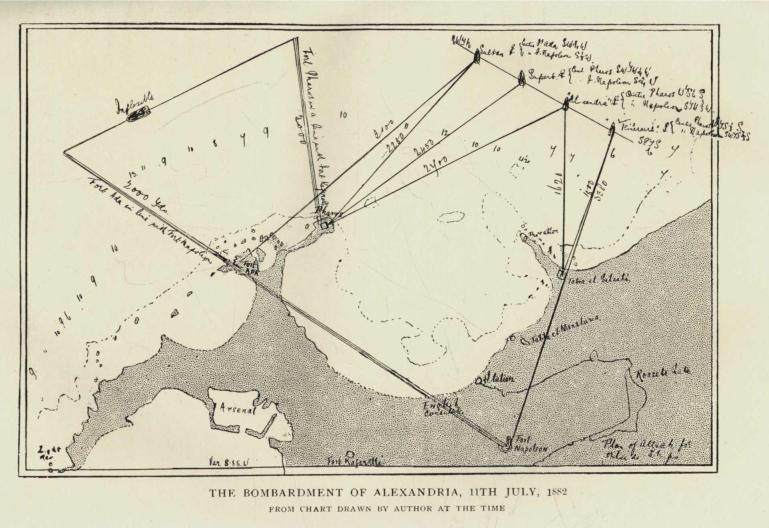
THE BOMBARDMENT OF ALEXANDRIA, 11TH JULY, 1882.
FROM CHART DRAW BY AUTHOR AT THE TIME
The bombardment of Alexandria has been so thoroughly
described in standard works that repetition must be unnecessary;
and such interest as the present narrative may contain,
must reside in the record of personal experience. I may say
at once that any notoriety attached to the part borne by the
Condor in the action was due to accidental circumstance.
She happened to fight apart from the rest of the Fleet and
in full view of the foreign warships and merchant vessels;
and, in obedience to the orders of the admiral, she had on
board the correspondent of The Times, the late Mr. Moberly
Bell. The Condor was actually under way when I received
instructions to embark Mr. Bell. Mr. Frederic Villiers, the
artist war-correspondent, by permission of the admiral, had
been my guest on board for several days.
The following account of the action is taken from a
private letter written at the time:—
"The night before the action, I turned up all hands and
made them a speech. I said that the admiral's orders were
to keep out of range until an opportunity occurred. So I
said to the men, 'Now, my lads, if you will rely upon me to
find the opportunity, I will rely upon you to make the most
of it when it occurs.' ... The Marabout Fort was the second
largest fort, but a long way off from the places to be attacked
by the ironclads. So the admiral had decided not to attack
it at all, as he could not spare one heavy ship, and of course
he would not order the small ships down there, as it was
thought that they would be sunk. The orders given to the
small ships were to keep out of fire, and to watch for an
opportunity to occur, after the forts were silenced, to assist.
Helicon and Condor were repeating ships for signals. I took
station just between the two attacking fleets.
"Just as the action began the Téméraire parted her cable
and got ashore. I ran down to her and towed her off
and while doing so, saw Fort Marabout giving pepper to
Monarch, Invincible and Penelope. Not one of these ships
could be spared, as they were getting it hot and could not
spare a gun for Marabout from the forts they were engaging.
Seeing the difficulty, directly I had got the Téméraire afloat
I steamed down at full speed and engaged Fort Marabout,
on the principle that according to orders 'an opportunity'
had occurred.... I thought we should have a real rough
time of it, as I knew of the heavy guns, and I knew that
one shot fairly placed must sink us. But I hoped to be able
to dodge the shoals, of which there were many, and get close
in, when I was quite sure they would fire over us. That is
exactly what occurred. I got in close and manoeuvred the
ship on the angle of the fort, so that the heavy guns could
hardly bear on me, if I was very careful. The smooth-bores
rained on us, but only two shots hit, the rest went short or
over. One heavy shot struck the water about six feet from
the ship, wetting everyone on the upper deck with spray,
and bounded over us in a ricochet.
"I did not fire on the smooth-bores at all until I had
silenced the heavy guns which were annoying Invincible,
Monarch, and Penelope. The men fired splendidly. I put
all down to the lectures I have given them at target practice,
telling them never to throw a shot away, but always to wait
until they got the sights on.
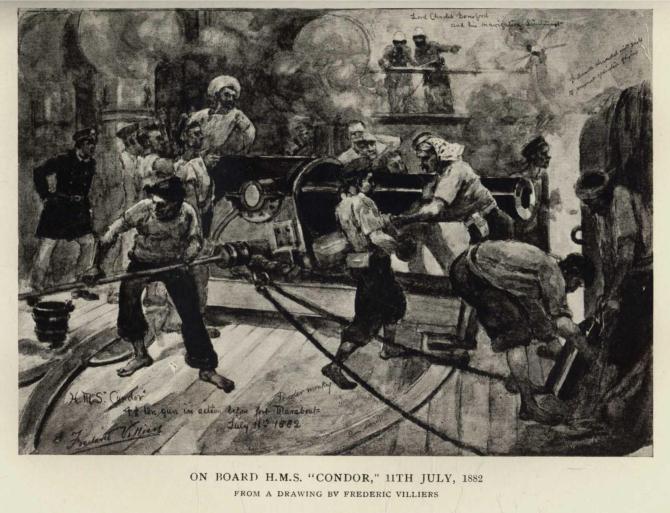
ON BOARD H.M.S. "CONDOR," 11TH JULY, 1882.
FROM A DRAWING BY FREDERIC VILLIERS
"Hedworth Lambton told me afterwards that the admiral
had just sent on the signal for the Monarch to go to Fort
Marabout as soon as she could be spared, when he heard a
cheer from his own men. He asked, 'What's that?' and
they told him they were cheering the Condor. Just then our
three guns were fired, and each shot hit in the middle of the
heavy battery, and the Invincible's men burst into a cheer.
The admiral said, 'Good God, she'll be sunk!' when off
went our guns again, cheers rang out again from the flagship
and the admiral, instead of making 'Recall Condor; made
'Well done, Condor' ... at the suggestion of Hedworth
Lambton, the flag-lieutenant.
"We then remained there two and a half hours, and had
silenced the fort all except one gun, when the signal was
made to all the other small craft to assist Condor, and down
they came and pegged away. I was not sorry, as the men
were getting a bit beat. We were then recalled to the
flagship, 'Captain repair on board,' and the admiral's ship's
company gave us three cheers, and he himself on the
quarterdeck shook me warmly by the hand, and told me he was
extremely pleased.... I never saw such pluck as the
Egyptians showed. We shelled them and shot them, but still
they kept on till only one gun was left in action. It was
splendid.... Nothing could have been more clever than
the way the admiral placed his ships.... The wounded
are all doing well. One man had his foot shot off, and he
picked it up in his hand and hopped down to the doctor
with it.... The troops hoisted a flag of truce the day after
the action; and while we waited I sent to find out why it
was they were marched away, having set fire to the town in
many places. It has been burning ever since." ...
The day after the bombardment, Captain Wilson (now
Admiral of the Fleet Sir A. K. Wilson, V.C., G.C.B., O.M.,
G.C.V.O) hauled down the flag of the Marabout Fort and
presented it to me. It is now in the Museum of the Royal
Naval College, Greenwich. The commandant of Fort Marabout
was so excellent an officer that when I was appointed
provost-marshal and governor of the town by the admiral,
I placed him on my staff to assist me in restoring order.
III. CHIEF OF POLICE
The bombardment took place on the 11th July. On
the 12th, as I have narrated, the Egyptian soldiery
fired the city, looted it, and evacuated the defences.
On the same day the Khedive was surrounded in his Palace
at Ramleh by some 400 of Arabi's cavalry and infantry, a
force subsequently reduced to about 250 men. That evening
Admiral Seymour was informed that the Khedive was in
danger. The admiral dispatched the Condor to lie off
Ramleh; and there we lay all that night, rolling heavily, with
a spring on the cable to enable the guns to be trained upon
the sandy lane down which the soldiers must advance if they
intended to take the Palace.
It was arranged that, if the Palace were attacked, the
Khedive should hang a white sheet from a window, and I
would at once take measures to secure his safety. The night
went by without alarm; and next day Tewfik, escorted by a
guard of native cavalry, went to the Ras-el-Tin Palace, where
he was received by Admiral Seymour and a guard of
Marines. Commander Hammill (who afterwards performed
excellent service on the Nile), with a landing-party of 250
bluejackets and 150 Marines, had already taken possession
of the Ras-el-Tin Peninsula.
Upon the same day Captain John Fisher, H.M.S. Inflexible
(afterwards Admiral of the Fleet Lord Fisher of
Kilverstone, O.M.), was ordered to take command of the
landing-party whose business was to secure the outer
defences of the city. Captain Fisher, having occupied the
lines, had a zone of anarchy, incendiarism and chaos,
comprising the whole city, in the rear of his position. He at
once made application for an officer to be appointed
provost-marshal and chief of police, suggesting my name for the
post; and the admiral gave me orders to assume this office.
As a narrative written at the time owns a certain intrinsic
interest, I make no apology for transcribing further passages
from private letters.
"CHIEF OF POLICE OFFICE
HEADQUARTERS, ALEXANDRIA
THE ARSENAL, 25th July, 1882
"... I landed on the 14th July, armed myself, got a
horse and a guide and an escort of about thirty Egyptian
cavalry, and started to overhaul the town, and see how I
could best carry out my orders to 'restore law and order as
soon as possible, put out fires, bury the dead, and clear the
streets.' I never saw anything so awful as the town on that
Friday; streets, square, and blocks of buildings all on fire,
roaring and crackling and tumbling about like a hell, let
loose Arabs murdering each other for loot under my nose,
wretches running about with fire-balls and torches to light
up new places, all the main thoroughfares impassable from
burning fallen houses, streets with many corpses in them,
mostly murdered by the Arab soldiers for loot—these
corpses were Arabs murdered by each other—in fact, a
pandemonium of hell and its devils.
"I took a chart with me and arranged the different parts
of the town where I should make depots and police stations.
The admiral could only spare me 60 bluejackets and 70
Marines from the British Fleet; but he obtained a
proportionate number from the foreign warships. By sunset I
had 620 men in the different depots, mostly foreigners....
I had only 140 men to patrol the town, to stop the looting,
to stop the 'fresh burning' of houses, to bury the corpses,
and to protect the lives of those who had come on shore. By
quickly sending the men about in parties in different parts of
the town, and by employing Arabs to inform me when and
where certain houses might be burnt, I often managed to get
a patrol there just in time to stop it, and the people thought
there were 600 police in the town instead of 140. For the
foreign bluejackets were ordered to occupy their respective
Legations and not to take any part in restoring order. This
was of course in the first seventy-two hours, during which time
neither myself nor my men slept one wink, as at 12 o'clock on
two occasions an alarm was sounded that Arabi was attacking
the lines, and all of us had to peg away to the front, where
we had to remain until daylight, expecting attack every
moment. These alarms lost many houses, as the mob set
them alight while we were at the front; however, it was
unavoidable.
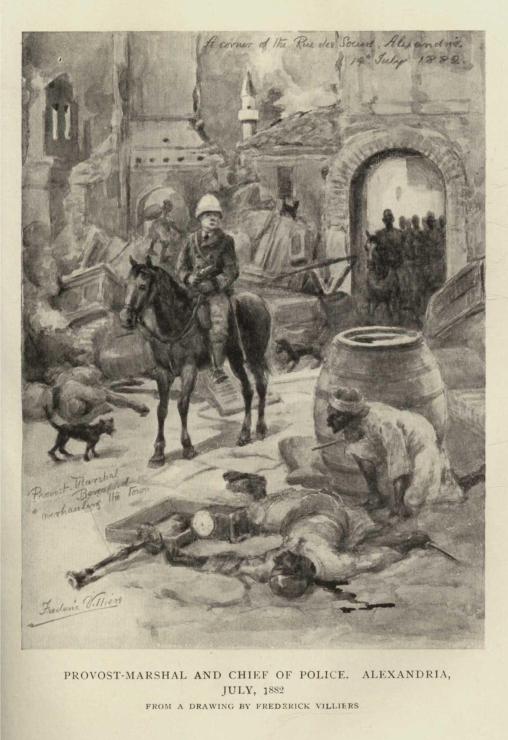
PROVOST-MARSHAL AND CHIEF OF POLICE. ALEXANDRIA.
JULY, 1882.
FROM A DRAWING BY FREDERICK VILLIERS
"On Monday, 17th July, I was sent 400 more men (bluejackets)
in answer to my urgent appeal to the admiral, as
so many fanatic Arabs were coming into the town, ... but
on Tuesday the 18th the bluejackets were all ordered off to
their ships and 600 picked Marines were sent in their place....
After I had planned to get the town into order on the
Friday (14th) I went to the Arsenal and wrote a Proclamation....
"I went off to the admiral on the following (Saturday)
morning, and submitted that I should be allowed to post the
Proclamation throughout the town. Sir A. Colvin and the
Khedive were strongly opposed to the Proclamation; but the
admiral approved of the scheme. Some of the authorities
suggested that if I shot anybody it would be well to shoot
him at night, or in the prisons, and then no one would know,
and there would be no row. This I stoutly refused,
demanding my own way for restoring order, and saying that a fair
honest Proclamation was the proper line to take, as all persons
would then know what would happen to them if they
committed certain specified acts. I carried my point, and the
admiral supported me, and on Saturday night (15th) I had
the whole town proclaimed in Arabic, stating that persons
caught firing houses would be shot, persons caught looting
twice would be shot; all persons to return to their homes, etc.,
with confidence, and anyone wanting to get information or to
lodge complaints to repair instantly to the chief of police.
"By Wednesday (19th) I had perfect order in the town,
and all firing of houses had been stopped, life was comparatively
safe, looting nearly stopped. By Friday the 21st, one
week after taking charge, all the fires were put out, all the
corpses buried, and things were generally ship-shape. I
could not have done this unless the admiral had trusted
entirely to me, and given me absolute power of life and death,
or to flog, or to blow down houses, or to do anything that I
thought fit to restore law and order and to put the fires out.
I only had to shoot five men by drumhead court-martial
sentence, besides flogging a certain number, to effect what I
have told you.
"I had a clear thoroughfare through every street in the
town by Monday (24th), and all débris from fallen houses
piled up each side and all dangerous walls pulled down.
These things were done by organising large working parties
of from 100 to 200 hired Arabs. At first I collected them
at the point of the bayonet and made them work, but I paid
them a good wage every evening, and the bayonets were
unnecessary after the first day, when they found that England
would pay well.
"I also collected all the fire-engines I could find, bought
some, and requisitioned others, got some artificers from the
Fleet and got the engines in order, had a bluejacket
fire-brigade, and also a working party of Arabs on the same
footing as the road brigade. These worked exclusively at
the fires, and not at patrolling unless at urgent necessity.
Besides these I had a sanitary committee, which buried any
bodies we might have missed, burned refuse and remains
of loot about the streets, and reburied any bodies which
might not have been buried deep enough, besides enforcing
cleanliness directly the town began to get a little bit
shipshape. There was a corps of native police to work under
my patrols, and when I turned all the affairs over, I had
260 of these men.
"I disarmed all Europeans found in the streets with
revolvers, and by so doing saved many a row in the town,
as the class I have mentioned returned in thousands after
the bombardment, and they treated the Arabs as if they,
the Europeans, had silenced the forts and policed the town.
I put many in irons for looting, and for shooting at
inoffensive Arabs.
"The greatest triumph was the formation of an Egyptian
court to try the serious cases I had on hand for life and
death and long terms of imprisonment. Not only did
tret the court formed to try what cases I chose to bring
before it but after sentence of death I insisted on Egyptian
authorities making the Egyptian soldiers (the loyal ones)
themselves shooting the prisoners whom the court sentenced....
"I had four gallopers and four Marine orderly gallopers,
in default of whom I could not have done things so quickly
in the many different departments, nineteen horses, and a
telephone to each station. I paid all the carts requisitioned
in the town for carrying my men's provisions, loot, etc. etc.
The officer using them signed a chit stating the hour he had
taken a cart and for what service, and then the man came to
my office to be paid, which he was instantly. By this means
good feeling was established between the people and the
military police. Each depot had two interpreters attached
to it to avoid any misunderstanding, and for explanations
when trying prisoners and interrogating witnesses....
"The Marine officer thoroughly investigated each case,
examined all witnesses, and then placed the evidence on
a regular charge-sheet, stating whether he believed the
prisoner guilty or not guilty, and his reason for that opinion.
If it was a serious case, I again tried it myself and judged
accordingly. There were several cases of blackmailing at
first, but these were soon stopped....
"Besides the courts held at the Police Depots, courts were
held at the Tribunal Zaptieh and the Caracol l'A'ban, at
which Egyptian officers acted as judges. In each court were
three shorthand-writers, each placed behind a separate screen,
and under the charge of a sergeant of Marines, to prevent
collusion, who submitted their reports to me, in order that I
should receive three independent accounts of the proceedings,
upon which I could intervene if necessary, in order to
prevent anyone being shot if there were not the clearest
and most uncompromising evidence of his guilt. If there
were any discrepancy in the reports, I had the prisoner
retried. I did this in three cases. Another case, in which the
circumstantial evidence, though very strong, was not
conclusive, I reprieved."
The following troops assisted the British forces in
restoring order: 125 Americans, about the American
Consulate; 30 Germans, about the German Consulate and
Hospital; and 140 Greeks about the Greek Consulate and
Hospital. On the 16th July, Captain Briscoe (a son of an
old Waterford man who hunted the Curraghmore hounds
after the death of my uncle, Henry Lord Waterford) of the
P. and O. Tanjore volunteered his services, and with 20
Italians of his crew, did excellent work. Other volunteers
who assisted me were Mr. Towrest, a member of the Customs,
and Mr. Wallace. Major Hemel, R.M.L.I., and Captain
Creaghi, R.M.L.I., were appointed magistrates. These
Marine officers performed invaluable services.
I had special reason to be grateful to Mr. John Ross, a
British merchant of Alexandria, who gave me every assistance
in his power. He knew every yard of the place. He
gave me invaluable advice with regard to the organisation of
the city, obtained interpreters, and helped to supply the
troops, placing his stores at my disposal. He would have
dispensed with receipts for articles supplied, had I not
insisted upon his taking them. Mr. Ross supplied the whole
Fleet with coal, fresh meat, and all necessaries; his help was
quite inestimable, his energy and patriotism beyond praise;
but although he must have suffered considerable losses, he
received no recognition of any kind from the Governnment
except the naval medal.
Mr. Ross gave me great assistance also in parcelling out
Mehemet Ali Square among the country purveyors of
produce, each of whom received a permit, written in English
and in Arabic, to occupy a certain space, duly pegged out,
in which to put up their booths. This measure restored
confidence. One old lady, a stout person of Levantine
origin, thought that the permit entitled her to perpetual
freehold; and she subsequently attempted to sue the
Egyptian Government for damages, producing my permit
as evidence.
Upon first going ashore to restore order, I found whole
streets blocked with smouldering ruins. Putting my horse at
one such obstacle, I scrambled over it; and I had scarce
reached the other side when a wall fell bodily behind me,
cutting off my escort, who had to fetch a compass round the
side streets to rejoin me.
Without taking the smallest notice of me or of my escort,
men were shooting at one another, quarrelling over loot, and
staggering along, laden with great bundles, like walking
balloons. The streets were speedily cleared of these rioters
by the use of machine guns. The method adopted was to fire
the gun over their heads, and as they fled, to run the gun
round turnings and head them off again, so that they
received the impression that the town was full of guns. On
no occasion did I fire the gun at them. The principles upon
which order was restored were to punish disobedience, to
enlist labour and to pay for it fairly.
The prisoners taken were organised in separate gangs
set to work, and paid less than the rest of the labourers!
The most critical part of the business of extinguishing fires
and preventing incendiarism occurred at the Tribunal, which
was stored with property worth many thousands of pounds.
A fire-engine was purchased for its protection at a cost of
£160, 18s. 1d. The total expenses of the restoration or
order were, I think, under £2000. During the fortnight I
was on shore, every station and port was visited at least
once a day and twice a night.
On one such inspection I gave my horse to an Arab lad
to hold. A few minutes afterwards there was the crack of a
pistol. I ran out, and there was the boy lying on the ground
a bullet-wound in his chest. To satisfy his curiosity he had
been fingering the 4-barrel Lancaster pistol in the holster,
and that was the end of him, poor lad.
Upon another occasion, when I was at work in one of
my stations, a sudden tumult arose in the street. I went
put, to perceive a huge Irish Marine Artilleryman engaged
in furious conflict with five or six men of the patrol. They
had got handcuffs on him, and he was fighting with
manacled hands. I asked the sergeant what was the
matter.
"He's drunk, sir. We are going to lock him up."
"Let him go," I said.
The men fell back; and the Irishman, seeing an iron
railing, raised his hands above his head and brought them
down upon the iron, smashing the handcuffs, and turned
upon me like a wild beast at bay. The man was in a frenzy.
Standing directly in front of him, I spoke to him quietly.
"Now, my lad, listen to me. You're an Irishman." He
looked down at me. "You're an Irishman, and you've
had a little too much to drink, like many of us at times.
But you are all right. Think a moment. Irishmen don't
behave like this in the presence of the enemy. Nor will
you. Why, we may be in a tight place to-morrow, and
who's going to back me then? You are. You're worth
fifty of the enemy. You're the man I want."
As I talked to him, the expression of his face changed
from desperation to a look of bewilderment, and from
bewilderment to understanding; and then he suddenly
broke down. He turned his head aside and cried. I told
the sergeant to take him away and give him some tea.
Having heard from the Governor of Alexandria that a
quantity of arms was concealed in a village lying a few
miles outside the city, I took thither a party of Egyptian
military police and a guard of Marines. On the way we
were joined by some 800 British soldiers, who surrounded
the village, while the police conducted a house-to-house
search. A certain newspaper correspondent accompanied
me. The police knocked at the door of a house, and
received no reply; whereupon the correspondent drew his
revolver and incontinently blew in the lock. I told him
that he had no right to do such a thing; that he might
have killed innocent persons; and that he must not do it
again.
"Oh, but," says he, "you don't understand how to do
these things."
I requested him to understand that I was provost-marshal,
and that unless he obeyed orders, he would be sent
back to Alexandria.
"Oh, but," says he, "you can't do that. You don't
understand——"
"Sergeant!" said I, "a file of Marines."
"Oh, but," protested the correspondent, "you can't——"
"Sergeant, take this gentleman back to Alexandria."
It was a long walk and a hot walk home.
On the 17th July, General Sir Archibald Alison took
command of the land forces. At the request of the general,
the admiral ordered me to remain in command of the police
until 1st August, when I was relieved by Major Gordon. It
was about this time that Captain Fisher devised his armoured
train, which, carrying armed bluejackets, made daily sorties.
A bluejacket sitting on the rail was ordered to come down
by his officer.
"I can't see 'em from down below," he said. The next
moment he was hit by a bullet. "They've found the range,
sir," said he, as he tumbled over.
Admiral Sir Beauchamp Seymour was good enough to
address to me a very gratifying letter of commendation for
my services. Among the many kind congratulations I
received, I valued especially the letters from the captains
under whom I had served in various ships, and many admirals
with whom I had served. On 11th July I was promoted to
the rank of captain. In the following September the
Admiralty forwarded to Admiral Sir Beauchamp Seymour
(raised in November to a peerage as Baron Alcester) the
expression of their satisfaction at the services of Captain
Fisher and of myself.
I overheard a lady finding great fault with my old chief,
Sir Beauchamp Seymour. I asked her what she had against
Lord Alcester.
"Why," said she, "he is a Goth and a Vandal. Did he
not burn the Alexandrian Library?"
A sequel to the work in Alexandria was my conversation
with Mr. Gladstone on the subject, which took place
upon my return home some weeks later. Mr. Gladstone
sent for me; and after most courteously expressing his
appreciation of my services, he discussed the question of
compensation to the inhabitants of Alexandria who had
suffered loss and damage. The information he required I
had carefully collected in Alexandria by means of an
organised intelligence corps, upon each of whom was
impressed the fact that if he gave false information he would
most certainly be punished. My view was then, and is now,
that the whole of the claims might have been justly settled
for a million sterling, upon these conditions: that the
question should be tackled at once; that all palpably
unwarranted claims should be repudiated from the outset,
because if they were recorded as claims there would
eventually be no way of rebutting them, and it would be found
necessary to pay them ultimately; that doubtful claims
should be held over for consideration; and that the proved
claims should be paid immediately. The important point
was that in order to avoid difficulties in disputes in the
future, the matter should be dealt with at once.
I knew of a case (and of other similar cases) in which a
jeweller who had contrived to remove the whole of his stock
into safety after the riot, put in a claim for the value of the
whole of the said goods.
These considerations I laid before Mr. Gladstone,
informing him also, in the light of the special information
which had come to my knowledge, that if the matter were
allowed to drift, the sum to be disbursed, instead of being
about a million, would probably amount to some four
millions.
In the event, the International Commission of
Indemnities paid £4,341,011.
IV. GARRISON WORK
When I was relieved, on 1st August (1882), of the post
of provost-marshal and chief of police, the Condor
was ordered to keep the Mex lines and citadel,
which defended the south-western boundary of Alexandria,
forming a barrier across the long and narrow strip of land
which extends between the sea and Lake Mareotis, and
upon which the city is built. The fortifications of the sea
front were continued, with a brief interval, at right angles
to the sea face, extending no more than some three-quarters
of the distance across the strip of land, so that between
one end of the fortifications and the sea, and between the
other end and the shore of Lake Mareotis, there were
undefended spaces. It was therefore necessary to frame a
plan of defence with the force and materials at command,
sufficient to hold this left flank of the city against the large
bodies of rebel soldiery and Arabs hovering in the vicinity.
Thirty men from the Condor were brought on shore, with
the band, which, consisting of one drum and one fife, was
few and humble but convincing.
The two forts on the earthwork were manned; a
40-pounder smooth-bore taken from one of the Mex Forts
was mounted on the roof of the fort nearest to Lake
Mareotis, whence it was fired at regular intervals at the
enemy occupying the earthworks on the farther shore of the
Lake. After five days they were knocked out of the place.
Charges were made for the gun out of the miscellaneous
ammunition found in the Mex Forts.
The gun used to capsize almost every time it was fired.
It was served by a Maltese gunner, who became so
superstitiously devoted to his commanding officer, that when
I was relieved by Colonel Earle, my Maltese never received
an order without observing that "Lord Charles Beresford
not do that, sare"; until Earle lost patience, as well he
might.
"D—n Lord Charles Beresford!" said he.
Wire entanglements were fixed along the face of the
earthworks. In the two open spaces at the ends of the
line of fortifications, rockets were buried, and a lanyard
was led along from the firing tube to a peg in the ground, so
that anyone passing that way at night would trip over
the lanyard, thus firing the rocket, and causing a beautiful
fountain of fire to spring from the ground, lighting up
the whole locality. The device soon stopped nocturnal
intrusions.
The open space at the Mareotis end was also commanded
by a Gatling gun mounted on the roof of the fort. In the
forts and earthworks were about twenty miscellaneous
guns. These were all kept loaded; the powder being taken
from the vast amount of loose powder stored in the Mex
lines. The guns were connected with trigger lines to the
forts, so that the whole lot could be fired from one place.
The railway lines leading from Mex Harbour through the
fortification, and, on the other side of the strip of land,
from the causeway leading across Lake Mareotis into the
city, were repaired. The railway bridge by Lake Mareotis
was repaired, and a torpedo was placed beneath it in case of
attack. A picquet of Marines occupied a truck placed on the
bridge. The train was set running. The two drawbridges
leading to the forts were repaired. The men garrisoning the
works were housed in tents made out of the sails of the Arab
dhows lying in Mex camber. A tank was obtained from
Alexandria, and fresh water brought into it. On the sea
side of the position, the Condor commanded the flank of
the approaches.
Having thus secured this flank of the city against attack,
so that it could be held against a large force, it was necessary
to make reconnaissances into the surrounding country. The
little landing-party went ashore every evening at 5.30
(with the band, few and humble but convincing) and
occupied the lines. Every morning at seven o'clock they
returned to the ship; and during the afternoon went out
upon reconnaissance, accompanied by a boat's gun mounted
in a bullock cart, and a rocket-tube mounted on another
bullock cart. Two horses were harnessed to each cart,
assisted, when required, by bluejackets hauling on drag-ropes.
The men of the Condor were reinforced from the Fleet on
these expeditions, so that the total force of bluejackets and
Marines was 150. The cavalry being represented solely by
the colonel and the major of Marines, and myself, who were
mounted, we had no sufficient force wherewith to pursue
the flying foe.
We used to play hide-and-seek with the soldiery and
Bedouin among the sandhills. When they approached on
one flank, we shelled them with the little gun until they
retired; and then, hauling the gun-cart and rocket-cart
over the roughest ground, we suddenly appeared and shelled
them on the other flank, to their great amazement. All
hands enjoyed these expeditions amazingly.
In the course of these reconnaissances, large quantities
of stores and ammunition were found in the neighbouring
villages. About three miles from the lines, an immense store
of gun-cotton and Abel's detonators was discovered in a
quarry among the low hills, stored in a shed. As no hostile
force appeared during the next two days, I determined
to destroy the gun-cotton. Captain A. K. Wilson of the
Hecla sent 20 bluejackets and six Marines to assist me.
These were embarked and landed within half a mile of the
place. Outposts were set, with orders to signal should the
enemy appear, and the rest of the party set to work.
Although gun-cotton does not, strictly speaking, explode
except by detonation, it is extremely difficult to define
where ignition ends and detonation begins; and there had
been instances of its explosion, supposed to be due to the
internal pressure of a large mass. A tremendous explosion
of gun-cotton had occurred in 1866 at Stowmarket, where
its manufacture was being carried on under the patent of
Sir Frederick Abel, then chemist to the War Office. On
another occasion, when Sir Frederick was conducting an
experiment designed to prove that ignition was harmless,
he had his clothes blown off his body, and narrowly escaped
with his life. Recollecting these things, I thought it
advisable to spread the stuff in a loose mass upon the
hillside sloping to the quarry. The gun-cotton was packed
in boxes. These were unpacked, and the contents were
spread on the ground. Next to the pile, a bucket of loose
powder was poured on the ground and over the fuse, to
make sure of ignition. Into the powder was led one end
of a Bickford's fuse, which was then threaded through the
discs of gun-cotton. The fuse was timed to burn for five
minutes.
The work was highly exhausting to the men, and more
than once I felt inclined to call in the outposts to help;
but I decided that it would not be right to take the risk of
a surprise attack; for we were working in a trap, being
closed in by the quarries on one side and by the low hills on
the other. And sure enough, when the men had been
working for five hours, up went the outpost's signal, and
the corporal of Marines with his three men came running
in to report that large numbers of the enemy were
in sight.
Hastening out, I saw about 50 scouts running up, an
action so unusual that it was evident they were strongly
supported. Presently, about 200 skirmishers appeared, and
behind them a large body of cavalry, probably about 700
in number. The outposts were at once recalled. The men
were ordered out of the quarry, divided into two companies
of twelve men each, and retired by companies over the hill
towards the shore, out of sight of the enemy. Mr. Attwood,
the gunner of the Hecla, a bluejacket and myself, remained
to fire the fuse. It was a five-minute fuse. The retreating
men had been told to count as they ran, and at the end of
four minutes, or when they saw us lie down, to halt and lie
down. I gave the order in case there should be an
explosion. When the men were lying down, I fired the fuse.
Then the gunner, the bluejacket and I ran about 300 yards,
and flung ourselves down.
Then there came a noise as though a giant had expelled
a huge breath; the blast of the ignition burned our cheeks;
in the midst of a vast column of yellow smoke, boxes and
pieces of paper were whirling high in air, and a strong wind
sucked back into the vacuum, almost dragging us along
the sand. The enemy were so interested in the spectacle
that they gave us time to get back to the boats.
It is probable that information had been given to the
hostile forces by the inhabitants of the village past which we
went to reach the quarry where was the gun-cotton; for, in
retreating to the boats, when I looked back, instead of the
20 or 30 native women who were usually sitting about
the place, I saw about 200 men eagerly watching us
from the house-tops, evidently in the hope of enjoying the
gratifying spectacle of our destruction.
From the summit of the slope falling to the sea, I
signalled to the flagship, with a handkerchief tied to a pole,
that I was surrounded: one of the many occasions upon
which a knowledge of signalling proved invaluable. There
was a haze upon the water, and I could not clearly discern
the answering signal; but the signalman of the flagship had
seen my figure silhouetted on the sky-line. Instantly
after, Captain John Fisher of the Inflexible manned and
armed boats, came ashore, and the enemy immediately
retreated.
Shortly afterwards, as I was now a captain, I was
relieved of the command of the Condor by Commander
Jeffreys, and went on half-pay. I should naturally have
much preferred to remain in my little ship; but she was
not a captain's command; and I left her (as I see I wrote
at the time) with a tear in each eye. Commander Jeffreys
discovered the place where she had been hit during the
bombardment, one of her under-water plates having been
started. Until then, it was thought that the only damage
consisted of a hole through her awning and the smashing of
a boat.
At the conclusion of this period of my service, I was
most gratified to receive a gracious message of congratulation
from Her Majesty the Queen.
H.H. the Khedive wrote to me, kindly expressing his
sense of my services, and at the same time offering me an
appointment upon his staff, in which capacity I was to go
to the front. Lord Granville and the Admiralty having
signified their permission that I should accept the post, I
left Alexandria for Ismailia, together with several members
of the Khedival staff.
We went by steamer, which towed a huge iron lighter
carrying horses. A beam ran from stem to stern of the
lighter, and to it the horses were tethered with halters. I
remarked to the captain of the steamer that it would be
advisable, in order to avoid injuring the lighter, to take
every precaution to prevent the steamer from having to go
astern. But in Ismailia Bay, which was crowded with
shipping, a vessel crossed the steamer's bows, the steamer
was forced to go astern, and she cut a hole in the lighter
with her propeller. One of the ship's officers instantly
descended the Jacob's ladder into the lighter with me, and
we cut the halters of the horses, just in time to free them
before the lighter sank, and there we were swimming about
among the wild and frightened stallions. By splashing the
water into their faces, we turned one or two shorewards,
when the rest followed and came safely to land.
Upon discussing the matter of my appointment to the
staff of the Khedive with Sir Garnet Wolseley, to my
surprise he declined to permit me to accept it. Discipline
is discipline, and there was nothing for it but to acquiesce.
I was about packing up my things, when Mr. Cameron,
the war correspondent of The Standard, informed me that he
was authorised to appoint a correspondent to The New
York Herald, and also that he had permission to send the
said correspondent to the front, where I particularly desired
to go. The notion attracted me. I applied to the military
authorities for permission to accept the offer. Permission
was, however, refused. So there was nothing to do but to go
home. But before starting, I consoled myself by sending
some provisions, privately, to the unfortunate officers at the
front, who, owing to the substitution by the transport people
of tents for food, were short of necessaries. I obtained from
the Orient four large boxes filled with potted lobster, salmon,
sardines, beef, tins of cocoa, and so forth, and sent one box
each to the 1st Life Guards, the Blues, the Guards, and
the Royal Marines. The orders were that no private
supplies were to go up. These I ventured to disregard; got
up bright and early at three o'clock in the morning; and
had the boxes stowed under the hay which was being sent
up in railway trucks, before officialdom was out of bed.
Then I went home.
I consider that Sir Garnet Wolseley's conduct of the
campaign, and his brilliant victory at Tel-el-Kebir, were
military achievements of a high order. The public, perhaps,
incline to estimate the merit of an action with reference to
the loss of life incurred, rather than in relation to the skill
employed in attaining the object in view. The attack at
dawn at Tel-el-Kebir was a daring conception brilliantly
carried into execution. Many persons, both at the time and
subsequently, have explained how it ought to have been done.
But Sir Garnet Wolseley did it.
The public seem to appreciate a big butcher's bill,
although it may be caused by stupidity or by lack of
foresight on the part of the general. But if he retrieves his
mistakes, the public think more of him than of the general
who, by the exercise of foresight and knowledge, wins an
action with little loss of life.
I carried home with me a 64 lb. shell fired from the
Condor at the Mex magazine, intending to present it to the
Prince of Wales. I found it in the sand. It had passed
right through the walls of the magazine, and it had not
exploded. Having brought it on board the Condor, I caused
the gunner, Mr. Alexander Greening, to sound it with a
copper rod: and he came to the conclusion that it was empty
of gunpowder. I therefore thought that it had never been
filled. I intended to have it cut in two and a lamp for the
Prince made of the pieces, and took it to Nordenfelt's works
for the purpose. The foreman, desirous of taking every
precaution before cutting it, had it again filled with water
and sounded with a copper rod, when it suddenly exploded,
blowing off the foot of the workman who held it, and doing
other serious damage. The explanation seems to be that
the force of the impact when the shell was fired had solidified
the powder into a hard mass. But explanation would have
little availed had the shell burst in the smoking-room at
Sandringham, where a fragment of it remains to this day.
At the beginning of the year 1883 I was on my way
out to India with Lady Charles in the P. and O. s.s. Malwa.
Proceeding into Ismailia Lake, the Malwa
was rammed by another vessel which tried to cross the Malwa's
bows. I was looking over the side of the Malwa and I saw
a curious thing. I saw the colliding vessel rebound from
the Malwa and strike her again. I ran up to the bridge,
where the captain had already given orders to stop the
engines. The ship was sinking; it was no time to stand
upon ceremony; and I ventured to suggest to the captain
that he should put his engines full steam ahead, when he
might hope to beach the vessel, whereas if she stayed where
she was, she would infallibly go down in deep water. The
captain, like a good seaman, gave the order, and the chief
engineer carried it into execution with admirable promptitude.
I went down into the engine-room and found the
water already rising through the foot-plates.
As the ship steamed towards the shore, settling down as
she went, I stood with Lady Charles on the bridge, telling
her that, if the vessel sank, I should throw her
overboard—although she could not swim—and should jump in after her.
To which she merely replied, "That will be very disagreeable!"
The ship was safely beached, though not before the water
had risen to my cabin. She was afterwards salved by the
help of the Navy. H.M.S. Carysfort, commanded by Captain
H. F. Stephenson, C.B. (now Admiral Sir Henry F. Stephenson,
G.C.V.O., K.C.B., Gentleman Usher of the Black Rod),
sent a carpenter and a working party; and they did excellent
service in the Malwa.
Our party went to Cairo, there to await the next steamer.
Hicks Pasha and his staff dined with us upon the night
before they left Cairo, upon their fatal expedition. Colonel
W. Hicks had been appointed by the Khedive chief of the
staff of the Army of the Soudan. In the following August
he was appointed commander-in-chief. From Cairo he
went to Souakim, thence to Berber, and thence to Khartoum.
On the 28th April, he fought a successful action on the White
Nile, south of Khartoum, in which his Egyptian troops did
well. In September, Hicks left Duem with his staff and
some 10,000 men and marched into the desert, which
swallowed them up. The whole army was exterminated
by the Mahdi's dervishes. Gordon said that the Mahdi built
with the skulls of the slain a pyramid.
I applied for permission to accompany Hicks Pasha, but
my old friend Lord Dufferin was determined that I should
not go upon that hazardous enterprise. I believe he
telegraphed to the Government on the subject. At any rate, he
had his way, and so saved my life.
In October, before the news of the disaster had reached
Cairo, the British Army of Occupation had been reduced
from 6700 men to 3000. Subsequently, the British Government
proceeded with the policy of abandoning the Soudan,
in one phase of which I was to bear my part.
In the meantime, Lady Charles and I joined the Duke
of Portland and his party, among whom were Lord de Grey
and Lord Wenlock; went to India; enjoyed some excellent
sport; and returned home.
I. SUMMARY OF EVENTS
NOTE
A year before the British forces restored order in
Egypt, trouble was beginning in the Soudan. One
Mahomet Ahmed, who was the son of a boat-builder,
and who had the peculiar conformation of the teeth which
betokened the fore-ordained of the Prophet, announced that
he was the Mahdi. In July, 1881, the holy man dwelt upon
the island of Abba, on the White Nile, above Khartoum.
Thence he caused it to be made known that he was the
chosen instrument for the reformation of Islam, and that all
those who denied him would be abolished. Reouf Pasha,
who was then Governor-General of the Soudan, summoned
the Mahdi to Khartoum, there to give an account of himself.
The Mahdi naturally refused; and when Reouf sent soldiers
to fetch him, the Mahdi slew most of them, and departed
into the hills, he and all his following. The Governor of
Fashoda took an expedition to Gheddeer, and was also slain,
together with most of his men. Then Giegler Pasha, a
German, acting as temporary Governor-General of the
Soudan, succeeded in defeating the forces of the Mahdi.
But Abdel Kader, who, succeeding Reouf, took over the
command from Giegler, was defeated in his turn. On 7th
June, 1882, the Egyptian forces were cut to pieces near
Fashoda. In July, the Mahdi was besieging Obeid and
Bara. By October, 1882, both places were in danger of
falling, and Abdel Kader was demanding reinforcements
from Egypt.
The Soudan is a country as large as India; at that time
it had no railways, no canals, no roads, and, excepting the
Nile during a part of the year, no navigable rivers. In
November, 1882, the British Government informed the
Khedive that they declined to be responsible for the
condition of the Soudan. Lord Granville's intimation to this
effect was the first step in the policy which progressed from
blunder to blunder to the desertion and death of General
Gordon.
The Egyptian Government, left in the lurch, hastily
enlisted some 10,000 men, the most part being brought in
by force, and dispatched them to Abdel Kader at Berber.
At Abdel Kader's request, Colonel Stewart and two other
British officers were sent to Khartoum to help him to deal
with the raw and mutinous levies.
In December, a number of British officers were appointed
to the Egyptian Army in Egypt, in accordance with the
recommendations of Lord Dufferin, and Sir Evelyn Wood
was appointed Sirdar. The British Army of Occupation had
now been reduced to 12,000 men, under the command of
General Sir Archibald Alison, who, in the following April
(1883) was succeeded by Lieutenant-General F. C. S. Stephenson.
In January, 1883, Colonel W. Hicks, afterwards Hicks
Pasha, was appointed by the Khedive chief of the staff of
the Army of the Soudan. Before he proceeded to the
theatre of war, Abdel Kader had lost and won various
engagements, and had reoccupied the province of Sennar;
while the Mahdi had taken El Obeid and Bara and occupied
the whole of Kordofan.
In February, it was announced in the Queen's Speech
that "the British troops will be withdrawn as promptly as
may be permitted by a prudent examination of the country";
a declaration provoking intense alarm among the European
inhabitants of Egypt. Their protests, however, were totally
disregarded. The Egyptians naturally concluded that
England owned no real interest in that reform of
administration which her influence alone could achieve.
On 7th February, 1883, Colonel Hicks left Cairo for
Khartoum, with his staff, consisting of Colonels Colborne
and De Coetlogon, Majors Farquhar and Martin, and
Captains Warner, Massey and Forrestier-Walker. Upon
the night before their departure, Colonel Hicks and his staff
dined with Lord and Lady Charles Beresford in Cairo.
Lord Charles Beresford, who was then on half-pay, had
expressed a wish to accompany Colonel Hicks, but Lord
Dufferin disapproving of his suggestion, Lord Charles
Beresford withdrew it.
Hicks and his men disappeared into the desert, which
presently swallowed them up.
On the 28th April, Hicks defeated a large force of the
Mahdi's army on the White Nile. The Egyptian Government
then decided to reconquer the province of Kordofan,
and dispatched reinforcements to Khartoum. On the 9th
September, Hicks Pasha, at the head of 10,000 men, marched
for Duem. The last dispatch received from him was dated
3rd October, 1883. Upon a day early in November, Hicks
and his whole army were annihilated.
His defeat left Khartoum in great danger. On 9th
November, before the news of the disaster reached England,
the British Government stated that all British troops were
to be withdrawn from Egypt. When the fact was known,
the decision of the Government was modified; but they still
declined to interfere in the Soudan; and advised the
Egyptian Government to evacuate at least a part of that
territory. The Egyptian Government protesting, the
British Government, on 4th January, 1884, sent a peremptory
message insisting that the policy of evacuation should be
carried into execution. The inconsequence of Her Majesty's
Ministers is sufficiently apparent.
In the meantime, during August of the preceding year,
1883, trouble had arisen in the Eastern Soudan, where
Osman Digna, a trader, joined the Mahdi, and brought all
the tribes of that country to his standard. At the beginning
of November, 1883, just at the time when Hicks Pasha and
his army had come to their end, an Egyptian force under
Mahmoud Talma Pasha was defeated by Osman Digna in
the attempt to relieve Tokar, besieged by the rebels, Captain
Moncrieff, Royal Navy, British Consul at Souakim, being
killed in the action. A second expeditionary force under
Suleiman Pasha was cut to pieces on 2nd December at
Tamanieh.
The Egyptian Government then dispatched reinforcements
under the command of General Valentine Baker,
among whose staff were Colonel Sartorius, Lieutenant-Colonel
Harrington, Lieutenant-Colonel Hay, Majors Harvey,
Giles, and Holroyd, Morice Bey and Dr. Leslie. On the
4th February, 1884, Baker was defeated at El-Teb, with the
loss of nearly two-thirds of his force. Morice Bey, Dr. Leslie,
and nine other European officers were killed. Souakim
being threatened, Admiral Hewett, on 10th December, was
given the command of the town, having under him some
3800 troops. Two days later came the news of the taking
of Sinkat by the rebels, and of the massacre of the garrison.
During the period in which these successive disasters occurred,
the British Army of Occupation was kept idle in Cairo by the
orders of the British Government.
The current of events now divides, one leading to Khartoum,
the other still flowing in the Eastern Soudan. The
British Government, hopelessly at fault, turned to General
Charles Gordon, as the one man in the world who could
apparently perform miracles. Ten years previously, "Chinese"
Gordon, as Governor-General of the Soudan, and again in
1877, as Governor-General of the Soudan, Darfur and the
Equatorial Provinces, had freed the country from Turkish
rule, broken the slave trade, established peace, opened trade
routes, and laid the foundations of civilisation. Since 1877
he had been engaged in setting wrong things right in Egypt
in the Soudan again, in Abyssinia, in China, in the Mauritius,
at the Cape, in Palestine, and in the Congo.
On 18th January, 1884, Gordon was instructed by the
British Government to report upon the best method of
evacuating the Soudan. When he arrived at Cairo, these
instructions were radically altered by Sir Evelyn Baring
(afterwards Lord Cromer), who, on the 25th January,
informed Gordon that he was required actually to direct the
evacuation of Khartoum and of the whole Soudan, and
afterwards to establish an organised government in that
country. Gordon arrived at Khartoum on the 18th February,
where he was hailed as the father and saviour of the
people.
On the same day, Major-General Sir Gerald Graham left
Suez to join at Souakim the force which had been placed
under his command. That force was chiefly drawn from
the British Army of Occupation in Egypt. The object of
the expedition was the relief of Tokar, or, if that place had
already fallen, the protection of Souakim, an alternative
which involved an attack upon Osman Digna's victorious
army. Tokar was in fact taken by the enemy before the
expedition started.
The British Government, whose original intention had
been to refrain from any action in the Soudan whatsoever;
which had been compelled by force of circumstances, including
the most frightful bloodshed, to change a wholly negative
policy to a definite scheme of evacuation; now perceived, of
course too late, that if the European population was to be
brought away, at least some measure of military force must
be employed. What Her Majesty's Ministers were unable to
see, or what, if they saw, they chose to ignore, was the plain
fact that the same force and the same measures and the
same promptitude would be required for the salvation of
Europeans in face of the enemy, as for the reconquest and
reoccupation of the country. In this delusion, or dereliction,
resides the explanation of an affair which has left an indelible
stain upon British honour.
On 28th February, 1884, Graham defeated the enemy,
inflicting upon them severe losses, at El-Teb, near the spot
upon which Baker's disastrous action had occurred some
three weeks previously. On 13th March, after a hard and
at times a dubious fight, Graham won another victory at
Tamaai, and the power of Osman Digna was broken.
Graham was then ordered to return, and the expedition was
over.
By withdrawing Graham's troops, the Government both
threw away the fruits of his success, and deliberately
abandoned the control of the Souakim-Berber route from
Khartoum, by which alone Gordon could have brought away the
refugees. Berber was the key to the Soudan. Thenceforth,
the Souakim-Berber route was impracticable; and it was for
this reason that Lord Wolseley was obliged to take the much
longer Nile route.
On the very day after Graham's victory at El-Teb, and
before Graham had left Souakim, Gordon had telegraphed
from Khartoum as follows:—
"There is not much chance of the situation improving,
and every chance of it getting worse; for we have nothing
to rely on to make it better. You must, therefore, decide
whether you will or will not make an attempt to save the
two-thirds of the population who are well affected before
these two-thirds retreat. Should you wish to intervene, send
200 British troops to Wady Halfa, and adjutants to inspect
Dongola, and then open up Souakim-Berber road by Indian
Moslem troops. This will cause an immediate collapse of
the revolt."
On 2nd March he telegraphed again to the same effect;
but Lord Granville declined to accede to General Gordon's
suggestions. A few days later, when the Eastern Soudan and
the Souakim-Berber route had been definitely abandoned,
Sir Evelyn Baring strongly advised the British Government
to obtain command of the Souakim-Berber route. But the
advice was refused by Lord Granville, and the most urgent
appeals continued to be addressed to him in vain.
Deserted by the Government, Gordon tried, and failed,
to raise money privately for the purpose of engaging Turkish
troops. Early in April, Khartoum was closely besieged.
At this time, Lord Wolseley urged upon the Government
the necessity of relieving Gordon. In May, preparations
for war were begun. A part of the British Army of
Occupation in Egypt was sent up the Nile; and Commander
Hammill and other naval officers were employed to report
upon the navigation of the river. These facts did not
prevent Lord Hartington from informing the House of
Commons, early in July, that the Government had no
intention of sending an expedition to relieve General Gordon,
unless it were made clear that by no other means could he
be relieved, and adding that the Government had "received
no information making it desirable that we should depart
from that decision" (Royce, The Egyptian Campaigns). On
24th July, Lord Wolseley made a spirited protest against
the procrastination of the Government. The pressure of
public opinion could no longer be entirely withstood. On
30th July, Gordon sent a message in which he declared his
retreat to be impossible.
On 5th August, Mr. Gladstone asked and obtained a
vote of credit. Then, and not until then, were the preparations
for war begun in England. Having decided, upon the
advice of Lord Wolseley, to follow the Nile route instead of
the Souakim-Berber route, the Government ordered 800 boats.
These were 30 feet long, having six feet six inches beam,
two feet six inches draught, fitted with 12 oars, two masts
and lug sails; each designed to carry two boatmen and 10
soldiers with provisions, arms and ammunition. Eight steam
pinnaces and two stern-wheel paddle-boats were also fitted
out; the Nile steamers belonging to the Egyptian Government
were taken over; and 380 voyageurs from Canada were
engaged. The total force of troops selected numbered 7000.
Messrs. Thomas Cook & Son contracted to transport the
whole expedition to above the Second Cataract. Lord
Wolseley was appointed commander-in-chief; General
Sir Redvers Buller was chief of staff; General Earle was
given command of a brigade; special service officers were:
Colonels Sir Charles Wilson, Brackenbury, Harrison,
Henderson, Maurice, Lord Anson (Royce, The Egyptian
Campaigns). Lord Charles Beresford was attached to Lord
Wolseley's staff.
Even now, the Government failed to recognise the plain
facts of the case. Their instructions to Lord Wolseley
were that the main object of the expedition was to rescue
General Gordon. Her Majesty's Ministers considered that
it might be practicable to achieve his release without going
to Khartoum, and that in any case it was desirable to avoid
any fighting so far as possible.
When Lord Wolseley started from Cairo on 27th
September, 1884, the advance was already going rapidly
forward. Under the direction of Sir Evelyn Wood and
Commander Hammill, a number of the whaler boats had
been transported to Wady Halfa, which is nearly 900 miles
from Khartoum, the total length of the Nile route being
1650 miles. Along the river, up to Wady Halfa and a
little beyond to Sarras, bases of supply had been established;
an advance guard was already at New Dongola, about 100
miles above Wady Halfa, under the command of General
Sir Herbert Stewart, he who afterwards led the Desert
Column.
Arriving at Wady Halfa on 5th October, Lord Wolseley
received news that Colonel J. S. Stewart, Mr. Power, British
Consul at Khartoum and correspondent of The Times,
M. Herbin, French Consul, and a party of Greek and
Egyptian refugees, who had left Khartoum in the steamer
Abbas, had all been slain. Stewart had with him Gordon's
papers, which, of course, were taken by the Mahdi's men.
On the 8th October a letter from M. Herbin was received
at Cairo. It was dated from Khartoum, 29th July, 1884, and
stated that there were then provisions for two months in the
place. The time had thus expired—and M. Herbin had
been murdered—ere the letter arrived.
A temporary base was formed at Wady Halfa; and bases
of supplies were established along the river up to New
Dongola. By means of extraordinary exertions, boats and
steamers were hauled up to Dongola through the rapids.
Lord Wolseley formed a Camel Corps of 1500 men, consisting
of four regiments, Heavy Cavalry, Light Cavalry, Guards,
and Mounted Infantry, with a detachment of Royal Marines.
Early in November, a general advance was made from Wady
Halfa. Wolseley arrived at Dongola on 3rd November.
Two days previously, on 1st November, Sir Evelyn Baring
had received a message from Gordon, dated 13th July, saying
that he could hold out for four months. The limit, therefore,
had nearly been reached by the time the expedition was
leaving Wady Halfa, 900 miles from Khartoum.
Lord Wolseley, early in November, considered that it
would take to the end of the year to concentrate his forces
at Ambukol, just above Old Dongola. He returned to
Wady Halfa to expedite progress; and by the middle of
December headquarters were established at Korti, and by
Christmas the greater part of the force was concentrated
there. During the whole of this period, Wolseley's army
must be figured as a river of men flowing along the river Nile,
the infantry struggling up in boats, the mounted men toiling
along the banks; the stream of men banking up at headquarters,
the military front, which is steadily pushed forward
from Wady Halfa to New Dongola, from New Dongola to
Old Dongola 60 to 70 miles farther up, from Old Dongola
to Korti.
On 17th November a letter was received from Gordon
saying that he could hold out for forty days from the date
of the superscription, 4th November, 1884, thus leaving
Wolseley barely four weeks to accomplish a task needing
as many months. On 28th November another letter from
Gordon, dated 9th September, gave the relief expedition
four months, thus leaving Wolseley five weeks from the
date upon which the letter was received. It was now clear
that the expedition could not reach Khartoum in time.
When Lord Wolseley, towards the end of December, had
his forces concentrated at Korti, he decided to divide them
into two columns, the Desert Column and the Nile Column.
The reasons for his scheme can only be clearly apprehended
by a reference to the map. At Korti, the Nile turns
north-east, looping back again, and resuming its southward course
at Metemmeh. A straight line drawn across the Bayuda
Desert from Korti to Metemmeh is the short cut. This was
the route given to the Desert Column. The Nile Column
was to proceed up the loop of the river to Hamdab, there
to avenge the murder of Colonel Stewart and his party, to
proceed higher up to Berti, and thence to secure the bend
of the river and to open up the desert route back to Korosko,
below Wady Halfa, and from Korosko it was intended to
attack Berber, and thence to join forces with the Desert
Column at Metemmeh.
The Nile Column, numbering about 3000 men, under
the command of Major-General Earle, Brigadier-General
Brackenbury being second in command, left Korti on 28th
December, 1884.
The Desert Column was placed under the command of
General Sir Herbert Stewart. With him was Colonel Sir
Charles Wilson, who was instructed to take a body of troops
from Metemmeh to Khartoum. The Column consisted of
sections of the Camel Corps, a company of the Royal
Engineers, a detachment of the 19th Hussars, detachments
of the Commissariat and Medical Corps, and the Naval
Brigade, which was placed under the command of Lord
Charles Beresford. The total force numbered 73 officers,
1032 non-commissioned officers and men, 2099 camels, and
40 horses. The Desert Column left Korti on 30th December,
1884. It was, in fact, a forlorn hope.
(The writer desires to acknowledge the use he has made
of the excellent narrative of events contained in The
Egyptian Campaigns, by the Hon. Charles Royle.)
II. HOW WE BROUGHT THE BOATS THROUGH THE GREAT GATE
In January, 1884, General Gordon was entrusted by the
British and Egyptian Governments with the impossible
task of evacuating the Soudan and of organising its
future internal administration, in the face of a vast horde
of armed fanatics. In April, the investment of Khartoum,
in which Gordon was shut up, was complete. In May,
preparations for war were begun in England and in Egypt.
It was not, however, until 8th August that Lord Hartington
informed General Stephenson, commanding the British Army
of Occupation in Egypt, that measures would be taken to
relieve Gordon. During the same month the whale-boats
for the Nile route were ordered. On 26th August General
Stephenson was informed that Lord Wolseley would
command the expedition.
In August, while I was staying with the Duke of
Fife at Mar Lodge, I was appointed to Lord Wolseley's
Staff.
I sailed with Lord Wolseley and the rest of his Staff.
We arrived at Alexandria on 9th September, 1884, and
went on to Cairo, where we lodged in the Palace on the
Shoobra Road. Here were Lord Wolseley, General Sir
Redvers Buller, Colonel Swaine, Major Wardrop and Lord
Edward Fitzgerald, A.D.C. to Buller. Sir Evelyn Wood
and Commander Hammill were already up the Nile
organising transport and supply. General Sir Herbert Stewart and
General Earle were at Wady Halfa.
It is not my intention to relate the history of the war,
which has been admirably recorded in the various works
dealing with the subject; but rather to narrate my personal
experiences during the campaign. And the reader will also
be left to his own consideration of the contemporary affairs of
the great world: the marrying and giving in marriage, losses
and gains, desires foiled and ambitions achieved, the shifts
and intrigues and gossip of domestic politics, the portentous
manoeuvres upon the clouded stage of international drama:
all of which, to the sailors and soldiers of the forlorn hope
strung along the gigantic reaches of the Nile, toiling and
fighting in the desert, went by as though it had never been.
It is an old story now; very many of my gallant comrades
have passed away; but the record of their courage and
endurance remains, and shall remain.
When we arrived in Cairo there were already 29 naval
officers and 190 men, divided into several sections, at work
along the Nile. These were sent by Admiral Lord John
Hay, commander-in-chief in the Mediterranean. In
addition, the Admiralty had appointed two or three senior
officers, among whom was Captain Boardman (afterwards
Admiral F. R. Boardman, C.B.). At Lord Wolseley's
request, Boardman was placed in command of the whole
naval contingent, which had not hitherto been under either
a naval officer in chief command or the military authority.
My own position with regard to the naval contingent was
simply that of Lord Wolseley's representative.
While we were in Cairo I purchased for £24 my famous
racing camel Bimbashi. Buller also bought a camel, and we
rode together daily. He used to laugh till he nearly fell out
of his saddle, when my camel ran away with me through
and over foot-passengers, donkeys, carriages and dogs. I
might haul Bimbashi's head round till it was under my
knee, and he was looking astern, and still he charged
onwards.
The whale-boats designed to transport the expedition
were then arriving in large numbers. The total number
was 800. They were similar to the man-of-war 30-foot
whaler, but fuller in the body to enable them to carry
more weight. Each boat was 30 feet long, with six feet
six inches beam, and two feet six inches draught, fitted for
12 oars, and two masts with lug sails, and capable of
carrying 10 soldiers, two boatmen (Canadian voyageurs),
1000 rations and ammunition.
There was a story current when the boats were struggling
up the Nile, that one of them, manned by a sergeant and
eight soldiers, but without a voyageur on board, having
run athwart a rock and upset, a soldier observed to the
sergeant that "the cove who sent nine men in a boat with
1000 rations must have been this here journey before!"
There were also to be provided eight steam pinnaces,
two stern-wheel paddle boats, and a number of hired
Egyptian Government steamers. The whale-boats as they
arrived were sent, first, by rail and river to Assiout. Thence
they were towed to Assouan, where is the First Cataract.
Here they were either railed on trucks, or hauled through
the rapids to Shellal, eight miles up. From Shellal to
Wady Halfa, 200 miles farther, was plain sailing. At Wady
Halfa is the Second Cataract and the formidable rapid of
Bab-el-Kebir, or the "Great Gate."
Early in September I was ordered by Lord Wolseley
to go up the Nile, overhauling the arrangements for the
water transport, right up to Wady Halfa, which would be
the temporary military base, I went by train from Cairo
to Assiout, the hottest journey I had ever endured. India
was nothing to it. The desert gathered itself up to destroy
me. Any little spot upon my person which was not deep
in desert was a fly-bazaar. But at Assiout a cold
shower-bath paid for all. Here I investigated the transport
arrangements made by Captain Boardman, and found them
excellent. I may say at once that the whole of Captain
Boardman's work was admirable, and that his management
throughout the campaign was marked by the greatest good
feeling, tact, and patience.
I left Assiout in one of Messrs. Cook's steamers, the
Fersaat, which had the appearance of a boat and the
manners of a kangaroo. She was loosely concocted of
iron and leaked at every rivet; she squealed and grunted;
her boiler roared like a camel; she bounded as she went.
Her Reis (captain and pilot) was a sorrowful old Mohammedan,
whose only method of finding out if the shoals and
sands were still in the same place was by running upon
them; and his manner of getting off them was to cry
"Allah Kerim!" ("God is great!") and to beat his poor old
forehead on the deck. In the meantime one of his Arabs,
tastefully attired in a long blue night-gown, an enormous
pair of drawers, and decorated elastic-sided boots, stripped
and jumped overboard and pushed the boat, and while he
pushed he chanted a dirge. As the boat began to move,
he made sounds which suggested that he was about to be
violently sick but could not quite manage it satisfactorily,
although encouraged thereto by the loud objurgations of
the two stokers. When he clambered back on deck, he
put on the decorated boots and walked about in them till
he was dry enough to dress; while the Reis gave thanks to
his Maker, and the two stokers, men who knew nothing and
feared nothing, piled wood on the furnaces and drove the
boat along again.
If anyone walked from port to starboard or touched the
helm, the boat rolled over, and until the next roll maintained
a list of ten degrees, so that I was frequently shot off the
locker upon which I was trying to sleep, landing upon
the top of José, my Maltese interpreter, and followed by
field-glasses, filter, sword and boots. The mosquito-curtains
carried away, and the mosquitoes instantly attacked in
force, driving me nearly mad with loss of blood, irritation,
and rage. My only comfort was a pneumatic life-belt,
which had been sent to me by Lady Charles, and which I
used as a pillow.
So we struggled along against the stream for the 330
miles to Assouan; and the weather was not too hot, and
the nights were cool, and the banks were fringed with
date-palms, and every night the sun sank from the intense blue
of the zenith, laced with long-drawn clouds of rose, to the
lucent green low in the west, and the sand turned to gold
colour and rose, until the sun dropped suddenly out of
sight and all turned grey like ashes. Then a cold little
wind sprang up out of the desert and the night deepened
into the velvet dark flashing with a myriad stars.
On 23rd September I came to Assouan: reorganised
the postal service to bring two mails a week by
steam-launch: made arrangements for the rapid working of the
water transport generally, ready for the time of pressure,
and sent an urgent request for flexible wire hawsers, as I was
sure they would be urgently required.
Leaving Assouan on 24th September, I arrived at Wady
Halfa on the 27th. Here were Sir Evelyn Wood and his
Staff; among whom was my old friend Zohrab Pasha. I
was immediately set to work trying camels, as I had
become acquainted with these singular animals in India.
Upon the day of my arrival I went out with a young
officer in the Mounted Infantry. His camel blundered over
an irrigation ditch, and flung my young friend head over
heels into the mud, where he sat looking sadly up into the
face of his steed, which was complaining, as camels do,
making a peculiar mumbling noise like an old woman kept
waiting for her tea. Having been restored to his seat, this
unfortunate youth immediately rode too close to the river
and incontinently fell into a deep mud hole from which he
had to be dug out.
On 5th October Lord Wolseley arrived at Wady Halfa,
as cheery as usual, and took up his quarters in a dahabieh.
Sir Redvers Buller and Zohrab Pasha were also dwelling in
dahabiehs. I was attached to Sir Evelyn Wood's mess,
Sir Evelyn being in charge of communications. I lived in
a small bell tent close to the river, chiefly furnished with a
penny whistle, a photograph of Lady Charles, my letters
from home, and a stag beetle big enough to carry me to
hounds, which I generally had to chase from my bed.
Upon Lord Wolseley's arrival we heard the rumour of
the murder of Colonel Stewart at El-Kamar, and of the
slaying of his companions. Ultimately, the news was
confirmed. Stewart, with three steamers, had left Khartoum
on 10th September. After shelling the forts at Berber,
two of the steamers returned; while Stewart, in the Abbas,
which was towing two boats carrying refugees, went on to
Abu Hamid, where the natives opened a heavy fire. The
boats were cast adrift and their passengers captured.
Stewart went on; his steamer was wrecked near the village
of Hebbeh, at which, having been induced to land by
treachery, Stewart, M. Herbin, French Consul at Khartoum,
Mr. Power, Times correspondent, and a number of Greeks
and Egyptians, were slain. It was a pitiful end to all
Colonel Stewart's gallant service with Gordon.
During the first part of my time at Wady Halfa I was
engaged under Lord Wolseley's instructions in the inspection
of the transport up and down the river, often riding more
than forty miles in a day upon a camel. Wady Halfa was
then being formed into the base camp preparatory to the
general advance: and troops and stores were arriving daily.
The railway ran along the east bank of the river to Sarras,
33 miles distant.
One day, when Sir Evelyn Wood and a party of soldiers
were going by train to Sarras, and Commander Hammill
and I were accompanying them, the engine broke down
half-way. The Egyptian engineer and stoker being helpless,
Hammill and I examined the locomotive, Hammill taking
the top part, while I lay on my back underneath, close to
the furnace, where the sensation was like being baked in an
oven. The bearings were overheated, a lubricating tube
having become unscrewed. After two hours' hard work, we
managed to reverse the tube end for end and to refix it.
Sir Evelyn Wood helped to pull me from under the engine,
and laughed till he cried. I was covered with black grease
from top to toe, and my clothes were scorched to tatters.
Hammill was in no better case, his suit being drenched with
oil. The spectacle may have been very amusing to the
general; but neither Hammill nor I had more than two
suits, and here was one of them destroyed entirely.
By the 5th October, when Lord Wolseley arrived at
Wady Halfa, Sir Herbert Stewart had been for several days
at Dongola with 250 Mounted Infantry, who were transported
in nuggars (native boats) from Sarras. The whale-boats
were arriving daily at Wady Halfa, the first boat
having been hauled through the rapids on 25th September,
and by the 5th October there were 103 whalers assembled
at Wady Halfa. At Wady Halfa is the Second Cataract,
at the lower end of which is the gorge of Bab-el-Kebir,
the Great Gate. Between Wady Halfa and Dal are the
cataracts of Samneh, Attireh, Ambigol, Tangour and
Akasha. At intervals of about 33 miles from Sarras to
(New) Dongola, stations were established with commissariat
depots. The transport of troops and stores from the
base camp at Wady Halfa to Dongola consisted of the
steamers, whale-boats, and nuggars along the river, the train
from Wady Halfa to Sarras, from Sarras to Ambigol by
camel, thence by water. The Camel Corps marched along
the east bank to Dongola. It was composed of four
regiments, Heavy, Light, Guards, and Mounted Infantry,
each being composed of detachments from cavalry and
infantry regiments, each detachment consisting of two officers,
two sergeants, two corporals, one bugler, and 38 men; total,
94 officers, 1700 N.C.O.'s and men.
Such, in brief, was the condition of affairs early in
October (1884), when I was stationed at the Second
Cataract at Wady Halfa. Here the Nile divides into two,
flowing on either side of a group of rocks and islands for
about 20 miles, and at the other (or upper) end of the group
of rocks and islands, on the east (or left) bank, is the
sickle-shaped gorge of Bab-el-Kebir. At this time, although the
river was falling, the roar of the torrent pouring through
the Bab was so tremendous, that no voice could be heard,
and we communicated with one another by semaphore.
When I left the Bab, goats were feeding in the bed of the
river.
Lord Wolseley told me that he was informed that it was
impossible to haul the steamers up the Second Cataract, and
asked me if I could do it.
I replied that nothing was impossible until it was proved
to be impossible; and that, in the case under consideration,
I would admit the impossibility when I had smashed two
steamers in trying to get them through; while if I smashed
only one, I might thereby get experience which would
enable me to succeed with the other.
The steamers were hauled through successfully while
the Bab-el-Kebir was still full and roaring, the current being
so powerful that the steamers forging against it trembled
like a whip.
Some 4000 natives were put on the hawser of the first
steamer; and as they hauled her up, she had but a foot's
clearance between her sides and the rocks. The torrent
flung her against them, and if she had not been defended by
timber and mats, she would have been smashed to pieces.
About the middle of the gorge the natives could move her
no farther. Whereupon they cried to Allah to strengthen
them, and to order the rope to pull harder and to slacken
the water. But as their prayers availed not, I eased the
steamer back again, and put about 1500 British soldiers on
the hawser. They did not pray; indeed, their language
was as it were the reverse of prayer; but they dragged the
steamer right through. Theologically speaking, the victory
should have gone to the natives. I put the problem to a
bishop, but he was unable to solve it.
The task of hauling the whalers through the Second
Cataract was at first entrusted to Koko, the native pilot Of
Bab-el-Kebir. His method was to take a line, dive with it
into the rapids, and carry it across the river. The line was
frequently torn from him by the current, and many of the
boats were stove in against the rocks.
I designed a scheme of haulage, and was eventually
placed by Lord Wolseley in charge of the whole of the
water transport from Wady Halfa to Gemai, a stretch of
about 17 miles. At Gemai was established a dockyard,
where damaged boats were repaired and equipped for the
rest of the voyage.
My scheme for hauling the boats consisted of a stout
standing guess warp rigged as nearly as possible at right
angles to the course of the boat to be hauled, and secured
at either end to rock or tree; one end of a short hawser was
hooked to the guess warp, so that it could move freely up
and down it, and a block was secured to the other end.
Through the block was rove a towing rope proper, one end
secured to the boat, and the working party on land tailing
on to the other. As the course of the river shifted, the
guess warp was moved; the whole passage being accomplished
by a series of these operations. In certain places
two blocks were used, a standing block and a pendant
block, a pendant being rove through the standing block,
one end secured to the pendant block, men hauling on the
other end; and through the pendant block was rove the
hauling line, one end secured to the boat, men hauling on
the other upon the bank opposite to that on which were the
pendant crew. By hauling on the hauling line, then easing
the pendant, and then hauling again on the hauling line,
the boat was brought clear of the Cataract and hauled
round the corner into smooth water.
Each boat was supplied with two poles for punting and
a long line for tracking, besides oars and sails.
The whole equipment of the boats was organised by Sir
Redvers Buller, who utilised his experience of the Red River
expedition, and nothing could have better served its purpose.
The nuggars, or native boats, were bought near Assouan,
and were then brought up to Wady Halfa, whence they were
hauled through the Cataract, then loaded with stores and
sent on up river. It was of the utmost importance that they
should be dispatched as quickly as possible; for an army
moves on its stomach, and the nuggars carried the wherewithal.
Their sails, being invariably rotten, were blown to
pieces in the Cataracts. They were constantly crashing into
the rocks, which made holes in them, when they were hauled
by main force to the shore, where a dock was excavated in
the sand to receive them. Here they were repaired and
thence dispatched up river.
A nuggar would come sailing along, when there was a
sudden crash, the bluejacket at the helm was pitched headlong
into the bottom of the boat, while the sail split into
ribbons, and the native crew embraced the mast crying that
Allah was great!
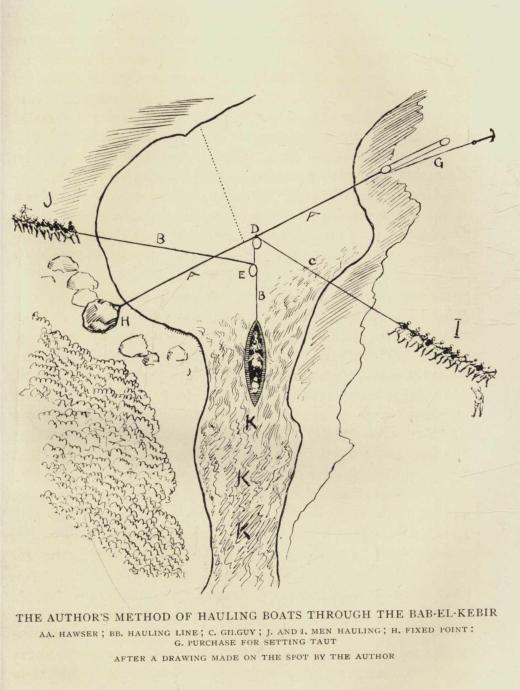
THE AUTHOR'S METHOD OF HAULING BOATS THROUGH THE BAB-EL-KEBIR.
AA. HAWSER: BB. HAULING LINE; C. GIBGUY; J. AND I. MEN HAULING;
H. FIXED POINT; G. PURCHASE FOR SETTING TAUT.
AFTER A DRAWING MADE ON THE SPOT BY THE AUTHOR
When the whale-boats came along, their passage was so
arranged that a regiment, or part of a regiment, was kept
together; the distribution being maintained all up the river,
so that a homogeneous body could be landed at any moment
for attack or defence if necessary.
So furious was the torrent, that whoso fell into it seldom
rose again, unless he were one of the expert Dongola divers.
The men coming up in the boats, who had done and
suffered much before reaching Wady Halfa, had repaired
their trousers with biscuit tins. I overheard the following
dialogue between one of these tin-bottomed weary heroes
and a comrade on the bank:
"Hullo, Bill, 'ow are you getting on?"
"Me? I've been pulling on this here ruddy river for
about two years. 'Ow far is it to Gemai?"
"About fifteen miles, mate."
"O my Gawd! Is there an 'orspital there?"
Late in October, the voyageurs arrived, a fine body of
men, 380 strong.
Being acquainted with rapids and understanding their
navigation, the voyageurs were invaluable in bringing the
boats through the long and difficult reaches of the Nile up
to Wady Halfa, and from Wady Halfa up to Korti. The
task could never have been accomplished in the time, and
the losses of boats would have been heavier, had it not been
for the voyageurs.
As the boats came through the Bab or across the portage,
the voyageurs took charge of them and sailed them up to
Gemai. Here they were overhauled and fully equipped, the
soldiers were embarked, and away they went up river.
By the 6th November, 60 boats had left Gemai with
the Sussex regiment on board. The river was then falling
so swiftly that a new course for the boats must be found
almost every day. Hitherto the boats had been passed
through the Cataract almost without a scratch or the loss of
a single article of gear. Now the rocks began to show
through the surf in the Bab.
A boat was smashed. We caught her lower down;
and with 200 men portaged her over a rocky hill, across
the neck of land formed by the curve of the Bab, then
laid her keel upwards across two other boats, and so
floated, took her up to Gemai dockyard. I was the more
pleased with this piece of salvage, because everyone said
it was impossible to save the boat. The last nine boats,
after being emptied of all gear, were hauled clean over the
rocks by main force. They came prettily lipping through
the boiling torrent from rock to rock, taking the blows upon
keel and bilge pieces, so that they were scarcely damaged.
Early in October, foreseeing that, as the water fell, the
Bab-el-Kebir would become impracticable, I had designed a
scheme for a portage. The alternative would have been to
entrain the boats from Wady Halfa to Sarras, an expedient
which, as the whole of the train service was required to
carry provisions, would have involved immense delay.
My plan was to haul the boats up to the entrance of the
Bab and then to carry them across the neck of land formed
by the curve of the Bab, a distance of 2488 yards, which
required 400 men, who should be divided into sections of 40 to
each boat. The boat was hauled on shore, her masts, oars,
and poles laid on the ground to serve as bearers; the boat was
laid on these keel uppermost, and was then lifted and
carried, the masts, oars, and poles resting on the men's
shoulders, and other men supporting the boat by resting
thwarts and gunwale on their shoulders. My scheme was
at first received with incredulity by all except Lord Wolseley.
But I made a trial trip with 30 men, and had the boat
across the portage, including six stoppages for rest, and in
the water with all her gear without a scratch, in an hour and
twenty minutes. The passage of Bab-el-Kebir, low as the
water had become, would have taken at least six hours, with
great risk of disaster.
Now, having hauled the last nine boats through, over
the rocks, the portage scheme came into operation; and
on the 6th November I closed the Bab, and used the portage,
by means of which alone it was made possible to continue
the supply of boats at the same rate. Thenceforward we
were able to put the boats through quicker than they were
supplied.
Many of the boats were poisonous to handle, as their
matting was infested with scorpions.
My dwelling was at first a tent at Wady Halfa, and
afterwards a hut on the bank beside the Bab-el-Kebir. It
stood within six feet of the roaring river, in a grove of
mimosa. The camels lunched daily upon the long sharp
thorns of the mimosa, apparently relishing these spines as a
form of Worcester sauce.
Rising at daylight, every day I covered some thirty miles
up and down the shore of the Cataract, superintending
operations from dawn till dark. I rode one of my camels,
Bimbashi or Ballyhooly or Beelzebub, or my donkey, County
Waterford, so named because the second time I contested
him I lost my seat: a political allegory. Being short of both
officers and men, my presence was required everywhere at
once. By haulage and portage a perpetual procession of
whaleboats and nuggars was kept moving up to the
dockyard at Gemai.
From Wady Halfa to the Bab the Cataract was divided
into reaches, a post being stationed at each. At the first
reach were Peel of the 2nd Life Guards and 200 Dongola
men; at the Naval Camp, on the second reach, were
Lieutenant Colbourne and 350 Dongola men; at Palm
Tree Camp, in the third reach, were an Egyptian officer and
100 Dongola men; for the portage at Bab-el-Kebir I had
500 men of the 2nd Egyptian battalion under their colonel,
and another of their officers, Shakespeare of the Marines,
who had been with me in the Thunderer. All along the
Cataract were stationed small parties of carpenters and
sailmakers in order that damages should be repaired on the
spot. Living with me was Colonel Grant, who was in
command of all the Dongola men. Later, the Canadian
voyageurs camped beside my hut.
By means of the distribution of work, each section being
placed under a responsible officer, progress speedily became
three times as fast. Officers and men worked magnificently.
I was proud of the old Navy.
The routine for the bluejackets was: Turn out 4.30 a.m.,
breakfast; walk seven to ten miles through the desert along
the river, often having to retrace their steps to help a boat
in distress; work all day till sunset, no spell for dinner,
which consisted of biscuit; at sunset, walk seven miles back
to camp, supper and turn in. The officers walked with the
men, giving their camels to the men who suffered from sore
feet. Officers and men were burned as black as the natives.
Until my arrival, the nine naval officers and the doctor
had been living at the Naval Camp nine miles from Wady
Halfa, without a single servant or a cook. They were
allowed neither servants nor the money with which to hire
natives. But nothing could exceed the kindness and good-will
of General Buller, who at once granted all my requests,
and if I found it necessary to order first and report
afterwards, sanctioned my requisitions.
I had with me in my hut for a time F. H. Pollen, who
could dive and swim better than the Dongola men, using
like them a blown-up goatskin. The constant immersion
brought on an attack of dysentery. I kept him in bed,
taking away his clothes so that he could not get up, and
doctored him till he recovered.
At this time I acted as doctor to the men under me.
Every case of sickness was reported to me at once. If the
patient suffered from diarrhoea I exhibited castor oil. A
petty officer having been thus treated, said he felt easier. I
asked him if he would like another dose, and he said he
would like it. The same night he died. I sent his body on
a camel to the nearest medical officer, who found seventeen
date-stones in his stomach. I had the sorry consolation of
knowing that the poor fellow must have died in any event.
On the 17th November, Lord Wolseley, returning from
Dongola, arrived suddenly at Wady Halfa, where he
remained for twenty-four hours, afterwards returning to
Dongola. All we knew was that he had come to press
matters forward. History relates how that on the 17th
November, Wolseley received a letter from Gordon dated
4th November, in which Gordon wrote: "We can hold out
forty days with ease; after that it will be difficult." In
reply Wolseley telegraphed from Wady Halfa: "Yours of
4th just received 17th; the first I have had from you. I
shall be at Kasr Dongola in four days." Wolseley at the
same time informed Lord Hartington that while the news
would not affect his plans, it seemed to show that Gordon's
relief could not be accomplished without fighting.
Lord Wolseley made no announcement on the subject
at the time, merely telling General Buller and myself that
we were to stay where we were for the present. Our
impression was that Wolseley had abandoned the idea of
making a dash across the desert from Korti to Metemmeh.
At that date, 17th November, we had more than 200
boats ready to embark troops at Gernai, from which twenty
to thirty boats were being dispatched daily. Nearly 200
boats had already gone, carrying detachments of the Essex,
Stafford, and Cornwall Regiments, the Engineers, and
Commissariat. About 200 more boats had still to pass the
Cataract. I was very pleased with the work and behaviour
of the 2nd battalion of the Egyptian Army, which was
working the portage. I expressed my satisfaction to them,
and gave every man a quarter of a pound of native tobacco,
whereupon they declared with one voice that, "if God was
willing, they would go to hell with my Excellency."
At about this time I received a private intimation from
Lord Wolseley that, when the general advance began, he
intended to place me in command of a naval brigade.
By 22nd November, 549 boats had been passed through
the Second Cataract, 166 of which had been hauled through
the Bab-el-Kebir, the rest portaged. Of the whole number
of boats, only three were smashed; and very few received
any damage. Accidents were few, although the work was
dangerous. On 21st November a voyageur was drowned.
Three voyageurs went overboard, and two were saved by
catching hold of a rope. The third scorned the rope, relying
upon his ability to swim, and was never seen again. Up
to that date five men altogether had been drowned, two
soldiers, two Canadians, and one native. Later, another
native, and he an Esneh swimmer, was drowned. The
river was extraordinarily fatal. Not one man who went
under upon falling overboard was saved. The natives
always used to do their best to keep on the surface.
Lord Wolseley was so good as warmly to commend the
work done on the Second Cataract; and Sir Redvers Buller,
who at first declared the portage scheme to be impossible
of execution, generously expressed his appreciation of its
success.
Having shot a little alligator, I skinned it myself. The
Arab camel-man in my service, who spoke French, argued
with me in that language for a long time that an alligator
had no tongue, but fed by suction, like a snipe. As I had
cut out the tongue of my little alligator, I knew it had one;
but my Arabian naturalist refused to be persuaded.
At this time and afterwards while I was in Egypt, my
servant, interpreter and cook was the excellent José Salvatro,
a Maltese. If he happened to be absent, I conveyed my
instructions to the natives through my French-speaking
camel-man, in French. Between my French and his French
and his Arabic, I used to wonder how the meaning filtered
through; but I have a note in my diary that "it comes
all right, the natives are cheery fellows and work capitally
with me, and a good smack upon the 'sit-upon' of a lazy
one keeps the whole lot going."
Towards the end of November I was living alone in my
hut on the Bab-el-Kebir, attended only by a bluejacket and
the faithful José, who ceased not from scrubbing and
washing, so that I was never a day without clean things, an
inestimable comfort in that climate. Here I was haunted by
an Arab maniac who dwelt in some indiscoverable antre of
the rocks. At night I heard him howling to himself. In
the daytime, he ran here and there, his only garment being
the dust he cast upon his shaven head, crying upon Allah.
He ate sand and offal, a diet which left him hungry, for he
would come to my tent for food, which I gave him. He
seemed to know me in a vague way. I gave him some
calico to cover his nakedness withal, but he tore the stuff
into fragments and ate them. One day he rushed into my
tent, clawed some mutton-broth out of the cooking-pot with
his horrible hands and crammed it boiling hot into his
mouth. I was obliged forcibly to eject him lest he should
take the whole; but I had no stomach for the rest. My
fear was lest he should burst in at night and I should be
obliged in self-defence to shoot him. Eventually, José
lost patience, seized a huge wood-axe, and chased the
maniac for a mile. The poor wretch ran like a hare and
vanished into his hole in the rocks.
I made a match with Colonel Brocklehurst, head of the
Remount Department, to ride my camel, the bold Bimbashi,
against any one of Brocklehurst's camels, for £25. The course
was six miles long across the desert, from Peel's Camp at
the beginning of the Cataract to Sir Evelyn Wood's flagstaff
at Wady Halfa. Brocklehurst's rider was his interpreter,
a lean rat of an Arab Sheikh, who was absolutely certain he
would win. His camel was the favourite of Wood's mess
and was reputed to be the best in Egypt. The betting
was fifty to one against me. But I had been riding
Bimbashi 30 miles or so a day, and we were both in fine
hard condition.
The Sheikh started at a gallop. First his turban, then
his goatskin saddle-rug, carried away. Both rider and
camel were blowing and perspiring ere they had run three
miles. For the first two and a half miles I waited on the
Sheikh, then came away and won in a canter half a mile
ahead. At the finish the troops lined up and made a
course for us. Thus I won my first camel race, owner
up. No one was better pleased than my old friend Colonel
Brocklehurst.
Bimbashi (according to my journal) covered the six miles
in a little over eighteen minutes. That gallant steed had
already been ridden the nine miles from my camp to the
starting-point; and when I rode him back in the evening,
he was so fresh that he ran away with me, grumbling loudly,
because he was offended at the sight of a dead donkey
lying wrong side up beside the railway.
I invented a saddle for camels, and I believe the pattern
is still in use. The saddle-tree is a triangular wooden
framework, like the gable of a roof. I covered the wood
with oakum and canvas; abolished all buckles, made the
girths and stirrups of raw hide thongs, and put the stirrups
forward, instead of behind. Count Gleichen, in his interesting
book, With the Camel Corps up the Nile, relates how the
saddles and equipment served out to the Camel Corps gave
the men infinite trouble and discomfort. The unseasoned
wood came to pieces, the straps broke, the water-skins and
water-bottles leaked; but one instance of the departmental
mismanagement which caused our men so much unnecessary
suffering.
By the end of November, the river was falling so
swiftly that what was smooth water yesterday was to-day a
frivolous series of waterfalls with a twist in them. Every
alteration in the river involved a new device for haulage,
and it would alter at three or four places in a mile, and
there were 11 miles of rapids. I was generally able to
judge by the look of the water when and where it would
change its course during the next few hours. In order to
avoid the least delay, new arrangements must be devised
beforehand; and my mind was so absorbed in these
schemes, that I dreamed of them nightly. By that time I
had 1400 men working under me, whose work must be
organised, and stations allocated. The Bab-el-Kebir, that
formidable rapid, was now a grazing ground for goats.
I shifted my quarters from the Bab to Wady Halfa, as
the difficulties were now all at that end of the Cataract.
Peel and Colbourne, in command respectively of the next
two reaches, found no day too long and no work too hard.
In order to supervise the whole length of the operations
as quickly as possible, I kept one camel, Ballyhooly, at the
Bab; the big white donkey County Waterford half-way
there; and Bimbashi the bold and Beelzebub at Wady
Halfa. Bimbashi could trot 16 miles in the hour. A
Bedouin Sheikh offered me £3$ for him. As I had bought
him for £24 I concluded that his vender had stolen him.
I won more than his price in the race with Colonel Brocklehurst's
Sheikh. While at Wady Halfa I rode him six miles
out in the heavy sand against Sir Evelyn Wood and his
A.D.C., who rode horses, and Bimbashi beat the horses
fair and square.
Lord Wolseley sent me a telegram ordering me to
form a naval brigade of 100 men and 10 officers. But as
the bluejackets were of inestimable service in getting the
remainder of the boats through the Cataract, and fitting
them out at Gemai, where the soldiers embarked, he desired
to keep them where they were as long as possible. On 27th
November, we hoped to get all the boats through during the
next five days. Up to that date—the last for which I have a
note—687 boats had been passed through the Cataract, with
a loss of 4 only; about 27 men of all sorts had been drowned;
and 337 boats had left Gemai with troops and stores.
On 6th December the last boat was passed through.
On the same day, Sir Evelyn Wood and Sir Redvers Buller
received a telegram reporting a block of boats at Ambigol
and Dal Cataract; and I was ordered there at a moment's
notice.
On 27th September I had arrived at Wady Halfa; on
10th October I schemed the portage; and for eight weeks
since that date I had been continuously hard at work passing
the boats through the Second Cataract; which the Arabs
call "the belly of stone."
III. UP THE CATARACTS AND ACROSS THE DESERT
"To Assiout, in a cloud of dust
We came, and it made us smile,
To see each other's features, till
We washed them in the Nile.
From there, by boat, to Assouan
We came, and every night
Made fast, for the boatmen wouldn't steam
Excepting in daylight."
Songs of the Camel Corps (Sergt. H. EAGLE, R.M.C.C.)
On the 6th December, 1884, Peel and Colbourne, my
two gallant comrades who had done so splendid a
work upon the Second Cataract, quitted the Belly of
Stone, embarking in two boats manned by Kroomen. The
names of these big black men were Africa, Ginger Red,
Bottled Beer, Sampson, Two Glasses and Been-Very-Ill-Twice;
and when they were excited, as they nearly always
were, they took to the English tongue, and kept us laughing
for a week. When the wind was fair and we sailed up
against the rapids, the Kroo boys were terribly anxious,
knowing that if the wind failed we should slide all the way
back again.
By this time the whole expedition was moving up river.
The conduct of the soldiers was magnificent, achieving
wonderful results. Of the sailors, accustomed to the work,
and knowing the shortest way of doing things, one expected
much—and got even more. It was hard enough for the
seamen. Although they, the soldiers, knew nothing of boats,
they worked like heroes. And the navigation of the Nile
from Gemai to Dal enforced hard continuous toil from dawn
to dark day after day. The voyageurs did splendid service;
the expedition could not have advanced so rapidly without
them; and although they knew nothing of sails, being acute
adventurous fellows they soon picked up enough knowledge
to carry them through.
An officer of cavalry in charge of a convoy of stores on
the river worked by Dongola men, describing his adventures
with what he called his "peasant crews," pathetically
observed: "You know, I know nothing whatever about a boat,
or what it ought to do, and I am not ashamed to tell you
that the whole time I am sweating with terror. And every
night when I go to bed I dream of whirlpools and boiling
rapids and then I dream that I am drowned."
But his visions of the night affected neither his nerve nor
his indomitable energy.
Our daily routine along the river began at 4.30: all hands
turn out, make up tent (if there were one), breakfast, and
start, sailing or tracking or rowing according to the state
of the river. But whether you sailed or tracked or rowed,
before long the river changed and you must row instead of
track, or sail instead of row. Then you would come to a
difficult place, and you would heave the cargo on shore, and
get the empty boat up a fall or a heavy rush of water, and
portage the cargo on to the boat. So on to midday, when
an hour was allowed for dinner; then at it again, sailing,
tracking, rowing, in and out cargo, till sundown. Then haul
into the bank and eat bully beef without vegetables. After
supper, roll in a blanket and sleep on the soft sand the
profound and delicious slumber of weary men.
Occasionally a boat would strike a rock; or at rare
intervals an accident would happen, and part of a crew would
be lost, and the boat's gear swept away; or a hole would be
knocked in the boat, when she would be emptied of gear and
cargo, hauled up, and patched. Under these circumstances,
the boats often made no more than three or four miles'
advance in a day. Overloaded as were many of the boats,
they served their purpose admirably well.
At the big Cataracts were stationed working parties,
which emptied the boats of gear and cargo, portaged them
overland, and hauled the boats through the rapids.
So we struggled up the broad and rushing river from
Gemai to Dal, sailing and towing and rowing, capsized and
righting again. And one night a sandstorm waltzed out of
the desert and blew away our tent and with it knives, forks,
slippers, lamp, candles, matches and everything. And the
next morning Peel dropped his knife, and in trying to save
it he upset our whole breakfast of sardines and coffee into
Colbourne's boots. And half my kit was stolen, and I was
reduced to one broken pair of boots, and the natives stole
my tooth powder and baked bread with it. And we had
boils all over us like the man in the Bible, because every
little scratch was poisoned by the innumerable flies of Egypt.
But we were so busy that nothing mattered.
Fighting every mile of the great river pouring down from
Khartoum, we on the Cataracts had no news of Gordon. All
we knew was that there was need to hurry, hurry all the way.
At such times as the mail from home arrived upon a dyspeptic
camel, we got scraps of news of home affairs. People who
knew much more than Lord Wolseley, were saying he ought
to have taken the Souakim-Berber route instead of the Nile
route. I said then, as I say now, he had no choice. At this
time of crisis, when the Navy was dangerously inadequate,
one political party was screaming denunciations against
"legislation by panic." Encouraging to sailors and soldiers
sweating on service! But we knew what to expect. I
observe that in a private letter written in December, 1884,
from the banks of the Nile, at the end of a long day's work
with the boats, I said, "Both sides are equally to blame for
the defective state of the Navy. Tell —— and —— not to
be unpatriotic and make the Navy a party question, or
they will not do half the good they might."
We came to Ambigol to find the boats had been cleared
by Alleyne of the Artillery. I was able to improve the
organisation there, and to give help along the river I was
in time to save three boats. At Dal, I laid lines along the
centre of the two and a half miles rapid, so that in calm
weather the boats could haul themselves through.
In the meantime, the Naval Brigade of which Lord
Wolseley had ordered me to take command, had been
selected, at my request, by Captain Boardman.
On 19th December, my first division came to Dal. Up
they came, all together in line ahead, under all possible sail,
using the boat awnings as spinnakers. They had sailed up
the rapids where the other boats were tracking; and the
soldiers cheered them as they went by. There was not a
scratch on any boat, nor a drop of water in any of them.
Every cargo was complete in detail, including machine guns,
ammunition, oil and stores. Had I not a right to be proud
of the seamen? I put an officer at the helm of each boat,
and told them to follow me through Dal Cataract; and led
them through, so that the same night the boats were reloaded
with the gear and cargo which had been portaged, and were
going on. The passage of Dal Cataract usually occupied
three days.
I sent on the first division, and stayed at Dal to
await the arrival of the second, in order to get all my men
together. As it happened, I did not see it until it reached
Korti. On 21st December it had left Sarras, bringing oil
and stores to be used in the Nile steamers of which I was
to take charge. For by this time I had been informed of
Lord Wolseley's intention to send the Naval Brigade with
the Camel Corps to make a dash across the Bayuda Desert
to Metemmeh. The Naval Brigade was then to attack
Khartoum in Gordon's steamers, while the Camel Corps
attacked it by land.
So I remained yet a little while at Dal, helping the
boats through the Cataract, and camping in the sand. I
found a baby scorpion two and a half inches long in my
handkerchief. The officer whose tent was next to mine,
shared it with a sand-rat, which used to fill his slippers with
dhura grains every night, and which jumped on and off my
knee when I breakfasted with my friend. Actually there
came two or three days when I had nothing to do; and
when I could take a hot bath in peace, with the luxury of a
cake of carbolic soap, and sit in my little canvas chair, which
was, however, speedily stolen.
My poor servant José was suddenly taken with so sharp
an attack of fever that he was stricken helpless and could
hardly lift a cup to his lips. His pulse was going like a
machine gun. He was too ill to be moved on mule-back to
the hospital, which was eight miles distant; and I had to
doctor him myself. I gave him castor-oil, deprived him of
all food for twenty-four hours, gave him five grains of
quinine every two hours, and plenty of lime-juice to drink;
and he was soon well again.
Lord Avonmore, Lieutenant-Colonel J. Alleyne, Captain
Burnaby and myself subscribed to a Christmas dinner of
extraordinary charm, eaten with the Guards. The menu
was:—soup made of bully beef, onions, rice and boiled
biscuit, fish from the Nile, stewed bully beef and chicken
à la as-if-they-had-been-trained-for-long-distance-races-for-a-year,
entremet of biscuit and jam. Rum to drink.
I should have missed that feast, and should have been
on the way to Korti post-haste several days before Christmas,
had it not been that a telegram sent by Lord Wolseley to
me had been delayed in transmission. On 27th December
I received an urgent telegram from General Buller, asking
where I was and what I was doing. A week previously
Lord Wolseley had telegraphed instructions that I was to
proceed to Korti with all speed to arrive with the first
division of the Naval Brigade. Having received no orders,
I was waiting for the second division so that I might see that
it was complete and satisfactory. (It arrived at Dal the day
after I left that place in obedience to General Buller's
orders.)
From Dal to Korti, as the crow flies, is some 200 miles
to the southward; following up the river, which, with many
windings, flows north from Korti, the distance is more than
half as much again. I was already (by no fault of mine) a
week behind; my instructions were to proceed by the shortest
possible route by the quickest possible means, camels or
steam pinnace; and immediately I received General Buller's
telegram I dashed off to the Commissariat. Here I obtained
four camels to carry José, myself and my kit to the nearest
point at which I could catch a steam pinnace on the river.
Also, by riding the first stage of the journey, I could avoid
two wide bends of the Nile. The camels were but baggage
animals; they all had sore backs; and I could get no
proper saddle. I strapped my rug on the wooden framework.
We started the same evening at seven o'clock.
The night had fallen when we left behind us the stir of
the armed camp and plunged into the deep stillness of the
desert. The brilliant moonlight sharply illumined the low
rocky hills, and the withered scrub, near and far; the hard
gravelly track stretched plainly before us; and the camels
went noiselessly forward on their great padded feet. So,
hour after hour. It was one o'clock upon the following
morning (21st December) when we rode into a dark and
silent village. Lighting upon an empty hut, we crawled
into it, cooked a little supper, and went to sleep.
Before daylight we were awakened by the noise of voices
crying and quarrelling; and there were two black negresses
upbraiding us, and beyond them was a group of agitated natives.
It appeared that we were desecrating the village mosque.
Having soothed the inhabitants, we started. That day we
rode from 6 a.m. to 7.30 p.m. with a halt of an hour and a
half at midday, travelling 40 miles in twelve hours, good
going for baggage camels with sore backs. By that time I
was getting sore, too. We slept that night at Absarat,
started the next morning (29th December) at 8.30, and rode
to Abu Fatmeh, arriving at 4 p.m. Starting next morning
at nine o'clock, we arrived at Kaibur at 5 p.m. Here, to my
intense relief, we picked up Colville and his steam pinnace,
in which we instantly embarked for Korti.
During the last three days and a half we had been thirty-two
hours in the saddle (which, strictly speaking, my camel
had not) and a part of my anatomy was quite worn away. I
lay down in the pinnace and hoped to become healed.
We did not know it; but the same evening, General Sir
Herbert Stewart's Desert Column left Korti upon the great
forced march of the forlorn hope.
The pinnace, whose furnaces were burning wood, most of
which was wet and green, pounded slowly up river until we
met the steamer Nassifara, into which I transferred myself.
Blissful was the rest in that steamer after my two months'
tremendous toil getting the boats through the Bab-el-Kebir
and the long ride across the desert. So I lay in the steamer
and lived on the height of diet, fresh meat, milk, butter and
eggs, till my tunic hardly held me. I did not then know
why Lord Wolseley had sent for me in so great a hurry.
IV. THE FIRST MARCH OF THE DESERT COLUMN
NOTE
By the end of December, 1884, the whole of the
expedition was in process of concentrating at Korti. At
Korti the Nile fetches a wide arc north-eastward. The
chord of the arc, running south-eastward, runs from Korti
to Metemmeh, and Shendi, which stands on the farther, or
east, bank. From Korti to Metemmeh is 176 miles across
the desert. Shendi was the rendezvous at which the troops
were to meet Gordon's steamers sent down by him from
Khartoum. Wolseley's object in sending Lord Charles
Beresford with the Naval Brigade was that he should take
command of the steamers, which, filled with troops, were to
proceed up to Khartoum. The first business of the Desert
Column under General Sir Herbert Stewart, was to seize
the wells of Jakdul, which lay 100 miles distant from Korti,
and to hold them, thus securing the main water supply on the
desert route and an intermediate station between Metemmeh
and the base at Korti. Having obtained possession of the
wells, the Guards' Battalion was to be left there, while the
remainder of the Column returned to Korti, there to be
sufficiently reinforced to return to Jakdul, and to complete
the march to Metemmeh. Such was the original idea. The
reason why sufficient troops and transport were not sent in
the first instance, thereby avoiding the necessity of the return
of the greater part of the Column to Korti, and its second
march with the reinforcements, seems to have been the
scarcity of camels.
When the Desert Column made its first march, Lord
Charles Beresford and the Naval Brigade were still on their
way to Korti. The first division under the command of
Lord Charles marched with the Desert Column on its return.
The first Desert Column numbered 73 officers, 1212 men
and natives, and 2091 camels. It consisted of one squadron
of the 19th Hussars, Guards' Camel Regiment, Mounted
Infantry, Engineers, 1357 camels carrying stores and driven
by natives, Medical Staff Corps, and Bearer Company.
Personal luggage was limited to 40 lb. a man. An account
of the march is given by Count Gleichen, in his pleasant and
interesting book (to which the present writer is much
indebted) With the Camel Corps up the Nile (Chapman &
Hall). Some years previously the route from Korti to
Metemmeh had been surveyed by Ismail Pasha, who had
intended to run a railway along it from Wady Halfa to
Khartoum; and the map then made of the district was in
possession of the Column. The enemy were reported to be
about; but it was expected that they would be found beyond
the Jakdul Wells; as indeed they were.
The Desert Column started from Korti on the afternoon
of Tuesday, 30th December, 1884. The Hussars escorted
a party of native guides and scouted ahead. The Column
marched the whole of that night, in the light of a brilliant
moon, across hard sand or gravel, amid low hills of black
rock, at whose bases grew long yellow savas grass and
mimosa bushes, and in places mimosa trees.
At 8.30 on the morning of the 31st December they
halted until 3 p.m., marched till 8.30 p.m., found the wells
of Abu Hashim nearly dry, marched on, ascending a stony
tableland, and still marching, sang the New Year in at
midnight; came to the wells of El Howeiyat, drank them
dry and bivouacked until 6 a.m. on the morning of the 1st
January, 1885.
All that morning they marched, coming at midday to a
plain covered with scrub and intersected with dry water-courses;
rested for three hours; marched all that night, and
about 7 a.m. on the morning of 2nd January, entered the
defile, floored with large loose stones and closed in with
steep black hills, leading to the wells of Jakdul. These are
deep pools filling clefts in the rock of the hills encompassing
the little valley, three reservoirs rising one above the other.
Count Gleichen, who was the first man to climb to the upper
pools, thus describes the middle pool.
"Eighty feet above my head towered an overhanging
precipice of black rock; behind me rose another of the same
height; at the foot of the one in front lay a beautiful, large
ice-green pool, deepening into black as I looked into its
transparent depths. Scarlet dragon-flies flitted about in the
shade; rocks covered with dark-green weed looked out of
the water; the air was cool almost to coldness. It was like
being dropped into a fairy grotto, at least so it seemed to me
after grilling for days in the sun."
When the Desert Column reached that oasis, they had
been on the march for sixty-four hours, with no more than
four hours' consecutive sleep. The time as recorded by
Count Gleichen was "sixty-four hours, thirty-four hours on
the move and thirty broken up into short halts." The
distance covered was a little under 100 miles; therefore the
camels' rate of marching averaged as nearly as may be two
and three-quarter miles an hour throughout. A camel walks
like clock-work, and if he quickens his speed he keeps the
same length of pace, almost exactly one yard.
The Guards' Battalion, to which were attached the Royal
Marines, with six Hussars and 15 Engineers remained at
the Wells. The rest of the Column left Jakdul at dusk of
the day upon which they had arrived, to return to Korti,
bivouacking that night in the desert.
The detachment at Jakdul made roads, built forts, and
laid out the camp for the returning Column. On 11th
January, a convoy of 1000 camels carrying stores and
ammunition, under the command of Colonel Stanley Clarke,
arrived at Jakdul.
In the meantime, on 31st December, the day after which
the Desert Column had started for the first time, Lord
Wolseley had received a written message from Gordon,
"Khartoum all right," dated 14th December. Should it
be captured, the message was intended to deceive the captor.
The messenger delivered verbal information of a different
tenure, to the effect that Gordon was hard pressed and that
provisions were becoming very scarce.
At the time of the starting of the Desert Column upon
its second march, when it was accompanied by the first
division of the Naval Brigade under the command of Lord
Charles Beresford, and by other reinforcements, the general
situation was briefly as follows.
The River Column, which was intended to clear the
country along the Nile, to occupy Berber, and thence to join
the Desert Column at Metemmeh, was assembling at Hamdab,
52 miles above Korti. It was commanded by General Earle.
The four steamers sent down the river from Khartoum by
General Gordon in October, were at Nasri Island, below the
Shabloka Cataract, half-way between Khartoum and
Metemmeh, which are 98 miles apart. Korti and Berber, as
a glance at the map will show, occupy respectively the left
and right corners of the base of an inverted pyramid, of
which Metemmeh is the apex, while Khartoum may be figured
as at the end of a line 98 miles long depending from the
apex. The Desert Column traversed one side of the triangle,
from Korti to Metemmeh; the River Column was intended
to traverse the other two sides.
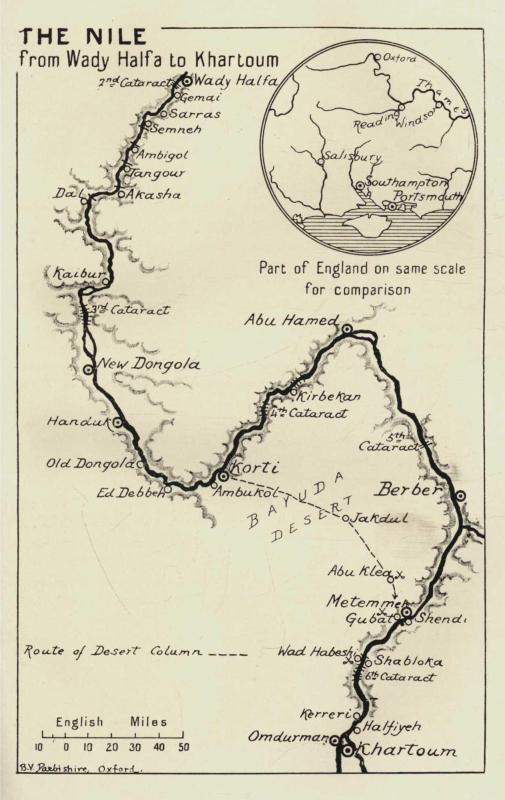
THE NILE
from Wadi Halfa to Khartoum
V. THE DESERT MARCH OF THE FORLORN HOPE
"When years ago I 'listed, lads,
To serve our Gracious Queen,
The sergeant made me understand
I was a 'Royal Marine.'
He said we sometimes served in ships,
And sometimes on the shore;
But did not say I should wear spurs,
Or be in the Camel Corps."
Songs of the Camel Corps (Sergt. H. EAGLE, R.M.C.C.)
Korti was a city of tents arrayed amid groves of
fronded palm overhanging the broad river; beyond,
the illimitable coloured spaces of the desert, barred
with plains of tawny grass set with mimosa, and green fields
of dhura, and merging into the far rose-hued hills. All day
long the strong sun smote upon its yellow avenues, and the
bugles called, and the north wind, steady and cool, blew the
boats up the river, and the men, ragged and cheery and
tanned saddle-colour, came marching in and were absorbed
into the great armed camp. Thence were to spring two
long arms of fighting men, one to encircle the river, the
other to reach across the desert, strike at Khartoum and
save Gordon.
The day after I arrived at Korti, 5th January, 1885, the
desert arm had bent back to obtain reinforcements; because
there were not enough camels to furnish transport for the
first march.
The first division of the Naval Brigade, under Lieutenant
Alfred Pigott, also arrived on the 5th. Officers and
men alike were covered with little black pustules, due to the
poison carried by the flies. Nevertheless, they were fit and
well and all a-taunto. They were brigaded under my
command with Sir Herbert Stewart's Desert Column. The
intention was that Gordon's steamers, then waiting for us
somewhere between Metemmeh and Khartoum, should be
manned with the sailors and a detachment of infantry, and
should take Sir Charles Wilson up to Khartoum. The
second division of the Naval Brigade was still on its way
up. It eventually joined us at Gubat. I may here say, for
the sake of clearness, that Gubat is close to Metemmeh and
that Shendi lies on the farther, or east, bank of the Nile,
so that Gubat, Metemmeh and Shendi were really all within
the area of the rendezvous at which the River Column under
General Earle was intended to join forces with the Desert
Column.
Sir Herbert Stewart arrived at Korti on the 5th and left
that place on the 8th, the intervening days being occupied
in preparations. An essential part of my own arrangements
consisted in obtaining spare boiler-plates, rivets, oakum,
lubricating oil, and engineers' stores generally, as I foresaw
that these would be needed for the steamers, which had
already been knocking about the Nile in a hostile country
for some three months. At first, Sir Redvers Buller refused
to let me have either the stores or the camels upon which to
carry them. He was most good-natured and sympathetic,
but he did not immediately perceive the necessity.
"What do you want boiler-plates for?" he said. "Are
you going to mend the camels with them?"
But he let me have what I wanted. (I did mend the
camels with oakum.) With other stores, I took eight boiler-plates,
and a quantity of rivets. One of those plates, and a
couple of dozen of those rivets, saved the Column.
The Gardner gun of the Naval Brigade was carried in
pieces on four camels. Number one carried the barrels,
number two training and elevating gear and wheels, number
three the trail, number four, four boxes of hoppers. The
limber was abolished for the sake of handiness. The gun
was unloaded, mounted, feed-plate full, and ready to march
in under four minutes. When marching with the gun, the
men hauled it with drag-ropes, muzzle first, the trail being
lifted and carried upon a light pole. Upon going into action
the trail was dropped and the gun was ready, all the
confusion and delay caused by unlimbering in a crowded space
being thus avoided.
At midday the 8th January, the Desert Column paraded
for its second and final march, behind the village of Korti,
and was inspected by Lord Wolseley. The same thought
inspired every officer and man: we are getting to the real
business at last.
The Desert Column, quoting from the figures given in
Sir Charles Wilson's excellent work, From Korti to Khartoum,
was composed as follows:
N.-C. Officers
Officers and Men
                                                 N.-C. Officers
                                     Officers       and Men

  Staff . . . . . . . . . . . . . . .     8               6
  Naval Brigade . . . . . . . . . . .     5              53
  19th Hussars  . . . . . . . . . . .     9             121
  Heavy Camel Regiment  . . . . . . .    24             376
  M. I. Camel Regiment  . . . . . . .    21             336
  Royal Artillery . . . . . . . . . .     4              39
  Royal Sussex Regiment . . . . . . .    16             401
  Essex Regiment  . . . . . . . . . .     3              55
  Commissariat and Transport  . . . .     5              72
  Medical Staff . . . . . . . . . . .     3              50
                                         --            ----
                                         98            1509
                                         ==            ====
And four guns (one Gardner, three 7-pr. screw guns), 304
natives, 2228 camels, and 155 horses. Already there were
along the route at the wells of Howeiyat (left on the
first march) 33 officers and men of the M. I. Camel
Regiment and 33 camels; and at Jakdul 422 officers and
men of the Guards' Camel Regiment (including Royal
Marines), Royal Engineers, and Medical Staff, and 20 camels.
The Desert Column picked up these detachments as it
went along, leaving others in their places.
The Column rode off at 2 o'clock p.m. amid a chorus
of good wishes from our comrades. I rode my white donkey,
County Waterford, which had been sent up to Korti by boat,
We marched ten miles; halted at sunset and bivouacked,
and started again half an hour after midnight. The moon
rode high, and it was very cold; but the cold was invigorating;
and the hard gravel or sand of the track made good
going. Desert marching with camels demands perpetual
attention; the loads slip on the camels and must be adjusted;
a native driver unships the load and drops it to save himself
trouble; camels stray or break loose. By means of perpetual
driving, the unwieldy herd creeps forward with noiseless
footsteps, at something under three miles an hour.
Although the camels were so numerous, their numbers
had been reduced to the bare requirements of that small
mobile column, which alone could hope to achieve the
enterprise.
At 10 o'clock a.m. on the 9th, we halted for four hours
in a valley of grass and mimosa trees; marched till sunset
and came to another grassy valley and bivouacked. On
the 10th we started before daylight, and reached the wells
of El Howeiyat at noon, very thirsty, and drank muddy
water and breakfasted; marched on until long after dark
over rough ground, the men very thirsty, the camels slipping
and falling all over the place, and at length bivouacked.
Starting again before daylight on the 11th, we came to the
wooded valley set among granite hills, where are the wells
of Abu Halfa, men and animals suffering greatly from thirst.
The wells consisted of a muddy pond and a few small pools
of bitter water. More holes were dug, and the watering
went on all the afternoon and all night.
Next morning, 12th January, we loaded up at daylight,
and marched across the plain lying beneath the range of
yellow hills, broken by black rocks, called Jebel Jelif; entered
a grassy and wide valley, ending in a wall of rock; turned
the corner of the wall, and came into a narrower valley, full
of large round stones, and closed in at the upper end by
precipices, riven into clefts, within which were the pools of
Jakdul. We beheld roads cleared of stones, and the
sign-boards of a camp, and the forts of the garrison, and stone
walls crowning the hills, one high on the left, two high on
the right hand. In ten days the little detachment of Guards,
Royal Marines and Engineers under Major Dorward, R.E.,
had performed an incredible amount of work: road-making,
wall-building, laying-out, canal-digging and reservoir-making.
All was ready for Sir Herbert Stewart's force, which took up
its quarters at once.
That evening the Guards gave an excellent dinner to the
Staff, substituting fresh gazelle and sand-grouse for
bully-beef. All night the men were drawing water from the upper
pool of the wells, in which was the best water, by the light
of lanterns.
The next day, 13th January, all were hard at work
watering the camels and preparing for the advance on the
morrow. The camels were already suffering severely: some
thirty had dropped dead on the way; and owing to the
impossibility of obtaining enough animals to carry the
requisite grain, they were growing thin. It will be observed
that the whole progress of the expedition depended upon
camels as the sole means of transport.
When a camel falls from exhaustion, it rolls over upon
its side, and is unable to rise. But it is not going to die
unless it stretches its head back; and it has still a store of
latent energy; for a beast will seldom of its own accord go
on to the last. It may sound cruel; but in that expedition
it was a case of a man's life or a camel's suffering. When
I came across a fallen camel, I had it hove upright with a
gun-pole, loaded men upon it, and so got them over another
thirty or forty miles. By the exercise of care and
forethought, I succeeded in bringing back from the expedition
more camels, in the proportion of those in my control, than
others, much to the interest of my old friend Sir Redvers
Buller. He asked me how it was done; and I told him
that I superintended the feeding of the camels myself. If
a camel was exhausted, I treated it as I would treat a tired
hunter, which, after a long day, refuses its food. I gave the
exhausted camels food by handfuls, putting them upon a
piece of cloth or canvas, instead of throwing the whole ration
upon the ground at once.
Major Kitchener (now Lord Kitchener of Khartoum),
who was dwelling in a cave in the hillside, reported that
Khashm-el-Mus Bey, Malik (King) of the Shagiyeh tribe,
was at Shendi with three of Gordon's steamers. (He was
actually at Nasri Island.) Lieutenant E. J. Montagu-Stuart-Wortley,
King's Royal Rifles, joined the column for service
with Sir Charles Wilson in Khartoum. Little did we
anticipate in what his plucky service would consist. Colonel
Burnaby came in with a supply of grain, most of which was
left at Jakdul, as the camels which had brought it were
needed to carry stores for the Column. There were 800
Commissariat camels, carrying provisions for 1500 men for
a month, the first instalment of the depot it was intended to
form at Metemmeh, as the base camp from which to advance
upon Khartoum.
With Burnaby came Captain Gascoigne, who had special
knowledge of the Eastern Soudan, and who afterwards went
up to Khartoum with Sir Charles Wilson.
The Column left Jakdul at 2 o'clock p.m. on 14th
January, and marched for three hours. It was generally
supposed that we might be attacked between Jakdul and
Metemmeh, a distance of between 70 and 80 miles; although
the only intelligence we had was Major Kitchener's report
that 3000 men under the Mahdi's Emir were at Metemmeh.
We did not know that the occupation of Jakdul by Sir
Herbert Stewart on the 2nd of January, had moved the
Mahdi to determine upon the destruction of the Desert
Column between Jakdul and Metemmeh. The news of the
occupation of Jakdul had travelled with extraordinary
swiftness. It was known on the 4th January, or two
days after the event, in Berber, nearly 90 miles from Jakdul
as the crow flies; and on that day the Emir of Berber
dispatched his men to reinforce the Emir of Metemmeh.
If the news were known in Berber and Metemmeh
it must have run through the whole surrounding area of
desert. The ten days occupied by the Column in returning
to Korti and returning again to Jakdul, gave the enemy the
time they needed to concentrate in front of us. Moreover,
Omdurman had fallen during the second week in January,
setting free a number of the Mahdi's soldiers. But of these
things we were ignorant when we pushed out of Jakdul.
We picked up a Remington rifle, and saw some horse-tracks,
and that was all.
During the second night out from Jakdul (the 15th-16th)
the camels were knee-lashed and dispositions were made in
case of attack, but nothing happened. It was the last night's
rest we were to have for some time.
On the morning of the 16th we started as usual in the
dark. When the light came, we saw the hills of Abu Klea
in the distance, and after marching nearly to them, halted
for breakfast, In the meantime Lieutenant-Colonel Barrow,
with his squadron of the 19th Hussars, had gone ahead
to occupy the wells of Abu Klea. About 11 a.m. Barrow
returned to report that there was a large force of the enemy
between us and the wells. The column was then lying in
a shallow valley, whence the track led uphill over rough
ground towards a pass cleft in the range of hills, beyond
which were the wells.
The Column fell in and mounted at once. Through
glasses we could clearly distinguish innumerable
white-robed figures of Arabs, relieved upon the black cliffs
dominating the pass, leaping and gesticulating. Here and
there were puffs of smoke, followed after an interval by
a faint report; but the range was too far, and no bullet
arrived. Nearer hand, were swiftly jerking the isolated
flags of the signallers, communicating from the advanced
scouts to the main body. The Naval Brigade with the
Mounted Infantry, which were on the left of the Column,
were ordered to ascend the hill on the left of the line of
advance, to guard the flank of the Column.
We dragged up the Gardner gun, placed it in position,
and built a breastwork of loose stones. By the time we had
finished, it was about 4 o'clock. Beyond and beneath us,
a line of green and white flags was strung across the valley,
fluttering above the scrub, and these, with a large tent,
denoted the headquarters of the enemy.
The rest of the Column were hurriedly building a zeriba
in the valley. As the twilight fell, a party of the enemy
crept to the summit of the hill on the right flank, opposite
to our fort, and dropped bullets at long range into the
Column below, which replied with a couple of screw guns.
As the darkness thickened, there arose that maddening
noise of tom-toms, whose hollow and menacing beat,
endlessly and pitilessly repeated, haunts those who have heard
it to the last day of their lives. Swelling and falling, it
sounds now hard at hand, and again far away. That night,
we lay behind the breastwork, sleepless and very cold; and
the deadly throbbing of the drums filled the air, mingled
with the murmur of many voices and the rustle as of many
feet, and punctuated with the sullen crack of rifles, now
firing singly, now in a volley, and the whine of bullets. At
intervals, thinking the enemy were upon us, we stood to
arms.
When at last the day broke, there were thousands of
white-robed figures clustering nearer upon the hills, and the
bullets thickened, so that, chilled as we were, rather than
attempt to warm ourselves by exercise we were fain to
lie behind the breastwork. The Naval Brigade had no
casualties.
Our detachment was speedily called in, so that we had
no time for breakfast, which was being hastily eaten under
fire by the rest of the Column. All we had was a biscuit
and a drink of water. We took up our position on the right
front. Sir Herbert Stewart waited for a time in case the
enemy should attack. Major Gough, commanding the
Mounted Infantry, was knocked senseless by a bullet graze;
Major Dickson of the Royals was shot through the knee;
Lieutenant Lyall of the Royal Artillery was hit in the back.
Sir Herbert Stewart and Colonel Burnaby were riding
about on high ground, a mark for the enemy. I saw the
general's bugler drop close beside him, and running up,
implored both him and Burnaby to dismount, but they would
not. I had hardly returned to my place when I heard
another bullet strike, and saw Burnaby's horse fall, throwing
its rider. I went to help Burnaby to his feet, and as I picked
him up, he said a curious thing. He said, "I'm not in luck
to-day, Charlie."
When it became evident that the enemy would not
attack, Sir Herbert Stewart decided to take the initiative.
He ordered a square to be formed outside the zeriba, in
which the baggage and the camels were to be left in charge
of a small garrison.
In the centre of the square were to be camels, carrying
water, ammunition, and cacolets (litters) for the wounded.
I do not know how many camels there were. Count
Gleichen says about 30; Colonel Colville, in the official
history, gives the figure as 150. In the front of the square
(looking from the rear of the square forward), left, and
nearly all down the left flank, were Mounted Infantry; on
the right front, and half-way down the right flank, Guards'
Camel Regiment. Beginning on the left flank where
Mounted Infantry ended, and continuing round the rear
face, were the Heavy Camel Regiment. Then, in the centre
of the rear, was the Naval Brigade with Gardner gun. On
the right of rear face, the Heavy Camel Regiment extended
to the angle. Round the corner, lower right flank, were the
Royal Sussex, then came the Royal Marines, continuing to
the Guards' Camel Regiment. Behind the centre of the front
ranks were the three screw guns. In case of attack, I was
directed to use my own judgment as to placing the Gardner
gun.
The square was thus formed under fire. Bear in mind
that the column was upon the floor of a valley commanded
by slopes and hill-tops occupied by the enemy. The route
of the square lay over the lower slopes of the hills on the
right, thus avoiding the hollow way on the left commanded
by the enemy's breastworks. Captain Campbell's company
of Mounted Infantry, and Colonel Barrow with his Hussars,
went ahead to skirmish on the front and on the left flank,
and somewhat checked the fire, while Lieutenant Romilly
and a detachment of Scots Guards skirmished ahead on the
right.
It was about 10 a.m. when the square began to move.
The enemy, increasing their fire, kept pace with it. The
route, studded with rocky knolls, furrowed with watercourses,
and sharply rising and falling, was almost impassable for the
camels. They lagged behind, slipping and falling, and we
of the rear face were all tangled up with a grunting, squealing,
reeking mass of struggling animals. Their drivers, terrified
by the murderous fire coming from the right, were pressing
back towards the left rear angle. By dint of the most
splendid exertions, the sailors kept up, dragging the Gardner
gun. Men were dropping, and halts must be made while
they were hoisted into the cacolets and their camels forced
into the square. Surgeon J. Magill, attending a wounded
skirmisher outside the square, was hit in the leg. During
the halts the enemy's fire was returned, driving off large
numbers on the hills to the right. In about an hour we
covered two miles.
Then we saw, on the left front, about 600 yards away, a
line of green and white flags twinkling on long poles planted
in the grass and scrub. No one knew what these might
portend. As the fire was hottest on the right, we thought
that the main body would attack from that quarter.
Suddenly, as we halted, more and yet more flags flashed
above the green; and the next moment the valley was
alive with black and white figures, and resounding with their
cries. The whole body of them moved swiftly and in
perfect order across our left front, disappearing behind
rocks and herbage.
The square was instantly moved forward some thirty
yards on the slope, in order to gain a better position. Ere
the movement was completed, the enemy reappeared.
VI. THE FIGHT AT ABU KLEA
"England well may speak with wonder
Of the small heroic band,
Fearlessly, though parched and weary,
Toiling 'cross the desert sand;
How they met the foeman's onslaught,
Firm, undaunted, with a cheer,
Drove ten times or more their number,
Down the vale of Abu Klea."
Songs of the Camel Corps (Serg. H. EAGLE, R.M.C.C.)
Before the square was completely formed on the
top of the knoll at the foot of which it had been
halted when the thousands of Arabs sprang into view
on the left front, the Arabs reappeared on the left rear, about
500 yards distant. They were formed into three phalanxes
joined together, the points of the three wedges being headed
by emirs or sheikhs, riding with banners. The horsemen
came on at a hand-gallop, the masses of footmen keeping
up with them. Our skirmishers were racing in for their
lives. The last man was overtaken and speared.
At this moment the left rear angle of the square was
still unformed. The camels were still struggling into it.
Several camels, laden with wounded, had lain down at the
foot of the slope and their drivers had fled into the square;
and these animals were being dragged in by soldiers. The
appalling danger of this open corner was instantly evident.
I told the bugler to sound the halt, and having forced
my way through the press to the front of the square,
and reported the case to Sir Herbert Stewart, who said,
"Quite right," I struggled back to the rear.
Then I ordered the crew of the Gardner gun to run it
outside the square to the left flank. At the same time,
Colonel Burnaby wheeled Number 3 Company (4th and 5th
Dragoon Guards) from the rear face to the left flank.
Number 4 Company (Scots Greys and Royals) had already
wheeled from the rear to the left flank, so that they were
just behind me. Five or six paces outside the square we
dropped the trail of the gun. So swiftly did these things
happen that the leading ranks of the enemy were still 400
yards away.
They were tearing down upon us with a roar like the
roar of the sea, an immense surging wave of white-slashed
black forms brandishing bright spears and long flashing
swords; and all were chanting, as they leaped and ran,
the war-song of their faith, "La ilaha ill' Allah Mohammedu
rasul Allah"; and the terrible rain of bullets poured into
them by the Mounted Infantry and the Guards stayed them
not. They wore the loose white robe of the Mahdi's
uniform, looped over the left shoulder, and the straw
skullcap. These things we heard and saw in a flash, as the
formidable wave swept steadily nearer.
I laid the Gardner gun myself to make sure. As I fired, I
saw the enemy mown down in rows, dropping like ninepins;
but as the men killed were in rear of the front rank, after
firing about forty rounds (eight turns of the lever), I lowered
the elevation. I was putting in most effective work on the
leading ranks and had fired about thirty rounds when the
gun jammed. The extraction had pulled the head from a
discharged cartridge, leaving the empty cylinder in the
barrel. William Rhodes, chief boatswain's mate, and
myself immediately set to work to unscrew the feed-plate
in order to clear the barrel or to take out its lock. The
next moment the enemy were on top of us. The feed-plate
dropped on my head, knocking me under the gun and
across its trail. Simultaneously a spear was thrust right
through poor Rhodes, who was instantly killed at my side.
Walter Miller the armourer was speared beside the gun
at the same time. I was knocked off the trail of the gun
by a blow with the handle of an axe, the blade of which
missed me. An Arab thrust at me with his spear, and I
caught the blade, cutting my hand, and before he could
recover his weapon a bullet dropped him. Struggling
to my feet, I was carried bodily backwards by the
tremendous impact of the rush, right back upon the front
rank of the men of Number 4 Company, who stood like
rocks.
I can compare the press to nothing but the crush of
a theatre crowd alarmed by a cry of fire. Immediately
facing me was an Arab holding a spear over his head, the
staff of the weapon being jammed against his back by the
pressure behind him. I could draw neither sword nor pistol.
The front ranks of our men could not use rifle or bayonet
for a few moments. But the pressure, forcing our men
backwards up the hill, presently enabled the rear rank,
now occupying a position of a few inches higher than the
enemy, to fire over the heads of the front rank right into
the mass of the Arabs. The bullets whizzed close by my
head; and one passed through my helmet. The Arabs
fell in heaps, whereupon our front rank, the pressure upon
them relaxing, fired, and fought hand to hand with the
bayonet, cursing as the rifles jammed and the shoddy
bayonets twisted like tin.
The enemy wavered and broke away, some retreating,
but the greater number turning to the rear face of the
square, carrying some of the Naval Brigade with them.
The rest of my men manned the gun and opened fire on
the retreating enemy. But by the time the gun was in
action the retreating dervishes had hidden themselves in a
nullah, and the main body of the enemy had burst into the
gap left by the camels in the rear face. My men joined in
the furious hand-to-hand fighting all among the jam of men
and camels. The ranks of the front face of the square
had turned about face and were firing inwards. Poor
Burnaby (who was "not in luck to-day") was thrown from
his horse, and was killed by a sword cut in the neck as he
lay on the ground.
Fighting next to me in the square was "Bloody-minded
Piggot"—Captain C. P. Piggot of the 21st Hussars—using
a shot-gun charged with buck-shot. The Arabs were
crawling and twisting under the camels and in and out
the legs of the men, whom they tried to stab in the back,
and Piggot was loading and firing, and the bluejackets
kept calling to him, "Here's another joker, sir!" I saw
the bald head of an Arab emerging from a pile of bodies,
and as Piggot fired I saw the bald crown riddled like the
rose of a watering-pot.
One mounted sheikh, at least, won right into the square,
where the bodies of himself and his horse were found
afterwards.
Numbers 4 and 5 Company, who had withstood the
first rush until they were pressed back upon the mass of
camels, were still fighting in front when they were attacked
in rear. There, the left wing of the Heavy Camel
Regiment—Scots Greys, Royals, and 5th Dragoon Guards—did
desperate hand-to-hand fighting in the square, while the
right wing and the Royal Sussex by their steady fire kept
off the rest of the enemy. The stress endured only a few
minutes. Every Arab inside the square was slain. The
camels, which had made the weak corner of the square,
afterwards saved it by presenting a solid, irremovable
obstacle to the enemy.
As the enemy retired, Sir Herbert Stewart gave the
word, and our men cheered again and again, and the
retreating Arabs turned and shook their fists at us.
Their desperate courage was marvellous. I saw a boy
of some twelve years of age, who had been shot through the
stomach, walk slowly up through a storm of bullets and
thrust his spear at one of our men. I saw several Arabs
writhe from out a pile of dead and wounded, and charge
some eighty yards under fire towards us, and one of them
ran right up to the bayonets and flung himself upon them
and was killed. I saw an Arab, who was wounded in the
legs, sit up, and hurl his spear at a passing soldier. As
the soldier stopped to load his rifle, the Arab tried to
reach another spear, and failing, caught up stones and
cast them at his foe; and then, when the soldier
presented his rifle and took a deliberate aim, the Arab sat
perfectly still looking down the barrel, till the bullet
killed him.
Surgeon-General Sir Arthur W. May tells me of an
instance of the spirit of the men. A huge able seaman,
nicknamed Jumbo, who was one of the gun's crew when it
was run outside the square, was thrown upon his face by
the charge; and apparently every Arab who went past or
over him, had a dig at the prostrate seaman.
After the action, with the help of able seaman Laker,
I carried him to the doctor. He was a mass of blood, which
soaked my tunic. I tried to wash it afterwards with sand.
He must have weighed about sixteen stone. Quite recently,
at Stornoway, where he is chief petty officer of the
Coast-guard, I had the pleasure of meeting Mr. Laker, and we
recalled the salving of poor Jumbo.
He had seventeen wounds, spear-thrusts, and sword-cuts.
Upon visiting him in the Field Hospital a few days later,
Surgeon May, intending to console the patient, said:
"You will be able to be sent back with the next convoy
of wounded, after all."
"Sent back?" returned Jumbo indignantly. "I haven't
done with the beggars yet!"
He recovered, but not in time to gratify his ardour.
The square was moved some 50 yards from the field
of battle and was formed anew. I went to try to find
any wounded men of my Brigade. Having brought in two,
I was starting for a third time, when someone shouted,
"Look out, Charlie!" and I turned about to see an Arab
charging at me with a spear. I ran to meet him, sword in
hand, parried his spear, then held my sword rigid at arm's
length. He ran right up the blade to the hilt, against which
his body struck with so great force that he fell backward.
I picked up a man who was shot through the back,
and put him upon a camel upon which was a wounded
Arab. Presently I heard my man singing out; and I
found his thumb was being chewed off by the Arab,
whom I hauled off the camel and of whom I disposed in
another way.
The bodies of most of my men who were killed were
found some 25 yards from the place at which we had worked
the gun. Here were the bodies of my poor comrades,
Lieutenants Alfred Pigott and R. E. de Lisle. Pigott had
been promoted to commander, but he never knew it.
De Lisle had his whole face cut clean off. Captain C. P. Piggot
(not to be confused with the naval officer, Commander
Alfred Pigott), who fought like a Paladin in the square, and
who knew not fear, died some years afterwards in England.
(I took him on my coach to Lord's; he was so weak that
he could not get upon it without the help of a footman,
and he looked dreadfully ill. He told me that the doctor
had given him three weeks to live; but he was dead in
three days.)
Eight of the Naval Brigade were killed and seven were
wounded, out of 40 who went into action. Every man of
the Brigade handling the gun outside the square was killed,
excepting myself.
I observed that the rows of bullets from the Gardner
gun, which was rifle calibre .45-inch, with five barrels, had
cut off heads and tops of heads as though sliced horizontally
with a knife.
The official account gives the loss of the enemy at 1100
in the vicinity of the square.
Nearly half the British rifles jammed, owing to the use of
leaf cartridges. The Remington rifles used by the Mahdi's
soldiers had solid drawn cartridges which did not jam.
During the action of Abu Klea the officers were almost
entirely employed in clearing jammed rifles passed back to
them by the men. The British bayonets and cutlasses bent
and twisted, the result of a combination of knavery and
laziness on the part of those who were trusted to supply the
soldier with weapons upon which his life depends. The
bayonets were blunt, because no one had thought of
sharpening them. The spears of the Arabs were sharp like
razors. The cutlasses of the Naval Brigade were specially
sharpened.
I noticed that when a soldier was killed, a bluejacket
always endeavoured to secure his bayonet; and that when a
sailor was killed, a soldier always tried to take his hat,
preferring it to the Army helmet.
The official report of Sir Charles Wilson states the total
number of the enemy to have been from 9000 to 11,000,
consisting of men from Berber, Metemmeh, Kordofan, and
1000 men of the Mahdi's army. Of the total number, it
was estimated that 5000 or 6000 attacked. The British
numbered something over 1200 men; but, these being in
square, the weight of the attack fell upon no more than
about 300 men. There were 342 men of the Royal
Artillery on the front face of the square; 235 men on
the left flank, reinforced when the charge came by
some of the Naval Brigade and a company from the rear
face; 300 men and the Naval Brigade, between 40 and
50 strong, on the rear face; and 307 men on the right
flank. The centre was a solid mass of camels. This thin
framework of men, forced back upon the camels, resisted
the tremendous impact of thousands of frenzied fanatics
who knew not fear, and whom nothing stopped but death.
I cannot better describe the result than by quoting the
words of Colonel the Hon. Reginald Talbot, 1st Life Guards,
who commanded the Heavy Camel Regiment at Abu Klea
(Nineteenth Century, Jan. 1886):
"It was an Inkerman on a small scale—a soldiers' battle;
strength, determination, steadiness, and unflinching courage
alone could have stemmed the onslaught."
It was a soldiers' battle, because the attack was sudden;
it came before the square was formed; and in the stress and
tumult orders were useless.
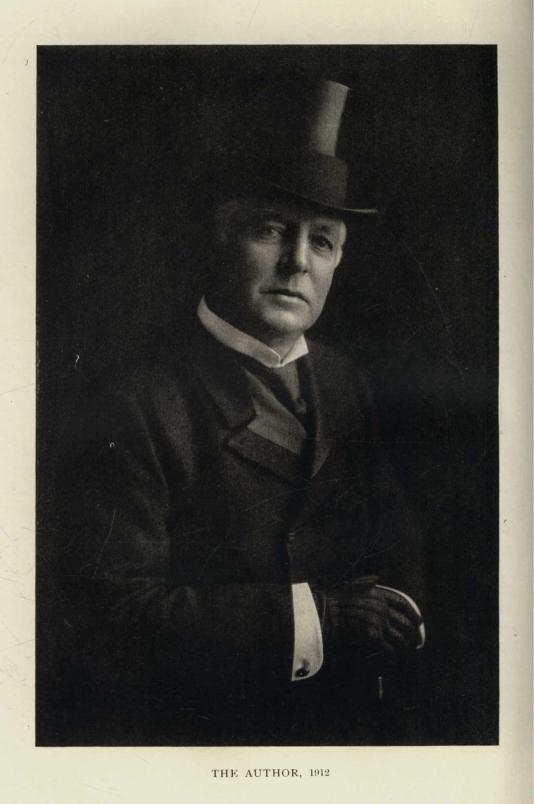
THE AUTHOR, 1912
VII. THE FIGHT TO REACH THE RIVER
"We had beat the foe at Abu Klea, and now had marched all night,
Parching with thirst, each longed to see the first faint streak of light,
For all expected with the dawn to see the river flow.
'Twas there all right, but in our path stood thousands of the foe;
We halted, and a barricade of biscuit boxes made,
And swift their deadly bullets flew round that frail barricade,
And many a gallant fellow dropped before the welcome cry,
'Form square' was heard, 'we must advance, and reach the Nile or die.'"
Songs of the Camel Corps (Sergeant H. EAGLE, R.M.C.C.)
By the time the wounded were picked up, the dead
counted, and their weapons destroyed, and the square
was ready to start, it was half-past three in the
afternoon. There was no food, and hardly any water. The
soldiers suffered dreadfully from thirst; their tongues were
so swollen as to cause intense pain, their lips black, their
mouths covered with white mucus. Several men fainted.
Luckily I had put a skin of water upon a camel just before
the action, so that the men of the Naval Brigade all had
a drink, and there was a little water over for the wounded.
The sailors persisted in smoking; they said it did them
good; so I let them.
The wells of Abu Klea lay some three miles ahead.
The Cavalry, the horses weak, emaciated, and tormented
by thirst, were sent on to reconnoitre. The square followed
slowly. So short-handed was the Naval Brigade that I had
to clap on to the drag-ropes myself. We hauled the gun
through the sand and across nullahs and over rocks till
about 5.30 p.m., when we came to the wells, which were
small pools in the soil, and which, when they were emptied,
slowly filled again. The water was yellow and of the
consistency of cream; but it was cool, sweet, and delicious.
Three hundred volunteers from the Heavy Camel Regiment,
the Guards' Camel Regiment, and the Mounted Infantry
left the wells soon after sunset to march the six weary
miles back again to fetch the camels and commissariat.
They marched and worked all night; yet their lot was
better than ours; for they got food and could keep warm.
As for ourselves, we lay down where we were, without food
or blankets, and suffered the coldest night in my
remembrance. It is suggested to me by a friend who has seen
much active service in many wars, that, owing probably to
the exhaustion of the nerves, men are far more susceptible
to cold after a battle. He himself recalls the night after
Magersfontein as the coldest he ever experienced. At any
rate, we were cold to the marrow that night of 17th-18th
January; cold and bruised and very hungry, the most of us
having had no food for twenty-four hours. I must here
record my admiration of the medical staff, who worked hard
all night, doing their utmost for the sick and wounded.
I sat on an ammunition box and shivered. The wound
upon my finger, where the Arab's spear had cut it, though
slight, was disproportionately painful. Lieutenant Douglas
Dawson (of the Coldstream Guards) came to me and asked
me if I had any tobacco. I told him that my tobacco,
together with my field-glasses, had departed into the desert
with my steed County Waterford, which had run away.
Dawson had six cigarettes, of which he gave me three. I
would cheerfully have given a year's income for them, as
I told him. We agreed that it was hard to have to die
without knowing who had won the Derby.
At about seven o'clock next morning (18th January) the
convoy returned with the rest of the camels and the
commissariat. We had our first meal for some thirty-six hours.
Then we went to work to build a fort in which to leave the
wounded, and to prepare for the march to the river, some
25 miles distant. A burying party went back to the field
of Abu Klea and interred our dead. Some prisoners
captured by the convoy on its way back to the camp,
reported that Omdurman had fallen; but the information
was not made generally known. I did not hear it until
we reached Metemmeh.
Sir Herbert Stewart then determined to reach the Nile
before next morning. A small detachment of the Royal
Sussex was left to guard the wounded. The column
marched about 3.30 p.m. It was a desperate venture, for
the men had had no sleep for two nights, had fought a
battle in between, had suffered agonies of thirst and the
exhaustion of hunger. But Sir Herbert Stewart had
learned from the prisoners that the enemy who had fought
at Abu Klea were no more than the advanced guard of the
main body, which would probably come out from Metemmeh
to meet us, and that the fall of Omdurman had released a
number of the Mahdi's army; and the general wished to
reach the river before fighting again. He hoped to be upon
the Nile before daylight. In any event, the enterprise of
the Desert Column was a forlorn hope; and by this time we
all knew it.
Cameron, war correspondent of The Standard, came to
me with a very grave face. He was not alarmed for his
own safety, for he was a most gallant man; but he feared
for the Column.
"Lord Charles," he said, "have you any influence with
General Stewart? If so, for God's sake implore him not to
go on without reinforcements. I know these people and he
does not."
The next time I saw poor Cameron was upon the following
day, when he was lying with a bullet-hole in his forehead, dead.
The Column was guided by Ali Loda, a friendly desert
freebooter who had been captured during the first march
to Jakdul. He was accompanied by Captain Verner and
Colonel Barrow. Half the force marched on foot, in case
of attack; the mounted men each leading a camel. The
commissariat camels were tied in threes, nose to tail, the
leading camel being ridden by a native driver. Although
both men and camels were tired out, they went bravely
along the track leading across a wide plain, with grass and
scrub in the distance. By the time it was dark, we had
come to the long savas grass, and the tracks, hitherto plain
to see in the brilliant starlight, became obscured. Then
began the confusion. By this time men and camels were
utterly exhausted. There was no moon, but no lights were
allowed, and all orders were to be given in a whisper. The
camels, weary and famished, lagged and tumbled down;
their riders went to sleep and fell off; the leading camels
fell behind; and the rear camels, most of them riderless,
straggled up to the front. The formation was totally
disordered. In the darkness the confusion speedily became
inextricable. When there was a halt to wait for stragglers,
the men lay down and dropped asleep. About this time
the Column blundered into a wood of acacia trees armed
with long sharp thorns. There ought to have been no such
wood; indeed, Count Gleichen avers that no one ever found
it afterwards.
In this state of affairs, the Column lost in the dark in
an unknown country, utterly worn out, and inextricably
tangled upon itself, I made the Naval Brigade unspan and
gave them tea. Then we struggled on, hour after hour.
As for silence, the noise might have been heard and
probably was heard at Metemmeh. An immense multitudinous
murmur went up from the unhappy mob of swearing men
and roaring, squealing, grumbling camels. A longer or
more exhausting nightmare I never suffered.
Daylight came at last. It was about 6 o'clock on the
morning of 19th January. The least we had hoped was to
have come within sight of the Nile. But when the Column
halted there was no Nile; only a long gravel slope rising
before us, set with scattered trees rising from the eternal
savas grass and low scrub. Captain Verner went ahead to
reconnoitre, and the Column toiled on up the ridge. Then,
at last, upon reaching the top at about 7 o'clock, we
beheld the wide valley, and the Nile flowing between broad
belts of green, and on the left, the roofs of a chain of villages,
and the walled town of Metemmeh. Beyond, upon the farther
bank, clustered the huts of the village of Shendi. But we
had not yet come to the river. And moving out from
Metemmeh were crowds of the enemy, moving out to cut us
off from the blessed water. Once more, the whole air was
throbbed with the boding war-drums.
Sir Herbert Stewart determined to give the men breakfast
and then to attack. As usual, a zeriba must first be
constructed and the force put in laager. The Column was
halted upon the top of the rising ground, in a space some
300 yards square, surrounded by a sea of thin scrub, in
which the enemy could find cover. A parapet, square in
plan, and about two feet six inches high, was constructed of
saddles and biscuit boxes and anything else which would
serve the purpose. The camels were pushed inside it, and
knee-lashed, and in the centre was placed the hospital.
During the progress of the work the enemy, concealed in
the scrub, crept nearer and opened fire.
The men breakfasted in a rain of bullets. So wearied
were they, that some fell asleep over their food, bullets
singing all about them. Many of the men got no food at all.
I saw two men shot while they slept. One Dervish in
particular sniped the Naval Brigade all breakfast-time. I
subsequently discovered him in the bush, lying dead, a bullet
through his head, in a litter of about 200 spent cartridges.
One of my men was shot, and a spoke was knocked out of
the wheel of the Gardner gun. A soldier was shot through
the stomach, and was carried screaming to the doctors, who
gave him laudanum.
The situation was far from encouraging. During the
night—the third without sleep—the men had marched
for 14 hours, covering 19 miles, and losing some
hundred camels. We were still four miles from the river,
and between the river and our exhausted force were
thousands of raging Dervishes. We were caught in a trap.
Seventy yards from our left flank was a little hill. In
order to prevent its capture by the enemy, 30 Guardsmen
were told off to occupy it. Volunteers carried saddles
and boxes across the bullet-swept space and built a small
breastwork with them. Several men were knocked over.
In the meantime a company was extended along the ridge
some 50 yards beyond the zeriba to check the enemy's fire;
but they had nothing at which to aim except the puffs of
smoke rising above the scrub. The Naval Brigade had no
better luck with the Gardner gun, placed outside the zeriba
near the left angle of the front.
At some time between 9 and 10 o'clock Sir Herbert
Stewart was hit in the groin and severely wounded. The
knowledge of this disaster was concealed from the men as
long as possible. Then followed a terrible interval, which
lasted for hours. Under that pitiless fire, exposed to an
invisible enemy, men and camels were being hit every
minute. All this time the heat was intense. There we lay
in the blazing sun, helpless, the rattle of rifles all around us,
the thin high note of the bullets singing overheard, or ending
with a thud close at hand; men crying out suddenly, or
groaning; camels lying motionless and silent, blood trickling
from their wounds; and no one seemed to know what we
were going to do. Of all things, the most trying to a soldier
is to lie still under fire without being able to reply. It is
true that there was volley firing in reply to the enemy, but
they were invisible.
The command had naturally devolved upon Colonel Sir
Charles Wilson, R.E., head of the Intelligence Department.
It was clear to me that unless we marched against the enemy
at once, we were done. I dispatched a written message to
Sir Charles Wilson. The messenger was killed. I sent a
second message by Sub-Lieutenant E. L. Munro, R.N.,
who was struck by a bullet which wounded him in seven
places.
Shortly afterwards I received a message from Sir Charles
Wilson informing me that he was about to march against
the enemy. I was ordered to remain in command of the
zeriba, with Colonel Barrow.
Before forming square, Sir Charles Wilson ordered the
breastwork surrounding the hospital and that defending the
little knoll occupied by the Guards in our rear, to be
strengthened into redoubts, in case of attack. The ammunition
boxes must be shifted from the inside of the main zeriba,
and carried across and among the baggage and the packed
and helpless camels, a slow, laborious and dangerous
business performed under fire. Men and officers worked
with a will; yet it was 2 o'clock in the afternoon before
they had done. Just then St. Leger Herbert, private secretary
to Sir Herbert Stewart and correspondent of The Morning
Post, was shot through the head.
The square was composed of half the Heavy Camel
Regiment, Guards, Mounted Infantry, Royal Sussex, Royal
Engineers, and some dismounted Hussars. Sir Charles Wilson
placed it under the executive command of Lieutenant-Colonel
the Hon. E. E. Boscawen. The square was formed
up in rear of the zeriba at 2.30 and marched at 3 o'clock.
The men were cool, alert, and perfectly determined. The
British soldier had shut his mouth. He was going to get
to the river, enemy or no enemy, or die. By this time the
enemy were plainly visible in full force in front, horse and
foot gathering behind a line of green and white banners.
The moment the square moved beyond the redoubt, it received
a heavy fire. Several men were hit, and were carried back
to the zeriba by our men, while the square moved forward at
quick march. It made a zig-zag course in order to take
advantage of the clear patches of ground among the scrub;
lying down and firing, and again advancing.
The Naval Brigade mounted the Gardner gun in the
angle of the redoubt, and, together with the Royal Artillery
and two of their screw-guns under Captain Norton, maintained
a steady fire at the three distinct masses of the enemy.
Two of these were hovering in front of the advancing square,
upon the landward slope of the hill rising between us and
the river; the third threatened the zeriba. In all of these
we dropped shells, paying particular attention to the body
menacing the zeriba. When the shells burst in their midst,
the dervishes scattered like a flock of starlings.
In the zeriba were the most of the Hussars, whose horses
were worn out, the Royal Artillery, half the Heavy Camel
Regiment, half the Royal Engineers, what was left of the
Naval Brigade, and the wounded in the hospital. Some
2000 camels were knee-lashed outside and all round the
larger zeriba, forming a valuable breastwork.
All we could do was to work our guns. As the square
went on, the enemy, moving in large masses, shifted their
position, and as they moved, we dropped shells among
them. We judged their numbers to be greater than at Abu
Klea. Would the square of only 900 men ever get through?
If ever a little British army looked like walking to certain
death, it was that thin square of infantry.
Presently it disappeared from view. Soon afterwards
we heard the steady roll of volley firing, and we knew that
the enemy were charging the square. Then, silence.
Whether the enemy had been driven back, or the square
annihilated, we did not know. What we did know was that
if the square had been defeated, the zeriba would very soon
be attacked in overwhelming force. But as the moments
passed the strain of suspense slackened; for, as the fire of
the enemy directed upon the zeriba diminished and soon
ceased altogether, the presumption was that the square had
been victorious and had got through to the river.
What had happened was that the Arabs, charging downhill
at the left front angle of the square, had been met by
concentrated rifle fire, our men aiming low at a range of
400 yards, steady as on parade. Once more the British
soldier proved that no troops in the world can face his
musketry. The front ranks of the charging thousands were
lying dead in heaps; the rear ranks fled over the hills; and
the square went on, unmolested, very slowly, because the
men were tired out, and so came to the river.
Count Gleichen, who marched with the square, recounting
his experiences (in his With the Camel Corps up the
Nile), writes: "Soon in the growing dusk a silver streak
was visible here and there in amongst the green belt, but it
was still a couple of miles off.... Our pace could not
exceed a slow march. The sun went down, and the twilight
became almost darkness; ... a two-days-old crescent was
shining in the sky, and its feeble light guided us through
the gravel hills right to the brink of the Nile. The men
were as wild with joy as their exhausted condition would
allow. The wounded were held up for one look at the
gleaming river, and then hurried to the banks. Still, perfect
discipline was observed. Not a man left his place in the
ranks until his company was marched up to take its fill....
A chain of sentries was established on the slopes overlooking
the square, and in two minutes the force was fast
asleep." Sir Charles Wilson (From Korti to Khartoum)
adds: "The men were so exhausted that when they came
up from their drink at the river they fell down like
logs...."
They had been marching and fighting for four days and
three nights without sleep, and with very little food and
water, and had lost a tenth of their number. That night
we in the zeriba also slept. I remember very little about it,
except that Lieutenant Charles Crutchley, Adjutant of the
Guards' Camel Regiment, woke me twice and asked me for
water. He made no complaint of any kind, and I did not
know that he had been hit early in the day and that he had
a bullet in his leg. General Crutchley, who was so kind as to
write to me in reply to my request that he would tell me
what he remembers of the affair, says: "I remember lying
on a stretcher that night, and people knocking against my
leg, and that my revolver was stolen, I believe by one of the
camel boys." Crutchley was carried down to the river by
my bluejackets next day, and was taken into hospital. As
I remember the occasion, he left the decision as to whether
or not his leg should be amputated, to me. At any rate,
the surgeon had no doubt as to the necessity of the
operation, at which I was present. With his finger he flicked
out of the wound pieces of bone like splinters of bamboo.
The leg was buried, and was afterwards exhumed in order
to extract the bullet from it. I think I remember that
Crutchley, seeing it being carried across to the hospital,
asked whose leg it was. He was carried upon a litter back
to Korti, and the shaking of that terrible march made
necessary a second operation, which was successful.
Sir Charles Wilson's force, having bivouacked that night
beside the Nile, were up at daybreak; took possession of
the empty village of mud huts, called Abu Kru, but always
known as Gubat, which stood on the gravel ridge sloping
to the Nile, 780 yards from the river; and placed the
wounded in Gubat under a guard. The force then returned
to our zeriba.
When we saw that gallant little array come marching
over the distant hill-top, and through the scrub towards us,
we cheered again and again. Hearty were our greetings.
Our comrades, who had marched without breakfast, were
speedily provided with a plentiful meal of bully-beef and
tea.
Then we all set to work to dismantle the zeriba, to
collect the stores of which it was constructed and to sort
them out, to mend the broken saddles, and load up the
wretched camels, who had been knee-lashed and unable to
move for twenty-four hours. About a hundred camels were
dead, having been shot as they lay. As there were not
enough camels to carry all the stores, a part of these were
left under an increased garrison inside the redoubt upon the
knoll in rear of the zeriba, Major T. Davison in command.
At midday we buried the dead, over whom I read the
service, Sir Charles Wilson being present as chief mourner.
The last of the wounded to be moved was Sir Herbert
Stewart, so that he should be spared as much discomfort as
possible. He was doing fairly well, and we then hoped that
he would recover.
Before sunset we were all safely lodged in Gubat. The
Desert Column had reached the river at last. It was the
20th January; we had left Korti on the 8th. In the course
of that 176 miles we had gone through perhaps as sharp a
trial as British troops have endured.
At the fight of Abu Klea, nine officers and 65 non-commissioned
officers and men were killed, and nine officers
and 85 non-commissioned officers and men were wounded.
On the 19th January, between the wells of Abu Klea and
the river, one officer and 22 non-commissioned officers and
men were killed, and eight officers and 90 non-commissioned
officers and men were wounded. The general, Sir Herbert
Stewart, had received a wound which was to prove mortal.
All the officers of the Naval Brigade, except Mr. James Webber,
boatswain, and Sub-Lieutenant Munro, who was wounded,
and myself, had been killed. The losses were roughly
one-tenth of the total number of the Column. The camels which
survived had been on one-third rations and without water for
a week. They were hardly able to walk; ulcerating sores
pitted their bodies; their ribs actually came through their skin.
Count Gleichen says that his camel drank from the Nile
for 14 minutes without stopping; and that subsequently the
poor beast's ribs took a fine polish from the rubbing of the
saddle. The horses of the Hussars had been 58 hours,
and many of them 72 hours, without water. I cannot
mention the Hussars without paying a tribute to the
admirable scouting work they did under Lieutenant-Colonel
Barrow during the whole march, up to the time the last zeriba
was formed, when the gallant little horses were dead beat.
The present field-marshal, Sir John French, did splendid
service with the Hussars throughout the campaign.
When we came into Gubat I was painfully, though not
seriously, ill. The galling of the makeshift saddle during
my three days' ride across the desert from Dal to Abu
Fatmeh on my way to Korti, had developed into a horrid
carbuncle; and I was unable to walk without help.
VIII. DISASTER
"Comrades, who with us side by side,
Did in the brunt of battle stand,
Are absent now, their manly forms
Lie mouldering in the desert sand."
Songs of the Camel Corps (Sergeant H. EAGLE, R.M.C.C.)
On 21st January, the day after the main body of the
Desert Column had come to Gubat, an attack was
made upon Metemmeh, which resolved itself into a
reconnaissance in force. Lord Wolseley's instructions to
Sir Herbert Stewart were "to advance on Metemmeh, which
you will attack and occupy." These instructions Sir
Charles Wilson, upon whom the command had devolved,
determined to carry into execution, although there was a
doubt whether under the circumstances the attempt would
be justified. Metemmeh was a walled town of considerable
strength, lying two miles down the river from the encampment.
Between the encampment and the town rose low
ridges, in whose folds clustered the huts of deserted villages.
The Naval Brigade joined in the attack; and as I was
out of action, Mr. Webber, boatswain, was in command, and
did admirably well.
While Sir Charles Wilson's force was firing upon the
town, whence the enemy briskly replied, Gordon's four
steamers arrived. His black troops instantly landed with
guns, and joyfully bombarded the mud walls; while Sir
Charles Wilson conferred with Khashm-el-Mus Bey, Malik
(King) of the Shagiyeh tribe, and Abd-el-Hamid Bey, a
young Arab greatly trusted by Gordon, who were in
command of the steamers. Abd el Hamid subsequently
deserted, and was, I think, shot by the Mahdi. Khashm-el-Mus
having reported that a large force was on its way down
from Khartoum under Feki Mustapha, Sir Charles Wilson
decided that he ought not to incur the further loss of men
involved in the capture of Metemmeh. He therefore withdrew
from Metemmeh, and returned to Gubat, destroying the
three intervening villages on the way.
During the reconnaissance of Metemmeh, Major William
H. Poe, of the Royal Marines, was severely wounded in
the leg. He insisted upon wearing a red coat, saying that
his other coat was not fit to be seen; and he made a
conspicuous target. His leg was amputated, and he eventually
recovered; and he rides to hounds to this day.
In view of the approach of the enemy, the wounded were
brought from the fort on the ridge to an entrenched camp
on the river; and opposite to it, upon Gubat Island, a
breastwork was constructed, and was occupied by some of
Gordon's Soudanese who had come in the steamers. Major
T. Davison's outlying detachment, with the remaining stores,
was brought in.
It was now necessary very carefully to consider the
situation. Sir Charles Wilson read the letters dispatched
by Gordon and brought in one of the steamers, the Bordein,
which had left Khartoum on 14th December. Sir Charles
gave me these letters to read. In a letter addressed to the
Officer Commanding H.M. Troops, Gordon requested that "all
Egyptian officers and soldiers" be taken out of the steamer.
"I make you a present of these hens," he wrote, "and I
request you will not let one come back here to me." In
another letter, addressed to Major Watson (colonel in the
Egyptian Army), dated 14th December, Gordon wrote that
he expected a crisis to arrive about Christmas; and implied
that he had abandoned hope of relief.
It was now nearly a month after Christmas, and
Khartoum was still holding out. But it was no longer
possible to carry into execution Lord Wolseley's original
intention: that Sir Herbert Stewart should capture and
occupy Metemmeh; that I should man Gordon's four
steamers with the Naval Brigade and should take Sir
Charles Wilson with a detachment of infantry up to
Khartoum. Now, Sir Herbert Stewart was incapacitated
by his wound; it was not considered practicable to take
Metemmeh; all the officers of the Naval Brigade were killed
or wounded except Mr. Webber; and I myself was so ill
as to be unable to get about without help. Moreover, the
weakened Desert Column, including more than a hundred
wounded, would in all likelihood shortly be attacked by a
greatly superior force.
Two main provisions of the original plan, however, had
been fulfilled. The Column had reached the river; and
Gordon's steamers had joined the Column. And it was
then supposed that Wolseley was marching across the
Bayuda Desert with reinforcements.
Sir Charles Wilson determined to go to Khartoum (a
decision in which I strongly supported him), provided that
he could make reasonably sure that the force to be left behind
was not in immediate danger of attack. He reckoned that the
news of the defeat of the Mahdi's forces at Abu Klea would
have served both to inspirit the garrison at Khartoum, and,
owing to the dispatch of a number of the enemy to meet us,
to relieve them in some measure. And after examining the
commanders of the steamers on the point, he was satisfied
that the delay of two days spent in reconnoitring, would not
be material; a conclusion which was not shared by Khashm-el-Mus,
who was eager to go to Khartoum.
Accordingly, on 22nd January, Sir Charles Wilson
took three steamers down stream to reconnoitre. The
four boats sent down by Gordon were: the Bordein, under
Abd-el-Hamid; Talahawiyeh, under Nusri Pasha; Safieh,
under Mahmoud Bey; and Tewfikiyeh, under Khashm-el-Mus.
Sir Herbert Stewart was moved on board the Tewfikiyeh,
a small boat, which was employed as a ferry between
Gubat Island and the mainland. I went with Sir Charles
Wilson in the Talahawiyeh. I was not of much use, as I
had to be helped on board, and was obliged to lie down
in the cabin. In the same steamer were Major Phipps and
two companies of Mounted Infantry. Old Khashm-el-Mus
was made commandant of the boat instead of Nusri Pasha.
In the Bordein were Captain Verner, Abd-el-Hamid, and
native soldiers. The Safieh had her own crew and
captain.
These vessels, about the size and build of the old penny
steamboats on the Thames, had been ingeniously
protected and armed by poor Colonel Stewart, he who was
treacherously murdered on 18th September, 1884, after
the wreck of his steamer Abbas at Hebbeh. (It will be
remembered that Colonel Stewart was sent by Gordon,
with a party of refugees, to communicate in person with
the authorities in Egypt.) In the bows was a small turret
constructed of baulks of timber, and containing a 9-pr. brass
howitzer (canon rayé) to fire ahead; amidships, between the
paddle-boxes, was the central turret, also built of timber,
and mounting a gun to fire over the paddle-boxes. Astern,
on the roof of the deckhouse, was an enclosure of boiler-plate,
protecting the wheel and giving shelter to riflemen.
The sides and bulwarks were covered with boiler-plate,
above which was fixed a rail of thick timber, leaving a
space through which to fire. The boiler, which projected
above the deck, was jacketed with logs of wood. The
improvised armour of wood and iron would stop a bullet, but
was pervious by shell.
The ships' companies were an interesting example of
river piracy. The steamers had been cruising up and down
the Nile since October, a period of four months, during
which the crews lived on the country, raiding and fighting.
Everything was filthy and neglected except the engines.
The forehold was crammed with ammunition, dhura
grain, wool, fuel, and miscellaneous loot. The main-hold
was inhabited by women, babies, stowaways, wounded men,
goats, amid a confusion of ammunition, sacks of grain,
wood fuel, bedding and loot. The after-hold held the
possessions, including loot, of the commandant. Below the
forward turret slave-girls ceased not from cooking
dhura-cakes. Rats swarmed everywhere; the whole ship exhaled
a most appalling stench; and the ship's company shouted
and screamed all day long.
First there was the commandant, who was theoretically
in chief command of the ship, and who commanded the
soldiers on shore; then there was the officer commanding
the regular soldiers, Soudanese. He was black, and so
were his men, who were freed slaves. The officer
commanding the Artillery was an Egyptian. The Bashi-Bazouk
contingent was composed of Shagiyehs—who were
of the tribe ruled by Khashm-el-Mus—of black slaves, and of
half-castes. Their officers were Turks, Kurds, and
Circassians. The captain of the ship was a Dongolese, and
his sailors were blacks. Under the captain were numerous
petty officers, such as the chief of the sailors, the chief of
the carpenters, and so forth. The chief engineer and his
staff were Egyptians. The Reis (pilot) and his assistants
were Dongolese.
Into this wild medley, in the Talahawiyeh, Sir Charles
Wilson brought a company of Mounted Infantry; and thus
reinforced, we steamed down river; while I lay in the
cabin, in a good deal of pain, and chatted to Khashm-el-Mus,
who became a great friend of mine. He was a short,
grey-bearded, dignified man of middle age, owning great power
over his own people. He remained loyal to Gordon under
very trying conditions, and he stuck by us to the last.
Near Shendi, one of Khashm-el-Mus's men came on
board and reported that the force advancing from Berber
had met the fugitives from Abu Klea and had come no
farther. Another Shagiyeh gave the same information.
The people of Shendi fired on the steamers, which replied
with ten rounds of shell from each gun. We then went
about and returned to Gubat. At my request, Sir Charles
Wilson conferred upon Mr. Ingram, of The Illustrated
London News, the rank of acting-lieutenant in the Royal
Navy. Ingram had been of the greatest service. He had
brought his own launch up from Korti, volunteered to the
Desert Column, and fought gallantly at Abu Klea and at the
reconnaissance of Metemmeh. As all the naval officers had
been killed or wounded, and I was comparatively helpless,
I was delighted to secure Mr. Ingram, who was exceedingly
useful.
His subsequent history was remarkable. He was killed
while hunting big game in Africa, and was buried upon an
island which was afterwards washed away. The story
goes that the manner of his death and the bearing away by
a flood of his remains, were the fulfilment of a curse, which
fell upon him when, in spite of warnings, he purchased a
certain Egyptian mummy.
Sir Charles Wilson, being assured that no attack was
intended from the direction of Berber, began immediately
to prepare for his expedition to Khartoum. Most
unfortunately, I was compelled to retire into hospital; but I
was able to issue instructions which I hope were of use. At
Sir Charles Wilson's request, I advised him to take the
two larger and better protected steamers, Bordein and
Talahawiyeh.
The work of preparing them began next morning,
23rd January. The first thing to be done was to sort out
from their crews the Egyptians, Turks, Kurds, Circassians,
the "hens" whom Gordon had refused to have again in
Khartoum, and to man the two vessels with Soudanese
sailors and soldiers. Captain Gascoigne and Lieutenant
Stuart-Wortley toiled at this tiresome job nearly all day.
At my suggestion, the people removed from the
steamers were placed in a camp by themselves up stream,
on the Khartoum side of Gubat; so that in the event of a
force advancing from Khartoum, and the consequent revolt
of the "hens," we should not be placed between two fires.
The military objection was that they would foul the water;
which was obviated by my building wooden piers projecting
into the stream.
An engine-room artificer from the Naval Brigade was sent
on board each steamer, in which they went to work to repair
defects. Wood for the steamers was obtained by cutting up
the sakiehs, or water-wheels, up and down the river, a slow
process as performed by natives receiving orders through
interpreters. Khashm-el-Mus was placed in command of
the Bordein, and Abd-el-Hamid of the Talakawiyeh. Sir
Charles Wilson was to go in the Bordein, together with
Captain Gascoigne, 10 non-commissioned officers and men
of the Royal Sussex, one petty officer and one artificer
Naval Brigade, and no Soudanese soldiers. In the
Talahawiyeh were Captain L. J. Trafford, in command of
10 non-commissioned officers and men of the Royal Sussex,
one of whom was a signaller, one engine-room artificer
Naval Brigade, and some 80 Soudanese soldiers. The
Talahawiyeh towed a nuggar carrying about 50 Soudanese
soldiers and a cargo of grain for Khartoum. According to
Gordon's express desire, the British troops were clad in
red tunics, which, being borrowed from the Guards and the
Heavy Camel Regiment, were far from being a regimental fit.
By the time the preparations were complete, it was too
late to start that night, and the Royal Sussex, folded in
their red tunics, bivouacked on the bank.
During the day, the entrenchments upon the hillside
and by the river were strengthened; and the same evening
a convoy and an escort under the command of Colonel Talbot
started for Jakdul to fetch stores. Captain C. B. Piggot, the
man who knew not fear, carrying dispatches to Korti,
accompanied them.
It should be borne in mind that the chief object of the
expedition to Khartoum, apart from the necessity of
communicating with Gordon himself, was to produce a moral
effect upon the Mahdists; Gordon's idea being that the
presence of a small force of British soldiers would inevitably
convince the native that powerful reinforcements might be
expected immediately. In the journal of Sir Charles
Wilson (From Korti to Khartoum) he makes the following
comment:
"The original plan was for Beresford to man two of the
steamers with the Naval Brigade, mount his Gardner gun
on one of them, and after overhauling them, take me to
Khartoum with about fifty men of the Sussex Regiment.
This was now impossible: all the naval officers were killed
or wounded except Beresford, who was himself unable to
walk, and many of the best petty officers and seamen were
also gone. Beresford offered to accompany me; but he
had done himself no good by going down the river the
day before, and there was every prospect of his getting
worse before he was better. Besides, I felt I could not
deprive the force of its only naval officer, when it was quite
possible the steamers left behind might have to take part in
a fight."
That possibility was fulfilled. In the event, if I may say
so, it was lucky that I was there.
At eight o'clock on the morning of the 24th January, the
two steamers started, flying the Egyptian flag, the
slave-girls frying dhura-cake under the fore turret, old
Khashm-el-Mus smoking and drinking coffee on the cabin sofa, both
vessels crammed with yelling and joyous savages, among
whom were a bare score of British soldiers. They must
pass powerful batteries, a single shot from which would sink
them, and dangerous cataracts sown with rocks, and finally
the guns of Omdurman, which was now in possession of the
enemy. And having survived these perils, they might be
unable to return, for the river was rapidly falling. Slowly
they steamed away against the strong stream, and vanished;
and for seven days we waited for news of that desperate
enterprise.
In Sir Charles Wilson's absence, the military command
devolved upon Colonel Boscawen, and after a few days,
Colonel Boscawen being ill with fever, upon Colonel Mildmay
Willson of the Scots Guards. The actual senior officer was
myself. I issued a proclamation to the natives.
(Translation)
"To the people of the river districts.
"This is to make it known to you that we are the
advanced portion of the two great English armies which are
now marching on Khartoum to punish the rebels.
"We do not wish to do you any harm if you will come
to see us. You will receive no hurt; and we will pay you
for your cattle and crops.
"If, however, you do not tender your submission, we will
punish you severely. Your cattle will be taken, your villages
and sakiehs burnt, and you yourselves will be killed, even
as those unfortunates who ventured to oppose us at Abu
Klea and Metemmeh.
"Any person desirous of speaking with the English
general should carry a white flag, and come by the river
bank alone. He will not be detained, and he will be guarded
from all danger.
"The SIRDAR
"Advanced Guard, English Army"
I was in hospital for only two days. The surgeon's
knife relieved my pain, and I was speedily healed. On the
26th January, and the following day, I took the Safieh down
to Metemmeh and shelled that place, covering the advance
of a foraging party. There were daily expeditions both by
the river in the steamer, and by land, to get goats and
cattle, vegetables for the sick, and green-stuff for the camels,
which had already eaten up all the vegetation about the
camp. We weighed anchor daily at 6 a.m., taking a party
of twenty picked shots from one of the regiments. Small
parties of riflemen used to fire at us from the left bank, but
we had no casualties.
All the villages in the neighbourhood were deserted;
but there was nothing to be taken from them except a few
beans and lentils, and the native wooden bedsteads. A
good deal of long-range sniping went on, but no one was
the worse for it.
The British sailors and soldiers had trouble with the
native bulls, which, docile enough with natives, resisted
capture by white men. Nusri Pasha, the Egyptian, who
had come down in command of the Talahawiyeh, was
standing on the deck of the Safieh, watching my men trying
to compel a recalcitrant bull down the bank.
"Let me try," said Nusri Pasha. "He'll obey me.
You see."
And he crossed the plank to the shore, and went up to
the angry bull. No sooner did the Pasha lay hand on the
rope, than the bull charged, caught the unhappy Egyptian
between his horns, carried him headlong down the slope
and into the water, and fetched up against the steamer
with his horns fixed in the sponson, while Nusri disappeared
into the river, the beholders yelling with laughter. The
Pasha was fished out, chastened but not much the worse
for his extraordinary escape. Had he been impaled upon
the horns, there would have been no more Nusri, tamer of
bulls.
Every night the tom-toms beat in Metemmeh; and on
the 28th, there was a great noise of firing, which we supposed
to be the celebration of a religious festival. Alas, it was
something else.
On 31st January, Colonel Talbot returned from Jakdul
with a large convoy of supplies. He was accompanied by
the second division of the Naval Brigade, which, it may be
remembered, had not arrived at Korti when the Desert
Column left that place. With the Naval Brigade came
Lieutenant E. B. van Koughnet, in command, Sub-Lieutenant
Colin R. Keppel (son of my old friend Sir Harry
Keppel), Surgeon Arthur William May (now Surgeon-General
Sir A. W. May, C.B.), and Chief Engineer Henry
Benbow (now Sir Henry Benbow, K.C.B., D.S.O.). Never
was reinforcement more timely; and it was with inexpressible
pleasure that I greeted my shipmates. Once more I
had officers; in the meantime, I had put the Safieh into
fighting trim; and now we were ready for emergency. It
came.
Every night I used to haul off the Safieh into the stream;
and I slept on deck. Very early in the morning of the
1st February, I was awakened by a voice hailing the
Safieh. I ran to the rail, and there, in the first light of
the dawn, was a boat, and Stuart-Wortley's face was lifted
to mine. He climbed aboard.
"Gordon is killed and Khartoum has fallen," he said.
Then Stuart-Wortley told me how Sir Charles Wilson's
two steamers were wrecked, how his force was isolated up
the river, and how the Mahdi might be marching down with
his whole triumphant horde armed with all the guns and
rifles of the fallen city.
"Then the soldiers had better run up more wire entanglements
and earthworks as quick as they can. And I wish to
God I had those two steamers!" I said.
I told Stuart-Wortley I would at once proceed to the
rescue of Sir Charles Wilson's party, and sent him on shore
to tell the news to Colonel Boscawen.
How the tidings came to the camp, is related by
Lieutenant Douglas Dawson, who recorded in his diary how
one "drew his curtains in the dead of night and told him"
... (The diary was published in The Nineteenth Century
for November, 1885. I quote from the copy kindly lent to
me by the author):
"February 1st. No member of our small force as long as
he lives will ever forget this morning. Just at dawn I was
woke by someone outside our hut calling for Boscawen. I
jumped up and went out to see who it was, and then made
out to my surprise Stuart-Wortley, whom we all thought at
Khartoum.
"I looked towards the river, expecting in the faint light
to see the steamers, then seeing nothing, and observing by
his face that there was something wrong, I said, 'Why, good
heavens! where are the steamers, what is the news?' He
said, 'The very worst.'"
The full story of a very gallant exploit, Sir Charles
Wilson's daring voyage to Khartoum, has been modestly
and clearly told in his book, From Korti to Khartoum. The
Bordein and the Talahawiyeh towing the nuggar, came to the
Shabloka Cataract upon the day (25th January) after they
had started. Here the Bordein stuck; and having been got off
after many hours' work, she ran aground again off Hassan
Island next day, during which the expedition advanced only
three miles. On the afternoon of the 27th, a man appearing
on the left bank cried that Khartoum had fallen and Gordon
was slain. No one believed him, because the air was full of
false rumours. The next day, 28th, in the morning, a man
on the right bank cried that Khartoum had fallen and that
Gordon had been killed, two days before. No one believed
him. But it was true. It was on that night that we in
Gubat heard the guns firing in Metemmeh.
By this time, those in the steamers could catch a far
glimpse of the roofs and minarets of Khartoum pencilled
upon the blue above the trees of Tuti Island; and at the
same time, a heavy fire was opened from the battery of
Fighiaiha on their right hand. Then they came to Halfiyeh,
where a battery of four guns fired upon them, on their left
hand. The naked black men in the steamers served their
guns with a furious zeal, while the British infantry fired
steadily, and so through the smoke the red flags went on,
safely past the point of the long island that ends opposite
to Halfiyeh, the Soudanese ecstatically shrieking defiance
and brandishing their rifles. At Halfiyeh were boats lying,
and Khashm-el-Mus said to Sir Charles Wilson, "Gordon's
troops must be there, as the Mahdi has no boats."
Then, from the Bordein, which was leading, they could see
Government House in Khartoum plain above the trees, but
there was no flag flying from its roof. As they passed between
the island on their left hand and the mainland on the right,
two more guns opened, and there began a heavy rifle-fire
from both sides which continued for the rest of the way.
Tuti Island, the upper end of which faces Khartoum, and
about which on either side the Blue Nile stretches an arm to
join the White Nile, was lined with riflemen firing over a
dyke. At first Sir Charles thought them to be Gordon's
men, and took the steamer nearer in, when the fire increased.
So, writes Sir Charles, "we went on, old Khashm protesting
it was all up, and predicting terrible disaster to ourselves.
No sooner did we start upwards than we got into such a fire
as I hope never to pass through again in a 'penny
steamer.' Two or more guns opened upon us from Omdurman fort,
and three or four from Khartoum or the upper end of Tuti;
the roll of musketry from each side was continuous; and
high above that could be heard the grunting of a Nordenfelt
or a mitrailleuse, and the loud rushing noise of the Krupp
shells..."
They rounded the curve of the island, and there beyond
the space of rushing water torn with shot, and the flash and
smoke of bursting shells, Khartoum rose into full sight;
and there, ranged on the sandy shore beneath the walls, the
Mahdi's banners fluttered above the massed ranks of the
dervishes.
All was done. Sir Charles Wilson had fought his way
to the end, determined to go on till he was certain of the fate
of the city. Then he knew; then, and not until then, did he
give the order to go about.
At the word, as he relates, the Soudanese, who had lost
all they had in the world, were stricken mute and impotent.
Poor old Khashm-el-Mus wrapped his mantle about his head,
crouching in a corner. They ran down stream through the
fire, the Soudanese bravely returning it, the British infantry
steady as ever, and won clear. During four hours they had
been under fire. They ran down some 30 miles, and moored
for the night.
The next day, 29th January, the Talahawiyeh struck on
a rock in the Shabloka Cataract, and must be abandoned.
The British were transhipped to the Bordein, the natives
bivouacked on an island. Next day the natives were sent
on ahead in the nuggar, hitherto towed by the Talahawiyeh,
and the Bordein followed. The day after, 31st January,
during the afternoon, the Bordein struck a rock, began to
fill, and was run on shore upon a small island close to the
large Mernat Island. When the accident occurred, Sir
Charles Wilson was just preparing to run at full speed past
the fort and battery of Wad Habeshi, which lay on the left
hand some three and a half miles lower down. Mernat
Island lies about 35 miles above Gubat by land, and nearly
40 by river.
Sir Charles Wilson landed guns, ammunition and stores.
At first he intended to make a night march down on the
right bank; but he changed his plan and decided to remain
where he was for the night.
Lieutenant Stuart-Wortley was dispatched to carry the
news to Gubat in one of the two small boats, a felucca. He
left at 6.45 p.m., taking a crew of four English soldiers and
eight natives. They were fired at and missed by the Wad
Habeshi fort; and working splendidly, traversed the 40
miles in a little over eight hours, arriving at Gubat, as already
related, at 3 a.m. on the morning of 1st February. Stuart-Wortley
and his men faced death every mile of the way;
and their voyage deserves to be remembered as a bold,
determined and gallant achievement.
IX. THE RESCUE
"And while lying near Metemmeh
He went—many a time you know—
Up the river in his steamer,
Dealing havoc on the foe;
And each gallant tar and Jollie
That was with him, fighting there,
Now would follow without question,
Let him lead them, anywhere."
Songs of the Camel Corps (Sergeant H. EAGLE, R.M.C.C.)
[The men used to sing 'Our Navy on the Nile,'
of which the above is an
excerpt; but the rest is so complimentary
to the author, that he is obliged to
omit it.]
At two o'clock in the afternoon of the 1st February
the Safieh left Gubat to proceed to the rescue of Sir
Charles Wilson's force. From the time the news
arrived until we started, we were occupied in getting wood
and stores. With me were Lieutenant E. B. van Koughnet,
Sub-Lieutenant Colin R. Keppel, Surgeon Arthur William
May, Chief Engineer Henry Benbow, Acting-Lieutenant
Walter Ingram, Mr. Webber, boatswain, all of the Royal
Navy, Lieutenant R. L. Bower, King's Royal Rifle Corps,
and Lieutenant Stuart-Wortley, who had brought the news
of the disaster. The vessel was manned by picked men from
both divisions of the Naval Brigade, and carried twenty
non-commissioned officers and men, picked shots, of the
Mounted Infantry, under the command of Lieutenant
R. L. Bower. The engine-room staff consisted of Chief Engineer
Benbow; two engine-room artificers, Royal Navy,
J. T. Garland and G. Woodman; and one chief stoker, Royal
Navy; an Arab or Egyptian engineer, and six Soudanese
stokers. We mounted the two Gardner guns in echelon on
the platform made of railway sleepers and boiler-plate
amidships, and one of the two brass 4-pr. mountain guns
was placed in the turret forward, the other in the turret aft,
both turrets being built of railway sleepers and boiler-plate,
with which defences the ship had been cased above water.
The Reis (native pilot) was stationed inside the barricade
protecting the wheel, to guide the helmsman, who was a
bluejacket. The native boats always carry two Reises, one to
look out, the other to steer. Our Reis was mounted upon a
box so that he could see over the barricade. In order to
guard against the kind of accident which had befallen Sir
Charles Wilson's steamers, I informed him that if he took
us safely up and down he would be rewarded, but that upon
any indication of treachery he would be shot at once. He
was then handcuffed to a stanchion, and Quartermaster
Olden, with a loaded revolver, was placed at his side.
Surgeon-General A. W. May, who very kindly sent me his
recollections of the trip, writes: "A quartermaster with
the nickname of 'Punch' was told off to look after him, and
he stood as grim as death at his side, revolver in hand, quite
ready at the slightest sign of treachery to carry out his
orders ... I always attribute our getting up and down
when the river was low and dangerous to your wise warning
of the pilot."
The Safieh was simply a penny steamer in a packing-case.
Where the packing-case was deficient, bullets went
through her as through paper, and a shell would pierce her
wooden jacket. The pinch would come when we sighted
the fort at Wad Habeshi, which lay on our right hand,
between us and Mernat Island, where was Sir Charles Wilson's
party, and which was some 36 miles up stream from Gubat.
On 1st February we shoved along at the rate of 2.5
miles an hour, the most the Safieh could do against the
current, stopped to get wood, and anchored in the stream
during the night. It was impossible to navigate in the dark.
The next day was almost entirely occupied in collecting
wood, which was laboriously obtained by dismantling and
cutting up the sakiehs, native water-wheels. That evening
we arrived within three or four miles of Wad Habeshi, and
again anchored for the night. After weighing next morning,
I assembled the ship's company and briefly addressed them.
I told them that we were in a tight place, but that we would
get out of it; that if we failed to rescue Sir Charles Wilson,
the Mahdi's men would get them and would then come
down upon Gubat; but that we would save Wilson's party.
The men were as cheery and steady as possible.
At 7 a.m. we sighted Wad Habeshi on the starboard
hand; and we saw, far up the river, the trees of Mernat Island,
and the tilted hull and funnel of the stranded Bordein.
By 7.30 a.m. we were within 1200 yards of the fort, and I
opened fire with the bow gun. Wad Habeshi was a strong
earthwork, with four embrasures, mounting four guns, and
manned, according to Stuart-Wortley's report, by 5000
riflemen. The only practicable channel ran within 80 yards
of the fort. We could only crawl past the battery, and as
we were defenceless against gun-fire, our only chance was
to maintain so overwhelming a fire upon the embrasures as
to demoralise the guns' crews. It was an extreme instance
of the principle that the best defence resides in gun-fire
rather than in armour; for we had no effective armour.
Accordingly, the starboard Gardner and the two brass
guns, the 20 soldiers and 14 bluejackets, poured a steady
and an accurate fire into the fort, disregarding the parties of
riflemen who were shooting at us from the bank. There
were some 600 or 800 of these, and one gun opened fire
from the side embrasure of the fort. Poor von Koughnet
was shot in the leg, and second-class petty officer Edwin
Curnow, number two of the crew of the starboard Gardner,
fell mortally wounded, and died that evening. But so
deadly was the fire we poured into the embrasures of the
fort, that the enemy could not fire the two guns bearing
upon the Safieh while she was bore abeam of them. We
passed the fort, and by the time we had left it about 200
yards astern, our fire necessarily slackened, as our guns no
longer bore upon the battery.
Suddenly a great cloud of steam or smoke rose from the
after hatchway. Instantly the fire of the enemy increased.
Chief Engineer Benbow, who was standing with-me on the
quarter-deck, ran to the engine-room. A Maltese carpenter
rushed up to me crying, "All is lost, sare, myself and my
brother, sare! The ship he sink, sare!" and was promptly
kicked out of the way.
I saw the black stokers rushing up from the stoke-hold
hatchway. At the moment it was uncertain whether the
ship was on fire or the boiler injured; but as she still had
way upon her I ordered her to be headed towards the bank,
away from the fort, and so gained another few yards. The
carpenter's mate reported that there were three feet of water
in the well, and that the vessel was sinking.
Then she stopped. In the meantime our fire upon the
side embrasure of the fort was continued by the riflemen;
and it went on without pause, lest the enemy should get
another shot in. I dropped anchor, and addressed the
men. I told them that the vessel was all right, as she
had only a foot of water under her bottom; that the
stores and ammunition must be got up on deck in case
she settled down; that no relief was possible; but that
not a single dervish would come on board while one
of us was alive.
The men were quite cool and jovial.
"It's all right, sir," said one cheerfully. "We'll make it
'ot for the beggars!"
Mr. Benbow, chief engineer, came to me and reported
that the water must have come from the boiler, because it
was hot; and that, as the shot which had pierced the boiler
had entered above the water-line, the vessel was safe. I then
countermanded the order to bring up the ammunition and
stores.
In the meantime the two engine-room artificers, Garland
and Woodman, had been carried up from the engine-room,
so terribly scalded that the flesh of their hands, forearms
and faces was hanging in strips, like the flesh of a boiled
chicken. They had been stationed by Mr. Benbow between
the boiler and the ship's side, with orders to insert shot-plugs
if the side was pierced; and in that position were farther from
the exit than the Soudanese stokers, and therefore were more
severely injured. The stokers were badly scalded, two
days afterwards, an odour as of the grave pervading the
upper deck, a search discovered a black stoker under the
fortified superstructure. He was hauled out with a boat-hook,
and was then still alive, although his flesh was peeling
from his bones. He had resigned himself to die, as Asiatics
will; and he died.
Considering the situation, I thought that upon the Safieh
probably depended not only the fate of Sir Charles Wilson's
party, who were isolated in a hostile country between the
strong force at Wad Habeshi and the Mahdi's host marching
down from Khartoum, and who could not even rely upon the
native soldiers with them, but the fate of the whole Desert
Column; because if we failed to bring away Wilson, and his
party were captured or slain, the enemy would be encouraged
to descend upon the Desert Column at Gubat. I was, of
course, at that moment ignorant of the movements of the
Mahdi's army; and could only conjecture that they were
even then marching upon us. As a matter of fact, they
were; but the exact sequence of events did not become
known for a long time afterwards.
I asked Mr. Benbow if he could repair the boiler.
He replied, "I think I can do it."
He added that it was still too hot to examine. The time
was then between nine and ten a.m. Mr. Benbow, assisted by
the leading stoker R.N., who had been stationed on deck as
stretcher-bearer, drew the fires and pumped out the boiler,
when he found a hole some three inches in diameter, round
which the plate had bulged inwards, its edges being torn
and jagged.
By the time the examination was completed, it was about
eleven o'clock. Mr. Benbow then set to work to make a
new plate with his own hands. He had brought with him
from the depot at Wady Halfa some engineer's stores:
a piece of sheet-iron, and some bolts and nuts; part of the
equipment I had brought from Korti, when General Buller
asked me if I was going to mend camels with them. I
remembered his chaff in that hour.
Mr. Benbow, with no other assistance than that of the
leading stoker, had to cut a plate, 16 inches by 14, drill the
holes in it to receive the bolts, drill holes in the injured
boiler plate corresponding to the first to a fraction, and cut
the threads of the screws upon bolts and nuts. The new
plate being too thin to take the pressure, he also had to
bolt an iron bar across it, drilling the holes through the bar,
through the new plate, and through the injured boiler plate.
During the whole time he was below in the stifling hot
engine-room at work upon a task demanding at once great
exertion and the utmost nicety, the fire from the fort never
ceased. Bullets pattered continually upon the hull, some of
them piercing it, and striking the wounded men who lay
below. At any moment another shell might burst into the
engine-room. But Mr. Benbow went on with his work.
On deck, we continued to maintain a steady fire, hour
after hour, upon the fort. It was our only chance. The
slightest cessation, and they would bring their gun to bear
on us. The range was between 200 and 300 yards. As we
hung at anchor, the fort bore almost directly astern. It was
therefore necessary to alter the position of our guns. A
rough platform was built aft, upon which one of the Gardners
was mounted, and where it was admirably served all day by
Acting-Lieutenant Walter Ingram. Lieutenant Colin Keppel,
in order to have room inside the narrow wood-protected
casemate astern to train his brass howitzer, sawed off its
trail. The result was that after each discharge the gun
leaped into the air and fell upon its back. After laying the
gun, and before firing, Keppel removed the sight to prevent
its being injured, and put it in his pocket. Keppel and
Mr. James Webber served the gun all day, firing 150 rounds.
The casemate itself was strengthened to take the shock of the
gun by buttressing it with a stout strut of timber. At every
discharge the whole crazy vessel shook and trembled; her
plates started; and her bows opened. The fire from the
Gardner and the rifle-fire, directed upon the side embrasure
of the fort, were so accurate and incessant that the gunners of
the enemy never had a chance, either to get their gun to
bear or to remove it to another position. The few shots
they fired travelled about 100 yards to the right of the
steamer.
Meantime, Mr. Benbow, down below, went on with his work.
The noise of the engagement was so deafening and
continuous that we did not hear the three shots fired upon
Mernat Island, the signal arranged by Sir Charles Wilson
with Stuart-Wortley to show that the party was safe; and
we were so busy that we did not see the flags hoisted upon
the wreck of the Bordein with the same object. At that
time Sir Charles Wilson's party were themselves engaged
with the enemy, who were firing upon them from the bank.
Sir Charles Wilson was able to make out that the Safieh
was at anchor and was heavily engaged. He then thought
that we had the two steamers, the Tewfikiyeh as well as the
Safieh, that one had been injured, and that the Safieh was
covering her from the fire of the fort. He immediately
broke up his zeriba, embarked the wounded, some of the
natives, the guns, ammunition and stores, and a small guard
of the Royal Sussex, in the nuggar, and sent it down stream
under the command of Captain Gascoigne. The embarkation
was carried into execution under fire. Sir Charles then
landed the rest of his force on the right bank (Wad Habeshi
and the enemy were on the left bank) in his remaining small
boat, a felucca. The whole party then marched down the
right bank to a point opposite to the Safieh, Captain
Gascoigne taking down the nuggar and the felucca. "As
we got nearer," writes Sir Charles, "we could make out the
white ensign flying bravely in the breeze, a pleasant sight for
hard-pressed Britishers."
Upon the arrival of his force, it immediately opened fire
upon the fort. I signalled to Sir Charles, informing him of
the condition of affairs, and suggesting that he should move
to a place lower down, where I would pick him up on the
morrow. The Safieh lying some 500 yards from the bank,
and Sir Charles having a difficulty in replying to my signals,
Captain Gascoigne volunteered to go aboard. He took a
native crew in the felucca and pulled across under a hot fire
from the fort, which did not discompose him in the least.
There was never a cooler man under fire than Gascoigne.
He brought with him the two engine-room artificers of the
Naval Brigade who had accompanied Sir Charles Wilson,
and who at once went below to help Mr. Benbow to repair
the boiler.
Captain Gascoigne returned with a message from myself
to Sir Charles Wilson suggesting that, in order to divert the
attention of the enemy from the Safieh, he should continue
to maintain a fire upon the fort with a part of his force,
while the rest proceeded farther down to form a zeriba at a
spot suitable for embarkation; and that the women, sick and
wounded should proceed in the nuggar during the night to
the same place, to which I would bring the steamer on the
following morning. Captain Gascoigne rejoined Sir Charles
Wilson without casualty.
Sir Charles then sent Captain Trafford forward with the
Royal Sussex, Khashm-el-Mus and most of the Soudanese,
while Sir Charles himself remained with 30 men and one
gun. They maintained a steady and a useful fire until
sunset, when they marched after the rest of the party.
Meantime, Mr. Benbow, down below, went on with his
work.
It was about two o'clock when the artificers joined him,
so that he had already been toiling single-handed, except
for the leading stoker, for three hours. After another three
hours, at five o'clock, the plate and bar were made, the holes
drilled in them and in the boiler, and the threads cut
upon the bolts and nuts. But the boiler was still so hot, that
it was impossible for a man to be in it, and the plate could not
be fixed, because it was necessary to pass the bolts through
the plates from inside the boiler. Mr. Benbow pumped cold
water into the boiler and out again once or twice; but by
6 o'clock the heat was still too great for a white man to
endure. We smeared a negro boy with tallow, and I
promised him a reward if he would go into the boiler. He
was delighted. He was lowered down, to climb out again
faster than he went in. After a short pause, he had another
try. This time, in a frying heat that only a black skin
could bear, he stayed inside, passing the bolts through,
while Mr. Benbow caulked plates and bolts and screwed
them home. The boy was none the worse in body and
richer in possessions than ever in his life. By seven o'clock
the job was done.
You can see what it was for yourself; for the plate is
now in the Museum of the Royal Naval College, Greenwich.
Rear-Admiral Sir Colin Keppel (sub-lieutenant in
1885), writing to me on the subject, says, "When in
command of the gunboats under Lord Kitchener in 1898, on
our way to Fashoda, about 300 miles above Khartoum on
the White Nile, I again came upon our old Safieh, then
again in the hands of the dervishes, with whom we had a short
action. The first thing I did afterwards was to go down
below (I knew where to look!) and found the patch which
old Benbow had put on more than 13 years before."
Lord Kitchener afterwards had the plate cut out, and
he very kindly sent it to me.
By ten o'clock that night, the boiler was repaired and
the fires were laid. In the meantime, as soon as the
twilight fell that evening, the fire from the fort slackened.
It was my object to delude the enemy into the belief that
we had abandoned the steamer; for, if they thought she was
empty, they would not fire upon her, lest they should damage
an invaluable prize. Moreover, did the enemy suppose that
we were staying by the ship, they would during the night
shift a gun from the fort, dragging it along the bank to a
point abreast of the steamer; whence they could see the
vessel looming on the water, whereas we in the steamer could
not see them; whence the range was no more than about
80 yards; and whence a single hit would disable us.
But all depended upon our running the gauntlet in the
morning. Therefore, in the hope of deceiving the enemy,
as the darkness gathered, the four boats brought down to
embark Wilson's party were ostentatiously hauled alongside,
as if to take off the ship's company. Then all firing
stopped; and after that thirteen hours' furious fusillade, the
immense and crystal silence of the desert submerged us like
the sea. Talking above a whisper was forbidden; every
aperture was closed below, where the lamps were burning
to light Mr. Benbow at his work, and no spark of light was
allowed on deck. The men lit their pipes at a slow match
burning in a bucket, and smoked under cover.
After leaving the Safieh in the afternoon, Captain
Gascoigne had more adventures with his nuggar, of which
by this time he must have been weary. It went ashore
opposite to the fort, which of course shot at it, and Gascoigne
must embark all except the badly wounded, under fire as
usual. Luckily, the enemy failed to get the range. By
sunset, the united exertions of Sir Charles Wilson's firing
party had refloated the nuggar.
Late that night, we saw her drift past us in the darkness.
The fort fired upon her, but apparently without result,
for she drifted on and disappeared. Then the enemy opened
fire again upon the steamer. They had run the guns
outside the fort in the interval, and fired a few rounds at
us, accompanied by a heavy rifle fire. But the Safieh
remained dumb and motionless. The firing ceased, the
enemy evidently believing that we had abandoned the
vessel.
I slept in snatches on deck, waking every now and then
to look round. The officers were sound asleep, lying in a
neat row on the deck. It occurred to me that, taking into
consideration the position in which they lay relative to the
gun on the bank, a single shot might kill them all. So
I roused them up very quietly, and bade them dispose
themselves in various places. I remember how they waked
with a sleepy grin, each looking for a separate corner,
dropping into it and falling asleep again.
So far, our ruse had succeeded. At five o'clock the
next morning (4th February) Mr. Benbow lit the fires, using
the utmost caution, keeping the ash-pit draught plates
almost shut, in order to prevent sparks, which would
instantly betray us, from flying up the funnel. On deck,
we were in suspense, all staring at the shot-riddled funnel.
It kept its secret for fifty minutes; then suddenly it belched
a fountain of hot ashes. It was then within ten minutes
of daylight. Almost at the same moment a great shouting
broke out in the fort, and a convulsive beating of tom-toms.
Then the guns and rifles began to speak again.
What had happened was that when the pressure-gauge
indicated 10 lb. of steam, the Arab captain of the stokers
suddenly appeared at the engine-room hatch, and spoke
swiftly in Arabic to his men, who, before Mr. Benbow could
interfere, flung open the draught plates.
It was a close-run business. In the next ten minutes
the steam had run up to 20 lb. pressure. Instantly
we weighed anchor. The moment the steamer began to
move, such a yell of rage went up from the Dervishes in
the fort, as I never heard before or since. Leaping and
screaming on the bank, they took up handfuls of sand and
flung them towards us. They had thought us fled, and the
steamer theirs. And there we were, and there was the
steamer moving away up river towards Khartoum; and
the men of Wad Habeshi were naturally disappointed.
I took the Safieh about a quarter of a mile up stream,
both to confuse the enemy and to enable me to turn outside
the narrow channel, and at a comparatively safe distance.
Then we went about, and ran down at full speed, again
concentrating our fire upon the embrasures of the fort. Once
more, as we came abreast of Wad Habeshi, we turned both
Gardners and both howitzers upon the embrasures, in one
of which we burst a shell; while the 20 soldiers and the
14 bluejackets maintained their steady rifle fire.
We were running now with the stream instead of against
it, and our speed was the greater, and we stormed past the
fort without a single casualty; and then, just as we thought
we were clear, lo! there was Gascoigne's hapless nuggar,
stuck and helpless some 400 yards below Wad Habeshi,
and in full bearing of its side embrasure. As all depended
upon the safe passage of the Safieh, I ran on until we were
a mile from the fort and out of its range, and then dropped
anchor.
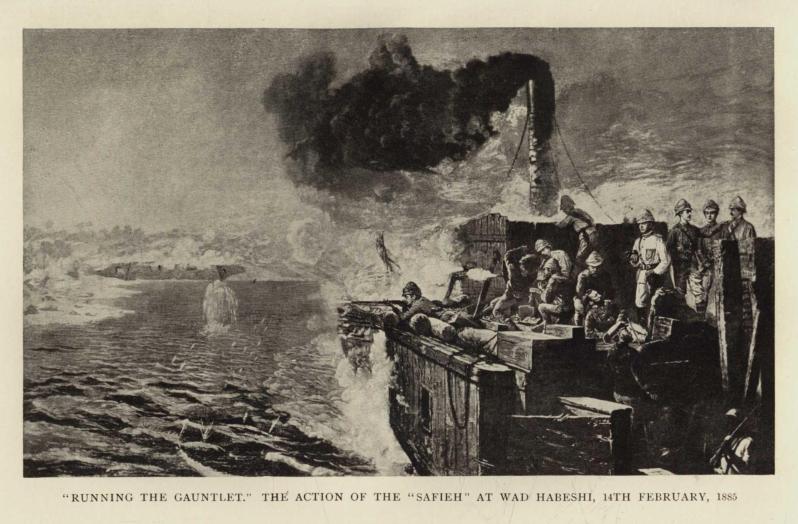
"RUNNING THE GAUNTLET."
THE ACTION OF THE "SAFIEH" AT WAD HABESHI, 14TH FEBRUARY, 1885
I dispatched Keppel with six bluejackets in a small
boat to the assistance of the nuggar. Rear-Admiral Sir
Colin Keppel very kindly sent to me his account of the
affair, based upon the notes made in his diary at the time.
"The riflemen, having got rid of the steamer, concentrated
their fire on the nuggar. However, the range was long
and their fire was not very accurate. After we had anchored
you dispatched me in a small boat with six bluejackets
to the assistance of the nuggar. After attempting to pull
up to her, we found that the stream was too strong, and so
I decided, having obtained your approval by semaphore,
to land on the right bank, track the boat up until well
upstream of the nuggar, and thus reach her. I found the only
thing to do was to lighten her; and while Gascoigne and
I were throwing overboard sacks of dhura and other things,
I was struck in the groin by a bullet which went through
my breeches but did not penetrate the skin. It only raised
a bruise which made me limp for a few days. There was
a considerable number of wounded in the nuggar. When
she was afloat again we drifted down. You got under way
in the steamer and picked us up."
Such is Keppel's modest account of what was a very
gallant piece of service on his part and on the part of
Captain Gascoigne, who with their men were working in
the nuggar under fire for three hours. Had they failed
where they so brilliantly succeeded, the whole Column,
as we learned afterwards, would have been jeopardised;
for the steamer, returning to their assistance, would again
have come within range of the fort.
The nuggar was taken in tow, and Captain Gascoigne's
heroic struggles with that unlucky craft were thus ended
for the time. A mile below us, Sir Charles Wilson was
waiting for us with his whole detachment. They were all
embarked, and by 5.45 p.m. we had safely arrived at Gubat.
That night I slept so profoundly that I do not know
when I should have awakened, had not first one rat, and
then another, walked over my face.
Mr. Benbow's skilled and intrepid service had saved the
Column with a piece of boiler plate and a handful of bolts.
He received the special compliments of Lord Wolseley,
who presented him with his own silver cigarette case; and
was promoted to the rank of chief inspector of machinery.
He ought to have received the Victoria Cross; but owing
to the fact that I did not then know that the decoration
could be granted for a service of that nature, I did not, to
my great regret, recommend him for the honour. Mr. James
Webber was promoted to be chief boatswain; and in 1887,
his services being once more exceptionally recommended,
he was promoted to the rank of lieutenant.
Surgeon Arthur May's services were inestimable. Always
cheery, indefatigable and zealous, when he was not attending
to the wounded under fire, he was on deck, rifle in hand,
among the marksmen. It was a great pleasure to me to
report in the highest terms of the conduct of the officers
and men under my command, and specially to recommend
Lieutenant E. B. van Koughnet, Sub-Lieutenant
C. R. Keppel, Acting-Lieutenant Walter Ingram, Chief Engineer
Benbow, Surgeon Arthur William May and Mr. James
Webber, boatswain, and Lieutenant Bower, commanding
the Mounted Infantry.
During the engagement with the fort at Wad Habeshi
5400 rounds were fired from the Gardner guns, and 2150
from the rifles. The figure for the brass howitzers is
uncertain, the official report giving 126, but Sub-Lieutenant
Keppel, who served one of the guns, mentioned 150 as the
number fired from one gun in one day.
X. THE EFFECT OF THE ACTION OF WAD HABESHI
The proximate result of the fight of the Safieh
was of course the fulfilment of its immediate object,
the rescue of Sir Charles Wilson's gallant detachment.
But, years afterwards, it was made known that the
full effect actually extended so far as to include the
salvation of the whole Desert Column. In The Royal Navy: A
History, vol. vii., Sir William Laird Clowes briefly mentions
the fact, referring to Sir F. R. Wingate's letter to Lord
Wolseley of 18th March, 1893. The passages in that letter
to which he refers are as follows:
"... It is therefore on these grounds only that I have
ventured to collate evidence on an episode which may be
considered to have been finally dealt with.... Moreover,
with the light which this evidence throws on the situation,
the results of Beresford's action cannot but be enhanced
... that he was the means of saving Sir C. Wilson and his party
is an admitted fact; but when it is realised that added to
this, his action really saved the Column, it is, I consider, my
duty to bring before you this evidence which, had it been
known at the time, might have secured for Beresford and
Benbow the greatest reward soldiers and sailors can hope
to obtain. But late as it is, it may not be too late for the
question to be reopened....
"In order to arrive at the actual details of the Dervish
movements subsequent to the fall of Khartoum, a meeting
was held at the Intelligence Department, Egyptian Army,
Cairo, on the 23rd February, 1893, at which the following
were present, namely, Father Orhwalder, Kasha el Mus
Pasha, Major Hassan Agha Mohammed (Kassala), Hassan
Eff. Riban (late Maowin Berber District) and present at Berber
at that time; the Emir Sheikh Medawi (one of the principal
Dervish Emirs present in the attack on Khartoum)....
"In the unanimous opinion of the above Committee, the
credit of having delayed the Dervish advance and thus
enabling the British Column to be retired safely is due to
the action of Lord Charles Beresford at Wad Habeshi...."
The following short extracts may be cited from the
evidence which led the Committee to their conclusion. The
first is taken from the statement of Esh Sheikh Murabek
Wad el Tilb, a Kordofan merchant who arrived in Cairo on
30th May, 1888, from Omdurman:
"... There were 3000 Dervishes there (at Wad Habeshi)
under the Emir Ahmed Wad Faid and Sheikh Mustafa el
Amin. These Dervishes thought they could easily capture
the steamer in which there were only about 30 men, but the
English stood up and fought like men for many hours, they
inflicted great loss on the Dervishes, and forced them to
draw off and disperse. Their Chief Emir was killed as well
as their Artillery Officer.
"The effect of this defeat on the Dervishes was immense,
and it also affected the whole situation. The survivors fled
in many directions, spreading the news of the English victory
far and wide....
"If the Dervishes at Wad Habeshi had succeeded in
capturing the steamer, there is no doubt Nejumi would have
hastened his march and would have intercepted the English
before they could have got away from Gubat, but instead
of that he halted when he heard of Wad Faid's death, and
delayed some days in consequence at Wad Bishara and at
Gereishab. He had a very large force with him ...
"(Signed) MURABEK WAD EL TILB"
The second extract is translated from the German of
Father Orhwalder, long a prisoner of the Mahdi:
"... It is an undoubted fact that Lord Charles Beresford's
gallant action at Wad Habeshi was the means of
saving the lives of Sir Charles Wilson and his party, who
would have suffered a like fate to that of Colonel Stewart
and his companions, and it is an equally undoubted fact
that the Mahdi's success at Khartoum shook the fidelity of
the Shagiyeh, but Lord Charles Beresford's victory at Wad
Habeshi had the effect of making Nejumi dread meeting the
English on the river, and decided him to attack them on
the desert.
"Lord Charles Beresford deserves the credit of having
effected this and was thus the means of saving the entire
British force.
"(Signed) DON GUISEPPE ORHWALDER
"(23rd February, 1893)"
It is obvious that the estimation of the conduct of the
officers and men who fought at Wad Habeshi remains
unaffected by the results of the action, which were neither
definitely contemplated nor clearly foreseen. And the
evidence I have quoted being irrelevant, strictly speaking,
to any criticism of the action itself, is here cited, not in order
to enhance the credit of the officers and men concerned but,
for the sake both of its intrinsic interest, and for the purpose
of illustrating, incidentally, the methods occasionally adopted
under the system controlling the Royal Navy.
The effect of the action at Wad Habeshi exemplifies
the extraordinary potency of the element of chance in war.
Under what conceivable theory of tactics could it have been
maintained that a penny steamer had the smallest chance
of rescuing a detachment isolated in a hostile country, upon
condition of twice engaging a powerful battery at short
range, and twice defeating its garrison of sixty or a hundred
to one? Or what self-respecting tactician would have
predicted that in the extremely improbable event of success,
its effect would have been to check, even momentarily, the
advance by land of the main force of the enemy?
But the unexpected happened; and as it did happen, it
would have been in accordance with a courteous precedent
on the part of the authorities to have recognised the fact.
I make no complaint of their action as regards myself; and
only recall it here in the hope that no repetition of it will be
permitted in respect of others perhaps less fortunate than
I. The Admiralty refused to allow me to count my
service in the Soudan either as time spent in command of
a ship of war, or, as part of a period of command spent both
in peace and war. Their Lordships' refusal might have
involved my retirement before I had completed the time
required to qualify for flag rank. The Queen's Regulations
ordained: that a captain must have completed six years'
service, of which the first three years must be in command
of a ship of war at sea; or that he must have completed four
years during war; or five years, of war and peace combined.
After having been for over two years in command of
H.M.S. Undaunted, I applied (in May, 1892) for permission
to count the 315 days in the Soudan during which I was
borne on the books of H.M.S. Alexandra, which were allowed
as sea-time by the Admiralty, in the required five years of
war and peace combined. The application was refused, on the
ground that war service could not be reckoned by a captain
unless he was in command of a ship of war actually employed
in active service at sea.
Having completed my three years' service in command
at sea, I applied (in April, 1893) for permission to count the
315 days sea-time, although they preceded the three years
in command at sea, as part of the required six years' service.
The application was refused, upon the ground that its
acceptance was not necessary in order to save me from
retirement.
A year and a half afterwards (in January, 1895) I
repeated my application, pointing out that in three cases
the Admiralty had, by order in council, conceded similar
claims of admittedly much less force than my own, and
that the only naval officers engaged in the Soudan war who
were not allowed to count their time towards promotion
were Captain Boardman and myself. Their Lordships then
merely referred me to their previous answers. I may
mention that my application was warmly and emphatically
supported by Lord Wolseley.
XI. THE RETREAT
Upon the day after the rescue of Sir Charles Wilson's
party, a court of inquiry, under my presidency, was
held to investigate the conduct of the captains of the
two wrecked steamers, and one of the Reises. The captains
were acquitted. The Reis was found guilty of treachery,
but his punishment was remitted in consideration of the
fact that he had brought Lieutenant Stuart-Wortley safely
down the river after the wreck of the Bordein.
The little Safieh was riddled with bullet-holes; she
leaked like a sieve, so that even before the action of Wad
Habeshi, the pumps must be kept going continually; and
her bows, under the incessant concussion of the guns, had
opened out like a flower. The sides came away from the
stem, and in order to stop the water coming in, the natives
had stuffed rags and mud into the openings, which of course
widened them. Upon our return to Gubat, I caused a dry
dock to be excavated in the bank; ran the bows of the
steamer into it; closed it against the water with mud; and
kept two black men baling out the water as hard as they
could go for eight hours on end, while we cut and fitted a
new stem and bolted the sides to it; a very difficult job,
because the sides of the steamer were rotten. The other
repairs having been effected, I took the Safieh (which was
so decayed that the pumps must still be kept going) out
daily for foraging expeditions, to get cattle, sheep and
vegetables, and also to show there was fight in us yet.
There were no fowls, because the Mahdi had declared them
to be unclean.
Captain Gascoigne and Khashm-el-Mus used to accompany
me upon these expeditions, Gascoigne taking command
of the raiding parties on shore: Lieutenant Robert
A. J. Montgomerie (afterwards Rear-Admiral Montgomerie, C.B.,
C.M.G.) was of the greatest service. Montgomerie was of
extraordinary physical strength and prowess. He joined
me on 11th February, with Lieutenant G. W. Tyler, at
Gubat. While helping to work the boats up the river,
Montgomerie saved a gun which sank when the boat in
which it was capsized. The weight of muzzle or breach
(whichever it was) was well over 200 lb., and the water was
shoulder-deep. Montgomerie picked up the gun, hove it
upon his shoulder and waded ashore with it.
His exploits at Ismailia are still remembered. He was
sitting in a saloon, where three French natives determined
to provoke the English officer. They chose the wrong man.
One of the trio upset Montgomerie's glass of beer, and
although he did not apologise, Montgomerie, supposing him
to have done it by accident, took no notice. A second
man did the same, with the same result. Then the third
hero deliberately threw down Montgomerie's glass with his
hand. Montgomerie then acted instantly and with great
rapidity. He knocked one man senseless, picked up another
and threw him on the top of his friend, took the third and
flung him up on the roof of the balcony.
Surgeon-General A. W. May reminds me that he and
Montgomerie discovered, at some distance from the river, a
garden wherein grew onions and limes. Montgomerie
pulled the onions, while May collected the limes for the
sick in hospital. But a lime-tree is armed with long and
sharp thorns; and May, desiring to preserve his one and
only uniform, stripped and climbed the tree in his birthday
suit. Suddenly Arabs appeared; and May had but the
time to descend, pick up his clothes and fly with
Montgomerie back to the steamer.
Surgeon-General May also reminds me that upon
another foraging trip, we landed a party of Gordon's
Soudanese troops to capture a flock of sheep. Before the
blacks had time to get away with the sheep, the Arabs came
down, and began to fire at them and also at the steamer.
I sent a black sergeant-major and a bugler to hasten the
retreat of the Soudanese. Two of them, each of whom
was carrying a sheep, lagged somewhat; whereupon the
sergeant-major lay down, took careful aim, and fired at them.
Neither he nor they seemed to consider the method unusual.
It was on one of these foraging parties that Quartermaster
Olden saved the entire raiding party. Captain
Gascoigne, in command of a wild lot of Bashi-Bazouks and
the most of the men from the Safieh, had gone some little
distance inland to a village. I was left in the Safieh with
six men to serve the Gardner gun. The steamer was lying
alongside the bank, but not close in; for it was necessary
to keep a certain depth of water under her keel in a falling
river, and to be able to shove off quickly. I had poles
ready rigged for this purpose. The Bashi-Bazouks, who
began firing from the hip at random with loud cries so soon
as they came on shore, had vanished into the distance with
the rest of the party; when I perceived afar off a crowd of
Dervishes gathering at a place at right angles to the line
upon which the raiding party must return, and nearer to
the Safieh than the village where was the raiding party.
The Dervishes, therefore, evidently intended to cut off the
British force.
I sent for Olden, gave him his instructions, and sent him
on shore with two riflemen. The three ran like hares
through the scrub towards the enemy. They ran at full
speed for about 600 yards to get within range. Then they
scattered, concealed themselves and fired; moved again
swiftly, and fired again; and kept on repeating the
manoeuvre, until the Dervishes, believing that the scrub was
swarming with English riflemen, drew off; and the raiding
party returned in safety. For this service, Olden was
recommended by me for the conspicuous gallantry medal.
The black soldiers, going barefoot, used to come in with
their feet transfixed by long thorns; these I cut out with a
horse-lancet fitted to my knife; and the operation was like
cutting leather. I had gained experience in performing it
while getting the boats through at Wady Halfa. At Ismailia
a more delicate operation fell to me. While fishing, my
hook caught in a man's eyelid. The French surgeon who
was summoned went to work with a lancet, and tried to pull
the barb through the wound, causing the patient acute
agony. I sent the doctor aside, and using one of a pair of
breeches' bow-ties (for tying bows at the knees) drew the hook
through to the shank, and severed it, much to the surgeon's
indignation.
The expeditions up and down the river in the Safieh
were amusing enough; but we were only making the best
of the interval before the next move. Sir Charles Wilson
had left Gubat on 6th February for Korti, where he arrived
on the 9th bearing the news of the fall of Khartoum, and a
full account of the condition of the Desert Column. Lord
Wolseley telegraphed the information to Lord Hartington
(Secretary of State for War), who telegraphed in reply:
"Express warm recognition of Government of brilliant
services of Sir C. Wilson and satisfaction at gallant rescue
of his party."
Lord Wolseley, upon receipt of Sir C. Wilson's dispatch
containing the account of the action at Abu Kru, fought on
the 19th January, when Sir Herbert Stewart was wounded,
had appointed Major-General Sir Redvers Buller to take
command of the Desert Column, Sir Evelyn Wood being
appointed chief of staff in his place. Buller had left Korti
on 29th January, and had arrived at Jakdul on the 2nd
February. Lord Wolseley had also dispatched the Royal
Irish Regiment to reinforce the Desert Column. The
Royal Irish marched on foot the whole way across the
Bayuda Desert, each man carrying 70 rounds of ammunition,
filled water bottles and rolled greatcoats. The first
detachment left Korti on the 28th January, the second on the 30th;
both arriving at Jakdul on the 4th February. They left
Jakdul on the 7th. Buller left on the following day; and
upon arriving at Abu Klea, he left there two companies of
the Royal Irish, the rest of which accompanied him to Gubat,
for which place he started on the 10th. I saw the Royal
Irish march in; a splendid body of fighting men, trained
down to the last ounce, lean as hounds, and spoiling for a
fight.
It will be observed that Buller was at Jakdul, half-way
across the Desert, on the 4th February, on which date Lord
Wolseley learned from Sir Charles Wilson of the fall of
Khartoum. Lord Wolseley dispatched three sets of orders
to Sir Redvers Buller in quick succession, the last reaching
him at Abu Klea on the 10th, before he had resumed his
march to Gubat.
Lord Wolseley's dispatch instructed Sir Redvers Buller
to make every preparation for the evacuation of Gubat and
the withdrawal of the Column. At the same time, its tenor
left a certain discretion to Buller; who, replying to it in a
private letter carried by the returning messenger to Lord
Wolseley, "spoke," says Colonel Colville, in his official
History of the Sudan Campaign, "hopefully of the situation." I
think the presence of the Royal Irish, in magnificent
condition, suggested to Buller that he could fight anybody
anywhere.
In fact, when Sir Redvers came in to Gubat on 11th
February, he wanted to remain and fight. At his request,
I stated to him my view of the situation; which was, briefly,
that unless we departed swiftly, we should be eaten up by
the enemy, who were known to be advancing in immense
force. I also reported officially that until the Nile rose, the
two steamers remaining to us were practically useless: a
consideration which proved conclusive. Sir Redvers Buller's
dispatch, dated at Gubat 12th February, and addressed to
the chief of staff, describes the conclusions to which he
came after having carefully reviewed the situation (History
of the Sudan Campaign—Part II. p. 56). The camels were
greatly reduced in number and were nearly worn out; but
if the Column were to attempt any further enterprise, the
camels must be sent to Jakdul and back to bring supplies,
a journey which would take at least ten days. This
circumstance was virtually conclusive. Sir Redvers adds: "I
regret to have to express now an opinion different to that
which I expressed to Lord Wolseley in a letter dated the
night of the 10th instant; but when I then wrote, I was not
aware of the condition of the steamers and of the fact that
the big one could not pass a sandbank 25 miles below this.
Lord C. Beresford considers it doubtful if the other one can
either.... Since writing this I am confirmed in my opinion
by the news that Mohammed Ahmed (the Mahdi) left
Khartoum en route here on the 9th instant."
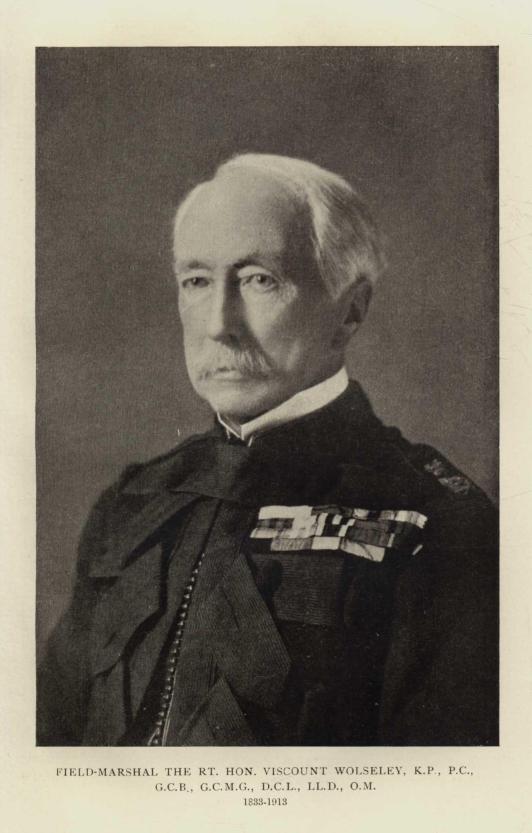
FIELD-MARSHAL THE RT. HON. VISCOUNT WOLSELEY, K.P., P.C.,
G.C.B., G.C.M.G., D.C.L., LL.D., O.M.
1833-1913
In the meantime, Lord Wolseley had ordered the River
Column to halt on its way. On the 10th, General Earle, in
command of the River Column, had been killed at the action
of Kirbekan. Lord Wolseley, until he received Sir Redvers
Buller's account of the desperate condition of the River
Column—deprived of transport, encumbered with wounded,
short of stores (owing to bad packing), and without
boots—retained his intention of effecting a junction of the two
columns at Berber. At the end of the third week in
February that scheme was necessarily abandoned. The
River Column was recalled; and Buller, then on his way
back with the Desert Column, was instructed to return
direct to Korti.
On the morning of 13th February the sick and wounded
were dispatched with a convoy under the command of
Colonel Talbot. Eight or nine miles out, the convoy was
attacked, surrounded on three sides, and exposed to fire
from the enemy concealed in the bush. Among the
wounded were the scalded engine-room artificers; one of
whom, recalling the incident in conversation with me
recently, said: "That was the first time my heart sank—when
the bearers put down my litter, and the firing began."
After about two hours' engagement, when the convoy
had lost eight killed and wounded, the Light Camel
Regiment, under the command of Colonel Clarke, marching from
Jakdul, opportunely appeared, and the enemy drew off.
Colonel Talbot (my cousin) very kindly sent me a copy
of his diary, kept at the time. His account of the affair
gives little indication of what was in fact a passage of very
considerable danger. He was encumbered with a large
number of sick and wounded; his force was small; the
force of the enemy, though it was impossible to estimate
the exact numbers, was formidable; and in spite of Talbot's
skilful and prompt dispositions of defence, the issue must
have been very doubtful had not the Light Camel Regiment
arrived.
Colonel Talbot's account runs as follows: "February
13th.—Received orders from Sir R. Buller to march for
Jakdul at dawn with 75 sick and wounded, Sir H. Stewart
and the worst cases carried in litters borne by Egyptian
soldiers from Khartoum. Escort of 300 men joined from
the 3 Camel Regiments and about 200 Gordon's Egyptians
from Khartoum.
"February 14.—Marched at dawn 8 miles, and halted for
breakfast. Outposts, just as we were about to resume
march, sent in report of approach of large force of
Arabs—mounted men, riflemen, and spearmen. The Column was
formed up, the wounded in the centre surrounded by camels
lying down, and outside them the Egyptian soldiers. The
Camel Corps troops were formed in two squares, one of the
Heavy and Guards' Camel Regiments in front of the Column,
and the other of the Mounted Infantry in rear. Skirmishers
were sent into the bush to feel for the enemy. The enemy
opened fire and worked all round our force, apparently
trying to ascertain our weakest point. It was impossible to
estimate the strength of the enemy owing to the thick bush,
but a considerable number of riflemen, supported by a large
force of spearmen, were seen, and about 30 horsemen were
counted. After the affair had lasted about two hours, and
we had lost 8 men killed and wounded, the Light Camel
Regiment on the march to Gubat appeared unexpectedly,
and narrowly escaped becoming engaged with us, owing to
both forces being unaware of the proximity of the other, and
through the bush it was difficult to distinguish the Arabs
from ourselves. No doubt the arrival of the Light Camel
Regiment accounted for the sudden disappearance of the
enemy."
It was Colonel Brabazon (now Major-General Sir
J. P. Brabazon, C.B., C.V.O.), second in command of the
Light Camel Corps, who, when the Column had marched
nearly half-way from Abu Klea to Metemmeh, went to his
commanding officer, Colonel Stanley Clarke, and suggested
that the Column should be immediately diverted to the
scene of action. Colonel Brabazon led the Column in the
direction of the firing, and his two or three hundred camels
made so great a dust that the Arabs thought a whole army
was advancing upon their flank, and instantly fled away.
The result was that, hidden in the bush, the Light Camel
Corps occupied the ground vacated by the enemy, unknown
to the convoy, which continued to fire at the place they
supposed the Arabs to be. General Brabazon's account
of the affair, which he very kindly sent to me, is as follows:
"I halted the Column, and the bush being very thick, the
trees stopped most of the bullets; nevertheless, they were
knocking up the dust at the feet of our camels, and a bullet
struck my mess-tin. I ordered our regimental call to be
sounded, 'The Camels (Campbells) are coming,' 'Lights
Out,' and finally 'Dinners.' But it was not until two or
three of us pushed our way through the bush into the open,
whence I saw the convoy preparing to give us another
volley, that they realised we were friends and not foes, and
precious glad they were to see us. They had only a small
escort and were of course hampered with the sick and
wounded, and I think everyone who was there will agree
that they were in a bad way.... I dined at the Guards' mess
afterwards, and Douglas Dawson said that he had just given
his men the range preparatory to their firing another volley,
when he put up his glasses and made out the helmets and
red morocco coverings of the camel saddles, and shouted,
'Come down! They are our fellows.' Then, Dawson said,
his soldier servant, who was standing behind him, remarked:
'Why, I could have told you they were our fellows ten
minutes before!' I suppose he had recognised the 'Dinners'
call."
So ended a comedy which had come very near to being
a tragedy. Gordon's Egyptian soldiers, who were carrying
the wounded, put the litters down when the firing began.
Among the wounded were poor Sir Herbert Stewart,
devotedly nursed by Major Frank Rhodes, Major Poe,
Royal Marines, Sub-Lieutenant E. L. Munro and Lieutenant
Charles Crutchley. Poe and Crutchley each had a
leg amputated. All the wounded were lying helpless on
the sand, listening to the firing, and moment by moment
expecting the terrible Dervish rush. A violent death was
very close to them, when Brabazon and his men came in the
nick of time. The convoy had one of the narrowest escapes
in the history of the British Army. It remains to add that
Colonel Brabazon received no recognition of his action of
any kind from the authorities.
Colonel Talbot had been continuously employed upon
the difficult and arduous convoy duty since the arrival of the
Desert Column at Gubat on the 21st. Two days later
Talbot started to return to Jakdul to fetch supplies. Not
he nor his men nor his camels had a day's rest from the 8th
January, when the Desert Column left Korti, till the 27th,
when the convoy was back again at Jakdul. The convoy
reached Gubat on the 31st January; next day came the
news of the fall of Khartoum; and the same evening the
convoy marched again for Jakdul with sick and wounded.
From Jakdul it returned with Sir Redvers Buller; arrived at
Gubat on the 11th February; and started again on the 13th,
as already related, with another party of sick and wounded.
On the way back to Korti, Colonel Talbot, without engineers
or commissariat, constructed a camp and built forts at
Megaga Wells, where the main body, including the Naval
Brigade, joined his convoy on 2nd March.
After Colonel Talbot's convoy had left Gubat on 13th
February, I disposed of the poor old Safieh and the
Tewfikiyeh, lest upon our departure they should be taken
by the enemy. The six brass guns were spiked and
thrown overboard, the ammunition was destroyed, the
eccentric straps were removed from the machinery, and
finally the valves were opened and the vessels sunk.
Then came the sad destruction of the stores for which
we had no transport. The number of camels would only
suffice to carry rations for three days, by the end of which
the Column would have arrived at Abu Klea, where were
more stores. When Colonel Talbot's convoy of supplies
reached Gubat two days previously, the garrison had
for ten days been living on short rations: nevertheless,
more than half of what he brought must be destroyed.
Count Gleichen (With the Camel Corps up the Nile) says
that "19,000 lbs. of flour, 3000 lbs. of biscuit, 21,220 lbs. of
beef, 900 lbs. of bacon, 1100 lbs. of tea, oatmeal, preserved
vegetables, coffee, and all sorts of stores were pierced and
thrown into the river"—an example of waste in war resulting
from deficient transport.
Some of the medical comforts, small bottles of champagne
and port, were distributed. One among us—I think his
name was Snow—took a bottle of wine and swore he would
keep it till he drank it in Khartoum. And he did. He
went into Khartoum with Kitchener thirteen years
afterwards, and drank his libation in the conquered city.
That incident reminds me that, when I went with the
party of members of the House of Commons to Russia in
1912, a Russian farmer sent a note to the British admiral,
of whom he said he had heard, together with a bottle
containing mustard which he had grown, and which he sent
as a token that the aforesaid British admiral would give
his enemies mustard when he met them; for, said the
farmer, the enemies of England would certainly be the
enemies of Russia. I have that bottle of mustard.
What went to my heart when the stores were destroyed,
was the dreadful waste of my drums of precious lubricating
oil, carried so far with so great labour. My tears mingled
with the oil as it was poured out upon the sand.
On the 14th February, at 5.30 a.m., the Desert Column
quitted Gubat and started on the long return march to
Korti, officers and men alike on foot, excepting the Hussars.
There was hardly a pair of boots in the whole column.
Some of the men cut up old rifle-buckets and tied the pieces
with string to the soles of their feet. As for my sailors,
they marched barefoot, every man carrying his rifle, cutlass,
and 70 cartridges, and many of them towing reluctant
camels. One camel to every four men was allotted to carry
saddle-bags and blankets; and the camels kept dropping
and dying all the way. By the time he had been three
days out, Count Gleichen, in charge of the baggage, had
lost 92 camels. At first the weather was cool with a
northerly breeze, and all started well. On the march, in
default of water, I used to spread my clothes in the sun
while I rubbed myself all over with sand; a dry bath that
was highly cleansing and refreshing. On the 15th February
we came to Abu Klea, somewhat weary.
We were of course in constant expectation of attack.
On the next day (16th) the Naval Brigade occupied a sand
redoubt, on which the two Gardner guns were mounted.
Sir Redvers Buller, finding that the water supply was
insufficient and that there was not enough food for the
camels, sent on the Soudanese troops, baggage, stores and
camp-followers under escort to Jakdul, while he halted at
Abu Klea to keep the enemy in check, until the unloaded
camels returned from Jakdul, and until further instructions
arrived from headquarters. The remainder of the Column,
entrenched at Abu Klea, thus became the rearguard, in the
air, as the phrase is; isolated for the time being and
deprived of transport and reserve stores; a dangerous
position forced upon the general by the lack of camels.
In the evening began the customary desert performance,
opened by the Dervishes firing at long range from a
hill-top commanding the camp, and continued during the long,
cold, sleepless night with intermittent sniping to a tom-tom
accompaniment. But our men were seasoned by this time;
and although one among them was hit now and again, the
situation no longer set a strain upon their nerves, but was
accepted as part of the routine. That night two men were
killed and thirteen wounded. It is true that the faithful
José Salvatro, my Maltese servant, who had done and
suffered so much, lost patience on this occasion. He was
heating cocoa over the fire, when a bullet struck the tin and
splashed the hot cocoa all over him.
"Why they fire me, sare?" said José. "Always firing me.
I never did them any harm."
In the morning (the 17th) the enemy opened fire with a
gun; which, after three or four rounds, was knocked out by
the Naval Brigade with a Gardner.
I had walked a little way from the redoubt, when I was
knocked over by a stunning blow striking me at the base of
the spine, and lay helpless. I thought I was done; and I
thought what an unlucky dog I was to have come through
so much, to die on the way back from a wound in a place
so undignified. But it was only a ricochet; my men carried
me in; and I speedily recovered.
During the day Major F. M. Wardrop, D.A.A.G., and
Lieutenant R. J. Tudway of the Mounted Infantry, with
three men, employed the tactics I had used outside Alexandria
two years previously. Riding swiftly from one point
to another, and concealing themselves in the intervals, they
impressed the Dervishes with the delusion that a large force
threatened them in rear, and so caused them to retreat. In
the afternoon, Lieutenant-Colonel H. McCalmont arrived
with the news of the action of the River Column at Kirbekan
on the 10th, and of the death of General Earle. The mail
from Korti contained a kind message of congratulation
addressed by the Khedive to myself, referring to the
engagement at Wad Habeshi, as well as congratulations
from home. The total number of killed and wounded
during the 16th and 17th was three men killed, and four
officers and 23 men wounded. We heard on the 21st of the
death of our beloved General, Sir Herbert Stewart, who,
in spite of all our hopes, had succumbed to his wound on the
17th, during the march of Colonel Talbot's convoy, seven
miles north of Geb-el-Nus. He was buried with full
military honours on the following day near the wells of
Jakdul.
On the 22nd February a convoy under Colonel Brabazon
arrived with 782 camels. These were only just sufficient to
move the stores and supplies.
It may here be noted that it was only a day or two
previously that Lord Wolseley had received at Korti Sir
Redvers Buller's letters describing the complete collapse of
the transport of the Desert Column; and it was this
information, together with a minute from Sir Evelyn Wood, who
was at Jakdul, that finally decided Lord Wolseley to
abandon his intention of combining the Desert and River
Columns to hold posts along the Nile preparatory to an
autumn campaign. At the same time, great anxiety with
regard to the Desert Column prevailed at home.
Upon the morning of the next day (the 23rd) our
picquets reported that the enemy had received a
reinforcement of some 8000 men and six guns. Perhaps the
Column had never been in more imminent danger than it
was at that moment.
Sir Redvers Buller discussed the situation with me. I
expressed the opinion that the large force of the enemy
would cut off our advance, rush us, and then move upon
Jakdul and so on to Korti itself; and remarked that the
Column was short of transport and of provisions, and would
be short of water.
"What would you do if you were in command?" said
Buller.
I told him that in the evening I would light a larger
number of camp-fires than usual, and, leaving them burning
in order to deceive the enemy, I would then depart in silence
and with speed.
"For a sailor ashore," said Buller, "you've a good head.
I'll do it."
And he did.
At two o'clock the same afternoon, Sir Redvers Buller
sent on his sick and wounded—32 of all ranks—with a
convoy of 300 men commanded by Colonel Stanley Clarke;
and that night, at 7.30, the rest of the Column stole forth
into the desert, leaving a ring of camp-fires flaming in the
dark behind us. We halted after four hours' march and
bivouacked in peace. Next day (the 24th) we were sniped
by a few wandering scouts: and save for these, saw no
enemy. Then began the three days' hard marching, on
short rations, and very little water, in great heat, to Jakdul.
Many of the men fell out: but not one man of the Naval
Brigade.
We arrived at Jakdul on the 26th February. I did not
keep a diary: but Lieutenant Colin Keppel's journal defines
the situation in three eloquent words: "Water, mails,
cigarettes!"
Next day I found time to write home, the first
opportunity for so doing during the past six weeks.
"Even now (I wrote), I am writing in a storm of sand
and wind, my paper blowing one way and my helmet
another, among my camels, who smell most poisonous.
Poor things, they were eight days without water, and had
only what food they could get when foraging in the desert.
And they have so many and so large holes in their backs,
that I am obliged to put shot-plugs in, to keep the water in
when they drink...."
It was true that I put shot-plugs in the camels. My
official report (and what can be truer than an official report?)
contains under date 27th February the sole entry:
"Employed repairing camels' sides by plugging them with
oakum!" Lord Wolseley laughed when he read it. But
although the surgery may appear empirical, it was
wonderfully successful. The admixture of tar acted as an
antiseptic.
On the following day (28th February) we resumed the
march to Korti; on 2nd March the Naval Brigade joined
Colonel Talbot's convoy at Megaga Wells, with the Heavy
Camel Regiment and Royal Artillery. The Guards' Camel
Regiment had gone on to Abu Halfa. The remainder of
the Column under Sir Evelyn Wood left Jakdul on 3rd
March.
At Megaga Wells Colonel Talbot took command and we
left for Korti, officers and men continuing to march on foot,
very few having soles to their boots. There was one camel
allocated to carry the kits of five men; 30 camels carried
water; and 10 carried the sick. The thermometer registered
112° in the shade, and a hot wind blew. And so we came to
Korti on the 8th March, two months after we had left it.
Lord Wolseley inspected the Naval Brigade on parade;
and expressed his extreme satisfaction at the work they had
done, and the manner in which it had been performed. The
next day the Brigade was broken up, and told off to different
stations, under the command of Captain Boardman. I was
ordered to rejoin the staff of Lord Wolseley.
Colonel Talbot notes that the Heavy Camel Regiment,
of which he was in command, had marched about 850 miles;
that the strength of the regiment upon leaving Korti was
23 officers and 373 men; and that its strength upon its
return was 15 officers and 256 men.
Only four of his men arrived on camels. Not one of my
sailors fell out during the whole way from Gubat to Korti.
Here, perhaps, it is not inopportune to place on record
how delighted I was to work with the Army. We are really
only one Service, for the protection of one Empire.
Nor, perhaps, to relate how that Her Majesty Queen
Victoria, when she pinned the C.B. to my coat, said low,
"I am very glad to give you this, Lord Charles. I am very
pleased with you."
Her Majesty's words were my reward; for I will own
that decorations as such have never attracted me.
I desire to record the excellent service of Captain
F. R. Boardman (afterwards Admiral Frederick Ross Boardman,
C.B.), who invariably did his utmost at the base to keep the
Naval Brigade supplied. It was not Captain Boardman's
fortune to be in the first fighting line, where is all the fun
and where is often all the renown; yet the success of the
fighting line depends entirely upon the energy, forethought
and unselfish loyalty of those at the base of supply.
I happened to be discussing this point with a certain
highly distinguished personage.
"We got all the credit," I said, "but not half enough
was given to those at the base who sent forward the bullets
and the grub."
"Grub? What is grub?" inquired the highly distinguished
personage.
"I beg your pardon, sir. It is a slang term for food and
provisions."
"So grub is food, is it? How very interesting!" said the
highly distinguished personage.
The sequel to our expedition was of course Lord
Kitchener's masterly campaign. After the capture of
Omdurman, and the blowing up of the Mahdi's tomb, it
was publicly stated that a certain officer was bringing home
the skull of the holy man, intending to make it into an
inkpot. The House of Commons (of which I was then a
member) having nothing better to do, discussed the matter
on 5th June, 1899. Lord Kitchener sat in the Distinguished
Strangers' Gallery. Mr. John Morley (now Lord Morley)
protested against the desecration of the tomb of the Mahdi.
I replied to Mr. Morley, protesting against his assumption of
authority in the matter. I said:
"Now I wish to take, most respectfully, issue with the
right honourable the Member for Montrose upon this point.
I say this with great respect and with great earnestness
that so far as I can judge from the right honourable
gentleman's writings and by his teachings, he is no judge
of religious fanaticism whatever. I say this with respect
because, as I understand what he has written, he does not
regard religious fanaticism as anything that can ever be
powerful, because he says himself that he does not understand
the question at all. That being so, I cannot accept
the right honourable gentleman as a guide as to what
should be done to check religious fanaticism.... The
right honourable the Member for Montrose does not
believe in the power of religious fanaticism...."
Mr. Morley: "The Noble Lord cannot have read my
writings, or else he would have seen that fanaticism was one
of the things I have written most about" (Hansard 5th
June, 1899).
A member said to me in the lobby afterwards: "You
really ought not to say these things. Why do you make
these assertions?"
"Because," I said, "I have read Mr. Morley's works."
"You know very well," said my friend, "that you have
never read any of his books."
"I beg your pardon," I replied. "I never go to sleep
without reading one of Mr. Morley's books, and I never
read one of Mr. Morley's books without going to sleep."
XII. SEQUEL AND CONCLUSION
For the first few weeks after the return of the Desert
Column to Korti, we all believed that there would
be an autumn campaign, and we looked forward to
the taking of Khartoum. Lord Wolseley distributed his
troops among various stations along the Nile from the
Hannek Cataract to Abu Dom, there to remain in summer
quarters. In his dispatch of 6th March, 1885 (Colville's
History of the Soudan Campaign, Part II.), Lord Wolseley
indicated the force he would require, and requested that
the railway might be continued from Halfa to Ferkeh, a
distance of 47 miles. The railway was begun and was
eventually completed. By 1st April the troops were
occupying their allotted stations. One distinguished officer
was so certain of remaining in his quarters, that he sowed
vegetables in his garden. But upon 13th April Lord
Wolseley was ordered to consider the measures requisite
to effect a total withdrawal; and British faith was once
more broken by a British Government.
By that time Lord Wolseley, to whose personal staff I
was once more attached, had been to Dongola and had
come to Cairo.
The news from home consisted chiefly of rumours of
war with Russia; and I was gratified to learn that largely
in consequence of my representations 50 machine guns
had been sent to India. Machine guns were then upon
their trial; and I had been consulted by the authorities as
to their precise utility. We also heard of the hearty
cordiality and enthusiasm with which the Prince and
Princess of Wales were being greeted in Ireland upon the
occasion of their visit to my country. There had been
some misgivings upon the subject; and I had had the honour
to suggest to the Prince that if, as well as visiting towns
and cities in state, he went into the country among my
people and shot with them and hunted with them like the
sportsman he was, he would find no more loyal or
delightful people in the Queen's dominions.
As a matter of fact, neither in the towns nor anywhere
else in Ireland, did the Prince and Princess receive aught
but a most hearty welcome. Nor did the Nationalist party
even attempt to arouse a formal demonstration directed
against their visitors. They might have suggested, but
did not, that some such conventional protest was due to
the doctrine representing Ireland as a conquered country.
At the end of April Lord Wolseley and his staff
including myself, embarked in the s.s. Queen for Souakim.
The Souakim expedition under the command of General
Sir G. Graham was then in full progress. On the 20th
February he had been directed to destroy the power of
Osman Digna, and to guard the construction of the
Souakim-Berber railway. On the 20th March, Graham fought the
successful action of Hashin. On the 22nd was fought the
bloody engagement of McNeill's zeriba. The British were
surprised while at work upon the construction of the
zeriba; the first shot was fired at 2.50 p.m., and the cease
fire was sounded at 3.10. During that twenty minutes of
confused and desperate fighting, some 1500 Arabs out of an
attacking force of 5000 were killed. Desultory firing
continued for an hour, when the enemy retreated. According
to the official history, the British losses were 150 killed,
148 missing, 174 wounded, and 501 camels killed and
missing.
The field of battle lay some six miles from Souakim; I
rode out with Lord Wolseley to see it. Before we had
ridden three miles in the dust and the glare of sunlight,
the hot air carried a dreadful waft of corruption. The
stench thickened as we drew near. A dusky cloud of kites
and vultures hovered sluggishly and unafraid among a
wilderness of discoloured mounds. The sand was heaped
so scantily upon the dead, that lipless skulls, and mutilated
shanks, and clenched hands, were dreadfully displayed.
The bodies of the camels were mingled in a pile of
corruption, clustered upon by the birds of prey.
And wandering about that charnel-ground, raking in it
with a hooked stick, was a strange man whom I had met
years ago in Japan, where he used to photograph the cruel
executions of that country. He spoke no known tongue,
but chattered in a jumble of languages; and here he was,
equipped with a camera, and placidly exploring horrors with
a hooked stick. Whence he came, and whither he went,
we stayed not to inquire.
Day after day, for many days, the convoys of the expedition
must pass and repass this place, which lay in their
direct route, at the slow march of laden camels, and walking
warily, lest they stepped ankle-deep into a festering corpse.
General Graham, having occupied Tamai, Handub, and
Tambuk, dispersed the force of Mohammed Sardun on the
6th May; an operation which left him practically master of
the district. But on the 11th May, Lord Wolseley, acting
upon the instructions of the Government, ordered the general
withdrawal of all troops from the Soudan. On the 19th, we
left Souakim for Cairo. On the 27th June, Lord Wolseley
turned over the command of the forces in Egypt to General
Sir F. Stephenson, and with his staff left Cairo for
Alexandria, there to embark for England.
Seven days previously (on 20th June), though we knew
not of it, the Mahdi, who had given us so much trouble, had
died in Khartoum. There he lay, listening perhaps for the
footsteps of the returning English; for he knew that, although
the English are ruled by people having the appearance of
men but the ways of a weathercock, they may go, but they
always come back. Thirteen years the false prophet slept
in peace: and then the man who had sojourned in a cave at
the wells of Abu Klea secretly collecting information, what
time the Desert Column followed a forlorn hope, rode into
the Dervish city, and destiny was fulfilled. Lord Kitchener
of Khartoum fulfilled it, as strong men have a way of doing.
A poet once said that the soul of Gladstone is now probably
perching on the telegraph wires that bridge the desert where
we fought to save Gordon, too late. I know nothing about
that; but I know what the betrayal cost.
We learned afterwards that ere the Mahdi died, he had
begun to concentrate his armies upon Dongola, a movement
that was continued after his death, until the Dervishes were
finally defeated by General Stephenson, at Ginnis, on 30th
December, 1885.
General Dormer had a way of his own with the Mahdi's
disciples. Addressing a prisoner, he said:
"I suppose you believe in the Mahdi because he can
work miracles. Can your prophet pluck out his eye and
put it back again? Well, I am no prophet, but I can."
And with that, Dormer took his glass eye from its socket,
tossed it in the air, caught it, and replaced it. The Arab
was dumbfounded.
There is nothing quite so dead as dead politics;
therefore I do not intend to dwell upon my political
experiences, except in so far as they relate to the
purpose for which I entered Parliament. That purpose was
to serve the interests of the Royal Navy. Politics, as such,
have never greatly interested me; the Party system always
appeared to me to involve a sacrifice of principle; and if
I am associated with the party with which I am naturally
most in sympathy, at least I may claim to have attacked
them quite as often as I have attacked their political
opponents. In return, they have often declined to support me in
my proposals; which, however, have always been supported
by the public, and which as a rule have ultimately been
adopted by the authorities.
In 1885, the Parliamentary tradition which I had known
ten years previously, remained unchanged. During the
succeeding generation it became gradually transformed.
Old members, like myself, will understand what I mean.
New members can have little notion of the House of
Commons their fathers knew. In one respect, at least, the
alteration is even startling. The public interest in politics
and in Parliament, once so general and so sincere, has now
almost ceased to exist. What that contemptuous indifference
may portend, is another question.
In June, 1885, the Liberal Government, having passed
their Franchise and Redistribution Bills, and having aroused
general and deep indignation concerning their conduct of
the Soudan campaign, chose to resign upon an amendment
to Mr. Childers's Budget. Lord Salisbury accepted office,
and wound up the session. The general election took place
during the autumn. I stood for East Marylebone, my
opponents being the Rev. J. R. Diggle and Mr. D. Grant.
Mr. Diggle apparently withdrew; for I find that my majority
of 944 votes was over Mr. Grant's poll. The main topic of
my speeches was the necessity of increasing the Fleet, and
of maintaining the Union. For rumours that Mr. Gladstone
intended to bring forward a Home Rule policy were in
the air.
The result of the election was: Liberals 334, Conservatives
250, Irish Nationalists 86; placing the Conservatives
at the mercy of the Irish. Lord Salisbury's Government
were defeated upon an amendment to the Address, brought
forward by Mr. Jesse Collings, in January, 1886. Lord
Salisbury resigned, and Mr. Gladstone returned to office.
Then came his conversion to Home Rule, and the secession
of the Liberal Unionists. On 7th July, 1886, the
Government were defeated on the Home Rule Bill. At the
general election which followed, the Radicals and Home
Rulers were returned in a minority of 118. I was again
returned for East Marylebone, my opponent being Professor
Beesly, with an increased majority. In the new Parliament,
Lord Salisbury was Prime Minister and Secretary of State
for Foreign Affairs; Lord Randolph Churchill, Chancellor
of the Exchequer; Mr. W. H. Smith, Leader of the House
of Commons; and Lord George Hamilton, First Lord of
the Admiralty.
It was during one of the Marylebone elections that I was
visited by a deputation of clergymen of various denominations,
who solemnly assured me that, if I persisted in
supporting the proposal to open museums and
picture-galleries on Sundays, they would not vote for me.
"Gentlemen, has it ever occurred to you that I have not
asked you to vote for me?" said I. "Or that I have never
in my life asked a man for a vote?"
They looked at one another. In the ensuing silence, I
told them that if they did not approve of me, they ought,
as honest men, to vote for my opponent. They sadly and
silently departed, and I saw them no more: nor do I know
for whom were cast the votes of those men of God; but I
was returned to Parliament.
Lord Folkestone was standing for Enfield; and when I
went down to speak for him, I found bread upon the waters
which returned to me after many days, in the shape and
size of a Royal Marine. While I was speaking, there arose
a tumult at the back of the hall. So far as I could make
out from the platform, a man was insisting on being heard.
I called to him to come up to the platform, where, if he had
anything to say, he could say it. Whereupon a large,
resolute and aggressive person came swiftly up to me. I
thought he wanted to fight, and was ready for him. But he
seized my hands in his, shook them warmly, then turned to
the audience and told them the whole story of how I had
saved his life off the Falkland Islands, years before, when I
was a lieutenant in the Galatea. The ship was lying at
anchor; it was a dark night; when the Marine somehow
fell overboard I had just come on board from a shooting
expedition, and my pockets were full of cartridges. I dived
after the man and seized him. Catching the end of a coil
of rope I went down and down, wondering if the other end
of the rope I held was fast, until at last I felt myself and the
Marine being pulled upwards. As we came to the surface
the ship's corporal, who had jumped overboard, got hold of
us, and we were hauled in-board by the quartermaster.
The story was received with great enthusiasm, and I
cannot but suppose it contributed to win the election for my
friend, none the less because there was no real connection
whatever between its subject and politics.
Upon my return from Egypt in 1885, I was convinced of
the superiority in guns and armour and general excellence
of the French ships of war over our own, because I had
utilised many opportunities of comparing the vessels of
the two navies. Observation and reasoning had also
taught me that in many most essential respects the British
Navy was deficient. And above all, it was deficient in
organisation for war. In these opinions I was confirmed by
a large number of my brother officers, among whom I may
mention Lord Alcester, Admiral of the Fleet Sir Henry
Keppel, Admiral Sir Thomas M. C. Symonds, Admiral Sir
Geoffrey T. Phipps Hornby, Captain E. R. Fremantle,
Admiral Sir Charles G. J. B. Elliot, Vice-Admiral Sir William
Montagu Dowell, Vice-Admiral Sir R. Vesey Hamilton.
Accordingly, I enforced the necessity of reform in these
matters in my public speeches, which were numerous. At
that time, in the summer of 1885, I find that I was demanding
a loan of twenty millions to be expended upon a shipbuilding
programme.
During the previous year, 1884, there had appeared in
the Pall Mall Gazette, then edited by the late Mr. W. T. Stead,
the famous series of articles over the signature of
"One who knows the Facts," dealing with the state of the
Navy, which did more than any other Press representations
before or since to awaken public opinion to the true
condition of our defences. It was those articles, together
with articles in The Times and other newspapers, and the
excellent letters of naval officers—notably those of Admiral
of the Fleet Sir T. Symonds—which prepared the way for me.
International relations with both France and Russia
were uneasy; and war was always a possibility. I knew
that we were unprepared for war. I knew that so long as
there was no department charged with the duty of
representing what was required, why it was required, and how
much it would cost, that we should continue to be unprepared
for war. I believed it to be my duty to awaken public
opinion to the danger in which the country undoubtedly
stood.
Nor was I alone in this respect. Not only a number of
brother officers, but many students of the subject, did
their best to enlighten the nation. We were of course told
that we were creating a scare; but a study of the Press of
those days shows that nearly every great newspaper,
irrespective of its politics, demanded the strengthening and
reorganisation of our defences. Personally, I received great
support from the Press. Writers on the subject of national
defence were at least sure that I had, personally, nothing to
gain by publishing the truth.
Indeed, I had thus early in my career, when I was a
junior captain, to choose between the stormy enterprise of
the reformer, and the safer course of official acquiescence
and party obedience, leading to promotion and to office.
In making the choice, I had to consider that as a naval
officer advocating this and that in spite of the authorities, I
laid myself open to the charge that such matters were none
of my business, which was to obey orders. The argument
is quite legitimate. On the other hand, knowing the facts
of the case, clearly perceiving the danger, and (as I believed)
knowing also how to remedy what was wrong, I might (and
did) justly contend that my duty to Sovereign and country
came before all. I admit that these things were not
necessarily my business; not, at least, until I made them my
business. But I may also remark that the deplorable
condition of the national defences in 1885 was the result of
the united negligence of the people whose business it was to
maintain them, and who had no department which could
supply them with the necessary information; and that, in
consequence, someone had to do something. The history
of England was made by persons who did what it was not
their business to do, until they made it their business.
My difficulties were then, and have always been, inherent in
the nature of the case. It is part of the character of the English
people to trust in authority, as such; and they are quite
right in principle; whose observance, however, induces them
to be slow to act when authority has proved untrustworthy.
Again, in order that my case should be proved beyond cavil,
the supreme demonstration of war was required. It is not
enough that because my recommendations were carried into
execution, war was prevented; for only the few who know
the facts and who are acquainted with the complex shifts of
international policy, understand the value of potential armed
force in the exercise of diplomacy. I may claim, indeed, I
do claim, that sooner or later my recommendations have
been adopted by the authorities, who thereby proved the
justice of my case. Nor do I complain because they have
gained the credit accruing to their action; for it must always
be the man who does the thing who earns the laurel. And
he who insists upon assuming the office of reformer, must
make up his mind at the beginning to renounce without
bitterness whatever delight he might discover in reward or
fame or renown. Moreover, the credit belongs to no one
man, but to the many fearless officers who urged reform,
and not less to the great body of those officers of the Service
who silently and loyally kept the routine going, and without
whom no reforms could avail.
The whole position is of course quite illogical; as illogical
as that venerable anomaly, the British Constitution, which
exists entirely in the brains of the learned. A certain set
of persons are selected to govern the nation by a majority of
votes, those votes being allocated upon an accidental system
which gives to a small number exactly the same representation
as an immensely larger number. Out of that set a few are
selected to form a governing committee called the Cabinet,
which is virtually omnipotent so long as it continues to act
more or less in accordance with the wishes of the majority
which elected it. The Cabinet is, therefore, in practice,
constrained to act in accordance with the known opinions of its
supporters; a course of action which is a totally different thing
from the course which it is theoretically supposed to follow.
Theoretically, the Cabinet shapes its policy to ensure the
welfare of the whole nation. Theoretically, the business of
the Government is to govern. Theoretically, its members
are the men in the country best fitted for the work.
Sometimes they are; and in proportion as they are, they will
approximate to the conventional theory and will depart from
the common practice, and will do what is right instead
of what is expedient. Thus every Government oscillates
between pure opportunism and honest patriotism. And in
the result, the only method of obtaining reform in any
direction is so to persuade the public of its necessity, that
the party in power will perceive that it is more to their own
profit to grant than to withhold it. And in justice to the
politicians, it should be added that under the existing system,
many concessions must be made by the most austere statesman,
if the Duke of Wellington's ultimate principle is to be
observed; the principle that the King's Government must
be carried on.
In July, 1884, Lord Northbrook, the First Lord of the
Admiralty in Mr. Gladstone's administration, publicly
declared that if he had £3,000,000 to spend upon the
Navy, that force was so sufficient and so efficient that he
would not know on what to spend the money. Before the
end of the year he was compelled to find out how to spend
£5,500,000, and to spend them. From a Liberal Government
the Salisbury Government of 1886 inherited the
completing of the Northbrook shipbuilding programme;
whose provisions were based, not upon any intelligible scheme
of preparation for war but, upon the Russian war-scare.
Those who were acquainted with the real posture of affairs
were not deluded by the mere haphazard expenditure of a
few millions, voted in order to soothe public opinion.
Nor did ministers themselves deny the total inadequacy
of their measures. In March, 1886, when the Liberal
administration was still in power, I brought forward in the
House of Commons an amendment empowering the Government
to expend an additional sum of over £5,000,000 upon
the construction of 35 cruisers, three armoured cruisers, and
21 torpedo craft; pointing out at the same time that the
expenditure would provide employment for a large number
of unemployed workmen, both skilled and unskilled. Of
course the amendment was defeated; but it is significant that
the necessity of such an increase was virtually admitted by
the Government spokesmen. I also urged the abolition of
69 useless vessels of war, which I specified, and the
expenditure of the money saved in their maintenance, upon new
vessels.
At that time, it was nearly impossible to obtain accurate
official information with regard to naval affairs. I asked for
a return of the relative strength of the Fleets of this and other
countries; which was granted; and which aroused considerable
comment in the Press. The return has since been
issued every year; first in my name, then in the name of Sir
Charles Dilke, and at present in the name of Mr. Dickenson.
But the first half of the year 1886 was consumed with the
Home Rule Bill. Turn to the files of the time, and you
shall see precisely the same arguments, declarations,
denunciations, intrigues and rumours of intrigues, charges and
counter-charges which were repeated in 1893, and which are
being reiterated all over again as if they had just been
discovered, in this year of grace 1913. We who stood to our
guns in 1886 know them by heart. We have been denounced
as traitors and rebels because we stand by Ulster, for so
long, that we are beginning to think we shall escape hanging
at the latter end of it.
I know my countrymen, both of north and south, for I
am of both; and they know me. Isaac Butt once asked me
to lead the Home Rule party; because, he said, my brother
Waterford was widely respected and popular, and was
thoroughly acquainted with the Irish question, of which I
also had a sufficient knowledge. I might have accepted the
invitation, had I believed that Home Rule was what my
countrymen needed. But it was not. The settlement of the
land question was and is the only cure for Irish ills.
Mr. Wyndham with his Land Act did more for Ireland than any
Government that ever was; and I say it, who have lost a
great part of my income under the operation of the Act.
Not that the Irish would have obtained the Wyndham
Act, had they not been incorrigibly intractable. By
demanding a great deal more than they wanted, which they
called Home Rule, they got what they did want, which was
the land. Their avidity for the land never diminished;
whereas the cry for Home Rule died down; until, by one of
the inconsistencies of Irish politics which so bewilder the
Englishman, it was revived by John Finton Lalor and
Michael Davitt, who welded the two aspirations together. In
order to rid themselves of the Home Rule spectre, the
English Government conceded the land. And then, owing
to another unexpected twist, they found the spectre wasn't
laid after all. For the English had not learned that so long
as they permit Ireland to be so superbly over-represented, so
long will they have trouble. Sure, they'll learn the lesson
some day, if God will; for there's no lack of teaching, the
way it is. In the meantime, it is hard for the English people
to argue against what appears to be the demand of the
majority of the Irish people.
But so far was the Government in power in 1912 from
understanding or attempting to understand Irishmen, that
the defence of the Home Rule Bill was constantly relegated
to two eminent descendants of an interesting Asiatic race;
who, however distinguished in their own walk of life, could
never in any circumstances know or care anything whatsoever
about Ireland. The Ulstermen, at least, resented the
proceeding.
One of the Nationalists attacked me with great ferocity
in the House. He accused my family for generations past
of having committed atrocious crimes, and asserted that I
myself had entered Parliament for the sole purpose of
escaping active service in case of war with a foreign Power.
"Why did you say all those things?" said I to him in the
lobby afterwards.
"Sure, Lord Char-less," says he, "ye're an Irishman, and
ye'll understand I didn't mean a word of it."
Mr. Gladstone's Home Rule Bill having been rejected
in 1886, Lord Salisbury returned to power with a majority
that defied Mr. Parnell and his friends, and so there was no
more Home Rule for a while. 'Tis the pure morality of the
Home Rule demand that moves the political conscience;
and that the morality always acts upon that sensitive organ
when there is a controlling Irish vote, and not at any other
time, is of course a mere coincidence.
In August, 1886, I was appointed junior lord at the
Admiralty, succeeding Captain James E. Erskine.
"No doubt you'll try to do a number of things, but
you'll run up against a dead wall. Your sole business will
be to sign papers," said Captain Erskine, and so departed.
I speedily discovered that there was at the Admiralty
no such thing as organisation for war. It was not in the
distribution of business. Lest I should seem to exaggerate,
I quote the testimony of the late Sir John Briggs, Reader to
the Lords and Chief Clerk of the Admiralty. Referring to
the period with which I am dealing, Sir John Briggs writes
as follows (Naval Administrations, 1827 to 1892. Sampson
Low. 1897):
"During my Admiralty experience of forty-four years,
I may safely affirm that no measures were devised, nor no
practical arrangements thought out, to meet the numerous
duties which devolve upon the Admiralty, and which at
once present themselves at the very beginning of a war with
a first-class naval Power; on the contrary, there had been
unqualified apprehension on the mere rumour of war,
especially among the naval members, arising from their
consciousness of the inadequacy of the Fleet to meet the
various duties it would be required to discharge in such an
eventuality."
The fact was that after Trafalgar this country had
attained to so supreme a dominance upon all seas, with
so high a degree of sea-training acquired in independent
commands, that organisation for war was taken for granted.
We were living on the Nelson tradition. The change came
with the advent of steam, which altered certain essential
conditions of sea warfare. The use of steam involved a new
organisation. Other nations recognised its necessity. We
did not. Nor was it that the distinguished naval officers
composing successive Boards of Admiralty neglected their
duty, for organisation for war did not form part of their
duty, as they conceived it. Moreover, they were wholly
occupied with the vast labour of routine business, which
developed upon them when the old Navy Board was
abolished. The Navy Board, in the old wars, was charged
with the provision of all matters of supply, leaving the
Lords Commissioners free to conduct war.
That there existed no department charged with the duty
of constantly representing what was required in ships, men,
stores, docks, under peace conditions, or what would be
required under war conditions, was obvious enough. But
in the course of the execution of my duties as junior lord,
it immediately became equally clear that the Navy was
deficient in those very matters and things concerning which
it would have been the business of such a department to
report. Among them was coal, which was in my charge.
Not only was there an immense deficiency in the war
reserve of coal, but there was no plan for supplying it.
What my friends used to call my "craze," which they
regarded as an amiable form of lunacy, for organisation for
war, showed me that without it, all naval force, though it
were twice as powerful, would be practically wasted in the
event of emergency.
I went to the First Lord and asked him if it would be
in order for me to draw up a memorandum on any subject
to be laid before the Board. Lord George Hamilton, with
his invariable courtesy, replied that any such paper would be
gladly considered.
Within six weeks of my appointment to the Admiralty,
I had drawn my Memorandum on War Organisation calling
attention to the necessity of creating a Naval Intelligence
Department at the Admiralty.
In that document, it was represented:
1. That although recent events had revealed approximately
our deficiencies in the event of war with a
second-rate maritime Power, no measures had been taken to
prepare a plan showing how the requirements were to be met.
2. That other countries possessed departments charged
with the duty of preparing plans of campaign and of
organising their every detail so that they could be instantly
carried into execution.
3. That the deficiencies in the numbers of the personnel
known to be required, were such and such.
4. That the Medical stores were deficient in such and
such respects. (They were kept in bulk, so that in the event
of war, the medical stores would have had to be selected and
distributed: a system I was able to alter.)
5. That there existed no organisation of any kind with
regard to the use of merchant shipping in war for the transport
of coal, ammunition, and stores, and for hospital ships.
6. That there existed no organisation for rapidly
mobilising the reserves.
7. That in order rightly to fulfil these requirements,
there must be designed plans of campaign to meet all
probable contingencies.
8. That in order to obtain such plans of campaign,
there should be created a new department charged with the
duty of drawing them up.
There followed a detailed scheme for a new Intelligence
Department, at an increased expense of no more than
£2251.
The Memorandum concluded as follows:
"1. Can it be denied that the gravest and most certain
danger exists to the country if the facts stated in this paper
are true?
"2. Can it be denied that these facts are true?
"3. If not, should not immediate steps be taken to
minimise the danger?"
The Memorandum was laid before the Board. My
colleagues came to the unanimous conclusion that my statements
were exaggerated; and also that, as a junior, I was
meddling with high matters which were not my business; as
indeed I was. Having been thus defeated, I asked the
permission of Lord George Hamilton to show the Memorandum
to Lord Salisbury, and received it.
Lord Salisbury very kindly read the document then and
there from beginning to end. He pointed out to me that,
on the face of it, I lacked the experience required to give
force to my representations, and that I had not even
commanded a ship of war in a Fleet.
"You must have more experience, on the face of it," he
repeated.
And he observed that, practically, what I was asking
him to do, was to set my opinion above the opinion of
my senior officers at the Admiralty, and their predecessors.
I replied that, since he put the matter in that way,
although it might sound egotistical, I did ask him to do
that very thing; but I begged him, before deciding that
I was in the wrong, to consult with three admirals, whom
I named.
A week later, I saw Lord Salisbury again. He told
me that in my main contentions, I was right; that he was
sure I should be glad to hear that the three admirals had
agreed with them; and that the Board of Admiralty had
decided to form a new department upon the lines I had
suggested.
The new Naval Intelligence Department was then formed.
The Director was Captain William H. Hall. His
assistants were Captain R. N. Custance (now Admiral Sir
Reginald N. Custance, K.C.B., K.C.M.G.) and Captain
S. M. Eardley-Wilmot (now Rear-Admiral Sir
S. M. Eardley-Wilmot).
There was already in existence a Foreign Intelligence
Committee, whose business it was to collect information
concerning the activities of foreign naval Powers. In my
scheme the new department was an extension of the Foreign
Intelligence Committee, which was to form Section 1, while
the duties of Section 2 were "To organise war preparations,
including naval mobilisation and the making out of plans
for naval campaigns to meet all the contingencies
considered probable in a war with different countries, corrected
frequently and periodically." The whole of the department
was to be placed under an officer of flag rank; a
part of my recommendations which was not carried into
effect until 1912, when the War Staff was instituted at the
Admiralty.
It will be observed that, although I designated the
new department the Intelligence Department, it was in
fact planned to combine Intelligence duties proper with the
duties of a War Staff. What I desired was a department
which reported "frequently and periodically" upon requirements.
But as it was impossible to know what those requirements
would be without plans of campaign which
specified them, the same department was charged with the
duty of designing such plans.
In the result, that particular and inestimably important
office was gradually dropped. The department became an
Intelligence Department alone. The First Sea Lord was
charged with the duty of preparation and organisation for
war. After various changes in the distribution of business, it
was again discovered that there was no organisation for war;
that the First Sea Lord, though (as I said in 1886) he had a
head as big as a battleship, could not accomplish the work
by himself; and a War Staff, affiliated to the Intelligence
Department, was constituted in 1912.
In other words, twenty-six years elapsed before my
scheme was carried into full execution.
On the 13th October, 1886, the substance of my
confidential Memorandum on Organisation for War was published
in the Pall Mall Gazette. It was stolen from the Admiralty
by an Admiralty messenger, who was employed by both
the First Sea Lord and myself. The contents of several
other confidential documents having been published,
suspicion fell upon the messenger, and a snare was laid for
him. An electric contact was made with a certain drawer
in the desk of the First Sea Lord, communicating with an
alarm in another quarter of the building. Upon leaving
his room, the First Sea Lord told the messenger to admit
no one during his absence, as he had left unlocked a drawer
containing confidential documents. A little after, the alarm
rang, and the messenger was discovered seated at the desk,
making a copy of the documents in question. He was
arrested, brought to trial, and sentenced.
In January, 1887, my routine work at the Admiralty
was varied by a trip in the new submarine Nautilus to
the bottom of Tilbury Dock, which was very nearly the
last voyage of the party in this world. The owners of the
boat, Mr. Edward Wolseley and Mr. C. E. Lyon, had
invited several guests, among whom was Mr. William
White (afterwards Sir William Henry White, K.C.B.,
F.R.S., etc.), together with some officials of the Admiralty.
The theory was that by pushing air cylinders to project
from each side of the boat, her buoyancy would be so
increased that she would rise to the surface. We sank
gently to the bottom and stayed there. The cylinders were
pushed out, and still we remained there. I was looking
through the glass scuttle, and, although in a submarine the
motion or rising or sinking is not felt by those within, I
knew that we had not moved, because I could see that the
muddy particles suspended in the water remained stationary.
The Thames mud had us fast. In this emergency, I
suggested rolling her by moving the people quickly from
side to side. The expedient succeeded, none too soon;
for by the time she came to the surface, the air was very
foul.
During the same month, Mr. William White, Chief
Constructor to the Admiralty, read a paper at the Mansion
House dealing with the design of modern men-of-war, which
marked an era in shipbuilding. Sir William White restored
to the ship of war that symmetry and beauty of design which
had been lost during the transition from sails to steam. The
transition vessels were nightmares. Sir William White
designed ships. A man of genius, of a refined and beautiful
nature, a loyal servant of the Admiralty, to which he devoted
talents which, applied outside the Service, would have gained
him wealth, his recent death was a great loss to his country.
The later Victorian Navy is his splendid monument: and it
may yet be that history will designate those noble ships as
the finest type of steam vessels of war.
About the same time, I brought forward another motion in
the House of Commons, to abolish obsolete vessels, of which I
specified fifty-nine, and to utilise the money saved in their
maintenance, in new construction. The scheme was carried
into execution by degrees.
In June of 1887, I invited a large party of members of
the House of Commons to visit Portsmouth, where they were
shown something of the Navy.
In December of the same year, speaking in public, I
affirmed the following principles: that in time of war our
frontiers were the ports of the enemy; that our main fleets
could be required to watch those ports; and that the strength
of the Fleet required should be calculated upon the basis of
the work it would be required to perform. I also urged that
the line of communications should be instituted, by means
of establishing a system of signalling between the ships of
the Navy and the ships of the mercantile marine, and
between all ships and the shore. At that time there was
no such system.
The Press and the public received the exposition of these
elementary principles of organisation for war as a complete
novelty; by many they were welcomed like a revelation;
circumstances which exemplify the general ignorance
prevailing at the time.
Of even more significance were the official declarations
on the subject. The First Lord of the Admiralty, Lord
George Hamilton, had publicly stated in November, 1886,
that this country had more ships in commission than the
three other European Naval Powers next in order of strength.
The statement was correct; but among the ships in commission
were included many vessels of no fighting value, such
as the Indus, Asia and Duke of Wellington. As an estimate
of comparative fighting strength, the statement, like many
another official statement before and since, required qualification;
as I remarked in the House of Commons in the course
of my reply to Lord George Hamilton.
In December, 1886, the Chancellor of the Exchequer,
Lord Randolph Churchill, suddenly resigned. He afterwards
explained that his resignation was a protest against
extravagance and waste in the administration of the Services.
There were extravagance and waste; but, in my view, which
I represented to Lord Randolph, it would take several years
to reform the administration, and it was far more important
to set right our defences, even if their administration cost
more in the meantime.
I recall these things because they serve to illustrate the
trend of events. On the one side were the Government and
their official advisers at the Admiralty, convinced that all
was very well as it was. On the other side, were the rapid
development of the fighting ship in all countries, which
owing to Mr. W. H. White, was particularly marked in this
country; the greatly increased public interest in naval
affairs; and the constant representations of a number of
naval officers, myself among them, to the effect that great
reforms were urgently required.
We believed that there existed at the Board of Admiralty
no system of direct responsibility; that Parliament and the
nation had no means either of ascertaining upon what
principle the money was expended upon our defences or
of affixing responsibility whether it were expended ill
or well; that there existed no plan of campaign at the
Admiralty; that the Navy and the Army had no arrangement
for working together in the event of war; and that,
in point of fact, the Navy was dangerously inadequate.
And in attempting to achieve reform, we were confronted
by a solid breastwork, as though built of bales of wool, of
official immovability. Had it been a hard obstacle, we
might have smashed it.
Towards the end of 1887, the Admiralty did a very
foolish thing. They decided to cut down the salaries of the
officers of the new Intelligence Department by £950. In
my view, this proceeding both involved a breach of faith
with the officers concerned, and would be highly injurious
to the efficiency of the department for whose success I felt
peculiarly responsible. My protests were, however, disregarded;
the First Lord asserted his supreme authority; and
the thing was done.
The efficiency of the whole Service was, in my view,
bound up with the efficiency of the Intelligence Department;
because that department was created for the express purpose
of estimating and reporting what was required to enable the
Navy to fulfil its duties. It was in view of the main question
of the necessity of strengthening the Fleet, that I decided to
resign my position upon the Board of Admiralty, and to
declare publicly my reasons for so doing. On the 9th January,
1888, I sent my resignation to Lord Salisbury; who,
courteously expressing his regret, accepted it on 18th
January.
In making my decision to take this extreme action, I
was influenced by the conviction that nothing short of the
resignation of a member of the Board of Admiralty would
induce the authorities to reorganise and strengthen our
defences. Whether or not I was right in that belief, I do
not know to this day; but, as the strengthening of the Fleet
was shortly afterwards carried into execution in precise
accordance with my recommendations, there is some evidence
in my favour. My constituents in East Marylebone were
strongly adverse to my course of action. Many of my
friends begged me not to resign. General Buller, in
particular, pointed out to me that no good was ever done by an
officer resigning his post, because the officer who resigned
ceased by his own act to occupy the position which entitled
him to a hearing. I daresay he was right. At any rate, I
was well aware that I was jeopardising my whole career.
For an officer to resign his seat upon the Board of Admiralty
in order to direct public attention to abuses, is to commit,
officially speaking, the unpardonable sin. When, three or
four years later, Sir Frederick Richards, the First Sea Lord,
threatened to resign if the Government would not accept his
shipbuilding programme, although I am certain he would
have pursued exactly the same course had he stood alone,
he had the support of the rest of the Board. I had the rest
of the Sea Lords against me. That is a different affair. A
united Board of Admiralty can generally in the last resort
prevail against the Government. A single member of that
Board who attempts the same feat, knows, at least, that never
again will he be employed at the Admiralty. But when Sir
Frederick Richards and his colleagues threatened resignation,
they were in fact risking the loss of employment and
incurring the possibility of spending the rest of their lives
in comparative penury. A later Liberal administration has
dismissed one Naval Lord after another, without a scruple.
In my case, I had the advantage of possessing a private
income, so that I was independent of the Service as a means
of livelihood. It is necessary to speak plainly upon this
matter of resignation. It is most unfair to expect naval
officers to resign in the hope of bringing about reform, when
by so doing their income is greatly reduced. If the British
public desire it to be understood that a Sea Lord is expected
to resign should the Government in power fail to make what
he believes to be the necessary provision for the national
security, then the public must insist that the Sea Lords be
granted an ample retiring allowance.
In the following February (1888) Lord George Hamilton
made a speech at Ealing, in which he dealt with my
protests in the most courteous manner. He stated that I had
resigned because I objected to the exercise of the supreme
authority of the First Lord over the Board of Admiralty. I
had certainly objected to its exercise in a particular instance.
And at that time I was constantly urging that Parliament
and the country had a right to know who was responsible
for the actions of the Admiralty. My theory was that there
should be some means by which Parliament and the public
should be assured that any given course of action was
founded upon professional advice. That no such means
existed was notorious. It was within the legal right of a
First Lord to announce a policy contravening or modifying
the views of the rest of the Board.
My view was, and is, the view tersely stated by Admiral
Phipps Hornby, who said that it was the right of the Cabinet
to formulate a policy, and that it was the duty of the Sea
Lords to provide what was required in order to carry that
policy into execution; but that the Cabinet had no right
whatever to dictate to the Sea Lords in what the provision
should consist, for that was a matter of which the Sea
Lords alone were competent to judge.
But if the Board of Admiralty be placed under the
supreme jurisdiction of the First Lord, a civilian and a
politician, the country has no means of knowing whether
or no the recommendations of the Sea Lords are being
carried into execution. I said at the time that some such
means should be instituted; afterwards, perceiving that no
such demand would be granted, I urged that the Cabinet
at least ought to be precisely informed what were the
requirements stated by the Sea Lords to be necessary in
order to carry into execution the policy of the Government.
In claiming supreme authority as First Lord over the
Board of Admiralty, Lord George Hamilton was legally and
constitutionally in the right. The Royal Commission on
the administration of the Navy and Army, over which Lord
Hartington presided, reported in 1890 (when I was at sea)
that the Admiralty had long ceased to be administered in
accordance with the terms of its original Patent, and that
"the present system of administration in the Admiralty
is the result of Parliamentary action upon what was once
in fact as well as name an executive and administrative
Board. The responsibility, and consequently the power of
the First Lord has continually increased, and he is at present
practically the Minister of Marine." In other words, by
slow degrees the politician had transferred the powers of the
Board to himself, where they remain; the other members of
the Board becoming merely his advisers. The result is that
there is nothing, except the personal influence of the Naval
Lords upon the First Lord, to prevent the Navy from being
governed in accordance with party politics, without reference
to national and Imperial requirements; a system which
produces intermittent insecurity and periodical panics
involving extravagant expense.
The Commissioners also found that there was a difference
of opinion among the Naval Lords themselves concerning
their responsibility with regard to the strength and efficiency
of the Fleet. It was, in a word, nobody's business to state
what were the requirements of the Fleet. The First Lord
might ask for advice, if he chose, in which case he would get
it. If he did not so choose, there was no one whose duty it
was to make representations on the subject. Admiral Sir
Arthur Hood stated that never in the whole course of his
experience had he known a scheme comprehending the naval
requirements of the Empire to be laid before the Board. He
also stated that the method of preparing the Navy Estimates
was that the First Lord stated what sum the Cabinet felt
disposed to grant for the Navy, and that the Naval Lords then
proceeded to get as much value for their money as they
could.
No wonder the Sea Lords were expected to sign the
Estimates without looking at them. When I was junior
lord, responsible for the provision of coal and stores among
other trifles, a clerk came into my room with a sheaf of
papers in one hand and a wet quill pen in the other.
"Will you sign the Estimates?" says he.
"What?" said I.
"Will you sign the Estimates for the year?" he repeated.
"My good man," I said, "I haven't seen them."
The clerk looked mildly perturbed. He said:
"The other Lords have signed them, sir. It will be very
inconvenient if you do not."
"I am very sorry," said I. "I am afraid I am inconvenient
in this office already. But I certainly shall not sign
the Estimates."
The clerk's countenance betrayed consternation.
"I must tell the First Lord, sir," said he, as one who
presents an ultimatum.
"I don't care a fig whom you tell," said I. "I can't sign
the Estimates, because I have not read them."
Nor did I sign them. They were brought before the
House of Commons without my signature. The First Lord
said it did not really matter. My point was that I would
not take responsibility for a document I had not seen. The
fact was, that the custom of obtaining the signatures of the
Board is a survival of the time when the Sea Lords wielded
the power and responsibility conferred upon them by the
original Patent.
The Commissioners also reported that the lack of
"sufficient provision for the consideration by either Service
of the wants of the other" ... was an "unsatisfactory and
dangerous condition of affairs."
Here, then, were all the points for which my brother
officers and myself were contending, and in order to
illuminate which I had resigned, explicitly admitted. But
the proofs did not appear until a year after my resignation
took effect, when the Select Committee on the Navy Estimates
began to take evidence; nor were they published for
another year.
In the meantime, the naval reformers fought as best they
might. Freed from the restraint necessarily imposed upon
me by my official position at the Admiralty, I was able to
devote my whole energies to making known the real state
of affairs.
Upon the introduction of the Navy Estimates of 1888-9
I challenged the votes for shipbuilding, the Secretary's
Department, the Intelligence Department, the Reserve of
merchant cruisers, the Royal Naval Reserve and naval
armaments, in order to call attention to requirements.
In the course of the debates, the official formula was:
"At no time was the Navy more ready or better organised
for any work which it might be called upon to do than
to-day." My reply was that these words "have rung in
our ears as often as the tune 'Britannia rules the waves,'
and have been invariably falsified when war appeared
imminent." And who would have to do the work? The
officials who said that all was ready, or the admirals who
said that all was unready?
In May, a meeting to consider the needs of national
defence was held in the City, at which I delivered an
address. Speaking at the Lord Mayor's banquet in
November, the First Lord admitted that there might be room
for improvement in the Navy. It was a dangerous, if a
candid, admission. For if the Navy were not strong
enough, how weak was it?
Exactly how weak it was in June, 1888, in the opinion
of the First Sea Lord, Admiral Sir Arthur Hood, was
explained by him before the Select Committee on Navy
Estimates (13th June, 1888). "I should have preferred by
the end of 1890 to have had six more fast cruisers. I do not
consider it a point of vital importance," said Admiral Hood.
But as, upon his own showing, within his recollection no
one at the Admiralty had ever produced a scheme
comprehending the naval requirements of the Empire, his view
was hardly conclusive. I had the audacity to consider that
if no one had ever attempted, or thought of attempting, to
estimate the requirements of the naval defence of the
Queen's dominions, it was time that some one did attempt
to do so, even if that some one were myself. Accordingly,
I made a careful calculation of the work the Fleet might
under probable contingencies be required to perform, and
upon that calculation based an estimate of the classes and
numbers of ships which would be needed.
I showed my estimate to Admiral Hornby, who said
that, although the ships were absolutely necessary, I was
asking too much and I should in consequence get nothing.
He also pointed out that I had made no provision for the
increase of personnel required to man the proposed new
ships. I replied that if the ships were laid down, the
authorities would be obliged to find the men for them.
The sequel showed that I was wrong and that Admiral
Hornby was right. He knew his responsible authority
better than I did. Six years later, when what should have
been the increased personnel would have been trained and
available, the Fleet was short of 20,000 men.
My cousin, General Sir Reginald Talbot, reminds me of
a conversation which befell between Mr. Goschen, then
Chancellor of the Exchequer, and myself, in November of
the same year, 1888, when we were staying at Wilton, the
house of my cousin, Lady Pembroke. Mr. Goschen began
to talk about the Navy, and he was so good as to express
high disapproval of my course of action. He said I was
doing a great deal of harm, that I was presuming to set
my rash opinion above the considered judgment of old and
distinguished officers who had commanded ships before I
was born, and so forth.
"Do you know what I am shortly going to propose to
Parliament?" said I. "No? I'll tell you. I am going to
ask for seventy ships to cost twenty million sterling."
Mr. Goschen became really angry. He said the notion
was preposterous.
"You won't get them," he said. "You wouldn't get even
three ships, if you asked for them. And for a very simple
reason. They are not wanted."
"Mr. Goschen," said I, "I shall bring in that programme,
and it will cost twenty million; and you will all
object to it and oppose it; and yet I'll venture to make a
prophecy. Before very long you will order seventy ships at
the cost of twenty million. And for a very simple reason.
Because you must."
On the 13th December, 1888, speaking on Vote 8
(ship-building, repairs and maintenance), I expounded my
ship-building programme to the House of Commons. I based
it upon the following principles:
"The existence of the Empire depends upon the strength
of the Fleet, the strength of the Fleet depends upon the
Shipbuilding Vote.... I maintain the Shipbuilding Vote
is based on no policy, no theory, no business-like or definite
idea whatever, to enable it to meet the requirements of the
country, the primary object of its expenditure.... I hold
that the Government, which is and must be solely responsible,
should first lay down a definite standard for the
Fleet, which standard should be a force capable of defending
our shores and commerce, together with the punctual and
certain delivery of our food supply, against the Fleets of
two Powers combined, one of which should be France; and
that the experts should then be called together and say what
is necessary to get that standard, and give the reasons for
their statement...."
The programme included four first-class ironclads, 10
second-class ironclads, 40 cruisers of various classes, and
torpedo craft: 70 vessels in all, to be built at a cost of
£20,100,000.
I also affirmed the proposition made by Admiral Sir
Anthony Hoskins, the Secretary of the Admiralty, and the
Civil Lord, to the effect that "the British Fleet should be
more than a match for the combined fleets of any two
European Powers that were likely to be our foes, one of
which must necessarily be France." Here, so far as I am
aware, was the first definite demand for the Two-Power
Standard; which was maintained until it was abandoned by
the Government which came into power in 1906.
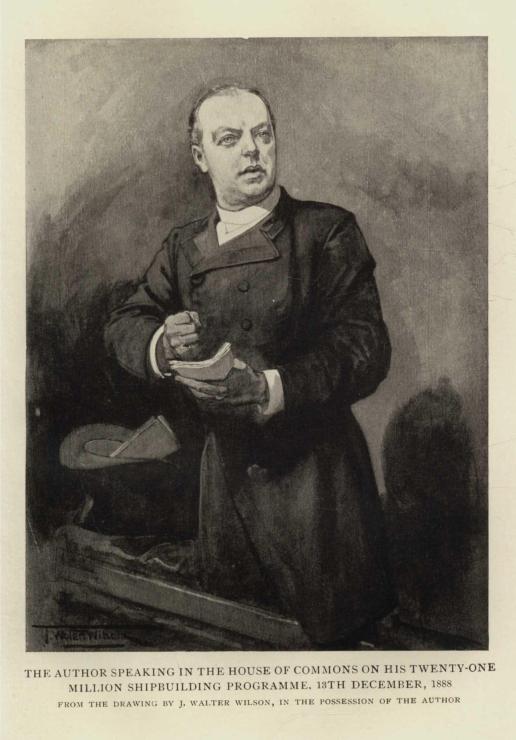
THE AUTHOR SPEAKING IN THE HOUSE OF COMMONS ON HIS TWENTY-ONE
MILLION SHIPBUILDING PROGRAMME, 13TH DECEMBER 1888.
FROM THE DRAWING, BY J. WALTER WILSON, IN THE POSSESSION OF THE AUTHOR
Lord George Hamilton received my proposals with
caution. He was "far from saying it (the Fleet) was strong
enough." And he told the House that next year he hoped
to lay before the House a larger and more comprehensive
programme than was provided by the current estimates,
"desiring that when they moved their movement should be
genuine and prolonged."
Twelve weeks later, Lord George Hamilton brought in a
shipbuilding programme consisting of 70 vessels, to be built
at a cost of £21,500,000.
Yet nothing had happened since the previous June, when
Sir Arthur Hood declared that he would have preferred six
more cruisers, but that they were not of vital importance?
Nothing, that is to say, with regard to the international
situation, and the increase of foreign navies, and the
requirements of Imperial defence. But several things had happened
at home. Of the most important of these, I knew nothing
until many years afterwards. It was that Captain W. H. Hall,
Director of the new Intelligence Department, whose
institution I had recommended for this very purpose, had
worked out the problem of naval requirements independently,
and, with all the sources of information available in the
Admiralty at his command, had arrived at precisely the
same result (except for an increase of cost) as that to which
I had arrived, without the information possessed by Captain
Hall. I may mention here that Captain Hall was a most
distinguished and patriotic officer, with whom no considerations
of personal interest ever weighed for an instant
against what he conceived to be his duty to his Sovereign
and to his country. What happened at the Admiralty when
his report was laid before the Board, I do not know, as I never
had any communication with Captain Hall on the subject.
All I know is that his scheme, which was identical with
the scheme which I had presented to the House, was
accepted by the First Lord.
Another circumstance which may have influenced the
Government was the very remarkable evidence, which I
have already summarised, given before the Select Committee
on the Navy Estimates. And another factor, of enduring
import, was the famous Report of the Three Admirals:
Admiral Sir William Dowell, K.C.B., Admiral Sir R. Vesey
Hamilton, K.C.B., and Vice-Admiral Sir Frederick Richards,
K.C.B., on the Naval Manoeuvres of 1888, presented to both
Houses of Parliament in February, 1889. Sir Frederick
Richards was mainly responsible for drawing up that
masterly document, which, extending beyond its terms of
reference, formulated the principles of British sea-power;
and definitely affirmed the absolute necessity for establishing
and maintaining the Two-Power Standard.
With reference to the condition of the Navy at the time,
the Three Admirals reported that the Navy was "altogether
inadequate to take the offensive in a war with only one
Great Power"; and that "supposing a combination of even
two Powers to be allied as her enemies, the balance of
maritime strength would be against England."
How swiftly is the false coin of "official assurances"
consumed by the acid of professional knowledge! The
whole episode of the Twenty-One Million is so typical of
the methods of British governance, that I have thought
it worth while to relate it somewhat at length. Those
methods, in a word, consist in the politicians very nearly
losing the Empire, and the Navy saving it just in time.
The same thing happened all over again in 1892. It
occurred again 1909, with a difference. Both in 1892 and in
1909 I drew up shipbuilding proposals. In 1892, the
Government eventually adopted the Spencer programme, which was
actually larger than mine. In 1909, the opportunity of
restoration was lost; and the failure cost, and will cost, the
country many millions.
One of these days we shall be hit, and hit hard, at the
moment when the politicians have been found out, and before
the Navy has had time to recover.
Something to this effect was said to me by Bismarck,
when I visited him, in February, 1889. In truth, I had a
little wearied of the polite and stubborn opposition of my
own people, and I went to Berlin to see what was happening
abroad. Prince Bismarck invited me to lunch.
Bismarck said that he could not understand why my
own people did not listen to me (nor could I!); for (said he)
the British Fleet was the greatest factor for peace in Europe.
We had a most interesting conversation upon matters of
defence and preparation for war; and his tone was most
friendly towards the English. He very kindly presented
me with his signed photograph. I stayed with him for two
hours; and we drank much beer; and all the time his
gigantic boar-hound, lying beside him, stared fixedly at
me with a red and lurid eye.
I. WITH THE MEDITERRANEAN FLEET
"Undaunteds be ready,
Undaunteds be steady,
Undaunteds stand by for a job!"
Bugle call of H.M.S. Undaunted
It was invented by the first lieutenant, William Stokes
Rees (now Vice-Admiral W. S. Rees, C.B.), who was
one of the best gunnery officers I have known. I was
appointed to the command of the Undaunted in November,
1889. The commander was Robert S. Lowry (now
Vice-Admiral Sir Robert S. Lowry, K.C.B.). It was the
Undaunted's first commission. She was a twin-screw,
first-class armoured cruiser of 5600 tons displacement and
8500 h.p., ordered to join the Mediterranean Fleet, under
the command of Vice-Admiral Sir Anthony H. Hoskins,
K.C.B. He was succeeded in September, 1891, by my old
friend, Admiral Sir George Tryon, K.C.B., whose tragic
death was so great a loss to the Service and to the country.
The first essential of good discipline is to make officers
and men as happy and as comfortable as the exigencies of
the Service permit. I believe that the Undaunted was a
happy ship; I know that the loyalty, enthusiasm and hard
work of the officers and men under my command earned
her a good record.
In every vessel there are improvements to be made
which, perhaps trifling in themselves, greatly add to the
welfare of the officers and ship's company. At that time,
for instance, the arrangements for the stokers were so bad,
that there was only one bath available for twenty men. My
recommendation was that tubs of galvanised iron should be
supplied, fitting one into another in nests, so that the extra
baths occupied less space than the one regulation bath. I also
had lockers of lattice-work supplied for the stokers' dirty
clothing, instead of closed and insanitary lockers. It is
true that at first the men objected to the open-work, because
their pipes dropped through it. Again, the hatchway
ladders were made with sharp nosings, against which the
men injured their legs; and I suggested that these should
be formed with rounded nosings instead. A ship of war
is naturally uncomfortable; but why make it unnecessarily
disagreeable? At that time, too, the rate of second-class
petty officer did not exist among the stokers. The result
was that if a leading stoker was disrated he was reduced
to stoker. For this reason, I urged the institution of the
rate of second-class petty officer stoker, a reform which
was eventually instituted. Some years afterwards, the rate
of second-class officer was abolished altogether, a retrograde
measure which I believe to be injurious.
When a petty officer loses his rate in consequence of
a mistake or a lapse, he should be enabled to recover it
by good behaviour.
One of my countrymen on board, whom we will call
Patrick, an able seaman of long service, perpetually failed
to attain to the rating of petty officer owing to his weakness
for strong waters. In other respects he was admirably
qualified to rise. I sent for him, told him I would give him
a chance, and made him a second-class petty officer. I
believe that he succumbed once or twice, and that the
commander let him off. But one fine day Patrick returned on
board from leave ashore, fully attired—cap, coat, boots and
socks—with the single exception of his trousers. The case
having been officially reported to me, I had up the delinquent
before the assembled petty officers. I made it a rule
not to disrate a petty officer in the presence of the ship's
company.
The charge having been duly read, I asked Patrick what
he had to say on the subject.
"Do you moind now, sir," says Pat, "that I was drunk
the same day last year?"
I told him I did not remember anything of the sort.
"Well, sir," continued Patrick, unabashed, "to tell you
the truth, 'tis my mother's birthday, and I had a drop of
drink taken."
I told him that it was impossible to allow petty officers
to disgrace the ship by coming on board without their
trousers; that I should take away his petty officer's rate, but
that I would leave him his badges.
He had three badges. Had he lost them, he would have
lost his badge pay during a period of six months for each
badge, so that it would take him eighteen months of "very
good" conduct to regain them. In addition, he would have
lost the good conduct medal, a part of his pension and a
part of his gratuity on leaving the Service. The severity of
the punishment in comparison with what is not perhaps a
serious offence, is not always recognised by authority.
"May I say a word to you, sir?" asked Patrick, having
received his sentence.
"You can say what you like," said I, "but I am afraid it
won't save your rate."
"Well, sir," says he, "'tis this way, sir. If you'll think over
it the way it is, I was fourteen years getting th' rate,
and you'll be takin' it away from me in one moment."
Pat used to delight his audiences at the ship's concerts.
He sang among other beautiful legends, the Irish ditty,
"Brannagan's Pup." He led upon the stage my bull-dog,
who came very sulkily. It never could be (as Pat would
have said) that the concertina accompaniment began when
he began. When the concertina started ahead of him, Pat
shifted the bull-dog's leash to his other hand, put his hand
to the side of his mouth, and staring straight upon the
audience, uttered the following stage direction in a furious
whisper which was heard all over the ship.
"Don't you shtart that ruddy pump till I hould up me
hand!"
Some years after I had left the Undaunted, arriving in a
P. and O. steamer off a Chinese port, I semaphored to
a man-of-war asking the captain to send me a boat, as I
wished to have the pleasure of calling upon him. The
coxswain of the captain's boat was no other than my old
friend.
"I'm very glad to see you've kept the rate," said I. "I
suppose you run straight now and keep clear of liquor?"
"Well, sir," says Paddy, "to tell you the truth, I've
taken an odd toss or two since I saw you, but I've got it
back again!"
He meant that he had been disrated again once or twice
but had won back his rate again; indeed, he had won it
back while under my command. I always told my men
that if they were tried by court-martial—as the men now
desire to be tried—it would go harder with them. Had
Patrick been tried by court-martial, it is very unlikely that
he would have got back his rate; and his deprivation, being
endorsed upon his certificate, would have affected his chance
of gaining employment in civil life upon leaving the Service.
I had a case of a man who, because he put his helm over
the wrong way, ran into another boat, with the result that a
man was drowned. The culprit was disrated; but I gave him
his rate again before I left the ship. It is the personal
knowledge of a man possessed by his captain which alone enables
his captain to make distinctions. A court-martial must
judge of the offence without personal knowledge of the
character of the offender.
I had a sergeant of Marines, a man with an excellent
record, a strict disciplinarian, popular among his men, who,
within nine months of the expiration of his time, came
aboard blind drunk and disorderly. The penalty was to be
reduced to the ranks. But it is often forgotten what under
such circumstances that penalty involves. The
non-commissioned officer loses his N.C.O.'s time and pension, his
badge pay for six months, and the gratuity of his rank. It
is a tremendous penalty to pay, when, except for the one
mistake, he has a clean sheet all through. I had the man
up before the petty officers and non-commissioned officers,
explained that there were only two courses of action: either
to reduce him or to let him off altogether; and told them
that I intended to count his long and excellent service and
exemplary character as outweighing a single failure.
Here was an exceptional case; and because it was
exceptional, it was wise to depart from the rule, and to give
reasons for disciplinary action. Had no explanation been
given, the next man disrated or reduced might have
considered that he had been unfairly treated; but he could
have no such grievance, when the circumstances in which
the non-commissioned officer had his punishment remitted
had been made known at the time.
Ships, like men, have their weaknesses; and the weakness
of our fine new steam navy consisted in the unprotected
ends of our armoured vessels, in which respect they were
inferior to the French ships. The section of a wooden
man-of-war was, roughly speaking, V-shaped below the water-line;
and when she was pierced in action, the water entering
through the shot-holes ran down to the bottom of the
vessel, where the extra weight, although it might sink her
lower in the water, acted as additional ballast, resisting any
tendency to capsize. But the section of a steel man-of-war
is roughly a square, with the lower edges rounded. The
protective steel deck, covering the engines, extends the
whole length and width of the ship. Above the water-line
there are the immense weights of armour and guns. If the
ship is pierced in her unprotected ends above the steel deck,
the water, entering through the holes, is held high up in the
section, giving her a list, and dragging her over, so that a
badly wounded ship must capsize. Such was my theory,
which I set forth at length in a letter sent to the
commander-in-chief,
Sir Anthony Hoskins. He considered the point
of importance, but held that it was a matter rather for the
constructor than the seaman, a view with which I did not
agree.
Sir Anthony Hoskins, who was about to haul down his
flag, turned the letter over to Sir George Tryon, who sent
it to the Admiralty. The Admiralty, I believe, considered
that, under certain conditions, the theory was correct.
Those conditions occurred on 22nd June, 1893, when the
Victoria was rammed by the Camperdown off Beyrout.
The Camperdown struck the flagship on the starboard bow,
and in ten minutes she had capsized and sunk. As the
Victoria was carrying her scuttles open, and received an
injury equivalent to the damage which would be inflicted
by a large shell, the conditions of an action, in which the
hull would be pierced with many small holes and further
wounded by heavy projectiles, were produced, with the
result whose probability, if not certainty, I had indicated.
In dealing with this subject, I also represented that the
French ships of the period, having a powerful fore and aft
fire, might choose in time of war to fight a retreating action, in
which case they could so damage the unarmoured ends of our
vessels, that our vessels could not be steered, and, being forced
to ease speed, would be placed at a serious disadvantage.
The Hecla, torpedo school ship in the Mediterranean, was
commanded by my old friend, Captain John Durnford (now
Admiral Sir John Durnford, K.C.B., D.S.O.). Together
with the officers under my command, I attended the torpedo
classes on board.
Captain Durnford accompanied me in the Undaunted
when we conducted experiments in the dropping of mines.
The mines were the clever invention of Lieutenant Ottley
(now Rear-Admiral Sir Charles C. Ottley, K.C.M.G., C.B.,
M.V.O.). By means of an ingenious mechanical contrivance,
they sank themselves to the required depth. We designed
and constructed the dropping gear, rigging it abaft the
propellers. The mines were dropped by hand, the ship
steaming at 18 knots. A certain area was fixed within
which the mines were to be sown. We steamed across it at
night, in thick darkness, along a narrow channel. Unable
to take bearings, as the position of the scattered lights on
shore was unknown, we sent out two boats carrying lights.
We touched the ground once, the shock throwing Captain
Durnford and myself against the rail. In four minutes all
the mines were dropped without a single mistake. The
experiment was also carried into execution in daylight. In
those days there were no mine-laying vessels, and the
Undaunted was somewhat of a pioneer in the science of
mining waters at full speed.
My experience while in office at the Admiralty had
led me profoundly to suspect (among other things) the
adequacy of the provision for reserve ammunition. And upon
making inquiries at Malta, I found that if the Undaunted in
the event of war had expended the whole of her ammunition,
the renewal of the supply for her main armament of 6-inch
guns would (excluding practice ammunition) exhaust the
whole reserve supply. There were no spare guns in reserve
at all. My representations on the subject were by no means
gratefully received by the Admiralty, which considered that
the supply of reserve ammunition and guns was not the
business of a captain. I suggested that the ammunition
papers should go to every captain; an arrangement which
was afterwards carried into execution. At this time I also
represented (but in other quarters) the urgent necessity of
building a new mole at Gibraltar, which was then not a
naval but a military base, although in time of war it would
be required to serve as one of the most important naval
bases in the world, either for the blue water route or the
narrow sea route. My representations were made with the
object of inducing the Government to transform Gibraltar
from a merely military fortress to a properly equipped naval
base. I took soundings and drew out a scheme. The plan
eventually adopted was an improvement upon mine.
It is not of course implied that I was alone in urging
these reforms and such as these; there were many patriotic
men, both in the Service and outside it, who were engaged
in the same endeavour. What I did must be taken to
represent the unrequited labours of others as well. Sir
George Tryon, my commander-in-chief, that splendid
seaman and admirable officer, was always most sympathetic
and showed to me the greatest kindness. I am proud to
say that I never served under a commander-in-chief with
whom I was not upon the best of terms.
Sir George Tryon having received letters from H.H. the
Khedive and from the British Minister Plenipotentiary
in Egypt, instructed me to proceed to Alexandria with
a small squadron. H.H. the Khedive welcomed me with
great cordiality, being so kind as to say that I had saved
his father's life during the troubles of 1882, when the
Condor kept guard over the Ramleh Palace. I remained at
Alexandria for some time, being senior officer there.
In order to relieve the monotony of sea-routine, the men
were landed by companies in the Mex lines, a place with
which I had many interesting associations dating from 1882,
for rifle practice, sleeping under canvas. The water on shore
being undrinkable, the men were ordered to use the distilled
water supplied daily from the ship.
Visiting the hospital tent, I thought one of the patients
had cholera.
"It looks very like it," said the staff-surgeon.
"Have you been drinking the shore water?" I asked the
patient.
He confessed that he had. I asked him why he had done so.
"Please, sir," said he, "the distilled water had no taste
in it."
Having arranged with my old friend, Sir William Butler,
commanding the garrison at Alexandria, to combine with
the soldiers in field exercise, I took a landing-party ashore
at Ras-el-Tin. We started early in the morning, embarking
the field-guns. The seamen waded ashore with them, and
attacked a position held by the soldiers on the top of the
hill. It looked impregnable, the ground being a steep, sandy
slope covered with scrub. But the bluejackets dragged the
guns up through the sand and bushes. We battled all the
morning with great enjoyment; returned on board, and
shifted into dry clothes in time for dinner. The benefit of
such exercises is that all learn something.
In July, 1891, was held at Alexandria the great regatta,
in which 26 boats of all classes were entered, including a
cutter from the Portuguese sloop Fieja and Arab boats. It
was on this occasion that the galley of the Undaunted ran
upon the breakwater, was knocked into smithereens, and
sank. By an extraordinary coincidence, she was an old
boat which the Admiralty had persistently refused to
replace.
Upon leaving Alexandria, the Undaunted touched a rock.
We had been helping the contractor to blow up the rocks in
the Borghiz Channel (a proceeding for which I was
subsequently reproved) and left the harbour steering by stern
marks. The staff-commander knew exactly where he was
going, but by a slip of the tongue he gave the order "port"
instead of "starboard," adding that he wanted to close
certain buoys marking the passage. The injury to the ship
was very slight, but peculiar. Her bottom was pierced, and
a little fish swam into the ship. I have the fish with a small
piece broken off the keel by the impact, in a bottle.
In December, 1891, the second annual regatta of the
Mediterranean Fleet was held in Marmorice Bay. In the
officers' race, I pulled stroke in the galley of the Undaunted,
in spite of Sir George Tryon's kindly warning that my heart
would give way. We beat the Australia's boat by about
two seconds. In the next race, held the following year, the
Australia beat us.
There were seventeen ships on the station, and 9000 men.
The Undaunted won 22 prizes (12 of them, I think, first
prizes) out of 29. All her ratings were regularly practised
in all her boats, each boat racing against the other. In
order to equalise chances, the boats started in rotation, the
time allowance being given at the start, instead of being
calculated at the end as in yacht racing, so that the boat
first across the line at the end of the course won the race. The
launch, being the heaviest boat, started last, manned with
four men to the midship oars, three men to the after oars, and
two men to the foremost oars. The boats would often all
come in together. The enthusiasm of the men was immense.
At that time the island of Crete was in a state of chronic
agitation, which culminated in the troubles of 1897, and their
suppression by the Council of Admirals, of which Admiral
Sir Robert H. Harris, who represented Great Britain with
so great ability and resource, gives an excellent account in
his book, From Naval Cadet to Admiral. In the meantime,
Christians and Mohammedans were joyfully shooting
one another, while the Turkish garrison endeavoured to
keep order by shooting both parties impartially. Riding up
from Suda Bay to call upon a certain distinguished Turkish
Pasha, an old friend, I passed several corpses, both of
Christians and Mohammedans, lying on the roadside.
"Cannot you stop these murders?" I said to the Pasha.
"It is really very distressing to see so many dead bodies."
"Yes, Lord," said the Pasha (he always called me Lord).
"Very sad, Lord. I am sure you must feel it very much,
Lord. It must make you think you are back in your own
country."
The retort was apposite enough, for moonlighting was
then the joy of Ireland.
Not that the Turkish soldiers neglected musketry practice.
Riding up to Canea, I was met by bullets whistling past my
head. I pulled off the road, and was joined by an old Turk,
who was riding a donkey and carrying a large white umbrella.
Presently we perceived a pot placed in the middle of the
highway, and then we came upon a party of Turkish soldiers
lying in a row and firing at it; whereupon the aged Turk
climbed from his donkey, rolled up his umbrella, and
belaboured the soldiers with it.
I once asked my friend the Pasha why he had not ere
then been promoted.
"I do not know, Lord. The Government does not know.
God Almighty does not know. Even his Imperial Majesty
the Sultan does not know!" quoth the Pasha.
The Undaunted visited Sorrento in 1891, when Lord
Dufferin was staying there. None who had the privilege of
his acquaintance will need to be reminded of the singular
charm of a talented, witty and urbane personality. Lord
Dufferin had the unconscious art of impressing upon those
whom he met that he had been waiting all his life for that
moment. The small sailing yacht, Lady Hermione, which
he kept at Sorrento, was a marvel of ingenious contrivance.
She was a decked boat, with a well into which the ropes and
gear were led and were attached to all sorts of levers, tackles
and winches, to enable her to be sailed single-handed. Lord
Dufferin, accompanied by Lady Dufferin, frequently sailed her
in the Bay of Naples. On one such voyage, wishing to tauten
up the peak halliards, he told Lady Dufferin to heave upon
a certain lever. She seized the wrong handle, and away
went the anchor with 130 fathoms of chain, which ran out to
the clinch. Then the rest of the equipment became really
useful, Lord Dufferin rigging up purchase on purchase with
it, and so heaving up the anchor. After four hours' incessant
toil he succeeded in getting it berthed, and returned in a
state of exhaustion.
The Lady Hermione persuaded Lord Dufferin to learn
Morse and semaphore. She was moored at the foot of the
cliff, beneath Lord Dufferin's hotel, from whose balcony he
used to shout his orders for the day to the boy who was in
charge of her, and who often misunderstood his instructions.
I suggested that he should learn to communicate with his
ship's company by signal, and drew up both the Morse and
semaphore codes for his benefit. In six weeks he sent
letters to me written in both codes; an instance of determined
application. During that time he insisted on practising
for so many hours every day with his wife and daughter, so
that at the end of it the whole family were proficient in
signals.
An interesting example of the manoeuvres of those days
occurred at Volo, when Captain Wilson, V.C., disguised his
ship, the Sanspareil, in olive trees. The Undaunted was told
off to make a torpedo attack at night in the narrow
channel where lay the Sanspareil. Captain Wilson (now
Admiral of the Fleet Sir A. K. Wilson, V.C., G.C.B., O.M.,
G.C.V.O.) had constructed a dummy ship on the side of the
channel opposite to which lay the Sanspareil, completely
clothed in olive trees. I sent a midshipman to cut the cable
of the searchlight playing upon the entrance to the channel.
The Undaunted steamed into the channel, discovered first the
wrong ship, and then the right one, at which I discharged
two torpedoes, which were found next morning under the
bottom of the Sanspareil.
At the conclusion of all manoeuvres, Sir George Tryon
invariably gave a critical lecture upon them to his officers;
a method which I adopted in later years. No practice can
be more useful; for, while the events are fresh in mind, it
demonstrates what was wrong, and why. Often what looks
wrong at first, turns out to have been a good idea. But for
years all reports of manoeuvres remained locked in the
Admiralty. Many of the manoeuvres were useless; but for
lack of information admirals afloat continued to repeat them.
During my time in the Undaunted, my knowledge of
signalling saved Captain Harry Rawson (afterwards
Vice-Admiral Sir H. H. Rawson, K.C.B.) and myself a deal of
trouble on one occasion. We had been out shooting all
day, had missed the way, and as darkness fell, found
ourselves on the wrong side of the bay in which the Fleet lay
at anchor, with the prospect of a further tramp of twelve
or fourteen miles. Rawson used to chaff me for doing
what he called "boatswain's work."
"You always want," he used to say, "to go down to the
store-room and cut off 30 fathoms of rope yourself."
To which I used to reply that I wanted to do nothing of
the sort; but what I did want to do was to see that a piece
of 30 fathoms of rope was cut off. On the same principle,
Rawson used to deride my acquaintance with signals.
Now that we either had to attract the attention of the Fleet
or walk for another three or four hours, I told Rawson that
if I could find a shepherd's hut I would get a boat over.
He did not believe me.
But we found a hut, and in the hut, an oil lamp and a
bucket, out of which I constructed a signalling apparatus.
I had hardly made the Undaunted pennant, when it was
answered from the ship, and inside a quarter of an hour the
boat waiting for us on the other side of the bay had been
recalled, and another boat was rapidly approaching us.
Rawson left off chaffing me after that.
It was at this time that my old friend, Captain Gerard
Noel (now Admiral of the Fleet Sir G. H. U. Noel, G.C.B.,
K.C.M.G.), one of the smartest seamen in the Service,
performed a brilliant feat of seamanship. Captain Noel
commanded the twin-screw, rigged ironclad Téméraire, of
8540 tons displacement, one of the types in which
sail-power was employed as well as steam. She was
brig-rigged, and I think her main-yard measured 104 feet, or
about four feet longer than the main-yards of the sailing
line-of-battleships of, say, 1850-60. On the 3rd October,
1890, Captain Noel beat her under sail alone against a
head wind up Suda Bay, a long narrow arm of the sea,
with shoal water in places, which added to the difficulty of
handling the ship. If I am not mistaken, that occasion
was the first and last time an ironclad beat her way under
sail into an anchorage. The Téméraire made thirteen tacks
and anchored within two cables (400 yards) of her appointed
berth with the Fleet. By that time the wind had failed
and it was useless to attempt to tack again.
It was early in the commission of the Undaunted that I
read Captain (now Admiral) A. T. Mahan's admirable book,
The Influence of Sea Power upon History; of which it is not
too much to say that it has changed the whole trend of
modern thought in respect of the relation of sea warfare to
land warfare. Preparation for war now turns upon a new
pivot. The result has been that extraordinary increase of
foreign navies which necessarily imposes upon us a proportionate
increase of our own Navy. I was so greatly impressed
with the work of Captain Mahan, that I wrote to him to
express my admiration for it. I received in reply the
interesting letter which follows, and which Admiral Mahan
has kindly permitted me to quote:
"75, EAST 54TH STREET, NEW YORK
7th February, 1891
"DEAR LORD CHARLES BERESFORD,—I thank you very
much for your letter, which was received a few days since.
The reception my book has had on your side of the water
has been very grateful to me. Commendation is pleasant,
but there has been a degree of thoughtful appreciation in
England, both by the Press and naval officers which has
exceeded my expectations and, I fear, the deserts of the
work. That it will produce any effect upon our people is
unlikely; too many causes concur to prevent a recognition
of the truth that even the most extensive countries need to
make themselves outside. After our own, nothing will give
me greater pleasure than that it should contribute in your
country to a sense of your vital interest in this matter.
Your naval officers have an inducement to study those great
questions which is almost wanting in ours; for if your Fleet
is not all that you could wish, you still have some instruments
to work with, a force superior to any other if not adequate to
all your needs, and the inadequacy can be greatly remedied
by judicious and careful planning and preparation.
"... The number and dissemination of your external
interests throws England largely on the defensive, necessarily
so. It was so in the great days of Pitt and Nelson, though
the fact is obscured by the great naval preponderance you
then had. You have now greater and more extensive
interests to defend....—Believe me to be, very truly yours,
"A. T. MAHAN"
II. THE SALVING OF THE SEIGNELAY
The Undaunted, lying at Alexandria in 1891, was
being rigged up for a ball; when a telegram arrived
ordering her to go to the rescue of the French
cruiser Seignelay, which had gone ashore near Jaffa, on
26th April. The telegram arrived at one o'clock in the
morning of the 28th April. Before daylight, the ball-room
was unrigged, the decorations were taken down, 300 guests
were put off by telegram, and we were steaming at full speed
to the Seignelay, distant 270 miles. In a private letter printed
in The Times of 20th October, 1894, describing the affair,
the anonymous writer says: "It was a good sample of the
vicissitudes of naval life, and I think we all rather enjoyed
it." (I do not know who wrote the letter, but it must have
been one of my officers; who, without my knowledge,
published it, or sanctioned its publication, more than a
year after the Undaunted had paid off. The proprietors of
The Times have kindly given me permission to quote from
the document, which was written at the time of the
occurrence of the events which it describes, and which
contains details I had forgotten.)
At daylight on 29th April, we found the Seignelay
driven high up on a sandy beach, embedded in five and a half
feet of sand in shallow water. She had parted her cable in
a gale of wind, had driven on shore, and had scooped out
a dock for herself. Had she been built with a round stern
each succeeding wave of the sea would have lifted and then
dropped her, bumping her to pieces. But as she had a sharp
stern, the breakers lifted her bodily and floated her farther
on. The Seignelay was a single-screw wooden cruiser, of
1900 tons displacement and 18 feet 4 inches draught.
When his ship struck, the captain telegraphed to his
admiral saying that he feared she was hopelessly lost.
The French admiral dispatched a squadron of three ships
to take off the men and stores; but by the time they
arrived the Seignelay was afloat again and lying at her
anchor almost undamaged; and the senior French captain
amiably remarked: "You English do not know the word
impossible."
The British sloop Melita, Commander George F. King-Hall
(now Admiral Sir G. F. King-Hall, K.C.B, C.V.O.),
was already endeavouring to help the Seignelay when the
Undaunted arrived; but the water was so shallow that the
Melita could not approach nearer than 300 yards, and the
Undaunted 850 yards, to the Seignelay.
I went on board the Seignelay, and found her captain
seated in his cabin, profoundly dejected at the disaster. I
cheered him as well as I could, telling him that of course
I understood that he had only been waiting for more men
to lighten his ship, and that I would send him 130 men
with an officer who understood French to act as interpreter.
There was a heavy sea running; and the anchor I had
brought in the launch was laid out astern of the Seignelay
with considerable difficulty, and the end of the cable was
brought on board the Seignelay.
Besides the Melita, the Austrian steamer Diana, the
French steamer Poitou and the Russian steamer Odessa
had all been endeavouring to rescue the Seignelay, but they
had neither the men nor the gear required for the task.
What was done subsequently was narrated in The Times,
more than three years afterwards, by the anonymous writer
aforesaid.
"Our First Lieutenant (Lieutenant Stokes Rees) went as
interpreter, and all our Captain wanted done was suggested
by him to the French. He gave the orders to junior
officers over our men, and I believe worked the French
crew also by his suggestions, a fine old sailor who was one of
their chief petty officers giving what orders were necessary.
He hardly left the deck for three days and nights, and did
his work splendidly.
"The ship was embedded 5½ feet in the sand, and so
had to be lightened that much before we could hope to
move her. This we spent all Wednesday afternoon in
doing.
"On Thursday morning the Melita with a light draught
Turkish steamer (the Arcadia) tried to pull her off but failed,
while the Melita was very nearly wrecked herself. Nothing
but very smart seamanship in making sail and casting off
hawsers with cool judgment on the part of —— ... saved
her from being dashed in a good sea upon a jagged reef of
rocks close to leeward. Her screw got fouled, and the willing
but awkward Turk towed her head round towards the reef
and she only just managed to get sail on her and shave it by
50 yards. She could not anchor or she would have swung
on top of it. We were looking on powerless from our deep
draught of water, though we hurried out hawsers, but it was
one of the nearest shaves I have seen, and with the large
number of men they had away in working parties, a thing to
be very proud of and thankful for...."
What happened was that the Melita fouled her screw
with a hawser. I had warned her commander both orally
and by signal to beware above all of fouling his screw. But
circumstances defeated his efforts. When a man is doing
his best in difficulties, there is no use in adding to his
embarrassments by a reprimand. I signalled to Commander
King-Hall to cheer up and to clear his screw as soon as he
could; and I have reason to know that he deeply appreciated
my motive in so doing.
To continue the narrative, which I have interrupted to
quote an instance of disciplinary action in an emergency:
"All Thursday we worked on at lightening her, getting
out 300 tons of coal, all her shot, shell, small guns, provisions
and cables on board our ship, until every part of the ship
was piled up with them, and all our nicely painted boats
reduced to ragged cargo boats, besides being a good deal
damaged owing to the exposed anchorage and seaway. We
got out one strong, and two light, wire hawsers and with
them the two ships tried to tow, but we parted the light
hawsers at once.
"Then the Captain let me try a plan I had all along
been urging but which he ... and the French called a
physical impossibility."
(The fact was, that the lighters and native boats were so
unseaworthy that, until the weather moderated, the scheme,
with all deference to the writer, was impracticable.)
"We hired native boats and large lighters, got out strong
chain cables into them, and laid out 450 yards of chain cable
between the Melita and ourselves, floated on these lighters.
Thanks to the skill of our boatswain and a big quantity of
men in the lighters this was done most successfully, though
three lighters were sunk or destroyed in doing it.
"That afternoon, Friday the 1st, having got 450 tons out
of the ship in forty-four hours, we got a fair pull at her with
all three ships, the little Turk tugging manfully at his rotten
hawser at one quarter and giving her a side pull occasionally.
We gradually worked our mighty engines up to full speed,
the chain cable tautened out as I have never seen chain do
before and off she came.
"We manned the rigging and gave her cheer on cheer,
the band playing the Marseillaise as the Melita towed her
past our stern, while the Frenchmen hugged and kissed our
men on their checks. It was a scene to be long remembered.
The crowds of spectators lining the beach and walls, and our
own men, 'spent but victorious' after their long forty-four
hours of almost unceasing work, hardly anyone lying down
for more than three or four hours either night....
"By noon on Saturday we had replaced all their
gear on board, picked up their anchors and cables, etc.,
so that when their squadron came in that evening they
found nothing left to do. They were really grateful and
showed much good feeling, coming to call on us and
being most friendly.
"On Monday night, when we left, the whole squadron
cheered us manfully...."
The British admiral was afterwards asked by the French
Government to allow the Undaunted to proceed to the Gulf
of Lions where the French Fleet was lying, in order that the
officers and men of the Undaunted might attend a reception
in her honour. The Undaunted steamed down between the
French lines, playing the Marseillaise, the French manning
ship and cheering. Officers and men were most hospitably
entertained with every mark of friendship and goodwill.
The French Government most courteously presented me
with a beautiful Sèvres vase, which is one of my most valued
possessions.
When the time came for the Undaunted to go home, the
commander-in-chief paid her a high compliment. The
whole Fleet steamed out of Malta Harbour in line ahead,
the Undaunted being the rear ship of the line. When we
were to part company, every vessel, except the Undaunted,
turned 16 points to port in succession (the line thus curving
back upon itself) and steamed past the stern of the
Undaunted. The commander-in-chief gave orders to cheer
ship as each vessel passed the Undaunted: a stately farewell
to the homeward bound.
On the passage home, in order to test the actual working
of communication by signal between the Navy and the
mercantile marine, a system whose reform had
constantly urged, I signalled, between Malta and Plymouth, to
33 merchantmen. Of the whole number, only three
answered my signal, and of the three, only one answered it
correctly, although several vessels passed within 600 yards
of the Undaunted. The signals I made were short, such
as "Where are you bound?" "Where are you from?"
"Have you seen any men-of-war?" "What weather
have you had?" and some of them required only one hoist
in reply.
The Royal Navy, a great part of whose duty in time of
war would be the protection of commerce, was in fact at that
time practically unable to communicate with the Merchant
navy, either for the purpose of giving or receiving information,
except by means of sending a boat to the vessel in question,
a proceeding which must often be impossible, and which
would always involve a delay which might bring serious
consequences. No condition of affairs could more
powerfully exemplify the national neglect of preparation for
war. For in war, the maintenance of the lines of
communication from ship to ship and ship to shore, is of the
first importance.
The difficulty discovered by merchant vessels in signalling
or replying to a signal consisted in their ignorance of
signalling. They were seldom required to signal; the use
of the commercial code involved a tedious process, impossible
to accomplish quickly without constant practice; they
were equipped with neither Morse nor semaphore apparatus,
nor had officers or men learned how to use it. When a
man-of-war signalled to a merchantman, the merchant
skipper or mate must first try to decipher the flags of the
hoist, an exercise to which he was totally unaccustomed.
When he had decided that the flags were, say, blue with a
white stripe, and red with a yellow stripe, he had to turn
them up in the signal-book to discover what they meant.
All this time the distance between the two ships was
rapidly increasing. Having made out the signal, the
merchant sailor must refer to his signal-book to find what flags
made his reply; and having found them, he had to pick out
the flag itself from a bundle. By the time he had finished
these operations, if he ever finished them, the ships were
nearly out of sight of each other.
The reform was eventually achieved largely by the personal
enterprise and energy of the mercantile marine officers
themselves, who learned signalling, and who often paid for
the necessary apparatus out of their own pockets.
The Undaunted paid off early in 1893. Upon the evening
of the day upon which I arrived in London, I went to
the House of Commons to listen to the debate upon the
Navy Estimates.
It is easier to take the helm than to be on the con. I
have always been on the con. To drop the metaphor,
I have looked ahead in matters of naval defence and
have pointed out what (in my view) ought to be done. In
1889, I resigned my post at the Board of Admiralty in
order to fasten public attention upon the instant necessity
of strengthening the Fleet by the addition of 70 vessels at a
cost of £20,000,000. In the same year, the Naval Defence
Act provided those vessels at a cost a little in excess of
my estimate. That was my first shipbuilding programme.
Many other forces were of course exerted to the same end:
the representations of distinguished brother officers; the
many excellent articles in the Press; and the steadily
increasing pressure of public opinion, then much less warped by
party politics than it has since become. Apart from these
influences, which were fortified by the irresistible logic of the
truth, my own efforts must have availed little. But above
all (to resume my metaphor), it was the helmsman at the
Admiralty who put the wheel over. Captain W. H. Hall,
Director of the Intelligence Department, worked out the
requirements of the case, unknown to me, and arrived at
the same conclusions as those at which I had arrived, and
the Board of Admiralty adopted his scheme. By the irony
of circumstance, the Intelligence Department had been
instituted, in consequence of my representations, before I left
the Admiralty, for the precise purpose of reporting upon the
requirements of defence; and the first report of its fearless
and enlightened chief completely upset the comfortable
theories both of the Board and of the Government.
I have briefly recalled these matters, fully related in a
previous chapter, because they present a curious parallel with
the events of 1893-4.
In July, 1893, while still on half-pay, I addressed the
London Chamber of Commerce on the subject of "The
Protection of the mercantile marine in War." Since I had
left the Undaunted, early in the year, I had been occupied
once more in drawing up a scheme of naval requirements,
specifying what was required, why it was required, and how
much it would cost, and giving a detailed list of the
necessary vessels. The protection of the mercantile marine was
the first part of it; the whole was not completed until just
before I was appointed captain of the Steam Reserve at
Chatham; and it would have been improper for me to have
published the paper while on active service. It was intended
that I should read it before the London Chamber of Commerce,
following upon and amplifying my address dealing with the
protection of the mercantile marine in war. But as there
was no time available for the purpose before I went on
active service, I gave the scheme to Mr. John Jackson, for
the London Chamber of Commerce. I may take this opportunity
of paying a tribute to the disinterested and untiring
patriotic zeal of the late Mr. Jackson, between whom and
myself a warm friendship existed.
In my address upon the protection of the mercantile
marine in war, the abrogation of the Declaration of Paris
of 1856 was urged as a primary condition of British naval
supremacy: a condition unequivocally laid down in the
Report of the Three Admirals in 1889. Subsequent events
have shown that successive British Governments, far from
recognising the essential elements of sea power, continued
to yield point after point, until at the Naval Conferences of
1907 and 1909, whose recommendations were embodied in
the Declaration of London, British Ministers virtually
conceded nearly every right gained by centuries of hard fighting
in the past. Fortunately, public indignation has hitherto
prevented the ratification of that fatal instrument.
It was also shown in my address that, at the time,
the naval protection for the mercantile marine was in the
ratio of one small cruiser to 71 sailing vessels and one small
cruiser to 41 steamers; that there were dangerous deficiencies
in the supplies of reserve coal and ammunition; that a
reserve force of at least 20 battleships was required; and
that there was urgent need for the immediate construction
of the mole and other works at Gibraltar.
The shipbuilding programme was designed to show how
these and other requirements were to be met. Mr. John
Jackson caused it to be published on his own responsibility.
The execution of the requirements therein specified involved
an expenditure of 25 millions spread over three and a half
years. Their necessity was supported by Vice-Admiral
P. H. Colomb, writing in The United Service Magazine; by
many letters in the Press written by my brother officers;
by further excellent articles in The Times and other papers;
and by Lord George Hamilton, ex-First Lord of the
Admiralty.
In November, Lord Salisbury publicly stated that "men
of different schools with respect to maritime and military
defences, men of very different services and experiences and
ability," were united in urging that steps should be at once
taken to re-establish the maritime supremacy of this country.
The fact was, of course, that the provision made by the
Naval Defence Act of 1889 was running out, and that in
the revolution of the party political machine, the periodic
neglect of the Navy had occurred as usual. As one party
attains a lease of power, it is forced to increase the strength
of the Fleet; the effort expends itself; then the other party
comes in, and either reduces the Fleet, or neglects it, or both,
until public opinion is once more aroused by infinite shoutings
and untiring labour, and the Government are coerced into
doing their plain duty.
Such was the situation in 1888-9; such was it in 1893-4.
In 1888-9, a Conservative administration was in power; in
1893-4, Mr. Gladstone was Prime Minister. The difficulty
of the situation in 1893-4 was therefore more obstinate,
inasmuch as Mr. Gladstone's Ministry held that the
reduction of expenditure upon defence was an act of moral
virtue; whereas Lord Salisbury's Government merely waited
to be convinced of the necessity of increase, before doing
their duty.
Nevertheless, what happened? The Navy Estimates of
March, 1894, provided for an expenditure of no less than
30¼ millions upon new construction spread over five years;
as compared with my proposal of 25 millions spread over
three and a half years. The Government actually provided
more than was contained in my programme.
The Spencer programme, as it is called, was a much
bigger scheme than the programme of 1888-9. It not only
provided the ships required, but included a scheme for
manning them. It included a comprehensive programme
of naval works in which, for the first time in history, the
defence of the Empire was treated as a whole. Provision
was made for deepening and improving the harbours of
Portsmouth, Chatham, Devonport, Haulbowline, for the
Keyham extension, for naval barracks at Chatham and
Walmer, for the new works at Gibraltar, for the construction
of harbours at Portland, Dover, and Simon's Bay, and
for large extensions of the dockyards at Malta, Hong Kong
and Simon's Bay. The cost of the works was to be met by
monies raised under a Naval Loan Act. That Act is still
in force, but a later Government declined to utilise it; with
the inevitable result that the neglected and dismantled
condition of the coaling stations and naval bases abroad,
constitute a present danger to the Empire, and will in the
future require a vast expenditure, which need never have
been incurred, to be devoted to their restoration.
To what extraordinary influence, then, was the conversion
of Mr. Gladstone and his colleagues to be attributed?
There was, in fact, no conversion. It was a case of coercion;
or, as Mr. Gladstone entertained a strong dislike to the
word, let us call it moral suasion. The explanation is simple
and sufficient. In August, 1893, which was the time when
the representations concerning naval deficiencies were
becoming insistent, Admiral Sir Frederick Richards was
appointed First Sea Lord. Sir Frederick Richards, it will
be remembered, was one of the Three Admirals who drew
up the historic "Report on The Naval Manoeuvres of 1888,"
and it was chiefly due to his genius and patriotism that from
a technical disquisition the Report became a masterly
exposition of the true principles of British sea power.
Incidentally, it endorsed the whole of my representations
set forth in my shipbuilding programme, which were
embodied in the Naval Defence Act of 1889.
Sir Frederick Richards, too, had been a member of the
Hartington Commission on Naval and Military Administration,
which reported in 1890; and which, although its
recommendations were for many years neglected by successive
Governments, at least taught its members what was the
real condition of affairs, and what were the requirements of
organisation for war. Sir Frederick, therefore, came to his
high office furnished not only with the sea experience of a
flag officer afloat, but equipped with a detailed knowledge of
administration and organisation; and endowed, in addition,
with so remarkable a genius, that he was one of the
greatest naval administrators known to the history of the
Royal Navy.
His devotion to duty was the master motive of his life;
nor was there a man living who could turn him by the
breadth of a hair from what he believed to be right. Having
planned, as the proper adviser of Lord Spencer, the First
Lord, the great shipbuilding and naval works scheme of
1894-5, he was confronted by the strong opposition of
Mr. Gladstone and his Cabinet.
Sir Frederick Richards and the whole of his naval
colleagues on the Board immediately informed the Government
that, unless their proposals for strengthening the
Fleet and for providing for the naval defence of the Empire,
were accepted, they would resign. It was enough. The
Government yielded.
The Naval Lords were: Admiral Sir Frederick Richards,
K.C.B.; Rear-Admiral the Lord Walter Talbot Kerr;
Rear-Admiral Sir John Arbuthnot Fisher, K.C.B.; and
Captain Gerard Henry Uctred Noel.
It was in commemoration of the action of Sir Frederick
Richards that the Navy caused his portrait to be painted,
and presented it to the nation. Inscribed with the legend
"From the Navy to the Nation," it hangs in the Painted
Hall at Greenwich, where it was placed during the lifetime
of the admiral, an unique distinction.
As in 1889, when many of my brother officers and myself
were conning the ship, it was the helmsman at the Admiralty
who put the wheel over, and again I was wholly ignorant of
his intentions. But this time the helmsman was none other
than the First Sea Lord, and with him were his naval
colleagues. With him, too, was the great body of public
opinion in the country; and as in 1888, those of us who had
been toiling to educate it, may at least claim to have set in
motion a force lacking which it is almost impossible, under
a pseudo-democratic government, to accomplish any great
reform whatever.
It is not too much to say that to the shipbuilding
and naval works programme initiated and planned
by Sir Frederick Richards in 1894-5, and carried by
his courage and resolution, the Empire owes its
subsequent immunity from external attack, notably at the
time of the Fashoda incident and during the South
African war.
Sir Frederick Richards was so great a man, that he could
even nullify the injurious effect of the legal supremacy of the
civilian First Lord over the Board, which technically deprives
it of collective administrative authority. He served, however,
with two high-minded gentlemen, Lord Spencer, and
Mr. Goschen who succeeded Lord Spencer.
I have had to do with three great shipbuilding
programmes. The first was carried after the resignation
of one member of the Board, myself; the second,
by the threatened resignation of all the Naval Lords!
Of the third anon.
In the days of the sailing Navy, when an accident
occurred, the captain knew every method by which it
could be repaired, and gave directions exactly how the
work was to be done. He was not necessarily able to do
the work with his own hands (although I know at least one
captain who could); but (what was more important) he
knew how it ought to be done. Should a topsail-yard
carry away, for instance, the captain would know whether to
have it sawn in half longitudinally and the halves reversed;
or to cut out the damaged piece and replace it with a new
piece woolded on and wedged; or to fish the yard.
There was once a captain on the China station who
asked the Admiralty for a baulk of timber, because his
main-yard had carried away; whereupon the Admiralty
officially desired to be officially informed who had carried
it away, where to, and why.
In the steam Navy, it is equally necessary that a captain
should be acquainted with the various methods of handling
material and machinery, in order that he may be able to
direct the trained artificer. One case among many which
fell under my own observation illustrates the point. A
cylinder having cracked, the engineer officer proposed to
drill the holes for the bolts securing strengthening pieces in
a row; when it was shown to him that the result would be
to make the cylinder, like a sheet of postage-stamps, liable
to tear; but that if he set his holes in an in-and-out pattern
he would avoid that weakness. As the captain, so the
admiral. Every admiral in command of a fleet should be
competent to direct the execution of even the smallest
repairs; for upon what seems a trifling detail may depend
the safety of the ship.
Such, at least, were the considerations that induced me
to apply for a dockyard appointment. And upon the 15th
July, 1893, I was appointed captain of the Steam Reserve at
Chatham Dockyard, under the command of Rear-Admiral
George D. Morant, flying his flag in the Algiers, guardship
of Reserve. Rear-Admiral Morant (now Admiral Sir
G. D. Morant, K.C.B.) was a first-rate officer, of indefatigable
energy, an excellent administrator, and a most charming
chief.
All vessels under construction and repair were under the
admiral-superintendent; I was his executive officer; and
the object of appointing a sea-going officer was that details
of construction should be tested in accordance with the use
to which they would be put at sea. Let us say, for instance,
that two ships were under construction, one which was 43
feet in the beam, and the other 65 feet. Awning stanchions
of the same size were fitted to both ships; and when the
awning was rigged in the larger vessel, the stanchions came
home. Another advantage of sea-going knowledge was
impressed upon me while I was in the Thunderer. She
had some forty or fifty deck-plates, covering valves and
ventilating shafts. The deck-plates and shafts were of
various sizes, involving the use of a large number of spanners
to fit them. These took up space and added an unnecessary
weight. A seaman would have made a standard pattern
with one or two spanners to fit the whole number.
It was my duty to take command in all steam trials of
vessels, and tests of appliances and machinery, and to
compare all work with its specification.
During 1893-4, the Magnificent was being built by
Chatham in rivalry of Portsmouth, which was building her
sister battleship the Majestic. It was becoming a close
thing, when the Magnificent received from the manufacturers
a lot of armour plates, which might have gone to the
Majestic, and which enabled us to gain a lead. The
Magnificent was launched by the Countess Spencer, in
December, 1894. The ship was built in thirteen months
from the date of laying the keel-plate; an achievement for
which high credit was due to the chief constructor,
Mr. J. A. Yates, and to the constructors, Mr. H. Cock and
Mr. W. H. Card.
When I took the Magnificent upon her trials, Lord
Wolseley, Colonel Brabazon, and Mr. Baird, American
Ambassador, accompanied me as guests. We returned
from the Nore in a torpedo-boat, at full speed, in the dark.
In those days there were no lights in the Medway; and we
jumped the spit. Lord Wolseley inquired if "we always
took short cuts across the land."
When a new ship was completed by the Royal Dockyards,
the task of cleaning her and completing arrangements
in detail was performed by working parties, which usually
consisted of pensioners. The principle was that when she
was taken over from the Dockyard authorities to be
commissioned, she should be ready for sea. In the case of the
Magnificent, for instance, when Lord Walter Kerr hoisted
his flag in her, in December, 1895, she was absolutely
complete in every detail: decks spotless, store-rooms
labelled, hammock-hooks numbered: there was nothing for
officers and men to do but to find their quarters.
An instance of the necessity of testing appliances according
to sea requirements occurred when I was testing capstans.
The ships were taken into deep water, so that the whole
length of the cable was run out by the time the anchor
touched bottom; and it was then discovered that the
capstan was too weak to lift the amount of vertical chain
specified.
When I was trying a torpedo-boat at full speed, the helm
suddenly jammed, and the boat instantly went out of control
in the neighbourhood of a number of trawlers. Luckily,
she went round and round in a circle until she was stopped.
She did not hit a trawler; but it was a very lively minute
or two.
A party of us went to a ball at Sheerness, going thither
in a tug; and intending to return the same night, we left
the house at about one o'clock. There was a thick fog, and
the captain of the tug declined to start. As I made it a rule
to sleep in my own quarters at Chatham if I possibly could,
I said I would take the tug back. As there were no lights,
I found the channel by the simple method of hitting its
banks; and cannoning off and on all the way, we made the
passage.
In November, 1892, the Howe battleship had struck
upon an uncharted rock in Ferrol harbour; and
Rear-Admiral Edward Seymour (now Admiral of the Fleet Sir
E. H. Seymour, G.C.B., O.M., G.C.V.O.) was appointed to
inspect the salvage operations. These occupied nearly five
months. Sir Edward gives a brief but interesting account
of the work in his book, My Naval Career. After the Howe
had been floated, she was dry-docked at Ferrol, where she
remained for nearly two months, while temporary repairs
were being effected. When she struck the rock, her port
side forward was stove in for nearly half her length, and her
after part remained resting on a "rocky shoal of hard
granite." Sir Edward Seymour says "that after the ship
was got into dock at Ferrol, I could stand on a temporary
flooring where the bottom of the ship used to be, and holding
one hand over my head could not touch where the ship's
bottom plates had been driven up to." He adds that "the
mud, slime and dirt covering everything as the water was
cleared from below, and the bad smell were almost beyond
belief."
We at Chatham could confirm the observation; for it
was to Chatham that the Howe returned to be repaired.
When she arrived, she was still coated with stinking mud,
and we did our best to clean her. But notwithstanding our
utmost diligence, a minute quantity of this virulent slime
was afterwards found under the rolling-plate of the turrets.
The men who slung their hammocks near the turrets fell
sick of fever; and its origin was traced to the mud.
The salving of a vessel so badly injured was a fine
achievement. Sir Edward Seymour brought her to Sheerness
under her own steam at eight knots. We dealt with her for
a few months, until she was all a-taunto again, when she
was re-commissioned and went to the Mediterranean.
It is the duty of a captain of the Dockyard Reserve to
make representations, through the admiral-superintendent,
to the Admiralty, with regard to improvements in
construction and material. My suggestions concerning
water-tight doors in ships were subsequently embodied in a
paper read before the Institution of Naval Architects.
In the design of the first ironclads, the vessels were
actually divided into water-tight compartments by bulkheads
without doors or apertures. In later designs, numerous
doors were cut in the bulkheads for the sake of
convenience of access, which, together with the many
ventilating shafts and valves, in effect nullified the system of
dividing a vessel into water-tight sections. The doors
themselves were hung on hinges and closed with hanks and
wedges; an inefficient method. My suggestions, which
were afterwards adopted, were that the number of doors
should be greatly reduced; and that they should be vertical,
and made to screw up and down; and that the ventilating
shafts fitted with an automatic closing apparatus which did
not work should be abolished.
Among other proposals were the substitution of ships'
names, plainly lettered, for figure-heads and scroll-work, and
the abolition of the ram. At that time, our men-of-war
were built with unarmoured ends, only the protective steel
deck extending the whole length and breadth of the ship.
It followed that if the side of a hostile vessel were pierced by
the long projecting ram of a British ship, the force of her
impact would strip her bows of the light construction above
the protective deck, and she would remain toggled in the
enemy and helpless. Far more effective, if ramming is to
be done, would be the direct blow of a vertical bow. At the
same time, I continued to represent the radical weakness of
unarmoured ends.
In 1894, five years after the passing of the Naval
Defence Act, and the elate at which the great Spencer
shipbuilding programme, involving a large increase of
officers and men, was begun, the serious deficiency in the
personnel became manifest. The fact was, that the Naval
Defence Act of 1889 had not included proper provision for
manning the new ships as they came into commission; and
just when the boys who ought to have been entered in 1889
would have become available as able seamen, it was discovered
that they did not exist. But by that time, of course, the
Government responsible for the deficiency was out of office,
and, as usual, there was no one to be called to account.
In September, 1894, Mr. Spenser Wilkinson, who has
performed so much invaluable service in educating the
public to logical ideas upon organisation for war and
problems of national defence, began to publish his excellent
articles dealing with "The Command of the Sea," in which
the demand for the institution of a Naval War Staff was
formulated. It was for the purpose of enforcing this necessity
that the Navy League was founded by "four average Englishmen"
in December, 1894. Among its original supporters
were Earl Roberts, V.C., Lord George Hamilton, Sir Charles
Dilke, Sir John Puleston, the Master of Trinity House, Sir
Charles Lawson, Mr. Joseph Cowen, Mr. Arnold-Forster,
and myself.
It will be observed that the original aim of the Navy
League was to ensure the fulfilment of the idea upon which
the Intelligence Department was founded upon my
representations in 1888. The Navy League subsequently added
to itself other objects, which perhaps obscured its first
purpose. The War Staff at the Admiralty was constituted
in 1912, in accordance with the recommendations of the
Beresford Inquiry of 1909.
In 1893, the year before the Navy League was founded,
and just previous to my appointment to Chatham, I publicly
advocated the institution of a Council of Defence, under the
presidency of a Minister, composed of the best admirals and
generals. The project was afterwards carried into execution
by Mr. Balfour; but its utility was vitiated by being framed
to suit the ends of party politics.
In May, 1894, the U.S. cruiser Chicago anchored off
Gravesend; and at a banquet given to the American admiral
and officers, I had the pleasure of renewing my old
acquaintance with the American Navy, begun in 1882 at the
bombardment of Alexandria. Admiral Erben flew his flag
in the Chicago, and Captain Mahan was flag-captain.
It was a great pleasure to meet Captain Mahan (now
Admiral Mahan), whose classic work on The Influence of Sea
Power upon History came to me while I was in command of
the Undaunted, and concerning which, as before related,
some correspondence had passed between us.
Captain Mahan and myself contributed articles to The
North American Review of November, 1894, on "The
Possibilities of an Anglo-American Reunion." Captain
Mahan, preferring to postpone the advocacy of a formal
alliance between the two nations, looked forward to the
development of such relations as would make it feasible;
while I urged the conclusion of a defensive alliance for the
protection of those common interests upon which depends
the prosperity of the two countries. That the English-speaking
nations should combine to preserve the peace of
the world, has always seemed to me a reasonable aspiration,
and I have said so in both countries when opportunity
served.
In December, 1894, desiring to represent the interests of
the Service in Parliament as soon as might be, I applied
once more to the Admiralty to be permitted, according to
precedent, to count my service in the Soudan campaign as
time spent in the command of a ship of war; but the
application was again refused. From many constituencies
invitations to stand were sent to me; among them were
Stockport, North Kensington, Birkenhead, Liverpool, East
Toxteth, Armagh, Dublin, Cardiff, Chatham, Devonport,
Pembroke and Portsmouth.
In those days Mr. W. L. Wyllie (now R.A.) used to
haunt the Medway and the Nore, boat-sailing and painting.
He can handle a boat as well as he handles his brush; that
is, to perfection. Mr. Wyllie gave me a boat which he had
built with his own hands, I think out of biscuit boxes. I
tried it in a basin at Chatham, accompanied by a warrant
officer of the Pembroke. We were becalmed; a sudden puff
came; and over we went. In memory of the disaster, I gave
the warrant officer a pipe, the bowl of which was appropriately
carved to represent a death's-head.
While I was at Chatham, my home was Park Gate House,
Ham Common. Here I had a model farm, producing milk,
eggs and poultry, which were readily sold in Richmond, whose
streets and thoroughfares were greatly enlivened by the daily
procession of my large and shining brass milk-cans. I was not
in the sad case of Captain Edward Pellew (afterwards Lord
Exmouth), who upon quitting the sea and taking a farm, in
1791, complained that the crops grew so slowly that they
made his eyes ache.
During my absence a burglar entered the house. The
butler, hearing a noise, rose from his bed, took a revolver,
and sought for the intruder, who fled before him to the roof,
whence he fell headlong through a skylight. He must have
been a good deal cut, for he bled all over the place. The
butler, following, also fell through the skylight; but,
presumably falling through the same hole, was little damaged.
Continuing the chase, he was brought up short by a wire
entanglement previously set by the burglar for the butler's
confusion. So he sat where he was, and continued to fire
steadily in the direction he supposed the burglar to have
gone, until his ammunition was all expended.
It may be interesting to recall that in September, 1893,
Sir Augustus Harris was appointed manager of Drury Lane
Opera House by the committee which was then organising
the opera in this country. I urged his selection on account
of his great administrative ability; and prevailed over the
objection that he was only skilled in pantomime.
The committee had been formed to improve the opera,
which was then performed at three different theatres: Covent
Garden, Drury Lane, and Her Majesty's; so that the available
talent was scattered. Sir Augustus Harris combined
the three into one at Drury Lane.
In October, 1895, occurred the death of my brother, Lord
Waterford, at the age of fifty-one. He had been for long
completely disabled by a bad accident in the hunting field;
and although his sufferings were constant and acute, he
continued staunchly to discharge his many duties to the end.
He was succeeded in the marquisate by his son.
My appointment at Chatham terminated in March, 1896;
and a few days later I delivered at Birmingham an address
dealing with the requirements of naval defence.
The three years succeeding the termination of my
appointment at Chatham were mainly occupied with
questions of naval reform. The task was of my own
choosing; and if, in comparison with the life I led, the
existence of the early martyrs was leisured, dignified and
luxurious, it is not for me to draw the parallel. The chief
difficulty encountered by any reformer is not an evil but a
good. It is the native virtue of the English people, which
leads them to place implicit confidence in constituted
authority. The advocacy of a change implies that constituted
authority is failing to fulfil its duty. You cannot at the
same time both trust and distrust the men in charge of
affairs. Again, reform often involves expenditure; and the
dislike to spend money upon an idea is natural to man. And
it is the custom of constituted authority to tell the people that
all is well, in fact never so well. They have all the weight
of their high office behind them; and people will believe
what they are told by authority in despite of the evidence of
their senses.
Moreover, there are endless difficulties and disappointments
inherent in the very nature of the task of the naval or
military reformer. The problems of defence are highly
intricate; and although the principles governing them
remain unaltered, the application of those principles is
constantly changing. The most skilled officers may differ
one from another; and a man who is devoting his whole
time and energy to benefit the Service to which he belongs,
will often be disheartened by the opposition of his brother
officers.
The influence of society, again, is often baneful. Society
is apt to admonish a public man, especially if he be popular,
perpetually telling him that he must not do this, and he
must not say that, or he will injure his reputation, ruin his
career, and alienate his friends; until, perhaps, he becomes
so habitually terrified at what may happen, that he ends by
doing nothing, and spoiling his career at the latter end after
all. Public life to-day is permeated through and through
with a selfish solicitude for personal immunity. But it
remains the fact that he who intends to achieve a certain
object, must first put aside all personal considerations.
Upon going into action, a fighting man is occupied, not
with speculations as to whether or not he will be hit, and if
so where, but in trying to find out where and how soon and
how hard he can hit the enemy. Even so, he may be
beaten; but at least he will have nothing to regret; he will
be able to say that if it were all to do again, he would do
the same; for he will know that on any other terms his
defeat would be assured.
If, then, these pages record in brief the continual
endeavours of those who made it their business to represent
to the nation the requirements of Imperial defence, it is for
the purpose of once more exemplifying the defects in our
system which periodically expose the country and the
Empire to dangers from without and panics from within, and
involve them in a series of false economies alternating with
spasms of wasteful expenditure. The remedy advocated
was the constitution of a body whose duty it should be to
represent requirements. Such a body was not created until
1912. In the meantime, more money was spent than would
purchase security, which was not always obtained. Nor have
we yet produced what is the first essential of national security,
the feeling of the officers and men of the fighting services
that they are being justly treated by the nation in the matter
of pay and pension and proper administrative treatment.
In 1896, the most pressing need of the Navy was for
more officers and men. As already explained, the failure
to enter the number required to man the ships of the
Naval Defence Act of 1889, had now become manifest.
Battleships are a showy asset; the absence of men is
not noticed by the public; therefore the politician builds
the ships and omits the men. In an address delivered
before the Liverpool Chamber of Commerce in July, 1896,
I stated that the deficiency in the personnel was 27,562
men, including a deficiency of 5000 in engine-room ratings.
A resolution urging the necessity of an immediate
increase in the personnel was passed by the Liverpool
Chamber of Commerce, and was sent to the First Lord,
Mr. Goschen.
The First Lord replied to the resolution, stating that
the increase in the personnel since 1889 had been 31,360.
These figures, however, included the whole of the numbers
borne, without distinction of the numbers available for sea
service, and represented the numbers voted, irrespective of
deaths or retirements. The true increase was estimated by
me, upon the evidence of the Navy Estimates, at 17,262; and
the total number required at 105,000.
A good deal of public interest having been aroused on
the subject, Mr. Goschen stated in the House that it would
be his duty next year "to propose such a number of men for
the Navy and Reserves as we judge to be rendered necessary
by the extension of the Fleet."
The increase of personnel was provided accordingly.
Here is one instance among many, of a responsible statesman
declaring in all good faith that matters were perfectly
satisfactory as they were; being obliged by the insistence
of outside representations to examine requirements; and then
discovering that these were in fact what had been represented.
Mr. Goschen was necessarily dependent upon the advice of the
Sea Lords; but the Sea Lords themselves were immersed in
the mass of routine work involved in keeping the machine
going. The business of supply and the business of
organisation for war were confused together; with the inevitable
result that organisation for war was neglected.
The personnel was increased in 1897-8 by 6300
(numbers voted). In the following year, 1898-9, my
estimate of 105,000 men was passed, the numbers voted
being 106,390; and, excepting intervals of false economy,
continued to rise until they now (1913) stand at 146,000.
The proposals with regard to the personnel were
supported by (among others) Admiral Sir R. Vesey
Hamilton, who, in a letter to The Times of 2nd April,
1897, stated that "an ex-Controller of the Navy said to me
when I was at the Admiralty, 'Your building programme
is ahead of the manning.' And he was right, more
particularly in officers." Sir R. Vesey Hamilton was a Lord
Commissioner of the Admiralty from January, 1889, the
year of the Naval Defence Act, to September, 1891. His
testimony is therefore authoritative. It was, of course, no
fault of Sir Vesey Hamilton that the personnel was
deficient.
It is not too much to say that owing to the omission
from that Act of the requisite increase in the personnel,
the Navy has been short of men ever since.
In December, 1896, I suggested in a letter to the Press
that promotion to flag-rank should take place at an earlier
age in order that officers might gain the necessary experience
while still in the vigour of youth. Officers who remain too
long in a subordinate position are liable to have the faculty of
initiative taken out of them, and to fall into the habit of
thinking that things will last their time. The services of old
and experienced officers are of course invaluable; but officers
should acquire the knowledge of the duties of an admiral
(upon whom in modern warfare all depends) as early in life
as possible. Progressive pay for all ranks from lieutenants
upwards, was also advocated.
The requirements of the time were set forth by me in
an article contributed to The Nineteenth Century of February,
1897. Briefly, these were as follows:
1. The necessity of obtaining the requisite number of
personnel for active service, long service ratings, such
number to be definitely specified by the Board of Admiralty
as being necessary to fulfil stated requirements.
2. A thorough reorganisation of the Royal Naval
Reserve. A scheme of reorganisation, founded on the
proposals of Captain Joseph Honner, Royal Navy, Captain
Crutchley, R.N.R., and others, was explained by me to the
Liverpool Chamber of Commerce. In order to meet the
emergency, it was suggested that 5000 men should be
annually joined for five years, after which they should pass
into the first-class Reserve; at the same time, 5000 men
should be annually joined for two months' training, after
which they should pass into the second-class Reserve.
Such emergencies periodically occur, because the
authorities neglect to look ahead.
3. Seventeen old but useful ironclads to be re-armed
with modern guns.
A list of these was drawn up; the proposed alterations
in each vessel were specified in detail, together with their
cost; a task which took me some three months to
accomplish.
The principle of the suggestion was that the invention
of the quick-firing gun was actually a far more important
revolution than the change from muzzle-loading to breech-loading
guns. It was calculated that the older vessels were
strong enough to withstand the increased strain. The
proposal was not made in order to avoid the necessity of
building new vessels, but as an expedient to make up a
deficiency in ships. Building new vessels was the preferable
course of action, which the Admiralty rightly decided to adopt.
4. The advisability of eliminating altogether from the
number of ships in commission or in reserve those vessels
which could neither fight nor run away, and of replacing
them by modern vessels.
The scheme was carried into effect by degrees. Such
an elimination should take place periodically, upon the
industrial principle of replacing obsolete plant with new
machines. In later years, the elimination of old vessels
which was carried into effect by the Admiralty, was effected
without replacing them by new ships, a course of action which
contravened the very principle upon which it was ostensibly
based.
5. The advisability of holding annual manoeuvres in
combination with the Army at all naval bases of operation.
6. The designing of a definite plan of Imperial defence,
or plan of campaign; and the provision and equipment of
such naval bases and stations abroad as should enable such
plan to be put into effective operation.
It will be observed that all the aforesaid recommendations
of my brother officers and myself were directed to the
fulfilment of Sir Frederick Richards' great scheme of 1894-5,
as already described. In the result, the Naval Works
Bill, March 1897, showed that work was in progress at
Gibraltar, Portland, Dover, Keyham, Portsmouth, Hong
Kong, Colombo, Pembroke, Haulbowline; on barracks at
Chatham, Sheerness, Portsmouth, Keyham, Walmer, the
new college for engineers at Keyham and new magazines,
the money voted being just under a million.
Writing from Cairo, in March, 1897, to the secretary of
the Guildhall Club (the letter being published at the time)
I said that Mr. Brodrick's speech showed that the
Government had a definite plan of campaign, which was "proved
by the proposal to fortify important strategic bases at
present absolutely undefended; ... without such fortified
bases it is palpable that no clear plan of campaign existed
at headquarters; and a happy-go-lucky method must have
prevailed in the event of war. The Government appear to
me to have really begun to put our defences into business-like
trim and to have looked into and endeavoured to make
complete all those auxiliaries, any one of which being
imperfect would jeopardise the defences of the Empire as
a whole.... It is always very hard for authorities to make
proposals involving large sums of money unless the public
and the Press combine to show that they wish such
expenditure."
There remained, and still remains, an essential reform to
be accomplished. I have never ceased to advocate as a
matter of elementary justice such an increase of the pay of
officers and men as should bear some proportion to the
responsibilities with which they are charged and the duties
which they fulfil. In 1897, the increase of the officers' pay,
the rate of which had hardly been altered since the time of
Nelson, was an urgent necessity. As a result of the steady
refusal of the Government to grant anything except the
most meagre concessions, officers are now leaving the
Service almost daily, and among those who remain there
is considerable discontent. At that time, the pay of the
men was, if not generous, still adequate. Owing to a variety
of causes, it has since become totally inadequate; the
concessions wrung from the Government in response to
perfectly reasonable demands are ridiculously insufficient;
and numbers of trained men are leaving the Service as soon
as they can.
In view of the obstinacy of the Government upon this
matter, it is worth recalling that, speaking at Newbury in
May, 1897, I put the whole case for the officers as plainly
as possible. It was pointed out that every condition of life
had improved during the Queen's reign, except the pay and
prospects of the officers and men of the Royal Navy,
although their responsibilities had increased a hundred-fold.
The lieutenant's pay was £15 a month; after eight years he
could get £3 a month extra; and after twelve years another
£3 extra. Except for specialist duty, such as gunnery,
torpedo and navigation, he could not get another shilling.
There were over 200 lieutenants then on the list of over
twelve years' service, who were only getting £21 a month.
They could get no more, although some among them had
twenty-one years' service. Half-pay, often compulsory, was
a shameful scandal to the country. It was not even half-pay,
but very often barely a third. Rear-admirals of forty
years' service were sent on shore with £450 a year to live
upon. Captains were even worse off, often getting four
years on compulsory half-pay at £200 a year.
That was sixteen years ago. The Government have
done nothing worth consideration in the interval.
The case was again publicly represented by me in 1912.
By that time, owing to the increase in price of the necessities
of life and other causes, the pay of the men had become
grossly inadequate. In order that it should be commensurate
with the pay obtained by an equivalent class of men
in civil employment, it ought to have been doubled. All
that the Government did was to grant a trifling increase to
men of a certain term of service. How long will the nation
allow the Navy to continue a sweated industry?
Another measure of reform which is still far from
accomplishment, is the manning of British ships by British seamen.
The principle, as I stated in May, 1897, is that in dealing
with the innumerable emergencies inseparable from the life
of the sea, it is better to depend upon British seamen than
upon foreigners. In May, 1897, it was estimated that of the
total number of men employed in the mercantile marine, the
proportion of British seamen was no more than three-fourths.
In the same year, 1897, the question of the contribution
of the Colonies to Imperial Naval Defence, which, for
practical purposes, was first raised at the Imperial
Conference of 1887, was the subject of one of those discussions
which have occupied the public mind at intervals ever since;
and which have eventually resulted in the decision of
Australia and New Zealand to establish navies of their own.
In a letter written in reply to a correspondent and
published in the Press in June, 1897, I expressed the opinion
that:
"It certainly would help in Imperial defence if the
Colonies did subscribe some portion of the money necessary
to secure adequate Imperial defence, but I think that all
such proposals should emanate from the Colonies in the
first instance."
In another communication I observed that: "We can
only be prepared for war thoroughly when the Colonies offer
to join us in a definite scheme of Imperial defence, and the
Colonies and their trade are inseparable portions of the
question of Imperial defence. We must, however, offer them an
inducing quid pro quo. We cannot expect that they will
bear a share of the costs unless we are prepared to give them
a voice in the administration of Imperial affairs. Imperial
consolidation must be real, not one-sided, and we must
devise a scheme for admitting the Colonies to Parliamentary
representation on all questions affecting Imperial policy."
And in a letter to the Secretary of the Toronto Branch
of the Navy League, I said: "The great necessity of the
times is to have thoroughly equipped and efficient naval
bases in all the Colonies, so that no matter where a British
man-of-war meets the enemy, she will practically be fighting
in home waters with a good base within easy reach for
repairs, stores, coal, etc."
I still think that this was a practical suggestion. Some
years afterwards, Canada took over certain naval bases; but
the result has not been a success. But she took them over
at a time when the British Government were engaged in
dismantling and abandoning naval bases all over the world.
These have still to be restored. But as the danger is out of
sight, the public do not perceive that the demolition of naval
bases abroad may very likely, in the event of war, result in
disaster to the British Navy.
In June, 1897, was celebrated the Diamond Jubilee of
Her Majesty Queen Victoria. Some observations contained
in an article contributed by me to The Navy League Guide
to the great naval review held at Spithead, may perhaps be
historically interesting. It was shown that the two great
naval reviews, that of the Jubilee in 1887 and the Diamond
Jubilee of 1897, mark important epochs in the history of the
British Navy. The Fleet of 1887 was in no way adequate to
our needs at that time, and many of the ships assembled for
review could not have taken their places in the fighting line.
(So it was represented at the time; luckily, the supreme test
of war was escaped; the proof that the need existed, therefore,
resides in its ultimate recognition by the authorities.)
In 1897, on the contrary, there was assembled a fleet of
warships representing a large proportion of the Navy we
then possessed, which was rapidly becoming equal to our
necessities both in numbers and efficiency. In 1887, the
battleship fleet was represented by only four vessels of less
than ten years of age, Collingwood, Edinburgh, Conqueror
and Ajax. Two out of the four were armed with muzzle-loading
guns, although all foreign navies had mounted
nothing but breech-loaders for several years previously. The
contrast afforded by the 1897 review was remarkable. Nothing
could better have displayed the giant strides we had made
both in construction and fighting efficiency, than the eleven
splendid first-class battleships assembled on 26th June, 1897.
A suggestion was added which was not adopted; nor
has the proposal yet been carried into execution upon a
large scale, probably because the authorities are afraid of
accidents. "To make the review a success and to test the
capabilities of the captains, it would be well if the Fleet could
be got under way and ordered to pass the royal yacht
which should be anchored as the saluting base. Possibly a
few accidents would occur, but it would be a capital display
of seamanship and the art of handling ships; and no Fleet
in the world could execute so imposing a manoeuvre so well
as our own."
Indeed, I have always held that a naval review should
be conducted like a military review. The Sovereign should
first proceed between the lines; then the ships should get
under way and should steam past the saluting base.
The Dean of Saint Paul's unexpectedly provided a
diversion in naval affairs. In order to make room in the
Cathedral for the monument to be erected to the memory
of the late Lord Leighton, P.R.A., the Dean proposed to
remove the monument to Captain Richard Rundle Burges,
R.N., from the south aisle to the crypt; a proceeding to
which I expressed strong objection on behalf of the Service
to which I had the honour to belong. The controversy was
conducted in the columns of The Times.
The Dean, writing on 7th July, 1897, protested that the
"monument is unsightly. Captain Burges making love to
Victory over a gun is not a very suitable monument for a
church, and during the twenty-eight years I have been
connected with the Cathedral I have been most anxious to see
this monument in a less conspicuous place."
In my reply, I said that, in the first place, I was not
prepared to accept his description of the sculptor's work;
and secondly, that it was rather late in the day to criticise
it. And I submitted to the Dean and Chapter, that as the
Cathedral did not appear to have suffered by the retention
of that monument for the last hundred years, no harm
could possibly result from allowing it to remain. And I
submitted with great respect that the twenty-eight years'
repugnance of the present Dean had curiously enough only
found vent in action at the time when it was found necessary
to select a spot for the site of a monument to the late
distinguished President of the Academy. I added that "Lord
Leighton was a personal friend of my own, but I have yet
to learn that he was the sort of man who would have wished
to usurp the place of any one, or that he would have even
admitted that an artist, however distinguished, takes
precedence in the nation's history of those heroes to whom the
existence of our Empire is due. I rather think from what
I knew of Lord Leighton's character that had such a
hypothesis been presented to him in his lifetime his answer would
have been like that of her gracious Majesty the Queen, who,
it is reported, when it was suggested to her that Queen
Anne's statue should be moved to make room for one of
herself, replied, 'Certainly not; why, you would be proposing
to move myself next.'"
Then, on 12th July, 1897, Mr. Balfour stated in the House
of Commons that "the Dean and Chapter, after reviewing all
the circumstances of the case, had decided not to carry out
their intention of relegating the Burges Memorial to the
crypt." The Times remarked that "The public will be
interested to know that among the circumstances which
have brought about this welcome change of purpose an
important place must be assigned to an appeal by the Prince
of Wales. His Royal Highness holds very strongly the
opinion that if memorials are to be liable to removal in this
summary manner whenever the taste of a later generation
pronounces them unsightly, the door will be opened to grave
abuses. He accordingly expressed to the Dean and Chapter
his hope that they would see their way to retain the Burges
Memorial in its present position, and it is largely in deference
to his wishes that the monument remains where it was
erected at the expense of the nation."
So the good Dean was fated still to be scandalised by the
"unsuitable" spectacle of the gallant captain "making love
to Victory over a gun"; although, personally, I doubt if
Captain Burges's statue is really doing anything of the kind.
In January, 1897, I had the honour of being appointed
A.D.C. to the Queen. In July, 1897, when the intention of
the Duke and Duchess of York to visit Ireland was announced
I seized the opportunity to advocate a project which I had
long desired to see adopted, and for whose adoption, in fact,
I am still hoping. That project is the building of a Royal
residence in Ireland. It has hitherto been foiled by timid
Ministers. Writing to The Times (24th July, 1897), I pointed
out that the total sojourn of the Royal Family in Ireland
during the past sixty years had been fifty-nine days in all.
The letter continues: "In my humble opinion it is impossible
to overrate the harm that this apparent neglect has
done to the cause of loyalty in Ireland. I am convinced
that many misfortunes and misunderstandings would never
have taken place if the Royal Family had been permitted
by Governments and courtiers to make more frequent visits
to Ireland, and to render such visits possible by the establishment
of a Royal residence in that country. I know for a fact
that Her Majesty has on one occasion, and I believe more,
made strenuous efforts to obtain a Royal residence in Ireland.
Her Majesty's generous wish was never fulfilled, owing to
opposition on the part of her advisers, who have invariably
entertained an ungenerous and unworthy doubt of the Irish
character.... Vice-regal rule from the Castle at Dublin is
hated with all the passion of resentment of a generous-minded
but impulsive people, who possibly regard it as placing them
on the same footing as the conquered and coloured races
under British domination. It must not be inferred that I in
any way intend to say a word against the present or
preceding Viceroys of Ireland. I only wonder that men could
ever have been found with patriotism enough to fill the
office; but in common with patriotic Irishmen of all parties,
I object to the sham court of the rule of men who, so far
from really representing the Sovereign, represent merely the
political party which has the upper hand in England at the
time of their holding office—unlike the Viceroy of India,
who holds office for a term of years independent of the
political party that appointed him.... I believe Irishmen
would like to have Royalty permanently among them, and
to see Ireland put on an equal footing with the rest of the
United Kingdom in these matters."
The project was received with the general approval of
the public, in so far as their opinion was represented by the
Press. The truth was, the Queen often wished to go to
Ireland; but her Ministers prevented her from visiting my
country; and their action was keenly resented by Irishmen.
Personally, I protested against it; affirming what I believe to
be the fact, that the Irish are the most chivalrous people in
the world. In her sentiment towards my country, and in all
her dealings with the Irish, Her Majesty was invariably most
charming. It is very much to be regretted that the
anomaly of Castle government was not ended long ago:
that it must be ended, is certain.
The Duke and Duchess of York, visiting Ireland in
August, 1897, were received with the greatest possible
enthusiasm. The township of Kingstown presented an
address in which the hope was expressed that their visit
might lead to the establishment of a Royal residence in
Ireland; and thirteen other addresses presented on the same
day expressed a like aspiration.
In the same month (August, 1897) I was promoted to
rear-admiral.
Among other occupations, I had been collaborating
with Mr. H. W. Wilson in the preparation of a Life of
Nelson. The work was published under the title of
Nelson and his Times, by Messrs. Harmsworth, in October,
1897.
In the meantime the Government had been making
tentative efforts towards the constitution of a Council of
Defence, upon which both Services should be represented,
and which should form a kind of advisory body. The
President of the new body was the Duke of Devonshire,
who, universally esteemed and respected for the high-minded,
conscientious statesman that he was, had neither the training
nor the aptitude required to fulfil such an office. At the
same time, the Duke was not only occupied with the affairs
of his great estates, and in the discharge of many social
duties, but he was also head of the Education Department.
While expressing the utmost respect for the Duke, I did not
hesitate publicly to express my opinion, in the course of
an address delivered at the Cutlers' Feast at Sheffield in
November, 1897, that under the circumstances it was
impossible to take the new Council seriously. Nor is it
probable that anyone did take it seriously, least of all Her
Majesty's Ministers.
It was in 1897 that I first saw Mr. Marconi's invention
for wireless telegraphy. Mr. Marconi, to whom I recently
wrote asking him for particulars of the occasion, very kindly
replied as follows:
"In July, 1897, you first saw my original apparatus
working at 28 Mark Lane in the City of London, the
corresponding instrument being placed in another office in the
City. Among others who witnessed the tests was the late
Mr. Ritchie, then, I believe, President of the Board of
Trade."
But the time was shortly to arrive when I was once
more to take part in doing what I could to represent the
interests of the Navy in Parliament. Since 1890, I had
been approached by forty constituencies as to whether I
would become a candidate. One invitation came upon me
unawares. It was in the garden of my house at Ham
Common. I was seated at my sailmaker's bench, clad in my
old canvas jumper and trousers, employed in fitting a
dipping lug I used to have in the Undaunted, for the roof
of a summer-house; when to me entered a party of gentlemen,
immaculately clad in frock coats and silk hats. I had
not the least idea who they were; but they conversed with
me very affably, fell to criticising my work, and presently
inquired if I had seen Lord Charles, as they had been told
that he was on the lawn. At that, I suddenly recollected
that I had promised to receive a deputation.
During 1897, I had accepted the invitation to stand for
a division of Birmingham; but in consequence of a
misunderstanding, the intention was abandoned. Then, in
December, owing to the death of my old friend Sir Frank
Lockwood, the seat of York became vacant. My opponent
was Sir Christopher Furness (afterwards Lord Furness).
First in my election address was placed the necessity for
improving the efficiency both of the Navy and Army by
connecting the two Services in a plan of combined defence.
The advisability of altering the Constitution of the House of
Lords was also urged, together with the necessity of
constituting a strong Second Chamber.
The election campaign was lively enough. Sir Christopher's
main supporter was no other than Mr. Sam Story,
who afterwards became an enthusiastic Tariff Reformer. He
and I interchanged ideas in a debate conducted for the
edification of an audience of 12,000 people, turn and turn
about for twenty minutes each.
My brothers Lord William and Lord Marcus were
helping me. Lord Marcus accompanied me to a meeting,
and I told him that he must make a speech.
"I can't," he said. "I don't know what to say."
I told him to begin, because he was sure to be interrupted,
and then, being an Irishman, he would certainly
find something to say. Lord Marcus thereupon rose to
his feet; and a voice immediately shouted:
"Who are ye?"
It was enough. The fire kindled.
"Who are we?" cried Lord Marcus. "I'll tell you who
we are. We are three brothers, and our names are Shadrach,
Meshach, and Abednego. And we have come here to put
out the burning fiery Furness!"
There was a good deal of excitement during the election,
and sometimes stones would be flying. A cousin of mine, a
lady, was driving along the street, when a stone lodged in
her bonnet. Lord William caused it to be mounted in
silver, upon which was inscribed the legend: "This proves
that our opponents left no stone unturned to win the York
election"; and presented it to the lady to use as a
paper-weight.
It was a close contest indeed. On the night of the poll,
the Mayor most unfortunately succumbed to the strain and
died suddenly.
In the result I won the seat by a majority of 11 (after
two counts), on a poll of over 11,000 votes.
When I had taken my seat in the House, a political
opponent whose opinions were as changeable as the wind,
who had held high office, and who was distinguished by a
handsome and majestic presence, said to me in the smoking-room:
"Well, my dear Charlie, you have not much of the
appearance of a statesman."
"My dear old friend," I said, "you must not judge by
appearances. You have not the appearance of a
weather-cock—but you are one."
At Christmas, 1908, Mr. Henniker Heaton's indomitable
perseverance had resulted in the establishment of Imperial
penny postage in every part of the British Empire except
Australia and New Zealand. Lord Randolph Churchill
and myself were hearty supporters of Mr. Henniker Heaton,
who gave to each of us a golden penny in commemoration
of the event.
NOTE
As the significance of Lord Charles Beresford's doings
in China cannot be appreciated save in the light of
the knowledge of the international situation in 1898,
a brief analysis of it may here serve the convenience of the
reader.
The governing factor of the problem was the fear of
Russian ambition and of Russian aggrandisement. Both
Russia and Great Britain are great Oriental Powers. The
Asiatic possessions or dependencies of Russia consisted of
over six million square miles, containing a population of
about thirteen millions. The Asiatic possessions or dependencies
of Great Britain consisted of something over one and
a half million square miles, containing a population of some
three hundred millions. A comparison between the two
demonstrates this remarkable disparity: that whereas
Russia had four times as much Asiatic territory as England,
England ruled over thirteen times as many Asiatic people.
The Russian pressure towards the seaboards, wealthy lands
and vast populations of the East, extended along a line
measuring 7600 miles, and verging all the way upon India,
Turkey, Persia and China. In 1898, Russia was steadily
advancing towards India, throwing forward railways through
Central Asia, and at the same time inexorably thrusting the
Trans-Siberian Railway towards Manchuria and the Amur
regions. That line, which to-day bands the entire continent
from St. Petersburg to Vladivostock on the Sea of Japan, in
1898 had not reached within 500 miles of Irkutsk on Lake
Baikal, which marks roughly two-thirds of the whole
distance of 4000 miles from St. Petersburg to Vladivostock
as the crow flies.
The vast, inscrutable, dreaded giant Russia, lying
right across the top of Europe and Asia, was ever
pushing downwards to the south upon Turkey, Persia,
Afghanistan and China, and reaching an arm sideways to
the east and the sea across the upper corner of China. The
shoulders of the British Empire were taking some of the
weight; and lest China should crack under it and fly
asunder, many people were urging that England should prop
up that passive and unwieldy bulk, Lord Salisbury
standing back to back with the Son of Heaven.
The common interest was of course commercial. Great
Britain had 64 per cent. of China's total foreign trade, with
some £32,000,000 a year; had invested some hundreds of
millions in the Far East; and was amiably and openly
desirous to invest a great deal more in what was largely an
unexplored and an immense field of profit. But she wanted
security, first.
It was Lord Charles Beresford's business to discover
what were the existing commercial conditions, how they
might be improved and extended, and what was the security
required for so much improvement and extension. This
enterprise was known as the policy of the "Open Door";
for the British principle was that all nations should enjoy
equal opportunities. The alternative policy was known as
"Spheres of Influence," which virtually meant the partition
of the Chinese Empire among the nations of Europe. Such
was the Russian policy, in which she was supported, or was
believed to have been supported, by both France and Germany.
Russian diplomacy was active at Pekin; Russian agents
were numerous in the trading centres of China; and it was
constantly alleged at the time by students of the subject,
that the Chinese Government regarded Russia as a more
powerful friend than England. In the light of subsequent
experience, it would perhaps be more accurate to say that
whereas China hated and distrusted all foreigners, she hated
and distrusted the English less than the Russians, but that
the vacillations and inconsistencies of British policy had
inspired her rulers with a deep suspicion.
A good deal of nonsense, inspired by a large and generous
ignorance of Chinese conditions and affairs, was talked
and written in 1898. China was represented as an eccentric
barbarian of great size, of uncertain temper, but on the whole
amenable to good advice, who was merely waiting pathetically
for the English to teach him what to do and how to
do it.
In truth, China, in 1898, that is, political China, while
haunted by a dread of foreign aggression, was intensely
occupied with her own affairs. These were indeed exigent
enough. In the summer of 1898, occurred the Hundred
Days of Reform, followed by the coup d'état, and the
imprisonment of the Emperor. The visit of Lord Charles
Beresford to China coincided with the triumph of the
reactionary Conservative party at Court and the restoration
to absolute power of the Empress Dowager, Tsu Hsi. The
history of the affair is related in detail by Messrs. J. O. P. Bland
and E. Backhouse, in their work, China under the
Empress Dowager (Heinemann, 1910); but its intricacies
were not divulged at the time. A study of the correspondence
contained in the Blue Books of the period reveals the
singular innocence of the British diplomatic methods
employed at this critical moment.
The Emperor, Kuang-Hsu, who had always been at
variance with his astute and powerful aunt, the Empress
Dowager, the real ruler of China for fifty years, had
espoused the cause of the Reform, or Chinese, party of
the South, as distinguished from the Manchu, or
Conservative, party of the North.
The enmity of the South towards the North, the latent
inbred hostility of the Chinese to the Manchu, had been
roused to violence by the defeat of China by Japan in the
war of 1894-5. It was very well known that the Empress
Dowager had spent the money allocated to the Navy and
other departments of State upon the rebuilding of the
Summer Palace at Pekin and other æsthetic diversions.
But the Empress Dowager, with her habitual skill, contrived
to shift the responsibility for the disaster upon the
puppet Emperor, who in fact was guiltless of it. The
injustice so exasperated the young man, that he joined the
Reform Party, and issued Decree after Decree, all of which
were tinctured with Western ideas, and all of which were
expressly repugnant to the Empress Dowager. Tzu Hsi,
however, approved the Decrees without remark, biding her
time. It came. The Emperor was induced to assent to a
plot to seize the person of the Empress Dowager, and
afterwards to sequester his terrible aunt for the rest of her
life.
Now came the intromission of Yuan Shih Kai, who had
been Imperial Resident in Corea. In 1898, he was Judicial
Commissioner of Chihli, and exerted considerable influence
at Court. Yuan Shih Kai, professing great interest in
reform, won the confidence of the Emperor; who, believing
that in Yuan he had gained an adherent at Court, informed
him of the details of the conspiracy. That design included
the assassination of Yung Lu. Now Yung Lu was Governor-General
of Chihli, commander-in-chief of the foreign-drilled
army, which was one of the efficient armies in China, an old
friend and a loyal servant of the Empress Dowager, and
altogether a most formidable person. The Emperor's plan
was to slay Yung Lu swiftly, to put himself at the head of
Yung Lu's ten thousand soldiers, and then to march with
them upon Pekin and seize the Empress Dowager. All
might have gone well, had not Yuan Shih Kai (according to
Messrs. Bland and Backhouse) been blood-brother to Yung
Lu, and also, presumably, loyal to the Empress Dowager.
In any case, Yuan went straightway to Yung Lu and
divulged the plot.
The next day, it was the Emperor Kuang Hsu, and not
his aunt, who was ceremoniously escorted to prison.
Six of the conspirators were subsequently executed.
Another, Kang Yu Wei, escaped under British protection
in October, 1898. Dr. Sun Yat-sen was another fugitive.
It was in October, 1898, that Lord Charles Beresford arrived
at Pekin.
The Empress Dowager resumed the Regency and therewith
the formal investiture of that supreme power which
she had exercised since, as a girl of twenty-two, a lady in
waiting at Court in the time of the Emperor Hsien-Feng,
she had unofficially assumed the conduct of affairs, and
which she continued to wield until the end. Yung Lu was
appointed to be member of the Grand Council, and Minister
of War. When he was in Pekin, Lord Charles Beresford
had an interesting conversation with Yung Lu.
The Emperor Kuang Hsu remained imprisoned in his
palace in the Ocean Terrace at Pekin; and it was rumoured
throughout the South that he would presently die. Whether
or not the Empress Dowager desired his death, she
considered it politic, having regard to the anger which his
dethronement inspired in the South, to keep him alive.
Moreover, the British Minister, referring to the reports that
"the Empress Dowager was about to proceed to extreme
steps in regard to the Emperor," solemnly suggested that
any such course of action would be highly repugnant to the
susceptibilities of Foreign Powers.
Such, briefly indicated, was the posture of affairs in 1898,
when the British Government was being urged to initiate a
definite policy in China, and when Lord Charles Beresford
went to investigate commercial conditions in that puzzling
Empire. But the British Government had the rest of the
world to consider, as well.
In the preceding year, 1897, it was announced that
Russia would winter at Port Arthur; whereupon Lord
Charles Beresford remarked in the House of Commons that
the winter would probably be of long duration. Germany
was in occupation of Kiao Chao, originally demanded as
compensation for the murder of a German missionary—a
most profitable martyrdom. There were troubles on the
Indian frontier; there was fighting in Crete, and
consequently there was danger of a war breaking out between
Greece and Turkey. It is sufficiently obvious that, under
such conditions—at a time when the European nations
were each waiting to take of China what it could get; when
Russia was more or less in agreement with France and
Germany; and when England stood alone;—any very definite
move on her part might have led to bigger difficulties than
she cared to encounter. At any rate, peace was maintained;
the policy of the "Open Door" prevailed; and the influence
exerted by Lord Charles Beresford upon international affairs,
although perhaps not to be defined, was considerable. For
further information concerning this epoch, the student may
be referred to China under the Empress Dowager, by
Messrs. J. O. P. Bland and E. Backhouse (Heinemann, 1910); China
in Transformation, by A. R. Colquhoun (Harper, 1898); and
the Blue-book China. No. 1 (1899) C.—9131.
While one British admiral, Rear-Admiral Noel, stopped
the trouble in Crete, which had defeated the united intellect
of Europe for generations; another, Rear-Admiral Lord
Charles Beresford, was employed in conducting a swifter,
more thorough and more practical investigation into the
commercial military and social conditions of China than
had ever before been accomplished; so that its results, set
forth at the time in the admiral's many speeches and
afterwards in his book The Break-up of China, struck the two
great English-speaking peoples of the world, the British and
the American nations, with something of the force of a
revelation.
In August, 1898, I received from the Associated Chambers
of Commerce of Great Britain, whose President was Sir
Stafford Northcote, an invitation to proceed on their
behalf to China, "to obtain accurate information as to how
security is to be ensured to commercial men who may be
disposed to embark their capital in trade enterprise in
China." Sir Stafford Northcote added that he desired to obtain a
report on these matters from a "non-official source," and
that, further, it should be supplied by an officer of naval or
military experience, by reason of the importance of the
question of adequate protection for British commercial
ventures.
Accompanied by Mr. Robin Grey, who acted as an
additional secretary, and by my secretary, Mr. Macdonald,
I sailed for China towards the end of August. My
commission, to report on the future prospects of British trade
and commerce in China and especially to what extent the
Chinese Government would guarantee the safe employment
of British capital, was sufficiently wide in its scope.
At that time, there was much public discussion concerning
the rivalry manifesting itself among the European nations
interested in China, particularly with regard to railway
concessions and like privileges. The public in general were of
opinion that the British Government was very slow to assert
British rights. In July, 1898, Sir Claude Macdonald, British
Plenipotentiary at the Court of Pekin, was "authorised to
inform the Chinese Government that Her Majesty's Government
will support them in resisting any Power which commits
an act of aggression on China or on account of China having
granted permission to make or support any railway or public
work to a British subject."
This was something, but it was not much; for China,
comparing British assurances with Russian actions, entertained
her own opinion concerning their comparative value.
Nevertheless, the British policy was quite definitely the
policy of the "Open Door"; which Mr. Balfour defined
(10th August, 1898) as "the right of importing goods at the
same rate that every nation imports goods, the same right of
using railways that other nations possess. In other words,
equal trade opportunities." The alternative policy of
"Spheres of Influence," Mr. Balfour oracularly described as
"a wholly different set of questions connected with
concessions, and they cannot be treated in the same simple
and obvious manner." But in what the treatment should
consist, the public were not told.
It was not, perhaps, understood by the public at the time,
how delicate was the international situation, nor how serious
might be the consequences, not only of hasty action but, of
any decisive action; and although it did not necessarily follow
that nothing should be done, the difficulties and complications,
many of which were known only to the Government,
should be taken into consideration.
Russia was establishing herself in Manchuria, and was
arming Port Arthur and Talienwan. Germany had declined
to pledge herself not to levy preferential duties at Kiao
Chao, and claimed exclusive rights over railway construction
through the Shantung Province. France was claiming
preferential rights with regard to her leasehold in Southern
China. France and Russia were interesting themselves in
the sanctioned trunk line from Pekin to Hankow and
from Hankow to the south.
Nothing was settled with regard to the important question
of the rights over the Yangtse basin.
Lord Salisbury had stated that he did not consider it to
be the duty of Her Majesty's Government to make railways
in China, or to find the money to make them; and both
Lord Salisbury and Mr. Curzon (afterwards Viscount Curzon
of Kedleston) affirmed that the failure of British syndicates
to apply for concessions in China was due to their lack of
initiative.
On the other hand, it was argued in the Press that the
lack of initiative on the part of British enterprise was due to
the lack of support and to the absence of a definite policy on
the part of the Government, a criticism which, among others,
was formulated by Sir Edward Grey, who was then of course
in Opposition.
At the same time, underlying these controversies, there
was the consciousness that detailed practical information
concerning the real posture of affairs in China was lacking.
Under these conditions, considerable responsibility attached
to the task upon which I had entered. Its rapid and successful
fulfilment clearly depended upon the method of its
organisation. Before starting, a letter was addressed by me
to every Chamber of Commerce in China, requesting it to
prepare a report giving details of:
1. The State of British trade now.
2. The state of British trade ten years ago.
3. The state of foreign trade.
4. Increase and decrease of trade.
By this means, the reports were ready for me upon my
arrival; and I was immediately placed in possession of the
material which served to guide my inquiries and upon
which I could base my observations. As these are set forth
in detail, in my book The Break-up of China, published by
Messrs. Harper and Brothers in 1899, and as the conditions
have since changed, I do not propose to repeat them at
length in these pages. I have here to acknowledge the
courtesy of Messrs. Harper and Brothers in granting me
permission to quote from The Break-up of China.
I wrote that work in thirty-one days; a feat of which I was
not unjustly proud; for it was a long book, crammed with
facts and statistics, extracted from a pile of memoranda
and documents three feet high. I used to ride before
breakfast in Richmond Park; after breakfast, I worked all
day until 7.30; and when I had finished the book, I said I
would never write another.
While I was on my way to China—while all the
Chambers of Commerce in China were hard at it compiling
reports for me—a brother officer, Rear-Admiral Noel, was
engaged in settling, in his own supreme way, a difficulty
which had long exercised the Chancelleries of Europe in
vain, and which might at any moment have given rise to
what are called European complications.
In January, 1897, broke out the insurrection of the
Christians in Crete; which, put shortly, was the result of
two centuries of oppression under Moslem rule. During
the previous year (to go no farther back) the Sultan of
Turkey, at the request of the Powers of Europe, had
promised to introduce certain reforms. As these were
not carried into execution, the Cretan Christians, encouraged
thereto by Greece and aided by Greek soldiery, rose in
rebellion. Roughly speaking, the Christians held the
country districts, and the Turkish garrison, reinforced by
an irregular and undisciplined horde of Bashi-Bazouks,
occupied the towns. No doubt but Turkey could have put
down the revolt by extensive bloodshed; but the Powers
of Europe had forbidden the Sultan either to reinforce his
garrison in Crete, or (at first) to make war upon the
insurgents. The Powers were therefore morally bound to
restore order themselves. Recognising this obligation, they
dispatched men-of-war to Crete. Italy, France, Russia,
Austria, Great Britain and Germany were represented.
Vice-Admiral Count N. Canevaro, the Italian, being senior
officer, was president of the Council of Admirals. Great
Britain was represented by Rear-Admiral Sir Robert Harris.
The admirals arrived off Canea in February, 1897; intercepted
and sent away a Greek squadron of reinforcements;
established a blockade; and proceeded, as best they might,
to enforce order. They succeeded for the time being; but
it was not within their province to attempt a radical remedy.
So long as the Turks remained in Crete, so long would the
trouble continue. The Christians dared not resume their
occupations, for fear of a further outbreak of Moslem
aggression, when they could not rely upon the Turkish
garrison for protection; the Moslems, dreading Christian
reprisals, clung to the Turkish troops as their only salvation.
In the face of this dilemma, Germany and Austria
withdrew from the concert, and the island remained in
charge of Great Britain, France, Russia and Italy, each
Power being assigned a district. Great Britain retained
Candia, where the British garrison was reduced to one
regiment, the Highland Light Infantry. The discontent,
temporarily quelled, soon became acute.
The decision of the Council of Admirals to collect a
proportion of the export duties aroused intense indignation.
When, on 6th September, 1898, the British came to take
over the Custom House at Candia, the mob rose, attacked
the tiny force of British seamen and soldiers and the British
camp and hospital, and massacred some 500 Christians in
the town. The British fought like heroes and lost heavily;
but for the moment they were helpless; the only man-of-war
off Candia being the gunboat Hazard.
Then, on 11th September, Rear-Admiral Gerard Noel
(now Admiral of the Fleet Sir Gerard H. U. Noel, G.C.B.,
K.C.M.G.), who had relieved Sir Robert Harris early in
the year, arrived at Candia in H.M.S. Revenge. The next
day, he landed, inspected the scenes of the recent fighting
and ordered the Turkish governor, Edhem Pasha, to repair
on board the Revenge.
Admiral Noel required the governor to demolish all
houses from which the insurgents had fired upon the British
camp and hospital; to give up to British troops certain forts
and positions; and to surrender the principal persons
concerned in the rioting and attack. The admiral also
informed the governor that the Moslem population would be
disarmed.
The governor broke into a cold perspiration and accepted
the admiral's demands. He was then suffering under the
delusion that he could evade them. He never made a
bigger mistake. When he tried to avoid the demolition
of the houses, he was suddenly confronted with the spectacle
of two hundred British seamen coming ashore to do the
work, and hurriedly gave in. When he endeavoured to
postpone the delivery of the prisoners, he was informed that
if they were not delivered by the hour appointed, they
would be taken. His every excuse and pretext were met
by the same composed and invincible determination. At
the last moment, when the scaffold awaiting the malefactors
stood stark upon the highest point of the bastions, Edhem
Pasha's frantic plea for delay was received by a terse
intimation that if he did not hang the prisoners, he, Edhem
Pasha, would himself be hanged.
The disturbers of peace were hanged at the precise time
appointed; and swung in a row until sundown, in sight
of all the city. Twice again the bodies of murderers
darkened above the ramparts, to the abiding terror of
evil-doers.
The Powers ordered the evacuation of the island by the
Turks within a month, which expired on 5th December. On
the evening of the 4th, some 600 troops had still to leave,
together with their women, horses and baggage. Admiral
Noel ordered the baggage to be embarked on board the
British transport Ocampo and a small Turkish transport
that night. Next day, the governor, Shefket Bey (who
had succeeded Edhem Pasha), informed the admiral that
he had received orders from the Governor of Crete to keep
the remaining troops and to disembark the baggage. What
followed is described in an account of the affair contributed
by "A Naval Officer" to The United Service Magazine,
February, 1899.
"An armed boat was sent to prevent interference with
the Turkish transport. The admiral signalled to the Fleet:
'Prepare to man and arm boats. I intend to compel the
Turkish troops to embark by force after noon'; and to
the commandant of British troops, 'All Turkish troops
remaining in the town after noon are to be made prisoners
and compelled to embark at the quay.'"
It was a bold decision, worthy of the Royal Navy. For
all the admiral knew, the Turks might have fought, in
which case they would have been reinforced by some
thousands of Bashi-Bazouks. But they gave in, and were
marched on board. Their "furniture, beds, pianos, carpets
and general loot and rubbish, making a pile as big as a
frigate," says the eye-witness aforesaid, "which, together
with nearly three hundred horses, was bundled into boats
and lighters by the seamen of the Revenge and Empress of
India, and stowed away on board the transports, the work
taking all night."
Thus did Rear-Admiral Gerard Noel cut the knot which
all the diplomatists in Europe had failed to unloose. The
Marquess of Salisbury publicly complimented the admirals
upon their diplomatic ability, saying that he wished the
Cabinets of Europe could work together with equal unanimity
and rapidity.
In December, 1908, H.R.H. Prince George of Greece took
over the government of Crete from the admirals.
The settlement of the Cretan difficulty undoubtedly
exercised an appreciable effect upon the international
situation, with which my own enterprise in China was necessarily
connected. For Admiral Noel had removed what had been
a chronic danger to the peace of Europe; and in so doing
had demonstrated that combined action on the part of the
Great Powers (if entrusted to naval officers) could be both
cordially conducted and successfully accomplished. I have
recalled the affair, not only because it gives me pleasure to
record the ability, courage and resolution of my old friend
and brother officer, but because no account of the time,
lacking the Cretan episode, can be wholly intelligible. For,
although it is consistently neglected by political historians,
whose views are usually distorted by party, it remains, and
will remain, a classic example of the consummate exercise
of British sea-power for the inspiration and instruction of
honest men.
I. CHINA
THE MISFORTUNES OF KANG YU WEI
On my way up to Pekin, I visited Hong Kong,
arriving there on 30th September. The island of
Hong Kong, being British territory, is a city of
refuge; to which sanctuary, just before my arrival, had fled
Kang Yu Wei, the leader of the Reform Party. To the
influence of Kang Yu Wei may be ascribed the conversion
of the young Emperor, Kuang Hsu, to Reform; and the issue
by the Son of Heaven of the series of Decrees, during the
Hundred Days of Reform of the preceding summer. The
movement culminated in the plot to seize the person of the
Empress Dowager, which was frustrated by the coup d'état.
But before that decisive event occurred, Kang Yu Wei
receiving a broad hint from the Emperor that his arrest had
been ordered by the Empress Dowager, took the next train
from Pekin to Tongku, and embarked on board the
coasting steamer Chungking bound for Shanghai.
The Taotai at Shanghai informed Acting-Consul-General
Brenan that he had received orders to arrest Kang Yu Wei
upon his arrival, and that a reward of 2000 dollars was
offered for his capture, and requested Mr. Brenan to search
for the fugitive in all British ships arriving at Shanghai.
By this time the Chinese detectives and policemen were
wildly excited by the prospect of securing 2000 dollars
that Mr. Brenan feared they would attempt forcibly to
board British ships before they entered the harbour. He
therefore determined to intercept the Chungking before the
Chinese officials could reach her; but desiring to avoid the
open implication of the Consulate in the matter, he accepted
the services volunteered by Mr. J. O. P. Bland (joint author
of China under the Empress Dowager). Mr. Bland, who spoke
Chinese, took a steam-launch, met the Chungking some miles
out at sea, transhipped Kang Yu Wei, and put him on board
the P. and O. steamer Ballaarat, then lying outside Woosung.
Captain Field, commanding the Ballaarat, placed an armed
sentry upon Kang Yu Wei's cabin. The people in the
Chungking, knowing that H.M.S. Esk was at Woosung, told
the Chinese officials at Shanghai that Kang Yu Wei had
been put on board her. This information diverted attention
from the Ballaarat for the moment.
The Chinese officials, however, eventually determined to
follow the Ballaarat in a gunboat, when, two days later
(29th September), the Ballaarat sailed for Hong Kong. The
British authorities, learning also that two more Chinese
gunboats were ordered to lie in wait for the P. and O. boat,
arranged that she should be escorted to Hong Kong by
H.M. cruiser Bonaventure, commanded by my old friend and
brother-in-arms in the Soudan campaign, Captain
R. A. J. Montgomerie. Being pursued by the Chinese gunboat,
Montgomerie cleared for action; luckily for them, the
Chinese declined to risk an affair with one of the finest
fighting officers in Her Majesty's service; and Kang Yu Wei
was landed in safety at Hong Kong. Here, Major-General
Black placed him under police protection. The procedure
followed by Captain Montgomerie in accordance with the
orders of Vice-Admiral Sir Edward Seymour, then
commander-in-chief on the China station, not only saved the
life of the patriot Kang Yu Wei, but prevented the
occurrence of the difficulties which would have arisen had the
Chinese attempted to board the Ballaarat.
With the object of ascertaining the views of the Reform
Party concerning the future of China and its relation to the
extension of trade and commerce, I invited Kang Yu Wei
to visit me. He arrived surrounded by a bodyguard of
policemen, for a price was set on his head. Apparently the
poor man felt it already loose, for, as he talked, he kept
turning it over his shoulder; and little wonder; for it was
only three or four days since his brother and five of his
colleagues had been executed in Pekin.
"Reforms in the East," said Kang Yu Wei, "invariably
demanded martyrs; and, if China did not go to pieces in the
meantime, posterity would honour the six dead gentlemen." In
reply to my question as to the present position of the
Reform Party, he said it was "completely crushed, but not
killed," and would ere long revive; a prophecy which has
been fulfilled.
Kang Yu Wei affirmed that, contrary to the general
opinion abroad, all educated Chinamen believed that Reform
alone could prevent the dissolution of an Empire 4000
years old; that by degrees the mass of the people were
accepting the new doctrines; that the Reformers relied upon
Great Britain to help them to carry their schemes into
execution; and that, were they to attain power, they would
certainly open China to the trade and commerce of the
world, because such a policy would increase the strength and
riches of the Empire.
The impression left upon my mind by Kang Yu Wei
was that he was loyal, patriotic, and unselfishly devoted to
his country, and undoubtedly he was in earnest.
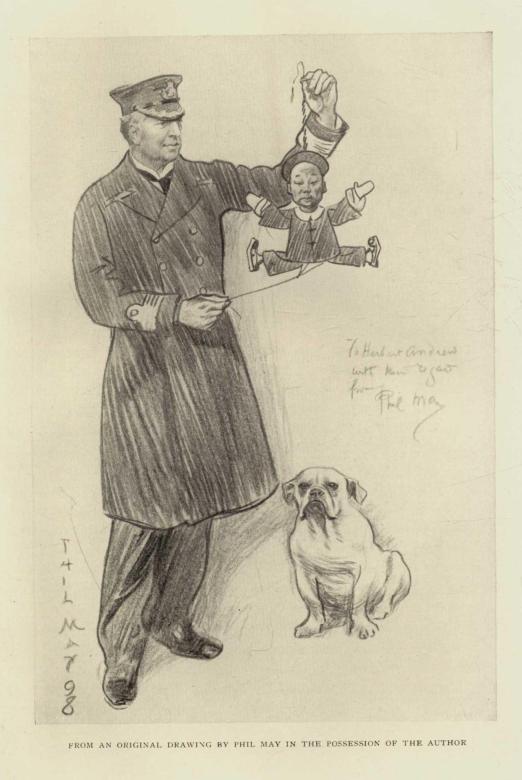
FROM AN ORIGINAL DRAWING BY PHIL MAY IN THE POSSESSION OF THE AUTHOR
In the course of many conversations held with the
compradors (managers) of the great mercantile houses in
China, I ascertained that, while several of them were frankly
in favour of Reform, all of them agreed that the Reformers
had acted in haste, neglecting to prepare their way by means
of careful organisation.
THE CHINESE NEW MODEL
Arriving at Pekin on 16th October, 1898, I was kindly
invited by Sir Claude Macdonald, British Minister
Plenipotentiary, to stay at the Legation. To all Foreign Ministers
accredited to Pekin I paid my respects and presented my
credentials, which were given to me by the President of the
Associated Chambers of Commerce of Great Britain, Sir
Stafford Northcote, and which showed that I had been asked
to make a report on British trade and commerce, its future
development, and what security existed throughout the
Chinese Empire for such trade and commerce.
On 20th October, I visited the Tsung-li Yamen; a body
created, in 1861, for the purpose of conducting diplomatic
negotiations with the representatives of Foreign Powers, and
consisting of eight members, of whom three are Manchus
and five are Chinese. I was presented to Prince Ching, the
President, and was requested to address the members. In
my speech, I dwelt upon the anxiety as to the future on the
part of British traders on account of the want of security for
capital, and the ignoring of treaties by the Chinese;
suggested that, unless China organised her military and police
forces in order to give security for trade and commerce,
foreign countries would adopt the policy embodied in the
expression "Spheres of Influence"; affirmed that the British
desired no addition to be made to the British Empire, either
in the nature of dominion, sphere of influence, or protectorate;
explained that what the commercial communities
desired was free and uninterrupted opportunities for trade,
with equal rights and privileges for all the nations of the
world, a policy expressed by the words "Open Door"; and
stated that in order to establish such a policy, it was essential
that China should maintain her integrity.
Prince Ching asked me how I thought trade and commerce
could be better protected that it was at present.
I replied that the only effective method would be
thoroughly to reorganise the Chinese army, abolishing the
system of maintaining provincial armies; that, as Great
Britain had 64 per cent. of the whole foreign trade of China,
she was naturally anxious as to its adequate security; and
that it was possible that the British Government would allow
a British officer to assist the Chinese in putting their army
in order; adding that I had no official authority whatever to
make the statement, but merely put it forward as a suggestion.
I also suggested that should the Chinese Government
consider the proposal, it might be well for them to invite
other nations which had large trading interests with China,
to lend a few officers and non-commissioned officers to work
with the British in the reorganisation of the army.
Prince Ching observed that they already had German
officers to drill some of their troops; and that Captain Lang,
the British naval officer, was in the Chinese service to help
them to organise their Fleet. He did not mention, however,
what I afterwards discovered, that Captain Lang had found
the admiral sitting on the quarter-deck playing fan-tan
with his own sentry. Captain Lang subsequently resigned
his appointment.
When Prince Ching and some members of the Tsung-li
Yamen returned my visit, Prince Ching informed me that
the Emperor and the Empress Dowager approved of my
suggestions; and that his Excellency Chung Chi Tung,
Viceroy of Hunan and Hupeh, had been ordered to have
2000 of his troops ready to be placed under a British officer
for drill and organisation, as an experiment, which might
possibly lead to the reorganisation of the army as a whole.
I replied that as I was in no way authorised to take any
responsibility with regard to this matter, any action taken
on the part of the Tsung-ii Yamen must go through the
British Minister to the British Government. Prince Ching
said that it was the intention of the Tsung-li Yamen formally
to inform Sir Claude Macdonald of the wishes of the
Chinese Government.
My interpreter on these occasions was Mr. Fulford of
the British Legation, and all that passed between myself
and the high Chinese officials in Pekin was made known by
Mr. Fulford to the British Minister.
The question of providing adequate security for British
subjects and for British trade and commerce, was thus
frankly raised at the beginning. Indeed, all hinged upon
its solution. The safety of life and property always depends
ultimately upon disciplined force. The force at the disposal
of the Chinese Government was scattered, ill-organised and
largely inefficient. But, with the men, money and resources
actually available, it would have been perfectly feasible to
have formed an army of a million men. Such was my view
at the time, and I have seen no reason to change it since.
At the request of the Tsung-li Yamen, I drew up the
entire scheme complete in every detail for the organisation
of the Chinese army; and on several occasions it was
discussed with me by the Chinese Ministers at great length.
Briefly described, my scheme was based upon the principle
upon which the Imperial Maritime Customs had been formed.
The Imperial Maritime Customs was charged with the duty
of collecting Custom House dues, which were hypothecated
to secure the external indebtedness of China. All nations
were represented upon it, and, because Great Britain possessed
by far the larger share of Chinese trade, a British officer was
placed at its head. The business was impartially managed
under the Chinese Government for the common welfare of
China and of other nations; and in the result the arrangement
worked admirably.
The proposal was, then, to organise the army upon the
same basis; appointing officers of those nations who owned
interests in China; and, as Great Britain possessed the
largest interests, placing a British officer in command under
the Chinese Government. Under these conditions, the army
would be enabled to secure China both against foreign
aggression and internal disturbance. In a word, it would
ensure stable government. Under existing conditions, stable
government was impossible; for the methods of the Empress
Dowager consisted in playing off one party against another,
and one viceroy against another. Tsu Hsi succeeded in
maintaining her personal ascendancy; but at the cost of so
weakening the State, that it was liable to fall a prey to foreign
ambition and foreign cupidity.
The Chinese high officials argued the whole subject with
great acumen. They objected that the commander-in-chief
might embark upon a career of personal aggrandisement. I
replied that as he would be under the Chinese Government,
and that as he would be further restricted by his dependence
upon an international body of officers, there could be no
such danger. And I asked the Chinese whether they had
any reason to be dissatisfied with Sir Robert Hart's
administration of the Customs. They answered at once that his
services were invaluable to China, and said that he worked
so hard in Chinese interests that "he might have been a
Chinaman."
I then pointed out that a British officer at the head of
the army would occupy the same position with regard to
the army as Sir Robert Hart occupied with regard to the
Customs; offered to select for them the best general I
could find for the executive command; and informed them
that I was myself prepared to undertake the administrative
command.
The objection that the creation of such an army might
offend foreign susceptibilities, was also met by the argument
that foreign officers would command it.
In reply to a courteous question, I stated that my object
in proposing the scheme was to benefit China; and that the
reason why I desired to benefit China was that an improvement
in Chinese administration must necessarily profit
British interests.
I also discussed the subject with his Excellency Yung
Lu, he who had executed the coup d'état which resulted in
the defeat of the Reformers and the imprisonment of the
Emperor Kuang Hsu. Yung Lu, who commanded one of
the foreign-drilled armies, stated that the reorganisation
of the Chinese army under British and foreign officers
would be carried into execution; and asked me whether,
supposing that China put the whole of her armies under
British officers, Great Britain would assist her in any quarrel
that might arise between her and any other Power.
The direct question was highly significant.
My reply, of course, was that I was unable to discuss
political questions; but that Great Britain had no desire to
involve herself in quarrels which might arise among other
countries.
Yung Lu courteously invited me to visit the military
forces then quartered round Pekin; a privilege of which
I afterwards availed myself.
Having formulated my scheme for the reorganisation of
the Chinese army, founded upon a general knowledge of the
requirements of the situation, I proceeded to fulfil in detail
that part of my instructions received from the President of
the Associated Chambers of Commerce directing me to
report "whether the organisation of the Chinese civil and
military administration is sufficiently complete to ensure
adequate protection to commercial ventures." Accordingly,
I visited all the forts and arsenals forming the coast and
river defences of the Chinese Empire, and utilised the
opportunities, most courteously extended to me by the
various viceroys, of inspecting the Imperial military forces.
For the sake of simplicity, the results of my investigations
into military and naval conditions are here grouped
together; although these investigations were necessarily
conducted side by side with my inquiries into commercial
affairs, the two elements being often present in the same
locality.
China's military forces were then sharply divided
between Manchu and Chinese, or North and South. The
Manchu, or Northern, forces were manned and officered
entirely by Manchus, and enjoyed privileges which were
denied to the Chinese army. Nearly every Southern army
was commanded by two generals, a Manchu and a Chinese,
the Manchu being the real head.
The provincial armies are maintained at the expense of
the viceroys. In the Province of Chihli, General Yuan
Shih Kai's army, and the Imperial armies at and around
Pekin, are maintained by the Board of Revenue out of
Imperial taxes; so that the Imperial armies permanently
quartered round Pekin are State-paid. The generals in
command of the Provinces administer their armies entirely
according to their own discretion. As these officers are
responsible for the payment and maintenance of the forces
under their command, much of the money which should go
to the army is apt to stick with its general.
When I mentioned these circumstances to the members
of the Tsung-li Yamen, one of them blandly asked me if I
included his army in my description.
I replied that his Excellency could not but be aware
that he received supplies of pay, clothes and rice for an
establishment of 10,000, although the actual number was
one half or less; and that when his army was inspected, he
filled the ranks by hiring coolies for the occasion. My
response evoked an irreverent outburst of applause from the
interested audience of coolies. "The English Mandarin,"
they cried, "knows all about our old mandarins! That is
just what happens."
YUAN SHIH KAI
In October, 1898, I went to Hsiao Chao to visit Yuan
Shih Kai, the high official who informed Yung Lu of the
plot of the Reformers to seize the Empress Dowager, and so
brought about the coup d'état. I remained two days and a
night with the general; witnessed the parade of all his
troops, and their manoeuvres, and examined their equipment
and victualling. I was permitted to examine the pay-sheets,
and obtained every detail connected with the establishment
and maintenance of the force.
General Yuan Shih Kai is a Chinaman, and his army
was composed of Chinese. It numbered 7400 men. They
appeared to be smart, of fine physique, well fed, and their
uniforms were well kept. Their parade and manoeuvres
were smartly executed, their discipline was excellent. All
their equipment was serviceable and efficient, with the
exception of their artillery.
It was on this occasion that I had a conversation with
Yuan Shih Kai, which, in the light of subsequent events in
China, it may be not uninteresting to recall.
Yuan Shih Kai expressed his anxiety concerning the
future of his country; which, he said, was in a lamentable
state of weakness, and which the States of Europe were
desirous of dividing among themselves; and in this
connection he was inclined favourably to regard the proposal to
combine the various Chinese armies into one great Imperial
force.
Upon that, I asked Yuan if he were acquainted with the
history of China. Being one of the governing class, and
therefore a scholar of the ancient meticulous pedantic class,
he probably knew the whole of it by heart; and he replied
in the affirmative.
"Then," I said, "have you not observed that every
Chinese dynasty has been founded by a successful general?"
The man who is now (1913) President of the Chinese
Republic looked at me impassive as a statue, and held his
peace.
Yuan Shih Kai was well aware of the fact that throughout
the East the ruler is always "He," never "They"; and
for this reason he subsequently endeavoured, after the death
of the Empress Dowager, to preserve the authority of the
Emperor.
Years afterwards, before leaving England for China,
Dr. Sun Yat-sen, who was accompanied by General Homer Lea
of the United States, lunched with me. General Homer
Lea was, I think, to conduct the reorganisation of the
Chinese army.
ARMS AND MEN
The armies which I had the privilege of inspecting, or
concerning which I obtained information, were: the army
of General Sung, distributed along the coast about Kinchow,
which apparently consisted of 10,000 men out of a paper
strength of 20,000; the army of General Soon Ching at
Lutai, which was also at half strength, consisting of 7000 men
out of 15,000, distributed among 30 camps, and having some
Russian officers; and the army of General Tung Fu Chan,
near Pekin, which was a disorderly and an undisciplined
rabble; the army of General Nieh, which consisted of about
13,000 men, distributed among 30 camps between Hsiao
Chao and Tientsin, with five Russian instructors; the Pekin
Field Force, which was commanded from the Palace, and
which consisted of 10,000 picked men, well armed but badly
drilled; the cavalry camp at Kaiping, theoretically consisting
of 1500 men, and having three Russian officers; and the
army of General Yi Ke Tong, consisting of from 8000 to
15,000 men scattered about in Manchuria. I also saw the
armies, or some part of them, of the Viceroys Chung Chai
Tung, Liu Kwen Yi, Hsu Ying Kwei, Tau Chung Liu, and
Kwei. Besides these, I was informed that there were in
Mongolia 100,000 cavalry.
Among the various armies were distributed 14 different
patterns of rifles, varying from the Mauser to the gingal.
Some contingents were armed with bows and arrows; others
carried bird-cages and fans, being distinguishable as soldiers
only by their badge. The armies exhibited as many degrees
of efficiency among themselves as their weapons.
Nevertheless, I came to the conclusion that here was all
the material from which to evolve an excellent army. The
Chinese have all the qualities of a good soldier: they are
sober, obedient, quick to learn and courageous. The requirements
were proper food, pay, clothing, drill and competent
officers.
While I was at Newchwang I obtained what information
was available with regard to the numbers and location of
the Russian troops in Eastern Siberia and in Manchuria
The total number was then about 12,000 men.
In the course of my inspection, at the Viceroy's invitation,
of the powerful forts on the Yangtse River, I observed
that one fort, which was intended to fire up the river, was so
constructed that only one gun out of six could be trained in
the required direction, so that if the other guns were brought
to bear, the guns' crews would be killed. The face of the
fort, instead of being at right angles to the course of the
river, was parallel to it. At my suggestion, a dummy figure
was placed in position; a gun was fired in the required
direction; and sure enough the shot blew the effigy to pieces
and went wandering among the junks crowding the river.
The Chinese said that the English Mandarin was the cleverest
mandarin they had ever seen; and explained that the
fort had not been built in the right position because the
ground was swampy.
Among my observations of forts elsewhere, I noted a
battery of 60-ton muzzle-loading guns, which were loaded
by depressing their muzzles into the magazine. I ventured
to suggest that any carelessness in sponging out the guns
might result in the explosion of the magazine. The general
said that the English Mandarin was extraordinarily clever;
and explained that a year previously a magazine had been
blown up for the very reason I had indicated, had killed
forty-two men, and had then been rebuilt upon the same plan.
At another fort I noted that the powder used for the
heavy guns was unsuitable, and ventured to suggest that it
might burst the gun.
"Yes, it does," said the general simply. "We have
lately blown the breech off two 12-inch 50-ton Krupp guns,
killing and wounding thirty men." And he congratulated
the English Mandarin upon his extraordinary powers of
divination. After the general's explanation I understood
how it was that in another fort two 12-inch Krupp guns
were fitted with Armstrong breech mechanism. The Krupp
breech having been blown off, the Shanghai arsenal had
neatly fitted them with Armstrong breeches.
Observing that a powder-mill at Canton had open gratings
for windows, and stood in the midst of a sandy plain,
I ventured to suggest that the sand might blow in, and that
a spark from it might cause an explosion.
"Yes, it does," said the mandarin. "It blew up two
years ago and killed and wounded twenty men." He added
that although it had been rebuilt upon the same plan, it was
not intended to use it again; and expressed his admiration
for my remarkable penetration.
At one of the arsenals, the workman boring a 6-pounder
gun had his speed too fast and his feed too thick, so that his
machine was taking out chips of metal and jumping under
the strain. My guide observed placidly that the man didn't
seem to know how to do it. The European instructor, he
explained, had left. I offered to replace him for the
occasion; took off my coat; and being an old hand at the lathe
managed to set the machine right in about an hour's work.
Then there suddenly arose a great crying and calling among
the coolies outside. I thought a riot was beginning; but
the tumult was only the coolies in their innocent way
screaming their delight that "the English Mandarin could
do what their own old mandarins couldn't."
I drew up a report with regard to the forts and arsenals
in China. The general conclusion was that enormous sums
of money were being expended on war material which, in
most cases, was totally useless, although the establishments
were often capable, under European instructors, of turning
out work which would compare with the best in Europe.
Two or three of these arsenals, rightly managed, would
serve to equip a million men for less money than was already
being expended.
H.I.M. NAVY
I also visited the Chinese Navy, which was divided into
two squadrons, the Peyang squadron in the North and the
Nanyang squadron in the South. The Peyang squadron
consisted of three cruisers, one torpedo cruiser, and one
torpedo gunboat. The Nanyang squadron was composed
of seven cruisers, four old gunboats, and four torpedo boats.
The Fleet as a whole was undermanned, but there were
many men who had been well trained by English instructors.
The only dockyard is at Foochow.
Many Chinese authorities having asked my advice as to
the fleet, I recommended them to put their ships in order
for police purposes, and to utilise them for the purpose of
checking piracy; advised them not to spend any more
money on their navy, because their army was of greater
importance; and pointed out the waste involved in keeping
about the coasts and in the river hundreds of man-of-war
junks.
Throughout China, I found among the high officials at
least an ostensible agreement with my views concerning the
necessity of reorganising the army: agreement which was
no doubt largely dictated by the very present fear of Russian
aggression.
His Excellency Li Hung Chang, whom I visited, was
an exception to the rule; for the great Minister, one of the
Six Grand Secretaries, was growing old and infirm; and
having offended the Reform Party, it was not improbable
that he was looking to Russia to protect him in case the
Empress Dowager's support failed him. His case was
typical of the Chinese attitude, in which the regard for
personal wealth and safety, threatened so subtly and from
so many dark quarters, is naturally apt to override
patriotism.
At the same time, China is one of the most democratic
countries in the world. I have seen the great Li Hung
Chang stepping into the Yamen over the bodies of the
coolies, who refused to move and who chaffed him as he
passed. I have seen a whole Council huddle up their fans
and disperse like startled poultry, because a coolie put his
head in at the door and exhorted the old gentlemen to be
quick, because it was going to rain, and the coolies were
going home.
It is the rule of the road in China that all passengers
must give way to carriers of burdens, and it was enforced
without respect of persons. Being carried in a sedan, with four
bearers and four coolies running alongside, I was horrified
to perceive the head coolie incontinently knock down an
old mandarin who was in the way. The poor old gentleman
rolled over and over, Red Button and all; and when he
arose, his gorgeous silks all befouled with mud, the coolie
spat in his face. China is full of the unexpected.
HIGHLY COMMERCIAL
As already explained, the two aspects of my investigations,
the military conditions and the commercial conditions,
are here treated separately for the sake of simplicity,
although at the time they were necessarily conducted
together. The following brief account of the results of my
inquiries into the state of trade and commerce contains
those particulars which may still retain their interest.
From Pekin I went to Tientsin, where I attended a
meeting of the Chamber of Commerce, which vehemently
protested against the "Sphere of Influence" policy, declaring
that the future trade of Tientsin would be entirely dependent
on preserving the integrity of China, and upon the existence
of a guarantee of the policy of the "Open Door." The
British section of the Chamber of Commerce presented to
me a memorandum, which they desired me to transmit to
the Associated Chambers of Commerce in England, protesting
against the absence of any definite policy, and stating
that considerable anxiety existed with regard to the safety
of capital already invested in China. The fear of Russian
aggression had virtually paralysed the movement of capital
in the northern part of China. The general opinion was
that if the "Open Door" policy were established and secured,
these apprehensions would disappear.
I was most courteously received by the Chinese
authorities at Tientsin, who expressed great friendliness
towards Great Britain; and who, as usual, affirmed that
China was helpless and that all the European countries were
taking advantage of her weakness. In the case of Russia,
they stated that concessions were being demanded throughout
the whole country which China was unable to refuse.
From Tientsin I went to Tongshan, travelling upon the
Shanhaikwan railway, which had been built by Scotch
engineers under the direction of Mr. Kinder, a British
subject of great talent and energy, who had married a
Japanese lady. Of the two people whom I met who
seemed to me really to possess an intimate knowledge of
China and the Chinese, Mr. Kinder was one. The other
was Dr. Morrison, The Times correspondent.
With Mr. Kinder's assistance, I collected the whole of
the statistics regarding the working of the Tongshan
railway workshops, of the Shanhaikwan railway, and of the
coal mine, in which Chinese miners were employed under
European foremen.
Upon my arrival at Newchang, I was received by the
British residents. The British merchants here, like the
others elsewhere, wished me to represent to the Associated
Chambers of Commerce of Great Britain that trade in the
North of China must be secured against foreign aggression,
and transmitted to me a number of resolutions to this
effect.
The Russians had settled at Newchang, taking the
land without permission, and paying the native occupiers
nominal prices. Since 1897 the Russians had been pouring
troops into Manchuria, and their number was steadily
increasing. I prepared a detailed report upon the trade of
Newchang.
Chefoo I visited twice, first on 13th October and again
on 9th November. The British merchants here complained
of the extension of German interest, which began with
the opening of Kiao Chao. I thought, however, that their
alarm was not justified. Kiao Chao had been declared by
Germany to be an open port.
Upon visiting Wei-hai-wei, I observed that with a
comparatively small expenditure of money it could be
made into a most efficient and powerful naval base.
Already, in the few months which had elapsed since the
British flag was hoisted on 24th May, 1898, Commander
E. F. A. Gaunt (now Commodore Gaunt, C.M.G.), in
command of a party of bluejackets and Marines, had
accomplished a most admirable piece of administrative
work, in cleaning up the place and in enforcing law and
order so tactfully and skilfully that the only punishments
inflicted had consisted in docking the pigtails of two
offenders. There were no guns mounted at Wei-hai-wei;
but at Port Arthur, 80 miles distant northwards across
Korea Bay, the Russians had already mounted seventy guns.
I also observed that the island of Wei-hai-wei, which
is two-thirds the size of Gibraltar, was the best place on the
China Station for the establishment of a sanatorium for
the Fleet.
My visit to Kiao Chao was made in response to a
cordial invitation sent to me by Rear-Admiral H.R.H. Prince
Henry of Prussia. The harbour is a difficult place
for vessels to make, particularly in foggy weather. The
Germans were as busy as bees, clearing the ground, building
barracks, making parade grounds and preparing emplacements
for guns. Prince Henry was most kind to me, and showed
to me everything. His administration and organisation were
admirable; and afforded another example of the achievements
of naval officers.
But the place was still under military rule, which
discourages commerce. On my voyage out, three Germans had
come on board at Singapore. They told me that, although
they had been very happy under British rule, they preferred
their own colony, and intended to start a hotel at Kiao Chao.
Some time afterwards I met those three patriotic Germans
again. They were on their way back to Singapore; because,
so they said, they could not make a living at Kiao Chao!
They told me that they were obliged to pay a tax of five
per cent. upon their investment, with the prospect of paying
another five per cent. when, after a period of years, their
property should again be surveyed.
At Shanghai, which, being situated at the entrance Of
the Yangtse Valley, is the most important Treaty Port in
the Far East, I framed an elaborate report upon its trade.
The China Association presented to me a memorandum
containing the usual protest against the insecurity of
British interests in China.
While I was at Shanghai I had three interviews with
the Marquess Ito, lately Prime Minister of Japan. The
Marquess, I believe, was unofficially employed in endeavouring
to extend Japanese interests in China. He expressed
the greatest friendliness towards Great Britain. During
the political disturbances in Japan, the Marquess Ito had
fled to England as a sailor before the mast in a British
vessel. He told me that, landing at Gravesend very
hungry, he went into a shop and bought a loaf, putting
down half a sovereign. The shopman, presumably taking
advantage of the fact that he was a Japanese, refused to
give him the change. The Marquess told me that he was
sadly shocked; for, until that moment, he had believed the
English to be the most honest people in the world.
In Shanghai, I learned that one of the leaders of the
Reform Party, Huang Chin, a victim of the coup d'état, had
been arrested and was about to be sent to Nanking for
execution. I urged his Excellency Kwei Chun, Viceroy of
Szechuan, to use his influence to save Huang's life, pointing
out to him that these political executions were exceedingly
distasteful to the British people. I am glad to say that my
intervention was effectual, in that Huang Chin, instead of
being executed, was banished.
His Excellency Liu-Kwen-Yi having most courteously
placed H.I.M.S. Nanshin at my disposal, I took passage in
her to Nanking.
I was much interested in the arrangement and armament
of the Chinese man-of-war; but as she was warmed by
means of charcoal stoves, my investigations were conducted
in a condition of partial suffocation from the fumes.
Upon arriving at Nanking in the Nanshin, I received a
salute of fifteen guns; and proceeded to the Yamen of his
Excellency the Viceroy Liu-Kwen-Yi between the lines of
troops and banner-bearers, numbering some thousands, who
were ranged along the whole route of four and a half miles in
my honour. Liu-Kwen-Yi, who received me with the greatest
courtesy and kindness, said that he was anxious to show his
friendship for Great Britain in every way. In the course of
two long and interesting conversations with the Viceroy,
who expressed his fear of the present unstable posture of
affairs, I suggested that there were two contingencies to
fear: a rebellion against the Government and an insurrection
against foreigners; either of which would be fatal
to commercial security. His Excellency, however, assured
me that there was no danger of disturbances inspired by
dislike of the foreigner. Herein he was mistaken; for
within two years occurred the Boxer outbreak, which had
the approval, secret or overt, of the Empress Dowager. At
the Viceroy's request, I drew up a memorandum containing
my scheme for the reorganisation of the army on the principle
of the Imperial Maritime Customs, which I had proposed
at Pekin. A translation of this document was sent by the
Viceroy to Pekin.
On my return journey, I inspected the army, the fleet,
the arsenal and the Imperial naval college.
I arrived at Hong Kong for the second time on Christmas
Day, 1898. The views of the China Association and of the
British merchants here were of the same tenor as those,
already described, expressed by the British communities at
all the trading centres visited by me.
To complete my itinerary in brief, other places visited by
me were Wuhu, Kinkiang, Chinkiang, Kiangzin, Hankow,
Foochow, Swatow, Amoy, Canton, and Wuchow. At each
place I drew up a report describing the local conditions and
embodying the representations of the British communities.
Their common complaint was that British trade was
declining. But an examination of the detailed reports which
in response to the letters sent by me beforehand, were ready
for my inspection, showed that on the contrary the branches
of trade already possessed by the British had increased; and
that it was in new branches started by foreign nations that
the British were not succeeding. Their comparative failure
in this respect I held to be partly due to the fact that foreign
nations supplied what the people wanted, while the British
insisted on trying to sell to them what the British thought
they ought to want.
CONCLUSION
The following reports were framed by me: report on the
railways and waterways; report upon the British Consulate;
a general comprehensive report upon Trade, Treaties and
Tariffs; and a highly elaborate report upon the complicated
question of Finance and Currency. All these are set forth
in my book, The Break-up of China, which also includes a
summary of the reforms which appeared to me to be most
requisite. These were:—
1. An Imperial coinage.
2. Reform in the method of collecting the land-tax.
3. Removal of restrictions on the export of grain.
4. Modification of the laws governing the salt monopoly.
5. The right of foreigners to reside in the interior for
purposes of trade.
6. The registration and protection of trade marks and
copyright.
7. The removal of the remaining restrictions on inland
water navigation.
8. The abolition of the likin, or a change of
administration which would ensure that likin should be
collected once only.
9. Greater facilities to be given to respectable foreign
syndicates to work minerals.
10. The establishment of reformed departments for the
regulation of finance, railways, waterways, roads,
posts and telegraphs, and a bureau to deal with all
questions connected with trade. The existing
telegraph service was so bad, that a letter sent
from Tientsin to Shanghai has been known to
arrive before a telegram sent at the same time.
The Times correspondent at Pekin told me that
his telegrams very often cost as much to send
from Pekin to Shanghai as from Shanghai to
London.
11. One other bureau was urgently needed, a Trade
Intelligence Department, to deal with scientific
and practical questions relating to the natural
products available in China for commercial
purposes. What is an insignificant export to-day
may become a valuable article of commerce
to-morrow. There should be a scientific classification
of the products of China on the same lines
as the classification of products in India.
I may here quote what, in relation to the whole matter,
I wrote at the time:
"If it be said that my policy for the reorganisation of
the Chinese army and police is a warlike policy, I reply
that it is the only plan yet suggested which gives any
guarantee of peace. Great Britain's strongest guarantee
of peace has been the reorganisation of her Fleet.
Without peace commerce must perish. To keep the peace,
authority must be properly equipped. Our choice with
regard to the Chinese Empire is simple: we may choose to
wreck or we may choose to restore."
The resolutions passed by the British mercantile
communities and the many letters I received from
them subsequently, testify to their approval of my
recommendations. The following documents express the
sentiments of the Chinese themselves, and of the foreign
merchants:
"At a meeting of Chinese merchants and traders, and
other Chinese gentlemen resident in Hong Kong, held at the
Chinese Chamber of Commerce on 22nd January, 1899, on
the motion of Mr. Ho Tung, seconded by Mr. Leung Shiu
Kwong, it was resolved:
"'1. Having closely followed with great and attentive
interest, and carefully considered what Lord Charles
Beresford has said and done in China in connection with his
recent mission on behalf of the Associated Chambers of
Commerce, we, the Chinese community of Hong Kong here
assembled, are in accord with and heartily support the
policy the noble lord proposes in regard to the "Open
Door" as regards commerce, and also with regard to the
reorganisation of the Chinese army.
"'2. That we recognise the combined proposals, if
carried out, will benefit China quite as much as, if not more,
than England, and other nations, in her trading interest, and
we therefore hope that Lord Charles will be intrusted by the
British Government with the carrying out of the views he has
so closely enunciated, as we, the Chinese people of Hong
Kong, observe that his efforts are directed to the benefit of
both his country and our country, and to the benefit of the
trade of China and the trade of England.
"'3. That we recognise and make our cordial acknowledgments
for the sympathetic manner with which he has
approached our country; and
"'4. That we desire emphatically to express our full
confidence in Lord Charles Beresford, whose ability, integrity
and zeal we are sure peculiarly fit him successfully to carry
out the proposals he has made for the furtherance of trade
and the preservation of the Chinese Empire.'
"(Signed) Lo CHI TIU, Chairman
H. O. FOOK, Secretary"
The General Foreign Commercial Community of Shanghai,
on 8th January, 1899, passed the following resolution:
"That our cordial thanks be tendered to Lord Charles
Beresford for the service he has rendered to the foreign
communities in China by personal investigation into the
conditions of the various interests we represent."
Upon my return, I represented what I believed to be the
real posture of affairs in China, when the subject was
discussed in the House of Commons. In November, 1899,
I read a paper upon "Engineering in China" before the
Institute of Mechanical Engineers.
II. JAPAN
Having received invitations to visit Japan from the
Chambers of Commerce and from prominent persons
interested in the China trade, I stayed for a short
time in that country on my way home. Thirty years
previously, accompanying H.R.H. the Duke of Edinburgh
in the Galatea, I had seen the Old Japan. I was now to see,
super-imposed upon the Old, the New Japan. That which
China was groping after, Japan had seized and made her
own. What we call Western civilisation: the civilisation of
commerce, of science, of mechanical invention: Japan had
put on like a garment.
Both the army and the navy, whose supreme commander
is the Emperor, were organised, efficient, and in process of
augmentation. China feared Russia; but Japan was even
then preparing to fight Russia.
As in arms, so in manufactures, Japan already rivalled
the West. The foreigner, who, a generation previously,
walked in peril of his life, was now welcomed, imitated, and
loaded with civilities.
During my brief sojourn, the swift and shining manifestations
of the new spirit (which was the old spirit seeking
a new avatar) surrounded me. At Osaka, quick-firing field
artillery and magazine rifles were being made to Japanese
patents, excellent in design and construction; and the
humming factories were turning out sugar, cotton, matches,
iron and steel; and, at a meeting of the Chamber of Commerce,
the Mayor declared that it was imperative in the interests
of Japanese trade that the policy of the "Open Door"
should prevail in China. The Chamber of Commerce said
the same at Kioto. A generation since, the two-sworded
samurai were guarding the door of Japan, lest it should be
opened.
At Kioto, electricity, generated by water power, lighted
the streets and houses, worked the trams, pumped the water;
the use of electric power was then more common, I believe
in Japan than in any other country; and there were telegraphs
and telephones in nearly every town.
In Tokio, I had the honour of meeting several members
of the Ministry, who, stating that they regarded the "Spheres
of Influence" policy to be fatal to Japanese interests,
expressed their desire to work together with other nations in
favour of the policy of the "Open Door." Having been
invited by the Chamber of Commerce to address a public
meeting, I spoke on the subject of the future development
of trade with China. The meeting was attended by Ministers,
military and naval officers, the President and many
members of both Houses, and representatives of the
mercantile community. The Japanese interpreter sat beside me
and equipped with inkpot, paper and brush, he painted
down my words in the Japanese character. When I sat
down, the interpreter rose and repeated my speech in
Japanese, his delivery occupying the same time as mine.
Every now and then he was interrupted by applause, the
audience tapping with their fans. The British Minister told
me that it was aroused by the mention of the identity of
Japanese and British interests, and especially by the
comparison drawn between Japan and Great Britain.
The authorities kindly conducted me over the various
schools of military training, in which the system was perfect;
the arsenal, employing 6000 men, and turning out work
second to none; and the barracks, a model of efficiency.
The Minister for War, General Viscount Katsura, courteously
held a parade of troops for my benefit. All arms were
admirable alike in organisation, appearance, and discipline.
Before leaving Tokio, I had the opportunity of paying my
respects to his Majesty the Emperor; who was so good as to
say he remembered the visit of the Duke of Edinburgh of
whose suite I had been a member, and invited me to an afternoon's
sport in his private pleasaunce. Every foot of the garden
was wrought like a gem. Diversified with miniature mountains,
tiny grottoes, and brilliant foliage, it was intersected by
narrow rivers which were haunted by wild duck. Two or
three days before the sport took place, the garden was left
solitary, so that the ducks should come into it. The method
was to catch the duck in a hand-net as it rose from the water.
His Majesty said that the development of trade with
China must strengthen the friendship between the peoples of
Great Britain and Japan, the interests of both countries
being the same; and expressed the hope that the endeavours
of the Associated Chambers of Commerce of Great Britain
might be the beginning of a great extension of trade, in
which Japan would take a prominent part.
At Yokohama, Admiral Yamamoto, Minister of Marine,
courteously invited me to visit the dockyard and fleet at
Yokohama, placing H.I.M. cruiser Takasago at my disposal.
The vessel was throughout in as good condition as a
man-of-war could be; and her ship's company were smart, well
dressed and well disciplined.
At Yokosha is a large torpedo depot, at which everything
connected with torpedo warfare is organised under its own
administration; a system preferable to the British method, in
which the torpedo departments are auxiliary to the dockyards.
The impression disengaged by my sojourn of a fortnight
in Japan was that both the political and commercial classes
were determined to enforce the "Open Door" in China,
where their commercial interests were extensive. I observed
that the nation was arming itself steadily and effectively;
and that a spirit of patriotism was universal. Four years
later, the Russo-Japanese war broke out.
III. THE UNITED STATES
The many invitations sent to me while I was in China
from the United States determined me to visit that
country on the way home; in order to explain to the
American nation the situation in China; to encourage if it
might be, the growth of amity between the English and the
American peoples; and incidentally to mark the contrast
between the most ancient and static Empire of the East and
the restless dynamic forces of the latest experiment in Western
civilisation. I had arrived at Nagasaki on the 11th January,
1899; traversed Japan as a half-way house, in which West
and East had married, and in which their offspring were
presently to astonish the world; and came to San Francisco
on the 10th of February.
Immediately the wheels of life began to revolve with an
extraordinary velocity. I was caught up in the sumptuous
hospitality of that generous people—deluged with invitations;
and haunted by interviewers. In looking back, great cities
rise one upon another, like cities in a dream; I seem always
to be speaking to a field of keen, upturned countenances; the
only respite comes in the days and nights, all run into one
to the long roll of the cars, as the train eats up the miles of
that land of vast spaces; and everywhere there are welcome
and cordiality and friendship.
And everywhere there were Irishmen, rushing to shake
hands with a countryman; rushing any distance, often
hundreds of miles, just to exchange greetings at the latter
end. Irishmen are so, the world over.
One among my countrymen had travelled a thousand
miles to see me, when he called at my hotel. I told him
that I had twenty minutes before starting for Chicago, and
that I must retire to my room to bathe, shave and prepare
a speech in that time.
"I'll come wid ye," said he, cheerfully; and while I
made my dispositions, he sat in the adjoining room and
talked of the old country with that pride and affection which
all Irishmen feel for their native land.
San Francisco, Denver, Chicago, Buffalo, Washington,
New York: these were the great towns strung among the
lesser. At San Francisco, I addressed the Chamber of
Commerce. At Chicago, I was entertained by
Mr. McCormick, President of the Associated Chambers and of
the Committee of the Commercial Club.
All unknown to me, it had been arranged that I should
address a large meeting at eleven o'clock on the morning of
my arrival. When the train came in at ten o'clock, I was
informed of the arrangement; went to the hotel, dictated
notes to my secretary while I made my toilette, arrived at
the meeting punctually, and spoke for half an hour.
Here, and throughout America, I kept strictly to my
terms of reference: dwelling upon the opportunities for
extending trade in China; the necessity for pursuing the
policy of the "Open Door"; and the community of interest
existing between America and Great Britain.
The Board of Trade, which is the Stock Exchange of
Chicago, invited me to visit them; and when I was introduced
as the representative of the Associated Chambers of
Commerce of Great Britain, the whole business of the great
market was stopped in order that I might address the
members; an event which, I was informed, was without
precedent. The Commercial Club having kindly invited me
to be the guest of their periodical banquet, the Committee
most courteously altered the date in order to suit my
convenience. In this case, there was a precedent; for the
date of the occasion had been altered when General Grant
had been a guest of the Club.
At Washington, I was most hospitably entertained by
Mr. Hay, Secretary of State and late Ambassador in Great
Britain. I had the privilege of paying my respects to
President McKinley, and of meeting many distinguished
Americans, Senators and others, all of whom expressed
great interest in the enterprise of the British Associated
Chambers of Commerce. At this time I first met Colonel
Robert M. Thompson, who became a great friend of mine;
and Admiral Brownson, whose skill in handling a fleet I
subsequently admired.
Upon my arrival at New York, I fulfilled an engagement
to address the American Asiatic Association. Mr. Whitelaw
Reid, afterwards Ambassador in Great Britain, in an eloquent
speech, declared that the policy of the "Open Door" was
that which was best suited for the development of American
trade, and that the American Government intended to
institute it in the Philippine Islands.
Addressing the New York Chamber of Commerce, I
found the members to express the same sympathy and
interest with which my representations had been received
throughout the United States. The American attitude was,
in fact, that while they were desirous of strengthening their
friendship with England, and approved the policy of the
"Open Door," they did not feel justified in going beyond a
moral support of it.
Upon visiting New York a second time, I was introduced
into the Stock Exchange by Mr. Rudolph Kepler, the
President, who took me up the floor to the rostrum. The
proceedings were stopped; and at the President's request, I
addressed the members for two or three minutes. Some one
said that my speech was at the rate of 100,000 dollars a
second. I hope he was exaggerating.
When the men who had gone out to South Africa
to take part in the Jameson Raid were passing
through the Suez Canal on their way back again,
I saw and heard the people in the British ships cheering
them as they went by; a popular effusion which (in my view)
boded trouble in the future. Soon after my return from the
United States in 1899, an instalment of the trouble arrived.
The burghers of the Transvaal and of the Orange Free State
crossed the British frontiers on the 12th October.
This country began as usual by underrating the strength
of the enemy. Many of us remember the talk about rolling
them up, and all the rest of it; all very bright in its way;
but not the way to begin a war, much less to end it. Those
of us who understood war, were by no means so confident;
and I expressed their opinion, when, as I may perhaps here
venture to recall, speaking at the Cutlers' Feast at Sheffield
on the 2nd November, and again at Sunderland on the 6th
November, 1899, I most emphatically advocated the dispatch
of a much larger force than the Government had allocated
for the purpose; on the principle that "in the fire brigade, if
an officer thought a fire needed four engines to put it out, he
would send eight."
Matters have changed so little since the South African
war that, although our Army and Navy are relatively inferior
to what they were in 1899, the politicians are still alternately
boasting of what will be done in an emergency, and declaring
that war is no longer possible.
In December, 1899, I was appointed second in command
of the Mediterranean Fleet under the command of Vice-Admiral
Sir J. A. Fisher, K.C.B. (now Admiral of the Fleet
Lord Fisher of Kilverstone, G.C.B., O.M., G.C.V.O.), flying
his flag in H.M.S. Renown, and thereupon resigned my seat
at York. The London Chamber of Commerce were so good
as to invite me to a banquet prior to my departure. Speaking
upon that occasion, I pointed out that under our existing
system of administration, while the Cabinet must always
bear the ultimate responsibility, there was not yet in existence
a department whose duty it was to represent what were the
requirements, present and future, of Imperial defence. So
far as the Navy was concerned, the duty was charged upon
the First Sea Lord; but it involved a task so vast and
complex, that no one man could possibly fulfil it; nor had the
Intelligence Department been developed, according to its
original purpose, into a War Staff.
In the event of a disaster in war, resulting from lack of
organisation and preparation, the Government, being rightly
held responsible, are perhaps turned out of office; when the
nation may derive what consolation may accrue from
losing both its Government and the Empire upon the same day.
My first command as rear-admiral coincided with the
final disappearance from the Navy of the old masts and sails
training which was the delight and pride of the sailors of my
generation. Before the decision of the Admiralty had been
finally made, I suggested (in The Times, 9th December, 1899)
that, as there were then only four training ships, so that no
more than a proportion of boys could be passed through
them, either the system should be abolished, or two
squadrons of six ships should be provided, and all boys
trained in them. The Admiralty, however, considered that
it would be inadvisable to send away so many young seamen;
and they were right.
I hoisted my flag in H.M.S. Ramillies on 12th January
1900. She was a first-class battleship of the Royal Sovereign
class, of 14,150 tons. At that time she was six or seven
years old; at the time of writing, although she is no more
than twenty, she has been sold for old iron; and when they
took her away to break her up, she got adrift in a seaway
off the Isle of Wight.
I saw the last of my old flagship as I was passing
through the gut of Gibraltar, on board the R.M.S. Orvieto, on
25th November, 1913. She was being towed by a small tug
to her last home, the yard of an Italian ship-knacker. I
thought of the old happy days on board her, and all the
sport, when she held the record in the Fleet for most of the
drills and all the boat-racing.
The flag-captain was Robert S. Lowry (now Vice-Admiral
Sir R. S. Lowry, K.C.B.), who had been with me in the
Undaunted as commander. The commander was the
Hon. Horace L. A. Hood (now Rear-Admiral Hood, C.B., M.V.O.,
D.S.O.). The flag-lieutenant was Maurice J. G. Cay, and
the secretary, Paymaster John A. Keys (now Fleet
Paymaster J. A. Keys), who was with me afterwards in my
flagships.
At that time, apart from being charged with the duty of
carrying into execution the orders of the commander-in-chief,
an officer second in command had no individual
responsibility. In other words, he had little opportunity of
acquiring from his superior officer that knowledge which, in
the event of war, he would require in an emergency.
Upon the adequacy of the Mediterranean Fleet depends
the safety of the Empire in time of war; but although war
was then waging in South Africa, although the other
European Powers regarded Great Britain with open or covert
hostility, and although a combination of France and Russia
against this country was by no means improbable, the
Mediterranean Fleet was barely sufficient to meet the French
Fleet alone with any reasonable certainty of success. In
other words, so far as numbers and composition were
concerned, the Mediterranean Fleet was incapable of carrying
into execution the duties with which it must be charged in
the event of war. Under the command of Sir John Fisher,
its efficiency was admirable.
The bare statement of the requirements sufficiently
indicates their necessity. An increase of the supply of reserve
coal, then dangerously deficient; the provision of fleet
colliers, fully equipped, of distilling ships, of telegraph ships,
and of hospital ships, of which until quite recently there was
only one in the Navy, and that one a present from the
United States; of store ships, reserve ammunition ships
and parent ships for torpedo craft: thirty-four vessels in all,
representing those auxiliaries without which no Fleet is
adequately fitted to fulfil its duties in war. These
deficiencies fall to be recorded, because, although some of them
have since been supplied, it is still the habit of the authorities
to neglect the provision of fleet auxiliaries, and the public
are taught to believe that a squadron of battleships is
self-sufficient.
The construction of submarines, which had long been the
subject of experiment in France, having been begun by the
United States, induced me to write to Lord Goschen, First
Lord, observing that whether or not the new arm might
prove valuable in war, at least it ought to be tested, and
suggesting that two experimental boats should be ordered.
The Admiralty shortly afterwards purchased five submarines
of the Holland Torpedo Boat Company, U.S.A., of a similar
design to the six Hollands of the Adder class ordered by the
United States in June, 1900. The Hollands were followed
by the construction in this country of the "A" class; and
as everyone knows, the type was rapidly developed until
Great Britain now possesses a large fleet of these vessels.
Having investigated when I was in the Undaunted the
French system of nucleus crews, under which the older men
and pensioners were employed to form skeleton crews for
the ships in Reserve, upon the understanding that they were
not to go to sea in full commission except in the event of
war, I sent home a report upon the subject, indicating the
advantage enjoyed by the French naval seaman, who, under
the nucleus crew system, could look forward with certainty
to spending the end of his career comfortably in a home port,
and suggesting that a modification of the system might be
introduced into our own Service. Under the British system,
the ships in the Steam Reserve were then kept in order by
working parties composed of men temporarily under training
in the depots attached to the dockyards, an arrangement
which had the disadvantage that the men who formed the
crews in the event of war, would not be the men who were
familiar with the ships.
Some years later, the Admiralty introduced the nucleus
crew system, which differed entirely from the principle upon
which was based the French method, in that a proportion of
active service ratings were placed on board the ships of the
Reserve, and that these crews were being constantly shifted
from ship to ship. After a series of experiments, it was
officially decided to man a number of ships in active
commission with nucleus crews, which are officially stated to be
as efficient as full crews; a state of things which is as
dangerous to the national security as it is unfair to officers
and men.
The accident occurring on board the French man-of-war
Admiral Duperré, leading to the conclusion that if cordite
were exposed to heat above a certain temperature its ignition
would cause an enormously increased pressure upon the gun,
induced me officially to represent the necessity of keeping
ammunition at an even temperature. Several years afterwards,
a large quantity of cordite distributed among the
Fleet was found to be in so dangerous a condition that it
was destroyed, and the ammunition chambers were equipped
with cooling apparatus.
My interest in signalling inspired me to invent a new
drill for the signalmen, in which the men themselves
represented ships. Linked together with a tack-line, in order to
keep them in station, the men executed the evolutions of
a fleet in obedience to signals. I also advocated that all
captains and commanders should pass the signal school as
a qualification for flag-command. Every admiral ought to
be familiar with manoeuvre signals at least; for in default
of that knowledge, he does not know that a wrong signal
has been hoisted in his flagship until he sees the ships
making a wrong manoeuvre. An admiral who understands
signals will seldom, if ever, be observed hoisting a negative.
It was in the year 1900 that H.M.S. Terrible,
commanded by Captain Percy M. Scott (now Admiral Sir
P. M. Scott, K.C.B., K.C.V.O.) on the China station, distinguished
herself by making a gunnery record of a percentage of
76.92 hits, as compared with the mean percentage of all
ships in commission, of which the highest was 46.91 (10-inch
gun), and the lowest was 28.2 (16.25 inch and 13.5 inch).
Comparing the Renown, flagship of the Mediterranean, with
the Terrible, both really smart ships, it was clear that there
must be something radically wrong with our gunnery training,
when the Terrible made more than twice the number of
hits with her 6-inch guns in the same number of rounds.
I wrote home, suggesting that, as Captain Percy Scott
had solved the difficulties with which we were all struggling
it would be advisable to send him to the various Fleets and
Squadrons to teach us the right methods. I also wrote to
Captain Percy Scott, expressing my interest in his achievement,
and received from him a courteous reply, enclosing
much useful information: which enabled me to represent to
the commander-in-chief that consideration should be given
to the new arrangements for shooting instituted on the China
station, owing to the inventions and the industry of Captain
Percy Scott. It was also urged that a gunnery training
ship should be attached to each Fleet.
Among the excellent practices introduced by the
commander-in-chief, was the writing of essays by officers upon
a given subject—the interchange of ideas being of much
educational value; and perhaps of hardly less utility, was
the exercise in composition. Many naval officers evince
marked literary ability; but there is always a proportion
who find accurate expression a difficulty. Few, however, so
dismally succumb to it as the author of the following signal,
made in response to a request from an admiral for the
explanation of a mistake in manoeuvring. The reply was:
"When signal A2 pendant was made —— reduced to 30
revolutions and as she gradually dropped astern to get astern
of —— observed her bearing she suddenly seemed to stop
and turn towards us and we stopped and went astern on
seeing flagship passing ahead of —— altogether we had turned
6 points by that time. My object was to get under her
stern by dropping and watching her thinking that she was
dropping gradually to get astern."
At this time, the Board of Admiralty effected many
improvements. The coal supply for the Mediterranean was
increased, the Mediterranean Fleet was strengthened, and
provided with colliers and with a hospital ship; better ships
were allocated for gunnery training at the home ports; the
old coastguard ships were replaced with modern vessels;
submarines were added to the Fleet; the signalling was
improved; the regulations for training gunnery and torpedo
ratings were revised; obsolete ships were removed from the
effective list; a naval tactical school was established; and
combined manoeuvres of the Channel and Mediterranean
Fleets were instituted.
While Vice-Admiral Sir John Fisher was commander-in-chief
of the Mediterranean Fleet, he greatly improved its
fighting efficiency. As the result of his representations, the
stocks of coal at Malta and Gibraltar were increased, the
torpedo flotillas were strengthened, and the new breakwaters
at Malta were begun. Some of Sir John Fisher's reforms
are confidential; but among his achievements which became
common knowledge, the following are notable: From a
12-knot Fleet with breakdowns, he made a 15-knot Fleet
without breakdowns; introduced long range target practice,
and instituted the Challenge Cup for heavy gun shooting;
instituted various war practices for officers and men; invited,
with excellent results, officers to formulate their opinions
upon cruising and battle formation; drew up complete
instructions for torpedo flotillas; exercised cruisers in towing
destroyers and battleships in towing one another, thereby
proving the utility of the device for saving coal in an
emergency; and generally carried into execution Fleet
exercises based, not on tradition but, on the probabilities
of war.
The Ramillies competing in rifle-shooting, hockey, pistol
shooting and the squadron athletic sports, took the
Mediterranean Jewel and £1; was first in the sweepstakes; tied
first for the Pembroke Plate; won the tug-of-war twice, and
the greasy pig race twice; altogether, the ship took six
firsts, nine seconds, and five thirds, out of 19 events.
In the early days of motor-cars, a motor-car race
between Captain George Neville and myself was arranged,
the course being from the bottom to the top of the Rock of
Gibraltar. My car broke down, and Neville won the race.
Another breakdown in the same car occurred 20 miles
distant from Vigo. That night I was giving a dinner in
Vigo to the Municipality and all the notabilities. I had
not recovered from a bad fall I had had with the Pytchley
a few weeks previously, when I broke my pelvis. I was
riding a first-class hireling hunter; a bullfinch had been cut,
and the hedging was in the field towards us; my horse took
off at the end of the hedging in the field, and (as they say
in Ireland) threw a magnificent lep, but failed to clear the
top of the wattles, and came over on top of me.
So, when the car broke down, I could not walk. There
was no help near. The two friends who accompanied me,
Hedworth Lambton and Hwfa Williams, volunteered to
get assistance. Finding none, they had to walk twenty-one
miles into Vigo. Hwfa Williams was wearing pumps.
For several days previously, distrusting the car, he had
equipped himself with stout boots in case of accident; now,
of course, he had left them in the ship. When he had first
arrived on board, he had declared that he was so ill that
he could not be long for this world; but the walk into
Vigo cheered him up wonderfully.
I was eventually towed in the car into Vigo, arriving
about two o'clock in the morning. In the meantime, the
Staff had entertained my guests.
When I had been some six months in the Mediterranean,
I was approached as to whether I would accept the
command of the Australian squadron. Considering that
the appointment would not afford the opportunities I
desired of learning how to handle a fleet, I intimated my
preference for remaining in the Mediterranean; where I
remained for my full time accordingly.
On 5th February, 1902, a few days before I completed
my fifty-sixth year, I hauled down my flag; and, in pursuance
of a stately old custom often practised on such an occasion,
I was rowed ashore by twelve officers in the cutter. Landing
at Naples, I went home, arriving in London just in time
to attend the debate upon the Navy Estimates in the House
of Commons.
In the following June, Admiral Sir John Fisher
succeeded Vice-Admiral Sir A. L. Douglas upon the
Board of Admiralty as Second Sea Lord.
Having adopted the practice of asking the officers
in the Fleet under my command to write essays
upon subjects connected with the Service, I once
received a disquisition in which the author (a midshipman)
dwelt sorrowfully upon the unaccountable indifference
manifested by senior officers towards the opinions of
midshipmen, who, said the writer, having young and vigorous
minds, were naturally better fitted to grapple with problems
which baffled the older and slower intellect.
This particular young gentleman must I think have
applied his vigorous mind to the problem of how to obtain
a generous allowance of leave. I trust I did him no
injustice; but whenever the Fleet lay off the coasts of
Scotland, he was afflicted with a grievous toothache,
requiring an immediate visit to the dentist. When he
had gone ashore to have a tooth out in every port in
Scotland, I sent for him.
"Tell me," I said, "how many teeth you have left? For
I make out that you have had forty-six teeth extracted in
Scotland alone."
Many a delightful day have I had with the midshipmen
of the ships and fleets in which I have served. We fished
together, rode, shot, hunted and raced together. Memory
does not always supply episodes in their chronological
order; and I set these down as they occur to me.
When I was lieutenant in the Bellerophon, stationed at
Bermuda, I used to take the midshipmen out fishing. In
those seas, the water is so clear that one can watch the fish
taking the bait. Once, deep down, I saw the head of a
conger eel protruding from the cleft of the rocks in which he
lay. I dropped the bait in front of his nose, and watched
his head move back and forth, until he took the bait. Then
I shifted the midshipmen to the farther side of the boat to
counterweigh the strain and to get a purchase on the line,
and hauled out the great eel, piece by piece, and we dragged
him into the boat.
About that time, the midshipmen saved me from a
highly disagreeable death. We were out fishing in my
boat, and one of the midshipmen threw my housewife for
snooded hooks at another, and missing him, it went
overboard. Now my fishing housewife was a most valuable
possession; I had made it myself; and when I saw it
sinking slowly down through the clear water, I dived for it
and caught it. By the time I rose to the surface, the boat
had drifted away from me. Hailing the crew, I swam after
the boat; and as I reached her, I was suddenly hoisted
bodily inboard by the slack of my breeches. Almost at the
same moment, the fin of a shark shot up beside the gunwale.
The midshipmen, my saviours, observed that "it was a sell
for the shark."
We sailed one day to North Rock, which lies about
twenty-two miles from Bermuda, and there we fished.
Towards evening, it came on to blow. The ship was
invisible from North Rock, and it was impossible to return.
We tried to secure the boat to the rocks, but failed. There
was nothing to be done but to lay to and bale. As the dark
fell, I found we had no light. By this time the midshipmen
were utterly exhausted, and were lying helpless. I made
a lantern out of the mustard-pot, using oil from a sardine
tin, and fabricating a wick from a cotton fishing line, and
slung it on the beam. It burned all night. And all night,
one of the worst nights in my recollection, we tacked to and
fro close-reefed. At dawn, we started on the return trip;
and, so whimsical a thing is destiny, no sooner had we
sighted the Fleet, than a puff of wind carried away the
mast which had stood so stoutly all the night of storm.
My boat was what was called a "Mugian" boat, built in
Bermuda. Her crew consisted of one man. His name was
Esau, and he was a liberated slave of an incomparable
obstinacy, a fault of which I cured him in one moment.
When we took the boat for her first trip, I was persuaded
that I could steer her among the reefs as well as Esau. But
Esau was of another opinion. When argument failed, he
tried to wrest the tiller from me, whereupon, unshipping it,
I brought it down on Esau's head. I was a powerful youth,
and I struck hard; yet it was not the head of Esau which
was broken, but the tiller, though it was of oak. In trying
to steer with a short piece of the tiller, we were nearly
wrecked; but Esau ventured no further remonstrance,
neither then nor afterwards.
There is a right way and there is a wrong way of dealing
with midshipmen; and a little imagination may reveal the
right way. When I was in command of the Undaunted,
stationed at Malta, I noticed that the midshipmen, returning
on board after taking violent exercise on shore, were often
overheated, with the result that they caught a chill, and
the chill brought on Malta fever, the curse of that island
in those days. I issued an order that overcoats were to
be taken ashore and worn while coming off to the ship;
and I caused a room in the Custom House to be fitted
with pegs, upon which the coats might be left until they
were required.
The next thing was that a boy who came on board
without his overcoat, had his leave stopped by the
commander. There was a boxing match on shore, which I wished
all the midshipmen to see. I intended that he should see
the match; and it was also necessary that, without severity
on the one hand or indulgence on the other, the occasion
should be stamped upon his memory. So when the rest of
the midshipmen had gone, I sent for the solitary youth, and
bade him explain his case. When he had finished, I told
him that I intended to inflict upon him an additional
punishment. He regarded me with a face of alarm.
"You will go ashore," I said, "and you will write for me
a full and an exact account of the boxing match."
He saw the match; and after the pains of literary
composition, he would not so easily forget his overcoat.
In the Undaunted, the midshipmen were taught to make
their own canvas jumpers and trousers.
I used to keep two or three extra guns for the use of
the midshipmen, whom I took out shooting whenever an
opportunity occurred. Some of the boys had never handled
a gun before. A midshipman once shot a hare when the
animal was right at my feet.
"Wasn't that a good shot, sir!" said he joyously.
It did not occur to his innocence that he might have
brought me down instead of the hare.
On Saturdays, I took out shooting the torpedo classes
of midshipmen, which were conducted by my old friend,
Captain Durnford (now Admiral Sir John Durnford, K.C.B.,
D.S.O.). We advanced in very open order, placing the
midshipmen some 200 yards apart from one another, for fear
of accidents, and we fired at everything that came along, in
every direction. Upon one such occasion, I took out the
warrant officers, among whom was the carpenter, who had
never shot anything in his life. We were after snipe—I think
at Platea—a bird whose flight, as all sportsmen know, is
peculiar. A snipe in mid-flight will dive suddenly, dropping
to earth out of sight. The old carpenter raised his gun
very slowly, and aimed with immense deliberation, the
muzzle of his gun cautiously tracing the flight of the bird,
thus expending cartridge after cartridge. Suddenly his
bird dropped. He shouted with delight and, holding his
gun high over his head, ran as hard as he could pelt towards
the spot upon which, as he believed, the bird had fallen dead.
We saw it rise behind him; but nothing would persuade
him that he had not slain his quarry. He searched and
searched, in vain. Going back in the boat, I noticed that
he was sunk in a profound melancholy, and bade him
cheer up.
"It do seem 'ard, sir," he said sadly, "that the only bird
I ever shot in my life, I shouldn't be able to find it." And
sad he remained.
After one of these excursions, a midshipman brought to
me the gun I had lent to him, with the barrels bent.
"I am very sorry, sir," he said. "The fact is, I slipped
on the rocks, and fell with the barrels under me. But," he
added eagerly, "it shoots just as well as it did before,
sir."
I turned to another midshipman who had been of the
party.
"Did you see him shoot before the accident?"
"Yes, sir."
"Did he hit anything?"
"No, sir."
"Did you see him shoot after the accident?"
"Yes, sir."
"Did he hit anything?"
"No, sir."
"Then," I said to the first midshipman, "your statement
is correct. Will you please take the gun to the armourer
to be repaired?"
I landed at Gibraltar very early in the morning, about
four o'clock, with the intention of cub-hunting. At the
stables I found a midshipman, dressed in plain clothes, whom
I did not know. I asked him what he was doing. He said
that he wanted to go cub-hunting, but that he hadn't a horse.
I gave him a mount and told him to stick to me. He did
as he was told, literally. He was in my pocket all day;
he jumped upon the top of me; I couldn't get rid of him.
When I remonstrated, he said:
"You told me to stick to you, sir. And I say, sir, isn't
it fun!"
He reminds me of the first time Fred Archer, the
famous jockey, went out hunting. He stuck as close
behind his host as my midshipman did to me; but his reply
to all remonstrance was:
"What are you grumbling at? I'm giving you half a
length!"
Part of my scheme of training midshipmen in the
Mediterranean was to send them away, under the charge of
a lieutenant, for two days at a time, to fend for themselves
upon one of the islands. I sent them away in the pinnace,
and they took guns and provided their own food, and
enjoyed themselves to the full.
At Alexandria, the midshipmen of a United States
warship challenged the midshipmen in the Fleet to a pulling
race. At that time I had a private galley, the Hippocampe,
which had never been beaten; while the Americans had a
boat of special construction, much lighter than our Service
boats. As the Hippocampe was not a regulation Service
boat, I asked the American captain whether he had any
objection to her. He said he had none. I trained a crew
selected from the midshipmen of the Fleet. The American
midshipmen were of course older and heavier than our
boys, as they enter the Navy at a later age. At one point
in the race they were ten lengths ahead; but at the end
they were astern.
While I was in command of the Undaunted, two of the
midshipmen of the Fleet performed the feat of climbing
the Great Pyramid on the wrong side, where the stone is
rotten. It was a most perilous proceeding; and as I was
responsible for the party, when the boys, having nearly
reached the top, crawled round to the safe side, I was
greatly relieved, and so was the Sheikh, who was imploring
me on his knees to stop them. The fact was that the
midshipmen had refused to take the Arab guides, and had
started before I knew what was happening.
I used to take the midshipmen out for paperchases at
Malta. The flag-lieutenant and myself, being mounted, were
the hares. Crowds used to watch us, and we finished up
with a big tea. Races on horseback for the midshipmen
were held at St. Paul's Bay, myself being the winning-post,
at which they arrived hot and panting. There were
only two accidents on record, a broken arm and a broken
leg.
We ascended Vesuvius together, taking a heliograph,
with which we signalled to the flagship, lying below
in the Bay of Naples. Upon the very day the last great
eruption began, we looked down the crater and saw the lava
heaving and bubbling like boiling coffee in a glass receiver,
and smoke bursting from it. The guides hurried us away
and down; and no sooner had we arrived at the station,
than there sounded the first explosion, which blew up the
spot upon which we had been standing.
Seldom have I been more anxious than upon the day I
stood on the roof of the Palace at Malta, and watched a
crew of midshipmen struggling to make the harbour in a
whole gale of wind. I had sent them in the launch to Gozo,
and they had taken my bull-dog with them to give him
some exercise. While they were on shore, the gale blew
up; and rather than break their leave, the boys set sail. To
my intense relief, I saw them make the harbour; and then
as they hauled the sheet aft to round-to, over went the boat,
and they were all swimming about in the harbour; but
happily they all came safely to land, including my bull-dog.
There was once a midshipman (an Irishman) who,
perceiving treacle exposed for sale upon the cart of an
itinerant vender of miscellaneous commodities, was suddenly
inspired (I do not know why) with a desire to buy that
condiment.
"What should the like of you be wanting with treacle?"
said the man, who was a surly fellow.
"Why shouldn't I buy treacle?" said the boy.
"How much do you want?"
"As much as you've got."
"I've got nothing to put it in," grumbled the man.
"Put it in my hat," insisted the midshipman, proffering
that receptacle. It was a tall hat, for he was in mufti.
The vender of treacle reluctantly filled the hat with
treacle.
"What are you going to do with it?" he asked again.
"I'll show you," returned the midshipman; and he swiftly
clapped the hat over the other's head, and jammed it down.
Shortly after the expiration of my appointment as
second in command in the Mediterranean, I was back
again in the House of Commons, this time as member
for Woolwich, having been returned unopposed. Many
improvements in the Navy had been accomplished under
Lord Salisbury's administration; but the central defect in
the system remained; and the name of it was the want of a
War Staff. There was no one in existence whose duty it
was to discover and to represent what were the present and
the future requirements of Imperial defence. The purpose
with which the Intelligence Department had been constituted
at the Admiralty, that it should be developed into a
War Staff, had not been fulfilled. The First Sea Lord was
indeed charged with the duties of organisation for war and
the preparation of plans of campaign; but no one man could
by any possibility accomplish so vast and so complex a
task. How, then, was it done? The answer is that it was
not done. The extraordinary achievement of the late Sir
Frederick Richards may of course be cited to exemplify
what one man can do; but Sir Frederick was the man of a
century, alike in knowledge, ability and character; and that
he was enabled, as First Sea Lord, temporarily to conquer
the difficulties inherent in the system, merely proves that
the system was so bad that a man of genius was required
to overcome its defects, and (in a word) to achieve his
purpose in spite of it. The supply of such men is extremely
limited. When such an one appears, which (with luck) is
once or twice in a generation, the system may be disregarded,
for he will make his own system.
But the need of a War Staff is sufficiently proved by the
fact that, ever since it was established in 1912, its members
have been working day and night. Two flag officers, four
captains, five commanders, one lieutenant; three majors,
Royal Marines, six captains, Royal Marines; one engineer-commander,
three paymasters, and a staff of clerks: 25 officers
and 19 civilians; now (1913) constitute the three divisions of
the Admiralty War Staff; more than double the number
composing the Intelligence Department when in 1912 it became
one of the Divisions of the War Staff. The balance of
officers and clerks was added to the Admiralty to discharge
new duties. Who performed these duties before the addition
was made? No one. What was the result? The Government
were ignorant of all save obvious requirements, and
often of those; and in the result, occurred periodical revelations
of deficiencies (sometimes called panics), involving that
excessive expenditure which is the price of neglect.
I have wrought hard to reform the system all my life.
My successive sojourns in Parliament have been chiefly
dedicated to that enterprise. So in 1902 I began again to
hammer on the Parliamentary anvil. In March, I addressed
the London Chamber of Commerce upon the lack of
administrative efficiency in national organisation for defence.
In June, I moved the reduction of the First Lord's salary
in order to call attention to defects in Admiralty administration.
It was pointed out that the time of commanders-in-chief
upon most naval stations was habitually expended in
representing to the Admiralty deficiencies which would never
have occurred were there a Department at the Admiralty
charged with the duty of providing against them; and that,
in the lack of such a War Staff, the Budget for naval
purposes was based upon financial and political considerations,
leaving naval requirements out of the reckoning.
Mr. H. O. Arnold-Forster, Parliamentary Secretary to
the Admiralty, admitted that "there was need for reinforcement
in the intellectual equipment which directed or ought
to direct the enormous forces of the Empire." That was
one way of putting it; he was perfectly right in affirming
that (in similar language) a thinking department was
required in which the best sailors and soldiers should
combine to formulate the requirements of Imperial defence
for the information of the Cabinet.
The Government would then (at least) know what the
requirements were. In default of that knowledge, Ministers
were open to the reproach expressed bluntly enough by The
Saturday Review at the time (28th June, 1902):
"That the one essential qualification for commanding a
great service such as our Navy should be an utter and entire
ignorance of it and of everything belonging to it, so that
this commander may approach the consideration of all
questions relating to its well-being with absolute impartiality
and perfect freedom from prejudice, is surely one of the
most monstrous propositions ever put before men who were
not candidates for Government departments at Yarmouth"
(lunatic asylum).
In the following month (July) I asked Mr. Balfour (who
succeeded Lord Salisbury as Prime Minister) in Parliament
a question based upon Mr. Arnold-Forster's statement
aforesaid, as it was the considered admission of a member of
Government. The question was: "Whether the attention of
the Government had been given to the need for some
reinforcement of the intellectual equipment for directing the
forces of the Empire and for better preparation in advance
with regard to the defence of the Empire."
Mr. Balfour replied that he would be delighted to
increase in any way the intellectual equipment in connection
with this or any other subject. Upon being further asked
what steps he proposed to take, Mr. Balfour merely added
that he would be glad to avail himself of such talent as may
be available.
The Press thereupon accused the Prime Minister of
frivolity. In December (1902), however, Mr. Balfour, in
reply to another question asked by me in the House, said
that the "whole subject is at this moment engaging the
very earnest attention of the Government." There was
already in existence a Committee of Defence constituted by
Lord Salisbury, as described in a previous chapter, but
apparently it had only met on one occasion, nor could
anyone discover that it had ever done anything. In 1902,
nearly twelve years had elapsed since the Hartington
Commission had recommended the "formation of a Naval
and Military Council, which should probably be presided over
by the Prime Minister, and consist of the Parliamentary
Heads of the two Services, and their principal professional
advisers.... It would be essential to the usefulness of such
a Council and to the interests of the country that the
proceedings and decisions should be duly recorded, instances
having occurred in which Cabinet decisions have been
differently understood by the two departments and have
become practically a dead letter."
It may be hoped, indeed, that records are kept of the
meetings of the Committee of Imperial Defence. They
should contain some singularly interesting information when
the time comes for their publication, which will be when the
nation insists, as it does insist now and then, upon finding a
scapegoat.
To Mr. Balfour belongs the credit of having constituted
the Committee of Imperial Defence. After the experiences
of the South African war it could scarcely be argued that
some such body was not needed. Here, then, was a ripe
opportunity, not only for co-ordinating the administration
of the two Services, not only for rightly estimating
the requirements of Imperial defence, but for lifting the
Services above party politics. That opportunity was lost.
The Committee of Imperial Defence immediately became,
what it has remained, a sub-committee of the Cabinet,
wholly in subjection to party politics.
But in 1903, another and a highly important step was
taken towards organisation for war, in the formation of the
Commercial Branch of the Intelligence Department at
the Admiralty, charged with the duty of dealing with the
relations of the Navy and the mercantile marine in time of
war and with the protection of commerce and food supply.
A few years later, the Department was abolished during
a period of confusion; but it was restored as part of the
War Staff soon after the constitution of that body.
It will be observed that the utility of the Committee of
Imperial Defence depended primarily upon the work of a
War Staff; for its naval and military members could only
be placed in possession of the information with regard to
requirements which it was (theoretically) their duty to impart
to the political members, by means of a War Staff. But for
several years after the formation of the committee, there was
no War Staff in existence at the Admiralty.
In December, 1902, occurred an opportunity for introducing
physical and military instruction into the elementary
schools. The Education Bill was then before Parliament;
in the elementary school system, the machinery required
to provide physical and military training already existed
and in my view, it should be utilised, "in order that our
manhood should have had some previous training if called
upon to fight in defence of the Empire." With regard to
physical education, its necessity was exemplified in the large
number of recruits rejected for disabilities during the South
African war; and as to military instruction, the proposal
was based upon the necessity of teaching discipline and
the rudiments of manly accomplishments to the young, by
means of education in marching, giving orders, swimming,
and shooting with a small-bore rifle. These considerations
were placed by me before the Duke of Devonshire, who had
charge of the Education Bill in the House of Lords, at the
same time asking him to exert his influence to obtain the
insertion of a clause embodying the proposals.
The Duke replied that Lord Londonderry, who was then
Minister of Education, was considering how far it was
possible for the Board of Education to effect the objects
desired. But he added the surprising information that "a
considerable portion" of my suggestions "referred to matters
which can only be dealt with by the War Office."
In the House of Commons, I moved that "physical and
military instruction shall be compulsory in all schools
supported by public funds." Then it was stated that the
question of physical education could not be debated with
reference to the Bill, but that there would be no objection
to such a clause being inserted in the Education Code.
When I proposed accordingly that such a clause should
be inserted in the Code of Education, Lord Londonderry
said that he agreed with the Duke of Devonshire that such
suggestions could only be dealt with by the War Office. I
had no idea then, nor have I any conception now, what that
cryptic statement meant. I pointed out at the time that it
was wholly incomprehensible, the War Office having nothing
whatever to do with elementary schools, but to no avail.
The proposal was largely supported in the Press, but without
effect upon the Government. The War Office phantom,
which was about as relevant to the discussion as the ghost
of Cæsar, proved irresistible. Nothing was done; except
that the Government laid another brick in their favourite
pathway of lost opportunities.
The use of oil fuel in battleships began in February, 1903;
when the Mars and Hannibal went to sea, each fitted to
burn oil in two boilers out of eight. One ship emitted white
smoke, the other yellow; and both gave forth a smell so
dreadful that, when I was in command of the Fleet, I told
the captains of those vessels that I should place them to
windward of the enemy as the two most formidable ships
available. Nothing is better than oil fuel, on one
condition—that you have got it.
The necessity of promoting officers to flag rank earlier,
in order that they might gain the requisite experience while
still young, was again urged by me, and to this end I
advocated an increase of the rear-admirals' list. An
improvement has since been made in this respect. In 1902
there were 39 rear-admirals; in 1913, the number had been
increased to 55.
Early in 1903, I visited America (for the third time),
being most hospitably entertained by my old friend, Colonel
Robert M. Thompson. During my stay with Colonel
Thompson, who has been connected with the United States
Navy, I saw much of the American Fleet, and had the
pleasure of becoming acquainted with many American naval
officers. Admiral Brownson I knew already; I had met
Admiral Bob Evans in the Mediterranean when he was a
commander; and I had enjoyed a conversation with Captain
(now Admiral) Mahan upon his visit to England some years
previously.
Admiral Evans was kind enough to place a torpedo-boat
at my disposal, the Worden, in which I went from Pensacola
to Pontagoorda. I astonished the signalman by reading a
semaphore signal made to me by the flagship, before he did.
The hospitality extended to me by the officers of the United
States Navy was almost embarrassing in its profusion; and
I shall always retain the pleasantest memories of that
Service.
At a dinner of the Pilgrims' Society held at the Waldorf
Hotel, New York, on 4th February, in the course of my
address I observed that "battleships are cheaper than
battles"; accidentally inventing a maxim of five words
which does in fact contain the essence of naval policy, and
which, touching the practical American imagination, ran
throughout the United States.
In October, 1902, I was promoted to the rank of vice-admiral.
In February, 1903, having been offered the command
the Channel Fleet, I resigned my seat at Woolwich; where
I was succeeded by Mr. Will Crooks, who was elected on
11th March by a majority of 3229.
H.M.S. Majestic, first-class battleship, completed in
1895, sister ship to the Magnificent (which was built
at Chatham during my time at that port as captain
of the Steam Reserve), was one of nine ships of the same
class; the rest being Magnificent, Hannibal, Prince George,
Victorious, Jupiter, Mars, Cæsar and Illustrious. These
represented an improvement on the preceding Royal Sovereign
class, the Renown, a beautiful, somewhat smaller vessel,
being a class by herself.
The Majestic is of 14,900 tons displacement, carries four
12-inch and twelve 6-inch guns, was of 17.5 knots designed
speed, and had a complement of 772. My flag was hoisted
in the Majestic on 17th April, 1903. The Channel Fleet, of
which I was now in command, consisted of the Majestic (flag
of vice-admiral), Magnificent (flag of Rear-Admiral the
Hon. A. G. Curzon-Howe, and afterwards of Rear-Admiral
the Hon. Hedworth Lambton), Jupiter, Hannibal, Mars,
and Prince George, battleships; Hogue and Sutlej, armoured
cruisers; and Doris, Pactolus and Prometheus, small cruisers.
Vice-Admiral Sir A. K. Wilson (now Admiral of the
Fleet Sir A. K. Wilson, V.C., G.C.B., O.M., G.C.V.O.), whom
I relieved, was a consummate master of the art of handling
a Fleet, a great tactician, a man inexorably devoted to the
Service, to which he gave unsparing labour.
The Staff in the Majestic consisted of the flag-captain,
Hugh Evan-Thomas; the flag-commander, Michael Culme-Seymour;
the flag-lieutenant, Charles D. Roper; and the
secretary, John A. Keys. The commander was Henry
B. Pelly (now Captain Pelly, M.V.O.).
As the efficiency of the Fleet depends upon its admiral,
so the admiral depends upon the officers of his staff and
upon the captains under his command; because it is theirs
to execute his policy. I have always said that they were
the officers who did the work and who were entitled to the
credit of it. In the conduct of a Fleet, it is first of all
necessary that the admiral and the officers of the Fleet should
work together in a common understanding. For this reason,
the captains should have access to the admiral at all times
of the day or night, and in all matters affecting the
organisation and fighting efficiency of the Fleet they should be in
full possession of his views, and the admiral of their views.
Efficiency consists in the maintenance of the most rigid
discipline, together with cheerfulness, contentment and smartness.
To this end, definite and strict orders must be issued;
no mistake or failure, however small, must be allowed to pass,
and, conversely, merit should be commended; and as much
leave should be given as the exigencies of the Service permit.
The admiral is responsible for the whole administration,
smartness and efficiency of the Fleet. The captains are
responsible for the administration, smartness and discipline of
the individual ships of the Fleet. The officers and men
of the Royal Navy are loyal to the core; and when a
mistake occurs, it is usually due, not to a deficiency on their
part but, to the failure of the senior officer of the Fleet to
give his orders clearly and to show beforehand what is to be
done and how it is to be done.
But for the adequate treatment of the subject of Fleet
Administration, a volume would be needed; the principles
only can be indicated in these pages, together with such
instances of its practice as may serve a useful purpose or
may possess intrinsic interest.
The question of giving leave, for example, is of essential
importance, because the comfort and contentment of officers
and men so largely depend upon the system employed. In
the Channel Fleet, the system was to give week-end leave,
from after dinner on Saturday, every week, the liberty
men being due on board at seven o'clock on the following
Monday morning, so that, if the Fleet were at Portland,
they had only one night at home. Many of the men were
therefore obliged to spend Sunday night in travelling; often,
if they were not to break their leave, arriving at the port
hours before they could get a boat off to their ship, and
spending the interval shelterless and miserable. In the
result the number of leave-breakers was usually very large.
By means of altering the system, the number was at once
reduced to a fraction, such, for instance, as eight men, all of
whom were accounted for. Under the new arrangement weekend
leave was allowed once a month, when the liberty men of
one watch left their ships on Friday after dinner instead of upon
Saturday, and returned on board at noon on Monday, instead
of at seven o'clock in the morning. Thus they had three nights
at home once a month, instead of one night at home twice
a month; and had to pay only one fare for three nights,
instead of two fares for two nights. In these matters the
question of expense should always be considered. Another
advantage was that whereas heretofore one watch was
always absent on Sundays, under the new arrangement all
officers and men were on board upon two Sundays in every
month.
The Navy, unlike the Army, is always on active service,
and is perpetually practising in peace what it will be required
to do in war. In the Navy, the only difference between peace
and war is that in war the target fires back. Hence it is
that the record of a command afloat consists almost entirely
of incessant routine work; such as the evolutions of: clear
ship for action, boats pull round Fleet, collision and grounding
stations, fire stations, out fire engine, moor ship, unmoor ship,
out nets, in nets, taking in tow, casting off tow, let go sheet
anchor, let go stern, kedge, bower anchors, weigh and cat sheet
anchor by hand, in boom boats, let go and pick up both lifebuoys
at sea, coaling, flag-signalling, man and arm boats, running
torpedoes, field-gun and company landing, rifle practice, etc.
These are matters of course. The Fleet is constantly
exercised in manoeuvres and in tactics; there is gunnery practice;
and there are the periodical combined manoeuvres.
In the Fleet under my command, the drills and exercises
were particularly onerous; for it was a rule never to go to
sea or to steam from port to port without practising some
exercise or tactical problem. For every pound's worth of
coal burnt, a pound's worth of training. Officers and men
delighted in these exercises; and all (including the
commander-in-chief) learned something from them.
In July, 1903, the Channel Fleet assembled at Spithead
to welcome the United States Squadron, consisting of the
Kearsage, flag of Admiral Cotton, Chicago, San Francisco
and Machias. The American officers were entertained to
lunch by the Pilgrims' Society, and it fell to me to propose the
United States Navy, Admiral Cotton responding. H.R.H. the
Prince of Wales accepted an invitation to breakfast on
board the American flagship.
In August took place the combined manoeuvres of the
Channel, Home and Mediterranean Fleets; at their conclusion,
the Fleets met in Lagos Bay for tactical exercises;
25 battleships, 42 cruisers, and gunboats and destroyers
under the supreme command of Admiral Sir Compton
E. Domville, G.C.V.O., K.C.B.
Colonel Robert M. Thompson was a welcome guest of
mine at this time, and subsequently in all the ships in which
I flew my flag. Colonel Thompson afterwards published
some observations upon the manoeuvres in the Evening Post,
U.S.A., from the point of view of an American officer who
began his career in the United States Navy.
"When the three Fleets participating in those manceuvres
were combined, there were 72 battleships and cruisers, with
nearly 40,000 men, all under the command of one admiral;
probably the strongest Fleet ever brought together in the
history of the world. This enormous assemblage of vessels
was handled without a single break. When the entire 72
ran to anchor in eight lines, had there been a straight-edge
placed in front of them it would not have shown a ship, it
seems to me, a foot out of position. They made a 'flying
moor,' and when you consider that in point of time, at the
speed the ships were going, they were only one minute apart,
every seaman will appreciate how wonderfully they must
have been handled."
Colonel Thompson very kindly presented a challenge
shield for the best gun in the flagship of the Channel Fleet
(afterwards Atlantic Fleet), to be inscribed with the names
of the crew of the best gun at the annual gunlayers'
competition; and at the same time generously placed in trust a
sum of money the interest of which, amounting to £10 a year,
was to be presented to the winning gun's crew. The record
for the Cæsar while my flag was flown in that vessel was
18 hits out of 21 rounds in two minutes.
In September, 1903, the Fleet visited Scarborough; in
pursuance of the principle that to afford the public
opportunities for seeing the Fleet and for making acquaintance
with the ships, arouses and maintains a healthy interest in
the Service. Upon this occasion, I invited my old constituents
at York to visit the Fleet. They came in thousands; but
sad to say, the weather was so bad that they could not leave
the shore.
When the Fleet was visiting Ireland, a certain worthy
character, very well known in Kingstown, Dublin, whose
chosen occupation is—or was—selling newspapers, came to
me, as his countryman, on board the Majestic, to his intense
excitement.
"Glory to God, Lord Char-less," he screamed, "is that
yourself in the gold hat!" And he shrieked like a macaw,
so that the men began to crowd on deck to see what was
the matter. I had to tell him to pipe down, or they would
turn the fire-engine on him.
The story of the accident to the Prince George and its
repair serves to illustrate the emergencies of sea life. The
Channel Fleet was engaged in manoeuvres without lights off
Cape Finisterre, on the night of 17th October, 1903. Two
midshipmen of the Prince George were relaxing their minds
after the strain of the day's work with a hand at cards, when
the game was interrupted by the entrance into the gun-room
of the stem of the Hannibal, before which apparition the
young gentlemen incontinently fled.
The signal instantly made by the Hannibal, "Have
collided with the Prince George," was received on board the
flagship at 9.41 p.m. During the next half-hour the masthead
flashing lamps winked their messages back and forth;
and at 10.10 the Prince George signalled that there was a
large hole in her gun-room, and that the submerged flat,
cockpit and steering compartment were full of water.
The actual extent of the injury, as afterwards ascertained,
caused by the impact upon the port quarter of a 15,000 ton
battleship travelling at about nine knots, was an indentation
in the form of an inverted pyramid, the apex at the level
of the protective steel deck, the base level with the upper
deck, measuring 24 feet 8 inches in height, and 6 feet 6 inches
across at the upper deck, and diminishing to a crack at the
apex, where the ship's side had been driven in to a depth of
1 foot 4 inches, by the impact of the Hannibal. In the
centre of the indentation was a triangular rift, starting from
the crack at the bottom, measuring 3 feet 4 inches in height
and 1 foot 6 inches in breadth at the top.
At 11 o'clock p.m. I went on board the Prince George;
examined into the damage; made a general signal to the
Fleet ordering all hand-pumps and 14 foot planks and
plenty of wedges to be sent on board the Prince George.
Under Captain F. L. Campbell, perfect discipline had been
maintained; the collision mat had been placed over the
injury; and the men were working cheerily with
hand-pumps and baling out with buckets the water from the
gun-room. The rudder was out of action, the steam-pipes
being full of water. The engineer-commander had wisely
shut off steam when the helm was amidships, thus avoiding
the jamming of the rudder. Had the rudder jammed to
starboard or to port, the difficulty of steering by the screws
would have been greatly increased. The bulkheads closing
in the compartments which were full of water, and all
horizontal water-tight doors, were shored up with baulks
of timber. But the water was still coming in, because, owing
to the indentation in the side of the ship, the collision mat
did not fit tightly to it.
The Fleet was ordered to proceed to Ferrol.
I sent on a boat to buoy the sunken rocks; a proceeding
which aroused the suspicions of the Spanish authorities;
who, however, upon learning the circumstances, were most
courteous and obliging. The boat, however, was only able
to get down one buoy.
The Howe had gone aground in the passage into Ferrol
in 1892, and three vessels had gone aground subsequently.
Captain Campbell took the Prince George into Ferrol
harbour, up the tortuous channel, which, owing to unbuoyed
sunken rocks, is difficult and dangerous. Under my
directions Captain Campbell steered by the screws, both screws
going slow, or going astern slow with one propeller, and
stopping the other, according to which way it was necessary
to turn her head, and thus reducing her way if she were
nearing a rock, and by this method keeping her under
perfect control. At this time the ship was heavily down
by the stern, drawing 25 feet 2 inches forward and 34 feet
6 inches aft. Her stern walk was flush with the water.
Immediately upon the arrival of the Prince George in
Ferrol harbour (on Sunday, 18th October) divers and
working parties were sent to her from all the other ships, and
the Spanish Government courteously placed the resources of
the dockyard at my disposal. The working parties worked
day and night in three watches. On Monday, the Hogue,
armoured cruiser, Captain John L. Marx, M.V.O., was placed
alongside the Prince George and employed her salvage
pumps.
The first thing to do was to prevent more water from
coming in and to get rid of the water already in the ship.
Mats were made of canvas, thrummed with blankets, and
these, with collision mats cut up, and shot mats, were thrust
horizontally through the holes in the ship's side and wedged
up so that the ends of the mats projected inside and out;
and the moisture, causing them to swell, closed up the
holes. At the same time the water was being pumped out
and coffer-dams were being constructed on the inside of
the ship.
The coffer-dam was a stout wooden partition built round
the injury in the ship side, thoroughly buttressed from within
the ship with stout baulks of timber. It thus formed a
chamber, which was filled up with all sorts of absorbent
and other material, such as seamen's beds, blankets, rope,
hammocks, pieces of collision mats, gymnasium mattresses,
cushions, biscuit tins, etc. Thus the coffer-dam formed a
block, part absorbent and part solid, wedged and shored over
the site of the injury. In addition, the splintered wood
sheathing was cut away and trimmed up, and the mouth of
the submerged torpedo tube was stopped up with blankets
and wedges, and sealed up with 3/16-inch steel plate bolted
to the ship's side.
The extent of the injury may be exemplified by the
amount of stuff used for filling up the coffer-dams and for
stopping the leaks, which was: 10 shot hole stopper mats;
two collision mats 15 feet by 15 feet; 350 seamen's hammocks,
nine boats' covers, 14 coat-shoot covers, eight steaming covers,
11 coaling screens, 1500 yards of deckcloth, 23 shot-hole
stopper mats cut into pieces, 57 blankets, one cwt. of oakum
and cotton waste, and about 1000 wooden wedges, etc. etc.
Over 145 tons of ammunition and stores were shifted in
order to trim the ship.
The divers and carpenters of the Fleet worked continually
in three watches from 3 p.m. on Sunday, 18th of
October, till 6 a.m. on Friday, 23rd of October. There
were employed: 24 engine-room artificers, 24 stokers, 88
carpenter ratings, 43 divers and attendants. The majority
of the divers and carpenters were working in three watches
for the whole time; that is, from 30 to 40 working hours
each. From the time stated, a period of in hours, 178
men were employed for various periods. The total
"men-hours" amounted to 3898, of which 3219 were done
by 27 divers and 60 carpenters. Two engineer sub-lieutenants
from other vessels of the Fleet assisted the
engineer staff of the ship.
At the completion of the repairs the Prince George,
leaving Ferrol on 24th October, proceeded to Portsmouth
escorted by the Sutlej. Although the weather was rough,
the total amount of water shipped by the Prince George
during the voyage was one gallon; a proof of the excellent
work done by the artificers.
The repairs were carried out in six days altogether;
the carpenters of the Fleet being under Mr. Lavers, chief
carpenter of Majestic, and the divers of the Fleet under
Mr. Manners, gunner of Majestic. The total cost of the
stores purchased at Ferrol was £116, 2s. 4d. The whole
incident is an example, but one of many, of the ability of
the Fleet to execute its own repairs.
In the following year, the officers and men of the Majestic
turned over to the Cæsar, in which ship my flag was hoisted
on 2nd February, 1904, and in which it was flown during the
remainder of the commission.
His Majesty the Emperor of Germany visited Gibraltar
in March, in the s.s. König Albert, escorted by H.I.M. cruiser
Friedrich Karl. His Majesty hoisted his flag as Honorary
Admiral in the Royal Navy in the Cæsar. On the 20th,
his Majesty honouring me with his presence at dinner in
the Cæsar, the boats of the Fleet were lined on either side
of the passage between the König Albert and the Cæsar;
and when the Emperor proceeded between the lines, every
boat burned a blue light, all oars were tossed, blades fore
and aft, in perfect silence, the midshipmen conveying their
orders by signs. After dinner, when it fell to me to propose
his Majesty's health, and I stood up, glass in hand, as I
said the words "Emperor of Germany," a rocket went up
from the deck above, and at the signal every ship in the
Fleet fired a Royal Salute.
As the Emperor was leaving that night, the German flag
and the Union Jack were hoisted on the Rock, half the search-lights
of the Fleet being turned on the one flag, and half on
the other. Precisely as the König Albert passed between the
ends of the breakwaters, two stands of a thousand rockets,
each stand placed upon the end of a breakwater, were ignited
and rushing upwards, met in a triumphal arch of fire high
over the mast-heads of the Emperor's ship.
In the following October (1904) occurred one of those
sudden and unforeseen emergencies which test alike the
readiness of the Fleet and the temper of the nation. The
Fleet was ready, and the nation lost its temper.
The Russo-Japanese war was then waging. The
Channel Fleet, which had been coaling, left Portland at
midday on 17th October for Gibraltar. On the 21st, the
Fleet left Lagos. On the same day, just before midnight,
the Russian Baltic Fleet, commanded by Admiral Rojdesvenski,
who believed that his Fleet was about to be attacked
by Japanese torpedo-boats, fired upon the British Gamecock
Trawling Fleet in the vicinity of the Dogger Bank, in the
North Sea. The steam trawler Crane was sunk, her captain
and third hand were killed, and the Russian Fleet proceeded
upon its course. Of these things we in the Channel Fleet
were of course ignorant. The next day, the Channel Fleet
was exercised in running torpedoes, and a torpedo attack
for exercise upon Gibraltar was arranged for the night of
the 23rd-24th.
In the meantime, the news of the North Sea incident
had run about the world; democracy in England wanted war;
and the occurrence of highly strained relations between
Great Britain and Russia coinciding with the arrival of the
Channel Fleet at Gibraltar, upon which the torpedo-boats
were innocently making a night attack, might have resulted
in their being mistaken for a real enemy. Fortunately
no such catastrophe occurred. At seven o'clock upon
the morning of the 24th, the Fleet was anchored in the
harbour of Gibraltar; I learned the news; received my
instructions by telegram, and made my dispositions.
On that day, peace and war hung in the balance. The
Home, Channel and Mediterranean Fleets were instructed
to act in concert, a detachment of the Mediterranean Fleet
being ordered to reinforce the Channel Fleet at Gibraltar.
The Russian Baltic Fleet was then proceeding to Vigo, a
detachment of it being already at Tangier. On the following
day (25th October) King Edward received a message from
the Czar expressing the profound regret of his Imperial
Majesty. It is a matter of history how the negotiations
proceeded until an amicable settlement was arranged. The
uncertainty, however, lasted until the 7th November.
It is a subject for thankfulness that there was no
engagement. The Russian ships were so loaded with coal and
stores that their upper-deck guns could not have been
worked, and a fight would have been murder. Nor would
war have been justified. The popular indignation was due
to a misunderstanding, and the misunderstanding arose
because the Russian admiral did not proceed to the nearest
British port and explain the circumstances. If he believed
that the Fleet was about to be attacked by torpedo craft, he
was right to fire upon what he thought was the enemy, nor
could he risk the time required to exchange recognition
signals.
The result of the Russian admiral's mistake was to
kindle a sudden resentment in this country which as nearly
as possible forced a war between the two nations. It is
one of the dangers inherent in the nature of democracy in
all countries, that while democracy dislikes and hinders
organisation and preparation for war, the moment that its
vanity or self-respect is injured, democracy wants to fight.
It is the impulse of the mob. The North Sea incident was
one example of this disastrous tendency; the
Spanish-American war was another.
But had war been most unfortunately declared by Great
Britain in October, 1904, the Navy would have been quite
ready. All it had to do was to proceed to the scene of
operations. In this respect, it owns an advantage over the
Army, because the Navy is always on active service, and
does nothing in war which it is not doing every day in
peace; if it is not fighting an enemy, it is fighting the
elements; and whether in peace or in war, it goes to dinner
at the same time. The Army, on the other hand, must do
in war what it cannot do in peace; it changes from one
condition to quite another; and the transition stage involves
immense organisation, expense and discomfort.
In December, 1904, owing to the redistribution of the
Fleet, the Channel Fleet became the Atlantic Fleet, which
was under my command until the 5th March, 1905, when
I hauled down my flag.
The enthusiasm which I have always felt for the
noble sport of rowing induced me, while in
command of the Undaunted, to publish some notes on the
subject of men-of-war pulling races, and how to win them,
the substance of which is here reproduced, in the hope that
they may still prove of use in the Service.
One of the results of steam and machinery having
succeeded masts, yards and canvas in a man-of-war was the
creation of greater interest in pulling races. The regattas
held in different fleets and squadrons had become yearly
events keenly looked forward to by both officers and men.
This was very desirable, not only for the sake of the exercise
which it encouraged (physical exercise of an arduous character
being in a measure lost to the Service since the necessity
for masts and yards had been so diminished) but, for the
well-being and good feeling which healthful exercise
invariably produces. Committees were formed, rules and
regulations were laid down in a clear and business-like manner,
and sums of money were given in prizes; which sums
amounted on the Mediterranean Station to about £200—£50
or £60 being given by the Malta Canteen, and the
remainder being raised by subscription among the officers
of the fleet.
Man-of-war boats, being built for fighting and weight
carrying are different from boats built for racing purposes
on fresh water; but the prize will generally be gained by the
crew of the man-of-war boat which has carefully and
consistently followed the fundamental principles upon which
races pulled in racing boats on fresh water are won.
From the time the boat's crew is selected, until her stem
has passed the winning-post, no detail which may add to
the chance of a boat winning should be omitted, no matter
how small it may appear.
In selecting a boat's crew, endeavour should be made to
have the men near about the same height, in order to enable
them all to take the same length of stroke with ease to
themselves and to make their effort at the same moment. There
should be no great disparity in their weights. The men all
round should be a fairly level lot, which will make it easier for
them to train as a whole. A crew resembles a chain, in that
a crew is no stronger than its weakest man, just as a chain is
no stronger than its weakest link. If a weak or an untrained
man be placed in a boat, he will, soon after the start, throw
extra work on the others. An indifferent crew of twelve men
trained alike as to condition, length of stroke, and pulling
accurately together, provided the boats are equal, will surely
win a long race against a crew composed of ten vastly
superior and two indifferently trained men. Similarly, a
heavy boat with an indifferently sized crew, well trained,
will undoubtedly beat a magnificent crew in a good boat,
untrained.
A rule should be strictly enforced that individual
members of one crew are not to be trained or to pull with
another crew. It is very much the habit at men-of-war
regattas to encourage the best oars in a ship to pull in two
or three (sometimes in four or five) races. This practice is
much to be deprecated, not only in the interest of the man
himself, but in the interest of boat racing. If a man who
pulls in several boats be laid up, he probably jeopardises
the chances of winning several races.
The selection of a coxswain is a most important element
in getting a crew together. He should be a man of a
certain seniority, who commands attention, perfectly cool
and collected, of good nerve and determination. Coxswains
defective in these qualities have lost many races, and
coxswains possessing them have just pulled off many races.
The training of the crew must as a rule depend entirely on
the coxswain. For a 12-oared boat he should always, in
order to provide for contingencies, train at least two more
men than the number required in the race.
For smaller boats he should always arrange to train more
men than the actual crew; many races have been lost owing
to this detail having been neglected, and one of the crew
having broken down in his training just before the race.
After the crew is selected, the coxswain with their
help and assistance should draw up certain rules in
order to ensure constant and regular practice, as well as
to avoid those hindrances to training to be found after
frequent visits to the canteen. One or two men taking a
glass of beer too much during training has indirectly been
the cause of many a race being lost, owing to the loss of
practice to the crew as a whole, and to the disturbance of
that harmony which must exist if a boat's crew is to be
thoroughly trained.
Whether it is from his early training, or from the heavy
and clumsy nature of his oars, or from the weight of the
boats he has to pull, the British bluejacket, as a rule, pulls
the worst oar possible to enable him to stay and pull
through to the end a well-contested long race. If he be
left to himself, he sits bolt upright on his thwart, beginning
his stroke from that position, and apparently under the
impression that the expression "Bend your back" indicates
that he should bend his back forward instead of bending it
aft; and totally unconscious that when he falls back towards
the bow he only pulls his weight, but that when he bends
forward towards the stern he pulls his strength and his
weight; and he usually holds the loom of his oar with bent
arms, frequently giving one or two jerks during the stroke,
the last one of which may bring his oar out of the water and
feather it considerably above his shoulder. He sometimes
adds to these movements a rocking motion from side to
side, beginning by leaning towards the middle of the boat
and then throwing himself towards the boat's side. He
almost invariably has his head turned on his shoulder to
see what his oar is doing, and he often wears a tight belt
round his stomach. All these practices are entirely wrong
and are totally opposed to a common-sense method of
urging a boat at speed through the water.
When the boat's crew has been selected, the first duty of
the coxswain is to show them how to pull and to ensure their
motions being as one. Starting from their laying on their
oars, he should make them stretch aft towards him as far
as they can, with straight arms, sitting with their chests
square to their oars, with their hands, not too far from and
not too close to each other, firmly grasping the looms of
the oars, with their arms at about right angles to the body
and themselves looking the coxswain straight in the face (in
river-pulling parlance "eyes in the boat"). It is impossible
for a man to sit square to his oar if he is looking over his
shoulder. The coxswain should begin practising his crew in
the above position, without allowing them to catch the water
until they are perfect.
The oars should catch the water with a firm and vigorous
grip, absolutely simultaneously, the great effort of the man
being made as the oar catches the water and not as it leaves
it. The oar should b pulled through with a strong, steady,
powerful stroke, no jerks whatever being given. A jerk bends
or breaks an oar, but it does not send the boat ahead; and
a man who pulls a steady stroke will stay three miles to the
two miles of the man who jerks. The oar should never be
feathered higher than is necessary. The oars should be
feathered as level as possible with each other in order to
ensure, as far as may be, that the blades of the oars catch
the water absolutely together.
The coxswain should see that the crew wear no belts
and that the waistbands of their trousers are loose about
the waist. If a man's trousers are tight, they become
irksome when he stretches aft as far as he can over his toes.
Each one of these details requires the earnest and constant
attention of the coxswain, and he should see that each
movement is carried out slowly, deliberately, quietly and
perfectly, before he begins to get his crew into hard training.
Spurts should always be avoided until a crew is fit to
pull a race. When the coxswain wishes to spurt he should
warn the crew for a spurt, state loudly the number of strokes
he wishes to spurt, and then count them distinctly as they
are pulled. The crew will then all put forth their greatest
effort together. A spurt of three strokes may win a race,
in the event of one of the opposing boat's crew catching a
crab, or their stroke becoming unequal, or one or more of
them being for the moment jaded.
The usual method for training adopted by coxswains is,
however, of a different character. They order the men to
pull hard from the moment they form their crew; they pay
not the slightest regard to the important details which must
be attended to in order that any crew may have a chance of
winning a strongly contested race; they appear to think that
a boat's crew cannot be trained unless the coxswain oscillates
his body with an excitement which apparently borders on
insanity; and they accompany these oscillations with weird
and nervous cries such as "Hup with her!" "Lift her!"
"Hang on her!" "Back on her!" "Squeeze her!" "Heave
on her!" and similar noises. It is well to cheer up a crew
with vocal accompaniments to their strokes, but that is by
no means the most important factor in enabling them to win.
As a crew proceeds in its training and becomes slowly
and quietly fit, dumb-bells and running will be found useful
auxiliaries to pulling, particularly if the regular practice is
stopped while the ship is at sea, but on no account should a
coxswain allow one of his boat's crew to be over-trained.
He should inquire after the health of the crew every
morning, and should be most careful that they do not get a
chill or a cold after practice. Some men require more work
than others to get them in hard condition; a good coxswain
will attend to this point, and will be careful that all his
boat's crew reach the starting-point in the pink of condition.
He will also see that the thwarts are smooth and comfortable,
the looms of the oars smooth and capable of being easily
grasped, that the stretchers are secured so that they can
neither slip nor carry away, and that every small detail
(whose failure at the critical moment might jeopardise the
chances of a race) is attended to. The coxswain must also
attend to the incidentals of training, such as chafed sterns
and blistered hands, which if not treated may incapacitate a
man from pulling in a race. Chafing on the stern is best
treated by fomenting with hot water and the application of
zinc powder afterwards. Blisters on hands are best treated
by pricking them with a needle in the live flesh just outside
the blister, pressing the water out of it, and wearing a rag
over the injury until the two skins have set together again.
A coxswain should also attend to the feeding of his crew
during training, as no man can ever be produced fit at the
starting-post who is too much addicted to pudding.
There are two illustrations which exemplify the necessity
for a man to lean well aft with straight arms when
commencing his stroke: (1) If a man were holding on to
a ridge-rope or other rope for his life, he would never
hold on with his arms bent, but would keep them quite
straight for the simple reason that he could hold on longer
and stronger. (2) If a man, in a sitting position, wished to
raise a weight, the pulley used being rove through a block
at his feet, he would never dream of sitting upright prising
with his feet and leaning back from the upright position,
but he would bend forward well on his toes and pull with
his strength and his weight. Tackles and weights were
rigged in the Undaunted in order that the men might
learn these truths by practice.
Another important matter for a coxswain is to see that
the conditions on all points are clearly made out in writing
before the race, and are signed by himself and the coxswain
of the competing boat. The date, the time, the boats, the
composition of the crew, the stakes, which should always
be low (high stakes invariably lead to bad feeling) and which
in no case should exceed 5s. per man and 10s. per coxswain;
the precise course, i.e. the distance, and on which side, all
marks, etc., are to be left, and also whether the oars are to
be Service or private: all these things should be clearly
defined. There has been more bad feeling bred between
vessels owing to the want of such details having been clearly
defined than to any other contingency that arises in boat
racing. This is notably the case as to oars. Wherever
it is possible a straight course should be selected, but if the
length of the race does not admit of a straight course each
boat should have its own separate buoy to round.
Coxswains should use every endeavour to get permission
to have their boats hoisted for three or four days (with the
exception of the time necessary for practice) before any
forthcoming race in order to get the boat properly dry.
They should get any ragged splinters planed off the keel,
have all surplus paint scraped off and get the bottom
of the boat as smooth as possible. They should also see
the oars trimmed and exactly suited both by length and
balance of weight to the small or great beam of the boat
according to the thwart on which they are pulled.
Boat pulling is a healthy and a manly recreation, and
if properly practised with friendly rivalry, can there be a
doubt that it generates that activity of mind which is
generally associated with activity of body? It also
produces that courage, endurance, nerve and muscle which
have so long been the distinctive features of the British race.
It provokes a spirit of manliness, a generosity of mind and
a love of fair play.
If all conditions are made out clearly and fairly, a beaten
crew invariably accepts the verdict in a gallant and a
chivalrous manner. After a race, no such remarks should be
heard from the beaten crew as an offer to double or treble
the stakes and pull again or words of similar character,
showing either that the beaten crew cannot accept their
defeat in a spirit worthy of the name of British man-of-war
men, or that owing to the conditions of the race not having
been clearly defined, some misunderstanding has arisen which
has naturally engendered a bitter feeling in the minds of
those who have just suffered the poignancy of defeat.
The training and practice which are necessary to put the
boats' crews of men-of-war into that state of condition in which
they may reasonably expect to win a race, must to a large
extent cultivate those habits of discipline which are so
essential for the comfort and efficiency of our great Service.
Admiral Sir George Tryon, while he was commander-in-chief
in the Mediterranean, and while I was in command
of the Undaunted, caused a boat to be specially built to race
my boat. We had six races, all of which the Undaunted
won. The Undaunted's racing boat was built flatter in the
floor than the ordinary pattern of Service boats. One of the
races with Sir George Tryon's boat was rowed in a whole
gale of wind, over a course of four miles. The Undaunted's
boat was half-full of water, and three of the knees of the
thwarts were broken, when she crossed the line. This kind
of racing is extremely heavy work, for the Service boats are
massively built in order to carry weight, such as guns, stores
ammunition. The oars are so heavy that there is nearly as
much labour involved in lifting the oar from the water and
coming forward as in pulling it through the water.
The admiral-superintendent's boat at Malta was never
beaten. She was a beautiful boat, built by Maltese, and
manned by a splendid Maltese crew. I raced her with my
crew twice, once when I was captain of the Undaunted, and
again when I was second in command in the Mediterranean
(with flag in Ramillies), and lost the race on both occasions.
In the second race, the Maltese, having the inside place
resorted to the well-known manoeuvre of steering us off all
the way up to the buoy and then turning sharply to
round it.
While stationed at Alexandria during the time of my
command of the Undaunted, we used to have a regatta open
to all comers, any boat and any rig, every Friday. The
Arab boats used to enter. Their great sail area and flat
bottoms gave them a great advantage in running, or on the
wind; but they could not tack. They were obliged to wear
in a beat to windward, because their sail dipped before all.
I beat them twice with a copy of Captain (now Admiral)
Fitzgerald's racing rig, in the launch. A Service launch is
of course built for heavy work and for carrying loads, such
as supplies and ammunition. The Service rig has one mast,
with mainsail and staysail, called the De Horsey rig. Captain
Fitzgerald stepped the single mast aft, and fitted a bigger
spar forward, equipped it with a big dipping lug, abolished
the staysail, and used ballast. The object of the De Horsey
rig was to give a sail equipment with as little gear as
possible. Captain Fitzgerald's object was to race; and I
may take this opportunity of saying that I consider Admiral
Fitzgerald to have been the finest boat-sailer whom I have
met in the Service.
When he was commander of the Agincourt in the
Channel Squadron, he won the first Admiral's cup
presented in the Navy, in 1872. In that year, Admiral Sir
Geoffrey Hornby gave a cup to be sailed for by the boats of
the Channel Squadron, being the first admiral to present a
cup. The conditions, as described by Admiral Fitzgerald in
his Memories of the Sea, were: "Any sails, any rig, any
shaped false keel, but no sinking ballast; that is to say, the
boat must float when full of water; and there is generally a
handicap for size."
While I was commander of the Thunderer, I fitted the
steam pinnace as a racing boat, taking out the engines and
boilers and equipping her with a big cutter rig. The boat had
a yacht section, but was without a heavy keel, so that I had
to ballast her heavily. She went very fast in a light breeze,
but when a puff came she would heel over and take in water.
In case of accident, I ballasted her with a length of chain
cable, shackled to ringbolts on her bottom, the other end
made fast to a rope and a buoy. Rear-Admiral William
Dowell, who was then second in command of the Channel
Squadron (afterwards Admiral Sir William Montague
Dowell, G.C.B.), challenged me to a race in Portland
Harbour. Admiral Dowell sailed in his six-oared galley,
which carried a private rig of two dipping lugs. I was
confident of beating him, but the admiral knew better. He
knew I should have to ease my sheets when the breeze
freshened. At first I went away from him, but when I was just
inside the breakwater, a puff came, over went the boat, and
it went down under me. Dowell, seeing that I was swimming
safely and that the boats of the Fleet were coming to
pick me up, went on and won the race.
When I went to dine with him that night, he greeted me
with:
"Last time I saw you, you were swimming about in the
harbour."
In the meantime, owing to the device of ballasting my
boat with chain cable and buoying the end of it, we were
able to pick her up. The Thunderer came over the place
where she was sunk, hauled the cable up to the hawse pipe,
and hove the boat to the surface.
My old friend, Admiral Sir William Montague Dowell
G.C.B., was a most distinguished officer. He served in the
China war, 1840-1, served as gunnery lieutenant of the Albion
in the Black Sea, and was promoted for services with the
Naval Brigade at Sevastopol; served again in China, in 1857,
being present at the capture of Canton; commanded the
Barrosa in the straits of Simonoseki, 1864, being specially
mentioned; received the C.B. for services in Japan. He was
A.D.C. to the Queen; commanded the West Coast of Africa
and Cape of Good Hope Station, 1867-71; after having
been second in command of the Channel Squadron, senior
officer on the Coast of Ireland, and vice-admiral in command
of the Channel Squadron, he was temporarily attached to
the Mediterranean Fleet and served in the Egyptian war of
1882, receiving the K.C.B., and the thanks of the House of
Commons. He was afterwards commander-in-chief in
China, and subsequently commander-in-chief of Devonport.
He was one of the Three Admirals who framed the
Report upon the Naval Manoeuvres of 1888, in which were
formulated the principles of British naval supremacy.
I won many races in a Una boat, the Weasel, built at
Cowes, during the time of my command of the royal yacht
Osborne. The Prince of Wales built a similar boat. Prince
Louis of Battenberg, steering the Prince's boat, beat me in a
most exciting race, in which the betting was long odds on
my boat. The fact was, that trying to be very clever, I put
too much ballast in the boat, and so lost the race.
Forty-four years had elapsed since I was a
midshipman in H.M.S. Marlborough, flagship in the
Mediterranean, when I hoisted my flag in H.M.S. Bulwark
as commander-in-chief upon that station, in June
1905. Those changeful years had seen the Old Navy out
and the New Navy in; their revolutions had transformed
the whole material aspect of the Navy; and the essential
spirit of the Navy, adapting itself to new conditions
remained unaltered. One result, perhaps inevitable, of the
swift progress of scientific invention, was that the public
attention was concentrated upon purely material matters
regarding the Navy as a fighting machine automatically
operated; and conceiving of officers and men as workers in
a factory, who had nothing to do but to press buttons and
to manipulate levers. This unfortunate delusion was
fostered by the politicians, who were quick to use it for their
own ends.
The Mediterranean Fleet consisted of Bulwark (flag),
Formidable, Implacable, Irresistible, London, Prince of Wales,
Queen, Venerable (flag of second in command, Vice-Admiral
Sir Harry T. Grenfell, K.C.B., C.M.G., and afterwards of
Rear-Admiral Francis C. B. Bridgeman, M.V.O.); three
attached cruisers, three special service vessels; the Third
Cruiser Squadron, Leviathan, (flag of Rear-Admiral the
Hon. Hedworth Lambton, C.V.O., C.B.), Carnarvon, Lancaster,
Suffolk, two attached ships, and 22 destroyers.
The Staff consisted of: chief of staff, Captain Frederick
C. D. Sturdee, C.M.G, M.V.O.; flag-commander, Fawcet
Wray; flag-lieutenant, Charles D. Roper (signal officer);
flag-lieutenant, Herbert T. C. Gibbs; secretary, Fleet
Paymaster John A. Keys; engineer-captain, Edwin Little;
intelligence officer, Major John M. Rose, R.M.A. The
flag-captain was Osmond de B. Brock; the commander
Hugh P. E. T. Williams.
The Mediterranean is the finest training station in the
world; and it is the more to be regretted that the Mediterranean
Fleet is always so deficient in numbers, that Fleet
training must be conducted at a disadvantage. Eight battleships
represent the smallest practicable unit for tactical purposes,
nor does that number allow sufficient margin for the necessary
deductions due to the absence of ships under repair or
refitting. Upon one occasion, six out of the eight were absent
under repair at one time, and in all cases the absence was
unavoidable.
The eight battleships required twenty attached cruisers,
as compared with the three allocated. Although improvements
had been effected, the Fleet in 1905 was still deficient
in auxiliaries, such as fleet colliers, repair ships, depot
ships.
The popular and political delusion that under modern
conditions the duties of the naval officer have become
mechanical is so far from the reality, that, in truth, they
have never been more complex and onerous; nor is it
possible that they should be rightly performed in war, in
default of the most assiduous practice in peace. It is thus
the business of an admiral constantly to exercise the Fleet
both collectively and individually; and as the discharge of
that duty tasks his energies to the utmost, there is little to
record during a sea command except the cruises, exercises
and manoeuvres which constantly occupy a Fleet.
In June, 1905, for instance, the Mediterranean Fleet left
Malta and proceeded upon a cruise; met the Atlantic Fleet
at the end of July; exercised combined manoeuvres with
the Atlantic Fleet; proceeded upon another cruise, and so
on; never going to sea without practising some exercise or
manoeuvre. All exercises and manoeuvres of importance
were treated in a memorandum, in which was explained the
lessons to be learned from them, and which was circulated
to the officers of the Fleet.
Every morning when the Fleet was at sea, except on
Sundays and in very bad weather, small tactical and turning
movements were executed from 7.30 to 8 a.m., the movements
of each individual ship being carried out by the officer
of the watch, all lieutenants taking it in turn to relieve the
deck, and being put in charge of the ship for this period of
time. The captains did not interfere in the handling of the
ship, unless the officer of the watch placed the ship, or a
consort, in a position of danger. The lieutenants themselves
made out the commander-in-chief's signals and their purport
without the assistance of the captain or of the yeoman of
signals. Officers of the watch were informed that they need
not be afraid of making a mistake; for, everyone was liable
to make a mistake; and the rest of the Fleet learned more
when an error occurred than when all went smoothly and
correctly.
During the forenoons, there was usually practised some
short manoeuvre in which an admiral or a captain took
charge of the Fleet, and manoeuvred it as he pleased, the
commander-in-chief reserving to himself the right to
negative any signal which he might consider dangerous or
useless. After the admirals and captains had manoeuvred
the Fleet as a whole, it was divided into opposing Fleets,
officers, selected by the commander-in-chief, taking charge
of these Fleets. Each squadron endeavoured to gain the
initial position or advantage. Once that position was
obtained, the Fleets were ordered to separate, and two other
officers respectively took charge of the opposing squadrons.
Great care was observed that orders relative to speed,
and to the distance within which opposing fleets were not to
trespass, were rigidly observed. Officers were informed that
all peace manoeuvres must be regarded as a game, and that
no game should be played unless the rules were implicitly
obeyed. The principle was that no manoeuvre should last
very long, being much more instructive if it were short, and
were frequently practised.
The practice of taking the soldiers for short voyages was
instituted. About twenty men of the Royal Garrison
Artillery at Malta, with an officer, a sergeant and a corporal,
were embarked in each vessel, the non-commissioned officers
and men messing and working with the Royal Marines.
The periodical delivery of lectures by officers of all
branches upon Service subjects was instituted, the lectures
taking place under the presidency of the commander-in-chief
at the Royal Naval Canteen, Malta. Discussions were
encouraged, and a great deal of interest and enthusiasm was
aroused.
My old friend and distinguished countryman, Sir George
White, who was then Governor of Gibraltar, asked me to
deliver a lecture to the soldiers of the garrison upon the
advantages of temperance. In dealing with this subject, I
always tell men to box, run, ride, row, and by all means to
get physically fit, when they would be in a condition they
would not forfeit for the sake of indulgence. On this
occasion, I said that, although I was over sixty years of age,
I could outlast a youngster in endurance, adding that "I
never took any liquor now." The address must have been
reported in the English papers; for I received a letter from
a dear old lady (quite unknown to me) telling me how
thankful she was that I, as a public man, had given up the
dreadful vice of intoxication.
After I had consulted the head of every department in
every ship collectively, two detailed plans of war organisation
were drawn up: one, a plan of preparation for war; two, a plan
for immediate action. The first contained the procedure to
be followed if war was expected; the second, the procedure
to be followed on the eve of an engagement. Both covered
every detail of the internal organisation of every ship in the
Fleet, and specified the duties of every officer, man and
boy. These plans were circulated to the officers of the
Fleet.
Another important element of preparation for war is the
rapid and efficient repair of defects. Under the old system,
a defect which could not be repaired by the ship's artificers—as
for instance, a piece of work involving a heavy casting or
forging—was left until the ship visited the dockyard, when
the dockyard officials came on board, took measurements,
executed the work and fitted it to the ship. The result was
that there were many complaints of defective fitting.
Under the new system, introduced in the Mediterranean
Fleet, all repairs which could not be effected in the ship,
were specified by the ship's artificers, who also made
measured drawings of the new work required. The specifications
and drawings were forwarded by the senior officer to
the dockyard, with directions that the work should be
executed as soon as possible, so that upon the arrival of the
ship at the dockyard, the required fitting would be at once
supplied to the ship. It would then be fixed by the ship's
artificers who had furnished the working drawings to the
dockyard, and who, provided that the work was rightly
executed, would thus be responsible both for accuracy of
manufacture and of fitting. By this means, delay was
avoided and the work was efficiently and promptly executed.
Before I left England to take up my appointment, I
resolved to do my best to eradicate that curse of the Service,
Malta fever. The authorities were naturally sceptical of my
success; for, although many attempts had been made to
solve the problem, no one had hitherto succeeded in abating
the scourge.
Certain obvious precautions were at once enforced.
Junior officers were not allowed to remain on shore after
sunset, without overcoats; all milk received on board was
boiled; the Fleet was kept away from Malta as much as
possible during the dangerous months of June, July, August
and September; and the officers and men of those ships
which were at Malta during the summer, were sent upon long
route marches and were afforded plenty of exercise to keep
them fit. These measures reduced the number of cases of
Malta fever from 197 of the previous year (1905) to 137.
But the main evil remained. A large number of cases
contracted fever in the Royal Naval Hospital, to which they
had been sent to be treated for other maladies, often requiring
surgical treatment only. Great credit is due to
Deputy-Inspector-General Robert Bentham for the improvements
effected by his care and foresight. In order to prevent
infection, every cot was furnished with mosquito curtains;
the traps of all drains were kept clean and disinfected; and
all milk supplied to the hospital was boiled. The patients
disliked boiled milk; and as infected milk was smuggled in,
the use of milk was forbidden altogether. An isolation ward
for fever cases was provided. All openings were fitted with
wire gauze and double doors.
The result was that in May, June and July, 1906, there
were no cases of fever contracted in the hospital.
Finding that fever patients recovered so soon as they
were to the westward of Gibraltar, the practice of sending
all such cases away in the Maine hospital ship was instituted
with excellent results. For example, of sixty-two cases sent
away, all but fourteen had recovered by the time the ship
reached England.
Deputy-Inspector-General Bentham was recommended
by me for his services to the Admiralty; but his services
did not meet with the recognition they deserved.
Shortly afterwards, the Malta Fever Commission completed
the work, by discovering the bacillus of the disease,
and by abolishing the goats, whose milk was the chief source
of infection.
In October, 1905, the Prince and Princess of Wales, on
their way to India in the Renown, were met at the Straits of
Messina by the Mediterranean Fleet.
The centenary of the battle of Trafalgar, 21st October,
1905, was celebrated by the Mediterranean Fleet at Malta.
A naval review was held on shore in the forenoon, three
thousand officers and men taking part in it. Those captains
of guns, including the Royal Marines, who had made five
hits or more in the gunlayers' competition, 117 in number,
were formed into a company on the right of the line and
marched past first. At four o'clock in the afternoon, flags
were half-masted. At half-past four o'clock, guards and
bands being paraded facing aft, officers and men fallen in on
the quarter-deck facing aft and uncovered, the colours of His
Majesty's ships were dipped slowly and reverently; the
bands played the Dead March, and at its conclusion the
colours were slowly rehoisted.
His Majesty King Edward VII honoured the flagship
with a visit on 14th April, 1906. About an hour
before the King came on board, the awning over the
quarter-deck caught fire, owing to a short circuit of the
electric light. Lieutenant Gibbs, with great pluck and
presence of mind, instantly climbed upon the awning and
extinguished the flames with his hands, which were severely
burned.
In March, 1906, the historic International Conference
summoned to deal with Moroccan affairs, was assembled at
Algeçiras. Conversing with some of the delegates, it seemed
to me that an informal and a convivial meeting might cheer
them up and perhaps help to cement a friendly understanding;
and I invited them all to dine on board the flagship. In order
to avoid the bristling difficulties connected with arrangements
of precedence, the delegates were all embarked at the
same time in the s.s. Margherita, lent to me for the occasion;
and were all disembarked at the same time upon a platform
erected at the level of the upper deck, being received by the
full guard and saluted. For the same reason, no national
anthems were performed. The President of the Conference
the Duke of Almodovar, was given the place of honour at
the dinner, the rest of the delegates sitting in the order of
their seniority. The single toast of the evening was to "all
Sovereignties and Republics," which needed no reply. After
dinner, during which the massed bands of the Fleet played
on the upper deck, the company adjourned to the quarterdeck.
I was informed by one of the distinguished guests
that the meeting had done much good, as the delegates had
not hitherto had an opportunity of meeting informally
together.
Upon the return of the delegates, magnesium lights
arranged upon the ends of the breakwater were lighted as
the Margherita passed between them, and a searchlight
display of 140 lights was given by the Fleet.
Vice-Admiral Sir Harry Grenfell, second in command,
was a most distinguished officer, a great sportsman, an
accomplished athlete, and a charming friend. His premature
death was a sad loss to the Service. Grenfell was so
powerful a man that he could take a small pony under one
arm and walk about with it. I saw him perform this feat
at a luncheon party given by the Governor of Algeria, to
whom the pony belonged.
Grenfell told me the story of his extraordinary
adventure in Albania. The country is infested with wild and
savage dogs, which are apt to attack the traveller. The
Albanians do not resent the dogs being killed, if they are
slain with a knife in self-defence; but to shoot them the
Albanians consider a mortal offence. Being aware of
their sentiments, I used to take with me a couple of
Marines armed with boarding pikes when I went shooting
in Albania.
But when Grenfell went, he was accompanied by another
naval officer, named Selby, who, upon being attacked by a
native dog, shot it. A party of Albanians thereupon closed
in upon Grenfell and Selby and attacked them. There
was a fierce struggle, in the course of which one of the
guns went off, the charge killing an Albanian. The
accident so infuriated the rest that they beat Selby, as they
thought, to death. They smashed in his skull, so that the
brains protruded, and left him for dead. Then they took
Grenfell, lashed his hands behind his back, set him on a
three-legged stool, put the bight of a rope round his neck,
and secured the other end to the branch of a tree, hauling it
taut. There they left him, in the hope that the stool would
slip and that he would be strangled. He remained in that
position for three hours.
In the meantime the interpreter who had come with
Grenfell had run to fetch an official of the country. The
official arriving, released Grenfell. Selby, dreadfully
wounded as he was, actually walked back to the ship, and
lived until the next day.
But strong as Grenfell was, his terrible experience left
him with an extraordinary optical affliction. He was
constantly haunted by the illusion of an enormous ape,
which he plainly saw both by day and by night. He used
to behold the phantom enter the room and sit on a chair;
and if a visitor came to see him, he would ask the visitor
to take the chair upon which the ape was sitting; whereupon
the spectre would move to another place. I am glad to
say that he was eventually cured of this distressing affection.
An Irish lieutenant of a regiment at Malta told me the
following pathetic story in a broad Irish brogue, his natural
way of speaking:
"Me little brother and meself were very fond of rhabitting.
The loikely place was the family cemetery. There
were lashings of holes within it. One day by-and-by the
ferret himself laid up, and with that we dug him (bad cess
to the work). We out wid a shkull. Me little brother he
says, 'That's profanation; it will be the shkull of an ancestor,'
says he. 'Niver moind that,' says I, 'we'll have a joke wid
it.' I ensconced it in me pockut. On getting within, I
passed through the kitcher and dhropped me ancestor's
shkull (God forgive me!) into the stock-pot. All went very
well till dinner and we through wid it, when the cook burst in
in great qualms, and sheloodering at haste to me poor
mother, says she,
"'Glory be to God and save us, Milady, we are all
desthroyed intirely, for there's a man in the soup,' she
says."
The same lieutenant went out shooting quail at Malta
with a revolver, and hit a Maltese in the wrong place, for
which error he was heavily fined.
When children's picnic parties were given on board the
Bulwark, a quantity of sand was heaped in a well upon
the quarter-deck; spades and buckets were provided;
and the children dug in the sand to find presents. When
that entertainment failed, the bluejackets, ensconced in
barrels, performed Aunt Sally, bobbing up their heads, at
which the children threw light sticks, and which they
invariably missed. I noticed a small boy of about seven
years old, a Spaniard, who stood a little way off,
contemplating this performance with his large dark eyes, his hands
behind his back. Presently, with air of abstraction, he
strolled quietly to the back of a barrel, where the deck was
littered with thrown sticks. Suddenly he picked up a stick,
dodged swiftly to the front of the barrel, and as the seaman's
head shot up, hit the poor fellow right on the nose, making
it bleed. Then the little wretch roared with laughter and
capered in his joy.
On the 19th January, 1907, I took leave of the Fleet with
very great regret, and left Malta in the Bulwark, homeward
bound.
I. RIDING AND DRIVING
I rode my first race in Corfu, as a midshipman. An
old colonel of artillery, who knew my father, said to me:
"You are a Beresford, an Irishman, and a sailor, and
if you can't ride, who can? You shall ride my horse in the
next race. He is a hard puller, and if only you stick on he
will win."
He was a hard puller, and he did win. I rode in my
midshipman's uniform, and lost my cap, and won the race.
But the horse ran three times round the course before I
could pull him up.
I have always said that you can do anything with horses
if you understand them. It was at a dinner party in my
house in Eaton Square that I offered to put that statement
to the proof. The table at which my guests were sitting
was designed with a large tank in the centre, which was
filled with running water, in which grew ferns and aquatic
plants. Gold fish swam in the water, and little new-born
ducklings oared upon the surface. This miniature lake was
diversified with spirals and fountains fashioned of brass
which I had turned myself.
Among the company was an old friend, Harry Chaplin,
than whom there is no finer sportsman in England and
who was perhaps the best heavy-weight rider to hounds in
England.
I told my guests that I would bring in one of my horses
(a bad-tempered thoroughbred), that I would lead him from
the street, up the steps into the hall, round the dining-table
and so back to the street without accident. Straw was laid
on the steps and passages; and I led in the horse. He
lashed out at the fire with one leg, just to show his contempt
for everything and everybody; but there was no casualty.
The next day, I was driving the same horse in a buggy,
when something annoyed the animal, and he kicked the buggy
to pieces, upset us in the road, and broke my old coachman's leg.
My uncle, Henry Lord Waterford, once made a bet that
he would ride one of his hunters over the dining-room table
in his house at Melton, and won his bet, the horse actually
leaping the table towards the fire.
Horses are like Irishmen: they are easily managed if
you know how to handle them.
The famous horse-fair of Cahirmee is no more. But
it was at Cahirmee, according to tradition, that Irishmen
acquired their habit of breaking one another's heads. At
Cahirmee Fair, the boys slept in tents, their heads outwards;
and it was the custom of the wilder spirits to go round the
tents at night, and playfully to rap the heads of the sleepers
with shillelaghs. One of the sleepers was most unfortunately
killed by a blow, and his slayer was brought before the
magistrate, who condemned him. Hereupon the policeman
who had arrested the prisoner addressed the magistrate:
"Your Honour," says he, "sure it is very well known that
the deceased had a terrible thin skull upon him, and I would
be wanting in my duty not to be telling your Honour the
way the poor man's skull was dangerous to him."
"'Tis the truth," broke in the prisoner eagerly. "Sure
your Honour's honour will be letting me off, for everyone
knows that no man having a thin skull does be having anny
business to be at Cahirmee Fair."
During the paper-chases which we got up at Valparaiso, I
met with a nasty accident. My horse rose at some posts and
rails, and crashed through the top bar; after which I knew
no more except a shower of stars and darkness. When I
recovered consciousness, I found myself being borne home
on horseback, lying face down on the Chilian saddle, which
is made of thick rugs. The horse was being led by a Chilian
farmer, who was, I thought, taking me to the mortuary.
But he was really a good Samaritan. He had bathed my
wounded face with aquadente, and placed me on his horse.
The scent and sting of the aquadente revived the moribund,
and by the evening I was all right again.
In the Research, in 1867, we had a quartette of hunting
men, Cæsar Hawkins, Lascelles, Forbes and myself. We
used constantly to hunt together. Lascelles was one of the
best riders I have ever known. He could take a horse
through or over anything. The Research was stationed at
Holyhead at that time, because it was believed that the
Fenians had planned to destroy the steamers running from
Holyhead to Ireland and back. I used to go across to
Ireland from the Research to hunt with the Ward Union
near the Curragh, and return the same night. A long way
to cover.
"The Three Brothers'" race is still remembered in Ireland
It was ridden by Lord William, Lord Marcus, and myself.
Each of us had his backers, but the crowd was at first firmly
convinced that the result of the race had been arranged
between us. I believe I had the best horse, but he was
unfortunately taken with an attack of influenza while he
was coming over from England in the boat. Lord William
won by a short head from Lord Marcus, and I was a length
behind. Lord Marcus reminds me that each of us, while
secretly fancying himself intensely, enthusiastically eulogised
the other.
I quote the enthusiastic account of the race written by
an eye-witness, which appeared in The Waterford News at
the time. (The Waterford News, 4th January, 1901.
Account by Mr. Harry Sargant, from his Thoughts upon
Sport, and description in The Waterford News, The Three
Brothers' Race, 30th April, 1874.)
"Lords Charles, William, and Marcus Beresford had a
sweepstake of 100 sovs. each, p.p., three miles, over the
Williamstown Course, twelve stone each, owners up. Lord
Charles rode Nightwalker, a black thoroughbred horse, and
bred by Billy Power, the sporting tenant of the course; Lord
William rode Woodlark, a grey mare; and Lord Marcus
was on a bay gelding called The Weasel. They each wore the
Beresford blue, Lord Charles with the ancestral black cap, while
the others had white and blue caps as distinguishing emblems.
"No racecourse in Ireland, except Punchestown and
Fairyhouse, ever had more people on it than Williamstown
had on that, the most memorable day in its annals. Old
men and women who had never before seen a race came
50 miles to see 'the Brothers' race.'" (Many persons slept
on the ground on the preceding night.) "Not a person,
except the too aged and incapacitated, was in a farmhouse
within 10 miles of the course, while the city was as deserted
as if plague-stricken—all, all, flocked to Williamstown.
Excitement rose to boiling pitch as the three brothers filed
out of the enclosure and did the preliminary. I fancy now
I see them jogging side by side to the starting-post, where
poor Tom Waters awaited them, ready with ensign in hand
to send them on their journey. The only delay was while
he delivered a short but sporting speech to these three lads,
when away they went, boot to boot. The pace was a
cracker from the start, but none made the running more
than another, for all three were girth to girth most of the
journey, and at no time did two lengths divide the first and
last till just before the finish. Yes, every post they made a
winning-post; and ding-dong did they go at each other,
though, of course, riding like sportsmen. Fence after fence
was charged and cleared by them locked together, and it
was not until Nightwalker was beaten, just before the last
fence, they separated. A determined struggle between
Woodlark and The Weasel then ensued; and, after a
desperate finish, old Judge Hunter gave the verdict to the
former 'by a short head.'
"Never was seen a better race of its class, nor was any
ever ridden more determinedly for victory. The scene of
excitement on Williamstown Course before and after it
beggars description. Not a mouth was shut or a voice
lower than its highest pitch."
Two Irishmen who came from Australia, used to ride
with our hounds, the Curraghmore, in County Waterford.
They were both very hard riders and both so short-sighted
as to be nearly blind. For these reasons they used closely
to follow my brother and myself; and we used to do our
best to get out of their way, as they were always on the top
of us, but in vain. For whenever they saw us sheering off
they used to shout out,
"Go on, Lord Charles,"—or Lord William, or Lord
Marcus, as the case might be—"go on, I can't see but I can
ride."
My brother Bill and I got a real good start one day with
the Curraghmore hounds. We led the field till we came to
the river Clodagh. The hounds swam the river, and we
followed them, with the water over our horses' girths. In
jumping out, Bill got on the hard bank, but in the place
where I went, the water had undermined it. I was on a
little horse called Eden, which was not 15 hands, but
which had won the jumping prize at the Horse Show in
Dublin. He was "a great lepped harse," as the Irish say.
He did his best, but the bank gave under him, and he came
right back on me in the water. When I got up, both my
stirrup leathers had slipped, and I saw the irons showing at
the bottom of the river. I had to go down under water
to recover them. I got out and rode to a public-house, the
landlord of which was a tenant of my brother Waterford.
"For the love of God, Lord Char-less, how did ye get
that way at all at all?" says he.
I told him, and,
"Can you give me a suit of clothes, as they will draw
Ballydurn in the afternoon, and I must be there?" said I.
"Divil a suit have I got," says he. "But there, his
Riverence is just afther changing his clothes within, and I'm
sure he'll be glad and proud if you esconced yourself in his
clothes, and he big enough to cover two of yez."
I went upstairs, and there I found his Reverence's
clericals on the bed, and with that I stripped and put on his
vest, shirt, trousers and clerical coat. His great boots were
elastic-sided, and I had to put two copies of the Cork
Examiner newspaper in each to make them fit me. He was
a big man, over six feet high and weighing about twenty
stone; and his trousers were so long that when I turned
them up half-way to the knee, they still could go into the
top of the boots, in which I stowed them, tying string round
the boots to keep the trousers in. The trousers were so
wide round the waist, that I had to button the top button
round on the opposite side brace button behind. The coat
was so long that it reached down half-way between my
knees and ankles.
Thus ecclesiastically garbed, I rode to the cover, and
waited under a bank for nearly an hour, hoping to hear the
hounds. My teeth were chattering with cold, and all I
had on of my own was my hat. At last I heard the horn,
and at once a fine old fox broke. I waited till he got afield
and then knocked a bawl out of myself that would terrify a
neighbourhood. Out came the hounds and me on top of
them, with two fields' start, as I was wrong side of the cover
down wind concealed under a big bank. Then came over
twenty minutes as hard as legs could lay on to ground, and
all the field wondering who his Reverence could be that was
leading the field, and where in God's name did he come
from—all except Bill. He knew that I had fallen in the
river, he knew Eden, and he laughed so that he could
hardly sit his horse. When the field came up, fox to
ground, they nearly fell off their horses with laughing. One
farmer said to me:
"Begob, your Riverence, you will never be so near
heaven again as on the top of that terror of a high bank
ye lepped!"
There was a lady, a very hard and jealous rider, who
often hunted with our hounds, and who was told one day
that she must hold her own with the Curraghmores, as some
ladies from the neighbouring packs were out.
"Show me a Tipperary or a Kilkenny woman till I lep
on the shmall of her back," quoth she.
Every sportsman knows the delight of getting a good
start and of keeping it. I was riding with the Tipperaries,
when Eden jumped a tremendous big mearing (boundary);
the others who faced it either fell or refused; and thus we
got three fields ahead of the rest of the field, and ran the fox
straight to ground in thirty-five minutes, Eden keeping
right on the tail of the hounds the whole way. Two or
three times I have got such a start and kept it, another
occasion being in Leicestershire, when I was riding a horse
belonging to my sister-in-law.
Once with the Meath I got a long start by seeing which
way the wind was; and cutting a corner, I observed a man
with a green collar doing the same, and we both kept our
lead. A fortnight later, stag-hunting upon Exmoor, I got
well away, when I saw a man ahead of me on my left. At
the end of the run, I observed that he had a green collar,
and found it was the same man. A curious coincidence.
Riding another of my Irish horses, Sea Queen, we were
going down a by-road, the hounds being on the right, when
we came to an iron gate, nearly 6 feet high. I was bending
down to pull back the bolt, when the mare suddenly
jumped. She got her fore-part over, and it took me half an
hour to clear her. I was obliged to break the gudgeon of
the gate.
Hunting at home at Curraghmore, I used to tell my
brothers, all of whom were cavalry officers, that I would
engage to pick a hundred seamen from the Fleet, who had
never been on a horse, and to make them in six weeks as
fine a troop of cavalry as any in the kingdom. Naturally
they did not believe me, and chaffed the life out of me.
But when my brother Lord William went to South Africa,
to the Zulu war of 1879, he commanded three troops of
irregular cavalry, the men of which had been recruited
straight from the merchant service. His troop
sergeant-major had been a mate. When my brother returned, he
acknowledged that my boast was justified. The fact was
that in the old sailing days, the sailor was so agile, athletic
and resourceful a creature, so clever with his hands, and so
accustomed to keeping his balance in every situation, that he
could speedily acquire the seat and the skill which other
men must as a rule learn in childhood or not at all.
Anyhow, the seamen could stick on.
Many men never become easy on horseback. My experience
in the hunting field taught me that a man who is
always fussily shouting, "Where the devil are the hounds,
sir?" and so forth, is always nervous. I have sometimes
answered, "Keep calm, sir, keep calm. It's not a general
action."
For a short time I was acting-Master of the Buckhounds,
in place of my brother Waterford, when he was laid up with
an accident in the hunting field, from which, poor fellow, he
never recovered. As he was galloping through an open
swinging gate, the gate closed on his horse as the horse was
level with it. The jerk injured the base of the spine.
One day with the Buckhounds we were hunting a very
twisting, slow stag, when, observing a charming country-woman
of mine, I asked her if she had another horse out.
As she said she had not, I advised her to go to a certain
spot, where the deer-cart held another stag, wait there for
me, and we would have a good run, and with luck we
could get back to the station and catch a train. Sure
enough, we had a splendid run, half an hour as hard as we
could go; the stag ran into the lost property office in Slough
railway station, and a train bound for London came in at
the same moment: a prophecy fulfilled.
I was one of the original number that first played polo
at Lillie Bridge, in the early days of polo in England. We
played on little 13-hand ponies, with a bamboo root rounded
off as a ball. I do not think that there are many of the
original number now (1913) alive; but among them is Lord
Valentia, who very kindly sent me the following account of
the introduction of polo into England:
"The first polo match ever played in Europe was
between the 9th Lancers and 10th Hussars at Hounslow,
July, 1871, but the 10th had played polo for years then.
The first game ever played was at Aldershot, on Cove
Common, in 1870; where Colonel Liddell says in his
Memoirs of the 10th Royal Hussars: 'The game was
introduced into England by the officers of the 10th, from a
description of the game as played by the Manipuri tribe
in India which appeared in The Field newspaper. Lord
Valentia, Mr. Hartopp, and Mr. George Cheape of the 11th
attached to the 10th, were the originators.' I believe the
Lillie Bridge Club was formed in 1872. I well remember
a day at Lillie Bridge when I think you, Bill, and Marcus
were playing, and your mother was looking on. Bill Was
knocked out by a crack on the head, and carried into the
dressing room, where he lay unconscious for a short time.
Your mother was in the room with him, and heard Tom
Fitzwilliam in the next room shouting out so that everyone
in both rooms could hear, 'Oh, it's only Bill knocked out.
No matter, you can't kill a Beresford!'"
I had entered to ride my horse Nightwalker in the
steeple-chase at Totnes, which is the most difficult course in
England, up hill and down dale, and along a narrow path
beside and across the river. Just before the race, I was
warned that a plan had been formed for the jockeys to ride
me out at a post on the river at the bottom of the hill.
Had I been ridden out, I could never have recovered the
ground. I kept a vigilant look-out accordingly. Riding
along the tow-path, a jockey began to hustle me. I told
him to pull back, warning him that unless he kept clear I
would have him in the river. He returned no answer, but
continued to hustle me: whereupon I pulled my horse on to
him, cannoned into him, and over he went, horse and all,
into the water. Falling on a rock, he broke his thigh. I
won the race. Then I went to look after the injured jockey.
Nightwalker was one of the best horses I ever owned.
I sold him to Lord Zetland, who told me that "the horse
was one of the best he had ever had, and no price would
buy him."
In 1882, while I was in command of the Condor, a
gymkhana was arranged which had the unfortunate and
wholly unforeseen result of bringing me into serious
disfavour with an agitated husband. We rode upon side-saddles,
dressed in ladies' attire: habits, chignons, and tall
hats complete. I had a capital pony, and had won the race,
my chignon and hat blowing off on the way, when up comes
an indignant gentleman, to accuse me of insulting his wife.
I had, he said, dressed up to imitate the lady, on purpose to
bring ridicule upon her.
Naturally, I assured him that he was mistaken, and that
nothing would have induced me to commit so discourteous
an action. But my gentlemen waxed hotter than before,
and violently demanded an apology. He declined to accept
my assurance; his language was highly irritating; and I
became angry in my turn.
"You don't appear to understand the situation," I told
him. "How dare you come to me and tell me that I looked
like your wife? Either you apologise to me at once for
that most improper suggestion, or..."
He saw reason. He apologised. The biter was bit.
While I was commanding the Condor in 1882, a famous
Italian long-distance runner came to Malta, and issued a
challenge, of which the conditions were that he would run on
foot any mounted man over a twenty-mile course, himself to
go any pace he chose, but the horse to trot, canter, or gallop,
not to stop or to walk. I accepted the challenge, and went
into hard training.
I trained on ponies, confiding the pony which I was to
ride in the race to a midshipman of light weight, and reduced
my weight to 10 st. 8 lb. The greater proportion of the
Maltese, whose dislike of the English was still strong in
those days, were in favour of the Italian. They assembled
in vast crowds on the Marsa upon the day of the race. We
ran and rode round and round the great open space—afterwards
the parade-ground—and although my adversary tried
every trick of his trade, such as suddenly stopping, or lying
down, I succeeded in winning the race.
I had a famous horse called Sudden Death, which I
bought from Lord Norris; and the first time I drove him
tandem in the lead was on Portsmouth Hard, where he cut
across the first cab on the cab rank, whereupon all the cabs
backed out on the top of one another with kickings, cursings
and squealings. I sold Sudden Death for £15, a case of
infamous sherry, and a life insurance ticket.
The greatest devil of a horse I ever owned I called The
Fiend. He would carry me brilliantly for a day or two, and
then, for no earthly reason, he would turn it up in a run,
kick, back, rear and bite at my foot; and if he could not get
me off, he would rub my leg against a wall or rush at a gate.
Once, after carrying me beautifully in two runs on one day,
he flew into one of his tantrums. We were crossing the
bridge over the Clodagh River at Curraghmore, and he
actually jumped upon the parapet of the bridge, balanced
himself upon it for a moment, and then (thank God!) jumped
into the road again.
We had a pad groom in the Curraghmore stables, Paddy
Quin, called The Whisperer, because he could control any
dangerous horse by whispering to him. I told Quin to sell
The Fiend without bringing my name into the transaction.
He sold the horse accordingly; and when the business was
completed, he told me that he had represented to the
purchaser that The Fiend "belonged to a lone widdy living
by the say-side."
I believe that I am the only man who has ever ridden
a pig down Park Lane. As I was returning home from
a dance in the calm of a summer morning, accompanied
by a friend, a herd of swine came by, and among them a
huge animal trotted pre-eminent. I wagered £5 that I
would ride that great pig into Piccadilly; dashed into the
herd, took a flying leap upon the pig's back, and galloped
all down Park Lane, pursued with shouts by the swineherd.
As I turned into Piccadilly, the swineherd caught me a clout
on the head, knocking me off my steed. But not before I
won my wager.
I was once prettily sold by a sportsman named Doddy
Johnson. We were of a party at Maidenhead, and we laid
£5 on the winner of a swimming race across the Thames,
both to swim in our frock coats and tall hats.
My antagonist and I were to start from a line on the
lawn at Skindle's, and the first to get ashore on the opposite
bank was to be the winner. I raced down the lawn and
plunged in. About half-way across the river, I looked back,
and there was Doddy standing on the bank. He had his
jest; presumably it was worth a fiver.
One year, three out of four horses in my coach being
hunters, I was obliged to start with the leaders, for if I
started in the proper way with the wheelers, the off wheeler
invariably jumped into her collar and kicked. Being taken
to task in the Park one day by a famous four-in-hand
driver, who told me I did not know how to start a team, I
said to him that as he was an authority on the subject, I
should be very grateful if he would be so good as to start
my coach for me, and thus to show me how it ought to be
done; adding that if the coach were damaged or the horses
were injured, he must hold himself responsible.
Gladly accepting these conditions, my friend mounted to
the box and settled himself with great nicety and pulled off
the leaders. Then he touched the off wheeler with his whip.
The next moment she had kicked in the boot, and the
leaders started kicking, and both fell—a regular tie-up. The
mare capped her hocks and was laid up at a vet's for a week.
I was driving a coach up from Sandown Races along a
crowded road, when a most unfortunate accident suddenly
exposed me to the fury of the populace. Swinging the whip
out in order to catch it up properly, the thong caught under
a lady's chignon, and the whip was nearly pulled out of my
hand. Chignon and hat came away together and remained
dangling. The poor lady must have been sadly hurt.
Instantly, of course, I tried to pull up in order to apologise,
when the mob rushed to the very unjust conclusion that I
had insulted the lady on purpose; there was a deal of
shouting, and stones began to fly; the horses were hit and
bolted, so that I never had the opportunity of making my
apology. The Duke of Portland, Lord Londonderry and
Lord Inniskillen were on the coach. We used each of us
to horse one coach in stages for the race meetings near
London.
Upon another occasion, when I was driving the Prince
of Wales on my coach to a meet of the Four-in-Hand Club
at the Magazine, Hyde Park, a man who was quite unknown
to me shouted,
"'Ullo, Chawley, 'ow are yer? I see you've got 'Wiles'
up alongside yer."
"Some of your friends seem very familiar," said the
Prince, who took the remark with perfect good-humour.
I once laid a wager that I would drive round Rotten
row, an exercise forbidden by the regulations. A party
assembled to watch the event; and while they were looking
out for me, a man driving the Park water-cart came by and
turned the water on them. Then the company, looking
closer at the driver, perceived that I had won my bet.
The first racehorse owned by the Prince of Wales was a
horse named Stonehenge, which I bought for him. We
were partners in the horse. Stonehenge had won one or
two races, when I went away on leave for a few days. On
my return I found that my groom, against orders, had been
galloping him, and that one of his legs had filled. Having
heard that my uncle, Lord Waterford, once trained a horse
which filled his leg, by swimming him in the sea after a boat
tried the experiment with Stonehenge. The admiral's
coxswain, two hands, and myself swam Stonehenge every
day about Plymouth Harbour. The horse got fit to run for
his life, and I rode him in a hurdle race at Plymouth. He
was winning easily, but, alas! he broke down at the last
hurdle, and was just beaten.
In 1883-4, the Duke of Portland and myself, as partners,
bought Rosy Morn, as a yearling. He won several races as
a two-year-old, and we fancied him for the Derby. He was
a better colt as a two-year-old than Lord Hastings' Melton,
which won the Derby. Both horses were trained in the
same stable, at Matt Dawson's, Heath House, Newmarket.
Matt Dawson declared that we had got a Derby horse.
I was getting the boats through the Bab-el-Kebir in the
Egyptian war, when I heard that Rosy Morn had gone a
roarer; and I thought it a bad omen for the expedition.
Lord Marcus and I organised a donkey race to enliven
a South Coast race-meeting. We hired two donkeys apiece,
and each bestrode two steeds, standing on their backs, and
rode them over the wooden groynes that descend the beach
at regular intervals.
The curse of race-meetings is the crowd of dubious characters
which infests them. Lord Marcus, travelling by rail
to Newmarket, defeated three of such persons single-handed.
A trio of three-card-trick men tried to bully him into
venturing on the game; whereupon he set about them.
Two he knocked out, and the third piped down. They left
that carriage of carnage at the next station, protesting amid
blood and tears that it was occupied by the most furious
devil allowed on earth. He was maligned: there never was
a kinder-hearted man.
Lord Marcus, who is singularly ready with his tongue,
upon being asked whether he thought False Tooth a good
name for a horse, said:
"The best, because you can't stop him."
The same relative committed a worse crime at the Club,
where a very deaf member appealed to him to be told what
another member was saying to him.
"He's wishing you a Happy New 'Ear—and God knows
you want one!" shouted Markie.
One of the most unexpected events in which I ever took
part occurred at Scarborough, where I was staying for the
races with Mr. Robert Vyner. In the same hotel were
staying two well-known members of the racing world,
Mr. Dudley Milner and Mr. Johnny Shafto. Vyner and I
happened to enter the large and long room, used for assemblies;
when we perceived Dudley Milner and Johnny Shafto standing
at the other end, and observed that they were arguing
together, somewhat heatedly, in broad Yorkshire. They
were disputing, as racing men do at such times, about
weights in an impending handicap.
There was nothing at all in the great room, so far as I
remember, except a sideboard and a dish filled with pats of
butter which stood on the sideboard. I picked up a pat of
butter on the end of the ash-plant I was carrying, and told
Vyner that if he would come outside, I would throw the pat
of butter to a surprising distance.
"Why go outside?" said he. "Why not take a shot at
those two fellows who are arguing so busily over there?"
"And so I will," said I.
The pat of butter described a beautiful yellow parabola
at high speed and lighted upon the eye of one of the
disputants. The impact doubled him up, and he thought that
the other man had hit him. Drawing his right fist back very
slowly and carefully, he struck his friend full on the point of
the nose. The next moment they were both rolling on the
floor, fighting like cats. My companion and I were laughing
so much that we couldn't separate them; and they finally
had to go to bed for a week to recover themselves of their
wounds.
Butter produces various effects, according to its
application. I was one of the guests among a large party at a
luncheon, given by an old gentleman who had a fancy for
breeding pugs, which were then the fashionable breed of
dog. On the table opposite to me was a glass bowl
containing a quantity of pats of butter; and as each of the
many pugs in the room came to me, I gave him a pat of
butter on the end of a fork. He gently snuggled it down.
After about ten minutes first one pug and then another
began to be audibly unwell. The old gentleman was so
terrified at these alarming symptoms, that he incontinently
dispatched a carriage at speed to fetch the nearest vet
That expert, after a careful diagnosis, reported that
"someone must have been feeding the pugs on butter."
My brother Marcus, travelling by rail with some friends,
Mr. Dudley Milner being of the party, Markie very kindly
relieved the tedium of the journey. Dudley Milner had
fallen asleep. Marcus took the ticket from Milner's pocket.
He then woke up Milner, telling him that the tickets were
about to be collected. Milner, after feverishly searching for
his ticket, was forced to the conclusion that he had lost it,
and, finding that he had very little money, begged that
someone would lend him the requisite sum. One and all,
with profuse apologies, declared themselves to be almost
penniless; and Milner was nearing despair, when my brother
sympathetically suggested that, as the train approached the
station Milner should hide under the seat, and all would be
well. Thereupon Milner, assisted by several pairs of feet,
struggled under the seat, and his friends screened him with
their legs.
The collector appeared, and Marcus gave him all the
tickets.
"Here's six tickets for five gentlemen," said the collector.
"Quite correct," said Marcus. "The other gentleman is
under the seat. He prefers travelling like that."
An old friend of mine, Lord Suffield, has recently
published his memoirs. He was an indomitable rider, with
a beautiful seat, and one of the hardest men to hounds in
his day. I well remember riding home with him across
country after the hunt with His Majesty's Buckhounds,
when, taking a turn to the right, while I took a turn to the
left, he suddenly disappeared altogether from view. As
suddenly he appeared again on his horse's neck. He
speedily got back into the saddle and went away as if
nothing had happened, looking neither to the right nor left.
I turned to find out the cause of his disappearance, and
found that he had come across a deep V-shaped ditch,
at the bottom of which was a very high post and rails.
How any man or horse could have got over it, it is
impossible to say. When I spoke to him about his exploit
in the evening, he treated it as a matter of course, and
only said it was "a rather nasty place."
When we were in India together, in the suite of the
Prince of Wales, he always preferred riding to going on an
elephant. He was a great yachtsman in his day, and knew
as much about handling yachts as any seaman I have ever
met. He was a very good shot, and one of the greatest
friends I have ever had.
II. SHOOTING
There are few kinds of beasts which I have not shot;
and among those few are lions and giraffes.
When I was at Vancouver as a midshipman, I went
out after deer upon a pouring wet day. I fired at a deer;
the gun, a muzzle-loader, missed fire; I set the stock on
the ground in order to ram home the charge; and the gun
went off. The bullet cut the button off the top of my cap:
a narrow escape.
I shall never forget the excitement of three of us midshipmen
of the Clio, when, being out after tree grouse in the
bush, we put up a big spotted deer. It was close to us,
and we killed it; we cut it up, and tramped the miles back
to the ship, laden with the haunches, shoulders and head.
Arriving on board with our clothes soaked with blood, we
were hailed as splendid sportsmen, and for days thereafter
the gun-room feasted upon venison.
When the Clio was off Juan Fernandez in February, 1865,
we sent a party of seamen across to the island to beat up
the wild goats towards the shore. The cliffs are steep-to,
and along the face of them winds a narrow path worn by
the goats themselves. The pathway itself is inclined at
a steep angle. I took the cutter and hung off and on,
waiting for the goats. Presently they came down, about
thirty of them, in single file, slipping a good deal, but
recovering their footing with marvellous agility. We fired
at the line and knocked over three. They fell on the rocks
below. There was so much seaway that we were unable
to get the boat in. I therefore took a line and swam to
shore, collected the goats, toggled their legs together, secured
them with the line, and they were pulled off to the boat.
But when I tried to swim off, the sea was so rough that the
breakers beat me back. I was hurled against the rocks;
all the wind was knocked out of me, and I was much
bruised and cut. A bluejacket swam off with a line, and
although he did not toggle my legs, he and I were hauled
off to the boats, like the goats. We brought all three goats
safely on board. One of them was a billy-goat, the other
two nanny-goats, in which there was no sign of any bullet,
so that they must have been carried down with the billy-goat.
While I was serving in the Sutlej as sub-lieutenant, the
chief engineer, James Roffey, who was a splendid shot, and
myself, went upon hunting expeditions in Vancouver. We
took two horses and a couple of dogs. At night we slept on
waterproof sheets under a lean-to shelter made of branches.
We shot many partridge—as these birds are called. Having
treed them, we shot the lower birds first, and so on to the
top. The report of the guns did not disturb them, but if
a bird fell from the upper branches, the rest would take
flight. I have shot these birds in the same way, during
recent visits to Canada.
During the visit of the Duke of Edinburgh to India
in 1870, I accompanied his Royal Highness upon the great
elephant hunt in Ceylon. For months beforehand the wild
elephants had been gradually driven towards the kraal by
an army of native beaters. The kraal is constructed of
huge trunks of trees, lashed together and buttressed,
making a strong stockade. In plan, covering about eight acres,
it is shaped like a square bottle, the neck representing a
narrow entrance, from which the stockade on either side
runs at a wide angle, like jaws. The elephants are driven
down the narrowing jaws and through the entrance, which
is closed behind them with a gate made of logs. Once
inside the kraal, the wild animals are tackled by the tame
elephants ridden by mahouts, and are secured with hide
ropes to the trees of the stockade, which is formed of stout
timber for the purpose.
Upon the occasion of the Duke's visit, I was in the
arena, mounted upon a tame elephant amid a wild heaving
mob of animals. One huge beast defeated the tame
elephants, throwing the whole lot into confusion. He
suddenly charged, knocking over the tame elephant next
to me, the mahout breaking his leg in the fall. Things were
looking very ugly, when someone—against orders—fired
and killed the rebel elephant, the bullet entering his temple.
If the day of the great elephant hunt in India, arranged
in honour of the Prince of Wales, was the hardest run of
my life, hanging on to the back of a swift pad elephant
which went through the jungle for fourteen hours like a
runaway locomotive, the hardest day I ever had on foot
was in Ceylon, during the visit of the Duke of Edinburgh
to that superb country, in 1870. I have found Irishmen
in most places under the sun; and I found one in Ceylon.
His name was Varian, and he was a famous hunter of
elephants. Rogue elephants were his favourite game; he
stalked them on foot; walked up to his quarry and shot it.
He was I think, eventually killed by a rogue elephant.
His gun, which had belonged to Sir Samuel Baker, was a
curiosity among hand-cannon. This formidable engine was
so heavy that it was as much as a powerful man could do
to heave it up to his shoulder. The recoil—but I will relate
what kind of recoil it exercised. The gun was a single-bore
muzzle-loader, having two grooves cut within the
barrel, into which was fitted a spherical belted bullet.
We started at three o'clock in the morning, taking with us
two native bearers to carry the guns. The bearers were
little men, fragile to all appearance as pipe-stems, and save
for a loin-cloth, naked as they were born. For seven hours
we travelled ere we found fresh spoor, following the elephant
trails, paths which the huge animals had cloven through
the dense jungle. The heat was intense, the walking an
extraordinary exertion; for at every few yards the soft
ground was trodden by the elephants into pools of water
three or four feet deep, through which we must plunge.
It was blazing noon when we struck fresh tracks; and
Varian halted to load the heavy rifle. I contemplated the
operation with amazement. He poured the powder into
his hand, and tilted three or four handfuls down the muzzle.
Then he wrapped a piece of waste round the projectile, and
hammered the ramrod home with a hammer. It occurred
to me that if ever a gun ought to burst in this world, that
gun ought to burst.
We tracked the elephant out of the jungle; and there
he was in the open maidan, placidly pulling up great tufts
of grass with his trunk, and swishing himself with them.
"We must bend down," says Varian in a whisper, "and
he may take us for pigs."
He held me by the arm; and bending down, we advanced
directly upon the elephant, Varian's bearer loaded to
the earth with the great gun.
"If he puts his ears forward and drops his trunk—fire!
For he'll either charge or run away," whispered
Varian.
And with the graceful courtesy of his race, he handed me
the miniature cannon.
We were within twelve yards or so of the huge beast
when his ears jutted forward, and with his trunk he flicked
the ground, producing a hollow sound. I braced a leg
backwards, and with a strong effort, hove the gun to my
shoulder, aimed at the wrinkles just above the trunk, and
fired. The elephant and I toppled over at the same
moment. I thought my shoulder was broken to pieces; but
as I staggered to my feet, I saw the elephant lying over
on its side, its legs feebly waving. Varian ran up to it and
fired several more shots into its head, and it lay motionless.
In 1874, I was appointed to the Bellerophon, temporarily.
She had sunk a steamer which had crossed her bows, and
her senior officers had been ordered home to attend the
inquiry into the matter. When I joined her, my old
mess-mate in the Marlborough, Swinton C. Holland (now admiral),
was in sole command; although he was only second lieutenant
of the ship; a curious illustration of the incidents of naval life.
Another example of the anomalies of those days was my
own position: I was on full pay and on active service, and I
was also a member of Parliament. The dual capacity was
not in itself conducive to discipline, because it gave naval
officers on full pay the opportunity of criticising, as members
of Parliament, their superior officers. I do not think it was
abused; in my own case, I think the solitary advantage I
took was to obtain a pump, which was a sanitary necessity,
for the Thunderer, when I was her commander: a threat
of publicity moving the Admiralty to action which previous
applications had failed to produce. In the old days, the
Sea Lords used to serve in the dual capacity of members of
the Board of Admiralty and of Parliament.
As no one had any precise idea where the Bellerophon
was, I took passage to Halifax and stayed in the receiving
hulk Pyramus, fifth-rate, stationed at Halifax, in the hope
that the Bellerophon would come north. In the meantime,
I went for a shooting expedition with a trapper. We went
up into the forests of Nova Scotia, camping out, and living
upon what we could secure with our guns. We shot bear
and deer and prairie chicken. In the depth of the forest I
found an Irishman dwelling in a clearing with his wife and
family. He was a bitter Orangeman, who (so he told me)
had been expatriated for shooting at a priest.
"I had a gun," said he, "but it was a rotten gun. I drew
a bead on the priest, and, God forgive me, the gun missed
fire!"
I remember saying to him:
"Why the devil can't you leave another man's religious
convictions alone? He has as much right to his convictions
as you have to yours. If there were no religious wrangles
in our country, it would be the happiest country in the
world."
His nearest neighbour, dwelling 20 miles away, was a
Roman Catholic; and although my friend cursed him for
a Papist, their relations with each other were quite friendly.
The Irishman told me how he had once fought to save the
life of his child from a bear. He was working in the
clearing; near by, his little girl was sitting on the trunk of
a felled tree; when a bear suddenly emerged from the forest,
and made towards her. The man had for his only weapon
a huge handspike, as big as a paviour's rammer. He showed
me the thing; it was so heavy that I could scarcely realise
that he could have used it as he did use it. But with this
formidable club he fought the bear for an hour. Several
times he beat the animal to the earth; but the beast
returned to the attack; and the man thought his strength
must surely fail him. At last, both man and beast were so
exhausted that they stood and looked at each other with
their tongues hanging out. Then, with a growl, the bear
turned tail and rolled back into the forest. The Irishman
never saw it again; and he cherished the belief that the
brute died of its wounds.
Shooting black buck in the plains of Central India, with
the Duke of Portland's party, in 1883, I had been out in a
bullock-cart for hours. The method is to describe a wide
circle round the black buck, and slowly driving round and
round, gradually to diminish the circle. The sun was very
hot; I was very tired of the business; and I determined to
risk a shot. As I emerged from the cart into the open, a herd
of black buck galloped past in the distance in single file,
passing behind two tufts of high grass. Sighting between the
tufts, I fired right and left, and heard the bullets strike. The
shikari would not believe that I had hit anything at that
range. But there were the bodies of two black buck; the
distance from where I had fired to one of them was 220
yards, and to the other, 240 yards. The heads are in my
collection of sporting trophies.
I had been twice round the world before I ever saw a
really wild man. At last I met one when I was shooting
grouse on my own property in Cavan. His voice was a
squeaky, husky whisper, like the creaking of an old wooden
frigate in a gale of wind. If I hit a bird hard and it passed
on, the wild man would say:
"Well, that fellow got a terrible rap anyway!"
If I killed the bird, he would say, "Well well, he has the
fatal stroke, with the help of God!"
And if I missed a bird, he would say, "Never moind,
Lord Char-less! Ye made him quit that, annyhow."
The incident of the Glenquoich stag occurred many
years ago, when I was staying at Glenquoich with the Duke
of Marlborough. We had had a hard day, without sighting
a warrantable stag, when the stalker spied, far on the
skyline of the opposite hill, the grandest head he had ever
seen. We stalked up to him until we came to the edge of
a valley. There was the noble head scarce fifty yards
away. We could see the stag's ears moving. But he did
not rise. We lay on that hill-top for an hour and a half;
the midges were eating me in platoons; and still the stag
did not get up. I could stand it no longer; and I said
to the stalker:
"Either you must get him up or I must shoot him through
the heather."
The stalker begged me not to shoot; he whistled; then
turned upon me a face of utter bewilderment, for the stag
lay where he was, moving his ears to keep off the midges.
The stalker whistled again. Still the stag lay quiet; and
the man looked at me with a countenance of such amazement
that I can see it before me as I write. It must have
struck him that here was the supernatural; for never in his
life had he seen a live stag which would stay to hearken to
his whistling.
Then the stalker shouted; then he stood upright and
shouted again; and still the stag lay where he was; and the
man stared at me in silence with consternation in his eyes.
I delayed no longer. I shot the stag through the heather,
and he leaped up, and fell dead.
We found that the poor beast had a hind fetlock cut
nearly through by a bullet. The wound must have been
inflicted some considerable time previously, for it had
mortified and the haunch had withered. Thus wounded, he must
have strayed from another forest, for he was a German stag,
marked with slits on both his ears; and there were no such
stags in Glenquoich forest.
The late Kiamil Pasha, Governor of Salonika, was an
old friend of mine. I first knew him when I was in command
of the Undaunted, in which ship he lunched with me several
times. He was a grand specimen of a fine old Turkish
gentleman, one of the best among Turkish statesmen, intensely
interested in the welfare of his country. I often went out
snipe-shooting with the Turkish commander-in-chief round
about Salonika. On these occasions, the Pasha invariably
wore full uniform; and when we arrived at the shooting
ground, we were always met by a squadron of cavalry. I
imagined that the guard was furnished as a compliment to
myself; and eventually I said to the Pasha that while it
was very good of him to pay me the courtesy of a guard,
I should be quite as happy if we went out shooting without it.
He replied that the guard was not intended as a compliment,
but was ordered for my safety.
"What is the danger?"
"Brigands," said the Pasha.
"But there are no brigands here now."
"Are there not?" said the Pasha. "I killed fourteen
yesterday."
And afterwards he showed me where he had rounded
them up.
I have seen two whales killed. I saw a whale killed in
the Pacific by an old sailing whaler. She sent four boats
out and they hunted the whale, after it was harpooned, for
eight hours before they killed it. A boat rowed close to
the whale, the harpooner flung his harpoon, the whale
sounded, his tail swung up like a flail and struck the water
with a report like the report of a gun, and out flew the line
from the boat. The man who eventually killed the whale
was armed with a long flexible knife, which he plunged into
the whale behind the fin. The vast carcase was towed
alongside the ship, than which it was longer; men wearing
spiked boots and using sharp spades went upon the whale;
and as they sliced into the blubber, making cuts across the
carcase, the piece called the "blanket piece" was hoisted
inboard by means of a tackle, the whale thus turning
gradually over until its whole circumference was stripped.
Many years afterwards, I saw a whale killed off Norway
by a modern steam whaler. She steamed slowly after a
school of whales, and fired a gun whose projectile was a
shell attached to a harpoon. The shell burst inside the
whale, killing it. The carcase was then towed alongside the
steamer by boats, the operation taking about an hour and a
half, and was then towed by the steamer to the whaleries.
The whaling master told me that 850 whales had been killed
off Norway during that year; and that among them was
a whale with an American harpoon in it; wherefore he
supposed that the whale must have voyaged round the
Horn, or else north about beneath the ice.
III. FISHING
When, as a youngster, I was sea-fishing at Ascension,
my boat made fast to a buoy, I had used all my
bait without getting a fish, when a booby gull kindly
came and sat on the buoy. I knocked him over with an
oar, used his remains for bait, and caught lots of fish.
In nearly every ship in which I have served, I had a
trammel, a trawl and a trot. As a midshipman, I used them
myself; when I became a senior officer, I lent them to the
midshipmen.
Upon visiting the island of Juan Fernandez, while I was
a midshipman in the Clio, we found three men living in the
home of Robinson Crusoe. They subsisted chiefly upon
crayfish. We used to fish for these Crustacea, using for bait
a piece of a Marine's scarlet tunic. The fish used to take
the crayfish while we were hauling them up. In a few hours
we caught enough to feed the whole ship's company.
Off the Horn, and in the South Pacific, I have killed
many albatross in calm weather, or when the ship was
proceeding very slowly under sail. I made a hook out of
several hooks like a paternoster. If the bird touched the
bait, he was always caught. The upper mandible of the
albatross has a curve like the beak of a parrot, and that
curve is all there is to hold the hook. When the bird is
being hauled on board, the lower mandible catches the water
and drives him underneath. When he comes on board he is
full of water, and is immediately very sick. Both the first
and second pinion bones make beautiful pipe stems about
fourteen inches long. I brought many home for my friends.
The feet, dried, cleaned and manufactured into bags, make
excellent tobacco pouches.
Many a shark have I caught in the old days. I have
had two sharks on my hook at once. One had taken the
hook, which, barb and all, had pierced right through his
jaw; and another shark went for it and got the end of the
hook into his mouth. They were both on the hook for some
little time, and eventually I killed the first one hooked. I
made a walking-stick out of his backbone.
The biggest shark I ever killed measured 12 feet 2 inches
long.
I bought my shark hook from a man in an American
whaling; schooner at the Sandwich Islands. I filed a little
notch on the shaft of my hook whenever I killed a shark.
To my great annoyance, someone stole my hook in after
years.
I was once towing a cod-line astern for dolphin, when a
shark took the bait. I took the line round a cleat and
played him, or he would have carried it away; got him close
enough to get a bowline over his tail, and hauled him on
board. This method is generally used for getting a shark
on board. Until his tail is cut off with an axe, a shark
plays ballyhooly with all around him. A shark's heart is
so muscular, and expands and contracts so violently after
death that it is impossible to hold it in the hand. Sharks
are bad eating, but in those salt-horse days we relished
them.
My record in salmon fishing was made in Norway, when
together with Lord Wolseley, Mr. Bayard, and Mr. Abram
Hewett, I was a guest on board the yacht of my friend,
Mr. Fred Wynn. In one night's fly-fishing, I killed forty-one
fish. I gave eight of them to the fishermen who worked the
canoe for me, and brought thirty-three back to the yacht.
Tarpon fishing is the acme of sea-fishing. Whereas a
salmon is killed by a rod and delicate handling, a tarpon is
killed by the line and herculean strength. The rod used is
short and thick. The line is made of cotton, thinner and
lighter than a salmon line, but extraordinarily strong. It is
from 300 to 400 yards long, with four brakes, two on the
reel, and two of thick leather placed on the thumbs. When
the tarpon is struck, he invariably jumps into the air from
six to ten feet, and shakes his head to shake the hook out, an
effort in which he often succeeds. He has no teeth, but the
upper part of his mouth is as hard as a cow's hoof, and it
takes a tremendous strike to get a hook into it past the barb.
The biggest tarpon I killed was 186 lb. I think Lord
Desborough holds the record with a tarpon of 240 lb., 7 feet
6 inches long, 42 inches girth. Lord Desborough killed 100
tarpon in ten days.
Some years ago, I was most kindly invited by my old
friend, Colonel Robert M. Thompson, to stay with him in
his houseboat Everglades on the coast of Florida. The
houseboat was driven by a motor and drew one foot of water.
When it came on to blow, Colonel Thompson used to run
her up on the beach.
But upon one occasion, we went upon an adventurous
voyage, right out into the Atlantic, making a point from
Florida to the north; the wind freshened; and the houseboat
had all the weather she cared for. Colonel Thompson tells
me that while securing loose gear and generally battening
down, I remarked that probably no British admiral had ever
before found himself in a houseboat drawing one foot of water
50 miles out on the Atlantic in a seaway.
I never had such wonderful sport as I had with Colonel
Thompson in the Everglades. We killed tons of fish all
with the rod. One night, with a small tarpon rod I killed
seven sergeant fish, average 28 lb. This fish takes two long
runs, and then turns up on his back, dead. Upon another
night I had on an enormous tarpon; the boatman declared
it to be the biggest he had ever seen (it always is when one
fails to land it). I had just got into the shore after over an
hour's work at the tarpon, when it went off again slowly, with
the appearance of a fish, but the methods of a steam roller.
The boatman said:
"Try to check it from going into that current; it is full
of sharks."
But the tarpon steadily proceeded. On getting into the
current, it suddenly took a run and jumped into the air.
When it was half out of the water, a shark's head appeared
and bit it in two. I hauled only the head and shoulders
home. The shark was so large that we tried to catch him
next day, and hooked either him or another. He was so
heavy that we could make nothing of him. He took us
where he liked, but never left the current. So we bent a
line on to the one by which we held him, took it to the
capstan of a yacht lying near by, hove him up to the side,
and shot him with a rifle. He was then triced up by the
tail by a tackle from the mast. He was a hammer-headed
shark over 18 feet long.
He disgorged soap, bottles, sardine-tins, Armour meat-tins,
a number of large crab shells, some small turtle shells,
pieces of fish, and the midship section of a large tarpon,
which was supposed to have been the piece bitten out of my
failure of the previous night.
Before taking over the command of the Channel
Fleet, to which I was appointed on 4th March, 1907,
on my return from the Mediterranean, I proceeded on
leave, family affairs calling me to Mexico.
My younger brother, Lord Delaval, had been killed in a
railway accident in the United States, on 26th December
of the preceding year (1906), while I was in the Mediterranean.
He left a large property in Mexico, whither I went to settle
his affairs as his executor.
Lord Delaval had gone to Mexico as a young man,
intending to make his fortune, and so to fulfil the terms
imposed by the parents of the lady to whom he was attached,
as the condition upon which they would grant their sanction
to his marriage with their daughter. At the time of his
death, having bought out his partner, he possessed two
magnificent ranches in Mexico: Ojitos Ranch, 120,000 acres,
and Upper Chug Ranch, 76,000 acres; and a third ranch at
Medicine Hat, Alberta, Canada. I stayed for some time at
Ojitos Ranch; where I found that my brother was known
as a dare-devil rider and an excellent rancher; managing
his ranches himself, and taking his part in rounding up his
stock and branding his cattle.
Upon Ojitos there were about 6000 head of cattle and
1500 head of horses, donkeys and mules. Ojitos means
"little springs"; the house stood beside the springs; and
brother, who was something of an engineer, had constructed
three large reservoirs and nine miles of irrigation
canals, intersecting the whole estate. These little canals, fed
by the reservoirs, were two feet broad and three inches deep,
so that they could be kept clear with the plough. As the
water was perpetually running along them, the stock could
drink anywhere, an invaluable advantage in the calving
season. Upon some ranches, where the water is scarce, cows
and calves often perish for lack of ready access to it. The
vast grassy plain is surrounded by mountains, and the estate
itself is enclosed in a ring fence of barbed wire, 110 miles in
circumference. My brother's staff consisted of five Mexican
cowboys and three negroes. He left the two Mexican ranches
to my brother Marcus and myself.
I got rid of all off-colour stock; put on a lot of new
Durham bulls; poisoned the prairie dogs which ate the
grass, leaving the ground bare as a high road; effected
various other improvements, and organised the whole upon
a business plan, down to the last detail. The drought of
1909 killed off many of the stock, for although the water
supply was maintained, the grass perished. Nevertheless,
the Ojitos Ranch paid its way, and in 1912 it was sold for
a good price. The other ranch, Upper Chug, is still unsold
at the time of writing (1913), owing to the breaking out of
the rebellion, the supersession of President Diaz, and the
consequent unsettled state of the country.
It was not remarkable for peace during my sojourn at
Ojitos. El Paso, the frontier town, was full of what are
called "the Bad Men of the United States," who were wanted
by the police; and who, if they were in danger of capture,
slipped over the border. The revolver is commonly used in
disputes, particularly at Casas Grandes, a Mexican town
about 120 miles from El Paso. During my brief visit to
that place, three men were shot: one in a gambling hell,
one in a Chinese restaurant, and one in a lodging-house;
their assailants escaping with impunity.
Riding on the ranch, I saw a man about two miles away
galloping for dear life. The cowboy who was with me
explained that the rider "had holed a man somewhere and
was off up country." The fugitive headed away from us,
and coming to the wire fence, he nipped the wire, and so
rode away to the hills.
The retainers of Ojitos Ranch, with whom I sat down
to dinner every day, were each armed with a revolver,
sometimes two revolvers, and a knife. I was the only
unarmed man present.
I had already made the acquaintance of President Diaz
some time previously, when I had been tarpon-fishing at
Tampico. On that occasion I was accompanied by my
friend, Mr. Benjamin Guinness, who had been sub-lieutenant
in the Undaunted when I commanded that ship. His brother
had been midshipman in the Undaunted at the same time.
The two brothers left the Service to engage in business, and
both have been highly successful.
Upon my departure from Ojitos, I went to see President
Diaz. He was most kind and helpful; both he and other
prominent Mexicans informed me that they desired to
increase the number of British properties in Mexico; and
the President expressed the hope that I would retain possession
of the ranches. At the same time, he gave me all the
assistance in his power with regard to the settlement of the
affairs of the estates; nor could they have been settled
satisfactorily without his help.
President Diaz impressed me as a quiet, strong and
determined ruler, who knew exactly how to govern
Mexico, and did it. Under his rule, revolutions were
summarily checked, and Mexico flourished as never
before.
Upon my return to England, I took over the command of
the Channel Fleet, hoisting my flag in the King Edward VII,
at Portland, on 16th April, 1907. The second in command
was Vice-Admiral Sir Reginald Custance (now Admiral Sir
R. N. Custance, G.C.B., K.C.M.G., C.V.O.), a most
distinguished strategist and tactician, one of the most learned
officers in his profession. I have never been able to
understand why Sir Reginald Custance, instead of being placed
upon half-pay until his retirement, was not appointed a
Lord Commissioner of the Admiralty.
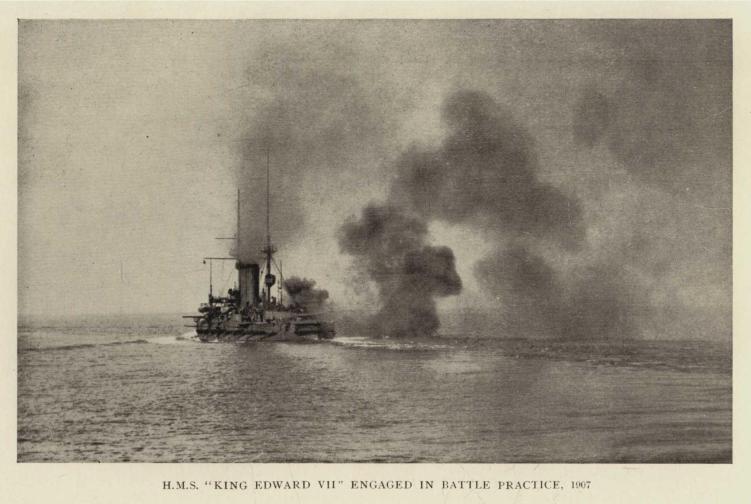
H.M.S. "KING EDWARD VII" ENGAGED IN BATTLE PRACTICE, 1907
The members of the Staff were: chief of staff, Captain
Frederick C. D. Sturdee, succeeded by Captain Montague
E. Browning; flag-commander, Fawcet Wray; intelligence
officer at the Admiralty, Commander Godfrey Tuke,
succeeded by Captain Arthur R. Hulbert; signal officer,
Lieutenant Charles D. Roper; flag-lieutenant, Herbert
T. G. Gibbs; engineer-captain, Edwin Little: secretary,
Fleet Paymaster John A. Keys; flag-captain, Henry
B. Pelly, M.V.O.; commander, G. H. Baird. The navigating
officer, Commander E. L. Booty, who had been with me in
the Majestic, was the best navigator I have known.
Of the two successive chiefs of staff, Captain (now
Vice-Admiral) Sturdee, and Captain (now Rear-Admiral)
Browning, to whom I owe so much, I desire to express
my appreciation. Their powers of organisation and their
knowledge of what is required for organisation for war are
of a very high degree. Among other officers, all of whom
did service so excellent, I may mention Lieutenant (now
Commander) Roper, who was one of the best signal officers
in the service; Lieutenant Gibbs, a most charming and
loyal companion, who met his death by falling overboard
in the Portland race, and the loss of whose affectionate
friendship I still mourn; and Fleet-Paymaster Keys, who
was with me for more than six years, and to whose brilliant
services I owe so much.
The composition of the Channel Fleet, in April, 1907, was
14 battleships (eight King Edward VII, two Swiftsure, two
Ocean, two Majestic), four armoured cruisers, two
second-class cruisers, and one third-class cruiser attached.
During this period, an extraordinary confusion prevailed
at the Admiralty. Its character may be briefly indicated by
a summary of the various changes in the organisation and
distribution of the Fleet, beginning in the previous year
(1906).
In October, the sea-going Fleets were reduced in strength
by about one-quarter, and a new Home Fleet was formed of
nucleus crew ships. The Channel Fleet was reduced from
sixty-two fighting vessels to twenty-one fighting vessels, the
balance being transferred to the Home Fleet. An order was
issued under which ships taken from the Channel, Atlantic
and Mediterranean Fleets for purposes of refitting, were to be
replaced during their absence by ships from the Home Fleet.
In December, the Nore Division of the Home Fleet was
given full crews instead of nucleus crews.
In April, 1907, an order was issued that no more than
two battleships in each Fleet were to be refitted at one time.
In September, the Channel Fleet was increased from
twenty-one vessels to sixty vessels.
In August, 1908, the orders substituting Home Fleet
ships for ships from sea-going fleets under repair, and
ordaining that no more than two battleships should be
absent at one time, were cancelled; with the result that the
Channel Fleet went to sea in the following December short
of eight battleships, two armoured cruisers, one unarmoured
cruiser, one scout, and 20 destroyers, 32 vessels in all.
When the Home Fleet was finally constituted, in March,
1907, there were no less than three commanders-in-chief in
Home Waters; one commanding the Home Fleet, one the
Nore Division, and one (myself) the Channel Fleet. In time
of war the supreme command was to be exercised by me,
over the whole number of fighting vessels, 244 in all. But
in time of peace they could not be trained or exercised
together, nor had any one of the commanders-in-chief
accurate information at any given moment of the state or
disposition of the forces of any other commander-in-chief.
Such, briefly presented, was the situation with which I
was confronted in this my last command. It was fraught
with difficulties so complex, and potential dangers to the
security of the country so palpable, that many of my friends
urged me to resign my command in the public interest. I
decided, however, that I should best serve His Majesty the
King, the Navy and the country by remaining at my post.
In the summer of 1907, the Channel Fleet proceeded
upon a United Kingdom cruise, touching at various places
round the coasts of these islands. When the Fleet was at
sea, individual ships were sent away upon short cruises, in
order to give the captains opportunities of exercising
independent command. When the Fleet was at anchor, the
ships were open to the public from half-past one to half-past
six daily, in order to increase their knowledge and encourage
their interest in the Royal Navy.
It was during one of these cruises that the Irishmen in
the Fleet displayed one of their national characteristics.
The anniversary of Saint Patrick's Day was drawing near
when the Fleet lay in Bantry Bay. On Saint Patrick's Day
itself the Fleet was to proceed to sea. Hitherto, as a rule,
if the Irishmen in the Fleet happened to be on leave on Saint
Patrick's Day, many of them broke their leave. When I
made a signal, giving the Irishmen four days' leave, and
ordering them to return on board on Saint Patrick's Day, I
added that the commander-in-chief, himself an Irishman,
expected every Irishman to be back to his leave. There
were 766 Irish liberty-men went on shore for four days; and
766 were on board again ere the Fleet sailed on the night
of Saint Patrick's Day. It might be that the Saint could
mention the thing in conversation with Saint Peter at the
Gate, for future reference. For there were some 2000 Irishmen
in the Fleet, who, when the Fleet lay at Portland, could
not, like the Englishmen, visit their homes once a month.
And when it is considered how hospitable and convivial they
become on the anniversary of their patron Saint, I shall be
understood when I say that the behaviour on this occasion
of the Irishmen in the Fleet affords a remarkable instance
of the Irish sense of honour. There are no other people so
easily handled, if the right way be taken with them.
The Fleet assembled at Spithead in November, 1907, to
receive his Majesty the Emperor of Germany; and in the
following May, the Fleet assembled at Dover to receive
President Fallières.
In the summer of 1908, the Fleet proceeded upon a cruise
in Norwegian waters. Their Majesties the King and Queen
of Norway, with the little Crown Prince Olaf, honoured the
flagship with a visit when the Fleet lay at Esbjerg. At
Skagen, on the evening of 7th July, when the Fleet was
lying at anchor, the Hohenzollern, flying the flag of his
Majesty the Emperor of Germany, was suddenly sighted,
together with the escorting cruiser Stettin and the destroyer
Sleipner. By the time his Imperial Majesty had reached
the lines, the ships were manned and dressed over all. A
salute of twenty-one guns was fired; and the Hohenzollern
was cheered as she steamed down the lines.
During my absence in Norwegian waters, I was the
subject of a violent attack in the Press and elsewhere, due
to a misapprehension. I recall the circumstance, because I
am proud to remember that it was an Irishman, and he a
political opponent, who, alone among all the members of
the House of Commons, stood up and protested against an
attack being made upon a brother Irishman when he was
absent and unable to reply.
Their Majesties King Edward and Queen Alexandra
visited the Channel Fleet on 7th August, 1908, in the
Victoria and Albert, accompanied by the Prince of Wales
in the Alexandra. His Majesty honoured the King Edward
VII and the Hibernia, second flag, with a visit. The
flag-officers of the Fleet had the honour of lunching with their
Majesties on board the Victoria and Albert.
Upon one of the Fleet cruises in the north, the flagship
was passing under the Forth Bridge, when a spar caught on
a girder of the bridge and carried away. Ere it could fall,
Flag-Lieutenant Gibbs, with his customary presence of mind
and pluck, threw me upon the deck, and himself on the top
of me, to save me from the falling spar. Luckily, it touched
neither of us.
There being no provision against mines dropped in time
of war, it was suggested by me that the North Sea trawlers
should be enlisted to sweep for mines; because they were
accustomed to the difficult work of towing and handling a
trawl. The proposal was afterwards adopted.
In March, 1909, the Admiralty, in addition to other
changes, having suddenly reduced the length of ships'
commissions from three years to two years, I was ordered to haul
down my flag and come on shore.
Accordingly, my flag was hauled down at Portsmouth on
Wednesday, 24th March, 1909, after fifty years' service.
I cannot close this chronicle without expressing my
profound appreciation of the loyalty and affection shown
to me by my brother officers and by the men of the Royal
Navy. Few events in my life have touched me more deeply
than the presence of so many of my old shipmates among
the crowds which assembled upon Portsmouth Hard when
I came on shore after hauling down my flag, and which filled
Waterloo Station and its approaches when I arrived in
London. Nor can I omit to record my sense of the kind
and generous reception given to me by my brother officers,
who attended, in numbers that constituted a record, the
dinner, over which I presided, given by the Royal Navy
Club of 1765 and 1785, on the anniversary of the battle of
Trafalgar next ensuing after my coming on shore.
It was a satisfaction to me when I came on shore, and
it is a satisfaction to me now, to think that I pulled my
pound in the Navy.
Doubtless, like other men of action, I have made mistakes.
But I may justly claim that I have always held one purpose
with a single mind: to do my best for the good of the Service
and for the welfare of the officers and men of the Royal
Navy; and in following that purpose, I have tried to
disregard consequences which might affect my own fortunes,
and which, in fact, have often proved injurious to them.
And to the purpose which I have followed since I was a
boy, I shall devote the rest of my life.
One of our greatest naval administrators, the late
Admiral of the Fleet Sir Frederick Richards, was
constantly preoccupied with a problem, of which
he used often to speak. "How are we to make great
admirals?" he would say. It is a question of the highest
moment. A great admiral may be born, but he must also
be made. The making of an admiral has been the study of
the best minds in the Navy for generations. And for this
reason: In time of war, all must depend on one man, and
that man the admiral in command. Upon his knowledge,
ability and resolution will rest the fate of the country and of
the Empire. That simple fact is not generally realised by
the public. They do not understand that in time of war the
statesman, the diplomatist, the politician must all give place
to one man, the admiral in command at sea.
Every decade of naval officers has added something to
the knowledge of what must go to the making of a great
sea-officer. The establishment of the War College, the
institution of the War Staff at the Admiralty, the private
studies of individual naval officers, the practice of holding
manoeuvres: all these things are valuable endeavours
toward the same end. It remains, however (I believe), the
fact that there exists no treatise on the ordinary
administrative duties to be fulfilled by an admiral.
During many years I had the habit of making notes
concerning all matters connected with the administration of
a Fleet. These notes I hope to arrange and to publish. In
the meantime, I have ventured to think that the contribution
of some observations dealing with the administrative duties
of an admiral in command, embodying the results of many
years' experience at sea, might be of use.
There is no position in the world requiring more tact
than that of a commander-in-chief of a large Fleet. It is
only by the exercise of consummate tact that a Fleet can be
maintained in the most rigid state of discipline and, at the
same time, cheery, happy and smart. Therefore it is that a
knowledge of human nature is essential to the admiral.
Two admirals may do the same thing or may give the
same order; one is perfectly successful, the other is not.
One knows HOW to give an order, the other does not.
Success depends not only on what is done, but on the
way in which it is done. Cheerful obedience to an order
depends, not on the order but, on the way the order is
given. In handling men, much depends on what is said, but
much more depends upon the way in which it is said.
The art of successful administration of men consists in
the prevention of accident, misdemeanour, or regrettable
incidents. It does not consist in putting things right after
the unpleasant event has occurred. Nearly all slackness and
untoward incidents are preventable by the exercise of
forethought, common sense and good organisation. Most of the
matters that go wrong, causing irritation and fault-finding
on the part of the admiral, are often due to the failure to
look ahead of the admiral himself.
When a Fleet proceeds to sea, the cruisers are often to
be observed sobbing and sighing at full speed, trying to get
into the position ordered, after the Fleet has left the harbour,
when, by the use of a little judgment, they might have been
sent out previously, and so have got on the correct line of
bearing at slow speed, without any trouble.
The usual method in life is to let a mistake occur, and
then to put it right afterwards. It is upon this point that
the world forms most unfair opinions. The man who keeps
things right seldom gets any credit. It is the man who puts
things right who gets it. The history of war affords many
examples of this tendency.
A commander-in-chief who, by his organisation and by
his appreciation of facts and positions, wins an action with
small loss, often gets little credit. On the other hand, an
officer who makes some blunder by which he loses a number
of officers and men, but who eventually wins his action, is
made a popular hero. In other words, the man with the
blind pluck of a bulldog gets more credit than the man who,
by his strategy and tactical ability, wins a more or less
bloodless victory.
An admiral should remember that in peace or war he
can satisfactorily administer his Fleet only through the
loyalty and zeal of his captains. Frequent personal
interviews promote confidence; and such confidence must be of
benefit to the admiral. He need not take his captains'
views, but he will gain a great deal of useful information
from officers who are just as keen to make the Fleet as
perfect as possible as he is himself.
Admirals should not publicly identify themselves with
their own flagships in the same way as a captain may
identify himself with his ship. To the admiral ALL ships
should be the same, and private ships should feel that the
admiral takes quite as much interest in their well-being and
their whole life as he does in his own flagship. The admiral
should therefore avoid, even in private conversation, speaking
of "my commander," "our launch," etc. etc. A flagship,
her officers and men, have many advantages. In return
for these privileges, a flagship should make every effort to be
a pattern of smartness and efficiency; and the admiral must
be constantly on the alert lest he show partiality or favour to
his flagship. Nothing makes more jealousy in a Fleet than
a belief that the flagship is favoured at the expense of the rest
of the Fleet, either in routine duty or in any other respect.
Flagships must have many privileges, but they should not
be increased. For instance, her boats should take precedence
in drawing beef or stores; but in all matters
connected with competitive drills, carrying out station
orders, etc. etc., all ships must be equal in the admiral's
eye and mind.
An admiral should continually go on board the ships of
the Fleet, talk to the captains, and obtain their ideas and
recommendations on various subjects.
The best plan is to notify a ship a day or two
beforehand that the commander-in-chief is coming on board on
Sunday at the time most convenient to the captain; and to
follow the captain's usual routine for Sunday inspection.
This method gives the captain an opportunity of bringing to
the admiral's notice any officer or man who has in any way
distinguished himself. It strengthens the captain's hands,
and has a good effect upon the Fleet. It lets the men see
their admiral; while the admiral can remark the state of the
ship and run all his Fleet up to the smartest ship.
It is wiser to administer a Fleet by commendation than
by condemnation. If commendation is given for good and
smart actions, condemnation for bad, slackness becomes far
more severely condemned, and no sympathy for it is aroused.
Any smart action performed by an officer or man should
be appreciated publicly by signal. This is complimentary
to the officer or man and to the ship in which he is serving
at the time. Every one is grateful for appreciation.
The old style in the Navy was never to commend anything
that was well done; to do well was considered to be
no more than a man's duty. On the other hand, anything
that was badly done led to severe reprimands.
When a good officer or man knows that the admiral
appreciates his work, it cheers the Fleet and raises its whole
tone. It is right to be severe on those who do their work
lazily or badly; but it is quite as necessary to appreciate
those who do their work well.
An admiral should continually inspect some of the
various departments of the ships under his command. By
personal observation he is certain to find out something
which would not come to his notice in any other way, and he
may therefore prevent things from going wrong in their
initial stages.
The admiral should invariably inspect anything that may
have gone wrong in any of the ships under his command,
owing to accident, carelessness, or misadventure: such as a
derrick, cable, or capstan carrying away, or any defect in the
engine or boiler rooms. He should then talk over the
method of repair with the captain and the departmental
officers. This procedure often saves time and trouble, as the
admiral gives directions for the accident to be repaired in
the way he desires from the first, thereby obviating the
necessity of altering the plans afterwards. It also encourages
those who are going to execute the work.
The admiral should let the captains know that they can
come on board the flagship and consult him at any time
they like, day or night, and that he will always be glad to
see them.
Captains should always come to see, or write to, the
admiral on any matter which they wish to be settled, no
matter how trivial it may appear. They should not go to
the secretary; for, if they do, it puts the secretary in
a false position, and may cause mistakes and wrong
conceptions.
Captains may go to the chief of the staff upon minor
questions; but it is, as a rule, better for them to go straight
to the admiral.
The consideration of captains, expressed by the words,
"I don't think I will bother the admiral about this question,"
is understood, but should be regarded as mistaken. It is the
admiral's business to be bothered.
The admiral should be considerate and courteous to all
those under his command, remembering that there are two
sides to every question.
When the admiral personally inquires into any case,
with the object of fixing responsibility upon an individual,
he should be suave in his manner, even if condemnation is
given. He should endeavour to send a man away wearing a
smile rather than a scowl.
The admiral should remember this maxim particularly
when he feels irritated at seeing something done which
appears careless, or opposed to the orders laid down. He
should always maintain an unruffled demeanour, and be
perfectly calm and collected under all circumstances. To
fail in this respect is to confuse both himself and those
under his command: a condition which cannot add to that
smartness and coolness so necessary when a difficulty or an
accident occurs in the Fleet.
The management of a ship or a Fleet is full of irritation
and worries. These can only be decreased by officers
remaining calm and collected.
All men are liable to make mistakes. The best men
often make the most glaring mistakes. A smart man acting
under a mistake will move his ship to starboard or to port
quicker than a slow man, and his mistake will therefore
appear the greater.
An admiral should never make a signal to one of the
captains (unless he happens to have a very bad and slack
captain), implying that the captain could have done much
better than he did. Captains, as a rule, wish to obey loyally
and thoroughly. Mistakes are not intentional.
If a signal is executed in a manner contrary to the
intention of the admiral, either it is an ambiguous signal, or
it has been misunderstood. Unforeseen contingencies of
this kind are certain to happen in war. Practices in peace
illustrate what such contingencies may be, and develop the
necessary measures to prevent them.
A very common method of pointing out mistakes is to
signal what was ordered and what should have happened,
omitting to state what was actually done. But all these
points should be inserted in the signal.
Officers or men should never be allowed to state what
might, could, or should have been done. The point at issue
is what WAS or what IS. Much valuable time is lost in
explaining the circumstances on the theory of what might,
could, or should have been done.
Before finding fault by signal, the admiral should ask the
captain in question how a mistake occurred. By so doing
it can be seen whether it is necessary to find fault or not.
If the explanation is satisfactory the captain should be so
informed.
Much unnecessary irritation and bad feeling caused by
sudden and drastic signals may thus be avoided.
The admiral will often find that the mistake was a
natural mistake, which he himself might have made had he
been in the captain's place. When captains know that the
admiral is scrupulously fair, they become devoted to him.
An admiral should always be most careful that he is
right himself before finding fault with those under him. If
he should afterwards find that his contention was wrong,
or that there was a misunderstanding, the admiral should
invariably acknowledge his mistake. This action commands
respect and is only chivalrous and seamanlike.
When an admiral has satisfied himself that anything, no
matter how small, is not carried out according to orders, he
should call attention to it by signal (as a rule, by a general
signal), and by thus pointing out the mistake to the Fleet, he
prevents the same error from occurring again.
In such matters as clothes not properly stopped on, boats
and booms not square, etc., an admiral should inquire who
is responsible. If men are not standing to attention when
the colours are hoisted, he should ask for the name of the
officer of the watch. If a boat is improperly handled under
sail or oars, he should ask for the name of the officer or
coxswain of the boat.
The admiral's staff should always inform him of such
matters as boats pulling badly, or not being run up to the
davit head, men not standing properly to attention, or not
doubling to obey all orders of the pipe, etc. The effect of a
signal calling attention to these matters is lost if it is made
some time after the event.
There should always be an officer responsible for every
duty on board a man-of-war, and the admiral should always
make on these occasions the signal, "Indicate name of
officer responsible."
The admiral should always make sure, when finding
fault with a ship, that his flagship is absolutely correct as
regards the particular detail in question. If this is not the
case he should call his flagship's attention to it at the same
time.
Admirals and captains are often heard saying, "Look
at the way they are doing so and so," referring to boat
pulling or to the way a rope is handled, or a boat hoisted,
quite forgetting that it is the fault of the admiral or captain
that the duties are done badly or are not carried out according
to their satisfaction. The admiral is responsible for the
whole administration, smartness and efficiency of his Fleet;
the captains are responsible for the whole administration,
smartness and efficiency of their ships. In the Royal Navy,
officers and men are loyal to the core, and everything that is
done badly is due to the senior officer of the Fleet or of the
ship not giving his orders clearly, and not showing
beforehand what he wants done, and how it is to be done.
The admiral should never give an order relative to
routine or administration without seeing that it is obeyed.
Many orders given in a memorandum or circular are
forgotten after the first few weeks or months, and so they
lapse.
An officer should be told off to summarise and report
that such orders have been carried out during the preceding
week.
It is of no use for the admiral to give orders and
directions unless he sees that they are actually carried out
in the manner he intended.
If the admiral is not careful that all orders of his own
and of the Admiralty are punctually obeyed, he will find
that some captains accurately carry out the order and some
do not. This irregularity causes discontent in some ships
and slackness in others, disturbing that harmony which
should prevail in a fleet. A "happy-go-lucky" method
breeds irritation.
If papers are ordered to be sent in, or drills are ordered
to be carried out, or if any matter connected with the Fleet
is ordered to be undertaken at some future date, the admiral
should always make a signal or reminder some days before the
date. The argument that a man "ought to know and ought
not to forget" does not prevent irritation if he does forget.
If an officer or man is slack, he should always be found
fault with; it distresses the good officers and men to see that
a slack individual gets along as well as those that are smart.
If the admiral observes anything incorrect relative to
individuals in a ship's company, such as dress, etc., he
should inquire whether the irregularity is common to the
ship, and have this irregularity corrected right through the
ship. Failing this method, he may be often finding fault on
the same point, instead of having the whole matter put right
by one signal or memorandum.
The admiral should often look over his own station
orders to remind himself of the orders he has issued.
An admiral should, if possible, always send written
messages to officers, in order to avoid constantly sending for
officers. He should always date the messages. This maxim
applies to the admiral's flagship as well as to other ships.
Sending messages verbally may cause great irritation,
and may be prejudicial to discipline, for two distinct
reasons:—
(i) The messenger may give the message in terms
which are very irritating. Every one on the bridge
hears the message delivered.
(ii) Human nature being what it is, the admiral,
like other people, may be in a state of irritation,
more particularly if he wants a thing done quickly
or if he thinks that things are not being done well.
He is not so likely to blurt out some rough and
irritating expression if he writes the message or order.
In addition, it is neither good for discipline nor congenial
to that respect which is shown to officers, if the signalman
or others hear a rough message delivered to the chief of
the staff, captain, or other officers.
The admiral should always let the Fleet under his
command know beforehand the time which he intends to
carry out practices, or to anchor or to weigh the Fleet. This
rule particularly applies to the hours set apart for meals.
Disturbance in the middle of meals causes needless irritation,
and work never goes well in a man-of-war or anywhere else
under irritation.
Admirals should as far as is possible let the officers and
men of the Fleet know the dates of arrivals and departures
from ports, so that all should be in a position to
communicate with their friends and to arrange their private
affairs conveniently.
If the admiral intends to be afloat with his flag flying
very near the dinner-hour, or at any time that station orders
annul guards and bands, he should signal "Annul Guards
and Bands." Without such signal some ships are certain
to turn them up while others will not do so, causing
confusion.
When the admiral is inspecting a division of men, all
ratings should take off their caps. The admiral should
first inspect the chief petty officers and petty officers, and
when he has done these ratings should be ordered to put
on their caps. By so doing, the fact is emphasised that
the petty officer's position in the ship is superior, and that
the admiral recognises it to be so.
The admiral should see the sick in hospital constantly.
His visit cheers the men, and shows them that the admiral
knows that they are sick, and that he sympathises with them.
There have been many cases where the interest shown by the
admiral in a man who is dangerously ill has so cheered the
patient that he has taken a turn for the better and has
ultimately recovered.
If a serious accident occurs on board any ship, either at
drill or in the execution of other duty whereby officers or
men are killed or wounded, the admiral should inform the
whole Fleet with regret, giving the names of officers and men.
This procedure is respectful to those under his command who
are killed or wounded in the execution of their duty. They
have suffered or died for their country just as much as though
killed or wounded in action with the enemy. The admiral
should personally go and see the wounded daily, if possible.
An admiral should let his officers know that he expects
everything on board the ships to be shipshape, that is to say,
kept in such condition and order as befits one of His
Majesty's ships of war.
The admiral should always give as much leave as possible,
having regard to the exigencies of the service and of duty.
A free gangway for special leave men should be kept at all
possible places, so that one watch can always go ashore daily
if they are so minded.
Trouble with regard to breaking leave and drunkenness is
generally brought about by want of discretion on the part of
the commanding officer in giving leave. Keeping men on
board for long periods, and then letting them go ashore with
a great deal of money, involves the temptation to some to
break leave, and to others to drink more than is good for
them.
A free gangway is thoroughly appreciated by the men.
The fact that they can go ashore if they like often conduces
to their health and comfort, and does not provoke that
irritation caused by the knowledge that leave cannot be given.
A man who breaks his leave, and so allows other
men to do his work, should be placed in a "Break Leave
Party," and given any extra jobs of work that may require
execution, in order to make up for the time he has lost.
Men in the "Break Leave Party" should be mustered every
two hours from 8 a.m. to 8 p.m. at the discretion of the
captain, according to the number of hours they have allowed
other men to do their work.
This mustering should continue on a scale of two days for
every hour of absence, but a total of fourteen days should not
be exceeded.
The foregoing arrangement should not be considered as
punishment, but as making up the time lost to the State by
the men's absence from their duties, which left other men
to do their work, and should therefore not be entered in the
daily record.
A general leave man who persistently breaks his leave
should be put in the limited leave list, and the time and place
at which he should be allowed ashore should be entirely
at the discretion of the captain, and if possible he should not
be allowed ashore when the rest of the ship's company are
on leave.
When a notorious leave-breaker goes on leave, it is well
to send ashore a description, upon which are noted the hour
and the date upon which he should again be aboard his ship.
By this means he is often recovered before he has broken
his leave for any length of time.
First-class petty officers should always be given leave
when chief petty officers get leave. The former are generally
far older men, and have had longer experience in the Service
than most chief petty officers.
Badge-men and "men who have never broken their
leave in the ship" should be given leave whenever possible.
Plenty of liberty reduces break-leave to a minimum, and also
reduces inebriety to a marked extent.
Attention to the points of administration enumerated
above will go far to create in the Fleet, not only comfort
and happiness but, that constant readiness for emergency
which is the result of a high state of discipline.
  Abd-el-Al, 171
  Abd-el-Hamid, 282, 287
  Abu Klea, battle of, 257-68
  A.D.C. to Prince of Wales, appointed, 157
      to Queen Victoria, appointed, 412
  Adeane, Commander, 77
  Admiral, the making of, 556-67
  Admiralty affronted, 142
      confusion at, 550
      documents stolen, 348
      and Lord Charles' Soudan service, 312
      Lord Charles appointed Junior Lord of, 344
      reprimanded by, 150
      resignation of Lord Charles, 353
  Afterguard, 13
  Aground, Tribune, 61
  Ahmed Arabi, 171. See Arabi Pasha Mahomet, 211
  Albania, strange adventure in, 515
  Alexandria, action at, 187
      attack on Lord Charles at, 185
      fortifications at, 187
      issue of proclamation, 193
      operations outside, 201-6
      police work at, 191-5
      refugees from, 186
      riot in, 178
      squadron at, 186
      troops assisting at, 195
      visit to, 371
      water supply failing, 181
  Algeçiras Conference, 514
  Ali Fehmi, 170
  Alison, General Sir A., 198
  American flag incident, 58
  Ammunition, discoveries of, outside Alexandria, 203
      Reserve, inadequacy of, 370
  Animals on board ship, 66
  Arab courage, 265
      lad shot, 197
  Arabi Pasha, 171
      dismissed, 181
      condemned, 184
  Armament, secondary, essential, 147
  Arms, defective, 267
  Army, inclined to join, 8
  Arrow, the affair of the lorcha, 3
  Assouan, Lord Charles at, 225
  Atlantic Fleet created, 496
  Australia, voyage to, in Galatea, 75
  Australian Squadron, suggested command of, 469


  Bab-el-Kebir, 223, 228
  Bahadur, Sir Jung, 164
  Balfour, Mr., and need for War Staff, 480
  Bare feet, 16
  Baring, Sir Evelyn, 215, 216
  Bayford School, 5
  Bear, fight with a, 540
  Bell, Mr. Moberly, 187
  Benbow, Mr., 300, 303
      commended, 307
  Benicia, 69
  Bentham, Deputy-Inspector-General, 513
  Beresford, Admiral Sir John Poo, xxv
      Commissioner John, xviii
      Lord William, 160
      Lord Marcus and the sharpers, 531
      Marshal, xix
  Bimbashi (camel), 222, 236, 238
  Bismarck, a talk with, 362
  Black Prince, 42
  Blasphemy, 18
  Boa constrictor killed, 167
  Boar, encounter with, 79, 168
  Boardman, Captain, commands naval contingent in Soudan, 222
  appreciation of work of, 223, 329
  Boat-pulling. See also Gazelle; 7, 207, 497-507
  Boat-race, women's, 29
  Boat-races, 28, 152, 207, 497-507
  Boat-sailing, 504
  Boiler of Safieh repaired, 300, 303
  Boiler plates, 252
  Bombay, burning of, 146
  Bordein, s., 283, 292, 293, 294
  Bounty Mutiny, 86
  Bowles, Admiral William, 6
  Boxers, famous, 69
  Boyd-Carpenter's (Dr.) remarkable story, 154
  Brabazon's, Colonel, account of attack on convoy, 321
  Bradford, Major, 162
  Brandreth, Commander Thomas, 12
  "Break-up of China," 426
  Bright-work discouraged, 120
  Britannia training ship, 6, 9
      officers of, 7
  Brothers, Lord Charles Beresford's, vii
  Browne, Major-General Sam, 162
  Bull, incident of, 290
  Bulldog, Lord Charles, 146
  Buller, Sir Redvers, 221, 222, 225, 229, 252, 317, 318
  Bulwark, flag hoisted in, 508
  Burnaby, Colonel, 256, 259
      death of, 264
  Butt, Isaac, 131, 342


  Cable, hemp and chain, 12
  Cadet, Naval, appointed, 11
  Cadets, training of, 6
  Cæsar, flag hoisted in, 493
  Calcutta, visit to, 103
  Camel Corps equipment, 237
      incident, 225
      race, 236
  Camels. See Bimbashi
      invented saddle for, 237
      repairing with oakum, 328
      shortage of, 278
      sufferings of, 255
  Cameron, Mr., 207, 270
  Cannibal, talk with, 80
  Canton, bombardment of, 4
  Cape Town, visit to, 186
  Captain, disaster to, 49
  Carysfort, 209
  Casualties of Desert Column, 279
  Cawnpore Memorial, Prince's visit to, 168
  Certificate, signing of, 5
  Ceylon, climate of, 104
  Changes in Channel, Nore, and Home Fleets, 552
      in shipbuilding, 48
      proposed, 396
  Channel Fleet, in command of, 485, 550
      reductions and changes, 551
      Royal visit to, 554
  Channel Squadron (1863), 42
  Chaplain, influence of, 19
  Chatham Dockyard, appointment at, 393
      terminates, 400
  Chefoo, 447
  Chicago, 398
  Chicago, Lord Charles at, 459
  China, inspection of armies in, 440-44
      Lord Charles sails for, 424
      summary of reforms advocated, 451
  Chinese Army, scheme of reorganisation, 437
      commercial integrity, 102
  Ching, Prince, 435
  Cholera at Calcutta, 103
  Churchill, Lord Randolph, resignation of, 352
  Clifton, Captain, 116
  Clio, 48, 51
  Clippers, famous opium, 117
  Coal in Vancouver, discovery of, 60
  Cockfighting at Manila, 102
  Cockroaches, racing, 52
  Coffer-dam, 492
  Coincidence, 103, 160
  Columns. See Desert, and Nile
  Colvin, Mr. Auckland, 172
  Command, first independent, 120
  Commendations, special, 70, 198, 206, 235
  Compensation to Alexandrians, 199
  Condor, action of, at Alexandria, 187
      appointed to, 156, 186
      gives up command of, 206
      signal to, 189
  Constituencies, invitations from, 398, 415
  Convicts at Perth, 75
  Convoy, attack on, 320
  Coode, Captain Trevenen P., 65
  Cordite, danger of heat, 465
  Corfu, 32
  Correspondent, newspaper, troublesome, 198
      desire to act as, 207
      shot, 275
  Council of Defence, 398, 414
  Courage of Arabs, 265
  Court-martial, trial by, 367
  Crete, insurrection in, 427-31
  Cruisers, deficiency of, 144
  Crutchley, General, 278
  Curraghmore, description of, viii-xii
  Custance, Admiral Sir R. N., 550


  Dacres, Rear-Admiral Sydney C., 12
  Dal Cataract, Lord Charles at, 243
  Dawson, Lieutenant Douglas, 291
  Daymen, 14
  Decapitation in Japan, 101
  Defence, 41
  Defence, Council of. See Council
  Delaval, Lord, death of, 548
  Delavals, the, xvi
  Democracy and war, 494, 495
  Denman, Rear-Admiral the Hon. J., 65
  Desert Column, 220, 246, 247, 248
      casualties, 279
      composition of, 253
      in disorder, 272
      march back to Korti, 324
      Sir R. Buller's dispatch re, 319
      zeriba, 275
  Desertions at San Francisco, 69
  Diaz, visit to President, 550
  Discipline, 14, 142
      reform of, 17
  Discomforts of the Old Navy, 19
      of Nile steamer, 224
      of the Nile, 242
  Disgrace, in, 26
  Disraeli, memories of, 139
      on the party system, 139
  Dockyard appointment, 393
  Dowell, Rear-Admiral Wm., 505, 506
  Doyle, Sir Hastings, 153
  Dress, the sailor's, 19
  Drunkenness, 17, 31
  Dufferin, Lord, 374
  Dunsmuir, Mr., 60
  Duties, various, of a ship's crew, 13


  Earle, General, killed, 319
  East Marylebone, elected for, 336
  Eden, Captain Charles, 5, 34
  Edinburgh, Duke of, attempt to assassinate, 73
      visit to Japan of, 100
  Edward, King. See King
  Egyptian War, beginning of trouble, 170
  Election incidents, 336, 337
  Elephant hunting, 164, 536-8
      in Galatea, 109
  Elephants, regiment of, 167
  El-Teb, 216
  Emma, Queen, 57
  Empress Dowager, 420
  Engine, repairing, 226
  Essays by officers, 466, 468
  Estimate of naval needs, 358
  Estimates, signing the, 356. See Navy
  Etiquette, naval, 1
  Eurydice training frigate, 6
      capsizing of, 154
      remarkable story re, 155
  Examination for Navy, 6
  Excellent, 71
  Execution of murderer, 54
  Experience in routine work, etc., necessity of, 146
  Explosion of gun-cotton, 204
      of shell from Condor, 208
      on Thunderer, 148


  Falkland Islands, 53
  Family history. See History
      home. See Curraghmore memorials, ix
  Farm, model, 399
  Fayrer, Surgeon-General, 163
  Fersaat, 224
  Fight at Malta, 31
      over boat-race, 29
  Fisher, Captain John, 190
      Sir John, improvements in Mediterranean fleet, 467
  Fishing incidents, 544-7
  Fit, keeping, 107
  Fitzgerald, Admiral Penrose, 49, 54, 505
  Flag rank, earlier promotion to, advocated, 404, 483
  Flogging abolished, 17
      question of, 144
  Forecastlemen, 13
  Foretopmen, 13
  Forging of cheques, 75, 83
  Freemason, made a, 108
  French, Sir John, 280


  Galatea, 73
      diversion, 108
      in Japan, 100
  Gardner gun, 252, 276, 300, 308
      jamming of, 263
  Gardner, Miss, engagement to, 154
  Gascoigne, Captain, 302, 304, 306
  Gazelle, 7
  Gemai, 229
  Germany's, Emperor of, visit to Gibraltar, 493
      visit to Skagen, 554
  Gibbs, Flag-Lieutenant, 551, 554
  Gibraltar, 370
      Emperor of Germany visits, 493
  Gillford, Captain, 60
  Gladstone, Mr. W. E., 33
      and compensation to Alexandrians, 199
  Glanville, John, 11, 28
  Gleichen, Count, 237, 248, 277
  Gordon, General, 214, 215
      urgent messages from, 216, 217, 219, 234, 250
      letters from, 282
      steamers sent by, 283
      death of, 291
  Goschen, Mr., conversation with, 359
  Goshawk, 120
  Graham, Major-General Sir G., 215, 216, 332
      Sir James, 9
  Grenfell, Vice-Admiral Sir H., 515
  Gubat, Desert Column at, 278
  Gun-cotton, explosion of, 204
  Gun explosion on Thunderer, 148
  Gunners, 13
  Gunnery, British and American, 67
      in the Marlborough, 20
      on China station, 466
  Gun Reserve, inadequacy of, 370


  Hall's, Captain W. H., recommendations, 361
  Hamilton, Lord George, on Lord Charles' resignation, 354
      Sir R. Vesey, 404
  Hammill, Commander, 221, 226
  Hannibal rams Prince George, 400
  Hara-kiri, 91
  Harris, Captain Robert, 6, 7, 10
      Sir Augustus, 399
  Hartington, Lord, telegram from, 317
  Haulage of boats on Nile. See Whaleboats, and Steamers
  Hawsers, wire, first used, 154
  Heaton, Mr. Henniker, 417
      Lieutenant W. H., 8
  Hecla, torpedo school, 369
  Hercules, 49
  Hibernia, 33
  Hicks Pasha and staff, 213
  Hildyard, General Sir H., 8
  History of family, xii-xxii
  Hohenzollern, 545
  Home Fleet, 552
      of family. See Curraghmore
  Hornby's, Admiral Phipps, views on, Cabinet and Sea Lords, 355
  Horse-racing and riding, 518-34
  Horses, runaway, 76
      saving, 206
  Hot springs in New Zealand, 79
  Howe, salving of, 395
  Humour, Irish, 72
  Hunting, 71, 520, 522-5
  Hurricane (Pampero) at Buenos Aires, 70
      at Port Mercy, 56
      at Vancouver, 68


  Idlers, 14
  Illumination of Marlborough, 33
  Illustrious training ship, 6, 9
  Imperial Defence, committee of, 481
      Naval Defence, 408
  Improvements, value of minor, 365
  Incidents, amusing, 5, 28, 47, 104, 108,
      113, 114, 115, 116, 117, 118,
      119, 133, 135, 136, 151, 153,
      163, 164, 169, 196, 198, 199,
      202, 223, 224, 225, 227, 230,
      290, 316, 329, 334, 336, 343,
      366, 371, 373, 392, 394, 415,
      416, 445, 470-7, 489, 511, 516,
      517, 519, 522, 523, 527, 528,
      529, 530, 532, 533
  India, visit of Prince to, 157
  Ingram, Mr., 286
  Instructions to Admirals in Egypt, 177
  Intelligence Department. See Naval
  Intervention, European, in Egypt, 175
  Ionian Islands, 32
  Ireland, rent question in, 128
      royal residence in, advocated, 412
      visit of Duke and Duchess of York, 413
  Irish characteristics, 136
  Irishman, a frenzied, 197
  Irishmen in United States, 458
  Irishmen's honour, 553
  Irish politics (1872), 129, 342
  Ismailia, journey to, 200
  Ito, Marquess, interviews with, 449


  Jackson, Mr. John, 386
  Jakdul, 249
      arrival of Desert Column, 255
  Japan, in, 100, 455
      Old, 90
  Jokes, practical, 28, 30, 56, 71, 113, 115
  Jones, "Ninepin," 23
  José Salvatro, 236, 244


  Kang Yu Wei, flight of, 432
  Kanwah Island, 77
  Keppel, Hon. Sir Henry, 111
      Lieutenant Colin, 300, 303, 306
  Kerry election (1872), 128
  Khartoum, fall of, 291
      in danger, 213, 217, 221
      steamers start for, 287
      Sir Charles Wilson's voyage to, 292
  Khashm-el-Mus, 285
  Khedive, appointment to staff of, 206
      message of congratulation from, 326
      in danger, 190
      of Egypt. See Tewfik
  Kiao-Chao, 423, 447, 448
  Kinder, Mr., 447
  Kingcome, Admiral, 64
  King Edward visits Bulwark, 514
  King Edward, H.M.S., hoists flag in, 550
  Kitchener, Major, 256, 334
  Korti, 219
      Lord Charles' journey to, 245
      Naval Brigade arrives at, 252
  Kuang Hsu, Emperor, 420, 422
  Kukri, 167


  Land question in Ireland, 130
  Leave, question of, 486, 566
  Lesseps, M. de, protest of, 102
  Lewis, Mr. George, 22
  Li Hung Chang, 445
  Line, crossing the, 53
  Loan, demand for, 338
      Twenty-one million, 360
  London Chamber of Commerce, address before, 386
      banquet to Lord Charles, 462
  Lytton, Lord, 159


  Machine guns, 331
  M'Neill's zeriba engagement, 332
  Magellan, Straits of, first ironclads to pass through, 66
  Magnificent, building of, 393
  Mahan, Admiral, 376, 398
  Mahdi, death of, 333
  Mahdi's skull, 329
  Mahmoud Sami Pasha, 171
  Maintopmen, 13
  Majestic, 485
  Malta, precautions against, 512
      incidents at, 30
  Malwa rammed, 208
  Maniac, troubled by, 236
  Manila, visit to, 102
  Manning of ships, 12
  Manoeuvres, lectures on, 375
  Maoris, 80
  Marabout Fort, 187, 188, 189
  Marconi wireless telegraphy, 414
  Marlborough, 11
      outbreak of fire, 14
  Marriage, 151
  Martin, Sir Wm. Fanshawe, 12
      and reform of discipline, 17
  Massacre of foreigners in Egypt, 176
  Masts out of proportion, 32
  Mate, rank of, abolished, 32
  Mauritius, arrival at, 104
  May, Surgeon-General A. W., 296, 307
  Medals received, 44
  Mediterranean, appointed second in command, 462
      appointed to command, 508
      Fleet, improvements in, 467
      Fleet deficiencies, 463, 509
      haul down flag, 469
  Melita, 380
  Memorandum on Organisation for War, 346
  Memorials, family, ix
  Memories of the Sea, 49, 54
  Merchant ships and signalling, 382
  Mercy, Port, 56
  Mernat, 294, 296
  Metemmeh, attack on, 281
  Mexico, visit to, 548
  Mex lines, keeping the, 201
  Middleton, Captain R. W., 21
  Midwife, acting as, 186
  Mikado, visit to, 100
  Military instruction in schools, 482
  Mine-dropping experiments, 369
  Mines, trawlers to sweep for, 554
  Mizentopmen, 13
  Montagu's, the Hon. V., Reminiscences of Sir H. Keppel, 111
  Montgomerie, Lieutenant R. A. J., 315
  Morant, Rear-Admiral, 393
  Morley, Lord, and the Mahdi's skull incident, 329
  Motor-car race, 468
  Mullet, a huge red, 153
  Mustard, a bottle of, 323


  Nanking, Lord Charles' visit to, 450
  Nares, Lieutenant George S., 7
  Nautilus submarine, 350
  Naval Brigade in Soudan, 220
      casualties, 267
      endurance of, 328
      under Lord Charles, 243, 252
  Naval Defence Act, 385, 389, 397
      Intelligence Department (Commercial Branch), 482
          formed, 347
          need for, 345
          salaries reduced, 353
      Works Bill, 406
  Navigation in Marlborough, 21
  Navy Estimates, signing the, 357
      of 1888 challenged, 357
  Navy, 1859, numbers and description, 2
      League founded, 397
      Lord Charles enters the, 2
      the New, 48
      the Old, 34
  Nelson and his Times, 414
  Nepal, Prince in, 164
  Newchang, 447
  Newspaper correspondent. See Correspondent
  New York, Lord Charles at, 460
  Nile Column, 220, 250, 319
  Nineteenth Century, article in, 404
  Noel, Commander Gerard (Memorandum on Training), 143
  Noel's, Captain, feat of seamanship, 376
      Admiral, action in Crete, 427
  Northbrook's, Lord, declaration re Navy, 341
  North Sea incident, 494
  Norwegian waters, cruise in, 554
  Nucleus crew system, 465
  Nuggar, wreck of Captain Gascoigne's, 306
  Nuggars (native boats on Nile), 227, 228


  Officers' pay inadequate, 407
  Oil fuel, 483
  Olden, Quartermaster, saves raiding party, 316
  Omdurman, report of fall of, 271
  "Open Door" policy, 425
  Operations, delicate, 317
  Organisation for War, 344
      plans in Mediterranean Fleet, 511
  Orhwalder, Father, letter of, 311
  Orontes, 159
  Osborne, 159
      Royal Yacht, appointed to, 151
      boat-racing, 152
  Osman Digna, 214
  Ottley's, Lieutenant, invention of mines, 369


  Pampero, 70
  Parkes, Sir Harry, attack on, 97
  Parliament (1874), 140
  Parnell, Mr., 141
  Party system, views on, 138, 139
  Pay of officers inadequate, 407
  Pekin, arrival at, 434
  Personnel, deficiency in, 397, 403
  Petty officer rating, 366
  Phillimore, Captain Augustus, 41
  Physique, Lord Charles', viii
  Pieter Both mountain, 104
      ascent of, 105
  Pig, riding a, 528
  Piggott, Captain C. R., 265, 267
  Police, appointed Chief of, 191
  Political events (1873-80), 122
  Politics in Ireland (1872), 128
  Polo-playing, first, in England, 525
  Portage of boats. See Whaleboats
  Portraits, family, x
  Prince George, accident to, 490
  Prisons, Inspector of, 76
  Probyn, Major-General, 161
  Proclamation, issue of, 193, 289
  Promoted, 27, 64, 73, 110, 146, 169, 414
  Promotion dinner, 169
      of officers, question of, 144
      to flag rank earlier advocated, 40, 404, 483
  Provisions, sending, to officers at front, 207
  Prussia, Prince Henry of, 448
  Punishments, 17


  Raleigh, 159
      wreck of, 112
  "Ram," proposal to abolish the, 396
  Ramillies, hoists flag in, 462
  Ranches in Mexico, 549
  Rating, alteration in, 365
  Rations, meagre, 18, 52
  Rent question in Ireland, 129
  Reed, Sir Edward, 50
  Rees, First Lieutenant W. S., 364
  Reform of discipline, 17
      of prison rules, 76
      party in China, views of, 434
  Reforms advocated in House of Commons, 143
      in China advocated, summary of, 451
  Reis threatened, 296
  Repairs, ability to execute, 392, 493
      new system in Mediterranean, 512
  Requirements of the time, 405
  Research, 71
  Resignation from Board of Admiralty, 353
  Review of 1897, 409
  Richards, Sir Frederick, 389, 478
  Riot in Alexandria, 178
  River Column. See Nile
  Roberts, Lieutenant, 2
  Rojdesvenski, Admiral, 494
  Ross, Mr. John, great assistance given by, 195
      appreciation of Lord Charles Beresford, 180
  Routine of work on the Nile, 233, 241
  Royal Commission on Administration of the Navy and Army, 355
      Family's interest in Navy, 153
      Irish Regiment's fine march, 317
      Marines, 13
          heroism of, 147
  Royle, Hon. Charles, 172
  Russell, Dr. Wm. Howard, 158, 163
  Russian Baltic fleet incident, 494


  Safieh, s., 283, 290, 291, 295, 314
      boiler injured, 298, 303
      raiding expeditions in, 314, 316
  Sail-drill in Marlborough, 21
  Sailing feats, 62
  Sail-making, 62, 71
  Saint Paul's Cathedral, Dean of, and Leighton Memorial, 410
  Salisbury, Lord, on policy in Egypt, 179
      and Lord Charles' Memorandum, 347
  Sandwich Islands, 57
  San Francisco, 69, 458
  Sanspareil, 375
  Saving life, 43, 44
  Scarborough, Channel Fleet visits, 489
  School, Bayford, 5
  Schoolfellows, 5
  Schooner in distress, 57
  Scott, Captain Percy, 466
  Scrapes, getting into, 26, 27, 28, 43, 45, 47, 59, 64
  Scurvy, 55, 68
  Seamanship, 7
      feat of, 42, 376
      in the Tribune, 62
  Seignelay, salving of, 378
  Serapis, 158
  Servants, two faithful, 82
  Service in Soudan not credited to Lord Charles, 312
  Seymour's, Admiral Sir E. H., book, 149, 159, 395
  Shanghai, Lord Charles at, 449
  Sharks, 546
  Shendi, 247, 285
  Shipbuilding programme required, 338, 387
      transition from wood to iron, 48
  Ship's personality, 51
  Ships, weakness of, 368
  Shooting incidents, 535-43
  Shouting on deck, 16
  Signalling incident at Alexandria, 205
      value of knowledge of, 374
      with merchant ships, 382
  Signalmen, new drill for, 466
  Smart, Rear-Admiral R., 41
  Souakim-Berber route, 216
      Expedition, 332
  Soudan War of 1884, summary of, 211
      preparations, 217
      withdrawal of troops from, 333
  Southwell, Lord, 117
  Spearing fish, 70
  Spencer programme, 388
  Sport in India, 103
      in Japan, 101
  Sporting incident, 77, 79
  Springs, hot, in New Zealand, 79
  Squadron at Alexandria, details of, 186
  Stealing stores, 43
  Steam, prejudice against, 20, 49
  Steam Reserve, appointed Captain of, 393
  Steamers on Nile, haulage of, 228
      sent by General Gordon, 283, 284
  Stephenson, Admiral Sir H. F., 209
  Stewart, Captain W. H., 12
      Colonel, murder of, 226
      Sir H., arrives at Korti, 252
          wounded, 275
          death of, 326
  "Still" bugle-call, introduction of, 16
  Sting-ray, a huge, 153
  Stores, destruction of, 323
  Stuart-Wortley, Lieutenant, 256
      brings news of disaster, 291
      voyage of, 294
  Submarine, an early, 68
      Nautilus, 350
  Submarines purchased, 464
  Suez Canal, purchase of shares, 158
  Suffield, Lord, 533
  Suite of Prince of Wales, 157, 161
  Surf-playing, 88
  Surgical operation, 162
  Sutherland, Duke of, 164
  Sutlej, 64, 74


  Tahiti, 87
  Talakawiyeh, s., 283, 285 292, 294
  Talbot, Colonel the Hon. R., 268
      march with wounded, 320
  Tamaai, 216
  Tarpon fishing, 545
  Tattooing, 101
  Telegram, delayed, 244
  Tel-el-Kebir, victory of, 183, 207
  Telephone, early working model of, 150
  Téméraire, ashore at Alexandria, 188
      feat of seamanship, 376
  Temperance, an address on, 511
  Teneriffe, flags at, 47
  Terrible, 466
  Tewfikiyeh, s., 283
  Tewfik Pasha, 170, 171
  Thompson, Colonel R. M., 460, 488
  Three Admirals, the report of, 362
  "Three Brothers'" race, 520
  Thunderer, appointed to, 146
  Tientsin, Lord Charles at, 446
      Treaty of. See Treaty
  Tokio, Lord Charles at, 456
  Tombs, family, ix
  Torpedo, the Whitehead, 141
  Trafalgar Centenary celebration at Malta, 513
  Training, new system advocated, 143
      of Cadets, 6, 7
          (Sir James Graham), 9
  Training ship Britannia, 6
      Illustrious, 6
  Treaty of Tientsin, 4
  Tribune, 61
  Trincomalee, visit to, 104
  Troopship service, 159
  Tryon, Captain, 159
      Sir George, 371
  Tsung-li Yamen, visit to, 435
  Turkish battleships, purchase of, 145
  Turnpike incident, 113
  Turtle, accident to, 53
  Two-Power standard, 360


  Undaunted, appointed to command, 364
      as prize-winner, 372
      high compliments paid to, 382
  Undaunted, salves Seignelay, 378
      touches a rock, 372
  Uniform, lack of rules regarding, 8
  United States, third visit to, 484
      Squadron, visit of, 488
  Unpreparedness for war, 338


  Valparaiso, 56
      bombardment of, 66
  Vancouver, 59
  Vesuvius, ascent of, 476
  Victoria, Queen, and change of officers, 152
      commended by, 329
      congratulated by, 206
  Victoria and Albert, Royal yacht, boat-racing, 152
  Villiers, Mr. Frederic, 187
  Voting in Parliament, independent, 138
  Voyageurs, 230, 241
      accidents to, 235


  Wad Habeshi, 296
      effect of fight at, 309
  Wadi Halfa, 219, 223, 225
  Wales, Prince of, appointed A.D.C. to, 157
      at dinner to Lord Charles, 169
      visit to Portsmouth Dockyard, 152
      visit to India, 157
  War plans in Mediterranean Fleet, 511
  Warrant-officers, 13
  Warrior, 42
  War Staff, constituted, 397
      need of, 478
  Washington, Lord Charles at, 460
  Watch, keeping, 52
  Watch-bills, 12
  Waterfall, shooting the, 88
  Waterford, elected for, 130
      lose seat, 156
      members of Parliament, 141
  Waterford, Lord, death of, 2, 400
  Watertight compartments, 396
  Wauchope, Major-General A. G., 8
  Weakness in new steel ships, 368
  Wei-hai-Wei, 447
  Whaleboats on the Nile, 221, 223, 227,
          229, 230, 231, 233, 235, 241
      portage, 231
  White, Sir William, 351
  Whitehead torpedo, 141
  Wilkinson's, Mr. Spenser, "Command of the Sea" articles, 397
  Wilson, Captain, 375
      John Crawford, 146
  Wilson, Vice-Admiral Sir A. K., 485
  Wilson's, Sir Charles, book, 253
      report of Abu Idea fight, 268
      voyage lo Khartoum, 292
  Wingate's, Sir F. R., letter to Lord Wolseley, 309
  Wolseley, Sir Garnet, appreciation of
      his campaign in Egypt, 207
      appointed Commander-in-Chief, Soudan, 218
      appointed to staff of, 221
      arrival at Ismailia, 182
      and staff at Cairo, 221
  Wolseley, Sir G., at Wadi Halfa, 234
  Woolwich, M.P. for, 478
  Wyllie, Mr. W. L., 399
  Wyndham's Land Act, 342


  Yokohama, arrival at, 100
  York election, 415
      resigns seat at, 462
  Yuan Shih Kai, 421, 440
  Yung Lu, a talk with, 438


  Zeriba of Desert Column, 275
  Zohrab Pasha, 225
Printed by
MORRISON & GIBB LIMITED
Edinburgh