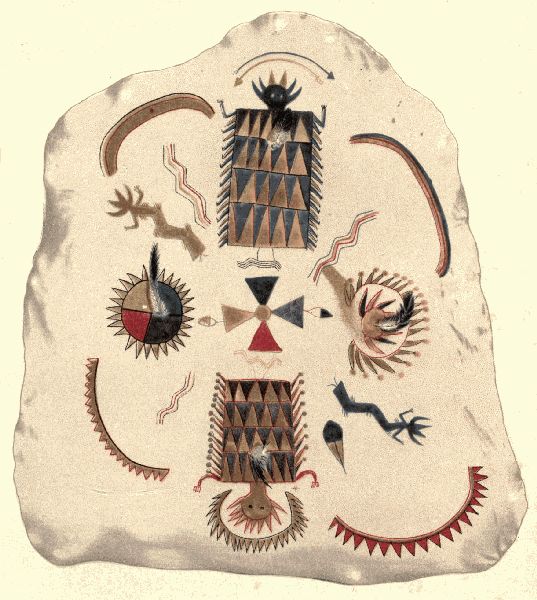
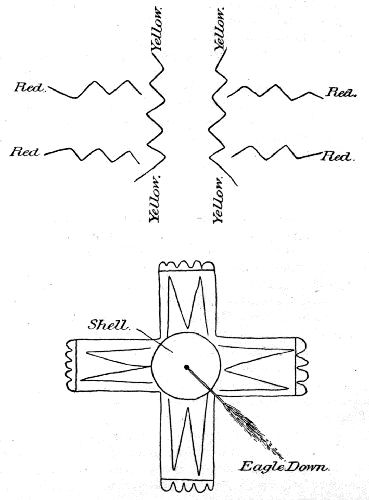
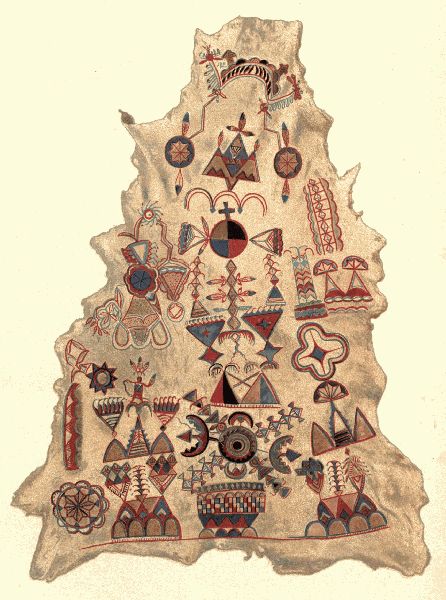
"Trifles not infrequently lead to important results. In every walk of
science a trifle disregarded by incurious thousands has repaid the
inquisitiveness of a single observer with unhoped-for
knowledge."[247]
The taciturnity of the Apache in regard to all that concerns their
religious ideas is a very marked feature of their character; probably no
tribe with which our people have come in contact has succeeded more
thoroughly in preserving from profane inquiry a complete knowledge
of matters relating to their beliefs and ceremonials. How much of this
ignorance is to be attributed to interpreters upon whom reliance has
necessarily been placed, and how much to the indisposition of the
Apache to reveal anything concerning himself, it would be fruitless to
inquire, but, in my own experience, when I first went among them in
New Mexico and Arizona twenty-three years ago, I was foolish enough
to depend greatly upon the Mexican captives who had lived among
the Apache since boyhood, and who might be supposed to know exactly
what explanation to give of every ceremony in which the Apache might
engage. Nearly every one of these captives, or escaped captives, had
married among the Apache, and had raised families of half-breed
children, and several of them had become more Apache than the Apache
themselves. Yet I was time and again assured by several of these interpreters
that the Apache had no religion, and even after I had made
some progress in my investigations, at every turn I was met by the
most contradictory statements, due to the interpreter's desire to inject
his own views and not to give a frank exposition of those submitted by
the Apache. Thus, an Apache god would be transmuted into either a
"santo" or a "diablo," according to the personal bias of the Mexican
who happened to be assisting me. "Assanutlije" assumed the disguise
of "Maria Santissima," while ceremonies especially sacred and beneficent
in the eyes of the savages were stigmatized as "brujeria" and
"hechiceria" (witchcraft) in open defiance of the fact that the Apache
have as much horror and dread of witches as the more enlightened of
their brethren who in past ages suffered from their machinations in
Europe and America. The interpreters had no intention to deceive;
they were simply unable to disengage themselves from their own prejudices
and their own ignorance; they could not, and they would not,
credit the existence of any such thing as
religion, save and excepting that taught
them at their mothers' knees in the petty
hamlets of Sonora and of which they still
preserved hazy and distorted recollections.
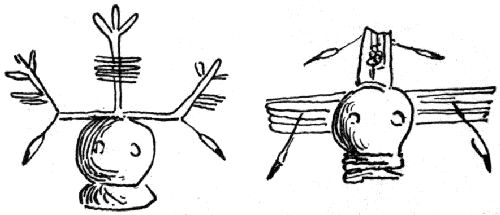
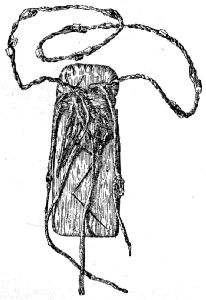
One of the first things to be noticed
among the Apache, in this connection,
was the very general appearance of little
bags of buckskin, sometimes ornamented,
sometimes plain, which were ordinarily
attached to the belts of the warriors, and
of which they seemed to be especially
careful.[248]
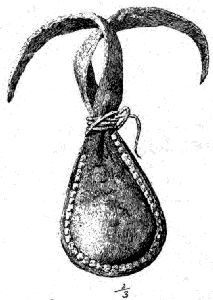 Fig.
433.—Bag containing hoddentin.
Fig.
433.—Bag containing hoddentin.
What follows in this chapter was not
learned in an hour or a day, but after a
long course of examination and a comparison
of statements extracted from different
authorities.
The bags spoken of revealed when opened a quantity of yellow colored
flour or powder, resembling cornmeal, to which the Apache gave the
name of "hoddentin," or "hadntin," the meaning of which word is "the
powder or pollen of the tule," a variety of the cat-tail rush, growing in
all the little ponds and cienegas of the Southwest.
I made it the touchstone of friendship that every scout or other
Apache who wished for a favor at my hands should relate something
concerning his religious belief. I did not care much what topic he selected;
it might be myths, clan laws, war customs, medicine—anything
he pleased, but it had to be something and it had to be accurate.
Hoddentin having first attracted my attention, I very naturally made
many of my first inquiries about it, and, while neglecting no opportunity
for independent observation, drew about me the most responsible men
and women, heard what each had to say, carefully compared and contrasted
it with the statements of the others, and now give the result.
I noticed that in the dances for the benefit of the sick the medicine-men
in the intervals between chants applied this yellow powder to the
forehead of the patient, then in form of a cross upon his breast, then in
a circle around his couch, then upon the heads of the chanters and of
sympathizing friends, and lastly upon their own heads and into their
own mouths. There is a considerable difference in method, as medicine-men
allow themselves great latitude, or a large "personal equation,"
in all their dealings with the supernatural. No Apache would,
if it could be avoided, go on the warpath without a bag of this precious
powder somewhere upon his person, generally, as I have said, attached
to his ammunition belt. Whenever one was wounded, hurt, or taken
sick while on a scout, the medicine-man of the party would walk in
front of the horse or mule ridden by the patient and scatter at intervals
little pinches of hoddentin, that his path might be made easier. As
was said to me: "When we Apache go on the warpath, hunt, or plant,
we always throw a pinch of hoddentin to the sun, saying 'with the
favor of the sun, or permission of the sun, I am going out to fight,
hunt, or plant,' as the case may be, 'and I want the sun to help me.'"
I have noticed that the Apache, when worn out with marching, put
a pinch of hoddentin on their tongues as a restorative.
"Hoddentin is eaten by sick people as a
remedy."[249]
"Before starting out on the warpath, they take a pinch of hoddentin,
throw it to the sun, and also put a pinch on their tongues and one on
the crown of the head.... When they return, they hold a
dance, and on the morning of that day throw pinches of hoddentin to
the rising sun, and then to the east, south, west, and north, to the four
winds."[250]
I am unable to assert that hoddentin is used in any way at the
birth of a child; but I know that as late as 1886 there was not a babe
upon the San Carlos reservation, no matter how tender its age, that did
not have a small bag of hoddentin attached to its neck or dangling
from its cradle. Neither can I assert anything about its use at time of
marriage, because, among the Apache, marriage is by purchase, and
attended with little, if any, ceremony. But when an Apache girl attains
the age of puberty, among other ceremonies performed upon her,
they throw hoddentin to the sun and strew it about her and drop on
her head flour of the piñon, which flour is called by the Chiricahua
Apache "nostchi," and by the Sierra Blanca Apache
"opé."[251]
"Upon attaining the age of puberty, girls fast one whole day, pray,
and throw hoddentin to the
sun."[252]
When an Apache dies, if a medicine-man
be near, hoddentin is sprinkled upon the corpse. The Apache
buried in the clefts of rocks, but the Apache-Mohave cremated. "Before
lighting the fire the medicine-men of the Apache-Mohave put hoddentin
on the dead person's breast in the form of a cross, on the forehead,
shoulders, and scattered a little
about."[253]
The very first thing an Apache does in the morning is to blow a little
pinch of hoddentin to the dawn. The Apache worship both dawn
and darkness, as well as the sun, moon, and several of the planets.
"When the sun rises we cast a pinch of hoddentin toward him, and
we do the same thing to the moon, but not to the stars, saying 'Gun-ju-le,
chigo-na-ay, si-chi-zi, gun-ju-le, inzayu, ijanale,' meaning 'Be good,
O Sun, be good.' 'Dawn, long time let me live'; or, 'Don't let me die
for a long time,' and at night, 'Gun-ju-le, chil-jilt, si-chi-zi, gun-ju-le,
inzayu, ijanale,' meaning 'Be good, O Night; Twilight, be good; do not
let me die.'" "In going on a hunt an Apache throws hoddentin and
says 'Gun-ju-le, chigo-na-ay, cha-ut-si, ping, kladitza,' meaning 'Be
good, O Sun, make me succeed deer to
kill.'"[254]
The name of the full moon in the Apache language is "klego-na-ay,"
but the crescent moon is called "tzontzose" and hoddentin is always
offered to it.[255]
"Hoddentin is thrown to the sun, moon (at times), the morning star,
and occasionally to the wagon."[256]
"The Apache offer much hoddentin
to 'Na-u-kuzze,' the Great
Bear."[257]
"Our custom is to throw a very
small pinch of hoddentin at dawn to the rising
sun."[258]
"The women of
the Chiricahua throw no hoddentin to the moon, but pray to it, saying:
'Gun-ju-le, klego-na-ay,' (be good, O
Moon)."[259]
When the Apache plant corn the medicine-men bury eagle-plume
sticks in the fields, scatter hoddentin, and sing. When the corn is
partially grown they scatter pinches of hoddentin over
it.[260]
The "eagle-plume sticks" mentioned in the preceding paragraph suggests
the "ke-thawn" mentioned by Matthews in "The Mountain
Chant."[261]
"When a person is very sick the Apache make a great fire, place the
patient near it, and dance in a circle around him and the fire, at the
same time singing and sprinkling him with hoddentin in the form of a
cross on head, breast, arms, and
legs."[262]
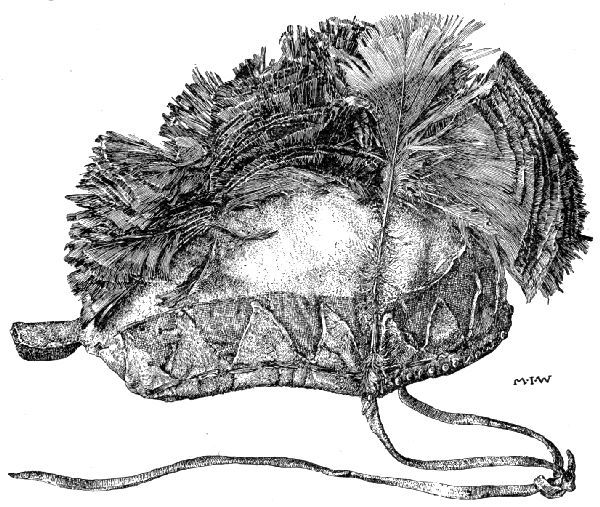
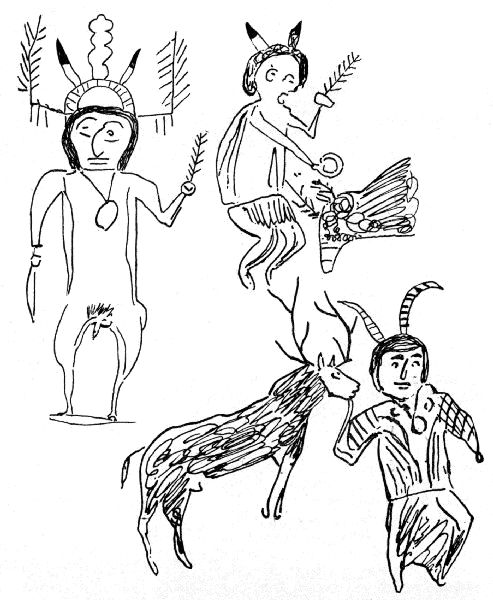
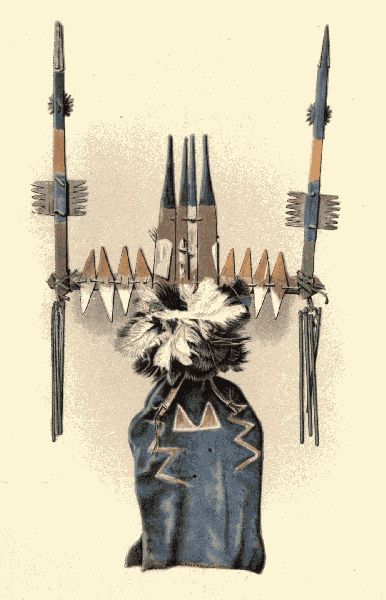
In November, 1885, while at the San Carlos agency, I had an interview
with Nantadotash, an old blind medicine-man of the Akañe or
Willow gens, who had with him a very valuable medicine-hat which he
refused to sell, and only with great reluctance permitted me to touch.
Taking advantage of his infirmity, I soon had a picture drawn in my
notebook, and the text added giving the symbolism of all the ornamentation
attached. Upon discovering this, the old man became much
excited, and insisted upon putting a pinch of hoddentin upon the drawing,
and then recited a prayer, which I afterwards succeeded in getting
verbatim. After the prayer was finished, the old man arose and
marked with hoddentin the breast of his wife, of Moses, of Antonio,
of other Apache present, and then of myself, putting a large pinch
over my heart and upon each shoulder, and then placed the rest upon
his own tongue. He explained that I had taken the "life" out of his
medicine hat, and, notwithstanding the powers of his medicine, returned
in less than a month with a demand for $30 as damages. His hat
never was the same after I drew it. My suggestion that the application
of a little soap might wash away the clots of grease, soot, and
earth adhering to the hat, and restore its pristine efficacy were received
with the scorn due to the sneers of the scoffer.
"In time of much lightning, the Apache throw hoddentin and say:
'Gun-ju-le, ittindi,' be good,
Lightning."[263]
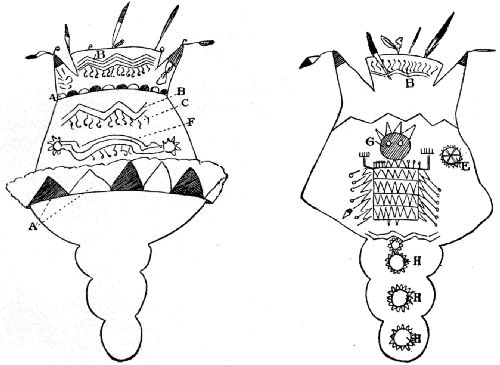 Fig. 434.—Nan-ta-do-tash's medicine hat.
Tzit-jizinde, "the Man who likes Everybody," who said he belonged
to the Inoschujochin—Manzanita or Bearberry clan—showed me how
to pray with hoddentin in time of lightning or storm or danger of any
kind. Taking a small pinch in his fingers, he held it out at arm's
length, standing up, and repeated his prayer, and then blew his breath
hard. I was once with a party of Apache while a comet was visible. I
called their attention to it, but they did not seem to care. On the
other hand, Antonio told me that the "biggest dance" the Apache
ever had was during the time that "the stars all fell out of the sky"
(1833).
"The only act of a religious character which I observed ... was
shortly after crossing the river they [i.e., the American officers] were
met by a small party of the Indians, one of whom chalked a cross on
the breast of each, with a yellow earth, which he carried in a satchel at
his belt. Previous to doing so he muttered some words very solemnly
with his hands uplifted and eyes thrown upwards. Again, on arriving
at the camp of the people, the chief and others in greeting them took
a similar vow, touching thereafter the yellow chalked cross. Sonora
may have furnished them with some of their notions of a
Deity."[264]
"The yellow earth," seen by Dr. Smart was, undoubtedly, hoddentin,
carried in a medicine bag at the belt of a medicine-man. Some years
ago I went out with Al. Seiber and a small party of Apache to examine
three of their "sacred caves" in the Sierra Pinal and Sierra Ancha. No
better opportunity could have been presented for noting what they did.
The very last thing at night they intoned a "medicine" song, and at early
dawn they were up to throw a pinch of hoddentin to the east.
Moses and John, two of the Apache mentioned above, requested permission
to go off in the mountains after deer and bear, supposed to be
plentiful in the higher altitudes. Before leaving camp, Moses blew a
pinch of hoddentin toward the sun, repeating his prayer for success,
and ending it with a sharp, snappy "ek," as if to call attention. In
one of the sacred caves visited on this trip, the Apache medicine-men
assembled for the purpose of holding their snake dance. This I have
never seen among the Apache, but that they celebrate it and that it is
fully the equal of the repulsive rite which I have witnessed and noted
among the Tusayan[265] I am fully assured. I may make reference to some
of its features in the chapter upon animal worship and ophic rites.
From a multiplicity of statements, the following are taken: Concepcion
had seen the snake dance over on the Carrizo, near Camp Apache;
the medicine-men threw hoddentin upon the snakes. He said: "After
getting through with the snake, the medicine-man suffered it to glide
off, covered with the hoddentin, thrown by admiring devotees."
Mike Burns had no remembrance of seeing hoddentin thrown to the
sun. He had seen it thrown to the snake, "in a kind of worship."
Nott and Antonio stated that "when they find that a snake has
wriggled across the trail, especially the trail to be followed by a war
party, they throw hoddentin upon the trail." Nott took a pinch of
hoddentin, showed how to throw it upon the snake, and repeated the
prayer, which I recorded.
Corbusier instances a remedy in use among the Tonto Apache. This
consisted in applying a rattlesnake to the head or other part suffering
from pain. He continues: "After a time the medicine-man rested the
snake on the ground again, and, still retaining his hold of it with his
right hand, put a pinch of yellow pollen into its mouth with his left,
and rubbed some along its
belly."[266]
"He then held his hand out to a man, who took a pinch of the powder
and rubbed it on the crown of a boy's head. Yellow pollen treated in
this manner is a common remedy for headache, and may frequently be
seen on the crowns of the heads of men and
boys."[267]
Hoddentin is used in the same manner as a remedy for headache among
the San Carlos Apache, but the medicine-men apply a snake to the
person of a patient only when their "diagnosis" has satisfied them that
he has been guilty of some unkindness to a snake, such as stepping
upon it, in which case they pretend that they can cure the man by
applying to the part affected the portion of the reptile's body upon
which he trampled.
The Apache state that when their medicine-men go out to catch snakes
for their snake dance, they recite a prayer and lay their left hand, in
which is some hoddentin, at the opening of the snake's den, through
which the reptile must crawl, and, after a short time the snake will
come out and allow himself to be handled.
Hoddentin is also offered to other animals, especially the bear, of
which the Apache, like their congeners the Navajo, stand in great awe
and reverence. When a bear is killed, the dance which is held becomes
frenzied; the skin is donned by all the men, and much hoddentin is
thrown, if it can be obtained. One of these dances which I saw in the
Sierra Madre, Mexico, in 1883, lasted all night, without a moment's
cessation in the singing and prancing of the participants.
A great deal of hoddentin is offered to the "ka-chu" (great or jack
rabbit).[268]
The Apache medicine-man, Nakay-do-klunni, called by the whites
"Bobbydoklinny," exercised great influence over his people at Camp
Apache, in 1881. He boasted of his power to raise the dead, and predicted
that the whites should soon be driven from the land. He also
drilled the savages in a peculiar dance, the like of which had never been
seen among them. The participants, men and women, arranged themselves
in files, facing a common center, like the spokes of a wheel, and
while thus dancing hoddentin was thrown upon them in profusion.
This prophet or "doctor" was killed in the engagement in the Cibicu
canyon, August 30, 1881.
In a description of the "altars" made by the medicine-men of the
Apache-Yuma at or near Camp Verde, Arizona, it is shown that this
sacred powder is freely used. Figures were drawn upon the ground
to represent the deities of the tribe, and the medicine-men dropped on
all, except three of them, a pinch of yellow powder (hoddentin) which
was taken from a small buckskin bag. This powder was put upon the
head, chest, or other part of the body of the patient.
Surgeon Corbusier, U. S.
Army,[269] says that the ceremony just described
was "a most sacred one and entered into for the purpose of averting the
diseases with which the Apache at Camp Verde had been afflicted the
summer previous."
I am not sure that the Apache-Yuma have not borrowed the use of
hoddentin from the Apache. My reason for expressing this opinion is
that I have never seen an Apache without a little bag of hoddentin
when it was possible for him to get it, whereas I have never seen an
Apache-Yuma with it except when he was about to start out on the
warpath. The "altars" referred to by Corbusier are made also by the
Apache, Navajo, Zuñi, and Tusayan. Those of the Apache, as might be
inferred from their nomadic state, were the crudest; those of the Navajo,
Zuñi, and Tusayan display a wonderful degree of artistic excellence.
The altars of the Navajo have been described and illustrated by Dr.
Washington Matthews,[270]
and those of the Tusayan by
myself.[271]
Moses Henderson, wishing me to have a profitable interview with his
father, who was a great snake doctor among the Apache, told me that
when he brought him to see me I should draw two lines across each
other on his right foot, and at their junction place a bead of the chalchihuitl,
the cross to be drawn with hoddentin. The old man would
then tell me all he knew.
The Apache, I learned, at times offer hoddentin to fire, an example
of pyrodulia for which I had been on the lookout, knowing that the
Navajo have fire dances, the Zuñi the Feast of the Little God of Fire,
and the Apache themselves are not ignorant of the fire dance.
Hoddentin seems to be used to strengthen all solemn compacts and
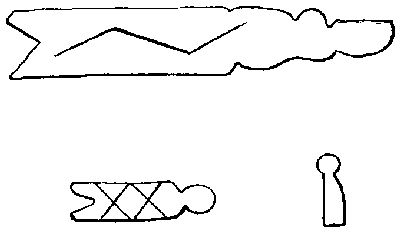
to bind faith. I had great trouble with a very bright medicine-man
named Na-a-cha, who obstinately refused to let me look at the contents
of a phylactery which he constantly wore until I let him know that I, too,
was a medicine-man of eminence. The room in which we had our conversation
was the quarters of the post surgeon, at that time absent on
scout. The chimney piece was loaded with bottles containing all kinds
of drugs and medicines. I remarked carelessly to Na-a-cha that if he
doubted my powers I would gladly burn a hole through his tongue with
a drop of fluid from the vial marked "Acid, nitric," but he concluded
that my word was sufficient, and after the door was locked to secure us
from intrusion he consented to let me open and examine the phylactery
and make a sketch of its contents. To guard against all possible
trouble, he put a pinch of hoddentin on each of my shoulders, on the
crown of my head, and on my chest and back. The same performance
was gone through with in his own case. He explained that hoddentin
was good for men to eat, that it was good medicine for the bear, and
that the bear liked to eat it. I thought that herein might be one clew
to the reason why the Apache used it as a medicine. The bear loves
the tule swamp, from which, in days primeval, he sallied out to attack
the squaws and children gathering the tule powder or tule bulb. Poorly
armed, as they then were, the Apache must have had great trouble in
resisting him; hence they hope to appease him by offering a sacrifice
acceptable to his palate. If acceptable to the chief animal god, as the
bear seems to have been, as he certainly was the most dangerous, then
it would have been also acceptable to the minor deities like the puma,
snake, eagle, etc., and, by an easy transition, to the sun, moon, and
other celestial powers. This opinion did not last long, as will be shown.
From its constant association with all sacrifices and all acts of worship,
hoddentin would naturally become itself sanctified and an object of
worship, just as rattles, drums, standards, holy grails, etc., in different
parts of the world have become fetichistic. I was not in the least
surprised when I heard Moses Henderson reciting a prayer, part of
which ran thus: "Hoddentin eshkin, bi hoddentin ashi" ("Hoddentin
child, you hoddentin I offer"), and to learn that it was a personification
of hoddentin.
The fact that the myths of the Apache relate that Assanut-li-je
spilled hoddentin over the surface of the sky to make the Milky Way
may be looked upon as an inchoate form of a calendar, just as the
Aztecs transferred to their calendar the reed, rabbit, etc.
So constant is the appearance of hoddentin in ceremonies of a religious
nature among the Apache that the expression "hoddentin
schlawn" (plenty of hoddentin) has come to mean that a particular performance
or place is sacred. Yet, strange to say, this sacred pollen of
the tule is gathered without any special ceremony; at least, I noticed
none when I saw it gathered, although I should not fail to record that
at the time of which I speak the Apache and the Apache-Yuma were
returning from an arduous campaign, in which blood had been shed,
and everything they did—the bathing in the sweat lodges and the singing
of the Apache and the plastering of mud upon their heads by the
Apache-Yuma—had a reference to the lustration or purgation necessary
under such circumstances. Not only men but women may gather the
pollen. When the tule is not within reach our cat-tail rush is used.
Thus, the Chiricahua, confined at Fort Pickens, Florida, gathered the
pollen of the cat-tail rush, some of which was given me by one of the
women who gathered it.
Before making an examination into the meaning to be attached to the
use of hoddentin, it is well to determine whether or not such a powder
or anything analogous to it is to be found among the tribes adjacent.
The term "kunque" as it appears in this chapter is one of convenience
only. Each pueblo, or rather each set of pueblos, has its own name in
its own language, as, for example, the people of Laguna and Acoma,
who employ it in all their ceremonies as freely as do the Zuñi, call
it in their tongue "hinawa." In every pueblo which I visited—and
I visited them all, from Oraibi of Tusayan, on the extreme west, to
Picuris, on the extreme east; from Taos, in the far north, to Isleta del
Sur, in Texas—I came upon this kunque, and generally in such quantities
and so openly exposed and so freely used that I was both astonished
and gratified; astonished that after centuries of contact with the
Caucasian the natives should still adhere with such tenacity to the
ideas of a religion supposed to have been extirpated, and gratified to
discover a lever which I could employ in prying into the meaning of
other usages and ceremonials.
Behind the main door in the houses at Santa Clara, San Ildefonso,
Picuris, Laguna, Acoma, San Felipe, Jemez, and other towns, there is a
niche containing a bowl or saucer filled with this sacred meal, of which the
good housewife is careful to throw a pinch to the sun at early dawn and
to the twilight at eventide. In every ceremony among the Pueblos naturally
enough, more particularly among those who have been living farthest
from the Mexicans, the lavish scattering of sacred meal is the marked
feature of the occasion. At the snake dance of the Tusayan, in 1881,
the altars were surrounded with baskets of pottery and with flat
plaques of reeds, which were heaped high with kunque. When the
procession moved out from under the arcade and began to make the
round of the sacred stone the air was white with meal, and in my imagination
I could see that it was a procession of Druids circling about a
"sacred stone" in Ireland previous to the coming of St. Patrick. When
the priests threw the snakes down upon the ground it was within a
circle traced with kunque, and soon the snakes were covered with the
same meal flung upon them by the squaws. There was only one scalp
left among the Tusayan in 1881, but there were several among the Zuñi,
and one or two each at Acoma and Laguna. In every one of these
towns kunque was offered to the scalps.
At the feast of the Little God of Fire among the Zuñi, in 1881, my
personal notes relate that "the moment the head of the procession
touched the knoll upon which the pueblo is built the mass of people
began throwing kunque upon the Little God and those with him as well
as on the ground in front of, beside, and behind them. This kunque
was contained in sacred basket-shaped bowls of earthenware. The
spectators kept the air fairly misty with clouds of the sacred kunque.
This procession passed around the boundaries of the pueblo of Zuñi,
stopping at eight holes in the ground for the purpose of enacting a ceremonial
of consecration suggestive of the 'terminalia' of the Romans.
They visited each of the holes, which were 18 inches deep and 12 inches
square, with a sandstone slab to serve as a cover. Each hole was filled
with kunque and sacrificial plumes. * * * 'Every morning of the year,
when the sky is clear, at the rising of Lucero [the morning star], at the
crowing of the cock, we throw corn flour [kunque] to the sun. I am never
without my bag of kunque; here it is [drawing it from his belt]. Every
Zuñi has one. We offer it to the sun for good rain and good
crops.'"[272]
Subsequently Pedro went on to describe in detail a phallic dance and
ceremony, in which there was a sort of divination. The young maiden
who made the lucky guess was richly rewarded, while her less fortunate
companions were presented with a handful of kunque, which they kept
during the ensuing year. This dance is called "ky'áklu," and is independent
of the great phallic dance occurring in the month of December.
Pedro also stated that until very recently the Zuñi were in the habit of
celebrating a fire dance at Noche Buena (Christmas). There were four
piles of wood gathered for the occasion, and upon each the medicine-men
threw kunque in profusion. This dance, as Pedro described it,
closely resembled one mentioned by Landa in his Cosas de Yucatan.
High up on the vertical face of the precipice of Tâaiyalana there is a
phallic shrine of the Zuñi to which I climbed with Mr. Frank Cushing.
We found that the place had been visited by young brides who were
desirous of becoming mothers. The offerings in every case included
kunque.
In the account given in the National Tribune, Washington, District of
Columbia, May 20, 1886, of the mode of life of the Zuñi woman Wehwa
while in the national capital, and while engaged in the kirmes, we read:
She also strewed sacred corn meal along on her way to the theater to bring good
luck to her and the other dancers. * * * She has gone from her comfortable room
to pray in the street at daylight every morning, whatever the weather has been.
* * * At such times she strews corn meal all around her until the front-door steps
and the sidewalk are much daubed with dough. But this is not the corn meal in
common use in the United States, but is sacred meal ground in Zuñi with sacred
stones.[273]
So long a time has elapsed since any of the Pueblos have been on the
warpath that no man can describe their actual war customs except from
the dramatic ceremonial of their dances or from the stories told him by
the "old men." The following from an eyewitness will therefore be of
interest: "Before the Pueblos reached the heights they were ordered to
scale they halted on the way to receive from their chiefs some medicine
from the medicine bags which each of them carried about his person.
This they rubbed upon their heart, as they said, to make it big and
brave, and they also rubbed it upon other parts of their bodies and
upon their rifles for the same
purpose."[274]
The constant use of kunque by the different Pueblo tribes has been
noticed from the first days of European contact. In the relation of
Don Antonio de Espejo (1583) we are told that upon the approach of
the Spaniards to the town of Zaguato, lying 28 leagues west of Zuñi,
"a great multitude of Indians came forth to meete them, and among the
rest their Caçiques, with so great demonstration of joy and gladnes,
that they cast much meale of Maiz upon the ground for the horses to
tread upon."[275]
I am under the impression that the ruins of this village are those near
the ranch of Mr. Thomas V. Keam, at Keam's Canyon, Arizona, called
by the Navajo "Talla-hogandi," meaning "singing house," in reference
to the Spanish mission which formerly existed there. This village is,
as I have hitherto shown, the ruin of the early pueblo of Awátubi.
In his poem descriptive of the conquest of New Mexico, entitled
"Nueva Mejico," Alcala de Henares, 1610, Villagrá uses the following
language:[276]
Passando à Mohoçe, Zibola, y Zuni,
Por cuias nobles tierras descubrimos,
Una gran tropa de Indios que venia,
Con cantidad harina que esparcian,
Sobre la gente toda muy apriessa,
Y entrando assi en los pueblos las mugeres
Dieron en arrojarnos tantá della,
Que dimos en tomarles los costales,
De donde resultò tener con ellas,
Unas carnestolendas bien reñidas.
It is gratifying to observe that the Spanish writer in the remote wilds
of America struck upon an important fact in ethnology: that the throwing
of "harina" or flour by the people of Tusayan (Mohoçe or Moqui),
Cibola, and Zuñi (observe the odd separation of "Zibola" from either
Moqui or Zuñi) was identical with the "carnestolendas" of Spain, in
which, on Shrove Tuesday, the women and girls cover all the men they
meet with flour. The men are not at all backward in returning the
compliment, and the streets are at times filled with the farinaceous dust.
"Harina de maiz azul" is used by Mexicans in their religious ceremonies,
especially those connected with the water
deities.[277] The Peruvians,
when they bathed and sacrificed to cure themselves of sickness,
"untandose primero con Harina de Maiz, i con otras cosas, con muchas,
i diversas ceremonias, i lo mismo hacen en los
Baños."[278] The kunque of
the Peruvians very closely resembled that of the Zuñi. We read that
it was a compound of different-colored maize ground up with sea
shells.[279]
The Peruvians had a Priapic idol called Hua-can-qui, of which we
read: "On offre à cette idole une corbeille ornée de plumes de diverses
couleurs et remplie d'herbes odoriférantes; on y met aussi de la farine
de maïs que l'on renouvelle tous les mois, et les femmes se lavent la
figure avec celle que l'on ôte, en accompagnant cette ablution de plusieurs
cérémonies superstitieuses."[280]
The tribes seen on the Rio Colorado in 1540 by Alarcon "carry also
certaine little long bagges about an hand broade tyed to their left arme,
which serve them also instead of brasers for their bowes, full of the
powder of a certaine herbe, whereof they make a certaine
beverage."[281]
We are at a loss to know what this powder was, unless hoddentin. The
Indians came down to receive the son of the sun, as Alarcon led them to
believe him to be, in full gala attire, and no doubt neglected nothing
that would add to their safety.
"Ils mirent dans leur bouche du maïs et d'autres semences, et les
lancèrent vers moi en disant que c'était la manière dont ils faisaient les
sacrifices au soleil."[282]
Kohl speaks of seeing inside the medicine wigwam, during the great
medicine ceremonies of the Ojibwa, "a snow-white
powder."[283] In an
address delivered by Dr. W. J. Hoffman before the Anthropological
Society of Washington, D. C., May 2, 1888, upon the symbolism of the
Midēᐟ, Jesᐟsakkid, and Wâbeno of the Ojibwa of Minnesota, he stated
in reply to a question from me that he had not been able to find any of
the "snow-white powder" alluded to by Kohl in
Kitchi-gami.[284]
In Yucatan, when children were baptized, one of the ceremonies
was that the chac, or priest in charge, should give the youngster a
pinch of corn meal, which the boy threw in the fire. These chacs were
priests of the god who presided over baptism and over
hunting.[285]
At the coronation of their kings the Aztecs had a sacred unction,
and a holy water, drawn from a sacred spring, and "about his neck is
tied a small gourd, containing a certain powder, which is esteemed a
strong preservative against disease, sorcery, and
treason."[286]
"At the entrance to one of the narrow defiles of the Cordilleras
... a large mass of rock with small cavities upon its surface, into
which the Indians, when about to enter the pass, generally deposit a
few glass beads, a handful of meal, or some other propitiatory offering to
the 'genius' supposed to preside over the spot and rule the storm."
Again, "on receiving a plate of broth, an Indian, before eating, spills
a little upon the ground; he scatters broadcast a few pinches of the
meal that is given him, and pours out a libation before raising the
wine cup to his lips, as acts of thanksgiving for the blessings he
receives."[287]
When Capt. John Smith was captured by the Pamunkey tribe of Virginia
in 1607 he was taken to "a long house," where, on the morning following
"a great grim fellow" came skipping in, "all painted over with
coale, mingled with oyle. With most strange gestures and passions he
began his invocation, and environed the fire with a circle of meale."
This priest was followed by six others, who "with their rattles began
a song, which ended, the chiefe priest layd downe five wheat cornes."
This ceremony was apparently continued during the day and repeated
on the following two days.[288]
Capt. Smith's reception by the medicine-men
of the Virginians is described by
Picart.[289]
These medicine-men are
called "prêtres," and we are informed that they sang "des chants
magiques." The grains of wheat ("grains de blé") were "rangez cinq
à cinq."
Gomara tells us that in the religious festivals of Nicaragua there
were used certain "taleguillas con polvos," but he does not tell what
these "polvos" were; he only says that when the priests sacrifice themselves
they cured the wounds, "curan las heridas con polvo de herbas
ó carbon."[290]
While the Baron de Graffenreid was a prisoner in the hands of the
Tuscarora, on the Neuse River, in 1711, the conjurer or high priest
("the priests are generally magicians and even conjure up the devil")
"made two white rounds, whether of flour or white sand, I do not
know, just in front of
us."[291]
Lafitau says of one of the medicine-women of America: "Elle commença
d'abord par préparer un espace de terrain qu'elle nétoya bien &
qu'elle couvrit de farine, ou de cendre très-bien bluttée (je ne me souviens
pas exactement laquelle des
deux)."[292]
In a description of the ceremonial connected with the first appearance
of the catamenia in a Navajo squaw, there is no reference to a use
of anything like hoddentin, unless it may be the corn which was ground
into meal for a grand feast, presided over by a
medicine-man.[293]
When a woman is grinding corn or cooking, and frequently when
any of the Navajo, male or female, are eating, a handful of corn meal is
put in the fire as an offering (to the
sun).[294]
The Pueblos of New Mexico are described as offering sacrifices of food
to their idols. "Los Indios del Norte tienan multitud de Idolos, en
pequeños Adoratorios, donde los ponen de
comer."[295]
Maj. Backus, U. S. Army, describes certain ceremonies which he saw
performed by the Navajo at a sacred spring near Fort Defiance, Arizona,
which seems to have once been a geyser:
I once visited it with three other persons and an Indian doctor, who carried with
him five small bags, each containing some vegetable or mineral substance, all differing
in color. At the spring each bag was opened and a small quantity of its contents was
put into the right hand of each person present. Each visitor, in succession, was then
required to kneel down by the spring side, to place his closed hand in the water up
to his elbow, and after a brief interval to open his hand and let fall its contents
into the spring. The hand was then slowly withdrawn and each one was then permitted
to drink and retire.[296]
Columbus in his fourth voyage touched the mainland, going down
near Brazil. He says:
In Cariay and the neighboring country there are great enchanters of a very fearful
character. They would have given the world to prevent my remaining there an hour.
When I arrived they sent me immediately two girls very showily dressed; the eldest
could not be more than eleven years of age and the other seven, and both exhibited
so much immodesty that more could not be expected from public women. They
carried concealed about them a magic
powder.[297]
The expedition of La Salle noticed, among the Indians on the Mississippi,
the Natchez, and others, "todos los dias, que se detuvieren en aquel
Pueblo, ponia la Cacica, encima de la Sepultura de Marle [i.e., a Frenchman
who had been drowned], una Cestilla llena de Espigas de Maíz,
tostado."[298]
"He showed me, as a special favor, that which give him his power—a
bag with some reddish powder in it. He allowed me to handle it and
smell this mysterious stuff, and pointed out two little dolls or images,
which, he said, gave him authority over the souls of others; it was for
their support that flour and water were placed in small birch-rind
saucers in front."[299]
On page 286, narrative of the Jeannette Arctic expedition, Dr. Newcomb
says: "One day, soon after New Year's, I was out walking with one
of the Indians. Noticing the new moon, he stopped, faced it, and,
blowing out his breath, he spoke to it, invoking success in hunting. The
moon, he said, was 'Tyunne,' or ruler of deers, bears, seals, and walrus."
The ceremony herein described I have no doubt was analogous in
every respect to hoddentin-throwing. As the Indians mentioned were
undoubtedly Tinneh, my surmise seems all the more
reasonable.[300]
Tanner relates that among the Ojibwa the two best hunters of the
band had "each a little leather sack of medicine, consisting of certain
roots pounded fine and mixed with red paint, to be applied to the little
images or figures of the animals we wish to
kill."[301]
"In the parish of Walsingham, in Surrey, there is or was a custom
which seems to refer to the rites performed in honor of Pomona. Early
in the spring the boys go round to the several orchards in the parish
and whip the apple trees.... The good woman gives them
some meal."[302]
Among the rustics of Great Britain down to a very recent period
there were in use certain "love powders," the composition of which is
not known, a small quantity of which had to be sprinkled upon the
food of the one beloved.[303]
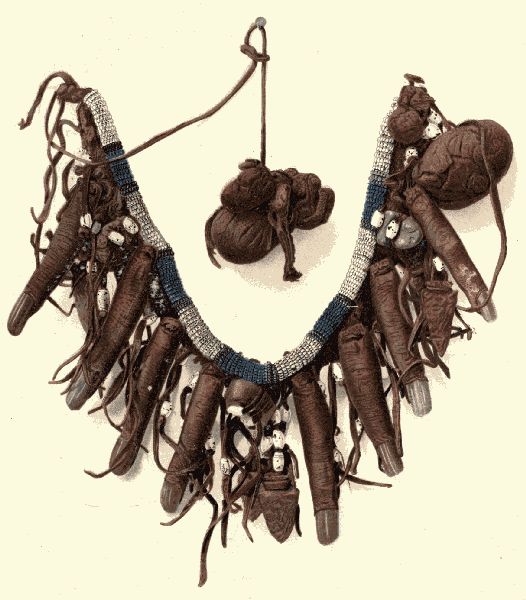
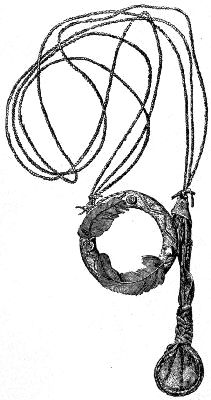
Attached to the necklace of human fingers before described, captured
from one of the chief medicine-men of the Cheyenne Indians, is a
bag containing a powder very closely resembling hoddentin, if not hoddentin
itself.
It is said that the Asinai made sacrifice to the scalps of their enemies,
as did the Zuñi as late as 1881. "Ofrecen á las calaveras pinole
molido y de otras cosas
comestibles."[304]
Perrot says the Indians of Canada had large medicine bags, which
he calls "pindikossan," which, among other things, contained "des
racines ou des poudres pour leur servir de
médecines."[305]
In an article on the myth of Manibozho, by Squier, in American Historical
Magazine Review, 1848, may be found an account of the adventures
of two young heroes, one of whom is transferred to the list of
gods. He commissioned his comrade to bring him offerings of a white
wolf, a polecat, some pounded maize, and eagles' tails.
Laplanders sprinkle cow and calf with
flour.[306]
Cameron met an old chief on the shores of Lake Tanganyika, of whom
he says: "His forehead and hair were daubed with vermilion, yellow,
and white powder, the pollen of
flowers."[307]
In the incantations made by the medicine-men of Africa, near the
head of the Congo, to preserve his expedition from fire, Cameron saw
the sacrifice of a goat and a hen, and among other features a use of
powdered bark closely resembling hoddentin: "Scraping the bark off
the roots and sticks, they placed it in the wooden bowl and reduced it
to powder." The head medicine-man soon after "took up a handful of
the powdered bark and blew some toward the sun and the remainder
in the opposite direction."[308]
The magic powder, called "uganga," used as the great weapon of
divination of the mganga, or medicine-men of some of the African tribes,
as mentioned by Speke,[309]
must be identical with the powder spoken of by
Cameron.
Near the village of Kapéka, Cameron was traveling with a caravan
in which the principal man was a half-breed Portuguese named Alvez.
"On Alvez making his entry he was mobbed by women, who shrieked
and yelled in honor of the event and pelted him with flour." This was
Alvez's own home and all this was a sign of
welcome.[310]
Speke describes a young chief wearing on his forehead "antelope
horns, stuffed with magic powder to keep off the evil
eye."[311]
After describing an idol, in the form of a man, in a small temple on
the Lower Congo, Stanley says: "The people appear to have considerable
faith in a whitewash of cassava meal, with which they had sprinkled
the fences, posts, and lintels of
doors."[312]
"According to Consul Hutchinson (in his interesting work 'Impressions
of Western Africa'), the Botikaimon [a medicine-man], previous to
the ceremony of coronation, retires into a deep cavern, and there, through
the intermediary of a 'rukaruka' (snake demon), consults the demon
Maon. He brings back to the king the message he receives, sprinkles
him with a yellow powder called 'tsheoka,' and puts upon his head the
hat his father wore."[313]
In a note, it is stated that: "Tsheoka is a vegetable
product, obtained, according to Hutchinson, by collecting a creamy
coat that is found on the waters at the mouth of some small rivers,
evaporating the water, and forming a chalky mass of the
residue."[314]
Schultze says[315]
that the Congo negroes "appease the hurricane" by
"casting meal into the air."
The voudoo ceremonies of the negroes of New Orleans, which would
seem to have been transplanted from Africa, include a sprinkling of the
congregation with a meal which has been blessed by the head medicine-man
or conjurer.
At the feast of Huli, at the vernal equinox (our April fool's day), the
Hindu throw a purple powder (abir) upon each other with much sportive
pleasantry. A writer in "Asiatick
Researches"[316]
says they have the
idea of representing the return of spring, which the Romans called
"purple."
During the month of Phalgoonu, there is a festival in honor of Krishna,
when the "Hindus spend the night in singing and dancing and wandering
about the streets besmeared with the dolu (a red) powder, in the
daytime carrying a quantity of the same powder about with them,
which, with much noise and rejoicing, they throw over the different
passengers they may meet in their rambles. Music, dancing, fireworks,
singing, and many obscenities take place on this
occasion."[317]
On pages 434-435 of my work, "Scatalogic Rites of all Nations," are
to be found extracts from various authorities in regard to the Hindu
feast of Holi or Hulica, in which this statement occurs: "Troops of men
and women, wreathed with flowers and drunk with bang, crowd the
streets, carrying sacks full of bright-red vegetable powder. With this
they assail the passers-by, covering them with clouds of dust, which
soon dyes their clothes a startling color."
"Red powder (gulál) is a sign of a bad design of an adulterous character.
During the Holi holidays, the Maháráj throws gulál on the
breasts of female and male
devotees."[318]
"In India, the devotees throw red powder on one another at the festival
of the Huli, or vernal equinox. This red powder, the Hindoos
say, is the imitation of the pollen of plants, the principle of fructification,
the flower of the plant."[319]
The women of the East Indies (Brahmins), on the 18th of January,
celebrate a feast in honor of the goddess Parvati: "Leur but est d'obtenir
une longue vie pour leurs maris, & qu'elles ne deviennent jamais
veuves. Elles font une Image de Parvati avec de la farine de riz & du
grain rouge qu'elles y mêlent; elles l'ornent d'habits & de fleurs & après
l'avoir ainsi servie pendant neuf jours, elles la portent le dixiéme dans
un Palenquin hors de la Ville. Une foule de femmes mariées la suivent,
on la jette ensuite dans un des étangs sacrez, où on la laisse, & chacune
s'en retourne chez elle."[320]
Speaking of the methods in use among the Lamas for curing disease,
Rev. James Gilmour says: "Throwing about small pinches of millet seed
is a usual part of such a
service."[321]
Dr. W. W. Rockhill described to me a Tibetan festival, which includes
a procession of the God of Mercy, in which procession there are
masked priests, holding blacksnake whips in their hands, and carrying
bags of flour which they throw upon the people.
The use of these sacred powders during so many different religious
festivals and ceremonies would seem to resemble closely that made by
the Apache of hoddentin and the employment of kunque by the Zuñi
and others; and from Asia it would seem that practices very similar
in character found their way into Europe. Of the Spanish witches it
is related:
When they entered people's houses they threw a powder on the faces of the inmates,
who were thrown thereby into so deep a slumber that nothing could wake them, until
the witches were gone.... Sometimes they threw these powders on the
fruits of the field and produced hail which destroyed them. On these occasions the
demon accompanied them in the form of a husbandman, and when they threw the
powders they said:
"Polvos, polvos,
Pierda se tado,
Queden los nuestros,
Y abrasense
otros."[322]
Higgins says: "The flour of wheat was the sacrifice offered to the
Χρης or Ceres in the
Εὐχᾰριστία."[323]
What relation these powders have had to the "carnestolendas" of
the Spanish and Portuguese, already alluded to, and the throwing of
"confetti" by the Italians, which is a modification, it would be hard to
say. Some relation would appear to be suggested.
There are some suggestions of a former use of pollen among the
Israelites and Egyptians.
Manna, which we are assured was at one time a source of food to
the Hebrews, was afterward retained as an offering in the temples.
Forlong, however, denies that it ever could have entered into general
consumption. He says:
Manna, as food, is an absurdity, but we have the well-known produce of the desert
oak or ash—Fraxinus.... An omer of this was precious, and in this
quantity, at the spring season, not difficult to get; it was a specially fit tribute to
be "laid up" before any Phallic Jah, as it was the pollen of the tree of Jove and of
Life, and in this sense the tribe lived spiritually on such "spiritual manna" as this
god supplied or was supplied
with.[324]
The detestation in which the bean was held by the high-caste people
of Egypt does not demonstrate that the bean was not an article of food
to a large part of the population, any more than the equal detestation
of the occupation of swineherd would prove that none of the poor
made use of swine's flesh. The priesthood of Egypt were evidently
exerting themselves to stamp out the use of a food once very common
among their people, and to supersede it with wheat or some other
cereal. They held a man accursed who in passing through a field
planted with beans had his clothing soiled with their pollen. Speke
must have encountered a survival of this idea when he observed in
equatorial Africa, near the sources of the Nile, and among people whose
features proclaimed their Abyssinian origin, the very same aversion.
He was unable to buy food, simply because he and some of his followers
had eaten "the bean called maharagŭé." Such a man, the natives
believed, "if he tasted the products of their cows, would destroy their
cattle."[325]
One other point should be dwelt upon in describing the kunque of
the Zuñi, Tusayan, and other Pueblos. It is placed upon one of the
sacred flat baskets and packed down in such a manner that it takes
the form of one of the old-fashioned elongated cylindro-conical cheeses.
It should be noted also that by something more than a coincidence this
form was adhered to by the peoples farther to the south when they arranged
their sacred meal upon baskets.
At the festival of the god Teutleco the Aztecs made "de harina de
maiz un montecillo muy tupido de la forma de un
queso."[326] This closely
resembles the corn meal heaps seen at the snake dance of the Tusayan.
The Zuñi, in preparing kunque or sacred meal for their religious
festivals, invariably made it in the form of a pyramid resting upon one
of their flat baskets. It then bore a striking resemblance to the pyramids
or phalli which the Egyptians offered to their deities, and which
Forlong thinks must have been "just such Lingham-like sweet-bread
as we still see in Indian Sivaic
temples."[327]
Again, "the orthodox Hislop,
in his Two Babylons, tells us that 'bouns,' buns, or bread offered
to the gods from the most ancient times were similar to our 'hotcross'
buns of Good Friday, that ... the buns known by that identical
name were used in the worship of the Queen of Heaven, the goddess
Easter (Ishtar or Astarti) as early as the days of Kekrops, the founder
of Athens, 1500 years B. C."[328]
Forlong[329]
quotes Capt. Wilford in Asiatick Researches, vol. 8, p. 365, as
follows:
When the people of Syracuse were sacrificing to goddesses, they offered cakes
called mulloi, shaped like the female organ; and Dulare tells us that the male organ
was similarly symbolised in pyramidal cakes at Easter by the pious Christians of
Saintogne, near Rochelle, and handed about from house to house; that even in his
day the festival of Palm Sunday was called La Fête des Pinnes, showing that this fête
was held to be on account of both organs, although, of course, principally because
the day was sacred to the palm, the ancient tree Phallus.... We may believe
that the Jewish cakes and show bread were also emblematic.
Mr. Frank H. Cushing informs me that there is an annual feast among
the Zuñi in which are to be seen cakes answering essentially to the
preceding description.
The peculiar manner in which the medicine-men of the Apache use the
hoddentin (that is, by putting a pinch upon their own tongues); the fact
that men and women make use of it in the same way, as a restorative when
exhausted; its appearance in myth in connection with Assanutlije, the
goddess who supplied the Apache and Navajo with so many material
benefits, all combine to awaken the suspicion that in hoddentin we
have stumbled upon a prehistoric food now reserved for sacrificial purposes
only. That the underlying idea of sacrifice is a food offered to
some god is a proposition in which Herbert Spencer and W. Robertson
Smith concur. In my opinion, this definition is incomplete; a perfect
sacrifice is that in which a prehistoric food is offered to a god, and,
although in the family oblations of everyday life we meet with the
food of the present generation, it would not be difficult to show that
where the whole community unites in a function of exceptional importance
the propitiation of the deities will be effected by foods whose use
has long since faded away from the memory of the laity.
The sacred feast of stewed puppy and wild turnips forms a prominent
part of the sun dance of the Sioux, and had its parallel in a collation
of boiled puppy (catullus), of which the highest civic and ecclesiastical
dignitaries of pagan Rome partook at stated intervals.
The reversion of the Apache to the food of his ancestors—the hoddentin—as
a religious offering has its analogue in the unleavened bread
and other obsolete farinaceous products which the ceremonial of more
enlightened races has preserved from oblivion. Careful consideration
of the narrative of Cabeza de Vaca sustains this conclusion. In the
western portion of his wanderings we learn that for from thirty to forty
days he and his comrades passed through tribes which for one-third
of the year had to live on "the powder of straw" (on the powder of
bledos), and that afterwards the Spaniards came among people who
raised corn. At that time, Vaca, whether we believe that he ascended
the Rio Concho or kept on up the Rio Grande, was in a region where
he would certainly have encountered the ancestors of our Apache tribe
and their brothers the Navajo. The following is Herrera's account of
that part of Vaca's wanderings: "Padeciendo mucha hambre en
treinta i quatro Jornadas, pasando por una Gente que la tercera parte
del Año comen polvos de paja, i los huvieron de comer, por haver llegado
en tal ocasion."[330]
This powder (polvo) of paja or grass might at first sight seem to be
grass seeds; but why not say "flour," as on other occasions? The phrase
is an obscure one, but not more obscure than the description of the
whole journey. In the earlier writings of the Spaniards there is ambiguity
because the new arrivals endeavored to apply the names of their
own plants and animals to all that they saw in the western continent.
Neither Castañeda nor Cabeza de Vaca makes mention of hoddentin,
but Vaca does say that when he had almost ended his journey:
"La côte ne possède pas de maïs; on n'y mange que de la poudre de
paille de blette." "Blette" is the same as the Spanish
"bledos."[331]
"Nous
parvînmes chez une peuplade qui, pendant le tiers de l'année, ne vit que
de poudre de paille." "We met with a people, who the third part of
the yeere eate no other thing save the powder of
straw."[332]
Davis, who seems to have followed Herrera, says: "These Indians
lived one-third of the year on the powder of a certain straw....
After leaving this people they again arrived in a country of permanent
habitations, where they found an abundance of maize....
The inhabitants gave them maize both in grain and
flour."[333]
The Tusayan Indians were formerly in the habit of adding a trifle of
chopped straw to their bread, but more as our own bakers would use
bran than as a regular article of diet.
Barcia[334]
makes no allusion to anything resembling hoddentin or "polvos
de bledos" in his brief account of Vaca's journey. But Buckingham
Smith, in his excellent translation of Vaca's narrative, renders "polvos
de paja" thus: "It was probably the seed of grass which they ate. I
am told by a distinguished explorer that the Indians to the west collect
it of different kinds and from the powder make bread, some of which
is quite palatable." And for "polvos de bledos": "The only explanation
I can offer for these words is little satisfactory. It was the practice
of the Indians of both New Spain and New Mexico to beat the ear
of young maize, while in the milk, to a thin paste, hang it in festoons in
the sun, and, being thus dried, was preserved for winter use."
This explanation is very unsatisfactory. Would not Vaca have
known it was corn and have said so? On the contrary, he remarks in
that very line in Smith's own translation: "There is no maize on the
coast."
The appearance of all kinds of grass seeds in the food of nearly all
the aborigines of our southwestern territory is a fact well known, but
what is to be demonstrated is the extensive use of the "powder" of the
tule or cat-tail rush. Down to our day, the Apache have used not only
the seeds of various grasses, but the bulb of the wild hyacinth and the
bulb of the tule. The former can be eaten either raw or cooked, but
the tule bulb is always roasted between hot stones. The taste of the
hyacinth bulb is somewhat like that of raw chestnuts. That of the
roasted tule bulb is sweet and not at all
disagreeable.[335]
Father Jacob Baegert[336]
enumerates among the foods of the Indians of
southern California "the roots of the common reed" (i.e., of the tule).
Father Alegre, speaking of the tribes living near the Laguna San
Pedro,[337]
in latitude 28° north—two hundred leagues north of the City of
Mexico—says that they make their bread of the root, which is very
frequent in their lakes, and which is like the plant called the "anea"
or rush in Spain. "Forman el pan de una raiz muy frecuente en sus
lagunas, semejante á las que llaman aneas en
España."[338]
The Indians of the Atlantic Slope made bread of the bulb of a plant
which Capt. John Smith[339]
says "grew like a flag in marshes." It was
roasted and made into loaves called
"tuckahoe."[340]
Kalm, in his Travels in North
America,[341]
says of the tuckahoe:
It grows in several swamps and marshes and is commonly plentiful. The hogs
greedily dig up its roots with their noses in such places, and the Indians of Carolina
likewise gather it in their rambles in the woods, dry it in the sun, grind, and make
bread of it. Whilst the root is fresh it is harsh and acrid, but, being dried, it loses
the greater part of its acrimony. To judge by these qualities, the tuckahoe may
very likely be the Arum virginianum.
The Shoshoni and Bannock of Idaho and Montana eat the tule
bulb.[342]
Something analogous to hoddentin is mentioned by the chronicler of
Drake's voyage along the California coast about A. D. 1540. Speaking
of the decorations of the chiefs of the Indians seen near where San
Francisco now stands, he says another mark of distinction was "a certain
downe, which groweth up in the countrey upon an herbe much like
our lectuce, which exceeds any other downe in the world for finenesse
and beeing layed upon their cawles, by no winds can be removed. Of
such estimation is this herbe amongst them that the downe thereof is
not lawfull to be worne, but of such persons as are about the king,
... and the seeds are not used but onely in sacrifice to their
gods."[343]
Mr. Cushing informs me that hoddentin is mentioned as a food in the
myths of the Zuñi under the name of oneya, from oellu, "food."
In Kamtchatka the people dig and cook the bulbs of the Kamtchatka
lily, which seems to be some sort of a tuber very similar to that of the
tule.
"Bread is now made of rye, which the Kamtchadals raise and grind
for themselves; but previous to the settlement of the country by the
Russians the only native substitute for bread was a sort of baked paste,
consisting chiefly of the grated tubers of the purple Kamtchatkan
lily."[344]
There would seem to be the best of reason for an identification of
hoddentin with the "yiauhtli" which Sahagun and Torquemada tell
us was thrown by the Aztecs in the faces of victims preparatory to sacrificing
them to the God of Fire, but the explanation given by those
authors is not at all satisfactory. The Aztecs did not care much whether
the victim suffered or not; he was sprinkled with this sacred powder
because he had assumed a sacred character.
Padre Sahagun[345]
says that the Aztecs, when about to offer human
sacrifice, threw "a powder named 'yiauhtli' on the faces of those whom
they were about to sacrifice, that they might become deprived of sensation
and not suffer much pain in dying."
In sacrificing slaves to the God of Fire, the Aztec priests "tomaban
ciertos polvos de una semilla, llamada Yauhtli, y polvoreaban las caras
con ellas, para que perdiesen el sentido, y no sintiesen tanto la muerte
cruel, que las daban."[346]
Guautli, generally spelled "yuautli," one of the foods paid to Montezuma
as tribute, may have been tule pollen. Gallatin says: "I can not
discover what is meant by the guautli. It is interpreted as being semilla
de Bledo; but I am not aware of any other native grain than maize
having been, before the introduction of European cereales, an article
of food of such general use, as the quantity mentioned seems to
indicate."[347]
Among the articles which the king of Atzapotzalco compelled the
Aztecs to raise for tribute is mentioned "ahuauhtli (que es como
bledos)."[348]
Lafitau[349] gives a description of the Iroquois mode of preparing for
the warpath. He says that the Iroquois and Huron called war
"n'ondoutagette" and "gaskenragette." "Le terme Ondouta signifie
le duvet qu'on tire de l'épy des Roseaux de Marais & signifie aussi la
plante toute entiere, dont ils se servent pour faire les nattes sur quoi ils
couchent, de sorte qu'il y a apparence qu'ils avoient affecté ce terme
pour la Guerre, parce que chaque Guerrier portoit avec soy sa natte
dans ces sortes d'expeditions."
This does not seem to be the correct explanation. Rather, it was
because they undoubtedly made some sacrificial meal of this "duvet,"
or pollen, and used it as much as the Apache do hoddentin, their
sacred meal made of the pollen of the tule, which is surely a species
of "roseaux de marais."
The great scarcity of corn among the people passed while en route
to Cibola is commented upon in an account of Coronado's expedition
to Cibola, in Coleccion de Documentos Inéditos, relativos al descubrimiento,
conquista y colonizacion de las posesiones Españolas de
América y Oceanía.[350]
We are also informed[351]
that the people of Cibola offered to their idols
"polbos amarillos de flores."
Castañeda speaks of the people beyond Chichilticale making a bread
of the mesquite which kept good for a whole year. He seems to have
been well informed regarding the vegetable foods of the tribes passed
through by Coronado's
expedition.[352]
That the "blettes" or "bledos" did not mean the same as grass is a
certainty after we have examined the old writers, who each and all
show that the bledos meant a definite kind of plant, although exactly
what this plant was they fail to inform us. It can not be intended for
the sunflower, which is mentioned distinctly by a number of writers as
an article of diet among the Indians of the
Southwest.[353]
An examination of the Spanish writers who most carefully transmitted
their observations upon the religious ceremonies of the Aztecs and
other nations in Mexico and South America brings out two most interesting
features in this connection. The first is that there were
commemorative feasts of prehistoric foods, and the second that one or
more of these foods has played an important part in the religion of
tribes farther north. The first of these foods is the "tzoalli," which was
the same as "bledos," which latter would seem beyond question to have
been hoddentin or yiauhtli. Brasseur de Bourbourg's definition simply
states that the tzoalli was a compound of leguminous grains peculiar
to Mexico and eaten in different ways: "Le Tzohualli était un
composé de graines légumineuses particulières au Mexique, qu'on mangeait
de diverses manières."[354]
In the month called Tepeilhuitl the Aztecs made snakes of twigs and
covered them with dough of bledos (a kind of grain or hay seed).
Upon these they placed figures, representing mountains, but shaped
like young children.[355]
This month was the thirteenth on the Mexican
calendar, which began on our February 1. This would put it October
1, or thereabout.
Squier cites Torquemada's description of the sacrifices called Ecatotontin,
offered to the mountains by the Mexicans. In these they made
figures of serpents and children and covered them with "dough,"
named by them tzoalli, composed of the seeds of
bledos.[356]
A dramatic representation strongly resembling those described in
the two preceding paragraphs was noted among the Tusayan of Arizona
by Mr. Taylor, a missionary, in 1881, and has been mentioned at
length in The Snake Dance of the Moquis. Clavigero relates that
the Mexican priests "all eat a certain kind of gruel which they call
Etzalli."[357]
Torquemada relates that the Mexicans once each year made an idol
or statue of Huitzlipotchli of many grains and the seeds of bledos and
other vegetables which they kneaded with the blood of boys who were
sacrificed for the purpose. "Juntaban muchos granos y semilla de
Bledos, y otras legumbres, y molianlas con mucha devocion, y recato, y
de ellas amasaban, y formaban la dicha Estatua, del tamaño y estatura
de un Hombre. El licor, con que se resolbian y desleian aquellas harinas
era sangre de Niños, que para este fin se
sacrificaban."[358]
It is remarkable the word "maiz" does not occur in this paragraph.
Huitzlipotchli being the God of War, it was natural that the ritual
devoted to his service should conserve some, if not all, of the foods,
grains, and seeds used by the Mexicans when on the warpath in the
earliest days of their history; and that this food should be made into a
dough with the blood of children sacrificed as a preliminary to success
is also perfectly in accordance with all that we know of the mode of
reasoning of this and other primitive peoples. Torquemada goes on to
say that this statue was carried in solemn procession to the temple
and idol of Huitzlipotchli and there adorned with precious jewels
(chalchihuitl), embedded in the soft mass. Afterward it was carried to
the temple of the god Paynalton, preceded by a priest carrying a
snake in the manner that the priests in Spain carried the cross in the
processions of the church. "Con una Culebra mui grande, y
gruesa en las manos, tortuosa, y con muchas bueltas, que iba delante,
levantada en alto, á manera de Cruz, en nuestras
Procesiones."[359] This
dough idol, he says, was afterwards broken into "migajas" (crumbs)
and distributed among the males only, boys as well as men, and by
them eaten after the manner of communion; "este era su manera de
comunion."[360]
Herrera, speaking of this same idol of Vitzliputzli, as he
calls him, says it was made by the young women of the temple, of the
flour of bledos and of toasted maize, with honey, and that the eyes
were of green, white, or blue beads, and the teeth of grains of corn.
After the feast was over, the idol was broken up and distributed to the
faithful, "á manera de comunion." "Las Doncellas recogidas en el
templo, dos Dias antes de la Fiesta, amasaban harina de Bledos, i de
Maiz tostado, con miel, y de la masa hacian un Idolo grande, con los
ojos de cuentas grandes, verdes, açules, ò blancas; i por dientes granos
de maiz."[361]
H. H. Bancroft speaks of the festival in honor of Huitzilopochtli,
"the festival of the wafer or cake." He says: "They made a cake of
the meal of bledos, which is called tzoalli," which was afterward divided
in a sort of communion.[362]
Diego Duran remarks that at this feast the
chief priest carried an idol of dough called "tzoally," which is made of
the seeds of bledos and corn made into a mass with
honey.[363]
"Un
ydolo de masa, de una masa que llaman tzoally, la cual se hace de
semilla de bledos y maiz amasado con miel." This shows that
"bledos" and "maiz" were different
things.[364]
A few lines farther on
Duran tells us that this cake, or bread, was made by the nuns of the
temple, "las mozas del recogimiento de este templo," and that they
ground up a great quantity of the seed of bledos, which they call
huauhtly, together with toasted maize. "Molian mucha cantidad de
semilla de bledos que ellos llaman huauhtly juntamente con maiz
tostado."[365]
He then shows that the "honey" (miel) spoken of by the
other writers was the thick juice of the maguey. "Despues de molido,
amasabanlo con miel negra de los magueis."
Acosta describes a Mexican feast, held in our month of May, in which
appeared an idol called Huitzlipotchli, made of "mays rosty," "semence
de blettes," and "amassoient avec du
miel."[366]
In the above citations it will be seen that huauhtly or yuauhtli and
tzoally were one and the same. We also find some of the earliest if not
the very earliest references to the American popped corn.
That the Mexicans should have had such festivals or feasts in honor
of their god of battles is no more extraordinary than that in our own
country all military reunions make it a point to revert to the "hard
tack" issued during the campaigns in Virginia and Tennessee. Many
other references to the constant use as a food, or at least as a sacrificial
food, of the bledos might be supplied if needed. Thus Diego Duran
devotes the twelfth chapter of his third book to an obscure account of
a festival among the Tepanecs, in which appeared animal gods made
of "masa de semilla de bledos," which were afterwards broken and
eaten.
Torquemada speaks of such idols employed in the worship of snakes
and mountains.[367]
In still another place this authority tells us that similar
figures were made and eaten by bride and groom at the Aztec
marriage ceremony.[368]
The ceremonial manner in which these seeds were ground recalls the
fact that the Zuñi regard the stones used for grinding kunque as sacred
and will not employ them for any other purpose.
Idols made of dough much after the fashion of the Aztecs are to be
found among the Mongols. Meignan speaks of seeing "an idol, quite
open to the sky and to the desert, representing the deity of travelers.
It was made of compressed bread, covered over with some bituminous
substance, and perched on a horse of the same material, and held in its
hand a lance in Don Quixote attitude. Its horrible features were surmounted
with a shaggy tuft of natural hair. A great number of offerings
of all kinds were scattered on the ground all around. Five or six
images, formed also of bread, were bending in an attitude of prayer
before the deity."[369]
Dr. Edwin James, the editor of Tanner's
Narrative,[370] cites the "Calica
Puran" to show that medicinal images are employed by the people of
the East Indies when revenge is sought upon an enemy; "water must
be sprinkled on the meal or earthen victim which represents the sacrificer's
enemy."
In those parts of India where human sacrifice had been abolished, a
substitutive ceremony was practiced "by forming a human figure of
flour-paste, or clay, which they carry into the temples, and there cut
off its head or mutilate it, in various ways, in presence of the
idols."[371]
Gomara describes the festival in honor of the Mexican God of Fire,
called "Xocothuecl," when an idol was used made of every kind of
seed and was then enwrapped in sacred blankets to keep it from breaking.
"Hacian aquella noche un ídolo de toda suerte de semillas, envolvíanlo
en mantas benditas, y liábanlo, porque no se
deshiciese."[372]
These blessed blankets are also to be seen at the Zuñi feast of the
Little God of Fire, which occurs in the month of December. It is a
curious thing that the blessed blankets of the Zuñi are decorated with
the butterfly, which appeared upon the royal robes of Montezuma.
What other seeds were used in the fabrication of these idols is not
very essential to our purpose, but it may be pointed out that one of
them was the seed of the "agenjo," which was the "chenopodium" or
"artemisia," known to us as the "sagebrush."
Of the Mexicans we learn from a trustworthy author: "Tambien
usaban alguna manera de comunion ó recepcion del sacramento, y es
que hacian unos idolitos chiquitos de semilla de bledos ó cenizos, ó de
otras yerbas, y ellos mismos se los recibian, como cuerpo ó memoria
de sus dioses."[373]
Mendieta wrote his Historia Eclesiástica Indiana in 1596, "al
tiempo que esto escribo (que es por Abril del año de noventa y
seis)"[374]
and again,[375]
"al tiempo que yo esto escribo."
The Mexicans, in the month of November, had a festival in honor of
Tezcatlipuca. "Hacian unos bollos de masa de maíz y semejante de
agenjos, aunque son de otra suerte que los de acá, y echábanlos á cocer
en ollas con agua sola. Entre tanto que hervian y se cocian los bollos,
tañian los muchachos un atabal ... y después comíanselos con
gran devocion."[376]
Gomara's statement, that while these cakes of maize and wormwood
seed were cooking the young men were beating on drums, would find
its parallel in any account that might be written of the behavior of the
Zuñi, while preparing for their sacred feasts. The squaws grind the
meal to be used on these occasions to the accompaniment of singing by
the medicine-men and much drumming by a band of assistants selected
from among the young men and boys.
Mr. Francis La Flèche, a nearly full-blood Omaha Indian, read before
the Anthropological Society of Washington, D. C., in 1888, a paper
descriptive of the funeral customs of his people, in which he related that
when an Indian was supposed to be threatened with death the medicine-men
would go in a lodge sweat-bath with him and sing, and at the
same time "pronouncing certain incantations and sprinkling the body
of the client with the powder of the artemisia, supposed to be the food
of the ghosts."[377]
To say that a certain powder is the food of the ghosts of a tribe is to
say indirectly that the same powder was once the food of the tribe's
ancestors.
The Peruvians seem to have made use of the same kind of sacrificial
cakes kneaded with the blood of the human victim. We are told that
in the month of January no strangers were allowed to enter the city of
Cuzco, and that there was then a distribution of corn cakes made with
the blood of the victim, which were to be eaten as a mark of alliance
with the Inca. "Les daban unos Bollos de Maíz, con sangre de el
sacrificio, que comian, en señal de confederacion con el
Inga."[378]
Balboa says that the Peruvians had a festival intended to signalize
the arrival of their young men at manhood, in which occurred a sort of
communion consisting of bread kneaded by the young virgins of the
sun with the blood of victims. This same kind of communion was also
noted at another festival occurring in our month of September of each
year. ("Un festin composé de pain pétri par les jeunes vierges du
Soleil avec le sang des
victimes."[379])
There were other ceremonial usages
among the Aztecs, in which the tule rush itself, "espadaña," was
employed, as at childbirth, marriage, the festivals in honor of Tlaloc,
and in the rough games played by boys. It is possible that from being
a prehistoric food the pollen of the tule, or the plant which furnished
it, became associated with the idea of sustenance, fertility, reproduction,
and therefore very properly formed part of the ritual necessary in weddings
or connected with the earliest hours of a child's life, much as rice
has been used so freely in other parts of the
world.[380]
Among the Aztecs the newly born babe was laid upon fresh green tule
rushes, with great ceremony, while its name was given to
it.[380]
Gomara says that the mats used in the marriage ceremonies of the
Aztecs were made of tules. "Esteras verdes de
espadañas."[381]
"They both sat down upon a new and curiously wrought mat, which
was spread in the middle of the chamber close to the fire." The marriage
bed was made "of mats of rushes, covered with small sheets,
with certain feathers, and a gem of chalchihuitl in the middle of
them."[382]
The third festival of Tlaloc was celebrated in the sixth month, which
would about correspond to our 6th of
June.[383]
But there was another
festival in honor of the Tlaloc, which seems very hard to understand.
A full description is given by
Bancroft.[384]
To celebrate this it was incumbent
upon the priests to cut and carry to the temples bundles of the
tule, which were woven into a sacred mat, after which there was a ceremonial
procession to a tule swamp in which all bathed.
The Aztecs, like the Apache, had myths showing that they sprang
originally from a reed swamp. There was an Aztec god, Napatecutli,
who was the god of the tule and of the
mat-makers.[385]
This rush was
also strewn as part of several of their religious ceremonies.
Fosbrooke[386]
has this to say about certain ceremonies in connection with
the churches in Europe: "At certain seasons the Choir was strewed with
hay, at others with sand. On Easter sabbath with ivy-leaves; at other
times with rushes." He shows that hay was used at Christmas and
the vigil of All Saints, at Pentecost, Athelwold's Day, Assumption of
the Blessed Virgin, and Ascension, etc.
The Mexican populace played a game closely resembling our "blind
man's buff" in their seventeenth month, which was called Tititl and
corresponded to the winter solstice. In this game, called "nechichiquavilo,"
men and boys ran through the streets hitting every one whom
they met with small bags or nets ("taleguillas ó redecillas") filled with
tule powder or fine paper ("llenas de flor de las espadañas ó de algunos
papeles rotos").[387]
The same thing is narrated by other early Spanish writers upon
Mexico.
In the myths of Guatemala it is related that there were several distinct
generations of men. The first were made of wood, without heart
or brains, with worm-eaten feet and hands. The second generation
was an improvement upon this, and the women are represented as made
of tule. "Las mugeres fueron hechas de corazon de
espadaña."[388]
Picart, enumerating the tree gods of the Romans, says that they had
deified "les Roseaux pour les
Rivieres."[389]
This very general dissemination among the Indians of the American
continent of the sacred use of the powder of the tule, of images, idols,
or sacrificial cakes made of such prehistoric foods, certainly suggests
that the Apache and the Aztecs, among whom they seem to have been
most freely used on ceremonial occasions, were invaders in the country
they respectively occupied, comparatively recent in their arrival among
the contiguous tribes like the Zuñi and Tusayan who on corresponding
occasions offered to their gods a cultivated food like corn. The Tlascaltec
were known in Mexico as the "bread people," possibly because
they had been acquainted with the cultivation of the cereals long before
the Aztecs. Similarly, there was a differentiation of the Apache from
the sedentary Pueblos. The Apache were known to all the villages of
the Pueblos as a "corn-buying tribe," as will presently be shown. It
is true that in isolated cases and in widely separated sections the
Apache have for nearly two centuries been a corn-planting people, because
we find accounts in the Spanish chronicles of the discovery and
destruction by their military expeditions of "trojes" or magazines of
Apache corn near the San Francisco (or Verde) River, in the present
Territory of Arizona, as early as the middle of the last century. But
the general practice of the tribe was to purchase its bread or meal from
the Pueblos at such times as hostilities were not an obstacle to free
trade. There was this difference to be noted between the Apache and
the Aztecs: The latter had been long enough in the valley of Anahuac
to learn and adopt many new foods, as we learn from Duran, who relates
that at their festivals in honor of Tezcatlipoca, or those made in pursuance
of some vow, the women cooked an astonishing variety of bread,
just as, at the festivals of the Zuñi, Tusayan, and other Pueblos in our
own time, thirty different kinds of preparations of corn may be
found.[390]
I was personally informed by old Indians in the pueblos along the Rio
Grande that they had been in the habit of trading with the Apache
and Comanche of the Staked Plains of Texas until within very recent
years; in fact, I remember seeing such a party of Pueblos on its return
from Texas in 1869, as it reached Fort Craig, New Mexico, where I was
then stationed. I bought a buffalo robe from them. The principal
article of sale on the side of the Pueblos was cornmeal. The Zuñi also
carried on this mixed trade and hunting, as I was informed by the old
chief Pedro Pino and others. The Tusayan denied that they had ever
traded with the Apache so far to the east as the buffalo country, but
asserted that the Comanche had once sent a large body of their people
over to Walpi to trade with the Tusayan, among whom they remained
for two years. There was one buffalo robe among the Tusayan at their
snake dance in 1881, possibly obtained from the Ute to the north of
them.
The trade carried on by the "buffalo" Indians with the Pueblos was
noticed by Don Juan de Oñate as early as 1599. He describes them as
"dressed in skins, which they also carried into the settled provinces to
sell, and brought back in return
cornmeal."[391]
Gregg[392]
speaks of the "Comancheros" or Mexicans and Pueblos who
ventured out on the plains to trade with the Comanche, the principal
article of traffic being bread.
Whipple[393]
refers to this trade as carried
on with all the nomadic tribes of the Llano Estacado, one of which we
know to have been the eastern division of the Apache. The principal
article bartered with the wild tribes was flour, i.e., cornmeal.
In another place he tells us of "Pueblo Indians from Santo Domingo,
with flour and bread to barter with the Kái-ò-wàs and Comanches for
buffalo robes and horses."[394]
Again, Mexicans were seen with flour,
bread, and tobacco, "bound for Comanche land to trade. We had no
previous idea of the extent of this Indian
trade."[395]
Only one other
reference to this intertribal commerce will be introduced.
Vetancurt[396]
mentions that the Franciscan friars, between 1630 and
1680, had erected a magnificent "temple" to "Our Lady of the Angels
of Porciúncula," and that the walls were so thick that offices were
established in their concavities. On each side of this temple, which
was erected in the pueblo of Pecos (situated at or near the head of the
Pecos River, about 30 miles southeast of Santa Fé, New Mexico, on
the eastern rim of the Llano Estacado), were three towers. At the foot
of the hill was a plain about one league in circumference, to which the
Apache resorted for trade. These were the Apache living on the
plains of Texas. They brought with them buffalo robes, deer skins
and other things to exchange for corn. They came with their dog-trains
loaded, and there were more than five hundred traders arriving
each year.
Observe that here we have the first and only reference to the use of
dog trains by the Apache who in every other case make their women
carry all plunder in baskets on their backs. In this same extract from
Vetancurt there is a valuable remark about Quivira: "Este es el paso
para los reinos de la Quivira."
In the citation from the Spanish poet Villagrá, already given, the suggestion
occurs that some relationship existed between the powder scattered
so freely during the Spanish "carnestolendas" and the "kunque"
thrown by the people of Tusayan upon the Spaniards and their horses
when the Spaniards first entered that country. This analogy is a very
striking one, even though the Spaniards have long since lost all idea
of the meaning of the practice which they still follow. It is to be
noted, however, that one of the occasions when this flour is most freely
used is the Eve of All Saints (Hallowe'en), when the ghosts or ancestors
of the community were to be the recipients of every
attention.[397]
In the East, the use of the reddish or purple powder called the "gulál"
is widely prevalent, but it is used at the feast of Huli, which occurs
at the time of the vernal equinox.
There seems to have been used in Japan in very ancient days a powder
identical with the hoddentin, and, like it, credited with the power
to cure and rejuvenate.
In the mythical period, from the most ancient times to about B. C.
200, being the period of the so-called pure Japanese "medicine," it is
related that Ona-muchi-no-mikoko gave these directions to a hare which
had been flayed by a crocodile: "Go quickly now to the river mouth,
wash thy body with fresh water, then take the pollen of the sedges and
spread it about, and roll about upon it; whereupon thy body will certainly
be restored to its original
state."[398]
There is no indication that in the above case the "pollen of the sedges"
had ever occupied a place in the list of foods. It would appear that its
magical effects were strictly dependent upon the fact that it was recognized
as the reproductive agent in the life of the plant.
No allusion has yet been made to the hoddentin of the Navajo, who
are the brothers of the Apache. Surgeon
Matthews[399] has referred to
it under the name of tqa-di-tinᐟ, or ta-di-tinᐟ,
"the pollen, especially
the pollen of corn."
This appears to me to be a very interesting case of a compromise between
the religious ideas of two entirely different systems or sects. The
Navajo, as now known to us, are the offspring of the original Apache
or Tinneh invaders and the refugees from the Rio Grande and Zuñi
Pueblos, who fled to the fierce and cruel Apache to seek safety from the
fiercer and more cruel Spanish.
The Apache, we have shown, offer up in sacrifice their traditional
food, the pollen of the tule. The Zuñi, as we have also shown, offer up
their traditional food, the meal of corn, to which there have since been
added sea shells and other components with a symbolical significance.
The Navajo, the progeny of both, naturally seek to effect a combination
or compromise of the two systems and make use of the
pollen of the corn. Kohl narrates an Ojibwa legend to the effect that
their god Menaboju, returning from the warpath, painted his face with
"pleasant yellow stripes ... of the yellow foam that covers the
water in spring," and he adds that this is "probably the yellow pollen
that falls from the pine." He
quotes[400]
another legend of the magic red
powder for curing diseases once given by the snake spirit of the waters
to an Ojibwa.
Godfrey Higgins[401]
has this to say of the use of pollen by the ancients
which he recognizes as connected with the principle of fertility:
Αρωμα, the sweet smell, means also a
flower, that is Pushpa or Pushto. This was
the language of the followers of the Phasah or the Lamb—it was the language of
the Flower, of the Natzir, of the Flos-floris of Flora, of the Arouma, and of the
flour of Ceres, or the Eucharistia. It was the language of the pollen, the pollen of
plants, the principle of generation, of the Pole or Phallus.
Again he says:
Buddha was a flower, because as flour or pollen he was the principle of fructification
or generation. He was flour because flour was the fine or valuable part of
the plant of Ceres, or wheat, the pollen which, I am told, in this plant, and in this
plant alone, renews itself when destroyed. When the flour, pollen, is killed, it grows
again several times. This is a very beautiful type or symbol of the resurrection.
On this account the flour of wheat was the sacrifice offered to the Χρης or Ceres in
the Εὐχαριστία.
In this pollen we have the name of pall or pallium and of Pallas, in
the first language meaning wisdom.... When the devotee ate the bread he ate
the pollen, and thus ate the body of the God of generation; hence might come transubstantiation.
Lupton,[402]
in 1660, describes a "powder of the flowers [pollen?] of elder,
gathered on a midsummer day," which was taken to restore lost youth.
Brand, it may be as well to say, traces back the custom of throwing
flour into the faces of women and others on the streets at Shrovetide,
in Minorca and elsewhere, to the time of the
Romans.[403]
In writing the description of the Snake Dance of the Moquis of Arizona,
I ventured to advance the surmise that the corn flour with
which the sacred snakes were covered, and with which the air was
whitened, would be found upon investigation to be closely related to
the crithomancy or divination by grains of the cereals, as practiced
among the ancient Greeks. Crithomancy, strictly speaking, meant a
divination by grains of corn. The expression which I should have employed
was alphitomancy, a divination "by meal, flower, or
branne."[404]
But both methods of divination have been noticed among the aborigines
of America.
In Peru the medicine-men were divided into classes, as were those of
ancient Egypt. These medicine-men "made the various means of divination
specialities." Some of them predicted by "the shapes of grains
of maize taken at random."[405]
In Guatemala grains of corn or of chile
were used indiscriminately, and in Guazacualco the medicine-women
used grains of frijoles or black beans. In Guatemala they had what
they called "ahquij." "Este modo de adivinar se llama ahquij, malol-tzitè,
malol-ixim, esto es: el que adivina por el sol, ó por granos de
maiz ó chile."[406]
In Guazacualco the medicine-women "hechaban suertes con granos de
Frisoles, a manera de Dados, i hacian sus invocaciones, porque eran
Hechiceros: i si el Dado decia bien, proseguian en la cura, diciendo
que sanaria: i si mal, no bolvian al
enfermo."[407]
Herrera in the preceding paragraph recognizes the close similarity
between this sacred ceremony of casting lots or divining, and the more
orthodox method of gambling, pure and simple, which has in every case
been derived from a sacred origin.
"Les Hachus [one class of Peruvian priests] consultaient l'avenir au
moyen de grains de maïs ou des excréments des
animaux."[408]
The Mexicans "para saber si los enfermos habian de morir, ó sanar
de la enfermedad que tenian, echaban un puñado de maiz lo mas grueso
que podian haber, y lanzábanlo siete ó ocho veces, como lanzan los dados
los que los juegan, y si algun grano quedaba enhiesto, decian que era
señal de muerte."[409]
Father Brebœuf relates that at the Huron feast of the dead, which
occurred every 8 or 10 years and which he saw at Ossossane, "a few
grains of Indian corn were thrown by the women upon the sacred
relics."[410]
No exhaustive and accurate examination of the subject of hoddentin
could be made without bringing the investigator face to face with the
curious analogue of "down" throwing and sprinkling which seemingly
obtains with tribes which at some period of their history have been
compelled to rely upon birds as a main component of their diet. Examples
of this are to be met with on both sides of the Pacific as well
as in remote Australia, and were the matter more fully examined there
is no doubt that some other identifications might be made in very
unexpected quarters. The down used by the Tchuktchi on occasions
of ceremony had a suggestion of religion about
it.[411] "On leaving the
shore, they sung and danced. One who stood at the head of the boat
was employed in plucking out the feathers of a bird's skin and blowing
them in the air."
In Langsdorff's Travels[412]
we learn that some of the dancers of the
Koluschan of Sitka have their heads powdered with the small down
feathers of the white-headed eagle and ornamented with ermine; also,
that the hair and bodies of the Indians at the mission of Saint Joseph,
New California, were powdered with down
feathers.[413]
The Indians from the North Pacific coast seen visiting the mission
of San Francisco, by Kotzebue in 1816, "had their long disordered
hair covered with down."[414]
Bancroft says of the Nootka of the northwest coast of British
America: "the hair is powdered plentifully with white feathers, which
are regarded as the crowning ornament for manly dignity in all these
regions."[415]
The bird's down used by the Haida of British North America in
their dances seems very closely related to hoddentin. They not only
put it upon their own persons, but "delight to communicate it to their
partners in bowing," and also "blow it into the air at regular intervals
through a painted tube." They also scattered down as a sign of welcome
to the first European
navigators.[416]
In all these dances, ceremonial visits, and receptions of strangers the
religious element can be discerned more or less plainly. The Indians
west of the Mississippi with whom Father Hennepin was a prisoner in
1680, and who appear to have been a branch of the Sioux (Issati or
Santee and Nadouessan), had a grand dance to signalize the killing
of a bear. On this occasion, which was participated in by the "principaux
chefs et guerriers," we learn that there was this to be noted in
their dress: "ayant même leurs cheveux frottez d'huile d'ours & parsemez
de plumes, rouges & blanches & les têtes chargées de duvet
d'oiseaux."[417]
"Swan's and bustard's down" was used by the Accancess [i.e., the
Arkansas of the Siouan stock] in their religious
ceremonies.[418]
Of the war dress of the members of the Five Nations we learn from
an early writer: "Their heads [previously denuded of all hair except
that of the crown] are painted red down to the eye-brows and sprinkled
over with white down."[419]
The Indians of Virginia at their war dances painted themselves to
make them more terrible: "Pour se rendre plus terriblee, ils sément
des plumes, du duvet, ou du poil de quelque bête sur la peinture toute
fraiche."[420]
Down was also used by the medicine-men of the
Carib.[421]
The down of birds was used in much the same way by the tribes of
Cumaná, a district of South America not far from the mouth of the
Orinoco, in the present territory of
Venezuela;[422]
by the Tupinambis, of
Brazil, who covered the bodies of their victims with
it;[423]
by the Chiribchi,
of South America,[424]
and by the tribes of the Isthmus of
Darien.[425]
This down has also been used by some of the Australians in their
sacred dances.[426]
"The hair, or rather the wool upon their heads, was
very abundantly powdered with white powder.... They powder
not only their heads, but their beards
too."[427]
In China "there is a widespread superstition that the feathers of birds,
after undergoing certain incantations, are thrown up into the air, and
being carried away by the wind work blight and destruction wherever
they alight."
The down of birds seems not to have been unknown in Europe. To
this day it is poured upon the heads of the bride and groom in weddings
among the Russian peasantry.[428]
This leads up to the inquiry whether or not the application of tar
and feathers to the person may not at an early period have been an
act of religious significance, perverted into a ridiculous and infamous
punishment by a conquering and unrelenting hostile sect. The subject
certainly seems to have awakened the curiosity of the learned
Buckle, whose remarks may as well be given.
Richard, during his stay in Normandy (1189), made some singular
laws for regulating the conduct of the pilgrims in their passage by
sea. "A robber, convicted of theft, shall be shaved in the manner
of a champion; and boiling pitch poured upon his head, and the
feathers of a pillow shaken over his head to distinguish him; and be
landed at the first port where the ships shall
stop."[429]
The circumstances mentioned in the text respecting tarring and
feathering is a fine subject for comment by the searchers into popular
antiquities.[430]
Speaking of the "duvet" or down, with which many American savage
tribes deck themselves, Picart observes very justly: "Cet ornement est
bizare, mais dans le fond l'est il beaucoup plus que cette poudre d'or
dont les Anciens, se poudroient la tête, ou que cette poudre composée
d'amidon avec laquelle nos petits maitres modernes affectent de blanchir
leurs cheveux ou leurs
perruques?"[431]
Picart does not say, and perhaps it would not be wise for us to surmise,
that these modes of powdering had a religious origin.
The custom of powdering the hair seems to be a savage "survival;"
at least, it is still to be found among the Friendly Islanders, among
whom it was observed by
Forster.[432]
These islanders used a white lime
powder, also one of blue and another of orange made of turmeric.
The Sandwich Islanders plastered their hair over "with a kind of
lime made from burnt shells,"[433]
and Dillon speaks of the Friendly
Islanders using lime, as Forster has already informed
us.[434] The Hottentots
made a lavish use of the medicinal powder of the buchu, which
they plastered on their heads, threw to their sacred animals, and used
liberally at their funerals.[435]
Kolben dispels all doubt by saying:
"These powderings are religious formalities." He also alludes to the
use, in much the same manner, of ashes by the same
people.[436]
The use of ashes also occurs among the Zuñi, the Apache (at times),
and the Abipone of Paraguay. Ashes are also "thrown in the way of
a whirlwind to appease
it."[437]
In the Witches' Sabbath, in Germany, "it was said that the witches
burned a he goat, and divided its ashes among
themselves."[438]
In all the above cases, as well as in that of the use of ashes in the
Christian churches, it is possible that the origin of the custom might
be traced back either to a desire to share in the burnt offering or else
in that of preserving some of the incinerated dust of the dead friend or
relative for whom the tribe or clan was in mourning. Ashes in the
Christian church were not confined to Lent alone; they "were worn
four times a year, as in the beginning of
Lent."[439]
Tuphramancy or divination by ashes was one of the methods of forecast
in use among the priests of pagan
Rome.[440]
In Northumberland the custom prevailed of making bonfires on the
hills on St. Peter's day. "They made encroachments, on these occasions,
upon the bonfires of the neighbouring towns, of which they took
away some of the ashes by force: This they called 'carrying off the
flower (probably the flour) of the
wake.'[441]
Moresin thinks this a vestige
of the ancient Cerealia."
The mourning at Iddah, in Guinea, consists in smearing the forehead
"with wood ashes and clay water, which is allowed to dry on. They
likewise powder their hair with wood
ashes."[442]
The last ceremonial powder to be described is dust from the ground,
as among some of the Australians who smear their heads with pipe-clay
as a sign of mourning.[443]
The French writers mention among the ceremonies of the Natchez
one in which the Great Sun "gathered dust, which he threw back over
his head, and turned successively to the four quarters of the world in
repeating the same act of throwing
dust."[444]
Mention is made of "an old woman who acted as beadle" of a church,
who "once brought to the bedside of a dying person some of the sweepings
from the floor of the altar, to ease and shorten a very lingering
death."[445]
Altar dust was a very ancient remedy for disease. Frommann says
that, of the four tablets found in a temple of Esculapius, one bore this
inscription: "Lucio affecto lateris dolore; veniret et ex ara tollerit
cinerem et una cum vino comisceret et poneret supra latus; et convaluit,"
etc.[446]
It seems then that the mediæval use of altar dust traces back to the
Roman use of altar ashes.
So hard is it to eradicate from the minds of savages ideas which have
become ingrafted upon their nature that we need not be surprised to
read in the Jesuit relations of affairs in Canada (1696-1702) that, at
the Mission of Saint Francis, where the Indians venerated the memory
of a saintly woman of their own race, Catheraine Tagikoo-ita, "pour
guérir les malades que les rémèdes ordinaires ne soulagent point, on
avale dans l'eau ou dans un bouillon un peu de la poussière de son
tombeau."
A few persons are to be found who endeavor to collect the dust from
the feet of one hundred thousand Brahmins. One way of collecting this
dust is by spreading a cloth before the door of a house where a great
multitude of Brahmins are assembled at a feast, and, as each Brahmin
comes out, he shakes the dust from his feet as he treads upon this cloth.
Many miraculous cures are declared to have been performed upon persons
using this dust.[447]
A widow among the Armenian devil-worshipers is required "to strew
dust on her head and to smear her face with
clay."[448]
The eating of clay would appear to have once prevailed all over the
world. In places the custom has degenerated into ceremonial or is to
be found only in myths. The Aztec devotee picked up a pinch of clay
in the temple of Tezcatlipoca and ate it with the greatest
reverence.[449]
Sahagun is quoted by
Squier[450]
as saying that the Mexicans swore by
the sun and "by our sovereign mother, the Earth," and ate a piece of
earth.
But the use of clay by the Mexicans was not merely a matter of ceremony;
clay seems to have been an edible in quite common use.
Edible earth was sold openly in the markets of Mexico; "yaun tierra,"
says Gomara in the list of foods given by
him.[451]
The eating of clay was forbidden to Mexican women during pregnancy.
Diego Duran describes the ceremonial eating of clay in the temples
of Mexico; "Llegó el dedo al suelo, y cogiendo tierra en él lo metió en
la boca; á la cual ceremonia llamaban comer tierra
santa."[452] And again
he says that in their sacrifices the Mexican nobles ate earth from the
feet of the idols. "Comian tierra de la que estaba á los pies del
Ydolo."[453]
But the Mexicans did not limit themselves to a ceremonial clay-eating
alone. Thomas Gage relates that "they ate a kind of earth, for at one
season in the yeer they had nets of mayle, with the which they raked up
a certaine dust that is bred upon the water of the Lake of Mexico, and
that is kneaded together like unto oas of the
sea."[454]
Diego Duran[455]
mentions the ceremonial clay-eating at the feast of
Tezcatlipoca agreeing with the note already taken from Kingsborough.
There is reference to clay-eating in one of the myths given in the
Popol-Vuh. The Quiche deities Hunahpu and Xbalanqué, desiring to
overcome the god Cabrakan, fed him upon roasted birds, but they took
care to rub one of the birds with "tizate" and to put white powder
around it. The circle of white powder was, no doubt, a circle of hoddentin
or something analogous thereto, intended to prevent any baleful
influence being exercised by Cabrakan. "Mais ils frottèrent l'un
des oiseaux avec du tizate et lui mirent de la poussière blanche à
l'entour."[456]
In a footnote the word "tizate" is explained to be a very friable
whitish earth, used in polishing metals, making cement, etc.: "Terre
blanchâtre fort friable, et dont ils se servent pour polir les métaux,
faire du ciment, etc."
Cabeza de Vaca says that the Indians of Florida ate clay—"de la
terre."[457]
He says also[458]
that the natives offered him many mesquite
beans, which they ate mixed with earth—"mele avec de la
terre."[459]
The Jaguaces of Florida ate earth
(tierra).[460]
At the trial of Vasco Pocallo de Figueroa, in Santiago de Cuba, in
1522, "for cruelty to the natives," he sought to make it appear that the
Indians ate clay as a means of suicide: "el abuso de los Indios en
comer tierra ... seguian matandose de intento comiendo
tierra."[461]
The Muiscas had in their language the word "jipetera," a "disease
from eating dirt."[462]
Whether the word "dirt" as here employed means
filth, or earth and clay, is not plain; it probably means clay and earth.
Venegas asserts that the Indians of California ate earth. The traditions
of the Indians of San Juan Capistrano, California, and vicinity
show that "they had fed upon a kind of clay," which they "often used
upon their heads by way of
ornament."[463]
The Tátu Indians of California mix "red earth into their acorn bread
... to make the bread sweet and make it go
further."[464]
Long[465]
relates that when the young warrior of the Oto or Omaha
tribes goes out on his first fast he "rubs his person over with a whitish
clay," but he does not state that he ate it.
Sir John Franklin[466]
relates that the banks of the Mackenzie River in
British North America contain layers of a kind of unctuous mud, probably
similar to that found near the Orinoco, which the Tinneh Indians
"use occasionally as food during seasons of famine, and even at other
times chew as an amusement.... It has a milky taste and the
flavour is not disagreeable."
Father de Smet[467]
says of the Athapascan: "Many wandering families
of the Carrier tribe ... have their teeth worn to the gums by the
earth and sand they swallow with their nourishment." This does not
seem to have been intentionally eaten.
"Some of the Siberian tribes, when they travel, carry a small bag of
their native earth, the taste of which they suppose will preserve them
from, all the evils of a foreign
sky."[468]
We are informed that the Tunguses of Siberia eat a clay called "rock
marrow," which they mix with marrow. "Near the Ural Mountains,
powdered gypsum, commonly called 'rock meal,' is sometimes mixed
with bread, but its effects are
pernicious."[469]
"The Jukabiri of northeastern Siberia have an earth of sweetish and
rather astringent taste," to which they "ascribe a variety of sanatory
properties."[470]
There is nothing in the records relating to Victoria respecting the
use of any earth for the purpose of appeasing hunger, but Grey mentions
that one kind of earth, pounded and mixed with the root of the
Mene (a species of Hæmadorum), is eaten by the natives of West
Australia.[471]
The Apache and Navajo branches of the Athapascan family are not
unacquainted with the use of clay as a comestible, although among the
former it is now scarcely ever used and among the latter used only as
a condiment to relieve the bitterness of the taste of the wild potato; in
the same manner it is known to both the Zuñi and Tusayan.
Wallace says that eating dirt was "a very common and destructive
habit among Indians and half-breeds in the houses of the
whites."[472]
"Los apassionados à comer tierra son los Indios
Otomacos."[473]
"The earth which is eaten by the Ottomacs [of the Rio Orinoco] is
fat and unctuous."[474]
Waitz[475]
cites Heusinger as saying that the Ottomacs of the Rio Orinoco
eat large quantities of a fatty clay.
Clay was eaten by the Brazilians
generally.[476]
The Romans had a dish called "alica" or "frumenta," made of the
grain zea mixed with chalk from the hills at Puteoli, near
Naples.[477]
According to the myths of the Cingalese, their Brahmins once "fed
on it [earth] for the space of 60,000
years."[478]
It has been shown that the Apache, on several occasions, as when
going out to meet strangers, entering into solemn agreements, etc.,
made use of the hoddentin. A similar use of food, generally prehistoric,
can be noted in other regions of the world.
It was a kind of superstitious trial used among the Saxons to purge
themselves of any accusation by taking a piece of barley bread and eating
it with solemn oaths and execrations that it might prove poisonous
or their last morsel if what they asserted or denied was not
true.[479]
Those pieces of bread were first execrated by the priest, from which he
infers that at a still earlier day sacramental bread may have been used
for the same purpose.
At Rome, in the time of Cicero and Horace, a master who suspected
that his slaves had robbed him conducted them before a priest. They
were each obliged to eat a cake over which the priest had "pronounced
some magical words (carmine
infectum)."[480]
The people living on the coast of Coramandel have an ordeal consisting
in the chewing of unboiled rice. No harm will attach to him
who tells the truth, but the perjurer is threatened with condign punishment
in this world and in that to
come.[481]
Bread is bitten when the
Ostaaks of Siberia take a solemn oath, such as one of fealty to the
Czar.[482]
Since the employment of hoddentin, or tule pollen, as a sacred commemorative
food would seem to have been fairly demonstrated, before
closing this section I wish to add a few paragraphs upon the very general
existence of ritualistic farinaceous foods in all parts of the world.
They can be detected most frequently in the ceremonial reversion to a
grain or seed which has passed or is passing out of everyday use in
some particular form given to the cake or bread or some circumstance
of time, place, and mode of manufacture and consumption which stamps
it as a "survival." So deeply impressed was
Grimm[483]
with the wide horizon
spreading around the consideration of this topic that he observed:
"Our knowledge of heathen antiquities will gain both by the study of
these drinking usages which have lasted into later times and also of
the shapes given to baked meats, which either retained the actual forms
of ancient idols or were accompanied by sacrificial observances. A
history of German cakes and bread rolls might contain some unexpected
disclosures.... Even the shape of cakes is a reminiscence of the
sacrifices of heathenism."
The first bread or cake to be mentioned in this part of the subject is
the pancake, still so frequently used on the evening of Shrove Tuesday.
In antiquity it can be traced back before the Reformation, before the
Crusades were dreamed of, before the Barbarians had subverted Rome,
before Rome itself had fairly taken shape.
There seems to have been a very decided religious significance in the
preparation of pancakes on Shrove Tuesday. In Leicestershire, "On
Shrove Tuesday a bell rings at noon, which is meant as a signal for the
people to begin frying their
pancakes."[484]
"The Norman Crispellæ (Du Cange) are evidently taken from the
Fornacalia, on the 18th of February, in memory of the method of making
bread, before the Goddess Fornax invented
ovens."[485]
Under "Crispellæ," Du Cange says: "Rustici apud Normannos vocant
Crespes, ova pauca mixta cum farina, et in sartagine frixa," and says
that they are "ex herba, farina et
oleo."[486]
These same Crispellæ are to
be seen on the Rio Grande during Christmas week.
In the Greek Church and throughout Russia there is to the present
time a "pancake feast" at
Shrovetide.[487]
At one time a custom prevailed of going about from one friend's
house to another, masked, and committing every conceivable prank.
"Then the people feasted on blinnies—a pancake similar to the English
crumpet."[488]
In the pancake we have most probably the earliest form of farinaceous
food known to the nations which derived their civilization from
the basin of the Mediterranean. Among these nations wheat has been
in use from a time far beyond the remotest historical period, and to account
for its introduction myth has been invoked; but this wheat was
cooked without leaven, or was fried in a pan, after the style of the tortilla
still used in Spanish-speaking countries, or of the pancake common
among ourselves. Pliny[489]
says that there were no bakers known in
Rome until nearly six hundred years after the foundation of the city,
in the days of the war with Persia; but he perhaps meant the public
bakers authorized by law. The use of wheat and the art of baking
bread, as we understand it to-day, were practically unknown to the nations
of northern Europe until within the recent historical
period.[490]
Nothing would be more in consonance with the mode of reasoning of
a primitive people than that, at certain designated festivals, there should
be a recurrence to the earlier forms of food, a reversion to an earlier
mode of life, as a sort of propitiation of the gods or goddesses who
had cared for the nation in its infancy and to secure the continuance of
their beneficent offices. Primitive man was never so certain of the
power of the gods of the era of his own greatest development that he
could rely upon it implicitly and exclusively and ignore the deities who
had helped him to stand upon his feet. Hence, the recurrence to pancakes,
to unleavened breads of all kinds, among various peoples. This
view of the subject was made plain to me while among the Zuñi Indians.
Mr. Frank H. Cushing showed me that the women, when baking
the "loaves" of bread, were always careful to place in the adobe
ovens a tortilla with each batch of the newer kind, and no doubt for
the reason just given.
The unleavened bread of the earliest period of Jewish history has
come down to our own times in the Feast of Unleavened Bread, still
observed by the Hebrews in all parts of the world, in the bread used in
the eucharistic sacrifice by so large a portion of the Christian world,
and apparently in some of the usages connected with the half-understood
fast known as the "Ember Days." Brand quotes from an old
work in regard to the Ember Days: "They were so called 'because
that our elder fathers wolde on these days ete no brede but cakes made
under ashes.'"[491]
The sacred cake or "draona" of the Parsi "is a small round pancake
or wafer of unleavened bread, about the size of the palm of the hand.
It is made of wheaten flour and water, with a little clarified butter, and
is flexible."[492]
A variety of the "draona," called a "frasast," is marked
with the finger nail and set aside for the guardian spirits of the
departed.[493]
Cakes and salt were used in religious rites by the ancients. The
Jews probably adopted their appropriation from the
Egyptians.[494] "During
all the Passover week—14th to 21st Nisan, i.e., during this week's
moon—Shemites fast, only eating unleavened bread, and most diligently—not
without reason—cleansing their houses." "And especially
had all leavened matter to be removed, for the new leavener had now
arisen, and prayers with curses were offered up against any portions
which might have escaped observation. The law of their fierce Jahveh
was that, whoever during all this festival tasted leavened bread, 'that
soul should be cut off,' which Godwyn mollifies by urging that this only
meant the offender should die without children; which was still a
pretty considerable punishment for eating a piece of
bread!"[495]
"The great day of Pentecost is the 6th of Sivan, or, say, the 22d
of May, 1874. From the first barley two loaves were then made, 'the
offering of which was the distinguishing rite of the day of
Pentecost.'"[496]
On St. Bridget's Eve every farmer's wife in Ireland makes a cake,
called bairinbreac; the neighbors are invited, the madder of ale and
the pipe go round, and the evening concludes with mirth and
festivity.[497]
Vallencey identifies this as the same kind of offering that was made to
Ceres, and to "the queen of heaven, to whom the Jewish women burnt
incense, poured out drink offerings, and made cakes for her with their
own hands."[498]
The belief prevailed that these would not mold like ordinary
bread.[499]
"In several counties [in England] a small loaf of bread is annually
baked on the morning of Good Friday and then put by till the same
anniversary in the ensuing year. This bread is not intended to be
eaten, but to be used as a medicine, and the mode of administering it is
by grating a small portion of it into water and forming a sort of panada.
It is believed to be good for many disorders, but particularly for a diarrhœa,
for which it is considered a sovereign remedy. Some years ago
a cottager lamented that her poor neighbour must certainly die of this
complaint, because she had already given her two doses of Good Friday
bread without any benefit. No information could be obtained from the
doctress respecting her nostrum, but that she had heard old folks say
that it was a good thing and that she always made
it."[500]
Brand quotes a writer in the Gentleman's Magazine who shows that
they were "formerly, at least, unleavened," p. 156. They "are constantly
marked with the form of the cross." "It is an old belief that
the observance of the custom of eating buns on Good Friday protects
the house from fire, and several other virtues are attributed to these
buns," p. 156. "Hutchinson, in his History of Northumberland, following
Bryant's Analysis, derives the Good Friday bun from the sacred
cakes which were offered at the Arkite Temples, styled Boun, and presented
every seventh day," p. 155. A very interesting dissertation
upon these sacred cakes as used by the Greeks, Egyptians, and Jews
in the time of their idolatry, is to be found in Brand's work,
pp. 155-156.[501]
Practices analogous to those referred to are to be noted among the
Pueblo Indians. They offer not only the kunque, but bread also in their
sacrifices.
In the sacred rabbit hunt of the Zuñi, which occurs four times a year
and is carried on for the purpose of procuring meat for the sacred eagles
confined in cages, a great fire was made on the crest of a hill, into
which were thrown piles of bread crusts and in the smoke of which the
boomerangs or rabbit sticks were held while the hunter recited in an
audible tone and with downcast head the prayers prescribed for the
occasion. One of the early Spanish writers informs us that the women
of the pueblo of Santo Domingo, on the Rio Grande, offered bread on
bended knees to their idols and then preserved it for the remainder of
the year, and the house which did not have a supply of such blessed
bread was regarded as unfortunate and exposed to
danger.[502]
A prehistoric farinaceous food of the Romans survives in our bridecake
or wedding cake. It is well understood that among the Romans
there were three kinds of marriage: that called "coemptio," that called
"concubitu" or "usu," and the highest form of all, known as "confarratio,"
from the fact that bride and groom ate together of a kind of
cake or bread made of the prehistoric flour, the "far." We have preserved
the custom of having bridecake, which is still served with many
superstitious ceremonies: "it must be cut by the bride herself; it must
be broken in pieces (formerly these pieces were cast over the heads of
the bridesmaids), and, after being passed through a wedding ring a certain
number of times, it must be placed under the pillow of the anxious
maiden to serve as a basis for her
dreams."[503]
Exactly what this prehistoric food was it is now an impossibility to
determine with exactness. Torquemada shows that long after the Romans
had obtained the use of wheat they persisted in the sacrificial use
of the "nola isla," "farro," and "escanda," forms of wild grain once
roasted and ground and made into bread by their
forefathers.[504]
A similar
usage prevailed among the Greeks. Pliny speaks of "the bearded
red wheat, named in Latin 'far,'" and tells us that rye was called
"secale" or "farrago."[505]
The radical "far" is still to be found all over
Europe in the word for flour, "farina," "farine," or "harina," while it is
also possible that it may be detected in the ever-to-be-honored name of
Farragut.[506]
In the eight marriage rites described by Baudhâyana, the initiatory
oblation in the fourth (that in which the father gives his daughter
away) consists of "parched grain." This rite is one of the four which
are lawful for a Brahman. The parched grain to be used would seem
to be either sesamum or barley, although this is not clear. Vasishtha
says, chapter 27, concerning secret penances: "He who ... uses
barley (for his food) becomes
pure."[507]
The pages of Brand[508]
are filled with references to various forms of
cake which seem properly to be included under this chapter. In England
there formerly prevailed the custom of preparing "soul cakes" for
distribution among visitors to the family on that day and to bands
of waifs or singers, who expected them as a dole for praying and singing
in the interests of the souls of the dead friends and relatives of the
family. On the island of St. Kilda the soul cake was "a large cake in
the form of a triangle, furrowed round, and which was to be all eaten
that night."[509]
In Lancashire and Hertfordshire the cake was made of
oatmeal, but in many other parts it was a "seed
cake"[510]
and in Warwickshire,
"at the end of barley and bean seed time, there is a custom
there to give the plowmen froise, a species of thick
pancake."[511] "All-soul
cakes" were distributed at time of All Souls' Day.
In England and Scotland the old
custom[512]
was to have a funeral feast,
which all friends and relations were expected to attend. Wine, currant
cake, meat, and other refreshments, varying according to the fortune
of the family, were served liberally. The bread given out was
called "arvil-bread." There is no special reason for believing that
this could be called a hoddentin custom, except that the writer himself
calls attention to the fact that in the earlier times the bread was in the
form of "wafers."[513]
The Romans had a college of priests called the "Fratres Arvales,"
nine, or, as some say, twelve in number, to whose care were committed
the sacrifices in honor of Ceres at the old limits of the city, to propitiate
that goddess and induce her to bestow fertility upon the fields. These
ceremonies, which are believed by the editor of Bohn's Strabo to survive
in the Rogation Day processions of the Roman Catholic Church,
recall the notes already taken upon the subject of the Arval bread of
the Scotch.[514]
The sacrifices themselves were designated "Ambarva"
and "Ambarvalia."
In Scotland and England it was customary for bands of singers to go
from door to door on New Year's Eve, singing and receiving reward.
In the latter country "cheese and oaten cakes, which are called farls,
are distributed on this occasion among the cryers." In the former
country "there was a custom of distributing sweet cakes and a particular
kind of sugared bread."[515]
A fine kind of wheat bread called "wassail-bread" formed an important
feature of the entertainment on New Year's Day in old
England.[516]
Among love divinations may be reckoned the dumb cake, so called
because it was to be made without speaking, and afterwards the parties
were to go backward up the stairs to bed and put the cake under
their pillows, when they were to dream of their
lovers.[517]
References to the beal-tine ceremonies of Ireland and Scotland, in
which oatmeal gruel figured as a dish, or cakes made of oatmeal and
carraway seeds, may be found in Brand, Pop. Antiq., vol. 1, p. 226; in
Blount, Tenures of Land and Customs of Manors, London, 1874, p. 131;
and in Pennant's Tour in Scotland, in Pinkerton's Voyages, vol. 3,
p. 49. In "A Charm for Bewitched Land" we find the mode of making
a cake or loaf with holy water.
The mince pie and plum pudding of Christmas are evidently ancient
preparations, and it is not unlikely that the shape of the former, which,
prior to the Reformation, was that of a child's cradle, had a reminiscence
of the sacrifice of babies at the time of the winter solstice. Grimm has
taught that where human sacrifice had been abolished the figure of a
coffin or a cradle was still used as a symbol.
There is a wide field of information to be gleaned in the investigation
of the subject of bean foods at certain periods or festivals of the year,
and upon this point I have some notes and memoranda, but, as my
present remarks are limited to prehistoric farinaceous foods, I do not
wish to add to the bulk of the present
chapter.[518]
"Kostia—boiled rice and plums—is the only thing partaken of on
Christmas Eve."[519]
At times one may find in the "medicine" of the more prominent and
influential of the chiefs and medicine-men of the Apache little sacks
which, when opened, are found to contain pounded galena; this they
tell me is a "great medicine," fully equal to hoddentin, but more difficult
to obtain. It is used precisely as hoddentin is used; that is, both
as a face paint and as a powder to be thrown to the sun or other elements
to be propitiated. The Apache are reluctant to part with it,
and from living Apache I have never obtained more than one small
sack of it.
No one seems to understand the reason for its employment. Mr.
William M. Beebe has suggested that perhaps the fact that galena
always crystallizes in cubes, and that it would thus seem to have a
mysterious connection with the cardinal points to which all nomadic
peoples pay great attention as being invested with the power of keeping
wanderers from going astray, would not be without influence upon
the minds of the medicine-men, who are quick to detect and to profit by
all false analogies. The conjecture appears to me to be a most plausible
one, but I can submit it only as a conjecture, for no explanation of the
kind was received from any of the Indians. All that I can say is that
whenever procurable it was always used by the Apache on occasions
of unusual importance and solemnity and presented as a round disk
painted in the center of the forehead.
The significance of all these markings of the face among savage and
half-civilized nations is a subject deserving of the most careful research;
like the sectarial marks of the Hindus, all, or nearly all, the marks
made upon the faces of American Indians have a meaning beyond the
ornamental or the grotesque.
Galena was observed in use among the tribes seen by Cabeza de Vaca.
"Ils nous donnèrent beaucoup de bourses, contenant des sachets de marcassites
et d'antimoine en poudre." ("Taleguillas de margaxita y de
alcohol molido.")[520]
This word "margaxita" means iron pyrites. The
Encyclopædia Britannica says that the Peruvians used it for "amulets;"
so also did the Apache. What Vaca took for antimony was pounded
galena no doubt. He was by this time in or near the Rocky
Mountains.[521]
On the northwest coast of America we read of the natives: "One,
however, as he came near, took out from his bosom some iron or lead-colored
micaceous earth and drew marks with it across his cheeks in
the shape of two pears, stuffed his nostrils with grass, and thrust thin
pieces of bone through the cartilage of his
nose."[522]
It is more than probable that some of the face-painting with "black
earth," "ground charcoal," etc., to which reference is made by the early
writers, may have been galena, which substance makes a deep-black
mark. The natives would be likely to make use of their most sacred
powder upon first meeting with mysterious strangers like Vaca and his
companions. So, when the expedition of La Salle reached the mouth of
the Ohio, in 1680, the Indians are described as fasting and making
superstitious sacrifices; among other things, they marked themselves
with "black earth" and with "ground charcoal." "Se daban con
Tierra Negra o Carbon
molido."[523]
From an expression in Burton, I am led to suspect that the application
of kohl or antimony to the eyes of Arabian beauty is not altogether
for ornament. "There are many kinds of kohl used in medicine
and magic."[524]
Corbusier says of the Apache-Yuma: "Galena and burnt mescal are
used on their faces, the former to denote anger or as war paint, being
spread all over the face, except the chin and nose, which are painted
red."[525]
In Coleman's Mythology of the Hindus, London, 1832, page 165, may
be found a brief chapter upon the subject of the sectarial marks of the
Hindus. With these we may fairly compare the marks which the
Apache, on ceremonial occasions, make upon cheeks and forehead.
The adherents of the Brahminical sects, before entering a temple, must
mark themselves upon the forehead with the tiluk. Among the Vishnuites,
this is a longitudinal vermilion line. The Seevites use several
parallel lines in saffron.[526]
Maurice adds that the Hindus place the tiluk
upon their idols in twelve places.[527]
"Among the Kaffir the warriors
are rendered invulnerable by means of a black cross on their foreheads
and black stripes on the cheeks, both painted by the Inyanga, or
fetich priest."[528]
A piece of galena weighing 7½ pounds was found in a mound near
Naples, Illinois.[529]
Occasionally with the bones of the dead are noticed
small cubes of galena; and in our collection is a ball of this ore, weighing
a pound and two ounces, which was taken from a mound, and which
probably did service, enveloped in raw hide, as some form of
weapon.[530]
Galena was much prized by the former inhabitants of North America.
"The frequent occurrence of galena on the altars of the sacrificial
mounds proves, at any rate, that the ancient inhabitants attributed a
peculiar value to it, deeming it worthy to be offered as a sacrificial
gift."[531]
See also Squier and
Davis.[532]