 VERY year Italy is thronged with thousands of travellers who are
thoroughly familiar with the larger cities of Tuscany: Florence, Lucca,
Siena, and Leghorn are crowded with visitors, while Florence has
practically become the Italian home of English and American wanderers;
they not only fill hotels, pensions, and apartments, but occupy many of
the villas on neighbouring hillsides. Fiesole's terraces are converted
into tea-gardens, and resound with Anglo-Saxon chaffer for straw fans
and baskets. San Miniato, with its incomparable view of the city, also
caters to the universal cry for "the cup that cheers," which outrivals
in popularity the noble old Tuscan-Romanesque church hard by. Trim
Americans are met at every turn; Settignano, Bello-Sguardo, Marignano,
Badia a Settimo, and the rest, are frequent haunts; and the padrona of
the vine-covered terrace
at Majano, where stone-cutters are wont to sit about
rude stone tables and drink their wine, has learned the
"afternoon tea" secret for the gentili forestieri, who
walk out from Florence to enjoy the charming view.
Convenient tram lines run to the more distant and
choicest places, and whoever demands more retired
ways may board one of those nondescript vehicles, by
courtesy called "diligence," which are seen on every
country road leading from Florence, making their way
through pretty valleys and hill towns. The Tuscan
diligence is an institution in its way, though not always
inviting in appearance; usually covered with dust, its
brown canvas curtains strapped down, excluding all air
and views, and "full up" to bursting with all sorts and
conditions of humanity and luggage. However, one is
always sure of the most respectful and obliging driver,
smiling and kindly travelling companions, and no end
of interesting chat and story at the cost of a few centesimi.
Thus the country distant from the usual railway
lines is every year becoming more and more familiar and
appreciated, although there are still many delightful
"untrodden ways" known but to the few, who are good
pedestrians or devoted lovers of nature and "dear country
places." Follow up any of the Tuscan rivers—through
the Val d'Ema, Val di Pesa, Val d'Elsa, or the
valleys of the Mugnone, Sieve, Bisenzio, and Ombrone,
every one an affluent of the Arno—and you will find a
pathway of delight, a real progress through a world of
exquisite colour, form, and fragrance. Yet it is not easy
to turn away from Florence and wander off in pastures
new; like a siren, she holds us in willing thraldom by
the infinite variety of charms so potent that all the
world beyond her warm, grey walls becomes vague and
unreal.
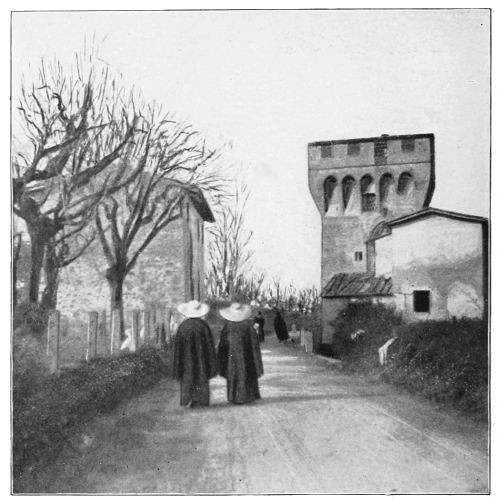
M. M. Newell
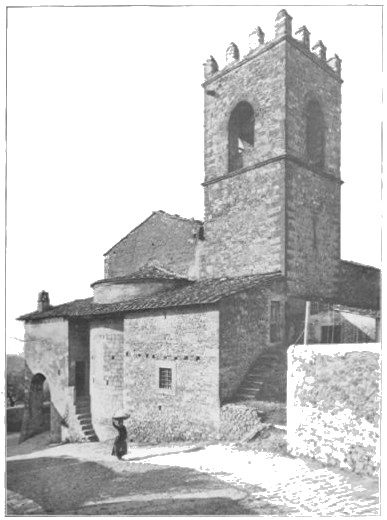
BADIA A SETTIMO
But suddenly, on a crisp spring morning, a quick turn
from a narrow street gives us a vision of the hills, olive-grey,
brown, and purple—hills with the Apennine
heights beyond. The spell is broken, our hearts burn
for the "spring running," and, as in old Chaucer's day,
"Then longen folk to go on pilgrimage." We have
the old poet's authority that England's Spring came in
April, but to us in Tuscany this year she appeared by
the middle of January, and has never for a day turned
her face, coming safely through the "ides of March,"
even to the end of April in almost continuous sunshine
and ever-increasing bloom. Blackthorn, almond, and
fruit trees, daisies and daffodils, violets and roses, rival
each other in bewildering loveliness wherever the eye
may turn; out of city gates the paths lie luringly open
to hillsides clad with ilex and magnolia, to hidden valleys,
and the snow-clad Apennines beyond Vallombrosa.
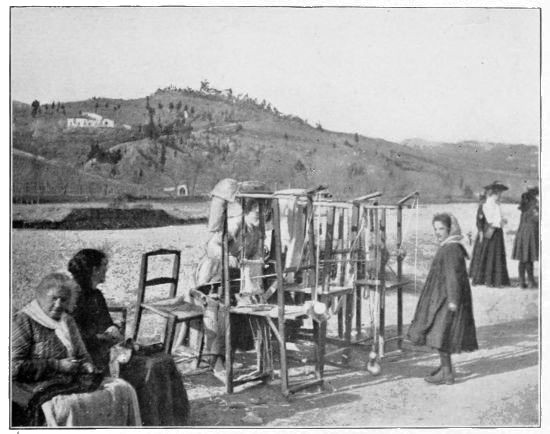
M. M. Newell
STRAW PLAITERS IN THE MUGNONE
We yearn for unbroken space with no dome but the
blue above, no tower but the stately cypress; our resolution
is quickly taken to climb out of Val d'Arno, and
slip over yonder delectable heights into the Mugello.
Diligence and tram are too slow for our patience;
therefore, at the easy hour of nine, on a clear, sunny
morning, we leave the city by the Florence and Faenza
railway, run through the pretty valley of the Mugnone,
pass the stone-quarries close under the northern flank
of steep Fiesole, discover a world of beauty unknown
to us before, dash in and out of tunnels, catching flying
glimpses of a broken countryside, grey-walled towns,
and bosky slopes; thus pushing northward for half a
dozen miles, where the line loops back toward the
south, and gives us once more, and from a greater
height, the charming view of Fiesole's northern slope.
Now the railroad rises rapidly by well-built viaducts,
galleries, and tunnels to Vaglia, only nine miles from
Florence, as the crow flies, then passes swiftly over the
ridge which separates the valleys of the Arno and
Mugnone from the Mugello region.
There are no more views of populous Fiesole; we
are in a new world, over which Mr. Ruskin feels justified
in making lament. After expanding with his customary
word-painting upon the view from Fiesole
over Val d'Arno, he continues thus: "The traveller
passes the Fiesolan ridge, and all is changed. The
country is on a sudden lonely. Here and there, indeed,
are scattered houses of a farm grouped gracefully upon
the hillsides; here and there the fragment of a tower
upon a distant rock; but neither gardens nor flowers
nor glittering palaces exist." To us, however, the
scene is charming; the still distant valley spreads out
broad and fertile to the sun, well-watered by the Sieve
and its many tributaries, or torrenti, all of which hasten
to lose themselves later in the Arno, just within the western
boundary of the Casentino. Surrounding the happy
valley rises a cordon of mountains belonging to the
Central Apennine range—among them Monte Giove,
3,255 feet above sea-level, and Monte Morello, 3,065
feet. The latter peak is clearly seen from Florence,
and in its varied moods is regarded as a natural
weather bureau by the people, who are fond of repeating
the old saying, "Take your umbrella when Monte
Morello puts on his cap."
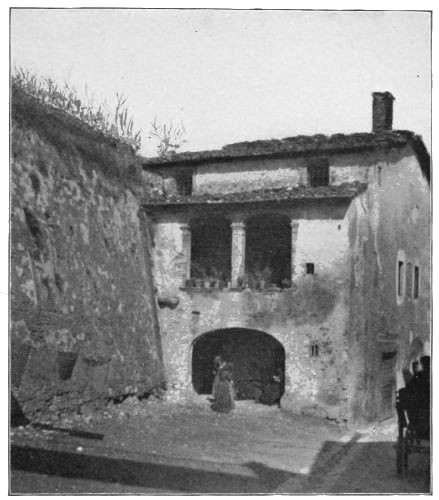
M. M. Newell
A LOGGIA, PIERO A SIEVE
Descending the narrow pass of Carza, the train
reaches Piero a Sieve, where we leave it to pursue its
way through a most picturesque country, over the
mountains to Faenza, while we explore the quaint
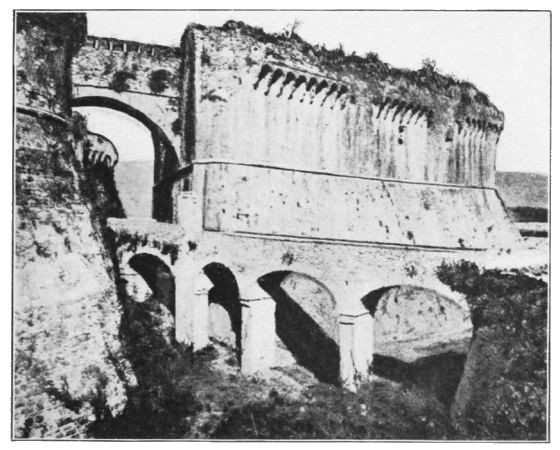
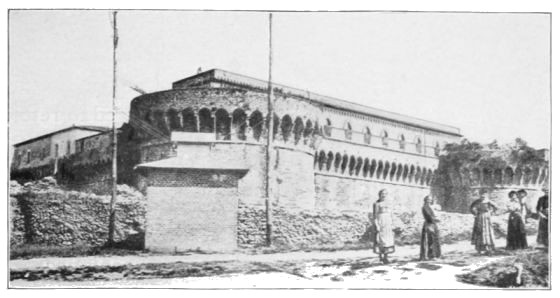
little hamlet of Piero a Sieve, which clings by grey
walls and terraces to the side of a steep hill, crowning
which are the massive fortifications of San Martino.
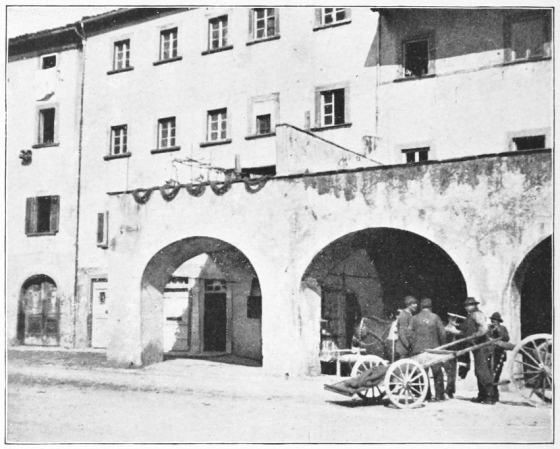
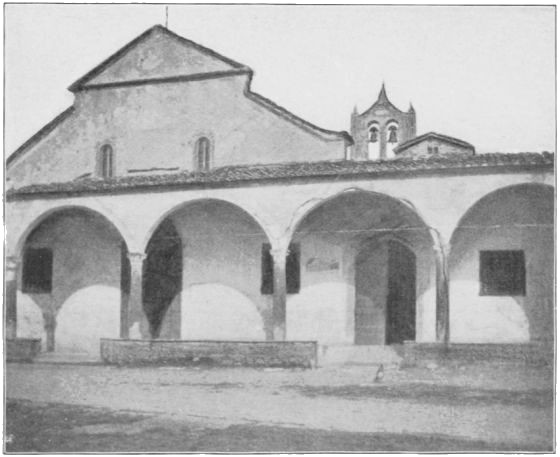
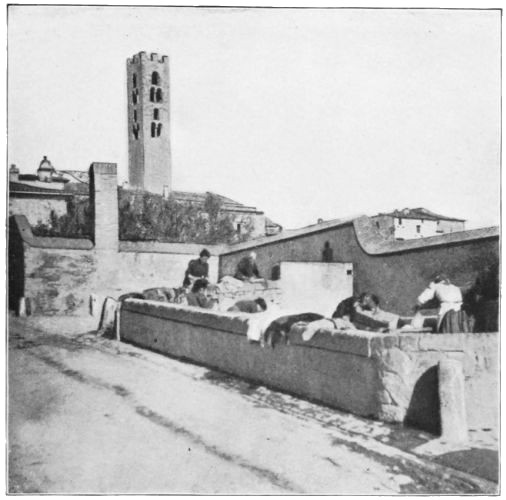
We climb to the fortress, take a snap-shot at one of the
loggias, where the group of ever-busy women in bright
skirts and kerchiefs would make a delightful picture in
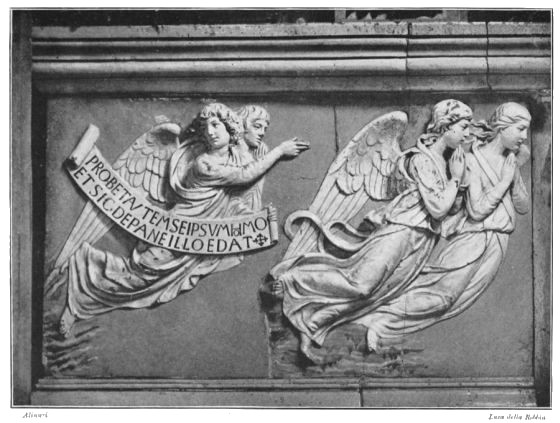
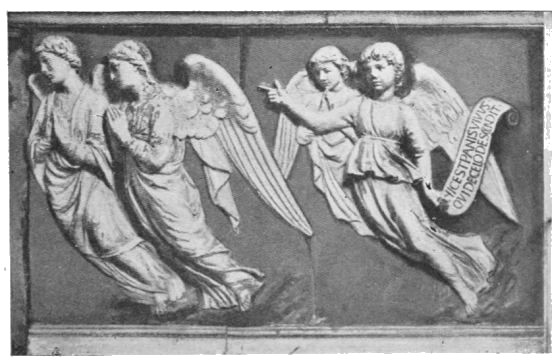
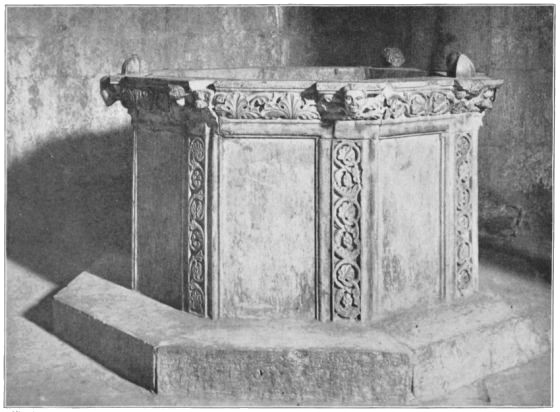
water-colour, have a look at the parish church, with its
so-called Della Robbia font, and then proceed on our
way to Scarperia, three miles to the northwest, which
is our destination.
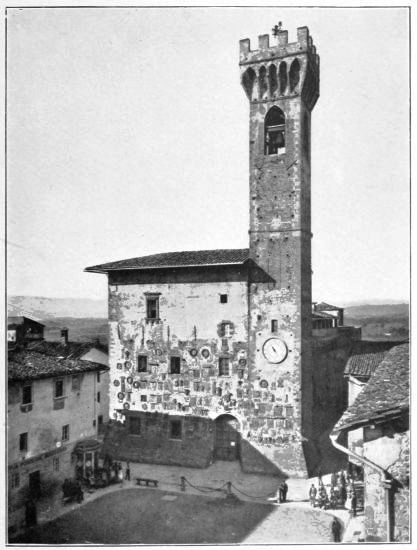
Alinari
PALAZZO PUBBLICO, SCARPERIA
After judicious bargaining at the station with drivers
of a varied assortment of country vehicles, we are cleverly
packed into two small, rattling, rather clumsy but
very comfortable carts, one drawn by a phenomenally
brisk donkey, and away we bowl toward the towers of
Scarperia. Somehow the sunshine and exhilarating air
incites us into rebellion against Mr. Ruskin's opinion
that the scene is "only a grey extent of mountain
ground, tufted irregularly with ilex and olive, a scene
not sublime, for its forms are subdued and low; not
desolate, for its valleys are full of sown fields and
tended pastures; not rich nor lovely, but sunburnt
and sorrowful."
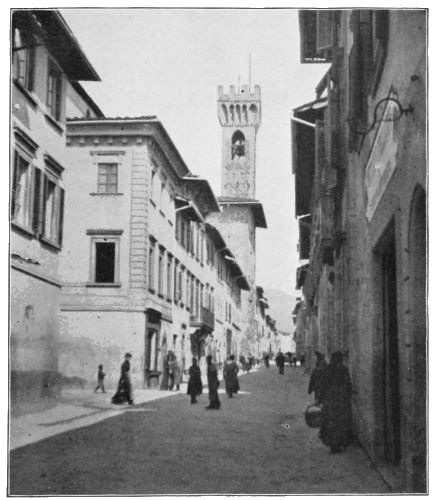
M. M. Newell
THE MAIN STREET, SCARPERIA
For us a golden touch is laid on everything; we
love the plain of olive orchards and vineyards and
peaceful fields; the large, white, violet-eyed Tuscan
oxen driven by kindly faced peasants; even the donkey
is a nonesuch, and we wax poetic over the greenest
of green patches of grain in vineyards, the rows
of lopped elm-trees married to the vines, which are festooned
from trunk to trunk. Along the way we meet
the country doctor, riding madly in his cart drawn by a
quick-stepping pony. Another Dr. Antonio, we say,
ready in case of accident to invent and furnish us anything
from bathing-machines and coffee-pots, instruction
in botany and art, to a serenade, or making butter
to accompany the good bread of Scarperia, unbaked
loaves of which we see carried into the town on a long
board over a man's shoulder.
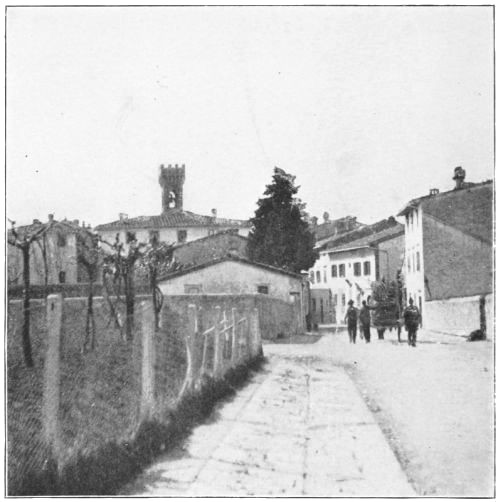
But now we are rattling up the main street of Scarperia,
the donkey trying his best to get ahead, and it is
high time to speak like a guide-book, though no account
we have found condescends to give the population
of the place, which is the way every well-regulated
book should begin. Murray's description is summed
up in half a dozen lines, as follows: "Scarperia was
built in 1306 by the Commune of Florence to curb the
pride of the Ubaldini and other rebels of the Mugello.
The parish church has some fine cloisters. In the
Palazzo Vecchio there are interesting frescoes. There
is a large industry of scissors." This is all.
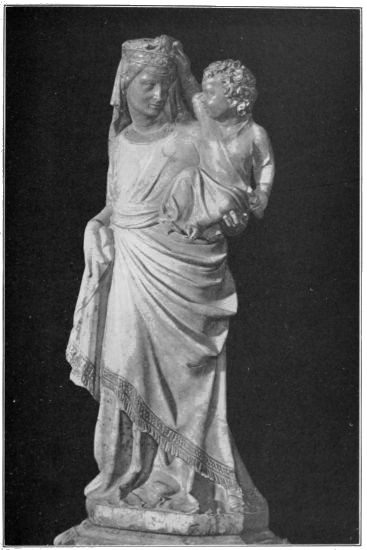
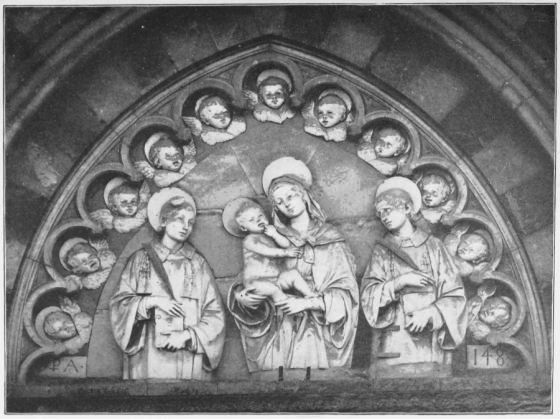
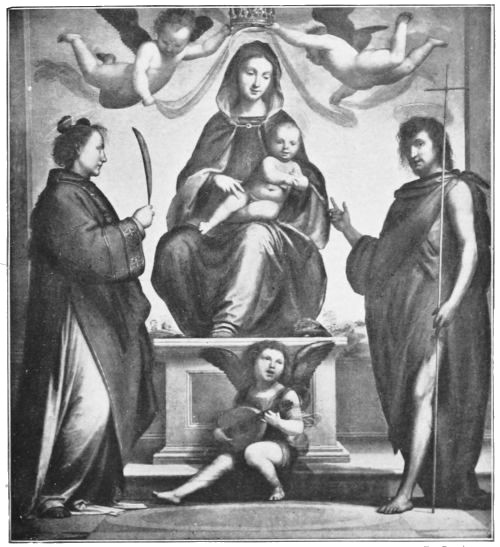
Alinari Giovanni Pisano
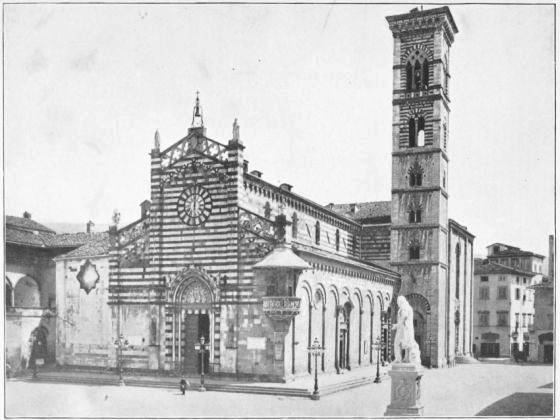
MADONNA AND CHILD OF THE SACRED GIRDLE
DUOMO, PRATO
We hasten to buy scissors, also the ubiquitous postal
card, visit the cloisters, which are really good, and then
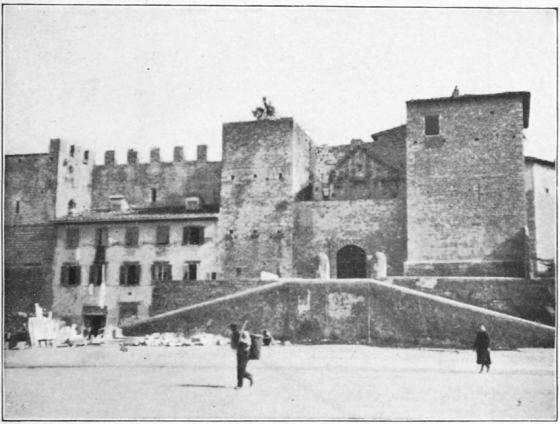
hang about the old Palazzo, which would alone make
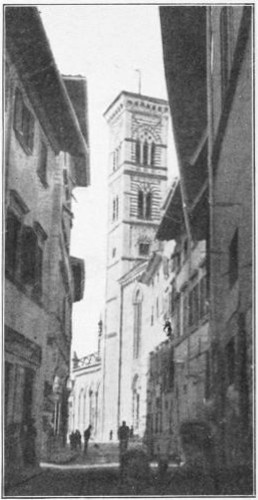
the town interesting. Its tower, or campanile, is remarkably
fine, simpler and a thought more serious,
perhaps, but hardly less beautiful, than its more famous
sister of the Palazzo Vecchio, Florence; and the good
people of Scarperia proudly declare that it was at least
designed by the same master hand—that of Arnolfo di
Cambio. It rises gracefully as a lily on its grey stalk,
dominating the clustering red roofs below and peering
at us over the cloister roof, as if to say, "We belonged
together in those stirring mediæval days when municipal
life had two centres: the Palazzo Pubblico and
the Duomo—Civil Government and the Church." The
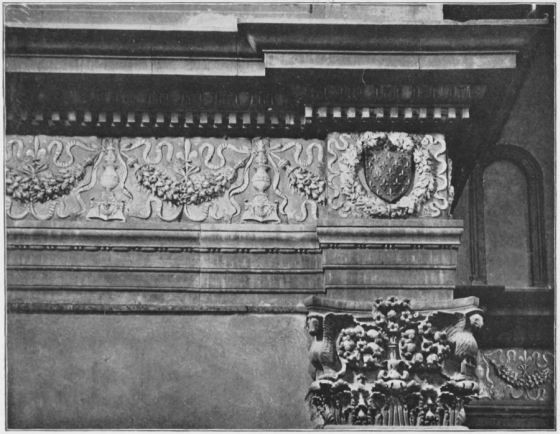
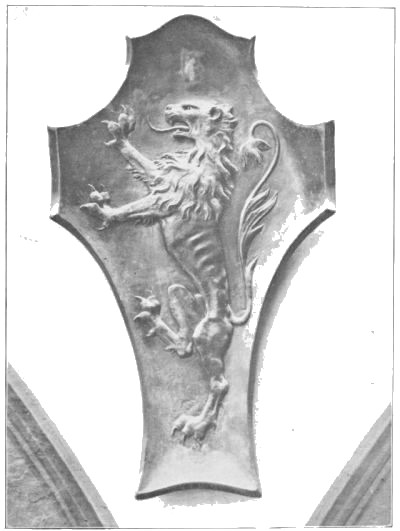
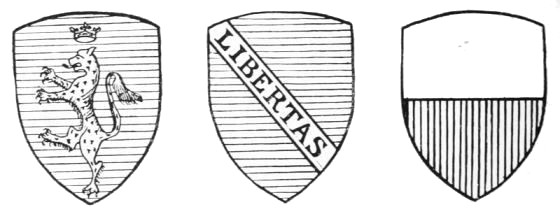
façade of the old palace is a mad eruption of various
coats of arms, or stemmi, carved in stone or formed
in reliefs of glazed terra-cotta, and no less than
fourteen of these are products of the Della Robbia
atelier, bearing the devices of great families of
Tuscany; and here, if we were wise in heraldry,
might the whole history of the Mugello be set
forth as it transpired in those adventurous days
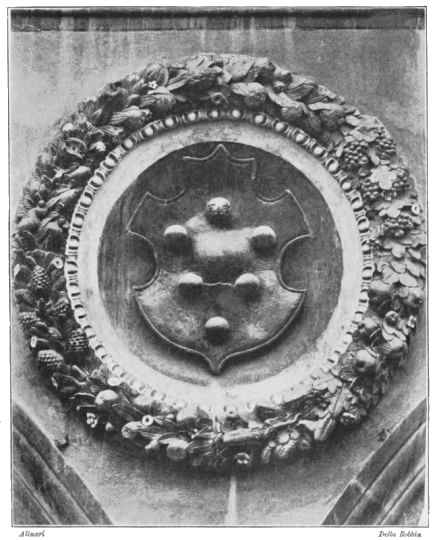
before its rebels had been curbed! Prominent and oft-repeated
among these stemmi is the Medici shield
emblazoned with its balls, or pills, suggesting the traditional
origin of that famous house and proud device.
The story runs that, when Charlemagne made his historic
descent upon Italy, among his followers was
a certain brave and noble knight named Avérard
Medici, who, amid the Apennines, encountered and
challenged to mortal combat a mighty giant called
Mugello, who ruled with a high and cruel hand all this
portion of Italy. After a long and furious battle the
giant was done to death, and Avérard, as victor, took
possession, not only of his arms and personal goods,
but all the lands under his sway—that is, the territory
bearing his name to this day. What is more, the six
dents on Avérard's golden buckler, which had been
made by the furious blows of Mugello's iron-spiked
club, became the Medici device. There is historical
evidence that an early Medici settled in this region
and possessed great estates and castles, to which he
very shrewdly retired whenever his enemies in Florence
became too troublesome. There is also proof that
while Cosimo, "father of his country," beautified Florence
with noble villas, palaces, and churches, he did not
neglect the cradle of his race, but built in the Mugello
the two convents of the Bosco and of St. Francis.
We enter the old palace through a stately atrium, or
vestibule; the walls are covered with coats of arms
and faded frescoes, and beyond is a pleasant little
court open to the sky, but serving the municipality
to-day no further than as a chicken enclosure.
Then we ascend the broad stone stairway to the
municipal offices; the faded frescoes of Our Lady
and saints in the anteroom are doubtless good,
and deserve more attention than we give them; but
our eyes are enthralled by the superb view from the
window of the river-laced plain and encircling mountains.
After lunch at the modest albergo, where kindly
faces and willing service more than compensate for an
indifferent cuisine, we set forth for a long drive of exploration
through the Mugello. Our carriage, "the
calash," is apparently an institution of Scarperia, and
is such a pleasant surprise that we heartily commend
it to all fellow travellers. It is a rather
light, well-hung, smart-looking vehicle, something
between a victoria and landau in shape, with comfortable
seats which easily accommodate our party of
five. It is drawn by a pair of glossy chestnut roadsters
unvexed by checking-straps or throat-chains,
and stepping off freely at a brisk, even trot, which
they maintain steadily during the entire drive of
thirty miles. Our handsome young driver is in
keeping with his equipage—kind and skilful with his
horses, and courteous in answering our many questions.
Thus we drive all the sunny afternoon through the
fertile and well-tilled valley, over the best of roads,
passing comfortable farm-houses, orchards, and vineyards,
where the peasants are busy trimming and
tying the vines or turning the earth with awkward,
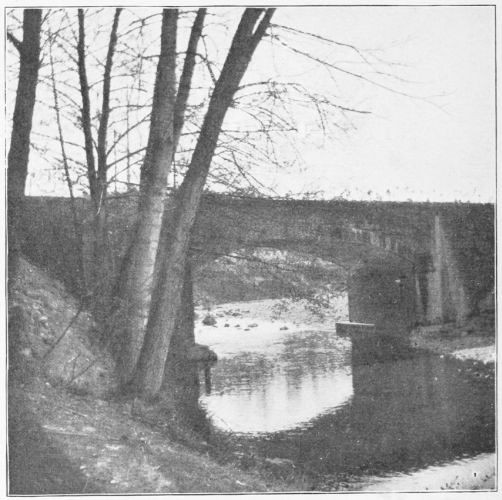
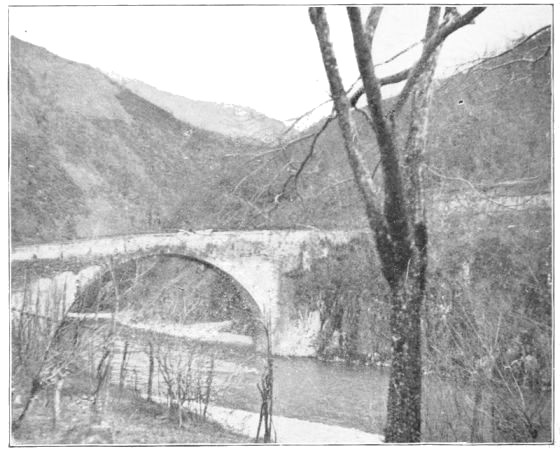
primitive spades. We cross and recross the river
Sieve over picturesque stone bridges half hidden
by birches and
elms.
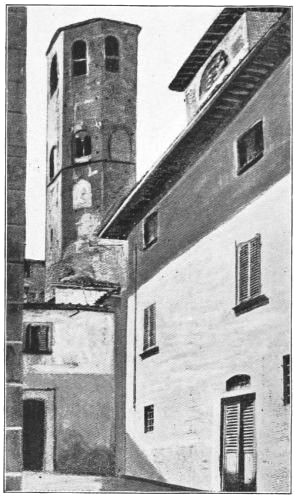
ANCIENT CAMPANILE DELLA PIEVE
BORGO S. LORENZO
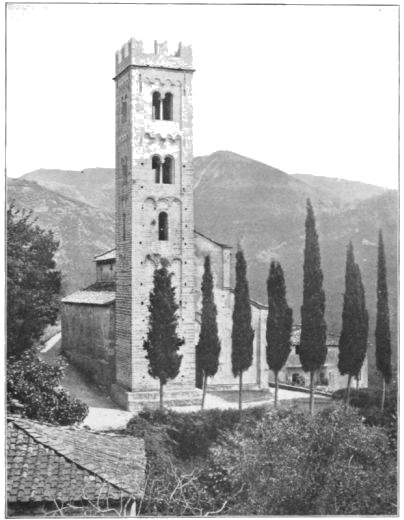
Our first halt is at Borgo San Lorenzo, chief town, or capital,
of the Mugello, situated on the Sieve, also on the direct railway
line to Faenza, and containing about three thousand inhabitants.
While lacking, one cannot tell why, the charm of Scarperia, the town
has its attractions, notably two noble and well-preserved gateways,
several towers, and many a cluster of rich-coloured, irregular
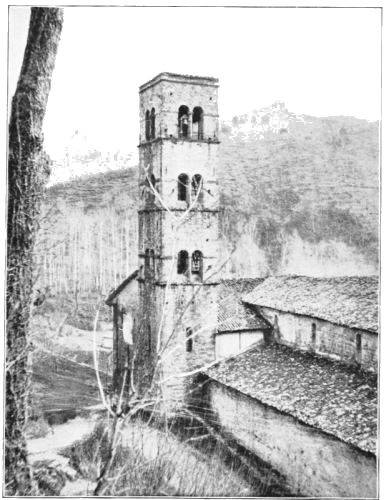
roofs. Especially interesting is the lofty Antico Campanile della
Pieve—a battered veteran keeping its time-honoured watch and ward
over the Sieve valley, its sides showing many a scar and patch,
and its simple, conical roof, like an old cap pulled low
over its sleepless eyes.
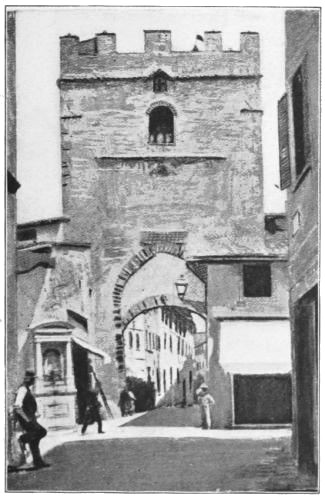
TORRACCIA ROMANELLI, BORGO S. LORENZO
We enter the town through the fifteenth century gateway, its
battered watch-tower speaking volumes of that olden time when Mugello's
rebels worked their stark will along these narrow thoroughfares. The
substantial, old Palazzo del Podestà, minus a tower, looks somewhat
meekly forth on its ancient square, or piazza, as it has done for
centuries. Its façade is hung thick with the shields of turbulent
lords, ten of whom called on the Della Robbia art to set forth their
emblems here, also to fashion glazed terra-cotta Madonnas for the
churches of St. Catherine and St. Stephen, hard by.
We can stop but a few moments at Borgo San Lorenzo,
and soon drive on, past a little shrine at the
street corner and under the battlemented tower called
Torraccia Romanelli, to our country roads once more.
Outside the walls the country assumes a more broken
and hilly appearance, fewer cultivated fields, and more
pasture where a few sheep graze; irregular farm-houses
of rough, grey stone, with loggias and sloping roofs of
red tiles, set amidst scattering trees, many of them
cypress, dark and rusty as an outworn mourning coat.
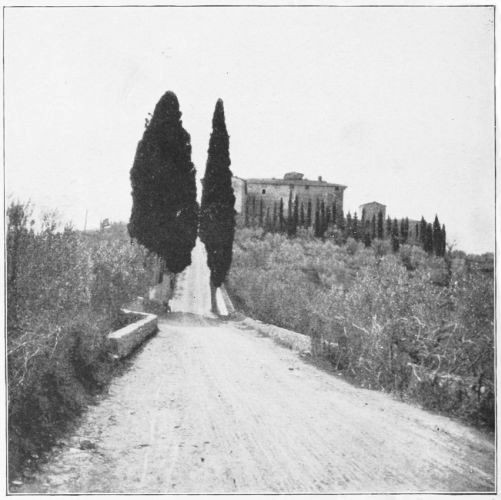
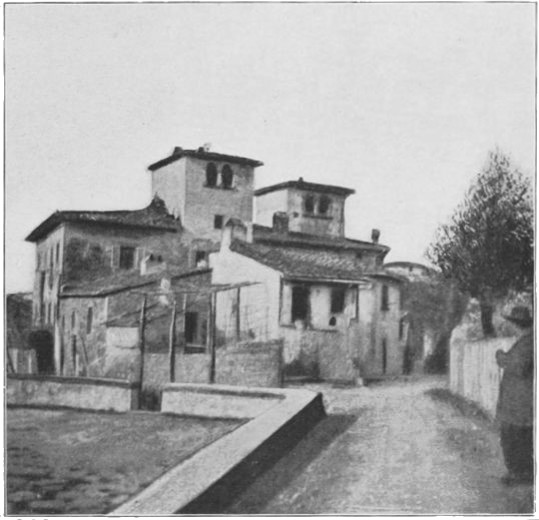
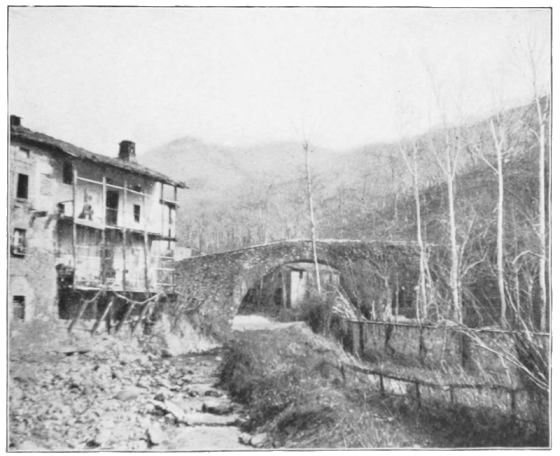
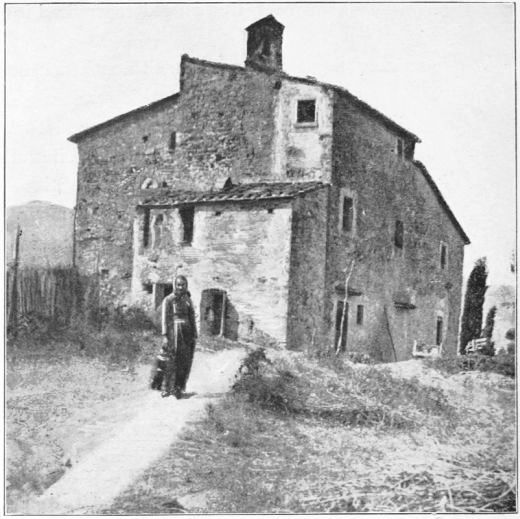
The accompanying picture shows a representative
house of the country, and we are told that this one had
its little romance and love's young dream. It is a
wrinkled old woman you see trudging down the hillside
to fill her copper bucket at the stream; but in yonder
corner loggia is a sparkling-eyed young contadina, some
pretty Tessa, who as she spins her flax is thinking of
a handsome and dashing young Florentine who often
finds his way to the farm-house, which belongs to his
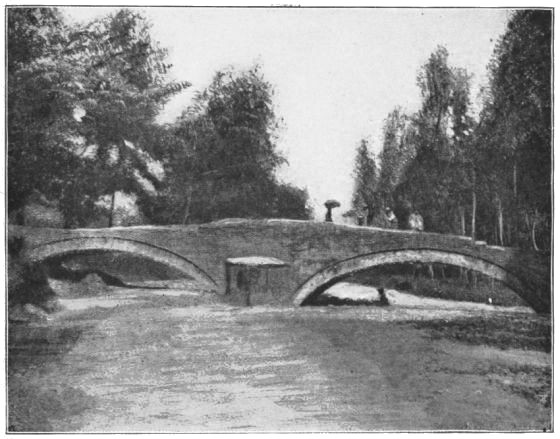
uncle's country villa hard by. A bit farther on we
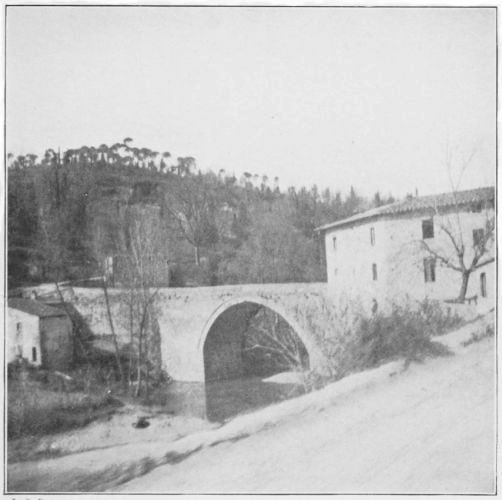
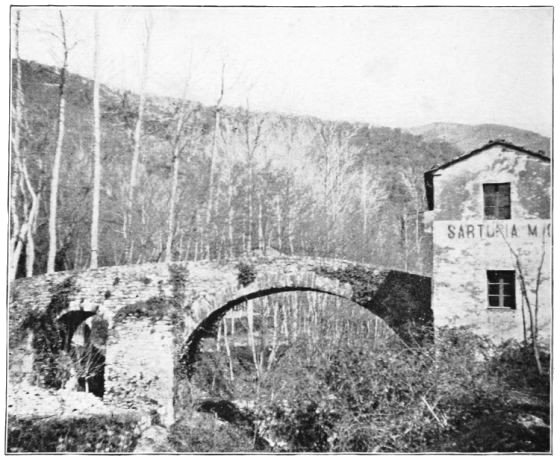
reach the pretty double-arched bridge Ponte d'Elsa,
the very one, our driver says, where Cimabue met the
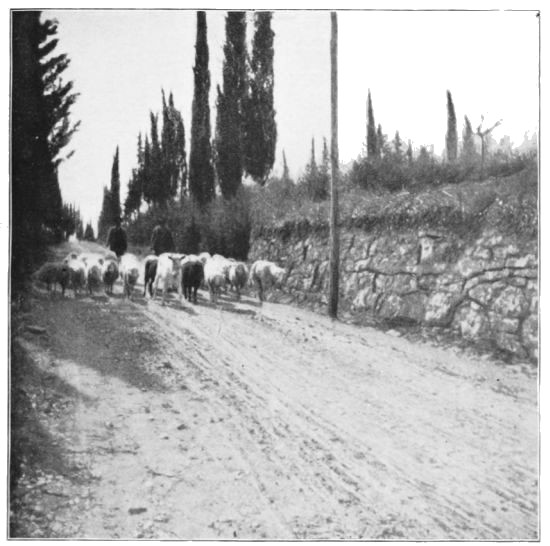
shepherd boy Giotto; and here too, nibbling the scanty
grass along the roadside, are surely the descendants
of Giotto's sheep, even the new-born lamb looking
quite mediæval.
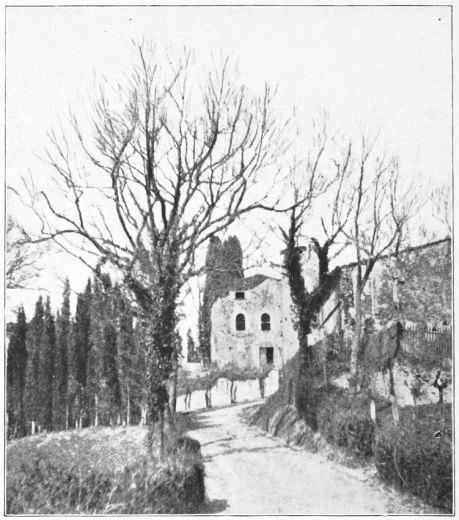
M. M. Newell
HILL OF VESPIGNANO, MUCELLO
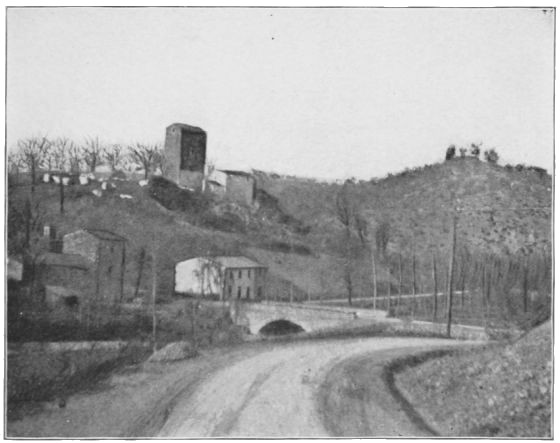
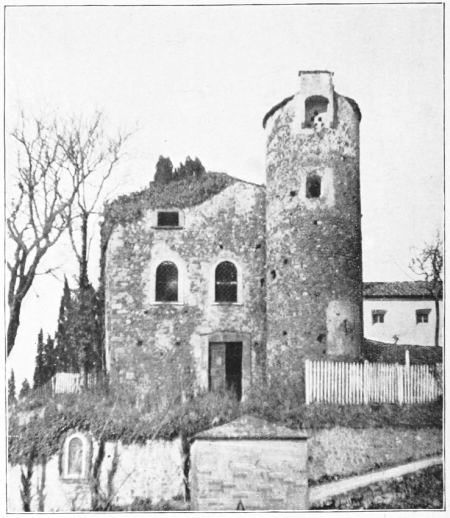
The hill of Vespignano, Giotto's birthplace, is much
too steep for the chestnuts and calash; moreover, we
are only too glad of an excuse for walking up the
pretty path cut into the hillside, bordered by trees
hung with ivy, and leading to a serried rank of young
cypresses, ranged together like a black watch on the
crest of the hill, as if to guard the modest stone building,
which tradition says is the very house where the
artist Giotto was born. Even for a shepherd's dwelling,
the house is small and uninteresting, which naturally
flings a suspicion over its verity; nevertheless, the
spirit which actuates the preservation of all historical
sites and relics by the Italian government cannot be
too highly commended. The house is converted into
a meagre museum, and kept in good order on estates
at present belonging to the Villa Capriani-Cateni, the
various buildings of which cover the crest of a considerable
height and possess a noble outlook into the near
hills, which are now taking on a hazy blue mystery in
the afternoon light. A large portion of the villa is of
modern architecture, plain and dignified, but the massive,
square battlemented tower at one corner is of quite
an early date, perhaps the thirteenth century, while
not far away is the ruined prison-house of ruddy grey
stones and brickwork, with a picturesque round tower,
presumably of a still earlier time, and reminding one
of the ancient towers still found in parts of Ireland.
The whole pile speaks eloquently of a long residence
on this hilltop of a people whose wants were few,
their tastes stern and simple as the mighty Apennines
which encircled them. A fine-looking old man is
weaving an osier basket as he sits on the terrace in
the shadow of the old tower. He answers all our
questions with quiet courtesy; but upon our offering
him a fee, as we have learned is generally expected,
it is gently but firmly declined, and we walk
away somewhat abashed, thinking of the varied influences
which surrounded young Giotto amid such
pastoral scenes and such kindly, self-respecting people.
He certainly must have carried much of the
experience and knowledge of his shepherd life into
his art.
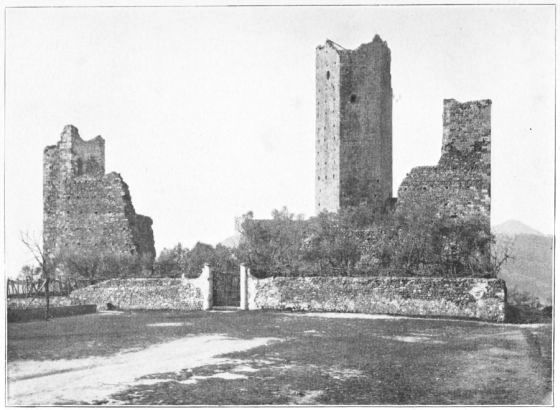
M. M. Newell
ROUND TOWER, VESPIGNANO
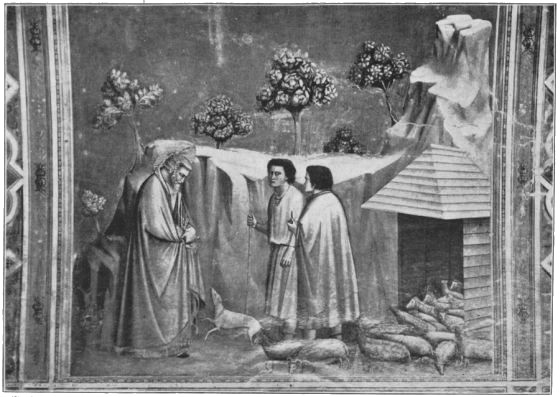
In the Arena Chapel, Padua, one of the finest of the
frescoes is that of Joachim returning to the sheepfold,
where Giotto shows his intimate knowledge of a shepherd's
surroundings and animal forms, but particularly
of the characteristics of sheep, giving to each one an
individuality which only a close observer could have
done. There is the same quality in one of the sculptures
on his tower in Florence, where the puppy, with
an absurd expression of anxious responsibility, is guarding
the sheep.
As the shadows lengthen and the mountains are
gleaming in purple and gold, we return to Scarperia
for the night, and enjoy such sleep in the clean, coarse,
homespun linen on our beds, as only a day in the brisk
open air can give.
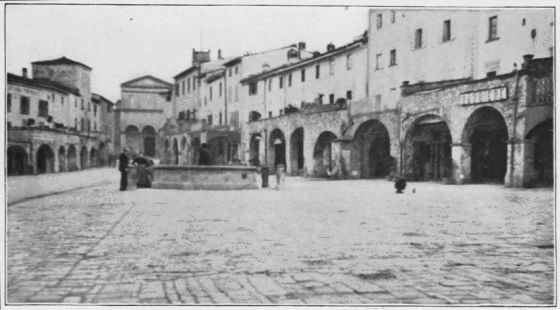
The morrow is Sunday, and the old Piazza, between
church and palace, is filled with the people
coming and going to mass, and to chaffer with the
pedlar displaying his wares on a little cart, consisting
of a slender stock of kerchiefs, stuffs, bright toys, and
various homely utensils, which he cries as lustily as
another Autolycus:
"Will you buy any tape,
Or lace for your cape,
My dainty duck, my dear-a?
Come, buy of me! come buy, come buy!"
Both men and women have good faces, with that
kindly responsive and patient expression characteristic
of the Italian peasants; they are interested in everything,
particularly in the forestieri, who in their turn
enjoy the groups of women and children in gay kerchiefs
and gowns, making a pretty picture in the old
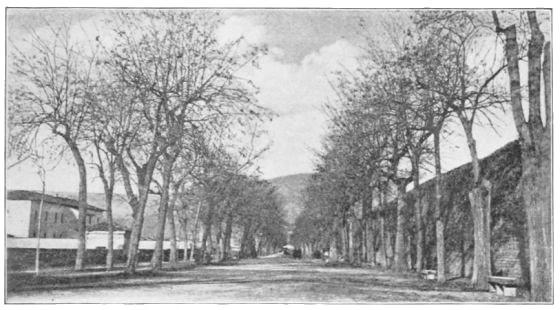
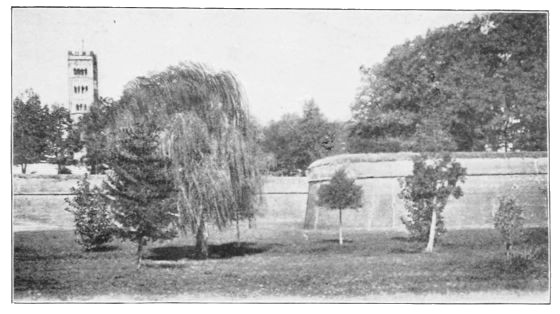
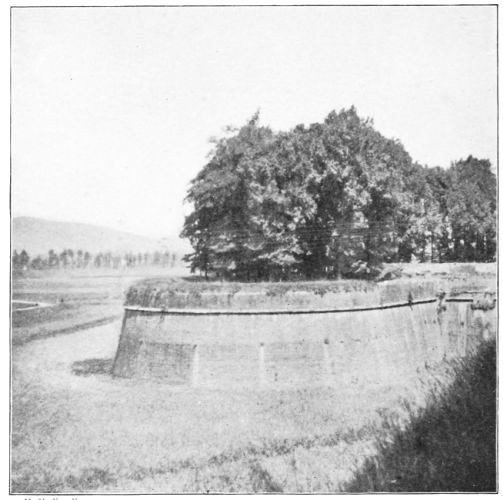
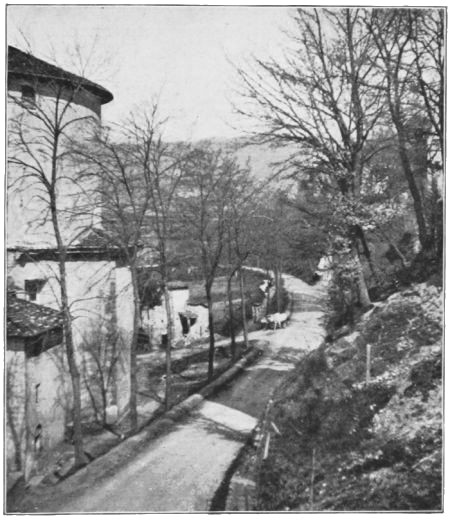
grey square. We walk through the narrow streets, sit
on the city walls which still partially surround the town,
and look down on the pretty road overhung with trees,
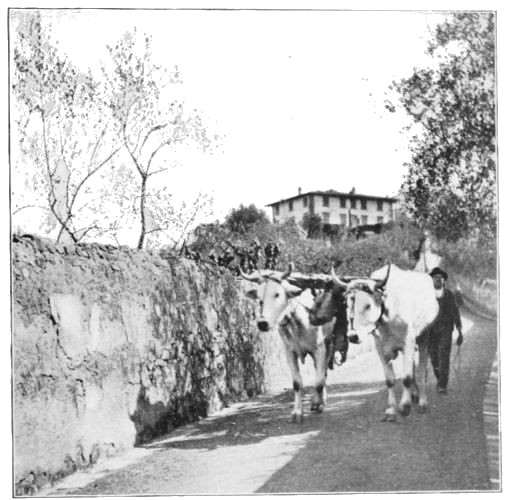
where the trailing-footed, white oxen slowly come and
go, placid and restful.
Alinari Giotto
JOACHIM RETURNING TO THE SHEEPFOLD, ARENA CHAPEL, PADUA
We follow the contadini out of the old city gate
on the road to St. Agatha's Church, lying between
vineyards where the young grain is now pushing its
green spears through the brown earth—for spring is
later here than in Val d'Arno—and olive orchards,
where clouds of silver-grey leaves quiver and shine in
the light.
M. M. Newell.
FROM THE WALLS OF SCARPERIA
M. M. Newell
A COUNTRY ROAD, SCARPERIA
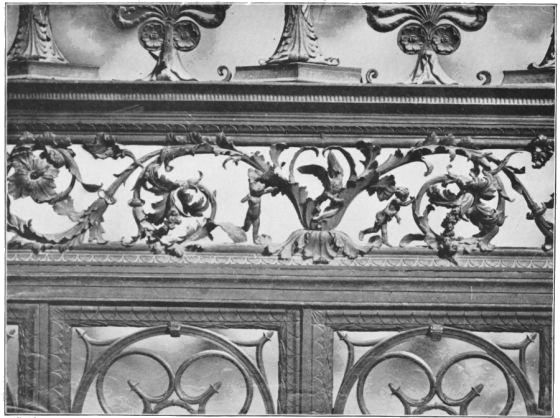
Alinari
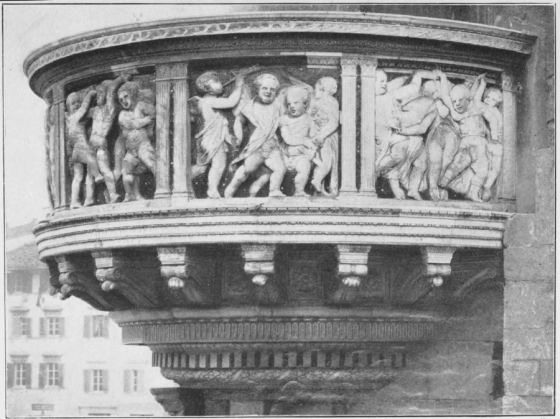
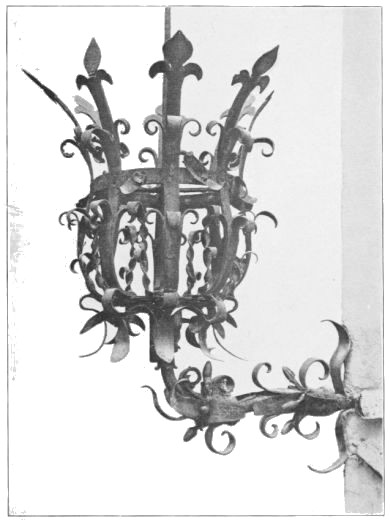
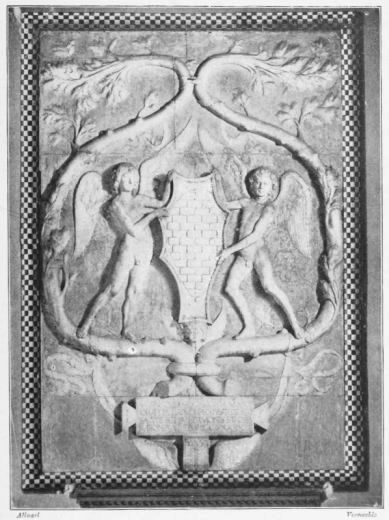
DETAIL OF THE GRILLE
CHAPEL OF THE SACRED GIRDLE, CATHEDRAL, PRATO
Taking another road, we saunter on a mile or so
to the Villa Tolomei, belonging to an old Tuscan
family, whose arms are a gold band with three green
vine leaves on a blue field, and above a red label with
the three gold lilies of Anjou. The grounds are pleasant,
though somewhat neglected, but the prospect looking
toward the mountains is entrancing; and the walk
back toward Scarperia gives us a continual view of
the fine campanile. By this time all the rebel blood of
the Mugello is burning in our veins, and we demand
a drive back to Florence; no railroads and tunnels for
us if we must leave these "dear country places." We
long to push eastward, only three paltry miles away,
up to the very crests of the Apennines, where all the
rivers hasten joyfully to the Adriatic. But not to-day
may we follow fancy's lead eastward along curving
Ronco's flowing stream, but again, with chestnuts and
calash, are constrained to hold our way along the river
bank, returning over the road to Piero a Sieve—was it
only yesterday that we first knew it?—and strike at
once into the famous old highway leading from Bologna
to Florence, as it has done almost since the beginning
of the Christian era. What a thoroughfare it has been!
What mighty personages have trod this path with high
hopes, burning spirits, and breaking hearts!
"There is a joy in every spot made known in times of old,
New to the feet, although each tale a hundred times be told."
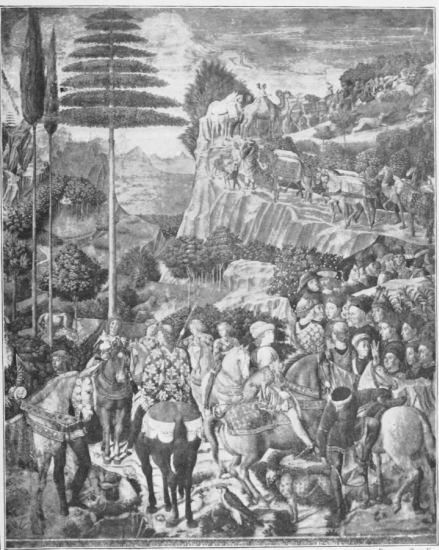
What hordes of barbarians and armies of haughty
kings have swept this way; what great pageants and
devout pilgrimages! We remember that one of Gian
Galeazzo, Duke of Milan in 1471, when, accompanied
by his wife, Bona of Savoy, in accomplishment of a vow,
he made a pilgrimage to Florence in unparalleled
splendour. There were twelve palanquins of cloth of
gold borne on the backs of mules over the Apennines,
preceded by fifty palfreys for the Duchess and her
ladies when they preferred the saddle; fifty horses
for the Duke and his gentlemen; five hundred foot-soldiers,
one hundred mounted men-at-arms; fifty
body-servants in livery of silk and silver, fifty
huntsmen holding dogs in leash, fifty with falcon on
wrist, each bird valued at two hundred golden florins,
etc., etc. With all this pomp the train descended
into the Val d'Arno, proceeded to Florence, and were
received at the Medici palace in Via Larga, now the
Cavour. When we reach Vaglia, again we struggle
with the temptation to turn aside for the delightful
walk of five miles to Bivigliano and find the Della
Robbia Madonna and Saints (from the atelier) at the
parish church of St. Romola, thence a mile farther to
the foot of Monte Senario, 2,700 feet high, which overlooks
us all the way. But we hold to our course, and
after a few miles and a stiff walk of half an hour we
mount to Pratolino, 1,512 feet, the highest point we
touch, lying just below Monte Senario, and commanding
an extensive view on every side. Near the village
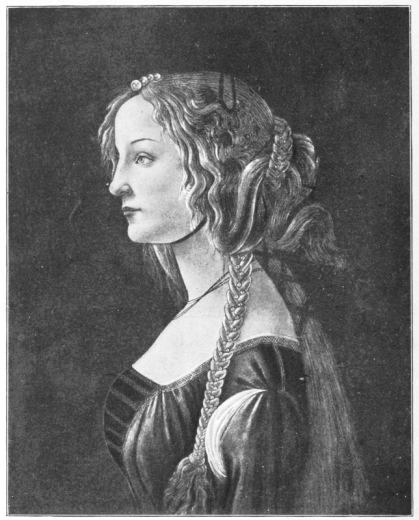
is the celebrated Villa of Pratolino, built originally in
1570 by Duke Francesco de' Medici for the reception of
his wife, the beautiful and notorious Bianca Cappello.
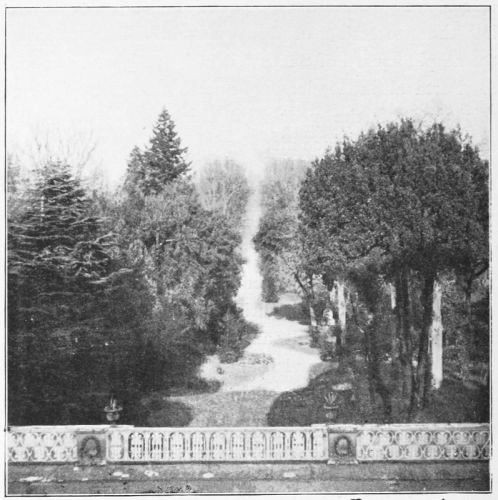
It was surrounded by noble gardens and terraces, and
because of its superb situation became the favorite
residence of the luxury-loving Duchess. The property
is now owned by the Prince Demidoff, but nothing
remains of the original villa except a colossal crouching
figure, personifying the Apennines, which is
ascribed to John of Bologna.
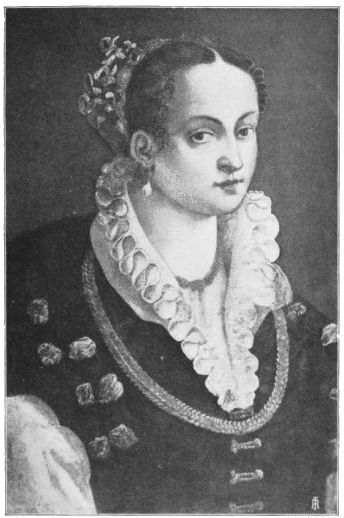
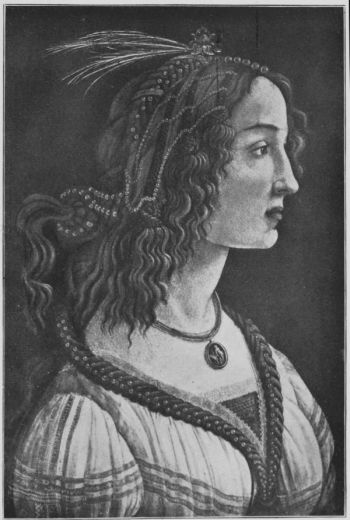
Alinari Alessandro Allori
PORTRAIT OF BIANCA CAPPELLO
UFFIZI, FLORENCE
Our Mugello excursion is over; we are slipping
through the Mugnone and down into Val d'Arno.
First Fiesole welcomes us; then the dear, familiar
towers of Florence, the fairest city in the world; only
a poet can convey the charm of this exquisite scene.
"Few travellers can forget," says Mr. Ruskin, "the
peculiar landscape of this district of the Apennines. As
they ascend the hill which rises from Florence to the
lowest peak in the ridge of Fiesole they pass continually
beneath the walls of villas bright in perfect luxury
and beside cypress hedges inclosing fair terraced gardens,
where masses of oleander and magnolia, motionless
as leaves in a picture, inlay alternately upon the
blue sky their branching lightness of pale-rose color
and deep-green breadth of shade, studded with walls
of gleaming silver; and shining at intervals through
the framework of rich leaf and rubied flower the far-away
bends of the Arno beneath its slopes of olive,
and the purple peaks of the Carrara mountains tossing
themselves against the western distance, where the
streak of motionless clouds hover over the Pisan sea."