Obvious typographical errors have been silently corrected. Variations
in hyphenation and accents have been standardised but all other
spelling and punctuation remains unchanged. The first volume is
available as Project Gutenberg eBook #73000. Only the references
within this volume are hyperlinked.
BEGINNING OF DUBLINQuem quaeritis,
FROM BODLEIAN RAWLINSON LITURGICAL MS. D. 4
(14TH CENTURY) | MusicXML]
THE MEDIAEVAL STAGE
BY
E. K. CHAMBERS.
VOL. II
OXFORD UNIVERSITY PRESS
M.CMIII
Impression of 1925
First Edition 1903
This impression has been produced photographically by the Muston Company, from sheets of the First Edition
Printed wholly in England for the Muston Company
By Lowe & Brydone, Printers, Ltd.
Park Street, Camden Town, London, N.W. 1.
[Bibliographical Note.—The liturgical drama is fully treated by
W. Creizenach, Geschichte des neueren Dramas (vol. i, 1893), Bk. 2;
L. Petit de Julleville, Les Mystères (1880), vol. i. ch. 2; A. d’Ancona, Origini
del Teatro Italiano (2nd ed. 1891), Bk. 1, chh. 3-6; M. Sepet, Origines
catholiques du Théâtre moderne (1901), and by L. Gautier in Le Monde
for Aug. and Sept. 1872. The studies of W. Meyer, Fragmenta Burana
(1901), and C. Davidson, English Mystery Plays (1892), are also valuable.
A. W. Ward, History of English Dramatic Literature (2nd ed. 1899), vol.
i. ch. 1 deals very slightly with the subject. A good popular account is
M. Sepet, Le Drame chrétien au Moyen Âge (1878). Of older works, the
introduction to E. Du Méril’s Origines latines du Théâtre moderne (1849,
facsimile reprint, 1896) is the best. The material collected for vol. ii of
C. Magnin’s Origines du Théâtre is only available in the form of reviews in
the Journal des Savants (1846-7), and lecture notes in the Journal général
de l’Instruction publique (1834-6). Articles by F. Clément, L. Deschamps
de Pas, A. de la Fons-Melicocq, and others in A. N. Didron’s Annales
archéologiques (1844-72) are worth consulting; those of F. Clément are
reproduced in his Histoire de la Musique religieuse (1860). There are
also some notices in J. de Douhet, Dictionnaire des Mystères (1854).—The
texts of the Quem quaeritis are to be studied in G. Milchsack, Die
Oster- und Passionsspiele, vol. i (all published, 1880), and C. Lange, Die
lateinischen Osterfeiern (1887). The former compares 28, the latter no
less than 224 manuscripts. The best general collection of texts is that of
Du Méril already named: others are T. Wright, Early Mysteries and
other Latin Poems (1838); E. de Coussemaker, Drames liturgiques du
Moyen Âge (1860), which is valuable as giving the music as well as the
words; and A. Gasté, Les Drames liturgiques de la Cathédrale de Rouen
(1893). A few, including the important Antichristus, are given by
R. Froning, Das Drama des Mittelalters (1891). The original sources
are in most cases the ordinary service-books. But a twelfth-century manuscript
from St. Martial of Limoges (Bibl. Nat. Lat. 1139) has four plays,
a Quem quaeritis, a Rachel, a Prophetae, and the Sponsus. Facsimiles
are in E. de Coussemaker, Histoire de l’Harmonie au Moyen Âge (1852).
A thirteenth-century manuscript from Fleury (Orleans MS. 178) has no less
than ten, a Quem quaeritis, a Peregrini, a Stella in two parts, a Conversio
Pauli, a Suscitatio Lazari and four Miracula S. Nicholai. Two later
plays and fragments of three others are found in the famous thirteenth-century
manuscript from Benedictbeuern (Munich MS. 19,486, printed in
J. A. Schmeller, Carmina Burana, 3rd ed. 1894, with additional fragments
in W. Meyer, Fragmenta Burana, 1901). This is probably the repertory
of travelling goliardic clerks. The twelfth-century manuscript which
preserves the three plays of Hilarius (Bibl. Nat. Lat. 11,331, printed in
J. J. Champollion-Figeac, Hilarii Versus et Ludi, 1838) is of a similar
character.—The tropes are fully dealt with by L. Gautier, Hist. de la
Poésie liturgique au Moyen Âge, vol. i (all published, 1886), and W. H.
Frere, The Winchester Troper (1894). I have not been able to see
A. Reiners, Die Tropen-, Prosen- und Präfations-Gesänge des feierlichen
Hochamtes im Mittelalter (1884). Antiquarian data are collected by
H. J. Feasey, Ancient English Holy Week Ceremonial (1897), and
A. Heales, Easter Sepulchres, in Archaeologia, vol. xlii. I have printed
an important passage from the Regularis Concordia of St. Ethelwold
(965-75) in Appendix O. The Planctus Mariae are treated by A. Schönbach,
Die Marienklagen (1874), and E. Wechssler, Die romanischen
Marienklagen (1893). W. Köppen, Beiträge zur Geschichte der deutschen
Weihnachtsspiele (1893), and M. Sepet, Les Prophètes du Christ (1878),
contain valuable studies of the evolution of the Stella and the Prophetae
respectively. The relation of dramatic to iconic art in the Middle Ages is
brought out by P. Weber, Geistliches Schauspiel und kirchliche Kunst
(1894). A rather primitive bibliography is F. H. Stoddard, References for
Students of Miracle Plays and Mysteries (1887).—Authorities for English
facts given without references in the present volume will be found in
Appendices W and X.]
The discussions of the first volume have often wandered
far enough from the history of the stage. But two or three
tolerable generalizations emerge. The drama as a living
form of art went completely under at the break-up of the
Roman world: a process of natural decay was accelerated by
the hostility of Christianity, which denied the theatre, and
by the indifference of barbarism, which had never imagined it.
If anything of a histrionic tradition survived, it took the shape
of pitiable farce, one amongst many heterogeneous elements
in the spectacula of disreputable mimes. For the men of the
Middle Ages, however, peasants or burghers, monks or nobles,
such spectacula had a constant attraction: and the persistence
of the deep-rooted mimetic instinct in the folk is proved by
the frequent outcrops of primitive drama in the course of
those popular observances which are the last sportive stage
of ancient heathen ritual. Whether of folk or of minstrel
origin, the ludi remained to the last alien and distasteful to
the Church. The degradation of Rome and Constantinople
by the stage was never forgotten; nor the association with an
heathenism that was glossed over rather than extinct: and
though a working compromise inevitably tended to establish
itself, it remained subject to perpetual protest from the
austerer spirit in the counsels of the clergy.
It is the more remarkable that the present volume has to
describe a most singular new birth of the drama in the very
bosom of the Church’s own ritual. One may look at the
event as one will, either as an audacious, and at least partly
successful, attempt to wrest the pomps of the devil to a
spiritual service, or as an inevitable and ironical recoil of
a barred human instinct within the hearts of its gaolers themselves.
From either point of view it is a fact which the
student of European culture cannot afford to neglect. And
apart from its sociological implications, apart from the insight
which it gives into the temper of the folk and into the appeal
of religion, it is of the highest interest as an object lesson in
literary evolution. The historian is not often privileged to
isolate a definite literary form throughout the whole course
of its development, and to trace its rudimentary beginnings,
as may here be done, beyond the very borders of articulate
speech.
The dramatic tendencies of Christian worship declared
themselves at an early period[1]. At least from the fourth
century, the central and most solemn rite of that worship was
the Mass, an essentially dramatic commemoration of one of
the most critical moments in the life of the Founder[2]. It is
his very acts and words that day by day throughout the year
the officiating priest resumes in the face of the people. And
when the conception of the Mass developed until instead of
a mere symbolical commemoration it was looked upon as an
actual repetition of the initial sacrifice, the dramatic character
was only intensified. So far as the Canon of the Mass goes,
this point needs no pressing. But the same liturgical principle
governs many other episodes in the order of the mediaeval
services. Take, for example, the ritual, of Gallican origin,
used at the dedication of a church[3]. The bishop and his
procession approach the closed doors of the church from
without, but one of the clergy, quasi latens, is placed inside.
Three blows with a staff are given on the doors, and the
anthem is raised Tollite portas, principes, vestras et elevamini,
portae aeternales, et introibit Rex gloriae. From within comes
the question Quis est iste rex gloriae? and the reply is given
Dominus virtutum ipse est Rex gloriae. Then the doors are
opened, and as the procession sweeps through, he who was
concealed within slips out, quasi fugiens, to join the train. It
is a dramatic expulsion of the spirit of evil. A number of
other instances are furnished by the elaborate rites of Holy
week. Thus on Palm Sunday, in commemoration of the
entry into Jerusalem, the usual procession before Mass was
extended, and went outside the church and round the churchyard
or close bearing palms, or in their place sprigs of yew,
box, or withies, which the priest had previously blessed[4].
The introduction of a Palmesel might make the ceremony
more dramatic still[5]. Some of the texts used were of a prophetic
character, and the singer of these was occasionally
dressed as a prophet[6]. At the doors of the church the procession
was greeted by boys stationed upon the roof of the
porch, and certain French uses transferred to the occasion the
dedication solemnity of Tollite portas just described[7]. The
reading of the gospel narratives of the Passion, which on
Palm Sunday, on the Monday or Tuesday, and the Wednesday
in Holy week and on Good Friday preceded the Gospel
proper, was often resolved into a regular oratorio. A tenor
voice rendered the narrative of the evangelist, a treble the
sayings of Jews and disciples, a bass those of Christ himself[8].
To particular episodes of these Passions special dramatic
action was appropriated. On Wednesday, at the words Velum
templi scissum est, the Lenten veil, which since the first Sunday
in Lent had hidden the sanctuary from the sight of the
people, was dropped to the ground[9]. On Good Friday the
words Partiti sunt vestimenta were a signal for a similar
bit of by-play with a linen cloth which lay upon the altar[10]:
Maundy Thursday had its commemorative ceremony of the
washing of feet[11]; while the Tenebrae or solemn extinction,
one after another, of lights at the Matins of the last three days
of the week, was held to symbolize the grief of the apostles
and others whom those lights represented[12].
These, and many other fragments of ceremonial, have the potentiality
of dramatic development. Symbolism, mimetic action,
are there. The other important factor, of dialogued speech, is
latent in the practice of antiphonal singing. The characteristic
type of Roman chant is that whereby the two halves of the
choir answer one another, or the whole choir answers the single
voice of the cantor, in alternate versicle and respond[13]. The
antiphon was introduced into Italy by St. Ambrose of Milan.
It had originated, according to tradition, in Antioch, had
been in some relation to the histrionic tendencies of Arianism,
and was possibly not altogether uninfluenced by the traditions
both of the Greek tragic chorus and of Jewish psalmody[14].
At any rate, it lent itself naturally to dialogue, and it is from
the antiphon that the actual evolution of the liturgical drama
starts. The course of that evolution must now be followed.
The choral portions of the Mass were stereotyped about
the end of the sixth century in the Antiphonarium ascribed
to Gregory the Great[15]. This compilation, which included
a variety of antiphons arranged for the different feasts and
seasons of the year, answered the needs of worship for some
two hundred years. With the ninth century, however, began
a process, which culminated in the eleventh, of liturgical
elaboration. Splendid churches, costly vestments, protracted
offices, magnificent processions, answered especially in the
great monasteries to a heightened sense of the significance of
cult in general, and of the Eucharist in particular[16]. Naturally
ecclesiastical music did not escape the influence of this movement.
The traditional Antiphonarium seemed inadequate to
the capacities of aspiring choirs. The Gregorian texts were
not replaced, but they were supplemented. New melodies
were inserted at the beginning or end or even in the middle
of the old antiphons. And now I come to the justification of
the statement made two or three pages back, that the beginnings
of the liturgical drama lie beyond the very borders
of articulate speech. For the earliest of such adventitious
melodies were sung not to words at all, but to vowel sounds
alone. These, for which precedent existed in the Gregorian
Antiphonarium, are known as neumae[17]. Obviously the next
stage was to write texts, called generically ‘tropes,’ to them;
and towards the end of the ninth century three more or less
independent schools of trope-writers grew up. One, in
northern France, produced Adam of St. Victor; of another,
at the Benedictine abbey of St. Gall near Constance, Notker
and Tutilo are the greatest names; the third, in northern
Italy, has hitherto been little studied. The Troparia or collections
of tropes form choir-books, supplementary to the
Antiphonaria. After the thirteenth century, when trope-writing
fell into comparative desuetude, they become rare;
and such tropes as were retained find a place in the ordinary
service-books, especially the later successor of the Antiphonarium,
the Graduale. The tropes attached themselves in
varying degrees to most of the choral portions of the Mass.
Perhaps those of the Alleluia at the end of the Graduale are
in themselves the most important. They received the specific
names, in Germany of Sequentiae, and in France of Prosae,
and they include, in their later metrical stages, some of the
most remarkable of mediaeval hymns. But more interesting
from our particular point of view are the tropes of the Officium
or Introit, the antiphon and psalm sung by the choir at the
beginning of Mass, as the celebrant approaches the altar[18].
Several Introit tropes take a dialogue form. The following is a
ninth-century Christmas example ascribed to Tutilo of St. Gall[19].
‘Hodie cantandus est nobis puer, quem gignebat ineffabiliter
ante tempora pater, et eundem sub tempore generavit inclyta
mater.
Int[errogatio].
quis est iste puer quem tam magnis praeconiis dignum
vociferatis? dicite nobis ut collaudatores esse possimus.
Resp[onsio].
hic enim est quem praesagus et electus symmista dei ad
terram venturum praeuidens longe ante praenotavit, sicque
praedixit.’
The nature of this trope is obvious. It was sung by two
groups of voices, and its closing words directly introduce the
Introit for the third mass (Magna missa) on Christmas day,
which must have followed without a break[20]. It is an example
of some half a dozen dialogued Introit tropes, which might
have, but did not, become the starting-point for further dramatic
evolution[21]. Much more significant is another trope of
unknown authorship found in the same St. Gall manuscript[22].
This is for Easter, and is briefly known as the Quem quaeritis.
The text, unlike that of the Hodie cantandus, is based closely
upon the Gospels. It is an adaptation to the form of dialogue
of the interview between the three Maries and the angel at
the tomb as told by Saints Matthew and Mark[23].
This is the earliest and simplest form of the Quem quaeritis.
It recurs, almost unaltered, in a tenth-century troper from
St. Martial of Limoges[25]. In eleventh-century tropers of the
same church it is a little more elaborate[26].
‘Tropus in Die.
Quem quaeritis in sepulchro, Christicolae?
Ihesum Nazarenum crucifixum, o caelicole.
non est hic, surrexit sicut praedixerat,
ite, nuntiate quia surrexit. Alleluia.
ad sepulchrum residens angelus nuntiat resurrexisse Christum:
en ecce completum est illud quod olim ipse per prophetam
dixerat ad patrem taliter inquiens,
Resurrexi.’
Here the appended portion of narrative makes the trope
slightly less dramatic. Yet another addition is made in one
of the Limoges manuscripts. Just as the trope introduces the
Introit, so it is itself introduced by the following words:
In the Easter Quem quaeritis the liturgical drama was born,
and to it I shall return. But it must first be noted that it was
so popular as to become the model for two very similar tropes
belonging to Christmas and to the Ascension. Both of these
are found in more than one troper, but not earlier, I believe,
than the eleventh century. I quote the Christmas trope from
a St. Gall manuscript[28].
‘In Natale Domini ad Missam sint parati duo diaconi induti
dalmaticis, retro altare dicentes
Quem quaeritis in praesepe, pastores, dicite?
Respondeant duo cantores in choro
salvatorem Christum Dominum, infantem pannis involutum,
secundum sermonem angelicum.
Item diaconi
adest hic parvulus cum Maria, matre sua, de qua, vaticinando,
Isaias Propheta: ecce virgo concipiet et pariet filium.
et nuntiantes dicite quia natus est.
Tunc cantor dicat excelsa voce
alleluia, alleluia, iam vere scimus Christum natum in
terris, de quo canite, omnes, cum Propheta dicentes:
Puer natus est.’
The Ascension trope is taken from an English troper
probably belonging to Christ Church, Canterbury[29].
‘Quem cernitis ascendisse super astra, o Christicolae?
Ihesum qui surrexit de sepulchro, o caelicolae.
iam ascendit, ut praedixit, ascendo ad patrem meum et
patrem vestrum, deum meum et deum vestrum.
I return now to the Easter Quem quaeritis. In a few
churches this retained its position at the beginning of Mass,
either as an Introit trope in the strict sense, or, which comes
to much the same thing, as a chant for the procession which
immediately preceded. This was the use of the Benedictine
abbey of Monte Cassino at the beginning of the twelfth century,
of that of St. Denys in the thirteenth[30], and of the church of
St. Martin of Tours in the fifteenth[31]. Even in the seventeenth
century the Quem quaeritis still appears in a Paris manuscript
as a ‘tropus[32],’ and Martene records a practice similar to that
of Monte Cassino and St. Denys as surviving at Rheims in
his day[33].
But in many tropers, and in most of the later service-books
in which it is found, the Quem quaeritis no longer
appears to be designed for use at the Mass. This is the case
in the only two tropers of English use in which, so far as
I know, it comes, the Winchester ones printed by Mr. Frere[34].
I reproduce the earlier of these from the Bodleian manuscript
used by him[35].
‘Angelica de Christi Resurrectione.
Quem quaeritis in sepulchro, Christicolae?
Sanctarum mulierum responsio.
Ihesum Nazarenum crucifixum, o caelicola!
Angelicae voces consolatus.
non est hic, surrexit sicut praedixerat,
ite, nuntiate quia surrexit, dicentes:
Sanctarum mulierum ad omnem clerum modulatio:
alleluia! resurrexit Dominus hodie,
leo fortis, Christus filius Dei! Deo gratias dicite, eia!
Dicat angelus:
venite et videte locum ubi positus erat Dominus, alleluia! alleluia!
Iterum dicat angelus:
cito euntes dicite discipulis quia surrexit Dominus, alleluia! alleluia!
Mulieri una voce canant iubilantes:
surrexit Dominus de sepulchro,
qui pro nobis pependit in ligno.’
In this manuscript, which is dated by Mr. Frere in 979 or
980, the text just quoted is altogether detached from the
Easter day tropes. Its heading is rubricated and immediately
follows the tropes for Palm Sunday. It is followed in its turn,
under a fresh rubric, by the ceremonies for Holy Saturday,
beginning with the Benedictio Cerei. From the second, somewhat
later Cambridge manuscript, probably of the early
eleventh century, the Holy Saturday ceremonies have disappeared,
but the Quem quaeritis still precedes and does not
follow the regular Easter tropes, which are headed Tropi in
die Christi Resurrectionis[36]. The precise position which the
Quem quaeritis was intended to take in the Easter services is
not evident from these tropers by themselves. Fortunately
another document comes to our assistance. This is the Concordia
Regularis, an appendix to the Rule of St. Benedict
intended for the use of the Benedictine monasteries in
England reformed by Dunstan during the tenth century.
The Concordia Regularis was drawn up by Ethelwold, bishop
of Winchester, as a result of a council of Winchester held at
some uncertain date during the reign of Edgar (959-79); it
may fairly be taken for granted that it fixed at least the
Winchester custom. I translate the account of the Quem
quaeritis ceremony, which is described as forming part, not of
the Mass, but of the third Nocturn at Matins on Easter
morning[37].
‘While the third lesson is being chanted, let four brethren
vest themselves. Let one of these, vested in an alb, enter as
though to take part in the service, and let him approach the
sepulchre without attracting attention and sit there quietly
with a palm in his hand. While the third respond is chanted,
let the remaining three follow, and let them all, vested in copes,
bearing in their hands thuribles with incense, and stepping
delicately as those who seek something, approach the sepulchre.
These things are done in imitation of the angel sitting in the
monument, and the women with spices coming to anoint the
body of Jesus. When therefore he who sits there beholds
the three approach him like folk lost and seeking something,
let him begin in a dulcet voice of medium pitch to sing
Quem quaeritis. And when he has sung it to the end, let the
three reply in unison Ihesu Nazarenum. So he, Non est
hic, surrexit sicut praedixerat. Ite, nuntiate quia surrexit
a mortuis. At the word of this bidding let those three turn
to the choir and say Alleluia! resurrexit Dominus! This
said, let the one, still sitting there and as if recalling them, say
the anthem Venite et videte locum. And saying this, let him
rise, and lift the veil, and show them the place bare of the
cross, but only the cloths laid there in which the cross was
wrapped. And when they have seen this, let them set down
the thuribles which they bare in that same sepulchre, and
take the cloth, and hold it up in the face of the clergy, and as
if to demonstrate that the Lord has risen and is no longer
wrapped therein, let them sing the anthem Surrexit Dominus
de sepulchro, and lay the cloth upon the altar. When the
anthem is done, let the prior, sharing in their gladness at the
triumph of our King, in that, having vanquished death, He
rose again, begin the hymn Te Deum laudamus. And this
begun, all the bells chime out together.’
The liberal scenario of the Concordia Regularis makes plain
the change which has come about in the character of the
Quem quaeritis since it was first sung by alternating half-choirs
as an Introit trope[38]. Dialogued chant and mimetic
action have come together and the first liturgical drama is, in
all its essentials, complete.
I am not quite satisfied as to the relations of date between
the Concordia Regularis and the Winchester tropers, or as to
whether the Quem quaeritis was intended in one or both of
these manuscripts for use at the Easter Matins[39]. But it is
clear that such a use was known in England at any rate
before the end of the tenth century. It was also known in
France and in Germany: the former fact is testified to by the
Consuetudines of the monastery of St. Vito of Verdun[40]; the
latter by the occurrence of the Quem quaeritis in a troper of
Bamberg, where it has the heading Ad visitandum sepulchrum
and is followed by the Matins chant of Te Deum[41].
The heading of the Bamberg version and the detailed
description of the Concordia Regularis bring the Quem quaeritis
drama into close relations with the Easter ‘sepulchre’[42].
They are indeed the first historical notices of the ceremony
so widely popular during the Middle Ages. Some account
of the Easter sepulchre must accordingly be inserted here,
and its basis shall be the admirably full description of
St. Ethelwold[43]. He directs that on Good Friday all the
monks shall go discalceati or shoeless from Prime ‘until the
cross is adored’[44]. In the principal service of the day, which
begins at Nones, the reading of the Passion according to
St. John and a long series of prayers are included. Then
a cross is made ready and laid upon a cushion a little way
in front of the altar. It is unveiled, and the anthem Ecce
lignum crucis is sung. The abbot advances, prostrates himself,
and chants the seven penitential psalms. Then he humbly
kisses the cross. His example is followed by the rest of the
monks and by the clergy and congregation. St. Ethelwold
proceeds:—
‘Since on this day we celebrate the laying down of the
body of our Saviour, if it seem good or pleasing to any to
follow on similar lines the use of certain of the religious, which
is worthy of imitation for the strengthening of faith in the
unlearned vulgar and in neophytes, we have ordered it on this
wise. Let a likeness of a sepulchre be made in a vacant part
of the altar, and a veil stretched on a ring which may hang
there until the adoration of the cross is over. Let the deacons
who previously carried the cross come and wrap it in a cloth
in the place where it was adored[45]. Then let them carry it
back, singing anthems, until they come to the place of the
monument, and there having laid down the cross as if it were
the buried body of our Lord Jesus Christ, let them say an
anthem. And here let the holy cross be guarded with all
reverence until the night of the Lord’s resurrection. By night
let two brothers or three, or more if the throng be sufficient,
be appointed who may keep faithful wake there chanting
psalms.’
The ceremony of the burial or Depositio Crucis is followed
by the Missa Praesanctificatorum, the Good Friday communion
with a host not consecrated that day but specially
reserved from Maundy Thursday; and there is no further
reference to the sepulchre until the order for Easter day itself
is reached, when St. Ethelwold directs that ‘before the bells
are rung for Matins the sacristans are to take the cross and
set it in a fitting place.’
In the Concordia Regularis, then, the Depositio Crucis is
a sequel to the Adoratio Crucis on Good Friday. The latter
ceremony, known familiarly to the sixteenth century as
‘creeping to the cross,’ was one of great antiquity. It was
amongst the Holy week rites practised at Jerusalem in the
fourth century[46],
and was at an early date adopted in Rome[47].
But the sepulchre was no primitive part of it[48]; nor is it
possible to trace either the use which served St. Ethelwold
as a model[49], or the home or date of the sepulchre itself. It
is unlikely, however, that the latter originated in England,
as it appears almost simultaneously on the continent, and
English ritual, in the tenth century, was markedly behind
and not in advance of that of France and Germany[50]. St.
Ethelwold speaks of it as distinctively monastic but certainly
not as universal or of obligation amongst the Benedictine
communities for whom he wrote. Nor did the Concordia
Regularis lead to its invariable adoption, for when Ælfric
adapted St. Ethelwold’s work for the benefit of Eynsham
about 1005 he omitted the account of the sepulchre[51], and
it is not mentioned in Archbishop Lanfranc’s Benedictine
Constitutions of 1075[52]. At a later date it was used by many
Benedictine houses, notably by the great Durham Priory[53];
but the Cistercians and the Carthusians, who represent two
of the most famous reforms of the order, are said never to
have adopted it, considering it incompatible with the austerity
of their rule[54]. On the other hand it was certainly not, in
mediaeval England, confined to monastic churches. The
cathedrals of Salisbury[55], York[56],
Lincoln[57], Hereford[58],
Wells[59],
all of which were served by secular canons, had their sepulchres,
and the gradual spread of the Sarum use probably brought
a sepulchre into the majority of parish churches throughout
the land[60].
There are naturally variations and amplifications of the
sepulchre ceremonial as described by St. Ethelwold to be
recorded. The Depositio Crucis, instead of preceding the
Missa Praesanctificatorum, was often, as in the Sarum use,
transferred to the end of Vespers, which on Good Friday
followed the Missa without a break[61]. The Elevatio regularly
took place early on Easter morning before Matins. The
oldest custom was doubtless that of the Regularis Concordia,
according to which the cross was removed from the sepulchre
secretly by the sacristans, since this is most closely in agreement
with the narrative of the gospels. But in time the
Elevatio became a function. The books of Salisbury and
York provide for it a procession with the antiphons Christus
resurgens and Surrexit Dominus. Continental rituals show
considerable diversity of custom[62]. Perhaps the most elaborate
ceremonials are those of Augsburg and Würzburg, printed by
Milchsack. In these the Tollite portas procession, which we
have already found borrowed from the dedication of churches
for Palm Sunday, was adapted to Easter day[63]. But the old
tradition was often preserved by the exclusion or only partial
admission of the populace to the Elevatio. In the Augsburg
ritual just quoted, all but a few privileged persons are kept
out until the devil has been expelled and the doors solemnly
opened[64]. A curious light is thrown upon this by a decree of
the synod of Worms in 1316, which orders that the ‘mystery
of the resurrection’ shall be performed before the plebs comes
into the church, and gives as a reason the crowds caused by
a prevalent superstition that whoever saw the crucifix raised
would escape for that year ‘the inevitable hour of death’[65].
A widespread if not quite universal innovation on the
earlier use was the burial, together with the cross or crucifix,
of a host, which was consecrated, like that used in the Missa
Praesanctificatorum, on Maundy Thursday. This host was
laid in a pyx[66], monstrance[67],
or cup[68], and sometimes in a
special image, representing the risen Christ with the cross
or labarum in his hands, the breast of which held a cavity
covered with beryl or crystal[69]. Within the sepulchre both
the host and the crucifix were laid upon or wrapped in a fine
linen napkin.
The actual structure of the sepulchre lent itself to considerable
variety. St. Ethelwold’s assimilatio quaedam sepulchri
upon a vacant part of the altar may have been formed, like
that at Narbonne several centuries later, by laying together
some of the silver service-books[70]. There are other examples
of a sepulchre at an altar, and it is possible that in some of
these the altar itself may have been hollow and have held the
sacred deposit. Sometimes the high altar was used, but
a side-altar was naturally more convenient, and at St. Lawrence’s,
Reading, the ‘sepulchre awlter’ was in the rood-loft[71].
The books were a primitive expedient. More often the sepulchre
was an elaborate carved shrine of wood, iron, or silver.
If this did not stand upon the altar, it was placed on the north
side of the sanctuary or in a north choir aisle. In large
churches the crypt was sometimes thought an appropriate
site[72]. Often the base of the sepulchre was formed by the
tomb of a founder or benefactor of the church, and legacies
for making a structure to serve this double purpose are not
uncommon in mediaeval wills. Such tombs often have a
canopied recess above them, and in these cases the portable
shrine may have been dispensed with. Many churches have
a niche or recess, designed of sole purpose for the sepulchre[73].
Several of these more elaborate sepulchres are large enough to be
entered, a very convenient arrangement for the Quem quaeritis[74];
a few of them are regular chapels, more than one of which is
an exact reproduction of the Holy Sepulchre at Jerusalem, and
is probably due to the piety of some local pilgrim[75]. Wood,
metal, or stone, permanent or movable, the sepulchre was
richly adorned with paintings and carvings of the Passion and
the Resurrection, with Easter texts, with figures of censer-swinging
angels and sleeping knights[76]. A seal was, at least
at Hereford and in Hungary, set upon it[77]. A canopy was hung
over it and upon it lay a pall, also a favourite object for a pious
legacy. Similar legacies might meet the expense of the
‘sepulchre light,’ which was kept burning from Good Friday
to Easter morning, and was only extinguished for a few
minutes on Easter Saturday to be re-lit from the freshly
blessed ‘new fire[78].’ Or the light might be provided by one
of the innumerable guilds of the Middle Ages, whose members,
perhaps, also undertook the devout duty of keeping the two
nights’ vigil before the sepulchre[79]. This watch was important.
The Augsburg ritual already quoted makes the possibility of
arranging it a condition of setting up the sepulchre at all[80].
The watchers sang psalms, and it is an example of the irrepressible
mediaeval tendency to mimesis that they were sometimes
accoutred like the knights of Pilate[81]. After the Elevatio,
the crucifix seems to have been placed upon a side-altar and
visited by processions in Easter, while the host was reserved
in a tabernacle. The Sarum Custumary directs that the
empty sepulchre shall be daily censed at Vespers and removed
on the Friday in Easter week before Mass[82]. Naturally there
was some division of opinion at the Reformation as to the
precise spiritual value of the Easter sepulchre. While Bishop
Hooper and his fellow pulpiters were outspoken about the
idolatrous cult of a ‘dead post[83],’ the more conservative views
which ruled in the latter years of Henry VIII declared the
ceremony to be ‘very laudable’ and ‘not to be contemned and
cast away[84].’ The Cromwellian Injunctions of 1538 sanctioned
the continued use of the sepulchre light, and by implication
of the sepulchre itself. The Edwardine Injunctions of 1547
suppressed the sepulchre light and were certainly interpreted
by Cranmer and others as suppressing the sepulchre[85]. The
closely related ‘creeping to the cross’ was forbidden by proclamation
in 1548; and in 1549, after the issue of the first
Act of Uniformity and the first Prayer Book of Edward VI,
the disallowance of both ceremonies was legalized, or renewed
by Articles for the visitation of that year[86]. Payments for the
breaking up of the sepulchre now appear in many churchwardens’
accounts, to be complicated before long by payments
for setting the sepulchre up again, in consequence of an order
by Queen Mary in 1554[87]. In the same year the crucifix and
pyx were missing out of the sepulchre at St. Pancras’ Church
in Cheapside, when the priests came for the Elevatio on Easter
morning, and one Marsh was committed to the Counter for
the sacrilege[88]. The Elizabethan Injunctions of 1559, although
they do not specifically name the sepulchre, doubtless led to
its final disappearance[89]. In many parts of the continent
it naturally lasted longer, but the term ‘visiting sepulchres’
seems in modern times to have been transferred to the devotion
paid to the reserved host on Maundy Thursday[90].
I now return to the Quem quaeritis in the second stage of
its evolution, when it had ceased to be an Introit trope and
had become attached to the ceremony of the sepulchre.
Obviously it is not an essential part of that ceremony. The
Depositio and Elevatio mutually presuppose each other and,
together, are complete. For the dramatic performance, as
described by St. Ethelwold, the clergy, having removed the
cross at the beginning of Matins, revisited the empty sepulchre
quite at the close of that service, after the third respond[91],
between which and the normal ending of Matins, the Te Deum,
the Quem quaeritis was intercalated. The fact that the Maries
bear censers instead of or in addition to the scriptural spices,
suggests that this Visitatio grew out of a custom of censing the
sepulchre at the end of Matins as well as of Evensong[92]. But the
Visitatio could easily be omitted, and in fact it was omitted in
many churches where the Depositio and Elevatio were in use.
The Sarum books, for instance, do not in any way prescribe
it. On the other hand, there were probably a few churches
which adopted the Visitatio without the more important rite.
Bamberg seems to have been one of these, and so possibly
were Sens, Senlis, and one or two others in which the Quem
quaeritis is noted as taking place at an altar[93]. However,
whether there was a real sepulchre or not, the regular place
of the Quem quaeritis was that prescribed for it by St. Ethelwold,
between the third respond and the Te Deum at Matins.
It has been found in a very large number of manuscripts, and
in by far the greater part of them it occupies this position[94].
In the rest, with the exception of a completely anomalous
example from Vienne[95], it is either a trope[96],
or else is merged
with or immediately follows the Elevatio before Matins[97]. The
evidence of the texts themselves is borne out by Durandus,
who is aware of the variety of custom, and indicates the end
of Matins as the proprior locus[98].
No less difficult to determine than the place and time at
which the Easter sepulchre itself was devised, are those
at which the Quem quaeritis, attached to it, stood forth as
a drama. That the two first appear together can hardly
be taken as evidence that they came into being together.
The predominance of German and French versions of the
Quem quaeritis may suggest an origin in the Frankish area:
and if the influence of the Sarum use and the havoc of service-books
at the Reformation may between them help to account
for the comparative rarity of the play in these islands, no such
explanation is available for Italy and Spain. The development
of the religious drama in the peninsulas, especially in
Italy, seems to have followed from the beginning lines somewhat
distinct from those of north-western Europe. But
between France and Germany, as between France and
England, literary influences, so far as clerkly literature goes,
moved freely: nor is it possible to isolate the centres and
lines of diffusion of that gradual process of accretion and
development through which the Quem quaeritis gave ever fuller
and fuller expression to the dramatic instincts by which
it was prompted. The clerici vagantes were doubtless busy
agents in carrying new motives and amplifications of the text
from one church to another. Nor should it be forgotten that,
numerous as are the versions preserved, those which have
perished must have been more numerous still, so that, if all
were before us, the apparent anomaly presented by the
occurrence of identical features in, for instance, the plays
from Dublin and Fleury, and no others, would not improbably
be removed. The existence of this or that version in the
service-books of any one church must depend on divers conditions;
the accidents of communication in the first place, and
in the second the laxity or austerity of governing bodies at
various dates in the licensing or pruning of dramatic elaboration.
The simplest texts are often found in the latest manuscripts,
and it may be that because their simplicity gave no
offence they were permitted to remain there. A Strassburg
notice suggests that the ordering of the Quem quaeritis was
a matter for the discretion of each individual parish, in independence
of its diocesan use[99]; while the process of textual
growth is illustrated by a Laon Ordinarium, in which an earlier
version has been erased and one more elaborate substituted[100].
Disregarding, however, in the main the dates of the manuscripts,
it is easy so to classify the available versions as to
mark the course of a development which was probably complete
by the middle of the twelfth and certainly by the
thirteenth century. This development affected both the text
and the dramatic interest of the play. The former is the
slighter matter and may be disposed of first[101].
The kernel of the whole thing is, of course, the old St. Gall
trope, itself a free adaptation from the text of the Vulgate,
and the few examples in which this does not occur must
be regarded as quite exceptional[102]. The earliest additions
were taken from anthems, which already had their place
in the Easter services, and which in some manuscripts of the
Gregorian Antiphonarium are grouped together as suitable for
insertion wherever may be desired[103]. So far the text keeps
fairly close to the words of Scripture, and even where the
limits of the antiphonary are passed, the same rule holds
good. In time, however, a freer dramatic handling partly
establishes itself. Proses, and even metrical hymns, beginning
as choral introductions, gradually usurp a place in the dialogue,
and in the latest versions the metrical character is very marked.
By far the most important of these insertions is the famous
prose or sequence Victimae paschali, the composition of which
by the monk Wipo of St. Gall can be pretty safely dated in the
second quarter of the eleventh century[104]. It goes as follows:
‘Victimae paschali laudes immolant Christiani.
agnus redemit oves, Christus innocens patri reconciliavit peccatores.
mors et vita duello conflixere mirando, dux vitae mortuus regnat vivus.
dic nobis, Maria, quid vidisti in via?
sepulchrum Christi viventis et gloriam vidi resurgentis;
angelicos testes, sudarium et vestes.
surrexit Christus, spes mea, praecedet suos in Galilaeam.
credendum est magis soli Mariae veraci, quam Iudaeorum turbae fallaci.
scimus Christum surrexisse a mortuis vere: tu nobis, victor, rex, miserere.’
Originally written as an Alleluia trope or sequence proper,
a place which it still occupies in the reformed Tridentine
liturgy[105], the Victimae paschali cannot be shown to have made
its way into the Quem quaeritis until the thirteenth century[106].
But it occurs in about a third of the extant versions, sometimes
as a whole, sometimes with the omission of the first three
sentences, which obviously do not lend themselves as well
as the rest to dramatic treatment. When introduced, these
three sentences are sung either by the choir or by the Maries:
the other six fall naturally into dialogue.
The Victimae paschali is an expansion of the text of the
Quem quaeritis, but it does not necessarily introduce any new
dramatic motive. Of such there were, from the beginning,
at least two. There was the visit of the Maries to the
sepulchre and their colloquy with the angel; and there was
the subsequent announcement of the Resurrection made by
them in pursuance of the divine direction. Each has its
appropriate action: in the one case the lifting of the pall and
discovery of the empty sepulchre, in the other the display by
the Maries of the cast-off grave-clothes, represented by a
linteum, in token of the joyful event. It is to this second
scene, if the term may be used of anything so rudimentary,
that the Victimae paschali attaches itself. The dialogue of
it is between the Maries and the choir, who stand for the
whole body of disciples, or sometimes two singers, who are
their spokesmen[107]. A new scene is, however, clearly added to
the play, when these two singers not only address the Maries,
but themselves pay a visit to the sepulchre. Now they represent
the apostles Peter and John. In accordance with the
gospel narrative John outstrips Peter in going to the sepulchre,
but Peter enters first: and the business of taking up the
linteum and displaying it to the other disciples is naturally
transferred to them from the Maries. The apostle scene first
makes its appearance in an Augsburg text of the end of the
eleventh century, or the beginning of the twelfth[108]. It occurs
in rather more than half the total number of versions.
These are mainly German, but the evidence of Belethus is
sufficient to show that it was not unknown in twelfth-century
France[109]. The addition of the apostle scene completed the
evolution of the Easter play for the majority of churches.
There were, however, a few in which the very important step
was taken of introducing the person of the risen Christ himself;
and this naturally entailed yet another new scene. Of
this type there are fifteen extant versions, coming from
one Italian, four French, and four German churches[110]. The
earliest is of the twelfth century, from a Prague convent. The
new scene closely follows the Scripture narrative. Mary
Magdalen remains behind the other Maries at the sepulchre.
The Christ appears; she takes him for the gardener, and he
reveals himself with the Noli me tangere. Mary returns with
the new wonder to the choir. This is the simplest version of
the new episode. It occurs in a play of which the text is
purely liturgical, and does not even include the Victimae
paschali. A somewhat longer one is found in a Fleury play,
which is in other respects highly elaborate and metrical.
Here the Christ appears twice, first disguised in similitudinem
hortolani, afterwards in similitudinem domini with the labarum
or resurrection banner. The remaining versions do not depart
widely from these two types, except that at Rouen and Mont
St.-Michel, the Christ scene takes place, not at the sepulchre
but at the altar, and at Cividale in a spot described as the
ortus Christi[111].
The formal classification, then, of the versions of the Quem
quaeritis, gives three types. In the first, the scenes between
the Maries and the angel, and between the Maries and the
choir, are alone present; in the second the apostle scene is
added to these; the third, of which there are only fifteen
known examples, is distinguished by the presence of the
Christ scene. In any one of these types, the Victimae paschali
and other proses and hymns may or may not be found[112]. And
it must now be added that it is on the presence of these that
the greater or less development of lyric feeling, as distinct
from dramatic action, in the play depends. The metrical
hymns in particular, when they are not merely choral overtures,
are often of the nature of planctus or laments put in the
mouths of the Maries as they approach the sepulchre or at
some other appropriate moment. These planctus add greatly
to the vividness and humanity of the play, and are thus an
important step in the dramatic evolution. The use of them
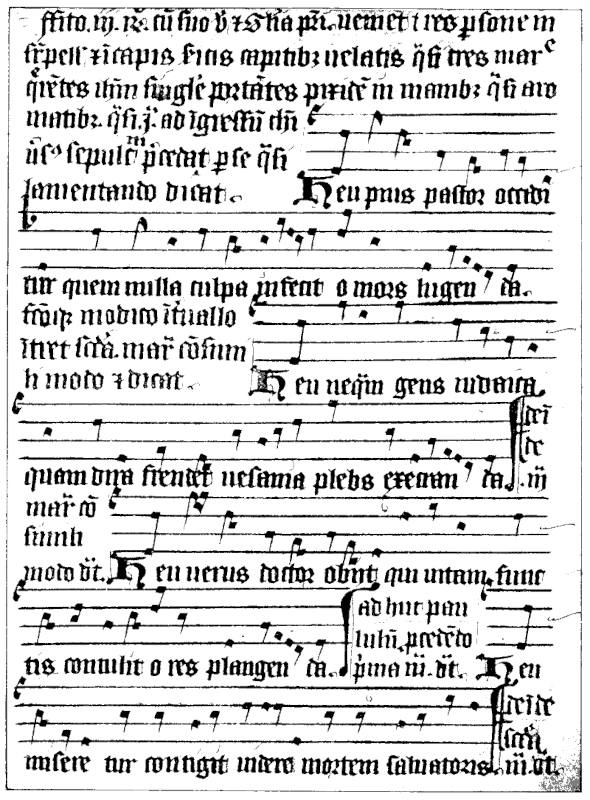
may be illustrated by that of the hymn Heu! pius pastor
occiditur in the Dublin version found by Mr. Frere and printed,
after a different text from his, in an appendix[113]. This play has
not the Christ scene, and belongs, therefore, to the second type
of Quem quaeritis, but, in other respects, including the planctus,
it closely resembles the Fleury version described above.
Another planctus, found in plays of the third type from
Engelberg, Nuremberg, Einsiedeln, and Cividale, is the Heu
nobis! internas mentes[114]; a third, the Heu! miserae cur contigit,
seems to have been interpolated in the Heu! pius pastor at
Dublin; a fourth, the Omnipotens pater altissime, with a refrain
Heu quantus est dolor noster! is found at places so far apart
as Narbonne and Prague[115]: and a fifth, Heu dolor, heu quam
dira doloris angustia! is also in the Fleury text[116].
Another advance towards drama is made in four Prague
versions of the third type by the introduction of an episode
for which there is no Scriptural basis at all. On their way to
the sepulchre, the Maries stop and buy the necessary spices
of a spice-merchant or unguentarius. In three thirteenth-century
texts the unguentarius is merely a persona muta; in
one of the fourteenth he is given four lines[117]. The unguentarius
was destined to become a very popular character, and to afford
much comic relief in the vernacular religious drama of
Germany. Nor can it be quite confidently said that his
appearance in these comparatively late liturgical plays is a
natural development and not merely an instance of reaction
by the vernacular stage.
The scenic effect of the Quem quaeritis can be to some
extent gathered from the rubrics, although these are often absent
and often not very explicit, being content with a general
direction for the performers to be arrayed in similitudinem
mulierum or angelorum or apostolorum, as the case may be.
The setting was obviously simple, and few properties or
costumes beyond what the vestments and ornaments of the
church could supply were used. The Maries had their heads
veiled[118], and wore surplices, copes, chasubles, dalmatics, albs, or
the like. These were either white or coloured. At Fécamp
one, presumably the Magdalen, was in red, the other two in
white[119]. The thuribles which, as already pointed out, they
carried, were sometimes replaced by boxes or vases representing
the ointment and spices[120]. Sometimes also they carried,
or had carried before them, candles. Two or three rubrics
direct them to go pedetemptim, as sad or searching[121]. They
were generally three in number, occasionally two, or one only.
The angels, or angel, as the case might be, sat within the
sepulchre or at its door. They, too, had vestments, generally
white, and veiled or crowned heads. At Narbonne, and
probably elsewhere, they had wings[122]. They held lights,
a palm, or an ear of corn, symbolizing the Resurrection[123]. The
apostles are rarely described; the ordinary priestly robes
doubtless sufficed. At Dublin, St. John, in white, held a palm,
and St. Peter, in red, the keys[124]. In the earliest Prague version
of the Christ scene, the Christ seems to be represented by one
of the angels[125]. At Nuremberg the dominica persona has
a crown and bare feet[126]. At Rouen he holds a cross, and
though there is a double appearance, there is no hint of any
change of costume[127]. But at Coutances and Fleury the first
appearance is as hortulanus, indicated perhaps by a spade,
which is exchanged on the second for the cross[128].
It must be borne in mind that the Quem quaeritis remained
imperfectly detached from the liturgy, out of which it arose.
The performers were priests, or nuns, and choir-boys. The
play was always chanted, not spoken[129]. It was not even completely
resolved into dialogue. In many quite late versions
narrative anthems giving the gist of each scene are retained,
and are sung either by the principal actors or by the choir,
which thus, as in the hymns or proses which occur as overtures[130],
holds a position distinct from the part which it takes
as representing the disciples[131]. Finally the whole performance
ends in most cases with the Te Deum laudamus, and thus
becomes a constituent part of Matins, which normally comes
to a close with that hymn. The intervention of the congregation,
with its Easter hymn Christ ist erstanden, seems to lie
outside the main period of the evolution of the Quem quaeritis.
I only find one example so early as the thirteenth century[132].
It is in quite late texts also that certain other Easter motives
have become attached to the play. The commonest of these
are the whispered greeting of Surrexit Christus and the kiss
of peace, which have been noted elsewhere as preceding
Matins[133]. At Eichstädt, in 1560, is an amusing direction,
which Mr. Collins would have thought very proper, that the
pax is to be given to the dominus terrae, si ibi fuerit, before
the priest. The same manuscript shows a curious combination
of the Quem quaeritis with the irrepressible Tollite portas
ceremony[134].
Another such is found at Venice[135]. But this is
as late as the eighteenth century, to which also belongs the
practice at Angers described by De Moleon, according to
which the Maries took up from the sepulchre with the linteum
two large Easter eggs—deux œufs d’autruche[136].
Besides the Quem quaeritis, Easter week had another
liturgical drama in the Peregrini or Peregrinus[137]. This
was established by the twelfth century. It was regularly
played at Lichfield[138], but no text is extant from England,
except a late transitional one, written partly in the vernacular[139].
France affords four texts, from Saintes[140],
Rouen[141],
Beauvais[142],
and Fleury[143].
The play is also recorded at Lille[144].
In Germany it is represented by a recently-discovered fragment
of the famous early thirteenth-century repertory of the
scholares vagantes from the Benedictbeuern monastery[145].
The simplest version is that of Saintes, in which the action
is confined to the journey to Emmaus and the supper there.
The Rouen play is on the same lines, but at the close the
disciples are joined by St. Mary Magdalen, and the Victimae
paschali is sung. The Benedictbeuern play similarly ends
with the introduction of the Virgin and two other Maries to
greet the risen Christ. But here, and in the Beauvais and
Fleury plays, a distinct scene is added, of which the subject is
the incredulity of Thomas and the apparition to him. It
is, I think, a reasonable conjecture that the Peregrini, in
which the risen Christ is a character, was not devised until
he had already been introduced into the later versions of the
Quem quaeritis. Indeed the Fleury Peregrini, with its double
appearance and change of costume for Christ, seems clearly
modelled on the Fleury Quem quaeritis. But the lesser play
has its own proper and natural place in the Easter week
services. It is attached to the Processio ad fontes which is
a regular portion, during that season, of Vespers[146]. The Christ
with the Resurrection cross is personated by the priest who
normally accompanies the procession cum cruce. At Rouen
the play was a kind of dramatization of the procession itself[147];
at Lille it seems to have had the same position; at Saintes
and Beauvais it preceded the Magnificat and Oratio or Collecta,
after which the procession started. In the remaining cases
there is no indication of the exact time for the Peregrini.
The regular day for it appears to have been the Monday in
Easter week, of the Gospel for which the journey to Emmaus
is the subject; but at Fleury it was on the Tuesday, when
the Gospel subject is the incredulity of Thomas. At Saintes,
a curious rubric directs the Christ during the supper at
Emmaus to divide the ‘host’ among the Peregrini. It seems
possible that in this way a final disposal was found for the
host which had previously figured in the Depositio and Elevatio
of the sepulchre ceremony.
A long play, probably of Norman origin and now preserved
in a manuscript at Tours, represents a merging of the Elevatio,
the Quem quaeritis, and the Peregrini[148]. The beginning is
imperfect, but it may be conjectured from a fragment belonging
to Klosterneuburg in Germany, that only a few lines are
lost[149]. Pilate sets a watch before the sepulchre. An angel
sends lightning, and the soldiers fall as if dead[150]. Then come
the Maries, with planctus. There is a scene with the unguentarius
or mercator, much longer than that at Prague,
followed by more planctus. After the Quem quaeritis, the
soldiers announce the event to Pilate. A planctus by the
Magdalen leads up to the apparition to her. The Maries
return to the disciples. Christ appears to the disciples, then
to Thomas, and the Victimae paschali and Te Deum conclude
the performance. A fragment of a very similar play, breaking
off before the Quem quaeritis, belongs to the Benedictbeuern
manuscript already mentioned[151].
It is clear from the rubrics that the Tours play, long as
it is, was still acted in church, and probably, as the Te Deum
suggests, at the Easter Matins[152]. Certainly this was the case
with the Benedictbeuern play. In a sense, these plays only
mark a further stage in the process of elaboration by which
the fuller versions of the Quem quaeritis proper came into
being. But the introduction at the beginning and end of
motives outside the events of the Easter morning itself points
to possibilities of expansion which were presently realized,
and which ultimately transformed the whole character of the
liturgical drama. All the plays, however, which have so far
been mentioned, are strictly plays of the Resurrection. Their
action begins after the Burial of Christ, and does not stretch
back into the events of the Passion. Nor indeed can the
liturgical drama proper be shown to have advanced beyond
a very rudimentary representation of the Passion. This began
with the planctus, akin to those of the Quem quaeritis, which
express the sorrows of the Virgin and the Maries and St. John
around the cross[153]. Such planctus exist both in Latin and
the vernacular. The earliest are of the twelfth century.
Several of them are in dialogue, in which Christ himself
occasionally takes part, and they appear to have been sung
in church after Matins on Good Friday[154]. The planctus must
be regarded as the starting-point of a drama of the Passion,
which presently established itself beside the drama of the
Resurrection. This process was mainly outside the churches,
but an early and perhaps still liturgical stage of it is to be
seen in the ludus breviter de passione which precedes the
elaborated Quem quaeritis of the Benedictbeuern manuscript,
and was probably treated as a sort of prologue to it. The
action extends from the preparation for the Last Supper to
the Burial. It is mainly in dumb-show, and the slight
dialogue introduced is wholly out of the Vulgate. But at
one point occurs the rubric Maria planctum faciat quantum
melius potest, and a later hand has inserted out of its place in
the text the most famous of all the laments of the Virgin, the
Planctus ante nescia[155].
CHAPTER XIX LITURGICAL PLAYS ( continued )
The ‘Twelve days’ of the Christmas season are no less
important than Easter itself in the evolution of the liturgical
drama. I have mentioned in the last chapter a Christmas
trope which is evidently based upon the older Easter dialogue.
Instead of Quem quaeritis in sepulchro, o Christicolae? it
begins Quem quaeritis in praesepe, pastores, dicite? It occurs
in eleventh- and twelfth-century tropers from St. Gall,
Limoges, St. Magloire, and Nevers. Originally it was an
Introit trope for the third or ‘great’ Mass. In a fifteenth-century
breviary from Clermont-Ferrand it has been transferred
to Matins, where it follows the Te Deum; and this is
precisely the place in the Christmas services occupied, at
Rouen, by a liturgical drama known as the Officium Pastorum,
which appears to have grown out of the Quem quaeritis in
praesepe? by a process analogous to that by which the Easter
drama grew out of the Quem quaeritis in sepulchro[156]? A
praesepe or ‘crib,’ covered by a curtain, was made ready
behind the altar, and in it was placed an image of the Virgin.
After the Te Deum five canons or vicars, representing the
shepherds, approached the great west door of the choir.
A boy in similitudinem angeli perched in excelso sang them
the ‘good tidings,’ and a number of others in voltis ecclesiae
took up the Gloria in excelsis. The shepherds, singing a hymn,
advanced to the praesepe. Here they were met with the
Quem quaeritis by two priests quasi obstetrices[157]. The dialogue
of the trope, expanded by another hymn during which
the shepherds adore, follows, and so the drama ends. But the
shepherds ‘rule the choir’ throughout the Missa in Gallicantu
immediately afterwards, and at Lauds, the anthem for which
much resembles the Quem quaeritis itself[158]. The misterium
pastorum was still performed at Rouen in the middle of the
fifteenth century, and at this date the shepherds, cessantibus
stultitiis et insolenciis, so far as this could be ensured by the
chapter, took the whole ‘service’ of the day, just as did the
deacons, priests, and choir-boys during the triduum[159].
If the central point of the Quem quaeritis is the sepulchrum,
that of the Pastores is the praesepe. In either case the drama,
properly so called, is an addition, and by no means an invariable
one, to the symbolical ceremony. The Pastores may, in
fact, be described, although the term does not occur in the
documents, as a Visitatio praesepis. The history of the
praesepe can be more definitely stated than that of the sepulchrum.
It is by no means extinct. The Christmas ‘crib’ or
crèche, a more or less realistic representation of the Nativity,
with a Christ-child in the manger, a Joseph and Mary, and
very often an ox and an ass, is a common feature in all
Catholic countries at Christmas time[160]. At Rome, in particular,
the esposizione del santo bambino takes place with
great ceremony[161]. A tradition ascribes the first presepio
known in Italy to St. Francis, who is said to have invented it
at Greccio in 1223[162]. But this is a mistake. The custom is
many centuries older than St. Francis. Its Roman home
is the church of S. Maria Maggiore or Ad Praesepe, otherwise
called the ‘basilica of Liberius.’ Here there was in the
eighth century a permanent praesepe[163], probably built in imitation
of one which had long existed at Bethlehem, and to
which an allusion is traced in the writings of Origen[164]. The
praesepe of S. Maria Maggiore was in the right aisle. When
the Sistine chapel was built in 1585-90 it was moved to the
crypt, where it may now be seen. This church became an
important station for the Papal services at Christmas. The
Pope celebrated Mass here on the vigil, and remained until
he had also celebrated the first Mass on Christmas morning.
The bread was broken on the manger itself, which served as
an altar. At S. Maria Maggiore, moreover, is an important
relic, in some boards from the culla or cradle of Christ, which
are exposed on the presepio during Christmas[165]. The presepio
of S. Maria Maggiore became demonstrably the model for
other similar chapels in Rome[166], and doubtless for the more
temporary structures throughout Italy and western Europe
in general.
In the present state of our knowledge it is a little difficult
to be precise as to the range or date of the Pastores. The
only full mediaeval Latin text, other than that of Rouen,
which has come to light, is also of Norman origin, and is still
unprinted[167]. In the eighteenth century the play survived at
Lisieux and Clermont[168]. The earliest Rouen manuscript is of
the thirteenth century, and the absence of any reference to
the Officium Pastorum by John of Avranches, who writes
primarily of Rouen, and who does mention the Officium
Stellae, makes it probable that it was not there known about
1070[169]. Its existence, however, in England in the twelfth century
is shown by the Lichfield Statutes of 1188-98, and on the whole
it is not likely to have taken shape later than the eleventh.
Very likely it never, as a self-contained play, acquired the
vogue of the Quem quaeritis. As will be seen presently, it
was overshadowed and absorbed by rivals. I find no trace
of it in Germany, where the praesepe became a centre, less for
liturgical drama, than for carols, dances, and ‘crib-rocking[170].’
Still rarer than the Pastores is the drama, presumably
belonging to Innocents’ day, of Rachel. It is found in a
primitive form, hardly more than a trope, in a Limoges
manuscript of the eleventh century. Here it is called Lamentatio
Rachel, and consists of a short planctus by Rachel herself,
and a short reply by a consoling angel. There is nothing
to show what place it occupied in the services[171].
The fact is that both the Pastores and the Rachel were in
many churches taken up into a third drama belonging to the
Epiphany. This is variously known as the Tres Reges, the
Magi, Herodes, and the Stella. It exists in a fair number of
different but related forms. Like the Quem quaeritis and the
Pastores, it had a material starting-point, in the shape of a
star, lit with candles, which hung from the roof of the church,
and could sometimes be moved, by a simple mechanical
device, from place to place[172]. As with the Quem quaeritis,
the development of the Stella must be studied without much
reference to the relative age of the manuscripts in which it
happens to be found. But it was probably complete by the
end of the eleventh century, since manuscripts of that date
contain the play in its latest forms[173].
The simplest version is from Limoges[174]. The three kings
enter by the great door of the choir singing a prosula. They
show their gifts, the royal gold, the divine incense, the myrrh
for funeral. Then they see the star, and follow it to the high
altar. Here they offer their gifts, each contained in a gilt
cup, or some other iocale pretiosum, after which a boy, representing
an angel, announces to them the birth of Christ, and
they retire singing to the sacristy. The text of this version
stands by itself: nearly all the others are derived from a
common tradition, which is seen in its simplest form at
Rouen[175]. In the Rouen Officium Stellae, the three kings,
coming respectively from the east, north, and south of the
church, meet before the altar. One of them points to the
star with his stick, and they sing:
‘1. Stella fulgore nimio rutilat,
2. Quae regem regum natum demonstrat
3. Quem venturum olim prophetiae signaverant.’
They kiss each other and sing an anthem, which occurs also in
the Limoges version: Eamus ergo et inquiramus eum, offerentes
ei munera; aurum thus et myrrham. A procession is
now formed, and as it moves towards the nave, the choir chant
narrative passages, describing the visit of the Magi to Jerusalem
and their reception by Herod. Meanwhile a star is lit
over the altar of the cross where an image of the Virgin has
been placed. The Magi approach it, singing the passage
which begins Ecce stella in Oriente. They are met by two in
dalmatics, who appear to be identical with the obstetrices of
the Rouen Pastores. A dialogue follows:
‘Qui sunt hi qui, stella duce, nos adeuntes inaudita
ferunt.
Magi respondeant:
nos sumus, quos cernitis, reges Tharsis et Arabum et Saba,
dona ferentes Christo, regi nato, Domino, quem, stella deducente,
adorare venimus.
Tunc duo Dalmaticati aperientes cortinam dicant:
ecce puer adest quem queritis, Iam properate adorate,
quia ipse est redemptio mundi.
Tunc procidentes Reges ad terram, simul salutent puerum, ita
dicentes:
salve, princeps saeculorum.
Tunc unus a suo famulo aurum accipiat et dicat:
suscipe, rex, aurum.
Et offerat.
Secundus ita dicat et offerat:
tolle thus, tu, vere Deus.
Tercius ita dicat et offerat:
mirram, signum sepulturae.’
Then the congregation make their oblations. Meanwhile the
Magi pray and fall asleep. In their sleep an angel warns
them to return home another way. The procession returns
up a side aisle to the choir; and the Mass, in which the Magi,
like the shepherds on Christmas day, ‘rule the choir,’ follows.
In spite of the difference of text the incidents of the Rouen
and Limoges versions, except for the angelic warning introduced
at Rouen, are the same. There was a dramatic advance
when the visit to Jerusalem, instead of being merely narrated
by the choir, was inserted into the action. In the play performed
at Nevers[176], Herod himself, destined in the fullness of
time to become the protagonist of the Corpus Christi stage,
makes his first appearance. There are two versions of the
Nevers play. In the earlier the new scene is confined to
a colloquy between Herod and the Magi:
‘[Magi.] Vidimus stellam eius in Oriente, et agnovimus
regem regum esse natum.
[Herodes.] regem quem queritis natum stella quo signo didicistis?
Si illum regnare creditis, dicite nobis.
[Magi.] illum natum esse didicimus in Oriente stella monstrante.
[Herodes.] ite et de puero diligenter investigate, et inventum
redeuntes mihi renuntiate.’
The later version adds two further episodes. In one a
nuntius announces the coming of the Magi, and is sent to
fetch them before Herod: in the other Herod sends his
courtiers for the scribes, who find a prophecy of the birth of
the Messiah in Bethlehem. Obviously the Herod scene
gives point to the words at the end of the Rouen play, in
which the angel bids the Magi to return home by a different
way.
At Compiègne the action closes with yet another scene, in
which Herod learns that the Magi have escaped him[177].
‘Nuncius. Delusus es domine, magi viam redierunt aliam.
Armiger. decerne, domine, vindicari iram tuam, et stricto
mucrone quaerere iube puerum, forte inter occisos occidetur
et ipse.
Herodes. indolis eximiae pueros fac ense perire.
Angelus. sinite parvulos venire ad me, talium est enim
regnum caelorum.’
In a Norman version which has the same incidents as the
Compiègne play, but in parts a different text, the armiger is the
son of Herod, and the play ends with Herod taking a sword
from a bystander and brandishing it in the air[179]. Already he
is beginning to tear a passion to tatters in the manner that
became traditionally connected with his name. Another
peculiarity of this Norman version is that the Magi address
Herod in an outlandish jargon, which seems to contain fragments
of Hebrew and Arabic speech.
The play of the Stella must now, perhaps, be considered,
except so far as mere amplifications of the text are concerned,
strictly complete. But another step was irresistibly suggested
by the course it had taken. The massacre of the Innocents,
although it lay outside the range of action in which the Magi
themselves figured, could be not merely threatened but actually
represented. This was done at Laon[180]. The cruel suggestion
of Archelaus is carried out. The Innocents come in singing
and bearing a lamb. They are slain, and the play ends with
a dialogue, like that of the distinct Limoges planctus, between
the lamenting Rachel and an angelic consolatrix.
The absorption of the motives proper to other feasts of the
Twelve nights into the Epiphany play has clearly begun.
A fresh series of examples shows a similar treatment of the
Pastores. At Strassburg the Magi, as they leave Herod, meet
the shepherds returning from Bethlehem:
‘Pastores, dicite, quidnam vidistis?
infantem vidimus.’
This, however, is not taken from the Pastores itself, but from
the Christmas Lauds antiphon[181]. Its dramatic use may be
compared with that of the Victimae paschali in the Quem
quaeritis. In versions from Bilsen[182] near Liège and from
Mans[183], on the other hand, although the meeting of the Magi
and the shepherds is retained, a complete Pastores, with the
angelic tidings and the adoration at the praesepe, forms
the first part of the office, before the Magi are introduced
at all.
The Strassburg, Bilsen, and Mans plays have not the
Rachel, although the first two have the scene in which the
nuntius informs Herod that the Magi have deceived him.
A further stage is reached when, as at Freising and at
Fleury, the Pastores, Stella and Rachel all coalesce in a single,
and by this time considerable, drama. The Freising texts,
of which there are two, are rather puzzling[184]. The first closely
resembles the plays of the group just described. It begins with
a short Pastores, comprising the angelic tidings only. Then
the scenes between the Magi and Herod are treated at great
length. The meeting of the Magi and the shepherds is followed
by the oblation, the angelic warning, and the return of the
messenger to Herod. In the second Freising text, which
is almost wholly metrical, the Pastores is complete. It is
followed by a quite new scene, the dream of Joseph and his
flight into Egypt. Then come successively the scene of fury
at court, the massacre, the planctus and consolation of Rachel.
Clearly this second text, as it stands, is incomplete. The
Magi are omitted, and the whole of the latter part of the
play is consequently rendered meaningless. But it is the
Magi who are alone treated fully in the first Freising text.
I suggest, therefore, that the second text is intended to
supplement and not to replace the first. It really comprises
two fragments: one a revision of the Pastores, the other a
revision of the closing scene and an expansion of it by a Rachel.
As to the Fleury version there can be no doubt whatever[185].
The matter is, indeed, arranged in two plays, a Herodes and
an Interfectio Puerorum, each ending with a Te Deum; and
the performance may possibly have extended over two days.
But the style is the same throughout and the episodes form
one continuous action. It is impossible to regard the Interfectio
Puerorum as a separate piece from the Herodes, acted
a week earlier on the feast of the Innocents; for into it,
after the first entry of the children with their lamb, gaudentes
per monasterium, come the flight into Egypt, the return of
the nuntius, and the wrath of Herod, which, of course, presuppose
the Magi scenes. Another new incident is added
at the end of the Fleury play. Herod is deposed and Archelaus
set up; the Holy Family return from Egypt, and settle in the
parts of Galilee[186].
I have attempted to arrange the dozen or so complete
Epiphany plays known to scholars in at least the logical order of
their development. There are also three fragments, which fit
readily enough into the system. Two, from a Paris manuscript
and from Einsiedeln, may be classed respectively with the
Compiègne and Strassburg texts[187]. The third, from Vienne, is
an independent version, in leonine hexameters, of the scene in
which the Magi first sight the star, a theme common to all the
plays except that of Limoges[188]. I do not feel certain that this
fragment is from a liturgical drama at all.
The textual development of the Stella is closely parallel
to that of the Quem quaeritis. The more primitive versions
consist of antiphons and prose sentences based upon or in
the manner of the Scriptures. The later ones, doubtless
under the influence of wandering scholars, become increasingly
metrical. The classical tags, from Sallust and Virgil, are
an obvious note of the scholarly pen. With the exception
of that from Limoges, all the texts appear to be derived by
successive accretions and modifications from an archetype
fairly represented at Rouen. The Bilsen text and the Vienne
fragment have been freely rewritten, and the process of rewriting
is well illustrated by the alternative versions found
side by side in the later Nevers manuscript. With regard
to the place occupied by the Stella in the Epiphany services,
such manuscripts as give any indications at all seem to point
to a considerable divergence of local use. At Limoges and
Nevers, the play was of the nature of a trope to the Mass,
inserted in the former case at the Offertorium, in the latter at
the Communio[189]. At Rouen the Officium followed Tierce, and
preceded the ordinary procession before Mass. At Fleury
the use of the Te Deum suggests that it was at Matins; at
Strassburg it followed the Magnificat at Vespers, but on the
octave of Epiphany, not Epiphany itself. Perhaps the second
part of the Fleury play was also on the octave. At Bilsen
the play followed the Benedicamus, but with this versicle
nearly all the Hours end[190]. I do not, however, hesitate to
say that the Limoges use must have been the most primitive
one. The kernel of the whole performance is a dramatized
Offertorium. It was a custom for Christian kings to offer
gold and frankincense and myrrh at the altar on Epiphany
day[191]; and I take the play to have served as a substitute
for this ceremony, where no king actually regnant was
present.
There is yet one other liturgical play belonging to the
Christmas season, which for the future development of the
drama is the most important of all. This is the Prophetae[192].
It differs from the Quem quaeritis, the Peregrini, the Pastores,
and the Stella by the large number of performers required,
and by the epical mode of its composition. Its origin, in
fact, is to be sought in a narrative, a lectio, not a chant. The
source was the pseudo-Augustinian Sermo contra Iudaeos,
Paganos et Arianos de Symbolo, probably written in the sixth
century, but ascribed throughout the Middle Ages to the
great African[193]. A portion of this sermon was used in many
churches as a lesson for some part or other of the Christmas
offices[194]. The passage chosen is in a highly rhetorical vein.
Vos, inquam, convenio, O Iudaei cries the preacher, and calls
upon the Jews to bear witness out of the mouths of their own
prophets to the Christ. Isaiah, Jeremiah, Daniel, Moses,
David, Habakkuk, Simeon, Zacharias and Elisabeth, John
the Baptist;—each in turn is bidden to speak, and each
testimony is triumphantly quoted. Then: Ecce, convertimur
ad gentes. Virgil—poeta facundissimus—is pressed into the
service, for the famous line of his fourth eclogue:
Nebuchadnezzar, who saw four walking in the furnace, and
finally the Erythraean Sibyl, whose acrostic verses on the
‘Signs of Judgement’ first appear in the writings of Eusebius[196].
The dramatic form of this lectio possibly led to its being
chanted instead of read, and distributed between several
voices in the manner of the Passions from Palm Sunday to
Good Friday[197]. At any rate in the eleventh century there
appears in a Limoges manuscript a metrical adaptation in
which it has been wholly converted into a dramatic dialogue[198].
This Limoges Prophetae follows the sermon pretty closely in
its arrangement. A Precentor begins:
‘Omnes gentes congaudentes, dent cantum laetitiae!
deus homo fit, de domo David, natus hodie.’
He addresses a couplet each Ad Iudaeos, Ad Gentes, and then
calls in turn upon each of the prophets, who reply, Virgil
pronouncing his line, the Sibyl the Iudicii Signum, and the
others a couplet or quatrain apiece. They are nearly identical
with the personages of the sermon: Israel is added, Zacharias
disappears, and the order is slightly different. Finally the
Precentor concludes:
‘Iudaea incredula,
cur manens adhuc inverecunda?’
Two later versions, belonging respectively to Laon[199] and to
Rouen[200], diverge far more from the model. They are at
much the same stage of development. In both the play
is ushered in with the hymn Gloriosi et famosi, the verses
of which are sung by the prophets, and the refrain by the
choir[201]. The costumes and symbols of the prophets are
carefully indicated in the rubrics. The Precentor of Limoges
is represented by two singers, called at Laon Appellatores, and
at Rouen Vocatores. The dialogue is amplified beyond that
of Limoges. Sex Iudaei and sex Gentiles, for instance, take
parts: and the Vocatores comment with the choir in an
identical form of words on each prophecy. The Laon text
is a good deal the shorter. The prophets are practically the
same as at Limoges, with one remarkable exception. At
the end is introduced Balaam, and to his prophecy is appended
a miniature drama, with the angel and the ass: thus—
‘Hic veniat Angelus cum gladio. Balaam tangit asinam, et
illa non praecedente, dicit iratus:
quid moraris, asina,
obstinata bestia?
iam scindent calcaria
costas et praecordia.
Puer sub asina respondet:
angelus cum gladio,
quem adstare video,
prohibet ne transeam;
timeo ne peream.’
The Rouen text adds quite a number of prophets. The full
list includes Moses, Amos, Isaiah, Aaron, Jeremiah, Daniel,
Habakkuk, Balaam, Samuel, David, Hosea, Joel, Obadiah,
Jonah, Micah, Nahum, Zephaniah, Haggai, Zechariah, Ezekiel,
Malachi, Zacharias, Elisabeth, John the Baptist, Simeon,
Virgil, Nebuchadnezzar, and the Sibyl. In this version, also,
the part of Balaam is expanded into a drama.
‘Duo missi a rege Balac dicant:
Balaam, veni et fac.
Tunc Balaam, ornatus, sedens super asinam, habens calcaria,
retineat lora et calcaribus percutiat asinam, et quidam iuvenis,
habens alas, tenens gladium, obstet asinae. Quidam sub asina
dicat:
cur me cum calcaribus miseram sic laeditis.
Hoc dicto, Angelus ei dicat:
desine regis Balac praeceptum perficere.’
Here, too, another little drama is similarly introduced. This
is the story of Shadrach, Meshach, and Abednego, which, with
an imago for the brethren to refuse to worship and a fornax
for them to be cast into, attaches itself to the vocatio of
Nebuchadnezzar.
In the Limoges manuscript the Prophetae is followed by
the words Hic inchoant Benedicamus[202]. As has been pointed
out in the case of the Bilsen Pastores, this is not conclusive
as to the hour at which the performance took place. The day
was probably that of Christmas itself. But even the day would
naturally vary with the variable position of the lectio out of
which the Prophetae grew. At Lincoln it was likewise
Christmas day. But at Rouen the processio asinorum was
on Christmas eve, and took the place of the ordinary festal
procession after Tierce and before Mass[203]. And at St. Martin
of Tours the Prophetae was on New Year’s day, performances
being given both at Matins and Vespers[204].
The question naturally suggests itself: What was the relation
of these liturgical plays of the Christmas season to the
Feast of Fools and other ecclesiastical ludi of the Twelve
nights, which were discussed in the first volume? At Rouen,
the Prophetae received the name of processio asinorum and
took place at a festum asinorum, a name which we know to
have been elsewhere synonymous with festum fatuorum.
At Tours, it was played at a reformed festum novi anni,
with a Boy Bishop and at least traces of expelled disorder.
So, too, with the other plays. The Rouen Pastores was
infected by the fifteenth century with the stultitiae et insolentiae
of the triduum. At Bilsen the Stella was performed
before a rex, who can hardly have been any other than a rex
fatuorum of Epiphany. At Autun the regnum Herodis was
considered a Feast of Fools[205]. Probably in both churches the
rex acted Herod in the play. I think it must be taken for
granted that the plays are the older institution of the two.
They seem all to have taken shape by the eleventh century,
before there is any clear sign that the Kalends had made their
way into the churches and become the Feast of Fools. The
plays may even have been encouraged as a counter-attraction,
for the congregation, to the Kalends outside. On the other
hand, I do not hold, as some writers do, that the riotous
Feasts of Asses were derived from the pious and instructive
ceremony so called at Rouen[206]. On the contrary, Balaam and
his ass are an interpolation in the Prophetae both at Rouen
and, more obviously, at Laon. Balaam, alone of the Laon
performers, is not from the pseudo-Augustine sermon. Is he
not, therefore, to be regarded as a reaction of the Feast of
Fools upon the Prophetae, as an attempt to turn the established
presence of the ass in the church to purposes of
edification, rather than of ribaldry[207]? I think the explanation
is the more plausible one. And I find a parallel reaction of the
turbulence of the Feast of Fools upon the Stella, in the violence
of speech and gesture which permanently associated itself
at a very early stage with the character of Herod. The view
here taken will be confirmed, when we come to consider certain
ecclesiastical criticisms passed upon the liturgical plays in the
twelfth century.
Whatever the exact relation of the divine and profane ludi
at Easter and Christmas may be, it seems to have been, in the
main, at these two great seasons of festivity that what may be
called the spontaneous growth of drama out of liturgy took
place. There are yet a fair number of Latin plays to be
spoken of which are in a sense liturgical. That is to say,
they were acted, certainly or probably, in churches and during
intervals in the services. But of these such a spontaneous
growth cannot be asserted, although it cannot also, in the
present state of the evidence, be confidently denied. Their
metrical and literary style is parallel to that of the Easter
and Christmas plays in the latest stages of development; and,
until further data turn up, it is perhaps permissible to conjecture
that they were deliberately composed on the model of
the Quem quaeritis and the Stella, when these had become
widespread and popular. Indeed, some such derivation of
the Peregrini from the Quem quaeritis and of the Stella itself,
at least in part, from the Pastores, has already appeared
probable.
In dealing with this new group of plays, we come, for the
first and only time, upon an individual author. As might be
expected, this author is a scholaris vagans, by name Hilarius.
It would even be doing him no great injustice to call him
a goliard. What little is known of Hilarius is gathered from
his writings, which exist in a single manuscript. He may
have been an Englishman, for a large proportion of his verses
are addressed to English folk. He was a pupil, about 1125,
of the famous Abelard at his oratory of Paraclete in a desert
near Nogent-sur-Seine. Afterwards he made his way to
Angers. Many of his verses are of the familiar goliardic
type, amorous and jocund; but amongst them are three
plays[208]. Two of these are comparatively short, and contain
each a few stanzas of French interspersed amongst the Latin.
The subject of one is a miracle wrought by St. Nicholas[209];
of the other, the Suscitatio Lazari[210]. The third play, wholly
in Latin, falls into two parts, and gives at considerable length
the story of Daniel[211]. I take it that these plays were not
written for any church in particular, but represent the repertory
of a band of wandering clerks. At the end, both of the Daniel
and of the Suscitatio Lazari, is a rubric or stage-direction,
to the effect that, if the performance is given at Matins, the
Te Deum should follow; if at Vespers, the Magnificat.
Evidently the connexion with the church service, so organic
in the plays of the more primitive type, has become for
Hilarius almost accidental. As to the place of the plays
in the calendar, the manuscript gives no indication, and
probably Hilarius and his friends would be willing enough
to act them whenever they got a chance. But the St. Nicholas
play would come most naturally on the day of that saint,
December 6. The Suscitatio Lazari would be appropriate
enough as an addition to the Quem quaeritis and the Peregrini
in Easter week. The story is told, indeed, in the Gospel for
Friday in the fourth week in Lent; but that does not seem
a very likely date for a play. The Daniel perhaps grew,
as we have seen a Balaam and a Nebuchadnezzar growing,
out of a Prophetae; and may have been a substitute for
a Prophetae at Christmas.
These dates are borne out, or not contradicted, by other
similar plays, which have more of a local habitation. For no
one of Hilarius’ three stands quite alone. Of Latin plays of
St. Nicholas, indeed, quite a little group exists; and the great
scholastic feast evidently afforded an occasion, less only than
Easter and Christmas, for dramatic performances. The earliest
texts are from Germany. Two are found in a Hildesheim
manuscript of the eleventh century[212]; a third in an Einsiedeln
manuscript of the twelfth[213]. The thirteenth-century Fleury
play-book contains no less than four, two of which appear
to be more developed forms of the Hildesheim plays. The
theme is in every case one of the miraculous deeds which
so largely make up the widespread legend of the saint[214].
Nicholas restores to life the three clerks
‘quos causa discendi literas
apud gentes transmisit exteras,’
and whom the greed of an innkeeper has slain[215]. He provides
with a dowry the daughters of a poor gentleman, who are
threatened with a life of shame[216]. He brings back from
captivity the son of his wealthy adorer[217]. His image preserves
from housebreakers the riches of a Jew[218]. Alone of the extant
Latin plays, these of St. Nicholas are drawn from outside the
Biblical story. Each of the Fleury versions introduces at
the end one of the anthems proper to St. Nicholas’ day, and
their connexion with the feast is therefore clear.
A second Lazarus play, which includes not only the Suscitatio
but also the episode of Mary Magdalen in the house of
Simon, is likewise in the Fleury play-book[219]. A second Daniel,
composed by the iuventus of Beauvais, occurs in the same
manuscript which contains the Office of the Circumcision for
that cathedral[220]. It was perhaps intended for performance on
the day of the asinaria festa. Other plays seem, in the same
way as the Daniel, to have budded off from the Prophetae.
A fragment is preserved of an Isaac and Rebecca from Kloster
Vorau in Styria[221].
A twelfth-century mention of an Elisaeus[222]
and an eleventh-century one of a Convivium Herodis[223], which
suggests rather the story of John the Baptist than that of the
Magi, point to an activity in this direction of which all the
traces have possibly not yet been discovered.
Three plays, each more or less unique in character, complete
the tale. The Fleury play-book has a Conversio Beati Pauli
Apostoli, doubtless designed for the feast on January 25[224].
The shorter, but highly interesting collection from Limoges,
has a play of the wise and foolish virgins, under the title of
Sponsus[225]. This has attracted much attention from scholars,
on account of the fact that it is partly in French, or more
strictly in a dialect belonging to the Angoumois, and slightly
affected by Provençal. As it is therefore of the nature of
a transitional form, it may be well to give a somewhat full
account of it. It opens with a Latin chorus beginning
‘Adest sponsus qui est Christus: vigilate, virgines!’
The angel Gabriel then addresses the virgins, and warns them
in four French stanzas to expect ‘un espos, Sauvaire a nom.’
Each stanza has a refrain, probably sung chorally:
‘gaire noi dormet:
aici’s l’espos que vos or atendet!
Then comes a lyric dialogue, in which the Fatuae, who have
wasted their oil, attempt in vain to get some, first from the
Prudentes, and then from some Mercatores, whose presence here
recalls the unguentarius in the Prague versions of the Quem
quaeritis[226]. This dialogue is in Latin, but with a French
refrain:
‘dolentas, chaitivas, trop i avem (or avet) dormit.’
Then comes the Sponsus, to whom the Fatuae finally appeal:
‘audi, sponse, voces plangentium:
aperire fac nobis ostium
cum sociis ad dulce prandium;
nostrae culpae praebe remedium!
dolentas, chaitivas, trop i avem dormit.
Christus.
amen dico, vos ignosco, nam caretis lumine,
quod qui perdunt procul pergunt huius aulae limine.
alet, chaitivas, alet, malaüreias!
a tot jors mais vos son penas livreias,
e en efern ora seret meneias!
Modo accipiant eas daemones et praecipitentur
in infernum.’
This stage direction, together with an allusion in the opening
lines of the Sponsus to the ‘second Adam,’ link this remarkable,
and, I venture to think, finely conceived little piece to
the Christmas play of Adam to be discussed in the next
chapter. It has essentially an Advent theme, and must have
been performed either in Advent itself or at the Christmas
season, with which Advent is prophetically connected[227].
Finally, there is a play which was almost certainly performed
at Advent[228].
This is the Tegernsee play of Antichristus[229]. It
is founded upon the prophecy in St. Paul’s second epistle to
the Thessalonians of the homo peccati, filius perditionis, who
shall sit in the temple of God until the Christ shall slay him
with the breath of his mouth, and destroy him with the glory
of his advent[230]: and it is an elaborate spectacle, requiring for
its proper performance a large number of actors and a spacious
stage, with a temple of God and seven royal sedes, together
with room for much marching and counter-marching and
warfare[231]. It must have taken up the whole nave of some
great church. It begins with a procession of Emperor, Pope,
and Kings, accompanied by personages emblematic of Gentilitas,
Sinagoga and Ecclesia with her attendants Misericordia
and Iustitia. The first part of the action represents the
conquest of the four corners of Christendom by the Emperor
and his championship of Jerusalem against the King of
Babylon. Ecclesia, Gentilitas, and Synagoga punctuate the
performance with their characteristic chants. Then come the
Hypocrites, sub silentio et specie humilitatis inclinantes circumquaque
et captantes favorem laicorum. They are followed by
Antichrist himself, who instructs Hypocrisy and Heresy to
prepare the way for his advent. Presently Antichrist is
enthroned in the temple and gradually saps the Empire,
winning over the King of the Greeks by threats, the King of
the Franks by gifts, and the King of the Teutons, who is
incorruptible and invincible, by signs and wonders. He marks
his vassals on the brow with the first letter of his name.
Then the Hypocrites attempt to persuade Synagoga that
Antichrist is the Messiah; but are refuted by the prophets
Enoch and Elijah. Antichrist has the rebels slain; but while
he is throned in state, thunder breaks suddenly over his head,
he falls, and Ecclesia comes to her own again with a Laudem
dicite deo nostro.
The author of the Antichristus is not only a skilled craftsman
in rhyming Latin metres; he is also capable of carrying
a big literary scheme successfully to a close. His immediate
source was probably the tenth-century Libellus de Antichristo
of Adso of Toul[232]. Into this he has worked the central theme
of the Prophetae and the debating figures from that very popular
débat or ‘estrif,’ the Altercatio Ecclesiae et Synagogae[233]. His
work differs in several obvious respects from the comparatively
simple, often naïve, liturgical dramas which have been considered.
It is ambitious in scope, extending to between four
and five hundred lines. It introduces allegorical figures, such
as we shall find, long after, in the moralities. It has a purpose
other than that of devotion, or even amusement. It is,
in fact, a Tendenzschrift, a pamphlet. The instinct of the
drama, which sways the imaginations of men perhaps more
powerfully than any other form of literature, to mix itself up
with politics is incorrigible: Antichristus is a subtle vindication,
on the one hand, of the Empire against the Papacy, on the
other of the rex Teutonicorum against the rex Francorum. It
probably dates from about 1160, when Frederick Barbarossa was
at the height of his struggle with Alexander III, who enjoyed
the sympathies of Louis VII of France. And it is anti-clerical.
The Hypocrites who carry out the machinations of Antichrist
are the clerical reformers, such as Gerhoh of Reichersberg[234],
who were the mainstay of the papacy in Germany.
It is improbable that the few and scattered texts which
have come to light represent all the liturgical plays which had
made their appearance by the middle of the twelfth century.
Besides the lost Elisaeus and Convivium Herodis, there is
evidence, for example, of scholars’ plays in honour, not only
of St. Nicholas, but of their second patron, the philosophical
St. Catharine of Alexandria. Such a ludus de Sancta Katarina
was prepared at Dunstable in England by one Geoffrey, a
Norman clerk who had been invited to England as schoolmaster
to the abbey of St. Albans. For it he borrowed certain
choir copes belonging to the abbey, and had the misfortune
to let these be burnt with his house. Deeply repentant,
he took the religious habit, and in 1119 became abbot of
St. Albans. From this date that of the ludus may be judged
to be early in the twelfth century[235].
It cannot, of course, be assumed that every play, say in the
fifteenth century, which although probably or certainly written
in the vernacular was performed in a church, had a Latin
prototype[236]. Many such may have been written and acted for
the first time on existing models, when the vernacular drama
was already well established. But there are certain feasts
where it is possible to trace, on the one hand, the element of
mimetic ceremony in the services, and on the other, perhaps,
some later representation in the dramatic cycles, and where
a Latin text might at any time turn up without causing
surprise. With a few notes on some of these this chapter
must conclude. A highly dramatic trope for Ascension day,
closely resembling the Quem quaeritis, has already been quoted
from the tropers of Limoges[237]. An Ordinarium of St. Peter’s
of Lille directs that, after the respond Non vos relinquam, the
officiant shall mount a pulpit and thence appear to ascend
towards heaven from the top of a mountain[238]. Fifteenth-century
computi speak of this or of a more elaborate performance as
a mysterium, and include amongst other items payments for
painting the scars on the hands of the performer[239]. On Whit-Sunday
it was the custom at St. Paul’s in London and many
other churches, during the singing of the hymn Veni Creator
Spiritus at Tierce, to open a hole in the roof and let down
symbols of the Pentecost; a dove, a globe of fire, bits of
burning tow to represent tongues of fire, a censer, flowers,
pieces of flaky pastry[240]. This same hole in the roof sometimes
served a similar purpose at a mimetic representation of the
Annunciation. The Gospel for the day was recited by two
clerks dressed as Mary and the angel, and at the words
Spiritus Sanctus supervenit in te a white dove descended from
the roof. This can hardly be called a drama, for, with the
exception of a short fifteenth-century text from Cividale, only
the words of the Gospel itself seem to have been used; but
obviously it is on the extreme verge of drama. A curious
variant in the date of this ceremony is to be noted. In several
Italian examples, of which the earliest dates from 1261, and in
one or two from France, it belongs to the feast of the Annunciation
proper on March 25[241]. But in later French examples,
and apparently also at Lincoln[242], it has been transferred to
the Advent season, during which naturally the Annunciation
was greatly held in remembrance, and has been attached
to the so-called ‘golden’ Mass celebrated ten days before
Christmas during the Quatuor Tempora[243]. It thus became
absorbed into the Christmas dramatic cycle.
CHAPTER XX THE SECULARIZATION OF THE PLAYS
[Bibliographical Note.—The best general account of the vernacular
religious drama of Europe is that of W. Creizenach, Geschichte des neueren
Dramas (vol. i. 1893), Books 2-4; and this may be supplemented by
K. Hase, Das geistliche Schauspiel (1858, trans. A. W. Jackson, 1880);
R. Proelss, Geschichte des neueren Dramas (1880-3), vol. i. ch. 1;
C. Davidson, English Mystery Plays (1892), and G. Gregory Smith, The
Transition Period (1900), ch. 7. There is also the cumbrous work of
J. L. Klein, Geschichte des Dramas (1865-86). The nearest approach to
a general bibliography is F. H. Stoddard, References for Students of
Miracle Plays and Mysteries (1887).—For Germany may be added
R. Froning, Das Drama des Mittelalters (1890-1); K. Pearson, The
German Passion Play (in The Chances of Death and Other Studies in
Evolution, 1897, vol. ii); L. Wirth, Die Oster- und Passionsspiele bis zum
16. Jahrhundert (1889); J. E. Wackernell, Altdeutsche Passionsspiele aus
Tirol, 1897; R. Heinzel, Beschreibung des geistlichen Schauspiels im deutschen
Mittelalter (1898), and the articles by F. Vogt on Mittelhochdeutsche
Literatur, § 73, and H. Jellinghaus on Mittelniederdeutsche Literatur, § 5,
in H. Paul, Grundriss der germanischen Philologie, vol. ii (2nd ed. 1901).
F. Vogt gives a few additional recent references. Older works are
F. J. Mone, Schauspiele des Mittelalters (1846); H. Reidt, Das geistliche
Schauspiel des Mittelalters in Deutschland (1868), and E. Wilken,
Geschichte der geistlichen Spiele in Deutschland (1872). Many of the
books named print texts. Lists of others are given by Pearson and by
Heinzel, and full bibliographical notices by K. Goedeke, Grundriss zur
Geschichte der deutschen Dichtung (2nd ed.), vol. i (1884), §§ 67, 92, and
vol. ii (1886), § 145.—For France, L. Petit de Julleville, Les Mystères
(1880), is excellent and exhaustive, and contains many bibliographical
references, although the ‘Liste des ouvrages à consulter’ intended as part
of the work seems never to have been printed. M. de Julleville is also
the writer of the article on Théâtre religieux in the Hist. de la Langue et
de la Littérature françaises, vol. ii (1896). G. Gröber’s article on Französische
Litteratur, §§ 129, 362 in his Grundriss der romanischen Philologie,
vol. ii (1901-2), brings the subject up to date and adds some recent authorities.
Mortensen, Medeltidsdramat i Frankrike (1899), is beyond my range.
G. Paris, La Littérature française au moyen âge (2nd ed., 1890), is a brief
summary, and L. Clédat, Le Théâtre au moyen âge (1897), a useful
popular account. G. Bapst, Essai sur l’Histoire du Théâtre (1893), is
good on matters of stage arrangement. Older works are O. Le Roy,
Études sur les Mystères (1837), and J. de Douhet, Dictionnaire des
Mystères (1854). Only fragments of C. Magnin’s investigations are
available in the Journal des Savants (1846-7) and the Journal général
de l’Instruction publique (1834-6). Texts are in A. Jubinal, Mystères du
15ᵉ siècle (1837); Monmerqué et Michel, Théâtre français au moyen âge
(1842); E. Fournier, Le Théâtre français avant la Renaissance (1872),
and the series published by the Société des Anciens Textes français. The
most recent text of Adam is that by K. Grass, Das Adamsspiel (1891).
M. Wilmotte, Les Passions allemandes du Rhin dans leur Rapport avec
l’ancien Théâtre français (1898), deals with the interrelations of the French
and German texts. C. Hastings, Le Théâtre français et anglais (1900,
trans. 1901), is a compilation of little merit.—For Italy there is A. D’Ancona,
Origini del Teatro italiano (2nd ed. 1891), with texts in the same writer’s
Sacre Rappresentazioni (1872), in Monaci, Appunti per la Storia del
Teatro italiano (Rivista di Filologia Romana, vols. i, ii), and in F. Torraca,
Il Teatro italiano dei Secoli xiii, xiv, e xv (1885).—For Spain, A. F. von
Schack, Geschichte der dramatischen Litteratur und Kunst in Spanien
(1845-54), and G. Baist, Spanische Litteratur, §§ 19, 63, in Gröber’s
Grundriss, vol. ii (1897).—For the minor Romance dramatic literatures,
Provençal, Catalan, Portuguese, I must be content to refer to the last-named
authority, and for that of Holland to the similar Grundriss of
H. Paul.]
The evolution of the liturgic play described in the last
two chapters may be fairly held to have been complete about
the middle of the thirteenth century. The condition of any
further advance was that the play should cease to be liturgic.
The following hundred years are a transition period. During
their course the newly-shaped drama underwent a process
which, within the limits imposed by the fact that its subject-matter
remained essentially religious, may be called secularization.
Already, when Hilarius could write plays to serve
indifferently for use at Matins or at Vespers, the primitive
relation of repraesentatio to liturgy had been sensibly weakened.
By the middle of the fourteenth century it was a mere survival.
From ecclesiastical the drama had become popular.
Out of the hands of the clergy in their naves and choirs, it
had passed to those of the laity in their market-places and
guild-halls. And to this formal change corresponded a
spiritual or literary one, in the reaction of the temper of the
folk upon the handling of the plays, the broadening of their
human as distinct from their religious aspect. In their origin
officia for devotion and edification, they came, by an irony
familiar to the psychologist, to be primarily spectacula for
mirth, wonder, and delight.
It is, however, the formal change with which I am here
mainly concerned; and of this it will be the object of the
present chapter to trace as briefly as possible the outlines.
The principal factor is certainly that tendency to expansion
and coalescence in the plays which has been already seen at
work in the production of such elaborate pieces as the Quem
quaeritis of the Tours or that of the Benedictbeuern manuscript,
the Fleury Stella, the Rouen Prophetae and the Antichristus.
This culminates in the formation of those great
dramatic cycles of which the English Corpus Christi plays are
perhaps the most complete examples. But before we can
approach these, we must consider a little further the independent
development of the Easter and Christmas groups.
It is noteworthy that, during the period now under discussion,
the importance of Christmas falls markedly into the
background when compared with that of Easter; and a reason
for this will presently suggest itself. The Stella, indeed, as
such, appears to have almost reached its term[244]; for such
further growth as there is we must look chiefly to the Prophetae.
The process by which little episodic dramas, as of
Balaam and Nebuchadnezzar at Rouen, bud out from the
stem of the Prophetae, is one capable of infinite extension.
By 1204 the play had found its way to Riga, on the extreme
border of European civilization, and the ludus prophetarum
ordinatissimus there performed included scenes from the wars
of Gideon, David, and Herod[245]. The text of the Riga play is
unfortunately not preserved, but the famous Norman-French
Ordo repraesentationis Adae is an example of a Prophetae, in
which the episodes, no longer confined to the stories of the
prophets in the stricter sense, have outgrown and cast into the
shade the original intention[246]. Most things about the Adam
are in dispute. Scholars differ as to whether the manuscript
belongs to the twelfth or the thirteenth century, and as to
whether it is the work of a Norman or of an Anglo-Norman
scribe. The piece is manifestly incomplete, but how far
incomplete it is hard to say. What we have consists of three
sections. There is a long play of nearly six hundred lines on
the Fall and Expulsion from Paradise, in which the speakers
are Adam and Eve, the Figura of God and the Diabolus.
Then comes a much shorter one of Cain and Abel; and
finally a Prophetae, which breaks off after the part of Nebuchadnezzar.
Of the general character of this interesting piece
something further will be said presently, but the point to
notice here is that, although Adam and Abel may of course be
regarded as prophetic types of Christ, if not exactly prophets,
yet there is a real extension of the dramatic content of the
Prophetae in the prefixing to it of a treatment of so momentous
a subject as the Fall[247]. For with the addition of the Fall
to the already dramatized Redemption, the framework of a
structural unity was at once provided for the great cosmic
drama of the future. And the important motive seems to
have been still further emphasized in a lost play performed
at Regensburg in 1195, which treated, besides the Prophets
and the Creation and Fall of Man, the Creation of the Angels
and the Fall of Lucifer[248].
Yet another step towards the completion of the Christmas
cycle was taken when the Prophetae and the Stella were
brought together in a single drama. Such a merging is represented
by two related texts from German sources[249]. One is
from a fourteenth-century manuscript now at St. Gall[250]. The
structure is of the simplest. The setting of the pseudo-Augustine
sermon has altogether disappeared. Eight prophets
deliver a speech apiece, announcing their own identities after
a naïve fashion—Ich bin der alte Balaam, and so forth—which
strongly recalls the ‘folk’ or ‘mummers’’ plays. Then follows
without break a Stella, whose scenes range from the Marriage
of the Virgin to the Death of Herod. Far more elaborate is
the Christmas play found in the famous repertory of the
scholares vagantes from Benedictbeuern[251]. A peculiarity of
this is that for the first time Augustine appears in propria
persona. He presides over the prophecies, taking the place of
the Precentor of the Limoges Prophetae, and the Appellatores
or Vocatores of Laon and Rouen. The only prophets are
Isaiah, Daniel, the Sibyl, Aaron, and Balaam, and there is
once more a special episode for Balaam’s ass.
‘Quinto loco procedat Balaam sedens in asina et cantans:
vadam, vadam, ut maledicam populo huic.
Cui occurrat Angelus evaginato gladio dicens:
cave, cave ne quicquam aliud quam tibi dixero loquaris.
Et asinus cui insidet Balaam perterritus retrocedat. Postea
recedat angelus et Balaam cantet hoc:
orietur stella ex Iacob, etc.’
A long disputatio follows between Augustine, an Archisynagogus,
and the prophets, in which at one point no less a person
intervenes than the Episcopus Puerorum, affording an interesting
example of that interrelation between the religious
plays and the festivities of the triduum and the Feast of
Fools, about which something has already been said[252]. Presently
the prophets retire and sit in locis suis propter honorem
ludi. The Stella extends from the Annunciation to the Flight
into Egypt. Here the original play seems to have ended;
but a later writer has added a scene in Egypt, in which the
idols fall at the approach of the Holy Family, and some fragments
adapted from the Antichristus, and hardly worked up
into anything that can be called a scene.
The form of Christmas play, then, characteristic of the
transition century, consists of a version of the Prophetae extended
at the beginning by a dramatic treatment of the Fall,
or extended at the end by the absorption of the Stella. It so
happens that we do not, during the period in question, find
examples in which both extensions occur together. But this
double amplification would only be the slightest step in
advance, and may perhaps be taken for granted. The Rouen
Mystère de l’Incarnation et la Nativité of 1474 offers, at a
much later date, precisely the missing type[253].
The Easter cycle, also, received memorable accretions
during the period. The Quem quaeritis of the Tours manuscript,
it will be remembered, included a series of scenes
beginning with the Setting of the Watch before the Sepulchre,
and ending with the Incredulity of Thomas. Important
additions had still to be made, even within the limits of this
cadre. One was a more complete treatment of the Resurrection
itself through the introduction of the figure of Christ
stepping with the labarum out of the sepulchre, in place of
a mere symbolical indication of the mystery by the presence
of angels with lighted candles and the dismay of the soldiers[254].
Another, closely related to the Resurrection, was the scene
known as the Harrowing of Hell. This was based upon the
account of the Descensus Christi ad Inferos, the victory over
Satan, and the freeing from limbo of Adam and the other Old
Testament Fathers, which forms part of the apocryphal Gospel
of Nichodemus[255]. The narrative makes use of that Tollite
portas passage from the twenty-fourth Psalm, which we have
already found adapted to the use of more than one semi-dramatic
ceremonial[256], and naturally this found its way into
the Harrowing of Hell, together with the so-called canticum
triumphale, a song of welcome by the imprisoned souls:
‘Advenisti, desirabilis, quem exspectabamus in tenebris, ut
educeres hac nocte vinculatos de claustris.
te nostra vocabant suspiria.
te larga requirebant lamenta.
tu factus es spes desperatis, magna consolatio in tormentis.’
I cannot share the view of those who look upon the East
Midland English Harrowing of Hell as intended for dramatic
representation. The prologues found in two of the three
manuscripts leave it clear that it was for recitation. It is in
fact of the nature of an ‘estrif’ or débat, and may be compared
with an Anglo-Saxon poem of the eighth or tenth century on
the same subject[257]. But there is evidence that the scene had
found its way into the Easter cycle at least by the beginning
of the thirteenth century, for it occurs amongst the fragments
of a play of that date from Kloster Muri; and in later versions
it assumed a considerable prominence[258].
The liturgical drama proper abstained in the main from
any strictly dramatic representation of the Passion. The
nearest approach to such a thing is in the dialogued versions
of the Planctus Mariae and in the Benedictbeuern Ludus
breviter de Passione, which extends very slightly beyond these.
The central event of the transition period is, therefore, the
growth side by side with the Quem quaeritis of a Passion play,
which in the end rather absorbs than is absorbed by it.
A marked advance in this direction is shown in an Anglo-Norman
fragment, probably written in the twelfth century,
which includes, not indeed the Crucifixion itself, but the
Descent from the Cross, the Healing of Longinus, and the
Burial of Christ[259]. The first recorded Passion play is in Italy.
It took place at Siena about 1200[260]. In 1244 the Passion and
Resurrection were played together at Padua[261]. The earliest
text of a Passion play is contained in the Benedictbeuern
manuscript[262]. It opens with the Calling of Andrew and Peter,
the Healing of the Blind, Zacchaeus and the Entry into Jerusalem.
Then follows a long episode of Mary Magdalen.
She is represented with her lover, buying cosmetics of a
Mercator—we have had the Mercator in the Quem quaeritis
and in the Sponsus—and with a profane song upon her lips:
‘Mundi delectatio dulcis est et grata,
cuius conversatio suavis et ornata.’
She is converted in a dream, puts on black, buys ointments
from the same Mercator, and adores the Lord in the house of
Simon. Then come, far more briefly treated, the Raising of
Lazarus, the Betrayal by Judas, the Last Supper, the Mount
of Olives, the Passion itself, from the Taking in Gethsemane
to the Crucifixion. The introduction here of some planctus
Mariae points to the genesis of the drama, which closes with
the Begging of the Body of Christ by Joseph of Arimathaea.
And so, at a blow, as it were, the content of the Easter play
is doubled. Certain episodes, such as the Conversion of
Mary Magdalen and the Raising of Lazarus had, as we
know, received an independent dramatic treatment; but in the
main the play before us, or its source, bears the character of
a deliberate composition on the lines of the pre-existing Quem
quaeritis. That it was to be followed in representation by
a Quem quaeritis may perhaps be taken for granted. Indeed
there is one personage, the wife of the Mercator, who is named
in a list at the beginning, but has no part in the text as it
stands[263]. She may have come into the Benedictbeuern Quem
quaeritis, of which a fragment only survives, and this may have
been intended for use, as might be convenient, either with the
Ludus breviter de Passione, or with the longer text now under
consideration. At all events, Passion and Resurrection are
treated together in two slightly later texts, one from the south
of France[264], the other from St. Gall[265].
The St. Gall Passion
play takes the action back to the beginning of the missionary
life of Christ, giving the Marriage at Cana, the Baptism,
and the Temptation. It also includes a Harrowing of
Hell.
Certain forms of the Passion play, as the conjoint Passion
and Resurrection may now be termed, show an approximation
to the type of the Christmas play. It is obvious that the
Fall and the Prophetae would be as proper a prologue to the
Passion which completes the Atonement as to the Nativity
which begins it. And the presence of Adam and other Old
Testament characters in the Harrowing of Hell would be the
more significant if in some earlier scene they had visibly been
haled there. The first trace of these new elements is in the
St. Gall play, where the Augustine of the Prophetae is introduced
to speak a prologue. A long Frankfort play of the
fourteenth century, of which unfortunately only the stage
directions and actors’ cues are preserved, carries the process
further[266]. Again Augustine acts as presenter. A Prophetae
begins the performance, which ends with the Ascension, a
Disputatio Ecclesiae et Synagogae and the baptizing of the
incredulous Jews by Augustine. On the other hand, the Fall
forms the first part of an early fourteenth-century Passion
play from Vienna[267]. Both the Fall of Lucifer and that of
Adam and Eve are included, and there is a supplementary
scene in hell, into which the souls of a usurer, a monk, a robber,
and a sorceress are successively brought. Lucifer refuses to
have anything to do with the monk, an early use of the
Tomlinson motive.
The dramatic evolution is now within measurable distance
of the ‘cosmic’ type finally presented by the English Corpus
Christi plays. Two further steps are necessary: the juxtaposition
of the Nativity and Passion scenes behind their
common Old Testament prologue, and the final winding up
of the action by the extension of it from the Ascension to the
second coming of the Christ in the Last Judgement. The
eschatological scenes of the Sponsus and the Antichristus are
already available for such an epilogue. That the whole of
this vast framework was put together by the beginning of the
fourteenth century may be inferred from the notices of two
performances, in 1298 and 1303 respectively, at Cividale[268]. The
first included the Passion, Resurrection, Ascension, Advent of
the Holy Spirit, and Advent of Christ to Judgement: the
second added to these the Creation, Annunciation, Nativity,
with much else, and the Antichrist. Any further development
could now be merely episodic. The text could be amplified
at the fancy of the individual writer, or upon the suggestion
of the great epic narratives, such as the Cursor Mundi, the
Passional, the Erlösung[269]. An infinity of new scenes could
be added from the Old Testament[270], from the apocryphal
gospels and acts, from the historic narratives of the vengeance
of the Crucified One upon Rome and Jewry[271]. But beyond
the limits of the fixed cadre it was now impossible to go, for
these were coincident with the span of time and eternity.
It is now necessary to consider briefly some modifications
in the general character of the religious plays which accompanied
or resulted from this great expansion of their scope.
These all tend towards that process of secularization, that
relaxing of the close bonds between the nascent drama and
religious worship, which it is the especial object of this chapter
to illustrate. Of capital importance is the transference of the
plays from the interior of the church to its precincts, to the
graveyard or the neighbouring market-place. This must have
been primarily a matter of physical necessity. The growing
length of the plays, the increasing elaboration of their setting,
made it cumbrous and difficult to accommodate them within
the walls. It is a big step from the early Quem quaeritis,
Pastores or Stella, with their simple mises-en-scène of sepulchrum
and praesepe to the complicated requirements, say, of the
Fleury group, the tabernaculum in similitudinem castelli
Emaus for the Peregrini, the half-dozen loca, domus, or sedes
demanded by the Suscitatio Lazari or the Conversio Pauli.
Still more exigent is the Antichristus with its templum domini
and its seven sedes regales, and its space in between for marchings
and counter-marchings and the overthrowing of kings.
Yet for a long time the church proved sufficient. The Tours
Quem quaeritis and some, if not all, of the Fleury plays were
demonstrably played in the church. So was the Rouen Prophetae,
and an allusion of Gerhoh of Reichersberg makes it
extremely probable that so was the Antichristus[272]. One must
conceive, I think, of the performances as gradually spreading
from choir to nave, with the domus, loca, or sedes set at intervals
against the pillars, while the people crowded to watch in the
side aisles. It is in the twelfth century that the plays first
seek ampler room outside the church. Of the transition plays
dealt with in the present chapter, the Adam, the Benedictbeuern
Christmas play, the Anglo-Norman Resurrection, were
certainly intended for the open, and the contrary cannot be
affirmed in any case with the same assurance. Again, the
Riga Prophetae of 1204 was in media Riga, the Padua Passion
play of 1244 was in a meadow, the Pratum Vallis, while in
England an early thirteenth-century biographer of St. John of
Beverley records a miracle wrought at a Resurrection play in
the churchyard of the minster.
Of the type of performance now rendered possible, a very
good notion is given by the full stage directions of the Adam.
These are so valuable a document for the history of stage
management that I must take leave to excerpt from them
somewhat liberally. The opening rubric recalls at once the
minute stage directions of Ibsen and the counsel to the players
in Hamlet.
‘A Paradise is to be made in a raised spot, with curtains
and cloths of silk hung round it at such a height that persons
in the Paradise may be visible from the shoulders upwards.
Fragrant flowers and leaves are to be set round about, and
divers trees put therein with hanging fruit, so as to give the
likeness of a most delicate spot. Then must come the Saviour
clothed in a dalmatic, and Adam and Eve be brought before
him. Adam is to wear a red tunic and Eve a woman’s robe
of white, with a white silk cloak; and they are both to
stand before the Figure, Adam the nearer with composed
countenance, while Eve appears somewhat more modest. And
the Adam must be well trained when to reply and to be
neither too quick nor too slow in his replies. And not only he,
but all the personages must be trained to speak composedly,
and to fit convenient gesture to the matter of their speech.
Nor must they foist in a syllable or clip one of the verse, but
must enounce firmly and repeat what is set down for them
in due order. Whosoever names Paradise is to look and point
towards it.’
After a lectio and a chant by the choir, the dialogue begins.
The Figura instructs Adam and Eve as to their duties and
inducts them into Paradise.
‘Then the Figure must depart to the church and Adam
and Eve walk about Paradise in honest delight. Meanwhile
the demons are to run about the stage (per plateas), with suitable
gestures, approaching the Paradise from time to time and
pointing out the forbidden fruit to Eve, as though persuading
her to eat it. Then the Devil is to come and address Adam.’
The diabolus thinks he is prevailing upon Adam. He joins
the other demons and make sallies about the plateae. Then
he returns hylaris et gaudens to the charge. But he fails.
‘Then, sadly and with downcast countenance, he shall leave
Adam, and go to the doors of hell, and hold council with the
other demons. Thereafter he shall make a sally amongst the
people, and then approach Paradise on Eve’s side, addressing
her with joyful countenance and insinuating (blandiens)
manner.’
Eve, too, is hard to persuade, and is scolded by Adam for
listening to the diabolus. But when a serpens artificiose
compositus rises hard by the trunk of the forbidden tree, she
lends her ear, is won over, takes the apple and gives it to
Adam.
‘Then Adam is to eat part of the apple; and after eating
it he shall immediately recognize his sin and debase himself.
He must now be out of sight of the people, and shall put off
his solemn raiment, and put on poor raiment sewn together of
fig-leaves, and with an air of extreme dolour shall begin his
lament.’
When the Figure ‘wearing a stole’ comes again, Adam and
Eve hide in a corner of Paradise, and when called upon stand
up, ‘not altogether erect, but for shame of their sin somewhat
bowed and very sad.’ They are driven out, and an angel
with a radiant sword is put at the gate of Paradise. The
Figure returns to the church.
‘Then Adam shall have a spade and Eve a hoe, and they
shall begin to till the soil and sow corn therein. And when
they have sown, they shall go and sit down a while, as if
wearied with toil, and anon look tearfully at Paradise, beating
their breasts. Meanwhile shall come the devil and shall plant
thorns and thistles in their tillage, and avoid. And when
Adam and Eve come to their tillage and see the thorns
and thistles sprung up, they shall be smitten with violent grief
and shall throw themselves on the earth and sit there, beating
their breasts and thighs and betraying grief by their gestures.
And Adam shall begin a lament.’
Now the last scene is at hand.
‘Then shall come the devil and three or four devils with
him, carrying in their hands chains and iron fetters, which
they shall put on the necks of Adam and Eve. And some
shall push and others pull them to hell; and hard by hell
shall be other devils ready to meet them, who shall hold high
revel (tripudium) at their fall. And certain other devils shall
point them out as they come, and shall snatch them up and
carry them into hell; and there shall they make a great
smoke arise, and call aloud to each other with glee in their
hell, and clash their pots and kettles, that they may be heard
without. And after a little delay the devils shall come out
and run about the stage; but some shall remain in hell.’
The shorter play of Cain and Abel is similarly conceived.
The sacrifices are offered on two great stones ‘which shall
have been made ready for the purpose’; and at the end of
the performance the devils hale off Cain and Abel also to hell
‘beating Cain often; but Abel they shall lead more gently.’
The prophets, who have been prepared in a secret spot, now
advance one by one and deliver their prophecies. Their
appearance is described much as in the earlier Prophetae, and
it is noted that each in turn at the finish of his harangue is to
be led off to hell by the devils.
Unless the Adam extended much beyond the text left to
us, a comparatively small number of loca would suffice for
its representation. The contemporary Anglo-Norman Resurrection
play required thirteen, as is set out at length in a
versified prologue:
‘En ceste manere recitom
La seinte resurreccion.
Primerement apareillons
Tus les lius e les mansions:
Le crucifix primerement
E puis apres le monument.
Une jaiole i deit aver
Pur les prisons emprisoner.
Enfer seit mis de cele part,
E mansions de l’altre part,
E puis le ciel; et as estals
Primes Pilate od ces vassals.
Sis u set chivaliers aura.
Caïphas en l’altre serra;
Od lui seit la jeuerie,
Puis Joseph, cil d’Arimachie.
El quart liu seit danz Nichodemes.
Chescons i ad od sei les soens.
El quint les deciples Crist.
Les treis Maries saient el sist.
Si seit pourvéu que l’om face
Galilée en mi la place;
Jemaüs uncore i seit fait,
U Jhesu fut al hostel trait;
E cum la gent est tute asise,
E la pés de tutez parz mise,
Dan Joseph, cil d’Arimachie,
Venge a Pilate, si lui die.’
I have ventured to arrange these lius (loca) and mansions
(domus) or estals (sedes), upon the indications of the prologue,
in the following plan:
And I would point out that such a scheme is simply a continuation
of the arrangement down the choir and nave of
a church suggested above[273]. The crucifix is where it would
stand in the church, above the altar. The place of the
monument corresponds to that most usual for the sepulchrum
on the north side of the chancel. The positions of heaven
and hell are those in the former case of the stairs up to the
rood-loft, in the latter of the stairs down to the crypt; and what,
in a church, should serve for hell and heaven but crypt and
rood-loft[274]? The Galilee answers to the porch at the west
end of the church, which we know to have been so called[275];
and the castle of Emmaus stands in the middle of the nave,
just as it did in the Fleury Peregrini. With my conjectural
plan may be compared this actual plan of a sixteenth-century
stage from Donaueschingen, in which a similar principle is
apparent, the three divisions formed by cross-barriers
corresponding to the three divisions of a church—sanctuary,
choir, nave[276].
Plan of Donaueschingen Passion-Play
Stage (sixteenth century).
A. B. C. The three divisions of the stage, corresponding to the nave, choir, and sanctuary of a church.
1. The first door.
2. Hell.
3. The Garden of Gethsemane.
4. Mount Olivet.
5. The second door.
6. Herod’s palace.
7. Pilate’s palace.
8. The pillar of scourging.
9. The pillar for the cock.
10. The house of Caiaphas.
11. The house of Annas.
12. The house of the Last Supper.
13. The third door.
14, 15, 16, 17. Graves from which the dead arise.
18, 19. Crosses of the two thieves.
20. Cross of Christ.
21. The Holy Sepulchre.
22. Heaven.
The Anglo-Norman Resurrection play was pretty clearly
out of doors[277]; and the double line of sedes may be thought
of as stretching from the west door of the church right across
the market-place. In Adam the Figura comes and goes
from and to the church, which thus serves for a ciel; in the
Benedictbeuern Christmas play, the chair of Augustine is set
in fronte ecclesiae. This arrangement, also, can be paralleled
from later plays, both French and German. At Freiburg
in 1504 the stage was built across the cathedral yard from
the south door to the Kaufhaus, a space of some 110 feet long[278].
At Rouen, in 1474, the establies went across the market-place
from the Axe and Crown to the Angel[279]. It must not,
however, be supposed that the rectangular stage survived
as the invariable type. In particular a round type was
sometimes preferred. The Cornish guary-plays were given
in rounds, and a round is figured in a fifteenth-century
miniature by Jean Fouquet, representing a play of Saint
Apollonia[280].
I have spoken of a stage, but I am not sure that there was
any stage in the sense of a platform. There is certainly no such
scaffold in Fouquet’s miniature, and the plateae of the Fleury
Suscitatio Lazari and the Adam are probably only the open
spaces kept free for the actors between the sedes[281]. In the
Adam the devils are able to make sallies from the plateae
amongst the spectators. The latter probably crowded upon
barriers between the sedes. In the miniature, however, the
sedes stand close together and are considerably raised, with
ladders running up to them. The spectators stand beneath.
The prologue to the Anglo-Norman Resurrection speaks of
la gent as seated, and possibly raised scaffolds for the audience
were already in use. These were certainly known later, and
the descriptions of some of them as no less than nine stories
high have given rise to an erroneous theory that the plays were
performed upon a many-storied stage[282]. It is clear that this
was not really the case. All the sedes were on the same level,
except that, for greater dignity, the Calvary, the Heaven, the
Paradise might be, as in Adam, loco eminentiore, and that the
infernum or hell, conventionally represented by the head and
open gullet of a monstrous dragon, was low down, as if in the
bowels of the earth[283]. It should be added that, as early as the
first quarter of the twelfth century, plays had begun to make
their way from the church, if not into the open, at any rate
into buildings of domestic use. The authority for this
is Gerhoh of Reichersberg, who speaks of performances
in the refectory of Augsburg, when he was magister
scolae there about 1123[284]. Some of the Fleury or other
early plays may conceivably have been intended for the
refectory.
The expansion of the cycles caused difficulties of time, as
well as of space. Without a compression of manner alien
to the long-winded Middle Ages, it was sometimes impossible
to get the whole of the matter to be treated within the limits
of a single day. The problem was amenable to more than
one solution. The performance could be spread over two
or more sittings. The first recorded example of such an
arrangement is at Cividale in 1298[285], but it is one that would
naturally suggest itself, especially for the Easter cycle, which
fell naturally enough into the two dramas of Passion and
Resurrection, from which, indeed, it sprang. In the Frankfort
cue-book of the fourteenth century, it is carefully noted, that
if the audience are being kept too long, the rectores of the
play shall defer the Resurrection to a second day[286]. Another
device, which does not occur so early, was to divide the cycle
into parts and play them in successive years. This method
was adopted with the play of the Seven Joys of Mary at
Brussels[287], and English examples will be found in a later
chapter[288].
The cycles required in many cases a larger number of actors
than the ecclesiastical bodies, even with the aid of wandering
clerks and the cloister schools, could supply. It was necessary
to press the laity into the service. The Easter play, of which
the thirteenth-century anchoress Wilburgis was disappointed,
was acted tam a clero quam a populo[289]. It was a further step
in the same direction when the laity themselves took over the
control and financing of plays. For this one must look mainly
to that most important element in mediaeval town life, the
guilds. Just as the Feast of Fools passed from the hands
of the clergy into those of the sociétés joyeuses, so did the
religious drama into those of more serious confraternities.
The burgenses of Cahors, who in 1290 and 1302 played
a ludum de miraculis beati Marcialis in the graveyard of
St. Martial of Limoges, not improbably belonged to a guild
formed to do honour to the patron[290]. The primary purpose
of such guilds as these was devotional, and if they acted plays,
it was doubtless with the countenance and assistance of the
clergy to whose church they were affiliated. But those more
secular and literary guilds, the puys, also undertook to act
religious plays no less than sotties and farces; and in them
it may be suspected that the influence of the clergy would
have to contend shrewdly with that of the minstrels[291]. It is
not surprising to come in time upon signs of a rivalry between
lay and clerical actors. Thus, in 1378, the scholars of
St. Paul’s are said to have presented a petition to Richard II,
praying him to prohibit a play by some ‘unexpert people’ of
the History of the Old Testament, a subject which they themselves
had prepared at great expense for the ensuing Christmas.
It may have been some similar dispute which led about the
same date to the formation of the Parisian Confrérie de la
Passion, which received from Charles VI a privilege to perform
in and about the city, and became a model for many similar
confréries throughout France. The charter bears the date of
1402. In 1398 the provost of Paris seems to have been moved
to forbid dramatic performances without special sanction in
the city or suburbs, a prohibition which, by the way, was
flouted on the day of its proclamation at Saint-Maur.
Exactly what led to this interposition of authority is not
clear; but it probably induced the confrérie, who may have
had a previous less formal existence, to apply for their
privilege[292]. The confrérie de la Passion seem to have acted,
as a rule, in closed rooms. It is not unlikely that the puys
did the same.
The altered conditions of representation naturally reacted
upon the style and temper of the plays themselves. This
is not a subject that can be discussed in detail here, but a few
points may be briefly noted. The first is the gradual substitution
of vernacular tongues for the Latin of the liturgical
drama. This was almost inevitable, where laymen performed
to a lay audience. But the liturgical drama itself did not
absolutely exclude the vernacular. In the Sponsus, and in the
Suscitatio Lazari and the Nicholas play of Hilarius, fragments
of French are inserted, just as they are in the ‘farced’
epistles used at the feasts of certain saints, notably at that of
St. Stephen[293]. It was a step further when in the fourteenth
century the nuns of Origny Ste.-Benoîte rewrote their liturgical
Quem quaeritis, leaving indeed some of the more solemn parts,
such as the dialogue of the Maries with the angel, or that of
the Magdalen with the risen Christ, in Latin, but turning the
rest into French[294]. Such an arrangement as this of Origny
Ste.-Benoîte became in the transition plays, intended for out-of-door
performance to a popular audience, the rule. There
was naturally some local variation. Of the two longer scholars’
plays in the Benedictbeuern manuscript, the Christmas play
is wholly, the Passion play mainly, in Latin. A large proportion
of Latin seems to have been retained in the Frankfort
Passion play of the fourteenth century. But on the whole,
as the texts grow, and especially as they draw upon the
apocryphal books or the great mediaeval vernacular epics
for matter not in the liturgical plays, the vernacular steadily
gets the upper hand, until in the latest versions the traces
of Latin must be regarded as mere survivals.
In some cases where Latin and vernacular appear together,
the latter is of the nature of a translation, or rough and often
much expanded paraphrase, of the former. This type of mixed
and obviously transitional text can, as it happens, be illustrated
from French, German, and English sources. It occurs, for
instance, in the Adam. Here the Adam and Eve and Cain
and Abel scenes are wholly, but for the preliminary lectio and
the interpolated chants by the choir, in Norman-French.
The prophecies, however, are given in the double form.
Thus Isaiah says:
‘Egredietur virga de radice Jesse, et flos de radice eius
ascendet, et requiescet super eum spiritus domini.
‘Or vus dirrai merveillus diz:
Jessé sera de sa raïz.
Verge en istra, qui fera flor,
Qui ert digne de grant unor.
Saint espirit l’avra si clos,
Sor ceste flor iert sun repos.’
There are many similar examples in German plays, of which
the most complete is a Quem quaeritis in a fourteenth-century
manuscript at Trèves[295]. In England Professor Skeat discovered
at Shrewsbury a fragmentary text of this type in a manuscript
of the early fifteenth century[296]. It is written in a northern,
probably Yorkshire, dialect, and contains the part, with cues,
of a single actor in three plays, a Pastores, a Quem quaeritis,
and a Peregrini. In the first he played the Third Shepherd,
in the second the Third Mary, in the last probably Cleophas.
The fragment shows clearly enough the way in which the
Latin text was first sung by a group of performers together,
and then expanded by them separately in the vernacular.
The two documents last quoted mark not only the transition
from Latin to the vernacular, but also that from the sung
drama of the liturgies to the spoken drama of the great cycles.
In Professor Skeat’s Shrewsbury fragments the Latin alone
is musically noted. In the Trèves Quem quaeritis the Latin
and portions of the German are noted, and a careful distinction
is made between the lines to be spoken and those to be sung
by the use of the terms cantat and dicit in the rubrics[297].
Again, the laicization of the drama was accompanied by a
further development of the secular and even comic elements,
of which the germs already existed in the plays. A more
human and less distinctively ecclesiastical handling became
possible[298]. The figure of Herod offered a melodramatic
type of ranting tyrant which the tradition of the stage did
not readily forget. The life of the unconverted Magdalen
in gaudio gave the dramatist his opportunity to paint scenes
of wholly secular luxury and romance. Naturally the comic
developments attached themselves largely to personalities not
already defined in the Testament narratives. The Mercator,
for instance, whose domesticities with his wife and his
apprentice do so much to enliven the later German plays,
is a thoroughly characteristic production of the mediaeval
folk spirit, for the delectation of which Rutebeuf wrote the
Dit de l’Erberie[299]. It is not, perhaps, altogether unjustifiable
to trace a relation between him and the inveterate quack
doctor of the spring folk drama itself[300]. This would not be
the only point of contact between the ludi of the Church and
those of the folk. The significance, from this point of view,
of Balaam’s ass has already been touched upon[301]. And in
the growth of the devil scenes, from their first beginnings
in the Sponsus or in the devil-deacon of the Tollite portas[302],
to their importance in the Adam or the various treatments
of the Fall of Lucifer and the Harrowing of Hell, may we not
trace the influence of those masked and blackened demon
figures who from all time had been a dear scandal of the
Kalends and the Feast of Fools[303]? It is certain that the imps
who sallied amongst the spectators and haled the Fathers off
to their limbo of clashed kettles and caldrons must have been
an immensely popular feature of the Adam; and it is noteworthy
that in more than one place the compagnies joyeuses
who inherited the Feast of Fools joined forces with more
serious confréries and provided comic actors for the religious
plays[304].
In yet another way the coming of the vernacular affected
the character of the religious drama. It had been cosmopolitan;
it was to be national: and from the fourteenth century, in
spite of a few lendings and borrowings, and of a certain
uniformity in the general lines of development, it really
requires separate treatment in each of the European countries[305].
In Italy the divergence from the common type was perhaps
most marked of all, although I think that Signor D’Ancona
and others have perhaps pushed the doctrine of the independence
and isolation of Italian drama to an extreme. They
consider that it almost began afresh with the religious stirrings
of the Umbrian Flagellants in 1260. The compagnie or associations
of disciplinati, who were the outcome of this thoroughly
folk movement, were wont, as they lashed themselves, to sing
hymns of praise, laudes, whence they got the secondary name
of laudesi. The lauds were mostly sung in the chapels of the
compagnie after mass and a sermon on Sundays. Several
fourteenth-century collections are extant, and contain examples
intended for use throughout the circle of the ecclesiastical year.
Many of them were dialogued, and appear to have been
recited in costume with scenic accessories. The dramatic
lauds were specifically known as devozioni, and by the end
of the fourteenth century were in some cases performed rather
elaborately upon a talamo or stage in the nave of a church,
with luoghi deputati for the accommodation of the chief actors.
According to Signor D’Ancona, the devozioni, which were
composed by poor folk, were taken direct from the liturgy
and owed little more than the initial hint or impulse to the
liturgical drama; while at the other end of these developments,
they became the source of the out-of-door and splendidly-staged
sacre rappresentazioni which originated in Florence
in the fifteenth century and thence spread to other Italian
cities[306]. On this theory it must be observed that the devozioni
have not been shown to be independent of the liturgical
drama, and that the derivation of the sacre rappresentazioni
from the devozioni is purely conjectural. The sacre rappresentazioni
were out of doors and produced by the clergy or
laity; the devozioni, which have not been traced to Florence,
were produced indoors by religious guilds of a very distinct
type. The sacre rappresentazioni, moreover, included subjects,
such as the profeti, which are not within the cycle of the
devozioni, but do belong to the liturgical drama. It is at
least a tenable view, that the devozioni were merely a backwater
of the drama, and that the sacre rappresentazioni were
derived, like the fifteenth-century plays of other countries,
from the liturgical drama through the medium of such transitional
types as those already noted at Padua, Siena, and
Cividale. The fact that the only transitional texts preserved
are those of the devozioni has perhaps led to an exaggerated
estimate of the importance of these. Even liturgical dramas
are rare in Italy, although there are sufficient thoroughly to
establish their existence. The chroniclers, however, mention
one or two events which point to another dramatic tradition
in Italy than that of the devozioni. At Florence itself, in
1306, there was a show of Heaven and Hell upon the Arno,
which though merely pantomimic, may have been based on
some dramatic representation of the Last Judgement[307]. At
Milan, in 1336, was a Stella, in which the Magi rode through
the streets, and Herod sat by the columns of San Lorenzo[308].
Both of these performances, like those at Padua and Cividale
and the sacre rappresentazioni themselves, were out of doors.
It is true that the sacre rappresentazioni fell less into big
cycles than did the contemporary plays of other countries:
but cycles were not unknown[309], and it must be borne in mind
that the extreme beauty and elaboration of the Florentine
mise-en-scène made a limited scheme, on grounds both of time
and expense, almost imperative.
With out-of-door plays climatic conditions began to be of
importance. Even in sunny France, Christmas is not exactly
the season to hang about the market-place looking at an
interminable drama. It is not to be denied that Christmas
plays continued to be occasionally acted well through the
fifteenth century[310], but the number of these, compared with
the Passions, is small[311]. Even Easter weather is not invariably
genial. Nor, as the cycles lengthened, was the attachment
of them to any one of the feasts, whose events they commemorated,
a matter of first-rate importance. A tendency
set in towards playing them as far as possible in the long
warm days of the summer months. The first Whitsuntide
performances are those at Cividale in 1298 and 1303; and
Whitsuntide became a very favourite date[312]. At Florence
the great patronal feast and procession of St. John the Baptist
on June 24 was a natural occasion for sacre rappresentazioni[313].
Another high day for the cyclical drama from the fourteenth
century onwards, notably in England[314]
and Spain[315], and to
a much less degree in Germany[316]
and France[317], was the
recently-established feast of Corpus Christi. This, the most
materialistic of all the Church’s celebrations, is in honour of
the mystery of the transubstantiated sacrament. It originated
locally in an alleged revelation to Juliana, a Cistercian religious
of Liège. Pope Urban IV designed in 1264 to make it a
universal festival, but he died in the same year, and the bull
which he had issued remained inoperative until it was confirmed
by Clement V at the council of Vienne in 1311.
Corpus Christi day was the Thursday after Trinity Sunday.
An office was compiled for it by St. Thomas Aquinas, and
the leading ceremony was a great procession in which the
host, escorted by local dignitaries, religious bodies and guilds,
was borne through the streets and displayed successively at
out-of-door stations[318]. When the plays were transferred to
Corpus Christi day, they became more or less attached to this
procession. Sometimes, perhaps, the procession served as
a mere preliminary parade for the actors, such as sometimes
preceded plays at other times[319]. The play itself would
follow on a fixed stage of the ordinary type. But the method
of the great English cycles seems to point to a more complete
merging of play and procession than this. The domus, loci,
or sedes were set upon wheels, and known as ‘pageants[320]’;
and the performance was gone through during the procession,
being repeated at the various stations made by the host.
If the cycle was a very long one, time could be saved by
making an early play at one station coincident with a later
play at that in front of it. It is, however, easy to see that with
the arrangement here suggested the popularity of the pageants
might throw the strictly religious aspect of the procession
rather into the shade. The two would then be severed again,
but the play might still retain its processional character.
This is not, I think, an unreasonable conjecture as to how
the type of play found, say at York, may have come into
existence[321]. To Chester, where the plays were not on Corpus
Christi day, but at Whitsuntide, the method must have been
transferred at a later date.
During this brief survey of the critical period for the
religious drama between the middle of the thirteenth and
the middle of the fourteenth century, I have attempted to
bring into relief the tendencies that were at work for its
remodelling. But it must not be supposed that either the
tendency to expansion or the tendency to secularization acted
universally and uniformly. The truth is quite otherwise.
To the end of the history of the religious drama, the older
types, which it threw out as it evolved, co-existed with the
newer ones[322]. The Latin tropes and liturgical dramas held
their place in the church services. And in the vernaculars,
side by side with the growing Nativities and Passions, there
continued to be acted independent plays of more than one
sort. There were the original short plays, such as the Stella,
the Annunciation, the Sponsus, the Antichrist, by the running
together of which the cycles came into being. There were
plays, on the other hand, which originated as episodes in the
cycles, and only subsequently attained to an independent
existence. The majority of these were Old Testament plays,
budded off, like the Daniel, from the Prophetae. And finally
there were numerous plays drawn from hagiological legends,
many of which never came into connexion with the cycles
at all. Thus in the transition period we find, not only plays
on St. Nicholas and St. Catherine for which liturgical models
existed, but also the great French series of Miracles of the
Virgin, and plays on Saints Theophilus, Dorothy, Martial,
and Agnes[323]. The natural tendency of great churches to
magnify their own patron saints led to further multiplication
of themes. In the same way, long after the lay guilds and
corporations had taken up the drama, performances continued
to be given or superintended by the clergy and their scholars[324].
Priests and monks supplied texts and lent vestments for the
lay plays. To the last, the church served from time to time
as a theatre. All these points, as well as the traces of their
liturgical origin lingering in the cycles, will be fully illustrated,
so far as England is concerned, in the following chapters.
The question presents itself: What was the official attitude
of the high ecclesiastical authorities towards the growing
religious plays? It is not precisely answered, as the history
of the Feast of Fools has shown, by the fact that the chapters
and inferior clergy encouraged and took part in them. The
liturgical drama had its motive, as St. Ethelwold is careful
to point out, in a desire for devotion and the edification of
the vulgar[325]. The hope of affording a counter-attraction to
the spring and winter ludi of hard-dying paganism probably
went for something. Herrad of Landsberg, in the twelfth
century, utters a regret that the Stella rightly instituted at
Epiphany by the Fathers of the Church had given place to
a shameless revel[326]. But a contrary opinion to Herrad’s arose
almost contemporaneously amongst the reforming anti-imperial
clergy of Germany. This finds expression more than once in
the writings of Gerhoh of Reichersberg[327]. He scoffs at the
monks of Augsburg who, when he was magister scolae there
about 1122, could only be induced to sup in the refectory,
when a representation of Herod or the Innocents or some
other quasi-theatrical spectacle made an excuse for a feast[328].
And he devotes a chapter of his De Investigatione Antichristi,
written about 1161, to an argument that clergy who turn the
churches into theatres are doing the work of that very Antichrist
of whom they make a show[329]. Evidently Gerhoh has
been stung by the lampooning of his party as the Hypocritae
in the pro-imperialist Antichristus which is still extant. But
he includes in his condemnation plays of a less special and
polemical character, referring especially to the Nativity cycle
and to a lost play of Elisaeus. He repeats some of the old
patristic objections against larvae and spectacula, and tells
tales, such as Prynne will tell after him, of how horrors
mimicked by actors have been miraculously converted into
verities[330]. Literary historians occasionally commit themselves
to the statement that Innocent III forbade the clergy
to participate in miracle-plays[331]. It is more than doubtful
whether this was so. The prohibition in question is familiar
to us, and it is clear that the ludi theatrales which Innocent
barred from the churches were primarily the Feasts of Fools,
and the like[332]. And as a matter of fact the glossa ordinaria
to the decretal by Bernard de Bottone, which itself dates from
about 1263, so interprets the words of the Pope as expressly
to allow of Christmas and Easter representations calculated
to stimulate devotion[333]. Yet there would have been no need
for the gloss to have been written had not an opposite interpretation
also been current. It was perhaps on the strength
of the decree that another reformer, Robert Grosseteste,
justified his action when in 1244 he directed his archdeacons
to exterminate, so far as they could, the miracula, which he
put on the same level as May-games and harvest-Mays, or
the scotales of the folk[334]. And it is certainly appealed to
before the end of the thirteenth century in the Manuel des
Péchés of the Anglo-Norman William of Waddington[335]. Robert
Grosseteste presumably, and William of Waddington specifically,
objected to miracula even out of doors, which is surely
stretching the words of Innocent III beyond what they will
reasonably bear. In any case the austere view of the matter
was not that which prevailed. The lax discipline of the
‘Babylonish captivity’ at Avignon, which allowed the Feast
of Fools to grow up unchecked through the fourteenth century,
was not likely to boggle at the plays. The alleged indulgence,
not without modern parallels[336], of Clement VI to the spectators
of the Chester plays and the performance of a Stella given
by the English bishops in honour of their continental colleagues
at the council of Constance in 1417[337] are two out of
many proofs that the later mediaeval Church found no difficulty
in accommodating itself to the somewhat disconcerting by-product
of its own liturgy[338]. Such opposition to the religious
drama as can be traced after the thirteenth century came not
from the heads of the Church but from its heretics. It is
chiefly represented by a curious Tretise of miraclis pleyinge
which dates from the end of the fourteenth century and may
safely be referred to a Wyclifite origin[339]. The burden of it
is the sin of making ‘oure pleye and bourde of tho myraclis
and werkis that God so ernestfully wrouȝt to us.’ On this note
the anonymous preacher harps rather monotonously, and
adds that ‘myraclis pleyinge ... makith to se veyne siȝtis
of degyse, aray of men and wymmen by yvil continaunse,
eyther stiryng othere to letcherie and of debatis.’ Like
Gerhoh of Reichersberg, he thinks the plays ‘gynnys of
the dyvul to drawen men to the byleve of Anti-Crist.’ He
elaborately confutes the views that they are for the worship
of God, or the more compassion of Christ, or lead to conversion.
He will not allow that ‘summe recreatioun men moten
han, and bettere it is or lesse yvele that thei han theyre recreacoun
by pleyinge of myraclis than bi pleyinge of other japis.’
The analysis of the piece need not, perhaps, be pushed further.
The opinions expressed do not appear to have had any weight
either of popular or of ecclesiastical sentiment behind them;
but they curiously antedate the histriomastic tracts of many
a sixteenth and seventeenth-century Puritan.
This chapter may be fitly closed by a few words on the
subject of nomenclature[340]. The old classical terms of tragoedia
and comoedia are not of course normally used of the religious
plays until the Renaissance influences come in towards the
end of the fifteenth century. Their mediaeval sense, in
fact, implies nothing distinctively dramatic[341]. The liturgical
plays have often a purely liturgical heading, such as Processio
Asinorum[342],
or Officium Sepulchri[343],
or Ordo Rachaelis[344]. Perhaps
officium may be taken to denote the thing itself, the special
service or section of a service; ordo rather the book, the
written directions for carrying out the officium. Or they have
a
title derived from their subject, such as Visitatio Sepulchri[345],
or Suscitatio Lazari[346]. Or they are introduced in terms
which cannot be said to have a technical signification at all,
ad faciendam similitudinem[347],
ad suscipiendum[348],
ad repraesentandum[349].
Similitudo I do not find outside Fleury, nor the
corresponding exemplum outside the Benedictbeuern manuscript[350].
From ad repraesentandum, however, a technical term
does arise, and repraesentatio must be considered, more than
any other word, as the mediaeval Latin equivalent of ‘dramatic
performance[351].’ This the Italian vernacular preserves as rappresentazione.
A synonym for repraesentatio, which naturally
came into use when the intention of recreation began to
substitute itself for devotion, is ludus, with its vernacular
renderings, all in common use, of jeu, Spiel, ‘play.’ But
ludus, as already pointed out[352], is a generic term for ‘amusement,’
and the special sense of ‘dramatic play’ is only a
secondary one[353]. ‘Clerks’ play’ as a variant for miracle-play
is occasionally found[354]. Yet another synonym which makes
its appearance in the twelfth century, is miraculum; and this,
originally a mere convenient shorthand for repraesentatio miraculi,
came, especially in England, to stand for ‘religious play’ in
general[355]. Mystère, or ‘mystery,’ on the other hand, is not
English at all, in a dramatic sense[356], and in France first appears
as misterie in the charter given by Charles VI in 1402 to
the Parisian confrérie de la Passion[357]. This term also acquires
a very general signification by the end of the fifteenth century.
Its radical meaning is still matter of dispute. Probably it is
derived from ministerium, should be spelt mistère, and is spelt
mystère by a natural confusion with the derivative of μυστήριον.
Even then the question remains, what sort of ministerium?
M. Petit de Julleville would explain it as a ‘religious function,’
and thus equate it precisely with officium[358]. Only it does not
appear in connexion with the liturgical plays[359], and perhaps
it is more plausible to regard it as denoting the ‘function’
of the guild of actors, just as its doublet menestrie, the English
‘minstrelsy,’ denotes the ‘function’ of the minstrels[360], or its
doublet métier, which in English becomes in fact ‘mystery,’
denotes the ‘function’ of the craft guilds. Perhaps the
theory of M. de Julleville finds a little support from the term
actio, which appears, besides its meaning in connexion with
the Mass[361],
to be once at least used for a play[362]. At any rate
actus is so used as a Latin equivalent of the Spanish auto[363].
CHAPTER XXI GUILD PLAYS AND PARISH PLAYS
[Bibliographical Note.—The English miracle play has been often,
fully, and admirably studied from the point of view of dramatic literature;
perhaps less so from that of stage history. The best accounts are those
of B. Ten Brink, History of English Literature, bk. v, chs. 2-6 (trans.
W. C. Robinson, vol. ii, 1893); A. W. Ward, History of English Dramatic
Literature (2nd ed., 1899), vol. i, ch. 1; W. Creizenach, Geschichte des
neueren Dramas, vol. i (1893); and the introduction to A. W. Pollard,
English Miracle Plays, Moralities and Interludes (3rd ed., 1898). These
supersede J. P. Collier, History of English Dramatic Poetry (2nd ed.,
1879), vol. ii, and J. L. Klein, Geschichte des englischen Dramas (1876),
vol. i. Other useful books are J. A. Symonds, Shakspere’s Predecessors
in the English Drama (1884), ch. 3; K. L. Bates, The English Religious
Drama (1893), and J. J. Jusserand, Le Théâtre en Angleterre (1881), ch. 2.
The substance of this last is incorporated in the same writer’s Literary
History of the English People, vol. i (1895), bk. iii, ch. 6. W. J. Courthope,
History of English Poetry, vol. i (1895), ch. 10, should also be consulted,
as well as the valuable detailed investigations of A. Hohlfeld, Die
altenglischen Kollektivmisterien, in Anglia, vol. xi (1889), and C. Davidson,
Studies in the English Mystery Plays (1892). I do not think that S. W.
Clarke, The Miracle Play in England (n.d.), and C. Hastings, Le Théâtre
français et anglais (1900, trans. 1901), add very much. A. Ebert, Die
englischen Mysterien, in Jahrbuch für romanische und englische Literatur,
vol. i (1859), is an early manifestation of German interest in the subject,
and the still earlier native learning may be found in T. Warton, History
of English Poetry (ed. W. C. Hazlitt, 1871), §§ 6, 33; E. Malone,
Historical Account of the English Stage, in Variorum Shakespeare (1821),
vol. iii; W. Hone, Ancient Mysteries Described (1823). The antiquarianism
of T. Sharp, Dissertation on the Pageants or Dramatic Mysteries Anciently
Performed at Coventry (1825), is still a mine of material on the Realien of
the stage.—The four great cycles have been edited as follows, in most
cases with important introductions: the Chester Plays by T. Wright
(Shakespeare Society, 1843-7) and by H. Deimling (E. E. T. S., part only
issued in 1893); the York Plays by L. T. Smith (1885); the Towneley or
Wakefield Plays by an uncertain editor (Surtees Society, 1836), and by
G. England and A. W. Pollard (E. E. T. S. 1897); the Ludus Coventriae,
by J. O. Halliwell [-Phillipps] (Shakespeare Society, 1841). A miscellaneous
collection of late plays from one of the Bodleian Digby MSS. has
been printed by T. Sharp (Abbotsford Club, 1835), and F. J. Furnivall
(New Shakespeare Society, 1882, E. E. T. S. 1896). The Cornish cycle
is in E. Norris, The Ancient Cornish Drama (1859). Good selections of
typical plays are in A. W. Pollard’s book, and J. M. Manly, Specimens of
the Pre-Shakespearean Drama (1897), vol. i. Older books of the same
kind are J. P. Collier, Five Miracle Plays, or Scriptural Dramas (1836),
and W. Marriott, A Collection of English Miracle Plays or Mysteries
(Basle, 1838). The bibliographies given by Miss Bates and by F. H.
Stoddard, References for Students of Miracle Plays and Mysteries (1887),
may be supplemented from my Appendices of Representations and Texts,
which I have tried to make as complete as possible.]
There is no reason to doubt that England had its full
share in the earlier development of the religious drama. Texts
of the liturgical period are, indeed, rare. The tenth-century
version of the Quem quaeritis from Winchester and the
fourteenth-century version from Dublin stand, at least for
the present, alone. But the wholesale destruction of liturgical
books at the Reformation is sufficient to account for such
a sparseness, and a few stray notices gathered from the
wreckage of time bear sufficient witness to the presence in
this country of several amongst the more widespread types
of liturgical play. The Lichfield statutes (1188-98) provide
for repraesentationes of the Pastores, the Resurrectio, the
Peregrini; those of York (†1255) for the Pastores and the
Tres Reges; a Salisbury inventory of 1222 includes ‘crowns’ or
more probably ‘stars’ (coronae) ad repraesentationes faciendas;
while Lincoln account books of the early fifteenth century
appear to add the Annuntiatio and the Prophetae, a visus
called Rubum quem viderat in 1420 perhaps forming a Moses
scene in the latter. So late as 1518 the Quem quaeritis was
performed in Magdalen College chapel, and plays of the
Nativity and the Resurrection by the clerks of the chapel
are contemplated at about the same date in the household
regulations of the Earl of Northumberland at Leconfield.
Nor were dramatic versions of the legends of saints unknown.
I do not trace a St. Nicholas cycle in England, although
Hilarius, in whose repertory a St. Nicholas play is included,
is thought to have been an Englishman by birth. But the
memory of a play of St. Catherine prepared by Geoffrey
the Norman at Dunstable early in the twelfth century was
preserved, owing to the accident which led to Geoffrey
ultimately becoming abbot of St. Albans; and towards the
close of the same century William Fitzstephen records
the representations of the miracles of holy confessors and the
passions of martyrs which took the place of minstrelsy in
London. For the most part such early plays are found
in close connexion with the cathedrals and great monasteries.
But a document of about 1220, the interpretation of which
must, however, be considered doubtful, would seem to suggest
that plays (actiones) were habitually given at no less than five
chapelries within the single parish of Shipton in Oxfordshire,
and that the profits thereof formed an appreciable part of the
income derived from that living by the prebendaries of Salisbury
cathedral.
Examples of the transitional forms by which the liturgical
drama grew into the popular religious drama of the great
cycles can also be found in England. At Beverley a Resurrection
play is described as taking place in the graveyard of
the minster about 1220. The intrusion of the vernacular is
represented by the curious bilingual text of a single actor’s
parts in the Pastores, Quem quaeritis and Peregrini, printed
by Professor Skeat from a manuscript found at Shrewsbury.
These are probably still liturgical in character, and it is to
be observed that their subjects are precisely those of the three
plays known to have been used in the neighbouring cathedral
of Lichfield. It must remain a moot point whether the
religious drama passed directly, in this country, from Latin
to English, or whether there was a period during which performances
were given in Norman-French. Scholars are
inclined to find an Anglo-Norman dialect in that very
important monument of the transition, the Repraesentatio Adae,
as well as in an early example of the expanded Easter play.
But even if the authors of these were, like Hilarius, of English
birth, it hardly follows that their productions were acted in
England. Nor do the probable borrowings of the Chester
and other cycles from French texts much affect the question[364].
That the disfavour with which the austerer section of the
clergy looked upon the vernacular religious plays had its
spokesmen in England, was sufficiently illustrated in the
last chapter.
The English miracle-play reaches its full development with
the formation of the great processional cycles almost immediately
after the establishment of the Corpus Christi festival
in 1311. The local tradition of Chester, stripped of a certain
confusion between the names of two distinct mayors of that
city which has clung about it, is found to fix the foundation
of the Chester plays in 1328. The date has the authority
of an official municipal document, forms part of a quite
consistent story, several points in which can be independently
corroborated, and is on a priori grounds extremely plausible.
Unfortunately, owing to the comparative scarcity of archives
during this period, the first fifty years of the history of
municipal drama are practically a blank. A mention, about
1350, of a ludus filiorum Israelis, in connexion with a guild
of Corpus Christi at Cambridge, spans a wide gulf. There
is no actual record of plays at Chester itself until 1462.
Those of Beverley are first mentioned in 1377, those of York
in 1378, and those of Coventry in 1392. But it must be added
that the Beverley plays were an antiqua consuetudo in 1390,
and that those of York were to take place at stations antiquitus
assignatis in 1394. It is in 1378 that the earliest
notice of plays in London, since the days of William
Fitzstephen, comes to light. The fuller records which are
from this time onward available reveal, during the next
hundred and fifty years, a vigorous and widespread dramatic
activity throughout the length and breadth of the land.
It manifests itself at such extreme points as the Cinque Ports
in the east, Cornwall in the west, and Newcastle in the north.
It penetrates to Aberdeen and to Dublin. And though
naturally it finds its fullest scope in the annually repeated
performances of several amongst the greater cities, yet it is
curious to observe in what insignificant villages it was from
time to time found possible to organize plays. Performers
from thirteen neighbouring places, many of them quite small,
made their way to New Romney between 1399 and 1508;
whilst the churchwardens of Chelmsford, in the twelve years
after their own play in 1562, reaped a profit by hiring out their
stock of garments to the men of some seventeen aspiring
parishes. On the other hand, there were several important
towns in which, so far as we can judge from documents, such
as craft ordinances, which would almost certainly have referred
to the plays of the crafts, if these had existed, the normal
type of municipal drama failed to establish itself. London
is one, although here the want was supplied in another way;
others are Northampton, Nottingham, Bristol, Oxford, and
Reading. And occasionally plays, which had once been
annual, were allowed to fall into desuetude and decay. The
corporation of Canterbury, for instance, called upon the crafts
about 1500 to revive a Corpus Christi play which for some time
had been ‘left and laid apart.’ Certainly, by the sixteenth
century, if there was still pride and interest taken in many
of the municipal plays, signs were not wanting that they were
an institution which had almost outlived its day. A reason for
this need hardly be sought beyond the Zeitgeist. No doubt
the plays were a financial burden upon the poorer crafts and
the poorer members of crafts. There was much grumbling
at Beverley in 1411 because certain well-to-do persons
(generosi), who did not practise any trade or handicraft,
had hitherto escaped the payment of contributions to the
civic function; and municipal authorities were constantly
called upon to adjust and readjust the responsibility for this
and that pageant with the fluctuations of prosperity amongst
the various occupations. But on the other hand, the plays,
were the cause of much and profitable resort to those fortunate
towns which possessed them. The mercers’ guild at
Shrewsbury found it necessary to impose a special fine upon
those of its members whose business avocations required
them ‘to ride or goe to Coventrie Faire’ at Corpus Christi
tide, and so to miss the procession of guilds at home[365]. And
although the mayor of Coventry wrote to Thomas Cromwell,
in 1539, that the poor commoners were put to such expense
with their plays and pageants that they fared the worse all
the year after, yet against this may be set the statement
made to Dugdale by ‘some old people who had in their
younger days been eye-witnesses of these pageants’ that ‘the
confluence of people from farr and neare to see that shew was
extraordinary great, and yeilded noe small advantage to this
cittye.’ Moreover the levy upon individuals was a trifling
one; the whole of the company of smiths at Coventry only
paid 3s. 4d. amongst them for ‘pagent pencys’ in 1552.
A leitourgia is always an unpopular institution, and these
complaints resemble nothing so much as the groans of an
opulent London tradesman in the twentieth century over
an extra penny on the education rate. In the smaller
places it is clear that plays, far from being a source of expense,
were a recognized method of raising funds for public purposes.
Even in 1220 the emolumentum actionum from the chapelries of
Shipton went to swell the purses of the Salisbury prebendaries.
In 1505 the churchwardens of Kingston-on-Thames made £4
towards their new steeple by getting up a play for which
they secured the patronage of royalty. At Braintree, in Essex,
funds were similarly raised by Nicholas Udall and others,
between 1523 and 1534, for the repair of the church. I have
little doubt that when the mayor of Coventry said economy
he meant Protestantism, just as when, under Elizabeth, the
corporation of London wished to make a Puritanic attack
upon the theatres, they were always smitten with a terrible
dread of the infection of the plague[366].
Certainly the spirit of Protestantism, although it came to
be willing to use the religious drama for its own purposes[367],
was inclined to see both profanity and superstition in the
ordinary miracle-plays[368]. Here, as elsewhere, it inherited
the hostile tradition which such reforming clerics as Gerhoh
of Reichersberg in the twelfth century and Robert Grosseteste
in the thirteenth had handed down to Wyclif and his Lollards.
At Bungay in 1514 certain ill-disposed persons ‘brake and
threw down five pageants’ usually borne about the town on
Corpus Christi day. One may fairly suspect, even at this
early date, a Lollardist intention in the outrage, and perhaps
also in the interposition of the authority of the warden of the
Cinque Ports to suppress the play of New Romney in 1518.
With the progress of the new ideas the big cycles began to be
irregularly performed or to undergo textual modification.
The plays of York, for example, were shorn in 1548 of the
pageants representing the Death, Assumption, and Coronation
of the Virgin. On the other hand, religious plays sometimes
became a rallying-point for those who favoured the old order
of things. There is extant a letter from Henry VIII to the
justices of York, in which he refers to a riot promoted by
certain papists at a play of St. Thomas the Apostle, and
warns them not to suffer upon such occasions any language
likely to tend to a breach of the peace. The brief Marian
reaction led to the resumption of the plays in more than one
town which had dropped them. The Lincoln corporation
ordered ‘St. Anne’s Gild with Corpus Cristi play’ to be
brought forward again in 1554 and 1555. In London Henry
Machyn records during 1557 a Passion play at the Grey Friars,
and another in the church of St. Olave’s, Silver Street,
on the festival of the patron. The New Romney play was
elaborately revived, after forty-two years’ interval, in 1560.
But the process of decay soon set in again. Even where
the plays survived, they were Protestantized, and as Corpus
Christi day was no longer observed, the performances had to
be transferred to some other date. At York the text of the
Corpus Christi play was ‘perused and otherwise amended’
in 1568. In 1569 it was acted upon Whit-Tuesday. Then
it lay by until 1579, when the book was referred to the
archbishop and dean for further revision, and apparently
impounded by them. The Creed play was suppressed, by
advice of the dean, in 1568, as unsuitable to ‘this happie time
of the gospell.’ The Paternoster play was revised and played
in 1572. Then this text also fell into the hands of the
archbishop, and the corporation seem to have been unable
to recover it. So ended the religious drama in York. In
Chester the municipal authorities stood out gallantly for
their plays. John Hankey and Sir John Savage, mayors in
1572 and 1575 respectively, were called before the privy
council for sanctioning performances in spite of inhibitions
from the archbishop of York and other persons of authority.
They had revised the text, and had a new and Protestant
version of the preliminary ‘banns’ prepared. Copies of the
text appear to have been got ready for yet another performance
in 1600, but the local annalists record that Henry
Hardware, then mayor, ‘would not suffer any Playes.’ In
one or two cities, new plays, dealing with apocryphal or other
merely semi-religious themes, were substituted for the old
ones. Thus at Lincoln a ‘standing play’ of the story of
Tobit was given in 1564 and 1567; and in Coventry, where
the old cycle had been ‘laid down’ in 1580, an Oxford scholar
was hired in 1584 to write a semi-religious semi-historical
drama of the Destruction of Jerusalem. In 1591, the Conquest
of the Danes and the History of King Edward the Confessor
were proposed as alternatives for this. By the end of the
sixteenth century all the cycles of which most is known had
come to an end. The smaller places—Chelmsford in 1574,
Braintree in 1579, Bungay in 1591—had sold off their stock
of playing-garments. For such dramatic entertainment as the
provinces were still to get, they must look to travelling companies
taking their summer vacation from the metropolis.
Miracle-plays during the seventeenth century were a mere
survival. They lingered in distant Cornwall and at Kendal in
the hill country of the north; and had been replaced by morals,
themselves almost equally obsolete, at Manningtree. The
last religious play recorded in England is a quite exceptional
one, given at the end of James I’s reign before Gondomar,
the Spanish ambassador, and an audience which numbered
thousands at Ely Place in Holborn.
In giving some account of the distribution of the various
types of religious play throughout England during the
fifteenth and sixteenth centuries, I am dispensed from any
obligation to be exhaustive by the fact that the greater
municipal dramas at least have already been the subject of
more than one fairly adequate discussion. All I shall attempt
will be a brief general summary of the main points which
emerge from the more or less detailed local notices collected
in a lengthy appendix.
The characteristic English type of play was the long cycle
given annually under the superintendence of the corporation
or governing body of an important city and divided into
a number of distinct scenes or ‘pageants,’ each of which was
the special charge of one or more of the local ‘crafts,’ ‘arts,’
or ‘occupations.’ Such cycles, organized upon very similar
lines, can be studied in the records available from Chester,
York, Beverley, Coventry, Newcastle, Lincoln, and Norwich;
and the same general model is known or conjectured—sometimes,
it is true, on the slightest indication—to have
been followed in the plays of Lancaster, Preston, Kendal,
Wakefield, Leicester, Worcester, Louth, Bungay, Canterbury,
Dublin, and Aberdeen. As in all matters of municipal
custom, the relative functions of the corporations and the
crafts were nicely adjusted. The direction and control of
the plays as a whole were in the hands of the corporations.
They decided annually whether the performance should be
given, or whether, for war, pestilence, or other reason, it
should be withheld. They sent round their officers to read
the proclamation or ‘banns’ of the play. They kept an
official version of the text, at Chester an ‘original,’ at York
a ‘register’ copied from the ‘originals’ belonging to the crafts.
Agreements and disputes as to the liability of this or that
craft to maintain or contribute to a particular pageant were
entered or determined before them. They maintained order
at the time of the play and inflicted fines on the turbulent, or
upon crafts neglectful or unskilful in carrying out their
responsibilities. In particular they required the provision
of properly qualified actors. Thus Robert Greene and others
were admonished before the leet of Coventry in 1440, that
they should play bene et sufficienter so as not to cause a
hindrance in any iocus. Similarly, Henry Cowper, ‘webster,’
was fined by the wardens of Beverley in 1452, quod nesciebat
ludum suum. An order at York, in 1476, directed the choice
of a body of ‘connyng, discrete, and able players’ to test the
quality of all those selected as actors. All ‘insufficiant
personnes, either in connyng, voice or personne’ they were
to ‘discharge, ammove, and avoide’; and no one was to perform
more than twice in the course of the day. Sometimes the
actual oversight of the plays was delegated to specially
appointed officers. At Beverley the wardens themselves
‘governed’ the Corpus Christi plays, but the Paternoster play
was in the hands of ‘aldermen of the pageants.’ At Aberdeen
the Haliblude play was undertaken in 1440 by the local lord
of misrule, known as the Abbot of Bon Accord; for the
Candlemas play ‘bailyes’ represented the corporation. At
Lincoln the ‘graceman’ of the guild of St. Anne was responsible,
and had the aid of the mayor. At Leicester a number
of ‘overseers’ with two ‘bedalls’ were chosen to have the
‘gydyng and rule’ of the play.
The corporations do not appear to have themselves incurred
much expenditure over the performances. They provided
sitting-room and refreshments for their own members, and for
distinguished guests. Richard II was elaborately entertained
with a special pagina when he visited York on Corpus Christi
day, 1397. Sixty years later a collation, including ‘ij cofyns
of counfetys and a pot of grene gynger,’ was made ready for
Queen Margaret on her visit to Coventry. At York and
Beverley, but not at Coventry, the corporations paid the
minstrels, and occasionally made a special contribution to
the funds of a particularly poor pageant. At York the
corporation could well afford to do this, for they claimed
the right to fix certain ‘stations’ at which, as well as at two
or three traditional ones, the plays should be given, and
they made a considerable annual profit out of payments by
well-to-do citizens who aspired to have one of these at their
doors. The stations were marked by banners broidered with
the arms of the city. At Leicester the ‘playyng germands’
seem to have belonged to the corporation. At Beverley in
1391 they owned all the ‘necessaries,’ pageant garments and
properties, of the play of Paradise, and lent the same upon
security to the craft charged therewith. The pageants may
also have been originally corporation property in York, for
it was stipulated in 1422 that one of them, like the banners at
the stations, should bear the arms of the city, to the exclusion
of those of the craft.
As a rule, the cost of the plays fell almost wholly upon the
crafts. The ordinances of the craft-guilds provide for their
maintenance as a leitourgia or fraternal duty, in the same
way as they often provide for a ‘serge’ or light to be burnt
in some chapel or carried in the Corpus Christi procession,
or, at Beverley, for the castellum in which the craft sat to do
honour to the procession of St. John of Beverley in Rogation
week. At Coventry, where the burden upon the crafts was
perhaps heaviest, they were responsible for the provision,
repairing, ornamenting, cleaning, and strewing with rushes
of the pageant, for the ‘ferme’ or rent of the pageant house,
for the payment of actors, minstrels, and prompter, for the
revision of play-book and songs and the copying of parts, for
the ‘drawing’ or ‘horsing’ of the pageant on the day of the
performance, for costumes and properties, and above all for
copious refreshments before and after the play, at the stations,
and during the preliminary rehearsals. The total cost of the
smiths’ pageant in 1490 was £3 7s. 5½d. In 1453 they had
contracted with one Thomas Colclow to have ‘the rewle of
the pajaunt’ for twelve years at an annual payment of
£2 6s. 8d., and other examples of ‘play lettine’ can be traced
at Newcastle and elsewhere. But it was more usual for the
crafts to retain the management of the pageants in their own
hands; at York each guild appointed its ‘pageant-masters’
for this purpose. The expense to the craft primarily in charge
of a pageant was sometimes lightened by fixed contributions
from one or more minor bodies affiliated to it for the purpose.
Part of it was probably met from the general funds of the
craft; the rest was raised by various expedients. A levy,
known as ‘pagent pencys’ at Coventry and as ‘pajaunt
silver’ at York, was made upon every member. The amount
varied with the numbers of the craft and the status of the craftsman.
At York it ranged from 1d. to 8d. At Beverley the
journeymen paid 8d. to light, play, and castle, and 6d. only
in years when there was no play. At Coventry the ordinary
members of more than one craft paid 1s.; others apparently
less. To the proceeds of the levy might be added fines for
the breach of craft ordinances, payments on the taking out of
freedom by strangers and the setting up of shop or indenturing
of apprentices by freemen. At York, the mercers are found
granting free admission to a candidate for their fraternity on
condition of his entering into a favourable contract for the
supply of a new pageant. At Coventry, in 1517, one William
Pisford left a scarlet and a crimson gown to the tanners for
their plays, together with 3s. 4d. to every craft charged with
the maintenance of a pageant. Besides the levy, certain
personal services were binding upon the craftsmen. They
had to attend upon the play, to do it honour; the Coventry
cappers expected their journeymen to do the ‘horsing’ of the
pageant.
In some cities, the crafts received help from outside. At
Coventry, in 1501, the tilers’ pageant got a contribution of 5s.
from the neighbouring tilers of Stoke. At Chester, vestments
were borrowed from the clergy; at Lincoln from the priory
and the local gentry. A ‘gathering’ was also made in the
surrounding districts. The only trace of any charge made
to the spectators, other than the fees for ‘stations’ at York,
is at Leicester, where, in 1477, the players paid over to the
‘pachents’ certain sums they had received for playing.
The majority of the crafts in a big city were, of course,
already formed into guilds for ordinary trade purposes, and in
their case the necessary organization for the plays was to hand.
But no citizen could wholly escape his responsibility in so
important a civic matter. At Coventry it was ordered in 1494
that every person exercising any craft must become contributory
to some pageant or other. At York the innholders,
who do not appear to have been a regular guild, were organized
in 1483 for the purposes of a pageant on the basis of a yearly
contribution of 4d. from each man. The demand at Beverley
in 1411 for the appropriation of a play to the generosi has
already been alluded to. In a Beverley list of 1520 the
‘Gentylmen’ are put down for the ‘Castle of Emaut.’ It may
be suspected that some of the other crafts named in the same
list, such as the ‘Husbandmen’ and the ‘Labourers,’ were not
regular guilds; not to speak of the ‘Prestes,’ who played the
‘Coronacion of Our Lady.’ This participation of religious
bodies in the craft plays can be paralleled from other towns.
At York the hospital of St. Leonard took the Purification in
1415; at Lincoln the cathedral clergy, like the priests at
Beverley, were responsible for the Coronation or Assumption
of the Virgin, a play which at Chester was given by the
‘worshipfull wyves of this town,’ and at York by the innholders.
Both at York and Chester this scene was dropped
at the Reformation. Possibly its somewhat exceptional
position may be accounted for by its having been a comparatively
late addition in all four cycles. Some endeavour after
dramatic appropriateness is visible in the apportioning of the
other plays amongst the crafts. Thus Noah is given to the
shipwrights (York, Newcastle), the watermen (Beverley,
Chester), the fishers and mariners (York); the Magi to the
goldsmiths (Beverley, Newcastle, York); the Disputation in
the Temple to the scriveners (Beverley); the Last Supper to
the bakers (Beverley, Chester, York); the Harrowing of Hell
to the cooks (Beverley, Chester).
A somewhat anomalous position is occupied amongst towns
in which the plays were in the hands of the crafts by Lincoln.
Here the task of supervision was shared with the corporation
by a special guild, religious and social rather than industrial
in character[369], of St. Anne. Perhaps this guild had at one time
been solely responsible for the plays, and there had been
a crisis such as took place at Norwich in 1527. Before that
date the charge of the plays had been borne, fittingly enough,
by the guild of St. Luke, composed of painters and metalworkers.
But in 1527 this guild was ‘almost fully decayed,’
and upon the representation of its members the corporation
agreed that in future the pageants should be distributed
amongst the various crafts as was customary elsewhere. The
Lincoln plays were on St. Anne’s day, but one does not find
a position comparable to that of the St. Anne’s guild held by
Corpus Christi guilds in other towns. As a rule such guilds
concerned themselves with the Corpus Christi procession, but
not with the plays. At Ipswich, indeed, the Corpus Christi
guild had the whole conduct of the plays, and the craft-guilds
as such were not called upon; but this Ipswich guild arose
out of a reorganization of the old merchant-guild, included
all the burgesses, and was practically identical with the
corporation. Other towns, in which the corporation managed
the plays itself, without the intervention of the craft-guilds,
are Shrewsbury, New Romney, and Lydd.
On the other hand, where neither the corporation nor the
crafts undertook plays, it was no uncommon thing for a
guild of the religious or social type to step into the breach.
A series of London plays recorded in 1384, 1391, 1409, and
1411 may all be not unreasonably ascribed to a guild of
St. Nicholas, composed of the ‘parish clerks’ attached to the
many churches of the city. At a later date the performances
of this guild seem to have become annual and they are traceable,
with no very great certainty, to the beginning of the
sixteenth century. They were cyclical in character, but not
processional, and took place hard by the well known indifferently
as Skinners’ well or Clerkenwell, amongst the orchards
to the north of London. Chaucer says of his ‘parish clerk,’
the ‘joly Absolon,’ that
These London plays may have had some original connexion
with the great fair of the neighbouring priory of
St. Bartholomew upon August 24; but they are recorded at
various dates during the summer, and extended over four,
five, or even seven days. Whether the guild of St. Nicholas
bore any relation to the clerks of St. Paul’s, who petitioned
Richard II in 1378 against the rivalry of certain ‘unexpert
people’ in the production of an Old Testament play, must be
matter for conjecture. The performance contemplated at
St. Paul’s was to be at Christmas. The Cambridge guild
of Corpus Christi was responsible for a ludus Filiorum Israelis
about 1350, and this is more likely to have formed part
of a cycle than to have stood alone. An unverified extract
of Warton’s from a Michael-House computus suggests that
some of the Cambridge colleges may have assisted in
dramatic undertakings. At Abingdon the hospital of Christ
held their feast on Holy Cross day (May 3), 1445, ‘with
pageantes and playes, and May games.’ At Sleaford, in 1480,
a play of the Ascension was performed by the guild of the
Holy Trinity. At Wymondham a guild seems to have
existed in the sixteenth century for the express purpose of
holding a ‘watch and play’ at Midsummer. The proceedings
were directed by officers designated ‘husbands.’ The one
example of an isolated play under the management of a craft-guild
is at Hull. Here an annual play of Noah, with a ship
or ark which went in procession, was in the hands of the
Trinity House, a guild of master mariners and pilots. The
records extend from 1421 to 1529. There is no sign of
a dramatic cycle at Hull. The Noah play was given on
Plough Monday, and it is possible that one may trace here
a dramatized version of just such a ship procession as may
be found elsewhere upon the coasts in spring[371]. After the
performance the ‘ship’ was hung up in the church. The text
of the play was perhaps borrowed from that of the watermen
of the neighbouring city of Beverley.
Where there were craft-plays, social and religious guilds
sometimes gave supplementary performances. The ‘schaft’
or parochial guild of St. Dunstan’s, Canterbury, owned a play
of Abraham and Isaac in 1491. This may have been merely
a contribution towards the craft-cycle on Corpus Christi day.
On the other hand, the play of St. George, contemplated by
the guild of that saint at New Romney in 1490, was probably
an independent undertaking. The town play here was a
Passion play. At York there were two rivals to the Corpus
Christi plays. One was the Paternoster play, for the production
of which a guild of the Lord’s Prayer was in existence
at least as early as 1378. By 1488 this guild was absorbed
into the Holy Trinity guild of the mercers, and in the year
named the play was given, apparently at the charges of the
mercers, instead of the ordinary cycle. All the crafts contributed
to similar performances in 1558 and 1572. But
by this time the supervision, under the corporation, of the
play had passed to one of the few religious guilds in York
which had escaped suppression, that of St. Anthony. The
other extraordinary York play was a Creed play, bequeathed
to the guild of Corpus Christi in 1446. This was stationary,
and was acted decennially about Lammas-tide (August 1)
at the common hall. In 1483, it was ‘apon the cost of the
most onest men of every parish,’ who were, it may be
supposed, members of the guild. In 1535 the crafts paid
for it instead of their usual cycle. Upon the suppression of
the guild, the play-book passed into the custody of the
hospital of St. Thomas.
In the same way there are instances in which the clergy,
who elsewhere lent help to the craft-plays, gave independent
exhibitions of their own. At Chester, before the Reformation,
they eked out the Whitsun cycle by a supplementary performance
on Corpus Christi day. The priors of St. John of
Jerusalem, Holy Trinity, and All Saints contributed their
share to the somewhat incongruous blend of religious and
secular entertainments provided by the traders of Dublin for
the earl of Kildare in 1528. The so-called Ludus Coventriae
has often been supposed to be the play-book of a cycle acted
by the Grey Friars or Franciscans of Coventry. This theory
hardly survives critical examination. But in 1557, during the
Marian reaction, a Passion play was given at the Grey Friars
in London, and the actors were possibly restored brethren.
Miracle-plays must often have been performed in choir schools,
especially upon their traditional feast-days of St. Nicholas,
St. Catherine, and the Holy Innocents. But there are only
two examples, besides that of St. Paul’s in 1378, actually upon
record. In 1430 the pueri eleemosynae of Maxstoke acted on
Candlemas day in the hall of Lord Clinton’s castle; and
in 1486 those of St. Swithin’s and Hyde abbeys combined
to entertain Henry VII with the Harrowing of Hell as he sat
at dinner in Winchester.
Many minor plays, both in towns and in country villages,
were organized by the clergy and other officials of parish
churches, and are mentioned in the account books of churchwardens.
At London, Kingston, Oxford, Reading, Salisbury,
Bath, Tewkesbury, Leicester, Bungay, and Yarmouth, such
parochial plays can be traced, sometimes side by side with
those provided by craft or other guilds. The parochial
organization was the natural one for the smaller places,
where the parish church had remained the centre of the
popular life[372]. The actiones in the chapelries of Shipton in
Oxfordshire during the thirteenth century may have been
plays of this type. The municipal records of Lydd and New
Romney mention visits of players to the towns between 1399
and 1508 from no less than fourteen neighbouring places in
Kent and Sussex, many of which must have been then, as
they are now, quite insignificant. They are Hythe, Wittersham,
Herne, Ruckinge, Folkestone, Appledore, Chart, Rye, Wye,
Brookland, Halden, Bethersden, Ham, and Stone. A few
other village plays are to be traced in the fifteenth century.
In the sixteenth century they are fairly numerous, especially
in the eastern counties. In Essex they are found at Chelmsford,
Braintree, Halstead, Heybridge, Malden, Saffron Walden,
Billericay, Starford, Baddow (by ‘children’), Little Baddow,
Sabsford, Boreham, Lanchire, Witham, Brentwood, Nayland,
Burnham, High Easter, Writtle, Woodham Walter, and Hanningfield;
in Cambridgeshire at Bassingbourne; in Lincolnshire
at Holbeach; in Norfolk at Harling, Lopham, Garboldisham,
Shelfhanger, and Kenninghall; in Suffolk at Boxford, Lavenham,
and Mildenhall; in Leicestershire at Foston; in Somersetshire
at Morebath; and in Kent once more at Bethersden. The
latest instance is a ‘Kynge play’ at Hascombe in Surrey in 1579.
Parochial plays, whether in town or country, appear to
have been in most cases occasional, rather than annual.
Sometimes, as at Kingston and Braintree, they became
a means of raising money for the church, and even where
this object is not apparent, the expenses were lightened in
various ways at the cost of neighbouring villages. ‘Banns’
were sent round to announce the play; or the play itself was
carried round on tour. Twenty-seven villages contributed
to a play at Bassingbourne in 1511. The Chelmsford play
of 1562 and 1563 cost about £50, of which a good proportion
was received from the spectators. The play was given at
Malden and Braintree as well as at Chelmsford, and for years
afterwards the letting out of the stock of garments proved
a source of revenue to the parish. This same practice of
hiring garments can be traced at Oxford, Leicester, and elsewhere.
The parochial plays were always, so far as can be
seen, stationary. At Leicester, Braintree, Halstead, and
Heybridge they were in the church. That of Harling was
‘at the church gate,’ that of Bassingbourne in a ‘croft’; that
of Chelmsford in a ‘pightell.’ At Reading performances in
the market-place and in an open piece of ground called (then
and now) the ‘Forbury’ are mentioned.
There remain a certain number of plays as to the organization
of which nothing definite can be said. Such are the
minor plays, on the legends of saints, recorded by the annalists
of London, Coventry, and Lincoln; those referred to in the
corporation accounts of King’s Lynn, as given by unspecified
players between 1385 and 1462; and those which took place, as
late as the seventeenth century, in ‘rounds’ or amphitheatres
at St. Just, Perranzabulo, and elsewhere in Cornwall.
CHAPTER XXII GUILD PLAYS AND PARISH PLAYS ( continued )
The last chapter occupied itself mainly with the diffusion
of the vernacular religious plays in England, with their
organization, and with their part in municipal and village
life. That study must be completed by at least the outline
of another, dealing with the content and nature of the performances
themselves. Here again it is variety rather than
uniformity which requires attention; for the records and texts
of the fifteenth and sixteenth centuries bear witness to the
effective survival of all the diverse types of play, to which the
evolution of the dramatic instinct gave birth in its progress
from liturgical office to cosmic cycle.
The term of the evolution—the cosmic cycle itself—is
represented by five complete texts, and one fragment sufficiently
substantial to be ranked with these. There are the
plays of the York and Chester crafts. The manuscript of
the former dates from the middle of the fifteenth century;
those of the latter from the end of the sixteenth and
beginning of the seventeenth: but in both cases it may be
assumed that we possess the plays, with certain modifications,
additions, and omissions, as they were given in the palmy
days of their history. There are also, in a fifteenth-century
manuscript, the so-called ‘Towneley’ plays, as to whose origin
the most likely theory is that they are the craft-plays of
Wakefield. There is the Ludus Coventriae, also of the
fifteenth century, which has probably nothing to do with
Coventry, but is either, as scholars generally hold, the text
of a strolling company, or, as seems to me more probable,
that of a stationary play at some town in the East Midlands
not yet identified. If I am right, the Ludus Coventriae
occupies a midway position between the three northern craft
cycles, which are all processional plays, split up into a number
of distinct pageants, and the fifth text, which is Cornish.
This is probably of the fourteenth century, although extant
in a fifteenth-century manuscript, and doubtless represents
a stationary performance in one of the ‘rounds’ still to be
seen about Cornwall. The fragment, also Cornish, is not a
wholly independent play, but a sixteenth-century expansion
of part of the earlier text.
A study of the table of incidents printed in an appendix
will show the general scope of the cyclical plays[373]. My
comments thereon must be few and brief. The four northerly
cycles have a kernel of common matter, which corresponds
very closely with just that dramatic stuff which was handled
in the liturgical and the earliest vernacular dramas. It includes
the Fall of Lucifer, the Creation, Adam and Eve,
Cain and Abel; then the Annunciation and the group of
scenes, from the Pastores to the Massacre of the Innocents,
which went to make up the Stella; then the Passion in the
narrower sense, centring in the planctus Mariae and extending
from the Conspiracy of the Jews to the Descent from
the Cross; then the Resurrection scenes, centring in the
Quem quaeritis and ending with the Peregrini and Incredulity
of Thomas; then the Ascension, the Pentecost, and finally the
Iudicium or Doomsday. Almost equally invariable is something
in the way of a Prophetae. But at York this is thrown
into narrative instead of dramatic form; and at Chester the
typical defile of prophets, each with his harangue, is deferred
to almost the close of the cycle (Play xxiii), and in its usual
place stand two independent episodes of Balaam and of Octavian
and the Sibyl. Two other groups of scenes exhibit a larger
measure of diversity between the four cycles. One is that
drawn from the history of the Old Testament Fathers, out
of which the Deluge and the Sacrifice of Isaac are the only
incidents adopted by all four. The other is the series taken
from the missionary life of Christ, where the only common
scenes are the Raising of Lazarus and the Feast in the House
of Simon the Leper, both of which can be traced back to the
liturgical drama[374].
The principal source of the plays belonging to this common
kernel is, of course, the biblical narrative, which is followed,
so far as it goes, with considerable fidelity, the most remarkable
divergence being that of the Ludus Coventriae, which
merges the Last Supper with the scene in the House of
Simon. But certain embroideries upon scripture, which found
their way into the religious drama at an early stage of its
evolution, are preserved and further elaborated. Thus each
of the four cycles has its Harrowing of Hell, which links the
later scenes with the earlier by introducing, as well as the
devils, such personages as Adam and Eve, Enoch and Elijah,
John the Baptist and others[375]. Similarly the Suspicion of
Joseph and the obstetrices at the Virgin Birth finds a place in
all four[376], as does the Healing of Longinus, the blind knight,
by the blood-drops from the cross[377]. Other apocryphal or
legendary elements are confined to one or more of the cycles[378].
The Chester plays, for example, have a marked development
of the eschatological scenes. Not only is the Iudicium itself
extremely long and elaborate, but it is preceded by two
distinct plays, one a section of the split-up Prophetae ending
with the Fifteen Signs, the other an Antichrist, in which,
as in the Tegernsee Antichristus[379], Enoch and Elijah appear
as disputants. The most legendary of the northerly cycles is
without doubt the Ludus Coventriae. It has the legend of
Veronica, which is only hinted at in the corresponding York
play. And it has so long a series of scenes drawn from the
legends of the Virgin as to make it probable that, like the
Lincoln plays and another East Midland cycle of which
a fragment is extant, it was performed not on Corpus Christi
day but on that of St. Anne. Before the Annunciation it
inserts the episodes of Joachim and Anne, Mary in the
Temple, and the Betrothal of Mary. To the common episode
of the Suspicion of Joseph it adds the Purgation of Mary. In
the Resurrection scene is a purely legendary Apparition of
Christ to the Virgin; while the Death, Burial, Assumption,
and Coronation of Mary intervene between the Pentecost
and the Iudicium. This matter from the after-history of the
Virgin belongs also to the York plays, which add the Apparition
to St. Thomas of India.
The Cornish plays, although in many respects they are
parallel to those of the north, have yet some very marked
features of their own. They have episodes of the miraculous
Release of Nicodemus and Joseph of Arimathea from Prison,
and of the Death of Pilate and the Interview of Veronica
with Tiberius[380]. But their most remarkable legendary addition
is an elaborate treatment of the history of the Holy
Rood, which provides the motives for the scenes dealing with
Seth, Moses, David, Solomon, Maximilla, and the Bridge
upon Cedron[381]. On the other hand the Cornish plays close
with the Ascension and entirely omit the sub-cycle of the
Nativity, passing direct, but for the Holy Rood matter, from
the Sacrifice of Isaac to the Temptation.
It is not improbable that the majority of the Corpus Christi
and other greater English plays reached the dimensions of
a cosmic cycle. But in only a few cases is any definite
evidence on the point available. Complete lists are preserved
from Beverley and Norwich. The Beverley series seems to
have been much on the scale of the four extant cycles. It
extended in thirty-six pageants from the Fall of Lucifer to
Doomsday. Like the Cornish cycle, it included the episode
of Adam and Seth; and it presented an exceptional feature
in the insertion of a play of the Children of Israel after the
Flight into Egypt. The Norwich cycle, which began with
the Creation and ended with Pentecost, was a short one of
twelve pageants[382]. The small number is due, partly to the
grouping of several episodes in a single play, partly to the
omission of the Passion proper. The Resurrection followed
immediately upon the Baptism. Of other plays, the chroniclers
record that in 1391 the London performance covered both
the Old and New Testament, that in 1409 it went from the
Creation to the Day of Judgement, and that in 1411 it was
‘from the begynnyng of the worlde.’ The fragmentary
indications of the records preserved show that the Chelmsford
play stretched at least from the Creation to the Crucifixion,
the Newcastle play at least from the Creation to the Burial of
the Virgin[383], the Lincoln play at least from the Deluge to the
Coronation of the Virgin. On the other hand the range of
the Coventry plays can only be shown to have been from the
Annunciation to Doomsday, although it may be by a mere
accident that no Old Testament scenes are here to be
identified[384].
Examples, though unfortunately no full texts, can also be
traced of the separate Nativity and Easter cycles, the merging
of which was the most important step in the formation of the
complete Corpus Christi play. Both, if I read the evidence
aright, existed at Aberdeen. There was a ‘Haliblude’ play
on Corpus Christi day, which I conceive to have been essentially
a Passion and Resurrection, and a play at Candlemas,
which seems to have included, as well as the Purification,
a Stella, a Presentation in the Temple, and something in the
way of a Prophetae. There were performances of Passions in
Reading in 1508, in Dublin in 1528, at Shrewsbury in 1567,
and in London in 1557 and as late as between 1613 and 1622.
I do not suppose that in any of these cases ‘Passion’ excludes
‘Resurrection.’ The New Romney town play, also, seems to
have been a Passion in the wider sense. The records of
Easter plays at Bath (1482), Leicester (1504-7), Morebath
(1520-74), Reading (1507, 1533-5), and Kingston (1513-65),
are too slight to bear much comment. They may relate to
almost anything from a mere Latin Quem quaeritis to a full
vernacular Passion and Resurrection.
One interesting text falls to be considered at this point.
This is a fifteenth-century Burial and Resurrection of northern
provenance. It is very lyrical in character, and apparently the
author set out to write a ‘treyte’ to be read, and shortly after
the beginning changed his mind and made a play of it. There
are two scenes. The first is an elaborate planctus, ‘to be
playede on gud-friday after-none.’ The second, intended for
‘Esterday after the resurrectione, In the morowe’ is a Quem
quaeritis. An Ascension play was performed by the Holy
Trinity guild at Sleaford in 1480. A ‘Christmasse play’ is
recorded at Tintinhull in 1451. How much it included can
hardly be guessed. But the Stella maintained its independent
position, and is found at Yarmouth (1462-1512), Reading
(1499, 1539), Leicester (1547), Canterbury (1503), Holbeach
(1548), and Hascombe (1579)[385].
The plays just enumerated may be regarded as of precyclical
types. But there are a few others which, although
they occur independently, would have their more natural
position in cycles of less or greater range. In some of these
cases it is probable that the independence is only apparent,
a mere matter of incomplete evidence. There are two fifteenth-century
plays, both on the subject of Abraham and Isaac,
one of which is preserved in the ‘Book of Brome’ from
Suffolk, the other in a manuscript now at Dublin, but probably
of South Midland provenance. It is of course not impossible
that these represent isolated performances, but it is on the
whole more likely that they are fragments of lost cycles.
A third play, of Midland origin, preserved in the Digby
manuscript, occupies an exceptional position. It deals with
the Massacre of the Innocents and the Purification, and
allusions in a prologue and epilogue make it clear that it
belonged to a cycle in which it was preceded by a Pastores
and a Magi, and followed by a Christ in the Temple. This
cycle, however, was not played all at once, but a portion was
given year by year on St. Anne’s day. One of the groups of
plays brought together in the Ludus Coventriae was evidently
intended for performance under similar conditions. It is
probable that the ludus Filiorum Israelis of the Cambridge
Corpus Christi guild about 1350, the Abraham and Isaac of
the ‘schaft’ of St. Dunstan’s, Canterbury, between 1491 and
1520, and the Adam and Eve (1507) and ‘Cayme’s pageaunt’
(1512-5) of St. Lawrence’s, Reading, formed parts of Corpus
Christi cycles given in those towns.
Isolated performances of plays picked out of a cycle, or
upon subjects usually treated in a cycle, are, however, not
unknown. One or more of the Chester plays occasionally
formed part of the civic entertainment of a royal or noble
personage. When Henry VII visited Winchester in 1486, the
schoolboys of the two great abbeys of Hyde and St. Swithin’s
gave a Christi Descensus ad Inferos before him at dinner.
At York the acting of an ‘interlude of St. Thomas the
Apostle’ on a St. Bartholomew’s eve towards the end of the
reign of Henry VIII became the occasion for a papist demonstration.
This might have been either the Incredulity of
Thomas (Play xlii) or the Apparition of the Virgin to St.
Thomas in India (Play xlvi) from the Corpus Christi cycle.
At York, also, there was, in the hands of a Corpus Christi
guild, a distinct play, frequently performed between 1446 and
the Reformation, called the Creed play. This was apparently
an expansion of a motive found in the Pentecost scene at
Chester and probably at Coventry, but not at York itself,
wherein, after the coming of the Holy Ghost, each of the
apostles in turn enunciates one of the articles of the so-called
Apostles’ creed. At Hull, where I find no trace of a cycle,
the Trinity guild of sea-faring men had their play of Noah.
At Lincoln, a play of Tobit, which does not actually, so far
as I know, form part of the Old Testament section of any
English cycle[386], was substituted for the regular Corpus Christi
play after the Reformation. Naturally such exceptional performances
became more common in the decadence of the
religious drama[387]. Thus the very scratch series of plays shown
before the earl of Kildare at Dublin, in the Christmas of
1528, included, besides other contributions both sacred and
secular, an Adam and Eve by the tailors and a Joseph and
Mary by the carpenters. The choice of these subjects was
evidently motived by their appropriateness to the craft representing
them. Similarly, when John Bale was bishop of
Ossory in 1553, he had performed at the market-cross of
Kilkenny, on the day of the proclamation of Queen Mary,
a short fragment of a cycle consisting of a Prophetae, a Baptism,
and a Temptation. One fancies that this strange protagonist
of the Reformation must have had in his mind some quaint
verbal analogy between ‘John Bale’ and ‘John Baptist,’ for
he states that he also wrote a dramatic Vita D. Ioannis
Baptistae in fourteen books. Nor is this the only example
of the treatment of a subject, merely episodic in the Corpus
Christi cycles, in a distinct and elaborate play. The invaluable
Digby manuscript contains a similar expansion, from the East
or West Midlands, of the story of Mary Magdalen. It follows
the narrative of the Golden Legend, and introduces the familiar
scenes of the Raising of Lazarus, the Feast in the House of
Simon the Leper, the Quem quaeritis, and the Hortulanus,
preceding these with episodes of the life of the Magdalen
in gaudio, and following them with the Conversion of the
King and Queen of Marseilles, and of Mary’s Life in the
Wilderness and Death. As offshoots from the Corpus Christi
cycle may also be regarded the Deaths of the Apostles played
in the Dublin series of 1528, Thomas Ashton’s Julian the
Apostate at Shrewsbury in 1565, and the Destruction of
Jerusalem, written by John Smith in 1584 to take the place
of the traditional plays at Coventry[388].
The Mary Magdalen and the rest of the group just described
may be considered as standing halfway between the
plays of and akin to the Corpus Christi cycle and those founded
on the legends of saints. Of regular saint-plays there are
unfortunately only two texts available from these islands.
The Digby manuscript contains an East Midland Conversion
of St. Paul, which, however, is almost wholly biblical and not
legendary. It will be remembered that the subject was one
known even to the liturgical drama[389]. There is also a Cornish
play of St. Meriasek or Mereadocus, the patron saint of
Camborne, written at the beginning of the sixteenth century.
Other such plays are, however, upon record. It is perhaps
curious that no mention should be found of any English
parallel to either the Saint Nicholas plays or the Miracles de
Nostre Dame of France. It can hardly be doubted that the
former at least existed in connexion with the widespread
revel of the Boy Bishop[390]. The most popular English saint
for dramatic purposes appears to have been St. George.
A play of St. George was maintained by the town of Lydd,
and was probably copied by a neighbouring guild at New
Romney. Another, on an elaborate scale, was given by
a group of villages at Bassingbourne in 1511. These seem
to have been genuine dramas, and not mere ‘ridings’ or folk-plays
such as occur elsewhere[391]. A St. George play, described
by Collier at Windsor in 1416, can be resolved into a cake.
St. Thomas of Canterbury was only honoured with a dumb
show in his own city, but there was a play upon him at King’s
Lynn in 1385. Of quite a number of other saint-plays the
barest notices exist. London had hers on St. Catherine;
Windsor on St. Clotilda; Coventry on St. Catherine and St.
Crytyan; Lincoln on St. Laurence, St. Susanna, St. Clara,
and St. James; Shrewsbury on St. Feliciana and St. Sabina;
Bethersden in Kent on St. Christina; Braintree in Essex on
St. Swithin, St. Andrew, and St. Eustace. The Dublin shoemakers
contributed a play on their patron saints Crispin and
Crispinian to the Dublin festival of 1528. In London, the
plays on the days of St. Lucy and St. Margaret at St.
Margaret’s, Southwark, may have been on the stories of those
saints; and during the Marian reaction a ‘goodly’ stage-play
was given at St. Olave’s church on St. Olave’s day.
Quite unique, as dealing with a contemporary ‘miracle,’
is the play of the Blessed Sacrament, performed at one of
the many places bearing the name of Croxton, in the latter
half of the fifteenth century. According to the manuscript,
the event upon which it was based, the marvellous conversion
of a Jew who attempted an outrage upon a host, took place
at Heraclea in Spain, in 1461. There is, curiously enough,
a late French play, quite independent of the English one,
upon an exactly parallel miracle assigned to Paris and the
thirteenth century[392].
The variation in the types of English miracle-plays naturally
implies some variation also in the manner of representation.
The normal craft cycles of the greater towns were processional
in character. They were not played throughout by a single
body of actors and upon a single stage; but the action was
divided into a number of independent scenes, to each of which
was assigned its own group of performers and its own small
movable stage or ‘pageant.’ And each scene was repeated
at several ‘stations’ in different parts of the city, pageant
succeeding pageant in regular order, with the general effect
of a vast procession slowly unrolling itself along the streets[393].
This method of playing was convenient to the distribution
of the leitourgia among the guilds, and was adopted in all
those places, Chester, York, Beverley, and Coventry, from
which our records happen to be the fullest. But it was not the
primitive method and, as has been pointed out in a previous
chapter, it probably arose from an attempt about the beginning
of the fourteenth century to adapt the already existing
miracle-plays to the distinctive feature of the festival of
Corpus Christi. To this point it will be necessary to recur[394].
The processional play was rare outside England, and even in
England it at no period became universal. Two at least of
the great cycles that survive, the Cornish one and the Ludus
Coventriae, as well as several smaller plays, can be clearly
shown from internal evidence to have been intended for
stationary performance. They do not naturally cleave asunder
into distinct scenes. The same personages appear and reappear:
the same properties and bits of scenery are left and
returned to, often at considerable intervals. Moreover stationary
performances are frequently implied by the records.
At Lincoln, after the suppression of the old visus of St. Anne’s
processional play, the corporation ordered the performance of
a ‘standing’ play ‘of some story of the Bible.’ At Newcastle,
although pageants of the plays went in the procession, the
actual performance seems to have been given in a ‘stead.’
This arrangement is exactly parallel to that of the Florentine
rappresentazioni on St. John’s day in 1454[395]. Elsewhere
there was commonly enough no ‘pageant’ at all. The ‘standing’
plays may be traced at various removes from their
original scene, the floor of the church[396]. Indeed, the examples
of Braintree in 1523 and 1525, of Halstead in 1529, of
Heybridge in 1532, seem to show that, quite apart from the
survival of ritual plays proper, the miracle-play, even at the
very moment of its extinction, had not been always and
everywhere excluded from the church itself. The Beverley
repraesentatio dominicae resurrectionis about 1220 had got as
far as the churchyard. At Bungay in 1566 they played in
the churchyard, and at Harling in 1452 ‘at the cherch gate.’
The latest of all the village plays, that of Hascombe in 1579,
was at, but perhaps not in the church. The next step
brought the plays to the market-place, which itself in many
towns lay just outside the church door. At Louth the
Corpus Christi play was in the ‘markit-stede,’ and so were
some at least of the Reading plays. A neighbouring field
might be convenient; the Bassingbourne play was in a ‘croft,’
that of Chelmsford in a ‘pightell.’ Certain places had a bit
of waste ground traditionally devoted to the entertainment
of the citizens. Such were the ‘Forbury’ at Reading and
the ‘Quarry’ at Shrewsbury. The Aberdeen Haliblude play
took place apud ly Wyndmylhill. Edinburgh constructed its
‘playfield’ in the Greenside at considerable cost in 1554,
while in Cornwall permanent amphitheatres were in use.
A writer contemporary with the later performances describes
these as made of earth in open fields with an enclosed ‘playne’
of some fifty feet in diameter. If they are correctly identified
with the ‘rounds’ of St. Just and Perranzabulo, these examples
at least were much larger. The St. Just round is of stone,
with seven tiers of seats, and measures 126 feet in diameter;
the earthen one at Perranzabulo is 130 feet, and has a curious
pit in the centre, joined to the edge by a trench. The disposition
of these rounds at the time of performance can be
studied in the diagrams reproduced from the fifteenth-century
manuscript of the plays by Mr. Norris. Within a circular
area is arranged a ring of eight spots which probably represent
structures elevated above the general surface of the ‘playne.’
They have labels assigning them to the principal actors.
Thus for the Origo Mundi the labels are Celum, Tortores,
Infernum, Rex Pharao, Rex Dauid, Rex Sal[omon], Abraham,
Ortus. From the stage directions it would appear that the
raised portions were called pulpita or tenti, and by Jordan
at a later date ‘rooms’; that the ‘playne’ was the platea;
and that the action went on partly on the pulpita, partly
on the platea between them. Except that it is circular
instead of oblong, the scheme corresponds exactly to that
of the continental plays shown in an earlier chapter to have
been determined by the conditions of performance within
a church[397]. Those plays also had their platea; and their
domus, loca, or sedes answer to the pulpita and tenti of Cornwall.
Judging by the somewhat scanty indications available,
the disposition of other English ‘standing’ plays must have
been on very similar lines. In some cases there is evidence
that the level platea was replaced by a raised ‘platform,’
‘scaffold,’ or ‘stage.’ Thus Chaucer’s ‘joly Absolon’ played
Herod ‘on a scaffold hye[398].’ But the ‘stages’ or ‘scaffolds’
mentioned in accounts are sometimes merely for the spectators
and sometimes equivalent to the loca of leading actors. In
the Digby play of St. Mary Magdalen, a practicable ship
moves about the platea. Possibly a similar bit of realism was
used elsewhere for the ever popular ‘Noy schippe,’ and, if so,
this may explain the pit and trench of the Perranzabulo ‘round[399].’
As to the ‘pageant’ or movable stage of the processional
plays, a good deal of information is preserved. Dugdale
describes it at Coventry as a ‘Theater ... very large and
high, placed upon wheels’; Rogers at Chester as ‘a highe
place made like a howse with ij rowmes, beinge open on
yᵉ tope: the lower rowme they apparelled and dressed them
selues; and in the higher rowme they played; and they
stood vpon 6 (v.l. 4) wheeles.’ According to an inventory
of 1565 the grocers’ pageant at Norwich was ‘a Howse of
Waynskott paynted and buylded on a Carte wᵗ fowre
whelys.’ It had a square top or canopy; on it were placed
a gilt griffin and two large and eighty-three small vanes; and
about it were hung three painted cloths. Similar adornments
of the pageant were in use at Coventry. At York it bore
the arms of the city or of the guild. M. Jusserand has
unearthed from a Bodleian manuscript two fourteenth-century
miniatures which apparently represent pageants. These have
draperies covering the whole of the lower ‘room’ down to the
ground and resemble nothing so much as the ambulant theatre
of a Punch and Judy show[400]. The pageants were probably
arranged so that the action might be visible from every side.
The scenery would therefore be simple—a throne, a house.
Certain plays, however, necessitate a divided scene, such as
the inside and outside of a temple[401]. For the ‘hell,’ the
traditional monstrous head on a lower level, with practicable
chains and fire, was required[402]. The pageant used for the
Flood scene was doubtless shaped like an ark. The ‘shipp’
belonging to the Trinity guild of Hull cost £5 8s. 4d. The
ordinary pageant may have been less expensive. That of
the Doom at York was made ‘of newe substanciale’ for seven
marks, the old pageant and a free admission into the guild.
At Lincoln three times as much was charged for housing the
ship as for any other pageant.
The origin of the pageant is capable of a very easy explanation[403].
Like the edifizio of the Italian rappresentazioni, it
is simply the raised locus, sedes, or domus of the stationary
play put upon wheels. Just as the action of the stationary
play took place partly on the various sedes, partly in the
platea, so Coventry actors come and go to and from the
pageant in the street. ‘Here Erode ragis in the pagond & in
the strete also,’ says a stage direction. It should be observed
that the plays at Coventry were exceptionally long, and that
scaffolds seem to have been attached to the pageant proper in
order to get sufficient space.
The number of ‘stations’ at which the plays were given
varied in the different towns. At York there were from
twelve to sixteen; at Beverley six; at Coventry not more
than three or four can be identified. The many scenes and
frequent repetitions naturally made the processional plays
very lengthy affairs. At Chester they were spread over three
days; at York they were got through in one, but playing
began at half-past four in the morning. At Newcastle, on the
other hand, the plays were in the afternoon. The banns of
the Ludus Coventriae promise a performance ‘at vj of the
belle,’ but whether in the morning or evening is not stated.
The normal occasion for the greater plays was the feast
of Corpus Christi on the Thursday after Trinity Sunday.
A few exceptions are, however, to be noted. At Chester,
Norwich, New Romney, and apparently Leicester, the date
chosen was Whitsuntide. Yet at Chester the play is called
the ‘Corpus Christi play’ in craft documents of the fifteenth
century, and even in the municipal ‘White Book’ of the
sixteenth; from which it must be inferred either that the
term was used of all cyclical plays without regard to their
date, or, more probably, that at Chester a performance
originally given on Corpus Christi day had been for some
reason transferred to Whitsuntide. The motive may have
been a desire to avoid clashing between the plays and the
great Corpus Christi procession in which the crafts everywhere
took a prominent part. A difficulty arose on this score at
York in 1426, and a Franciscan preacher, one William Melton,
tried to induce the citizens to have the plays on the day
before Corpus Christi. Ultimately the alternative was adopted
of having the procession on the day after. At Lincoln the
plays were on St. Anne’s day (July 26) and the last pageant
was acted by the clergy in the nave of the cathedral. At
Aberdeen there appear to have been two cycles, a processional
Nativity at Candlemas and a Haliblude play on
Windmill Hill at Corpus Christi.
The oversight of the actors was, as pointed out in the last
chapter, an important element in the civic control of the
craft-plays. The mention at York of a commission of
‘connyng, discrete and able players’ must not be taken to
imply that these were in any sense professionals. All
the actors received fees, on a scale proportionate to the
dignity of their parts. Thus at Coventry one Fawston got
4d. ‘for hangyng Judas,’ and 4d. more ‘for coc croyng.’
The payment to the performer of God was 3s. 4d. A
‘sowle,’ whether ‘savyd’ or ‘dampnyd,’ got 20d., and a
‘worme of conscyence’ only 8d. At Hull, Noah was generally
paid 1s., God and Noah’s wife a trifle less. But there is
nothing to show that the performers were drawn from the
minstrel class: they were probably, like ‘joly Absolon,’ members
of the guilds undertaking the plays. The Chester men
describe themselves in their banns as not ‘playeres of price’
but ‘Craftes men and meane men.’ The epilogue to the
Conversion of St. Paul in the Digby manuscript similarly
deprecates unkindly criticism of folk ‘lackyng lytturall
scyens ... that of Retoryk haue non intellygens.’ A characteristic
of the acting which greatly impressed the imagination
of the audience seems to have been the rant and bombast
put from very early times in the mouths of such royal or
pseudo-royal personages as Herod and Pilate.[404] In the Chester
plays fragments of French, as in a liturgical play fragments
of gibberish[405], are used to enhance this effect. In the
Cornish plays, as in the modern music hall, each performer
at his first appearance displays himself in a preliminary strut
about the stage. Hic pompabit Abraham, or Moses, or David,
say the stage directions. As is usually the case with
amateurs, the function of the prompter became an exceedingly
important one. If the Cornish writer Richard Carew
may be trusted, the local players did not learn their parts
at all, but simply repeated them aloud after the whispers of
the ‘ordinary[406].’ Probably this was exceptional; it certainly
was not the practice at Beverley, where there is a record of
an actor being fined quod nesciebat ludum suum. But it may
be taken for granted that the ‘beryng of the boke,’ which is
so frequently paid for in the accounts, was never a sinecure.
Another functionary who occasionally appears is the stage-manager.
In the later Cornish plays he is called the ‘conveyour.’
The great Chelmsford performance of 1562 was
superintended by one Burles who was paid, with others, for
‘suing’ it, and who probably came from a distance, as he and
his boy were boarded for three weeks.
The professional assistance of the minstrels, although not
called in for the acting, was welcome for the music. This
was a usual and a considerable item in the expenses. At the
Chelmsford performance just mentioned the waits of Bristol
and no less than forty other minstrels were employed. There
is no sign of a musical accompaniment to the dialogue of
the existing plays, which was spoken, and not, like that of
their liturgical forerunners, chanted. But the York and
Coventry texts contain some noted songs, and several plays
have invitations to the minstrels to strike up at the conclusion
or between the scenes. Minstrels are also found accompanying
the proclaimers of the banns or preliminary
announcements of plays. These banns seem to have been
versified, like the plays themselves. They are often mentioned,
and several copies exist. Those of Chester were
proclaimed by the city crier on St. George’s day; those of
the Croxton play and the Ludus Coventriae were carried round
the country-side by vexillatores or banner-bearers. Minstrelsy
was not the only form of lighter solace provided for the
spectators of the plays. Two of those in the Digby manuscript
were accompanied with dances. At Bungay a ‘vyce’
was paid ‘for his pastyme before the plaie, and after the
plaie.’ There were ‘vices’ too at Chelmsford, and ‘fools,’
by which is meant the same thing[407], at Heybridge and New
Romney. But these examples are taken from the decadence
of the miracle-play, rather than from its heyday.
The accounts of the Bassingbourne play in 1511 include
a payment to ‘the garnement man for garnements and
propyrts and playbooks.’ This was an occasional and not
an annual play, and apparently at the beginning of the sixteenth
century such plays were sufficiently frequent to render
the occupation of theatrical outfitter a possible one. Certainly
those lucky parishes, such as Chelmsford or St. Peter’s, Oxford,
which possessed a stock of ‘game gear,’ found a profit in
letting it out to less favoured places. The guilds responsible
for the greater plays naturally preserved their own
costumes and properties from year to year, supplementing
these where necessary by loans from the neighbouring gentry
and clergy. The Middle Ages were not purists about
anachronism, and what was good enough for an English
bishop was good enough for Annas and Caiaphas. The
hands of the craftsmen who acted were discreetly cased
in the gloves, without which no ceremonial occasion was
complete, and sometimes, at least, vizors or masks were
worn. But, as a rule, the stage setting left a good deal to
the imagination. The necessaries for the play of Paradise
at Beverley in 1391 consisted of the ‘karre’ or pageant,
eight hasps, eighteen staples, two vizors, a pair of wings for
the angel, a fir-spar (the tree of knowledge), a worm (the
serpent), two pairs of linen breeches, two pairs of shifts, and
one sword. For a similar play the Norwich grocers possessed
in 1565, besides the pageant and its fittings, sufficient ‘cotes
and hosen’ for all the characters, that of the serpent being
fitted with a tail, a ‘face’ and hair for the Father, hair for
Adam and Eve, and—‘a Rybbe colleryd Red.’ A few other
interesting details can be gathered from various records. At
Canterbury the steeds of the Magi were made of hoops and
laths and painted canvas. In the Doomsday scene at
Coventry the ‘savyd’ and ‘dampnyd’ souls were distinguished
by their white or black colour[408]. The hell mouth was provided
with fire, a windlass, and a barrel for the earthquake.
There were also three worlds to be set afire, one, it may be
supposed, at each station. The stage directions to Jordan’s
Cornish Creation of the World are full of curious information.
The Father appears in a cloud and when he speaks out of
heaven, ‘let ye levys open.’ Lucifer goes down to hell
‘apareled fowle wᵗʰ fyre about hem’ and the plain is filled
with ‘every degre of devylls of lether and spirytis on cordis.’
In Paradise a fountain and ‘fyne flowers’ suddenly spring up,
and a little later ‘let fyshe of dyuers sortis apeare & serten
beastis.’ Lucifer becomes ‘a fyne serpent made wᵗʰ a virgyn
face & yolowe heare upon her head.’ Adam and Eve departing
from Paradise ‘shewe a spyndell and a dystaff.’ For the
murder of Abel, according to old tradition, a ‘chawbone’
is needed[409], and for the ark, timber and tools, including ‘a
mallet, a calkyn yren, ropes, masstes, pyche and tarr.’ I have
not space to dwell further on these archaeological minutiae.
One point, however, seems to deserve another word. Many
writers have followed Warton in asserting that Adam and
Eve were represented on the stage in actual nakedness[410].
The statement is chiefly based upon a too literal interpretation
of the stage directions of the Chester plays[411]. There is a fine
a priori improbability about it, and as a matter of fact there can
be very little doubt that the parts were played, as they would
have been on any other stage in any other period of the
world’s history, except possibly at the Roman Floralia[412], in
fleshings. Jordan is quite explicit. Adam and Eve are to be
‘aparlet in whytt lether,’ and although Jordan’s play is a late
one, I think it may be taken for granted that white leather was
sufficient to meet the exigencies even of mediaeval realism.
The accounts of miracle-plays frequently contain entries of
payments for providing copies of the text used. When the
stock of the Chelmsford play was dispersed in 1574, the
copies were valued at £4. Such copies were naturally of more
than one kind. There was the authoritative text kept for
reference by the guild or other body of presenters. This is
sometimes called the ‘play-book’ or ‘game-book.’ The
Cornish term is ordinale, a derivative from the ordo of the
liturgical drama[413]. That in use elsewhere is more commonly
‘original,’ which appears in a variety of quaint spellings[414]. In
the great towns where plays were given by the crafts under
the general supervision of the corporation, each craft held the
‘original’ of its own play, but approved transcripts of these
were also in the hands of the corporation officers. At Chester
this transcript was itself called the ‘original’; at York it was
the registrum. Most of the extant manuscripts of plays
appear to be of the nature of ‘originals.’ From York and
probably from Wakefield we have registra. The Chester
texts are, however, late transcripts due to the zeal of local
antiquaries, perhaps in view of some frustrated revival.
Specimens exist also of two other kinds of copy. There are
single plays from both Chester and York which have all the
appearance of having been folded up for the pocket of a
prompter. And the nature of the ‘parts’ prepared for individual
actors may be seen from the transition example
edited by Professor Skeat from a manuscript found at Shrewsbury.
They contained the actors’ own speeches, with the
‘cues’ or closing words of the preceding speeches which
signalled to him that his turn was at hand[415].
Indications of the authorship of plays are very scanty.
John Bale has preserved a list of his own plays, some at
least of which were acted in mediaeval fashion. It may
perhaps be assumed that Nicholas Udall, afterwards author
of Ralph Roister Doister, wrote the play performed at Braintree
in 1534, while he was vicar there. At Bassingbourne
in 1511 one John Hobarde, ‘brotherhood priest,’ was paid
‘for the play-book.’ In this and in several of the following
cases it is impossible to determine whether an author or
merely a copying scribe is in question. The corporation of
Beverley employed Master Thomas Bynham, a friar preacher,
to write ‘banis’ for their plays in 1423. At Reading we find
Mr. Laborne ‘reforming’ the Resurrection play about 1533.
The later Cornish play of the Creation of the World was
‘wryten’ by William Jordan in 1611, and that of St. Meriasek
by ‘dominus Hadton’ in 1504. At Bungay William Ellys was
paid in 1558 ‘for the interlude and game-book[416],’ and Stephen
Prewett, a priest at Norwich, for some labour about the matter
of a game-book in 1526. This same Stephen Prewett had
a fee from the Norwich grocers ‘for makyng of a new ballet’
in 1534. One of the extant Coventry plays was ‘nevly
correcte’ and the other ‘nevly translate’ by Robert Croo in
1535. The name ‘Thomas Mawdycke’ and the date 1591 are
written at the head of some songs belonging to the former.
In 1566 Thomas Nycles set a song for the drapers. Robert
Croo or Crowe seems to have made himself generally useful
in connexion with the Coventry plays. In 1563 the smiths
paid him for ‘ij leves of our pley boke.’ In 1557 he wrote
the ‘boke’ for the drapers, and between 1556 and 1562 further
assisted them by playing God, mending the ‘devell’s cottes,’
and supplying ‘iij worldys’ for burning and a hat for the
Pharisee. A later Coventry playwright was John Smith of
St. John’s College, Oxford, who wrote the ‘new play’ of the
Destruction of Jerusalem in 1584 for a sum of £13 6s. 8d.
The fifteenth-century Croxton play has the initials ‘R. C.’
One of the plays in the Digby manuscript ‘Ihon Parfre ded
wryte.’ The three others have the initials ‘M. B.,’ and against
the Poeta of the prologue to one of them a later hand has
written in the margin ‘Myles Blomfylde.’ I repeat the caution
that some at least of these names may be those of mere
copyists. Miles Blomfield has been identified with a monk
of Bury of that name. As he was born in 1525 he obviously
was not the original author of the Digby plays, which are
probably of the fifteenth century. A much greater monk of
Bury, John Lydgate, has been claimed as the author of the Ludus
Coventriae, but there does not seem to be any real evidence
for this[417]. On the other hand I see no reason to doubt the
old Chester tradition which connects the plays of that city
with the name of Randulph Higden, author of the Polychronicon.
The story is very fairly coherent, and the date (1328) which
it assigns for the plays falls within the period of Higden’s
monastic life at St. Werburgh’s abbey.
It must, of course, be borne in mind that the notion of authorship
is only imperfectly applicable to the miracle-plays. The
task of the playwrights was one less of original composition
than of adaptation, of rewriting and rearranging existing
texts so as to meet the needs of the particular performances
in which they were interested. Obviously this was a process
that could be carried out with more or with less individuality.
There were slavish adapters and there were liberal adapters.
But on the whole the literary problem of the plays lies in
tracing the evolution of a form rather than in appreciating
individual work. Even when written, the plays, if periodically
performed, were subject to frequent revision, motived partly
by the literary instinct for furbishing up, partly by changing
conditions, such as the existence of a varying number of craft-guilds
ready to undertake the responsibility for a scene[418].
Further alterations, on theological rather than literary grounds,
were naturally called for at the Reformation. Thus Jordan’s
Cornish Creation of the World is clearly based upon the older
play printed by Mr. Norris. The book of the Norwich grocers
contains two versions of their play of Paradise, the later of which,
‘newely renvid accordynge unto yᵉ Skrypture,’ was substituted
for the earlier in 1565. The Towneley manuscript has two alternative
versions of the Pastores. That of York has a fragmentary
second version of the Coronation of the Virgin, and when read
with the records affords much evidence of the dropping, insertion,
and rearrangement of scenes, and of doctrinal revision
during the sixteenth century. At Coventry the local annals
mention ‘new playes’ in 1520, fifteen years before the existing
texts were ‘nevly correcte’ and ‘translate’ by Robert Crowe.
The determination of the relations in which the plays stand
towards one another is a field in which literary scholars,
delayed by the want of trustworthy critical texts, are only
just beginning to set foot. The question lies outside the scope
of these pages. But I may call attention to Mr. Pollard’s
analysis of the various strata in the Towneley plays[419], and to
the studies by Professor Hohlfeld[420]
and Professor Davidson[421]
upon the greater cycles in general and especially upon the
influence exercised by York over the Towneley and other
plays, as excellent examples of what may be looked for. The
Ludus Coventriae will afford a good subject for investigation,
when the manuscript has been properly re-edited. It is
evidently a patchwork cycle, roughly put together and in
parts easy to break up into its constituent elements. The
problem is not confined to English literature. The Chester
tradition represents Higden’s work as an affair rather of
translation than of anything else. It is not quite clear whether
translation from the Latin or from the Norman-French is
intended. In any case it is probable that the earlier English
playwrights made use of French models, and certain parallels
have already been traced between English plays and others
to be found in the French collection known as the Viel
Testament. Here, as elsewhere, the international solidarity of
mediaeval literature is to be taken into account.
Two chapters back I defined the change which took place
in the character of the religious drama of western Europe
during the thirteenth century as being, to a large extent,
a process of secularization. ‘Out of the hands of the clergy,’
I said, ‘in their naves and choirs, the drama passed to those
of the laity in their market-places and guild-halls.’ And
I pointed to the natural result of these altered conditions in
‘the reaction of the temper of the folk upon the handling of
the plays, the broadening of their human as distinct from their
religious aspect[422].’ A study of the texts and records of the
fully developed miracle-play as it existed in these islands from
the fourteenth to the sixteenth century can only confirm this
view. I have indeed shown, I hope, in the course of this
imperfect summary, that the variety of mediaeval theatrical
organization was somewhat greater than a too exclusive
attention to the craft-cycles of the great towns has always
allowed scholars to recognize. But, with all qualifications and
exceptions, it is none the less true that what began as a mere
spectacle, devised by ecclesiastics for the edification of the
laity, came in time to appeal to a deep-rooted native instinct
of drama in the folk and to continue as an essentially popular
thing, a ludus maintained by the people itself for its own
inexhaustible wonder and delight[423]. Literary critics have laid
stress upon the emergence of the rude humour of the folk,
with its love of farce and realism, in somewhat quaint juxtaposition
to the general subject-matter of the plays. I only
desire to add here that the instinct which made the miracle-plays
a joy to the mediaeval burgher is the same instinct
which the more primitive peasant satisfied in a score of modes
of rudimentary folk-drama[424]. The popularity and elaboration
of the devil scenes in the plays is the most striking manifestation
of this identity[425]. For your horned and blackened devil
is the same personage, with the same vague tradition of the
ancient heathen festival about him, whether he riots it through
the cathedral aisles in the Feast of Fools, or hales the Fathers
to limbo and harries the forward spectators in the market-place
of Beverley or Wakefield.
One must not look for absolute breaches of continuity, even
in a literary evolution. That the liturgical types of religious
drama continued to exist side by side with their popular
offshoots, that here the clergy continued to present plays, and
in spite of a certain adverse current of ascetic feeling, to assist
the lay guilds in divers ways, has already been there shown.
It is to be added that the texts of the plays bear traces to the
end of their liturgical origin. The music used is reminiscent
of church melodies[426]. The dialogue at critical moments follows
the traditional lines and occasionally even reverts to the
actual Latin of the repraesentationes. More than one play—the
Towneley Iuditium, the Croxton Sacrament, the Digby
St. Mary Magdalen—closes with the Te Deum which habitually
ended Matins when the dramatic interpolation of the office
was over. And what are the Expositor of the Ludus Coventriae,
the Doctor of the Brome play, or even Balaeus Prolocutor
himself, but the lineal descendants, through the dramatized
St. Augustine, of certain German plays and the appellatores
or vocatores of the Prophetae, of the priest who read the
pseudo-Augustinian Christmas lectio from which the Prophetae
sprang? Survivals such as these impress upon the student
the unity of the whole religious drama of the Middle Ages,
from trope to Corpus Christi cycle.
CHAPTER XXIII MORALITIES, PUPPET-PLAYS, AND PAGEANTS
[Bibliographical Note.—The English moralities are well treated from
a literary point of view in the books by Ten Brink, Ward, Creizenach,
Pollard, Collier, Klein, Symonds, Bates, Jusserand, and Courthope, named
in the bibliographical note to Chapter xxi, and also in the Introduction to
A. Brandl, Quellen des weltlichen Dramas in England vor Shakespeare
(1898). Some texts not easily available elsewhere are given in the same
book; others are in Dodsley’s A Select Collection of Old English Plays
(ed. W. C. Hazlitt, 1874-6), vol. i, and J. M. Manly, Specimens of the
Pre-Shakespearean Drama (1897), vol. i. Extracts are given by Pollard.
Lists both of popular moralities and of moral interludes will be found in
Appendix X. The French plays of a similar type are dealt with by
L. Petit de Julleville, La Comédie et les Mœurs en France au Moyen Âge
(1886) and Répertoire du Théâtre comique en France au Moyen Âge
(1886).—On puppet-plays, C. Magnin, Histoire des Marionnettes en Europe
(1852), and A. Dieterich, Pulcinella (1897), may be consulted. The
traditional text of the stock English play is printed, with illustrations by
G. Cruikshank, in J. P. Collier, Punch and Judy (1870). English
pageants at the Corpus Christi feast and at royal entries are discussed by
C. Davidson, English Mystery Plays (1892), § xvii, and Sir J. B. Paul, in
Scottish Review, xxx (1897), 217, and the corresponding French mystères
mimés by L. Petit de Julleville, Les Mystères (1880).]
I have endeavoured to trace from its ritual origins the full
development of that leading and characteristic type of mediaeval
drama, the miracle-play. I now propose to deal, very briefly,
with certain further outgrowths which, in the autumn of the
Middle Ages, sprang from the miracle-play stock; and a final
book will endeavour to bring together the scattered threads
of this discursive inquiry, and to touch upon that transformation
of the mediaeval into the humanist type of drama, which
prepared the way for the great Elizabethan stage.
The miracle-play lent itself to modification in two directions:
firstly, by an extension of its subject-matter; and secondly,
by an adaptation of its themes and the methods to other
forms of entertainment which, although mimetic, were not, in
the full sense of the term, dramatic. There are a few plays
upon record which were apparently represented after the
traditional manner of miracles, but differ from these in that
they treat subjects not religious, but secular. Extant examples
must be sought in the relics, not of the English, but of the
continental drama. The earliest is the French Estoire de
Griselidis, a version of the story familiar in Chaucer’s Clerkes
Tale, which was written and acted, according to the manuscript,
in 1395[427]. Slightly later is a Dutch manuscript which
contains, amongst other things, probably the répertoire of
some compagnie joyeuse, three plays on the subjects respectively
of Esmoreit, Gloriant of Brunswick, and Lanseloet and
Sanderijn[428]. Both the French and Dutch plays belong to
what may be called the wider circle of chivalric romance.
An obvious link between such pieces and the ordinary miracle-play
is to be found in those of the Miracles de Nostre Dame
which, like Amis et Amiles or Robert le Diable, also handle
topics of chivalric romance, but only such as are brought
technically within the scope of the miracle-play by the
intervention of the Virgin at some point of the action[429].
Similarly, another French play, dating from about 1439, on
the subject, drawn not from romance but from contemporary
history, of the Siege of Orleans, may be explained by the
sanctity already attributed in the national imagination to Joan
of Arc, who is naturally its leading figure[430]. But the usual range
of subject was certainly departed from when Jacques Millet,
a student at Orleans, compiled, between 1450 and 1452, an
immense mystère in 30,000 lines on the Istoire de la destruction
de Troye la grant[431]. In England, the few examples of the
mingling of secular elements with the miracle-plays which
present themselves during the sixteenth century can hardly
be regarded as mediaeval[432]. The only theme which need
be noticed here is that of King Robert of Sicily. A play
on this hero, revived at the High Cross at Chester in 1529,
is stated in a contemporary letter to have been originally
written in the reign of Henry VII. But a still earlier ludus
de Kyng Robert of Cesill is recorded in the Lincoln Annales
under the year 1453.
Far more important than this slight secular extension of
miracle-plays is another development in the direction of
allegory, giving rise to the ‘moral plays’ or ‘moralities,’ as
they came to be indifferently called[433], in which the characters
are no longer scriptural or legendary persons, but wholly, or
almost wholly, abstractions, and which, although still religious
in intention, aim rather at ethical cultivation than the stablishing
of faith. The earliest notices of morals are found
about the end of the fourteenth century, at a time when the
influence of the Roman de la Rose and other widely popular
works was bringing every department of literature under the
sway of allegory[434]. That the drama also should be touched
with the spirit of the age was so inevitable as hardly to call
for comment. But it will be interesting to point out some
at least of the special channels through which the new
tendency established itself. In the first place there is the
twelfth-century Latin play of Antichristus. In a sense the
whole content of this may be called allegorical, and the allegory
becomes formal in such figures as Heresis and Ypocrisis,
Iustitia and Misericordia, and in those of Ecclesia, Synagoga,
and Gentilitas, suggested to the clerkly author by a well-known
disputatio. The same theme recurs in more than
one later play[435]. Secondly, there is the theme of the Reconciliation
of the Heavenly Virtues, which is suggested by the
words of the eighty-fifth Psalm: ‘Mercy and Truth are met
together: Righteousness and Peace have kissed each other.’
This is treated in two unprinted and little known French plays,
also of the twelfth century, which I have not as yet had occasion
to mention and of which I borrow the following analysis from
Dr. Ward: ‘These four virtues appear personified as four sisters,
who meet together after the Fall of Man before the throne of
God to conduct one of those disputations which were so much
in accordance with the literary tastes of the age; Truth and
Righteousness speak against the guilty Adam, while Mercy
and Peace plead in his favour. Concord is restored among
the four sisters by the promise of a Saviour, who shall atone
to Divine Justice on behalf of man.’ One of these pieces is
ascribed to the Anglo-Norman poet, Guillaume Herman
(1127-70), the other to Stephen Langton, afterwards archbishop
of Canterbury. They are generally spoken of as
literary exercises, not intended for representation[436]. But it
is obvious that they might very well find their places in
miracle-play cycles, as links between the scenes dealing
respectively with the Fall and the Redemption. Further,
precisely such an episode, in precisely such a position, does
occur, three hundred years later, in the English cycle known
as the Ludus Coventriae. Nor is this the only allegorical
element which distinguishes a certain part of this patchwork
cycle from nearly all the other English plays[437]. It is not,
perhaps, of great importance that in the Assumption scene the
risen Christ receives the name of Sapientia, or that Contemplatio
is the ‘exposytour in doctorys wede,’ by whom
several other scenes are introduced. But there is a striking
passage at the end of the Slaughter of the Innocents, where
‘Dethe, Goddys masangere,’ intervenes to make an end of the
tyrannic Herod[438], and here, I think, may clearly be traced yet
a third stream of allegorical tendency making its way into the
drama from that singular danse macabre or ‘Dance of Death,’
which exercised so powerful a fascination on the art of the
Middle Ages. Death hobnobbing with pope and king and
clown, with lord and lady, with priest and merchant, with
beggar and fool, the irony is familiar in many a long series
of frescoes and engravings. Nor are cases lacking in which
it was directly adapted for scenic representation. An alleged
example at Paris in 1424 was probably only a painting. But
in 1449 a certain jeu, histoire et moralité sur le fait de la
danse macabre was acted before Philip the Good at Bruges,
and a similar performance is recorded at Besançon in 1453[439].
The process of introducing abstractions into the miracle-plays
themselves does not seem to have been carried very
far. On the other hand, the moralities, if God and the Devil
may be regarded as abstractions, admit of nothing else. Two
at least of the motives just enumerated, the Dance of Death
and the Reconciliation of the Heavenly Virtues, recur in
them. But both are subordinate to a third, which may be
called the Conflict of Vice and Virtue. This débat-like theme
is of course familiar in every branch of allegorical literature.
Prof. Creizenach traces one type of it, in which the conflict is
conceived under the symbols of siege or battle, to the Psychomachia
of Prudentius[440], and perhaps even further to the
passage about the ‘whole armour of God’ in St. Paul’s
epistle to the Ephesians[441]. For the purposes of the stage it
is eminently suitable, both because it lends itself to many and
various modes of representation, and because conflict is the
very stuff out of which drama is wrought.
As the earliest notices of moralities are found in English
records and as this particular development of the drama is
thoroughly well represented in English texts, I may save
space by confining my attention to these, merely noting as
I pass the contemporary existence of precisely parallel records
and texts on the continent and particularly in France[442]. The
first English moralities seem to have been known as Paternoster
plays. Such a play is mentioned by Wyclif about
1378 as existing at York, and at some date previous to 1389
a special guild Orationis Domini was founded in that city
for its maintenance. The play, however, survived the guild,
and was acted from time to time as a substitute for the
ordinary Corpus Christi plays up to 1572. Similarly, at
Beverley a Paternoster play was acted by the crafts, probably
in emulation of that of York, in 1469, while a third is mentioned
in Lincoln documents as played at various dates from 1397 to
1521. Although all these Paternoster plays are lost, their
general character can be made clear. In that of York ‘all
manner of vices and sins were held up to scorn and the
virtues were held up to praise,’ while an incidental entry in
a computus shows that one division of it was known as the
ludus accidiae. The information to be derived from Beverley
is even more explicit. There were eight pageants. One was
assigned to ‘Vicious,’ probably a typical representative of frail
humanity, the other seven to the seven deadly sins which
beset him, ‘Pryde: Invy: Ire: Avaryce: Sleweth (or Accidie):
Glotony: Luxuria.’ The Paternoster play seems, therefore,
to have been in some fashion a dramatization of the struggle
of the vices and the corresponding virtues for the soul of man,
and the name given to it may be explained by the mediaeval
notion that each clause of the Lord’s Prayer was of specific
merit against one of the deadly sins[443]. Here then is one
version of just that theme of the Conflict of Vice and Virtue
noted as dominant in the moralities.
Of the half dozen extant English moralities which can with
any plausibility be assigned to the fifteenth century, two are
based upon a motive akin to that of the Dance of Death.
These are the fragmentary Pride of Life, which is the earliest
of the group, and Everyman, which is by far the finest[444]. In
the former Death and Life contend for the soul of Rex Vivus,
the representative of humanity, who is only saved from the
fiends by the intervention of the Virgin. In the latter, God
sends Death to summon Everyman, who finds to his dismay
that of all his earthly friends only Good Deeds is willing to
accompany him. The Conflict of Vice and Virtue is resumed
in the moral of Mundus et Infans and in the three morals of
the Macro manuscript, the Castle of Perseverance, Mind, Will
and Understanding, and Mankind. In all four plays the
representative of humanity, Infans or Humanum Genus or
Anima or Mankind, is beset by the compulsion or swayed
this way and that by the persuasion of allegorized good and
bad qualities. At the end of the Castle of Perseverance the
motive of the Reconciliation of the Heavenly Virtues is
introduced in a scene closely resembling that of the Ludus
Coventriae or the earlier essays of Guillaume Herman and
Stephen Langton.
A somewhat unique position between miracle-play and
morality is occupied by the Mary Magdalen drama contained
in the Digby manuscript. The action of this, so far
as it is scriptural or legendary, has already been summarized[445];
but it must now be added that the episodes of the secular
life of the Magdalen in gaudio are conceived in a wholly
allegorical vein. The ‘kyngs of the world and the flesch’
and the ‘prynse of dylles’ are introduced with the seven
deadly sins and a good and a bad angel. The castle of
Magdala, like the castle of Perseverance, is besieged. The
Magdalen is led into a tavern by Luxuria and there betrayed
by Curiosity, a gallant. We have to do less with a mystery
beginning to show morality elements than with a deliberate
combination effected by a writer familiar with both forms of
drama.
The manner of presentation of the fifteenth-century moralities
did not differ from that of the contemporary miracle-plays.
The manuscript of the Castle of Perseverance contains a
prologue delivered by vexillatores after the fashion of the
Ludus Coventriae and the Croxton Sacrament. There is also,
as in the Cornish mysteries published by Mr. Norris, a
diagram showing a circular ‘place’ bounded by a ditch or
fence, with a central ‘castel’ and five ‘skaffoldys’ for the
principal performers. Under the castle is ‘Mankynde, is
bed’ and near it ‘Coveytyse cepbord.’ The scaffolds are the
now familiar loca or sedes. The scantier indications of more
than one of the other moralities proper suggest that they
also were performed in an outdoor ‘place’ with sedes, and
a similar arrangement is pointed to by the stage directions of
the Mary Magdalen. Nor could the moralities dispense with
those attractions of devils and hell-fire which had been so
popular in their predecessors. Belial, in the Castle of Perseverance,
is to have gunpowder burning in pipes in his hands
and ears and other convenient parts of his body; Anima, in
Mind, Will and Understanding, has little devils running
in and out beneath her skirts; and in Mary Magdalen, the
‘prynse of dylles’ enters in ‘a stage, and Helle ondyr-neth
that stage.’ The later moralities, of which the sixteenth
century affords several examples, were presented under somewhat
different conditions, which will be discussed in another
chapter[446]. Allusions to the ‘morals at Manningtree,’ however,
in the beginning of the seventeenth century, suggest that
moralities may have continued in out-of-the-way places to
hold the open-air stage, just as miracle-plays here and there
did, to a comparatively late date. Actual examples of the
more popular type of morality from the sixteenth century
are afforded by Skelton’s Magnificence and by Sir David
Lyndsay’s Satyre of the Thrie Estaitis, shown successively
at Linlithgow in 1540, on the Castle-hill at Cupar of Fife in
1552, and in the Greenside at Edinburgh about 1554. This
remarkable piece differs in many ways from the English
moralities. The theme consists of the arraignment of the
estates of the realm before Rex Humanitas. Various ‘vycis’
and allegorical personages appear and plead, and the action
is enlivened by farcical interludes for the amusement of the
vulgar, and wound up by a sermon of ‘Folie,’ which points
rather to French than to English models[447]. The flight of
time is also shown by the fact that the Satyre aims less at
the moral edification with which the fifteenth-century plays
contented themselves, than at the introduction of a sharp
polemic against abuses in church and state. Skelton’s
Magnificence had also, not improbably, some political bearing.
To this matter also I return in another chapter[448].
Miracle-plays and moralities ranked amongst the most
widespread and coloured elements, century after century, of
burgher and even of village life. It is not surprising that
their subjects and their methods exercised a powerful influence
upon other manifestations of the mediaeval spirit. The share
which their vivid and sensuous presentations of religious ideas
had in shaping the conceptions of artists and handicraftsmen
is a fascinating topic of far too wide a scope to be even
touched upon here[449]. But a few pages must be devoted to
indicating the nature of their overflow into various pseudo-dramatic,
rather than strictly dramatic, forms of entertainment.
One of these is the puppet-show. It has been pointed out,
in speaking of the liturgical drama, that the use of puppets
to provide a figured representation of the mystery of the
Nativity, seems to have preceded the use for the same
purpose of living and speaking persons; and further, that the
puppet-show, in the form of the ‘Christmas crib,’ has outlived
the drama founded upon it, and is still in use in all Catholic
countries[450]. An analogous custom is the laying of the crucifix
in the ‘sepulchre’ during the Easter ceremonies, and there
is one English example of a complete performance of a
Resurrection play by ‘certain smalle puppets, representinge the
Persons of Christe, the Watchmen, Marie and others.’ This
is described by a seventeenth-century writer as taking place
at Witney in Oxfordshire ‘in the dayes of ceremonial religion,’
and one of the watchmen, which made a clacking noise, was
‘comonly called Jack Snacker of Wytney[451].’ This points to
the use of some simple mechanical device by which motion
was imparted to some at least of the puppets. A similar
contrivance was produced by Bishop Barlow to point a sermon
against idolatry at Paul’s Cross in 1547 and was given afterwards
to the boys to break into pieces[452]. More elaborate
representations of miracle-plays by means of moving puppets
or marionnettes make their appearance in all parts of Europe
at a period when the regular dramatic performances of similar
subjects were already becoming antiquated, nor can they be
said to be even yet quite extinct[453]. Most of them belong to
the repertory of the professional showmen, and it will be
remembered that some form or other of marionnette seems
to have been handed down continuously amongst the minstrel
class from Roman times[454]. In England the puppet-shows
were much in vogue at such places as Bartholomew Fair, where
they became serious rivals of the living actors[455]. The earliest
name for them was ‘motions[456].’ Italian players brought ‘an
instrument of strange motions’ to London in 1574[457]. Autolycus,
in The Winter’s Tale, amongst his other shifts for a living,
‘compassed a motion of the Prodigal Son[458].’ Ben Jonson, in
Bartholomew Fair, introduces one Lanthorn Leatherhead, a
puppet-showman, who presents in his booth a curious rigmarole
of a motion in which Hero and Leander, Damon and Pythias,
and Dionysius are all mixed up[459]. It would appear to have
been customary for the showman, like his brethren of the modern
Punch and Judy, to ‘interpret’ for the puppets by reciting a
suitable dialogue as an accompaniment to their gestures[460].
The repertory of Lanthorn Leatherhead contained a large
proportion of ‘motions’ on subjects borrowed from the
miracle-play. Similar titles occur in the notices of later performances
at Bartholomew Fair[461] and of those given by the
popular London showman, Robert Powell, during the reign of
Queen Anne[462]. In more recent times all other puppet-shows
have been outdone by the unique vogue of Punch and Judy[463].
The derivation of these personages from the Pontius Pilate
and Judas Iscariot of the miracle-plays is the merest philological
whimsy. Punch is doubtless the Pulcinella[464], who makes
his appearance about 1600 as a stock figure in the impromptu
comedy of Naples. Under other names his traditions may,
for all one knows, go back far beyond the miracle-plays to
the fabulae Atellanae. But the particular drama in which
alone he now takes the stage, although certainly not a
miracle-play, follows closely upon the traditional lines of the
moralities[465].
Another kind of religious dumb-show, at once more ancient
and more important than that of the puppets, was presented by
living persons in the ‘ridings’ or processions which formed
an integral part of so many mediaeval festivals. Like the
miracle-plays themselves, these tableaux reached their highest
point of elaboration in connexion with the ceremonies of
Corpus Christi day; and, in order to understand their relation
to the regular dramas, it is necessary to return for a moment
to the early history of the great feast. It has already been
suggested that the processional character of the great English
craft-cycles, with their movable pageants and their ‘stations,’
may be explained on the hypothesis, that the performances
were at one time actually given during the ‘stations’ or
pauses before temporary street altars of the Corpus Christi
procession itself. The obvious inconveniences of such a
custom, if it really existed, might not unnaturally lead to its
modification. Except at Draguignan, where the dialogue
was reduced to the briefest limits, no actual traces of it are
left[466]. In England the difficulty seems to have been solved
at Newcastle by sending the pageants round with the procession
in the early morning and deferring the actual plays
until the afternoon. At Coventry representatives of the
dramatis personae appear to have ridden in the procession,
the cumbrous pageants being left behind until they were
needed. Herod, for instance, rode on behalf of the smiths.
At other places, again, the separation between procession and
play was even more complete. The crafts which produced
the plays were as a rule also burdened by their ordinances
with the duties of providing a light and of walking or riding
in honour of the host; but the two ceremonies took place at
different hours on the same day, and there was no external
relation, so far as the evidence goes, between them. Even so
there was still some clashing, and at York, after an unsuccessful
attempt on the part of the clergy in 1426 to get
the plays put off, the procession itself appears to have been
transferred to the following day.
On the other hand the difficulty seems to have been met
in certain towns by suppressing the plays and reducing them
to dumb-show ‘pageants’ carried in the procession. Lists
are extant of such pageants as they were assigned to the
crafts at Dublin in 1498 and at Hereford in 1503, and
although it is not of course impossible that there were to be
plays later in the day, there is no proof that this was the case.
For a similar procession of tableaux held in London, in the
earlier part of the fifteenth century, a set of descriptive verses
was written by John Lydgate, and the adoption of this
method of ‘interpreting’ the dumb-show seems to put the
possibility of a regular dramatic performance out of court[467].
There were pageants also in the Corpus Christi processions
at Bungay and at Bury St. Edmunds, but the notices are too
fragmentary to permit of more than a conjecture as to whether
they were accompanied by plays. The tableaux shown at
Dublin, Hereford, and London were of a continuous and
cyclical character, although at Hereford St. Catherine, and at
Dublin King Arthur, the Nine Worthies, and St. George’s
dragon were tacked on at the tail of the procession[468]. A
continental parallel is afforded by the twenty-eight remontrances,
making a complete cycle from the Annunciation to
the Last Judgement, shown at Béthune in 1549[469]. But elsewhere,
both in England and abroad, the shows of the Corpus
Christi procession were of a much less systematic character,
and Dublin was not the only place where secular elements
crept in[470]. At Coventry, in addition to the representative
figures from the craft-plays, the guild of Corpus Christi and
St. Nicholas, to which, as to special Corpus Christi guilds
elsewhere, the general supervision of the procession fell,
provided in 1539 a Mary and a Gabriel with the lily, Saints
Catherine and Margaret, eight Virgins and twelve Apostles.
The Coventry procession, it may be added, outlived the
Corpus Christi feast. In the seventeenth century Godiva had
been placed in it and became the most important feature.
By the nineteenth century the wool-combers had a shepherd
and shepherdess, their patron saint Bishop Blaize, and Jason
with the Golden Fleece[471]. At the Shrewsbury ‘Show,’ which
also until a recent date continued the tradition of an older
Corpus Christi procession, Saints Crispin and Crispinian rode
for the shoemakers. At Norwich the grocers sent the
‘griffin’ from the top of their pageant and a ‘tree’ which may
have been the tree of knowledge from their Whitsun play of
Paradise, but which was converted by festoons of fruit and
spicery into an emblem of their trade[472].
Aberdeen seems to have been distinguished by having two
great mimetic processions maintained by the guilds. The
interpretation of the data is rather difficult, but apparently
the ‘Haliblude’ play, which existed in 1440 and 1479, had
given way by 1531 to a procession in which pageants of the
Crucifixion, the Resurrection, and the Coronation of the Virgin
were eked out by others of Saints Sebastian, Laurence,
Stephen, Martin, Nicholas, John, and George. The other procession
seems originally to have been introduced as an episode
in a play of the Presentation in the Temple on Candlemas day.
Its ‘personnes’ or ‘pageants’ are such as might furnish out
the action of a short Nativity cycle, together with ‘honest
squiares’ from each craft, ‘wodmen,’ and minstrels. But in
this case also the play seems to have vanished early in the
sixteenth century, while the procession certainly endured until
a much later date.
There are no other English religious dumb-shows, outside
those of Corpus Christi day, so elaborate as the Aberdeen
Candlemas procession. On the same day at Beverley the
guild of St. Mary carried a pageant of the Virgin and Child
with Saints Joseph and Simon and two angels holding a great
candlestick[473]. The guild of St. Helen, on the day of the
Invention of the Cross (May 3), had a procession with a boy
to represent the saint, and two men bearing a cross and a
shovel[474]. The guild of St. William of Norwich paraded
a knave-child between two men holding candles in honour
of the youthful martyr[475]. In the Whitsuntide procession at
Leicester walked the Virgin and Saint Martin, with the twelve
Apostles[476]. More interesting is the pageant of St. Thomas
the Martyr on December 29 at Canterbury, with the saint
on a cart and knights played by children and an altar and
a device of an angel and a ‘leder bag for the blode[477].’
Probably this list could be largely increased were it worth
while[478]. The comparatively modern elements in the Corpus
Christi pageantry of Coventry, Shrewsbury, and Dublin may
be paralleled from the eighteenth-century festival of the
Preston guild merchant on or near St. John Baptist’s day
with its Crispin and Crispinian, Bishop Blaize, Adam and
Eve, Vulcan, and so forth[479], or the nineteenth-century wool
trade procession on St. Blasius’ day (February 3), at Bradford,
in which once more Bishop Blaize, with the Jason and Medea
of the Golden Fleece, appears[480]. It is noticeable how, as such
functions grow more civic and less religious, the pageants
tend to become distinctively emblematic of the trades
concerned. The same feature is to be observed in the choice
of subjects for the plays given by way of entertainment to
the earl of Kildare at Dublin in 1528.
The dumb-show pageants, which in many cities glorified
the ‘ridings’ on the day of St. George (April 23), have been
described in an earlier chapter[481]. These ‘ridings,’ of curiously
mingled religious and folk origin, stand midway between the
processions just mentioned and such seasonal perambulations
as the ‘shows’ and ‘watches’ of Midsummer. Even in the
latter, elements borrowed from the pageants of the miracle-plays
occasionally form an odd blend with the ‘giants’ and
other figures of the ‘folk’ tradition[482]. The ‘wache and playe’
went together at Wymondham, and also apparently at Chelmsford,
in the sixteenth century. At York we find the pageants
of some of the crafts borrowed for a play, though apparently
a classical and not a religious one, at the Midsummer show
of 1585. At Chester, when the Whitsun plays were beginning
to fall into desuetude, the crafts were regularly represented in
the Midsummer show by some of their dramatis personae,
who, however, rode without their pageants. The smiths sent
‘the Doctors and little God,’ the butchers sent ‘the divill in
his fethers,’ the barbers sent Abraham and Isaac, the bricklayers
sent Balaam and the Ass, and so forth. These with
the giants, a dragon, a man in woman’s clothes, naked boys,
morris-dancers and other folk elements, made up a singular
cavalcade.
In London, pageants were provided for the Midsummer
show by the guilds to which the lord mayor and sheriffs for
the year belonged. Thus the drapers had a pageant of the
Golden Fleece in 1522, and pageants of the Assumption and
Saint Ursula in 1523[483]. To a modern imagination the type
of civic pageantry is the annual procession at the installation
of the lord mayor in November, known familiarly as the lord
mayor’s show. This show was important enough from the
middle of the sixteenth century, and the pens of many goodly
poets, Peele, Dekker, Munday, Middleton, and others, were
employed in its service[484]. But its history cannot be taken
much further back, and it is exceedingly probable that when
the Midsummer show came to an end in 1538, the pageants
were transferred to the installation procession. The earliest
clear notice is in 1540, when a pageant of the Assumption,
perhaps that which had already figured at the Midsummer
show of 1523, was used[485]. The ironmongers had a pageant
when the lord mayor was chosen from their body in 1566.
It was arranged by James Peele, father of the dramatist, and
there were two ‘wodmen’ in it, but unfortunately it is not
further described[486]. In 1568, Sir Thomas Roe, merchant
tailor, had a pageant of John the Baptist[487]. William Smith,
writing an account of city customs in 1575, mentions, as a
regular feature of the procession, ‘the Pagent of Triumph
richly decked, whereupon, by certain figures and writings,
some matter touching Justice and the office of a Magistrate
is represented[488].’ And about ten years later the series of
printed ‘Devices’ of the pageants begins.
The influence of miracle-plays and moralities is also to be
looked for in the municipal ‘shows’ of welcome provided at the
state entries of royal and other illustrious visitors. A large
number of these, chiefly at coronations, royal marriages and
the like, are recorded in chronicles of London origin, and with
the London examples in their chronological order I will briefly
deal. The earlier features of such ceremonies include the
riding of the mayor and corporation to meet the king at some
place outside the gates, such as Blackheath, or, in the case of
a coronation, at the Tower, and the escorting of him with
joyous tripudium or carole to the palace of Westminster, the
reading of loyal addresses and the giving of golden gifts,
the decking of walls and balconies with costly robes and
tapestries, the filling of the conduits with wine, white and
red, in place of the accustomed water[489]. The first example
of pageantry in the proper sense occurs about the middle of
the thirteenth century, in certain ‘devices and marvels’ shown
at the wedding of Henry III to Eleanor of Provence in
1236[490]. These are not described in detail; but when Edward I
returned to London after the defeat of William Wallace at
Falkirk in 1298, it is recorded by a chronicler, quoted in
Stowe’s Annals, that the crafts made ‘great and solemne
triumph’ and that the fishmongers in particular ‘amongst
other pageantes and shewes’ had, as it was St. Magnus’s day,
one of the saint accompanied by a thousand horsemen, and
preceded by four gilded sturgeons, four salmons on horseback
and ‘sixe and fourtie knights armed, riding on horses made
like luces of the sea[491].’ It was the fishmongers again who on
the birth of Edward III in 1313 went in a chorea to Westminster
with an ingeniously contrived ship in full sail, and
escorted the queen on her way to Eltham[492]. At the coronation
of Richard II in 1377 an elaborate castle was put up at the
head of Cheapside. On the four towers of this stood four
white-robed damsels, who wafted golden leaves in the king’s
face, dropped gilt models of coin upon him and his steed, and
offered him wine from pipes laid on to the structure. Between
the towers was a golden angel, which by a mechanical device
bent forward and held out a crown as Richard drew near[493].
Similar stages, with a coelicus ordo of singers and boys and
maidens offering wine and golden crowns, stood in Cheapside
when Richard again rode through the city in 1392, in token
of reconciliation with the rebellious Londoners. And at
St. Paul’s was a youth enthroned amongst a triple circle of
singing angels; and at Temple Bar St. John Baptist in the
desert surrounded by all kinds of trees and a menagerie of
strange beasts[494]. No similar details of pageantry are recorded
at the coronations of Henry IV or Henry V. But when the
latter king returned to London after the battle of Agincourt
in 1415 there was a very fine show indeed. The procession
came to the city from Eltham and Blackheath by way of
London Bridge. Upon the tower masking the bridge stood
two gigantic figures, one a man with an axe in his right hand
and the city keys in his left, the other a woman in a scarlet
mantle. Beyond this were two columns painted to resemble
white marble and green jasper, on which were a lion and an
antelope bearing the royal arms and banner. Over the foot
of the bridge was a tower with a figure of St. George, and on
a house hard by a number of boys representing the heavenly
host, who sang the anthem Benedictus qui venit in nomine Dei.
The tower upon the Cornhill conduit was decked with red and
had on it a company of prophets, who sent a flight of sparrows
and other birds fluttering round the king as he passed, while
the prophets chanted Cantate Domino canticum novum. The
tower of the great Cheapside conduit was green, and here were
twelve Apostles and twelve Kings, Martyrs and Confessors of
England, whose anthem was Benedic, anima, Domino, and who,
even as Melchisedek received Abraham with bread and wine,
offered the king thin wafers mixed with silver leaves, and
a cup filled from the conduit pipes. On Cheapside, the
cross was completely hidden by a great castle, in imitation
white marble and green and red jasper, out of the door of
which issued a bevy of virgins, with timbrel and dance and
songs of ‘Nowell, Nowell,’ like unto the daughters of Israel
who danced before David after the slaying of Goliath. On
the castle stood boys feathered like angels, who sang Te Deum
and flung down gold coins and boughs of laurel. Finally, on
the tower of the little conduit near St. Paul’s, all blue as the sky,
were more virgins who, as when Richard II was crowned,
wafted golden leaves out of golden cups, while above were
wrought angels in gold and colours, and an image of the sun
enthroned[495]. The details of the reception of Henry and
Catherine of France, six years later, are not preserved[496]. Nor
are those of the London coronation of Henry VI in 1429.
But there was a grand dumb-show at the Paris coronation in
1431[497], and it was perhaps in emulation of this that on his
return to London in the following year the king was received
with a splendour equal to that lavished on the victor of
Agincourt. There is a contemporary account of the proceedings
by John Carpenter, the town clerk of London[498]. As
in 1415 a giant greeted the king at the foot of London Bridge.
On the same ‘pageant[499]’ two antelopes upbore the arms of
England and France. On the bridge stood a magnificent
‘fabric,’ occupied by Nature, Grace, and Fortune, who gave
the king presents as he passed. To the right were the seven
heavenly Virtues, who signified the seven gifts of the Holy
Ghost, by letting fly seven white doves. To the left, seven
other virgins offered the regalia. Then all fourteen, clapping
their hands and rejoicing in tripudia, broke into songs of
welcome. In Cornhill was the Tabernacle of Lady Wisdom,
set upon seven columns. Here stood Wisdom, and here the
seven liberal Sciences were represented by Priscian, Aristotle,
Tully, Boethius, Pythagoras, Euclid, and Albumazar. On
the conduit was the Throne of Justice, on which sat a king
surrounded by Truth, Mercy, and Clemency, with two Judges
and eight Lawyers. In Cheapside was a Paradise with a grove
full of all manner of foreign fruits, and three wells from which
gushed out wine, served by Mercy, Grace, and Pity. Here the
king was greeted by Enoch and Elijah[500]. At the cross was
a castle of jasper with a Tree of Jesse, and another of the
royal descent; and at St. Paul’s conduit a representation of
the Trinity amongst a host of ministering angels. In 1445
Margaret of Anjou came to London to be crowned. Stowe
records ‘a few only’ of the pageants. She entered by Southwark
bridge foot where were Peace and Plenty. On the
bridge was Noah’s ship; in Leadenhall, ‘madam Grace
Chancelor de Dieu’; on the Tun in Cornhill, St. Margaret;
on the conduit in Cheapside, the Wise and Foolish Virgins;
at the Cross, the Heavenly Jerusalem; and at Paul’s Gate,
the General Resurrection and Judgement[501].
The rapid kingings and unkingings of the wars of the Roses
left little time and little heart for pageantries, but with the
advent of Henry VII they begin again, and continue with
growing splendour throughout the Tudor century. Space
only permits a brief enumeration of the subjects chosen for
set pageants on a few of the more important occasions.
Singing angels and precious gifts, wells of wine and other
minor delights may be taken for granted[502]. As to the details
of Henry VII’s coronation in 1485 and marriage in 1486
the chroniclers are provokingly silent, and of the many
‘gentlemanlie pageants’ at the coronation of the queen in
1487 the only one specified is ‘a great redde dragon spouting
flames of fyer into the Thames,’ from the ‘bachelors’ barge’
of the lord mayor’s company as she passed up the river from
Greenwich to the Tower[503]. At the wedding of Prince Arthur
to Katharine of Aragon in 1501, ‘vi goodly beutiful pageauntes’
lined the way from London Bridge to St. Paul’s. The
contriver is said to have been none other than Bishop
Foxe the great chancellor and the founder of Corpus Christi
College in Oxford. The subject of the first pageant was the
Trinity with Saints Ursula and Katharine; of the second, the
Castle of Portcullis, with Policy, Nobleness, and Virtue; of
the third, Raphael, the angel of marriage, with Alphonso,
Job, and Boethius; of the fourth, the Sphere of the Sun; of
the fifth, the Temple of God; and of the sixth, Honour with
the seven Virtues[504]. As to Henry VIII’s coronation and
marriage there is, once more, little recorded. In 1522 came
Charles V, Emperor of Germany, to visit the king, and the
city provided eleven pageants ‘very faire and excellent to
behold[505].’ The ‘great red dragon’ of 1487 reappeared in 1533
when yet another queen, Anne Boleyn, came up from Greenwich
to enjoy her brief triumph. It stood on a ‘foist’ near
the lord mayor’s barge, and in another ‘foist’ was a mount,
and on the mount Anne’s device, a falcon on a root of gold
with white roses and red. The pageants for the progress by
land on the following day were of children ‘apparelled like
merchants,’ of Mount Parnassus, of the falcon and mount once
more, with Saint Anne and her children, of the three Graces,
of Pallas, Juno, Venus, and Mercury with the golden apple, of
three ladies, and of the Cardinal Virtues[506]. The next great
show was at the coronation of Edward VI in 1547, and
included Valentine and Orson, Grace, Nature, Fortune and
Charity, Sapience and the seven Liberal Sciences, Regality
enthroned with Justice, Mercy and Truth, the Golden Fleece,
Edward the Confessor and St. George, Truth, Faith, and
Justice. There was also a cunning Spanish rope-dancer, who
performed marvels on a cord stretched to the ground from
the tower of St. George’s church in St. Paul’s churchyard[507].
Mary, in 1553, enjoyed an even more thrilling spectacle in
‘one Peter a Dutchman,’ who stood and waved a streamer on
the weathercock of St. Paul’s steeple. She had eight pageants,
of which three were contributed by the Genoese, Easterlings,
and Florentines. The subjects are unknown, but that of the
Florentines was in the form of a triple arch and had on the
top a trumpeting angel in green, who moved his trumpet to
the wonder of the crowd[508]. There were pageants again when
Mary brought her Spanish husband to London in 1554. At
the conduit in Gracechurch Street were painted the Nine
Worthies. One of these was Henry VIII, who was represented
as handing a bible to Edward; and the unfortunate painter
was dubbed a knave and a rank traitor and villain by Bishop
Gardiner, because the bible was not put in the hands of Mary[509].
At the coronation of Elizabeth in 1559, with which this list
must close, it was Time and Truth who offered the English
bible to the queen. The same pageant had representations
of a Decayed Commonwealth and a Flourishing Commonwealth,
while others figured the Union of York and Lancaster,
the Seat of Worthy Governance, the Eight Beatitudes, and
Deborah the Judge. At Temple Bar, those ancient palladia
of London city, the giants Gotmagot and Corineus, once
more made their appearance[510].
I do not wish to exaggerate the influence exercised by the
miracle-plays and moralities over these London shows. London
was not, in the Middle Ages, one of the most dramatic of
English cities, and such plays as there were were not in the hands
of those trade- and craft-guilds to whom the glorifying of the
receptions naturally fell. The functions carried out by the
fishmongers in 1298 and 1313 are much of the nature of
masked ridings or ‘disguisings,’ and must be held to have
a folk origin. The ship of 1313 suggests a ‘hobby ship[511].’
Throughout the shows draw notions from many heterogeneous
sources. The giants afford yet another ‘folk’ element. The
gifts of gold and wine and the speeches of welcome[512] need no
explanation. Devices of heraldry are worked in. The choirs
of boys and girls dressed as angels recall the choirs perched on
the battlements of churches in such ecclesiastical ceremonies
as the Palm Sunday procession[513]. The term ‘pageant’
(pagina), which first appears in this connexion in 1432 and
is in regular use by the end of the century, is perhaps a loan
from the plays, but the structures themselves appear to have
arisen naturally out of attempts to decorate such obvious
architectural features of the city as London Bridge, the
prison known as the Tun, and the conduits which stood in
Cornhill and Cheapside[514]. It is chiefly in the selection of
themes for the more elaborate mimetic pageants that the
reflection of the regular contemporary drama must be traced.
Such scriptural subjects as John the Baptist of 1392 or the
Prophets and Apostles of 1415 pretty obviously come from
the miracle-plays. The groups of allegorical figures which
greeted Henry VI in 1432 are in no less close a relation to
the moralities, which were at that very moment beginning
to outstrip the miracle-plays in popularity. And in the reign
of Henry VII the humanist tendencies begin to suggest
subjects for the pageants as well as to transform the drama
itself.
Certainly one does not find in London or in any English
city those mystères mimés or cyclical dumb-shows, with which
the good people of Paris were wont to welcome kings, and
which are clearly an adaptation of the ordinary miracle-play
to the conditions of a royal entry with its scant time for
long drawn-out dialogue. The earliest of these upon record
was in 1313 when Philip IV entertained Edward II
and Isabella. It is not quite clear whether this was
a procession like the disguising called the procession du
renard which accompanied it, or a stationary dumb-show
on pageants. But there is no doubt about the moult piteux
mystere de la Passion de Nostre Seigneur au vif given before
Charles VI and Henry V after the treaty of Troyes in 1420,
for this is said to have been on eschaffaulx and to have been
modelled on the bas-reliefs around the choir of Notre-Dame.
Very similar must have been the moult bel mystere du Vieil
testament et du Nouvel which welcomed the duke of Bedford
in 1424 and which fut fait sans parler ne sans signer, comme
ce feussent ymaiges enlevez contre ung mur. Sans parler,
again, was the mystère which stood on an eschaffault before
the church of the Trinity when Henry VI was crowned, only
a few weeks before the London reception already mentioned[515].
It may be added that in many provincial towns the pageants
used at royal entries had a far closer affinity to the miracle-plays
proper than was the case in London. The place most
often honoured in this sort was Coventry. In 1456 came
Queen Margaret and poor mad Henry VI. One John
Wedurley of Leicester seems to have been employed to
organize a magnificent entertainment. At Bablake gate,
where stood a Jesse, the royal visitors were greeted by
Isaiah and Jeremiah. Within the gate was a ‘pagent’ with
Saint Edward the Confessor and St. John the Evangelist.
On the conduit in Smithford Street were the four Cardinal
Virtues. In the Cheaping were nine pageants for the Nine
Worthies. At the cross there were angels, and wine flowed,
and at another conduit hard by was St. Margaret ‘sleyng’
her dragon and a company of angels. The queen was so
pleased that she returned next year for Corpus Christi day.
It appears from the smiths’ accounts that the pageants used
at the reception were those kept by the crafts for the plays.
The smiths’ pageant was had out again in 1461, with Samson
upon it, when Edward IV came after his coronation, and in
1474 when the young prince Edward came for St. George’s
feast. The shows then represented King Richard II
and his court, Patriarchs and Prophets, St. Edward the Confessor,
the Three Kings of Cologne and St. George slaying
the dragon. Prince Arthur, in 1498, saw the Nine Worthies,
the Queen of Fortune, and, once more, Saint George. For
Henry VIII and Katharine of Aragon in 1511 there were
three pageants: on one the ninefold hierarchy of angels,
on another ‘divers beautiful damsels,’ on the third ‘a goodly
stage play.’ The mercers’ pageant ‘stood’ at the visit of the
Princess Mary in 1525, and the tanners’, drapers’, smiths’, and
weavers’ pageants at that of Queen Elizabeth in 1565. I do
not know whether it is legitimate to infer that the subjects
represented on these occasions were those of the Corpus
Christi plays belonging to the crafts named[516].
York was visited by Richard III in 1483, and there were
pageants, the details of which have not been preserved, as
well as a performance of the Creed play[517]. It was also
visited by Henry VII in 1486, and there exists a civic order
prescribing the pageants for that occasion. The first of these
was a most ingenious piece of symbolism. There was a
heaven and beneath it ‘a world desolaite, full of treys and
floures.’ Out of this sprang ‘a roiall, rich, rede rose’ and ‘an
othre rich white rose,’ to whom all the other flowers did ‘lowte
and evidently yeve suffrantie.’ Then appeared out of a cloud
a crown over the roses, and then a city with citizens with
‘Ebrauk’ the founder, who offered the keys to the king.
The other pageants represented Solomon and the six Henries,
the Castle of David, and Our Lady. There were also devices
by which a rain of rose-water and a hailstorm of comfits fell
before the king[518]. During the same progress which took
Henry to York, he also visited Worcester, where there were
pageants and speeches, ‘whiche his Grace at that Tyme harde
not’ but which should have represented Henry VI and a
Ianitor ad Ianuam. Thence he went to Hereford, and was
greeted by St. George, King Ethelbert, and Our Lady; thence
to Gloucester, where the chronicler remarks with some surprise
that ‘ther was no Pageant nor Speche ordeynede’; and
finally to Bristol, where were King Bremmius, Prudence,
Justice, ‘the Shipwrights Pageannt,’ without any speech,
and a ‘Pageannte of an Olifaunte, with a Castell on his Bakk’
and ‘The Resurrection of our Lorde in the highest Tower of
the same, with certeyne Imagerye smytyng Bellis, and all wente
by Veights, merveolously wele done[519].’ In 1503 Henry VII’s
daughter Margaret married James IV of Scotland, and was
received into Edinburgh with pageants of the Judgement of
Paris, the Annunciation, the Marriage of Joseph and Mary,
and the Four Virtues[520]. Eight years later, in 1511, she
visited Aberdeen, and the ‘pleasant padgeanes’ included
Adam and Eve, the Salutation of the Virgin, the Magi, and
the Bruce[521].
The facts brought together in the present chapter show
how ‘pageant’ came to have its ordinary modern sense of
a spectacular procession. How it was replaced by other
terms in the sense of ‘play’ will be matter for the sequel. It
may be added that the name is also given to the elaborate
structures of carpenters’ and painters’ work used in the early
Tudor masks[522]. These the masks probably took over from
the processions and receptions. On the other hand, the receptions,
by an elaboration of the spoken element, developed into
the Elizabethan ‘Entertainments,’ which are often classified
as a sub-variety of the mask itself. This action and reaction
of one form of show upon another need not at this stage cause
any surprise. A sixteenth-century synonym for ‘pageant’ is
‘triumph,’ which is doubtless a translation of the Italian
trionfo, a name given to the edifizio by the early Renascence,
in deliberate reminiscence of classical terminology[523].
BOOK IV THE INTERLUDE
Patronage cannot kill art: even in kings’ palaces the sudden
flower blooms serene.
Modern Play.
CHAPTER XXIV PLAYERS OF INTERLUDES
[Bibliographical Note.—The Annals of the Stage in J. P. Collier,
History of English Dramatic Poetry (new ed. 1879), although ill arranged
and by no means trustworthy, now become of value. They may
be supplemented from the full notices of Tudor spectacula in E. Hall,
The Union of Lancaster and York, 1548, ed. 1809, and from the various
calendars of State papers, of which J. S. Brewer and J. Gairdner, Letters
and Papers of the Reign of Henry VIII (1862-1903), including the Revels
Accounts and the Kings Books of Payments, is the most important.
Some useful documents are in W. C. Hazlitt, The English Drama and
Stage (1869). The French facts are given by L. Petit de Julleville, Les
Comédiens en France au Moyen Âge (1889).]
The closing section of this essay may fitly be introduced
by a brief retrospect of the conclusions already arrived at.
The investigation, however it may have lingered by the way,
has not been altogether without its logos or rational framework.
The first book began with a study of the conditions
under which the degenerate stage of the Roman Empire
ceased to exist. The most important of these were the
indifference of the barbarians and the direct hostility of the
Church. A fairly clean sweep was made. Scarcely a thread
of dramatic tradition is to be traced amongst the many
and diverse forms of entertainment provided by mediaeval
minstrelsy. But the very existence of minstrelsy, itself a
singular blend of Latin and barbaric elements, is a proof of
the enduring desire of the western European peoples for
something in the nature of spectacula. In the strength of this
the minstrels braved the ban of the Church, and finally won
their way to at least a partial measure of toleration from their
hereditary foes. In the second book it was shown that the
instinct for spectacula had its definitely dramatic side. The
ludi of the folk, based upon ancient observances of a forgotten
natural religion, and surviving side by side with minstrelsy,
broke out at point after point into mimesis. Amongst the
villages they developed into dramatic May-games and dramatic
sword-dances: in their bourgeois forms they overran
city and cathedral with the mimicries of the Feast of Fools
and the Boy Bishop; they gave birth to a special type of
drama in the mask; and they further enriched Tudor revels
with the characteristic figures of the domestic fool or jester
and the lord of misrule. Upon the folk ludi, as upon the
spectacula of the minstrels, the Church looked doubtfully.
But the mimetic instinct was irresistible, and in the end it
was neither minstrels nor folk, but the Church itself, which
did most for its satisfaction. The subject of the third book
is a remarkable growth of drama within the heart of the
ecclesiastical liturgy, which began in the tenth century, and
became, consciously or unconsciously, a powerful counterpoise
to the attraction of ludi and spectacula. So popular, indeed,
did it prove that it broke the bonds of ecclesiastical control;
and about the thirteenth century a process of laicization set
in, which culminated during the fourteenth in the great
Corpus Christi cycles of the municipal guilds. The subject-matter,
however, remained religious to the end, an end which,
in spite of the marked critical attitude adopted by the
austerer schools of churchmen, did not arrive until that
attitude was confirmed by successive waves of Lollard and
Protestant sentiment. Nor was the system substantially
affected by certain innovations of the fifteenth century, a
tendency to substitute mere spectacular pageantry for the
spoken drama, and a tendency to add to the visible presentment
of the scriptural history an allegorical exposition of
theological and moral doctrine.
It is the object of the present book briefly to record the
rise, also in the fifteenth century, of new dramatic conditions
which, after existing for a while side by side with those of
mediaevalism, were destined ultimately to become a substitute
for these and to lead up directly to the magic stage of
Shakespeare. The change to be sketched is primarily a social
rather than a literary one. The drama which had already
migrated from the church to the market-place, was to migrate
still further, to the banqueting-hall. And having passed from
the hands of the clergy to those of the folk, it was now to
pass, after an interval of a thousand years, not immediately
but ultimately, into those of a professional class of actors.
Simultaneously it was to put off its exclusively religious
character, and enter upon a new heritage of interests and
methods, beneath the revivifying breath of humanism.
A characteristic note of the new phase is the rise of the
term interludium or ‘interlude.’ This we have already come
across in the title of that fragmentary Interludium de Clerico
et Puella which alone amongst English documents seemed to
bear witness to a scanty dramatic element in the repertory of
minstrelsy[524]. The primary meaning of the name is a matter
of some perplexity. The learned editors of the New English
Dictionary define it as ‘a dramatic or mimic representation,
usually of a light or humorous character, such as was commonly
introduced between the acts of the long mystery-plays
or moralities, or exhibited as part of an elaborate entertainment.’
Another recognized authority, Dr. Ward, says[525]: ‘It
seems to have been applied to plays performed by professional
actors from the time of Edward IV onwards. Its
origin is doubtless to be found in the fact that such plays
were occasionally performed in the intervals of banquets and
entertainments, which of course would have been out of the
question in the case of religious plays proper.’ I cannot
say that I find either of these explanations at all satisfactory.
In the first place, none of the limitations of sense which
they suggest are really borne out by the history of the
word. So far as its rare use in the fourteenth century goes,
it is not confined to professional plays and it does not
exclude religious plays. The Interludium de Clerico et Puella
is, no doubt, a farce, and something of the same sort appears
to be in the mind of Huchown, or whoever else was the
author of Sir Gawain and the Green Knight, when he speaks of
laughter and song as a substitute for ‘enterludez’ at Christmas[526].
But on the other hand, Robert Mannyng of Brunne, at
the very beginning of the century, classes ‘entyrludes’
with ‘somour games’ and other forbidden delights of the
folk[527], while the Wyclifite author of the Tretise on Miriclis
at its close, definitely uses ‘entirlodies’ as a name for the
religious plays which he is condemning[528]. In the fifteenth
century, again, although ‘interlude’ is of course not one of
the commonest terms for a miracle-play, yet I find it used
for performances probably of the miracle-play type at New
Romney in 1426 and at Harling in 1452, while the jurats of
the former place paid in 1463 for ‘the play of the interlude
of our Lord’s Passion[529].’ The term, then, appears to be equally
applicable to every kind of drama known to the Middle Ages.
As to its philological derivation, both the New English
Dictionary and Dr. Ward treat it as a ludus performed in
the intervals of (inter) something else, although they do not
agree as to what that something else was. For the performance
of farces ‘between the acts of the long miracle-plays’
there is no English evidence whatever[530]. The farcical episodes
which find a place in the Towneley plays and elsewhere are in
no way structurally differentiated from the rest of the text.
There are some French examples of combined performances
of farces and miracles, but they do not go far enough back to
explain the origin of the word[531]. A certain support is no doubt
given to the theory of the New English Dictionary by the
‘mirry interludes’ inserted in Sir David Lyndsay’s morality
Ane Satyre of the Thrie Estaits, but, once more, it is difficult
to elucidate a term which appears at the beginning of the
fourteenth century from an isolated use in the middle of
the sixteenth. Dr. Ward’s hypothesis is perhaps rather more
plausible. No doubt plays were performed at court and
elsewhere between the banquet and the ‘void’ or cup of
spiced drink which followed later in the evening, and possibly
also between the courses of the banquet itself[532]. But this fact
would not differentiate dramatic ludi from other forms of
minstrelsy coming in the same intervals, and the fact that
miracle-plays are called interludes, quite as early as anything
else, remains to be accounted for. I am inclined myself to
think that the force of inter in the combination has been
misunderstood, and that an interludium is not a ludus in the
intervals of something else, but a ludus carried on between
(inter) two or more performers; in fact, a ludus in dialogue.
The term would then apply primarily to any kind of dramatic
performance whatever.
In any case it is clear that while ‘interlude’ was only
a subordinate name for plays of the miracle-type, it was the
normal name, varied chiefly by ‘play’ and ‘disguising,’ for
plays given in the banqueting-halls of the great[533]. These
begin to claim attention during the fifteenth century. Dr.
Ward’s statement that religious plays could not have been
the subject of such performances does not bear the test of
comparison with the facts. A miracle of St. Clotilda was
played before Henry the Sixth at Windsor Castle in 1429, a
Christi Descensus ad Inferos before Henry the Seventh during
dinner at Winchester in 1486; nor is it probable that the
play performed by the boys of Maxstoke Priory in the hall
of Lord Clinton at Candlemas, 1430, was other than religious
in character[534]. The records of the miracle-plays themselves
show that they were often carried far from home. There was
much coming and going amongst the villages and little towns
round about Lydd and New Romney from 1399 to 1508.
One at least of the existing texts, that of the Croxton Sacrament,
appears to be intended for the use of a travelling troupe,
and that such troupes showed their plays not only in market-places
and on village greens but also in the houses of
individual patrons, is suggested by entries of payments to
players of this and that locality in more than one computus[535].
Thus Maxstoke Priory, between 1422 and 1461, entertained
lusores[536] from Nuneaton, Coventry, Daventry, and Coleshill;
while Henry the Seventh, between 1492 and 1509, gave
largess, either at court or abroad, to ‘pleyers’ from Essex,
Wimborne Minster, Wycombe, London, and Kingston. The
accounts of the last-named place record an ordinary parochial
play in the very year of the royal ‘almasse.’
It is obvious that this practice of travelling must have
brought the local players into rivalry with those hereditary
gentlemen of the road, the minstrels. Possibly they had
something to do with provoking that querelosa insinuatio
against the rudes agricolae et artifices diversarum misterarum
which led to the formation of the royal guild of minstrels
in 1469. If so, the measure does not seem to have been
wholly successful in suppressing them. But the minstrels
had a better move to make. Their own profession had fallen,
with the emergence of the trouvère and the spread of printing,
upon evil days. And here were the scanty remnants of their
audiences being filched from them by unskilled rustics who
had hit upon just the one form of literary entertainment
which, unlike poetry and romance in general, could not dispense
with the living interpreter[537]. What could they do
better than develop a neglected side of their own art and
become players themselves? So there appear in the computi,
side by side with the local lusores, others whose methods and
status are precisely those of minstrels[538]. The generosity
of Henry the Sixth at the Christmas of 1427 is called forth
equally by the entreludes of the jeweis de Abyndon and the
jeuues et entreludes of Jakke Travail et ses compaignons. By
1464 ‘players in their enterludes’ were sufficiently recognized
to be included with minstrels in the exceptions of the Act of
Apparel[539]. Like other minstrels, the players put themselves
under the protection of nobles and persons of honour. The
earliest upon record are those of Henry Bourchier, earl of
Essex, and those of Richard, duke of Gloucester, afterwards
Richard the Third. Both companies were rewarded by Lord
Howard in 1482. The earls of Northumberland, Oxford,
Derby, and Shrewsbury, and Lord Arundel, all had their
players before the end of the century[540]. The regulations of
the Northumberland Household Book, as well as entries in
many computi, show that by the reign of Henry the Eighth the
practice was widespread[541]. Naturally it received a stimulus
when a body of players came to form a regular part of the
royal household. Whether Richard the Third retained his
company in his service during his brief reign is not upon
record. But Henry the Seventh had four lusores regis, alias,
in lingua Anglicana, les pleyars of the Kyngs enterluds at
least as early as 1494. These men received an annual fee
of five marks apiece, together with special rewards when they
played before the king. When their services were not required
at court, they took to the road, just as did the minstrels,
ioculator, and ursarius of the royal establishment. In 1503
they were sent, under their leader John English, in the train
of Margaret of Scotland to her wedding with James the
Fourth at Edinburgh, and here they ‘did their devoir’
before the Scottish court[542]. Henry the Eighth increased their
number to eight, and they can be traced on the books of the
royal household through the reigns of Edward the Sixth and
Mary, and well into that of Elizabeth[543].
The new conditions under which plays were now given
naturally reacted upon the structure of the plays themselves.
The many scenes of the long cyclical miracles, with their
multitudinous performers, must be replaced by something
more easy of representation. The typical interlude deals
with a short episode in about a thousand lines, and could
be handled in the hour or so which the lord might reasonably
be expected to spare from his horse and his hounds[544].
Economy in travelling and the inconvenience of crowding
the hall both went to put a limit on the number of actors.
Four men and a boy, probably in apprenticeship to one
of them, for the women’s parts, may be taken as a normal
troupe. In many of the extant interludes the list of dramatis
personae is accompanied by an indication as to how, by the
doubling of parts, the caste may be brought within reasonable
compass[545]. The simplest of scenic apparatus and a few
boards on trestles for a stage had of course to suffice. But
some sort of a stage there probably was, as a rule, although
doubtless the players were prepared, if necessary, to perform,
like masquers, on the floor in front of the screen, or at best
upon the dais where the lord sat at meals[546]. The pleasure-loving
monks of Durham seem as far back as 1465 to have
built at their cell of Finchale a special player-chamber for the
purposes of such entertainments[547]. Henry the Eighth, too,
in 1527 had a ‘banket-house’ or ‘place of plesyer,’ called the
‘Long house,’ built in the tiltyard at Greenwich, and decorated
by none other than Hans Holbein[548]. But this was
designed rather for a special type of disguising, half masque
half interlude, and set out with the elaborate pageants which
the king loved, than for ordinary plays. A similar banqueting-house
‘like a theatre’ had been set up at Calais in 1520,
but unfortunately burnt down before it could be used[549].
Another characteristic of the interlude is the prayer for
the sovereign and sometimes the estates of the realm with
which it concludes, and which often helps to fix the date
of representation of the extant texts[550].
Like the minstrels, the interlude players found a welcome
not only in the halls of the great, but amongst the bourgeois
and the village folk. In the towns they would give their
first performance before the municipality in the guildhall and
take a reward[551]. Then they would find a profitable pitch in
the courtyard of some old-fashioned inn, with its convenient
range of outside galleries[552]. It is, however, rather surprising
to find that Exeter, like Paris itself[553], had its regular theatre
as early as 1348, more than two centuries before anything
of the kind is heard of in London. This fact emerges from
two mandates of Bishop Grandisson; one, already quoted
in the previous volume, directed against the secta or ordo,
probably a société joyeuse, of Brothelyngham[554], the other
inhibiting a satirical performance designed by the youth of
the city, in disparagement of the trade and mystery of the
cloth-dressers. In both cases the ‘theatre’ of the city was to
be the locality of the revels[555]. Much later, in 1538, but still
well in anticipation of London, the corporation of Yarmouth
appear to have built a ‘game-house’ upon the garden of
the recently surrendered priory[556].
In the villages the players probably had to content themselves
with a stage upon the green; unless indeed they could
make good a footing in the church. This they sometimes did
by way of inheritance from the local actors of miracles. For
while the great craft-cycles long remained unaffected by the
professional competition and ultimately came to their end
through quite different causes, it was otherwise in the smaller
places. If the parson and the churchwardens wanted a miracle
in honour of their patron saint and could readily hire the
services of a body of trained actors, they were not likely
to put themselves to the trouble of drilling bookless rustics
in their parts. And so the companies got into the churches
for the purpose of playing religious interludes, but, if the
diatribes of Elizabethan Puritans may be trusted, remained
there to play secular ones[557]. The rulers of the Church condemned
the abuse[558], but it proved difficult to abolish, and
even in 1602 the authorities of Syston in Leicestershire had
to buy players off from performing in the church[559].
Even where the old local plays survived they were probably
more or less assimilated to the interlude type. It was certainly
so with those written by John Bale and played at
Kilkenny. It was probably so with the play of Placidas or St.
Eustace given at Braintree in 1534, if, as is most likely, it was
written by Nicholas Udall, who was vicar of Braintree at the
time. And when we find the wardens of Bungay Holy
Trinity in 1558 paying fourpence for an ‘interlude and game-booke’
and two shillings for writing out the parts, the conjecture
seems obvious that what they had done was to obtain
a copy of one of the printed interludes which by that time
the London stationers had issued in some numbers. On the
other hand the example of the travelling companies sometimes
stirred up the folk, with the help, no doubt, of Holophernes
the schoolmaster, to attempt performances of secular as well
as religious plays on their own account. The rendering of
Pyramus and Thisbe by the mechanicals of Athens, which
is Stratford-upon-Avon, is the classical instance. But in
Shropshire the folk are said to have gone on playing debased
versions of Dr. Faustus and other Elizabethan masterpieces,
upon out-of-door stages, until quite an incredibly late date[560].
I return to the atmosphere of courts. It must not be
supposed that, under the early Tudors, the professional players
had a monopoly of interludes. On the contrary, throughout
nearly the whole of the sixteenth century, it remained doubtful
whether the future of the drama was to rest in professional
or amateur hands. The question was not settled until the
genius of Marlowe and of Shakespeare came to the help of
the players. Under the pleasure-loving Henries accomplishment
in the arts of social diversion was as likely a road to
preferment as another. Sir Thomas More won a reputation
as a page by his skill in improvising a scene[561]. John Kite
stepped almost straight from the boards to the bishopric
of Armagh. His performances, not perhaps without some
scandal to churchmen, were given when he was subdean of
the Chapel Royal[562]. This ancient establishment, with its
thirty-two gentlemen and its school of children, proved itself
the most serious rival of the regular company. Both gentlemen
and children, sometimes together and sometimes separately,
took part in the performances, the records of which
begin in 1506[563]. The rather exceptional nature of the repertory
will be considered presently. Few noblemen, of course,
kept a chapel on the scale of the royal one. But that of the
earl of Northumberland was of considerable size, and was
accustomed about 1523 to give, not only a Resurrection play
at Easter and a Nativity play at Christmas, but also a play
on the night of Shrove-Tuesday. The functionary to whom
it looked for a supply of interludes was the almoner[564].
The gentlemen of the Inns of Courts were always ready to
follow in the wake of courtly fashion. Their interludes were
famous and important in the days of Elizabeth, but, although
Lincoln’s Inn entertained external lusores in 1494 and 1498[565],
Gray’s Inn is the only one in which amateur performances
are recorded before 1556. A ‘disguising’ or ‘plaie’ by one
John Roo was shown here in 1526, and got the actors into
trouble with Wolsey, who found, or thought that he found,
in it reflections on his own administration[566]. All ‘comedies
called enterludes’ were stopped by an order of the bench
in 1550, except during times of solemn Christmas[567]. In 1556
an elaborate piece for performance by all the Inns was in
preparation by William Baldwin[568].
There were interludes, moreover, at universities and in
schools. The earliest I have noted are at Magdalen College,
Oxford, where they occur pretty frequently from 1486 onwards.
They were given in the hall at Christmas, and overlap in
point of time the performances of the Quem quaeritis in the
chapel[569].
There was a play at Cardinal’s College in 1530[570].
Nicholas Grimald’s Christus Redivivus was given at Brasenose
about 1542. Possibly his Archipropheta was similarly
given about 1546 at Christ Church, of which he had then
become a member. Beyond these I do not know of any
other Oxford representations before 1558. But in 1512 the
University granted one Edward Watson a degree in grammar
on condition of his composing a comedy[571]. At Cambridge
the pioneer college was St. John’s, where the Plutus of
Aristophanes was given in Greek in 1536[572]. Christ’s College
is noteworthy for a performance of the antipapal Pammachius
in 1545[573], and also for a series of plays under the management
of one William Stevenson in 1550-3, amongst which it is
exceedingly probable that Gammer Gurton’s Needle was
included[574]. Most of these university plays were however,
probably, in Latin. The Elizabethan statutes of Trinity
College[575] and Queens’ College[576]
both provide for plays, and
in both cases the performances really date back to the reign
of Henry VIII. At Trinity John Dee seems to have produced
the Pax of Aristophanes, with an ingenious contrivance
for the flight of the Scarabaeus to Zeus, shortly upon his
appointment as an original fellow in 1546[577].
The Westminster Latin play cannot be clearly shown to be
pre-Elizabethan[578], and the Westminster dramatic tradition is,
therefore, less old than that of either Eton or St. Paul’s.
Professor Hales has, indeed, made it seem plausible that
Udall’s Ralph Roister Doister dates from his Westminster
(?1553-6) and not his Eton mastership (1534-41). But
the Eton plays can be traced back to 1525-6[579], and were
a recognized institution when Malim wrote his Consuetudinary
about 1561[580]. In 1538 the Eton boys played, under
Udall, before Cromwell[581]. A decade earlier, in 1527, John
Ritwise had brought the boys of Colet’s new foundation
at St. Paul’s to court. They acted an anti-Lutheran play
before Henry and probably also the Menaechmi before
Wolsey. Certainly they acted the Phormio before him in
the following year[582]. The dramatic history of this school is
a little difficult to disentangle from that of its near neighbour,
the song-school of St. Paul’s cathedral[583]. The song-school
probably provided the children whom Heywood brought
before the princess Mary in 1538[584] and to court in 1553.
But some doubt has been cast upon the bona fides of the
account which Warton gives of further performances by them
before the princess Elizabeth at Hatfield in 1554[585]. Plays,
either in English or in Latin, of which Bale preserves a list,
were also acted in the private school set up in 1538 by one
Ralph Radclif in the surrendered Carmelite convent of
Hitchin[586].
It will be seen that the non-professional dramatic activities
of England, outside the miracle-plays, although of some
importance in the sixteenth century, came late and hardly
extended beyond courtly and scholastic circles. There is
nothing corresponding to the plentiful production of farces
by amateur associations of every kind which characterized
fifteenth-century France. Besides the scholars and the
Basoche, which corresponded roughly to the Inns of Court,
but was infinitely more lively and fertile, there were the
Enfants sans Soucis in Paris, and in the province a host
of puys and sociétés joyeuses. All of these played both
morals and farces, particularly the latter, for which they
claimed a very free licence of satirical comment[587]. As a result,
although salaried joueurs de personnages begin to make their
appearance in the account books of the nobles as early as
1392-3[588], the professional actors were unable to hold their
own against the unequal competition, and do not really
become of importance until quite the end of the sixteenth
century[589]. In England it was otherwise. The early suppression
of the Feast of Fools and the strict control kept
over the Boy Bishop afforded no starting-point for sociétés
joyeuses, while the late development of English as a literary
language did not lend itself to the formation of puys. We
hear indeed of satirical performances by the guild of
Brothelyngham at Exeter in 1348, and again by the filii
civitatis in 1352[590], but Bishop Grandisson apparently succeeded
in checking this development which, so far as the
information at present available goes, does not seem to have
permanently established itself either at Exeter or elsewhere.
CHAPTER XXV HUMANISM AND MEDIAEVALISM
[Bibliographical Note.—The literary discussions and collections of
texts named in the bibliographical note to chap. xxiii and the material
on the annals of the stage in that to chap. xxiv remain available.
W. Creizenach, Geschichte des neueren Dramas, vols. i-iii (1893-1903), is
the best general guide on the classical drama and its imitations during the
Middle Ages and the Renascence. W. Cloetta, Beiträge zur Litteraturgeschichte
des Mittelalters und der Renaissance: i. Komödie und Tragödie
im Mittelalter (1890); ii. Die Anfänge der Renaissancetragödie (1892),
deals very fully with certain points. C. H. Herford, Studies in the Literary
Relations of England and Germany in the Sixteenth Century (1886), has
an admirable chapter on The Latin Drama. G. Saintsbury, The Earlier
Renaissance (1901), chap. vi, may also be consulted. Useful books on the
beginnings of the Elizabethan forms of drama are R. Fischer, Zur Kunstentwicklung
der englischen Tragödie von ihren ersten Anfängen bis zu
Shakespeare (1893); J. W. Cunliffe, The Influence of Seneca on Elizabethan
Tragedy (1893); L. L. Schücking, Studien über die stofflichen Beziehungen
der englischen Komödie zur italienischen bis Lilly (1901); F. E. Schelling,
The English Chronicle Play (1902). The best bibliographies are, for the
Latin plays, P. Bahlmann, Die Erneuerer des antiken Dramas und ihre
ersten dramatischen Versuche, 1314-1478 (1896), and Die lateinischen
Dramen von Wimpheling’s Stylpho bis zur Mitte des sechzehnten Jahrhunderts,
1480-1550 (1893); and for English plays, W. W. Greg, A List of
English Plays written before 1643 and printed before 1700 (1900). This
may be supplemented from W. C. Hazlitt, A Manual for the Collector
and Amateur of Old English Plays (1892). A list of early Tudor interludes
will be found in Appendix X.]
The dramatic material upon which the interlude was able
to draw had naturally its points of relation to and of
divergence from that of the popular stage, whose last days
it overlapped. It continued to occupy itself largely with the
morality. The ‘moral interludes’ of the early Tudor period
are in fact distinguished with some difficulty from the popular
moralities by their comparative brevity, and by indications of
the mise en scène as a ‘room’ or ‘hall’ rather than an open
‘place[591].’ The only clearly popular texts later than those
of the fifteenth century, discussed in a previous chapter, are
Sir David Lyndsay’s Scottish Satyre of the Thrie Estaitis,
and the Magnificence, which alone survives of several plays
from the prolific pen of the ‘laureate’ poet, John Skelton.
A somewhat intermediate type is presented by the Nature
of Cardinal Morton’s chaplain, Henry Medwall. This was
certainly intended for performance as an interlude, but it
is on the scale of the popular moralities, needing division
into two parts to bring it within the limits of courtly patience;
and like them it is sufficiently wide in its scope to embrace
the whole moral problem of humanity. The conditions of
the interlude, however, enforced themselves, and the later
morals have, as a rule, a more restricted theme. They make
their selection from amongst the battalions of sins and
virtues which were wont to invade the stage together, and
set themselves the task of expounding the dangers of
a particular temperament or the advantages of a particular
form of moral discipline. Hickscorner shows man led into
irreligion by imagination and freewill. Youth concerns itself
with pride, lechery, and riot, the specific temptations of the
young. The Nature of the Four Elements and John Redford’s
somewhat later Wit and Science preach the importance
of devotion to study. The distinction between the episodic
and the more comprehensive moralities was in the consciousness
of the writers themselves; and the older fashion did not
wholly disappear. William Baldwin describes his play for
the Inns of Court in 1556 as ‘comprehending a discourse
of the worlde[592]’; and mention is more than once made of an
interesting piece called The Cradle of Security, which seems
to have had a motive of death and the judgement akin to that
found in The Pride of Life and in Everyman[593].
The morality was not, perhaps, quite such an arid type of
drama as might be supposed, especially after the dramatists
learnt, instead of leaving humanity as a dry bone of contention
between the good and evil powers, to adopt a biographic
mode of treatment, and thus to introduce the interest of
growth and development[594]. But by the sixteenth century
allegory had had its day, and the light-hearted court of
Henry VIII and Katharine of Aragon might be excused
some weariness at the constant presentation before it
of argumentative abstractions which occasionally yielded
nothing more entertaining than a personified débat[595]. Certainly
it is upon record that Medwall’s moral of ‘the fyndyng
of Troth,’ played at the Christmas of 1513, appeared to Henry
so long, that he got up and ‘departyd to hys chambre[596].’ The
offenders on this occasion were English and his company of
household players. They seem to have been unwisely
wedded to the old methods. They pursued the princess
Margaret to Scotland with a ‘Moralite’ in 1503, and in the
reign of Edward VI they were still playing the play of
Self-Love[597]. Perhaps this explains why they make distinctly
less show in the accounts of Tudor revels than do their
competitors of the Chapel. Unfortunately none of the pieces
given by this latter body have been preserved. But, to judge
by the descriptions of Hall, many of them could only be
called interludes by a somewhat liberal extension of the
sense of the term. There was perhaps some slight allegorical
or mythological framework of spoken dialogue. But the real
amusement lay in an abundance of singing, which of course
the Chapel was well qualified to provide, and of dancing, in
which the guests often joined, and in an elaborately designed
pageant, which was wheeled into the hall and from which the
performers descended. They were in fact masques rather
than dramas in the strict sense, and in connexion with the
origin of the masque they have already been considered[598].
The popular stage, as has been said, had its farcical
elements, but did not, in England, arrive at any notable
development of the farce. Nor is any marked influence of
the overseas habit even now to be traced. The name is not
used in England, although it is in Scotland, where at the
beginning of the sixteenth century the relations with France
were much closer[599]. Whether directly or indirectly through
French channels, the farce is perhaps the contribution of
minstrelsy to the nascent interlude. That some dramatic
tradition was handed down from the mimi of the Empire to
the mimi of the Middle Ages, although not susceptible of
demonstration, is exceedingly likely[600]. That solitary mediaeval
survival, the Interludium de Clerico et Puella, hardly declares its
origin. But the farce, in its free handling of contemporary life,
in the outspokenness, which often becomes indecency, of its
language, in its note of satire, especially towards the priest and
other institutions deserving of reverence, is the exact counterpart
of one of the most characteristic forms of minstrel
literature, the fabliau. These qualities are reproduced in the
interludes of John Heywood, who, though possibly an Oxford
man, began life as a singer and player of the virginals at
court, and belonged therefore to the minstrel class. He
grew quite respectable, married into the family of Sir Thomas
More and John Rastell the printer, and had for grandson
John Donne. He was put in charge of the singing-school of
St. Paul’s, the boys of which probably performed his plays.
Of the six extant, Wit and Folly is a mere dialogue, and
Love a more elaborate disputation, although both are presented
‘in maner of an enterlude.’ But the others, The
Pardoner and the Friar, The Four P’s, The Weather, and
John, Tib and Sir John are regular farces. And with them
the farce makes good its footing in the English drama.
Those congeners of the French farce which took their
origin from the Feast of Fools, the Sottie and the Sermon
joyeux, are only represented in these islands by the Sermon
of ‘Folie’ in Sir David Lyndsay’s Satyre of the Thrie
Estaitis[601]. But the ‘fool’ himself, as a dramatic character,
is in Shakespeare’s and other Elizabethan plays, and it must
now be pointed out that he is in some of the earliest Tudor
interludes. Here he has the not altogether intelligible name
of the ‘vice.’ A recent writer, Professor Cushman of the
Nevada State University, has endeavoured to show that
the vice came into the interludes through the avenue of the
moralities. Originally ‘an allegorical representation of
human weaknesses and vices, in short the summation of the
Deadly Sins,’ he lost in course of time this serious quality,
and ‘the term Vice came to be simply a synonym for
buffoon[602].’ This theory has no doubt the advantage of
explaining the name. Unfortunately it proceeds by disregarding
several plays in which the vice does occur, and
reading him into many where there is none[603]. ‘Vicious’ had
his pageant in the Beverley Paternoster play, and vices in the
ordinary sense of the word are of course familiar personages
in the morals, which generally moreover have some one
character who can be regarded as the representative or the
chief representative of human frailty. But the vice is not
found under that name in the text, list of dramatis personae,
or stage directions of any popular morality or of any pre-Elizabethan
moral interlude except the Marian Respublica.
The majority of plays in which he does occur are not morals,
even of the modified Elizabethan type; and although in those
which are he generally plays a bad part, even this is not an
invariable rule. In The Tide Tarrieth for No Man, as in the
tragedy of Horestes, he is Courage. Moreover, as a matter
of fact, he comes into the interludes through the avenue of
the farce. The earliest vices, by some thirty years, are those
of Heywood’s Love, in which he is ‘Neither Loving nor Loved,’
who mocks the other disputants, and plays a practical joke
with fireworks upon them, and The Weather, in which he is
‘Merry Report,’ the jesting official of Jupiter. And in the
later plays, even if he has some other dramatic function,
he always adds to it that of a riotous buffoon. Frequently
enough he has no other. It must be concluded then that,
whatever the name may mean—and irresponsible philology
has made some amazing attempts at explanation[604]—the
character of the vice is derived from that of the domestic
fool or jester. Oddly enough he is rarely called a fool,
although the description of Medwall’s Finding of Truth
mentions ‘the foolys part[605].’ But the Elizabethan writers
speak of his long coat and lathen sword, common trappings
of the domestic fool[606]. Whether he ever had a cockscomb,
a bauble, or an eared hood is not apparent. A vice seems
to have been introduced into one or two of the later miracle-plays[607].
At Bungay in 1566 he ‘made pastime’ before and
after the play, as Tarleton or Kempe were in time to do with
their ‘jigs’ upon the London boards. And probably this was
his normal function on such occasions.
From the moral the interlude drew abstractions; from the
farce social types. The possibility of vital drama lay in an
advance to the portraiture of individualities. The natural
way to attain to this was by the introduction of historical,
mythical, or romantic personages. The miracle-play had,
of course, afforded these; but there is little to show that the
miracle-play, during the first half of the sixteenth century,
had much influence on the interlude[608]. The local players
brought it to court, but, for the present, it was démodé. It
was, however, to have its brief revival. The quarry of
romantic narrative had hardly been opened by the Middle
Ages. An old theme of Robert of Sicily, once used at
Lincoln, was now remembered at Chester. Robin Hood
had yielded dramatic May-games, and his revels were popular
at Henry VIII’s court[609]. New motives, however, now
begin to assert themselves. Some at least of these were
suggested by the study of Chaucer. Ralph Radclif’s school
plays at Hitchin included one on Griselda and one on
Meliboeus[610]. Nicholas Grimald wrote one on Troilus, and
another had been acted by the Chapel at court in 1516[611].
Radclif was also responsible for a Titus and Gisippus, while
the king’s players, shaking off their devotion to the moral,
prepared in 1552 ‘a play of Aesop’s Crow, wherein the most
part of the actors were birds[612].’ An extant piece on ‘the
beauty and good properties of women’ and ‘their vices and
evil conditions’ is really a version through the Italian of the
Spanish Celestina, one of the first of many English dramatic
borrowings from South European sources.
So far I have written only of developments which were
at least latent in mediaevalism. But the interlude had its
rise in the very midst of the great intellectual and spiritual
movement throughout Europe which is known as humanism;
and hardly any branch of human activities was destined to
be more completely transformed by the new forces than
the drama. The history of this transformation is not, however,
a simple one. Between humanism and mediaevalism
there is no rigid barrier. As at all periods of transition,
a constant action and reaction established themselves between
the old and new order of ideas. Moreover, humanism itself
held elements in solution that were not wholly reconcilable
with each other. Many things, and perhaps particularly the
drama, presented themselves in very different lights, according
as they were viewed from the literary or the religious side
of the great movement. Some brief indication of the in-and-out
play of the forces of humanism as they affected the
history of the interlude during the first half of the sixteenth
century is, therefore, desirable.
The chief of these forces is, of course, the influence of
classical comedy and tragedy. These, as vital forms of
literature, did not long survive the fall of the theatres, with
which, indeed, their connexion had long been of the slightest.
In the East, a certain tradition of Christian book dramas
begins with the anti-Gnostic dialogues of St. Methodius in
the fourth century and ends with the much disputed Χριστὸς
Πάσχων in the eleventh or twelfth[613]. It is the merest conjecture
that some of these may have been given some kind
of representation in the churches[614]. In the West the Aulularia
of Plautus was rehandled under the title of Querolus
at the end of the fourth century, and possibly also the
Amphitruo under that of Geta[615]. In the fifth, Magnus, the
father of Consentius, is said by Sidonius, as Shakespeare
is said by Ben Jonson, to have ‘outdone insolent Greece, or
haughty Rome[616].’ Further the production of plays cannot
be traced. Soon afterwards most of the classical dramatists
pass into oblivion. A knowledge of Seneca or of Plautus,
not to speak of the Greeks, is the rarest of things from the
tenth century to the fourteenth. The marked exception is
Terence who, as Dr. Ward puts it, led ‘a charmed life in
the darkest ages of learning.’ This he owed, doubtless, to
his unrivalled gift of packing up the most impeccable sentiments
in the neatest of phrases. His vogue as a school
author was early and enduring, and the whole of mediaevalism,
a few of the stricter moralists alone dissenting, hailed him
as a master of the wisdom of life[617]. At the beginning of
the eleventh century, Notker Labeo, a monk of St. Gall,
writes that he has been invited to turn the Andria into
German[618]. Not long before, Hrotsvitha, a Benedictine nun
of Gandersheim in Saxony, had taken Terence as her model
for half a dozen plays in Latin prose, designed to glorify
chastity and to celebrate the constancy of the martyrs. The
dramaturgy of Hrotsvitha appears to have been an isolated
experiment and the merest literary exercise. Her plays
abound in delicate situations, and are not likely to have
been intended even for cloister representation[619]. Nor is
there much evidence for any representation of the Terentian
comedies themselves. A curious fragment known as Terentius
et Delusor contains a dialogue between the vetus poeta
and a persona delusoris or mime. The nature of this is
somewhat enigmatic, but it certainly reads as if it might
be a prologue or parade written for a Terentian representation.
In any case, it is wholly unparalleled[620]. In fact,
although the Middle Ages continued to read Terence, the
most extraordinary ideas prevailed as to how his dramas
were originally produced. Vague reminiscences of the pantomimic
art of later Rome led to the mistaken supposition that
the poet himself, or a recitator, declaimed the text from
a pulpitum above the stage, while the actors gesticulated
voicelessly below[621]. By a further confusion the name of
Calliopius, a third- or fourth-century grammarian through
whose hands the text of Terence has passed, was taken for
that of a recitator contemporary with the poet, and the Vita
Oxoniensis goes so far as to describe him as a powerful and
learned man, who read the comedies aloud in the senate[622].
The same complete ignorance of things scenic declares itself
in the notions attached to the terms tragoedia and comoedia,
not only vulgarly, but in the formal definitions of lexicographers
and encyclopaedists[623].
The characteristics which really differentiate the drama
from other forms of literature, dialogue and scenic representation,
drop out of account, the latter entirely, the former very
nearly so. Both tragedy and comedy are regarded as forms
of narrative. Tragedy is narrative which concerns persons of
high degree, is written in a lofty style, and beginning happily
comes to a sad conclusion. Comedy, on the other hand, concerns
itself with ordinary persons, uses humble and everyday
language, and resolves its complications in a fortunate ending[624].
Even these distinctions are not all consistently maintained, and
the sad or happy event becomes the only fixed and invariable
criterion[625]. The origin of such conceptions is to be found
partly in the common derived classical use of tragoedia and
comoedia to describe tragic and comic events as well as the
species of drama in which these are respectively represented;
partly in a misunderstanding of grammarians who, assuming
the dialogue and the representation, gave definitions of tragedy
and comedy in relation to each other[626]; and partly in the
solecism of the fifth-century epic writer Dracontius, who
seems to have called his Orestes a tragedy, merely because
it was from tragedies that the material he used was drawn[627].
The comoedia and tragoedia of the Latin writers, thus defined,
was extended to all the varieties of narrative, in the widest
sense of the word. The epics of Lucan and Statius, the
elegies of Ovid, are tragoediae; the epistles of Ovid, the
pastoral dialogues of Virgil, are comoediae; the satires of
Horace, Persius, Juvenal, are one or the other, according
to the point of view[628]. It is curious that, with all this wide
extension of the terms, they were not applied to the one form
of mediaeval Latin composition which really had some
analogy to the ancient drama; namely to the liturgical
plays out of which the vernacular mysteries grew. These
must have been written by learned writers: some of them
were probably acted by schoolboys trained in Terence;
and yet, if Hrosvitha, as she should be, is put out of the
reckoning, no inward or outward trace of the influence of
classical tragedy or comedy can be found in any one of
them. In the manuscripts, they are called officium, ordo, ludus,
miraculum, repraesentatio and the like, but very rarely comoedia
or tragoedia, and never before 1204[629]. From the Latin the mediaeval
notions of tragedy and comedy were transferred to similar
compositions in the vernaculars. Dante’s Divina Commedia
is just a story which begins in Hell and ends in Paradise[630].
Boccaccio[631],
Chaucer[632], and Lydgate[633]
use precisely similar
language. And, right up to the end of the sixteenth
century, ‘tragedy’ continues to stand for ‘tragical legend’
with the authors of the Mirror for Magistrates and their
numerous successors[634]. Long before this, of course, humanistic
research, without destroying their mediaeval sense, had
restored to the wronged terms their proper connotation.
There is a period during which it is a little difficult to say
what, in certain instances, they do mean. When Robert
Bower, in 1447, speaks of comoediae and tragoediae on the
theme of Robin Hood and Little John, it is a matter for
conjecture whether he is referring to dramatized May-games
or merely to ballads[635]. Bale, in writing of his contemporaries,
certainly applies the words to plays; but when he ascribes
tragoedias vulgares to Robert Baston, a Carmelite friar of the
time of Edward II, it is probable that he is using, or quoting
a record which used, an obsolescent terminology[636]. What the
comoediae of John Scogan, under Edward IV, may have been,
must remain quite doubtful[637].
It is in the early fourteenth century and in Italy that a
renewed interest in the Latin dramatists, other than Terence,
can first be traced. Seneca became the subject of a commentary
by the English Dominican Nicholas Treveth, and also
attracted the attention of Lovato de’ Lovati and the scholarly
circle which gathered round him at Padua. The chief of these
was Albertino Mussato, who about 1314 was moved by indignation
at the intrigues of Can Grande of Verona to write his
Ecerinis on the fate of that Ezzelino who, some eighty
years before, had tyrannized over Padua. This first of the
Senecan tragedies of the Renascence stirred enthusiasm
amongst the growing number of the literati. It was read aloud
and Mussato was laureated before the assembled university.
Two learned professors paid it the tribute of a commentary.
The example of Mussato was followed in the Achilleis (1390)
of Antonio de’ Loschi of Vicenza and the Progne (†1428) of
Gregorio Corraro of Mantua. Petrarch was familiar not only
with Terence, but also with Seneca and Plautus, and his
Philologia, written before 1331 and then suppressed, may
claim to take rank with the Ecerinis as the first Renascence
comedy. It was modelled, says Boccaccio, upon Terence.
A fresh impulse was given to the study and imitation of
Latin comedy in 1427 by the discovery of twelve hitherto
unknown Plautine plays, including the Menaechmi and the
Miles Gloriosus, and various attempts were made to complete
the imperfect plays. In 1441 Leonardo Dati of Florence
introduced a motive from the Trinummus into his, not
comedy, but tragedy of Hiempsal[638].
It must be borne in mind that during these early stages
of humanism classical models and neo-Latin imitations alike
were merely read and not acted. There is no sign whatever
that as yet the mediaeval misconception as to the nature
of Roman scenic representation had come to an end. It was
certainly shared by Nicolas Treveth and probably by both
Petrarch and Boccaccio[639]. It was not indeed in these regular
dramas that the habit of acting Latin first re-established itself,
but in a mixed and far less classical type of play. It is
probable that in schools the exercise of reciting verse, and
amongst other verse dialogue, had never died out since the
time of the Empire. In the fourth century the Ludus Septem
Sapientum of the Bordeaux schoolmaster Ausonius, which
consists of no more than a set of verses and a ‘Plaudite!’ for
each sage, was doubtless written for some such purpose[640].
Such also may have been the destiny of the ‘elegiac’ and
‘epic’ comedies and tragedies of which a fair number were
produced, from the eleventh century to the thirteenth. These
are comedies and tragedies, primarily, in the mediaeval sense.
They are narrative poems in form. But in all of them a good
deal of dialogue is introduced, and in some there is hardly
anything else. Their subject-matter is derived partly from
Terence and partly from the stock of motives common to all
forms of mediaeval light literature. Their most careful
student, Dr. Cloetta, suggests that they were intended
for a half-dramatic declamation by minstrels. This may
sometimes have been the case, but the capacity and the
audience of the minstrels for Latin were alike limited, and
I do not see why at any rate the more edifying of them may
not have been school pieces[641]. By the fifteenth century
it will be remembered, students, who had long been in the
habit of performing miracle-plays, had also taken to producing
farces, morals, and those miscellaneous comic and satiric
pieces which had their origin in the folk-festivals. Many
of these were in the vernaculars; but it is difficult to avoid
classing with them a group of Latin dialogues and loosely
constructed comedies, written in Terentian metres and presenting
a curious amalgam of classical and mediaeval themes.
Of hardly any of these can it be said positively that they were
intended to be acted. This is, however, not unlikely in the
case of the anonymous Columpnarium, which goes back to
the fourteenth century. Pavia probably saw a performance
of Ugolini Pisani’s Confabulatio coquinaria (1435), which has
all the characteristics of a carnival drollery, and certainly
of Ranzio Mercurino’s De Falso Hypocrita, which is stated in
the manuscript to have been ‘acta’ there on April 15, 1437.
The Admiranda of Alberto Carrara was similarly ‘acta’
at Padua about 1456. The exact way in which these pieces
and others like them were performed must remain doubtful.
Acting in the strict sense can only be distinctly asserted
of Francesco Ariosto’s dialogue of Isis which was given ‘per
personatos’ at the Ferrara carnival of 1444[642].
All this pseudo-classic comedy was looked upon with scorn
by the purists of humanism. But it made its way over the
Alps and had a considerable vogue in Germany. In France
it found an exponent in Jean Tissier de Ravisy (Ravisius
Textor), professor of rhetoric in the College of Navarre at
Paris, and afterwards rector of the Paris University, who
wrote, in good enough Latin, but wholly in the mediaeval
manner, a large number of morals, farces, and dialogues for
representation by his pupils[643]. Two at least of these were
turned into English interludes. The classical element predominates
in the pseudo-Homeric Thersites, the production of
which can be fixed to between October 12 and 24, 1537; the
mediaeval in Thomas Ingelend’s The Disobedient Child, which
belongs to the very beginning of the reign of Elizabeth.
It was doubtless the study of Vitruvius which awakened the
humanists to the fact that their beloved comedies had after all
been acted after very much the fashion so long familiar in
farces and miracle-plays. Exactly when the knowledge came
is not clear. Polydore Vergil is still ignorant, and even
Erasmus, at the date of the Adagia, uncertain. Alberti put
a theatrum in the palace built on the Vatican for Nicholas V
about 1452, but there is no record of its use for dramatic
performances at that time, and the immediate successors
of Nicholas did not love humanism. Such performances
seem to have been first undertaken by the pupils of a Roman
professor, Pomponius Laetus. Amongst these was Inghirami,
who was protagonist in revivals of the Asinaria of Plautus
and the Phaedra of Seneca. These took place about 1485.
Several other representations both of classical plays and
of neo-Latin imitations occurred in Italy before the end of the
century; and the practice spread to other countries affected
by the humanist wave, soon establishing itself as part of the
regular sixteenth-century scheme of education. By this time,
of course, Greek as well as Latin dramatic models were available.
The Latin translation of the Plutus of Aristophanes
by Leonardo Bruni (†1427) found several successors, and the
play was acted at Zwickau in 1521. The study of Sophocles
and Euripides began with Francesco Filelfo (†1481), but no
representations of these authors are mentioned[644].
The outburst of dramatic activity in English schools and
universities during the first half of the sixteenth century
has already been noted. Wolsey may claim credit for an
early encouragement of classical comedy in virtue of the
performances of the Menaechmi and the Phormio given in his
house by the boys of St. Paul’s in 1527 and 1528[645]. The
master of St. Paul’s from 1522 to 1531 was John Ritwise,
who himself wrote a Latin play of Dido, which also appears
to have been acted before Wolsey[646]. The Plutus was given
at St. John’s College, Cambridge, in 1536; the Pax at Trinity
about a decade later[647]. A long series of English translations
of classical plays begins with one of the Andria printed,
possibly by John Rastell, under the title of Terens in
Englysh[648].
A more important matter is the influence exercised by classical
models upon the vernacular interludes. This naturally
showed itself in school dramas, and only gradually filtered
down to the professional players. Two plays compete for
the honour of ranking as ‘the first regular English comedy,’
a term which is misleading, as it implies a far more complete
break with the past than is to be discerned in either of them.
One is Nicholas Udall’s Ralph Roister Doister, the performance
of which can be dated with some confidence in
1553, by which time its author may already have been
head master of Westminster; the other is Gammer Gurton’s
Needle, which was put on the stage at Christ’s College,
Cambridge, has been ascribed to John Still, afterwards
bishop of Bath and Wells, and to John Bridges, afterwards
bishop of Oxford, but is more probably the work of one
William Stevenson, who was certainly superintending plays
at Christ’s College in 1550-3. Both plays adopt the classical
arrangement by acts and scenes. But of the two Gammer
Gurton’s Needle is far closer to the mediaeval farce in its
choice and treatment of subject. Ralph Roister Doister,
although by no means devoid of mediaeval elements, is in
the main an adaptation of the Miles Gloriosus of Plautus.
A slighter and rather later piece of work, Jack Juggler, was
also intended for performance by schoolboys, and is based
upon the Amphitruo. The earliest ‘regular English tragedy’
on Senecan lines, or at least the earliest which oblivion has
spared, is the Gorboduc or Ferrex and Porrex of 1561. This
falls outside the strict scope of this chapter. But a fragment
of a play from the press of John Rastell (1516-33)
which introduces ‘Lucres’ and Publius Cornelius, suggests
that, here as elsewhere, the Elizabethan writers were merely
resuming the history of the earlier English Renascence,
which religious and political disturbances had so wofully
interrupted.
Towards the end of Henry VIII’s reign, the course of
the developing interlude was further diverted by a fresh
wave of humanist influence. This came from the wing of
the movement which had occupied itself, not only with
erudition, but also with the spiritual stirrings that issued
in the Reformation. It must be borne in mind that the
attitude of mere negation which the English Puritans, no
doubt with their justification in ‘antiquity,’ came to adopt
towards the stage, was by no means characteristic of the
earlier Protestantism. The Lutheran reformers were humanists
as well as theologians, and it was natural to them to
shape a literary weapon to their own purposes, rather than
to cast it aside as unfit for furbishing. About 1530 a new
school of neo-Latin drama arose in Holland, which stood
in much closer relations to mediaevalism than that which
had had its origin in Italy. It aimed at applying the
structure and the style of Terence to an edifying subject-matter
drawn from the tradition of the religious drama.
The English Everyman belongs to a group of related plays,
both in Latin and in the vernaculars, on its moral theme.
The Acolastus (1530, acted 1529) of William Gnaphaeus and
the Asotus (1537, written †1507) of George Macropedius
began a cycle of ‘Prodigal Son’ plays which had many
branches. The movement began uncontroversially, but
developed Protestant tendencies. It spread to Basle, where
Sixt Birck, who called himself Xystus Betuleius, wrote a
Susanna (1537), an Eva (1539), a Judith (1540), and to
France, where the Scotchman George Buchanan added to
the ‘Christian Terence’ a ‘Christian Seneca’ in the Jephthes
(1554) and Baptistes (1564) performed, between 1540 and
1543, by his students at Bordeaux. In these, which are but
a few out of many similar plays produced at this period, the
humanists drew in the main upon such scriptural subjects,
many of them apocryphal or parabolic, as were calculated,
while no doubt making for edification, at the same time to
afford scope for a free portrayal of human life. This on the
whole, in spite of the treatment of such episodes as the
Magdalen in gaudio, was a departure from the normal
mediaeval usage[649].
A new note, of acute and even violent controversy, was
introduced into the Protestant drama by the fiery heretic,
Thomas Kirchmayer, or Naogeorgos. Kirchmayer wrote
several plays, but the most important from the present point
of view is that of Pammachius (1538), written during his
pastorate of Sulza in Thuringia before his extreme views
had led, not merely to exile from the Empire, but also to
a quarrel with Luther. The Pammachius goes back to one
of the most interesting, although of course not one of the
most usual, themes of mediaeval drama, that of Antichrist;
and it will readily be conceived that, for Kirchmayer, the
Antichrist is none other than the Pope. It is interesting to
observe that the play was dedicated to Archbishop Cranmer,
whose reforming Articles of 1536 had roused the expectations
of Protestant Germany. It was translated into English
by John Bale, and was certainly not without influence in
this country[650].
Both the merely edifying and the controversial type of
Lutheran drama, indeed, found its English representatives.
To the former belong the Christus Redivivus (1543) and the
Archipropheta (1548) of the Oxford lecturer, Nicholas
Grimald, one of which deals, somewhat exceptionally at
this period, with the Resurrection, the other with John the
Baptist. The Absalon of Thomas Watson, the Jephthes of
John Christopherson (1546)[651], and the Sodom, Jonah, Judith,
Job, Susanna, and Lazarus and Dives of Ralph Radclif
(1546-56)[652], can only conjecturally be put in this class;
and Nicholas Udall, who wrote an Ezechias in English,
certainly did not commit himself irrecoverably in the eyes
of good Catholics. John Palsgrave’s Ecphrasis or paraphrase
of Acolastus (1540) is supplied with grammatical
notes, and is conceived wholly in the academic interest. On
the other hand controversy is suggested in the titles of
Radclif’s De Iohannis Hussi Damnatione, and of the De
Meretrice Babylonica ascribed by Bale to Edward VI[653],
and is undeniably present in the Christus Triumphans (1551)
of John Foxe, the martyrologist. This, like Pammachius,
to which it owes much, belongs to the Antichrist cycle.
Nor was controversy confined to the learned language.
As Protestantism, coquetted with by Henry VIII, and encouraged
by Cromwell, became gradually vocal in England
and awakened an equally resonant reply, the vernacular
drama, like every other form of literary expression, was
swept into the war of creeds. This phase, dominating even
the professional players, endured through the reigns of
Edward VI and Mary, and still colours the early Elizabethan
interludes. Its beginnings were independent of
the Lutheran influences that so profoundly affected its
progress. The morality already contained within itself that
tendency to criticism which was perhaps the easiest way
to correct its insipidity. Historically it was politics rather
than religion with which the interlude first claimed to interfere.
The story begins, harmlessly enough, at court, with
an allegorical ‘disguising’ during the visit of the Emperor
Charles V to London in 1523, in which the French king,
typified by an unruly horse, was tamed by Amitie, who
stood for the alliance between Charles and Henry[654]. In 1526
John Roo’s morality, played at Gray’s Inn, of ‘Lord Governaunce’
and ‘Lady Publike-Wele’ wrung Wolsey’s withers,
although as a matter of fact it was twenty years old[655].
Religion was first touched in 1527 in a piece of which one
would gladly know more. It was played, as it seems, in
Latin and French by the St. Paul’s boys under John Ritwise,
before ambassadors from France. The subject was the
captivity of the Pope, and amongst the singular medley of
characters named are found ‘the herretyke, Lewtar’ and
‘Lewtar’s wyfe, like a frowe of Spyers in Almayn[656].’ This was,
no doubt, all in the interests of orthodoxy; and a similar tone
may be assumed in the comedies acted before Wolsey in the
following year on the release of the Pope[657]. But much water
passed under the mill in the next few years, and in 1533 there
was a comedy at court ‘to the no little defamation of certain
cardinals[658].’ In the same year, however, a proclamation
forbade ‘playing of enterludes’ ‘concerning doctrines in
matters now in question and controversie[659].’ This is a kind
of regulation which it is easier to make than to enforce. Its
effect, if it had any, was not of long duration. In 1537 much
offence was given to Bishop Gardiner, the Chancellor of Cambridge
University, by the performance amongst the youth of
Christ’s College of a ‘tragedie,’ part at least of which was ‘soo
pestiferous as were intolerable.’ This ‘tragedie’ was none other
than the redoubtable Pammachius itself[660]. In the same year,
strict orders were issued to stay games and unlawful assemblies
in Suffolk, on account of a ‘seditious May-game’ which was
‘of a king, how he should rule his realm,’ and in which ‘one
played Husbandry, and said many things against gentlemen
more than was in the book of the play[661].’ These were
exceptional cases. Both the students of Christ’s and the
Suffolk rustics had in their various ways overstepped the permitted
mark. Certainly Henry was not going to have kingship
called in question on a village green. But it is notorious
that, in matters of religion, he secretly encouraged many
obstinate questionings which he openly condemned. And
there is evidence that Cromwell at least found the interlude a
very convenient instrument for the encouragement of Protestantism.
Bale tells us that he himself won the minister’s
favour ob editas comedias[662]; and there is extant amongst his
papers a singular letter of this same year 1537, from Thomas
Wylley, the vicar of Yoxford in Suffolk, in which he calls
attention to three plays he has written, and asks that he may
have ‘fre lyberty to preche the trewthe[663].’ Cranmer, too,
seems to have been in sympathy with Cromwell’s policy,
for in 1539 there was an enterlude at his house which a
Protestant described as ‘one of the best matiers that ever
he sawe towching King John,’ and which may quite possibly
have been John Bale’s famous play[664].
The position was altered after 1540, when Cromwell had
fallen and the pendulum of Henry’s conscience had swung
back to orthodoxy. Foxe records how under the Act Abolishing
Diversity in Opinions (1539), known as the Act of the Six
Articles, one Spencer, an ex-priest who had become an interlude-player,
was burned at Salisbury for ‘matter concerning
the sacrament of the altar’; and how, in London, one Shermons,
keeper of the Carpenters’ Hall in Shoreditch, ‘was
presented for procuring an interlude to be openly played,
wherein priests were railed on and called knaves[665].’ But the
stage was by now growing difficult to silence. In 1542 the
bishops petitioned the king to correct the acting of plays
‘to the contempt of God’s Word[666]’; and in 1543 their desire
was met by the Act for the Advauncement of true Religion and
for the Abolishment of the Contrary, which permitted of ‘plays
and enterludes for the rebukyng and reproching of vices and
the setting forth of vertue’; but forbade such as meddled
with ‘interpretacions of scripture, contrary to the doctryne
set forth or to be set forth by the kynges maiestie[667].’ This
led to a vigorous protest from John Bale, writing under the
pseudonym of Henry Stalbridge, in his Epistel Exhortatorye
of an Inglyshe Christian. Its repeal was one of the first
measures passed under Edward VI[668].
Lord Oxford’s men were playing in Southwark at the very
hour of the dirge for Henry in the church of St. Saviour’s[669].
Almost immediately ‘the Poope in play’ and ‘prests in play’
make their appearance once more[670]. Edward himself wrote
his comedy De Meretrice Babylonica. In 1551 the English
comedies ‘in demonstration of contempt for the Pope’ were
reported by the Venetian ambassador to his government[671].
But the players were not to have quite a free hand. It was
now the Catholic interludes that needed suppression. A proclamation
of August 6, 1549, inhibited performances until the
following November in view of some ‘tendyng to sedicion[672].’
The Act of Uniformity of the same year forbade interludes
‘depraving and despising’ the Book of Common Prayer[673].
A more effective measure came later in a proclamation of
1551, requiring either for the printing or the acting of plays a
licence by the king or the privy council[674]. Mary, at whose
own marriage with Philip in 1554 there were Catholic interludes
and pageants[675], issued a similar regulation in 1553,
though naturally with a different intention[676]. But this was
not wholly effectual, and further orders and much vigilance by
the Privy Council in the oversight of players were required in
the course of the reign[677].
Only a few texts from this long period of controversial
drama have come down to us. On the Catholic side there is
but one, the play of Respublica (1553). In this, and in the
Protestant fragment of Somebody, Avarice and Minister,
the ruling literary influence is that of Lyndsay’s Satyre of the
Thre Estaitis. Of the remaining Protestant plays, Nice
Wanton (1560) and Thomas Ingelend’s The Disobedient Child
(n.d.) derive from the Dutch school of Latin drama and
its offshoots. Nice Wanton is an adaptation of the Rebelles
(1535) of Macropedius. The Disobedient Child has its relations,
not only to the play of Ravisius Textor already
mentioned, but also to the Studentes (1549) of Christopher
Stymmelius. More distinctly combative in tendency is the
Lusty Juventus (n.d.) of R. Wever, who may be reckoned
as a disciple of John Bale. The activity of Bale himself can
be somewhat obscurely discerned as the strongest impelling
force on the Protestant side. He had his debts both to
Lyndsay and to Kirchmayer, whose Pammachius, if not
his other plays, he translated. But he is very largely original,
and he is set apart from the other great figures of the
Lutheran drama by the fact that all his plays were written
in idiomate materno. Moreover, though not without classical
elements, they were probably intended for popular performance,
and approach more closely to the mediaeval structure
than to that of the contemporary interlude. In his Scriptores
he enumerates, under twenty-two titles, some forty-six of
them. The five extant ones were probably all ‘compiled’
about 1538 while he was vicar of Thorndon in Suffolk. But
some of them were acted at the market-cross of Kilkenny
in 1553, and the others show signs of revision under Edward
VI or even Elizabeth. In God’s Promises, John Baptist,
and The Temptation, Bale was simply adapting and Protestantizing
the miracle-play. The first is practically a
Prophetae, and they are all ‘actes,’ or as the Middle Ages
would have said ‘processes’ or ‘pageants,’ from a scriptural
cycle. Of similar character were probably a series of eleven
plays extending from Christ in the Temple to the Resurrection.
A Vita D. Joannis Baptistae in fourteen libri perhaps
treated this favourite sixteenth-century theme in freer style.
The polemics are more marked in Three Laws, which is
a morality; and in King John, which is a morality varied
by the introduction of the king himself as a champion against
the Pope and of certain other historical figures. It thus
marks an important step in the advance of the drama towards
the treatment of individualities. With the Three Laws and
King John may be grouped another set of lost plays whose
Latinized titles point unmistakably to controversy. An
Amoris Imago might be merely edifying; but it would be
difficult to avoid meddling in matters of doctrine with such
themes to handle as De Sectis Papisticis, Erga Momos et
Zoilos, Perditiones Papistarum, Contra Adulterantes Dei
Verbum, De Imposturis Thomae Becketi. A pair of plays
Super utroque Regis Coniugio, must have been, if they were
ever acted, a climax of audacity even for John Bale.
What then, in sum, was the heritage which the early
Elizabethan writers and players of interludes received from
their immediate predecessors? For the writers there were
the stimulus of classical method and a widened range both
of intention and of material. Their claim was established
to dispute, to edify, or merely to amuse. They stood on the
verge of more than one field of enterprise which had been
barely entered upon and justly appeared inexhaustible.
‘Tragedy, comedy, history, pastoral, pastoral-comical, historical-pastoral,
tragical-historical, tragical-comical-historical-pastoral’;
they possessed at least the keys to them all.
Their own work is a heterogeneous welter of all the dramatic
elements of the past and the future. Belated morals and
miracle-plays jostle with adaptations of Seneca and Plautus.
The dramatis personae of a single play will afford the abstractions
of the allegory and the types of the farce side by side
with real living individualities; and the latter are drawn
indifferently from contemporary society, from romance, from
classical and from national history. These are precisely the
dry bones which one day, beneath the breath of genius, should
spring up into the wanton life of the Shakespearean drama.
The players had made good their footing both in courts and
amongst the folk. But their meddlings with controversy had
brought upon them the hand of authority, which was not
to be lightly shaken off. Elizabeth, like her brother, signalized
the opening of her reign by a temporary inhibition of
plays[678]; and her privy council assumed a jurisdiction, by
no means nominal, over things theatrical. In their censorship
they had the assistance of the bishop of London, as ‘ordinary.’
The lesser companies may have suffered from the statute
of 1572 which confined the privilege of maintaining either
minstrels or players of interludes to barons and personages of
higher degree[679]. But the greater ones which had succeeded
in establishing themselves in London, grew and flourished.
They lived down the competition of the amateurs which
during the greater part of the century threatened to become
dangerous, by their profitable system of double performances,
at court and in the inn yards. Thus they secured the future
of the drama by making it economically independent; and
the copestone of their edifice was the building of the permanent
theatres. But for courtesy and a legal fiction, they
were vagabonds and liable to whipping: yet the time was
at hand when one player was to claim coat armour and entertain
preachers to sack and supper at New Place, while another
was to marry the daughter of a dean and to endow an irony
for all time in the splendid College of God’s Gift at Dulwich.
APPENDICES
A THE TRIBUNUS VOLUPTATUM
[The tribunus voluptatum was a municipal officer of the later Empire
charged with the superintendence of the spectacula. He seems to have
been appointed for life by the Emperor, and to have taken over functions
formerly discharged by the praetors and quaestors. Mommsen, Ostgothische
Studien (Neues Archiv, xiv. 495), says that he first appears in the
fifth century. Possibly, therefore, Suetonius, Tiberius, 42, ‘novum denique
officium instituit a voluptatibus, praeposito equite R. T. Caesonio
Prisco’ refers to some other post. A titulus, ‘de officio tribuni voluptatū
qd a temelicis et scenariis,’ which should be C. Th. i. 19, is missing from
the text. C. Th. xv. 7, 13 (413), is addressed to the tribunus voluptatum of
Carthage. The office was maintained in Italy under Theodoric (493-526).
The formula of appointment here given is preserved by Cassiodorus,
Variae, vii. 10; cf. Var. vi. 19 ‘cum lascivae voluptates recipiant
tribunum.’ The Senate is informed by Var. i. 43 (†509) of the promotion
of Artemidorus, who had held the office, to be praefectus urbanus. The
tribunus voluptatum of Rome is referred to in two inscriptions of 522 and
526 (Rossi, Inscr. Christ. i. Nos. 989, 1005). One Bacauda is appointed
tribunus voluptatum in Milan by Var. v. 25 (523-6). Constantine
Porphyrogenitus de Caer. i. 83 mentions an ἄρχων τῆς θυμέλης in the tenth-century
court of Byzantium, who may be the same officer.]
Formula Tribuni Voluptatum.
Quamvis artes lubricae honestis moribus sint remotae et histrionum
vita vaga videatur efferri posse licentia, tamen moderatrix providit
antiquitas, ut in totum non effluerent, cum et ipsae iudicem sustinerent.
amministranda est enim sub quadam disciplina exhibitio voluptatum.
teneat scaenicos si non verus, vel umbratilis ordo iudicii. temperentur
et haec legum qualitate negotia, quasi honestas imperet inhonestis, et
quibusdam regulis vivant, qui viam rectae conversationis ignorant.
student enim illi non tantum iucunditati suae, quantum alienae laetitiae
et condicione perversa cum dominatum suis corporibus tradunt, servire
potius animos compulerunt. Dignum fuit ergo moderatorem suscipere,
qui se nesciunt iuridica conversatione tractare. locus quippe tuus his
gregibus hominum veluti quidam tutor est positus. nam sicut illi
aetates teneras adhibita cautela custodiunt, sic a te voluptates fervidae
impensa maturitate frenandae sunt. age bonis institutis quod nimia
prudentia constat invenisse maiores. leve desiderium etsi verecundia
non cohibet, districtio praenuntiata modificat. agantur spectacula suis
consuetudinibus ordinata, quia nec illi possunt invenire gratiam, nisi
imitati fuerint aliquam disciplinam. Quapropter tribunum te voluptatum
per illam indictionem nostra fecit electio, ut omnia sic agas,
quemadmodum tibi vota civitatis adiungas, ne quod ad laetitiam
constat inventum, tuis temporibus ad culpas videatur fuisse transmissum.
cum fama diminutis salva tua opinione versare. castitatem dilige, cui
subiacent prostitutae: ut magna laude dicatur: ‘virtutibus studuit,
qui voluptatibus miscebatur.’ optamus enim ut per ludicram amministrationem
ad seriam pervenias dignitatem.
B TOTA IOCULATORUM SCENA
John of Salisbury, Polycraticus i. 8 (†1159, P. L. cxcix, 406), says,
Satius enim fuerat otiari quam turpiter occupari. Hinc mimi, salii
vel saliares, balatrones, aemiliani, gladiatores, palaestritae, gignadii,
praestigiatores, malefici quoque multi, et tota ioculatorum scena
procedit.’ The specific terms belong to John of Salisbury’s classical
learning rather than to contemporary use; but his generic ioculator is
the normal mediaeval Latin term for the minstrel in the widest sense.
Classically the word, like its synonym iocularis, is an adjective, ‘given
to ioca,’ ‘merry.’ Thus Cicero, ad Att. iv. 16. 3 ‘huic ioculatorem
senem illum interesse sane nolui.’ Similarly Firmicus Maternus
(fourth century), Mathesis, viii. 22 ‘histriones faciat, pantomimos, ac
scaenicos ioculatores,’ and 4 Conc. Carthag. (398), c. 60 (C. I. C.
Decr. Gratiani, i. 46. 6) ‘clericum scurrilem et verbis turpibus ioculatorem
ab officio retrahendum censemus.’ Here the technical meaning
is approached, which Gautier, ii. 12, declares to be complete in Salvian
(fifth century), de gubernatione Dei. I cannot, however, find the word
in Salvian, though I do find iugulator, ‘cut-throat.’ I have not come
across ioculator as a noun before the eighth century (vol. i. p. 37),
but thenceforward it is widely used for minstrels of both the scôp and
the mimus type. A rarer form is iocista. Ioculator gives rise to the
equally wide French term jouglere, jougleur, which seems to merge
with the doublet jogeler, jougler, from iocularis. Similarly ioca becomes
jeu, the equivalent of the classical and mediaeval Latin ludus, also in
the widest sense. In Provençal ioculator becomes joglar, in English
jugelour, jugelere, jogeler, &c. Thus S. Eng. Leg. i. 271 (†1290) ‘Is
iugelour a day bifore him pleide faste And nemde in his ryme and in is
song þene deuel atþe laste’; King Horn (ed. Ritson), 1494 (†1300)
‘Men seide hit were harperis, Jogelers, ant fythelers.’ The incorrect
modern French form jongleur seems due to a confusion between
jougleur and jangleur, ‘babbler,’ and the English jangler has a similar
use; cf. Piers the Plowman, B. Text, passus x. 31 (ed. Skeat, i. 286)
‘Iaperes and Iogeloures, and Iangelers of gestes.’ Here both words
appear side by side. The English jogelour sometimes has the full
sense of the French jougleur, as in the instances just given, but as
a term for minstrels of the higher or scôp type it has to compete, firstly,
with the native gleeman, from O. E. gleoman, gligman, and secondly,
with minstrel; and as a matter of fact its commoner use is for the
lower type of minstrel or buffoon, and in particular, in the exact sense
of the modern juggler, for a conjuror, tregetour or prestigiator. The
latter is the usual meaning of jogelour, with the cognate jogelrye, in
Chaucer; for the former, cf. Adam Davie (†1312) ‘the minstrels sing,
the jogelours carpe.’ In English documents the Latin ioculator itself
to some extent follows suit; the ioculator regis of late fifteenth or early
sixteenth-century accounts is not a minstrel or musician, but the royal
juggler (cf. vol. i. p. 68). On the other hand the Provençal joglar is
differentiated in the opposite sense, to denote a grade of minstrelsy
raised above the mere bufos (vol. i. p. 63).
A street in Paris known at the end of the thirteenth century as the
‘rue aus Jugléeurs,’ came later to be known as the rue des Ménétriers
(Bernhard, iii. 378). This is significant of a new tendency in nomenclature
which appears with the growth during the fourteenth century
of the household entertainers at the expense of their unattached
brethren of the road. Minister is classical Latin for ‘inferior’ and so
‘personal attendant.’ The ministeriales of the later Empire are officers
personally appointed by the Emperor. Towards the end of the
thirteenth century minister, with its diminutives ministellus and ministrallus
(French menestrel), can be seen passing from the general
sense of ‘household attendant’ to the special sense of ‘household
ioculator.’ A harper was one of the ministri of Prince Edward
in 1270 (vol. i. p. 49). Gautier, ii. 13, 51, quotes li famles
(famuli) as a synonym for such ioculatores, and such doublets as
‘menestrel et serviteur,’ ‘menestrel et varlet de chambre.’ The ministeralli
of Philip IV in 1288 include, with the musicians, the rex
heraudum and the rex ribaldorum. From the beginning of the
fourteenth century, however, ministrallus, with French menestrel, menestrier,
and English menestrel, mynstral, is firmly established in the
special sense. The antithesis between the ministrallus and the unattached
ioculator appears in the terminology of the 1321 statutes of
the Paris guild, ‘menestreus et menestrelles, jougleurs et jougleresses’;
but even this disappears, and the new group of terms becomes equivalent
to the ioculator group in its widest sense. So too, ministralcia,
menestrardie, minstralcie, although chiefly used, as by Chaucer, for
music, are not confined to that; e.g. Derby Accounts, 109, ‘cuidam
tumblere facienti ministralciam suam.’ The word is here approaching
very near its kinsman métier (vol. ii. p. 105). Wright-Wülcker, 596,
693, quotes from the fifteenth-century glossaries, ‘simphonia, mynstrylsy,’
and ‘mimilogium, mynstrisye.’
Ioculator and ministrallus are in their technical sense post-classical.
But it is to be noted that the classical histrio and mimus, widened in
connotation to an exact equivalent with these, remain in full use
throughout the Middle Ages. They are indeed the more literary
and learned words, as may be seen from the fact that they did not give
rise to Romance or English forms; but they are not differentiated as
to meaning. In particular, I do not find that mimus is used, as I have
occasionally for convenience used it, to denote the lower minstrel of
classical origin, as against the higher minstrel or scôp. Here are
a few of many passages which go to establish this complete fourfold
equivalence of ioculator, ministrallus, mimus and histrio; Gloss. in B.N.
MS. 4883ᵃ, f. 67ᵇ (Du Méril, Or. Lat. 23) ‘istriones sunt ioculatores’;
Constit. regis Minorcae (1337, Mabillon, Acta SS. Bened. Ian. iii. 27)
‘In domibus principum, ut tradit antiquitas, mimi seu ioculatores licite
possunt esse’; Conc. Lateran. (1215), c. 16 ‘mimis, ioculatoribus
et histrionibus non intendant.’ This triple formula, often repeated by
ecclesiastics, is of course conjunctive, like ‘rogues and vagabonds.’
Guy of Amiens (†1068) calls Taillefer both histrio and mimus (vol. i.
p. 43). At the beginning of the sixteenth century the royal minstrels
are histriones in the accounts of Shrewsbury, ministralli in those of
Winchester College (App. E. (iv)), mimi in those of Beverley (Leach,
Beverley MSS. 171). The ioculator regis, as already said, is by this
time distinct. The Scottish royal minstrels appear in the Exchequer
Rolls for 1433-50 as mimi, histriones, ioculatores (L. H. T. Accounts,
i, cxcix). The town musicians of Beverley, besides their specific
names of waits and spiculatores, have indifferently those of histriones,
ministralli, mimi (Leach, Beverley MSS.passim). It is largely a
matter of the personal taste of the scribe. Thus the Shrewsbury
accounts have both histriones and menstralles in 1401, histriones in
1442, ministralli regularly from 1457 to 1479, and histriones regularly
from 1483 onwards.
Many other names for minstrels, besides these dominant four, have
been collected by scholars (Gautier, ii. 10; Julleville, Les Com. 17;
Gröber, ii. 489; Bédier, 366). From the compliments exchanged in the
fabliau of Des Deux Bordeors Ribaux (Montaiglon-Raynaud, i. 1) one
may extract the equivalence of menestrel, trouvère, ribaud, bordeor,
jougleur, chanteur, lecheor, pantonnier. Of such subordinate names
many are specific, and have been dealt with in their turn in chh. iii, iv.
Others, again, are abusive, and found chiefly in the mouths of ecclesiastics,
or as distinctive of the lower orders of minstrels. There are
garcio, nebulo, delusor, saccularius, bufo, ribaud, harlot. There are
bourdyour, japer, gabber, jangler (vol. i. p. 84). There is scurra, an
early and favourite term of this class; cf. Ælfric’s gloss (Ducange, s.v.
Iocista), ‘Mimus, iocista, scurra, gligmon’; Wright-Wülcker, 693
(fifteenth-century gloss), ‘scurra, harlot’; and vol. i. p. 32. There is
leccator, leccour (cf. above and App. F. s.v. Chester). And finally,
there are a few terms of general, but not very common, application.
Scenici and thymelici come from the early Christian prohibitions (vol.
i. pp. 12, 17, 24). More important are a group derived from ludus, which
like jeu has itself the widest possible sense, covering every possible kind
of amusement. The Sarum Statutes of 1319, in a titulus dealing with
histriones, speak of those ‘qui “menestralli” et quandoque “ludorum
homines” vulgari eloquio nuncupantur’ (vol. i. p. 40). In the fifteenth
and sixteenth centuries appear such terms as lusor, lusiator, ludens,
interlusor, interludens. The two latter of these are always specific,
meaning ‘actor’; the three former are usually so, although they may
occasionally have the more general sense, and this is probably also
true of the English player. This question is more fully discussed in
vol. i. pp. 84, 393, and vol. ii. p. 185.
C COURT MINSTRELSY IN 1306
[From Manners and Household Expenses of England in the Thirteenth
and Fifteenth Centuries, 141 (Roxburghe Club, 1841), from Exchequer Roll
(King’s Remembrancer’s Dept.) in Rolls Office. The Pentecost feast of
1306 was that at which Prince Edward, who became in the next year
Edward II, was knighted. It is described in the Annales Londonienses
(Chronicles of Edward I and Edward II, R. S. i. 146).]
Solutio facta diversis Menestrallis die Pentecostes anno xxxiiiiᵗᵒ.
[A. D. 1306.]
Le Roy de Champaigne
}
cuilibet v.marc.; summa, xvj.li. i.marc.
Le Roy Capenny
}
Le Roy Baisescue
}
Le Roy Marchis
}
Le Roy Robert
}
Phelippe de Caumbereye
lx.s.; summa, lx.s.
Robert le Boistous
}
cuilibet iiij.marc.;
summa, c. vj.s. viij.d.
Gerard de Boloigne
}
Bruant
}
cuilibet xl.s.; summa, iiij.li.
Northfolke
}
Carltone
}
cuilibet xx.s.; summa, lx.s.
Maistre Adam le Boscu
}
Devenays
}
Artisien
}
cuilibet xxx.s.; summa, iiij.li. [x.s.]
Lucat
}
Henuer
}
Le menestral Mons. de Montmaranci
}
cuilibet xl.s.; summa, xxvj.li.
Le Roy Druet
}
Janin le Lutour
}
Gillotin le Sautreour
}
Gillet de Roos
}
Ricard de Haleford
}
Le Petit Gauteron
}
Baudec le Tabourer
}
Ernolet
}
Mahu qui est ove la dammoisele de Baar
}
Janin de Brebant
}
Martinet qui est ove le Conte de Warwike
}
Gauteron le Grant
}
Le Harpour Levesque de Duresme
x.s.
Guillaume le Harpour qui est ove le Patriarke
}
cuilibet ij.marc.; summa, xxj.li.
di.marc.
Robert de Clou
}
Maistre Adam de Reve
}
Henri le Gigour
}
Corraud son compaignon
}
Le tierz Gigour
}
Gillot le Harpour
}
Johan de Newentone
}
Hugethun le Harpour lour compaignon
}
Adekin son compaignon
}
Adam de Werintone
}
Adam de Grimmeshawe
}
Hamond Lestivour
}
Mahuet qui est ove Mons. de Tounny
}
Johan de Mochelneye
}
Janin Lorganistre
}
Simond le Messager
}
Les ij. Trumpours Mons. Thomas de Brothertone
}
cuilibet j.marc.; summa, xl.marc.
Martinet le Taborour
}
Richard Rounlo
}
Richard Hendelek
}
Janin de La Tour son compaignon
}
Johan le Waffrer le Roy
}
Pilk
}
Januche
}
Trumpours Mons. le Prince
}
Gillot
}
}
Le Nakarier
}
Le Gitarer
}
Merlin
}
Tomasin, Vilour Mons. Le Prince
}
Raulin qui est ove le Conte Mareschal
}
Esvillie qui est ove Mons. Pierres de Maule
}
Grendone
}
Le Taborer La Dame de Audham
}
Gaunsaillie
}
Guillaume sanz maniere
}
Lambyn Clay
}
Jaques Le Mascun
}
Son compaignon
}
Mahu du North
}
Le menestral ove les cloches
}
Les iij. menestraus Mons. de Hastinges
}
Thomelin de Thounleie
}
Les ij. Trompours le Comte de Hereforde
}
Perle in the eghe
}
Son compaignon
}
Janyn le Sautreour qui est ove Mons. de Percy
}
Les ij. Trumpours le Comte de Lancastre
}
Mellet
}
Henri de Nushom
}
Janyn le Citoler
}
Gilliame
}
cuilibet xx.s.; summa, iiij.li.
Fairfax
}
Monet
}
Hanecocke de Blithe
}
Summa
totalis,—cxiiij.li. x.s.—Et
issi demoerent des cc.marc., pur partir entre les autres
menestraus de la commune,—xviij.li. xvj.s.
viij.d.—Et a ceste partie faire sunt assigne Le Roy
Baisescu, Le Roy Marchis, Le Roy Robert, et Le Roy Druet,
Gauteron le Graunt, Gauteron le Petit, Martinet le Vilour
qui est ove le Conte de Warewike, et del hostiel Mons. le
Prince, ij. serjantz darmes ... clerke.
[Five lines of which
only a few words are legible.]
Richard le Harpour qui est ove le Conte de Gloucestre.
Wauter Bracon Trounpour
Wauter le Trounpour
Johan le Croudere
Tegwaret Croudere
Geffrai le Estiveur
Guillot le Taborer
Guillot le Vileur
Robert le Vilour
Jake de Vescy
Richard Whetacre
A ceux xj., por toute la commune, xvii.li.
iiii.s. viii.d.
Denarii dati Menestrallis.
Vidulatori Dominae de Wak’
v.s.
Laurentio Citharistae
di.marc.
Johanni du Chat, cum Domino J. de Bur’
di.marc.
Mellers
v.s.
Parvo Willielmo, Organistae Comtissae Herefordiae
v.s.
Ricardo de Quitacre, Citharistae
di.marc.
Ricardo de Leylonde, Citharistae
di.marc.
Carleton Haralde
v.s.
Gilloto Vidulatori Comitis Arundelliae
di.marc.
Amakyn Citharistae Principis
v.s.
Bolthede
v.s.
Nagary le Crouder Principis
v.s.
Matheu le Harpour
v.s.
Johanni le Barber
v.s.
ij. Trumpatoribus J. de Segrave
di.marc.
Ricardo Vidulatori Comitis Lancastriae
v.s.
Johanni Waffrarario Comitis Lancastriae
xl.d.
Sagard Crouther
xl.d.
William de Grymesar’, Harpour
xl.d.
Citharistae Comitissae Lancastriae
xl.d.
ij. Menestrallis J. de Ber[wyke]
xl.d.
Henrico de Blida
xl.d.
Ricardo Citharistae
xl.d.
William de Duffelde
xl.d.
v. Trumpatoribus Principis, pueris, cuilibet ij.s.
x.s. in toto.
iiijᵒʳ. Vigil’ Regis, cuilibet di.marc.
xx.s.
Adinet le Harpour
Perote le Taborer
Adae de Swylingtone Citharistae
ij.s.
David le Crouther
xij.d.
Lion de Normanville
ij.s.
Gerardo
xij.d.
Ricardo Citharistae
ij.s.
Roberto de Colecestria
iij.s.
Jhanni le Crouther de Salopia
xij.d.
Johanni le Vilour domini J. Renaude
xij.d.
Johanni de Trenham, Citharistae
ij.s.
Willielmo Woderove, Trumpatori
ij.s.
Johanni Citharistae J. de Clyntone
ij.s.
Waltero de Brayles
xij.d.
Roberto Citharistae Abbatis de Abbyndone
xij.d.
Galfredo Trumpatori domini R. de Monte Alto
Richero socio suo
ij.s.
Thomae le Croudere
ij.s.
Rogero de Corleye, Trumpatori
ij.s.
Audoeno le Crouther
xij.d.
Hugoni Daa Citharistae
ij.s.
Andreae Vidulatori de Hor’
ij.s.
Roberto de Scardeburghe
xij.d.
Guilloto le Taborer Comitis Warrewici
iij.s.
Paul’ Menestrallo Comitis Marescalli
iij.s.
Matheo Waffraris domini R. de Monte Alto
ij.s.
iij. diversis menestrallis, cuilibet iij.s.
ix.s.
Galfrido Citharistae Comitis Warrenniae
ij.s.
Matill’ Makejoye
xij.d.
Johanni Trumpatori domini R. de Filii Pagani
xij.d.
Adae Citharistae domini J. Lestraunge
xij.d.
Reginaldo le Menteur, Menestrallo domini J. de Buteturt
xij.d.
Perle in the Eghe
xij.d.
Gilloto Citharistae Domini P. de Malo Lacu
x.s.
Roberto Gaunsillie
xl.d. Item. xl.d.
Jacke de Vescy
di.marc.
Magistro Waltero Leskirmissour et fratri suo,
cuilibet iij.s.
vj.s.
D THE MINSTREL HIERARCHY
The term rex is not seldom applied as a distinction amongst
minstrels. At the wedding of Joan of England in 1290 were present
King Grey of England and King Caupenny of Scotland, together
with Poveret, minstrel of the Marshal of Champagne (Chappell, i. 15).
Poveret is perhaps the ‘roy de Champaigne’ of the 1306 list, which
also includes the ‘roys’ Capenny, Baisescue, Marchis, Robert, and
Druet (Appendix C). A ‘rex Robertus,’ together with ‘rex Pagius
de Hollandia,’ reappears in accounts of the reign of Edward II
(1307-27), while one of the minstrels of the king was William de
Morlee, ‘roy de North’ (Percy, 416-8; cf. vol. i. p. 49). In France
a list of the ‘ministeralli’ of Philip IV in 1288 includes the ‘rex
Flaiolatus,’ ‘rex Heraudum,’ and ‘rex Ribaldorum.’ A certain
Pariset, who was minstrel to the Comte de Poitiers in 1314, signs
the statutes of the Paris guild in 1321 as ‘Pariset, menestrel le roy,’
and the various ‘roys des menestreuls du royaume de France’ who
appear in and after 1338 may have been heads at once of the king’s
household minstrels and of the guild (Appendix F; cf. Bernhard,
iii. 380). Further, the title is claimed by the authors of various
pieces of minstrel literature. ‘Adenet le roi’ is the author of Cleomadès
(Paris, 84; Percy, 416-8), and ‘Huon le roi,’ perhaps identical with
‘Huon de Cambrai’ and ‘Huon Paucele,’ of the fabliau of Du Vair
Palefroi (Bédier, 438; Montaiglon-Raynaud, i. 3). The term rex
is of course common enough in connexion with temporary or permanent
associations of all sorts, and is probably of folk origin
(vol. i. chaps. iv, viii). It is possible that some of these ‘rois’ may
have been crowned by ‘puis’ (Lavoix, ii. 377), but it is more probable
that they had some official pre-eminence amongst their fellows, and
perhaps some jurisdiction, territorial or otherwise. Clearly this was
the case with the ‘roy des ministralx’ at Tutbury. The appearance
of the ‘rex Flaiolatus’ with the ‘rex Heraudum’ and the ‘rex
Ribaldorum’ in the French list of 1288 is thus significant, for the
latter had just such a jurisdiction over the riff-raff of the court
(Ducange, s.v.), and I conceive the relation of the minstrel ‘roys’
to their fellows to have been much that of the ‘Kings at arms’ to the
ordinary heralds. It seems that minstrels and heralds belonged to the
same class of ministri. The order of the Emperor Henry II (vol. i. p. 52)
couples ‘ioculatores et armaturi’ and ‘Carleton Haralde’ is actually
rewarded in the 1306 list (App. C, p. 237). If one may quote a Celtic
parallel, the Arwyddfardd or heralds formed a regular division (†1100)
of Welsh minstrelsy (E. David, La Poésie et la Musique dans la Cambrie,
72-91). Under Richard II the head of the English royal minstrels
was a rex, but from 1464 onwards the term used is marescallus
(Rymer, xi. 512), and this again may be paralleled from the supreme
position of the Earl Marshal in heraldry. At the head of the Earl of
Lancaster’s minstrels in 1308 was an armiger. I only find this term
again in the burlesque account of the ‘auncient minstrell’ shown
before Elizabeth at Kenilworth (Appendix H). He was ‘a squier
minstrel of Middilsex’ and, as he bore the arms of Islington, presumably
a ‘wait.’
E EXTRACTS FROM ACCOUNT BOOKS — I. Durham Priory. — II. Maxstoke Priory. — III. Thetford Priory. — IV. Winchester College. — V. Magdalen College, Oxford. — VI. Shrewsbury Corporation. — VII. The Howards of Stoke-by-Nayland, Essex. — VIII. The English Court.
[The entries, unless otherwise specified, are amongst the extracts
(generally of Dona Prioris) from the Bursars’ Rolls between 1278 and
1371, printed by Canon Fowler in vols. ii, iii of the Durham Account
Rolls (Surtees Soc.). D. H. B. = Durham Household Book (Surtees Soc.),
F. P. = Inventories and Account Rolls of Finchale Priory (Surtees Soc.).
This was a cell of Durham Priory. The minstrelsy often took place at
the ludi Domini Prioris, either in his camera (D. A. ii. 424) or at
Beaurepaire, Witton, or other maneria of the Priory. There seem to
have been in most years four ludi ordinarii (D. A. ii. 296), though
occasionally only two or three are mentioned. These were at the feasts
of Candlemas, Easter, St. John Baptist, and All Saints (D. A. i. 242,
iii. 932). But the Prior, Sub-Prior, and brethren seem often to have been
ludentes, spatiantes, or in recreacione (D. A. i. 118, 235), without much
regard to fixed dates. In 1438-9 they were ludentes for as much as
eleven weeks and four days at Beaurepaire (D. A. i. 71). See also D. A.
i. 16, 116, 120, 129, 137, 138, 142, 166, 207, 263; ii. 287, 419, 456, 515;
iii. 810, s.vv. Ludi, &c.; D. H. B. 9, 13, 54, 141, 240, 339; F. P. 30,
ccxcv, ccccxxxvi.]
1278.
Menestrallo Regis Scociae.
Menestrallo de Novo Castro.
1299.
Roberto le Taburer.
1300-1.
Cuidam hystrioni Regis.
1302-3.
Histrionibus domini Regis.
1310-11.
Hugoni de Helmeslaye stulto domini Regis.
Cuidam Iugulatori d’ni Regis.
Cuidam Cytharistae.
†1310.
Histrionibus d’ni H. de Bello Monte.
In scissura tunicae stulti.
†1315.
Histrionibus ad Natale.
1330-1.
In uno garniamento pro Thoma fatuo empto.
Histrionibus ad Natale.
” in fest. S. Cuthberti in Marcio.
” ad fest. S. Cuthberti in Sept.
” d’ni Henrici de Beaumond.
Citharistae (in another roll ‘citharatori’) d’ni Roberti de
Horneclyff ex precepto Prioris.
1333-4.
Duobus histrionibus in die Veneris proximo post octavam beati
Martini.
Histrionibus d’ni Regis quando d’nus noster Rex rediit de
Novo Castro.
Stulto d’ni Episcopi.
Histrionibus comitis Warenne.
Histrionibus Regis Scociae.
1334-5.
Histrionibus ad Natale.
1335-6.
Histrionibus d’ni Regis Scociae.
Duobus histrionibus die Sci. Cuthberti.
Duobus histrionibus ex precepto Prioris.
Histrionibus Novi Castri ad fest. S. Cuthberti.
Histrionibus d’ni R. de Nevill, per Priorem.
In 1 Cythara empta pro Thom. Harpour. 3ˢ.
Cuidam histrioni apud Beaurepaire per R. de Cotam ex
dono Prioris.
Thomae fatuo ex precepto eiusdem.
†1335.
Istrionibus d’ni Regis.
Istrionibus Reginae apud Pytingdon.
Istrionibus [die Dominica proxima post festum Epiphaniae,
quo die d’nus Episcopus epulabatur cum Priore].
Will’o de Sutton, Citharaedo d’ni Galfridi Lescrop eodem die.
Istrionibus die Natalis Domini.
†1336.
Duobus istrionibus d’ni Regis.
Edmundo de Kendall, Cytharaeto, de dono Prioris ad Pascha.
Menestrallis de dono [quando Episcopus epulabatur cum Priore].
†1337.
In 1 pari sotularium pro Thoma fatuo.
1338-9.
Several payments to ‘istriones’ and ‘menestralli.’
In 4 ulnis burelli scacciati emptis pro garniamento Thomae
Fole per preceptum Prioris.
1339-40.
In panno empto in foro Dunelm. pro uno garniamento pro
Thoma fatuo.
Willelmo Piper istrioni d’ni Radulphi de Nevill die
Circumcisionis.
1341.
Pelidod et duobus sociis suis histrionibus d’ni Regis
post Natale Domini.
1341-42.
In garniamentis emptis pro ... Thoma fatuo (and similar
entries, or for ‘Russet,’ ‘pannus,’ ‘Candelwykstret’ in other years).
†1343.
Various payments to ‘Istriones.’
1347-8.
‘Istrionibus,’ &c.
1350-51.
Istrionibus ad Natale.
” ad S. Cuthbertum in Sept.
1355-6.
Will’o Pyper et aliis istrionibus ad Natale.
Item duobus istrionibus d’ni Episcopi et duobus istrionibus
Comitis de Norhamton in festo Sci. Cuthberti in Marcio.
Item istrionibus d’ni Episcopi ad festum Paschae.
Item istrionibus in festo Sci. Cuthberti in Sept.
1356-7.
In sepultura Thomae fatui et necessariis expensis circa
corpus eius, per manus d’ni Prioris (similar entry in miscellaneous
roll, ‘Thomae Fole,’ D. A. iii. 719).
Diversis ministrallis (D. A. iii. 718).
†1357.
Et Will’o Blyndharpour ad Natale.
Et Ioh’i Harpour d’ni Ioh’is de Streuelyn et Will’o Blyndharpour
de Novo Castro.
Et duobus Trompours Comitis de Norhamton apud Wyuestow.
Et cuidam Harpour vocato Rygeway.
Istrionibus d’ni Episcopi (and Harpers, &c.).
†1360.
Petro Crouder apud Pityngton, per Capellanum.
Item eidem Petro pro uno quarterio ordii sibi dato per Priorem.
Duobus Istrionibus Episcopi in festo Assensionis Domini.
Et cuidam Istrioni Maioris villae Novi Castri per Capellanum.
1360-61.
Will’o Pyper et aliis istrionibus ad Natale per manus Ioh’is
del Sayles.
Cuidam Welsharpour d’ni Will’i de Dalton.
Item histrionibus aliorum dominorum.
1361-2.
In uno viro ludenti in uno loyt et uxori eius cantanti apud
Bewrpayr (D. A. i. 127, Hostiller’s Accounts).
1362.
Item cuidam histrioni harper episcopi Norwychiae in festo
Transl. Sᶜⁱ. Cuthberti.
Cuidam Istrioni Jestour Jawdewyne in festo Natalis Domini.
Will’o yᵉ kakeharpour ad idem festum.
Et Barry similem sibi ad id. festum.
Et cuidam ystrioni caeco franco cum uno puero fratre suo.
Barry harper ex precepto Prioris in una tunica empta.
1363-4.
Item cantoribus in Adventu Domini cum histrionibus ibidem ex
dono Prioris.
Item cuidam histrioni die Dominica Quasimodo geniti.
1364-5.
To two players of the Lord Duke at the said feast (of St.
Cuthbert) (Raine, St. Cuthbert, 109, Surtees
Soc.).
1365-6.
Barry Harpour, ystrionibus, &c.
1366-8.
Ministrallis, Istrionibus.
1368-9.
Rob’o Trompour et Will’o Fergos ministrallo in die Sci.
Cuthberti.
1373-4.
Duobus Ministrallis cum uno Weyng.
1374.
12 ministrallis in festo Sᶜⁱ. Cuthb.
1375-6.
Ministrall. in die S. Cuthb. in Mar.
Cuidam ministrallo ludenti coram domino Priori in camera sua.
Tribus ministrallis Comitis del Marchie ludentibus coram
domino Priore.
Cuidam ministrallo domini Regis veniente cum domino de Neuill.
12 ministrallis in festo Sci. Cuthb. in Sept.
4 ministrallis domini Principis in festo exaltacionis Sᶜᵉ.
Crucis.
Cuidam ministrallo in festo Sᶜⁱ. Mathaei.
Ministrallis in festo Sᶜⁱ. Cuthb. in Marcio anno Domini,
&c. lxxvᵗᵒ.
Duobus ministrallis in die Pasche.
1376-7.
Willielmo Fergos et Rogero Harpour caeco ad Natale Domini.
Aliis ministrallis domini de Percy in eadem fest.
1377-8.
Haraldis, histrionibus et nunciis, ut patet per cedulam.
1378-9.
Histrionibus ... dominorum Regis, Ducis, et aliorum dominorum.
1380-1.
Iohanni Momford ministrallo domini Regis.
1381-2.
Ministrallis domini de Neuill apud Beaurepaire cum domina de Lomly.
Ministrallo domini Ducis cum uno saltante in camera domini Prioris.
(and others.)
1384-5.
Ministrallis domini Regis.
1394-5.
Ministrallis in festo S. Cuthb., Henrici Percy, domini Ducis
Lancastr., domini de Neuill, Ducis Eborac., de Scocia, comitis
Canciae, ad Nat. Domini, de Hilton, Ric. Brome ministrallo,
in fest. S. Cuthb. in Marc.
Uni Trompet domini Regis.
Uni Rotour de Scocia.
1395.
Item, in vino, speciebus, in donis datis Confratribus,
ministrallis et aliis diversis, ex curialitate (F. P.
cxv).
1399-1400.
Ministrallis.
1401-2.
Ministrallis.
1416-7.
Ministrallis.
Diversis pueris ludentibus coram eodem priore in festo
Sᶜⁱ. Stephani hoc anno.
1441-2.
Per ... capellanum [et] ... per bursarium ministrallis
domini Regis et aliorum dominorum supervenientibus.
1446-7.
Ministrallis.
1449-50.
Ministrallis.
1464-5.
Et solvit Iohanni Andrewson et sociis suis operantibus
pro nova tectura unius camerae vocatae le Playerchambre
(F. P. ccxcv).
1465.
Item j por de ferro in camera Prioris, j in le plaer
cha ... (F. P. ccxcviii).
1496.
Paid to Robert Walssch for two days playing John Gibson
of Elvet ‘herper’ (D. H. B. 340).
1532-3.
... bus lusoribus ... Regis, in regardis, in auro, 15ˢ.
Et custodi ursorum et cimearum dominae Principis.
Et capellano, per bursarium, pro 4 lusoribus domini Comitis
de Darby, in auro, 7ˢ. 6ᵈ. (D. H. B. 143, the last two
items crossed out).
1536-7.
In diversis donis datis ministrallis diversorum dominorum.
1538.
Paid to the ministrels (ministrallis) at ‘le musters’
upon ‘le Gelymore.’
1539-40.
Paid to the players (lusoribus) of Auklande at
Christmas before Master Hyndley, as a present (D. H. B. 340).
1554-5.
[Cathedral Account.] Paid for two mynstralles.
[Printed by Hazlitt-Warton, ii. 97, ‘ex orig. penes me.’]
‘In the Prior’s accounts of the Augustine canons of Maxstoke in
Warwickshire, of various years in the reign of Henry VI (1422-61),
one of the styles or regular heads is De Ioculatoribus et Mimis....
Ioculatori in septimana S. Michaelis, ivᵈ.
Citharistae tempore natalis domini et aliis iocatoribus, ivᵈ.
Mimis de Solihull, viᵈ.
Mimis de Coventry, xxᵈ.
Mimo domini Ferrers, viᵈ.
Lusoribus de Eton, viiiᵈ.
Lusoribus de Coventry, viiiᵈ.
Lusoribus de Daventry, xiiᵈ.
Mimis de Coventry, xiiᵈ.
Mimis domini de Asteley, xiiᵈ.
Item iiij mimis domini de Warewyck, xᵈ.
Mimo caeco, iiᵈ.
Sex mimis domini de Clynton.
Duobus mimis de Rugeby, xᵈ.
Cuidam citharistae, viᵈ.
Mimis domini de Asteley, xxᵈ.
Cuidam citharistae, viᵈ.
Citharistae de Coventry, viᵈ.
Duobus citharistis de Coventry, viiiᵈ.
Mimis de Rugeby, viiiᵈ.
Mimis domini de Buckeridge, xxᵈ.
Mimis domini de Stafford, iiˢ.
Lusoribus de Coleshille, viijᵈ....
[1432] Dat. duobus mimis de Coventry in die consecrationis Prioris, xiiᵈ.’
[From Collier, i. 55, 84, on the authority of a ‘MS. of the expenses of
the Priory of Thetford, from 1461 to 1540, lately in the collection of
Mr. Craven Orde, and now of the Duke of Newcastle.’]
‘The mention of “plays” and “players” does not begin until the
13ᵗʰ of Henry VII; but “Minstrels” and “Waytes” are often spoken
of there as receiving rewards from the convent. The following entries,
regarding “plays” and “players,” occur between the 13ᵗʰ and 23ʳᵈ of
Henry VII:—
13 Henry VII [1497-8].
Itᵐ. sol. in regard 12 capital plays, 4ˢ.
Itᵐ. sol. to menstrell and players in festo Epiphaniae, 2ˢ.
19 Henry VII [1503-4].
Itᵐ. sol. to the play of Mydenale, 12ᵈ.
21 Henry VII [1505-6].
Itᵐ. sol. in regard lusoribus et menstrall, 17ᵈ.
23 Henry VII [1507-8].
Itᵐ. sol. in regard lusoribus div. vices, 3ˢ 4ᵈ.
Itᵐ. sol. in regard to Ixworth play, 16ᵈ.
Itᵐ. sol. in regard to Schelfanger play, 4ᵈ.
... From the 1ˢᵗ to the 31ˢᵗ Henry VIII, the King’s players, the
King’s jugglers, the King’s minstrels, and the King’s bearwards were
visitors of Thetford, and were paid various sums, from 4ᵈ to 6ˢ 8ᵈ,
by the Prior of the convent there, as appears by the entries in the
account-book during that period. On one occasion, 16 Henry VIII,
Cornyshe, “the master of the King’s chapel,” was paid 3ˢ 4ᵈ by the
prior; but he was then, probably, attendant upon the King, who is
not unfrequently spoken of as having arrived, and being lodged at the
Priory. Mr. Brandon and Mr. Smith are more than once rewarded
as “Jugglers of the King.” The Queen’s players, the Prince’s players,
and the players of the Queen of France, also experienced the liberality
of the Prior, as well as those of the Duke of Norfolk, the Duke of
Suffolk, the Earl and Countess of Derby, Lord and Lady Fitzwater,
the Lord Privy Seal, the Lord Chancellor, Sir Thomas Challoner and
two gentlemen who are called Marks and Barney.’
[Extracts from computi partly by Hazlitt-Warton, ii. 98, and partly by M.
E. C. Walcott, William of Wykeham and his Colleges, 206. The satrapae
of 1466 and 1479 are said by Mr. Walcott to have been local notables,
but a collation to them would not cost so little or be grouped with
rewards to minstrels in the computus. Ducange says that the word is
used ‘pro quodam ministro vel satellite.’ The Magdalen accounts use it
for the ‘serjeants’ of the mayor of Oxford (Macray, Register, i. 15).]
1400.
In dono lusoribus civitatis Wynton venient. ad collegium cum
suo tripudio ex curialitate, xijᵈ.
1412.
In dat. Ricᵒ. Kent bochier tempore regno suo vocat. Somerkyng,
xijᵈ.
1415.
In dat. diversis hominibus de Ropley venientibus ad coll. die
Sanct. Innoc. et tripudiantibus et cantantibus in aula coram Epō.
scholarium, xxᵈ.
1422.
Dat. histrioni dⁿⁱ epi Wynton et ioculatori ejusdem 5ᵗⁱ die
Ianuarii, cuilibet, xxᵈ.
1425.
Dat. Gloucester ioculatori ludenti coram custode et sociis
penultimo die Iulii, ob reverentiam ducis Exon. xijᵈ.
1426.
Dat. ministrellis d. epi Wynton tempore Nat. Dni. ex curialitate
et honestate, ijˢ viiiᵈ.
Dat. ij ministrallis comitissae de Westmorland vęnient’ ad
coll. xxᵈ.
1433.
In dat. mimis dⁿⁱ cardinalis venient’ ad collegium erga
festum natale Dⁿⁱ iiijˢ.
1462.
Dat’ Epo Nicholatensi visitanti Dominum custodem in hospitio
suo de nocte Sᵗⁱ. Nicholai, iiijᵈ.
1464.
Et in dat. ministrallis comitis Kanciae venient. ad coll.
in mense Iulii, iiijˢ iiijᵈ.
1466.
Et in dat. satrapis Wynton venientibus ad coll. festo
Epiphaniae, cum ijˢ dat. iiij. interludentibus et J. Meke
citharistae eodem festo, iiijˢ.
1467.
Et in datis iiijᵒʳ mimis dom. de Arundell venient. ad
coll. xiij. die Febr. ex curialitate dom. custodis, ijˢ.
In dat. Ioh. Pontisbery et socio ludentibus in aula in die
circumcisionis, ijˢ.
1471.
In dat. uni famulo dⁿⁱ regis Angliae venienti ad collegium
cum Leone mense Ianuarii, xxᵈ.
1472.
Et in dat. ministrallis dom. Regis cum viijᵈ. dat. duobus
Berewardis ducis Clarentiae, xxᵈ.
Et in dat. Iohanni Stulto quondam dom. de Warewyco, cum
iiijᵈ dat. Thomae Nevyle taborario.
Et in datis duobus ministrallis ducis Glocestriae, cum
iiijᵈ. dat. uni ministrallo ducis de Northumberland, viijᵈ.
Et in datis duobus citharatoribus ad vices venient. ad
collegium viijᵈ.
1477.
Et in dat. ministrallis dom. Principis venient. ad coll.
festo Ascensionis Domini, cum xxᵈ. dat. ministrallis dom.
Regis, vˢ.
1479.
Et in datis satrapis Wynton venientibus ad coll. festo
Epiphaniae, cum xijᵈ dat. ministrallis dom. episcopi venient.
ad coll. infra octavas epiphaniae, iiiˢ.
Dat. lusoribus de civitate Winton. venientibus ad collegium
in apparatu suo mens. Iulii, vˢ vijᵈ.
1481.
Et in sol. ministrallis dom. regis venientibus ad collegium
xv die Aprilis cum xijᵈ solut. ministrallis dom. episcopi Wynton
venientibus ad collegium iᵒ die Iunii, iiijˢ iiijᵈ.
Et in dat. ministrallis dom. Arundell ven. ad coll. cum
viijᵈ dat. ministrallis dom. de la Warr, ijˢ iijᵈ.
1483.
Sol. ministrallis dom. regis, ven. ad coll. iijˢ iiijᵈ.
1484.
Et in dat. uni ministrallo dom. principis et in aliis
ministrallis ducis Glocestriae v die Iulii, xxᵈ.
1536.
In dat. ministrallis dⁿⁱ regis venientibus ad coll. xiij
die April pro regardo, ijˢ.
1573.
In regardis dat’ tibicinis dominae reginae cum vino, vijˢ
iiijᵈ.
In regardis dat. lusoribus dominae reginae, vjˢ viijᵈ.
[Extracts from account books made by J. R. Bloxam and W. D. Macray,
A Register of the Members of St. Mary Magdalen College, Oxford, First
Series, ii. 235; New Series, i. 3; ii. 3. The dates given below are for the
year in which the account begins.]
1481.
pro cerothecis pro chorustis, iiijᵈ.
1482.
vᵒ die Decembris pro cerothecis episcopi in festo S.
Nicholai iiijᵈ.
1483.
pro cerothecis datis ad honorem Sancti Nicolai duobus
choristis, viijᵈ.
1484.
pro cerothecis Episcopi in festo Sancti Nicholai et eius
crucem ferentis, viijᵈ.
1485.
‘Ursarii’ of Lord Stanley dined with the Fellows.
1486.
pro factura sepulturae erga pascham, xijᵈ.
‘Sex vagatores’ dined with the servants.
Solut. viᵒ die Ian. citharistis et mimis tempore ludi in
aula in regardo, in tempore Nativitatis Domini, viijᵈ.
Solut. pro quodam ornamento lusorum vocato ly Cape
mayntenawnce, ixᵈ.
1487.
pro vestimentis lusorum tempore Nativ. Domini, consilio
unius decani, iiˢ ijᵈ.
pro clavis ad pannos in ornatum aulae pendendos, jᵈ.
1488.
Sol. Iohanni Wynman pro scriptura unius libri de servicio
episcopi pro die Innocencium, vᵈ.
1490.
Singers from Abingdon, London and Hereford entertained.
1494.
Sol. Pescode servanti quandam bestiam vocatam ly
merumsytt ex consilio seniorum, quia Rex erat apud
Woodstocke, xijᵈ.
1495.
Sol. Henrico Mertyn pro lino, alyn, et aliis
emptis pro ludo in die Paschae, xvijᵈ ob.
Sol. Pescod ducenti duo animalia nuncupata mermosettes.
1502.
Sol. in expensis factis tempore Nativitatis Domini, in
biberiis post interludia et alia, xiijˢ iiijᵈ.
1506.
To John Burgess, B.A., ... xᵈ were paid for writing out a
miracle-play (‘scriptura lusi’) of Sᵗ. Mary Magd., and vˢ. for
some music; and viijᵈ to a man who brought some songs from Edward
Martyn, M.A. For his diligence with regard to the above miracle-play,
Kendall, a clerk, was rewarded with iˢ.
pro expensis mimi, iiijˢ, at Christmas.
1507.
in quatuor refectionibus citharistae, at Epiphany.
1508.
Sol. famulo Regis ducenti ursam ad collegium, ex mandato
Vice-presidentis, xijᵈ.
1509.
Sol. pane, cibo et aliis datis pueris ludentibus in die
Paschae, mandato Vicepr. xvijᵈ ob.
1510.
Sol. pro expensis factis in aula tempore Nativitatis
Domini, xiijˢ iiijᵈ.
Sol. cuidam mimo tempore Nativitatis Domini in regardo,
viijᵈ.
1512.
Sol. Petro Pyper pro pypyng in interludio nocte Sancti
Iohannis, vjᵈ.
Sol. Iohanni Tabourner pro lusione in interludio Octavis
Epiphaniae, vjᵈ.
Sol. Roberto Johnson pro una tunica pro interludiis,
iiijˢ.
1514.
pro carnibus [? carbonibus] consumptis in capella tribus
noctibus ante Pascha et in tempore Nativitatis, ijˢ.
1518.
To Perrot, the Master of the choristers, ‘pro tinctura et
factura tunicae eius qui ageret partem Christi et pro crinibus
mulieribus, ijˢ vjᵈ.’
1520.
pro pane ... datis clericis in vigiliis Sᵗⁱ. Nicolai.
pro cerothecis puerorum in festo Sancti Nicolai.
1526.
pro merendis datis episcopo capellanis clericis et aliis
in vigilia Sᵗ. Nicolai.
1529.
pro ... episcopo Nicholai.
1530.
pro pueris in festo Sancti Nicholai.
1531.
Solut. mimis dominae principisshae, xxᵈ.
Pro biberio dato sociis et scolaribus post interludia in
tempore Natalis Domini, vjˢ viijᵈ.
1532.
To the Queen’s players, by the President’s order, xiiᵈ.
pro biberio dato sociis post ludum baccalaureorum in magna
aula, vjˢ viijᵈ.
1535.
pro merenda facta in vigilia Sancti Nicolai.
Actors at Christmas, iiiiˢ iiijᵈ.
pro merenda facta post comediam actam, ixˢ iijᵈ.
‘ioculatoribus Regis,’ by the President’s order, xxᵈ.
1536.
pro biberio in nocte Sancti Nicholai.
Sol. mimo pro solatiis factis sociis et scholasticis tempore
Nativitatis Domini, viijˢ.
1537.
pro carbonibus consumptis in sacrario, per custodes sepulchri,
et per pueros in festis hiemalibus, ijˢ [and in other years].
1539.
pro bellariis datis sociis cum ageretur comedia, viijˢ.
1540.
pro epulis datis sociis eo tempore quo agebatur tragedia,
viijˢ iiijᵈ.
pro bellariis datis sociis et clericis vigilia divi Nicolai,
iiijˢ viijᵈ.
pro pane et potu datis semicommunariis dum curabant publicam
exhibere comediam, xxᵈ.
1541.
A ‘tympanista’ was hired at Christmas and comedies
acted.
1554.
30 Ian. in adventu [dom. Matravers] ad tragedias per duas
noctes, xlijˢ viijᵈ ob.
Pro epulis datis sociis post exactas tragedias, xˢ ixᵈ.
The only Elizabethan entry I need note is:—
1561.
Sol. Joyner, pictori, depingenti portenta religiosorum in
spectaculo Baulino, iijˢ iiijᵈ ... depingenti nomina haeresium
in spectaculo (in aula) quod choristarum moderator [Richard
Baull] ordinavit.
[Extracts from the Bailiffs’ accounts by Owen and Blakeway, Hist. of
Shrewsbury (1825), i. 262, 267, 275, 284, 290, 292, 325 sqq.; and by W. D.
Macray in Hist. MSS. xv. 10. 25. It is not always clear to which calendar
year an entry belongs. The accounts run from Michaelmas to Michaelmas,
but Owen and Blakeway generally quote entries under one calendar year
and sometimes under one regnal year.]
1401.
‘Histriones’ of the Prince and the Earl of Stafford.
‘Menstralles’ of the Earls of Worcester and Stafford.
1409.
Players [i.e. in these early accounts, ‘histriones,’ not
‘lusores’] of the countess and earl of Arundel, of Lord Powis,
Lord Talbot, and Lord Furnivall.
Players ‘in honorem villae’ at the marriage of a cousin
of David Holbache.
1437.
Minstrels of earl of Stafford.
1438.
Livery to two town minstrels, ‘voc. waytes.’
1442.
Some town minstrels called ‘histriones.’ In same year,
‘histrionibus regis,’ and in subsequent years ‘histrionibus’
of earl of Shrewsbury and others, including one ‘voc. Trumpet.’
1450.
Players and minstrels at coming of duke of York from Ireland.
1457.
Denaria soluta uni ministrallo domini principis [Edward]
pro honestate villae.
Quatuor ministrallis domini ducis de Bukyngham.
Duobus ministrallis d’ni de Powys.
1 lagenae vini de Ruyn dictis ministrallis.
Denaria data uni ministrallo d’ni principis et suo puero.
iiij. ministrallis d’ni ducis de Eboraco.
iv. ministrellis d’ni ducis de Excestro.
1474.
Regardo ministrallis d’ni ducis de Clarence.
1478.
Waltero Harper ministrallo d’ni principis.
Regardo dato uni ministrallo ducis Gloucestris vocato
le Taborer.
Regardo sex ministrallis d’ni Regis.
1479.
Soluta pro liberata ministrallorum vocatorum Wayts,
quilibet eorum.
Soluta pro conductu unius ministralli vocati Wayt a
villa de Norhampton usque Salop.
Soluta pro quodam regardo dato uni ministrallo d’ni
Regis via elemosinaria causa eius paupertatis et aetatis.
[From this point histriones replaces
ministralli in the accounts.]
1483.
Soluta pro quodam regardo dato sex histrionibus domini Regis
pro honestate villae.
Pro vino dato dictis histrionibus in praesencia ballivorum
et aliorum proborum hominum pro honestate villae.
Pro liberatura communium histrionum vocatorum le Wayts villae.
Soluta ursenario domini Regis pro honestate villae.
1495.
Pro vino dato domino Principi [Arthur] ad ludum in quarell.
1496.
Wine given to the minstrels of our Lord the King.
To the King’s minstrels.
To the Queen’s minstrels.
To the Prince’s players.
To the Earl of Derby’s players.
To the Earl of Shrewsbury’s players.
1503.
In regardo dato ij Walicis histrionibus domini Regis.
1510.
‘Lusoribus’ in feast of Pentecost.
‘Histrionibus’ of Earl of Shrewsbury and King.
1516.
In vino, pomis, waffers, et aliis novellis datis et expenditis
super abbatem Salop et famulos suos ad ludum et demonstrationem
martiriorum Felicianae et Sabinae in quarera post muros.
In regardo dato lusoris eiusdem martirii tunc temporis hoc
anno.
1517.
Regardo ursinario comitis Oxoniae.
In regardo dato ursinario domini Regis pro agitacione bestiarum
suarum ultra denarios tunc ibidem collectos.
1518.
In vino expendito super tres reges Coloniae equitantibus in
interludio pro solacio villae Salop in festo Pentecost.
1520.
Ralph Hubard, minstrel of Lord de ‘Mountegyle.’
In regardo dato iiijᵒʳ interlusoribus comitis Arundele
ostendentibus ballivis et comparibus suis diversa interludia.
Et in vino dato eis et aliis extraneis personis
intuentibus interludia, ultra denarios
collectos.
In regardo dato histrionibus Iohannis Talbot militis pro
melodia eorum facta in presencia ballivorum.
In regardo dato iij histrionibus comitis Arundelle pro
honestate villae Salop.
In regardo dato Benet & Welles histrionibus comitis
Salop.
In regardo ij histrionibus comitissae de Derby pro honestate
villae Salop.
Et in vino expendito per ballivos et compares suos audientes
melodiam eorum.
Histrionibus domini Regis ex consuetudine.
In regardo dato et vino expendito super Willelmum More
histrionem domini Regis eo quod est caecus et principalis
citherator Angliae.
1521.
Regardo dato M. Brandon ioculatori domini Regis pro
honestate villae
Et in vino expendito par ballivos & compares suos
videntes lusum et ioculationem dicti ioculatoris ultra ij
denarios collectos de qualibet persona villae extraneis
exceptis.
Soluta pro una roba nova depicta, sotularibus & aliis
necessariis regardis & expensis factis super Ricardum Glasyer,
abbatem de Marham, pro honestate & iocunditate villae.
In regardo dato portitori communis campanae circa villam pro
proclamacione facta pro attendencia facienda super abbatem de
Marham tempore Maii hoc anno.
In regardo dato iiijᵒʳ histrionibus domini Regis de consuetudine.
Histrionibus comitis Derby.
Regardo dato ursinario ducis Suffolke ultra 2ˢ. 3ᵈ. de
pecuniis collectis de circumstantibus ad agitacionem ursarum
suarum.
Pro ursinario domini marchionis Dorsett.
1522.
‘Ursenarius’ of duke of Suffolk.
In regardo dato ioculatori domini Regis.
1524.
‘Histrio’ of Henry Knight.
‘Histriones’ of Earl of Derby.
‘Histriones’ of Lord Mount Egle.
1525.
In regardo dato iiij histrionibus comitis Arundell.
Et in vino expendito super ballivos & compares suos
audientes melodiam et ludentes inspicientes.
In regardo dato iiijᵒʳ interlusoribus ducis Suffolk.
Interludes of the Lady Princess, and wine spent at hearing
their interludes.
1526.
In regardo dato custodi cameli domini Regis ostendenti ballivis
et comparibus suis ioca illius cameli.
Interlusoribus dominae principissae.
Ralph Hubard, minstrel of Lord de ‘Mountegyle,’ with one
Lokkett.
1527.
In regardo dato lusoribus villae tempore veris et mensis
Maii pro iocunditate villae.
Interlusoribus dominae principissae.
Interluders of our Lord the King.
‘Histriones,’ of Sir John Talbot, Arthur Neuton and Sir
John Lyngen.
1528.
‘Ursenarius’ of marquis of Exeter.
1530.
‘Histrio’ of baron of Burford.
1531.
Data interlusoribus dominae principissae.
1533.
Soluta Thomae Eton pro factura unius mansionis de duobus
stagiis pro domino presidenti [Bishop of Exeter] et ballivis
tempore ludi septimana Pentecostes.
Et in regardo dato lusoribus ad dictum lusum et pro
reparacione ornamentorum suorum.
In vino dato domino presidenti & ballivis in mansione
sua tempore lusi in Quarrera pone muros.
In regardo dato lusoribus & interlusoribus domini
Regis ostendentibus & offerentibus ioca sua.
Et in vino expendito super eos et comitivam ballivorum
& comparium suorum audientium & supervidentium lusum
& melodiam eorum.
In expensis factis in garniamentis, liberatis et histrion[ibus]
pro domino abbate de Marham tempore mensis Maii pro honestate villae
hoc anno.
1535.
In regardo m[agistro] Brandon, ioculatori domini Regis.
In regardo dato histrionibus extraneis melodiam et cantilenas
eorum coram ballivis et comparibus pronunciantibus.
1538.
Data in regardo lusoribus domini privati sigilli.
Data in regarda lusoribus domini principis [Edward].
Expendita super lusores domini principis, domini privati
sigilli, domini visitatoris ... pro honestate villae.
‘Histriones’ of Sir Thomas Cornewall and of Thomas Newport.
Rogero Philipps, goldsmyth, pro argento et emendacione
colarium histrionum villae.
‘Ursenarius’ of marquis of Exeter.
1540.
Data in regardo quibusdam interlusoribus de Wrexam ludentibus
coram ballivis et comparibus suis in vino tunc expendito.
‘Item, Mr. Bayleffes left on pᵈ more the same day at
aftʳ the play.
‘Item, the vj men spend appon the kyng’s pleyers in wyne.
‘Item, there was left on pᵈ by Mr. Bayleffs wᵗ my Lorde
Prinssys plears on Sonday after Seint Bartlaumew day.
‘Item, there was sent them the nyght to supper a poˡ of
red and a poˡ of claret.
‘Item, Mr. Bayleffs left on pᵈ on Sonday after owre Lade
day wyth my Lord Prinsys plears.’
Cuidam iugulatori ludenti coram ballivis.
1541.
‘Ursenario ducis Norfoxiae.’
1542.
In vino dato interlusoribus post interlusum in cimitirio
sancti Cedde coram commissariis domini Regis ballivis et aliis.
Cuidem ursuario de la Northewiche.
Ursiatori praepotentis viri comitis Derby ad ij tempora.
Pro reparacione et pictura ornamentorum abbatis de Mayvole.
Et soluta pro una toga de nova facta dicto abbati de
Mayvole.
Soluta Ricardo Glasier pro labore suo in ludendo abbatem
de Mardall.
1548.
Interlusoribus ludentibus cum domino abbate de Marall.
Soluta Iohanni Mason, peynter, pro pictura togae pro
dicto domino de Marrall.
In regardo istrionibus ludentibus ante viros armatos.
Cuidam istrioni ludenti ante viros equiles equitantes
ad Scociam.
1549.
James Lockwood ‘servienti et gestatori domini Regis.’
Interluders of Sir John Bridges and of Sir Edward Braye.
William Taylor, and others, interluders of the town of
Salop, playing there in the month of May.
‘Histriones’ of William Sheldon and of Lord Ferrers [last
use of term histrio].
1552.
Interluders of Lord Russell.
Soluta domino de abbott Marram et pro apparatu eorum
videlicet pro calciamentis tunicis et aliis vestibus.
1553.
Expendita per ballivos et associatos suos die lunae in
le Whitson wuck post visum lusum.
Pro tunicis et aliis vestimentis ac pistura eorundem
pro Robyn Hood.
In vino dato eisdem interlusoribus.
In regardo le tomlers.
1554.
In regardo Thomae Staney le jugler.
Wyett le gester.
1559.
Regardo lusiatoribus domini Stafford.
1561.
Item, gyvyn unto my lord Wyllybe’s playarys in reward.
Item, spent at the gullet on the saem playarys.
1565.
To Master Baly Pursell with the Quenes players.
1566.
Yeven Mr. Justes Throgmerton’s mynstrell.
1574.
Paid and geven to my L. Sandwayes man, the berwart.
The players of noblemen and others and ber-wards of
noblemen and mynstrells of noblemen, this yere, viiiˡⁱ xˢ viijᵈ.
1576.
Leid out to my lord of Derby and my lord Staffart’s
musicions.
1582.
Bestowed on her Majesty’s players this yere.
1591.
To my lord of Derby’s musysyons, and to the erle of Woster’s
players ... to my L. Beachem men, beinge players.
[From Books of Council Orders in Hist. MSS. xv. 13, 16, 18.]
1556.
16 May. The bailiffs to set forward the stage play this next
Whitsontide for the worship of the town and not to disburse
above £5 about the furniture of the play.
1570.
8 July. Lease of pasture ‘behind the walles, exceptinge
the Quarrell where the plases have bine accustomyd to be usyd.’
1575.
17 July. Five marks to be given to Mr. Churchyard for his pains
taken in setting forth the show against the Queen’s coming,
being sent hither by the Lord President.
[From accounts of Sir John Howard, in Manners and Household
Expenses (Roxburghe Club, 1841), 325, 511.]
2 May, 1465.
Item that he [my master] delyverd the pleyers
at Moleyns [a servant of Sir John’s] weddynge, ijˢ.
12 Jan. 1466.
And the sonday nexte after the xij day,
I ȝafe to the pleyeres of Stoke, ijˢ.
[From accounts of John, Lord Howard, afterwards Duke of Norfolk, in
Household Books of John, Duke of Norfolk, and Thomas, Earl of Surrey
(ed. Collier, Roxburghe Club, 1844), 104, 145, 146, 148, 149, 202, 336, 339.]
29 Aug. 1481.
I paid to the pleirs of Turton [Thorington] Strete,
xxᵈ.
26 Dec. 1481.
Item, the xxvj day of December, my Lord toke the Plaiers
of Kokesale [Coggeshall], iijˢ iiijᵈ.
27 Dec. 1481.
Item, to the Plaiers of Hadley [Hadleigh], and the olde
man and ij. children, vjˢ viijᵈ.
7 Jan. 1482.
Item, to the Plaiers of Esterforde, iijˢ iiijᵈ.
9 Jan. 1482.
Item, to Senclowe, that he paid to my Lord of Essex [Henry
Bourchier] men, plaiers, xxᵈ.
Thei are of Canans.
22 May, 1482.
Item, that my Lord yaffe to the cherche on Whitson Monday
at the pley, xˢ.
25 Dec. 1482.
Item, on Crystemas day, my Lord gaff to iiij pleyers of my
lord of Gloucestres, iijˢ iiijᵈ.
Item, the same day, my Lord gaff to iiij pleyers of Coksale,
iijˢ iiijᵈ.
9 Jan. 1483.
Item, the same day, my Lord paid to Garard, of Sudbury, for
all suche stoffe as folewyth, that he bought for the Dysgysing
[a schedule of paper, gunpowder, ‘arsowde,’ pack-thread,
&c., follows]. Summe totall, xxjˢ ob.
[From accounts of Thomas, Earl of Surrey, in Household Books (ut
supra), 515, 517, 519.]
20 Dec. 1490.
Payd for xviij yardes of lynen cloth, that M. Leynthorpe had
for dysgysyng, at iiijᵈ the yard, ... vjˢ iiijᵈ.
[Other expenses for the disguising follow.]
27 Dec. 1490.
Item, payd to the playars of Chemsford, vjˢ. viijᵈ.
2 Jan. 1491.
Item, the said day, in reward to the panget [pageant (?)],
iijˢ iiijᵈ.
Item, payd to ——, when he went to Bury to fach stuff for
dygysers on Saynt Stevens day, xvjᵈ.
8 Jan. 1492.
Item, in reward to the players of Lanam [Lavenham], xlˢ.
[The Howard accounts also include many payments for minstrelsy,
&c. The Duke of Norfolk kept singers, a harper, children of the
chapel, and two fools, ‘Tom Fool’ and Richard, ‘the fool of the
kitchen.’]
[From Rymer, Foedera, x. 387. A memorandum de strenis, liberatis
et expensis, at Christmas, 1427.]
A Jakke Travail et ses compaignons feisans diverses jeuues et entreludes
dedeins le feste de Noell devant notre dit sire le roi, 4 lib.
Et as autres jeweis de Abyndon feisantz autres entreludes dedeins le
dit feste de Noel, 20 sol.
[Extracted by Collier, i. 50, from the Household Book of Henry VII,
1491-1505, and the Book of King’s Payments, 1506-9. I cannot identify
the former; the latter appears to be vol. 214 of the Miscellanea of the
Treasury of the Receipt of the Exchequer (Scargill-Bird, Guide to the
Public Records, 228). I omit, here and below, entries referring to minstrelsy,
disguisings, and plays by the King’s players and the Chapel.
Probably some of the performances were given at London; others before
the King on progress. I have corrected some of Collier’s dates from the
similar entries in Bentley, Excerpta Historica, 85, taken from a transcript
in B. M. Add. MS. 7099.]
1 Jan. 1492.
To my Lorde of Oxon pleyers, in rewarde, £1.
7 Jan. 1493.
To my Lorde of Northumberlande Pleyers, in rewarde, £1.
1 Jan. 1494.
To four Pleyers of Essex in rewarde, £1.
To the Pleyers of Wymborne Minster, £1.
6 Jan. 1494.
To the Frenche Pleyers for a rewarde, £1.
31 Dec. 1494.
To 3 Pleyers of Wycombe in rewarde, 13ˢ 4ᵈ.
4 Jan. 1495.
To the Frenshe Pleyers in rewarde, £2.
20 July, 1498.
To the pleyers of London in rewarde, 10ˢ.
14 June, 1499.
To the pleyers with Marvells, £4.
6 Aug. 1501.
To the Pleyers at Myles End, 3ˢ 4ᵈ.
2 Jan. 1503.
To the Pleyers of Essex in rewarde, £1.
20 May, 1505.
To the Players of Kingeston toward the bilding of the
churche steple, in almasse, 3ˢ 4ᵈ.
1 Jan. 1506.
To the players that played afore the Lord Stewarde in
the Hall opon Sonday nyght, 6ˢ 8ᵈ.
To my lorde Princes players that played in hall on
new-yeres even, 10ˢ.
25 Dec. 1506.
To the Players that played affore the Lord Stewarde
in the Hall opon Tewesday nyght, 10ˢ.
2 Jan. 1509.
To my lord of Buckingham’s pleyers that playd in the
Hall at Grenewich, 6ˢ 8ᵈ.
[Extracted by Collier, i. 76, from the Book of King’s Payments for
1509-17, now vol. 215 of the Miscellanea of the Treasury of the Receipt
of the Exchequer. The document is more fully analysed in Brewer, ii.
1441. It is an account of the Treasurer of the Chamber.]
6 Jan. 1512.
To the Players that cam out of Suffolke, that playd affore
the Lorde Stewarde in the Kings Hall opon Monday nyght,
13ˢ 4ᵈ.
1 Jan. 1515.
To the Erle of Wiltyshires playres, that shulde have
played in the Kings Hall oppon Thursday at nyght, in rewarde,
13ˢ 4ᵈ.
1 Jan. 1516.
To the Erle of Wilshire’s players, 13ˢ 4ᵈ.
[From Accounts of Treasurer of Chamber in Trevelyan Papers (C.S.),
i. 146, 161, 174.]
1 Jan. 1530.
To the Prince’s plaiers.
1 Jan. 1531.
To the Princes pleyers.
Item, paid to certain Players of Coventrye, as in wey of the
Kinges rewarde, for playnge in the Corte this last Cristmas.
1 Jan. 1532.
To the Princesse plaiers.
F MINSTREL GUILDS — A. France. — B. England.
1. Arras, †1105.
The famous Pui d’Arras (vols. i. p. 376, ii. p. 88) was in a sense
a minstrel guild. According to tradition a plague was stayed by a
simultaneous apparition of the Virgin in a dream to two minstrels,
which led to the acquisition of ‘le joyel d’Arras,’ the miraculous
‘cierge de notre Dame.’ This was about 1105, and the result was
the foundation of the Confrérie or Carité de N. D. des Ardents, which
afterwards developed into the pui. This was not confined to minstrels,
but they were predominant. The Statutes say, ‘Ceste carité est estorée
des jogleors, et les jogleors en sont signors[680].’ The objects of the pui,
however, were religious, social, and literary. It was not a craft guild,
such as grew up two centuries later.
2. Paris, 1321.
Ordinances were made in 1321 ‘à l’acort du commun des menestreus
et menestrelles, jougleurs et jougleresses’ of Paris for the reformation
of their ‘mestier,’ and registered with the provost of Paris in 1341.
They chiefly regulate the employment of minstrels within the city.
The ‘mestres du dit mestier’ are to be ‘ii ou iii preudes hommes’
appointed by the provost on behalf of the King. A number of
‘guètes’ and other minstrels sign, beginning with ‘Pariset, menestrel
le roy,’ and ending with ‘Jaque le Jougleur.’ As a possible head
of the ‘mestier’ is named ‘li prevost de Saint-Julian.’ This seems
to contemplate the foundation of the hospice et confrérie under the
patronage of SS. Julian and Genesius, and in close connexion with
the ‘mestier,’ which actually took place 1328-35. But in the later
Statutes of 1407 the head of the guild is called the ‘roy des ménestriers,’
and as by this time the guild seems to claim some authority
over the whole of France, it is probable that this ‘roy’ was identical
with the ‘roy des menestreuls du royaume de France,’ a title which
occurs in various documents from 1338 onwards. He may also have
been identical with the ‘roy’ of the King’s household minstrels
(cf. p. 239). The Paris guild lasted until the suppression of all
such privileged bodies in 1776[681].
3. Chauny.
The corporation of ‘les Trompettes jougleurs’ of Chauny was
founded during the fifteenth century. This town claimed to provide
bateleurs for all the north of France[682].
There are two early jurisdictions over minstrelsy, which are not
strictly of the nature of guilds.
1. Chester.
Tradition has it that †1210 Randal Blundeville, Earl of Chester,
besieged by the Welsh in Rhuddlan Castle, was relieved by Roger Lacy,
constable of Cheshire, with a mob of riff-raff from Chester Midsummer
fair. Randal gave to Lacy, and Lacy’s son John gave to his steward
Hugh de Dutton and his heirs the ‘magistratum omnium leccatorum
et meretricum totius Cestriae.’ The fact of the jurisdiction is
undoubted. It was reserved by the charter to the London guild
in 1469, claimed by Laurence de Dutton in 1499, admitted upon an
action of quo warranto as a right ‘from time immemorial,’ further
reserved in the first Vagrant Act (1572) which specifically included
minstrels, and in the successive Acts of 1597, 1603, 1628, 1641, 1713,
1740, 1744. It lapsed when this last Act was repealed in 1822. Up to
1756 the heir of Dutton regularly held his curia Minstralciae at Chester
Midsummer fair, and issued licences to fiddlers in the city and county
for a fee of 4½d., afterwards raised to 2s. 6d. Thomas Dutton
(1569-1614), under puritan influences, inserted a proviso against
piping and dancing on Sundays[683].
2. Tutbury.
Letters patent of John of Gaunt dated 1380 and confirmed by an
‘inspeximus’ of Henry VI in 1443 assigned ‘le roy des ministralx’
in the honour of Tutbury to arrest all minstrels within the honour
not doing service on the feast of the Assumption. It was a custom
that the prior of Tutbury should provide a bull for a bull-running by
the assembled minstrels on this feast. The court was still held by
an annual ‘king of the fiddlers,’ with the steward and bailiff of the
honour (including Staffs., Derby, Notts., Leicester, and Warwick), at
the end of the seventeenth century, and the minstrels claimed to be
exempt, like those of Chester, from vagrancy legislation. But their
rights were not reserved, either by the Charter of 1469 or the Vagrant
Acts[684].
The first English craft guild of minstrels is later by a century and
a half than that of Paris.
3. London.
A charter of Edward IV (1469), ‘ex querelosa insinuatione
dilectorum nobis Walteri Haliday, marescalli [and seven others]
ministrallorum nostrorum,’ declares that ‘nonnulli rudes Agricolae
et Artifices diversarum Misterarum Regni nostri Angliae finxerunt
se fore Ministrallos. Quorum aliqui Liberatam nostram, eis minime
datam, portarunt, seipsos etiam fingentes esse Ministrallos nostros
proprios. Cuius quidem Liberatae ac dictae Artis sive Occupationis
Ministrallorum colore in diversis Partibus Regni nostri praedicti
grandes Pecuniarum Exactiones de Ligeis nostris deceptive colligunt
et recipiunt.’ Hence illegitimate competition with the real minstrels,
decay of the art, and neglect of agriculture. The charter then does
two things. It makes the royal minstrels a corporation with a
marshall elected by themselves, and it puts them at the head of
a ‘Fraternitatem sive Gildam’ of minstrels already existing in the
chapel of the Virgin in St. Paul’s, and in the royal free chapel of
St. Anthony. All minstrels in the country are to join this guild
or be suppressed. It is to have two custodes and to make statutes
and ordinances. The jurisdiction of Dutton over Chester minstrels
is, as already stated, reserved[685]. A ‘serviens’ or ‘serjeant’ seems to
have been an officer of the guild[686]. With this exception nothing more
is heard of it until 1594, when a dispute as to the office of the Master
of the Musicians’ Company called for the intervention of the Lord
Keeper[687].’ In 1604 the Company received a new charter, which gave
it jurisdiction within the city and a radius of three miles from its
boundaries. It was further restricted to the city itself under Charles I.
It still exists as the Corporation of the Master, Wardens, and
Commonalty of the Art or Science of the Musicians of London[688].
The London guild would appear, from its peculiar relation to the
royal household minstrels, and its claim to jurisdiction throughout
the country, to have been modelled upon that of Paris. This claim
was evidently not maintained, and in fact at least three other local
guilds can be shown to have existed in the sixteenth century.
A search, which I have not undertaken, would probably readily
discover more.
4. Canterbury.
Ordinances, dated 1526, of the ‘felowshyp of the craft and mystery
of mynstrells’ give the prerogative right to perform in the city to the
members of this body, saving the privileges of the city waits, and
‘the King’s mynstrells, the Queane’s, my Lord Prince’s, or any
honorable or wurshipfull mann’s mynstrells of thys realme[689].’
5. Beverley.
An order of the Governors of the city (1555) recites an old custom
‘since Athelstan’ of the choice by minstrels between Trent and Tweed
of aldermen of their fraternities during Rogation days, and renews
orders for the ‘fraternity of our Lady of the read arke in Beverley.’
The statutes deal with the employment of minstrels in Beverley, and
with their ‘castells’ at the Rogation-day procession. A new member
must be ‘mynstrell to some man of honour or worship or waite of
some towne corporate or other ancient town or else of such honestye
and conyng as shalbe thought laudable and pleasant to the hearers.’
It is claimed that such are excluded from the ‘Kyng’s acts where
they speake of vacabonds and valiant beggers.’ Quite in the spirit of
the London charter of 1469 it is ordered that ‘no myler shepherd
or of other occupation or husbandman or husbandman servant’ shall
assume the functions of a minstrel outside his own parish[690]. The
earliest notice of this guild in the Beverley archives seems to be in
1557[691], but the terms of the order and the existence of pillars put up
by the minstrels in fifteenth-century churches in Beverley[692]
point to
some informal earlier association.
6. York.
A craft of Mynstrells certainly existed by 1561, in which year they
undertook the pageant of Herod at the Corpus Christi plays[693].
G THOMAS DE CABHAM
[The following extract from a Penitential formerly ascribed to John of
Salisbury, but now to Thomas de Cabham, Bishop of Salisbury (†1313), is
printed by B. Hauréau, Notices et Extraits de Manuscrits, xxiv. 2, 284,
from B. N. MSS. Lat. 3218 and 3529ᵃ, and by F. Guessard and
C. Grandmaison, Huon de Bordeaux, vi., from B. N. Sorbonne MS. 1552,
f. 71. The two texts differ in several points. According to Gautier, ii. 22,
there are several similar thirteenth-century Penitentials, and it is difficult
to say which was the original. The doctrine laid down about minstrels is
often repeated in later treatises. See e.g. a passage from the fifteenth-century
Le Jardin des Nobles in P. Paris, Manuscrits français, ii. 144.]
Tria sunt histrionum genera. Quidam transformant et transfigurant
corpora sua per turpes saltus et per turpes gestus, vel
denudando se turpiter, vel induendo horribiles larvas, et omnes tales
damnabiles sunt, nisi reliquerint officia sua. Sunt etiam alii qui nihil
operantur, sed criminose agunt, non habentes certum domicilium, sed
sequuntur curias magnatum et dicunt opprobria et ignominias de
absentibus ut placeant aliis. Tales etiam damnabiles sunt, quia
prohibet Apostolus cum talibus cibum sumere, et dicuntur tales
scurrae vagi, quia ad nihil utiles sunt, nisi ad devorandum et maledicendum.
Est etiam tertium genus histrionum qui habent instrumenta
musica ad delectandum homines, et talium sunt duo genera. Quidam
enim frequentant publicas potationes et lascivas congregationes, et
cantant ibi diversas cantilenas ut moveant homines ad lasciviam, et
tales sunt damnabiles sicut alii. Sunt autem alii, qui dicuntur ioculatores,
qui cantant gesta principum et vitam sanctorum, et faciunt
solatia hominibus vel in aegritudinibus suis vel in angustiis, et non
faciunt innumeras turpitudines sicut faciunt saltatores et saltatrices
et alii qui ludunt in imaginibus inhonestis et faciunt videri quasi
quaedam fantasmata per incantationes vel alio modo. Si autem non
faciunt talia, sed cantant in instrumentis suis gesta principum et alia
talia utilia ut faciant solatia hominibus, sicut supradictum est, bene
possunt sustineri tales, sicut ait Alexander papa. Cum quidam
ioculator quaereret ab eo utrum posset salvare animam suam in
officio suo, quaesivit Papa ab eo utrum sciret aliquod aliud opus
unde vivere posset: respondit ioculator quod non. Permisit igitur
Papa quod ipse viveret de officio suo, dummodo abstineret a praedictis
lasciviis et turpitudinibus. Notandum est quod omnes peccant mortaliter
qui dant scurris vel leccatoribus vel praedictis histrionibus aliquid
de suo. Histrionibus dare nichil aliud est quam perdere.
H PRINCELY PLEASURES AT KENILWORTH — I. A Squire Minstrel. — II. The Coventry Hock-Tuesday Show.
[From Robert Laneham’s Letter (ed. F. J. Furnivall for New Shakspere
Society (1890); and in Nichols, Progresses of Elizabeth, i. 420) describing
the entertainment of Elizabeth by the Earl of Leicester at Kenilworth, in
July, 1575. G. Gascoigne, The Princelye Pleasures at the Courte at Kenelworth
(1576, in Nichols, i. 502), leaves undescribed what he calls the
‘Coventrie’ (ed. 2, ‘Countrie’) shows.]
Mary, syr, I must tell yoo: Az all endeuoour waz too mooue mirth
& pastime (az I tolld ye): éeuen so a ridiculoous deuise of an auncient
minstrell & hiz song waz prepared to haue been profferd, if méet time
& place had béen foound for it. Ons in a woorshipfull company, whear,
full appointed, he recoounted his matter in sort az it should haue been
vttred, I chaunsed too be: what I noted, heer thus I tel yoo: A parson
very méet séemed he for the purpoze, of a xlv. yéers olld, apparelled
partly as he woold himself. Hiz cap of: his hed séemly roounded
tonster wyze: fayr kemb, that with a spoonge deintly dipt in a littl
capons greaz was finely smoothed too make it shine like a Mallard’s
wing. Hiz beard smugly shauen: and yet hiz shyrt after the nu trink,
with ruffs fayr starched, sléeked, and glistening like a payr of nu
shooz: marshalld in good order: wyth a stetting stick, and stoout,
that euery ruff stood vp like a wafer: a side gooun of kendall green,
after the freshnes of the yéer noow, gathered at the neck with a narro
gorget, fastened afore with a white clasp and a keepar close vp to the
chin: but easily for heat too vndoo when he list: Séemly begyrt in
a red caddiz gyrdl: from that a payr of capped Sheffield kniuez
hanging a to side: Out of hiz bozome drawne forth a lappet of his
napkin, edged with a blu lace, & marked with a trulooue, a hart,
and A. D. for Damian: for he was but a bachelar yet.
Hiz gooun had syde sleeuez dooun to midlegge, slit from the
shooulder too the hand, & lined with white cotten. Hiz doobled
sleeuez of blak woorsted, vpon them a payr of poynets of towny
Chamblet laced a long the wreast wyth blu threeden points, a wealt
toward the hand of fustian anapes: a payr of red neatherstocks:
a pair of pumps on hiz féet, with a cross cut at the toze for cornz:
not nu indéede, yet cleanly blakt with soot, & shining az a shoing
horn.
Aboout hiz nek a red rebond sutable too hiz girdl: hiz harp in
good grace dependaunt before him: hiz wreast tyed to a gréen lace,
and hanging by: vnder the gorget of hiz gooun a fair flagon cheyn,
(pewter, for) siluer, as a squier minstrel of Middilsex, that trauaild the
cuntrée this soommer seazon vnto fairz & worshipfull mens hoousez:
from hiz chein hoong a Schoochion, with mettall & cooller resplendant
vpon hiz breast, of the auncient armez of Islington:
[Apparently the minstrel was got ready; but not shown. He was
to have recited an Arthurian romance in verse.]
And héertoo folloed az good a sport (me thooght) prezented in
an historicall ku, by certain good harted men of Couentrée, my
Lordes neighboors thear: who, vnderstanding amoong them the thing
that coold not bee hidden from ony, hoow carefull and studious hiz
honor waz, that by all pleazaunt recreasions her highnes might best
fynd her self wellcom, & bee made gladsum and mery, (the ground-worke
indeede, and foundacion, of hiz Lordship’s myrth and gladnesse
of vs all), made petition that they moought renu noow their olld storiall
sheaw: Of argument, how the Danez whylom héere in a troubloous
seazon wear for quietnesse born withall, & suffeard in peas, that anon,
by outrage & importabl insolency, abuzing both Ethelred, the king
then, and all estates euerie whear beside: at the greuoous complaint
& coounsell of Huna, the king’s chieftain in warz, on Saint Brices
night, Ann. Dom. 1012 (Az the book sayz) that falleth yéerely on the
thirtéenth of Nouember, wear all dispatcht, and the Ream rid. And
for becauz the matter mencioneth how valiantly our English women
for looue of their cuntrée behaued themseluez: expressed in actionz
& rymez after their maner, they thought it moought mooue sum myrth
to her Maiestie the rather.
The thing, said they, iz grounded on story, and for pastime woont
too bee plaid in oour Citee yéerely: without ill exampl of mannerz,
papistry, or ony superstition: and elz did so occupy the heads of
a number, that likely inoough woold haue had woorz meditationz:
had an auncient beginning, and a long continuauns: tyll noow of late
laid dooun, they knu no cauz why, onless it wear by the zeal of certain
theyr Preacherz: men very commendabl for their behauiour and
learning, & swéet in their sermons, but sumwhat too sour in preaching
awey theyr pastime: wisht therefore, that az they shoold continu their
good doctrine in pulpet, so, for matters of pollicy & gouernauns of the
Citie, they woold permit them to the Mair and Magistratez: and
seyed, by my feyth, Master Martyn, they woold make theyr humbl
peticion vntoo her highnes, that they might haue theyr playz vp
agayn.
But aware, kéep bak, make room noow, heer they cum! And
fyrst, ... Captain Cox cam marching on valiantly before, cléen
trust, & gartered aboue the knée, all fresh in a veluet cap (master
Goldingham lent it him) floorishing with hiz tonswoord, and another
fensmaster with him: thus in the foreward making room for the rest.
After them proudly prickt on formost, the Danish launsknights on
horsbak, and then the English: each with their allder poll marcially
in their hand. Eeuen at the first entrée the méeting waxt sumwhat
warm: that by and by kindled with corage a both sidez, gru from
a hot skirmish vnto a blazing battail: first by speare and shield,
outragious in their racez az ramz at their rut, with furious encoounterz,
that togyther they tumbl too the dust, sumtime hors and man: and
after fall too it with sworde & target, good bangz a both sidez: the
fight so ceassing; but the battail not so ended: folloed the footmen,
both the hostez, ton after toother: first marching in ranks: then
warlik turning, then from ranks into squadrons, then in too trianglz;
from that intoo rings, & so winding oout again: A valiant captain
of great prowez, az fiers az a fox assauting a gooz, waz so hardy
to giue the first stroke: then get they grisly togyther: that great waz
the actiuitée that day too be séen thear a both sidez: ton very eager
for purchaz of pray, toother vtterly stoout for redemption of libertie:
thus, quarrell enflamed fury a both sidez. Twise the Danes had the
better; but at the last conflict, beaten doun, ouercom, and many led
captiue for triumph by our English wéemen.
This waz the effect of this sheaw, that, az it waz handled, made
mooch matter of good pastime: brought all indéed intoo the great
court, een vnder her highnes windo too haue been séen: but (az
vnhappy it waz for the bride) that cam thither too soon, (and yet waz
it a four a clok). For her highnes beholding in the chamber delectabl
dauncing indéed: and héerwith the great throng and vnrulines of the
people, waz cauz that this solemnitee of Brideale & dauncing, had not
the full muster waz hoped for: and but a littl of the Couentrée plea
her highnes also saw: commaunded thearfore on the Tuisday folloing
to haue it ful oout: az accordingly it waz prezented, whearat her
Maiestie laught well: they wear the iocunder, and so mooch the more
becauz her highnes had giuen them too buckes, and fiue marke in
mony, to make mery togyther: they prayed for her Maiesty, long,
happily to reign, & oft to cum thither, that oft they moought sée héer:
& what, reioycing vpon their ampl reward, and what, triumphing vpon
the good acceptauns, they vaunted their play waz neuer so dignified,
nor euer any players afore so beatified....
Tuisday, according to commandement, cam oour Couentrée men:
what their matter waz, of her highnes myrth and good acceptauns, and
rewarde vntoo them, and of their reioysing thearat, I sheawd you
afore, and so say the less noow.
I THE INDIAN VILLAGE FEAST
[From Sir Walter Elliot, On the Characteristics of the Population of
Central India, in Journal of the Ethnological Society of London, N. S. i.
94 (1869).]
In the north-east corner of the central mountainous region represented
on the map, between the Mahanadi and Godavery rivers, is
found a tribe which has preserved its normal character remarkably free
from change and from external influence. The Konds, or, as they
call themselves, the Kuingas, although only discovered within the last
thirty-five years, are better known than most of the other barbarous
tribes from the fact that for ages they have been in the habit of sacrificing
human victims in great numbers to secure the favour of the
deities presiding over their dwellings, fields, hills, &c., but especially
of the earth-goddess.
The successful efforts employed to abolish this barbarous rite have
made the subject familiar to all, and it is remarkable that such knowledge
should have failed to attract attention to a practice precisely
similar in its objects and in its details, which is observed in every
village of Southern India, with this single difference, that a buffalo
is substituted for a human victim. My attention was early drawn to
this practice, which is called the festival of the village goddess (Devi,
or Grama Devati), the descriptions of which led me to believe it might
throw light on the early condition of the servile classes, and resolving
to witness its celebrations, I repaired to the village of Serúr, in the
Southern Mahratta country, in March, 1829. It would occupy too
much time to describe the ceremony in full, which is the less necessary
as the details vary in different places; but the general features are
always the same.
The temple of the goddess is a mean structure outside the village.
The officiating priests are the Parias, who, on this occasion, and on
it alone, are exempt from the degrading condition which excludes
them from the village, and from contact with the inhabitants. With
them are included the Mangs or workers in leather, the Asádis or
Dásaris, paria dancing-girls devoted to the service of the temple, the
musician in attendance on them called Rániga, who acts also as a sort
of jester or buffoon, and a functionary called Pót-raj, who officiates as
pujári to a rural god named also Pót-raj, to whom a small altar is
erected behind the temple of the village goddess. He is armed with
a long whip, which he cracks with great dexterity, and to which also
at various parts of the ceremony divine honours are paid.
All the members of the village community take part in the festival
with the hereditary district officers, many of them Brahmans. The
shepherds or Dhangars of the neighbouring villages are also invited,
and they attend with their priests called Virgars or Irgars, accompanied
by the dhol or big drum peculiar to their caste. But the whole
is under the guidance and management of the Parias.
The festival commences always on a Tuesday, the day of rest
among the agricultural classes, both for man and beast. The most
important and essential ceremonies take place on the second and fifth
days. On the former, the sacred buffalo, which had been purchased
by the Parias, an animal without a blemish, is thrown down before the
goddess, its head struck off by a single blow and placed in front of
the shrine with one fore-leg thrust into its mouth. Around are placed
vessels containing the different cereals, and hard by a heap of mixed
grains, with a drill plough in the centre. The carcase is then cut up
into small pieces, and each cultivator receives a portion to bury in his
field. The blood and offal are collected into a large basket, over
which some pots of the cooked food which had been presented as
a meat offering (naivedya) had previously been broken, and Pót-raj
taking a live kid called the hari-mariah, hews it in pieces over the
whole. The mess (cheraga) is then mixed together, and the basket
being placed on the head of a naked Mang, he runs off with it, flinging
the contents into the air, and scattering them right and left, as an
offering (bhut-bali) to the evil spirits, and followed by the other Parias,
and the village Paiks, with drawn swords. Sometimes the demons
arrest the progress of the party, when more of the mess is thrown
about, and fowls and sheep are sacrificed, till the spirits are appeased.
During the whole time of the sacrifice the armed paiks keep vigilant
guard, lest any intruder should secrete a morsel of flesh or a drop
of blood, which, if carried off successfully, after declaring the purpose,
would transfer the merit of the offering to the strangers’ village.
On the return of the party from making the circuit of the village
another buffalo, seized by force wherever it can be found (zulmi-khulga)
is sacrificed by decapitating it in the same manner as the
former; but no particular importance is attached to it, and the flesh
is distributed to be eaten.
The third and fourth days are devoted to private offerings. On the
former all the inhabitants of caste, who had vowed animals to the
goddess during the preceding three years for the welfare of their
families, or the fertility of their fields, brought the buffaloes or sheep
to the paria pujári, who struck off their heads. The fourth day was
appropriated exclusively to the offerings of the Parias. In this way,
some fifty or sixty buffaloes and several hundred sheep were slain, and
the heads piled up in two great heaps. Many women on these days
walked naked to the temple in fulfilment of vows, but they were covered
with leaves and boughs of trees and surrounded by their female relations
and friends.
On the fifth and last day (Saturday) the whole community marched
in procession, with music, to the temple, and offered a concluding
sacrifice at the Pót-raj altar. A lamb was concealed close by. The
Pót-raj having found it after a pretended search, struck it simply with
his whip, which he then placed upon it, and, making several passes
with his hands, rendered it insensible; in fact, mesmerised it. When
it became rigid and stiff he lifted it up and carried it about on the
palm of his hand, to the amazement of the spectators, and then laid
it down on the ground. His hands were then tied behind his back by
the pujári, and the whole party began to dance round him with noisy
shouts, the music and the shepherd’s drum making a deafening noise.
Pót-raj joined in the excitement, his eyes began to roll, his long hair
fell loose over his shoulders, and he soon came fully under the influence
of the numen. He was now led up, still bound, to the place where the
lamb lay motionless. He rushed at it, seized it with his teeth, tore
through the skin, and ate into its throat. When it was quite dead, he
was lifted up, a dishful of the meat offering was presented to him;
he thrust his bloody face into it, and it was then, with the remains of
the lamb, buried beside the altar. Meantime his hands were untied,
and he fled the place, and did not appear for three days. The rest of
the party now adjourned to the front of the temple, where the heap
of grain deposited the first day was divided among the cultivators,
to be buried by each one in his field with the bit of flesh. After this
a distribution of the piled-up heads was made by the hand of the
Rániga. About forty sheep’s heads were given to certain privileged
persons, among which two were allotted to the Sircar! For the rest
a general scramble took place, paiks, shepherds, Parias, and many
boys and men of good caste, were soon rolling in the mass of putrid
gore. The heads were flung about in all directions, without regard
to rank or caste, the Brahmans coming in for an ample share of the
filth. The scramble for the buffalo heads was confined to the Parias.
Whoever was fortunate enough to secure one of either kind carried it
off and buried it in his field. The proceedings terminated by a procession
round the boundaries of the village lands, preceded by the
goddess, and the head of the sacred buffalo carried on the head of
one of the Mangs. All order and propriety now ceased. Rániga
began to abuse the goddess in the foulest terms; he then turned his
fury against the government, the head man of the village, and every one
who fell in his way. The Parias and Asádis attacked the most
respectable and gravest citizens, and laid hold of the Brahmans,
Lingayats, and Zamindars without scruple. The dancing-women
jumped on their shoulders, the shepherds beat the big drum, with
deafening clangor, and universal license reigned.
On reaching a little temple, sacred to the goddess of boundaries
(polimera-amma), they halted to make some offerings, and bury the
sacred head. As soon as it was covered, the uproar began again.
Rániga became more foul-mouthed than ever. In vain the head-men,
the government officers, and others tried to pacify him by giving him
small copper coins. He only broke out with worse imprecations and
grosser abuse, till the circuit being completed, all dispersed; the
Parias retired to their hamlet outside the town, resuming their humble,
servile character, and the village reverted to its wonted peaceful
appearance.
Next day (Sunday) the whole population turned out to a great
hunting-party.
I found this remarkable institution existing in every part of India
where I have been, and I have descriptions of it corresponding in all
essential points, from the Dekhan, the Nizam’s country, Mysore, the
Carnatic, and the Northern Circars. The details vary in different
places, but the main features agree in all, and correspond remarkably
with the Mariah sacrifice of the Konds, which also varies considerably
on minor points in different places.
J SWORD-DANCES — I. Sweden ( Sixteenth Century ). — II. Shetland ( Eighteenth Century ).
[From Olaus Magnus, Historia de gentibus septentrionalibus (1555),
Bk. xv. chh. 23, 24.]
Ch. 23, de chorea gladiatoria vel armifera saltatione.
Habent septentrionales Gothi et Sueci pro exercenda iuventute alium
ludum, quod inter nudos enses et infestos gladios seu frameas sese
exerceant saltu, idque quodam gymnastico ritu et disciplina, aetate
successiva, a peritis et praesultare sub cantu addiscunt: et ostendunt
hunc ludum praecipue tempore carnisprivii, maschararum Italico verbo
dicto. Ante etenim tempus eiusdem carnisprivii octo diebus continua
saltatione sese adolescentes numerose exercent, elevatis scilicet gladiis
sed vagina reclusis, ad triplicem gyrum. Deinde evaginatis itidemque
elevatis ensibus, postmodo manuatim extensis, modestius gyrando
alterutrius cuspidem capulumque receptantes, sese mutato ordine in
modum figurae hexagoni fingendi subiiciunt, quam rosam dicunt: et
illico eam gladios retrahendo elevandoque resolvunt ut super uniuscuiusque
caput quadrata rosa resultet: et tandem vehementissima
gladiorum laterali collisione, celerrime retrograda saltatione determinant
ludum, quem tibiis vel cantilenis, aut utrisque simul, primum per
graviorem, demum vehementiorem saltum et ultimo impetuosissimum
moderantur. Sed haec speculatio sine oculari inspectione vix apprehenditur
quam pulchra honestaque sit, dum unius parcissimo praecepto
etiam armata multitudo quadam alacritate dirigitur ad certamen:
eoque ludo clericis sese exercere et immiscere licet, quia totus
deducitur honestissima ratione.
Ch. 24. Alia etiam iuvenum exercitatio est, ut certa lege arcualem
choream ducant et reducant, aliis quidam instrumentis, sed eadem ut
gladiatorum saltantium disciplina reducta. Arcubus enim seu circulis
inclusis [inclusi?], primum modesto cantu heroum gesta referente
vel tibiis aut tympanis excitati, gyrando incedunt seque dirigentis, qui
rex dicitur, sola voce reducunt, tandem solutis arcubus aliquantulum
celerius properantes mutua inclinatione conficiunt, veluti alias per
gladios, rosam, ut formam sexangularem efficere videantur. Utque id
festivius sonoriusque fiat, tintinnabula seu aereas campanulas genu
tenus ligant.
[From Sir Walter Scott’s Diary for August 7, 1814, printed in Lockhart,
Life of Scott (1837), iii. 162; (1878) i. 265.]
At Scalloway my curiosity was gratified by an account of the sword-dance,
now almost lost, but still practised in the Island of Papa, belonging
to Mr. Scott. There are eight performers, seven of whom represent
the Seven Champions of Christendom, who enter one by one with
their swords drawn, and are presented to the eighth personage, who is
not named. Some rude couplets are spoken (in English, not Norse),
containing a sort of panegyric upon each champion as he is presented.
They then dance a sort of cotillion, as the ladies described it, going
through a number of evolutions with their swords. One of my
three Mʳˢ. Scotts readily promised to procure me the lines, the rhymes,
and the form of the dance.... A few years since a party of Papa-men
came to dance the sword-dance at Lerwick as a public exhibition with
great applause.... In a stall pamphlet, called the history of Buckshaven
[Fifeshire], it is said those fishers sprung from Danes, and
brought with them their war-dance or sword-dance, and a rude wooden
cut of it is given.
[A footnote by Lockhart adds:—]
Mr. W. S. Rose informs me that, when he was at school at
Winchester, the morris-dancers there used to exhibit a sword-dance
resembling that described at Camacho’s wedding in Don Quixote; and
Mr. Morritt adds that similar dances are even yet performed in the
villages about Rokeby [Yorks, N.R.] every Christmas.
[The following account was inserted in a note to Scott’s The Pirate
(1821).]
To the Primate’s account of the sword-dance, I am able to add the
words sung or chanted, on occasion of this dance, as it is still performed
in Papa Stour, a remote island of Zetland, where alone the
custom keeps its ground. It is, it will be observed by antiquaries,
a species of play or mystery, in which the Seven Champions of Christendom
make their appearance, as in the interlude presented in All’s
Well that ends Well. This dramatic curiosity was most kindly procured
for my use by Dr. Scott of Haslar Hospital [died 1875], son of
my friend Mr. Scott of Melbie, Zetland. Dr. Hibbert has, in his
Description of the Zetland Islands, given an account of the sword-dance,
but somewhat less full than the following:—
‘Words used as a Prelude to the Sword-Dance, a Danish or
Norwegian Ballet, composed some centuries ago, and preserved
in Papa Stour, Zetland.
‘The six stand in rank with their swords reclining on their shoulders.
The Master (Saint George) dances, and then strikes the sword of
James of Spain, who follows George, then dances, strikes the sword of
Dennis, who follows behind James. In like manner the rest—the
music playing—swords as before. After the six are brought out of
rank, they and the Master form a circle, and hold the swords point
and hilt. This circle is danced round twice. The whole, headed by
the Master, pass under the swords held in a vaulted manner. They
jump over the swords. This naturally places the swords across, which
they disentangle by passing under their right sword. They take up
the seven swords, and form a circle, in which they dance round.
‘The Master runs under the sword opposite, which he jumps over
backwards. The others do the same. He then passes under the right-hand
sword, which the others follow, in which position they dance,
until commanded by the Master, when they form into a circle, and
dance round as before. They then jump over the right-hand sword,
by which means their backs are to the circle, and their hands across
their backs. They dance round in that form until the Master calls
“Loose,” when they pass under the right sword, and are in a perfect
circle.
‘The Master lays down his sword, and lays hold of the point of
James’s sword. He then turns himself, James, and the others, into
a clew. When so formed, he passes under out of the midst of the
circle; the others follow; they vault as before. After several other
evolutions, they throw themselves into a circle, with their arms across
the breast. They afterwards form such figures as to form a shield of
their swords, and the shield is so compact that the Master and his
knights dance alternately with this shield upon their heads. It is then
laid down upon the floor. Each knight lays hold of their former
points and hilts with their hands across, which disentangle by figuirs
directly contrary to those that formed the shield. This finishes the
ballet.
The manuscript from which the above was copied was transcribed
from a very old one, by Mr. William Henderson, jun., of Papa Stour,
in Zetland. Mr. Henderson’s copy is not dated, but bears his own
signature, and, from various circumstances, it is known to have been
written about the year 1788.
K THE LUTTERWORTH ST. GEORGE PLAY — THE CHRISTMAS MUMMERS’ PLAY.
[From W. Kelly, Notices Illustrative of the Drama, &c., ... from ...
Manuscripts of the Borough of Leicester (1865), 53. The version is that
‘performed in some of the villages near Lutterworth, at Christmas 1863.’]
Dramatis Personæ.
1. Captain Slasher, in military costume, with sword and pistol.
2. King of England, in robes, wearing the crown.
3. Prince George, King’s Son, in robes, and sword by his side.
4. Turkish Champion, in military attire, with sword and pistol.
5. A Noble Doctor.
6. Beelzebub.
7. A Clown.
Enter Captain Slasher. I beg your pardon for being so bold,
I enter your house, the weather’s so cold,
Room, a room! brave gallants, give us room to sport;
For in this house we do resort,—Resort,
resort, for many a day;
Step in, the King of England,
And boldly clear the way.
Enter King of England. I am the King of England, that boldly does appear;
I come to seek my only son,—my only son is here.
Enter Prince George. I am Prince George, a worthy knight;
I’ll spend my blood for England’s right.
England’s right I will maintain;
I’ll fight for old England once again.
Enter Turkish Knight. I am the Turkish Champion;
From Turkey’s land I come.
I come to fight the King of England
And all his noble men.
Captain Slasher. In comes Captain Slasher,
Captain Slasher is my name;
With sword and pistol by my side,
I hope to win the game.
King of England. I am the King of England,
As you may plainly see,
These are my soldiers standing by me;
They stand by me your life to end,
On them doth my life depend.
Prince George. I am Prince George, the Champion bold,
And with my sword I won three crowns of gold;
I slew the fiery dragon and brought him to the slaughter,
And won the King of Egypt’s only daughter.
Turkish Champion. As I was going by St. Francis’ School,
I heard a lady cry ‘A fool, a fool!’
‘A fool,’ was every word,
‘That man’s a fool,
Who wears a wooden sword.’
Prince George. A wooden sword, you dirty dog!
My sword is made of the best of metal free.
If you would like to taste of it,
I’ll give it unto thee.
Stand off, stand off, you dirty dog!
Or by my sword you’ll die.
I’ll cut you down the middle,
And make your blood to fly.
[They fight; Prince George falls, mortally wounded.
Enter King of England. Oh, horrible! terrible! what hast thou done?
Thou hast ruin’d me, ruin’d me,
By killing of my only son!
Oh, is there ever a noble doctor to be found,
To cure this English champion
Of his deep and deadly wound?
Enter Noble Doctor. Oh yes, there is a noble doctor to be found,
To cure this English champion
Of his deep and deadly wound.
King of England. And pray what is your practice?
Noble Doctor. I boast not of my practice, neither do I study in the practice of physic.
King of England. What can you cure?
Noble Doctor. All sorts of diseases,
Whatever you pleases:
I can cure the itch, the pitch,
The phthisic, the palsy and the gout;
And if the devil’s in the man,
I can fetch him out.
My wisdom lies in my wig,
I torture not my patients with excations,
Such as pills, boluses, solutions, and embrocations;
But by the word of command
I can make this mighty prince to stand.
King. What is your fee?
Doctor. Ten pounds is true.
King. Proceed, Noble Doctor;
You shall have your due.
Doctor. Arise, arise! most noble prince, arise,
And no more dormant lay;
And with thy sword
Make all thy foes obey.
[The Prince arises.
Prince George. My head is made of iron,
My body is made of steel,
My legs are made of crooked bones
To force you all to yield.
Enter Beelzebub. In comes I, old Beelzebub,
Over my shoulder I carry my club,
And in my hand a frying-pan,
Pleased to get all the money I can.
Enter Clown. In come I, who’s never been yet,
With my great head and little wit:
My head is great, my wit is small,
I’ll do my best to please you all.
Song (all join). And now we are done and must be gone,
No longer will we stay here;
But if you please, before we go,
We’ll taste your Christmas beer.
[Exeunt omnes.
L THE PROSE OF THE ASS
[The text is taken from the following sources:—
i. Beauvais, thirteenth century.—(a) [Duc.]—Ducange, Glossarium (ed.
1733-6), s.v. Festum, from a lost MS.; copied incorrectly by Gasté, 23, and
apparently also by Clément, 158: (b) [B¹]—Brit. Mus. Egerton MS.
2615, f. 1, with music for singing in unison: (c) [B²]—Same MS. f. 43,
with music harmonized in three parts; partly facsimiled in Annales
Archéologiques (1856), xvi. 259, 300.
ii. Sens, thirteenth century.—[S]—MS. Senonense, 46ᵃ, as printed by
G. M. Dreves, Analecta Hymnica, xx. 217. The text has also been given
from the MS. by F. Bourquelot, in Bull. de la Soc. Arch. de Sens (1858),
vi. 79, and others. The version of Clément, 126 is probably, like the
facsimile given by him in Ann. Arch. vii. 26, based on one ‘calqué’ from
the MS. by a M. Amé, and, where it differs from that of Dreves, is the
less trustworthy. Dreves, xx. 257 (cf. infra) and Millin, Monum. Ant.
Inédits, ii. 348, also give the music of the opening lines. Modern settings
are provided by B. De la Borde, Essai sur la Musique (1780), and Clément,
in Ann. Arch. vii. 26, and Chantes de la Sainte Chapelle. An old French
translation of the text is printed in Leber, ix. 368.
On these Beauvais and Sens MSS. cf. ch. xiii.
iii. Bourges.—[Bo.]—The first verse with the music and variants in the
later verses are given by A. Gachet d’Artigny, Nouveaux Mémoires (1756),
vii. 77, from a copy of a book given to Bourges cathedral by a canon
named Jean Pastoris. Part of the Bourges music is also given by Millin,
loc. cit.
I print the fullest version from Ducange, italicizing the lines not found
elsewhere, and giving all variants, except of spelling, for the rest.
Outside Beauvais, Sens, and Bourges the only localized allusion to the
prose that I have found is the Autun order of 1411 (vol. i. p. 312) ‘nec
dicatur cantilena quae dici solebat super dictum asinum.’ It is not in
the Puy officium for the Circumcision, which, though in a MS. of 1553,
represents a ceremony as old as 1327 (U. Chevalier, Prosolarium Ecclesiae
Aniciensis, 1894). The officium is full of conductus and farsumina,
and the clericuli at second Vespers tripudiant firmiter. The sanctum
Praepucium was a relic at Puy.
The following passage is from Theoph. Raynaudus, Iudicium de puerorum
symphoniacorum processione in festo SS. Innocentium (Opera
Omnia, 1665, xv. 209): ‘Legi prosam quandam de asino e Metropolitanae
cuiusdam Ecclesiae rituali exscriptam; quae super sacrum concinebatur
in die S. Stephani, et dicebatur prosa fatuorum, qua nihil insulsius aut asino
convenientius. Similis prosa de bove, quae canebatur in die S. Ioannis,
intercidisse dicitur, haud magno sane dispendio. Itaque hae prosae erant
particulae festi fatuorum, occoepti a die S. Stephani.’ I have never come
across the ‘Prose of the Ox,’ or any notice of it which appears to be
independent of Raynaud’s.]
I.
Orientis partibus
Adventavit Asinus,
Pulcher et fortissimus,
Sarcinis aptissimus.4
Hez, Sire Asnes, car chantez,
Belle bouche rechignez,
Vous aurez du foin assez
Et de l’avoine a plantez.8
II.
Lentus erat pedibus,
Nisi foret baculus,
Et eum in clunibus
Pungeret aculeus.12
Hez, Sire Asnes, etc.
III.
Hic in collibus Sichen
Iam nutritus sub Ruben,
Transiit per Iordanem,
Saliit in Bethleem.20
Hez, Sire Asnes, etc.
IV.
Ecce magnis auribus
Subiugalis filius
Asinus egregius
Asinorum dominus.28
Hez, Sire Asnes, etc.
V.
Saltu vincit hinnulos,
Dammas et capreolos,
Super dromedarios
Velox Madianeos.36
Hez, Sire Asnes, etc.
VI.
Aurum de Arabia,
Thus et myrrham de Saba
Tulit in Ecclesia
Virtus Asinaria.44
Hez, Sire Asnes, etc.
VII.
Dum trahit vehicula,
Multa cum sarcinula,
Illius mandibula
Dura terit pabula.52
Hez, Sire Asnes, etc.
VIII.
Cum aristis hordeum
Comedit et carduum:
Triticum e palea
Segregat in area.60
Hez, Sire Asnes, etc.
IX.
Amen dicas, Asine,
Iam satur de gramine,
Amen, Amen, itera,
Aspernare vetera.68
Hez va, hez va! hez va, hez!
Bialx Sire Asnes, car allez:
Belle bouche, car chantez.71
B¹ has heading Conductus asi<ni
ubi> adducitur; S, Conductus ad tabulam.
5-8 B¹, ² Hez, hez, sire Asnes, hez;
S. Hez, Sir asne, hez; Bo. He, he, he,
Sire Ane. He.
18. B¹, ²; S, Enulritus.
21-4. B¹ Hez, hez (and so in all
verses but last); B² Hez (and so in all
verses); S, Hez, Sir asne, hez (and so
in all verses).
vi. B¹, ² omit; Bo. places after viii.
59. Duc. a palea.
65. Duc. adds (hic genuflectebatur).
66. Bo. Iam satis de carmine.
69-71. B² Hez; Clément,
Hez va! hez va! hez va! hez!
Bialx, sir asnes, car chantez,
Vous aurez du foin assez
Et de l’avoine a plantez.
I append the air of the Sens prose, as given by Dreves, Analecta
Hymnica, xx. 257.
M THE BOY BISHOP — I. The Sarum Office. — II. The York Computus.
[From C. Wordsworth, Ceremonies and Processions of the Cathedral
Church of Salisbury (1901), 52, which follows the practically identical
texts of the printed Processionals of 1508 (ed. Henderson, 1882, 17) and
1555 and the printed Breviary (ed. Procter-Wordsworth, I. ccxxix).
Mr. Wordsworth also found the office in two MS. breviaries (Sarum
Chapter MS. 152 and Peterhouse, Cambridge, MS. 270). In the MS.
(†1445) processional from Salisbury Cathedral (Chapter MS. 148), on
which his book is mainly based, there is a lacuna, probably due to intentional
mutilation, where the office should come. I find no allusion to the
Boy Bishop in the printed Sarum Missal (ed. Dickinson, 67), or in the
Sarum Consuetudinary, Custumary, or Ordinal (Frere, Use of Sarum).]
⸿ In die sancti Johannis.
[De Episcopo Puerorum.]
Ad uesperas, post memoriam de S. Stephano eat processio Puerorum ad
altare Innocencium, uel Sancte Trinitatis et Omnium Sanctorum
quod dicitur Salue, in capis sericis, cum cereis illuminatis et ardentibus
in manibus, cantando, Episcopo Puerorum pontificalibus induto
(executore officij, siue Episcopo presente) incipiente hoc responsorium.
Solus Episcopus Innocencium, si assit, Christum Puerum, uerum et
eternum, Pontificem designans, incipiat:
R. Centum quadraginta quattuor millia qui empti sunt de terra:
hij sunt qui cum mulieribus non sunt coinquinati, uirgines enim
permanserunt. Ideo regnant cum Deo et Agno, et Agnus Dei
cum illis.
Tres pueri dicant hunc uersum.
V. Hij empti sunt ex omnibus, primicie Deo et Agno, et in ore
illorum non est inventum mendacium. Ideo.
Omnes pueri dicant cantando simul hanc prosam
Sedentem in superne.
Chorus post vnumquemque uersum respondeat cantum prose super
vltimam literam E.
V. Sedentem in superne maiestatis arce-e.
V. Adorant humillime proclamantes ad te-e.
V. Sancte · Sancte · Sancte · Sabaoth rex-e.
V. Plena sunt omnia glorie tue-e.
V. Cum illis vndeuiginti quinque-e.
V. Atque cum innocentissimo grege-e.
V. Qui sunt sine vlla labe-e.
V. Dicentes excelsa uoce-e.
V. Laus Tibi, Domine-e.
Rex eterne glorie-e.
Chorus respondeat Ideo regnant.
Ad hanc processionem non dicatur Gloria Patri sed dum prosa canitur
tunc Episcopus Puerorum thurificet altare: deinde ymaginem Sancte
Trinitatis.
Et postea dicat Sacerdos, modesta uoce, hunc uersum.
V. Letamini in Domino, et exvltate iusti.
R. Et gloriamini omnes recti corde.
Deinde dicat Episcopus Puerorum, sine Dominus uobiscum, sed cum
Oremus, oracionem.
Deus, cuius hodierna die preconium innocentes martires non
loquendo sed moriendo confessi sunt: omnia in nobis uitiorum mala
mortifica, vt fidem tuam, quam lingua nostra loquitur, eciam moribus
uita fateatur. Qui cum Deo Patre.
In redeundo precentor puerorum incipiat responsorium de S. Maria,
uel aliquam antiphonam de eadem.
R. Felix namque es, sacra uirgo Maria, et omni laude dignissima.
Quia ex te ortus est Sol iusticie, Christus Deus noster.
Et, si necesse fuerit, dicatur uersus:
V. Ora pro populo, interueni pro clero, intercede pro deuoto
femineo sexu: senciant omnes tuum leuamen, quicumque celebrant
tuam solempnitatem. Quia ex te Gloria · Quia ·
Et sic processio chorum intret, per ostium occidentale, vt supra. Et
omnes pueri, ex vtraque parte chori, in superiori gradu se recipiant; et
ab hac hora vsque post processionem diei proximi succedentis nullus clericorum
solet gradum superiorem ascendere, cuiuscumque condicionis fuerit.
Ad istam processionem pro disposicione puerorum scribuntur canonici,
ad ministrandum eisdem, maiores ad thuribulandum, et ad librum
deferendum, minores ad candelabra deferenda.
Responsorio finito, cum suo uersu, Episcopus Puerorum in sede sua
dicat uersum modesta uoce:
V. Speciosus forma pre filijs hominum:
R. Diffusa est gracia in labijs tuis.
Oracio. Deus qui salutis eterne beate Marie uirginitate fecunda
humano generi premia prestitisti; tribue, quesumus, vt ipsam pro nobis
intercedere senciamus, per quam meruimus Auctorem uite suscipere,
Dominum nostrum Jesum Christum Filium tuum. Que sic terminetur:
Qui Tecum uiuit et regnat in vnitate Spiritus Sancti Deus. Per omnia
secula seculorum. Amen.
Pax uobis.
R. Et cum spiritu tuo.
Sequatur Benedicamus Domino, a duobus uicarijs, uel a tribus, extra
regulam.
Tunc Episcopus Puerorum intret stallum suum, et in sede sua,
benedicat populum.
Et interim cruciferarius accipiat baculum episcopi, conuersus ad
Episcopum, et cum uenerit ad istum versum Cum mansuetudine conuertat
se ad populum et incipiat hanc antiphonam sequentem (que non dicatur
Episcopo absente): et cantet totam antiphonam vsque ad finem.
Ant. Princeps ecclesie, pastor ouilis, cunctam plebem tuam benedicere
digneris. Hic conuertat se ad populum sic dicendo:
Cum mansuetudine et caritate, humilitate uos ad benediccionem.
Chorus respondeat: Deo gracias.
Deinde retradat baculum Episcopo, et tunc Episcopus Puerorum, primo
signando se in fronte, dicat, hoc modo incipiens:
Adiutorium nostrum in nomine Domini:
Chorus respondeat sic: Qui fecit celum et terram.
Item Episcopus, signando se in pectore, dicat sic:
Sit nomen Dei benedictum:
Chorus respondeat: Ex hoc nunc, et vsque in seculum.
Deinde Episcopus Puerorum, conuersus ad clerum, eleuet brachium
suum, et dicat hanc benediccionem:
Crucis signo uos consigno:
Hic conuertat se ad populum, sic dicendo:
Nostra sit tuicio.
Deinde conuertat se ad altare, dicens:
Qui nos emit et redemit,
Postea ad seipsum reuersus ponat manum suam super pectus suum
dicendo:
Sue carnis precio,
Chorus respondeat, vt sequitur, Amen.
His itaque peractis incipiat Episcopus Puerorum Completorium de
die, more solito, post Pater Noster et Aue Maria.
Et post Completorium dicat Episcopus Puerorum ad chorum conuersus
sub tono supradicto.
Adiutorium nostrum in nomine Domini,
Chorus respondeat: Qui fecit celum et terram.
Episcopus Puerorum dicat:
Sit nomen Domini benedictum:
Chorus. Ex hoc nunc, et vsque in seculum.
Deinde dicat Episcopus:
Benedicat nos omnipotens Deus, Pater, et Filius, et Spiritus Sanctus.
Chorus: Amen.
⸿ In die SS. Innocencium
si in Dominica euenerit:
Eodem modo processio fiat vt in die S. Stephani, excepto quod hac die
tres pueri prosam in eundo dicant, in medio procedentes: que in ipsa
stacione ante crucem ab eisdem terminetur.
In eundo, R. Centum quadraginta.
V. Hij empti.
Prosa. Sedentem in superne.
Sequatur. Gloria Patri, et Filio.
Ideo.
In introitu chori, de Natiuitate, vt supra.
Ad Matutinasin Die Innocencium:
In tercio Nocturno, post lecciones et cetera, ad gradum altaris omnes
pueri incipiant nonum Responsorium.
R. Centum quadraginta, ut supra.
Omnes simul dicant uersum:
V. Hij empti. Gloria Patri. Ideo.
V. Justi autem.
In Laudibus, post Ps. Laudate, Episcopus Puerorum dicat modesta
uoce, quasi legendo, Capitulum, loco nec habitu mutato, quia per totum
diem capa serica vtitur (Apoc. xix.)
Cap. Vidi supra montem Syon Agnum stantem, &c.
Ympnus. Rex gloriose martirum. De Communi plurimorum martirorum
(Brev. Sarum, ii. 406).
V. Mirabilis Deus.
Ant. Hij sunt qui cum mulieribus, et cetera, quam precentor dabit
Episcopo.
Ps. Benedictus.
Oracio. Deus, cuius hodierna, &c. Qui tecum uiuit.
Tunc omnes pueri dicant, loco Benedicamus, Verbum Patris (Brev.
Sarum, i. p. cxc).
Chorus respondeat.
Consequenter dicat Episcopus Puerorum benediccionem super populum
eodem modo quo ad uesperas precedentes.
Post tres Memorias (scilicet de Natiuitate Domini, de S. Stephano, et
de S. Johanne) dicat Episcopus Puerorum benediccionem super populum,
sicut et post Completorium supra dictum est.
Deinde tres de secunda forma dicant Benedicamus Domino, more
solito.
Ad Vesperas.Episcopus Puerorum incipiat.
Deus in adiutorium meum intende.
Ant. Tecum principium.
Ps. Dixit Dominus (cix).
Capitulum. Vidi supra montem.
R. Centum quadraginta.
Hoc Responsorium ab vno solo Puero, scilicet Cancellario, incipiatur
ad gradum chori, in capa serica, et suus versus ab omnibus pueris cantetur
in superpelliceis in stacione puerorum, cum prosa, si placet, et eciam cum
Gloria Patri.
V. Hij empti sunt.
Ympnus. Rex gloriose martirum. De Communi.
V. Mirabilis Deus.
Episcopus Puerorum incipiat antiphonam:
Ant. Ecce vidi Agnum stantem.
Ps. Magnificat.
Oracio. Deus, cuius hodierna.
Dicta oracione, omnes pueri loco Benedicamus dicant Verbum Patris.
Ant. ad gradum altaris.
Et chorus totum respondeant.
⸿ In Die S. Thomae Archiepiscopi Martyris.
Ad Vesperas, post memoriam de S. Johanne, accipiat cruciferarius
baculum Episcopi Puerorum, et cantet antiphonam Princeps ecclesie, sicut
ad primas uesperas.
Similiter Episcopus Puerorum benedicat populum supradicto modo.
Et sic compleatur seruicium (officium Puerorum) huius diei.
[I have expanded the following document from the copy printed with
all the contractions by Dr. E. F. Rimbault in The Camden Miscellany
(C.S.), vii (1875), 31. The original roll was in the possession of the late
Canon Raine.]
Compotus Nicholay de Newerk custodis bonorum Johannis de Cave
Episcopi Innocencium Anno domini etc. nonagesimo sexto.
Clausura.
In primis receptum de xij denariis receptis in oblacione die Nativitatis
domini. Et de xxiiij solidis j denario receptis in oblacione die
Innocentium et j cochleare argenteum ponderis xxd. et j annulum
argenteum cum bursa cerica eodem die ad missam. Et de xxd. rec.
de Magistro Willelmo de Kexby precentore. Et de ijs. rec. de
Magistro Johanne de Schirburne cancellario. Et de vjs. viijd. rec.
de Magistro Johanne de Newton thesaurario ad Novam. Et de
vjs. viijd. rec. de Magistro Thoma Dalby archidiacono Richmunde.
Et de vjs. viijd. rec. de Magistro Nicholao de Feriby. Et de vjs. viijd.
rec. de Magistro Thoma de Wallworthe.
Summa lvs. vd.
Villa.
Item rec. de vjs. viijd. rec. de Domino Abbate Monasterii beatae
Mariae virginis extra Muros Eboraci. Et de iijs. iiijd. rec. de
Magistro Willelmo de Feriby Archidiacono Estridinge.
Summa xs.
Patria.
Item de iijs. iiijd. rec. de domino Thoma Ugtreht milite. Et de
ijs. rec. de priore de Kyrkham. Et de vjs. viijd. rec. de priore de
Malton. Et de xxs. rec. de comitissa de Northumbria et j anulum
aureum. Et de vjs. viijd. de priore de Bridlyngtone. Et de iijs. iiijd.
de priore de Watton. Et de iijs. iiijd. de rectore de Bayntone. Et
de iijs. iiijd. de Abbate de Melsa. Et de xxd. rec. de priore de
Feriby. Et de vjs. viijd. rec. de domino Stephano de Scrope. Et de
ijs. de priore de Drax. Et de vjs. viijd. de Abbate de Selby. Et
de iijs. iiijd. rec. de priore de Pontefracte. Et de vjs. viijd. rec. de
priore Sancti Oswaldi. Et de iijs. iiijd. rec. de priore de Munkbretton.
Et de vjs. viijd. rec. de domino Johanne Depdene. Et de vjs. viijd.
rec. de domina de Marmeon et j anulum aureum cum bursa cerica.
Et de iijs. iiijd. de domina de Harsay. Et de vjs. viijd. de domina de
Rosse. Et de ijs. rec. de Abbate Ryavalli. Et de ijs. rec. de Abbate
Bellalandi. Et de ijs. rec. de priore de Novoburgo. Et de xxd. rec.
de priore de Marton.
Summa v lib. xs.
Summa totalis Receptorum viij lib. xvs. vd.
De quibus dictus Nicholaus compotat.
Expensae infra civitatem.
Ad ‘O virgo virginum.’ In pane pro speciebus jd. In cervisia vjd.
Item in sua Cena. In pane vijd. Et in pane dominico iiijd. In
cervisia xxjd. In carne vitulorum et mutulorum ixd. obolus. In
sawcetiis iiijd. In ij anatibus iiijd. In xij gallinis ijs. vjd. In viij
wodkoks et j pluver ijs. ijd. In iij dos̄ et x feldfars xixd. In parvis
avibus iijd. In vino ijs. iijd. In diversis speciebus xjd. In lx
wardons vd. ob. In melle ijd. ob. In cenapio jd. In ij libris
candelorum ijd. ob. In floure ijd. In focali jd. ob. Item coco vjd.
Summa xvs. vjd. ob.
Item die Innocentium ad cenam. In pane iijd. In cervisia vd.
In carne vitulorum et mutulorum vijd. In pipere et croco jd.
Diebus veneris et sabbati nichil quia non visitarunt.
Item dominica prima sequentibus diebus lunae Martis Mercurii
nichil quia non visitarunt.
Die Jovis seu die Octavarum Innocentium inierunt versus Kexby ad
dominum de Ugtrehte et revenerunt ad cenam. In pane ijd. In
cervisia iiijd. In carne vd.
Diebus veneris et sabbati nichil quia non visitarunt.
Dominica ija seu die Sancti Willelmi devillaverunt. In pane ad
Jantaculum ijd. In cervisia iijd. In carne vd.
Die lunae cum ebdomade sequente nichil quia extra villam.
Dominica iija cum ebdomade sequente extra villam.
Die sabbati revenerunt ad cenam. In pane jd. ob. In cervisia iijd.
In lacte et piscibus iijd.
Dominica iiija nichil.
Die lunae inierunt ad scolas et post Jantaculum devillaverunt. In
pane ijd. In cervisia iijd. ob. In carne vijd.
Die sabbati revenerunt ad cenam. In pane ijd. ob. In cervisia ijd.
In piscibus vjd.
Dominica va usque ad finem Purificationis nichil.
Summa vs. vijd. ob.
Variae expensae per totam viam.
In primis. In zona empta pro episcopo iijd. In emendacione
pilii sui jd. In pane equino ante arreptum itineris ijd. In oblacione
apud Bridlyngtone ijd. In elemosina ibidem jd. In ferilay apud
Melsam iiijd. In ferilay apud Drax iiijd. In pane equino apud
Selby iiijd. Item barbitonsori jd. In j garth apud Bridlyngton jd.
In emendacione j garth ibidem ob. In ij pectinibus equinis emptis apud
Bridlyngtone et Eboracum iiijd. In j garth apud Beverlacum jd. In
ferracione equorum apud Feriby viijd. ob. In emendacione j garth
ob. In cena apud Ledes xvijd. In feno et avena ibidem xiijd.
Item in cena apud Riplay xvjd. In feno et avena ibidem xijd. ob.
In ferracione equorum apud Fontans iiijd. In ferilay versus Harlsay
iiijd. In bayting apud Allertone vjd. In vino pro episcopo viijd.
In pane et feno equorum apud Helmslay vjd. In ferracione equorum
apud Novumburgum iijd.
Summa xs. vijd.
Variae expensae ad usum episcopi infra civitatem.
In primis. In j torchio empto ponderis xij lib. iiijs. iijd. In j pilio
ixd. In j pari cirothecarum linearum iijd. In j pari manicarum iijd.
In j pari cultellorum xiiijd. In j pari calcarium vd. Item pro factura
robae xviijd. In furura agnina empta pro supertunica ijs. vjd. In
fururis ex convencione vjs. In tortricidiis per totum tempus viijd.
In carbone marino vijd. In carbone ligneo xd. In paris candelorum
iiijd. ob. In xxviij paribus cirothecarum emptis pro vicariis et magistris
scolarum iijs. iiijd. ob. Item pro emendacione capae cericae ijd.
Summa xxiijs. jd.
Stipendia servientium et equorum.
In primis Nicholao de Newsome tenori suo xiijs. iiijd. Et eidem
pro suo equo conducto ijs. Item Roberto Dawtry senescallo vjs. viijd.
Et pro predicationibus ejusdem in capella ijs. jd. ob. Item Johanni
Baynton cantanti medium xs. Item Johanni Grene vs. Item Johanni
Ellay iijs. iiijd. Item Johanni Schaptone servienti eidem cum ij equis
suis xs. ijd. Item Thomae Marschale pro j equo iijs. iiijd. Item
j sellare pro j equo iijs. vjd. Item pistori pro j equo iijs. vjd. Item
Ricardo Fowler pro ij equis vs.
Summa lxvijs. xjd. ob.
Feoda ministrorum in ecclesia ministrancium.
In primis succentori vicariorum ijs. Subcancellario xijd. Item
cerae puerorum xijd. Item clericis de vestibus xijd. Item sacristis
xijd. Item pro ornacione cathedrae episcopalis iiijd. Item in ligno
pro stallis iiijd. Item in denariis communibus xviijd. Item custodi
choristarum iijs. iiijd.
Summa xjs. vjd.
Summa totalis Expensarum vj lib. xiiijs. xd. ob. Et sic Recepta
excedunt expensas xls. vjd. ob. ad usum Episcopi.
N WINTER PROHIBITIONS — I. 190-200. Tertullian. — II. 190-200. Tertullian. — III. †348. Prudentius. — IV. †370. Pacianus, Bishop of Barcelona. — V. 374-397. St. Ambrose. — VI. 380-397. St. Chrysostom. — VII. 380-397. St. Chrysostom. — VIII. 388. St. Jerome. — IX. †396. Asterius of Amasea. — X. 387-430. St. Augustine. — XI. †400. Severian. — XII. 408-410. St. Jerome. — XIII. †412-†465. Maximus of Turin. — XIV. †412-†465. Maximus of Turin. — XV. †412-†465. Maximus of Turin? — XVI. Fifth century. St. Peter Chrysologus. — XVII. 470-542. Caesarius of Arles? — XVIII. ?470-542. Caesarius of Arles? — XIX. 470-542. Caesarius of Arles? — XX. 470-542. Caesarius of Arles. — XXI. †554. Childebert. — XXII. 567. Council of Tours. — XXIII. 572-574. Martin of Braga. — XXIV. †560. Martin, Bishop of Braga. — XXV. 573-603. Council of Auxerre. — XXVI. 6th cent. St. Samson, Bishop of Dôle. — XXVII. 588-659. St. Eligius of Rouen? — XXVIII. †636. St. Isidore of Seville. — XXIX. †685. St. Aldhelm. — XXX. 692. Quinisextine Council. — XXXI. 714. Gregory II. — XXXII. 731-741. Gregory III. — XXXIII. †742. St. Boniface ( alias Winfrid ). — XXXIV. †742. Pope Zachary. — XXXV. 743. Council of Rome. — XXXVI. †750. Priminius. — XXXVII. †766. Egbert. — XXXVIII. †790-800. Lombard Capitulary. — XXXIX. † Eighth century. Homilia de Sacrilegiis. — XL. Ninth century. Pseudo-Theodore. — XLI. †915. Regino of Prüm. — XLII. Before 1024. Burchardus of Worms.
[From De Idololatria (Tertulliani Opera, ed. A. Reifferscheid and
G. Wissowa, in Corpus Script. Eccles. xx; P. L. i. 674). Part of the
argument of c. 15 is repeated in De Corona Militari, c. 13 (P. L. ii. 97).
In De Fuga in Persecutione, c. 13 (P. L. ii. 119), bribes given by
Christians to avoid persecution are called ‘saturnalitia’ given to soldiers.]
c. 10. [de ludimagistris]. Ipsam primam novi discipvli stipem
Minervae et honori et nomini consecrat ... quam Minervalia Minervae,
quam Saturnalia Saturni, quae etiam serviculis sub tempore Saturnalium
celebrari necesse est. Etiam strenuae captandae et septimontium, et
Brumae et carae cognationis honoraria exigenda omnia, Florae scholae
coronandae: flaminicea et aediles sacrificant creati; schola honoratur
feriis; idem fit idolo natali: omnis diaboli pompa frequentatur. Quis
haec competere Christiano existimabit, nisi qui putabit convenire
etiam non magistris?
c. 14. Quemadmodum, inquit, omnibus per omnia placeo, nimirum
Saturnalia et Kalendas Ianuarias celebrans hominibus placebat? ...
Sabbata, inquit, vestra et numenias et ceremonias odit anima mea; nobis,
quibus sabbata extranea sunt et numeniae et feriae a deo aliquando
dilectae, Saturnalia et Ianuariae et Brumae et Matronales frequentantur,
munera commeant et strenae, consonant lusus, convivia constrepunt.
c. 15. Sed luceant, inquit, opera vestra; at nunc lucent tabernae
et ianuae nostrae, plures iam invenias ethnicorum fores sine lucernis et
laureis, quam Christianorum ... ergo, inquis, honor dei est lucernae
pro foribus et laurus in postibus? ... certi enim esse debemus, si
quos latet per ignorantiam litteraturae saecularis, etiam ostiorum deos
apud Romanos, Cardeam a cardinibus appellatam et Forculum a foribus,
et Limentinum a limine et ipsum Ianum a ianua ... si autem sunt
qui in ostiis adorantur, ad eos et lucernae et laureae pertinebunt; idolo
feceris, quicquid ostio feceris ... scis fratrem per visionem eadem
nocte castigatum graviter, quod ianuam eius subito adnuntiatis gaudiis
publicis servi coronassent. Et tamen non ipse coronaverat aut praeceperat;
nam ante processerat et regressus reprehenderat factum ...
accendant igitur quotidie lucernas, quibus lux nulla est; affigant
postibus lauros postmodum arsuras, quibus ignes imminent; illis
competunt et testimonia tenebrarum et auspicia poenarum. Tu lumen
es mundi et arbor virens semper; si templis renuntiasti, ne feceris
templum ianuam tuam, minus dixi; si lupanaribus renuntiasti, ne
induaris domui tuae faciem novi lupanaris.
[Apologeticus, c. 42 in P. L. i. 492.]
Sed si ceremonias tuas non frequento, attamen et illa die homo sum.
Non lavo sub noctem Saturnalibus, ne et noctem et diem perdam:
attamen lavo et debita hora et salubri.
[Contra Symmachum, i. 237 in P. L. lx. 139.]
Iano etiam celebri de mense litatur
auspiciis epulisque sacris, quas inveterato
heu! miseri sub honore agitant, et gaudia ducunt
festa Kalendarum.
[Pacianus, Paraenesis ad Poenitentiam (P. L. xiii. 1081). Jerome, de
Viris illustribus, c. 106 (P. L. xxiii. 703), says of Pacianus, ‘scripsit varia
opuscula, de quibus est Cervus.’]
Hoc enim, puto, proximus Cervulus ille profecit, ut eo diligentius
fieret, quo impressius notabatur.... Puto, nescierant Cervulum facere,
nisi illis reprehendendo monstrassem.
[From De Interpellatione Job et David, ii. 1 (P. L. xiv. 813), concluding
a passage on the cervus as a type of David and of Christ. The Benedictine
editors think that if the allusion were to the Cervulus, St. Ambrose would
have reprobated it. But in any case it is only a passing allusion.]
Sed iam satis nobis in exordio tractatus, sicut in principio anni, more
vulgi, cervus allusit.
[Oratio Kalendis Habita (P. G. xlviii. 953). A sermon preached at
Antioch.]
Legant episcopi atque presbyteri, qui filios suos saecularibus litteris
erudiunt, et faciunt comoedias legere, et mimorum turpia scripta
cantare, de ecclesiasticis forsitan sumptibus eruditos; et quod in
corbonam pro peccato virgo aut vidua, vel totam substantiam suam
effundens quilibet pauper obtulerat, hoc kalendariam strenam, et
Saturnalitiam sportulam et Minervale munus grammaticus, et orator,
aut in sumptus domesticos, aut in templi stipes, aut in sordida scorta
convertit.
[Sermo cxcviii in P. L. xxxviii. 1024. In Sermones cxcvi and cxcvii
Augustine also attacks the Calends, but in more general terms.]
Et modo si solemnitas gentium, quae fit hodierno die in laetitia
saeculi atque carnali, in strepitu vanissimarum et turpissimarum
cantionum, in conviviis et saltationibus turpibus, in celebratione ipsius
falsae festivitatis, si ea quae agunt gentes non vos delectent, congregabimini
ex gentibus.... Qui ergo aliud credit, aliud sperat, aliud
amat, vita probet, factis ostendat. Acturus es celebrationem strenarum,
sicut paganus, lusurus alea, et inebriaturus te: quomodo aliud credis,
aliud speras, aliud amas?... Noli te miscere gentibus similitudine
morum atque factorum. Dant illi strenas, date vos eleemosynas.
Avocantur illi cantionibus luxuriarum, avocate vos sermonibus scripturarum:
currunt illi ad theatrum, vos ad ecclesiam; inebriantur illi,
vos ieiunate. Si hodie non potestis ieiunare, saltem cum sobrietate
prandete.... Sed dicis mihi; quando strenas do, mihi accipio et
ego. Quid ergo, quando das pauperi, nihil accipis?... Etenim illa
daemonia delectantur canticis vanitatis, delectantur nugatorio spectaculo,
et turpitudinibus variis theatrorum, insania circi, crudelitate
amphitheatri, certaminibus animosis eorum qui pro pestilentibus
hominibus lites et contentiones usque ad inimicitias suscipiunt, pro
mimo, pro histrione, pro pantomimo, pro auriga, pro venatore. Ista
facientes, quasi thura ponunt daemoniis de cordibus suis.
[Homilia de Pythonibus et Maleficis (Mai, Spicilegium Romanum,
x. 222). The author’s name is given as Severian. A Severian was
bishop of Gabala in Syria †400, a prolific preacher and an opponent of
St. Chrysostom in Constantinople. It seems, however, a little hazardous
to ascribe to him a Latin homily.]
Ecce veniunt dies, ecce kalendae veniunt, et tota daemonum
pompa procedit, idolorum tota producitur officina, et sacrilegio vetusto
anni novitas consecratur. Figurant Saturnum, faciunt Iovem, formant
Herculem, exponunt cum venantibus suis Dianam, circumducunt
Vulcanum verbis haletantem turpitudines suas, et plura, quorum,
quia portenta sunt, nomina sunt tacenda; quorum deformitates quia
natura non habet, creatura nescit, fingere ars laborat. Praeterea
vestiuntur homines in pecudes, et in feminas viros vertunt, honestatem
rident, violant iudicia, censuram publicam rident, inludunt saeculo
teste, et dicunt se facientes ista iocari. Non sunt ioca, sed sunt
crimina. In idola transfiguratur homo. Et, si ire ad idola crimen
est, esse idolum quid videtur?... Namque talium deorum facies ut
pernigrari possint, carbo deficit; et ut eorum habitus pleno cumuletur
horrore, paleae, pelles, panni, stercora, toto saeculo perquiruntur, et
quidquid est confusionis humanae, in eorum facie collocatur.
[Comm. in Isaiam, lxv. 11 (P. L. xxiv. 638).]
Et vos qui dereliquistis Dominum, et obliti estis montem sanctum meum.
Qui ponitis fortunae mensam et libatis super eam.... Est autem in
cunctis urbibus, et maxime in Aegypto, et in Alexandria idololatriae
vetus consuetudo, ut ultimo die anni et mensis eorum qui extremus
est, ponant mensam refertam varii generis epulis, et poculum mulso
mixtum, vel praeteriti anni, vel futuri fertilitatem auspicantes. Hoc
autem faciebant Israelitae, omnium simulacrorum portenta venerantes:
et nequaquam altari victimas, sed huiusce modi mensae liba fundebant.
[Homilia ciii, de Calendis Gentilium (P. L. lvii. 491).]
Bene quodammodo Deo providente dispositum est, ut inter medias
gentilium festivitates Christus Dominus oriretur, et inter ipsas tenebrosas
superstitiones errorum veri luminis splendor effulgeret....
Quis enim sapiens, qui dominici Natalis sacramentum colit, non
ebrietatem condemnet Saturnalium, non declinet lasciviam calendarum?...
Sunt plerique, qui trahentes consuetudinem de veteri
superstitione vanitatis, calendarum diem pro summa festivitate procurent;
et sic laetitiam habere velint, ut sit magis illis tristitia. Nam
ita lasciviunt, ita vino et epulis satiantur, ut qui toto anno castus et
temperans fuerit, illa die sit temulentus atque pollutus; et quod nisi
ita fecerit, putet perdidisse se ferias; quia non intelligit per tales se
ferias perdidisse salutem. Illud autem quale est, quod surgentes
mature ad publicum cum munusculo, hoc est, cum strenis unusquisque
procedit; et salutaturus amicos, salutat praemio antequam osculo? ...
Adhuc et ipsam munificentiam strenas vocant, cum magis strenuum,
quod——cogitur.... Hoc autem quale est quod, interposita die, tali
inani exordio, velut incipientes vivere, aut auspicia colligant, omniaque
perquirant; et exinde totius anni sibi vel prosperitatem, vel tristitiam
metiuntur? ... Hoc autem malis suis addunt, ut quasi de auspicatione
domum redeuntes ramusculos gestent in manibus, scilicet pro omine,
ut vel onusti ad hospitium redeant.
[Homilia xvi, de Cal. Ian. (P. L. lvii. 255).]
Quamquam non dubitem vos ... universas calendarum supervenientium
vanitates declinare penitus et horrere ... necessarium, nec
superfluum reor ... precedentium patrum vobis repetantur alloquia....
Et illorum gravior atque immedicabilis languor est, qui superstitionum
furore et ludorum suavitate decepti sub specie sanitatis insaniunt. An
non omnia quae a ministris daemonum illis aguntur diebus falsa sunt
et insana, cum vir, virium suarum vigore mollito, totum se frangit in
feminam, tantoque illud ambitu atque arte agit, quasi poeniteat illum
esse, quod vir est? Numquid non universa ibi falsa sunt et insana,
cum se a Deo formati homines, aut in pecudes, aut in feras, aut in
portenta transformant? Numquid non omnem excedit insaniam, cum
decorem vultus humani Dei specialiter manibus in omnem pulchritudinem
figuratum, squalore sordium et adulterina foeditate deturpant?
... Post omnia, ad offensionis plenitudinem, dies ipsos annum novum
vocant.... Novum annum Ianuarias appellant calendas, cum vetusto
semper errore et horrore sordescant. Auspicia etiam vanissimi
colligere se dicunt, ac statum vitae suae inanibus indiciis aestimantes,
per incerta avium ferarumque signa imminentis anni futura rimantur.
[Sermo vi, de Cal. Ian. (P. L. lvii. 543). The Sermo is ascribed to
Maximus in three good MSS. and the style agrees with his. Other MSS.
give it to St. Augustine or St. Ambrose, and it is printed in the Benedictine
edition of the latter’s works (Sermo vii. in P. L. xvii. 617). The editors,
however, do not think it his.]
Est mihi adversus plerosque vestrum, fratres, querela non modica:
de iis loquor qui nobiscum natale Domini celebrantes gentilium se
feriis dediderunt, et post illud coeleste convivium superstitionis sibi
prandium praepararunt.... Quomodo igitur potestis religiose Epiphaniam
Domini procurare, qui Iani calendas quantum in vobis est
devotissime celebratis? Ianus enim homo fuit unius conditor civitatis,
quae Ianiculum nuncupatur, in cuius honore a gentibus calendae sunt
Ianuariae nuncupatae; unde qui calendas Ianuarias colit peccat,
quoniam homini mortuo defert divinitatis obsequium. Inde est quod
ait Apostolus: Dies observastis, et menses, et tempora, et annos; timeo ne
sine causa laboraverim in vobis. Observavit enim diem et mensem qui
his diebus aut non ieiunavit, aut ad Ecclesiam non processit. Observavit
diem qui hesterna die non processit ad ecclesiam, processit ad
campum. Ergo, fratres, omni studio gentilium festivitatem et ferias
declinemus, ut quando illi epulantur et laeti sunt, nunc nos simus
sobrii, atque ieiuni, quo intelligant laetitiam suam nostra abstinentia
condemnari.
[Sermo clv in P. L. lii. 609.]
Ubi nostram Christus pie natus est ad salutem, mox diabolus divinae
bonitati numerosa genuit et perniciosa portenta, ut ridiculum de
religione componeret, in sacrilegium verteret sanctitatem.... Quorum
formant adulteria in simulacris, quorum fornicationes imaginibus mandant,
quorum titulant incesta picturis, quorum crudelitates commendant
libris, quorum parricidia tradunt saeculis, quorum impietates personant
tragoediis, quorum obscaena ludunt, hos qua dementia deos crederent,
nisi quia criminum desiderio, amore scelerum possidentur, deos
exoptant habere criminosos?... Haec diximus, quare gentiles hodie
faciant deos suos talia committere, quae sustinemus, et faciant tales
qui videntibus et horrori sunt et pudori; faciant ut eos aliquando et
ipsi qui faciunt horreant et relinquant, et Christiani glorientur a talibus
se liberatos esse per Christum: si modo non eorum ex spectaculis
polluantur.... Et si tanta est de assensione damnatio, quis satis
lugeat eos qui simulacra faciunt semetipsos?... Qui se deum facit,
Deo vero contradictor existit; imaginem Dei portare noluit, qui idoli
voluerit portare personam; qui iocari voluerit cum diabolo, non
poterit gaudere cum Christo.... Abstrahat ergo pater filium, servum
dominus, parens parentem, civem civis, homo hominem, Christianus
omnes qui se bestiis compararunt, exaequarunt iumentis, aptaverunt
pecudibus, daemonibus formaverunt.
[Sermo Pseud.-Augustin. cxxix de Kal. Ian. in P. L. xxxix. 2001. Parts
of this sermon are reproduced ‘mutatis mutandis’ in the eighth-century
Frankish Homilia de Sacrilegiis (§§ 23-26), edited by Caspari (cf. No. xxxix,
below), and also in a MS. homily, De Kalendis Ianuariis, in Cod. Lat.
Monac. 6108 (tenth century), f. 48ᵛ. The rest of that homily is mainly
from Maximus Taurinensis, Hom. 16 (No. xiv, above). And nearly the
whole of the present Sermo is included in the Homiliarium of Burchardus
of Würzburg and printed from his MS. by Eckart, Francia Orientalis,
i. 837.
On the date and authorship of the Sermo, cf. Caspari, 67. It is ascribed
to Augustine by a Codex Colbertinus. His editors, Blancpain and Coutant,
treat it as not his (a) on account of the difference of style, (b) on account
of the reference to the ieiunium prescribed by the sancti antiqui patres
(i.e. amongst others, Augustine himself: cf. No. x). A Codex Aceiensis
ascribes it to Faustinus (i.e. Faustus of Raji), and this is accepted by the
Bollandists (Acta SS. Ian. i. 2), and by Eckart, op. cit. i. 433. Finally
a codex Navarricus assigns it to Maxentius. This can hardly be the
Scythian monk of that name (†520). Caspari suggests that there has
been a scribal error. The sermo is headed ‘De natali Domini. In
calendis ianuariis.’ There is nothing about the Nativity in it, and
possibly a Nativity sermon and the author’s name of the Kalends sermon
which followed it have dropped out. He also thinks Maximus Taurinensis
may be meant. However Caspari finally agrees with Blancpain and
Coutant, that the style and the allusion to the triduum ieiunii so closely
resembling that of the Council of Tours (No. xxii) point to a writer of the
first half of the sixth century, and that he may very likely be Caesarius
of Arles, who, as his Vita (cf. No. xx) states, did preach against the
Kalends.]
Dies calendarum istarum, fratres carissimi, quas Ianuarias vocant,
a quodam Iano homine perdito ac sacrilego nomen accepit. Ianus
autem iste dux quidam et princeps hominum paganorum fuit: quem
imperiti homines et rustici dum quasi regem metuunt, colere velut
Deum coeperunt.... Diem ergo calendarum hodiernarum de nomine
Iani, sicut iam dictum est, nuncuparunt: atque ut ei homini divinos
honores conferre cupiebant, et finem unius anni et alterius initium
deputarunt. Et quia apud illos Ianuariae calendae unum annum
implere, et alterum incipere dicebantur, istum Ianum quasi in principio
ac termino posuerunt, ut unum annum implere, alterum incipere
diceretur. Et hinc est, quod idolorum cultores ipsi Iano duas facies
figurarunt.... Hinc itaque est quod istis diebus pagani homines
perverso omnium rerum ordine obscenis deformitatibus teguntur; ut
tales utique se faciant qui colunt, qualis est iste qui colitur. In istis
enim diebus miseri homines, et, quod peius est, aliqui baptizati, sumunt
formas adulteras, species monstrosas, in quibus quidem sunt quae
primum pudenda, aut potius dolenda sunt. Quis enim sapiens poterit
credere, inveniri aliquos sanae mentis qui cervulum facientes, in
ferarum se velint habitum commutare? Alii vestiuntur pellibus
pecudum; alii assumunt capita bestiarum, gaudentes et exsultantes,
si taliter se in ferinas species transformaverint, ut homines non esse
videantur.... Iamvero illud quale et quam turpe est, quod viri nati
tunicis muliebribus vestiuntur, et turpissima demum demutatione
puellaribus figuris virile robur effeminant, non erubescentes tunicis
muliebribus inserere militares lacertos: barbatas facies praeferunt, et
videri feminae volunt.... Sunt enim qui calendis ianuariis auguria
observant, ut focum de domo sua, vel aliud quodcumque beneficium,
cuicumque petenti non tribuant. Diabolicas etiam strenas, et ab aliis
accipiunt, et ipsi aliis tradunt. Aliqui etiam rustici, mensulas in ista
nocte quae praeteriit, plenas multis rebus, quae ad manducandum
sunt necessariae, componentes, tota nocte sic compositas esse volunt,
credentes quod hoc illis calendae ianuariae praestare possint, ut per
totum annum convivia illorum in tali abundantia perseverent....
Qui enim aliquid de paganorum consuetudine in istis diebus observare
voluerint, timendum est ne eis nomen christianum prodesse non possit.
Et ideo sancti antiqui patres nostri considerantes maximam partem
hominum diebus istis gulae vel luxuriae deservire, et ebrietatibus et
sacrilegis saltationibus insanire, statuerunt in universum mundum, ut
per omnes Ecclesias publicum indiceretur ieiunium.... Ieiunemus
ergo, fratres carissimi, in istis diebus.... Qui etiam in istis calendis
stultis hominibus luxuriose ludentibus aliquam humanitatem impenderit,
peccati eorum participem se esse non dubitet.
[Sermo Pseud.-Augustin. cxxx in P. L. xxxix. 2003. The authorship is
generally taken to follow that of No. xvii, although a Fleury MS. ascribes
it to Bp. Sedatus of Besiers †589.]
Sic enim fit ut stultae laetitiae causa, dum observantur calendarum
dies aut aliarum superstitionum vanitas, per licentiam ebrietatis et
ludorum turpem cantum, velut ad sacrificia sua daemones invitentur....
Quid enim est tam demens quam virilem sexum in formam mulieris,
turpi habitu commutare? Quid tam demens quam deformare faciem,
et vultus induere, quos ipsi etiam daemones expavescunt? Quid tam
demens quam incompositis motibus et impudicis carminibus vitiorum
laudes inverecunda delectatione cantare? indui ferino habitu, et
capreae aut cervo similem fieri, ut homo ad imaginem Dei et similitudinem
factus sacrificium daemonum fiat?... Quicunque ergo in
calendis ianuariis quibuscunque miseris hominibus sacrilego ritu insanientibus,
potius quam ludentibus, aliquam humanitatem dederint, non
hominibus, sed daemonibus se dedisse cognoscant. Et ideo si in
peccatis
eorum participes esse non vultis, cervulum sive iuvencam[703],
aut alia quaelibet portenta, ante domos vestras venire non permittatis....
Sunt enim aliqui, quod peius est, quos ita observatio inimica subvertit,
ut in diem calendarum si forte aut vicinis aut peregrinantibus opus
sit, etiam focum dare dissimulent. Multi praeterea strenas et ipsi
offerre, et ab aliis accipere solent. Ante omnia, fratres, ad confundendam
paganorum carnalem et luxuriosam laetitiam, exceptis illis qui
prae infirmitate abstinere non praevalent, omnes auxiliante Deo ieiunemus;
et pro illis miseris qui calendas istas, pro gula et ebrietate,
sacrilega consuetudine colunt, Deo, quantum possumus, supplicemus.
[Sermo Pseud.-Augustin. 265, De Christiano Nomine cum Operibus non
Christianis, in P. L. xxxix. 2239.]
Licet credam quod illa infelix consuetudo ... iam ... fuerit ...
sublata; tamen, si adhuc agnoscatis aliquos illam sordidissimam turpitudinem
de hinnicula vel cervula exercere ... castigate.
[Episcopi Cyprianus, Firminus et Viventius, Vita S. Caesarii Arelatensis,
i. 5. 42; P. L. lxvii. 1021.]
Predicationes ... contra calendarum quoque paganissimos ritus ...
fecit.
[Constitutio Childeberti, De Abolendis Reliquiis Idolatriae, in Mansi,
ix. 738; Boretius, i. 2.]
Noctes pervigiles cum ebrietate, scurrilitate, vel canticis, etiam in
ipsis sacris diebus, pascha, natale Domini, et reliquis festivitatibus, vel
adveniente die Dominico dansatrices per villas ambulare. Haec omnia,
unde Deus agnoscitur laedi, nullatenus fieri permittimus.
[Maassen, i. 121; Mansi, ix. 803.]
c. 18. [De ieiuniis monachorum]
Quia inter natale Domini et epyfania omni die festivitates sunt,
idemque prandebunt excepto triduum illud, quod ad calcandam gentilium
consuetudinem patris nostri statuerunt, privatas in kalendis
Ianuarii fieri letanias, ut in ecclesia psalletur et ora octava in ipsis
kalendis circumcisionis missa Deo propitio celebretur.
c. 23. Enimvero quoniam cognovimus nonnullos inveniri sequipedes
erroris antiqui, qui Kalendas Ianuarii colunt, cum Ianus homo
gentilis fuerit, rex quidam, sed esse Deus non potuit; quisquis ergo
unum Deum Patrem regnantem cum Filio et Spiritu Sancto credit, non
potest integer Christianus dici, qui super hoc aliqua custodit.
[Martin von Bracara, De Correctione Rusticorum, ed. C. P. Caspari,
Christiania, 1883.]
c. 10. Similiter et ille error ignorantibus et rusticis hominibus
subrepit, ut Kalendas Ianuarias putent anni esse initium, quod omnino
falsissimum est. Nam, sicut scriptura dicit, viii. kal. Aprilis in ipso
aequinoctio initium primi anni est factum.
c. 11. ... Sine causa autem miser homo sibi istas praefigurationes
ipse facit, ut, quasi sicut in introitu anni satur est et laetus ex omnibus,
ita illi et in toto anno contingat. Observationes istae omnes paganorum
sunt per adinventiones daemonum exquisitae.
c. 16. ... Vulcanalia et Kalendas observare, menses ornare, lauros
ponere, pedem observare, effundere [in foco] super truncum frugem et
vinum, et panem in fontem mittere, quid est aliud nisi cultura diaboli?
[Quoted in the Decretum Gratiani, Pars ii, Causa 26, Quaestio 7, c. 13
(C. I. Can. ed. Friedberg, i. 1044), as from ‘Martinus Papa,’ or ‘Martinus
Bracarensis’ [c. 74]. Mansi, ix. 857, gives the canon with a reference to
C. of Laodicea, c. 39, which is a more general decree against taking part in
Gentile feasts. Burchardus, x. 15, quotes it ‘ex decreto Martialis papae.’
Martin of Braga ob. 580. His Capitula are collected from the councils
of Braga and the Great Councils. Caspari, Martin von Bracara’s De
Con. Rusticorum, xl, thinks that several of them, including c. 74, were his
own additions.]
Non licet iniquas observationes agere calendarum, et otiis vacare
gentilibus, neque lauro aut viriditate arborum cingere domos: omnis
enim haec observatio paganismi est.
[Maassen, i. 179.]
c. 1. Non licet kalendis Ianuarii vetolo aut cervolo facere vel streneas
diabolicas observare, sed in ipsa die sic omnia beneficia tribuantur,
sicut in reliquis diebus.
c. 5. Omnino inter supra dictis conditionibus pervigilias, quos in
honore domini Martini observant, omnimodis prohibite.
c. 11. Non licet vigilia paschae ante ora secunda noctis vigilias perexpedire,
quia ipsa nocte non licet post media nocte bibere, nec
natale Domini nec reliquas sollemnitates.
[Anonymi Vita S. Samsonis, ii. 13 (Acta S. S. Iulii, vi. 590).]
Nam cum quodam tempore in Resia insula praedicaret, veniente
per annuam vertiginem Kalenda Ianuaria, qua homines supradictae
insulae hanc nequam solemnem inepte iuxta patrum abominabilem
consuetudinem prae ceteris sane celebrare consueverant, ille providus
spiritu ob duritiam eorum mitigandam, convenire eos omnes in unum
fecit, ut, Deo revelante, sermo ad detestanda tam gravia mala sit.
Tum hi omnes verum de eo amantes, pravos ritus anathematizaverunt,
ac verum iuxta praecepta tenus sine suscipere spoponderunt. Ille
nihilominus in Domino secundum Apostolos gaudens, omnes parvulos
qui per insulam illam ob hanc nefariam diem discurrebant, vocavit
ad se, eisque singulis per sobriam vocem mercedem nummismunculi
auro quod est mensura domuit, praecipiens in nomine Domini, ne
ulterius ab illis haec sacrilega consuetudo servaretur. Quod ita Deo
operante factum est, ut usque hodie ibidem spiritales ioci eius solide
et catholice remanserint.
[Sermo in Vita Eligii of Audoënus of Rouen (P. L. lxxxvii. 524).
According to E. Vacandard in R. des Questions historiques, lxiv. 471,
this is largely a compilation from the sermons of St. Caesarius of Arles.]
Nullus in Kalendis Ianuarii nefanda et ridiculosa, vetulas aut cervulos,
aut iotticos[704] faciat, neque mensas supra noctem componat, neque strenas
aut bibitiones superfluas exerceat.
[De Ecclesiasticis Officiis, i. 41; De Ieiunio Kalendarum Ianuariarum
(P. L. lxxxiii. 774). This is the chief source of the similar passage in the
ninth-century Pseudo-Alcuin, De Div. Offic. c. 4 (P. L. ci. 1177).]
1. Ieiunium Kalendarum Ianuariarum propter errorem gentilitatis
instituit Ecclesia. Ianus enim quidam princeps paganorum fuit,
a quo nomen mensis Ianuarii nuncupatur, quem imperiti homines
veluti Deum colentes, in religione honoris posteris tradiderunt, diemque
ipsam scenis et luxuriae sacraverunt.
2. Tunc enim miseri homines, et, quod peius est, etiam fideles,
sumentes species monstruosas, in ferarum habitu transformantur:
alii, femineo gestu demutati, virilem vultum effeminant. Nonnulli
etiam de fanatica adhuc consuetudine quibusdam ipso die observationum
auguriis profanantur; perstrepunt omnia saltantium pedibus,
tripudiantium plausibus, quodque est turpius nefas, nexis inter se
utriusque sexus choris, inops animi, furens vino, turba miscetur.
3. Proinde ergo sancti Patres considerantes maximam partem
generis humani eodem die huiusmodi sacrilegiis ac luxuriis inservire,
statuerunt in universo mundo per omnes Ecclesias publicum ieiunium,
per quod agnoscerent homines in tantum se prave agere, ut pro eorum
peccatis necesse esset omnibus Ecclesiis ieiunare.
[Epist. iii in Eahfridum (P. L. lxxxix. 93).]
Et ubi pridem eiusdem nefandae natricis ermuli[705] cervulique cruda
fanis colebantur stoliditate in profanis, versa vice discipulorum gurgustia
(imo almae oraminum aedes) architecti ingenio fabre conduntur.
[Conc. Quinisextinum or in Trullo, held at Constantinople, versio
Latina, c. 62 (Mansi, xi. 971).]
Kalendas quae dicuntur, et vota [Gk. βότα], et brumalia quae
vocantur; et qui in primo Martii mensis die fit conventum ex fidelium
universitate omnino tolli volumus: sed et publicas mulierum saltationes
multam noxam exitiumque afferentes: quin etiam eas, quae
nomine eorum, qui falso apud gentiles dii nominati sunt, vel nomine
virorum ac mulierum fiunt, saltationes ac mysteria more antiquo et
a vita Christianorum alieno, amandamus et expellimus; statuentes,
ut nullus vir deinceps muliebri veste induatur, vel mulier veste viro
conveniente. Sed neque comicas vel satyricas, vel tragicas personas
induat; neque execrati Bacchi nomen, uvam in torcularibus exprimentes,
invocent; neque vinum in doliis effundentes risum moveant,
ignorantia vel vanitate ea, quae ab insaniae impostura procedunt,
exercentes.
[Gregorius II. Capitulare datum episcopo et aliis in Bavariam
ablegatis, c. 9 (Mansi, xii. 260).]
Ut incantationes, et fastidiationes, sive diversae observationes dierum
Kalendarum, quas error tradidit paganorum, prohibeantur.
[Indicia, c. 23 (P. L. lxxxix. 594). In Epist. 3 sent to Germany on the
return of Boniface from Rome in 739, Gregory gives the more general
direction ‘abstinete et prohibete vosmetipsos ab omni cultu paganorum’
(P. L. lxxxix. 579).]
Si quis ... ut frater in honore Iovis vel Beli aut Iani, secundum
paganam consuetudinem, honorare praesumpserit, placuit secundum
antiquam constitutionem sex annos poeniteant. Humanius tres annos
iudicaverunt.
[Bonifatius, Epistola xlix (P. L. lxxxix. 746). Epistola xlii (Jaffé,
Monumenta Moguntina), Epistola 1 (Dümmler, Epistolae Merowingici
et Karolini Aevi, i. 301): cf. Kögel, i. 28; Tille, Y. ad C. 88. The letter
is Ad Zachariam Papam.]
Quia carnales homines idiotae Alamanni, vel Bagoarii, vel Franci,
si iuxta Romanam urbem aliquid fieri viderint ex his peccatis quae nos
prohibemus, licitum et concessum a sacerdotibus esse putant; et dum
nobis improperium deputant, sibi scandalum vitae accipiunt. Sicut
affirmant se vidisse annis singulis in Romana urbe, et iuxta ecclesiam
sancti Petri, in die vel nocte quando Kalendae Ianuariae intrant,
paganorum consuetudine choros ducere per plateas, et acclamationes
ritu gentilium, et cantationes sacrilegas celebrare, et mensas illa die
vel nocte dapibus onerare, et nullum de domo sua vel ignem, vel
ferramentum, vel aliquid commodi vicino suo praestare velle. Dicunt
quoque se ibi vidisse mulieres pagano ritu phylacteria et ligaturas in
brachiis et in cruribus ligatas habere, et publice ad vendendum venales
ad comparandum aliis offerre. Quae omnia eo quod ibi a carnalibus
et insipientibus videntur, nobis hic improperium et impedimentum
praedicationis et doctrinae faciunt.
[Zacharias Papa, Epistola ii (P. L. lxxxix. 918), Epistola li (Dümmler,
Epist. Merow. et Karol. Aevi, i. 301). Written Ad Bonifatium in reply
to No. xxxiii. The constitutio of Pope Gregory referred to appears to be
No. xxxii.]
De Kalendis vero Ianuariis, vel ceteris auguriis, vel phylacteriis, et
incantationibus, vel aliis diversis observationibus, quae gentili more
observari dixisti apud beatum Petrum apostolum, vel in urbe Roma;
hoc et nobis et omnibus Christianis detestabile et perniciosum esse
iudicamus.... Nam et sanctae recordationis praedecessoris atque nutritoris
nostri domini Gregorii papae constitutione omnia haec pie ac
fideliter amputata sunt et alia diversa quam plura.
[Conc. Romanum, c. 9: Mansi, xii. 384. A slightly different version,
headed ‘Zacharias Papa in Conc. Rom. c. 9,’ is in Decretum Gratiani, ii.
26. 7, c. 14 (C. I. Can. ed. Friedberg, i. 1045). This seems to be a result
of Nos. xxxiii, xxxiv.]
Ut nullus Kalendas Ianuarias et broma ritu paganorum colere praesumpserit,
aut mensas cum dapibus in domibus praeparare, aut per
vicos et plateas cantiones et choreas ducere, quod maxima iniquitas
est coram Deo: anathema sit.
[Dicta Abbatis Priminii, c. 22 (Caspari, Kirchenhistorische Anecdota,
i. 172). Priminius was a German contemporary of Boniface.]
Nam Vulcanalia et Kalendas observare ... quid aliut nisi cultura
diabuli est?... Cervulos et vetulas in Kalendas vel aliud tempus
nolite anbulare. Viri vestes femineas, femine vestes virilis in ipsis
Kalandis vel in alia lusa quam plurima nolite vestire.
[Penitentiale Egberti, viii. 4 (Haddan and Stubbs, iii. 424).]
Kalendas Ianuarias secundum paganam causam honorare, si non
desinit, v annos poeniteat clericus, si laicus, iii annos poeniteat.
[Capit. Langobardicum, c. 3; Boretius, i. 202; Gröber, Zur Volkskunde
aus Concilbeschlüssen und Capitularien (1893), No. 11.]
De pravos homines qui brunaticus colunt et de hominibus suis
subtus maida[706] cerias incendunt et votos vovent: ad tale vero iniquitas
eos removere faciant unusquisque.
[C. P. Caspari, Eine Augustin fälschlich beilegte Homilia de Sacrilegiis
(1886), § 17. Caspari (pp. 71, 73) assigns the homily to a Frankish clerk,
probably of the eighth century. Later on (§§ 23-26) is another passage
on the Kalends taken from the pseud-Augustine, Sermo cxxix, which is
No. xvii, above.]
Quicumque in kalendas ienuarias mensas panibus et aliis cybis ornat
et per noctem ponet et diem ipsum colit et [in eo] auguria aspicet vel
arma in campo ostendit et feclum[707] et cervulum et alias miserias vel lusa
[facit] quę in ipso die insipientes solent facere, vel qui in mense
februario hibernum credit expellere, vel qui in ipso mense dies spurcos
ostendit, [et qui in kalendis ianuariis] aliquid auguriatur, quod in ipso
anno futurum sit, non christianus, sed gentilis est.
[Penit. Pseudo-Theod. c. xii (Wasserschleben, ut infra, 597; cf. Haddan
and Stubbs, iii. 173). This Penitential, quoted by Tille, Y. and C. 98,
and others as Theodore’s, and therefore English, is really a Frankish
one, partly based, but not so far as these sections are concerned, on the
genuine Penitential of Theodore. I do not quote all the many Penitentials
which copy from each other, often totidem verbis, prohibitions of the
Cervulus and Vetula. They may be found in F. W. H. Wasserschleben,
Bussordnungen der abendländ. Kirche, 368, 382, 395, 414, 424, 428, 480,
517; H. J. Schmitz, Die Bussbücher und die Bussdisciplin der Kirche,
311, 379, 479, 633. On the general character of these compilations and
their filiation, see Schaff, vii. 371. Their ultimate authority for the
particular prohibition of cervulus and vetula, under these names, is
probably No. xxv.]
§ 19. Si quis in Kalendas ianuarii in cervolo aut vetula vadit, id
est, in ferarum habitus se communicant et vestiuntur pellibus pecudum,
et assumunt capita bestiarum: qui vero taliter in ferinas species se transformant,
iii annos poeniteant, quia hoc daemoniacum est.
§ 24. Qui ... kalendas Ianuarii, more paganorum, honorat, si
clericus est, v annos poeniteat, laicus iii annos poeniteat.
[Regino von Prüm, De synodalibus causis et disciplina ecclesiastica
(ed. Wasserschleben, 1840), i. 304.]
Fecisti aliquid quod pagani faciunt in Kalendis januariis in cervulo
vel vetula tres annos poeniteas.
[Collectio Decretorum, xix. 5 (Grimm, iv. 1743; P. L. cxl. 960). The
larger part of the book is from earlier Penitentials, &c., but the long
chapter from which these extracts are taken appears to be based upon the
writer’s own knowledge of contemporary superstition. On the collection
generally, cf. A. Hauck, in Sitzb. Akad. Leipzig, phil.-hist. Kl., xlvi
(1894), 65.]
Observasti Kalendas Ianuarias ritu paganorum, ut vel aliquid plus
faceres propter novum annum, quam antea vel post soleres facere, ita
dico, ut aut mensam tuam cum lapidibus vel epulis in domo tua praeparares
eo tempore, aut per vicos et per plateas cantores et choros
duceres, aut supra tectum domus tuae sederes ense tuo circumsignatus,
ut ibi videres et intelligeres, quid tibi in sequenti anno futurum esset?
vel in bivio sedisti supra taurinam cutem, ut et ibi futura tibi intelligeres?
vel si panes praedicta nocte coquere fecisti tuo nomine, ut, si bene
elevarentur et spissi et alti fierent, inde prosperitatem tuae vitae eo
anno praevideres?
Credidisti ut aliqua femina sit quae hoc facere possit, quod quaedam
a diabolo deceptae se affirmant necessario et ex praecepto facere
debere, id est, cum daemonum turba in similitudinem mulierum
transformatam, quam vulgaris stultitia holdam[708] vocat, certis noctibus
equitare debere super quasdam bestias, et in eorum se consortio
annumeratam esse?
Fecisti quod quidam faciunt in Kalendis Ianuarii, i.e. in octava
Natalis Domini; qui ea sancta nocte filant, nent, consuunt, et omne
opus quodcunque incipere possunt, diabolo instigante propter novum
annum incipiunt?
Fecisti ut quaedam mulieres in quibusdam temporibus anni facere
solent, ut in domo tuo mensam praeparares, et tuos cibos et potum
cum tribus cultellis supra mensam poneres, ut si venissent tres illae
sorores quas antiqua posteritas et antiqua stultitia parcas nominavit,
ibi reficerentur; et tulisti divinae pietati potestatem suam et nomen
suum, et diabolo tradidisti, ita dico, ut crederes illas quas tu dicis esse
sorores tibi posse aut hic aut in futuro prodesse?
O THE REGULARIS CONCORDIA OF ST. ETHELWOLD
[The following extracts are taken from the text printed by W. S. Logemann
in Anglia, xiii (1891), 365, from Cotton MS. Tiberius A. III,
†1020-1030. This MS. has Anglo-Saxon glosses. Other MSS. are in
Cotton MS. Faustina B. III, and Bodleian MS. Junius, 52, ii. Earlier
editions of the text are in Reyner, De Antiquitate Ordinis Benedictinorum
in Anglia, App. iii. p. 77, and Dugdale, Monasticum Anglicanum, i.
xxvii. The literary history is discussed by W. S. Logemann in Anglia,
xv (1893), 20; M. Bateson, Rules for Monks and Canons in English Hist.
Review, ix (1894), 700; and F. Tupper, History and Texts of the
Benedictine Reform of the Tenth Century, in Modern Language Notes,
viii. 344. The Prooemium of the document states that it was drawn up by
the bishops, abbots, and abbesses of England upon the suggestion of King
Edgar at a Council of Winchester, and that certain additions were made
to it by Dunstan. The traditional ascription by Cotton’s librarian and
others of the authorship of the Regularis Concordia to Dunstan is
probably based on this record of the revision which, as archbishop, he
naturally gave it. The actual author is thought by Dr. Logemann, and by
Dr. Stubbs (Memorials of Dunstan, R. S. cx) to have been Ælfric, a monk,
first of Abingdon and then of Winchester, who became abbot of Cerne,
and in 1005 of Eynsham, and was a considerable writer in Anglo-Saxon.
Dr. Logemann’s view is based on a theory that the Concordia is the
‘Regula Aluricii, glossata Anglice’ which occurs amongst the titles of
some tracts once in the library of Christ Church, Canterbury (Anglia, xv.
25). But the Concordia is more likely to have been the ‘Consuetudines
de faciendo servitio divino per annum, glossatae Anglice,’ which is in the
same list, and in fact the Canterbury copy is probably that in Cotton MS.
Faustina, B. III (E. H. R. ix. 708). Perhaps the ‘Regula Aluricii’ was
a copy of the letter to the monks of Eynsham, which Ælfric at some date
after 1005 based upon the Concordia and the De Ecclesiasticis Officiis of
Amalarius of Metz. This is printed, from C. C. C. C. MS. 265, by Miss
Bateson, in Dean Kitchin’s Obedientiary Rolls of St. Swithin’s,
Winchester, 173 (Hampshire Record Soc.). It omits the Sepulchrum
and its Visitatio. In any case this letter makes it clear that Ælfric was
not the author of the Concordia, for he says ‘haec pauca de libro consuetudinum
quem sanctus Aethelwoldus Wintoniensis episcopus cum
coepiscopis et abbatibus tempore Eadgari felicissimi regis Anglorum
undique collegit ac monachis instituit observandum.’ The author, therefore,
so far as there was a single author, was Ethelwold, whom I take to
be the ‘abbas quidam’ of the Prooemium. He became Abbot of Abingdon
about 954, and Bishop of Winchester in 963. In 965 Elfrida, who is also
mentioned in the Prooemium, became queen. The date of the Concordia
probably falls, therefore, between 965 and the death of Edgar in 975.
There were Councils of Winchester in 969 and 975 (Wilkins, i. 247, 261):
but the Council at which the Concordia was undertaken may be an earlier
one, not otherwise recorded. The Concordia is said in the Prooemium to
have been based in part upon customs of Fleury and of Ghent. It is
worth pointing out that Ethelwold had already reformed Abingdon after
the model of Fleury, and that Dunstan, during his banishment, had found
refuge in St. Peter’s at Ghent (Stephens-Hunt, Hist. of the English
Church, i. 347, 349). Miss Bateson suggests that another source is to be
found in the writings of an earlier Benedictine reformer, Benedict of
Aniane (E. H. R. ix. 700).]
De Consuetudine Monachorum.
Prohemum Regularis Concordiae Anglicae Nationis Monachorum
Sanctimonialiumque Orditur.
[The Prooemium opens with an account of the piety of King Edgar
‘abbate quodam assiduo monente’ and the purification of the English
monasteries.]
... Regulari itaque sancti patris Benedicti norma honestissime
suscepta, tam abbates perplurimi quam abbatissae cum sibi subiectis
fratrum sororumque collegiis sanctorum sequi vestigia una fide non
tamen uno consuetudinis usu certatim cum magna studuerunt hilaritate.
Tali igitur ac tanto studio praefatus rex magnopere delectatus arcana
quaeque diligenti cura examinans synoda le concilium Wintoniae
fieri decrevit ... cunctosque ... monuit ut concordes aequali consuetudinis
usu ... nullo modo dissentiendo discordarent.... Huius
praecellentissimi regis sagaci monitu spiritualiter conpuncti non tantum
episcopi verum etiam abbates et abbatissae ... eius imperiis toto
mentis conamine alacriter obtemperantes, sanctique patroni nostri
Gregorii documenta quibus beatum Augustinum monere studuit, ut
non solum Romanae verum etiam Galliarum honestos ecclesiarum
usus rudi Anglorum ecclesia decorando constitueret, recolentes, accitis
Floriacensibus beati Benedicti nec non praecipui coenobii quod celebri
Gent nuncupatur vocabulo monachis quaeque ex dignis eorum moribus
honesta colligentes, ... has morum consuetudines ad vitae honestatem
et regularis observantiae dulcedinem ... hoc exiguo apposuerunt
codicello.... Hoc etenim Dunstanus egregius huius patriae archiepiscopus
praesago afflatus spiritu ad corroborandum praefati sinodalis
conventus conciliabulum provide ac sapienter addidit, ut videlicet.
[On Maundy Thursday] In qua missa sicut in sequentium dierum
communicatio prebetur tam fratribus quam cunctis fidelibus reservata
nihilominus ea die eucharistia quae sufficit ad communicandum cunctis
altera die....
In die Parascevae agatur nocturna laus [i.e. the Tenebrae] sicut
supra dictum est. Post haec venientes ad primam discalceati omnes
incedant quousque crux adoretur. Eadem enim die hora nona abbas
cum fratribus accedat ad ecclesiam.... Postea legitur passio domini
nostri Ihesu Christi secundum Iohannem.... Post haec celebrentur
orationes.... Quibus expletis per ordinem statim preparetur crux
ante altare interposito spatio inter ipsam et altare sustentata hinc et
inde a duobus diaconibus. Tunc cantent.... Deferatur tunc ab
ipsis diaconibus ante altare, et eos acolitus cum pulvillo sequatur
super quem sancta crux ponatur.... Post haec vertentes se ad clerum
nudata cruce dicant antiphonam Ecce lignum crucis.... Ilico ea
nudata veniat abbas ante crucem sanctam ac tribus vicibus se prosternat
cum omnibus fratribus dexterioris chori scilicet senioribus et
iunioribus et cum magno cordis suspirio viiᵐ poenitentiae psalmos
cum orationibus sanctae cruci competentibus decantando peroret....
Et eam humiliter deosculans surgat. Dehinc sinisterioris chori omnes
fratres eadem mente devota peragant. Nam salutata ab abbate vel
omnibus cruce redeat ipse abbas ad sedem suam usque dum omnis
clerus ac populus hoc idem faciat. Nam quia ea die depositionem
corporis salvatoris nostri celebramus usum quorundam religiosorum
imitabilem ad fidem indocti vulgi ac neofitorum corroborandam
equiparando sequi si ita cui visum fuerit vel sibi taliter placuerit
hoc modo decrevimus. Sit autem in una parte altaris qua vacuum
fuerit quaedam assimilatio sepulchri velamenque quoddam in gyro
tensum quod dum sancta crux adorata fuerit deponatur hoc ordine.
Veniant diaconi qui prius portaverunt eam et involvant eam sindone
in loco ubi adorata est. Tunc reportent eam canentes antiphonas ...
donec veniant ad locum monumenti depositaque cruce ac si domini
nostri Ihesu Christi corpore sepulto dicant antiphonam.... In eodem
loco sancta crux cum omni reverentia custodiatur usque dominicae
noctem resurrectionis. Nocte vero ordinentur duo fratres aut tres aut
plures si tanta fuerit congregatio, qui ibidem psalmos decantando
excubias fideles exerceant.... [The Missa de Praesanctificatorum
follows] ... Sabbato sancto hora nona veniente abbate in ecclesiam
cum fratribus novus ut supra dictum est afferatur ignis. Posito vero
cereo ante altare ex illo accendatur igne. Quem diaconus more
solito benedicens hanc orationem quasi voce legentis proferens
dicat....
In die sancto paschae ... eiusdem tempore noctis antequam matutinorum
signa moveantur sumant editui crucem et ponant in loco sibi
congruo.... Dum tertia recitatur lectio quatuor fratres induant se,
quorum unus alba indutus ac si ad aliud agendum ingrediatur atque
latenter sepulchri locum adeat, ibique manu tenens palmam quietus
sedeat. Dumque tertium percelebratur responsorium residui tres
succedant, omnes quidem cappis induti turribula cum incensu manibus
gestantes ac pedetemptim ad similitudinem querentium quid veriant
ante locum sepulchri. Aguntur enim haec ad imitationem angeli
sedentis in monumento atque mulierum cum aromatibus venientium
ut ungerent corpus Ihesu. Cum ergo ille residens tres velut erraneos
ac aliquid querentes viderit sibi adproximare incipiat mediocri voce
dulcisono cantare Quem quaeritis: quo decantato fine tenus respondeant
hi tres uno ore Ihesum Nazarenum. Quibus ille, Non est hic: surrexit
sicut praedixerat. Ite nuntiate quia surrexit a mortuis. Cuius
iussionis voce vertant se illi tres ad chorum dicentes Alleluia: resurrexit
dominus. Dicto hoc rursus ille residens velut revocans illos dicat
antiphonam Venite et videte locum: haec vero dicens surgat et erigat
velum ostendatque eis locum cruce nudatum sed tantum linteamina
posita quibus crux involuta erat. Quo viso deponant turribula quae
gestaverunt in eodem sepulchro sumantque linteum et extendant
contra clerum, ac veluti ostendentes quod surrexerit dominus, etiam
non sit illo involutus, hanc canant antiphonam, Surrexit dominus de
sepulchro, superponantque linteum altari. Finita antiphona Prior,
congaudens pro triumpho regis nostri quod devicta morte surrexit,
incipiat hymnum Te deum laudamus: quo incepto una pulsantur omnia
signa.
P THE DURHAM SEPULCHRUM — p. 9. The Quire—The Passion. — The Quire—The Resurrection. — p. 26. The South Alley of the Lantern.
[From A Description or Breife Declaration of all the Ancient Monuments,
Rites and Customes belonginge or beinge within the Monastical
Church of Durham before the Suppression (ed. J. Raine, Surtees Soc. xv).
This anonymous tract was written in 1593. A new edition is in course of
preparation for the Surtees Society.]
Within the Abbye Church of Durham, uppon Good Friday theire
was marvelous solemne service, in the which service time, after the
Passion was sung, two of the eldest Monkes did take a goodly large
Crucifix, all of gold, of the picture of our Saviour Christ nailed uppon
the crosse, lyinge uppon a velvett cushion, havinge St. Cuthbert’s
armes uppon it all imbroydered with gold, bringinge that betwixt
them uppon the said cushion to the lowest greeces in the Quire; and
there betwixt them did hold the said picture of our Saviour, sittinge of
every side, on ther knees, of that, and then one of the said Monkes
did rise and went a pretty way from it, sittinge downe uppon his
knees, with his shooes put of, and verye reverently did creepe away
uppon his knees unto the said Crosse, and most reverently did kisse
it. And after him the other Monke did so likewise, and then they
did sitt them downe on every side of the Crosse, and holdinge it
betwixt them, and after that the Prior came forth of his stall, and did
sitt him downe of his knees, with his shooes off, and in like sort
did creepe also unto the said Crosse, and all the Monkes after him
one after another, in the same order, and in the mean time all the
whole quire singinge an himne. The seruice beinge ended, the two
Monkes did carrye it to the Sepulchre with great reverence, which
Sepulchre was sett upp in the morninge, on the north side of the
Quire, nigh to the High Altar, before the service time; and there lay
it within the said Sepulchre with great devotion, with another picture
of our Saviour Christ, in whose breast they did enclose, with great
reverence, the most holy and blessed Sacrament of the Altar, senceinge
it and prayinge unto it upon theire knees, a great space, settinge two
tapers lighted before it, which tapers did burne unto Easter day in the
morninge, that it was taken forth.
There was in the Abbye Church of Duresme verye solemne service
uppon Easter Day, betweene three and four of the clocke in the
morninge, in honour of the Resurrection, where two of the oldest
Monkes of the Quire came to the Sepulchre, being sett upp upon
Good Friday, after the Passion, all covered with red velvett and
embrodered with gold, and then did sence it, either Monke with a pair
of silver sencers sittinge on theire knees before the Sepulchre. Then
they both rising came to the Sepulchre, out of which, with great
devotion and reverence, they tooke a marvelous beautifull Image of
our Saviour, representing the resurrection, with a crosse in his hand,
in the breast wherof was enclosed in bright christall the holy Sacrament
of the Altar, throughe the which christall the Blessed Host was
conspicuous to the behoulders. Then, after the elevation of the said
picture, carryed by the said two Monkes uppon a faire velvett cushion,
all embrodered, singinge the anthem of Christus resurgens, they
brought it to the High Altar, settinge that on the midst therof,
whereon it stood, the two Monkes kneelinge on theire knees before
the Altar, and senceing it all the time that the rest of the whole quire
was in singinge the foresaid anthem of Christus resurgens. The which
anthem beinge ended, the two Monkes tooke up the cushions and the
picture from the Altar, supportinge it betwixt them, proceeding, in
procession, from the High Altar to the south Quire dore, where there
was four antient Gentlemen, belonginge to the Prior, appointed to
attend theire cominge, holdinge upp a most rich Cannopye of purple
velvett, tached round about with redd silke and gold fringe; and at
everye corner did stand one of theise ancient Gentlemen, to beare
it over the said image, with the Holy Sacrament, carried by two
Monkes round about the church, the whole quire waitinge uppon it
with goodly torches and great store of other lights, all singinge,
rejoyceinge, and praising God most devoutly, till they came to the
High Altar againe, whereon they did place the said image there to
remaine untill the Ascension day.
Over the [second of the iij Alters in that plage] was a merveylous
lyvelye and bewtiful Immage of the picture of our Ladie, so called the
Lady of Boultone, which picture was maide to open with gymmers
from her breaste downdward. And within the said immage was
wrowghte and pictured the immage of our Saviour, merveylouse fynlie
gilted, houldinge uppe his handes, and houlding betwixt his handes
a fair large Crucifix of Christ, all of gold, the which crucifix was to
be taiken fourthe every Good Fridaie, and every man did crepe unto it
that was in that church at that daye. And ther after yt was houng upe
againe within the said immage.
Q THE SARUM SEPULCHRUM — The Depositio. — The Sepulchre Light. — The Elevatio. — The Censing in Easter Week. — The Removal of the Sepulchre.
[I give the various directions and rubrics referring to the sepulchre
from the Consuetudinary (†1210), Ordinal (†1270), Customary (first half
of fourteenth century), Processional (1508, &c.), Missal (1526, &c.), and
Breviary (1531). The printed sixteenth-century rubrics practically reproduce
the later Ordinal of the middle of the fourteenth century.]
[From the Processional, with which the Missal practically agrees.]
Finitis vesperis, exuat sacerdos casulam, et sumens secum unum
de praelatis in superpelliceis discalceati reponant crucem cum corpore
dominico [scilicet in pixide, Missal] in sepulcrum incipiens ipse solus
hoc responsorium Aestimatus sum, genuflectendo cum socio suo, quo
incepto statim surgat. Similiter fiat in responsorio Sepullo Domino.
Chorus totum responsorium prosequatur cum suo versu, genuflectendo
per totum tempus usque ad finem servitii. Responsoria ut sic:
Aestimatus sum. Chorus prosequatur cum descendentibus in lacum....
Dum praedictum responsorium canitur cum suo versu, praedicti duo
sacerdotes thurificent sepulcrum, quo facto et clauso ostio, incipiet
idem sacerdos responsorium Sepulto Domino.... Item praedicti duo
sacerdotes dicant istas tres antiphonas sequentes genuflectendo continue:
In pace.... In pace factus est.... Caro mea.... His finitis, et
dictis prius orationibus ad placitum secrete ab omnibus cum genuflexione,
omnibus aliis ad libitum recedentibus, ordine [non, Missal]
servato, reinduat sacerdos casulam, et eodem modo quo accessit in principio
servitii, cum diacono et subdiacono et ceteris ministris abscedat.
[From the Consuetudinary.]
In die parasceues post repositum
corpus domini in sepulcro,
duo cerei dimidie libre ad minus
in thesauraria tota die ante sepulcrum
ardebunt. In nocte sequente
et exinde usque ad processionem
quae fit in die pasche
ante matutinas, unus illorum tantum,
magnum eciam cereum paschalem.
[From the Processional, with which
the Missal and Customary practically
agree.]
Exinde [i.e. from the Depositio]
continue ardebit unus cereus
ad minus ante sepulcrum usque
ad processionem quae fit in Resurrectione
Dominica in die
Paschae: ita tamen quod dum
Psalmus Benedictus canitur et
cetera quae sequuntur, in sequenti
nocte extinguatur: similiter et
extinguatur in Vigilia Paschae,
dum benedicitur novus ignis,
usque accendatur cereus paschalis.
[From the Consuetudinary.]
In die pasche ante
matutinas conueniant
clerici ed ecclesiam
accensis cunctis cereis
per ecclesiam: duo
excellenciores presbiteri
in superpelliceis
ad sepulchrum accedant
prius incensato
ostio sepulchri cum
magna ueneratione,
corpus dominicum
super altare deponant:
deinde crucem de sepulchro
tollant, excellenciore
presbitero
inchoante antiphonam
Christus resurgens et
sic eant, per ostium
australe presbiterii incedentes,
per medium
chori regredientes,
cum thuribulario et
ceroferariis precedentibus,
ad altare sancti
martini canentes praedictam
antiphonam
cum uersu suo. Deinde
dicto uersiculo Surrexit
dominus de sepulchro,
et dicta oracione
ab excellenciore sacerdote
post debitam
campanarum pulsacionem
inchoentur matutine.
[From the Ordinal.]
In Die Pasche
Ad Processionem
ante Matutinas conueniant
omnes clerici
ad ecclesiam ac accendantur
luminaria per
ecclesiam. Episcopus
uel decanus in superpelliceo
cum ceroferariis
thuribulariis et
clero in sepulcrum
accedant, et incensato
prius sepulcro cum
magna ueneracione
corpus domini assumant
et super altare
ponant. Iterum accipientes
crucem de
sepulcro inchoet episcopus
uel decanus
Ant. Christus resurgens.
Tunc omnes cum
gaudio genua flectant
et ipsam crucem adorent,
idipsum canentes
cum ℣. Dicant nunc.
Tunc omnes campane
in classicum
pulsentur, et cum
magna ueneracione
deportetur crux ad
locum ubi prouisum
sit, clero canente predictam
antiphonam.
Quo facto dicat Sacerdos
℣. Surrexit
dominus de sepulcro.
Or. Deus qui pro nobis.
Que terminetur sic,
Per eundem christum
dominum nostrum.
[From the Breviary,
with which the Processional,
although less
full, practically agrees.]
In die sancto Paschae
ante Matutinas et ante
campanarum pulsationem
conveniant Clerici
ad ecclesiam, et
accendantur luminaria
per totam ecclesiam.
Tunc duo excellentiores
Presbyteri
in superpelliceis cum
duobus Ceroferariis, et
duobus thuribulis, et
clero ad sepulchrum
accedant: et incensato
a praedictis duobus
Presbyteris prius sepulchro
cum magna
veneratione, videlicet
genuflectendo, statim
post thurificationem
corpus Dominicum
super altare privatim
deponant: iterum accipientes
crucem de
sepulchro, choro et
populo interim genuflectente
incipiat excellentior
persona
Ant. Christus resurgens.
Et Chorus prosequatur
totam antiphonam
sic, ex mortuis
... Alleluya.
Et tunc dum canitur
Antiphona, eat
processio per ostium
australe presbyterii
incedens et per medium
chori regrediens
[per ostium presbyterii
australe incedendo
per medium chori, et ingrediens, Processional] cum praedicta
cruce de sepulchro inter praedictos duos Sacerdotes supereorum brachia
venerabiliter portata, cum thuribulis et Ceroferariis praecedentibus, per
ostium presbyterii boreale exeundo, ad unum altare ex parte boreali
ecclesiae, Choro sequente, habitu non mutato, minoribus [excellentioribus,
Processional] praecedentibus: ita tamen quod praedicti duo
excellentiores in fine processionis subsequantur, corpore Dominico
super altare in pixide dimisso et sub Thesaurarii custodia [in subthesaurarii
custodia, Processional], qui illud statim in praedicta pixide in
tabernaculo deponat [dependat ut potest in ista statione praecedente,
Processional]: et tunc pulsentur omnes campanae in classicum.
Finito Antiphona praedicta, sequatur a toto Choro
V. Dicant nunc Iudei ... Alleluya.
Finita autem Antiphona cum suo Versu a toto Choro, dicat excellentior
persona in sua statione ad altare conversus hunc Versum.
V. Surrexit Dominus de sepulchro.
R. Qui pro nobis pependit in ligno. Alleluya.
Oremus.
Oratio. Deus, qui pro nobis.... Per Christum Dominum nostrum.
Et terminetur sub Dominicali tono ad processionem: nec praecedat
nec subsequatur Dominus vobiscum.
Finita Oratione omnes cum gaudio genuflectent ibidem et ipsam
crucem adorent, in primis digniores, et tunc secrete sine processione
in chorum redeant.
His itaque gestis discooperiantur ymagines et cruces per totam
ecclesiam: et interim pulsentur campanae, sicut in Festis principalibus,
ad Matutinas more solito.
[From the Customary.]
Ad primas uesperas ... post inchoacionem antiphone super psalmum
Magnificat procedat executor officii cum alio sacerdote ... ad
thurificandum altare.... In die tamen pasche et per ebdomadam
thurificetur sepulchrum domini post primam thurificacionem altaris,
scilicet antequam thurificator altaris circumeat.
[From the Customary.]
Die ueneris in ebdomada pasche ante missam amoueatur sepulchrum.
R THE DUBLIN QUEM QUAERITIS
[From Bodleian MS. 15,846 (Rawlinson Liturg. D. 4), f. 130, a Sarum
processional written in the fourteenth century and belonging in the fifteenth
to the church of St. John the Evangelist, Dublin. A less good text from
Dublin, Abp. Marsh’s Library, MS. V. 3, 2, 10, another fourteenth
century processional from the same church, is facsimiled by W. H. Frere,
Winchester Troper, pl. 26ᵇ, and printed therefrom by Manly, i. xxii.
I give all the important variants of this version.]
[709]Finito iij ℟ᵒ cum suo ℣ et Gloria patri uenient tres persone in
superpelliceis et in capis[709] sericis capitibus uelatis quasi tres Marie
querentes Ihesum[710], singule portantes pixidem in manibus quasi aromatibus,
quarum prima ad ingressum chori usque sepulcrum procedat
per se[711] quasi lamentando dicat:
Heu! pius pastor occiditur,
Quem nulla culpa infecit:
O mors lugenda!
Factoque modico interuallo, intret secunda Maria consimili[712] modo
et dicat:
Deinde predicte Marie sepulcrum intrent et[727] inclinantes se et
prospicientes undique intra sepulcrum, alta uoce quasi gaudentes[728]et
admirantes et parum a sepulcro recedentes simul dicant[729]:
Et euntes dicite discipulis eius et Petro quia surrexit.
In quo reuertant ad angelum quasi mandatum suum ad implendum
parate simul dicentes[731]:
Eya! pergamus propere
Mandatum hoc perficere!
Interim ueniant ad ingressum chori due persone nude pedes sub
personis apostolorum Iohannis et Petri indute albis sine paruris cum
tunicis, quorum Iohannes amictus tunica alba palmam in manu gestans,
Petrus uero rubea tunica indutus claues in manu ferens[732]; et predicte
mulieres de sepulcro reuertentes et quasi de choro simul exeuntes,
dicat prima Maria[733] per se[733] sequentiam:
Et sic procedant simul ad ostium chori; interim[737] currant duo ad
monumentum; uerumptamen ille discipulus quem diligebat Ihesus
uenit prior ad monumentum, iuxta euangelium: ‘Currebant autem duo
simul et ille alius discipulus precucurrit cicius Petro et uenit prior ad
monumentum, non tamen introiuit.’ Uidentes discipuli predicti[738]
sepulcrum uacuumet uerbis Marie credentes reuertant se ad chorum
dicentes[739]:
Credendum est magis soli Marie ueraci
Quam Iudeorum turbe fallaci!
Tunc audita[740]Christi resurreccione, chorus prosequatur alta uoce
quasi gaudentes et exultantes sic dicentes[741]:
Scimus Christum surrexisse
A mortuis uere.
Tu nobis, uictor Rex, miserere!
Qua finita, executor officii incipiat:
Te Deum laudamus.
[742]Tunc recedant sanctae Marie apostoli et
angelus[742].
S THE AUREA MISSA OF TOURNAI
[Communicated from Lille Bibl. Munic. MS. 62 (sixteenth century) by
L. Deschamps de Pas to the Annales archéologiques, xvii (1857), 167.]
Sequuntur ceremonie et modus observandus pro celebratione misse
Missus est Gabriel Angelus, &c., vulgariter dicte Auree Misse
quolibet anno in choro ecclesie Tornacensis decantande feria xᵃ ante
festum nativitatis Domini nostri Iesu-Christi, ex fundatione venerabilis
viri magistri Petri Cotrel, canonici dicti ecclesie Tornacensis et in
eadem archidiaconi Brugensis, de licentia et permissione dominorum
suorum decani et capituli predicte ecclesie Tomacensis.—Primo, feria
tercia, post decantationem vesperum, disponentur per carpentatorem
ecclesie in sacrario chori dicte ecclesie Tornacensis, in locis iam ad
hoc ordinatis et sibi oppositis, duo stallagia, propter hoc appropriata,
que etiam ornabuntur cortinis et pannis cericeis ad hoc ordinatis per
casularium iam dicte ecclesie, quorum alterum, videlicet quod erit de
latere episcopi, serviet ad recipiendam beatam virginem Mariam, et
alterum stallagium ab illo oratorio oppositum, quod erit de latere
decani, serviat ad recipiendum et recludendum Angelum.—Item
similiter eodem die deputatus ad descendendum die sequenti columbam,
visitabit tabernaculum in altis carolis dispositum, disponet cordas, et
parabit instrumentum candelis suis munitum, per quod descendet
Spiritus Sanctus in specie columbe, tempore decantationis ewangelii,
prout postea dicetur, et erit sollicitus descendere cordulam campanule,
et illam disponere ad stallagium Angeli, ad illam campanulam pulsandam
suo tempore, die sequenti, prout post dicetur.—Item in
crastinum durantibus matutinis, magistri cantus erunt solliciti quod
duo iuvenes, habentes voces dulces et altas, preparentur in thesauraria,
hostio clauso, unus ad modum virginis seu regine, et alter ad modum
angeli, quibus providebitur de ornamentis et aliis necessariis propter
hoc per fundatorem datis et ordinatis.—Item post decantationem
septime lectionis matutinarum, accedent duo iuvenes, Mariam videlicet
et Angelum representantes, sic parati de predicta thesauraria, ad
chorum intrando per maius hostium dicti chori, duabus thedis ardentibus
precedentibus: Maria videlicet per latus domini episcopi, in
manibus portans horas pulchras, et Angelus per latus domini decani,
portans in manu dextra sceptrum argenteum deauratum, et sic morose
progredientur, cum suis magistris directoribus, usque ad summum
altare, ubi, genibus flexis, fundent ad Dominum orationem. Qua
facta, progredientur dicti iuvenes quilibet ad locum suum, Maria
videlicet ad stallagium, de parte episcopi preparatum, cum suo magistro
directore, et Angelus ad aliud stallagium de parte decani similiter
preparatum, etiam cum suo alio magistro directore, et ubique cortinis
clausis. Coram quibus stallagiis remanebunt predicte thede, ardentes
usque ad finem misse.—Item clerici thesaurarie, durantibus octava et
nona lectionibus matutinarum, preparabunt maius altare solemniter, ut
in triplicibus festis, et omnes candele circumquaque chorum sacrarum
de rokemes, et in corona nova existentes accendentur. Et clerici
revestiarii providebunt quod presbyter, dyaconus, subdiaconus, choriste,
cum pueris revestitis, sint parati, in fine hymni Te Deum, pro missa
decantanda, ita quod nulla sit pausa inter finem dicti himpni Te
Deum et missam. Et in fine praedicte misse sit paratus presbiter
ebdomarius cantandi versum Ora pro nobis, et deinde, Deus in
adiutorium, de laudibus illas perficiendo per chorum, et in fine psalmi
De profundis dicendi, in fine matutinarum, more consueto, adiungetur
collecta Adiuva nos pro fundatore ultra collectam ordinariam.—Item,
cum celebrans accesserit ad maius altare, pro incipienda missa, et ante
Confiteor immediate cortine circumquaque oratorium Virginis solum
aperientur, ipsa Virgine attente orante et ad genua existente suo libro
aperto, super pulvinari ad hoc ordinato, Angelo adhuc semper clauso
in suo stallagio remanente.—Item cum cantabitur Gloria in Excelsis
Deo tunc cortine stallagii, in quo erit Angelus, aperientur. In quo
stallagio stabit dictus Angelus erectus, tenens in manibus suis suum
sceptrum argenteum, et nichil aliud faciens, quousque fuerit tempus
cantandi ewangelium, nec interim faciet Virgo aliquod signum videndi
dictum angelum, sed, submissis oculis, erit semper intenta ad orationem.—Item
cum appropinquarit tempus cantandi dictum ewangelium,
diaconus cum subdiacono, pueris cum candelis et cruce precedentibus,
progredientur ad locum in sacrario sibi preparatum, et cantabit
ewangelium Missus est Gabriel, et etiam cantabunt partes suas Maria
et Angelus, prout ordinatum et notatum est in libro ad hoc ordinato.—Item
cum Angelus cantabit hec verba ewangelii, Ave, gratia plena,
Dominus tecum, faciet tres ad Virginem salutationes; primo ad illud
verbum Ave, humiliabit se tam capite quam corpore, post morose se
elevando; et ad illa verba, gratia plena, faciet secundam humiliationem,
flectendo mediocriter genua sua, se postea relevando; et ad illa verba,
Dominus tecum, quae cantabit cum gravitate et morose, tunc faciet
terciam humiliationem ponendo genua usque ad terram et finita
clausula assurget, Virgine interim se non movente. Sed dum Maria
virgo cantabit Quomodo fiet istud, assurget et vertet modicum faciem
suam ad Angelum cum gravitate et modestia, non aliter se movendo.
Et dum cantabit Angelus Spiritus Sanctus superveniet in te, etc., tunc
Angelus vertet faciem suam versus columbam illam ostendendo, et
subito descendet ex loco in altis carolis ordinato, cum candelis in
circuitu ipsius ardentibus, ante stallagium sive oratorium Virginis, ubi
remanebit, usque post ultimum Agnus Dei, quo decantato, revertetur
ad locum unde descenderat.—Item magister cantus, qui erit in stallagio
Angeli, sit valde sollicitus pro propria vice pulsare campanam in altis
carolis, respondente in initio ewangelii, ut tunc ille qui illic erit
ordinatus ad descendendum columbam sit preadvisatus et preparet
omnia necessaria et candelas accendat. Et secunda vice sit valde
sollicitus pulsare dictam campanulam, ita quod precise ad illud verbum
Spiritus Sanctus descendat ad Virginem columbam ornatam candelis
accensis, et remaneat ubi descenderit, usque ad ultimum Agnus Dei
decantatum, prout dictum est. Et tunc idem magister cantus iterum
pulsabit pro tercia vice eamdem campanulam, ut revertatur columba
unde descenderit. Et sit ille disponendus vel deputandus ad descendendum
dictam columbam bene preadvisatus de supra dicta triplici
pulsatione et quid quilibet significabit ne sit in aliquo defectus.—Item
predicti, diaconus, Maria, et Angelus complebunt totum ewangelium
in eodem tono prout cuilibet sibi competit, et ewangelio finito reponet
se Maria ad genua et orationem, et Angelus remanebit rectus, usque
in finem misse, hoc excepto, quod in elevatione corporis Christi ponet
se ad genua.—Item postea proficietur missa, Maria et Angelo in suis
stallagiis usque in fine permanentibus.—Item missa finita, post Ite,
missa est, Maria et Angelus descendent de suis stallagiis et revertentur
cum reliquiis et revestitis usque ad revestiarium predictum eorum,
flambellis precedentibus. In quo revestiario presbiter celebrans cum
predictis revestitis Maria et Angelo dicet psalmum De profundis, prout
in choro cum adiectione collecte Adiuva pro fundatore.—Item fiet
missa per omnia, ut in die Annunciationis dominice cum sequentia sive
prosa Mittit ad virginem, cum organis et discantu prout in triplicibus.
T SUBJECTS OF THE CYCLICAL MIRACLES
[This comparative table is based on that drawn up by Prof. Hohlfeld
in Anglia, xi. 241. The episodes are taken in their scriptural order, which
is not always that of the plays. I have added the Cornish data, using
O. P. R. to indicate the Origo Mundi, Passio Domini, and Resurrectio
Domini of the older text, and J. for William Jordan’s Creation of the
World. I have quoted Halliwell’s divisions of the Ludus Coventriae,
really a continuous text, for convenience sake.]
[Printed by Wright and Halliwell, Reliquiae Antiquae (1841), i. 145,
from an early fourteenth-century MS., then belonging to the Rev. R.
Yerburgh, of Sleaford. On the piece and its sources in the Latin, French,
and English fabliaux of Dame Siriz, cf. Ten Brink, i. 255; ii. 295;
Jusserand, Lit. Hist. i. 446. Ten Brink assigns the dramatic text, which
is in the South Northumbrian dialect, to the reign of Edward I (1272-1307).]
Hic incipit Interludium de Clerico el Puella.
[Scene 1.]
Clericus. Damishel, reste wel.
Puella. Sir, welcum, by Saynt Michel!
Clericus. Wer esty sire, wer esty dame?
Puella. By Gode, es noner her at hame.
Clericus. Wel wor suilc a man to life,
That suilc a may mithe have to wyfe!
Puella. Do way, by Crist and Leonard,
No wily lufe, na clerc fayllard,
Na kepi herbherg, clerc, in huse no y flore
Bot his hers ly wit-uten dore.
Go forth thi way, god sire,
For her hastu losye al thi wile.
Clericus. Nu, nu, by Crist and by sant Jhon,
In al this land ne wis hi none,
Mayden, that hi luf mor than the,
Hif me mithe ever the bether be.
For the hy sory nicht and day,
Y may say, hay wayleuay!
Y luf the mar than mi lif,
Thu hates me mar than gayt dos chuief.
That es noute for mys-gilt,
Certhes, for thi luf ham hi spilt.
A, suythe mayden, reu ef me
That es ty luf, hand ay salbe.
For the luf of [the] y mod of efne;
Thu mend thi mode, and her my stevene.
Puella. By Crist of heven and sant Jone!
Clerc of scole ne kepi non;
For many god wymman haf thai don scam.
By Crist, thu michtis haf be at hame.
Clericus. Synt it nothir gat may be,
Jhesu Crist, by-tethy the,
And send neulit bot thar inne,
That thi be lesit of al my pyne.
Puella. Go nu, truan, go nu, go,
For mikel thu canstu of sory and wo.
[Scene 2.]
Clericus. God te blis, Mome Helwis.
Mome Helwis. Son, welcum, by san Dinis!
Clericus. Hic am comin to the, Mome,
Thu hel me noth, thu say me sone.
Hic am a clerc that hauntes scole,
Y hidy my lif wyt mikel dole;
Me wor lever to be dedh,
Than led the lif that hyc ledh,
For ay mayden with and schen,
Fayrer ho lond hawy non syen.
Tho hat mayden Malkyn, y wene;
Nu thu wost quam y mene,
Tho wonys at the tounes ende,
That suyt lif, so fayr and hende.
Bot if tho wil hir mod amende,
Neuly Crist my ded me send.
Men send me hyder, vyt uten fayle,
To haf thi help anty cunsayle.
Thar for amy cummen here,
That thu salt be my herand-bere,
To mac me and that mayden sayct,
And hi sal gef the of my nayct,
So that hever al thi lyf
Saltu be the better wyf.
So help me Crist! and hy may spede,
Rithe saltu haf thi mede.
Mome Ellwis. A, son, wat saystu? benedicite,
Lift hup thi hand, and blis the.
For it es boyt syn and scam,
That thu on me hafs layt thys blam.
For hic am an ald quyne and a lam.
Y led my lyf wit Godis love.
Wit my roc y me fede,
Cani do non othir dede,
Bot my pater noster and my crede,
Tho say Crist for missedede,
And my navy Mary,
For my scynne hic am sory,
And my de profundis,
For al that yn sin lys.
For cani me non othir think,
That wot Crist, of heven kync.
Ihesu Crist, of heven hey,
Gef that hay may heng hey,
And gef that by may se,
That thay be henge on a tre,
That this ley as leyit onne me.
For aly wymam (sic) ami on.
V TERENTIUS ET DELUSOR
[I follow the text of P. de Winterfeld, Hrotsvithae Opera (1902), xx;
the piece was previously edited by C. Magnin in Bibliothèque de l’École
des Chartes, i (1840), 517; A. de Montaiglon in L’Amateur des Livres
(1849); A. Riese, in Zeits. f. d. österreich. Gymn. xviii. 442; R. Sabbadini
(1894). The only manuscript is B. N. Lat. MS. 8069 of the late tenth or
early eleventh century. Various scholars have dated the poem from the
seventh to the tenth century; Winterfeld declares for the ninth. It might
have been intended as a prologue to a Terentian revival or to a mime.
The homage paid to the vetus poeta by the delusor in his asides rather
suggests the former; cf. Cloetta, i. 2; Creizenach, i. 8.]
[Delusor.]
Mitte recordari monimenta vetusta, Terenti;
cesses ulterius: vade, poeta vetus.
vade, poeta vetus, quia non tua carmina curo;
iam retice fabulas, dico, vetus veteres.
dico, vetus veteres iamiam depone camenas,
quae nil, credo, iuvant, pedere ni doceant.
tale decens carmen, quod sic volet ut valet istud;
qui cupit exemplum, captet hic egregium.
huc ego cum recubo, me taedia multa capescunt:
an sit prosaicum, nescio, an metricum.
dic mihi, dic, quid hoc est? an latras corde sinistro?
dic, vetus auctor, in hoc quae iacet utilitas?
Nunc Terentius exit foras audiens haec et ait:
quis fuit, hercle, pudens, rogo, qui mihi tela lacessens
turbida contorsit? quis talia verba sonavit?
hic quibus externis scelerosus venit ab oris,
qui mihi tam durum iecit ridendo cachinnum?
quam graviter iaculo mea viscera laesit acuto!
hunc ubi repperiam, contemplor, et hunc ubi quaeram?
si mihi cum tantis nunc se offerat obvius iris,
debita iudicio persolvam dona librato.
Ecce persona Delusoris praesentatur et hoc audiens inquit:
quem rogitas ego sum: quid vis persolvere? cedo;
huc praesens adero, non dona probare recuso.
Terentius.
tunc, sceleste, meas conrodis dente Camenas?
tu quis es? unde venis, temerarie latro? quid istis
vocibus et dictis procerum me, a! perdite, caedis?
tene, superbe, meas decuit corrumpere Musas?
Persona Delusoris.
si rogitas, quis sum, respondeo: te melior sum:
tu vetus atque senex, ego tyro valens adulescens;
tu sterilis truncus, ego fertilis arbor, opimus.
si taceas, vetule, lucrum tibi quaeris enorme.
Terentius.
quis tibi sensus inest? numquid melior me es? ...
nunc, vetus atque senex quae fecero, fac adolescens.
si bonus arbor ades, qua fertilitate redundas?
cum sim truncus iners, fructu meliore redundo.
Personasecum.
nunc mihi vera sonat; set huic contraria dicam—
quid magis instigas? quid talia dicere certas?
haec sunt verba senum, qui cum post multa senescunt
tempora, tunc mentes in se capiunt pueriles.
Terentius.
hactenus antiquis sapiens venerandus ab annis
inter et egregios ostentor et inter honestos.
sed mihi felicem sapientis tollis honorem,
qui mihi verba iacis et vis contendere verbis.
Persona.
si sapiens esses, non te mea verba cierent.
o bone vir, sapiens ut stultum ferre libenter,
obsecro, me sapias; tua me sapientia firmet.
Terentius.
cur, furiose, tuis lacerasti carmina verbis?
me retinet pietas, quin haec manus arma cerebro
implicet ista tuo: pessumdare te miseresco.
Personasecum.
quam bene ridiculum mihi personat iste veternus.—
te retinet pietas? nam fas est credere, credo.
me, peto, ne tangas, ne sanguine tela putrescant.
Terentius.
cur, rogo, me sequeris? cur me ludendo lacessis?
[Persona.]
sic fugit horrendum praecurrens damna leonem.
[Terentius.]
vix ego pro superum teneor pietate deorum,
ad tua colla meam graviter lentescere palmam.
Persona.
vae tibi, pone minas: nescis quem certe minaris.
verba latrando, senex cum sis vetus, irrita profers.
i, rogo, ne vapules et, quod minitare, reportes;
nunc ego sum iuvenis: patiarne ego verba vetusti?
Terentius.
o iuvenis, tumidae nimium ne crede iuventae:
saepe superba cadunt, et humillima saepe resurgunt.
[I have attempted to bring together, under a topographical arrangement,
the records of such local plays of the mediaeval type as I am
acquainted with. Probably the number could be increased by systematic
search in local histories and transactions of learned societies. But my list is
a good deal longer than those of L. T. Smith, York Plays, lxiv; Stoddard,
53; or Davidson, 219. For convenience I have also noted here a few
records of Corpus Christi processions, and of folk ‘ridings’ and other
institutions. The following index-table shows the geographical distribution
of the plays. The names italicized are those of places where plays have
been reported in error or are merely conjectural.]
I summarize the references to plays and pageants in the Burgh
Records[754].
May 13, 1440. Richard Kintor, abbot of Boneacord, was granted
‘unus burgensis futurus faciendus’ (i.e. the fees on taking up the
freedom), ‘pro expensis suis factis et faciendis in quodam ludo de ly
Haliblude ludendo apud ly Wyndmylhill.’
Sept. 5, 1442. ‘Thir craftes vndirwritten sal fynd yerly in the
offerand of our Lady at Candilmes thir personnes vnderwrittin; that
is to say,
The littistares sal fynd,
The empriour and twa doctoures, and alsmony honeste squiares as thai may.
The smythes and hammermen sal fynd,
The three kingis of Culane, and alsmony honeste squiares as thai may.
The talzoures sal fynd,
Our lady Sancte Bride, Sancte Helone, Joseph, and alsmony squiares as thai may.
The skynnares sal fynd,
Two bischopes, four angeles, and alsmony honeste squiares as thai may.
The webstares and walkares sal fynd,
Symon and his disciples, and alsmony honeste squiares, etc.
The cordinares sal fynd,
The messyngear and Moyses, and alsmony honeste squiares, etc.
The fleschowares sal fynd,
Twa or four wodmen, and alsmony honest squiares, etc.
The brethir of the gilde sall fynd,
The knyghtes in harnace, and squiares honestely araiit, etc.
The baxsteiris sal fynd,
The menstralis, and alsmony honest squyares as thai may.’
May 21, 1479. Order for the alderman ‘to mak the expensis and
costis of the comon gude apon the arayment, and uthris necessaris, of
the play to be plait in the fest of Corpos Xristi nixttocum.’
Feb. 1, 1484/5. Order for all craftsmen to ‘beyr thare takyinis of
thare craft apon thare beristis, and thare best aray on Canddilmes
day at the Offerand.’
Feb. 3, 1502/3. Fine imposed upon certain websters, because ‘thai
did nocht it that accordit thame to do one Candilmese day, in the
Passioun [? Pr’ssioun, “Procession”],’ owing to a dispute as to
precedence with the tailors.
Jan. 30, 1505/6. Order for continuance of ‘the ald lovabile consuetud
and ryt of the burgh’ that the craftsmen ‘kepit and decorit
the procession one Candilmes day yerlie; ... and thai sale, in order
to the Offering in the Play, pass tua and ij togidr socialie; in the
first the flesshoris, barbouris, baxturis, cordinaris, skineris, couparis,
wrichtis, hat makars [and] bonat makars togidr, walcaris, litstaris,
wobstaris, tailyeouris, goldsmiths, blaksmithis and hammermen; and
the craftsmen sal furnyss the Pageants; the cordinaris, the Messing[er];
wobstaris and walcaris, Symeon; the smyths [and] goldsmiths, iij Kingis
of Cullane; the litstaris, the Emperour; the masons, the Thrie
Knichtis; the talyors, our Lady, Sanct Brid, and Sanct Elene; and
the skynners, the Tua Bischopis; and tua of ilke craft to pass with
the pageant that thai furnyss to keip thair geir.’
May 28, 1507. Order for precedence ‘in ale processiounis, baitht
in Candilmes play and utheris processionis.’
Jan. 30, 1510/1. The order of Jan. 30, 1505/6 repeated verbatim.
Feb. 3, 1510/1. Citizens fined ‘becauss thai passt not in the procession
of Candilmes day to decoir the samyn.’
Feb. 5, 1523/4. Johne Pill, tailor, to do penance, ‘for the disobeing
of David Anderson, bailze, becaus he refusit to pas in the Candilmess
processioun with his taikin and sing of his craft in the place lemit to
his craft, and in likewise for the mispersoning of the said Dauid
Andersoun, the merchandis of the said guid town, in calling of thame
Coffeis, and bidding of thame to tak the salt pork and herboiss in
thair handis.’
May 22, 1531. Order for the craftsmen to ‘keipe and decoir the
processioun on Corpus Cristi dais, and Candilmes day ... every
craft with thair awin baner.... And euery ane of the said craftis, in
the Candilmes processioun, sall furneiss thair pageane, conforme to
the auld statut, maid in the yeir of God jai vᶜ and x yeris....
The craftis ar chargit to furneiss thair panzeanis vnder writtin.
The flescharis, Sanct Bestian and his Tourmentouris.
The barbouris, Sanct Lowrance and his Tourmentouris.
The skynnaris, Sanct Stewin and his Tourmentouris.
The cordinaris, Sanct Martyne.
The tailzeouris, the Coronatioun of Our Lady.
Litstaris, Sanct Nicholes.
Wobstaris, walcaris, and bonet makaris, Sanct John.
Baxstaris, Sanct Georg.
Wrichtis, messonis, sclateris, and cuparis, The Resurrectioun.
The smithis and hemmirmen to furneiss The Bearmen of the
Croce.’
June 13, 1533. A very similar order, but without the list of
pageants, and so worded as to extend the obligation of furnishing
pageants to the Corpus Christi, as well as the Candlemas procession:—‘The
craftismen ... sall ... keip and decoir the processionis on XXi day
and Candelmes day ... euery craft with thair avin banar ... with thair
pegane.... And euery craft in the said processionis sall furneiss thair
pegane and banar honestlie as effers, conforme to the auld statut maid
in the yeir of God jaj vᶜ and tene yers.’
June 21, 1538. Dispute between goldsmiths and hammermen as
to precedence ‘in the processioun of Corpus Xri.’
June 25, 1546. Litsters ordered to ‘haue thar banar and Pagane,
as uther craftis of the said Burgh hes, ilk yeir, on Corpus Xhri day,
and Candilmess dayis processiounis.’
June 4, 1553. Disputes as to ordering of Corpus Christi procession.
May 21, 1554. Similar disputes. A ‘Pagane’ in procession
mentioned.
May 29, 1556. Order for observance of statute as to Corpus
Christi procession.
The interpretation of these notices is not quite clear. Davidson, 220,
seems to think that there was never more than a mystère mimé at
Candlemas. But the ‘play’ is mentioned in 1506, 1507, and 1510.
I conjecture that the Passion and Nativity cycles were not merged
in Aberdeen. The Passion (Haliblude play) was performed, perhaps
only occasionally, on Corpus Christi day; the Nativity annually, at
Candlemas. The ‘persones’ of 1442 and the ‘Pageants’ of 1505/6
are practically identical, and would furnish a short play, with Moses
and Octavian to represent the Prophetae, a Stella, and a Presentation
in the Temple. But there was certainly also a procession in which the
‘honest squiares’ of 1442 figured. This may have preceded the play,
but it may have been in some way introduced into it at ‘the offerand’
(of the Virgin in the Temple, or of the Magi?). The pageants in the
list of 1531 are such as cannot all have formed part of a connected
cycle. But some of them might come from the ‘Haliblude’ play, and
I take it that this list was meant for the Corpus Christi procession
only, the Candlemas procession being still regulated by the order
of 1507.
Bon Accord.
The Haliblude play of 1440 was directed by the Abbot of Bon
Accord. This was the Aberdeen name for the Lord of Misrule.
There are many notices of him.
April 30, 1445. Order ‘for letting and stanching of diuerse
enormyteis done in time bygane be the abbotis of this burgh, callit
of bone acorde, that in time to cum thai will giue na feis to na sic
abbotis. Item, it is sene speidful to thame that for the instant yher
thai will haue na sic abbot; but thai will that the alderman for the
tyme, and a balyhe quhom that he will tak til him, sall supple that
faute.’
August 17, 1491. Dispute as to fee of ‘Abbat of Bonacord.’
May 8, 1496. Choice, ‘for vphaldin of the auld lovable consuetud,
honour, consolacioun, and pleasour of this burgh,’ of two ‘coniunctlie
abbotis and priour of Bonacord,’ with fee of five marks.
Nov. 30, 1504. All ‘personis burges nichtbours, and burgyes
sonnys’ to ride with ‘Abbot and Prior of Bonaccord’ on St. Nicholas
day annually when called on by them.
[In 1511 and 1515 this function of the Abbot has passed to the
provost and baillies.]
May 16, 1507. ‘All manere of youthis, burgeis and burges sonnys
salbe redy everie halyday to pass with the Abbat and Prior of Bonacord.’
May 8, 1508. ‘All personis that are abill within this burghe sall
be ready with thair arrayment maid in grene and yallow, bowis, arrowis,
brass, and all uther convenient thingis according thairto, to pass with
Robyne Huyd and Litile Johnne, all tymes convenient tharto, quhen
thai be requirit be the saidis Robyne and Litile Johnne.’
Nov. 17, 1508. Order for St. Nicholas riding ‘with Robert Huyid
and Litile Johne, quhilk was callit, in yers bipast, Abbat and Prior of
Bonacord.’
April 13, 1523. Choice of ‘Lordis of Bonaccord,’ young men ‘to
rise and obey to thame.’ They are also to be ‘Mastris of Artuilyery.’
April 30, 1527. Grant of ‘x marks of the fyrst fremen that
hapynnis to be frathinfurht’ to ‘the Lord of Bonnacord and his fellow.’
Aug. 3, 1528. Similar grant to ‘thair lovits, Jhone Ratray and
Gilbert Malisoun, thair Abbatis out of ressoun.’
April 16, 1531. One of those chosen to be ‘lords of Bonacord, to
do plesour and blythnes to the toune in this sessoun of symmir incumming’
protests against his appointment.
Oct. 11, 1533. Grant of fee to ‘lordis of Bonaccord.’
April 30, 1535. Order ‘that all the zoung abil men within this
guid [toune] haue thair grene cottis, and agit men honest cottis,
efferand to thame, and obey and decor the lordis of Bonaccord.’
April 4, 1539. ‘The lordis of Bonacordis desyr’ for their fee, and
for ‘all the yong able men within this guid towne to conwey ws euery
Sunday and halyday, and wther neidfull tymes, aboulzeit as your M. has
deuisit, and agit men to meit us at the crabstane or kirkyard’ is granted.
June 23, 1539. Fee to ‘lordis of Bonacord.’
April 17, 1541. Similar fee ‘to help to the decoration and plesour
to be done be thaim to this guid towne.’
April 17, 1542. Similar fee.
April 24, 1542. ‘Alex. Kayn, accusit in gugment for his wyff ...
for the hawy strublens and vile mispersoning of Alex. Gray and
Dauid Kintoir, lordis of Bonacord, and thair company present with
thame for the tyme, sayand common beggaris and skafferis, thair
meltyd was but small for all thair cuttit out hoyss, with moy oder
inurious wordis, unleful to be expremit.’
July 24, 1545. Grant of ‘compositioun siluer’ as fee.
April 20, 1548. Similar fee.
April 14, 1552. ‘The said day, the counsell, all in ane voce,
havand respect and consideratioune that the lordis of Bonnacord in
tymes bygane hase maid our mony grit, sumpteous, and superfleous
banketing induring the tyme of thair regnn, and specialie in May,
quhilks wes thocht nother profitabill nor godlie, and did hurt to sundry
young men that wer elekit in the said office, becaus the last elekit did
aye pretent to surmont in thair predecessouris in thair ryetouss and
sumpteous banketing, and the causs principal and gud institutiounn
thairof, quhilk wes in halding of the gud toun in glaidnes and blythtnes,
witht danssis, farsiis, playis, and gamis, in tymes convenient, necleckit
and abusit; and thairfor ordinis that in tyme cummin all sic sumpteous
banketing be laid doun aluterlie except thre sobir and honest, vizt.,
upoun the senze day, the first Sonday of May, and ane [ ]
upoun Tuisday efter Pasche day, and na honest man to pass to ony of
thair banketis except on the said thre dais allanerlie; and in ane place
of the forsaid superfleouss banketing to be had and maid yeirly to
generall plais, or ane at the lest, with danssis and gammes usit and
wont; and quha souer refuisis to accept the said office in tyme
cumming, beand elekit thairto be the toun, to tyne his fredome,
priuelege, takis, and profit he hes or ma haf of the toun, and neuer to
be admittit frathinfurtht to office, honour, nor dingnete.’
May 27, 1552. Grant of fee, larger than usual, ‘be ressoune that
thai ar put to grytar coist this yeir nor utheris that bar office before
thaim hes bene put to, and that be ressoune of cummyng of the quenis
grace, my lord governor, and the maist of the lords and grit men of
this realme, presently to this toun.’
[1555. Parliament ‘statute and ordanit that in all tymes cumming
na maner of persoun be chosin Robert Hude nor Lytill Johne, Abbot
of vnressoun, Quenis of Maij, nor vtherwyse, nouther in Burgh nor to
landwart in ony tyme to cum, and gif ony Prouest, Baillies, counsall, and
communitie, chesis sic ane Personage as Robert Hude, Lytill Johne,
Abbottis of vnressoun, or Quenis of Maij within Burgh, the chesaris of
sic sall tyne thair fredome for the space of fyve zeiris, and vther wyse salbe
punist at the Quenis grace will, and the acceptar of sicklyke office salbe
banist furth of the Realme. And gif ony sic persounis sic as Robert
Hude, Lytill Johne, Abbottis of vnresson, Quenis of Maij, beis chosin
outwith Burgh and vthers landwart townis, the chesars sall pay to our
Souerane Lady x pundis, and thair persounis put in waird, thair to
remane during the Quenis grace plesoure. And gif ony wemen or
vthers about simmer treis singand makis perturbatioun to the Quenis
liegis in the passage throw Burrows and vthers landwart townis, the
wemen perturbatouris for skafrie of money or vtherwyse salbe takin
handellit and put upon the Cukstulis of everie Burgh or towne.’]
May 4, 1562. ‘John Kelo, belman, wes accusit in jugement for
the passing throw the rewis of the toune with the hand bell, be oppin
voce, to convene the haill communitie, or sa mony thairof as wald
convene, to pass to the wood to bring in symmer upoun the first
Sonday of Maii, contravinand the actis and statutis of the quenis
grace, and lordis of consell, eppeirandlie to raise tumult and ingener
discord betuix the craftismen and the fre burgessis of gild, and the
saidis craftismen to dissobey and adtempt aganis the superioris of the
toun, gif it stuid in thair power, as the saidis prowest and baillies ar
informit, the said Johnne hawing na command of the saidis prowest
and baillies to do the same; and inlykwyise, Alexander Burnat alias
Potter wes accusit for passing throw the toun with ane swech, to the
effect and occasioun aboun wryttin.’
May 14 and 18, 1565. Several citizens disfranchised for disobeying
the proclamation made by ‘Johnne Kelo, belman,’ forbidding any
persons ‘to mak ony conventione, with taburne plaing, or pype, or
fedill, or have anseinges, to convene the quenis legis, in chusing of
Robin Huid, Litill Johnne, Abbot of Ressoune, Queyne of Maii, or
sicklyk contraveyne the statutis of parliament, or mak ony tumult,
scism, or conventione.’
Royal Entry.
The entertainment of Queen Margaret, wife of James IV, in May,
1511, seems to have included some of the pageants from the Nativity
cycle. The following extract is from Dunbar’s The Quenis Reception
at Aberdein[755]:—
‘Ane fair processioun mett hir at the Port,
In a cap of gold and silk, full pleasantlie,
Syne at hir entrie, with many fair disport,
Ressauet hir on streittis lustilie;
Quhair first the salutatioun honorabilly
Of the sweitt Virgin, guidlie mycht be seine;
The sound of menstrallis blawing to the sky;
Be blyth and blisfull, burgh of Aberdein.
And syne thow gart the orient kingis thrie
Offer to Chryst, with benyng reuerence,
Gold, sence, and mir, with all humilitie,
Schawand him king with most magnificence;
Syne quhow the angill, with sword of violence,
Furth of the joy of paradice putt clein
Adame and Eve for innobedience;
Be blyth and blisfull, burgh of Aberdein.
And syne the Bruce, that euir was bold in stour,
Thow gart as roy cum rydand vnder croun,
Richt awfull, strang, and large of portratour,
As nobill, dreidfull, michtie campioun;
The [nobill Stewarts] syne, of great renoun,
Thow gart upspring, with branches new and greine,
Sa gloriouslie, quhill glaided all the toun:
Be blyth and blisfull, burgh of Aberdein.
Syne come thair four and twentie madinis ȝing,
All claid in greine of mervelous bewtie,
With hair detressit, as threidis of gold did hing,
With quhyt hattis all browderit rycht bravelie,
Playand on timberallis, and syngand rycht sweitlie;
That seimlie sort, in ordour weill besein,
Did meit the quein, hir saluand reverentlie:
Be blyth and blisfull, burgh of Aberdein.
The streittis war all hung with tapestrie,
Great was the press of peopill dwelt about,
And pleasant padgeanes playit prattelie;
The legeiss all did to thair lady loutt,
Quha was convoyed with ane royall routt
Off gryt barrounes and lustie ladyis [schene];
Welcum, our quein! the commoness gaif ane schout:
Be blyth and blisfull, burgh of Aberdein.
Certain ‘jeweis de Abyndon’ were at Court at Xmas 1427 (Appendix
E, viii).
A seventeenth-century account of the Hospital of Christ says that
the fraternity held their feast on May 3 (Holy Cross day), 1445, with
‘pageantes and playes and May games.’ They employed twelve
minstrels[756].
Appledore players were at New Romney in 1488.
The Chelmsford (q.v.) wardrobe was hired by ‘children of Badow’
during 1564-6.
A play ‘of the holy martyr St. George’ was held in a field at
Bassingbourne on the feast of St. Margaret, July 20, 1511. The
churchwardens’ accounts for the play show, besides payments for
refreshments:—
‘First paid to the garnement man for garnements and propyrts and
playbooks, xxˢ.
To a minstrel and three waits of Cambridge....
Item ... for setting up the stages.
Item to John Beecher for painting of three Fanchoms and four
Tormentors.
Item to Giles Ashwell for easement of his croft to play in, iˢ.
Item to John Hobarde, Brotherhood Priest, for the play book,
iiˢ. viiiᵈ.’
Twenty-seven neighbouring villages contributed to these expenses[757].
The accounts of St. Michael’s, Bath, for 1482, include ‘pro potatione
le players in recordacione [‘rehearsing’?] ludorum diversis vicibus,’
with other expenditure on players and properties. As one item is ‘et
Iohī Fowler pro cariando le tymbe a cimiterio dicto tempore ludi,’
the play was perhaps a Quem quaeritis[758].
Chaucer’s Wife of Bath, in her husband’s absence at London during
Lent, would make her ‘visitaciouns’—
The churchwardens’ accounts record ludi beatae Christinae, in 1522.
St. Christina’s day was July 24[760]. Bethersden players were at New
Romney in 1508.
A thirteenth-century continuator of the Vita of St. John of Beverley
records a recent (†1220) miracle done in the Minster:—
‘Contigit, ut tempore quodam aestivo intra saepta polyandri ecclesiae
B. Ioannis, ex parte aquilonari, larvatorum, ut assolet, et verbis et actu
fieret repraesentatio Dominicae resurrectionis. Confluebat ibi copiosa
utriusque sexus multitudo, variis inducta votis, delectationis videlicet,
seu admirationis causa, vel sancto proposito excitandae devotionis.
Cum vero, prae densa vulgi adstante corona, pluribus, et praecipue
statura pusillis, desideratus minime pateret accessus, introierunt plurimi
in ecclesiam; ut vel orarent, vel picturas inspicerent, vel per aliquod
genus recreationis et solatii pro hoc die taedium evitarent.’ Some
boys climbed into the triforium, in order that, through the windows,
‘liberius personarum et habitus et gestus respicerent, et earundem
dialogos auditu faciliori adverterent.’ One of these fell into the
church, but was miraculously preserved[761].
The Corpus Christi play is first mentioned in 1377. It was ‘antiqua
consuetudo’ in 1390, when an ‘ordinacio ludi Corporis Christi cum
pena’ was entered in the Great Guild Book, requiring the crafts or
‘artes’ to produce ‘ludos suos et pagentes’ under a penalty of 40s.
The plays were held annually, subject to an order by the oligarchical
town council of twelve custodes or gubernatores on St. Mark’s day.
The custodes ‘governed’ the play, and met certain general expenses.
In 1423 they paid Master Thomas Bynham, a friar preacher, for
writing ‘banis’; also the waits (‘spiculatores’) who accompanied the
‘banis.’ In the same year they gave a breakfast to the Earl of
Northumberland. In 1460 they put up a scaffold for their own use.
Apparently the pageants and properties belonged to them, for in 1391
they handed over to John of Arras, on behalf of the ‘hairers,’ for his
life and under surety, the necessaries for the play of Paradise; ‘viz.
j karre, viij hespis, xviij stapels, ij visers, ij wenges angeli, j fir-sparr,
j worme, ij paria caligarum linearum, ij paria camisarum, j gladius.’
Otherwise the expenses were met by the crafts, whose members paid
a fixed levy towards the play, the ‘serge’ or light maintained by the
craft in some chapel, and the wooden ‘castle’ erected at the procession
of St. John of Beverley on Monday in Rogation week. Thus
the Barbers’ Ordinances in 1414 require their members to pay 2s. and
a pound of wax on setting up shop, and 2s. on taking an apprentice.
Certain fines also were in this company appropriated to the same
purposes. In 1469 journeymen cappers paid 8d. for any year when
there was a play, and 6d. when there was not. The town Ordinances
of 1467 contemplate annual payments by all craftsmen. In 1449 the
custodes contributed 4s. to the Skinners’ play as ‘alms of the community.’
If a craft failed to produce its play, the custodes exacted the
whole or a part of the fine of 40s. specified in the Ordinacio of 1390.
They also levied other disciplinary fines; as on John ‘cordewainer’
in 1423, for hindering the play, on Henry Cowper, ‘webster,’ in 1452,
‘quod nesciebat ludum suum’; on the alderman of the ‘paynetors,’
in 1520-1 ‘because their play was badly and confusedly played, in
contempt of the whole community, before many strangers’; and so
forth. The order of 1390 specified thirty-eight crafts to play; ‘viz.
mercers et drapers, tannatores, masons, skynners, taillors, goldsmyths,
smyths, plummers, bollers, turnors, girdelers, cutlers, latoners, broche-makers,
horners, sponers, ladilers, furburs, websters, walkers, coverlid-wevers,
cartwrightes, coupars, fletchers, bowers, cordewaners, baksters,
flesshewers, fysshers, chaundelers, barburs, vynters, sadilers, rapers,
hayrers, shipmen, glovers, and workmen.’ As elsewhere, changing
conditions of social life led to alterations in this list, and consequent
divisions and mergings of the plays. Thus in 1411 it seems to have
been felt as a grievance that certain well-to-do inhabitants of Beverley,
who belonged to no craft, escaped all charge for the plays, and it was
agreed that in future the ‘digniores villae’ should appoint four
representatives and contribute a play. In 1493 the Drapers formed
a craft of their own apart from the Mercers, and consequently a play
was divided, the Drapers taking ‘Demyng Pylate,’ and leaving to the
Mercers ‘Blak Herod.’ On the fly-leaf of the Great Guild Book is
a list of crafts and their plays, dated by Mr. Leach †1520, which differs
considerably from that of 1390. It is as follows:—
‘Gubernacio Ludi Corporis Christi.
Tylers: the fallinge of Lucifer.
Saddelers: the makinge of the World.
Walkers: makinge of Adam and eve.
Ropers: the brekinge of the Comaundments of God.
Crelers: gravinge and Spynnynge.
Glovers: Cayn.
Shermen: Adam and Seth.
Wattermen: Noe Shipp.
Bowers and Fletshers: Abraham and Isaak.
Musterdmakers and Chanlers: Salutation of Our Lady.
Husbandmen: Bedleem.
Vynteners: Sheipherds.
Goldsmyths: Kyngs of Colan.
Fyshers: Symeon.
Cowpers: fleyinge to Egippe.
Shomakers: Children of Ysraell.
Scryveners: Disputacion in the Temple.
Barbours: Sent John Baptyste.
Laborers: the Pynnacle.
The Mylners: rasynge of Lazar.
Skynners: ierusalem.
Bakers: the Mawndy.
Litsters: prainge at the Mownte.
Tailyours: Slepinge Pilate.
Marchaunts [i.e. Mercers]: Blak Herod.
Drapers: Demynge Pylate.
Bocheours: Scorgynge.
Cutlers and Potters: the Stedynynge.
Wevers: the Stanginge.
Barkers: the Takinge of the Crose.
Cooks: Haryinge of hell.
Wrights: the Resurrection.
Gentylmen: Castle of Emaut.
Smyths: Ascencion.
Prestes: Coronacion of Our Lady.
Marchaunts: Domesday.
The thirty-eight pageants of 1390 have become thirty-six in 1520.
Besides the ‘Gentylmen,’ dating from 1411, the ‘Prestes’ are noticeable.
These are probably the ‘clerus Gildae Corporis Christi,’ who
in 1430 led the Corpus Christi procession in which many of the crafts
with their lights took part. Procession and play, though on the same
day, seem to have been in 1430 quite distinct. The play lasted only
one day, and was given in 1449 at six stations; viz. at the North Bar,
by the Bull-ring, between John Skipworth and Robert Couke in
Highgate, at the Cross Bridge, at the Fishmarket (now called Wednesday
Market), at the Minster Bow, and at the Beck. Poulson stated
that the performances lasted into the reign of James I. Mr. Leach
could find no trace of them in the municipal archives after 1520[762]. But
the Ordinances, dated 1555, of the Minstrels’ guild ‘of our Lady of the
read arke’ provide that certain forfeits shall go to the ‘comon place’
(which I take to be ‘common plays’) of Beverley.
A second craft-play appears in 1469, when a number of crafts,
thirty-nine in all, gave a Pater Noster play on the Sunday after St. Peter
and Vincula (August 1). Copies of the text (registra) were made for
the crafts. The stations were those of the Corpus Christi play. There
were eight ‘pagends’ named after the eight principal ‘lusores,’ viz.
‘Pryde: Invy: Ire: Avaryce: Sleweth (also called ‘Accidie’): Glotony:
Luxuria: Vicious.’ A number of crafts united to furnish each of
these; apparently the most important was that of ‘Vicious,’ provided
by the ‘gentilmen, merchands, clerks and valets.’ Aldermen of the
pageants were appointed[763].
The Chelmsford (q.v.) wardrobe was twice hired by men of
‘Beleryca,’ or ‘Belyrica’ during 1564-6.
The lusores of ‘Auklande’ received a present from Durham Priory
for playing before Master Hyndley, at Christmas, 1539. (App. E, i.)
‘Casse of Boreham’ hired the Chelmsford (q.v.) wardrobe in 1566
and 1573, and the ‘players of Boreham,’ at Twelfth Night, 1574.
A play appears in the churchwardens’ accounts for 1535[764].
The churchwardens’ accounts of St. Michael’s include the following:—
‘Anno 1523. A Play of Sᵗ Swythyn, acted in the Church on
a Wednesday, for which was gathered 6: 14: 11½; Pᵈ at the said
Play, 3: 1: 4; due to the Church, 3: 13: 7½.
Anno 1525. There was a Play of Sᵗ Andrew acted in the Church
the Sunday before Relique Sunday; Rcᵈ, 8: 9: 6; Pd, 4: 9: 9; Due
to the Church, 3: 19: 8.
Anno 1529. A Play in Halstead Church.
Anno 1534. A Play of Placidas alias Sᵗ Eustace. Rᵈ, 14: 17: 6½;
Pᵈ, 6: 13: 7½; due, 8: 2: 8½.
Anno 1567. Rᵈ of the Play money, 5: 0: 0.
Anno 1570. Recᵈ of the Play money, 9: 7: 7; and for letting the
Playing garments, 0: 1: 8.
Anno 1571. Rcᵈ for a Playbook, 20ᵈ; and for lending the Play
gere, 8: 7ᵈ.
Nicholas Udall was vicar of Braintree, 1533-1537. The plays
were probably in aid of the large expenditure on the fabric of the
church between 1522 and 1535.
The Chelmsford (q.v.) play was given at Braintree in 1562.
‘Mr. Johnston of Brentwoode’ hired the Chelmsford (q.v.) wardrobe
in 1566.
A town-clerk’s account of municipal customs, after describing the
banquet on St. Katharine’s Eve (Nov. 24), concludes:—
‘And then to depart, euery man home: the Maire, Shiref, and the
worshipfull men redy to receyue at theire dores Seynt Kateryns
players, makyng them to drynk at their dores, and rewardyng theym
for theire plays[766].’ Were these plays more than a ‘catterning’ quête
(vol. i. p. 253)?
There is no mention of plays amongst the records, including several
craft-guild ordinances, in the Little Red Book of Bristol (ed. W. B.
Bickley, 1901). But ‘the Shipwrights Pageannt’ was used at the
reception of Henry VII in 1486 (p. 175).
Brookland players were at New Romney in 1494.
On the night after Corpus Christi day, June 16, 1514, certain
persons ‘brake and threw down five pageants of the said inhabitants,
that is to saye, hevyn pagent, the pagent of all the world, Paradyse
pagent, Bethelem pagent, and helle pagent, the whyche wer ever wont
tofore to be caryed abowt the seyd town upon the seyd daye in the
honor of the blissyd Sacrement.’
The churchwardens’ accounts of St. Mary’s show payments in 1526
for copying the game-book, and to Stephen Prewett, a Norwich priest,
for his labour in the matter.
The accounts of Holy Trinity show payments: in 1558, to a man
riding to Yarmouth for the ‘game gear,’ ‘to William Ellys for the
interlude and game booke, iiijᵈ,’ ‘for writing the partes, ijˢ’; in 1566,
on occasion of ‘the interlude in the churchyarde,’ for apparel borrowed
from Lord Surrey, ‘for visors,’ and ‘to Kelsaye, the vyce, for his
pastyme before the plaie, and after the playe, both daies, ijˢ.’ In 1577,
a churchwarden gave a receipt to his predecessor for ‘game pleyers
gownes and coats, that were made of certayne peces of olld copes.’
In 1591, 5s. was received for ‘players cootes[767].’
‘Wᵐ Crayford of Burnam’ hired the Chelmsford (q.v.) wardrobe in
1568.
The Ordinances of the Weavers (1477) assign half of certain fines
to ‘the sustentacione and mayntenaunce of the payent of the
Assencione of oure Lord God and of the yiftys of the Holy Gost,
as yt hath be customed of olde tyme owte of mynde yeerly to be had
to the wurschepe of God, amongge other payenttes in the processione
in the feste of Corpus Xr̄i.’
Journeymen weavers are to pay ‘iiijᵈ’ yearly to the ‘payent’ and
all ‘foreyne’ as well as ‘deyzin’ weavers are to be contributory to it[768].
It is not clear whether the ‘payent’ had a ludus or was a dumb-show.
William de Lenne and Isabel his wife, joining the guild of Corpus
Christi (†1350), spent half a mark ‘in ludo Filiorum Israelis[769].’
Warton says:—
‘The oldest notice I can recover of this sort of spectacle [Latin
plays] in an English University is in the fragment of an ancient
accompt-roll of the dissolved college of Michael-House in Cambridge;
in which, under 1386, the following expense is entered: ‘Pro ly
pallio brusdato et pro sex larvis et barbis in comedia[770].’
A Burghmote order (†1500) directed ‘a play called Corpus Christi
play ... maintained and played at the costs of the Crafts and
Mysteries,’ although ‘of late days it hath been left and laid apart,’ to
be revived at Michaelmas[771].
A book of the play of Abraham and Isaac, belonging to the ‘schaft’
or parochial guild of St. Dunstan’s, lay in the keeping of the churchwardens
of that church from 1491 to 1520[772].
On Jan. 6, 1503, the corporation paid for a play of the Three Kyngs
of Coleyn in the guildhall. The account mentions three ‘bests’ made
of hoops and laths and painted canvas, ‘heddyng of the Hensshemen,’
a castle in the courthall, and a gilt star.
Annual accounts for ‘the pagent of St. Thomas’ on the day of his
martyrdom (Dec. 29), appear amongst the financial records of the
corporation from 1504-5 until ‘far on in the reign of Queen Elizabeth.’
I select some items:—
‘1504-5.
Paied to Sampson Carpenter and hys man hewyng and squeryng of tymber for the Pagent.
For makyng Sᵗ Thomas Carte with a peyer of whyles.
To iiij men to helpe to cary the Pagent.
For a newe myghter.
For two bagges of leder.
For payntyng of the awbe and the hedde.
For gunpowder.
For lynnen cloth bought for Sᵗ Thomas garment.
For forgyng and makyng the knyghts harnes.
For the hyre of a sworde.
For wasshynge of an albe and an amys.’
In later years.
‘Pro le yettyng sanguynem.
Pro le payntyng capitis Sci Thomae.
For them that holpe to dress the Pagent and for standyng of
the same in the barne.
For a payer of new gloves for Seynt Thomas.
For payntyng of the hede and the Aungell of the pagent.
Paied to hym that turned the vyce.
Paied for wyre for the vyce of the Angell.
For 1 quarter of lambe and brede and drynke gevyn to the
children that played the knyghtes, and for them that holpe to
convey the Pagent abowte.
For a new leder bag for the blode.
For wasshyng of the albe and other clothys abowte the Auter,
and settyng on agayn the apparell.’
Until 1529 the pageant stood in the barn of St. Sepulchre’s convent;
thenceforward in the archbishop’s palace. In 1536-7 ‘Seynt Thomas’
became ‘Bysshop Bekket,’ and the show was suppressed, to be revived
with some added ‘gyaunts’ under Mary[773].
This pageant was probably a dumb-show of the martyrdom of
Becket.
The Earl of Surrey rewarded the players of ‘Chemsford’ on
Dec. 27, 1490 (Appendix E, vii).
The churchwardens’ accounts give minute details of a play held in
1562 and 1563. The following are the chief items:—
‘Inprms paid unto the Mynstrolls for the Show day and for the
play day.
Unto Willm. Hewet for makinge the vices coote, a fornet of borders,
and a Jerken of borders.
To John Lockyer for making iiij shep hoks and for iron work that
Burle occupied for the hell.
Item paide to Robᵗ Mathews for a pair of wombes.
to Lawrence for watching in the Churche when the temple was
a-dryenge.
for carrying of plonk for the stages.
for ... the scaffold.
to M. Browne for the waightes of Bristowe.
for makyng the conysants.
forty Mynstrells meate and drinke.
to William Withers for making the frame for the heaven stage and
tymber for the same.
for writtinge.
to William Withers for makynge the last temple, the waies, and his
paynnes.
to John Wryght for makynge a cotte of lether for Christ.
to Solomon of Hatfild for parchmente.
to Mother Dale and her company for reaping flagges for the scaffold.
to Polter and Rosse for watching in the pightell on the play show.
for fyftie fadam of lyne for the cloudes.
for tenn men to beare the pagiante.
to Browne for keapinge the cornehill on the showe daye.
to Roistone for payntenge the Jeiants, the pagiante, and writing the
plaiers names.
for paper to wright the Bookes.’
There are many other payments to workmen and for refreshments,
and large sums to various people ‘for suinge the play.’ Is this
‘showing,’ ‘stage-managing’? One Burles, who was twice paid
for ‘suinge,’ was also boarded with his boy for three weeks.
An inventory of garments made in February, 1564, includes, with
many velvet gowns and jerkins, &c.:—
‘ij vyces coates, and ij scalpes, ij daggers (j dagger wanted).
v prophets cappes (one wantinge).
iij flappes for devils.
iiij shepehoks, iiij whyppes (but one gone).’
I infer that the play was a cyclical one, extending at least from
Creation to Crucifixion. The temple, which required renewing, was
probably rent in twain. There were heaven, hell, Prophetae, Pastores.
The performance was not in the church, although the temple was put
to dry there, but in a ‘pightell’ or enclosure, upon a scaffold, with stages
for the spectators. It was held in connexion with a ‘showe,’ which
was on Cornhill, and to which I assign the ‘pagiante’ and ‘jeiantes.’
The time was therefore probably Midsummer.
The accounts seem to cover two years and at least four performances.
In 1562, Midsummer day with its show fell on a Saturday. The play
was on Monday. On Tuesday it was repeated at Braintree, and later
on at Malden, and possibly elsewhere. Then in 1563 it was again
given in Chelmsford at Midsummer.
The total expenditure was over £50, although, unless the forty
minstrels acted, nothing was paid to actors. Against this was received
‘at the seconde play’ £17 11s. 3d., and ‘at the ij last plaies’
£19 19s. 4d., and £2 19s. was realized by letting out the garments
to the men of Sabsford in 1562 and 1563, and 16s. more for letting
them to ‘Mʳ William Peter, Knyght.’ Nor did this source of income
soon close. A second inventory of 1573 shows that the garments
were carefully preserved. They became a valuable stock. In 1564-6
alone the hire of them brought in £10 14s. 3d. They were let to
men of Colchester, Walden, Beleryca, Starford, Little Badow, and
to ‘children of Badow.’ Further loans are noted as follows in later
years:—
‘Receipts, June 3, 1566.
Sabsforde men.
Casse of Boreham.
Somers of Lanchire.
Barnaby Riche of Witham.
Willᵐ Monnteyne of Colchester.
Mʳ. Johnston of Brentwoode, the 10th Dec.
Richard More of Nayland.
Frauncis Medcalfe, the iiij of June, 1568.
Wᵐ Crayford of Burnam, the ij of June, 1568.
1570-1572.
High Ester men.
Parker of Writtell.
Mʳˢ Higham of Woodham Walter.
1572.
Parker of Writtell, Aprill.
The Earle of Sussex players.
John Walker of Hanfild.
1573.
Casse of Boreham.
1574.
Players of Boreham, till the mondaye after twelfe day.
In 1574 the ‘playe books’ were valued at £4, and in the same
year all the garments, &c., included in the inventory of 1573 were
sold to George Studley and others for £6 12s. 4d. In 1575 one
Mr. Knott was paid 8d. ‘for the makinge of two oblijacyons for
the assurance of the players garments belonginge to the Pyshe[774].’
[Authorities.—(i) Editions of the plays by Wright and Deimling,
described on p. 408. (ii) Notices in Furnivall, Digby Plays, xviii, from
(a) Harl. MSS. 1944, 1948, which are versions of a Breviary of the City
of Chester, compiled in 1609 by David Rogers from the collections of his
father, Robert Rogers, Archdeacon of Chester, who died in 1595; (b) local
Annales in Harl. 2125 (Randle Holme’s Collections), and Daniel King’s
Vale-Royall (1656). (iii) Notices in R. H. Morris, Chester in the Plantagenet
and Tudor Reigns (1894), from (a) Corporation archives, (b) accounts
of the Smiths’ Company in Harl. 2054, (c) a copy in Harl. 2150 (cited in
error as Harl. 2050) of part or all of the contents of a record known as
the White Book of the Pentice. This was bound with other documents
by Randle Holme, and indexed by him in 1669. I do not find any mention
of such a ‘White Book’ in the calendar of extant Corporation archives by
Mr. J. C. Jeaffreson, in Hist. MSS. viii. 1. 355, unless it is identical with
the Pentice Chartulary compiled in 1575-6 on the basis, partly of an older
‘Black Book,’ ‘translated oute of Laten and Frenche’ in 1540, and partly
of loose ‘sceduls, papers and books’ in the Treasure House.]
The Whitsun Plays: The Tradition.
The Chester plays are traditionally ascribed to the mayoralty of one
John Arneway. As ‘John Arneway,’ ‘de Arnewey,’ ‘Hernwey,’ or
‘Harnwey’ served continuously as mayor from 1268 to 1277[775], and
as no other of the great English cycles of municipal plays can claim
anything like this antiquity, it is worth while to examine the evidence
pretty closely. I therefore put the versions of the tradition in chronological
order.
(a) 1544. The following document is headed ‘The proclamation
for the Plaies, newly made by William Newhall, clarke of the Pentice,
the first yere of his entre.’ It is dated ‘tempore Willi Sneyde, draper,
secundo tempore sui maioritatis’ [Oct. 9, 1543-1544], endorsed as
made ‘opon the rode ee’ [Rood-eye], and stated on an accompanying
sheet to be ‘of laten into Englishe translated and made by the said
William Newhall the yere aforesaid[776].’
‘For as moche as of old tyme, not only for the Augmentacon and
increase of [the holy and catholick] faith of our Savyour, Jhu’ Crist,
and to exort the mynds of the co’mon people to [good devotion and
holsome] doctryne thereof, but also for the co’men Welth and
prosperitie of this Citie a plaie [and declaration—] and diverse stories
of the bible, begynnyng with the creacon and fall of Lucifer, and
[ending with the general] jugement of the World to be declared
and plaied in the Witson wek, was devised [and made by one Sir]
Henry Fraunces, somtyme monk of this dissolved monastery, who
obtayned and gate of Clement, then beyng [bushop of Rome, a thousand]
daies of pardon, and of the Busshop of Chester at that time
beyng xlᵗⁱ daies of pardon graunted from thensforth to every person
resortyng in pecible maner with good devocon to here and se the
sayd [piaies] from tyme to tyme as oft as they shalbe plaied within
this Citie [and that every person disturbing the same piaies in any
manner wise to be accursed by thauctoritie of the said Pope Clement
bulls unto such tyme as he or they be absolved therof (erased)], which
piaies were devised to the honour of God by John Arneway, then
maire of this Citie of Chester, and his brethren, and holl cominalty
therof to be brought forthe, declared and plead at the cost and
charges of the craftsmen and occupacons of the said Citie, whiche
hitherunto have frome tyme to tyme used and performed the same
accordingly.
Wherfore Maister Maire, in the Kynges name, straitly chargeth
and co’mandeth that every person and persons of what estate, degre
or condicion soever he or they be, resortyng to the said piaies, do use
[themselves] pecible without makyng eny assault, affrey, or other
disturbance whereby the same piaies shalbe disturbed, and that no
maner person or persons who soever he or they be do use or weare
eny unlaufull wepons within the precynct of the said Citie duryng the
tyme of the said piaies [not only upon payn of cursyng by thauctoritie
of the said Pope Clement Bulls, but also (erased)] opon payn of
enprisonment of their bodies and makyng fyne to the Kyng at
Maister Maires pleasure. And God save the Kyng and Mr. Maire,
&c.[777]’
(b) †1544-7[778]. The documents concerning the plays copied for
Randle Holme out of the ‘White Book of the Pentice[779]’ are (1) a list
of the plays and the crafts producing them (cf. p. 408); (2) a note
that ‘On Corpus Χρi day the colliges and prestys bryng forth a play
at the assentement of the Maire’; (3) a note that all the arrangements
detailed are subject to alteration by the Mayor and his brethren;
(4) a version, without heading, of Newhall’s proclamation which entirely
omits the allusions to Sir Henry Fraunces and the pardons, while
retaining that to Arneway; (5) verses headed ‘The comen bannes
to be proclaymed and Ryddon with the Stewardys of every occupacon.’
These are printed in Morris, 307. They give a list of the plays
(cf. p. 408), and add that there will be a ‘solempne procession’ with
the sacrament on Corpus Christi day from ‘Saynt Maries on the
Hill’ to ‘Saynt Johns,’ together with ‘a play sett forth by the clergye
In honor of the fest.’ The passage referring to Corpus Christi is
marked by Randle Holme’s copyist as ‘Erased in the Booke[780].’ The
only historical statement in the Banns is that
‘Sir John Arnway was maire of this citie
When these playes were begon truly.’
(c) †1551-1572. The later Banns, given most fully in Rogers’s
Breauarye of Chester (cf. Furnivall, xx), but also more or less imperfectly
in MSS. h and B of the plays (Deimling, i. 2), were probably written
for one or other of the post-Reformation performances, but not that
of 1575, as they contemplate a Whitsun performance, while that of
1575 was after Midsummer. They state that
‘some tymes there was mayor of this Citie
Sir John Arnway, Knyght, who most worthilye
contented hym selfe to sett out in playe
The devise of one done Rondall, moonke of Chester abbe.’
(d) 1609. The Breauarye itself, in an account probably due to
the elder Rogers, who may have himself seen some of the later
performances, says (Furnivall, xviii):—‘Heare note that these playes
of Chester called yᵉ whitson playes weare the woorke of one Rondoll,
a monke of yᵉ Abbaye of Sᵗ Warburge in Chester, who redused yᵉ
whole history of the byble into Englishe storyes in metter, in yᵉ
englishe tounge; and this moncke, in a good desire to doe good,
published yᵉ same, then the firste mayor of Chester, namely Sir Iohn
Arneway, Knighte, he caused the same to be played [“anno domini,
1329”][781].’ In a list of Mayors contained in the same MS. is given
(Furnivall, xxv), under the year 1328 and the mayoralty of Sir John
Arneway, ‘The whitson playes Inuented, in Chester, by one Rondoll
Higden, a monke in Chester abbaye.’
(e) 1628. On the cover of MS. H of the plays (Harl. MS. 2124)
is this note:—‘The Whitsun playes first made by one Don Randle
Heggenet, a Monke of Chester Abbey, who was thrise at Rome, before
he could obtain leaue of the Pope to haue them in the English tongue.
The Whitsun playes were playd openly in pageants by the Cittizens
of Chester in the Whitsun Weeke.
Nicholas the fift Then was Pope in the year of our Lord 1447.
Ano 1628.
Sir Henry ffrancis, sometyme a Monke of the Monestery of Chester,
obtained of Pope Clemens a thousand daies of pardon, and of the
Bishop of Chester 40 dayes pardon for every person that resorted
peaceably to see the same playes, and that every person that disturbed
the same, to be accursed by the said Pope untill such tyme as they
should be absolued therof.’
(f) 1669. Randle Holme made a note upon his copy of the
‘White Book of the Pentice’ (Harl. 2150, f. 86ᵇ), of the ‘Whitson
plaies ... being first presented and putt into English by Rand. Higden,
a monck of Chester Abbey.’
(g) Seventeenth century. A ‘later hand’ added to the copy of
Newhall’s proclamation on the fly-leaf of MS. h (1600) of the plays:
‘Sir Io Arnway, maior 1327 and 1328, at which tyme these playes
were written by Randall Higgenett, a monk of chester abby, and
played openly in the witson weeke.’
(h) Seventeenth century. An account of the plays amongst Lord De
Tabley’s MSS.[782] assigns them to ‘Randall Higden, a monk of Chester
Abbey, A. D. 1269.’
Up to a certain point these fragments of tradition are consistent
and, a priori, not improbable. About 1328 is just the sort of date to
which one would look for the formation of a craft-cycle. Randall
or Randulf Higden[783], the author of the Polychronicon, took the vows
at St. Werburgh’s in 1299 and died in 1364. An accident makes
it possible also to identify Sir Henry Francis, for he is mentioned as
senior monk of Chester Abbey in two documents of May 5, 1377, and
April 17, 1382.[784] The occurrence of the name of this quite obscure
person in a tradition of some 200 years later is, I think, evidence that
it is not wholly an unfounded one. It is true that Newhall’s proclamation
states that Francis ‘devised and made’ the plays, whereas the
Banns of 1575 and the later accounts assign the ‘devise’ to ‘done
Rondall.’ But this discrepancy seems to have afforded no difficulty
to the writer of 1628, who clearly thought that Heggenet ‘made’ the
plays, and Francis obtained the ‘pardon’ for them. The Pope
Clement concerned is probably Clement VI (1342-52), but might
be the Antipope Clement VII (1378-94). The one point which
will not harmonize with the rest is that about which, unfortunately,
the tradition is most uniform, namely, the connexion of the plays
with the mayoralty of Sir John Arneway. For neither Higden nor
Francis could have worked for a mayor whose terms of office extended
from 1268 to 1277. But even this difficulty does not appear to be
insoluble. I find from Canon Morris’s invaluable volume that a later
mayor bearing a name very similar to Arneway’s, one Richard Erneis
or Herneys, was in office from 1327 to 1329, precisely at the date
to which the tradition, in some of its forms, ascribes the plays. Is
it not then probable that to this Richard Herneys the establishment of
the plays is really due, and that he has been confused in the memory
of Chester with his greater predecessor, the ‘Dick Whittington’ of
the city, John Arneway or Hernwey? I am glad to be the means
of restoring to him his long withheld tribute of esteem.
The Records.
If the plays were actually established in 1327-9, the first hundred
years of their history is a blank. The earliest notice in any record is
in 1462, when the Bakers’ charter refers to their ‘play and light of
Corpus Christi.’ The Saddlers’ charter of 1471 similarly speaks
of their ‘paginae luminis et ludi corporis Christi[785].’ It will be observed
that the play is here called a Corpus Christi play. The term ‘Whitson
Playe’ first occurs in a record of 1520[786], but there is no doubt that
during the sixteenth century the regular season for the performances
was Whitsuntide. As the ‘White Book’ (†1544) still speaks of
‘pagyns in play of Corpus Χρi[787],’ it is possible that a cyclical play
was so called, whether actually given on Corpus Christi day or not.
It is also, I think, possible that the Chester plays may have been
transferred from Corpus Christi to Whitsuntide in order to avoid
clashing with the procession, without quite losing their old name;
and this may be what is meant by the statement on the cover of
MS. ‘H’ of the plays that they were ‘playd openly ... in the Whitsun
Weeke’ in 1447. It was in 1426 that a question as to the clashing of
procession and plays arose in York (cf. p. 400).
Nearly all the extant notices of the plays belong to the sixteenth
century. Originally annual, they became occasional at the Reformation.
They can be traced in 1546, 1551, 1554, 1561, 1567 (at
Christmas), 1568, 1569, 1572, and 1575. The two last performances
aroused considerable opposition. In 1572 Mayor John Hankey
‘would needs have the playes go forward, against the wills of the
Bishops of Canterbury, York and Chester.’ Apparently an inhibition
was sent by Archbishop Grindal; ‘but it came too late.’ In 1575,
under Mayor Sir John Savage, the plays were subjected to revision,
and such of them as were thought suitable given ‘at the cost of the
inhabitants’ on Sunday, Monday, Tuesday, and Wednesday after
Midsummer. This performance was ‘to the great dislike of many,
because the playe was in on parte of the Citty.’ It was also in direct
contravention of inhibitions from the Archbishop and the Earl of
Huntingdon. As a result both Hankey and Savage were cited before
the Privy Council, but the aldermen and common council took the
responsibility upon themselves, and apparently nothing further came
of the matter[788].
Probably 1575 was the last year in which the plays were given
as a whole. A performance in 1600 has been alleged[789], but this date
is probably taken from the heading of the Banns in MS. ‘h’ of the
plays, which runs:—
‘The reading of the banes, 1600.
The banes which are reade Beefore the beginning of the playes of
Chester 1600.
4 June 1600.’
Doubtless 1600 is the date of the transcript, as it is repeated after
the signature to several of the plays. It is quite possible that this
manuscript was made in view of an intended performance. George
Bellin, the scribe, seems to have been of a Chester family. But if so,
the intention was frustrated, for the annalists declare that Henry
Hardware, mayor in 1600 ‘would not suffer any Playes.’ It is to
be noted also that David Rogers, whose Breauarye was completed in
1609 and certainly contains matter subsequent to the death of his
father in 1595, states that 1575 was the last time the plays were
played[790].
Mode of Performance.
The Banns were proclaimed on St. George’s day by the city crier,
with whom rode the Stewards of each craft. The Mayor’s proclamation
against disturbers of the peace was read upon the Roodee. The
plays themselves lasted through the first three week-days of Whitsuntide.
Nine were given on the Monday, nine on the Tuesday, and seven
on the Wednesday. The first station was at the Abbey gates, the
next by the pentice at the high cross before the Mayor, others in
Watergate Street, Bridge Street, and so on to Eastgate Street.
Scaffolds and stages were put up to accommodate the spectators, and
in 1528 a law-suit is recorded about the right to a ‘mansion, Rowme,
or Place for the Whydson plaies.’ Rogers describes the ‘pagiente’ or
‘cariage’ as
‘a highe place made like a howse with ij rowmes, being open on yᵉ
tope: the lower rowme they apparrelled & dressed them selues; and
in the higher rowme they played; and they stood vpon 6 wheeles
[Harl. 1944. It is “4 wheeles” in Harl. 1948].’
The term ‘pageant’ is used at Chester both for the vehicle and for
the play performed on it; but, contrary to the custom elsewhere,
more usually for the latter. The vehicle is generally called a ‘carriage.’
It was kept in a ‘caryadghouse’ and occasionally served two crafts
on different days. The expenses of carriage, porters, refreshments,
actors, and rehearsals fell, as shown by the extant Accounts of the
Smiths’ company, on the crafts. They were met by a levy upon each
member and journeyman. Vestments were hired from the clergy;
both minstrels and choristers were in request for songs and music.
The Corporation supervised the performances, questions as to the
incidence of the burden upon this or that craft coming before the
Pentice court. In 1575 the Smiths submitted two alternative plays
for the choice of the aldermen. The authoritative copy or ‘originall
booke’ of the plays seems to have belonged to the city. The Smiths
paid for reading the ‘Regenall,’ ‘an Rygynall’ or ‘orraginall.’ In
1568 one ‘Randall Trevor, gent.’ seems to have lost the book.
There is an interesting allusion to the unprofessional quality of the
actors, in the copy of the later Banns preserved by Rogers. The
plays are not
‘contryued
In such sorte & cunninge, & by such playeres of price,
As at this day good playeres & fine wittes coulde devise,
...
By Craftes men & meane men these Pageauntes are played
And to Commons and Contryemen acustomablye before.
If better men & finer heades now come, what canne be saide?
But of common and contrye playeres take thou the storye;
And if any disdaine, then open is yᵉ doore
That lett him in to heare; packe awaye at his pleasure;
Oure playeinge is not to gett fame or treasure[791].’
Exceptional Performances.
In 1567 ‘Richard Dutton, mayor, kept a very worthy house for
all comers all the tyme of Christmas with a Lorde of Misrule and
other pastymes in this city as the Whitson Plays.’
Single plays from the cycle were similarly used for purposes of
special entertainment. In 1488 was the Assumption before Lord
Strange at the High Cross; in 1497 the Assumption before Prince
Arthur at the Abbey gates and the High Cross; in 1515 the Assumption
again together with the Shepherds’ play in St. John’s churchyard. In
1576, the Smiths had ‘our plas’ (the Purification) ‘at Alderman
Mountford’s on Midsomer Eve.’ Finally, in 1578, Thomas Bellin,
mayor, caused the Shepherds’ play ‘and other triumphs’ to be played
at the high cross on the Roodee before the Earl of Derby, Lord
Strange, and others[792].
Other plays.
The play by the ‘colliges and prestys’ on Corpus Christi day
mentioned in the ‘White Book’ and in the ‘Banes’ preserved therein
has already been noted.
In 1529 King Robert of Sicily was shown at the High Cross.
This is doubtless the play on the same subject referred to in a
fragmentary letter to some ‘Lordshypp’ among the State Papers
as to be played on St. Peter’s day at the cost of some of the companies.
It was said to be ‘not newe at thys time, but hath bin before shewen,
evyn as longe agoe as the reygne of his highnes most gratious father
of blyssyd memorye, and yt was penned by a godly clerke.’
In 1563 ‘upon the Sunday after Midsommer day, the History of
Eneas and Queen Dido was play’d in the Roods Eye. And were set out
by one William Croston, gent. and one Mr. Man, on which Triumph
there was made two Forts, and shipping on the Water, besides many
horsemen well armed and appointed.’
The entertainment of Lords Derby and Strange by Thomas Bellin
in 1578 included a ‘comedy’ by the ‘scollers of the freescole’ at the
mayor’s house. Was this theatrical mayor a relative of George Bellin,
the scribe of MSS. ‘W’ and ‘h’ of the Chester plays?
In 1589 King Ebranke with all his Sons was shown before the Earl
of Derby at the High Cross[793].
The Midsummer Show.
This was doubtless in its origin a folk procession. Traditionally,
it was founded in 1498 and only went in years when there were no
Whitsun plays. The crafts were represented by personages out of
their plays, ‘the Doctors and little God’ riding for the Smiths, the
Devil for the Butchers, Abraham and Isaac for the Barbers, Balaam
and his Ass for the Bricklayers, and so forth. It does not appear that
the ‘carriages’ were had out. Other features of the ‘Show’ were
four giants, an elephant and castle, an unicorn, a camel, a luce, an
antelope, a dragon with six naked boys beating at it, morris-dancers,
the ‘Mayor’s Mount’ and the ‘Merchants’ Mount,’ the latter being of
the nature of a hobby-ship. In 1600, Mayor Henry Hardware,
a ‘godly zealous man,’ would not let the ‘Graull’ go at Midsummer
Watch, but instead a man in white armour. He suppressed also ‘the
divill in his fethers,’ a man in woman’s clothes with another devil
called ‘cuppes and cans,’ ‘god in stringes,’ the dragon and the naked
boys, and had the giants broken up. But next year the old customs
were restored. The Midsummer Show again suffered eclipse under
the Commonwealth, but was revived at the Restoration and endured
until 1678[794].
Lord Howard rewarded the players of ‘Kokesale’ or ‘Coksale’ on
Dec. 26, 1481, and Dec. 25, 1482 (Appendix E, vii).
The Chelmsford (q.v.) wardrobe was twice hired by Colchester
men during 1564-6; also by William Monnteyne of Colchester in
1566.
The ‘lusores de Coleshille’ played at Maxstoke Priory between 1422
and 1461 (Appendix E, ii).
[Authorities.—The facts are taken, where no other reference is given, from
T. Sharp, A Dissertation on the Pageants or Dramatic Mysteries Anciently
Performed at Coventry (1825), and J. B. Gracie, The Weavers’ Pageant
(1836: Abbotsford Club). The latter accounts of J. O. Halliwell-Phillipps,
Outlines of the Life of Shakespeare (ninth edition, 1890), i. 335, ii. 289,
and M. D. Harris, Life in an Old English Town, 319, add a little. The
Leet-Book and other municipal archives used by Sharp are described by
Harris, 377; his private collection passed into that of Mr. Staunton at
Longbridge House, and thence into the Shakespeare Memorial Library at
Birmingham, where it was burnt in 1879. It included two craft-plays, the
account-books of the Smiths, Cappers, Drapers, and Weavers, and one or
two MSS. (one of which is referred to as ‘Codex Hales’) of a set of brief
local seventeenth-century Annales, of which other texts are printed by
Dugdale, Hist. of Warwickshire, i. 147, and Hearne, Fordun’s Scotichronicon,
v. 1438. Several versions of these Annales are amongst the
manuscripts of the Coventry Corporation (cf. E. S. Hartland, Science of
Fairy Tales, 75). On their nature, cf. C. Gross, Bibl. of Municipal History,
xviii.]
Corpus Christi Craft-Plays.
The earliest notice is a mention of the ‘domum pro le pagent
pannarum’ in a deed of 1392. There must therefore be an error, so
far as the pageants go, in the statement of the Annals, under the
mayoral year 1416-7, ‘The pageants and Hox tuesday invented,
wherein the king and nobles took great delight[795].’ Henry V was more
than once at Coventry as prince, in 1404 for example, and in 1411.
His only recorded visit as king was in 1421, too early for Corpus
Christi or even Hox Tuesday[796]. There is frequent reference to the
plays in corporation and craft documents of the fifteenth century. In
1457 they were seen by Queen Margaret, who ‘lodged at Richard
Wodes, the grocer,’ whither the corporation sent an elegant collation,
including ‘ij cofyns of counfetys and a pot of grene gynger.’ With
her were the Duke and Duchess of Buckingham, Lord and Lady
Rivers, the elder and younger Lady of Shrewsbury, and ‘other mony
moo lordes and ladyes.’ They were seen also by Richard III in 1485
and twice by Henry VII. The first occasion was on St. Peter’s day
(June 29) in 1486, and the second in 1493, when say the Annals,
rather oddly (cf. p. 420), ‘This yeare the King came to se the
playes acted by the Gray Friers, and much commended them.’ In
1520 the Annals record ‘New playes at Corpus Christi tyde, which
were greatly commended.’ In 1539 the mayor of Coventry, writing
to Cromwell, told him that the poor commoners were at such expense
with their plays and pageants that they fared the worse all the year
after[797]. In the sixteenth century the Coventry plays were probably
the most famous in England. The C. Mery Talys (1526) has a story
of a preacher, who wound up a sermon on the Creed with ‘Yf you
beleue not me then for a more suerte & suffycyent auctoryte go your
way to Couentre and there ye shall se them all playd in Corpus Cristi
playe[798].’ And John Heywood, in his Foure PP, speaks of one who
Foxe, the martyrologist, records that in 1553 John Careless, in
Coventry gaol for conscience sake, was let out to play in the pageant
about the city. There is some confusion here, as Careless was only
in gaol in Coventry for a short time in November before he was sent
to London[800].
When the Annals say that in 1575-6 ‘the Pageants on Hox Tuesday
that had been laid down eight years were played again,’ there is
probably some confusion between ‘Hox Tuesday’ and ‘the Pageants,’
for the account-books show that the latter were played regularly,
except in 1575, until 1580, when the Annals report them as ‘again
laid down.’ In 1584 a different play was given (cf. infra), and
possibly also in 1591, although the fact that the songs of the Taylors
and Shearmen’s pageant are dated 1591 rather suggests that after
all the regular plays may have been revived that year. Some of
the pageants were sold in 1586 and 1587, but the Cappers preserved
the properties of their play in 1597, and the Weavers had still players’
apparel to lend in 1607. According to the Annals, by 1628 the
pageants had ‘bine put downe many yeares since.’
The plays were given annually and in one day at the feast of Corpus
Christi. Contrary to the custom of the northern towns, there were
only some ten or twelve pageants, each covering a fairly wide range of
incident (cf. p. 423). Nor can the performances be shown to have
been repeated at more than three or four stations. ‘Gosford Street,’
‘Mikel’ or ‘Much Park Street end’ and ‘Newgate’ are recorded, and
in one of these may have been the house of Richard Wodes, where
Queen Margaret lay. The Drapers only provided three ‘worlds’ for
their pageant, and probably one was burnt at each station. According
to the Annals, part of the charges of the plays was met by the
enclosure of a piece of common land (possibly to build pageant houses
upon). Otherwise they fell wholly upon the crafts, to some one of which
every artisan in the town was bound to become contributory for the
purpose. The principal crafts were appointed by the Leet to produce
the pageants, and with each were grouped minor bodies liable only for
fixed sums, varying from 3s. 4d. to 16s. 8d. In 1501 an outside craft,
the Tilemakers of Stoke, is found contributing 5s. to a pageant.
These combinations of crafts varied considerably from time to time.
Within the craft the necessary funds were raised, in part at least, by
special levies. Strangers taking out their freedom were sometimes
called upon for a contribution. Every member of the craft paid his
‘pagent pencys.’ In several crafts the levy was 1s. Amongst the
Smiths it must have been less, as they only got from 2s. 2d. to 3s. 4d.
in this way, whereas the Cappers in 1562 collected 22s. 4d. In 1517
William Pisford left a scarlet and a crimson gown to the Tanners for
their play, together with 3s. 4d. to each craft that found a pageant.
The total cost of the Smiths’ play in 1490 was £3 7s. 5½d. In
1453 we find the Smiths contracting with one Thomas Colclow to
have ‘the rewle of the pajaunt’ for twelve years, and to produce
the play for a payment of 46s. 8d. A similar contract was made in
1481. But as a rule, the crafts undertook the management themselves,
and the account-books studied by Sharp afford more detailed information
as to the mode of production than happens to be available for any
other of the great cycles.
It is therefore worth while to give some account of the chief objects
of expenditure. First of all there was the pageant itself. The name
appears in every possible variety of spelling in Coventry documents.
Dugdale, on the authority of eye-witnesses, describes the pageants as
‘Theaters for the severall Scenes, very large and high, placed upon
wheels.’ Painted cloths were used ‘to lap aboubt the pajent,’ and
there was a carved and painted top, adorned with a crest, with vanes,
pencils, or streamers. On the platform of the pageant such simple
scenic apparatus as a seat for Pilate, a pillar for the scourging,
a ‘sepulchre,’ and the like, was fixed. The Weavers’ pageant seems
to have had an ‘upper part’ representing the Temple; also divisions
described in the stage directions as ‘the for pagand’ and ‘the tempull
warde.’ The Cappers’ pageant was fitted up with a ‘hell-mouth.’
The Drapers also had a ‘hell-mouth,’ with a windlass, and fire at the
mouth, and a barrel for the earthquake, and three worlds to be set
afire. ‘Scaffolds,’ distinct from the pageant itself, were drawn round
with it. These, according to Sharp, were for spectators, but they may
have been supplementary stages, made necessary by the number of
episodes in each play at Coventry. Certainly the action was not
wholly confined to the pageant, for in the Shearmen and Taylors’
play, ‘Here Erode ragis in the pagond & in the strete also’; and again,
‘the iij Kyngis speykyth in the strete.’ The pageant was constantly
in need of repairs. A pageant-house had to be built or hired for it.
On the day of the feast it was cleaned, strewn with rushes; and the
axle was greased with soap. Men were paid to ‘drive’ or ‘horse’ it,
and the Cappers expected their journeymen to undertake this job.
The players received payments varying with the importance of their
parts. The sums allowed by the Weavers in 1525 ranged from 10d.
to 2s. 4d. Minstrels, both vocalists and instrumentalists, were also
hired, and in 1573 one Fawston, evidently an artist of exceptional
talent, received from the Smiths, besides 4d. ‘for hangyng Judas,’
another 4d. ‘for Coc croyng.’ The Drapers paid as much as 3s. 4d.
‘for pleayng God,’ and 5s. ‘to iij whyte sollys’ or ‘savyd sowles,’ 5s.
‘to iij blake sollys,’ or ‘dampnyd sowles,’ 16d. ‘to ij wormes of conscyence,’
and the like. Payments also occur for speaking the prologue,
preface, or ‘protestacyon.’
The corporation exercised control over the players, and in 1440
ordered under a penalty of 20s. ‘quod Robertus Gñe et omnes alii
qui ludunt in festo Corporis Christi bene et sufficienter ludant ita quod
nulla impedicio fiat in aliquo ioco.’ In 1443, an order forbade
members of certain crafts to play in any pageant except their own
without the mayor’s licence.
The players required refreshment at intervals during the day, and
probably the craftsmen who attended the pageant took their share.
Further expenses, both for refreshment, and for the hire of a room or
hall, were incurred at rehearsals. The Smiths in 1490 had their
first ‘reherse’ in Easter week, and their second in Whitsun week.
Each craft had its own ‘orygynall’ or ‘play-boke,’ and paid for
making the necessary copies, for setting or ‘pricking’ songs, for
‘beryng of ye Orygynall’ or prompting, and occasionally for bringing
the text up to date. Thus the Smiths had a ‘new rygenale’ in 1491,
and in 1573 a ‘new play,’ by which is apparently meant an additional
scene to their existing play (cf. p. 423). The Drapers added ‘the
matter of the castell of Emaus’ in 1540. The Weavers paid 5s. ‘for
makyng of the play boke’ in 1535, and the colophon of their extant
text shows it to have been ‘newly translate’ in that year by Robert
Croo. This was a regular theatrical man of all work. The matter of
the Shearmen and Taylors’ play was ‘nevly correcte’ by him in the
same year. In 1557 he got 20s. from the Drapers ‘for makyng of
the boke for the paggen.’ The Smiths paid him in 1563 ‘for ij leves
of our pley boke.’ And between 1556 and 1562 he further assisted
the Drapers, by playing God, mending the ‘devells cottes,’ supplying
a hat for the Pharisee, and manufacturing the requisite ‘iij worldys.’
Finally, there was the not inconsiderable cost of costumes and
properties, including the gloves for the performers which figure so
invariably in mediaeval balance sheets. Further details as to these
and all other objects of expenditure than I have here room for will be
found in the invaluable volumes of Mr. Sharp.
The Destruction of Jerusalem.
In 1584, four years after the ordinary Corpus Christi plays were
laid down, the Annals record ‘This year the new Play of the Destruction
of Jerusalem was first played.’ This is confirmed by the accounts
of the corporation, which include a sum of £13 6s. 8d. ‘paid to
Mr. Smythe of Oxford the xvᵗʰ daye of Aprill 1584 for hys paynes
for writing of the tragedye.’ This was one John Smythe, a scholar
of the Free School in Coventry and afterwards of St. John’s College,
Oxford. The play was produced at considerable expense upon the
pageants of the crafts, but the day of performance is not stated.
From the detailed accounts of the Smiths and the Cappers, Mr. Sharp
infers that it was based upon the narrative of Josephus.
In 1591, the old Corpus Christi plays seem to have been proposed
for exhibition, as the MS. of the Shearmen and Taylors’ songs bears
the date of May 13 in that year. But on May 19 the corporation
resolved ‘that the destruction of Jerusalem, the Conquest of the Danes,
or the historie of K[ing] E[dward] the X [Confessor], at the request
of the Comons of this Cittie shal be plaied on the pagens on Midsomer
daye & St. Peters daye next in this Cittie & non other playes.’
The two last-named plays may have been inspired by the traditional
interpretations of the Hox Tuesday custom (cf. vol. i. p. 154). Which
was chosen does not appear; but some performance or other was given.
Several of the crafts had by this time sold their pageants. Those who
had not lent them; and all compounded for the production of a scene
by the payment of a sum down. This appears to have gone to one
Thomas Massey, who contracted for the production. He had already
supplied properties in 1584. In 1603 he quarrelled with the corporation
about certain devices shown on the visit of the Princess Elizabeth
to Coventry. In 1606 he hired some acting-apparel from the
Weavers’ company[801].
Miscellaneous Plays.
The Annals record:—
1490-1. ‘This year was the play of St. Katherine in the little Park.’
1504-5. ‘This yeare they played the play of St. Crytyan in the
little parke[802].’
In 1511, one of the pageants at the entry of Henry VIII had
a ‘goodly Stage Play’ upon it[803].
The Dyers in 1478, the Cappers in 1525, and the Drapers in 1556,
1566, and 1568 appear to have had plays at their dinners. Probably
‘the Golden Fleece,’ for which the Cappers paid the inevitable Robert
Crowe and two others, was a play[804].
The ‘lusores de Coventry’ played at Maxstoke Priory between 1422
and 1461 (Appendix E, ii). ‘Certain Players of Coventrye’ were at
court in 1530 (Appendix E, viii).
Towards the end of the sixteenth century occur notices of travelling
‘players of Coventrie.’ They were at Bristol and Abingdon in 1570,
and at Leicester in 1569 and 1571. At Abingdon they are described
as ‘Mr. Smythes players of Coventree.’ John Smythe, the writer of
the Destruction of Jerusalem, was only seven years old in 1570.
Mr. Halliwell-Phillipps would read ‘the Smythes’ players[805].’
The Corpus Christi Procession.
The procession or ‘Ridyng’ on Corpus Christi day is first mentioned
in the Leet Book in 1444, and in 1446 is an order ‘quod le Ruydyng
in festo Corporis Christi fiat prout ex antiquo tempore consueverint.’
It took place early in the day after a ‘breakfast.’ The craft-guilds
rode in it, and provided minstrels and torchbearers. The Trinity
Guild seems to have borne a crucifix, and the Guild of Corpus Christi
and St. Nicholas the host under a canopy. The accounts of the
Smiths include the following items:—
‘1476.
Item ffor hors hyre to Herod, iijᵈ.
1489.
Item payd for Aroddes garment peynttyng that he went
a prossasyon in, xxᵈ.’
The other extant guild accounts throw no light on the presence of
representatives of the plays in the procession; but the Corpus Christi
guild itself provided dramatic personages.
‘1501.
payd for a Crown of sylver & gyld for the Mare on
Corpus Christi day, xliijˢ ixᵈ.
1539.
peny bred for the appostells, vjᵈ.
beiff for the appostles, viijᵈ.
to the Marie for hir gloves and wages, ijˢ.
the Marie to offer, jᵈ.
Kateryne & Margaret, iiijᵈ.
viij virgyns, viijᵈ.
to Gabriell for beryng the lilly, iiijᵈ.
to James & Thomas of Inde, viijᵈ.
to x other apostells, xxᵈ.
1540.
for makyng the lilly, iijˢ iiijᵈ.
1541.
to Gabryel for beryng the light [lilly?] iiijᵈ.
xij torches of wax for the apostles.
1544.
a new coat & a peir of hoes for Gabriell, iijˢ. iiij.[806]’
The ‘lusores de Daventry’ played at Maxstoke Priory between 1422
and 1461 (Appendix E, ii).
The version of the Quem quaeritis used at the Church of St. John
the Evangelist in the fourteenth century is printed in Appendix R.
The Chain Book of the City contains the following memorandum,
apparently entered in 1498.
Corpus Christi day a pagentis:—
‘The pagentis of Corpus Christi day, made by an olde law and
confermed by a semble befor Thomas Collier, Maire of the Citte of
Divelin, and Juries, Baliffes and commones, the iiiith Friday next after
midsomer, the xiii. yere of the reign of King Henri the VIIth [1498]:
‘Glovers: Adam and Eve, with an angill followyng berryng a
swerde. Peyn, xl.s.
‘Corvisers: Caym and Abell, with an auter and the ofference.
Peyn, xl.s.
‘Maryners, Vynters, Shipcarpynderis, and Samountakers: Noe, with
his shipp, apparalid acordyng. Peyn, xl.s.
‘Wevers: Abraham [and] Ysack, with ther auter and a lambe and
ther offerance. Peyn, xl.s.
‘Smythis, Shermen, Bakers, Sclateris, Cokis and Masonys: Pharo,
with his hoste. Peyn, xl.s.
‘Skynners, House-Carpynders, and Tanners, and Browders: for
the body of the camell, and Oure Lady and hir chil[d]e well aperelid,
with Joseph to lede the camell, and Moyses with the children of
Israell, and the Portors to berr the camell. Peyn, xl.s. and Steyners
and Peyntors to peynte the hede of the camell. [Peyn,] xl.s.
‘[Goldsmy]this: The three kynges of Collynn, ridyng worshupfully,
with the offerance, with a sterr afor them. Peyn, xl.s.
‘[Hoopers]: The shep[er]dis, with an Angill syngyng Gloria in
excelsis Deo. Peyn, xl.s.
‘Corpus Christi yild: Criste in his Passioun, with three Maries, and
angilis berring serges of wex in ther hands. [Peyn,] xl.s.
‘Taylors: Pilate, with his fellaship, and his lady and his knyghtes,
well beseyne. Peyn, xl.s.
‘Barbors: An[nas] and Caiphas, well araied acordyng. [Peyn,]
xl.s.
‘Courteours: Arthure, with [his] knightes. Peyn, xl.s.
‘Fisshers: The Twelve Apostelis. Peyn, xl.s.
‘Marchauntes: The Prophetis. Peyn, xl.s.
‘Bouchers: tormentours, with ther garmentis well and clenly peynted.
[Peyn,] xl.s.
‘The Maire of the Bulring and bachelers of the same: The Nine
Worthies ridyng worshupfully, with ther followers accordyng. Peyn,
xl.s.
‘The Hagardmen and the husbandmen to berr the dragoun and
to repaire the dragoun a Seint Georges day and Corpus Christi day.
Peyn, xl.s.’
This list is immediately followed by a second, practically identical
with it, of ‘The Pagentys of Corpus Christi Processioun.’
These pageants, though the subjects are drawn from the usual
Corpus Christi play-cycle (with the addition of King Arthur and the
nine Worthies), appear, from their irregular order, to be only dumb-show
accompaniments of a procession. In 1569 the crafts were
directed to keep the same order in the Shrove Tuesday ball riding
(cf. vol. i. p. 150), ‘as they are appointed to go with their pageants
on Corpus Christi daye by the Chayne Boke[807].’
The same intermixture of profane and sacred elements marks the
late and scanty records of actual plays in Dublin.
‘Tho. Fitzgerald, Earl of Kildare and Lord Lieutenant of Ireland in
the year 1528, was invited to a new play every day in Christmas,
Arland Usher being then mayor, and Francis Herbert and John
Squire bayliffs, wherein the taylors acted the part of Adam and Eve;
the shoemakers represented the story of Crispin and Crispinianus; the
vintners acted Bacchus and his story; the Carpenters that of Joseph
and Mary; Vulcan, and what related to him, was acted by the Smiths;
and the comedy of Ceres, the goddess of corn, by the Bakers. Their
stage was erected on Hoggin Green (now called College Green), and
on it the priors of St. John of Jerusalem, of the blessed Trinity, and
All Hallows caused two plays to be acted, the one representing the
passion of our Saviour, and the other the several deaths which the
apostles suffered[808].’ In 1541 there were ‘epulae, comoediae, et certamina
ludicra’ when Henry VIII was proclaimed King of Ireland.
These included ‘the nine Worthies.’ On the return of Lord Sussex
from an expedition against James MacConnell in 1557, ‘the Six
Worthies was played by the city[809].’
A seventeenth-century transcript of a lost leaf of the Chain Book
has the following order for the St. George’s day procession:—
‘The Pageant of St. George’s day, to be ordered and kept as
hereafter followeth:
‘The Mayor of the yeare before to finde the Emperour and Empress
with their followers, well apparelled, that is to say, the Emperor, with
two Doctors, and the Empress, with two knights, and two maydens to
beare the traynes of their gownes, well apparelled, and [the Guild of]
St. George to pay their wages.
‘Item: Mr. Mayor for the time being to find St. George a-horseback,
and the wardens to pay three shillings and four pence for his wages
that day. And the Bailives for the time being to find four horses,
with men upon them, well apparelled, to beare the pole-axe, the
standard, and the Emperor and St. George’s sword.
‘Item: The elder master of the yeald to find a mayd well aparelled
to lead the dragon; and the Clerk of the Market to find a good line
for the dragon.
‘Item: The elder warden to find St. George, with four trumpettors,
and St. George’s [Guild] to pay their wages.
‘Item: the yonger warden to finde the king of Dele and the queene
of Dele, and two knightes to lead the queene of Dele, with two
maydens to beare the trayne of her goune, all wholy in black
apparell, and to have St. George’s chappell well hanged and
apparelled to every purpose with cushins ... russhes and other
necessaries belonging for said St. George’s day[810].’
One Geoffrey, a Norman, was ‘apud Dunestapliam, expectans
scholam S. Albani sibi repromissam; ubi quendam ludum de
S. Katerina (quem Miracula vulgariter appellamus) fecit; ad quae
decoranda petiit a Sacrista S. Albani, ut sibi capae chorales accommodarentur,
et obtinuit.’ Unfortunately the ‘capae’ were burnt. This
must have been early in the twelfth century, as Geoffrey in grief
became a monk, and was Abbot of St. Albans by 1119[811].
The civic records show traces of municipal plays in 1554, but it is
not clear that they were miracle-plays proper or of long standing.
Sir David Lyndsay’s Satyre of the Thrie Estaitis was played in the
Greenside between 1550 and 1559 (cf. p. 442). On June 15, 1554,
a payment was made to Sir William Makdougall, ‘maister of werk,’ for
those ‘that furneist the grayth to the convoy of the moris to the
Abbay and of the play maid that samyn day the tent day of Junii
instant.’ Makdougall was to deliver to the dean of guild the handscenye
[ensign] and canves specifiit in the said tikkit to be kepit to
the behuif of the town.’ Sums were also paid this summer for ‘the
playing place’ or ‘the play field now biggand in the Grenesid.’
On Oct. 12 Walter Bynnyng was paid for ‘the making of the play
graith’ and for painting the ‘handsenye’ and ‘playariss facis.’ He
was to ‘mak the play geir vnderwrittin furthcumand to the town,
quhen thai haif ado thairwith, quhilkis he has now ressauit; viz. viij
play hattis, ane kingis crown, ane myter, ane fulis hude, ane septour,
ane pair angell wingis, twa angell hair, ane chaplet of tryvmphe.’
On Dec. 28 ‘the prouest, baillies and counsale findis it necessar and
expedient that the litill farsche and play maid be William Lauder be
playit afoir the Quenis grace[812].’ I trace a note of regret for the doubtful
morals and certain expense of the entertainments which the
presence in Edinburgh of the newly-made Regent, Mary of Lorraine,
imposed upon the burghers.
Lord Howard rewarded the players of ‘Esterforde’ on Jan. 7, 1482
(Appendix E, vii). This place is now known as Kelvedon.
Folkestone players were at New Romney in 1474, and at Lydd
in 1479.
In 1561 the players of ‘Fosson’ borrowed ‘serten stufe’ from the
churchwardens of St. Martin’s, Leicester[813].
‘John Walker of Hanfild’ hired the Chelmsford (q.v.) wardrobe
in 1572.
In 1452 the wardens paid for the ‘original of an Interlude pleyed
at the Cherch gate.’ In 1457 payments were made for ‘Lopham
game,’ and ‘Garblesham game,’ in 1463 for ‘Kenningale game,’ in
1467 to the ‘Kenyngale players[815].’
Amongst the Loseley MSS. is a deposition of 1578/9:
‘Coram me Henr. Goringe, ar. xijᵒ die Januar. 1578. George
Longherst and John Mill exᵈ sayeth, that on Sondaye last they were
together at widow Michelles house, in the parish of Hascombe, and
there delyvered their mares to kepe till they came agayne, and sayde
that they wold goo to Hascombe Churche, to a kynge playe wᶜʰ then
was there. And sayeth yᵗ they went thither and there contynued
about an houre, at which tyme the sonne was then downe[816].’
The date suggests a performance on Jan. 6. Evidently a May
‘kynge playe’ is out of the question; but a Twelfth Night King, or
a ‘Stella’ belated in the afternoon, are both possible.
On April 30, 1440, John Hauler and John Pewte sued Thomas
Sporyour in the city court ‘de placito detencionis unius libri de
lusionibus, prec. iis. iiijd.[817]’
The Register of the Corporation for 1503 contains a list of
‘The paiants for the procession of Corpus Christi:
Furst, Glovers. Adam, Eve, Cayne and Abell (erased).
Eldest seriant. Cayne, Abell, and Moysey, Aron.
Carpenters. Noye ship.
Chaundelers. Abram, Isack, Moysey cum iiiiᵒʳ pueris.
Skynners. Jesse.
Flacchers. Salutac̄on of our Lady.
Vynteners. Nativite of our Lord.
Taillours. The iii Kings of Colen.
The belman. The purificac̄on of our Lady, with Symyon.
Drapers. The ... (blank) deitours, goyng with the good Lord.
Sadlers. Fleme Jordan.
Cardeners. The castell of Israell.
Walkers. The good Lord ridyng on an asse (“judging at an
assize,” in Johnson!) with xii Appostelles.
The tanners. The story of Shore Thursday.
Bochours. The takyng of our Lord.
The eldest seriant. The tormentyng of our Lord with iiii tormentoures,
with the lamentac̄on of our Lady [and Seynt John the
evaungelist: faintly added by another hand].
[Cappers. Portacio crucis usque montem Oilverii: added.]
Dyers. Iesus pendens in cruce [altered by the second hand from
Portacio crucis et Iohanne evangelista portante Mariam].
Smythes. Longys with his knyghtes.
The eldest seriant. Maria and Iohannes evangelista (interlined).
Barbours. Joseth Abarmathia.
Dyers. Sepultura Christi.
The eldest seriant. Tres Mariae.
Porters. Milites armati custodes sepulcri.
Mercers. Pilate, Cayfes, Annas, and Mahounde. [This last name
has been partly erased.]
Bakers. Knyghtes in harnes.
Journeymen cappers. Seynt Keterina with tres(?) tormentors[818].’
At a law day held on Dec. 10, 1548, it was agreed that the crafts
who were ‘bound by the grantes of their corporacions yerely to bring
forthe and set forward dyvers pageaunttes of ancient history in the
processions of the cytey upon the day and fest of Corpus Χρi,
which now is and are omitted and surceased’ should instead
make an annual payment towards the expense of repairing walls,
causeways, &c.[819] The 1503 list seems to concern a dumb-show
only, and it cannot be positively assumed that the lusiones of 1440
were a Corpus Christi play.
In 1706 a labourer went through the city in the week before Easter,
being Passion week, clothed in a long coat with a large periwig, with
a great multitude following him, sitting upon an ass, to the derision of
our Saviour Jesus Christ’s riding into Jerusalem, to the great scandal
of the Christian religion, to the contempt of our Lord and his doctrine,
and to the ill and pernicious example of others[820].
Herne players were at New Romney in 1429.
The churchwardens’ accounts for 1532 show a play, with ‘a fool’
and ‘pagent players,’ apparently in the church[821].
High Easter men hired the Chelmsford (q.v.) wardrobe in 1570-2.
‘Haldene’ players were at New Romney in 1499.
In 1548 the churchwardens paid vˢ viijᵈ for the ‘costs of the iij kyngs
of Coloyne[822].’
The accounts of the Trinity House, a guild of master mariners and
pilots, contain entries concerning a play of Noah.
‘1483.
To the minstrels, vjᵈ.
To Noah and his wife, jˢ vjᵈ.
To Robert Brown playing God, vjᵈ.
To the Ship-child, jᵈ.
To a shipwright for clinking Noah’s ship, one day, vijᵈ.
For three skins for Noah’s coat, making it, and a rope
to hang the ship in the kirk,
vijˢ.
To dighting and gilding St. John’s head, painting two
tabernacles, beautifying the boat and over the table, vijˢ ijᵈ.
Making Noah’s ship, vˡⁱ viijˢ.
Two wrights a day and a half, jˢ vjᵈ.
A halfer (rope) 4 stone weight, iiijˢ viijᵈ.
Rigging Noah’s ship, viijᵈ.’
Hadley, the historian of Hull, extracts these items ‘from the
expences on Plough-day,’ and says, ‘This being a maritime society,
it was celebrated by a procession adapted to the circumstance[823].’
There are continental parallels for ship-processions at spring feasts
(vol. i. p. 121); but evidently that at Hull had been assimilated,
perhaps under the influence of Beverley, to a miracle-play or
pageant. A recent writer, apparently from some source other than
Hadley, says that the entries in the accounts run from before 1421 to
1529. Amongst his additional extracts are:—
In 1325 the former Guild Merchant was reconstituted as a Guild
of Corpus Christi. The Constitution provides for a procession, on
Corpus Christi day, unless it is hindered ‘pro qualitate temporis[825].’
The notices in the seventeenth-century Annals of the town point to
a play as well as a procession[826]. The Guild included all the burgesses;
each paying 16d. a year and attending the dinner on Corpus Christi
day.
In 1443 the common marsh was devised ‘to maintaine and repaire
the pageants of the Guilde.’
In 1445 J. Causton was admitted burgess on condition of maintaining
for seven years ‘the ornaments belonging to Corpus Χⁱ pageant
and the stages, receiving the Charges thereof from the farmers of the
Common Marshe and the Portmen’s medow, as the Bayliffs for the
time being shall think meete.’ Arrears were paid to J. Caldwell for
his charge of ‘Corpus Chr. pageant.’
In 1491 an order was made, laying down, ‘Howe euery occupacion
of craftsmen schuld order themselves in the goyng with their pageantes
in the procession of Corpus Christi.’ The list closes with the ‘Friers
Carmelites,’ ‘Friers Minors,’ and ‘Friers Prechors.’ The subjects of
the pageants are unfortunately not given. The pageant cost 45s. 1d.
In 1492 ‘areres of yᵉ Pageant’ were paid, and ‘kepers of the
Ornaments and utensiles of Corpus Christi appointed.’
In 1493, 1494, 1495, 1496 orders were made for the provision of
the ‘pageant.’ In 1495 there was a grant of £3 11. 0 for it. In
1496 it was ‘at the charge of such as have been used.’
In 1502 ‘Corpus Christi pageant shall hereafter be observed, and
a convenient artificer shall be intertained to that end, and shall have
40s.’ Each Portman was to pay 1s. 4d., each of the ‘twenty-four’ 8d.;
the other 6s. 8d. to be levied. ‘Noe Bayliff shall interrupt or hinder the
pageant, unless by order of the great court or uppon special cause.’
Collectors for the pageant were chosen.
In 1504 the ‘collectors for the play of Corpus Christi’ were ‘to
make a free burgess for their expences at Corpus Christi play.’ These
collectors are again mentioned in 1505 and 1506, and in the latter
year ‘ornaments’ and ‘stageing for Corpus Christi play.’
In 1509 all inhabitants are to have ‘their Tabernas and attendance
at the ffeast of Corpus Christi’ and ‘everyone shall hold by the order
of their procession, according to the Constitutions.’
In 1511 a contribution is ordered to a pageant of St. George, and
the Corpus Christi dinner and pageant are laid aside.
From 1513 to 1519 the play is ordered to be laid aside in every
year except 1517. In 1520 it ‘shall hold this yere,’ and the pageant
is ordered to be ready. It is laid aside in 1521 until further order,
and the master of the pageant called ‘the shipp’ is to have the same
ready under forfeiture of £10. It is ‘deferred’ in 1522 and ‘laid
aside for ever’ in 1531.
Probably it was never revived. But there is an order for the procession
with the Sacrament in 1540, and in 1542 this had its
‘pageants’ to which each householder was rated at 1d.
In 1552 the guild is held on the Sunday after Trinity Sunday, and
similar meetings continue until 1644.
On a possible performance of Bale’s King John at the visit of
Elizabeth to Ipswich in 1561 see Texts (iii), s.v. Bale.
Thetford Priory made a payment ‘in regard to Ixworth play,’ in
1507-8 (Appendix E, iii).
The ‘Boke of Record,’ a municipal register begun at the incorporation
in 1575, refers to the Corpus Christi play by the crafts as
established at that date. On Feb. 14, 1575, the corporation forbade
feasts of more than twelve guests;
‘Such lyke ... as have bene comonlye used at ... metyings of
men off Occupacyons aboute orders for their severall pagiands off
Corpus xpi playe ... exceptyd and reserved.’
An order ‘ffor the playe’ of Sept. 22, 1586, forbade the alderman
to give permission for the acting of the play in any year without the
consent of his brethren[827].’
The plays lasted into the seventeenth century. Thomas Heywood
says in 1612, that, ‘to this day,’ Kendall holds the privilege of its fairs
and other charters by yearly stage-plays[828]. And Weever, about 1631,
speaks of—
‘Corpus Christi play in my countrey, which I have seene acted at
Preston, and Lancaster, and last of all at Kendall, in the beginning of
the raigne of King James; for which the Townesmen were sore
troubled; and upon good reasons the Play finally supprest, not onely
there, but in all other Townes of the Kingdome[829].’
In the MS. life of the Puritan vicar of Rotherham, John Shaw, is
a description of how he spoke to an old man at Cartmel of salvation
by Christ:—
‘Oh Sir,’ said he, ‘I think I heard of that man you speak of once in
a play at Kendall, called Corpus Christ’s play, where there was a man
on a tree, and blood ran down, &c. And afterwards he professed he
could not remember that he ever heard of salvation by Jesus, but in
that play[830].’
‘Kenningale game’ was at Harling (q.v.) in 1463, and the ‘Kenyngale
players’ in 1467.
John Bale, in his description of his brief episcopate of Ossory, gives
an account of the proclamation of Queen Mary, at Kilkenny, on August
20, 1553, ‘The yonge men, in the Forenone, played a Tragedye of
God’s Promyses in the olde Lawe, at the Market Crosse, with Organe,
Plainges, and Songes very aptely. In the Afternone agayne they
played a Commedie of Sanct Johan Baptistes Preachinges, of Christes
Baptisynge, and of his Temptacion in the Wildernesse, to the small
contentacion of the Prestes and other Papistes there[831].’
These plays are extant; cf. Texts (iii), s.v. Bale.
There was a Corpus Christi guild as early as 1400, and the Tailors’
Ordinances of 1449 require them to take part in the Corpus Christi
procession; but I do not find evidence of regular annual plays. The
Chamberlains’ Accounts for 1385, however, include:—
‘iijˢ iiijᵈ to certain players, playing an interlude on Corpus Christi day.’
‘iijˢ iiijᵈ paid by the Mayor’s gift to persons playing the interlude
of St. Thomas the Martyr.’
And those for 1462—
‘iijˢ paid for two flagons of red wine, spent in the house of Arnulph
Tixonye, by the Mayor and most of his brethren, being there to see
a certain play at the Feast of Corpus Christi.’ In the same year the
Skinners and Sailors ‘of the town’ received rewards ‘for their labour
about the procession of Corpus Christi this year[832].’
In 1409-10 Lady de Beaufort came to see a play[833].
The Earl of Surrey rewarded the players of ‘Lanam’ on Jan. 8,
1492 (Appendix E, vii).
The list of customary rewards given by the fifth Earl of Northumberland
to his servants, drawn up †1522, includes:—
‘Them of his Lordschipes Chapell if they doo play the Play of the
Nativite uppon Cristynmes-Day in the mornynge in my Lords Chapell
befor his Lordship, xxˢ.
... Them of his Lordship Chappell and other, if they doo play the
play of Resurrection upon Esturday in the morning in my Lords
Chapell, xxˢ[837].’
Ten Brink, ii. 256, says that Leeds formed a centre ‘for the art of
the cyclic plays, which were represented yearly’; and Ward, i. 55,
that at Leeds ‘the religious drama was assiduously cultivated by the
citizens.’ I cannot find any authority for this, and can only suggest
that it is a misapprehension of an entry in the Catalogue of Ralph
Thoresby’s manuscripts appended to his Ducatus Leodensis (1715),
517. This was copied by Sharp, 141. But it refers to the York
Plays, then in Thoresby’s possession.
The Hall book of the Corporation contains the following entries:—
1477, March 26. ‘The pleyers the which pleed the passion play
the yere next afore brought yne a byll the whiche was of serten devties
of mony and whedʳ the passion shulbe put to crafts to be bounden or
nay. And at yᵗ tyme the seid pleyers gaff to the pachents yʳ mony
which that thei had getten yn playng of the seid play euer fore to that
day and all yʳ Rayments wʰ al othʳ maner of stuff yᵗ they had at that
tyme. And at the same Common Halle be the advyse of all the
Comons was chosen thies persones after named for to have the gydyng
and Rule of the said play’ [19 persons with 2 ‘bedalls’ named][838].
1495, Friday after xijᵗᵉ day. ‘Yᵗ ys ordent agreyt stabelechyd &
acte for the comon well of the towne and of seche guds as ys yn a store
hows in the Setterday marcat yᵗ ys to say wodde tymber and vdyr
playyng germands yf ther be ony her hys chosyn to be ouersears
thereof’ [6 names][839].
It is not clear on what day the Passion play took place. There
were great processions on Whit Monday from the churches of
St. Martin and St. Mary to that of St. Margaret, and in these the
Twelve Apostles figured[840].
The accounts of the same churches show plays apparently distinct
from the Passion play.
St. Mary’s.
1491.
Paid to the Players on New-year’s day at even in the
church, vjᵈ.
1499.
Paid for a play in the church, in Dominica infra Octavam
Epiphaniae, ijˢ.
1504.
Paid for mending the garment of Jesus and the cross painting,
jˢ iijᵈ.
Paid for a pound of hemp to mend the angels heads, iiijᵈ.
Paid for linen cloth for the angels heads, and Jesus hoose,
making in all, ixᵈ.
1507.
Paid for a pound of hemp for the heads of the angels, iijᵈ.
Paid for painting the wings and scaff, &c.,
viijᵈ[841].
These entries suggest a Quem quaeritis, but perhaps only a puppet-show.
St. Martin’s.
1492.
Paid to the players on New-year’s day at even in the church, vjᵈ.
1546-7.
Pᵈ. for makynge of a sworde & payntynge of the same for Harroode.
1555-6.
Pᵈ. to the iij shepperds at Whytsontyde, vjᵈ.
1559-60.
Pᵈ. to ye plears for ther paynes.
1561.
Rᵈ. for serten stufe lent to the players of Fosson[842].
In 1551 the Corporation came not to a feast ‘because of the play
that was in the church[843].’
The Cathedral Statutes of Bishop Hugh de Nonant (1188-98)
provide for the Pastores at Christmas and the Quem quaeritis and
Peregrini at Easter.
‘Item in nocte Natalis representacio pastorum fieri consueuit et in
diluculo Paschae representacio Resurreccionis dominicae et representacio
peregrinorum die lunae in septimana Paschae sicut in libris
super hijs ac alijs compositis continetur.’
Similarly in the account of the officium of the Succentor it is provided:
‘Et prouidere debet quod representacio pastorum in nocte Natalis
domini et miraculorum in nocte Paschae et die lunae in Pascha congrue
et honorifice fiant[844].’
About 1244 Bishop Grosseteste names ‘miracula’ amongst other
‘ludi’ which the archdeacons, so far as possible, are to exterminate
in the diocese[845].
Chapter computi for 1406, 1452, and 1531 include entries of payments,
‘In serothecis emptis pro Maria et Angelo et Prophetis ex
consuetudine in Aurora Natalis Dñi hoc anno[846].’
‘In 1420 tithes to the amount of 8ˢ 8ᵈ were assigned to Thomas
Chamberleyn for getting up a spectacle or pageant (“cuiusdam excellentis
visus”) called Rubum quem viderat at Christmas.... An
anthem sung at Lauds on New Year’s day ... begins thus[847]’ (cf.
Sarum Breviary, ccxciii). Was this spectacle a Moses play forming
part of, or detached from, an Ordo Prophetarum?
A set of local annals (1361-1515) compiled in the sixteenth century
records the following plays:—
1397-8.
Ludus de Pater Noster lvi anno.
1410-11.
Ludus Pater Noster.
1424-5.
Ludus Pater Noster.
1441-2.
Ludus Sancti Laurentii.
1447-8.
Ludus Sanctae Susannae.
1452-3.
Ludus de Kyng Robert of Cesill.
1455-6.
Ludus de Sancta Clara.
1456-7.
Ludus de Pater Noster.
1471-2.
Ludus Corporis Christi.
1473-4.
Ludus de Corporis Christi.
Canon Rock, apparently quoting the same document, also mentions
a ‘Ludus de Sancto Iacobo[848].’
On Dec. 13, 1521, the Corporation ‘agreed that Paternoster Play
shall be played this year[849].’
In 1478-80 the Chapter Curialitates include ‘In commun’ canonicorum
existent’ ad videndum ludum Corporis Christi in camera
Iohannis Sharpe infra clausum, 17ˢ 11ᵈ[850].’
But the Corpus Christi play, although so called, would appear not
to have been played upon Corpus Christi day, but to be identical
with the visus or ‘sights’ of St. Anne’s day (July 26). These are
mentioned almost yearly in the city minute-books of the early sixteenth
century, and appear to have been cyclic and processional. They
certainly included Noah’s Ship, the Three Kings of Cologne, the
Ascension, and the Coronation of the Virgin. The Corporation
ordered them to be played; the mayor and the ‘graceman,’ or chief
officer of the guild of Saint Anne, directed them; the guild priest gave
his assistance in the preparations. In 1517 Sir Robert Denyer was
appointed on condition of doing this. Garments were often borrowed
from the priory and the local magnates. In 1521 Lady Powys lent
a gown for one of the Maries, and the other had a crimson gown of
velvet belonging to the guild. Each craft was bound under penalty to
provide a pageant. In 1540 some of the crafts had broken their
pageants and were ordered to restore them. In the same year a large
door was made at the late school-house that the pageants might be
sent in, and 4d. was charged for housing every pageant, ‘and Noy
schippe 12ᵈ.’ In 1547 the valuables of the procession were sold, but
the ‘gear’ (i.e. the theatrical properties) still existed in 1569. During
the Marian reaction in 1554 and 1555 ‘it was ordered that St. Anne’s
Gild with Corpus Christi Play shall be brought forth and played this
year[851].’
The friendly relations of the Cathedral Chapter to the civic play
are noteworthy. In 1469 the chapter paid the expenses of the visus
of the Assumption given on St. Anne’s day in the nave of the church.
In 1483 it was similarly agreed to have ‘Ludum, sive Serimonium, de
Coronatione, sive Assumptione, beatae Mariae, prout consuetum fuerat,
in navi dictae Ecclesiae.’ This was to be played and shown in the
procession to be made by the citizens on St. Anne’s day. Apparently
the crafts played the earlier plays of the cycle during the progress of
the St. Anne’s procession through the streets, and the Chapter gave
the Assumption as a finale to the whole in the cathedral itself. But
their interest extended beyond their own visus. In 1488 Robert Clarke
received an appointment, because ‘he is so ingenious in the show and
play called the Ascension, given every year on St. Anne’s Day[852].’
Under Elizabeth a new play appears. In 1564 the Corporation
ordered ‘that a standing [i.e. non-processional?] play of some story of
the Bible shall be played two days this summertime.’ The subject
chosen was Tobias, and the place the Broadgate. Some of the properties,
e.g. ‘Hell mouth, with a nether chap,’ were possibly the old
‘gear’ of St. Anne’s guild. In 1567 ‘the stage-play of the story of
Toby’ was again played at Whitsuntide[853].
Little Baddow men hired the Chelmsford (q.v.) wardrobe during
1564-6.
William Fitzstephen (†1170-82), in a description of London prefatory
to his Vita of St. Thomas à Becket, says:—
‘Lundonia pro spectaculis theatralibus, pro ludis scenicis, ludos habet
sanctiores, representationes miraculorum quae sancti confessores
operati sunt, seu representationes passionum quibus claruit constantia
martyrum[854].’
Nothing more is heard of plays in London until 1378, when the
scholars of St. Paul’s petitioned Richard II,
‘to prohibit some unexpert people from representing the History of
the Old Testament, to the great prejudice of the said Clergy, who have
been at great expence in order to represent it publickly at Christmas[855].’
The chronicler Malvern records that in 1384,—
‘Vicesimo nono die Augusti clerici Londoniae apud Skynnereswelle
fecerunt quendam ludum valde sumptuosum, duravitque quinque
diebus[856].’
In 1391 Malvern again records,—
‘Item xviijᵒ die Iulii clerici Londonienses fecerunt ludum satis
curiosum apud Skynnereswell per dies quatuor duraturum, in quo tam
vetus quam novum testamentum oculariter ludendo monstrabant[857].’
In 1393, according to the London Chronicle, ‘was the pley of
seynt Katerine[858].’
Other chronicles record a play in 1409:—
‘This yere was the play at Skynners Welle, whiche endured
Wednesday, Thorsday, Friday, and on Soneday it was ended[859].’
The accounts of the royal wardrobe show that a scaffold of timber
was built for the King (Henry IV), prince, barons, knights, and ladies
on this occasion, and that the play showed,—
‘how God created Heaven and Earth out of nothing, and how he
created Adam and so on to the Day of Judgment[860].’
Finally, the Grey Friars Chronicle mentions a yet longer play in
1411:—
‘This year beganne a gret pley from the begynnyng of the worlde
at the skynners’ welle, that lastyd vij dayes contynually; and there
ware the moste parte of the lordes and gentylles of Ynglond[861].’
The performers in most, if not all, of this group of plays were the
clerks in minor orders who naturally abounded in London. The
Guild of St. Nicholas of Parish Clerks had existed since 1233. In
1442 they received a charter, which refers to ‘diversis charitatis et
pietatis operibus per ipsos annuatim exhibitis et inventis[862].’ These
opera possibly include the plays, which may have become annual
between 1411 and 1442. They seem to have been given at various
times of year, and hard by the well, variously described as Skinners
Well or Clerkenwell. The Priory of St. Bartholomew is not far, and
the plays may have had some connexion, at one time or another, with
the famous Bartholomew Fair[863]. It was probably the double name of
the well that led Stowe to say that ‘the skinners of London held there
certain plays yearly, played of Holy Scripture[864].’
There is another gap of a century in the history of these greater
London plays. But on July 20, 1498, Henry VII rewarded ‘the
pleyers of London’ (Appendix E, viii), and of 1508 the annalist of
Henry VII, Bernard Andrew, says:—
‘Spectacula vero natalis divi Iohannis vespere longe praeclarissima
hoc anno ostensa fuerunt, quemadmodum superioris mensis huiusque
aliquot festis diebus pone Christi ecclesiam circa urbis pomaria divinae
recitatae fuere historiae[865].’
Some of the London churches had their own plays, as may be seen
from their churchwardens’ accounts. Those of St. Margaret’s, Southwark,
have the following entries:—
‘1444-5.
Peid for a play vpon Seynt Lucy day [Dec. 13], and for a pley
vpon Seynt Margrete day [July 20], xiijˢ iiijᵈ.
1445-6.
[Similar entry.]
1447-8.
Also peid for a pley vpon Seynt Margrete day, vijˢ.
1449-50.
Item, peyd vpon Seynt Lucy day to the Clerkes for a play,
vjˢ viijᵈ.
1450-1.
[Similar entry.]
1451-2.
Fyrste, peyd to the Pleyrs vpon Seynt Margretes day,
vijˢ.
Also peyd for hyryng of Germentes xiiijᵈ.
1453-7 and 1459 [a play on St. Margaret’s day
in each year[866]].’
Towards the end of Henry VIII’s reign the Revels office was able
to borrow ‘frames for pageants’ from the wardens of St. Sepulchre’s[867].
Probably the guild of Parish Clerks made it a profession to supply
such church plays as these for a regular fee. They were employed
also at the feasts of the city guilds. The Brewers, for instance, had
plays in 1425 and 1433, and in 1435 paid ‘4 clerkis of London, for
a play[868].’
The Carpenters paid iiijˢ iiijᵈ for a play in 1490[869]. London
players occasionally performed before Henry VII. Besides ‘the
players of London’ in 1498, he rewarded in 1501 the players at
‘Myles ende[870].’
Attempts were made to revive religious plays during the Marian
reaction. On June 7, 1557, ‘be-gane a stage play at the Grey freers
of the Passyon of Cryst[871].’ On St. Olave’s day, July 29, in the same
year ‘was the church holiday in Silver street; and at eight of the
clock at night began a stage play of a goodly matter, that continued
until xij at mydnyght, and then they mad an end with a good song[872].’
The last such play in London was ‘the acting of Christ’s Passion
at Elie house in Holborne when Gundemore [Gondomar] lay there,
on Good-Friday at night, at which there were thousands present[873].’
This would be between 1613 and 1622.
Midsummer Watch.
A ‘marching watch’ was kept on the eves of Midsummer and
SS. Peter and Paul (June 29) until 1538, and revived, for one year
only, in 1548. Some 2,000 men went in armour; lamps and bonfires
were lit in the streets, and ‘every man’s door shadowed with green
birch, long fennel, St. John’s wort; orpine, white lilies and such like,
garnished upon with garlands of beautiful flowers.’ It seems to have
been customary for the guilds to which the Lord Mayor and Sheriffs
for the year belonged to furnish pageants. Stowe says that ‘where
the mayor had besides his giant three pageants, each of the sheriffs had
besides their giants but two pageants, each their morris dance.’ In
1505 the Grocers had ‘a pageant for the maire [Sir John Wyngar] at
Midsomer.’ In 1510 Henry VIII, disguised as a groom, came to see
the Midsummer Watch, and on St. Peter’s eve came openly with the
queen. There were ‘diverse goodlie shewes, as had beene accustomed.’
In 1522 the Drapers resolved ‘that there shall be no Mydsomʳ pageant
becaus there was so many pageants redy standyng for the Emperors
coming into London,’ and ‘for divers considerations’ to ‘surcease the
said pageants and find xxx men in harness instead.’ But later they
decided to ‘renew all the old pageants for the house; including our
newe pageant of the Goldyn Flees for the mayr against mydsomʳ;
also the gyant, lord Moryspyks, and a morys daunce, as was used
the last year.’ The account-books mention Lord Moryspyks or
‘Marlingspikes,’ and a ‘king of the Moors,’ with a ‘stage’ and ‘wyld
fire.’ In 1523, the King of Denmark being in London, the Drapers
allowed the Sheriff two pageants, ‘but to be no precedent hereafter.’
They paid ‘for garnyshyng and newe repayring of th’ Assumpcion,
and also for making a new pageant of St. Ursula.’ The King of
Denmark was duly brought to see the watch. In 1524 they again had
a pageant, the nature of which is not specified[874].
An inventory of documents in the rood-loft in 1516 includes the
‘hole Regenall of corpus xr̄i play.’ In 1558 the corporation paid
for a play ‘in the markit-stede on corpus xr̄i day.’[875]
The town accounts show a play of St. George on July 4, 1456, and
payment to the ‘bane cryars’ of ‘our play’ in 1468. In 1422 the
Lydd players acted at New Romney, and in 1490 the chaplain of the
guild of St. George at New Romney went to see a play at Lydd,
with a view to reproducing it. Between 1429 and 1490 the New
Romney players acted often at Lydd, and also players of Ruckinge
(1431), Wytesham (1441), Ham (1454), Hythe (1467), Folkestone
(1479), Rye (1480), Stone (1490). Unnamed players were in the high
street in 1485[876].
The Chelmsford (q.v.) play was shown at Malden in 1562.
John Manningham, of the Middle Temple, wrote in his Diary, on
Feb. 8, 1602, ‘The towne of Manitree in Essex holds by stage plays[877].’
So Heywood, in his Apology for Actors (1612), ‘To this day there be
townes that hold the priviledge of their fairs and other charters by
yearly stage-plays, as at Manningtree in Suffolke, Kendall in the North,
and others[878].’ There are further allusions to these plays in T. Nash,
The Choosing of Valentines,
‘a play of strange moralitie,
Showen by bachelrie of Manning-tree,
Whereto the countrie franklins flock-meale swarme[879]’;
and in Dekker, Seven Deadly Sins of London (1607), ‘Cruelty has got
another part to play; it is acted like the old morals at Manning-tree[880].’
The accounts of Maxstoke Priory (a house of Augustinian canons)
for 1430 include, ‘pro ientaculis puerorum eleemosynae exeuntium ad
aulam in castro ut ibi ludum peragerent in die Purificationis, xivᵈ.
Unde nihil a domini [Clinton] thesaurario, quia saepius hoc anno ministralli
castri fecerunt ministralsiam in aula conventus et Prioris ad festa
plurima sine ullo regardo[881].’
In 1444 the corporation of Lynn (q.v.) showed a play with Mary
and Gabriel before Lord Scales[882].
Thetford Priory made a payment to ‘the play of Mydenale’ in
1503-4 (Appendix E, iii).
Henry VII rewarded ‘the Pleyers at Myles End’ on Aug. 6, 1501
(Appendix E, viii).
The churchwardens’ accounts record an Easter play at some date
between 1520 and 1574[883].
Richard More, of Nayland, hired the Chelmsford (q.v.) wardrobe in
1566.
The craft-plays on Corpus Christi day are mentioned in several
fifteenth-century ordinaries, the earliest being that of the Coopers in
1426/7. The last years in which performances can be proved to have
been given are 1561 and 1562. Ordinaries dated from 1578 to 1589
stipulate for a performance by the crafts ‘whensoever the generall
plaies of the town of Newcastle, antiently called the Corpus Christi
plays, shall be plaied,’ or the like. The determination of this point
rested with the Corporation. The Goldsmiths drew up an ‘invoic of
all the players apperell pertainyng to’ them in 1598/9. The cost
of the plays fell on the crafts, who took fixed contributions from their
members. The Taylors in 1536 required iijᵈ from each hireling, and
vijᵈ from each newly admitted member. The Fullers and Dyers paid
9s. in 1561 for ‘the play lettine’ to four persons.
The mentions of ‘bearers of the care and baneres’ of them ‘that
wated of the paient’ and of ‘the carynge of the trowt and wyn about
the town’ seem to show that the plays were processional. On the
other hand the one extant play (cf. p. 424) ends with a remark of the
Diabolus to ‘All that is gathered in this stead.’ Perhaps the pageants
first took part in the Corpus Christi procession proper and afterwards
gathered in a field. The Mercers’ ordinary of 1480 shows that the
procession was ‘by vij in morning,’ and the plays were certainly in
the evening, for it was deposed in a law-suit at Durham in 1569 that
Sir Robert Brandling of Newcastle said on Corpus Christi day, 1562,
that ‘he would after his dinner draw his will, and after the plays would
send for his consell, and make it up’ (Norfolk Archaeology, iii. 18).
For the list of plays, so far as it can be recovered, see p. 424. The
ordinary of the Goldsmiths (1536) requires their play (Kynges of
Coleyn) to be given at their feast[884].
There are many notices of a play in the town accounts between
1428 and 1560. In 1456 the wardens of the play of the Resurrection
are mentioned. In 1463 the jurats paid Agnes Ford 6s. 8d. ‘for the
play of the Interlude of our Lord’s Passion.’ From 1474 the banns
of the play are mentioned. In 1477 the play was on Whit-Tuesday.
In 1518 the Lord Warden of the Cinque Ports forbade the play, but
it was revived elaborately in 1560. The accounts mention the
purchase of copes and vestures from the corporation of Lydd, and
refer to ‘a fool,’ ‘the Cytye of Samarye,’ ‘our last play,’ ‘the iijᵗʰ
play,’ ‘the iiijᵗʰ play,’ and the ‘bane cryers.’ No crafts are mentioned:
perhaps the play was produced by the corporation itself. The performances
may have been on Crockhill or Crockley Green. ‘Playstool’
is a common name for a bit of land in Kent. Performances were
often given in other towns: see s.v. Lydd. The play seems to have
been only a Passion and Resurrection play, and not a complete cycle.
‘Le Playboke’ is mentioned from 1516. It is in an Elizabethan
inventory of town records. A second play of St. George was probably
started in 1490 when a chaplain of the guild of St. George went to see
the Lydd St. George play, with a view to reproducing it. In 1497 the
chaplains received the profits of the play. Players from the following
towns are found acting at New Romney: Hythe (1399), Lydd (1422),
Wittersham (1426, they ‘shewed th’ interlude’), Herne (1429), Ruckinge
(1430), Folkestone (1474), Appledore (1488), Chart (1489), Rye
(1489), Wye (1491), Brookland (1494), Halden (1499), Bethersden
(1508)[885].
Brotanek (Anglia, xxi. 21) conjectures that the Abraham and Isaac
of the Dublin MS. may come from Northampton (cf. p. 427), and
hints at an explanation of the ‘N. towne’ in the prologue to the Ludus
Coventriae as ‘N[orthampton] towne’ (cf. p. 421).
But the only allusion even remotely suggesting miracle-plays that
I can find in the printed civic records is in 1581, in which year some
interrogatories as to St. George’s Hall contain a deposition by an old
man to the effect that he had known the hall fifty years, and that the
mayor and chamberlains had been wont to lay therein pageants, &c.[886]
Whitsun Plays.
J. Whetley writes from Norwich on Corpus Christi even (May 20),
1478, to Sir John Paston in London, of a visit of Lord Suffolk to
Hellesden, ‘at hys beyng ther that daye ther was never no man that
playd Herrod in Corpus Crysty play better and more agreable to hys
pageaunt than he dud[887].’
I do not know whether it is fair to infer from this that in 1478 the
Norwich plays were not at Whitsuntide, but at Corpus Christi; but
this would account for J. Whetley’s trope.
On Sept. 21, 1527, the guild of St. Luke, composed of painters,
braziers, plumbers, &c., made a presentment to the Assembly of the
town that,—
‘where of longtime paste the said Guylde of Seynt Luke yerly till
nowe hath ben used to be kept and holden within the citie aforesaid
upon the Mundaye in pentecoste weke at which daye and the daye
next ensuyng many and divers disgisyngs and pageaunts, as well of
the lieffs and martyrdoms of divers and many hooly Saynts, as also
many other light and feyned figurs and picturs of other persones
and bests; the sight of which disgisings and pageaunts, as well yerly
on the said Mondaye in pentecoste weke in the time of procession
then goyng about a grett circuitte of the forsaid citie, as yerly the
Tuysday in the same weke [serving] the lord named the Lord of
Misrule at Tumlond within the same citie, hath ben and yet is sore
coveted, specially by the people of the countre.’
The presentment goes on to show that much resort and profit have
accrued to the city, but all the cost has fallen on the guild, which ‘is
almost fully decayed’; and urges an order,—
‘that every occupacion wythyn the seyd Citye maye yerly at the
said procession upon the Mondaye in Pentecost weke sette forth one
pageaunt.’
It was agreed that each craft should play,—
‘one such pageaunt as shalbe assigned and appoynted by Master
Mair and his brethern aldermen, as more playnly appereth in a boke
thereof made.’
In the same hand is a list of crafts and plays (cf. p. 425)[888].
Some extracts made in the eighteenth century from the, now lost,
books of the Grocers’ Company, contain (a) two versions of their play
on The Fall, dating from 1533 and 1565 respectively (cf. p. 425), and
(b) various notices of the same from the Assembly Book.
The latter begin in 1534, when ‘4 Surveyors of yᵉ Pageant’ with
a ‘Bedell’ were chosen, and an assessment of 22s. 10d. made for the
pageant and the Corpus Christi procession. The expenses include,
besides repairs to the pageant, fees to actors, refreshments, &c.,—
‘It. to Sʳ Stephen Prowet for makyng of a newe ballet, 12ᵈ.
House ferme for ye Pageant, 2ˢ.’
The pageant went in 1535 and 1536. In 1537 it ‘went not at
Wytsontyde,’ but went in October ‘in yᵉ Processyon for yᵉ Byrthe of
Prynce Edward.’ From 1538 to 1546 it went, the assessment for
pageant and procession being about 20s. to 30s. As to 1547 the record
is not clear. Then there is a gap in the extracts, and from 1556
onwards the ‘Gryffon,’ ‘Angell,’ and ‘Pendon’ of the Corpus Christi
procession, with flowers, grocery, and fruit ‘to garnish yᵉ tre wᵗʰ,’ &c.,
appear alone in the accounts. In 1559 was ‘no solemnite’ at all. In
1563 it was agreed that the pageant should be ‘preparyd ageynst yᵉ
daye of Mʳ Davy his takyng of his charge of yᵉ Mayralltye,’ with
a ‘devyce’ to be prepared by the surveyors at a cost of 6s. 8d. The
play cannot have quite lapsed, for in 1565 a new version was written
(cf. p. 425). It was apparently contemplated that it might be played
either alone or in a cycle. To the same year belongs the following
‘Inventory of yᵉ p’ticulars appartaynyng to yᵉ Company of yᵉ Grocers,
a.d. 1565.
A Pageant, yᵗ is to saye, a Howse of Waynskott paynted and buylded
on a Carte wᵗ fowre whelys.
A square topp to sett over yᵉ sayde Howse.
A Gryffon, gylte, wᵗ a fane to sette on yᵉ sayde toppe.
A bygger Iron fane to sett on yᵉ ende of yᵉ Pageante.
iiijˣˣ iij small Fanes belongyng to yᵉ same Pageante.
A Rybbe colleryd Red.
A cote & hosen wᵗ a bagg & capp for doloʳ, steyned.
2 cotes & a payre hosen for Eve, stayned.
A cote & hosen for Adam, Steyned.
A cote wᵗ hosen & tayle for yᵉ serpente, steyned, wᵗ a wᵗ heare.
A cote of yellow buckram wᵗ yᵉ Grocers’ arms for yᵉ Pendon
bearer.
An Angell’s Cote & over hoses of Apis Skynns.
3 paynted clothes to hang abowte yᵉ Pageant.
A face & heare for yᵉ Father.
2 hearys for Adam & Eve.
4 head stallis of brode Inkle wᵗʰ knopps & tassells.
6 Horsse Clothes, stayned, wᵗ knopps & tassells.
Item, Weights, &c.’
There is a final memorandum that in 1570 the pageant was broken
to pieces for six years ‘howse ferm’ due. There had been no ‘semblye
nor metynge’ of the Company for eight years. The pageant had
stood for six years in a ‘Gate howse,’ and then ‘at yᵉ Black Fryers
brydge in open strete,’ where it became ‘so weather beaten, yᵗ yᵉ
cheife parte was rotton[889].’
Processions.
There were three notable annual processions at Norwich.
(a) The Corpus Christi Procession, in which the crafts were held
to take part in 1489, and which appears, as above stated, in the
Grocers’ records until 1558. They seem to have been represented
by the ‘griffon’ from the top of their pageant, a banner with their
arms, a crowned angel, and an emblematic ‘tree’ of fruit and grocery
(possibly the ‘tree of knowledge’)[890].
(b) The Procession of the Guild of St. Thomas à Becket on the day
of his Translation (July 7) to his chapel in the wood. Here interludes
were played[891].
(c) The Riding of the Guild of St. George on his day (April 23).
This dates from at least 1408, and a good many details as to it are
preserved[892].
The ‘lusores de Eaton’ played at Maxstoke Priory between 1422
and 1461 (Appendix E, ii).
The following extracts from the Bursars’ computi of Magdalen
College point to a Quem quaeritis of the longer type, with the ‘Noli me
tangere’ episode.
The earliest historical notice of plays in Cornwall is by Richard
Carew in 1602:—
‘The Guary miracle, in English, a miracle-play, is a kinde of
Enterlude, compiled in Cornish out of some Scripture history, with
that grossenes which accompanied the Romanes vetus Comoedia. For
representing it they raise an earthen Amphitheatre in some open field,
hauing the Diameter of his enclosed playne some 40 or 50 foot. The
Country people flock from all sides, many miles off, to hear and see it:
for they haue therein, deuils and deuices, to delight as well the eye as
the eare; the players conne not their parts without booke, but are
prompted by one called the Ordinary, who followeth at their back with
the book in his hand, and telleth them softly what they must pronounce
aloud.’
Whereupon Carew has a story of a ‘pleasant conceyted gentleman’
who raised laughter by repeating aloud all the Ordinary’s asides to
himself.
One Mr. Scawen (†1660) describes the Guirremears as—
‘solemnized not without shew of devotion in open and spacious
downs, of great capacity, encompassed about with earthen banks, and
in some part stonework of largeness to contain thousands, the shapes
of which remain in many places to this day, though the use of them
long since gone.’
Bp. Nicholson, writing in 1700, says that the plays were:—
‘called Guirimir, which Mʳ Llhuyd supposes a corruption of Guarimirkle,
and in the Cornish dialect to signify a miraculous play or
interlude. They were composed for begetting in the common people
a right notion of the Scriptures, and were acted in the memory of some
not long since deceased.’
The eighteenth-century antiquary, Borlase, identifies the places in
which the miracle-plays were given with those known as ‘rounds’ or,
in Cornish, plân an guare. Of these he describes and figures two.
That of St. Just was of stone, 126 feet in diameter, with seven rows of
seats inside. It was much decayed when Norris wrote in 1859. That
of Perranzabulo, or Piran-sand, was of earth, 130 feet in diameter,
with a curious pit in the centre, joined to the outer ring by a narrow
trench. Borlase thought that this was used for a Hell[895]. It was more
likely filled with water for Noah’s ship to float upon.
The Ordinalia printed by Mr. Norris take the Cornish plays back
to at least the fourteenth, if not the thirteenth century. The circular
diagrams in the manuscript exactly fall in with the round plân an
guare described by Borlase and others. They show a ring of eight loci
or sedes (cf. p. 83), for which the terms used in the stage-directions are
pulpita or tenti, with an open circular space in the middle, which the stage-directions
call the platea. The action is partly at the pulpita, partly in the
platea. A new character often marks his appearance by strutting about
his pulpitum, or perhaps around the ring—Hic pompabit Abraham, &c.
In the English stage-directions to the later (before 1611) Creation of
the World, the platea becomes the playne, and for pulpitum the term
room is used. The manager of the play is the ‘conveyour.’ Some of
the directions are curious and minute. At the opening, ‘The father
must be in a clowde, and when he speakethe of heaven let yᵉ levys
open.’ Within is a ‘trone,’ which Lucifer tries to ascend. After the
fight, ‘Lucifer voydeth & goeth downe to hell apareled fowle wᵗʰ fyre
about hem turning to hell and every degre of devylls of lether &
spirytis on cordis runing into yᵉ playne and so remayne ther.’ Meanwhile
are got ready ‘Adam and Eva aparlet in whytt lether in a place
apoynted by the conveyour & not to be sene tyll they be called & thei
knell & ryse.’ Paradise has ‘ii fayre trees in yt’ and a ‘fowntaine’
and ‘fyne flowers,’ which appear suddenly. Similarly, a little later,
‘Let fyshe of dyuers sortis apeare & serten beastis as oxen kyne shepe
& such like.’ Lucifer incarnates as ‘a fyne serpent made wᵗʰ a virgyn
face & yolowe heare vpon her head.’ Presently comes the warning,
‘ffig leaves redy to cover ther members,’ and at the expulsion, ‘The
garmentis of skynnes to be geven to adam and eva by the angell.
Receave the garmentis. Let them depart out of paradice and adam
and eva following them. Let them put on the garmentis and shewe
a spyndell and a dystaff’ The Cain and Abel scene requires ‘a
chawbone’ (‘Cain’s jawbone, that did the first murder’). Seth is led
to Paradise and ‘Ther he vyseth all thingis, and seeth ij trees and in
the one tree sytteth mary the virgyn & in her lappe her son jesus
in the tope of the tree of lyf, and in the other tree yᵉ serpent wᶜʰ
caused Eva to eat the appell.’ When Adam dies, his soul is taken
‘to lymbo,’ and he is buried ‘in a fayre tombe wᵗʰ som churche
songis at hys buryall.’ The Noah scene requires ‘tooles and tymber
redy, wᵗʰ planckis to make the arcke, a beam a mallet a calkyn yre[n]
ropes mass[t]es pyche and tarr.’ Presently ‘let rayne appeare’ and
‘a raven & a culver ready.’ When the flood ends, ‘An alter redy
veary fayre,’ at which ‘som good church songes’ are sung, and
‘a Rayne bowe to appeare.’ Like the earlier plays, this ends with a
call on the minstrels to pipe for a dance.
A study of the place names in the Ordinalia led Mr. Pedler to
suggest that they probably belonged to the neighbourhood of Penrhyn,
and may have been composed at the collegiate house of Glasney. The
St. Meriasek play is assigned by Mr. Stokes to Camborne, of which
that saint was patron. It ends with an invocation of St. Meriasek,
St. Mary of Camborne, and the Apostles.
A Corpus Christi play was acted within the lifetime of Weever, who
was born 1576 and wrote 1631[896].
I find no trace of plays at the meetings of the Guild Merchant,
although there was always a great procession, which from 1762 or
earlier included such allegorical figures as Adam and Eve for the
Tailors, Vulcan for the Smiths, &c.[897]
The churchwardens’ accounts of St. Lawrence’s record ‘a gaderyng
of a stage-play’ in 1498.
In 1507 a play of Adam and Eve was held on ‘the Sonday afore
Bartylmastyde’ ‘in the Forbury.’ There was a ‘schapfold,’ but
‘pagentts’ were also used. A Corpus Christi procession is also
mentioned in 1509, 1512, and 1539.
In 1512 also was the ‘play of Kayme,’ and in 1515, ‘Cayme’s
pageaunt’ in the market-place.
On May 1, 1499, and again in 1539, was the Kings of Cologne.
This was distinct, no doubt, from the ‘king play,’ with its ‘tree,’ ‘king
game,’ or ‘kyng ale,’ which took place at Whitsuntide (cf. vol. i.
p. 173). But the date, May 1 (for which cf. Abingdon), is curious for
a miracle-play, and must have been influenced by the folk feast.
A payment for ‘rosyn to the resurrecyon pley’ (possibly for making
a blaze: cf. p. 23, note 5) occurs in 1507, and in 1533-5 payments
to ‘Mʳ Laborne’ ‘for reforming the Resurrecon pley,’ and ‘for a
boke’ of it.
In 1508 was a ‘pageaunt of the Passion on Easter Monday[898].’
Ruckinge players were at New Romney in 1430, and Lydd in
1431.
Rye players were at Lydd in 1480, and at New Romney in 1489.
‘Sabsforde men’ hired the Chelmsford (q.v.) wardrobe in 1562,
1563, and 1566. But I can find no such place.
‘Men of Waldyne’ hired the Chelmsford (q.v.) wardrobe during
1564-6.
‘Coronae ij de latone ad representationes faciendas.’
These latten ‘coronae’ may, I suppose, have been either crowns for
the Magi, or ‘stellae[899].’
The churchwardens’ accounts of St. Edmund’s for 1461 include an
item ‘for all apparel and furniture of players at the Corpus Christi[900].’
Thetford Priory made a payment ‘in regard to Schelfanger play’
in 1507-8 (Appendix E, iii).
It was decided (†1220-28), as part of an award concerning the
rights of collation to the churches of Shipton and Bricklesworth, both
being prebends in Sarum cathedral, as follows:—
‘Actiones autem, si quae competant, in villa de Fifhide et de Idebire
cedant canonico de Brikeleswrth. Actiones vero, si quae competant,
in villa de Mideltone et de Langele, cedant canonico de Schiptone.
Emolumentum vero actionum, si quae competant, in villa de Linham
aequaliter inter se dividant[901].’
The editor of the Sarum Charters can only explain actiones as
‘plays.’ Ducange gives the word in the sense of spectacula.
All the places named, Fyfield, Idbury, Milton, Langley, and Lyneham,
are in Wychwood, and may have formed in the thirteenth century,
if they do not all now, part of the parish of Shipton-under-Wychwood.
The civic orders and accounts refer occasionally to plays. The
first on record was given before Prince Arthur in 1495. In 1516 the
abbot of Shrewsbury, in 1533 the bishop of Exeter, and in 1542 the
royal commissioners were present. The subject in 1516 was the martyrdoms
of Saints Feliciana and Sabina. In 1518 it was the Three
Kings of Cologne. In 1510, 1518, 1533, 1553, and 1556 the performances
were at Whitsuntide. The bailiffs, according to a notice
in 1556, ‘set forward’ the plays, and the ‘lusores’ belonging to the
town, who are mentioned in 1527 and 1549, were perhaps the performers.
The locality was, in 1542, the churchyard of St. Chad’s.
In 1495, 1516, and 1533 it was the quarry outside the walls, where it
is stated in 1570 that ‘the plases have bin accustomyd to be usyd[902].’
Here there were traces of a seated amphitheatre as late as 1779[903].
Thomas Ashton became master of the free school in 1561, and he
produced plays in the quarry. Elizabeth was to have been at his
Julian the Apostate in 1565, but came too late. In 1567 he gave the
Passion of Christ[904]. An undated list of Costs for the Play includes
‘a desert’s (disard’s) hed and berd,’ ‘vi dossen belles’ for a morris,
‘gonne poudoʳ’ and other attractions for a devil[905].
Shrewsbury Show.
The craft-guilds took part in the Corpus Christi procession, and
the guild of Mercers inflicted a penalty of 12d. on brethren who on
that feast should ‘happen to ride or goe to Coventre Faire or elleswhere
out of the town of Shrewesburye to by or sell[906].’ Until about 1880
Shrewsbury Show was held on the Monday after Corpus Christi day.
The crafts had tableaux which, after the Reformation at least, were
emblematic rather than religious[907]; thus—
Tailors. Adam and Eve or Elizabeth.
Shearmen. St. Blasius or Edward IV.
Skinners and Glovers. King of Morocco.
Smiths. Vulcan.
Painters. Rubens.
Bricklayers. King Henry VIII.
Shoemakers. SS. Crispin and Crispinian.
Barbers. St. Katharine.
Bakers. Venus and Ceres.
The accounts of the guild of Holy Trinity for 1480 include:—
‘It. payd for the Ryginall of ye play for ye Ascencon & the wrytyng
of spechys & payntyng of a garmet for god, iijˢ. viijᵈ.[908]’
Miss Toulmin Smith finds in the same accounts for 1477, a ‘kyngyng,’
i.e. Three Kings of Cologne on Corpus Christi day[909]; but I read the
entry:—
‘It. payd for the ryngyng of ye same day, ijᵈ.’
Oliver, the historian of the guild, reads ‘hymnall’ for ‘Ryginall’ in
the 1480 entry. He also asserts that there was a regular Corpus
Christi play by the crafts. This seems improbable in a place of the
size of Sleaford, and in fact Oliver’s elaborate description is entirely
based upon data from elsewhere, especially the Gubernacio Ludi of
Beverley (cf. p. 340)[910].
‘Men of Starford’ hired the Chelmsford (q.v.) wardrobe during
1564-6. I find no Starford, but a Stapleford Tawney and a Stapleford
Abbots in Essex.
Sir John Howard ‘ȝafe to the pleyeres of Stoke, ijˢ’ on Jan. 12, 1466.
Lord Howard ‘paid to the pleirs of Turton Strete xxᵈ’ on Aug. 29,
1481. Thorington is still the name given to part of Stoke. There is
also an independent township so named in Essex.
On May 22, 1482, Lord Howard ‘yaff to the cherche on Whitson
Monday at the pley xˢ.’
On Jan. 2, 1491, the Earl of Surrey paid iijˢ iiijᵈ ‘in reward to the
panget’ [? pageant][911].
Stone players were at Lydd in 1490.
The churchwardens’ accounts in 1578 mention payments for ‘the
players’ geers, six sheep-skins for Christ’s garments’; and an inventory
of 1585 includes ‘eight heads of hair for the Apostles, and ten beards,
and a face or vizier for the Devil[912].’
The churchwardens’ accounts for 1451-2 include a receipt:—
‘de incremento unius ludi vocati Christmasse play[913].’
Players of ‘Wymborne Minster’ were rewarded by Henry VII on
Jan. 1, 1494 (Appendix E, viii).
The early use of the Quem quaeritis in the liturgy of the cathedral
served by the Benedictines of St. Swithin’s Priory has been fully discussed
in Chapter xviii and Appendix O.
In 1486, Henry VII was entertained at dinner on a Sunday in the
castle with a performance of Christi descensus ad inferos by the ‘pueri
eleemosynarii’ of the monasteries of St. Swithin’s and Hyde[914].
On May 24, 1416, Henry V invested the Emperor Sigismund with
the Garter, the annual feast being deferred from April 23 for that purpose.
Mr. John Payne Collier says, ‘A chronicle in the Cottonian
collection gives a description of a performance before him and
Henry V, on the incidents of the life of St. George. The representation
seems to have been divided into three parts, and to have been
accomplished by certain artificial contrivances, exhibiting, first, “the
armyng of Seint George, and an Angel doyng on his spores [spurs]”;
secondly, “Seint George riding and fightyng with the dragon, with
his spere in his hand”; and, thirdly, “a castel, and Seint George
and the Kynges daughter ledyng the lambe in at the castel gates.”
Here we have clearly the outline of the history of St. George of
Cappadocia, which often formed the subject of a miracle-play; but
whether, in this instance, it was accompanied with dialogue, or was
(as is most probable) merely a splendid dumb show, assisted by
temporary erections of castles, &c., we are not informed.’ This
performance is accepted from Collier, i. 29, by Ward, i. 50, Pollard, xx,
and other distinguished writers. They ought to have known him better.
The authority he quotes, Cotton. MS. Calig. B. II, is wrong. But
in Cotton. MS. Julius B. I, one of the MSS. of the London Chronicle,
is the following passage, ‘And the first sotelte was our lady armyng
seint George, and an angel doyng on his spores; the ijᵈᵉ sotelte was
seint George ridyng and fightyng with the dragon, with his spere in
his hand; the iijᵈᵉ sotelte was a castel, and seint George, and the
kynges doughter ledynge the lambe in at the castel gates. And all
these sotelties were served to the emperor, and to the kyng, and no
ferther: and other lordes were served with other sotelties after theire
degrees[915].’ The representation, then, was in cake or marchpane. The
term ‘soteltie’ is surely not uncommon[916]. But it has led a French scholar
into another curious mistake. According to M. E. Picot ‘La sotelty
paraît n’avoir été qu’une simple farce, comme la sotternie néerlandaise[917].’
A mumming by Lydgate in 1429-30 seems to have introduced
a ‘miracle’ of St. Clotilda and the Holy Ampulla (cf. vol. i. p. 397).
‘Barnaby Riche of Witham’ hired the Chelmsford (q.v.) wardrobe
in 1566.
Wittersham players were at New Romney in 1426 and Lydd in 1441.
‘Mrs. Higham of Woodham Walter’ hired the Chelmsford (q.v.)
wardrobe in 1570-2.
A gowne of freres gyrdles. A woman’s gowne. A Kˢ cloke of
Tysshew. A Jerkyn and a payer of breches. A lytill cloke of
tysshew. A gowne of silk. A Jerkyn of greene, 2 cappes, and the
devils apparell[918].’
There was a Corpus Christi play, mentioned in 1467 and 1559. It
consisted of five pageants, maintained by the crafts, and was held
yearly, if the corporation so decided. In 1584 a lease of the ‘vacant
place where the pagantes do stand’ was granted for building, and there
was a building known as the ‘Pageant House’ until 1738[919].
The corporation of Shrewsbury saw a play by ‘quibusdam interlusoribus
de Wrexam’ in 1540 (Appendix E, vi).
‘Parker of Writtell’ twice hired the Chelmsford (q.v.) wardrobe
during 1570-2. See also p. 184, n. 2.
Henry VII rewarded players of Wycombe on Dec. 31, 1494
(Appendix E, viii).
Wye players were at New Romney in 1491.
An account of the ‘husbands for the wache and play of Wymondham,’
made up to June, 1538, includes payments for ‘the play,’
‘devyls shoes,’ ‘the giant,’ a man ‘in armour,’ ‘the revels and
dances[920].’ It was at this play on July 1, 1549, that Kett’s rebellion
broke out. According to Alexander Neville, the ‘ludi ac spectacula
... antiquitus ita instituta’ lasted two days and nights; according to
Holinshed, ‘one day and one night at least[921].’
The churchwardens’ accounts of St. Nicholas’s contain items between
1462 and 1512 for ‘making a new star,’ ‘leading the star,’ ‘a new
balk line to the star and ryving the same star.’ In 1473 and 1486
are mentioned plays on Corpus Christi day; in 1489, a play at
Bartholomew tide; in 1493, a game played on Christmas day[922].
[Authorities.—The chief are R. Davies, Municipal Records of the City
of York (1843); L. Toulmin Smith, York Plays (1885). From one or
other of these all statements below, of which the authority is not given,
are taken. The municipal documents used are enumerated in York
Plays, ix. The earliest date from 1371. F. Drake, Eboracum (1736);
R. H. Skaife, Guild of Corpus Christi (Surtees Soc.); H. T. Riley, in
Hist. MSS. Comm. i. 109; M. Sellers, City of York in the Sixteenth
Century, in Eng. Hist. Rev. ix. 275; and some craft-guild documents in
Archaeological Review, i. 221; Antiquary, xi. 107; xxii. 266; xxiii. 27,
may also be consulted.]
Liturgical Plays.
The traditional Statutes of York Cathedral, supposed to date in
their present form from about 1255, provide for the Pastores and the
Stella.
‘Item inueniet [thesaurarius] stellas cum omnibus ad illas pertinentibus,
praeter cirpos, quos inueniet Episcopus Puerorum futurorum
[? fatuorum], vnam in nocte natalis Domini pro pastoribus, et ijᵃˢ
in nocte Epiphaniae, si debeat fieri presentacio iijᵘᵐ regum[923].’
Corpus Christi Plays.
The first mention is in 1378, when part of a fine levied on the
Bakers is assigned ‘a la pagine des ditz Pestours de corpore cristi.’
In 1394 a civic order required all the pageants to play in the places
‘antiquitus assignatis,’ in accordance with the proclamation, and
under penalty of a fine. In 1397 Richard II was present to view
the plays. In 1415 the town clerk, Roger Burton, entered in the
Liber Memorandorum a copy of the Ordo paginarum ludi Corporis
Christi, which was a schedule of the crafts and their plays, together
with the Proclamacio ludi corporis cristi facienda in vigilia corporis
cristi. At this date the plays were given annuatim. About 1440
the existing manuscript of the plays was probably written. It was
a ‘register,’ drawn up from the ‘regynalls’ or ‘origenalls’ in the
possession of the several crafts, and kept by the city[924]. Halfway
through the sixteenth century performances become irregular. In
1535 the Creed play, in 1558 the Paternoster play was given
instead. In 1548 ‘certen pagyauntes ... that is to say, the deyng
of our lady, the assumption of our lady, and the coronacion of our
lady,’ were cast out. In 1550 and 1552 the play was suppressed on
account of the plague, half the ‘pageant silver’ in 1552 being given
to the sick. In 1562 the corporation attempted in vain to defer it
to St. Barnabas day. In 1564, 1565, and 1566 it was not given, on
account of war and sickness. In 1568 there was a dispute as to
whether it should be played, and it was ordered that it must be
‘perused and otherwaise amended’ first. In 1569 it was given on
Whit-Tuesday. It then seems to have lain dormant until 1579, when
the Council made an order that it should be played but ‘first the
booke shalbe caried to my Lord Archebisshop [Edwin Sandys] and
Mr. Deane [Mathew Hutton] to correcte, if that my Lord Archebisshop
doo well like theron.’ Various notes upon the ‘register,’
addressed to a ‘Doctor,’ and indicating that this or that play had been
revised, were probably written at this time. In 1580 the citizens
petitioned for the play, and the mayor replied that the request would
be considered. There is no proof that any performance took place
after this date; although the Bakers were still choosing ‘pageant-masters’
in 1656[925].
The ordering of the plays about 1415 was as follows: Yearly in
the first or second week in Lent, the town clerk copied the ‘sedulae
paginarum’ from the Ordo in the Liber Memorandorum and delivered
it to the crafts ‘per vj servientes maioris ad clavam.’ On the eve
of Corpus Christi a proclamation of mayor and sheriffs forbade
‘distorbaunce of the kynges pees, and ye play, or hynderyng of ye
processioun of Corpore Christi.’ It went on to direct that the pageants
must be played at the assigned places, that the men of the crafts are
to come forth in customary array and manner, ‘careynge tapers of ye
pagentz,’ that there shall be provided ‘good players, well arayed
and openly spekyng,’ and that all shall be ready to start ‘at the
mydhowre betwix iiijᵗʰ and vᵗʰ of the cloke in the mornynge, and
then all oyer pageantz fast followyng ilk one after oyer as yer course
is, without tarieng.’ Fines are imposed for any neglect or failure.
At this date the play and the Corpus Christi procession were on the
same day. In 1426 it is recorded that a Franciscan preacher,
William Melton, while commending the play, ‘affirmando quod bonus
erat in se et laudabilis valde,’ urged that it should be put on the day
before Corpus Christi, so as not to interfere with the ecclesiastical
feast[926]. This seems to have been agreed to, but the arrangement
did not last. The procession was under the management of a Corpus
Christi guild, founded in 1408, and the statutes of this guild dated
in 1477 show that it was then the procession which was displaced,
falling on the Friday after Corpus Christi day[927].
Thus the plays were essentially the affair of the whole community,
and the control of them by the mayor and council may be further
illustrated. In 1476 the council made an order regulating the choice
of actors, and laid down—
‘That yerely in the tyme of lentyn there shall be called afore the
maire for the tyme beyng iiij of the moste connyng discrete and able
players within this Citie, to serche, here, and examen all the plaiers
and plaies and pagentes thrughoute all the artificers belonging to
Corpus Xᵗⁱ Plaie. And all suche as thay shall fynde sufficiant in
personne and connyng, to the honour of the Citie and worship of the
saide Craftes, for to admitte and able; and all other insufficiant
personnes, either in connyng, voice, or personne to discharge, ammove,
and avoide. And that no plaier that shall plaie in the saide Corpus Xᵗⁱ
plaie be conducte and reteyned to plaie but twise on the day of
the saide playe; and that he or thay so plaing plaie not ouere
twise the saide day, vpon payne of xlˢ to forfet vnto the chaumbre
as often tymes as he or thay shall be founden defautie in the
same.’
By ‘twise’ is probably meant ‘in two distinct pageants’; for each
pageant repeated its performance at several stations. In 1394 these
stations were ‘antiquitus assignatis.’ In 1399 the commons petitioned
the council to the effect that ‘le juer et les pagentz de la jour de
corpore cristi’ were not properly performed on account of the number
of stations, and these were limited to twelve. In later years there
were from twelve to sixteen, and from 1417 the corporation made
a profit by letting to prominent citizens the right to have stations
opposite their houses. A list of ‘Leases for Corpuscrysty Play’
in 1554, for instance, shows twelve stations bringing in from xiijᵈ
to iijˢ iiijᵈ each, while nothing was charged for the places ‘at the
Trinitie yaits where the clerke kepys the register,’ ‘at the comon
Hall to my Lord Maior and his bredren,’ ‘at Mr. Bekwyth’s at
Hosyerlane end, where as my Lady Mayres and her systers lay’
and ‘uppon the Payment.’
Outward signs of the civic control were the ‘vexilla ludi cum armis
civitatis,’ which were set up at the stations by order of the mayor on
Corpus Christi eve. Apparently the city claimed also to put its mark
on the pageants themselves, for in an agreement of 1422 merging the
pageants of the Shoemakers, Tilemakers, Hayresters, and Millers it
was declared, ‘quod nulla quatuor artium praedictarum ponet aliqua
signa, arma, vel insignia super paginam praedictam, nisi tantum arma
huius honorabilis civitatis.’ But the more important crafts, who had a
pageant to themselves, may not have been subject to this restriction.
Although the corporation profited from the ‘dimissio locorum ludi
Corporis Christi,’ they did not meet many of the expenses. They
paid for the services of the minstrels employed, and for refreshments
for themselves and for important visitors to the town. They occasionally
helped out the resources of a poor craft. The following extract
from the Chamberlains’ accounts for 1397 seems to be quite
exceptional:—
‘Expens’ in festo de Corpore Xp’ i.
Item: pro steyning de iiijᵒʳ pannos ad opus paginae, iiijˢ.
Et pro pictura paginae, ijˢ.
Et pro vexillo novo cum apparatu, xijˢ ijᵈ.
Et in portacione et reportacione meremii ad barras coram Rege, ijˢ jᵈ.
Et pro xx fursperres ad barras praedictas coram Rege, vˢ xᵈ.
Et pro xix sapplynges emptis de Iohanne de Craven pro barris
praedictis, vjˢ viijᵈ.
Et viij portitoribus ducentibus et moventibus paginam, vˢ iiijᵈ.
Et Ianitori Sanctae Trinitatis pro pagina hospitanda, iiijᵈ.
Et ludentibus, iiijᵈ.
Et ministrallis in festo de Corpore Xp’i, xiijˢ iiijᵈ.
Et in pane, cervisiis, vino, et carnibus, et focalibus pro maiore et
probis hominibus in die ad ludum, xviijˢ viijᵈ.
Et in ministrallis domini Regis ac aliorum dominorum supervenientibus,
vijˡⁱ vijˢ iiijᵈ.
Et ministris camerae in albo panno et rubeo pro adventu Regis,
lviijˢ xᵈ.’
Certainly the corporation did not themselves provide a ‘pagina’ in
1415 or later years. I think that in 1397 they prepared one for some
allegorical performance of welcome, distinct from the play itself, to
Richard II. The king was evidently placed at the gate of Trinity
Priory, where was the first station as late as 1569.
But the bulk of the cost fell upon the crafts. They had to build,
repair, decorate, and draw the pageant (Latin, pagina; English, pagiaunt,
paiaunt, pachent, pagende, pagyant, padgin, padgion, paidgion, padzhand,
&c., &c.). They had to house it in one of the ‘pageant howses’
which until recently gave a name to ‘Pageant green,’ and for each of
which a yearly rent of xijᵈ seems to have been the usual charge.
They had also doubtless to provide dress and refresh the actors; and
some of their members were bound personally to conduct the pageant
on its journey. The fully organized craft-guilds appointed annual
‘pageant-masters,’ and met the ordinary charges by a levy of ‘pageant-silver’
upon each member according to his status. The amounts
varied from 1d. to 8d., and were supplemented by the proceeds of fines
and payments on admissions and on setting up shop. Smaller guilds
were often grouped together, and produced one pageant amongst three
or four of them. Even the unincorporated trades did not escape. In
1483 four Innholders undertook the responsibility of producing a
pageant for eight years on condition of a fixed payment of 4d. from
each innholder in the city. Exceptional expenses were sometimes met
in exceptional ways. The Mercers gave free admission into their
fraternity to one Thomas Drawswerd, on condition that he should
‘mak the Pagiant of the Dome ... of newe substanciale for vij marks
and the old pageant.’[928] In 1501 the Cartwrights made four new wheels
to a pageant, and were thereupon discharged from further charges for
6d. a year. Evidently the obligation of producing a pageant was
considered an onerous one, and as trades rose and fell in York, the
incidence of it upon this or that trade or trades was frequently altered.
All such rearrangements came before the civic authorities, and many
of them are upon record. Naturally they involved some corresponding
revision, piecing together, or splitting up of plays (cf. p. 412). I only
find one example of a play produced by any other body than a craft.
The Hospital of St. Leonard produced the play of the Purification in
1415, but had ceased to do so some time before 1477. It is to be
noted that in 1561 the Minstrels took their place with the other crafts,
and became responsible for the Herod play[929].
Pater-Noster Play.
Wyclif in his De Officio Pastorali, cap. 15 (1378), says that,—
‘herfore freris han tauȝt in Englond þe Paternoster in Engliȝcsh
tunge, as men seyen in þe pleye of Yorke[930].’
The reference here is to a performance distinct from the Corpus
Christi play. The preamble to a return of the ordinances and so forth
of the guild ‘Orationis Domini,’ made in 1389, states that
‘Once upon a time, a Play setting forth the goodness of the Lord’s
Prayer was played in the city of York; in which play all manner of
vices and sins were held up to scorn, and the virtues were held up to
praise.’
The guild was formed to perpetuate this play, and the members were
bound to produce it and accompany it through the streets. In 1389
they had no possessions beyond the properties of the play and a chest.
A computus of the guild for 1399 contains an entry of an old debt of
2s. 2d., owed by John Downom and his wife for entrance fee:—
‘Sed dictus Iohannes dicit se expendisse in diuersis expensis circa
ludum Accidiae ex parte Ric. Walker ijˢ jᵈ, ideo de praedicto petit
allocari[931].’
It would appear that by 1488 the guild had been converted to or
absorbed in a guild of the Holy Trinity, which was moreover the craft-guild
of the Merchants or Mercers. Certainly in that year this guild
chose four pageant-masters to bring forth the Paternoster play. They
were to bring in the pageants ‘within iiij days next after Corpus Christi
Day[932].’ In 1488 the Paternoster play was presumably a variant for
the usual Corpus Christi plays. It was similarly played on Corpus
Christi day in 1558. The management was in the hands of one of the
few unsuppressed guilds, that of St. Anthony; but the corporation
gathered ‘pageant silver’ from the crafts and met the charges. A
‘bayn,’ or messenger, rode to proclaim the play on St. George’s day,
and another on Whit Monday. Another performance took place on
Corpus Christi day (now called ‘Thursday next after Trinitie Sonday’),
1572. The book was ‘perused, amended and corrected.’ Nevertheless,
on July 30 the council sent a ‘trewe copie’ of it, at his request,
to the Archbishop [Grindal] of York, and although in 1575 they sent
a deputation to urge him to appoint a commission to reform ‘all suche
the play bookes as perteyne this cittie now in his grace’s custodie,’
there is no proof that his grace complied.
Creed Play.
As already stated, the guild of Corpus Christi had nothing to do
with the regular craft-plays. But in 1446, William Revetor, a chantry
priest and warden of the guild, bequeathed to it a ‘ludus incomparabilis’
called the ‘Crede play,’ to be performed every tenth year ‘in
variis locis dictae civitatis.’ An inventory of 1465 includes:—
‘Liber vocatus Originale continens Articulos Fidei Catholicae in
lingua anglicana, nuper scriptum, appreciatum xˡⁱ.
Et alius liber inveteratus de eodem ludo, cˢ.
Et alius liber de eodem anglice vocatus Crede Play continens xxij
quaternos.’
There were also many banners and properties, amongst which
‘Et xij rotulae nuper scriptae cum articulis fidei catholicae, apprec’
iijˢ iiijᵈ.
Et una clavis pro sancto Petro cum ij peciis unius tunicae depictae,
apprec’ xijᵈ.
Et x diademata pro Xp’o et apostolis cum una larva et aliis novem
cheverons, vjˢ.’
Various performances of the Creed play are recorded. In 1483 it
was given on Sunday, September 7, before Richard III, by order of
the Council, ‘apon the cost of the most onest men of every parish in thys
Cite.’ From 1495 decennial performances can be traced, generally
about Lammas (August 1), and ‘at the common hall.’ In 1535 the
Corpus Christi play proper was omitted, and the crafts contributed
‘pageant silver’ to the Creed play at Lammas. But they refused to
give way to it again in 1545. The guild was suppressed in 1547, and
the ‘original or regestre’ passed into the hands of the hospital of
St. Thomas. In 1562 the corporation proposed the Creed play as
a possible alternative for ‘th’ ystories of the old and new testament’ on
St. Barnabas day; and in 1568 they again designed to replace the
regular Corpus Christi play by it. But first they submitted it to the
Dean of York, Matthew Hutton, who, in a letter still extant, advised
that—
‘thogh it was plawsible to yeares ago, and wold now also of the
ignorant sort be well liked, yet now in this happie time of the gospell,
I knowe the learned will mislike it, and how the state will beare with
it, I knowe not.’
Consequently the book was ‘delyveryd in agayn,’ and no more is
heard of it.
Mr. Davies suggests that the play probably fell into twelve scenes,
in each of which one of the apostles figured. If so, there is perhaps
an allusion to a performance of it in a letter of Henry VIII to the
justices of York in which he speaks of a riot which took place—
‘at the acting of a religious interlude of St. Thomas the Apostle
made in the said city on the 23ʳᵈ of August now last past ... owing
to the seditious conduct of certain papists who took a part in preparing
for the said interlude.’
He requires them to imprison any who in ‘performing interludes
which are founded on any portions of the Old or New Testament’ use
language tending to a breach of the peace[933].
St. George Riding.
In April, 1554, the Council made an order for ‘Seynt George to
be brought forth and ryde as hath been accustomed,’ and the following
items in the accounts show that the personages in the procession were
much the same as at Dublin (q.v.):—
‘to the waites for rydyng and playing before St. George and the
play.’
‘to the porters for beryng of the pagyant, the dragon and St.
Xp’ofer.’
As the regular plays waned, the ‘show’ or ‘watch’ of armed men on
Midsummer eve became important. There is an ordinance for it in
1581. In 1584 it took place in the morning, and in the afternoon
John Grafton, a schoolmaster, gave at seven stations a play with
‘certaine compiled speaches,’ for which the council allowed him to
have ‘a pageant frame.’ Apparently the Baker’s pageant was repaired
for the purpose. In 1585 Grafton borrowed the pageants of the
Skinners, Cooks, Tailors, Innholders, Bakers, and Dyers, and gave
another play. Grafton’s account for 1585 mentions ‘the hearse,’ ‘the
angell,’ ‘the Queene’s crowne,’ ‘the childe one of the furyes bare.’
He got iijˢ, vjˢ, viijᵈ for his pains[935].
X TEXTS OF MEDIAEVAL PLAYS AND EARLY TUDOR INTERLUDES — I. MIRACLE-PLAYS. — II. POPULAR MORALITIES. — III. TUDOR MAKERS OF INTERLUDES. — IV. LIST OF EARLY TUDOR INTERLUDES.
Chester Plays.
Manuscripts.
(i) Hg. †1475-1500. Hengwrt MS. 229, in the library of
Mr. Wynne of Peniarth, containing Play xxiv (Antichrist) only.
Probably a prompter’s copy, as some one has ‘doubled it up and
carried it about in his pocket, used it with hot hands, and faded
its ink.’
(ii) D. 1591. Devonshire MS., in the library of the Duke of
Devonshire, written by ‘Edward Gregorie, a scholar of Bunbury.’
(iii) W. 1592. Brit. Mus. Addl. MS. 10,305. Signed at the
end of each play ‘George Bellin.’
(iv) h. 1600. Brit. Mus. Harl. MS. 2013, also signed after some
of the plays by ‘George Bellin’ or ‘Billinges.’ A verse proclamation
or ‘banes’ is prefixed, and on a separate leaf a copy of the prose
proclamation made by the clerk of the pentice in 1544 (cf. p. 349)
with a note, in another hand.
(v) B. 1604. Bodl. MS. 175, written by ‘Gulielmus Bedford,’
with an incomplete copy of the ‘banes.’
(vi) H. 1607. Brit. Mus. Harl. MS. 2124, in two hands, the
second being that of ‘Jacobus Miller.’ An historical note, dated 1628,
is on the cover.
(vii) M. MS. in Manchester Free Library, containing fragment of
Play xix (Resurrection) only.
[The MSS. D, W, h, B are derived from a common source, best
represented by B. MS. H varies a good deal from this group, and
is the better text. MS. Hg is probably related to H.]
Editions.
(a) 1818. Plays iii, x (Noah, Innocents) and Banes; J. H. Markland,
for Roxburghe Club (No. 11).
(b) 1836. Play xxiv (Antichrist); J. P. Collier, Five Miracle-Plays.
(c) 1838. Plays iii, xxiv (Noah, Antichrist); W. Marriott, English
Miracle-Plays.
(d) 1843-7, 1853. Cycle; Thomas Wright, from MS. W, for
Shakespeare Society.
(e) 1883. Part of Play xix (Resurrection), from MS. M, in
Manchester Guardian, for May 19, 1883.
(f) 1890. Plays iii, part of iv (Noah, Isaac); Pollard, 8.
(g) 1893-. Cycle (vol. i with Introduction, Banes and Plays
i-xiii only issued by 1902); H. Deimling, from MS. H (with collation),
for E. E. T. S. (Extra Series, lxii).
(h) 1897. Plays v, xxiv (Prophetae, Antichrist); Manly, i. 66,
170, from (g) and MS. Hg respectively.
[F. J. Furnivall, Digby Plays, xx, prints eighteen additional lines to
the Banns as given by Deimling from MSS. h, B. These are from
a copy in Rogers’s Breviary of Chester (cf. p. 350), Harl. MS. 1944.
A distinct and earlier (pre-Reformation) Banns is printed by Morris,
307, from Harl. MS. 2150 (cited in error as 2050), which is a copy of
the White Book of the Pentice belonging to the City of Chester.]
The Cycle.
The list of ‘pagyns in play of Corpus Χρi’ contained in the ‘White
Book of the Pentice’ (Harl. MS. 2150, f. 85 b), and given apparently
from this source, by Rogers (Furnivall, xxi), makes them twenty-five
in number, as follows:—
i.
The fallinge of Lucifer.
ii.
The creation of yᵉ worlde.
iii.
Noah & his shipp.
iv.
Abraham & Isacke.
v.
Kinge Balack & Balaam with Moyses.
vi.
Natiuytie of our Lord.
vii.
The shepperdes offeringe.
viii.
Kinge Harrald & yᵉ mounte victoriall.
ix.
Yᵉ 3 Kinges of Collen.
x.
The destroyeinge of the Childeren by Herod.
xi.
Purification of our Ladye.
xii.
The pinackle, with yᵉ woman of Canan.
xiii.
The risinge of Lazarus from death to liffe.
xiv.
The cominge of Christe to Ierusalem.
xv.
Christs maundy with his desiples.
xvi.
The scourginge of Christe.
xvii.
The Crusifienge of Christ.
xviii.
The harrowinge of hell.
xix.
The Resurrection.
xx.
The Castle of Emaus & the Apostles.
xxi.
The Ascention of Christe.
xxii.
Whitsonday yᵉ makeinge of the Creede.
xxiii.
Prophetes before yᵉ day of Dome.
xxiv.
Antecriste.
xxv.
Domes Daye.
The list of plays contained in the pre-Reformation Banns is the
same as this, with one exception. Instead of twenty-five plays it has
twenty-six. After Wyt Sonday is inserted the play ‘of our lady
thassumpcon,’ to be brought forth by ‘the worshipfull wyves of this
towne.’ This play of The Assumption was given in 1477, and as
a separate performance in 1488, 1497, and 1515 (Morris, 308, 322,
323). Doubtless it was dropped, as at York, out of Protestantism.
The post-Reformation Banns and the extant MSS. of the cycle have
it not. Further, they reduce the twenty-five plays of the ‘White
Book’ list to twenty-four, by merging the plays of the Scourging and
Crucifixion into one. In MSS. B, W, h, the junction is plainly
apparent (see Deimling, i. ix; Wright, ii. 50). In MS. H there is no
break (Deimling, i. xxiv).
Literary Relations.
Wright, i. xiv, and Hohlfeld, in Anglia, xi. 223, call attention to the
parallels between the Chester plays and the French Mystère du Viel
Testament and to the occurrence in them of scraps and fragments of
French speech. The chief of these are put into the mouths of Octavian,
the Magi, Herod, and Pilate, and may have been thought appropriate to
kings and lordings. They may also point to translation from French
originals. Davidson, 254, suggests that the earliest performances
at Chester were in Anglo-Norman, and points to the tradition of
MS. H (cf. p. 351) as confirming this. There are slight traces of
influence upon some of the Chester plays by the York cycle (Hohlfeld,
loc. cit. 260; Davidson, 287). Hohlfeld, in M.L.N. v. 222, regards
Chester play iv as derived from a common original with the Brome
Abraham and Isaac. H. Ungemacht, Die Quellen der fünf ersten
Chester Plays, discusses the relation of the plays to the Brome play
and the French mystères, and also to the Vulgate, the Fathers,
Josephus, and the Cursor Mundi.
York Plays.
Manuscripts.
(i) Brit. Mus. Addl. MS. 35,290, recently Ashburnham MS. 137, fully
described by L. T. Smith, York Plays, xiii. The MS. dates from about
1430-40, and appears to be a ‘register’ or transcript made for the
corporation of the ‘origenalls’ in the hands of the crafts. In 1554
the ‘register’ was kept by the clerk at the gates of the dissolved Holy
Trinity Priory. After the plays ceased to be performed it got into the
hands of the Fairfaxes of Denton. In 1695 it belonged to Henry
Fairfax, and its ownership can be traced thence to the present day.
(ii) Sykes MS. in possession of the York Philosophical Society,
fully described in York Plays, 455. This is of the early sixteenth
century. It contains only the Scriveners’ play, of ‘The Incredulity
of Thomas,’ is not a copy from the Ashburnham MS., and may be an
‘origenall,’ or a transcript for the prompter’s use. It has a cover with
a flap, and has been folded lengthwise, as if for the pocket.
Editions.
(a) 1797. Play xlii (Incredulity of Thomas), from Sykes MS., in
J. Croft, Excerpta Antiqua, 105.
(b) 1859. Play xlii (Incredulity of Thomas), from Sykes MS., ed.
J. P. Collier, in Camden Miscellany, vol. iv.
(c) 1885. Cycle, from Ashburnham MS., in L. Toulmin Smith,
York Plays.
(d) 1890. Play i (Creation and the Fall of Lucifer), from York
Plays, in Pollard, 1.
(e) 1897. Plays xxxviii, xlviii (Resurrection, Judgment Day), from
York Plays, in Manly, i. 153, 198.
The Cycle.
The subjects of the forty-eight plays and one fragment contained in
the Ashburnham MS. are as follows:—
i.
The Barkers. The Creation, Fall of Lucifer.
ii.
Playsterers. The Creation to the Fifth Day.
iii.
Cardmakers. God creates Adam and Eve.
iv.
Fullers. Adam and Eve in the Garden of Eden.
v.
Cowpers. Man’s disobedience and Fall.
vi.
Armourers. Adam and Eve driven from Eden.
vii.
Glovers. Sacrificium Cayme et Abell.
viii.
Shipwrites. Building of the Ark.
ix.
Fysshers and Marynars. Noah and the Flood.
x.
Parchmyners and Bokebynders. Abraham’s Sacrifice.
xi.
The Hoseers. The Israelites in Egypt, the Ten Plagues,
and Passage of the Red Sea.
xii.
Spicers. Annunciation, and visit of Elizabeth to Mary.
xiii.
Pewtereres and Foundours. Joseph’s trouble about Mary.
xiv.
Tille-thekers. Journey to Bethlehem: Birth of Jesus.
xv.
Chaundelers. The Angels and the Shepherds.
xvi.
Masonns. Coming of the three Kings to Herod.
xvii.
Goldsmyths. Coming of the three Kings, the Adoration.
xviii.
Marchallis. Flight into Egypt.
xix.
Gyrdillers and Naylers. Massacre of the Innocents.
xx.
Sporiers and Lorimers. Christ with the Doctors in the Temple.
xxi.
Barbours. Baptism of Jesus.
xxii.
Smythis. Temptation of Jesus.
xxiii.
Coriours. The Transfiguration.
xxiv.
Cappemakers. Woman taken in Adultery. Raising of Lazarus.
xxv.
Skynners. Entry into Jerusalem.
xxvi.
Cutteleres. Conspiracy to take Jesus.
xxvii.
Baxteres. The Last Supper.
xxviii.
Cordewaners. The Agony and Betrayal.
xxix.
Bowers and Flecchers. Peter denies Jesus: Jesus examined
by Caiaphas.
xxx.
Tapiterers and Couchers. Dream of Pilate’s Wife: Jesus
before Pilate.
xxxi.
Lytsleres. Trial before Herod.
xxxii.
Cokis and Waterlederes. Second accusation before Pilate:
Remorse of Judas: Purchase of Field of Blood.
xxxiii.
Tyllemakers. Second trial continued: Judgment on Jesus.
xxxiv.
Shermen. Christ led up to Calvary.
xxxv.
Pynneres and Paynters. Crucifixio Christi.
xxxvi.
Bocheres. Mortificacio Christi.
xxxvii.
Sadilleres. Harrowing of Hell.
xxxviii.
Carpenteres. Resurrection: Fright of the Jews.
xxxix.
Wyne-drawers. Jesus appears to Mary Magdalen after the
Resurrection.
xl.
The Sledmen. Travellers to Emmaus.
xli.
Hatmakers, Masons, and Laborers. Purification of Mary:
Simeon and Anna prophesy.
xlii.
Escreueneres. Incredulity of Thomas.
xliii.
Tailoures. The Ascension.
xliv.
Potteres. Descent of the Holy Spirit.
xlv.
Draperes. The Death of Mary.
xlvi.
Wefferes. Appearance of our Lady to Thomas.
xlvii.
Osteleres. Assumption and Coronation of the Virgin.
xlviii.
Merceres. The Judgement Day.
(Fragment.)
Inholders. Coronation of our Lady.
The majority of these plays were entered in the register about 1440.
The fragment of a later play on The Coronation of Our Lady was
added at the end of the fifteenth century. It was doubtless intended
to supersede xlvii. Adam and Eve in the Garden of Eden (iv) and
The Purification of Mary, Simeon and Anna prophesy (xli) were
inserted in 1558. The former is probably of the same date as the
rest; the latter is thought by the editor to be later. It is misplaced
both in the MS. and the printed text. It should follow xvii, but there
was no room for it in the MS. Some notes, probably written when
the plays were submitted to the Dean of York in 1579, state that xii,
xviii, xxi, xxviii had been rewritten since the register was compiled.
The register does not represent quite all the plays ever performed at
York. Spaces are left for The Marriage at Cana and Christ in the
House of Simon the Leper, which were never written in; and the
corporation archives refer to a play of Fergus or Portacio Corporis
Mariae, which came between xlv and xlvi and was ‘laid apart’ in
1485; and to a scene of Suspencio Iudae, which was in 1422 an
episode of xxxiii. In other respects the contents of the register agree
substantially with the fifty-one plays of the Ordo paginarum entered
by the Town Clerk in the Liber Memorandorum in 1415[936] and with the
fifty-seven plays of a second Ordo of uncertain date which comes a little
later in the same Liber[937]. The three lists show some variations in the
grouping of the subject-matter into pageants, due to the constant
shifting of responsibility amongst the crafts.
Literary Relations.
Davidson, 252 sqq., attempts to trace the growth of the York plays
out of a parent cycle, from which the Towneley and Coventry plays
borrowed. The biblical and apocryphal sources are discussed by
L. Toulmin Smith, York Plays, xlvii; A. R. Hohlfeld, in Anglia, xi.
285; P. Kamann, Die Quellen der York-Spiele, in Anglia, x. 189;
F. Holthausen, in Arch. f. d. Studium d. neueren Sprachen und Litteratur,
lxxxv. 425; lxxxvi. 280; W. A. Craigie, in Furnivall Miscellany, 52.
I have not been able to see O. Herrtrich, Studien zu den York Plays
(Breslau Diss. 1886). There are textual studies by F. Holthausen
as above, and in Philologische Studien (Sievers-Festgabe), 1896;
E. Kölbing, in Englische Studien, xvi. 279; xx. 179; J. Hall, in Eng.
Stud. ix. 448; Zupitza, in Deutsche Litteraturzeitung, vi. 1304;
K. Luick, in Anglia, xxii. 384.
Towneley Plays.
Manuscript.
Written in the second half of the fifteenth century, formerly in the
library of Towneley Hall, long in the possession of Mr. Quaritch, the
bookseller, and now in that of Major Coates, of Ewell, Surrey. There
are thirty-two plays in all, but twenty-six leaves are missing.
Editions.
(a) 1822. Play xxx (Iudicium); F. Douce, for Roxburghe Club
(Publications, No. 16).
(b) 1836. Play xiii (Secunda Pastorum); J. P. Collier, in Five
Miracle-Plays.
(c) 1836. Complete cycle; for Surtees Soc. (It is uncertain whether
the editor was J. Raine, J. Hunter, or J. S. Stevenson.)
(d) 1838. Plays viii, xiii, xxiii, xxv, xxx (Pharao, Secunda Pastorum,
Crucifixio, Extractio Animarum ab Inferno, Iudicium); W. Marriott,
English Miracle-Plays.
(e) 1867. Play iii (Processus Noe cum filiis), E. Mätzner, Altenglische
Sprachproben, 360.
(f) 1875. Play ii (Mactacio Abel); T. Valke, Der Tod des Abel
(Leipzig).
(g) 1885. Plays viii, xviii, xxv, xxvi, xxx (Pharao, Pagina Doctorum,
Extraccio Animarum, Resurreccio Domini, Iudicium); L. Toulmin
Smith, York Plays, 68, 158, 372, 397, 501 (not quite in full, for
comparison with corresponding York plays).
(h) 1890. Play xiii (Secunda Pastorum), abridged; Pollard, 31.
(i) 1897. Cycle, G. England and A. W. Pollard, for E. E. T. S.
(Extra Series, lxxi).
(k) 1897. Plays iii, v, vi, xiii (Processus Noe, Isaac, Iacob, Secunda
Pastorum) from (i); Manly, i. 13, 58, 94.
The Cycle.
There are thirty-two extant plays, as follows:—
i.
The Creation (The Barkers, Wakefeld).
ii.
Mactacio Abel (The Glovers).
iii.
Processus Noe cum filiis (Wakefeld).
iv.
Abraham (incomplete).
v.
[Isaac].
vi.
Iacob.
vii.
Processus Prophetarum (incomplete).
viii.
Pharao (the Litsters or Dyers).
ix.
Cesar Augustus.
x.
Annunciacio.
xi.
Salutacio Elezabeth.
xii.
Una pagina Pastorum (Prima).
xiii.
Alia eorundem (Secunda).
xiv.
Oblacio Magorum.
xv.
Fugacio Iosep & Mariae in Egyptum.
xvi.
Magnus Herodes.
xvii.
Purificacio Mariae (incomplete at end).
xviii.
Pagina Doctorum (incomplete at beginning).
xix.
Iohannes Baptista.
xx.
Conspiracio (et Capcio).
xxi.
Coliphizacio.
xxii.
Fflagellacio.
xxiii.
Processus Crucis (et Crucifixio).
xxiv.
Processus Talentorum.
xxv.
Extraccio Animarum.
xxvi.
Resurreccio Domini.
xxvii.
Peregrini (the Fishers).
xxviii.
Thomas Indiae (et Resurreccio Domini).
xxix.
Ascencio Domini (incomplete).
xxx.
Iudicium.
xxxi.
Lazarus.
xxxii.
Suspencio Iudae (incomplete).
Plays xxxi and xxxii (a fragment) are obviously misplaced. The
former should come between xix and xx; the latter, which is added to
the MS. in an early sixteenth-century hand, between xxii and xxiii.
Probably two plays at least are lost. Twelve leaves are missing after
Play i, and twelve more after Play xxix. These doubtless contained
plays of The Fall and Pentecost.
Literary Relations.
The Towneley Cycle is a composite one (Ten Brink, ii. 257; iii.
274; Davidson, 253; England-Pollard, xxi). Mr. Pollard distinguishes
three fairly well-marked strata, and this classification is probably not
exhaustive. There are (a) a group of plays of the ordinary didactico-religious
type; (b) a group derived from the York plays in an earlier
form than the extant text; (c) a group written by a single writer of
marked power and a bold sense of humour. The plays of this group
include iii, xii, xiii, xiv, xxi, and are, for literary quality, the pick of
the vernacular religious drama. Mr. Pollard considers the cycle
practically complete by about 1420. The horned female headdress
(xxx. 269) which led the Surtees editor to put the composition in
1388, is found in miniatures of the later date. The relation of the
cycle to that of York is also studied by Davidson, 271 sqq., and A. R.
Hohlfeld, in Anglia, xi. 253, 285. Ten Brink, ii. 244; iii. 274, thinks
that a much earlier (late thirteenth century) play is preserved in Plays
v and vi (Isaac and Iacob). I agree with Mr. Pollard that this conjecture
lacks proof.
A. Ebert has a study, Die englischen Mysterien, mit besonderer
Berücksichtigung der Townley-Sammlung, in Jahrbuch f. rom. u. engl.
Lit. i. 44, 131. The folk-lore incident of the Secunda Pastorum is
supplied with parallels by E. Kölbing, in England-Pollard, xxxi, and
by H. A. Eaton, in M.L.N. xiv. 265, from The Merry Tales of Gotham
(H. Oesterley, A Hundred Merry Tales (1526), No. xxiv; Hazlitt,
Shakespeare’s Jest-Books, iii. 4). There is an allusion to the ‘foles of
Gotham,’ in Play xii. 180. J. Hugienen, in M.L.N. xiv. 255, finds in
Play iv. 49 an adaptation of the French Viel Testament, 9511.
The Locality.
Douce described the manuscript for the sale of Towneley MSS. in
1814 as supposed to have ‘belonged to the Abbey of Widkirk, near
Wakefield, in the county of York.’ In his Roxburghe Club edition of
the Iudicium he substitutes the name of the Abbey of Whalley, near
Towneley Hall. How far either of these statements or conjectures
rests upon Towneley family tradition is unknown. Widkirk is merely
another form (cf. Prof. Skeat, in Athenæum for Dec. 2, 1893) of Woodkirk,
also called West Ardsley, a small place four miles north of
Wakefield. There was not, strictly speaking, an abbey at Woodkirk,
but a small cell of Augustinian canons, dependent upon the great house
of St. Oswald at Nostel.
The MS. itself seems to bear witness to a connexion of the plays
with the crafts of Wakefield. Play i is headed ‘Assit Principio, Sancta
Maria, Meo. Wakefeld.’ In the margin of Play ii is written ‘Glover
Pag.’ in a later hand. Play iii is headed ‘Processus Noe cum filiis.
Wakefeld.’ In the margin of Play viii is ‘Litsters Pagonn’ in a later
hand, and further down, in a third hand, is ‘lyster play.’ Under the
title of Play xxvii is ‘fysher pagent’ in a later hand. Further in
Play xiii is a mention of ‘Horbury Shroges,’ Horbury being a village
two or three miles from Wakefield, and a ‘crokyd thorne’ which may
be a ‘Shepherd’s Thorn’ near Horbury in Mapplewell. These
indications are spread over the three groups of plays distinguished by
Mr. Pollard, and certainly suggest that the whole cycle belonged to
the Wakefield crafts. On the other hand, I find no hint of any plays
in the local histories of Wakefield. The evidence for a connexion
with Wakefield is strengthened by M. H. Peacock, The Wakefield
Mysteries, in Anglia, xxiv. 509, from which it appears that there are
places called Thornhill and Thornes to the E. and W. respectively of
Horbury. Play ii, line 367 ‘bery me in gudeboure at the quarell hede’
points to Goodybower Close in Wakefield, which once had a quarry.
Play xxiv, line 155 ‘from this towne vnto lyn’ suggests at least a
borrowing from East Anglia.
Perhaps we may combine the data of the manuscript and of tradition
by supposing that the plays were acted by the crafts of Wakefield, not
in the town at Corpus Christi or Whitsuntide, but at one of the great
fairs which the canons of Nostel held under charter at Woodkirk about
the feasts of the Assumption (Aug. 15) and the Nativity (Sept. 8) of the
Virgin. These fairs, run into one continuous horse fair, and known
from a local family of Legh, as Lee fair, lasted until quite recently[938].
Ludus Coventriae.
Manuscript.
Brit. Mus. Cotton MS. Vespasian D. viii. Forty-two plays, the last
incomplete. On f. 100ᵛ is the date 1468. At the beginning is written
‘Robert Hegge, Dunelmensis’ and before the twenty-ninth play ‘Ego
R. H. Dunelmensis, Possideo: Ου κτησις αλλα χρησις.’ On the fly-leaf,
in an Elizabethan hand, is ‘The plaie called Corpus Christi,’ and in
the hand of Cotton’s librarian, Richard James, ‘Contenta Novi Testamenti
scenice expressa et actitata olim per monachos sive fratres
mendicantes: vulgo dicitur hic liber Ludus Coventriae, sive ludus
Corporis Christi: scribitur metris Anglicanis.’ The following account
was given by a later librarian, Dr. Smith, in his printed catalogue
(1696) of the Cottonian MSS.: ‘A collection of plays, in Old English
metre: h.e. Dramata sacra, in quibus exhibentur historiae veteris
& N. Testamenti, introductis quasi in scenam personis illic memoratis
quas secum invicem colloquentes pro ingenio finget Poeta. Videntur
olim coram populo, sive ad instruendum sive ad placendum, a
Fratribus mendicantibus representata.’
Editions.
(a) 1830. Plays i-v (Fall of Lucifer, Days of Creation and Fall of
Adam, Cain and Abel, Noah’s Flood, Abraham and Isaac) in Dugdale,
Monasticon Anglicanum (ed. 2). vi, pt. 3, 1534.
(b) 1836. Play x (Betrothal of Mary), Collier, Five Miracle-Plays.
(c) 1838. Plays xii, xiv (Doubt of Joseph, Trial of Mary), William
Marriott, English Miracle-Plays.
(d) 1841. Cycle: J. O. Halliwell[-Phillipps] for Shakespeare
Society.
(e) 1890. Play xi (Annunciation), Pollard, 44.
(f) 1897. Plays iv, xi (Noah’s Flood, Annunciation), Manly,
i. 31, 82.
(g) A new edition of the complete cycle is promised in the ‘Extra
Series’ of the Early English Text Society.
The Cycle.
The text is not definitely divided up into plays in the MS., although
some such indication as an Explicit occasionally helps. Probably
the following division is correct. Halliwell’s is clearly wrong, but
for convenience of reference I give his numbers in brackets.
i.
Fall of Lucifer (Halliwell, i).
ii.
Days of Creation. Fall of Adam (H. i, ii).
iii.
Cain and Abel (H. iii).
iv.
Noah’s Flood (H. iv).
v.
Abraham and Isaac (H. v).
vi.
Moses (H. vi).
vii.
Prophets (H. vii).
Then a prologue by Contemplacio, promising a ‘matere’ of ‘the
modyr of mercy’ from her conception to the meeting with Elizabeth,
and a ‘conclusyon.’
viii.
Joachim and Anna (H. viii).
ix.
Mary in the Temple (H. ix).
x.
Betrothal of Mary (H. x).
xi.
Annunciation (H. xi).
Opens with scene between Contemplacio, Virtutes, Pater, Veritas,
Misericordia, Iusticia, Pax, Filius.
xii.
Doubt of Joseph (H. xii).
xiii.
Visit to Elizabeth (H. xiii).
This group of plays closes with the promised ‘conclusyon,’ namely
‘Ave regina coelorum,’ and Contemplacio disappears.
xiv.
Trial of Mary (H. xiv).
xv.
Nativity (H. xv).
xvi.
Pastores (H. xvi).
xvii.
Magi (H. xvii).
xviii.
Purification (H. xviii).
xix.
Slaughter of Innocents (H. xix).
xx.
Death of Herod (H. xix).
xxi.
Dispute in Temple (H. xx).
xxii.
Baptism (H. xxi).
xxiii.
Temptation (H. xxii).
xxiv.
Woman Taken in Adultery (H. xxiii).
xxv.
Lazarus (H. xxiv).
xxvi.
Conspiracy of Jews (H. xxv).
xxvii.
Entry into Jerusalem (H. xxvi).
xxviii.
Last Supper (H. xxvii).
xxix.
Mount of Olives (H. xxviii).
Another group of scenes begins. Contemplacio, called in the stage
direction ‘an exposytour, in doctorys wede,’ reappears; and after
a procession has ‘enteryd into the place, and the Herowdys taken
his schaffalde and Pylat and Annas and Cayphas here schaffaldys,’
says:—
‘Be the leve and soferauns of allemythty God,
We intendyn to procede the matere that we lefte the last ȝere;
...
The last ȝere we shewyd here how oure Lord for love of man
Cam to the cety of Jherusalem mekely his deth to take;
And how he made his mawndé.
...
Now wold we procede, how he was browth than
Beforn Annas and Cayphas, and sythe beforn Pylate:
And so forth in his passyon how mekely he toke it for man.’
This group does not well bear splitting up into plays. The action is
continuous, although it takes place now at one scaffold, now at another.
xxx.
Herod desires to see Christ. Trial before Caiaphas (H. xxix, xxx).
xxxi.
Death of Judas. Christ before Pilate and Herod (H. xxx).
xxxii.
Pilate’s Wife’s Dream. The Condemnation (H. xxxi, xxxii).
xxxiii.
Crucifixion (H. xxxii, xxxiii).
xxxiv.
Longinus. Burial of Christ (H. xxxiv).
xxxv.
Harrowing of Hell. Resurrection (H. xxxv).
Here, possibly, the group ends. Then follow:—
xxxvi.
Quem quaeritis (H. xxxvi).
xxxvii.
Hortulanus (H. xxxvii).
xxxviii.
Peregrini (H. xxxviii).
xxxix.
Incredulity of Thomas (H. xxxviii).
xl.
Ascension (H. xxxix).
xli.
Pentecost (H. xl).
xlii.
Assumption of Virgin (H. xli).
The Assumption play, according to Halliwell, is inserted in a hand
of the time of Henry VIII.
xliii.
Doomsday (H. xlii).
A few lines appear to be missing at the end.
In dividing the plays, I have been helped by a prologue which
is put in the mouths of three Vexillatores. Says Primus:—
‘We purpose us pertly stylle in this prese,
The pepyl to plese with pleys full glad.
Now lystenyth us, lovely, bothe more and lesse,
Gentyllys and ȝemanry of goodly lyff lad, This tyde.’
The Vexillatores then take turns to describe the ‘ffyrst pagent,’
‘secunde pagent,’ and so on, up to ‘the xlᵗⁱ pagent.’ This should be
‘xlii,’ but by a slip two numbers are used twice. The prologue ends:—
‘A Sunday next, yf that we may,
At vj of the belle we gynne oure play,
In N. towne, wherfore we pray,
That God now be ȝoure spede. Amen.’
The prologue so far agrees with the plays that it must have been
written for them; but it was not written for them as they stand.
It gives some of the incidents, especially of the trial scenes, in a
different order from the text. Plays viii, xiii, xviii, xxvi, and xlii
are omitted altogether. Of these xlii is a late interpolation in the
text; but the fact that the numbers viii and xiii are skipped over
in the enumeration, although the order in which the Vexillatores
speak proceeds regularly, shows that the prologue is later in date
than the text, and contemplates the omission of existing plays.
The Problem.
The exact nature of the Ludus Coventriae is a nice literary point.
It is much doubted whether they have anything to do with Coventry
at all. Cotton’s librarians regarded them as Coventry plays, acted
not by craft-guilds, but by monks or begging friars. But what was
their authority? The earliest possessor of the MS. who can be
traced is Robert Hegge, a Durham man by birth, and a Fellow of
C. C. C., Oxford. Hegge died in 1629, and probably the MS. then
passed into Sir Robert Cotton’s collection through Richard James,
who happened to be also a C. C. C. man, and was in the habit of
picking up finds for Cotton in Oxford[939]. The note on the MS.
may represent a tradition as to its origin gathered by James from
Hegge.
With this note should be compared the following passage in
Dugdale’s History of Warwickshire, referring to the house of Franciscans
or Grey Friars at Coventry:—
‘Before the suppression of the monasteries, this city was very
famous for the Pageants that were play’d therein, upon Corpus-Christi-day;
which occasioning very great confluence of people thither from
far and near, was of no small benefit thereto; which Pageants being
acted with mighty state and reverence by the Friers of this House,
had Theaters for the severall Scenes, very large and high, placed upon
wheels, and drawn to all the eminent parts of the City, for the better
advantage of Spectators: And contain’d the story of the New-Testament,
composed into Old English Rithme, as appeareth by an antient MS.
intituled Ludus Corporis Christi or Ludus Coventriae’ [in bibl. Cotton,
sub effigie Vesp. D. 9].
‘I have been told by some old people, who in their younger years
were eye-witnesses of these Pageants so acted, that the yearly confluence
of people to see that shew was extraordinary great, and
yielded no small advantage to this City[940].’
Dugdale, it is to be observed, has the MS. as one of his authorities,
but he goes further than the librarians by ascribing the plays to a
particular house of friars. Unfortunately his account will not hold
water. He was born in 1605, and educated for five years in Coventry.
Now there could have been no plays performed by the Grey Friars
after 1538, for they were suppressed in that year. But the craft-plays
survived, with great éclat, until 1580, and it is manifest that it is these
plays which his informants described to him. They were acted on
Corpus Christi day, obviously leaving no room for Grey Friars plays
on the same day. The craft-plays seem to have been confined to the
history of the New Testament (cf. p. 423), but the Ludus Coventriae
is not. There is, however, a not very trustworthy bit of evidence
which makes it just possible that the Grey Friars did act, not at
Corpus Christi, but at Whitsuntide. This is the statement of the
Coventry Annals that in 1492-3, Henry VII came to see the plays
acted by the Grey Friars[941]. But the Annals only date from the seventeenth
century, and they are not trustworthy (cf. p. 358) as to the
history of the plays. I incline to think that the Grey Friars connexion
is an Oxford guess of Hegge or his friends, which has found its way
alike into the accounts of Richard James and Dugdale, and into the
Annals. But is the connexion of the plays with Coventry also part
of the guess, inspired by the fact that the Coventry mysteries, and
these alone, obtained literary notice in the sixteenth century? Or
have we Coventry guild-plays to deal with? The Ludus Coventriae
is quite distinct from the two extant Coventry plays (p. 422); but
those are of the sixteenth century, and appear to represent a recension
in 1535 of ‘new plays’ produced, according to the Annals, in 1520
(p. 358). So far as this goes, the Ludus Coventriae might be the
discarded fifteenth-century cycle of the Coventry crafts. Ten Brink
points out certain features in the Ludus which seem, from the Cappers’
accounts extracted by Sharp, to have existed also at Coventry[942]. On
the other hand, the Coventry plays, unlike the Ludus, seem to have been
confined to the New Testament. The Ludus does not give those
opportunities for showing off artisanship which are characteristic of
other craft-cycles[943]. And, strongest of all, while the Coventry plays
were processional, a study of the Ludus will make it quite clear that
it was intended for a stationary performance. The ‘pagents’ contemplated
by the prologue can only be episodes artificially distinguished
in a practically continuous action. Often there is no well-marked
break between pageant and pageant. The same personages appear
and reappear in more than one; and the whole performance evidently
takes place in and around a ‘place’ or locus interludii (Halliwell, 44)
upon which are situated various ‘scaffolds’ or ‘stages[944],’ a heaven,
a hell, a temple, a sepulchrum, and so forth. The navis for Noah
is practicable, and can come and go.
If the plays are not from Coventry, can they be located elsewhere?
They have been ascribed to Durham, but merely, I think, because
Robert Hegge was ‘Dunelmensis.’ Mr. Pollard follows Ten Brink
in assigning their dialect and scribal peculiarities to the North-East
Midlands, and in ascribing them to a strolling company[945]. They
regard ‘N. towne’ in the prologue as a common form (N = ‘nomen,’
as in the Church Catechism and Marriage Service). As to the dialect
I offer no opinion; I am sorry not to have been able to see
M. Kramer, Sprache und Heimath der Coventry-Plays. But I do
not think that the strolling company is proved. The vexillatores may
be merely proclaimers of banns sent round the villages hard by the
town where the play was given. And ‘N.’ may be an abbreviation
for a definite town name. Northampton (q.v.) has been suggested;
but would not scan. Norwich (q.v.) would; and these might conceivably
be a cycle played by the guild of St. Luke at Norwich before
the crafts took the responsibility for the Whitsun plays from it. But
the elaborate treatment of the legends of the Virgin suggests a performance,
like that of the Lincoln plays, and of the Massacre of the
Innocents in the Digby MS., on St. Anne’s day (July 26). It is to be
observed that both these examples are in the E. Midland area to
which philologists assign the text of the Ludus Coventriae.
Literary Relations.
Ten Brink, ii. 283, calls attention to the composite character of the
cycle, in which groups of various origin are placed side by side
without much attempt at imposing a literary unity upon them. He
thinks, however, that all the plays received their form in the same part
of England, and considers the dialect to be that of the North-East
Midlands. In a note (iii. 276) he finds an analogy in the treatment
of certain themes between the Ludus Coventriae and the Coventry
plays proper. Davidson, 259, thinks that the author might have been
‘connected with one of the great religious houses of the Fen District.’
Hohlfeld (Anglia, xi. 219) has some interesting remarks on the cycle.
It may be observed that Plays xxx-xxxv in my grouping are evidently
taken from a cycle of which only a part was given in each year. The
Purification and Presentation in the Temple of the Digby MS. affords
a parallel example. Possibly Plays viii-xiii in which, as in Plays
xxx-xxxv, Contemplacio appears, have the same source.
A copy, probably the ‘original’ of the Shearmen and Tailors’ play,
was in the possession of Thomas Sharp. It is described in a colophon
as ‘T[h]ys matter nevly correcte by Robert Croo the xiiijᵗʰ day of
marche fenysschid in the yere of owre lorde god MCCCCC & xxxiiijᵗᵉ
[1534/5].’ At the end are three songs, with the date 1591. A similar
copy of the Weavers’ play ‘nevly translate be Robert Croo in the yere
of oure Lorde God Mlvᶜ xxxiiijᵗᵉ ... yendide the seycond day of
Marche in yere above sayde,’ was ‘unexpectedly discovered in 1832,’
and a transcript made by Sharp. This also has songs at the end,
but no date. The collections of Sharp passed into the Staunton
collection at Longbridge House, and thence into the Shakespeare
Memorial Library at Birmingham, where they were burnt in 1879.
Editions.
(a) 1817. Shearmen and Tailors Play. Thos. Sharp in a series,
separately paged, of Illustrative Papers of the History and Antiquities
the City of Coventry. [Reprinted 1871 under editorship of
W. G. Fretton.]
(b) 1825. Shearmen and Tailors’ Play. Reprinted from (a) by
Thomas Sharp, with full illustrative matter, in A Dissertation on the
Coventry Mysteries, 83.
(c) 1836. Weavers’ Play. J. B. Gracie for the Abbotsford Club.
(d) 1838. Shearmen and Tailors’ Play. William Marriott, English
Miracle-Plays.
(e) 1897. Shearmen and Tailors’ Play. Manly, i. 120, from (b).
(f) 1902. Weavers’ Play. Edited from (c) by F. Holthausen, in
Anglia, xxv. 209.
(g) 1903. Shearmen and Tailors’ Play. A. W. Pollard, in Fifteenth
Century Prose and Verse (English Garner), 245.
(h) Both plays are being edited by H. Craig for the E. E. T. S.
The Cycle.
The Shearmen and Tailors’ Play has a prologue by ‘Isaye the
profet.’ Then follow in order, the Annunciation, the Doubt of Joseph,
the Journey to Bethlehem, the Nativity and Shepherds, a dialogue of
two ‘Profettis,’ Herod and the Magi, the Flight to Egypt, the Massacre
of the Innocents. The Weavers’ Play must have followed next in
the cycle. It opens with a dialogue of two ‘Profetae’. Then come
the Presentation in the Temple and the Dispute with the Elders.
The subjects of four of the other plays can be pretty clearly
identified. The Smiths’ accounts show them to have played the Trial
and Crucifixion, to which was added in 1573 the ‘new play’ of the
Death of Judas; the Descent from the Cross passed through various
hands from the Pinners and Needlers in 1414 to the Coopers in 1547;
the Cappers’ accounts point to the Resurrection, Harrowing of Hell,
and Quem quaeritis, with from 1540 the ‘Castell of Emaus’; and those
of the Drapers to Doomsday. It is difficult to say how many plays
remain unidentified. The crafts were grouped and regrouped, and
the total number of plays may have varied. But it would seem that
besides the crafts already named, the Mercers, Whittawers, Girdlers,
Cardmakers, and Tanners were playing in the middle of the fifteenth
century. The ‘jest’ quoted on p. 358 points to a Pentecost play
with the ‘xij Articles of the Creed,’ similar to that of Chester. It is
noticeable that no Old Testament play can be established at Coventry.
Literary Relations.
These plays, of which the Weavers’ Play was, until recently, difficult
to procure, have been but little studied. Two communications by
C. Davidson and A. R. Hohlfeld in Modern Language Notes, vii. 184,
308, call attention to the fact that the larger part of the dialogue
in the Dispute in the Temple scene is practically the same as that
common to the York, Towneley, and Chester plays (cf. York Plays,
158, and A. R. Hohlfeld in Anglia, xi. 260).
Newcastle-upon-Tyne.
Manuscript.
The Shipwrights’ Play of Noah’s Ark was in the hands of its first
editor, Henry Bourne; but is not known to be now preserved
(Holthausen, 32).
Editions.
(a) 1736. Noah’s Ark; or, The Shipwrights’ Ancient Play or
Dirge; in H. Bourne, Hist. of Newcastle, 139.
(b) 1789. Reprint of (a) in J. Brand, Hist. of Newcastle, ii. 373.
(c) 1825. Reprint of (a) in T. Sharp, Dissertation on Coventry
Mysteries, 223.
(d) 1897. F. Holthausen, in Göteborg’s Högskola’s Ärsskrift, and
separately.
(e) 1899. R. Brotanek, in Anglia, xxi. 165.
Both (d) and (e) are founded on Bourne’s text; but Brotanek has
endeavoured to restore what he considers to have been the probable
MS. text. This he dates, conjecturally, at about 1425-50.
The Cycle.
The Shipwrights’ play deals with the Making of the Ark, but stops
short of the Deluge. The personages are Deus, Angelus, Diabolus,
Noah, Uxor Noah. The subjects of most of the plays of the other
crafts can be recovered, as follows:—
Creation of Adam.
Noah’s Ark.
Offering of Isaac.
Israel in Egypt.
Kings of Cologne.
Flight into Egypt.
Baptism.
Last Supper.
Bearing of Cross.
Burial of Christ.
Descent into Hell.
Burial of Our Lady.
Of these, two, the Creation of Adam and the Flight into Egypt, were
maintained, in 1454, by one craft, the Bricklayers and Plasterers. The
Merchant Adventurers, in 1552, paid for ‘fyve playes, whereof the
towne must pay for the ostmen playe.’ There are six guilds whose
plays are not known; so that the total number may have been as
many as twenty-three[946].
The accounts of the Merchant Adventurers also include in 1554
and 1558 charges in and about ‘Hoggmaygowyk’ or ‘Hogmagoge[947].’
I do not think, with Holthausen, that this was one of the Corpus
Christi plays. I think it was a spring or summer folk-feast. One of
the London ‘giants’ is Gogmagog.
Norwich.
Manuscript.
The extracts, made early in the seventeenth century from the
Grocers’ Book, and in the possession (1856) of Mr. Fitch, included two
versions of the play of the Fall. The first was copied into the Book
in 1533. It is headed The Story of yᵉ Creac̄on of Eve, wᵗ yᵉ expellyng
of Adam & Eve out of Paradyce. It ends with a ‘dullfull song,’
perhaps the ‘newe ballet’ paid for in 1534 (cf. p. 388). It appears
to have a lacuna. The second version is ‘newely renvid & accordynge
unto yᵉ Skrypture, begon thys yere Aᵒ 1565. Aᵒ 7 Eliz.’ It is
quite a new text. It is provided with two speeches by a Prolocutor,
one to be used ‘when yᵉ Grocers Pageant is played wᵗ owte eny
other goenge befor yᵗ,’ the other for use ‘yf ther goeth eny other
Pageants before yᵗ.’ The former speaks of the ‘Pageants apparellyd
in Wittson dayes’ that ‘lately be fallen into decayes.’
Editions.
(a) 1856. Robert Fitch in Norfolk Archaeology, v. 8, and separately.
(b) 1897. Manly, i. 1, from (a).
The Cycle.
The Grocers’ play begins in both versions with the creation of Eve.
The first ends with the expulsion from Paradise. The dramatis
personae are Pater, Adam, Eva, Serpens. In the second is added an
Angel, and after the expulsion Adam and Eve depart ‘to yᵉ nether parte
of yᵉ Pageants,’ are threatened by Dolor and Myserye, and comforted
by the Holy Ghost.
A list, dating probably from 1527, makes it possible to complete the
outline of the cycle[948]:—
Creation off the world.
Paradyse [Grocers’ play].
Helle Carte.
Abell & Cain.
Noyse Shipp.
Abraham & Isaak.
Moises & Aaron, with the Children of Israel & Pharo with his Knyghts.
Conflict off David and Golias.
The Birth off Christ with Shepherds and iij Kyngs of Colen.
The Baptysme of Criste.
The Resurrection.
The Holy Gost.
Abraham and Isaac (Dublin MS.).
Manuscript.
Trinity College, Dublin, MS. D. iv. 18, f. 16ᵛ. In the same hand
are a list of mayors and bailiffs of North[ampton] up to 1458 and
a brief chronicle, in which N[orthampton] recurs.
Editions.
(a) 1836. J. P. Collier, in Five Miracle-Plays.
(b) 1899. R. Brotanek, in Anglia, xxi. 21.
Literary Relations.
The play has probably no connexion with Dublin, beyond the fact
that the MS. is there. Brotanek conjectures from the character of
the MS. that it belongs to Northampton (cf. p. 386). The dialect
appears to be South Midland of about the first half of the fifteenth
century, and the text to be based on the corresponding play (xi) in the
Viel Testament (Julleville, Les Myst. ii. 363).
Abraham and Isaac (Brome MS.).
Manuscript.
‘The Book of Brome,’ a commonplace book of 1470-80 in the
possession of Sir Edward Kerrison of Brome Manor, Norfolk.
Editions.
(a) 1884. L. T. Smith, in Anglia, vii. 316.
(b) 1886. L. T. Smith, in A Commonplace Book of the Fifteenth
Century.
(c) 1887. W. Rye, in Norfolk Antiquarian Miscellany, iii. 1.
(d) 1897. Manly, i. 41, from (a) and (b).
Literary Relations.
The play is 465 lines long. There is an epilogue by a Doctor, but
no title or prologue, and nothing to show that it was, or was not, part
of a cycle. The text is probably derived from a common source with
that of the corresponding Chester play: cf. Pollard, 185; A. R.
Hohlfeld, in M. L. N. v. 222.
F. Holthausen has some critical notes on the text in Anglia, xiii. 361.
Croxton Play: The Sacrament.
Manuscript.
Trinity College, Dublin, MS. F. 4. 20, of the latter half of the fifteenth
century.
Editions.
(a) 1861. Whitley Stokes, in Transactions of Philological Society,
1860-1 (Appendix).
(b) 1897. Manly, i. 239.
There is a prologue by two Vexillatores, ending—
‘And yᵗ place yow, thys gaderyng that here yˢ,
At Croxston on Monday yᵗ shall be sen;
To see the conclusyon of this lytell processe
Hertely welcum shall yow bene.
...
Now, mynstrell, blow vp with a mery stevyn!’
Then comes a title: ‘Here after foloweth the Play of the Conversyon
of Ser Jonathas the Jewe by Myracle of the Blyssed Sacrament.’
The play is 927 lines long, with occasional lines in Latin. It ends
with a Te Deum. The colophon runs: ‘Thus endyth the Play of the
Blyssyd Sacrament, whyche myracle was don in the forest of Aragon,
in the famous cite Eraclea, the yere of ower Lord God Mˡcccc.lxi, to
whom be honower. Amen!’ This account of the event on which the
play is founded is confirmed by ll. 56-60 of the prologue. The date
of composition cannot therefore be earlier than 1461, and probably is
not much later. After the colophon is a list of the dramatis personae,
who are twelve in all, and the note ‘IX may play it at ease,’ signed
‘R.C.’ The name Croxton is common to places in Norfolk, Cambridgeshire,
Leicestershire, and other counties. Further identification
may perhaps be helped by ll. 540-1—
‘Inquyre to the Colkote, for ther ys hys loggyng,
A lytylle besyde Babwelle Mylle.’
The stage-directions imply a ‘place,’ with ‘stages’ for the chief
players, a ‘tabyll,’ and a ‘chyrche’ (ll. 149, 288, 305, 445).
F. Holthausen has some textual criticism on the play in Englische
Studien, xvi. 150, and Anglia, xv. 198.
Shrewsbury Fragments.
On these, which are transitional between the liturgical play and the
miracle-play proper, cf. p. 90.
Digby Plays.
[Authorities.—The best edition is that of Dr. Furnivall. The careful
study by K. Schmidt, published partly as a Berlin dissertation (1884),
partly in Anglia, viii (1885), 371, should be consulted.]
Manuscript.
Bodleian Digby MS. 133. The dramatic contents of this composite
manuscript are as follows:—(i) f. 37. The Conversion of St.
Paul. This is written in a single hand, except that a second has
inserted on f. 45 a scene between two devils, Belial and Mercury.
At the end (f. 50ᵛ), is ‘ffinis conuercionis sancti pauli.’ There is a prologue,
headed Poeta, against which has been written in a later hand
‘Myles Blomefylde.’ Schmidt, Diss. 6, identifies a Miles Blomefylde as
a monk of Bury born in 1525. (ii) f. 95. St. Mary Magdalen, written
in the second hand of (i). At the beginning are the initials M. B.;
at the end (f. 145) ‘Explycit oreginale de sancta Maria magdalena.’
(iii) f. 146. Massacre of Innocents and Purification, written in the first
hand of (i). At the beginning is ‘candelmes day & the kyllynge of
the children of Israell, anno domini 151’; at the end ‘Anno domini
Millesimo, cccccxij,’ and after a list of ‘The Namys of the Pleyers’ the
entry ‘Ihon Parfre ded wryte thys booke.’ None of these notes seem
to be in the hand of the text. (iv) f. 158. Fragment of morality of Mind,
Will, and Understanding, found complete in the Macro MS. (cf. p. 437),
in a hand apparently distinct from those of (i), (ii), (iii). This also
has ‘M. B.’ at the beginning.—The texts in the MS. are probably
early sixteenth-century copies of late fifteenth-century plays. There
is nothing to show that Parfre or Blomfield was concerned in the
authorship. They may have been the copyists. If Blomfield was
really the monk of Bury born in 1525, he was probably only an owner
of the MS.
Editions.
(a) 1773. Massacre of Innocents, in T. Hawkins, Origin of the
English Drama.
(b) 1835. Massacre of Innocents, Conversion of St. Paul, St. Mary
Magdalen, in T. Sharp, Ancient Mysteries from the Digby Manuscripts
(Abbotsford Club).
(c) 1838. Massacre of Innocents, in W. Marriott, English Miracle-Plays.
(d) 1882. Complete series in F. J. Furnivall, The Digby Mysteries
(New Shakspere Soc., reprinted in 1896 for E. E. T. S.).
(e) 1890. St. Mary Magdalen (part only), from (d), in Pollard, 49.
(f) 1897. Conversion of St. Paul, from (d), in Manly, i. 215.
The Plays.
The plays appear to have been accidentally brought together in one
MS., and should be treated separately for the purposes of literary
history.
A. Conversion of St. Paul.
Schmidt, Diss. 28, assigns this to an East Midland author, and
a Southern scribe. The play opens with a prologue by the Poeta who
speaks of ‘owr processe.’ In the first scene or ‘station,’ Saul starts for
Damascus and ‘rydyth forth with hys seruantes a-bout the place &
owt of the place.’ There is a ‘conclusyon’ by the ‘Poeta—si placet,’—
‘ffynally of this stacon we mak a conclusyon,
besechyng thys audyens to folow and succede
with all your delygens this generall processyon.’
After a stage-direction ‘ffinis Istius stacionis, et altera sequitur,’ the
Poeta introduces another ‘prosses,’—
‘Here shalbe brefly shewyd with all our besynes
At thys pagent saynt poullys conuercyon.’
This scene takes place outside and in Damascus. There is a tempest,
and ‘godhed spekyth in heuyn.’ Saul meets Ananias, and ‘thys
stacion’ is concluded by the Poeta, and ‘ffinis istius secunde stacionis
et sequitur tarcia.’
Again the Poeta calls on the audience ‘To vnderstond thys pagent
at thys lytyll stacion.’ Saul returns to Jerusalem, preaches and plans
to escape over the wall in a basket. Here the later hand inserted the
devil scene. The Poeta has his ‘Conclusyo,’ which ends:—
‘Thys lytyll pagent thus conclud we
as we can, lackyng lytturall scyens;
besechyng yow all of hye and low degre,
owr sympylnes to hold excusyd, and lycens,
That of Retoryk haue non intellygens;
Commyttyng yow all to owr lord Ihesus,
To whoys lawd ye syng,—Exultet celum laudibus.’
The play, but for the devil scene, follows closely the biblical narrative.
It was probably written for a small village, and for scene had a platea,
and two loca, for Damascus and Jerusalem (with possibly a third for
heaven). The audience moved with the actors from one ‘station’ or
‘pageant’ to the other, and back again. A later hand has inserted
marginal directions for a ‘Daunce’ at various points in the speeches
of the Poeta.
B. St. Mary Magdalen.
Schmidt, Anglia, viii. 385, assigns this to a West Midland author
and Kentish scribe. Furnivall, 53, thinks the dialect East Midland.
The plot covers the whole legendary life of the Magdalen, as it appears
in the Golden Legend. The characters are very numerous, and include
Satan and other devils, with allegorical figures such as the ‘Kyngs of
the World and the Flesch’ and the ‘Seven Dedly Synnes.’ The
action is not in any way divided in the manuscript, and implies an
elaborate stationary mise en scène with various loca. These include the
‘castell of Maudleyn’ or Magdalum, thrones for the Imperator, who
opens the play by calling for silence, Herod and Pilate, ‘a stage, and
Helle ondyr-neth that stage’ for ‘the prynse of dylles,’ Jerusalem with
a ‘place,’ an ‘erbyr’ or arbour, a tavern, the ‘howse of symont leprovs,’
a sepulchrum for Lazarus, and another for the Quem quaeritis and Hortulanus
scenes which are introduced, a palace for the King of ‘Marcylle’
(Marseilles), a heathen temple, a ‘hevyne’ able to open, a lodge
for the Magdalen in Marcylle, another castle, a rock, and a wilderness.
There is also a practicable ship which goes to and from Marcylle (l. 1395
‘Here xall entyre a shyp with a mery song’; l. 1445 ‘Her goth the
shep owt of the place’; l. 1717 ‘Ett tunc navis venit in placeam’;
l. 1797 ‘tunc remigat a montem’; l. 1879 ‘et tunc navis venit adcirca
plateam’; l. 1915 ‘et tunc remigant a monte’; l. 1923 ‘Here
goth the shep owȝt ofe the place’). The play ends with a Te Deum;
but the following lines, added after the Explicit, suggest that the
author had readers as well as spectators in mind:—
‘yff Ony thyng Amysse be,
blame connyng, and nat me:
I desyer the redars to be my frynd,
yff ther be ony amysse, that to amend.’
C. Massacre of the Innocents.
Assigned by Schmidt, Diss. 18, to a Midland author and Southern
scribe. Against the title of the play has been written, in a hand identified
as that of the chronicler Stowe, ‘the vij booke.’ Evidently the
play was one of a series, spread over successive years, and given on
Saint Anne’s day (July 26). This is shown by the opening speech of
a Poeta, from which I extract:—
‘This solenne fest to be had in remembraunce
Of blissed seynt Anne moder to our lady,
...
The last yeer we shewid you in this place
how the shepherdes of Cristes birth made letificacion,
And thre kynges that came fro ther Cuntrees be grace
To worshipe Iesu, with enteer deuocion;
And now we purpose with hooll affeccion
To procede in oure mater as we can,
And to shew you of our ladies purificacion
That she made in the temple, as the vsage was than.
...
ffrendes, this processe we purpose to pley as we can
before you all, here in your presens,
To the honour of god, our lady, & seynt Anne,
besechyng you to geve vs peseable Audiens
And ye menstrallis, doth your diligens,
& ye virgynes, shewe summe sport & plesure,
These people to solas, & to do god reuerens,
As ye be appoynted; doth your besy cure!
¶ Et tripident.’
The action includes the Wrath of Herod, with a comic knight, Watkin,
the Flight into Egypt, the Massacre of the Innocents, the Death of
Herod, the Purification. The stage-directions mention a ‘place’ and
a ‘tempill.’ In the latter are the virgins, who ‘tripident’ with Anne
at the end. The Poeta excuses the ‘rude eloquens’ and ‘sympyll
cunnyng’ of his company, promises ‘the disputacion of the doctours’
for next year, and calls on the minstrels and virgins for a final dance.
Bodleian MS. e Museo, 160, f. 140. Furnivall, vii. 166, asserts
that this once formed part of the Digby MS. 133, but offers no proof.
The copy seems to date from the early fifteenth century. After the
Explicit, in a later hand, is ‘written by me ...’; unfortunately the
name is torn off. Lines here and there in the earlier part of the piece
have been crossed out.
Editions.
(a) 1843. Wright and Halliwell, Reliquiae Antiquae, ii. 124.
(b) 1882. F. J. Furnivall, The Digby Plays, 171 (New Shakspere
Soc., reprinted 1896 for E. E. T. S.).
See study by K. Schmidt in Anglia, viii. 393.
The Play.
Schmidt assigns the play to a writer whose dialect was a mixture
of Northern and East Midland forms; Morris to a Northern author
and West Midland scribe. Ten Brink, ii. 287, also thinks it to be
Northern, and to date from 1430-60. Apparently the author set out
to write, not a drama, but a narrative poem, mainly in dialogue. The
first fifteen lines are headed ‘The prologe of this treyte or meditatione
off the buryalle of Criste & mowrnynge therat,’ and contain a request
to ‘Rede this treyte.’ The first 419 lines have a few narrative phrases
introducing the speeches, such as ‘Said Maudleyn,’ ‘Said Joseph.’
At this point the writer seems to have stopped these, crossed out such
as he had already written, and inserted in the margin of his second
page,—
‘This is a play to be playede, on part on gudfriday after-none, & the
other part opon Esterday after the resurrectione, In the morowe,
but at the begynnynge ar certene lynes [the prologue] which must not
be saide if it be plaiede, which (... a line cut off).’
The Good Friday scene is an elaborate planctus. It is opened by
Joseph of Arimathea, and the three Maries. Then comes Nicodemus,
and the body of Christ is taken from the cross. The Virgin Mary
enters with St. John, and the planctus is resumed. The body is laid
in the sepulchre, and the scene is closed with—
‘Thus her endes the most holy
Beriall of the body of Crist Iesu.’
The Easter morning scene begins with—
‘Her begynnes his resurrection
On pashe daye at Morn.’
It contains a Quem quaeritis, a scene of lamentation between Peter,
Andrew, and John, a Hortulanus, with a second apparition to all three
Maries. They sing the first part of the Victimae paschali, ‘in cantifracto
vel saltem in pallinodio,’ and the Apostles come in for the
dialogue part. Then the tidings are announced, and Peter and John
visit the sepulchre; after which, ‘Tunc cantant omnes simul Scimus
Christum vell aliam sequentiam aut ympnum de resurrectione.’
Unidentified Plays.
(i) C. Hastings, Le Théâtre Français et Anglais, 167, says:—
‘Il existe, en plus des quatre cycles de Mystères dont nous avons
parlé dans les chapitres précédents, une cinquième collection (manuscrit),
propriété d’un simple particulier, M. Nicholls.’
(ii) W. C. Hazlitt, Manual for the Collector and Amateur of Old
English Plays, 274, says:—
‘Mr. F. S. Ellis told me (Dec. 10, 1864) that a gentleman at
Leipsic then had a fragment of a large sheet on which was printed in
types formed from a block and of a very large size an English Miracle-Play.
In its perfect state it seems to have been intended to attach
to a church door or any other suitable place.’
Cornwall.
i. Origo Mundi: Passio Domini: Resurrexio Domini.
Manuscripts.
(i) Bodl. MS. 791. Fifteenth century, with some alterations and
additional stage-directions in a later hand. The text is Cornish, not
earlier in date than the fourteenth century. Mr. Pedler (Norris, ii. 506)
puts it, not very convincingly, at the end of the thirteenth.
(ii) Bodl. MS. 28,556. Seventeenth-century copy of (i), with an
English translation of the larger part of the text by John Keigwyn,
of Mousehole, 1695.
Edition.
1859. In Edwin Norris, The Ancient Cornish Drama, from (i),
with modern translation by the editor.
Analysis.
The text forms three dramas, intended, as the closing words of the
first two show, for performance on three consecutive days. At
the end of each is a diagram of the disposition of the pulpita or tenti
(cf. p. 391) for the day. The action on each day is continuous, but
for the sake of comparison I divide it into scenes. These are
sometimes indicated by a Hic incipit or similar formula.
(1) Hic Incipit Ordinale de Origine Mundi.
Fall of Lucifer (line 48).
Creation and Fall of Man (1-437).
Cain and Abel (438-633).
Seth in Paradise, and Death of Adam (634-916).
Noah and the Flood (917-1258).
Abraham and Isaac (1259-1394).
Moses and the Exodus (1395-1708).
Moses in the Wilderness (1709-1898).
David and the Rods (1899-2104).
David and Bathsheba (2105-2376).
Building of the Temple (2377-2628).
Prophecy of Maximilia (2629-2778).
Bridge over Cedron (2779-2824).
The diagram gives Celum, Tortores, Infernum, Rex Pharao, Rex
Dauid, Rex Sal[omon], Abraham, Ortus.
(2) Hic Incipit Passio Domini Nostri Jhesu Christi.
Temptation (1-172).
Entry into Jerusalem (173-330).
Cleansing of the Temple (331-392).
Healing of Bartimaeus (393-454).
Jesus in House of Simon the Leper (455-552).
Conspiracy of Jews (533-584).
Treachery of Judas (585-616).
Last Supper (617-930).
Gethsemane (931-1200).
Jesus before Caiaphas (1200-1504).
Remorse and Death of Judas (1505-1566).
Jesus before Pilate (1567-1616).
Jesus before Herod (1617-1816).
Condemnation (1817-2533), including—
Dream of Pilate’s Wife (1907-1968, 2193-2212).
Cross brought from Cedron (2534-2584).
Bearing of the Cross (2585-2662).
Crucifixion (2663-2840).
Casting of Lots (2841-2860).
Death of Jesus (2861-3098), including—
Planctus Mariae (2925-2954).
Longinus (3003-3030).
Harrowing of Hell (3031-3078).
Descent from Cross (3099-3201).
Burial (3202-3216).
The diagram gives Celum, Tortores, Doctores, Pilatus, Herodes,
Princeps Annas, Cayaphas, Centurio.
(3) Hic Incipit Ordinale de Resurrexione Domini Nostri Jhesu
Christi.
Release of Joseph and Nicodemus (1-96, 307-334, 625-662).
At the end of (1) and (3) the minstrels are directed to pipe for
a dance.
Locality.
Mr. Norris prints an opinion of Mr. Pedler that the place-names
suggest the neighbourhood of Penrhyn, and that the plays may have
been composed in the collegiate house, hard by, of Glasney.
ii. Creation of the World.
Manuscripts.
(i) Bodl. 219, with colophon ‘Heare endeth the Creacion of the
worlde wᵗʰ noyes flude wryten by William Jordan: the xiiᵗʰ of
August, 1611.’ The text is Cornish, with English stage-directions
containing forms earlier than 1611.
(ii) Bodl. 31,504 (MS. Corn. C. 1). Copy of (i), with English
translation by John Keigwyn, 1693, written by ‘H. Usticke.’
(iii) Harl. 1867. Similar copy of (i), with Keigwyn’s translation.
(iv) MS. belonging (in 1864) to J. C. Hotten the bookseller, containing
also a copy of the narrative Passion or Mount Calvary.
Editions.
(a) 1827. The Creation of the World, with Noah’s Flood. Edited
from (iii) by Davies Gilbert (with Keigwyn’s translation).
(b) 1864. Gwreans an Bys. The Creation of the World. Edited
from (i), with a [new] translation by Whitley Stokes, as appendix to
Transactions of Philological Society (1863).
The Play.
The text is headed ‘The first daie [of] yᵉ playe’ and ends with
a direction to minstrels to pipe for dancing, and an invitation to
return on the morrow to see the Redemption. It is, therefore, probably
unfinished. It appears to be based, with certain additions, on the
Origo Mundi. It is continuous, but may be divided as follows:—
Creation and Fall of Lucifer (1-334).
Temptation and Fall (335-1055).
Cain and Abel. Birth of Seth (1056-1430).
Death of Cain (1431-1726).
Visit of Seth to Paradise (1727-1964).
Death of Adam (1965-2093).
Seth and Enoch (2094-2210).
Noah’s Flood (2211-2530).
iii. St. Meriasek.
Manuscript.
In Hengwrt MSS. of Mr. Wynne at Peniarth. Cornish Ordinale
de Vita Sancti Mereadoci Episcopi et Confessoris, written by ‘dominus
Hadton’ in 1504. At the end is a circular diagram.
Edition.
1872. Beunans Meriasek: The Life of Saint Meriasek. Edited and
translated by Whitley Stokes.
Locality.
Mr. Stokes suggests Camborne, of which place St. Meriasek was
patron. The play invokes St. Meriasek and St. Mary of Camborne
at the close.
The Pride of Life.
Manuscript.
Written in two hands of the first half of the fifteenth century on
blank spaces of a Computus of Holy Trinity Priory, Dublin, for 1343,
preserved in the Irish Record Office, Dublin (Christ Church collection).
Editions.
1891. J. Mills in Proceedings of Royal Soc. of Antiquaries of
Ireland.
1898. Brandl, 2.
Cf. H. Morley, English Writers, vii. 1730.
The play was probably written early in the fifteenth century. The
dialect is that of the South of England, not far from London, modified
by Northern scribes.
Only a fragment (502 ll.) is preserved, but a prologue gives the plot.
There is no title; but ‘[A mens]ke gam schal gyn & ende’ (l. 7), and
‘[Of Kyng of] lif I wol ȝou telle’ (l. 17). The extant characters are
Rex Vivus, Primus Miles Fortitudo, Secundus Miles Sanitas, Regina,
Nuntius Mirth, Episcopus. The King rejoices with Mirth and his
soldiers, and Queen and Bishop vainly call on him to repent. Later
in the play Death and Life strove for the King, and Death took him.
He was claimed by the ‘ffendis,’ but ‘oure lady mylde’ prayed to
have him.
The play was out of doors (l. 10); the King had a tentorium which
could be closed (l. 306); the Bishop sat on his ‘se’ (sedes); and so
probably with the other actors, except Mirth, who perhaps came
in ‘oure þe lake’ (l. 269); cf. Brandl, xix.
Macro Morals.
Manuscripts.
(a) Macro MS., formerly in the possession of Mr. Cox Macro, now
in that of Mr. Gurney, of Keswick Hall, Norfolk. The MS. appears
from a gloss in Mankind (l. 674; cf. Brandl, xxvi), naming King
Edward, to have been written during the reign of Edward IV (1461-1483).
At the end of two of the plays is the name of Hyngham, a
monk, to whom the MS. belonged.
(b) Digby MS. 133, on which cf. p. 428, has on f. 158 the first
754 lines of Mind, Will, and Understanding. The handwriting is
said to be the same as that of the Macro MS. (Collier, ii. 207).
[A complete edition of the three moralities of the Macro MS. has
long been contemplated by the E. E. T. S.]
i. The Castle of Perseverance.
Edition.
1890. Pollard, 64 (408 lines only).
Pollard dates the play not later than the middle of the reign of
Henry VI. It contains about 3,500 lines.
The subject is the struggle of good and bad qualities for Humanum
Genus. On the one side are Malus Angelus and Mundus, Belial, and
Caro, aided by the Seven Deadly Sins and Voluptas, Stultitia, Detractio:
on the other Bonus Angelus, with Confessio, Schrift, Penitencia, and
the Six Divine Graces. Amongst other episodes Humanum Genus is
besieged in the Castle of Perseverance. At the end Misericordia,
Iustitia, Pax, Veritas, dispute in heaven, and Pater sedens in trono
inclines to mercy.
The indications of mise en scène are very valuable. On the first leaf
of the MS. is a diagram of the playing place, reproduced by Sharp, 23.
There is a large circle with a double circumference, in which is
written, ‘This is the watyr a bowte the place, if any dyche may be
mad ther it schal be pleyed; or ellys that it be stronglye barryd al
a bowte: & lete nowth ower many stytelerys be withinne the plase.’
Within the circle is a rude representation of a castle, and above, ‘This
is the castel of perseveranse that stondyth in the myddys of the place;
but lete no men sytte ther for lettynge of syt, for ther schal be the best
of all.’ Beneath the castle is a small bed, with the legend, ‘Mankynde
is bed schal be under the castel, & ther schal the sowle lye under the
bed tyl he schal ryse & pleye.’ At the side is a further direction,
‘Coveytyse cepbord schal be at the ende of the castel, be the beddys
feet.’ Outside the circle are written five directions for scaffolds,
‘Sowth, Caro skaffold—West, Mundus skaffold—Northe, Belial
skaffold—North Est, Coveytyse skaffold—Est, deus skaffold.’ At
the foot of the page are some notes for costume: ‘& he that schal
pley belyal, loke that he have gunne powder brennyng in pypys in his
hands and in his ers, and in his ars whanne he gothe to batayle. The
iiij dowters schul be clad in mentelys, Mercy in wyth, rythwysnesse
in red al togedyr, Trewthe in sad grene, & Pes al in blake, and they
schul pleye in the place al to gedyr tyl they brynge up the sowle.’
There is a prologue by two vexillatores, who declare—
‘These percell in propyrtes we spose us to playe,
This day sevenenyt before you in syth,
At N on the grene in ryal aray.’
They add that they will ‘be onward be underne of the day’ (9 a.m.).
ii. Mind, Will, and Understanding.
Editions.
1835. T. Sharp, Ancient Mysteries (Abbotsford Club, 754 lines from
Digby MS.).
1837. W. B. D. D. Turnbull (Abbotsford Club, the rest from
Macro MS.).
1882. F. J. Furnivall, Digby Plays, 139 (754 lines only).
Lucifer seduces Mind, Will, and Understanding. These are the
three parts of Anima, who enters with devils running from under her
skirts. Everlasting Wisdom effects a re-conversion. There are a
number of mute persons attendant on the chief characters, whose
coming and going, ‘dysgysyde,’ create scenic effects, as in a masque.
There are minstrels and a hornpipe, songs and dances. At one point
Lucifer snatches up ‘a shrewde boy’ (perhaps from the audience),
and carries him off. An allusion to the Holborn quest suggests
a London origin, but Schmidt (Anglia, viii. 390) thinks the dialect to
be that of the north border of the West Midlands.
iii. Mankind.
Editions.
1897. Manly, i. 315.
1898. Brandl, 37.
The text is 901 lines long. A list of place-names (l. 491) makes it
probable that it belongs to the borders of Norfolk and Cambridgeshire.
Mercy and Mischief, the latter helped by Nought, New Gyse,
Nowadays, and the devil Titivillus, essay in turns to win the soul
of Mankind.
The scene is divided. Part represents a tavern, of which Titivillus
is host; part a ‘deambulatorye’ outside. A reference to the spectators
(l. 29) runs, ‘O ȝe souerens, þat sytt, and ȝe brotherne, þat stonde
ryghte wppe’: cf. Brandl, xxxii.
The Summoning of Everyman.
Editions.
[1509-1530.] Richard Pynson (fragment in B. M.).
[1509-1530.] Richard Pynson (fragment in Bodl.).
[1521-1537.] John Skot. ‘Here begynneth a treatyse how the hye
fader of heuen sendeth dethe to somon euery creature to come and
gyue a counte of theyr lyues in this Worlde, and is in maner of a
morall playe’ (B. M. and Huth Library).
[1529-1537.] John Skot (in St. Paul’s Churchyard).
There are modern editions by Hawkins (1773, vol. i), Gödeke (1865),
Hazlitt-Dodsley (1874. vol. i), Pollard (1890, part only, and in full in
Fifteenth Century Prose and Verse, 1903), H. Logeman, Elckerlijk
and Everyman (1892), F. Sidgwick (1902). Another is announced
in a series edited by I. Gollancz.
There are about 900 lines. Pollard, 202, assigns the text to the
end of the fifteenth century; Ten Brink, ii. 302, to the reign of
Edward IV. Prof. H. Logeman, Elckerlijk (1892), argues the play
to be an English version of the closely similar Dutch Elckerlijk,
attributed to Petrus Dorlandus of Diest, but K. H. de Raaf, Spyeghel
der Salicheyt van Elckerlijk (1897), would invert the relation: cf.
Brandl, xiv. The characters are Messenger, God, Death, Everyman,
Fellowship, Kindred, Goods, Good Deeds, Knowledge, Confession,
Beauty, Strength, Discretion, Five Wits, Angel, Doctor. The
Messenger prologizes. God sends Death for Everyman, who finds
that no one will accompany him save Good Deeds. The Doctor
epilogizes. There are no indications of the mise en scène, except that
there was a central scaffold for the ‘House of Salvation’ (Gödeke,
174, 200, cf. Brandl, xx).
The World and the Child.
Editions.
An Oxford bookseller, John Dorne, had a copy of ‘mundus, a play’
in 1520[949].
1522. Wynkyn de Worde. ‘Here begynneth a propre newe
Interlude of the Worlde and the chylde, otherwyse called (Mundus
& Infans)....’
1523. Wynkyn de Worde.
There are a reprint by Lord Althorp (Roxburghe Club, 1817) and
modern editions in Hazlitt-Dodsley, vol. i; Manly, i. 353.
The dramatis personae are Mundus or the World, Infans or
Dalliance or Wanton or Love-Lust and Liking or Manhood or
Shame or Age or Repentance, Conscience, Folly, Perseverance.
The representative of Man in various ages is alternately won over
to good and evil. There are 979 lines. Collier, ii. 224; Pollard, li,
assign the play to the reign of Henry VII; Brandl, xlii, thinks that the
use of the Narrenmotif points to a date of composition not long before
that of publication. Mundus says, ‘Here I sette semely in se’ (l. 22),
and Manhood ‘Here in this sete sytte I’ (l. 285).
John Skelton. (Magnificence.)
Skelton was born, probably in Norfolk, about 1460. He studied at
Cambridge and acquired fame as a scholar. Both universities honoured
him with the degree of poeta laureatus. He was tutor to Henry VIII
as a boy, and became rector of Diss in Norfolk. But he died in
sanctuary at Westminster (1529), driven there on account of his bitter
satires against Wolsey. In his Garland of Laurell (pr. 1523), a late
work, he has a list of his writings, including—
‘Of Vertu also the souerayne enterlude:
...
His commedy, Achademios callyd by name:
...
And of Soueraynte a noble pamphelet;
And of Magnyfycence a notable mater.’
Bale, Scriptores, i. 652, ascribes to him Comoediam de uirtute, Lib. 1;
De magnificentia comoediam, Lib. 1; Theatrales ludos, Lib. 1; De bono
or dine comoediam, Lib. 1. Magnificence is, however, his only extant
play.
Warton (Hazlitt-Warton, iii. 287) describes a piece shown him by
William Collins, the poet, at Chichester, about 1759. He says:—
‘It is the Nigramansir, a morall Enterlude and a pithie, written by
Maister Skelton laureate, and plaid before the King and other estatys
at Woodstoke on Palme Sunday. It was printed by Wynkyn de
Worde in a thin quarto, in the year 1504. It must have been presented
before Henry VII, at the royal manor or palace at Woodstock
in Oxfordshire, now destroyed. The characters are a Necromancer
or conjurer, the devil, a notary public, Simony, and Philargyria or
Avarice. It is partly a satire on some abuses in the church.... The
story, or plot, is the trial of Simony and Avarice.’
Warton proceeds to describe the action at some length. Nothing
further is known of the play. Ritson, Bibliographia Poetica, 106, said
‘it is utterly incredible that the Nigramansir ... ever existed,’ and
Mr. H. E. D. Blakiston (Eng. Hist. Rev. for April, 1896) has called
attention to several cases in which Warton showed mala fides as
a literary historian. In another place (iii. 310) Warton incidentally
calls the piece ‘Skelton’s The Trial of Simonie.’ E. G. Duff, Hand
Lists of English Printers, Part i, knows of no extant copy.
Magnificence.
Editions.
[1529-1533.] John Rastell. ‘Magnyfycence, a goodly interlude
and a mery, deuysed and made by mayster Skelton, poet laureate,
late deceasyd.’ Folio.
1533. John Rastell. Quarto.
1821. J. Littledale (Roxburghe Club).
1843. A. Dyce, Poetical Works of Skelton, i. 225.
1890. Pollard, 106 (extract).
The characters are Felicity, Liberty, Measure, Magnificence, Fancy,
Counterfeit Countenance, Crafty Countenance, Cloked Collusion,
Courtly Abusion, Folly, Adversity, Poverty, Despair, Mischief, Good
Hope, Redress, Sad Circumspection, Perseverance. The plot shows
Magnificence brought low by evil counsellors, and restored by good
ones. The players come in and out of ‘the place.’ There are 2,596
lines. The play was written later than 1515, as a reference to the
liberality of the dead Louis of France (l. 283) must intend Louis XII
who died in that year, not the niggard Louis XI.
Sir David Lyndsay. (Ane Satyre of the Thrie Estaitis.)
Sir David Lyndsay ‘of the Mount’ in Fifeshire was born in 1490.
By 1511 he was employed in the royal household, first as an actor or
musician, then as ‘Keeper of the Kingis Grace’s person.’ In 1529 he
became Lyon King at Arms, a post which included the charge of
court entertainments. His satire did not spare the church, and he
seems to have been in sympathy with Knox and other reformers, but
he did not so far commit himself as to endanger his office, which he
held until his death in 1555.
The Thrie Estaitis.
Performances.
(i) Jan. 6, 1540, Linlithgow, before James V. This performance,
the first of which there is any satisfactory evidence, was described by
Sir W. Eure in a letter to Cromwell (Ellis, Original Letters, 3rd Series,
iii. 275; Brewer-Gairdner, xv. 36), enclosing a ‘Copie of the Nootes
of the Interluyde.’ The version seems to have been different from
that now extant. ‘Solaice’ figured as the presenter. Eure mentions
the ‘scaffald’ and ‘the interluyds of the Play.’ He adds that, as
a result, James V admonished the Bishops to reform their ways.
(ii) June 7 (Whit-Tuesday), 1552, Cupar of Fife. The Bannatyne
MS. (see below) has the ‘Proclamation maid at Cowpar of Fyffe,
upon the Castell-hill, 7 June, beginning at seven.’ This was therefore
the extant version. The year is fixed by an incidental reference to
the day (June 7) as Whit-Tuesday.
(iii) 1554 (?), Edinburgh. Henry Charteris, in his preface to Lyndsay’s
Warkis of 1568 (Laing, iii. 231), says of the ‘makar’s’ relations to the
clergy, ‘Sic ane spring he gaif thame in the Play, playit besyde
Edinburgh, in presence of the Quene Regent, and are greit part of
the Nobilitie, with ane exceding greit nowmer of pepill, lestand fra
ix houris afoir none till vj houris at evin.’ The Bannatyne MS.
gives the play as ‘maid in the Grenesyd besyd Edinburgh,’ and ‘in
anno 155-ȝeiris.’ Cf. Appendix W, p. 366.
Editions.
(a) 1602. Robert Charteris. ‘Ane satyre of the thrie estaits, in
commendation of vertew in vituperation of vyce. Maid be Sir Dauid
Lindesay of the Mont, alias, Lyon King of Armes.’
Diligence, as presenter, summons the three estates before Rex
Humanitas. Many ‘Vycis’ and other allegorical personages appear
before the Rex on his ‘royall sait.’ In ll. 1288-1411 comes the first
interlude (although the term is not used in the text) of ‘The Sowtar and
Tailor.’ At l. 1931 is the ‘End of the First Part of the Satyre,’ with
the direction, ‘Now sall the Pepill mak collatioun: then beginnis the
Interlude: the Kings, Bischops, and principal Players being out of
their seats.’ This interlude introduces the Pauper, Pardoner, Sowtar,
and others. Part ii begins at l. 2298. At l. 4283, ‘Heir sall enter
Folie,’ and at l. 4483, ‘Heir sall Folie begin his Sermon, as followis.’
The theme is, of course, Stultorum numerus infinitus, and at the
close the preacher names recipients of his ‘Follie Hattis or Hudes’
(cf. ch. xvi). At l. 4629, the people are finally dismissed to dance
and drink, Diligence calling on a minstrel.
(b) †1568. Bannatyne MS. (ed. Hunterian Club, 1873-1896,
Part iv).
George Bannatyne included in his collection of pieces by the
Scots ‘makaris’ (a) the ‘Proclamation’ at Cupar of Fife (see above),
(b) a preliminary interlude, not in Charteris’s edition, of a Cottar, an
Auld Man and his Wife, a ‘Fuill,’ &c.; (c) seven extracts from the
play, headed, ‘Heir begynnis Schir Dauid Lyndsay Play maid in the
Grenesyd besyd Edinburgh, quhilk I writtin bot schortly be Interludis,
levand the grave mater thereof, becaws the samyne abuse is weill
reformit in Scotland, praysit be God, quhairthrow I omittit that
principall mater and writtin only Sertane mirry Interludis thairof verry
pleasand, begynnyng at the first part of the Play.’
1869. F. Hall, Works of Lindsay, Pt. iv (E. E. T. S. o. s. 37).
1879. D. Laing, Works of Lindsay, vol. ii.
[Other editions are enumerated by Laing, iii. 259. There is an
analysis of the play in T. F. Henderson, Scottish Vernacular Literature,
219.]
Henry Medwall.
Medwall was chaplain to John Morton, cardinal and Archbishop of
Canterbury (1486-1500), who is probably the ‘my lord’ of Nature, i.
1438. Besides Nature, he wrote an interlude ‘of the fyndyng of
Troth, who was carried away by ygnoraunce and ypocresy,’ played
by the King’s players before Henry VIII at Richmond on Jan. 6, 1514.
The ‘foolys part’ was the best, but the play was too long to please
the King (cf. p. 201). See also s.v. Lucrece (p. 458).
Nature.
Editions.
[1530-4.] William Rastell. ‘A goodly interlude of Nature compyled
by mayster Henry Medwall,’ &c.
1898. Brandl, 73.
There are two ‘partes’ of the ‘processe’ (i. 1434). The first
(1439 ll.) has Mundus, Worldly Affection, Man, Nature, Innocency,
Reason, Sensuality, Privy Council, Pride, a Boy, Shamefastness. In
the second (1421 ll.), on a different day, some of these recur, with
Bodily Lust, Wrath, Envy, Sloth, Gluttony, Humility, Charity, Abstinence,
Liberality, Chastity, Good Occupation, and Patience. The
personages come in and out at ‘dorys’ (i. 728) and sit down on
‘stole’ or ‘chayr.’ There was also a fire (ii. 518 sqq.). Probably
the scene was in a room. At the end ‘they syng some goodly ballet.’
John Heywood.
John Heywood was born either in London or at North Mimms in
Hertfordshire, about 1497. He is claimed as a member of Broadgates
Hall, afterwards Pembroke College, Oxford. From about 1515 he
was employed at Court; in 1519 he is called a ‘singer,’ later a ‘player at
virginals,’ and finally he was master of a company of children, possibly
the singing-school of St. Paul’s. His advancement with Henry VIII
and the Princess Mary is ascribed to Sir Thomas More, whose kinsman
he became. More’s sister Elizabeth married John Rastell,
lawyer and printer. John Heywood’s wife was their granddaughter,
Elizabeth. It may be added that their daughter, another Elizabeth,
was the mother of John Donne. Heywood took More’s line in Church
matters, but conformed to the Act of Supremacy. He was in high
favour under Mary, and at her death retired to Malines. He was alive
in 1577, but dead in 1587.
Heywood’s extant interludes are all early work; although Bale,
writing in 1557 (Scriptores, ed. 2, ii. 110), only ascribes to him De
Aura, comoediam; De Amore, tragoediam; De quadruplici P. The
Pardoner and Friar, which mentions Leo X as alive, must be before
1521. Love and the Four Ps may be about as early: the rest may
belong to the following decade (Brandl, li). In 1538 Heywood
showed a play of children before Mary (Madden, 62). In 1539, Wolsey
paid him for a masque of Arthur’s Knights, or Divine Providence,
at court (Brewer, xiv. (2) 782). In 1553 he set out a play of children
at court (Loseley MSS. 89). At Mary’s coronation he sat in a pageant
under a vine against the school in St. Paul’s Churchyard and made
speeches (Holinshed (1808), iv. 6).
See W. Swododa, J. Heywood als Dramatiker (1888).
Plays.
i. The Pardoner and the Friar.
Editions.
1533. Wyllyam Rastell. ‘A mery Play betwene the pardoner and
the frere, the curate and neybour Pratte.’
There are modern editions in F. J. Child, Four Old Plays (1848);
Hazlitt-Dodsley, vol. i; Pollard, 114 (extract).
The scene of the action is supposed to be a church. About 1,000
lines. The date of composition was under Leo X (1513-1521).
ii. Love.
Editions.
1533. William Rastell. ‘A play of loue, A newe and mery enterlude
concerning pleasure and payne in loue, made by Ihon̄ Heywood.’
[Unique copy in Magd. Coll., Camb. See Greg, Plays, 143.]
[1546-1586.] John Waley.
[Unique copy, without title-page, in Bodl., bound with Weather and
Four Ps. (Bodl. 4ᵒ, P. 33, Jur.). Copies of these three plays, with one
now lost, of ‘Old Custom,’ are mentioned in an inventory of the effects
of John, Earl of Warwick, 1545-1550 (Hist. MSS. ii. 102).]
1898. Brandl, 159.
Little more than a series of disputations between Lover Loved, Lover
not Loved, Loved not Loving, and No Lover nor Loved. There are
1,573 lines. Towards the end, ‘Here the vyse cometh in ronnynge
sodenly aboute the place among the audiens with a hye copyn tank
on his bed full of squybs fyred.’
iii. Four Ps.
Editions.
[1541-1547.] William Myddleton. ‘The playe called the foure
P. P. A newe and very mery enterlude of A palmer. A pardoner.
A poticary. A pedler. Made by Iohn Heewood.’
[1549-1569.] William Copland.
1569. John Allde.
There are modern editions in W. Scott, Ancient British Drama,
vol. i (1810): Hazlitt-Dodsley, vol. i; Manly, i. 483.
[Copyright, with that of Love and Weather transferred, Jan. 15, 1582,
from late Sampson Awdeley to John Charlwood (Arber, ii. 405). The
Four Pees is mentioned with other early plays in Sir Thomas More
(Shakes. Soc. 1844).]
There are no indications of mise en scène. There are 1,236 lines.
iv. Weather.
Editions.
1533. William Rastell. ‘The Play of the wether. A new and very
mery enterlude of all maner wethers made by Iohn̄ Heywood.’
[1564-1576.] Anthony Kytson.
1898. Brandl, 211.
1903. Gayley, 19.
The characters are Jupiter, Merry Report, ‘the vyce,’ Gentleman,
Merchant, Ranger, Water Miller, Wind Miller, Gentlewoman, Launder,
A Boy (‘the lest that can play’). All in turn petition different weather
from Jupiter. The piece is 1,255 lines long. Jupiter has his ‘thron’
(l. 179).
v. John, Tib and Sir John.
Editions.
1533/4. William Rastell. ‘A mery play between Iohan Iohan the
husbande, Tyb his wyfe and Syr Ihān the preest.’
1819. Chiswick Press.
1898. Brandl, 259.
1903. Gayley, 61.
The action proceeds in the ‘place’ (l. 667), which represents
Johan’s house with a fire (ll. 399, 460). The door of the priest’s
chamber is also visible (ll. 316, 673). There are 680 lines.
vi. Witty and Witless.
Manuscript.
Harl. MS. 367.
Edition.
1846. F. W. Fairholt (Percy Soc.). ‘A dialogue concerning witty
and witless.’
Thomas Hacket entered the ‘pleye of wytles’ on S. R. in 1560-1
(Arber, i. 154). This piece is a mere dialogued débat or estrif.
vii. Gentleness and Nobility.
[1516-1533.] John Rastell. ‘Of Gentylnes and Nobylyte. A dyaloge
... compilid in maner of an enterlude with diuers toys and gestis
addyt therto to make mery pastyme and disport.’
1829. J. H. Burn.
This resembles Witty and Witless in character. It is only conjecturally
assigned to Heywood. The copy in the British Museum of
Rastell’s edition (C. 40, i. 16) has a mounted woodcut portrait with the
initials I. H., but I do not know whether that really belongs to it.
John Bale.
[Authorities.—Collier, i. 123; ii. 159; Ward, i. 173; Lives of Bale in
D. N. B. (article by Mandell Creighton) and Cooper, Athenae Cantabrigienses;
his own works, especially Illustrium Maioris Britanniae
Scriptorum Catalogus (1548, ed. 2, 1557-9, i. 704) and Vocacyon to
Ossory (Harl. Miscellany, ed. 1808, i. 328); editions of plays named
below, especially that of Schröer.]
John Bale was born in 1495 at Cove, near Dunwich, in Suffolk.
He was placed as a boy in the Carmelite convent of Norwich, thence
went to that of Holn, or Holm, in Northumberland, and finally to
Jesus College, Cambridge. He took orders, but was converted to
Protestantism by Lord Wentworth, and married a ‘faithful Dorothy.’
He became vicar of Thorndon, in Suffolk, and earned the protection of
Thomas Cromwell ob editas comoedias. Cromwell’s accounts (Brewer,
xiv. 2. 337) show payments to him for plays on Sept. 8, 1538, at
St. Stephen’s, Canterbury, and on Jan. 31, 1539. At his patron’s fall in
1540 he fled to Germany, and joined vigorously in polemic. In his
Epistel Exhortatorye of an Inglyshe Christian (1544), written under the
pseudonym of Henry Stalbridge, he says: ‘None leave ye unvexed
and untrobled—no, not so much as the poore minstrels, and players
of enterludes, but ye are doing with them. So long as they played
lyes, and sange baudy songes, blasphemed God, and corrupted men’s
consciences, ye never blamed them, but were verye well contented.
But sens they persuaded the people to worship theyr Lorde God
aryght, accordyng to hys holie lawes and not yours, and to acknoledge
Jesus Chryst for their onely redeemer and saviour, without your lowsie
legerdemains, ye never were pleased with them.’ He returned in 1547,
and in 1548 printed in his Scriptores the following list of his ‘in
idiomate materno, comedias sub vario metrorum genere.’
1. ‘Lib. 14. Vitam D. Ioannis Baptistae.
2. Com. 1. de Christo duodenni.
3. Com. 2. de baptismo & tentatione.
4. Com. 1. de Lazaro resuscitato.
5. Com. 1. de consilio pontificum.
6. Com. 1. de Simone leproso.
7. Com. 1. de coena Domini & pedum lotione.
8. Com. 2. de passione Christi.
9. Com. 2. de sepultura & resurrectione.
10. Lib. 2. super utroque regis coniugio.
11. Lib. 2. de sectis Papisticis.
12. Lib. 2. erga Momos et Zoilos.
13. Lib. 2. Proditiones Papistarum.
14. Lib. 1. contra adulterantes Dei verbum.
15. Lib. 2. de Ioanne Anglorum rege.
16. Lib. 1. de imposturis Thomae Becketi.
17. Lib. 1. de magnis Dei promissionibus.
18. Lib. 1. de predicatione Ioannis.
19. Lib. 1. de Christi tentatione.
20. Lib. 1. Corruptiones legum divinarum.
21. Lib. 1. Amoris imaginem.
22. Lib. 4. Pammachii tragoedias transtuli.’
As Bale gives a Latin translation of the opening words of each piece,
his five extant plays can be identified with those I have italicized. It
is to be noted that Nos. 18 and 19 have the same subject as No. 3,
which seems to form part of a complete Passion cycle (Nos. 2-9).
In 1547 Bale was made rector of Bishopstoke, Hants, in 1551 of
Swaffham, Norfolk, and in 1553 Bishop of Ossory, in Ireland. On the
day of the proclamation of Queen Mary he had some of his plays
performed at the market-cross of Kilkenny (cf. p. 374). But he had
to take refuge at Basle, and on the accession of Elizabeth found
himself too old to resume his see, and retired on a prebend in Canterbury
Cathedral, where he died in 1563.
Plays.
i. God’s Promises.
Editions.
(i) 1577. ‘A Tragedye or enterlude manyfestyng the chefe promyses
of God vnto man by all ages in the olde lawe, from the fall of Adam
to the incarnacyon of the lorde Jesus Christ. Compyled by John Bale,
An. Do. 1538, and now fyrst imprynted 1577. [List of characters.]
Iohn Charlwood for Stephen Peele, 1577.’
(ii) n.d. [Another edition]. ‘Compyled by Johan Bale, Anno Domini
M.D.XVXXVIII.’ B. L.
(iii) 1874. Hazlitt-Dodsley, i. 277 (and in all earlier editions of
Dodsley, from 1744).
A prologue by Baleus prolocutor is followed by seven ‘Actes,’ in
which Adam, Noah, Abraham, Moses, David, Esaias, Iohannes Baptista
discourse in turn with Pater Coelestis. Each Act ends with one of the
pre-Christmas antiphons known as the seven Oes (cf. vol. i. p. 344),
to be sung by a ‘Chorus cum organis’ in Latin or English. Baleus
Prolocutor epilogizes, ending ‘More of thys matter conclude hereafter
we shall.’ This play is practically a Prophetae.
ii. John Baptist.
Editions.
(i) n.d. ‘A Brefe Comedy or Enterlude of Johan Baptystes preachynge
in the Wyldernesse; openynge the craftye assaultes of the
hypocrytes, with the gloryouse Baptyme of the Lorde Jesus Christ.
Compyled by Johan Bale, Anno M.D.XXXVIII.’
(ii) 1744. Harleian Miscellany, i. 97.
Praefatio by Baleus Prolocutor. Then Incipit Comoedia. Bale has
a final speech. The Interlocutores are Pater Coelestis, Ioannes Baptista,
Publicanus, Pharisaeus, Iesus Christus, Turba vulgaris, Miles armatus,
Sadducaeus.
iii. Temptation.
Editions.
(i) n.d. ‘A brefe Comedy or enterlude concernynge the temptacyon
of our Lorde and sauer Iesus Christ, by Sathan in the desart. Compyled
by Iohan Bale, Anno M.D.XXXVIII.’
(ii) 1870. A. B. Grosart, Miscellanies of Fuller Worthies Library,
vol. i.
Praefatio by Baleus Prolocutor. Then Incipit Comoedia. Bale has
a final speech. The other Interlocutores are Iesus Christus, Satan
tentator, Angelus primus, Angelus alter. The play calls itself an
‘Acte.’
[These three plays closely resemble each other. They were all
written at Thorndon in 1538, and are markedly Protestant in tone.
They were also all performed at Kilkenny, on Aug. 20, 1553.]
iv. Three Laws.
Editions.
(i) n.d. A Comedy concernynge thre lawes, of nature, Moses, and
Christ, corrupted by the Sodomytes Pharysees and Papystes. Compyled
by Johan Bale. Anno M.D.XXXVIII.
Colophon: Thus endeth thys Comedy [&c.]. Compyled by Johan
Bale. Anno M.D. XXXVIII, and lately inprented per Nicolaum Bamburgensem.
(ii) 1562. Edition by Thomas Colwell.
(iii) A. Schröer, in Anglia, v. 137.
The play may have been written in 1538, but the allusions (ll. 2073,
2080) to King Edward and the Lord Protector show that it was
revised after 1547. It is not, like (i), (ii), and (iii), a miracle-play, but
a morality, and its Protestantism is far more advanced and polemical
than theirs. It is 2,081 lines long, and has five Actus, with the usual
Praefatio by Baleus Prolocutor. The other Interlocutores are Deus
pater, Natura lex, Moseh lex, Christi lex vel Euangelium, Infidelitas,
Idololatria, Sodomismus, Ambitio, Auaricia, Pseudodoctrina, Hypocrisis,
Vindicta Dei, Fides Christiana. At the end is a note how ‘Into fyue
personages maye the partes of thys Comedy be deuyded,’ and another
for ‘The aparellynge of the six vyces or frutes of Infydelyte.’
v. King John.
Manuscript.
In possession of the Duke of Devonshire, found amongst papers
probably belonging to the Corporation of Ipswich. Written in two
hands, of which one is believed to be Bale’s.
Editions.
(i) 1838. Ed. J. P. Collier for Camden Soc.
(ii) 1890. Extract in Pollard, 146.
(iii) 1897. Manly, i. 525, from (i).
‘Kynge Johan’ contains 2,656 lines, but is divided into ‘ij playes,’
i.e. Acts. At l. 1119 is a reference to ‘the seconde acte’ and a ‘Finit
Actus Primus.’ There are nineteen personages—Kynge Johan, Ynglond,
Clargy, Sedycyon, Cyvyle Order, Stevyn Langton, Commynalte,
Nobylyte, Cardynall Pandulphus, Pryvat Welth, Dissimulacyon, Raymundus,
Symon of Swynsett, Usurpyd Power, The Pope, Interpretour
(a presenter), Treasor, Veryte, Imperyall Majestye—but these are
marked with brackets to show that they can be taken by nine actors.
The play is strongly Protestant. It was doubtless written before 1548,
as ‘Lib. 2. de Ioanne Anglorum Rege’ are included in Bale’s
Scriptores list of that year. Collier, i. 123, quotes a deposition as
to ‘an enterlude concernyng King John’ performed ‘in Christmas
tyme [1538-9] at my Lorde of Canterbury’s’ which was certainly
anti-Papal, and was probably Bale’s. But the extant text has
undergone a later revision, for the prayer at the end is for Elizabeth.
Fleay, Hist. of Stage, 62, conjectures that it was performed upon her
visit to Ipswich in August, 1561. There was probably a single stage
or pageant. The characters enter and go out. At l. 1377 Sedycyon
speaks ‘extra locum’; at l. 785 is the phrase ‘Ye may perseyve yt in
pagent here this hower.’
Nicholas Grimald.
Grimald was the son of a Genoese clerk in the service of Henry VII.
He migrated from Christ’s College, Cambridge, to Oxford, where, after
a short stay at Brasenose, he became Fellow and Lecturer first of
Merton in 1540, then of Christ Church in 1547. To this period
belong his Latin plays, and the bulk of his lyrics and other poems in
Tottel’s Miscellany. He was widely read in theology and scholarship,
and was chosen chaplain to Bishop Ridley, for whom he did much
controversial work. Under Mary in 1555 he was imprisoned, but
escaped by a recantation. He was dead before 1562. Bale, Scriptores
(1557), i. 701, ascribes to him amongst other writings:—
Archiprophetae tragoediam.
Famae comoediam.
Christum nascentem.
Christum redivivum.
Protomartyrem.
Athanasium, seu infamiam.
Troilum ex Chaucero, comoediam.
Of these the first and fourth survive; of the others some can only be
conjecturally put down as plays.
†1540. Christus Redivivus.
Editions.
1543. Gymnicus, Cologne. Christus redivivus. Comoedia tragica,
sacra et nova. Authore Nicolao Grimaoldo.
1899. J. M. Hart, in Publications of the Modern Language Association
of America, xiv. No. 3.
The dedication is dated, ‘Oxoniae, e Collegio Martonensi. Anno
1543’; but according to the account of the play given therein by the
author, it was performed by the pubes of B. N. C. before he joined Merton.
1547. Archipropheta.
Manuscript.
Brit. Mus. Royal MS. 12 A. 46.
Edition.
1548. Gymnicus, Cologne. Archipropheta, Tragoedia iam recens in
lucem edita. Autore Nicolao Grimoaldo.
The dedication is dated 1547. The play is divided into Acts and
Scenes, and has choruses. It deals with the story of John the Baptist.
Herford, 116, suggests a possible influence from the Iohannes Decollatus
(1546) of Jakob Schöpper of Dortmund (Bahlmann, Lat. Dr. 93).
Nicholas Udall.
[Authorities.—Bale, Scriptores (1557), i. 717; Ward, i. 254; Pearson,
ii. 413; Kempe, 63, 90; S. L. Lee, s.v. Udall in D. N. B.; T. Fowler,
Hist. of C. C. C. 370; Maxwell-Lyte, Hist. of Eton (3rd ed. 1899), 117;
J. W. Hales, The Date of the First English Comedy, in Englische Studien,
xviii (1893), 408; E. Flügel, Nicholas Udall’s Dialogues and Interludes,
in Furnivall Miscellany (1901), 81.]
Life.
Nicholas Udall, Uvedale, Owdall, Woodall, or Yevedall, was born in
Hampshire in 1505, and educated at Winchester and Corpus Christi
College, Oxford, where he held an informal lectureship in 1526-8. He
was an early Oxford exponent of Lutheran views. In 1532 he assisted
Leland in preparing verses for the London pageants at the coronation
of Anne Boleyn. From 1533-7 he was vicar of Braintree, Essex,
and not improbably wrote the play of Placidas, alias Sir Eustace,
recorded in 1534 in the churchwardens’ accounts. But from 1534 he
was also head master of Eton. Thomas Cromwell’s accounts for 1538
include ‘Woodall, the schoolmaster of Eton, for playing before
my Lord, £5’ (Brewer, xiv. 2. 334). In 1541 he left Eton, under an
accusation of theft and other misbehaviour. But he found favour with
Katharine Parr, Somerset, and Edward VI through literary and theological
work, was made tutor to Edward Courtenay and obtained in
1551 a prebend at Windsor, and in 1553 the living of Calborne, Isle
of Wight. He had not, however, so far committed himself on the
Protestant side as to make it impossible to conform under Mary. He
was tutor to Bishop Gardiner’s household, and either in 1553 or 1554
became head master of Westminster. Here he remained to his death
in 1556. A letter of Mary in 1554 states that he had ‘at soondrie
seasons’ shown ‘dialogues and enterludes’ before her, and requires
the Revels office to provide him with ‘apparell’ for his ‘devises’ at
the coming Christmas. The Revels accounts for the year mention
‘certen plaies’ made by him, but the items referring to them cannot
be disentangled from those for masks given at the same Christmas.
Bale does not mention Udall in the 1548 edition of his Scriptores, but
in that of 1557 he gives a list of works ‘Latine et Anglice,’ including
‘Comoedias plures, Lib. 1,’ and adds that he ‘transtulit’ for Katherine
Parr, ‘tragoediam de papatu.’ When Elizabeth was at Cambridge on
Aug. 8, 1564, ‘an English play called Ezekias made by Mr. Udal’
was given before her by King’s College men (Nichols, Progr. of
Eliz. i. 186).
Roister Doister.
Editions.
[1566-7. In this year the play was entered on the Stationers’
Registers to Thomas Hacket, and to this edition the unique copy,
without title-page or colophon, presented in 1818 to the Eton College
library, probably belongs.]
1818. Briggs.
1821. F. Marshall.
1830. Thomas White, in Old English Drama, vol. i.
1847. W. D. Cooper, for Shakespeare Society.
1869. E. Arber, in English Reprints.
1874. Hazlitt-Dodsley, iii. 53.
1897. J. M. Manly, ii. 3 (based on Arber).
1903. E. Flügel, in C. M. Gayley, Representative English Comedies,
105.
The play is divided into Actus and Scenae, and is called in a prologue,
which refers to Plautus and Terence, a ‘comedie, or enterlude.’ The
prayer at the end is for a ‘queene’ who protects the ‘Gospell.’
Probably Elizabeth is meant. This, however, must be later in date
than that of the play itself, which has been fixed by Prof. Hales to
1553-4, on the ground that a passage in it is quoted in the third
edition (1553 or 1554) of T. Wilson’s Rule of Reason, but not in the
earlier editions of 1550-1 and 1552. Prof. Hales thinks that Udall
was master of Westminster as early as 1553, and wrote it for the boys
there. If Wilson’s date is 1554, the play may have been one of those
given at court in the Christmas of 1553.
Pre-Controversial Moralities.
The dramatis personae are all abstractions, with an occasional moral
type, such as Hickscorner, or a social type, such as a Taverner.
Fragments of unidentified editions are described by Greg, Plays, 139.
On Jan. 15, 1582, the copyright was transferred from the late Sampson
Awdeley to John Charlwood (Arber, ii. 405). Modern reprints are in
Hawkins, vol. i; Hazlitt-Dodsley, vol. i; Manly, vol. i. There are
1,026 lines. Ten Brink, iii. 125, dates the play at about the beginning
of the sixteenth century. Collier, ii. 227, and Ward, i. 119, place it in
the reign of Henry VII, whose ship, the Regent, is named. Brandl,
xxviii, notes that this is spoken of (l. 356) as sunk, which occurred in
1513. This is one of the ‘auncient Plays’ in Captain Cox, cxviii.
3. †1513-29. Youth.
[1546-86.] J. Waley. Thēterlude of Youth.
[1549-69.] W. Copland.
Greg, Plays, 141, mentions a fragment of a third edition. The play is
printed in Hazlitt-Dodsley, vol. ii. There are about 1,200 lines.
Collier, ii. 230; Ward, i. 126; Pollard, liv, put the date in Mary’s
reign; Brandl, xxviii, early in that of Henry VIII. Passages are
borrowed from Hickscorner. This is named in Captain Cox, cxviii.
4. †1517. John Rastell.The Nature of the Four Elements.
[1516-33.] John Rastell. A new interlude and a mery of the
nature of the .iiii. elements declarynge many proper poynts of phylosophy
naturall and of dyuers strange landys and of dyuers strannge
effect and causis, which interlude, if the whole matter be played, will
contain the space of an hour and a half; but if you list you may leave
out much of the said matter, as ... and then it will not be past three
quarters of an hour of length.
There are modern editions by Halliwell (Percy Soc. lxxiv), and in
Hazlitt-Dodsley, vol. i, and extracts in Pollard, 97. There are about
900 lines. A note says ‘also, yf ye lyst, ye may brynge in a Dysguysinge,’
and a direction for the ‘dance’ or disguising shows that
the stage was a ‘hall.’ The date is fixed by Collier, ii. 238; Ward,
i. 126; Pollard, 205, on the ground that the discovery of America is
said to be ‘within this twenty years’ and by ‘Americus’ (i.e. Amerigo
Vespucci, 1497). The authorship has been doubted, apparently in
ignorance of the ascription of it to Rastell by Bale, Scriptores (1557),
i. 660 ‘Insignis his Cosmographus, de trium mundi partium, Asiae,
Africae, et Europae descriptione, ingeniosissimam ac longissimam
comoediam primum edidit, cum instrumentis & figuris, quam uocabat
Naturam naturatam. Lib. 1. Exuberans diuinae potentiae gratia.’
The opening words quoted by Bale translate those of the play
‘Thaboundant grace of the power devyne.’ Probably Rastell was also
the printer, although the unique and imperfect copy (B.M. 643, b. 45)
has only a manuscript imprint.
5. †1541-8. John Redford.Wit and Science.
Printed by Halliwell (Shakespeare Soc., 1848) and Manly, vol. i,
from Brit. Mus. Addl. MS. 15,233, which is imperfect at the beginning,
but has the colophon ‘Thus endyth the Play of Wyt and Science,
made by Master Jhon Redford.’
There are 1,059 lines. The final prayer is for the ‘Kyng and
Quene.’ Brandl, lxxii, dates the play between 1541, when the
‘gaillard,’ which is mentioned, was first danced in England, and the
death of Katharine Parr in 1548. It was adapted in more than one
Elizabethan interlude; cf. Brandl, loc. cit.; J. Seifert, Wit- und Science-Moralitäten
(1892); and p. 200, n. 2. Redford was at one time
Master of the St. Paul’s song-school. The MS. also contains songs
and fragments of other moralities by him.
Pseudo-Interludes: Disputations.
6. †1521. John Heywood.Love.
7. †1521-31. John Heywood.Witty and Witless.
8. †1521-31. John Heywood (?). Gentleness and Nobility.
9. †1503. W. Dunbar.The Droichis Part of the Play. Printed
in Dunbar’s Works (ed. J. Small, for Scottish Text Soc.), ii. 314.
One MS. is headed ‘Ane Littill Interlud of the Droichis Part of the
[Play]’; another, and the fuller, ‘Heir followis the maner of the
crying of ane playe.’ Both have at the end ‘Finis off the Droichis
Pairt of the Play.’
There are 176 lines. The Droich (dwarf) enters to an ‘amyable
audiens’ in Edinburgh, ‘to cry a cry.’ He calls himself ‘Welth,’ and
bids
‘Ȝe noble merchandis ever ilkane
Address ȝow furth with bow and flane
In lusty grene lufraye,
And follow furth on Robyn Hude.’
The piece is clearly a ‘banns’ for a May-game; cf. vol. i. p. 174. The
S. T. S. editors (i. ccxxxiii), think it was written for the reception of
Princess Margaret in 1503.
Pseudo-Interlude: Translation.
10. Necromantia.
[1516-33.] John Rastell. Necromantia. A dialog of the poet
Lucyan, for his fantesye faynyd for a mery pastyme. And furst by
hym compylyd in the Greke tonge. And after translated owt of the
Greke into Latyn, and now lately translated out of Laten into Englissh
for the erudicion of them, which be disposyd to lerne the tongis.
Inter locutores, Menippus and Philonides.
R. G. C. Proctor, in Hand Lists of English Printers, Pt. ii, distinguishes
two editions, one certainly, the other probably, printed by Rastell.
Hazlitt, Manual, 164, describes the translation as ‘after the manner of
an interlude.’ The Latin and English are in parallel columns, and
Collier, ii. 280, who saw a fragment in the Douce collection, thought
that it was ‘a modern Latin play, possibly by Rightwise.’ Bale,
Scriptores (1557), i. 656, says that More translated Lucian’s ‘Menippum,
seu Necromantiam, Dial. 1. Salue atrium, domusque uesti[bulum]’; but
the reference is probably to the Latin version of this and other dialogues
published in 1506.
Farces of Mediaeval Type.
11. †1521. John Heywood.The Pardoner and the Friar.
12. †1521. John Heywood.The Four Ps.
13. †1521-31. John Heywood.The Weather.
14. †1521-31. John Heywood.John, Tib and Sir John.
[1516-33.] John Rastell. A new cōmodye in englysh in maner Of
an enterlude ryght elygant & full of craft of rethoryk wherein is shewd
& dyscrybyd as well the bewte & good propertes of women as theyr
vycys & euyll cōdiciōs with a morall cōclusion & exhortacyon to
vertew.
A modern reprint is in Hazlitt-Dodsley, vol. i. The dramatis
personae are Calisto, Melibaea, Sempronio, Celestina, Parmeno. The
play is a partial English version through the Italian of the Spanish
Celestina (1492) of Fernando Rojas de Montalvan and Rodrigo Costa.
A later translation is J. Mabbe, Celestina (1630), ed. J. Fitzmaurice
Kelly in Tudor Translations; cf. J. G. Underhill, Spanish Literature
in the England of the Tudors, 65, 375.
Translation from Classical Latin.
16. Terence.Andria.
[1516-33.] John Rastell (?). Terens in englyssh. The translacyon
out of Latin into englysh of the furst comedy of tyrens callyd Andria.
Translations from Neo-Latin.
17. 1537. Thersites.
[1558-63.] John Tysdale. A new Enterlude called Thersytes.
This Enterlude Folowynge Dothe Declare howe that the greatest
boesters are not the greatest doers.
There are modern editions in J. Haslewood, Two Interludes (Roxburghe
Club, 1820); F. J. Child, Four Old Plays (1848); Hazlitt-Dodsley,
vol. i; also a facsimile by H. S. Ashbee (1876) and extracts
in Pollard, 126. There are 915 lines. The dramatis personae are
Thersites, Mulciber, Miles, Mater, Telemachus. Mulciber has ‘a sharp
sword made in the place,’ and Mater ‘the place which is prepared for
her.’ The date is fixed by a prayer for Prince Edward, born Oct. 12,
1537, and Queen Jane Seymour, who died Oct. 24, 1537. Bolte, in
Vahlen-Festschrift, 594, says that the piece is translated from the
Thersites of J. Ravisius Textor, printed in his Dialogi (1651), 239.
The first edition of the Dialogi was in 1530 (Bahlmann, Lat. Dr. 31).
18. †1560. Thomas Ingelend.The Disobedient Child.
[Probably an Elizabethan play, but included here on account of its
relation to Thersites.]
[1561-75.] Thomas Colwell. A pretie and Mery new Enterlude:
called the Disobedient Child. Compiled by Thomas Ingelend late
Student in Cambridge.
There are modern editions by Halliwell (Percy Soc. xxiii) and in
Hazlitt-Dodsley, vol. ii. The closing prayer is for Elizabeth. Bolte,
loc. cit., considers this a translation of the Iuvenis, Pater, Uxor of
Ravisius Textor (Dialogi, 71). Brandl, lxxiii, finds in it the influence
of the Studentes (1549) of Christopherus Stymmelius (Bahlmann, Lat.
Dr. 98).
Farces on Classical Models.
19. †1550-3. W. Stevenson (?). Gammer Gurton’s Needle.
1575. Thomas Colwell. A Ryght Pithy, Pleasaunt and merie
Comedie: Intytuled Gammer gurton’s Nedle: Played on Stage, not
longe ago in Christes Colledge in Cambridge. Made by Mʳ S. Mʳ
of Art.
1661. Thomas Johnson.
There are modern editions in Hawkins, vol. i; W. Scott, Ancient
British Drama (1810), vol. i; Old English Drama (1830), vol. i;
Hazlitt-Dodsley, vol. iii; Manly, vol. ii. The latest is by H. Bradley
in C. M. Gayley, Representative English Comedies (1903).
The play is divided into Acts and Scenes, has a prologue and a
plaudite; but the subject is not taken from Latin comedy. It is
probably identical with the Dyccon of Bedlam entered by Colwell
on the Stationers’ Register in 1562-3, since ‘Diccon, the bedlem’
is a character. The 1575 edition may, therefore, not have been
the first. Jusserand, Théâtre, 181, thinks that the satire is even
pre-Reformation in tone. The authorship is much in dispute.
I. Reed, Biographia Dramatica (1782), suggested John Still, afterwards
bishop of Bath and Wells, who was a M.A. of Christ’s in 1565.
C. H. Ross, in Modern Language Notes, vii (1892), no. 6, and Anglia,
xix. 297, accepts John Bridges, afterwards bishop of Oxford, who is
spoken of, but with doubtful seriousness, as the author, in Martin
Marprelate’s Epistle (1588). But Bridges’ initial is not S, nor was he
a Christ’s man. H. Bradley, in Athenæum for August 6, 1898, and
J. Peile, Christ’s College (1900), 54, 73, point out that one William
Stevenson, a Bachelor Fellow of Christ’s, is shown by college
accounts to have been in charge of plays there between 1550 and
1553. His seems to me by far the strongest claim yet made.
[1562-9.] W. Copland, A new Enterlude for Chyldren to playe,
named Jacke Jugeler, both wytte, and very playsent Newly Imprentid.
According to Grosart, two leaves of another edition are bound with
the Duke of Devonshire’s copy.
The play was entered by Copland on the Stationers’ Register in
1562-3. There are modern reprints in J. Haslewood, Two Interludes
(Roxburghe Club, 1820); F. J. Child, Four Old Plays (1848); A. B.
Grosart, Fuller Worthies Library Miscellanies (1873), vol. iv; Hazlitt-Dodsley,
vol. ii, and a facsimile by E. W. Ashbee (1876). The piece
is an imitation of the Amphitruo of Plautus. Brandl, lxxi, assigns it
to the reign of Mary on the strength of a Catholic sentiment.
Tragedy on Classical Model (?).
22. †1516-33. Lucrece.
A fragment of a ‘Play concerning Lucretia’ is attributed by R. G. C.
Proctor, in Hand Lists of English Printers (1896), Part ii, to the press
of John Rastell (1516-33). It is in the Bagford collection of fragments,
Harl. MS. 5919, f. 20 (no. 98), and consists of two pages,
containing a scene in which Publius Cornelius instructs a confidential
friend with the initial B to sound the feeling of ‘Lucres’ towards him,
and the beginning of a scene between B. and ‘Lucres.’ Halliwell-Phillipps,
ii. 340, says that the play was written by Medwall, †1490,
and gives the title as ‘A godely interlude of Fulgeus, Cenatoure of
Rome, Lucres his daughter, Gayus Flaminius and Publius Cornelius,
of the Disputacyon of Noblenes.’ The ‘Fulgius and Lucrelle’ of
seventeenth-century play-lists (Hazlitt, Manual, s.v.; Greg, Masques, lxx)
may be related to this. The heroine is not Shakespeare’s Lucrece.
Latin Neo-Mysteries.
23. †1535-45. Thomas Watson (?). Absolon.
Ascham, Scholemaster (ed. Mayor, 1869), highly praises, together
with Buchanan’s Jephthes, the Absolon of Thomas Watson ‘in Sᵗ John’s
College Cambridge’ which he never would publish because an anapaest
sometimes stood where he thought, incorrectly, that there should have
been an iambus. Watson became bishop of Lincoln. Fleay, Biog.
Chron. ii. 267, and others ascribe the play in error to John Watson, bishop
of Winchester, and speak of a manuscript at Penshurst, which, however,
is not mentioned in the account of the Penshurst MSS. in Hist. MSS.
iii. app. 227. Probably the play is identical with the Absolon preserved
in Brit. Mus. Stowe MS. 957, described by G. B. Churchill and
W. Keller, Die lat. Universitäts-Dramen Englands in der Zeit der
Königin Elisabeth (Shakespeare-Jahrbuch, xxxiv (1898), 229). An
eighteenth-century ascription on the first leaf to John Bale is of no
authority. The play is of a Senecan type, with acts and scenes and
a chorus. The first line was originally ‘Adhuc animus vexatur excusso
metu,’ but in the MS., which has many corrections, ‘Animus adhuc’
has been substituted.
1551. Christus triumphans, Comoedia apocalyptica. Autore Ioanne
Foxo Anglo. London 1551. 8ᵒ.
1556. Oporinus, Basle.
1590. Nuremberg, Gerlach.
In 1672 and 1677 the Latin text was edited by Thomas Comber
for school use. A French translation by Jacques Bienvenu appeared
in 1562. There is also
1579. John and Richard Day. Christ Jesus Triumphant, A fruitefull
Treatise, wherein is described the most glorious Triumph, and
Conquest of Christ Iesus our Saviour.... Made to be read for spiritual
comfort by Iohn Foxe, and from Latin translated intoo English by the
Printer....
There are later editions of 1581 and 1607. This is generally
regarded as a translation of the Christus Triumphans, but Greg, Masques,
cxxiii, doubts this, and notes that ‘a modern reprint [1828] in the
B. M. is not dramatic.’ The reprint is in fact a translation of the
De Christo Triumphante, Eiusdem Autoris Panegyricon appended to
the Basle edition of the play. But possibly it does not represent the
whole of Day’s work. The 1551 edition is given by Bahlmann, Lat.
Dr. 107. According to S. L. Lee, in D. N. B., it only rests on the
authority of Tanner. In 1551 Foxe was tutor to the children of Lord
Surrey, who had been executed some years before. In 1555 he entered
the printing office of Oporinus at Basle, and in 1564 that of John Day
in London. The MS. of the play is Lansd. MS. 1073. It is an
‘Antichrist’ play, written under the influence of the Pammachius
(1538) of Thomas Kirchmaier or Naogeorgus (Bahlmann, op. cit.
71). A full analysis is given by Herford, 138.
Translation from Latin Neo-Moral.
27. †1530-40. J. Palsgrave.Acolastus.
1540. Thomas Berthelet. Ioannis Palsgravi Londoniensis, ecphrasis
Anglica in comoediam Acolasti. ¶ The Comedye of Acolastus
translated into oure englysshe tongue, ... Interpreted by John
Palsgraue.
This is a translation of the Acolastus (1530) of Wilhelm de Volder,
known in learning as Gnaphaeus or Fullonius, of the Hague (Bahlmann,
Lat. Dr. 39). It is arranged for school use, with marginal notes on
grammar, &c. The original play is the most important of the group
dealing with the Prodigal Son motive: cf. Herford, 152.
Drama of Catholic Controversy.
28. 1553. Respublica.
Printed by Collier, Illustrations of Old English Literature (1866),
vol. i, and Brandl, 281, from sixteenth-century MS. of Mr. Hudson
Gurney of Keswick Hall, Norfolk, with the heading ‘A merye enterlude
entitled Respublica, made in the yeare of our Lorde, 1553.’
The play is divided into Acts and Scenes, and is a ‘Christmas
devise’ (prol. 6) by ‘boyes’ (prol. 39). The place-names are of
London. The controversial tone is Catholic, and political, rather than
theological. Brandl, lviii, finds the model in Lyndsay’s Satyre. Except
for the Prologue (the Poet) all the characters are abstractions. Avarice,
alias Policy, is ‘the vice of the plaie.’
[1549-69.] W. Copland. An Enterlude called lusty Iuuentus.
Lyuely describing the frailtie of youth: of natur prone to vyce: by
grace and good counsayll, traynable to vertue.—At end of play, ‘Finis,
quod R. Wever.’
[1548-86.] A. Vele.
Copyright was entered on the Stationers’ Register by John King in
1560-1. There are modern reprints in Hawkins, vol. i, and Hazlitt-Dodsley,
vol. ii. The characters are abstractions with the Devil,
a Messenger, and Little Bess a ‘Curtisane.’ The prayer is for a king
and his council who rule, which points to the reign of Edward VI.
35. †1547-53. T. R.Nice Wanton.
1560. John King. A Preaty Interlude called, Nice wanton.—At
end of play, ‘Finis T. R.’
There are reprints in Hazlitt-Dodsley, vol. i, and Manly, vol. i.
The characters are curiously heterogeneous: Messenger, Barnabas,
Ismael, Dalila, Eulalia, Iniquitie, Baily Errand, Xantippe, Worldly
Shame, Daniel. Brandl, lxxii, considers the play an adaptation of the
Rebelles (1535) of George Van Langeveldt or Macropedius, of Utrecht
(Bahlmann, Lat. Dr. 55). The rhyme ‘queenes’—‘things’ in the
final prayer shows an original date of composition under Edward VI.
36. †1547-53. Somebody, Avarice and Minister.
Fragment of unidentified edition amongst papers of the reign of
Edward VI in Lambeth Library, reprinted by S. R. Maitland, List of
Early Printed Books at Lambeth (1843), 280. Brandl, lix, considers
this a politico-religious interlude of the school of Lyndsay.
Protestant Controversy: Translation.
37. †1561. Henry Cheke.Freewill.
[1558-63.] John Tisdale. A certayne Tragedie wrytten fyrst in
Italian, by F. N. B. entituled, Freewyl, and translated into Englishe, by
Henry Cheeke.
The copyright of a book ‘of frewil’ was entered on the Stationers’
Register on May 11, 1561 (Arber, i. 156). The original is the
Tragedia del Libero Arbitrio (1546) of Francesco Nigri de Bassano.
The translator cannot be, as stated in the D. N. B., Henry, the son
of Sir John Cheke, if the date of his birth is as there given (†1548).
Protestant Controversy: Pseudo-Interludes.
38. †1547-53. Robin Conscience.
Often described as an ‘interlude,’ but really a series of dialogues
between Robin Conscience, his father Covetousness, his mother New-guise,
and his sister Proud-beauty. Collier, ii. 315, describes it from
a printed fragment in the Devonshire library, and inclines to ascribe it
to the reign of Edward VI; cf. Herford, 55. Hazlitt, iii. 225, prints
the full text from a later edition.
39. 1549. Ponet.Bishop of Rome.
A tragoedie or Dialoge of the uniuste usurped primacie of the
Bishop of Rome. A translation by John Ponet, Bishop of Winchester,
from the Italian of Bernardino Ochino (1549); cf. Bale, i. 694;
Herford, 33. Among the speakers are Edward VI and Somerset.
Lost Interludes.
See s.v. Skelton for the alleged Nigramansir (1504).
S. Jones, Biographia Dramatica (1812), ii. 328, describes ‘A newe
Interlude of Impacyente Poverte, newlye Imprinted. M. V. L. X.’
The copyright of this play, which is in the Sir Thomas More list
(cf. p. 200) and that in Captain Cox, cxviii, was transferred on
the Stationers’ Register from the late Sampson Awdeley to John
Charlwood on Jan. 15, 1582.
Halliwell-Phillipps, Dictionary of Old English Plays (1860), quoting
‘Coxeter’s Notes,’ is the authority for ‘An Interlude of Welth and
Helth, full of Sport and mery Pastyme,’ n.d.
FOOTNOTES
[1] On these tendencies generally,
see Davidson, 130; Ward, i. 32;
R. Rosières, Société française au
Moyen Âge, ii. 228; E. King,
Dramatic Art and Church Liturgy
(Dublin Review, cxxv. 43). Mediaeval
liturgiologists such as Belethus,
Durandus, and Honorius of Autun
(P.L. clxxii), lay great stress on the
symbolical aspect of ritual and ceremonial.
J. M. Robertson, The
Gospel Mystery-Play (The Reformer,
N.S. iii (1901), 657), makes
an ingenious attempt to show that
the earlier gospel narratives of the
Passion, those of Saints Matthew
and Mark, are based upon a
dramatic version. This, he thinks,
to have been on classical lines, and
to have been performed liturgically
until about the second century,
when it was dropped in deference
to the ascetic views of the stage then
prevalent (cf. vol. i. p. 11). But the
narrative, with its short speeches,
its crowd of characters and its
sufferings ‘coram populo’ cannot,
on the face of it, be derived from a
classical drama. A nearer parallel
would be the Graeco-Jewish Ἐξαγωγή
of Ezechiel (first century B.C., cf.
Ward, i. 3). The Gospel narrative
is, no doubt, mainly ‘a presentation
of dramatic action and dialogue’;
but this may be because it
was built up around Logia. Of
external evidence for Mr. Robertson’s
view there is none. The ritual of
the first two centuries was probably
a very simple one; cf. F. E. Warren,
Liturgy of the Ante-Nicene Church,
54. The earliest liturgical dramas,
even in the Greek churches, and
those only guessed at, are of the
fourth (cf. p. 206). Mr. Robertson
claims support from Galatians, iii. 1
οἷς κατ’ ὀφθαλμοὺς Ἰησοῦς Χριστὸς
προεγράφη ἐσταυρωμένος. Lightfoot,
however, declares that the meaning
of προγράφειν is ‘write up in public,’
‘placard,’ ‘proclaim.’ If it cannot,
as he says, mean ‘paint,’ still less
can it mean ‘represent dramatically.’
[2] Duchesne, 47: A. V. G. Allen,
Christian Institutions, 515.
[3] Duchesne, 393, 469, with the
Ordo dedicationis Ecclesiae from a
ninth-century Metz Sacramentary
there printed; Maskell, Monum.
Rit. Eccl. Angl. (1882) I. cccxxvi,
196, with text from Sarum Pontifical.
The ceremonies are symbolically
explained by Hugo of St.
Victor, de Sacramentis, ii. 5. 3 (P. L.
clxxvi, 441), who says, ‘Interrogatio
inclusi, ignorantia populi.’
[4] Duchesne, 236; Martene, iii.
71; Gasté, 69; Feasey, 53; Use of
Sarum, i. 59; Sarum Missal, 258;
Sarum Processional, 47; York
Missal, i. 84; York Processional,
148. The custom is described in
the Peregrinatio Silviae (Duchesne,
486) as already in use at
Jerusalem in the fourth century.
‘Etiam cum coeperit esse hora undecima,
legitur ille locus de evangelio,
ubi infantes cum ramis vel palmis
occurrerunt Domino, dicentes:
Benedictus qui venit in nomine
Domini. Et statim levat se episcopus
et omnis populus porro: inde
de summo monte Oliveti totum
pedibus itur. Nam totus populus
ante ipsum cum ymnis vel antiphonis,
respondentes semper: Benedictus
qui venit in nomine Domini.
Et quotquot sunt infantes in hisdem
locis, usque etiam qui pedibus ambulare
non possunt, quia teneri sunt,
in collo illos parentes sui tenent,
omnes ramos tenentes, alii palmarum,
alii olivarum; et sic deducitur
episcopus in eo typo quo tunc
Dominus deductus est. Et de
summo monte usque ad civitatem,
et inde ad Anastase per totam civitatem,
totum pedibus omnes, sed et
si quae matronae sunt aut si qui
domini, sic deducunt episcopum
respondentes, et sic lente et lente,
ne lassetur populus; porro iam sera
pervenitur ad Anastase.’
[6] Collier, i. 82; Feasey, 68, 75,
quoting payments ‘for the prophets.’
their ‘raiment,’ ‘stages’ for them,
&c., from sixteenth-century Revels
and churchwardens’ accounts. The
Sarum Processional, 50 (from eds.
1508, 1517), has ‘finito evangelio,
unus puer ad modum prophetae indutus,
stans in aliquo eminenti loco,
cantat lectionem propheticam modo
quo sequitur.’ Then come alternating
passages between the ‘propheta’
and ‘tres clerici.’ Perhaps the latter
were also sometimes disguised, but
the Sarum Processional, as well as
the thirteenth-century Consuetudinary
and the York Missal (MS.
D), all specify that the clergy, other
than the prophet, shall be ‘habitu
non mutato.’ Several of the London
records given by Mr. Feasey mention
an ‘angel,’ and one of them a
‘chylde that playde a messenger.’
A Coutances Order of 1573 (Gasté,
74) forbids ‘spectacula ... cum
habitibus inhonestis’ at the Gospel
during Mass on Palm Sunday.
[7] Martene, iii. 72; Gasté, 72; R.
Twigge, Mediaeval Service Bks.
of Aquitaine (Dublin Review, cxv.
294; cxvii. 67); Pearson, ii. 296.
[8]Sarum Missal, 264. The York
Missal, i. 102, says, for Good Friday,
‘Diaconus legat Passionem,’ but
MS. D. adds ‘vel legatur a tribus
Presbyteris, si sic ordinatum erit.’
Payments for the singers of the
Passion are quoted from churchwardens’
accounts (1447-1562) by
Feasey, 81. The singing was sometimes
done from the rood loft.
[9] Feasey, 17; Use of Sarum, i.
140 ‘quarta autem feria ante pascha
dum passio domini legitur ad prolacionem
ipsius clausulae Velum
templi scissum est: praedictum
velum in area presbiterii decidat.’
The same rubric is in the Wells
Ordinale (H. E. Reynolds, Wells
Cathedral, 42).
[10] J. W. Legg, Westminster Missal
(H.B.S.), 1469; G. F. Aungier,
Hist. and Antiq. of Syon Monastery,
350; Lanfranc, Decreta pro Ord.
S. Bened. (P.L. cl. 465) ‘Ubi dicitur
Partiti sunt vestimenta mea sibi,
sint duo de indutis iuxta altare,
hinc et inde trahentes ad se duos
pannos qui ante officium super altare
missi fuerant, linteo tamen remanente
subtus missale’; Leofric’s
Missal (Exeter, eleventh century),
261 ‘hac expleta statim duo diaconi
nudant altare sindone quae prius
fuerit sub evangelio posita in
modum furantis. Aliqui vero, antequam
legatur passio domini, praeparant
sindones duas sibi coherentes
et in eo versu ubi legitur: Partiti
sunt vestimenta, scindunt hinc inde
ipsas sindones desuper altare in
modum furantis, et secum auferunt’;
York Missal, i. 102 ‘hic distrahantur
linteamina super altare connexa’;
Sarum Missal, 323 ‘hic
accedant duo ministri in superpelliceis,
unus ad dextrum et alius ad
sinistrum cornu altaris; et inde duo
linteamina amoveant quae ad hoc
super altare fuerunt apposita.’ I
find the custom in Aquitaine (Dublin
Review (1897), 366), and in Hungary
(Dankó, Vetus Hymnarium Eccles.
Hungariae, 534).
[11] Martene, iii. 99; Feasey, 107;
Wordsworth, 184.
[13] Strictly speaking the Antiphon
is begun by one half of the choir
and finished by the other; the Responsorium
is a solo with a short
refrain sung by the choir, like the
secular carole; cf. ch. viii, and Use
of Sarum, i. 307; Dankó, Vetus
Hymnarium Eccl. Hung. 11.
[14] Duchesne, 108; Davidson, 134;
F. E. Warren, Liturgy of the Ante-Nicene
Church, 74.
[15] Frere, vi. The Gregorian Liber
Antiphonarius is in P.L. lxxviii. 641.
[16] Radulphus Glaber, Hist. sui
Temporis (†1044), iii. 4 (Bouquet,
Rerum Gallic. et Francic. Script. x.
29) ‘Igitur infra supradictum millesimum
tertio iam fere imminente
anno, contigit in universo pene terrarum
orbe, praecipue tamen in
Italia et in Galliis, innovari Ecclesiarum
Basilicas, licet pleraeque decenter
locatae minime indiguissent.
Aemulabatur tamen quaeque gens
Christicolarum adversus alteram
decentiore frui. Erat enim instar
ac si mundus ipse excutiendo semet,
reiecta vetustate, passim candidam
ecclesiarum vestem induerit.’
[17] Ekkehardus, Vita B. Notkeri
Balbuli, c. xvi (Goldast, Rerum
Alaman. Script. i. 235) ‘Iubilus,
id est neuma ... si autem tristitiae
fuerit oratio, ululatus dicitur, si vero
gaudii, iubilus.’
[18] Gautier, Les Tropes, passim;
Winchester Troper, vi; Dankó,
Vetus Hymnarium Eccles. Hungariae,
15; Julleville, Myst. i. 21;
Creizenach, i. 47. Gautier, i, defines
a trope, ‘Qu’est-ce qu’un Trope?
C’est l’interpolation d’un texte liturgique,’
and M. Gerbert, de cantu
et musica sacra (1774), i. 340
‘Tropus, in re liturgica, est versiculus
quidam aut etiam plures ante
inter vel post alios ecclesiasticos cantus
appositi.’ Of earlier writers, cf.
Durandus, iv. 5 ‘Est autem proprie
tropus quidam versiculus qui in praecipuis
festivitatibus cantatur immediate
ante introitum quasi quoddam
praeambulum et continuatio ipsius
introitus.’ Gautier, 111, describes
a large number of Tropers; Frere,
Winchester Troper, xxvii, xxx,
those of English uses from Winchester,
Canterbury, Worcester,
St. Albans, Dublin; Pamelius,
Liturgicon (1609), ii. 611 an English
Troper in the library of St. Bavon’s,
Ghent. Amongst tropes in the
wider sense are included the
farsurae (vol. i. p. 277). Many of the
later tropes are trivial, indecent, or
profane. They are doubtless the
work of goliardi (vol. i. p. 60).
[19]St. Gall MS. 484, f. 13 (ninth
century); cf. Gautier, 34, 62, 139,
218; Winchester Troper, xvi;
Meyer, 34. It is also in the Winchester
Tropers (tenth-eleventh
century), and the Canterbury Troper
(fourth century), and is printed
therefrom in Winchester Troper,
4, 102. Here it is divided between
two groups of Cantores, and has the
heading ‘Versus ante officium canendi
in die Natalis Domini.’
[20] The Introit is: ‘Puer natus est
nobis, et filius datus est nobis:
cuius imperium super humerum
eius, et vocabitur nomen eius
magni consilii angelus. Ps. Cantate
domino canticum novum.’
[21] Gautier, 219, prints a dialogued
trope for a feast of St. Peter from
an eleventh-century troper of St.
Martial of Limoges; the Winchester
Troper, 6, 103, has one for St.
Stephen’s day (Winchester) and
one for St. John the Evangelist’s
(Canterbury). Meyer, 35, calls
attention to the dialogued Christmas
versus sacerdotales in Hartker’s
tenth-century St. Gall Antiphonarium
(J. M. Thomasius, Opera, iv.
187).
[22]St. Gall MS. 484, f. 11; printed
and facsimiled by Gautier, 216,
220.
[24] The Introit is: ‘Resurrexi et
adhuc tecum sum, alleluia: posuisti
super me manum tuam, alleluia;
mirabilis facta est scientia
tua, alleluia, alleluia. Ps. Domine,
probasti me.’
[25] Lange, 22, from Bibl. Nat. Lat.
MS. 1240, f. 30ᵇ. As to date (923-34)
and provenance of the MS., I
follow H. M. Bannister in Journal
of Theological Studies (April, 1901).
Lange, 4, considers it an eleventh-century
Antiphonar from Beaune.
[26] Printed by Frere, 176; cf.
Gautier, 219. The version in
Lange, 20, is incomplete. The
Limoges Tropers (Bibl. Nat. 887,
909, 1084, 1118, 1119, 1120, 1121),
all of the eleventh century, are
described by Gautier, 111; cf.
p. 29.
[27]Bibl. Nat. 1118, f. 40ᵛ; cf.
Gautier, 226; Frere, 176.
[28]Bodl. Douce MS. 222, f. 6
(eleventh century; cf. Gautier, 136),
printed and facsimiled by Gautier,
215, 219. Du Méril, Or. Lat. 149,
gives it from a Limoges Troper
(B.N. 909, f. 9): it is also in B.N.
1118, f. 8ᵛᵒ, and probably the other
Limoges MSS. Frere, 145, gives
it from the twelfth-century St.
Magloire Troper (B.N. 13,252), and
R. Twigge, in Dublin Review (1897),
362, from a fifteenth-century breviary
of Clermont-Ferrand (Cl. F.
MS. 67). Here it is sung by two
boys, and near the altar after the
Te Deum at Matins. According
to Gautier, 123, it is also in the
late eleventh-century Nevers Troper
(B.N. 9449).
[29] Frere, 110, from Cott. MS. Calig.
A. xiv (eleventh century). It comes
between an illumination of the
Ascension and the heading ‘In Die
Ascensionis Domini.’ It is also in
the St. Magloire Troper (B.N. 13,252,
f. 10ᵛ) under the heading ‘In Ascensione
Tropi ad Processionem,’ and
in the St. Martial of Limoges Tropers
(Gautier, 219; Lange, 20).
Martene, iii. 193, describes it as
sung in the procession before Mass
at Vienne.
[30] Martene, iv. 147 ‘“Post processionem,”
addunt Dionysianae consuet.
[thirteenth century], “ascendant
iuxta Sancta Sanctorum quidam
bene cantantes, alii in dextro
latere, alii in sinistro latere assistentes,
bene et honorifice tropas
scilicet: Quem quaeritis; coniubilantes,
et sibi invicem respondentes;
et cum intonuerint, Quia surrexi,
dicens, Patri, mox Archicantor et
duo socii eius assistentes in choro
regias virgas in manibus tenentes,
incipiant officium.” Hunc ritum
accepisse videntur a Cassinensibus,
quorum Ordinarium [before 1105]
haec habet: “Processione finita,
vadat Sacerdos post altare, et versus
ad chorum dicat alta voce, Quem
quaeritis? et duo alii Clerici stantes
in medio chori respondeant: Iesum
Nazarenum; et Sacerdos: Non est
hic; illi vero conversi ad chorum
dicant: Alleluia. Post haec alii
quatuor cantent tropos, et agatur
missa ordine suo.”’ As usual in
Ordinaria (cf. e.g. p. 309) only the
opening words of the chants are
given. A similar direction is contained
in MS. Casinense, 199, a
twelfth-century breviary (Bibliotheca
Casinensis, iv. 124): cf. also
Lange, 21, 23.
[34] Mr. Frere does not print any
Introit tropes from the Worcester,
St. Albans, and Dublin tropers: a
leaf is unfortunately missing from
the Canterbury troper (Frere, 107)
where the Quem quaeritis might
have come. It is not amongst the
few tropes taken by Pamelius,
Liturgicon (1609), ii. 611, from the
English troper at St. Bavon’s,
Ghent (Frere, 142). As the Concordia
Regularis was partly based
on Ghent customs (cf. p. 307), I
should gladly know more of this.
[35]Bodl. MS. 775; described by
Frere, xxvii, as MS. E ‘Its date
lies between 979 and 1016, since
Ethelred is mentioned as reigning
sovereign in the Litany on f. 18ᵛ, and
in consequence it has sometimes been
called “The Ethelred Troper.” Also,
as it has the Dedication Festival on
the 24th of November, it is probably
anterior to the re-dedication of the
Cathedral on Oct. 20, 980, since
this day became subsequently the
Dedication Festival.’ A facsimile
from the MS. was published by the
Palaeographical Society (Series ii.
pl. iii), and it was suggested that it
is in an early eleventh-century hand,
but possibly copied an earlier text.
But surely it would have been
brought up to date on such a matter
as the Dedication Festival.
[36]C.C.C. Cambridge MS. 473, of
the middle of the eleventh century,
described by Frere, xxvii, as MS. CC.
The text of the Quem quaeritis differs
slightly from that of the Bodl.
MS. and does not appear to be
quite complete. It is facsimiled by
Frere (pl. 26ᵃ). The printed text
in Frere, 17, represents both versions;
that in Manly, i. xxi, follows the
Bodl. MS. Both Frere and Manly
have ‘Angelice uocis consolatio’
where the Bodl. MS., as I read it,
has ‘Angelice uoces consolatus’
(clearly in error).
[37] A full account of the Concordia Regularis and extracts from the Latin
text are in Appendix O.
[38] I cannot understand why Mr.
Frere, xvi, thinks that the Quem
quaeritis was ‘a dramatic dialogue
which came to be used as a trope
to the Introit of Easter: but at
Winchester it kept its independent
place.’ It is used as a trope a century
before the date of the Concordia
Regularis.
[39] Why is the Quem quaeritis in
the Bodl. MS. apparently on Good
Friday? Perhaps this was an irregular
use reformed by Bp. Ethelwold.
If so the C. R. must be about
980 or later. This is not impossible
(cf. App. O). In the later C. C. C. C.
MS. the Q. q. might, I think, from
its position be intended for Easter
Matins. The version described in
the C. R. differs slightly from that
of the tropers.
[40] Martene, iv. 299 ‘Saeculo, ut
aiunt, x scriptae’: cf. Douhet, 849.
Martene, iii. 173, cites another
Matins version from a vetustissimum
rituale’ of Poitiers. If this is
identical with the ‘pontificale vetustissimum:
annorum circiter 800’
mentioned in his list of authorities
(i. xxii) it may be earlier than the
tenth century. It is certainly not
the ‘liber sacramentorum annorum
900 circiter’ with which Douhet,
848, would identify it. The Pontificale
was used by Martene in his
edition of 1738; about the first edition
of 1700-6, I cannot say. This
version is not in Lange, and, as the
omission of the usual first line is
curious, I print it below (p. 29).
[42] The Verdun Consuetudines do
not. The burial and resurrection
of the cross clearly formed no part
of the Good Friday and Easter
rites. The dialogue takes place ‘in
subterraneis specubus,’ i.e. the crypt,
and the representatives of the Maries
return to the choir ‘cruce vacua
nuntiantes: Surrexit Dominus’
(Martene, iv. 299).
[44] Bare feet continued to be the
rule for the Adoratio Crucis. An
exception is at Exeter, where, according
to Pearson, ii. 296, they
were forbidden, cf. Feasey, 115.
[45] St. Ethelwold’s Latin is atrocious,
but I think that the sepulchre was
made on the altar, not in the hollow
of it, and covered from sight until
wanted by a veil let down all round
it from a circular support above.
Cf. the Latin text in Appendix O:
perhaps it is corrupt.
[46]Peregrinatio Silviae in Duchesne,
490. The object of adoration
was a fragment of the true Cross,
‘sanctum lignum crucis.’ The Invention
of the Cross by St. Helena
is put by tradition †326. Doubtless
many other churches obtained a
fragment, and used it for the same
purpose: cf. Feasey, 116. Thus
the cross used at Rome was ‘lignum
pretiosae crucis’ (Duchesne, 465:
cf. his ed. of the Liber Pontificalis,
i. 374).
[47] Duchesne, 238. For the mediaeval
ceremony, cf. Feasey, 114;
Pearson, ii. 293; Milchsack, 121;
Rock, iii. 2. 241; Martene, iii.
129; iv. 137; Sarum Missal,
328; York Missal, i. 105; York
Manual, 156, and the Durham
extract in Appendix P: for that of
modern Rome, Malleson and Tuker,
ii. 271.
[48] The sepulchrum is not in the Sacramentarium
Gelasianum (†seventh
century, ed. H. A. Wilson, 77);
nor the Sacramentum Gregorianum
(†eighth century, P. L. lxxviii. 86),
‘qua salutata et reposita in loco
suo’; nor in the Roman Ordines
collected by Mabillon (P. L. lxxviii)
nor in those added by Duchesne,
451, 464. The Ordines of 954 and
963 repeat the Gregorian formula,
which is expanded by those of 1215
and 1319 into ‘in suo loco super
altare.’ There is no mention of the
sepulchrum in the Gallican liturgical
books collected by Mabillon (P. L.
lxxii). Of English books Leofric’s
Exeter Missal (tenth century, ed.
F. E. Warren) has no Sepulchrum;
nor the Missal of St. Augustine’s
Canterbury (†1100, ed. M. Rule),
‘reposita in loco solito’; nor the
Missal of Robert of Jumièges (ninth
and tenth century, ed. H. A. Wilson
for H. B. Soc.). Pearson, ii. 316,
suggests that the cross used for
adoration was the great rood usually
placed in the rood-loft, but sometimes
‘super altare.’
[49] Ethelwold’s Concordia Regularis
was largely founded on that
of Benedict of Aniane (†817; cf.
Miss Bateson in E. H. Review,
ix. 700), but there is no Easter
week ordo in this (P. L. ciii. 701)
nor in the same writer’s Memoriale
or Ordo Monasticus (P. L. lxvi.
937: cf. his Vita, c. viii, in Acta
SS. Feb. ii. 618). Ethelwold also
borrowed customs from Fleury
and Ghent (Appendix O). The
sepulchrum is not mentioned in the
Consuetudines Floriacenses (tenth
century, ed. De Bosco, Floriac.
Vet. Bibl. (1605), 390); cf. Creizenach,
i. 49: nor in the description
of a thirteenth-century coutumier
in Rocher, Hist. de l’Abbaye de St.-Benoît-sur-Loire,
323. The only
Fleury Quem quaeritis is of a late
type in a thirteenth-century MS.;
cf. p. 32. At Ghent, however, an
inventory of treasures remaining at
St. Bavon’s after a Norman invasion
(1019-24) includes ‘tabulas de sepulchro
23,’ which appear to be
distinct from reliquiae ‘de sepulchro
Domini’ and ‘de operculo
ligneo quod super corpus ipsius
positum fuit in sepulchro’ (Neues
Archiv, viii. 374). Did the possession
of these ‘reliquiae’ suggest
to the monks of St. Bavon’s
the construction of an Easter
sepulchre?
[50] It is merely a guess to say St.
Gall. Schübiger, Sängerschule
St. Gallens, 69, mentions the sepulchre
there, but gives no very
early notice. The sepulchre was
known in the Eastern, as well as
the Western Church, and for all
I know may have come from Jerusalem
(Feasey, 177). As to date,
Weber, 32, suggests that pictorial
representations of the Maries at
the tomb show the influence of the
dramatic Visitatio Sepulchri as far
back as the ninth century. His
chief point is that the Maries carry
turribula (cf. p. 25, n. 5).
[52]P. L. cl. 465 ‘adorata ab omnibus
cruce, portitores eius elevantes
eam incipiant antiphonam Super
omnia ligna cedrorum, et sic vadant
ad locum ubi eam collocare debent.’
This does not exclude a sepulchre,
but probably the locus was an altar
which might serve as a statio for
the processions ‘ad crucifixum’
ordered on Easter Saturday after
vespers and thrice a day through
Easter week. Such processions
continued in later ritual to visit
the cross after its Elevatio on
Easter morning: cf. York Manual,
177.
[53] See the description of the
ceremony by a sixteenth-century
eye-witness in Appendix P. The
sepulchrum was also used by the
Bridgettines of Sion monastery, an
order of reformed Benedictine nuns
(G. F. Aungier, Hist. of Syon
Monastery, 350).
[54] J. D. Chambers citing J. B.
Thiers, De Expositione S. Sacramenti,
iii. 19.
[55] See the extracts from Sarum
service-books in Appendix Q.
[60] The fullest accounts of the
Easter sepulchre in England are
those by H. J. Feasey, Ancient
English Holy Week Ceremonial,
129, and A. Heales, Easter Sepulchres:
their Object, Nature, and
History in Archaeologia, xlii. 263;
cf. also Monumenta Vetusta (Soc.
of Antiquaries), iii. pll. xxxi, xxxii;
Parker, Glossary of Architecture,
s.v. Sepulchre; M. E. C. Walcott,
Sacred Archaeology, s.v. Easter Sepulchre;
T. F. Dyer, Church Lore
Gleanings, 219; W. Andrews, Old
Church Lore, iii; J. D. Chambers,
App. xxiv; Micklethwaite, 52; Rock,
iii. 2. 92, 240, 251. Continental ordines
and notices may be found in
Martene, iii. 131, 172, 178; iv. 141,
145; Milchsack, 41, 121; Pearson,
ii. 295; Wetzer and Welte, Kirchen-Lexicon,
s.v. Grab; J. Dankó,
Vetus Hymn. Eccl. Hungariae, 535,
579. I have not seen this writer’s
Die Feier des Osterfestes (Wien,
1872). On representations of the
sepulchre in mediaeval art, cf. P.
Weber, 32, and the miniature from
Robert of Jumièges’ Missal (ed.
F. E. Warren for H. B. Soc. pl.
viii).
[61] At Exeter on the other hand
Vespers on both Good Friday and
Easter Eve were sung before the
Sepulchre; and so with the Hours
at Tours (Feasey, 130).
[62] Martene, iii. 179; Milchsack,
122; Lange, 135. The latter gives
a Passau fifteenth-century version
which ends ‘quibus finitis stantes
ante altare, mutua caritate se invicem
deosculentur, dicentes: Surrexit
dominus vere. Et apparuit
symoni. Dicatur una oratio de
resurrectione. Statim fiat pulsatio.’
The Easter greeting and kiss of
peace were in use, either before or
after Matins at many churches
(Martene, iii. 171, 180) and do not
depend upon the sepulchre.
[63] Milchsack, 128, 135; cf. Meyer,
64. The Ordo Augustensis of 1487
directs that a procession shall go
from the sepulchre ‘per ambitum
vel cimeterium ... usque ad ultimam
ianuam, quae claudatur.’ Here
the Tollite portas dialogue is held
with the ‘levita iunior, vel alius in
figura diaboli grossa voce.’ On the
other hand, in the Ordo Wirceburgensis
of 1564 the procession
knocks at the door from inside, and
the respondent ‘loco Sathanae’ is
without.
[64] ‘Sacerdos ... antequam congregetur
chorus, cum processione
sibi paucorum adiunctorum ...
foribus ecclesiae clausis, secretius
tollat sacramentum de sepulchro’;
cf. the fifteenth-century Passau
Breviary (Lange, 135) ‘clam surgitur’
and the Ordo Sepulturae in
the Missalis Posoniensis of 1341
(Dankó, 579) ‘laicis exclusis.’
I have not noticed any such limitation
in English rubrics later than
the Concordia Regularis.
[65] Milchsack, 119 ‘quum a nostris
antecessoribus ad nos pervenerit,
ut in sacra nocte dominicae
resurrectionis ad sustollendam crucifixi
imaginem de sepulchro, ubi in
parasceve locata fuerat, nimia virorum
et mulierum numerositas,
certatim sese comprimendo, ecclesiam
simul cum canonicis et vicariis
introire nitantur, opinantes erronee,
quod si viderent crucifixi imaginem
sustolli, evaderent hoc anno inevitabilem
mortis horam. His itaque
obviantes statuimus, ut resurrectionis
mysterium ante ingressum plebis
in ecclesiam peragatur’: cf. Pearson,
ii. 298.
[66] A Finchale inventory of 1481
(J. T. Fowler, Trans. of Durham
and North. Arch. Soc. iv. 134)
includes ‘Item 1 pixis argentea cum
coopertorio et ymagine crucifixi in
summitate coopertorii pro corpore
xⁱ deferendo in passione xⁱ.’ A pyx
was also used in the Sarum rite
(Appendix Q).
[68]York Manual, 174 ‘cuppa in
qua est sacramentum.’
[69] At Durham (Appendix P) and
at Lincoln (Wordsworth, 278); cf.
Feasey, 164; Heales, 307. The
image ‘cum corona spinea’ used at
York (York Manual, 170) was of
course the crucifix. A Reformation
record of 1566 at Belton, Lincolnshire,
speaks of ‘a sepulker with
little Jack broken in pieces’ (Feasey,
165). Either a mere image or a
mechanical puppet (cf. p. 158) may
be meant. The labarum is the
sign of the risen Christ in the later
versions of the Quem quaeritis;
cf. p. 35. It figures in nearly all
paintings of the Resurrection.
[70] Narbonne Ordinarium (†1400)
‘levent cum filo pannum, qui est
super libros argenti super altare
in figura sepulcri’ (Martene, iii.
172; Lange, 65); Le Mans, Ordinarium
‘Tunc tres clerici accedentes
ad altare cum reverentia
sublevent palium cum quo sepulchrum
fuerit coopertum’ (Lange,
66); cf. Pearson, ii. 293.
[71] Feasey, 131. In versions of
the Quem quaeritis given by Lange,
24, 25, 26, the action is at the altar.
A Senlis Breviary (fourteenth century)
has ‘elevantes palium altaris’
(Lange, 27), and a Sens thirteenth-century
MS. ‘Sublevans tapetum
altaris, tamquam respiciens in sepulchrum’
(Lange, 64). But I am
not sure that there was a genuine
sepulchre in all these cases: cf.
p. 26.
[72] Würzburg Breviary (fourteenth
century) ‘descendunt in criptam ad
visitandum sepulcrum’ (Lange, 53):
cf. the Verdun Consuetudines (p. 16),
where there may or may not have
been a regular sepulchre.
[73] I have seen a beautiful one at
Tarrant Hinton, Dorset, which is
not amongst those mentioned by
Heales or Feasey.
[74] The performers are sometimes
directed to enter the sepulchre;
cf. e.g. Lange, 28.
[75] Feasey, 149. There is such
a chapel beneath the choir of the
Jérusalem church at Bruges. The
Winchester sepulchre is a chapel,
but not of the Jerusalem type. At
St. Gall the sepulchre was (†1583)
in the ‘sacellum S. Sebastiani’
(Lange, 69).
[76] J. Britton, Redcliffe Church, 47,
prints a contemporary description
of a sepulchre given in 1470 by
‘Maister Canynge’ to St. Mary
Redcliffe, Bristol, with, amongst
other adornments, ‘Heaven made
of timber and stain’d clothes’ and
‘Hell, made of timber and iron-work
thereto, with Divels to the number
of 13.’ This is apparently not a
Chatterton forgery. Feasey, 166,
gives a somewhat similar London
specification, and also (p. 145) describes
a fourteenth-century wooden
sepulchre from Kilsby, Northants,
believed to be the only one in
existence. I have a suspicion that
the wooden so-called ‘watcher’s
chamber’ to the shrine of St.
Frideswide in Christ Church,
Oxford, is really a sepulchre. It is
in the right place, off the north
choir aisle, and why should a
watcher of the shrine want to be
perched up in a wooden cage on
the top of a tomb?
[77] Dankó, 536, 580. Two instances
are given. In one the sepulchre
was sealed, in the other the pyx,
‘sigillo vel clavi ecclesiae.’ At
Hereford ‘episcopus ... cereo
claudat sepulchrum’ (Feasey, 159,
from Harl. MS. 2983).
[81] G. Gilpin, The Bee-Hive of the
Romish Church (1579) (translated
from Isaac Rabbotenu of Louvain,
1569) ‘They make the graue in a
hie place in the church, where men
must goe up manie steppes, which
are decked with blacke cloth from
aboue to beneath, and upon everie
steppe standeth a siluer candlesticke
with a waxe candle burning in it,
and there doe walke souldiours in
harnesse, as bright as Saint George,
which keep the graue, till the
Priests come and take him up;
and then commeth sodenlie a
flash of fire, wherwith they are
all afraid and fall downe; and then
up startes the man, and they begin
to sing Alleluia, on all handes, and
the clocke striketh eleuen.’ Feasey,
168, quotes De Moleon for a statement
that the watchers at Orleans
were dressed as soldiers.
[83] Hooper, Early Writings (Parker
Soc.), 45 ‘The ploughman, be
he never so unlearned, shall better
be instructed of Christ’s death and
passion by the corn that he soweth
in the field, and likewise of Christ’s
resurrection, than by all the dead
posts that hang in the church, or
are pulled out of the sepulchre with
Christus resurgens. What resemblance
hath the taking of the cross
out of the sepulchre and going a
procession with it, with the resurrection
of Christ? None at all:
the dead post is as dead when they
sing Iam non moritur, as it was
when they buried it with In pace
factus est locus eius’: cf. Ridley,
Works (Parker Soc.), 67.
[84]Articles devised by the King’s
Majesty, 1536 (Burnet, i. 1. 435;
i. 2. 472; cf. Froude, ii. 486);
Strype, Eccles. Memorials, i. 1. 546;
i. 2. 432.
[85] Dixon, ii. 82, 432, 513, 516;
iii. 37; Hardy and Gee, Doc.
illustrative of English Church
History, 278; Cardwell, Documentary
Annals of the Reformation,
i. 7; Froude, iv. 281. There
certainly were sepulchres in 1548
(Feasey, 175).
[86] Dixon, iii. 37; Wilkins, iv. 32.
The Act of 2 and 3 Edward VI,
c. 10 (Froude, iv. 495), against
images and paintings, was probably
also held to require the demolition
of many sepulchres: cf. Ridley’s
Visitation Articles of 1550, quoted
by Heales, 304.
[88] Dixon, iv. 157; S. R. Maitland,
Essays on the Reformation (ed.
1899), 186.
[89] Hardy and Gee, op. cit. 428.
Art. xxiii forbids ‘monuments of
... idolatry and superstition.’ The
Elizabethan Visitation Articles collected
in the Second Report of the
Ritual Commission make no mention
of sepulchres. They generally
follow pretty closely the wording
of the Injunctions. But the Articles
of Bentham, Bishop of Lichfield
and Coventry (1565), specify ‘monuments
of idolatry and superstition’
as including ‘Sepulchres which
were used on Good Friday’ (Heales,
307). Notices of the destruction of
sepulchres become numerous, being
found, for instance, in the case of
50 out of 153 Lincolnshire churches
(Feasey, 142), and pious legacies
begin to direct tombs ‘whereas
the sepulchre was wonte to stande.’
[90] Davidson, 140; Malleson and
Tuker, ii. 263, 267, 272. The
latest examples of the Quem quaeritis
are of the eighteenth century
from Cologne and Angers (Lange,
36, 39) and Venice (Z. f. d. A. xli.
77).
[92] Cf. p. 18, n. 2. The Sarum
Custumary provides for censing on
feasts (a) at the anthem ‘super
Magnificat’ at Vespers, (b) during
or after the Te Deum at Matins
(Use of Sarum, i. 113, 121). The
sepulchre is included only at Vespers
(cf. Appendix Q), but the variation
I suggest would not be great.
[93] Cf. p. 22, n. 1. The Bamberg
Agenda of †1597 (Lange, 93) has
an Ordo visitandi sepulchrum
which opens with directions for
the construction of a sepulchre,
which would obviously not be the
case if the Depositio and Elevatio
had preceded. Lange rarely prints
more than the Visitatio, but of one
group of texts he notes (p. 135) that
the MSS. generally have also the
Elevatio.
[94] Lange’s collection from 224
MSS. supersedes those of Du Méril,
Coussemaker, Milchsack, &c. He
supplemented it by versions from
Meissen, Worms, Venice, and Grau
in Hungary in Z. f. d. A. (1896),
xli. 77; and has not got those from
the (a) Winchester Tropers (cf.
p. 12); (b) Autun and Nevers
Tropers of the eleventh century
(Gautier, 126, 219); (c) St. Magloire,
twelfth-century Troper (cf. p. 11);
(d) Dublin Processionals (Appendix
R); (e) Laon twelfth-century
Ordinary (Chevalier, Ordinaires
de Laon, 118); (f) Clermont-Ferrand
fifteenth-century Breviary
(cf. p. 11); (g) Poitiers Ritual
(Martene, iii. 173); (h) Verdun
tenth-century Consuetudinary (Martene,
iv. 299; cf. p. 15). The MSS.
extend from the tenth to the eighteenth
century. The majority of
them are Breviaries; some are
Ordinaries, Antiphoners, Processionals;
a few are late Tropers, in
which, besides the Tropes proper,
the Holy week Ordo is included (cf.
Gautier, 81); two (B. N. Lat. 1139
from Limoges, and Orleans MS.
178, from Fleury) are special books
of dramatic repraesentationes; cf.
p. 1.
[95] Martene, iii. 180, from an undated
Caeremoniale. Lange, 26, only gives
a portion of the text containing the
Quem quaeritis proper, which was
sung as a processional trope before
the Missa maior. The procession
had immediately before gone to the
sepulchre and sung other anthems.
But the sepulchre played a part at
two other services. Before Matins
the clergy had in turn entered the
sepulchre, found it empty, came
out and given each other the kiss
of peace and Easter greeting. No
Elevatio is described; perhaps it
was still earlier ‘clam.’ After Lauds,
the Missa matutinalis was sung
‘ad sepulchrum’ and the prosa or
Alleluia trope was thus performed:
‘Prosa Victimae Paschali. Finito v
Dicat nobis Maria, clericulus stans
in sepulcro cum amictu parato et
stola, dicat ℣. Angelicos testes.
Chorus respondeat Dic nobis Maria.
Clericulus dicat Angelicos testes.
Clericus dicat Surrexit Christus.
Chorus Credendum est magis usque
ad finem.’ On this prose and its
relation to the Quem quaeritis cf.
p. 29. At St. Mark’s, Venice
(Z. f. d. A. xli. 77), the position of the
Quem quaeritis is also abnormal,
coming just before Prime, but this
version dates from 1736.
[97] Lange, 28 (Parma), 30 (Laon),
47 (Constance), 68 (Rheinau), 69
(St. Gall). At Rheinau, the Elevatio
takes place in the course of the
Quem quaeritis: at Parma, and
probably in the other cases, the
‘sacrista pervigil’ has already removed
the ‘Corpus Christi.’
[98] Durandus, lib. vi. c. 87. He
describes the normal Visitatio, in
terms much resembling those of
Belethus (cf. p. 31), and adds
‘quidam vero hanc presentationem
faciunt, antequam matutinum inchoent,
sed hic est proprior locus,
eo quod Te deum laudamus exprimit
horam, qua resurrexit. Quidam
etiam eam faciunt ad missam, cum
dicuntur sequentia illa Victimae
paschali, cum dicitur versus Dic
nobis et sequentes.’ Ioannes Abrincensis,
de Offic. eccles. (P. L. cxlvii.
54), briefly notes the ‘officium sepulchri’
as ‘post tertium responsorium,’
and says no more.
[99] Strassburg Agenda of 1513
(Lange, 50) ‘Haec prescripta visitatio
sepulcri observetur secundum
consuetudinem cuiuslibet ecclesiae.’
Meyer, 33, quotes a passage even
more to the point from the Bamberg
Agenda of 1587 ‘Haec dominicae
resurrectionis commemoratio celebrioribus
servit ecclesiis, unde aliarum
ecclesiarum utpote minorum et
ruralium rectores et parochi ex
ordine hic descripto aliquid saltem
desumere possunt, quod pro loci
et personarum illic convenientium
qualitate commodum fore iudicaverint.’
[100] Laon Ordinarium of twelfth
century (U. Chevalier, Ordinaires
de Laon, 118). The change consisted
mainly in the introduction of
the Victimae paschali: cf. p. 29.
[101] Cf. the full discussion, mainly
from the textual point of view,
throughout Lange’s book, with that
of Meyer, and Creizenach, i. 47;
Froning, 3; Wirth, 1.
[102] The Bohemian fourteenth-century
version (Lange, 130) is nearly
all narrative sung by the Ebdomarius:
the only dialogue is from
the Victimae paschali. Martene,
iii. 173, gives, from a ‘vetustissimum
Rituale,’ this Poitiers version, not
in Lange, ‘Finitis matutinis, accedunt
ad sepulchrum, portantes luminaria.
Tunc incipit Maria: Ubi
est Christus meus? Respondet
angelus Non est hic. Tunc Maria
aperit os sepulchri, et dicit publica
voce: Surrexit Christus. Et omnes
respondent Deo gratias.’ Possibly
Maria here is the Virgin, who is not
usually included in the Visitatio.
But the same anthem opens a
twelfth-century Limoges version,
headed ‘Oc est de mulieribus’ in
B. N. Lat. MS. 1139, a collection
of ritual plays. The full text is ‘Ubi
est Christus meus dominus et filius
excelsus?’ which is not really appropriate
to any other speaker: cf.
Milchsack, 38. A frequent variant
on ‘Quem quaeritis in sepulchro,
o Christicolae?’ is ‘Quem quaeritis,
o tremulae mulieres, in hoc tumulo
plorantes?’; nor can the two forms
be localized (Lange, 84).
[103] Lange, 32. These MSS. are of
the eleventh and twelfth centuries.
I find no such section in the normal
text of the Gregorian Liber responsalis,
which is the antiphonary for
the office (P. L. lxxviii. 769). The
‘antiphonae de resurrectione domini
ubicumque volueris’ of the B. N.
Lat. MS. 17,436 include the ‘Cito
euntes dicite, &c.,’ ‘Currebant duo
simul, &c.,’ ‘Ardens est cor meum,
&c.,’ and others which are regularly
introduced into the play. Another
commonly used is the Christus
resurgens with its verse, ‘Dicant
nunc Iudaei, &c.,’ which the Sarum
books assign to the Elevatio (Appendix
Q): cf. Lange, 77.
[104] Text in Daniel, Thesaurus
Hymnologicus, ii. 95; Kehrein,
Lateinische Sequenzen des Mittelalters,
81, and with facsimile and
setting in A. Schübiger, Die Sängerschule
St. Gallens, 90, &c.; cf. Lange,
59; Meyer, 49, 76; Milchsack, 34;
Chevalier, Repertorium Hymnologicum,
s.vv.; A. Schübiger, La
Séquence de Pâques Victimae Paschali
et son auteur (1858).
[105] Malleson-Tuker, ii. 27. It is
used throughout Easter week.
[106] Lange, 60. It was interpolated
during the thirteenth century in
a twelfth-century Laon version
(Chevalier, Ordinaires de Laon,
118).
[108] Augsburg liber liturgicus of
eleventh or twelfth century (Lange,
82).
[109] Belethus, c. cxiii (P. L. ccii.
119) ‘fit enim in plerisque Ecclesiis
ut cantato ultimo responso, cum
candelis cereis et solemni processione
eant ex choro ad locum quemdam,
ubi imaginarium sepulcrum
compositum est, in quod introducuntur
aliquot in personis mulierum
et discipulorum Ioannis et Petri,
quorum alter altero citius revertitur,
sicut Ioannes velocius cucurrit Petro,
atque item alii quidam in personis
angelorum qui Christum resurrexisse
dixerunt a mortuis. Quo quidem
facto personae eae redeunt ad chorum,
referuntque ea quae viderint
et audierint. Tunc chorus, audita
Christi resurrectione, prorumpit in
altam vocem, inquiens, Te Deum
laudamus.’ It is to be observed that
Belethus knows no Depositio and
Elevatio. After the Adoratio, he
has, like the older Roman liturgies,
‘crucifixus in suum locum reponi
debet’ (c. xcviii). Durandus, vi. 87,
has an account very similar to that
of Belethus, but says ‘Si qui autem
habent versus de hac representatione
compositos, licet non authenticos
non improbamus’; cf. also
p. 27.
[110] Engelberg (1372), Cividale
(fourteenth century), Nuremberg
(thirteenth century), Einsiedeln
(thirteenth century), Prague (six,
twelfth to fourteenth centuries),
Rouen (two, thirteenth and fifteenth
centuries), Mont St.-Michel (fourteenth
century), Coutances (fifteenth
century), Fleury (Orleans MS. 178,
thirteenth century); all printed by
Lange, 136 sqq. Gasté, 58, 63, also
gives the Rouen and Coutances
versions, the latter more fully than
Lange. Meyer, 80, discusses the
interrelations of the texts.
[111] Lange, 138. In this text the
Maries have a locus suus. The
MS. is a Processional, and it may
be that the play was given not in
the church, but in the open square,
as was the Annunciation play in the
same MS. (Coussemaker, 284; cf.
p. 67). It is none the less liturgical.
Rouen had probably an
‘ortus Christi’ out of which came
the apparition ‘in sinistro cornu
altaris,’ for at Easter, 1570, divine
service was performed in a ‘paradis
dressé avec la plus grande solennité
dans la chapelle Notre-Dame, derrière
le chœur’ (Gasté, 58).
[112] These are of course the ‘versus’
spoken of with tolerance in the
passage just quoted from Durandus.
[113]Appendix R. The Heu! pius
pastor occiditur does not seem to
have been found outside the Fleury
and Dublin plays (Chevalier, Repert.
Hymn. nᵒ. 7741).
[117] Ibid. 151. The fourteenth-century
text runs:
Tres Mariae:
‘aromata preciosa querimus,
Christi corpus ungere volumus,
holocausta sunt odorifera
sepulturae Christi memori.’
Ungentarius:
‘dabo vobis ungenta optima,
salvatoris ungere vulnera,
sepulturae eius ad memoriam
et nomen eius ad gloriam.’
The earlier texts have ‘aromata ...
memori,’ preceded by ‘Mariae cantantes
“aromata” procedant ad
unguentarium pro accipiendis ungentis’
and followed by ‘quibus
acceptis accedant ad sepulchrum.’
Meyer, 58, 91, 106, calls this scene,
in which he finds the first introduction
of non-liturgical verse, the
Zehnsilberspiel, and studies it at
great length.
[122] Lange, 64 ‘induti albis et amictibus
cum stolis violatis et sindone
rubea in facie eorum et alis in
humeris’ (Narbonne, †1400).
[123] Lange, 40, 155, 158, 162 ‘palmam
manu tenens, in capite fanulum
largum habens’ (Toul, thirteenth
century), ‘tenens spicam in manu’
(Rouen, fifteenth century), ‘tenens
palmam in manu et habens coronam
in capite’ (Mont St.-Michel, fourteenth
century), ‘vestitus alba
deaurata, mitra tectus caput etsi
deinfulatus, palmam in sinistra,
ramum candelarum plenum tenens
in manu dextra’ (Fleury, thirteenth
century).
[126] Ibid. 143 ‘quae sit vestita
dalmatica casulamque complicatam
super humeros habeat; coronamque
capiti superimpositam, nudis pedibus.’
[127] Lange, 156 ‘albatus cum stola,
tenens crucem.’
[128] Ibid. 159, 164 ‘in habitu
ortolani ... redeat, indutus capa
serica vel pallio serico, tenens crucem’
(Coutances); ‘praeparatus in
similitudinem hortolani ... is,
qui ante fuit hortulanus, in similitudinem
domini veniat, dalmaticatus
candida dalmatica, candida
infula infulatus, phylacteria pretiosa
in capite, crucem cum labaro in
dextra, textum auro paratorium in
sinistra habens’ (Fleury). The
labarum is the banner of Constantine
with the Chi-Ro monogram
(cf. Gibbon-Bury, ii. 567): but the
banner usually attached to the cross
in mediaeval pictures of the Resurrection
itself bears simply a large
cross; cf. Pearson, ii. 310.
[129] A study of the music might
perhaps throw light on the relation
of the versions to each other. I am
sorry that it is beyond my powers:
moreover Lange does not give the
notation; Coussemaker gives it for
half a dozen versions.
[130] For such overtures cf. Lange,
36, 62, 64; Milchsack, 37, 38, 40. On
the doubtful use of the Gloriosi et
famosi at Einsiedeln, cf. p. 54.
[131] In the Prague versions (Lange,
151). The choir, or rather ‘conventus,’
introduces the scenes with
the three following anthems: (i)
‘Maria Magdalena et alia Maria
ferebant diluculo aromata, dominum
querentes in monumento,’ (ii) ‘Maria
stabat ad monumentum foris
plorans; dum ergo fleret, inclinavit
se et prospexit in monumentum,’
(iii) ‘Currebant duo simul et ille
alius discipulus praecucurrit citius
petro et venit prior ad monumentum.’
[132] Lange, 146 (Nuremberg); for
later examples cf. Lange, 99 sqq.
The hymn generally comes just
before the Te Deum. A fourteenth-century
Bohemian version from
Prague (Lange, 131) has a similar
Bohemian hymn ‘Buoh wssemohuczy.’
At Bamberg in 1597 ‘potest
chorus populo iterum praecinere
cantilenas pascales Germanicas’
(Lange, 95). At Rheinau in 1573
it is suggested that the Quem quaeritis
itself may as an alternative be
sung in German (Lange, 68) ‘hisce
aut Germanicis versibus cantatis.’
At Aquileja in 1495 ‘Populus
cantet Christus surrexit,’ apparently
in Latin (Lange, 106); and at Würzburg
in 1477, ‘Populus incipit
Ymnum suum: Te Deum’ (Lange,
67).
[133] Lange, 39, 119, 122, 124; cf.
Martene, iii. 171.
[138]Lichfield Statutes of Hugh de
Nonant, 1188-98 (Lincoln Statutes,
ii. 15, 23) ‘Item in nocte Natalis
representacio pastorum fieri consuevit
et in diluculo Pasche representacio
Resurreccionis dominicae
et representacio peregrinorum die
lune in septimana Pasche sicut in
libris super hijs ac alijs compositis
continetur.... De officio succentoris
... et providere debet quod representacio
pastorum in nocte Natalis
domini et miraculorum in nocte
Pasche et die lune in Pascha congrue
et honorifice fiant.’
[140] Text in Bibl. de l’École des
Chartes, xxxiv. 314, from B. N. Lat.
16,309 (thirteenth-century Saintes
Breviary), begins ‘Quando fiunt
Peregrini, non dicitur prosa, sed
peregrini deforis veniunt canendo
ista’; ends with Magnificat and
Oratio, ‘Deus qui sollempnitate
paschali.’
[141] Text in Gasté, 65; Du Méril,
117, from Rouen Ordinarium (fourteenth
century), begins ‘Officium
Peregrinorum debet hic fieri hoc
modo’; ends ‘Et processio, factis
memoriis, redeat in choro et ibi
finiantur vesperae.’ Gasté, 68,
quotes an order of 1452 ‘Domini
capitulantes concluserunt quod in
istis festis Paschae fiat misterium
representans resurrectionem Christi
et apparitionem eius suis discipulis,
eundo apud castrum de Emaux,
amotis et cessantibus indecenciis.’
[142] Text in G. Desjardins, Hist. de
la Cath. de Beauvais (1865), 115,
269, begins ‘Ordo ad suscipiendum
peregrinum in secunda feria Paschae
ad vesperas’; ends with Oratio de
Resurrectione. Meyer, 133, describes
the MS. as of the first half
of the twelfth century.
[143] Text in Du Méril, 120, from
Orleans MS. 178 (thirteenth century),
begins ‘Ad faciendam similitudinem
dominicae apparitionis in
specie Peregrini, quae fit in tertia
feria Paschae ad Vesperas’; ends
‘Salve, festa dies.’
[144] E. Hautcœur, Documents liturgiques
de Lille, 55, from Ordinarium
of thirteenth century, ‘Feria ii. ...
in vesperis ... post collectam fit
representatio peregrinorum. Qua
facta cantatur Christus resurgens,
et itur in chorum.’
[145] W. Meyer, Fragmenta Burana,
131, with text and facsimile. The
play begins ‘Incipit exemplum
apparicionis domini discipulis suis
<iuxta> castellum Emaus, ubi illis
apparuit in more peregrini,’ &c.
[146]Use of Sarum, i. 157; Sarum
Breviary, i. dcccxxix.
[147] The Peregrini start ‘a vestiario
... per dextram alam ecclesiae
usque ad portas occidentales, et
subsistentes in capite processionis.’
Then the Sacerdos, ‘nudus pedes,
ferens crucem super dextrum
humerum’ comes ‘per dextram
alam ecclesiae’ to meet them.
They lead him ‘usque ad tabernaculum,
in medio navis ecclesiae, in
similitudinem castelli Emaux praeparatum.’
[148] Text in Milchsack, 97; Coussemaker,
21, from Tours MS. 927
(twelfth or thirteenth century); cf.
Creizenach, i. 88; Julleville, i. 62;
Meyer, 95; and on the MS. which
also contains the ‘Ordo representacionis
Adae,’ and is not native to
Tours, cf. p. 71.
[149] Milchsack, 105; Creizenach, i.
90. The beginning and end of the
Klosterneuburg play were printed
from a thirteenth-century MS., now
lost, by B. Pez, Thesaurus novus
Anecd. ii. 1. liii. It began ‘Primo
producatur Pilatus cum responsorio:
Ingressus Pilatus,’ and ended with
‘Christ, der ist erstanden’; cf.
Meyer, 126.
[150] ‘Modo veniat angelus et iniciat
eis fulgura; milites cadunt in terram
velut mortui.’
[151] Meyer, 97, 125, with text and
facsimile, ‘Incipit ludus immo exemplum
Dominice resurrectionis.’
The episode of the Resurrection
with the dismay of the soldiers is
found not only in the Tours and
Benedictbeuern MS., but also in the
simpler Coutances Quem quaeritis.
Lange, 157, omits this passage, but
Gasté, 63, gives it; ‘Si Mariae
debeant representari, finito responsorio
quatuor clerici armati accedentes
ad sepulcrum Domini pannis
sericis decenter ornatum et secum
dicant personagia sua. Quo facto,
duo pueri induti roquetis veniant
ad monumentum ferentes duas
virgas decorticatas in quibus sunt
decem candelae ardentes; et statim
cum appropinquaverint ad sepulcrum
praedicti milites, procidant
quasi mortui, nec surgant donec
incipiatur Te Deum, ... &c.’ There
is no actual appearance of the
Rising Christ in any of these three
plays as originally written. But a
later hand has inserted in the Benedictbeuern
MS. directions for the
Christ to appear, discourse with the
angels, and put on the ‘vestem
ortulani.’
[152] Creizenach thinks the play (like
Adam) was outside the church,
because the Maries appear ‘ante
ostium ecclesiae.’ But ‘ante’ may
be inside. Mary Magdalen at one
point is ‘in sinistra parte ecclesiae
stans,’ and most of the action is
round the sepulchrum.
[153] E. Wechssler, Die romanischen
Marienklagen (1893); A.
Schönbach, Die Marienklagen
(1873); cf. Creizenach, i. 241;
Julleville, i. 58; Sepet, 23; Milchsack,
92; Coussemaker, 285, 346;
Meyer, 67; Pearson, ii. 384.
[154] A planctus ascribed to Bonaventura
(thirteenth century) has the
titles ‘Officium de compassione
Mariae’ (Wechssler, 14), and
‘Officium sanctae crucis’ (Bibl. de
l’École des Chartes, xxxiv. 315). Another,
the ‘Surgit Christus cum
trophaeo,’ is headed in thirteenth-
and fourteenth-century MSS.
‘Sequentia devota antiquorum nostrorum
de resurrectionis argumentis.
Sanctarum virginum
Mariae ac Mariae Magdalene de
compassione mortis Christi per
modum dyalogi sequentia.’ The
chorus begins, and ‘tres bene vociferati
scholares respondent’ (text
in Milchsack, 92; cf. Wechssler,
14). A third, ‘O fratres et sorores,’
is headed ‘Hic incipit planctus
Mariae et aliorum in die Parasceves’
(text from fourteenth-century Cividale
MS. in Coussemaker, 285;
Julleville, i. 58; cf. Wechssler, 17).
Ducange, s.v. Planctus, quotes a
(thirteenth-century) Toulouse rubric,
‘planctum beatissimae Virginis
Mariae, qui dicitur a duobus
puerulis post Matutinum et debent
esse monachi, si possunt reperiri
ad hoc apti.’ This planctus was
sung from the ‘cathedra praedicatorii.’
On the use of vernacular
Italian planctus by the laudesi in
churches through Lent, cf. Wechssler,
30. The vernacular German
‘ludus passionis’ printed by O.
Schönemann, Der Sündenfall und
Marienklage (1855), 129, from a
Wolfenbüttel fifteenth-century MS.,
seems to have still been meant for
liturgical use, as it has the rubric
‘debet cantari post crux fidelis et
sic finiri usque ad vesperam lamentabiliter
cum caeteris sicut consuetum
est fieri.’ It incorporates
the Depositio.
[155] Meyer, Fragmenta Burana, 64,
122, with text and facsimile. The
piece ends ‘et ita inchoatur ludus
de resurrectione. Pontifices: O
domine recte meminimus,’ which
is the opening of the Easter play
already described.
[156] Printed by Du Méril, 147;
Gasté, 25; Davidson, 173, from
Rouen Ordinaria (Rouen MSS.
Y. 108 of fifteenth century, Y. 110
of fourteenth century); Coussemaker,
235, with notation, from
Rouen Gradual (Bibl. Nat. Lat.
904); it is also in B. N. Lat. 1213
(fifteenth century) and Bibl. Mazarin,
216 (Du Méril, 148).
[157] The ‘obstetrices’ figure in the
Protevangelium Iacobi, chh. 18 sqq.
(Tischendorf, Evangelia Apocrypha,
33), and the Pseudo-Matthaei Evangelium,
ch. 13 (Tischendorf, 77).
In the latter they are named Salome
and Zelomi.
[158] Gasté, 31 ‘Archiepiscopus,
vel alius sacerdos versus ad Pastores
dicat: Quem vidistis, pastores,
dicite; annunciate nobis in terris
quis apparuit. Pastores respondeant:
Natum vidimus et choros
angelorum collaudantes Dominum.
Alleluia, alleluia, et totam antiphonam
finiant’: cf. Meyer, 39;
Sarum Breviary, clxxxviii; Martene,
iii. 36; Durandus, vi. 13, 16
‘in laudibus matutinis quasi choream
ducimus, unde in prima antiphona
dicimus; Quem vidistis, pastores?
&c. Et ipsi responderunt: Natum
vidimus.’
[160] Tille, D. W. 309; Pollard, xiii;
Durandus-Barthélemy, iii. 411;
E. Martinengo-Cesaresco, Puer
Parvulus in Contemporary Review,
lxxvii (1900), 117; W. H. D. Rouse,
in F. L. v. 6; J. Feller, Le Bethléem
Verviétois, 10. I find a modern
English example described in a
letter of 1878 written by Mr. Coventry
Patmore’s son Henry from a Catholic
school at Ushaw (Life of C. Patmore,
i. 308).
[162] P. Sabatier, Life of St. Francis
(Eng. transl.), 285, from Thomas
of Celano, Vita Prima, 84, and
Bonaventura, Vita, 149; cf. D’Ancona,
i. 116.
[163] Usener, i. 280. It is called
‘oratorium sanctum quod praesepe
dicitur’ (†731-41) and ‘camera
praesepii’ (†844-7).
[164] Origen, adv. Celsum, i. 51; cf.
Usener, i. 283, 287.
[165] Usener, i. 281; Tille, D. W.
54; Malleson-Tuker, ii. 210.
[166] Usener, i. 280. Gregory IV
(827-43) ‘sanctum fecit praesepe
ad similitudinem praesepii S. dei
genetricis quae appellatur maior,’
in S. Maria in Trastevere.
[167] Gasté, 33, citing Montpellier
MS. H. 304. The play occurs, with
an Officium Stellae, in an anonymous
treatise De ratione divini
officii. The Amiens Ordinarium
of 1291 (Grenier, 389) gives directions
for a Pastores during the
procession after the communion at
the midnight mass. In preparation
lights were lit at the praesepe during
first vespers ‘dum canitur versus
praesepe iam fulget tuum.’ At the
end of the first nocturn the figure
of a child was placed there. At the
first lesson of the second nocturn
the cry of noël was raised.
[169] Ioannes Abrincensis, De officiis
ecclesiasticis (P. L. cxlvii. 41, 43).
Neither Belethus nor Durandus
mentions the Pastores.
[170] Cf. vol. i. p. 272. The praesepe
is of course in the Stella, which
is found at Strassburg, Bilsen, and
Einsiedeln, but even this is more
characteristic of France than of
Germany.
[171] Text ed. C. Magnin (Journal
des Savants (1846), 93), from Bibl.
Nat. Lat. 1139.
[172] Gasté, 50 ‘Corona ante crucem
pendens in modum stellae
accendatur’ (Rouen); Du Méril,
153 ‘stellam pendentem in filo,
quae antecedit eos’ (Limoges). The
churchwardens’ accounts of St.
Nicholas, Yarmouth, from 1462-1512
(Norfolk Archaeology, xi. 334), contain
payments for ‘making a new
star,’ ‘leading the star,’ ‘a new balk
line to the star and ryving the same
star.’ Pearson, ii. 325, lays stress
on the prominence of the star in
the German vernacular mysteries.
J. T. Micklethwaite, Ornaments of
the Rubric, 44, says that the ‘star’
was called a ‘trendle’ or ‘rowell.’
Its use does not necessarily imply
the presence of a drama.
[173] The account of the Stella here
given should be supplemented from
Creizenach, i. 60; Köppen, 10.
The latter studies the verbal relation
of the texts much more fully
than can be done here. Meyer, 38,
argues for their origin in an archetype
from Germany. There are
doubtless many other texts yet
unprinted. Ch. Magnin, Journal de
l’Instruction publique, Sept. 13,
1835, mentions such in Soleures,
Fribourg, and Besançon Rituals.
[174] Text in Du Méril, 151; Martene,
iii. 44, from Limoges Ordinarium
of unspecified date. The version
is partly metrical, and the action
took place ‘cantato offertorio, antequam
eant ad offerendum.’
[175] Text in Gasté, 49; Du Méril,
153; Davidson, 176; from Rouen
MS. Y. 110 (fourteenth-century Ordinarium);
Coussemaker, 242, from
Bibl. Nat. Lat. MS. 904 (thirteenth-century
Gradual, with notation);
P. L. cxlvii. 135, from B. N. 904 and
B. N. Lat. 1213 (fifteenth-century Ordinarium);
cf. Gasté, 3. The rubric
begins ‘Officium regum trium secundum
usum Rothomagensem. Die
epyphaniae, tercia cantata.’ John
of Avranches (†1070) describing the
Epiphany service, probably of
Rouen, says, after mentioning the
Evangelium genealogiae, which
follows the ninth responsorium of
Matins, ‘Deinde stellae officium
incipiat’ (P. L. cxlvii. 43). Gasté,
53, quotes some Rouen chapter
orders. In 1379 Peter Chopillard,
painter, was paid ‘pro pingendo
baculos quos portant Reges die
Apparitionis.’ In 1507 the chapter
after ‘matura deliberatio’ ordered
the ‘representatio trium Regum’ to
be held. In 1521 they suppressed it.
[176] Texts ed. L. Delisle, in Romania,
iv (1875), 1. The earlier version is
from Bibl. Nat. Lat. 9449 (†1060,
a Gradual, or, according to Gautier,
Les Tropes, 123, a Troper). The
text is headed ‘Versus ad Stellam
faciendam.’ The later is from
B. N. Lat. 1235 (twelfth-century
Gradual). It is headed ‘Ad
Comm[unionem].’ Of the first
part, down to the end of the interview
with Herod, there are two
alternative forms in this MS. The
one, a free revision of the normal
text, is headed:
‘Sic speciem veteres stellae struxere parentes,
quatinus hos pueri versus psallant duo regi.’
[177] Text in K. A. M. Hartmann,
Über das altspanische Dreikönigsspiel
(Leipzig Diss. 1879), 43, from
eleventh-century B. N. Lat. MS.
16,819.
[178] This line is not actually in the
Compiègne text. But it is in most
of the later versions of this scene,
and is interesting, as being a classical
tag from Sallust, Catilina, c. 32;
cf. Köppen, 21; Creizenach, i. 63.
Reminiscences of Aeneid, viii. 112;
ix. 376, are sometimes put into
Herod’s mouth in the scene with
the Magi (Du Méril, 164, 166).
[179] The version is described, but
unfortunately not printed by Gasté,
53. It is from the De ratione divini
officii in Montpellier MS. H. 304.
[180] Text, headed ‘Ordo Stellae’
in U. Chevalier, Ordinaires de
l’église de Laon, xxxvi, 389 from
Laon MS. 263 (thirteenth-century
Trophonarium).
[181] Text printed by Lange in Zeitsch.
f. deutsch. Alterthum, xxxii. 412,
from B. M. Add. MS. 23,922 (Antiphoner
of †1200). The play was
‘In octava Epiphaniae’ after the
Magnificat at Vespers.
[182] Text in C. Cahier and A. Martin,
Mélanges d’Archéologie, i. (1847-9),
258; Clément, 113, from eleventh-century
Evangeliarium, now in a
Bollandist monastery in Brussels
(Meyer, 41). It is a revision of the
normal text. The author has been
so industrious as even to put many
of the rubrics in hexameters. The
opening is
‘Ordo. Post Benedicamus puerorum splendida coetus
ad regem pariter debent protendere gressu,
praeclara voce necnon istic resonare.’
The ‘rex’ who presided and
possibly acted Herod (cf. p. 56)
was, I suppose, an Epiphany king
or ‘rex fatuorum.’
[183] Translation only in P. Piolin,
Théâtre chrétien dans le Maine
(1891), 21. The exact source is
not given.
[184] The first text in Du Méril, 156;
Davidson, 174, from Munich MS.
6264ᵃ (eleventh century). Apparently
it begins with a bit of dumb
show, ‘Rex sedens in solio quaerat
consilium: exeat edictum ut pereant
continuo qui detrahunt eius
imperio.’ Then comes ‘Angelus,
in primis.’ Second text, headed
‘Ordo Rachaelis’ in Du Méril, 171;
Froning, 871, from Munich MS.
6264 (eleventh century). It is
mainly metrical.
[185] Texts in Du Méril, 162, 175;
Davidson, 175; Coussemaker, 143;
Wright, 32, from Orleans MS. 178.
The first part begins with the rubric
‘Parato Herode et ceteris personis ...’;
the second with ‘Ad
interfectionem Puerorum....’
[186] Wordsworth, 147, suggests that
the name ‘Le Galilee,’ given at
Lincoln to a room over the south
porch and also found elsewhere,
may be ‘derived from some incident
in the half-dramatic Paschal
ceremonies.’ For another liturgical
drama in which ‘Galilee’ is required
as a scene, cf. p. 60.
[187]B. N. Lat. 1152 (eleventh century)
in Bibl. de l’École des Chartes,
xxxiv. 657. Einsiedeln fragment
(eleventh-twelfth century) printed
by G. Morel in Pilger (1849),
401; cf. Köppen, 13.
[188] Text in Du Méril, 151, from
Vienne MS. 941 (fourteenth century).
It is entitled ‘Ad adorandum
filium Dei per Stellam invitantur
Eoy.’ The first three lines, headed
‘Stella,’ are an address to the
‘exotica plebs’; each of the remaining
ten lines is divided between
three speakers, ‘Aureolus,’ ‘Thureolus,’
‘Myrrheolus.’
[189] On the use of tropes at these
points in the Mass, cf. Frere, xix.
[191] Martene, iii. 44; in England
the royal offering is still made, by
proxy, at the Chapel Royal, St.
James’s (Ashton, 237).
[192] I follow the epoch-making
étude of M. Sepet, Les Prophètes
du Christ, in Bibl. de l’École des
Chartes, xxviii. (1867), 1, 210, xxix.
(1868), 205, 261, xxxviii. (1877), 397
(I am sorry not to be able to cite
the separate edition printed at Paris,
1878); cf. also Creizenach, i. 67;
Julleville, Myst. i. 35; and, especially,
Weber, 41. But none of
these writers could make use of the
Laon version discovered by M.
Chevalier. Meyer, 53, suggests that
Sepet has exaggerated the importance
of the Prophetae in the development
of the O. T. dramatic
cycle.
[193] Text in P. L. xlii. 1117; on the
date cf. Weber, 41. The lectio is
printed by Sepet, xxviii. 3.
[194] At Arles it was the sixth lectio
at Matins on Christmas day (Sepet,
xxviii. 2); at Rome the fourth lesson
at Matins on Christmas eve (Martene,
iii. 31); at Rouen it was read
at Matins two days earlier (Martene,
iii. 34); in the Sarum Breviary,
i. cxxxv, it makes the fourth, fifth,
and sixth lectiones at Matins on the
fourth Sunday in Advent.
[196] Eusebius, Orat. Const. Magn. ad
Sanctorum Coetum, c. 18 (P.G. xx.
1288). On the Iudicii Signum and
the Dit des quinze Signes (Text in
Grass, Adamsspiel, 57) derived from
it, cf. Sepet, xxviii. 8; Du Méril,
185. According to Martene, iii. 34,
the Versus Sibyllae were often sung
at Matins on Christmas day, apparently
apart from the sermo. Thus
at Limoges they were sung after the
sixth responsorium.
[198] Text in Du Méril, 179; Coussemaker,
11; Wright, 60; from Bibl.
Nat. Lat. 1139 (eleventh or twelfth
century). Weber, 51, gives an interesting
account of the Prophetae
in art, and points out that the play
seems to have influenced such
representations in Italy early in the
eleventh century.
[199] Text in U. Chevalier, Ordinaires
de l’Église de Laon, xxxvi,
385, from Laon MS. 263 (thirteenth
century Trophonarium). It
is headed ‘Ordo Prophetarum.’
[200] Text in Gasté, 4, from Rouen
MS. Y. 110 (fourteenth-century
Ordinarium). The opening is
‘Nota, Cantor; si Festum Asinorum
fiat, processio ordinetur post Terciam.
Si non fiat Festum, tunc
fiat processio, ut nunc praenotatur.
Ordo Processionis Asinorum secundum
Rothomagensem usum. Tercia
cantata, paratis Prophetis iuxta
suum ordinem, fornace in medio
navis ecclesiae lintheo et stuppis
constituta, processio moveat de
claustro, et duo clerici de secunda
sede, in cappis, processionem regant,
hos versus canentes: Gloriosi
et famosi.... Tunc processio in
medio ecclesiae stet.’ At the end
the ‘Prophetae et ministri’ rule
the choir. Unfortunately the MS.,
like other Ordinaria, only gives the
first words of many of the chants.
[201] The Gloriosi et famosi hymn
occurs in a twelfth-century Einsiedeln
MS. (Milchsack, 36) as an
overture to the Quem quaeritis.
It is arranged for ‘chorus’ and
‘Prophetae,’ and was therefore borrowed
from Christmas. It is followed
by another hymn, more strictly
Paschal, the Hortum praedestinatio,
and this, which is also used with
the Sens Quem quaeritis (Milchsack,
58), is sung at the end of the
Rouen Prophetae by ‘omnes prophetae
et ministri [? = vocatores] in
pulpito’—a curious double borrowing
between the two feasts. Meyer, 51,
argues that the Einsiedeln MS.,
which is in a fragmentary state,
contained a Prophetae, to which,
and not to the Quem quaeritis, the
Gloriosi et famosi belonged.
[203] So says Gasté, 4. But I think
he must be wrong, for the Introit
with which the text concludes is
Puer natus est, which belongs to
the Magna missa of the feast-day,
and not to the eve.
[204] Martene, iii. 41, from a fourteenth-century
Rituale: ‘dicto versiculo
tertii nocturni, accenditur totum
luminare, et veniunt Prophetae
in capitulo revestiti, et post cantant
insimul Lumen Patris, et clericus
solus dicit In gaudio, et post legitur
septima lectio. Post nonam lectionem
ducunt prophetas de capitulo
ad portam Thesaurarii cantilenas
cantando, et post in chorum, ubi
dicunt cantori prophetias, et duo
clericuli in pulpito cantando eos
appellant. Post dicitur nonum
[responsorium?] in pulpito....
Post [primam] recitatur miraculum
[Martene conjectures martyrologium]
in claustro ... [Ad vesperas]
dictis psalmis et antiphonis, ducunt
ad portam Thesaurarii prophetas,
sicut ad matutinum et reducunt in
chorum similiter, et habent clerici
virgas plenas candelis ardentibus,
vocant eos clerici duo sicut ad vesperas
[? matutinum].’ Presently follows
the Deposuit: cf. vol. i. p. 309.
[207] Sepet, xxviii. 219, suggests that
Balaam, when first introduced into
the Prophetae, merely prophesied,
as he does in the Adam (Grass, 46).
Possibly, yet his introduction at the
end of the Laon play (unknown to
Sepet) looks as if he were an appendix
for the sake of his ass.
[208] Champollion-Figeac, Hilarii
Versus et Ludi (1838), from B. N.
Lat. MS. 11,331. The plays are also
printed by Du Méril, Or. Lat. On
the life cf. Hist. Litt. de la France, xx.
627; D.N.B. s.v. Hilary; Morley,
English Writers, iii. 107.
[209] Du Méril, 272 ‘Ludus super
iconia Sancti Nicolai.’ There is a
‘persona iconie.’ A Barbarus speaks
partly in French.
[210] Du Méril, 225 ‘Suscitatio
Lazari: ad quam istae personae
sunt necessariae: Persona Lazari,
duarum Sororum, quatuor Iudaeorum,
Iesu Christi, duodecim Apostolorum,
vel sex ad minus ... (ends).
Quo finito, si factum fuerit ad
Matutinas, Lazarus in piat: Te
Deum laudamus: si vero ad Vesperas:
Magnificat anima mea
Dominum.’
[211] Du Méril, 241 ‘Historia de
Daniel repraesentanda,’ with a list
of the ‘personae necessariae’ and
a final rubric as in the ‘Suscitatio
Lazari’: cf. Sepet, xxviii. 232, on
this and similar plays and their
relation to the Prophetae. From
the names ‘Hilarius,’ ‘Iordanus,’
‘Simon,’ attached to parts of the
Daniel in the MS., it would seem
that Hilarius had collaborators for
this play (Sepet, xxviii. 248).
[212] E. Dümmler, in Z. f. d. Alterthum,
xxxv. 401; xxxvi. 238, from
B. M. Addl. MS. 22,414 (‘Liber
Sancti Godehardi in Hild[esheim]’).
On the group of Nicholas plays cf.
Creizenach, i. 105.
[213] G. Morel, in Anzeiger für
Kunde der deutschen Vorzeit, vi.
(1859), 207, from Einsiedeln MS. 34.
[214]Golden Legend, ii. 109;
Wace, Vie de Saint-Nicolas (ed.
Delius, 1850).
[215] Du Méril, 262; Coussemaker, 100.
The play ends with the Te Deum.
The same subject is treated in the
Einsiedeln play, and one of those
from Hildesheim.
[216] Du Méril, 254; Coussemaker,
83. The play ends with the anthem
‘O Christi pietas,’ used at second
Vespers on St. Nicholas’ day
(Sarum Breviary, iii. 38). The
same subject is treated in the other
Hildesheim play.
[217] Du Méril, 276; Coussemaker,
123; begins ‘Ad repraesentandum
quomodo Sanctus Nicolaus, &c. ...’:
ends with anthem ‘Copiosae caritatis’
used at Lauds on St. Nicholas’
day (Sarum Breviary, iii. 37).
[218] Du Méril, 266; Coussemaker,
109; begins ‘Aliud miraculum de
Sancto Nicolao, &c. ...’: ends
with anthem ‘Statuit ei Dominus,’
not in Sarum Breviary, but used at
Rome as Introit on feasts of Pontiffs.
This is the subject of Hilarius’
play.
[219] Text in Du Méril, 213; Coussemaker,
220. The play contains a
Paschal sequence and ends with a
Te Deum. Part of the action is in
a platea; Simon has a domus, which
afterwards ‘efficiatur quasi Bethania.’
Other ‘loci’ represent
‘Ierusalem’ and ‘Galilaea’ (cf.
p. 50), and the ‘Suscitatio’ takes
place at a ‘monumentum’ (probably
the Easter sepulchre).
[220] Text in Coussemaker, 49, and
Danjou, Revue de la Musique religieuse,
iv. (1848), 65. Cf. Sepet, xxviii.
232, and on the MS., vol. i. p. 284.
As in the Beauvais Officium Circumcisionis,
there are many processional
chants or conductus, in one of which
are the terms ‘celebremus Natalis
solempnia’ and ‘in hoc Natalitio’
which attach the play to Christmas,
or at least the Christmas season.
The text begins ‘Incipit Danielis
ludus,’ and ends with the Te Deum.
The following quatrain serves as
prologue:
‘Ad honorem tui, Christe,
Danielis ludus iste
in Belvaco est inventus
et invenit hunc iuventus.’
Meyer, 56, finds relations between
the Beauvais Daniel and that of
Hilarius.
[221] Text in Anzeiger für Kunde d.
deutschen Vorzeit (1877), 169, from
late twelfth-century MS.; cf. Creizenach,
i. 74.
[223] Creizenach, i. 6, 71. The unauthentic
Annales of Corvei mention
also a play on Joseph under the
year 1264 (Creizenach, i. 75).
[224] Text in Du Méril, 237; Coussemaker,
210; begins ‘Ad repraesentandam
conversionem beati Pauli
apostoli, &c. ...’: ends with Te
Deum. Four ‘sedes’ are required,
and a ‘lectus’ for Ananias.
[225] Latest text, with long introduction,
mainly philological, by W.
Cloetta, in Romania, xxii. (1893),
177; others by Du Méril, 233;
Coussemaker, 1; E. Boehmer, in
Romanische Studien, iv. 99; K.
Bartsch, Lang. et Litt. françaises,
13; cf. also Julleville, Les Myst. i.
27; E. Stengel, Z. f. rom. Phil. iii.
233; E. Schwan, Z. f. rom. Phil. xi.
469; H. Morf, Z. f. rom. Phil. xx.
385. The manuscript is Bibl. Nat.
Lat. 1139. MM. Cloetta (p. 221)
and G. Paris (Litt. fr. au moyen
âge², 237, 246) assign the Sponsus
to the earlier half or second third
of the twelfth century, and the
former, with the delightful diffidence
of a philologist, thinks, on linguistic
grounds, that it was written at
Saint Amant de Boixe (sixteen
kilomètres north of Angoulême).
It only remains for some archivist
to find a clerk of St. Martial of
Limoges whose native place was
this very village.
[227] H. Morf, loc. cit., considers the
Sponsus an Easter play.
[228] Creizenach, i. 77. An Italian
dramatic Lauda on the same subject
is headed ‘In Dominica de
Adventu’ (D’Ancona, i. 141).
[229] Text in Froning, 206, from edition
of Zezschwitz, Vom römischen
Kaisertum deutscher Nation (1877).
The earliest edition is by Pez,
Thesaurus Anecd. Noviss. (1721-9),
ii. 3, 187. This writer introduced
confusion by giving the play the
title Ludus paschalis de adventu et
interitu Antichristi. It has nothing
to do with Easter. The latest and
best edition is that by W. Meyer, in
Sitzungsberichte d. hist.-phil. Classe
d. königl. bayr. Akad. d. Wiss.
(Munich), 1882, 1. The unique
MS. is Munich MS. 19,411 (twelfth-thirteenth
century), formerly in
Kloster Tegernsee. Both Zezschwitz
and Meyer have long and valuable
introductions; cf. also Froning,
199; Creizenach, i. 78. T. Wright
prints the play from Pez, in Chester
Plays, ii. 227.
[230] 2 Thessalonians, ii. 3-12. According
to York Missal, i. 10, part
of this passage is read at Mass on
Saturday in the Quatuor Tempora
of Advent.
[231] ‘Templum domini et vii sedes
regales primum collocentur in hunc
modum:
Ad orientem templum domini; huic
collocantur sedes regis Hierosolimorum
et sedes Sinagogae.
Ad occidentem sedes imperatoris
Romani; huic collocantur sedes
regis Theotonicorum et sedes
regis Francorum.
Ad austrum sedes regis Graecorum.
Ad meridiem sedes regis Babiloniae
et Gentilitatis.’
Other than this direction the play
has no heading, but in later stage-directions
it is incidentally called a
‘ludus.’
[233] Pseudo-Augustine, De altercatione
Ecclesiae et Synagogae
dialogus in P. L. xlii. 1131. On
this theme and the débats based
thereon cf. Hist. Litt. xxiii. 216;
G. Paris, § 155; Pearson, ii. 376.
P. Weber, Geistliches Schauspiel
und kirchliche Kunst (1894), is
mainly occupied with this motive
and its place in the religious drama
and religious art. It is a most
valuable study, but I find no ground
for the conjecture (Weber, 31, 36)
that the Altercatio, like the Prophetae,
had already, before the Antichrist,
been semi-dramatically rendered
in the liturgy.
[236] At Rouen, e.g., a confraternity
played a misterium on the feast of
the Assumption in a waxen ‘hortus’
set up in their chapel; and this
between 1446 and 1521 required
reformation from various ‘derisiones,’
especially a ‘ludus de marmousetis’
(Gasté, 76). But I know
of no evidence for a Latin Assumption
play, although such may quite
well have existed. The Lincoln
Assumption play was given in the
cathedral, as a wind-up to a cycle
(Representations, s.v. Lincoln).
[238] Ducange, s.v. Festum Ascensionis,
‘qui ... officio hac die praeerat,
cum modicum panis et vini
degustasset, cantato responsorio
Non vos relinquam, ambonem ascendebat,
ubi ex monte efficto coelum
petere videbatur; tunc pueri symphoniaci
veste angelica induti decantabant
Viri Galilaei, etc.’
[239] Julleville, Les Myst. ii. 9;
Annales archéologiques, xviii. 173
‘pro pingendo cicatrices in manibus
D. Iohannis Rosnel, facientis mysterium
in die Ascensionis’ (1416),
‘pro potandum cum discipulis,’ ‘vicariis
representantibus Crucifixum
cum suis discipulis et ibidem simul
manducantibus et bibentibus vinum,’
‘pro pingendo vulnera,’ ‘pro
faciendo novas nubes,’ ‘pro pictura
dictarum nubium,’ ‘pro cantando
non vos.’ In Germany (Naogeorgos
in Stubbes, i. 337) the crucifix was
drawn up by cords and an image of
Satan thrown down. For England,
see the end of Lambarde’s account,
below.
[240] Grenier, 388 (Amiens, 1291,
and elsewhere in Picardy); Hautcœur,
Documents liturgiques de
Lille, 65 (thirteenth century), and
Histoire de l’Église de Lille, i. 427;
Gasté, 75 (Bayeux, thirteenth century,
Caen, Coutances); D’Ancona,
i. 31 (Parma), i. 88 (Vicenza, 1379,
a more elaborate out-of-door performance);
Naogeorgos in Stubbes,
i. 337 (Germany); Ducange, s.v.
nebulae. I have three English examples:
Hone, E. D. Book, i. 685
(Computus of St. Patrick’s, Dublin,
for 1509), ‘we have ivˢ viiᵈ paid to
those playing with the great and
little angel and the dragon; iiiˢ paid
for little cords employed about the
Holy Ghost; ivˢ viᵈ for making the
angel censing (thurificantis), and
iiˢ iiᵈ for cords of it—all on the
feast of Pentecost’; Lincoln Statutes,
i. 335; ii. cxviii. 165 (1330)
‘in distributione autem Pentecostali
percipiet ... clericus ducens columbam
vj denarios’; W. Lambarde,
Alphabetical Description of the
Chief Places in England and Wales
(1730, written in sixteenth century),
459, s.v. Wytney, ‘The like Toye I
myselfe (beinge then a Chyld) once
saw in Poules Church at London, at
a Feast of Whitsontyde, wheare the
comynge downe of the Holy Gost
was set forthe by a white Pigion,
that was let to fly out of a Hole,
that yet is to be sene in the mydst
of the Roofe of the great Ile, and by
a longe Censer, which descendinge
out of the same Place almost to the
verie Grounde, was swinged up and
downe at suche a Lengthe, that it
reached with thone Swepe almost
to the West Gate of the Churche,
and with the other to the Quyre
Staires of the same, breathynge out
over the whole Churche and Companie
a most pleasant Perfume of
suche swete Thinges as burned
thearin; with the like doome
Shewes also, they used every whear
to furnishe sondrye Partes of their
Churche Service, as by their Spectacles
of the Nativitie, Passion, and
Ascension of Christe.’ From further
notices in W. S. Simpson, St. Paul’s
and Old City Life, 62, 83, it appears
that the censing was on Monday,
Tuesday, and Wednesday in Whit-week,
that the Lord Mayor attended,
and that the ceremony was replaced
by sermons in 1548.
[241] Creizenach, i. 76; D’Ancona, i.
90, 92, 114 (Padua, Venice, Trevigi),
and i. 29 (Parma Ordinarium of
fifteenth century) ‘ad inducendum
populum ad contritionem, ... ad
confirmandum ipsum in devotione
Virginis Mariae ... fit reverenter
et decenter Repraesentatio Virginis
Mariae ... cum prophetis et aliis
solemnitatibus opportunis’; Coussemaker,
280 (Cividale Processionalia
of fourteenth and fifteenth
centuries). In the fourteenth century
there was a procession to the market-place,
where ‘diaconus legat evangelium
in tono, et fit repraesentatio
Angeli ad Mariam.’ In the fifteenth
century ‘In Annuntiatione B. M.
Virginis Repraesentatio’ was a
similar procession and ‘cantatur
evangelium cum ludo, quo finito,
revertendo ad ecclesiam, cantatur
Te Deum.’ The text goes slightly
beyond the words of the Gospel
(Luke i. 26-38) having a part for
‘Helisabeth.’ Gasté, 79, describes
the foundation of a mystère of the
Annunciation during vespers on the
eve of the feast at Saint-Lo, in 1521.
[242] I gather this from the consuetudo
of giving gloves to Mary, the Angel,
and the Prophets at Christmas
(Representations, s.v. Lincoln).
Here, as at Parma, the Prophetae
appear in connexion with the Annunciation
ceremony.
[243] See the curious and detailed
document in Appendix S as to the
Tournai ceremony founded by Peter
Cotrel in the sixteenth century. A
precisely similar foundation was
that of Robert Fabri at Saint Omer
in 1543 (Bull. arch. du Comité
des travaux historiques (1886), 80;
Mém. de la Soc. des Antiquaires de
la Morinie, xx. 207). The inventory
of the ‘ornementz et parementz’ in
a ‘coffre de cuir boully’ includes
‘ung colomb de bois revestu de
damas blancq.’ Alike at Tournai,
St. Omer, and Besançon (Martene,
iii. 30) the ceremony was on the
Wednesday in the Quatuor Tempora
of Advent. For the ‘golden Mass’
of this day the Gospel is the same
as that of the Annunciation; cf.
York Missal, i. 6; Pfannenschmidt,
438.
[244] Creizenach, i. 154, 317, 346. A
slight addition to the Stella is made
by two Provençal plays of †1300
(ed. P. Meyer in Romania, xiv. 496)
and 1333 (dramatis personae only
in Revue des Sociétés savantes, viii.
259) which introduce episodes from
the life of the Virgin previous to
the Nativity.
[245] Creizenach, i. 70, quoting Gesta
Alberti Livoniensis episcopi (†1226)
in Gruber, Origines Livoniae (1740),
34 ‘Eadem hyeme factus est ludus
prophetarum ordinatissimus, quam
Latini Comoediam vocant, in media
Riga, ut fidei Christianae rudimenta
gentilitas fide etiam disceret oculata.
Cuius ludi et comoediae materia tam
neophytis, quam paganis, qui aderant,
per interpretem diligentissime
exponebatur. Ubi autem armati
Gedeonis cum Philistaeis pugnabant;
pagani, timentes occidi, fugere
coeperunt, sed caute sunt revocati....
In eodem ludo erant bella,
vtpote Dauid, Gedeonis, Herodis.
Erat et doctrina Veteris et Novi
Testamenti.’
[246] Text edited by V. Luzarche
(Tours, 1854); L. Palustre (Paris,
1877); K. Bartsch, Chrestomathie,
(ed. 1880, 91); K. Grass (Halle,
1891); cf. the elaborate study by
Sepet, xxix, 105, 261, and Julleville,
Les Myst. i. 81; ii. 217; Creizenach,
i. 130; Clédat, 15. The manuscript
is Tours MS. 927, formerly belonging
to the Benedictines of Marmoutier.
Grass, vi, summarizes the
opinions as to its date. In any
case the text is probably of the
twelfth century, and Grass, 171,
after an elaborate grammatical investigation,
confirms the opinion
of Luzarche, doubted by Littré and
others, that it is of Anglo-Norman
rather than Norman origin. But,
even if the writer was an Anglo-Norman
clerk, the play must have
been written for performance in
France. I doubt if it was ever
actually played or finished. It is
followed in the MS. by a Norman
(not Anglo-Norman) poem on the
Fifteen Signs of Judgement (text in
Grass, 57), which looks like material
collected for an unwritten Sibyl
prophecy. The remaining contents
of the first part of the MS., which
may be of the twelfth century, are
some hymns and the Latin Tours
Quem quaeritis (p. 38).
[247] Sepet, xxix, 112, 128, points out
that certain lectiones and responsoria
which accompany the Adam
and Cain and Abel are taken from
the office for Septuagesima. Possibly
an independent liturgical drama
of the Fall arose at Septuagesima
and was absorbed by the Prophetae.
But mention of the ‘primus Adam’
is not uncommon in the Nativity
liturgy; cf. Sepet, xxix, 107, and the
Sponsus (p. 61).
[248]Annales Ratisponenses (M. G. H.
Scriptores, xvii. 590) ‘Anno Domini
1194. Celebratus est in Ratispona
ordo creacionis angelorum et ruina[e]
Luciferi et suorum, et creacionis
hominis et casus et prophetarum
... septima Idus Februarii.’
[249] Köppen, 35, discusses the textual
relation between the St. Gall and
Benedictbeuern plays and their
common source, the Freising Stella.
[250] Text in Mone, Schauspiele des
Mittelalters, i. 143; cf. Creizenach,
i. 123.
[251] Text in Schmeller, Carmina
Burana, 80; Du Méril, 187;
Froning, 877, from a Munich
MS. of thirteenth to fourteenth
century formerly in the abbey
of Benedictbeuern in Bavaria; cf.
Creizenach, i. 96; Sepet, xxxviii,
398. The title ‘Ludus scenicus
de nativitate Domini’ given by
Schmeller is not in the MS.
[252] Cf. p. 56. The Balaam in Adam
is ‘sedens super asinam,’ but no
further notice is taken of the animal.
[253] Text ed. Le Verdier (Soc. des
Bibliophiles normands); cf. Julleville,
Les Myst. ii. 36, 430.
[256] Cf. pp. 4, 5, 20. One of the
anthems for Easter Saturday in
the Sarum Breviary is Elevamini,
portae.
[257] Text in Pollard, 166; K. Böddeker,
Altenglische Dichtungen des
MS. Harl. 2253 (1878), 264; E.
Mall, The Harrowing of Hell (1871);
cf. Ten Brink, ii. 242; Ward, i. 90;
Creizenach, i. 158. There are three
MSS.: (a) Bodl. Digby MS. 86
(late thirteenth century); (b) Harl.
MS. 2253 (†1310); (c) Edin. Advoc.
Libr. (Auchinleck) MS. W. 41
(early fourteenth century). The
Digby version has a prologue
beginning:
‘Hou ihesu crist herewede helle
Of hardegates ich wille telle.’
The Harleian has:
‘Alle herkneth to me nou,
A strif will I tellen ou.’
The Auchinleck prologue lacks
the beginning, but the end agrees
with the Harleian. Böddeker, who
accepts the dramatic character of
the piece, thinks that the prologues
were prefixed later for recitation.
In any case this poem became a
source for a play in the Ludus
Coventriae cycle (Pollard, xxxviii).
[258] Text of Muri fragments in
Froning, 228; cf. Creizenach, i.
114; Wirth, 133, 281. A French
fragment (†1300-50) also introducing
this theme is printed by
J. Bédier, in Romania, xxiv. (1895),
86. Pez, Script. rerum austriacarum,
ii. 268, describes a vision
of the thirteenth-century recluse
Wilbirgis: ‘Item quadam nocte
Dominicae Resurrectionis, cum in
Monasterio ludus Paschalis tam a
Clero quam a populo ageretur,
quia eidem non potuit corporaliter
interesse, coepit desiderare, ut ei
Dominus aliquam specialis consolationis
gratiam per Resurrectionis
suae gaudia largiretur. Et vidit
quasi Dominum ad Inferos descendentem
et inde animas eruentem,
quae quasi columbae candidissimae
circumvolantes ipsum comitabantur,
et sequebantur ab inferis redeuntem.’
Meyer, 61, 98, deals fully
with the development of the Resurrection
and Harrowing of Hell
themes in the early vernacular plays.
[259] Text in Monmerqué et Michel,
Théâtre fr. au moyen âge, 10,
from Bibl. Nat. fr. 902; cf. Creizenach,
i. 135; Julleville, Les Myst.
i. 91; ii. 220; Clédat, 59. The
MS. is of the fourteenth century,
but the Norman-French, which
some writers, as with the Adam,
think Anglo-Norman, is assigned
to the end of the twelfth century.
[260] D’Ancona, i. 90. The original
authority for the statement, taken
from a MS. treatise on the Commedia
italiana by Uberto Benvoglienti,
is not given.
[261] D’Ancona, i. 87, quoting several
chronicles: ‘hoc anno in festo
Pascae facta fuit Reppraesentatio
Passionis et Resurrectionis Christi
solemniter et ordinate in Prato
Vallis.’
[262] Text in Schmeller, Carmina
Burana, 95; Du Méril, 126;
Froning, 284; cf. Creizenach, i.
92; Wirth, 131, 278. The only
heading to the play in the MS. is
‘Sancta Maria assit nostro principio!
amen.’
[263] Scenes between the Mercator,
his wife, and their lad Rubin play
a large part in the later German
Passion plays; cf. Wirth, 168.
[264] Creizenach, i. 155. Two fourteenth-century
texts exist, one in
Provençal, one in Catalan.
[265] Text in Mone, Schauspiele des
Mittelalters, i. 72; cf. Creizenach,
i. 121; Wirth, 135, 282.
[266] Text in Froning, 340 (begins
‘Incipit ordo sive registrum de
passione domini’); cf. Creizenach,
i. 219; Wirth, 137, 295.
[267] Text in Froning, 305 (begins
‘Ad materiae reductionem de passione
domini. Incipit ludus pascalis’);
cf. Creizenach, i. 92, 120;
Wirth, 134, 293.
[268] Giuliano da Cividale, Cronaca
Friulana (D’Ancona, i. 91;
Muratori, Rer. Ital. Script. xxiv.
1205, 1209): ‘Anno domini
MCCLXXXXVIII die vii exeunte Maio,
videlicet in die Pentecostes et in
aliis duobus sequentibus diebus,
facta fuit Repraesentatio Ludi
Christi, videlicet Passionis, Resurrectionis,
Ascensionis, Adventus
Spiritus Sancti, Adventus Christi
ad iudicium, in curia Domini Patriarchae
Austriae civitatis, honorifice
et laudabiliter, per Clerum civitatensem
.... Anno MCCCIII facta fuit
per Clerum, sive per Capitulum
civitatense, Repraesentatio: sive
factae fuerunt Repraesentationes
infra scriptae: In primis, de Creatione
primorum parentum; deinde
de Annunciatione Beatae Virginis,
de Partu et aliis multis, et de Passione
et Resurrectione, Ascensione
et Adventu Spiritus Sancti, et de
Antichristo et aliis, et demum de
Adventu Christi ad iudicium. Et
predicta facta fuerunt solemniter in
curia domini Patriarchae in festo
Pentecostes cum aliis duobus diebus
sequentibus, praesente r. d. Ottobono
patriarcha aquileiensi, d. Iacobo q.
d. Ottonelli de Civitate episcopo
concordiensi, et aliis multis nobilibus
de civitatibus et castris Foro-iulii,
die XV exeunte Maio.’ Still
earlier, some dramatic fragments
not later than the mid-thirteenth
century from Kloster Himmelgarten
near Nordhausen, include scenes
from both the early and late life of
Christ (Text, ed. Sievers, in Zeitsch.
f. d. Phil. xxi. 393; cf. Creizenach,
i. 124); but these might conceivably
belong to a set of plays for different
dates, such as those of the Sainte
Geneviève MS. (Julleville, Les Myst.
ii. 379). Besides the English cosmic
cycles, there are several fifteenth-century
French ones described by
Julleville, Les Myst. ii. 394 sqq.: in
Germany plays of this scope are rare.
[269] Pearson, ii. 312; Köppen, 49;
Ten Brink, i. 287.
[270] Cf. Sepet, xxxviii. 415; Creizenach,
i. 260; G. Smith, 253; Julleville,
Les Myst. ii. 352. Le Mistère
du viel testament, printed †1510
(ed. Rothschild, 1878-91, for Soc.
des anciens textes français), is a
fifteenth-century compilation of
O. T. plays from various sources.
[271] French versions of the Vengeance
de Notre Seigneur, of which
the chief episode is the Siege of
Jerusalem, appear in the fifteenth
century (Julleville, Les Myst. ii. 12,
415, 451). A late Coventry play on
the same theme is unfortunately
lost.
[276] Plan in Mone, ii. 156; Froning,
277; Davidson, 199; Pearson, ii.
320; Könnecke, Bilderatlas, 55:
on the play, cf. Creizenach, i. 224;
Wirth, 139, 327. Another sixteenth-century
plan from Lucerne is given
by Leibing, Die Inscenierung des
2-tägigen Osterspiels, 1869; cf.
Creizenach, i. 168.
[277] See the mention of ‘en mi la
place’ in the prologue; but ‘place’
might be only the French equivalent
of ‘platea’ as used in the Fleury
Suscitatio Lazari.
[280] Reproduced in Clédat, 4; Bapst,
33, from Horae of †1460; cf. Jusserand,
Lit. Hist. i. 470.
[281] D’Ancona, i. 191, however, describes
the Italian devozioni as
taking place on talami or platforms
in the naves of churches. In France,
minor religious plays at least took
place on scaffolds, built up sometimes
against the wall of a church
(Bapst, 23, 29). A raised stage,
with sedes along the back of it, is
shown by the miniatures in the MS.
of the Valenciennes Passion (reproduced
in Jusserand, Shakespeare
in France, 63; cf. Julleville, Les
Mystères, ii. 153); but this is as late
as 1547.
[283] Cf. p. 137. Amongst the
‘establies’ required for the Rouen
play of 1474 was ‘Enfer faict en
maniere d’une grande gueulle se
cloant et ouvrant quant besoing en
est’ (Julleville, Les Myst. ii. 37).
Just such an ‘enfer’ is represented
in the Fouquet and Valenciennes
miniatures.
[286] Froning, 363 ‘Et notandum,
quod optime congruit, ne populus
nimiam moram faciendo gravetur,
et ut resurrectio domini gloriosius
celebretur, ut ulterior ordo ludi in
diem alterum conservetur; quod si
apud rectores deliberatum fuerit,
Augustinus coram populo proclamet
dicens sine rigmo, ut in die crastino
revertatur.’
[289] Cf. p. 74. By the fifteenth
century lay performers appear even
in the ritual Quem quaeritis. An
Augsburg version of 1487 (Milchsack,
129) concludes ‘Permittitur
tamen aliis, qui forsan huiusmodi
personas [i.e. ‘sacerdotes’ et ‘cantores’]
non habent, ut cum aliis
personis et etiam moribus honestis
tamen et discretis, huiusmodi visitationem
sepulchri exequantur.’ See
also the jest of Tyll Ulenspiegel
with the parson’s concubine who
played the angel, quoted by Pearson,
ii. 308.
[290] Julleville, Les Myst. ii. 2. For
plays by German guilds cf. Pearson,
ii. 364.
[291] Creizenach, i. 137; Julleville,
Les Myst. i. 115; Les Com. 43.
Probably the ‘Jeu de Nicholas’ of
Jean Bodel, and the fourteenth-century
‘Miracles de Notre Dame,’
belong to the répertoires of puys.
[293] Du Méril, 410, 414, prints examples
of such épîtres farcies for
the feasts of St. Stephen and St.
Thomas of Canterbury: cf. the
numerous references in D’Ancona,
i. 66, and vol. i. p. 277.
[294] Text in Coussemaker, 256, from
Bibl. St. Quentin MS. 75 (fourteenth
century); cf. Julleville, Les Myst.
i. 64. The Quem quaeritis includes
the Hortulanus scene and has, like
the Prague versions, the Mercator.
It was probably written later than
1286, as the Ordinarius of that
year (Coussemaker, 337) directs a
shorter version in Latin.
[295] Text in Froning, 49, from Trier
MS. 75 (begins ‘incipit ludus de
nocte paschae, de tribus Mariis et
Maria Magdalena’ ... ends ‘explicit
ludus’); cf. Creizenach, i.
112; Davidson, 149; Wirth, 120,
235.
[296] Cf. Academy for Jan. 4 and 11,
1890, where Prof. Skeat prints the
text from Shrewsbury MS. Mus.
iii. 42 f. 48 (a book of anthems).
Manly, i. xxviii, also gives it with
some valuable notes of his own.
[306] D’Ancona, i. 87 sqq.; F. Torraca,
Discussioni e ricerche (1888),
92; Creizenach, i. 299 sqq.; J. A.
Symonds, Renaissance in Italy, iv.
242 sqq.; G. Smith, 297; Wechssler,
30; Gaspary, i. 138, 357; I. S. A.
Herford, The Confraternities of
Penance, their Dramas and their
Lamentations in E. H. Review, vi.
(1891), 646. A first instalment of
dramatic Lauds was published by
Monaci, Appunti per la storia del
teatro italiano in Rivista di Filologia
Romana, i. 235, ii. 29. For
other collections cf. D’Ancona, i.
153; Gaspary, i. 361. D’Ancona
has published Sacre Rappresentazioni
(1872). A selection of Lauds,
Devozioni, and Rappresentazioni is
in F. Torraca, Il teatro italiano dei
Secoli xiii, xiv, e xv (1885).
[308] Galvano Fiamma, de rebus
gestis a Vicecomitibus (D’Ancona,
i. 97; Muratori, Rer. Ital. Script.
xii. 1017). The ceremony was
‘in die Epifanie in conventu fratrum
Praedicatorum.... Fuerunt
coronati tres Reges in equis magnis,
vallati domicellis, vestiti variis, cum
somariis multis et familia magna
nimis. Et fuit stella aurea discurrens
per aera, quae praecedebat
istos tres Reges, et pervenerunt ad
columnas Sancti Laurentii, ubi erat
rex Herodes effigiatus, cum scribis
et sapientibus. Et visi sunt interrogare
regem Herodem, ubi Christus
nasceretur, et revolutis multis libris
responderunt, quod deberet nasci
in civitate Bethleem in distantia
quinque milliariorum a Hierusalem.
Quo audito, isti tres Reges coronati
aureis coronis, tenentes in manibus
scyphos aureos cum auro, thure et
myrrha, praecedente stella per aera,
cum somariis et mirabili famulatu,
clangentibus tubis, et bucinis praecedentibus,
simiis, babuynis, et diversis
generibus animalium, cum
mirabili populorum tumultu, pervenerunt
ad ecclesiam Sancti Eustorgii.
Ubi in latere altaris maioris
erat praesepium cum bove et asino,
et in praesepio erat Christus parvulus
in brachiis Virginis matris. Et isti
Reges obtulerunt Christo munera;
deinde visi sunt dormire, et Angelus
alatus ei dixit quod non redirent
per contratam Sancti Laurentii, sed
per portam Romanam: quod et
factum fuit. Et fuit tantus concursus
populi et militum et dominarum
et clericorum, quod nunquam similis
fere visus fuit. Et fuit ordinatum,
quod omni anno istud festum fieret.’
This is precisely the liturgic Stella
translated into an out-of-door
spectacle, which in its turn becomes
the model for many a Quattrocento
painting; cf., e.g., Botticelli’s Magi
in the Uffizi, or Gentile da Fabriano’s,
with the baboons done to the life,
in the Accademia.
[309] D’Ancona, i. 94, 301, considers,
however, that the late fifteenth-century
Passio of Revello was not
a native growth, but modelled on
contemporary cyclic plays from
France.
[310] The Rouen play of 1474 (Julleville,
Les Myst. ii. 36) was one,
and cf. pp. 119, 122.
[311] Creizenach, i. 242; cf. the lists
in Julleville, Les Myst. ii. 183.
[313] D’Ancona, i. 218; Guasti, Le
feste di San Giovanni Baptista in
Firenze (1884). Rappresentazioni
on St. John’s day were known to
the late fourteenth-century Florentine
historian Goro di Stagio Dati.
An account of the feast in 1407
makes no mention of them, but
they appear in that of 1439, and
are elaborately described in the
Storia of Matteo di Marco Palmieri
about 1454 (D’Ancona, i. 228).
Early in the morning of June 22
started a procession of clergy, compagnie,
edifizii, and cavalleria.
These stopped in the Piazza della
Signoria, and rappresentazioni,
forming a complete cycle from the
Fall of Lucifer to the Last Judgement,
and lasting sixteen hours, were
given upon the edifizii. D’Ancona
suggests that the dumb show type of
rappresentazioni preceded the dialogued
one, ‘come più semplice.’ But
this seems equally inconsistent with
his view that the rappresentazioni
grew out of devozioni, and mine that
they were an adaptation of earlier
cyclical plays to the conditions of the
Florentine feast.
[315] D’Ancona, i. 243; Schack, ii.
103; Ticknor, Hist. of Spanish
Lit. ii. 249. The Autos Sacramentales
are so named from their
connexion with this day.
[316] Creizenach, i. 170, 227. The
earliest German mention is at the
council of Prague in 1366 (Höfler,
Concilia Pragensia, 13, in Abhandl.
d. königl. böhmischen Gesellsch. der
Wiss. series v. vol. 12) ‘omnibus
... clericis et laicis ... mandatur
ut ludos theatrales vel etiam fistulatores
vel ioculatores in festo corporis
Christi in processionibus ire
quovis modo permittant et admittant.’
Extant Frohnleichnamsspiele
are those of Innsbruck, †1391 (Text
in Mone, Altteutsche Schauspiele,
145), and of Künzelsau, †1479
(ed. H. Werner, in Germania, iv.
338). Cf. the description (†1553)
of Naogeorgos (transl. Googe) in
Stubbes, i. 337.
[318] Ward, i. 44; Davidson, 215;
Malleson-Tuker, ii. 227.
[319] See e.g. the ‘Processio huius
ludi’ at the end of the text of the
Alsfeld Passion of 1501 (Froning,
858); cf. Pearson, ii. 365. As to
the general relations of processions
and plays, cf. p. 160.
[321] The closest merging of play
and procession is suggested by an
order at Draguignan in 1558 (Julleville,
Les Myst. ii. 209), where it
was ordered ‘Le dit jeu jora avec
la procession comme auparadvant
et le plus d’istoeres et plus brieves
que puront estre seront et se dira
tout en cheminant sans ce que personne
du jeu s’areste pour eviter
prolixité et confusion tant de ladite,
prosession que jeu, et que les estrangiers
le voient aisement.’ Perhaps
the short speeches of the Innsbruck
play were similarly delivered while
the procession was moving. The
nearest continental approach to the
English type is the Künzelsau play,
which was divided into three parts
and played at three different stations
(Creizenach, i. 227).
[323] Creizenach, i. 128, 137 sqq., 156;
Julleville, Les Myst. i. 95, 107, 115,
185; ii. 2, 4, 5, 221, 226, 345; Les
Com. 49; Sepet, 202, 242; Clédat,
63, 73, 105.
[324] Creizenach, i. 130, 165, 176;
Julleville, Les Myst. i. 347; Les
Com. 291; D’Ancona, i. 57; Pearson,
ii. 303; Wirth, 144. A play could
be given outside the church without
wholly losing its connexion with
the liturgy. It became a sort of
procession: cf. pp. 32, 67. D’Ancona,
i. 59, quotes from Bibl. de l’École des
Chartes, iii. 450, a licence given by
the Bishop of Langres in 1408 ‘Ut
in quadem platea vel plateis congruis
et honestis, infra vel extra villam,
prope et supra rippariam loci, coram
clero et populo, alta et intelligibili
voce, lingua latina et materna, cum
magna reverentia et honore ac diversis
personacium et habituum
generibus ad hoc congruis et necessariis,
solemniter et publice vitam
et miracula egregii confessoris et
pontificis Machuti, recitare et exponere,
missamque solemnem in
pontificalibus, in platea seu plateis
supradictis super altare portatili
consecrato per alterum vestrum
canonicorum vel alium ydoneum
sacerdotem celebrare ... licentiam
et auctoritatem impertimus per
praesentes.’ Cf. the examples of
plays at the Feasts of Fools and
of the Boy Bishop (vol. i. pp. 295,
296, 299, 304, 306, 309, 313, 342,
348, 349, 380).
[326] Cf. vol. i. p. 318. Pearson, ii. 285,
translates: ‘The old Fathers of the
Church, in order to strengthen the
belief of the faithful and to attract
the unbeliever by this manner of
religious service, rightly instituted
at the Feast of Epiphany or the
Octave religious performances of
such a kind as the star guiding the
Magi to the new-born Christ, the
cruelty of Herod, the dispatch of
the soldiers, the lying-in of the
Blessed Virgin, the angel warning
the Magi not to return to Herod,
and other events of the birth of
Christ. But what nowadays happens
in many churches? Not a customary
ritual, not an act of reverence,
but one of irreligion and extravagance
conducted with all the license
of youth. The priests having changed
their clothes go forth as a troop of
warriors; there is no distinction
between priest and warrior to be
marked. At an unfitting gathering
of priests and laymen the church
is desecrated by feasting and drinking,
buffoonery, unbecoming jokes,
play, the clang of weapons, the
presence of shameless wenches,
the vanities of the world, and all
sorts of disorder. Rarely does
such a gathering break up without
quarrelling.’
[327] On Gerhoh (1093-1169) see the
article in the 2nd ed. of Wetzer
and Welte’s Kirchenlexicon. He
took a strong reforming and anti-imperial
line in the controversies of
his day.
[328] Gerhohus, Comm. in Ps. cxxxii
(P. L. cxciv. 890) ‘Cohaerebat ipsi
Ecclesiae claustrum satis honestum,
sed a claustrali religione omnino
vacuum, cum neque in dormitorio
fratres dormirent, neque in refectorio
comederent, exceptis rarissimis festis,
maxime in quibus Herodem repraesentarent
Christi persecutorem, parvulorum
interfectorem, seu ludis
aliis aut spectaculis quasi theatralibus
exhibendis comportaretur
symbolum ad faciendum convivium
in refectorio aliis pene omnibus
temporibus vacuo.’
[329] Gerhohus, de Inv. Ant. lib. i. c. 5,
de spectaculis theatricis in ecclesia
Dei exhibitis (Gerhohi Opera Inedita,
ed. Scheibelberger, i. 25) ‘Et
sacerdotes, qui dicuntur, iam non
ecclesiae vel altaris ministerio dediti
sunt, sed exercitiis avaritiae, vanitatum
et spectaculorum, adeo ut
ecclesias ipsas, videlicet orationum
domus, in theatra commutent ac
mimicis ludorum spectaculis impleant.
Inter quae nimirum spectacula
adstantibus ac spectantibus
ipsorum feminis interdum et antichristi,
de quo nobis sermo est,
non ut ipsi aestimant imaginariam
similitudinem exhibent sed in veritate,
ut credi potest iniquitatis ipsius
mysterium pro parte sua implent.
Quidni enim diabolus abutatur in
serium rebus sibi exhibitis in vanitatis
ludicrum, sicut Dominus
quoque Iesus convertens in seria
ludibria, quibus apud Iudaeos vel
Pilatum in passione sua affectus
est?... Quid ergo mirum si et isti
nunc antichristum vel Herodem in
suis ludis simulantes eosdem non,
ut eis intentioni est, ludicro mentiuntur
sed in veritate exhibent, utpote
quorum vita ab antichristi laxa
conversatione non longe abest?...
Contigit, ut comperimus, aliquando
apud tales, ut eum quem inter
ludicra sua quasi mortuum ab
Elisaeo propheta suscitantem exhiberent
peracta simulatione mortuum
invenirent. Alius item antichristo
suo quasi suscitandus oblatus intra
septem dies vere mortuus, ut comperimus,
et sepultus est. Et quis
scire potest an et cetera simulata
antichristi scilicet effigiem, daemonum
larvas, herodianam insaniem
in veritate non exhibeant?... Exhibent
praeterea imaginaliter et salvatoris
infantiae cunabula, parvuli
vagitum, puerperae virginis matronalem
habitum, stellae quasi sidus
flammigerum, infantum necem, maternum
Rachelis ploratum. Sed
divinitas insuper et matura facies
ecclesiae abhorret spectacula theatralia,
non respicit in vanitates et
insanias falsas, immo non falsas sed
iam veras insanias, in quibus viri
totos se frangunt in feminas quasi
pudeat eos, quod viri sunt, clerici
in milites, homines se in daemonum
larvas transfigurant....’
[330] Prynne, Histriomastix, 556,
refers to ‘the visible apparition of
the Devill on the Stage at the Belsavage
Play-house, in Queene Elizabeth’s
dayes (to the great amazement
both of the Actors and Spectators)
whiles they were there prophanely
playing the History of Faustus
(the truth of which I have heard
from many now alive, who well
remember it), there being some
distracted with that fearefull sight.’
[331] Pollard, xxiv. I do not know
how Ward, i. 43, gets at the very
different theory that in 1210 (sic for
1207) Innocent III ordered plays ‘to
be represented outside the church
as well as inside.’ Mr. Pollard, by
the way, assigns the prohibition to
‘Pope Gregory,’ a further mistake,
due, I suppose, to the fact that it
was subsequently included in the
Gregorian Decretals.
[333] Quoted by Creizenach, i. 101,
‘Non tamen hic prohibetur repraesentare
praesepe Domini, Herodem,
magos et qualiter Rachel ploravit
filios suos, etc., quae tangunt festivitates
illas, de quibus hic fit
mentio, cum talia ad devotionem
potius inducant homines quam ad
lasciviam vel voluptatem, sicut in
pascha sepulcrum Domini et alia
repraesentantur ad devotionem excitandam’:
cf. vol i. p. 342. J.
Aquila, Opusculum Enchiridion
appellatum ferme de omni ludorum
genere, f. 14 (Oppenheim, 1516),
after referring to the canon, says,
‘Demonstrationes quae fiunt ad
honorem dei puta passionis Christi
aut vitae alicuius sancti non prohibentur
in sacris locis ac temporibus
fieri.’ Both canon and gloss are
cited in Dives and Pauper, a book
of fifteenth-century English morality
(F. A. Gasquet, Eve of Reformation,
317): cf. also D’Ancona, i. 54.
[334] Cf. vol. i. p. 91. An anchoress
of Tarrant Keynston (Ancren Riwle,
†1150, C. S. 318) was bound to
confess if she ‘eode oðe pleouwe
ine chircheie: biheold hit ⁊ oðe
wrastlinge ⁊ oðer fol gomenes’:
but ‘pleouwe,’ like ludus (vol. i.
p. 393), may have a very general
meaning.
The reference to ‘Seynt Ysodre’
is to Isidore of Seville, Etymologiarum
xviii. 59, de horum [ludorum]
exsecratione (P. L. lxxxii. 660).
The saint is speaking of course of
the Roman spectacula.
[336] On the ‘pardon’ or ‘Ablass’
given to actors at Oberammergau,
and the meaning, or want of meaning,
to be attached to it, see an
amusing controversy in the Nineteenth
Century for January and February,
1901.
[337] L’Enfant, Hist. du Concile de
Constance (1727), ii. 404; Hardt,
Magnum Oecumenicum Constantiense
Concilium (1700), iv. 1089;
K. Schmidt, Die Digby-Spiele, 12.
The performance, which was possibly
a dumb show, took place at
a banquet on Jan. 24, 1417/8, and was
repeated on the following Sunday
before the emperor, who had arrived
in the interval. Hardt quotes the
German of one Dacher, an eye-witness:
‘Am 24ᵗᵉⁿ tag des Monats
Januarii, das war auff Timotheus
tag, da luden die Bischöff aus Engeland,
der Bischoff Salisburgensis,
der Bischoff von Londen, und
demnach funff Bischoff von Engeland,
alle Räht zu Costniz und
sonst viel ehrbar Bürger daselbst,
in Burchart Walters Haus, das man
vorzeiten nennt zu dem Burgthor,
itzt zu dem gulden Schvvert, allernächst
bey S. Laurenz. Und gab
ihnen fast ein köstlich mahl, ie 2.
Gericht nach einander, jedes Gericht
besonder mit 8 Essen: Die trug man
allvveg eins mahl dar, deren allvveg
waren 4 verguld oder versilbert. In
dem mahl, zvvischen dem Essen,
so machten sie solch bild und
geberd, als unser Frau ihr Kind unsern
Herrn und auch Gott gebahr,
mit fast köstlichen Tüchern und
Gevvand. Und Joseph stellten sie
zu ihr. Und die heiligen 3 Könige,
als die unser Frauen die Opffer
brachten. Und hatten gemacht
einen lauteren guldnen Stern, der
ging vor ihnen, an einem kleinen
eisern Drat. Und machten König
Herodem, vvie er den drey Königen
nachsandt, und vvie er die Kindlein
ertodtet. Das machten sie alles
mit gar köstlichem Gevvand, und
mit grossen guldenen und silbernen
Gürteln, und machten das mit
grosser Gezierd, und mit grosser
Demuht.’
[338] The provincial C. of Sens (1460),
c. 3 (Labbé, xiii. 1728), while confirming
the Basle decree, allowed
‘aliquid iuxta consuetudines ecclesiae,
in Nativitate Domini, vel Resurrectione
... fiat cum honestate
et pace, absque prolongatione, impedimento,
vel diminutione servitii,
larvatione et sordidatione faciei’;
cf. the Toledo decree of 1473 quoted
vol. i. p. 342. The C. of Compostella
(1565), c.c. 9-11 (Aguirra Conc.
Hispan. v. 450, 460), forbade ‘actus
sive repraesentationes’ during service
in church; they might take
place with leave of the bishop, or in
his absence the chapter, before or
after service. Devotional ‘actus’
were allowed in Passion week on
similar conditions. The Corpus
Christi procession ‘semel tantum
subsistat, causa horum actuum vel
representationum in eo loco extra
ecclesiam quem Praelatus aut [capitulum]
idoneum iudicabit.’ On the
other hand the C. of Seville (1512),
c. 21 (Aguirra, v. 370), had forbidden
priests or monks to perform or
give a ‘locus’ for such ‘actus’:
‘Sumus informati, quod in quibusdam
Ecclesiis nostri Archiepiscopatus
et Provinciae permittitur fieri
nonnullas repraesentationes Passionis
Domini nostri Iesu Christi,
et alios actus, et memoriam Resurrectionis,
Nativitatis Salvatoris
nostri, vel alias repraesentationes.
Et quia ex talibus actibus orta sunt,
et oriuntur plura absurda, et saepe
saepius scandala in cordibus illorum
qui non sunt bene confirmati in
nostra sancta fide Catholica, videntes
confusiones, et excessus, qui in hoc
committuntur....’ Cf. also the
Langres licence of 1408 (p. 97).
[339] Text in Reliquiae Antiquae, ii.
42; Hazlitt, 73; from late fourteenth-century
volume of homilies formerly
in library of St. Martin’s-in-the-Fields.
There is also in Rel. Ant.
i. 322 a satirical English poem from
Cott. MS. Cleop. B. ii (fifteenth century),
against the miracle plays of
the ‘frer mynours,’ apparently at
Rome. But the Minorite in Pierce the
Ploughman’s Crede (†1394, ed.
Skeat), 107, says of his order, ‘At
marketts & myracles we medleþ vs
nevere.’
[340] Creizenach, i. 157, 162: Julleville,
Les Myst. i. 107, 187; G. Smith,
251; Pollard, xix; Ward, i. 41.
[342] Cf. p. 54 (Rouen, Prophetae,
fourteenth century).
[343] Cf. pp. 37, 41, 45; Lange, 130,
155; ‘officium sepulchri,’ ‘officium
peregrinorum,’ ‘officium pastorum,’
‘officium regum trium,’ ‘stellae
officium’ (Rouen, eleventh century-fifteenth
century); ‘resurrectionis
domini aguntur officia’ (Prague,
fourteenth century). At Melk in
1517, ‘acturus officium angeli’
(Lange, 110), ‘officium’ has rather
the sense of ‘part.’
[349] Cf. pp. 58, 60; Lange, 157; ‘ad
repraesentandum quomodo sanctus
Nicolaus’ (Fleury, thirteenth century),
‘historia de Daniel repraesentanda’
(Hilarius, twelfth century),
‘si Mariae debeant repraesentari’
(Coutances, fifteenth century).
[353] Cf. pp. 63, 73, ‘ludus super
iconia Sancti Nicolai’ (Hilarius,
twelfth century); cf. the Antichrist
and Benedictbeuern Nativity, and
note 11 below.
[355] Cf. vol. i. p. 91; vol. ii. pp. 60,
380; ‘miraculum de Sancto Nicolao’
(Fleury, thirteenth century), repraesentationes
miraculorum’ (Fitz-Stephen,
†1180), ‘miraculum in
nocte Paschae’ (Lichfield, †1190;
cf. note 7 above), ‘ludum ...
quem Miracula vulgariter appellamus’
(Matthew Paris, thirteenth
century), ‘ludos quos vocant miracula’
(Grosseteste, 1244). The
vernacular ‘miracles,’ ‘myraclis,’ is
found in the Handlyng Synne, and
the Tretise of miraclis pleyinge.
[356] Pollard, xix; Ward, i. 41. The
first English use of the term
‘mystery’ is in the preface to Dodsley’s
Select Collection of Old Plays
(1744). The distinction between
‘mysteries’ which ‘deal with Gospel
events only’ and ‘miracles,’
which ‘are more especially concerned
with incidents derived from
the legends of the Saints of the
Church’ is a not very happy invention
of the literary historians.
[357] Julleville, Les Myst. i. 417
‘Licence de faire et jouer quelque
Misterre que ce soit, soit de la dicte
Passion, et Résurreccion, ou autre
quelconque tant de saincts comme
des sainctes.’
[359] Except after its dramatic sense
was already well established; cf.
pp. 42, 65, ‘mysterium in die Ascensionis’
(Lille, 1416), ‘misterium
Pastorum’ (Rouen, 1457).
[361] Walafridus Strabo, de rebus
eccles., c. 22, in the ninth century,
gives the name ‘actio’ to the
‘canon’ or unchangeable portion
of the Mass (Maskell, Ancient
Liturgy of the Church of England,
112).
[368] For the general Puritan attitude
to the stage, see S. Gosson, Schoole
of Abuse, 1579 (ed. Arber); W.
Prynne, Histriomastix (1633), with
the authorities there quoted; and
the tracts in W. C. Hazlitt, The
English Drama and Stage.
[369] On such guilds cf. Cutts, Parish
Priests, 476; Rock, ii. 395; F. A.
Gasquet, The Eve of the Reformation,
351.
[378] I can only give the most general
account of the legendary content
of the plays. For full treatment of
this in relation to its sources cf.
the authorities quoted in the bibliographical
note to chapter xxi, and
especially L. T. Smith, York Plays,
xlvii; P. Kamann, in Anglia, x. 189;
A. Hohlfeld, in Anglia, xi. 285.
Much still remains to be done,
especially for the Chester plays
and the Ludus Coventriae. The
chief earlier sources are probably
the Evangelium Pseudo-Matthaei
and the Evangelium Nicodemi (including
the Gesta Pilati and the
Descensus Christi ad Inferos),
both in Tischendorf, Evangelia
Apocrypha, and the Transitus Mariae
in Tischendorf, Apocalypses
Apocryphae. The later sources
include the Legenda Aurea of Jacobus
de Voragine (†1275) and the
Cursor Mundi (ed. R. Morris for
E. E. T. S.), a Northumbrian poem
of the early fourteenth century.
[380] Cf. the Mors Pilati in Tischendorf,
Evang. Apocr. 456.
[381] The ‘Holy Rood’ episodes are
those numbered 6, 13, 14, 16-20,
61 in the table. The fullest accounts
of the legend in its varied
literary forms are given by W.
Meyer, Die Geschichte des Kreuzholzes
vor Christus (Abhandlungen
der k. bayer. Akad. der Wiss. I.
Cl. xvi. 2. 103, Munich, 1881), and
A. S. Napier, History of the Holy
Rood-tree (E. E. T. S. 1894). Roughly,
the story is as follows: Seth went
to Paradise to fetch the oil of mercy.
An angel gave him three pips from
the tree of knowledge. These were
laid beneath the tongue of Adam
at his burial, and three rods, signifying
the Trinity, sprang up. Moses
cut the rods, and did miracles
with them. At his death they were
planted in Mount Tabor. An angel
in a dream sent David to fetch
them. They grew into one tree, in
the shade of which David repented
of his sin with Bathsheba. When
the Temple was building, a beam
was fashioned from the tree, but it
would not fit and was placed in the
Temple for veneration. The woman
Maximilla incautiously sat upon it
and her clothes caught fire. She
prophesied of Christ, and the Jews
made her the first martyr. The
beam was cast into the pool of
Siloam, to which it gave miraculous
properties, and was finally made into
a bridge. At the Passion, a portion
of it was taken for the Rood.
[382] The Norwich play of the Fall
is extant in two sixteenth-century
versions.
[383] The Newcastle play of the
Building of the Ark is extant.
[384] Two Coventry plays are extant,
the Shearmen and Taylors’
play, extending from the Annunciation
to the Massacre of the Innocents,
and the Weavers’ play of the
Purification and Christ in the
Temple.
[385] Probably these smaller plays,
chiefly Paschal, were in English.
The Nativity and Resurrection
plays in Lord Northumberland’s
chapel and the Resurrection play
in Magdalen College chapel may
have been in Latin (cf. p. 107).
[386] ‘Thobie’ is included in the
French collection of mysteries
known as the Viel Testament
(Julleville, Les Myst. ii. 354, 370).
[387] On the way in which the later
local miracle-play and the scriptural
interlude merge into each other,
cf. p. 191.
[388] The Destruction of Jerusalem,
together with the Visit of Veronica
to Tiberius and the Death of Pilate,
which are scenes in the Cornish
cycle, forms the subject-matter of
a French Vengeance de Nostre Seigneur,
printed in 1491. Another
Vengeance de Nostre Seigneur is
attached to the Passion of Eustache
Mercadé (†1414). A representation
of a Vengeance, following close on
one of a Passion, is recorded at
Metz in 1437, and there are several
later examples (Julleville, Les Myst.
ii. 12, 175, 415, 451).
[393] Archdeacon Rogers thus describes
the Chester plays (Digby
Plays, xix) ‘They first beganne at
yᵉ Abbaye gates; & when the firste
pagiente was played at yᵉ Abbaye
gates, then it was wheeled from
thence to the pentice at yᵉ highe
crosse before yᵉ Mayor; and before
that was donne, the seconde came,
and yᵉ firste wente in-to the water-gate
streete, and from thence vnto
yᵉ Bridge-streete, and soe all, one
after an other, tell all yᵉ pagiantes
weare played.’
[398]C. T. 3384 (Miller’s Tale).
This ‘scaffold’ may have been
merely a throne or sedes for Herod.
But plays on platforms or scaffolds
are found at Chelmsford, Kingston,
Reading, Dublin.
[399] Cf. M. Jusserand, in Furnivall
Miscellany, 186, and the pit for La
Mer on the 1547 Valenciennes Passion
play stage figured in his Shakespeare
in France, 63.
[401] The directions to the Coventry
Weavers’ play refer to the ‘for pagand’
and the ‘upper part’; those
of the Grocers’ play at Norwich to
the ‘nether parte of yᵉ pageant.’ For
the purposes of the dramas these
are distinct localities.
[402] Cf. p. 86. The Digby St. Mary
Magdalen play has the stage direction,
‘a stage, and Helle ondyr-neth
that stage.’ At Coventry the
Cappers had a ‘hell-mouth’ for the
Harrowing of Hell and the
Weavers another for Doomsday.
[403] Every conceivable spelling of
the word ‘pageant’ appears in the
records. The Promptorium Parvulorum,
ii. 377 (†1440, ed. A. Way
for Camd. Soc.), has ‘Pagent, Pagina,’
and this is the usual Latin
spelling, although pagenda and
pagentes (acc. pl.) occur at Beverley.
The derivation is from pagina ‘a
plank.’ The Catholicon Anglicum
(1483, ed. S. J. H. Herrtage for
E. E. T. S.) has ‘A Paiande; lusorium,’
and there can be little doubt
that ‘playing-place,’ ‘stage’ is the
primary sense of the word, although
as a matter of fact the derivative
sense of ‘scene’ or ‘episode’ is the
first to appear. Wyclif so uses it,
speaking of Christmas in his Ave
Maria (English Works, E. E. T. S.
206) ‘he that kan best pleie a pagyn
of the deuyl, syngynge songis of
lecherie, of batailis and of lesyngis
... is holden most merie mon.’ In
Of Prelates (loc. cit. 99) he says that
false teachers ‘comen in viserid
deuelis’ and ‘pleien the pagyn of
scottis,’ masking under St. George’s
‘skochen.’ The elaborate pageants
used in masks and receptions (cf.
p. 176, and vol. i. p. 398) led to a
further derivative sense of ‘mechanical
device.’ This, as well as the
others, is illustrated in the passages
quoted by the editors of the Prompt.
Parv. and the Cath. Angl. from W.
Horman, author of Vulgaria (1519)
‘Alexander played a payante more
worthy to be wondred vpon for his
rasshe aduenture than for his manhede....
There were v coursis in
the feest and as many paiantis in
the pley. I wyll haue made v stagȝ
or bouthis in this playe (scenas).
I wolde haue a place in the middyl
of the pley (orchestra) that I myght
se euery paiaunt. Of all the crafty
and subtyle paiantis and pecis of
warke made by mannys wyt, to go
or moue by them selfe, the clocke
is one of the beste.’ Synonyms for
‘pageant’ in the sense of ‘stage’ are
‘cariadge’ (Chester) and ‘karre’
(Beverley); in the sense of ‘scene,’
iocus (Coventry), visus (Lincoln),
processus or ‘processe’ (Towneley
and Digby plays, Croxton Sacrament
and Medwall’s morality of Nature).
[404] Cf. p. 90, and Hamlet, iii. 2.
9 ‘O, it offends me to the soul to
hear a robustious periwig-pated
fellow tear a passion to tatters, to
very rags, to split the ears of the
groundlings, who for the most part
are capable of nothing but inexplicable
dumb-shows and noise: I
would have such a fellow whipped
for o’erdoing Termagant; it out-herods
Herod.’ The Miller in
Cant. Tales, 3124, cries out ‘in Pilates
vois.’ The torturers also seem
to have been favourite performers;
cf. the Poem on the Evil Times of
Edward II (T. Wright, Political
Songs, C. S. 336):
‘Hii ben degised as turmentours that comen from clerkes plei.’
[406] In Jean Fouquet’s miniature
representing the French mystery of
St. Apollonia (cf. p. 85) a priest,
with a book in one hand and a wand
in the other, appears to be conducting
the play.
[408]Hen. V, ii. 3. 42 ‘Do you
not remember, a’ saw a flea stick
upon Bardolph’s nose, and a’ said
it was a black soul burning in hell-fire?’
[409]Hamlet, v. 1. 85 ‘Cain’s jawbone,
that did the first murder.’
[410] Warton, ii. 223 ‘In these Mysteries
I have sometimes seen gross
and open obscenities. In a play of
The Old and New Testament, Adam
and Eve are both exhibited on the
stage naked, and conversing about
their nakedness: this very pertinently
introduces the next scene, in
which they have coverings of fig-leaves.
This extraordinary spectacle
was beheld by a numerous
assembly of both sexes with great
composure: they had the authority
of scripture for such a representation,
and they gave matters just as
they found them in the third chapter
of Genesis. It would have been
absolute heresy to have departed
from the sacred text in personating
the primitive appearance of our
first parents, whom the spectators
so nearly resembled in simplicity.’
[411] Deimling, i. 30 ‘Statim nudi
sunt ... Tunc Adam et Eva cooperiant
genitalia sua cum foliis.’
[416] As the price paid was only
‘iiijᵈ’ a printed play was probably
bought, from which the ‘partes,’
at a cost of ‘ijˢ,’ were written; cf.
p. 192.
[417] Ritson, Bibl. Poet. 79, included
in his list of Lydgate’s works
a ‘Procession of pageants from the
creation’ which has not been identified.
On the ‘Procession of Corpus
Christi,’ which follows in the
list, cf. p. 161.
[418] Ten Brink, ii. 235 ‘An incessant
process of separating and uniting,
of extending and curtailing,
marks the history of the liturgical
drama, and indeed of the mediaeval
drama generally.’
[423] Thus at York, the Corpus
Christi procession which the plays
were originally designed to magnify,
had become by 1426 a hindrance to
them; cf. p. 139.
[424] There is but little of direct
merging of the plays with folk-customs.
At Aberdeen the ‘Haliblude’
play was under the local lord of
misrule. At Norwich the play was
on Whit-Monday; the lord of misrule
held revel on Whit-Tuesday. At
Reading there were plays on May-day.
At Chelmsford and Wymondham
they were attached to the
Midsummer ‘watch’ or ‘show.’
Typically ‘folk’ personages, the
‘wodmen’ (cf. vol. i. p. 185), appear
in the Aberdeen Candlemas procession,
and at Hull the ‘hobby-ship’
(cf. vol. i. p. 121) becomes the centre
of a play.
[425] Richard Carew lays stress on
the delight taken by the spectators
in the devils of the Cornish plays.
Collier, ii. 187, quotes a jest about
the devil in a Suffolk stage-play
from C. Mery Talys (†1533). In
the Conversion of St. Paul of the
Digby MS., a later hand has carefully
inserted a devil scene. On
the whole subject of the representation
of devils in the plays, cf.
Cushman, 16; Eckhardt, 53.
[427] Ed. Groeneveld (1888); cf.
Creizenach, i. 362; Julleville, Les
Myst. i. 180, ii. 342.
[428] I do not think that these Dutch
plays have been printed. The MS.,
in the Royal Library at Brussels, is
described by Hoffmann von Fallersleben,
Horae Belgicae, vi, xxix; cf.
Creizenach, i. 366. Besides the
three chivalric plays, it contains
a dramatized estrif of Summer
and Winter (cf. vol. i. p. 187) included
with them under the general
title of ‘abele Spelen,’ and also
a long farce or ‘Boerd.’ To each
of the five plays, moreover, is
attached a short farcical after-piece.
A few notices of other fifteenth-century
Dutch chivalric plays are
preserved. The subjects are Arnoute,
Ronchevale, Florys und
Blancheflor, Gryselle (Griseldis);
cf. Creizenach, i. 372.
[430] Ed. F. Guessard et E. de Certain
(1862) in Collection des documents
historiques; cf. Creizenach, i.
372; Julleville, Les Myst. ii. 576;
H. Tivier, Étude sur le Myst. du
Siège d’O. (1868). The play may
have been designed for performance
at the festival held at Orleans in
memory of the siege on May 8.
The passage quoted from Sir
Richard Morrison on p. 221, suggests
that a similar commemoration
was held in the sixteenth century
by the English at Calais of the
battle of Agincourt in 1415.
[431] Ed. Stengel (1883); cf. Creizenach,
i. 374; Julleville, Les Myst. ii. 569.
[433] Collier, ii. 183, thinks the term
‘morality’ a ‘recent’ one, but it was
used in 1503: cf. p. 201.
[434] There is not much direct imitation
of the Roman de la Rose in the
moralities. Perhaps the French
Honneur des Dames of Andrieu de
la Vigne (Julleville, Rép. com. 73)
comes nearest. But its leading
episode, the siege of the fortress of
Danger, is reflected in the siege
of the Castle of Perseverance and
that of the Castle of Maudleyn in
the Mary Magdalen of the Digby
MS. On the general place of allegory
in contemporary literature cf.
Courthope, i. 341.
[436] Ward, i. 105; Archaeologia,
xiii. 232. A débat on precisely this
theme is introduced into the Chasteau
d’Amour, a theological work
in the form of a romance, ascribed
to Robert Grosseteste (1175-1253),
on which cf. F. S. Stevenson, Life
of Grosseteste, 38; Jusserand, Eng.
Lit. i. 214. In the English version
of the fourteenth century (R. F.
Weymouth, The Castel of Love,
273) the passage begins—
‘For now I chul tellen of þe stryf
Þat a-mong þe foure sustren liþ.’
[437] No stress is of course to be laid
upon the late introduction of Dolor
and Myserye into the Grocers’ play
at Norwich, when the text was rewritten
in 1565.
[439] Jusserand, Théâtre, 123; Pearson,
i. 2; Creizenach, i. 461; Captain
Cox, clxvi; W. Seelmann, Die
Totentänze des Mittelalters (Jahrb.
d. Vereins f. niederdeutsche Sprachforschung,
xvii. 1). A bibliography
of the Dance of Death is given by
Goedeke, i. 322 (bk. iii. § 92).
[440] Prudentius, Psychomachia
(†400 P. L. lx. 11); cf. Creizenach,
i. 463.
[442] Creizenach, i. 470; Julleville,
La Com. 44, 78. The earliest
French notice is that of the ‘Gieux
des sept vertuz et des sept pechiez
mortelz’ at Tours in 1390. A
‘mystère de Bien-Avisé et Malavisé’
is said to have been played
in 1396 (Julleville, Rép. com.
324). The extant play of that
name, somewhat later in date, is
a morality. Other early French
morals on a large scale are
L’Homme juste et l’Homme mondain
(1508) and L’Homme pécheur
(†1494) (Julleville, Rép. com. 39,
67, 72). All these are on variants
of the Contrast of Vice and Virtue
theme.
[443] Creizenach, i. 465, quoting a
thirteenth-century German sermon.
[444] Cf. p. 201 and Texts (ii). It
is not quite clear whether the
English play of Everyman is the
original or a translation of the
Dutch Elckerlijk, or whether the
two plays have a common source.
[451] W. Lambarde, Alphabetical
Description of the Chief Places in
England and Wales (1730, written
in the sixteenth century), 459, s.v.
Wytney.
[452] Gairdner, 253, quoting an unnamed
chronicler, ‘a picture of the
Resurrection of Our Lord made
with vices, which put out his legs of
sepulchre, and blessed with his
hand and turned his head.’
[453] Magnin, Marionnettes; J. Feller,
Le Bethléem verviétois (Bull. de la
Soc. verviétoise d’Arch. et d’Hist.
1900).
[455] Morley, passim; Hone, 229;
Strutt, 164; T. Frost, Old Showmen
and Old London Fairs (1874); W. B.
Boulton, Amusements of Old London,
ii. 49, 224.
[456] The term ‘motion’ is not, however,
confined to puppet-plays.
Bacon, Essay xxxvii, uses it of
the dumb-shows of masquers, and
Jonson, Tale of a Tub, v. 1, of
shadow-plays.
[459]Bartholomew Fair, v. 3; cf. v.
1. 8 ‘O, the motions that I, Lanthorn
Leatherhead, have given light
to in my time, since my master Pod
died! Jerusalem was a stately
thing, and so was Nineveh, and the
City of Norwich, and Sodom and
Gomorrah, with the rising of the
prentices and pulling down the
bawdy-houses there upon Shrove-Tuesday;
but the Gunpowder Plot,
there was a get-penny! I have
presented that to an eighteen or
twenty pence audience, nine times
in an afternoon’; also Every Man
out of His Humour, Induction:
‘Will show more several motions in his face
Than the new London, Rome, or Nineveh.’
[460] Lanthorn Leatherhead says
of his puppets, ‘I am the mouth of
them all’; cf. Hamlet, iii. 2. 256
‘I could interpret between you and
your love, if I could see the puppets
dallying’; Two Gentlemen of
Verona, ii. 1. 100 ‘O excellent
motion! O exceeding puppet! Now
will he interpret to her.’
[461] Morley, 179, 187, 190, 247, 261,
273, 304, 321, records ‘Patient
Grisel’ (1655, 1677), ‘Susanna’
(1655), ‘Sodom and Gomorrah’
(1656), ‘Judith and Holophernes’
(1664), ‘Jephtha’s Rash Vow’
(1697, 1698, 1701, 1704, 1733), ‘The
Creation of the World’ (1701).
[462] Powell’s performances of the
‘Creation of the World’ at Bath
and ‘Susanna’ at Covent Garden
are referred to in the Tatler for
May 14, 1709, and the Spectator
for March 16, 1711.
[463] Hone, 230, describes a ‘gallantee
show’ of the Prodigal Son
and of Noah’s Ark with a scene of
‘Pull Devil, Pull Baker,’ showing
the judgement upon a baker who
gave short weight (cf. the cut in
Morley, 356), seen by him in London
in 1818. This was an exhibition of
ombres chinoises rather than a puppet-play
proper.
[464] A. Dieterich, Pulcinella, 234,
considers Pulcinella a descendant
of Maccus, derives the name from
pullicenus, pulcinus, pullus, and
connects the fowl-masks of Italian
comedy with the cockscomb of the
English fool (cf. vol. i. p. 385).
[465] Collier, Punch and Judy (1870),
11 sqq.; Frost, The Old Showmen
and the Old London Fairs, 29.
The earliest English notice of
Punch in England is in the overseers’
books of St. Martin’s-in-the-Fields
for 1666 and 1667, ‘Recᵈ of
Punchinello, yᵉ Italian popet player,
for his booth at Charing Cross.’
In a Bartholomew Fair playbill of
the early eighteenth century, ‘the
merry conceits of Squire Punch
and Sir John Spendall’ were attached
to the puppet-show of the Creation
of the World. Punch was also
amongst the dramatis personae of
Robert Powell. The nature of these
earlier Punch plays is unknown.
That now traditional in England
is implied by the ballad of Punch’s
Pranks (†1790). Collier, who prints
it as given by one Piccini in Drury
Lane, with cuts by Cruikshank,
considers it to be derived from
Don Juan. But it seems to me to
come still nearer to the morality
plays. French Punch plays have
many other themes.
[467] Printed by Halliwell, Minor
Poems of Lydgate (Percy Soc.),
95, from Shirley’s Harl. 2251, f. 293,
as a Processioune of Corpus Cristi,
with a note at the end that ‘Shirley
kowde fynde no more.’ It is also,
with the same note, in Shirley’s Trin.
Coll. Camb. MS. R. 3. 20, f. 348,
with the heading, ‘Ordenaunce of
a p’cessyoun of the feste of Corpus
Cristi, made in London by
Daun John Lydegate’ (E. P. Hammond,
in Anglia, xxii. 364), and is
copied thence by John Stowe in
B. M. Add. MS. 29, 729, f. 166. The
piece is nᵒ. 153 in the list of Lydgate’s
works given by Ritson, Bibl.
Poet. 79. It may be doubted
whether Ritson’s nᵒ. 152 ‘A Procession
of pageants from the creation’
is really distinct. Lydgate describes
to his hearers ‘figures shewed in
your presence’ which embody
‘gracious mysteries grounded in
Scripture.’ Of course ‘mysteries’
has no technical dramatic sense
here. Lydgate’s method of ‘interpreting’
may have been based on
the incorrect mediaeval notion of
the methods of the classical stage,
which he adopts in his Troy Book
(cf. p. 208). The ‘figures’ represented
twenty-seven persons
whose utterances revealed the
mystery of the Mass. There were
eight patriarchs, the Ecclesiast, four
prophets, the Baptist, four evangelists,
St. Paul, and seven Christian
doctors.
[468] Sharp, 172, quotes from a contemporary
writer a passage showing
that the Dublin procession, like
those of Coventry and Shrewsbury,
lasted to a recent date: ‘The
Fringes was a procession of the
trades and corporations, performed
in Ireland on Corpus Christi day,
even within the author’s recollection.
King Solomon, Queen of
Sheba, with Vulcan, Venus, and
Cupid, were leading persons upon
this occasion.’
[469] Julleville, Les Myst. ii. 211;
Davidson, 219.
[470] The following is from an account
of a continental Corpus Christi procession
in Barnabe Googe’s translation
of Naogeorgos’ Popish Kingdom
(1553), iv. 699 (Stubbes, i. 337):
‘Christes passion here derided is, with sundrie maskes and playes;
Faire Ursley with hir maydens all, doth passe amid the wayes:
And valiant George, with speare thou killest the dreadfull dragon here;
The deuil’s house is drawne about, wherein there doth appere
A wondrous sort of damned sprites, with foule and fearefull looke;
Great Christopher doth wade and passe with Christ amid the brooke:
Sebastian full of feathred shaftes, the dint of dart doth feele;
There walketh Kathren with hir sworde in hande, and cruell wheele:
The Challis and the singing Cake, with Barbara is led,
And sundrie other Pageants playde in worship of this bred, &c.’
[471] Sharp, 217, records a play of the
Golden Fleece provided by Robert
Crowe for the Cappers’ Candlemas
Dinner in 1525; the London drapers
had a pageant with the same title
in 1522 (cf. p. 165).
[472] Cf. the Paradise show at the
London reception of Henry VI in
1432 (p. 170).
[478] The ‘pagent’s paynted and
lemenyd with gold’ of the Holy
Trinity, Saints Fabian, Sebastian,
and Botulph, ‘and the last pagent
of the terement, & gen’all obyte, of
the brether’n and suster’n, that be
passed to God,’ which the London
guild of the Holy Trinity had on a
‘rolle of velom, cou’ed with a golde-skyn’
in 1463 (Hone, 81), were
probably not, as Davidson, 224,
thinks, ‘a description and representation
of the pageants which were
carried in procession by the guild,’
but illuminated pages (paginae).
For a similar misunderstanding cf.
p. 401, n. 1. Abp. Thoresby (†1357)
circulated a ‘tretys in Englisce ...
in smale pagynes’ (Shirley, Fasciculi
Zizaniorum, xiii).
[484] J. G. Nichols, London Pageants
(1837); F. W. Fairholt, Lord
Mayor’s Pageants (1843-4, Percy
Soc. nᵒˢ. 38, 43), and The Civic
Garland (Percy Soc. 1845).
[485] Herbert, i. 457. The same
writer quotes a payment from
the drapers’ accounts of 1516 of
£13 4s. 7d. for ‘Sir Laurens Aylmer’s
Pageant.’ But this cannot have
been intended for a lord mayor’s
show, for Aylmer’s only mayoralty
was in 1507-8, and a grocer, not a
draper, was mayor in 1515-6 and
in 1516-7.
[486] Malcolm, Londinium Redivivum,
ii. 42; W. C. Hazlitt, Livery
Companies (1892), 310.
[488] W. Smith, A breffe description
of the Royall Citie of London (1575),
quoted by Nichols, 95.
[489] The Annales Londonienses
record at the visit of the Emperor
Otho to King John in 1207 ‘tota
civitas Londoniae induit solempnitatem
pallis et aliis ornamentis
circumornata,’ and at the entry of
Edward II after his marriage in
1308 ‘tapeti aurei’ and the city
dignitaries ‘coram rege et regina
karolantes’ (Chronicles of the
Reigns of Edw. I and Edw. II,
R. S. i. 13, 152). At the coronation
of Henry IV in 1399 was an
‘equitatio magnifica’ (Annales
Hen. IV, R. S. 291), and the streets
were hung with ‘paremens,’ and
there were ‘nœuf broucherons a
manière de fontaines en Cep a
Londres, courans par plusieurs
conduits, jettans vin blanc et vermeil’
(Froissart, Chroniques, ed.
Kervyn de Lettynhove, xvi. 205).
[490] M. Paris, Chronica Maiora
(R. S.), iii. 336 ‘quibusdam prodigiosis
ingeniis et portentis.’
[491] Stowe, Annals, 207. The authority
quoted in the margin is ‘Chro.
Dun.,’ which I cannot identify. It
is not the Dunstable Annals in the
Annales monastici (R. S.), vol. iii.
[492]Annales Londonienses (Chron.
of Edw. I and Edw. II, R. S.), i.
221 ‘quaedam navis, quodam
mirabili ingenio operata, cum malo
et velo erectis, et depictis de supradictis
armis [of England and
France] et varietate plurima’; cf.
H. T. Riley, Memorials of London,
107, from Corporation Letter Book
D. f. 168.
[493] T. Walsingham, Hist. Anglica
(R. S.), i. 331.
[494] Fabyan, 538; H. Knighton,
Chronicon (R. S.), ii. 320; Richard
Maydiston, De concordia inter
regem Ricardum II et civitatem
London (Political Poems, R. S. i.
282).
[495] Full contemporary accounts in
Gesta Henrici Quinti (Eng. Hist.
Soc.), 61, and a set of verses by
John Lydgate printed in London
Chronicle, 214, and H. Nicolas,
Hist. of Agincourt (1833), 326;
more briefly in London Chronicle,
103; T. Walsingham, Hist. Anglic.
(R. S.), ii. 314; cf. C. L. Kingsford,
Henry V, 156.
[496] T. Walsingham, Hist. Anglica
(R. S.), ii. 336 ‘ludicis et vario
apparatu.’
[498] Printed from Corp. Letter Book
K. f. 103ᵛ, by H. T. Riley, Liber
Albus (R. S.), iii. 457; cf. descriptive
verses by Lydgate, Minor Works
(Percy Soc.), 2; London Chronicle,
119; Fabyan, 603; Gregory, 173.
[499] Carpenter uses the term pagina,
which here occurs for the first time
in connexion with these London
receptions. Mr. Riley quite unnecessarily
proposes to read machina.
[500] A pun was concealed here, for
John de Welles, grocer, was mayor,
and the ‘oranges, almonds, and the
pomegranade’ on the trees were
the grocers’ wares. Cf. the tree of
the Norwich grocers in the Corpus
Christi procession (p. 163).
[501] Stowe, Annals, 385; cf. London
Chronicle, 134 ‘goodly sights
ayenst her coming’; Fabyan, 617
‘sumptuous and costly pagentes,
and resemblaunce of dyuerse olde
hystoryes’; Gregory, 186 ‘many
notabylle devysys in the cytte.’
According to Stowe, Lydgate wrote
verses for these pageants.
[502] A memorandum of ceremonial
As ffor the ressaunge off a Quene and
her Crownacion of the reign of
Henry VII (Antiquarian Repertory,
i. 302) has the following direction
for the riding from the Tower to
Westminster, ‘at the condit in
Cornylle ther must be ordined a
sight wᵗ angelles singinge and
freche balettes yʳon in latene,
engliche and ffrenche, mad by the
wyseste docturs of this realme; and
the condyt of Chepe in the same
wyse; and the condit must ryn
bothe red wyn and whit wyne; and
the crosse in Chepe muste be araid
in yᵉ most rialle wyse that might
be thought; and the condit next
Poules in the same wyse.’
[503] Contemporary account in Leland,
Collectanea (ed. Hearne), iv.
218, and J. Ives, Select Papers
(1773), 127.
[504] Minutely detailed contemporary
account in Antiquarian Repertory,
ii. 248; cf. Stowe, Annals, 483;
Hazlitt-Warton, iii. 160.
[506] Minutely detailed contemporary
account in Antiquarian
Repertory, ii. 232; Hall, 801;
Collier, ii. 353. Leland’s and Udall’s
verses for the pageants are in Ballads
from MSS., i. 378 (Ballad Soc.).
[507] Contemporary account in Leland,
Collectanea (ed. Hearne), iv.
313.
[512] Warton, iii. 158, says that
‘Speakers seem to have been admitted
into our pageants about the
reign of Henry VI.’ But there
were songs, and for all we know,
speeches also in 1377 and 1415.
Verses such as Lydgate wrote for
pageants were often fastened on
them, and read or not read aloud
when the visitor approached, as
might be convenient.
[518] J. Raine, English Miscellanies
(Surtees Soc., vol. lxxxv), 53, from
Corporation House Book, vi. 15.
[519] Contemporary account in Leland,
Collectanea (ed. Hearne), iv.
185. A description of an earlier
reception of Edward IV at Bristol
with ‘Wylliam conquerour,’ ‘a greet
Gyaunt delyueryng the Keyes,’ and
St. George is in Furnivall, Political,
Religious, and Love Poems (E. E.
T. S.), 5.
[525] Ward, i. 108. The limitation
by Collier, ii. 299, of ‘what may be
properly, and strictly, called Interludes’
to farces of the type affected
by John Heywood has introduced
a most inconvenient semi-technical
term into literary nomenclature. I
do not so limit the word.
[528] Hazlitt, E. D. S. 80 ‘How
thanne may a prist pleyn in entirlodies?’
In Barbour, Bruce
(†1375), x. 145 ‘now may ȝe heir ...
Interludys and iuperdys, þat men
assayit on mony vis Castellis and
pelis for till ta,’ the sense is metaphorical,
as in ‘ioculando et talia
verba asserendo interludia fuisse
vanitatis’ quoted by Ducange from
Vit. Abb. S. Alb., i.e. probably
Thomas Walsingham (†1422), not
Matthew Paris (†1249). The reading
is doubtful in Anastasius Bibliothecarius
(9th cent.), Hist. Pontif.
(P. L. lxxx. 1352), ‘quem iussit sibi
praesentari in interludo noctu ante
templum Palladis.’
[529] For probable 1385 cases, cf.
Representations, s.v. King’s Lynn.
[530] A ‘vyce’ made pastime before
and after a play at Bungay, but
this was not until 1566.
[531] Julleville, Les Com. 97. These
performances were known as les
pois pilés and began about the
middle of the fourteenth century.
The Anglo-French entrelude,
asterisked by the N. E. D., is
found in 1427 (cf. p. 186). Collier’s
theory receives some support from
the Spanish use of the term entremes
for a comic piece played in
conjunction with a serious auto.
But the earlier sense of entremes
itself appears to be for an independent
farce played at banquets
(Ticknor, Hist. of Span. Lit. (ed.
1888), i. 231; ii. 449).
[532] Cf. the accounts in Leland, Collectanea,
iv. 228, 236, of the court of
Henry VII. Douglas, Palace of
Honour, ii. 410 ‘At eis they eit
with interludis betwene,’ dates from
1501. Horman, Vulgaria (1519),
quoted on p. 137, speaks of the
‘paiantis’ of a play as corresponding
in number to the courses of a
feast. Much earlier Raoul de
Presles (†1374) in his Exposicion to
Augustine, de Civ. Dei, ii. 8 (Abbeville,
1486), says that comedies
‘sont proprement apellez interludia,
pour ce quilz se font entre
les deux mengiers.’ But the use of
interludere by Ausonius, Idyll, x.
76, ‘interludentes, examina lubrica,
pisces,’ and Ambrose, Epist. xlvii.
4, ‘interludamus epistolis,’ supports
my view.
[533] For a curious distinction, probably
neither original nor permanent,
drawn about 1530 between ‘stage
playes’ (presumably out of doors) in
the summer and ‘interludes’ (presumably
indoors) in the winter, cf. the
documents printed by H. R. Plomer,
in Trans. of Bibliographical Society,
iv. (1898), 153, and A. W. Pollard in
Fifteenth Century Prose and Verse,
305, about a suit between John Rastell,
lawyer, printer, and playwright,
and one Henry Walton. Rastell, going
on a visit to France about 1525, had
left with Walton a number of players’
garments. These are fully described.
They were mostly of say or sarcenet,
and the tailor, who with the help
of Rastell’s wife had made them,
valued them at 20s. apiece. Walton
failed to restore them, and for some
years let them on hire, to his own
profit. Evidence to this effect was
given by John Redman, stationer,
and by George Mayler, merchant
tailor, and George Birche, coriar,
two of the king’s players. These
men had played in the garments
themselves and had seen them used
in ‘stage pleyes’ when the king’s
banquet was at Greenwich [in 1527;
cf. vol. i. p. 400]. They had been
used at least twenty times in stage
plays every summer and twenty
times in interludes every winter,
and Walton had taken, as the
‘common custume’ was, at a stage
play ‘sumtyme xlᵈ., sometyme ijˢ.,
as they couth agree, and at an interlude
viijᵈ for every tyme.’ Rastell
had brought a previous suit in the
mayor’s court, but could only receive
35s. 9d., at which the goods
had been officially appraised. But
they were then ‘rotten and torne,’
whereas Rastell alleged that they
were nearly new when delivered to
Walton and worth 20 marks. Walton
relied on the official appraisement,
and had a counter-claim for
40s. balance of a bill for 50s. costs
‘in making of stage for player in
Restall’s grounde beside Fyndesbury,
in tymbre, bourde, nayle,
lath, sprigge and other thyngs.’
He held the clothes against payment
of this amount, which Rastell
challenged.
[534] In 1503 a Magi was given in
Canterbury guildhall. Some of the
crafts of Coventry (1478-1568) and
Newcastle (1536) had plays at their
guild feasts. The indoor performances
of Chester plays in 1567 and
1576 are late and exceptional.
[535] Cf. Appendix E, ii (Maxstoke),
iii (Thetford), vii (Howard), viii
(Tudor Court). ‘Moleyn’s wedding’
attended by Lord Howard, is the
first of many at which the players are
recorded to have made the mirth.
Some of the entries may imply
visits to the plays, rather than of
the plays, and this I suppose to be
the case with Henry VII’s payment
‘to the players at Myles End.’ It
is perhaps a little arbitrary to
assume, as I have done, that players
locally named are never professional.
Thus the lusores de Writhill paid
by the duke of Buckingham on
Jan. 6, 1508, are almost certainly
identical with the lusores Dñi de
Wrisell (his brother-in-law, the
earl of Northumberland) paid by
him at Xmas, 1507 (Archaeologia,
xxv. 318, 324), although it happens
curiously enough that the Chelmsford
wardrobe was drawn upon by
players of Writtle in 1571-2. The
local designation of members of
the minstrel class is exceptional;
but cf. the York example in the
next note. The locally named lusores
may, however, sometimes have acted
not a miracle, but a May-game or
sword-dance; e.g., at Winchester
College in 1400 when they came
‘cum tripudio suo’ (App. E, iv).
[536] I have taken lusores in the
computi as always meaning performers
of a dramatic ludus. This
is often demonstrably correct and
never demonstrably incorrect, except
that when Colet in his Oratio
ad Clerum of 1511 quotes the canon
‘ne sit publicus lusor’ he seems
to use the term in its canonical sense
of ‘gambler.’ The English version
(1661) has ‘common gamer or
player.’ A similar ambiguity is, I
think, the only one which attaches
itself to ‘player’ where it is a technical
term after the middle of the
fourteenth century. Lydgate in his
Interpretacyon of the names of
Goddys and Goddesses (quoted by
Collier, i. 31) uses it of an actor,
although an older sense is preserved
by the Promptorium Parvulorum
(1440), ‘Bordyoure or pleyere, ioculator.’
The sense of ludentes, I
think, is wide. The ludentes ‘de
Donyngton’ and ‘de Wakefield’
paid by the York corporation
in 1446 (York Plays, xxxviii) are
more likely to have been minstrels
whom the corporation did provide
for the plays than actors whom
they did not. On the other hand
about interludentes and interlusores,
neither of them very common terms,
there can be no doubt. Lusiatores
occurs as a synonym for lusores at
Shrewsbury only. Mimi and histriones
I have uniformly treated as
merely minstrels. At a late date
they might, I suppose, be actors,
but it is impossible to differentiate.
[537] Plays were sometimes read,
even in the fifteenth century. The
prologue of The Burial and Resurrection
has ‘Rede this treyte,’ although
it was also converted into
‘a play to be playede’; and the
epilogue of the Digby St. Mary
Magdalen has ‘I desyer the redars
to be my frynd.’ Thomas Wylley in
1537 describes some of his plays to
Cromwell as ‘never to be seen, but
of your Lordshyp’s eye.’ Prynne,
834, asserts that ‘Bernardinus
Ochin his Tragedy of Freewil,
Plessie Morney his Tragedie of
Jeptha his daughter, Edward the
6 his Comedie de meretrice Babilonica,
Iohn Bale his Comedies
de Christo et de Lazaro, Skelton’s
Comedies, de Virtute, de Magnificentia,
et de bono Ordine, Nicholaus
Grimoaldus, de Archiprophetae
Tragedia ... were penned only
to be read, not acted’; but this is
incorrect as regards Bale and Skelton
and probably as regards others.
The earliest printed plays are perhaps
Mundus et Infans (1522) and
Hickscorner (n.d.) both by Wynkyn
de Worde (1501-35), Everyman
(n.d.) by Richard Pynson (1509-27).
If a Nigramansir, by Skelton,
was really, as Warton asserts,
printed by Wynkyn de Worde in
1504, it might take precedence.
[541] Percy, N. H. B. 22, 158, 339.
An estimate for 1511-12 includes
‘for rewardes to Players for Playes
playd in Christynmas by Stranegers
in my house after xxᵈ every play
by estimacion. Somme xxxiijˢ
iiijᵈ.’ Another of 1514-15 has ‘for
Rewards to Players in Cristynmas
lxxijˢ.’ By 1522-3 the customary
fee had largely grown, for a list of
‘Al maner of Rewardis’ of about
that date has ‘Item. My Lorde
usith and accustometh to gif yerely
when his Lordshipp is at home to
every Erlis Players that comes to
his Lordshipe bitwixt Cristynmas
ande Candelmas If he be his
ˢpeciall Lorde and Frende ande
Kynsman, xxˢ ... to every Lordis
Players, xˢ.’
[542] Leland, Collectanea (ed.
Hearne), iv. 265. The computi of
James IV (L. H. T. Accts. ii. 131,
387; iii. 361) contain entries for
plays before him by ‘gysaris’ including
one at this wedding; but
there is no evidence of a regular
royal company at the Scottish court.
In 1488 occurs a payment to ‘Patrik
Johnson and the playaris of
Lythgow that playt to the King,’
and in 1489 one to ‘Patrick Johnson
and his fallowis that playt a play
to the kyng in Lythqow.’ This
Johnson or Johnstone, celebrated
in Dunbar’s Lament for the Makaris,
seems to have held some
post, possibly as a minstrel, at court
(L. H. T. Accts. i. c, cxcviii, ccxliv,
91, 118; ii. 131; Dunbar, Poems
(ed. S. T. S.), i. ccxxxvii).
[543] Collier, i. 44 and passim; Henry,
Hist. of Britain, 454; cf. Appendix
E, viii. The Transactions of the
New Shakspere Soc. (1877-9), 425,
contain papers about a dispute in
1529 between one of the company
George Maller, glazier, and his apprentice,
who left him and went
travelling on his own account.
From these it appears that ‘the
Kinge’s plaierz’ wore ‘the Kinge’s
bage.’ George Maller is the same
player who appeared as a witness
in the Rastell suit (cf. p. 184).
There he is described as a merchant
tailor; here as a glazier. That a
king’s player should have a handicraft,
even if it were only nominal,
at all, looks as if the professional
actors were not invariably of the
minstrel type. Perhaps the glamour
of a royal ‘bage’ made even
minstrelsy respectable. Arthur,
prince of Wales, had his own company
in 1498 (Black Book of Lincoln’s
Inn, i. 119), and Henry, prince
of Wales, his by 1506.
[544] Medwall’s Nature is divided
into two parts, for performance on
different days. But Medwall was
a tedious person. Another interlude
of his played in 1514 was so
long and dull that Henry VIII went
out before the end. The Four Elements
was intended to take an hour
and a half ‘but if you list you may
leave out much of the said matter
... and then it will not be past
three quarters of an hour of length.’
[545] This method begins with the
Croxton Sacrament, which has
twelve parts, but ‘ix may play it at
ease.’ Bale’s Three Laws claims
to require five players and Lusty
Juventus four. Several of the early
Elizabethan interludes have similar
indications.
[546] A Winchester computus of 1579
(Hazlitt-Warton, ii. 234) has ‘pro
diversis expensis circa Scaffoldam
erigendam et deponendam, et pro
domunculis de novo compositis cum
carriagio et recarriagio ly joystes
et aliorum mutuatorum ad eandem
Scaffoldam, cum vj linckes et jᵒ
duodeno candelarum, pro lumine
expensis, tribus noctibus in ludis
comediarum et tragediarum xxvˢ
viijᵈ.’
[550] The miracle-plays and popular
morals have a more general prayer
for the spiritual welfare of the
‘sofereyns,’ ‘lordinges,’ and the
rest of their audience.
[551] Willis, Mount Tabor (1639,
quoted Collier, ii. 196), describing
the morality of The Castle of Security
seen by him as a child, says
‘In the city of Gloucester the manner
is (as I think it is in other like
corporations) that when Players of
Enterludes come to towne, they
first attend the Mayor, to enforme
him what noble-mans servants they
are and so to get licence for their
publike playing: and if the Mayor
like the Actors, or would show
respect to their Lord and Master,
he appoints them to play their first
play before himselfe and the Aldermen
and Common Counsell of the
City; and that is called the Mayor’s
play, where every one that will
comes in without money, the
Mayor giving the players a reward
as hee thinks fit, to show respect
unto them. At such a play, my
father tooke me with him, and
made mee stand betweene his leggs,
as he sate upon one of the benches,
where we saw and heard very well.’
In Histriomastix, a play of 1590-1610
(Simpson, School of Shakespeare,
ii. 1), a crew of tippling
mechanicals call themselves ‘Sir
Oliver Owlet’s men and proclaim
at the Cross a play to be given in
the townhouse at 3 o’clock. They
afterwards throw the town over to
play in the hall of Lord Mavortius.’
In Sir Thomas More (†1590, ed.
A. Dyce, for Shakespeare Society,
1844) ‘my Lord Cardinall’s players,’
four men and a boy, play in the
Chancellor’s hall and receive ten
angels. For similar scenes cf. the
Induction to The Taming of the
Shrew, and Hamlet, ii. 2; iii. 2.
[552] The earliest record of plays at
inns which I have noticed is in 1557,
when some Protestants were arrested
and their minister burnt for
holding a communion service in
English on pretence of attending a
play at the Saracen’s Head, Islington
(Foxe, Acts and Monuments,
ed. Cattley, viii. 444).
[553] Eustace Deschamps (†1415),
Miroir de Mariage (Œuvres, in
Anc. Textes franç. vol. ix), 3109
(cf. Julleville, La Com. 40):
Mais assez d’autres femmes voy,
Qui vont par tout sanz nul convoy
Aux festes, aux champs, au theatre,
Pour soulacier et pour esbatre:
...
Elles desirent les cités,
Les douls mos a euls recités,
Festes, marchiés, et le theatre,
Lieux de delis pour euls esbatre.
This theatre was probably one
established towards the end of the
fourteenth century by the confrérie
de la Passion. From about 1402
they performed in the Hôpital de la
Trinité; cf. Julleville, Les Com.
61, La Com. 40.
[555]Register of Bishop Grandisson
(ed. Hingeston-Randolph), ii. 1120.
The letter, unfortunately too long-winded
to quote in full, was written
on Aug. 9, 1352, to the archdeacon
of Exeter or his official. Grandisson
says:—‘Sane, licet artes mechanicas,
ut rerum experiencia continue
nos informat, mutuo, necessitate
quadam, oporteat se iuvare; pridem,
tamen, intelleximus quod nonnulli
nostrae Civitatis Exoniae inprudentes
filii, inordinate lasciviae dediti, fatue
contempnentes quae ad ipsorum
et universalis populi indigenciam
fuerunt utiliter adinventa, quendam
Ludum noxium qui culpa non caret,
immo verius ludibrium, in contumeliam
et opprobrium allutariorum,
necnon eorum artificii, hac instanti
Die Dominica, in Theatro nostrae
Civitatis predictae publice peragere
proponunt, ut inter se statuerunt et
intendunt; ex quo, ut didicimus,
inter praefatos artifices et dicti Ludi
participes, auctores pariter et fautores,
graves discordiae, rancores,
et rixae, cooperante satore tam execrabilis
irae et invidiae, vehementer
pululant et insurgunt.’ The ludus
is to be forbidden under pain of
the greater excommunication. At
the same time the allutarii are to
be admonished, since they themselves,
‘in mercibus suis distrahendis
plus iusto precio, modernis
temporibus,’ have brought about the
trouble, ‘ne exnunc, in vendendo
quae ad eos pertinent, precium per
Excellentissimum Principem et Dominum
nostrum, Angliae et Franciae
Regemillustrem, et Consilium suum,
pro utilitate publica limitatum, exigant
quovis modo.’
[556] L. G. Bolingbroke, Pre-Elizabethan
Plays and Players in Norfolk
(Norfolk Archaeology, xi. 336).
The corporation gave a lease of the
‘game-house’ on condition that it
should be available ‘at all such
times as any interludes or plays
should be ministered or played.’
John Rastell’s 50s. stage in Finsbury
about 1520-5 (cf. p. 184),
although not improbably used for
public representations, is not known
to have been permanent.
[557] At Rayleigh, Essex (1550), 20s.
from the produce of church goods
was paid to stage-players on Trinity
Sunday (Archaeologia, xlii. 287).
An Answer to a Certain Libel
(1572, quoted Collier, ii. 72) accuses
the clergy of hurrying the
service, because there is ‘an enterlude
to be played, and if no place
else can be gotten, it must be doone
in the church’; cf. S. Gosson, Third
Blast of Retrait from Plaies and
Theaters, 1580 (Hazlitt, E. D. S.
134) ‘Such like men, vnder the
title of their maisters or as reteiners,
are priuiledged to roaue
abroad, and permitted to publish
their mametree in euerie Temple of
God, and that through England,
vnto the horrible contempt of praier.
So that now the Sanctuarie is become
a plaiers stage, and a den of theeues
and adulterers.’ Possibly only the
publication of the banns of plays in
church is here complained of. Cf. also
Fuller, Church History (1655), 391.
[558] Bonner’s Injunctions, 17, of
April, 1542 (Wilkins, iii. 864), forbade
‘common plays games or
interludes’ in churches or chapels.
Violent enforcers of them were to
be reported to the bishop’s officers;
cf. the various injunctions of Elizabethan
bishops in Ritual Commission,
409, 411, 417, 424, 436, and
the 88th Canon of 1604.
[559] Kelly, 16 ‘Paid to Lord Morden’s
players because they should not
play in the church, xijᵈ.’
[560] Jackson-Burne, 493, citing Sir
Offley Wakeman in Shropshire
Archaeological Transactions, vii.
383. Such plays were performed
on wagons at Shropshire wakes
within the last century. The
‘book’ seems to have been adapted
from the literary drama, if one may
judge by the subjects which included
‘St. George,’ ‘Prince Mucidorus,’
‘Valentine and Orson,’ and
‘Dr. Forster’ or ‘Faustus.’ But
a part was always found for a Fool
in a hareskin cap, with balls at his
knees. He is described as a sort
of presenter or chorus, playing ‘all
manner of megrims’ and ‘going on
with his manœuvres all the time.’
I have not been able to see a paper
on Shropshire Folk-plays by J. F. M.
Dovaston. G. Borrow, Wild Wales,
chh. lix, lx (ed. 1901, p. 393), describes
similar Welsh interludes
which lasted to the beginning of
the nineteenth century. The titles
named suggest moralities. He
analyses the Riches and Poverty
of Thomas Edwards. This, like
the Shropshire interludes, has its
‘fool.’
[561] Roper, Life and Death of Sir
Thomas More (†1577, J. R. Lumby,
More’s Utopia, vi) ‘would he at
Christmas tyd sodenly sometymes
stepp in among the players, and
never studinge for the matter, make
a parte of his owne there presently
amonge them’; Erasmus, Epist.
ccccxlvii ‘adolescens comoediolas et
scripsit et egit.’ Bale, Scriptores
(1557), i. 655, ascribes to him comoedias
iuveniles. Lib. 1.’ In
the play of Sir Thomas More (cf.
p. 189) he is represented, even
when Chancellor, as supplying the
place of a missing actor with an
improvised speech. Bale, ii. 103,
says that Henry Parker, Lord Morley
(1476-1556) ‘in Anglica sermone
edidit comoedias et tragoedias,
libros plures.’
[562] The Revels Account for 1511
(Brewer, ii. 1496) notes an interlude
in which ‘Mr. Subdean, now my
Lord of Armykan’ took part. In
his Oratio ad Clerum of the same
year Colet criticizes the clerics who
‘se ludis et iocis tradunt’ (Collier,
i. 64). A Sermo exhortatorius cancellarii
Eboracensis his qui ad sacros
ordines petunt promoveri
printed by Wynkyn de Worde
about 1525 also calls attention to
the canonical requirement that the
clergy should abstain ‘a ludis
theatralibus’ (Hazlitt, Bibl. Coll.
and Notes, 3rd series (1887), 274).
[563] Collier, i. 46 and passim; Bernard
Andrew, Annales Hen. VII
in Gairdner, Memorials of Henry
VII (R. S.), 103; Hall, 518, 583,
723; Kempe, 62; Revels Accounts,
&c., in Brewer, passim; cf. Appendix
E (viii). The Chapel
formed part of the household of
Henry I about 1135 (Red Book of
Exchequer, R. S. iii. cclxxxvii, 807);
for its history cf. Household Ordinances,
10, 17, 35, 49; E. F. Rimbault,
The Old Cheque Book of the
Chapel Royal (C. S.); F. J. Furnivall,
Babees Book (E. E. T. S.), lxxv.
[564] Percy, N. H. B. 44, 254,
345. In household lists for 1511
and 1520 comes the entry ‘The
Almonar, and if he be a maker of
Interludys than he to have a Servaunt
to the intent for Writynge of
the Parts and ells to have non.’
There were nine gentlemen and six
children of the chapel. The 1522-3
list of ‘Rewardes’ has ‘them of
his Lordship Chappell and other
his Lordshipis Servaunts that doith
play the Play befor his Lordship
uppon Shroftewsday at night, xˢ,’
and again, ‘Master of the Revells
... yerly for the overseyinge and
orderinge of his Lordschip’s playes
interludes and Dresinge [? disguisinges]
that is plaid befor his
Lordship in his Hous in the xij
days of Xmas, xxˢ.’ This latter
officer seems to have been, as at
court, distinct from the ‘Abbot of
Miserewll’ (vol. i. p. 418).
[567] R. J. Fletcher, Pension Book
of Gray’s Inn, xxxix, 496.
[568]Hist. MSS. vii. 613. The play
was to comprehend a ‘discourse
of the world,’ to be called Love
and Life, and to last three hours.
There were to be sixty-two dramatis
personae, each bearing a name
beginning with L.
[571] Boase, Register of the University
of Oxford (O. H. S.), i. 298.
[572] Mullinger, Hist. of Cambridge,
ii. 73. Ascham, Epist. (1581), f.
126ᵛ, writing †1550 (quoted Hazlitt-Warton,
iii. 304) says that Antwerp
excels all other cities ‘quemadmodum
aula Iohannis, theatrali more
ornata, seipsam post Natalem superat.’
Speaking in The Scholemaster
(ed. Mayor, 1863), 168, of his
contemporaries at St. John’s (†1530-54),
Ascham highly praises the
Absalon of Thomas Watson, which
he puts on a level with Buchanan’s
Jephthah. Watson, however,
‘would never suffer it to go abroad.’
This play apparently exists in
manuscript; cf. Texts (iv). Ascham
himself, according to his Epistles,
translated the Philoktetes into Latin
(Hazlitt, Manual, 179). In The
Scholemaster, he further says, ‘One
man in Cambrige, well liked of
many, but best liked of him selfe,
was many tymes bold and busie to
bryng matters upon stages which
he called Tragedies.’ Ascham did
not approve of his Latin metre.
Possibly he refers to John Christopherson,
afterwards bishop of
Chichester, to whom Warton, iii.
303; Cooper, Athenae Cantab. i.
188; D. N. B. attribute a tragedy
in Greek and Latin of Jepthes
(1546). I can find no trace of this.
It is not mentioned by Bahlmann.
[575] Mullinger, Hist. of Cambridge,
ii. 627. Statute 24 of 1560, De
comoediis ludisque in Natali Christi
exhibendis, requires that ‘novem
domestici lectores ... bini ac bini
singulas comoedias tragoediasve
exhibeant, excepto primario lectore
quem per se solum unam comoediam
aut tragoediam exhibere volumus.’
A fine is imposed on defaulters, and
the performances are to be in the
hall ‘privatim vel publice’ during
or about the twelve nights of Christmas.
On an earlier draft of this
statute cf. vol. i. p. 413.
[576]Statute 36 (Documents relating
to Cambridge, iii. 54); cf. Mullinger,
op. cit. ii. 73.
[577] Dee, Compendious Rehearsall
(app. to Hearne, Ioh. Glastoniensis
Chronicon, 501), after mentioning
his election, says ‘Hereupon I did
sett forth a Greek comedy of
Aristophanes’ play named in Greek
Εἰρήνη, in Latin Pax.’
[578] J. Sargeaunt, Annals of Westminster,
49; Athenæum (1903), i.
220.
[579] Maxwell-Lyte, Hist. of Eton
(3rd ed. 1899), 118 ‘pro expensis
circa ornamenta ad duos lusus in
aula tempore natalis Domini, xˢ.’
[580] Printed in E. S. Creasy, Memoirs
of Eminent Etonians, 91
‘circiter festum D. Andreae ludimagister
eligere solet pro suo
arbitrio scaenicas fabulas optimas
et quam accommodatissimas, quas
pueri feriis natalitiis subsequentibus,
non sine ludorum elegantia,
populo spectante, publice aliquando
peragant. Histrionum levis ars est,
ad actionem tamen oratorum et
gestum motumque corporis decentem
tantopere facit, ut nihil magis.
Interdum etiam exhibet Anglico sermone
contextas fabulas, quae habeant
acumen et leporem.’
[581] Brewer, xiv. 2. 334 ‘Woodall,
the schoolmaster of Eton, for playing
before my Lord, £5.’
[582] Brown, Cat. of Venetian Papers,
iv. 3. 208, 225; Brewer, iv.
3563; Hall, 735; Cavendish, Life
of Wolsey (ed. Singer), 201; Collier,
i. 104.
[585] Warton speaks of a play by
the ‘children’ or ‘choir-boys’ of
St. Paul’s at a visit to Elizabeth by
Mary and of another play of Holophernes
‘perhaps’ by the same
children later in the year. But the
dates given in his Hist. of Poetry
(ed. Hazlitt), ii. 234, iii. 312, and
his Life of Sir Thomas Pope (ed.
1780), 46, do not agree together, and
the authority to which he refers
(Machyn’s Diary, then in MS.)
does not bear him out. On his
bona fides cf. H. E. D. Blakiston,
in E. H. Review, for April, 1896.
Ward, i. 153, rather complicates the
matter by adding to Holophernes
a second play called The Hanging
of Antioch, but even in Warton’s
account this ‘hanging’ was only
a curtain.
[586] Bale, Scriptores (1557), i. 700
‘Radulphus Radclif, patria Cestriensis,
Huchiniae in agro Hartfordiensi,
& in coenobio, quod paulo
ante Carmelitarum erat, ludum
literarium anno Domini 1538 aperuit,
docuitque Latinas literas.
Mihi quidem aliquot dies in unis &
eisdem aedibus commoranti, multa
arriserunt: eaque etiam laude dignissima.
Potissimum vero theatrum,
quod in inferiori aedium
parte longe pulcherrimum extruxit.
Ibi solitus est quotannis simul iucunda
& honesta plebi edere spectacula,
cum ob iuventutis, suae
fidei & institutioni commissae, inutilem
pudorem exuendum, tum ad
formandum os tenerum & balbutiens,
quo clare, eleganter, & distincte
verba eloqui & effari consuesceret.
Plurimas in eius museo
vidi ac legi tragoedias & comoedias
... Scripsit de Nominis ac Verbi,
potentissimorum regum in regno
Grammatico, calamitosa &
Exitiali pugna, Lib. 2 ...
De patientia Grisilidis, Com. 1 ...
De Melibaeo Chauceriano, Com. 1 ...
De Titi & Gisippi amicitia, Com. 1 ...
De Sodomae incendio, Tra. 1 ...
De Io. Hussi damnatione, Tra. 1 ...
De Ionae defectione, Com. 1 ...
De Lazaro ac diuite, Com. 1 ...
De Iudith fortitudine, Com. 1 ...
De Iobi afflictionibus, Com. 1 ...
De Susannae liberatione, Tra. 1 ...
Claruit Radclifus, anno a Christi
servatoris ortu 1552 ... Nescioque
an sub Antichristi tyrannide adhuc
vivat.’ Bale, Index, 333, has fuller
titles. Some of Radclif’s plays
were almost certainly in Latin, for
Bale gives in Latin the opening
words of each, and as Herford,
113, points out, those of the Lazarus
and the Griselda clearly form
parts of Latin verses. But he
showed them ‘plebi.’ Professor
Herford learnt ‘that no old MSS.
in any way connected with Radclif
now remain at Hitchin, where his
family still occupies the site of his
school.’
[587] Julleville, Les Com., passim. A
collection of farces is in E. L. N.
Viollet-le-Duc, Ancien Théâtre
français (1854-7). For morals
and farces at the Feasts of Fools
and of the Boy Bishop abroad, and
for the satirical tendency of such
entertainments, cf. vol. i. p. 380.
In 1427, after the feast of St. Laurent,
Jean Bussières, chaplain of
St. Remi de Troyes, ‘emendavit
quod fecerat certum perconnagium
rimarum in cimiterio dicte ecclesie
Sancti Remigii; de quibus rimis
fuerat dyabolus et dixerat plura
verba contra viros ecclesiasticos’
(Inv. des Arch, de l’Aube, sér.
G, i. 243). The fifteenth-century
Dutch farces appear to have been
played at the meetings of the Rederijkerkammern,
and the German
Fastnachtsspiele, which derive
largely from folk ludi, by associations
of handicraftsmen (Creizenach,
i. 404, 407).
[589] Ibid. 342. There is nothing to
show the character of the French
players who visited the English
court in 1494 and 1495 (Appendix
E, viii).
[590] Cf. p. 190 and vol. i. p. 383.
The only known English puy is that
of London (vol. i. p. 376).
[591] The titles of the printed plays
do not help, as they were probably
added by the printers, and in any
case ‘enterlude’ does not exclude
a popular play.
[593] Collier, ii. 196, quotes the description
by Willis, Mount Tabor
(1639), and refers to other notices
of the play. In Sir Thomas More
(†1590, ed. A. Dyce, from Harl.
MS. 7368 for Shakes. Soc. 1844)
‘my lord Cardinall’s players’ visit
More’s house and offer the following
repertory:
‘The Cradle of Securitie,
Hit nayle o’ th’ head, Impacient Pouertie,
The play of Foure Pees, Diues and Lazarus,
Lustie Juuentus, and the Mariage of Witt and Wisedom.’
The ascription of these plays to
Wolsey’s lifetime must not be
pressed too literally. Of Hit Nayle
o’ th’ Head nothing is known.
Radclif (p. 197) wrote a Dives and
Lazarus. For the rest cf. p. 189;
Texts (iv). The piece actually performed
in Sir Thomas More is called
Wit and Wisdom, but is really an
adaptation of part of Lusty Juventus.
A play of Old Custome, probably
a morality, was amongst the effects
of John, earl of Warwick, in 1545-50
(Hist. MSS. ii. 102).
[594] Cf. Brandl, xl. The performances
of Everyman given in the
courtyard of the Charterhouse in
1901, and subsequently in more than
one London theatre, have proved
quite unexpectedly impressive.
[595] John Rastell printed †1536 Of
gentylnes and nobylyte, A dyalogue
... compilit in maner of an enterlude
with divers toys and gestis
addyd thereto to make mery pastyme
and disport; cf. Bibliographica, ii.
446. Heywood’s Witty and Witless
is a similar piece, and a later one,
Robin Conscience, is in W. C. Hazlitt,
Early Popular Poetry, iii. 221.
In 1527 Rastell seems to have provided
for the court a pageant of
‘The Father of Hevin’ in which a
dialogue, both in English and Latin,
of riches and love, written by John
Redman, and also a ‘barriers’ were
introduced (Brewer, iv. 1394; Collier,
i. 98; Hall, 723; Brown, Venetian
Papers, iv. 105). A dialogue of
Riches and Youth, issuing in a
‘barriers,’ is described by Edward
VI in 1552 (Remains, ii. 386). On
the vogue during the Renascence of
this dialogue literature, which derives
from the mediaeval débats, cf.
Herford, ch. 2.
[596] Collier, i. 69. This notice is
said by Collier to be from a slip of
paper folded up in the Revels
Account for 1513-4. It is not
mentioned in Brewer’s Calendar.
[597] Leland, Collectanea (ed. Hearne),
iv. 265; Computus for 1551-6 of
Sir Thos. Chaloner (Lansd. MS.
824, f. 24) ‘Gevyn on Shrove monday
to the king’s players who playd
the play of Self-love ... xx⁸.’
[599] There was a ‘farsche’ at Edinburgh
in 1554 (Representations,
s.v.). In 1558 the Scottish General
Assembly forbade ‘farseis and
clerke playis’ (Christie, Account of
Parish Clerks, 64). Julleville, La
Com. 51, explains the term. Farsa
is the L. L. past part. of farcire
‘to stuff.’ Besides its liturgical use
(vol. i. p. 277) ‘on appela farce au
théâtre une petite pièce, une courte
et vive satire formée d’éléments
variés et souvent mêlée de divers
langages et de différents dialectes....
Plus tard, ce sens premier
s’effaça; le mot de farce n’éveilla
plus d’autre idée que celle de
comédie très réjouissante.’ Farce
is, therefore, in its origin, precisely
equivalent to the Latin Satura.
[601]Texts, s.v. Lyndsay. The only
other fragment of the Scottish
drama under James IV is that ascribed
to Dunbar (Works, ed. Scot.
Text Soc., ii. 314). In one MS.
this is headed ‘Ane Littill Interlud
of the Droichis Part of the [Play]
but in another Heir followis the
maner of the crying of ane playe.
Both have the colophon. Finis
off the Droichis Pairt of the Play.
From internal evidence the piece
is a cry or banes. Ll. 138-41 show
that it was for a May-game:
[603] No play in the first two sections
of the ‘vice-dramas’ tabulated by
Cushman, 55, has a vice. Of the
eleven plays (excluding King John,
which has none) that remain, eight
can be called morals. But to these
must be added Heywood’s Love
and Weather, Grimald’s Archipropheta,
Jack Juggler, Hester, Tom
Tiler and His Wife, none of which
are morals, unless the first can be
so called.
[604] Cushman, 68. It has been derived
from vis d’âne, and from
vis, ‘a mask’; from the Latin vice,
because the vice is the devil’s representative;
from device, ‘a puppet
moved by machinery,’ and
finally, by the ingenious Theobald,
from ‘O. E. jeck—Gk. εἰκαῖ, i.e.
ϝικαῖ = ϝείκ = formal character.’
[605] Cf. Texts, s.v. Medwall. In
Misogonos (†1560) Cacurgus, the
Morio, is a character, and is called
‘foole’ and ‘nodye’ but not ‘vice.’
[613] Krumbacher, 534, 644, 653, 717,
746, 751, 766, 775. The Χριστὸς
Πάσχων (ed. by J. G. Brambs, 1885;
and in P. G. xxxviii. 131) was long
ascribed to the fourth-century
Gregory Nazianzen. Later scholars
have suggested Joannes Tzetzes or
Theodorus Prodromus, but Krumbacher
thinks the author unidentified.
A third of the text is a cento
from extant plays, mainly of Euripides.
[615] Teuffel, ii. 372; Cloetta, i. 3, 70;
Creizenach, i. 4, 20. The Querolus
(ed. L. Havet, 1880) was ascribed
by the Middle Ages to Plautus himself.
The Geta, if it existed, is lost.
[617] Cloetta, i. 14; ii. 1; Creizenach,
i. 1, 486; Bahlmann, Ern. 4; M.
Manitius, in Philologus, suppl. vii.
758; Ward, i. 7, quoting Hrotsvitha,
‘sunt etiam ...
qui, licet alia gentilium spernant,
Terentii tamen fragmenta frequentius lectitant.’
[618] Creizenach, i. 2; Ward, i. 8;
Göttinger gelehrte Anzeigen (1835),
911.
[619] Creizenach, i. 17; Cloetta, i.
127; Ward, i. 6; Pollard, xii; A.
Ebert, Gesch. d. Litt. d. Mittelalters
(1887), iii. 314; W. H. Hudson in
E. H. R. iii. 431. The plays of
Hrotsvitha (ed. K. A. Barack, 1858;
ed. P. L. Winterfeld, 1901) are the
Gallicanus, Dulcitius, Callimachus,
Abraham, Paphnutius, Sapientia.
They were discovered by Conrad
Celtes and edited in 1501. It is
not probable that he forged them.
[621] Creizenach, i. 5; Cloetta, i. 38.
One of the exceptionally learned
men who really knew something
about the classical drama was John
of Salisbury (†1159), Polycraticus,
i. 8 ‘comicis et tragoedis abeuntibus,
cum omnia levitas occupaverit,
clientes eorum, comoedi videlicet
et tragoedi, exterminati sunt’; iii.
8 ‘comoedia est vita hominis super
terram, ubi quisque sui oblitus personam
exprimit alienam’ (P. L.
cxcix. 405, 488). For the popular
notion cf. Lydgate, Troy Book (ed.
1555), ii. 11, perhaps translating
Guido delle Colonne:
‘In the theatre there was a smale aulter,
Amyddes sette that was half Circuler,
Which into East of custome was directe,
Upon the whiche a Pulpet was erecte,
And therin stode an auncient poete,
For to reherse by rethorykes swete,
The noble dedes that were hystoryall,
Of kynges & prynces for memoryall ...
All this was tolde and red of the Poete,
And whyle that he in the pulpet stode,
With deadly face all deuoyde of blode,
Synging his ditees with muses all to rent,
Amyd the theatre shrowded in a tent,
There came out men gastfull of their cheres,
Disfygured their faces with viseres,
Playing by sygnes in the peoples syght,
That the Poet songe hath on heyght, ...
And this was done in Apryll and in May.’
[622] Creizenach, i. 6; Cloetta, i. 35.
See the miniature reproduced from
a fifteenth-century MS. of Terence
in P. Lacroix, Sciences et Lettres
au Moyen Âge (1877), 534.
[623] Cloetta, i. 14, has accumulated
a fund of learning on this subject;
cf. Creizenach, i. 9.
[624] Johannes Januensis, Catholicon
(1286), quoted by Cloetta, i. 28
‘differunt tragoedia et comoedia,
quia comedia privatorum hominum
continet facta, tragoedia regum et
magnatum. Item comoedia humili
stilo describitur, tragoedia alto.
Item comoedia a tristibus incipit
sed cum laetis desinit, tragoedia e
contrario.’
[625] Vincent of Beauvais, Speculum
maius triplex (†1250), i. 109
‘Comoedia poesis exordium triste
laeto fine commutans. Tragoedia
vero poesis a laeto principio in
tristem finem desinens.’ The Dante-commentator
Francesco da Buti,
quoted by Cloetta i. 48, illustrates
this notion with an extraordinary
explanation of the derivation of
tragedia from τράγος; ‘come il
becco ha dinanzi aspetto di principe
per le corna e per la barba,
e dietro è sozzo mostrando le natiche
nude e non avendo con che
coprirle, così la tragedia incomincia
dal principio con felicità e poi termina
in miseria.’ Krumbacher,
646, describes the very similar history
of the terms τραγῳδία and
κωμῳδία in Byzantine Greek.
[626] Boethius, who of course understood
the nature of comedy and
tragedy, says (Cons. Philosoph.
ii. pr. 2. 36) ‘quid tragoediarum
clamor aliud deflet, nisi indiscreto
ictu fortunam felicia regna vertentem?’
This becomes in the paraphrase
of his eleventh-century commentator
Notker Labeo (ed. Hattemar,
52ᵇ) ‘tragoediae sínt luctuosa
carmina. álso díu sínt. díu sophocles
scréib apud grecos. de euersionibus
regnorum et urbium. únde
sínt uuideruuártig tien comoediis.
án dîen uuir îo gehórên laetum
únde iocundum exitum.’
[627] Cloetta, i. 4; Teuffel, ii. 506.
Blossius Aemilius Dracontius was
a Carthaginian poet. The Orestes
is printed in L. Baehrens, Poet. Lat.
Min. (Bibl. Teub.), v. 218. There
seems a little doubt whether the
title Orestis tragoedia in the Berne
MS. is due to the author or to a
scribe. The Ambrosian MS. has
Horestis fabula.
[629] Ibid. i. 7; Cloetta, i. 49. The
ludus prophetarum played at Riga
in 1204 (p. 70) is called ‘ludus
... quam Latini comoediam vocant.’
Probably this is a bit of learning on
the part of the chronicler; cf. the
Michael-House instance (p. 344).
For scraps from non-dramatic
classical authors in liturgical plays,
cf. p. 48. The ‘theatricales ludi’
of Innocent III and others (vol. i.
p. 40; vol. ii. p. 99) seem to be
not miracle-plays, but the Feast of
Fools and similar mummings.
[630] Dante, Dedicatio of Paradiso
to Can Grande (Opere Latine, ed.
Giuliani, ii. 44) ‘est comoedia genus
quoddam poeticae narrationis....
Differt ergo a tragoedia in
materia per hoc quod tragoedia in
principio est admirabilis et quieta,
in fine sive exitu est foetida et horribilis
... comoedia vero inchoat asperitatem
alicuius rei, sed eius
materia prospere terminatur.’ P.
Toynbee (Romania, xxvi. 542) shows
that Dante substantially owed these
definitions to the Magnae Derivationes
of the late twelfth-century
writer, Uguccione da Pisa.
[631] Boccaccio’s Ameto bears the
sub-title Comedia delle Ninfe
fiorentine.
[638] Cloetta, ii. 4, 11, 91, 147;
Creizenach, i. 487, 529, 572; Bahlmann,
Ern. 9, 13, 15, 30, 40.
[639] Cloetta, ii. 69, 221; Creizenach,
i. 490, 510, 580.
[640] The earliest printed text
(†1473) of Claudian’s De Raptu
Proserpinae is from a version
arranged as two pseudo-dramas
(Cloetta, i. 135).
[641] Cloetta, i, passim; Creizenach,
i. 20; Peiper, Die profane Komödie
des Mittelalters, in Archiv f. Litteraturgeschichte,
v. 497. Some of
the texts are in Müllenbach, Comoediae
Elegiacae (1885), and T. Wright,
Early Mysteries and other Latin
Poems (1844). Cloetta gives references
for the rest.
[643] Creizenach, i. 569; ii. 23, 43,
59; Bahlmann, L. D. 31; Julleville,
Les Com. 298; J. Bolte, in Vahlen-Festschrift
(1900), 589.
[644] Creizenach, ii. 1, 71, 88, 370,
374; Heiland, Dramatische Aufführungen,
in K. A. Schmid, Enc.
d. gesammten Erziehungs- und Unterrichtswesens
(2nd ed. 1876-87).
[646] A. Wood, Athenae (ed. Bliss),
i. 35, s.v. Lilly, says that Ritwise
‘made the Tragedy of Dido out of
Virgil; and acted the same with
the scholars of his school before
cardinal Wolsey with great applause.’
The date of this performance
is given in the D. N. B.,
through a confusion with the anti-Lutheran
play at court (cf. p. 196),
as 1527. It is often identified with
the Dido played before Elizabeth
at Cambridge in 1564. But there
is no reason to doubt the statement
of Hatcher’s sixteenth-century MS.
account of King’s College (transcript
in Bodl. 11,614) that the author
of this was Edward Halliwell, who,
like Ritwise, was a fellow of the
college.
[648] For the translation of the
Philoktetes of Sophocles by Roger
Ascham, cf. p. 195. Bale, Scriptores
(1557), i. 720, mentions a
translation from Greek into Latin
of tragoedias quasdam Euripidis by
Thomas Keye or Caius (†1550).
[649] Creizenach, ii. 74; Herford, 84;
Ward, i. 120; Bahlmann, L. D.
39, 53, 66, 82. Many plays of this
school are in Comoediae et Tragoediae
aliquot ex Novo et Vetere
Testamento desumptae (Brylinger,
Basle, 1540) and Dramata Sacra
(Oporinus, Basle, 1547).
[650] Creizenach, ii. 76; Herford, 119;
Bahlmann, L. D. 71. The play is
in Brylinger, 314. A recent edition
is that by Bolte and Schmidt (1891).
[651] Cf. p. 195. Both Thomas
Artour, of Cambridge (ob. 1532),
who wrote a Microcosmum, tragoediam,
and a Mundum plumbeum,
tragoediam (Bale, i. 709), and John
Hooker (ob. †1543), of Magdalen
College, Oxford, who wrote a comoediam,
scilicet Piscatorem ... alio
titulo Fraus illusa vocatur (Bale,
i. 712), seem to have been Protestants,
but nothing is known of the
character of their plays, which may
have been either English or Latin.
[656] Hall, 735; Collier, i. 104;
Brewer, iv. 1603; Brown, Venetian
Papers, iv. 208; Cavendish,
Life of Wolsey, i. 136. The
characters further included ‘an
oratur,’ a Poet, Religion, Ecclesia,
Veritas, Heresy, False Interpretation,
‘Corrupcio Scriptoris,’
St. Peter, St. Paul, St. James,
a Cardinal, two Serjeants, the
Dauphin and his brother, a Messenger,
three ‘Almayns,’ ‘Lady Pees,’
‘Lady Quyetnes,’ ‘Dame Tranquylyte.’
Brandl, lvi suggests that
the play might have been related to
the Ludus ludentem Luderum ludens
of Johannes Hasenberg (1530),
and the analysis of this piece given
by Bahlmann, L. D. 48, shows that
the two had several characters in
common. Another anti-Luther
play, the Monachopornomachia
(1538) of Simon Lemnius (Bahlmann,
L. D. 70), appears to be
distinct.
[658] Herbert of Cherbury, Life of
Henry VIII (Kennet, Hist. of England,
ii. 173).
[659] Collier, i. 119, quoting Foxe,
Martyrologie (1576), 1339.
[660] Herford, 129; Mullinger, Hist.
of Cambridge, ii. 74; Cooper, Annals
of Cambridge, i. 422; J. Peile,
Christ’s College, 48. The correspondence
about the play between
Gardiner and Parker is printed in
full in J. Lamb, Collection of Documents
from C. C. C. C. (1838), 49.
[662] Bale, Scriptores, i. 702. Cf.
also S. R. Maitland, Essays on the
Reformation, 182.
[663] Brewer, xii. 1. 244; Collier, i.
128. ‘The Lorde make you the
instrument of my helpe, Lorde
Cromwell, that I may have fre
lyberty to preche the trewthe.
I dedycat and offer to your Lordeshype
A Reverent Receyving of
the Sacrament, as a Lenton matter,
declaryd by vj chyldren, representyng
Chryst, the worde of God,
Paule, Austyn, a Chylde, a Nonne
callyd Ignorancy; as a secret thyng
that shall have hys ende ons rehersyd
afore your eye by the sayd chyldren.
The most part of the prystes of
Suff. wyll not reseyve me ynto ther
chyrchys to preche, but have dysdaynyd
me ever synns I made a
play agaynst the popys Conselerrs,
Error, Colle Clogger of Conscyens,
and Incredulyte. That, and the
Act of Parlyament had not folowyd
after, I had be countyd a gret lyar.
I have made a playe caulyd A
Rude Commynawlte. I am a makyng
of a nother caulyd The Woman
on the Rokke, yn the fyer of faythe
a fynyng, and a purgyng in the
trewe purgatory; never to be seen
but of your Lordshyp’s eye.
Ayde me for Chrystys sake that
I may preche chryst.
[665] Foxe, Acts and Monuments
(ed. Cattley), v. 443, 446.
[666] Brewer, xvii. 79; Wilkins, iii.
860. About the same date a Discourse
(Cotton MSS. Faustina, C.
ii. 5) addressed by Sir Richard
Morison to Henry VIII is described
by Brewer xvii. 707 as proposing
‘a yearly memorial of the
destruction of the bishop of Rome
out of the realm, as the victory of
Agincourt is annually celebrated at
Calais, and the destruction of the
Danes at Hoptide (sic: cf. vol. i.
p. 154). It would be better that the
plays of Robin Hood and Maid
Marian should be forbidden, and
others devised to set forth and
declare lively before the people’s
eyes the abomination and wickedness
of the bishop of Rome, the
monks, friars, nuns and such like,
and to declare the obedience due
to the King.’ In 1543 the Lord
Mayor complained to the Privy
Council of the ‘licentious manner
of players.’ Certain joiners, who
were the Lord Warden’s players,
were imprisoned and reprimanded
for playing on Sunday (P. C. Acts,
i. 103, 109, 110, 122).
[667] 34, 35 Hen. VIII, c. 1; Hazlitt,
E. D. S. 3; Collier, i. 127. A proclamation
of May 26, 1545 (Hazlitt,
E. D. S. 6), states an intention to
employ in the fleet ‘all such ruffyns,
Vagabonds, Masterles men, Comon
players and euill disposed persons’
as haunt ‘the Banke, and such like
naughtie places,’ and forbids the
retaining of servants, other than
household servants or others allowed
by law or royal licence. I have
already (p. 185) called attention to
the ambiguity of the term ‘comon
player,’ and on the whole, in view
of a reference in the proclamation
to ‘theft and falsehood in play’ I
think that gamblers are here in
question. In any case the protected
players were not suppressed.
[670] Kempe, 64, 74, with a list of
personages for precisely such a play.
W. Baldwin, on whom cf. pp. 194,
200, and Modern Quarterly, i. 259,
was probably a dramatist of this
temper.
[671] Brown, Venetian Papers, v.
347; cf. the letters between Gardiner
and Somerset, quoted by
Maitland, Essays on the Reformation,
228, from Foxe, vi. 31, 57.
[672] Hazlitt, E. D. S. 8; Collier, i.
142; Fuller, Ch. Hist. (1655), 391.
[674] Hazlitt, E. D. S. 9; Collier, i.
144. In 1550 ‘il plaiers’ were
sought for in Sussex (Remains of
Edward VI, ii. 280). In 1551 the
council gave Lord Dorset a licence
for his players to play in his presence
only (P. C. Acts, iii. 307). In
1552 Ogle sent to Cecil a forged
licence taken from some players
(S. P. Dom. Edw. VI, xv. 33).
[676] Hazlitt, E. D. S. 15; Collier, i.
155; P. C. Acts, iv. 426.
[677]S. P. Dom. Mary, viii. 50; P.
C. Acts, v. 234, 237; vi. 102, 110,
118, 148, 168, 169. In Feb. 1556
the council sent Lord Rich to
inquire into a stage-play to be
given at Shrovetide at Hatfield
Bradock, Essex, and directed him to
stop such assemblies. An order
against strolling players who spread
sedition and heresy came in May.
In June, 1557, performers of
‘naughty’ and ‘lewd’ plays were
arrested in London and Canterbury.
An order forbade plays
throughout the country during the
summer. In August a ‘lewd’
play called a ‘Sackfull of News’
was suppressed at the Boar’s Head,
Aldgate; and in September plays
were forbidden in the city except,
after licence by the ordinary, between
All Saints and Shrovetide.
[678] The proclamation of 16 May
1559 is printed in Hazlitt, E. D. S.
19; Collier, i. 166; N. S. S. Trans.
1880-5, 17†. I do not think the
proclamation loosely referred to by
Holinshed (1587), iii. 1184, as at
‘the same time’ as another proclamation
of 7 April is distinct from
this. By 1 Eliz. c. 2 (the Act of
Uniformity) the provision of 2, 3
Edw. VI, c. 1, against ‘derogation,
depraving or despising’ the Book
of Common Prayer in interludes
was re-enacted with a penalty of
100 marks.
[681] B. Bernhard, Rech. sur l’Hist. de
la Corp. des Ménétriers ou Joueurs
d’Instruments de la Ville de Paris (Bibl.
de l’École des Chartes, iii. 377; iv. 525;
v. 254, 339).
[683] Morris, 12, 346; Rymer, xi. 642;
Ribton-Turner, 109, 129, 133, 148, 182,
201; Ormerod, Hist. of Cheshire, i. 36;
Memorials of the Duttons (1901), 9,
209.
[684]Carta le Roy de Ministralx, in
Dugdale, Monasticon (1822), iii. 397,
from Tutbury Register in Coll. of
Arms; Plot, Hist. of Staffs. (1686), ch.
x. § 69.
[695]Boor—so spelt to accord with the
vulgar pronunciation of the word bower.
[696]Porte—so spelt in the original. The
word is known as indicating a piece of
music on the bagpipe, to which ancient
instrument, which is of Scandinavian
origin, the sword-dance may have been
originally composed.
[754] J. Stuart, Extracts from the Council
Register of the Burgh of Aberdeen,
vol. i. 1398-1570 (Spalding Club,
1844).
[755] Dunbar, Works (ed. J. Small, for Scottish Text Soc.), ii. 251.
[756] Hearne, Liber Niger Scaccarii (ed. 2), ii. 598.
[757] B. H. Wortham, Churchwardens’
Accounts of Bassingbourne (Antiquary,
vii. 25); Lysons, Magna Britannia,
Cambridgeshire, 89; Dyer, 343, from
Antiquarian Repertory (1808), iii.
320.
[758] C. B. Pearson, Accounts of St.
Michael’s, Bath (R. Hist. Soc. Trans.
vii. 309).
[761]Acta Sanctorum, Maii, ii. 189;
Historians of the Church, of York, i.
328 (Rolls Series, lxxi); Rock, ii. 430;
A. F. Leach in Furnivall Miscellany, 206.
[762] A. F. Leach, Beverley Town Documents
(Selden Soc. xiv), l. lix. 33, 45,
75, 99, 109, 117; and in Furnivall
Miscellany, 208; Poulson, Beverlac, i.
268 sqq., 302; Lansdowne MS. 896,
f. 133 (Warburton’s eighteenth-century
collections for a history of Yorkshire).
[765] Pearson, ii. 413; Morant, History
of Essex (1768), ii. 399.
[766] L. Toulmin Smith, Ricart’s Kalendar
(Camden Soc.), 80.
[767] L. G. Bolingbroke, in Norfolk
Archaeology, xi. 336; Eastern Counties
Collectanea, 272.
[768]Hist. MSS. xiv. 8, 133; Arnold,
Memorials of St. Edmund’s Abbey
(R. S.), iii. 361.
[769] Masters, Hist. of C.C.C. Cambridge
(ed. 1753), i. 5.
[770] Hazlitt-Warton, iii. 302. The only
reference given is ‘MSS. Rawlins. Bibl.
Bodl. Oxon.’ Mr. F. Madan kindly
informs me that the document cannot
now be identified amongst the Rawlinson
MSS.
[776] Morris, 317. Canon Morris does
not say where he found the document.
He dates it in ‘24 Hen. VIII, 1531.’
[The regnal year. 24 Hen. VIII, by the
way, is 1532-3.] But the monastery is
called ‘dissolved,’ which it was not
until 1541. The list of Mayors (Morris,
582) gives William Snead (1516-7),
William Sneyde (1531-2), William
Sneyde, jun. (1543-4). Obviously two
generations are concerned. The second
mayoralty of the younger man was
1543-4. And the appointment of
Newhall as clerk of the Pentice was in
1543 (Morris, 204). Oddly, Canon
Morris’s error was anticipated in a copy
of the proclamation made on the fly-leaf
of Harl. MS. 2013 of the plays (Deimling,
1), which states that it was ‘made
by Wᵐ newall, Clarke of the pentice
[in R]udio 24, H. 8 [1532-3].’
[777] I reproduce Canon Morris’s text
literatim. But he does not explain the
square brackets, and I do not understand
them.
[778] The ‘proclamation’ in the White
Book is clearly a revision of the 1544
version. On the other hand, the Corpus
Christi procession was suppressed in
1547. The ‘Banns,’ which include a
pageant ‘of our lady thassumpcon’ not
in the list of plays, are perhaps rather
earlier.
[780] It is this entry which shows that
Harl. MS. 2150 is not the ‘White
Book,’ but a copy. The official catalogue
of the Harleian collection is in
doubt on this point.
[781] So printed by Furnivall, possibly as
an addition to the text of Harl. 1944,
from the shorter copy of the Breauarye
in Harl. 1948.
[783] C. L. Kingsford in D. N. B. s.v.
Higden. Mr. Kingsford does not think
that ‘Randle Heggenett,’ the author of
the Chester Plays, can be identified with
Higden. But ‘Higden,’ which occurs
in Rogers’s list of Mayors, is an earlier
form in the tradition than ‘Heggenett.’
[784] Ormerod, Hist. of Cheshire (ed.
Helsby), iii. 651; Morris, 315.
[785] Morris, 316. The Painters and
Glaziers’ charter is quoted as calling
them ‘tyme out of minde one brotherhood
for the ... plaie of the Shepperds’
Wach,’ but no date is given.
[796] C. L. Kingsford, Henry V, 346,
says that he reached Coventry alone on
March 15, and joined Katharine at
Leicester on March 19. Ramsay, Y.
and L. i. 290, quoting J. E. Tyler,
Henry of Monmouth, ii. 28, gives the
same dates. The entry in the Leet
Book (Harris, 139) brings him to Coventry
on March 21 and with the queen.
But this was Good Friday. If the Leet
Book is right, he might have remained
for Hox Tuesday, April 1.
[807] J. T. Gilbert, Calendar of Ancient
Records of Dublin, i. 239; ii. 54. Cf.
Davidson, 222, and in Modern Language
Notes, vii. 339.
[808] Harris, Hist. of Dublin, 147; J. C.
Walker, Hist. Essay on the Irish Stage
(Trans. Roy. Irish Acad. ii (1788), 2.
75), from MS. of Robert Ware.
[809] Walker, loc. cit.; Sir James Ware,
Annales Rerum Hibern. (1664), 161;
Variorum, iii. 30, from MS. in Trin.
Coll. Dublin. W. F. Dawson, Christmas:
its Origin and Associations, 52,
says that Henry II kept Christmas at
Hogges in 1171 with ‘miracle plays.’
But I cannot find the authority for this.
[811] Matthew Paris, Gesta Abbat. S.
Albani, ap. H. T. Riley, Gesta Abbatum
S. Albani (R. S.), i. 73; Bulaeus, Historia
Universitatis Parisiensis, ii. 226;
Collier, i. 13.
[812] J. D. Marwick, Records of Edinburgh
(Scottish Burghs Record Soc.), ii.
193 sqq.
[823] G. Hadley, Hist. of Kingston upon
Hull (1788), 823.
[824] W. Andrews, Historic Yorkshire,
43; Curiosities of the Church, 19.
[825] J. Wodderspoon, Memorials of the
Ancient Town of Ipswich (1850), 161;
Hist. MSS. ix. 1. 245.
[826] Nathaniel Bacon, The Annalls of
Ipswich, 1654 (ed. W. H. Richardson,
1884), 102 and passim. Some additional
notices are in Hist. MSS. ix. 1. 241
sqq.
[827] R. S. Ferguson, A Boke of Record ...
of Kirkbie Kendall (Cumb. and Westm.
Arch. and Ant. Soc.), 91, 136.
[851] Leach, loc. cit. 224; Lincoln Statutes,
ii. ccliv; Hist. MSS. xiv. 8. 25.
[852] Wordsworth, 141; Leach, loc. cit.
223, from Chapter Act Book, A. 31,
f. 18; Shaks. Soc. Papers, iii. 40, from
copy of same document in Harl. MS.
6954, p. 152. The latter has ‘Serenomium’
(for Ceremonium). Mr. Leach
reads ‘Sermonium’ and translates
‘speech.’
[854] J. C. Robertson, Materials for the
Hist. of Becket (R.S.), iii. 9.
[855] Dodsley, Collection of Old Plays
(1744), i. xii. I cannot trace the
original authority.
[856] Malvern, Continuator to Higden’s
Polychronicon (ed. J. R. Lumby in R.S.),
ix. 47.
[857] Malvern, loc. cit. ix. 259. Probably
this is the play for which the Issue Roll of
the Exchequer for Easter—Michaelmas,
1391 (F. Devon, Issues of the Exchequer,
Hen. III-Hen. VI, 244), records on
July 11, 1391, a payment ‘to the Clerkes
of the Parish Churches and to divers
other clerkes of the City of London, in
money paid to them in discharge of £10
which the Lord and King commanded
to be paid them of his gift on account
of the play of the Passion of our Lord
and the Creation of the World by them
performed at Skynner Well, after the
Feast of Bartholomew last past.’ But
the dates do not quite agree, and there
may have been a play at Bartholomew-tide
1390 as well as that of July, 1391.
[859]London Chronicle, 91. The Cott.
MS. reads ‘Clerkenwelle’ for the
‘Skynners Welle’ of the Harl. MS.Gregory’s Chronicle (Hist. Coll. of a
Citizen of London, Camden Soc.), 105,
also mentions ‘the grette playe at
Skynners Welle’ in 1409.
[866] Collier, in Shakesp. Soc. Papers,
iii. 40. The ‘pagents’ on a roll of
vellum belonging to the Holy Trinity
Guild in St. Botolph’s, Bishopsgate
(†1463), were probably only paintings
with descriptive verses (Hone, 81).
[867] Kempe, 71. The date given, Shrovetide,
38 Hen. VIII, must be wrong, as the
king died before Shrovetide (Feb. 20-2)
in the thirty-eighth year of his reign.
[883] W. Hobhouse, Churchwardens’
Accounts (Somerset Record Soc.), 209.
[884] F. Holthausen, Das Noahspiel von
N. upon T. (1897), 11; H. Bourne,
Hist. of N. (1736), 139; J. Brand,
Hist. of N. (1789), ii. 369; E. Mackenzie,
Hist. of N. (1827), ii. 664, 707;
F. W. Dendy, Newcastle Gilds (Surtees
Soc.), i. 4; ii. 161, 164, 171.
[885] W. A. Scott-Robertson, The Passion
Play and Interludes at New Romney
(Archaeologia Cantiana, xiii. 216);
Hist. MSS. v. 533; Arch. Cantiana,
xvii. 28.
[886] C. A. Markham and J. C. Cox,
Northampton Borough Records, ii. 184.
[894] W. Hobhouse, Churchwardens’ Accounts (Somerset Record Soc.), 232.
[895] Norris, ii. 452; E. H. Pedler in
Norris, ii. 507; Carew, Survey of Cornwall;
D. Gilbert, History of Cornwall;
Borlase, Antiquities of Cornwall (ed.
2), 207; Nat. Hist. of Cornwall, 295;
T. F. Ordish, Early London Theatres,
15.
[897] W. A. Abram, Memorials of the Preston Guilds, 18, 21, 61, 99.
[898] C. Kerry, History of St. Lawrence,
Reading, 233. Extracts only from the
accounts are given; a full transcript
would probably yield more information.
[899] W. H. R. Jones, Vetus Registrum
Sarisburiense (R.S.), ii. 129.
[900]Cal. State Papers, Dom. Addl.
(1580-1625), 101.
[901] Jones and Macray, Salisbury Charters
(R.S.), xi, 102.
[914] Hazlitt-Warton, iii. 163, from
Register of St. Swithin’s. This is
amongst the Wulvesey MSS., now in
the possession of the Ecclesiastical
Commissioners (York Plays, lxv). The
date is given as 1487 by Hazlitt-Warton,
but the visit is said to be that ‘on occasion
of the birth of Prince Arthur,’ which
took place in the autumn of 1486.
[926] Drake, Eboracum, App. xxix;
Davies, 243; York Plays, xxxiv.
Melton is called ‘sacrae paginae professor,’
which Drake and many light-hearted
scholars after him, down to
A. W. Ward (ed. 2, 1899), i. 53, translate
‘professor of holy pageantry.’
The ‘sacred page,’ however, is the
Bible, and the title = S.T.P., or D.D.
[938] W. Andrews, Yorkshire in Olden Times, 105, 146.
[939]D. N B. s.v. Hegge. Poems of
Richard James (ed. Grosart, xxii);
T. Fowler, Hist. of C. C. C. 175, 183,
394.
[940] Dugdale, Hist. of W. (1656), 116.
A not materially different version, from
Dugdale’s MSS., is given by Sharp,
Dissertation, 218. Nor does Sharp,
in the account of the Grey Friars in his
Hist. and Antiq. of Coventry (1817),
add any information as to their plays.
[941] Hearne, Fordun’s Scotichronicon, v.
1493 (from MS. of Annals, penes
Thomas Jesson of Ch. Ch.) ‘This
yeare the King came to se the playes
acted by the Gray Friers and much
commended them.’ The mayoral list
in this text of the Annals goes to 1675.
It is probably another that Sharp,
Diss. 5, quotes as making the same
statement and describes as ‘not older
than the beginning of Charles I’s reign.’
He does not give the full entry. Is it
the basis of Mr. Fretton’s addition to
the 1871 ed. of Sharp’s Hist. and Antiq.
of Cov. 202 ‘1492. Henry 7th and his
Queen saw the Plays at Whitsuntide’?
Can ‘by the Gray Friers’ mean ‘at a
station by the convent’? In the Carpenters’
accounts for 1453 is an item ‘for
the mynstrell at the frerˢ.’ This, says
Sharp, Diss. 213, relates to the craft’s
annual dinner held at the White Friars.
There is no other possible allusion to
friars’ plays in Mr. Sharp’s extracts.
[944] The term ‘pageant’ is once used in
the stage-directions (Halliwell, 132)
‘Hic intrabit pagentum de purgatione
Mariae et Joseph.’
[945] Ten Brink, ii. 283; Pollard, xxxvii.
Hohlfeld (Anglia, xi. 228) combines
two theories by suggesting that the
Coventry Grey Friars were driven by
the popularity of the rival craft-plays to
travel.
[This index is almost wholly confined to the text, and only includes the
principal passages dealing with each subject. I am sorry not to have been
able to prepare a local or a nominal index. The want of the former may
be in part met, so far as the miracle-plays are concerned, by the topographical
list of representations in Appendix W.]