Obvious typographical errors have been silently corrected. Variations
in hyphenation and accents have been standardised but all other
spelling and punctuation remains unchanged.
On page xxii, "FOURNIER" has been moved before "FOWLER", to correct the
alphabetization of the List of Authorities.
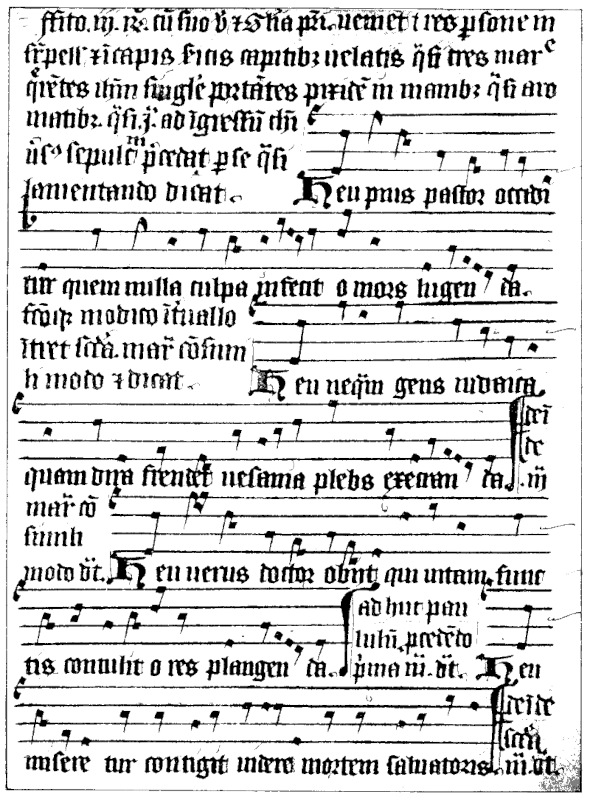
Music on the frontispiece has been converted to modern notation
to produce the audio file. Click on the [Listen] link to hear the music and on the [MusicXML] link
to download the notation. As of the date of posting, these links to external
files will work only in the HTML version of this e-book.
Index
BEGINNING OF DUBLINQuem quaeritis,
FROM BODLEIAN RAWLINSON LITURGICAL MS. D. 4 (14TH
CENTURY) [MusicXML]
THE MEDIAEVAL STAGE
BY
E. K. CHAMBERS
VOLUME I
OXFORD UNIVERSITY PRESS
Oxford University Press, Amen House, London E.C.4
GLASGOW NEW YORK TORONTO MELBOURNE WELLINGTON
BOMBAY CALCUTTA MADRAS KARACHI LAHORE DACCA
CAPE TOWN SALISBURY NAIROBI IBADAN ACCRA
KUALA LUMPUR HONG KONG
FIRST EDITION 1903
REPRINTED LITHOGRAPHICALLY IN GREAT BRITAIN
BY LOWE & BRYDONE, PRINTERS, LTD., LONDON
FROM SHEETS OF THE FIRST EDITION
1925, 1948, 1954, 1963
To N. C.
PREFACE
Some years ago I was thinking of a little book, which now may or may
not ever get itself finished, about Shakespeare and the conditions,
literary and dramatic, under which Shakespeare wrote. My proper
task would have begun with the middle of the sixteenth century. But
it seemed natural to put first some short account of the origins
of play-acting in England and of its development during the Middle
Ages. Unfortunately it soon became apparent that the basis for such a
narrative was wanting. The history of the mediaeval theatre had never,
from an English point of view, been written. The initial chapter of
Collier’s Annals of the Stage is even less adequate than is
usual with this slovenly and dishonest antiquary. It is with some
satisfaction that, in spite of the barrier set up by an incorrect
reference, I have resolved one dramatic representation elaborately
described by Collier into a soteltie or sweetmeat. More
scholarly writers, such as Dr. A. W. Ward, while dealing excellently
with the mediaeval drama as literature, have shown themselves but
little curious about the social and economic facts upon which the
mediaeval drama rested. Yet from a study of such facts, I am sure, any
literary history, which does not confine itself solely to the analysis
of genius, must make a start.
An attempt of my own to fill the gap has grown into these two
volumes, which have, I fear, been unduly swelled by the inclusion
of new interests as, from time to time, they took hold upon me; an
interest, for example, in the light-hearted and coloured life of those
poverelli of letters, the minstrel folk; a very deep interest
in the track across the ages of certain customs and symbols of rural
gaiety which bear with them the inheritance of a remote and ancestral
heathenism. I can only hope that this disproportionate treatment of
parts has not wholly destroyed the unity of purpose at which, after
all, I aimed. If I may venture to define for myself the formula of
my work, I would say that it endeavours to state and explain the
pre-existing conditions which, by the latter half of the sixteenth
century, made the great Shakespearean stage possible. The story is
one of a sudden dissolution and a slow upbuilding. I have arranged
the material in four Books. The First Book shows how the organization
of the Graeco-Roman theatre broke down before the onslaught of
Christianity and the indifference of barbarism, and how the actors
became wandering minstrels, merging with the gleemen of their Teutonic
conquerors, entertaining all classes of mediaeval society with
spectacula in which the dramatic element was of the slightest,
and in the end, after long endurance, coming to a practical compromise
with the hostility of the Church. In the Second Book I pass to
spectacula of another type, which also had to struggle against
ecclesiastical disfavour, and which also made their ultimate peace with
all but the most austere forms of the dominant religion. These are
the ludi of the village feasts, bearing witness, not only to
their origin in heathen ritual, but also, by their constant tendency
to break out into primitive forms of drama, to the deep-rooted mimetic
instinct of the folk. The Third Book is a study of the process by
which the Church itself, through the introduction of dramatic elements
into its liturgy, came to make its own appeal to this same mimetic
instinct; and of that by which, from such beginnings, grew up the great
popular religious drama of the miracle-plays, with its offshoots in
the moralities and the dramatic pageants. The Fourth and final Book
deals summarily with the transformation of the mediaeval stage, on
the literary side under the influence of humanism, on the social and
economic side by the emergence from amongst the ruins of minstrelsy of
a new class of professional players, in whose hands the theatre was
destined to recover a stable organization upon lines which had been
departed from since the days of Tertullian.
I am very conscious of the manifold imperfections of these volumes.
They are the work, not of a professed student, but of one who only
plays at scholarship in the rare intervals of a busy administrative
life. They owe much to the long-suffering officials of the British
Museum and the London Library, and more recently to the aid and
encouragement of the Delegates of the Clarendon Press and their
accomplished staff. The literary side of the mediaeval drama, about
which much remains to be said, I have almost wholly neglected. I shall
not, I hope, be accused of attaching too much importance in the first
volume to the vague and uncertain results of folk-lore research.
One cannot be always giving expression to the minuter shades of
probability. But in any investigation the validity of the inferences
must be relative to the nature of the subject-matter; and, whether I
qualify it in words or not, I do not, of course, make a statement about
the intention, say, of primitive sacrifice, with the same confidence
which attaches to one about matters of historic record. The burden
of my notes and appendices sometimes appears to me intolerable. My
excuse is that I wanted to collect, once for all, as many facts with
as precise references as possible. These may, perhaps, have a value
independent of any conclusions which I have founded upon them. And
even now I do not suppose that I have been either exhaustive or
accurate. The remorseless ideal of the historian’s duties laid down
in the Introduction aux Études Historiques of MM. Langlois
and Seignobos floats before me like an accusing spirit. I know how
very far I am from having reached that austere standard of scientific
completeness. To begin with, I had not the necessary training. Oxford,
my most kindly nurse, maintained in my day no École des Chartes,
and I had to discover the rules of method as I went along. But the
greater difficulty has been the want of leisure and the spacious life.
Shades of Duke Humphrey’s library, how often, as I jostled for my turn
at the crowded catalogue-shelves of the British Museum, have I not
envied those whose lot it is to tread your ample corridors and to bend
over your yellowing folios! Amongst such happy scholars, the canons
of Clio may claim implicit obedience. A silent company, they ‘class’
their documents and ‘try’ their sources from morn to eve, disturbed
in the pleasant ways of research only by the green flicker of leaves
in the Exeter garden, or by the statutory inconvenience of a terminal
lecture.—
[General Bibliographical Note. I mention here only a few works
of wide range, which may be taken as authorities throughout these
two volumes. Others, more limited in their scope, are named in the
preliminary notes to the sections of the book on whose subject-matter
they bear.—An admirable general history of the modern drama is W.
Creizenach’s still incomplete Geschichte des neueren Dramas
(Band i, Mittelalter und Frührenaissance, 1893; Bände ii, iii,
Renaissance und Reformation, 1901-3). R. Prölss, Geschichte
des neueren Dramas (1881-3), is slighter. The earlier work of
J. L. Klein, Geschichte des Dramas (13 vols. 1865-76), is
diffuse, inconvenient, and now partly obsolete. A valuable study
is expected from J. M. Manly in vol. iii of his Specimens of
the Pre-Shakespearean Drama, of which two volumes, containing
selected texts, appeared in 1897. C. Hastings, Le Théâtre français
et anglais (1900, Eng. trans. 1901), is a compilation of little
merit.—Prof. Creizenach may be supplemented for Germany by R.
Froning, Das Drama des Mittelalters (1891). For France there
are the exhaustive and excellent volumes of L. Petit de Julleville’s
Histoire du Théâtre en France au Moyen Âge (Les Mystères,
1880; Les Comédiens en France au Moyen Âge, 1885; La
Comédie et les Mœurs en France au Moyen Âge, 1886; Répertoire
du Théâtre comique au Moyen Âge, 1886). G. Bapst, Essai sur
l’Histoire du Théâtre (1893), adds some useful material on the
history of the stage. For Italy A. d’ Ancona, Origini del Teatro
italiano (2nd ed., 1891), is also excellent.—The best English
book is A. W. Ward’s History of English Dramatic Literature to the
death of Queen Anne (2nd ed., 1899). J. P. Collier, History
of English Dramatic Poetry (new ed., 1879), is full of matter,
but, for various reasons, not wholly trustworthy. J. J. Jusserand,
Le Théâtre en Angleterre (2nd ed., 1881), J. A. Symonds,
Shakespeare’s Predecessors in the English Drama (1884), and
G. M. Gayley, Representative English Comedies (1903), are of
value. Texts will be found in Manly’s and Gayley’s books, and in A.
W. Pollard, English Miracle Plays, Moralities and Interludes
(3rd ed., 1898); W. C. Hazlitt, Dodsley’s Old Plays (15 vols.
1874-6); A. Brandl, Quellen des weltlichen Dramas in England
(1898). F. H. Stoddard, References for Students of Miracle
Plays and Mysteries (1887), and K. L. Bates and L. B. Godfrey,
English Drama; a Working Basis (1896), are rough attempts at
bibliographies.—In addition the drama of course finds treatment
in the general histories of literature. The best are: for Germany,
R. Kögel, Geschichte der deutschen Literatur bis zum Ausgange
des Mittelalters (1894-7, a fragment); K. Gödeke, Grundriss
zur Geschichte der deutschen Dichtung aus den Quellen (2nd ed.,
1884-1900); W. Scherer, Geschichte der deutschen Litteratur (8th
ed., 1899): for France, L. Petit de Julleville (editor), Histoire
de la Langue et de la Littérature françaises (1896-1900); G.
Paris, La Littérature française au Moyen Âge (2nd ed., 1890):
for Italy, A. Gaspary, Geschichte der italienischen Litteratur
(1884-9, Eng. transl. 1901): for England, T. Warton, History of
English Poetry (ed. W. C. Hazlitt, 1871); B. Ten Brink, History
of English Literature (Eng. trans. 1893-6); J. J. Jusserand,
Literary History of the English People (vol. i. 1895); W. J.
Courthope, History of English Poetry (vols. i, ii. 1895-7); G.
Saintsbury, Short History of English Literature (1898), and,
especially for bibliography, G. Körting, Grundriss der Geschichte
der englischen Litteratur (3rd ed., 1899). The Periods of
European Literature, edited by Prof. Saintsbury, especially G.
Gregory Smith, The Transition Period (1900), and the two
great Grundrisse, H. Paul, Grundriss der germanischen
Philologie (2nd ed., 1896-1903), and G. Gröber, Grundriss der
romanischen Philologie (1888-1903), should also be consulted.—The
beginnings of the mediaeval drama are closely bound up with liturgy,
and the nature of the liturgical books referred to is explained by W.
Maskell, A Dissertation upon the Ancient Service-Books of the Church
of England (in Monumenta Ritualia Ecclesiae Anglicanae, 2nd
ed., 1882, vol. iii); H. B. Swete, Church Services and Service-Books
before the Reformation (1896); Procter-Frere, New History of
the Book of Common Prayer (1901). The beginnings of Catholic
ritual are studied by L. Duchesne, Origines du Culte chrétien
(3rd ed., 1902, Eng. trans. 1903), and its mediaeval forms described
by D. Rock, The Church of our Fathers (1849-53), and J. D.
Chambers, Divine Worship in England in the Thirteenth and Fourteenth
Centuries (1877).
The following list of books is mainly intended to elucidate the
references in the footnotes, and has no claim to bibliographical
completeness or accuracy. I have included the titles of a few German
and French dissertations of which I have not been able to make use.]
Aberdeen Records. Extracts from the Council Register of the
Burgh of Aberdeen. Edited by J. Stuart. 2 vols. 1844-8. [Spalding
Club, xii, xix.]
Acta SS. Acta Sanctorum quotquot toto orbe coluntur, quas
collegit I. Bollandus. Operam continuavit G. Henschenius [et alii],
1734-1894. [In progress.]
Ahn. English Mysteries and Miracle Plays. By Dr. Ahn. Trier,
1867. [Not consulted.]
Alcuin. See Dümmler.
Allard. Julien l’Apostat. Par P. Allard. 3 vols. 1900-3.
Allen. The Evolution of the Idea of God: an Enquiry into the
Origins of Religion. By Grant Allen, 1897.
Alt. Theater und Kirche in ihrem gegenseitigen Verhältniss.
Von H. Alt, 1846.
Anal. Hymn. Analecta Hymnica Medii Aevi. Ediderunt C. Blume et
G. M. Dreves. 37 parts, 1886-1901. [In progress.]
Ancona. Origini del Teatro italiano. Per A. d’Ancona, 2nd ed.
2 vols. 1891.
Ancona, Sacr. Rappr. Sacre Rappresentazioni dei secoli
xiv, xv e xvi, raccolte e illustrate per cura di A. d’Ancona, 1872.
Ann. Arch. Annales Archéologiques, dirigées par Didron aîné. 28
vols. 1844-81.
Antiquarian Repertory. The Antiquarian Repertory: A
Miscellaneous assemblage of Topography, History, Biography, Customs and
Manners. Compiled by F. Grose and T. Astle. 2nd ed. 4 vols. 1807.
Arbois de Jubainville, Civ. Celt. La Civilisation des
Celtes et celle de l’Épopée homérique. Par H. d’Arbois de Jubainville,
1899. [Vol. vi of Cours de littérature celtique.]
Arbois de Jubainville, Cycl. Myth. Le Cycle
mythologique irlandais et la Mythologie celtique. Par H. d’Arbois de
Jubainville, 1884. [Vol. ii of same.]
Archaeologia. Archaeologia: or Miscellaneous Tracts relating to
Antiquity. Published by the Society of Antiquaries of London. 57 vols.
1770-1901. [In progress.]
Arnold. The Customs of London, otherwise Arnold’s Chronicle.
Edited by F. Douce, 1811.
Ashton. A Righte Merrie Christmasse!!! By J. Ashton, n. d.
Bahlmann, Ern. Die Erneuerer des antiken Dramas und
ihre ersten dramatischen Versuche: 1314-1478. Von P. Bahlmann, 1896.
Bahlmann, L. D. Die lateinischen Dramen von
Wimpheling’s Stylpho bis zur Mitte des sechzehnten Jahrhunderts:
1480-1550. Von P. Bahlmann, 1893.
Bale. Scriptorum illustrium maioris Britanniae, quam nunc
Angliam et Scotiam vocant, Catalogus. Autore Ioanne Baleo Sudouolgio
Anglo. 2 vols. Basileae, Oporinus, 1557-9. [Enlarged from the edition
in one vol. of 1548.]
Bale, Index. Index Britanniae Scriptorum quos ex variis
bibliothecis non parvo labore collegit Ioannes Baleus. Edited by R. L.
Poole and M. Bateson, 1902. [Anecdota Oxoniensia, Mediaeval and
Modern Series, ix, from a MS. compiled 1549-1557.]
Bapst. Essai sur l’Histoire du Théâtre. Par G. Bapst, 1893.
Barbazan-Méon. Fabliaux et Contes des Poètes françois des
xi, xii, xiii, xiv et xv siècles. Publiés par E. Barbazan. Nouvelle
édition, par M. Méon. 4 vols. 1808.
Barrett. Riding Skimmington and Riding the Stang. By C. R. B.
Barrett, 1895. [Journal of British Archaeological Association,
N. S. vol. i.]
Barthélemy. Rational ou Manuel des divins Offices de Guillaume
Durand, Évêque de Mende au treizième siècle. Traduit par M. C.
Barthélemy. 5 vols. 1854.
Bartsch. Altfranzösische Romanzen und Pastourellen. Par K.
Bartsch, 1870.
Bates. The English Religious Drama. By K. L. Bates, 1893.
Bates-Godfrey. English Drama: a Working Basis. By K. L. Bates
and L. B. Godfrey, 1896.
Bede, D. T. R. Venerabilis Bedae Opera quae Supersunt
Omnia. Edidit J. A. Giles. 12 vols. 1843-4. [The De Temporum
Ratione forms part of vol. vi.]
Bede, E. H.SeePlummer.
Bédier. Les Fabliaux. Études de Littérature populaire et
d’Histoire littéraire du Moyen Âge. Par J. Bédier, 2nd ed. 1895.
Belethus. Rationale Divinorum Officiorum Auctore Joanne
Beletho Theologo Parisiensi, 1855. [In P. L. ccii.]
Bell. Ancient Poems, Ballads, and Songs of the Peasantry of
England. Edited by R. Bell, 1857.
Bérenger-Féraud. Superstitions et Survivances étudiées au
point de vue de leur Origine et de leurs Transformations. Par L. J. B.
Bérenger-Féraud. 4 vols. 1896.
Bernhard. Recherches sur l’Histoire de la Corporation des
Ménétriers ou Joueurs d’Instruments de la Ville de Paris. Par B.
Bernhard. [Bibl. de l’École des Chartes, iii. 377, iv. 525, v.
254, 339.]
Bertrand. Nos Origines: iv. La Religion des Gaulois; Les
Druides et le Druidisme. Par A. Bertrand, 1897.
Bibl. des Chartes. Bibliothèque de l’École des Chartes. Revue
d’Érudition consacrée spécialement à l’étude du Moyen Âge. [I quote the
numbers of the annual volumes, without regard to the Séries.]
Bingham. The Works of Joseph Bingham. Edited by R. Bingham.
New ed. 10 vols.
Blomefield. An Essay towards a Topographical History of the
County of Norfolk. By F. Blomefield. 2nd ed. 11 vols. 1805-10.
Böhck. Die Anfänge des englischen Dramas. Von Dr. Böhck, 1890.
[Not consulted.]
Bolton. The Counting-Out Rhymes of Children. By H. C. Bolton,
1888.
Boretius. Capitularia Regum Francorum. Ediderunt A. Boretius
et V. Krause. 2 vols. 1883-7. [M. G. H. Leges, Sectio ii.]
Bourquelot. Office de la Fête des Fous. Publié par F.
Bourquelot, 1858. [Bulletin de la Société archéologique de Sens,
vol. vi. Not consulted at first hand.]
Bower. The Elevation and Procession of the Ceri at Gubbio. By
H. M. Bower, 1897. [F. L. S.]
Brand. Observations on Popular Antiquities, chiefly
illustrating the Origin of our Vulgar Customs, Ceremonies, and
Superstitions. By J. Brand. Enlarged by Sir H. Ellis. 3 vols. 1841-2.
Brand-Hazlitt. Observations on Popular Antiquities. By J.
Brand. Edited with additions by W. C. Hazlitt. 3 vols. 1870.
Brandl. Quellen des weltlichen Dramas in England vor
Shakespeare. Ein Ergänzungsband zu Dodsley’s Old English Plays.
Herausgegeben von A. Brandl, 1898. [Quellen und Forschungen,
lxxx.]
Brewer. Letters and Papers, Foreign and Domestic, of the Reign
of Henry VIII. Arranged and catalogued by J. S. Brewer [and afterwards
J. Gairdner and R. H. Brodie]. 18 vols. 1862-1902. [Calendars of
State Papers.]
Brooke. The History of Early English Literature: being the
History of English Poetry to the Accession of King Alfred. By S. A.
Brooke. 2 vols. 1892.
Brooke, Eng. Lit. English Literature from the Beginning
to the Norman Conquest. By S. A. Brooke, 1898.
Brotanek. Die englischen Maskenspiele. Von R. Brotanek, 1902.
[Wiener Beiträge zur englischen Philologie, xv.]
Brown. Calendar of State Papers and Manuscripts relating to
English Affairs, in the Archives and Collections of Venice and in other
Libraries of North Italy. Edited by H. F. Brown and R. Brown. 10 vols.
1864-1900.
Brylinger. Comoediae et Tragoediae aliquot ex Novo et Vetere
Testamento desumptae. Basileae, Brylinger, 1540.
Burchardus. Burchardi Wormaciencis Ecclesiae Episcopi
Decretorum Libri xx, 1853. [In P. L. cxl.]
Burne-Jackson. Shropshire Folk-lore: A Sheaf of Gleanings.
Edited by C. S. Burne, from the collections of G. F. Jackson, 1883.
Burnet. A History of the Reformation of the Church of England.
By G. Burnet. Edited by N. Pocock. 7 vols. 1865.
Burton. Rushbearing. By A. Burton, 1891.
Bury-Gibbon.SeeGibbon.
Campbell. Materials for a History of the Reign of Henry VII,
from documents in the Public Record Office. By W. Campbell. 2 vols.
1873-7. [R. S. lx.]
Canel. Recherches historiques sur les Fous des Rois de France.
Par A. Canel, 1873.
Captain Cox.SeeLaneham.
Carmina Burana.SeeSchmeller.
Caspari. Eine Augustin fälschlich beilegte Homilia de
Sacrilegiis. Herausgegeben von C. P. Caspari, 1886. [Gesellschaft
der Wissenschaften zu Christiania.]
Cassiodorus. Cassiodori Senatoris Variae. Recensuit Theodorus
Mommsen, 1894. [M. G. H. Auctores Antiquissimi, vol. xii.]
Catholicon Anglicum. Catholicon Anglicum: an English-Latin
Wordbook (1483). Edited by S. J. Herrtage, 1881. [C. S. N. S.
xxx.]
Cavendish. The Life of Cardinal Wolsey. By J. Cavendish.
Edited by S. W. Singer. 2 vols. 1825.
Chambers. Divine Worship in the Thirteenth and Fourteenth
Centuries, contrasted with the Nineteenth. By J. D. Chambers, 1877.
Champollion-Figeac.SeeHilarius.
Chappell. Old English Popular Music. By W. Chappell. A new
edition by H. E. Wooldridge. 2 vols. 1893.
C. H. B. Corpus Scriptorum Historiae Byzantinae. Editio
emendatior, consilio B. G. Niebuhrii instituta, 1828-97.
Chérest. Nouvelles Recherches sur la Fête des Innocents et la
Fête des Fous. Par A. Chérest, 1853. [Bulletin de la Société des
Sciences de l’Yonne, vol. vii.]
Child. The English and Scottish Popular Ballads. Edited by F. J.
Child. 10 vols. 1882-98.
Christmas Prince.SeeHiggs.
C. I. C. Corpus Iuris Civilis. Editio altera, 1877-95.
[Vol. i contains the Institutiones, ed. P. Krueger, and the
Digesta, ed. Th. Mommsen; vol. ii the Codex Iustiniani,
ed. P. Krueger; vol. iii the Novellae Iustiniani, ed. Schoell
and Kroll.]
C. I. Can. Corpus Iuris Canonici. Editio Lipsiensis secunda:
post A. L. Richter curas ... instruxit A. Friedberg. 2 vols.
1879-81. [Contains the Decretum of Gratian (†1139), the
Decretales of Gregory IX (1234), the Liber Sextus of
Boniface VIII (1298), the Decretales of Clement V and John XXII
(1317), and the Extravagantes (down to 1484).]
Civis. Minutes, collected from the ancient Records and
Accounts in the Chamber of Canterbury. [By C. R. Bunce or W. Welfitt.
These documents, bound in B. M. under press-mark 10,358, h. i., appear
to be reprints or proof-sheets of articles, signed Civis, in the
Kentish Chronicle for 1801-2.]
Clarke. The Miracle Play in England, an account of the Early
Religious Drama. By S. W. Clarke, n. d.
Clédat. Le Théâtre en France au Moyen Âge. Par L. Clédat,
1896. [Classiques Populaires.]
Clément. Histoire générale de la Musique religieuse. Par F.
Clément, 1860.
Clément-Hémery. Histoire des Fêtes civiles et religieuses du
Département du Nord. Par Mme Clément (née Hémery), 1832.
Cloetta. Beiträge zur Litteraturgeschichte des Mittelalters
und der Renaissance. Von W. Cloetta. i. Komödie und Tragödie im
Mittelalter, 1890. ii. Die Anfänge der Renaissancetragödie, 1892.
Cod. Th. Codex Theodosianus. Edidit G. Haenel, 1844. [Corpus
Iuris Romani Ante-Iustiniani, vol. ii.]
Collier. The History of English Dramatic Poetry to the Time
of Shakespeare: and Annals of the Stage to the Restoration. By J. P.
Collier. New ed. 1879.
Collier, Five Plays. Five Miracle Plays, or Scriptural
Dramas. Edited by J. P. Collier, 1836.
Collier, P. J. Punch and Judy, with illustrations by G.
Cruikshank. Accompanied by the Dialogue of the Puppet-Show, an account
of its Origin, and of Puppet-Plays in England. [By J. P. Collier.] 5th
ed. 1870.
Conybeare. The History of Christmas. By F. C. Conybeare, 1899
[Journal of American Theology, vol. iii.]
Conybeare, Key of Truth. The Key of Truth: a Manual of
the Paulician Church. Edited and translated by F. C. Conybeare, 1898.
Cortet. Essai sur les Fêtes religieuses, et les Traditions
populaires qui s’y rattachent. Par E. Cortet, 1867.
Cotgrave. A French-English Dictionary, with another in English
and French. By R. Cotgrave, 1650.
County Folk-Lore. Examples of printed Folk-Lore. Vol. i
(Gloucestershire, Suffolk, Leicestershire, and Rutland), 1892-5. Vol.
ii (North Riding of Yorkshire, York, and the Ainsty), 1901. [F. L.
S.]
Courthope. A History of English Poetry. By W. J. Courthope.
Vols. i, ii. 1895-7. [In progress.]
Coussemaker. Drames liturgiques du Moyen Âge. Par E. de
Coussemaker, 1860.
Coussemaker, Harm. Histoire de l’Harmonie au Moyen Âge.
Par E. de Coussemaker, 1852.
Cox. Introduction to Folk-Lore. By M. R. Cox. 2nd ed. 1897.
C. P. B. Corpus Poeticum Boreale: the Poetry of the Old Northern
Tongue from the Earliest Times to the Thirteenth Century. Edited by G.
Vigfusson and F. Y. Powell. 2 vols. 1883.
Creizenach. Geschichte des neueren Dramas. Von W. Creizenach.
Vols i-iii, 1893-1903. [In progress.]
Crowest. The Story of British Music, from the Earliest Times
to the Tudor Period. By F. J. Crowest, 1896.
C. S. Camden Society, now incorporated with the Royal Historical
Society.
C. S. E. L. Corpus Scriptorum Ecclesiasticorum Latinorum.
Editum consilio Academiae Litterarum Caesareae Vindobonensis. 41 vols.
1866-1900. [In progress.]
Cumont. Textes et Monuments figurés relatifs aux Mystères de
Mithra. Par F. Cumont. 2 vols. 1896-9.
Cunliffe. The Influence of Seneca on Elizabethan Tragedy. An
Essay by J. W. Cunliffe, 1893. [Manchester dissertation.]
Cunningham. Extracts from the Accounts of Revels at Court in
the Reigns of Queen Elizabeth and King James I. By P. Cunningham, 1842.
[Shakespeare Society.]
Cushman. The Devil and the Vice in the English Dramatic
Literature before Shakespeare. By L. W. Cushman, 1900. [Studien zur
englischen Philologie, vi.]
Cutts. Parish Priests and their People in the Middle Ages in
England. By E. L. Cutts, 1898.
Dankó. Die Feier des Osterfestes. Von J. Dankó, 1872. [Not
consulted.]
Dankó, Hymn. Vetus Hymnarium Ecclesiasticum Hungariae.
Edidit J. Dankó, 1893.
David. Études historiques sur la Poésie et la Musique dans la
Cambrie. Par E. David, 1884.
Davidson. Studies in the English Mystery Plays. By C.
Davidson, 1892. [Yale dissertation, in Transactions of Connecticut
Academy, ix. 1.]
Davies. Extracts from the Municipal Records of the City of
York during the Reigns of Edward IV, Edward V, and Richard III. By R.
Davies, 1843.
Dawson. Christmas: Its Origin and Associations. By W. F.
Dawson, 1902.
D. C. A. A Dictionary of Christian Antiquities. Edited by Sir W.
Smith and S. Cheetham. 2 vols. 1875-80.
Deimling. The Chester Plays. Re-edited from the MSS. by the
late H. Deimling, 1893. [E. E. T S., Part i, with Plays 1-13,
only published.]
De la Fons-Melicocq. Cérémonies dramatiques et anciens Usages
dans les Églises du Nord de la France. Par A. de la Fons-Melicocq, 1850.
Denifle. Chartularium Universitatis Parisiensis. Collegit H.
Denifle. 4 vols. 1889-97.
Desjardins. Histoire de la Cathédrale de Beauvais. Par G.
Desjardins, 1865.
Deslyons. Traitez singuliers et nouveaux contre le Paganisme
du Roy Boit. Par J. Deslyons, 1670.
Devrient. Geschichte der deutschen Schauspielkunst. Von E.
Devrient. 2 vols. 1848.
Didron. See Annales Archéologiques.
Dieterich. Pulcinella; pompejanische Wandbilder und römische
Satyrspiele. Von A. Dieterich, 1897.
Diez. Die Poesie der Troubadours. Von F. C. Diez, 1826.
Diez-Bartsch. Leben und Werke der Troubadours. Von F. C. Diez.
Zweite Auflage, von K. Bartsch, 1882.
Digby Plays.SeeFurnivall; Sharp.
Dill. Roman Society in the last Century of the Western Empire.
By S. Dill. 2nd ed. 1899.
Ditchfield. Old English Customs extant at the present Time. By
P. H. Ditchfield, 1896.
Dixon. A History of the Church of England from the Abolition
of the Roman Jurisdiction. By R. W. Dixon. 6 vols. 1878-1902.
D. N. B. Dictionary of National Biography. Edited by L. Stephen
and S. Lee. 66 vols. 1885-1901.
Doran. A History of Court Fools. By J. Doran, 1858.
Douce. Illustrations of Shakspeare, and of Ancient Manners:
with Dissertations on the Clowns and Fools of Shakspeare, and on the
English Morris Dance. By F. Douce, 1839.
Douhet. Dictionnaire des Mystères. Par Jules, Comte de Douhet,
1854. [J. P. Migne, Encyclopédie Théologique, Series II, vol.
xliii.]
Drake. Shakespeare and his Times. By N. Drake. Paris, 1838.
Dreux de Radier. Histoire des Fous en titre d’Office. Par J.
F. Dreux de Radier, 1768. [In Récréations Historiques.]
Dreves. Zur Geschichte der Fête des Fous. Von G. M. Dreves,
1894. [Stimmen aus Maria-Laach, vol. xlvii.]
See also Analecta Hymnica.
Ducange. Glossarium mediae et infimae Latinitatis conditum a
Du Cangio, auctum a monachis Ordinis S. Benedicti, cum supplementis
Carpenterii suisque digessit G. A. L. Henschel. Editio nova, aucta a L.
Favre. 10 vols. 1883-7.
Duchesne. Origines du Culte chrétien: Étude sur la Liturgie
avant Charlemagne. Par l’Abbé L. Duchesne. 2nd ed. 1898. [A 3rd ed. was
published in 1902, and a translation, by M. L. McLure, under the title
of Christian Worship: its Origin and Evolution, in 1903.]
Dugdale. Origines Iuridiciales: or, Historical Memorials of
the English Laws ... Inns of Court and Chancery. By W. Dugdale. 2nd ed.
1671.
Dugdale, Monasticon. Monasticon Anglicanum: or, the
History of the Ancient Abbies and other Monasteries, Hospitals,
Cathedral and Collegiate Churches in England and Wales. By Sir W.
Dugdale. A new edition by J. Caley, Sir H. Ellis, and the Rev. B.
Bandinel. 6 vols. 1846.
Du Méril. Origines latines du Théâtre moderne, publiées
et annotées par M. Édélestand Du Méril, 1849. [Has also a Latin
title-page, Theatri Liturgici quae Latina superstant Monumenta, etc. A
facsimile reprint was issued in 1896.]
Du Méril, La Com. Histoire de la Comédie. Par É. du
Méril. Période primitive, 1864. [All published.]
Dümmler. Epistolae Merowingici et Karolini Aevi. Recensuit E.
L. Dümmler. 3 vols. 1892-9. [M. G. H. Epistolae, iii-v. The 2nd
vol. contains Alcuin’s letters.]
Durandus. Rationale Divinorum Officiorum editum per ...
Gulielmum Duranti. Haec editio a multis erroribus diligenter correcta.
[Edidit N. Doard;] Antwerpiae, 1614. See Barthélemy.
Durham Accounts. Extracts from the Account Rolls of the Abbey of
Durham. Edited by Canon Fowler. 3 vols. 1898-1901. [Surtees Soc.
xcix, c, ciii.]
Dürr. Commentatio Historica de Episcopo Puerorum, vulgo von
Schul Bischoff. Von F. A. Dürr, 1755. [In J. Schmidt, Thesaurus
Iuris Ecclesiastici (1774), iii. 58.]
Du Tilliot. Mémoires pour servir à l’Histoire de la Fête des
Foux. Par M. Du Tilliot, Gentilhomme Ordinaire de S. A. R. Monseigneur
le Duc de Berry, 1751.
Dyer. British Popular Customs, Present and Past. By T. F.
Thiselton Dyer, 1876.
Ebert. Die englischen Mysterien. Von A. Ebert, 1859.
[Jahrbuch für romanische und englische Literatur, vol. i.]
Eckhardt. Die lustige Person im älteren englischen Drama (bis
1642). Von E. Eckhardt, 1903. [Palaestra, xvii; not consulted.]
E. H. Review. The English Historical Review. 18 vols.
1886-1903. [In progress.]
Elton. Origins of English History. By C. I. Elton. 2nd ed.
1890.
Evans. English Masques. With an introduction by H. A. Evans,
1897. [Warwick Library.]
Fabian. The New Chronicles of England and France. By R.
Fabyan. Edited by H. Ellis, 1811.
Fairholt. Lord Mayor’s Pageants. Edited by F. W. Fairholt. 2
vols. 1843-4. [Percy Soc. xxxviii, xlviii.]
Feasey. Ancient English Holy Week Ceremonial. By H. J. Feasey,
1897.
Fischer. Zur Kunstentwickelung der englischen Tragödie von
ihren ersten Anfängen bis zu Shakespeare. Von R. Fischer, 1893.
Fitch. Norwich Pageants. The Grocers’ Play. From a
manuscript in possession of R. Fitch, 1856. [Extract from Norfolk
Archaeology, vol. v.]
F. L. Folk-Lore: a Quarterly Review of Myth, Tradition,
Institution, and Custom. 14 vols. 1890-1903. [Organ of F. L. S.,
in progress.]
F. L. Congress. The International Folk-Lore Congress, 1891.
Papers and Transactions. Edited by J. Jacobs and A. Nutt, 1892.
F. L. Journal. The Folk-Lore Journal, 7 vols. 1883-9. [Organ of
F. L. S.]
F. L. Record. The Folk-Lore Record. 5 vols. 1878-82. [Organ of
F. L. S.]
Fleay.C. H. A Chronicle History of the London Stage,
1559-1642. By F. G. Fleay, 1890.
Flögel. Geschichte der Hofnarren. Von C. F. Flögel, 1789.
F. L. S. = Folk-Lore Society.
Fournier. Le Théâtre français avant la Renaissance. Par E.
Fournier, 1872.
Fowler. The Roman Festivals of the Period of the Republic:
an Introduction to the Study of the Religion of the Romans. By W. W.
Fowler, 1899. [Handbooks of Archaeology and Antiquities.]
Foxe. The Acts and Monuments of John Foxe. With a Life of
the Martyrologist by G. Townsend. [Edited by S. R. Cattley.] 8 vols.
1843-9.
Frazer. The Golden Bough: a Study in Comparative Religion. By
J. G. Frazer. 2nd ed. 3 vols. 1900.
Frazer, Pausanias. Pausanias’s Description of Greece.
Translated with a commentary by J. G. Frazer. 6 vols. 1898.
Frere. The Winchester Troper. Edited by W. H. Frere, 1894.
[Henry Bradshaw Society.]
Frere, Use of Sarum. The Use of Sarum. Edited by W. H.
Frere. 2 vols. 1898-1901.
See alsoProcter-Frere.
Freymond. Jongleurs und Menestrels. Von E. Freymond, 1883.
[Halle dissertation.]
Friedländer. Darstellungen aus der Sittengeschichte Roms in
der Zeit von August bis zum Ausgang der Antonine. Von L. Friedländer.
6th ed. 3 vols. 1888-90. [Das Theater is in vol. ii.]
Froning. Das Drama des Mittelalters. Herausgegeben von R.
Froning. 3 Parts, 1891. [Deutsche National-Litteratur, xiv.]
Froude. History of England from the Fall of Wolsey to the
Defeat of the Spanish Armada. By J. A. Froude. 2nd ed. 1889-95.
Furnivall. The Digby Plays, with an Incomplete Morality of
Wisdom, who is Christ. Edited by F. J. Furnivall, 1882. [N. S.
S. Series vii, 1: re-issue for E. E. T. S. 1896.]
See alsoLaneham, Mannyng, Stafford,
Stubbes.
Furnivall Miscellany. An English Miscellany Presented to Dr.
Fumivall in Honour of his Seventy-fifth Birthday, 1901.
Gaidoz. Études de Mythologie gauloise. Par H. Gaidoz. I. Le
Dieu gaulois du Soleil et le Symbolisme de la Roue, 1886. [Extrait de
la Revue Archéologique, 1884-85.]
Gaspary. The History of Early Italian Literature to the Death
of Dante. Translated from the German of A. Gaspary, by H. Oelsner, 1901.
Gasté. Les Drames liturgiques de la Cathédrale de Rouen. Par
A. Gasté, 1893. [Extrait de la Revue Catholique de Normandie.]
Gautier. Les Épopées françaises. Par L. Gautier, vol. ii.
2nd edition, 1892. [Lib. ii. chh. xvii-xxi form the section on Les
Propagateurs des Chansons de Geste. References to this work may be
distinguished from those to Les Tropaires by the presence of a
volume-number.]
Gautier, Bibl. Bibliographie des Chansons de Geste. Par
L. Gautier, 1897. [A section on Les Propagateurs des Chansons de
Geste.]
Gautier, Orig. Origines du Théâtre moderne. Par L.
Gautier, 1872. [In Le Monde.]
Gautier, Tropaires. Histoire de la Poésie liturgique
au Moyen Âge. Par L. Gautier. Vol. i. Les Tropaires, 1886. [All
published.]
Gayley. Representative English Comedies: from the Beginnings
to Shakespeare. Edited by C. M. Gayley, 1903.
Gazeau. Les Bouffons. Par A. Gazeau, 1882.
Genée. Die englischen Mirakelspiele und Moralitäten als
Vorläufer des englischen Dramas. Von R. Genée, 1878. [Serie xiii,
Heft 305 of Sammlung gemeinverständlicher wissenschaftlicher
Vorträge, herausgegeben von R. Virchow und Fr. v. Holtzendorff.]
Gibbon. The History of the Decline and Fall of the Roman
Empire. By E. Gibbon. Edited by J. B. Bury. 7 vols. 1897-1900.
Gilpin. The Beehive of the Romish Church. By G. Gilpin, 1579.
[Translated from Isaac Rabbotenu, of Louvain, 1569.]
Gloucester F. L. See County Folk-Lore.
Goedeke. Grundriss zur Geschichte der deutschen Dichtung, aus
den Quellen. Von K. Goedeke. 2nd ed. 7 vols. 1884-1900. [In progress.]
Golden Legend. The Golden Legend: or, Lives of the Saints, as
Englished by W. Caxton. Edited by F. S. Ellis, 1900, &c. [Temple
Classics.]
Gölther. Handbuch der germanischen Mythologie. Von W. Gölther,
1895.
Gomme. Ethnology in Folk-lore. By G. L. Gomme, 1892.
Gomme, Brit. Ass. On the Method of determining the
Value of Folklore as Ethnological Data. By G. L. Gomme, 1896. [In
Report of British Association for the Advancement of Science.]
Gomme, Nature. Christmas Mummers. By G. L. Gomme, 1897.
[Nature, vol. lvii.]
Gomme, Vill. Comm. The Village Community: with special
Reference to the Origin and Form of its Survivals in Britain. By G. L.
Gomme, 1890. [Contemporary Science Series.]
Gomme, Mrs. The Traditional Games of England, Scotland, and
Ireland, with Tunes. Collected and annotated by A. B. Gomme. 2 vols.
1894-8. [Part i of Dictionary of British Folk-Lore, Edited by G.
L. Gomme.]
Googe.SeeKirchmayer.
Gracie. The Presentation in the Temple: A Pageant, as
originally represented by the Corporation of Weavers in Coventry, 1836.
[Edited by J. B. Gracie for the Abbotsford Club.]
Grass. Das Adamsspiel: anglonormannisches Gedicht des
xii. Jahrhunderts. Mit einem Anhang ‘Die fünfzehn Zeichen des
jüngsten Gerichts.’ Herausgegeben von K. Grass, 1891. [Romanische
Bibliothek, vi.]
Gratian. See C. I. Can.
Greenidge. Infamia: Its Place in Roman Public and Private Law.
By A. H. J. Greenidge, 1894.
Greg, Masques. A list of Masques, Pageants, &c.
Supplementary to a list of English Plays. By W. W. Greg, 1902.
[Bibliographical Society.]
Greg, Plays. A List of English Plays written
before 1643, and published before 1700. By W. W. Greg, 1900.
[Bibliographical Society.]
Gregory. Gregorii Posthuma: on Certain Learned Tracts written
by John Gregory. Published by his Dearest Friend J. G. 1683. [Part II
of his Works: A separate title-page for Episcopus Puerorum
in Die Innocentium: or, A Discovery of an Ancient Custom in the Church
of Sarum, of making an Anniversary Bishop among the Choristers.]
Gregory’s Chronicle. The Historical Collections of a Citizen of
London in the Fifteenth Century. Edited by J. Gairdner, III, William
Gregory’s Chronicle of London. [C. S.N. S. xvii.]
Grein-Wülcker. Bibliothek der angelsächsischen Poesie.
Herausgegeben von C. W. M. Grein. Neu bearbeitet, vermehrt und
herausgegeben von R. P. Wülcker. 3 vols. 1883-98.
Grenier. Introduction à l’Histoire générale de la Province
de Picardie. Par Dom Grenier, 1856. [Mémoires de la Société des
Antiquaires de Picardie.Documents inédits, iii.]
Grimm. Teutonic Mythology. By J. Grimm. Translated from the
4th ed. with notes and appendix by J. S. Stallybrass. 4 vols. 1880-8.
Gröber. Zur Volkskunde aus Concilbeschlüssen und Capitularien.
Von G. Gröber. 1894.
Gröber, Grundriss. Grundriss der romanischen
Philologie. Herausgegeben von G. Gröber. 1888-1902. [In progress. Vol.
ii has article by G. Gröber on Französische Litteratur.]
Groos.Play of Animals. The Play of Animals: a Study
of Animal Life and Instinct. By K. Groos. Translated by E. L. Baldwin,
1898.
Groos.Play of Man. The Play of Man. By K. Gross.
Translated by E. L. Baldwin, 1901.
Grosse. Les Débuts de l’Art. Par E. Grosse. Traduit par
E. Dirr. Introduction par L. Marillier. 1902. [Bibliothèque
Scientifique Internationale.]
Grove. Dancing. By L. Grove, and other writers. With Musical
examples. 1895. [Badminton Library.]
Gummere, B. P. The Beginnings of Poetry. By F. B.
Gummere, 1901.
Gummere, G. O. Germanic Origins: a Study in Primitive
Culture. By F. B. Gummere, 1892.
Gutch. A Lytell Geste of Robin Hood, with other Ballads
relative to Robin Hood. Edited by J. M. Gutch. 2 vols. 1847.
Guy. Essai sur la Vie et les Œuvres littéraires du Trouvère
Adan de le Hale. Par H. Guy, 1898.
Haddan-Stubbs. Councils and Ecclesiastical Documents relating
to Great Britain and Ireland. Edited, after Spelman and Wilkins, by A.
W. Haddan and W. Stubbs. 3 vols. 1869-78.
Haddon. The Study of Man. By A. C. Haddon, 1898.
[Progressive Science Series.]
Haigh. The Tragic Drama of the Greeks. By A. E. Haigh, 1896.
Hall. The Union of the Families of Lancaster and York. By E.
Hall. Edited by H. Ellis. 1809.
Halliwell-Phillipps. Outlines of the Life of Shakespeare. By
J. O. Halliwell-Phillipps. 9th ed. 2 vols. 1890.
Halliwell-Phillipps.Revels. A Collection of
Ancient Documents respecting the Office of Master of the Revels,
and other Papers relating to the Early English Theatre. [By J. O.
Halliwell-Phillipps.] 1870.
Hampson. Medii Aevi Kalendarium: or Dates. Charters and
Customs of the Middle Ages, &c. By R. T. Hampson. 2 vols. 1841.
Handlyng Synne.SeeMannyng.
Harland. Lancashire Folk-Lore. By J. Harland and T. T.
Wilkinson, 1867.
Harris. Life in an Old English Town: a History of Coventry
from the Earliest Times. Compiled from Official Records by M. D.
Harris, 1898. [Social England Series.]
Hartland. The Legend of Perseus: a Study of Tradition in
Story, Custom and Belief. By E. S. Hartland. 3 vols. 1894-6.
Hartland.Fairy Tales. The Science of Fairy Tales: an
Inquiry into Fairy Mythology. By E. S. Hartland, 1891. [Contemporary
Science Series.]
Hartzheim.SeeSchannat.
Hase. Miracle Plays and Sacred Dramas. By C. A. Hase.
Translated by A. W. Jackson, 1880.
Hastings. Le Théâtre français et anglais: ses Origines
grecques et latines. Par C. Hastings, 1900.
Hastings. The Theatre: its Development in France and England.
By C. Hastings. Translated by F. A. Welby, 1901.
Hauck. Kirchengeschichte Deutschlands. Von A. Hauck. 2nd ed. 3
vols. 1896-1900.
Havard. Les Fêtes de nos Pères. Par O. Havard, 1898.
Hazlitt. Remains of the Early Popular Poetry of England.
Collected and edited, with introductions and notes, by W. Carew
Hazlitt. 4 vols. 1864-6. [Library of Old Authors.]
Hazlitt, E. D. S. The English Drama and Stage under
the Tudor and Stuart Princes, 1543-1664, illustrated by a series
of Documents, Treatises, and Poems. Edited by W. C. Hazlitt, 1869.
[Roxburghe Library.]
Hazlitt, Liv. The Livery Companies of London. By W. C.
Hazlitt, 1892.
Hazlitt, Manual. A Manual for the Collector and Amateur
of Old English Plays. By W. C. Hazlitt, 1892.
Hazlitt-Dodsley. A Select Collection of Old Plays. By R.
Dodsley. Chronologically arranged, revised and enlarged by W. C.
Hazlitt. 4th ed. 15 vols. 1874-6.
Hazlitt-Warton. History of English Poetry, from the Twelfth
to the close of the Sixteenth Century. By T. Warton. Edited by W. C.
Hazlitt. 4 vols. 1871.
H. B. S. = Henry Bradshaw Society.
Heales. Easter Sepulchres: their Object, Nature, and History.
By A. Heales, 1868. [Archaeologia, vol. xlii.]
Heinzel. Beschreibung des geistlichen Schauspiels im deutschen
Mittelalter. Von R. Heinzel, 1898. [Beiträge zur Ästhetik, iv.]
Henderson. Notes on the Folk-Lore of the Northern Counties
of England and the Borders. By W. Henderson. 2nd ed. 1879. [F. L.
S.]
Herbert. Antiquities of the Inns of Court and Chancery. By W.
Herbert, 1804.
Herbert, Liv. History of the Twelve Great Livery
Companies of London. By W. Herbert. 2 vols. 1836-7.
Hereford Missal. Missale ad usum percelebris Ecclesiae
Herfordensis. Edidit W. G. Henderson, 1874.
Herford. The Literary Relations of England and Germany in the
Sixteenth Century. By C. H. Herford, 1886.
Herrtrich. Studien zu den York Plays. Von O. Herrtrich, 1886.
[Breslau dissertation; not consulted.]
Higgs. The Christmas Prince. By Griffin Higgs, 1607. [In
Miscellanea Antiqua Anglicana, 1816.]
Hilarius. Hilarii Versus et Ludi. Edidit J. J.
Champollion-Figeac, 1838.
Hirn. The Origins of Art: a Psychological and Sociological
Enquiry. By Yrjö Hirn, 1900.
Hist. d’Autun. Histoire de l’Église d’Autun. Autun, 1774.
Hist. Litt. Histoire littéraire de la France. Par des Religieux
bénédictins de la Congrégation de S. Maur. Continuée par des Membres de
l’Institut. 32 vols. 1733-1898. [In progress.]
Hist. MSS. Reports of the Historical Manuscripts Commission,
1883-1902. [In progress.]
Hobhouse. Churchwardens’ Accounts of Croscombe, Pilton,
Yatton, Tintinhull, Morebath, and St. Michael’s, Bath, 1349-1560.
Edited by E. Hobhouse, 1890. [Somerset Record Society, vol. iv.]
Hodgkin. Italy and her Invaders. By T. Hodgkin. 8 vols. 1892-9.
Hohlfeld. Die altenglischen Kollektivmisterien, unter
besonderer Berücksichtigung des Verhältnisses der York-und
Towneley-Spiele. Von A. Hohlfeld, 1889. [Anglia, vol. xi.]
Holinshed. Holinshed’s Chronicles of England, Scotland, and
Ireland. 6 vols. 1807-8.
Holthausen. Noah’s Ark: or, the Shipwright’s Ancient Play
or Dirge. Edited by F. Holthausen, 1897. [Extract from Göteborg’s
Högskola’s Ärsskrift.]
Hone. Ancient Mysteries described, especially the English
Miracle Plays, founded on Apocryphal New Testament Story, extant among
the unpublished Manuscripts in the British Museum. By W. Hone, 1823.
Hone, E.D.B. The Every Day Book and Table Book. By W.
Hone. 3 vols. 1838.
Household Ordinances. A Collection of Ordinances and Regulations
for the Government of the Royal Household, made in divers Reigns
from King Edward III to King William and Mary, 1790. [Society of
Antiquaries of London.]
Hrotsvitha. Hrotsvithae Opera. Recensuit et emendavit P.
de Winterfeld, 1902. [In Scriptores Rerum Germanicarum in usum
Scholarum ex Monumentis Germaniae Historicis separatim editi.]
Hubatsch. Die lateinischen Vagantenlieder des Mittelalters.
Von O. Hubatsch, 1870.
Indiculus.SeeSaupe.
Jahn. Die deutschen Opfergebräuche bei Ackerbau und Viehzucht.
Ein Beitrag von U. Jahn, 1884. [Germanistische Abhandlungen,
herausgegeben von Karl Weinhold, iii.]
Jeanroy. Les Origines de la Poésie lyrique en France au Moyen
Âge: Études de Littérature française et comparée, suivies de Textes
inédits. Par A. Jeanroy, 1889.
Jevons. An Introduction to the History of Religion. By F. B.
Jevons, 1896.
Jevons, Plutarch. Plutarch’s Romane Questions.
Translated A. D. 1603 by Philemon Holland. Now again edited by
F. B. Jevons. With Dissertations on Italian Cults, 1892.
See alsoSchräder.
Jones, Fasti. Fasti Ecclesiae Sarisburiensis, or
A Calendar of the Bishops, Deans, Archdeacons, and Members of the
Cathedral Body at Salisbury, from the Earliest Times to the Present. By
W. H. Jones, 1881. [Pages 295-301 contain an account of the Boy Bishop
at Salisbury.]
Jordan. The Creation of the World. By W. Jordan. Edited with a
translation by Whitley Stokes, 1863. [Transactions of Philological
Society.]
Jubinal. Jongleurs et Trouvères: Choix de Pièces des xiiie et
xive Siècles. Par M. L. A. Jubinal, 1835.
Jubinal, Myst. Mystères inédits du xve Siècle. Par M.
L. A. Jubinal. 2 vols. 1837.
Jubinal, N. R. Nouveau Recueil de Contes, Dits,
Fabliaux, et autres Pièces inédites des xiiie, xive, et xve Siècles.
Par M. L. A. Jubinal. 2 vols. 1839-42.
Julian. Iuliani Imperatoris quae supersunt. Recensuit F. C.
Hertlein. 2 vols. 1875-6.
Julleville.SeePetit de Julleville.
Jusserand. Le Théâtre en Angleterre depuis la Conquête
jusqu’aux Prédécesseurs immédiats de Shakespeare. Par J. J. Jusserand.
2nd ed. 1881.
Jusserand, E. L. A Literary History of the English
People from the Origins to the Renaissance. By J. J. Jusserand. Vol. i,
1895. [In progress.]
Jusserand, E. W. L. English Wayfaring Life in the
Middle Ages. By J. J. Jusserand. Translated by L. T. Smith. 4th ed.
1892. [The English translation has valuable illustrations.]
Keary. The Vikings in Western Christendom: A. D. 789
to A. D. 888. By C. F. Keary, 1891.
Keller. Fastnachtspiele aus dem 15. Jahrhundert. Von A. von
Keller, 1853-8.
Kelly. Notices Illustrative of the Drama, and other Popular
Amusements, chiefly in the Sixteenth and Seventeenth Centuries,
incidentally illustrating Shakespeare and his Contemporaries; extracted
from the Chamberlain’s Accounts and other Manuscripts of the Borough of
Leicester. With an introduction and notes by W. Kelly, 1865.
Kemble. The Saxons in England: a History of the English
Commonwealth till the Period of the Norman Conquest. By J. M. Kemble. 2
vols. 1849.
Kempe. Manuscripts and other rare Documents from the Reign
of Henry VIII to that of James I, preserved in the Muniment Room at
Loseley House. Edited by A. J. Kempe, 1835.
Kirchmayer. The Popish Kingdom, or reigne of Antichrist,
written in Latine verse by Thomas Naogeorgus (or Kirchmayer), and
englyshed by Barnabe Googe, 1570. [SeeStubbes.]
Klein. Geschichte des Dramas. Von J. L. Klein. 13 vols.
1865-76. Register-Band von T. Ebner, 1886. [Vol. ii contains ‘Das Drama
der Römer,’ vol. iii ‘Die lateinischen Schauspiele,’ vols, xii, xiii
‘Das englische Drama.’]
Knappert. Le Christianisme et le Paganisme dans l’Histoire
ecclésiastique de Bède le Vénérable. Par L. Knappert, 1897. [In
Revue de l’Histoire des Religions, vol. xxxv.]
Kögel. Geschichte der deutschen Litteratur bis zum Ausgange
des Mittelalters. Von R. Kögel. 2 vols. 1894-7. [All published.]
Köppen. Beiträge zur Geschichte der deutschen
Weihnachtsspiele. Von W. Köppen, 1893.
Körting. Geschichte des Theaters in seinen Beziehungen zur
Kunstentwickelung der dramatischen Dichtkunst. Erster Band: Geschichte
des griechischen und römischen Theaters. Von G. Körting, 1897.
Körting, Grundriss. Grundriss der Geschichte der
englischen Litteratur von ihren Anfängen bis zur Gegenwart. Von G.
Körting. 3rd ed. 1899.
Kramer. Sprache und Heimath der Coventry-Plays. Von M. Kramer.
[Not consulted.]
Krumbacher. Geschichte der byzantinischen Litteratur von
Justinian bis zum Ende des oströmischen Reiches (527-1423). Von
K. Krumbacher. 2nd ed. 1897. [Vol. ix. Pt. I of Handbuch der
klassischen Altertumswissenschaft, herausgegeben von Dr. I. von
Müller.]
Labbé. Sacrosancta Concilia. Studio Philippi Labbei et
Gabrielis Cossartii. 17 vols. 1671-2.
Lacroix. Dissertation sur les Fous des Rois de France. Par P.
Lacroix, [pseud. P. L. Jacob.]
Laneham. Captain Cox, his Ballads and Books: or Robert
Laneham’s Letter. Re-edited by F. J. Furnivall, 1871. [Ballad
Society, vii. Reprinted with slight alterations for N. S.
S., series vi. 14 in 1890.]
Lang. et Litt. Histoire de la Langue et de la Littérature
française, des Origines à 1900. Publiée sous la direction de L. Petit
de Julleville, 1896-1900. [Tom. i, in two parts, covers the Moyen Âge:
the articles are by various specialists.]
Lang, M. of R. The Making of Religion. By A. Lang. 2nd
ed. 1900.
Lang, M.R.R. Myth, Ritual, and Religion. By A. Lang. 2
vols. 1887. 2nd ed. 1899.
Lange. Die lateinischen Osterfeiern: Untersuchungen über
den Ursprung und die Entwickelung der liturgisch-dramatischen
Auferstehungsfeier. Von C. Lange, 1887.
Lavoix. La Musique au Siècle de Saint-Louis. Par H. Lavoix.
[Contributed to G. Raynaud, Recueil de Motets français, vol. ii.]
Leach. The Schoolboys’ Feast. By A. F. Leach, 1896.
[Fortnightly Review, vol. lix.]
Leach, Beverley MSS. Report on the Manuscripts of the
Corporation of Beverley. By A. F. Leach, 1900. [Hist. MSS.]
Leber. Collection des meilleures Dissertations, Notices, et
Traités particuliers, relatifs à l’Histoire de France. Par C. Leber, J.
B. Salgues et J. Cohen. 20 vols. 1826-38.
Leicester F. L. See Country Folk-Lore.
Leland. Iohannis Lelandi de Rebus Britannicis Collectanea.
Cum T. Hearnii praefationibus, notis, &c. Accedunt de Rebus Anglicis
Opuscula varia. 2nd ed. 6 vols. 1774.
Le Roy. Études sur les Mystères. Par O. Le Roy, 1837.
L.H.T. Accounts. Accounts of the Lord High Treasurer of
Scotland. Edited by Thomas Dickson (vol. i, 1473-1498) and Sir J. B.
Paul (vols, ii, 1500-1504; iii, 1506-1507), 1877-1901.
Lincoln Statutes. Statutes of Lincoln Cathedral. Arranged by H.
Bradshaw; with Illustrative Documents, edited by C. Wordsworth. 2 vols.
1892-7.
Lipenius. Martini Lipenii Strenarum Historia, 1699 [in J. G.
Graevius. Thesaurus Antiquitatum Romanarum, xii. 409.]
Loliée. La Fête des Fous. Par F. Loliée, 1898. [In Revue
des Revues, vol. xxv.]
London Chronicle. A Chronicle of London, from 1089 to 1483.
[Edited by N. H. Nicolas or Edward Tyrrell], 1827.
Ludus Coventriae. Ludus Coventriae. A Collection of Mysteries,
formerly represented at Coventry on the Feast of Corpus Christi. Edited
by J. O. Halliwell, 1841 [Shakespeare Society].
Luick. Zur Geschichte des englischen Dramas im xvi.
Jahrhundert. Von K. Luick, 1898. [In Forschungen zur neueren
Litteraturgeschichte: Festgabe für Richard Heinzel.]
Maassen. Concilia Aevi Merovingici. Recensuit F. Maassen,
1893. [M. G. H. Leges, Sectio iii.]
Machyn. The Diary of Henry Machyn, Citizen and Merchant-Taylor
of London, 1550-63. Edited by J. G. Nichols, 1848. [C. S. o.s.
xlii.]
Maclagan. The Games and Diversions of Argyleshire. By R. C.
Maclagan, 1901. [F. L. S.]
Magnin. Les Origines du Théâtre moderne, ou Histoire du Génie
dramatique depuis le 1er jusqu’au xvie Siècle. Par C. Magnin,
1838. [Vol. i only published, containing introductory ‘Études sur
les Origines du Théâtre antique.’ Notes of Magnin’s lectures in the
Journal général de l’Instruction publique (1834-6) and reviews
in the Journal des Savants (1846-7) partly cover the ground of
the missing volumes.]
Magnin, Marionnettes. Histoire des Marionnettes en
Europe. Par C. Magnin. 2nd ed. 1862.
Malleson-Tuker. Handbook to Christian and Ecclesiastical Rome.
By H. M[alleson] and M. A. R. T[uker]. 3 vols. 1897-1900.
Manly. Specimens of the Pre-Shaksperean Drama. With an
introduction, notes, and a glossary. By J. M. Manly. 3 vols. 1897.
[Athenæum Press Series; 2 vols, only yet published.]
Mannhardt. Wald-und Feld-Kulte. Von W. Mannhardt. 2 vols.
1875-7.
Manning. Oxfordshire Seasonal Festivals. By P. Manning, 1897.
[Folk-Lore, vol. viii.]
Mannyng. Roberd [Mannyng] of Brunnè’s Handlyng Synne. Edited
by F. J. Furnivall, 1862. [Roxburghe Club; a new edition
promised for E.E.T.S.]
Mansi. Sacrorum Conciliorum Nova et Amplissima Collectio.
Editio novissima a patre J. D. Mansi. 30 vols. Florence, 1769-92.
Map.SeeWright.
Markland. Chester Mysteries. De deluvio Noe, De occisione
innocentium. Edited by J. H. Markland, 1818. [Roxburghe Club.]
Marquardt-Mommsen. Handbuch der römischen Alterthümer. Von J.
Marquardt und T. Mommsen. 3rd ed. 7 vols. 1881-8.
Marriott. A Collection of English Miracle-Plays or Mysteries.
Edited by W. Marriott. Basle, 1838.
Martene. De Antiquis Ecclesiae Ritibus Libri Tres collecti
atque exornati ab Edmundo Martene. Editio novissima, 1783. [This
edition has a 4th vol., De Monachorum Ritibus.]
Martin of Braga. Martin von Bracara’s Schrift: De
Correctione Rusticorum, herausgegeben von C. P. Caspari, 1883.
[Videnskabs-Selskab of Christiania.]
Martinengo-Cesaresco. Essays in the Study of Folk-Songs. By
the Countess E. Martinengo-Cesaresco, 1886.
Martonne. La Piété du Moyen Âge. Par A. de Martonne, 1855.
Maskell. The Ancient Liturgy of the Church of England
according to the Uses of Sarum, York, Hereford, Bangor, and the Roman
Liturgy. By W. Maskell. 3rd ed. 1882.
Maskell, Mon. Rit. Monumenta Ritualia Ecclesiae
Anglicanae. Occasional Offices according to the ancient Use of
Salisbury, &c. By W. Maskell. 2nd ed. 3 vols. 1882.
Maugras. Les Comédiens hors la Loi. Par G. Maugras, 1887.
Mayer. Ein deutsches Schwerttanzspiel aus Ungarn. Von F. A.
Mayer, 1889. [Zeitschrift für Völkerpsychologie.]
Mélusine. Mélusine: Recueil de Mythologie, Littérature
populaire, Traditions et Usages, 1878, 1883, &c.
Merbot. Aesthetische Studien zur angelsächsischen Poesie. Von
R. Merbot, 1883.
Merc. Fr. Le Mercure de France. 974 vols. 1724-91.
Meyer. Fragmenta Burana. Herausgegeben von W. Meyer
aus Speyer, 1901. [Sonderabdruck aus der Festschrift zur Feier
des 150-jährigen Bestehens der Königlichen Gesellschaft der
Wissenschaften zu Göttingen.]
Meyer, Germ. Myth. Germanische Mythologie. Par E. H.
Meyer, 1891.
M. G. H. Monumenta Germaniae Historiae. Auspiciis Societatis
Aperiendis Fontibus Rerum Germanicarum Medii Aevi. Edidit G. H. Pertz,
T. Mommsen, et alii, 1826-1902. [In progress, under various series,
as Auctores Antiquissimi, Epistolae, Leges, Scriptores, &c.
Indices, 1890.]
Michels. Studien über die ältesten deutschen Fastnachtspiele.
Von V. Michels, 1896. [Quellen und Forschungen, lxxvii.]
Micklethwaite. The Ornaments of the Rubric. By J. T.
Micklethwaite, 1897. [Alcuin Club Tracts, 1.]
Milchsack. Die Oster-und Passionsspiele: literar-historische
Untersuchungen über den Ursprung und die Entwickelung derselben bis
zum siebenzehnten Jahrhundert, vornehmlich in Deutschland. Von G.
Milchsack. i, Die lateinischen Osterfeiern, 1880. [All published.]
Miracles de Nostre Dame. Miracles de Nostre Dame par
Personnages. Publiés d’après le manuscrit de la Bibliothèque Nationale
par G. Paris et U. Robert. 8 vols. 1876-93. [Société des Anciens
Textes Français.]
Mogk. Mythologie. Von E. Mogk. 2nd ed. 1897-8. [In Paul,
Grundriss, 2nd ed. vol. iii.]
Mommsen, C. I. L. Inscriptiones Latinae Antiquissimae.
Editio Altera. Pars Prior. Cura Theodori Mommsen [et aliorum], 1893.
[Corpus Inscriptionum Latinarum, vol. i. part 1.]
SeeMarquardt-Mommsen.
Monaci. Appunti per la Storia del Teatro italiano. Per E.
Monaci, 1872-5. [Rivista di Filologia Romanza, i, ii.]
Monasticon. See Dugdale.
Mone. Schauspiele des Mittelalters. Herausgegeben und erklärt
von F. J. Mone. 2 vols. 1846.
Mone. Altdeutsche Schauspiele. Herausgegeben von F. J. Mone,
1835.
Monmerqué-Michel. Théâtre français au Moyen Âge. Publié
d’après les Manuscrits de la Bibliothèque du Roi par L. J. N. Monmerqué
et F. Michel, 1839.
Montaiglon-Raynaud. Recueil général et complet des Fabliaux
des treizième et quatorzième Siècles. Par A. de Montaiglon et G.
Raynaud. 6 vols. 1872-90.
Montaiglon-Rothschild. Recueil de Poésies françaises
des quinzième et seizième Siècles. Par A. de Montaiglon et J. de
Rothschild. 13 vols. 1855-78.
Moreau. Fous et Bouffons. Étude physiologique, psychologique
et historique par P. Moreau, 1885.
Morley. Memoirs of Bartholomew Fair. By H. Morley, 1859.
Morley, E. W. English Writers: an Attempt towards a
History of English Literature. By H. Morley. 11 vols. 1887-95.
Morris. Chester in the Plantagenet and Tudor Reigns. By Rupert
Morris, 1893.
Mortensen, Medeltidsdramat i Frankrike. By Dr. Mortensen,
1899. [Not consulted.]
Müllenhoff. Ueber den Schwerttanz. Von K. Müllenhoff, 1871.
[In Festgaben für Gustav Homeyer, zum 28. Juli 1871 (Berlin).
Müllenhoff’s essay is contained in pages 111 to 147; he published
additions to it in Zeitschrift für deutsches Alterthum, xviii.
9; xx. 10.]
Müller, E. Le Jour de l’An et les Étrennes, chez tous les
Peuples dans tous les Temps. Par E. Müller, n. d.
Müller, P. E. Commentatio Historica de Genio, Moribus et Luxu
Aevi Theodosiani. By P. E. Müller. 2 parts, 1797-8.
N. E. D. A New English Dictionary on Historical Principles,
founded mainly on the Materials collected by the Philological Society.
Edited by J. A. H. Murray, H. Bradley, and W. A. Craigie. Vols. 1-6,
1888-1903. [In progress.]
Newell. Games and Songs of American Children. By W. W. Newell,
1884.
Nichols, Elizabeth. Progresses and Public Processions
of Queen Elizabeth. With historical notes, &c., by J. Nichols. 2nd ed.
3 vols. 1823.
Nichols, James I. Progresses, Processions, and
Festivities of James I, his Court, &c. By J. Nichols. 4 vols. 1828.
Nichols, Pageants. London Pageants. By J. G. Nichols,
1837.
Nicholson. Golspie: Contributions to its Folklore. Edited by
E. W. B. Nicholson, 1897.
Nick. Hof-und Volksnarren. Von A. F. Nick, 1861.
Noctes Shaksperianae. Noctes Shaksperianae: Papers edited by C.
H. Hawkins, 1887. [Winchester College Shakespere Society.]
Nöldechen. Tertullian und das Theater. Von E. Nöldechen, 1894.
[Zeitschrift für Kirchengeschichte, xv. 161.]
Norf. Arch. Norfolk Archaeology: or, Miscellaneous Tracts
relating to the Antiquities of the County of Norfolk, 1847-1903.
[In progress: transactions of Norfolk and Norwich Archaeological
Society.]
Norris. The Ancient Cornish Drama. Edited and translated by E.
Norris. 2 vols. 1859.
Northall. English Folk-Rhymes: a Collection of Traditional
Verses relating to Places and Persons, Customs, Superstitions, &c. By
G. F. Northall, 1892.
Northern F. L.SeeHenderson.
N. Q. Notes and Queries: a Medium of Intercommunication for
Literary Men and General Readers. 107 vols. 1850-1903. [Ninth decennial
series in progress.]
N. S. S. = New Shakspere Society.
Olrik. Middelalderens vandrende Spillemænd. By A. Olrik, 1887.
[In Opuscula Philologica, Copenhagen; not consulted.]
Oporinus. Dramata Sacra, Comoediae et Tragoediae aliquot e
Veteri Testamento desumptae. 2 vols. Basileae, Oporinus, 1547.
Ordish. English Folk-Drama. By T. F. Ordish, 1891-3.
[Folk-Lore, vols. ii, iv.]
Orosius. Pauli Orosii Historiarum adversus Paganos libri vii.
Recensuit C. Zangemeister, 1882. [C. E. L. vol. v.]
Owen-Blakeway. A History of Shrewsbury. [By H. Owen and J. B.
Blakeway.] 2 vols. 1825.
Padelford. Old English Musical Terms. By F. M. Padelford, 1899.
Paris. La Littérature française au Moyen Âge. Par G. Paris.
2nd edition, 1890. [A volume of the Manuel d’ancien Français.]
Paris, Orig. Les Origines de la Poésie lyrique en
France au Moyen Âge. Par G. Paris, 1892. [Extrait du Journal des
Savants.]
Paston Letters. The Paston Letters; 1422-1509 A. D.
Edited by J. Gairdner. 2nd ed. 4 vols. 1900.
Paul, Grundriss. Grundriss der germanischen Philologie.
Herausgegeben von H. Paul. 2nd ed. 1896-1902. [In progress.]
Pearson. The Chances of Death and other Studies in Evolution.
By K. Pearson. 2 vols. 1897.
Percy. Reliques of Ancient English Poetry. By Thomas Percy.
Edited by H. B. Wheatley. 3 vols. 1876. [Vol. i contains an Essay on
the Ancient Minstrels in England.]
Percy, N. H. B. The Regulations and Establishment
of the Household of Henry Algernon Percy, the fifth Earl of
Northumberland, &c. Edited by T. Percy, 1827.
Pertz. See M. G. H.
Petit de Julleville. Les Mystères. Par L. Petit de Julleville.
2 vols. 1880. [Forms, with three following, the Histoire du Théâtre
en France.]
Petit de Julleville, La Com. La Comédie et les Mœurs en
France au Moyen Âge. Par L. Petit de Julleville, 1886.
Petit de Julleville, Les Com. Les Comédiens en France
au Moyen Âge. Par L. Petit de Julleville, 1889.
Petit de Julleville, Rép. Com. Répertoire du Théâtre
Comique en France au Moyen Âge. Par L. Petit de Julleville, 1886.
See also Lang. et Litt.
Pfannenschmidt. Germanische Erntefeste im heidnischen und
christlichen Cultus mit besonderer Beziehung auf Niedersachsen. Von H.
Pfannenschmidt, 1878.
P. G. Patrologiae Cursus Completus, seu Bibliotheca Universalis,
Integra, Uniformis, Commoda, Oeconomica, Omnium SS. Patrum, Doctorum
Scriptorumve Ecclesiasticorum, &c.; Series Graeca. Accurante J. P.
Migne. 161 vols. 1857-66.
Philpot. The Sacred Tree: or the Tree in Religion and Myth. By
Mrs. J. H. Philpot, 1897.
Picot. La Sottie en France. Par E. Picot, 1878. [In
Romania, vol. vii.]
Pilot de Thorey. Usages, Fêtes, et Coutumes, existant ou ayant
existé en Dauphiné. Par J. J. A. Pilot de Thorey. 2 vols. 1884.
P. L. Patrologiae Cursus Completus, &c. Series Latina.
Accurante J. P. Migne. 221 vols. 1844-64.
Plummer.SeeBede, E. H.
Pollard. English Miracle Plays, Moralities, and Interludes:
Specimens of the Pre-Elizabethan Drama. Edited by A. W. Pollard. 3rd
ed. 1898.
See also Towneley Plays.
Preller. Römische Mythologie. Von L. Preller. 3rd ed. by H.
Jordan. 2 vols. 1881-3.
Procter-Frere. A New History of the Book of Common Prayer. By
F. Procter. Revised and rewritten by W. H. Frere, 1901.
Prölss. Geschichte des neueren Dramas. Von R. Prölss. 3 vols.
1881-3.
Promptorium Parvulorum. Promptorium Parvulorum seu Clericorum:
Lexicon Anglo-Latinum Princeps, Auctore Fratre Galfrido Grammatico
Dicto, circa 1440. Recensuit A. Way. 3 vols. 1843-65. [C. S.O. S. xxv, liv, lxxxix.]
Prynne. Histrio-Mastix. The Players Scourge or Actors
Tragedie. By W. Prynne, 1633.
Puech. St. Jean Chrysostome et les Mœurs de son Temps. Par A.
Puech, 1891.
Ramsay, F. E. The Foundations of England, or Twelve
Centuries of British History; B. C. 55-A. D. 1154. By
Sir J. H. Ramsay. 2 vols. 1898.
Ramsay, L. Y. Lancaster and York: 1399-1485. By Sir J.
H. Ramsay. 2 vols. 1892.
Rashdall. The Universities of the Middle Ages. By H. Rashdall.
2 vols. 1895.
Raynaud. Recueil de Motets français des douzième et treizième
Siècles, avec notes, &c., par G. Raynaud. Suivi d’une Étude sur la
Musique au Siècle de S. Louis par H. Lavoix fils. 2 vols. 1881-3.
Regularis Concordia. De Consuetudine Monachorum. Herausgegeben
von W. S. Logemann, 1891-3. [Anglia, vols. xiii, xv.]
Reidt. Das geistliche Schauspiel des Mittelalters in
Deutschland. Von H. Reidt, 1868.
Reiners. Die Tropen-, Prosen-und Präfations-Gesänge des
feierlichen Hochamtes im Mittelalter. Von A. Reiners, 1884. [Not
consulted.]
Reliquiae Antiquae.SeeWright-Halliwell.
Rev. Celt. Revue Celtique, dirigée par H. Gaidoz [afterwards H.
D’Arbois de Jubainville]. 24 vols. 1890-1903. [In progress.]
Rev. Hist. Rel. Annales du Musée Guimet. Revue de l’Histoire des
Religions. 46 vols. 1880-1902. [In progress.]
Rev. T. P. Revue des Traditions populaires, 1886, &c. [Organ of
Société des Traditions populaires.]
Rhys, C. F. Celtic Folklore: Welsh and Manx. By J.
Rhys. 2 vols. 1901.
Rhys, C. H. Lectures on the Origin and Growth of
Religion as illustrated by Celtic Heathendom. By J. Rhys, 1888. [The
Hibbert Lectures for 1886.]
Ribton-Turner. A History of Vagrants and Vagrancy. By C. J.
Ribton-Turner, 1887.
Rigollot. Monnaies inconnues des Evêques des Innocens, des
Fous, et de quelques autres Associations singulières du même Temps.
Par M. J. R[igollot] d’Amiens. Avec une introduction par C. L[eber]. 2
vols. (Texte et Planches), 1837.
Riley. Memorials of London and London Life: a series of
Extracts from the Archives of the City of London, 1276-1419. Translated
and edited by H. T. Riley, 1868.
Rimbault. Two Sermons Preached by the Boy Bishop. Edited by
J. G. Nichols. With an introduction giving an account of the Festival
of the Boy Bishop in England. By E. F. Rimbault, 1875. [Camden
Miscellany, vol. vii. C. S.]
Ritson. Ancient English Metrical Romanceës. Selected
and published by J. Ritson. 2 vols. 1802. [Vol. 1 contains a
Dissertation on Romance and Minstrelsy.]
Ritson, Bibl. Poet. Bibliographia Poetica: a Catalogue
of English Poets, from the twelfth to the sixteenth centuries, with an
account of their Works. By J. Ritson, 1802.
Ritson, Robin Hood. Robin Hood: a Collection of all the
Ancient Poems, Songs, and Ballads now extant, relative to that Outlaw.
Edited by J. Ritson, 1795.
Ritson, Songs. Ancient Songs and Ballads, from Henry
II to the Revolution. By J. Ritson. 3rd ed., revised by W. C. Hazlitt,
1877.
Ritual Commission. Second Report of the Commissioners Appointed
to Inquire into the Rubrics, Orders, and Directions for Regulating
the Course and Conduct of Public Worship, &c., 1868. [A Parliamentary
paper. Appendix E (pp. 399-685) is a reprint of Injunctions and
Visitation Articles from 1561 to 1730.]
Rock. The Church of our Fathers, in St. Osmund’s Rite for
Salisbury, &c. By D. Rock. 3 vols. 1849-53.
Romania. Romania: Recueil trimestriel consacré à l’Étude des
Langues et des Littératures romanes. 32 vols. 1872-1903. [In progress.]
Roscher, Lexicon. Ausführliches Lexicon der
griechischen und römischen Mythologie. Herausgegeben von W. H. Roscher,
1884-97. [In progress.]
Rovenhagen. Alt-englische Dramen. I. Die geistlichen
Schauspiele. Von Prof. Dr. Rovenhagen, 1879.
R. S. = Rerum Britannicarum Medii Aevi Scriptores, or,
Chronicles and Memorials of Great Britain and Ireland during the
Middle Ages. Published under the direction of the Master of the Rolls,
1858-99. [Rolls Series.]
Rymer. Foedera, Conventiones, Literae, et cuiuscumque generis
Acta Publica. Accurante Thoma Rymer. 20 vols. 1704-35.
Saintsbury. A Short History of English Literature. By G.
Saintsbury, 1898.
Saintsbury, Ren. The Earlier Renaissance. By G.
Saintsbury, 1901. [Periods of European Literature, v.]
Salvian. Salviani Presbyteri Massiliensis Opera Omnia.
Recensuit Franciscus Pauly, 1883. [C. S. E. L. viii. The
references in the text are to the De Gubernatione Dei.]
Sandys. Christmastide: its History, Festivities, and Carols.
By W. Sandys, n. d.
Sandys, Carols. Christmas Carols, Ancient and Modern,
&c. With an introduction and notes by W. Sandys, 1833.
Sarum Breviary. Breviarium ad usum insignis Ecclesiae Sarum.
Labore F. Procter et C. Wordsworth. 3 vols. 1882-6.
Sarum Manual. See York Manual.
Sarum Missal. Missale ad usum insignis et praeclarae Ecclesiae
Sarum. Labore et studio F. H. Dickinson, 1861-83.
Sarum Processional. Processionale ad usum Sarum. Edited by
W. G. Henderson, 1882. [From Rouen edition of 1508.] SeeWordsworth, Proc.
Sathas. Ἱστορικὸν δοκίμιον περὶ τοῦ θεάτρου καὶ τῆς μουσικῆς
τῶν βυζαντινῶν. By K. N. Sathas, Venice, 1878.
Saupe. Der Indiculus Superstitionum et Paganiarum: ein
Verzeichnis heidnischer und abergläubischer Gebräuche und Meinungen aus
der Zeit Karls des Grossen. Von H. A. Saupe, 1891. [Leipziger Programm.]
Schack. Geschichte der dramatischen Litteratur und Kunst in
Spanien. Von A. F. von Schack. 3 vols. 1845-6.
Schaff. History of the Christian Church. By P. Schaff. 2nd ed.
12 vols. 1883-93.
Schäffer. Geschichte des spanischen Nationaldramas. Von A.
Schäffer, 1890.
Schannat. Concilia Germaniae, quae J. F. Schannat primum
collegit, deinde J. Hartzheim auxit. 11 vols. 1759-90.
Schelling. The English Chronicle Play: a Study in the Popular
Historical Literature environing Shakespeare. By F. E. Schelling, 1902.
Scherer. Geschichte der deutschen Litteratur. Von W. Scherer.
8th ed. 1899. [Eng. transl. from 3rd ed. by Mrs. F. C. Conybeare, 1886.]
Schmeller. Carmina Burana: lateinische und deutsche Lieder und
Gedichte einer Handschrift des xiii. Jahrhunderts aus Benedictbeuern.
Herausgegeben von J. A. Schmeller, 3rd edition, 1894.
Schmidt. Die Digby-Spiele. Von K. Schmidt, 1884. [Berlin
dissertation: continued in Anglia, vol. viii.]
Schmitz. Die Bussbücher und die Bussdisciplin der Kirche. Von
H. J. Schmitz, 1883.
Schönbach. Über die Marienklagen. Ein Beitrag zur Geschichte
der geistlichen Dichtung in Deutschland. Von A. E. Schönbach, 1874.
Schräder. Reallexicon der indo-germanischen Altertumskunde.
Von O. Schräder, 1901.
Schräder-Jevons. Prehistoric Antiquities of the Aryan People.
Translated from the ‘Sprachvergleichung und Urgeschichte’ of O.
Schräder by F. B. Jevons, 1890.
Schücking. Studien über die stofflichen Beziehungen der
englischen Komödie zur italienischen bis Lilly. Von L. L. Schücking,
1901. [Studien zur englischen Philologie, ix.]
Schultz. Das höfische Leben zur Zeit der Minnesinger. Von A.
Schultz. 2 vols. 2nd edition, 1889.
Seifert. Wit-und-Science Moralitäten. Von J. Seifert, 1892.
[Not consulted.]
Sepet. Les Prophètes du Christ. Étude sur les Origines du
Théâtre au Moyen Âge. Par Marius Sepet, 1878. [First published in
Bibl. des Chartes, vols, xxviii, xxix, xxxviii, from which I
quote.]
Sepet, D. C. Le Drame chrétien au Moyen Âge. Par Marius
Sepet, 1878.
Sepet, Or. Origines catholiques du Théâtre moderne. Par
Marius Sepet, 1901.
Sharp. A Dissertation on the Pageants or Dramatic Mysteries,
anciently performed at Coventry. By T. Sharp, 1825.
Sharp.Digby Plays. Ancient Mysteries from the Digby
Manuscripts in the Bodleian. Edited by T. Sharp, 1835. [Abbotsford
Club.]
Sh.-Jahrbuch. Jahrbuch der Deutschen Shakespeare-Gesellschaft.
38 vols. 1865-1902.
Simpson. The Buddhist Praying-wheel: a Collection of Material
bearing upon the Symbolism of the Wheel and Circular Movements in
Custom and Religious Ritual. By W. Simpson, 1896.
Sittl. Die Gebärden der Griechen und Römer. Von C. Sittl, 1890.
Smith, Gregory. The Transition Period. By G. Gregory Smith,
1900. [Periods of European Literature.]
Smith, Robertson. Lectures on the Religion of the Semites:
First Series, The Fundamental Institutions. By W. Robertson Smith. 2nd
ed. 1894.
Smith, Toulmin. English Gilds: Original Ordinances of more
than a Hundred Gilds. Edited with notes by J. T. Smith, 1870. [E. E.
T. S. xl.]
Sörgel. Die englischen Maskenspiele. Von G. Sörgel, 1882.
[Halle dissertation.]
S. P. Dom. Calendar of State Papers, Domestic Series, of the
Reigns of Edward VI, Mary, Elizabeth, and James I. 12 vols. 1856-72.
Specht. Geschichte des Unterrichtswesens in Deutschland. Von
F. A. Specht, 1885.
Spence. Shetland Folk-Lore. By J. Spence, 1899.
Stafford. A Compendious or Brief Examination of Certain
Ordinary Complaints. By W. Stafford, 1581. Edited by F. J. Furnivall,
1876. [N. S. S. Series vi. 3.]
Stephens-Hunt. A History of the English Church. Edited by W.
R. W. Stephens and W. Hunt. 4 vols. 1899-1902. [In progress.]
Stoddard. References for Students of Miracle Plays and
Mysteries. By F. H. Stoddard, 1887. [University of California
Library Bulletin, No. viii.]
Stowe, Annals. Annales, or a general Chronicle of
England. By J. Stowe. Continued to the end of 1631 by E. Howes, 1631.
Stowe, Survey. A Survey of London. By J. Stowe. Edited
by W. J. Thoms, 1876.
Strutt. The Sports and Pastimes of the People of England:
including the Rural and Domestic Recreations, May Games, Mummeries,
Shows, Processions, Pageants, and Pompous Spectacles, from the earliest
Period to the present Time. By J. Strutt. New ed. by W. Hone, 1833.
Stubbes. The Anatomie of Abuses. By Phillip Stubbes, 1583.
Edited by F. J. Furnivall, 1877-82. [N. S. S. Series vi. 4, 6,
12. Part I contains Barnaby Googe’s translation (1570) of Kirchmayer’s
Regnum Papismi (1553), Bk. iv.]
Suffolk F. L. See County Folk-Lore.
Swete. Church Services and Service-Books before the
Reformation. By H. B. Swete, 1896.
Swoboda. John Heywood als Dramatiker. Ein Beitrag zur
Entwicklungsgeschichte des englischen Dramas. Von W. Swoboda, 1888.
[Wiener Beiträge zur deutschen und englischen Philologie, iii:
not consulted.]
Symonds. Shakspere’s Predecessors in the English Drama. By J.
A. Symonds, 1884.
Tabourot. Orchésographie; par Thoinot Arbeau [pseud.
for Jehan Tabourot], 1588. Réimpression précédée d’une notice sur les
Danses du xvie Siècle, par Laure Fonta, 1888.
Ten Brink. History of English Literature. By B. Ten Brink.
Translated from the German. 3 vols. 1893-6. [All published; a 2nd
German edition, by A. Brandl, in progress.]
Tertullian. Quinti Septimi Florentis Tertulliani Opera. Ex
recensione Augusti Reifferscheid et Georgii Wissowa. Pars i. 1890
[vol. xx of Corpus Scriptorum Ecclesiasticorum Latinorum. The
De Spectaculis and De Idololatria are in this vol.,
and are translated, with the Apologeticus, in vol. xi of the
Ante-Nicene Christian Library, 1869. The complete works of
Tertullian are also in P. L. vols, i and ii.]
Teuffel. Teuffel’s History of Roman Literature. Revised and
enlarged by L. Schwabe. Authorized translation from the 5th German
edition by G. C. W. Warr. 2 vols. 1891.
Thiers. Iohannis Baptistae Thiers, de Festorum Dierum
Imminutione Liber, 1668.
Thiers. Traité des Jeux et des Divertissemens qui peuvent être
permis. Par J.-B. Thiers, 1686.
Ticknor. History of Spanish Literature. By G. Ticknor. 6th
American ed. 3 vols. 1888.
Tiersot. Histoire de la Chanson populaire en France. Par J.
Tiersot, 1889.
Tille, D. W. Die Geschichte der deutschen Weihnacht.
Von A. Tille, 1893.
Tille, Y and C. Yule and Christmas: Their Place in the
Germanic Year. By G. Tille, 1899.
Torraca. Il Teatro italiano dei Secoli xiii, xiv, e xv. Per F.
Torraca, 1885.
Towneley Plays. The Towneley Mysteries. Edited by J. Raine,
with preface by J. Hunter and glossary by J. Gordon, 1836. [Surtees
Soc. iii.]
Towneley Plays. Re-edited from the unique MS. by G. England,
with side-notes and introduction by A. W. Pollard, 1897. [E. E. T.
S. E. S. lxxi.]
Trad. La Tradition: Revue générale des Contes, Légendes, Chants,
Usages, Traditions et Arts populaires.
Ungemacht. Die Quellen der fünf ersten Chester Plays. Von H.
Ungemacht, 1890.
Usener. Religionsgeschichtliche Untersuchungen. Von H. Usener.
3 vols. 1889-99.
Use of Sarum.SeeFrere.
Vacandard. L’Idolâtrie dans la Gaule. Par E. Vacandard, 1899.
[In Revue des Questions historiques, vol. lxv.]
Variorum. The Plays and Poems of William Shakespeare. With a
Life of the Poet and an Enlarged History of the Stage. By the late E.
Malone. Edited by J. Boswell. 21 vols. 1821.
Vaux. Church Folklore. By the Rev. J. E. Vaux, 1894. [A 2nd
ed. was published in 1902.]
Venetian Papers.SeeBrown.
Viel Testament. Le Mistère du Viel Testament. Publié avec
introduction, notes et glossaire par le Baron J. de Rothschild. 6 vols.
1878-91. [Société des Anciens Textes Français.]
Viollet-le-Duc. Ancien Théâtre françois: depuis les Mystères
jusqu’à Corneille. Par E. L. N. Viollet-le-Duc. 10 vols. 1854-7.
Vogt. Leben und Dichten der deutschen Spielleute im
Mittelalter. Von F. Vogt, 1876.
Wackernagel. Geschichte der deutschen Litteratur. Ein Handbuch
von W. Wackernagel. 2nd ed. by E. Martin, 1879.
Wackernell. Altdeutsche Passionsspiele aus Tirol. Von J. E.
Wackernell, 1897.
Wallaschek. Primitive Music: an Inquiry into the Origin and
Development of Music, Songs, Instruments, Dances, and Pantomimes of
Savage Races. By R. Wallaschek, 1893.
Walter. Das Eselsfest. Von A. Walter, 1885. [In
Caecilien-Kalender, 75.]
Ward. A History of English Dramatic Literature to the Death of
Queen Anne. By A. W. Ward. 2nd ed. 3 vols. 1899.
Warton.SeeHazlitt-Warton.
Wasserschleben. Die Bussordnungen der abendländischen Kirche.
Von F. W. H. Wasserschleben, 1851.
Weber. Geistliches Schauspiel und kirchliche Kunst in ihrem
Verhältnis erläutert an einer Ikonographie der Kirche und Synagoge. Von
P. Weber, 1894.
Wechssler. Die romanischen Marienklagen. Ein Beitrag zur
Geschichte des Dramas im Mittelalter. Von E. Wechssler, 1893.
Westermarck. A History of Human Marriage. By E. Westermarck.
2nd ed. 1894.
Wetzer-Welte. Kirchenlexicon. Von H. J. Wetzer und B. Welte.
2nd ed. by J. Hergenröther and F. Kaulen. 12 vols. 1882-1900. [In
progress.]
Wieck. Der Teufel auf der mittelalterlichen Mysterienbühne.
Von H. Wieck, 1887. [Marburg dissertation: not consulted.]
Wilken. Geschichte der geistlichen Spiele in Deutschland. Von
E. Wilken, 1872.
Wilkins. Concilia Magnae Britanniae et Hiberniae, 446-1717.
Accedunt Constitutiones et alia ad Historiam Ecclesiae Anglicanae
Spectantia. 4 vols. 1737.
Wilmotte. Les Passions allemandes du Rhin dans leur Rapport
avec l’ancien Théâtre français. Par M. Wilmotte, 1898. [Ouvrages
couronnés et autres Mémoires publiés par l’Académie Royale de
Belgique, lv.]
Winchester Troper.SeeFrere.
Wirth. Die Oster-und Passionsspiele bis zum xvi. Jahrhundert.
Von L. Wirth, 1889.
Wissowa. Religion und Kultus der Römer. Von G. Wissowa,
1902. [Vol. v, Part 4 of I. von Müller’s Handbuch der classischen
Altertumswissenschaft.]
Wood, Athenae. Athenae Oxonienses, an Exact History of
all Writers and Bishops who have had their Education in the University
of Oxford. By Anthony à Wood. 2nd ed. by P. Bliss. 4 vols. 1813-20.
Wood, Hist. Univ. History and Antiquities of the
University of Oxford. By Anthony à Wood. Now first published in English
with continuation by J. Gutch. 2 vols. 1792-6.
Wood-Martin. Traces of the Elder Faiths of Ireland. By W. G.
Wood-Martin. 2 vols. 1902.
Wordsworth. Notes on Mediaeval Services in England, with an
index of Lincoln Ceremonies. By C. Wordsworth, 1898.
Wordsworth, Proc. Ceremonies and Processions of the
Cathedral Church of Salisbury. Edited by C. Wordsworth, 1901. [From
Salisbury Chapter MS. 148 of †1445, a book for use by the
principalis persona in the choir, and supplementary to the
printed Processional.]
Wright. Early Mysteries and other Latin Poems of the Twelfth
and Thirteenth Centuries. By T. Wright, 1838.
Wright, Chester Plays. The Chester Plays. Edited by
Thomas Wright. 2 vols. 1843. [Shakespeare Society.]
Wright, Map. The Latin Poems commonly attributed to
Walter Mapes. Collected and edited by T. Wright, 1841. [C. S.O. S. xvii.]
Wright-Halliwell. Reliquiae Antiquae: Scraps from Ancient
Manuscripts, illustrating chiefly Early English Literature and the
English Language. By T. Wright and J. O. Halliwell. 2 vols. 1841.
Wright-Wülcker. Anglo-Saxon and Old English Vocabularies. By
T. Wright. Edited and collated by R. P. Wülcker. 2 vols. 1884.
Wülcker. Grundriss zur Geschichte der angelsächsischen
Litteratur: mit einer Übersicht der angelsächsischen
Sprachwissenschaft. Von R. Wülcker, 1885.
Wylie. A History of England under Henry IV. By J. H. Wylie. 4
vols. 1884-98.
York Breviary. Breviarium ad usum insignis Ecclesiae
Eboracensis. Edidit S. W. Lawley. 2 vols. 1880-2. [Surtees Soc.
lxxi, lxxv.]
York Manual. Manuale et Processionale ad usum insignis Ecclesiae
Eboracensis. Edidit W. G. Henderson, 1875. [Surtees Soc. lxiii.
Contains also Sarum Manual.]
York Missal. Missale ad usum insignis Ecclesiae Eboracensis.
Edidit W. G. Henderson. 2 vols. 1874. [Surtees Soc. lix, lx.]
York Plays. The Plays performed by the Crafts or Mysteries of
York on the Day of Corpus Christi. Edited by L. T. Smith, 1885.
Z. f. d. A. Zeitschrift für deutsches Alterthum [afterwards
added und deutsche Literatur], 1841-1903. [In progress.]
Z. f. rom. Phil. Zeitschrift für romanische Philologie,
1877-1903. [In progress.]
Zschech. Die Anfänge des englischen Dramas. Von Dr. Zschech,
1886. [Not consulted.]
BOOK I
MINSTRELSY
C’est une étrange entreprise que celle de faire rire les honnêtes
gens.—J.-B. Poquelin de Molière.
Molière est un infâme histrion.—J.-B. Bossuet.
CHAPTER I THE FALL OF THE THEATRES
[Bibliographical Note.—A convenient sketch of the history
of the Roman stage will be found in G. Körting, Geschichte
des griechischen und römischen Theaters (1897). The details
given in L. Friedländer, Sittengeschichte Roms in der Zeit von
August bis zum Ausgang der Antonine (vol. ii, 7th ed. 1901),
and the same writer’s article on Die Spiele in vol. vi of
Marquardt and Mommsen’s Handbuch der römischen Alterthümer
(2nd ed. 1885), may be supplemented from E. Nöldechen’s
article Tertullian und das Theater in Zeitschrift
für Kirchengeschichte, xv (1894), 161, for the fabulae
Atellanae from A. Dieterich, Pulcinella (1897), chs.
4-8, and for the pantomimi from C. Sittl, Die Gebärden
der Griechen und Römer (1890), ch. 13. The account in C.
Magnin, Les Origines du Théâtre moderne (vol. i, all
published, 1838), is by no means obsolete. Teuffel and Schwabe,
History of Latin Literature, vol. i, §§ 3-18 (trans. G. C.
W. Warr, 1891), contains a mass of imperfectly arranged material.
The later history of the Greek stage is dealt with by P. E.
Müller, Commentatio historica de genio, moribus et luxu aevi
Theodosiani (1798), vol. ii, and A. E. Haigh, Tragic Drama
of the Greeks (1896), ch. 6. The ecclesiastical prohibitions
are collected by W. Prynne, Histriomastix (1633), and
J. de Douhet, Dictionnaire des Mystères (1854), and
their general attitude summarized by H. Alt, Theater und
Kirche in ihrem gegenseitigen Verhältniss (1846). S. Dill,
Roman Society in the Last Century of the Roman Empire (2nd
ed. 1899), should be consulted for an admirable study of the
conditions under which the pre-mediaeval stage came to an end.]
Christianity, emerging from Syria with a prejudice against
disguisings[1], found the Roman world full of scenici. The
mimetic instinct, which no race of mankind is wholly without, appears
to have been unusually strong amongst the peoples of the Mediterranean
stock. A literary drama came into being in Athens during the sixth
century, and established itself in city after city. Theatres were
built, and tragedies and comedies acted on the Attic model, wherever a
Greek foot trod, from Hipola in Spain to Tigranocerta in Armenia. The
great capitals of the later Greece, Alexandria, Antioch, Pergamum,
rivalled Athens itself in their devotion to the stage. Another
development of drama, independent of Athens, in Sicily and Magna
Graecia, may be distinguished as farcical rather than comic. After
receiving literary treatment at the hands of Epicharmus and Sophron
in the fifth century, it continued its existence under the name of
mime (μῖμος), upon a more popular level. Like many forms of popular
drama, it seems to have combined the elements of farce and morality.
Its exponents are described as buffoons (γελωτοποιοί, παιγνιογράφοι)
and dealers in indecencies (ἀναισχυντογράφοι), and again as concerning
themselves with questions of character and manners (ἠθολόγοι,
ἀρεταλόγοι). They even produced what sound singularly like problem
plays (ὑποθέσεις). Both qualities may have sprung from a common root in
the observation and audacious portrayal of contemporary life. The mime
was still flourishing in and about Tarentum in the third century[2].
Probably the Romans were not of the Mediterranean stock, and their
native ludi were athletic rather than mimetic. But the drama
gradually filtered in from the neighbouring peoples. Its earliest
stirrings in the rude farce of the satura are attributed by Livy
to Etruscan influence[3]. From Campania came another type of farce,
the Oscum ludicrum or fabula Atellana, with its standing
masks of Maccus and Bucco, Pappus and Dossennus, in whom it is hard
not to find a kinship to the traditional personages of the Neapolitan
commedia dell’ arte. About 240 B. C. the Greek Livius
Andronicus introduced tragedy and comedy. The play now became a
regular element in the spectacula of the Roman festivals, only
subordinate in interest to the chariot-race and the gladiatorial show.
Permanent theatres were built in the closing years of the Republic by
Pompey and others, and the number of days annually devoted to ludi
scenici was constantly on the increase. From 48 under Augustus they
grew to 101 under Constantius. Throughout the period of the Empire,
indeed, the theatre was of no small political importance. On the one
hand it was the rallying point of all disturbers of the peace and the
last stronghold of a public opinion debarred from the senate and the
forum; on the other it was a potent means for winning the affection
of the populace and diverting its attention from dynastic questions.
The scenici might be thorns in the side of the government, but
they were quite indispensable to it. If their perversities drove them
from Italy, the clamour of the mob soon brought them back again. Trajan
revealed one of the arcana imperii when he declared that the
annona and the spectacula controlled Rome[4]. And what
was true of Rome was true of Byzantium, and in a lesser degree of the
smaller provincial cities. So long as the Empire itself held together,
the provision firstly of corn and secondly of novel ludi
remained one of the chief preoccupations of many a highly placed
official.
The vast popular audiences of the period under consideration cared but
little for the literary drama. In the theatre of Pompey, thronged with
slaves and foreigners of every tongue, the finer histrionic effects
must necessarily have been lost[5]. Something more spectacular and
sensuous, something appealing to a cruder sense of humour, almost
inevitably took their place. There is evidence indeed that, while the
theatres stood, tragedy and comedy never wholly disappeared from their
boards[6]. But it was probably only the ancient masterpieces that got a
hearing. Even in Greece performances of new plays on classical models
cannot be traced beyond about the time of Hadrian. And in Rome the
tragic poets had long before then learnt to content themselves with
recitations and to rely for victims on the good nature, frequently
inadequate, of their friends[7]. The stilted dramas of Seneca were
the delight of the Renaissance, but it is improbable that, until the
Renaissance, they were ever dignified with representation. Roughly
speaking, for comedy and tragedy the Empire substituted farce and
pantomime.
Farce, as has been noticed, was the earliest traffic of the Roman
stage. The Atellane, relegated during the brief vogue of comedy and
tragedy to the position of an interlude or an afterpiece, now once
more asserted its independence. But already during the Republic the
Atellane, with its somewhat conventional and limited methods, was
beginning to give way to a more flexible and vital type of farce.
This was none other than the old mime of Magna Graecia, which now
entered on a fresh phase of existence and overran both West and East.
That it underwent considerable modifications, and probably absorbed
much both of Atellane and of Attic comedy, may be taken for granted.
Certainly it extended its scope to mythological themes. But its leading
characteristics remained unchanged. The ethical element, one may
fear, sank somewhat into the background, although it was by no means
absent from the work of the better mime-writers, such as Laberius and
Publilius Syrus[8]. But that the note of shamelessness was preserved
there is no doubt whatever[9]. The favourite theme, which is common
indeed to farce of all ages, was that of conjugal infidelity[10].
Unchaste scenes were represented with an astonishing realism[11].
Contrary to the earlier custom of the classical stage, women took part
in the performances, and at the Floralia, loosest of Roman
festivals, the spectators seem to have claimed it as their right
that the mimae should play naked[12]. The mimus—for
the same term designates both piece and actor—was just the kind of
entertainer whom a democratic audience loves. Clad in a parti-coloured
centunculus, with no mask to conceal the play of facial gesture,
and planipes, with no borrowed dignity of sock or buskin, he
rattled through his side-splitting scenes of low life, and eked out
his text with an inexhaustible variety of rude dancing, buffoonery
and horse-play[13]. Originally the mimes seem to have performed in
monologues, and the action of their pieces continued to be generally
dominated by a single personage, the archimimus, who was
provided with certain stupidi and parasiti to act as
foils and butts for his wit. A satirical intention was frequently
present in both mimes and Atellanes, and their outspoken allusions
are more than once recorded to have wrung the withers of persons of
importance and to have brought serious retribution on the actors
themselves. Caligula, for instance, with characteristic brutality, had
a ribald playwright burnt alive in the amphitheatre[14].
The farce was the diversion of the proletariat and the
bourgeoisie of Rome. Petronius, with all the insolence of the
literary man, makes Trimalchio buy a troupe of comedians, and
insist on their playing an Atellane[15]. The golden and cultured
classes preferred the pantomimic dance. This arose out of the ruins
of the literary drama. On the Roman stage grew up a custom, unknown
in Greece, by which the lyric portions of the text (cantica)
were entrusted to a singer who stood with the flute-player at the
side of the stage, while the actor confined himself to dancing in
silence with appropriate dumb show. The dialogue (diverbia)
continued to be spoken by the actors. The next step was to drop the
diverbia altogether; and thus came the pantomimus who
undertook to indicate the whole development of a plot in a series
of dramatic dances, during the course of which he often represented
several distinct rôles. Instead of the single flute-player and
singer a full choir now supplied the musical accompaniment, and great
poets—Lucan and Statius among the number—did not disdain to provide
texts for the fabulae salticae. Many of the pantomimi
attained to an extreme refinement in their degenerate and sensuous
art. They were, as Lucian said, χειρόσοφοι, erudite of gesture[16].
Their subjects were, for the most part, mythological and erotic, not
to say lascivious, in character[17]. Pylades the Cilician, who, with
his great rival Bathyllus the Alexandrian, brought the dance to its
first perfection under Augustus, favoured satyric themes; but this
mode does not appear to have endured. Practically the dancers were
the tragedians, and the mimes were the comedians, of the Empire. The
old Etruscan name for an actor, histrio, came to be almost
synonymous with pantomimus[18]. Rome, which could lash itself
into a fury over the contests between the Whites and Reds or the
Blues and Greens in the circus, was not slow to take sides upon the
respective merits of its scenic entertainers. The histrionalis
favor led again and again to brawls which set the rulers of the
city wondering whether after all the pantomimi were worth while.
Augustus had found it to his advantage that the spirit of partisanship
should attach itself to a Pylades or a Bathyllus rather than to more
illustrious antagonists[19]. But the personal instincts of Tiberius
were not so genial as those of Augustus. Early in his principate he
attempted to restrain the undignified court paid by senators and
knights to popular dancers, and when this measure failed, he expelled
the histriones from Italy[20]. The example was followed by more
than one of his successors, but Rome clamoured fiercely for its toys,
and the period of exile was never a long one[21].
Both mimi and pantomimi had their vogue in private, at
the banquets and weddings of the great, as well as in public. The
class of scenici further included a heterogeneous variety
of lesser performers. There were the rhapsodes who sung the tragic
cantica, torn from their context, upon the stage. There were
musicians and dancers of every order and from every land[22]. There
were jugglers (praestigiatores, acetabuli), rope-walkers
(funambuli), stilt-walkers (grallatores), tumblers
(cernui, petauristae, petaminarii), buffoons
(sanniones, scurrae), beast-tamers and strong men. The
pick of them did their ‘turns’ in the theatre or the amphitheatre;
the more humble were content with modest audiences at street corners
or in the vestibule of the circus. From Rome the entertainers of the
imperial race naturally found their way into the theatres of the
provinces. Tragedy and comedy no doubt held their own longer in Greece,
but the stage of Constantinople under Justinian does not seem to have
differed notably from the stage of Rome under Nero. Marseilles alone
distinguished itself by the honourable austerity which forbade the
mimi its gates[23].
It must not be supposed that the profession of the scenici
ever became an honourable one in the eyes of the Roman law. They were
for the most part slaves or at best freedmen. They were deliberately
branded with infamia or incapacity for civil rights. This
infamia was of two kinds, depending respectively upon the action
of the censors as guardians of public dignity and that of the praetors
as presidents in the law courts. The censors habitually excluded actors
from the ius suffragii and the ius honorum, the rights
of voting and of holding senatorial or equestrian rank; the praetors
refused to allow them, if men, to appear as attorneys, if women, to
appoint attorneys, in civil suits[24]. The legislation of Julius Caesar
and of Augustus added some statutory disabilities. The lex Iulia
municipalis forbade actors to hold municipal honores[25]:
the lex Iulia de adulteriis set the example of denying them
the right to bring criminal actions[26]; the lex Iulia et Papia
Poppaea limited their privileges when freed, and in particular
forbade senators or the sons of senators to take to wife women who
had been, or whose parents had been, on the stage[27]. On the other
hand Augustus confined the ius virgarum, which the praetors
had formerly had over scenici, to the actual place and time
of performances[28]; and so far as the censorian infamia was
concerned, the whole tendency of the late Republic and early Empire was
to relax its application to actors. It came to be possible for senators
and knights to appear on the stage without losing caste. It was a
grievous insult when Julius Caesar compelled the mimograph Laberius
to appear in one of his own pieces. But after all Caesar restored
Laberius to his rank of eques, a dignity which at a still
earlier date Sulla had bestowed on Roscius[29]. Later the restriction
broke down altogether, although not without an occasional reforming
effort to restore it[30]. Nero himself was not ashamed to take the
boards as a singer of cantica[31]. And even an infamis,
if he were the boon companion of a prince, might be appointed to a
post directly depending on the imperial dignity. Thus Caracalla sent
a pantomimus to hold a military command on the frontier, and
Heliogabalus made another praefectus urbi in Rome itself[32].
Under Constantine a reaction set in, and a new decree formally excluded
scenici from all dignitates[33]. The severe class
legislation received only reluctant and piecemeal modification, and the
praetorian infamia outlived the Empire itself, and left its mark
upon Carolingian jurisprudence[34].
The relaxation of the old Roman austerity implied in the popularity
of the mimi and histriones did not pass uncensured by
even the pagan moralists of the Empire. The stage has a share in the
denunciations of Tacitus and Juvenal, both of whom lament that princes
and patricians should condescend to practise arts once relegated to
the infames. Martial’s hypocrite rails at the times and the
theatres. Three centuries later the soldierly Ammianus Marcellinus
finds in the gyrations of the dancing-girls, three thousand of whom
were allowed to remain in Rome when it was starving, a blot upon the
fame of the state; and Macrobius contrasts the sober evenings of
Praetextatus and his friends with revels dependent for their mirth on
the song and wanton motions of the psaltria or the jests of
sabulo and planipes[35]. Policy compelled the emperors
to encourage spectacula, but even they were not always blind to
the ethical questions involved. Tiberius based his expulsion of the
histriones, at least in part, on moral grounds. Marcus Aurelius,
with a philosophic regret that the high lessons of comedy had sunk to
mere mimic dexterity, sat publicly in his box and averted his eyes to a
state-paper or a book[36]. Julian, weaned by his tutor Mardonius from
a boyish love of the stage, issued strict injunctions to the priests
of the Sun to avoid a theatre which he despaired of reforming[37].
Christian teachers, unconcerned with the interests of a dynasty, and
claiming to represent a higher morality than that either of Marcus
Aurelius or of Julian, naturally took even stronger ground. Moreover,
they had their special reasons for hostility to the stage. That the
actors should mock at the pagan religion, with whose ludi their
own performances were intimately connected, made a good dialectical
point. But the connexion itself was unpardonable, and still more so
the part taken by the mimes during the war of creeds, in parodying
and holding up to ridicule the most sacred symbols and mysteries of
the church. This feeling is reflected in the legends of St. Genesius,
St. Pelagia and other holy folk, who are represented as turning from
the scenic profession to embrace Christianity, the conversion in some
cases taking place on the very boards of the theatre itself[38]. So
far as the direct attack upon the stage is concerned, the key-note of
patristic eloquence is struck in the characteristic and uncompromising
treatise De Spectaculis of Tertullian. Here theatre, circus,
and amphitheatre are joined in a threefold condemnation. Tertullian
holds that the Christian has explicitly forsworn spectacula,
when he renounced the devil and all his works and vanities at baptism.
What are these but idolatry, and where is idolatry, if not in the
spectacula, which not only minister to lust, but take place at
the festivals and in the holy places of Venus and Bacchus? The story
is told of the demon who entered a woman in the theatre and excused
himself at exorcism, because he had found her in his own demesne.
A fervid exhortation follows. To worldly pleasures Christians have
no claim. If they need spectacula they can find them in the
exercises of their Church. Here are nobler poetry, sweeter voices,
maxims more sage, melodies more dulcet, than any comedy can boast, and
withal, here is truth instead of fiction. Moreover, for Christians
is reserved the last great spectaculum of all. ‘Then,’ says
Tertullian, ‘will be the time to listen to the tragedians, whose
lamentations will be more poignant for their proper pain. Then will
the comedians turn and twist, rendered nimbler than ever by the sting
of the fire that is not quenched[39].’ With Tertullian asceticism is
always a passion, but the vivid African rhetoric is no unfair sample
of a catena of outspoken comment which extends across the third
century from Tatian to Lactantius[40]. The judgement of the Fathers
finds more cautious expression in the disciplinary regulations of
the Church. An early formal condemnation of actors is included in
the so-called Canons of Hippolytus[41], and the relations of
converts to the stage were discussed during the fourth century by
the councils of Elvira (306) and of Arles (314) and by the third and
fourth councils of Carthage (397-398)[42]. It was hardly possible
for practical legislators to take the extreme step of forbidding
Christian laymen to enter the theatre at all. No doubt that would be
the counsel of perfection, but in dealing with a deep-seated popular
instinct something of a compromise was necessary[43]. An absolute
prohibition was only established for the clergy: so far as the laity
were concerned, it was limited to Sundays and ecclesiastical festivals,
and on those days it was enforced by a threat of excommunication[44].
No Christian, however, might be a scenicus or a scenica,
or might marry one; and if a member of the unhallowed profession
sought to be baptized, the preliminary of abandoning his calling was
essential[45].
It is curious to notice that a certain sympathy with the stage seems
to have been characteristic of one of the great heresiarchs. This was
none other than Arius, who is said to have had designs of setting up
a Christian theatre in rivalry to those of paganism, and his strange
work, the Thaleia, may perhaps have been intended to further
the scheme. At any rate an orthodox controversialist takes occasion to
brand his Arian opponents and their works as ‘thymelic’ or ‘stagy’[46].
But it would probably be dangerous to lay undue stress upon what, after
all, is as likely as not to be merely a dialectical metaphor.
After the edict of Milan (313), and still more after the end of the
pagan reaction with the death of Julian (363), Christian influences
began to make themselves felt in the civil legislation of the Empire.
But if the councils themselves were chary of utterly forbidding the
theatre, a stronger line was not likely to be taken in rescripts from
Constantinople or Ravenna. The emperors were, indeed, in a difficult
position. They stood between bishops pleading for decency and humanity
and populaces now traditionally entitled to their panem et
spectacula. The theatrical legislation preserved in the Code
of Theodosius is not without traces of this embarrassment[47]. It is
rather an interesting study. The views of the Church were met upon two
points. One series of rescripts forbade performances on Sundays or
during the more sacred periods of the Christian calendar[48]: another
relaxed in favour of Christians the strict caste laws which sternly
forbade actresses or their daughters to quit the unhappy profession in
which they were born[49]. Moreover, certain sumptuary regulations were
passed, which must have proved a severe restriction on the popularity
as well as the liberty of actors. They were forbidden to wear gold
or rich fabrics, or to ape the dress of nuns. They must avoid the
company of Christian women and boys. They must not come into the public
places or walk the streets attended by slaves with folding chairs[50].
Some of the rescripts contain phrases pointed with the bitterest
contempt and detestation of their victims[51]. Theodosius will not
have the portraits of scenici polluting the neighbourhood of
his own imagines[52]. It is made very clear that the old court
favourites are now to be merely tolerated. But they are to be
tolerated. The idea of suppressing them is never entertained. On the
contrary the provision of spectacula and of performers for them
remains one of the preoccupations of the government[53]. The praetor
is expected to be lavish on this item of his budget[54], and special
municipal officers, the tribuni voluptatum, are appointed to
superintend the arrangements[55]. Private individuals and rival cities
must not deport actors, or withdraw them from the public service[56].
The bonds of caste, except for the few freed by their faith, are
drawn as tight as ever[57], and when pagan worship ceases the shrines
are preserved from demolition for the sake of the theatres built
therein[58].
The love of even professing Christians for spectacula proved
hard to combat. There are no documents which throw more light on the
society of the Eastern Empire at the close of the fourth century than
the works of St. Chrysostom; and to St. Chrysostom, both as a priest at
Antioch before 397 and as patriarch of Constantinople after that year,
the stage is as present a danger as it was to Tertullian two centuries
earlier[59]. A sermon preached on Easter-day, 399, is good evidence of
this. St. Chrysostom had been attacking the stage for a whole year,
and his exhortations had just come to nought. Early in Holy Week there
was a great storm, and the people joined the rogatory processions. But
it was a week of ludi. On Good Friday the circus, and on Holy
Saturday the theatre, were thronged and the churches were empty. The
Easter sermon was an impassioned harangue, in which the preacher dwelt
once more on the inevitable corruption bound up with things theatrical,
and ended with a threat to enforce the sentence of excommunication,
prescribed only a few months before by the council of Carthage, upon
whoever should again venture to defy the Church’s law in like fashion
on Sunday or holy day[60]. Perhaps one may trace the controversy
which St. Chrysostom’s deliverance must have awakened, on the one
hand in the rescript of the autumn of 399 pointedly laying down that
the ludicrae artes must be maintained, on the other in the
prohibition of the following year against performances in Holy week,
and similar solemn tides.
More than a century after the exile and death of St. Chrysostom the
theatre was still receiving state recognition at Constantinople. A
regulation of Justinian as to the ludi to be given by newly
elected consuls specified a performance on the stage ominously
designated as the ‘Harlots’[61]. By this date the status of the
theatrical profession had at last undergone further and noticeable
modification. The ancient Roman prohibition against the marriage of
men of noble birth with scenicae or other infames or the
daughters of such, had been re-enacted under Constantine. A partial
repeal in 454 had not extended to the scenicae[62]. During
the first half of the sixth century, however, a series of decrees
removed their disability on condition of their quitting the stage, and
further made it an offence to compel slaves or freed women to perform
against their will[63]. In these humane relaxations of the rigid laws
of theatrical caste has often been traced the hand of the empress
Theodora, who, according to the contemporary gossip of Procopius, was
herself, before her conversion, one of the most shameless of mimes. But
it must be noted that the most important of the decrees in question
preceded the accession of Justinian, although it may possibly have been
intended to facilitate his own marriage[64]. The history of the stage
in the East cannot be traced much further with any certainty. The
canons of the Quinisextine council, which met in the Trullan chamber
to codify ecclesiastical discipline in 692, appear to contemplate the
possibility of performances still being given[65]. A modern Greek
scholar, M. Sathas, has made an ingenious attempt to establish the
existence of a Byzantine theatrical tradition right through the Middle
Ages; but Dr. Krumbacher, the most learned historian of Byzantine
literature, is against him, and holds that, so far as our knowledge
goes, the theatre must be considered to have perished during the stress
of the Saracen invasions which, in the seventh and eighth centuries,
devastated the East[66].
The ending of the theatre in the West was in very similar fashion.
Chrysostom’s great Latin contemporaries, Augustine and Jerome, are at
one with him and with each other in their condemnation of the evils of
the public stage as they knew it[67]. Their divergent attitude on a
minor point may perhaps be explained by a difference of temperament.
The fifth century saw a marked revival of literary interests from
which even dignitaries of the Church did not hold themselves wholly
aloof. Ausonius urged his grandson to the study of Menander. Sidonius,
a bishop and no undevout one, read both Menander and Terence with
his son[68]. With this movement Augustine had some sympathy. In a
well-known passage of the Confessions he records the powerful
influence exercised by tragedy, and particularly erotic tragedy, over
his tempestuous youth[69]. And in the City of God he draws a
careful distinction between the higher and the lower forms of drama,
and if he does not approve, at least does not condemn, the use of
tragedies and comedies in a humane education[70]. Jerome, on the other
hand, although himself like Augustine a good scholar, takes a more
ascetic line, and a letter of his protesting against the reading of
comedies by priests ultimately came to be quoted as an authority in
Roman canon law[71].
The references to the stage in the works of two somewhat younger
ecclesiastical writers are of exceptional interest. Orosius was a
pupil of both Jerome and Augustine; and Orosius, endeavouring a few
years after the sack of Rome by the Goths to prove that that startling
disaster was not due to Christianity, lays great and indeed exaggerated
importance on the share of the theatre in promoting the decay of
the Empire[72]. About the middle of the fifth century the same note
is struck by Salvian in his remarkable treatise De Gubernatione
Dei[73]. The sixth book of his work is almost entirely devoted
to the spectacula. Like Tertullian, Salvian insists on the
definite renunciation of spectacula by Christians in their
baptismal vow[74]. Like Orosius, he traces to the weakening of moral
fibre by these accursed amusements the failure of the West to resist
the barbarians. Moritur et ridet is his epigram on the Roman
world. The citizens of Tréves, three times destroyed, still called upon
their rulers for races and a theatre. With the Vandals at the very
gates of Cirta and of Carthage, ecclesia Carthaginiensis insaniebat
in circis, luxuriebat in theatris[75]. Incidentally Salvian gives
some valuable information as to the survival of the stage in his day.
Already in 400 Augustine had been able to say that the theatres were
falling on every side[76]. Salvian, fifty years later, confirms the
testimony, but he adds the reason. It was not because Christians had
learnt to be faithful to their vows and to the teachings of the Church;
but because the barbarians, who despised spectacula, and therein
set a good example to degenerate Romans[77], had sacked half the
cities, while in the rest the impoverished citizens could no longer pay
the bills. He adds that at Rome a circus was still open and a theatre
at Ravenna, and that these were thronged with delighted travellers from
all parts of the Empire[78]. There must, however, have been a theatre
at Rome as well, for Sidonius found it there when he visited the city,
twelve years after it had been sacked for the second time, in 467. He
was appointed prefect of the city, and in one of his letters expresses
a fear lest, if the corn-supply fail, the thunders of the theatre
may burst upon his head[79]. In a poem written a few years earlier
he describes the spectacula theatri of mimes, pantomimes, and
acrobats as still flourishing at Narbonne[80].
The next and the latest records of the stage in the West date from the
earlier part of the sixth century, when the Ostrogoths held sway in
Italy. They are to be found in the Variae of Cassiodorus, who
held important official posts under the new lords of Rome, and they
go to confirm the inference which the complaint of Salvian already
suggests that a greater menace to the continuance of the theatre lay in
the taste of the barbarians than even in the ethics of Christianity.
The Ostrogoths had long dwelt within the frontiers of the Empire, and
Theodoric, ruling as ‘King of the Goths and Romans in Italy,’ over a
mixed multitude of Italians and Italianate Germans, found it necessary
to continue the spectacula, which in his heart he despised.
There are many indications of this in the state-papers preserved
in the Variae, which may doubtless be taken to express the
policy and temper of the masters of Cassiodorus in the rhetorical
trappings of the secretary himself. The scenici are rarely
mentioned without a sneer, but their performances and those of the
aurigae, or circus-drivers, who have now come to be included
under the all-embracing designation of histriones, are carefully
regulated[81]. The gladiators have, indeed, at last disappeared,
two centuries after Constantine had had the grace to suppress them
in the East[82]. There is a letter from Theodoric to an architect,
requiring him to repair the theatre of Pompey, and digressing into an
historical sketch, imperfectly erudite, of the history of the drama,
its invention by the Greeks, and its degradation by the Romans[83].
A number of documents deal with the choice of a pantomimus to
represent the prasini or ‘Greens,’ and show that the rivalry
of the theatre-factions remained as fierce as it had been in the
days of Bathyllus and Pylades. Helladius is given the preference over
Thorodon, and a special proclamation exhorts the people to keep the
peace[84]. Still more interesting is the formula, preserved
by Cassiodorus, which was used in the appointment of the tribunus
voluptatum, an official whom we have already come across in
the rescripts of the emperors of the fourth century. This is so
characteristic, in its contemptuous references to the nature of the
functions which it confers, of the whole German attitude in the matter
of spectacula, that it seems worth while to print it in an
appendix[85]. The passages hitherto quoted from the Variae all
seem to belong to the period between 507 and 511, when Cassiodorus was
quaestor and secretary to Theodoric at Rome. A single letter
written about 533 in the reign of Athalaric shows that the populace was
still looking to its Gothic rulers for spectacula, and still
being gratified[86]. Beyond this the Roman theatre has not been traced.
The Goths passed in 553, and Italy was reabsorbed in the Empire. In 568
came the Lombards, raw Germans who had been but little under southern
influence, and were far less ready than their predecessors to adopt
Roman manners. Rome and Ravenna alone remained as outposts of the older
civilization, the latter under an exarch appointed from Constantinople,
the former under its bishop. At Ravenna the theatre may conceivably
have endured; at Rome, the Rome of Gregory the Great, it assuredly did
not. An alleged mention of a theatre at Barcelona in Spain during the
seventh century resolves itself into either a survival of pagan ritual
or a bull-fight[87]. Isidore of Seville has his learned chapters on
the stage, but they are written in the imperfect tense, as of what is
past and gone[88]. The bishops and the barbarians had triumphed.
CHAPTER II MIMUS AND SCÔP
[Bibliographical Note (for chs. ii-iv).—By far the best
account of minstrelsy is the section on Les Propagateurs des
Chansons de Gestes in vol. ii of L. Gautier, Les Épopées
françaises (2nd ed. 1892), bk. ii, chs. xvii-xxi. It may be
supplemented by the chapter devoted to the subject in J. Bédier,
Les Fabliaux (2nd ed. 1895), and by the dissertation of E.
Freymond, Jongleurs und Menestrals (Halle, 1883). I have
not seen A. Olrik, Middelalderens vandrende Spillemænd
(Opuscula Philologica, Copenhagen, 1887). Some German
facts are added by F. Vogt, Leben und Dichten der deutschen
Spielleute im Mittelalter (1876), and A. Schultz, Das
höfische Leben zur Zeit der Minnesinger (2nd ed. 1889),
i. 565, who gives further references. The English books are
not good, and probably the most reliable account of English
minstrelsy is that in the following pages; but materials may
be found in J. Strutt, Sports and Pastimes of the People of
England (1801, ed. W. Hone, 1830); T. Percy, Reliques
of Ancient English Poetry (ed. H. B. Wheatley, 1876,
ed. Schroer, 1889); J. Ritson, Ancient English Metrical
Romances (1802), Ancient Songs and Ballads (1829); W.
Chappell, Old English Popular Music (ed. H. E. Wooldridge,
1893); F. J. Crowest, The Story of British Music, from the
Earliest Times to the Tudor Period (1896); J. J. Jusserand,
English Wayfaring Life in the Middle Ages (trans. L.
T. Smith, 4th ed. 1892). The early English data are discussed
by R. Merbot, Aesthetische Studien zur angelsächsischen
Poesie (1883), and F. M. Padelford, Old English Musical
Terms (1899). F. B. Gummere, The Beginnings of Poetry
(1901), should be consulted on the relations of minstrelsy to
communal poetry; and other special points are dealt with by O.
Hubatsch, Die lateinischen Vagantenlieder des Mittelalters
(1870); G. Maugras, Les Comédiens hors la Loi (1887),
and H. Lavoix, La Musique au Siècle de Saint-Louis (in
G. Raynaud, Recueil de Motets français, 1883, vol. ii).
To the above list of authorities should of course be added the
histories of literature and of the drama enumerated in the
General Bibliographical Note.]
The fall of the theatres by no means implied the complete extinction
of the scenici. They had outlived tragedy and comedy: they were
destined to outlive the stage itself. Private performances, especially
of pantomimi and other dancers, had enjoyed great popularity
under the Empire, and had become an invariable adjunct of all banquets
and other festivities. At such revels, as at the decadence of the
theatre and of public morals generally, the graver pagans had looked
askance[89]: the Church naturally included them in its universal
condemnation of spectacula. Chrysostom in the East[90], Jerome
in the West[91], are hostile to them, and a canon of the fourth-century
council of Laodicea, requiring the clergy who might be present at
weddings and similar rejoicings to rise and leave the room before
the actors were introduced, was adopted by council after council and
took its place as part of the ecclesiastical law[92]. The permanence
of the regulation proves the strength of the habit, which indeed the
Church might ban, but was not able to subdue, and which seems to have
commended itself, far more than the theatre, to Teutonic manners.
Such irregular performances proved a refuge for the dispossessed
scenici. Driven from their theatres, they had still a vogue, not
only at banquets, but at popular merry-makings or wherever in street or
country they could gather together the remnant of their old audiences.
Adversity and change of masters modified many of their characteristics.
The pantomimi, in particular, fell upon evil times. Their
subtle art had had its origin in an exquisite if corrupt taste, and
adapted itself with difficulty to the ruder conditions of the new
civilizations[93]. The mimi had always appealed to a common and
gross humanity. But even they must now rub shoulders and contend for
denarii with jugglers and with rope-dancers, with out-at-elbows
gladiators and beast-tamers. More than ever they learnt to turn their
hand to anything that might amuse; learnt to tumble, for instance;
learnt to tell the long stories which the Teutons loved. Nevertheless,
in essentials they remained the same; still jesters and buffoons,
still irrepressible, still obscene. In little companies of two or
three, they padded the hoof along the roads, travelling from gathering
to gathering, making their own welcome in castle or tavern, or, if need
were, sleeping in some grange or beneath a wayside hedge in the white
moonlight. They were, in fact, absorbed into that vast body of nomad
entertainers on whom so much of the gaiety of the Middle Ages depended.
They became ioculatores, jongleurs, minstrels[94].
The features of the minstrels as we trace them obscurely from the sixth
to the eleventh century, and then more clearly from the eleventh to the
sixteenth, are very largely the features of the Roman mimi as
they go under, whelmed in the flood which bore away Latin civilization.
But to regard them as nothing else than mimi would be a serious
mistake. On another side they have a very different and a far more
reputable ancestry. Like other factors in mediaeval society, they
represent a merging of Latin and the Teutonic elements. They inherit
the tradition of the mimus: they inherit also the tradition of
the German scôp[95]. The earliest Teutonic poetry, so far as can
be gathered, knew no scôp. As will be shown in a later chapter,
it was communal in character, closely bound up with the festal dance,
or with the rhythmic movements of labour. It was genuine folk-song, the
utterance of no select caste of singers, but of whoever in the ring of
worshippers or workers had the impulse and the gift to link the common
movements to articulate words. At the festivals such a spokesman would
be he who, for whatever reason, took the lead in the ceremonial rites,
the vates, germ at once of priest and bard. The subject-matter
of communal song was naturally determined by the interests ruling on
the occasions when it was made. That of daily life would turn largely
on the activities of labour itself: that of the high days on the
emotions of religion, feasting, and love which were evoked by the
primitive revels of a pastoral or agricultural folk.
Presently the movements of the populations of Europe brought the
Germanic tribes, after separating from their Scandinavian kinsmen,
into contact with Kelts, with Huns, with the Roman Empire, and, in
the inevitable recoil, with each other. Then for the first time war
assumed a prerogative place in their life. To war, the old habits
and the old poetry adapted themselves. Tiwaz, once primarily the god
of beneficent heaven, became the god of battles. The chant of prayer
before the onset, the chant of triumph and thanksgiving after the
victory, made themselves heard[96]. From these were disengaged, as a
distinct species of poetry, songs in praise of the deeds and deaths
of great captains and popular heroes. Tacitus tells us that poetry
served the Germans of his day for both chronology and history[97].
Jordanis, four centuries later, has a similar account to give of the
Ostrogoths[98]. Arminius, the vanquisher of a Roman army, became the
subject of heroic songs[99]: Athalaric has no higher word of praise
for Gensimund than cantabilis[100]. The glories of Alboin the
Lombard[101], of Charlemagne himself[102], found celebration in verse,
and Charlemagne was at the pains to collect and record the still
earlier cantilenae which were the chronicle of his race. Such
historical cantilenae, mingled with more primitive ones of
mythological import, form the basis of the great legendary epics[103].
But the process of epic-making is one of self-conscious and deliberate
art, and implies a considerable advance from primitive modes of
literary composition. No doubt the earliest heroic cantilenae
were still communal in character. They were rondes footed
and sung at festivals by bands of young men and maidens. Nor was
such folk-song quick to disappear. Still in the eleventh century
the deeds of St. William of Orange resounded amongst the chori
iuvenum[104]; and spinning-room and village green were destined
to hear similar strains for many centuries more[105]. But long before
this the cantilenae had entered upon another and more productive
course of development: they were in the mouths, not only of the folk,
but also of a body of professional singers, the fashioners of the epic
that was to be[106]. Like heroic song itself, the professional singers
owed their origin to war, and to the prominence of the individual, the
hero, which war entailed. Around the person of a great leader gathered
his individual following or comitatus, bound to him by ties of
mutual loyalty, by interchange of service and reward[107]. Amongst
the comitatus room was found for one who was no spearman, but
who, none the less honoured for that, became the poet of the group and
took over from the less gifted chorus the duty of celebrating
the praises of the chieftain. These he sung to the accompaniment, no
longer of flying feet, but of the harp, struck when the meal was over
in tent or hall. Such a harper is the characteristically Germanic type
of professional entertainer. He has his affinities with the Demodokos
of a Homeric king. Rich in dignities and guerdons, sitting at the foot
of the leader, consorting on equal terms with the warriors, he differs
wholly from the scenicus infamis, who was the plaything and
the scorn of Rome. Precisely when the shifting of social conditions
brought him into being it is hard to say. Tacitus does not mention
him, which is no proof, but a presumption, that amongst the tribes on
the frontier he had not yet made his appearance in the first century
of the Empire. By the fifth century he was thoroughly established, and
the earliest records point to his existence at least as early as the
fourth. These are not to be found in Latin sources, but in those early
English poems which, although probably written in their extant forms
after the invasion of these islands, seem to date back in substance to
the age when the Angles still dwelt in a continental home around the
base of the Jutish peninsula. The English remained to a comparatively
late stage of their history remote from Roman influence, and it is in
their literature that both the original development of the Teutonic
scôp and his subsequent contamination by the Roman mimus
can most easily be studied.
The earliest of all English poems is almost certainly Widsith,
the ‘far-traveller.’ This has been edited and interpolated in Christian
England, but the kernel of it is heathen and continental[108]. It is
an autobiographic sketch of the life of Widsith, who was himself an
actual or ideal scôp, or rather gleómon, for the precise
term scôp is not used in the poem. Widsith was of the Myrgings,
a small folk who dwelt hard by the Angles. In his youth he went
with Ealhhild, the ‘weaver of peace,’ on a mission to Eormanric the
Ostrogoth. Eormanric is the Hermanric of legend, and his death in 375
A. D. gives an approximate date to the events narrated. Then
Widsith became a wanderer upon the face of the earth, one who could
‘sing and say a story’ in the ‘mead-hall.’ He describes the nations
and rulers he has known. Eormanric gave him a collar of beaten gold,
and Guthhere the Burgundian a ring. He has been with Caesar, lord of
jocund cities, and has seen Franks and Lombards, Finns and Huns, Picts
and Scots, Hebrews, Indians, Egyptians, Medes and Persians. At the
last he has returned to the land of the Myrgings, and with his fellow
Scilling has sung loud to the harp the praises of his lord Eadgils and
of Ealhhild the daughter of Eadwine. Eadgils has given him land, the
inheritance of his fathers. The poem concludes with an eulogy of the
life of gleemen. They wander through realm upon realm, voice their
needs, and have but to give thanks. In every land they find a lord to
whom songs are dear, and whose bounty is open to the exalters of his
name. Of less undeniable antiquity than Widsith are the lines
known as the Complaint of Deor. These touch the seamy side of
the singer’s life. Deor has been the scôp of the Heodenings many
winters through. But one more skilled, Heorrenda by name—the Horant
of the Gudrun saga—has outdone him in song, and has been granted the
land-right that once was Deor’s. He finds his consolation in the woes
of the heroes of old. ‘They have endured: may not I endure[109]?’ The
outline drawn in Widsith and in Deor is completed by
various passages in the epic of Beowulf, which may be taken
as representing the social conditions of the sixth or early seventh
century. In Heorot, the hall of Hrothgar, there was sound of harp,
the gleewood. Sweetly sang the scôp after the mead-bench. The
lay was sung, the gleeman’s gyd told. Hrothgar’s thanes, even
Hrothgar himself, took their turns to unfold the wondrous tale. On the
other hand, when a folk is in sorrow, no harp is heard, the glee-beam
is silent in the halls[110]. In these three poems, then, is fully
limned the singer of Teutonic heathenism. He is a man of repute, the
equal of thanes. He holds land, even the land of his fathers. He
receives gifts of gold from princes for the praise he does them. As
yet no distinction appears between scôp and gleómon.
Widsith is at one time the resident singer of a court; at another, as
the mood takes him, a wanderer to the ends of the earth. And though
the scôp leads the song, the warriors and the king himself do
not disdain to take part in it. This is noteworthy, because it gives
the real measure of the difference between the Teutonic and the Roman
entertainer. For a Nero to perform amongst the scenici was
to descend: for a Hrothgar to touch the harp was a customary and an
honourable act.
The singing did not cease when the English came to these islands. The
long struggle with the Britons which succeeded the invasions assuredly
gave rise to many new lays, both in Northumbria and Wessex. ‘England,’
says Mr. Stopford Brooke, ‘was conquered to the music of verse, and
settled to the sound of the harp.’ But though Alfred and Dunstan knew
such songs, they are nearly all lost, or only dimly discerned as the
basis of chronicles. At the end of the sixth century, just as the
conquest was completed, came Christianity. The natural development of
English poetry was to some extent deflected. A religious literature
grew up at the hands of priests. Eadhelm, who, anticipating a notion
of St. Francis of Assisi, used to stand on a bridge as if he were a
gleeman, and waylay the folk as they hurried back from mass, himself
wrote pious songs. One of these, a carmen triviale, was still
sung in the twelfth century[111]. This was in Wessex. In Northumbria,
always the most literary district of early England, the lay brother
Cædmon founded a school of divine poetry. But even amongst the
disciples of Cædmon, some, such as the author of the very martial
Judith, seem to have designed their work for the mead-hall as
well as the monastery[112]. And the regular scôp by no means
vanished. The Wanderer, a semi-heathen elegiac poem of the early
eighth century, seems to be the lament of a scôp driven from
his haunts, not by Christianity, but by the tumults of the day[113].
The great poet of the next generation, Cynewulf, himself took treasure
of appled gold in the mead-hall. A riddle on ‘the wandering singer’
is ascribed to him[114], and various poems of his school on the fates
or the crafts of man bear witness to the continued existence of the
class[115]. With the eighth century, except for the songs of war quoted
or paraphrased in the Anglo-Saxon Chronicle, the extant Early
English poetry reaches a somewhat inexplicable end. But history comes
to the rescue, and enables us still to trace the scôp. It is
in the guise of a harp-player that Alfred is reported to have fooled
the Danes, and Anlaf in his turn to have fooled the Saxons[116]:
and mythical as these stories may be, they would not have even been
plausible, had not the presence of such folk by the camp-fire been a
natural and common event.
Certainly the scôp survived heathenism, and many Christian
bishops and pious laymen, such as Alfred[117], were not ashamed of
their sympathy with secular song. Nevertheless, the entertainers of
the English folk did not find favour in the eyes of the Church as a
whole. The stricter ecclesiastics especially attacked the practice
of harbouring them in religious houses. Decrees condemning this were
made by the council on English affairs which sat at Rome in 679[118],
and by the council of Clovesho in 747[119]. Bede, writing at about
the latter date on the condition of church affairs in Northumbria
complains of those who make mirth in the dwellings of bishops[120];
and the complaint is curiously illustrated by a letter of Gutbercht,
abbot of Newcastle, to an episcopal friend on the continent, in
which he asks him for a citharista competent to play upon the
cithara or rotta which he already possesses[121]. At the
end of the eighth century, Alcuin wrote a letter to Higbald, bishop
of Lindisfarne, warning him against the snares of citharistae
and histriones[122]: and some two hundred years later, when
Edgar and Dunstan[123] were setting themselves to reform the religious
communities of the land, the favour shown to such ribald folk was one
of the abuses which called for correction[124]. This hostile attitude
of the rulers of the Church is not quite explained by anything in the
poetry of the scôpas, so far as it is left to us. This had very
readily exchanged its pagan for a Christian colouring: it cannot be
fairly accused of immorality or even coarseness, and the Christian
sentiment of the time is not likely to have been much offended by
the prevailing theme of battle and deeds of blood. The probable
explanation is a double one. There is the ascetic tendency to regard
even harmless forms of secular amusement as barely compatible with
the religious life. And there is the fact, which the language of the
prohibitions themselves makes plain, that a degeneration of the old
Teutonic gleemen had set in. To singing and harping were now added
novel and far less desirable arts. Certainly the prohibitions make no
exception for poetae and musici; but the full strength
of their condemnation seems to be directed against scurrae and
their ioca, and against the mimi and histriones
who danced as well as sang. These are new figures in English life,
and they point to the fact that the merging of the Teutonic with the
Latin entertainer had begun. To some extent, the Church itself was
responsible for this. The conversion of England opened the remote
islands to Latin civilization in general: and it is not to be wondered
at, that the mimi, no less than the priests, flocked into the
new fields of enterprise. If this was the case already in the eighth
century, we can hardly doubt that it was still more so during the next
two hundred years of which the literary records are so scanty. Such a
view is supported by the numerous miniatures of dancers and tumblers,
jugglers and bear-leaders, in both Latin and Early English manuscripts
of this period[125], and by the glosses which translate such terms
as mimus, iocista, scurra, pantomimus
by gligmon, reserving scôp for the dignified
poeta[126]. This distinction I regard as quite a late one,
consequent upon the degeneracy introduced by mimi from south
Europe into the lower ranks of the gleemen. Some writers, indeed, think
that it existed from the beginning, and that the scôp was always
the resident court poet, whereas the gleómon was the wandering
singer, often a borrower rather than a maker of songs, who appealed to
the smaller folk[127]. But the theory is inconsistent with the data
of Widsith. The poet there described is sometimes a wanderer,
sometimes stationary. He is evidently at the height of his profession,
and has sung before every crowned head in Europe, but he calls himself
a gleómon. Nor does the etymology of the words scôp and
gleómon suggest any vital difference of signification[128].
The literary records of the continental Teutons are far scantier
than those of the English. But amongst them also Latin and barbaric
traditions seem to have merged in the ioculator. Ancestral
deeds were sung to the harp, and therefore, it may be supposed, by a
scôp, and not a chorus, before the Ostrogoths in Italy,
at the beginning of the sixth century[129]. In the year 507 Clovis
the Frank sent to Theodoric for a citharoedus trained in the
musical science of the South, and Boethius was commissioned to make
the selection[130]. On the other hand, little as the barbarians loved
the theatre, the mimi and scurrae of the conquered lands
seem to have tickled their fancy as they sat over their wine. At the
banquet with which Attila entertained the imperial ambassadors in
448, the guests were first moved to martial ardour and to tears by
the recital of ancient deeds of prowess, and then stirred to laughter
by the antics of a Scythian and a Moorish buffoon[131]. Attila was
a Hun and no German; but the Vandals who invaded Africa in 429 are
recorded to have taken to the spectacula so extravagantly
popular there[132], and Sidonius tells how mimici sales,
chastened in view of barbaric conceptions of decency, found a place
in the festivities of another Theodoric, king from 462 to 466 of the
Visigoths in Gaul[133]. Three centuries later, under Charlemagne, the
blending of both types of entertainer under the common designation of
ioculator seems to be complete. And, as in contemporary England,
the animosity of the Church to the scenici is transferred
wholesale to the ioculatores, without much formal attempt to
discriminate between the different grades of the profession. Alcuin
may perhaps be taken as representing the position of the more rigid
disciplinarians on this point. His letter to the English bishop,
Higbald, does not stand alone. In several others he warns his pupils
against the dangers lurking in ludi and spectacula[134],
and he shows himself particularly exercised by the favour which they
found with Angilbert, the literary and far from strict-lived abbot
of St. Richer[135]. The influence of Alcuin with Charlemagne was
considerable, and so far as ecclesiastical rule went, he had his way.
A capitulary (†787) excluded the Italian clergy from uncanonical
sports[136]. In 789 bishops, abbots, and abbesses were forbidden to
keep ioculatores[137], and in 802 a decree applying to all in
orders required abstinence from idle and secular amusements[138].
These prohibitions were confirmed in the last year of Charlemagne’s
reign (813) by the council of Tours[139]. But as entertainers of the
lay folk, the minstrels rather gained than lost status at the hands
of Charlemagne. Personally he took a distinct interest in their
performances. He treasured up the heroic cantilenae of his
race[140], and attempted in vain to inspire the saevitia of his
sons with his own enthusiasm for these[141]. The chroniclers more than
once relate how his policy was shaped or modified by the chance words
of a ioculator or scurra[142]. The later tradition of
the jougleurs looked back to him as the great patron of their
order, who had given them all the fair land of Provence in fee[143]:
and it is clear that the songs written at his court form the basis not
only of the chansons de gestes, but also, as we found to be the
case with the English war-songs, of many passages in the chronicles
themselves[144]. After Charlemagne’s death the minstrels fell for a
time on evil days. Louis the Pious by no means shared his father’s love
for them. He attempted to suppress the cantilenae on which he
had been brought up, and when the mimi jested at court would
turn away his head and refuse to smile[145]. To his reign may perhaps
be ascribed a decree contained in the somewhat dubious collection of
Benedictus Levita, forbidding idle dances, songs and tales in public
places and at crossways on Sundays[146], and another which continued
for the benefit of the minstrels the legal incapacity of the Roman
scenici, and excluded histriones and scurrae from
all privilege of pleading in courts of justice[147].
The ill-will of a Louis the Pious could hardly affect the hold which
the minstrels had established on society. For good or for bad, they
were part of the mediaeval order of things. But their popularity
had to maintain itself against an undying ecclesiastical prejudice.
They had succeeded irrevocably to the heritage of hate handed down
from the scenici infames. To be present at their performances
was a sin in a clerk, and merely tolerated in a layman. Largesse to
them was declared tantamount to robbery of the poor[148]. It may be
fairly said that until the eleventh century at least the history of
minstrelsy is written in the attacks of ecclesiastical legislators,
and in the exultant notices of monkish chroniclers when this or that
monarch was austere enough to follow the example of Louis the Pious,
and let the men of sin go empty away[149]. Throughout the Middle
Ages proper the same standpoint was officially maintained[150].
The canon law, as codified by Gratian, treats as applicable to
minstrels the pronouncements of fathers and councils against the
scenici, and adds to them others more recent, in which clergy
who attend spectacula, or in any way by word or deed play the
ioculator, are uncompromisingly condemned[151]. This temper
of the Church did not fail to find its expression in post-Conquest
England. The council of Oxford in 1222 adopted for this country
the restatement of the traditional rule by the Lateran council of
1215[152]; and the stricter disciplinary authorities at least attempted
to enforce the decision. Bishop Grosseteste of Lincoln, for instance,
pressed it upon his clergy in or about 1238[153]. The reforming
provisions of Oxford in 1259 laid down that, although minstrels might
receive charitable doles in monasteries, their spectacula
must not be given[154]; and a similar prohibition, couched in very
uncomplimentary terms, finds a place in the new statutes drawn up in
1319 for the cathedral church of Sarum by Roger de Mortival[155]. A
few years later the statutes of St. Albans follow suit[156], while in
1312 a charge of breaking the canons in this respect brought against
the minor clergy of Ripon minster had formed the subject of an inquiry
by Archbishop Greenfield[157]. Such notices might be multiplied[158];
and the tenor of them is echoed in the treatises of the more
strait-laced amongst monkish writers. John of Salisbury[159], William
Fitz Stephen[160], Robert Mannyng of Brunne[161], are at one in their
disapproval of ioculatores. As the fourteenth century draws to
its close, and the Wyclifite spirit gets abroad, the freer critics of
church and state, such as William Langland[162] or the imagined author
of Chaucer’s Parson’s Tale[163], take up the same argument. And
they in their turn hand it on to the interminable pamphleteering of the
Calvinistic Puritans[164].
CHAPTER III THE MINSTREL LIFE
The perpetual infamia of the minstrels is variously reflected
in the literature of their production. Sometimes they take their
condemnation lightly enough, dismissing it with a jest or a touch of
bravado. In Aucassin et Nicolete, that marvellous romance of
the viel caitif, when the hero is warned that if he takes a
mistress he must go to hell, he replies that, to hell will he go, for
thither go all the goodly things of the world. ‘Thither go the gold
and the silver, and the vair and the grey, and thither too go harpers
and minstrels and the kings of the world. With these will I go, so
that I have Nicolete, my most sweet friend, with me’[165]. At other
times they show a wistful sense of the pathos of their secular lot.
They tell little stories in which heaven proves more merciful than
the vice-gerents of heaven upon earth, and Virgin or saint bestows
upon a minstrel the sign of grace which the priest denies[166]. But
often, again, they turn upon their persecutors and rend them with
the merciless satire of the fabliaux, wherein it is the clerk,
the theologian, who is eternally called upon to play the indecent or
ridiculous part[167].
Under spiritual disabilities the minstrels may have been, but so far
as substantial popularity amongst all classes went, they had no cause
from the eleventh to the fourteenth century to envy the monks. As a
social and literary force they figure largely both on the continent
and in England. The distinctively Anglo-Saxon types of scôp
and gleómon of course disappear at the Conquest. They do not
cease to exist; but they go under ground, singing their defiant lays
of Hereward[168]; and they pursue a more or less subterranean career
until the fourteenth century brings the English tongue to its own
again. But minstrelsy was no less popular with the invaders than with
the invaded. Whether the skald had yet developed amongst the
Scandinavian pirates who landed with Rollo on the coasts of France
may perhaps be left undetermined[169]: for a century and a half
had sufficed to turn the Northmen into Norman French, and with the
other elements of the borrowed civilization had certainly come the
ioculator. In the very van of William’s army at Senlac strutted
the minstrel Taillefer, and went to his death exercising the double
arts of his hybrid profession, juggling with his sword, and chanting
an heroic lay of Roncesvalles[170]. Twenty years later, Domesday
Book records how Berdic the ioculator regis held three vills
and five carucates of land in Gloucestershire, and how in Hampshire
Adelinda, a ioculatrix, held a virgate, which Earl Roger had
given her[171]. During the reigns of the Angevin and Plantagenet
kings the minstrels were ubiquitous. They wandered at their will from
castle to castle, and in time from borough to borough, sure of their
ready welcome alike in the village tavern, the guildhall, and the
baron’s keep[172]. They sang and jested in the market-places, stopping
cunningly at a critical moment in the performance, to gather their
harvest of small coin from the bystanders[173]. In the great castles,
while lords and ladies supped or sat around the fire, it was theirs
to while away many a long bookless evening with courtly geste
or witty sally. At wedding or betrothal, baptism or knight-dubbing,
treaty or tournament, their presence was indispensable. The greater
festivities saw them literally in their hundreds[174], and rich was
their reward in money and in jewels, in costly garments[175], and in
broad acres. They were licensed vagabonds, with free right of entry
into the presence-chambers of the land[176]. You might know them from
afar by their coats of many colours, gaudier than any knight might
respectably wear[177], by the instruments upon their backs and those
of their servants, and by the shaven faces, close-clipped hair and
flat shoes proper to their profession[178]. This kenspeckle appearance,
together with the privilege of easy access, made the minstrel’s dress
a favourite disguise in ages when disguise was often imperative. The
device attributed by the chroniclers to Alfred and to Anlaf becomes
in the romances one of the commonest of clichés[179]. The
readiness with which the minstrels won the popular ear made them a
power in the land. William de Longchamp, the little-loved chancellor
of Richard I, found it worth his while to bring a number of them over
from France, that they might sing his praises abroad in the public
places[180]. Nor were they less in request for satire than for eulogy.
The English speaking minstrels, in particular, were responsible for
many songs in derision of unpopular causes and personalities[181]; and
we need not doubt that ‘the lay that Sir Dinadan made by King Mark,
which was the worst lay that ever harper sang with harp or with any
other instruments,’ must have had its precise counterparts in actual
life[182]. The Sarum statutes of 1319 lay especial stress on the
flattery and the evil speaking with which the minstrels rewarded their
entertainers[183]. Sometimes, indeed, they over-reached themselves, for
Henry I is related to have put out the eyes of Lucas de Barre, a Norman
jougleur, or perhaps rather trouvère, who made and sang
songs against him[184]. But Lucas de Barre’s rank probably aggravated
his offence, and as a rule the minstrels went scot-free. A wiser
churchman here and there was not slow to perceive how the unexampled
hold of minstrelsy on the popular ear might be turned to the service of
religion. Eadhelm, standing in gleeman’s attire on an English bridge
to mingle words of serious wisdom with his carmina trivialia,
is one instance[185]. And in the same spirit St. Francis, himself
half a troubadour in youth, would call his Minorites ioculatores
Domini, and send them singing over the world to beg for their fee
the repentance and spiritual joy of their hearers[186]. A popular
hymn-writer of the present day is alleged to have thought it ‘hard that
the devil should have all the good tunes’; but already in the Middle
Ages religious words were being set to secular music, and graced with
the secular imagery of youth and spring[187].
But if the minstrels were on the one hand a force among the people,
on the other they had the ear of kings. The English court to judge
by the payments recorded in the exchequer books, must have been full
of them[188]. The fullest and most curious document on the subject
dates from the reign of Edward I. It is a roll of payments made on
the occasion of a Whitsuntide feast held in London in the year 1306,
and a very large number of the minstrels recorded are mentioned by
name[189]. At the head of the list come five minstrels with the
high-sounding title of le roy[190], and these get five marks
apiece. A number of others follow, who received sums varying from one
mark upwards. Most of these have French names, and many are said to be
in the company of this or that noble or reverend guest at the feast.
Finally, two hundred marks were distributed in smaller sums amongst the
inferior minstrels, les autres menestraus de la commune, and
some of these seem to have been of English birth. Below the roys
rank two minstrels, Adam le Boscu and another, who are dignified with
the title of maistre, which probably signifies that they were
clerks[191]. The other names are mainly descriptive, ‘Janin le Lutour,’
‘Gillotin le Sautreour,’ ‘Baudec le Taboureur,’ and the like; a few
are jesting stage names, such as the inferior performers of our music
halls bear to-day[192]. Such are ‘Guillaume sanz Maniere,’ ‘Reginaldus
le Menteur,’ ‘le Petit Gauteron,’ ‘Parvus Willielmus,’ and those of the
attractive comedians Perle in the Eghe, and Matill’ Makejoye. The last,
by the way, is the only woman performer named. The resources of Edward
I could no doubt stand the strain of rewarding with royal magnificence
the entertainers of his guests. There is plenty of evidence, however,
that even on secular grounds the diatribes of the moralists against
the minstrels were often enough justified. To the lavish and unthrifty
of purse they became blood-suckers. Matilda, the wife of Henry I, is
said to have squandered most of her revenues upon them[193]; while the
unfortunate Robert of Normandy, if no less a chronicler than Ordericus
Vitalis may be believed, was stripped by these rapacious gentry to the
very skin[194]. Yet for all the days of honour and all the rich gifts
the minstrel life must have had its darker side. Easily won, easily
parted with; and the lands and laced mantles did not last long, when
the elbow itched for the dice-box. This was the incurable ruin of the
minstrel folk[195]. And even that life of the road, so alluring to the
fever in the blood, must have been a hard one in the rigours of an
English climate. To tramp long miles in wind and rain, to stand wet
to the skin and hungry and footsore, making the slow bourgeois
laugh while the heart was bitter within; such must have been the daily
fate of many amongst the humbler minstrels at least[196]. And at the
end to die like a dog in a ditch, under the ban of the Church and with
the prospect of eternal damnation before the soul.
Kings and nobles were not accustomed to depend for their entertainment
merely upon the stray visits of wandering minstrels. Others more or
less domiciled formed a permanent part of the household. These indeed
are the minstrels in the stricter sense of that term—ministri,
ministeriales. In Domesday Book, as we have seen, one Berdic
bears the title of the ioculator regis. Shortly afterwards
Henry I had his mimus regis, by name Raherus, who made large
sums by his suavitas iocularis, and founded the great priory of
St. Bartholomew at Smithfield[197]. Laying aside his parti-coloured
coat, he even became himself the first prior of the new community.
The old spirit remained with him, however; and it is recorded that
the fame of the house was largely magnified by means of some feigned
miracles which Raherus put forth. Richard I was a noted lover of song,
and the names of more than one minstrel of his are preserved. There
was Ambroise, who was present at Richard’s coronation in 1189 and at
the siege of Acre in 1191, and who wrote a history, still extant, of
the third crusade[198]. And there was that Blondiaux or Blondel de
Nesle, the story of whose discovery of his captive master, apocryphal
though it may be, is in all the history books[199]. Henry III had
his magister Henricus versificator in 1251[200], and his
magister Ricardus citharista in 1252[201]. A harper was also
amongst the ministri of Prince Edward in the Holy War[202],
and when the prince became Edward I, he still retained one in his
service. He is mentioned as Walter de Stourton, the king’s harper, in
1290[203], and as the citharista regis in 1300[204]. Edward
II had several minstrels, to one of whom, William de Morlee, known
as Roy de North, he made a grant of land[205]. By this time
the royal minstrels seem to have become a regular establishment of no
inconsiderable numbers. Under Edward III they received 7¹⁄₂d.
a day[206]. A little later in the reign, between 1344 and 1347,
there were nineteen who received 12d. a day in war, when
they doubtless formed a military band, and 20s. a year in
peace. These included five trumpeters, one citoler, five pipers, one
tabouretter, two clarions, one nakerer, and one fiddler, together with
three additional minstrels, known as waits[207]. The leader of the
minstrels bore the title of rex, for in 1387 we find a licence
given by Richard II to his rex ministrallorum, John Caumz,
permitting him to pass the seas[208]. Henry V had fifteen minstrels
when he invaded France in 1415, and at a later date eighteen, who
received 12d. a day apiece[209]. At the end of his reign his
minstrels received 100s. a year, and this annuity was continued
under Henry VI, who in 1455 had twelve of them, besides a wait. In the
next year this king issued a commission for the impressing of boys to
fill vacancies in the body[210]. Edward IV had thirteen minstrels and a
wait[211]. By 1469 these had been cut down to eight. At their head was
a chief, who was now called, not as in Richard II’s time rex,
but marescallus[212]. The eight king’s minstrels and their
marescallus can be traced through the reign of Henry VII, and so
on into the sixteenth century[213].
Nor was the royal household singular in the maintenance of a permanent
body of minstrels. The citharista of Margaret, queen of Edward
I, is mentioned in 1300, and her istrio in 1302[214]. Philippa,
queen of Edward III, had her minstrels in 1337[215], and those of Queen
Elizabeth were a regular establishment in the reign of Henry VII[216].
The Scottish court, too, had its recognized troupe, known by the early
years of the sixteenth century as the ‘minstrels of the chekkar[217].’
As with kings and queens so with lesser men. The list of minstrels
at court in 1306 includes the harpers and other musicians of several
lords, both English and foreign[218]. In 1308 the earl of Lancaster had
a body of menestralli and an armiger menestrallorum[219].
During the fourteenth and fifteenth centuries entries of payments
to the minstrels of a vast number of domini, small and great,
are common in the account books[220]. Henry, earl of Derby, took
minstrels with him in his expeditions abroad of 1390 and 1392[221];
while the Household Book of the earl of Northumberland (†1512)
shows that he was accustomed to entertain ‘a Taberett, a Luyte, and a
Rebecc,’ as well as six ‘trompettes[222].’ Minstrels are also found,
from the beginning of the fifteenth century, in the service of the
municipal corporations. London, Coventry, Bristol, Shrewsbury, Norwich,
Chester, York, Beverley, Leicester, Lynn, Canterbury had them, to name
no others. They received fixed fees or dues, wore the town livery and
badge of a silver scutcheon, played at all local celebrations and
festivities, and were commonly known as waits[223]. This term
we have already found in use at court, and the ‘Black Book,’ which
contains the household regulations of Edward IV, informs us that the
primary duty of a wait was to ‘pipe the watch,’ summer and winter, at
certain fixed hours of the night[224].
It must not be supposed that established minstrels, whether royal,
noble, or municipal, were always in constant attendance on their lords.
Certain fixed services were required of them, which were not very
serious, except in the case of waits[225]; for the rest of their time
they were free. This same ‘Black Book’ of Edward IV is very explicit on
the point. The minstrels are to receive a yearly fee and a livery[226].
They must attend at court for the five great feasts of the year. At
other times, two or three out of their number, or more if the king
desire it, are to be in waiting. The last regulation on the subject
is curious. The king forbids his minstrels to be too presumptuous or
familiar in asking rewards of any lord of the land; and in support of
this he quotes a similar prohibition by the Emperor Henry II[227].
Doubtless, in the intervals of their services, the household minstrels
travelled, like their unattached brethren of the road, but with the
added advantage of a letter of recommendation from their lord, which
ensured them the hospitality of his friends[228]. Such letters were
indeed often given, both to the minstrels of a man’s own household and
as testimonials to other minstrels who may have especially pleased the
giver. Those interesting collections of mediaeval epistolary formulae,
the summae dictaminis, contain many models for them, and judging
by the lavish eulogy which they employ, the minstrels themselves must
have had a hand in drawing them up[229]. Many minstrels probably
confined themselves to short tours in the vicinity of their head
quarters; others, like Widsith, the Anglo-Saxon scôp, were far
travellers. John Caumz received a licence from Richard II to cross the
seas, and in 1483 we find Richard III entertaining minstrels of the
dukes of Austria and Bavaria[230]. Possibly the object of John Caumz
was to visit one of the scolae ministrallorum in France, where
experiences might be exchanged and new songs learnt. Beauvais, Lyon,
Cambrai were famous for these schools, which were held year by year
in Lent, when performances were stopped; and the wardrobe accounts of
Edward III record grants of licences and expenses to Barbor and Morlan,
two bagpipers, to visit the scolas ministrallis in partibus trans
mare[231].
From the fourteenth century it is possible to trace the growth of the
household minstrels as a privileged class at the expense of their less
fortunate rivals. The freedom of access enjoyed by the entertainers of
earlier days was obviously open to abuse. We have seen that in 1317
it led to the offering of an insult to Edward II by an emissary clad
as a minstrel at his own table. It was only two years before that a
royal proclamation had considerably restrained the liberty of the
minstrels. In view of the number of idle persons who ‘under colour of
mynstrelsie’ claimed food, drink, and gifts in private houses, it was
ordered ‘that to the houses of prelates earls and barons none resort
to meate and drynke, unless he be a mynstrel, and of these mynstrels
that there come none except it be three or four minstrels of honour
at the most in one day, unlesse he be desired of the lorde of the
house.’ The houses of meaner men are to be altogether exempt, except
at their desire[232]. I think it is probable that by ‘minstrels of
honour’ we must here understand ‘household minstrels[233]’; and that
the severity of the ordinance must have come upon those irresponsible
vagrants who had not the shelter of a great man’s name. With the
Statutes of Labourers in the middle of the fourteenth century begins a
history of legislation against ‘vacabonds and valiant beggars,’ which
put further and serious difficulties in the way of the free movement
of the migratory classes through the country[234]. Minstrels, indeed,
are not specifically declared to be ‘vacabonds’ until this legislation
was codified by William Cecil in 1572[235]; but there is evidence that
they were none the less liable to be treated as such, unless they had
some protection in the shape of livery or licence. At Chester from the
early thirteenth century, and at Tutbury in Staffordshire from 1380,
there existed courts of minstrelsy which claimed to issue licences
to all performers within their purview. It is not probable that this
jurisdiction was very effective. But a step taken by Edward IV in 1469
had for its avowed object to strengthen the hands of what may be called
official minstrelsy. Representation had been made to the king that
certain rude husbandmen and artificers had usurped the title and livery
of his minstrels, and had thus been enabled to gather an illegitimate
harvest of fees. He therefore created or revived a regular guild or
fraternity of minstrels, putting his own household performers with
their marescallus at the head of it, and giving its officers
a disciplinary authority over the profession throughout the country,
with the exception of Chester. It is not improbable, although it is
not distinctly stated, that admission into the guild was practically
confined to ‘minstrels of honour.’ Certainly one of the later local
guilds which grew up in the sixteenth century, that of Beverley,
limited its membership to such as could claim to be ‘mynstrell to some
man of honour or worship or waite of some towne corporate or other
ancient town, or else of such honestye and conyng as shalbe thought
laudable and pleasant to the hearers[236].’ In any case the whole drift
of social development was to make things difficult for the independent
minstrels and to restrict the area of their wanderings.
The widespread popularity of the minstrels amongst the mediaeval laity,
whether courtiers, burghers, or peasants, needs no further labouring.
It is more curious to find that in spite of the formal anathemas of the
Church upon their art, they were not, as a matter of fact, rigorously
held at arm’s length by the clergy. We find them taking a prominent
part in the holyday festivities of religious guilds[237]; we find
them solacing the slow progress of the pilgrimages with their ready
wit and copious narrative or song[238]; we find them received with
favour by bishops, even upon their visitations[239], and not excluded
from a welcome in the hall of many a monastery. As early as 1180, one
Galfridus, a citharoedus, held a ‘corrody,’ or right to a daily
commons of food and drink in the abbey of Hyde at Winchester[240].
And payments for performances are frequent in the accounts of the
Augustinian priories at Canterbury[241], Bicester, and Maxtoke, and
the great Benedictine houses of Durham, Norwich, Thetford, and St.
Swithin’s, Winchester[242], and doubtless in those of many another
cloistered retreat. The Minorite chroniclers relate, how at the time
of the coming of the friars in 1224 two of them were mistaken for
minstrels by the porter of a Benedictine grange near Abingdon, received
by the prior and brethren with unbecoming glee, and when the error was
discovered, turned out with contumely[243]. At such semi-religious
foundations also, as the college of St. Mary at Winchester, or
Waynflete’s great house of St. Mary Magdalen in Oxford, minstrels of
all degrees found, at least by the fifteenth century, ready and liberal
entertainment[244].
How, then, is one to reconcile this discrepancy between the actual
practice of the monasteries and the strict, the uncompromising
prohibition of minstrelsy in rule and canon? An incomplete answer
readily presents itself. The monks being merely human, fell short of
the ideal prescribed for them. We do not now learn for the first time,
that the ambitions of the pious founder, the ecclesiastical law-giver,
the patristic preacher, were one thing; the effective daily life of
churchmen in many respects quite another. Here, as in matters of even
more moment, did mediaeval monasticism ‘dream from deed dissever’—
‘The reule of Seint Maure or of Seint Beneit,
By-cause that it was old and som-del streit
This ilke monk leet olde thinges pace,
And held after the newe world the space.’
True enough, but not the whole truth. It doubtless explains the
behaviour of the Benedictines of Abingdon; but we can hardly suppose
that when Robert de Grosseteste, the sworn enemy of ecclesiastical
abuses, kept his harper’s chamber next his own, he was surreptitiously
allowing himself an illegitimate gratification which he denied
to his clergy. The fact is that the condemnations of the Church,
transferred, as we have seen, wholesale from the mimi and
histriones of the decaying Empire, were honestly not applicable
without qualification, even from the ecclesiastical point of view, to
their successors, the mimi and histriones of the Middle
Ages. The traditions of the Roman stage, its manners, its topics, its
ethical code, became indeed a large part of the direct inheritance of
minstrelsy. But, as we have seen, they were far from being the whole
of that inheritance. The Teutonic as well as the Latin element in the
civilization of western Europe must be taken into account. The minstrel
derives from the disreputable planipes; he derives also from
the scôp, and has not altogether renounced the very different
social and ethical position which the scôp enjoyed. After all,
nine-tenths of the secular music and literature, something even of the
religious literature, of the Middle Ages had its origin in minstrelsy.
Practically, if not theoretically, the Church had to look facts in
the face, and to draw a distinction between the different elements
and tendencies that bore a single name. The formularies, of course,
continued to confound all minstrels under the common condemnation of
ioculatores. The Church has never been good at altering its
formularies to suit altered conditions. But it has generally been good
at practical compromises. And in the case of minstrelsy, a practical
compromise, rough enough, was easily arrived at.
The effective conscience of the thirteenth-century Church had clearly
come to recognize degrees in the ethical status of the minstrels.
No more authoritative exponent of the official morals of his day
can be desired than St. Thomas Aquinas, and St. Thomas Aquinas is
very far from pronouncing an unqualified condemnation of all secular
entertainment. The profession of an histrio, he declares, is by
no means in itself unlawful. It was ordained for the reasonable solace
of humanity, and the histrio who exercises it at a fitting time
and in a fitting manner is not on that account to be regarded as a
sinner[245]. Another contemporary document is still more explicit.
This is the Penitential written at the close of the thirteenth
century by Thomas de Cabham, sub-dean of Salisbury and subsequently
archbishop of Canterbury[246]. In the course of his analysis of human
frailty, Thomas de Cabham makes a careful classification from the
ethical point of view, of minstrels. There are those who wear horrible
masks, or entertain by indecent dance and gesture. There are those
again who follow the courts of the great, and amuse by satire and
by raillery. Both these classes are altogether damnable. Those that
remain are distinguished by their use of musical instruments. Some
sing wanton songs at banquets. These too are damnable, no less than
the satirists and posture-mongers. Others, however, sing of the deeds
of princes, and the lives of the saints. To these it is that the name
ioculatores more strictly belongs, and they, on no less an
authority than that of Pope Alexander himself[247], may be tolerated.
Of the three main groups of minstrels distinguished by Thomas de
Cabham, two correspond roughly to the two broad types which, from the
point of view of racial tradition, we have already differentiated. His
musicians correspond to the Teutonic gleemen and their successors;
his posture-mongers and buffoons to the Roman mimi and their
successors. Who then are Thomas de Cabham’s third and intermediate
group, the satirists whose lampoons beset the courts of the great?
Well, raillery and invective, as we have seen, were common features of
minstrelsy; but Gautier may very likely be right when he surmises that
Thomas de Cabham has particularly in mind the scolares vagantes,
who brought so much scandal upon the Church during the twelfth and
thirteenth centuries[248]. Some of these were actually out at elbows
and disfrocked clerks; others were scholars drifting from university
to university, and making their living meantime by their wits; most
of them were probably at least in minor orders. But practically they
lived the life of the minstrels, tramping the road with them, sharing
the same temptations of wine, women, and dice, and bringing into the
profession a trained facility of composition, and at least a flavour
of classical learning[249]. They were indeed the main intermediaries
between the learned and the vernacular letters of their day; the spilth
of their wit and wisdom is to be found in the burlesque Latin verse of
such collections as the Carmina Burana, riotous lines, by no
means devoid of poetry, with their half-humorous half-pathetic burden,
And especially they were satirists, satirists mainly of the hypocrisy,
cupidity and evil living of those in the high places of the Church,
for whom they conceived a grotesque expression in Bishop Golias, a
type of materialistic prelate, in whose name they wrote and whose
pueri or discipuli they declared themselves to be[251].
Goliardi, goliardenses, their reputation in the
eyes of the ecclesiastical authorities was of the worst, and their
ill practices are coupled with those of the minstrels in many a
condemnatory decree[252].
It is not with the goliardi then, that Thomas de Cabham’s
relaxation of the strict ecclesiastical rigours is concerned. Neither
is it, naturally enough, with the lower minstrels of the mimus
tradition. Towards these Thomas de Cabham, like his predecessors,
is inexorable. And even of the higher minstrels the musicians and
singers, his toleration has its limits. He discriminates. In a
sense, a social and professional sense, all these higher minstrels
fall into the same class. But from the ethical point of view there
is a very marked distinction amongst them. Some there are who haunt
taverns and merry-makings with loose songs of love and dalliance.
These it is not to be expected that the holy mother Church should
in any way countenance. Her toleration must be reserved for those
more reputable performers who find material for their verse either
in the life and conversation of the saints and martyrs themselves,
or at least in the noble and inspiring deeds of national heroes and
champions. Legends of the saints and gests of princes: if the minstrels
will confine themselves to the celebration of these, then, secure
in the pronouncement of a pope, they may claim a hearing even from
the devout. It would be rash to assert that even the comparatively
liberal theory of Thomas de Cabham certainly justified in all cases
the practice of the monasteries. But it is at least noteworthy that
in several instances where the subjects of the minstrelsy presented
for the delectation of a cowled audience remain upon record, they do
fall precisely within the twofold definition which he lays down. At
Winchester in 1338 the minstrel Herbert sang the song of Colbrond (or
Guy of Warwick), and the gest of the miraculous deliverance of Queen
Emma; while at Bicester in 1432 it was the legend of the Seven Sleepers
of Ephesus that made the Epiphany entertainment of the assembled canons.
If now we set aside the very special class of ribald galiardi,
and if we set aside also the distinction drawn by Thomas de Cabham on
purely ethical grounds between the minstrels of the love-songs and the
minstrels of saintly or heroic gest, the net result is the twofold
classification of higher and lower minstrels already familiar to us.
Roughly—it must always be borne in mind how roughly—it corresponds
on the one hand to the difference between the Teutonic and the Roman
tradition, on the other to the distinction between the established
‘minstrel of honour’ and his unattached rival of the road. And there
is abundant evidence that such a distinction was generally present,
and occasionally became acute, in the consciousness of the minstrels
themselves. The aristocrats of minstrelsy, a Baudouin or a Jean de
Condé, or a Watriquet de Couvin, have very exalted ideas as to the
dignity of their profession. They will not let you, if they can help
it, put the grans menestreus on the same level with every-day
jangleur of poor attainments and still poorer repute[253].
In the Dit des Taboureurs again it is a whole class, the
joueurs de vielle, who arise to vindicate their dignity and to
pour scorn upon the humble and uninstructed drummers[254]. But the
most instructive and curious evidence comes from Provence. It was in
1273, when the amazing growth of Provençal poetry was approaching
its sudden decay, that the last of the great troubadours, Guiraut de
Riquier, addressed a verse Supplicatio to Alphonso X of Castile
on the state of minstrelsy. He points out the confusion caused by
the indiscriminate grouping of poets, singers, and entertainers of
all degrees under the title of joglars, and begs the king, as
high patron of letters, to take order for it. A reply from Alphonso,
also in verse, and also, one may suspect, due to the fertile pen
of Guiraut Riquier, is extant. Herein he establishes or confirms a
fourfold hierarchy. At the head come two classes, the doctors de
trobar and the trobaires, who are composers, the former of
didactic, the latter of ordinary songs and melodies. Beneath these are
the joglars proper, instrumentalists and reciters of delightful
stories, and beneath these again the bufos, the entertainers
of common folk, who have really no claim to be considered as
joglars at all[255]. One of the distinctions here made is new to
us. The difference between doctor de trobar and trobaire
is perhaps negligible. But that between the trobaire or
composer and the joglar or executant of poetry, is an important
one. It is not, however, so far as the Teutonic element in minstrelsy
goes, primitive. The scôpas and the French or Anglo-Norman
ioculatores up to the twelfth century composed their verses as a
class, and sang them as well[256]. In Provence, however, the Teutonic
element in minstrelsy must have been of the slightest, and perhaps the
Roman tradition, illustrated by the story of Laberius, of a marked
barrier between composing and executing, had vaguely lingered. At any
rate it is in Provence, in the eleventh century, that the distinction
between trobaire and joglar makes its appearance. It
never became a very complete one. The trobaire was generally,
not always, of gentle or burgess birth; sometimes actually a king
or noble. In the latter case he contented himself with writing his
songs, and let the joglars spread them abroad. But the bulk of
the trobaires lived by their art. They wandered from castle
to castle, alone with a vielle, or with joglars in
their train, and although they mingled with their hosts on fairly
equal terms, they did not disdain to take their rewards of horse
or mantle or jewel, just like any common performer. Moreover, they
confined themselves to lyric poetry, leaving the writing of epic, so
far as epic was abroad in Provence, to the joglars[257]. From
Provence, the trobaire spread to other countries, reappearing
in the north of France and England as the trouvère. We seem to
trace an early trouvère in Lucas de Barre in the time of Henry
I. But it is Eleanor of Poitiers, daughter of the trobaire
count William of Poitiers, and mother of the trouvère Richard
Cœur de Lion, who appears as the chief intermediary between north and
south. The intrusion of the trouvère was the first step in the
degradation of minstrelsy. Amongst the Anglo-Saxons, even apart from
the cantilenae of the folk, the professional singer had no
monopoly of song. Hrothgar and Alfred harped with their scôpas.
But if there had been a similar tendency amongst the continental
Teutons who merged in the French and Norman-French, it had been checked
by the complete absorption of all literary energies, outside the
minstrel class, in neo-Latin. It was not until the twelfth century,
and as has been said, under Provençal influence, that secular-minded
clerks, and exceptionally educated nobles, merchants, or officials,
began to devote themselves to the vernacular, and by so doing to
develop the trouvère type. The trouvère had the advantage
of the minstrel in learning and independence, if not in leisure; and
though the latter long held his own by the side of his rival, he was
fated in the end to give way, and to content himself with the humbler
task of spreading abroad what the trouvère wrote[258]. By the
second quarter of the fourteenth century, the conquest of literature by
the bourgeoisie was complete. The interest had shifted from the
minstrel on the hall floor to the burgher or clerk in the puy;
the prize of a successful poem was no longer a royal mantle, but a
laureate crown or the golden violet of the jeux floraux; and
its destiny less to be recited at the banquet, than read in the bower.
In England the completion of the process perhaps came a little later,
and was coincident with the triumph of English, the tongue of the
bourgeois, over French, the tongue of the noble. The full flower
of minstrelsy had been the out-at-elbows vagabond, Rutebeuf. The full
flower of the trouvère is the comptroller of the customs and
subsidies of the port of London, Geoffrey Chaucer.
The first distinction, then, made by Guiraut Riquier, that between
trobaire and joglar, implies a development from within
minstrelsy itself that was destined one day to overwhelm it. But
the second, that between the joglar and the bufo, is
precisely the one already familiar to us, between the minstrels of
the scôp and the minstrels of the mimus tradition.
And, as has been said, it is partly, if not entirely, identical with
that which grew up in course of time between the protected minstrels
of the court and of great men’s houses, and their vagrant brethren
of the road. This general antithesis between the higher and lower
mintrelsy may now, perhaps, be regarded as established. It was the
neglect of it, surely, that led to that curious and barren logomachy
between Percy and Ritson, in which neither of the disputants can be
said to have had hold of more than a bare half of the truth[259]. And
it runs through the whole history of minstrelsy. It became acute, no
doubt, with the growth in importance of the minstrels of honour in the
thirteenth and fourteenth centuries. But it had probably been just as
acute, if not more so, at the very beginning of things, when the clash
of Teutonic and Roman civilization first brought the bard face to face
with the serious rivalry of the mime. Bard and mime merged without ever
becoming quite identical; and even at the moment when this process was
most nearly complete, say in the eleventh century, the jouglerie
seigneuriale, to use Magnin’s happy terms, was never quite the
same thing as the jouglerie foraine et populaire[260], least
of all in a country like England where differences of tongue went to
perpetuate and emphasize the breach.
Nevertheless, the antithesis may easily be pushed too far. After
all, the minstrels were entertainers, and therefore their business
was to entertain. Did the lord yawn over a gest or a saintly legend?
the discreet minstrel would be well advised to drop high art, and
to substitute some less exacting, even if less refined fashion of
passing the time. The instincts of boor and baron were not then, of
course, so far apart as they are nowadays. And as a matter of fact
we find many of the most eminent minstrels boasting of the width
and variety of their accomplishments. Thus of Baudouin II, count of
Guisnes (1169-1206), it is recorded that he might have matched the most
celebrated professionals, not only in chansons de gestes and
romans d’aventure but also in the fabliaux which formed
the delight of the vulgar bourgeoisie[261]. Less aristocratic
performers descended even lower than Baudouin de Guisnes. If we study
the répertoires of such jougleurs as the diabolic one in Gautier
de Coincy’s miracle[262], or Daurel in the romance of Daurel
et Beton[263], or the disputants who vaunt their respective
proficiencies in Des Deus Bordeors Ribauz[264], we shall find
that they cover not only every conceivable form of minstrel literature
proper, but also tricks with knives and strings, sleight of hand,
dancing and tumbling. Even in Provence, the Enseignamens for
joglars warn their readers to learn the arts of imitating birds,
throwing knives, leaping through hoops, showing off performing asses
and dogs, and dangling marionettes[265]. So that one discerns the
difference between the lower and the higher minstrels to have been not
so much that the one did not sink so low, as that the other, for lack
of capacity and education, did not rise so high.
The palmy days of minstrelsy were the eleventh, twelfth and thirteenth
centuries. The germ of decay, however, which appeared when the
separation grew up between trouvère and jougleur, and
when men began to read books instead of listening to recitations, was
further developed by the invention of printing. For then, while the
trouvère could adapt himself readily enough to the new order
of things, the jougleur’s occupation was gone. Like Benedick
he might still be talking, but nobody marked him. Eyes cast down over
a page of Chaucer or of Caxton had no further glitter or tear for him
to win[266]. The fifteenth, and still more the sixteenth century,
witness the complete break-up of minstrelsy in its mediaeval form. The
mimes of course endured. They survived the overthrow of mediaevalism,
as they had survived the overthrow of the Empire[267]. The Tudor
kings and nobles had still their jugglers, their bearwards, their
domestic buffoons, jesters or fools[268]. Bearbaiting in Elizabethan
London rivalled the drama in its vogue. Acrobats and miscellaneous
entertainers never ceased to crowd to every fair, and there is
applause even to-day in circus and music-hall for the old jests and
the old somersaults that have already done duty for upwards of twenty
centuries. But the jougleur as the thirteenth century knew him
was by the sixteenth century no more. Professional musicians there
were in plenty; ‘Sneak’s noise’ haunted the taverns of Eastcheap[269],
and instrumentalists and vocalists in royal palaces and noble mansions
still kept the name and style of minstrels. But they were not minstrels
in the old sense, for with the production of literature, except
perhaps for a song here and there, they had no longer anything to
do. That had passed into other hands, and even the lineaments of the
trouvère are barely recognizable in the new types of poets
and men of letters whom the Renaissance produced. The old fashioned
minstrel in his style and habit as he lived, was to be presented before
Elizabeth at Kenilworth as an interesting anachronism[270]. Some of the
discarded entertainers, as we shall see, were absorbed into the growing
profession of stage-players; others sunk to be ballad singers. For to
the illiterate the story-teller still continued to appeal. The ballad
indeed, at least on one side of it, was the detritus, as the
lai had been the germ, of romance[271], and at the very moment
when Spenser was reviving romance as a conscious archaism, it was still
possible for a blind fiddler with a ballad to offend the irritable
susceptibilities of a Puritan, or to touch the sensitive heart-strings
of a Sidney[272]. But as a social and literary force, the glory of
minstrelsy had departed[273].
CHAPTER IV THE MINSTREL REPERTORY
The floor of a mediaeval court, thronged with minstrels of every
degree, provided at least as various an entertainment as the Roman
stage itself[274]. The performances of the mimes, to the accompaniment
of their despised tabor or wry-necked fife, undoubtedly made up
in versatility for what they lacked in decorum. There were the
tombeors, tombesteres or tumbleres, acrobats and
contortionists, who twisted themselves into incredible attitudes, leapt
through hoops, turned somersaults, walked on their heads, balanced
themselves in perilous positions. Female tumblers, tornatrices,
took part in these feats, and several districts had their own
characteristic modes of tumbling, such as le tour français,
le tour romain, le tour de Champenois[275]. Amongst
the tombeors must be reckoned the rarer funambuli or
rope-walkers, such as he whom the Corvei annals record to have met
with a sorry accident in the twelfth century[276], or he who created
such a furore in the thirteenth by his aerial descent from
the cathedral at Basle[277]. Nor are they very distinct from the
crowd of dancers, male and female, who are variously designated as
saltatores and saltatrices, ‘sautours,’ ‘sailyours,’
‘hoppesteres.’ Indeed, in many mediaeval miniatures, the daughter of
Herodias, dancing before Herod, is represented rather as tumbling
or standing on her head than in any more subtle pose[278]. A second
group includes the jugglers in the narrower sense, the jouers des
costeax who tossed and caught knives and balls[279], and the
practitioners of sleight of hand, who generally claimed to proceed
by nigremance or sorcery[280]. The two seem to have shared
the names of prestigiatores or tregetours[281]. Other
mimes, the bastaxi, or jouers des basteax, brought round,
like the Punch and Judy men of our own day, little wooden performing
puppets or marionettes[282]. Others, to whom Thomas de Cabham more
particularly refers, came in masked as animals, and played the dog, the
ass or the bird with appropriate noises and behaviour[283]. Others,
again, led round real animals; generally bears or apes, occasionally
also horses, cocks, hares, dogs, camels and even lions[284]. Sometimes
these beasts did tricks; too often they were baited[285], and from
time to time a man, lineal descendant of the imperial gladiators,
would step forward to fight with them[286]. To the gladiatorial shows
may perhaps also be traced the fight with wooden swords which often
formed a part of the fun[287]. And, finally, whatever the staple of
the performance, there was the parade or preliminary patter to
call the audience together, and throughout the ‘carping,’ a continuous
flow of rough witticism and repartee, such as one is accustomed to
hear Joey, the clown, in the pauses of a circus, pass off on Mr.
Harris, the ring-master[288]. Here came in the especial talents of the
scurra, bordeor or japere, to whom the moralists
took such marked exception. ‘L’uns fet l’ivre, l’autre le sot’
says the fabliau; and indeed we do not need the testimony
of Thomas de Cabham or of John of Salisbury to conclude that such
buffoonery was likely to be of a ribald type[289].
Even in the high places of minstrelsy there was some measure of
variety. A glance at the pay-sheet of Edward I’s Whitsuntide feast
will show that the minstrels who aspired to be musicians were
habitually distinguished by the name of the musical instrument on
which they played. They are vidulatores, citharistae,
trumpatores, vilours, gigours, crouderes,
harpours, citolers, lutours, trumpours,
taboreurs and the like. The harp (cithara), played by
twitching the strings, had been the old instrument of the Teutons, but
in the Middle Ages it came second in popularity to the vielle
(vidula), which was also a string instrument, but, like the
modern fiddle, was played with a bow. The drum (tympanum,
tabour) was, as we have seen, somewhat despised, and relegated
to the mimes. The trumpeters appear less often singly than in twos
and threes, and it is possible that their performances may have been
mainly ceremonial and of a purely instrumental order. But the use of
music otherwise than to accompany the voice does not seem to have gone,
before the end of the thirteenth century, much beyond the signals,
flourishes and fanfares required for wars, triumphs and processions.
Concerted instrumental music was a later development[290]. The ordinary
function of the harp or vielle in minstrelsy was to assist the
voice of the minstrel in one of the many forms of poetry which the
middle ages knew. These were both lyric and narrative. The distinction
is roughly parallel to that made by Thomas de Cabham when he subdivides
his highest grades of minstrels into those who sing wanton songs at
taverns, and those more properly called ioculatores who solace
the hearts of men with reciting the deeds of the heroes and the lives
of the saints. The themes of mediaeval lyric, as of all lyric, are
largely wantonness and wine; but it must be borne in mind that Thomas
de Cabham’s classification is primarily an ethical one, and does
not necessarily imply any marked difference of professional status
between the two classes. The haunters of taverns and the solacers of
the virtuous were after all the same minstrels, or at least minstrels
of the same order. That the chansons, in their innumerable
varieties, caught up from folk-song, or devised by Provençal ingenuity,
were largely in the mouths of the minstrels, may be taken for granted.
It was here, however, that the competition of trobaire and
trouvère began earliest, and proved most triumphant, and the
supreme minstrel genre was undoubtedly the narrative. This
was, in a sense, their creation, and in it they held their own, until
the laity learned to read and the trouvères became able to
eke out the shortness of their memories by writing down or printing
their stories. With narrative, no doubt, the minstrels of highest
repute mainly occupied themselves. Harp or vielle in hand they
beguiled many a long hour for knight and châtelaine with the
interminable chansons de gestes in honour of Charlemagne and
his heroic band[291], or, when the vogue of these waned, as in time it
did, with the less primitive romans d’aventure, of which those
that clustered round the Keltic Arthur were the widest famed. Even so
their repertory was not exhausted. They had lais, dits
and contes of every kind; the devout contes that Thomas
de Cabham loved, historical contes, romantic contes of
less alarming proportions than the genuine romans. And for the
bourgeoisie they had those improper, witty fabliaux, so
racy of the French soil, in which the esprit gaulois, as we
know it, found its first and not its least characteristic expression.
In most of these types the music of the instrument bore its part. The
shorter lais were often accompanied musically throughout[292].
The longer poems were delivered in a chant or recitative, the monotony
of which was broken at intervals by a phrase or two of intercalated
melody, while during the rest of the performance a few perfunctory
notes served to sustain the voice[293]. And at times, especially in
the later days of minstrelsy, the harp or vielle was laid
aside altogether, and the singer became a mere story-teller. The
antithesis, no infrequent one, between minstrel, and fabulator,
narrator, fableor, conteor, estour,
disour, segger, though all these are themselves
elsewhere classed as minstrels, sufficiently suggests this[294]. It
was principally, one may surmise, the dits and fabliaux
that lent themselves to unmusical narration; and when prose crept in,
as in time it did, even before reading became universal, it can hardly
have been sung. An interesting example is afforded by Aucassin et
Nicolete, which is what is known as a cantefable. That is
to say, it is written in alternate sections of verse and prose. The
former have, in the Paris manuscript, a musical accompaniment, and are
introduced with the words ‘Or se cante’; the latter have no
music, and the introduction ‘Or content et dient et fablent.’
A further differentiation amongst minstrels was of linguistic origin.
This was especially apparent in England. The mime is essentially
cosmopolitan. In whatever land he finds himself the few sentences of
patter needful to introduce his tour or his nigremance
are readily picked up. It is not so with any entertainer whose
performances claim to rank, however humbly, as literature. And the
Conquest in England brought into existence a class of minstrels who,
though they were by no means mimes, were yet obliged to compete with
mimes, making their appeal solely to the bourgeoisie and the
peasants, because their speech was not that of the Anglo-Norman lords
and ladies who formed the more profitable audiences of the castles.
The native English gleemen were eclipsed at courts by the Taillefers
and Raheres of the invading host. But they still held the road side
by side with their rivals, shorn of their dignities, and winning a
precarious livelihood from the shrunken purses of those of their own
blood and tongue[295]. It was they who sang the unavailing heroisms
of Hereward, and, if we may judge by the scanty fragments and records
that have come down to us, they remained for long the natural focus and
mouthpiece of popular discontent and anti-court sentiment. In the reign
of Edward III a gleeman of this type, Laurence Minot, comes to the
front, voicing the spirit of an England united in its nationalism by
the war against France; the rest are, for the most part, nameless[296].
Naturally the English gleemen did not remain for ever a proscribed and
isolated folk. One may suspect that at the outset many of them became
bilingual. At any rate they learnt to mingle with their Anglo-Norman
confrères: they borrowed the themes of continental minstrelsy;
translating roman, fabliau and chanson into the
metres and dialects of the vernacular; and had their share in that
gradual fusion of the racial elements of the land, whose completion was
the preparation for Chaucer.
Besides the Saxons, there were the Kelts. In the provinces of France
that bordered on Armorica, in the English counties that marched
with Wales, the Keltic harper is no unusual or negligible figure.
Whether such minstrels ranked very high in the bardic hierarchy of
their own peoples may be doubted; but amid alien folk they achieved
popularity[297]. Both Giraldus Cambrensis and Thomas the author of
Tristan speak of a certain famosus fabulator of this
class, Bledhericus or Breri by name[298]. Through Breri and his
like the Keltic traditions filtered into Romance literature, and an
important body of scholars are prepared to find in lais sung to
a Welsh or Breton harp the origines of Arthurian romance[299].
In England the Welsh, like the English-speaking minstrels, had a
political, as well as a literary significance. They were the means by
which the spirit of Welsh disaffection under English rule was kept
alive, and at times fanned into a blaze. The fable of the massacre
of the bards by Edward I is now discredited, but an ordinance of his
against Keltic ‘bards and rhymers’ is upon record, and was subsequently
repeated under Henry IV[300].
An important question now presents itself. How far, in this
heterogeneous welter of mediaeval minstrelsy, is it possible to
distinguish any elements which can properly be called dramatic? The
minstrels were entertainers in many genres. Were they also
actors? An answer may be sought first of all in their literary remains.
The first condition of drama is dialogue, and dialogue is found both in
lyric and in narrative minstrelsy. Naturally, it is scantiest in lyric.
But there is a group of chansons common to northern France
and to southern France or Provence, which at least tended to develop
in this direction. There are the chansons à danser, which are
frequently a semi-dialogue between a soloist and a chorus, the one
singing the verses, the other breaking into a burden or refrain. There
are the chansons à personnages or chansons de mal mariée,
complaints of unhappy wives, which often take the form of a dialogue
between the woman and her husband, her friend or, it may be, the
poet, occasionally that of a discussion on courtly love in general.
There are the aubes, of which the type is the morning dialogue
between woman and lover adapted by Shakespeare with such splendid
effect in the third act of Romeo and Juliet. And finally there
are the pastourelles, which are generally dialogues between
a knight and a shepherdess, in which the knight makes love and,
successful or repulsed, rides away. All these chansons, like the
chansons d’histoire or de toile, which did not develop
into dialogues, are, in the form in which we have them, of minstrel
origin. But behind them are probably folk-songs of similar character,
and M. Gaston Paris is perhaps right in tracing them to the fêtes
du mai, those agricultural festivals of immemorial antiquity in
which women traditionally took so large a part. A further word will
have to be said of their ultimate contribution to drama in a future
chapter[301].
Other lyrical dialogues of very different type found their way into
the literature of northern France from that of Provence. These were
the elaborate disputes about abstract questions, generally of love, so
dear to the artistic and scholastic mind of the trobaire. There
was the tenson (Fr. tençon) in which two speakers freely
discussed a given subject, each taking the point of view which seems
good to him. And there was the joc-partitz or partimen
(Fr. jeu-parti or parture), in which the challenger
proposed a theme, indicated two opposed attitudes towards it, and gave
his opponent his choice to maintain one or other[302]. Originally, no
doubt the tensons and the jocs-partitz were, as they
professed to be, improvised verbal tournaments: afterwards they became
little more than academic exercises[303]. To the drama they have
nothing to say.
The dialogue elements in lyric minstrelsy thus exhausted, we turn to
the wider field of narrative. But over the greater space of this field
we look in vain. If there is anything of dialogue in the chansons
de gestes and the romans it is merely reported dialogue
such as every form of narrative poetry contains, and is not to the
purpose. It is not until we come to the humbler branches of narrative,
the unimportant contes and dits, that we find ourselves
in the presence of dialogue proper. Dits and fabliaux
dialogués are not rare[304]. There is the already quoted Deus
Bordeors Ribauz in which two jougleurs meet and vaunt in
turn their rival proficiencies in the various branches of their common
art[305]. There is Rutebeuf’s Charlot et le Barbier, a similar
‘flyting’ between two gentlemen of the road[306]. There is Courtois
d’Arras, a version of the Prodigal Son story[307]. There is Le
Roi d’Angleterre et le Jongleur d’Ely, a specimen of witty minstrel
repartee, of which more will be said immediately. These dialogues
naturally tend to become of the nature of disputes, and they merge into
that special kind of dit, the débat or disputoison
proper. The débat is a kind of poetical controversy put into
the mouths of two types or two personified abstractions, each of which
pleads the cause of its own superiority, while in the end the decision
is not infrequently referred to an umpire in the fashion familiar in
the eclogues of Theocritus[308]. The débats thus bear a strong
resemblance to the lyric tençons and jeux-partis already
mentioned. Like the chansons, they probably owe something
to the folk festivals with their ‘flytings’ and seasonal songs. In
any case they are common ground to minstrelsy and to the clerkly
literature of the Middle Ages. Many of the most famous of them, such
as the Débat de l’Hiver et de l’Été, the Débat du Vin et de
l’Eau, the Débat du Corps et de l’Âme, exist in neo-Latin
forms, the intermediaries being naturally enough those vagantes
or wandering scholars, to whom so much of the interaction of learned
and of popular literature must be due[309]. And in their turn many
of the débats were translated sooner or later into English.
English literature, indeed, had had from Anglo-Saxon days a natural
affinity for the dialogue form[310], and presents side by side with
the translated débats others—strifs or estrifs
is the English term—of native origin[311]. The thirteenth-century
Harrowing of Hell is an estrif on a subject familiar in
the miracle plays: and for an early miracle play it has sometimes been
mistaken[312]. Two or three other estrifs of English origin are
remarkable, because the interlocutors are not exactly abstractions, but
species of birds and animals[313].
Dialogue then, in one shape or another, was part of the minstrel’s
regular stock-in-trade. But dialogue by itself is not drama. The
notion of drama does not, perhaps, necessarily imply scenery on a
regular stage, but it does imply impersonation and a distribution
of rôles between at least two performers. Is there anything to be
traced in minstrelsy that satisfies these conditions? So far as
impersonation is concerned, there are several scattered notices which
seem to show that it was not altogether unknown. In the twelfth
century for instance, Ælred, abbot of Rievaulx, commenting on certain
unpleasing innovations in the church services of the day, complains
that the singers use gestures just like those of histriones,
fit rather for a theatrum than for a house of prayer[314].
The word theatrum is, however, a little suspicious, for
an actual theatre in the twelfth century is hardly thinkable, and
with a learned ecclesiastic one can never be sure that he is not
drawing his illustrations rather from his knowledge of classical
literature than from the real life around him. It is more conclusive,
perhaps, when fabliaux or contes speak of minstrels
as ‘doing’ l’ivre, or le cat, or le sot[315];
or when it appears from contemporary accounts that at a performance
in Savoy the manners of England and Brittany were mimicked[316]. In
Provence contrafazedor seems to have been a regular name for
a minstrel[317]; and the facts that the minstrels wore masks ‘with
intent to deceive’[318], and were forbidden to wear ecclesiastical
dresses[319], also point to something in the way of rudimentary
impersonation.
As for the distribution of rôles, all that can be said, so far as the
débats and dits dialogués go, is, that while some of
them may conceivably have been represented by more than one performer,
none of them need necessarily have been so, and some of them certainly
were not. There is generally a narrative introduction and often a
sprinkling of narrative interspersed amongst the dialogue. These
parts may have been pronounced by an auctor or by one of the
interlocutors acting as auctor, and some such device must have
been occasionally necessitated in the religious drama. But there is
really no difficulty in supposing the whole of these pieces to have
been recited by a single minstrel with appropriate changes of gesture
and intonation, and in The Harrowing of Hell, which begins ‘A
strif will I tellen of,’ this was clearly the case. The evidences of
impersonation given above are of course quite consistent with such an
arrangement; or, for the matter of that, with sheer monologue. The
minstrel who recited Rutebeuf’s Dit de l’Erberie may readily be
supposed to have got himself up in the character of a quack[320].
But the possibilities of secular mediaeval drama are not quite
exhausted by the débats and dits dialogués. For after
all, the written literature which the minstrels have left us belongs
almost entirely to those higher strata of their complex
fraternity which derived from the thoroughly undramatic Teutonic
scôp. But if mediaeval farce there were, it would not be here
that we should look for it. It would belong to the inheritance, not
of the scôp, but of the mimus. The Roman mimus
was essentially a player of farces; that and little else. It is of
course open to any one to suppose that the mimus went down in
the seventh century playing farces, and that his like appeared in the
fifteenth century playing farces, and that not a farce was played
between. But is it not more probable on the whole that, while occupying
himself largely with other matters, he preserved at least the rudiments
of the art of acting, and that when the appointed time came, the
despised and forgotten farce, under the stimulus of new conditions,
blossomed forth once more as a vital and effective form of literature?
In the absence of data we are reduced to conjecture. But the mere
absence of data itself does not render the conjecture untenable. For
if such rudimentary, or, if you please, degenerate farces as I have in
mind, ever existed in the Middle Ages, the chances were all against
their literary survival. They were assuredly very brief, very crude,
often improvised, and rarely, if ever, written down. They belonged
to an order of minstrels far below that which made literature[321].
And one little bit of evidence which has not yet been brought forward
seems to point to the existence of something in the way of a secular
as well as a religious mediaeval drama. In the well-known Wyclifite
sermon against miracle plays, an imaginary opponent of the preacher’s
argument is made to say that after all it is ‘lesse yvels that thei
have thyre recreaceon by pleyinge of myraclis than bi pleyinge of
other japis’; and again that ‘to pley in rebaudye’ is worse than ‘to
pley in myriclis[322].’ Now, there is of course no necessary dramatic
connotation either in the word ‘pley’ or in the word ‘japis,’ which,
like ‘bourde’ or ‘gab’ is frequently used of any kind of rowdy
merriment, or of the lower types of minstrelsy in general[323]. But on
the other hand the whole tone of the passage seems to draw a very close
parallel between the ‘japis’ and the undeniably dramatic ‘myriclis,’
and to imply something in the former a little beyond the mere
recitation, even with the help of impersonation, of a solitary mime.
Such rude farces or ‘japis’ as we are considering, if they formed
part of the travelling equipment of the humbler mimes, could only get
into literature by an accident; in the event, that is to say, of some
minstrel of a higher class taking it into his head to experiment in
the form or to adapt it to the purposes of his own art. And this is
precisely what appears to have happened. A very natural use of the
farce would be in the parade or preliminary patter, merely
about himself and his proficiency, which at all times has served the
itinerant entertainer as a means whereby to attract his audiences. And
just as the very similar boniment or patter of the mountebank
charlatan at a fair became the model for Rutebeuf’s Dit de
l’Erberie, so the parade may be traced as the underlying
motive of other dits or fabliaux. The Deus Bordeors
Ribauz is itself little other than a glorified parade, and
another, very slightly disguised, may be found in the discomfiture of
the king by the characteristic repartees of the wandering minstrel
in Le Roi d’Angleterre et le Jougleur d’Ely[324]. The
parade, also, seems to be the origin of a certain familiar type
of dramatic prologue in which the author or the presenters of a play
appear in their own persons. The earliest example of this is perhaps
that enigmatic Terentius et Delusor piece which some have
thought to point to a representation of Terence somewhere in the dark
ages between the seventh and the eleventh century[325]. And there is a
later one in the Jeu du Pèlerin which was written about 1288 to
precede Adan de la Hale’s Jeu de Robin et Marion.
The renascence of farce in the fifteenth century will call for
consideration in a later chapter. It is possible that, as is here
suggested, that renascence was but the coming to light again of an
earth-bourne of dramatic tradition that had worked its way beneath
the ground ever since the theatres of the Empire fell. In any case,
rare documents of earlier date survive to show that it was at least
no absolutely sudden and unprecedented thing. The jeux of
Adan de la Hale, indeed, are somewhat irrelevant here. They were not
farces, and will fall to be dealt with in the discussion of the popular
fêtes from which they derive their origin[326]. But the French
farce of Le Garçon et l’Aveugle, ascribed to the second half
of the thirteenth century, is over a hundred years older than any of
its extant successors[327]. And even more interesting to us, because
it is of English provenance and in the English tongue, is a
fragment found in an early fourteenth-century manuscript of a dramatic
version of the popular mediaeval tale of Dame Siriz[328]. This bears
the heading Hic incipit interludium de Clerico et Puella. But
the significance of this fateful word interludium must be left
for study at a later period, when the history of the secular drama is
resumed from the point at which it must now be dropped.
BOOK II
FOLK DRAMA
Stultorum infinitus est numerus.
Ecclesiastes.
CHAPTER V THE RELIGION OF THE FOLK
[Bibliographical Note.—The conversion of heathen England
is described in the Ecclesiastical History of Bede (C.
Plummer, Baedae Opera Historica, 1896). Stress is laid
on the imperfect character of the process by L. Knappert, Le
Christianisme et le Paganisme dans l’Histoire ecclésiastique
de Bède le Vénérable (in Revue de l’Histoire des
Religions, 1897, vol. xxxv). A similar study for Gaul is E.
Vacandard, L’Idolatrie dans la Gaule (in Revue des
Questions historiques, 1899, vol. lxv). Witness is borne
to the continued presence of pre-Christian elements in the
folk-civilization of western Europe both by the general results
of folk-lore research and by the ecclesiastical documents of the
early Middle Ages. Of these the most important in this respect
are—(1) the Decrees of Councils, collected generally in
P. Labbe and G. Cossart, Sacrosancta Concilia (1671-2),
and J. D. Mansi, Sacrorum Conciliorum nova et amplissima
Collectio (1759-98), and for England in particular in D.
Wilkins, Concilia Magnae Britanniae et Hiberniae (1737)
and A. W. Haddan and W. Stubbs, Councils and Ecclesiastical
Documents relating to Great Britain and Ireland (1869-78).
An interesting series of extracts is given by G. Gröber,
Zur Volkskunde aus Concilbeschlüssen und Capitularien
(1894):—(2) the Penitentials, or catalogues of sins
and their penalties drawn up for the guidance of confessors.
The most important English example is the Penitential of
Theodore (668-90), on which the Penitentials of Bede
and of Egbert are based. Authentic texts are given by
Haddan and Stubbs, vol. iii, and, with others of continental
origin, in F. W. H. Wasserschleben, Die Bussordnungen der
abendländischen Kirche (1851), and H. J. Schmitz, Die
Bussbücher und die Bussdisciplin der Kirche (1883). The most
interesting for its heathen survivals is the eleventh-century
Collectio Decretorum of Burchardus of Worms (Migne, P.
L. cxl, extracts in J. Grimm, Teutonic Mythology,
iv. 1740):—(3) Homilies or Sermons, such as
the Sermo ascribed to the seventh-century St. Eligius
(P. L. lxxxvii. 524, transl. Grimm, iv. 1737), and
the eighth-century Frankish pseudo-Augustinian Homilia de
Sacrilegiis (ed. C. P. Caspari, 1886):—(4) the Vitae
of the apostles of the West, St. Boniface, St. Columban, St.
Gall, and others. A critical edition of these is looked for
from M. Knappert. The Epistolae of Boniface are in
P. L. lxxxix. 593:—(5) Miscellaneous Documents,
including the sixth-century De correctione Rusticorum of
Bishop Martin of Braga in Spain (ed. C. P. Caspari, 1883) and
the so-called Indiculus Superstitionum et Paganiarum (ed.
H. A. Saupe, 1891), a list of heathen customs probably drawn up
in eighth-century Saxony.—The view of primitive religion taken
in this book is largely, although not altogether in detail,
that of J. G. Frazer, The Golden Bough (1890, 2nd ed.
1900), which itself owes much to E. B. Tylor, Primitive
Culture (1871); W. Robertson Smith, Religion of the
Semites (2nd ed. 1894); W. Mannhardt, Der Baumkultus der
Germanen (1875); Antike Wald-und Feldkulte (1875-7).
A more systematic work on similar lines is F. B. Jevons, An
Introduction to the History of Religion (1896): and amongst
many others may be mentioned A. Lang, Myth, Ritual, and
Religion (1887, 2nd ed. 1899), the conclusions of which
are somewhat modified in the same writer’s The Making of
Religion (1898); Grant Allen, The Evolution of the Idea
of God (1897); E. S. Hartland, The Legend of Perseus
(1894-6); J. Rhys, The Origin and Growth of Religion as
illustrated by Celtic Heathendom (1888). The last of these
deals especially with Keltic data, which may be further
studied in H. D’Arbois de Jubainville, Le Cycle mythologique
irlandais et la Mythologie celtique (1884), together with
the chapter on La Religion in the same writer’s La
Civilisation des Celtes et celle de l’Épopée homérique (1899)
and A. Bertrand, La Religion des Gaulois (1897). Teutonic
religion has been more completely investigated. Recent works of
authority are E. H. Meyer, Germanische Mythologie (1891);
W. Golther, Handbuch der germanischen Mythologie (1895);
and the article by E. Mogk on Mythologie in H. Paul’s
Grundriss der germanischen Philologie, vol. iii (2nd ed.
1897). The collection of material in J. Grimm’s Teutonic
Mythology (transl. J. S. Stallybrass, 1880-8) is still of the
greatest value. The general facts of early German civilization
are given by F. B. Gummere, Germanic Origins (1892),
and for the Aryan-speaking peoples in general by O. Schräder,
Prehistoric Antiquities of the Aryan Peoples (transl.
F. B. Jevons, 1890), and Reallexicon der indo-germanischen
Altertumskunde (1901). In dealing with the primitive calendar
I have mainly, but not wholly, followed the valuable researches
of A. Tille, Deutsche Weihnacht (1893) and Yule and
Christmas (1899), a scholar the loss of whom to this country
is one of the lamentable results of the recent war.]
Minstrelsy was an institution of the folk, no less than of the court
and the bourgeoisie. At many a village festival, one may
be sure, the taberers and buffoons played their conspicuous part,
ravishing the souls of Dorcas and Mopsa with merry and doleful ballads,
and tumbling through their amazing programme of monkey tricks before
the ring of wide-mouthed rustics on the green. Yet the soul and
centre of such revels always lay, not in these alien professional
spectacula, but in other entertainments, home-grown and racy
of the soil, wherein the peasants shared, not as onlookers only, but
as performers, even as their fathers and mothers, from immemorial
antiquity, had done before them. A full consideration of the village
ludi is important to the scheme of the present book for more
than one reason. They shared with the ludi of the minstrels the
hostility of the Church. They bear witness, at point after point, to
the deep-lying dramatic instincts of the folk. And their substantial
contribution to mediaeval and Renaissance drama and dramatic
spectacle is greater than has been fully recognized.
Historically, the ludi of the folk come into prominence with
the attacks made upon them by the reforming ecclesiastics of the
thirteenth century and in particular by Robert Grosseteste, bishop
of Lincoln[329]. Between 1236 and 1244 Grosseteste issued a series
of disciplinary pronouncements, in which he condemned many customs
prevalent in his diocese. Amongst these are included miracle plays,
‘scotales’ or drinking-bouts, ‘ram-raisings’ and other contests of
athletic prowess, together with ceremonies known respectively as the
festum stultorum and the Inductio Maii sive Autumni[330].
Very similar are the prohibitions contained in the Constitutions
(1240) of Walter de Chanteloup, bishop of Worcester[331]. These
particularly specify the ludus de Rege et Regina, a term
which may be taken as generally applicable to the typical English
folk-festival, of which the Inductio Maii sive Autumni,
the ‘May-game’ and ‘mell-supper,’ mentioned by Grosseteste, are
varieties[332]. Both this ludus, in its various forms, and
the less strictly popular festum stultorum, will find ample
illustration in the sequel. Walter de Chanteloup also lays stress upon
an aggravation of the ludi inhonesti by the performance of them
in churchyards and other holy places, and on Sundays or the vigils and
days of saints[333].
The decrees of the two bishops already cited do not stand alone.
About 1250 the University of Oxford found it necessary to forbid
the routs of masked and garlanded students in the churches and open
places of the city[334]. These appear to have been held in connexion
with the feasts of the ‘nations’ into which a mediaeval university
was divided. Articles of visitation drawn up in connexion with the
provisions of Oxford in 1253 made inquiry as to several of the
obnoxious ludi and as to the measures adopted to check them
throughout the country[335]. Prohibitions are upon record by the synod
of Exeter in 1287[336], and during the next century by the synod of
York in 1367[337], and by William of Wykeham, bishop of Winchester,
in 1384[338]; while the denunciations of the rulers of the church
find an unofficial echo in that handbook of ecclesiastical morality,
Robert Mannyng of Brunne’s Handlyng Synne[339]. There is,
however, reason to suppose that the attitude thus taken up hardly
represents that of the average ecclesiastical authority, still
less that of the average parish priest, towards the ludi in
question. The condemnatory decrees should probably be looked upon as
the individual pronouncements of men of austere or reforming temper
against customs which the laxer discipline of their fellows failed to
touch; perhaps it should rather be said, which the wiser discipline
of their fellows found it better to regulate than to ban. At any rate
there is evidence to show that the village ludi, as distinct
from the spectacula of the minstrels, were accepted, and even to
some extent directed, by the Church. They became part of the parochial
organization, and were conducted through the parochial machinery.
Doubtless this was the course of practical wisdom. But the moralist
would find it difficult to deny that Robert Grosseteste and Walter de
Chanteloup had, after all, some reason on their side. On the one hand
they could point to the ethical lapses of which the ludi were
undoubtedly the cause—the drunkenness, the quarrels, the wantonings,
by which they were disgraced[340]. And on the other they could—if
they were historically minded—recall the origin of the objectionable
rites in some of those obscure survivals of heathenism in the rustic
blood, which half a dozen centuries of Christianity had failed to
purge[341]. For if the comparative study of religions proves anything
it is, that the traditional beliefs and customs of the mediaeval or
modern peasant are in nine cases out of ten but the detritus
of heathen mythology and heathen worship, enduring with but little
external change in the shadow of an hostile creed. This is notably true
of the village festivals and their ludi. Their full significance
only appears when they are regarded as fragments of forgotten cults,
the naïve cults addressed by a primitive folk to the beneficent deities
of field and wood and river, or the shadowy populace of its own
dreams. Not that when even the mediaeval peasant set up his May-pole
at the approach of summer or drove his cattle through the bonfire on
Midsummer eve, the real character of his act was at all explicit in his
consciousness. To him, as to his descendant of to-day, the festival was
at once a practice sanctioned by tradition and the rare amusement of
a strenuous life: it was not, save perhaps in some unplumbed recesses
of his being, anything more definitely sacred. At most it was held
to be ‘for luck,’ and in some vague general way, to the interest of
a fruitful year in field and fold. The scientific anthropologist,
however, from his very different point of view, cannot regard the
conversion to Christianity as a complete solution of continuity in
the spiritual and social life of western Europe. This conversion,
indeed, was clearly a much slower and more incomplete process than the
ecclesiastical chroniclers quite plainly state. It was so even on the
shores of the Mediterranean. But there the triumph of Christianity
began from below. Long before the edict of Milan, the new religion,
in spite of persecutions, had got its firm hold upon the masses of
the great cities of the Empire. And when, less than a century later,
Theodosius made the public profession of any other faith a crime, he
was but formally acknowledging a chose jugée. But even in these
lands of the first ardour the old beliefs and, above all, the old
rituals died hard. Lingering unacknowledged in the country, the pagan,
districts, they passed silently into the dim realm of folk-lore. How
could this but be more so when Christianity came with the missionaries
of Rome or of Iona to the peoples of the West? For with them conversion
was hardly a spontaneous, an individual thing. As a rule, the baptism
of the king was the starting-point and motive for that of his
followers: and the bulk of the people adopted wonderingly an alien cult
in an alien tongue imposed upon them by the will of their rulers. Such
a Christianity could at best be only nominal. Ancient beliefs are not
so easily surrendered: nor are habits and instincts, deep-rooted in
the lives of a folk, thus lightly laid down for ever, at the word of a
king. The churches of the West had, therefore, to dispose somehow of a
vast body of practical heathenism surviving in all essentials beneath
a new faith which was but skin-deep. The conflict which followed is
faintly adumbrated in the pages of Bede: something more may be guessed
of its fortunes by a comparison of the customs and superstitions
recorded in early documents of church discipline with those which,
after all, the peasantry long retained, or even now retain.
Two letters of Gregory the Great, written at the time of the mission
of St. Augustine, are a key to the methods adopted by the apostles of
the West. In June 601, writing to Ethelbert of Kent by the hands of
abbot Mellitus, Gregory bade the new convert show zeal in suppressing
the worship of idols, and throwing down their fanes[342]. Having
written thus, the pope changed his mind. Before Mellitus could reach
England, he received a letter instructing him to expound to Augustine
a new policy. ‘Do not, after all,’ wrote Gregory, ‘pull down the
fanes. Destroy the idols; purify the buildings with holy water; set
relics there; and let them become temples of the true God. So the
people will have no need to change their places of concourse, and
where of old they were wont to sacrifice cattle to demons, thither let
them continue to resort on the day of the saint to whom the church is
dedicated, and slay their beasts no longer as a sacrifice, but for a
social meal in honour of Him whom they now worship[343].’ There can be
little doubt that the conversion of England proceeded in the main on
the lines thus laid down by Gregory. Tradition has it that the church
of Saint Pancras outside the walls of Canterbury stands on the site of
a fane at which Ethelbert himself once worshipped[344]; and that in
London St. Paul’s replaced a temple and grove of Diana, by whom the
equivalent Teutonic wood-goddess, Freyja, is doubtless intended[345].
Gregory’s directions were, perhaps, not always carried out quite so
literally as this. When, for instance, the priest Coifi, on horseback
and sword in hand, led the onslaught against the gods of Northumbria,
he bade his followers set fire to the fane and to all the hedges that
girt it round[346]. On the other hand, Reduald, king of East Anglia,
must have kept his fane standing, and indeed he carried the policy
of amalgamation further than its author intended, for he wavered
faint-heartedly between the old religion and the new, and maintained in
one building an altare for Christian worship and an arula
for sacrifice to demons[347]. Speaking generally, it would seem to have
been the endeavour of the Christian missionaries to effect the change
of creed with as little dislocation of popular sentiment as possible.
If they could extirpate the essentials, or what they considered as
the essentials, of heathenism, they were willing enough to leave the
accidentals to be worn away by the slow process of time. They did not,
probably, quite realize how long it would take. And what happened in
England, happened also, no doubt, on the continent, save perhaps in
such districts as Saxony, where Christianity was introduced vi et
armis, and therefore in a more wholesale, if not in the end a more
effectual fashion[348].
The measure of surviving heathenism under Christianity must have
varied considerably from district to district. Much would depend on
the natural temper of the converts, on the tact of the clergy and on
the influence they were able to secure. Roughly speaking, the old
worships left their trace upon the new society in two ways. Certain
central practices, the deliberate invocation of the discarded gods, the
deliberate acknowledgement of their divinity by sacrifice, were bound
to be altogether proscribed[349]. And these, if they did not precisely
vanish, at least went underground, coming to light only as shameful
secrets of the confessional[350] or the witch-trial[351], or when the
dominant faith received a rude shock in times of especial distress,
famine or pestilence[352]. Others again were absorbed into the scheme
of Christianity itself. Many of the protective functions, for instance,
of the old pantheon were taken over bodily by the Virgin Mary, by St.
John, St. Michael, St. Martin, St. Nicholas, and other personages of
the new dispensation[353]. And in particular, as we have seen shadowed
forth in Pope Gregory’s policy, the festal customs of heathenism,
purified so far as might be, received a generous amount of toleration.
The chief thing required was that the outward and visible signs of the
connexion with the hostile religion should be abandoned. Nor was this
such a difficult matter. Cult, the sum of what man feels it obligatory
upon him to do in virtue of his relation to the unseen powers, is
notoriously a more enduring thing than belief, the speculative, or
mythology, the imaginative statement of those relations. And it was
of the customs themselves that the people were tenacious, not of the
meaning, so far as there was still a meaning, attached to them, or
of the names which their priests had been wont to invoke. Leave them
but their familiar revels, and the ritual so indissolubly bound up
with their hopes of fertility for their flocks and crops, they would
not stick upon the explicit consciousness that they drank or danced
in the might of Eostre or of Freyr. And in time, as the Christian
interpretation of life became an everyday thing, it passed out of sight
that the customs had been ritual at all. At the most a general sense
of their ‘lucky’ influence survived. But to stop doing them; that was
not likely to suggest itself to the rustic mind. And so the church and
the open space around the church continued to be, what the temple and
the temple precinct had been, the centre, both secular and religious,
of the village life. From the Christian point of view, the arrangement
had its obvious advantages. It had also this disadvantage, that so
far as obnoxious elements still clung to the festivals, so far as the
darker practices of heathenism still lingered, it was precisely the
most sacred spot that they defiled. Were incantations and spells still
muttered secretly for the good will of the deposed divinities? it was
the churchyard that was sure to be selected as the nocturnal scene of
the unhallowed ceremony. Were the clergy unable to cleanse the yearly
wake of wanton dance and song? it was the church itself, by Gregory’s
own decree, that became the focus of the riot.
The partial survival of the village ceremonies under Christianity will
appear less surprising when it is borne in mind that the heathenism
which Christianity combated was itself only the final term of a long
process of evolution. The worshippers of the Keltic or Teutonic deities
already practised a traditional ritual, probably without any very
clear conception of the rationale on which some at least of the
acts which they performed were based. These acts had their origin far
back in the history of the religious consciousness; and it must not be
supposed, because modern scholarship, with its comparative methods, is
able to some extent to reconstruct the mental conditions out of which
they arose, that these conditions were still wholly operative in the
sixth, any more than in the thirteenth or the twentieth century. Side
by side with customs which had still their definite and intelligible
significance, religious conservatism had certainly preserved others
of a very primitive type, some of which survived as mere fossils,
while others had undergone that transformation of intention, that
pouring of new wine into old bottles, which is one of the most familiar
features in the history of institutions. The heathenism of western
Europe must be regarded, therefore, as a group of religious practices
originating in very different strata of civilization, and only fused
together in the continuity of tradition. Its permanence lay in the
law of association through which a piece of ritual originally devised
by the folk to secure their practical well-being remained, even after
the initial meaning grew obscure, irrevocably bound up with their
expectations of that well-being. Its interest to the student is that of
a development, rather than that of a system. Only the briefest outline
of the direction taken by this development can be here indicated. But
it must first be pointed out that, whether from a common derivation,
or through a similar intellectual structure reacting upon similar
conditions of life, it seems, at least up to the point of emergence
of the fully formed village cult, to have proceeded on uniform lines,
not only amongst the Teutonic and Keltic tribes who inhabited western
and northern Europe and these islands, but also amongst all the
Aryan-speaking peoples. In particular, although the Teutonic and the
Keltic priests and bards elaborated, probably in comparatively late
stages of their history, very different god-names and very different
mythologies, yet these are but the superstructure of religion; and it
is possible to infer, both from the results of folk-lore and from the
more scanty documentary evidence, a substantial identity throughout
the whole Kelto-Teutonic group, of the underlying institutions
of ritual and of the fundamental theological conceptions[354].
I am aware that it is no longer permissible to sum up all the
facts of European civilization in an Aryan formula. Ethnology has
satisfactorily established the existence on the continent of at least
two important racial strains besides that of the blonde invader from
Latham-land[355]. But I do not think that any of the attempts hitherto
made to distinguish Aryan from pre-Aryan elements in folk-lore have
met with any measure of success[356]. Nor is it quite clear that any
such distinction need have been implied by the difference of blood.
Archaeologists speak of a remarkable uniformity of material culture
throughout the whole of Europe during the neolithic period; and there
appears to be no special reason why this uniformity may not have
extended to the comparatively simple notions which man was led to form
of the not-man by his early contacts with his environment. In any case
the social amalgamation of Aryan and pre-Aryan was a process already
complete by the Middle Ages; and for the purpose of this investigation
it seems justifiable, and in the present state of knowledge even
necessary, to treat the village customs as roughly speaking homogeneous
throughout the whole of the Kelto-Teutonic area.
An analysis of these customs suggests a mental history somewhat as
follows. The first relations of man to the not-man are, it need hardly
be said, of a practical rather than a sentimental or a philosophic
character. They arise out of an endeavour to procure certain goods
which depend, in part at least, upon natural processes beyond man’s
own control. The chief of these goods is, of course, food; that is to
say, in a primitive state of civilization, success in hunting, whether
of berries, mussels and ‘witchetty grubs,’ or of more elusive and
difficult game; and later, when hunting ceases to be the mainstay of
existence, the continued fertility of the flocks and herds, which form
the support of a pastoral race, and of the cornfields and orchards
which in their turn come to supplement these, on the appearance of
agriculture. Food once supplied, the little tale of primitive man’s
limited conception of the desirable is soon completed. Fire and a
roof-tree are his already. But he asks for physical health, for
success in love and in the begetting of offspring, and for the power
to anticipate by divination that future about which he is always so
childishly curious. In the pursuit, then, of these simple goods man
endeavours to control nature. But his earliest essays in this direction
are, as Dr. Frazer has recently pointed out, not properly to be called
religion[357]. The magical charms by which he attempts to make the
sun burn, and the waters fall, and the wind blow as it pleases him,
certainly do not imply that recognition of a quasi-human personality
outside himself, which any religious definition may be supposed to
require as a minimum. They are rather to be regarded as applications of
primitive science, for they depend upon a vague general notion of the
relations of cause and effect. To assume that you can influence a thing
through what is similar to it, or through what has been in contact with
it, which, according to Dr. Frazer, are the postulates of magic in its
mimetic and its sympathetic form respectively, may be bad science, but
at least it is science of a sort, and not religion.
The magical charms play a large part in the village ritual, and will
be illustrated in the following chapter. Presently, however, the
scientific spirit is modified by that tendency of animism through
which man comes to look upon the external world not as mere more or
less resisting matter to be moved hither or thither, but rather as a
debateable land peopled with spirits in some sense alive. These spirits
are the active forces dimly discerned by human imagination as at work
behind the shifting and often mysterious natural phenomena—forces of
the moving winds and waters, of the skies now clear, now overcast, of
the animal races of hill and plain, of the growth waxing and waning
year by year in field and woodland. The control of nature now means the
control of these powers, and to this object the charms are directed. In
particular, I think, at this stage of his development, man conceives
a spirit of that food which still remains in the very forefront of his
aspirations, of his actual food-plant, or of the animal species which
he habitually hunts[358]. Of this spirit he initiates a cult, which
rests upon the old magical principle of the mastering efficacy of
direct contact. He binds the spirit literally to him by wearing it as a
garment, or absorbs it into himself in a solemn meal, hoping by either
process to acquire an influence or power over it. Naturally, at this
stage, the spirit becomes to the eye of his imagination phytomorphic or
theriomorphic in aspect. He may conceive it as especially incarnate in
a single sacred plant or animal. But the most critical moment in the
history of animism is that at which the elemental spirits come to be
looked upon as anthropomorphic, made in the likeness of man himself.
This is perhaps due to the identification of them with those other
quasi-human spirits, of whose existence man has by an independent
line of thought also become aware. These are the ghostly spirits of
departed kinsmen, still in some shadowy way inhabiting or revisiting
the house-place. The change does not merely mean that the visible
phytomorphic and theriomorphic embodiments of mental forces sink into
subordination; the plants and animals becoming no more than symbols and
appurtenances of the anthropomorphic spirit, or temporary forms with
which from time to time he invests himself. A transformation of the
whole character of the cult is involved, for man must now approach the
spirits, not merely by charms, although conservatism preserves these
as an element in ritual, but with modifications of the modes in which
he approaches his fellow man. He must beg their favour with submissive
speech or buy it with bribes. And here, with prayer and oblation,
religion in the stricter sense makes its appearance.
The next step of man is from the crowd of animistic spirits to
isolate the god. The notion of a god is much the old notion of an
anthropomorphic elemental spirit, widened, exalted, and further
removed from sense. Instead of a local and limited home, the god has
his dwelling in the whole expanse of heaven or in some distant region
of space. He transcends and as an object of cult supplants the more
bounded and more concrete personifications of natural forces out of
which he has been evolved. But he does not annul these: they survive
in popular credence as his servants and ministers. It is indeed on the
analogy of the position of the human chief amongst his comitatus
that, in all probability, the conception of the god is largely arrived
at. Comparative philology seems to show that the belief in gods is
common to the Aryan-speaking peoples, and that at the root of all the
cognate mythologies there lies a single fundamental divinity. This is
the Dyaus of the Indians, the Zeus of the Greeks, the Jupiter of the
Romans, the Tiwaz (O.H.G. Zîu, O.N. Týr, A.-S. Tîw) of the Teutons.
He is an embodiment of the great clear sunlit heavens, the dispenser
of light to the huntsman, and of warmth and moisture to the crops.
Side by side with the conception of the heaven-god comes that of his
female counterpart, who is also, though less clearly, indicated in
all the mythologies. In her earliest aspect she is the lady of the
woods and of the blossoming fruitful earth. This primary dualism is an
extremely important factor in the explanation of early religion. The
all-father, the heaven, and the mother-goddess, the earth, are distinct
personalities from the beginning. It does not appear possible to
resolve one into a mere doublet or derivative of the other. Certainly
the marriage of earth and heaven in the showers that fertilize the
crops is one of the oldest and most natural of myths. But it is
generally admitted that myth is determined by and does not determine
the forms of cult. The heaven-god and the earth-goddess must have
already had their separate existence before the priests could hymn
their marriage. An explanation of the dualism is probably to be traced
in the merging of two cults originally distinct. These will have been
sex-cults. Tillage is, of course, little esteemed by primitive man.
It was so with the Germans, even up to the point at which they first
came into contact with the Romans[359]. Yet all the Aryan languages
show some acquaintance with the use of grains[360]. The analogy with
existing savages suggests that European agriculture in its early stages
was an affair of the women. While the men hunted or afterwards tended
their droves of cattle and horses, the women grubbed for roots, and
presently learnt to scratch the surface of the ground, to scatter the
seed, and painfully to garner and grind the scanty produce[361]. As the
avocations of the sexes were distinct, so would their magic or their
religion be. Each would develop rites of its own of a type strictly
determined by its practical ambitions, and each would stand apart from
the rites of the other. The interest of the men would centre in the
boar or stag, that of the women in the fruit-tree or the wheat-sheaf.
To the former the stone altar on the open hill-top would be holy; to
the latter the dim recesses of the impenetrable grove. Presently when
the god concept appeared, the men’s divinity would be a personification
of the illimitable and mysterious heavens beneath which they hunted
and herded, from which the pools were filled with water, and at times
the pestilence was darted in the sun rays; the women’s of the wooded
and deep-bosomed earth out of which their wealth sprang. This would
as naturally take a female as that a male form. Agriculture, however,
was not for ever left solely to the women. In time pasturage and
tillage came to be carried on as two branches of a single pursuit,
and the independent sex-cults which had sprung out of them coalesced
in the common village worship of later days. Certain features of the
primitive differentiation can still be obscurely distinguished. Here
and there one or the other sex is barred from particular ceremonies,
or a male priest must perform his mystic functions in woman’s garb.
The heaven-god perhaps remains the especial protector of the cattle,
and the earth-goddess of the corn. But generally speaking they have
all the interests of the farm in a joint tutelage. The stone altar
is set up in the sacred grove; the mystic tree is planted on the
hill-top[362]. Theriomorphic and phytomorphic symbols shadow forth a
single godhead[363]. The earth-mother becomes a divinity of light. The
heaven-father takes up his abode in the spreading oak.
The historic religions of heathenism have not preserved either the
primitive dualistic monotheism, if the phrase may be permitted, or
the simplicity of divine functions here sketched. With the advance of
civilization the objects of worship must necessarily take upon them new
responsibilities. If a tribe has its home by the sea, sooner or later
it trusts frail barks to the waters, and to its gods is committed the
charge of sea-faring. When handicrafts are invented, these also become
their care. When the pressure of tribe upon tribe leads to war, they
champion the host in battle. Moral ideas emerge and attach themselves
to their service: and ultimately they become identified with the rulers
of the dead, and reign in the shadowy world beyond the tomb. Another
set of processes combine to produce what is known as polytheism.
The constant application of fixed epithets to the godhead tends in
the long run to break up its unity. Special aspects of it begin to
take on an independent existence. Thus amongst the Teutonic peoples
Tiwaz-Thunaraz, the thunderous sky, gives rise to Thunar or Thor,
and Tiwaz-Frawiaz, the bounteous sky, to Freyr. And so the ancient
heaven-god is replaced by distinct gods of rain and sunshine, who,
with the mother-goddess, form that triad of divinities so prominent
in several European cults[364]. Again as tribes come into contact
with each other, there is a borrowing of religious conceptions, and
the tribal deities are duplicated by others who are really the same
in origin, but have different names. The mythological speculations of
priests and bards cause further elaboration. The friendly national
gods are contrasted with the dark hostile deities of foreign enemies.
A belief in the culture-hero or semi-divine man, who wrests the gifts
of civilization from the older gods, makes its appearance. Certain
cults, such as that of Druidism, become the starting-point for even
more philosophic conceptions. The personal predilection of an important
worshipper or group of worshippers for this or that deity extends his
vogue. The great event in the later history of Teutonic heathenism is
the overshadowing of earlier cults by that of Odin or Wodan, who seems
to have been originally a ruler of the dead, or perhaps a culture-hero,
and not an elemental god at all[365]. The multiplicity of forms under
which essentially the same divinity presents itself in history and in
popular belief may be illustrated by the mother-goddess of the Teutons.
As Freyja she is the female counterpart of Freyr; as Nerthus of Freyr’s
northern doublet, Njordr. When Wodan largely absorbs the elemental
functions, she becomes his wife, as Frîja or Frigg. Through her
association with the heaven-gods, she is herself a heaven-as well as
an earth-goddess[366], the Eostre of Bede[367], as well as the Erce of
the Anglo-Saxon ploughing charm[368]. She is probably the Tanfana of
Tacitus and the Nehellenia of the Romano-Germanic votive stones. If so,
she must have become a goddess of mariners, for Nehellenia seems to be
the Isis of the interpretatio Romana. As earth-goddess she comes
naturally into relation with the dead, and like Odin is a leader of the
rout of souls. In German peasant-lore she survives under various names,
of which Perchta is the most important; in witch-lore, as Diana, and
by a curious mediaeval identification, as Herodias[369]. And her more
primitive functions are largely inherited by the Virgin, by St. Walpurg
and by countless local saints.
Most of the imaginative and mythological superstructure so briefly
sketched in the last paragraph must be considered as subsequent in
order of development to the typical village cult. Both before and
in more fragmentary shape after the death of the old Keltic and
Teutonic gods, that continued to be in great measure an amalgam of
traditional rites of forgotten magical or pre-religious import. So
far as the consciousness of the mediaeval or modern peasant directed
it to unseen powers at all, which was but little, it was rather to
some of these more local and bounded spirits who remained in the train
of the gods, than to the gods themselves. For the purposes of the
present discussion, it is sufficient to think of it quite generally
as a cult of the spirits of fertilization, without attaching a very
precise connotation to that term. Unlike the domestic cult of the
ancestral ghosts, conducted for each household by the house-father
at the hearth, it was communal in character. Whatever the tenure of
land may have been, there seems no doubt that up to a late period
‘co-aration,’ or co-operative ploughing in open fields, remained the
normal method of tillage, while the cattle of the community roamed in
charge of a public herd over unenclosed pastures and forest lands[370].
The farm, as a self-sufficing agricultural unit, is a comparatively
recent institution, the development of which has done much to render
the village festivals obsolete. Originally the critical moments of
the agricultural year were the same for the whole village, and the
observances which they entailed were shared in by all.
The observances in question, or rather broken fragments of them, have
now attached themselves to a number of different outstanding dates in
the Christian calendar, and the reconstruction of the original year,
with its seasonal feasts, is a matter of some difficulty[371]. The
earliest year that can be traced amongst the Aryan-speaking peoples
was a bipartite one, made up of only two seasons, winter and summer.
For some reason that eludes research, winter preceded summer, just as
night, in the primitive reckoning, preceded day. The divisions seem to
have been determined by the conditions of a pastoral existence passed
in the regularly recurring seasons of central Europe. Winter began when
snow blocked the pastures and the cattle had to be brought home to
the stall: summer when the grass grew green again and there was once
more fodder in the open. Approximately these dates would correspond
to mid-November and mid-March[372]. Actually, in the absence of a
calendar, they would vary a little from year to year and would perhaps
depend on some significant annual event, such as the first snowstorm
in the one case[373], in the other the appearance of the first violet,
butterfly or cockchafer, or of one of those migratory birds which still
in popular belief bring good fortune and the summer, the swallow,
cuckoo or stork[374]. Both dates would give occasion for religious
ceremonies, together with the natural accompaniment of feasting and
revel. More especially would this be the case at mid-November, when a
great slaughtering of cattle was rendered economically necessary by
the difficulty of stall-feeding the whole herd throughout the winter.
Presently, however, new conditions established themselves. Agriculture
grew in importance, and the crops rather than the cattle became the
central interest of the village life. Fresh feasts sprang up side by
side with the primitive ones, one at the beginning of ploughing about
mid-February, another at the end of harvest, about mid-September.
At the same time the increased supply of dry fodder tended to drive
the annual slaughtering farther on into the winter. More or less
contemporaneously with these processes, the old bipartite year was
changed into a tripartite one by the growth of yet another new feast
during that dangerous period when the due succession of rain and sun
for the crops becomes a matter of the greatest moment to the farmer.
Early summer, or spring, was thus set apart from late summer, or summer
proper[375]. This development also may be traced to the influence of
agriculture, whose interest runs in a curve, while that of herding
keeps comparatively a straight course. But as too much sun or too much
wet not only spoils the crops but brings a murrain on the cattle, the
herdsmen fell into line and took their share in the high summer rites.
At first, no doubt, this last feast was a sporadic affair, held for
propitiation of the unfavourable fertilization spirits when the elders
of the village thought it called for. And to the end resort may have
been had to exceptional acts of cult in times of especial distress. But
gradually the occasional ceremony became an annual one, held as soon
as the corn was thick in the green blade and the critical days were at
hand.
So far, there has been no need to assume the existence of a calendar.
How long the actual climatic conditions continued to determine the
dates of the annual feasts can hardly be said. But when a calendar
did make its appearance, the five feasts adapted themselves without
much difficulty to it. The earliest calendar that can be inferred in
central Europe was one, either of Oriental or possibly of Mediterranean
provenance, which divided the year into six tides of threescore
days each[376]. The beginnings of these tides almost certainly fell at
about the middle of corresponding months of the Roman calendar[377].
The first would thus be marked by the beginning of winter feast in
mid-November; two others by the beginning of summer feast and the
harvest feast in mid-March and mid-August respectively. A little
accommodation of the seasonal feasts of the farm would be required
to adapt them to the remaining three. And here begins a process of
dislocation of the original dates of customs, now becoming traditional
rather than vital, which was afterwards extended by successive stages
to a bewildering degree. By this time, with the greater permanence of
agriculture, the system of autumn ploughing had perhaps been invented.
The spring ploughing festival was therefore of less importance, and
bore to be shifted back to mid-January instead of mid-February. Four
of the six tides are now provided with initial feasts. These are
mid-November, mid-January, mid-March, and mid-September. There are,
however, still mid-May and mid-July, and only the high summer feast
to divide between them. I am inclined to believe that a division is
precisely what took place, and that the hitherto fluctuating date of
the summer feast was determined in some localities to mid-May, in
others to mid-July[378].
The European three-score-day-tide calendar is rather an ingenious
conjecture than an ascertained fact of history. When the Germano-Keltic
peoples came under the influence of Roman civilization, they adopted
amongst other things the Roman calendar, first in its primitive form
and then in the more scientific one given to it under Julius Caesar.
The latter divided the year into four quarters and twelve months, and
carried with it a knowledge of the solstices, at which the astronomy
neither of Kelts nor of Germans seems to have previously arrived[379].
The feasts again underwent a process of dislocation in order to
harmonize them with the new arrangement. The ceremonies of the winter
feast were pulled back to November 1 or pushed forward to January
1. The high summer feast was attracted from mid-May and mid-July
respectively to the important Roman dates of the Floralia on
May 1 and the summer solstice on June 24. Last of all, to complete
the confusion, came, on the top of three-score-day-tide calendar
and Roman calendar alike, the scheme of Christianity with its host
of major and minor ecclesiastical festivals, some of them fixed,
others movable. Inevitably these in their turn began to absorb the
agricultural customs. The present distribution of the five original
feasts, therefore, is somewhat as follows. The winter feast is spread
over all the winter half of the year from All Souls day to Twelfth
night. A later chapter will illustrate its destiny more in detail. The
ploughing feast is to be sought mainly in Plough Monday, in Candlemas
and in Shrovetide or Carnival[380]; the beginning of summer feast
in Palm Sunday, Easter and St. Mark’s day; the early variety of the
high summer feast probably also in Easter, and certainly in May-day,
St. George’s day, Ascensiontide with its Rogations, Whitsuntide and
Trinity Sunday; the later variety of the same feast in Midsummer day
and Lammastide; and the harvest feast in Michaelmas. These are days
of more or less general observance. Locally, in strict accordance
with the policy of Gregory the Great as expounded to Mellitus, the
floating customs have often settled upon conveniently neighbouring
dates of wakes, rushbearings, kirmesses and other forms of vigil or
dedication festivals[381]; and even, in the utter oblivion of their
primitive significance, upon the anniversaries of historical events,
such as Royal Oak day on May 29[382], or Gunpowder day. Finally it
may be noted, that of the five feasts that of high summer is the one
most fully preserved in modern survivals. This is partly because it
comes at a convenient time of year for the out-of-door holiday-making
which serves as a preservative for the traditional rites; partly also
because, while the pastoral element in the feasts of the beginnings of
winter and summer soon became comparatively unimportant through the
subordination of pasturage to tillage, and the ploughing and harvest
feasts tended more and more to become affairs of the individual farm
carried out in close connexion with those operations themselves, the
summer feast retained its communal character and continued to be
celebrated by the whole village for the benefit of everybody’s crops
and trees, and everybody’s flocks and herds[383]. It is therefore
mainly, although not wholly, upon the summer feast that the analysis of
the agricultural ritual to be given in the next chapter will be based.
CHAPTER VI VILLAGE FESTIVALS
[Bibliographical Note.—A systematic calendar of English
festival usages by a competent folk-lorist is much needed.
J. Brand, Observations on Popular Antiquities (1777),
based on H. Bourne, Antiquitates Vulgares (1725), and
edited, first by Sir Henry Ellis in 1813, 1841-2 and 1849, and
then by W. C. Hazlitt in 1870, is full of valuable material,
but belongs to the age of pre-scientific antiquarianism. R.
T. Hampson, Medii Aevi Kalendarium (1841), is no less
unsatisfactory. In default of anything better, T. F. T. Dyer,
British Popular Customs (1891), is a useful compilation
from printed sources, and P. H. Ditchfield, Old English
Customs (1896), a gossipy account of contemporary survivals.
These may be supplemented from collections of more limited
range, such as H. J. Feasey, Ancient English Holy Week
Ceremonial (1897), and J. E. Vaux, Church Folk-Lore
(1894); by treatises on local folk-lore, of which W. Henderson,
Notes on the Folk-Lore of the Northern Counties of England and
the Borders (2nd ed. 1879), C. S. Burne and G. F. Jackson,
Shropshire Folk-Lore (1883-5), and J. Rhys, Celtic
Folk-Lore, Welsh and Manx (1901), are the best; and by the
various publications of the Folk-Lore Society, especially the
series of County Folk-Lore (1895-9) and the successive
periodicals, The Folk-Lore Record (1878-82), Folk-Lore
Journal (1883-9), and Folk-Lore (1890-1903). Popular
accounts of French fêtes are given by E. Cortet, Essai
sur les Fêtes religieuses (1867), and O. Havard, Les
Fêtes de nos Pères (1898). L. J. B. Bérenger-Féraud,
Superstitions et Survivances (1896), is more pretentious,
but not really scholarly. C. Leber, Dissertations relatives à
l’Histoire de France (1826-38), vol. ix, contains interesting
material of an historical character, largely drawn from papers in
the eighteenth-century periodical Le Mercure de France.
Amongst German books, J. Grimm, Teutonic Mythology
(transl. J. S. Stallybrass, 1880-8), H. Pfannenschmidt,
Germanische Erntefeste (1878), and U. Jahn, Die
deutschen Opfergebräuche bei Ackerbau und Viehzucht
(1884), are all excellent. Many of the books mentioned in the
bibliographical note to the last chapter remain useful for the
present and following ones; in particular J. G. Frazer, The
Golden Bough (2nd ed. 1900), is, of course, invaluable.
I have only included in the above list such works of general
range as I have actually made most use of. Many others dealing
with special points are cited in the notes. A fuller guide to
folk-lore literature will be found in M. R. Cox, Introduction
to Folklore (2nd ed. 1897).]
The central fact of the agricultural festivals is the presence in the
village of the fertilization spirit in the visible and tangible form
of flowers and green foliage or of the fruits of the earth. Thus,
when the peasants do their ‘observaunce to a morn of May,’ great
boughs of hawthorn are cut before daybreak in the woods, and carried,
with other seasonable leafage and blossom, into the village street.
Lads plant branches before the doors of their mistresses. The folk
deck themselves, their houses, and the church in green. Some of them
are clad almost entirely in wreaths and tutties, and become walking
bushes, ‘Jacks i’ the green.’ The revel centres in dance and song
around a young tree set up in some open space of the village, or a
more permanent May-pole adorned for the occasion with fresh garlands.
A large garland, often with an anthropomorphic representation of the
fertilization spirit in the form of a doll, parades the streets, and is
accompanied by a ‘king’ or ‘queen,’ or a ‘king’ and ‘queen’ together.
Such a garland finds its place at all the seasonal feasts; but whereas
in spring and summer it is naturally made of the new vegetation, at
harvest it as naturally takes the form of a sheaf, often the last sheaf
cut, of the corn. Then it is known as the ‘harvest-May’ or the ‘neck,’
or if it is anthropomorphic in character, as the ‘kern-baby.’ Summer
and harvest garlands alike are not destroyed when the festival is over,
but remain hung up on the May-pole or the church or the barn-door
until the season for their annual renewing comes round. And sometimes
the grain of the ‘harvest-May’ is mingled in the spring with the
seed-corn[384].
The rationale of such customs is fairly simple. They depend upon a
notion of sympathetic magic carried on into the animistic stage of
belief. Their object is to secure the beneficent influence of the
fertilization spirit by bringing the persons or places to be benefited
into direct contact with the physical embodiment of that spirit. In the
burgeoning quick set up on the village green is the divine presence.
The worshipper clad in leaves and flowers has made himself a garment of
the god, and is therefore in a very special sense under his protection.
Thus efficacy in folk-belief of physical contact may be illustrated by
another set of practices in which recourse is had to the fertilization
spirit for the cure of disease. A child suffering from croup,
convulsions, rickets, or other ailment, is passed through a hole in
a split tree, or beneath a bramble rooted at both ends, or a strip of
turf partly raised from the ground. It is the actual touch of earth or
stem that works the healing[385].
May-pole or church may represent a focus of the cult at some specially
sacred tree or grove in the heathen village. But the ceremony, though
it centres at these, is not confined to them, for its whole purpose
is to distribute the benign influence over the entire community,
every field, fold, pasture, orchard close and homestead thereof. At
ploughing, the driving of the first furrow; at harvest, the homecoming
of the last wain, is attended with ritual. Probably all the primitive
festivals, and certainly that of high summer, included a lustration,
in which the image or tree which stood for the fertilization spirit
was borne in solemn procession from dwelling to dwelling and round
all the boundaries of the village. Tacitus records the progress of
the earth-goddess Nerthus amongst the German tribes about the mouth
of the Elbe, and the dipping of the goddess and the drowning of her
slaves in a lake at the term of the ceremony[386]. So too at Upsala in
Sweden the statue of Freyr went round when winter was at an end[387];
while Sozomenes tells how, when Ulfilas was preaching Christianity
to the Visigoths, Athanaric sent the image of his god abroad in
a wagon, and burnt the houses of all who refused to bow down and
sacrifice[388]. Such lustrations continue to be a prominent feature
of the folk survivals. They are preserved in a number of processional
customs in all parts of England; in the municipal ‘ridings,’ ‘shows,’
or ‘watches’ on St. George’s[389]
or Midsummer[390] days; in the
‘Godiva’ procession at Coventry[391], the ‘Bezant’ procession at
Shaftesbury[392]. Hardly a rural merry-making or wake, indeed, is
without its procession; if it is only in the simple form of the
quête which the children consider themselves entitled to
make, with their May-garland, or on some other traditional pretext,
at various seasons of the calendar. Obviously in becoming mere
quêtes, collections of eggs, cakes and so forth, or even of
small coins, as well as in falling entirely into the hands of the
children, the processions have to some extent lost their original
character. But the notion that the visit is to bring good fortune, or
the ‘May’ or the ‘summer’ to the household, is not wholly forgotten in
the rhymes used[393]. An interesting version of the ceremony is the
‘furry’ or ‘faddy’ dance formerly used at Helston wake; for in this the
oak-decked dancers claimed the right to pass in at one door and out at
another through every house in the village[394].
Room has been found for the summer lustrations in the scheme of the
Church. In Catholic countries the statue of the local saint is commonly
carried round the village, either annually on his feast-day or in times
of exceptional trouble[395]. The inter-relations of ecclesiastical
and folk-ritual in this respect are singularly illustrated by the
celebration of St. Ubaldo’s eve (May 15) at Gubbio in Umbria. The folk
procession of the Ceri is a very complete variety of the summer
festival. After vespers the clergy also hold a procession in honour of
the saint. At a certain point the two companies meet. An interchange of
courtesies takes place. The priest elevates the host; the bearers of
the Ceri bow them to the ground; and each procession passes on
its way[396]. In England the summer lustrations take an ecclesiastical
form in the Rogations or ‘bannering’ of ‘Gang-week,’ a ceremony
which itself appears to be based on very similar folk-customs of
southern Europe[397]. Since the Reformation the Rogations have come
to be regarded as little more than a ‘beating of the bounds.’ But the
declared intention of them was originally to call for a blessing upon
the fruits of the earth; and it is not difficult to trace folk-elements
in the ‘gospel oaks’ and ‘gospel wells’ at which station was made and
the gospel read, in the peeled willow wands borne by the boys who
accompany the procession, in the whipping or ‘bumping’ of the said boys
at the stations, and in the choice of ‘Gang-week’ for such agricultural
rites as ‘youling’ and ‘well-dressing[398].’
Some anthropomorphic representation of the fertilization spirit is a
common, though not an invariable element in the lustration. A doll is
set on the garland, or some popular ‘giant’ or other image is carried
round[399]. Nor is it surprising that at the early spring festival
which survives in Plough Monday, the plough itself, the central
instrument of the opening labour, figures. A variant of this custom may
be traced in certain maritime districts, where the functions of the
agricultural deities have been extended to include the oversight of
seafaring. Here it is not a plough but a boat or ship that makes its
rounds, when the fishing season is about to begin. Ship processions are
to be found in various parts of Germany[400]; at Minehead, Plymouth,
and Devonport in the west of England, and probably also at Hull in the
north[401].
The magical notions which, in part at least, explain the garland
customs of the agricultural festival, are still more strongly at
work in some of its subsidiary rites. These declare themselves, when
understood, to be of an essentially practical character, charms
designed to influence the weather, and to secure the proper alternation
of moisture and warmth which is needed alike for the growth and
ripening of the crops and for the welfare of the cattle. They are
probably even older than the garland-customs, for they do not imply
the animistic conception of a fertilization spirit immanent in leaf
and blossom; and they depend not only upon the ‘sympathetic’ principle
of influence by direct contact already illustrated, but also upon that
other principle of similarity distinguished by Dr. Frazer as the basis
of what he calls ‘mimetic’ magic. To the primitive mind the obvious
way of obtaining a result in nature is to make an imitation of it
on a small scale. To achieve rain, water must be splashed about, or
some other characteristic of a storm or shower must be reproduced. To
achieve sunshine, a fire must be lit, or some other representation of
the appearance and motion of the sun must be devised. Both rain-charms
and sun-charms are very clearly recognizable in the village ritual.
As rain-charms, conscious or unconscious, must be classified the many
festival customs in which bathing or sprinkling holds an important
place. The image or bough which represents the fertilization spirit
is solemnly dipped in or drenched with water. Here is the explanation
of the ceremonial bathing of the goddess Nerthus recorded by Tacitus.
It has its parallels in the dipping of the images of saints in the
feast-day processions of many Catholic villages, and in the buckets
of water sometimes thrown over May-pole or harvest-May. Nor is the
dipping or drenching confined to the fertilization spirit. In order
that the beneficent influences of the rite may be spread widely abroad,
water is thrown on the fields and on the plough, while the worshippers
themselves, or a representative chosen from among them, are sprinkled
or immersed. To this practice many survivals bear evidence; the virtues
persistently ascribed to dew gathered on May morning, the ceremonial
bathing of women annually or in times of drought with the expressed
purpose of bringing fruitfulness on man or beast or crop, the ‘ducking’
customs which play no inconsiderable part in the traditions of many a
rural merry-making. Naturally enough, the original sense of the rite
has been generally perverted. The ‘ducking’ has become either mere
horse-play or else a rough-and-ready form of punishment for offences,
real or imaginary, against the rustic code of conduct. The churl who
will not stop working or will not wear green on the feast-day must
be ‘ducked,’ and under the form of the ‘cucking-stool,’ the ceremony
has almost worked its way into formal jurisprudence as an appropriate
treatment for feminine offenders. So, too, it has been with the
‘ducking’ of the divinity. When the modern French peasant throws the
image of his saint into the water, he believes himself to be doing it,
not as a mimetic rain-charm, but as a punishment to compel a power
obdurate to prayer to grant through fear the required boon.
The rain-charms took place, doubtless, at such wells, springs, or
brooks as the lustral procession passed in its progress round the
village. It is also possible that there may have been, sometimes or
always, a well within the sacred grove itself and hard by the sacred
tree. The sanctity derived by such wells and streams from the use of
them in the cult of the fertilization spirit is probably what is really
intended by the water-worship so often ascribed to the heathen of
western Europe, and coupled closely with tree-worship in the Christian
discipline-books. The goddess of the tree was also the goddess of the
well. At the conversion her wells were taken over by the new religion.
They became holy wells, under the protection of the Virgin or one of
the saints. And they continued to be approached with the same rites as
of old, for the purpose of obtaining the ancient boons for which the
fertilization spirit had always been invoked. It will not be forgotten
that, besides the public cult of the fertilization spirit for the
welfare of the crops and herds, there was also a private cult, which
aimed at such more personal objects of desire as health, success in
love and marriage, and divination of the future. It is this private
cult that is most markedly preserved in modern holy well customs.
These may be briefly summarized as follows[402]. The wells are sought
for procuring a husband or children, for healing diseases, especially
eye-ailments or warts, and for omens, these too most often in relation
to wedlock. The worshipper bathes wholly or in part, or drinks the
water. Silence is often enjoined, or a motion deasil, that is,
with the sun’s course, round the well. Occasionally cakes are eaten, or
sugar and water drunk, or the well-water is splashed on a stone. Very
commonly rags or bits of wool or hair are laid under a pebble or hung
on a bush near the well, or pins, more rarely coins or even articles of
food, are thrown into it. The objects so left are not probably to be
regarded as offerings; the intention is rather to bring the worshipper,
through the medium of his hair or clothes, or some object belonging to
him, into direct contact with the divinity. The close connexion between
tree-and well-cult is shown by the use of the neighbouring bush on
which to hang the rags. And the practice of dropping pins into the
well is almost exactly paralleled by that of driving nails ‘for luck’
into a sacred tree or its later representative, a cross or saintly
image. The theory may be hazarded that originally the sacred well was
never found without the sacred tree beside it. This is by no means the
case now; but it must be remembered that a tree is much more perishable
than a well. The tree once gone, its part in the ceremony would drop
out, or be transferred to the well. But the original rite would include
them both. The visitant, for instance, would dip in the well, and then
creep under or through the tree, a double ritual which seems to survive
in the most curious of all the dramatic games of children, ‘Draw a Pail
of Water[403].’
The private cult of the fertilization spirit is not, of course, tied
to fixed seasons. Its occasion is determined by the needs of the
worshipper. But it is noteworthy that the efficacy of some holy wells
is greatest on particular days, such as Easter or the first three
Sundays in May. And in many places the wells, whether ordinarily
held ‘holy’ or not, take an important place in the ceremonies of the
village festival. The ‘gospel wells’ of the Rogation processions, and
the well to which the ‘Bezant’ procession goes at Shaftesbury are
cases in point; while in Derbyshire the ‘well-dressings’ correspond
to the ‘wakes,’ ‘rushbearings,’ and ‘Mayings’ of other districts.
Palm Sunday and Easter Sunday, as well as the Rogation days, are in a
measure Christian versions of the heathen agricultural feasts, and it
is not, therefore, surprising to find an extensive use of holy water in
ecclesiastical ritual, and a special rite of Benedictio Fontium
included amongst the Easter ceremonies[404]. But the Christian custom
has been moralized, and its avowed aim is purification rather than
prosperity.
The ordinary form of heat-charm was to build, in semblance of the sun,
the source of heat, a great fire[405]. Just as in the rain-charm the
worshippers must be literally sprinkled with water, so, in order that
they may receive the full benefits of the heat-charm, they must come
into direct physical contact with the fire, by standing in the smoke,
or even leaping through the flames, or by smearing their faces with the
charred ashes[406]. The cattle too must be driven through the fire, in
order that they may be fertile and free from pestilence throughout the
summer; and a whole series of observances had for their especial object
the distribution of the preserving influence over the farms. The fires
were built on high ground, that they might be visible far and wide. Or
they were built in a circle round the fields, or to windward, so that
the smoke might blow across the corn. Blazing arrows were shot in the
air, or blazing torches carried about. Ashes were sprinkled over the
fields, or mingled with the seed corn or the fodder in the stall[407].
Charred brands were buried or stuck upright in the furrows. Further, by
a simple symbolism, the shape and motion of the sun were mimicked with
circular rotating bodies. A fiery barrel or a fiery wheel was rolled
down the hill on the top of which the ceremony took place. The lighted
torches were whirled in the air, or replaced by lighted disks of wood,
flung on high. All these customs still linger in these islands or in
other parts of western Europe, and often the popular imagination finds
in their successful performance an omen for the fertility of the year.
On a priori grounds one might have expected two agricultural
festivals during the summer; one in the earlier part of it, when
moisture was all-important, accompanied with rain-charms; the other
later on, when the crops were well grown and heat was required to
ripen them, accompanied with sun-charms. But the evidence is rather in
favour of a single original festival determined, in the dislocation
caused by a calendar, to different dates in different localities[408].
The Midsummer or St. John’s fires are perhaps the most widely spread
and best known of surviving heat-charms. But they can be paralleled
by others distributed all over the summer cycle of festivals, at
Easter[409] and on May-day, and in connexion with the ploughing
celebrations on Epiphany, Candlemas, Shrovetide, Quadragesima, and
St. Blaize’s day. It is indeed at Easter and Candlemas that the
Benedictiones, which are the ecclesiastical versions of
the ceremony, appear in the ritual-books[410]. On the other hand,
although, perhaps owing to the later notion of the solstice, the
fires are greatly prominent on St. John’s day, and are explained
with considerable ingenuity by the monkish writers[411], yet this
day was never a fire-festival and nothing else. Garland customs are
common upon it, and there is even evidence, though slight evidence,
for rain-charms[412]. It is perhaps justifiable to infer that the
crystallization of the rain-and heat-charms, which doubtless were
originally used only when the actual condition of the weather made them
necessary, into annual festivals, took place after the exact rationale
of them had been lost, and they had both come to be looked upon, rather
vaguely, as weather-charms.
Apart from the festival-fires, a superstitious use of sun-charms
endured in England to an extraordinarily late date. This was in times
of drought and pestilence as a magical remedy against mortality amongst
the cattle. A fire was built, and, as on the festivals, the cattle were
made to pass through the smoke and flames[413]. On such occasions, and
often at the festival-fires themselves, it was held requisite that,
just as the water used in the rain-charms would be fresh water from
the spring, so the fire must be fresh fire. That is to say, it must
not be lit from any pre-existing fire, but must be made anew. And, so
conservative is cult, this must be done, not with the modern device
of matches, or even with flint and steel, but by the primitive method
of causing friction in dry work. Such fire is known as ‘need-fire’ or
‘forced fire,’ and is produced in various ways, by rubbing two pieces
of wood together, by turning a drill in a solid block, or by rapidly
rotating a wheel upon an axle. Often certain precautions are observed,
as that nine men must work at the job, or chaste boys; and often all
the hearth-fires in the village are first extinguished, to be rekindled
by the new flame[414].
The custom of rolling a burning wheel downhill from the festival-fire
amongst the vineyards has been noted. The wheel is, of course, by
no means an uncommon solar emblem[415]. Sometimes round bannocks or
hard-boiled eggs are similarly rolled downhill. The use of both of
these may be sacrificial in its nature. But the egg plays such a large
part in festival customs, especially at Easter, when it is reddened,
or gilt, or coloured yellow with furze or broom flowers, and popularly
regarded as a symbol of the Resurrection, that one is tempted to ask
whether it does not stand for the sun itself[416]. And are we to find
the sun in the ‘parish top[417],’ or in the ball with which, even in
cathedrals, ceremonial games were played[418]? If so, perhaps this
game of ball may be connected with the curious belief that if you get
up early enough on Easter morning you may see the sun dance[419].
In any case sun-charms, quite independent of the fires, may probably
be traced in the circular movements which so often appear invested
with a religious significance, and which sometimes form part of the
festivals[420]. It would be rash to regard such movements as the basis
of every circular dance or ronde on such an occasion; a ring is
too obviously the form which a crowd of spectators round any object,
sacred or otherwise, must take. But there are many circumambulatory
rites in which stress is laid on the necessity for the motion to be
deasil, or with the right hand to the centre, in accordance
with the course of the sun, and not in the opposite direction,
cartuaitheail or withershins[421]. And these, perhaps,
may be legitimately considered as of magical origin.
With the growth of animistic or spiritual religion, the mental
tendencies, out of which magical practices or charms arise, gradually
cease to be operative in the consciousness of the worshippers. The
charms themselves, however, are preserved by the conservative instinct
of cult. In part they survive as mere bits of traditional ritual, for
which no particular reason is given or demanded; in part also they
become material for that other instinct, itself no less inveterate
in the human mind, by which the relics of the past are constantly in
process of being re-explained and brought into new relations with
the present. The sprinkling with holy water, for instance, which was
originally of the nature of a rain-charm, comes to be regarded as a
rite symbolical of spiritual purification and regeneration. An even
more striking example of such transformation of intention is to be
found in the practice, hardly yet referred to in this account of the
agricultural festivals, of sacrifice. In the ordinary acceptation
of the term, sacrifice implies not merely an animistic, but an
anthropomorphic conception of the object of cult. The offering or
oblation with which man approaches his god is an extension of the
gift with which, as suppliant, he approaches his fellow men. But the
oblational aspect of sacrifice is not the only one. In his remarkable
book upon The Religion of the Semites, Professor Robertson Smith
has formulated another, which may be distinguished as ‘sacramental.’
In this the sacrifice is regarded as the renewal of a special tie
between the god and his worshippers, analogous to the blood-bond which
exists amongst those worshippers themselves. The victim is not an
offering made to the god; on the contrary, the god himself is, or is
present in, the victim. It is his blood which is shed, and by means
of the sacrificial banquet and its subsidiary rites, his personality
becomes, as it were, incorporated in those of his clansmen[422]. It is
not necessary to determine here the general priority of the two types
or conceptions of sacrifice described. But, while it is probable that
the Kelts and Teutons of the time of the conversion consciously looked
upon sacrifice as an oblation, there is also reason to believe that, at
an earlier period, the notion of a sacrament had been the predominant
one. For the sacrificial ritual of these peoples, and especially that
used in the agricultural cult, so far as it can be traced, is only
explicable as an elaborate process of just that physical incorporation
of the deity in the worshippers and their belongings, which it was
the precise object of the sacramental sacrifice to bring about. It
will be clear that sacrifice, so regarded, enters precisely into that
category of ideas which has been defined as magical. It is but one more
example of that belief in the efficacy of direct contact which lies at
the root of sympathetic magic. As in the case of the garland customs,
this belief, originally pre-animistic, has endured into an animistic
stage of thought. Through the garland and the posies the worshipper
sought contact with the fertilization spirit in its phytomorphic form;
through sacrifice he approaches it in its theriomorphic form also.
The earliest sacrificial animals, then, were themselves regarded as
divine, and were naturally enough the food animals of the folk. The use
made by the Kelto-Teutonic peoples of oxen, sheep, goats, swine, deer,
geese, and fowls requires no explanation. A common victim was also
the horse, which the Germans seem, up to a late date, to have kept in
droves and used for food. The strong opposition of the Church to the
sacrificial use of horse-flesh may possibly account for the prejudice
against it as a food-stuff in modern Europe[423]. A similar prejudice,
however, in the case of the hare, an animal of great importance in folk
belief, already existed in the time of Caesar[424]. It is a little more
puzzling to find distinct traces of sacrificial customs in connexion
with animals, such as the dog, cat, wolf, fox, squirrel, owl, wren,
and so forth, which are not now food animals[425]. But they may once
have been such, or the explanation may lie in an extension of the
sacrificial practice after the first rationale of it was lost.
At every agricultural festival, then, animal sacrifice may be assumed
as an element. The analogy of the relation between the fertilization
spirit and his worshippers to the human blood bond makes it probable
that originally the rite was always a bloody one[426]. Some of
the blood was poured on the sacred tree. Some was sprinkled upon
the worshippers, or smeared over their faces, or solemnly drunk
by them[427]. Hides, horns, and entrails were also hung upon the
tree[428], or worn as festival trappings[429]. The flesh was, of
course, solemnly eaten in the sacrificial meal[430]. The crops, as
well as their cultivators, must benefit by the rites; and therefore
the fields, and doubtless also the cattle, had their sprinkling of
blood, while heads or pieces of flesh were buried in the furrows, or at
the threshold of the byre[431]. A fair notion of the whole proceeding
may be obtained from the account of the similar Indian worship of the
earth-goddess given in Appendix I. The intention of the ceremonies will
be obvious by a comparison with those already explained. The wearing
of the skins of the victims is precisely parallel to the wearing of
the green vegetation, the sprinkling with blood to the sprinkling
with lustral water, the burial in the fields of flesh and skulls to
the burial of brands from the festival-fire. In each case the belief
in the necessity of direct physical contact to convey the beneficent
influence is at the bottom of the practice. It need hardly be said
that of such physical contact the most complete example is in the
sacramental banquet itself.
It is entirely consistent with the view here taken of the primitive
nature of sacrifice, that the fertilization spirit was sacrificed at
the village festivals in its vegetable as well as in its animal form.
There were bread-offerings as well as meat-offerings[432]. Sacramental
cakes were prepared with curious rituals which attest their primitive
character. Like the tcharnican or Beltane cakes, they were
kneaded and moulded by hand and not upon a board[433]; like the loaf
in the Anglo-Saxon charm, they were compounded of all sorts of grain
in order that they might be representative of every crop in the
field[434]. At the harvest they would naturally be made, wholly or in
part, of the last sheaf cut. The use of them corresponded closely to
that made of the flesh of the sacrificial victim. Some were laid on
a branch of the sacred tree[435]; others flung into the sacred well
or the festival-fire; others again buried in the furrows, or crumbled
up and mingled with the seed-corn[436]. And like the flesh they were
solemnly eaten by the worshippers themselves at the sacrificial
banquet. With the sacrificial cake went the sacrificial draught, also
made out of the fruits of the earth, in the southern lands wine, but in
the vineless north ale, or cider, or that mead which Pytheas described
the Britons as brewing out of honey and wheat[437]. Of this, too, the
trees and crops received their share, while it filled the cup for
those toasts or minnes to the dead and to Odin and Freyja their
rulers, which were afterwards transferred by Christian Germany to St.
John and St. Gertrude[438].
The animal and the cereal sacrifices seem plausible enough, but they do
not exhaust the problem. One has to face the fact that human sacrifice,
as Victor Hehn puts it, ‘peers uncannily forth from the dark past of
every Aryan race[439]. So far as the Kelts and Teutons go, there is
plenty of evidence to show, that up to the very moment of their contact
with Roman civilization, in some branches even up to the very moment
of their conversion to Christianity, it was not yet obsolete[440].
An explanation of it is therefore required, which shall fall in with
the general theory of agricultural sacrifice. The subject is very
difficult, but, on the whole, it seems probable that originally the
slaying of a human being at an annually recurring festival was not of
the nature of sacrifice at all. It is doubtful whether it was ever
sacrifice in the sacramental sense, and although in time it came to be
regarded as an oblation, this was not until the first meaning, both
of the sacrifice and of the human death, had been lost. The essential
facts bearing on the question have been gathered together by Dr. Frazer
in The Golden Bough. He brings out the point that the victim in
a human sacrifice was not originally merely a man, but a very important
man, none other than the king, the priest-king of the tribe. In many
communities, Aryan-speaking and other, it has been the principal
function of such a priest-king to die, annually or at longer intervals,
for the people. His place is taken, as a rule, by the tribesman who has
slain him[441]. Dr. Frazer’s own explanation of this custom is, that
the head of the tribe was looked upon as possessed of great magical
powers, as a big medicine man, and was in fact identified with the god
himself. And his periodical death, says Dr. Frazer, was necessary,
in order to renew the vitality of the god, who might decay and cease
to exist, were he not from time to time reincarnated by being slain
and passing into the body of his slayer and successor[442]. This is a
highly ingenious and fascinating theory, but unfortunately there are
several difficulties in the way of accepting it. In the first place
it is inconsistent with the explanation of the sacramental killing of
the god arrived at by Professor Robertson Smith. According to this
the sacrifice of the god is for the sake of his worshippers, that the
blood-bond with them may be renewed; and we have seen that this view
fits in admirably with the minor sacrificial rites, such as the eating
and burying of the flesh, as the wearing of the horns and hides. Dr.
Frazer, however, obliges us to hold that the god is also sacrificed
for his own sake, and leaves us in the position of propounding two
quite distinct and independent reasons for the same fact. Secondly,
there is no evidence, at least amongst Aryan-speaking peoples, for that
breaking down of the very real and obvious distinction between the god
and his chief worshipper or priest, which Dr. Frazer’s theory implies.
And thirdly, if the human victim were slain as being the god, surely
this slaughter should have replaced the slaughter of the animal victim
previously slain for the same reason, which it did not, and should have
been followed by a sacramental meal of a cannibal type, of which also,
in western Europe, there is but the slightest trace[443].
Probably, therefore, the alternative explanation of Dr. Frazer’s own
facts given by Dr. Jevons is preferable. According to this the death
of the human victim arises out of the circumstances of the animal
sacrifice. The slaying of the divine animal is an act approached by the
tribe with mingled feelings. It is necessary, in order to renew the
all-essential blood-bond between the god and his worshippers. And at
the same time it is an act of sacrilege; it is killing the god. There
is some hesitation amongst the assembled worshippers. Who will dare the
deed and face its consequences? ‘The clansman,’ says Dr. Jevons, ‘whose
religious conviction of the clan’s need of communion with the god was
deepest, would eventually and after long waiting be the one to strike,
and take upon himself the issue, for the sake of his fellow men.’ This
issue would be twofold. The slayer would be exalted in the eyes of
his fellows. He would naturally be the first to drink the shed blood
of the god. A double portion of the divine spirit would enter into
him. He would become, for a while, the leader, the priest-king, of the
community. At the same time he would incur blood-guiltiness. And in a
year’s time, when his sanctity was exhausted, the penalty would have to
be paid. His death would accompany the renewal of the bond by a fresh
sacrifice, implying in its turn the self-devotion of a fresh annual
king[444].
These theories belong to a region of somewhat shadowy conjecture. If
Dr. Jevons is right, it would seem to follow that, as has already been
suggested, the human death at an annual festival was not initially
sacrifice. It accompanied, but did not replace the sacramental
slaughter of a divine animal. But when the animal sacrifice had itself
changed its character, and was looked upon, no longer as an act of
communion with the god, but as an offering or bribe made to him,
then a new conception of the human death also was required. When the
animal ceased to be recognized as the god, the need of a punishment
for slaying it disappeared. But the human death could not be left
meaningless, and its meaning was assimilated to that of the animal
sacrifice itself. It also became an oblation, the greatest that could
be offered by the tribe to its protector and its judge. And no doubt
this was the conscious view taken of the matter by Kelts and Teutons at
the time when they appear in history. The human sacrifice was on the
same footing as the animal sacrifice, but it was a more binding, a more
potent, a more solemn appeal.
In whatever way human sacrifice originated, it was obviously destined,
with the advance of civilization, to undergo modification. Not only
would the growing moral sense of mankind learn to hold it a dark and
terrible thing, but also to go on killing the leading man of the tribe,
the king-priest, would have its obvious practical inconveniences. At
first, indeed, these would not be great. The king-priest would be
little more than a rain-maker, a rex sacrorum, and one man might
perform the ceremonial observances as well as another. But as time went
on, and the tribe settled down to a comparatively civilized life, the
serious functions of its leader would increase. He would become the
arbiter of justice, the adviser in debate; above all, when war grew
into importance, the captain in battle. And to spare and replace, year
by year, the wisest councillor and the bravest warrior would grow into
an intolerable burden. Under some such circumstances, one can hardly
doubt, a process of substitution set in. Somebody had to die for the
king. At first, perhaps, the substitute was an inferior member of the
king’s own house, or even an ordinary tribesman, chosen by lot. But
the process, once begun, was sure to continue, and presently it was
sufficient if a life of little value, that of a prisoner, a slave,
a criminal, a stranger within the gates, was sacrificed[445]. The
common belief in madness or imbecility as a sign of divine possession
may perhaps have contributed to make the village fool or natural
seem a particularly suitable victim. But to the very end of Teutonic
and Keltic heathenism, the sense that the substitute was, after all,
only a substitute can be traced. In times of great stress or danger,
indeed, the king might still be called upon to suffer in person[446].
And always a certain pretence that the victim was the king was kept
up. Even though a slave or criminal, he was for a few days preceding
the sacrifice treated royally. He was a temporary king, was richly
dressed and feasted, had a crown set on his head, and was permitted to
hold revel with his fellows. The farce was played out in the sight of
men and gods[447]. Ultimately, of course, the natural growth of the
sanctity of human life in a progressive people, or in an unprogressive
people the pressure of outside ideals[448], forbids the sacrifice of
a man at all. Perhaps the temporary king is still chosen, and even
some symbolic mimicked slaying of him takes place; but actually he does
not die. An animal takes his place upon the altar; or more strictly
speaking, an animal remains the last victim, as it had been the first,
and in myth is regarded as a substitute for the human victim which for
a time had shared its fate. Of such a myth the legends of Abraham and
Isaac and of Iphigeneia at Aulis are the classical examples.
There is another group of myths for which, although they lack this
element of a substituted victim, mythologists find an origin in
a reformation of religious sentiment leading to the abolition of
human sacrifice. The classical legend of Perseus and Andromeda, the
hagiological legend of St. George and the Dragon, the Teutonic legend
of Beowulf and Grendel, are only types of innumerable tales in which
the hero puts an end to the periodical death of a victim by slaying
the monster who has enforced and profited by it[449]. What is such a
story but the imaginative statement of the fact that such sacrifices
at one time were, and are not? It is, however, noticeable, that in the
majority of these stories, although not in all, the dragon or monster
slain has his dwelling in water, and this leads to the consideration
of yet another sophistication of the primitive notion of sacrifice.
According to this notion sacrifice was necessarily bloody; in the
shedding of blood and in the sacrament of blood partaken of by the
worshippers, lay the whole gist of the rite: a bloodless sacrifice
would have no raison d’être. On the other hand, the myths just
referred to seem to imply a bloodless sacrifice by drowning, and this
notion is confirmed by an occasional bit of ritual, and by the common
superstition which represents the spirits of certain lakes and rivers
as claiming a periodical victim in the shape of a drowned person[450].
Similarly there are traces of sacrifices, which must have been equally
bloodless, by fire. At the Beltane festival, for instance, one member
of the party is chosen by lot to be the ‘victim,’ is made to jump
over the flames and is spoken of in jest as ‘dead[451].’ Various Roman
writers, who apparently draw from the second-century B.C.
Greek explorer Posidonius, ascribe to the Druids of Gaul a custom of
burning human and other victims at quinquennial feasts in colossal
images of hollow wickerwork; and squirrels, cats, snakes and other
creatures are frequently burnt in modern festival-fires[452]. The
constant practice, indeed, of burning bones in such fires has given
them the specific name of bonfires, and it may be taken for granted
that the bones are only representatives of more complete victims.
I would suggest that such sacrifices by water and fire are really
developments of the water-and fire-charms described in the last
chapter; and that just as the original notion of sacrifice has been
extended to give a new significance to the death of a human being at
a religious festival, when the real reason for that death had been
forgotten, so it has been still further extended to cover the primitive
water-and fire-charms when they too had become meaningless. I mean that
at a festival the victims, like the image and the worshippers, were
doubtless habitually flung into water or passed through fire as part
of the charm; and that, at a time when sacrifice had grown into mere
oblation and the shedding of blood was therefore no longer essential,
these rites were adapted and given new life as alternative methods of
effecting the sacrifice.
It is not surprising that there should be but few direct and evident
survivals of sacrifice in English village custom. For at the time
of the conversion the rite must have borne the whole brunt of the
missionary attack. The other elements of the festivals, the sacred
garlands, the water-and fire-charms, had already lost much of their
original significance. A judgement predisposed to toleration might
plausibly look upon them as custom rather than worship. It was
not so with sacrifice. This too had had its history, and in divers
ways changed its character. But it was still essentially a liturgy.
Oblation or sacrament, it could not possibly be dissociated from a
recognition of the divine nature of the power in whose honour it took
place. And therefore it must necessarily be renounced, as a condition
of acceptance in the Church at all, by the most weak-kneed convert.
What happened was precisely that to which Gregory the Great looked
forward. The sacrificial banquet, the great chines of flesh, and the
beakers of ale, cider, and mead, endured, but the central rite of
the old festival, the ceremonial slaying of the animal, vanished.
The exceptions, however, are not so rare as might at first sight be
thought, and naturally they are of singular interest. It has already
been pointed out that in times of stress and trouble, the thinly
veneered heathenism of the country folk long tended to break out, and
in particular that up to a very late date the primitive need-fire was
occasionally revived to meet the exigencies of a cattle-plague. Under
precisely similar circumstances, and sometimes in immediate connexion
with the need-fire, cattle have been known, even during the present
century, to be sacrificed[453]. Nor are such sporadic instances the
only ones that can be adduced. Here and there sacrifice, in a more or
less modified form, remains an incident in the village festival. The
alleged custom of annually sacrificing a sheep on May-day at Andreas
in the Isle of Man rests on slight evidence[454]; but there is a
fairly well authenticated example in the ‘ram feast’ formerly held on
the same day in the village of Holne in Devonshire. A ram was slain
at a granite pillar or ancient altar in the village ‘ploy-field,’
and a struggle took place for slices which were supposed to bring
luck[455]. Still more degenerate survivals are afforded by the
Whitsun feast at King’s Teignton, also in Devonshire[456], and by the
Whitsun ‘lamb feast’ at Kidlington[457], the Trinity ‘lamb ale’ at
Kirtlington[458], and the ‘Whit hunt’ in Wychwood Forest[459], all
three places lying close together in Oxfordshire. These five cases have
been carefully recorded and studied; but they do not stand alone; for
the folk-calendar affords numerous examples of days which are marked,
either universally or locally, by the ceremonial hunting or killing of
some wild or domestic animal, or by the consumption of a particular
dish which readily betrays its sacrificial origin[460]. The appearance
of animals in ecclesiastical processions in St. Paul’s cathedral[461]
and at Bury St. Edmunds[462] is especially significant; and it is
natural to find an origin for the old English sport of bull-baiting
rather in a survival of heathen ritual than in any reminiscence of the
Roman amphitheatre[463]. Even where sacrifice itself has vanished, the
minor rites which once accompanied it are still perpetuated in the
superstitions or the festival customs of the peasantry. The heads and
hides of horses or cattle, like the exuviae of the sacrificial
victims, are worn or carried in dance, procession or quête[464].
The dead bodies of animals are suspended by shepherds or game-keepers
upon tree and barn-door, from immemorial habit or from some vague
suspicion of the luck they will bring. Although inquiry will perhaps
elicit the fallacious explanation that they are there pour
encourager les autres[465]. In the following chapters an attempt
will be made to show how widely sacrifice is represented in popular
amusements and ludi. Here it will be sufficient to call
attention to two personages who figure largely in innumerable village
festivals. One is the ‘hobby-horse,’ not yet, though Shakespeare will
have it so, ‘forgot[466]’: the other the ‘fool’ or ‘squire,’ a buffoon
with a pendent cow’s tail, who is in many places de rigueur in
Maying or rushbearing[467]. Both of these grotesques seem to be at
bottom nothing but worshippers careering in the skins of sacrificed
animals.
The cereal or liquor sacrifice is of less importance. Sugar and
water, which may be conjectured to represent mead, is occasionally
drunk beside a sacred well, and in one instance, at least, bread and
cheese are thrown into the depths. Sometimes also a ploughman carries
bread and cheese in his pocket when he goes abroad to cut the first
furrow[468]. But the original rite is probably most nearly preserved in
the custom of ‘youling’ fruit-trees to secure a good crop. When this
is done, at Christmas or Ascension-tide, ale or cider is poured on the
roots of the trees, and a cake placed in a fork of the boughs. Here
and there a cake is also hung on the horn of an ox in the stall[469].
Doubtless the ‘feasten’ cake, of traditional shape and composition,
which pervades the country, is in its origin sacramental[470]. Commonly
enough, it represents an animal or human being, and in such cases it
may be held, while retaining its own character of a cereal sacrifice,
to be also a substitute for the animal or human sacrifice with which it
should by rights be associated[471].
An unauthenticated and somewhat incredible story has been brought from
Italy to the effect that the mountaineers of the Abruzzi are still
in the habit of offering up a human sacrifice in Holy week[472]. In
these islands a reminiscence of the observance is preserved in the
‘victim’ of the Beltane festival[473], and a transformation of it in
the whipping of lads when the bounds are beaten in the Rogations[474].
Some others, less obvious, will be suggested in the sequel. In any case
one ceremony which, as has been seen, grew out of human sacrifice, has
proved remarkably enduring. This is the election of the temporary king.
Originally chosen out of the lowest of the people for death, and fêted
as the equivalent or double of the real king-priest of the community,
he has survived the tragic event which gave him birth, and plays a
great part as the master of the ceremonies in many a village revel.
The English ‘May-king,’ or ‘summer-king,’ or ‘harvest-lord[475],’ or
‘mock-mayor[476],’ is a very familiar personage, and can be even more
abundantly paralleled from continental festivals[477]. To the May-king
in particular we shall return. But in concluding this chapter it is
worth while to point out and account for two variants of the custom
under consideration. In many cases, probably in the majority of cases
so far as the English May-day is concerned, the king is not a king,
but a queen. Often, indeed, the part is played by a lad in woman’s
clothes, but this seems only to emphasize the fact that the temporary
ruler is traditionally regarded as a female one[478]. It is probable
that we have here no modern development, but a primitive element
in the agricultural worship. Tacitus records the presence amongst
the Germans of a male priest ‘adorned as women use[479],’ while the
exchange of garments by the sexes is included amongst festival abuses
in the ecclesiastical discipline-books[480]. Occasionally, moreover,
the agricultural festivals, like those of the Bona Dea at Rome,
are strictly feminine functions, from which all men are excluded[481].
Naturally I regard these facts as supporting my view of the origin of
the agricultural worship in a women’s cult, upon which the pastoral
cult of the men was afterwards engrafted. And finally, there are cases
in which not a king alone nor a queen alone is found, but a king and a
queen[482]. This also would be a reasonable outcome of the merging of
the two cults. Some districts know the May-queen as the May-bride, and
it is possible that a symbolical wedding of a priest and priestess may
have been one of the regular rites of the summer festivals. For this
there seem to be some parallels in Greek and Roman custom, while the
myth which represents the heaven as the fertilizing husband of the
fruitful earth is of hoar antiquity amongst the Aryan-speaking peoples.
The forces which make for the fertility of the fields were certainly
identified in worship with those which make for human fertility. The
waters of the sacred well or the blaze of the festival fire help the
growth of the crops; they also help women in their desire for a lover
and for motherhood. And it may be taken for granted that the summer
festivals knew from the beginning that element of sexual licence
which fourteen centuries of Christianity have not wholly been able to
banish[483].
CHAPTER VII FESTIVAL PLAY
[Bibliographical Note.—A systematic revision of J.
Strutt, The Sports and Pastimes of the People of England
(1801, ed. W. Hone, 1830), is, as in the case of Brand’s book,
much needed. On the psychology of play should be consulted K.
Groos, Die Spiele der Thiere (1896, transl. 1898), and
Die Spiele der Menschen (1899, transl. 1901). Various
anthropological aspects of play are discussed by A. C. Haddon,
The Study of Man (1898), and the elaborate dictionary of
The Traditional Games of England, Scotland and Ireland
by Mrs. A. B. Gomme (1894-8) may be supplemented from W. W.
Newell, Games and Songs of American Children (1884), H.
C. Bolton, The Counting-Out Rhymes of Children (1888),
E. W. B. Nicholson, Golspie (1897), and R. C. Maclagan,
The Games and Diversions of Argyleshire (F.L.S. 1901).
The charivari is treated by C. R. B. Barrett, Riding
Skimmington and Riding the Stang in the Journal of the
British Archaeological Association, N. S. i. 58, and C.
Noirot, L’Origine des Masques (1609), reprinted with
illustrative matter by C. Leber, Dissertations relatives à
l’Histoire de France, vol. ix. The account of the Coventry
Hox Tuesday Play given in Robert Laneham’s Letter (1575)
will be found in Appendix H.]
The charms, the prayer, the sacrifice, make up that side of the
agricultural festival which may properly be regarded as cult: they do
not make up the whole of it. It is natural to ask whether, side by side
with the observances of a natural religion, there were any of a more
spiritual type; whether the village gods of our Keltic and Teutonic
ancestors were approached on festival occasions solely as the givers of
the good things of earth, or whether there was also any recognition of
the higher character which in time they came to have as the guardians
of morality, such as we can trace alike in the ritual of Eleusis and
in the tribal mysteries of some existing savage peoples. It is not
improbable that this was so; but it may be doubted whether there is
much available evidence on the matter, and, in any case, it cannot be
gone into here[484]. There is, however, a third element of the village
festival which does demand consideration, and that is the element
of play. The day of sacrifice was also a day of cessation from the
ordinary toil of the fields, a holiday as well as a holy day. Sacred
and secular met in the amorous encounters smiled upon by the liberal
wood-goddess, and in the sacramental banquet with its collops of flesh
and spilth of ale and mead. But the experience of any bank holiday
will show that, for those who labour, the suspension of their ordinary
avocations does not mean quiescence. When the blood is heated with love
and liquor, the nervous energies habitually devoted to wielding the
goad and guiding the plough must find vent in new and for the nonce
unprofitable activities. But such activities, self-sufficing, and
primarily at least serving no end beyond themselves, are, from pushpin
to poetry, exactly what is meant by play[485].
The instinct of play found a foothold at the village feast in the
débris which ritual, in its gradual transformation, left behind. It has
already been noted as a constant feature in the history of institutions
that a survival does not always remain merely a survival; it may be its
destiny, when it is emptied of its first significance, to be taken up
into a different order of ideas, and to receive a new lease of vitality
under a fresh interpretation. Sacrifice ceases to be sacrament and
becomes oblation. Dipping and smoking customs, originally magical, grow
to be regarded as modes of sacrificial death. Other such waifs of the
past become the inheritance of play. As the old conception of sacrifice
passed into the new one, the subsidiary rites, through which the
sacramental influence had of old been distributed over the worshippers
and their fields, although by no means disused, lost their primitive
meaning. Similarly, when human sacrifice was abolished, that too left
traces of itself, only imperfectly intelligible, in mock or symbolical
deaths, or in the election of the temporary king. Thus, even before
Christianity antiquated the whole structure of the village festivals,
there were individual practices kept alive only by the conservatism of
tradition, and available as material for the play instinct. These find
room in the festivals side by side with other customs which the same
instinct not only preserved but initiated. Of course, the antithesis
between play and cult must not be pushed too far. The peasant mind is
tenacious of acts and forgetful of explanations; and the chapters to
come will afford examples of practices which, though they began in
play, came in time to have a serious significance of quasi-ritual, and
to share in the popular imagination the prestige as fertility charms of
the older ceremonies of worship with which they were associated. The
ludi to be immediately discussed, however, present themselves
in the main as sheer play. Several of them have broken loose from the
festivals altogether, or, if they still acknowledge their origin by
making a special appearance on some fixed day, are also at the service
of ordinary amusement, whenever the leisure or the whim of youth may so
suggest.
To begin with, it is possible that athletic sports and horse-racing are
largely an outcome of sacrificial festivals. Like the Greeks around
the pyre of Patroclus, the Teutons celebrated games at the tombs of
their dead chieftains[486]. But games were a feature of seasonal, no
less than funeral feasts. It will be remembered that the council of
Clovesho took pains to forbid the keeping of the Rogation days with
horse-races. A bit of wrestling or a bout of quarter-staff is still
de rigueur at many a wake or rushbearing, while in parts of
Germany the winner of a race or of a shooting-match at the popinjay is
entitled to light the festival fire, or to hold the desired office of
May-king[487]. The reforming bishops of the thirteenth century include
public wrestling-bouts and contests for prizes amongst the ludi
whose performance they condemn; and they lay particular stress upon a
custom described as arietum super ligna et rotas elevationes.
The object of these ‘ram-raisings’ seems to be explained by the fact
that in the days of Chaucer a ram was the traditional reward proposed
for a successful wrestler[488]; and this perhaps enables us to push
the connexion with the sacrificial rite a little further. I would
suggest that the original object of the man who wrestled for a ram, or
climbed a greasy pole for a leg of mutton, or shot for a popinjay, was
to win a sacrificial victim or a capital portion thereof, which buried
in his field might bring him abundant crops. The orderly competition
doubtless evolved itself from such an indiscriminate scrimmage for the
fertilizing fragments as marks the rites of the earth-goddess in the
Indian village feast[489]. Tug-of-war would seem to be capable of a
similar explanation, though here the desired object is not a portion
of the victim, but rather a straw rope made out of the corn divinity
itself in the form of the harvest-May[490]. An even closer analogy
with the Indian rite is afforded by such games as hockey and football.
The ball is nothing else than the head of the sacrificial beast, and
it is the endeavour of each player to get it into his own possession,
or, if sides are taken, to get it over a particular boundary[491].
Originally, of course, this was the player’s own boundary; it has come
to be regarded as that of his opponents; but this inversion of the
point of view is not one on which much stress can be laid. In proof
of this theory it may be pointed out that in many places football is
still played, traditionally, on certain days of the year. The most
notable example is perhaps at Dorking, where the annual Shrove Tuesday
scrimmage in the streets of the town and the annual efforts of the
local authorities to suppress it furnish their regular paragraph to the
newspapers. There are several others, in most of which, as at Dorking,
the contest is between two wards or districts of the town[492]. This
feature is repeated in the Shrove Tuesday tug-of-war at Ludlow, and
in annual faction-fights elsewhere[493]. It is probably due to that
συνοικισμός of village communities by which towns often came into
being. Here and there, moreover, there are to be found rude forms of
football in which the primitive character of the proceeding is far more
evident than in the sophisticated game. Two of these deserve especial
mention. At Hallaton in Leicestershire a feast is held on Easter Monday
at a piece of high ground called Hare-pie Bank. A hare—the sacrificial
character of the hare has already been dwelt upon—is carried in
procession. ‘Hare-pies’ are scrambled for; and then follows a sport
known as ‘bottle-kicking.’ Hooped wooden field-bottles are thrown down
and a scrimmage ensues between the men of Hallaton and the men of the
adjoining village of Medbourne. Besides the connexion with the hare
sacrifice, it is noticeable that each party tries to drive the bottle
towards its own boundary, and not that of its opponents[494]. More
interesting still is the Epiphany struggle for the ‘Haxey hood’ at
Haxey in Lincolnshire. The ‘hood’ is a roll of sacking or leather, and
it is the object of each of the players to carry it to a public-house
in his own village. The ceremony is connected with the Plough Monday
quête, and the ‘plough-bullocks’ or ‘boggons’ led by their
‘lord duke’ and their ‘fool,’ known as ‘Billy Buck,’ are the presiding
officials. On the following day a festival-fire is lit, over which
the fool is ‘smoked.’ The strongest support is given to my theory of
the origin of this type of game, by an extraordinary speech which the
fool delivers from the steps of an old cross. As usual, the cross has
taken the place of a more primitive tree or shrine. The speech runs
as follows: ‘Now, good folks, this is Haxa’ Hood. We’ve killed two
bullocks and a half, but the other half we had to leave running
field: we can fetch it if it’s wanted. Remember it’s
‘Hoose agin hoose, toon agin toon,
And if you meet a man, knock him doon.’
In this case then, the popular memory has actually preserved the
tradition that the ‘hood’ or ball played with is the half of a bullock,
the head that is to say, of the victim decapitated at a sacrifice[495].
Hockey and football and tug-of-war are lusty male sports, but the
sacrificial survival recurs in some of the singing games played by
girls and children. The most interesting of these is that known as
‘Oranges and Lemons.’ An arch is formed by two children with raised
hands, and under this the rest of the players pass. Meanwhile rhymes
are sung naming the bells of various parishes, and ending with some
such formula as
‘Here comes a chopper to chop off your head:
The last, last, last, last man’s head.’
As the last word is sung, the hands forming the arch are lowered, and
the child who is then passing is caught, and falls in behind one of
the leaders. When all in turn have been so caught, a tug-of-war, only
without a rope, follows. The ‘chopping’ obviously suggests a sacrifice,
in this case a human sacrifice. And the bell-rhymes show the connexion
of the game with the parish contests just described. There exists
indeed a precisely similar set of verses which has the title, Song
of the Bells of Derby on Football Morning. The set ordinarily
used in ‘Oranges and Lemons’ names London parishes, but here is a
Northamptonshire variant, which is particularly valuable because it
alludes to another rite of the agricultural festival, the sacramental
cake buried in a furrow:
Other games of the same type are ‘How many Miles to Babylon,’ ‘Through
the Needle Eye,’ and ‘Tower of London.’ These add an important incident
to ‘Oranges and Lemons,’ in that a ‘king’ is said to be passing through
the arch. On the other hand, some of them omit the tug-of-war[497].
With all these singing games it is a little difficult to say whether
they proceed from children’s imitations of the more serious proceedings
pf their elders, or whether they were originally played at the
festivals by grown men and maidens, and have gradually, like the May
quête itself, fallen into the children’s hands. The ‘Oranges and
Lemons’ group has its analogy to the tug-of-war; the use of the arch
formation also connects it with the festival ‘country’ dances which
will be mentioned in the next chapter.
The rude punishments by which the far from rigid code of village
ethics vindicates itself against offenders, are on the border line
between play and jurisprudence. These also appear to be in some cases
survivals, diverted from their proper context, of festival usage. It
has been pointed out that the ducking which was a form of rain-charm
came to be used as a penalty for the churlish or dispirited person,
who declined to throw up his work or to wear green on the festival
day. In other places this same person has to ‘ride the stang.’ That
is to say, he is set astride a pole and borne about with contumely,
until he compounds for his misdemeanour by a fine in coin or
liquor[498]. ‘Riding the stang,’ however, is a rural punishment of
somewhat wide application[499]. It is common to England and to France,
where it can be traced back, under the names of charivari
and chevauchée, to the fifteenth century[500]. The French
sociétés joyeuses, which will be described in a later chapter,
made liberal use of it[501]. The offences to which it is appropriate
are various. A miser, a henpecked husband or a wife-beater, especially
in May, and, on the other hand, a shrew or an unchaste woman, are
liable to visitation, as are the parties to a second or third marriage,
or to one perilously long delayed, or one linking May to December.
The precise ceremonial varies considerably. Sometimes the victim has
to ride on a pole, sometimes on a hobby-horse[502], or on an ass with
his face turned to the tail[503]. Sometimes, again, he does not appear
at all, but is represented by an effigy or guy, or, in France, by
his next-door neighbour[504]. This dramatic version is, according to
Mr. Barrett, properly called a ‘skimmington riding,’ while the term
‘riding the stang’ is reserved for that in which the offender figures
in person. The din of kettles, bones, and cleavers, so frequent an
element in rustic ceremonies, is found here also, and in one locality
at least the attendants are accustomed to blacken their faces[505].
It may perhaps be taken for granted that ‘riding the stang’ is an
earlier form of the punishment than the more delicate and symbolical
‘skimmington riding’; and it is probable that the rider represents a
primitive village criminal haled off to become the literal victim at
a sacrificial rite. The fine or forfeit by which in some cases the
offence can be purged seems to create an analogy between the custom
under consideration and other sacrificial survivals which must now be
considered. These are perhaps best treated in connexion with Hock-tide
and the curious play proper to that festival at Coventry[506]. This
play was revived for the entertainment of Elizabeth when she visited
the Earl of Leicester at Kenilworth in July, 1575, and there exists
a description of it in a letter written by one Robert Laneham, who
accompanied the court, to a friend in London[507]. The men of Coventry,
led by one Captain Cox, who presented it called it an ‘olld storiall
sheaw,’ with for argument the massacre of the Danes by Ethelred on
Saint Brice’s night 1002[508]. Laneham says that it was ‘expressed
in actionz and rymez,’ and it appears from his account to have been
a kind of sham fight or ‘barriers’ between two parties representing
respectively Danish ‘launsknights’ and English, ‘each with allder poll
marcially in their hand[509].’ In the end the Danes were defeated and
‘many led captiue for triumph by our English wéemen.’ The presenters
also stated that the play was of ‘an auncient beginning’ and ‘woont
too bee plaid in oour Citee yeárely.’ Of late, however, it had been
‘laid dooun,’ owing to the importunity of their preachers, and ‘they
woold make theyr humbl peticion vntoo her highnes, that they myght
haue theyr playz vp agayn.’ The records of Coventry itself add but
little to what Laneham gathered. The local Annals, not a very
trustworthy chronicle, ascribe the invention of ‘Hox Tuesday’ to
1416-7, and perhaps confirm the Letter by noting that in 1575-6
the ‘pageants on Hox Tuesday’ were played after eight years[510].
We have seen that, according to the statement made at Kenilworth,
the event commemorated by the performance was the Danish massacre
of 1002. There was, however, another tradition, preserved by the
fifteenth-century writer John Rous, which connected it rather with the
sudden death of Hardicanute and the end of the Danish usurpation at
the accession of Edward the Confessor[511]. It is, of course, possible
that local cantilenae on either or both of these events may
have existed, and may have been worked into the ‘rymez’ of the play.
But I think it may be taken for granted that, as in the Lady Godiva
procession, the historical element is comparatively a late one, which
has been grafted upon already existing festival customs. One of these
is perhaps the faction-fight just discussed. But it is to be noticed
that the performance as described by Laneham ended with the Danes being
led away captive by English women; and this episode seems to be clearly
a dramatization of a characteristic Hock-tide ludus found in
many places other than Coventry. On Hock-Monday, the women ‘hocked’
the men; that is to say, they went abroad with ropes, caught and bound
any man they came across, and exacted a forfeit. On Hock-Tuesday, the
men retaliated in similar fashion upon the women. Bishop Carpenter
of Worcester forbade this practice in his diocese in 1450[512], but
like some other festival customs it came to be recognized as a source
of parochial revenue, and the ‘gaderyngs’ at Hock-tide, of which the
women’s was always the most productive, figure in many a churchwarden’s
budget well into the seventeenth century[513]. At Shrewsbury in
1549 ‘hocking’ led to a tragedy. Two men were ‘smothered under the
Castle hill,’ hiding themselves from maids, the hill falling there on
them[514].’ ‘Hockney day’ is still kept at Hungerford, and amongst the
old-fashioned officers elected on this occasion, with the hay-ward and
the ale-tasters, are the two ‘tything men’ or ‘tutti men,’ somewhat
doubtfully said to be so named from their poles wreathed with ‘tutties’
or nose-gays, whose function it is to visit the commoners, and to claim
from every man a coin and from every woman a kiss[515]. The derivation
of the term Hock-tide has given rise to some wild conjectures, and
philologists have failed to come to a conclusion on the subject[516].
Hock-tide is properly the Monday and Tuesday following the Second
Sunday after Easter, and ‘Hokedaie’ or Quindena Paschae is
a frequent term day in leases and other legal documents from the
thirteenth century onwards[517].
‘Hocking’ can be closely paralleled from other customs of the spring
festivals. The household books of Edward I record in 1290 a payment
‘to seven ladies of the queen’s chamber who took the king in bed on
the morrow of Easter, and made him fine himself[518].’ This was the
prisio which at a later date perturbed the peace of French
ecclesiastics. The council of Nantes, for instance, in 1431, complains
that clergy were hurried out of their beds on Easter Monday, dragged
into church, and sprinkled with water upon the altar[519]. In this
aggravated form the prisio hardly survived the frank manners of
the Middle Ages. But it was essentially identical with the ceremonies
in which a more modern usage has permitted the levying of forfeits at
both Pasque and Pentecost. In the north of England, women were liable
to have their shoes taken on one or other of these feasts, and must
redeem them by payment. On the following day they were entitled to
retaliate on the shoes of the men[520]. A more widely spread method of
exacting the droit is that of ‘heaving.’ The unwary wanderer
in some of the northern manufacturing towns on Easter Monday is still
liable to find himself swung high in the air by the stalwart hands of
factory girls, and will be lucky if he can purchase his liberty with
nothing more costly than a kiss. If he likes, he may take his revenge
on Easter Tuesday[521]. Another mediaeval custom described by Belethus
in the twelfth century, which prescribed the whipping of husbands by
wives on Easter Monday and of wives by husbands on Easter Tuesday, has
also its modern parallel[522]. On Shrove Tuesday a hockey match was
played at Leicester, and after it a number of young men took their
stand with cart whips in the precincts of the Castle. Any passer-by
who did not pay a forfeit was liable to lashes. The ‘whipping Toms,’
as they were called, were put down by a special Act of Parliament in
1847[523]. The analogy of these customs with the requirement made of
visitors to certain markets or to the roofs of houses in the building
to ‘pay their footing’ is obvious[524].
In all these cases, even where the significant whipping or sprinkling
is absent, the meaning is the same. The binding with ropes, the loss
of the shoes, the lifting in the air, are symbols of capture. And the
capture is for the purposes of sacrifice, for which no more suitable
victim, in substitution for the priest-king, than a stranger, could be
found. This will, I think, be clear by comparison with some further
parallels from the harvest field and the threshing-floor, in more
than one of which the symbolism is such as actually to indicate the
sacrifice itself, as well as the preliminary capture. In many parts
of England a stranger, and sometimes even the farmer himself, when
visiting a harvest field, is liable to be asked for ‘largess’[525]. In
Scotland, the tribute is called ‘head-money,’ and he who refuses is
seized by the arms and feet and ‘dumped’ on the ground[526]. Similar
customs prevail on the continent, in Germany, Norway, France; and the
stranger is often, just as in the ‘hocking’ ceremony, caught with
straw ropes, or swathed in a sheaf of corn. It is mainly in Germany
that the still more elaborate rites survive. In various districts
of Mecklenburg, and of Pomerania, the reapers form a ring round the
stranger, and fiercely whet their scythes, sometimes with traditional
rhymes which contain a threat to mow him down. In Schleswig, and
again in Sweden, the stranger in a threshing-floor is ‘taught the
flail-dance’ or ‘the threshing-song.’ The arms of a flail are put round
his neck and pressed so tightly that he is nearly choked. When the
madder-roots are being dug, a stranger passing the field is caught by
the workers, and buried up to his middle in the soil[527].
The central incident of ‘hocking’ appears therefore to be nothing but
a form of that symbolical capture of a human victim of which various
other examples are afforded by the village festivals. The development
of the custom into a play or mock-fight at Coventry may very well
have taken place, as the town annals say, about the beginning of the
fifteenth century. Whether it had previously been connected by local
tradition with some event in the struggles of Danes and Saxons or not,
is a question which one must be content to leave unsolved. A final
word is due to the curious arrangement by which in the group of customs
here considered the rôles of sacrificers and sacrificed are exchanged
between men and women on the second day; for it lends support to the
theory already put forward that a certain stage in the evolution of the
village worship was marked by the merging of previously independent
sex-cults.
CHAPTER VIII THE MAY-GAME
[Bibliographical Note.—The festal character of primitive
dance and song is admirably brought out by R. Wallaschek,
Primitive Music (1893); E. Grosse, Die Anfänge der
Kunst (1894, French transl. 1902); Y. Hirn, The Origins of
Art (1900); F. B. Gummere, The Beginnings of Poetry
(1901). The popular element in French lyric is illustrated by
A. Jeanroy, Les Origines de la Poésie lyrique en France au
Moyen Âge (1889), and J. Tiersot, Histoire de la Chanson
populaire en France (1889). Most of such English material
as exists is collected in Mrs. Gomme’s Traditional Games
(1896-8) and G. F. Northall, English Folk-Rhymes (1892).
For comparative study E. Martinengo-Cesaresco, Essays in the
Study of Folk-Songs (1886), may be consulted. The notices of
the May-game are scattered through the works mentioned in the
bibliographical note to ch. vi and others.]
The foregoing chapter has illustrated the remarkable variety of modes
in which the instinct of play comes to find expression. But of all such
the simplest and most primitive is undoubtedly the dance. Psychology
discovers in the dance the most rudimentary and physical of the arts,
and traces it to precisely that overflow of nervous energies shut off
from their normal practical ends which constitutes play[528]. And
the verdict of psychology is confirmed by philology; for in all the
Germanic languages the same word signifies both ‘dance’ and ‘play,’ and
in some of them it is even extended to the cognate ideas of ‘sacrifice’
or ‘festival[529]’. The dance must therefore be thought of as an
essential part of all the festivals with which we have to deal. And
with the dance comes song: the rhythms of motion seem to have been
invariably accompanied by the rhythms of musical instruments, or of the
voice, or of both combined[530].
The dance had been from the beginning a subject of contention between
Christianity and the Roman world[531]; but whereas the dances of the
East and South, so obnoxious to the early Fathers, were mainly those
of professional entertainers, upon the stage or at banquets, the
missionaries of the West had to face the even more difficult problem
of a folk-dance and folk-song which were amongst the most inveterate
habits of the freshly converted peoples. As the old worship vanished,
these tended to attach themselves to the new. Upon great feasts and
wake-days, choruses of women invaded with wanton cantica and
ballationes the precincts of the churches and even the sacred
buildings themselves, a desecration against which generation after
generation of ecclesiastical authorities was fain to protest[532].
Clerkly sentiment in the matter is represented by a pious legend,
very popular in the Middle Ages, which told how some reprobate folk
of Kölbigk in Anhalt disobeyed the command of a priest to cease their
unholy revels before the church of Saint Magnus while he said mass
on Christmas day, and for their punishment must dance there the year
round without stopping[533]. The struggle was a long one, and in the
end the Church never quite succeeded even in expelling the dance from
its own doors. The chapter of Wells about 1338 forbade choreae
and other ludi within the cathedral and the cloisters, chiefly
on account of the damage too often done to its property[534]. A
seventeenth-century French writer records that he had seen clergy
and singing-boys dancing at Easter in the churches of Paris[535];
and even at the present day there are some astounding survivals. At
Seville, as is well known, the six boys, called los Seises,
dance with castanets before the Holy Sacrament in the presence of the
archbishop at Shrovetide, and during the feasts of the Immaculate
Conception and Corpus Christi[536]. At Echternach in Luxembourg there
is an annual dance through the church of pilgrims to the shrine of St.
Willibrord[537], while at Barjols in Provence a ‘tripe-dance’ is danced
at mass on St. Marcel’s day in honour of the patron[538].
Still less, of course, did dance and song cease to be important
features of the secular side of the festivals. We have already seen
how cantilenae on the great deeds of heroes had their vogue in
the mouths of the chori of young men and maidens, as well as
in those of the minstrels[539]. The Carmina Burana describe
the dances of girls upon the meadows as amongst the pleasures of
spring[540]. William Fitzstephen tells us that such dances were to
be seen in London in the twelfth century[541], and we have found the
University of Oxford solemnly forbidding them in the thirteenth.
The romans and pastourelles frequently mention
chansons or rondets de carole, which appear to have been
the chansons used to accompany the choric dances, and to have
generally consisted of a series of couplets sung by the leader, and
a refrain with which the rest of the band answered him. Occasionally
the refrains are quoted[542]. The minstrels borrowed this type of folk
chanson, and the conjoint dance and song themselves found their
way from the village green to the courtly hall. In the twelfth century
ladies carolent, and more rarely even men condescend to take
a part[543]. Still later carole, like tripudium, seems
to become a term for popular rejoicing in general, not necessarily
expressed in rhythmical shape[544].
The customs of the village festival gave rise by natural development
to two types of dance[545]. There was the processional dance of the
band of worshippers in progress round their boundaries and from field
to field, from house to house, from well to well of the village. It
is this that survives in the dance of the Echternach pilgrims, or in
the ‘faddy-dance’ in and out the cottage doors at Helston wake. And
it is probably this that is at the bottom of the interesting game of
‘Thread the Needle.’ This is something like ‘Oranges and Lemons,’ the
first part of which, indeed, seems to have been adapted from it. There
is, however, no sacrifice or ‘tug-of-war,’ although there is sometimes
a ‘king,’ or a ‘king’ and his ‘lady’ or ‘bride’ in the accompanying
rhymes, and in one instance a ‘pancake.’ The players stand in two long
lines. Those at the end of each line form an arch with uplifted arms,
and the rest run in pairs beneath it. Then another pair form an arch,
and the process is repeated. In this way long strings of lads and
lasses stream up and down the streets or round and about a meadow or
green. In many parts of England this game is played annually on Shrove
Tuesday or Easter Monday, and the peasants who play it at Châtre in
central France say that it is done ‘to make the hemp grow.’ Its origin
in connexion with the agricultural festivals can therefore hardly be
doubtful[546]. It is probable that in the beginning the players danced
rather than ran under the ‘arch’; and it is obvious that the ‘figure’
of the game is practically identical with one familiar in Sir Roger
de Coverley and other old English ‘country’ dances of the same type.
Just as the ‘country’ dance is derived from the processional dance, so
the other type of folk-dance, the ronde or ‘round,’ is derived
from the comparatively stationary dance of the group of worshippers
around the more especially sacred objects of the festival, such as
the tree or the fire[547]. The custom of dancing round the May-pole
has been more or less preserved wherever the May-pole is known. But
‘Thread the Needle’ itself often winds up with a circular dance or
ronde, either around one of the players, or, on festival
occasions, around the representative of the earlier home of the
fertilization divinity, the parish church. This custom is popularly
known as ‘clipping the church[548].’
Naturally the worshippers at a festival would dance in their festival
costume; that is to say, in the garb of leaves and flowers worn for the
sake of the beneficent influence of the indwelling divinity, or in the
hides and horns of sacrificial animals which served a similar purpose.
Travellers describe elaborate and beautiful beast-dances amongst savage
peoples, and the Greeks had their own bear-and crane-dances, as well
as the dithyrambic goat-dance of the Dionysia. They had also flower
dances[549]. In England the village dancers wear posies, but I do not
know that they ever attempt a more elaborate representation of flowers.
But a good example of the beast-dance is furnished by the ‘horn-dance’
at Abbots Bromley in Staffordshire, held now at a September wake,
and formerly at Christmas. In this six of the performers wear sets
of horns. These are preserved from year to year in the church, and
according to local tradition the dance used at one time to take place
in the churchyard on a Sunday. The horns are said to be those of the
reindeer, and from this it may possibly be inferred that they were
brought to Abbots Bromley by Scandinavian settlers. The remaining
performers represent a hobby-horse, a clown, a woman, and an archer,
who makes believe to shoot the horned men[550].
The motifs of the dances and their chansons must also
at first have been determined by the nature of the festivals at which
they took place. There were dances, no doubt, at such domestic
festivals as weddings and funerals[551]. In Flanders it is still the
custom to dance at the funeral of a young girl, and a very charming
chanson is used[552]. The development of epic poetry from the
cantilenae of the war-festival has been noted in a former
chapter. At the agricultural festivals, the primary motif is,
of course, the desire for the fertility of the crops and herds. The
song becomes, as in the Anglo-Saxon charm, so often referred to,
practically a prayer[553]. With this, and with the use of ‘Thread the
Needle’ at Châtre ‘to make the hemp grow,’ may be compared the games
known to modern children, as to Gargantua, in which the operations
of the farmer’s year, and in particular his prayer for his crops,
are mimicked in a ronde[554]. Allusions to the process of the
seasons, above all to the delight of the renouveau in spring,
would naturally also find a place in the festival songs. The words of
the famous thirteenth-century lyric were perhaps written to be sung to
the twinkling feet of English girls in a round. It has the necessary
refrain:
The savour of the spring is still in the English May songs, the French
maierolles or calendes de mai and the Italian calen di
maggio. But for the rest they have either become little but mere
quête songs, or else, under the influence of the priests, have
taken on a Christian colouring[556]. At Oxford the ‘merry ketches’ sung
by choristers on the top of Magdalen tower on May morning were replaced
in the seventeenth century by the hymn now used[557]. Another very
popular Mayers’ song would seem to show that the Puritans, in despair
of abolishing the festival, tried to reform it.
Another religious element, besides prayer, may have
entered into the pre-Christian festival songs; and that is myth. A
stage in the evolution of drama from the Dionysiac dithyramb was the
introduction of mythical narratives about the wanderings and victories
of the god, to be chanted or recited by the choragus. The
relation of the choragus to the chorus bears a close
analogy to that between the leader of the mediaeval carole and
his companions who sang the refrain. This leader probably represents
the Keltic or Teutonic priest at the head of his band of worshippers;
and one may suspect that in the north and west of Europe, as in
Greece, the pauses of the festival dance provided the occasion on
which the earliest strata of stories about the gods, the hieratic
as distinguished from the literary myths, took shape. If so the
development of divine myth was very closely parallel to that of heroic
myth[559].
After religion, the commonest motif of dance and song at the
village festivals must have been love. This is quite in keeping with
the amorous licence which was one of their characteristics. The goddess
of the fertility of earth was also the goddess of the fertility of
women. The ecclesiastical prohibitions lay particular stress upon the
orationes amatoriae and the cantica turpia et luxuriosa
which the women sang at the church doors, and only as love-songs
can be interpreted the winileodi forbidden to the inmates of
convents by a capitulary of 789[560]. The love-interest continues to
be prominent in the folk-song, or the minstrel song still in close
relation to folk-song, of mediaeval and modern France. The beautiful
wooing chanson of Transformations, which savants have
found it difficult to believe not to be a supercherie, is
sung by harvesters and by lace-makers at the pillow[561]. That of
Marion, an ironic expression of wifely submission, belongs to
Shrove Tuesday[562]. These are modern, but the following, from the
Chansonnier de St. Germain, may be a genuine mediaeval folk-song
of Limousin provenance:
The ‘queen’ here is, of course, the festival queen
or lady of the May, the regina avrillosa of the Latin
writers, la reine, la mariée, l’épousée,
la trimousette of popular custom[564]. The defiance of the
jelos, and the desire of the queen and her maidens to dance
alone, recall the conventional freedom of women from restraint in May,
the month of their ancient sex-festival, and the month in which the
mediaeval wife-beater still ran notable danger of a chevauchée.
The amorous note recurs in those types of minstrel song which are
most directly founded upon folk models. Such are the chansons à
danser with their refrains, the chansons de mal mariées, in
which the ‘jalous’ is often introduced, the aubes and the
pastourelles[565]. Common in all of these is the spring setting
proper to the chansons of our festivals, and of the ‘queen’ or
‘king’ there is from time to time mention. The leading theme of the
pastourelles is the wooing, successful or the reverse, of a
shepherdess by a knight. But the shepherdess has generally also a lover
of her own degree, and for this pair the names of Robin and Marion seem
to have been conventionally appropriated. Robin was perhaps borrowed by
the pastourelles from the widely spread refrain
The borrowing may, of course, have been the other way
round, but the close relation of the chanson à danser with its
refrain to the dance suggests that this was the earliest type of lyric
minstrelsy to be evolved, as well as the closest to the folk-song
pattern. The pastourelle forms a link between folk-song and
drama, for towards the end of the thirteenth century Adan de la Hale,
known as ‘le Bossu,’ a minstrel of Arras, wrote a Jeu de Robin et
Marion, which is practically a pastourelle par personnages.
The familiar theme is preserved. A knight woos Marion, who is faithful
to her Robin. Repulsed, he rides away, but returns and beats Robin.
All, however, ends happily with dances and jeux amongst the
peasants. Adan de la Hale was one of the train of Count Robert of
Artois in Italy. The play may originally have been written about 1283
for the delectation of the court of Robert’s kinsman, Charles, king
of Naples, but the extant version was probably produced about 1290
at Arras, when the poet was already dead. Another hand has prefixed
a dramatic prologue, the Jeu du Pèlerin, glorifying Adan, and
has also made some interpolations in the text designed to localize
the action near Arras. The performers are not likely to have been
villagers: they may have been the members of some puy or
literary society, which had taken over the celebration of the summer
festival. In any case the Jeu de Robin et Marion is the earliest
and not the least charming of pastoral comedies[567].
It is impossible exactly to parallel from the history of English
literature this interaction of folk-song and minstrelsy at the French
fête du mai. For unfortunately no body of English mediaeval
lyric exists. Even ‘Sumer is icumen in’ only owes its preservation
to the happy accident which led some priest to fit sacred words to
the secular tune; while the few pieces recovered from a Harleian
manuscript of the reign of Edward I, beautiful as they are, read
like adaptations less of English folk-song, than of French lyric
itself[568]. Nevertheless, the village summer festival of England seems
to have closely resembled that of France, and to have likewise taken in
the long run a dramatic turn. A short sketch of it will not be without
interest.
I have quoted at the beginning of this discussion of folk-customs the
thirteenth-century condemnations of the Inductio Maii by Bishop
Grosseteste of Lincoln and of the ludi de Rege et Regina by
Bishop Chanteloup of Worcester. The ludus de Rege et Regina is
not indeed necessarily to be identified with the Inductio Maii,
for the harvest feast or Inductio Autumni of Bishop Grosseteste
had also its ‘king’ and ‘queen,’ and so too had some of the feasts in
the winter cycle, notably Twelfth night[569]. It is, however, in the
summer feast held usually on the first of May or at Whitsuntide[570],
that these rustic dignitaries are more particularly prominent. Before
the middle of the fifteenth century I have not come across many notices
of them. That a summer king was familiar in Scotland is implied by
the jest of Robert Bruce’s wife after his coronation at Scone in
1306[571]. In 1412 a ‘somerkyng’ received a reward from the bursar of
Winchester College[572]. But from about 1450 onwards they begin to
appear frequently in local records. The whole ludus is generally
known as a ‘May-play’ or ‘May-game,’ or as a ‘king-play[573],’
‘king’s revel[574],’ or ‘king-game[575].’ The leading personages
are indifferently the ‘king’ and ‘queen,’ or ‘lord’ and ‘lady.’ But
sometimes the king is more specifically the ‘somerkyng’ or rex
aestivalis. At other times he is the ‘lord of misrule[576],’ or
takes a local title, such as that of the ‘Abbot of Marham,’ ‘Mardall,’
‘Marrall,’ ‘Marram,’ ‘Mayvole’ or ‘Mayvoll’ at Shrewsbury[577], and the
‘Abbot of Bon-Accord’ at Aberdeen[578]. The use of an ecclesiastical
term will be explained in a later chapter[579]. The queen appears to
have been sometimes known as a ‘whitepot’ queen[580]. And finally the
king and queen receive, in many widely separated places, the names of
Robin Hood and Maid Marian, and are accompanied in their revels by
Little John, Friar Tuck, and the whole joyous fellowship of Sherwood
Forest[581]. This affiliation of the ludus de Rege et Regina
to the Robin Hood legend is so curious as to deserve a moment’s
examination[582].
The earliest recorded mention of Robin Hood is in Langland’s Piers
Plowman, written about 1377. Here he is coupled with another great
popular hero of the north as a subject of current songs:
‘But I can rymes of Robyn hood, and Randolf erle of Chestre[583].’
In the following century his fame as a great outlaw
spread far and wide, especially in the north and the midlands[584].
The Scottish chronicler Bower tells us in 1447 that whether for comedy
or tragedy no other subject of romance and minstrelsy had such a
hold upon the common folk[585]. The first of the extant ballads of
the cycle, A Gest of Robyn Hode, was probably printed before
1500, and in composition may be at least a century earlier. A recent
investigator of the legend, and a very able one, denies to Robin Hood
any traceable historic origin. He is, says Dr. Child, ‘absolutely a
creation of the ballad muse.’ However this may be, the version of
the Elizabethan playwright Anthony Munday, who made him an earl of
Huntingdon and the lover of Matilda the daughter of Lord Fitzwater,
may be taken as merely a fabrication. And whether he is historical or
not, it is difficult to see how he got, as by the sixteenth century
he did get, into the May-game. One theory is that he was there from
the beginning, and that he is in fact a mythological figure, whose
name but faintly disguises either Woden in the aspect of a vegetation
deity[586], or a minor wood-spirit Hode, who also survives in the
Hodeken of German legend[587]. Against this it may be pointed out,
firstly that Hood is not an uncommon English name, probably meaning
nothing but ‘à-Wood’ or ‘of the wood[588],’ and secondly that we
have seen no reason to suppose that the mock king, which is the part
assigned to Robin Hood in the May-game, was ever regarded as an
incarnation of the fertilization spirit at all. He is the priest of
that spirit, slain at its festival, but nothing more. I venture to
offer a more plausible explanation. It is noticeable that whereas in
the May-game Robin Hood and Maid Marian are inseparable, in the early
ballads Maid Marian has no part. She is barely mentioned in one or
two of the latest ones[589]. Moreover Marian is not an English but a
French name, and we have already seen that Robin and Marion are the
typical shepherd and shepherdess of the French pastourelles
and of Adan de la Hale’s dramatic jeu founded upon these. I
suggest then, that the names were introduced by the minstrels into
English and transferred from the French fêtes du mai to the
‘lord’ and ‘lady’ of the corresponding English May-game. Robin Hood
grew up independently from heroic cantilenae, but owing to the
similarity of name he was identified with the other Robin, and brought
Little John, Friar Tuck and the rest with him into the May-game. On
the other hand Maid Marian, who does not properly belong to the heroic
legend, was in turn, naturally enough, adopted into the later ballads.
This is an hypothesis, but not, I think, an unlikely hypothesis.
Of what, then, did the May-game, as it took shape in the fifteenth and
sixteenth centuries, consist? Primarily, no doubt, of a quête
or ‘gaderyng.’ In many places this became a parochial, or even a
municipal, affair. In 1498 the corporation of Wells possessed moneys
‘provenientes ante hoc tempus de Robynhode[590].’ Elsewhere
the churchwardens paid the expenses of the feast and accounted for
the receipts in the annual parish budget[591]. There are many entries
concerning the May-game in the accounts of Kingston-on-Thames during
some half a century. In 1506 it is recorded that ‘Wylm. Kempe’ was
‘kenge’ and ‘Joan Whytebrede’ was ‘quen.’ In 1513 and again in 1536
the game went to Croydon[592]. Similarly the accounts of New Romney
note that in 1422 or thereabouts the men of Lydd ‘came with their
may and ours[593],’ and those of Reading St. Lawrence that in 1505
came ‘Robyn Hod of Handley and his company’ and in 1507 ‘Robyn Hod
and his company from ffynchamsted[594].’ In contemporary Scotland
James IV gave a present at midsummer in 1503 ‘to Robin Hude of
Perth[595].’ It would hardly have been worth while, however, to carry
the May-game from one village or town to another, had it been nothing
but a procession with a garland and a ‘gaderyng’; and as a matter
of fact we find that in England as in France dramatic performances
came to be associated with the summer folk-festivals. The London
‘Maying’ included stage plays[596]. At Shrewsbury lusores under
the Abbot of Marham acted interludes ‘for the glee of the town’ at
Pentecost[597]. The guild of St. Luke at Norwich performed secular as
well as miracle plays, and the guild of Holy Cross at Abingdon held
its feast on May 3 with ‘pageants, plays and May-games,’ as early as
1445[598]. Some of these plays were doubtless miracles, but so far as
they were secular, the subjects of them were naturally drawn, in the
absence of pastourelles, from the ballads of the Robin Hood
cycle[599]. Amongst the Paston letters is preserved one written in
1473, in which the writer laments the loss of a servant, whom he has
kept ‘thys iij yer to pleye Seynt Jorge and Robyn Hod and the Shryff
off Nottyngham[600].’ Moreover, some specimens of the plays themselves
are still extant. One of them, unfortunately only a fragment, must be
the very play referred to in the letter just quoted, for its subject
is ‘Robin Hood and the Sheriff of Nottingham,’ and it is found on a
scrap of paper formerly in the possession of Sir John Fenn, the first
editor of the Paston Letters[601]. A second play on ‘Robin
Hood and the Friar’ and a fragment of a third on ‘Robin Hood and the
Potter’ were printed by Copland in the edition of the Gest of Robyn
Hode published by him about 1550[602]. The Robin Hood plays are,
of course, subsequent to the development of religious drama which will
be discussed in the next volume. They are of the nature of interludes,
and were doubtless written, like the plays of Adan de la Hale, by some
clerk or minstrel for the delectation of the villagers. They are,
therefore, in a less degree folk-drama, than the examples which we
shall have to consider in the next chapter. But it is worthy of notice,
that even in the hey-day of the stage under Elizabeth and James I, the
summer festival continued to supply motives to the dramatists. Anthony
Munday’s Downfall and Death of Robert Earl of Huntingdon[603],
Chapman’s May-Day, and Jonson’s delightful fragment The Sad
Shepherd form an interesting group of pastoral comedies, affinities
to which may be traced in the As You Like It and Winter’s
Tale of Shakespeare himself.
As has been said, it is impossible to establish any direct affiliation
between the Robin Hood plays and earlier caroles on the same
theme, in the way in which this can be done for the jeu of Adan
de la Hale, and the Robin and Marion of the pastourelles. The
extant Robin Hood ballads are certainly not caroles; they are
probably not folk-song at all, but minstrelsy of a somewhat debased
type. The only actual trace of such caroles that has been come
across is the mention of ‘Robene hude’ as the name of a dance in the
Complaynt of Scotland about 1548[604]. Dances, however, of one
kind or another, there undoubtedly were at the May-games. The Wells
corporation accounts mention puellae tripudiantes in close
relation with Robynhode[605]. And particularly there was the
morris-dance, which was so universally in use on May-day, that it
borrowed, almost in permanence, for its leading character the name of
Maid Marian. The morris-dance, however, is common to nearly all the
village feasts, and its origin and nature will be matter for discussion
in the next chapter.
In many places, even during the Middle Ages, and still more
afterwards, the summer feast dropped out or degenerated. It became a
mere beer-swilling, an ‘ale[606].’ And so we find in the sixteenth
century a ‘king-ale[607]’ or a ‘Robin Hood’s ale[608],’ and in modern
times a ‘Whitsun-ale[609],’ a ‘lamb-ale[610]’
or a ‘gyst-ale[611]’
beside the ‘church-ales’ and ‘scot-ales’ which the thirteenth-century
bishops had already condemned[612]. On the other hand, the village
festival found its way to court, and became a sumptuous pageant under
the splendour-loving Tudors. For this, indeed, there was Arthurian
precedent in the romance of Malory, who records how Guenever was taken
by Sir Meliagraunce, when ‘as the queen had mayed and all her knights,
all were bedashed with herbs, mosses, and flowers, in the best manner
and freshest[613].’ The chronicler Hall tells of the Mayings of Henry
VIII in 1510, 1511, and 1515. In the last of these some hundred and
thirty persons took part. Henry was entertained by Robin Hood and the
rest with shooting-matches and a collation of venison in a bower; and
returning was met by a chariot in which rode the Lady May and the
Lady Flora, while on the five horses sat the Ladies Humidity, Vert,
Vegetave, Pleasaunce and Sweet Odour[614]. Obviously the pastime
has here degenerated in another direction. It has become learned,
allegorical, and pseudo-classic. At the Reformation the May-game and
the May-pole were marks for Puritan onslaught. Latimer, in one of his
sermons before Edward VI, complains how, when he had intended to preach
in a certain country town on his way to London, he was told that he
could not be heard, for ‘it is Robyn hoodes daye. The parishe are gone
a brode to gather for Robyn hoode[615].’ Machyn’s Diary mentions
the breaking of a May-pole in Fenchurch by the lord mayor of 1552[616],
and the revival of elaborate and heterogeneous May-games throughout
London during the brief span of Queen Mary[617]. The Elizabethan
Puritans renewed the attack, but though something may have been done by
reforming municipalities here and there to put down the festivals[618],
the ecclesiastical authorities could not be induced to go much beyond
forbidding them to take place in churchyards[619]. William Stafford,
indeed, declared in 1581 that ‘May-games, wakes, and revels’ were
‘now laid down[620],’ but the violent abuse directed against them
only two years later by Philip Stubbes, which may be taken as a fair
sample of the Puritan polemic as a whole, shows that this was far from
being really the case[621]. In Scotland the Parliament ordered, as
early as 1555, that no one ‘be chosen Robert Hude, nor Lytill Johne,
Abbot of vnressoun, Quenis of Maij, nor vtherwyse, nouther in Burgh
nor to landwart in ony tyme to cum[622].’ But the prohibition was not
very effective, for in 1577 and 1578 the General Assembly is found
petitioning for its renewal[623]. And in England no similar action was
taken until 1644 when the Long Parliament decreed the destruction of
such May-poles as the municipalities had spared. Naturally this policy
was reversed at the Restoration, and a new London pole was erected in
the Strand, hard by Somerset House, which endured until 1717[624].
CHAPTER IX THE SWORD-DANCE
[Bibliographical Note.—The books mentioned in the
bibliographical note to the last chapter should be consulted
on the general tendency to μίμησις in festival dance and song.
The symbolical dramatic ceremonies of the renouveau are
collected by Dr. J. G. Frazer in The Golden Bough. The
sword-dance has been the subject of two elaborate studies: K.
Müllenhoff, Ueber den Schwerttanz, in Festgaben für
Gustav Homeyer (1871), iii, with additions in Zeitschrift
für deutsches Alterthum, xviii. 9, xx. 10; and F. A. Mayer,
Ein deutsches Schwerttanzspiel aus Ungarn (with full
bibliography), in Zeitschrift für Völkerpsychologie
(1889), 204, 416. The best accounts of the morris-dance are in F.
Douce, Illustrations of Shakespeare (1807, new ed. 1839),
and A. Burton, Rushbearing (1891), 95.]
The last two chapters have afforded more than one example of village
festival customs ultimately taking shape as drama. But neither the
English Robin Hood plays, nor the French Jeu de Robin et Marion,
can be regarded as folk-drama in the proper sense of the word. They
were written not by the folk themselves, but by trouvères or
minstrels for the folk; and at a period when the independent
evolution of the religious play had already set a model of dramatic
composition. Probably the same is true of the Hox Tuesday play in
the form in which we may conjecture it to have been presented before
Elizabeth late in the sixteenth century. Nevertheless it is possible
to trace, apart from minstrel intervention and apart from imitation of
miracles, the existence of certain embryonic dramatic tendencies in
the village ceremonies themselves. Too much must not be made of these.
Jacob Grimm was inclined to find in them the first vague beginnings
of the whole of modern drama[625]. This is demonstrably wrong. Modern
drama arose, by a fairly well defined line of evolution, from a
threefold source, the ecclesiastical liturgy, the farce of the mimes,
the classical revivals of humanism. Folk-drama contributed but the
tiniest rill to the mighty stream. Such as it was, however, a couple
of further chapters may be not unprofitably spent in its analysis.
The festival customs include a number of dramatic rites which appear
to have been originally symbolical expressions of the facts of
seasonal recurrence lying at the root of the festivals themselves.
The antithesis of winter and summer, the renouveau of spring,
are mimed in three or four distinct fashions. The first and the most
important, as well as the most widespread of these, is the mock
representation of a death or burial. Dr. Frazer has collected many
instances of the ceremony known as the ‘expulsion of Death[626].’ This
takes place at various dates in spring and early summer, but most
often on the fourth Sunday in Lent, one of the many names of which is
consequently Todten-Sonntag. An effigy is made, generally of
straw, but in some cases of birch twigs, a beechen bough, or other such
material. This is called Death, is treated with marks of fear, hatred
or contempt, and is finally carried in procession, and thrust over
the boundary of the village. Or it is torn in pieces, buried, burnt,
or thrown into a river or pool. Sometimes the health or other welfare
of the folk during the year is held to depend on the rite being duly
performed. The fragments of Death have fertilizing efficacy for women
and cattle; they are put in the fields, the mangers, the hens’ nests.
Here and there women alone take part in the ceremony, but more often
it is common to the whole village. The expulsion of Death is found in
various parts of Teutonic Germany, but especially in districts such as
Thuringia, Bohemia, Silesia, where the population is wholly or mainly
Slavonic. A similar custom, known both in Slavonic districts and in
Italy, France, and Spain, had the name of ‘sawing the old woman.’ At
Florence, for instance, the effigy of an old woman was placed on a
ladder. At Mid Lent it was sawn through, and the nuts and dried fruits
with which it was stuffed scrambled for by the crowd. At Palermo there
was a still more realistic representation with a real old woman, to
whose neck a bladder of blood was fitted[627].
The ‘Death’ of the German and Slavonic form of the custom has clearly
come to be regarded as the personification of the forces of evil within
the village; and the ceremony of expulsion may be compared with other
periodical rites, European and non-European, in which evil spirits are
similarly expelled[628]. The effigy may even be regarded in the light
of a scapegoat, bearing away the sins of the community[629]. But it is
doubtful how far the notion of evil spirits warring against the good
spirits which protect man and his crops is a European, or at any rate
a primitive European one[630]; and it may perhaps be taken for granted
that what was originally thought to be expelled in the rite was not so
much either ‘Death’ or ‘Sin’ as winter. This view is confirmed by the
evidence of an eighth-century homily, which speaks of the expulsion
of winter in February as a relic of pagan belief[631]. Moreover, the
expulsion of Death is often found in the closest relation to the more
widespread custom of bringing summer, in the shape of green tree or
bough, into the village. The procession which carries away the dead
effigy brings back the summer tree; and the rhymes used treat the two
events as connected[632].
The homily just quoted suggests that the mock funeral or expulsion of
winter was no new thing in the eighth century. On the other hand, it
can hardly be supposed that customs which imply such abstract ideas
as death, or even as summer and winter, belong to the earliest stages
of the village festival. What has happened is what happens in other
forms of festival play. The instinct of play, in this case finding
vent in a dramatic representation of the succession of summer to
winter, has taken hold of and adapted to its own purposes elements
in the celebrations which, once significant, have gradually come to
be mere traditional survivals. Such are the ceremonial burial in the
ground, the ceremonial burning, the ceremonial plunging into water,
of the representative of the fertilization spirit. In particular,
the southern term ‘the old woman’ suggests that the effigy expelled
or destroyed is none other than the ‘corn mother’ or ‘harvest-May,’
fashioned to represent the fertilization spirit out of the last sheaf
at harvest, and preserved until its place is taken by a new and green
representative in the spring.
There are, however, other versions of the mock death in which the
central figure of the little drama is not the representative of the
fertilization spirit itself, but one of the worshippers. In Bavaria
the Whitsuntide Pfingstl is dressed in leaves and water-plants
with a cap of peonies. He is soused with water, and then, in mimicry,
has his head cut off. Similar customs prevail in the Erzgebirge and
elsewhere[633]. We have seen this Pfingstl before. He is
the Jack in the green, the worshipper clad in the god under whose
protection he desires to put himself[634]. But how can the killing
of him symbolize the spring, for obviously it is the coming summer,
not the dying winter, that the leaf-clad figure must represent? The
fact is that the Bavarian drama is not complete. The full ceremony is
found in other parts of Germany. Thus in Saxony and Thuringia a ‘wild
man’ covered with leaves and moss is hunted in a wood, caught, and
executed. Then comes forward a lad dressed as a doctor, who brings the
victim to life again by bleeding[635]. Even so annually the summer dies
and has its resurrection. In Swabia, again, on Shrove Tuesday, ‘Dr.
Eisenbart’ bleeds a man to death, and afterwards revives him. This
same Dr. Eisenbart appears also in the Swabian Whitsuntide execution,
although here too the actual resurrection seems to have dropped out of
the ceremony[636]. It is interesting to note that the green man of the
peasantry, who dies and lives again, reappears as the Green Knight in
one of the most famous divisions of Arthurian romance[637].
The mock death or burial type of folk-drama resolves itself, then,
into two varieties. In one, it is winter whose passing is represented,
and for this the discarded harvest-May serves as a nucleus. In the
other, which is not really complete without a resurrection, it is
summer, whose death is mimed merely as a preliminary to its joyful
renewal; and this too is built up around a fragment of ancient cult
in the person of the leaf-clad worshipper, who is, indeed, none other
than the priest-king, once actually, and still in some sort and show,
slain at the festival[638]. In the instances so far dealt with, the
original significance of the rite is still fairly traceable. But there
are others into which new meanings, due to the influence of Christian
custom, have been read. In many parts of Germany customs closely
analogous to those of the expulsion of winter or Death take place
on Shrove Tuesday, and have suffered metamorphosis into ‘burial of
the Carnival[639].’ England affords the ‘Jack o’ Lent’ effigy which
is taken to represent Judas Iscariot[640], the Lincoln ‘funeral of
Alleluia[641],’ the Tenby
‘making Christ’s bed[642],’ the Monkton
‘risin’ and buryin’ Peter[643].’ The truth that the vitality of a folk
custom is far greater than that of any single interpretation of it is
admirably illustrated.
Two other symbolical representations of the phenomena of the
renouveau must be very briefly treated. At Briançon in Dauphiné,
instead of a death and resurrection, is used a pretty little May-day
drama, in which the leaf-clad man falls into sleep upon the ground
and is awakened by the kiss of a maiden[644]. Russia has a similar
custom; and such a magic kiss, bringing summer with it, lies at the
heart of the story of the Sleeping Beauty. Indeed, the marriage of
heaven and earth seems to have been a myth very early invented by the
Aryan mind to explain the fertility of crops beneath the rain, and
it probably received dramatic form in religious ceremonies both in
Greece and Italy[645]. Finally, there is a fairly widespread spring
custom of holding a dramatic fight between two parties, one clad in
green to represent summer, the other in straw or fur to represent
winter. Waldron describes this in the Isle of Man[646]; Olaus Magnus
in Sweden[647]. Grimm says that it is found in various districts on
both sides of the middle Rhine[648]. Perhaps both this dramatic battle
and that of the Coventry Hox Tuesday owe their origin to the struggle
for the fertilizing head of a sacrificial animal, which also issued
in football and similar games. Dr. Frazer quotes several instances
from all parts of the world in which a mock fight, or an interchange
of abuse and raillery taking the place of an actual fight, serves as
a crop-charm[649]. The summer and winter battle gave to literature
a famous type of neo-Latin and Romance débat[650]. In one of
the most interesting forms of this, the eighth-or ninth-century
Conflictus Veris et Hiemis, the subject of dispute is the
cuckoo, which spring praises and winter chides, while the shepherds
declare that he must be drowned or stolen away, because summer cometh
not. The cuckoo is everywhere a characteristic bird of spring, and
his coming was probably a primitive signal for the high summer
festival[651].
The symbolical dramas of the seasons stand alone and independent,
but it may safely be asserted that drama first arose at the village
feasts in close relation to the dance. That dancing, like all
the arts, tends to be mimetic is a fact which did not escape the
attention of Aristotle[652]. The pantomimes of the decadent Roman
stage are a case in point. Greek tragedy itself had grown out of
the Dionysiac dithyramb, and travellers describe how readily the
dances of the modern savage take shape as primitive dramas of war,
hunting, love, religion, labour, or domestic life[653]. Doubtless
this was the case also with the caroles of the European
festivals. The types of chanson most immediately derived from
these are full of dialogue, and already on the point of bursting
into drama. That they did do this, with the aid of the minstrels, in
the Jeu de Robin et de Marion we have seen[654]. A curious
passage in the Itinerarium Cambriae of Giraldus Cambrensis
(†1188) describes a dance of peasants in and about the church of
St. Elined, near Brecknock on the Gwyl Awst, in which the ordinary
operations of the village life, such as ploughing, sewing, spinning
were mimetically represented[655]. Such dances seem to survive in
some of the rondes or ‘singing-games,’ so frequently dramatic,
of children[656]. On the whole, perhaps, these connect themselves
rather with the domestic than with the strictly agricultural element
in village cult. A large proportion of them are concerned with
marriage. But the domestic and the agricultural cannot be altogether
dissociated. The game of ‘Nuts in May,’ for instance, seems to have
as its kernel a reminiscence of marriage by capture; but the ‘nuts’
or rather ‘knots’ or ‘posies’ ‘in May’ certainly suggest a setting
at a seasonal festival. So too, with ‘Round the Mulberry Bush.’ The
mimicry here is of domestic operations, but the ‘bush’ recalls the
sacred tree, the natural centre of the seasonal dances. The closest
parallels to the dance described by Giraldus Cambrensis are to be
found in the rondes of ‘Oats and Beans and Barley’ and ‘Would
you know how doth the Peasant?’, in which the chief, though not always
the only, subjects of mimicry are ploughing, sowing and the like, and
which frequently contain a prayer or aspiration for the welfare of the
crops[657].
I have treated the mimetic element of budding drama in the agricultural
festivals as being primarily a manifestation of the activities of play
determined in its direction by the dominant interests of the occasion,
and finding its material in the débris of ritual custom left over from
forgotten stages of religious thought. It is possible also to hold that
the mimesis is more closely interwoven with the religious and
practical side of the festivals, and is in fact yet another example of
that primitive magical notion of causation by the production of the
similar, which is at the root of the rain-and sun-charms. Certainly the
village dramas, like the other ceremonies which they accompany, are
often regarded as influencing the luck of the farmer’s year; just as
the hunting-and war-dances of savages are often regarded not merely as
amusement or as practice for actual war and hunting, but as charms to
secure success in these pursuits[658]. But it does not seem clear to me
that in this case the magical efficacy belongs to the drama from the
beginning, and I incline to look upon it as merely part of the sanctity
of the feast as a whole, which has attached itself in the course of
time even to that side of it which began as play.
The evolution of folk-drama out of folk-dance may be most
completely studied through a comparison of the various types of
European sword-dance with the so-called ‘mummers’,’ ‘guisers’,’ or
‘Pace-eggers’’ play of Saint George. The history of the sword-dance
has received a good deal of attention from German archaeologists, who,
however, perhaps from imperfect acquaintance with the English data,
have stopped short of the affiliation to it of the play[659]. The dance
itself can boast a hoar antiquity. Tacitus describes it as the one
form of spectaculum to be seen at the gatherings of the Germans
with whom he was conversant. The dancers were young men who leapt with
much agility amongst menacing spear-points and sword-blades[660].
Some centuries later the use of sweorda-gelac as a metaphor
for battle in Beowulf shows that the term was known to the
continental ancestors of the Anglo-Saxons[661]. Then follows a
long gap in the record, bridged only by a doubtful reference in an
eighth-century Frankish homily[662], and a possible representation in
a ninth-century Latin and Anglo-Saxon manuscript[663]. The minstrels
seem to have adopted the sword-dance into their repertory[664], but
the earliest mediaeval notice of it as a popular ludus is at
Nuremberg in 1350. From that date onwards until quite recent years it
crops up frequently, alike at Shrovetide, Christmas and other folk
festivals, and as an element in the revels at weddings, royal entries,
and the like[665]. It is fairly widespread throughout Germany. It
is found in Italy, where it is called the mattaccino[666],
and in Spain (matachin), and under this name or that of the
danse des bouffons it was known both in France and England
at the Renaissance[667]. It is given by Paradin in his Le Blason
des Danses and, with the music and cuts of the performers, by
Tabourot in his Orchésographie (1588)[668]. These are the
sophisticated versions of courtly halls. But about the same date Olaus
Magnus describes it as a folk-dance, to the accompaniment of pipes or
cantilenae, in Sweden[669]. In England, the main area of the
acknowledged sword-dance is in the north. It is found, according to Mr.
Henderson, from the Humber to the Cheviots; and it extends as far south
as Cheshire and Nottinghamshire[670]. Outlying examples are recorded
from Winchester[671] and from Devonshire[672]. In Scotland Sir Walter
Scott found it among the farthest Hebrides, and it has also been traced
in Fifeshire[673].
The name of danse des bouffons sometimes given to the
sword-dance may be explained by a very constant feature of the
English examples, in which the dancers generally include or are
accompanied by one or more comic or grotesque personages. The types
of these grotesques are not kept very distinct in the descriptions,
or, probably, in fact. But they appear to be fundamentally two. There
is the ‘Tommy’ or ‘fool,’ who wears the skin and tail of a fox or
some other animal, and there is the ‘Bessy,’ who is a man dressed in
a woman’s clothes. And they can be paralleled from outside England.
A Narr or Fasching (carnival fool) is a figure in
several German sword-dances, and in one from Bohemia he has his female
counterpart in a Mehlweib[674].
With the cantilenae noticed by Olaus Magnus may be compared the
sets of verses with which several modern sword-dances, both in these
islands and in Germany, are provided. They are sung before or during
part of the dances, and as a rule are little more than an introduction
of the performers, to whom they give distinctive names. If they contain
any incident, it is generally of the nature of a quarrel, in which
one of the dancers or one of the grotesques is killed. To this point
it will be necessary to return. The names given to the characters
are sometimes extremely nondescript; sometimes, under a more or less
literary influence, of an heroic order. Here and there a touch of
something more primitive may be detected. Five sets of verses from the
north of England are available in print. Two of these are of Durham
provenance. One, from Houghton-le-Spring, has, besides the
skin-clad ‘Tommy’ and the ‘Bessy,’ five dancers. These are King George,
a Squire’s Son also called Alick or Alex, a King of Sicily, Little
Foxey, and a Pitman[675]. The other Durham version has a captain called
True Blue, a Squire’s Son, Mr. Snip a tailor, a Prodigal Son (replaced
in later years by a Sailor), a Skipper, a Jolly Dog. There is only
one clown, who calls himself a ‘fool,’ and acts as treasurer. He is
named Bessy, but wears a hairy cap with a fox’s brush pendent[676].
Two other versions come from Yorkshire. At Wharfdale there are seven
dancers, Thomas the clown, his son Tom, Captain Brown, Obadiah Trim a
tailor, a Foppish Knight, Love-ale a vintner, and Bridget the clown’s
wife[677]. At Linton in Craven there are five, the clown, Nelson, Jack
Tar, Tosspot, and Miser a woman[678]. The fifth version is of unnamed
locality. It has two clowns, Tommy in skin and tail, and Bessy, and
amongst the dancers are a Squire’s Son and a Tailor[679]. Such a
nomenclature will not repay much analysis. The ‘Squire,’ whose son
figures amongst the dancers, is identical with the ‘Tommy,’ although
why he should have a son I do not know. Similarly, the ‘Bridget’ at
Wharfdale and the ‘Miser’ at Linton correspond to the ‘Bessy’ who
appears elsewhere.
The Shetland dance, so far as the names go, is far more literary
and less of a folk affair than any of the English examples. The
grotesques are absent altogether, and the dancers belong wholly to
that heroic category which is also represented in a degenerate form
at Houghton-le-Spring. They are in fact those ‘seven champions of
Christendom’—St. George of England, St. James of Spain, St. Denys of
France, St. David of Wales, St. Patrick of Ireland, St. Anthony of
Italy, and St. Andrew of Scotland—whose legends were first brought
together under that designation by Richard Johnson in 1596[680].
Precisely the same divergence between a popular and a literary or
heroic type of nomenclature presents itself in such of the German
sword-dance rhymes as are in print. Three very similar versions
from Styria, Hungary, and Bohemia are traceable to a common
‘Austro-Bavarian’ archetype[681]. The names of these, so far as they
are intelligible at all, appear to be due to the village imagination,
working perhaps in one or two instances, such as ‘Grünwald’ or ‘Wilder
Waldmann,’ upon stock figures of the folk festivals[682]. It is the
heroic element, however, which predominates in the two other sets of
verses which are available. One is from the Clausthal in the Harz
mountains, and here the dancers represent the five kings of England,
Saxony, Poland, Denmark, and Moorland, together with a serving-man,
Hans, and one Schnortison, who acts as leader and treasurer of the
party[683]. In the other, from Lübeck, the dancers are the ‘worthies’
Kaiser Karl, Josua, Hector, David, Alexander, and Judas Maccabaeus.
They fight with one Sterkader, in whom Müllenhoff finds the Danish hero
Stercatherus mentioned by Saxo Grammaticus; and to the Hans of the
Clausthal corresponds a Klas Rugebart, who seems to be the red-bearded
St. Nicholas[684].
In view of the wide range of the sword-dance in Germany, I do not think
it is necessary to attach any importance to the theories advanced by
Sir Walter Scott and others that it is, in England and Scotland, of
Scandinavian origin. It is true that it appears to be found mainly
in those parts of these islands where the influence of Danes and
Northmen may be conjectured to have been strongest. But I believe that
this is a matter of appearance merely, and that a type of folk-dance
far more widely spread in the south of England than the sword-dance
proper, is really identical with it. This is the morris-dance, the
chief characteristic of which is that the performers wear bells which
jingle at every step. Judging by the evidence of account-books, as
well as by the allusions of contemporary writers, the morris was
remarkably popular in the sixteenth and seventeenth centuries[685].
Frequently, but by no means always, it is mentioned in company with the
May-game[686]. In a certain painted window at Betley in Staffordshire
are represented six morris-dancers, together with a May-pole, a
musician, a fool, a crowned man on a hobby-horse, a crowned lady
with a pink in her hand, and a friar. The last three may reasonably
be regarded as Robin Hood, Maid Marian, and Friar Tuck[687]. The
closeness of the relation between the morris-dance and the May-game
is, however, often exaggerated. The Betley figures only accompany the
morris-dance; they do not themselves wear the bells. And besides the
window, the only trace of evidence that any member of the Robin Hood
cortège, with the exception of Maid Marian, was essential to
the morris-dance, is a passage in a masque of Ben Jonson’s, which so
seems to regard the friar[688]. The fact is that the morris-dance was
a great deal older, as an element in the May-game, than Robin Hood,
and that when Robin Hood’s name was forgotten in this connexion, the
morris-dance continued to be in vogue, not at May-games only, but at
every form of rustic merry-making. On the other hand, it is true that
the actual dancers were generally accompanied by grotesque personages,
and that one of these was a woman, or a man dressed in woman’s clothes,
to whom literary writers at least continued to give the name of Maid
Marian. The others have nothing whatever to do with Robin Hood. They
were a clown or fool, and a hobby-horse, who, if the evidence of an
Elizabethan song can be trusted, was already beginning to go out of
fashion[689]. A rarer feature was a dragon, and it is possible that,
when there was a dragon, the rider of the hobby-horse was supposed to
personate St. George[690]. The morris-dance is by no means extinct,
especially in the north and midlands. Accounts of it are available
from Lancashire and Cheshire[691], Derbyshire[692],
Shropshire[693],
Leicestershire[694],
and Oxfordshire[695]; and there are many other
counties in which it makes, or has recently made, an appearance[696].
The hobby-horse, it would seem, is now at last, except in Derbyshire,
finally ‘forgot’; but the two other traditional grotesques are still
de rigueur. Few morris-dances are complete without the ‘fool’
or clown, amongst whose various names that of ‘squire’ in Oxfordshire
and that of ‘dirty Bet’ in Lancashire are the most interesting. The
woman is less invariable. Her Tudor name of Maid Marian is preserved in
Leicestershire alone; elsewhere she appears as a shepherdess, or Eve,
or ‘the fool’s wife’; and sometimes she is merged with the ‘fool’ into
a single nondescript personage.
The morris-dance is by no means confined to England. There are
records of it from Scotland[697], Germany[698],
Flanders[699],
Switzerland[700], Italy[701],
Spain[702], and France[703]. In the
last-named country Tabourot described it about 1588 under the name
of morisque[704], and the earlier English writers call it
the morisce, morisk, or morisco[705]. This
seems to imply a derivation of the name at least from the Spanish
morisco, a Moor. The dance itself has consequently been held to
be of Moorish origin, and the habit of blackening the face has been
considered as a proof of this[706]. Such a theory seems to invert
the order of facts. The dance is too closely bound up with English
village custom to be lightly regarded as a foreign importation; and I
would suggest that the faces were not blackened, because the dancers
represented Moors, but rather the dancers were thought to represent
Moors, because their faces were blackened. The blackened face is common
enough in the village festival. Hence, as we have seen, May-day became
proper to the chimney-sweeps, and we have found a conjectural reason
for the disguise in the primitive custom of smearing the face with the
beneficent ashes of the festival fire[707]. Blackened faces are known
in the sword-dance as well as in the morris-dance[708]; and there are
other reasons which make it probable that the two are only variants
of the same performance. Tabourot, it is true, distinguishes les
bouffons, or the sword-dance, and le morisque; but then
Tabourot is dealing with the sophisticated versions of the folk-dances
used in society, and Cotgrave, translating les buffons, can find
no better English term than morris for the purpose[709]. The two
dances appear at the same festivals, and they have the same grotesques;
for the Tommy and Bessy of the English sword-dance, who occasionally
merge in one, are obviously identical with the Maid Marian and the
‘fool’ of the morris-dance, who also nowadays similarly coalesce.
There are traces, too, of an association of the hobby-horse with the
sword-dance, as well as with the morris-dance[710]. Most conclusive
of all, however, is the fact that in Oxfordshire and in Shropshire
the morris-dancers still use swords or wooden staves which obviously
represent swords, and that the performers of the elaborate Revesby
sword-dance or play, to be hereafter described, are called in the
eighteenth-century manuscript ‘morrice dancers[711].’ I do not think
that the floating handkerchiefs of the morris-dance are found in its
congener, nor do I know what, if any, significance they have. Probably,
like the ribbons, they merely represent rustic notions of ornament.
Müllenhoff lays stress on the white shirts or smocks which he finds
almost universal in the sword-dance[712]. The morris-dancers are often
described as dressed in white; but here too, if the ordinary work-a-day
costume is a smock, the festal costume is naturally a clean white
smock. Finally, there are the bells. These, though they have partially
disappeared in the north, seem to be proper to the morris-dance, and
to differentiate it from the sword-dance[713]. But this is only so when
the English examples are alone taken into consideration, for Müllenhoff
quotes one Spanish and three German descriptions of sword-dances in
which the bells are a feature[714]. Tabourot affords similar evidence
for the French version[715]; while Olaus Magnus supplements his account
of the Scandinavian sword-dance with one of a similar performance, in
which the swords were replaced by bows, and bells were added[716]. The
object of the bells was probably to increase or preserve the musical
effect of the clashing swords. The performers known to Tacitus were
nudi, and no bells are mentioned. One other point with regard
to the morris-dance is worth noticing before we leave the subject. It
is capable of use both as a stationary and a processional dance, and
therefore illustrates both of the two types of dancing motion naturally
evolved from the circumstances of the village festival[717].
Müllenhoff regards the sword-dance as primarily a rhythmic
Abbild or mimic representation of war, subsequently modified
in character by use at the village feasts[718]. It is true that the
notice of Tacitus and the allusion in Beowulf suggest that it
had a military character; and it may fairly be inferred that it formed
part of that war-cult from which, as pointed out in a previous chapter,
heroic poetry sprang. This is confirmed by the fact that some at least
of the dramatis personae of the modern dances belong to the
heroic category. Side by side with local types such as the Pitman or
the Sailor, and with doublets of the grotesques such as Little Foxey or
the Squire’s Son[719], appear the five kings of the Clausthal dance,
the ‘worthies’ of the Lübeck dance, and the ‘champions of Christendom’
of the Shetland dance. These particular groups betray a Renaissance
rather than a mediaeval imagination; as with the morris-dance of
The Two Noble Kinsmen, the village schoolmaster, Holophernes
or another, has probably been at work upon them[720]. Some of the
heterogeneous English dramatis personae, Nelson for instance,
testify to a still later origin. On the other hand, the Sterkader
or Stercatherus of the Lübeck dance suggests that genuine national
heroes were occasionally celebrated in this fashion. At the same time
I do not believe, with Müllenhoff, that the sword-dance originated
in the war-cult. Its essentially agricultural character seems to be
shown by the grotesques traditionally associated with it, the man in
woman’s clothes, the skin or tail-wearing clown and the hobby-horse,
all of which seem to find their natural explanation in the facts of
agricultural worship[721]. Again, the dance makes its appearance, not
like heroic poetry in general as part of the minstrel repertory, but
as a purely popular thing at the agricultural festivals. To these
festivals, therefore, we may reasonably suppose it to have originally
belonged, and to have been borrowed from them by the young warriors
who danced before the king. They, however, perhaps gave it the heroic
element which, in its turn, drifted into the popular versions. We have
already seen that popular heroic cantilenae existed together
with those of minstrelsy up to a late date. Nor does Müllenhoff’s view
find much support from the classical sword-dances which he adduces.
As to the origin of the lusus Troiae or Pyrrhic dance which
the Romans adopted from Doric Greece, I can say nothing[722]; but the
native Italian dance of the Salii or priests of Mars in March
and October is clearly agricultural. It belongs to the cult of Mars,
not as war-god, but in his more primitive quality of a fertilization
spirit[723].
Further, I believe that the use of swords in the dance was not martial
at all; their object was to suggest not a fight, but a mock or
symbolical sacrifice. Several of the dances include figures in which
the swords are brought together in a significant manner about the
person of one or more of the dancers. Thus in the Scandinavian dance
described by Olaus Magnus, a quadrata rosa of swords is placed
on the head of each performer. A precisely similar figure occurs in
the Shetland and in a variety of the Yorkshire dances[724]. In the
Siebenbürgen dances there are two figures in which the performers
pretend to cut at each other’s heads or feet, and a third in which one
of them has the swords put in a ring round his neck[725]. This latter
evolution occurs also in a variety of the Yorkshire dance[726] and in
a Spanish one described by Müllenhoff after a seventeenth-century
writer. And here the figure has the significant name of la
degollada, ‘the beheading[727].’
CHAPTER X THE MUMMERS’ PLAY
[Bibliographical Note.—The subject is treated by T. F.
Ordish, English Folk-Drama in Folk-Lore, ii. 326,
iv. 162. The Folk-Lore Society has in preparation a volume on
Folk-Drama to be edited by Mr. Ordish (F. L. xiii. 296).
The following is a list of the twenty-nine printed versions upon
which the account of the St. George play in the present chapter
is based. The Lutterworth play is given in Appendix K.
Northumberland.
1. Newcastle. Chap-book—W. Sandys, Christmastide,
292, from Alexander and the King of Egypt. A mock Play, as it
is acted by the Mummers every Christmas. Newcastle, 1788.
(Divided into Acts and Scenes.)
Cumberland.
2. Whitehaven. Chap-book—Hone, E. D. B. ii. 1646.
(Practically identical with (1).)
Lancashire.
3. Manchester. Chap-book—The Peace Egg, published
by J. Wrigley, 30, Miller Street, Manchester. (Brit. Mus. 1077,
g/27 (37): Acts and Scenes: a coloured cut of each
character.)
Shropshire.
4. Newport. Oral. Jackson and Burne, 484. (Called the
Guisers’ (gheez-u´rz) play.)
Staffordshire.
5. Eccleshall. Oral. F. L. J. iv. 350. (Guisers’
play: practically identical with (4). I have not seen a version
from Stone in W. W. Bladen, Notes on the Folk-lore of North
Staffs.: cf. F. L. xiii. 107.)
Leicestershire.
6. Lutterworth. Oral. Kelly, 53; Manly, i. 292;
Leicester F. L. 130.
Worcestershire.
7. Leigh. Oral. 2 N. Q. xi. 271.
Warwickshire.
8. Newbold. Oral. F. L. x. 186 (with variants from
a similar Rugby version).
Oxfordshire.
9. Islip. Oral. Ditchfield, 316.
10. Bampton. Oral. Ditchfield, 320.
11. Thame. Oral. 5 N. Q. ii. 503; Manly, i. 289.
12. Uncertain. Oral. 6 N. Q. xii. 489; Ashton, 128.
25. Ballybrennan, Wexford. Oral. Kennedy, The Banks of
the Boro, 226.
Uncertain Locality.
26. Sharpe’s London Magazine, i. 154. Oral.
27. Archaeologist, i. 176. Chap-book. H. Sleight, A
Christmas Pageant Play or Mysterie of St. George, Alexander and
the King of Egypt. (Said to be ‘compiled from and collated
with several curious ancient black-letter editions.’ I have never
seen or heard of a ‘black-letter’ edition, and I take it the
improbable title is Mr. Sleight’s own.)
28. Halliwell. Oral. Popular Rhymes, 231. (Said to be the
best of six versions.)
29. F. L. J. iv. 97. (Fragment, from ‘old MS.’)]
The degollada figures of certain sword-dances preserve with
some clearness the memory of an actual sacrifice, abolished and
replaced by a mere symbolic dumb show. Even in these, and still more
in the other dances, the symbolism is very slight. It is completely
subordinated to the rhythmic evolutions of a choric figure. There is an
advance, however, in the direction of drama, when in the course of the
performance some one is represented as actually slain. In a few dances
of the type discussed in the last chapter, such a dramatic episode
precedes or follows the regular figures. It is recorded in three or
four of the German examples[728]. A writer in the Gentleman’s
Magazine describes a Yorkshire dance in which ‘the Bessy interferes
while they are making a hexagon with their swords, and is killed.’
Amongst the characters of this dance is a Doctor, and although the
writer does not say so, it may be inferred that the function of the
Doctor is to bring the Bessy to life again[729]. It will be remembered
that a precisely similar device is used in the German Shrove Tuesday
plays to symbolize the resurrection of the year in spring after its
death in winter. The Doctor reappears in one of the Durham dances, and
here there is no doubt as to the part he plays. At a certain point the
careful formations of the dance degenerate into a fight. The parish
clergyman rushes in to separate the combatants. He is accidentally
slain. There is general lamentation, but the Doctor comes forward, and
revives the victim, and the dance proceeds[730].
It is but a step from such dramatic episodes to the more elaborate
performances which remain to be considered in the present chapter, and
which are properly to be called plays rather than dances. They belong
to a stage in the evolution of drama from dance, in which the dance
has been driven into the background and has sometimes disappeared
altogether. But they have the same characters, and especially the same
grotesques, as the dances, and the general continuity of the two sets
of performances cannot be doubted. Moreover, though the plays differ
in many respects, they have a common incident, which may reasonably be
taken to be the central incident, in the death and revival, generally
by a Doctor, of one of the characters. And in virtue of this central
incident one is justified in classing them as forms of a folk-drama in
which the resurrection of the year is symbolized.
I take first, on account of the large amount of dancing which remains
in it, the play acted at the end of the eighteenth century by ‘The Plow
Boys or Morris Dancers’ of Revesby in Lincolnshire[731]. There are
seven dancers: six men, the Fool and his five sons, Pickle Herring,
Blue Breeches, Pepper Breeches, Ginger Breeches, and Mr. Allspice[732];
and one woman, Cicely. The somewhat incoherent incidents are as
follows. The Fool acts as presenter and introduces the play. He fights
successively a Hobby-horse and a ‘Wild Worm’ or dragon. The dancers
‘lock their swords to make the glass,’ which, after some jesting, is
broken up again. The sons determine to kill the Fool. He kneels down
and makes his will, with the swords round his neck[733]; is slain and
revived by Pickle Herring stamping with his foot. This is repeated with
variations. Hitherto, the dancers have ‘footed it’ round the room at
intervals. Now follow a series of sword-dances. During and after these
the Fool and his sons in turn woo Cicely, the Fool taking the name of
‘Anthony[734],’ Pickle Herring that of ‘the Lord of Pool,’ and Blue
Breeches that of ‘the Knight of Lee.’ There is nothing particularly
interesting about this part of the play, obviously written to ‘work in’
the woman grotesque. In the course of it a morris-dance is introduced,
and a final sword-dance, with an obeisance to the master of the house,
winds up the whole.
Secondly, there are the Plough Monday plays of the east Midlands[735].
These appear in Nottinghamshire, Northamptonshire and Lincolnshire.
Two printed versions are available. The first comes from Cropwell in
Nottinghamshire[736]. The actors are ‘the plough-bullocks.’ The male
characters are Tom the Fool, a Recruiting Sergeant, and a Ribboner or
Recruit, three farm-servants, Threshing Blade, Hopper Joe[737], and the
Ploughman, a Doctor, and Beelzebub[738]. There are two women, a young
Lady and old Dame Jane. Tom Fool is presenter. The Ribboner, rejected
by the young Lady, enlists as a recruit. The Lady is consoled by Tom
Fool. Then enter successively the three farm-servants, each describing
his function on the farm. Dame Jane tries to father a child on Tom
Fool. Beelzebub knocks her down[739], and kills her. The Doctor comes
in, and after some comic business about his travels, his qualifications
and his remedies[740], declares Dame Jane to be only in a trance, and
raises her up. A country dance and songs follow, and the performance
ends with a quête. The second version, from Lincolnshire, is
very similar[741]. But there are no farm-servants, and instead of
Beelzebub is a personage called ‘old Esem Esquesem,’ who carries a
broom. It is he, not an old woman, who is killed and brought to life.
There are several dancers, besides the performers; and these include
‘Bessy,’ a man dressed as a woman, with a cow’s tail.
The distinction between a popular and a literary or heroic type of
personification which was noticeable in the sword-dances persists in
the folk-plays founded upon them. Both in the Revesby play and in the
Plough Monday plays, the drama is carried on by personages resembling
the ‘grotesques’ of the sword-and morris-dances[742]. There are no
heroic characters. The death is of the nature of an accident or an
execution. On the other hand, in the ‘mummers’ play’ of St. George, the
heroes take once more the leading part, and the death, or at least one
of the deaths, is caused by a fight amongst them. This play is far more
widely spread than its rivals. It is found in all parts of England, in
Wales, and in Ireland; in Scotland it occurs also, but here some other
hero is generally substituted as protagonist for St. George[743]. The
following account is based on the twenty-nine versions, drawn from
chap-books or from oral tradition, enumerated in the bibliographical
note. The list might, doubtless, be almost indefinitely extended. As
will soon be seen, the local variations of the play are numerous. In
order to make them intelligible, I have given in full in an appendix
a version from Lutterworth in Leicestershire. This is chosen, not as
a particularly interesting variant, for that it is not, but on the
contrary as being comparatively colourless. It shows very clearly and
briefly the normal structure of the play, and may be regarded as the
type from which the other versions diverge[744].
The whole performance may be divided, for convenience of analysis,
into three parts, the Presentation, the Drama, the Quête.
In the first somebody speaks a prologue, claiming a welcome from
the spectators[745], and then the leading characters are in turn
introduced. The second consists of a fight followed by the intervention
of a doctor to revive the slain. In the third some supernumerary
characters enter, and there is a collection. It is the dramatic
nucleus that first requires consideration. The leading fighter is
generally St. George, who alone appears in all the versions. Instead
of ‘St. George,’ he is sometimes called ‘Sir George,’ and more
often ‘Prince George’ or ‘King George,’ modifications which one
may reasonably suppose to be no older than the present Hanoverian
dynasty. At Whitehaven and at Falkirk he is ‘Prince George of Ville.’
George’s chief opponent is usually one of two personages, who are not
absolutely distinct from each other[746]. One is the ‘Turkish Knight,’
of whom a variant appears to be the ‘Prince of Paradine’ (Manchester),
or ‘Paradise’ (Newport, Eccleshall), perhaps originally ‘Palestine.’
He is sometimes represented with a blackened face[747]. The other is
variously called ‘Slasher,’ ‘Captain Slasher,’ ‘Bold Slasher,’ or,
by an obvious corruption, ‘Beau Slasher.’ Rarer names for him are
‘Bold Slaughterer’ (Bampton), ‘Captain Bluster’ (Dorset [A]), and
‘Swiff, Swash, and Swagger’ (Chiswick). His names fairly express his
vaunting disposition, which, however, is largely shared by the other
characters in the play. In the place of, or as minor fighters by the
side of George, the Turkish Knight and Bold Slasher, there appear,
in one version or another, a bewildering variety of personages, of
whom only a rough classification can be attempted. Some belong to the
heroic cycles. Such are ‘Alexander’ (Newcastle, Whitehaven), ‘Hector’
(Manchester), ‘St. Guy’ (Newport), ‘St. Giles’ (Eccleshall)[748], ‘St.
Patrick’ (Dorset [A], Wexford), ‘King Alfred’ and ‘King Cole’ (Brill),
‘Giant Blunderbore’ (Brill), ‘Giant Turpin’ (Cornwall). Others again
are moderns who have caught the popular imagination: ‘Bold Bonaparte’
(Leigh)[749], and ‘King of Prussia’ (Bampton, Oxford)[750], ‘King
William’ (Brill), the ‘Duke of Cumberland’ (Oxford) and the ‘Duke of
Northumberland’ (Islip), ‘Lord Nelson’ (Stoke Gabriel, Devon)[751],
‘Wolfe’ and ‘Wellington’ (Cornwall)[752], even the ‘Prince Imperial’
(Wilts)[753], all have been pressed into the service. In some cases
characters have lost their personal names, if they ever had any,
and figure merely as ‘Knight,’ ‘Soldier,’ ‘Valiant Soldier,’ ‘Noble
Captain,’ ‘Bold Prince,’ ‘Gracious King.’ Others bear names which defy
explanation, ‘Alonso’ (Chiswick), ‘Hy Gwyer’ (Hollington), ‘Marshalee’
and ‘Cutting Star’ (Dorset [B]). The significance of ‘General
Valentine’ and ‘Colonel Spring’ (Dorset [A]) will be considered
presently; and ‘Room’ (Dorset [B]), ‘Little Jack,’ the ‘Bride’ and
the ‘Fool’ (Brill), and the ‘King of Egypt’ (Newcastle, Whitehaven)
have strayed in amongst the fighters from the presenters. The fighting
generally takes the form of a duel, or a succession of duels. In the
latter case, George may fight all comers, or he may intervene to subdue
a previously successful champion. But an important point is that he
is not always victorious. On the contrary, the versions in which he
slays and those in which he is slain are about equal in number. In
two versions (Brill, Steyning) the fighting is not a duel or a series
of duels, but a mêlée. The Brill play, in particular, is quite
unlike the usual type. A prominent part is taken by the Dragon, with
whom fight, all at once, St. George and a heterogeneous company made
up of King Alfred and his Bride, King Cole, King William, Giant
Blunderbore, Little Jack and a morris-dance Fool.
Whatever the nature of the fight, the result is always the same. One or
more of the champions falls, and then appears upon the scene a Doctor,
who brings the dead to life again. The Doctor is a comic character. He
enters, boasting his universal skill, and works his cure by exhibiting
a bolus, or by drawing out a tooth with a mighty pair of pliers. At
Newbold he is ‘Dr. Brown,’ at Islip ‘Dr. Good’ (also called ‘Jack
Spinney’), at Brill ‘Dr. Ball’; in Dorsetshire (A) he is an Irishman,
‘Mr. Martin’ (perhaps originally ‘Martyr’) ‘Dennis.’ More often he is
nameless. Frequently the revival scene is duplicated; either the Doctor
is called in twice, or one cure is left to him, and another is effected
by some other performer, such as St. George (Dorset [B]), ‘Father
Christmas’ (Newbold, Steyning), or the Fool (Bampton).
The central action of the play consists, then, in these two episodes
of the fight and the resurrection; and the protagonists, so to speak,
are the heroes—a ragged troop of heroes, certainly—and the Doctor.
But just as in the sword-dances, so in the plays, we find introduced,
besides the protagonists, a number of supernumerary figures. The nature
of these, and the part they take, must now be considered. Some of them
are by this time familiar. They are none other than the grotesques
that have haunted this discussion of the village festivals from the
very beginning, and that I have attempted to trace to their origin in
magical or sacrificial custom. There are the woman, or lad dressed in
woman’s clothes, the hobby-horse, the fool, and the black-faced man.
The woman and the hobby-horse are unmistakable; the other two are a
little more Protean in their modern appearance. The ‘Fool’ is so called
only at Manchester and at Brill, where he brings his morris-dance with
him. At Lutterworth he is the ‘Clown’; in Cornwall, ‘Old Squire’; at
Newbold, ‘Big Head and Little Wits.’ But I think that we may also
recognize him in the very commonly occurring figure ‘Beelzebub,’ also
known in Cornwall as ‘Hub Bub’ and at Chiswick as ‘Lord Grubb.’ The
key to this identification is the fact that in several cases Beelzebub
uses the description ‘big head and little wit’ to announce himself on
his arrival. Occasionally, however, the personality of the Fool has
been duplicated. At Lutterworth Beelzebub and the Clown, at Newbold
Beelzebub and Big Head and Little Wits appear in the same play[754].
The black-faced man has in some cases lost his black face, but he
keeps it at Bampton, where he is ‘Tom the Tinker,’ at Rugby, where he
is ‘Little Johnny Sweep,’ and in a Sussex version, where he is also a
sweep[755]. The analogy of the May-day chimney-sweeps is an obvious
one. A black face was a feature in the mediaeval representation of
devils, and the sweep of some plays is probably in origin identical
with the devil, black-faced or not, of others. This is all the more
so, as the devil, like the sweep, usually carries a besom[756]. One
would expect his name, and not the Fool’s, to be Beelzebub. He
is, however, ‘Little Devil Dout’ or ‘Doubt,’ ‘Little Jack Doubt’ or
‘Jack Devil Doubt.’ At Leigh Little Devil Doubt also calls himself
‘Jack,’
‘With my wife and family on my back’;
and perhaps we may therefore trace a further avatar of this same
personage in the ‘John’ or ‘Johnny Jack’ who at Salisbury gives a name
to the whole performance[757]. He is also ‘Little Jack’ (Brill, St.
Mary Bourne), ‘Fat Jack’ (Islip), ‘Happy Jack’ (Berkshire, Hollington),
‘Humpty Jack’ (Newbold). He generally makes the remark about his wife
and family. What he does carry upon his back is sometimes a hump,
sometimes a number of rag-dolls. I take it that the hump came first,
and that the dolls arose out of Jack’s jocular explanation of his own
deformity. But why the hump? Was it originally a bag of soot? Or the
saccus with which the German Knechte Ruperte wander
in the Twelve nights?[758] At Hollington and in a Hampshire version
Jack has been somewhat incongruously turned into a press-gang. In
this capacity he gets at Hollington the additional name of ‘Tommy
Twing-twang.’
Having got these grotesques, traditional accompaniments of the play, to
dispose of somehow, what do the playwrights do with them? The simplest
and most primitive method is just to bring them in, to show them to the
spectators when the fighting is over. Thus Beelzebub, like the Fool at
one point in the Revesby play, often comes in with
‘Here come I; ain’t been yit,
Big head and little wit.’
‘Ain’t been yit!’ Could a more naïve explanation of the presence of
a ‘stock’ character on the stage be imagined? Similarly in Cornwall
the woman is worked in by making ‘Sabra,’ a persona muta, come
forward to join St. George[759]. In the play printed in Sharpe’s
London Magazine the ‘Hobby-horse’ is led in. Obviously personages
other than the traditional four can be introduced in the same way,
at the bidding of the rustic fancy. Thus at Bampton ‘Robin Hood’ and
‘Little John’ briefly appear, in both the Irish plays and at Tenby
‘Oliver Cromwell,’ at Belfast ‘St. Patrick,’ at Steyning the ‘Prince of
Peace.’
Secondly, the supernumeraries may be utilized, either as presenters
of the main characters or for the purposes of the quête at the
end. Thus at Leigh the performance is begun by Little Devil Doubt, who
enters with his broom and sweeps a ‘room’ or ‘hall’ for the actors,
just as in the sword-dances a preliminary circle is made with a sword
upon the ground[760]. In the Midlands this is the task of the woman,
called at Islip and in Berkshire ‘Molly,’ and at Bright-Walton ‘Queen
Mary[761].’ Elsewhere the business with the broom is omitted; but there
is nearly always a short prologue in which an appeal is made to the
spectators for ‘room.’ This prologue may be spoken, as at Manchester by
the Fool, or as at Lutterworth by one of the fighters. The commonest
presenter, however, is a personification of the festal season at which
the plays are usually performed, ‘Old Father Christmas.’
‘Here comes I, Father Christmas, welcome or welcome not,
I hope Old Father Christmas will never be forgot.’
At St. Mary Bourne Christmas is accompanied by ‘Mince-Pie,’ and
in both the Dorset versions, instead of calling for ‘room,’ he
introduces ‘Room’ as an actual personage. Similarly, at Newport and
Eccleshall, the prologue speaker receives the curious soubriquet of
‘Open-the-Door.’ After the prologue, the fighters are introduced.
They stand in a clump outside the circle, and in turns step forward
and strut round it[762]. Each is announced, by himself or by his
predecessor or by the presenter, with a set of rhymes closely parallel
to those used in the sword-dances. With the fighters generally
comes the ‘King of Egypt’ (occasionally corrupted into the ‘King of
England’), and the description of St. George often contains an allusion
to his fight with the dragon and the rescue of Sabra, the King of
Egypt’s daughter. In one or two of the northern versions (Newcastle,
Whitehaven) the King of Egypt is a fighter; generally he stands by. In
one of the Dorset versions (A) he is called ‘Anthony.’ Sabra appears
only in Cornwall, and keeps silence. The Dragon fights with St.
George in Cornwall, and also, as we have seen, in the curious Brill
mêlée.
The performance, naturally, ends with a quête. This takes
various forms. Sometimes the presenter, or the whole body of actors,
comes forward, and wishes prosperity to the household. Beelzebub, with
his frying-pan or ladle, goes round to gather in the contributions. In
the version preserved in Sharpe’s London Magazine, this is the
function of a special personage, ‘Boxholder.’ In a considerable number
of cases, however, the quête is preceded by a singular action on
the part of Little Devil Dout. He enters with his broom, and threatens
to sweep the whole party out, or ‘into their graves,’ if money is not
given. In Shropshire and Staffordshire he sweeps up the hearth, and the
custom is probably connected with the superstition that it is unlucky
to remove fire or ashes from the house on Christmas Day. ‘Dout’ appears
to be a corruption of ‘Do out[763].’
Another way of working in the grotesques and other supernumeraries
is to give them minor parts in the drama itself. Father Christmas or
the King of Egypt is utilized as a sort of chorus, to cheer on the
fighters, lament the vanquished, and summon the Doctor. At Newbold the
woman, called ‘Moll Finney,’ plays a similar part, as mother of the
Turkish Knight. At Stoke Gabriel, Devon, the woman is the Doctor’s
wife[764]. Finally, in three cases, a complete subordinate dramatic
episode is introduced for their sake. At Islip, after the main drama
is concluded, the presenter Molly suddenly becomes King George’s wife
‘Susannah.’ She falls ill, and the Doctor’s services are requisitioned
to cure her. The Doctor rides in, not on a hobby-horse, but on one of
the disengaged characters who plays the part of a horse. In Dorsetshire
the secondary drama is quite elaborate. In the ‘A’ version ‘Old Bet’
calls herself ‘Dame Dorothy,’ and is the wife of Father Christmas,
named, for the nonce, ‘Jan.’ They quarrel about a Jack hare, which
he wants fried and she wants roasted. He kills her, and at the happy
moment the Doctor is passing by, and brings her to life again. Version
‘B’ is very similar, except that the performance closes by Old Bet
bringing in the hobby-horse for Father Christmas to mount.
I do not think that I need further labour the affiliation of the
St. George plays to the sword-dances. Placed in a series, as I have
placed them in these chapters, the two sets of performances show a
sufficiently obvious continuity. They are held together by the use
of the swords, by their common grotesques, and by the episode of the
Doctor, which connects them also with the German Shrovetide and Whitsun
folk-ceremonies. They are properly called folk-drama, because they are
derived, with the minimum of literary intervention, from the dramatic
tendencies latent in folk-festivals of a very primitive type. They
are the outcome of the instinct of play, manipulating for its own
purposes the mock sacrifice and other débris of extinct ritual. Their
central incident symbolizes the renouveau, the annual death
of the year or the fertilization spirit and its annual resurrection
in spring[765]. To this have become attached some of those heroic
cantilenae which, as the early mediaeval chroniclers tell
us, existed in the mouths of the chori iuvenum side by side
with the cantilenae of the minstrels. The symbolism of the
renouveau is preserved unmistakably enough in the episode of the
Doctor, but the cantilenae have been to some extent modified by
the comparatively late literary element, due perhaps to that universal
go-between of literature and the folk, the village school-master. The
genuine national heroes, a Stercatherus or a Galgacus, have given
way to the ‘worthies’ and the ‘champions of Christendom,’ dear to
Holophernes. The literary tradition has also perhaps contributed
to the transformation of the chorus or semi-dramatic dance
into drama pure and simple. In the St. George plays dancing holds
a very subordinate place, far more so than in the ‘Plow-boys’ play
of Revesby. Dances and songs are occasionally introduced before the
quête, but rarely during the main performance. In the eccentric
Brill version, however, a complete morris-dance appears. And of course
it must be borne in mind that the fighting itself, with its gestures
and pacings round the circle and clashing of swords, has much more
the effect of a sword-dance than of a regular fight. So far as it is
a fight, the question arises whether we ought to see in it, besides
the heroic element introduced by the cantilenae, any trace
of the mimic contest between winter and summer, which is found here
and there, alternating with the resurrection drama, as a symbolical
representation of the renouveau. The fight does not, of course,
in itself stand in any need of such an explanation; but it is suggested
by a singular passage which in several versions is put in the mouth of
one or other of the heroes. St. George, or the Slasher, or the Turkish
Knight, is made to boast something as follows:
‘My arms are made of iron, my body’s made of steel,
My head is made of beaten brass, no man can make me feel.’
It does not much matter who speaks these words in the versions of
Holophernes, but there are those who think that they originally
belonged to the representative of winter, and contained an allusion to
the hardness of the frost-bound earth[766]. Personally I do not see why
they should refer to anything but the armour which a champion might
reasonably be supposed to wear.
A curious thing about the St. George play is the width of its range.
All the versions, with the possible exception of that found at Brill,
seem to be derived from a common type. They are spread over England,
Wales, Scotland and Ireland, and only in the eastern counties do they
give way to the partly, though not wholly, independent Plough Monday
type. Unfortunately, the degeneracy of the texts is such that any
closer investigation into their inter-relations or into the origin and
transmission of the archetype would probably be futile. Something,
however, must be said as to the prominence, at any rate outside
Scotland, of the character of St. George. As far as I can see, the
play owes nothing at all to John Kirke’s stage-play of The Seven
Champions of Christendom, printed in 1638[767]. It is possible,
however, that it may be a development of a sword-dance in which, as
in the Shetland dance, the ‘seven champions’ had usurped the place of
more primitive heroes. If so the six champions, other than St. George,
have singularly vanished[768]. In any case, there can have been no
‘seven champions,’ either in sword-dance or mummers’ play, before
Richard Johnson brought together the scattered legends of the national
heroes in his History of the Seven Champions in 1596[769].
This fact presents no difficulty, for the archetype of our texts need
certainly not be earlier than the seventeenth century[770]. By this
time the literary dramatic tradition was fully established, even in the
provinces, and it may well have occurred to Holophernes to convert the
sword-dance into the semblance of a regular play.
On the other hand, the mediaeval period had its dramatic or
semi-dramatic performances in which St. George figured, and possibly it
is to these, and not to the ‘seven champions,’ that his introduction
into the sword-dance is due. These performances generally took the
form of a ‘riding’ or procession on St. George’s day, April 23. Such
ridings may, of course, have originally, like the Godiva processions
or the midsummer shows, have preserved the memory of the pre-Christian
perambulations of the fields in spring, but during the period for
which records are available they were rather municipal celebrations
of a semi-ecclesiastical type. St. George was the patron saint of
England, and his day was honoured as one of the greater feasts, notably
at court, where the chivalric order of the Garter was under his
protection[771]. The conduct of the ridings was generally, from the end
of the fourteenth century onwards, in the hands of a guild, founded
not as a trade guild, but as a half social, half religious fraternity,
for the worship of the saint, and the mutual aid and good fellowship
of its members. The fullest accounts preserved are from Norwich where
the guild or company of St. George was founded in 1385, received a
charter from Henry V in 1416, and by 1451 had obtained a predominant
share in the government of the city[772]. The records of this guild
throw a good deal of light on the riding. The brethren and ‘sustren’
had a chapel in the choir of the cathedral, and after the Reformation
held their feasts in a chapel of the common hall of the city, which
had formerly been the church of a Dominican convent. The riding was
already established by 1408 when the court of the guild ordered that
‘the George shall go in procession and make a conflict with the Dragon
and keep his estate both days.’ The George was a man in ‘coat armour
beaten with silver,’ and had his club-bearer, henchmen, minstrels and
banners. He was accompanied by the Dragon, the guild-priest, and the
court and brethren of the guild in red and white capes and gowns. The
procession went to ‘the wood’ outside the city, and here doubtless the
conflict with the dragon took place. By 1537 there had been added to
the dramatis personae St. Margaret, also called ‘the lady,’
who apparently aided St. George in his enterprise[773]. Strange to
say, the guild survived the Reformation. In 1552, the court ordered,
‘there shall be neither George nor Margaret, but for pastime the
dragon to come and show himself, as in other years.’ But the feast
continued, and in spite of an attempt to get rid of him under the Long
Parliament, the Dragon endured until 1732 when the guild was dissolved.
Eighteenth-century witnesses describe the procession as it then
existed. The Dragon was carried by a man concealed in its body. It was
of basket work and painted cloth, and could move or spread its wings,
and distend or contract its head. The ranks were kept by ‘whifflers’
who juggled with their swords, and by ‘Dick Fools,’ in motley and
decked with cats’ tails and small bells. There is one more point of
interest about the Norwich guild. In the fifteenth century it included
many persons of distinction in Norfolk. Sir John Fastolf gave it an
‘angell silver and guylt.’ And amongst the members in 1496 was Sir John
Paston. I have already quoted the lament in the Paston Letters
over William Woode, the keeper, whom the writer ‘kepyd thys iij yer to
pleye Seynt Jorge and Robyn Hod and the Shryff off Nottyngham,’ and
who at a critical moment went off to Bernysdale and left his master in
the lurch[774]. I have also identified his Robin Hood play, and now it
becomes apparent where he played ‘Seynt Jorge.’ It is curious how the
fragments of the wreckage of time fit into one another. The riding of
the George is not peculiar to Norwich. We find it at Leicester[775],
at Coventry[776],
at Stratford[777],
at Chester[778], at York, at
Dublin[779]. An elaborate programme for the Dublin procession is
preserved. It included an emperor and empress with their train, St.
George on horse-back, the dragon led by a line and the king and queen
of Dele. But no princess is mentioned. The ‘may’ or maiden figured at
York, however, and there was also a St. Christopher. At other places,
such as Reading, Aston[780] and Louth[781], an equestrian figure,
called a ‘George,’ is known to have stood on a ‘loft’ in the church,
and here, too, an annual ‘riding’ may be presumed.
There is no proof that the dramatic element in these ‘ridings’ was
anything more than a mystère mimé, or pageant in dumb show. On
the other hand, there were places where the performance on St. George’s
day took the form of a regular miracle-play. The performance described
by Collier as taking place before Henry V and the Emperor Sigismund at
Windsor in 1416 turns out on examination of Collier’s authority to be
really a ‘soteltie,’ a cake or raised pie of elaborate form. But the
town of Lydd had its St. George play in 1456, and probably throughout
the century; while in 1490 the chaplain of the guild of St. George at
New Romney went to see this Lydd play with a view to reproducing it at
the sister town. In 1511 again a play of St. George is recorded to have
been held at Bassingbourne in Cambridgeshire, not on St. George’s, but
on St. Margaret’s day[782].
Obviously the subject-matter of all these pageants and miracles was
provided by the familiar ecclesiastical legend of St. George the
dragon-slayer, with which was occasionally interwoven the parallel
legend of St. Margaret[783]. Similar performances can be traced on
the continent. There was one at Mons called le lumeçon[784].
Rabelais describes one at Metz, of which, however, the hero was not
St. George, but yet another dragon-slayer, St. Clement[785]. There is
no need to ascribe to them a folk origin, although the dragon-slaying
champion is a common personage in folk-tale[786]. They belong to the
cycle of religious drama, which is dealt with in the second volume of
this book. And although in Shropshire at least they seem to have been
preserved in a village stage-play up to quite a recent date[787], they
obviously do not directly survive in the folk-play with which we are
concerned. As far as I know, that nowhere takes place on St. George’s
day. The Dragon is very rarely a character, and though St. George’s
traditional exploit is generally mentioned, it is, as that very mention
shows, not the motive of the action. On the other hand the legend, in
its mediaeval form, has no room for the episode of the Doctor[788].
At the same time the Dragon does sometimes occur, and the traditional
exploit is mentioned, and therefore if any one chooses to say that
the fame of St. George in the guild celebrations as well as the fame
of the ‘seven champions’ romance determined his choice as the hero of
the later sword-dance rhymes, I do not see that there is much to urge
against the view[789].
With regard to the main drift of this chapter, the criticism presents
itself; if the folk-plays are essentially a celebration of the
renouveau of spring, how is it that the performances generally
take place in mid-winter at Christmas? The answer is that, as will
be shown in the next chapter, none of the Christmas folk-customs are
proper to mid-winter. They have been attracted by the ecclesiastical
feast from the seasons which in the old European calendar preceded and
followed it, from the beginning of winter and the beginning of summer
or spring. The folk-play has come with the rest. But the transference
has not invariably taken place. The Norfolk versions belong not to
Christmas but to Plough Monday, which lies immediately outside the
Christmas season proper, and is indeed, though probably dislocated from
its primitive date, the earliest of the spring feasts. The St. George
play itself is occasionally performed at Easter, and even perhaps on
May-day, whilst versions, which in their present form contain clear
allusions to Christmas, yet betray another origin by the title which
they bear of the ‘Pace-eggers’’ or ‘Pasque-eggers’’ play[790].
Christmas, however, has given to the play the characteristic figure
of Old Father Christmas. And the players are known as ‘mummers’ and
‘guisers,’ or, in Cornwall, ‘geese-dancers,’ because their performance
was regarded as a variety of the ‘mumming’ or ‘disguising’ which,
as we shall see, became a regular name for the Christmas revel or
quête[791].
CHAPTER XI THE BEGINNING OF WINTER
[Bibliographical Note.—I have largely followed the
conclusions of A. Tille, Deutsche Weihnacht (1893) and
Yule and Christmas (1899). The Roman winter feasts are
well treated by J. Marquardt and T. Mommsen, Handbuch der
römischen Alterthümer (3rd ed. 1881-8), vol. vii; W. W.
Fowler, The Roman Festivals of the Period of the Republic
(1899); G. Wissowa, Religion und Kultus der Römer (1902);
and the Christian feasts by L. Duchesne, Origines du Culte
chrétien (2nd ed. 1898). On the history of Christmas, H.
Usener, Das Weihnachtsfest, in Religionsgeschichtliche
Untersuchungen, vol. i (1889), and F. C. Conybeare’s
introduction to The Key of Truth (1898) should also be
consulted. Much information on the Kalends customs is collected
by M. Lipenius, Strenarum Historia, in J. G. Graevius,
Thesaurus Antiquitatum Romanarum (1699), vol. xii. I have
brought together a number of ecclesiastical references to the
Kalends, from the third to the eleventh century, in Appendix N.]
So far this study has concerned itself, on the one hand with the
general character of the peasant festivals, on the other with the
special history of such of these as fall within the summer cycle of the
agricultural year, from ploughing to harvest. The remaining chapters
will approach the corresponding festivals, centring around Christmas,
of winter. These present a somewhat more difficult problem, partly
because their elements are not quite so plainly agricultural, partly
because of the remarkable dislocations which the development and clash
of civilizations have brought about.
It must, I think, be taken as established that the Germano-Keltic
tribes had no primitive mid-winter feast, corresponding directly to
the modern Christmas[792]. They had no solstitial feast, for they knew
nothing of the solstices. And although they had a winter feast of the
dead, belonging rather to the domestic than to the elemental side of
cult, this probably fell not at the middle, but at the beginning of the
season. It was an aspect in the great feast with which not the winter
only but the Germano-Keltic year began. This took place when the
advance of snow and frost drove the warriors back from foray and the
cattle from the pastures. The scarcity of fodder made the stall-feeding
of the whole herd an impossibility, and there was therefore an economic
reason for a great slaughtering. This in its turn led to a great
banquet on the fresh meat, and to a great sacrifice, accompanied with
the usual perambulations, water-rites and fire-rites which sacrifice
to the deities of field and flock entailed[793]. The vegetation spirit
would again be abroad, no longer, as in spring or summer, in the form
of flowers and fresh green boughs, but in that of the last sheaf or
‘kern-baby’ saved from harvest, or in that of such evergreens or rarer
blossoms as might chance to brave the snows. The particular ‘intention’
of the festival would be to secure the bounty of the divine powers for
the coming year, and a natural superstition would find omens for the
whole period in the events of the initial day. The feast, however,
would be domestic, as well as seasonal. The fire on the hearth was made
‘new,’ and beside it the fathers, resting from the toils of war, or
herding or tillage, held jollification with their children. Nor were
the dead forgotten. Minni were drunk in honour of ancestors and
ancestral deities; and a share of the banquet was laid out for such
of these as might be expected, in the whirl of the wintry storm, to
revisit the familiar house-place.
Originally, no doubt, the time of the feast was determined by the
actual closing of the war-ways and the pastures. Just as the first
violet or some migratory bird of March was hailed for the herald of
summer, so the first fall of snow gave the signal that winter was
at hand[794]. In the continental home of the Germano-Keltic tribes
amongst the forests of central Europe this would take place with
some regularity about the middle of November[795]. A fixed date for
the feast could only arise when, at some undefined time, the first
calendar, the ‘three-score-day-tide’ calendar of unknown origin, was
introduced[796]. Probably it was thenceforward held regularly upon
a day corresponding to either November the 11th or the 12th in our
reckoning. If it is accurately represented by St. Martin’s day, it
was the 11th[797], if by the Manx Samhain, the 12th[798]. It
continued to begin the year, and also the first of the six tides into
which that year was divided. As good fortune will have it, the name
of that tide is preserved to us in the Gothic term Iiuleis
for November and December[799], in the Anglo-Saxon Giuli or
Geola which, according to Bede, applied both to December and
to January[800], and in Yule, the popular designation, both
in England and Scandinavia, of Christmas itself[801]. The meaning
of this name is, however, more doubtful. The older philology, with
solstices running in its brain, supposed that it applied primarily to a
mid-winter feast, and connected it with the Anglo-Saxon hwéol,
a wheel[802]. Bede himself, learned in Roman lore, seems to hint at
such an explanation[803]. The current modern explanation derives
the word from a supposed Germanic jehwela, equivalent to the
Latin ioculus[804]. It would thus mean simply a ‘feast’ or
‘rejoicing,’ and some support seems to be lent to this derivation
by the occasional use of the English ‘yule’ and the Keltic
gwyl to denote feasts other than that of winter[805]. Other
good authorities, however, prefer to trace it to a Germanic root
jeula-from which is derived the Old Norse él, ‘a
snowstorm’; and this also, so far as its application to the feast
and tide of winter is concerned, seems plausible enough[806]. It is
possible that to the winter feast originally belonged the term applied
by Bede to December 24 of Modranicht or Modraneht[807].
It would be tempting to interpret this as ‘the night which gives birth
to the year’; but philologists say that it can only mean ‘night of
mothers,’ and we must therefore explain it as due to some cult of the
Matres or triad of mother-goddesses, which took place at the
feast[808].
The subsequent history of the winter feast consists in its gradual
dislocation from the original mid-November position, and dispersion
over a large number of dates covering roughly the whole period between
Michaelmas and Twelfth night. For this process a variety of causes are
responsible. Some of these are economic. As civilization progressed,
mid-November came to be, less than of old, a signal turning-point in
the year. In certain districts to which the Germano-Keltic tribes
penetrated, in Gaul, for instance, or in Britain with its insular
climate, the winter tarried, and the regular central European closing
of the pastures was no longer a law. Then again tillage came gradually
to equal or outstrip pasturage in importance, and the year of tillage
closed, even in Germany, at the end of September rather than in
mid-November. The harvest feast began to throw the winter feast rather
into the shade as a wind-up of the year’s agricultural labours.
This same development of tillage, together with the more scientific
management of pasturage itself, did more. It provided a supply of
fodder for the cattle, and by making stall-feeding possible put off
further and further into the winter the necessity of the great annual
slaughter. The importance in Germany, side by side with St. Martin’s
day (November 11), of St. Andrew’s day (November 30), and still more
St. Nicholas’ day (December 6)[809], as folk-feasts, seems to suggest a
consequent tendency to a gradual shifting of the winter festival.
These economic causes came gradually into operation throughout a
number of centuries. In displacing the November feast, they prepared
the way for and assisted the action of one still more important. This
was the influence of Roman usage. When the Germano-Keltic tribes
first came into contact with the Roman world, the beginning of the
Roman year was still, nominally at least, upon the Kalends, or first
of March. This did not, so far as I know, leave any traces upon the
practice of the barbarians[810]. In 45 B.C. the Julian
calendar replaced the Kalends of March by those of January. During
the century and a half that followed, Gaul became largely and Britain
partially Romanized, while there was a steady infiltration of Roman
customs and ideas amongst the German tribes about and even far beyond
the Rhine. With other elements of the southern civilization came the
Roman calendar which largely replaced the older Germanic calendar of
three-score-day-tides. The old winter festival fell in the middle of
a Roman month, and a tendency set in to transfer the whole or a part
of its customs either to the beginning of this month[811] or, more
usually, to the beginning of the Roman year, a month and a half later.
This process was doubtless helped by the fact that the Roman New Year
customs were not in their origin, or even at the period of contact,
essentially different from those of their more northerly cousins. It
remained, of course, a partial and incomplete one. In Gaul, where the
Roman influence was strongest, it probably reached its maximum. But in
Germany the days of St. Martin[812] and St. Nicholas[813] have fully
maintained their position as folk-feasts by the side of New Year’s day,
and even Christmas itself; while St. Martin’s day at least has never
been quite forgotten in our islands[814]. The state of transition is
represented by the isolated Keltic district known as the Isle of Man.
Here, according to Professor Rhys, the old Samhain or Hollantide
day of November 12 is still regarded by many of the inhabitants as
the beginning of the year. Others accept January 1; and there is
considerable division of opinion as to which is the day whereon the
traditional New Year observances should properly be held[815].
A final factor in the dislocation of the winter feast was the
introduction of Christianity, and in especial the establishment of
the great ecclesiastical celebration of Christmas. When Christianity
first began to claim the allegiance of the Roman world, the rulers of
the Church were confronted by a series of southern winter feasts which
together made the latter half of December and the beginning of January
into one continuous carnival. The nature and position of these feasts
claim a brief attention.
To begin with, there were the feasts of the Sun. The Bruma
(brevissima) or Brumalia was held on November 24, as the
day which ushered in the period of the year during which the sun’s
light is diminished. This seems to have been a beginning of winter
feast, adopted by Rome from Thrace[816]. The term bruma was
also sometimes applied to the whole period between November 24 and
the solstice, and ultimately even to the solstitial day itself, fixed
somewhat incorrectly by the Julian calendar on December 25[817]. On
this day also came a festival, which probably owed its origin to the
Emperor Aurelian (270-75), whose mother was a semi-Oriental priestess
of the Sun, in one of his Syrian forms as Baal or Belus[818], and who
instituted an official cult of this divinity at Rome with a temple on
the Quirinal, a collegium of pontifices, and ludi
circenses held every fourth year[819]. These fell on the day of the
solstice, which from the lengthening of the sun’s course was known
as the ‘birthday’ of Sol Novus or Sol Invictus[820].
This cult was practised by Diocletian and by Constantine before his
conversion, and was the rallying-point of Julian in his reaction
against Christianity[821]. Moreover, the Sol Invictus was
identified with the central figure of that curious half-Oriental,
half-philosophical worship of Mithra, which at one time threatened to
become a serious rival to Christianity as the religion of the thinking
portion of the Roman world[822]. That an important Mithraic feast also
fell on December 25 can hardly be doubted, although there is no direct
evidence of the fact[823].
The cult of the Sol Invictus was not a part of the ancient Roman
religion, and, like the Brumalia, the solstitial festival in his
honour, however important to the educated and official classes of the
empire, was not a folk-festival. It lay, however, exactly between two
such festivals. The Saturnalia immediately preceded it; a few
days later followed the January Kalends.
The Saturnalia, so far as the religious feast of Saturn was
concerned, took place on December 17. Augustus, however, added two
days to the feriae iudiciariae, during which the law-courts
were shut, and popular usage extended the festival to seven. Amongst
the customs practised was that of the sigillariorum celebritas,
a kind of fair, at which the sigillaria, little clay dolls
or oscilla, were bought and given as presents. Originally,
perhaps, these oscilla were like some of our feasten cakes,
figures of dough. Candles (cerei or candelae) appear
also to have been given. On the second and third days it was customary
to bathe in the early morning[824]. But the chief characteristic of
the feast was the licence allowed to the lower classes, to freedmen
and to slaves. During the libertas Decembris both moral and
social restraints were thrown off[825]. Masters made merry with their
servants, and consented for the time to be on a footing of strict
equality with them[826]. A rex Saturnalitius, chosen by lot, led
the revels, and was entitled to claim obedience for the most ludicrous
commands[827].
The similarity of the Saturnalia to the folk-feasts of western
Europe will be at once apparent. The name Saturnus seems to
point to a ploughing and sowing festival, although how such a festival
came to be held in mid-December must be matter of conjecture[828].
The Kalends, on the other hand, are clearly a New Year
festival. They began on January 1, with the solemn induction of the
new consuls into office. As in the case of the Saturnalia,
the feriae lasted for more than one day, covering at least a
triduum. The third day was the day of vota or solemn
wishes of prosperity for the New Year to the emperor. The houses were
decked with lights and greenery, and once more the masters drank and
played dice with their slaves. The resemblance in this respect between
the Kalends and the Saturnalia was recognized by a myth
which told how when Saturn came bringing the gifts of civilization to
Italy he was hospitably received by Janus, who then reigned in the
land[829]. Another Kalends custom, the knowledge of which we owe to the
denunciations of the Fathers, was the parading of the city by bands
of revellers dressed in women’s clothes or in the skins of animals.
And, finally, a series of superstitious observances testified to the
belief that the events of the first day of the year were ominous for
those of the year itself. A table loaded all night long with viands
was to ensure abundance of food; such necessaries of life as iron and
fire must not be given or lent out of the house, lest the future supply
of them should fail. To this order of ideas belonged, ultimately at
least, if not originally, the central feature of the whole feast, the
strenae or presents so freely exchanged between all classes of
society on the Kalends. Once, so tradition had it, the strenae
were nothing more than twigs plucked from the grove of the goddess
Strenia, associated with Janus in the feast[830]; but in imperial times
men gave honeyed things, that the year of the recipient might be full
of sweetness, lamps that it might be full of light, copper and silver
and gold that wealth might flow in amain[831].
Naturally, the Fathers were not slow to protest against these feasts,
and, in particular, against the participation in them of professing
Christians. Tertullian is, as usual, explicit and emphatic in his
condemnation[832]. The position was aggravated when, probably in the
fourth century, the Christian feast of the Birthday of Christ came to
be fixed upon December 25, in the very heart of the pagan rejoicings
and upon the actual day hitherto sacred to Sol Invictus. The
origin of Christmas is wrapped in some obscurity[833]. The earliest
notices of a celebration of the birth of Christ in the eastern Church
attach it to that of his baptism on the Epiphany. This feast is as old
as the second century. By the fourth it was widespread in the East,
and was known also in Gaul and probably in northern Italy[834]. At
Rome it cannot be traced so early; but it was generally adopted there
by the beginning of the fifth, and Augustine blames the Donatists for
rejecting it, and so cutting themselves off from fellowship with the
East[835]. Christmas, on the other hand, made its appearance first at
Rome, and the East only gradually and somewhat grudgingly accepted it.
The Paulician Christians of Armenia to this day continue to feast the
birth and the baptism together on January 6, and to regard the normal
Christian practice as heretical. An exact date for the establishment of
the Roman feast cannot be given, for the theory which ascribed it to
Pope Liberius in 353 has been shown to be baseless[836]. But it appears
from a document of 336 that the beginning of the liturgical year then
already fell between December 8 and 27[837]. Christmas may, therefore,
be assumed to have been in existence at least by 336.
It would seem, then, that the fourth century witnessed the
establishment, both at Rome and elsewhere, of Christmas and Epiphany
as two distinct feasts, whereas only one, although probably not
everywhere the same one, had been known before. This fact is hardly to
be explained by a mere attempt to accommodate varying local uses. The
tradition of the Armenian doctors, who stood out against Christmas,
asserts that their opponents removed the birthday of Christ from
January 6 out of ‘disobedience[838].’ This points to a doctrinal reason
for the separate celebration of the birth and the baptism. And such a
reason may perhaps be found in the Adoptionist controversies. The joint
feast appeared to lend credence to the view, considered a heresy, but
still adhered to by the Armenian Church, that Christ was God, not from
his mother’s womb, but only from his adoption or spiritual birth at
the baptism in Jordan. It was needful that orthodox Christians should
celebrate him as divine from the very moment of his carnal birth[839].
The choice of December 25 as the day for the Roman feast cannot be
supposed to rest upon any authentic tradition as to the historic
date of the Nativity. It is one of several early patristic guesses
on the subject. It is not at all improbable that it was determined
by an attempt to adopt some of the principal Christian festivals to
the solstices and equinoxes of the Roman calendar[840]. The enemies
of Roman orthodoxy were not slow to assert that it merely continued
under another name the pagan celebration of the birthday of Sol
Invictus[841]. Nor was the suggestion entirely an empty one.
The worshippers of Sol Invictus, and in particular the
Mithraic sect, were not quite on the level of the ordinary pagans by
tradition. Mithraism had claims to be a serious and reasonable rival
to Christianity, and if its adherents could be induced by argument
to merge their worship of the physical sun in that of the ‘Sun of
Righteousness,’ they were well worth winning[842]. On the other hand
there were obvious dangers in the Roman policy which were not wholly
averted, and we find Leo the Great condemning certain superstitious
customs amongst his flock which it is difficult to distinguish from
the sun-worship practised alike by pagans and by Saint Augustine’s
heretical opponents, the Manichaeans[843].
From Rome the Christmas feast gradually made its way over East and
West. It does not seem to have reached Jerusalem until at least the
sixth century, and, as we have seen, the outlying Church of Armenia
never adopted it. But it was established at Antioch about 375 and
at Alexandria about 430[844]. At Constantinople an edict of 400
included it in the list of holy days upon which ludi must not
be held[845]. In 506 the council of Agatha recognized the Nativity as
one of the great days of the Christian year[846], while fasting on
that day was forbidden by the council of Braga in 561 as savouring of
Priscillianist heresy[847]. The feast of the Epiphany, meanwhile, was
relegated to a secondary place; but it was not forgotten, and served as
a celebration, in addition to the baptism, of a number of events in the
life of Christ, which included the marriage at Cana and the feeding of
the five thousand, and of which the visit of the Magi gradually
became the leading feature. The Dodecahemeron, or period of
twelve days, linking together Christmas and Epiphany, was already
known to Ephraim Syrus as a festal tide at the end of the fourth
century[848], and was declared to be such by the council of Tours in
567[849].
To these islands Christmas came, if not with the Keltic Church, at
least with St. Augustine in 592. On Christmas day, 598, more than ten
thousand English converts were baptized[850], and by the time of Bede
(†734) Christmas was established, with Epiphany and Easter, as one
of the three leading festivals of the year[851]. The Laws of
Ethelred (991-1016) and of Edward the Confessor ordain it a holy tide
of peace and concord[852]. Continental Germany received it from the
synod of Mainz in 813[853], while Norway owed it to King Hakon the Good
in the middle of the tenth century[854].
Side by side with the establishment of Christmas proceeded the
ecclesiastical denunciation of those pagan festivals whose place it was
to take. Little is heard in Christian times of the Saturnalia,
which do not seem to have shared the popularity of the Kalends outside
the limits of Rome itself. But these latter, and especially the
Kalends, are the subject of attack in every corner of the empire.
Jerome of Rome, Ambrose of Milan, Maximus of Turin, Chrysologus of
Ravenna, assail them in Italy; Augustine in Africa; Chrysostom and
Asterius and the Trullan council in the East. In Spain, Bishop Pacian
of Barcelona made a treatise upon one of the most objectionable
features of the festival which, as he says with some humour, probably
tended to increase its vogue. In Gaul, Caesarius of Arles initiated
a vigorous campaign. To cite all the ecclesiastical pronouncements
on the subject would be tedious. Homily followed homily, canon
followed canon, capitulary followed capitulary, penitential followed
penitential, for half a thousand years. But the Kalends died hard.
When Boniface was tackling them amongst the Franks in the middle of
the eighth century, he was sorely hampered by the bad example of
their continued prevalence at the very gates of the Vatican; and when
Burchardus was making his collection of heathen observances in the
eleventh century, those of the Kalends were still to be included.
In England there is not much heard of them, but a reference in the
so-called Penitential of Egbert about 766 proves that they
were not unknown. It need hardly be said that all formal religious
celebration of the Kalends disappeared with the official victory of
Christianity. But this element had never been of great importance in
the feast; and the terms in which the ecclesiastical references from
beginning to end are couched prove that they relate mainly to popular
New Year customs common to the Germanic and the more completely
Latinized populations[855].
It appears from a decree of the council of Tours in 567 that,
ad calcandam Gentilium consuetudinem, the fourth-century
Fathers established on the first three days of January a
triduum ieiunii, with litanies, in spite of the fact that
these days fell in the very midst of the festal period of the
Dodecahemeron[856]. At the same time January 1 was kept as the
octave of Christmas, and the early Roman ritual-books show two masses
for that day, one in octavis Domini, the other ad prohibendum
ab idolis. The Jewish custom by which circumcision took place
eight days after birth made it almost inevitable that there should be
some celebration of the circumcision of Christ upon the octave of his
Nativity. This was the case from the sixth century, and ultimately,
about the eighth, the attempt to keep up a fast on January 1 was
surrendered, and the festival of the Circumcision took its place[857].
Some tendency was shown by the Church not merely to set up Christmas
as a rival to the pagan winter feasts, but also to substitute it
for the Kalends of January as the beginning of the year. But the
innovation never affected the civil year, and was not maintained even
by ecclesiastical writers with any consistency, for even they prefer
in many cases a year dating from the Annunciation, or more rarely
from Easter. The so-called Annunciation style found favour even for
many civil purposes in Great Britain, and was not finally abandoned
until 1753[858]. But although Christmas cannot be said to have ever
become a popular New Year’s day, yet its festal importance and its
propinquity to January 1 naturally led to a result undesired and
possibly undreamt of by its founders, namely, the further transference
to it of many of the long-suffering Germano-Keltic folk-customs, which
had already travelled under Roman influence from the middle of November
to the beginning of January[859]. Already in the sixth century it had
become necessary to forbid the abuses which had gathered around the
celebration of Christmas eve[860]; and the Christmas customs of to-day,
even where their name does not testify to their original connexion with
the Kalends[861], are in a large number of cases, so far of course as
they are not simply ecclesiastical, merely doublets of those of the New
Year.
What is true of Christmas is true also of Epiphany or Twelfth night;
and the history of the other modern festivals of the winter cycle
is closely parallel. The old Germanic New Year’s day on November 11
became the day of St. Martin, a fourth-century bishop of Tours, and the
pervigiliae of St. Martin, like those of the Nativity itself,
already caused a scandal in the sixth century[862]. The observances
of the deferred days of slaughter clustered round the feasts of St.
Andrew on November 30, and more especially St. Nicholas on December 6.
The Todtenfest, which had strayed to the beginning of November,
was continued in the feasts of All Saints or Hallowmas, the French
Toussaint, on November 1, and its charitable supplement of All
Souls, on November 2. That which had strayed still further to the time
of harvest became the Gemeinwoche or week-wake, and ultimately
St. Michael and All Angels. Nor is this all. Very similar customs
attached themselves to the minor feasts of the Dodecahemeron,
St. Stephen’s, St. John the Evangelist’s, Innocents’ days, to the
numerous dedication wakes that fell on days, such as St. Luke’s[863],
in autumn or early winter, or to the miscellaneous feasts closely
approaching the Christmas season, St. Clement’s, St. Catherine’s, St.
Thomas’s, with which indeed in many localities that season is popularly
supposed to begin[864]. Nor was this process sensibly affected by the
establishment in the sixth century of the ieiunium known as
Advent, which stretched for a Quadragesima, or period of forty
days, from Martinmas onwards. And finally, just as in May village
dipping customs attached themselves in the seventeenth century to Royal
Oak day, so in the same century we find the winter festival fires
turned to new account in the celebration of the escape of King and
Parliament from the nefarious machinations of Guy Fawkes.
CHAPTER XII NEW YEAR CUSTOMS
[Bibliographical Note.—The two works of Dr. Tille remain
of importance. The compilations specially devoted to the usages
of the Christmas season are chiefly of a popular character; W.
Sandys, Christmas Tide (n. d.), J. Ashton, A Righte
Merrie Christmasse!!! (n. d.), and, for French data, E.
Müller, Le Jour de l’An (n. d.), may be mentioned;
H. Usener, Religionsgeschichtliche Untersuchungen,
vol. ii (1889), prints various documents, including the
Largum Sero of a Bohemian priest named Alsso, on early
fifteenth-century Christmas eve customs. Most of the books named
in the bibliographical note to chap. v also cover the subject.
A Bibliography of Christmas runs through Notes and
Queries, 6th series, vi. 506, viii. 491, x. 492, xii. 489;
7th series, ii. 502, iii. 152, iv. 502, vi. 483, x. 502, xii.
483; 8th series, ii. 505, iv. 502, vi. 483, viii. 483, x. 512,
xii. 502; 9th series, ii. 505, iv. 515, vi. 485.]
It is the outcome of the last chapter that all the folk-customs of
the winter half of the year, from Michaelmas to Plough Monday, must
be regarded as the flotsam and jetsam of a single original feast.
This was a New Year’s feast, held by the Germano-Keltic tribes at the
beginning of the central European winter when the first snows fell
about the middle of November, and subsequently dislocated and dispersed
by the successive clash of Germano-Keltic civilization with the rival
schemes of Rome and of Christianity. A brief summary of the customs
in question will show clearly their common character. For purposes of
classification they may be divided into several groups. There are such
customs belonging to the agricultural side of the old winter feast as
have not been transferred with the growing importance of tillage to
the feast of harvest. There are the customs of its domestic side, as
a feast of the family hearth and of the dead ancestors. There are the
distinctively New Year customs of omen and prognostication for the
approaching twelve months. There are the customs of play, common more
or less to all the village festivals. And, finally, there are a small
number of customs, or perhaps it would be truer to say legends, which
appear to owe their origin not merely to heathenism transformed by
Christianity, but to Christianity itself. Each of these groups may well
claim a more thoroughgoing consideration than can here be given to any
one of them.
The agricultural customs are just those of the summer feasts over
again. Once more the fertilization spirit is abroad in the land.
The embodiment of it in vegetation takes several forms. Obviously
the last foliage and burgeoning flowers of spring and summer are no
longer available. But there is, to begin with, the sheaf of corn or
‘harvest-May’ in which the spirit appeared at harvest, and which is
called upon once more to play its part in the winter rites. This,
however, is not a very marked part. A Yorkshire custom of hanging a
sheaf on the church door at Christmas is of dubious origin[865]. But
Swedish and Danish peasants use the grain of the ‘last sheaf’ to bake
the Christmas cake, and both in Scandinavia and Germany the ‘Yule
straw’ serves various superstitious purposes. It is scattered on barren
fields to make them productive. It is strewed, instead of rushes, upon
the house floor and the church floor. It is laid in the mangers of the
cattle. Fruit-trees are tied together with straw ropes, that they may
bear well and are said to be ‘married[866].’
More naturally the fertilization spirit may be discerned at the
approach of winter in such exceptional forms of vegetation as endure
the season. In November the apples and the nuts still hang upon their
boughs, and these are traditional features in the winter celebrations.
Then there are the evergreens. Libanius, Tertullian, and Chrysostom
tell how on the Kalends the doors of houses throughout the Roman empire
were crowned with bay. Martin of Braga forbade the ‘pagan observance’
in a degree which found its way into the canon law. The original
strena which men gave one another on the same day for luck
was nothing but a twig plucked from a sacred grove; and still in the
fifth century men returned from their new year auguries laden with
ramusculi that they might thereafter be laden with wealth[867].
It is not necessary to dwell upon the surviving use of evergreens in
the decoration at Christmas of houses and churches[868]. The sacredness
of these is reflected in the taboo which enjoins that they shall not
be cast out upon the dust-heap, but shall, when some appropriate day,
such as Candlemas, arrives, be solemnly committed to the flames[869].
Obviously amongst other evergreens the holly and the ivy, with their
clustering pseudo-blossoms of coral and of jet, are the more adequate
representatives of the fertilization spirit[870]; most of all the
mistletoe, perched an alien visitant, faintly green and white, amongst
the bared branches of apple or of oak. The mistletoe has its especial
place in Scandinavian myth[871]: Pliny records the ritual use of it
by the Druids[872]; it is essential to the winter revels in their
amorous aspect; and its vanished dignities still serve, here to bar
it from, there to make it imperative in, the edifices of Christian
worship[873]. A more artificial embodiment of the fertilization spirit
is the ‘Christmas tree’ par excellence, adorned with lights
and apples, and often with a doll or image upon the topmost sprig. The
first recorded Christmas tree is at Strassburg in 1604. The custom
is familiar enough in modern England, but there can be little doubt
that here it is of recent introduction, and came in, in fact, with the
Hanoverians[874].
Finally, there can be little wonder that the popular imagination found
a special manifestation of the fertilization spirit in the unusual
blossoming of particular trees or species of trees in the depths of
winter. In mild seasons a crab or cherry might well adorn the old
winter feast in November. A favourable climate permits such a thing
even at mid-winter. Legend, at any rate, has no doubt of the matter,
and connects the event definitely with Christmas. A tenth-century
Arabian geographer relates how all the trees of the forest stand in
full bloom on the holy night. In the thirteenth-century Vita of
St. Hadwigis the story is told of a cherry-tree. A fifteenth-century
bishop of Bamberg tells it of two apple-trees, and to apple-trees the
miracle belongs, in German folk-belief, to this day[875]. In England
the stories of Christmas-flowering hawthorns or blackthorns are
specific and probably not altogether baseless[876]. The belief found
a special location at Glastonbury, where the famous thorn is said by
William of Malmesbury and other writers to have budded from the staff
of Joseph of Arimathea, who there ended his wanderings with the Holy
Grail. Where winter-flowering trees are not found, a custom sometimes
exists of putting a branch of cherry or of hawthorn in water some
weeks before Christmas in order that it may blossom and serve as a
substitute[877].
It may fairly be conjectured that at the winter, as at the summer
feast, the fertilization spirit, in the form of bush or idol, was
borne about the fields. The fifteenth-century writer, Alsso, records
the calendisationes of the god Bel in Bohemia, suppressed by
St. Adalbert[878]. In modern England, a ‘holly-bough’ or ‘wesley-bob,’
with or without an image or doll, occasionally goes its rounds[879].
But a definite lustration of the bounds is rare[880], and, for the most
part, the winter procession either is merely riotous or else, like
too many of the summer processions themselves, has been converted,
under the successive influence of the strenae and the cash
nexus, into little more than a quête. Thus children and the
poor go ‘souling’ for apples and ‘soul-cakes’ on All Souls’ day; on
November 5 they collect for the ‘guy’; on November 11 in Germany, if
not in England, for St. Martin; on St. Clement’s day (November 23)
they go ‘clemencing’; on St. Catherine’s (November 25) ‘catherning.’
Wheat is the coveted boon on St. Thomas’s day (December 21) or
‘doling day,’ and the quête is variously known as ‘thomasing,’
‘mumping,’ ‘corning,’ ‘gooding,’ ‘hodening,’ or ‘hooding[881].’
Christmas brings ‘wassailing’ with its bowl of lamb’s-wool and its
bobbing apple, and this is repeated on New Year’s day or eve[882].
The New Year quête is probably the most widespread and popular
of all. Ducange records it at Rome[883]. In France it is known as
l’Aguilaneuf[884], in Scotland and the north of England
as Hogmanay, terms in which the philologists meet problems still
unsolved[885]. Other forms of the winter quête will crop up
presently, and the visits of the guisers with their play or song, the
carol singers and the waits may be expected at any time during the
Christmas season. As at the summer quêtes, some reminiscence of
the primitive character of the processions is to be found in the songs
sung, with their wish of prosperity to the liberal household and their
ill-will to the churl[886].
In the summer festivals both water-rites and fire-rites frequently
occur. In those of winter, water-rites are comparatively rare, as
might naturally be expected at a season when snow and ice prevail.
There is some trace, however, of a custom of drawing ‘new’ water, as
of making ‘new’ fire, for the new year[887]. Festival fires, on the
other hand, are widely distributed, and agree in general features with
those of summer. Their relation to the fertility of crop and herd is
often plainly enough marked. They are perhaps most familiar to-day
in the comparatively modern form of the Guy Fawkes celebration on
November 5[888], but they are known also on St. Crispin’s day (October
25)[889], Hallow e’en[890],
St. Martin’s day[891], St. Thomas’s
day[892], Christmas eve[893],
New Year[894], and Twelfth night[895].
An elaborate and typical example is the ‘burning of the clavie’ at
the little fishing village of Burghead on the Moray Firth[896]. This
takes place on New Year’s eve, or, according to another account[897],
Christmas eve (O.S.). Strangers to the village are excluded from any
share in the ritual. The ‘clavie’ is a blazing tar-barrel hoisted on a
pole. In making it, a stone must be used instead of a hammer, and must
then be thrown away. Similarly, the barrel must be lit with a blazing
peat, and not with lucifer matches. The bearers are honoured, and the
bridegroom of the year gets the ‘first lift.’ Should a bearer stumble,
it portends death to himself during the year and ill-luck to the town.
The procession passes round the boundaries of Burghead, and formerly
visited every boat in the harbour. Then it is carried to the top of
a hillock called the ‘Doorie,’ down the sides of which it is finally
rolled. Blazing brands are used to kindle the house fires, and the
embers are preserved as charms.
The central heathen rite of sacrifice has also left its abundant
traces upon winter custom. Bede records the significant name of
blôt-monath, given to November by the still unconverted
Anglo-Saxons[898]. The tradition of solemn slaughter hangs around
both Martinmas and Christmas. ‘Martlemas beef’ in England, St.
Martin’s swine, hens, and geese in Germany, mark the former day[899].
At Christmas the outstanding victim seems to be the boar. Caput
apri defero: reddens laudem Domino, sings the taberdar at Queen’s
College, Oxford, as the manciple bears in the boar’s head to the
Christmas banquet. So it was sung in many another mediaeval and
Elizabethan hall[900], while the gentlemen of the Inner Temple broke
their Christmas fast on ‘brawn, mustard, and malmsey[901],’ and in the
far-off Orkneys each householder of Sandwick must slay his sow on St.
Ignace’s or ‘Sow’ day, December 17[902]. The older mythologists, with
the fear of solstices before their eyes, are accustomed to connect
the Christmas boar with the light-god, Freyr[903]. If the cult of any
one divinity is alone concerned, the analogous use of the pig in the
Eleusinian mysteries of Demeter would make the earth-goddess a more
probable guess[904]. A few more recondite customs associated with
particular winter anniversaries may be briefly named. St. Thomas’s
day is at Wokingham the day for bull-baiting[905]. On St. Stephen’s
day, both in England and Germany, horses are let blood[906]. On or
about Christmas, boys are accustomed to set on foot a hunt of victims
not ordinarily destined to such a fate[907]; owls and squirrels, and
especially wrens, the last, be it noted, creatures which at other
times of the year a taboo protects. The wren-hunt is found on various
dates in France, England, Ireland, and the Isle of Man, and is carried
out with various curious rituals. Often the body is borne in a
quête, and in the Isle of Man the quêteurs give a feather
as an amulet in return for hospitality. There are other examples of
winter quêtes, in which the representation of a sacrificial
victim is carried round[908]. ‘Hoodening’ in Kent and other parts of
England is accompanied by a horse’s head or hobby-horse[909]. The
Welsh ‘Mari Lwyd’ is a similar feature[910], while at Kingscote, in
Gloucestershire, the wassailers drink to a bull’s head called ‘the
Broad[911].’
The hobby-horse is an example of an apparently grotesque element which
is found widespread in folk-processions, and which a previous chapter
has traced to its ritual origin. The man clad in a beast-skin is the
worshipper putting himself by personal contact under the influence
and protection of the sacrificed god. The rite is not a very salient
one in modern winter processions, although it has its examples, but
its historical importance is great. A glance at the ecclesiastical
denunciations of the Kalends collected in an appendix will disclose
numerous references to it. These are co-extensive with the western area
of the Kalends celebrations. In Italy, in Gaul, in southern Germany,
apparently also in Spain and in England, men decked themselves for
riot in the heads and skins of cattle and the beasts of the chase,
blackened their faces or bedaubed them with filth, or wore masks fit to
terrify the demons themselves. The accounts of these proceedings are
naturally allusive rather than descriptive; the fullest are given by
a certain Severian, whose locality and date are unknown, but who may
be conjectured to speak for Italy, by Maximus of Turin and Chrysologus
of Ravenna in the fifth century, and by Caesarius of Arles in the
beginning of the sixth. Amongst the portenta denounced is a
certain cervulus, which lingers in the Penitentials right
up to the tenth century, and with which are sometimes associated a
vitula or iuvenca. Caesarius adds a hinnicula,
and St. Eadhelm, who is my only authority for the presence of the
cervulus in England, an ermulus. These seem to be
precisely of the nature of ‘hobby-horses.’ Men are said cervulum
ambulare, cervulum facere, in cervulo vadere, and
Christians are forbidden to allow these portenta to come before
their houses. The Penitential of the Pseudo-Theodore tells us
that the performers were those who wore the skins and heads of beasts.
Maximus of Turin, and several writers after him, put the objection to
the beast-mimicry of the Kalends largely on the ground that man made
in the image of God must not transform himself into the image of a
beast. But it is clear that the real reason for condemning it was its
unforgettable connexion with heathen cult. Caesarius warns the culprit
that he is making himself into a sacrificium daemonum, and the
disguised reveller is more than once spoken of as a living image of
the heathen god or demon itself. There is some confusion of thought
here, and it must be remembered that the initial significance of the
skin-wearing rite was probably buried in oblivion, both for those who
practised it and for those who reprobated. But it is obvious that the
worshipper wearing a sacrificial skin would bear a close resemblance
to the theriomorphic or semi-theriomorphic image developed out of
the sacrificial skin nailed on a tree-trunk; and it is impossible
not to connect the fact that in the prohibitions a cervulus
or ‘hobby-buck’ rather than a ‘hobby-horse’ is prominent with the
widespread worship throughout the districts whence many of these
notices come of the mysterious stag-horned deity, the Cernunnos
of the Gaulish altars[912]. On the whole I incline to think that at
least amongst the Germano-Keltic peoples the agricultural gods were not
mimed in procession by human representatives. It is true that in the
mediaeval German processions which sprang out of those of the Kalends
St. Nicholas plays a part, and that the presence of St. Nicholas may
be thought to imply that of some heathen precursor. It will, however,
be seen shortly that St. Nicholas may have got into these processions
through a different train of ideas, equally connected with the Kalends,
but not with the strictly agricultural aspect of that festival. But of
the continuity of the beast-masks and other horrors of these Christmas
processions with those condemned in the prohibitions, there can be no
doubt[913]. A few other survivals of the cervulus and its revel
can be traced in various parts of Europe[914].
The sacrifices of cereals and of the juice of the vine or the barley
are exemplified, the one by the traditional furmenty, plum-porridge,
mince-pie, souling-cake, Yule-dough, Twelfth night cake, pain de
calende, and other forms of ‘feasten’ cake[915]; the other by
the wassail-bowl with its bobbing apple[916]. The summer ‘youling’
or ‘tree-wassailing’ is repeated in the orchard[917], and a curious
Herefordshire custom represents an extension of the same principle to
the ox-byre[918]. A German hen-yard custom requires mixed corn, for
the familiar reason that every kind of crop must be included in the
sacrifice[919].
Human sacrifice has been preserved in the whipping of boys on
Innocents’ day, because it could be turned into the symbol of a
Christian myth[920]. It is preserved also, as throughout the summer,
in the custom, Roman as well as Germano-Keltic, of electing a mock or
temporary king. Of such the Epiphany king or ‘king of the bean’ is,
especially in France, the best known[921]. Here again, the association
with the three kings or Magi has doubtless prolonged his
sway. But he is not unparalleled. The rex autumnalis of Bath
is perhaps a harvest rather than a beginning of winter king[922]. But
the shoemakers choose their King Crispin on October 25, the day of
their patron saints, Crispin and Crispinian; on St. Clement’s (November
23) the Woolwich blacksmiths have their King Clem, and the maidens
of Peterborough and elsewhere a queen on St. Catherine’s (November
25). Tenby, again, elects its Christmas mock mayor[923]. At York, the
proclaiming of Yule by ‘Yule’ and ‘Yule’s wife’ on St. Thomas’s day
was once a notable pageant[924]. At Norwich, the riding of a ‘kyng of
Crestemesse’ was the occasion of a serious riot in 1443[925]. These may
be regarded as ‘folk’ versions of the mock king. Others, in which the
folk were less concerned, will be the subject of chapters to follow.
Before passing to a fresh group of Christmas customs, I must note the
presence of one more bit of ritual closely related to sacrificial
survivals. That is, the man masquerading in woman’s clothes, in whom we
have found a last faint reminiscence of the once exclusive supremacy
of women in the conduct of agricultural worship. At Rome, musicians
dressed as women paraded the city, not on the Kalends, but on the
Ides of January[926]. The Fathers, however, know such disguising as
a Kalends custom, and a condemnation of it often accompanies that of
beast-mimicry, from the fourth to the eighth century[927].
The winter festival is thus, like the summer festivals, a moment in the
cycle of agricultural ritual, and is therefore shared in by the whole
village in common. It is also, and from the time of the institution
of harvest perhaps preeminently, a festival of the family and the
homestead. This side of it finds various manifestations. There is the
solemn renewal of the undying fire upon the hearth, the central symbol
and almost condition of the existence of the family as such. This
survives in the institution of the ‘Yule-log,’ which throughout the
Germano-Keltic area is lighted on Christmas or more rarely New Year’s
eve, and must burn, as local custom may exact, either until midnight,
or for three days, or during the whole of the Twelve-night period,
from Christmas to Epiphany[928]. Dr. Tille, intent on magnifying the
Roman element in western winter customs, denies any Germano-Keltic
origin to the Christmas blaze, and traces it to the Roman practice of
hanging lamps upon the house-doors during the Saturnalia and the
Kalends[929]. It is true that the Yule-log is sometimes supplemented
or even replaced by the Christmas candle[930], but I do not think that
there can be any doubt which is the primitive form of rite. And the
Yule-log enters closely into the Germano-Keltic scheme of festival
ideas. The preservation of its brands or ashes to be placed in the
mangers or mingled with the seed-corn suggests many and familiar
analogies. Moreover, it is essentially connected with the festival fire
of the village, from which it is still sometimes, and once no doubt was
invariably, lit, affording thus an exact parallel to the Germano-Keltic
practice on the occasion of summer festival fires, or of those built to
stay an epidemic.
Another aspect of the domestic character of the winter festival is
to be found in the prominent part which children take in it. As
quêteurs, they have no doubt gradually replaced the elder folk,
during the process through which, even within the historical purview,
ritual has been transformed into play. But St. Nicholas, the chief
mythical figure of the festival, is their patron saint; for their
benefit especially, the strenae or Christmas and New Year’s
gifts are maintained; and in one or two places it is their privilege,
on some fixed day during the season, to ‘bar out’ their parents or
masters[931].
Thirdly, the winter festival included a commemoration of ancestors.
It was a feast, not only of riotous life, but of the dead. For, to
the thinking of the Germano-Keltic peoples, the dead kinsmen were
not altogether outside the range of human fellowship. They shared
with the living in banquets upon the tomb. They could even at times
return to the visible world and hover round the familiar precincts of
their own domestic hearth. The Germans, at least, heard them in the
gusts of the storm, and imagined for them a leader who became Odin.
From another point of view they were naturally regarded as under the
keeping of earth, and the earth-mother, in one aspect a goddess of
fertility, was in another the goddess of the dead. As such she was
worshipped under various names and forms, amongst others in the triad
of the Matres or Matronae. In mediaeval superstition she
is represented by Frau Perchte, Frau Holda and similar personages, by
Diana, by Herodias, by St. Gertrude, just as the functions of Odin
are transferred to St. Martin, St. Nicholas, St. John, Hellequin. It
was not unnatural that the return of the spirits, in the ‘wild hunt’
or otherwise, to earth should be held to take place especially at the
two primitive festivals which respectively began the winter and the
summer. Of the summer or spring commemoration but scant traces are
to be recovered[932]; that of winter survives, in a dislocated form,
in more than one important anniversary. Its observances have been
transferred with those of the agricultural side of the feast to the
Gemeinwoche of harvest[933]; but they are also retained, at or
about their original date, on All Saints’ and All Souls’ days[934];
and, as I proceed to show, they form a marked and interesting part of
the Christmas and New Year ritual. I do not, indeed, agree with Dr.
Mogk, who thinks that the Germans held their primitive feast of the
dead in the blackest time of winter, for it seems to me more economical
to suppose that the observances in question have been shifted like
others from November to the Kalends. But I still less share the view
of Dr. Tille, who denies that any relics of a feast of the dead can be
traced in the Christmas season at all[935].
Bede makes the statement that the heathen Anglo-Saxons gave to the eve
of the Nativity the name of Modranicht or ‘night of mothers,’
and in it practised certain ceremonies[936]. It is a difficult passage,
but the most plausible of various explanations seems to be that which
identifies these ceremonies with the cult of those Matres or
Matronae, corresponding with the Scandinavian disar,
whom we seem justified in regarding as guardians and representatives
of the dead. Nor is there any particular difficulty in guessing at the
nature of the ceremonies referred to. Amongst all peoples the cult
of the dead consists in feeding them; and there is a long catena of
evidence for the persistent survival in the Germano-Keltic area of a
Christmas and New Year custom closely parallel to the alfablót
and disablót of the northern jul. When the household went
to bed after the New Year revel, a portion of the banquet was left
spread upon the table in the firm belief that during the night the
ancestral spirits and their leaders would come and partake thereof.
The practice, which was also known on the Mediterranean, does not
escape the animadversion of the ecclesiastical prohibitions. The
earlier writers who speak of it, Jerome, Caesarius, Eligius, Boniface,
Zacharias, the author of the Homilia de Sacrilegiis, if they
give any explanation at all, treat it as a kind of charm[937]. The
laden table, like the human over-eating and over-drinking, is to
prognosticate or cause a year of plentiful fare. The preachers were
more anxious to eradicate heathenism than to study its antiquities.
Burchardus, however, had a touch of the anthropologist, and Burchardus
says definitely that food, drink, and three knives were laid on
the Kalends table for the three Parcae, figures of Roman
mythology with whom the western Matres or ‘weird sisters’ were
identified[938]. Mediaeval notices confirm the statement of Burchardus.
Martin of Amberg[939], the Thesaurus Pauperum[940] and the
Kloster Scheyern manuscript[941] make the recipient of the bounty Frau
Perchte. In Alsso’s Largum Sero it is for the heathen gods or
demons[942]; in Dives and Pauper for ‘Atholde or Gobelyn[943].’
In modern survivals it is still often Frau Perchte or the Perchten or
Persteln for whom fragments of food are left; in other cases the custom
has taken on a Christian colouring, and the ancestors’ bit becomes
the portion of le bon Dieu or the Virgin or Christ or the
Magi, and is actually given to quêteurs or the poor[944].
It is the ancestors, perhaps, who are really had in mind when libations
are made upon the Yule-log, an observance known to Martin of Braga in
the sixth century[945], and still in use in France[946]. Nor can it
be doubted that the healths drunk to them, and to the first of them,
Odin, lived on in the St. John’s minnes, no less than in the
St. Martin’s minnes, of Germany[947]. Apart from eating and
drinking, numerous folk-beliefs testify to the presence of the spirits
of the dead on earth in the Twelve nights of Christmas. During these
days, or some one of them, Frau Holle and Frau Perchte are abroad[948].
So is the ‘wild hunt[949].’ Dreams then dreamt come true[950], and
children then born see ghosts[951]. The werwolf, possessed by a human
spirit, is to be dreaded[952]. The devil and his company dance in the
Isle of Man[953]: in Brittany the korrigans are unloosed, and
the dolmens and menhirs disclose their hidden treasures[954]. Marcellus
in Hamlet declares:
The folk-lorist can only reply, ‘So have I heard, and do
not in the least believe it.’
The wanderings of Odin in the winter nights must be at the bottom of
the nursery myth that the Christian representatives of this divinity,
Saints Martin and Nicholas (the Santa Claus of modern legend), are
the nocturnal givers of strenae to children. In Italy, the
fairy Befana (Epiphania), an equivalent of Diana, has a similar
function[956]. It was but a step to the actual representation of
such personages for the greater delight of the children. In Anspach
the skin-clad Pelzmarten, in Holland St. Martin in bishop’s
robes, make their rounds on St. Martin’s day with nuts, apples, and
such-like[957]. St. Nicholas does the same on St. Nicholas’ day
in Holland and Alsace-Lorraine, at Christmas in Germany[958]. The
beneficent saints were incorporated into the Kalends processions
already described, which in the sixteenth-century Germany included
two distinct groups, a dark one of devils and beast-masks, terrible
to children, and a white or kindly one, in which sometimes appeared
the Jesus-Kind himself[959]. It is perhaps a relic of the same
merging which gives the German and Flemish St. Nicholas a black Moor as
companion in his nightly peregrinations[960].
Besides the customs which form part of the agricultural or the domestic
observances of the winter feasts, there are others which belong to
these in their quality as feasts of the New Year. To the primitive mind
the first night and day of the year are full of omen for the nights
and days that follow. Their events must be observed as foretelling,
nay more, they must as far as possible be regulated as determining,
those of the larger period. The eves and days of All Saints, Christmas,
and the New Year itself, as well as in some degree the minor feasts,
preserve in modern folk-lore this prophetic character. It is but an
extension and systematization of the same notion that ascribes to each
of the twelve days between Christmas and Epiphany a special influence
upon one of the twelve months of the year[961]. This group of customs
I can only touch most cursorily. The most interesting are those which,
as I have just said, attempt to go beyond foretelling and to determine
the arrival of good fortune. Their method is symbolic. In order that
the house may be prosperous during the year, wealth during the critical
day must flow in and not flow out. Hence the taboos which forbid the
carrying out in particular of those two central elements of early
civilization, fire[962] and iron[963]. Hence too the belief that a job
of work begun on the feast day will succeed, which conflicts rather
curiously in practice with the universal rustic sentiment that to work
or make others work on holidays is the act of a churl[964]. Nothing,
again, is more important to the welfare of the household during the
coming year than the character of the first visitor who may enter
the house on New Year’s day. The precise requirements of a ‘first
foot’ vary in different localities; but as a rule he must be a boy
or man, and not a girl or woman, and he must be dark-haired and not
splay-footed[965]. An ingenious conjecture has connected the latter
requirements with the racial antagonism of the high-instepped dark
pre-Aryan to the flat-footed blonde or red-haired invading Kelt[966].
A Bohemian parallel enables me to explain that of masculinity by the
belief in the influence of the sex of the ‘first foot’ upon that of
the cattle to be born during the year[967]. I regret to add that there
are traces also of a requirement that the ‘first foot’ should not be
a priest, possibly because in that event the shadow of celibacy would
make any births at all improbable[968].
Some of the New Year observances are but prophetic by second intention,
having been originally elements of cult. An example is afforded by the
all-night table for the leaders of the dead, which, as has been pointed
out, was regarded by the Fathers who condemned it as merely a device,
with the festal banquet itself, to ensure carnal well-being. Another is
the habit of giving presents. This, though widespread, is apparently
of Italian and not Germano-Keltic origin[969]. It has gone through
three phases. The original strena played a part in the cult of
the wood-goddess. It was a twig from a sacred tree and the channel
of the divine influence upon the personality of him who held or wore
it. The later strena had clearly become an omen, as is shown
by the tradition which required it to be honeyed or light-bearing or
golden[970]. To-day even this notion may be said to have disappeared,
and the Christmas-box or étrenne is merely a token of goodwill,
an amusement for children, or a blackmail levied by satellites.
The number of minor omens by which the curiosity, chiefly of
women, strives on the winter nights to get a peep into futurity is
legion[971]. Many of them arise out of the ordinary incidents of the
festivities, the baking of the Christmas cakes[972], the roasting of
the nuts in the Hallow-e’en fire[973]. Some of them preserve ideas of
extreme antiquity, as when a girl takes off her shift and sits naked
in the belief that the vision of her future husband will restore it to
her. Others are based upon the most naïve symbolism, as when the same
girl pulls a stick out of the wood-pile to see if her husband will be
straight or crooked[974]. But however diversified the methods, the
objects of the omens are few and unvarying. What will be the weather
and what his crops? How shall he fare in love and the begetting of
children? What are his chances of escaping for yet another year the
summons of the lord of shadows? Such are the simple questions to which
the rustic claims from his gods an answer.
Finally, the instinct of play proved no less enduring in the
Germano-Keltic winter feasts than in those of summer. The priestly
protests against the invasion of the churches by folk-dance and
folk-song apply just as much to Christmas as to any other festal
period. It is, indeed, to Christmas that the monitory legend of the
dancers of Kölbigk attaches itself. A similar pious narrative is
that in the thirteenth-century Bonum Universale de Apibus of
Thomas of Cantimpré, which tells how a devil made a famous song of
St. Martin, and spread it abroad over France and Germany[975]. Yet a
third is solemnly retailed by a fifteenth-century English theologian,
who professes to have known a man who once heard an indecent song at
Christmas, and not long after died of a melancholy[976]. During the
seventeenth century folk still danced and cried ‘Yole’ in Yorkshire
churches after the Christmas services[977]. Hopeless of abolishing
such customs, the clergy tried to capture them. The Christmas crib
was rocked to the rhythms of a dance, and such great Latin hymns as
the Hic iacet in cunabulis and the Resonat in laudibus
became the parents of a long series of festival songs, half sacred,
half profane[978]. In Germany these were known as Wiegenlieder,
in France as noëls, in England as carols; and the latter name
makes it clear that they are but a specialized development of those
caroles or rondes which of all mediaeval chansons
came nearest to the type of Germano-Keltic folk-song. A single passage
in a Byzantine writer gives a tantalizing glimpse of such a folk-revel
or laiks at a much earlier stage. Constantine Porphyrogennetos
describes amongst the New Year sports and ceremonies of the court of
Byzantium in the tenth century one known as τὸ Γοτθικόν. In this the
courtiers were led by two ‘Goths’ wearing skins and masks, and carrying
staves and shields which they clashed together. An intricate dance
took place about the hall, which naturally recalls the sword-dance of
western Europe. A song followed, of which the words are preserved. They
are only partly intelligible, and seem to contain allusions to the
sacrificial boar and to the Gothic names of certain deities. From the
fact that they are in Latin, the scholars who have studied them infer
that the Γοτθικόν drifted to Byzantium from the court of the great
sixth-century Ostrogoth, Theodoric[979].
CHAPTER XIII THE FEAST OF FOOLS
[Bibliographical Note.—The best recent accounts of
the Feast of Fools as a whole are those of G. M. Dreves in
Stimmen aus Maria-Laach (1894), xlvii. 571, and Heuser
in Wetzer and Welte, Kirchenlexicon (ed. 2), iv. 1402,
s. v. Feste (2), and an article in Zeitschrift
für Philosophie und katholische Theologie (Bonn, 1850),
N. F. xi. 2. 161. There is also a summary by F. Loliée in
Revue des Revues, xxv (1898), 400. The articles by L.
J. B. Bérenger-Féraud in Superstitions et Survivances
(1896), vol. iv, and in La Tradition, viii. 153; ix.
1 are unscholarly compilations. A pamphlet by J. X. Carré de
Busserolle, published in 1859, I have not been able to see;
another, or a reprint of the same, was promised in his series
of Usages singuliers de Touraine, but as far as I know
never appeared. Of the older learning the interest is mainly
polemical in J. Deslyons, Traitez singuliers et nouveaux
contre le Paganisme du Roy-boit (1670); J. B. Thiers, De
Festorum Dierum Imminutione (1668), c. 48; Traité des
Jeux et des Divertissemens (1686), c. 33; and historical
in Du Tilliot, Mémoires pour servir à l’Histoire de la Fête
des Foux (1741 and 1751); F. Douce, in Archaeologia,
xv. 225; M. J. R[igollot] et C. L[eber], Monnaies inconnues
des Évêques des Innocens, des Fous, &c. (1837). Vols. ix
and x of C. Leber, Collection des meilleurs Dissertations,
&c., relatifs à l’Histoire de France (1826 and 1838),
contain various treatises on the subject, some of them, by the
Abbé Lebeuf and others, from the Mercure de France. A.
de Martonne, La Piété du Moyen Âge (1855), 202, gives
a useful bibliographical list. The collection of material in
Ducange’s Glossary, s.vv. Deposuit, Festum
Asini, Kalendae, &c., is invaluable. Authorities of
less general range are quoted in the footnotes to this chapter:
the most important is A. Chérest’s account of the Sens feast
in Bulletin de la Soc. des Sciences de l’Yonne (1853),
vol. vii. Chérest used a collection of notes by E. Baluze
(1630-1718) which are in MS. Bibl. Nat. 1351 (cf. Bibl.
de l’École des Chartes, xxxv. 267). Dom. Grenier (1725-89)
wrote an account of the Picardy feasts, in his Introduction
à l’Histoire de Picardie (Soc. des Antiquaires de
Picardie, Documens inédits (1856), iii. 352). But many of his
probata remain in his MSS. Picardie in the Bibl.
Nat. (cf. Bibl. de l’École des Chartes, xxxii. 275).
Some of this material was used by Rigollot for the book named
above.]
The New Year customs, all too briefly summed up in the last chapter,
are essentially folk customs. They belong to the ritual of that village
community whose primitive organization still, though obscurely,
underlies the complex society of western Europe. The remaining
chapters of the present volume will deal with certain modifications
and developments introduced into those customs by new social classes
which gradually differentiated themselves during the Middle Ages from
the village folk. The churchman, the bourgeois, the courtier,
celebrated the New Year, even as the peasant did. But they put their
own temper into the observances; and it is worth while to accord a
separate treatment to the shapes which these took in such hands, and to
the resulting influence upon the dramatic conditions of the sixteenth
century.
The discussion must begin with the somewhat startling New Year revels
held by the inferior clergy in mediaeval cathedrals and collegiate
churches, which may be known generically as the ‘Feast of Fools.’
Actually, the feast has different names in different localities.
Most commonly it is the festum stultorum, fatuorum or
follorum; but it is also called the festum subdiaconorum
from the highest of the minores ordines who, originally at
least, conducted it, and the festum baculi from one of its most
characteristic and symbolical ceremonies; while it shares with certain
other rites the suggestive title of the ‘Feast of Asses,’ asinaria
festa.
The main area of the feast is in France, and it is in France that it
must first of all be considered. I do not find a clear notice of it
until the end of the twelfth century[980]. It is mentioned, however,
in the Rationale Divinorum Officium (†1182-90) of Joannes
Belethus, rector of Theology at Paris, and afterwards a cathedral
dignitary at Amiens. ‘There are four tripudia’ Belethus tells
us, ‘after Christmas. They are those of the deacons, priests, and
choir-children, and finally that of the sub-deacons, quod vocamus
stultorum, which is held according to varying uses, on the
Circumcision, or on Epiphany, or on the octave of Epiphany[981].’
Almost simultaneously the feast can be traced in the cathedral of
Notre-Dame at Paris, through an epigram written by one Leonius, a
canon of the cathedral, to a friend who was about to pay him a visit
for the festum baculi at the New Year[982]. The baculus
was the staff used by the precentor of a cathedral, or whoever might
be conducting the choir in his place[983]. Its function in the Feast
of Fools may be illustrated from an order for the reformation of the
Notre-Dame ceremony issued in 1199. This order was made by Eudes de
Sully, bishop of Paris, together with the dean and other chapter
officers[984]. It recites a mandate sent to them by cardinal Peter
of Capua, then legate in France. The legate had been informed of the
improprieties and disorders, even to shedding of blood, which had given
to the feast of the Circumcision in the cathedral the appropriate name
of the festum fatuorum. It was not a time for mirth, for the
fourth crusade had failed, and Pope Innocent III was preaching the
fifth. Nor could such spurcitia be allowed in the sanctuary
of God. The bishop and his fellows must at once take order for the
pruning of the feast. In obedience to the legate they decree as
follows. The bells for first Vespers on the eve of the Circumcision
are to be rung in the usual way. There are to be no chansons,
no masks, and no hearse lights, except on the iron wheels or on the
penna at the will of the functionary who is to surrender the
cope[985]. The lord of the feast is not to be led in procession or with
singing to the cathedral or back to his house. He is to put on his cope
in the choir, and with the precentor’s baculus in his hand to
start the singing of the prose Laetemur gaudiis[986]. Vespers,
Compline, Matins and Mass are to be sung in the usual festal manner.
Certain small functions are reserved for the sub-deacons, and the
Epistle at Mass is to be ‘farced[987].’ At second Vespers Laetemur
gaudiis is to be again sung, and also Laetabundus[988].
Then comes an interesting direction. Deposuit is to be sung
where it occurs five times at most, and ‘if the baculus has
been taken,’ Vespers are to be closed by the ordinary officiant after
a Te Deum. Throughout the feast canons and clerks are to remain
properly in their stalls[989]. The abuses which it was intended to
eliminate from the feast are implied rather than stated; but the
general character of the ceremony is clear. It consisted in the
predominance throughout the services, for this one day in the year, of
the despised sub-deacons. Probably they had been accustomed to take the
canons’ stalls. This Eudes de Sully forbids, but even, in the feast as
he left it the importance of the dominus festi, the sub-deacons’
representative, is marked by the transfer to him of the baculus,
and with it the precentor’s control. Deposuit potentes de sede:
et exaltavit humiles occurs in the Magnificat, which is
sung at Vespers; and the symbolical phrase, during which probably the
baculus was handed over from the dominus of one year
to the dominus of the next, became the keynote of the feast,
and was hailed with inordinate repetition by the delighted throng of
inferior clergy[990].
Shortly after the Paris reformation a greater than Eudes de Sully and
a greater than Peter de Capua was stirred into action by the scandal
of the Feast of Fools and the cognate tripudia. In 1207, Pope
Innocent III issued a decretal to the archbishop and bishops of the
province of Gnesen in Poland, in which he called attention to the
introduction, especially during the Christmas feasts held by deacons,
priests and sub-deacons, of larvae or masks and theatrales
ludi into churches, and directed the discontinuance of the
practice[991]. This decretal was included as part of the permanent
canon law in the Decretales of Gregory IX in 1234[992]. But some
years before this it found support, so far as France was concerned, in
a national council held at Paris by the legate Robert de Courcon in
1212, at which both regular and secular clergy were directed to abstain
from the festa follorum, ubi baculus accipitur[993].
It was now time for other cathedral chapters besides that of Paris
to set their houses in order, and good fortune has preserved to us
a singular monument of the attempts which they made to do so. The
so-called Missel des Fous of Sens may be seen in the municipal
library of that city[994]. It is enshrined in a Byzantine ivory diptych
of much older date than itself[995]. It is not a missal at all. It is
headed Officium Circumcisionis in usum urbis Senonensis, and
is a choir-book containing the words and music of the Propria
or special chants used in the Hours and Mass at the feast[996]. Local
tradition at Sens, as far back as the early sixteenth century, ascribed
the compilation of this office to that very Petrus de Corbolio who was
associated with Eudes de Sully in the Paris reformation[997]. Pierre de
Corbeil, whom scholastics called doctor opinatissimus and his
epitaph flos et honor cleri, had a varied ecclesiastical career.
As canon of Notre-Dame and reader in the Paris School of Theology he
counted amongst his pupils one no less distinguished than the future
Pope Innocent III himself. He became archdeacon of Evreux, coadjutor of
Lincoln (a fact of some interest in connexion with the scanty traces
of the Feast of Fools in England), bishop of Cambrai, and finally
archbishop of Sens, where he died in 1222. There is really no reason
to doubt his connexion with the Officium. The handwriting of
the manuscript and the character of the music are consistent with a
date early in the thirteenth century[998]. Elaborate and interpolated
offices were then still in vogue, and the good bishop enjoyed some
reputation for literature as well as for learning. He composed an
office for the Assumption, and is even suspected of contributions in
his youth to goliardic song[999]. It is unlikely that he actually
wrote much of the text of the Officium Circumcisionis, very
little of which is peculiar to Sens. But he may well have compiled or
revised it for his own cathedral, with the intention of pruning the
abuses of the feast; and, in so doing, he evidently admitted proses
and farsurae with a far more liberal hand than did Eudes de
Sully. The whole office, which is quite serious and not in the least
burlesque, well repays study. I can only dwell on those parts of it
which throw light on the general character of the celebration for which
it was intended.
The first Vespers on the eve of the Circumcision are preceded by four
lines sung in ianuis ecclesiae:
‘Lux hodie, lux laetitiae, me iudice tristis
quisquis erit, removendus erit solemnibus istis,
sint hodie procul invidiae, procul omnia maesta,
laeta volunt, quicunque colunt asinaria festa.’
These lines are interesting, because they show that the
thirteenth-century name for the feast at Sens was the asinaria
festa, the ‘Feast of the Ass.’ They are followed by what is
popularly known as the ‘Prose of the Ass,’ but is headed in the
manuscript Conductas ad tabulam. A conductus is a chant
sung while the officiant is conducted from one station to another in
the church[1000], and the tabula is the rota of names
and duties pro cantu et lectura, with the reading of which the
Vespers began[1001]. The text of the Prose of the Ass, as used at Sens
and elsewhere, is given in an appendix[1002]. Next come a trope and a
farsed Alleluia, a long interpolation dividing ‘Alle-’ and ‘-luia,’ and
then another passage which has given a wrong impression of the nature
of the office:
The phrase in falso does not really mean ‘out of tune.’
It means, ‘with the harmonized accompaniment known as en faux
bourdon’, and is opposed to in voce, ‘in unison[1004].’
The Vespers, with many further interpolations, then continue, and
after them follow Compline, Matins, Lauds[1005], Prime, Tierce, the
Mass, Sext, and second Vespers. These end with three further pieces of
particular interest from our point of view. The first is a Conductus
ad Bacularium, the name Bacularius being doubtless that
given at Sens to the dominus festi[1006]. This opens in a marked
festal strain:
‘Novus annus hodie
monet nos laetitiae
laudes inchoare,
felix est principium,
finem cuius gaudium
solet terminare.
celebremus igitur
festum annuale,
quo peccati solvitur
vinculum mortale
et infirmis proponitur
poculum vitale;
adhuc sanat aegrotantes
hoc medicinale,
unde psallimus laetantes
ad memoriale.
ha, ha, ha,
qui vult vere psallere,
trino psallat munere,
corde, ore, opere
debet laborare,
ut sic Deum colere
possit et placare.’
The Bacularius is then, one may assume, led out of the church,
with the Conductus ad Poculum, which begins,
‘Kalendas Ianuarias
solemnes, Christe, facias,
et nos ad tuas nuptias
vocatus rex suscipias.’
The manuscript ends, so far as the Feast of the Circumcision is
concerned, with some Versus ad Prandium, to be sung in the
refectory, taken from a hymn of Prudentius[1007].
The Sens Missel des Fous has been described again and again.
Less well known, however, is the very similar Officium of
Beauvais, and for the simple reason that although recent writers on
the Feast of Fools have been aware of its existence, they have not
been aware of its habitat. I have been fortunate enough to find
it in the British Museum, and only regret that I am not sufficiently
acquainted with textual and musical palaeography to print it in
extenso as an appendix to this chapter[1008]. The date of the
manuscript is probably 1227-34[1009]. Like that of Sens it contains
the Propria for the Feast of the Circumcision from Vespers
to Vespers. Unluckily, there is a lacuna of several pages in the
middle[1010]. The office resembles that of Sens in general character,
but is much longer. There are two lines of opening rubric, of which
all that remains legible is ... medio stantes incipit cantor.
Then comes the quatrain Lux hodie similarly used at Sens, but
with the notable variant of praesentia festa for asinaria
festa. Then, under the rubric, also barely legible, Conductus,
quando asinus adducitur[1011], comes the ‘Prose of the Ass.’ At the
end of Lauds is the following rubric: Postea omnes eant ante ianuas
ecclesiae clausas. Et quatuor stent foris tenentes singli urnas vino
plenas cum cyfis vitreis. Quorum unus canonicus incipiat Kalendas
Ianuarias. Tunc aperiantur ianuae. Here comes the lacuna in the
manuscript, which begins again in the Mass. Shortly before the prayer
for the pope is a rubric Quod dicitur, ubi apponatur baculus,
which appears to be a direction for a ceremony not fully described in
the Officium. The ‘Prose of the Ass’ occurs a second time as
the Conductus Subdiaconi ad Epistolam, and on this occasion
the musical accompaniment is harmonized in three parts[1012]. I can
find nothing about a Bacularius at second Vespers, but the
office ends with a series of conductus and hymns, some of which
are also harmonized in parts. The Officium is followed in the
manuscript by a Latin cloister play of Daniel[1013].
An earlier manuscript than that just described was formerly preserved
in the Beauvais cathedral library. It dated from 1160-80[1014]. It
was known to Pierre Louvet, the seventeenth-century historian of
Beauvais[1015], and apparently to Dom
Grenier, who died in 1789[1016].
According to Grenier’s account it must have closely resembled that in
the British Museum.
‘Aux premières vêpres, le chantre commençait par entonner au milieu
de la nef: Lux hodie, lux laetitiae, etc.... À laudes rien de
particulier que le Benedictus et son répons farcis. Les laudes
finies on sortait de l’église pour aller trouver l’âne qui attendait
à la grande porte. Elle était fermée. Là, chacun des chanoines s’y
trouvant la bouteille et le verre à la main, le chantre entonnait la
prose: Kalendas ianuarias solemne Christe facias. Voici ce que
porte l’ancien cérémonial: dominus cantor et canonici ante ianuas
ecclesiae clausas stent foris tenentes singuli urnas vini plenas cum
cyfis vitreis, quorum unus cantor incipiat: Kalendas ianuarias,
etc. Les battants de la porte ouverts, on introduisait l’âne dans
l’église, en chantant la prose: Orientis partibus. Ici est
une lacune dans le manuscrit jusque vers le milieu du Gloria in
excelsis.... On chantait la litanie: Christus vincit,
Christus regnat, dans laquelle on priait pour le pape Alexandre
III, pour Henri de France, évêque de Beauvais, pour le roi Louis VII
et pour Alixe ou Adèle de Champagne qui était devenue reine en 1160;
par quoi on peut juger de l’antiquité de ce cérémonial. L’Évangile
était précédé d’une prose et suivi d’une autre. Il est marqué dans le
cérémonial de cinq cents ans que les encensements du jour de cette fête
se feront avec le boudin et la saucisse: hac die incensabitur cum
boudino et saucita.’
Dom Grenier gives as the authority for his last sentence, not the
Officium, but the Glossary of Ducange, or rather the
additions thereto made by certain Benedictine editors in 1733-6. They
quote the pudding and sausage rubric together with that as to the
drinking-bout, which occurs in both the Officia, as from a
Beauvais manuscript. This they describe as a codex ann. circiter
500[1017]. It seems probable that this was not an Officium
at all, but something of the nature of a Processional, and that it
was identical with the codex 500 annorum from which the same
Benedictines derived their amazing account of a Beauvais ceremony
which took place not on January 1 but on January 14[1018]. A pretty
girl, with a child in her arms, was set upon an ass, to represent
the Flight into Egypt. There was a procession from the cathedral to
the church of St. Stephen. The ass and its riders were stationed
on the gospel side of the altar. A solemn mass was sung, in which
Introit, Kyrie, Gloria and Credo ended with
a bray. To crown all, the rubrics direct that the celebrant, instead
of saying Ite, missa est, shall bray three times (ter
hinhannabit) and that the people shall respond in similar fashion.
At this ceremony also the ‘Prose of the Ass’ was used, and the version
preserved in the Glossary is longer and more ludicrous than that
of either the Sens or the Beauvais Officium.
On a review of all the facts it would seem that the Beauvais documents
represent a stage of the feast unaffected by any such reform as that
carried out by Pierre de Corbeil at Sens. And the nature of that
reform is fairly clear. Pierre de Corbeil provided a text of the
Officium based either on that of Beauvais or on an earlier
version already existing at Sens. He probably added very little of his
own, for the Sens manuscript only contains a few short passages not
to be found in that of Beauvais. And as the twelfth-century Beauvais
manuscript seems to have closely resembled the thirteenth-century one
still extant, Beauvais cannot well have borrowed from him. At the same
time he doubtless suppressed whatever burlesque ceremonies, similar
to the Beauvais drinking-bout in the porch and censing with pudding
and sausage, may have been in use at Sens. One of these was possibly
the actual introduction of an ass into the church. But it must be
remembered that the most extravagant of such ceremonies would not be
likely at either place to get into the formal service-books[1019]. As
the Sens Officium only includes the actual service of January 1
itself, it is impossible to compare the way in which the semi-dramatic
extension of the feast was treated in the two neighbouring cathedrals.
But Sens probably had this extension, for as late as 1634 there was an
annual procession, in which the leading figures were the Virgin Mary
mounted on an ass and a cortège of the twelve Apostles. This did
not, however, at that time take part in the Mass[1020].
The full records of the Feast of Fools at Sens do not begin until the
best part of a century after the probable date of its Officium.
But one isolated notice breaks the interval, and shows that the efforts
of Pierre de Corbeil were not for long successful in purging the revel
of its abuses. This is a letter written to the chapter in 1245 by Odo,
cardinal of Tusculum, who was then papal legate in France. He calls
attention to the antiqua ludibria of the feasts of Christmas
week and of the Circumcision, and requires these to be celebrated,
not iuxta pristinum modum, but with the proper ecclesiastical
ceremonies. He specifically reprobates the use of unclerical dress and
the wearing of wreaths of flowers[1021].
A little later in date than either the Sens or the Beauvais
Officium is a Ritual of St. Omer, which throws some light
on the Feast of Fools as it was celebrated in the northern town on the
day of the Circumcision about 1264. It was the feast of the vicars and
the choir. A ‘bishop’ and a ‘dean’ of Fools took part in the services.
The latter was censed in burlesque fashion, and the whole office was
recited at the pitch of the voice, and even with howls. There cannot
have been much of a reformation here[1022].
A few other scattered notices of thirteenth-century Feasts of Fools
may be gathered together. The Roman de Renard is witness to
the existence of such a feast, with jeux and tippling, at
Bayeux, about 1200[1023]. At Autun, the chapter forbade the baculus
anni novi in 1230[1024]. Feasts of Fools on Innocents’ and
New Year’s days are forbidden by the statutes of Nevers cathedral
in 1246[1025]. At Romans, in Dauphiné, an agreement was come to in
1274 between the chapter, the archbishop of Vienne and the municipal
authorities, that the choice of an abbot by the cathedral clerks known
as esclaffardi should cease, on account of the disturbances
and scandals to which it had given rise[1026]. The earliest mention
of the feast at Laon is about 1280[1027]; while it is provided for as
the sub-deacons’ feast by an Amiens Ordinarium of 1291[1028].
Nor are the ecclesiastical writers oblivious of it. William of
Auxerre opens an era of learned speculation in his De Officiis
Ecclesiasticis, by explaining it as a Christian substitute for the
Parentalia of the pagans[1029]. Towards the end of the century,
Durandus, bishop of Mende, who drew upon both William of Auxerre and
Belethus for his Rationale Divinorum Officiorum, gave an
account of it which agrees closely with that of Belethus[1030]. Neither
William of Auxerre nor Durandus shows himself hostile to the Feast of
Fools. Its abuses are, however, condemned in more than one contemporary
collection of sermons[1031].
With the fourteenth century the records of the Feast of Fools become
more frequent. In particular, the account-books of the chapter of
Sens throw some light on the organization of the feast in that
cathedral[1032]. The Compotus Camerarii has, from 1345
onwards, a yearly entry pro vino praesentato vicariis ecclesiae
die Circumcisionis Domini. Sometimes the formula is varied to
die festi fatuorum. In course of time the whole expenses of
the feast come to be a charge on the chapter, and in particular, it
would appear, upon the sub-deacon canons[1033]. In 1376 is mentioned,
for the first time, the dominus festi, to whom under the
title of precentor et provisor festi stultorum a payment is
made. The Compotus Nemorum shows that by 1374 a prebend in
the chapter woods had been appropriated to the vicars pro festo
fatuorum. Similar entries occur to the end of the fourteenth
century and during the first quarter of the fifteenth[1034]. Then
came the war to disturb everything, and from 1420 the account-books
rarely show any traces of the feast. Nor were civil commotions
alone against it. As in the twelfth and thirteenth centuries, so
in the fourteenth and fifteenth the abuses which clung about the
Feasts of Fools rendered them everywhere a mark for the eloquence
of ecclesiastical reformers. About 1400 the famous theologian and
rector of Paris University, Jean-Charlier de Gerson, put himself
at the head of a crusade against the ritus ille impiissimus et
insanus qui regnat per totam Franciam, and denounced it roundly
in sermons and conclusiones. The indecencies of the feast, he
declares, would shame a kitchen or a tavern. The chapters will do
nothing to stop them, and if the bishops protest, they are flouted and
defied. The scandal can only be ended by the interposition of royal
authority[1035]. According to Gerson, Charles the Sixth did on one
occasion issue letters against the feast; and the view of the reformers
found support in the diocesan council of Langres in 1404[1036], and
the provincial council of Tours, held at Nantes in 1431[1037]. It
was a more serious matter when, some years after Gerson’s death, the
great council of Basle included a prohibition of the feast in its
reformatory decrees of 1435[1038]. By the Pragmatic Sanction issued
by Charles VII at the national council of Bourges in 1438, these
decrees became ecclesiastical law in France[1039], and it was competent
for the Parlements to put them into execution[1040]. But the
chapters were obstinate; the feasts were popular, not only with the
inferior clergy themselves, but with the spectacle-loving
bourgeois of the cathedral towns; and it was only gradually that
they died out during the course of the next century and a half. The
failure of the Pragmatic Sanction to secure immediate obedience in this
matter roused the University of Paris, still possessed with the spirit
of Gerson, to fresh action. On March 12, 1445, the Faculty of Theology,
acting through its dean, Eustace de Mesnil, addressed to the bishops
and chapters of France a letter which, from the minuteness of its
indictment, is perhaps the most curious of the many curious documents
concerning the feast[1041]. It consists of a preamble and no less than
fourteen conclusiones, some of which are further complicated by
qualificationes. The preamble sets forth the facts concerning
the festum fatuorum. It has its clear origin, say the
theologians, in the rites of paganism, amongst which this Janus-worship
of the Kalends has alone been allowed to survive. They then describe
the customs of the feast in a passage which I must translate:
‘Priests and clerks may be seen wearing masks and monstrous visages at
the hours of office. They dance in the choir dressed as women, panders
or minstrels. They sing wanton songs. They eat black puddings at the
horn of the altar while the celebrant is saying mass. They play at dice
there. They cense with stinking smoke from the soles of old shoes. They
run and leap through the church, without a blush at their own shame.
Finally they drive about the town and its theatres in shabby traps and
carts, and rouse the laughter of their fellows and the bystanders in
infamous performances, with indecent gestures and verses scurrilous and
unchaste[1042].’
There follows a refutation of the argument that such ludi
are but the relaxation of the bent bow in a fashion sanctioned by
antiquity. On the contrary, they are due to original sin, and the
snares of devils. The bishops are besought to follow the example of
St. Paul and St. Augustine, of bishops Martin, Hilarius, Chrysostom,
Nicholas and Germanus of Auxerre, all of whom made war on sacrilegious
practices, not to speak of the canons of popes and general councils,
and to stamp out the ludibria. It rests with them, for the
clergy will not be so besotted as to face the Inquisition and the
secular arm[1043].
The conclusiones thus introduced yield a few further data as
to the ceremonies of the feast. It seems to be indifferently called
festum stultorum and festum fatuorum. It takes place
in cathedrals and collegiate churches, on Innocents’ day, on St.
Stephen’s, on the Circumcision, or on other dates. ‘Bishops’ or
‘archbishops’ of Fools are chosen, who wear mitres and pastoral staffs,
and have crosses borne before them, as if they were on visitation. They
take the Office, and give Benedictions to the readers of the lessons
at Matins, and to the congregations. In exempt churches, subject only
to the Holy See, a ‘pope’ of Fools is naturally chosen instead of a
‘bishop’ or an ‘archbishop.’ The clergy wear the garments of the laity
or of fools, and the laity put on priestly or monastic robes. Ludi
theatrales and personagiorum ludi are performed.
The manifesto of the Theological Faculty helped in at least one town
to bring matters to a crisis. At Troyes the Feast of Fools appears
to have been celebrated on the Circumcision in the three great
collegiate churches of St. Peter, St. Stephen, and St. Urban, and
on Epiphany in the abbey of St. Loup. The earliest records are from
St. Peter’s. In 1372 the chapter forbade the vicars to celebrate the
feast without leave. In 1380 and 1381 there are significant entries
of payments for damage done: in the former year Marie-la-Folle broke
a candelabrum; in the latter a cross had to be repaired and
gilded. In 1436, the year after the council of Basle, leave was
given to hold the feast without irreverence. In 1439, the year after
the Pragmatic Sanction, it was forbidden. In 1443, it was again
permitted. But it must be outside the church. The ‘archbishop’ might
wear a rochet, but the supper must take place in the house of one of
the canons, and not at a tavern. The experiment was not altogether a
success, for a canon had to be fined twenty sous pour les grandes
sottises et les gestes extravagants qu’il s’était permis à la fête
des fols[1044]. Towards the end of 1444, when it was proposed to
renew the feast, the bishop of Troyes, Jean Leguisé, intervened. The
clergy of St. Peter’s were apparently willing to submit, but those of
St. Stephen’s stood out. They told the bishop that they were exempt
from his jurisdiction, and subject only to his metropolitan, the
archbishop of Sens; and they held an elaborate revel with even more
than the usual insolence and riot. On the Sunday before Christmas
they publicly consecrated their ‘archbishop’ in the most public place
of the town with a jeu de personnages called le jeu du
sacre de leur arcevesque, which was a burlesque of the saint
mistère de consécration pontificale. The feast itself took place
in St. Stephen’s Church. The vicar who was chosen ‘archbishop’
performed the service on the eve and day of the Circumcision in
pontificalibus, gave the Benediction to the people, and went in
procession through the town. Finally, on Sunday, January 3, the clergy
of all three churches joined in another jeu de personnages,
in which, under the names of Hypocrisie, Faintise and
Faux-semblant, the bishop and two canons who had been most
active in opposing the feast, were held up to ridicule. Jean Leguisé
was not a man to be defied with impunity. On January 23 he wrote a
letter to the archbishop of Sens, Louis de Melun, calling his attention
to the fact that the rebellious clerks had claimed his authority for
their action. He also lodged a complaint with the king himself, and
probably incited the Faculty of Theology at Paris to back him up with
the protest already described. The upshot of it all was a sharp letter
from Charles VII to the bailly and prévost of Troyes,
setting forth what had taken place, and requiring them to see that no
repetition of the scandalous jeux was allowed[1045]. Shortly
afterwards the chapter of St. Peter’s sent for their Ordinarium,
and solemnly erased all that was derogatory to religion and the good
name of the clergy in the directions for the feast. What the chapter
of St. Stephen’s did, we do not know. The canons mainly to blame had
already apologized to the bishop. Probably it was thought best to say
nothing, and let it blow over. At any rate, it is interesting to note
that in 1595, a century and a half later, St. Stephen’s was still
electing its archevesque des saulx, and that droits were
paid on account of the vicars’ feast until all droits tumbled in
1789[1046].
The proceedings at Troyes seem to have reacted upon the feast at Sens.
In December, 1444, the chapter had issued an elaborate order for the
regulation of the ceremony, in which they somewhat pointedly avoided
any reference to the council of Basle or the Pragmatic Sanction,
and cited only the legatine statute of Odo of Tusculum in 1245. The
order requires that divine service shall be devoutly and decently
performed, prout iacet in libro ipsius servitii. By this is
doubtless meant the Officium already described. There must
be no mockery or impropriety, no unclerical costume, no dissonant
singing. Then comes what, considering that this is a reform, appears
a sufficiently remarkable direction. Not more than three buckets of
water at most must be poured over the precentor stultorum at
Vespers. The custom of ducking on St. John’s eve, apparently the
occasion when the precentor was elected, is also pruned, and a final
clause provides that if nobody’s rights are infringed the stulti
may do what they like outside the church[1047]. Under these straitened
conditions the feast was probably held in 1445. There was, however,
the archbishop as well as the chapter to be reckoned with. It was
difficult for Louis de Melun, after the direct appeal made to him by
his suffragan at Troyes, to avoid taking some action, and in certain
statutes promulgated in November, 1445, he required the suppression
of the whole consuetudo and ordered the directions for it to
be erased from the chant-books[1048]. There is now no mention of the
feast until 1486, from which date an occasional payment for la
feste du premier jour de l’an begins to appear again in the chapter
account-books[1049]. In 1511, the servitium divinum after the
old custom is back in the church. But the chapter draws a distinction
between the servitium and the festum stultorum, which
is forbidden. The performance of jeux de personnages and the
public shaving of the precentor’s beard on a stage are especially
reprobated[1050]. The servitium was again allowed in 1514, 1516,
1517, and in 1520 with a provision that the lucerna precentoris
fatuorum must not be brought into the church[1051]. In 1522, both
servitium and festum were forbidden on account of the
war with Spain; the shaving of the precentor and the ceremony of his
election on the feast of St. John the Evangelist again coming in for
express prohibition[1052]. In 1523 the servitium was allowed
upon a protest by the vicars, but only with the strict exclusion of the
popular elements[1053]. In 1524 even the servitium was withheld,
and though sanctioned again in 1535, 1539 and 1543, it was finally
suppressed in 1547[1054]. Some feast, however, would still seem to have
been held, probably outside the church, until 1614[1055], and even as
late as 1634 there was a trace of it in the annual procession of the
Virgin Mary and the Apostles, already referred to.
This later history of the feast at Sens is fairly typical, as the
following chapter will show, of what took place all over France.
The chapters by no means showed themselves universally willing to
submit to the decree promulgated in the Pragmatic Sanction. In many of
them the struggle between the conservative and the reforming parties
was spread over a number of years. Councils, national, provincial
and diocesan, continued to find it necessary to condemn the feast,
mentioning it either by name or in a common category with other
ludi, spectacula, choreae, tripudia and
larvationes[1056]. In one or two instances the authority of the
Parlements was invoked. But in the majority of cases the feast
either gradually disappeared, or else passed, first from the churches
into the streets, and then from the clerks to the bourgeois,
often to receive a new life under quite altered circumstances at the
hands of some witty and popular compagnie des fous[1057].
CHAPTER XIV THE FEAST OF FOOLS ( continued )
The history of the Feast of Fools has been so imperfectly written,
that it is perhaps worth while to bring together the records of its
occurrence, elsewhere than in Troyes and Sens, from the fourteenth
century onwards. They could probably be somewhat increased by an
exhaustive research amongst French local histories, archives, and
the transactions of learned societies. Of the feast in Notre-Dame at
Paris nothing is heard after the reformation carried out in 1198 by
Eudes de Sully[1058]. The bourgeois of Tournai were, indeed,
able to quote a Paris precedent for the feast of their own city in
1499; but this may have been merely the feast of some minor collegiate
body, such as that founded in 1303 by cardinal Le Moine[1059]; or of
the scholars of the University, or of the compagnie joyeuse
of the Enfants-sans-Souci. At Beauvais, too, there are only
the faintest traces of the feast outside the actual twelfth-and
thirteenth-century service-books[1060]. But there are several other
towns in the provinces immediately north and east of the capital, Île
de France, Picardy, Champagne, where it is recorded. The provision
made for it in the Amiens Ordinarium of 1291 has been already
quoted. Shortly after this, bishop William de Macon, who died in
1303, left his own pontificalia for the use of the ‘bishop of
Fools[1061].’ When, however, the feast reappears in the fifteenth
century the dominus festi is no longer a ‘bishop,’ but a
‘pope.’ In 1438 there was an endowment consisting of a share in the
profits of some lead left by one John le Caron, who had himself been
‘pope[1062].’ In 1520 the feast was held, but no bells were to be
jangled[1063]. It was repeated in 1538. Later in the year the customary
election of the ‘pope’ on the anniversary of Easter was forbidden,
but the canons afterwards repented of their severity[1064]. In 1540
the chapter paid a subsidy towards the amusements of the ‘pope’ and
his ‘cardinals’ on the Sunday called brioris[1065]. In 1548
the feast was suppressed[1066]. At Noyon the vicars chose a ‘king of
Fools’ on Epiphany eve. The custom is mentioned in 1366 as ‘le gieu
des roys.’ By 1419 it was forbidden, and canon John de Gribauval
was punished for an attempt to renew it by taking the sceptre off
the high altar at Compline on Epiphany. In 1497, 1499, and 1505 it
was permitted again, with certain restrictions. The cavalcade must
be over before Nones; there must be no licentious or scurrilous
chansons, no dance before the great doors; the ‘king’ must wear
ecclesiastical dress in the choir. In 1520, however, he was allowed
to wear his crown more antiquo. The feast finally perished
in 1721, owing to la cherté des vivres[1067]. At Soissons,
the feast was held on January 1, with masquing[1068]. At Senlis, the
dominus festi was a ‘pope.’ In 1403 there was much division of
opinion amongst the chapter as to the continuance of the feast, and
it was finally decided that it must take place outside the church. In
1523 it came to an end. The vicars of the chapter of Saint-Rieul had
in 1501 their separate feast on January 1, with a ‘prelate of Fools’
and jeux in the churchyard[1069]. From Laon fuller records are
available[1070]. A ‘patriarch of Fools’ was chosen with his ‘consorts’
on Epiphany eve after Prime, by the vicars, chaplains and choir-clerks.
There was a cavalcade through the city and a procession called the
Rabardiaux, of which the nature is not stated[1071]. The chapter
bore the expenses of the banquet and the masks. The first notice is
about 1280. In 1307 one Pierre Caput was ‘patriarch.’ In 1454 the
bishop upheld the feast against the dean, but it was decided that
it should take place outside the church. A similar regulation was
made in 1455, 1456, 1459. In 1462 the servitium was allowed,
and the jeu was to be submitted to censorship. In 1464 and
1465 mysteries were acted before the Rabardiaux. In 1486 the
jeu was given before the church of St.-Martin-au-Parvis. In 1490
the jeux and cavalcade were forbidden, and the banquet only
allowed. In 1500 a chaplain, Jean Hubreland, was fined for not taking
part in the ceremony. In 1518 the worse fate of imprisonment befell
Albert Gosselin, another chaplain, who flung fire from above the porch
upon the ‘patriarch’ and his ‘consorts.’ By 1521 the servitium
seems to have been conducted by the curés of the Laon churches,
and the vicars and chaplains merely assisted. The expense now fell on
the curés, and the chapter subsidy was cut down. In 1522 and
1525 the perquisites of the ‘patriarch’ were still further reduced by
the refusal of a donation from the chapter as well as of the fines
formerly imposed on absentees. In 1527 a protest of Laurent Brayart,
‘patriarch,’ demanding either leave to celebrate the feast more
antiquo or a dispensation from assisting at the election of his
successor, was referred to the ex-‘patriarch.’ In this same year
canons, vicars, chaplains and habitués of the cathedral were
forbidden to appear at the farces of the fête des ânes[1072].
In 1531 the ‘patriarch’ Théobald Bucquet, recovered the right to play
comedies and jeux and to take the absentee fines; but in 1541
Absalon Bourgeois was refused leave pour faire semblant de dire la
messe à liesse. The feast was cut down to the bare election of
the ‘patriarch’ in 1560, and seems to have passed into the hands of
a confrérie; all that was retained in the cathedral being the
Primes folles on Epiphany eve, in which the laity occupied the
high stalls, and all present wore crowns of green leaves.
At Rheims, a Feast of Fools in 1490 was the occasion for a satirical
attack by the vicars and choir-boys on the fashion of the hoods worn
by the bourgeoises. This led to reprisals in the form of some
anti-ecclesiastical farces played on the following dimanche des
Brandons by the law clerks of the Rheims Basoche[1073].
At Châlons-sur-Marne a detailed and curious account is preserved of
the way in which the Feast of Fools was celebrated in 1570[1074]. It
took place on St. Stephen’s day. The chapter provided a banquet on a
theatre in front of the great porch. To this the ‘bishop of Fools’
was conducted in procession from the maîtrise des fous, with
bells and music upon a gaily trapped ass. He was then vested in cope,
mitre, pectoral cross, gloves and crozier, and enjoyed a banquet
with the canons who formed his ‘household.’ Meanwhile some of the
inferior clergy entered the cathedral, sang gibberish, grimaced and
made contortions. After the banquet, Vespers were precipitately sung,
followed by a motet[1075]. Then came a musical cavalcade round
the cathedral and through the streets. A game of la paume took
place in the market; then dancing and further cavalcades. Finally
a band gathered before the cathedral, howled and clanged kettles
and saucepans, while the bells were rung and the clergy appeared in
grotesque costumes.
Flanders also had its Feasts of Fools. That of St. Omer, which existed
in the twelfth century, lasted to the sixteenth[1076]. An attempt was
made to stop it in 1407, when the chapter forbade any one to take
the name of ‘bishop’ or ‘abbot’ of Fools. But Seraphin Cotinet was
‘bishop’ of Fools in 1431, and led the gaude on St. Nicholas’
eve[1077]. The ‘bishop’ is again mentioned in 1490, but in 1515 the
feast was suppressed by Francis de Melun, bishop of Arras and provost
of St. Omer[1078]. Some payments made by the chapter of Béthune
in 1445 and 1474 leave it doubtful how far the feast was really
established in that cathedral[1079]. At Lille the feast was forbidden
by the chapter statutes of 1323 and 1328[1080]. But at the end of the
fourteenth century it was in full swing, lasting under its ‘bishop’
or ‘prelate’ from the vigil to the octave of Epiphany. Amongst the
payments made by the chapter on account of it is one to replace a
tin can (kanne stannee) lost at the banquet. The ‘bishop’ was
chosen, as elsewhere, by the inferior clergy of the cathedral; but
he also stood in some relation to the municipality of Lille, and
superintended the miracle plays performed at the procession of the Holy
Sacrament and upon other occasions. In 1393 he received a payment from
the duke of Burgundy for the fête of the Trois Rois.
Municipal subsidies were paid to him in the fifteenth century; he
collected additional funds from private sources and offered prizes,
by proclamation soubz nostre seel de fatuité, for pageants and
histoires de la Sainte Escripture; was, in fact, a sort of
Master of the Revels for Lille. He was active in 1468, but in 1469
the town itself gave the prizes, in place de l’evesque des folz,
qui à présent est rué jus. The chapter accounts show that he was
reappointed in 1485 hoc anno, de gratia speciali. In 1492
and 1493 the chapter payments were not to him but sociis domus
clericorum, and from this year onwards he appears neither in the
chapter accounts nor in those of the municipality[1081]. Nevertheless,
he did not yet cease to exist, for a statute was passed by the chapter
for his extinction, together with that of the ludus, quem Deposuit
vocant, in 1531[1082]. Five years before this the canons and
vicars were still wearing masks and playing comedies in public[1083].
The history of the feast at Tournai is only known to me through certain
legal proceedings which took place before the Parlement of Paris
in 1499. It appears that the young bourgeois of Tournai were
accustomed to require the vicars of Notre-Dame to choose an évesque
des sotz from amongst themselves on Innocents’ day. In 1489 they
took one Matthieu de Porta and insulted him in the church itself. The
chapter brought an action in the local court against the prévost et
jurez of the town; and in the meantime obtained provisional letters
inhibitory from Charles VIII, forbidding the vicars to hold the feast
or the bourgeois to enforce it. All went well for some years,
but in 1497 the bourgeois grumbled greatly, and in 1498, with
the connivance of the municipal authorities themselves, they broke
out. On the eve of the Holy Innocents, between nine and ten o’clock,
Jacques de l’Arcq, mayor of the Edwardeurs, and others got into
the house of Messire Pasquier le Pâme, a chaplain, and dragged him half
naked, through snow and frost, to a cabaret. Seven or eight
other vicars, one of whom was found saying his Hours in a churchyard,
were similarly treated, and as none of them would be made évesque
des sotz they were all kept prisoners. The chapter protested to
the prévost et jurez, but in vain. On the following day the
bourgeois chose one of the vicars évesque, baptized him
by torchlight with three buckets of water at a fountain, led him about
for three days in a surplice, and played scurrilous farces. They then
dismissed the vicar, and elected as évesque a clerk from the
diocese of Cambrai, who defied the chapter. They drove Jean Parisiz,
the curé of La Madeleine, who had displeased them, from his
church in the midst of Vespers, and on Epiphany day made him too a
prisoner. In the following March the chapter and Messire Jean Parisiz
brought a joint action before the High Court at Paris against the
delinquents and the municipal authorities, who had backed them up. The
case came on for hearing in November, when it was pleaded that the
custom of electing an évesque des sotz upon Innocents’ day was
an ancient one. The ceremony took place upon a scaffold near the church
door; there were jeux in the streets for seven or eight days,
and a final convici in which the canons and others of the town
were satirized. The chapter and some of the citizens sent bread and
wine. The same thing was done in many dioceses of Picardy, and even in
Paris. It was all ad solacium populi, and divine service was not
disturbed, for nobody entered the church. The vicar who had been chosen
évesque thought it a great and unexpected honour. There would
have been no trouble had not the évesque when distributing hoods
with ears at the end of the jeux unfortunately included certain
persons who would rather have been left out, and who consequently
stirred up the chapter to take action. The court adjourned the case,
and ultimately it appears to have been settled, for one of the
documents preserved is endorsed with a note of a concordat
between the chapter and the town, by which the feast was abolished in
1500[1084].
Of the Feast of Fools in central France I can say but little. At
Chartres, the Papi-Fol and his cardinals committed many
insolences during the first four days of the year, and exacted
droits from passers-by. They were suppressed in 1479 and again
in 1504[1085]. At Tours a Ritual of the fourteenth century
contains elaborate directions for the festum novi anni, quod non
debet remanere, nisi corpora sint humi. This is clearly a reformed
feast, of which the chief features are the dramatic procession of the
Prophetae, including doubtless Balaam on his ass, in church,
and a miraculum in the cloister[1086]. The ‘Boy Bishop’ gives
the benediction at Tierce, and before Vespers there are chori
(carols, I suppose) also in the cloisters. At Vespers Deposuit
is sung three times, and the baculus may be taken. If so,
the thesaurarius is beaten with baculi by the clergy
at Compline, and the new cantor is led home with beating of
baculi on the walls[1087]. At Bourges, the use of the ‘Prose of
the Ass’ in Notre-Dame de Sales seems to imply the existence of the
feast, but I know no details[1088]. At Avallon the dominus festi
seems to have been, as at Laon, a ‘patriarch,’ and to have officiated
on Innocents’ day. A chapter statute regulated the proceedings in 1453,
and another abolished them in 1510[1089]. At Auxerre, full accounts
of a long chapter wrangle are preserved in the register[1090]. It
began in 1395 with an order requiring the decent performance of the
servitium, and imposing a fee upon newly admitted canons
towards the feast. In 1396 the feast was not held, owing to the recent
defeat of Sigismund of Hungary and the count of Nevers by Bajazet and
his Ottomans at Nicopolis[1091]. In 1398 the dean entered a protest
against a grant of wine made by the chapter to the thirsty revellers.
In 1400 a further order was passed to check various abuses, the
excessive ringing of bells, the licence of the sermones fatui,
the impounding of copes in pledge for contributions, the beating of
men and women through the streets, and all derisiones likely
to bring discredit on the church[1092]. In the following January,
the bishop of Auxerre, Michel de Crency, intervened, forbidding
the fatui to form a ‘chapter,’ or to appoint ‘proctors,’ or
clamare la fête aux fous after the singing of the Hours in
the church. This led to a storm. The bishop brought an action in the
secular court, and the chapter appealed to the ecclesiastical court of
the Sens province. In June, however, it was agreed as part of a general
concordat between the parties, that all these proceedings should
be non avenu[1093]. It seems, however, to have been understood
that the chapter would reform the feast. On December 2, the abbot
of Pontigny preached a sermon before the chapter in favour of the
abolition of the feast, and on the following day the dean came down and
warned the canons that it was the intention of the University of Paris
to take action, even if necessary, by calling in the secular arm[1094].
It was better to reform themselves than to be reformed. It was then
agreed to suppress the abuses of the feast, the sermons and the
wearing of unecclesiastical garb, and to hold nothing but a festum
subdiaconorum on the day of the Circumcision. Outside the church,
however, the clergy might dance and promenade (chorizare ... et ...
spatiare) on the place of St. Stephen’s. These regulations
were disregarded, on the plea that they were intended to apply only to
the year in which they were made. In 1407 the chapter declared that
they were to be permanent, but strong opposition was offered to this
decision by three canons, Jean Piqueron, himself a sub-deacon, Jean
Bonat, and Jean Berthome, who maintained that the concordat with
the bishop was for reform, not for abolition. The matter was before
the chapter for the last time, so far as the extant documents go, in
1411. On January 2, the dean reported that in spite of the prohibition
certain canonici tortrarii[1095], chaplains and choir-clerks
had held the feast. A committee of investigation was appointed, and
in December the prohibition was renewed. Jean Piqueron was once more
a protestant, and on this occasion obtained the support of five
colleagues[1096]. It may be added that in the sixteenth century an
abbas stultorum was still annually elected on July 18, beneath
a great elm at the porch of Auxerre cathedral. He was charged with the
maintenance of certain small points of choir discipline[1097].
In Franche Comté and Burgundy, the Feast of Fools is also found. At
Besançon it was celebrated by all the four great churches. In the
cathedrals of St. John and St. Stephen, ‘cardinals’ were chosen on
St. Stephen’s day by the deacons and sub-deacons, on St. John’s
day by the priests, on the Holy Innocents’ day by the choir-clerks
and choir-boys. In the collegiate churches of St. Paul and St. Mary
Magdalen, ‘bishops’ or ‘abbots’ were similarly chosen. All these
domini festorum seem to have had the generic title of rois
des fous, and on the choir-feast four cavalcades went about the
streets and exchanged railleries (se chantaient pouille) when
they met. In 1387 the Statutes of cardinal Thomas of Naples
ordered that the feasts should be held jointly in each church in turn;
and in 1518 the cavalcades were suppressed, owing to a conflict upon
the bridge which had a fatal ending. Up to 1710, however, reges
were still elected in St. Mary Magdalen’s; not, indeed, those for
the three feasts of Christmas week, but a rex capellanorum
and a rex canonicorum, who officiated respectively on the
Circumcision and on Epiphany[1098]. At Autun the feast of the
baculus in the thirteenth century has already been recorded.
In the fifteenth and sixteenth centuries some interesting notices are
available in the chapter registers[1099]. In 1411 the feast required
reforming. The canons were ordered to attend in decent clothes as
on the Nativity; and the custom of leading an ass in procession and
singing a cantilena thereon was suppressed[1100]. In 1412 the
abolition of the feast was decreed[1101]. But in 1484 it was sanctioned
again, and licence was given to punish those who failed to put in an
appearance at the Hours by burning at the well[1102]. This custom,
however, was forbidden in 1498[1103]. Nothing more is heard of the
asinus, but it is possible that he figured in the play of
Herod which was undoubtedly performed at the feast, and which
gave a name to the dominus festi[1104]. Under the general name
of festa fatuorum was included at Autun, besides the feast of
the Circumcision, also that of the ‘bishop’ and ‘dean’ of Innocents,
and a missa fatuorum was sung ex ore infantium from the
Innocents’ day to Epiphany[1105]. In 1499 Jean Rolin, abbot of St.
Martin’s and dean of Autun, led a renewed attack upon the feast. He had
armed himself with a letter from Louis XI, and induced the chapter, in
virtue of the Basle decree, to suppress both Herod and the ‘bishop’
of Innocents[1106]. In 1514 and 1515 the play of Herod was
performed; but in 1518, when application was made to the chapter to
sanction the election of both a ‘Herod’ and the ‘bishop’ and ‘dean’
of Innocents, they applied to the king’s official for leave, and
failed to get it. Finally in 1535 the chapter recurred to the Basle
decree, and again forbade the feast, particularly specifying under the
name of Gaigizons the obnoxious ceremony of ‘ducking.[1107]’
The feast held in the ducal, afterwards royal chapel of Dijon yields
documents which are unique, because they are in French verse. The first
is a mandement of Philip the Good, duke of Burgundy, in 1454,
confirming, on the request of the haut-Bâtonnier, the privilege
of the fête, against those who would abolish it. He declares
‘Que cette Fête célébrée
Soit à jamais un jour l’année,
Le premier du mois de Janvier;
Et que joyeux Fous sans dangier,
De l’habit de notre Chapelle,
Fassent la Fête bonne et belle,
Sans outrage ni derision.’
In 1477 Louis XI seized Burgundy, and in 1482 his representatives, Jean
d’Amboise, bishop and duke of Langres, lieutenant of the duchy, and
Baudricourt the governor, accorded to Guy Baroset
‘Protonotaire et Procureur des Foux,’
a fresh confirmation for the privilege of the feast held
by
There was a second feast in Dijon at the church of St. Stephen. In 1494
it was the custom here, as at Sens, to shave the ‘precentor’ of Fools
upon a stage before the church. In 1621 the vicars still paraded the
streets with music and lanterns in honour of their ‘precentor[1109].’
In 1552, however, the Feasts of Fools throughout Burgundy had been
prohibited by an arrêt of the Parlement of Dijon. This
was immediately provoked by the desire of the chapter of St. Vincent’s
at Châlons-sur-Saône to end the scandal of the feast under their
jurisdiction. It was, however, general in its terms, and probably put
an end to the Chapelle feast at Dijon, since to about this
period may be traced the origin of the famous compagnie of the
Mère-Folle in that city[1110].
In Dauphiné there was a rex et festum fatuorum at St.
Apollinaire’s in Valence, but I cannot give the date[1111]. At Vienne
the Statutes of St. Maurice, passed in 1385, forbid the abbas
stultorum seu sociorum, but apparently allow rois on the
Circumcision and Epiphany, as well as in the three post-Nativity
feasts. They also forbid certain ludibria. No pasquinades
are to be recited, and no one is to be carried in Rost or to
have his property put in pawn[1112]. More can be said of the feast at
Viviers. A Ceremonial of 1365 contains minute directions for
its conduct[1113]. On December 17 the sclafardi et clericuli
chose an abbas stultus to be responsible, as at Auxerre, for
the decorum of the choir throughout the year. He was shouldered and
borne to a place of honour at a drinking-bout. Here even the bishop,
if present, must do him honour. After the drinking, the company
divided into two parts, one composed of inferior clergy, the other
of dignitaries, and sang a doggerel song, each endeavouring to sing
its rival down. They shouted, hissed, howled, cackled, jeered and
gesticulated; and the victors mocked and flouted the vanquished. Then
the door-keeper made a proclamation on behalf of the ‘abbot,’ calling
on all to follow him, on pain of having their breeches slit, and the
whole crew rushed violently out of the church. A progress through the
town followed, which was repeated daily until Christmas eve[1114]. On
the three post-Nativity feasts, a distinct dominus festi, the
episcopus stultus, apparently elected the previous year, took
the place of the abbas. On each of these days he presided at
Matins, Mass, and Vespers, sat in full pontificals on the bishop’s
throne, attended by his ‘chaplain,’ and gave the Benedictions. Both on
St. Stephen’s and St. John’s days these were followed by the recitation
of a burlesque formula of indulgence[1115]. The whole festivity
seems to have concluded on Innocents’ day with the election of a new
episcopus, who, after the shouldering and the drinking-bout,
took his stand at a window of the great hall of the bishop’s palace,
and blessed the people of the city[1116]. The episcopus was
bound to give a supper to his fellows. In 1406 one William Raynoard
attempted to evade this obligation. An action was brought against him
in the court of the bishop’s official, by the then abbas and his
predecessor. It was referred to the arbitration of three canons, who
decided that Raynoard must give the supper on St. Bartholomew’s next,
August 24, at the accustomed place (a tavern, one fears) in the little
village of Gras, near Viviers[1117].
Finally, there are examples of the Feast of Fools in Provence. At
Arles it was held in the church of St. Trophime, and is said to have
been presented, out of its due season, it may be supposed, for the
amusement of the Emperor Charles IV at his coronation in 1365, to have
scandalized him and so to have met its end[1118]. Nevertheless in the
fifteenth century an ‘archbishop of Innocents,’ alias stultus,
still sang the ‘O’ on St. Thomas’s day, officiated on the days
of St. John and the Innocents, and on St. Trophime’s day (Dec. 29) paid
a visit to the abadesse fole of the convent of Saint-Césaire.
The real abbess of this convent was bound to provide chicken, bread and
wine for his regaling[1119]. At Fréjus in 1558 an attempt to put down
the feast led to a riot. The bishop, Léon des Ursins, was threatened
with murder, and had to hide while his palace was stormed[1120]. At Aix
the chapter of St. Saviour’s chose on St. Thomas’s day, an episcopus
fatuus vel Innocentium from the choir-boys. He officiated on
Innocents’ day, and boys and canons exchanged stalls. The custom lasted
until at least 1585[1121]. Antibes, as late as 1645, affords a rare
example of the feast held by a religious house. It was on Innocents’
day in the church of the Franciscans. The choir and office were left
to the lay-brothers, the quêteurs, cooks and gardeners. These
put on the vestments inside out, held the books upside down, and wore
spectacles with rounds of orange peel instead of glasses. They blew the
ashes from the censers upon each other’s faces and heads, and instead
of the proper liturgy chanted confused and inarticulate gibberish. All
this is recorded by the contemporary free-thinker Mathurin de Neuré in
a letter to his leader and inspirer, Gassendi[1122].
It will be noticed that the range of the Feast of Fools in France, so
far as I have come across it, seems markedly to exclude the west and
south-west of the country. I have not been able to verify an alleged
exception at Bordeaux[1123]. Possibly there is some ethnographical
reason for this. But on the whole, I am inclined to think that it is
an accident, and that a more complete investigation would disclose
a sufficiency of examples in this area. Outside France, the Feast
of Fools is of much less importance. The Spanish disciplinary
councils appear to make no specific mention of it, although they know
the cognate feast of the Boy Bishop, and more than once prohibit
ludi, choreae, and so forth, in general terms[1124].
In Germany, again, I do not know of a case in which the term ‘Fools’
is used. But the feast itself occurs sporadically. As early as the
twelfth century, Herrad von Landsberg, abbess of Hohenburg, complained
that miracle-plays, such as that of the Magi, instituted on
Epiphany and its octave by the Fathers of the Church, had given place
to licence, buffoonery and quarrelling. The priests came into the
churches dressed as knights, to drink and play in the company of
courtesans[1125]. A Mosburg Gradual of 1360 contains a series
of cantiones compiled and partly written by the dean John von
Perchausen for use when the scholarium episcopus was chosen
at the Nativity[1126]. Some of these, however, are shown by their
headings or by internal evidence to belong rather to a New Year’s day
feast, than to one on Innocents’ day[1127]. A festum baculi is
mentioned and an episcopus or praesul who is chosen and
enthroned. One carol has the following refrain[1128]:
‘gaudeamus et psallamus novo praesuli
ad honorem et decorem sumpti baculi.’
Another is so interesting, for its classical turn, and
for the names which it gives to the ‘bishop’ and his crew that I quote
it in full[1129].
1. Gregis pastor Tityrus,
asinorum dominus,
noster est episcopus.
Ro. eia, eia, eia,
vocant nos ad gaudia
Tityri cibaria.
2. ad honorem Tityri,
festum colant baculi
satrapae et asini.
Ro. eia, eia, eia,
vocant nos ad gaudia;
Tityri cibaria.
3. applaudamus Tityro
cum melodis organo,
cum chordis et tympano.
4. veneremur Tityrum,
qui nos propter baculum
invitat ad epulum.
The reforms of the council of Basle were adopted
for Germany by the Emperor Albrecht II in the Instrumentum
Acceptationis of Mainz in 1439. In 1536 the council of Cologne,
quoting the decretal of Innocent III, condemned theatrales ludi
in churches. A Cologne Ritual preserves an account of the
sub-deacons’ feast upon the octave of Epiphany[1130]. The sub-deacons
were hederaceo serto coronati. Tapers were lit, and a rex
chosen, who acted as hebdomarius from first to second Vespers.
Carols were sung, as at Mosburg[1131].
John Huss, early in the fifteenth century, describes the Feast of Fools
as it existed in far-off Bohemia[1132]. The revellers, of whom, to
his remorse, Huss had himself been one as a lad, wore masks. A clerk,
grotesquely vested, was dubbed ‘bishop,’ set on an ass with his face to
the tail, and led to mass in the church. He was regaled on a platter
of broth and a bowl of beer, and Huss recalls the unseemly revel which
took place[1133]. Torches were borne instead of candles, and the clergy
turned their garments inside out, and danced. These ludi had
been forbidden by one archbishop John of holy memory.
It would be surprising, in view of the close political and
ecclesiastical relations between mediaeval France and England, if the
Feast of Fools had not found its way across the channel. It did; but
apparently it never became so inveterate as successfully to resist
the disciplinary zeal of reforming bishops, and the few notices of it
are all previous to the end of the fourteenth century. It seems to
have lasted longest at Lincoln, and at Beverley. Of Lincoln, it will
be remembered, Pierre de Corbeil, the probable compiler of the Sens
Officium, was at one time coadjutor bishop. Robert Grosseteste,
whose attack upon the Inductio Maii and other village festivals
served as a starting-point for this discussion, was no less intolerant
of the Feast of Fools. In 1236 he forbade it to be held either in the
cathedral or elsewhere in the diocese[1134]; and two years later he
included the prohibition in his formal Constitutions[1135]. But
after another century and a half, when William Courtney, archbishop of
Canterbury, made a visitation of Lincoln in 1390, he found that the
vicars were still in the habit of disturbing divine service on January
1, in the name of the feast[1136]. Probably his strict mandate put a
stop to the custom[1137]. At almost precisely the same date the Feast
of Fools was forbidden by the statutes of Beverley minster, although
the sub-deacons and other inferior clergy were still to receive a
special commons on the day of the Circumcision[1138]. Outside Lincoln
and Beverley, the feast is only known in England by the mention
of paraphernalia for it in thirteenth-century inventories of St.
Paul’s[1139], and Salisbury[1140], and by a doubtful allusion in a
sophisticated version of the St. George play[1141].
A brief summary of the data concerning the Feast of Fools presented
in this and the preceding chapter is inevitable. It may be combined
with some indication of the relation in which the feast stands with
regard to the other feasts dealt with in the present volume. If we
look back to Belethus in the twelfth century we find him speaking of
the Feast of Fools as held on the Circumcision, on Epiphany or on the
octave of Epiphany, and as being specifically a feast of sub-deacons.
Later records bear out on the whole the first of these statements. As
a rule the feast focussed on the Circumcision, although the rejoicings
were often prolonged, and the election of the dominus festi in
some instances gave rise to a minor celebration on an earlier day.
Occasionally (Noyon, Laon) the Epiphany, once at least (Cologne)
the octave of the Epiphany, takes the place of the Circumcision.
But we also find the term Feast of Fools extended to cover one or
more of three feasts, distinguished from it by Belethus, which
immediately follow Christmas. Sometimes it includes them all three
(Besançon, Viviers, Vienne), sometimes the feast of the Innocents
alone (Autun, Avallon, Aix, Antibes, Arles), once the feast of St.
Stephen (Châlons-sur-Marne)[1142]. On the other hand, the definition
of the feast as a sub-deacons’ feast is not fully applicable to its
later developments. Traces of a connexion with the sub-deacons appear
more than once (Amiens, Sens, Auxerre, Beverley); but as a rule the
feast is held by the inferior clergy known as vicars, chaplains, and
choir-clerks, all of whom are grouped at Viviers and Romans under
the general term of esclaffardi. At Laon a part is taken in
it by the curés of the various parishes in the city. The
explanation is, I think, fairly obvious. Originally, perhaps, the
sub-deacons held the feast, just as the deacons, priests, and boys
held theirs in Christmas week. But it had its vogue mainly in the
great cathedrals served by secular canons[1143], and in these the
distinction between the canons in different orders—for a sub-deacon
might be a full canon[1144]—was of less importance than the difference
between the canons as a whole and the minor clergy who made up the
rest of the cathedral body, the hired choir-clerks, the vicars
choral who, originally at least, supplied the place in the choir of
absent canons, and the chaplains who served the chantries or small
foundations attached to the cathedral[1145]. The status of spiritual
dignity gave way to the status of material preferment. And so, as
the vicars gradually coalesced into a corporation of their own, the
Feast of Fools passed into their hands, and became a celebration of
the annual election of the head of their body[1146]. The vicars and
their associates were probably an ill-educated and an ill-paid class.
Certainly they were difficult to discipline[1147]; and it is not
surprising that their rare holiday, of which the expenses were met
partly by the chapter, partly by dues levied upon themselves or upon
the bystanders[1148], was an occasion for popular rather than refined
merry-making[1149]. That it should perpetuate or absorb folk-customs
was also, considering the peasant or small bourgeois extraction
of such men, quite natural.
The simple psychology of the last two sentences really gives the
key to the nature of the feast. It was largely an ebullition of the
natural lout beneath the cassock. The vicars hooted and sang improper
ditties, and played dice upon the altar, in a reaction from the wonted
restraints of choir discipline. Familiarity breeds contempt, and
it was almost an obvious sport to burlesque the sacred and tedious
ceremonies with which they were only too painfully familiar. Indeed,
the reverend founders and reformers of the feast had given a lead to
this apishness by the introduction of the symbolical transference of
the baculus at the Deposuit in the Magnificat.
The ruling idea of the feast is the inversion of status, and the
performance, inevitably burlesque, by the inferior clergy of functions
properly belonging to their betters. The fools jangle the bells
(Paris, Amiens, Auxerre), they take the higher stalls (Paris), sing
dissonantly (Sens), repeat meaningless words (Châlons, Antibes), say
the messe liesse (Laon) or the missa fatuorum (Autun),
preach the sermones fatui (Auxerre), cense praepostere
(St. Omer) with pudding and sausage (Beauvais) or with old shoes (Paris
theologians). They have their chapter and their proctors (Auxerre,
Dijon). They install their dominus festi with a ceremony of
sacre (Troyes), or shaving (Sens, Dijon). He is vested in
full pontificals, goes in procession, as at the Rabardiaux of
Laon, gives the benedictions, issues indulgences (Viviers), has his
seal (Lille), perhaps his right of coining (Laon). Much in all these
proceedings was doubtless the merest horseplay; such ingenuity and
humour as they required may have been provided by the wicked wit of the
goliardi[1150].
Now I would point out that this inversion of status so characteristic
of the Feast of Fools is equally characteristic of folk-festivals.
What is Dr. Frazer’s mock king but one of the meanest of the people
chosen out to represent the real king as the priest victim of a
divine sacrifice, and surrounded, for the period of the feast, in
a naïve attempt to outwit heaven, with all the paraphernalia and
luxury of kingship? Precisely such a mock king is the dominus
festi with whom we have to do. His actual titles, indeed, are
generally ecclesiastical. Most often he is a ‘bishop,’ or ‘prelate’
(Senlis); in metropolitan churches an ‘archbishop,’ in churches exempt
from other authority than that of the Holy See, a ‘pope’ (Amiens,
Senlis, Chartres). More rarely he is a ‘patriarch’ (Laon, Avallon),
a ‘cardinal’ (Paris, Besançon), an ‘abbot’ (Vienne, Viviers, Romans,
Auxerre)[1151], or is even content with the humbler dignity of
‘precentor,’ ‘bacularius’ or ‘bâtonnier’ (Sens, Dijon).
At Autun he is, quite exceptionally, ‘Herod.’ Nevertheless the term
‘king’ is not unknown. It is found at Noyon, at Vienne, at Besançon,
at Beverley, and the council of Basle testifies to its use, as well
as that of ‘duke.’ Nor is it, after all, of much importance what the
dominus festi is called. The point is that his existence and
functions in the ecclesiastical festivals afford precise parallels to
his existence and functions in folk-festivals all Europe over.
Besides the ‘king’ many other features of the folk-festivals may
readily be traced at the Feast of Fools. Some here, some there,
they jot up in the records. There are dance and chanson,
tripudium and cantilena (Noyon, Châlons-sur-Marne,
Paris theologians, council of Basle). There is eating and drinking,
not merely in the refectory, but within or at the doors of the church
itself (Paris theologians, Beauvais, Prague). There is ball-playing
(Châlons-sur-Marne). There is the procession or cavalcade through the
streets (Laon, Châlons-sur-Marne, &c.). There are torches and lanterns
(Sens, Tournai). Men are led nudi (Sens); they are whipped
(Tours); they are ceremonially ducked or roasted (Sens, Tournai,
Vienne, les Gaigizons at Autun)[1152]. A comparison with
earlier chapters of the present volume will establish the significance
which these points, taken in bulk, possess. Equally characteristic of
folk-festivals is the costume considered proper to the feasts. The
riotous clergy wear their vestments inside out (Antibes), or exchange
dress with the laity (Lincoln, Paris theologians). But they also wear
leaves or flowers (Sens, Laon, Cologne) and women’s dress (Paris
theologians); and above all they wear hideous and monstrous masks,
larvae or personae (decretal of 1207, Paris theologians,
council of Basle, Paris, Soissons, Laon, Lille). These masks, indeed,
are perhaps the one feature of the feast which called down the most
unqualified condemnation from the ecclesiastical authorities. We shall
not be far wrong if we assume them to have been beast-masks, and to
have taken the place of the actual skins and heads of sacrificial
animals, here, as so often, worn at the feast by the worshippers.
An attempt has been made to find an oriental origin for the Feast
of Fools[1153]. Gibbon relates the insults offered to the church
at Constantinople by the Emperor Michael III, the ‘Drunkard’
(842-67)[1154]. A noisy crew of courtiers dressed themselves in the
sacred vestments. One Theophilus or Grylus, captain of the guard, a
mime and buffoon, was chosen as a mock ‘patriarch.’ The rest were his
twelve ‘metropolitans,’ Michael himself being entitled ‘metropolitan
of Cologne.’ The ‘divine mysteries’ were burlesqued with vinegar and
mustard in a golden cup set with gems. Theophilus rode about the
streets of the city on a white ass, and when he met the real patriarch
Ignatius, exposed him to the mockery of the revellers. After the
death of Michael, this profanity was solemnly anathematized by the
council of Constantinople held under his successor Basil in 869[1155].
Theophilus, though he borrowed the vestments for his mummery, seems
to have carried it on in the streets and the palace, not in the
church. In the tenth century, however, the patriarch Theophylactus
won an unenviable reputation by admitting dances and profane songs
into the ecclesiastical festivals[1156]; while in the twelfth, the
patriarch Balsamon describes his own unavailing struggle against
proceedings at Christmas and Candlemas, which come uncommonly near
the Feast of Fools. The clergy of St. Sophia’s, he says, claim as of
ancient custom to wear masks, and to enter the church in the guise of
soldiers, or of monks, or of four-footed animals. The superintendents
snap their fingers like charioteers, or paint their faces and mimic
women. The rustics are moved to laughter by the pouring of wine into
pitchers, and are allowed to chant Kyrie eleison in ludicrous
iteration at every verse[1157]. Balsamon, who died in 1193, was almost
precisely a contemporary of Belethus, and the earlier Byzantine
notices considerably ante-date any records that we possess of the
Feast of Fools in the West. A slight corroboration of this theory of
an eastern origin may be derived from the use of the term ‘patriarch’
for the dominus festi at Laon and Avallon. It would, I think,
be far-fetched to find another in the fact that Theophilus, like the
western ‘bishops’ of Fools, rode upon an ass, and that the Prose de
l’Âne begins:
‘Orientis partibus,
adventavit asinus.’
In any case, the oriental example can hardly be
responsible for more than the admission of the feast within the doors
of the church. One cannot doubt that it was essentially an adaptation
of a folk-custom long perfectly well known in the West itself. The
question of origin had already presented itself to the learned writers
of the thirteenth century. William of Auxerre, by a misunderstanding
which I shall hope to explain, traced the Feast of Fools to the Roman
Parentalia: Durandus, and the Paris theologians after him,
to the January Kalends. Certainly Durandus was right. The Kalends,
unlike the more specifically Italian feasts, were co-extensive with
the Roman empire, and were naturally widespread in Gaul. The date
corresponds precisely with that by far the most common for the Feast
of Fools. A singular history indeed, that of the ecclesiastical
celebration of the First of January. Up to the eighth century a fast,
with its mass pro prohibendo ab idolis, it gradually took
on a festal character, and became ultimately the one feast in the
year in which paganism made its most startling and persistent recoil
upon Christianity. The attacks upon the Kalends in the disciplinary
documents form a catena which extends very nearly to the point at which
the notices of the Feast of Fools begin. In each alike the masking, in
mimicry of beasts and probably of beast-gods or ‘demons,’ appears to
have been a prominent and highly reprobated feature. It is true that
we hear nothing of a dominus festi at the Kalends; but much
stress must not be laid upon the omission of the disciplinary writers
to record any one point in a custom which after all they were not
describing as anthropologists, and it would certainly be an exceptional
Germano-Keltic folk-feast which had not a dominus. As a matter
of fact, there is no mention of a rex in the accounts of the
pre-Christian Kalends in Italy itself. There was a rex at the
Saturnalia, and this, together with an allusion of Belethus in
a quite different connexion to the libertas Decembrica[1158],
has led some writers to find in the Saturnalia, rather than the
Kalends, the origin of the Feast of Fools[1159]. This is, I venture to
think, wrong. The Saturnalia were over well before December 25:
there is no evidence that they had a vogue outside Italy: the Kalends,
like the Saturnalia, were an occasion at which slaves met their
masters upon equal terms, and I believe that the existence of a Kalends
rex, both in Italy and in Gaul, may be taken for granted.
But the parallel between Kalends and the Feast of Fools cannot be held
to be quite perfect, unless we can trace in the latter feast that most
characteristic of all Kalends customs, the Cervulus. Is it
possible that a representative of the Cervulus is to be found
in the Ass, who, whether introduced from Constantinople or not, gave
to the Feast of Fools one of its popular names? The Feast of Asses
has been the sport of controversialists who had not, and were at no
great pains to have, the full facts before them. I do not propose to
awake once more these ancient angers[1160]. The facts themselves are
briefly these. The ‘Prose of the Ass’ was used at Bourges, at Sens,
and at Beauvais. As to the Bourges feast I have no details. At Sens,
the use of the Prose by Pierre de Corbeil is indeed no proof that he
allowed an ass to appear in the ceremony. But the Prose would not have
much point unless it was at least a survival from a time when an ass
did appear; the feast was known as the asinaria festa; and
even now, three centuries after it was abolished, the Sens choir-boys
still play at being âne archbishop on Innocents’ day[1161]. At
Beauvais the heading Conductus quando asinus adducitur in the
thirteenth-century Officium seems to show that there at least
the ass appeared, and even entered the church. The document, also of
the thirteenth century, quoted by the editors of Ducange, certainly
brings him, in the ceremony of January 14, into the church and near
the altar. An imitation of his braying is introduced into the service
itself. At Autun the leading of an ass ad processionem, and
the cantilena super dictum asinum were suppressed in 1411. At
Châlons-sur-Marne in 1570 an ass bore the ‘bishop’ to the theatre at
the church door only. At Prague, on the other hand, towards the end of
the fourteenth century, an ass was led, as at Beauvais, right into the
church. These, with doubtful references to fêtes des ânes at
St. Quentin about 1081, at Béthune in 1474, and at Laon in 1527, and
the Mosburg description of the ‘bishop’ as asinorum dominus,
are all the cases I have found in which an ass has anything to do
with the feast. But they are enough to prove that an ass was an early
and widespread, though not an invariable feature. I may quote here a
curious survival in a ronde from the west of France, said to
have been sung at church doors on January 1[1162]. It is called La
Mort de l’Âne, and begins:
‘Quand le bonhomme s’en va,
Quand le bonhomme s’en va,
Trouvit la tête à son âne,
Que le loup mangit au bois.
Parlé. O tête, pauvre tête,
Tâ qui chantas si bé
L’Magnificat à Vêpres.
Daux matin à quat’ leçons,
La sambredondon, bredondaine,
Daux matin à quat’ léçons,
La sambredondon.’
This, like the Sens choir-boys’ custom of calling their
‘archbishop’ âne, would seem to suggest that the dominus
festi was himself the ass, with a mask on; and this may have been
sometimes the case. But in most of the mediaeval instances the ass was
probably used to ride. At Prague, so far as one can judge from Huss’s
description, he was a real ass. There is no proof in any of the French
examples that he was, or was not, merely a ‘hobby-ass.’ If he was, he
came all the nearer to the Cervulus.
It has been pointed out, and will, in the next volume, be pointed
out again, that the ecclesiastical authorities attempted to sanctify
the spirit of play at the Feast of Fools and similar festivities
by diverting the energies of the revellers to ludi of the
miracle-play order. In such ludi they found a place for the ass.
He appears for instance as Balaam’s ass in the later versions from
Laon and Rouen of the Prophetae, and at Rouen he gave to the
whole of this performance the name of the festum or processio
asinorum[1163]. At Hamburg, by a curious combination, he is at
once Balaam’s ass and the finder of the star in a ludus Trium
Regum[1164]. His use as the mount of the Virgin on January 14 at
Beauvais, and on some uncertain day at Sens, seems to suggest another
favourite episode in such ludi, that of the Flight into Egypt.
At Varennes, in Picardy, and at Bayonne, exist carved wooden groups
representing this event. That of Varennes is carried in procession;
that of Bayonne is the object of pilgrimage on the fêtes of the
Virgin[1165].
Not at the Feast of Fools alone, or at the miracle-plays connected
with this feast, did the ass make its appearance in Christian worship.
It stood with the ox, on the morning of the Nativity, beside the
Christmas crib. On Palm Sunday it again formed part of a procession,
in the semblance of the beast on which Christ made his triumphal entry
into Jerusalem[1166]. A Cambrai Ordinarium quoted by Ducange
directs that the asina picta shall remain behind the altar
for four days[1167]. Kirchmeyer describes the custom as it existed
during the sixteenth century in Germany[1168]; and the stray tourist
who drops into the wonderful collection of domestic and ecclesiastical
antiquities in the Barfüsserkirche at Basle will find there three
specimens of the Palmesel, including a thirteenth-century one
from Bayern and a seventeenth-century one from Elsass. The third is not
labelled with its provenance, but it is on wheels and has a hole
for the rope by which it was dragged round the church. All three are of
painted wood, and upon each is a figure representing Christ[1169].
The affiliation of the ecclesiastical New Year revelries to the
pagan Kalends does not explain why those who took part in them were
called ‘Fools.’ The obvious thing to say is that they were called
‘Fools’ because they played the fool; and indeed their mediaeval
critics were not slow to draw this inference. But it is noteworthy
that pagan Rome already had its Feast of Fools, which, indeed,
had nothing to do with the Kalends. The stultorum feriae
on February 17 was the last day on which the Fornacalia or
ritual sacrifice of the curiae was held. Upon it all the
curiae sacrificed in common, and it therefore afforded an
opportunity for any citizen who did not know which his curia
was to partake in the ceremony[1170]. I am not prepared to say
that the stultorum feriae gave its name to the Feast of
Fools; but the identity of the two names certainly seems to explain
some of the statements which mediaeval scholars make about that
feast. It explains William of Auxerre’s derivation of it from the
Parentalia, for the stultorum feriae fell in the midst
of the Parentalia[1171]. And I think it explains the remark
of Belethus, and, following him, of Durandus, about the ordo
subdiaconorum being incertus. The sub-deacons were a regular
ordo, the highest of the ordines minores from the third
century[1172]. But Belethus seems to be struggling with the notion that
the sub-deacons’ feast, closing the series of post-Nativity feasts held
by deacons, priests and choir-boys, was in some way parallel to the
feriae of the Roman stulti who were incerti as to
their curia.
CHAPTER XV THE BOY BISHOP
[Bibliographical Note.—Most of the authorities for chh.
xiii, xiv, are still available, since many writers have not
been careful to distinguish between the various feasts of the
Twelve nights. The best modern account of the Boy Bishop is Mr.
A. F. Leach’s paper on The Schoolboys’ Feast in The
Fortnightly Review, N. S. lix (1896), 128. The contributions
of F. A. Dürr, Commentatio Historica de Episcopo Puerorum,
vulgo vom Schul-Bischoff (1755); F. A. Specht, Geschichte
des Unterrichtswesens in Deutschland, 222 sqq. (1885); A.
Gasté, Les Drames liturgiques de la Cathédrale de Rouen,
35 sqq. (1893); E. F. Rimbault, The Festival of the Boy
Bishop in England in The Camden Miscellany, vol. vii
(Camden Soc. 1875), are also valuable. Dr. Rimbault speaks of
‘considerable collections for a history of the festival of the
Boy Bishop throughout Europe,’ made by Mr. J. G. Nichols, but I
do not know where these are to be found. Brand (ed. Ellis), i.
227 sqq., has some miscellaneous data, and a notice interesting
by reason of its antiquity is that on the Episcopus Puerorum,
in Die Innocentium, in the Posthuma, 95 sqq., of John
Gregory (1649).]
Joannes Belethus, the learned theologian of Paris and Amiens, towards
the end of the twelfth century, describes, as well as the Feast of
Fools, no less than three other tripudia falling in Christmas
week[1173]. Upon the days of St. Stephen, St. John the Evangelist, and
the Holy Innocents, the deacons, the priests, the choir-boys, held
their respective revels, each body in turn claiming that pre-eminence
in the divine services which in the Feast of Fools was assigned to the
sub-deacons. The distinction drawn by Belethus is not wholly observed
in the ecclesiastical prohibitions either of the thirteenth or of the
fifteenth century. In many of these the term ‘Feast of Fools’ has a
wide meaning. The council of Nevers in 1246 includes under it the
feasts of the Innocents and the New Year; that of Langres in 1404
the ‘festivals of the Nativity’; that of Nantes in 1431 the Nativity
itself, St. Stephen’s, St. John’s, and the Innocents’. For the council
of Basle it is apparently synonymous with the ‘Feast of Innocents or
Boys’; the Paris theologians speak of its rites as practised on St.
Stephen’s, the Innocents’, the Circumcision, and other dates. The same
tendency to group all these tripudia together recurs in passages
in which the ‘Feast of Fools’ is not in so many words mentioned.
The famous decretal of Pope Innocent III is directed against the
ludibria practised in turns by deacons, priests, and sub-deacons
during the feasts immediately following upon Christmas. The irrisio
servitii inveighed against in the Rememoratio of Gerson took
place on Innocents’ day, on the Circumcision, on the Epiphany, or at
Shrovetide.
Local usage, however, only partly bears out this loose language of
the prohibitions. At Châlons-sur-Marne, in 1570, the ‘bishop’ of
Fools sported on St. Stephen’s day. At Besançon, in 1387, a distinct
dominus festi was chosen on each of the three days after
Christmas, and all alike were called rois des fous. At Autun,
during the fifteenth century, the regna of the ‘bishop’ and
‘dean’ of Innocents and of ‘Herod’ at the New Year were known together
as the festa folorum. Further south, the identification is
perhaps more common. At Avallon, Aix, Antibes, the Feast of Fools was
on Innocents’ day; at Arles the episcopus stultorum officiated
both on the Innocents’ and on St. John’s, at Viviers on all three of
the post-Nativity feasts. But these are exceptions, and, at least
outside Provence, the rule seems to have been to apply the name of
‘Feast of Fools’ to the tripudium, originally that of the
sub-deacons, on New Year’s day or the Epiphany, and to distinguish from
this, as does Belethus, the tripudia of the deacons, priests,
and choir-boys in Christmas week.
We may go further and say, without much hesitation, that the three
latter feasts are of older ecclesiastical standing than their riotous
rival. Belethus is the first writer to mention the Feast of Fools,
but he is by no means the first writer to mention the Christmas
tripudia. They were known to Honorius of Autun[1174], early
in the twelfth century, and to John of Avranches[1175], late in the
eleventh. They can be traced at least from the beginning of the tenth,
more than two hundred and fifty years before the Feast of Fools is
heard of. The earliest notice I have come across is at the monastery
of St. Gall, hard by Constance, in 911. In that year King Conrad I
was spending Christmas with Bishop Solomon of Constance. He heard
so much of the Vespers processions during the triduum at St.
Gall that he insisted on visiting the monastery, and arrived there
in the midst of the revels. It was all very amusing, and especially
the procession of children, so grave and sedate that even when Conrad
bade his train roll apples along the aisle they did not budge[1176].
That the other Vespers processions of the triduum were of
deacons and priests may be taken for granted. I do not know whether
the triduum originated at St. Gall, but the famous song-school
of that monastery was all-important in the movement towards the
greater elaboration of church ceremonial, and even more of chant, which
marked the tenth century. This gave rise to the tropes, of which much
will be said in the next volume; and it is in a tropary, an English
tropary from Winchester, dating from before 980, that the feasts of
the triduum next occur. The ceremonies of those feasts, as
described by Belethus, belong mainly to the Office, and the tropes
are mainly chanted elaborations of the text of the Mass: but the
Winchester tropes for the days of St. Stephen, St. John, and the Holy
Innocents clearly imply the respective connexion of the services, to
which they belong, with deacons, priests, and choir-boys[1177]. Of the
sub-deacons, on Circumcision or Epiphany, there is as yet nothing. John
of Avranches, Honorius of Autun, and Belethus bridge a gap, and from
the thirteenth century the triduum is normal in service-books,
both continental and English, throughout the Middle Ages[1178]. It is
provided for in the Nantes Ordinarium of 1263[1179], in the
Amiens Ordinarium of 1291[1180], and in the Tours Rituale
of the fourteenth century[1181]. It required reforming at Vienne in
1385, but continued to exist there up to 1670[1182]. In the last three
cases it is clearly marked side by side with, but other than, the Feast
of Fools. In Germany, it is contemplated in the Ritual of
Mainz[1183]. In England I trace it at Salisbury[1184],
at York[1185],
at Lincoln[1186], at St. Albans[1187].
These instances could doubtless
be multiplied, although there were certainly places where the special
devotion of the three feasts to the three bodies dropped out at an
early date. The Rheims Ordinarium of the fourteenth century,
for instance, knows nothing of it[1188]. The extent of the ceremonies,
again, would naturally be subject to local variation. The germ of them
lay in the procession at first Vespers described by Ekkehard at St.
Gall. But they often grew to a good deal more than this. The deacons,
priests, or choir-boys, as the case might be, took the higher stalls,
and the whole conduct of the services; the Deposuit was sung;
epistolae farcitae were read[1189]; there was a dominus
festi.
The main outlines of the feasts of the triduum are thus almost
exactly parallel, so far as the divine servitium is concerned,
to those of the Feast of Fools, for which indeed they probably served
as a model. And like the Feast of Fools, they had their secular side,
which often became riotousness. Occasionally they were absorbed in,
or overshadowed by, the more popular and wilder merry-making of
the inferior clergy. But elsewhere they have their own history of
reformations or suppression, or are grouped with the Feast of Fools,
as by the decretal of Innocent III, in a common condemnation. The
diversity of local practice is well illustrated by the records of such
acts of discipline. Sometimes, as at Paris[1190], or Soissons[1191],
it is the deacons’ feast alone that has become an abuse; sometimes,
as at Worms, that of the priests’[1192]; sometimes two of them[1193],
sometimes all three[1194], require correction. I need only refer
more particularly to two interesting English examples. One is at
Wells, where a chapter statute of about 1331 condemns the tumult
and ludibrium with which divine service was celebrated from
the Nativity to the octave of the Innocents, and in particular the
ludi theatrales and monstra larvarum introduced into
the cathedral by the deacons, priests, sub-deacons, and even vicars
during this period[1195]. Nor was the abuse easy to check, for about
1338 a second statute was required to reinforce and strengthen the
prohibition[1196]. So, too, in the neighbouring diocese of Exeter. The
register of Bishop Grandisson records the mandates against ludi
inhonesti addressed by him in 1360 to the chapters of Exeter
cathedral, and of the collegiate churches of Ottery, Crediton,
and Glasney. These ludi were performed by men and boys at
Vespers, Matins, and Mass on Christmas and the three following days.
They amounted to a mockery of the divine worship, did much damage
to the church vestments and ornaments, and brought the clergy into
disrepute[1197]. These southern prohibitions are shortly before the
final suppression of the Feast of Fools in the north at Beverley
and Lincoln. The Wells customs, indeed, probably included a regular
Feast of Fools, for the part taken by the sub-deacons and vicars is
specifically mentioned, and the proceedings lasted over the New Year.
But it is clear that even where the term ‘Feast of Fools’ is not known
to have been in use, the temper of that revel found a ready vent in
other of the winter rejoicings. Nor was it the triduum alone
which afforded its opportunities. More rarely the performances of the
Pastores on Christmas day itself[1198], or the suppers given by
the great officers of cathedrals and monasteries, when they sang their
‘Oes,’ on the nights between December 16 and Christmas[1199],
were the occasions for excesses which called for reprehension.
Already, when Conrad visited St. Gall in 911, the third feast of the
triduum was the most interesting. In after years this reached an
importance denied to the other two. The Vespers procession was the germ
of an annual rejoicing, secular as well as ritual, which became for
the pueri attached as choir-boys and servers to the cathedrals
and great churches very much what the Feast of Fools became for the
adult inferior clergy of the same bodies. Where the two feasts were
not merged in one, this distinction of personnel was retained.
A good example is afforded by Sens. Here, from the middle of the
fourteenth century, the chapter accounts show an archiepiscopus
puerorum side by side with the dominus of the Feast of
Fools. Each feast got its own grant of wine from the chapter, and had
its own prebend in the chapter woods. In the fifteenth century the two
fell and rose together. In the sixteenth, the Feast of Boys was the
more flourishing, and claimed certain dues from a market in Sens, which
were commuted for a small money payment by the chapter. Finally, both
feasts are suppressed together in 1547[1200]. It is to be observed that
the original celebration of the Holy Innocents’ day in the western
Church was not of an unmixed festal character. It commemorated a
martyrdom which typified and might actually have been that of Christ
himself, and it was therefore held cum tristitia. As in Lent or
on Good Friday itself, the ‘joyful chants,’ such as the Te Deum
or the Alleluia, were silenced. This characteristic of the day
was known to Belethus, but even before his time it had begun to give
way to the festal tendencies. Local practice differed widely, as the
notices collected by Martene show, but even when John of Avranches
wrote, at the end of the eleventh century, the ‘modern’ custom was to
sing the chants[1201].
Many interesting details of the Feast of Boys, as it was celebrated
in France, are contained in various ceremonial books. The Officium
Infantum of Rouen may be taken as typical[1202]. After second
Vespers on St. John’s day the boys marched out of the vestry, two by
two, with their ‘bishop,’ singing Centum quadraginta. There
was a procession to the altar of the Holy Innocents, and Hi empti
sunt was sung[1203]. Then the ‘bishop’ gave the Benediction. The
feast of the following day was ‘double,’ but the boys might make it
‘triple,’ if they would. There was a procession, with the Centum
quadraginta, at Matins. At Mass, the boys led the choir. At Vespers
the baculus was handed over, while the Deposuit potentes
was being sung[1204]. At Bayeux the feast followed the same general
lines, but the procession at first Vespers was to the altar, not of
the Holy Innocents, but of St. Nicholas[1205]. Precise directions are
given as to the functions of the ‘bishop.’ He is to wear a silk tunic
and cope, and to have a mitre and pastoral staff, but not a ring.
The boys are to do him the same reverence that is done to the real
bishop. There are also to be a boy cantor and a boy ‘chaplain.’
The ‘bishop’ is to perform the duties of a priest, so long as the
feast lasts, except in the Mass. He is to give the benediction after
Benedicamus at first Vespers. Then the boys are to take the
higher stalls, and to keep them throughout the following day, the
‘bishop’ sitting in the dean’s chair. The boys are to say Compline
as they will. The ‘bishop’ is to be solemnly conducted home with the
prose Sedentem, and on the following day he is to be similarly
conducted both to and from service. At Mass he is to cense and be
censed like the ‘great bishop’ on solemn occasions. He is also to
give the benediction at Mass. There is a minute description of the
ceremony of Deposuit, from which it is clear that, at Bayeux
at least, the handing over of the baculus was from an incoming
to an outgoing ‘bishop,’ to whom the former was in turn to act as
‘chaplain[1206].’ The rubrics of the Coutances feast are even more
minute[1207]. The proceedings began after Matins on St. John’s day,
when the boys drew up a tabula appointing their superiors to
the minor offices of the coming feast. This, however, they were to do
without impertinence[1208]. The vesting of the ‘bishop’ and the Vespers
procession are exactly described. As at Bayeux the boys take the high
stalls for Compline. The canon who holds a particular prebend is bound
to carry the candle and the collectarium for the ‘bishop.’
After Compline the ‘bishop’ is led home with Laetabundus, but
not in pontificals. Throughout the services of the following day
the ‘bishop’ plays his part, and when Vespers comes gives way to a
‘bishop’-elect at the Deposuit[1209]. The ‘bishop’ of St.
Martin of Tours was installed in the neighbouring convent of Beaumont,
whither all the clericuli rode for the purpose after Prime on
St. John’s day. He was vested in the church there, blessed the nuns,
then returned to Tours, was installed in his own cathedral, and blessed
the populace[1210]. The secular side of the feast comes out in the Toul
Statutes of 1497[1211]. Here it may be said to have absorbed in
its turn the Feast of Fools, for the ‘bishop’ was a choir-boy chosen
by the choir-boys themselves and also by the sub-deacons, who shared
with them the name of Innocentes[1212]. The election took
place after Compline on the first Sunday in Advent, and the ‘bishop’
was enthroned with a Te Deum. He officiated in the usual way
throughout the Innocents’ day services. In the morning he rode at the
head of a cortège to the monasteries of St. Mansuetus and St.
Aper, sang an anthem and said a prayer at the door of each church, and
claimed a customary fee[1213]. After Vespers he again rode in state
with mimes and trumpeters through the city[1214]. On the following
day, all the ‘Innocents’ went masked into the city, where, if it was
fine enough, farces and apparently also moralities and miracles were
played[1215]. On the octave the ‘bishop’ and his cortège went to
the church of St. Geneviève. After an anthem and collect they adjourned
to the ‘church-house,’ where they were entertained by the hospital at a
dessert of cake, apples and nuts, during which they chose disciplinary
officers for the coming year[1216]. The expenses of the feast, with
the exception of the dinner on the day after Innocents’ day which came
out of the disciplinary fines, are assigned by the statutes to the
canons in the order of their appointment. The responsible canon must
give a supper on Innocents’ day, and a dessert out of what is over on
the following day. He must also provide the ‘bishop’ with a horse,
gloves, and a biretta when he rides abroad. At the supper a
curious ceremony took place. The canon returned thanks to the ‘bishop,’
apologized for any short-comings in the preparations, and finally
handed the ‘bishop’ a cap of rosemary or other flowers, which was then
conferred upon the canon to whose lot it would fall to provide the
feast for the next anniversary[1217]. Should the canon disregard his
duties the boys and sub-deacons were entitled to hang up a black cope
on a candlestick in the middle of the choir in illius vituperium
for as long as they might choose[1218].
I cannot pretend to give a complete account of all the French
examples of the Boy Bishop with which I have met, and it is the less
necessary, as the feast seems to have been far more popular and
enduring in England than the Feast of Fools. I content myself with
giving references for its history at Amiens[1219], St. Quentin[1220],
Senlis[1221], Soissons[1222],
Roye[1223], Peronne[1224],
Rheims[1225],
Brussels[1226], Lille[1227],
Liège[1228], Laon[1229],
Troyes[1230],
Mans[1231], Bourges[1232],
Châlons-sur-Saône[1233], Grenoble[1234]. Not
unnaturally it proved less of a scandal to ecclesiastical reformers
than the Feast of Fools; for the choir-boys must have been more
amenable to discipline, even in moments of festivity, than the adult
clerks. But it shared in the general condemnation of all such customs,
and was specifically arraigned by more than one council, rather perhaps
for puerility than for any graver offence[1235]. Gradually therefore,
it vanished, leaving only a few survivals to recent centuries[1236].
As was the case with the Feast of Fools, the question of its
suppression sometimes set a chapter by the ears. Notably was this so
at Noyon, where the act of his reforming colleagues in 1622 was highly
disapproved of by the dean, Jacques Le Vasseur. In a letter written on
the occasion he declares that the Boy Bishop had flourished in Noyon
cathedral for four hundred years, and brands the reformers as brute
beasts masquerading in the robes and beards of philosophy[1237].
I have no special records of the Boy Bishop in Spain except the council
decrees already quoted. In Germany he appears to have been more
widely popular than his rival of Fools. My first notice, however, is
two centuries after the visit of Conrad to the triduum at St.
Gall. The chronicle of the monastery of St. Petersburg, hard by Halle,
mentions an accident in ludo qui vocatur puerorum, by which a
lad was trodden to death. This was in 1137[1238]. The thirteenth and
fourteenth centuries yield more examples. In 1249 Pope Innocent IV
complained to the bishop of Ratisbon that the clerks and scholars of
that cathedral, when choosing their anniversary ‘bishop,’ did violence
to the abbey of Pruviningen[1239]. In 1357 the Ratisbon feast was
stained with homicide, and was consequently suppressed[1240]. In 1282
the feast was forbidden at Eichstädt[1241]. In 1304 it led to a dispute
between the municipality and the chapter of Hamburg, which ended in a
promise by the scholares to refrain from defamatory songs either
in Latin or German[1242]. Similarly at Worms in 1307 the pueri
were forbidden to sing in the streets after Compline, as had been the
custom on the feasts of St. Nicholas and St. Lucy, on Christmas and the
three following days, and on the octave of the Holy Innocents’[1243].
At Lübeck the feast was abolished in 1336[1244]. I have already quoted
the long reference to the scholarium episcopus in the Mosburg
Gradual of 1360[1245]. He may be traced also at Regensburg[1246] and
at Prague[1247]. But the fullest account of him is from Mainz[1248].
Here he was called the Schul-Bischoff, and in derision
Apffeln-Bischoff. He was chosen before St. Nicholas’ day by
the ludi magister of the schola trivialis. He had his
equites, his capellani, and his pedelli. On St.
Nicholas’ day, and on that of the Holy Innocents’, he had a seat near
the high altar, and took part in the first and second Vespers. In
the interval he paid a visit with his company to the palace of the
elector, sang a hymn[1249], and claimed a banquet or a donation. The
custom was not altogether extinct in Mainz by 1779[1250]. In other
German towns, also, it well outlived the Middle Ages. At Cologne, for
instance, it was only suppressed by the statutes of Bishop Max Heinrich
in 1662[1251].
In England, the Boy Bishop weathered the storms of discipline which
swept away the Feast of Fools in the thirteenth and fourteenth
centuries. He was widely popular in the later Middle Ages, and finally
fell before an austerity of the Reformation. The prerogative instance
of the custom is in the church of Salisbury. Here the existence of the
Boy Bishop is already implied by the notice of a ring for use at the
‘Feast of Boys’ in an inventory of 1222[1252]. A century later, the
statutes of Roger de Mortival in 1319 include elaborate regulations
for the ceremony. The ‘bishop’ may perform the officium as
is the use, but he must hold no banquet, and no visitation either
within or without the cathedral. He may be invited to the table of
a canon, but otherwise he must remain in the common house, and must
return to his duties in church and school immediately after the feast
of Innocents. The statute also regulates the behaviour of the crowds
which were wont to press upon and impede the boys in their annual
procession to the altar of the Holy Trinity, and the rest of their
ministry[1253]. Two of the great service-books of the Sarum use, the
Breviary and the Processional, give ample details as to the ‘ministry’
of the Boy Bishop and his fellows. The office, as preserved in these,
will be found in an appendix[1254]. The proceedings differ in some
respects from the continental models already described. There is no
mention of the Deposuit; and the central rite is still the
great procession between Vespers and Compline on the eve of the Holy
Innocents. This procession went from the choir either to the altar of
the Holy Innocents or to that of the Holy Trinity and All Saints in
the Lady chapel, and at its return the boys took the higher stalls and
kept them until the second Vespers of the feast. For this procession
the boys were entitled to assign the functions of carrying the book,
the censer, the candles, and so forth to the canons. Some miscellaneous
notices of the Salisbury feast are contained in the chapter register
between 1387 and 1473. From 1387 the oblations on the feast appear to
have been given to the ‘bishop.’ In 1413 he was allowed a banquet. In
1448 the precentor, Nicholas Upton, proposed that the boys, instead
of freely electing a ‘bishop,’ should be confined to a choice amongst
three candidates named by the chapter. But this innovation was
successfully resisted[1255]. Cathedral documents also give the names
of twenty-one boys who held the office[1256]. There is in Salisbury
cathedral a dwarf effigy of a bishop, dating from the latter part of
the thirteenth century. Local tradition, from at least the beginning
of the seventeenth century, has regarded this as the monument of a Boy
Bishop who died during his term of office. But modern archaeologists
repudiate the theory. Such miniature effigies are not uncommon, and
possibly indicate that the heart alone of the person commemorated is
buried in the spot which they mark[1257].
The gradual adoption of the use of Sarum by other dioceses would
naturally tend to carry with it that of the Boy Bishop. But he is
to be found at Exeter and at St. Paul’s before the change of use,
as well as at Lincoln and York which retained their own uses up to
the Reformation. At Exeter Bishop Grandisson’s Ordinale of
1337 provides an Officium puerorum for the eve and day of the
Innocents which, with different detail, is on the same general lines
as that of Salisbury[1258]. At St. Paul’s there was a Boy Bishop about
1225, when a gift was made to him of a mitre by John de Belemains,
prebendary of Chiswick. This appears, with other vestments for the
feast, in an inventory drawn up some twenty years later[1259]. By
1263 abuses had grown up, and the chapter passed a statute to reform
them[1260]. They required the election of the praesul and
his chapter and the drawing up of the tabula to take place
in the chapter-house instead of in the cathedral, on account of the
irreverence of the crowds pressing to see. The great dignitaries must
not be put down on the tabula for the servers’ functions, but
only the clergy of the second or third ‘form.’ The procession and all
the proceedings in the cathedral must be orderly and creditable to the
boys[1261]. Minute directions follow as to the right of the ‘bishop’
to claim a supper on the eve from one of the canons, and as to the
train he may take with him, as well as for the dinner and supper of
the feast-day itself. After dinner a cavalcade is to start from the
cathedral for the blessing of the people. The dean must find a horse
for the ‘bishop,’ and each canon residentiary one for the lad who
personates him[1262]. Other statutes of earlier date make it incumbent
on a new residentiary to entertain his own boy-representative cum
daunsa et chorea et torchiis on Innocents’ day, and to sit up at
night for the ‘bishop’ and all his cortège on the octave. If
he is kept up very late, he may ‘cut’ Matins next morning[1263]. The
Boy Bishop of St. Paul’s was accustomed to preach a sermon which,
not unnaturally, he did not write himself. William de Tolleshunte,
almoner of St. Paul’s in 1329, bequeathed to the almonry copies of
all the sermons preached by the Boy Bishops in his time. Probably he
was himself responsible for them[1264]. One such sermon was printed
by Wynkyn de Worde before 1500[1265]. Another was written by Erasmus,
and exists both in Latin and English[1266]. When Dean Colet drew up
the statutes of St. Paul’s School in 1512 he was careful to enact that
the scholars should attend the cathedral on Childermass day, hear the
sermon, and mass, and give a penny to the ‘bishop[1267].’
The earliest notice of the Boy Bishop at York, or for the matter of
that, in England, is in a statute (before 1221), which lays on him the
duty of finding rushes for the Nativity and Epiphany feasts[1268].
After this, there is nothing further until the second half of the
fourteenth century, when some interesting documents become available.
The chapter register for 1367 requires that in future the ‘bishop’
shall be the boy who has served longest and proved most useful in
the cathedral. A saving clause is added: dum tamen competenter
sit corpore formosus[1269]. This shows a sense of humour in the
chapter, for at York, as at Salisbury, Corpore enim formosus es,
O fili was a respond for the day. In 1390, was added a further
qualification that the ‘bishop’ must be a lad in good voice[1270].
Doubtless the office was much coveted, for it was a very remunerative
one. The visitation forbidden at Salisbury by Roger de Mortival
was permitted at York, and the profits were considerable. Robert de
Holme, who was ‘bishop’ in 1369, received from the choirmaster, John
Gisson, who acted as his treasurer, no less a sum than £3 15s.
1¹⁄₂d.[1271] In 1396 the amount was only £2 0s.
6¹⁄₂d. But this was only a small portion of the total receipts.
The complete Computus for this year happens to be preserved, and
shows that the Boy Bishop made a quête at intervals during the
weeks between Christmas and Candlemas, travelling with a ‘seneschal,’
four singers and a servant to such distant places as Bridlington,
Leeds, Beverley, Fountains abbey and Allerton. Their principal journey
lasted a fortnight. The oblations on Christmas and Innocents’ days
and the collection from the dignitaries in the cloister realized £2
15s. 5d. In the city they got 10s. and abroad £5
10s. Out of this there were heavy expenses. The supper given
by the ‘bishop’ cost 15s. 6¹⁄₂d. Purchased meals had
to supplement hospitality at home and abroad. Horse hire and stable
expenses had to be met. There were the ‘bishop’s’ outfit, candles
to be borne in procession, fees to the minor cathedral officials,
gloves for presents to the vicars and schoolmasters. There was the
‘bishop’s’ own company to be rewarded for its services. The £2
0s. 6¹⁄₂d. represents the balance available for his
private use[1272]. The most generous contributor to the quête
was the countess of Northumberland, who gave 20s. and a gold ring. This
is precisely the amount of the reward prescribed about 1522 for the
‘barne bishop’ of York, as well as for his brother of Beverley in the
Household Book of the fifth earl of Northumberland[1273].
The printed service-books of the use of York do not deal as fully
with the Feast of Boys as do those of Sarum; but a manuscript missal
of the fifteenth century used in the cathedral itself contains some
additional rubrics with regard to the functions of the ‘bishop’ and
his ‘precentor’ at Mass[1274]. The names of some of the York ‘bishops’
are preserved, and show that the ceremony prevailed up to the
Reformation[1275]. And this is confirmed by a list of ornaments for the
‘bishop’ in a sixteenth-century inventory[1276].
I am unable to give such full data for Lincoln as for the cathedrals
already named; but regulations of 1300 and 1527 provide for the
supply of candles to the ‘bishop’ and the rest of the choir at
Vespers on the eve and matins on the day of the Innocents[1277], and
an inventory of 1536 mentions a cope for the ‘barne busshop’ with a
moral ‘scriptur’ embroidered on it[1278]. Nor can I hope to supply any
exhaustive list of localities where the Boy Bishop flourished. These
include minor cathedrals such as Hereford[1279], Lichfield[1280],
Gloucester[1281], and Norwich[1282], great collegiate churches such
as Beverley minster[1283], St. Peter’s, Canterbury[1284],
and Ottery
St. Mary’s[1285], college chapels such as Magdalen[1286] and All
Souls[1287], at Oxford, the private chapels of the king[1288] and
the earl of Northumberland[1289], and many parish churches both in
London[1290], and throughout the length and breadth of England[1291]
and Scotland[1292].
Nor is this all. Unlike the Feast of Fools, the Feast of Boys enjoyed
a considerable vogue in religious houses. When John Peckham,
archbishop of Canterbury, was drawing up his constitutions for such
communities in 1279, he found it necessary to limit the duration of
this feast to the eve and day of the Holy Innocents[1293]. Traces of
the Boy Bishop are to be found in the archives of more than one great
monastery. A Westminster inventory of 1388 gives minute descriptions
of vestments and ornaments for his use, many of which appear to have
been quite recently provided by the ‘westerer’ or vestiarius,
Richard Tonworthe[1294]. There was a mitre with silvered and gilt
plates and gems, and the inscription Sancte Nicholae ora pro
nobis set in pearls. There was a baculus with images of
St. Peter and St. Edward the Confessor upon thrones. There were two
pair of cheveril gloves, to match the mitre. There were an amice, a
rochet and a surplice. There were two albs and a cope of blood colour
worked with gryphons and other beasts and cisterns spouting water.
There was another ‘principal’ cope of ruby and blood-coloured velvet
embroidered in gold, and with the ‘new arms of England’ woven into
it. An older mitre and pair of gloves and a ring had been laid aside
as old-fashioned or worn out. Evidently the feast was celebrated with
some splendour. Several of the vestments are again inventoried in
1540[1295]. A payment for the feast is recorded in a Computus
of 1413-14[1296]. The accounts of the obedientiaries of Durham priory
show from 1369 onwards many payments by nearly all these officers to a
Boy Bishop of the almonry. He also received a gift up to 1528 from the
dependent house or ‘cell’ of Finchale priory. This payment was made
at the office of the feretrarius or keeper of Saint Cuthbert’s
shrine. The ‘bishop’ is called episcopus puerilis, episcopus
eleemosynariae, or the like. In 1405 he was not elected, propter
guerras eo tempore. In 1423 and 1434 there was also an episcopus
de Elvett or Elvetham, a manor of the priory[1297]. The abbey of
Bury St. Edmunds had its episcopus sancti Nicolai in 1418 and
for at least a century longer[1298]. At Winchester each of the great
monasteries held a Feast of Boys; the abbey of Hyde on St. Nicholas’
day[1299]; the priory of St. Swithin’s on that of the Holy Innocents.
Here, too, the accounts of the obedientiaries contain evidence of the
feast in payments between 1312 and 1536 for beer or wine sent to the
episcopus iuvenum. Nearly all the officers whose rolls are
preserved, the chamberlain, the curtarian, the cellarian, the almoner,
the sacristan, the custos operum, the hordarian, seem to have
contributed[1300]. A Computus of 1441 contains a payment to
the pueri eleemosynariae who, with the pueri of St.
Elizabeth’s chapel, visited St. Mary’s convent, dressed as girls,
and danced, sang and sported before the abbess and the nuns[1301].
We have had some French instances in which the Boy Bishop visited
a neighbouring convent. But the nuns were not always dependent on
outside visitors for their revel. In some places they held their
own feast, with an ‘abbess’ instead of a ‘bishop.’ Archbishop John
Peckham, in addition to his general constitution already quoted,
issued a special mandate to Godstow nunnery, forbidding the office
and prayers to be said per parvulas on Innocents’ day[1302].
Three centuries later, in 1526, a visitation of Carrow nunnery by
Richard Nicke, bishop of Norwich, disclosed a custom of electing a
Christmas ‘abbess’ there, which the bishop condemned[1303]. Continental
parallels to these examples are available. An eighth-century case,
indeed, which is quoted by some writers, has probably been the
subject of a misinterpretation[1304]. But the visitation-books of
Odo Rigaud, archbishop of Rouen (1248-69) record that he forbade
the ludibria of the younger nuns at the Christmas feasts
and the feast of St. Mary Magdalen in more than one convent of his
diocese. One of these was the convent of the Holy Trinity at Caen,
in which an ‘abbess’ was still chosen by the novices in 1423[1305].
All the monastic examples here quoted come from houses of the older
foundations. The Statutes, however, of the Observant Franciscans
made at Barcelona in 1401, expressly forbid the use of secular
garments or the loan of habits of the order for ludi on St.
Nicholas’ or Innocents’ days[1306]; whence it may be inferred that the
irregularities provided against were not unknown.
Mediaeval education began with the song-school: and although the
universities and other great seats of learning came to be much more
than glorified choirs, they still retained certain traces of their
humble origin. Amongst these was the Boy Bishop. The students of Paris
regularly chose their Boy Bishops on St. Nicholas’ day. In 1275,
indeed, the Faculty of Arts forbade the torchlight processions which
took place on that day and on St. Catherine’s, the two great common
holidays of the clerks[1307]. But in 1367 such processions were held
as of ancient custom, and it would appear that every little group of
students gathered together under the protection and in the house of a
master of arts considered itself entitled to choose a ‘bishop,’ and to
lead him in a rout through the streets. In that year the custom led to
a tragic brawl which came under the cognizance of the Parlement
of Paris[1308]. The scholars of one Peter de Zippa, dwelling in vico
Bucherie ultra Parvum Pontem, had chosen as ‘bishop’ Bartholomew
Divitis of Ypres. On St. Nicholas’ eve, they were promenading, with
a torch but unarmed, to the houses of the rector of the Faculty and
others causa solacii et iocosa, when they met with the watch.
Peter de Zippa was with them, and the watch had a grudge against Peter.
On the previous St. Catherine’s day they had arrested him, but he had
been released by the préfet. They now attacked the procession
with drawn swords, and wounded Jacobus de Buissono in the leg. As the
scholars were remonstrating, up came Philippus de Villaribus, miles
gueti, and Bernardus Blondelli, his deputy, and cried ‘Ad
mortem’. The scholars fled home, but the watch made an attack on
the house. Peter de Zippa attempted to appease them from a window, and
was wounded four fingers from a mortal spot. As the watch were on the
point of breaking in, the scholars surrendered. The house was looted,
and the inmates beaten. One lad was pitched out on his head and
driven into the Seine, out of which he was helped by a woman. Peter de
Zippa and twenty-four others were rolled in the mud and then carried
off to the Châtelet, where they were shut up in a dark and
malodorous cell. Worst of all, the ‘bishop’ had disappeared altogether.
It was believed that the watch had slain him, and flung the body
into the Seine. A complaint was brought before the Parlement,
and a commission of inquiry appointed. The watch declared that Peter
de Zippa was insubordinate to authority and, although warned, as a
foreigner, both in French and Latin[1309], that they were the king’s
men, persisted in hurling logs and stones out of his window, with
the result of knocking four teeth out of Peter Patou’s mouth, and
wounding the horse of Philip de Villaribus. This defence was apparently
thought unsatisfactory, and a further inquiry was held, with the aid
of torture. Finally the court condemned the offending watch to terms
of imprisonment and the payment of damages. They had also to offer a
humble apology, with bare head and bent knee, to the bishop of Paris,
the rector of the Faculty, Peter de Zippa, and the injured scholars,
in the cloister or the chapter-house of St. Mathurin’s. The case of
the alleged murder of the ‘bishop,’ Bartholomew Divitis, was not to be
prejudiced by this judgement, and Peter de Zippa was warned to be more
submissive to authority in future. The whole episode is an interesting
parallel to the famous ‘town and gown’ at Oxford on St. Scholastica’s
day, 1353[1310].
Provision is made for a Boy Bishop in the statutes of more than one
great English educational foundation. William of Wykeham ordained
in 1400 that one should be chosen at Winchester College, and at New
College, Oxford, and should recite the office at the Feast of the
Innocents[1311]. Some notices in the Winchester College accounts
during the fifteenth century show that he also presided at secular
revels. In 1462 he is called Episcopus Nicholatensis, and on St.
Nicholas’ day he paid a visit of ceremony to the warden, who presented
him, out of the college funds, with fourpence[1312]. The example of
William of Wykeham was followed, forty years later, in the statutes of
the royal foundations of Eton College and King’s College, Cambridge.
But there was one modification. These colleges were dedicated to the
Virgin and to St. Nicholas, and it was carefully laid down that the
performance of the officium by the ‘bishop’ was to be on St.
Nicholas’ day, ‘and by no means on that of the Innocents[1313].’ The
Eton ‘bishop’ is said by the Elizabethan schoolmaster Malim, who wrote
a Consuetudinarium of the college in 1561, to have been called
episcopus Nihilensis, and to have been chosen on St. Hugh’s day
(November 17). Probably Nihilensis is a scribal mistake for
Nicholatensis[1314]. The custom had been abolished before Malim
wrote, but was extant in 1507, for in that year the ‘bishop’s’ rochet
was mended[1315]. Some Eton historians have thought that the Boy Bishop
ceremony was the origin of the famous ‘Montem’; but as the ‘Montem’
was held on the feast of the Conversion of St. Paul (January 25), and
as Malim mentions both customs independently, this is improbable[1316].
Smaller schools than Winchester or Eton had none the less their Boy
Bishops. Archbishop Rotherham, who founded in 1481 a college at his
native place of Rotherham in Yorkshire, left by will in 1500 a mitre
for the ‘barnebishop[1317].’ The grammar school at Canterbury had, or
should have had, its Boy Bishop in 1464[1318]. Aberdeen was a city of
which St. Nicholas was the patron, and at Aberdeen the master of the
grammar school was paid by a collection taken when he went the rounds
with the ‘bishop’ on St. Nicholas’ day[1319]. Dean Colet, on the other
hand, when founding St. Paul’s school did not provide for a ‘bishop’
in the school itself, but, as we have seen, directed the scholars to
attend the mass and sermon of the ‘bishop’ in the cathedral.
Naturally the Reformation made war on the Boy Bishop. A royal
proclamation of July 22, 1541, forbade the ‘gatherings’ by children
‘decked and apparalid to counterfaite priestes, bysshopps, and women’
on ‘sainte Nicolas, sainte Catheryne, sainte Clement, the holye
Innocentes, and such like,’ and also the singing of mass and preaching
by boys on these days[1320]. Naturally also, during the Marian reaction
the Boy Bishop reappeared. On November 13, 1554, Bishop Bonner issued
an order permitting all clerks in the diocese of London to have St.
Nicholas and to go abroad; and although this order was annulled on
the very eve of the festival, apparently because Cardinal Pole had
appointed St. Nicholas’ day for a great ceremony of reconciliation
at Lambeth, yet the custom was actually revived in several London
parishes, including St. Andrew’s, Holborn, and St. Nicholas Olave,
Bread Street[1321].
In 1556 it was still more widely observed[1322].
But upon the accession of Elizabeth it naturally fell again into
disuse, and it has left few, if any, traces in modern folk-custom[1323].
I need not, after the last two chapters, attempt an elaborate analysis
of the customs connected with the Boy Bishop. In the main they are
parallel to those of the Feast of Fools. They include the burlesque
of divine service, the quête, the banquet, the dominus
festi. Like the Feast of Fools, they probably contain a folk as
well as an ecclesiastical element. But the former is chastened and
subdued, the strength of ecclesiastical discipline having proved
sufficient, in the case of the boys, to bar for the most part such
excesses as the adult clerks inherited from the pagan Kalends. On one
point, however, a little more must be said. The dominus festi,
who at the Feast of Fools bears various names, is almost invariably
at the Feast of Boys a ‘bishop[1324].’ This term must have been
familiar by the end of the eleventh century for it lends a point
of sarcasm to the protest made by Yves, bishop of Chartres, in a
letter to Pope Urban II against the disgraceful nomination by Philip
I of France of a wanton lad to be bishop of Orleans in 1099[1325].
In later documents it appears in various forms, episcopus
puerorum, episcopellus[1326], episcopus puerilis
or parvulus, ‘boy bishop,’ ‘child bishop,’ ‘barne bishop.’ In
some English monasteries it is episcopus eleemosynariae (‘of
the almonry’); in Germany, Schul-Bischof, or, derisively,
Apfeln-Bischof. More significant than any of these is the common
variant episcopus Nicholatensis, ‘Nicholas bishop.’ For St.
Nicholas’ day (December 6) was hardly less important in the career of
the Boy Bishop than that of the Holy Innocents itself. At this feast he
was generally chosen and began his quête through the streets.
In more than one locality, Mainz for instance in Germany, Eton in
England, it was on this day as well as, or in substitution for, that
of the Innocents that he made his appearance in divine service[1327].
St. Nicholas was, of course, the patron saint of schoolboys and of
children generally[1328]. His prominence in the winter processions
of Germany and the presents which in modern folk-belief he brings
to children have been touched upon in an earlier chapter. It now
appears that originally he took rather than gave presents, and that
where he appeared in person he was represented by the Boy Bishop.
And this suggests the possibility that it was this connexion with
St. Nicholas, and not the profane mummings of Michael the Drunkard
at Constantinople, which led to the use of the term ‘bishop’ for the
dominus festi, first at the Feast of Boys, and ultimately at
the other Christmas feasts as well. For St. Nicholas was not only the
boys’ saint par excellence; he was also, owing to the legend
of his divinely ordered consecration when only a layman as bishop of
Myra, the bishop saint par excellence[1329]. However this may
be, I think it is a fair guess that St. Nicholas’ day was an older
date for a Feast of Boys than that of the Holy Innocents, and that the
double date records an instance of the process, generally imperfect, by
which, under Roman and Christian influence, the beginning of winter
customs of the Germano-Keltic peoples were gradually transformed into
mid-winter customs[1330]. The beginning of winter feast was largely a
domestic feast, and the children probably had a special part in it. It
is possible also to trace a survival of the corresponding beginning
of summer feast in the day of St. Gregory on March 12, which was also
sometimes marked by the election of a Schul-Bischof[1331].
CHAPTER XVI GUILD FOOLS AND COURT FOOLS
[Bibliographical Note.—The best account of the
Sociétés joyeuses is that of L. Petit de Julleville,
Les Comédiens en France au Moyen Âge (1889). Much material
is collected in the same writer’s Répertoire du Théâtre
comique en France au Moyen Âge (1886), and in several of the
books given as authorities on the Feast of Fools (ch. xiii),
especially those of Du Tilliot, Rigollot, Leber, and Grenier.
Mme. Clément (née Hémery), Histoire des Fêtes civiles et
religieuses du Département du Nord (1832), may also be
consulted. M. Petit de Julleville’s account of the Sottie
is supplemented by E. Picot, La Sottie en France, in
Romania, vol. vii, and there is a good study of the
fool-literature of the Renascence in C. H. Herford, Literary
Relations between England and Germany in the Sixteenth
Century (1886). Amongst writers on the court fool are J. F.
Dreux du Radier, Histoire des Fous en Titre d’Office,
in Récréations historiques (1768); C. F. Flögel,
Geschichte der Hofnarren (1789); F. Douce, Clowns and
Fools of Shakespeare in Variorum Shakespeare (1821),
xxi. 420, and Illustrations of Shakespeare (1839); C.
Leber in Rigollot, xl; J. Doran, History of Court Fools
(1858); A. F. Nick, Hof-und Volksnarren (1861); P. Lacroix
(le bibliophile Jacob), Dissertation sur les Fous des Rois
de France; A. Canel, Recherches historiques sur les Fous
des Rois de France (1873); A. Gazeau, Les Bouffons
(1882); P. Moreau, Fous et Bouffons (1885). Much of this
literature fails to distinguish between the stultus and
the ioculator regis (ch. iii). There is an admirable essay
by L. Johnson on The Fools of Shakespeare in Noctes
Shakesperianae (1887).]
The conclusion of this volume must call attention to certain traces
left by the ecclesiastical ludi of the New Year, themselves
extinct, upon festival custom, and, through this, upon dramatic
tradition. The Feast of Fools did not altogether vanish with its
suppression in the cathedrals. It had had its origin in the popular
celebration of the Kalends. Throughout it did not altogether lack a
popular element. The bourgeois crowded into the cathedral to see
and share in the revel. The Fool Bishop in his turn left the precincts
and made his progress through the city streets, while his satellites
played their pranks abroad for the entertainment of the mob. The
feast was a dash of colour in the civic as well as the ecclesiastical
year. The Tournai riots of 1499 show that the jeunesse of
that city had come to look upon it as a spectacle which they
were entitled to claim from the cathedral. What happened in Tournai
doubtless happened elsewhere. And the upshot of it was that when in
chapter after chapter the reforming party got the upper hand and the
official celebration was dropped, the city and its jeunesse
themselves stepped into the breach and took measures to perpetuate the
threatened delightful dynasty. It was an easy way to avert the loss
of a holiday. And so we find a second tradition of Feasts of Fools,
in which the fous are no longer vicars but bourgeois,
and the dominus festi is a popular ‘king’ or ‘prince’ rather
than a clerical ‘bishop.’ A mid-fifteenth-century writer, Martin
Franc, attests the vogue of the prince des folz in the towns of
northern France:
The term Roi or Prince des Sots is perhaps the most
common one for the new dominus festi, and, like sots or
folz themselves, is generic. But there are many local variants,
as the Prévôt des Étourdis at Bouchain[1333], the Roi des
Braies at Laon, the Roi de l’Epinette at Lille, and the
Prince de la Jeunesse at St. Quentin[1334]. The dominus
festi was as a rule chosen by one or more local guilds or
confréries into which the jeunesse were organized for
the purpose of maintaining the feast. The fifteenth century was an age
of guilds in every department of social life, and the compagnies
des fous or sociétés joyeuses are but the frivolous
counterparts of religious confréries or literary puys.
The most famous of all such sociétés, that of l’Infanterie
Dijonnaise at Dijon, seems directly traceable to the fall of
an ecclesiastical Feast of Fools. Such a feast was held, as we have
seen, in the ducal, afterwards royal, chapel, and was abolished by the
Parlement of Dijon in 1552. Before this date nothing is heard of
l’Infanterie. A quarter of a century later it is in full swing,
and the character of its dignitaries and its badges point clearly to
a derivation from the chapel feast[1335]. The Dijon example is but a
late one of a development which had long taken place in many parts of
northern France and Flanders. It would be difficult to assert that a
société joyeuse never made its appearance in any town before the
ecclesiastical Feast of Fools had died out therein. Occasionally the
two institutions overlap[1336]. But, roughly speaking, the one is the
inheritor of the other; ‘La confrérie des sots, c’est la Fête des
Fous sécularisée[1337].’ Amongst the chief of these sociétés
are the Enfants-sans-Souci of Paris, the Cornards or
Connards of Rouen and Evreux[1338], the Suppôts du Seigneur
de la Coquille of Lyons[1339]. The history of these has been
written excellently well by M. Petit de Julleville, and I do not
propose to repeat it. A few general points, however, deserve attention.
The ecclesiastical Feast of Fools flourished rather in cathedrals than
in monasteries. The sociétés however, like some more serious
confréries[1340], seem to have preferred a conventual to a
capitular model for their organization[1341]. The Cornards,
both at Rouen and Evreux, were under an Abbé. Cambrai had its
Abbaye joyeuse de Lescache-Profit, Chalons-sur-Saône its Abbé
de la Grande Abbaye, Arras its Abbé de Liesse, Poitiers
its Abbé de Mau Gouverne[1342]. The literary adaptation of
this idea by Rabelais in the Abbaye de Thélème is familiar.
This term abbaye is common to the sociétés, with some
at least of the Basoches or associations of law-clerks to
the Parlements of Paris and the greater provincial towns.
The Basoches existed for mutual protection, but for mutual
amusement also, and on one side at least of their activity they
were much of the nature of sociétés joyeuses[1343]. At
Rheims in 1490 a Basoche entered into rivalry of dramatic
invective with the celebrants of the ecclesiastical Feast of
Fools[1344]. The Basoche of Paris was in the closest relations
to, if not actually identical with, the société of the
Enfants-sans-Souci[1345]. Just as the law-clerks of Paris were
banded together in their Basoche, so were the students of Paris
in their ‘university,’ ‘faculties,’ ‘nations,’ and other groups; and
in 1470, long after the regular Feast of Fools had disappeared from
the city, the students were still wont to put on the fool habit and
elect their rex fatuorum on Twelfth night[1346]. Yet other
guilds of a more serious character, generally speaking, than the
sociétés joyeuses, none the less occasionally gave themselves
over to joyeuseté. The Deposuit brought rebuke upon
religious confréries up to a quite late date[1347]; and traces
of the fous are to be found amongst the recreations of no
less a body than the famous and highly literary puy of Arras.
The sociétés joyeuses, like the puys, were primarily
associations of amateur, rather than professional merry-makers, a fact
which distinguishes them from the corporations of minstrels described
in a previous chapter[1348]. But minstrels and trouvères were
by no means excluded. The poet Gringoire was Mère-Sotte of the
Paris Enfants-sans-Souci. Clément Marot was a member of the
same body. In the puy of Arras the minstrels traditionally
held an important place; and as the literary and dramatic side of
the sociétés grew, it is evident that the men who were
professionally ready with their pens must everywhere have been in
demand.
The primary function of the sociétés joyeuses and their
congeners was the celebration of the traditional Feast of Fools at or
about the New Year. In Paris, Twelfth night was a day of festival for
the Basoche as well as for the minor association of exchequer
clerks known as the Empire de Galilée. In mid-January came the
fête des Braies at Laon, and the fête of the Abbaye
de Lescache-Profit at Cambrai. That of the Prince des Sots
at Amiens was on the first of January itself[1349]. On the same day
three sociétés joyeuses united in a fête de l’âne at
Douai[1350]. But January was no clement month for the elaborated revels
of increasingly luxurious burghers; and it is not surprising to find
that many of the sociétés transferred their attention to other
popular feasts which happened to fall at more genial seasons of the
year. To the celebration of these, the spring feast of the carnival or
Shrovetide, the summer feasts of May-day or Midsummer, they brought all
the wantonness of the Feast of Fools. The Infanterie Dijonnaise,
the Cornards of Rouen and Evreux, the third Parisian law
association, that of the Châtelet, especially cultivated the
carnival. The three obligatory feasts of the Basoche included,
besides that of Twelfth night, one on May-day and one at the beginning
of July[1351]. On May-day, too, a guild in the parish of St. Germain at
Amiens held its fête des fous[1352]. It may be noted that these
summer extensions of the reign of folly are not without parallels of a
strictly ecclesiastical type. At Châlons-sur-Marne, as late as 1648, a
chapter procession went to the woods on St. John’s eve to cut boughs
for the decking of the church[1353]. At Evreux a similar custom grew
into a very famous revel[1354]. This was the procession noire,
otherwise known as the cérémonie de la Saint-Vital, because
the proceedings began on the day of St. Vitalis (April 28) and lasted
to the second Vespers on May 1. Originally the canons, afterwards the
choir-clerks, chaplains, and vicars, went at day-break on May morning
to gather branches in the bishop’s woods. Their return was the signal
for riotous proceedings. The bells were violently rung. Masks were
worn. Bran was thrown in the eyes of passers-by, and they were made
to leap over broomsticks. The choir-clerks took the high stalls,
and the choir-boys recited the office. In the intervals the canons
played at skittles over the vaults; there were dancing and singing
and the rest, ‘as at the time of the Nativity[1355].’ The abuses of
this festival must have begun at an early date, for two canons of the
cathedral, one of whom died in 1206, are recorded to have been hung out
of the belfry windows in a vain attempt to stop the bell-ringing. Its
extension to St. Vitalis’ day is ascribed to another canon, singularly
named Bouteille, who is said to have founded about 1270 a very odd
obit. He desired that a pall should lie on the pavement of the
choir, and that on each corner and in the middle of this should stand
a bottle of wine, to be drunk by the singing-men. The canon Bouteille
may be legendary, but the wine-bottle figured largely in the festival
ceremonies. While the branches were distributed in the bishop’s wood,
which came to be known as the bois de la Bouteille, the company
drank and ate cakes. Two bottle-shaped holes were dug in the earth and
filled with sand. On the day of the obit an enormous leather
bottle, painted with marmosets, serpents, and other grotesques, was
placed in the choir. These rites were still extant at Evreux in 1462,
when a fresh attempt to suppress the bell-jangling led to a fresh
riot. No explanation is given of the term procession noire as
used at Evreux, but a Vienne parallel suggests that, as in some other
seasonal festivals, those who took part in the procession had their
faces blacked. At Vienne, early on May 1, four men, naked and black,
started from the archbishop’s palace and paraded the city. They were
chosen respectively by the archbishop, the cathedral chapter, and
the abbots of St. Peter’s and St. John’s. Subsequently they formed a
cortège for a rex, also chosen by the archbishop, and a
regina from the convent of St. Andrew’s. A St. Paul, from the
hospital dedicated to that saint, also joined in the procession, and
carried a cup of ashes which he sprinkled in the faces of those he met.
This custom lasted to the seventeenth century[1356].
But the seasonal feasts did not exhaust the activities of the
sociétés. Occasional events, a national triumph, a royal
entry, not to speak of local faits divers, found them ready
with appropriate celebrations[1357]. The Infanterie Dijonnaise
made a solemn function of the admission of new members[1358].
And more than one société picked up from folk-custom the
tradition of the charivari, constituting itself thus the
somewhat arbitrary guardian of burgess morality[1359]. M. Petit de
Julleville analyses a curious jeu filled with chaff against an
unfortunate M. Du Tillet who underwent the penalty at Dijon in 1579
for the crime of beating his wife in the month of May[1360]. At Lyon,
too, chevauchées of a similar type seem to have been much in
vogue[1361].
In the fifteenth and sixteenth centuries the entertainment of the
sociétés joyeuses was largely dramatic. We find them, as
indeed we find the participants in the strictly clerical feasts of
Fools[1362] and of Boys[1363], during the same period, occupied
with the performance both of miracles and of the various forms of
contemporary comedy known as farces, moralities, sotties and
sermons joyeux[1364]. Of their share in the miracles the next
volume may speak[1365]: their relations to the development of comedy
require a word or two here. That normal fifteenth-century comedy,
that of the farce and the morality, in any way had its origin in the
Feast of Fools, whether clerical or lay, can hardly be admitted.
It almost certainly arose out of the minstrel tradition, and when
already a full-blown art was adapted by the fous, as by other
groups of amateur performers, from minstrelsy. With the special forms
of the sottie and the sermon joyeux it is otherwise.
These may reasonably be regarded as the definite contribution of the
Feast of Fools to the types of comedy. The very name of the sermon
joyeux, indeed, sufficiently declares its derivation. It is parody
of a class, the humour of which would particularly appeal to revelling
clerks: it finds its place in the general burlesque of divine worship,
which is the special note of the feast[1366]. The character of the
sotties, again, does not leave their origin doubtful; they are,
on the face of them, farces in which the actors are sots or
fous. Historically, we know that some at least of the extant
sotties were played by sociétés joyeuses at Paris, Geneva
and elsewhere; and the analysis of their contents lays bare the ruling
idea as precisely that expressed in the motto of the Infanterie
Dijonnaise—‘Stultorum numerus est infinitus.’ It is their
humour and their mode of satire to represent the whole world, from king
to clown, as wearing the cap and bells, and obeying the lordship of
folly. French writers have aptly compared them to the modern dramatic
type known as the revue[1367]. The germ of the sottie
is to be found as early as the thirteenth century in the work of that
Adan de la Hale, whose anticipation of at least one other form of
fifteenth-century drama has called for comment[1368]. Adan’s Jeu
de la Feuillée seems to have been played before the puy
of Arras, perhaps, as the name suggests, in the tonnelle of a
garden, on the eve of the first of May, 1262. It is composed of various
elements: the later scenes are a féerie in which the author
draws upon Hellequin and his mesnie and the three fées,
Morgue, Maglore and Arsile, of peasant tradition. But there is an
episode which is sheer sottie. The relics of St. Acaire,
warranted to cure folly, are tried upon the good burgesses of Arras
one by one; and there is a genuine fool or dervés, who, like his
lineal descendant Touchstone, ‘uses his folly as a stalking-horse to
shoot his wit’ in showers of arrowy satire upon mankind[1369]. Of the
later and regular sotties, the most famous are those written by
Pierre Gringoire for the Enfants-sans-Souci of Paris. In these,
notably the Jeu du Prince des Sotz, and in others by less famous
writers, the conception of the all-embracing reign of folly finds
constant and various expression[1370]. Outside France some reflection
of the sottie is to be found in the Fastnachtspiele
or Shrovetide plays of Nuremberg and other German towns. These were
performed mainly, but not invariably, at Shrovetide, by students or
artisans, not necessarily organized into regular guilds. They are
dramatically of the crudest, being little more than processions of
figures, each of whom in turn sings his couplets. But in several
examples these figures are a string of Narren, and the matter
of the verses is in the satirical vein of the sotties[1371].
The Fastnachtspiele are probably to be traced, not so much to
the Feast of Fools proper, as to the spring sword-dances in which,
as we have seen, a Narr or ‘fool’ is de rigueur. They
share, however, with the sotties their fundamental idea of the
universal domination of folly.
The extension of this idea may indeed be traced somewhat widely in
the satirical and didactic literature of the later Middle Ages and
the Renascence. I cannot go at length into this question here, but
must content myself with referring to Professor Herford’s valuable
account of the cycle, which includes the Speculum Stultorum
of Wireker, Lydgate’s Order of Fools, Sebastian Brandt’s
Narrenschiff and its innumerable imitations, the Encomium
Moriae of Erasmus, and Robert Armin the player’s Nest of
Ninnies[1372].
Wireker was an Englishman, and the ‘Order’ founded in the
Speculum by Brunellus, the Ass, was clearly suggested by the
sociétés joyeuses. Traces of such sociétés in England
are, however, rare. Some of the titles of local lords of misrule, such
as the Abbot of Marrall at Shrewsbury or the Abbot of Bon-Accord at
Aberdeen, so closely resemble the French nomenclature as to suggest
their existence; but the only certain example I have come across is in
a very curious record from Exeter. The register of Bishop Grandisson
contains under the date July 11, 1348, a mandate to the archdeacon
and dean of Exeter and the rector of St. Paul’s, requiring them to
prohibit the proceedings of a certain ‘sect of malign men’ who call
themselves the ‘Order of Brothelyngham.’ These men, says the bishop,
wear a monkish habit, choose a lunatic fellow as abbot, set him up
in the theatre, blow horns, and for day after day beset in a great
company the streets and places of the city, capturing laity and
clergy, and exacting ransom from them ‘in lieu of a sacrifice.’ This
they call a ludus, but it is sheer rapine[1373]. Grandisson’s
learned editor thinks that this secta was a sect of mediaeval
dissenters, but the description clearly points to a société
joyeuse. And the recognition of the droits exacted as being
loco sacrificii is to a folk-lorist most interesting.
More than one of the records which I have had occasion to quote make
mention of an habit des fous as of a recognized and familiar
type of dress. These records are not of the earliest. The celebrants of
the ecclesiastical Feast of Fools wore larvae or masks. Laity
and clergy exchanged costumes: and the wearing of women’s garments
by men probably represents one of the most primitive elements in
the custom. But there can be little doubt as to the nature of the
traditional ‘habit des fous’ from the fourteenth century onwards. Its
most characteristic feature was that hood garnished with ears, the
distribution of which to persons of importance gave such offence at
Tournai in 1499. A similar hood, fitting closely over the head and cut
in scollops upon the shoulders, reappears in the bâton, dated
1482, of the fools in the ducal chapel of Dijon. Besides two large
asses’ ears, it also bears a central peak or crest[1374]. The eared
hood became the regular badge of the sociétés joyeuses. It is
found on most of the seals and other devices of the Infanterie
Dijonnaise, variously modified, and often with bells hung upon
the ears and the points of the scollops[1375]. It was used at
Amiens[1376], and at Rouen and Evreux probably gave a name to the
Cornards[1377]. Marot describes it as appropriate to a sot
de la Basoche at Paris[1378]. It belongs also to the Narren
of Nuremberg[1379], and is to be seen in innumerable figured
representations of fools in miniatures, woodcuts, carvings, the Amiens
monetae, and so forth, during the later Middle Ages and the
Renascence[1380]. Such a close-fitting hood was of course common wear
in the fourteenth century. It is said to be of Gaulish origin, and to
be retained in the religious cowl. The differentiae of the hood
of a ‘fool’ from another must be sought in the grotesque appendages of
ears, crest and bells[1381]. Already an eared hood, exactly like that
of the ‘fools,’ distinguishes a mask, perhaps Gaulish, of the Roman
period[1382]. It may therefore have been adopted in the Kalendae
at an early date. But it is not, I think, unfair to assume that it was
originally a sophistication of a more primitive headdress, namely the
actual head of a sacrificial animal worn by the worshipper at the New
Year festival. That the ears are asses’ ears explains itself in view of
the prominence of that animal at the Feast of Fools. It must be added
that the central crest is developed in some of the examples figured
by Douce into the head and neck, in others into the comb only, of a
cock[1383]. With the hood, in most of the examples quoted above, goes
the marotte. This is a kind of doll carried by the ‘fool,’ and
presents a replica of his own head and shoulders with their hood upon
the end of a short staff. In some of Douce’s figures the marotte
is replaced or supplemented by some other form of bauble, such as
a bladder on a stick, stuffed into various shapes, or hollow and
containing peas[1384]. Naturally the colours of the ‘fools’ were gay
and strikingly contrasted. Those of the Paris Enfants-sans-Souci
were yellow and green[1385]. But it may be doubted whether these
colours were invariable, or whether there is much in the symbolical
significance attributed to them by certain writers[1386]. The
Infanterie Dijonnaise in fact added red to their yellow and
green[1387]. The colours of the Clèves Order of Fools were red and
yellow[1388].
It will not have escaped notice that the costume just described, the
parti-coloured garments, the hood with its ears, bells and coxcomb,
and the marotte, is precisely that assigned by the custom of
the stage to the fools who appear as dramatis personae in
several of Shakespeare’s plays[1389]. Yet these fools have nothing
to do with sociétés joyeuses or the Feast of Fools; they
represent the ‘set,’ ‘allowed,’ or ‘all-licensed’ fool[1390], the
domestic jester of royal courts and noble houses. The great have
always found pleasure in that near neighbourhood of folly which meaner
men vainly attempt to shun. Rome shared the stultus with her
eastern subjects and her barbarian invaders alike; and the ‘natural,’
genuine or assumed, was, like his fellow the dwarf, an institution
in every mediaeval and Renascence palace[1391]. The question arises
how far the habit of the sociétés joyeuses was also
that of the domestic fool. In France there is some evidence that
from the end of the fourteenth century it was occasionally at least
taken as such. The tomb in Saint Maurice’s at Senlis of Thévenin de
St. Leger, fool to Charles V, who died in 1374, represents him in
a crested hood with a marotte[1392]. Rabelais describes the
fool Seigni Joan, apparently intended for a court fool, as having
a marotte and ears to his hood. On the other hand, he makes
Panurge present Triboulet, the fool of Louis XII, with a sword of gilt
wood and a bladder[1393]. A little later Jean Passerat speaks of the
hood, green and yellow, with bells, of another royal fool[1394]. In
the seventeenth century the green and yellow and an eared hood formed
part of the fool’s dress which the duke of Nevers imposed upon a
peccant treasurer[1395]. But in France the influence of the sociétés
joyeuses was directly present. I do not find that the data quoted
by Douce quite bear out his transference of the regular French habit
de fou to England. Hoods were certainly required as part of the
costume for ‘fools,’ ‘disards,’ or ‘vices’ in the court revels of
1551-2, together with ‘longe’ coats of various gay colours[1396];
but these were for masks, and on ordinary occasions the fools of the
king and the nobles seem to have worn the usual dress of a courtier
or servant[1397]. Like Triboulet, they often bore, as part of this,
a gilded wooden sword[1398]. A coxcomb, however, seems to have been
a recognized fool ensign[1399], and once, in a tale, the complete
habit is described[1400]. Other fool costumes include a long
petticoat[1401],
the more primitive calf-skin[1402], and a fox tail
hanging from the back[1403]. The two latter seem to bring us back to
the sacrificial exuviae, and form a link between the court fool
and the grotesque ‘fool,’ or ‘Captain Cauf Tail’ of the morris dances
and other village revels.
Whatever may have been the case with the domestic fool of history, it
is not improbable that the tradition of the stage rightly interprets
the intention of Shakespeare. The actual texts are not very decisive.
The point that is most clear is that the fool wears a ‘motley’ or
‘patched’ coat[1404]. The fool in Lear has a ‘coxcomb[1405]’;
Monsieur Lavache in All’s Well a ‘bauble,’ not of course
necessarily a marotte[1406]; Touchstone, in As You Like
It, is a courtier and has a sword[1407]. The sword may perhaps
be inherited from the ‘vice’ of the later moralities[1408]; and, in
other respects, it is possible that Shakespeare took his conception
of the fool less from contemporary custom, for indeed we hear of no
fool at Elizabeth’s court, than from the abundant fool-literature,
continental and English, above described. The earliest of his fools,
Feste in Twelfth Night, quotes Rabelais, in whose work, as we
have just seen, the fool Triboulet figures[1409]. It is noticeable that
the appearance of fools as important dramatis personae in the
plays apparently coincides with the substitution for William Kempe as
‘comic lead’ in the Lord Chamberlain’s company of Robert Armin[1410],
whose own Nest of Ninnies abounds in reminiscences of the
fool-literature[1411]. But whatever outward appearance Shakespeare
intended his fools to bear, there can be no doubt that in their
dramatic use as vehicles of general social satire they very closely
recall the manner of the sotties. Touchstone is the type: ‘He
uses his folly like a stalking-horse, and under the presentation of
that he shoots his wit[1412].’
CHAPTER XVII MASKS AND MISRULE
[Bibliographical Note.—On the history of the English
Masque A. Soergel, Die englischen Maskenspiele (1882);
H. A. Evans, English Masques (1897); J. A. Symonds,
Shakespeare’s Predecessors, ch. ix; A. W. Ward, English
Dramatic Literature, passim; W. W. Greg, A List of
Masques, Pageants, &c. (1902), may be consulted. Much of
the material used by these writers is in Collier, H. E. D.
P. vol. i, and P. Cunningham, Extracts from the Accounts
of the Revels at Court (Shakespeare Soc. 1842). For the early
Tudor period E. Hall’s History of the Union of Lancaster and
York (1548) and the Revels Accounts in J. S. Brewer and J.
Gairdner, Letters and Papers of the Reign of Henry VIII,
vols. ii, iii, are detailed and valuable. R. Brotanek’s very full
Die englischen Maskenspiele (1902) only reached me when
this chapter was in type.]
Already in Saxon England Christmas was becoming a season of secular
merry-making as well as of religious devotion[1413]. Under the
post-Conquest kings this tendency was stimulated by the fixed habit
of the court. William the Bastard, like Charlemagne before him, chose
the solemn day for his coronation; and from his reign Christmas
takes rank, with Easter, Whitsuntide, and, at a much later date, St.
George’s day, as one of the great courtly festivals of the year. The
Anglo-Saxon Chronicle is at the pains to record the place of
its celebration, twelvemonth after twelvemonth[1414]. Among the many
forgotten Christmassings of mediaeval kings, history lays a finger on
a few of special note: that at which Richard II, with characteristic
extravagance and the consumption of ‘200 tunns of wine and 2,000 oxen
with their appurtenances,’ entertained the papal legate in 1398;
and that, more truly royal, at which Henry V, besieging Rouen in
1418, ‘refreshed all the poore people with vittels to their great
comfort and his high praise[1415].’ The Tudors were not behindhand
with any opportunity for pageantry and display, nor does the vogue of
Christmas throughout the length and breadth of ‘merrie England’ need
demonstration[1416]. The Puritans girded at it, as they did at May
games, and the rest of the delightful circumstance of life, until in
1644 an ordinance of the Long Parliament required the festival to give
place to a monthly fast with the day fixed for which it happened to
coincide[1417].
The entertainment of a mediaeval Christmas was diverse. There was the
banquet. The Boy Bishop came to court. Carols were sung. New Year
gifts were exchanged. Hastiludia—jousts or tournaments—were
popular and splendid. Minstrels and jugglers made music and mirth.
A succession of gaieties filled the Twelve nights from the Nativity
to the Epiphany, or even the wider space from St. Thomas’s day to
Candlemas. It is, however, in the custom of masquing that I find the
most direct legacy to Christmas of the Kalends celebrations in their
bourgeois forms. Larvae or masks are prominent in the
records and prohibitions of the Feast of Fools from the decretal
of Innocent III in 1207 to the letter of the Paris theologians in
1445[1418]. I take them as being, like the characteristic hood of the
‘fool,’ sophistications of the capita pecudum, the sacrificial
exuviae worn by the rout of worshippers at the Kalendae.
Precisely such larvae, under another name, confront us in the
detailed records of two fourteenth-century Christmasses. Amongst
the documents of the Royal Wardrobe for the reign of Edward III are
lists of stuffs issued for the ludi domini regis in 1347-8
and 1348-9[1419]. For the Christmas of 1347, held at Guildford, were
required a number of ‘viseres’ in the likeness of men, women, and
angels, curiously designed ‘crestes,’ and other costumes representing
dragons, peacocks, and swans[1420]. The Christmas of 1348 held
at Ottford and the following Epiphany at Merton yield similar
entries[1421]. What were these ‘viseres’ used for? The term ludi
must not be pressed. It appears to be distinct from hastiludia,
which comes frequently in the same documents, although in the
hastiludia also ‘viseres’ were used[1422]. But it does not
necessarily imply anything dramatic, and the analogies suggest that it
is a wide generic term, roughly equivalent to ‘disports,’ or to the
‘revels’ of the Tudor vocabulary[1423]. It recurs in 1388 when the
Wardrobe provided linen coifs for twenty-one counterfeit men of the law
in the ludus regis[1424]. The sets of costumes supplied for all
these ludi would most naturally be used by groups of performers
in something of the nature of a dance; and they point to some
primitive form of masque, such as Froissart describes in contemporary
France[1425], the precursor of the long line of development which,
traceable from the end of the following century, culminates in the
glories of Ben Jonson. The vernacular name for such a ludus in
the fourteenth century was ‘mumming’ or ‘disguising[1426].’ Orders of
the city of London in 1334, 1393, and 1405 forbid a practice of going
about the streets at Christmas ove visere ne faux visage, and
entering the houses of citizens to play at dice therein[1427]. In 1417
‘mummyng’ is specifically included in a similar prohibition[1428];
and in a proclamation of the following year, ‘mommyng’ is classed
with ‘playes’ and ‘enterludes’ as a variety of ‘disgisyng[1429].’
But the disport which they denied to less dignified folk the rulers
of the city retained for themselves as the traditional way of paying
a visit of compliment to a great personage. A fragmentary chronicle
amongst Stowe’s manuscripts describes such a visit paid to Richard II
at the Candlemas preceding his accession in 1377. The ‘mummers’ were
disguised with ‘vizards’ to represent an emperor and a pope with their
cortèges. They rode to Kennington, entered the hall on foot,
invited the prince and the lords to dice and discreetly lost, drank
and danced with the company, and so departed[1430]. This is the first
of several such mummings upon record. Some chroniclers relate that it
was at a mumming that the partisans of Richard II attempted to seize
Henry IV on Twelfth night in 1400[1431]. In the following year, when
the Emperor Manuel of Constantinople spent Christmas with Henry at
Eltham, the ‘men of London maden a gret mommyng to hym of xij aldermen
and there sons, for whiche they hadde gret thanke[1432].’ In 1414 Sir
John Oldcastle and his Lollards were in their turn accused of using
a mumming as a cloak of sedition[1433]. Thus the London distrust of
false visages had its justification, and it is noteworthy that so late
as 1511 an Act of Parliament forbade the visits of mummers disguised
with visors to great houses on account of the disorders so caused. Even
the sale of visors was made illegal[1434].
So far there is nothing to point to the use of any dialogue or speeches
at mummings. The only detailed account is that of 1377, and the
passage which describes how the mummers ‘saluted’ the lords, ‘shewing
a pair of dice upon a table to play with the prince,’ reads rather
as if the whole performance were in dumb show. This is confirmed
by the explanation of the term ‘mummynge’ given in a contemporary
glossary[1435]. The development of the mumming in a literary direction
may very likely have been due to the multifarious activity of John
Lydgate. Amongst his miscellaneous poems are preserved several which
are stated by their collector Shirley to have been written for mummings
or disguisings either before the king or before the lord mayor of
London[1436]. They all seem to belong to the reign of Henry VI and
probably to the years 1427-30. And they show pretty clearly the way
in which verses got into the disguisings. Two of them are ‘lettres’
introducing mummings presented by the guilds of the mercers and the
goldsmiths to lord mayor Eastfield[1437]. They were doubtless read
aloud in the hall. A balade sent to Henry and the queen mother
at Eltham is of the same type[1438]. Two ‘devyses’ for mummings at
London and Windsor were probably recited by a ‘presenter.’ The Windsor
one is of the nature of a prologue, describing a ‘myracle’ which the
king is ‘to see[1439].’ The London one was meant to accompany the
course of the performance, and describes the various personages as they
enter[1440]. Still more elaborate is a set of verses used at Hertford.
The first part of these is certainly spoken by a presenter who points
out the ‘vpplandishe’ complainants to whom he refers. But the reply is
in the first person, and apparently put in the mouths of the ‘wyues’
themselves, while the conclusion is a judgement delivered, again
probably by the presenter, in the name of the king[1441].
Whether Lydgate was the author of an innovation or not, the
introduction of speeches, songs, and dialogues was common enough in
the fully-developed mummings. For these we must look to the sumptuous
courts of the early Tudors. Lydgate died about 1451, and the Wars of
the Roses did not encourage revelry. The Paston Letters tell how
the Lady Morley forbade ‘dysguysyngs’ in her house at Christmas after
her husband’s death in 1476[1442]. There were ludi in Scotland
under James III[1443]. But those of his successor, James IV, although
numerous and varied[1444], probably paled before the elaborate ‘plays’
and ‘disguisings’ which the contemporary account-books of Henry VII
reveal[1445]. Of only one ‘disguising,’ however, of this period is a
full account preserved. It took place in Westminster Hall after the
wedding of Prince Arthur with Katharine of Spain on November 18, 1501,
and was ‘convayed and showed in pageants proper and subtile.’ There was
a castle, bearing singing children and eight disguised ladies, amongst
whom was one ‘apparelled like unto the Princesse of Spaine,’ a Ship in
which came Hope and Desire as Ambassadors, and a Mount of Love, from
which issued eight knights, and assaulted the castle. This allegorical
compliment, which was set forth by ‘countenance, speeches, and
demeanor,’ ended, the knights and ladies danced together and presently
‘avoided.’ Thereupon the royal party themselves fell to dancing[1446].
‘Pageants’ are mentioned in connexion with other disguisings of the
reign, and on one occasion the disguising was ‘for a moryce[1447].’
Further light is thrown upon the nature of a disguising by the
regulations contained in a contemporary book of ‘Orders concerning an
Earl’s House.’ A disguising is to be introduced by torch-bearers and
accompanied by minstrels. If there are women disguised, they are to
dance first, and then the men. Then is to come the morris, ‘if any be
ordeynid.’ Finally men and women are to dance together and depart in
the ‘towre, or thing devised for theim.’ The whole performance is to be
under the control of a ‘maister of the disguisinges’ or ‘revills[1448].’
It is possible to distinguish a simpler and a more elaborate type
of masked entertainment, side by side, throughout the splendid
festivities of the court of Henry VIII. For the more or less impromptu
‘mumming,’ the light-hearted and riotous king had a great liking. In
the first year of his reign we find him invading the queen’s chamber
at Westminster ‘for a gladness to the queen’s grace’ in the guise of
Robin Hood, with his men ‘in green coats and hose of Kentish Kendal’
and a Maid Marian[1449]. The queen subsequently got left out, but there
were many similar disports throughout the reign. One of these, in which
the king and a party disguised as shepherds broke in upon a banquet of
Wolsey’s, has been immortalized by Shakespeare[1450]. Such mummings
were comparatively simple, and the Wardrobe was as a rule only called
upon to provide costumes and masks, although on one occasion a lady
in a ‘tryke’ or ‘spell’ wagon was drawn in[1451]. But the more formal
‘disguisings’ of the previous reign were also continued and set forth
with great splendour. In 1527 a ‘House of Revel’ called the ‘Long
House’ was built for their performance and decorated by Holbein[1452],
and there was constant expenditure on the provision of pageants. ‘The
Golldyn Arber in the Arche-yerd of Plesyer,’ ‘the Dangerus Fortrees,’
‘the Ryche Mount,’ ‘the Pavyllon un the Plas Parlos,’ ‘the Gardyn
de Esperans,’ ‘the Schatew Vert’[1453] are some of the names given
to them, and these well suggest the kind of allegorical spectacular
entertainment, diversified with dance and song, which the chroniclers
describe.
The ‘mumming’ or ‘disguising,’ then, as it took shape at the beginning
of the sixteenth century, was a form of court revel, in which, behind
the accretions of literature and pageantry, can be clearly discerned a
nucleus of folk-custom in the entry of the band of worshippers, with
their sacrificial exuviae, to bring the house good luck. The
mummers are masked and disguised folk who come into the hall uninvited
and call upon the company gathered there to dice and dance. It is not
necessary to lay stress upon the distinction between the two terms,
which are used with some indifference. When they first make their
appearance together in the London proclamation of 1418 the masked
visit is a ‘mumming,’ and is included with the ‘enterlude’ under the
generic term of ‘disguising.’ In the Henry VII documents ‘mumming’
does not occur, and in those of Henry VIII ‘mumming’ and ‘disguising’
are practically identical, ‘disguising,’ if anything, being used
of the more elaborate shows, while both are properly distinct from
‘interlude.’ But I do not think that ‘disguising’ ever quite lost
its earlier and widest sense[1454]. It must now be added that early
in Henry VIII’s reign a new term was introduced which ultimately
supplanted both the others. The chronicler Hall relates how in 1513
‘On the daie of the Epiphanie at night, the kyng with a xi other were
disguised, after the maner of Italie, called a maske, a thyng not seen
afore in Englande, thei were appareled in garmentes long and brode,
wrought all with gold, with visers and cappes of gold & after the
banket doen, these Maskers came in, with sixe gentlemen disguised in
silke bearyng staffe torches, and desired the ladies to daunce, some
were content, and some that knewe the fashion of it refused, because
it was not a thyng commonly seen. And after thei daunced and commoned
together, as the fashion of the Maske is, thei tooke their leaue and
departed, and so did the Quene, and all the ladies[1455].’
The good Hall is not particularly lucid in his descriptions, and
historians of the mask have doubted what, beyond the name, was the
exact modification introduced ‘after the maner of Italie’ in 1512.
A recent writer on the subject, Dr. H. A. Evans, thinks that it lay
in the fact that the maskers danced with the spectators, as well
as amongst themselves[1456]. But the mummers of 1377 already did
this, although of course the custom may have grown obsolete before
1513. I am rather inclined to regard it as a matter of costume. The
original Revels Account for this year—and Hall’s reports of court
revels are so full that he must surely have had access to some such
source—mentions provision for ‘12 nobyll personages, inparylled with
blew damaske and yelow damaske long gowns and hoods with hats after
the maner of maskelyng in Etaly[1457].’ Does not this description
suggest that the ‘thing not sene afore in England’ was of the nature
of a domino? In any case from 1513 onwards ‘masks,’ ‘maskelers’ or
‘maskelings’ recur frequently in the notices of the revels[1458]. The
early masks resembled the simpler type of ‘mumming’ rather than the
more elaborate and spectacular ‘disguising,’ but by the end of the
reign both of the older terms had become obsolete, and all Elizabethan
court performances in which the visor and the dance played the leading
parts were indifferently known as masks[1459]. Outside the court,
indeed, the nomenclature was more conservative, and to this day the
village performers who claim the right to enter your house at Christmas
call themselves ‘mummers,’ ‘guisers’ or ‘geese-dancers.’ Sometimes
they merely dance, sing and feast with you, but in most places, as a
former chapter has shown, they have adopted from another season of the
year its characteristic rite, which in course of time has grown from
folk-dance into folk-drama[1460].
I now pass from the mask to another point of contact between the Feast
of Fools and the Tudor revels. This was the dominus festi. A
special officer, told off to superintend the revels, pastimes and
disports of the Christmas season, is found both in the English and
the Scottish court at the end of the fifteenth century. In Scotland
he bore the title of Abbot of Unreason[1461]; in England he was
occasionally the Abbot, but more usually the Lord of Misrule. Away
from court, other local designations present themselves: but Lord of
Misrule or Christmas Lord are the generic titles known to contemporary
literature[1462]. The household accounts of Henry VII make mention of a
Lord or Abbot of Misrule for nearly every Christmas in the reign[1463].
Under Henry VIII a Lord was annually appointed, with one exception,
until 1520[1464]. From that date, the records are not available,
but an isolated notice in 1534 gives proof of the continuance of the
custom[1465]. In 1521 a Lord of Misrule held sway in the separate
household of the Princess Mary[1466], and there is extant a letter
from the Princess’s council to Wolsey asking whether it were the royal
pleasure that a similar appointment should be made in 1525[1467].
Little information can be gleaned as to the functions of the Lord of
Misrule during the first two Tudor reigns. It is clear that he was
quite distinct from the officer known as the ‘Master of the Revels,’
in whose hands lay the preparation and oversight of disguisings or
masks and similar entertainments. The Master of the Revels also makes
his first appearance under Henry VII. Originally he seems to have been
appointed only pro hac vice, from among the officials, such as
the comptroller of the household, already in attendance at court[1468].
This practice lasted well into the reign of Henry VIII, who was served
in this capacity by such distinguished courtiers, amongst others,
as Sir Henry Guildford and Sir Anthony Browne[1469]. Under them the
preparation of the revels and the custody of the properties were in
the hands of a permanent minor official. At first such work was done
in the royal Wardrobe, but under Henry VIII it fell to a distinct
‘serjeant’ who was sometimes, but not always, also ‘serjeant’ to the
king’s tents. In 1545, however, a permanent Master of the Revels was
appointed in the person of Sir Thomas Cawarden, one of the gentlemen
of the privy chamber[1470]. Cawarden formed the Revels into a regular
office with a clerk comptroller, yeoman, and clerk, and a head
quarters, at first in Warwick Inn, and afterwards in the precinct of
the dissolved Blackfriars, of which he obtained a grant from the king.
This organization of the Revels endured in substance until after the
Restoration[1471]. Not unnaturally there were some jealousies and
conflicts of authority between the permanent Master of the Revels
and the annual Lord of Misrule, and this comes out amusingly enough
from some of Cawarden’s correspondence for 1551-3, preserved in the
muniment room at Loseley. For the two Christmases during this period
the Lordship of Misrule was held by George Ferrers, one of the authors
of the Mirrour for Magistrates[1472]; and Cawarden seems to
have put every possible difficulty in the way of the discharge of his
duties. Ferrers appealed to the lords of the council, and it took half
a dozen official letters, signed by the great master of the household,
Mr. Secretary Cecil, and a number of other dignitaries, to induce the
Master of the Revels to provide the hobby horses and fool’s coat and
what not, that were required[1473]. Incidentally this correspondence
and the account books kept by Cawarden give some notion of the sort of
amusement which the Lord of Misrule was expected to organize. In 1551
he made his entry into court ‘out of the mone.’ He had his fool ‘John
Smith’ in a ‘vice’s coote’ and a ‘dissard’s hoode,’ a part apparently
played by the famous court fool, Will Somers. He had a ‘brigandyne’; he
had his ‘holds, prisons, and places of execuc’on, his cannypie, throne,
seate, pillory, gibbet, hedding block, stocks, little ease, and other
necessary incydents to his person’; he had his ‘armury’ and his stables
with ‘13 hobby horses, whereof one with 3 heads for his person, bought
of the carver for his justs and challenge at Greenwich.’ The masks this
year were of apes and bagpipes, of cats, of Greek worthies, and of
‘medyoxes’ (‘double visaged, th’ one syde lyke a man, th’ other lyke
death’)[1474]. The chief difficulty with Cawarden arose out of a visit
to be paid by the Lord to London on January 4. The apparel provided
for his ‘viij counsellors’ on that occasion was so ‘insufficient’ that
he returned it, and told Cawarden that he had ‘mistaken ye persons
that sholde weere them, as Sr Robt Stafford and Thoms Wyndesor,
wh other gentlemen that stande also upon their reputac̃on, and wold
not be seen in London, so torche-berer lyke disgysed, for as moche
as they are worthe or hope to be worthe[1475].’ After all it took a
letter from the council to get the fresh apparel ready in time. It was
ready, for Machyn’s Diary records the advent of the Lord and his
‘consell’ to Tower Wharf, with a ‘mores danse,’ and the ‘proclamasyon’
made of him at the Cross in Cheap, and his visit to the mayor and the
lord treasurer, ‘and so to Bysshopgate, and so to Towre warff, and
toke barge to Grenwyche[1476].’ Before the following Christmas of 1552
Ferrers was careful to send note of his schemes to Cawarden in good
time[1477]. This year he would come in in ‘blewe’ out of ‘vastum
vacuum, the great waste.’ The ‘serpente with sevin heddes called
hidra’ was to be his arms, his crest a ‘wholme bush’ and his ‘worde’
semper ferians. Mr. Windham was to be his admiral, Sir George
Howard his master of the horse, and he required six councillors, ‘a
divine, a philosopher, an astronomer, a poet, a phisician, a potecarie,
a mr of requests, a sivilian, a disard, John Smyth, two gentleman
ushers, besides jugglers, tomblers, fooles, friers, and suche other.’
Again there was a challenge with hobby horses, and again the Lord of
Misrule visited London on January 6, and was met by Sergeant Vauce,
Lord of Misrule to ‘master Maynard the Shreyff’ whom he knighted.
He then proceeded to dinner with the Lord Mayor[1478]. As he rode
his cofferer cast gold and silver abroad, and Cawarden’s accounts
show that ‘coynes’ were made for him by a ‘wyer-drawer,’ after the
familiar fashion of the Boy Bishops in France[1479]. These accounts
also give elaborate details of his dress and that of his retinue, and
of a ‘Triumph of Venus and Mars[1480].’ In the following year Edward
was dead, and neither Mary nor Elizabeth seems to have revived the
appointment of a Lord of Misrule at court[1481].
But the reign of the Lord of Misrule extended far beyond the verge
of the royal palace. He was especially in vogue at those homes of
learning, the Universities and the Inns of Court, where Christmas,
though a season of feasting and ludi, had not yet become
an occasion for general ‘going down.’ Anthony à Wood records him
in several Oxford colleges, especially in Merton and St. John’s,
and ascribes his downfall, justly, no doubt, in part, to the
Puritans[1482]. At Merton he bore the title of Rex fabarum
or Rex regni fabarum[1483]. He was a fellow of the college,
was elected on November 19, and held office until Candlemas, when
the winter festivities closed with the Ignis Regentium in the
hall. The names of various Reges fabarum between 1487 and 1557
are preserved in the college registers, and the last holder of the
office elected in the latter year was Joseph Heywood, the uncle of
John Donne, in his day a famous recusant[1484]. At St. John’s College
a ‘Christmas Lord, or Prince of the Revells,’ was chosen up to 1577.
Thirty years later, in 1607, the practice was for one year revived, and
a detailed account of this experiment was committed to manuscript by
one Griffin Higgs[1485]. The Prince, who was chosen on All Saints’ day,
was Thomas Tucker. He was installed on November 5, and immediately
made a levy upon past and present members of the college to meet
the necessary expenses. Amongst the subscribers was ‘Mr. Laude.’ On
St. Andrew’s day, the Prince was publicly installed with a dramatic
‘deuise’ or ‘showe’ called Ara Fortunae. The hall was a great
deal too full, a canopy fell down, and the ‘fool’ broke his staff.
On St. Thomas’s day, proclamation was made of the style and title of
the Prince and of the officers who formed his household[1486]. He
also ratified the ‘Decrees and Statutes’ promulgated in 1577 by his
predecessor and added some rather pretty satire on the behaviour of
spectators at college and other revels. On Christmas day the Prince
was attended to prayers, and took the vice-president’s chair in hall,
where a boar’s head was brought in, and a carol sung. After supper was
an interlude, called Saturnalia. On St. John’s day ‘some of the
Prince’s honest neighbours of St. Giles’s presented him with a maske
or morris’; and the ‘twelve daies’ were brought in with appropriate
speeches. On December 29 was a Latin tragedy of Philomela, and
the Prince, who played Tereus, accidentally fell. On New Year’s day
were the Prince’s triumphs, introduced by a ‘shew’ called Time’s
Complaint; and the honest chronicler records that this performance
‘in the sight of the whole University’ was ‘a messe of absurdityes,’
and that ‘two or three cold plaudites’ much discouraged the revellers.
However, they went on with their undertaking. On January 10 were two
shews, one called Somnium Fundatoris, and the other The Seven
Days of the Weeke. The dearth in the city caused by a six weeks’
frost made the President inclined to stop the revels, as in a time of
‘generall wo and calamity’; but happily a thaw came, and on January
15 the college retrieved its reputation by a most successful public
performance of a comedy Philomathes. The Seven Days of the
Weeke, too, though acted in private, had been so good that the
vice-chancellor was invited to see a repetition of it, and thus Sunday,
January 17, was ‘spent in great mirth.’ On the Thursday following there
was a little contretemps. The canons of Christ Church invited
the Prince to a comedy called Yuletide, and in this ‘many things
were either ill ment by them, or ill taken by vs.’ The play in fact was
full of satire of ‘Christmas Lords,’ and it is not surprising that an
apology from the dean, who was vice-chancellor that year, was required
to soothe the Prince’s offended feelings. Term had now begun, but the
revels were renewed about Candlemas. On that day was a Vigilate
or all-night sitting, with cards, dice, dancing, and a mask. At supper
a quarrel arose. A man stabbed his fellow, and the Prince’s stocks
were requisitioned in deadly earnest. After supper the Prince was
entertained in the president’s lodging with ‘a wassall called the five
bells of Magdalen church.’ On February 6, ‘beeing egge Satterday,’
some gentlemen scholars of the town brought a mask of Penelope’s
Wooers to the Prince, which, however, fell through; and finally, on
Shrove Tuesday, after a shew called Ira seu Tumulus Fortunae,
the Prince was conducted to his private chamber in a mourning
procession, and his reign ended. Even yet the store of entertainment
provided was not exhausted. On the following Saturday, though it was
Lent, an English tragedy of Periander was given, the press of
spectators being so great that ‘4 or 500’ who could not get in caused
a tumult. And still there remained ‘many other thinges entended,’ but
unperformed. There was the mask of Penelope’s Wooers, with
the State of Telemachus and a Controversy of Irus and his
Ragged Company. There were an Embassage from Lubberland, a
Creation of White Knights of the Order of Aristotle’s Well, a
Triumph of all the Founders of Colleges in Oxford, not to speak
of a lottery ‘for matters of mirth and witt’ and a court leet and baron
to be held by the Prince. So much energy and invention in one small
college is astonishing, and it was hard that Mr. Griffin Higgs should
have to complain of the treatment meted out to its entertainers by the
University at large. ‘Wee found ourselves,’ he says, ‘(wee will say
justly) taxed for any the least errour (though ingenious spirits would
have pardoned many things, where all things were entended for their
owne pleasure) but most vnjustly censured, and envied for that which
was done (wee daresay) indifferently well.’
Amongst other colleges in which the Lord of Misrule was regularly
or occasionally chosen, Anthony à Wood names, with somewhat vague
references, New College and Magdalen[1487]. To these may certainly
be added Trinity, where the Princeps Natalicius is mentioned
in an audit-book of 1559[1488]. But the most singular of all the
Oxford documents bearing on the subject cannot be identified with
any particular college. It consists of a series of three Latin
letters[1489]. The first is addressed by Gloria in excelsis to
all mortals sub Natalicia ditione degentibus. They are bidden
keep peace during the festal season and wished pleasant headaches
in the mornings. The vicegerent of Gloria in excelsis upon
earth is an annually constituted praelatia, that so a longer
term of office may not beget tyranny. The letter goes on to confirm
the election to the kingly dignity of Robertus Grosteste[1490], and
enjoins obedience to him secundum Natalicias leges. It is
datum in aere luminoso supra Bethlemeticam regionem ubi nostra
magnificentia fuit pastoribus promulgata. The second letter is
addressed to R[obert] Regi Natalicio and his proceres
by Discretio virtutum omnium parens pariter ac regina. It is
a long discourse on the value of moderation, and concludes with a
declaration that a moderate laetitia shall rule until Candlemas,
and then give way to a moderate clerimonia. The third is more
topical and less didactic in its tone. It parodies a papal letter
to a royal sovereign. Transaetherius, pater patrum ac totius
ecclesiasticae monarchiae pontifex et minister complains, R.
Regi Natalicio, of certain abuses of his rule. His stolidus
senescallus, madidus marescallus and parliamenti
grandiloquus sed nugatorius prolocutor have ut plura possent
inferre stipendia assaulted and imprisoned on the very night of
the Nativity, Iohannem Curtibiensem episcopum. In defence of
these proceedings the Rex has pleaded quasdam antiquas regni tui,
non dico consuetudines, sed potius corruptelas. Transaetherius
gives the peccant officials three hours in which to make submission.
If they fail, they shall be excommunicated, and Iohannes de Norwico,
the warden of Jericho, will have orders to debar them from that place
and confine them to their rooms. The letter is datum in vertice
Montis Cancari, pontificatus nostri anni non fluxibili sed aeterno.
I think it is clear that these letters are not a mere political skit,
but refer to some actual Christmas revels. The waylaying of Iohannes
Curtibiensis episcopus to make him ‘pay his footing’ is exactly
the sort of thing that happened at the Feast of Fools, and the non
consuetudines, sed potius corruptelas is the very language of
the decretal of 1207[1491]. But surely they are not twelfth-or early
thirteenth-century revels, as they must be if ‘Robertus Grosteste’
is taken literally as the famous bishop of Lincoln[1492]. There was
no parliamenti prolocutor, for instance, in his day. They
are fourteenth-, fifteenth-, or even sixteenth-century fooling, in
connexion with some Rex Natalicius who adopted, to season his
jest, the name of the great mediaeval legislator against all such
ludi.
At Cambridge an order of the Visitors of Edward VI in 1549 forbade the
appointment of a dominus ludorum in any college[1493]. But the
prohibition did not endure, and more than one unsuccessful Puritan
endeavour to put down Lords of Misrule is recorded by Fuller[1494].
Little, however, is known of the Cambridge Lords; their bare existence
at St. John’s[1495] and Christ’s Colleges[1496]; and at Trinity the
fact that they were called imperatores, a name on the invention
of which one of the original fellows of the college, the astronomer
John Dee, plumes himself[1497]. At schools such as Winchester and Eton,
the functions of Lord of Misrule were naturally supplied by the Boy
Bishop. At Westminster there was a paedonomus, and Bryan Duppa
held the office early in the seventeenth century[1498].
The revels of the Inns of Court come into notice in 1422, when the
Black Book of Lincoln’s Inn opens with the announcement Ceux
sont les nouns de ceux qe fuerunt assignes de continuer yci le
nowel[1499]. They are mentioned in the Paston Letters in
1451[1500], and in Sir Fortescue’s De laudibus Legum Angliae
about 1463[1501]. Space compels me to be very brief in summarizing the
further records for each Inn.
Lincoln’s Inn had in 1430 its four revels on All Hallows’ day, St.
Erkenwold’s (April 30), Candlemas and Midsummer day, under a ‘Master of
the Revels.’ In 1455 appears a ‘marshal,’ who was a Bencher charged to
keep order and prevent waste from the last week of Michaelmas to the
first of Hilary term. Under him were the Master of the Revels, a butler
and steward for Christmas, a constable-marshal, server, and cup-bearer.
In the sixteenth century the ‘grand Christmassings’ were additional
to the four revels, and those of Candlemas were called the ‘post
revels.’ Christmas had its ‘king.’ In 1519 it was ordered that the
‘king’ should sit on Christmas day, that on Innocents’ day the ‘King of
Cokneys’[1502] should ‘sytt and haue due seruice,’ and that the marshal
should himself sit as king on New Year’s day. In 1517 some doors had
been broken by reason of ‘Jake Stray,’ apparently a popular anti-king
or pretender, and the order concludes, ‘Item, that Jack Strawe and all
his adherentes be from hensforth uttrely banyshed and no more to be
used in Lincolles Inne.’ In 1520 the Bench determine ‘that the order of
Christmas shall be broken up’; and from that date a ‘solemn Christmas’
was only occasionally kept, by agreement with the Temples. Both
Lincoln’s Inn and the Middle Temple had a ‘Prince,’ for instance, in
1599. In 1616 the choice of a ‘Lieutenant’ at Christmas was forbidden
by the Bench as ‘not accordinge to the auncyant Orders and usages of
the House.’ In 1624 the Christmas vacation ceased to be kept. There
were still ‘revels’ under ‘Masters of the Revels’ in Michaelmas and
Hilary terms, and there are notices of disorder at Christmas in 1660
and 1662. But the last ‘Prince’ of Lincoln’s Inn, was probably the
Prince de la Grange of 1661, who had the honour of entertaining Charles
II[1503].
The Inner Temple held ‘grand Christmasses’ as well as ‘revels’ on All
Saints’, Candlemas, and Ascension days. The details of the Christmas
ceremonies have been put together from old account books by Dugdale.
They began on St. Thomas’s day and ended on Twelfth night. On Christmas
day came in the boar’s head. On St. Stephen’s day a cat and a fox
were hunted with nine or ten couple of hounds round the hall[1504].
In the first few days of January a banquet with a play and mask was
given to the other Inns of Court and Chancery. The Christmas officers
included a steward, marshal, butler, constable-marshal, master of the
game, lieutenant of the tower, and one or more masters of the revels.
The constable-marshal was the Lord of Misrule. He held a fantastic
court on St. Stephen’s day[1505], and came into hall ‘on his mule’
to devise sport on the banquetting night. In 1523 the Bench agreed
not to keep Christmas, but to allow minstrels to those who chose to
stay. Soon after 1554 the Masters of Revels cease to be elected[1506].
Nevertheless there was a notable revel in 1561 at which Lord Robert
Dudley, afterwards earl of Leicester, was constable-marshal. He took
the title of ‘Palaphilos, prince of Sophie,’ and instituted an order of
knights of Pegasus in the name of his mistress Pallas[1507]. In 1594
the Inner Temple had an emperor, who sent an ambassador to the revels
of Gray’s Inn[1508]. In 1627 the appointment of a Lord of Misrule led
to a disturbance between the ‘Temple Sparks’ and the city authorities.
The ‘lieutenant’ claimed to levy a ‘droit’ upon dwellers in Ram Alley
and Fleet Street. The lord mayor intervened, an action which led to
blows and the committal of the lieutenant to the counter, whence he
escaped only by obtaining the mediation of the attorney-general, and
making submission[1509]. A set of orders for Christmas issued by the
Bench in 1632 forbade ‘any going abroad out of the Circuit of this
House, or without any of the Gates, by any Lord or other Gentleman, to
break open any House, or Chamber; or to take anything in the name of
Rent, or a distress[1510].’
The Middle Temple held its ‘solemn revels’ and ‘post revels’ on All
Saints and Candlemas days, and on the Saturdays between these dates;
likewise its ‘solemn Christmasses[1511].’ An account of the Christmas
of 1599 was written by Sir Benjamin Rudyerd under the title of
Noctes Templariae: or, A Briefe Chronicle of the Dark Reigne of the
Bright Prince of Burning Love. ‘Sur Martino’ was the Prince, and
one ‘Milorsius Stradilax’ served as butt and buffoon to the company. A
masque and barriers at court, other masques and comedies, a progress, a
mock trial, a ‘Sacrifice of Love,’ visits to the Lord Mayor and to and
from Lincoln’s Inn, made up the entertainment[1512]. In 1631 orders for
Christmas government were made by the Bench[1513]. In 1635 a Cornish
gentleman, Francis Vivian, sat as Prince d’Amour. It cost him £2,000,
but after his deposition he was knighted at Whitehall. His great day
was February 24, when he entertained the Princes Palatine, Charles,
and Rupert, with Davenant’s masque of the Triumphs of the Prince
d’Amour[1514].
There is no very early mention of revels at Gray’s Inn, but they were
held on Saturdays between All Saints and Candlemas about 1529, and by
1550 the solemn observation of Christmas was occasionally used. In 1585
the Bench forbade that any one should ‘in time of Christmas, or any
other time, take upon him, or use the name, place, or commandment of
Lord, or any such other like[1515].’ Nevertheless in 1594 one
of the most famous of all the legal ‘solemn Christmasses’ was held at
this Inn. Mr. Henry Helmes, of Norfolk, was ‘Prince of Purpoole[1516],’
and he had the honour of presenting a mask before Elizabeth. This was
written by Francis Davison, and Francis Bacon also contributed to the
speeches at the revels. But the great glory of this Christmas came to
it by accident. On Innocents’ day there had been much confusion, and
the invited Templarians had retired in dudgeon. To retrieve the evening
‘a company of base and common fellows’ was brought in and performed ‘a
Comedy of Errors, like to Plautus his Menaechmus[1517].’ In 1617 there
was again a Prince of Purpoole, on this occasion for the entertainment
of Bacon himself as Lord Chancellor[1518]. Orders of 1609 and 1628
mention respectively the ‘twelve’ and the ‘twenty’ days of Christmas
as days of license, when caps may be doffed and cards or dice played in
the hall[1519]: and the duration of the Gray’s Inn revels is marked by
notices of Masters of the Revels as late as 1682 and even 1734[1520].
Nobles and even private gentlemen would set up a Lord of Misrule
in their houses. The household regulations of the fifth earl of
Northumberland include in a list of rewards usually paid about 1522,
one of twenty shillings if he had an ‘Abbot of Miserewll’ at Christmas,
and this officer, like his fellow at court, was distinct from the
‘Master of the Revells’ for whom provision is also made[1521]. In
1556 the marquis of Winchester, then lord treasurer, had a ‘lord of
mysrulle’ in London, who came to bid my lord mayor to dinner with ‘a
grett mene of musysyonars and dyssegyssyd’ amongst whom ‘a dullvyll
shuting of fyre’ and one ‘lyke Deth with a dart in hand[1522].’ In 1634
Richard Evelyn of Wotton, high sheriff of Surrey and Sussex, issued
‘Articles’ appointing Owen Flood his trumpeter ‘Lord of Misrule of all
good Orders during the twelve dayes[1523].’ The custom was imitated by
more than one municipal ape of gentility. The lord mayor and sheriffs
of London had their Lords of Misrule until the court of common council
put down the expense in 1554[1524]. Henry Rogers, mayor of Coventry,
in 1517, and Richard Dutton, mayor of Chester, in 1567, entertained
similar officers[1525].
I have regarded the Lord of Misrule, amongst the courtly and wealthy
classes of English society, as a direct offshoot from the vanished
Feast of Fools. The ecclesiastical suggestion in the alternative
title, more than once found, of ‘Abbot of Misrule,’ seems to justify
this way of looking at the matter. But I do not wish to press it too
closely. For after all the Lord of Misrule, like the Bishop of Fools
himself, is only a variant of the winter ‘king’ known to the folk. In
some instances it is difficult to say whether it is the folk custom
or the courtly custom with which you have to do. Such is the ‘kyng of
Crestemesse’ of Norwich in 1443[1526]. Such are the Lords of Misrule
whom Machyn records as riding to the city from Westminster in 1557
and Whitechapel in 1561[1527]. And there is evidence that the term
was freely extended to folk ‘kings’ set up, not at Christmas only,
but at other times in the year[1528]. It was a folk and a Christmas
Lord whose attempted suppression by Sir Thomas Corthrop, the reforming
curate of Harwich, got him into trouble with the government of
Henry VIII in 1535[1529]. And it was folk rather than courtly Lords
which, when the reformers got their own way, were hardest hit by the
inhibitions contained in the visitation articles of archbishop Grindal
and others[1530]. So this discussion, per ambages atque aequora
vectus, comes round to the point at which it began. It is a far
cry from Tertullian to Bishop Grosseteste and a far cry from Bishop
Grosseteste to Archbishop Grindal, but each alike voices for his own
day the relentless hostility of the austerer clergy during all ages to
the ineradicable ludi of the pagan inheritance.
END OF VOL. I
FOOTNOTES:
[1]Deuteronomy, xxii. 5, a commonplace of anti-stage
controversy from Tertullian (de Spectaculis, c. 23) to
Histrio-Mastix. Tertullian (loc. cit.) asserts, ‘non amat
falsum auctor veritatis; adulterium est apud ilium omne quod fingitur.’
[2] J. Denis, La Comédie grecque (1886), i. 50, 106;
ii. 535. The so-called mimes of Herodas (third cent. B. C.)
are literary pieces, based probably on the popular mime but not
intended for representation (Croiset, Hist. de la Litt. grecque,
v. 174).
[3] Livy, vii. 2; Valerius Maximus, ii. 4. 4 (364 B.
C.).
[4] Juvenal, x. 81; Dion Chrysostom, Or. xxxii. 370, 18
M.; Fronto, Princip. hist. v. 13. A fourth-century inscription
(Bull. d. Commis. arch. comun. di Roma, 1891, 342) contains a
list of small Roman tabernarii entitled to locum spectaculis
et panem.
[5] The holding capacity of the theatre of Pompey is variously
given at from 17,580 to 40,000, that of the theatre of Balbus at from
11,510 to 30,085, that of the theatre of Marcellus as 20,000.
[6] Friedländer, ii. 100; Haigh, 457; Krumbacher, 646;
Welcker, Die griechischen Tragödien (1841), iii. 1472.
[7] Juvenal, i. 1; Pliny, Epist. vi. 15; vii. 17;
Tacitus, de Oratoribus, 9, 11.
[8] The Sententiae of Publilius Syrus were collected
from his mimes in the first century A.D., and enlarged from
other sources during the Middle Ages (Teuffel-Schwabe, § 212). Cf.
the edition by W. Meyer, 1880. The other fragments of the mimographs
are included in O. Ribbeck, Comicorum Romanorum Fragmenta (3rd
ed. 1898). Philistion of Bithynia, about the time of Tiberius, gave
the mime a literary form once more in his κωμῳδίαι βιολογικαί (J.
Denis, La Com. grecque, ii. 544; Croiset, Hist. de la Litt.
grecque, v. 449).
[9]Incerti (fourth century) ad Terentium (ed.
Giles, i. xix) ‘mimos ab diuturna imitatione vilium rerum et levium
personarum.’ Diomedes (fifth century), Ars Grammatica, iii. 488
‘mimus est sermonis cuiuslibet imitatio et motus sine reverentia, vel
factorum et dictorum turpium cum lascivia imitatio.’
[11]Hist. Augusta, Vita Heliogabali, 25 ‘in mimicis
adulteriis ea quae solent simulato fieri effici ad verum iussit’; cf.
the pyrrichae described by Suetonius, Nero, 12. The
Roman taste for bloodshed was sometimes gratified by mimes given in
the amphitheatre, and designed to introduce the actual execution of
a criminal. Martial, de Spectaculis, 7, mentions the worrying
and crucifixion of a brigand in the mime Laureolus, by order of
Domitian:
‘nuda Caledonio sic pectora praebuit urso
non falsa pendens in cruce Laureolus.’
[12] Martial, i. 1; Ausonius, Ecl. xviii. 25;
Lactantius (†300), de Inst. div. i. 20. 10. Probably the
influence of a piece of folk-ritual is to be traced here.
[13] The ‘mimus’ type is exactly reproduced by more than one
popular performer on the modern ‘variety’ or ‘burlesque’ stage.
[14] Macrobius, Sat. ii. 7; Cicero, ad Atticum,
xiv. 3; Suetonius, Augustus, 45, 68; Tiberius,
45; Caligula, 27; Nero, 39; Galba, 13;
Vespasian, 19; Domitian, 10; Hist. Augusta, Vita Marc.
Aurel. 8. 29; Vita Commodi, 3; Vita Maximini, 9.
[15] Petronius, Satyricon, liii; cf. Taming of the
Shrew, i. 1. 258 ‘’Tis a very excellent piece of work, madam lady;
would ’twere done!’
[17] Juvenal, Sat. vi. 63; Zosimus (450-501 A.
D.), i. 6 (Corp. Script. Hist. Byz. xx. 12) ἥ τε γὰρ
παντόμιμος ὄρχησις ἐν ἐκείνοις εἰσήχθη τοίς χρόνοις ... πολλῶν αἴτια
γεγονότα μέχρι τούδε κακῶν.
[18] This is not wholly so, at any rate in Tacitus, who
seems to include the players both of mimes and of Atellanes amongst
histriones (Ann. i. 73; iv. 14). For the origin of the
name, cf. Livy, vii. 2 ‘ister Tusco verbo ludius vocabatur.’ Besides
ludius, actor is good Latin. But it is generally used in
some such phrase as actor primarum personarum, protagonist, and
by itself often means dominus gregis, manager of the grex
or company. Mimus signifies both performer and performance,
pantomimus the performer only. He is said saltare
fabulas.
[20] Tacitus, Annales, i. 77; iv. 14; Dion Cassius,
lvii. 21; Suetonius, Tiberius, 37.
[21] Tacitus, Annales, xiii. 25; xiv. 21; Dion
Cassius, lix. 2; lxi. 8; lxviii. 10; Suetonius, Nero, 16, 26;
Titus, 7; Domitian, 7; Pliny, Paneg. 46; Hist.
Augusta, Vita Hadriani, 19; Vita Alex. Severi, 34.
[22] The pyrricha, a Greek concerted dance, probably
of folk origin (cf. ch. ix), was often given a mythological
argumentum. It was danced in the amphitheatre.
[23] Valerius Maximus, ii. 6. 7 ‘eadem civitas severitatis
custos acerrima est: nullum aditum in scenam mimis dando, quorum
argumenta maiore in parte stuprorum continent actus; ne talia spectandi
consuetudo etiam imitandi licentiam sumat.’
[24] A. H. J. Greenidge, Infamia (passim);
Bouché-Leclercq, Manuel des Institutions romaines, 352, 449;
Edictum praetoris in C. I. C. Digest, iii. 2. 1 ‘infamia notatur
qui ... artis ludicrae pronuntiandive causa in scaenam prodierit.’ The
jurists limited the application of the rule to professional actors.
Thymelici, or orchestral musicians, were exempt. Diocletian made
a further exemption for persons appearing in their minority (C. I.
C. Cod. Iust. ii. 11. 21). The censors, on the other hand, spared
the Atellani, whose performances had a traditional connexion
with religious rites.
[28] Tacitus, Annales, i. 77. An attempt to restore the
old usage under Tiberius was unsuccessful.
[29] Caesar was tolerably magnanimous, for Laberius had
already taken his revenge in a scurrilous prologue. It had its touch of
pathos, too:
‘eques Romanus lare egressus meo
domum revertar mimus.’
[30] Cicero, ad Fam. x. 32; Dion Cassius, xlviii. 33;
liii. 31; liv. 2; lvi. 47; lvii. 14; lix. 10; lxi. 9; lxv. 6; Tacitus,
Ann. xiv. 20; Hist. ii. 62; Suetonius, Augustus,
45; Domitian, 8.
[31] Suetonius, Nero, 21; Tacitus, Ann. xiv. 14;
Juvenal, viii. 198; Pseudo-Lucian, Nero, 9.
[32] Dion Cassius, lxxvii. 21; Hist. Augusta, Vita
Heliogabali, 12. Yet in the time of Severus a soldier going on the
stage was liable to death (C. I. C. Digest, xlviii. 19. 14).
[35] Tacitus, Ann. xiv. 20; Juvenal, vi. 60; viii. 183;
Martial, ix. 28. 9; Ammianus Marcellinus, xiv. 6. 18; xxviii. 4. 32;
Macrobius, ii. 1. 5, 9.
[36] M. Aurelius, Comm. xi. 6; Hist. Augusta, Vita
M. Aurel. 15. This refers directly to the circus.
[37] Gibbon, ii. 447; Schaff, v. 49; Dill, 34, 100; P.
Allard, Julien l’Apostat, i. 272; Alice Gardner, Julian the
Apostate, 201; G. H. Rendall, The Emperor Julian (1879),
106. The most interesting passage is a fragmentary ‘pastoral letter’ to
a priest (ed. Hertlein, Fragm. Ep. p. 304 B; cf. Ep. 49,
p. 430 B); Julian requires the priests to abstain even from reading the
Old Comedy (Fragm. Ep. p. 300 D). He also thinks that the moral
layman should avoid the theatre (Misopogon, p. 343 c).
[38] On the critical problem offered by such vitae
cf. Prof. Bury in Gibbon, i. l. B. von der Lage, Studien zur
Genesius-legende (1898), attempts to show that the legends of St.
Genesius (Acta SS. Aug. v. 122), St. Gelasius (Acta SS.
Feb. iii. 680), St. Ardalio (Acta SS. Apr. ii. 213), St.
Porphyrius (Acta SS. Sept. v. 37), and another St. Porphyrius
(Acta SS. Nov. ii. 230) are all variants of a Greek story
originally told of an anonymous mimus. The Passio of
St. Genesius represents him as a magister mimithemelae artis,
converted while he was mimicking a baptism before Diocletian and
martyred. It professes to give part of the dialogue of the mime. The
legends of St. Philemon (Menologium Basilii, ii. 59; cf. Acta
SS. Mar. i. 751) and St. Pelagia or Margarita (Acta SS. Oct.
iv. 248) appear to be distinct. Palladius, Vita Chrysostomi,
8, records how the stage of Antioch in the fifth century rang with
the scandals caused by the patriarch Severus and other Monophysite
heretics.
[39] Tertullian, De Spect., especially cc. 4, 26,
30. Schaff, iv. 833, dates the treatise †200. An earlier Greek
writing by Tertullian on the same subject is lost; cf. also his
Apologeticus, 15 (P. L. i. 357). The information as
to the contemporary stage scattered through Tertullian’s works
is collected by E. Nöldechen, Tertullian und das Theater
(Z. f. Kirchengeschichte (1894), xv. 161). An anonymous
De Spectaculis, formerly ascribed to St. Cyprian, follows on
Tertullian’s lines (P. L. iv. 779, transl. in Ante-Nicene
Christian Libr. xiii. 221).
[40] Tatian, ad Graecos, 22 (P. G. vi. 856);
Minucius Felix, Octavius, 27 (P. L. iii. 352); Cyprian,
Epist. i. 8 (P. L. iv. 207); Lactantius, de Inst.
div. vi. 20 (P. L. vi. 710), ‘quid de mimis loquar,
corruptelarum praeferentibus disciplinam, qui docent adulteria, dum
fingunt, et simulatis erudiunt ad vera?’; cf. Du Méril, Or. Lat.
6; Schaff, iii. 339. A remarkable collection of all conceivable
authorities against the stage is given by Prynne, 566, 685, &c.
[41]Canones Hippolyti, 67 (Duchesne, 509) ‘Quicumque
fit θεατρικός vel gladiator et qui currit vel docet voluptates vel
[illegible] vel [illegible] vel κυνηγός vel ἱπποδρόμος
[?], vel qui cum bestiis pugnat vel idolorum sacerdos, hi omnes non
admittuntur ad sermones sacros nisi prius ab illis immundis operibus
purgentur.’ This is from an Arabic translation of a lost Greek
original. M. Duchesne says ‘ce recueil de prescriptions liturgiques
et disciplinaires est sûrement antérieur au ive siècle, et rien ne
s’oppose à ce qu’il remonte à la date indiquée par le nom d’Hippolyte’
[†198-236].
[42]Conc. Illib. cc. 62, 67 (Mansi, ii. 16); Conc.
Arelat. c. 5 (Mansi, ii. 471); 3 Conc. Carth. cc. 11, 35
(Mansi, iii. 882, 885); 4 Conc. Carth. cc. 86, 88 (Mansi, iii.
958).
[43] The strongest pronouncement is that of Augustine and
others in 3 Conc. Carth. c. 11 ‘ut filii episcoporum vel
clericorum spectacula saecularia non exhibeant, sed non spectent,
quandoquidem ab spectaculo et omnes laici prohibeantur. Semper enim
Christianis omnibus hoc interdictum est, ut ubi blasphemi sunt, non
accedant.’
[44] 4 Conc. Carth. c. 88 ‘Qui die solenni,
praetermisso solenni ecclesiae conventu, ad spectacula vadit,
excommunicetur.’
[45]D. C. A. s. vv. Actor, Theatre;
Bingham, vi. 212, 373, 439; Alt, 310; Prynne, 556. Some, however, of
the pronouncements of the fathers came to have equal force with the
decrees of councils in canon law. The Code of Gratian (†1139),
besides 3 Conc. Carth. c. 35 ‘scenicis atque ystrionibus,
ceterisque huiusmodi personis, vel apostaticis conversis, vel reversis
ad Deum, gratia vel reconciliatio non negetur’ (C. I. Can. iii.
2. 96) and 7 Conc. Carth. (419) c. 2 (Mansi, iv. 437) ‘omnes
etiam infamiae maculis aspersi, id est histriones ... ab accusatione
prohibentur’ (C. I. Can. ii. 4. 1. 1), includes two patristic
citations. One is Cyprian, Ep. lxi. (P. L. iv. 362),
which is ‘de ystrione et mago illo, qui apud vos constitutus adhuc
in suae artis dedecore perseverat,’ and forbids ‘sacra communio cum
ceteris Christianis dari’ (C. I. Can. iii. 2. 95); the other
Augustine, Tract. C. ad c. 16 Iohannis (P. L. xxxv.
1891) ‘donare res suas histrionibus vitium est immane, non virtus’
(C. I. Can. i. 86. 7). Gratian adds Isidorus Hispalensis, de
Eccl. Off. ii. 2 (P. L. lxxxiii. 778) ‘his igitur lege
Patrum cavetur, ut a vulgari vita seclusi a mundi voluptatibus sese
abstineant; non spectaculis, non pompis intersint’ (C. I. Can.
i. 23. 3).
[46] Sathas, 7; Krumbacher, 644. Anastasius Sinaita
(bp. of Antioch, 564) in his tract, Adversus Monophysitas ac
Monothelitas (Mai, Coll. Nov. Script. Vet. vii. 202), speaks
of the συγγράμματα of the Arians as θυμελικὰς βίβλους, and calls the
Arian Eunomius πρωτοστάτης τῆς Ἀρείου θυμελικῆς ὀρχήστρας. I doubt if
these phrases should be taken too literally; possibly they are not more
than a criticism of the buffoonery and levity which the fragments of
the Θάλεια display. Krumbacher mentions an orthodox Ἀντιθάλεια of which
no more seems to be known.
[47] Alt, 310; Bingham, vi. 273; Schaff, v. 106, 125; Haigh,
460; Dill, 56; P. Allard, Julien l’Apostat. i. 230. The Codex
Theodosianus, drawn up and accepted for both empires †435,
contains imperial edicts from the time of Constantine onwards.
[48]Spectacula are forbidden on Sunday, unless it is
the emperor’s birthday, by C. Th. xv. 5. 2 (386), which also
forbids judges to rise for them, except on special occasions, and C.
Th. ii. 8. 23 (399). The exception is removed by C. Th.
ii. 8. 25 (409) and C. Iust. iii. 12. 9 (469). The Christian
feasts and fasts, Christmas, Epiphany, the first week in Lent, Passion
and Easter weeks are added by C. Th. ii. 8. 23 (400) and C.
Th. xv. 5. 5 (425). According to some MSS. this was done by C.
Th. ii. 8. 19 (389), but the events of 399 recorded below seem to
show that 400 is the right date.
[49]C. Th. xv. 7. 1, 2 (371); xv. 7. 4 (380); xv. 7.
9 (381). Historians have seen in some of these rescripts which are
dated from Milan the influence of St. Ambrose. C. Th. xv. 7. 13
(414) seems to withdraw the concessions, in the interest of the public
voluptates, but this may have been only a temporary or local
measure.
[50]C. Th. xv. 7. 11 (393); xv. 7. 12 (394); xv. 13. 1
(396).
[51]C. Th. iv. 6. 3 (336) ‘scenicae ... quarum venenis
inficiuntur animi perditorum’; xv. 7. 8 (381), of the relapsing
scenica, ‘permaneat donec anus ridicula, senectute deformis,
nec tunc quidem absolutione potiatur, cum aliud quam casta esse non
possit.’
[53]C. Th. xv. 6. 2 (399) is explicit, ‘ludicras
artes concedimus agitari, ne ex nimia harum restrictione tristitia
generetur.’
[54]C. Th. vi. 4. 2 (327); vi. 4. 4 (339); vi. 4.
29 (396); vi. 4. 32 (397). It appears from the decree of 396 that
the ‘theatralis dispensio’ of the praetors had been diverted to the
building of an aqueduct; they are now to give ‘scenicas voluptates’
again. Symmachus, Ep. vi. 42, describes his difficulties in
getting scenici for his son’s praetorship, which cost him
£80,000. They were lost at sea; cf. Dill, 151.
[58]C. Th. xvi. 10. 3 (346). But C. Th. xvi.
10. 17 (399) forbids ‘voluptates’ to be connected with sacrifice or
superstition.
[59] A. Puech, St. Jean Chrysostome et les Mœurs de
son Temps (1891), 266, has an interesting chapter on the
spectacula. He refers to Hom. in Matt. 6, 7, 37, 48;
Hom. in Ioann. 18; Hom. in Ep. 1 ad Thess. 5;
Hom. de Dav. et Saul, 3; Hom. in Prisc. et Aquil. 1, &c.
Most of these works belong to the Antioch period; cf. also Allard, i.
229. In de Sacerdotio 1, Chrysostom, like Augustine, records his
own delight in the stage as a young man.
[61]C. I. C. Nov. Iust. cv. 1 (536) ‘faciet processum
qui ad theatrum ducit, quem pornas vocant, ubi in scena ridiculorum
est locus tragoedis et thymelicis choris’; cf. Choricius, Apology
for Mimes, ed. Ch. Graux, in R. d. Philologie, i. 209;
Krumbacher, 646.
[62]C. Th. iv. 6. 3 (336); C. Iust. v. 5. 7
(454).
[63]C. Iust. v. 4. 23 (520-3) allows the marriage on
condition of an imperial rescript and a dotale instrumentum.
C. Iust. i. 4. 33 (534) waives the rescript. It also imposes
penalties on fideiussores or sureties of actresses who hinder
them from conversion and quitting the stage. For similar legislation
cf. Nov. li; lxxxix. 15; cxvii. 4. By Nov. cxvii. 8. 6 a
man is permitted to turn his wife out of doors and afterwards repudiate
her, if she goes to theatre, circus, or amphitheatre without his
knowledge or against his will.
[64] Gibbon, iv. 212, 516 (with Prof. Bury’s additions); C.
E. Mallet in E. H. Review, ii. 1; A. Debidour, L’Impératrice
Théodora, 59. Neither Prof. Bury nor the editor of the C. I.
C. accepts M. Debidour’s dating of C. Iust. v. 4. 23 under
Justinian in 534.
[65] Mansi, xi. 943. Canon 3 excludes one who has married
a σκηνική from orders. C. 24 forbids priests and monks θυμελικῶν
παιγνίων ἀνέχεσθαι, and confirms a decree of the council of Laodicea
(cf. p. 24, n. 4) obliging them, if present at a wedding, to leave
the room before τὰ παίγνια are introduced. C. 51 condemns, both for
clergy and laity, τοὺς λεγομένους μίμους καὶ τὰ τούτων θέατρα and
τὰς ἐπὶ σκηνῶν ὀρχήσεις. For clergy the penalty is degradation, for
laity excommunication. C. 61 provides a six-years’ excommunication for
bear-leaders and such. C. 62 deals with pagan religious festivals of a
semi-theatrical character; cf. ch. xiv. C. 66 forbids the circus or any
δημώδης θέα in Easter week.
[67] Jerome, in Ezechiel (410-15) ‘a. spectaculis
removeamus oculos arenae circi theatri’ (P. L. xxv. 189);
Augustine, de Fide et Symbolo (393) ‘in theatris labes morum,
discere turpia, audire inhonesta, videre perniciosa’ (P. L. xl.
639); cf. the sermon quoted in Appendix N, No. x.
[68] Ausonius, Idyl. iv. 46; Sidonius, Ep. iv.
12 ‘legebamus, pariter laudabamus, iocabamurque.’
[69] Augustine, Conf. iii. 2, 3 (P. L. xxxii.
683). The whim took him once ‘theatrici carminis certamen inire.’
[70] Aug. de Civ. Dei, ii. 8 (P. L. xli. 53)
‘et haec sunt scenicorum tolerabiliora ludorum, comoediae scilicet
et tragoediae; hoc est, tabulae poetarum agendae in spectaculis,
multa rerum turpitudine sed nulla saltem sicut alia multa verborum
obscoenitate compositae; quas etiam inter studia quae honesta ac
liberalia vocantur pueri legere et discere coguntur a senibus.’
[71] Jerome, Ep. 21 (alii 146) ad
Damasum, written 383 (P. L. xxii. 386) ‘at nunc etiam
sacerdotes Dei, omissis evangeliis et prophetis, videmus comoedias
legere, amatoria bucolicorum versuum verba canere, tenere Vergilium,
et id quod in pueris necessitatis est, crimen in se facere voluptatis’
(C. I. Can. i. 37. 2).
[72] Orosius, Hist. adv. Paganos (417), iv. 21. 5
‘theatra incusanda, non tempora.’ On the character of the treatise of
Orosius cf. Dill, 312; Gibbon, iii. 490. Mr. Dill shows in the third
book of his admirable work that bad government and bad finance had much
more to do with the breakdown of the Empire than the bad morals of the
stage.
[73] Dill, 58, 137; Hodgkin, i. 930. Salvian was a priest of
Marseilles, and wrote between 439 and 451.
[74] Salvian, vi. 31 ‘quae est enim in baptismo salutari
Christianorum prima confessio? quae scilicet nisi ut renuntiare se
diabolo ac pompis eius et spectaculis atque operibus protestentur?’ The
natural interpretation of this is that the word ‘spectaculis’ actually
occurred in the formula abrenuntiationis. Was this so? It was
not when Tertullian wrote (†200). He gives the formula as
‘renunciare diabolo et pompae et angelis eius,’ and goes on to argue
that visiting ‘spectacula’ amounts to ‘idolatria,’ or worship of the
‘diabolus’ (de Spectaculis, c. 4). Nor is the word used in
any of the numerous versions of the formula given by Schaff,
iii. 248; Duchesne, 293; Martene, i. 44; Martin von Bracara, de
Caeremoniis (ed. Caspari), c. 15.
[76] Augustine, de Cons. Evang. i. 33 (P. L.
xxxiv. 1068) ‘per omnes pene civitates cadunt theatra ... cadunt et
fora vel moenia, in quibus demonia colebantur. Unde enim cadunt, nisi
inopia rerum, quarum lascivo et sacrilego usu constructa sunt.’
[77] This point was made also by Chrysostom in the Easter-day
sermon, already cited on p. 15.
[79] Sidonius, Ep. i. 10. 2 ‘vereor autem ne famem
Populi Romani theatralis caveae fragor insonet et infortunio meo
publica deputetur esuries’; cf. Ep. i. 5. 10.
[81] Cassiodorus, Variae, iii. 51 ‘quantum histrionibus
rara constantia honestumque votum, tanto pretiosior est, cum in eis
probabilis monstratur affectus’; this is illustrated by the conduct
of one ‘Thomas Auriga’; Var. ii. 8 ‘Sabinus auriga ... quamvis
histrio honesta nos supplicatione permovit’; Var. vi. 4 ‘tanta
enim est vis gloriosae veritatis, ut etiam in rebus scenicis aequitas
desideretur.’
[82] Schaff, v. 122; Dill, 55. The rescript of Constantine is
C. Th. xv. 12. 1 ‘cruenta spectacula in otio civili et domestica
quiete non placent; quapropter omnino gladiatores esse prohibemus
(325).’
[83] Cassiodorus, Var. iv. 51. Of the mime is said
‘mimus etiam, qui nunc modo derisui habetur, tanta Philistionis cautela
repertus est ut eius actus poneretur in litteris’ (cf. p. 4, n. 1);
of the pantomime, ‘orchestrarum loquacissimae manus, linguosi digiti,
silentium clamosum, expositio tacita.’
[86] Cassiodorus, Var. ix. 21 ‘opes nostras scaenicis
pro populi oblectatione largimur.’
[87] Du Méril, Or. Lat. 13, quotes from Mariana,
Hist. of Spain, vi. 3, the statement that Sisebut, king of the
Visigoths, deposed Eusebius, bishop of Barcelona, in 618, ‘quod in
theatro quaedam agi concessisset quae ex vana deorum superstitione
traducta aures Christianae abhorrere videantur.’ Sisebuthus, Ep.
vi (P. L. lxxx. 370), conveys his decision to the bishop. He
says, ‘obiectum hoc, quod de ludis theatriis taurorum, scilicet,
ministerio sis adeptus nulli videtur incertum; quis non videat quod
etiam videre poeniteat.’ But I cannot find in Sisebut or in Mariana,
who writes Spanish, the words quoted by Du Méril. For ‘taurorum’ one
MS. has ‘phanorum.’ I suspect the former is right. A bull-fight sounds
so Spanish, and such festivals of heathen origin as the Kalends
(cf. ch. xi) were not held in theatres. A. Gassier, Le Théâtre
espagnol (1898), 14, thinks such a festival is intended; if so,
‘theatriis’ probably means not literally, ‘in a theatre,’ but merely
‘theatrical’; cf. the ‘ludi theatrales’ of the Feast of Fools (ch.
xiii). In any case there is no question of ‘scenici.’
[88] Isidorus Hispalensis, Etymologiarum (600-636),
xviii. 42 (P. L. lxxxii. 658).
[90] Chrysostom, Hom. in Ep. ad Col. cap. 1,
Hom. i. cc. 5, 6 (P. G. lxii. 306).
[91] Jerome, Ep. 117 (P. L. xxii. 957)
‘difficile inter epulas servatur pudicitia’; cf. Dill, 110.
[92]Conc. of Laodicea (†343-81) can. 54 (Mansi, ii.
574) ὅτι οὐ δεῖ ἱερατικοὺς ἢ κληρικούς τινας θεωρίας θεωρεῖν ἐν γάμοις
ἢ δείπνοις, ἀλλὰ πρὸ τοῦ εἰσέρχεσθαι τοὺς θυμελικοὺς ἐγείρεσθαι αὐτοὺς
καὶ ἀναχωρεῖν. Conc. of Braga (†572) c. 60 (Mansi, v. 912),
Conc. of Aix-la-Chapelle (816) c. 83 (Mansi, vii. 1361); and
finally, C. I. Can. iii. 5. 37 ‘non oportet ministros altaris
vel quoslibet clericos spectaculis aliquibus, quae aut in nuptiis aut
scenis exhibentur, interesse, sed ante, quam thymelici ingrediantur,
surgere eos de convivio et abire.’ It is noteworthy that ‘scenis’ here
translates δείπνοις.
[93] Muratori Antiq. Ital. Med. Aev. ii. 847, traces
the pantomimi in the Italian mattaccini.
[95] Ten Brink, i. 11; P. Meyer in Romania (1876), 260;
G. Paris, 36; Gautier, ii. 6; Kögel, i. 2. 191.
[96] Tacitus, Ann. i. 65; iv. 47; Hist. ii. 22;
iv. 18; v. 15; Germ. 3; Ammianus Marcellinus, xvi. 12. 43; xxxi.
7. 11; Vegetius, de re militari, iii. 18; cf. Kögel, i. 1. 12,
58, 111; Müllenhoff, Germania, ch. 3. The barditus or
barritus of the Germans, whatever the name exactly means, seems
to have been articulate, and not a mere noise.
[97] Tacitus, Germ. 2 ‘quod unum apud illos memoriae et
annalium genus est.’
[98] Jordanis, de orig. Getarum (in M. G. H.),
c. 4 ‘in priscis eorum carminibus pene storico ritu in commune
recolitur.’
[99] Tacitus, Ann. ii. 88 ‘canitur adhuc barbaras apud
gentes.’
[101] Kögel, i. 1. 122, quoting Paulus Diaconus, i. 27.
[102] Kögel, i. 1. 122; i. 2. 220; Gautier, i. 72; G. Paris,
Hist. Poét. de Charlemagne, 50; cf. Poeta Saxo (†890)
in M. G. H. Scriptores, i. 268 ‘est quoque iam notum; vulgaria
carmina magnis laudibus eius avos et proavos celebrant. Pippinos,
Karolos, Hludiwicos et Theodricos, et Carlomannos Hlothariosque
canunt.’
[103] Gautier, i. 37; Gröber, ii. 1. 447. The shades of
opinion on the exact relation of the cantilenae to the
chansons de gestes are numerous.
[104]Vita S. Willelmi (Acta SS. Maii, vi.
801) ‘qui chori iuvenum, qui conventus populorum, praecipue militum
ac nobilium virorum, quae vigiliae sanctorum dulce non resonant, et
modulatis vocibus decantant qualis et quantus fuerit’; cf. Gautier, i.
66. The merest fragments of such folk-song heroic cantilenae are
left. A German one, the Ludwigslied, on the battle of Saucourt (881) is
in Müllenhoff und Scherer, Denkmäler deutscher Poesie und Prosa
(1892), No. xi; cf. Kögel, i. 2. 86; Gautier, i. 62. And a few lines
of a (probably) French one on an event in the reign of Clotaire
(†620) are translated into Latin in Helgarius (†853-76), Vita S.
Faronis (Historiens de France, iii. 505; Mabillon, Acta
SS. Benedictinorum, ii. 610). Helgarius calls the song a ‘carmen
rusticum’ and says ‘ex qua victoria carmen publicum iuxta rusticitatem
per omnium pene volitabat ora ita canentium, feminaeque choros inde
plaudendo componebant.’ The Vita S. Faronis in Acta SS.
lx. 612, which is possibly an abridgement of Helgarius, says ‘carmine
rustico ... suavi cantilena decantabatur’; cf. Gautier, i. 47; Gröber,
ii. 1. 446.
[105] Ten Brink, i. 148, quotes from Hist. Ely, ii.
27 (†1166), a fragment of a song on Canute, ‘quae usque hodie in
choris publice cantantur,’ and mentions another instance from Wm. of
Malmesbury. Cf. de Gestis Herewardi Saxonis (Michel, Chron.
Anglo-Norm. ii. 6) ‘mulieres et puellae de eo in choris canebant,’
and for Scotland the song on Bannockburn (1314) which, says Fabyan,
Chronicle (ed. Ellis), 420, ‘was after many days sungyn in
dances, in carolles of ye maydens and mynstrellys of Scotlande’; cf.
also Gummere, B. P. 265.
[106] It is important to recognize that the cantilenae
of the folk and those of the professional singers existed side by
side. Both are, I think, implied in the account of the St. William
songs quoted above: the folk sung them in choruses and on wake-days,
the professional singers in the assemblies of warriors. At any rate,
in the next (twelfth) cent. Ordericus Vitalis, vi. 3 (ed. Soc. de
l’Hist. de France, iii. 5), says of the same Willelmus, ‘Vulgo
canitur a ioculatoribus de illo cantilena.’ M. Gautier (ii. 6) will not
admit the filiation of the ioculatores to the scôpas,
and therefore he is led to suppose (i. 78) that the cantilenae
and vulgaria carmina were all folk-song up to the end of the
tenth cent. and that then the ioculatores got hold of them and
lengthened them into chansons de gestes. But, as we shall see
(p. 34), the Franks certainly had their professional singers as early
as Clovis, and these cannot well have sung anything but heroic lays.
Therefore the cantilenae and vulgaria carmina of the
Merovingian and Carolingian periods may have been either folk-song,
or scôp-song, or, more probably, both (Gröber, ii. 1. 449).
Cantilena really means no more than ‘chant’ of any kind; it
includes ecclesiastical chant. So Alcuin uses it (e. g. Ep. civ.
in Dümmler, ii. 169); and what Gautier, ii. 65, prints as a folk-song
cantilena of S. Eulalia is treated by Gröber, ii. 1. 442, as a
sequence.
[111] William of Malmesbury, de gestis Pontif. Angl.
(R. S.), 336 ‘quasi artem cantitandi professum, ... sensim inter
ludicra verbis scripturarum insertis.’
[113] Grein, i. 284. A similar poem is The Sea-farer
(Grein, i. 290).
[114] Cynewulf, Elene, 1259 (Grein, ii. 135);
Riddle lxxxix (Grein, iii. 1. 183). But A. S. Cook, The
Christ (1900), lv, lxxxiii, thinks that Cynewulf was a thane, and
denies him the Riddle.
[115] Cynewulf, Christ (ed. Gollancz), 668; Gifts of
Men (Grein, iii. 1. 140); Fates of Men (Grein, iii. 1. 148).
[116] William of Malmesbury, Gesta Reg. Angl. (R. S.),
i. 126, 143.
[117] Asserius, de rebus gestis Alfredi (Petrie-Sharp,
Mon. Hist. Brit. i. 473). Alfred was slow to learn as a boy, but
loved ‘Saxonica poemata,’ and remembered them. His first book was a
‘Saxonicum poematicae artis librum,’ and ‘Saxonicos libros recitare et
maxime carmina Saxonica memoriter discere non desinebat.’
[118] Haddan-Stubbs, iii. 133 ‘Statuimus atque decernimus
ut episcopi vel quicunque ecclesiastici ordinis religiosam vitam
professi sunt ... nec citharoedas habeant, vel quaecunque symphoniaca,
nec quoscunque iocos vel ludos ante se permittant, quia omnia haec
disciplina sanctae ecclesiae sacerdotes fideles suos habere non sinit.’
[119]Ibid. iii. 369 (can. 20) ‘ut monasteria ... non
sint ludicrarum artium receptacula, hoc est, poetarum, citharistarum,
musicorum, scurrorum.’ Can. 12 shows a fear of the influence of the
scôp on ritual: ‘ut presbyteri saecularium poetarum modo in
ecclesia non garriant, ne tragico sono sacrorum verborum compositionem
et distinctionem corrumpant vel confundant.’ Cf. the twelfth-century
account of church singers who used ‘histrionicis quibusdam gestis,’
quoted by Jusserand, E. L. 455, from the Speculum
Caritatis of Abbot Ælred of Rievaulx.
[120] Bede to Egbert in 734 (Haddan-Stubbs, iii. 315)
‘de quibusdam episcopis fama vulgatum est ... quod ipsi ... secum
habeant ... illos qui risui, iocis, fabulis ... subigantur.’
[121] Gutberchtus to Lullus in 764 (Dümmler, Epist. Mer. et
Car. in M. G. H. i. 406).
[122] Alcuin, Ep. 124 (797) ‘melius est pauperes
edere de mensa tua quam istriones vel luxuriosos quoslibet ... verba
Dei legantur in sacerdotali convivio. ibi decet lectorem audiri, non
citharistam; sermones patrum, non carmina gentium. quid Hinieldus cum
Christo? angusta est domus; utrosque tenere non poterit ... voces
legentium audire in domibus tuis, non ridentium turbam in plateis.’
The allusion to a lost epic cycle of Hinieldus (Ingeld) is highly
interesting; on it cf. Haupt in Z. f. d. A. xv. 314.
[123] The Vitae of Dunstan (Stubbs, Memorials of
Dunstan, R. S. 11, 20, 80, 257) record that he himself learnt the
‘ars citharizandi.’ One day he hung ‘citharam suam quam lingua paterna
hearpam vocamus’ on the wall, and it discoursed an anthem by itself.
Anthems, doubtless, were his mature recreation, but as a young clerk
he was accused ‘non saluti animae profutura sed avitae gentilitatis
vanissima didicisse carmina, et historiarum frivovolas colere
incantationum naenias.’
[124]Anglo-Saxon Canons of Edgar (906), can. 58
(Wilkins, i. 228), sic Latine, ‘docemus artem, ut nullus
sacerdos sit cerevisarius, nec aliquo modo scurram agat secum ipso,
vel aliis’; Oratio Edgari Regis (969) pro monachatu
propaganda (Wilkins, i. 246) ‘ut iam domus clericorum putentur ...
conciliabulum histrionum ... mimi cantant et saltant.’
[126] Wright-Wülker, 150, 311, 539. A synonym for scôp
is leodwyrhta. On 188 lyricus is glossed scôp.
But the distinctive use of scôp is not in all cases maintained,
e.g. tragicus vel comicus unwurð scôp (188), comicus scôp
(283), comicus id est qui comedia scribit, cantator vel artifex
canticorum seculorum, idem satyricus, i. scôp, ioculator, poeta
(206). Other western peoples in contact with Latin civilization came
to make the same classification of poet and buffoon. Wackernagel, i.
51, says that the German liuderi or poet is opposed to the
skirnun or tûmarâ, scurra or mimus. The
buffoon is looked askance at by the dignified Scandinavian men of
letters (Saxo Grammaticus, Hist. Danica, transl. Elton, vi.
186); and Keltic bardism stands equally aloof from the clerwr
(cf. p. 76). Of course Kelts and Teutons might conceivably have
developed their buffoons for themselves, independently of Roman
influence, but so far as the Germans go, Tacitus, Germ. 24,
knows no spectaculum but the sweorda-gelác or sword-dance
(ch. ix).
[127] Brooke, i. 12; Merbot, 11. The gleómon, according
to Merbot, became mixed with the plegman or mimus.
In the glosses pleȝa = ludus in the widest sense,
including athletics; and pleȝ-stowe = amphitheatrum
(Wright-Wülker, 342). A synonym of pleȝa is the etymological
equivalent of ludus, lâc (cf. ch. viii). Spil is
not A. S., spilian, a loan-word (Kögel, i. 1. 11).
[128]Scôp, the O. H. G. scopf or scof
is the ‘shaper,’ ‘maker,’ from skapan, ‘to make’; it is only
a West-German word, and is distinct from scopf, a ‘scoff,’
‘mock,’ and also from O. N. skald. This is not West-German, but
both ‘sing’ and ‘say’ are from the same root seg (Kögel, i. 1.
140). Gleómon is from gleo, gleow, gliw,
glig = ‘glee,’ ‘mirth.’ The harp, in Beowulf and
elsewhere, is the ‘glee-beam,’ ‘glee-wood.’
[129] Jordanis, de hist. Get. (in M. G. H.),
c. 5 ‘ante quos etiam cantu maiorum facta modulationibus citharisque
cantabant.’
[130] Cassiodorus, Variae, ii. 40, 41. Kögel, i.
1. 130, thinks that the professional singer, as distinct from the
chorus, first became known to the Franks on this occasion. But
one may rather infer from Theodoric’s letter to Boethius that the
citharoedus was to replace barbaric by civilized music.
[132] Procopius, de bell. Vandal. ii. 6; Victor
Vitensis, de persec. Vandal. i. 15. 47.
[133] Sidonius, Ep. i. 2. 9 ‘sane intromittuntur,
quamquam raro, inter coenandum mimici sales, ita ut nullus conviva
mordacis linguae felle feriatur.’ There are no musicians, ‘rege solum
illis fidibus delenito, quibus non minus mulcet virtus animum quam
cantus auditum.’ In Carm. xii Sidonius mentions Gothic songs,
without specifying whether they are professional or choric.
[134] Alcuin, Ep. cclxxxi (793-804), to a disciple
in Italy, ‘melius est Deo placere quam histrionibus, pauperum habere
curam quam mimorum’; Ep. ccl (†801), to the monks of Fulda,
‘non sint [adulescentuli] luxuriosi, non ebrietati servientes, non
contemptuosi, non inanes sequentes ludos’; Ep. ccxliv (†801),
to Fredegis, master of the palace school, ‘non veniant coronatae
columbae ad fenestras tuas, quae volant per cameras palatii, nec equi
indomiti inrumpant ostia camerae; nec tibi sit ursorum saltantium
cura, sed clericorum psallentium.’ The ‘coronatae columbae’ were
Charlemagne’s wanton daughters. Dümmler (Ep. Mer. et Car. ii.
541) prints a responsio of Leidradus, Abp. of Lyons, to Charles.
This is interesting, because it contrasts the ‘mobilitas histrionum’
which tempts the eye, with the ‘carmina poetarum et comediarum
mimorumque urbanitates et strophae,’ which tempt the ear. This looks
as if histriones, in the sense of pantomimi, were still
known, but the piece also mentions ‘teatrorum moles’ and ‘circenses,’
and is, I suspect, quite antiquarian.
[135]Ep. clxxv (799), to Adalhart, Bp. of Old Corbey,
‘Vereor, ne Homerus [Angilbert] irascatur contra cartam prohibentem
spectacula et diabolica figmenta. quae omnes sanctae scripturae
prohibent, in tantum ut legebam sanctum dicere Augustinum, “nescit
homo, qui histriones et mimos et saltatores introducit in domum suam,
quam magna eos immundorum sequitur turba spirituum.” sed absit ut
in domo christiana diabolus habeat potestatem’ (the quotation from
Augustine cannot be identified): Ep. ccxxxvii (801), also to
Adalhart, ‘quod de emendatis moribus Homeri mei scripsisti, satis
placuit oculis meis ... unum fuit de histrionibus, quorum vanitatibus
sciebam non parvum animae sui periculum imminere, quod mihi non
placuit, ... mirumque mihi visum est, quomodo tam sapiens animus non
intellexisset reprehensibilia dignitati suae facere et non laudabilia.’
Angilbert also seems to have had relations unbecoming an abbot with one
of the ‘coronatae columbae.’
[136]Capit. of Mantua (Boretius, i. 195), can. 6
‘neque ulla iocorum genera ante se fieri permittant quae contra canonum
auctoritatem eveniunt.’
[137]Capit. Generale (Boretius, i. 64; P. L.
xcvii. 188), c. 31 ‘ut episcopi et abbates et abbatissae cupplas canum
non habeant, nec falcones, nec accipitres, nec ioculatores.’ If this is
the carta of Alcuin’s Ep. clxxv, and I know of no other
which it can be, Dümmler’s date for the letter of 799 seems too late.
Mabillon’s 791 is nearer the mark.
[138]Capit. Gen. (Boretius, i. 96), can. 23
‘cleri ... non inanis lusibus vel conviviis secularibus vel canticis
vel luxuriosis usum habeant.’
[139]Conc. of Tours (Mansi, xiv. 84), c. 7 ‘histrionum
quoque turpium et obscoenorum insolentiis iocorum et ipsi [sacerdotes]
animo effugere caeterisque sacerdotibus effugienda praedicare debent.’
[140] Einhard, Vita Caroli Magni, c. 29 ‘barbara et
antiquissima carmina, quibus veterum regum actus et bella canebantur,
scripsit memoriaeque mandavit.’
[141] Alcuin, Ep. cxlix (798), to Charlemagne, ‘ut
puerorum saevitia vestrorum cuiuslibet carminis dulcedine mitigaretur,
voluistis’; Alcuin, who doubtless had to ménager Charlemagne a
little, is apparently to write the poem himself.
[142] Kögel, i. 2. 222. The Chronicon Novaliciense,
iii. 10, describes how after crossing Mt. Cenis in 773, Charlemagne
was guided by a Lombard ioculator who sung a ‘cantiunculam a se
compositam de eadem re rotando in conspectu suorum.’ As a reward the
ioculator had all the land over which his tuba sounded on
a hill could be heard. The Monachus S. Galli (Jaffé, Bibl.
rer. Germ. iv), i. 13, tells how (†783) a scurra brought
about a reconciliation between Charlemagne and his brother-in-law
Uodalrich. The same writer (i. 33) mentions an ‘incomparabilis
clericus’ of the ‘gloriosissimus Karolus,’ who ‘scientia ... cantilenae
ecclesiasticae vel iocularis novaque carminum compositione sive
modulatione ... cunctos praecelleret.’
[143] Philippe Mouskes, de Poetis Provincialibus
(quoted Ducange, s. v. leccator):
[145] Theganus, de gestis Ludovici Pii (M. G.
H. Scriptores, ii. 594), c. 19 ‘Poetica carmina gentilia, quae
in iuventute didicerat, respuit, nec legere nec audire nec docere
voluit,’ and ‘nunquam in risu exaltavit vocem suam, nec quando in
festivitatibus ad laetitiam populi procedebant thymelici, scurrae, et
mimi cum choraulis et citharistis ad mensam coram eo, tunc ad mensuram
ridebat populus coram eo, ille nunquam vel dentes candidos suos in risu
ostendit.’ The ‘carmina gentilia,’ so much disliked by Louis, were
probably Frankish and not classic poems.
[146] Benedictus Levita, vi. 205 (M. G. H. Leges, ii.
2. 83), ‘ne in illo sancto die vanis fabulis aut locutionibus sive
cantationibus vel saltationibus stando in biviis et plateis ut solet
inserviant.’ On this collection see Schaff, v. 272.
[147] This capitulary is of doubtful date, but belongs to the
reign either of Louis the Pious, or Lothair (Boretius, i. 334; Pertz,
i. 324; Ben. Levita, ii. 49) ‘ut in palatiis nostris ad accusandum et
iudicandum et testimonium faciendum non se exhibeant viles personae
et infames, histriones scilicet, nugatores, manzeres, scurrae,
concubinarii, ... aut servi aut criminosi’; cf. R. Sohm, Die fränk.
Reichs-und Gerichtsverfassung, 354.
[148] For ninth-century prohibitions see Statutes of
Haito, Bp. of Basle (807-23), c. 11 (Boretius, i. 364); Conc. of
Maintz (847), c. 13 (Boretius, ii. 179); Conc. of Maintz
(852), c. 6 (Boretius, ii. 187); Capit. of Walter of Orleans
(858), c. 17 (Mansi, xv. 507), Capit. of Hincmar of Rheims
(P. L. cxxv. 776); and cf. Prynne, 556. Stress is often laid
on the claims of the poor; e. g. Agobardus (†836), de Dispens.
Eccles. Rer. 30 (P. L. civ. 249) ‘satiat praeterea et
inebriat histriones, mimos, turpissimosque et vanissimos ioculares, cum
pauperes ecclesiae fame discruciati intereant.’
[149] Otto Frisingensis, Chronicon, vi. 32, records
of the Emperor Henry III in 1045 that ‘quumque ex more regio nuptias
Inglinheim celebraret, omne balatronum et histrionum collegium, quod,
ut assolet, eo confluxerat, vacuum abire permisit, pauperibusque ea
quae membris diaboli subtraxerat, large distribuit.’ After the death of
the Emperor Henry I of Germany his widow Matilda ‘neminem voluit audire
carmina saecularia cantantem’ (Vita Machtildis Antiquior in
M. G. H. Scriptores, iv. 294).
[150] Honorius Augustodunensis, Elucidarium (†1092),
ii. 18 (P. L. clxxii. 1148) ‘Habent spem ioculatores? nullam;
tota namque intentione sunt ministri Satanae’; on the vogue of this
book cf. Furnivall Miscellany, 88.
[151] The following passages of the Decretum Gratiani,
besides those already quoted, bear on the subject: (a) i.
23. 3, ex Isid. de Eccl. Officiis, ii. 2 ‘His igitur lege
Patrum cavetur, ut a vulgari vita seclusi a mundi voluptatibus sese
abstineant; non spectaculis, non pompis intersint’: (b) i. 44.
7, ex Conc. Nannetensi ‘Nullus presbyterorum ... quando ad
collectam presbyteri convenerit ... plausus et risus inconditos, et
fabulas inanes ibi referre aut cantare praesumat, aut turpia ioca vel
urso vel tornatricibus ante se fieri patiatur’; I cannot identify the
Council of Nantes referred to: the canon is not amongst those supposed
to belong to the Council of 660, and given by Mansi, xviii. 166:
(c) i. 46. 6, ex Conc. Carthag. iv. c. 60 [398. Mansi,
iii. 956] ‘Clericum scurrilem et verbis turpibus ioculatorem ab officio
retrahendum censemus’: (d) ii. 4. 1. 1, ex Conc. Carthag.
vii (419) ‘Omnes etiam infamiae maculis aspersi, id est histriones ...
ab accusatione prohibentur.’ The Decretum Gratiani was drawn up
†1139. The Decretales of Gregory IX (1234) incorporate can.
16 of the Lateran Council (Mansi, xxii. 1003), held in 1215
(Decr. Greg. IX, iii. 1. 15) ‘[Clerici] mimis, ioculatoribus, et
histrionibus non intendant’; and the Liber Sextus of Boniface
VIII (1298) adds the following decree of that Pope (Sext. Decr.
iii. 1. 1) ‘Clerici qui, clericalis ordinis dignitati non modicum
detrahentes, se ioculatores seu goliardos faciunt aut bufones, si per
annum artem illam ignominiosam exercuerint, ipso iure, si autem tempore
breviori, et tertio moniti non resipuerint, careant omni privilegio
clericali.’
[152] Wilkins, i. 585. For can. 16 of the Lateran council see
last note. The prohibition is again confirmed by can. 17 of the Synod
of Exeter in 1287 (Wilkins, ii. 129).
[153]Constitutiones of Bp. Grosseteste in his
Epistolae (R. S.), 159 ‘ne mimis, ioculatoribus, aut
histrionibus intendant.’ In 1230, Grosseteste’s predecessor, Hugh
of Wells, had bid his archdeacons inquire, ‘an aliqui intendant
histrionibus’ (Wilkins, i. 627).
[154]Annales de Burton (Ann. Monast. R. S.
i. 485) ‘histrionibus potest dari cibus, quia pauperes sunt, non
quia histriones; et eorum ludi non videantur, vel audiantur, vel
permittantur fieri coram abbate vel monachis.’
[155]Const. of Roger de Mortival, § 46 (Dayman and
Jones, Sarum Statutes, 76) ‘licet robustos corpore, laborem ad
quem homo nascitur subire contemnentes, et in delicato otio sibi victum
quaerere sub inepta laetitia saeculi eligentes, qui “menestralli” et
quandoque “ludorum homines” vulgari eloquio nuncupantur, non quia tales
sunt, sed quia opus Dei nostramque naturam conspicimus in eisdem,
nostris domibus refectionis gratia aliquotiens toleremus,’ yet no money
or goods convertible into money may be given them; ‘nec ad fabulas
quas referunt, et quae in detractationibus, turpiloquio, scurrilitate
consistunt, ullus voluntarium praebeat auditum, nec ad eas audiendas
aures habeat prurientes, sed per obauditionem ab huiusmodi relatibus,
quin potius latratibus, in quantum fieri poterit, excludantur, tamen
nemo libenter invito referat auditori.’ They may, if they are not
women, have their dole of bread, and keep peace from evil words. ‘Nec
debet de huiusmodi personarum, quae infames sunt, laude, immo verius
fraude, seu obloquio, aut alias vanae laudis praeconio, ecclesiasticus
vir curare, cum nihil eo miserius sit praelato, qui luporum laudibus
gloriatur.’ The statute is headed ‘De maledicis, adulatoribus,
histrionibus, et detractoribus respuendis.’
[156] Thomas Walsingham, Gesta Abbatum S. Albani (ed.
Riley, R. S. ii. 469) ‘illicita spectacula prorsus evitent’ (1326-35).
[157] J. T. Fowler, Memorials of Ripon Minster,
ii. 68 (Surtees Soc.); the charge was that ‘vicarii, capellani, et
caeteri ministri ... spectaculis publicis, ludibriis et coreis, immo
teatricalibus ludis inter laicos frequentius se immiscent.’
[158] The Statutes, i. 5. 4, of St. Paul’s, as late as
†1450, direct the beadles ‘quod menestrallos coram altaribus Virginis
et Crucis indevote strepitantes arceant et eiiciant’ (W. S. Simpson,
Register of St. Paul’s, 72).
[159] John of Salisbury, Polycraticus (†1159), i.
8 (P. L. cxcix. 406) ‘satius enim fuerat otiari quam turpiter
occupari. Hinc mimi, salii vel saliares, balatrones, aemiliani,
gladiatores, palaestritae, gignadii, praestigiatores, malefici quoque
multi, et tota ioculatorum scena procedit.’
[161] R. Mannyng de Brunne (†1303), Handlyng Synne
(ed. Furnivall), 148. ‘Here doyng ys ful perylous’ he translates
William of Wadington’s ‘Qe unt trop perilus mester’; and tells a tale
of divine judgement on ‘a mynstralle, a gulardous,’ who disturbed a
priest at mass.
‘Clerkus and knyȝtes · welcometh kynges mynstrales,
And for loue of here lordes · lithen hem at festes;
Muche more, me thenketh · riche men auhte
Haue beggars by-fore hem · whiche beth godes mynstrales.’
[163]Cant. Tales (ed. Skeat), § 69 ‘Soothly, what
thing that he yeveth for veyne glorie, as to minstrals and to folk,
for to beren his renoun in the world, he hath sinne ther-of, and noon
almesse.’
[165]Aucassin et Nicolete (†1150-1200), ed.
Bourdillon (1897), 22. The term ‘caitif’ has puzzled the editors.
Surely the minstrel has in mind the abusive epithets with which the
clergy bespattered his profession. See Appendix B.
[166] See especially Le Tombeor de Notre Dame
(Romania, ii. 315). Novati (Rom. xxv. 591) refers to a
passage quoted by Augustine, de Civ. Dei, vi. 10, from the lost
work of Seneca, de Superstitionibus, ‘doctus archimimus, senex
iam decrepitus, cotidie in Capitolio mimum agebat, quasi dii libenter
spectarent quem illi homines desierant.’ Somewhat similar are Don
Cierge qui descendi au Jougleour (Gautier de Coincy), Miracles
de Nostre Dame (†1223, ed. Poquet, 1859), and Le Harpeor de
Roncestre (Michel, Roms., Contes, Dits, Fabl. ii. 108).
Saint Pierre et le Jongleur (Montaiglon Raynaud, v. 117) is a
witty tale, in which a minstrel, left in charge of hell, loses so many
souls to St. Peter at dice, that no minstrel has been allowed there
since. B. Joannes Bonus (Acta SS. Oct. ix. 693) was a minstrel
in his youth, but the patron saints of the minstrels were always St.
Genesius the mime (cf. p. 10), and St. Julian Hospitator (Acta SS.
Jan. iii. 589), who built a hospital and once entertained an angel
unawares.
[169] Sophus Bugge, in Bidrag til den aeldste
Skaldedigtnings Historie (1894; cf. L. Duvau in Rev. Celt.
xvii. 113), holds that Skaldic poetry began in the Viking raids
of the eighth and ninth centuries, under the influence of the
Irish filid. The tenth-century skald as described in the
Raven-Song of Hornklofi at the court of Harold Fair-hair is very
like the scôp (C. P. B. i. 254), and here too tumblers
and buffoons have found their way. Cf. Kögel, i. 1. 111; E. Mogk, in
Paul, Grundriss2, iii. 248.
[170] Guy of Amiens, de Bello Hastingensi (†1068),
391, 399:
‘Histrio, cor audax nimium quem nobilitabat ...
... Incisor-ferri mimus cognomine dictus.’
Wace, Roman de Rou (†1170) (ed. Andresen, iii. 8035):
‘Taillefer, ki mult bien chantout,
Sor un cheval ki tost alout,
Devant le duc alout chantant
De Karlemaigne et de Rolant
Et d’Oliver et des vassals
Qui morurent en Rencevals.’
Cf. Freeman, Norman Conquest, iii. 477.
[171] Domesday Book, Gloc. f. 162; Hants,
f. 38 (b). Before the Conquest, not to speak of Widsith and Deor,
Edmund Ironside had given the hills of Chartham and Walworth ‘cuidam
ioculatori suo nomine Hitardo’ (Somner-Battely, Antiq. of
Canterbury, app. 39). Hitardus, wishing to visit Rome, gave it to
Christ Church, Canterbury.
[172] Bernhard, iii. 378, gives a thirteenth-century
regulation for the Petit Pont entry of Paris: ‘Et ausi tot li jougleur
sunt quite por i ver de chançon.’
[174] There were 426 at the wedding of Margaret of England
with John of Brabant in 1290 (Chappell, i. 15, from Wardrobe Bk.
18 Edw. I).
[175] Rigordus, de gestis Philippi Augusti (1186)
‘vidimus quondam quosdam principes qui vestes diu excogitatas et variis
florum picturationibus artificiossisimis elaboratas, pro quibus forsan
viginti vel triginta marcas argenti consumpserant, vix revolutis septem
diebus, histrionibus, ministris scilicet diaboli, ad primam vocem
dedisse.’
[176] The Annales (†1330) of Johannes de Trokelowe
(R. S.), 98, tell s. a. 1317, how when Edward II was keeping
Pentecost in Westminster ‘quaedam mulier, ornatu histrionali redimita,
equum bonum, histrionaliter phaleratum, ascensa, dictam aulam
intravit, mensas more histrionum circuivit.’ She rode to the king,
placed an insulting letter in his hands, and retired. The ‘ianitores
et hostiarii,’ when blamed, declared ‘non esse moris regii, alicui
menestrallo, palatium intrare volenti, in tanta solemnitate aditum
denegare’; cf. Walsingham, Hist. Angl. (R. S.). i. 149.
[177] Strutt, 189, has a fourteenth-century story of a youth
rebuked for coming to a feast in a coat bardy, cut German fashion like
a minstrel’s; cf. the complaint against knights in A Poem on the
times of Edward II (Percy Soc. lxxxii), 23:
‘Now thei beth disgysed,
So diverselych i-diȝt,
That no man may knowe
A mynstrel from a knyȝt
Wel ny.’
The miniatures show minstrels in short coats to the knees and sometimes
short capes with hoods. The Act of Apparel (1463, 3 Edw.
IV, c. 5) excepts minstrels and ‘players in their interludes.’ The
Franciscan story (p. 57) shows that some of the humbler minstrels went
shabby enough.
[178] Klein, iii. 635; Du Méril, Or. Lat. 30; Gautier,
ii. 104; Geoffrey of Monmouth, Historia Britonum, ix. 1 ‘rasit
capillos suos et barbam, cultumque ioculatoris cum cithara cepit.’ Cf.
the canon quoted on p. 61 requiring Goliardic clerks to be shorn or
shaven, to obliterate the tonsure. The flat shoe had been a mark of the
mimi planipedes at Rome.
[179] Gautier, ii. 105. Thus Nicolete (Aucassin et
Nicolete, ed. Bourdillon, 120) ‘prist une herbe, si en oinst son
cief et son visage, si qu’ele fu tote noire et tainte. Et ele fist
faire cote et mantel et cemisse et braies, si s’atorna a guise de
jogleor’; cf. King Horn (ed. Hall, 1901), 1471-2:
‘Hi sede, hi weren harpurs,
And sume were gigours.’
[180] Roger de Hoveden, Chronicon (R. S.), iii. 143 ‘De
regno Francorum cantores et ioculatores muneribus allexerat, ut de illo
canerent in plateis; et iam dicebatur quod non erat talis in orbe.’
[184] Ordericus Vitalis, Hist. Eccles. xii. 19 ‘pro
derisoriis cantionibus ... quin etiam indecentes de me cantilenas
facetus choraula composuit, ad iniuriam mei palam cantavit,
malevolosque mihi hostes ad cachinnos ita saepe provocavit.’ Lucas
de Barre seems to have been of noble birth, but ‘palam cantavit
cantilenas.’
[186]Speculum Perfectionis (ed. Sabatier), 197. When
Francis had finished his Canticle of the Sun, he thought for a moment
of summoning ‘frater Pacificus qui in saeculo vocabatur rex versuum et
fuit valde curialis doctor cantorum,’ and giving him a band of friars
who might sing it to the people at the end of their sermons: ‘finitis
autem laudibus volebat quod praedicator diceret populo: “Nos sumus
ioculatores Domini, et pro his volumus remunerari a vobis, videlicet
ut stetis in vera paenitentia.” Et ait: “Quid enim sunt servi Dei nisi
quidam ioculatores eius qui corda hominum erigere debent et movere ad
laetitiam spiritualem.”’ Cf. Sabatier, Life of St. Francis,
9, 51, 307. Perhaps Francis may have heard of Joachim of Flora, his
contemporary, who wrote in his Commentary on the Apocalypse,
f. 183. a. 2 ‘qui vere monachus est nihil reputat esse suum nisi
citharam.’
[187] The MS. of the famous thirteenth-century canon Sumer
is icumen in has religious words written beneath the profane ones;
cf. Wooldridge, Oxford Hist. of Music, i. 326. Several religious
adaptations of common motives of profane lyric are amongst the English
thirteenth-century poems preserved in Harl. MS. 2253 (Specimens of
Lyrical Poetry: Percy Soc., 1842, no. 19, and ed. Böddeker, Berlin,
1878).
[188] Jusserand, E. W. L. 195, 199, 215; Strutt, 194-5,
210, 227; Hazlitt-Warton, ii. 119; Chappell, i. 15; Collier, i. 22;
Wardrobe Accounts of Edward I (Soc. Antiq.), 163, 166, 168.
[191] This cannot be the famous Adan de le Hale (cf. ch.
viii), known as ‘le Bossu,’ if Guy, 178, is right in saying that his
nephew, Jean Mados, wrote a lament for his death in 1288. He quotes
Hist. Litt. xx. 666, as to this.
[192] Gautier, ii. 103; Bédier, 405, quote many similar
names; e.g. Quatre Œufs, Malebouche, Ronge-foie, Tourne-en-fuie,
Courtebarbe, Porte-Hotte, Mal Quarrel, Songe-Feste a la grant viele,
Mal-appareillié, Pelé, Brise-Pot, Simple d’Amour, Chevrete, Passereau.
[193] William of Malmesbury, Gesta Reg. Angl. (R. S.),
ii. 494.
[194] Ordericus Vitalis, v. 12, &c. On one occasion ‘ad
ecclesiam, quia nudus erat, non pervenit.’
[196] Gautier, chs. xx, xxi, gives an admirable account of
the jougleur’s daily life, and its seamy side is brought out by
Bédier, 399-418. A typical jougleur figure is that of the poet
Rutebeuf, a man of genius, but often near death’s door from starvation.
See the editions of his works by Jubinal and Kressner, and the
biography by Clédat in the series of Grands Écrivains français.
[197] Morley, Bartholomew Fair, 1-25, from
Liber Fundacionis in Cott. Vesp. B. ix; Leland,
Collectanea, 1, 61, 99; Dugdale, Monasticon, ii. 166;
Stow, Survey, 140; C. Knight, London, ii. 34; Percy,
406. No minstrels, however, appear in the formal list of Henry I’s
Norman Household (†1135), which seems to have been the nucleus of the
English Royal Household as it existed up to 1782 (Hall, Red Book of
Exchequer, R.S., iii. cclxxxvii, 807).
[198] Gautier, ii. 47, 54; G. Paris, § 88; Ambroise,
L’Estoire de la Guerre Sainte, ed. G. Paris (Documents
inédits sur l’Hist. de France, 1897).
[202] Walter Hemmingford, Chronicon, c. 35 (Vet.
Hist. Angl. Script. ii. 591).
[203] Chappell, i. 15, from Wardrobe Book, 18 Edw. I.
[204]Wardrobe Accounts of Edw. I (Soc. Antiq.), 323.
[205] Anstis, Register of Order of the Garter, ii. 303,
from Pat. de terr. forisfact. 16 Edw. III. Cf. Gesta Edw.
de Carnarvon in Chron. of Edw. I and II (R. S.), ii. 91
‘adhaesit cantoribus, tragoedis, aurigis, navigiis et aliis huiuscemodi
artificiis mechanicis.’
[206] Strutt, 194; Issue Roll of Thomas de Brantingham
(ed. Devon), 54-57, 296-8.
[216] Collier, i. 46; Campbell, i. 407, 542, 572; ii. 68, 84,
176.
[217] The entry ‘ad solvendum histrionibus’ occurs in 1364
(Compoti Camerarii Scot. i. 422). The Exchequer Rolls from
1433-50 contain payments to the ‘mimi,’ ‘histriones,’ ‘ioculatores
regis’; and in 1507-8 for the ‘histriones in scaccario’ or ‘minstrels
of the chekkar’ (Accounts of Treasurer of Scotland, i. xx,
cxcix; ii. lxxi).
[219] Collier, i. 21, from Lansd. MS. 1. Two of this
lord’s menestriers were entertained by Robert of Artois, who
also had his own (Guy, 154).
[220] Gautier, ii. 51; cf. the extracts from various
computi in Appendix E. There are many entries also in the
accounts of King’s Lynn (Hist. MSS. xi. 3. 213); Beverley
(Leach, Beverley MSS. 171), &c.
[223] Stowe, Survey, 39 (London); Smith, English
Guilds, 423, 447 (Bristol, Norwich); Davies, 14 (York); Kelly,
131 (Leicester); Morris, 348 (Chester); Civis, No. xxi (Canterbury);
Sharpe, 207 (Coventry); Hist. MSS. xi. 3. 163 (Lynn); Leach,
Beverley MSS. 105, &c. (Beverley); for Shrewsbury cf. Appendix
E. On Waits’ Badges, cf. Ll. Jewitt, in Reliquary,
xii. 145. Gautier, ii. 57, describes the communal cantorini
of Perugia, from the fourteenth to the sixteenth century. The usual
Latin term for the Beverley waits is speculatores; but they are
also called ministralli, histriones and mimi.
Apparently waits are intended by the satrapi of the Winchester
Accounts (App. E. (iv)). Elsewhere histriones is the most usual
term. The signatories to the 1321 statutes of the Paris guild include
several guètes (Bernhard, iii. 402).
[224]Household Ordinances, 48 ‘A Wayte, that nyghtly,
from Mighelmasse till Shere-Thursday, pipeth the watche within this
courte fower tymes, and in the somer nyghtes three tymes.’ He is also
to attend the new Knights of the Bath when they keep watch in the
chapel the night before they are dubbed.
[225] The Lynn waits had to go through the town from All
Saints to Candlemas. Those of Coventry had similar duties, and in 1467
were forbidden ‘to pass this Cite but to Abbotts and Priors within x
myles of this Cite.’
[226] The six minstrels of the Earl of Derby in 1391 had a
livery of ‘blod ray cloth and tanne facings’ (Wylie, iv. 160).
[227]Household Ordinances, 48: ‘Mynstrelles, xiii,
whereof one is verger, that directeth them all in festivall dayes to
theyre stations, to bloweings and pipynges, to suche offices as must be
warned to prepare for the king and his houshold at metes and soupers,
to be the more readie in all servyces; and all these sittinge in the
hall togyder; whereof sume use trumpettes, sume shalmuse and small
pipes, and sume as strengemen, comyng to this courte at five festes
of the yere, and then to take theyre wages of houshold after iiijd
ob. a day, if they be present in courte, and then they to avoyde
the next day after the festes be done. Besides eche of them anothyr
reward yerely, taking of the king in the resceyte of the chekker, and
clothing wynter and somer, or xxs a piece, and lyverey in courte, at
evyn amonges them all, iiij gallons ale; and for wynter season, iij
candels wax, vj candells peris’, iiij talwood, and sufficiaunt logging
by the herberger, for them and theyre horses, nygh to the courte. Also
havyng into courte ij servauntes honest, to beare theyre trumpettes,
pipes, and other instrumentes, and a torche for wynter nyghts, whyles
they blowe to souper, and other revelles, delyvered at the chaundrey;
and allway ij of these persons to continue in courte in wages, beyng
present to warne at the kinge’s rydinges, when he goeth to horse-backe,
as ofte as it shall require, and by theyre blowinges the houshold
meny may follow in the countries. And if any of these two minstrelles
be sicke in courte, he taketh ij loves, one messe of grete mete, one
gallon ale. They have no part of any rewardes gevyn to the houshold.
And if it please the kinge to have ij strenge Minstrelles to contynue
in like wise. The kinge wull not for his worshipp that his Minstrelles
be too presumptuous, nor too familier to aske any rewardes of the
lordes of his londe, remembring De Henrico secundo imperatore [1002-24]
qui omnes Ioculatores suos et Armaturos monuerit, ut nullus eorum in
eius nomine vel dummodo steterint in servicio suo nihil ab aliquo in
regno suo deberent petere donandum; sed quod ipsi domini donatores pro
Regis amore citius pauperibus erogarent.’
[228] Percy, N. H. B. (†1512), 339. The king’s
shawms, if they came yearly, got 10s., the king’s jugler and the
king’s or queen’s bearward, 6s. 8d.; a duke’s or earl’s
trumpeters, if they came six together, also got 6s. 8d.,
an earl’s minstrels only 3s. 4d. If the troupe came only
once in two or three years, and belonged to a ‘speciall Lorde, Friende,
or Kynsman’ of the earl, the rate was higher.
[229] Gautier, ii. 107, from Bibl. de l’Arsenal MS.
854; e.g. ‘Deprecatio pro dono instrioni impendendo. Salutem et
amoris perpetui firmitatem. R. latorem praesentium, egregium instrionem
qui nuper meis interfuit nuptiis, ubi suum officium exercuit eleganter,
ad vos cum magna confidentia destinamus, rogantes precibus, quibus
possumus, quatinus aliquid subsidium gracie specialis eidem impendere
debeatis.’ Collier, i. 42, gives a letter of Richard III for his
bearward.
[231] Strutt, 194; Gautier, ii. 173-8; H. Lavoix, ii. 198.
They are called Scolae ministrorum, Scolae mimorum. They
can be traced to the fourteenth century. Genève and Bourg-en-Bresse
also had them. The Paris statutes of 1407 (cf. Appendix F) require a
licence from the roi des ménestrels for such an assembly. A
Beauvais computus (1402) has ‘Dati sunt de gratia panes ducenti
capitulares mimis in hac civitate de diversis partibus pro cantilenis
novis addiscendis confluentibus.’
[232] Hearne, Appendix ad Lelandi Collectanea, vi. 36;
Percy, 367. The proclamation is dated Aug. 6, 9 Edw. II (i. e. 1315).
[233] No technical term seems, however, intended in
Launfal (ed. Ritson), 668:
‘They hadde menstrales of moch honours,
Fydelers, sytolyrs, and trompours.’
[234] C. J. Ribton-Turner, Vagrants and Vagrancy,
chs. 3, 4, 5. The proclamation of 1284 against ‘Westours, Bards, and
Rhymers and other idlers and vagabonds, who live on the gifts called
Cymmortha,’ and the Act of 1402 (4 Hen. IV, c. 27) in the same
sense, seem only to refer to the Welsh bards (cf. p. 77).
[235] Ribton-Turner, 107 (14 Eliz. c. 5). Whipping is
provided for ‘all Fencers Bearewardes Comon Players in Enterludes &
Minstrels, not belonging to any Baron of this Realme or towards any
other honourable personage of greater Degree; all Juglers Pedlars
Tynkers and Petye Chapmen; whiche said Fencers Bearewardes comon
Players in Enterludes Mynstrels Juglers Pedlars Tynkers & Petye
Chapmen, shall wander abroade and have not Lycense of two Justices of
the Peace at the leaste, whereof one to be of the Quorum, wher and in
what Shier they shall happen to wander.’ The terms of 39 Eliz.
c. 4 (1597-8) are very similar, but 1 Jac. I, c. 7 (1603-4),
took away the exemption for noblemen’s servants.
[238] Gautier, ii. 158. Strutt, 195, quotes from Cott.
MS. Nero, c. viii a payment of Edw. III ‘ministrallo facienti
ministralsiam suam coram imagine Beatae Mariae in Veltam, rege
praesente.’ Chaucer’s pilgrims had no professional minstrels, but the
miller did as well:
‘He was a janglere and a goliardeys, ...
... A baggepype wel koude he blowe and sowne,
And therwithal he broghte us out of towne.’
It was in the absence of regular minstrels that the
pilgrims fell to telling one another stories.
[239] Gautier, ii. 160. Richard Swinfield, bishop of Hereford,
more than once rewarded minstrels on his episcopal rounds (J. Webb,
Household Expenses of Richard de Swinfield, C. S. i. 152, 155).
The bishops of Durham in 1355, Norwich in 1362, and Winchester in 1374,
1422, and 1481 had ‘minstrels of honour,’ like any secular noble (see
Appendix E, &c.). Even the austere Robert Grosseteste had his private
harper, if we may credit Mannyng, 150:
‘He louede moche to here the harpe;
For mannys wyt hyt makyth sharpe.
Next hys chaumbre, besyde hys stody,
Hys harpers chaumbre was fast therby.’
Mannyng represents Grosseteste as excusing his
predilection by a reference to King David.
[241]Norfolk Archaeology, xi. 339 (Norwich);
Hazlitt-Warton, ii. 97; Kennet, Parochial Antiq. ii. 259
(Bicester); Decem Scriptores, 2011 (Canterbury); for the rest
cf. Appendix E.
[242] Hazlitt-Warton, ii. 97; iii. 118, quotes from the
Register of St. Swithin’s amongst the Wolvesey MSS.;
in 1338 ‘cantabat ioculator quidam nomine Herebertus canticum
Colbrondi, necdum gestum Emmae reginae a iudicio ignis liberatae,
in aula prioris’: in 1374 ‘In festo Alwynis episcopi ... in aula
conventus sex ministralli, cum quatuor citharisatoribus, faciebant
ministralcias suas. Et post cenam, in magna camera arcuata domini
Prioris, cantabant idem gestum.... Veniebant autem dicti ioculatores a
castello domini regis et ex familia episcopi.’ The ‘canticum Colbrondi’
was doubtless a romance of Guy of Warwick, of which Winchester is
the locality. Fragments of early fourteenth-century English versions
exist (Ten Brink, i. 246; Jusserand, E. L. i. 224; Zupitza,
Guy of Warwick, E. E. T. S.; G. L. Morrill, Speculum Gy de
Warewyke, E. E. T. S. lxxxi).
[243] Bartholomaeus (Albizzi) de Pisis (1385-99), Liber
Conformitatum (ed. 1590, i. 94b); Antoninus Episc. Florentiae
(1389-1459), Chronicon (ed. 1586, iii. 752) ‘alterius linguae
ioculatores eos existimans’; cf. A. Wood, Hist. et Antiq. Univ.
Oxon. (1674), i. 69; City of Oxford (O. H. S.), ii. 349.
[244] See Appendix E. At Paris the Statutes of
Cornouaille College (1380) required abstinence from ‘ludis mimorum,
ioculatorum, histrionum, goliardorum, et consimilium.’ Bulaeus, v.
782, gives another Paris regulation allowing ‘mimi, ad summum duo’ on
Twelfth Night (Rashdall, ii. 674).
[245] Thomas Aquinas, Summa Theologiae (†1274),
ii. 2, quaest. 168, art. 3 ‘Sicut dictum est, ludus est necessarius
ad conversationem vitae humanae. ad omnia autem, quae sunt utilia
conversationi humanae, deputari possunt aliqua officia licita. et
ideo etiam officium histrionum, quod ordinatur ad solatium hominibus
exhibendum, non est secundum se illicitum, nec sunt in statu peccati:
dummodo moderate ludo utantur, id est, non utendo aliquibus illicitis
verbis vel factis ad ludum, et non adhibendo ludum negotiis et
temporibus indebitis ... unde illi, qui moderate iis subveniunt, non
peccant, sed iusta faciunt, mercedem ministerii eorum iis attribuendo.
si qui autem superflue sua in tales consumunt, vel etiam sustentant
illos histriones qui illicitis ludis utuntur, peccant, quasi eos in
peccatis foventes. unde Augustinus dicit, super Ioan. quod
donare res suas histrionibus vitium est immane,’ &c., &c.
[247] Another version of this story is given by Petrus Cantor
(ob. 1197), Verbum Abbreviatum, c. 84 (P. L. ccv. 254)
‘Ioculatori cuidam papa Alexander (Alex. III) nec concessit vivere de
officio suo, nec ei penitus interdixit.’ In c. 49 of the same work
Petrus Cantor inveighs learnedly Contra dantes histrionibus.
Doubtless the Alexander in question is Alexander III (1159-81), though
the (Alex. III) above may be due to the seventeenth-century editor,
Galopinus. A hasty glance at the voluminous and practically unindexed
decrees and letters of Alexander III in P. L. cc. and Jaffé,
Regesta Pontificum Romanorum (ed. 2, 1885-8), ii. 145-418, has
not revealed the source of the story; and I doubt whether the Pope’s
decision, if it was ever given, is to be found in black and white. The
two reports of it by Thomas de Cabham and Petrus Cantor are barely
consistent. In any case, it never got into the Gregorian Decretals.
[248] Gautier, ii. 42; Bédier, 389; Ten Brink, i. 186;
Ducange, s. vv. Golia, &c.; O. Hubatsch, Lat. Vagantenlieder
des Mittelalters (1870).
[249]Le Département des Livres (Méon, N. R. i.
404):
‘A Bouvines delez Dinant
Li perdi-je Ovide le grant ...
Mon Lucan et mon Juvenal
Oubliai-je a Bonival,
Eustace le grant et Virgile
Perdi aus dez a Abeville.’
[250] The chief collections of goliardic verse are Schmeller,
Carmina Burana (ed. 3, 1894), and T. Wright, Latin Poems
attributed to Walter Mapes (C. S. 1841): for others cf. Hubatsch,
16. Latin was not unknown amongst lay minstrels: cf. Deus Bordeors
Ribauz (Montaiglon-Raynaud, i. 3):
‘Mais ge sai aussi bien conter,
Et en roumanz et en latin.’
[251] Hubatsch, 15. The origin, precise meaning, and mutual
relations of the terms Golias, goliardi are uncertain.
Probably the goliardic literature arose in France, rather than in
England with Walter Mapes, the attribution to whom of many of the
poems is perhaps due to a confusion of G[olias] with G[ualterus] in
the MSS. Giraldus Cambrensis (ob. 1217), Speculum Ecclesiae,
says ‘Parasitus quidam Golias nomine nostris diebus gulositate pariter
et leccacitate famosissimus ... in papam et curiam Romanam carmina
famosa ... evomuit’: but the following note points to a much earlier
origin for Golias and his pueri, and this is upheld by W.
Scherer, Gesch. d. deutsch. Dichtung im 11. und 12. Jahrh. 16.
[252] Early decrees forbidding the clergy to be
ioculatores are given on p. 39. More precise is the order of
Gautier of Sens (†913) in his Constitutiones, c. 13 (Mansi,
xviii. 324) ‘Statuimus quod clerici ribaldi, maxime qui dicuntur de
familia Goliae, per episcopos, archidiaconos, officiales, et decanos
Christianitatis, tonderi praecipiantur vel etiam radi, ita quod eis
non remaneat tonsura clericalis: ita tamen quod sine periculo et
scandalo ita fiant.’ If Mansi’s date is right, this precedes by three
centuries the almost identical Conc. of Rouen, c. 8 (Mansi,
xxiii. 215), and Conc. of Castle Gonther (Tours), c. 21 (Mansi,
xxiii. 237), both in 1231. Gautier, Les Tropaires, i. 186,
dwells on the influence of the goliardi on the late and ribald
development of the tropes, and quotes Conc. of Treves (1227), c.
9 (Mansi, xxiii. 33) ‘praecipimus ut omnes sacerdotes non permittant
trutannos et alios vagos scholares aut goliardos cantare versus super
Sanctus et Agnus Dei.’ On their probable share in the
Feast of Fools cf. ch. xiv. For later legislation cf. Hubatsch, 14, 95,
and the passage from the Liber Sextus of Boniface VIII on p. 39.
It lasts to the Conc. Frisingense (1440) ‘statuimus ne clerici
mimis, ioculatoribus, histrionibus, buffonibus, galliardis, largiantur’
(Labbe, xiii. 1286). By this time ‘goliard’ seems little more than a
synonym for ‘minstrel.’ The ‘mynstralle, a gulardous,’ of Mannyng,
148, does not appear to be a clerk, while Chaucer’s ‘goliardeys’ is
the Miller (C. T. prol. 560). On the other hand, Langland’s
‘Goliardeys, a glotoun of wordes’ (Piers Plowman, prol. 139),
speaks Latin. Another name for the goliardi occurs in an
Epistola Guidonis S. Laurentii in Lucina Cardinalis, xx. (1266,
Hartzheim, iii. 807) against ‘vagi scolares, qui Eberdini vocantur,’
and who ‘divinum invertunt officium, unde laici scandalizantur.’
[253] Baudouin de Condé in his Contes des Hiraus
contrasts the ‘grans menestreus,’ the
‘Maistres de sa menestrandie,
Qui bien viele ou ki bien die
De bouce’
with the ‘felons et honteux,’ who win pence,
‘l’un por faire l’ivre,
L’autre le cat, le tiers le sot,’
while in Les États du Monde his son Jean sets up a
high standard of behaviour for the true minstrels:
‘Soies de cuer nes et polis,
Courtois, envoisiés, et jolis,
Pour les boinnes gens solacier’
(Scheler, Dits et Contes de Baudouin de Condé et de
son fils Jean de Condé, i. 154; ii. 377). Cf. Watriquet de Couvin,
Dis du fol menestrel (ed. Scheler, 367):
‘Menestriex se doit maintenir
Plus simplement c’une pucele, ...
Menestrel qui veut son droit faire
Ne doit le jangleur contrefaire,
Mais en sa bouche avoir tous dis
Douces paroles et biaus dis,
Estre nés, vivre purement.’
These three writers belong to the end of the thirteenth
and the beginning of the fourteenth century.
[254] A. Jubinal, Jongleurs et Trouvères, 165. Cf.
Gautier, ii. 78; Bédier, 418.
[255] F. Diaz, Poesie der Troubadours (ed. Bartsch),
63; K. Bartsch, Grundriss der provenzalischen Literatur, 25; F.
Hueffer, The Troubadours, 63. Diaz, op. cit. 297, prints
the documents.
[256] There is nothing to show that Scilling, the companion of
Widsith (Widsith, 104), was of an inferior grade.
[257] Hueffer, 52; G. Paris, 182: A. Stimming in Grober’s
Grundriss, ii. 2. 15; Gautier, ii. 45, 58. The commonest of
phrases in troubadour biography is ‘cantet et trobet.’ The term
trobador is properly the accusative case of trobaire.
[258] Petrarch, Epist. Rerum Senil. n. 3 ‘sunt homines
non magni ingenii, magnae vero memoriae, magnaeque diligentiae, sed
maioris audaciae, qui regum ac potentum aulas frequentant, de proprio
nudi, vestiti autem carminibus alienis, dumque quid ab hoc, aut ab
illo exquisitius materno praesertim charactere dictum sit, ingenti
expressione pronunciant, gratiam sibi nobilium, et pecunias quaerunt,
et vestes et munera.’ Fulke of Marseilles, afterwards bishop of
Toulouse, wrote songs in his youth. He became an austere Cistercian;
but the songs had got abroad, and whenever he heard one of them sung
by a joglar, he would eat only bread and water (Sermo of
Robert de Sorbonne in Hauréau, Man. Fr. xxiv. 2. 286).
[259] In the first edition of his Reliques (1765),
Percy gave the mediaeval minstrel as high a status as the Norse
scald or Anglo-Saxon scôp. This led to an acrid criticism
by Ritson who, in his essay On the ancient English Minstrels
in Ancient Songs and Ballads (1829), easily showed the low
repute in which many minstrels were held. See also his elaborate
Dissertation on Romance and Minstrelsy in his Ancient English
Metrical Romances (1802). The truth really lay between the two, for
neither appreciated the wide variety covered by a common name. On the
controversy, cf. Minto in Enc. Brit. s. v. Minstrels,
Courthope, i. 426-31, and H. B. Wheatley’s Introduction to his edition
of Percy’s Reliques, xiii-xv. Percy in his later editions
profited largely by Ritson’s criticism; a careful collation of these is
given in Schroer’s edition (1889).
[261] Lambertus Ardensis, Chronicon, c. 81 (ed.
Godefroy Menilglaise, 175) ‘quid plura? tot et tantorum ditatus est
copia librorum ut Augustinum in theologia, Areopagitam Dionysium in
philosophia, Milesium fabularium in naeniis gentium, in cantilenis
gestoriis, sive in eventuris nobilium, sive etiam in fabellis
ignobilium, ioculatores quosque nominatissimos aequiparare putaretur.’
[265] Three of these Enseignamens, by Guiraut de
Cabreira (†1170), Guiraut de Calanso (†1200), and Bertran de Paris
(†1250), are printed by K. Bartsch, Denkmäler der provenzalischen
Litteratur, 85-101. Cf. Bartsch, Grundriss der prov. Lit.
25; Hueffer, The Troubadours, 66; Hist. Litt. xvii. 581.
[266] Bernhard, iii. 397, gives some French references, one
dated 1395, for ‘menestriers de bouches,’ a term signifying minstrels
who sang as well as played instruments.
[267] There are numerous payments to jugglers, tumblers and
dancers in the Household Accounts of Henry VII (Bentley, Excerpta
Historica, 85-113; Collier, i. 50). A letter to Wolsey of July 6,
1527, from R. Croke, the tutor of Henry VIII’s natural son, the Duke of
Richmond, complains of difficulties put in his way by R. Cotton, the
Clerk-comptroller of the duke’s household, and adds: ‘At hic tamen in
praeceptore arcendo diligens, libenter patitur scurras et mimos (qui
digna lupanari in sacro cubiculo coram principe cantillent) admitti’
(Nichols, Memoir of Henry Fitzroy in Camden Miscellany,
iii. xxxviii).
[268] For the ioculator regis, cf. Appendix E,
and Leach, Beverley MSS. 179. He is called ‘jugler’ in
N. H. B. 67. Is he distinct from the royal gestator
(gestour, jester)? Both appear in the Shrewsbury
accounts (s. ann. 1521, 1549). In 1554 both le jugler and le
gester were entertained. The gestator seems to have merged
in the stultus or court fool (ch. xvi). The accounts in App. E
often mention the royal bearward, who remained an important official
under Elizabeth.
[271] Courthope, i. 445; A. Lang, s.v. Ballad
in Enc. Brit. and in A Collection of Ballads, xi;
Quarterly Review (July, 1898); Henderson, 335; G. Smith, 180.
But I think that Gummere, B. P. passim, succeeds in showing that
the element of folk-poetry in balladry is stronger than some of the
above writers recognize.
[272] Sidney, Apologie for Poetrie (ed. Arber), 46
‘Certainly I must confess my own barbarousness. I never heard the old
song of Percy and Douglas, that I found not my heart moved more
than with a trumpet. And yet is it sung but by some blind Crowder, with
no rougher voice than rude style.’ For the Puritan view, see Stubbes,
i. 169.
[273] Ritson, ccxxiv, quotes the following lines, ascribed
to Dr. Bull (†1597), from a Harl. MS., as the epitaph of
minstrelsy:
‘When Jesus went to Jairus’ house
(Whose daughter was about to dye),
He turned the minstrels out of doors,
Among the rascal company:
Beggars they are, with one consent,
And rogues, by Act of Parliament.’
[274]Du Vilain au Buffet (Montaiglon-Raynaud, iii.
202):
‘Li quens manda les menestrels,
Et si a fet crier entr’els
Qui la meillor truffe sauroit
Dire ne fere, qu’il auroit
Sa robe d’escarlate nueve.
L’uns menestrels a l’autre rueve
Fere son mestier, tel qu’il sot,
L’uns fet l’ivre, l’autre le sot;
Li uns chante, li autres note,
Et li autres dit la riote,
Et li autres la jenglerie;
Cil qui sevent de jouglerie
Vielent par devant le conte;
Aucuns i a qui fabliaus conte,
Où il ot mainte gaberie,
Et li autres dit l’Erberie,
Là où il ot mainte risée.’
Cf. p. 67; also the similar list in Wace, Brut,
10823, and Piers Plowman, Passus xvi. 205:
‘Ich can nat tabre ne trompe · ne telle faire gestes,
Farten, ne fithelen · at festes, ne harpen,
Iapen ne iogelen · ne gentelliche pipe,
Nother sailen ne sautrien · ne singe with the giterne.’
[275] Gautier, ii. 63; Strutt, 207. L. T. Smith, Derby
Accounts (Camden Soc.), 109, records a payment by Henry of
Bolingbroke when in Prussia in 1390-1 ‘cuidam tumblere facienti
ministralciam suam.’ See miniatures of tumblers (Strutt, 211, 212),
stilt-dancing (ibid. 226), hoop-vaulting (ibid. 229), balancing (ibid.
232-4), a contortionist (ibid. 235).
[276]Annales Corbeienses, s. a. 1135 (Leibnitz,
Rer. Brunsv. Script. ii. 307) ‘funambulus inter lusus suos in
terram deiectus.’
[277] Gautier, ii. 64, quotes Annales Basilienses, s.
a. 1276 ‘Basileam quidam corpore debilis venit, qui funem protensum
de campanili maioris ecclesiae ad domum cantoris manibus et pedibus
descendebat’; for later English examples cf. ch. xxiv.
[278] Strutt, 172, 176, 209; Jusserand, i. 214, and E. W.
L. 23.
[279] Strutt, 173, 197; Jusserand, E. W. L. 212;
Wright, 33-7.
[281] Strutt, 194, quotes from Cott. MS. Nero, c. viii,
a payment ‘Janins le Cheveretter (bagpiper) called le Tregettour,’ for
playing before Edw. II. Collier, i. 30, quotes Lydgate, Daunce de
Macabre (Harl. 116):
‘Maister John Rykell, sometyme tregitoure
Of noble Henry kynge of Englonde,
And of Fraunce the myghty conqueroure,
For all the sleightes and turnyngs of thyne honde,
Thou must come nere this daunce to understonde.
. . . . . . . .
Lygarde de mayne now helpeth me right nought.’
[282] Ducange, s. v. bastaxi; Gautier, ii. 11; C.
Magnin, Hist. des Marionnettes en Europe (ed. 2, 1862); cf.
ch. xxiv. Bastaxus seems to be the origin of the modern
bateleur, used in a wide sense of travelling entertainers.
[283] Du Méril, Com. 74; Strutt, 253; Jusserand, E.
W. L. vi. 218. Amongst the letters commendatory of minstrels quoted
by Gautier, ii. 109, is one ‘De illo qui scit volucrum exprimere
cantilenas et voces asininas.’ Baudouin de Condé mentions a minstrel
who ‘fait le cat’ (cf. p. 63, n. 1).
[284] See figures of bears (Strutt, 176, 214, 239, 240), apes
(ibid. 240, 241; Jusserand, E. W. L. 218), horses (Strutt, 243,
244), dog (ibid. 246, 249), hare (ibid. 248), cock (ibid. 249). For
the ursarius and for lion, marmoset, &c., cf. pp. 53, 68, and
Appendix E.
[285] Strutt, 256. A horse-baiting is figured in Strutt, 243.
[286] Strutt, 244, figures a combat between man and horse.
Gautier, ii. 66, cites Acta SS. Jan. iii. 257 for the
intervention of St. Poppo when a naked man smeared with honey was to
fight bears before the emperor Henry IV (†1048).
[289] John of Salisbury, Polycraticus, i. 8 ‘Quorum
adeo error invaluit, ut a praeclaris domibus non arceantur, etiam illi
qui obscenis partibus corporis oculis omnium eam ingerunt turpitudinem,
quam erubescat videre vel cynicus. Quodque magis mirere, nec tunc
eiiciuntur, quando tumultuantes inferius crebro sonitu aerem foedant,
et turpiter inclusum turpius produnt’; Adam of Bremen (M. G.
H.), iii. 38 ‘Pantomimi, qui obscoenis corporis motibus oblectare
vulgus solent.’ Raine, Hist. Papers from Northern Registers (R.
S.), 398, prints a letter of Archbishop Zouche of York on the indecent
behaviour of some clerks of the bishop of Durham in York Minster on
Feb. 6, 1349, ‘subtus imaginem crucifixi ventositates per posteriora
dorsi cum foedo strepitu more ribaldorum emittere fecerunt pluries ac
turpiter et sonore.’
[290] Gautier, ii. 69; Lavoix, La Musique au Siècle de
Saint-Louis, i. 315; cf. Appendix C.
[291] W. Mapes, de Nugis Curialium (Camden Soc.), dist.
v. prol., ‘Caesar Lucani, Aeneas Maronis, multis vivunt in laudibus,
plurimum suis meritis et non minimum vigilantia poetarum; nobis divinam
Karolorum et Pepinorum nobilitatem vulgaribus rithmis sola mimorum
concelebrat nugacitas.’
[293] Ibid. ii. 344. The Paris MS. (B. N. f. fr.
2168) of Aucassin et Nicolete preserves the musical notation
of the verse sections. Only three musical phrases, with very slight
variations, are used. Two of these were probably repeated, alternately
or at the singer’s fancy, throughout the tirade; the third provided a
cadence for the closing line (Bourdillon, Aucassin et Nicolette
(1897), 157).
Cf. Sir Thopas, 134; and Gower, Confessio
Amantis, vii. 2424:
‘And every menstral hadde pleid,
And every disour hadde seid.’
The evidence of Erasmus is late, of course, for the
hey-day of minstrelsy, but in his time there were certainly English
minstrels who merely recited, without musical accompaniment; cf.
Ecclesiastes (Opera, v. col. 958) ‘Apud Anglos est
simile genus hominum, quales apud Italos sunt circulatores, de quibus
modo dictum est; qui irrumpunt in convivia magnatum, aut in cauponas
vinarias; et argumentum aliquod, quod edidicerunt, recitant; puta
mortem omnibus dominari, aut laudem matrimonii. Sed quoniam ea lingua
monosyllabis fere constat, quemadmodum Germanica; atque illi studio
vitant cantum, nobis latrare videntur verius quam loqui.’
[295] Ten Brink, i. 193, 225, 235, old gleeman tradition was
probably less interfered with in the lowlands of Scotland than in
England proper; cf. Henderson, Scottish Vernacular Literature,
16.
[296] Ten Brink, i. 322; Jusserand, i. 360; Courthope, i.
197. Minot’s poems have been edited by J. Hall (Oxford, 1887). See
also Wright, Political Songs (C.S.) and Political Poems and
Songs (R.S.). Many of these, however, are Latin.
[297] On Welsh bardism see H. d’Arbois de Jubainville,
Intr. à l’Étude de la Litt. celtique, 63; Stephens,
Literature of the Kymry, 84, 93, 97, 102; Ernest David,
Études historiques sur la Poésie et la Musique dans la Cambrie,
13, 62-103, 147-64. In Wales, an isolated corner of Europe, little
touched by Latin influences, the bards long retained the social and
national position which it is probable they once had held in all
the Aryan peoples. Their status is defined in the laws of Howel Dha
(†920) and in those of Gruffyd ab Cynan (1100). The latter code
distinguishes three orders of bards proper, the Pryddyd or Chair
bards, the Teuluwr or Palace bards, and the Arwyddfardd
or heralds, also called Storiawr, the cantores historici
of Giraldus Cambrensis. The Pryddyd and Teuluwr
differ precisely as poets and executants, trouvères and
jougleurs. Below all these come the Clerwr, against
whom official bardism from the sixth to the thirteenth century showed
an inveterate animosity. These are an unattached wandering folk,
players on flutes, tambourines, and other instruments meaner than
the telyn or harp, and the crwth or viol which alone
the bards proper deigned to use. Many of them had also picked up the
mime-tricks of the foreigners. It was probably with these Clerwr
that the English and French neighbours of the Kelts came mainly into
contact. Padelford, 5, puts this contact as early as the Anglo-Saxon
period.
[298] Giraldus Cambrensis, Descriptio Cambriae, i.
17 ‘famosus ille fabulator Bledhericus, qui tempora nostra paulo
praevenit.’ Thomas, Tristan (†1170, ed. Michel, ii. 847):
‘Mès sulum ço que j’ai oy
N’el dient pas sulum Breri,
Ky solt les gestes e les cuntes
De tuz les reis, de tuz les cuntes
Ki orent esté en Bretaingne.’
[299] G. Paris, in Hist. Litt. xxx. 1-22; Litt.
Fr. §§ 53-5; Nutt, Legend of the Holy Grail, 228; Rhys,
Arthurian Legend, 370-90. These views have been vigorously
criticized by Prof. Zimmer in Göttingische gelehrte Anzeigen
(1891), 488, 785, and elsewhere.
[301] Paris, §§ 118, 122, and Orig. (passim);
Jeanroy, 1, 84, 102, 387; Lang. et Litt. i. 345; cf. ch.
viii. Texts of chansons à personnages and pastourelles
in Bartsch, Altfranzösische Romanzen und Pastourellen; of
aubes in Bartsch, Chrestomathie de l’ancien français.
[302] Paris, § 126; Orig. (passim); Jeanroy, 45,
and in Lang. et Litt. i. 384; Bartsch, Grundriss der prov.
Lit. 34; Hueffer, The Troubadours, 112; Stimming in Gröber’s
Grundriss, ii. 2. 24.
[303] In 1386 we hear of ‘des compaingnons, pour de jeux
de parture juer et esbattre’ at Douai (Julleville, Rép. Com.
323), which looks as if, by the end of the fourteenth century, the
partures were being professionally performed.
[304] Paris, § 109; Bédier, 31. A fabliau is properly a
‘conte à rire en vers’; the term dit is applied more generally
to a number of short poems which deal, ‘souvent avec agrément, des
sujets empruntés à la vie quotidienne.’ Some dits are satirical,
others eulogistic of a class or profession, others descriptive. But the
distinction is not very well defined, and the fabliaux are often
called dits in the MSS.
[305] Montaiglon-Raynaud, i. 1; ii. 257. The dit is
also called La Jengle au Ribaut et la Contrejengle.
[307] Barbazan-Méon, i. 356. Bédier, 33, considers Courtois
d’Arras as the oldest French comedy, a jeu dramatique with
intercalated narrative by a meneur de jeu. But the fact that
it ends with the words Te Deum leads one to look upon it as an
adaptation of a religious play; cf. ch. xix.
[308] On the débats in general, see Hist.
Litt. xxiii. 216 sqq.; Paris, Litt. fr. §§ 110, 155;
Arthur Piaget, Littérature didactique in Lang. et Litt.
ii. 208; Jeanroy, 48; R. Hirzel, Der Dialog, ii. 382;
Literaturblatt (1887), 76. A full list is given by Petit,
Rép. Com. 405-9. The débats merge into such allegorical
poems as Henri d’Andeli’s Bataille des Vins (Barbazon-Méon, i.
152) or Le Mariage des Sept Arts et des Sept Vertus (Jubinal,
Œuvres de Rutebeuf, ii. 415); cf. Paris, Litt. fr. 158.
[309] Ten Brink, i. 215; Hubatsch, 24; Gummere, B. P.
200, 306. The Débat de l’Yver et de l’Esté has the nearest
folk-lore origin; cf. ch. ix. Paris, Origines, 28, mentions
several Greek and Latin versions beginning with Aesop (Halm, 414).
The most important is the ninth-century Conflictus Veris et
Hiemis (Riese, Anth. Lat. i. 2. 145), variously ascribed
to Bede (Wernsdorff, Poetae Latini Minores, ii. 239), Alcuin
(Alc. Opera, ed. Froben, ii. 612) and others. French versions
are printed in Montaiglon-Rothschild, Anc. Poés. fr. vi. 190,
x. 41, and Jubinal, N. R. ii. 40. There are imitations in all
tongues: cf. M. Émile Picot’s note in Mont.-Rothsch. op. cit.
x. 49; Hist. Litt. xxiii. 231; Douhet, 1441.—La Disputoison
du Vin et de l’Iaue is printed in Jubinal, N. R. i. 293;
Wright, Lat. Poems of Walter Mapes, 299; Carmina Burana,
232. It is based on the Goliae Dialogus inter Aquam et Vinum
(Wright, loc. cit. 87); cf. Hist. Litt. xxiii. 228;
Romania, xvi. 366.—On the complicated history of the Débat
du Corps et de l’Âme, see T. Batiouchkof in Romania, xx. 1.
513; G. Kleinert, Ueber den Streit von Leib und Seele; Hist.
Litt. xxii. 162; P. de Julleville, Répertoire Comique, 5,
300, 347; Wright, Latin Poems, xxiii. 95, 321. Latin, French
and other versions are given by Wright, and by Viollet-Leduc, Anc.
Thé. fr. iii. 325.—Phillis et Flora, or De Phyllis qui
aime un chevalier et de Flora qui aime un prêtre, is also referred
by Paris, Orig. 28, to a folk-song beginning; cf. H. L.
xxii. 138, 165; Romania, xxii. 536. Latin versions are in
Carmina Burana, 155; Wright, Latin Poems of W. Mapes,
258.—A possible influence of the Theocritean and Virgilian eclogues
upon these débats, through their neo-Latin forms, must be borne
in mind.
[310] Wülker, 384; Brooke, i. 139, ii. 93, 221, 268;
Jusserand, i. 75, 443. The passages of dialogue dwelt on by these
writers mostly belong to the work of Cynewulf and his school. It has
been suggested that some of them, e.g. the A.-S. Descent into
Hell (Grein, iii. 175; cf. Anglia, xix. 137), or the
dialogue between Mary and Joseph in Cynewulf’s Christ, 163
(ed. Gollancz, p. 16), may have been intended for liturgical use by
half-choirs; but of this there is really no proof. Wülker, loc.
cit., shows clearly that the notion of a dramatic representation
was unfamiliar to the Anglo-Saxons.
[311] Ten Brink, i. 312. Several English versions of the
Debate between Body and Soul are given by Wright, loc.
cit. 334. An English Debate and Stryfe betwene Somer and
Wynter is in W. C. Hazlitt, Early Popular Poetry, iii. 29.
[313] Ten Brink, i. 214, 309. The Owl and the
Nightingale (c. 1216-72), was printed by J. Stevenson (Roxburghe
Club); the Thrush and the Nightingale and the Fox and the
Wolf, by W. C. Hazlitt, Early Popular Poetry, i. 50, 58.
There are also a Debate of the Carpenter’s Tools (Hazlitt, i.
79) and an English version of a Latin Disputacio inter Mariam et
Crucem (R. Morris, Legends of the Holy Rood, 131); cf. Ten
Brink, i. 259, 312. An A.-S. version of the Debate between Body and
Soul is in the Exeter Book (Grein, ii. 92).
[314] Ælred (†1166), Speculum Charitatis, ii. 23
(P. L. cxcv. 571) ‘Videas aliquando hominem aperto ore quasi
intercluso halitu expirare, non cantare, ac ridiculosa quadam vocis
interceptione quasi minitari silentium; nunc agones morientium, vel
extasim patientium imitari. Interim histrionicis quibusdam gestibus
totum corpus agitatur, torquentur labia, rotant, ludunt humeri;
et ad singulas quasque notas digitorum flexus respondet. Et haec
ridiculosa dissolutio vocatur religio!... Vulgus ... miratur ... sed
lascivas cantantium gesticulationes, meretricias vocum alternationes
et infractiones, non sine cachinno risuque intuetur, ut eos non
ad oratorium sed ad theatrum, non ad orandum, sed ad spectandum
aestimes convenisse.’ Cf. op. cit. ii. 17 ‘Cum enim in
tragediis vanisve carminibus quisquam iniuriatus fingitur, vel
oppressus ... si quis haec, vel cum canuntur audiens, vel cernens si
recitentur ... moveatur’; and Johannes de Janua, s.v. persona
(cited Creizenach, i. 381) ‘Item persona dicitur histrio,
repraesentator comoediarum, qui diversis modis personat diversas
repraesentando personas.’ All these passages, like the ninth-century
responsio of arch-bishop Leidradus referred to on p. 36, may
be suspected of learning rather than actuality. As for the epitaph of
the mime Vitalis (Riese, Anth. Lat. i. 2. 143; Baehrens, P.
L. M. iii. 245), sometimes quoted in this connexion, it appears
to be classical and not mediaeval at all; cf. Teuffel-Schwabe, §§ 8.
11; 32. 6. Probably this is also the case with the lines De Mimo
iam Sene in Wright, Anecdota Literaria, 100, where again
‘theatra’ are mentioned.
[315] Cf. p. 71. The mention of a ‘Disare that played the
sheppart’ at the English court in 1502 (Nicolas, Privy Purse
Expenses of Elizabeth of York) is too late to be of importance
here.
[316] Creizenach, i. 383, citing at second-hand from
fourteenth-century accounts of a Savoy treasurer ‘rappresentando i
costumi delle compagnie inglesi e bretoni.’
[318] Thomas de Cabham mentions the horribiles larvae
of some minstrels. A. Lecoy de la Marche, La Chaire française
(ed. 2, 1886), 444, quotes a sermon of Étienne de Bourbon in MS. B.
N. Lat. 15970, f. 352 ‘ad similitudinem illorum ioculatorum qui
ferunt facies depictas quae dicuntur artificia gallicè, cum quibus
ludunt et homines deludunt.’ Cf. Liudprand, iii. 15 (Pertz, iii.
310) ‘histrionum mimorumve more incedere, qui, ut ad risum facile
turbas illiciant, variis sese depingunt coloribus.’ The monstra
larvarum, however, of various ecclesiastical prohibitions I take to
refer specifically to the Feast of Fools (cf. ch. xiii).
[319] Schack, Gesch. der dram. Litt. und Kunst in
Spanien, i. 30, quotes a Carolingian capitulary, from Heineccius,
Capit. lib. v. c. 388 ‘si quis ex scenicis vestem sacerdotalem
aut monasticam vel mulieris religiosae vel qualicunque ecclesiastico
statu similem indutus fuerit, corporali poena subsistat et exilio
tradatur.’ This prohibition is as old as the Codex Theodosianus;
cf. p. 14.
[320]Œuvres de Rutebeuf (ed. Kressner), 115; cf.
Romania, xvi. 496; Julleville, Les Com. 24; Rép.
Com. 407.
[321] Creizenach, i. 386, further points out that a stage was
not indispensable to the Latin mimus, who habitually played
before the curtain and probably with very little setting; that the
favourite situations of fifteenth-century French farce closely resemble
those of the mimes; and that the use of marionettes is a proof of some
knowledge of dramatic methods amongst the minstrels.
[323] A ‘japer’ is often an idle talker, like a ‘jangler’
which is clearly sometimes confused with a ‘jongleur’; cf. Chaucer,
Parson’s Tale, 89 ‘He is a japere and a gabber and no verray
repentant that eft-soone dooth thing for which hym oghte repente.’
Langland uses the term in a more technical sense. Activa Vita
in Piers Plowman, xvi. 207, is no minstrel, because ‘Ich
can not ... japen ne jogelen.’ No doubt a ‘jape’ would include
a fabliau. It is equivalent etymologically to ‘gab,’ and
Bédier, 33, points out that the jougleurs use gabet,
as well as bourde, trufe, and risée for a
fabliau.—The use of ‘pleye’ as ‘jest’ may be illustrated by
Chaucer, Pardoner’s Tale (C. T. 12712) ‘My wit is greet,
though that I bourde and pleye.’—The ‘japis’ of the Tretise
are probably the ‘knakkes’ of the passage on ‘japeris’ in Parson’s
Tale, 651 ‘right so conforten the vileyns wordes and knakkes of
japeris hem that travaillen in the service of the devel.’
[324] Montaiglon-Raynaud, ii. 243. Cf. Hist. Litt.
xxiii. 103; Jusserand, Lit. Hist. i. 442. A shorter prose form
of the story is found in La Riote du Monde (ed. Fr. Michel,
1834), a popular facétie of which both French and Anglo-Norman
versions exist; cf. Paris, Litt. fr. 153. And a Latin form,
De Mimo et Rege Francorum is in Wright, Latin Stories,
No. 137. The point consists in the quibbling replies with which the
jougleur meets the king’s questions. Thus, in La Riote du
Monde: ‘Dont ies tu?—Je suis de no vile.—U est te vile?—Entor
le moustier.—U est li moustiers?—En l’atre.—U est li atres?—Sor
terre.—U siet cele terre?—Sor l’iaue.—Comment apiel-on l’iaue?—On
ne l’apiele nient; ele vient bien sans apieler.’
[327] Ed. P. Meyer, in Jahrbuch für romanische und
englische Literatur, vi. 163. The piece was probably written in
Flanders, between 1266 and 1290. Cf. Creizenach, i. 398.
[328] See Appendix U. References for the earlier non-dramatic
versions in Latin, French, and English of the story are given by
Jusserand, Lit. Hist. i. 447. A Cornish dramatic fragment of the
fourteenth century is printed in the Athenæum for Dec. 1, 1877,
and Revue celtique, iv. 259; cf. Creizenach, i. 401.
[329] Stephens-Hunt, ii. 301; F. S. Stevenson, Robert
Grosseteste, 126. The disciplinary attack seems to have begun with
Grosseteste’s predecessor, Hugh de Wells, in 1230 (Wilkins, i. 627),
but he, like Roger Weseham, bishop of Coventry and Lichfield, in 1252
(Annales Monastici, R. S. i. 296), merely condemns ludi,
a term which may mean folk-festivals or minstrelsy, or both. A similar
ambiguity attaches to the obligation of the anchoresses of Tarrant
Keyneston not to look on at a ludus (pleouwe) in the
church-yard (Ancren Riwle, C. S. 318).
[330] In 1236 Grosseteste wrote to his archdeacons forbidding
‘arietum super ligna et rotas elevationes, caeterosque ludos
consimiles, in quo decertatur pro bravio; cum huiusmodi ludorum tam
actores quam spectatores, sicut evidenter demonstrat Isidorus, immolant
daemonibus, ... et cum etiam huiusmodi ludi frequenter dant occasiones
irae, odii, pugnae, et homicidii.’ His Constitutiones of 1238
say ‘Praecipimus etiam ut in singulis ecclesiis denuncietur solenniter
ne quisquam levet arietes super rotas, vel alios ludos statuat, in
quibus decertatur pro bravio: nec huiusmodi ludis quisquam intersit,
&c.’ About 1244 he wrote again to the archdeacons: ‘Faciunt etiam, ut
audivimus, clerici ludos quos vocant miracula: et alios ludos quos
vocant Inductionem Maii sive Autumni; et laici scotales ... miracula
etiam et ludos supra nominatos et scotales, quod est in vestra
potestate facili, omnino exterminetis’ (Luard, Letters of Robert
Grosseteste (R. S.) Epp. xxii, lii, cvii, pp. 74, 162, 317).
For his condemnations of the Feast of Fools cf. ch. xiv.
[331]Const. Walt. de Cantilupo (Wilkins, i. 673)
‘prohibemus clericis ... nec sustineant ludos fieri de Rege et Regina,
nec arietas levari, nec palaestras publicas fieri, nec gildales
inhonestas.’ The clergy must also abstain and dissuade the laity
from ‘compotationibus quae vocantur scottales’ (Wilkins, i. 672). On
‘ram-raisings,’ &c., cf. ch. vii; on ‘gildales’ and ‘scotales’ ch.
viii.
[332] Surely the reference is to the mock kings and queens
of the village festivals, and not, as Guy, 521; Jusserand, Litt.
Hist. i. 444, suggest, to the question-and-answer game of Le
Roi qui ne ment described in Jean de Condé’s Sentier Batu
(Montaiglon-Raynaud, iii. 248), although this is called playing ‘as
rois et as reines’ in Adan de la Hale’s Robin et Marion (ed.
Monmerqué-Michel, 121) and elsewhere (cf. Guy, 222), and possibly grew
out of the festival custom. Yet another game of King and Queen,
of the practical joke order, is described as played at Golspie by
Nicholson, 119.
[334] Anstey, Munimenta Academica (R. S.), i. 18 ‘ne
quis choreas cum larvis seu strepitu aliquo in ecclesiis vel plateis
ducat, vel sertatus, vel coronatus corona ex foliis arborum, vel florum
vel aliunde composita alicubi incedat ... prohibemus.’
[335]Inquisitiones ... de vita et conversatione clericorum
et laicorum in Annales de Burton (Ann. Monast. R. S.
i. 307) ‘an aliqui laici mercata, vel ludos, seu placita peculiaria
fieri faciant in locis sacris, et an haec fuerint prohibita ex parte
episcopi.... An aliqui laici elevaverint arietes, vel fieri faciant
schothales, vel decertaverint de praeeundo cum vexillis in visitatione
matricis ecclesiae.’
[336] Wilkins, ii. 129 ‘c. 13 ... Ne quisquam luctas, choreas,
vel alios ludos inhonestos in coemeteriis exercere praesumat; praecipue
in vigiliis et festis sanctorum, cum huiusmodi ludos theatrales et
ludibriorium spectacula introductos per quos ecclesiarum coinquinatur
honestas, sacri ordines detestantur.’
[337] Wilkins, iii. 68 ‘c. 2 ... nec in ipsis [locis sacris]
fiant luctationes, sagittationes, vel ludi.’ A special caution is given
against ludi ‘in sanctorum vigiliis’ and ‘in exequiis defunctorum.’
[338] T. F. Kirby, Wykeham’s Register (Hampshire
Record Soc.), ii. 410, forbids ‘ad pilas ludere, iactaciones lapidum
facere ... coreas facere dissolutas, et interdum canere cantilenas,
ludibriorum spectacula facere, saltaciones et alios ludos inhonestos
frequentare, ac multas alias insolencias perpetrare, ex quibus
cimeterii huiusmodi execracio seu pollucio frequencius verisimiliter
formidetur.’
[339]Handlyng Synne (ed. Furnivall), p. 148, l. 4684:
‘Daunces, karols, somour games,
Of many swych come many shames.’
This poem is a free adaptation (†1303) of the
thirteenth-century Anglo-Norman Manuel de Péché, which is
probably by William de Wadington, but has been ascribed to Bishop
Grosseteste himself. The corresponding lines in this are
‘Muses et tieles musardries,
Trippes, dances, et teles folies.’
Cf. also Handlyng Synne, p. 278, l. 8989:
‘Karolles, wrastlynges, or somour games,
Who so euer haunteþ any swyche shames,
Yy cherche, oþer yn cherche-ȝerde,
Of sacrylage he may be a ferde;
Or entyrludës, or syngynge,
Or tabure bete, or oþer pypynge,
Alle swychë þyng forbodyn es,
Whyle þe prest stondeþ at messe’;
where the Manuel de Péché has
‘Karoles ne lutes nul deit fere,
En seint eglise qe me veut crere;
Car en cymiter neis karoler
Est outrage grant, ou luter:
Souent lur est mes auenu
Qe la fet tel maner de iu;
Qe grant peche est, desturber
Le prestre quant deit celebrer.’
[340] The Puritan Fetherston, in his Dialogue agaynst
light, lewde, and lascivious Dancing (1583), sign. D. 7, says
that he has ‘hearde of tenne maidens which went to set May, and nine
of them came home with childe.’ Stubbes, i. 149, has a very similar
observation. Cf. the adventures of Dr. Fitzpiers and Suke Damson on
Midsummer Eve in Thomas Hardy’s novel, The Woodlanders, ch. xx.
[341] Grosseteste, in 1236, quotes ‘Isidorus’ as to the pagan
origin of ‘ludi, in quo decertatur de bravio.’ The reference is
to Isidore of Seville (560-636), Etymologiarum, xviii. 27, De
ludis circensibus (P. L. lxxxii. 653). This, of course,
refers directly to the religious associations of Roman rather than
Celto-Teutonic ludi.
[342] Haddan-Stubbs, iii. 30 ‘idolorum cultus insequere,
fanorum aedificia everate.’
[343] Bede, Hist. Eccl. i. 30; Haddan-Stubbs, iii.
37 ‘Dicite [Augustino], quid diu mecum de causa Anglorum cogitans
tractavi: videlicet quia fana idolorum destrui in eadem gente minime
debeant; sed ipsa quae in illis sunt idola destruantur, aqua benedicta
fiat, in eisdem fanis aspergatur, altaria construantur, reliquiae
ponantur: quia si fana eadem bene constructa sunt, necesse est ut a
cultu daemonum in obsequium veri Dei debeant commutari, ut dum gens
ipsa eadem fana sua non videt destrui, de corde errorem deponat,
et Deum verum cognoscens ac adorans, ad loca, quae consuevit,
familiarius concurrat. Et quia boves solent in sacrificio daemonum
multos occidere, debet eis etiam hac de re aliqua solemnitas immutari:
ut die dedicationis, vel natalitii sanctorum martyrum quorum illic
reliquiae ponuntur, tabernacula sibi circa easdem ecclesias quae
ex fanis commutatae sunt, de ramis arborum faciant, et religiosis
conviviis sollemnitatem celebrent; nec diabolo iam animalia immolent,
sed ad laudem Dei in esum suum animalia occidant, et donatori omnium
de satietate sua gratias referant: ut dum eis aliqua exterius gaudia
reservantur, ad interiora gaudia consentire facilius valeant. Nam duris
mentibus simul omnia abscindere impossibile esse non dubium est, quia
et is qui summum locum ascendere nititur gradibus vel passibus non
autem saltibus elevatur’....
[345] H. B. Wheatley, London, Past and Present, iii.
39; Donne, Poems (Muses’ Library), ii. 23.
[346] Bede, ii. 13 ‘iussit sociis destruere ac succendere
fanum cum omnibus septis suis.’ In Essex in a time of plague and famine
(664), Sigheri and his people ‘coeperunt fana, quae derelicta sunt,
restaurare, et adorare simulacra.’ Bp. Jaruman induced them to reopen
the churches, ‘relictis sive destructis fanis arisque’ (Bede, iii. 30).
[347] Bede, ii. 15. So too in eighth-century Germany there
were priests who were equally ready to sacrifice to Wuotan and to
administer the sacrament of baptism (Gummere, 342). See also Grimm, i.
7, and the letter of Gregory the Great to queen Brunichildis in M.
G. H. Epist. ii. 1. 7 ‘pervenit ad nos, quod multi Christianorum et
ad ecclesias occurrant, et a culturis daemonum non abscedant.’
[348] Willibald (Gesch.-Schreiber der deutschen
Vorzeit, 27) relates that in Germany, when Boniface felled the
sacred oak of Thor (robur Iovis) he built the wood into a church.
[349] A Saxon formula abrenuntiationis of the ninth
century (Müllenhoff-Scherer, Denkmäler deutscher Poesie und
Prosa aus dem 8.-12. Jahrhundert, 1892, No. li) specifically
renounces ‘Thuner ende Uuôden ende Saxnôte ende allum thêm unholdum
thê hira genôtas sint.’ Anglo-Saxon laws and council decrees contain
frequent references to sacrifices and other lingering remnants of
heathenism. Cf. Councils of Pincanhale and Cealcythe (787),
c. 19 (Haddan-Stubbs, iii. 458) ‘si quid ex ritu paganorum remansit,
avellatur, contemnatur, abiiciatur.’ Council of Gratlea (928),
c. 3 (Wilkins, i. 205) ‘diximus ... de sacrificiis barbaris ... si
quis aliquem occiderit ... ut vitam suam perdat.’ Council of
London (1075) (Wilkins, i. 363) ‘ne offa mortuorum animalium,
quasi pro vitanda animalium peste, alicubi suspendantur; nec sortes,
vel aruspicia, seu divinationes, vel aliqua huiusmodi opera diaboli ab
aliquo exerceantur.’ Also Leges of Wihtred of Kent (696), c. 12
(Haddan-Stubbs, iii. 235), and other A.-S. laws quoted by Kemble, i.
523.
[350]Penitential of Theodore (Haddan-Stubbs, iii.
189), i. 15, de Cultura Idolorum; Penitential of Egbert
(H.-S. iii. 424), 8, de Auguriis vel Divinationibus.
[351] Pearson, ii. 1 (Essay on Woman as Witch); cf.
A.-S. spells in Kemble, i. 528, and Cockayne, Leechdoms (R.
S.), iii. 35, 55. Early and mediaeval Christianity did not deny the
existence of the heathen gods, but treated them as evil spirits,
demons.
[352] An Essex case of 664 has just been quoted. Kemble, i.
358, gives two later ones from the Chronicle of Lanercost.
In 1268 ‘cum hoc anno in Laodonia pestis grassaretur in pecudes
armenti, quam vocant usitate Lungessouth, quidam bestiales, habitu
claustrales non animo, docebant idiotas patriae ignem confrictione de
lignis educere et simulachrum Priapi statuere, et per haec bestiis
succurrere.’ In 1282 ‘sacerdos parochialis, nomine Johannes, Priapi
prophana parans, congregatis ex villa puellulis, cogebat eis, choreis
factis, Libero patri circuire.’ By Priapus-Liber is probably meant
Freyr, the only Teutonic god known to have had Priapic characteristics
(Adam of Bremen, Gesta Hammaburgensis Eccles. Pontif. iv. 26 in
M. G. H. Script. vii. 267).
[353] Grimm, i. 5, 11, 64, 174; iii. xxxiv-xlv; Keary, 90;
Pearson, ii. 16, 32, 42, 243, 285, 350. The Virgin Mary succeeds to the
place of the old Teutonic goddess of fertility, Freyja, Nerthus. So
elsewhere does St. Walpurg. The toasts or minni drunk to Odin
and Freyja are transferred to St. John and St. Gertrude. The travels of
Odin and Loki become the travels of Christ and St. Peter. Many examples
of the adaptation of pre-existing customs to Christianity will be found
in the course of this book. A capitulary of Karlmann, drawn up in 742
after the synod of Ratisbon held by Boniface in Germany, speaks of
‘hostias immolatitias, quas stulti homines iuxta ecclesias ritu pagano
faciunt sub nomine sanctorum martyrum vel confessorum’ (Boretius,
Capitularia Reg. Franc. i. 24 in M. G. H.; Mansi, xii.
367). At Kirkcudbright in the twelfth century bulls were killed ‘as an
alms and oblation to St. Cuthbert’ (F. L. x. 353).
[354] In the present state of Gaulish and still more of Irish
studies, only a glimmering of possible equations between Teutonic and
Keltic gods is apparent.
[355] Recent ethnological research is summed up in G. Vacher
de Lapouge, L’Aryen (1899); W. Z. Ripley, The Races of
Europe (1900); A. H. Keane, Ethnology (1896); Man, Past
and Present (1899); J. Deniker, The Races of Man (1900); G.
Sergi, The Mediterranean Race (1901). The three racial types
that, in many pure and hybrid forms, mainly compose the population
of Europe may be distinguished as (1) Homo Europaeus, the
tall blonde long-headed (dolichocephalic) race of north Europe,
(including Teutons and red-haired ‘Kelts’), to which the Aryan
speech seems primarily to have belonged; (2) Homo alpinus,
the medium coloured and sized brachycephalic (round-headed) race
of central Europe; (3) Homo meridionalis (Lapouge) or
mediterranensis (Keane), the small dark dolichocephalic race of
the Mediterranean basin and the western isles (including dark ‘Kelts’).
During the formative period of European culture (2) was probably of
little importance, and (1) and (3) are possibly of closer racial
affinity to each other than either of them is to (2).
[356] Gomme, Ethnology in Folk-lore, 21; Village
Community, 69; Report of Brit. Ass. (1896), 626; F. L.
Congress, 348; F. L. x. 129, ascribes the fire customs
of Europe to Aryans and the water customs to the pre-Aryans. A.
Bertrand, Religion des Gaulois, 68, considers human sacrifice
characteristically pre-Aryan. There seems to me more hope of arriving
at a knowledge of specific Mediterranean cults, before the Aryan
intermixture, from a study of the stone amulets and cup-markings of the
megaliths (Bertrand, op. cit. 42) or from such investigations
into ‘Mycenaean’ antiquity as that of A. J. Evans, Mycenaean
Tree and Pillar Cult (1901). The speculations of Nietzsche, in
A Genealogy of Morals and elsewhere, as to the altruistic
‘slave’ morality of the pre-Aryan and the self-regarding morality of
the conquering Aryan ‘blond beast’ are amusing or pitiful reading,
according to one’s mood.
[357] Frazer, G. B. i. 9 ‘The fundamental principles
on which it [savage magic] is based would seem to be reducible to
two: first, that like produces like, or that an effect resembles its
cause; and second, that things which have once been in contact, but
have ceased to be so, continue to act upon each other as if the contact
still persisted. From the first of these principles, the savage infers
that he can produce any desired effect merely by imitating it; from
the second he concludes that he can influence at pleasure and at any
distance any person of whom, or any thing of which, he possesses a
particle. Magic of the latter sort, resting as it does on the belief
in a certain secret sympathy which unites indissolubly things that
have once been connected with each other may appropriately be termed
sympathetic in the strict sense of the term. Magic of the former kind,
in which the supposed cause resembles or simulates the supposed effect,
may conveniently be described as imitative or mimetic.’ Cf. Jevons,
31 ‘The savage makes the generalization that like produces like; and
then he is provided with the means of bringing about anything he
wishes, for to produce an effect he has only to imitate it. To cause
a wind to blow, he flaps a blanket, as the sailor still whistles to
bring a whistling gale.... If the vegetation requires rain, all that
is needed is to dip a branch in water, and with it to sprinkle the
ground. Or a spray of water squirted from the mouth will produce a mist
sufficiently like the mist required to produce the desired effect;
or black clouds of smoke will be followed by black clouds of rain.’
I do not feel that magic is altogether a happy term for this sort of
savage science. In its ordinary sense (the ‘black art’), it certainly
contains a large element of what Dr. Frazer distinguishes from magic
as religion, ‘a propitiation or conciliation of powers superior to man
which are believed to direct and control the course of nature and of
human life.’ True, these powers are not to whom the orthodox religion
is directed, but the approach to them is religious in the sense of the
above definition. Such magic is in fact an amalgam of charms, which are
Dr. Frazer’s ‘magic,’ and spells, which are his ‘religion.’ But so are
many more recognized cults.
[358] Some facts of European animal worship are dealt
with in two important recent papers, one by S. Reinach in Revue
celtique, xxi. 269, the other by N. W. Thomas, in F. L.
xi. 227. The relation of such worship to the group of savage social
institutions classed as totemism is a difficult and far from solved
problem, which cannot be touched upon here.
[359] Gummere, 39; Caesar, de B. G. iv. 1. 7; vi. 22.
2; Tacitus, Germ. 26.
[360] Schräder-Jevons, 281, says that the Indo-Europeans begin
their history ‘acquainted with the rudiments of agriculture,’ but
‘still possessed with nomadic tendencies.’ He adds that considerable
progress must have been made before the dispersion of the European
branches, and points out that agriculture would naturally develop
when the migratory hordes from the steppes reached the great forests
of central Europe. For this there would be two reasons, the greater
fertility of the soil and the narrowed space for pasturage. On the
other hand, V. Hehn, Culturpflanzen und Haustiere, and Mommsen,
Hist. of Rome, i. 16, find the traces of agriculture amongst
the undivided Indo-Europeans very slight; the word yáva-ζέα, which is
common to the tongues, need mean nothing more than a wild cereal.
[361] Jevons, 240, 255; Pearson, ii. 42; O. T. Mason,
Woman’s Share in Primitive Culture, 14.
[362] Burne-Jackson, 352, 362; Rhys, C. F. i. 312;
F. L. v. 339; Dyer, 133; Ditchfield, 70; cf. ch. vi. One of the
hills so visited is the artificial one of Silbury, and perhaps the
custom points to the object with which this and the similar ‘mound’ at
Marlborough were piled up.
[363] Frazer, ii. 261, deals very fully with the theriomorphic
corn-spirits of folk belief.
[364] On these triads and others in which three male or three
female figures appear, cf. Bertrand, 341; A. Maury, Croyances
et Légendes du Moyen Âge (1896), 6; Matronen-Kultus in
Zeitschrift d. Vereins f. Volkskultur, ii. 24. I have not yet
seen L. L. Paine, The Ethnic Trinities and their Relation to the
Christian Trinity (1901).
[365] Mogk, iii. 333; Golther, 298; Grimm, iv. 1709; Kemble,
i. 335; Rhys, C. H. 282; H. M. Chadwick, Cult of Othin
(1899).
[367] Mogk, iii. 374; Golther, 488; Tille, Y. and C.
144; Bede, de temp. ratione, c. 15 (Opera, ed. Giles, vi.
179) ‘Eostur-monath qui nunc paschalis mensis interpretatur, quondam a
dea illorum, quae Eostre vocabatur, et cui in illo festa celebrabant,
nomen habuit; a cuius nomine nunc paschale tempus cognominant, consueto
antiquae observationis vocabulo gaudia novae solemnitatis vocantes.’
There seems no reason for thinking with Golther and Tille, that Bede
made a mistake. Charlemagne took the name Ôstarmánoth for April,
perhaps only out of compliment to the English, such as Alcuin, at his
court.
[368]A Charm for unfruitful or bewitched land (O.
Cockayne, Leechdoms of Early England, R. S. i. 399); cf. Grimm,
i. 253; Golther, 455; Kögel, i. 1. 39. The ceremony has taken on a
Christian colouring, but retains many primitive features. Strips of
turf are removed, and masses said over them. They are replaced after
oil, honey, barm, milk of every kind of cattle, twigs of every tree,
and holy water have been put on the spot. Seed is bought at a double
price from almsmen and poured into a hole in the plough with salt and
herbs. Various invocations are used, including one which calls on
‘Erce, Erce, Erce, Eorthan modor,’ and implores the Almighty to grant
her fertility. Then the plough is driven, and a loaf, made of every
kind of corn with milk and holy water, laid under the first furrow.
Kögel considers Erce to be derived from ero, ‘earth.’
Brooke, i. 217, states on the authority of Montanus that a version of
the prayer preserved in a convent at Corvei begins ‘Eostar, Eostar,
Eordhan modor.’ He adds: ‘nothing seems to follow from this clerical
error.’ But why an error? The equation Erce-Eostre is consistent with
the fundamental identity of the light-goddess and the earth-goddess.
[369] Tacitus, Ann. i. 51; Mogk, iii. 373; Golther,
458; cf. ch. xii.
[370] Gomme, Village Community, 157; B. C. A. Windle,
Life in Early Britain, 200; F. W. Maitland, Domesday Book and
Beyond, 142, 337, 346.
[371] I have followed in many points the views on Teutonic
chronology of Tille, Deutsches Weihnacht (1893) and Yule and
Christmas (1899), which are accepted in the main by O. Schräder,
Reallexicon der indogermanischen Altertumskunde, s.vv. Jahr,
Jahreszeiten, and partly correct those of Weinhold, Ueber die
deutsche Jahrtheilung (1862), and Grotefend, Die Zeitrechnung
des deutschen Mittelalters (1891).
[372] In Scandinavia the winter naturally began earlier and
ended later. Throughout, Scandinavian seasons diverged from those of
Germany and the British Isles. In particular the high summer feast and
the consequent tripartition of the year do not seem to have established
themselves (C. P. B. i. 430). Further south the period of
stall-feeding was extended when a better supply of fodder made it
possible (Tille, Y. and C. 56, 62; Burne-Jackson, 380).
[373] Cf. ch. xi, where the winter feasts are discussed in
more detail.
[374] Grimm, ii. 675, 693, 762, notes the heralds of summer.
[375] Jahn, 34; Mogk, iii. 387; Golther, 572; Schräder-Jevons,
303. The Germans still knew three seasons only when they came into
contact with the Romans; cf. Tacitus, Germ. 26 ‘annum quoque
ipsum non in totidem digerunt species: hiems et ver et aestas
intellectum ac vocabula habent, autumni perinde nomen ac bona
ignorantur.’ I do not agree with Tille, Y. and C. 6, that the
tripartition of the year, in this pre-calendar form, was ‘of foreign
extraction.’ Schräder shows that it is common to the Aryan languages.
The Keltic seasons, in particular, seem to be closely parallel to the
Teutonic. Of the three great Keltic feasts described by Rhys, C.
H. 409, 513, 676; C. F. i. 308, the Lugnassad was probably
the harvest feast, the Samhain the old beginning of winter feast,
and the Beltain the high summer feast. The meaning of ‘Beltain’ (cf.
N. E. D. s.v. Beltane) seems quite uncertain. A connexion
is possible but certainly unproved with the Abelio of the Pyrenean
inscriptions, the Belenus-Apollo of those of the eastern Alps, and,
more rarely, Provence (Röscher, Lexicon, s.v. Belenus; Holder,
Alt-celtischer Sprachschatz, s.vv. Belenus, Abelio; Ausonius,
Professores, iv. 7), or the Bel of Bohemia mentioned by Allso
(ch. xii). The Semitic Baal, although a cult of Belus, found its way
into the Roman world (cf. Appendix N, No. xxxii, and Wissowa, 302),
is naturally even a less plausible relation. But it is dear to the
folk-etymologist; cf. e.g. S. M. Mayhew, Baalism in Trans. of
St. Paul’s Ecclesiological Society, i. 83.
[376] Tille, Y. and C. 7, 148, suggests an Egyptian or
Babylonian origin, but the equation of the Gothic Jiuleis and
the Cypriote ἰλαῖος, ἰουλαῖος, ἰουλίηος, ἰούλιος as names for winter
periods makes a Mediterranean connexion seem possible.
[378] Grimm, ii. 615, notes that Easter fires are normal in
the north, Midsummer fires in the south of Germany. The Beltane fires
both of Scotland and Ireland are usually on May 1, but some of the
Irish examples collected by J. Jamieson, Etym. Dict. of the Scottish
Language, s. v., are at midsummer.
[379] Tille, Y. and C. 71; Rhys, C. H. 419.
The primitive year was thermometric, not astronomic, its critical
moments, not the solstices, a knowledge of which means science, but
the sensible increase and diminution of heat in spring and autumn.
The solstices came through Rome. The Sermo Eligii (Grimm,
iv. 1737) has ‘nullus in festivitate S. Ioannis vel quibuslibet
sanctorum solemnitatibus solstitia ... exerceat,’ but Eligius was
a seventh-century bishop, and this Sermo may have been
interpolated in the eighth century (O. Reich, Über Audoen’s
Lebensbeschreibung des heiligen Eligius (1872), cited in Rev.
celtique, ix. 433). It is not clear that the un-Romanized Teuton
or Kelt made a god of the sun, as distinct from the heaven-god, who
of course has solar attributes and emblems. In the same Sermo
Eligius says ‘nullus dominos solem aut lunam vocet, neque per eos
iuret.’ But the notion of ‘domini’ may be post-Roman, and the oath
is by the permanent, rather than the divine; cf. A. de Jubainville,
Intr. à l’Étude de la Litt. celt. 181. It is noticeable that
German names for the sun are originally feminine and for the moon
masculine.
[380] Mogk, iii. 393; Golther, 584; Jahn, 84; Caspari, 35;
Saupe, 7; Hauck, ii. 357; Michels, 93. The ploughing feast is probably
the spurcalia of the Indiculus and of Eadhelm, de
laudibus virginitatis, c. 25, and the dies spurci of the
Hom. de Sacrilegiis. This term appears in the later German name
for February, Sporkele. It seems to be founded on Roman analogy
from spurcus, ‘unclean.’ Pearson, ii. 159, would, however,
trace it to an Aryan root spherag, ‘swell,’ ‘burst,’ ‘shoot.’
Bede, de temp. rat. c. 15, calls February Sol-monath,
which he explains as ‘mensis placentarum.’ September, the month of the
harvest-festival, is Haleg-monath, or ‘mensis sacrorum.’
[381] Pfannenschmidt, 244; Brand, ii. 1; Ditchfield, 130;
Burne-Jackson, 439; Burton, Rushbearing, 147; Schaff, vi. 544;
Duchesne, 385. The dedication of churches was solemnly carried out from
the fourth century, and the anniversary observed. Gregory the Great
ordered ‘solemnitates ecclesiarum dedicationum per singulos annos sunt
celebrandae.’ The A.-S. Canons of Edgar (960), c. 28 (Wilkins,
i. 227), require them to be kept with sobriety. Originally the
anniversary, as well as the actual dedication day, was observed with an
all night watch, whence the name vigilia, wakes. Belethus, de
rat. offic. (P. L. ccii. 141), c. 137, says that the custom
was abolished owing to the immorality to which it led. But the ‘eve’
of these and other feasts continued to share in the sanctity of the
‘day,’ a practice in harmony with the European sense of the precedence
of night over day (cf. Schräder-Jevons, 311; Bertrand, 267, 354, 413).
An Act of Convocation in 1536 (Wilkins, iii. 823) required all wakes to
be held on the first Sunday in October, but it does not appear to have
been very effectual.
[382] S. O. Addy, in F. L. xii. 394, has a full account
of ‘Garland day’ at Castleton, Derbyshire, on May 29; cf. F. L.
xii. 76 (Wishford, Wilts); Burne-Jackson, 365.
[383] The classification of agricultural feasts in U. Jahn,
Die deutschen Opfergebräuche, seems throughout to be based less
on the facts of primitive communal agriculture, than on those of the
more elaborate methods of the later farms with their variety of crops.
[384] Frazer, i. 193; ii. 96; Brand, i. 125; Dyer, 223;
Ditchfield, 95; Philpot, 144; Grimm, ii. 762; &c., &c. A single example
of the custom is minutely studied by S. O. Addy, Garland Day at
Castleton, in F. L. xii. 394.
[385] A. B. Gomme, ii. 507; Hartland, Perseus, ii. 187;
Grimm, iv. 1738, 1747; Gaidoz, Un vieux rite médical (1893).
[387] Vigfusson and Ungar, Flateyjarbok, i. 337; Grimm,
i. 107; Gummere, G. O. 433; Mogk, iii. 321; Golther, 228.
[388] Sozomenes, Hist. Eccles. vi. 37. Cf. also
Indiculus (ed. Saupe, 32) ‘de simulacro, quod per campos
portant,’ the fifth-century Vita S. Martini, c. 12, by Sulpicius
Severus (Opera, ed. Halm, in Corp. Script. Eccl. Hist. i.
122) ‘quia esset haec Gallorum rusticis consuetudo, simulacra daemonum,
candido tecta velamine, misera per agros suos circumferre dementia,’
and Alsso’s account of the fifteenth-century calendisationes in
Bohemia (ch. xii).
[390] Cf. Representations (Chester, London, York).
There were similar watches at Nottingham (Deering, Hist. of
Nott. 123), Worcester (Smith, English Gilds, 408), Lydd and
Bristol (Green, Town Life in the Fifteenth Century, i. 148), and
on St. Thomas’s day (July 7) at Canterbury (Arch. Cant. xii. 34;
Hist. MSS. ix. 1. 148).
[397] Duchesne, 276; Usener, i. 293; Tille, Y. and C.
51; W. W. Fowler, 124; Boissier, La Religion romaine, i. 323.
The Rogations or litaniae minores represent in Italy the
Ambarvalia on May 29. But they are of Gallican origin, were begun
by Mamertus, bishop of Vienne (†470), adapted by the Council
of Orleans (511), c. 27 (Mansi, viii. 355), and required by the
English Council of Clovesho (747), c. 16 (Haddan-Stubbs, iii.
368), to be held ‘non admixtis vanitatibus, uti mos est plurimis, vel
negligentibus, vel imperitis, id est in ludis et equorum cursibus, et
epulis maioribus.’ Jahn, 147, quotes the German abbess Marcsuith (940),
who describes them as ‘pro gentilicio Ambarvali,’ and adds, ‘confido
autem de Patroni huius misericordia, quod sic ab eo gyrade terrae
semina uberius provenient, et variae aeris inclementiae cessent.’
Mediaeval Rogation litanies are in Sarum Processional, 103, and
York Processional (York Manual, 182). The more strictly Roman
litania major on St. Mark’s day (March 25) takes the place
of the Robigalia, but is not of great importance in English
folk-custom.
[398]Injunctions, ch. xix, of 1559 (Gee-Hardy,
Docts. illustrative of English Church History, 426). Thanks
are to be given to God ‘for the increase and abundance of his fruits
upon the face of the earth.’ The Book of Homilies contains an
exhortation to be used on the occasion. The episcopal injunctions
and interrogatories in Ritual Commission, 404, 409, 416, &c.,
endeavour to preserve the Rogations, and to eliminate ‘superstition’
from them; for the development of the notion of ‘beating of bounds,’
cf. the eighteenth-century notices in Dyer, Old English Social
Life, 196.
[399] The image is represented by the doll of the May-garland,
which has sometimes, according to Ditchfield, 102, become the Virgin
Mary, with a child doll in its arms, and at other times (e. g.
Castleton, F. L. xii. 469) has disappeared, leaving the name
of ‘queen’ to a particular bunch of flowers; also by the ‘giant’ of
the midsummer watch. The Salisbury giant, St. Christopher, with his
hobby-horse, Hob-nob, is described in Rev. d. T. P. iv. 601.
[400] Grimm, i. 257; Golther, 463; Mogk, iii. 374; Hahn,
Demeter und Baubo, 38; Usener, Die Sintfluthsagen, 115.
There are parallels in south European custom, both classical and
modern, and Usener even derives the term ‘carnival,’ not from carnem
levare, but from the currus navalis used by Roman women. A
modern survival at Fréjus is described in F. L. xii. 307.
[401] Ditchfield, 103; Transactions of Devonshire
Association, xv. 104; cf. the Noah’s ship procession at Hull
(Representations, s. v.).
[402] Brand, ii. 223; Grimm, ii. 584; Elton, 284; Gomme,
Ethnology, 73; Hartland, Perseus, ii. 175; Haddon, 362;
Vaux, 269; Wood-Martin, ii. 46; Bérenger-Féraud, iii. 291; R. C. Hope,
Holy Wells; M.-L. Quiller-Couch, Ancient and Holy Wells of
Cornwall (1894); J. Rhys, C. F. i. 332, 354, and in F.
L. iii. 74, iv. 55; A. W. Moore, in F. L. v. 212; H. C.
March, in F. L. x. 479 (Dorset).
[404] Schaff, iii. 247; Duchesne, 281, 385; Rock, iii. 2. 101,
180; Maskell, i. cccxi; Feasey, 235; Wordsworth, 24; Pfannenschmidt,
Das Weihwasser im heidnischen und christlichen Cultus (1869).
The Benedictio Fontium took place on Easter Saturday, in
preparation for the baptism which in the earliest times was a
characteristic Easter rite. The formulae are in York Missal, i.
121; Sarum Missal, 350; Maskell, i. 13.
[405] Frazer, iii. 237; Gomme, in Brit. Ass. Rep.
(1896), 626; Simpson, 195; Grenier, 380; Gaidoz, 16; Bertrand, 98;
Gummere, G. O. 400; Grimm, ii. 601; Jahn, 25; Brand, i. 127,
166; Dyer, 269, 311, 332; Ditchfield, 141; Cortet, 211.
[406] To this custom may possibly be traced the black-a-vised
figures who are persistent in the folk ludi, and also the
curious tradition which makes May-day especially the chimney-sweeps’
holiday.
[407] The reasons given are various, ‘to keep off hail’
(whence the term Hagelfeuer mentioned by Pfannenschmidt, 67),
‘vermin,’ ‘caterpillars,’ ‘blight,’ ‘to make the fields fertile.’ In
Bavaria torches are carried round the fields ‘to drive away the wicked
sower’ (of tares?). In Northumberland raids are made on the ashes of
neighbouring villages (Dyer, 332).
[409] I know of no English Easter folk-fires, but St. Patrick
is said to have lit one on the hill of Slane, opposite Tara, on Easter
Eve, 433 (Feasey, 180).
[410] Schaff, v. 403; Duchesne, 240; Rock, iii. 2. 71, 94,
98, 107, 244; Feasey, 184; Wordsworth, 204; Frazer, iii. 245; Jahn,
129; Grimm, ii. 616; Simpson, 198. The formulae of the benedictio
ignis and benedictio cereorum at Candlemas, and the
benedictio ignis, benedictio incensi, and benedictio
cerei on Easter Eve, are in Sarum Missal, 334, 697; York
Missal, i. 109; ii. 17. One York MS. has ‘Paschae ignis de berillo
vel de silice exceptus ... accenditur.’ The correspondence between Pope
Zacharias and St. Boniface shows that the lighting of the ignis
by a crystal instead of from a lamp kept secretly burning distinguished
Gallican from Roman ceremonial in the eighth century (Jaffé, 2291).
All the lights in the church are previously put out, and this itself
has become a ceremony in the Tenebrae. Ecclesiastical symbolism
explained the extinction and rekindling of lights as typifying the
Resurrection. Sometimes the ignis provides a light for the
folk-fire outside.
[411] Belethus (†1162), de Div. Offic. c. 137 (P.
L. ccii. 141), gives three customs of St. John’s Eve. Bones are
burnt, because (1) there are dragons in air, earth, and water, and
when these ‘in aere ad libidinem concitantur, quod fere fit, saepe
ipsum sperma vel in puteos vel in aquas fluviales eiiciunt, ex quo
lethalis sequitur annus,’ but the smoke of the bonfires drives them
away; and (2) because St. John’s bones were burnt in Sebasta. Torches
are carried, because St. John was a shining light. A wheel is rolled,
because of the solstice, which is made appropriate to St. John by
St. John iii. 30. The account of Belethus is amplified by
Durandus, Rationale Div. Offic. (ed. corr. Antwerp, 1614) vii.
14, and taken in turn from Durandus by a fifteenth-century monk of
Winchelscombe in a sermon preserved in Harl. MS. 2345, f. 49
(b).
[412] Gaidoz, 24, 109; Bertrand, 122; Dyer, 323; Stubbes, i.
339, from Naogeorgos; Usener, ii. 81; and the mediaeval calendar in
Brand, i. 179.
[413] Gomme, in Brit. Ass. Rep. (1896), 636 (Moray,
Mull); F. L. ix. 280 (Caithness, with illustration of wood
used); Kemble, i. 360 (Perthshire in 1826, Devonshire).
[414] Grimm, ii. 603; Kemble, i. 359; Elton, 293; Frazer, iii.
301; Gaidoz, 22; Jahn, 26; Simpson, 196; Bertrand, 107; Golther, 570.
The English term is need-fire, Scotch neidfyre, German
Nothfeuer. It is variously derived from nôt ‘need,’
niuwan ‘rub,’ or hniotan ‘press.’ If the last is right,
the English form should perhaps be knead-fire (Grimm, ii. 607,
609; Golther, 570). Another German term is Wildfeuer. The Gaelic
tin-egin is from tin ‘fire,’ and egin ‘violence’
(Grimm, ii. 609). For ecclesiastical prohibitions cf. Indiculus
(Saupe, 20) ‘de igne fricato de ligno, i. e. nodfyr’; Capit.
Karlmanni (742), c. 5 (Grimm, ii. 604) ‘illos sacrilegos ignes quos
niedfyr vocant.’
[415] Gaidoz, 1; Bertrand, 109, 140; Simpson, 109, 240; Rhys,
C. H. 54. The commonest form of the symbol is the swastika,
but others appear to be found in the ‘hammer’ of Thor, and on the
altars and statues of a Gaulish deity equated in the interpretatio
Romana with Jupiter. There is a wheel decoration on the
barelle or cars of the Gubbio ceri (Bower, 4).
[416] Brand, i. 97; Dyer, 159; Ditchfield, 78. Eggs are used
ceremonially at the Scotch Beltane fires (Frazer, iii. 261; Simpson,
285). Strings of birds’ eggs are hung on the Lynn May garland (F.
L. x. 443). In Dauphiné an omelette is made when the sun rises on
St. John’s day (Cortet, 217). In Germany children are sent to look for
the Easter eggs in the nest of a hare, a very divine animal. Among the
miscellaneous Benedictions in the Sarum Manual, with the Ben.
Seminis and the Ben. Pomorum in die Sti Iacobi are a
Ben. Carnis Casei Butyri Ovorum sive Pastillarum in Pascha and
a Ben. Agni Paschalis, Ovorum et Herbarum in die Paschae. These
Benedictions are little more than graces. The Durham Accounts,
i. 71-174, contain entries of fifteenth-and sixteenth-century payments
‘fratribus et sororibus de Wytton pro eorum Egsilver erga festum
pasche.’
[417]Tw. N. i. 3. 42 ‘He’s a coward and a coystrill,
that will not drink to my niece till his brains turn o’ the toe like
a parish-top.’ Steevens says ‘a large top was formerly kept in every
village, to be whipt in frosty weather, that the peasants might be
kept warm by exercise and out of mischief while they could not work.’
This is evidently a ‘fake’ of the ‘Puck of commentators.’ Hone, E.
D. B. i. 199, says ‘According to a story (whether true or false),
in one of the churches of Paris, a choir boy used to whip a top marked
with Alleluia, written in gold letters, from one end of the
choir to the other.’ The ‘burial of Alleluia’ is shown later on to be a
mediaeval perversion of an agricultural rite. On the whole question of
tops, see Haddon, 255; A. B. Gomme, s. v.
[418] Leber, ix. 391; Barthélemy, iv. 447; Du Tilliot, 30;
Grenier, 385; Bérenger-Féraud, iii. 427; Belethus, c. 120 ‘Sunt
nonnullae ecclesiae in quibus usitatum est, ut vel etiam episcopi et
archiepiscopi in coenobiis cum suis ludant subditis, ita ut etiam se
ad lusum pilae demittant. atque haec quidem libertas ideo dicta est
decembrica ... quamquam vero magnae ecclesiae, ut est Remensis, hanc
ludendi consuetudinem observent, videtur tamen laudabilius esse non
ludere’; Durandus, vi. 86 ‘In quibusdam locis hac die, in aliis in
Natali, praelati cum suis clericis ludunt, vel in claustris, vel in
domibus episcopalibus; ita ut etiam descendant ad ludum pilae, vel
etiam ad choreas et cantus, &c.’ Often the ball play was outside the
church, but the canons of Evreux on their return from the procession
noire of May 1, played ‘ad quillas super voltas ecclesiae’; and
the Easter pilota of Auxerre which lasted to 1538, took place
in the nave before vespers. Full accounts of this ceremony have been
preserved. The dean and canons danced and tossed the ball, singing the
Victimae paschali. For examples of Easter hand-ball or marbles
in English folk-custom, cf. Brand, i. 103; Vaux, 240; F. L. xii.
75; Mrs. Gomme, s. v. Handball.
[419] Brand, i. 93; Burne-Jackson, 335. A Norfolk version
(F. L. vii. 90) has ‘dances as if in agony.’ On the Mendips
(F. L. v. 339) what is expected is ‘a lamb in the sun.’ The
moon, and perhaps the sun also, is sometimes ‘wobbly,’ ‘jumping’
or ‘skipping,’ owing to the presence of strata of air differing in
humidity or temperature, and so changing the index of refraction
(Nicholson, Golspie, 186). At Pontesford Hill in Shropshire
(Burne-Jackson, 330) the pilgrimage was on Palm Sunday, actually to
pluck a sprig from a haunted yew, traditionally ‘to look for the golden
arrow,’ which must be solar. In the Isle of Man hills, on which are
sacred wells, are visited on the Lugnassad, to gather ling-berries.
Others say that it is because of Jephthah’s daughter, who went up and
down on the mountains and bewailed her virginity. And the old folk now
stop at home and read Judges xi (Rhys, C. F. i. 312). On
the place of hill-tops in agricultural religion cf. p. 106, and for the
use of elevated spots for sun-worship at Rome, ch. xi.
[420] Simpson, passim; cf. F. L. vi. 168; xi.
220. Deasil is from Gaelic deas, ‘right,’ ‘south.’
Mediaeval ecclesiastical processions went ‘contra solis cursum et morem
ecclesiasticum’ only in seasons of woe or sadness (Rock, iii. 2. 182).
[421] Dr. Murray kindly informs me that the etymology of
withershins (A.-S. wiþersynes) is uncertain. It is from
wiþer, ‘against,’ and either some lost noun, or one derived from
séon, ‘to see,’ or sinþ, ‘course.’ The original sense is
simply ‘backwards,’ and the equivalence with deasil not earlier
than the seventeenth century. A folk-etymology from shine may
account for the aspirate.
[422] Robertson Smith, Religion of the Semites, 196;
Jevons, 130; Frazer, ii. 352; Grant Allen, 318; Hartland, ii. 236;
Turnbull, The Blood Covenant. Perhaps, as a third type of
sacrifice, should be distinguished the ‘alimentary’ sacrifice of food
and other things made to the dead. This rests on the belief in the
continuance of the mortal life with its needs and desires after death.
[423] Grimm, i. 47; Golther, 565; Gummere, G. O.
40, 457. Gregory III wrote (†731) to Boniface (P. L.
lxxxix. 577) ‘inter cetera agrestem caballum aliquantos comedere
adiunxisti plerosque et domesticum. hoc nequaquam fieri deinceps
sinas,’ cf. Councils of Cealcythe and Pincanhale (787), c. 19
(Haddan-Stubbs, iii. 458) ‘equos etiam plerique in vobis comedunt, quod
nullus Christianorum in Orientalibus facit.’ The decking of horses is a
familiar feature of May-day in London and elsewhere.
[424] C. J. Billson, The Easter Hare, in F. L.
iii. 441.
[426] Grimm, i. 55; Golther, 559, 575; Gummere, G. O.
456. The universal Teutonic term for sacrificing is blôtan.
[427] Frazer, Pausanias, iii. 20; Jevons, 130, 191.
Does the modern huntsman know why he ‘bloods’ a novice?
[428] Grimm, i. 47, 57, 77; Jahn, 24; Gummere, G. O.
459. Hence the theriomorphic ‘image.’
[429] Robertson Smith, 414, 448; Jevons, 102, 285; Frazer, ii.
448; Lang, M. R. R.1 ii. 73, 80, 106, 214, 226; Grant Allen,
335; Du Méril, Com. i. 75. Hence the theriomorphic larva
or mask (Frazer, Pausanias, iv. 239).
[430] Grimm, i. 46, 57; Golther, 576; Frazer, ii. 318, 353;
Jevons, 144; Grant Allen, 325. Savages believe that by eating an animal
they will acquire its bodily and mental qualities.
[431] Jahn, 14, and for classical parallels Frazer, ii. 315;
Pausanias, iii. 288; Jevons, Plutarch, lxix. 143. Grant
Allen, 292, was told as a boy in Normandy that at certain lustrations
‘a portion of the Host (stolen or concealed, I imagine) was sometimes
buried in each field.’
[432] Frazer, ii. 318; Grant Allen, 337; Jevons, 206.
[440] Grimm, i. 44, 48, 53; Golther, 561; Gummere, G.
O. 459; Schräder, 422; Mogk, iii. 388; Meyer, 199, and for Keltic
evidence Elton, 270. Many of these examples belong rather to the war
than to the agricultural cult. The latest in the west are Capit.
de partib. Saxon. 9 ‘Si quis hominem diabolo sacrificaverit et in
hostiam, more paganorum, daemonibus obtulerit’; Lex Frisionum,
additio sup. tit. 42 ‘qui fanum effregerit ... immolatur diis, quorum
templa violavit’; Epist. Greg. III, 1 (P. L. lxxxix, 578)
‘hoc quoque inter alia crimina agi in partibus illis dixisti, quod
quidam ex fidelibus ad immolandum paganis sua venundent mancipia.’
[443] Strabo, iv. 5. 4; Bastian, Oestl. Asien, v. 272.
The Mexican evidence given by Frazer, iii. 134, does not necessarily
represent a primitive notion of the nature of the rite.
[444] Jevons, 291; Plutarch, lxx. For traces of the
blood-guiltiness incurred by sacrifice, cf. the βουφόνια at Athens and
the regifugium at Rome (Frazer, ii. 294; Robertson Smith, i.
286).
[445] Frazer, ii. 15, 55, 232; Jevons, 280; Grant Allen, 242,
296, 329.
[446] In three successive years of famine the Swedes
sacrificed first oxen, then men, finally their king Dômaldi himself
(Ynglingasaga, c. 18).
[447] Frazer, ii. 24; Jevons, 280; Grant Allen, 296.
[448] The British rule in India forbids human sacrifice, and
the Khonds, a Dravidian race of Bengal, have substituted animal for
human victims within the memory of man (Frazer, ii. 245).
[449] Hartland, iii. 1; Frazer, Pausanias, iv. 197;
v. 44, 143; Bérenger-Féraud, i. 207. Mr. Frazer enumerates forty-one
versions of the legend.
[450] Hartland, iii. 81; Grimm, ii. 494; Gummere, G. O.
396. The slaves of Nerthus were drowned in the same lake in which the
goddess was dipped.
[452] Frazer, iii. 319; Gaidoz, 27; Cortet, 213; Simpson, 221;
Bertrand, 68; F. L. xii. 315. The work of Posidonius does not
exist, but was possibly used by Caesar, B. G. vi. 15; Strabo,
iv. 4. 5; Diodorus, v. 32. Wicker ‘giants’ are still burnt in some
French festival-fires. But elsewhere, as in the midsummer shows, such
‘giants’ seem to be images of the agricultural divinities, and it is
not clear by what process they came to be burnt and so destroyed.
Perhaps they were originally only smoked, just as they were dipped.
[453] Gomme, Ethnology, 137; F. L. ii. 300; x.
101; xii. 217; Vaux, 287; Rhys, C. F. i. 306.
[454]F. L. ii. 302; Rhys, C. F. i. 307. In
1656, bulls were sacrificed near Dingwall (F. L. x. 353). A few
additional examples, beyond those here given, are mentioned by N. W.
Thomas, in F. L. xi. 247.
[455] 1 N. Q. vii. 353; Gomme, Ethnology, 32;
Village Community, 113; Grant Allen, 290. The custom was extinct
when it was first described in 1853, and some doubt has recently
been thrown upon the ‘altar,’ the ‘struggle’ and other details; cf.
Trans. of Devonshire Assn. xxviii. 99; F. L. viii. 287.
[456] 1 N. Q. vii. 353; Gomme, Ethnology, 30;
Vaux, 285.
[460] N. W. Thomas, in F. L. xi. 227; Dyer, 285, 438,
470; Ditchfield, 85, 131.
[461] Certain lands were held of the chapter for which a fat
buck was paid on the Conversion of St. Paul (January 25), and a fat
doe on the Commemoration of St. Paul (June 30). They were offered,
according to one writer, alive, at the high altar; the flesh was baked,
the head and horns carried in festal procession. The custom dated from
at least 1274 (Dyer, 49; W. Sparrow Simpson, St. Paul’s Cath. and
Old City Life, 234).
[462]F. L. iv. 9; x. 355. White bulls are said to have
been led to the shrine by women desirous of children. F. C. Conybeare,
in R. de l’Hist. des Religions, xliv. 108, describes some
survivals of sacrificial rites in the Armenian church which existed
primitively in other Greek churches also.
[463]F. L. vii. 346. Bull-baiting often took place on
festivals, and in several cases, as at Tutbury, the bull was driven
into or over a river. Bear-baiting is possibly a later variant of the
sport.
[464] Burton, 165; Suffolk F. L. 71; Ditchfield, 227;
Dyer, 387; Pfannenschmidt, 279; cf. the Abbots Bromley Horn-dance (ch.
viii).
[465]F. L. iv. 5. The custom of sacrifice at the
foundation of a new building has also left traces: cf. Grant Allen,
248; F. L. xi. 322, 437; Speth, Builders’ Rites and
Ceremonies.
[466] Douce, 598, gives a cut of a hobby-horse, i. e. a man
riding a pasteboard or wicker horse with his legs concealed beneath a
foot-cloth. According to Du Méril, Com. i. 79, 421, the device
is known throughout Europe. In France it is the chevalet,
cheval-mallet, cheval-fol, &c.; in Germany the
Schimmel.
[467] Dyer, 182, 266, 271; Ditchfield, 97; Burton, 40; F.
L. viii. 309, 313, 317; cf. ch. ix on the ‘fool’ or ‘squire’ in
the sword and morris dances, and ch. xvi on his court and literary
congener. The folk-fool wears a cow’s tail or fox’s brush, or carries
a stick with a tail at one end and a bladder and peas at the other.
He often wears a mask or has his face blacked. In Lancashire he is
sometimes merged with the ‘woman’ grotesque of the folk-festivals, and
called ‘owd Bet.’
[468] W. Gregor, F. L. of N. E. Scotland, 181, says
that bread and cheese were actually laid in the field, and in the
plough when it was ‘strykit.’
[469] Dyer, 20, 207, 447; Ditchfield, 46; F. L. vi.
93. Pirminius v. Reichenau, Dicta (†753), c. 22, forbids
‘effundere super truncum frugem et vinum.’
[470]F. L. Congress, 449, gives a list of about fifty
‘feasten’ cakes. Some are quite local; others, from the Shrove Tuesday
pancake to the Good Friday hot cross bun, widespread.
[471] Grimm, i. 57; Frazer, ii. 344; Grant Allen, 339; Jevons,
215; Dyer, 165; Ditchfield, 81.
[474] Ditchfield, 116, 227; Suffolk F. L. 108; Dyer,
Old English Social Life, 197. The boys are now said to be
whipped in order that they may remember the boundaries; but the custom,
which sometimes includes burying them, closely resembles the symbolical
sacrifices of the harvest field (p. 158). Grant Allen, 270, suggests
that the tears shed are a rain-charm. I hope he is joking.
[475] Brand, ii. 13; Suffolk F. L. 69, 71; Leicester
F. L. 121. A ‘harvest-lord’ is probably meant by the ‘Rex
Autumnalis’ mentioned in the Accounts of St. Michael’s, Bath
(ed. Somerset Arch. Soc. 88), in 1487, 1490, and 1492. A corona
was hired by him from the parish. Often the reaper who cuts the last
sheaf (i.e. slays the divinity) becomes harvest-lord.
[476] Gomme, Village Community, 107; Dyer, 339;
Northall, 202; Gloucester F. L. 33.
[477] Frazer, i. 216; E. Pabst, Die Volksfeste des
Maigrafen (1865).
[478] Frazer, i. 219; Cortet, 160; Brand, i. 126; Dyer, 266;
Ditchfield, 98.
[479] Tacitus, Germ. c. 43 ‘apud Nahanarvalos antiquae
religionis lucus ostenditur. praesidet sacerdos muliebri ornatu.’
[480]Conc. of Trullo (692), c. 62 (Mansi, xi. 671)
‘Nullus vir deinceps muliebri veste induatur, vel mulier veste viro
conveniente’; Conc. of Braga (of doubtful date), c. 80 (Mansi,
ix. 844) ‘Si quis ballationes ante ecclesias sanctorum fecerit, seu
quis faciem suam transformaverit in habitu muliebri et mulier in
habitu viri emendatione pollicita tres annos poeniteat.’ The exchange
of head-gear between men and women remains a familiar feature of the
modern bank-holiday. Some Greek parallels are collected by Frazer,
Pausanias, iii. 197. E. Crawley, The Mystic Rose (1902),
viii. 371, suggests another explanation, which would connect the custom
with the amorous side of the primitive festivals.
[488] Chaucer says of the Miller (C. T. prol. 548):
‘At wrastlynge he wolde have alwey the ram’;
and of Sir Thopas (C. T. 13670):
‘Of wrastlynge was ther noon his peer,
Ther any ram shal stonde.’
Strutt, 82, figures a wrestling from Royal MS. 2,
B. viii, with a cock set on a pole as the prize.
[489] Cf. Appendix I., and Frazer, ii. 316; Jevons,
Plutarch, lxix. 143, on the struggle between two wards—the
Sacred Way and the Subura—for the head of the October Horse at Rome.
[490] Haddon, 270. The tug-of-war reappears in Korea and Japan
as a ceremony intended to secure a good harvest.
[491] Mrs. Gomme, s. vv. Bandyball, Camp,
Football, Hockey, Hood, Hurling,
Shinty. These games, in which the ball is fought for, are
distinct from those already mentioned as having a ceremonial use, in
which it is amicably tossed from player to player (cf. p. 128). If
Golf belongs to the present category, it is a case in which the
endeavour seems to be actually to bury the ball. It is tempting to
compare the name Hockey with the Hock-cart of the harvest
festival, and with Hock-tide; but it does not really seem to be
anything but Hookey. The original of both the hockey-stick and
the golf-club was probably the shepherd’s crook. Mr. Pepys tried to
cast stones with a shepherd’s crook on those very Epsom downs where the
stockbroker now foozles his tee shot.
[492]F. L. vii. 345; M. Shearman, Athletics
and Football, 246; Haddon, 271; Gomme, Vill. Comm. 240;
Ditchfield, 57, 64; W. Fitzstephen, Vita S. Thomae (†1170-82)
in Mat. for Hist. of Becket (R. S.), iii. 9, speaks of the
‘lusum pilae celebrem’ in London ‘die quae dicitur Carnilevaria.’
Riley, 571, has a London proclamation of 1409 forbidding the levy of
money for ‘foteballe’ and cok-thresshyng.’ At Chester the annual Shrove
Tuesday football on the Roodee was commuted for races in 1540 (Hist.
MSS. viii. 1. 362). At Dublin there was, in 1569, a Shrove Tuesday
‘riding’ of the ‘occupacions’ each ‘bearing balles’ (Gilbert, ii. 54).
[493] Haddon, loc. cit.; Gomme, loc. cit.;
Gloucester F. L. 38. Cf. the conflictus described in ch.
ix, and the classical parallels in Frazer, Pausanias, iii. 267.
[495]F. L. vii. 330 (a very full account); viii. 72,
173; Ditchfield, 50. There is a local aetiological myth about a lady
who lost her hood on a windy day, and instituted the contest in memory
of the event.
[498] Dyer, 6, 481. ‘Stang’ is a word, of Scandinavian origin,
for ‘pole’ or ‘stake.’ The Scandinavian nið-stöng (scorn-stake)
was a horse’s head on a pole, with a written curse and a likeness
of the man to be ill-wished (Vigfusson, Icel. Dict. s. v.
níð).
[499] Cf. with Mr. Barrett’s account, Northall, 253;
Ditchfield, 178; Northern F. L. 29; Julleville, Les Com.
205; also Thomas Hardy’s Mayor of Casterbridge, and his The
Fire at Tranter Sweatley’s (Wessex Poems, 201). The penalty
is used by schoolboys (Northern F. L. 29) as well as villagers.
[500] Grenier, 375; Ducange, s. v. Charivarium,
which he defines as ‘ludus turpis tinnitibus et clamoribus variis,
quibus illudunt iis, qui ad secundas convolant nuptias.’ He refers
to the statutes of Melun cathedral (1365) in Instrumenta Hist.
Eccl. Melud. ii. 503. Cf. Conc. of Langres (1404) ‘ludo
quod dicitur Chareuari, in quo utuntur larvis in figura daemonum, et
horrenda ibidem committuntur’; Conc. of Angers (1448), c. 12
(Labbé, xiii. 1358) ‘pulsatione patellarum, pelvium et campanarum,
eorum oris et manibus sibilatione, instrumento aeruginariorum,
sive fabricantium, et aliarum rerum sonorosarum, vociferationibus
tumultuosis et aliis ludibriis et irrisionibus, in illo damnabili
actu (qui cariuarium, vulgariter charivari, nuncupatur) circa
domos nubentium, et in ipsorum detestationem et opprobrium post eorum
secundas nuptias fieri consuetum, &c.’
[501] Cf. ch. xvi, and Leber, ix. 148, 169; Julleville, Les
Com. 205, 243. In 1579 a regular jeu was made by the Dijon
Mère-Folle of the chevauchée of one M. Du Tillet. The
text is preserved in Bibl. Nat. MS. 24039 and analysed by M.
Petit de Julleville.
[502] In Berks a draped horse’s head is carried, and the
proceeding known as a Hooset Hunt (Ditchfield, 178).
[505] So on Ilchester Meads, where the proceeding is known as
Mommets or Mommicks (Barrett, 65).
[506] On Hock-tide and the Hock-play generally see
Brand-Ellis, i. 107; Strutt, 349; Sharpe, 125; Dyer, 188; S. Denne,
Memoir on Hokeday in Archaeologia, vii. 244.
[507] Cf. Appendix H. An allusion to the play by Sir R.
Morrison (†1542) is quoted in chap. xxv.
[508] Laneham, or his informant, actually said, in error,
1012. On the historical event see Ramsay, i. 353.
[509] There were performers both on horse and on foot.
Probably hobby-horses were used, for Jonson brings in Captain Cox ‘in
his Hobby-horse,’ which was ‘foaled in Queen Elizabeth’s time’ in the
Masque of Owls (ed. Cunningham, iii. 188).
[511] Rossius, Hist. Regum Angliae (ed. Hearne,
1716), 105 ‘in cuius signum usque hodie illa die vulgariter dicta
Hox Tuisday ludunt in villis trahendo cordas partialiter cum aliis
iocis.’ Rous, who died 1491, is speaking of the death of Hardicanute.
On the event see Ramsay, i. 434. Possibly both events were celebrated
in the sixteenth century at Coventry. Two of the three plays proposed
for municipal performance in 1591 were the ‘Conquest of the Danes’
and the ‘History of Edward the Confessor.’ These were to be upon
the ‘pagens,’ and probably they were more regular dramas than the
performance witnessed by Elizabeth in 1575 (Representations, s.
v. Coventry).
[512] Leland, Collectanea (ed. Hearne), v. 298 ‘uno
certo die heu usitato (forsan Hoc vocitato) hoc solempni festo
paschatis transacto, mulieres homines, alioque die homines mulieres
ligare, ac cetera media utinam non inhonesta vel deteriora facere
moliantur et exercere, lucrum ecclesiae fingentes, set dampnum animae
sub fucato colore lucrantes, &c.’ Riley, 561, 571, gives London
proclamations against ‘hokkyng’ of 1405 and 1409.
[513] Brand-Ellis, i. 113; Lysons, Environs of London,
i. 229; C. Kerry, Accts. of St. Lawrence, Reading; Hobhouse,
232; N. E. D. s. vv. Hock, &c.
[514] Owen and Blakeway, Hist. of Shrewsbury, i. 559.
[519] Ducange, s. v. Prisio; Barthélemy, iv. 463. On
Innocents’ Day, the customs of taking in bed and whipping were united
(cf. ch. xii).
[520]Northern F. L. 84; Brand-Ellis, i. 94, 96; Vaux,
242; Ditchfield, 80; Dyer, 133.
[521] Brand-Ellis, i. 106; Owen and Blakeway, i. 559; Dyer,
173; Ditchfield, 90; Burne-Jackson, 336; Northern F. L. 84;
Vaux, 242. A dignified H. M. I. is said to have made his first official
visit to Warrington on Easter Monday, and to have suffered accordingly.
Miss Burne describes sprinkling as an element in Shropshire heaving.
[522] Belethus, c. 120 ‘notandum quoque est in plerisque
regionibus secundo die post Pascha mulieres maritos suos verberare
ac vicissim viros eas tertio die.’ The spiritually minded Belethus
explains the custom as a warning to keep from carnal intercourse.
[524] Brand-Ellis, i. 114; Ditchfield, 252. Mr. W. Crooke
has just studied this and analogous customs in The Lifting of the
Bride (F. L. xiii. 226).
[525]Suffolk F. L. 69; F. L. v. 167. The use of
largess, a Norman-French word (largitio), is curious. It
is also used for the subscriptions to Lancashire gyst-ales (Dyer, 182).
[528] Haddon, 335; Grosse, 167; Herbert Spencer in Contemp.
Review (1895), 114; Groos, Play of Man, 88, 354. Evidence
for the wide use of the dance at savage festivals is given by
Wallaschek, 163, 187.
[529] Grimm, i. 39; Pearson, ii. 133; Müllenhoff,
Germania, ch. 24, and de antiq. Germ. poesi chorica,
4; Kögel, i. 1. 8. The primitive word form should have been
laikaz, whence Gothic laiks, O. N. leikr, O. H.
G. leih, A.-S. lâc. The word has, says Müllenhoff, all
the senses ‘Spiel, Tanz, Gesang, Opfer, Aufzug.’ From the same
root come probably ludus, and possibly, through the Celtic,
the O. F. lai. The A.-S. lâc is glossed ludus,
sacrificium, victima, munus. It occurs in the
compounds ecga-gelâc and sveorða-gelâc, both meaning
‘sword-dance,’ sige-lâc, ‘victory-dance,’ as-lâc,
‘god-dance,’ wine-lâc, ‘love-dance’ (cf. p. 170), &c. An
A.-S. synonym for lâc is plega, ‘play,’ which gives
sweord-plega and ecg-plega. Spil is not A.-S. and
spilian is a loan-word from O. H. G.
[531] S. Ambrose, de Elia et Ieiunio, c. 18 (P.
L. xiv. 720), de Poenitentia, ii. 6 (P. L. xvi.
508); S. Augustine, contra Parmenianum, iii. 6 (P. L.
xliii. 107); S. Chrysostom, Hom. 47 in Iulian. mart. p.
613; Hom. 23 de Novilun. p. 264; C. of Laodicea
(†366), c. 53 (Mansi, ii. 571). Cf. D. C. A. s. v. Dancing,
and ch. i. Barthélemy, ii. 438, and other writers have some rather
doubtful theories as to liturgical dancing in early Christian worship;
cf. Julian. Dict. of Hymn. 206.
[532] Du Méril, Com. 67; Pearson, ii. 17, 281; Gröber,
ii. 1. 444; Kögel, i. 1. 25; Indiculus Superstitionum (ed.
Saupe), 10 ‘de sacrilegiis per ecclesias.’ Amongst the prohibitions
are Caesarius of Arles (†542), Sermo xiii. (P. L. xxxix.
2325) ‘quam multi rustici et quam multae mulieres rusticanae cantica
diabolica, amatoria et turpia memoriter retinent et ore decantant’;
Const. Childeberti (c. 554) de abol. relig. idololatriae
(Mansi, ix. 738) ‘noctes pervigiles cum ebrietate, scurrilitate,
vel canticis, etiam in ipsis sacris diebus, pascha, natale Domini,
et reliquis festivitatibus, vel adveniente die Dominico dansatrices
per villas ambulare ... nullatenus fieri permittimus’; C. of
Auxerre (573-603), c. 9 (Maassen, i. 180) ‘non licet in ecclesia
choros secularium vel puellarum cantica exercere nec convivia in
ecclesia praeparare’; C. of Chalons (639-54), c. 19 (Maassen,
i. 212) ‘Valde omnibus noscetur esse decretum, ne per dedicationes
basilicarum aut festivitates martyrum ad ipsa solemnia confluentes
obscoena et turpia cantica, dum orare debent aut clericos psallentes
audire, cum choris foemineis, turpia quidem decantare videantur. unde
convenit, ut sacerdotes loci illos a septa basilicarum vel porticus
ipsarum basilicarum etiam et ab ipsis atriis vetare debeant et arcere.’
Sermo Eligii (Grimm, iv. 1737) ‘nullus in festivitate S. Ioannis
vel quibuslibet sanctorum solemnitatibus solstitia aut vallationes vel
saltationes aut caraulas aut cantica diabolica exerceat’; Iudicium
Clementis (†693), c. 20 (Haddan-Stubbs, iii. 226) ‘si quis in
quacunque festivitate ad ecclesiam veniens pallat foris, aut saltat,
aut cantat orationes amatorias ... excommunicetur’ (apparently a
fragment of a penitential composed by Clement or Willibrord, an A.-S.
missionary to Frisia, on whom see Bede, H. E. v. 9, and the
only dance prohibition of possible A.-S. provenance of which I
know); Statuta Salisburensia (Salzburg: †800; Boretius, i.
229) ‘Ut omnis populus ... absque inlecebroso canticu et lusu saeculari
cum laetaniis procedant’; C. of Mainz (813), c. 48 (Mansi, xiv.
74) ‘canticum turpe atque luxuriosum circa ecclesias agere omnino
contradicimus’; C. of Rome (826), c. 35 (Mansi, xiv. 1008) ‘sunt
quidam, et maxime mulieres, qui festis ac sacris diebus atque sanctorum
natalitiis non pro eorum quibus debent delectantur desideriis advenire,
sed ballando, verba turpia decantando, choros tenendo ac ducendo,
similitudinem paganorum peragendo, advenire procurant’; cf. Dicta
abbatis Pirminii (Caspari, Kirchenhistorische Anecdota,
188); Penitentiale pseudo-Theodorianum (Wasserschleben, 607);
Leonis IV Homilia (847, Mansi, xiv. 895); Benedictus Levita,
Capitularia (†850), vi. 96 (M. G. H. Script. iv. 2);
and for Spain, C. of Toledo (589), c. 23 (Mansi, ix. 999),
and the undated C. of Braga, c. 80 (quoted on p. 144). Cf.
also the denunciations of the Kalends (ch. xi and Appendix
N). Nearly four centuries after the C. of Rome we find the
C. of Avignon (1209), c. 17 (Mansi, xxii. 791) ‘statuimus, ut
in sanctorum vigiliis in ecclesiis historicae saltationes, obscoeni
motus, seu choreae non fiant, nec dicantur amatoria carmina, vel
cantilenae ibidem....’ Still later the C. of Bayeux (1300), c.
31 (Mansi, xxv. 66) ‘ut dicit Augustinus, melius est festivis diebus
fodere vel arare, quam choreas ducere’; and so on ad infinitum.
The pseudo-Augustine Sermo, 265, de Christiano nomine cum
operibus non Christianis (P. L. xxxix. 2237), which is
possibly by Caesarius of Arles, asserts explicitly the pagan character
of the custom: ‘isti enim infelices et miseri homines, qui balationes
et saltationes ante ipsas basilicas sanctorum exercere non metuunt nec
erubescunt, etsi Christiani ad ecclesiam venerint, pagani de ecclesia
revertuntur; quia ista consuetudo balandi de paganorum observatione
remansit.’ A mediaeval preacher (quoted by A. Lecoy de la Marche,
Chaire française au Moyen Âge, 447, from B. N. Lat. MS.
17509, f. 146) declares, ‘chorea enim circulus est cuius centrum est
diabolus, et omnes vergunt ad sinistrum.’
[533] Tille, D. W. 301; G. Raynaud, in Études
dédiées à Gaston Paris, 53; E. Schröder, Die Tänzer von
Kölbigk, in Z. f. Kirchengeschichte, xvii. 94; G. Paris, in
Journal des Savants (1899), 733.
[534] H. E. Reynolds, Wells Cathedral, 85 ‘cum ex
choreis ludis et spectaculis et lapidum proiectionibus in praefata
ecclesia et eius cemeteriis ac claustro dissentiones sanguinis
effusiones et violentiae saepius oriantur et in hiis dicta Wellensis
ecclesia multa dispendia patiatur.’
[535] Menestrier, Des Ballets anciens et modernes
(1863), 4; on other French church dances, cf. Du Tilliot, 21;
Barthélemy, iv. 447; Leber, ix. 420. The most famous are the
pilota of Auxerre, which was accompanied with ball-play (cf.
ch. vi) and the bergeretta of Besançon. Julian, Dict. of
Hymn. 206, gives some English examples.
[536] Grove, 106. A full account of the ceremony at the feast
of the Conception in 1901 is given in the Church Times for Jan.
17, 1902.
[537] Grove, 103; Bérenger-Féraud, iii. 430; Mélusine
(1879), 39; N. and Q. for May 17, 1890. The dance is headed by
the clergy, and proceeds to a traditional tune from the banks of the
Sûre to the church, up sixty-two steps, along the north aisle, round
the altar deasil, and down the south aisle. It is curious that
until the seventeenth century only men took part in it. St.
Willibrord is famous for curing nervous diseases, and the pilgrimage
is done by way of vow for such cures. The local legend asserts that
the ceremony had its origin in an eighth-century cattle-plague, which
ceased through an invocation of St. Willibrord: it is a little hard on
the saint, whose prohibition of dances at the church-door has just been
quoted.
[538] Bérenger-Féraud, iii. 409. A similarly named saint, St.
Martial, was formerly honoured in the same way. Every psalm on his day
ended, not with the Gloria Patri, but with a dance, and the
chant, ‘Saint-Marceau, pregas per nous, et nous epingaren per vous’ (Du
Méril, La Com. 68).
[539] Cf. p. 26. There were ‘madinnis that dansit’ before
James IV of Scotland at Forres, Elgin and Dernway in 1504, but nothing
is said of songs (L. H. T. Accounts, ii. 463).
[541] W. Fitzstephen, Descriptio Londin. (Mat. for
Hist. of Becket, R. S. iii. 11) ‘puellarum Cytherea ducit choros
usque imminente luna, et pede libero pulsatur tellus.’
[542] Jeanroy, 102, 387; Guy, 504; Paris, Journal des
Savants (1892), 407. M. Paris points out that dances, other
than professional, first appear in the West after the fall of the
Empire. The French terms for dancing—baller, danser,
treschier, caroler—are not Latin. Caroler, however, he
thinks to be the Greek χοραυλεῖν, ‘to accompany a dance with a flute.’
But the French carole was always accompanied, not with a flute,
but with a sung chanson.
[543] Paris, loc. cit. 410; Jeanroy, 391. In Wace’s
description of Arthur’s wedding, the women carolent and the men
behourdent. Cf. Bartsch, Romanzen und Pastourellen, i. 13:
‘Cez damoiseles i vont por caroler,
cil escuier i vont por behorder,
cil chevalier i vont por esgarder.’
[544] On the return of Edward II and Isabella of France in
1308, the mayor and other dignitaries of London went ‘coram rege et
regina karolantes’ (Chronicles of Edward I and Edward II, R.
S. i. 152). On the birth of Prince Edward in 1312, they ‘menerent la
karole’ in church and street (Riley, 107).
[547] Cf. ch. vi on the motion deasil round the
sacred object. It is curious that the modern round dances go
withershins round a room. Grimm, i. 52, quotes Gregory the
Great, Dial. iii. 28 on a Lombard sacrifice, ‘caput caprae, hoc
ei, per circuitum currentes, carmine nefando dedicantes.’
[548] At Bradford-on-Avon, Wilts (which preserves its
Anglo-Saxon church), and at South Petherton, Somerset, in both cases
on Shrove Tuesday (Mrs. Gomme, ii. 230); cf. Vaux, 18. The church at
Painswick, Gloucester, is danced round on wake-day (F. L. viii.
392). There is a group of games, in which the players wind and unwind
in spirals round a centre. Such are Eller Tree, Wind up the
Bush Faggot, and Bulliheisle. These Mrs. Gomme regards
as survivals of the ritual dance round a sacred tree. Some obscure
references in the rhymes used to ‘dumplings’ and ‘a bundle of rags’
perhaps connect themselves with the cereal cake and the rags hung on
the tree for luck. In Cornwall such a game is played under the name
of ‘Snail’s Creep’ at certain village feasts in June, and directed by
young men with leafy branches.
[549] Du Méril, La Com. 72; Haddon, 346; Grove, 50,
81; Haigh, 14; N. W. Thomas, La Danse totémique en Europe, in
Actes d. Cong. intern. d. Trad. pop. (1900).
[550] Plot, Hist. of Staffs. (1686); F. L. iv.
172; vii. 382 (with cuts of properties); Ditchfield, 139.
[551] The O. H. G. hîleih, originally meaning
‘sex-dance,’ comes to be ‘wedding.’ The root hi, like
wini (cf. p. 170), has a sexual connotation (Pearson, ii. 132;
Kögel, i. 1. 10).
[552] Coussemaker, Chants populaires des Flamands de
France, 100:
‘In den hemel is eenen dans:
Alleluia.
Daer dansen all’ de maegdekens:
Benedicamus Domino,
Alleluia, Alleluia.
‘t is voor Amelia:
Alleluia.
Wy dansen naer de maegdekens:
Benedicamus, etc.’
[553] Frazer, i. 35; Dyer, 7; Northall, 233. A Lancashire song
is sung ‘to draw you these cold winters away,’ and wishes ‘peace and
plenty’ to the household. A favourite French May chanson is
‘Étrennez notre épousée,
Voici le mois,
Le joli mois de Mai,
Étrennez notre épousée
En bonne étrenne.
Voici le mois,
Le joli mois de Mai,
Qu’on vous amène.’
If the quêteurs come on a churl, they have an
ill-wishing variant. The following is characteristic of the French
peasantry:
‘J’vous souhaitons autant d’enfants,
Qu’y a des pierrettes dans les champs.’
Often more practical tokens of revenge are shown. The
Plough Monday ‘bullocks’ in some places consider themselves licensed to
plough up the ground before a house where they have been rebuffed.’
[554] Mrs. Gomme, ii. 1, 399; Haddon, 343; Du Méril, La
Com. 81. Amongst the jeux of the young Gargantua (Rabelais,
i. 22) was one ‘à semer l’avoyne et au laboureur.’ This probably
resembled the games of Oats and Beans and Barley, and Would
you know how doth the Peasant? which exist in English, French,
Catalonian, and Italian versions. On the mimetic character of these
games, cf. ch. viii.
[555] Text from Harl. MS. 978 in H. E. Wooldridge,
Oxford Hist. of Music, i. 326, with full account. The music,
to which religious as well as the secular words are attached, is
technically known as a rota or rondel. It is of the
nature of polyphonic part-song, and of course more advanced than the
typical mediaeval rondet can have been.
[556] On these songs in general, see Northall, 233;
Martinengo-Cesaresco, 249; Cortet, 153; Tiersot, 191; Jeanroy, 88;
Paris, J. des Savants (1891), 685, (1892), 155, 407.
[557] H. A. Wilson, Hist. of Magd. Coll. (1899), 50.
Mr. Wilson discredits the tradition that the performance began as a
mass for the obit of Henry VII. The hymn is printed in Dyer, 259;
Ditchfield, 96. It has no relation to the summer festival, having been
written in the seventeenth century by Thomas Smith and set by Benjamin
Rogers as a grace. In other cases hymns have been attached to the
village festivals. At Tissington the well-dressing,’ on Ascension Day
includes a clerical procession in which ‘Rock of Ages’ and ‘A Living
Stream’ are sung (Ditchfield, 187). A special ‘Rushbearers’ Hymn’ was
written for the Grasmere Rushbearing in 1835, and a hymn for St. Oswald
has been recently added (E. G. Fletcher, The Rushbearing, 13,
74).
[558] Dyer, 240, from Hertfordshire. There are many other
versions; cf. Northall, 240.
[560] Pertz, Leges, i. 68 ‘nullatenus ibi uuinileodos
scribere vel mittere praesumat.’ Kögel, i. 1. 61: Goedeke, i. 11,
quote other uses of the term from eighth-century glosses, e.g.
‘uuiniliod, cantilenas saeculares, psalmos vulgares, seculares,
plebeios psalmos, cantica rustica et inepta.’ Winiliod is
literally ‘love-song,’ from root wini (conn. with Venus).
Kögel traces an earlier term O. H. G. winileih, A.-S.
winelâc = hîleih. On the erotic motive in savage dances,
cf. Grosse, 165, 172; Hirn, 229.
[561]Romania, vii. 61; Trad. Pop. i. 98. Mr.
Swinburne has adapted the idea of this poem in A Match (Poems
and Ballads, 1st Series, 116).
[563] K. Bartsch, Chrest. Prov. 111. A similar
chanson is in G. Raynaud, Motets, i. 151, and another is
described in the roman of Flamenca (ed. P. Meyer), 3244.
It ends
‘E, si parla, qu’il li responda:
Nom sones mot, faitz vos en lai,
Qu’entre mos bracs mos amics j’ai.
Kalenda maia. E vai s’ en.’
[564]Trimousette, from trî mâ câ, an
unexplained burden in some of the French maierolles.
[566] Tiersot, Robin et Marion; Guy, 506. See the
refrain in Bartsch, 197, 295; Raynaud, Rec. de Motets, i. 227.
[567] Langlois, Robin et Marion: Romania, xxiv. 437;
H. Guy, Adan de la Hale, 177; J. Tiersot, Sur le Jeu de
Robin et Marion (1897); Petit de Julleville, La Comédie,
27; Rep. Com. 21, 324. A jeu of Robin et Marion
is recorded also as played at Angers in 1392, but there is no proof
that this was Adan de la Hale’s play, or a drama at all. There were
folk going ‘desguiziez, à un jeu que l’en dit Robin et Marion, ainsi
qu’il est accoutumé de fere, chacun an, en les foiries de Penthecouste’
(Guy, 197). The best editions of Robin et Marion are those by
E. Langlois (1896), and by Bartsch in La Langue et la Littérature
françaises (1887), col. 523. E. de Coussemaker, Œuvres de Adam
de la Halle (1872), 347, gives the music, and A. Rambeau, Die
dem Trouvère Adam de la Halle zugeschriebenen Dramen (1886),
facsimiles the text. On Adan de la Hale’s earlier sottie of
La Feuillée, see ch. xvi.
[568] Thomas Wright, Lyrical Poems of the Reign of Edward
I (Percy Soc.).
[570] The May-game is probably intended by the ‘Whitsun
pastorals’ of Winter’s Tale, iv. 4. 134, and the ‘pageants of
delight’ at Pentecost, where a boy ‘trimmed in Madam Julias gown’
played ‘the woman’s part’ (i. e. Maid Marian) of Two Gentlemen of
Verona, iv. 4. 163. Cf. also W. Warner, Albion’s England, v.
25:
‘At Paske began our Morrise, and ere Penticost our May.’
[571]Flores Historiarum (R. S.), iii. 130 ‘aestimo
quod rex aestivalis sis; forsitan hyemalis non eris.’
[573] ‘King-play’ at Reading (Reading St. Giles
Accounts in Brand-Hazlitt, i. 157; Kerry, Hist. of St. Lawrence,
Reading, 226).
[574] ‘King’s revel’ at Croscombe, Somerset (Churchwardens’
Accounts in Hobhouse, 3).
[575] ‘King’s game’ at Leicester (Kelly, 68) and
‘King-game’ at Kingston (Lysons, Environs of London, i.
225). On the other hand the King-game in church at Hascombe in 1578
(Representations, s. v. Hascombe), was probably a miracle-play
of the Magi or Three Kings of Cologne. This belongs to Twelfth night
(cf. ch. xix), but curiously the accounts of St. Lawrence, Reading,
contain a payment for the ‘Kyngs of Colen’ on May day, 1498
(Kerry, loc. cit.).
[576] Cf. ch. xvii. Local ‘lords of misrule’ in the
summer occur at Montacute in 1447-8 (Hobhouse, 183 ‘in expensis
Regis de Montagu apud Tyntenhull existentis tempore aestivali’), at
Meriden in 1565 (Sharpe, 209), at Melton Mowbray in 1558 (Kelly, 65),
at Tombland, near Norwich (Norfolk Archaeology, iii. 7; xi.
345), at Broseley, near Much Wenlock, as late as 1652 (Burne-Jackson,
480). See the attack on them in Stubbes, i. 146. The term ‘lord of
misrule’ seems to have been borrowed from Christmas (ch. xvii). It
does not appear whether the lords of misrule of Old Romney in 1525
(Archaeologia Cantiana, xiii. 216) and Braintree in 1531
(Pearson, ii. 413) were in winter or summer.
[577] Owen and Blakeway, i. 331; Jackson and Burne, 480 (cf.
Appendix E). Miss Burne suggests several possible derivations of the
name; from mar ‘make mischief,’ from Mardoll or Marwell (St.
Mary’s Well), streets in Shrewsbury, or from Muryvale or Meryvalle, a
local hamlet. But the form ‘Mayvoll’ seems to point to ‘Maypole.’
[578]Representations, s. v. Aberdeen. Here the lord of
the summer feast seems to have acted also as presenter of the Corpus
Christi plays.
[580] Batman, Golden Books of the Leaden Gods (1577),
f. 30. The Pope is said to be carried on the backs of four deacons,
‘after the maner of carying whytepot queenes in Western May games.’ A
‘whitepot’ is a kind of custard.
[581] Such phrases occur as ‘the May-play called Robyn Hod’
(Kerry, Hist. of St. Lawrence, Reading, 226, s. a. 1502),
‘Robin Hood and May game’ and Kynggam and Robyn Hode’ (Kingston
Accounts, 1505-36, in Lysons, Environs of London, i.
225). The accounts of St. Helen’s, Abingdon, in 1566, have an
entry ‘for setting up Robin Hood’s bower’ (Brand-Hazlitt, i. 144).
It is noticeable that from 1553 Robin Hood succeeds the Abbot of
Mayvole in the May-game at Shrewsbury (Appendix E). Similarly, in
an Aberdeen order of 1508 we find ‘Robert Huyid and Litile Johne,
quhilk was callit, in yers bipast, Abbat and Prior of Bonacord’
(Representations, s. v. Aberdeen). Robin Hood seems, therefore,
to have come rather late into the May-games, but to have enjoyed a
widening popularity.
[582] The material for the study of the Robin Hood legend
is gathered together by S. Lee in D. N. B. s. v. Hood; Child,
Popular Ballads, v. 39; Ritson, Robin Hood (1832); J. M.
Gutch, Robin Hood (1847). Prof. Child gives a critical edition
of all the ballads.
[584] Fabian, Chronicle, 687, records in 1502 the
capture of ‘a felowe whych hadde renewed many of Robin Hode’s pagentes,
which named himselfe Greneleef.’
[588] In the Nottingham Hall-books (Hist. MSS. i. 105),
the same locality seems to be described in 1548 as ‘Robyn Wood’s Well,’
and in 1597 as ‘Robyn Hood’s Well.’ Robin Hood is traditionally clad
in green. If he is mythological at all, may he not be a form of the
‘wild-man’ or ‘wood-woz’ of certain spring dramatic ceremonies, and the
‘Green Knight’ of romance? Cf. ch. ix.
[589] The earliest mention of her is (†1500) in A. Barclay,
Eclogue, 5, ‘some may fit of Maide Marian or else of Robin
Hood.’
[590]Hist. MSS. i. 107, from Convocation Book,
‘pecuniae ecclesiae ac communitatis Welliae ... videlicet, provenientes
ante hoc tempus de Robynhode, puellis tripudiantibus, communi cervisia
ecclesiae, et huiusmodi.’
[591] The accounts of Croscombe, Somerset, contain yearly
entries of receipts from ‘Roben Hod’s recones’ from 1476 to 1510, and
again in 1525 (Hobhouse, 1 sqq.). At Melton Mowbray the amount raised
by the ‘lord’ was set aside for mending the highways (Kelly, 65).
[592] Lysons, Environs, i. 225. Mention is made of
‘Robin Hood,’ ‘the Lady,’ ‘Maid Marion,’ ‘Little John,’ ‘the Frere,’
‘the Fool,’ ‘the Dysard,’ ‘the Morris-dance.’
[596] Stowe, Survey (1598), 38. He is speaking mainly
of the period before 1517, when there was a riot on ‘Black’ May-day,
and afterwards the May-games were not ‘so freely used as before.’
[599] Bower (†1437), Scotichronicon (ed. Hearne),
iii. 774 ‘ille famosissimus sicarius Robertus Hode et Litill-Iohanne
cum eorum complicibus, de quibus stolidum vulgus hianter in comoediis
et tragoediis prurienter festum faciunt, et, prae ceteris romanciis,
mimos et bardanos cantitare delectantur.’ On the ambiguity of
‘comoediae’ and ‘tragoediae’ in the fifteenth century, cf. ch. xxv.
[600] Gairdner, Paston Letters, iii. 89; Child, v.
90; ‘W. Woode, whyche promysed ... he wold never goo ffro me, and
ther uppon I have kepyd hym thys iij yer to pleye Seynt Jorge and
Robyn Hod and the Shryff off Nottyngham, and now, when I wolde have
good horse, he is goon into Bernysdale, and I withowt a keeper.’ The
Northumberland Household Book, 60, makes provision for ‘liveries
for Robin Hood’ in the Earl’s household.
[601] Printed by Child, v. 90; Manly, i. 279. The MS. of the
fragment probably dates before 1475.
[602] Printed by Child, v. 114, 127; Manly, i. 281, 285. They
were originally printed as one play by Copland (†1550).
[603] Printed in Dodsley-Hazlitt, vol. viii. These plays were
written for Henslowe about February 1598. In November Chettle ‘mended
Roben hood for the corte’ (Henslowe’s Diary, 118-20, 139). At
Christmas 1600, Henslowe had another play of ‘Roben hoodes penerths’
by William Haughton (Diary, 174-5). An earlier ‘pastoral
pleasant comedie of Robin Hood and Little John’ was entered on the
Stationers’ Registers on May 18, 1594. These two are lost, as is The
May Lord which Jonson wrote (Conversations with Drummond,
27). Robin Hood also appears in Peele’s Edward I (†1590),
and the anonymous Look About You (1600), and is the hero of
Greene’s George a Greene the Pinner of Wakefield (†1593).
Anthony Munday introduced him again into his pageant of Metropolis
Coronata (1615), and a comedy of Robin Hood and his Crew of
Soldiers, acted at Nottingham on the day of the coronation of
Charles II, was published in 1661. On all these plays, cf. F. E.
Schelling, The English Chronicle Play, 156.
[604] Furnivall, Robert Laneham’s Letter, clxiii.
Chaucer, Rom. of Rose, 7455, has ‘the daunce Joly Robin,’ but
this is from his French original ‘li biaus Robins.’
[606] Dyer, 278; Drake, 86; Brand-Ellis, i. 157; Cutts,
Parish Priests, 317; Archaeologia, xii. 11; Stubbes,
i. 150; F. L. x. 350. At an ‘ale’ a cask of home-brewed was
broached for sale in the church or church-house, and the profits went
to some public object; at a church-ale to the parish, at a clerk-ale to
the clerk, at a bride-ale or bridal to the bride, at a bid-ale to some
poor man in trouble. A love-ale was probably merely social.
[607] At Reading in 1557 (C. Kerry, Hist. of St. Lawrence,
Reading, 226).
[608] At Tintinhull in 1513 (Hobhouse, 200, ‘Robine Hood’s
All’).
[609] Brand-Ellis, i. 157; Dyer, 278. A carving on the church
of St. John’s, Chichester, represents a Whitsun-ale, with a ‘lord’ and
‘lady.’
[611] At Ashton-under-Lyne, from 1422 to a recent date (Dyer,
181). ‘Gyst’ appears to be either ‘gist’ (gîte) ‘right of
pasturage’ or a corruption of ‘guising’; cf. ch. xvii.
[612] Cf. p. 91. On Scot-ale, cf. Ducange, s. v.
Scotallum; Archaeologia, xii. 11; H. T. Riley, Munimenta
Gildhallae Londin. (R. S.), ii. 760. The term first appears as
the name of a tax, as in a Northampton charter of 1189 (Markham-Cox,
Northampton Borough Records, i. 26) ‘concessimus quod sint
quieti de ... Brudtol et de Childwite et de hieresgiue et de Scottale,
ita quod Prepositus Northamptonie ut aliquis alius Ballivus scottale
non faciat’; cf. the thirteenth-century examples quoted by Ducange. The
Council of Lambeth (1206), c. 2, clearly defines the term as
‘communes potationes,’ and the primary sense is therefore probably that
of an ale at which a scot or tax is raised.
[614] Hall, 515, 520, 582; Brewer, Letters and Papers of
Henry VIII, ii. 1504. In 1510, Henry and his courtiers visited
the queen’s chamber in the guise of Robin Hood and his men on the
inappropriate date of January 18. In Scotland, about the same time,
Dunbar wrote a ‘cry’ for a maying with Robin Hood; cf. Texts, s.
v. Dunbar.
[615] Latimer, Sermon vi before Edw. VI (1549, ed.
Arber, 173). Perhaps the town was Melton Mowbray, where Robin Hood was
very popular, and where Latimer is shown by the churchwardens’ accounts
to have preached several years later in 1553 (Kelly, 67).
[617] Ibid. 89, 137, 196, 201, 283, 373. In 1559, e. g. ‘the
xxiiij of June ther was a May-game ... and Sant John Sacerys, with
a gyant, and drumes and gunes [and the] ix wordes (worthies), with
spechys, and a goodly pagant with a quen ... and dyvers odur, with
spechys; and then Sant Gorge and the dragon, the mores dansse, and
after Robyn Hode and lytyll John, and M[aid Marian] and frere Tuke, and
they had spechys round a-bout London.’
[618] ‘Mr. Tomkys publicke prechar’ in Shrewsbury induced the
bailiffs to ‘reform’ May-poles in 1588, and in 1591 some apprentices
were committed for disobeying the order. A judicial decision was,
however, given in favour of the ‘tree’ (Burne-Jackson, 358; Hibbert,
English Craft-Gilds, 121). In London the Cornhill May-pole,
which gave its name to St. Andrew Undershaft, was destroyed by
persuasion of a preacher as early as 1549 (Dyer, 248); cf. also
Stubbes, i. 306, and Morrison’s advice to Henry VIII quoted in ch. xxv.
[619] Archbishop Grindal’s Visitation Articles of
1576 (Remains, Parker Soc. 175), ‘whether the minister and
churchwardens have suffered any lords of misrule or summer lords
or ladies, or any disguised persons, or others, in Christmas or at
May-games, or any morris-dancers, or at any other times, to come
unreverently into the church or churchyard, and there to dance, or
play any unseemly parts, with scoffs, jests, wanton gestures, or
ribald talk, namely in the time of Common Prayer.’ Similarly worded
Injunctions for Norwich (1569), York (1571), Lichfield (1584),
London (1601) and Oxford (1619) are quoted in the Second Report
of the Ritual Commission; cf. the eighty-eighth Canon of
1604. It is true that the Visitation Articles for St. Mary’s,
Shrewsbury, in 1584 inquire more generally ‘whether there have been
any lords of mysrule, or somer lords or ladies, or any disguised
persons, as morice dancers, maskers, or mum’ers, or such lyke, within
the parishe, ether in the nativititide or in som’er, or at any other
tyme, and what be their names’; but this church was a ‘peculiar’ and
its ‘official’ the Puritan Tomkys mentioned in the last note (Owen and
Blakeway, i. 333; Burne-Jackson, 481).
[623] Child, v. 45; cf. Representations, s.v. Aberdeen,
on the breaches of the statute there in 1562 and 1565.
[624] Dyer, 228; Drake, 85. At Cerne Abbas, Dorset, the
May-pole was cut down in 1635 and made into a town ladder (F. L.
x. 481).
[625] Grimm, ii. 784; Kleinere Schriften, v. 281;
Pearson, ii. 281.
[626] Frazer, ii. 82; Grant Allen, 293, 315; Grimm, ii. 764;
Pearson, ii. 283.
[627] Frazer, ii. 86; Martinengo-Cesaresco, 267. Cf. the use
of the bladder of blood in the St. Thomas procession at Canterbury
(Representations, s. v.).
[628] Frazer, iii. 70. Amongst such customs are the expulsion
of Satan on New Year’s day by the Finns, the expulsion of Kore at
Easter in Albania, the expulsion of witches on March 1 in Calabria, and
on May 1 in the Tyrol, the frightening of the wood-sprites Strudeli and
Strätteli on Twelfth night at Brunnen in Switzerland. Such ceremonies
are often accompanied with a horrible noise of horns, cleavers and the
like. Horns are also used at Oxford (Dyer, 261) and elsewhere on May
1, and I have heard it said that the object of the Oxford custom is
to drive away evil spirits. Similar discords are de rigueur at
Skimmington Ridings. I very much doubt whether they are anything but a
degenerate survival of a barbaric type of music.
[634] Sometimes the Pfingstl is called a ‘wild
man.’ Two ‘myghty woordwossys [cf. p. 392] or wyld men’ appeared in
a revel at the court of Henry VIII in 1513 (Revels Account
in Brewer, ii. 1499), and similar figures are not uncommon in the
sixteenth-century masques and entertainments.
[636] Ibid. ii. 61, 82; E. Meier, Deutsche Sagen, Sitten
und Gebräuche aus Schwaben, 374, 409.
[637]Syr Gawayne and the Grene Knyghte (ed. Madden,
Bannatyne Club, 1839); cf. J. L. Weston, The Legend of Sir
Gawain, 85. Arthur was keeping New Year’s Day, when a knight
dressed in green, with a green beard, riding a green horse, and
bearing a holly bough, and an axe of green steel, entered the hall. He
challenged any man of the Round Table to deal him a buffet with the axe
on condition of receiving one in return after the lapse of a year. Sir
Gawain accepts. The stranger’s head is cut off, but he picks it up and
rides away with it. This is a close parallel to the resurrection of the
slain ‘wild man.’
[638] Frazer, ii. 105, 115, 163, 219; Pausanias, iii.
53; v. 259; Gardner, New Chapters in Greek History, 395, give
Russian, Greek, and Asiatic parallels.
[639] Frazer, ii. 71; Pfannenschmidt, 302. The victim is
sometimes known as the Carnival or Shrovetide ‘Fool’ or ‘Bear.’
[640] Dyer, 93. The Jack o’ Lent apparently stood as a
cock-shy from Ash Wednesday to Good Friday, and was then burnt.
Portuguese sailors in English docks thrash and duck an effigy of Judas
Iscariot on Good Friday (Dyer, 155).
[641] Alleluia was not sung during Lent. Fosbrooke, British
Monachism, 56, describes the Funeral of Alleluia by the choristers
of an English cathedral on the Saturday before Septuagesima. A turf
was carried in procession with howling to the cloisters. Probably this
cathedral was Lincoln, whence Wordsworth, 105, quotes payments ‘pro
excludend’ Alleluya’ from 1452 to 1617. Leber, ix. 338; Barthélemy,
iii. 481, give French examples of the custom; cf. the Alleluia top, p.
128.
[642] Dyer, 158. Reeds were woven on Good Friday into the
shape of a crucifix and left in some hidden part of a field or garden.
[643] Dyer, 333. The village feast was on St. Peter’s day,
June 29. On the Saturday before an effigy was dug up from under a
sycamore on May-pole hill; a week later it was buried again. In this
case the order of events seems to have been inverted.
[644] Frazer, i. 221. The French May-queen is often called
la mariée or l’épouse.
[645] Frazer, i. 225; Jevons, Plutarch R. Q. lxxxiii.
56.
[646] Waldron, Hist. of Isle of Man, 95; Dyer, 246.
[647] Olaus Magnus, History of Swedes and Goths, xv. 4,
8, 9; Grimm, ii. 774.
[648] Grimm, ii. 765; Paul, Grundriss (ed. 1), i. 836.
[651] Grimm, ii. 675, 763; Swainson, Folk-lore of British
Birds (F. L. S.), 109; Hardy, Popular History of the Cuckoo,
in F. L. Record, ii; Mannhardt, in Zeitschrift für deutsche
Mythologie, iii. 209. Cf. ch. v.
[652] Aristotle, Poetics, i. 5 αὐτῷ δέ τῷ ῥυθμῷ
[ποιεῖται τὴν μίμησιν] χωρὶς ἁρμονίας ἡ [τέχνη] τῶν ὀρχηστῶν, καὶ γὰρ
οὗτοι διά τῶν σχηματιζομένων ῥυθμῶν μιμοῦνται καὶ ἤθη καὶ πάθη καὶ
πράξεις. Cf. Lucian, de Saltatione, xv. 277. Du Méril, 65, puts
the thing well: ‘La danse n’a été l’invention de personne: elle s’est
produite d’elle-même le jour que le corps a subi et dû refléter un
état de l’âme.... On ne tarda pas cependant à la séparer de sa cause
première et à la reproduire pour elle-même ... en simulant la gaieté on
parvenait réellement à la sentir.’
[653] Wallaschek, 216; Grosse, 165, 201; Hirn, 157, 182, 229,
259, 261; Du Méril, Com. 72; Haddon, 346; Grove, 52, 81; Mrs.
Gomme, ii. 518; G. Catlin, On Manners ... of N. Amer. Indians
(1841), i. 128, 244. Lang, M. R. R. i. 272, dwells on the
representation of myths in savage mystery-dances, and points out that
Lucian (loc. cit.) says that the Greeks used to ‘dance out’
(ἐξορχεῖσθαι) their mysteries.
[654] The chanson of Transformations (cf. p.
170) is sung by peasant-girls as a semi-dramatic duet (Romania,
vii. 62); and that of Marion was performed ‘à deux personnages’
on Shrove Tuesday in Lorraine (Romania, ix. 568).
[655] Giraldus Cambrensis, Itinerarium Cambriae, i. 2
(Opera, R.S. vi. 32) ‘Videas enim hic homines seu puellas, nunc
in ecclesia, nunc in coemiterio, nunc in chorea, quae circa coemiterium
cum cantilena circumfertur, subito in terram corruere, et primo tanquam
in extasim ductos et quietos; deinde statim tanquam in phrenesim
raptos exsilientes, opera quaecunque festis diebus illicite perpetrare
consueverant, tam manibus quam pedibus, coram populo repraesentantes.
videas hunc aratro manus aptare, illum quasi stimulo boves excitare; et
utrumque quasi laborem mitigando solitas barbarae modulationis voces
efferre. videas hunc artem sutoriam, illum pellipariam imitari. item
videas hanc quasi colum baiulando, nunc filum manibus et brachiis in
longum extrahere, nunc extractum occandum tanquam in fusum revocare;
istam deambulando productis filis quasi telam ordiri: illam sedendo
quasi iam orditam oppositis lanceolae iactibus et alternis calamistrae
cominus ictibus texere mireris. Demum vero intra ecclesiam cum
oblationibus ad altare perductos tanquam experrectos et ad se redeuntes
obstupescas.’
[656] Cf. p. 151 with Mrs. Gomme’s Memoir (ii. 458)
passim, and Haddon, 328. Parallel savage examples are in
Wallaschek, 216; Hirn, 157, 259.
[657] Mrs. Gomme, ii. 399, 494 and s. vv.; Haddon, 340.
Similar games are widespread on the continent; cf. the Rabelais
quotation on p. 167. Haddon quotes a French formula, ending
[659] The German data here used are chiefly collected by
Müllenhoff and F. A. Mayer; cf. also Creizenach, i. 408; Michels,
84; J. J. Ammann, Nachträge zum Schwerttanz, in Z. f. d.
Alterthum xxxiv (1890), 178; A. Hartmann, Volksschauspiele
(1880), 130; F. M. Böhme, Geschichte des Tanzes in Deutschland
(1886); Sepp, Die Religion der alten Deutschen, und ihr Fortbestand
in Volkssagen, Aufzügen und Festbräuchen bis zur Gegenwart
(1890), 91; O. Wittstock, Ueber den Schwerttanz der Siebenbürger
Sachsen, in Philologische Studien: Festgabe für Eduard
Sievers (1896), 349.
[660] Tacitus, Germania, 24 ‘genus spectaculorum unum
atque in omni coetu idem. nudi iuvenes, quibus id ludicrum est, inter
gladios se atque infestas frameas saltu iaciunt. exercitatio artem
paravit, ars decorem, non in quaestum tamen aut mercedem; quamvis
audacis lasciviae pretium est voluptas spectantium.’
[661]Beowulf, 1042. It is in the hall of Hrothgar at
Heorot,
‘þæt wæs hilde-setl: heah-cyninges,
þonne sweorda-gelác: sunu Healfdenes
efnan wolde: nǽfre on óre lǽg
wíd-cúþes wíg: þonne walu féollon.’
[662] Appendix N, no. xxxix; ‘arma in campo ostendit.’
[663] Strutt, 215. The tenth-century τὸ γοτθικόν at Byzantium
seems to have been a kind of sword-dance (cf. ch. xii ad fin.).
[666] Müllenhoff, 145, quoting Don Quixote, ii. 20;
Z. f. d. A. xviii. 11; Du Méril, La Com. 86.
[667] Webster, The White Devil, v. 6, ‘a matachin, it
seems by your drawn swords’; the ‘buffons’ is included in the list of
dances in the Complaynt of Scotland (†1548); cf. Furnivall,
Laneham’s Letter, clxii.
[668] Tabourot, Orchésographie, 97, Les Bouffons ou
Mattachins. The dancers held bucklers and swords which they clashed
together. They also wore bells on their legs.
[670] Henderson, 67. The sword-dance is also mentioned by W.
Hutchinson, A View of Northumberland (1778), ii ad fin.
18; by J. Wallis, Hist. of Northumberland (1779), ii. 28, who
describes the leader as having ‘a fox’s skin, generally serving him for
a covering and ornament to his head, the tail hanging down his back’;
and as practised in the north Riding of Yorks, by a writer in the
Gentleman’s Magazine (1811), lxxxi. 1. 423. Here it took place
from St. Stephen’s to New Year’s Day. There were six lads, a fiddler,
Bessy and a Doctor. At Whitby, six dancers went with the ‘Plough Stots’
on Plough Monday. The figures included the placing of a hexagon or
rose of swords on the head of one of the performers. The dance was
accompanied with ‘Toms or clowns’ masked or painted, and
‘Madgies or Madgy-Pegs’ in women’s clothes. Sometimes a farce,
with a king, miller, clown and doctor was added (G. Young, Hist. of
Whitby (1817), ii. 880).
[675] Henderson, 67. The clown introduces each dancer in turn;
then there is a dance with raised swords which are tied in a ‘knot.’
Henderson speaks of a later set of verses also in use, which he does
not print.
[676] R. Bell, Ancient Poems, Ballads and Songs of the
Peasantry of England, 175 (from Sir C. Sharpe’s Bishoprick
Garland). A Christmas dance. The captain began the performance by
drawing a circle with his sword. Then the Bessy introduced the captain,
who called on the rest in turn, each walking round the circle to music.
Then came an elaborate dance with careful formations, which degenerated
into a fight. Bell mentions a similar set of verses from Devonshire.
[677] Bell, 172. A Christmas dance. The clown makes the
preliminary circle with his sword, and calls on the other dancers.
[678] Bell, 181. The clown calls for ‘a room,’ after which
one of the party introduces the rest. This also is a Christmas dance,
but as the words ‘we’ve come a pace-egging’ occur, it must have been
transferred from Easter. Bell says that a somewhat similar performance
is given at Easter in Coniston, and Halliwell, Popular Rhymes and
Nursery Tales, 244, describes a similar set of rhymes as used near
York for pace-egging.
[679] Described by Müllenhoff, 138, from Ausland
(1857), No. 4, f. 81. The clown gives the prologue, and introduces the
rest.
[682] Cf. p. 185. The original names seem to be best preserved
in the Styrian verses: they are Obersteiner (the Vortänzer)
or Hans Kanix, Fasching (the Narr), Obermayer, Jungesgsell,
Grünwald, Edlesblut, Springesklee, Schellerfriedl, Wilder Waldmann,
Handssupp, Rubendunst, Leberdarm, Rotwein, Höfenstreit.
[683] H. Pröhle, Weltliche und geistliche Volkslieder und
Volksschauspiele (1855), 245.
[685] Brand-Ellis, i. 142; Douce, 576; Burton, 95; Gutch,
Robin Hood, i. 301; Drake, 76.
[686] Burton, 117; Warner, Albion’s England, v. 25 ‘At
Paske begun our Morrise, and ere Penticost our May.’ The morris was
familiar in the revels of Christmas. Laneham, 23, describes at the
Bride-ale shown before Elizabeth at Kenilworth ‘a lively morrisdauns,
according too the auncient manner: six daunserz, Mawdmarion, and the
fool.’
[687] A good engraving of the window is in Variorum
Shakespeare, xvi. 419, and small reproductions in Brand, i. 145;
Burton, 103; Gutch, i. 349; Mr. Tollet’s own account of the window,
printed in the Variorum, loc. cit., is interesting, but
too ingenious. He dates the window in the reign of Henry VIII; Douce,
585, a better authority, ascribes it to that of Edward IV.
[688] Ben Jonson, The Gipsies Metamorphosed (ed.
Cunningham, iii. 151):
‘Clod. They should be morris-dancers by their gingle, but they
have no napkins.
‘Cockrel. No, nor a hobby-horse.
‘Clod. Oh, he’s often forgotten, that’s no rule; but there is no
Maid Marian nor Friar amongst them, which is the surer mark.
‘Cockrel. Nor a fool that I see.’
[689] The lady, the fool, the hobby-horse are all in Tollet’s
window, and in a seventeenth-century printing by Vinkenboom from
Richmond palace, engraved by Douce, 598; Burton, 105. Cf. the last note
and other passages quoted by Douce, Brand, and Burton. In Two Noble
Kinsmen, iii. 5, 125, a morris of six men and six women is thus
presented by Gerrold, the schoolmaster:
‘I first appear ...
The next, the Lord of May and Lady bright,
The Chambermaid and Serving-man, by night
That seek out silent hanging: then mine Host
And his fat Spouse, that welcomes to their cost
The galled traveller, and with a beck’ning
Informs the tapster to inflame the reck’ning:
Then the beast-eating Clown, and next the Fool,
The Bavian, with long tail and eke long tool;
Cum multis aliis, that make a dance.’
Evidently some of these dramatis personae are not
traditional; the ingenuity of the presenter has been at work on them.
‘Bavian’ as a name for the fool, is the Dutch baviaan, ‘baboon.’
His ‘tail’ is to be noted; for the phallic shape sometimes given to the
bladder which he carries, cf. Rigollot, 164. In the Betley window the
fool has a bauble; in the Vinkenboom picture a staff with a bladder at
one end, and a ladle (to gather money in) at the other. In the window
the ladle is carried by the hobby-horse. ‘The hobby-horse is forgot’ is
a phrase occurring in L. L. L. iii. 1. 30; Hamlet, iii.
2. 144, and alluded to by Beaumont and Fletcher, Women Pleased,
iv. 1, and Ben Jonson, in the masque quoted above, and in The
Satyr (Cunningham, ii. 577). Apparently it is a line from a lost
ballad.
[690] Stubbes, i. 147, of the ‘devil’s daunce’ in the
train of the lord of misrule, evidently a morris, ‘then haue they
their Hobby-horses, dragons & other Antiques.’ In W. Sampson’s
Vow-breaker (1636), one morris-dancer says ‘I’ll be a fiery
dragon’; another, ‘I’ll be a thund’ring Saint George as ever rode on
horseback.’
[691] Burton, 40, 43, 48, 49, 56, 59, 61, 65, 69, 75, 115,
117, 121, 123, cites many notices throughout the century, and gives
several figures. The morris is in request at wakes and rushbearings.
Both men and women dance, sometimes to the number of twenty or thirty.
Gay dresses are worn, with white skirts, knee-breeches and ribbons.
Handkerchiefs are carried or hung on the arm or wrist, or replaced
by dangling streamers, cords, or skeins of cotton. Bells are not
worn on the legs, but jingling horse-collars are sometimes carried
on the body. There is generally a fool, described in one account as
wearing ‘a horrid mask.’ He is, however, generally black, and is known
as ‘King Coffee’ (Gorton), ‘owd sooty-face,’ ‘dirty Bet,’ and ‘owd
molly-coddle.’ This last name, like the ‘molly-dancers’ of Gorton,
seems to be due to a linguistic corruption. In 1829 a writer describes
the fool as ‘a nondescript, made up of the ancient fool and Maid
Marian.’ At Heaton, in 1830, were two figures, said to represent Adam
and Eve, as well as the fool. The masked fool, mentioned above, had as
companion a shepherdess with lamb and crook.
[692] Burton, 115, from Journal of Archaeol. Assoc.
vii. 201. The dancers went on Twelfth-night, without bells, but with a
fool, a ‘fool’s wife’ and sometimes a hobby-horse.
[693] Jackson and Burne, 402, 410, 477. The morris-dance
proper is mainly in south Shropshire and at Christmas. At Shrewsbury,
in 1885, were ten dancers, with a fool. Five carried trowels and five
short staves which they clashed. The fool had a black face, and a bell
on his coat. No other bells are mentioned. Staves or wooden swords are
used at other places in Shropshire, and at Brosely all the faces are
black. The traditional music is a tabor and pipe. A 1652 account of the
Brosely dance with six sword-bearers, a ‘leader or lord of misrule’ and
a ‘vice’ (cf. ch. xxv) called the ‘lord’s son’ is quoted. In north-east
Shropshire, the Christmas ‘guisers’ are often called ‘morris-dancers,’
‘murry-dancers,’ or ‘merry-dancers.’ In Shetland the name ‘merry
dancers’ is given to the aurora borealis (J. Spence, Shetland
Folk-Lore, 116).
[694]Leicester F. L. 93. The dance was on Plough
Monday with paper masks, a plough, the bullocks, men in women’s
dresses, one called Maid Marian, Curly the fool, and Beelzebub. This
is, I think, the only survival of the name Maid Marian, and it may be
doubted if even this is really popular and not literary.
[695] P. Manning, Oxfordshire Seasonal Festivals, in
F. L. viii. 317, summarizes accounts from fourteen villages,
and gives illustrations. There are always six dancers. A broad garter
of bells is worn below the knee. There are two sets of figures: in one
handkerchiefs are carried, in the other short staves are swung and
clashed. Sometimes the dancers sing to the air, which is that of an
old country-dance. There is always a fool, who carries a stick with a
bladder and cow’s tail, and is called in two places ‘Rodney,’ elsewhere
the ‘squire.’ The music is that of a pipe and tabor (‘whittle’ and
‘dub’) played by one man; a fiddle is now often used. At Bampton there
was a solo dance between crossed tobacco-pipes. At Spelsbury and at
Chipping Warden the dance used to be on the church-tower. At the
Bampton Whit-feast and the Ducklington Whit-hunt, the dancers were
accompanied by a sword-bearer, who impaled a cake. A sword-bearer also
appears in a list of Finstock dancers, given me by Mr. T. J. Carter,
of Oxford. He also told me that the dance on Spelsbury church-tower,
seventy years ago, was by women.
[696] Norfolk, Monmouthshire, Berkshire (Douce, 606);
Worcestershire, Northamptonshire, Gloucestershire, Somersetshire,
Wiltshire, Warwickshire, and around London (Burton, 114).
[698] Pfannenschmidt, 582; Michels, 84; Creizenach, i. 411.
Burton, 102, reproduces, from Art Journal (1885), 121, cuts of
ten morris-dancers carved in wood at Munich by Erasmus Schnitzer in
1480.
[699] Douce, 585, and Burton, 97, reproduce Israel von
Mecheln’s engraving (†1470) of a morris with a fool and a lady.
[701]Mémoires de Pétrarque, ii. app. 3, 9; Petrarch
danced ‘en pourpoint une belle et vigoureuse moresque’ to please the
Roman ladies on the night of his coronation.
[702]Somers Tracts, ii. 81, 87. The Earl of
Nottingham, when on an embassy from James I, saw morrice-dancers in a
Corpus Christi procession.
[703] Douce, 480; Favine, Theater of Honor, 345: at a
feast given by Gaston de Foix at Vendôme, in 1458, ‘foure young laddes
and a damosell, attired like savages, daunced (by good direction) an
excellent Morisco, before the assembly.’
[704] Tabourot, Orchésographie, 94: in his youth a lad
used to come after supper, with his face blackened, his forehead bound
with white or yellow taffeta, and bells on his legs, and dance the
morris up and down the hall.
[706] A dance certainly of Moorish origin is the fandango,
in which castanets were used; cf. the comedy of Variety (1649)
‘like a Bacchanalian, dancing the Spanish Morisco, with knackers at his
fingers’ (Strutt, 223). This, however, seems to show that the fandango
was considered a variety of morisco. Douce, 602; Burton, 124, figure an
African woman from Fez dancing with bells on her ankles. This is taken
from Hans Weigel’s book of national costumes published at Nuremberg in
1577.
[707] Tabourot’s morris-dancing boy had his face blackened,
and Junius (F. Du Jon), Etymologicum Anglicanum (1743), says of
England ‘faciem plerumque inficiunt fuligine, et peregrinum vestium
cultum assumunt, qui ludicris talibus indulgent, ut Mauri esse
videantur, aut e longius remota patria credantur advolasse, atque
insolens recreationis genus ad vexisse.’ In Spousalls of Princess
Mary (1508) ‘morisks’ is rendered ‘ludi Maurei quas morescas
dicunt.’ In the modern morris the black element is represented, except
at Brosely, chiefly by ‘owd sooty face,’ the fool: in Leicestershire it
gives rise to a distinct figure, Beelzebub.
[708] Du Méril, La Com. 89, quotes a sixteenth-century
French sword-dance of ‘Mores, Sauvages, et Satyres.’ In parts of
Yorkshire the sword-dancers had black faces or masks (Henderson, 70).
[709] Cotgrave, ‘Dancer les Buffons, To daunce a
morris.’ The term ‘the madman’s morris’ appears as the name of the
dance in The Figure of Nine (temp. Charles II); cf. Furnivall,
Laneham’s Letter, clxii. The buffon is presumably the
‘fool’; cf. Cotgrave, ‘Buffon: m. A buffoon, jeaster, sycophant,
merrie fool, sportfull companion: one that lives by making others
merrie.’
[710] Henderson, 70. In Yorkshire the sword-dancers carried
the image of a white horse; in Cheshire a horse’s head and skin.
[711] Cf. ch. x; also Wise, Enquiries concerning the
Inhabitants, ... of Europe, 51 ‘the common people in many parts
of England still practise what they call a Morisco dance, in a wild
manner, and as it were in armour, at proper intervals striking upon
one another’s staves,’ &c. Johnson’s Dictionary (1755) calls
the morris ‘a dance in which bells are gingled, or staves or swords
clashed.’
[713] Douce, 602; Burton, 123. The bells were usually fastened
upon broad garters, as they are still worn in Oxfordshire. But they
also appear as anklets or are hung on various parts of the dress. In a
cut from Randle Holme’s Academie of Armorie, iii. 109 (Douce,
603; Burton, 127), a morris-dancer holds a pair of bells in his hands.
Sometimes the bells were harmonized. In Pasquil and Marforius
(1589) Penry is described as ‘the fore gallant of the Morrice with the
treble bells’; cf. Rowley, Witch of Edmonton, i. 2.
[719] The ‘Squire’s Son’ of the Durham dances is probably the
clown’s son of the Wharfdale version; for the term ‘squire’ is not an
uncommon one for the rustic fool. Cf. also the Revesby play described
in the next chapter. Why the fool should have a son, I do not know.
[720] The ‘Nine Worthies’ of Love’s Labour’s Lost, v.
2, are a pageant not a dance, and the two sets of speeches quoted from
Bodl. Tanner MS. 407, by Ritson, Remarks on Shakespeare, 38,
one of which is called by Ashton, 127, the earliest mummers’ play that
he can find, also probably belong to pageants. The following, also
quoted by Ritson loc. cit. from Harl. MS. 1197, f. 101*
(sixteenth century), looks more like a dance or play:
‘I ame a knighte
And menes to fight
And armet well ame I
Lo here I stand
With swerd ine hand
My manhoud for to try.
Thou marciall wite
That menes to fight
And sete vppon me so
Lo heare J stand
With swrd in hand
To dubbelle eurey blow.’
[721] Mayer, 230, 425, finds in the dance a symbolical drama
of the death of winter; but he does not seem to see the actual relic of
a sacrificial rite.
[722] Müllenhoff, 114; Du Méril, La Com. 82; Plato,
Leges, 815; Dion Cassius, lx. 23; Suetonius, Julius, 39,
Nero, 12; Servius ad Aen. v. 602; cf. p. 7. A Thracian
sword-dance, ending in a mimic death, and therefore closely parallel to
the west European examples mentioned in the next chapter, is described
by Xenophon, Anabasis, v. 9.
[723] Müllenhoff, 115; Frazer, iii. 122; W. W. Fowler, The
Roman Festivals, 38, 44. The song of the Salii mentioned
Saeturnus, god of sowing. It appears also to have been their function
to expel the Mamurius Veturius in spring. Servius ad Aen.
viii. 285, says that the Salii were founded by Morrius, king
of Veii. According to Frazer, Morrius is etymologically equivalent to
Mamurius—Mars. He even suggests that Morris may possibly belong to the
same group of words.
[724] Cf. Appendix J. In other dances a performer stands
on a similar ‘knot’ or Stern of swords. Mayer, 230, suggests
that this may represent the triumph of summer, which seems a little
far-fetched.
[725] Mayer, 243; O. Wittstock, in Sievers-Festgabe,
349.
[726] Grimm, i. 304, gives the following as communicated
to him by J. M. Kemble, from the mouth of an old Yorkshireman: ‘In
some parts of northern England, in Yorkshire, especially Hallamshire,
popular customs show remnants of the worship of Fricg. In the
neighbourhood of Dent, at certain seasons of the year, especially
autumn, the country folk hold a procession and perform old dances, one
called the giant’s dance: the leading giant they name Woden, and
his wife Frigga, the principal action of the play consisting in
two swords being swung and clashed together about the neck of a boy
without hurting him.’ There is nothing about this in the account of
Teutonic mythology in J. M. Kemble’s own Saxons in England. I
do not believe that the names of Woden and Frigga were preserved in
connexion with this custom continuously from heathen times. Probably
some antiquary had introduced them; and in error, for there is no
reason to suppose that the ‘clown’ and ‘woman’ of the sword-dance were
ever thought to represent gods. But the description of the business
with the swords is interesting.
[727] Müllenhoff, Z. f. d. A. xviii. 11, quoting
Covarubias, Tesoro della lengua castellana (1611), s.v. Danza
de Espadas: ‘una mudanza que llaman la degollada, porque cercan el
cuello del que los guia con las espadas.’ With these sword manœuvres
should be compared the use of scythes and flails in the mock sacrifices
of the harvest-field and threshing-floor (p. 158), the ‘Chop off his
head’ of the ‘Oranges and Lemons’ game (p. 151), and the ancient tale
of Wodan and the Mowers.
[729]Gentleman’s Magazine, lxxxi (1811), 1. 423. The
dance was given in the north Riding from St. Stephen’s day to the New
Year. Besides the Bessy and the Doctor there were six lads, one of whom
acted king ‘in a kind of farce which consists of singing and dancing.’
[730] Bell, 178; cf. p. 193. I do not feel sure whether the
actual parish clergyman took part, or whether a mere personage in the
play is intended; but see what Olaus Magnus (App. J (i)) says about the
propriety of the sword-dances for clerici. It will be curious if
the Christian priest has succeeded to the part of the heathen priest
slain, first literally, and then in mimicry, at the festivals.
[731] Printed by Mr. T. F. Ordish in F. L. J. vii. 338,
and again by Manly, i. 296. The MS. used appears to be headed ‘October
Ye 20, 1779’; but the performers are called ‘The Plow Boys or Morris
Dancers’ and the prologue says that they ‘takes delight in Christmas
toys.’ I do not doubt that the play belonged to Plough Monday, which
only falls just outside the Christmas season.
[732] On the name Pickle Herring, see W. Creizenach, Die
Schauspiele der englischen Komödianten, xciii. It does not occur
in old English comedy, but was introduced into Anglo-German and German
farce as a name for the ‘fool’ or ‘clown’ by Robert Reynolds, the
‘comic lead’ of a company of English actors who crossed to Germany
in 1618. Probably it was Reynolds’ invention, and suggested by the
sobriquet ‘Stockfish’ taken by an earlier Anglo-German actor,
John Spencer. The ‘spicy’ names of the other Revesby clowns are
probably imitations of Pickle Herring.
suggest the vaunt of the champions in the St. George
plays.
[734] Is ‘Anthony’ a reminiscence of the Seven Champions? The
Fool says (ll. 247-9), like Beelzebub in the St. George plays,
‘Here comes I that never come yet, ...
I have a great head but little wit.’
He also jests (l. 229) on his ‘tool’; cf. p. 196 n.
[735] Brand, i. 278; Dyer, 37; Ditchfield, 47; Drake, 65; Mrs.
Chaworth Musters, A Cavalier Stronghold, 387. Plough Monday is
the Monday after Twelfth night, when the field work begins. A plough
is dragged round the village and a quête made. The survivals
of the custom are mainly in the north, east and east midlands. In the
city, a banquet marks the day. A Norfolk name is ‘Plowlick Monday,’
and a Hunts one ‘Plough-Witching.’ The plough is called the ‘Fool
Plough,’ ‘Fond Plough,’ ‘Stot Plough’ or ‘White Plough’; the latter
name probably from the white shirts worn (cf. p. 200). At Cropwell,
Notts, horses cut out in black or red adorn these. In Lincolnshire,
bunches of corn were worn in the hats. Those who draw the plough are
called ‘Plough Bullocks,’ ‘Boggons’ or ‘Stots.’ They sometimes dance
a morris-or sword-dance, or act a play. At Haxey, they take a leading
part in the Twelfth day ‘Hood-game’ (p. 150). In Northants their faces
are blackened or reddled. The plough is generally accompanied by the
now familiar grotesques, ‘Bessy’ and the Fool or ‘Captain Cauf-Tail.’
In Northants there are two of each; the Fools have humps, and are
known as ‘Red Jacks’; there is also a ‘Master.’ In Lincolnshire,
reapers, threshers, and carters joined the procession. A contribution
to the quête is greeted with the cry of ‘Largess!’ and a churl
is liable to have the ground before his door ploughed up. Of old the
profits of the quête or ‘plow-gadrin’ went into the parish
chest, or as in Norfolk kept a ‘plow-light’ burning in the church. A
sixteenth century pamphlet speaks of the ‘sensing the Ploughess’ on
Plough Monday. Jevons, 247, calls the rite a ‘worship of the plough’;
probably it rather represents an early spring perambulation of the
fields in which the divinity rode upon a plough, as elsewhere upon
a ship. A ploughing custom of putting a loaf in the furrow has been
noted. Plough Monday has also its water rite. The returning ploughman
was liable to be soused by the women, like the bearer of the ‘neck’
at harvest. Elsewhere, the women must get the kettle on before the
ploughman can reach the hearth, or pay forfeit.
[736] Printed by Mrs. Chaworth Musters in A Cavalier
Stronghold (1890), 388, and in a French translation by Mrs. H. G.
M. Murray-Aynsley, in R. d. T. P. iv. 605.
[737] ‘Hopper Joe’ also calls himself ‘old Sanky-Benny,’ which
invites interpretation. Is it ‘Saint Bennet’ or ‘Benedict’?
In the Lincolnshire play Beelzebub has this vaunt. Cf.
the St. George play (p. 220).
[740] The Doctor can cure ‘the hipsy-pipsy, palsy, and the
gout’; cf. the St. George play (p. 213).
[741] Printed in French by Mrs. Murray Aynsley in R. d. T.
P. iv. 609.
[742] The farce recorded as occasionally introduced at
Whitby (cf. p. 192, n. 1) but not described, probably belonged to the
‘popular’ type.
[743] Chambers, Popular Rhymes of Scotland, 169, prints
a Peebles version. Instead of George, a hero called Galatian fights the
Black Knight. Judas, with his bag, replaces Beelzebub. But it is the
same play. Versions or fragments of it are found all over the Lowlands.
The performers are invariably called ‘guizards.’ In a Falkirk version
the hero is Prince George of Ville. Hone, E. D. B., says that
the hero is sometimes Galacheus or St. Lawrence. But in another Falkirk
version, part of which he prints, the name is Galgacus, and of this
both Galacheus and Galatian are probably corruptions, for Galgacus or
Calgacus was the leader of the Picts in their battle with Agricola at
the Mons Graupius (A. D. 84; Tacitus, Agricola, 29).
[744] Appendix K. Other versions may be conveniently compared
in Manly, i. 289; Ditchfield, 310. The best discussions of the St.
George plays in general, besides Mr. Ordish’s, are J. S. Udall,
Christmas Mummers in Dorsetshire (F. L. R. iii. 1.
87); Jackson and Burne, 482; G. L. Gomme, Christmas Mummers
(Nature, Dec. 23, 1897). The notes and introductions to the
versions tabulated above give many useful data.
[745] In F. L. x. 351, Miss Florence Grove describes
some Christmas mummers seen at Mullion, Cornwall, in 1890-1. ‘Every one
naturally knows who the actors are, since there are not more than a few
hundred persons within several miles; but no one is supposed to know
who they are or where they come from, nor must any one speak to them,
nor they to those in the houses they visit. As far as I can remember
the performance is silent and dramatic; I have no recollection of
reciting.’ The dumb show is rare and probably a sign of decadence, but
the bit of rural etiquette is archaic and recurs in savage drama.
[746] In Berkshire and at Eccleshall, Slasher is ‘come from
Turkish land.’ On the other hand, the two often appear in the same
version, and even, as at Leigh, fight together.
[748] Ibid. 483. He appears in the MSS. written by the actors
as ‘Singuy’ or ‘Singhiles.’ Professor Skeat points out that, as he
‘sprang from English ground,’ St. Guy (of Warwick) was probably the
original form, and St. Giles a corruption.
[749] Here may be traced the influence of the Napoleonic wars.
In Berkshire, Slasher is a ‘French officer.’
[754] Beelzebub appears also in the Cropwell Plough Monday
play; cf. p. 209. Doubtless he once wore a calf-skin, like other rural
‘Fools,’ but, as far as I know, this feature has dropped out. Sandys,
154, however, quotes ‘Captain Calf-tail’ as the name of the ‘Fool’ in
an eighteenth-century Scotch version, and Mr. Gomme (Nature,
Dec. 23, 1897), says ‘some of the mummers, or maskers as the name
implies, formerly disguised themselves as animals—goats, oxen, deer,
foxes and horses being represented at different places where details
of the mumming play have been recorded.’ Nowadays, Beelzebub generally
carries a club and a ladle or frying-pan, with which he makes the
quête. At Newport and Eccleshall he has a bell fastened on
his back; at Newbold he has a black face. The ‘Fool’ figured in the
Manchester chap-book resembles Punch.
[755] See notes to Steyning play in F. L. J. ii. 1.
[756] Mr. Gomme, in Nature for Dec. 23, 1897, finds
in this broom ‘the magic weapon of the witch’ discussed by Pearson,
ii. 29. Probably, however, it was introduced into the plays for the
purposes of the quête; cf. p. 217. It is used also to make a
circle for the players, but here it may have merely taken the place of
a sword.
[757] Parish, Dict. of Sussex Dialect, 136. The mummers
are called ‘John Jacks.’
[760] Cf. Capulet, in Romeo and Juliet, i. 5. 28 ‘A
hall, a hall! give room! and foot it, girls’; and Puck who precedes the
dance of fairies in Midsummer Night’s Dream, v. 1. 396
‘I am sent with broom before,
To sweep the dust behind the door.’
[761] Ditchfield, 315. ‘The play in this village is performed
in most approved fashion, as the Rector has taken the matter in hand,
coached the actors in their parts, and taught them some elocution.’
This sort of thing, of course, is soon fatal to folk-drama.
[763] Burne-Jackson, 402, 410; F. L. iv. 162; Dyer,
504. The broom is used in Christmas and New Year quêtes in
Scotland and Yorkshire, even when there is no drama. Northall 205,
gives a Lancashire Christmas song, sung by ‘Little David Doubt’ with
black face, skin coat and broom. At Bradford they ‘sweep out the Old
Year’; at Wakefield they sweep up dirty hearths. In these cases the
notion of threatening to do the unlucky thing has gone.
[764] Ditchfield, 12. An ‘Old Bet’ is mentioned in 5 N.
Q. iv. 511, as belonging to a Belper version. The woman is worked
in with various ingenuity, but several versions have lost her. The
prologue to the Newcastle chap-book promises a ‘Dives’ who never
appears. Was this the woman? In the Linton in Craven sword-dance, she
has the similar name of ‘Miser.’
[765] I hardly like to trace a reminiscence of the connexion
with the renouveau in the ‘General Valentine’ and ‘Colonel
Spring’ who fight and are slain in the Dorset (A) version; but there
the names are. Mr. Gomme (Nature for Dec. 23, 1897) finds in
certain mumming costumes preserved in the Anthropological Museum at
Cambridge and made of paper scales, a representation of leaves of
trees. Mr. Ordish, I believe, finds in them the scales of the dragon
(F. L. iv. 163). Some scepticism may be permitted as to these
conjectures. In most places the dress represents little but rustic
notions of the ornamental. Cf. Thomas Hardy, The Return of the
Native, bk. ii. ch. 3: ‘The girls could never be brought to respect
tradition in designing and decorating the armour: they insisted on
attaching loops and bows of silk and velvet in any situation pleasing
to their taste. Gorget, gusset, bassinet, cuirass, gauntlet, sleeve,
all alike in the view of these feminine eyes were practicable spaces
whereon to sew scraps of fluttering colour.’ The usual costume of the
sword-dancers, as we have seen (p. 200), was a clean white smock, and
probably that of the mummers is based upon this.
[767] Printed in The Old English Drama (1830), vol.
iii. Burne-Jackson, 490, think that ‘the masque owes something to
the play,’ but the resemblances they trace are infinitesimal. A play
of St. George for England, by William or Wentworth Smith,
was amongst the manuscripts destroyed by Warburton’s cook, and a
Bartholomew Fair ‘droll’ of St. George and the Dragon is alluded
to in the Theatre of Compliments, 1688 (Fleay, C. H. ii.
251; Hazlitt, Manual, 201).
[768] In the Dorset (A) version, the king of Egypt is
‘Anthony’ and the doctor ‘Mr. Martin Dennis.’ Conceivably these are
reminiscences of St. Anthony of Padua and St. Denys of France. The
Revesby Plough Monday play (cf. p. 208) has also an ‘Anthony.’ The
‘Seven Champions’ do not appear in the English sword-dances described
in ch. ix, but the morris-dancers at Edgemond wake used to take that
name (Burne-Jackson, 491). Mrs. Nina Sharp writes in F. L. R.
iii. 1. 113: ‘I was staying at Minety, near Malmesbury, in Wilts (my
cousin is the vicar), when the mummers came round (1876). They went
through a dancing fight in two lines opposed to each other—performed
by the Seven Champions of Christendom. There was no St. George, and
they did not appear to have heard of the Dragon. When I inquired for
him, they went through the performance of drawing a tooth—the tooth
produced, after great agony, being a horse’s. The mummers then carried
into the hall a bush gaily decorated with coloured ribbons.... [They]
were all in white smock frocks and masks. At Acomb, near York, I saw
very similar mummers a few years ago, but they distinguished St.
George, and the Dragon was a prominent person. There was the same
tooth-drawing, and I think the Dragon was the patient, and was brought
back to life by the operation.’ I wonder whether the ‘Seven Champions’
were named or whether Mrs. Sharp inferred them. Anyhow,
there could not have been seven at Minety, without St. George.
The ‘bush’ is an interesting feature. According to C. R. Smith, Isle
of Wight Words (Eng. Dial. Soc. xxxii. 63) the mummers are
known in Kent as the ‘Seven Champions.’
[769] Entered on the Stationers’ Registers in 1596. The
first extant edition is dated 1597. Johnson first introduced Sabra,
princess of Egypt, into the story; in the mediaeval versions, the
heroine is an unnamed princess of Silena in Libya. The mummers’ play
follows Johnson, and makes it Egypt. On Johnson was based Heylin’s
History of St. George (1631 and 1633), and on one or both of
these Kirke’s play.
[770] Jackson and Burne, 489: ‘Miss L. Toulmin Smith ...
considers that the diction and composition of the [Shropshire] piece,
as we now have it, date mainly from the seventeenth century.’
[771] Dyer, 193; Anstis, Register of the Garter (1724),
ii. 38; E. Ashmole, Hist. of the Garter (ed. 1672), 188, 467;
(ed. 1715), 130, 410.
[772] F. Blomefield, Hist. of Norfolk (1805), iv.
6, 347; Mackerell, MS. Hist. of Norfolk (1737), quoted in
Norfolk Archaeology, iii. 315; Notices Illustrative of
Municipal Pageants and Processions (with plates, publ. C. Muskett,
Norwich, 1850); Toulmin Smith, English Gilds (E. E. T. S.), 17,
443; Kelly, 48. Hudson and Tingey, Cal. of Records of Norwich
(1898), calendar many documents of the guild.
[773] Hartland, iii. 58, citing Jacobus à Voragine, Legenda
Aurea, xciii, gives the story of St. Margaret, and the appearance
of the devil to her in the shape of a dragon. She was in his mouth, but
made the sign of the cross, and he burst asunder.
[775] Kelly, 37. The ‘dressyng of the dragon’ appears in the
town accounts for 1536. The guild had dropped the riding, even before
the Reformation.
[776] Harris, 97, 190, 277; Kelly, 41. The guild was formed
by journeymen in 1424. Probably there was a riding. In any case, at
the visit of Prince Edward in 1474, there was a pageant or mystère
mimé ‘upon the Conddite in the Crosse Chepyng’ of ‘seint George
armed and Kynges doughtr knelyng afore hym wt a lambe and the fader
and the moder beyng in a toure a boven beholdyng seint George savyng
their doughtr from the dragon.’ There was a similar pageant at the
visit of Prince Arthur in 1498.
[778] Morris, 139, 168; Fenwick, Hist. of Chester,
372; Dyer, 195. The Fraternity of St. George was founded for the
encouragement of shooting in 1537. They had a chapel with a George in
the choir of St. Peter’s. St. George’s was the great day for races on
the Rooddee. In 1610 was a famous show, wherein St. George was attended
by Fame, Mercury, and various allegorical figures.
[780] Dyer, 194, gives from Coates, Hist. of Reading,
221, the account for setting-up a ‘George’ in 1536. Dugdale, Hist.
of Warwickshire, 928, has a notice of a legacy in 1526 by John
Arden to Aston church of his ‘white harneis ... for a George to were
it, and to stand on his pewe, a place made for it.’
[781] R. W. Goulding, Louth Records, quotes from the
churchwardens’ accounts for 1538 payments for taking down the image of
St. George and his horse.
[782]Representations, s. v. Windsor, Lydd, New Romney,
Bassingbourne.
[783] For the legend, see Acta Sanctorum, April,
iii. 101; Jacobus à Voragine, Legenda Aurea (1280), lviii; E. A.
W. Budge, The Martyrdom and Miracles of St. George of Cappadocia:
the Coptic Texts (Oriental Text Series, 1888). In Rudder, Hist.
of Gloucestershire, 461, and Gloucester F. L. 47, is printed
an English version of the legend, apparently used for reading in
church on the Sunday preceding St. George’s day, April 23. Cf. also
Gibbon (ed. Bury), ii. 472, 568; Hartland, Perseus, iii. 38;
Baring-Gould, Curious Myths of the Middle Ages, 266; Zöckler,
s. v. St. Georg, in Herzog and Plitt’s Encyclopedia; F. Görres,
Ritter St. Georg in Geschichte, Legende und Kunst, in Zeitschrift
für wissenschaftliche Theologie, xxx (1887), 54; F. Vetter,
Introduction to Reimbot von Durne’s Der heilige Georg
(1896). Gibbon identified St. George with the Arian bishop George of
Cappadocia, and the dragon with Athanasius. This view has been recently
revived with much learning by J. Friedrich in Sitzb. Akad. Wiss.
München (phil.-hist. Kl.), 1899, ii. 2. Pope Gelasius
(†495) condemned the Passio as apocryphal and heretical, but
he admits the historical existence of the saint, whose cult indeed was
well established both in East and West in the fifth century. Budge
tries to find an historical basis for him in a young man at Nicomedia
who tore down an edict during the persecution of Diocletian (†303),
and identifies his torturer Dadianus with the co-emperor Galerius.
[784] Du Méril, La Com. 98. He quotes Novidius,
Sacri Fasti (ed. 1559), bk. vi. f. 48vo:
‘perque annos duci monet [rex] in spectacula casum
unde datur multis annua scena locis.’
A fifteenth-century Augsburg miracle-play of St. George
is printed by Keller, Fastnachtsspiele, No. 125; for other
Continental data cf. Creizenach, i. 231, 246; Julleville, Les
Myst. ii. 10, 644; D’Ancona, i. 104.
[785] Rabelais, Gargantua, iv. 59. The dragon was
called Graoully, and snapped its jaws, like the Norwich ‘snap-dragons’
and the English hobby-horse.
[786] Cf. p. 138. The myth has attached itself to other
undoubtedly historical persons besides St. George (Bury, Gibbon,
ii. 569). In his case it is possibly due to a misunderstood bit of
rhetoric. In the Coptic version of the legend edited by Budge (p.
223), Dadianus is called ‘the dragon of the abyss.’ There is no
literal dragon in this version: the princess is perhaps represented by
Alexandra, the wife of Dadianus, whom George converts. Cf. Hartland,
Perseus, iii. 44.
[788] I ought perhaps to say that in one of the Coptic
versions of the legend St. George is periodically slain and brought
back to life by a miracle during the space of seven years. But I do not
think that this episode occurs in any of the European versions of the
legend.
[789] ‘Sant George and the dragon’ are introduced into a
London May-game in 1559 (ch. viii).
[790] See the Manchester Peace Egg chap-book. At
Manchester, Langdale, and, I believe, Coniston, the play is performed
at Easter: cf. Halliwell, Popular Rhymes, 231. The Steyning
play is believed to have been given at May-day as well as Christmas.
Of course, so far as this goes, the transference might have been from
Christmas, not to Christmas, but the German analogies point the other
way. The Cheshire performance on All Souls’ Day (Nov. 2), mentioned by
Child, v. 291, is, so far as I know, exceptional.
[791] Cf. ch. xvii: In the Isle of Wight the performers
are called the ‘Christmas Boys’ (C. R. Smith, Isle of Wight
Words, in E. D. S. xxxii. 63). The terms ‘Seven Champions’
(Kent) and ‘John Jacks’ (Salisbury) have already been explained. The
Steyning ‘Tipteers’ or ‘Tipteerers’ may be named from the ‘tips’
collected in the quête. The ‘Guisers’ of Staffordshire become
on the Shropshire border ‘Morris-dancers,’ ‘Murry-dancers,’ or
‘Merry-dancers’—a further proof of the essential identity of the
morris-or sword-dance with the play.
[792] Tille, Y. and C. 78, 107; Rhys, C. H. 519;
cf. ch. v.
[793] Tille, Y. and C. 18; D. W. 6. Bede, D.
T. R. 15, gives Blot-monath as the Anglo-Saxon name for November,
and explains it as ‘mensis immolationum, quia in ea pecora quae
occisuri erant, Diis suis voverent.’
[794] Burton, 15, notes a tradition at Disley, in Cheshire,
that the local wake was formerly held after the first fall of snow.
[796] Mogk, iii. 391; Tille, Y. and C. 24, find
the winter feast in the festival of Tanfana which the Marsi were
celebrating when Germanicus attacked them in A. D. 14
(Tacitus, Ann. i. 51). Winter, though imminent, had not yet
actually set in, but this might be the case in any year after the
festival had come to be determined by a fixed calendar.
[798] Rhys, C. H. 513, says that the Samhain
fell on Nov. 1. The preceding night was known as Nos Galan-geaf,
the ‘night of winter calends,’ and that following as Dy’ gwyl y
Meirw, ‘the feast of the Dead.’ In F. L. ii. 308 he gives
the date of the Manx Samhain as Nov. 12, and explains this as
being Nov. 1, O. S. But is it not really the original date of the feast
which has been shifted elsewhere to the beginning of the month?
[799] Tille, Y. and C. 12, citing M. Heyne,
Ulfilas, 226: ‘In a Gothic calendarium of the sixth
century November, or Naubaímbaír, is called fruma
Iiuleis, which presupposes that December was called *aftuma
Iiuleis.’
[800] Bede, de temp. rat. c. 15. Tille, Y. and
C. 20, points out that the application of the old tide-name to
fit November and December by the Goths and December and January by
the Anglo-Saxons is fair evidence for the belief that the tide itself
corresponded to a period from mid-November to mid-January.
[801] Tille, Y. and C. 147. The terms gehhol,
geóhel, geól, giúl, iûl, &c. signify the
Christmas festival season from the ninth century onwards, and from
the eleventh also Christmas Day itself. The fifteenth-century forms
are Yule, Ywle, Yole, Yowle. In the A.-S.
Chronicle the terms used for Christmas are ‘midewinter,’ ‘Cristes
mæssa,’ ‘Cristes tyde,’ ‘Natiuitedh.’ As a single word ‘Cristesmesse’
appears first in 1131 (Tille, Y. and C. 159). The German
‘Weihnacht’ (M.H.G. wich, ‘holy’) appears †1000 (Tille, D.
W. 22).
[803] The notion is of a circular course of the sun, passing
through the four turning-or wheeling-points of the solstices and
equinoxes. Cf. ch. vi for the use of the wheel as a solar symbol.
[804] Mogk, iii. 391, quoting Kluge, Englische Studien,
ix. 311, and Bugge, Ark. f. nord. Filolog. iv. 135. Tille,
Y. and C. 8, 148, desirous to establish an Oriental origin
for the Three Score Day tides, doubts the equation *jehwela
= ioculus, and suggests a connexion between the Teutonic
terms and the old Cypriote names ἰλαῖος, ἰουλαῖος, ἰουλίηος, ἰούλιος
for the period Dec. 22 to Jan. 23 (K. F. Hermann, Über griech.
Monatskunde, 64), and, more hesitatingly, with the Greek Ἴουλος or
hymn to Ceres. Weinhold, Deutsche Monatsnamen, 4; Deutsche
Jahrteilung, 15, thinks that both the Teutonic and Cypriote names
are the Roman Julius transferred from mid-summer to mid-winter.
Northall, 208, makes yule = ol, oel, a feast or
‘ale,’ for which I suppose there is nothing to be said. Skeat, Etym.
Dict. s. v., makes it ‘a time of revelry,’ and connects with M.E.
youlen, yollen, to ‘yawl’ or ‘yell,’ and with A.-S.
gýlan, Dutch joelen, to make merry, G. jolen,
jodeln, to sing out. He thus gets in a different way much the
sense given in the text.
[805] At a Cotswold Whitsun ale a lord and lady ‘of yule’
were chosen (Gloucester F. L. 56). Rhys, C. H. 412,
421, 515, and in F. L. ii. 305, gives Gwyl as a Welsh
term for ‘feast’ in general, and in particular mentions, besides the
Gwyl y Meirw at the Samhain, the Gwyl Aust (Aug.
1, Lammas or Lugnassad Day). This also appears in Latin as the Gula
Augusti (Ducange, s. v. temp. Edw. III), and in English as ‘the
Gule of August’ (Hearne, Robert of Gloucester’s Chron. 679).
Tille, Y. and C. 56, declares that Gula here is only
a mutilation of Vincula, Aug. 1 being in the ecclesiastical
calendar the feast of St. Peter ad Vincula.
[806] Kluge and Lutz, English Etymology, s. v. Yule.
[807] Bede, D. T. R. c. 15 ‘ipsam noctem nobis
sacrosanctam, tunc gentili vocabulo Modranicht [v.l.
Modraneht], id est, matrum noctem appellabant; ob causam ut
suspicamur ceremoniarum, quas in ea pervigiles agebant.’
[808] Mogk, iii. 391. Tille, Y. and C. 152, gives some
earlier explanations, criticizes that of Mogk, and offers as his own a
reference to a custom of baking a cake (placenta) to represent
the physical motherhood of the Virgin. The practice doubtless existed
and was condemned by Pope Hormisdas (514-23), by the Lateran Council
of 649, the Council of Hatfield (680), and the Trullan Council (692).
But Bede must have known this as a Christian abuse, and he is quite
plainly speaking of a pre-Christian custom. J. M. Neale, Essays in
Liturgiology (1867), 511, says, ‘In most Celtic languages Christmas
eve is called the night of Mary,’ the Virgin, here as elsewhere, taking
over the cult of the mother-goddesses.
[809] Tille, Y. and C. 65. In his earlier book D.
W. 7, 29, Dr. Tille held the view that there had always been a
second winter feast about three weeks after the first, when the males
held over for breeding were slain.
[810] According to Bede, D. T. R. c. 15, the
Anglo-Saxons had adopted the system of intercalary months which belongs
to the pre-Julian and not the Julian Roman calendar. But Bede’s chapter
is full of confusions: cf. Tille, Y. and C. 145.
[811] All Saints’ day or Hallowmas (November 1) and All Souls’
day (November 2) have largely, though not wholly, absorbed the November
feast of the Dead.
[812] Pfannenschmidt, 203; Jahn, 229; Tille, Y. and C.
21, 28, 36, 42, 57; D. W. 23.
[813] Tille, D. W. 29; Müller, 239, 248. According to
Tille, D. W. 63, Christmas only replaced the days of St. Martin
and St. Nicholas as a German children’s festival in the sixteenth
century.
[814] Tille, Y. and C. 34, 65; Pfannenschmidt, 206;
Dyer, 418; N. Drake, Shakespeare and his Times (1838), 93.
Martinmas was a favourite Anglo-Saxon and mediaeval legal term.
It survived also as a traditional ‘tyme of slauchter’ for cattle.
‘Martlemas beef’ was a common term for salt beef. In Scotland a Mart is
a fat cow or bullock, but the derivation of this appears to be from a
Celtic word Mart = cow.
[819] Preller, ii. 408; P. Allard, Julien l’Apostat,
i. 16; J. Réville, La Religion à Rome sous les Sévères (1885);
Wissowa, 306. An earlier cult of the same type introduced by Elagabalus
did not survive its founder.
[820] The earliest reference is probably that in the calendar
of the Greek astronomer, of uncertain date, Antiochus, Ἡλίου γενέθλιον·
αὔξει φῶς (Cumont, i. 342, from Cod. Monac. gr. 287, f. 132).
The Fasti of Furius Dionysius Philocalus (A.D. 354)
have ‘VIII. KAL. IAN. N[atalis] INVICTI C[ircenses]
M[issus] XXX’ (C. I. L. i2. 278, 338). Cf.
Julian, Orat. 4 (p. 156 ed. Spanheim) εὐθέως μετὰ τὸν τελευταῖον
τοῦ Κρόνου μῆνα ποιοῦμεν ἡλίῳ τὸν περιφανέστατον ἀγῶνα, τὴν ἑορτὴν
Ἡλίῳ καταφημίσαντες Ἀνικήτῳ; Corippus, de laud. Iust. min. i.
314 ‘Solis honore novi grati spectacula circi’; cf. the Christian
references on p. 242. Mommsen’s Scriptor Syrus quoted C. I.
L. i2. 338 tells us that lights were used; ‘accenderunt lumina
festivitatis causa.’
[822] On Mithraicism, cf. F. Cumont, Textes et Monuments
relatifs aux Mystères de Mithra (1896-9); also the art. by the
same writer in Roscher’s Lexicon, ii. 3028, and A. Gasquet,
Le Culte de Mithra (Revue des Deux Mondes for April 1,
1899); J. Réville, La Religion à Rome sous les Sévères, 77;
Wissowa, 307; Preller, ii. 410; A. Gardner, Julian the Apostate,
175; P. Allard, Julien l’Apostat, i. 18; ii. 232; G. Zippel,
Le Taurobolium, in Festschrift f. L. Friedländer (1895),
498. Mithra was originally a form of the Aryan Sun-god, who though
subordinated in the Mazdean system to Ahoura Mazda continued to be
worshipped by the Persian folk. His cult made its appearance in Rome
about 70 B.C., and was developed during the third and fourth
centuries A.D. under philosophic influences. Mithra was
regarded as the fount of all life, and the yearly obscuration of the
sun’s forces in winter became a hint and promise of immortality to his
worshippers: cf. Carm. adv. paganos, 47 ‘qui hibernum docuit
sub terra quaerere solem.’ Mithraic votive stones have been found in
all parts of the empire, Britain included. They are inscribed ‘Soli
Invicto,’ ‘Deo Soli Invicto Mithrae,’ ‘Numini Invicto Soli Mithrae,’
and the like.
[823] Cumont, Textes et Mon. i. 325; ii. 66, and in
Roscher’s Lexicon, ii. 3065; Lichtenberger, Encycl. des
Sciences religieuses, s. v. Mithra.
[824] Preller, R. M. ii. 15; Mommsen, in C. I.
L. i2. 337; Marquardt and Mommsen, Handbuch der römischen
Alterthümer, vi. 562; Dict. of Cl. A. s. v. Saturnalia;
Tille, Y. and C. 85; Frazer, iii. 138; W. W. Fowler, 268; C.
Dezobry, Rome au Siècle d’Auguste (ed. 4, 1875), iii. 140.
[826] The democratic character of the feast is brought out
in the νόμοι put by Lucian (Luc. Opp. ed. Jacobitz, iii. 307;
Saturnalia, p. 393) in the mouth of the divinely instructed
νομοθέτης, Chronosolon, and in the ‘Letters of Saturn’ that follow.
[827] According to Tacitus, Ann. xiii. 15, Nero was
king of the Saturnalia at the time of the murder of Britannicus. On
the nature of this sovereignty, cf. Arrian, Epictetus, i. 25;
Martial, xi. 6:
‘unctis falciferi senis diebus,
regnator quibus imperat fritillus.’
Lucian, Saturnalia, p. 385, introduces a dialogue
between Saturn and his priests. Saturn says ἑπτὰ μὲν ἡμερῶν ἡ πᾶσα
βασιλεία, καὶ ἢν ἐκπρόθεσμος τούτων γένωμαι, ἰδιώτης εὐθύς εἰμι, καὶ
τοῦ πολλοῦ δήμου εἷσ· ἐν αὐταῖς δέ ταῖς ἑπτὰ σπουδαῖον μὲν οὐδὲν οὐδὲ
ἀγοραῖον διοικήσασθαί μοι συγκεχώρηται, πίνειν δὲ καὶ μεθύειν καὶ βοᾶν
καὶ παίζειν καὶ κυβεύειν καὶ ἄρχοντας καθίσταναι καὶ τοὺς οἰκέτας
εὐωχεῖν καὶ γυμνὸν ἄδειν καὶ κροτεῖν ὑποτρέμοντα, ἐνίοτε δὲ καὶ ἐς
ὕδωρ ψυχρὸν ἐπὶ κεφαλὴν ὠθεῖσθαι ἀσβόλῳ κεχρισμένον τὸ πρόσωπον, ταῦτα
ἐφεῖταί μοι ποιεῖν; and again: εὐωχώμεθα δὲ ἤδη καὶ κροτῶμεν καὶ ἐπὶ
τῆ ἑορτῆ ἐλευθεριάζωμεν, εἲτα πεττεύωμεν ἐς τὸ ἀρχαῖον ἐπὶ καρύων
καὶ βασιλέας χειροτονῶμεν καὶ πειθαρχῶμεν αὐτοῖσ· οὕτω γὰρ ἂν τὴν
παροιμίαν ἐπαληθεύσαιμι, ἥ φησι, παλίμπαιδας τοὺς γέροντας γίγνεσθαι.
The ducking is curiously suggestive of western festival customs, but I
do not feel sure whether it was the image of Saturn that was ducked or
the rex with whom he appears to half, and only half, identify
himself. Frazer, iii. 140, lays stress on the primitive sacrificial
character of the ‘rex,’ who is said still to have been annually slain
in Lower Moesia at the beginning of the fourth century A.D.;
cf. Acta S. Dasii, in Acta Bollandiana, xvi. (1897),
5; Parmentier et Cumont, Le Roi des Saturnales, in R. de
Philologie, xxi (1897), 143.
[828] Frazer, iii. 144, suggests that the Saturnalia
may once have been in February, and have left a trace of themselves in
the similar festival of the female slaves, the Matronalia, on
March 1, which, like the winter feasts, came in for Christian censure;
cf. Appendix N. No. (i).
[829] Preller, R. M. i. 64, 178; ii. 13; C. Dezobry,
Rome au Siècle d’Auguste (ed. 4, 1875), ii. 169; Mommsen and
Marquardt, vi. 545; vii. 245; Roscher, Lexicon, ii. 37; W. W.
Fowler, 278; Tille, Y. and C. 84; M. Lipenius, Strenarum
Historia in J. G. Graevius, Thesaurus Antiq. Rom. (1699),
xii. 409. The last-named treatise contains a quantity of information
set out with some obsolete learning. The most important contemporary
account is that of Libanius (314-†95) in his είς τὰς καλάνδας and his
καλανδῶν ἔκφρασις (ed. Reiske, i. 256; iv. 1053; cf. Sievers, Das
Leben der Libanius, 170, 204). In the former speech he says ταύτην
τὴν ἑορτὴν εὔροι τ’ ἂν τεταμένην ἐφ’ ἅπαν, ὅσον ἡ Ῥωμαίων ἀρχὴ τέταται,
in the latter, μίαν δὲ οἶδα κοινὴν ἁπάντων ὁπόσοι ζῶσιν ὑπὸ τὴν Ῥωμαίων
ἀρχήν. Under the emperors, who made much of the strenae and
vota, the importance of the Kalends grew, probably at the
expense of the Saturnalia; cf. Macrobius, Saturnalia, i. 2. 1
‘adsunt feriae quas indulget magna pars mensis Iano dicati.’
[830] Preller, i. 180; Mommsen and Marquardt, vi. 14; vii.
245; W. W. Fowler, 278; Tille, Y. and C. 84, 104. Strenia
was interpreted in the sense of ‘strenuous’; cf. Symmachus,
Epist. x. 15 ‘ab exortu paene urbis Martiae strenarum usus
adolevit auctore Tatio rege, qui verbenas felicis arboris ex luco
Streniae anni novi auspices primus accepit.... Nomen indicio est viris
strenuis haec convenire virtute.’ Preller calls Strenia a Sabine
Segensgöttin.
[831] Mommsen and Marquardt, vii. 245; Lipenius, 489. The
gifts were often inscribed ‘anno novo faustum felix tibi.’ It is
probable that the sweet cakes and the lamps like the verbenae
had originally a closer connexion with the rites of the feast than
that of mere omens. The emperors expected liberal strenae, and
from them the custom passed into mediaeval and Renaissance courts.
Queen Elizabeth received sumptuous new year gifts from her subjects.
For a money payment the later empire used the term καλανδικόν
or kalendaticum. Strenae survives in the French
étrennes (Müller, 150, 504).
[833] The most recent authorities are Tille, Y. and C.
119; H. Usener, Religionsgeschichtliche Untersuchungen, i,
Das Weihnachtsfest (1889); L. Duchesne, Origines du Culte
chrétien (ed. 2, 1898), 247, and in Bulletin critique
(1890), 41; F. C. Conybeare, The History of Christmas,
in American Journal of Theology (1899), iii. 1, and
Introduction to The Key of Truth (1898); F. Cumont,
Textes et Monuments mithraïques, i (1899), 342, 355. I have not
been able to see an article praised by Mr. Conybeare, in P. de Lagarde,
Mittheilungen (1890), iv. 241.
[834] Conybeare, Am. J. Th. iii. 7, cites, without
giving exact references, two ‘north Italian homilies’ of the fourth
century, which seem to show this.
[836] The depositio martyrum, attached to the
Fasti of Philocalus drawn up in 354, opens with the entry
‘viii kl. ianu. natus Christus in Bethleem Iudeae.’ December 25 was
therefore kept as the birthday at least as early as 353. Usener,
i. 267, argued that the change must have taken place in this very
year, because Liberius, while veiling Marcellina, the sister of St.
Ambrose, on the Epiphany, spoke of the day as ‘natalem Sponsi tui’
(de Virginibus, iii. 1, in P. L. xvi. 219). But it is
not proved either that this event took place in 363, or that it was on
Epiphany rather than Christmas day. Liberius refers to the Marriage
at Cana and the Feeding of the Five Thousand. But the first allusion
is directly led up to by the sponsalia of Marcellina, and both
events, although at a later date commemorated at Epiphany, may have
belonged to Christmas at Rome, before Epiphany made its appearance
(Duchesne, Bulletin critique (1890), 41). Usener adds that
Liberius built the Basilica Liberii, also known as Sta.
Maria ad Praesepe or Sta. Maria Maggiore, which is still
a great station for the Christmas ceremonies, in honour of the new
feast. But Duchesne shows that the dedication to St. Mary only dates
from a rebuilding in the fifth century, that the praesepe cannot
be traced there before the seventh, and that the original Christmas
statio was at St. Peter’s.
[837] Duchesne, Bulletin critique (1890), 44. This
document also belongs to the collection of Philocalus.
[838] Conybeare, Key of Truth, clii-clvii, quoting an
Armenian bishop Hippolytus in Bodl. Armen. Marsh 467, f. 338a,
‘as many as were disobedient have divided the two feasts.’ According
to the Catechism of the Syrian Doctors in the same MS., Sahak
asked Afrem why the churches feast Dec. 25: the teacher replied, ‘The
Roman world does so from idolatry, because of the worship of the Sun.
And on the 25th of Dec., which is the first of Qanûn; when the day
made a beginning out of the darkness they feasted the Sun with great
joy, and declared that day to be the nuptials [? ‘natals,’ but cf. p.
241, n. 1] of the Sun. However, when the Son of God was born of the
Virgin, they celebrated the same feast, although they had turned from
their idols to God. And when their bishops (or primates) saw
this, they proceeded to take the Feast of the Birth of Christ, which
was on the sixth of January, and placed it there (viz. on Dec. 25). And
they abrogated the feast of the Sun, because it (the Sun) was nothing,
as we said before.’ Mommsen, C. I. L. i2. 338, quotes to the
same effect another Scriptor Syrus (in Assemanus, Bibl.
Orient. ii. 164): cf. p. 235. The early apologists (Tertullian,
Apol. 16; ad Nationes, i. 13; Origen, contra
Celsum, viii. 67) defend Christianity against pagan charges of
Sun-worship.
[840] Most of these dates were in the spring (Duchesne, 247).
As late as †243 the Pseudo-Cyprianic de Pascha computus gives
March 28. On the other hand, December 25 is given early in the third
century by Hippolytus, Comm. super Danielem, iv. 23 (p. 243, ed.
Bonwetsch, 1897), although the text has been suspected of interpolation
(Hilgenfeld, in Berlin. phil. Wochenschrift, 1897, p. 1324,
s.). Ananias of Shirak (†600-50), Hom. de Nat. (transl. in
Expositor, Nov. 1890), says that the followers of Cerinthus
first separated the birth and baptism: cf. Conybeare, Key of
Truth, cliv. This is further explained by Paul of Taron (ob. 1123),
adv. Theopistum, 222 (quoted Conybeare, clvi), who says that
Artemon calculated the dates of the Annunciation as March 25 and the
Birth as December 25, ‘the birth, not however of the Divine Being, but
only of the mere man.’ Both Cerinthus (end of 1st cent.) and Artemon
(†202-17) appear to have held Adoptionist tenets: cf. Schaff, iv.
465, 574. Paul adds that Artemon calculated the dates from those for
the conception and nativity of John the Baptist. This implies that St.
John Baptist’s day was already June 24 by †200. It was traditional on
that day by St. Augustine’s time, ‘Hoc maiorum traditione suscepimus’
(Sermo ccxcii. 1, in Migne, P. L. xxxviii. 1320). The
six months’ interval between the two nativities may be inferred from
St. Luke i. 26. St. Augustine refers to the symbolism of their
relation to each other, and quotes with regard to their position on
the solstices the words ascribed to the Baptist in St. John
iii. 30 ‘illum oportet crescere, me autem minui’ (Sermo cxciv.
2; cclxxxvii. 3; cclxxxviii. 5; Migne, P. L. xxxviii. 1016,
1302, 1306). Duchesne, 250, conjectures that the varying dates of West
(Dec. 25) and East (Jan. 6) depended on a similar variation in the
date assigned to the Passion, it being assumed in each case that the
life of Christ must have been a complete circle, and that therefore
he must have died on the anniversary of his conception in the womb.
Thus St. Augustine (in Heptat. ii. 90) upbraids the Jews, ‘non
coques agnum in lacte matris suae.’ March 25 was widely accepted for
the Passion from Tertullian onwards, and certain Montanists held to the
date of April 6. Astronomy makes it impossible that March 25 can be
historically correct, and therefore the whole calculation, if Duchesne
is right, probably started from an arbitrary identification of a
Christian date with the spring equinox, just as, if Ananias of Shirak
is right, it started from a similar identification of another such
date with the summer solstice. But it seems just as likely that the
birth was fixed first, and the Annunciation and St. John Baptist’s day
calculated back from that. If the Passion had been the starting-point,
would not the feast of Christmas, as distinct from the traditional date
for the event, have become a movable one?
[841] The Armenian criticism just quoted only re-echoes that
put by St. Augustine in the mouth of the Manichaeans in Contra
Faustum, xx. 4 (Corp. Script. Eccl. xxv) ‘Faustus dixit ...
solemnes gentium dies cum ipsis celebratis ut Kalendas et solstitia.’
Augustine answers other criticisms of the same order in the course of
the book, but he does not take up this one.
[842] Augustine, in his sermons, uses a solar symbolism in
two ways, besides drawing the parallel with St. John already quoted.
Christ is lux e tenebris: ‘quoniam ipsa infidelitas quae totum
mundum vice noctis obtexerat, minuenda fuerat fide crescente; ideo die
Natalis Domini nostri Iesu Christi, et nox incipit perpeti detrimenta,
et dies sumere augmenta’ (Sermo cxc. 1 in P. L. xxxviii.
1007). He is also sponsus procedens de thalamo suo (Sermo
cxcii. 3; cxcv. 3, in P. L. xxxviii. 1013, 1018). Following
this Caesarius or another calls Christmas the dies nuptialis
Christi, on which ‘sponsae suae Ecclesiae adiunctus est’ (Serm.
Pseudo-Aug. cxvi. 2, in P. L. xxxix. 1975). Cumont, i.
355, gives other examples of Le Soleil Symbole du Christ
from an early date, and especially of the use of the phrase Sol
Iustitiae from Malachi, iv. 2.
[843] Pseudo-Chrysostom (Italian, 4th cent.), de
solstitiis et aequinoctiis (Op. Chrys. ed. 1588, ii. 118)
‘Sed et dominus nascitur mense Decembri, hiemis tempore, viii kal.
Ianuarias.... Sed et invicti natalem appellant. Quis utique tam
invictus nisi dominus noster qui Mortem subactam devicit? vel quod
dicant Solis esse natalem, ipse est Sol iustitiae de quo Malachias
propheta dixit’; St. Augustine, Sermo cxc. 1 (P. L.
xxxviii. 1007) ‘habeamus, igitur, fratres, solemnem istum diem; non
sicut infideles propter hunc solem, sed propter eum qui fecit hunc
solem’; Tract. in Iohann. xxxiv. 2 (P. L. xxxv. 1652)
‘numquid forte Dominus Christus est Sol iste qui ortu et occasu
peragit diem? Non enim defuerunt heretici qui ita senserunt ... (c.
4) ne quis carnaliter sapiens solem istum intelligendum putaret’;
Pseudo-Ambrose (perhaps Maximus of Turin, †412-65), Sermo vi.
(P. L. xvii. 614) ‘bene quodammodo sanctum hunc diem natalis
Domini solem novum vulgus appellat ... quod libenter nobis amplectendum
est; quia oriente Salvatore non solum humani generis salus, sed etiam
solis ipsius claritas innovatur’; Leo Magnus, Sermo xxii,
in Nativ. Dom. (P. L. liv. 198) ‘Ne idem ille tentator,
cuius iam a vobis dominationem Christus exclusit, aliquibus vos
iterum seducat insidiis, et haec ipsa praesentis diei gaudia suae
fallaciae arte corrumpat, illudens simplicioribus animis de quorumdam
persuasione pestifera, quibus haec dies solemnitatis nostrae non tam
de nativitate Christi quam de novi, ut dicunt, solis ortu honorabilis
videatur’; Sermo xxvii, in Nat. Dom. (P. L. liv.
218) ‘De talibus institutis etiam illa generatur impietas ut sol in
inchoatione diurnae lucis exsurgens a quibusdam insipientioribus de
locis eminentioribus adoretur; quod nonnulli etiam Christiani adeo se
religiose facere putant, ut priusquam ad B. Petri apostoli basilicam,
quae uni Deo vivo et vero est dedicata, perveniant, superatis gradibus
quibus ad suggestum areae superioris ascenditur, converso corpore ad
nascentem se solem reflectant, et curvatis cervicibus, in honorem
se splendidi orbis inclinent. Quod fieri partim ignorantiae vitio,
partim paganitatis spiritu, multum tabescimus et dolemus.’ Eusebius,
Sermo xxii. περὶ ἀστρονόμων (P. G. lxxxvi. 453),
also refers to the adoration of the sun by professing Christians.
The ‘tentator’ of Leo and the ‘heretici’ of Augustine are probably
Manichaeus and his followers, against whose sun-worship Augustine
argues at length in Contra Faustum, xx (Corp. Script.
Eccl. xxv).
[846]C. Agathense, c. 21 (Mansi, viii. 328) ‘Pascha
vero, natale domini, epiphania, ascensionem domini, pentecostem, et
natalem S. Ioannis Baptistae, vel si qui maximi dies in festivitatibus
habentur, non nisi in civitatibus aut in parochiis teneant.’
[847]Conc. Bracarense (†560), Prop. 4 (Mansi, ix.
775) ‘Si quis natalem Christi secundum carnem non bene honorat, sed
honorare se simulat, ieiunans in eodem die, et in dominico; quia
Christum in vera hominis natura natum esse non credit, sicut Cerdon,
Marcion, Manichaeus, et Priscillianus, anathema sit.’ A similar
prohibition is given by Gregory II (†725), Capitulare, c.
10 (P. L. lxxxix. 534). To failings in the opposite direction
the Church was more tender: cf. Penitentiale Theodori (Haddan
and Stubbs, iii. 177), de Crapula et Ebrietate ‘Si vero pro
infirmitate aut quia longo tempore se abstinuerit, et in consuetudine
non erit ei multum bibere vel manducare, aut pro gaudio in Natale
Domini aut in Pascha aut pro alicuius Sanctorum commemoratione
faciebat, et tunc plus non accipit quam decretum est a senioribus,
nihil nocet. Si episcopus iuberit, non nocet illi, nisi ipse similiter
faciat.’
[850]Epist. Gregorii ad Eulogium (Haddan and Stubbs,
iii. 12).
[851]Epist. Bedae ad Egbertum (Haddan and Stubbs, iii.
323).
[852]Leges Ethelredi (Thorpe, Ancient Laws,
i. 309) ‘Ordâl and âdhar sindon tocweden ... fram Adventum Domini odh
octavas Epiphanie.... And beo tham hâlgum tîdan eal swa hit riht is,
eallum cristenum mannum sib and sôm gemæne, and ælc sacu getwæmed.’ Cf.
Leges Edwardi (Thorpe, i. 443).
[853]C. Moguntiacum, c. 36 (Mansi, xiv. 73) ‘In natali
Domini dies quatuor, octavas Domini, epiphaniam Domini.’
[858] On this difficult subject see Tille, Y. and C.
134; H. Grotefend, Taschenbuch der Zeitrechnung (1898), 11; F.
Ruhl, Chronologie des Mittelalters und der Neuzeit (1897), 23;
C. Plummer, Anglo-Saxon Chronicle, ii. cxxix; R. L. Poole, in
Eng. Hist. Review (1901), 719.
[859] The position of Christmas would have made it natural
that it should attract observances from the spring festivals also, and,
in fact, it did attract the Mummers’ play: cf. p. 226. It cannot of
course be positively said whether the Epiphany fires and some of the
other agricultural rites to be presently mentioned (ch. xii) came from
the November or the ploughing festival.
[860]C. of Auxerre (573-603), c. 11 (Appendix N. No.
xxv).
[861] In the south of France Christmas is Chalendes,
in Provence Calendas or Calenos. The log is
calignau, chalendau, chalendal, calignaon,
or culenos, and the peasants sang round it ‘Calène vient’
(Tille, D. W. 286; Müller, 475, 478). Thiers, i. 264, speaks of
‘le pain de Calende.’ Christmas songs used to be known in Silesia as
Kolendelieder (Tille, D. W. 287). The Lithuanian term
for Christmas is Kalledos and the Czechic Koleda (Polish
Kolenda, Russian Koljada). A verb colendisare
appears as a Bohemian law term (Tille, Y. and C. 84); while in
the fourteenth century the Christmas quête at Prague was known
as the Koledasammeln (Tille, D. W. 112). The Bohemian
Christmas procession described by Alsso (cf. ch. xii) was called
Calendizatio, and according to tradition St. Adalbert (tenth
century) transferred it from the Kalends to Christmas, and called it
colendizatio ‘a colendo.’
[862]C. of Auxerre (573-603), c. 5 (Appendix N,
No. xxv). Pfannenschmidt, 498, has collected a number of notices of
Martinalia from the tenth century onwards.
[863] Pfannenschmidt, 279; Dyer, 386, describe the ‘Horn
Fair’ at Charlton, Kent, on St. Luke’s Day, Oct. 18. A king and queen
were chosen, who went in procession to the church, wearing horns. The
visitors wore masks or women’s clothes, and played practical jokes with
water. Rams’ horns were sold at the fair, which lasted three days, and
the gilt on the gingerbread took the same shape. It will be remembered
that the symbol of St. Luke in Christian art is a horned ox.
[864] Cf. p. 114. According to Spence, 196, the Shetland
Christmas begins on St. Thomas’s Day and ends on Jan. 18, known as
‘Four and Twenty Day.’ Candlemas (Feb. 2) is also often regarded as the
end of the Christmas season. The Anglo-Saxon Christmas feast lasted to
the Octave of Epiphany (Tille, Y. and C. 165).
[865] Dyer, 451; Ashton, 118, where the custom is said to
have been ‘started by the Rev. J. Kenworthy, Rector of Ackworth, in
Yorkshire, ... for the special benefit of the birds.’
[866] Frazer, i. 177, ii. 172, 286; Grimm, iv. 1783; Tille,
D. W. 50, 178; Alsso, in Usener, ii. 61, 65.
[867] Lipenius, 423; cf. Appendix N, Nos. i, vi, xiii, xxiv.
[868] Tille, Y. and C. 103, 174; Philpot, 164; Jackson
and Burne, 397; Dyer, 457; Stow, Survey of London (ed. 1618),
149 ‘Against the feast of Christmas, euery mans house, as also their
parish Churches, were decked with Holm, Iuy, Bayes, and whatsoever the
season of the yeere aforded to be greene. The Conduits and Standards in
the streetes were, likewise, garnished.’ He gives an example from 1444.
[869] Burne-Jackson, 245, 397, 411; Ashton, 95. Customs
vary: here the evergreens must be burnt; there given to the cattle.
They should not touch the ground (Grimm, iii. 1207). With this taboo
compare that described by ancient writers, probably on the authority
of Posidonius, as existing in a cult of a god identified with Dionysus
amongst the Namnites on the west coast of Gaul. A temple on an island
was unroofed and reroofed by the priestesses annually. Did one of
them drop her materials on the ground, she was torn to pieces by her
companions (Rhys, C. H. 196). They are replaced on Candlemas by
snowdrops, or, according to Herrick, ‘the greener box.’ In Shropshire a
garland made of blackthorn is left hanging from New Year to New Year,
and then burnt in a festival fire (F. L. x. 489; xii. 349).
[870] The Christmas, rivalry between holly and ivy is the
subject of carols, some dating from the fifteenth century; cf. Ashton,
92; Burne-Jackson, 245.
[873] Ashton, 81, 92; Ditchfield, 18; Brand, i. 285;
Dyer, 458; Philpot, 164. Mistletoe is the chief ingredient of the
‘kissing-bunch,’ sometimes a very elaborate affair, with apples and
dolls hung in it. The ecclesiastical taboo is not universal; in York
Minster, e.g., mistletoe was laid on the altar.
[874] Tille, Y. and C. 174; D. W. 256, and in
F. L. iii. 166; Philpot, 164; Ashton, 189; Kempe, Loseley
MSS. 75. The earliest English mention is in 1789.
[876] Ibid. 172; Ashton, 105, quoting Aubrey, Natural Hist.
of Wilts, ‘Mr. Anthony Hinton, one of the officers of the Earle
of Pembroke, did inoculate, not long before the late civill warres
(ten yeares or more), a bud of Glastonbury Thorne, on a thorne, at
his farm house, at Wilton, which blossoms at Christmas, as the other
did. My mother has had branches of them for a flower-pott, several
Christmasses, which I have seen. Elias Ashmole, Esq., in his notes upon
Theatrum Chymicum, saies that in the churchyard at Glastonbury
grew a walnutt tree, that did putt out young leaves at Christmas, as
doth the King’s Oake in the New Forest. In Parham Park, in Suffolk
(Mr. Boutele’s), is a pretty ancient thorne, that blossomes like
that at Glastonbury; the people flock hither to see it on Christmas
day. But in the rode that leades from Worcester to Droitwiche is a
black thorne hedge at Clayes, half a mile long or more, that blossoms
about Christmas-day for a week or more together. Dr. Ezerel Tong
sayd that about Rumly-Marsh in Kent, are thornes naturally like that
near Glastonbury. The Soldiers did cutt downe that near Glastonbury:
the stump remaines.’ Specimens are still found about Glastonbury of
Crataegus oxyacantha praecox, a winter-flowering variety of
hawthorn: some of the alleged slips from the Glastonbury thorn appear,
however, to be Prunus communis, or blackthorn. A writer in the
Gentleman’s Magazine for 1753 reports that the opponents of the
‘New Style’ introduced in 1752 were encouraged by the refusal of the
thorns at Glastonbury and Quainton in Buckinghamshire to flower before
Old Christmas day. A Somerset woman told a writer in 3 N. Q.
ix. 33 that the buds of the thorns burst into flower at midnight on
Christmas Eve, ‘As they comed out, you could hear ‘um haffer.’
[878] Usener, ii. 61. Alsso says that St. Adalbert substituted
a crucifix for the idol, and the cry of ‘Vele, Vele,’ for that of
‘Bely, Bely.’
[879] Ashton, 244; Dyer, 483; Ditchfield, 15. The dolls
sometimes represent the Virgin and Child. ‘Wesley-bob’ and the
alternative ‘vessel-cup’ appear to be corruptions of ‘wassail.’
[880] Cf., however, the Burghead ceremony (p. 256).
[881] Brand, i. 217; Burne-Jackson, 381; Dyer, 405;
Ditchfield, 25, 161; Northall, 216; Henderson, 66; Haddon, 476;
Pfannenschmidt, 206. The N. E. D. plausibly explains ‘gooding,’
which seems to be used of any of these quêtes as ‘wishing good,’
and ‘hooding’ may be a corruption of this.
[882] Brand, i. 1; Dyer, 501; Ditchfield, 42; Northall, 183.
Skeat derives wassail, M.E. wasseyl, ‘a health-drinking,’
from N.E. wæs hǽl, A.-S. wes hál, ‘be whole.’
[883] Ducange, Gloss, s. v. Kalendae Ianuarii, quoting
Cerem. Rom. ad calcem Cod. MS. eccl. Camerac. ‘Hii sunt ludi
Romani communes in Kalendis Ianuarii. In vigilia Kalendarum in sero
surgunt pueri, et portant scutum. Quidam eorum est larvatus cum maza in
collo; sibilando sonant timpanum, eunt per domos, circumdant scutum,
timpanum sonat, larva sibilat. Quo ludo finito, accipiunt munus a
domino domus, secundum quod placet ei. Sic faciunt per unamquamque
domum. Eo die de omnibus leguminibus comedunt. Mane autem surgunt
duo pueri ex illis, accipiunt ramos olivae et sal, et intrant per
domos, salutant domum: Gaudium et laetitia sit in hac domo; tot filii,
tot porcelli, tot agni, et de omnibus bonis optant, et antequam sol
oriatur, comedunt vel favum mellis, vel aliquid dulce, ut totus annus
procedat eis dulcis, sine lite et labore magno.’
[884] Du Tilliot, 67, quoting J. B. Thiers, Traité des jeux
et des divertissemens, 452; Müller, 103. There are some Guillaneu
songs in Bujeaud, ii. 153. The quête was prohibited by two
synods of Angers in 1595 and 1668.
[885] Brand, i. 247; Dyer, 505; Ditchfield, 44; Ashton,
217; Northall, 181; Henderson, 76; Tille, Y. and C. 204;
Nicholson, Golspie, 100; Rhys, in F. L. ii. 308. Properly
speaking, ‘Hogmanay’ is the gift of an oaten farl asked for in the
quête. It is also applied to the day on which the quête
takes place, which is in Scotland generally New Year’s Eve. Besides
the quête, Hogmanay night, like Halloween elsewhere, is the
night for horse-play and practical joking. The name appears in many
forms, ‘Hogmana,’ ‘Hogomanay,’ ‘Nog-money’ (Scotland), ‘Hogmina’
(Cumberland), ‘Hagmena’ (Northumberland), ‘Hagman heigh!’ ‘Hagman
ha!’ (Yorkshire), ‘Agganow’ (Lancashire), ‘Hob dy naa,’ ‘Hob ju naa’
(Isle of Man). It is generally accepted as equivalent to the French
aguilanneuf, aguilanleu, guillaneu, hagui men
lo, hoquinano, &c., ad infin., the earliest form being
auguilanleu (1353). With the Scotch
‘Hogmanay,
Trollolay,
Give us of your white bread and none of your grey’!
may be compared the French,
‘Tire lire,
Maint de blanc, et point du bis.’
On no word has amateur philology been more riotous.
It has been derived from ‘au gui menez,’ ‘à gui l’an neuf,’ ‘au
gueux menez,’ ‘Hálig monath,’ ἁγία μήνη, ‘Homme est né,’ and the
like. Tille thinks that the whole of December was formerly Hogmanay,
and derives from monâth and either *hoggva, ‘hew,’
hag, ‘witch,’ or hog, ‘pig.’ Nicholson tries the other
end, and traces auguilanleu to the Spanish aguinaldo
or aguilando, ‘a New Year’s gift.’ This in turn he makes the
gerund of *aguilar, an assumed corruption of alquilar,
‘to hire oneself out.’ Hogmanay will thus mean properly ‘handsel’ or
hiring-money,’ and the first Monday in the New Year is actually called
in Scotland ‘Handsel Monday.’ This is plausible, but, although no
philologist, I think a case might be made out for regarding the terms
as corruptions of the Celtic Nos Galan-gaeaf, ‘the night of the
winter Calends’ (Rhys, 514). This is All Saints’ eve, while the Manx
‘Hob dy naa’ quête is on Hollantide (November 12; cf. p. 230).
[886] A Gloucestershire wassail song in Dixon, Ancient
Poems, 199, ends,
‘Come, butler, come bring us a bowl of the best:
I hope your soul in heaven will rest;
But if you do bring us a bowl of the small,
Then down fall butler, bowl and all.’
[887] In Herefordshire and the south of Scotland it is lucky
to draw ‘the cream of the well’ or ‘the flower of the well,’ i. e. the
first pail of water after midnight on New Year’s eve (Dyer, 7, 17).
In Germany Heilwag similarly drawn at Christmas is medicinal
(Grimm, iv. 1810). Pembroke folk sprinkle each other on New Year’s Day
(F. L. iii. 263). St. Martin of Braga condemns amongst Kalends
customs ‘panem in fontem mittere (Appendix N, No. xxiii), and this
form of well-cult survives at Christmas in the Tyrol (Jahn, 283) and
in France (Müller, 500). Tertullian chaffs the custom of early bathing
at the Saturnalia (Appendix N, No. ii). Gervase of Tilbury
(ed. Liebrecht, ii. 12) mentions an English belief (†1200) in a
wonder-working Christmas dew. This Tille (Y. and C. 168) thinks
an outgrowth from the Advent chant Rorate coeli, but it seems
closely parallel to the folk belief in May-dew.
[888] Burne-Jackson, 388; Simpson, 202; F. L. v. 38;
Dyer, 410. The festival in its present form can only date from the
reign of James I, but the Pope used to be burned in bonfires as early
as 1570 upon the accession day of Elizabeth, Nov. 17 (Dyer, 422).
[894]F. L. xii. 349; W. Gregor, Brit. Ass.
Rept. (1896), 620 (Minnigaff, Galloway; bones being saved up
for this fire); Gomme, Brit. Ass. Rept. (1896), 633 (Biggar,
Lanarkshire).
[895] Brand, i. 14; Dyer, 22 (Gloucestershire, Herefordshire).
Twelve small fires and one large one are made out in the wheat-fields.
[896] Dyer, 507; Ashton, 218; Simpson, 205; Gomme, Brit.
Ass. Rept. (1896), 631; F. L. J. vii. 12; Trans. Soc.
Antiq. Scot. x. 649.
[897] Simpson, 205, quoting Gordon Cumming, From the
Hebrides to the Himalayas, i. 245.
[898] Bede, D. T. R. c. 17: cf. the A.-S. passage
quoted by Pfannenschmidt, 495; Jahn, 252. Other Germanic names for the
winter months are ‘Schlachtmonat,’ ‘Gormânaða’: cf. Weinhold, Die
deutschen Monatsnamen, 54.
[899] Jahn, 229; Tille, Y. and C. 28, 65;
Pfannenschmidt, 206, 217, 228.
[900] Dyer, 456, 470, 474, 477; Ashton, 171; Karl Blind,
The Boar’s Head Dinner at Oxford and an Old Teutonic Sun-God, in
Saga Book of Viking Club for 1895.
[904] Tacitus, Germ. 45, of the Aestii, ‘matrem deum
venerantur. insigne superstitionis formas aprorum gestant: id pro armis
omnique tutela securum deae cultorem etiam inter hostis praestat.’
[914] C. de Berger (1723), Commentatio de personis vulgo
larvis seu mascharis, 218 ‘Vecolo aut cervolo facere; hoc est sub
forma vitulae aut cervuli per plateas discurrere, ut apud nos in festis
Bacchanalibus vulgo dicitur correr la tora’; J. Ihre (†1769),
Gloss. Suio-Gothicum, s. v. Jul. ‘Julbock est ludicrum, quo
tempore hoc pellem et formam arietis induunt adolescentuli et ita
adstantibus incursant. Credo idem hoc esse quod exteri scriptores
cervulum appellant.’ In the Life of Bishop Arni (nat. 1237) it
is recorded how in his youth he once joined in a scinnleic or
‘hide-play’ (C. P. B. ii. 385). Frazer, ii. 447, describes the
New Year custom of colluinn in Scotland and St. Kilda. A man
clad in a cowhide is driven deasil round each house to bless
it. Bits of hide are also burnt for amulets. Probably the favourite
Christmas game of Blind Man’s Buff was originally a scinnleic
(N. W. Thomas, in F. L. xi. 262).
[915] Brand, i. 210, 217; Jackson and Burne, 381, 392, 407;
Ashton, 178; Jahn, 487, 500; Müller, 487, 500. Scandinavian countries
bake the Christmas ‘Yule-boar.’ Often this is made from the last sheaf
and the crumbs mixed with the seed-corn (Frazer, ii. 29). Germany has
its Martinshörner (Jahn, 250; Pfannenschmidt, 215).
[917] Brand, i. 19; Dyer, 21, 447; Ashton, 86, 233. Brand, i.
210, describes a Hallow-e’en custom in the Isle of Lewis of pouring a
cup of ale in the sea to ‘Shony,’ a sea god.
[918] Brand, i. 14; Dyer, 22, 448; Northall, 187. A cake with
a hole in the middle is hung on the horn of the leading ox.
[919] Grimm, iv. 1808. Hens are fed on New Year’s day with
mixed corn to make them lay well.
[920] Gregory, Posthuma, 113 ‘It hath been a Custom,
and yet is elsewhere, to whip up the Children upon Innocents-Day
morning, that the memory of this Murther might stick the closer, and
in a moderate proportion to act over the cruelty again in kind.’ In
Germany, adults are beaten (Grimm, iv. 1820). In mediaeval France
‘innocenter,’ ‘donner les innocents,’ was a custom exactly parallel to
the Easter prisio (Rigollot, 138, 173).
[921] Dyer, 24; Cortet, 32; Frazer, iii. 143; Deslyons,
Traités contre le Paganisme du Roi boit (2nd ed. 1670). The
accounts of Edward II record a gift to the rex fabae on January
1, 1316 (Archaeologia, xxvi. 342). Payments to the ‘King of
Bene’ and ‘for furnissing his graith’ were made by James IV of Scotland
between 1490 and 1503 (L. H. T. Accounts, 1. ccxliii; 11. xxiv,
xxxi, &c.). The familiar mode of choosing the king is thus described
at Mont St. Michel ‘In vigilia Epyphaniae ad prandium habeant fratres
gastellos et ponatur faba in uno; et frater qui inveniet fabam,
vocabitur rex et sedebit ad magnam mensam, et scilicet sedebit ad
vesperas ad matutinam et ad magnam missam in cathedra parata’ (Gasté,
53). The pre-eminence of the bean, largest of cereals, in the mixed
cereal cake (cf. ch. vi) presents no great difficulty; on the religious
significance attached to it in South Europe, cf. W. W. Fowler, 94,
110, 130. Lady Jane Grey was scornfully dubbed a Twelfth-day queen by
Noailles (Froude, v. 206), just as the Bruce’s wife held her lord a
summer king (ch. viii).
[922]Accts. of St. Michael’s, Bath, s. ann. 1487,
1490, 1492 (Somerset Arch. Soc. Trans. 1878, 1879, 1883). One
entry is ‘pro corona conducta Regi Attumnali.’ The learned editor
explains this as ‘a quest conducted by the King’s Attorney’!
[924] Brand, i. 261, prints from Leland, Itinerary
(ed. 1769), iv. 182, a description of the proclamation of Youle by the
sheriffs at the ‘Youle-Girth’ and throughout the city. In Davies, 270,
is a letter from Archbp. Grindal and other ecclesiastical commissioners
to the Lord Mayor, dated November 13, 1572, blaming ‘a very rude and
barbarouse custome maynteyned in this citie and in no other citie or
towne of this realme to our knowledge, that yerely upon St. Thomas day
before Christmas twoo disguysed persons, called Yule and Yule’s wife,
shoulde ryde throughe the citie very undecently and uncomely....’
Hereupon the council suppressed the riding. Drake, Eboracum
(1736), 217, says that originally a friar rode backwards and ‘painted
like a Jew.’ He gives an historical legend to account for the origin
of the custom. Religious interludes were played on the same day: cf.
Representations. The ‘Yule’ of York was perhaps less a ‘king’
than a symbolical personage like the modern ‘Old Father Christmas.’
[925] Ramsay, Y. and L. ii. 52; Blomefield, Hist.
of Norfolk, iii. 149. The riot was against the Abbot of St.
Benet’s Holm, and the monks declared that one John Gladman was set
up as a king, an act of treason against Henry VI. The city was fined
1,000 marks. In 1448 they set forth their wrongs in a ‘Bill’ and
explained that Gladman ‘who was ever, and at thys our is, a man of
sad disposition, and trewe and feythfull to God and to the Kyng, of
disporte as hath ben acustomed in ony cite or burgh thorowe alle this
realme, on Tuesday in the last ende of Cristemesse, viz. Fastyngonge
Tuesday, made a disport with hys neyghbours, havyng his hors trappyd
with tynnsoyle and other nyse disgisy things, coronned as kyng of
Crestemesse, in tokyn that seson should end with the twelve monethes
of the yere, aforn hym yche moneth disguysed after the seson requiryd,
and Lenton clad in whyte and red heryngs skinns, and his hors trapped
with oystyr-shells after him, in token that sadnesse shuld folowe, and
an holy tyme, and so rode in diverse stretis of the cite, with other
people, with hym disguysed makyng myrth, disportes and plays.’
[926] Jevons, Plutarch’s Romane Questions, 86. The Ides
(Jan. 9) must have practically been included in the Kalends festival.
The Agonium, probably a sacrifice to Janus, was on that day (W. W.
Fowler, 282).
[928] G. L. Gomme, in Brit. Ass. Rep. (1896), 616 sqq.;
Tille, D. W. 11, Y. and C. 90; Jahn, 253; Dyer, 446,
466; Ashton, 76, 219; Grimm, iv. 1793, 1798, 1812, 1826, 1839, 1841;
Bertrand, 111, 404; Müller, 478.
[930] Dyer, 456; Ashton, 125, 188. A Lombard Capitulary
(App. N, No. xxxviii) forbids a Christmas candle to be burnt beneath
the kneading-trough.
[931] Müller, 236; Dyer, 430; Ashton, 54; Rigollot, 173;
Records of Aberdeen (Spalding Club), ii. 39, 45, 66. In Belgium
the household keys are entrusted to the youngest child on Innocents’
day (Durr, 73).
[932] Saupe, 9; Tille, Y. and C. 118; Duchesne, 267.
A custom of feasting on the tombs of the dead on the day of St. Peter
de Cathedra (Feb. 22) is condemned by the Council of Tours
(567), c. 23 (Maassen, i. 133) ‘sunt etiam qui in festivitate cathedrae
domui Petri apostoli cibos mortuis offerunt, et post missas redeuntes
ad domos proprias, ad gentilium revertuntur errores, et post corpus
Domini, sacratas daemoni escas accipiunt.’ I do not doubt that the
Germano-Keltic tribes had their spring Todtenfest, but the date
Feb. 22 seems determined by the Roman Parentalia extending
from Feb. 13 to either Feb. 21 (Feralia) or Feb. 22 (Cara
Cognatio): cf. Fowler, 306. The ‘cibi’ mentioned by the council of
Tours seem to have been offered in the house, like the winter offerings
described below; but there is also evidence for similar Germano-Keltic
offerings on the tomb or howe itself; and these were often accompanied
by dadsisas or dirges; cf. Saupe, Indiculus, 5-9. Saupe
considers the spurcalia in Februario, explained above (p. 114)
as a ploughing rite, to be funereal.
[933] Pfannenschmidt, 123, 165, 435; Saupe, 9; Golther, 586;
C. P. B. i. 43; Jahn, 251. The chronicler Widukind, Res
gestae Sax. (Pertz, Mon. SS. iii. 423), describes a Saxon
three-days’ feast in honour of a victory over the Thuringi in 534.
He adds ‘acta sunt autem haec omnia, ut maiorum memoria prodit, die
Kal. Octobris, qui dies erroris, religiosorum sanctione virorum
mutati sunt in ieiunia et orationes, oblationes quoque omnium nos
praecedentium christianorum.’ This is probably a myth to account for
the harvest Todtenfest, which may more naturally be thought
of as transferred with the agricultural rites from November. For the
mediaeval Gemeinwoche, beginning on the Sunday after Michaelmas,
was common to Germany, and not confined to Saxony. Michaelmas, the
feast of angels, known at Rome in the sixth century, and in Germany by
the ninth, also adapts itself to the notion of a Todtenfest.
[939] Martin of Amberg, Gewissensspiegel (thirteenth
century, quoted Jahn, 282), the food and drink are left for ‘Percht mit
der eisnen nasen.’
[940]Thes. Paup. s. v. Superstitio (fifteenth century,
quoted Jahn, 282) ‘multi credunt sacris noctibus inter natalem diem
Christi et noctem Epiphaniae evenire ad domos suas quasdam mulieres,
quibus praeest domina Perchta ... multi in domibus in noctibus
praedictis post coenam dimittunt panem et caseum, lac, carnes, ova,
vinum, et aquam et huiusmodi super mensas et coclearea, discos, ciphos,
cultellos et similia propter visitationem Perhtae cum cohorte sua, ut
eis complaceant ... ut inde sint eis propitii ad prosperitatem domus et
negotiorum rerum temporalium.’
[941] Usener, ii. 84 ‘Qui preparant mensam dominae Perthae’
(fifteenth century). Schmeller, Bairisch. Wörterb. i. 270, gives
other references for Perchte in this connexion.
[943]Dives and Pauper (Pynson, 1493) ‘Alle that ...
use nyce observances in the ... new yere, as setting of mete or drynke,
by nighte on the benche, to fede Atholde or Gobelyn.’ In English
folk-custom, food is left for the house-spirit or ‘brownie’ on ordinary
as well as festal days; cf. my ‘Warwick’ edition of Midsummer
Night’s Dream, 145.
[947] Jahn, 120, 244, 269: the Gertruden-minnes on
St. Gertrude’s day (March 17) perhaps preserve another fragment
of the spring Todtenfest, St. Gertrude here replacing the
mother-goddess; cf. Grimm, iii. xxxviii.
[948] Grimm, i. 268, 273, 281; Mogk, in Paul, iii. 279. The
especial day of Frau Perchte is Epiphany.
[955]Hamlet, i. 1. 158. I do not know where
Shakespeare got the idea, of which I find no confirmation; but its
origin is probably an ecclesiastical attempt to parry folk-belief.
Other Kalends notions have taken on a Christian colouring. The
miraculous events of Christmas night are rooted in the conception
that the Kalends must abound in all good things, in order that the
coming year may do so. But allusions to Christian legend have been
worked into and have transformed them. On Christmas night bees sing
(Brand, i. 3), and water is turned into wine (Grimm, iv. 1779, 1809).
While the genealogy is sung at the midnight mass, hidden treasures
are revealed (Grimm, iv. 1840). Similarly, the cattle of heathen
masters naturally shared in the Kalends good cheer; whence a Christian
notion that they, and in particular the ox and the ass, witnesses
of the Nativity, can speak on that night, and bear testimony to the
good or ill-treatment of the farmers (Grimm, iv. 1809, 1840); cf.
the Speculum Perfectionis, c. 114, ed. Sabatier, 225 ‘quod
volebat [S. Franciscus] suadere imperatori ut faceret specialem legem
quod in Nativitate Domini homines bene providerent avibus et bovi et
asino et pauperibus’: also p. 250, n. 1.—Ten minutes after writing
the above note, I have come on the following passage in Tolstoi,
Résurrection (trad. franç.), i. 297 ‘Un proverbe dit que les
coqs chantent de bonne heure dans les nuits joyeuses.’
[959] Tille, D. W. 107; Y. and C. 116; Saupe,
28; Io. Iac. Reiske, Comm. ad Const. Porph., de Caeremoniis,
ii. 357 (Corp. Script. Byz. 1830) ‘Vidi puerulus et horrui
robustos iuvenes pelliceis indutos, cornutos in fronte, vultus fuligine
atratos, intra dentes carbones vivos tenentes, quos reciprocato spiritu
animabant, et scintillis quaquaversum sparsis ignem quasi vomebant, cum
saccis cursitantes, in quos abdere puerulos occursantes minitabantur,
appensis cymbalis et insano clamore frementes.’ He calls them ‘die
Knecht Ruperte,’ and says that they performed in the Twelve nights. The
sacci are interesting, for English nurses frighten children with
a threat that the chimney-sweep (here as in the May-game inheriting the
tradition on account of his black face) will put them in his sack. The
beneficent Christmas wanderers use the sack to bring presents
in; cf. the development of the sack in the Mummers’ play (p. 215).
[961] A mince-pie eaten in a different house on each night
of the Twelves (not twelve mince-pies eaten before
Christmas) ensures twelve lucky months. The weather of each day in the
Twelves determines that of a month (Harland, 99; Jackson and Burne,
408). I have heard of a custom of leaping over twelve lighted candles
on New Year’s eve. Each that goes out means ill-luck in a corresponding
month.
[962] Caesarius; Boniface (App. N, Nos. xvii, xviii, xxxiii);
Alsso, in Usener, ii. 65; F. L. iii. 253; Jackson and Burne,
400; Ashton, 111; Brit. Ass. Report (1896), 620. In some of the
cases quoted under the last reference and elsewhere, nothing may
be taken out of the house on New Year’s Day. Ashes and other refuse
which would naturally be taken out in the morning were removed the
night before. Ashes, of course, share the sanctity of the fire. Cf. the
maskers’ threat (p. 217).
[963] Boniface (App. N, No. xxxiii); cf. the Kloster
Scheyern (Usener, ii. 84) condemnation of those ‘qui vomerem ponunt
sub mensa tempore nativitatis Christi.’ For other uses of iron as a
potent agricultural charm, cf. Grimm, iv. 1795, 1798, 1807, 1816;
Burne-Jackson, 164.
[964] Cf. Burchardus (App. N, No. xlii); Grimm, iv. 1793, with
many other superstitions in the same appendix to Grimm; Brand, i. 9;
Ashton, 222; Jackson and Burne, 403. The practical outcome is to begin
jobs for form’s sake and then stop. The same is done on Saint Distaff’s
day, January 7; cf. Brand, i. 15.
[965] Harland, 117; Jackson and Burne, 314; Brit. Ass.
Rep. (1896), 620; Dyer, 483; Ashton, 112, 119, 224. There is a long
discussion in F. L. iii. 78, 253. I am tempted to find a very
early notice of the ‘first foot’ in the prohibition ‘pedem observare’
of Martin of Braga (App. N, No. xxiii).
[967]Kloster Scheyern MS. (fifteenth century) in
Usener, ii. 84 ‘Qui credunt, quando masculi primi intrant domum in die
nativitatis, quod omnes vaccae generent masculos et e converso.’
[968] Müller, 269 (Italy). Grimm, iv. 1784, notes ‘If the
first person you meet in the morning be a virgin or a priest, ’tis
a sign of bad luck; if a harlot, of good’: cf. Caspari, Hom. de
Sacrilegiis, § 11 ‘qui clericum vel monachum de mane aut quacumque
hora videns aut o[b]vians, abominosum sibi esse credet, iste non
solum paganus, sed demoniacus est, qui christi militem abominatur.’
These German examples have no special relation to the New Year, and
the ‘first foot’ superstition is indeed only the ordinary belief in
the ominous character of the first thing seen on leaving the house,
intensified by the critical season.
[971] Brand, i. 3, 209, 226, 257; Spence, Shetland
Folk-Lore, 189; Grimm, iv. 1777-1848 passim; Jackson and
Burne, 176, 380, &c., &c. Burchardus (App. N, No. xlii) mentions
that the Germans took New Year omens sitting girt with a sword on
the housetop or upon a [sacrificial] skin at the crossways. This was
called liodorsâza, a term which a glossator also uses
for the kindred custom of cervulus (Tille, Y. and C.
96). Is the man in Hom. de Sacr. (App. N, No. xxxix) ‘qui arma
in campo ostendit’ taking omens like the man on the housetop, or is he
conducting a sword-dance?
[975] Quoted Pfannenschmidt, 489 ‘quod autem obscoena carmina
finguntur a daemonibus et perditorum mentibus immittuntur, quidam
daemon nequissimus, qui in Nivella urbe Brabantiae puellam nobilem anno
domini 1216 prosequebatur, manifeste populis audientibus dixit: cantum
hunc celebrem de Martino ego cum collega meo composui et per diversas
terras Galliae et Theutoniae promulgavi. Erat autem cantus ille
turpissimus et plenus luxuriosis plausibus.’ On Martinslieder in
general cf. Pfannenschmidt, 468, 613.
[976] T. Gascoigne, Loci e Libro Veritatum (1403-58),
ed. Rogers, 144.
[977] Aubrey, Gentilisme and Judaisme (F. L.
S.), 1.
[978] Tille, D. W. 55; K. Simrock, Deutsche
Weihnachtslieder (1854); Cortet, 246; Grove, Dict. of
Music, s. v. Noël; Julian, Dict. of Hymn. s. v. Carol;
A. H. Bullen, Carols and Poems, 1885; Helmore, Carols for
Christmastide. The cry ‘Noël’ appears in the fifteenth century both
in France and England as one of general rejoicing without relation to
Christmas. It greeted Henry V in London in 1415 and the Marquis of
Suffolk in Rouen in 1446 (Ramsay, Lancaster and York, i. 226;
ii. 60).
[979] Constantinus Porphyrogenitus, de Caeremoniis Aulae
Byzantinae, Bk. i. c. 83 (ed. Reiske, in Corp. Script. Hist.
Byz. i. 381); cf. Bury-Gibbon, vi. 516; Kögel, i. 34; D. Bieliaiev,
Byzantina, vol. ii: Haupt’s Zeitschrift, i., 368; C.
Kraus, Gotisches Weihnachtsspiel, in Beitr. z. Gesch. d.
deutschen Sprache und Litteratur, xx (1895), 223.
[980] Fouquier-Cholet, Hist. des Comtes de Vermandois,
159, says that Heribert IV (ob. †1081) persuaded the clergy of
the Vermandois to suppress the fête de l’âne. This would
have been a century before Belethus wrote. But he does not give his
probatum, and I suspect he misread it.
[981] Belethus, c. 72 ‘Festum hypodiaconorum, quod vocamus
stultorum, a quibusdam perficitur in Circumcisione, a quibusdam vero
in Epiphania, vel in eius octavis. Fiunt autem quatuor tripudia post
Nativitatem Domini in Ecclesia, levitarum scilicet, sacerdotum,
puerorum, id est minorum aetate et ordine, et hypodiaconorum, qui ordo
incertus est. Unde fit ut ille quandoque annumeretur inter sacros
ordines, quandoque non, quod expresse ex eo intelligitur quod certum
tempus non habeat, et officio celebretur confuso.’ Cf. ch. xv on the
three other tripudia.
[982] Lebeuf, Hist. de Paris (1741), ii. 277; Grenier,
365:
Ad amicum venturum ad festum Baculi.
Festa dies aliis Baculus venit et novus annus,
Qua venies, veniet haec mihi festa dies.
Leonius is named as canon of N.-D. in the Obituary
of the church Guérard, Cartulaire de N.-D. in (Doc. inédits
sur l’Hist. de France, iv. 34), but unfortunately the year of his
death is not given.
[983] During the fifteenth century the Chantre of N.-D.
‘porta le baston’ at the chief feasts as ruler of the choir (F. L.
Chartier, L’ancien Chapitre de N.-D. de Paris (1897), 176). This
baculus must be distinguished from the baculus pastoralis
or episcopi.
[984] Guérard, Cartulaire de N.-D. (Doc. inéd.
sur l’Hist. de France), i. 73; also printed by Ducange, s. v.
Kalendae; P. L. ccxii. 70. The charta, dated
1198, runs in the names of ‘Odo [de Soliaco] episcopus, H. decanus, R.
cantor, Mauricius, Heimericus et Odo archidiaconi, Galo, succentor,
magister Petrus cancellarius, et magister Petrus de Corbolio, canonicus
Parisiensis.’ Possibly the real moving spirit in the reform was the
dean H[ugo Clemens], to whom the Paris Obituary (Guérard,
loc. cit. iv. 61) assigns a similar reform of the feast of St.
John the Evangelist. Petrus de Corbolio we shall meet again. Eudes de
Sully was bishop 1196-1208. His Constitutions (P. L.
ccxii. 66) contain a prohibition of ‘choreae ... in ecclesiis, in
coemeteriis et in processionibus.’ In a second decree of 1199 (P.
L. ccxii. 72) he provided a solatium for the loss of the
Feast of Fools in a payment of three deniers to each clerk below
the degree of canon, and two deniers to each boy present at
Matins on the Circumcision. Should the abuses recur, the payment was to
lapse. This donation was confirmed in 1208 by his successor Petrus de
Nemore (P. L. ccxii. 92).
[985] A ‘hearse’ was a framework of wood or iron bearing
spikes for tapers (Wordsworth, Mediaeval Services, 156). The
penna was also a stand for candles (Ducange, s.v.).
[986] A prosa is a term given in French liturgies to
an additional chant inserted on festal occasions as a gloss upon or
interpolation in the text of the office or mass. It covers nearly,
though not quite, the same ground as Sequentia, and comes
under the general head of Tropus (ch. xviii). For a more exact
differentiation cf. Frere, Winchester Troper, ix. Laetemur
gaudiis is a prose ascribed to Notker Balbulus of St. Gall.
[987]cum farsia: a farsia, farsa, or
farsura (Lat. farcire, ‘to stuff’), is a Tropus
interpolated into the text of certain portions of the office or
mass, especially the Kyrie, the Lectiones and the
Epistola. Such farces were generally in Latin, but occasionally,
especially in the Epistle, in the vernacular (Frere, Winchester
Troper, ix, xvi).
[988]Laetabundus: i. e. St. Bernard’s prose beginning
Laetabundus exultet fidelis chorus; Alleluia (Daniel,
Thesaurus Hymnologicus, ii. 61), which was widely used in the
feasts of the Christmas season.
[989] The document is too long to quote in full. These are the
essential passages. The legate says: The Church of Paris is famous,
therefore diligence must be used ‘ad exstirpandum penitus quod ibidem
sub praetextu pravae consuetudinis inolevit ... Didicimus quod in
festo Circumcisionis Dominicae ... tot consueverunt enormitates et
opera flagitiosa committi, quod locum sanctum ... non solum foeditate
verborum, verum etiam sanguinis effusione plerumque contingit
inquinari, et ... ut sacratissima dies ... festum fatuorum nec
immerito generaliter consueverit appellari.’ Odo and the rest order:
‘In vigilia festivitatis ad Vesperas campanae ordinate sicut in duplo
simplici pulsabuntur. Cantor faciet matriculam (the roll of clergy for
the day’s services) in omnibus ordinate; rimos, personas, luminaria
herciarum nisi tantum in rotis ferreis, et in penna, si tamen voluerit
ille qui capam redditurus est, fieri prohibemus; statuimus etiam ne
dominus festi cum processione vel cantu ad ecclesiam adducatur, vel ad
domum suam ab ecclesia reducatur. In choro autem induet capam suam,
assistentibus ei duobus canonicis subdiaconis, et tenens baculum
cantoris, antequam incipiantur Vesperae, incipiet prosam Laetemur
gaudiis: qua finita episcopus, si praesens fuerit ... incipiet
Vesperas ordinate et solemniter celebrandas; ... a quatuor subdiaconis
indutis capis sericis Responsorium cantabitur.... Missa similiter cum
horis ordinate celebrabitur ab aliquo praedictorum, hoc addito quod
Epistola cum farsia dicetur a duobus in capis sericis, et postmodum
a subdiacono ... Vesperae sequentes sicut priores a Laetemur
gaudiis habebunt initium: et cantabitur Laetabundus, loco
hymni. Deposuit quinquies ad plus dicetur loco suo; et si
captus fuerit baculus, finito Te Deum laudamus, consummabuntur
Vesperae ab eo quo fuerint inchoatae.... Per totum festum in omnibus
horis canonici et clerici in stallis suis ordinate et regulariter se
habebunt.’
[990] The feast lasted from Vespers on the vigil to Vespers
on the day of the Circumcision. The Hauptmoment was evidently
the Magnificat in the second Vespers. But what exactly took
place then? Did the cathedral precentor hand over the baculus to
the dominus festi, or was it last year’s dominus festi,
who now handed it over to his newly-chosen successor? Probably the
latter. The dominus festi is called at first Vespers ‘capam
redditurus’: doubtless the cope and baculus went together. The
dominus festi may have, as elsewhere, exercised disciplinary and
representative functions amongst the inferior clergy during the year.
His title I take to have been, as at Sens, precentor stultorum.
The order says, ‘si captus fuerit baculus’; probably it was left
to the chapter to decide whether the formal installation of the
precentor in church should take place in any particular year.
[991]P. L. ccxv. 1070 ‘Interdum ludi fiunt in
eisdem ecclesiis theatrales, et non solum ad ludibriorum spectacula
introducuntur in eas monstra larvarum, verum etiam in tribus anni
festivitatibus, quae continue Natalem Christi sequuntur, diaconi,
presbiteri ac subdiaconi vicissim insaniae suae ludibria exercentes,
per gesticulationum suarum debacchationes obscoenas in conspectu
populi decus faciunt clericale vilescere.... Fraternitati vestrae ...
mandamus, quatenus ... praelibatam vero ludibriorum consuetudinem vel
potius corruptelam curetis e vestris ecclesiis ... exstirpare.’ As to
the scope of this decretal and the glosses of the canonists upon it,
cf. the account of miracle plays (ch. xx).
[992]Decretales Greg. IX, lib. iii. tit. i. cap. 12
(C. I. Can. ed. Friedberg, ii. 452). I cannot verify an alleged
confirmation of the decretal by Innocent IV in 1246.
[993]C. of Paris (1212), pars iv. c. 16 (Mansi,
xxii. 842) ‘A festis vero follorum, ubi baculus accipitur, omnino
abstineatur. Idem fortius monachis et monialibus prohibemus.’ Can. 18
is a prohibition against ‘choreae,’ similar to that of Eudes de Sully
already referred to. Such general prohibitions are as common during
the mediaeval period as during that of the conversion (cf. ch. viii),
and probably covered the Feast of Fools. See e.g. C. of Avignon
(1209), c. 17 (Mansi, xxii. 791), C. of Rouen (1231), c. 14
(Mansi, xxiii. 216), C. of Bayeux (1300), c. 31 (Mansi, xxv.
66).
[994]Codex Senonen. 46 A. There are two copies in the
Bibl. Nat., (i) Cod. Parisin. 10520 B, containing the
text only, dated 1667; (ii) Cod. Parisin. 1351 C, containing
text and music, made for Baluze (1630-1718). The Officium has
been printed by F. Bourquelot in Bulletin de la Soc. arch. de
Sens (1858), vi. 79, and by Clément, 125 sqq. The metrical portions
are also in Dreves, Analecta Hymnica Medii Aevi, xx. 217, who
cites other Quellen for many of them. See further on the MS.,
Dreves, Stimmen aus Maria-Laach, xlvii. 575; Desjardins, 126;
Chérest, 14; A. L. Millin, Monuments antiques inédits (1802-6),
ii. 336; Du Tilliot, 13; J. A. Dulaure, Environs de Paris
(1825), vii. 576; Nisard, in Archives des Missions scientifiques et
littéraires (1851), 187; Leber, ix. 344 (l’Abbé Lebeuf). Before the
Officium proper, on f. 1vo of the MS. a fifteenth-century
hand (Chérest, 18) has written the following quatrain:
‘Festum stultorum de consuetudine morum
omnibus urbs Senonis festivat nobilis annis,
quo gaudet precentor, sed tamen omnis honor
sit Christo circumciso nunc semper et almo’:
and the following couplet:
‘Tartara Bacchorum non pocula sunt fatuorum,
tartara vincentes sic fiunt ut sapientes.’
Millin, loc. cit. 344, cites a MS. dissertation of
one Père Laire, which ascribes these lines to one Lubin, an official
at Chartres. The last eight pages of the MS. contain epistles for the
feasts of St. Stephen, St. John the Evangelist, and the Innocents.
[995] Chérest, 14; Millin, op. cit. ii. 336 (plates),
and Voyage dans le Midi, i. 60 (plates); Clément, 122, 162;
Bourquelot, op. cit. vi. 79 (plates); A. de Montaiglon, in
Gazette des Beaux-arts (1880), i. 24 (plates); E. Molinier,
Hist. générale des Arts appliqués, i; Les Ivoires (1896),
47 (plate); A. M. Cust, Ivory Workers of the Middle Ages
(1902), 34. This last writer says that the diptych is now in the Bibl.
Nationale. The leaves of the diptych represent a Triumph of Bacchus,
and a Triumph of Artemis or Aphrodite. It has nothing to do with the
Feast of Fools, and is of sixth-century workmanship.
[996] Dreves, 575, thinks the MS. was ‘für eine
Geckenbruderschaft,’ as the chants are not in the contemporary Missals,
Breviaries, Graduais, and Antiphonals of the church. But if they were,
a separate Officium book would be superfluous. Such special
festorum libri were in use elsewhere, e.g. at Amiens. Nisard,
op. cit., thinks the Officium was an imitation one
written by ‘notaires’ to amuse the choir-boys, and cites a paper of
M. Carlier, canon of Sens, before the Historic Congress held at Sens
in 1850 in support of this view. Doubtless the goliardi wrote
such imitations (cf. the missa lusorum in Schmeller, Carmina
Burana, 248; the missa de potatoribus in Wright-Halliwell,
Reliquiae Antiquae, ii. 208; and the missa potatorum in
F. Novati, La Parodia sacra nelle Letterature moderne (Studi
critici e letterari, 289)); but this is too long to be one, and is
not a burlesque at all.
[997] Cf. the chapter decree of 1524 ‘festum Circumcisionis
a defuncto Corbolio institutum,’ which is doubtless the authority for
the statements of Taveau, Hist. archiep. Senonen. (1608), 94;
Saint-Marthe, Gallia Christiana (1770), xii. 60; Baluze, note in
B. N. Cod. Parisin. 1351 C. (quoted Nisard, op. cit.).
[998] Dreves, 575; Chérest, 15, who quotes an elaborate
opinion of M. Quantin, ‘archiviste de l’Yonne.’ M. Quantin believes
that the hand is that of a charter of Pierre de Corbeil, dated 1201,
in the Yonne archives. On the other hand Nisard, op. cit., and
Danjou, Revue de musique religieuse (1847), 287, think that the
MS. is of the fourteenth century.
[1000] Liturgically a conductus is a form of
Cantio, that is, an interpolation in the mass or office, which
stands as an independent unit, and not, like the Tropes, Proses
and Sequences, as an extension of the proper liturgical texts. The
Cantiones are, however, only a further step in the process
which began with Tropes (Nisard, op. cit. 191; Dreves,
Anal. Hymn. xx. 6). From the point of view of musical science
H. E. Wooldridge, Oxford Hist. of Music, i. 308, defines
a conductus as ‘a composition of equally free and flowing
melodies in all the parts, in which the words are metrical and given
to the lower voice only.’ The term is several times used in the
Officium. Clément, 163, falls foul of Dulaure for taking it as
an adjective throughout, with asinus understood.
[1001] Wordsworth, Mediaeval Services, 289; Clément,
126, 163. Dulaure seems to have taken the tabula for the altar.
The English name for the tabula was wax-brede. An example
(†1500) is printed by H. E. Reynolds, Use of Exeter Cathedral,
73.
[1002] Appendix L; where the various versions of the ‘Prose’
are collated.
[1003] There are many hymns beginning Salve, festa
dies. The model is a couplet of Venantius Fortunatus,
Carmina, iii. 9, Ad Felicem episcopum de Pascha, 39 (M.
G. H. Auct. Antiquiss. iv. 1. 60):
‘Salve, festa dies, toto venerabilis aevo,
qua Deus infernum vicit et astra tenet.’
[1004] Clément, 127, correcting an error of Lebeuf. A still
more curious slip is that of M. Bourquelot, who found in the word
euouae, which occurs frequently in the Officium, an echo
of the Bacchic cry évohé. Now euouae represents the
vowels of the words Seculorum amen, and is noted at the ends of
antiphons in most choir-books to give the tone for the following psalm
(Clément, 164).
[1005] Clément, 138, reads Conductus ad Ludos, and
inserts before In Laudibus the word Ludarius. Dreves,
Anal. Hymn. xx. 221, reads Conductus ad Laudes. The
section In Laudibus, not being metrical, is not printed by
him, so I do not know what he makes of Ludarius. If Clément is
right, I suppose a secular revel divided Matins and Lauds, which seems
unlikely.
[1006] I follow Dreves, Anal. Hymn. xx. 228. Clément,
151, has again Ludarium.
[1008]Egerton MS. 2615 (Catalogue of Additions to
MSS. in B. M. 1882-87, p. 336). On the last page is written ‘Iste
liber est beati petri beluacensis.’ On ff. 78, 110v are book-plates
of the chapter of Beauvais, the former signed ‘Vollet f[ecit].’ The
MS. was bought by the British Museum in 1883, and formerly belonged
to Signor Pachiarotti of Padua. It was described and a facsimile of
the harmonized Prose of the Ass given in Annales archéologiques
(1856), xvi. 259, 300. Dreves, Anal. Hymn. xx. 230 (1895),
speaks of it as ‘vielleicht noch in Italien in Privatbesitz.’ This, and
not the MS. used by Ducange’s editors, is the MS. whose description
Desjardins, 127, 168, gives from a 1464 Beauvais inventory: ‘No. 76.
Item ung petit volume entre deux ais sans cuir l’ung d’icelx ais rompu
à demy contenant plusieurs proses antiennes et commencemens des messes
avec oraisons commençant au iie feuillet Belle bouche et au
pénultième coopertum stolla candida.’ The broken board was
mended, after 420 years, by the British Museum in 1884.
[1009]B. M. Catalogue, loc. cit., ‘Written in
the xiiith cent., probably during the pontificate of Gregory IX
(1227-41) and before the marriage of Louis IX to Marguerite of Provence
in 1234.’ There are prayers for Gregorius Papa and Ludovicus Rex on ff.
42, 42v, but none for any queen of France.
[1014] Louis VII married Adèle de Champagne in 1160 and died
in 1180.
[1015] Pierre Louvet, Hist. du Dioc. de Beauvais
(1635), ii. 299, quoted by Desjardins, 124. I am sorry not to have been
able to get hold of the original. Nor can I find E. Charvet, Rech.
sur les anciens théâtres de Beauvais (1881).
[1016] Grenier, 362. He says the ‘cérémonial’ is ‘tiré d’un
ms. de la cathédrale de Beauvais,’ and gives the footnote ‘Preuv. part
1, no. .’ On the prose Kalendas Ianuarias and the censing
his footnotes refer to Ducange, s. v. Kalendae. The ‘Preuves’
for his history are scattered through the MSS. Picardie in the
Bibl. Nat. No doubt the reference here is to MSS. 14 and 158
which are copies of the Beauvais office (Dreves, in Stimmen aus
Maria-Laach, xlvii. 575). These, or parts of them, are printed by
F. Bourquelot, in Bulletin de la Soc. arch. de Sens (1854),
vi. 171 (which also, unfortunately, I have not seen), and chants from
them are in Dreves, Anal. Hymn. xx. 229. But here Dreves seems
to speak of them as copies of Pacchiarotti’s MS. (Egerton MS.
2615). And Desjardins, 124, says that Grenier and Bourquelot used
extracts from eighteenth-century copies of Pacchiarotti’s MS. in the
library of M. Borel de Brétizel. Are these writers mistaken, or did
Grenier only see the copies, and take his description from Louvet? And
what has become of the twelfth-century MS.?
[1017] Ducange, s. v. Kalendae, ‘MS. codice Bellovac.
ann. circiter 500, ubi 1a haec occurrit rubrica Dominus ...
ianuae. Et alibi Hac ... saucita.’
[1018] Ducange, s. v. Festum Asinorum. Desjardins and
other writers give the date of the ‘codex’ as twelfth century. But
500 years from 1733-6 only bring it to the thirteenth century. The
mistake is due to the fact that the first edition of Ducange,
in which the ‘codex’ is not mentioned, is of 1678. Clément, 158,
appears to have no knowledge of the MS. but what he read in Ducange;
and it is not quite clear what he means when he says that it ‘d’après
nos renseignements, ne renferme pas un office, mais une sorte de
mystère postérieur d’un siècle au moins à l’office de Sens, et
n’ayant aucune autorité historique et encore bien moins religieuse.’
The MS. was contemporary with the Sens Officium, and although
certainly influenced by the religious drama was still liturgic (cf. ch.
xx).
[1019] Cf. Appendix L, on an Officium (1553) for Jan. 1
without stulti or asinus, from Puy.
[1020] Leber, ix. 238. This is a note by J. B. Salques to the
reprint of D’Artigny’s memoir on the Fête des Fous. The writer
calls the ceremony the ‘fête des apôtres,’ and says that it was held
at the same time as the ‘fête de l’âne.’ He describes a Rabelaisian
contretemps, which is said to have put an end to the procession
in 1634. No authority is given for this account, which I believe to be
the source of all later notices. I may add that Ducange gives the name
Festum Apostolorum to the feast of St. Philip and St. James on
May 1.
[1021]Cod. Senonens. G. 133, printed by Chérest, 47;
Quantin, Recueil de pièces pour faire suite au Cartulaire général de
l’Yonne (1873), 235 (No. 504) ‘mandamus, quatenus illa festorum
antiqua ludibria, quae in contemptum Dei, opprobrium cleri, et derisum
populi non est dubium exerceri, videlicet, in festis Sancti Ioannis
Evangelistae, Innocentium, et Circumcisionis Domini, iuxta pristinum
modum nullatenus faciatis aut fieri permittatis, sed iuxta formam
et cultum aliarum festivitatum quae per anni circulum celebrantur,
ita volumus et praecipimus celebrari. Ita quod ipso facto sententiam
suspensionis incurrat quicumque in mutatione habitus aut in sertis de
floribus seu aliis dissolutionibus iuxta praedictum ritum reprobatum
adeo in praedictis festivitatibus seu aliis a modo praesumpserit se
habere.’
[1022] L. Deschamps de Pas, Les Cérémonies religieuses dans
la Collégiale de Saint-Omer au xiiie Siècle (Mém. de la Soc. de
la Morinie, xx. 147). The directions for Jan. 1 are fragmentary:
‘In quo vicarii ceterique clerici chorum frequentantes et eorum
episcopus se habeant in cantando et officiando sicut superius dictum
est in festo Sanctorum Innocentium (cf. p. 370), hoc tamen excepto
quod omnia quae ista die fiunt officiando quando est festum fatuorum
pro posse fiunt et etiam ullulando ... domino decano fatuorum ferunt
incensum sed prepostere ut dictum est.’ Ululatus is, however,
sometimes a technical term in church music; cf. vol. ii. p. 7.
[1023]R. de Renard, xii. 469 (ed. Martin, vol. ii. 14):
‘Dan prestre, il est la feste as fox.
Si fera len demein des chox
Et grant departie a Baieus:
Ales i, si verres les jeus.’
Branch xii of the Roman is the composition of
Richart de Lison, who, according to Martin, suppl. 72, wrote in
Normandy †1200. The phrase ‘faire les choux’ = ‘get drunk,’ cabbages
being regarded as prophylactic of the ill effects of liquor.
[1024]Hist. de l’Église d’Autun (1774), 469, 631 ‘Item
innovamus, quod ille qui de caetero capiet baculum anni novi nihil
penitus habebit de bursa Capituli’ (Registr. Capit. s. a. 1230).
[1025] Martene and Durand, Thesaurus Anecdotorum,
iv. 1070 ‘in festo stultorum, scilicet Innocentium et anni novi ...
multa fiunt inhonesta ... ne talia festa irrisoria de cetero facere
praesumant.’
[1026] Ducange, s. v. abbas esclaffardorum, quoting
Hist. Delphin. i. 132; J. J. A. Pilot de Thorey, Usages,
Fêtes et Coutumes en Dauphiné, i. 182. The latter writer says
that there was also an episcopus, who was not suppressed,
that the canons did reverence to him, and that the singing of the
Magnificat was part of the feast.
[1027] C. Hidé, Bull. de la Soc. acad. de Laon (1863),
xiii. 115.
[1028] Grenier, 361 ‘Si hoc dicitur festum stultorum a
subdiaconis fiat, et dominica eveniat, ab ipsis fiat festum in cappis
sericis, sicut in libris festorum continetur.’ These libri
possibly resembled those of Sens and Beauvais.
[1029]Summa Gulielmi Autissiodorensis de Off. Eccles.
(quoted by Chérest, 44, from Bibl. Nat. MS. 1411) ‘Quaeritur
quare in hac die fit festum stultorum.... Ante adventum Domini
celebrabant festa quae vocabant Parentalia; et in illa die spem
ponebant credentes quod si in illa die bene eis accideret, quod
similiter in toto anno. Hoc festum voluit removere Ecclesia quod contra
fidem est. Et quia extirpare omnino non potuit, festum illud permittit
et celebrat illud festum celeberrimum ut aliud demittatur: et ideo in
matutinali officio leguntur lectiones quae dehortantur ab huiusmodi
quae sunt contra fidem (cf. p. 245). Et si ista die ab ecclesia quaedam
fiunt praeter fidem, nulla tamen contra fidem. Et ideo ludos qui sunt
contra fidem permutavit in ludos qui non sunt contra fidem.’ There is
clearly a confusion here between the Roman Parentalia (Feb.
13-22) and Kalendae (Jan. 1). On William of Auxerre, whose work
remains in MS., cf. Lebeuf, in P. Desmolets, Mémoires, iii. 339;
Nouvelle Biographie universelle, s. n. He was bishop of Auxerre,
translated to Paris in 1220, ob. 1223. He must be distinguished from
another William of Auxerre, who was archdeacon of Beauvais (†1230),
and wrote a comment on Petrus Lombardus, printed at Paris in 1500
(Gröber, Grundriss der röm. Philologie, ii. 1. 239).
[1030] Gulielmus Durandus, Rationale Div. Off.
(Antwerp, 1614), vi. 15, de Circumcisione, ‘In quibusdam
ecclesiis subdiaconi fortes et iuvenes faciunt hodie festum ad
significandum quod in octava resurgentium, quae significatur per
octavam diem, qua circumcisio fiebat, nulla erit debilis aetas, non
senectus, non senium, non impotens pueritia ... &c.’ A reference to the
heathen Kalends follows; cf. also vii. 42, de festis SS. Stephani,
Ioannis Evang. et Innocentium, ‘... subdiaconi vero faciunt festum
in quibusdam ecclesiis in festo circumcisionis, ut ibi dictum est: in
aliis in Epiphania et etiam in aliis in octava Epiphaniae, quod vocant
festum stultorum. Quia enim ordo ille antiquitus incertus erat, nam
in canonibus antiquis (extra de aetate et qualitate) multis quandoque
vocatur sacer et quandoque non, ideo subdiaconi certum ad festandum
non habent diem, et eorum festum officio celebratur confuso.’ On
Durandus cf. the translation of his work by C. Barthélemy (1854). He
was born at Puymisson in the diocese of Béziers (1230), finished the
Rationale (1284), became bishop of Mende (1285), and ob. (1296).
[1031] A. Lecoy de la Marche, La Chaire française au M.
A. 368, citing Bibl. Nat. MSS. fr. 13314, f. 18; 16481,
No. 93. The latter MS., which is analysed by Echard, Script. Ord.
Predicatorum, i. 269, contains Dominican sermons delivered in
Paris, 1272-3.
[1032] Chérest, 49 sqq., from Sens Chapter Accounts in
Archives de l’Yonne, at Auxerre. The Compotus Camerarii
begins in 1295-6. The Chapter Register is missing before
1662: some of Baluze’s extracts from it are in Bibl. Nat. Cod.
Parisin. 1351.
[1033] Chérest, 55 ‘pro servitio faciendo die dicti festi
quatenus tangit canonicos subdiaconos in ecclesia.’
[1034] Towards the end of this period the accounts are in
French: ‘le précentre de la feste aux fols.’
[1035]Epistola de Reformatione Theologiae (Gerson,
Opera Omnia, i. 121), from Bruges, 1st Jan. 1400 ‘ex sacrilegis
paganorum idololatrarumque ritibus reliquiae,’ &c.; Solemnis oratio
ex parte Universitatis Paris. in praesentia Regis Caroli Sexti
(1405, Opera iv. 620; cf. French version in Bibl. Nat. anc.
f. fr. 7275, described P. Paris, Manus. franç. de la Bibl.
du Roi, vii. 266) ‘hic commendari potest bona Regis fides et
vestrum omnium Dominorum variis modis religiosorum, ... in hoc quod
iam dudum litteras dedistis contra abominabiles maledictiones et
quasi idolatrias, quae in Francorum fiunt ecclesiis sub umbra Festi
fatuorum. Fatui sunt ipsi, et perniciosi fatui, nec sustinendi, opus
est executione’; Rememoratio quorumdam quae per Praelatum quemlibet
pro parte sua nunc agenda viderentur (1407-8, Opera, ii.
109) ‘sciatur quomodo ritus ille impiissimus et insanus qui regnat
per totam Franciam poterit evelli aut saltem temperari. De hoc
scilicet quod ecclesiastici faciunt, vel in die Innocentium, vel in
die Circumcisionis, vel in Epiphania Domini, vel in Carnisprivio
per Ecclesias suas, ubi fit irrisio detestabilis Servitii Domini
et Sacramentorum: ubi plura fiunt impudenter et execrabiliter quam
fieri deberent, in tabernis vel prostibulis, vel apud Saracenos et
Iudaeos; sciunt qui viderunt, quod non sufficit censura Ecclesiastica;
quaeratur auxilium potestatis Regiae per edicta sua vehementer
urgentia’; Quinque conclusiones super ludo stultorum communiter
fieri solito (Opera iii. 309) ‘qui per Regnum Franciae in
diversis fiunt Ecclesiis et Abbatiis monachorum et monialium ... hae
enim insolentiae non dicerentur cocis in eorum culina absque dedecore
aut reprehensione, quae ibi fiunt in Ecclesiis Sacrosanctis, in loco
orationis, in praesentia Sancti Sacramenti Altaris, dum divinum
cantatur servitium, toto populo Christiano spectante et interdum
Iudaeis ... adhuc peius est dicere, festum hoc adeo approbatum esse
sicut festum Conceptionis Virginis Mariae, quod paulo ante asseruit
quidam in urbe Altissiodorensi secundum quod dicitur et narrari solet,
&c.’
[1036]Council of Langres (1404) ‘prohibemus
clericis ... ne intersint ... in ludis illis inhonestis quae solent
fieri in aliquibus Ecclesiis in festo Fatuorum quod faciunt in
festivitatibus Natalis Domini.’
[1037]Council of Nantes (1431), c. 13 (J. Maan,
Sancta et Metrop. Eccl. Turonensis, ii. 101) ‘quia in talibus
Ecclesiis Provinciae Turonensis inolevit et servatur usus, ... quod
festis Nativitatis Domini, Sanctorum Stephani, Ioannis et Innocentium,
nonnulli Papam, nonnulli Episcopum, alii Ducem vel Comitem aut
Principem in suis Ecclesiis ex novitiis praecipuis faciunt et
ordinant ... Et talia ... vulgari eloquio festum stultorum nuncupatur,
quod de residuis Kalendis Ianuariis a multo tempore ortum fuisse
credatur.’
[1038]Council of Basle, sessio xxi (June 9, 1435),
can. xi (Mansi, xxix. 108) ‘Turpem etiam illum abusum in quibusdam
frequentatum Ecclesiis, quo certis anni celebritatibus nonnullis cum
mitra, baculo ac vestibus pontificalibus more episcoporum benedicunt,
alii ut reges ac duces induti quod festum Fatuorum, vel Innocentum
seu Puerorum in quibusdam regionibus nuncupatur, alii larvales et
theatrales iocos, alii choreas et tripudia marium et mulierum facientes
homines ad spectacula et cachinnationes movent, alii comessationes et
convivia ibidem praeparant.’
[1039]Council of Bourges, July 7, 1438 (Ordonnances
des Rois de France de la Troisième Race, xiii. 287) ‘Item. Acceptat
Decretum de spectaculis in Ecclesia non faciendis, quod incipit:
Turpem, &c.’
[1040] F. Aubert, Le Parlement de Paris, sa Compétence,
ses Attributions, 1314-1422 (1890), 182; Hist. du Parlement de
Paris, 1250-1515 (1894), i. 163.
[1041]Epistola et xiv. conclusiones facultatis theologiae
Parisiensis ad ecclesiarum praelatos contra festum fatuorum in
Octavis Nativitatis Domini vel prima Ianuarii in quibusdam Ecclesiis
celebratum (H. Denifle, Chartularium Univ. Paris. iv. 652;
P. L. ccvii. 1169). The document is too long and too scholastic
to quote in full. The date is March 12, 144⁴⁄₅.
[1042] ‘Quis, quaeso, Christianorum sensatus non diceret
malos illos sacerdotes et clericos, quos divini officii tempore
videret larvatos, monstruosis vultibus, aut in vestibus mulierum, aut
lenonum, vel histrionum choreas ducere in choro, cantilenas inhonestas
cantare, offas pingues supra cornu altaris iuxta celebrantem missam
comedere, ludum taxillorum ibidem exercere, thurificare de fumo fetido
ex corio veterum sotularium, et per totam ecclesiam currere, saltare,
turpitudinem suam non erubescere, ac deinde per villam et theatra
in curribus et vehiculis sordidis duci ad infamia spectacula, pro
risu astantium et concurrentium turpes gesticulationes sui corporis
faciendo, et verba impudicissima ac scurrilia proferendo?’
[1043] ‘Concludimus, quod a vobis praelatis pendet continuatio
vel abolitio huius pestiferi ritus; nam ipsos ecclesiasticos ita
dementes esse et obstinatos in hac furia non est verisimile, quod si
faciem praelati reperirent rigidam et nullatenus flexibilem a punitione
cum assistentia inquisitorum fidei, et auxilio brachii saecularis, quam
illico cederent aut frangerentur. Timerent namque carceres, timerent
perdere beneficia, perdere famam et ab altaribus sacris repelli.’
[1044] T. Boutiot, Hist. de la Ville de Troyes
(1870-80), ii. 264; iii. 19. A chapter decree of 1437 lays down that
a vicar who has served as ‘archbishop’ and has subsequently left the
cathedral and returned again, need not serve a second time. It was
doubtless an expensive dignity.
[1045] Boutiot, op. cit. iii. 20; A. de Jubainville,
Inventaire sommaire des Archives départementales de l’Aube, i.
244 (G. 1275); P. de Julleville, Les Com. 35, Rép. Com.
330; A. Vallet de Viriville, in Bibl. de l’École des Chartes,
iii. 448. The letter of Jean Leguisé to Louis de Melun is printed in
Annales archéologiques, iv. 209; Revue des Soc. Savantes
(2nd series), vi. 94; Journal de Verdun, Oct. 1751, and partly
by Rigollot, 153. It is dated only Jan. 23, but clearly refers to the
events of 1444-5. The Ordonnance of Charles VII is in Martene
and Durand, Thesaurus Novus Anecdotorum, i. 1804; H. Denifle,
Chartularium Univ. Paris, iv. 657. Extracts are given by
Ducange, s. v. Kalendae. The king speaks of the Troyes affair
as leading to the Theological Faculty’s letter. It is permissible to
conjecture that he was moved, no doubt by the abstract rights and
wrongs of the case, but also by a rumour spread at Troyes that he had
revoked the Pragmatic Sanction. For, as a matter of fact, Peter of
Brescia, the papal legate, was trying hard to get him to revoke it.
[1046] Boutiot, op. cit. i. 494, iii. 20. The chapters
of St. Stephen’s and St. Urban’s and the abbey of St. Loup all
continued to make payments for their feasts after 1445. They may have
been pruned of abuses. In the sixteenth century the Comte of Champagne
pays five sous to the ‘archevesque des Saulx’ at St. Stephen’s, and
this appears to be the droit charged upon the royal demesne up
to 1789.
[1047] Chérest, 66, from Acta Capitularia (Dec. 4,
1444) in Bibl. Nat. Cod. Paris. 1014 and 1351 ‘De servitio
dominicae circumcisionis, viso super hoc statuto per quemdam legatum
edito, et consideratis aliis circa hoc considerandis, et ad evitandum
scandala, quae super hoc possent exoriri, ordinatum fuit unanimiter
et concorditer, nemine discrepante, quod de caetero dictum servitium
fiet, prout iacet in libro ipsius servitii, devote et cum reverentia;
absque aliqua derisione, tumultu aut turpitudine, prout fiunt alia
servitia in aliis festis, in habitibus per dictum statutum ordinatis,
et non alias, et voce modulosa, absque dissonantia, et assistant in
huiusmodi servitio omnes qui tenentur in eo interesse, et faciant
debitum suum absque discursu aut turbatione servitii, potissime in
ecclesia; nec proiiciatur aqua in vesperis super praecentorem stultorum
ultra quantitatem trium sitularum ad plus; nec adducantur nudi in
crastino festi dominicae nativitatis, sine brachis verenda tegentibus,
nec etiam adducantur in ecclesia, sed ducantur ad puteum claustri, non
hora servitii sed alia, et ibi rigentur sola situla aquae sine lesione.
Qui contrarium fecerit occurrit ipso facto suspensionis censuram per
dictum statutum latam; attamen extra ecclesiam permissum est quod
stulti faciant alias ceremonias sine damno aut iniuria cuiusquam.’ The
proceedings on the day after the Nativity are probably explained by
the election of the precentor on that day (after Vespers). The victims
ducked may have failed to be present at the election; but cf. the
Easter prisio (ch. vii).
[1048] Saint-Marthe, Gallia Christiana, xii. 96, partly
quoted by Ducange, s. v. Kalendae. The bishop describes the
feast almost in the ipsissima verba of the Paris Theologians,
but in one passage (‘nudos homines sine verendorum tegmine inverecunde
ducendo per villam et theatra in curribus et vehiculis sordidis, &c.’)
he adds a trait from the Sens chapter act just quoted.
[1049] Chérest, 68. The councils of Sens in 1460 and 1485 (p.
300) are for the province. That of 1528 (sometimes called of Sens, but
properly of Paris) is national. They are not evidence for the feast at
Sens itself.
[1050] Ibid. 72 ‘Insolentias, tam de die quam de nocte,
faciendo tondere barbam parte, ut fieri consuevit, in theatro ... ac
ludere personagia, die scilicet circumcisionis Domini.’ The shaven face
was characteristic of the mediaeval fool, minstrel, or actor (cf. ch.
ii). Dreves, 586, adds that Tallinus Bissart, the precentor of this
year, was threatened with excommunication.
[1052] Ibid. 76 ‘prohibitum vicariis ne attentent, ultima die
anni, in theatro tabulato ante valvas ecclesiae aut alibi in civitate
Senonensi, publice barbam illius qui se praecentorem fatuorum nominat,
aut alterius, radere, radifacere, permittere, aut procurare; et ne ad
electionem dicti praecentoris die festo Sancti Iohannis Evangelistae
sub poenis excommunicationis.’
[1053] Ibid. 77 ‘honeste, ac devote, sine laternis, sine
precentore, sine delatione baculi domini precentoris, nec poterunt
facere rasuram in theatro ante ecclesiam.’
[1056]Prov. C. of Rouen (1445), c. 11 (Labbé, xiii.
1304) ‘prohibet haec sancta synodus ludos qui fatuorum vulgariter
nuncupantur cum larvatis faciebus et alias inhoneste fieri in ecclesiis
aut cemeteriis’; Prov. C. of Sens (1485, repeats decrees of
earlier council of 1460), c. 3 (Labbé, xiii. 1728), quoting and
adopting Basle decree, with careful exception for consuetudines
of Nativity and Resurrection; cf. ch. xx; Dioc. C. of Chartres
(1526, apparently repeated 1550, tit. 16; cf. Du Tilliot, 62) quoted
Bochellus, iv. 7. 46 ‘denique ab Ecclesia eiiciantur vestes fatuorum
personas scenicas agentium’; Nat. C. of Paris (1528, held by
Abp. of Sens as primate), Decr. Morum, c. 16 (Labbé, xiv. 471)
‘prohibemus ne fiat deinceps festum fatuorum aut innocentium, neque
erigatur decanatus patellae.’ The Prov. C. of Rheims (1456,
held at Soissons) in Labbé, xiii. 1397, mentions only ‘larvales et
theatrales ioci,’ ‘choreae,’ ‘tripudia,’ but refers explicitly to
the Pragmatic Sanction. This, it may be observed, was suspended for
a while in 1461 and finally annulled in 1516. Still more general
are the terms of the C. of Orleans (1525, repeated 1587; Du
Tilliot, 61); C. of Narbonne (1551), c. 46 (Labbé, xv. 26);
C. of Beauvais (1554; E. Fleury, Cinquante Ans de Laon,
53); C. of Cambrai (1565), vi. 11 (Labbé, xv. 160); C. of
Rheims (1583), c. 5 (Labbé, xv. 889); C. of Tours (1583,
quoted Bochellus, iv. 7. 40). See also the councils quoted as to the
Boy Bishop, in ch. xv. Finally, the C. of Trent, although in its
22nd session (1562) it renewed the decrees of popes and councils ‘de
choreis, aleis, lusibus’ (Decr. de Reformatione, c. 1), made
no specific mention of ‘fatui’ (Can. et Decr. Sacros. Oec. Conc.
Tridentini, (Romae, 1845), 127). Probably the range of the feast
was by this time insignificant.
[1058] But there was another revel on Aug. 28. F. L. Chartier,
L’ancien Chapitre de N.-D. de Paris, 175, quotes Archives
Nationales, LL. 288, p. 219 ‘iniunctum est clericis matutinalibus,
ne in festo S. Augustini faciant dissolutiones quas facere assueverant
annis praeteritis.’
[1059] Dulaure, Hist. de Paris, iii. 81; Grenier, 370.
A ‘cardinal’ was chosen on Jan. 13, and took part in the office.
[1060] Grenier, 362. A model account form has the heading
‘in die Circumcisionis, si fiat festum stultorum.’ The ‘rubriques du
luminaire’ provide for a distribution of wax to the sub-deacons and
choir-clerks.
[1062] Grenier, 361; Dreves, 583; Rigollot, 15, quoting
Actum Capit. Leave was given to John Cornet, of St. Michael’s,
John de Nœux of St. Maurice’s, rectors, and Everard Duirech,
capellanus of the cathedral, ‘pridem electi, instituti et
assumpti in papatum stultorum villae Ambianensis ... quod dictus
Cornet ... et sui praedecessores in ipso papatu ordinati superstites
die circumcisionis Domini ... facerent prandium in quo beneficiati
ipsius villae convocarentur ... ut inibi eligere instituere et ordinare
valerent papam ac papatum relevarent absque tamen praeiudicio in aliquo
tangendo servitium divinum ... faciendum.’ Apparently the parochial
clergy of Amiens joined with the cathedral vicars and chaplains in the
feast.
[1063] Grenier, 362; Rigollot, 15 ‘Servitium divinum facient
honeste in choro ecclesiae solemne, absque faciendo insolentias aut
aliquas irrisiones, nec deferendo aliquas campanas in dicta ecclesia,
aut alibi, et si dicti vicarii facere voluerint aliqua convivia, erit
eorum sumptibus et non sumptibus Dominorum canonicorum.’
[1064] Rigollot, 16 ‘inhibuerunt capellanis et vicariis ...
facere recreationes solitas in pascha annotino, etiam facere electionem
de Papa Stultorum.’ Later in the year the ‘iocalia Papae, videlicet
annulus aureus, tassara (sic) argentea et sigillum’ were put in
charge of the ‘canonicus vicarialis.’
[1065] Rigollot, 17 ‘licentiam dederunt ... ludere die
dominica proxima brioris.’ Rigollot and Leber think that ‘brioris’
may be for ‘burarum,’ the feast of ‘buras’ or ‘brandons’ on the first
Sunday in Lent. Can it be the same as the ‘fête des Braies’ of Laon?
[1067] L. Maziére, Noyon Religieux in Comptes-Rendus
et Mémoires of the Comité arch. et hist. de Noyon (1895),
xi. 92; Grenier, 370, 413; Rigollot, 28, quoting Actum Capit.
of 1497 ‘cavere a cantu carminum infamium et scandalosorum, nec non
similiter carminibus indecoris et impudicis verbis in ultimo festo
Innocentium per eos fetide decantatis; et si vicarii cum rege vadant
ad equitatum solito, nequaquam fiet chorea et tripudia ante magnum
portale, saltem ita impudice ut fieri solet.’
[1068] Grenier, 365; Rigollot, 29, quoting, I think, a
ceremonial (1350) of the collegiate church of Saint-Pierre-au-Parvis.
The masquers obtained permission from some canons seated on a theatre
near the house called Grosse-Tête.
[1069] Grenier, 365; Rigollot, 26; Dreves, 584, quoting
cathedral Actum Capit. of 19 Dec. 1403, from Grenier’s MS.
Picardie, 158. Five canons said ‘quod papa fieret in ecclesia, sed
nulla elevatio, et quod, qui vellet venire, in habitu saeculari honesto
veniret, et quod nulla dansio ibi fieret’; but the casting-vote of the
dean was against them, ‘sed extra possent facere capellani et alii
quidquid vellent.’
[1070] Grenier, 370; Rigollot, 22; E. Fleury, Cinquante Ans
de Laon, 16; C. Hidé, in Bull. de la Soc. académique de Laon
(1863), xiii. 111.
[1071] Hidé, op. cit. 116, thinks that the Patriarch
used jetons de présence, similar to those used by the Boy Bishop
at Amiens and elsewhere (ch. xv). He figures some, but they may belong
to the period of the confrérie.
[1072]MS. Hist. of Dom. Bugniatre (eighteenth century)
quoted Fleury, op. cit. 16. I do not feel sure that the term
‘fête des ânes’ was really used at Laon.
[1073] Julleville, Les Com. 36; Rép. Com.
348; L. Paris, Remensiana, 32, Le Théâtre à Reims, 30;
Coquillart, Œuvres (Bibl. Elzév.), i. cxxxv. Coquillart is said
to have written verses for the Basoche on this occasion.
[1074] Rigollot, 211, from A. Hugo, La France
pittoresque, ii. 226, on the authority of a register of 1570 in the
cathedral archives.
[1075] It begins ‘Cantemus ad honorem, gloriam et laudem
Sancti Stephani.’
[1076] L. Deschamps de Pas, in Mém. de la Soc. des Antiq.
de la Morinie, xx. 104, 107, 133; O. Bled, in Bull. Hist., de la
même Soc. (1887), 62.
[1077] Deschamps de Pas, op. cit. 133 ‘solitum est
fieri gaude in cena ob reverentiam ipsius sancti.’
[1078] Ibid. op. cit. 107. Grenier, 414, citing
Sammarthanus, Gallia Christiana, x. 1510, calls Francis de
Melun ‘bishop of Terouanne.’ An earlier reform of the feast seems
implied by the undated Chapter Statute in Ducange, s. v. Episcopus
Fatuorum ‘quia temporibus retroactis multi defectus et plura
scandala, deordinationes et mala, occasione Episcopi Fatuorum et
suorum evenerint, statuimus et ordinamus quod de caetero in festo
Circumcisionis Domini Vicarii caeterique chorum frequentantes et eorum
Episcopus se habeant honeste, cantando et officiando sicut continetur
plenius in Ordinario Ecclesiae.’
[1079] De la Fons-Melicocq, Cérémonies dramatiques et
Anciens Usages dans les Eglises du Nord de la France (1850), 4. In
1445 is a payment to the ‘évêque des fous de Saint-Aldegonde’ for a
‘jeu’; in 1474, one for the chapter’s share of ‘le feste du vesque des
asnes, par dessus tout ce que ly cœurz paya.’
[1080] E. Hautcœur, Hist. de l’Église collégiale de
Saint-Pierre de Lille (1896-9), ii. 30; Id. Cartulaire de
l’Église, &c. ii. 630, 651 (Stat. Capit. of July 7, 1323,
confirmed June 23, 1328); ‘item volumus festum folorum penitus
anullari.’
[1081] Hautcœur, Hist. ii. 215; De la Fons-Melicocq,
Archives hist. et litt. du Nord de France (3rd series), v. 374;
Flammermont, Album paléographique du Nord de la France (1896),
No. 45.
[1082] Ducange, s. v. Deposuit (Stat. Capit. S.
Petri Insul. July 13, 1531, ex Reg. k.) ‘Scandala et ludibria
quae sub Fatuitatis praetextu per beneficiatos et habituatos dictae
nostrae ecclesiae a vigilia usque ad completas octavas Epiphaniae fieri
et exerceri consueverunt ... deinceps nullus nominetur, assumatur et
creetur praelatus follorum, nec ludus, quem Deposuit vocant, in dicta
vigilia, aut alio quocumque tempore, ludatur, exerceatur, aut fiat.’
Probably to this date belongs the very similarly worded but undated
memorandum in Delobel, Collectanea, f. 76, which Hautcœur,
Hist. ii. 220, 224, assigns to 1490. This adds ‘de non ...
faciendo officio ... per vicarios in octava Epiphaniae.’ The municipal
duties of the praelatus fell to the confrérie of the
Prince des Foux, afterwards Prince d’Amour, which held revels in 1547
(Du Tilliot, 87), and still later to the ‘fou de la ville’ who led the
procession of the Holy Sacrament, and flung water at the people in the
eighteenth century (Leber, ix. 265).
[1084] Two documents are preserved, each giving a full
account of the event: (a) summons of the delinquents before the
Parlement, dated March 16, 149⁸⁄₉ (J. F. Foppens, Supplément
(1748), to A. Miraeus, Opera Diplomatica, iv. 295). This is
endorsed with some notes of further proceedings; (b) official
notes of the hearing on Nov. 18, 1499 (Bibl. de l’École des
Chartes, iii. 568); cf. Julleville, Rép. com. 355; Cousin,
Hist. de Tournay, Bk. iv. 261. The Synod of Tournai in 1520
still found it necessary to forbid students to appear in church ‘en
habits de fous, en représentant des personnages de comédie’ on St.
Nicholas’ day, Innocents’ day, or ‘la fête de l’évêque’ (E. Fleury,
Cinquante Ans de Laon, 54).
[1087] Martene, iii. 41 ‘[at second Vespers] Cantor ... dicit
ter Deposuit baculum tenens, et si baculus capitur, Te Deum
Laudamus incipietur ... [at Compline] ascendunt duo clerici super
formam thesaurarii et cantant Haec est sancta dies, &c. et post
Conserva Deus, et dum canitur verberant eum clerici baculis, et
ante eos cantores festi et erupitores.... Post incipit cantor novus
Verbum caro factum est, et hoc cantando ducunt eum in domum suam
per parietes cum baculis feriendo. Si autem baculus non accipitur,
nihil de iis dicitur, sed vadunt, et extinguitur luminare.’
[1089] Chérest, 9, 55, quoting Acta Capit. (1453)
‘item circa festum Innocentium ordinatum est quod in ecclesia nullae
fient insolenciae seu derisiones potissime tempore divini servitii et
quod pulsentur matutinae non ante quartam horam. Permittimus tamen
quod reverenter et in habitu ecclesiastico per Innocentes et alios
iuvenes de sedibus inferioribus dictum fiat officium, saltem circa
ea quae sine sacris ordinibus possunt exerceri’; (1510) ‘item turpem
illum abusum festi fatuorum in nostra hactenus ecclesia, proh dolor,
frequentatum quo in celebritate sanctorum Innocentium quidam sub nomine
patriarchali divinum celebrant officium, penitus detestamus, abolemus
et interdicimus.’
[1090] Lebeuf, Mém. concernant l’Histoire ... d’Auxerre
(ed. Challe et Quantin, 1848-55), ii. 30; iv. 232 (quoting Acta
Capit. partly extracted by Ducange, s.v. Kalendae); and in
Leber, ix. 358, 375, 385.
[1091] ‘Cum domini nostri rex et alii regales Franciae sint
valde dolorosi, propter nova armaturae factae in partibus Ungariae
contra Saracenos et inimicos fidei’; cf. Bury-Gibbon, vii. 35.
[1092] ‘Ordinavit quod de caetero omnes, qui de festo fatuorum
fuerint, non pulsent campanam capituli sui post prandium, dempta prima
die in qua suum episcopum eligent, et etiam quod in suis sermonibus
fatuis non ponant seu dicant aliqua opprobria in vituperium alicuius
personae.’
[1094] I suppose the intended action took shape in the
Quinque Conclusiones of Gerson (p. 292), in which he quotes
the dictum of an Auxerre preacher that the feast of Fools was as
approbatum as that of the Conception. To this there seems to
be a reference in the account of the Abbot of Pontigny’s sermon in
the Acta Capit. ‘praedicavit ... quod dictum festum non erat,
nec unquam fuerat a Deo nec Ecclesia approbandum seu approbatum.’
Lebeuf, in Leber, ix. 385, points out that Gerson was intimate with one
member of the Auxerre chapter. This was Nicolas de Clamengis, whose
Opera, 151 (ed. Lydius, 1613), include a treatise De novis
celebritatibus non instituendis, in which the suppression of feasts
in his diocese by Michael of Auxerre is alluded to.
[1095] These were canons of inferior rank at Auxerre (Ducange,
s. v. tortarius).
[1096] Canons J. Boileaue, Devisco, Pavionis, Viandi and H.
Desnoes. Was Viandi the canon John Vivien who, according to Lebeuf,
Hist. d’Auxerre, iv. 234, noted on his Breviary (now Bibl.
Nat. Cod. Colbert. 4227) that at first Vespers on the Circumcision,
Hodie Christus was sung after each Psalm, ‘quia Festum
Circumcisionis vocatur in diversis ecclesiis festum Fatuorum’?
[1097] Chérest, 76; Julleville, Les Com. 234; Lebeuf,
in Leber, ix. 358, 373, quoting a Cry pour l’abbé de l’église
d’Ausserre et ses supposts, from the Œuvres of Roger de
Collerye (1536). This resembles the productions of the confréries
des fous (cf. ch. xvi) and begins,
‘Sortez, saillez, venez de toutes parts,
Sottes et sots plus prompts que liépars.’
[1098] Dunot de Charnage, Hist. de Besançon, i. 227;
Rigollot, 47; Leber, ix. 434; x. 40.
[1099] The anonymous author of the Histoire de l’Église
d’Autun (1774), 462, 628, gives probata from the Acta
Capitularia for some, but not all of his statements. Du Tilliot, 24
and possibly Ducange, s. v. Festum Asinorum appear also to have
seen at least one register kept by the rotarius which covered
the period 1411 to 1416.
[1100] ‘Deliberaverunt super festo folorum quod fieri
consuevit anno quolibet in festo Circumcisionis Domini, ad resecandum
superfluitates et derisiones quae fieri consueverunt ... item quod
amodo non adducatur asinus ad processionem dictae diei, ut fuit solitum
fieri, nec dicatur cantilena quae dici solebat super dictum asinum,
et supra officio quod fieri consuetum est dicta die in Ecclesia dicti
Domini postea providebunt.’ Ducange says that the ass had a golden
foot-cloth of which four of the principal canons held the corners. On
the cantilena cf. Appendix L.
[1101] ‘Ordinaverunt quod festum folorum penitus cesset.’
[1102] ‘Concluserunt ad requestum stultorum quod hoc anno fiat
festum folorum ... cum solemnitatibus in dicto festo requisitis in
libris dicti festi descriptis ... qui defecerit in matutinis et aliis
horis statutis comburatur in fonte.’
[1103] ‘In fine Matutinarum nonnulli larvati alii inordinate
vestiti choreas, tripudia et saltus in eadem ecclesia faciunt ...
[aliquos] ad fontem deferunt et ibi aqua intinguntur.’
[1104] Cf. ch. xix. A representation of the ‘Flight into
Egypt’ might well come into a play of Herod. The Hist. d’Autun,
462, says that, before the reform of 1411, the ass appeared as Balaam’s
ass in connexion with a Prophetae on a stage at the church
door. There was a procession to church, and the Prose. The rex
received a cheese from the chapter.
[1106] ‘Regna Herodis et Episcopatus Innocentium, seu fatuorum
festa hactenus ... fieri solita ... abolentes.’
[1107] ‘Quod vulgo dicitur Les Gaigizons ... amplius
neminem balneare aut ... pignus aufferre.’ It is here only the choice
of ‘bishop’ and ‘dean’ of Innocents, ‘quod festum fatuorum a nonnullis
nuncupatur’ that is forbidden. Apparently ‘Herod’ had died out.
[1108] Du Tilliot, 100; Petit de Julleville, Les Com.
194. Amongst Du Tilliot’s woodcuts is one of a bâton (No. 4)
bearing this date 1482. It represents a nest of fools.
[1110] Ibid. 74 ‘Icelle cour a ordonné et ordonne, que
defenses seront faites aux Choriaux et habitués de ladite Église
Saint-Vincent et de toutes autres Églises de son Ressort, et
dorésnavant le jour de la Fête des Innocens, et autres jours faire
aucunes insolences et tumultes esdites Églises, vacquer en icelles,
et courir parmi les villes avec danses et habits indécens à leur état
ecclésiastique.’
[1112] Pilot de Thorey, i. 178 (Statuta, c. 40)
‘Item statuimus et ordinamus, quod ex nunc cessent abusus qui
fieri consueverunt per abbatem vulgariter vocatum stultorum seu
sociorum ... Item statuimus et ordinamus, cum in ecclesia Dei non
deceat fieri ludibria vel inhonesta committi, quod, in festis Sanctorum
Stephani, Iohannis evangelistae, Innocentium et Epiphaniae, domino
de cetero officiatur et desserviatur in divinis, prout in aliis
diebus infra fieri statuetur, et quod nullus, de cetero, ut quandoque
factum fuisse audivimus, portetur in Rost, et quod, de nulla persona
ecclesiastica vel seculari cuiuscumque status existat, inhonesti vel
diffamatorii rithmi recitentur, et quod nullus pignoret aut aliena
rapiat quovisimodo.’ A Vienne writer, in Leber, ix. 259, adds that the
performance of the office on the three post-Nativity feasts by deacons,
priests, and choir in the high stalls was continued by these Statutes,
but suppressed about 1670.
[1113] Lancelot, in Hist. de l’Académie des
Inscriptions (ed. 4to), vii. 255, (ed. 12mo), iv. 397; Ducange, s.
v. Kalendae; Du Tilliot, 46.
[1114] ‘... Te Deum, et tunc per consocios subtollitur,
et elevatur, ac super humeros ad domum, ubi caeteri pro potu sunt
congregati, laetanter deportatur, atque in loco ad hoc specialiter
ornato et praeparato ponitur, statuitur et collocatur. Ad eius
introitum omnes debent assurgere, etiam dominus Episcopus, si fuerit
praesens, ac impensa reverentia consueta per consodales et consocios
electo, fructus species et vinum cum credentia ei dentur, &c. Sumpto
autem potu idem Abbas vel maior succentor ex eius officio absente
Abbate incipit cantando ea quae secuntur; ab ista enim parte sclafardi,
clericuli ceterique de suptus chorum debent esse simulque canere,
ceteri vero desuper chorum ab alia parte simul debent respondere....
Sed dum eorum cantus saepius et frequentius per partes continuando
cantatu tanto amplius ascendendo elevatur in tantum quod una pars
cantando, clamando, è fort cridar, vincit aliam. Tunc enim inter
se ad invicem clamando, sibilando, ululando, cachinnando, deridendo ac
cum manibus demonstrando, pars victrix quantum potest partem adversam
deridere conatur ac superare, iocosasque trufas sine taedio breviter
inferre.
A parte Abbatis. Heros.
Alter chorus. Et nolic. nolierno.
A parte Abbatis. Ad fons sancti bacon.
Alii. Kyrie Eleison.
Quo finito illico gachia ex eius officio facit praeconizationem sic
dicendo: De par Mossenhor Labat è sos Cosselliers vos fam assaber
que tot homs lo sequa, lay on voura anar, ea quo sus la pena de talhar
lo braye. Tunc Abbas aliique domum exeunt impetum facientes.
Iuniores canonici chorarii scutiferique domini Episcopi et canonicorum
Abbatem comitantur per urbem, cui transeunti salutem omnes impertiunt.
In istis vero visitationibus (quae usque ad vigiliam Natalis Domini
quotidie vespere fiunt) Abbas debet semper deportare habitum, sive
fuerit manta, sive tabardum, sive cappa una cum capputio de variis
folrato.’ It is curious how the characteristic meridional love of sheer
noise and of gesture comes out.
[1116] ‘Deinde electus per sclafardos subtollitur et
campanilla precedente portatur ad domum episcopalem, ad cuius adventum
ianuae domus, absente vel praesente ipso domino Episcopo, debent
totaliter aperiri, ac in una de fenestris magni tinelli debet deponi,
et stans dat ibi iterum benedictionem versus villam.’
[1117] Ducange, s. v. Kalendae; Bérenger-Féraud, iv.
14.
[1120] Bérenger-Féraud, iv. 131, quoting Mireur, Bull.
hist. et philos. du Comité des Travaux hist. (1885), Nos. 3, 4.
[1121] Rigollot, 171; Fauris de Saint-Vincent, in Magasin
encyclopédique (1814), i. 24. A chapter inventory mentions a ‘mitra
episcopi fatuorum.’ The Council of Aix in 1585 (Labbé, xv. 1146)
ordered the suppression of ‘ludibria omnia et puériles ac theatrales
lusus’ on Innocent’s day.
[1122] Thiers, Traité des Jeux et des Divertissements,
449; Du Tilliot, 33, 39, quoting [Mathurin de Neuré] Querela ad
Gassendum, de parum Christianis Provincialium suorum ritibus ...
&c. (1645) ‘Choro cedunt omnes Therapeutae Sacerdotes, et ipse
Archimandrita; in quorum omnium locos sufficiuntur Coenobii mediastini
viles, quorum aliis manticae explendae cura est, aliis culina, aliis
hortus colendus: Fratres Laicos vocant, qui tunc occupatis hinc et inde
Initiatorum ac Mystarum sedibus, ... Sacerdotalibus nempe induuntur
vestibus, sed laceris, si quae suppetant, ac praepostere aptatis,
inversisque; inversos etiam tenent libros in quibus se fingunt legere,
appensis ad nasum perspicillis, quibus detractum vitrum, eiusque loco
mali aurati putamen insertum.... Thuricremi Sanniones in cuiusque
faciem cineres exsufflarunt, et favillas ex acerris, quas per ludibrium
temere iactantes, stolidis quandoque capitibus affundunt; sic autem
instructi non hymnos, non Psalmos, non liturgias de more concinunt,
sed confusa ac inarticula verba demurmurant, insanasque prorsus
vociferationes derudunt.’ The same M. de Neuré (whose real name was
Laurent Mesme) says more generally that in many towns of the province
on Innocents’ day, ‘Stolidorum se Divorum celebrare festa putant,
quibus stolide litandum sit, nec aliis quam stolidis illius diei sacra
ceremoniis peragenda.’ He quotes (p. 72) from a Rituale a
direction for the singing of the Magnificat to the tune ‘Que ne
vous requinquez-vous, vielle? Que ne vous requinquez-vous donc?’
[1124]C. of Toledo, No. 38, in 1582 (Aguirre,
Coll. Conc. Hisp. vi. 12); C. of Oriolana, in 1600
(Aguirre, vi. 452): cf. pp. 162, 350.
[1125] Pearson, ii. 285; C. M. Engelhardt, H. von
Landsberg (1818), 104; C. Schmidt, H. von Landsberg, 40.
Herrad was abbess of Hohenburg, near Strasburg, 1167-95. The MS. of
her Hortus Deliciarum was destroyed at Strasburg in 1870, but
Engelhardt, and from him Pearson, translated the bit about the Epiphany
feasts: cf. ch. xx.
[1126] Dreves, Anal. Hymn. xx. 22 (from the Gradual,
Cod. Monacens. 157, f. 231vo); after quoting a decree against
cantiones of the C. of Lyons in 1274; ‘ne igitur propter
scholarium episcopum, cum quo in multis ecclesiis a iuniore clero
ad specialem laudem et devotionem natalis Domini solet tripudiari,
saecularia parliamenta nec non strepitus clamorque et cachitus
mundanarum cantionum in nostro choro invalescant ... ego Iohannes,
cognomine de Perchausen, Decanus ecclesiae Mosburgensis, antequam in
decanum essem assumptus ... infra scriptas cantiones, olim ab antiquis
etiam in maioribus ecclesiis cum scholarium episcopo decantatas,
paucis modernis, etiam aliquibus propriis, quas olim, cum rector
fuissem scholarium, pro laude nativitatis Domini et beatae Virginis
composui, adiunctis, coepi in unum colligere et praesenti libro
adnectere pro speciali reverentia infantiae Salvatoris, ut sibi tempore
suae nativitatis his cantionibus a novellis clericulis quasi ex ore
infantium et lactentium laus et hymnizans devotio postposita vulgarium
lascivia possit tam decenter quam reverenter exhiberi.’
[1127] The following may all be for Jan. 1, and I do not
think that there was a scholarium episcopus on any other day at
Mosburg: Gregis pastor Tityrus (Dreves, op. cit. 110),
Ecce novus annus est (Dreves, 131, headed in MS. ‘ad novum
annum’), Nostri festi gaudium (Dreves, 131, ‘in circumcisione
Domini’), Castis psallamus mentibus (Dreves, 135, 251, ‘cum
episcopus eligitur’), Mos florentis venustatis (Dreves, 135 ‘dum
itur extra ecclesiam ad choream’), Anni novi novitas (Dreves,
136 ‘cum infulatus et vestitus praesul inthronizatur’). Some other New
Year cantiones found elsewhere by Dreves (pp. 130, 131) have no
special reference to the feast.
[1128] Dreves, op. cit. 136 (beginning anni novi
novitas), 250, with musical notation.
[1130] Wetzer und Welte, Kirchenlexicon, s. v.
Epiphany, quoting Crombach, Hist. Trium Regum (1654),
752; Galenius, de admir. Coloniae (1645), 661. The date of the
Ritual is not given, but the ceremony had disappeared by 1645.
[1131] ‘Admiscent autem natalitias cantiones, non sine
gestientis animi voluptate.’
[1132]Tractatus de precatione Dei, i. 302
(†1406-15), in F. Palacký, Documenta Mag. Ioannis Hus vitam
illustrantia (1869), 722: ‘Quantam autem quamque manifestam
licentiam in ecclesia committant, larvas induentes—sicut ipse quoque
adolescens proh dolor larva fui—quis Pragae describat? Namque
clericum monstrosis vestibus indutum facientes episcopum, imponunt
asinae, facie ad caudam conversa, in ecclesiam eum ad missam ducunt,
praeferentes lancem iusculi et cantharum vel amphoram cerevisiae;
atque dum haec praetendunt, ille cibum potionemque in ecclesia capit.
Vidi quoque eum aras suffientem et pedem sursum tollentem audivique
magna voce clamantem: bú! Clerici autem magnas faces cereorum loco ei
praeferebant, singulas aras obeunti et suffienti. Deinde vidi clericos
cucullos pellicios aversa parte induentes et in ecclesia tripudiantes.
Spectatores autem rident atque haec omnia religiosa et iusta esse
putant; opinantur enim, hos esse in eorum rubricis, id est institutis.
Praeclarum vero institutum: pravitas, foeditas!—Atque quum tenera
aetate et mente essem, ipse quoque talium nugarum socius eram; sed ut
primum dei auxilio adiutus sacras literas intelligere coepi, statim
hanc rubricam, id est institutum huius insaniae, ex stultitia mea
delevi. Ac sanctae memoriae dominus Ioannes archiepiscopus, is quidem
excommunicationis poena proposita hanc licentiam ludosque fieri vetuit,
idque summo iure, &c.’
[1133] The quotation given above is a translation by J.
Kvíčala from the Bohemian of Huss. There seems to be a confusion
between the ‘bishop’ and his steed. It was probably the latter who
lifted up his leg and cried bú.
[1134] Grosseteste, Epistolae (ed. Luard, R. S.), 118
‘vobis mandamus in virtute obedientiae firmiter iniungentes, quatenus
festum stultorum cum sit vanitate plenum et voluptatibus spurcum, Deo
odibile et daemonibus amabile, ne de caetero in ecclesia Lincolniensi
die venerandae circumcisionis Domini nullatenus permittatis fieri.’
[1135] Ibid. op. cit. 161 ‘execrabilem etiam
consuetudinem, quae consuevit in quibusdam ecclesiis observari de
faciendo festo stultorum, speciali authoritate rescripti apostolici
penitus inhibemus; ne de domo orationis fiat domus ludibrii, et
acerbitas circumcisionis Domini Iesu Christi iocis et voluptatibus
subsannetur.’ The ‘rescript’ will be Innocent III’s decretal of 1207,
just republished in Gregory IX’s Decretales of 1234; cf. p. 279.
[1136]Lincoln Statutes, ii. 247 ‘quia in eadem
visitacione nostra coram nobis a nonnullis fide dignis delatum extitit
quod vicarii et clerici ipsius ecclesiae in die Circumcisionis Domini
induti veste laicali per eorum strepitus truffas garulaciones et ludos,
quos festa stultorum communiter et convenienter appellant, divinum
officium multipliciter et consuete impediunt, tenore presencium.
Inhibemus ne ipsi vicarii qui nunc sunt, vel erunt pro tempore,
talibus uti de caetero non praesumant nec idem vicarii seu quivis
alii ecclesiae ministri publicas potaciones aut insolencias alias in
ecclesia, quae domus oracionis existit, contra honestatem eiusdem
faciant quouismodo.’ Mr. Leach, in Furnivall Miscellany,
222, notes ‘a sarcastic vicar has written in the margin, “Harrow
barrow. Here goes the Feast of Fools (hic subducitur festum
stultorum).”’
[1137] What was ly ffolcfeste of which Canon John
Marchall complained in Bishop Alnwick’s visitation of 1437 that he was
called upon to bear the expense? Cf. Lincoln Statutes, ii. 388
‘item dicit quod subtrahuntur ab ipso expensae per eum factae pascendo
ly ffolcfeste in ultimo Natali, quod non erat in propria, nec in cursu,
sed tamen rogatus fecit cum promisso sibi facto de effusione expensarum
et non est sibi satisfactum.’
[1138]Statutes of Thos. abp. of York (1391) in
Monasticon, vi. 1310 ‘in die etiam Circumcisionis Domini
subdiaconis et clericis de secunda forma de victualibus annis singulis,
secundum morem et consuetudinem ecclesiae ab antiquo usitatos, debite
ministrabit [praepositus], antiqua consuetudine immo verius corruptela
regis stultorum infra ecclesiam et extra hactenus usitata sublata
penitus et extirpata.’
[1139]Inventory of St. Paul’s (1245) in
Archaeologia, l. 472, 480 ‘Baculus stultorum est de ebore
et sine cambuca, cum pomello de ebore subtus indentatus ebore et
cornu: ... capa et mantella puerorum ad festum Innocentum et Stultorum
sunt xxviij debiles et contritae.’
[1140] Sarum Inventory of 1222 in W. H. R. Jones,
Vetus Registr. Sarisb. (R. S.), ii. 135 ‘Item baculi ii ad
“Festum Folorum.”’
[1141] No. 27 in the list given for ch. x. Father Christmas
says ‘Here comes in “The Feast of Fools.”’
[1142] Cf. the further account of these post-Nativity feasts
in ch. xv.
[1143] The C. of Paris in 1212 (p. 279) forbids the
Feast of Fools in religious houses. But that in the Franciscan convent
at Antibes is the only actual instance I have come across.
[1144] There were canonici presbiteri, diaconi,
subdiaconi and even pueri at Salisbury (W. H. Frere,
Use of Sarum, i. 51).
[1145] On the nature and growth of vicars choral, cf.
Cutts, 341; W. H. Frere, Use of Sarum, i. xvii; Lincoln
Statutes, passim; A. R. Maddison, Vicars Choral of Lincoln
(1878); H. E. Reynolds, Wells Cathedral, xxix, cvii, clxx.
Vicars choral make their appearance in the eleventh century as choir
substitutes for non-resident canons. At Lincoln they got benefactions
from about 1190, and in the thirteenth century formed a regularly
organized communitas. The vicarii were often at the same
time capellani or chantry-priests. On chantries see Cutts, 438.
[1146] The Lincoln vicars chose two Provosts yearly (Maddison,
op. cit.); the Wells vicars two Principals (Reynolds, op.
cit. clxxi).
[1147] Reynolds, op. cit., gives numerous and
interesting notices of chapter discipline from the Wells Liber
Ruber.
[1148] In Leber, ix. 379, 407, is described a curious way of
raising funds for choir suppers, known at Auxerre and in Auvergne,
and not quite extinct in the eighteenth century. It has a certain
analogy to the Deposuit. From Christmas to Epiphany the Psalm
Memento was sung at Vespers, and the anthem De fructu
ventris inserted in it. When this began the ruler of the choir
advanced and presented a bouquet to some canon or bourgeois as
a sign that the choir would sup with him. This was called ‘annonce
en forme d’antienne,’ and the suppers defructus. The C.
of Narbonne (1551), c. 47, forbade ‘parochis ... ne ... ad
commessationes quas defructus appellant, ullo modo parochianos suos
admittant, nec permittant quempiam canere ut dicunt: Memento, Domine,
David sans truffe, &c. Nec alia huiusmodi ridenda, quae in
contemptum divini officii ac in dedecus et probrum totius cleri et
fiunt et cantantur.’
[1149] When, however, Ducange says that the feast was not
called Subdiaconorum, because the sub-deacons held it, but
rather as being ‘ebriorum Clericorum seu Diaconorum: id enim evincit
vox Soudiacres, id est, ad litteram, Saturi Diaconi,
quasi Diacres Saouls,’ we must take it for a ‘sole joke of
Thucydides.’ I believe there is also a joke somewhere in Liddell and
Scott.
[1150] Cf. p. 60; Gautier, Les Tropaires, i. 186; and
C. of Treves in 1227 (J. F. Schannat, Conc. Germ. iii.
532) ‘praecipimus ut omnes Sacerdotes non permittant trutannos et alios
vagos scolares aut goliardos cantare versus super Sanctus et
Agnus Dei.’
[1151] The ‘abbot’ appears to have been sometimes charged with
choir discipline throughout the year, and at Vienne and Viviers exists
side by side with another dominus festi. Similarly at St. Omer
there was a ‘dean’ as well as a ‘bishop.’ The vicars of Lincoln and
Wells also chose two officers.
[1152] I suppose that ‘portetur in rost’ at Vienne means that
the victims were roasted like the fags in Tom Brown.
[1154] Gibbon-Bury, v. 201. The Byzantine authorities are
Genesius, iv. p. 49 B (Corp. Hist. Byz. xi. 2. 102); Paphlagon
(Migne, P. G. cv. 527); Theophanes Continuatus, iv. 38 (Corp.
Hist. Byz. xxii. 200); Symeon Magister, p. 437 D (Corp. Hist.
Byz. xxii. 661), on all of whom see Bury, App. I to tom. cit.
[1155]C. of Constantinople (869-70), c. 16 (Mansi,
xvi. 169, ex versione Latina, abest in Graeca) ‘fuisse quosdam
laicos, qui secundum diversam imperatoriam dignitatem videbantur
capillorum comam circumplexam involvere atque reponere, et gradum quasi
sacerdotalem per quaedam inducia et vestimenta sacerdotalia sumere,
et, ut putabatur, episcopos constituere, superhumeralibus, id est,
palliis, circumamictos, et omnem aliam Pontificalem indutos stolam,
qui etiam proprium patriarcham adscribentes eum qui in adinventionibus
risum moventibus praelatus et princeps erat, et insultabant et
illudebant quibusque divinis, modo quidem electiones, promotiones et
consecrationes, modo autem acute calumnias, damnationes et depositiones
episcoporum quasi ab invicem et per invicem miserabiliter et
praevaricatorie agentes et patientes. Talis autem actio nec apud gentes
a saeculo unquam audita est.’
[1156] Cedrenus, Historiarum Compendium, p. 639 B (ed.
Bekker, in Corp. Hist. Byz. xxiv. 2. 333), follows verbatim the
still unprinted eleventh-century John Scylitzes (Gibbon-Bury, v. 508).
Theophylactus was Patriarch from 933 to 956.
[1160] S. R. Maitland, The Dark Ages, 141, tilts at
the Protestant historian Robertson’s History of Charles V,
as do F. Clément, 159, and A. Walter, Das Eselsfest in
Caecilien-Kalender (1885), 75, at Dulaure, Hist. des Environs
de Paris, iii. 509, and other ‘Voltairiens.’
[1162] J. Bujeaud, Chants et Chansons populaires des
Provinces de l’Ouest, i. 63. The ronde is known in Poitou,
Aunis, Angoumois. P. Tarbé, Romancero de Champagne (2e partie),
257, gives a variant. Bujeaud, i. 61, gives another ronde, the
Testament de l’Âne, in which the ass has fallen into a ditch,
and amongst other legacies leaves his tail to the curé for an
aspersoir. This is known in Poitou, Angoumois, Franche-Comté.
He also says that he has heard children of Poitou and Angoumois go
through a mock catechism, giving an ecclesiastical significance to
each part of the ass. The tail is the goupillon, and so forth.
Fournier-Verneuil, Paris, Tableau moral et philosophique (1826),
522, with the Beauvais Officium in his mind, says ‘Voulez-vous
qu’au lieu de dire, Ite, missa est, le prêtre se mette à braire
trois fois de toute sa force, et que le peuple réponde en chœur,
comme je l’ai vu faire en 1788, dans l’église de Bellaigues, en
Périgord?’
[1163] Cf. ch. xx. Gasté, 20, considers the Rouen Festum
Asinorum ‘l’origine de toutes les Fêtes de l’Âne qui se célébraient
dans d’autres diocèses’: but the Rouen MS. in which it occurs is only
of the fourteenth century, and the Balaam episode does not occur
at all in the more primitive forms of the Prophetae, while
the Sens Feast of Fools is called the festa asinaria in the
Officium of the early thirteenth century.
[1164] Tille, D. W. 31. In Madrid an ass was led in
procession on Jan. 17, with anthems on the Balaam legend (Clément,
181).
[1165] Clément, 182; Didron, Annales archéologiques,
xv. 384.
[1166] Dulaure, Hist. des Environs de Paris, iii. 509,
quotes a legend to the effect that the very ass ridden by Christ came
ultimately to Verona, died there, was buried in a wooden effigy at
Sta-Maria in Organo, and honoured by a yearly procession. He guesses
at this as the origin of the Beauvais and other fêtes. Didron,
Annales arch. xv. 377, xvi. 33, found that nothing was known
of this legend at Verona, though such a statue group as is described
above apparently existed in the church named. Dulaure gives as his
authorities F. M. Misson, Nouveau Voyage d’ Italie (1731), i.
164; Dict. de l’ Italie, i. 56. Misson’s visit to Verona was
in 1687, although the passage was not printed in the first edition
(1691) of his book. It is in the English translation of 1714 (i. 198).
His authority was a French merchant (M. Montel) living in
Verona, who had often seen the procession. In Cenni intorno all’
origine e descrizione della Festa che annualmente si celebra in Verona
l’ ultimo Venerdì del Carnovale, comunamente denominata Gnoccolare
(1818), 75, is a mention of the ‘asinello del vecchio padre Sileno’
which served as a mount for the ‘Capo de’ Maccheroni.’ This is probably
Misson’s procession, but there is no mention of the legend in any of
the eighteenth-century accounts quoted in the pamphlet. Rienzi was
likened to an ‘Abbate Asinino’ (Gibbon, vii. 269).
[1167] Ducange, s. v. Festum Asinorum; cf. Leber, ix.
270; Molanus, de Hist. SS. Imaginum et Picturarum (1594), iv.
18.
[1168] T. Naogeorgus (Kirchmeyer), The Popish Kingdom,
iv. 443 (1553, transl. Barnabe Googe, 1570, in New Shakspere Society
edition of Stubbes, Anatomy of Abuses, i. 332); cf. Beehive
of the Roman Church, 199. The earliest notice is in Gerardus,
Leben St. Ulrichs von Augsburg (ob. 973), c. 4. E. Bishop,
in Dublin Review, cxxiii. 405, traces the custom in a Prague
fourteenth-century Missal and sixteenth-century Breviary;
also in the modern Greek Church at Moscow where until recently the Czar
held the bridle. But there is no ass, as he says, in the Palm Sunday
ceremony described in the Peregrinatio Silviae (Duchesne, 486).
[1169] A peeress of the realm lately stated that this custom
had been introduced in recent years into the Anglican church. Denials
were to hand, and an amazing conflict of evidence resulted. Is there
any proof that the Palmesel was ever an English ceremony at all?
The Hereford riding of 1706 (cf. Representations) was not in
the church. Brand, i. 73, quotes A Dialogue: the Pilgremage of Pure
Devotyon (1551?), ‘Upon Palme Sondaye they play the foles sadely,
drawynge after them an Asse in a rope, when they be not moche distante
from the Woden Asse that they drawe.’ Clearly this, like Googe’s
translation of Naogeorgus, is a description of contemporary continental
Papistry. W. Fulke, The Text of the New Testament (ed. 1633), 76
(ad Marc. xi. 8) quotes a note of the Rheims translation to the
effect that in memory of the entry into Jerusalem is a procession on
Palm Sunday ‘with the blessed Sacrament reverently carried as it were
Christ upon the Asse,’ and comments, ‘But it is pretty sport, that you
make the Priest that carrieth the idoll, to supply the roome of the
Asse on which Christ did ride.... Thus you turn the holy mysterie of
Christ’s riding to Jerusalem to a May-game and Pageant-play.’ Fulke,
who lived 1538-89, is evidently unaware that there was an ass, as well
as the priest, in the procession, from which I infer that the custom
was not known in England. Not that this consideration would weigh with
the mediaevally-minded curate, who is as a rule only too ready to make
up by the ceremonial inaccuracy of his mummeries for the offence which
they cause to his congregation.
[1170] Marquardt-Mommsen, vi. 191; Jevons, Plutarch’s
Romane Questions, 134; Fowler, 304, 322; Ovid, Fasti, ii.
531:
‘stultaque pars populi, quae sit sua curia, nescit;
[1173] Belethus, c. 70 ‘Debent ergo vesperae Natalis primo
integre celebrari, ac postea conveniunt diaconi quasi in tripudio,
cantantque Magnificat cum antiphona de S. Stephano, sed sacerdos
recitat collectam. Nocturnos et universum officium crastinum celebrant
diaconi, quod Stephanus fuerit diaconus, et ad lectiones concedunt
benedictiones, ita tamen, ut eius diei missam celebret hebdomarius,
hoc est ille cuius tum vices fuerint eam exsequi. Sic eodem modo omne
officium perficient sacerdotes ipso die B. Ioannis, quod hic sacerdos
fuerit, et pueri in ipso festo Innocentium, quia innocentes pro Christo
occisi sunt, ... in festo itaque Innocentium penitus subticentur
cantica laetitiae, quoniam ii ad inferos descenderunt.’ Cf. also c.
72, quoted on p. 275. Durandus, Rat. Div. Off. (1284), vii. 42,
De festis SS. Stephani, Ioannis Evang. et Innocentium, gives
a similar account. At Vespers on Christmas Day, he says, the deacons
‘in tripudio convenientes cantant antiphonam de sancto Stephano, et
sacerdos collectam. Nocturnos autem et officium in crastinum celebrant
et benedictiones super lectiones dant: quod tamen facere non debent.’
So too for the priests and boys on the following days.
[1174] Honorius Augustodunensis, Gemma Animae, iii. 12
(P. L. clxxii. 646).
[1175] Ioannes Abrincensis (bishop of Rouen †1070), de
Eccl. Offic. (P. L. cxlvii. 41), with fairly full account of
the ‘officia.’
[1176] Ekkehardus IV, de Casibus S. Galli, c. 14
(ed. G. Meyer von Knonau, in Mittheilungen zur vaterländischen
Gesch. of the Hist. Verein in St. Gallen, N. F., v.; M. G. H.
Scriptores, ii. 84) ‘longum est dicere, quibus iocunditatibus dies
exegerit et noctes, maxime in processione infantum; quibus poma in
medio ecclesiae pavimento antesterni iubens, cum nec unum parvissimorum
moveri nec ad ea adtendere vidisset, miratus est disciplinam.’
Ekkehart was master of the song-school, and von Knonau mentions some
cantiones written by him and others for the feast, e. g. one
beginning ‘Salve lacteolo decoratum sanguine festum.’ He has another
story (c. 26) of how Solomon who was abbot of the monastery, as well
as bishop of Constance, looking into the song-school on the ‘dies
scolarium,’ when the boys had a ‘ius ... ut hospites intrantes capiant,
captos, usque dum se redimant, teneant,’ was duly made prisoner, and
set on the master’s seat. ‘Si in magistri solio sedeo,’ cried the witty
bishop, ‘iure eius uti habeo. Omnes exuimini.’ After his jest, he paid
his footing like a man. The ‘Schulabt’ of St. Gall is said to have
survived until the council of Trent.
[1177] Frere, Winch. Troper, 6, 8, 10. The deacons sang
‘Eia, conlevitae in protomartyris Stephani natalicio ex persona ipsius
cum psalmista ouantes concinnamus’; the priests, ‘Hodie candidati
sacerdotum chori centeni et milleni coniubilent Christo dilectoque suo
Iohanni’; the boys, ‘Psallite nunc Christo pueri, dicente propheta.’
[1178] Rock, iii. 2. 214; Clément, 118; Grenier, 353; Martene,
iii. 38. These writers add several references for the triduum
or one or other of its feasts to those here given: e. g. Martene
quotes on St. Stephen’s feast Ordinarium of Langres, ‘finitis
vesperis fiunt tripudia’; Ordinarium of Limoges, ‘vadunt omnes
ad capitulum, ubi Episcopus, sive praesens, sive absens fuerit, dat
eis potum ex tribus vinis’; Ordinarium of Strasburg (†1364),
‘propinatur in refectorio, sicut in vigilia nativitatis.’
[1179] Martene, iii. 38 ‘tria festa, quae sequuntur, fiunt
cum magna solemnitate et tripudio. Primum faciunt diaconi, secundum
presbiteri, tertium pueri.’
[1180] Grenier, 353 ‘si festa [S. Stephani] fiant, ut
consuetum est, a diaconis in cappis sericis ... fit statio in medio
choro, et ab ipsis regitur chorus ... et fiant festa sicut docent
libri’; and so for the two other feasts.
[1181] Martene, iii. 38 ‘cum in primis vesperis [in festo S.
Stephani] ad illum cantici Magnificat versiculum Deposuit
potentes perventum erat, cantor baculum locumque suum diacono, qui
pro eo chorum regeret, cedebat’; and so on the other feasts.
[1183] Durr, 77. Here the sub-deacons shared in the deacons’
feast.
[1184] The Consuetudinarium of †1210 (Frere, Use
of Sarum, i. 124, 223) mentions the procession of deacons after
Vespers on Christmas day, but says nothing of the share of the priests
and boys in those of the following days. The Sarum Breviary
gives all three (Fasc. i. cols. cxcv, ccxiii, ccxxix), and has a note
(col. clxxvi) ‘nunquam enim dicitur Prosa ad Matutinas per totum annum,
sed ad Vesperas, et ad Processionem, excepto die sancti Stephani, cuius
servitium committitur voluntati Diaconorum; et excepto die sancti
Iohannis, cuius servitium committitur voluntati Sacerdotum; et excepto
die sanctorum Innocentium, cuius servitium committitur voluntati
Puerorum.’
[1185]York Missal, i. 20, 22, 23 (from
fifteenth-century MS. D used in the Minster) ‘In die
S. Steph. ... finita processione, si Dominica fuerit, ut in
Processionali continetur, Diaconis et Subdiaconis in choro ordinatim
astantibus, unus Diaconus, cui Praecentor imposuerit, incipiat
Officium.... In die S. Ioann. ... omnibus Personis et
Presbyteris civitatis ex antiqua consuetudine ad Ecclesiam Cathedralem
convenientibus, et omnibus ordinate ex utraque parte Chori in Capis
sericis astantibus, Praecentor incipiat Officium.... In die SS.
Innoc. ... omnibus pueris in Capis, Praecentor illorum incipiat.’
There are responds for the ‘turba diaconorum,’ ‘presbyterorum’ or
‘puerorum.’
[1190] In his second decree of 1199 as to the feast of the
Circumcision at Paris (cf. p. 276), Bishop Eudes de Sully says (P.
L. ccxii. 73) ‘quoniam festivitas beati protomartyris Stephani
eiusdem fere subiacebat dissolutionis et temeritatis incommodo, nec
ita solemniter, sicut decebat et martyris merita requirebant, in
Ecclesia Parisiensi consueverat celebrari, nos, qui eidem martyri
sumus specialiter debitores, quoniam in Ecclesia Bituricensi patronum
habuerimus, in cuius gremio ab ineunte aetate fuimus nutriti; de
voluntate et assensu dilectorum nostrorum Hugonis decani et capituli
Parisiensis, festivitatem ipsam ad statum reducere regularem, eumque
magnis Ecclesiae solemnitatibus adnumerare decrevimus; statuentes ut
in ipso festo tantum celebritatis agatur, quantum in ceteris festis
annualibus fieri consuevit.’ Eudes de Sully made a donative to the
canons and clerks present at Matins on the feast, which his successor
Petrus de Nemore confirmed in 1208 (P. L. ccxii. 91). Dean Hugo
Clemens instigated a similar reform of St. John’s day (see p. 276).
[1191] Martene, iii. 40; Grenier, 353, 412. The Ritual
of Bishop Nivelon, at the end of the twelfth century, orders St.
Stephen’s to be kept as a triple feast, ‘exclusa antiqua consuetudine
diaconorum et ludorum.’
[1192] Schannat, iv. 258 (1316) ‘illud, quod ... causa
devotionis ordinatum fuerat ... ut Sacerdotes singulis annis in
festivitate Beati Iohannis Evangelistae unum ex se eligant, qui
more episcopi illa die Missam gloriose celebret et festive, nunc in
ludibrium vertitur, et in ecclesia ludi fiunt theatrales, et non solum
in ecclesia introducuntur monstra larvarum, verum etiam Presbyteri,
Diaconi et Subdiaconi insaniae suae ludibria exercere praesumunt,
facientes prandia sumptuosa, et cum tympanis et cymbalis ducentes
choreas per domos et plateas civitatis.’
[1193] At Rouen in 1445 the feast of St. John, held by the
capellani, was alone in question. The chapter ordered (Gasté,
46) ‘ut faciant die festi sancti euangelistae Iohannis servicium
divinum bene et honeste, sine derisionibus et fatuitatibus; et
inhibitum fuit eisdem ne habeant vestes difformes, insuper quod fiat
mensa et ponantur boni cantores, qui bene sciant cantare, omnibus
derisionibus cessantibus.’ But in 1446 the feast of St. Stephen
needed reforming, as well as that of St. John (A. Chéruel, Hist.
de Rouen sous la Domination anglaise, 206); and in 1451 all three
(Gasté, 47) ‘praefati Domini capitulantes ordinaverunt quod in festis
solemnitatis Nativitatis Domini nostri Ihesu Christi proxime futuris,
omnes indecencie et inhonestates consuete fieri in dedecus ecclesie,
tam per presbyteros dyaconos quam pueros chori et basse forme, cessent
omnino, nec sit aliquis puer in habitu episcopi, sed fiat servicium
devote et honorifice prout in aliis festis similis gradus.’
[1194]C. of Toledo (1473), c. 19 (Labbé, xiii. 1460)
‘Quia vero quaedam tam in Metropolitains quam in Cathedralibus et aliis
Ecclesiis nostrae provinciae consuetudo inolevit ut videlicet in festis
Nativitatis Domini nostri Iesu Christi et sanctorum Stephani, Ioannis
et Innocentium aliisque certis diebus festivis, etiam in solemnitatibus
Missarum novarum dum divina aguntur, ludi theatrales, larvae,
monstra, spectacula, necnon quamplurima inhonesta et diversa figmenta
in Ecclesiis introducuntur ... huiusmodi larvas, ludos, monstra,
spectacula, figmenta et tumultuationes fieri ... prohibemus....
Per hoc tam honestas repraesentationes et devotas, quae populum ad
devotionem movent, tam in praefatis diebus quam in aliis non intendimus
prohibere’; C. of Lyons (1566 and 1577), c. 15 (Du Tilliot, 63)
‘Es jours de Fête des Innocens et autres, l’on ne doit souffrir ès
Églises jouer jeux, tragédies, farces, &c.’; cf. the Cologne statutes
(1662) quoted on p. 352.
[1195] H. E. Reynolds, Wells Cathedral, 75 ‘Quod
non sint ludi contra honestatem Ecclesiae Wellensis. Item a festo
Nativitatis Domini usque ad octavas Innocentium quod Clerici Subdiaconi
Diaconi Presbiteri etiam huius ecclesiae vicarii ludos faciant
theatrales in ecclesia Wellensi et monstra larvarum introducentes,
in ea insaniae suae ludibria exercere praesumunt contra honestatem
clericalem et sacrorum prohibitionem canonum divinum officium
multipliciter impediendo; quod de cetero in ecclesia Wellensi et sub
pena canonica fieri prohibentes volumus quod divinum officium in festo
dictorum sanctorum Innocentium sicuti in festis sanctorum consimilibus
quiete ac pacifice absque quocunque tumultu et ludibrio cum devotione
debita celebretur.’
[1196] Reynolds, op. cit. 87 ‘Prohibitio ludorum
theatralium et spectaculorum et ostentationum larvarum in Ecclesia.
Item, cum infra septimanam Pentecostes et etiam in aliis festivitatibus
fiant a laicis ludi theatrales in ecclesia praedicta et non solum ad
ludibriorum spectacula introducantur in ea monstra larvarum, verum
etiam in sanctorum Innocentium et aliorum sanctorum festivitatibus
quae Natale Christi secuntur, Presbyteri Diaconi et Subdiaconi dictae
Wellensis ecclesiae vicissim insaniae suae ludibria exercentes per
gesticulationem debacchationes obscenas divinum officium impediant in
conspectu populi, decus faciant clericale vilescere quem potius illo
tempore deberent praedicatione mulcere....’ The statute goes on to
threaten offenders with excommunication.
[1197] F. C. Hingeston Randolph, Bishop Grandison’s
Register, Part iii, p. 1213; Inhibicio Episcopi de ludis
inhonestis. The bishop writes to all four bodies in identical
terms. He wishes them ‘Salutem, et morum clericalium honestatem,’
and adds ‘Ad nostram, non sine gravi cordis displicencia et stupore,
pervenit noticiam quod, annis praeteritis et quibusdam praecedentibus,
in Sanctissimis Dominice Nativitatis, ac Sanctorum Stephani, Iohannis,
Apostoli et Evangelistae, ac Innocencium Solempniis, quando omnes
Christi Fideles Divinis laudibus et Officiis Ecclesiasticis devocius
ac quiescius insistere tenentur, aliqui praedicte Ecclesie nostre
Ministri, cum pueris, nedum Matutinis et Vesperis ac Horis aliis, set,
quod magis detestandum est, inter Missarum Sollempnia, ludos ineptos et
noxios, honestatique clericali indecentes, quia verius Cultus Divini
ludibria detestanda, infra Ecclesiam ipsam inmiscendo committere,
Divino timore postposito, pernicioso quarundam Ecclesiarum exemplo,
temere praesumpserunt; Vestimenta et alia Ornamenta Ecclesie, in non
modicum eiusdem Ecclesie nostre et nostrum dampnum et dedecus, vilium
scilicet scenulentorumque (or scev.) sparsione multipliciter
deturpando. Ex quorum gestis, seu risibus et cachinnis derisoriis,
nedum populus, more Catholico illis potissime temporibus ad Ecclesiam
conveniens, a debita devocione abstrahitur, set et in risum
incompositum ac oblectamenta illicita dissolvitur; Cultusque Divinus
irridetur et Officium perperam impeditur....’
[1198] On the Pastores cf. ch. xix. Gasté, 33, gives
several Rouen chapter acts from 1449 to 1457 requiring them to
officiate ‘cessantibus stultitiis et insolenciis.’ These orders and
those quoted on p. 341 above were prompted by the Letter of
the Paris theologians against the Feast of Fools and similar revels.
In 1445 (or 1449) a committee was chosen ‘ad videndum et visitandum
ordinationem ecclesiae pro festis Nativitatis Domini et deliberationes
Facultatis Theologiae super hoc habitas et quod tollantur derisiones in
ipsis fieri solitas.’
[1199] At Sarum a Constitutio of Roger de Mortival in
1324 (Dayman and Jones, Sarum Statutes, 52) forbade drinking
when the antiphon ‘O Sapientia’ was sung after Compline on Dec. 16.
John of Avranches (†1070) allowed for the feast of his ‘O’ at Rouen
‘unum galonem vini de cellario archiepiscopi,’ and the ‘vin de l’O’
was still given in 1377 (Gasté, 47). On these ‘Oes,’ sung by the great
functionaries of cathedrals and monasteries, see E. Green, On
the words ‘O Sapientia’ in the Kalendar (Archaeologia,
xlix. 219); Cynewulf, Christ (ed. A. S. Cook), xxxv. Payments
‘cantoribus ad ludum suum’ or ‘ad’ or ‘ante natale’ appear in Durham
accounts; cf. Finchale Priory ccccxxviii (Surtees Soc.,) and
Durham Accounts, passim (Surtees Soc.). I do not feel
sure what feast is here referred to.
[1201] Ioannes Abrincensis, de Eccl. Offic. (P.
L. cxlvii. 42) ‘Licet, ut in morte Domini, Te Deum et
Gloria in excelsis et Alleluia in aliquot ecclesiis,
ex more antiquo, omittantur; quia ut Christus occideretur tot
parvuli occidi iubentur; et illis occisis fit mors Christi secundum
aestimationem Herodis; tamen quia placuit modernis, placet et nobis
ut cantentur’; cf. the passage from Belethus quoted on p. 336; also
Honorius Augustodunensis, Gemma Animae, iii. 14 (P. L.
clxxii. 646), and Martene, iii. 40.
[1202]Ordinarium of Rouen (fourteenth century) in
Ducange, s.v. Kalendae; P. L. cxlvii. 155; Gasté, 35. On
the Rouen feast cf. also Gasté, 48.
[1203] These chants are taken from Revelation, xiv. 3
‘nemo poterat dicere canticum, nisi illa centum quadraginta quatuor
millia, qui empti sunt de terra. Hi sunt, qui cum mulieribus non sunt
coinquinati, virgines enim sunt. Hi sequuntur Agnum quocumque ierit.’
This passage is still read in the ‘Epistle’ at Mass on Holy Innocents’
day. Cf. the use of the same chants at Salisbury (Appendix M).
[1204] ‘Et tamdiu cantetur Deposuit potentes quod
baculus accipiatur ab eo qui accipere voluerit.’
[1205]Ordinarium of Bayeux (undated) in Gasté, 37. On
the Bayeux feast and its parvus episcopus or petit évêque
cf. F. Pluquet, Essai sur Bayeux, 274.
[1206] ‘Dum perventum fuerit ad illum: Deposuit
potentes, vadunt omnes ad medium ecclesiae et ibi qui in
processione stant ordinate eumdem versum, episcopo inchoante, plures
replicantes. Qui dum sic cantatur, offert ipse episcopus sociis suis
de choro baculum pastoralem. Post multas itaque resumptiones dicti
versus, revertuntur in chorum, Te Deum laudamus, si habent novum
episcopum, decantantes, et ita canendo deducunt eum ad altare, et mitra
sibi imposita et baculo cum capa serica, revertuntur in chorum, illo
qui fuerat episcopus explente officium capellani, creato nihilominus
novo cantore. Tunc chorus, si non fuerit ibi novus episcopus, vel
novus episcopus qui baculum duxerit capiendum, cum suis sociis resumit
a capite psalmum Magnificat, et sic cantant vesperas usque ad
finem.’
[1207]Novus Ordinarius of Coutances (undated) in
Gasté, 39.
[1208] ‘Post Matutinas conveniant omnes pueri ad suam tabulam
faciendam, quibus licitum est maiores personas Ecclesiae minoribus
officiis deputare. Diaconis et subdiaconis ordinatis, thuribula
imponantur et candelabra maiora videlicet et minora. Episcopo vero,
cantori et aliis canonicis aquam, manutergium, missale, ignem et
campanam possunt imponere pro suae libito voluntatis. Nihil tamen
inhonestum aut impertinens apponatur; antiquiores primi ponantur in
tabula et ultimi iuniores.’
[1209] ‘Quo facto dicat [Episcopus] Deposuit. Statimque
electus Episcopus, tradito sibi baculo pastorali a pueris ad altare
praesentetur, et osculato altari in domum suam a dictis pueris
deferatur. Et interim, finito tumultu, eat processio ad altare S.
Thomae martyris.’
[1210]Rituale (fourteenth century) of Tours in
Martene, iii. 39. There was a cantor puerorum as well as the
episcopus. At second Vespers ‘quando Magnificat canitur,
veniunt clericuli in choro cum episcopo habentes candelas accensas de
proprio et quando Deposuit canitur, accipit cantor puerorum
baculum, et tunc in stallo ascendunt pueri, et alii descendunt.’
[1212] ‘Omnes pueri et subdiaconi feriati, qui in numero
dictorum Innocentium computantur.’
[1213] ‘Ipsa autem die de mane equitare habet idem episcopus
Innocentium ad monasteria SS. Mansueti et Apri per civitatem transeundo
in comitiva suorum aequalium, quibus etiam maiores et digniores
personae dignitatum comitantur per se vel suos servitores et equos, et
descendentes ad fores ecclesiarum praedictarum intonat unam antiphonam
et dicit episcopus orationem, sibique debentur a quolibet monasteriorum
eorundem xviij den. Tullenses, qui si illico non solvantur, possunt
accipere libros vel vadia.’
[1214] ‘Cantatis eiusdem diei vesperis, episcopus ipse cum
mimis et tubis procedit per civitatem cum sua comitiva, via qua fiunt
generales processiones.’
[1215] ‘In crastino Innocentium, quo omnes vadunt per
civitatem post prandium, faciebus opertis, in diversis habitibus, et si
quae farsae practicari valeant, tempore tamen sicco, fiunt in aliquibus
locis civitatis, omnia cum honestate.’ Another passage, referring
more generally to the feast, has ‘Fiunt ibi moralitates vel simulacra
miraculorum cum farsis et similibus ioculis, semper tamen honestis.’
[1216] ‘In octavis Innocentium rursus vadit episcopus cum omni
comitiva sua in habitibus suis ad ecclesiam B. Genovefae, ubi cantata
antiphona de ipsa virgine cum collecta, itur ad domum parochialem
eius ecclesiae vel alibi, ubi magister et fratres domus Dei, quibus
ipsa ecclesia est unita, paraverint focapam unam, poma, nuces, &c. ad
merendam oportuna; et ibi instituuntur officiarii ad marencias super
defectibus aut excessibus in officio divino per totum annum commissis.’
[1217] ‘Fit ... assignatio post coenam diei Innocentium; ita
quod is qui illa die festum peregit, gratias refert episcopo et toti
comitivae, ac excusari petit, si in aliquo defecit; et finaliter pileum
romarini vel alterius confectionis floreum exhibet ipsi episcopo, ut
tradat canonico in receptione sequenti constituto ad futurum annum
ipsum festum agendum.’ Cf. the bouquets at the ‘defructus’ (p. 324).
[1218] ‘Si autem facere contemneret adveniente festo,
suspenderetur cappa nigra in raustro medio chori, et tamdiu ibi maneret
in illius vituperium, quamdiu placeret subdiaconis feriatis et pueris
chori; et in ea re non tenerentur nobis capitulo obedire.’
[1219] Amiens: Rigollot, 13 and passim; cf. p. 339.
[1225] Rheims: Rigollot, 50; Petit de Julleville, Rép.
Com. 348; Marlot, Hist. de Rheims, ii. 266. In 1479 the
chapter undertook the expense, ‘modo fiat sine larvis et strepitu
tubicinis, ac sine equitatione per villam.’ Martene, iii. 40, says that
there is no trace of any of the triduum ceremonies in the early
thirteenth-century Rheims Ordinarium.
[1226] Brussels: Laborde, Ducs de Bourgogne, ii. 2. 286
‘[1378] Item xxi decembris episcopo scholarium sanctae Gudilae profecto
Sancti Nycolay quod scholares annuatim faciunt 1¹⁄₂ mut[ones].’
[1227] Lille: E. Hautcœur, Hist. de Saint-Pierre de
Lille, ii. 217, 223. On June 29, 1501, Guillemot de Lespine
‘trépassa évêque des Innocens.’ His epitaph is in the cloister gallery
(Hautcœur, Doc. liturg. de S. P. de Lille, 342).
[1228] Liège: Rigollot, 42; Dürr, 82. A statute of 1330 laid
the expense on the last admitted canon ‘nisi canonicus scholaris sub
virga existens ipsum exemerit.’
[1229] Laon: Rigollot, 21; Grenier, 356, 413; C. Hidé,
Bull. de la Soc. acad. de Laon, xiii. 122; E. Fleury,
Cinquante Ans de Laon, 52. A chapter act of 1546 states that the
custom of playing a comedy at the election of the Boy Bishop on St.
Eloi’s day (Dec. 1) has ceased. The Mass is not to be disturbed, but
‘si les escoliers veulent faire un petit discours, il seroit entendu
avec plaisir.’
[1230] Troyes: T. Boutiot, Hist. de Troyes, iii. 20.
[1233] Châlons-sur-Saône: Du Tilliot, 20; C. Perry, Hist.
de Châlons (1659), 435.
[1234] Grenoble: Pilot de Thorey, Usages, Fêtes et Coutumes
en Dauphiné, i. 181.
[1235]C. of Cognac (1260), c. 2 (Mansi, xxiii.
1033) ‘cum in balleatione quae in festo SS. Innocentium in quibusdam
Ecclesiis fieri inolevit, multae rixae, contentiones et turbationes,
tam in divinis officiis quam aliis consueverint provenire, praedictas
balleationes ulterius sub intimatione anathematis fieri prohibemus;
nec non et Episcopos in praedicto festo creari; cum hoc in ecclesia
Dei ridiculum existat, et hoc dignitatis episcopalis ludibrio fiat.’
C. of Salzburg (1274), c. 17 (Labbé, xi. 1004) ‘ludi noxii quos
vulgaris elocutio Eptus puor. appellat’; CC. of Chartres (1526
and 1575; Bochellus, Decr. Eccl. Gall. iv. 7. 46; Du Tilliot,
66) ‘stultum aut ridiculum in ecclesia’ on days of SS. Nicholas and
Catharine, and the Innocents; C. of Toledo (1565), ii. 21
(Labbé, xv. 764) ‘ficta illa et puerilis episcopatus electio’; C. of
Rouen (1581; Hardouin, Concilia, x. 1217) ‘in festivitate
SS. Innocentium theatralia.’
[1236] There are traces of it in the eighteenth century at
Lyons (Martene, iii. 40) and Rheims (Barthélemy, v. 334); at Sens,
in the nineteenth, the choir-boys still play at being bishops on
Innocents’ day, and name the ‘archbishop’ âne (Chérest, 81).
[1237] Grenier, 358, quoting Le Vasseur, Epistolae,
Cent. ii. Epist. 68; cf. on the Noyon feast, Leach, 135; Du
Tilliot, 17; Rigollot, 27; L. Mazière, Noyon religieux, in
Comptes-Rendus et Mémoires, xi. 91, of The Comité arch. et
hist. de Noyon. Le Vasseur, an ex-Rector of the University of
Paris, writes to François Geuffrin ‘ecce ludunt etiam ante ipsas aras;
internecionem detestamur, execramur carnificem. Ludunt et placet iste
ludus ecclesiae.... Tam grandis est natu ritus iste, quem viguisse
deprehendo iam ante quadringentos annos in hac aede, magno totius orbis
ordinum et aetatum plausu fructuque.... O miserum saeculum! ... solo
gestu externoque habitu spectabiles, sola barba et pallio philosophi,
caetera pecudes!’
[1238]Chronicon Montis Sereni in Pertz,
Scriptores, xxiii. 144.
[1239]Monum. Boic. xiii. 214, quoted by Specht, 228
‘in festo nativitatis Dominicae annuatim sibi ludendo constituentes
episcopum.’
[1240] Vitus Arnpekius, Chron. Baioariorum, v. 53,
cited by Martene, iii. 40.
[1242] Ibid. 225; Creizenach, i. 391; both quoting E.
Meyer, Gesch. des hamburgischen Schul-und Unterrichtswesens im
Mittelalter, 197 ‘praeterea scholares nunquam, sive in electione
sive extra, aliquos rhythmos faciant, tam in latino, quam in teutonico,
qui famam alicuius valeant maculare.’ In the thirteenth century a
child-abbot was chosen in Hamburg on St. Andrew’s day (Nov. 30). On
St. Nicholas’ day (Dec. 6) he gave way to a child-bishop, who remained
in office until Dec. 28 (Tille, D. W. 31, citing Beneke,
Hamburgische Geschichte und Sagen, 90).
[1250] Tille, D. W. 31, citing Nork,
Festkalender, 783. Dürr’s tract was published at Mainz in 1755.
[1251] Wetzer und Welte, s. v. Feste ‘consuetudo seu
potius detestabilis corruptela, qua pueri a die S. Nicolai usque ad
festum SS. Innocentium personatum Episcopum colunt ... ea puerilibus
levitatibus et ineptiis plena coeperit esse multumque gravitatis et
decoris divinis detrahat officiis ... ne clerus se pueris die SS.
Inn. submittat ac eorum locum occupet, aut illis functiones aliquas
in divinis officiis permittat, neque praesentes aliquis Episcopus
benedictiones faciat, aliique pueri in cantandis horariis precibus
lectionibus et collectis Sacerdotum, Diaconorum aut Subdiaconorum
officia quaedam usurpent; multo minus convenit ut Canonici aut Vicarii
ex collegarum suorum numero aliquem designent Episcopum qui reliquos
omnes magnis impendiis liberali convivio excipiat.’
[1252] W. H. R. Jones, Vetus Registr. Sarisb. (R. S.),
ii. 128; Wordsworth, Proc. 170 ‘Item, annulus unus aureus ad
Festum Puerorum.’
[1253]Constitutiones, § 45 (Jones and Dayman, Sarum
Statutes, 75; cf. Jones, Fasti, 295) ‘Electus puer chorista
in episcopum modo solito puerili officium in ecclesia, prout fieri
consuevit, licenter exequatur, convivium aliquod de caetero, vel
visitationem exterius seu interius nullatenus faciendo, sed in domo
communi cum sociis conversetur, nisi cum ut choristam ad domum canonici
causa solatii ad mensam contigerit evocari, ecclesiam et scholas cum
caeteris choristis statim post festum Innocentium frequentando. Et
quia in processione quam ad altare Sanctae Trinitatis faciunt annuatim
pueri supradicti per concurrentium pressuras et alias dissolutiones
multiplices nonnulla damna personis et ecclesiae gravia intelleximus
priscis temporibus pervenisse, ex parte Dei omnipotentis et sub poena
maioris excommunicationis, quam contravenientes utpote libertates
dictae ecclesiae nostrae infringentes et illius pacem et quietem
temerarie perturbantes declaramus incurrere ipso facto, inhibemus ne
quis pueros illos in praefata processione vel alias in suo ministerio
premat vel impediat quoquomodo, quominus pacifice valeant facere
et exequi quod illis imminet faciendum; sed qui eidem processioni
devotionis causa voluerint interesse, ita modo maturo se habeant et
honeste sicut et in aliis processionibus dictae ecclesiae se habent qui
ad honorem Dei frequentant quando que ecclesiam supradictam.’
[1256] Wordsworth, Proc. 259. The oblationes
vary from lvis. viiid. in 1448 to as much as
lxxxixs. xid. in 1456.
[1257] Jones, Fasti, 300; Rimbault, xxviii; Planché, in
Journal of Brit. Archaeol. Assoc. xv. 123. Gregory, 93, gives a
cut of the statue.
[1258]Ordinale secundum Usum Exon. (ed. H. E.
Reynolds), f. 30.
[1259]Archaeologia, l. 446, 472 sqq. (Invent.
of 1245) ‘mitra alia alba addubbata aurifrigio, plana est; quam dedit
J. Belemains episcopo innocentum.... Mitra episcopi innocentum, nullius
precii.... Capa et mantella puerorum ad festum Innocentum et Stultorum
[cf. p. 323] sunt xxviij debiles et contritae.’ In 1402 there were two
little staves for the Boy Bishop (Simpson, St. Paul’s Cathedral and
Old City Life, 40).
[1260]Statutes, bk. i, pars vi. c. 9, De
officio puerorum in festo Sanctorum Innocencium (W. S. Simpson,
Registrum Statutorum et Consuetudinum Ecclesiae Cathedralis Sancti
Pauli Londinensis, 91).
[1261] ‘Memorandum, quod Anno Domini Millesimo cc lxiij.
tempore G. de fferring, Decani, ordinatum fuit de officio Puerorum
die Sanctorum Innocencium, prout sequitur. Provida fuit ab antiquis
patribus predecessoribus nostris deliberacione statutum, ut in
sollennitate Sanctorum Innocencium, qui pro Innocente Christo sanguinem
suum fuderunt, innocens puer Presulatus officio fungeretur, ut sic
puer pueris preesset, et innocens innocentibus imperaret, illius
tipum tenens in Ecclesia, quem sequuntur iuvenes, quocumque ierit.
Cum igitur quod ad laudem lactencium fuit adinventum, conversum sit
in dedecus, et in derisum decoris Domus Dei, propter insolenciam
effrenatae multitudinis subsequentis eundem, et affluentis improborum
turbae pacem Praesulis exturbantis, statuendum duximus ut praedicti
pueri, tam in eligendo suo Pontifice et personis dignitatum Decani,
Archidiaconorum, et aliorum, necnon et Stacionariorum, antiquum suum
ritum observent, tabulam suam faciant, et legant in Capitulo. Hoc
tamen adhibito moderamine, ut nullum decetero de Canonicis Maioribus
vel Minoribus ad candelabra, vel turribulum, vel ad aliqua obsequia
eiusdem Ecclesiae, vel ipsius Pontificis deputent in futurum, set
suos eligant ministeriales de illis qui sunt in secunda forma vel in
tercia. Processionem suam habeant honestam, tam in incessu, quam habitu
et cantu, competenti; ita vero se gerant in omnibus in Ecclesia, quod
clerus et populus illos habeant recommendatos.’
[1262] ‘Die vero solemnitatis post prandium ad mandatum
personae Decani convenient omnes in atrio Ecclesiae, ibidem equos
ascendant ituri ad populum benedicendum. Tenetur autem Decanus Presuli
presentare equum, et quilibet Stacionarius sua personae in equo
providere.’
[1263]Statutes, bk. i, pars vii. c. 6 (Simpson,
op. cit. 129), a statute made in the time of Dean Ralph de
Diceto (1181-†1204) ‘Debet eciam novus Residenciarius post cenam
die Sanctorum Innocencium ducere puerum suum cum daunsa et chorea
et torchiis ad Elemosinariam, et ibi cum torticiis potum et species
singulis ministrare, et liberatam vini cervisiae et specierum et
candellarum facere, et ibidem ministri sui expectare, quousque alius
puer Canonici senioris veniat. Et secundam cenam in octavis Innocencium
tenebit, Episcopum cum pueris et eorum comitiva pascendo, et in recessu
dona dando, et, si diu expectat adventum illorum nocte illa, ad
matutinos non teneatur venire.’
[1265] Printed in Rimbault, 1. Duff, Handlists, ii. 5,
notes also a Sermo pro episcopo puerorum by J. Alcock, printed
in the fifteenth century by R. Pynson.
[1266]Concio de puero Iesu pronunciata a puero in nova
schola Iohannis Coleti per eum instituta Londini in qua praesidet
imago Pueri Iesu docentis specie (Erasmi Opera (1704), v.
599). The English version was printed by W. Redman (Lupton, Life of
Colet, 176). It is not clear that this Concio was preached
by a boy bishop, for Colet’s school (cf. next note) attended the
‘bishop’ of St. Paul’s song-school.
[1267] Lupton, op. cit. 175 ‘Alle these Chyldren shall
every Chyldremasse day come to paulis Church and here the Chylde
Bisshoppis sermon, and after be at the hye masse, and eche of them
offre a 1d. to the Childe Bisshopp; and with theme the Maisters and
surveyours of the scole.’
[1268]Lincoln Statutes, ii. 98 ‘Inveniet
[thesaurarius] Stellas cum omnibus ad illas pertinentibus, preter
cirpos, quos inveniet Episcopus Puerorum futurorum [?fatuorum], vnam in
nocte Natalis Domini pro pastoribus et ·ijas in nocte Epiphanie, si
debeat fieri presentacio ·iijum regum.’
[1269] Warton, iv. 224 ‘Ioannes de Quixly confirmatur
Episcopus Puerorum, et Capitulum ordinavit, quod electio Episcopi
Puerorum in ecclesia Eboracensi de cetero fieret de eo, qui diutius et
magis in dicta ecclesia laboraverit, et magis idoneus repertus fuerit,
dum tamen competenter sit corpore formosus, et quod aliter facta
electio non valebit.’
[1270] Warton, iv. 237 ‘nisi habuerit claram vocem puerilem.’
[1274]York Missal, i. 23. The rubric at the beginning
of Mass is ‘Omnibus pueris in Capis, Praecentor illorum incipiat.’
There are some responds for the ‘Praecentor’ and the ‘turba puerorum.’
After the Kyrie, ‘omnibus pueris in medio Chori stantibus et ibi omnia
cantantibus, Episcopo eorum interim in cathedra sedente; et si Dominica
fuerit, dicitur ab Episcopo stante in cathedra Gloria in excelsis
Deo: aliter non.’ The Sequentia for the day is
‘Celsa pueri concrepent melodia,
eia, Innocentum colentes tripudia, &c.’
[1275] Rimbault, xvi. The dates are between 1416 and 1537.
[1276] Raine, Fabric Rolls of York Minster (Surtees
Soc.), 213 sqq. (†1500, the additions in brackets being †1510)
‘una mitra parva cum petris pro episcopo puerorum ... [unus annulus
pro episcopo puerorum et duo owchys, unus in medio ad modum crucis cum
lapidibus in circumferenciis cum alio parvo cum uno lapide in medio
vocato turchas].... Capae Rubiae.... Una capa de tyssue pro Episcopo
puerili ... [duae capae veteres olim pro Episcopo puerorum].’ Leach,
132, says ‘At York, in 1321, the Master of the Works gave “a gold ring
with a great stone for the Bishop of the Innocents.” In 1491 the Boy
Bishop’s pontifical was mended with silver-gilt.’
[1277]Lincoln Statutes, i. 290 (Black Book,
†1300); ii. ccxxxi.
[1278]Archaeologia, liii. 25, 50; Monasticon,
viii. 1282 ‘Item, a coope of Rede velvett wt Rolles & clowdes ordenyd
for the barne busshop wt this scriptur “the hye wey ys best”.’ The
entry is repeated in a later inventory of 1548.
[1279] Hereford, Consuetudines of thirteenth century
(Lincoln Statutes, ii. 67) ‘Thesaurarius debet invenire ...
in festo Innocencium pueris candelas et ·ijos cereos coram parvo
Episcopo.’
[1280] Lichfield—J. C. Cox, Sports in Churches, in
W. Andrews, Curious Church Customs, 3, quoting inventories of
1345 and of the fifteenth century. The latter uses the term ‘Nicholas
Bishop.’
[1281] Gloucester—Rimbault, 14, prints from Cotton MSS.
Vesp. A. xxv, f. 173, a Sermon of the Child Bishop, Pronownysed
by John Stubs, Querester, on Childermas Day, at Gloceter, 1558.
[1282] Norwich—a fourteenth-century antiphonal of Sarum Use,
probably of Norwich provenance (Lansd. MS. 463, f. 16v),
provides for the giving of the baculus to the Episcopus
Puerorum at Vespers on St. John’s Day.
[1283] Beverley—the fifth earl of Northumberland about 1522
gave xxs. at Christmas to the ‘Barne Bishop’ of Beverley, as
well as to him of York (Percy, North. H. B. 340); cf. p. 357.
[1285] Ottery—Statutes of Bishop Grandisson (1337),
quoted by Warton, ii. 229 ‘Item statuimus, quod nullus canonicus,
vicarius, vel secundarius, pueros choristas in festo sanctorum
Innocentium extra parochiam de Otery trahant, aut eis licentiam vagandi
concedant.’
[1287] All Souls—An inventory has ‘j chem. j cap et mitra pro
Episcopo Nicholao’ (Rock, iii. 2. 217).
[1288] In 1299 Edward I heard vespers said ‘de Sancto
Nicholao ... in Capella sua apud Heton iuxta Novum Castrum super Tynam’
(Wardrobe Account, ed. Soc. of Antiq., 25). In 1306 a Boy Bishop
officiated before Edward II on St. Nicholas’ Day in the king’s chapel
at Scroby (Wardrobe Account in Archaeologia, xxvi.
342). In 1339 Edward III gave a gift ‘Episcopo puerorum ecclesiae de
Andeworp cantanti coram domino rege in camera sua in festo sanctorum
Innocentium’ (Warton, ii. 229). There was a yearly payment of £1 to the
Boy Bishop at St. Stephen’s, Westminster, in 1382 (Devon, Issues of
Exchequer, 222), and about 1528-32 (Brewer, iv. 1939).
[1289] The fifth earl of Northumberland (†1512) was wont
to ‘gyfe yerly upon Saynt Nicolas-Even if he kepe Chapell for Saynt
Nicolas to the Master of his Childeren of his Chapell for one of
the Childeren of his Chapell yerely vjs. viijd. And if Saynt
Nicolas com owt of the Towne wher my Lord lyeth and my Lord kepe no
Chapell than to have yerely iijs. iiijd.’ (Percy, North. H.
B. 343). An elaborate Contenta de Ornamentis Ep., puer., of
uncertain provenance, is printed by Percy, op. cit. 439.
[1290] St. Mary at Hill (Brand, i. 233); St. Mary de
Prees (Monasticon, iii. 360); St. Peter Cheap (Journal of
Brit. Arch. Ass. xxiv. 156); Hospital of St. Katharine by the
Tower (Reliquary, iv. 153); Lambeth (Lysons, Environs of
London, i. 310); cf. p. 367.
[1291] Louth (E. Hewlett, Boy Bishops, in W. Andrews,
Curious Church Gleanings, 241)—the payments for the Chyld
Bishop include some for ‘making his See’ (sedes); Nottingham
(Archaeologia, xxvi. 342); Sandwich (Boys, Hist. of S.
376); New Romney (Hist. MSS. v. 517-28), Yorkshire, Derbyshire,
Somersetshire (J. C. Cox, Sports in Churches, in W. Andrews,
Curious Church Customs); Bristol—L. T. Smith, Ricart’s
Kalendar, 80 (1479-1506, Camden Soc.). On Nov. 24, the Mayor,
Sheriff, and ‘worshipfull men’ are to ‘receyue at theire dores Seynt
Kateryn’s pleyers, making them to drynk at their dores and rewardyng
theym for theire playes.’ On Dec. 5 they are ‘to walke to Seynt
Nicholas churche, there to hire theire even-song: and on the morowe
to hire theire masse, and offre, and hire the bishop’s sermon, and
have his blissyng.’ After dinner they are to play dice at the mayor’s
counter, ‘and when the Bishope is come thedir, his chapell there to
synge, and the bishope to geve them his blissyng, and then he and
all his chapell to be serued there with brede and wyne.’ And so to
even-song in St. Nicholas’ church.
[1292]L. T. Accounts, i. ccxlvi record annual payments
by James IV (†1473-98) to Boy Bishops from Holyrood Abbey and St.
Giles’s, Edinburgh.
[1293] Wilkins, ii. 38 ‘Puerilia autem solemnia, quae in
festo solent fieri Innocentum post vesperas S. Iohannis, tantum
inchoari permittimus, et in crastino in ipsa die Innocentum totaliter
terminentur.’
[1295]Transactions of London and Middlesex Arch.
Soc. vols. iv, v.
[1296]Athenæum (1900), ii. 655, 692 ‘data Pueris de
Elemosinaria ludentibus coram Domino apud Westmonasterium, iijs.
iiijd.’ Dr. E. J. L. Scott and Dr. Rutherford found in this entry
a proof of the existence of the Westminster Latin play at ‘a period
anterior to the foundation of Eton’!
[1297] Rimbault, xviii; Finchale Priory (Surtees Soc.),
ccccxxviii; Durham Accounts (Surtees Soc.), iii. xliii, and
passim.
[1299]Computi of Cellarer (Warton, ii. 232, iii. 300)
‘1397, pro epulis Pueri celebrantis in festo S. Nicholai ... 1490, in
larvis et aliis indumentis Puerorum visentium Dominum apud Wulsey, et
Constabularium Castri Winton, in apparatu suo, necnon subintrantium
omnia monasteria civitatis Winton, in festo sancti Nicholai.’
[1300] G. W. Kitchin, Computus Rolls of St. Swithin’s
(Hampshire Rec. Soc.), passim; G. W. Kitchin and F. T. Madge,
Winchester Chapter Documents (H. R. Soc.), 24.
[1301] Warton, ii. 231 ‘1441, pro pueris Eleemosynariae una
cum pueris Capellae sanctae Elizabethae, ornatis more puellarum, et
saltantibus, cantantibus, et ludentibus, coram domina Abbatissa et
monialibus Abbathiae beatae Mariae virginis, in aula ibidem in die
sanctorum Innocentium.’
[1302] Harpsfield, Hist. Eccl. Angl. (1622), 441,
citing Peckham’s Register. He says the mandate was in French.
[1303]Visitations of Diocese of Norwich (Camden Soc.),
209 ‘Domina Iohanna Botulphe dicit ... quod ... habent in festo Natalis
Domini iuniorem monialem in abbatissam assumptam, vocandi [? iocandi]
gratia; cuius occasione ipsa consumere et dissipare cogitur quae vel
elemosina vel aliorum amicorum largitione acquisierit ... Iniunctum
est ... quod de cetero non observetur assumptio abbatissae vocandi
causa.’
[1304] Gregory of Tours, x. 16 (M. G. H. Script.
Rerum Meroving. i. 427), mentions among the complaints laid
before the visitors of the convent of St. Radegund in Poitou, that
the abbess ‘vittam de auro exornatam idem neptae suae superflue
fecerit, barbaturias intus eo quod celebraverit.’ Ducange, s. v.
Barbatoriae, finds here a reference to some kind of masquing,
and Peter of Blois, Epist. 14, certainly uses barbatores
as a synonym for mimi. The M. G. H. editors of Gregory, however,
explain ‘barbatoria’ as ‘primam barbam ponere’ the sense
borne by the term in Petronius, Sat. lxxiii. 6. The abbess’s
niece had probably no beard, but may not the reference be to the
cutting of the hair of a novice when she takes the vows?
[1305] Ducange, s. v. Kalendae (‘de monialibus
Villae-Arcelli’), ‘Item inhibemus ne de caetero in festis Innocentum
et B. M. Magdalenae ludibria exerceatis consueta, induendo vos
scilicet vestibus saecularium aut inter vos seu cum secularibus
choreas ducendo’; and again ‘in festo S. Iohannis et Innocentium
mimia iocositate et scurrilibus cantibus utebantur, ut pote farsis,
conductis, motulis; praecepimus quod honestius et cum maiori devotione
alias se haberent’; Gasté, 36 (on Caen) ‘iuniores in festo Innocentium
cantant lectiones suas cum farsis. Hoc inhibuimus.’ In 1423, the real
abbess gave place to the little abbess at the Deposuit. Gasté,
44, describes a survival of the election of an ‘abbess’ from amongst
the pensionnaires on the days of St. Catherine and the Innocents
in the Abbaye aux Bois, Faubourg St. Germain, from the Mémoires
of Hélène Massalska. This was about 1773.
[1306] Howlett, Monumenta Franciscana (R. S.), ii.
93 ‘Caveant fratres in festo Sancti Nicolai seu Innocentium, vel
quibuscunque aliis festis vestes extraneas religiosas seu seculares aut
clericales vel muliebres sub specie devotionis induere; nec habitus
fratrum secularibus pro ludis faciendis accommodentur sub poena
amotionis confusibilis de conventu.’
[1307] Denifle, i. 532. It was forbidden ‘in eisdem festis
vel aliis paramenta nec coreas duci in vico de die nec de nocte
cum torticiis vel sine.’ But it was on Innocents’ Day that the
béjaunes or ‘freshmen’ of the Sorbonne were subjected to
rites bearing a close analogy to the feast of fools; cf. Rigollot,
172 ‘1476 ... condemnatus fuit in crastino Innocentium capellanus
abbas beiannorum ad octo solidos parisienses, eo quod non explevisset
officium suum die Innocentium post prandium, in mundationem beiannorum
per aspersionem aquae ut moris est, quanquam solemniter incoepisset
exercere suum officium ante prandium inducendo beiannos per vicum super
asinum.’
[1309] ‘Verbis nedum gallicis sed eciam latinis, ut ipsi qui
de partibus alienis oriundi linguam gallicam nequaquam intelligebant
plenarie.’
[1310] S. F. Hulton, Rixae Oxonienses, 68. There had
been many earlier brawls.
[1311]Statute xxix (T. F. Kirby, Annals of
Winchester College, 503) ‘Permittimus tamen quod in festo
Innocencium pueri vesperas matutinas et alia divina officia legenda
et cantanda dicere et exsequi valeant secundum usum et consuetudinem
ecclesiae Sarum.’ The same formula is used in New College
Statute xlii (Statutes of the Colleges of Oxford, vol. i).
[1312] Cf. Appendix E. Kirby, op. cit. 90, quotes
an inventory of 1406 ‘Baculus pastoralis de cupro deaurato pro Epõ
puerorum in die Innocencium ... Mitra de panno aureo ex dono Dñi.
Fundatoris hernesiat (mounted) cum argento deaurato ex dono unius socii
coll. [Robert Heete] pro Epõ puerorum.’
[1313]The Charter of King’s College (1443), c. 42
(Documents relating to the Univ. of Camb. ii. 569; Heywood and
Wright, Ancient Laws of the Fifteenth Century for King’s Coll. Camb.
and Eton Coll. 112), closely follows Wykeham’s formula: ‘excepto
festo Sti Nicholai praedicto, in quo festo et nullatenus in festo
Innocentium, permittimus quod pueri ... secundum usum in dicto Regali
Collegio hactenus usitatum.’ The Eton formula (c. 31) in 1444 is
slightly different (Heywood and Wright op. cit. 560) ‘excepto
in festo Sancti Nicholai, in quo, et nullatenus in festo Sanctorum
Innocentium, divina officia praeter missae secreta exequi et dici
permittimus per episcopum puerorum scholarium, ad hoc de eisdem annis
singulis eligendum.’
[1314] Warton, ii. 228; Leach, 133. The passage from the
Consuetudinarium is given from Harl. MS. 7044 f. 167
(apparently a transcript from a C. C. C. C. MS.) by Heywood and
Wright, op. cit. 632; E. S. Creasy, Eminent Etonians,
91 ‘in die Sti Hugonis pontificis solebat Aetonae fieri electio
Episcopi Nihilensis, sed consuetudo obsolevit. Olim episcopus ille
puerorum habebatur nobilis, in cuius electione et literata et
laudatissima exercitatio, ad ingeniorum vires et motus excitandos,
Aetonae celebris erat.’
[1315]Eton Audit Book, 1507-8, quoted by H. C.
Maxwell-Lyte, Hist. of Eton (ed. 1899), 149 ‘Pro reparatione le
rochet pro episcopo puerorum, xjd.’ An inventory of Henry VIII’s
reign says that this rochet was given by James Denton (K. S. 1486) for
use at St. Nicholas’ time.
[1317] Hearne, Liber Niger Scaccarii, 674 ‘Item, unam
Mitram de Cloth of goold habentem 2 knoppes arḡ. enameld, dat. ad
occupand. per Barnebishop.’
[1318] John Stone, a monk of Canterbury, records in his De
Obitibus et aliis Memorabilibus sui Coenobii (MS. C. C. C.
C., Q. 8, quoted Warton, ii. 230) ‘Hoc anno, 1464, in festo Sancti
Nicolai non erat episcopus puerorum in schola grammatica in civitate
Cantuariae ex defectu Magistrorum, viz. I. Sidney et T. Hikson.’
[1319] J. Stuart, Extracts from Council Registers of
Aberdeen (Spalding Club), i. 186. The council ordered on Nov.
27, 1542, ‘that the maister of thair grammar scuyll sell haf iiijs
Scottis, of the sobirest persoun that resauis him and the bischop at
Sanct Nicolace day.’ This is to be held a legal fee, ‘he hes na uder
fee to leif on.’
[1320] Wilkins, Concilia, iii. 860 ‘And whereas
heretofore dyverse and many superstitious and childysshe observations
have been usid, and yet to this day are observed and kept in many and
sondry parties of this realm, as upon sainte Nicolas, sainte Catheryne,
sainte Clement, the holye Innocentes, and such like; children be
strangelye decked and apparelid to counterfaite priestes, bysshopps,
and women; and so ledde with songes and daunces from house to house,
bleasing the people, and gatherynge of monye; and boyes doo singe
masse, and preache in the pulpitt, with suche other unfittinge and
inconvenyent usages, rather to the derision than to any true glory of
God, or honour of his saints; the kyng’s majestie therefore mynding
nothing so moche, as to avaunce the true glorye of God without vayne
superstition, willith and commaundeth, that from henceforth all suche
superstitions be loste and clyerlye extinguisshed throughowte all this
his realmes and dominions, forasmoche as the same doo resemble rather
the unlawfull superstition of gentilitie, than the pure and sincere
religion of Christe.’ Brand, i. 236, suggests that there was an earlier
proclamation of July 22, 1540, to the same effect. Johan Bale in his
Yet a Course at the Romyshe Foxe (1542), says that if Bonner’s
censure of those who lay aside certain ‘auncyent rytes’ is justified,
‘then ought my Lorde also to suffer the same selfe ponnyshment,
for not goynge abought with Saynt Nycolas clarkes.’ Thomas Becon,
Catechism, 320 (ed. Parker Soc.), compares a bishop who does
not preach, a ‘dumb dog,’ to a ‘Nicholas bishop.’ The Articles
put to bishop Gardiner in 1550 required him to declare ‘that the
counterfeiting St. Nicholas, St. Clement, St. Catherine and St. Edmund,
by children, heretofore brought into the church, was a mockery and
foolishness’ (Froude, iv. 550).
[1321]Machyn’s Diary, 75 ‘The xij day of November
[1554] was commondyd by the bysshope of London to all clarkes in the
dyoses of London for to have Sant Necolas and to go a-brod, as mony as
wold have ytt ... [the v day of December, the which was Saint Nicholas’
eve, at even-song time, came a commandment that St. Nicholas should
not go abroad, nor about. But, notwithstanding, there went about these
Saint Nicholases in divers parishes, as St. Andrew’s, Holborn, and
St.] Nicolas Olyffe in Bredstret.’ Warton, iv. 237, says that during
Mary’s reign Hugh Rhodes, a gentleman or musician of the Chapel royal,
printed in black letter quarto a poem of thirty-six octave stanzas,
entitled The Song of the Chyldbysshop, as it was songe before the
queenes maiestie in her privie chamber at her manour of saynt James
in the Feeldes on Saynt Nicholas day and Innocents day this yeare
nowe present, by the chylde bysshope of Poules churche with his
company.’ Warton apparently saw the poem, for he describes it as ‘a
fulsome panegyric on the queen’s devotion, in which she is compared to
Judith, Esther, the Queen of Sheba, and the Virgin Mary,’ but no copy
of it is now known; cf. F. J. Furnivall, The Babees Book (E. E.
T. S.), lxxxv.
[1322]Machyn’s Diary, 121 ‘The v day of Desember
[1556] was Sant Necolas evyn, and Sant Necolas whentt a-brod in most
partt in London syngyng after the old fassyon, and was reseyvyd with
mony good pepulle in-to ther howses, and had myche good chere as ever
they had, in mony plasses.’ Foxe, Acts and Monuments, viii. 726,
celebrates the wit of a ‘godly matron,’ Mrs. Gertrude Crockhay, who
shut ‘the foolish popish Saint Nicholas’ out of her house in this year,
and told her brother-in-law, Dr. Mallet, when he remonstrated, that she
had heard of men robbed by ‘Saint Nicholas’s clerks.’ This was a slang
term for thieves, of whom, as of children, St. Nicholas was the patron;
for the reason of which cf. Golden Legend, ii. 119. Another
procession forbidden by the proclamation of 1541 was also revived
in 1556; cf. Machyn’s Diary, 119 ‘[The xxiv day of November,
being the eve of Saint Katharine, at six of the clock at night] sant
Katheryn(’s) lyght [went about the battlements of Saint Paul’s with
singing,] and Sant Katheryn gohying a prossessyon.’
[1323] At Exton in Rutlandshire, children were allowed at the
beginning of the nineteenth century to play in the church on Innocents’
Day (Leicester and Rutland Folk-Lore, 96). Probably a few other
examples could be collected.
[1324] At Mainz, not only the pueri, but also the
diaconi and the sacerdotes, had their episcopus
(Dürr, 71). On the other hand at Vienne the term used at all the
feasts, of the triduum and on January 1 and 6, was rex
(Pilot de Thorey, Usages, Fêtes et Coutumes en Dauphiné, i.
179). The Boy Bishops received, for their brief day, all the external
marks of honour paid to real bishops. They are alleged to have
occasionally enjoyed more solid privileges. Louvet (Hist. et Ant.
de Beauvais, cited Rigollot, 142), says that at Beauvais the right
of presentation to chapter benefices falling vacant on Innocents’
Day fell to the pueri. Jean Van der Muelen or Molanus (De
Canonicis (1587), ii. 43) makes a similar statement as to Cambrai:
‘Immo personatus hic episcopus in quibusdam locis reditus, census
et capones, annue percipit: alibi mitram habet, multis episcoporum
mitris sumptuosiorem. In Cameracensi ecclesia visus est vacantem, in
mense episcopi, praebendam, quasi iure ad se devoluto, conferre; quam
collationem beneficii vere magnifici, reverendissimus praesul, cum puer
grato animo, magistrum suum, bene de ecclesia meritum, nominasset,
gratam et raram habuit.’ At Mainz lost tradition had it that if an
Elector died during the tenure of office by a Boy Bishop, the revenues
sede vacante would fall to him. Unfortunately the chapter and
verse of history disprove this (Dürr, 67, 79). On the other hand it
is certain that the Boy Bishops assumed the episcopal privilege of
coinage. Rigollot, 52 sqq., describes and figures a long series of
fifteenth-and sixteenth-century coins or medals mostly struck by
‘bishops’ of the various churches and monastic houses of Amiens. They
are the more interesting, because some of them bear ‘fools’ as devices,
and thus afford another proof of the relations between the feasts of
Boys and Fools. Lille monetae of the sixteenth century are
figured by Vanhende, Numismatique Lilloise, 256, and others
from Laon by C. Hidé, in Bull. de la Soc. acad. de Laon, xiii.
126. Some of Rigollot’s specimens seem to have belonged, not to Boy
Bishops, but to confréries, who struck them as ‘jetons de
présence’ (Chartier, L’ancien Chapitre de N.-D. de Paris, 178);
and probably this is also the origin of the pieces found at Bury St.
Edmunds, which have nothing in their devices to connect them with a Boy
Bishop (Rimbault, xxvi).
[1325] Ivo Carnotensis, Epist. 67, ad papam
Urbanum (P. L. clxii. 87)
‘eligimus puerum, puerorum festa colentes,
non nostrum morem, sed regis iussa sequentes.’
Cf. Rigollot, 143.
[1326] Lucas Cusentinus (†1203-24) Ordinarium
(Martene, iii. 39): ‘Puero episcopello pontificalia conceduntur
insignia, et ipse dicit orationes.’
[1327]The Ritual (†1264) of St. Omer (Mém. de la
Soc. des Antiq. de la Morinie, xx. 186) has the following rubric
for St. Nicholas’ Day ‘in secundis vesperis ... a choristis incipitur
prosa Sospitati dedit egros, in qua altercando cantatur iste
versus Ergo laudes novies tantum, ne immoderatum tedium generet
vel derisum.’ The same rubric recurs on St. Catherine’s Day. At St.
Omer, as at Paris (cf. p. 363), these were the two winter holidays
for scholars. Cf. also p. 289, and A. Legrand, Réjouissances
des écoliers de N.-D. de St. Omer, le jour de St.-Nicholas, leur
glorieux patron (Mémoires, ut cit. vii. 160). The
St. Omer Episcopus puerorum also officiated on Innocents’ Eve
and the octave. Dreves, Anal. Hymn. xxi. 82, gives various
cantiones for St. Nicholas’ Day; e.g.
‘Nicolai praesulis
Festum celebremus,
. . . . .
In tanto natalitio
Patrum docet traditio
Ut consonet in gaudio
Fidelium devotio,
Est ergo superstitio
Vacare a tripudio.’
In England it is probable that the Beverley Boy Bishop
also officiated on St. Nicholas’ Day. A chapter order of Jan. 7, 1313,
directs the transfer of the ‘servitium sancti Nicholai in festo eiusdem
per Magistrum Scholarum Beverlacensium celebrandum’ to the altar of St.
Blaize during the building of a new nave (A. F. Leach, Memorials of
Beverley Minster, Surtees Soc. i. 307).
[1328] Tille, D. W. 32; Leach, 130. The connexion of
St. Nicholas with children may be explained by, if it did not rather
give rise to, either the legend of his early piety, ‘The first day
that he was washed and bained, he addressed him right up in the bason,
and he wold not take the breast nor the pap but once on the Wednesday
and once on the Friday, and in his young age he eschewed the plays
and japes of other young children’ (Golden Legend, ii. 110);
or the various other legends which represent him as bringing children
out of peril. Cf. Golden Legend, ii. 119 sqq., and especially
the history of the resurrection of three boys from a pickle-tub
narrated by Mr. Leach from Wace. A. Maury, (Croyances et Légendes
du Moyen Âge (ed. 1896), 149) tries to find the origin of this in
misunderstood iconographic representations of the missionary saint at
the baptismal font.
[1330] Cf. ch. xi. The position of St. Nicholas’ Day in the
ceremonies discussed in this chapter is sometimes shared by other
feasts of the winter cycle: St. Edmund’s (Nov. 20), St. Clement’s (Nov.
23), St. Catherine’s (Nov. 25), St. Andrew’s (Nov. 30), St. Eloi’s
(Dec. 1), St. Lucy’s (Dec. 13). Cf. pp. 349-51, 359, 366-8. The feast
of St. Mary Magdalen, kept in a Norman convent (p. 362), was, however,
in the summer (July 22).
[1331] Specht, 229; Tille, D. W. 300; Wetze and
Welte, iv. 1411. Roman schoolmasters expected a present at the
Minervalia (March 18-23); cf. the passage from Tertullian in
Appendix N (1).
[1332] Martin Franc, Champion des dames (Bibl. de
l’École des Chartes, v. 58).
[1335] Julleville, Les Com. 193, 256; Du Tilliot, 97.
The chief officers of the chapel fous were the ‘bâtonnier’ and
the ‘protonotaire et procureur des fous.’ In the Infanterie
these are replaced by the emblematical Mère Folle and the
‘Procureur fiscal’ known as ‘Fiscal vert’ or ‘Griffon vert.’ Du
Tilliot and others have collected a number of documents concerning the
Infanterie, together with representations of seals, badges, &c.,
used by them. These may be compared in Du Tilliot with the bâton
belonging to the Chapel period (1482), which he also gives. The motto
of the Infanterie is worth noticing. It was Numerus stultorum
infinitus est, and was taken from Ecclesiastes, i. 15. It
was used also at Amiens (Julleville, Les Com. 234).
[1336] At Amiens the ‘feste du Prince des Sots’ existed in
1450 (Julleville, Les Com. 233), but the ‘Pope of Fools’ was not
finally suppressed in the cathedral for another century. But at Amiens
there was an immense multiplication of ‘fool’-organizations. Each
church and convent had its ‘episcopus puerorum,’ and several of these
show fous on their coins. Rigollot, 77, 105, figures a coin with
fous, which he assigns to a confrérie in the parish of
St. Remigius; also a coin, dated 1543, of an ‘Evesque des Griffons.’
[1338] The term cornard seems to be derived from the
‘cornes’ of the traditional fool headdress. Leber, ix. 353, reprints
from the Mercure de France for April, 1725, an account of a
procession made by the abbas cornardorum at Evreux mounted
upon an ass, which directly recalls the Feast of Fools. A macaronic
chanson used on the occasion of one of these processions is
preserved:
‘De asino bono nostro,
Meliori et optimo,
Debemus faire fête.
En revenant de Gravignariâ,
Un gros chardon reperit in viâ;
Il lui coupa la tête.
Vir monachus, in mense Iulio,
Egressus est e monasterio,
C’est dom de la Bucaille.
Egressus est sine licentiâ,
Pour aller voir donna Venissia,
Et faire la ripaille.’
Research has identified Dom de la Bucaille and Donna
Venissia as respectively a prior of St. Taurin, and a prioress of St.
Saviour’s, in Evreux.
[1339] A coquille is a misprint, and this
société was composed of the printers of Lyon.
[1340]Conc. of Avignon (1326), c. 37, de
societatibus colligationibus et coniurationibus quas confratrias
appellant radicitus extirpandis (Labbé, xi. 1738), forbids
both clerks and laymen ‘ne se confratres priores abbatas
praedictae societatis appellent.’ The charges brought against the
confréries are of perverting justice, not of wanton revelry, and
therefore it is probably not ‘sociétés joyeuses’ that are in question;
cf. Ducange, s. v. Abbas Confratriae, quoting a Paris example.
Grenier, 362, however, mentions a ‘confrérie’ in the Hôpital de Rue at
Amiens (†1210) which was under an ‘évêque’; cf. the following note.
[1341] I find an ‘évesque des folz’ at Béthune, a ‘M. le
Cardinal’ as head of the ‘Joyeux’ at Rheims (Julleville, Les
Com. 242; Rép. Com. 340), and an ‘évesque des Griffons’ at
Amiens (Rigollot, 105). Exceptional is, I believe, the Société des
Foux founded on the lines of a chivalric order by Adolphe, Comte de
Clèves, in 1380 (Du Tilliot, 84).
[1346] Bulaeus, Hist. Univ. Paris, v. 690; Julleville,
Les Com. 297; Rashdall, Universities of Europe, ii. 611.
It was probably to this student custom that the Tournai rioters of
1499 appealed (cf. p. 301). In 1470 the Faculty of Arts ordered the
suppression of it. Cf. C. Jourdain, Index Chartarum Paris. 294
(No. 1369). On Jan. 5 they met ‘ad providendum remedium de electione
regis fatuorum,’ and decreed ‘quod nullus scolaris assumeret habitum
fatui pro illo anno, nec in collegio, nec extra collegium, nisi forsan
duntaxat ludendo farsam vel moralitatem.’ Several scholars ‘portantes
arma et assumentes habitus fatuorum’ were corrected on Jan. 24, and
it was laid down that ‘reges vero fatuorum priventur penitus a gradu
quocumque.’
[1347] Grenier, 365; Ducange, s. v. Deposuit, quoting
Stat. Hosp. S. Iacobi Paris. (sixteenth century), ‘après
le diner, on porte le baton au cueur, et là est le trésorier, qui
chante et fait le Deposuit.’ Stat. Syn. Petri de Broc.
episc. Autiss. (1642) ‘pendant que les bâtons de confrérie seront
exposez, pour être enchéris, l’on ne chantera Magnificat, et
n’appliquera-t-on point ces versets Deposuit et Suscepit
à la délivrance d’iceux; ains on chantera quelque antienne et répons
avec l’oraison propre en l’honneur du Saint, duquel on célèbre la
feste.’
[1348] Cf. ch. iii and Appendix F; and on the general
character of the puys, Julleville, Les Com. 42; Guy,
xxxiv; Paris, 185. Some documents with regard to a fourteenth-century
puy in London are in Riley, Liber Custumarum, xlviii.
216, 479 (Munim. Gildh. Lond. in R. S.); Memorials of
London, 42.
[1350] Clément-Hémery, Fêtes du Dép. du Nord, 184,
states on the authority of a MS. without title or signature that this
fête originated in a prose with a bray in it, sung by the canons
of St. Peter’s. The lay form of the feast can be traced from †1476 to
1668. Leber, x. 135, puts the (clerical) origin before 1282.
[1352] F. Guérard, Les Fous de Saint-Germain, in
Mélanges d’Hist. et d’Arch. (Amiens, 1861), 17. On the Saturday
before the first Sunday in May children in the rue St. Germain carry
boughs, singing
‘Saint Germain, coucou,
Ch’est l’fette d’chés fous, &c.’
In the church they used to place a bottle crowned with
yellow primroses, called ‘coucous.’ The dwellers in the parish are
locally known as ‘fous,’ and an historical myth is told to account for
this. Probably May-day has here merged with St. Germain’s Day (May 2)
in a ‘fête des fous.’ Payments for decking the church appear in old
accounts.
[1357] Julleville, Les Com. 233, quotes a decree
of the municipality of Amiens in 1450, ‘Il a esté dit et declairié
qu’il semble que ce sera tres grande recreacion, considéré les bonnes
nouvelles que de jour en jour en disoit du Roy nostre sire, et que le
ducée de Normendie est du tout reunye en sa main, de fere la feste du
Prince des Sots.’
[1361] Leber, ix. 150, reprints the Recueil de la
Chevauchée faicte en la Ville de Lyon le dix septiesme de novembre,
1578. Another Lyon Recueil dates from 1566. Cf. Julleville,
Les Com. 234 (Amiens), 243 (Lyon), 248 (Rouen).
[1362] Cf. chs. xiii, xiv. The theatrales ludi of Pope
Innocent III’s decree in 1207 probably refers only to the burlesque
‘offices’ of the feasts condemned; and even the terms used by the
Theological Faculty in 1445—spectacula, ludi theatrales,
personagiorum ludi—might mean no more, for at Troyes in the
previous year the ‘jeu du sacre de leur arcevesque’ was called
a ‘jeu de personnages,’ and this might have been a mere burlesque
consecration. However, ‘jeu de personnages’ generally implies something
distinctly dramatic (cf. ch. xxiv). It recurs in the Sens order of
1511. The Beauvais Daniel was possibly played at a Feast of
Fools: at Tours a Prophetae and a miraculum appear
under similar conditions; at Autun a Herod gave a name to the
dominus festi. At Laon there were ‘mysteries’ in 1464 and 1465;
by 1531 these had given way to ‘comedies.’ Farces were played at
Tournai in 1498 and comedies at Lille in 1526.
[1363] Cf. ch. xv. The Toul Statutes of 1497 mention
the playing of miracles, morals, and farces. At Laon the playing of a
comedy had been dropped before 1546.
[1364] Julleville, Rép. Com. 321 (Catalogue
des representations), and elsewhere, gives many examples. The
following decree (†1327) of Dominique Grima, bishop of Pamiers, is
quoted by L. Delisle, in Romania, xxii. 274: ‘Dampnamus autem
et anathematizamus ludum cenicum vocatum Centum Drudorum,
vulgariter Cent Drutz, actenus observatum in nostra dyocesi,
et specialiter in nostra civitate Appamiensi et villa de Fuxo, per
clericos et laycos interdum magni status; in quo ludo effigiabantur
prelati et religiosi graduum et ordinum diversorum, facientes
processionem cum candelis de cepo, et vexilis in quibus depicta erant
membra pudibunda hominis et mulieris. Induebant etiam confratres
illius ludi masculos iuvenes habitu muliebri et deducebant eos
processionaliter ad quendam quem vocabant priorem dicti ludi, cum
carminibus inhonestissima verba continentes....’ The confrates
and the prior here look like a société joyeuse, but the
‘ludus cenicus’ was probably less a regular play than a dramatized bit
of folk-ritual, like the Troyes Sacre de l’arcevesque and the
Charivaris. The change of sex-costume is to be noted.
[1366] Julleville, Les Com. 33; La Com. 73
‘Le premier qui s’avisa, pendant l’ivresse bruyante de la fête, de
monter dans la chaire chrétienne et d’y parodier le prédicateur dans
une improvisation burlesque, débita le premier sermon joyeux. C’est
à l’origine, comme nous avons dit, “une indécente plaisanterie de
sacristain en goguette.”’ A list of extant sermons joyeux is
given by Julleville, Rép. Com. 259.
[1367] Julleville, Les Com. 32, 145; La Com. 68;
E. Picot, La Sottie en France (Romania, vii. 236). Jean
Bouchet, Épîtres morales et familières du Traverseur (1545), i.
32, thus defines the Sottie:
[1369] Creizenach, i. 395; Julleville, Les Com. 46;
La Com. 19; Rép. Com. 20; E. Langlois, Robin et
Marion, 13; Guy, 337; M. Sepet, Le Jeu de la Feuillée, in
Études romaines dédiées à G. Paris, 69. The play is sometimes
called Le Jeu d’Adam. The text is printed in Monmerque
et Michel, Théâtre français au Moyen Âge, 55, and E. de
Coussemaker, Œuvres de Adam de la Halle, 297.
[1370] The extant sotties are catalogued by Julleville,
Rép. Com. 104, and E. Picot, in Romania, vii. 249.
[1371] Creizenach, i. 406; G. Gregory Smith, Transition
Period, 317; Goedeke, Deutsche Dichtung, i. 325; V. Michels,
Studien über die ältesten deutschen Fastnachtspiele, 101. The
latter writer inclines to consider the Narr of these plays as
substituted by fifteenth century for a more primitive Teufel.
The plays themselves are collected by A. von Keller, Fastnachtspiele
aus dem 15. Jahrhundert (1853-8).
[1372] C. H. Herford, Literary Relations of England and
Germany, 323 sqq.; cf. G. Gregory Smith, op. cit. 176. On an
actual pseudo-chivalric Order of Fools cf. p. 375.
[1373] F. C. Hingeston-Randolph, Register of Bishop
Grandisson, ii. 1055, Litera pro iniqua fraternitate de
Brothelyngham. ‘Ad nostrum, siquidem, non sine inquietudine
gravi, pervenit auditum, quod in Civitate nostra Exonie secta quedam
abhominabilis quorundam hominum malignorum, sub nomine Ordinis, quin
pocius erroris, de Brothelyngham, procurante satore malorum operum,
noviter insurrexit; qui, non Conventum sed conventiculam facientes
evidenter illicitam et suspectam, quemdam lunaticum et delirum,
ipsorum utique operibus aptissime congruentem, sibi, sub Abbatis
nomine, prefecerunt, ipsumque Monachali habitu induentes ac in Theatro
constitutum velut ipsorum idolum adorantes, ad flatum cornu, quod
sibi statuerunt pro campana, per Civitatis eiusdem vicos et plateas,
aliquibus iam elapsis diebus, cum maxima equitum et peditum multitudine
commitarunt [sic]; clericos eciam laicos ceperunt eis obviam tunc
prestantes, ac aliquos de ipsorum domibus extraxerunt, et invitos
tam diu ausu temerario et interdum sacrilego tenuerunt, donec certas
pecuniarum summas loco sacrificii, quin verius sacrilegii, extorserunt
ab eisdem. Et quamvis hec videantur sub colore et velamine ludi, immo
ludibrii, attemptari, furtum est, tamen, proculdubio, in eo quod ab
invitis capitur et rapina.’ There is no such place as Brothelyngham,
but ‘brethelyng,’ ‘brethel,’ ‘brothel,’ mean ‘good-for-nothing’ (N.
E. D., s. vv.).
[1378] Marot, Epistre du Coq en l’Asne (ed. Jannet, i.
224; ed. Guiffrey, iii. 352):
‘Attachez moy une sonnette
Sur le front d’un moyne crotté,
Une aureille à chaque costé
Du capuchon de sa caboche;
Voyla un sot de la Basoche,
Aussi bien painct qu’il est possible.’
For other Paris evidence cf. Julleville, Les Com.
144, 147; E. Picot, in Romania, vii. 242.
[1379] Picot, in Romania, vii. 245; Keller,
Fastnachtspiele, 258.
[1380] Rigollot, 73, 166, and passim; Strutt, 222; Douce,
516; Julleville, Les Com. 147. There are many examples in the
literature referred to on p. 382.
[1382] F. de Ficoroni, Le Maschere sceniche e le Figure
comiche d’antichi Romani, 186, pl. 72.
[1383] Dieterich, 237, traces the coxcomb to Italian comedy of
the Atellane type; cf. ch. xxiii, on ‘Punch.’
[1384] Douce, pl. 3; cf. Leber, in Rigollot, lxi. 164, quoting
the proverb ‘pisa in utre perstrepentia’ and a statement of Savaron,
Traité contre les Masques (1611), that at Clermont in Auvergne
men disguised ‘en Fols’ ran through the streets at Christmas ‘tenant
des masses à la main, farcies de paille ou de bourre, en forme de
braiette, frappant hommes et femmes.’ I suppose the bauble, like the
hood, was originally part of the sacrificial exuviae and the
marotte a sophistication of it.
[1385] Julleville, Les Com. 147, quoting Réponse
d’Angoulevent à l’archipoète des pois pillez (1603):
[1389] See e. g. the plate (p. 9) and description (p. xii) of
Touchstone in Miss E. Fogerty’s ‘costume edition’ of As You Like
It.
[1390]Twelfth Night, i. 5. 95, 101; Lear, i. 4.
220.
[1391] To the English data given by the historians of court
fools may be added Wardrobe Account 28 Edw. I, 1299-1300
(Soc. Antiq.), 166 ‘Martinetto de Vasconia fatuo ludenti coram dicto
domino Edwardo,’ and Lib. de Comp. Garderobae, temp. Edw. II
(MS. Cotton, Nero, C. viii. ff. 83, 85), quoted by Strutt, 194
‘twenty shillings paid to Robert le Foll to buy a boclarium ad
ludendum before the king.’ Robert le Foll had also a garcio.
For fools at the Scottish court of James IV cf. L. H. T. i.
cxcix, &c.; iii. xcii, &c.; and on Thomas, the fool of Durham Priory in
the fourteenth century, Appendix E (1).
[1392] Rigollot, 74; Moreau, 180, quoting a (clearly misdated)
letter of Charles V to the municipality of Troyes, which requires the
provision of a new ‘fol de cour’ by that city as a royal droit.
The king’s eulogy of his fool is rather touching: ‘savoir faisons
à leurs dessus dictes seigneuries que Thévenin nostre fol de cour
vient de trespasser de celluy monde dedans l’aultre. Le Seigneur Dieu
veuille avoir en gré l’âme de luy qui oneques ne faillit en sa charge
et fonction emprès nostre royale Seigneurie et mesmement ne voult
si trespasser sans faire quelque joyeuseté et gentille farce de son
métier.’
‘L’un [le poète] a la teste verte; et l’autre va couvert
D’un joli chapperon, fait de jaune et de vert;
L’un s’amuse aux grelots, et l’autre à des sornettes.’
[1395]Requestes présentées au Roy ... par le S. de
Vertau (1605), quoted by Leber, in Rigollot, lxvi; Julleville,
Les Com. 147 ‘un habit ... qui estoit faict par bandes de serge,
moitié de couleur verte et l’autre de jaune; et là où il y avoit des
bandes jaunes, il y avoit des passemens verts, et sur les vertes des
passemens jaunes ... et un bonnet aussi moitié de jaune et vert, avec
des oreilles, &c.’
[1397] Douce, 512; Doran, 293. Lodge, Wits Miserie
(1599), describes a fool as ‘in person comely, in apparell courtly.’
The Durham accounts (Appendix E (1)) contain several entries of cloth
and shoes purchased for the fool Thomas, but there is no mention of a
hood.
[1399] Ibid. 510, 511. Hence the common derived sense of
‘coxcomb’ for a foolish, vain fellow.
[1400] Douce, 509, quoting ‘the second tale of the priests
of Peblis,’ which, for all I know, may be a translation, ‘a man who
counterfeits a fool is described “with club and bel and partie cote
with eiris”; but it afterwards appears that he had both a club and a
bauble.’
[1402] Douce, 512, quoting Gesta Grayorum, ‘the scribe
claims the manor of Noverinte, by providing sheepskins and calves-skins
to wrappe his highness wards and idiotts in’; cf. King John,
iii. 1. 129 ‘And hang a calf’s-skin on those recreant limbs.’
[1404]Twelfth Night, i. 5. 63; As You Like It,
ii. 7. 13, 43; King Lear, i. 4. 160; Midsummer Night’s
Dream, iv. 1. 215. But the ‘long motley coat guarded with yellow’
of Hen. VIII, prol. 16, does not quite correspond to anything in
the ‘habit de fou.’
[1405]King Lear, i. 4. 106. Cf. Taming of the
Shrew, ii. 1. 226 ‘What is your crest? a coxcomb?’
[1406]All’s Well that Ends Well, iv. 5. 32. There are
double entendre’s here and in the allusion to the ‘bauble’ of a
‘natural’ in Romeo and Juliet, ii. 4. 97, which suggest less a
‘marotte’ than a bauble of the bladder type; cf. p. 197.
[1410] Fools appear in As You Like It (†1599),
All’s Well that Ends Well (†1601), Twelfth Night
(†1601), King Lear (†1605); cf. the allusion to Yorick, the
king’s jester in Hamlet, v. 1. 198 (†1603). Kempe seems to
have left the Shakespearian company in 1598 or 1599.
[1411] According to Fleay, Biog. Chron. i. 25, Armin’s
Nest of Ninnies, of 1608 (ed. Shakes. Soc.), is a revision of
his Fool upon Fool of 1605.
[1412]As You Like It, v. 4. 111. Cf. Lionel Johnson,
The Fools of Shakespeare, in Noctes Shakespearianae
(Winchester Sh. Soc.); J. Thümmel, Ueber Sh.’s Narren
(Sh.-Jahrbuch, ix. 87).
[1413] Tille, Y. and C. 162; Sandys, 20. At
Christmas, 1065, Edward the Confessor ‘curiam tenuit’ at London, and
dedicated Westminster Abbey on Innocents’ day (Florence of Worcester,
Chronicle, ed. Thorpe, i. 224).
[1414] Tille, Y. and C. 160; Ramsay, F. of E.
ii. 43.
[1417] Ashton, 26; Stubbes, i. 173. Cf. Vaughan’s Poems
(Muses Library, i. 107):
‘Alas, my God! Thy birth now here
Must not be number’d in the year.’
[1418] Cf. ch. xiii. There is much learning on the use of
masks in seasonal festivals in C. Noirot, Traité de l’origine des
masques (1609, reprinted in Leber, ix. 5); Savaron, Traité
contre les masques (1611); J. G. Drechssler, de larvis
natalitiis (1683); C. H. de Berger, Commentatio de personis
vulgo larvis seu mascheratis (1723); Pfannenschmidt, 617; Fr.
Back, de Graecorum caeremoniis in quibus homines deorum vice
fungebantur (1883); W. H. Dall, On masks, labrets and certain
aboriginal customs (Third Annual Report of American Bureau of
Ethnology, 1884, p. 73); Frazer, Pausanias, iv. 239.
[1420] ‘Et ad faciendum ludos domini Regis ad festum
Natalis domini celebratum apud Guldefordum anno Regis xxjo, in quo
expendebantur xx iiij. iiij. tunicae de bokeram diversorum
colorum, xlij viseres diversorum similitudinum (specified as
xiiij similitudines facierum mulierum, xiiij similitudines facierum
hominum cum barbis, xiiij similitudines capitum angelorum de argento)
xxviij crestes (specified as xiiij crestes cum tibiis reversatis
et calciatis, xiiij crestes cum montibus et cuniculis), xiiij clocae
depictae, xiiij capita draconum, xiiij tunicae albae, xiiij capita
pavonum cum alis, xiiij tunicae depictae cum oculis pavonum, xiiij
capita cygnorum cum suis alis, xiiij tunicae de tela linea depictae,
xiiij tunicae depictae cum stellis de auro et argento vapulatis.’ The
performers seem to have made six groups of fourteen each, representing
respectively men, women, angels, dragons, peacocks, and swans. A notion
of their appearance is given by the cuts from miniatures (†1343) in
Strutt, 160.
[1421] ‘Et ad faciendum ludos Regis ad festum Natalis domini
anno Regis xxijdo celebratum apud Ottefordum ubi expendebantur
viseres videlicet xij capita hominum et desuper tot capita leonum,
xij capita hominum et tot capita elephantum, xij capita hominum cum
alis vespertilionum, xij capita de wodewose [cf. p. 185], xvij capita
virginum, xiiij supertunicae de worsted rubro guttatae cum auro et
lineatae et reversatae et totidem tunicae de worsted viridi.... Et
ad faciendum ludos Regis in festo Epiphaniae domini celebrato apud
Mertonum ubi expendebantur xiij visers cum capitibus draconum et xiij
visers cum capitibus hominum habentibus diademata, x cr tepies de
bokeram nigro et tela linea Anglica.’
[1422]Archaeologia, xxxi. 29, 30, 118. The element
of semi-dramatic spectacle was already getting into the
fourteenth-century tournament. In 1331 Edward III and his court
rode to the lists in Cheap, ‘omnes splendido apparatu vestiti et
ad similitudinem Tartarorum larvati’ (Annales Paulini in
Chron. Edw. I and II, R. S. i. 354). In 1375 ‘rood dame Alice
Perrers, as lady of the sune, fro the tour of London thorugh Chepe;
and alwey a lady ledynge a lordys brydell. And thanne begun the grete
justes in Smythefeld’ (London Chronicle, 70). These ridings
closely resemble the ‘mummings’ proper. But they were a prelude to
hastiludia, which from the fourteenth to the sixteenth century
constantly grew less actual and more mimetic. In 1343 ‘fuerunt pulchra
hastiludia in Smethfield, ubi papa et duodecim cardinales per tres
dies contra quoscumque tirocinium habuerunt’ (Murimuth, Continuatio
Chronicarum, R. S. 146). And so on, through the jousts of Pallas
and Diana at the coronation of Henry VIII (Hall, 511) to the regular
Elizabethan ‘Barriers,’ such as the siege of the ‘Fortress of Perfect
Beauty’ by the ‘Four Foster Children of Desire,’ in which Sidney took
part in 1581.
[1423] This seems to be clearly the sense of the ludi
Domini Prioris in the accounts of Durham Priory (cf. Appendix
E). The Scottish Exchequer Rolls between 1446 and 1478 contain such
entries as ‘iocis et ludis,’ ‘ludis et interludiis,’ ‘ioculancium et
ludencium,’ ‘ludos et disportus suos,’ where all the terms used, except
‘interludiis’ (cf. ch. xxiv), appear to be more or less equivalent
(Accounts of the Treasurer of Scotland, i. ccxxxix). The
Liber Niger of Edward IV declares that in the Domus of
Henry I were allowed ‘ludi honesti,’ such as military sports ‘cum
ceterorum iocorum diversitate’ (Household Ordinances, 18).
‘Ioca’ is here exactly the French ‘jeux.’ Polydore Vergil, Hist.
Anglica (ed. Thysius), 772, says of the weddings of the children
of Henry VII ‘utriusque puellae nuptiae omnium generum ludis factae.’
For ‘disports’ cf. Hall, 774, ‘enterludes ... maskes and disportes,’
and Paston Letters, iii. 314, where Lady Morley is said to have
ordered in 1476 that on account of her husband’s death there should
be at Christmas ‘non dysgysyngs, ner harpyng, ner lutyng, ner syngyn,
ner non lowde dysports, but pleyng at the tabyllys, and schesse, and
cards. Sweche dysports sche gave her folkys leve to play, and non
odyr.’ I find the first use of ‘revels’ in the Household Books of Henry
VII for 1493 (Collier, i. 50). In 1496 the same source gives the Latin
‘revelliones’ (Collier, i. 46). Sir Thomas Cawarden (1545) was patented
‘magister iocorum, revellorum et mascorum’ (Rymer, xv. 62). Another
synonym is ‘triumph,’ used in 1511 (Arnold, Chronicle, xlv). The
latter means properly a royal entry or reception; cf. ch. xxiii.
[1424] Warton, ii. 220, from Compotus Magn. Garderobae,
14 Ric. II, f. 198b ‘pro xxi coifs de tela linea pro hominibus de lege
contrafactis pro ludo regis tempore natalis domini anno xii.’
[1425] Froissart (ed. Buchon, iii. 176), Bk. iv, ch. 32,
describes the dance of 1393, in which Charles VI dressed in flax as a
wild man was nearly burnt to death.
[1426] The English William of Palerne, 1620 (†1350,
ed. Skeat, E. E. T. S.), has ‘daunces disgisi.’
[1427] H. T. Riley, Liber Albus (R. S. xii), i. 644,
645, 647, 673, 676; Memorials of London, 193, 534, 561. For
similar orders elsewhere cf. L. T. Smith, Ricart’s Calendar, 85
(Bristol), and Harl. MS. 2015, f. 64 (Chester).
[1429] Ibid. 669. It was proclaimed ‘that no manere persone,
of what astate, degre, or condicioun that euere he be, duryng this
holy tyme of Cristemes be so hardy in eny wyse to walk by nyght in any
manere mommyng, pleyes, enterludes, or eny other disgisynges with eny
feynyd berdis, peyntid visers, diffourmyd or colourid visages in eny
wyse ... outake that hit be leful to eche persone for to be honestly
mery as he can, with in his owne hous dwellyng.’
[1430] Stowe, Survey (ed. Thoms), 37, from a fragment
of an English chronicle, in a sixteenth-century hand, in Harl.
MS. 247, f. 172v (cf. Archaeologia, xxii. 208). I print the
original text, which Stowe paraphrases, introducing, e.g., the term
‘maskers’: ‘At ye same tyme ye Comons of London made great sporte
and solemnity to ye yong prince: for upon ye monday next before
ye purification of our lady at night and in ye night were 130 men
disguizedly aparailed and well mounted on horsebacke to goe on mumming
to ye said prince, riding from Newgate through Cheape whear many
people saw them with great noyse of minstralsye, trumpets, cornets and
shawmes and great plenty of waxe torches lighted and in the beginning
they rid 48 after ye maner of esquiers two and two together clothed
in cotes and clokes of red say or sendall and their faces covered with
vizards well and handsomely made: after these esquiers came 48 like
knightes well arayed after ye same maner: after ye knightes came one
excellent arrayed and well mounted as he had bene an emperor: after
him some 100 yards came one nobly arayed as a pope and after him came
24 arayed like cardinals and after ye cardinals came 8 or 10 arayed
and with black vizardes like deuils appearing nothing amiable seeming
like legates, riding through London and ouer London bridge towards
Kenyton wher ye yong prince made his aboad with his mother and the D.
of Lancaster and ye Earles of Cambridge, Hertford Warrick and Suffolk
and many other lordes which were with him to hould the solemnity,
and when they were come before ye mansion they alighted on foot and
entered into ye haule and sone after ye prince and his mother and
ye other lordes came out of ye chamber into ye haule, and ye said
mummers saluted them, shewing a pair of dice upon a table to play with
ye prince, which dice were subtilly made that when ye prince shold
cast he shold winne and ye said players and mummers set before ye
prince three jewels each after other: and first a balle of gould, then
a cupp of gould, then a gould ring, ye which ye said prince wonne at
thre castes as before it was appointed, and after that they set before
the prince’s mother, the D. of Lancaster, and ye other earles euery
one a gould ringe and ye mother and ye lordes wonne them. And then
ye prince caused to bring ye wyne and they dronk with great joye,
commanding ye minstrels to play and ye trompets began to sound and
other instruments to pipe &c. And ye prince and ye lordes dansed on
ye one syde, and ye mummers on ye other a great while and then they
drank and tooke their leaue and so departed toward London.’ Collier,
i. 26, speaks of earlier mummings recorded by Stowe in 1236 and 1298;
but Stowe only names ‘pageants’ (cf. ch. xxiii). M. Paris, Chronica
Maiora (R. S. lvii), v. 269, mentions ‘vestium transformatarum
varietatem’ at the wedding of Alexander III of Scotland and Margaret
of England in 1251, but this probably means ‘a succession of rapidly
changed robes.’
[1431]A Chronicle of London (†1442, ed. N. H.
Nicolas or E. Tyrrell, 1827), 85 ‘to have sclayn the kyng ... be a
mommynge’; Incerti Scriptoris Chronicon (before 1455, ed.
J. A. Giles), 7 ‘conduxerunt lusores Londoniam, ad inducendum regi
praetextum gaudii et laetitiae iuxta temporis dispositionem, ludum
nuncupatum Anglice Mummynge’; Capgrave, Chronicle of England
(†1464, R. S.), 275 ‘undir the coloure of mummeris in Cristmasse
tyme’; An English Chronicle (†1461-71, C. S.), 20 ‘to make a
mommyng to the king ... and in that mommyng they purposid to sle him’;
Fabian, Chronicle, 567 ‘a dysguysynge or a mummynge.’ But other
chroniclers say that the outbreak was to be at a tournament, e. g.
Continuatio Eulogii (R. S. ix), iii. 385; Annales Henrici
(R. S. xxviii), 323 ‘Sub simulatione natalitiorum vel hastiludiorum.’
I suppose ‘natalitia’ is ‘Christmas games’ and might cover a mumming.
Hall, Chronicle (ed. 1809), 16, makes it ‘justes.’ So does
Holinshed (ed. 1586), iii. 514, 516, but he knew both versions; ‘them
that write how the king should have beene made awaie at a justs; and
other that testifie, how it should have been at a maske or mummerie’;
cf. Wylie, Henry the Fourth, i. 93; Ramsay, L. and Y. i.
20.
[1432] Stowe, Survey (ed. Thoms), 37, doubtless from
A Chronicle of London (†1442, ut supra), 87. I do not
find the mumming named in other accounts of the visit.
[1433]Gregory’s Chronicle (before 1467, in Hist.
Collections of a Citizen of London, C. S.), 108 ‘the whyche Lollers
hadde caste to have made a mommynge at Eltham, and undyr coloure of the
mommynge to have destryte the Kynge and Hooly Chyrche.’
[1434]Acte against disguysed persons and Wearing of
Visours (3 Hen. VIII, c. 9). The preamble states that ‘lately
wythin this realme dyvers persons have disgysed and appareld theym,
and covert theyr fayces with Vysours and other thynge in such manner
that they sholde nott be knowen and divers of theym in a Companye
togeder namyng them selfe Mummers have commyn to the dwellyng place of
divers men of honor and other substanciall persones; and so departed
unknowen.’ Offenders are to be treated as ‘Suspectes or Vacabundes.’
[1435] The Promptorium Parvulorum (†1440 C. S.), ii.
348, translates ‘Mummynge’ by ‘mussacio vel mussatus’
(‘murmuring’ or ‘keeping silence,’ conn. mutus), and gives a
cognate word ‘Mummȳn, as they that noȝt speke Mutio.’ This
is of course the ordinary sense of mum. But Skeat (Etym.
Dict. s.v.) derives ‘mummer’ from the Dutch through Old French, and
explains it by the Low German Mumme, a ‘mask.’ He adds ‘The word
is imitative, from the sound mum or mom, used by nurses
to frighten or amuse children, at the same time pretending to cover
their faces.’ Whether the fourteenth-century mumming was silent or not,
there is no reason to suppose that the primitive folk-procession out
of which it arose was unaccompanied by dance and song; and silence is
rarely, if ever (cf. p. 211) de rigueur in modern ‘guisings.’
[1436] They are in Trin. Coll. Camb. MS. R. iii. 20
(Shirley’s; cf. E. P. Hammond, Lydgate’s Mumming at Hertford
in Anglia, xxii. 364), and copied by or for Stowe ‘out of
þe boke of John Sherley’ in B. M. Add. MS. 29729, f. 132
(cf. E. Sieper, Lydgate’s Reson and Sensuallyte, E. E. T.
S. i. xvi). The Hertford verses have been printed by Miss Hammond
(loc. cit.) and the others by Brotanek, 306. I do not find any
notice of disguisings when Henry VI spent the Christmas of 1433 at
Lydgate’s own monastery of Bury St. Edmunds (F. A. Gasquet. A Royal
Christmas in The Old English Bible, 226). Devon, Issues
of the Exchequer, 473, notes a payment for the king’s ‘plays and
recreations’ at Christmas, 1449.
[1437] ‘A lettre made in wyse of balade by daun Johan,
brought by a poursuyant in wyse of Mommers desguysed to fore þe Mayre
of London, Eestfeld, vpon þe twelffeþe night of Cristmasse, ordeyned
Ryallych by þe worthy Merciers, Citeseyns of london’ and ‘A lettre
made in wyse of balade by ledegate daun Johan, of a mommynge, whiche
þe Goldesmythes of þe Cite of London mommed in Right fresshe and
costele welych desguysing to þeyre Mayre Eestfeld, vpon Candelmasse
day at nyght, affter souper; brought and presented vn to þe Mayre by
an heraude, cleped ffortune.’ The Mercer’s pursuivant is sent from
Jupiter; the Goldsmiths’ mummers are David and the twelve tribes. The
Levites were to sing. William Eastfield was mayor 1429-30 and 1437-8.
Brotanek, 306, argues that, as a second term is not alluded to, this
was probably the first. Fairholt, Lord Mayors’ Pageants, ii.
240, prints a similar letter of Lydgate’s sent to the Sheriffs at a
May-day dinner.
[1438] ‘A balade made by daun John Lidegate at Eltham in
Cristmasse for a momyng tofore þe kyng and þe Qwene.’ Bacchus, Juno
and Ceres send gifts ‘by marchandes þat here be.’ The same collections
contain a balade, ‘gyven vnto þe Kyng Henry and to his moder the quene
Kateryne sittyng at þe mete vpon the yeares day in the castell of
Hertford.’ Some historical allusions make 1427 a likely date (Brotanek,
305).
[1439] ‘Þe devyse of a momyng to fore þe kyng henry þe sixte,
beinge in his Castell of wyndesore, þe fest of his crystmasse holdyng
þer, made by lidegate daun John, þe munk of Bury, howe þampull and þe
floure delys came first to þe Kynges of ffraunce by myrakle at Reynes.’
An allusion to Henry’s coming coronation in Paris fixes the date to
1429-30.
[1440] ‘Þe deuyse of a desguysing to fore þe gret estates of
þis lande, þane being at London, made by Lidegate daun Johan, þe Munk
of Bury, of dame fortune, dame prudence, dame Rightwysnesse and dame
ffortitudo. beholdeþe, for it is moral, plesaunt and notable.’ A fifth
dame is ‘Attemperaunce.’ The time is ‘Cristmasse.’ An elaborate pageant
in which Fortune dwelt is described. A song is directed at the close.
Henry V is spoken of as dead.
[1441] ‘Nowe foloweth here the maner of a bille by weye of
supplycation put to the kynge holdinge his noble fest of crystmasse in
the castell of hartford as in dysguysinge of þe rude vpplandishe people
complayninge on their wyues with the boystrus answere of ther wyues
deuysed by lidgate at þe requeste of the countrowlore Brys slain at
louiers.’ Louviers was taken by the French in 1430 and besieged next
year (Brotanek, 306). The text has marginal notes, ‘demonstrando vj
rusticos,’ &c.
[1442] Cf. p. 393. There is a disguising of 1483 in the Howard
Accounts (Appendix E, vii).
[1443]L. H. T. Accounts, i. ccxl ‘Iohanni Rate,
pictori, pro le mumre regis’ (1465-6); ad le mumre grath’ (1466-7).
[1444] Ibid. i. lxxix, cxliv, ccxxxix; ii. lxxi, cx; iii.
xlvi, lv, and passim, have many payments for dances at court, of which
some were morris dances, with ‘leg-harnis,’ and also to ‘madinnis,’
‘gysaris,’ or ‘dansaris’ who ‘dansit’ or ‘playit’ to the king in
various parts of the country.
[1445] Campbell, Materials for a Hist. of Henry VII
(R. S.), passim; Collier, i. 38-64; Bentley, Excerpta
Historica, 85-133; Leland, Collectanea, iii. 256.
[1446] Collier, i. 58, from Harl. MS. 69. A word which
Collier prints ‘Maskers’ is clearly a misprint for ‘Masters,’ and
misleading.
[1447] Ibid. i. 53. The ‘morris’ provided a grotesque element,
analogous to the ‘antimasque’ of Jonson’s day.
[1448] Ibid. i. 24, from Fairfax MSS. Of this Booke
of all manner of Orders concerning an Earle’s house ‘some part is
dated 16 Henry VII, although the handwriting appears to be that of the
latter end of the reign of Henry VIII.’
[1450]Hen. VIII, i. 4; Hall, 719; Stowe,
Chronicle, 845; Cavendish, Life of Wolsey, 112;
Boswell-Stone, Shakespeare’s Holinshed, 441; R. Brown,
Venetian Papers, iv. 3, 4.
[1453] Ibid. ii. 1495, 1497, 1499, 1501, 1509; iii. 1558.
[1454] Hall, 597, speaks of a disguising in 1519, which
apparently included ‘a goodly commedy of Plautus’ and a mask. Away from
court in 1543 four players were committed to the Counter for ‘unlawful
disguising’ (P. C. Acts, i. 109, 110, 122). They surely played
interludes. It may be further noted (i) the elaborate disguisings of
Henry VII and Henry VIII, with much action and speechifying besides
the dancing, are difficult to distinguish when merely described from
interludes. What Hall, 518, calls in 1511 an interlude, seems from the
Revels Accounts (Brewer, ii. 1495) to have been really a disguising.
Hall, 641, speaks of a ‘disguisyng or play’ in 1522, and Cavendish,
Life of Wolsey, i. 136, of a ‘disguising or interlude’ in 1527;
(ii) a disguising or dance might be introduced, as entr’acte or
otherwise, into an interlude. In 1514 an interlude ‘conteyned a moresk
of vj persons and ij ladys’ (Collier, i. 68). In 1526 a moral play was
‘set forth with straunge deuises of Maskes and Morrishes’ (Hall, 719).
The interlude of The Nature of the Four Elements (early Hen.
VIII) has after the dramatis personae the direction, ‘Also yf ye
lyst ye may brynge in a dysgysynge’; cf. Soergel, 21.
[1456] Evans, xxi. Other not very plausible suggestions are
made by Ward, i. 150; Soergel, 13. There is a good account of the
Italian mascherata from about 1474 in Symonds, Shakespeare’s
Predecessors, 321.
[1457] Brewer, ii. 1497. There is a further entry in an
account of 1519 (Brewer, iii. 35) of a revel, called a ‘masklyne,’
after the manner of Italy.
[1458] ‘Maske’ first appears in 1514 (Collier, i. 79 ‘iocorum
larvatorum, vocat. Maskes, Revelles, and Disguysings’); ‘masque’ is
not English until the seventeenth century (Evans, xiii). Skeat derives
through the French masque, masquer, masquerer, and
the Spanish mascara, mascarada (Ital. mascherata)
from the Arabic maskharat, a buffoon or droll (root
sakhira, ‘he ridiculed’). The original sense would thus be
‘entertainment’ and that of ‘face-mask’ (larva, ‘vizard,’
‘viser’) only derivative. But late Latin has already masca,
talamasca in this sense; e.g. Burchardus of Worms, Coll.
Decretorum (before 1024), bk. ii. c. 161 ‘nec larvas daemonum quas
vulgo Talamascas dicunt, ibi ante se ferri consentiat’; cf. Ducange,
s.v. Talamasca; Pfannenschmidt, 617, with some incorrect
etymology. And the French masque is always the face-mask and
never the performance; while se masquier, masquillier,
maschurer, are twelfth-to thirteenth-century words for
‘blacken,’ ‘dirty.’ I therefore prefer the derivation of Brotanek,
120, from a Germanic root represented by the M. E. maskel
‘stain’; and this has the further advantage of explaining ‘maskeler,’
‘maskeling,’ which appear, variously spelt, in documents of †1519-26.
Both terms signify the performance, and ‘maskeler’ the performer also
(Brotanek, 122). Face-masks were de rigueur in the Mask to a
late date. In 1618 John Chamberlain writes ‘the gentlemen of Gray’s Inn
came to court with their show, for I cannot call it a masque, seeing
they were not disguised, nor had vizards’ (Nichols, James I,
iii. 468).
[1459] Ben Jonson, iii. 162. Masque of Augurs (1623)
‘Disguise was the old English word for a masque, sir, before you were
an implement belonging to the Revels’; ii. 476, A Tale of a Tub
(1634), v. 2:
‘Pan. A masque! what’s that?
Scriben. A mumming or a shew,
With vizards and fine clothes.
Clench. A disguise, neighbour,
Is the true word.’
[1460] Cf. ch. x. Less dramatic performances are described
for the ‘guizards’ of the Scottish Lowlands by R. Chambers, Popular
Rhymes of Scotland, 169, for the ‘mummers’ of Ireland in N. and
Q. 3rd series, viii. 495, for the ‘mummers’ of Yorkshire in F.
L. iv. 162. The latter sweep the hearth, humming ‘mumm-m-m.’
[1461]L. H. T. Accounts, i. ccxl, 270, 327; ii.
cx, 111, 320, 374, 430, 431; iii. 127. In 1504 is a payment ‘to the
barbour helit Paules hed quhen he wes hurt with the Abbot of Unresoun.’
Besides the court Abbot, there was an ‘Abbot of Unresone of Linlithgow’
in 1501, who ‘dansit to the king,’ and an ‘Abbot of Unresoun of the
pynouris of Leith’ in 1504. Such entries cease after the Scottish Act
of Parliament of 1555 (cf. p. 181).
[1462] Stowe, Survey, 37 ‘There was in the feast of
Christmas in the King’s house, wheresoever he was lodged, a Lord
of Misrule or Master of Merry Disports; and the like had ye in the
house of every nobleman of honour or good worship, were he spiritual
or temporal. Among the which, the Mayor of London and either of the
Sheriffs had their several Lords of Misrule, ever contending, without
quarrel or offence, who should make the rarest pastimes to delight
the beholders. These Lords beginning their rule on Allhollons eve,
continued the same til the morrow after the feast of the Purification,
commonly called Candlemas-day. In all which space there were fine and
subtle disguisings, masks and mummeries’; Holinshed (ed. 1587), iii.
1067 ‘What time [at Christmas], of old ordinarie course, there is
alwaies one appointed to make sport in the court, called commonlie lord
of misrule: whose office is not unknowne to such as haue beene brought
up in noble mens houses, & among great house keepers which use liberall
feasting in that season.’ The sense of ‘misrule’ in this phrase is
‘disorder’; cf. the ‘uncivil rule’ of Twelfth Night, ii. 3. 132.
[1463] Collier, i. 48-55; Bentley, Excerpt. Historica,
90, 92; Leland, Collectanea (ed. Hearne), iv. 255. The ‘Lords’
named are one Ringley in 1491, 1492, and 1495, and William Wynnesbury
in 1508. In this year the terms ‘Lordship’ and ‘Abbot’ are both used.
The ‘Lord’ got a fee each year of £6 13s. 4d. Also the
queen (1503) gave him £1.
[1464] Collier, i. 74, 76; Brewer, i. cxi. Wynnesbury was Lord
in 1509, 1511 to 1515, and 1519, Richard Pole in 1516, Edmund Trevor in
1518, William Tolly in 1520. The fees gradually rise to £13 6s.
8d. and a ‘rewarde’ of £2. Madden, Expenses of Princess
Mary, xxvi, enters a gift in 1520 ‘domino mali gubernatoris [?
gubernationis] hospicii domini Regis.’
[1466] Madden, op. cit. xxviii. He was John Thurgood.
[1467] Ellis, Original Letters (1st series), i. 270.
[1468] Campbell, Materials for Hist. of Hen. VII
(R. S.), i. 337; ii. 60, 83; Collier, i. 50; Yorke, Hardwicke
Papers, 19. Payments are made for ‘revels’ or ‘disguisings’ to
Richard Pudsey ‘serjeant of the cellar,’ Walter Alwyn, Peche, Jaques
Haulte, ‘my Lord Suff, my Lord Essex, my Lord Willm, and other,’ John
Atkinson, Lewes Adam, ‘master Wentworth.’ In 1501 Jaques Hault and
William Pawne are appointed to devise disguisings and morisques for
a wedding. The term ‘Master of the Revels’ is in none of these cases
used. But in an ‘Order for sitting in the King’s great Chamber,’ dated
Dec. 31, 1494 (Ordinances and Regulations, Soc. Antiq. 113), it
is laid down that ‘if the master of revells be there, he may sit with
the chaplains or with the squires or gentlemen ushers.’
[1469]Revels Accounts (Brewer, ii. 1490; iii. 1548),
s. ann. 1510, 1511, 1512, 1513, 1515, 1517, 1522; Brewer, i. 718; ii.
1441; xiv. 2. 284; Kempe, 69; Collier, i. 68. Guildford is several
times called ‘master of the revels’; so is Harry Wentworth in 1510. In
1522 Guildford is ‘the hy kountrolleler.’ It was the ‘countrowlore’ at
whose request Lydgate prepared one of his disguisings (p. 398).
[1470] Rymer, xv. 62 ‘dedimus et concessimus eidem Thomae
officium Magistri Iocorum Revelorum & Mascorum omnium & singularium
nostrorum vulgariter nuncupatorum Revells & Masks.’ The tenure of
office was to date from March 16, 1544, and the annual fee was £10.
[1471] Collier, i. 79, 131, 139, 153; Kempe, 69, 73, 93,
101; Molyneux Papers (Hist. MS. Comm., seventh Rep.), 603,
614; Brewer, ii. 2. 1517; xiii. 2. 100; xiv. 2. 159, 284; xvi. 603;
Halliwell, A Collection of Ancient Documents respecting the Office
of Master of the Revels (1870); P. Cunningham, Extracts from the
Accounts of Revels at Court (Sh. Soc. 1842).
[1472] Kempe, 19; Collier, i. 147; Holinshed (ut cit.
supra, p. 403); W. F. Trench, A Mirror for Magistrates, its
Origin and Influence, 66, 76.
[1473] Kempe, 23. One of Ferrers’ letters to Cawarden is
endorsed ‘Ferryrs, the Lorde Myserable, by the Cunsell’s aucketorryte.’
Ferrers solemnly heads his communications ‘Qui est et fuit,’ and
alludes to the king as ‘our Founder.’
[1477] Kempe, 32; Collier, i. 148; W. F. Trench, op.
cit. 21; D. N. B. s. v. William Baldwin; G[ulielmus]
B[aldwin] Beware the Cat (1570, reprinted by Halliwell, 1864).
In this pamphlet Baldwin tells a story heard by him at court ‘the
last Christmas,’ where he was with ‘Maister Ferrers, then maister of
the King’s Majesties pastimes.’ The date seems fixed to 1552 by a
mention of ‘Maister Willott and Maister Stremer, the one his [Ferrers’]
Astronomer, the other his Divine’ (cf. Kempe, 34). The pamphlet was
probably printed in 1553 and suppressed.
[1478] Machyn, 28; Stowe, Annals, 608. Abraham Fleming
in Holinshed (ed. 1587), copying Stowe, transfers the events of this
Christmas by mistake to 1551-2.
[1481] The letter from Ferrers dated in Kempe, 37 ‘Saynt
John’s Daye, ano 1553,’ clearly belongs to the Christmas of 1552. The
additional garments asked for therein are in the accounts for that year
(Kempe, 52).
[1482] A. Wood, Athenae Oxonienses (ed. Bliss), iii.
480 ‘The custom was not only observed in that [St. John’s] college, but
in several other houses, particularly in Merton College, where, from
the first foundation, the fellows annually elected, about St. Edmund’s
day, in November, a Christmas lord, or lord of misrule, styled in
their registers Rex Fabarum and Rex Regni Fabarum; which
custom continued until the reformation of religion, and then, that
producing puritanism, and puritanism presbytery, the profession of it
looked upon such laudable and ingenious customs as popish, diabolical
and antichristian’; Hist. and Antiq. of the Univ. of Oxford,
ii. 136, ‘s. a. 1557’ mentions an oration ‘de ligno et foeno’ made by
David de la Hyde, in praise of ‘Mr. Jasper Heywood, about this time
King, or Christmas Lord, of the said Coll. [Merton] being it seems
the last that bore that commendable office. That custom hath been as
ancient for ought that I know as the College itself, and the election
of them after this manner. On the 19th of November, being the vigil of
S. Edmund, king and martyr, letters under seal were pretended to have
been brought from some place beyond sea, for the election of a king
of Christmas, or Misrule, sometimes called with us of the aforesaid
college, Rex Fabarum. The said letters being put into the hands of the
Bachelaur Fellows, they brought them into the Hall that night, and
standing, sometimes walking, round the fire, there reading the contents
of them, would choose the senior Fellow that had not yet borne that
office, whether he was a Doctor of Divinity, Law, or Physic, and being
so elected, had power put into his hands of punishing all misdemeanours
done in the time of Christmas, either by imposing exercises on the
juniors, or putting into the stocks at the end of the Hall any of the
servants, with other punishments that were sometimes very ridiculous.
He had always a chair provided for him, and would sit in great state
when any speeches were spoken, or justice to be executed, and so this
his authority would continue till Candlemas, or much about the time
that the Ignis Regentium was celebrated in that college’; Life and
Times (O. H. S.), i. 423 ‘Fresh nights, carolling in public halls,
Christmas sports, vanished, 1661.’
[1483] The title is borrowed from the Twelfth-Night King; cf.
p. 260. Perhaps ‘Rex de Faba’ was an early name for the Lord of Misrule
at the English court. In 1334 Edward III made a gift to the minstrels
‘in nomine Regis Fabae’ (Strutt, 344).
[1484] G. C. Brodrick, Memorials of Merton College, 46
and passim; B. W. Henderson, Merton College, 267.
[1485]The Christmas Prince in 1607, printed in
Miscellanea Antiqua Anglicana (1816); M. L. Lee, Narcissus: A
Twelfth Night Merriment, xvii.
[1486] The Prince’s designation was ‘The most magnificent
and renowned Thomas by the fauour of Fortune, Prince of Alba
Fortunata, Lord St. Iohn’s, high Regent of ye Hall, Duke of St.
Giles, Marquesse of Magdalens, Landgraue of ye Groue, County Palatine
of ye Cloisters, Cheife Bailiffe of ye Beaumonts, high Ruler of Rome,
Maister of the Man̄or of Waltham, Gouernour of Gloster-greene, Sole
Com̄aunder of all Titles, Turneaments and Triumphes, Superintendent in
all Solemnities whatsoeuer.’ His seal, a crowned and spotted dog, with
the motto Pro aris et focis, bears the date 1469. Amongst his
officers was a ‘Mr of ye Reuells.’ His Cofferer was Christopher Wren.
[1487] Wood, Hist. of Oxford (ut supra, p. 408),
ii. 136, has the following note ‘New Coll. in Cat. MSS., p. 371 ...
Magd. Coll. v. Heylin’s Diary, an. 1617, 1619 et 1620.’
[1488] Warton, iii. 304 ‘pro prandio Principis Natalicii eodem
tempore xiiis. ixd.’
[1489] H. H. Henson, Letters relating to Oxford in the
fourteenth century in the Oxford Hist. Soc.’s Collectanea,
i. 39. The learned editor does not give the MS. from which he takes the
letters, but the rest of his collection is from the fourteenth-century
Brit. Mus. Royal MS. 12 D, xi.
[1490] ‘Quocirca festi praesentis imminenti vigilia, vos ut
accepimus in loco potatorio, hora extraordinaria prout moris est,
unanimiter congregati, dominum Robertum Grosteste militem in armis
scolasticis scitis [Ed. satis] providum et expertum, electione concordi
sustulistis ad apicem regiae dignitatis.’
[1492] Grosseteste probably became a student at Oxford before
1196. About 1214 he became Chancellor, and it seems hardly likely, as
Mr. Stevenson thinks, that he would have been rex natalicius as
late as †1233 (F. S. Stevenson, Robert Grosseteste, 8, 25,
110). There were of course no colleges †1200; if rex, he was
rex at a hall. But 1200 is an early date even in the history of
the Feast of Fools.
[1493] Cooper, Annals of Cambridge, ii. 32; Stat.
Acad. Cantab. 161.
[1494] Fuller, Good Thoughts in Worse Times (1646),
193 ‘Some sixty years since, in the University of Cambridge it was
solemnly debated betwixt the Heads to debarre young schollers of that
liberty allowed them in Christmas, as inconsistent with the Discipline
of Students. But some grave Governors mentioned the good use thereof,
because thereby, in twelve days, they more discover the dispositions
of Scholars than in twelve moneths before’; Hist. of Cambridge
(ed. M. Prickett and J. Wright), 301 (s. a. 1610-11), describing a
University Sermon by Wm. Ames, Fellow of Christ’s, who ‘had (to use his
own expression) the place of a watchman for an hour in the tower of
the University; and took occasion to inveigh against the liberty taken
at that time, especially in such colleges who had lords of misrule, a
pagan relic which (he said) as Polidore Vergil showeth, remaineth only
in England.’ W. Ames had, in consequence, to ‘forsake his college.’
Polydore Vergil, de Inventoribus Rerum, v. 2 (transl. Langley,
f. 102v), speaks of ‘the Christemass Lordes’ of England.
[1495] Cooper, op. cit. ii. 112; Baker, St.
John’s, ii. 573. Lords in 1545 and 1556.
[1496] Ibid. ii. 111. A lord in 1566. Peile, Christ’s
College, 54, quotes payments of the time of Edward VI ‘for sedge
when the Christenmasse lords came at Candlemas to the Colledge with
shewes’; ‘for the lordes of S. Andrewes and his company resorting to
the Colledge.’ These were perhaps from the city; cf. p. 419.
[1497] Dee, Compendious Rehearsal (Chronicle of
John of Glastonbury, ed. T. Hearne, 502), ‘in that College also
(by my advice and by my endeavors, divers ways used with all the other
colleges) was their Christmas Magistrate first named and confirmed an
Emperor. The first was one Mr. Thomas Dun, a very goodly man of person,
stature and complexion, and well learned also.’ Warton, iii. 302,
describes a draught of the college statutes in Rawl. MS. 233,
in which cap. xxiv is headed ‘de Praefecto Ludorum qui Imperator
dicitur,’ and provides for the superintendence by the Imperator of the
Spectacula at Christmas and Candlemas. But the references to the
Imperator have been struck out with a pen, and the title altered to ‘de
Comoediis Ludisque in natali Christi exhibendis.’ This is the title
of cap. xxiv as actually issued in 1560 (Mullinger, University of
Cambridge, 579). The earlier statutes of 1552 have no such chapter.
[1498] H. King, Funeral Sermon of Bishop Duppa (1662),
34 ‘Here he had the greatest dignity which the School could afford
put upon him, to be the Paedonomus at Christmas, Lord of his fellow
scholars: which title was a pledge and presage that, from a Lord in
jeast, he should, in his riper age, become one in earnest’; cf. J.
Sargeaunt, Annals of Westminster School, 64.
[1499]Records of Lincoln’s Inn: Black Books, i. 1.
[1500]Paston Letters, i. 186. The names of two
gentlemen chosen stewards this year at the Middle and Inner Temples are
mentioned.
[1502]N. E. D. s. v. Cockney, supposes the word
to be here used in the sense of ‘cockered child,’ ‘mother’s darling.’
[1503]Records of Lincoln’s Inn: Black Books, i.
xxx, 181, 190; ii. xxvii, 191; iii. xxxii, 440; W. Dugdale, 246; W.
Herbert, 314; J. A. Manning, Memoirs of Rudyerd, 16; J. Evelyn,
Diary (s. ann. 1661-2). As an appendix to vol. iii of the Black
Book is reprinted ’Εγκυκλοχορεία, or Universal Motion, Being
part of that Magnificent Entertainment by the noble Prince de la
Grange, Lord Lieutenant of Lincoln’s Inn. Presented to the High and
Mighty Charles II’ (1662). Evelyn mentions the ‘solemne foolerie’ of
the Prince de la Grange.
[1505] ‘Supper ended, the Constable-Marshall presenteth
himself with Drums afore him, mounted upon a Scaffold, born by four
men; and goeth three times round about the Harthe, crying out aloud
“A Lorde, a Lorde, &c.”—Then he descendeth and goeth to dance, &c.,
& after he calleth his Court, every one by name, in this manner:
“Sir Francis Flatterer, of Fowleshurst, in the county of Buckingham.
Sir Randle Rackabite, of Rascall Hall, in the County of Rakehell.
Sir Morgan Mumchance, of Much Monkery, in the County of Mad Mopery.
Sir Bartholmew Baldbreech, of Buttocke-bury, in the County of
Brekeneck”.... About Seaven of the Clocke in the Morning the Lord
of Misrule is abroad, and if he lack any Officer or attendant, he
repaireth to their Chambers, and compelleth them to attend in person
upon him after Service in the Church, to breakfast, with Brawn,
Mustard, and Malmsey. After Breakfast ended, his Lordship’s power is in
suspence, until his personal presence at night; and then his power is
most potent.’
[1506] W. Dugdale, 153; Herbert, 205, 254; F. A. Inderwick,
Calendar of the I. T. Records, i. xxxiv, 3, 75, 171, 183.
[1507] G. Legh, Accedens of Armory (1562), describes
the proceedings; cf. Dugdale, 151; Herbert, 248; Inderwick, op.
cit. lxiv, 219. Machyn, 273, mentions the riding through London of
this ‘lord of mysrull’ on Dec. 27.
[1508] Cf. references for Gesta Grayorum in p. 417.
[1509] Ashton, 155, quoting The Reign of King Charles
(1655) ‘A Lieutenant, which we country folk call a Lord of Misrule.’
In the sixteenth century the lieutenant was only an officer of the
constable-marshal.
[1512] J. A. Manning, Memoirs of Rudyerd, 9. Carleton
wrote to Chamberlain on Dec. 29, 1601, that ‘Mrs. Nevill, who played
her prizes, and bore the belle away in the Prince de Amour’s revels, is
sworn maid of honour’ (Cal. S. P. Dom. Eliz. 1601-3, 136).
[1514] G. Garrard to Strafford (Strafford Letters, i.
507); Warton, iii. 321; Ward, iii. 173.
[1515] Dugdale, 285; Herbert, 333; R. J. Fletcher, Pension
Book of Gray’s Inn (1901), xxviii, xxxix, xlix, 68 and passim.
[1516] His full title was ‘The High and Mighty Prince Henry,
Prince of Purpoole, Arch-duke of Stapulia and Bernardia, Duke of High
and Nether Holborn, Marquis of St. Giles and Tottenham, Count Palatine
of Bloomsbury and Clerkenwell, Great Lord of the Cantons of Islington,
Kentish Town, Paddington and Knightsbridge, Knight of the most heroical
Order of the Helmet, and Sovereign of the same.’
[1517] Halliwell-Phillipps, i. 122; Ward, ii. 27, 628;
Sandys, 93; Spedding, Works of Bacon, viii. 235; S. Lee,
Life of Shakespeare, 70; W. R. Douthwaite, Gray’s Inn,
227; Fletcher, 107. A full description of the proceedings is in the
Gesta Grayorum (1688), reprinted in Nichols, Progresses of
Elizabeth, iii. 262.
[1518] Douthwaite, op. cit. 234; Fletcher, 72, 299;
Nichols, Progresses of James I, iii. 466. To this year belong
the proceedings of ‘Henry the Second,’ Prince of Purpoole, printed
by Nichols, Eliz. iii. 320, as the ‘Second Part’ of the
Gesta Grayorum; cf. Hazlitt, Manual, 95, 161. ‘Henry the
Second, Prince of Graya and Purpulia,’ was a subscriber to Minsheu’s
Dictionary (1617). An earlier Prince of Purpoole is recorded in
1587 (Fletcher, 78).
[1523]Archaeologia, xviii. 333; Ashton, 144. Other
passages showing that lords of misrule were appointed in private houses
are given by Hazlitt-Brand, i. 272.
[1527] Machyn, 162, 274. The Westminster lord seems to have
been treated with scant courtesy, for ‘he was browth in-to the contur
in the Pultre; and dyver of ys men lay all nyght ther.’