Procedure and scoring as in VIII, 6. At year X, thirty words should be
correctly defined.
Procedure. Say to the child: “I am going to read a sentence which has
something foolish in it, some nonsense. I want you to listen carefully
and tell me what is foolish about it.” Then read the sentences, rather
slowly and in a matter-of-fact voice, saying after each: “What is
foolish about that?” The sentences used are the following:—
- “A man said: ‘I know a road from my house to the city
which is downhill all the way to the city and downhill all the
way back home.’”
- “An engineer said that the more cars he had on his train
the faster he could go.”
- “Yesterday the police found the body of a girl cut into
eighteen pieces. They believe that she killed herself.”
- “There was a railroad accident yesterday, but it was not
very serious. Only forty-eight people were killed.”
- “A bicycle rider, being thrown from his bicycle in an
accident, struck his head against a stone and was instantly
killed. They picked him up and carried him to the hospital, and
they do not think he will get well again.”
Each should ordinarily be answered within thirty seconds. If the child
is silent, the sentence should be repeated; but no other questions or
suggestions of any kind are permissible. Such questions as “Could the
road be downhill both ways?” or, “Do you think the girl could have
killed herself?” would, of course, put the answer in the child’s mouth.
It is even best to avoid laughing as the sentence is read.
Owing to the child’s limited power of expression it is not always easy
to judge from the answer given whether the absurdity has really been
detected or not. In such cases ask him to explain himself, using some
such formula as: “I am not sure I know what you mean. Explain what you
mean. Tell me what is foolish in the sentence I read.” This usually
brings a reply the correctness or incorrectness of which is more
apparent, while at the same time the formula is so general that it
affords no hint as to the correct answer. Additional questions must be
used with extreme caution.
Scoring. Passed if the absurdity is detected in four out of the five
statements. The following are samples of satisfactory and unsatisfactory
answers:—
Satisfactory. “If it was downhill to the city it would be
uphill coming back.” “It can’t be downhill both directions.”
“That could not be.” “That is foolish. (Explain.) Because it
must be uphill one way or the other.” “That would be a funny
road. (Explain.) No road can be like that. It can’t be downhill
both ways.”
Unsatisfactory. “Perhaps he took a little different road
coming back.” “I guess it is a very crooked road.” “Coming back
he goes around the hill.” “The man lives down in a valley.” “The
road was made that way so it would be easy.” “Just a road. I
don’t see anything foolish.” “He should say, ‘a road which
goes.’”
Satisfactory. “If he has more cars he will go slower.” “It is
the other way. If he wants to go faster he mustn’t have so many
cars.” “The man didn’t mean what he said, or else it was a slip
of the tongue.” “That’s the way it would be if he was going
downhill.” “Foolish, because the cars don’t help pull the
train.” “He ought to say slower, not faster.”
Unsatisfactory. “A long train is nicer.” “The engine pulls
harder if the train has lots of cars.” “That’s all right. I
suppose he likes a big train.” “Nothing foolish; when I went to
the city I saw a train that had lots of cars and it was going
awfully fast.” “He should have said, ‘the faster I can run.’”
Satisfactory. “She could not have cut herself into eighteen
pieces.” “She would have been dead before that.” “She might have
cut two or three pieces off, but she couldn’t do the rest.”
(Laughing) “Well, she may have killed herself; but if she did
it’s a sure thing that some one else came along after and
chopped her up.” “That policeman must have been a fool.
(Explain.) To think that she could chop herself into eighteen
pieces.”
Unsatisfactory. “Think that she killed herself; they know
she did.” “They can’t be sure. Some one may have killed her.”
“It was a foolish girl to kill herself.” “How can they tell who
killed her?” “No girl would kill herself unless she was crazy.”
“It ought to read: ‘They think that she committed suicide.’”
Satisfactory. “That was very serious.” “I should like to know
what you would call a serious accident!” “You could say it was
not serious if two or three people were killed, but
forty-eight,—that is serious.”
Unsatisfactory. “It was a foolish mistake that made the
accident.” “They couldn’t help it. It was an accident.” “It
might have been worse.” “Nothing foolish; it’s just sad.”
Satisfactory. “How could he get well after he was already
killed?” “Why, he’s already dead.” “No use to take a dead man to
the hospital.” “They ought to have taken him to a grave-yard!”
Unsatisfactory. “Foolish to fall off of a bicycle. He should
have known how to ride.” “They ought to have carried him home.
(Why?) So his folks could get a doctor.” “He should have been
more careful.” “Maybe they can cure him if he isn’t hurt very
bad.” “There’s nothing foolish in that.”
Remarks. The detection of absurdities is one of the most ingenious and
serviceable tests of the entire scale. It is little influenced by
schooling, and it comes nearer than any other to being a test of that
species of mother-wit which we call common sense. Like the
“comprehension questions,” it may be called a test of judgment, using
this term in the colloquial and not in the logical sense. The stupid
person, whether depicted in literature, proverb, or the ephemeral joke
column, is always (and justly, it would seem) characterized by a huge
tolerance for absurd contradictions and by a blunt sensitivity for the
fine points of a joke. Intellectual discrimination and judgment are
inferior. The ideas do not cross-light each other, but remain relatively
isolated. Hence, the most absurd contradictions are swallowed, so to
speak, without arousing the protest of the critical faculty. The latter,
indeed, is only a name for the tendency of intellectually irreconcilable
elements to clash. If there is no clash, if the elements remain apart,
it goes without saying that there will be no power of criticism.
The critical faculty begins its development in the early years and
strengthens pari passu with the growing wealth of inter-associations
among ideas; but in the average child it is not until the age of about
10 years that it becomes equal to tasks like those presented in this
test. Eight-year intelligence hardly ever scores more than two or three
correct answers out of five. By 12, the critical ability has so far
developed that the test is nearly always passed. It is an invaluable
test for the higher grades of mental deficiency.
As a test of the critical powers Binet first used “trap questions”; as,
for example, “Is snow red or black?” The results were disappointing, for
it was found that owing to timidity, deference, and suggestibility
normal children often failed on such questions. Deference is more marked
in normal than in feeble-minded children, and it is because of the
influence of this trait that it is necessary always to forewarn the
subject that the sentence to be given contains nonsense.
Binet located the test in year XI of the 1908 scale, but changed it to
year X in 1911. Goddard and Kuhlmann retain it in year XI. The large
majority of the statistics, including those of Goddard and Kuhlmann,
warrant the location of the test in year X. Not all have used the same
absurdities, and these have not been worded uniformly. Most have
required three successes out of five, but Bobertag and Kuhlmann require
three out of four; Bobertag’s procedure is also different in that he
does not forewarn the child that an absurdity is to follow.
The present form of the test is the result of three successive
refinements. It will be noted that we have made two substitutions in
Binet’s list of absurdities. Those omitted from the original scale are:
“I have three brothers—Paul, Ernest, and myself,” and, “If I were
going to commit suicide I would not choose Friday, because Friday is an
unlucky day and would bring me misfortune.” The last has a puzzling
feature which makes it much too hard for year X, and the other is
objectionable with children who are accustomed to hear a foreign
language in which the form of expression used in the absurdity is
idiomatically correct.
The two we have substituted for these objectionable absurdities are,
“The road downhill” and “What the engineer said.” The five we have
used, though of nearly equal difficulty, are here listed in the order
from easiest to hardest. Our series as a whole is slightly easier than
Binet’s.
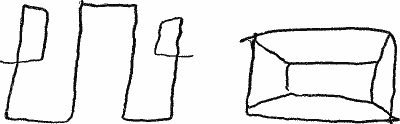
Procedure. Use the designs shown on the accompanying printed form. If
copies are used they must be exact in size and shape. Before showing the
card say: “This card has two drawings on it. I am going to show them to
you for ten seconds, then I will take the card away and let you draw
from memory what you have seen. Examine both drawings carefully and
remember that you have only ten seconds.”
Provide pencil and paper and then show the card for ten seconds, holding
it at right angles to the child’s line of vision and with the designs in
the position given in the plate. Have the child draw the designs
immediately after they are removed from sight.
Scoring. The test is passed if one of the designs is reproduced
correctly and the other about half correctly. “Correctly” means that
the essential plan of the design has been grasped and reproduced.
Ordinary irregularities due to lack of motor skill or to hasty execution
are disregarded. “Half correctly” means that some essential part of the
design has been omitted or misplaced, or that parts have been added.
The sample reproductions shown on the scoring card will serve as a
guide. It will be noted that an inverted design, or one whose right and
left sides have been transposed, is counted only half correct, however
perfect it many be in other respects; also that design b is counted
only half correct if the inner rectangle is not located off center.
Remarks. Binet states that the main factors involved in success are
“attention, visual memory, and a little analysis.” The power of rapid
analysis would seem to be the most important, for if the designs are
analyzed they may be reproduced from a verbal memory of the analysis.
Without some analysis it would hardly be possible to remember the
designs at all, as one of them contains thirteen lines and the other
twelve. The memory span for unrelated objects is far too limited to
permit us to grasp and retain that number of unrelated impressions.
Success is possible only by grouping the lines according to their
relationships, so that several of them are given a unitary value and
remembered as one. In this manner, the design to the right, which is
composed of twelve lines, may be reduced to four elements: (1) The outer
rectangle; (2) the inner rectangle; (3) the off-center position of the
inner rectangle; and (4) the joining of the angles. Of course the child
does not ordinarily make an analysis as explicit as this; but analysis
of some kind, even though it be unconscious, is necessary to success.
Ability to pass the test indicates the presence, in a certain definite
amount, of the tendency for the contents of consciousness to fuse into a
meaningful whole. Failure indicates that the elements have maintained
their unitary character or have fused inadequately. It is seen,
therefore, that the test has a close kinship with the test of memory for
sentences. The latter, also, permits the fusion or grouping of
impressions according to meaning, with the result that five or six times
as many meaningful syllables as nonsense syllables or digits can be
retained.
Binet had many more failures on design a than on design b. This was
probably due to the fact that he showed the designs with our b to the
left. A majority of subjects, probably because of the influence of
reading habits, examine first the figure to the left, and because of the
short time allowed for the inspection are unable to devote much time to
the design at the right. We have placed the design of greater intrinsic
difficulty at the left, with the result that the failures are almost
equally divided between the two.
Binet used this test in his unstandardized series of 1905, omitted it in
1908, but included it in the 1911 revision, locating it in year X.
Except for Goddard, who recommends year XI, there is rather general
agreement that the test belongs at year X. Our own data show that it may
be placed either at year X or year XI, according as the grading is rigid
or lenient.
Material. We use Binet’s selection, slightly adapted, as follows:—
New York, September 5th. A fire last night burned three houses
near the center of the city. It took some time to put it out.
The loss was fifty thousand dollars, and seventeen families lost
their homes. In saving a girl, who was asleep in a bed, a
fireman was burned on the hands.
The copy of the selection used by the subject should be printed in heavy
type and should not contain the bars dividing it into memories. The
Stanford record booklet contains the selection in two forms, one
suitable for use in scoring, the other in heavy type to be read by the
subject.
Procedure. Hand the selection to the subject, who should be seated
comfortably in a good light, and say: “I want you to read this for me
as nicely as you can.” The subject must read aloud.
Pronounce all the words which the subject is unable to make out, not
allowing more than five seconds’ hesitation in such a case.
Record all errors made in reading the selection, and the exact time. By
“error” is meant the omission, substitution, transposition, or
mispronunciation of one word.
The subject is not warned in advance that he will be asked to report
what he has read, but as soon as he has finished reading, put the
selection out of sight and say: “Very well done. Now, I want you to
tell me what you read. Begin at the first and tell everything you can
remember.” After the subject has repeated everything he can recall and
has stopped, say: “And what else? Can you remember any more of it?”
Give no other aid of any kind. It is of course not permissible, when the
child stops, to prompt him with such questions as, “And what next?
Where were the houses burned? What happened to the fireman?” etc. The
report must be spontaneous.
Now and then, though not often, a subject hesitates or even refuses to
try, saying he is unable to do it. Perhaps he has misunderstood the
request and thinks he is expected to repeat the selection word for word,
as in the tests of memory for sentences. We urge a little and repeat:
“Tell me in your own words all you can remember of it.” Others
misunderstand in a different way, and thinking they are expected to tell
merely what the story is about, they say: “It was about some houses that
burned.” In such cases we repeat the instructions with special emphasis
on the words all you can remember.
Scoring. The test is passed if the selection is read in thirty-five
seconds with not more than two errors, and if the report contains at
least eight “memories.” By underscoring the memories correctly
reproduced, and by interlineations to show serious departures from the
text, the record can be made complete with a minimum of trouble.
The main difficulty in scoring is to decide whether a memory has been
reproduced correctly enough to be counted. Absolutely literal
reproduction is not expected. The rule is to count all memories whose
thought is reproduced with only minor changes in the wording. “It took
quite a while” instead of “it took some time” is satisfactory; likewise,
“got burnt” for “was burned”; “who was sleeping” for “who was asleep”;
“are homeless” for “lost their homes”; “in the middle” for “near the
center”; “a big fire” for “a fire,” etc.
Memories as badly mutilated as the following, however, are not counted:
“A lot of buildings” for “three houses;” “a man” for “a fireman”; “who
was sick” for “who was asleep”; etc. Occasionally we may give half
credit, as in the case of “was seventeen thousand dollars” for “was
fifty thousand dollars”; “and fifteen families” for “and seventeen
families,” etc.
Remarks. Are we warranted in using at all as a measure of intelligence a
test which depends as much on instruction as this one does? Many are
inclined to answer this question in the negative. The test has been
omitted from the revisions of Goddard, Kuhlmann, and Binet himself. As
regards Binet’s earlier test of reading for two memories, in year VIII,
there could hardly be any difference of opinion. The ability to read at
that age depends so much on the accident of environment that the test is
meaningless unless we know all about the conditions which have
surrounded the child.
The use of the test in year X, however, is a very different matter.
There are comparatively few children of that age who will fail to pass
it for lack of the requisite school instruction. Children of 10 years
who have attended school with reasonable regularity for three years are
practically always able to read the selection in thirty-five seconds and
without over two mistakes unless they are retarded almost to the
border-line of mental deficiency. Of our 10-year-olds who failed to meet
the test, only a fourth did so because of inability to meet the reading
requirements as regards time or mistakes. The remaining failures were
caused by inadequate report, and most of these subjects were of the
distinctly retarded group.
We may conclude, therefore, that given anything approaching normal
educational advantages, the test is really a measure of intelligence.
Used with due caution, it is perhaps as valuable as any other test in
the scale. It is only necessary, in case of failure, to ascertain the
facts regarding the child’s educational opportunities. Even this
precaution is superfluous in case the subject tests as low as 8 years by
the remainder of the scale. A safe rule is to omit the test from the
calculation of mental age if the subject has not attended school the
equivalent of two or three years.
It has been contended by some that tests in which success depends upon
language mastery cannot be real tests of intelligence. By such critics
language tests have been set over against intelligence tests as
contrasting opposites. It is easy to show, however, that this view is
superficial and psychologically unsound. Every one who has an
acquaintance with the facts of mental growth knows that language mastery
of some degree is the sine qua non of conceptual thinking. Language
growth, in fact, mirrors the entire mental development. There are few
more reliable indications of a subject’s stage of intellectual maturity
than his mastery of language.
The rate of reading, for example, is a measure of the rate of
association. Letters become associated together in certain combinations
making words, words into word groups and sentences. Recognition is for
the most part an associative process. Rapid and accurate association
will mean ready recognition of the printed form. Since language units
(whether letters, words, or word groups) have more or less preferred
associations according to their habitual arrangement into larger units,
it comes about that in the normal mind under normal conditions these
preferred sequences arouse the apperceptive complex necessary to make a
running recognition rapid and easy. It is reasonable to suppose that in
the subnormal mind the habitual common associations are less firmly
fixed, thus diminishing the effectiveness of the ever-changing
apperceptive expectancy. Reading is, therefore, largely dependent on
what James calls the “fringe of consciousness” and the “consciousness of
meaning.” In reading connected matter, every unit is big with a mass of
tendencies. The smaller and more isolated the unit, the greater is the
number of possibilities. Every added unit acts as a modifier limiting
the number of tendencies, until we have finally, in case of a large
mental unit, a fairly manageable whole. When the most logical and
suitable of these associations arise easily from subconsciousness to
consciousness, recognition is made easy, and their doing so will depend
on whether the habitual relations of the elements have left permanent
traces in the mind.
The reading of the subnormal subject bears a close analogy to the
reading of nonsense matter by the normal person. It has been ascertained
by experiment that such reading requires about twice as much time as the
reading of connected matter. This is true for the reason that out of
thousands of associations possible with each word, no particular
association is favored. The apperceptive expectancy, practically nil
in the reading of nonsense material, must be decidedly deficient in all
poor reading.
Furthermore, in the case of the ordinary reader there is a feeling of
rightness or wrongness about the thought sequences. That less
intelligent subjects have this sense of fitness to a much less degree is
evidenced by their passing over words so mutilated in pronunciation as
to deprive them of all meaning. The transposition of letters and words,
and the failure to observe marks of punctuation, point to the same
thing. In other words, all the reading of the stupid subject is with
material which to him is more or less nonsensical.[66]
A little observation will convince one that mentally retarded subjects,
even when they possess a reasonable degree of fluency in recognizing
printed words, do not sense shades of meaning. Their reading is by small
units. Words and phrases do not fuse into one mental content, but remain
relatively unconnected. The expression is monotonous and the voice has
more of the unnatural “schoolroom” pitch. They read more slowly, more
often misplace the emphasis, and miscall more words. In short, one who
has psychological insight and is acquainted with reading standards can
easily detect the symptoms of intellectual inferiority by hearing a dull
subject read a brief selection.
The giving of memories is also significant. Feeble-minded adults who
have been well schooled are sometimes able to read the words of the text
fairly fluently, but are usually unable to give more than a scanty
report of what has been read. The scope of attention has been exhausted
in the mere recognition and pronouncing of words. In general, the
greater the mechanical difficulties which a subject encounters, the less
adequate is his report of memories.
The test has, however, one real fault. School children have a certain
advantage in it over older persons of the same mental age whose school
experience is less recent. Adult subjects tend to give their report in
less literal form. It is necessary, therefore, to give credit for the
reproduction of the ideas of the passage rather than for strictly
literal “memories.”
The selection we have used is, with minor changes, the same as Binet’s.
His selection was divided into nineteen memories. The one here given has
twenty-one memories. Binet used the test both in year VIII and year IX,
requiring two memories at year VIII and six memories at year IX. When we
require eight memories, as we have done, the test becomes difficult
enough for non-selected school children of 10 years. Location in year X
seems preferable, because it insures that the child will almost
certainly have had the schooling requisite for learning to read a
selection of this difficulty, even if he has started to school at a
later age than is customary. Naturally, placing the test higher in the
scale makes it more a test of report and less a test of ability to
recognize and pronounce printed words.
The questions for this year are:—
- “What ought you to say when some one asks your opinion about a person you don’t know very well?”
- “What ought you to do before undertaking (beginning) something very important?”
- “Why should we judge a person more by his actions than by his words?”
The procedure is the same as for the previous comprehension tests. Each
question may be repeated, but its form must not be changed. It is not
permissible to make any explanation whatever as to the meaning of the
question, except to substitute beginning for undertaking when (b)
seems not to be comprehended.
Scoring. Two out of the three questions must be answered
satisfactorily. Study of the following classified responses should make
scoring fairly easy in most cases:—
Satisfactory. “I would say I don’t know him very well”
(42 per cent of the correct answers). “Tell him what I know and
no more” (34 per cent of correct answers). “I would say that I’d
rather not express any opinion about him” (20 per cent of the
correct answers). “Tell him to ask some one else.” “I would not
express any opinion.”
Unsatisfactory. Unsatisfactory responses are due either to
failure to grasp the import of the question, or to inability to
suggest the appropriate action demanded by the situation.
The latter form of failure is the more common; e.g.: “I’d say
they are nice.” “Say you like them.” “Say what I think.” “Say
it’s none of their business.” “Tell them I mind my own
business.” “Say I would get acquainted with them.” “Say that I
don’t talk about people.” “Say I didn’t know how he looked.”
“Tell them you ought not to say such things; you might get into
trouble.” “I wouldn’t say anything.” “I would try to answer.”
“Say I did not know his name,” etc.
The following are samples of failure due to mistaking the import
of the question: “I’d say, ‘How do you do?’” “Say,‘I’m glad to
meet you.’”
Satisfactory responses fall into the following classes:—
- Brief statement of preliminary consideration; as: “Think
about it.” “Look it over.” “Plan it all out.” “Make your plans.”
“Stop and think,” etc.
- Special emphasis on preliminary preparation and correct
procedure; as: “Find out the best way to do it.” “Find out what
it is.” “Get everything ready.” “Do every little thing that
would help you.” “Get all the details you can.” “Take your time
and figure it out,” etc.
- Asking help; as: “Ask some one to help you who knows all
about it.” “Pray, if you are a Christian.” “Ask advice,” etc.
- Preliminary testing of ability, self-analysis, etc.; as:
“Try something easier first.” “Practice and make sure I could do
it.” “Learn how to do it,” etc.
- Consider the wisdom or propriety of doing it: “Think whether
it would be best to do it.” “See whether it would be possible.”
About 65 per cent of the correct responses belong either to
group (1) or (2), about 20 per cent to group (3), and most of
the remainder to group (4).
Unsatisfactory responses are of the following types:—
- Due to mistaking the import of the question; e.g.: “Ask for
it.” “Ought to say please.” “Ask whose it is.” Replies of this
kind can be nearly all eliminated by repeating the question,
using beginning instead of undertaking.
- Replies more or less absurd or irrelevant; as: “Promise to
do your best.” “Wash your face and hands.” “Get a lot of
insurance.” “Dress up and take a walk.” “Tell your name.” “Know
whether it’s correct.” “Begin at the beginning.” “Say you will
do it.” “See if it’s a fake.” “Go to school a long time.” “Pass
an examination.” “Do what is right.” “Add up and see how much it
will cost.” “Say I would do it.” “Just start doing it.” “Go
away.” “Consult a doctor.” “See if you have time,” etc.
Satisfactory responses fall into the following classes:—
- Words and deeds both mentioned and contrasted in
reliability; as: “Actions speak louder than words” (this in
8 per cent of successes). “You can tell more by his actions than
by his words.” “He might talk nice and do bad things.”
“Sometimes people say things and don’t do them.” “It’s not what
you say but what you do that counts.” “Talk is cheap; when he
does a thing you can believe it.” “People don’t do everything
they say.” “A man might steal but talk like a nice man.” Over
45 per cent of all correct responses belong to group (1).
- Acts stressed without mention of words; as: “You can tell by
his actions whether he is good or not.” “If he acts nice he
is nice.” “Actions show for themselves.” Group (2) contains
about 25 per cent of the correct responses.
- Emphasis on unreliability of words; as: “You can’t tell by
his words, he might lie or boast.” “Because you can’t always
believe what people say.” (Group (3) contains 15 per cent of the
correct responses.)
- Responses which state that a man’s deeds are sometimes
better than his words; as: “He might talk ugly and still not do
bad things.” “Some really kind-hearted people scold and swear.”
“A man’s words may be worse than his deeds,” etc.
Group (4) contains over 10 per cent of the correct responses.
Unsatisfactory responses are usually due to inability to
comprehend the meaning of the question. If there is a complete
lack of comprehension the result is either silence or a totally
irrelevant response. If there is partial comprehension of the
question the response may be partially relevant, but fail to
make the expected distinction.
The following are sample failures: “You could tell by his words
that he was educated.” “It shows he is polite if he acts nice.”
“Sometimes people aren’t polite.” “Actions show who he might
be.” “Acts may be foolish.” “Words ain’t right.” “A man might be
dumb.” “A fellow don’t know what he says.” “Some people can
talk, but don’t have control of themselves.” “You can tell by
his acts whether he goes with bad people.” “If he doesn’t act
right you know he won’t talk right.” “Actions show if he has
manners.” “Might get embarrassed and not talk good.” “He may not
know how to express his thoughts.” “He might be a rich man but a
poor talker.” “He might say the wrong thing and afterwards be
sorry for it,” etc. (The last four are nearer correct than the
others, but they fall just short of expressing the essential
contrast.)
Remarks. For discussion of the comprehension questions as a test of
intelligence, see page 158.
Binet used eight questions, three “easy” and five “difficult,” and
required that five out of eight be answered correctly in year X. The
eight were as follows:—
- What to do when you have missed your train.
- When you have been struck by a playmate, etc.
- When you have broken something, etc.
- When about to be late for school.
- When about to undertake something important.
- Why excuse a bad act committed in anger more readily than a bad act committed without anger.
- What to do if some one asks your opinion, etc.
- Why can you judge a person better by his actions, etc.
As we have shown, questions 1, 2, 3, and 4 are much too easy for year X.
Question 6 is hard enough for year XII. We have omitted it because it was not needed and is not entirely satisfactory.
Procedure. Say: “Now, I want to see how many different words you can
name in three minutes. When I say ready, you must begin and name the
words as fast as you can, and I will count them. Do you understand? Be
sure to do your very best, and remember that just any words will do,
like ‘clouds,’ ‘dog,’ ‘chair,’ ‘happy’—Ready; go ahead!”
The instructions may be repeated if the subject does not understand what
is wanted. As a rule the task is comprehended instantly and entered into
with great zest.
Do not stare at the child, and do not say anything as the test proceeds
unless there is a pause of fifteen seconds. In this event say: “Go
ahead, as fast as you can. Any words will do.” Repeat this urging after
every pause of fifteen seconds.
Some subjects, usually rather intelligent ones, hit upon the device of
counting or putting words together in sentences. We then break in with:
“Counting (or sentences, as the case may be) not allowed. You must
name separate words. Go ahead.”
Record the individual words if possible, and mark the end of each
half-minute. If the words are named so rapidly that they cannot be taken
down, it is easy to keep the count by making a pencil stroke for each
word. If the latter method is employed, repeated words may be indicated
by making a cross instead of a single stroke. Always make record of
repetitions.
Scoring. The test is passed if sixty words, exclusive of repetitions,
are named in three minutes. It is not allowable to accept twenty words
in one minute or forty words in two minutes as an equivalent of the
expected score. Only real words are counted.
Remarks. Scoring, as we have seen, takes account only of the number of
words. It is instructive, however, to note the kind of words given. Some
subjects, more often those of the 8- or 9-year intelligence level, give
mainly isolated, detached words. As well stated by Binet, “Little
children exhaust an idea in naming it. They say, for example, hat, and
then pass on to another word without noticing that hats differ in color,
in form, have various parts, different uses and accessories, and that in
enumerating all these they could find a large number of words.”
Others quickly take advantage of such relationships and name many parts
of an object before leaving it, or name a number of other objects
belonging to the same class. Hat, for example, suggests cap, hood,
coat, shirt, shoes, stockings, etc. Pencil suggests book,
slate, paper, desk, ink, map, school-yard, teacher, etc.
Responses of this type may be made up of ten or a dozen plainly distinct
word groups.
Another type of response consists in naming only objects present, or
words which present objects immediately suggest. It is unfortunate that
this occurs, since rooms in which testing is done vary so much with
respect to furnishings. The subject who chooses this method is obviously
handicapped if the room is relatively bare. One way to avoid this
influence is to have all subjects name the words with eyes closed, but
the distraction thus caused is sometimes rather disturbing. It is
perhaps best for the present to adhere to the original procedure, and to
follow the rule of making tests in a room containing few furnishings in
addition to the necessary table and chairs.
A fourth type of response is that including a large proportion of
unusual or abstract words. This is the best of all, and is hardly ever
found except with subjects who are above the 11-year intelligence level.
It goes without saying that a response need not belong entirely to any
one of the above types. Most responses, in fact, are characterized by a
mixture of two or three of the types, one of them perhaps being
dominant.
Though not without its shortcomings, the test is interesting and
valuable. Success in it does not, as one might suppose, depend solely
upon the size of the vocabulary. Even 8-year-olds ordinarily know the
meaning of more than 3000 words, and by 10 years the vocabulary usually
exceeds 5000 words, or eighty times as many as the child is expected to
name in three minutes. The main factors in success are two, (1) richness
and variety of previously made associations with common words; and (2)
the readiness of these associations to reinstate themselves. The young
or the retarded subject fishes in the ocean of his vocabulary with a
single hook, so to speak. He brings up each time only one word. The
subject endowed with superior intelligence employs a net (the idea of a
class, for example) and brings up a half-dozen words or more. The latter
accomplishes a greater amount and with less effort; but it requires
intelligence and will power to avoid wasting time with detached words.
One is again and again astonished at the poverty of associations which
this test discloses with retarded subjects. For twenty or thirty seconds
such children may be unable to think of a single word. It would be
interesting if at such periods we could get a glimpse into the subject’s
consciousness. There must be some kind of mental content, but it seems
too vague to be crystallized in words. The ready association of thoughts
with definite words connotes a relatively high degree of intellectual
advancement. Language forms are the short-hand of thought; without
facile command of language, thinking is vague, clumsy, and ineffective.
Conversely, vague mental content entails language shortage.
Occasionally a child of 11- or 12-year intelligence will make a poor
showing in this test. When this happens it is usually due either to
excessive embarrassment or to a strange persistence in running down all
the words of a given class before launching out upon a new series.
Occasionally, too, an intelligent subject wastes time in thinking up a
beautiful list of big or unusual words. As stated by Bobertag, success
is favored by a certain amount of “intellectual nonchalance,” a
willingness to ignore sense and a readiness to break away from a train
of associations as soon as the “point of diminishing returns” has been
reached. This doubtless explains why adults sometimes make such a
surprisingly poor showing in the test. They have less “intellectual
nonchalance” than children, are less willing to subordinate such
considerations as completeness and logical connection to the demands of
speed. Knollin’s unemployed men of 12- to 13-year intelligence succeeded
no better than school children of the 10-year level.
We do not believe, however, that this fault is serious enough to warrant
the elimination of the test. The fact is that in a large majority of
cases the score which it yields agrees fairly closely with the result of
the scale as a whole. Subjects more than a year or two below the mental
age of 10 years seldom succeed. Those more than a year or two above the
10-year level seldom fail.
There is another reason why the test should be retained, it often has
significance beyond that which appears in the mere number of words
given. The naming of unusual and abstract words is an instance of this.
An unusually large number of repetitions has symptomatic significance
in the other direction. It indicates a tendency to mental stereotypy, so
frequently encountered in testing the feeble-minded. The proportion of
repetitions made by normal children of the 10- or 11-year intelligence
level rarely exceeds 2 or 3 per cent of the total number of words named;
those of older retarded children of the same level occasionally reach
6 or 8 per cent.
It is conceivable, of course, that a more satisfactory test of this
general nature could be devised; such, for example, as having the
subject name all the words he can of a given class (four-footed animals,
things to eat, articles of household furniture, trees, birds, etc.). The
main objection to this form of the test is that the performance would in
all probability be more influenced by environment and formal instruction
than is the case with the test of naming sixty words.
One other matter remains to be mentioned; namely, the relative number of
words named in the half-minute periods. As would be expected, the rate
of naming words decreases as the test proceeds. In the case of the
10-year-olds, we find the average number of words for the six successive
half-minutes to be as follows:—
18, 12½, 10½, 9, 8½, 7.
Some subjects maintain an almost constant rate throughout the test,
others rapidly exhaust themselves, while a very few make a bad beginning
and improve as they go. As a rule it is only the very intelligent who
improve after the first half-minute. On the other hand, mentally
retarded subjects and very young normals exhaust themselves so quickly
that only a few words are named in the last minute.
Binet first located this test in year XI, but shifted it to year XII in
1911. Goddard and Kuhlmann retain it in year XI, though Goddard’s
statistics suggest year X as the proper location, and Kuhlmann’s even
suggest year IX. Kuhlmann, however, accepts fifty words as satisfactory
in case the response contains a considerable proportion of abstract or
unusual words. All the American statistics except Rowe’s agree in
showing that the test is easy enough for year X.
The digit series used are 3–7–4–8–5–9; and 5–2–1–7–4–6.
The procedure and scoring are the same as in VII, 3, except that only
two trials are given, one of which must be correct. The test is somewhat
too easy for year 10 when three trials are given.
The test of repeating six digits did not appear in the Binet scale and
seems not to have been standardized until inserted in the Stanford
series.
The sentences for this year are:—
- “The apple tree makes a cool, pleasant shade on the ground where the children are playing.”
- “It is nearly half-past one o’clock; the house is very quiet and the cat has gone to sleep.”
- “In summer the days are very warm and fine; in winter it snows and I am cold.”
Procedure and scoring exactly as in VI, 6.
Remarks. It is interesting to note that five years of mental growth are
required to pass from the ability to repeat sixteen or eighteen
syllables (year VI) to the ability to repeat twenty or twenty-two
syllables. Similarly in memory for digits. Five digits are almost as
easy at year VII as six at year X. Two explanations are available: (1)
The increased difficulty may be accounted for by a relatively slow
growth of memory power after the age of 6 or 7 years; or (2) the
increase in difficulty may be real, expressing an inner law as to the
behavior of the memory span in dealing with material of increasing
length. Both factors are probably involved.
This is another of the Stanford additions to the scale. Average children
of 10 years ordinarily pass it, but older, retarded children of 10-year
mental age make a poorer showing. In the case of mentally retarded
adults, especially, the verbal memory is less exact than that of school
children of the same mental age.
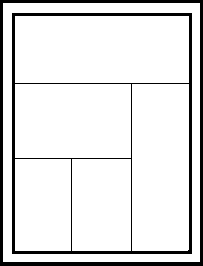
Material. Use the form-board pictured on page 279. This may be
purchased of C. H. Stoelting & Co., Chicago, Illinois. A home-made one
will do as well if care is taken to get the dimensions exact.
Quarter-inch wood should be used. The inside of the frame should be
3 × 4 inches, and the dimensions of the blocks should be as follows:
13⁄16 × 3; 1 × 1½; 1 × 2¾; 1 × 1½; 1¼ × 2.
Procedure. Place the frame on the table before the subject, the short
side nearest him. The blocks are placed in an irregular position on the
side of the frame away from the subject. Take care that the board with
the blocks in place is not exposed to view in advance of the experiment.
Say: “I want you to put these blocks in this frame so that all the
space will be filled up. If you do it rightly they will all fit in and
there will be no space left over. Go ahead.”
Do not tell the subject to see how quickly he can do it. Say nothing
that would even suggest hurrying, for this tends to call forth the
trial-and-error procedure even with intelligent subjects.
Scoring. The test is passed if the child succeeds in fitting the blocks
into place three times in a total time of five minutes for the three
trials.
The method of procedure is fully as important as the time, but is not so
easily scored in quantitative terms. Nevertheless, the examiner should
always take observations on the method employed, noting especially any
tendency to make and to repeat moves which lead to obvious
impossibilities; i.e., moves which leave a space obviously unfitted to
any of the remaining pieces. Some subjects repeat an absurd move many
times over; others make an absurd move, but promptly correct it; others,
and these are usually the bright ones, look far enough ahead to avoid
error altogether.
Remarks. This test was devised by Professor Freeman, was adapted
slightly by Healy and Fernald, and was first standardized by
Dr. Kuhlmann. Miss Gertrude Hall has also standardized it, but on a
different procedure from that described above.[67]
The test has a lower correlation with intelligence than most of the
other tests of the scale. Many bright children of 10-year intelligence
adopt the trial-and-error method and have little success, while retarded
older children of only 8-year intelligence sometimes succeed. Age, apart
from intelligence, seems to play an important part in determining the
nature of the performance. A favorable feature of the test, however, is
the fact that it makes no demand on language ability and that it brings
into play an aspect of intelligence which is relatively neglected by the
remainder of the scale. For this reason it is at least worth keeping as
an alternative test.


![Handwriting: The [Unclear: pretty?] little boy.](https://openoldbooks.sgp1.digitaloceanspaces.com/books/the-measurement-of-intelligence/images/fig05.png)