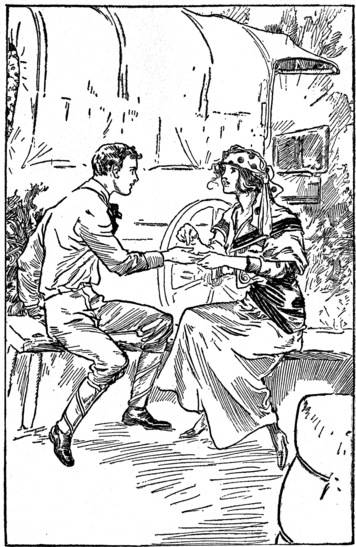
“Oh, where can Crazy Jane be!” wailed
Margery Brown.
“It isn’t so much a question of
where Jane may be as where we ourselves are,
Buster,” answered Harriet Burrell, laughingly.
“However, if she doesn’t come, why, we
will make the best of it. This will not be the
first time we have spent the night out of doors.”
“Are we lost?” gasped Hazel Holland.
“It looks very much as though we had gone
astray,” replied Miss Elting, who was acting as
guardian and chaperon to the Meadow-Brook
Girls.
“Oh, thave me!” wailed Grace Thompson,
her impish little face appearing to grow several
degrees smaller.
“Girls! Please do not become excited,”
urged the guardian. “There is no cause for
8
alarm. Even if we have lost our way we shall
find it again on the morrow. Harriet, you have
the map. Suppose we examine it again and see
if we can find out where we are. We surely
must be near human habitation, and the country
is so open that really getting lost is quite
impossible.”
Harriet Burrell unslung the pack that she
carried over her shoulder, then felt about in it
until she found that for which she was looking.
She spread the map out on the ground at
one side of the road, her companions gathering
about and gazing down over her shoulder.
Miss Elting sat down beside the map.
“Here! Trace our day’s route with the pencil,”
she said. “This should be Harmon’s Valley.
That being the case, the village of Harmon
should be not more than a mile farther on.”
“There is no village anywhere near us, according
to the route we have traveled since this
morning,” answered Harriet.
“Oh, that can’t be possible,” exclaimed Miss
Elting.
“Please look for yourself, Miss Elting,” Harriet
replied earnestly. “After leaving Granite
Mountain we swung to the left as you will see
by the line I have marked.”
“Hm-m-m,” murmured the guardian as she
scanned the map.
9
“It looks to me very much as though we had
taken the wrong valley,” said Harriet, as she
paused in her scrutiny of the map to glance up
at the hills that shut in the valley where they
now were. “See! There isn’t a town marked
on this map anywhere in this valley.”
“I believe you are right. In order to get to
our stopping place for the night we shall have
to cross those hills to the right. How far is it
across?”
“Five miles,” answered Harriet, after making
some brief measurements.
“Five mileth?” wailed Grace. “Oh, thave
me!”
“Tommy, will you be quiet?” begged Margery.
“You make me nervous. Miss Elting,
you aren’t going on, to-night, are you? I simply
can’t walk another mile. My feet are so
numb that I can’t feel them.”
“I can feel mine. They are ath big ath
elephantth,” declared Tommy.
“What do you say, girls? Shall we go on
or make camp for the night?” questioned the
guardian. “Remember, Jane McCarthy is no
doubt waiting with her car for us over in the
other valley. She will not know where to go if
we do not get in touch with her to-night.”
Grace, Hazel and Margery begged Miss Elting
to go no farther. They already had made
10
ten miles that day, which they declared was
quite enough.
“What do you say, Harriet?” asked Miss
Elting.
“Of course I am a little footsore, but I could
walk another ten miles if necessary. However,
the other girls do not wish to go farther, so I
vote with them to remain here for the night.
But won’t Jane be puzzled where to go in the
morning!”
“She will find us, my dear,” smiled the
guardian.
“If you think best I will cross the ridge, after
supper, and see if I can find her,” suggested
Harriet Burrell.
“No. I could not think of permitting you
to do that, Harriet. Jane will be sure to wait
at the meeting place we agreed upon until noon
to-morrow before starting on to the next stopping
place.”
“But we haven’t any plathe to thleep,” protested
the lisping Tommy. “I can’t thleep on
the ground, can I?”
“No. You are going to sleep standing up
like a horse,” answered Margery petulantly.
“No, I’m not. I’m going to lie down jutht
like I alwayth do,” lisped the little girl.
“Girls, stop your disputing. We have other
things to think of,” rebuked Harriet. “Let’s
11
try to make the best of our unpleasant situation.”
Miss Elting, shading her eyes with her hand,
gazed inquiringly at the surrounding country.
It was barren of buildings except for a large
barn and a number of stacks and sheds, some
distance away in a field to the west. Still beyond
this was a clump of trees and bushes.
There was nothing else—no house, no human
beings other than themselves in sight.
“Girls, let’s investigate that miniature forest
over yonder,” called the guardian. “It
looks as though it might be an excellent place in
which to cook supper, provided we are able to
find water.”
“Supper!” cried the girls in chorus. They
realized all at once that they were hungry.
With one accord they snatched up their packs,
heavy as they were, slung them over their
shoulders and laboriously climbed the roadside
fence. Tommy caught her foot on the top rail
in attempting to jump to the ground on the other
side.
“Look out!” warned Miss Elting sharply.
“Thave me!” wailed the lisping Tommy and
sprawled on all fours on the other side of the
fence, kicking frantically as she fell.
“Are you hurt, dear?” cried Harriet, springing
over to her companion.
12
“Hurt? I gueth I am. Don’t you thee, I’ve
thkinned my nothe. Oh, I withh I were home!”
“No, you don’t. Think what a lot of fun you
are having,” comforted Harriet. “There!
You are all right now.”
“Am I all right?”
“Of course you are.”
“All right, if you thay tho,” nodded Tommy,
gathering up her pack and moving away with
Harriet Burrell’s arm about her. Miss Elting
and the other girls had started for the clump
of trees. Arriving, they quickly flung down
their packs. The guardian began hunting for
water. She found a stream of cold water just
inside the clump of trees beyond the field, as she
had anticipated. The greenness of the foliage
about the spot had told her that water was near.
In other parts of the valley the leaves were
turning. There was a strong suggestion of Autumn
in the air, which at night was crisp and
bracing, though the days thus far on their long
tramp, had been unusually warm for so late in
the Fall.
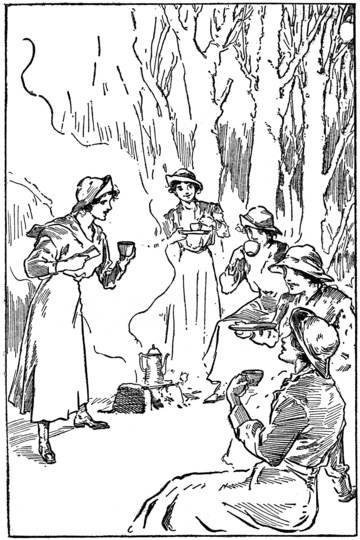
It was Harriet’s duty to build the fire. She
went about this task at once. There was some
difficulty in finding wood that would burn.
After searching she found some pieces of old
fence rails. These were of pine, and as they
were too long for a fire over which to cook food,
13
Harriet got out her hatchet and began to chop
them into smaller pieces. It was a hard task to
chop through a rail, sharp though the hatchet
was. However, within fifteen minutes, the girl
had accomplished the task and the fire was
burning.
“I am afraid I can’t promise a great variety
or quantity of edibles for supper,” announced
Miss Elting, “though what there is to eat will
be appetizing.”
“If there is enough, it will answer,” Margery
declared.
“Enough?” repeated Tommy wisely. “Buthter,
you thurely ought to diet—a girl ath thtout
ath you are.”
“I think I’ve heard you remark something
of the sort before,” sighed Margery wearily.
“I wish you would forget that I weigh—well,
never mind how much! The subject is a distressing
one. I’m almost too hungry to-night
to think of anything except eating.”
Tommy’s mischievous glance roved about,
resting first on Harriet, who with flushed face
was bending over the fire, then on Miss Elting,
who was slicing bacon. In addition to the
bacon there was to be coffee, supplemented by
a few biscuits. There was nothing very hearty
about that repast for healthy girls who had
tramped for hours under a warm September
14
sun. Still, there were no complaints, save as
Tommy and Margery had voiced their disgust
with their present life.
Though none of these young women could
guess it, they were destined, before morning,
to encounter enough excitement to make them
all wish they had never started on this long
walk from Camp Wau-Wau, where they had
spent the summer, to their homes in Meadow-Brook.
Surely the Meadow-Brook Girls need no introduction
to the readers of this series who
will recall how, under the chaperonage of Miss
Elting, the four girls had gone to the summer
camp in the Pocono Woods, where, somehow,
each day of their life had grown increasingly
exciting. All of the things that happened to
Harriet and her friends at that time are set
forth in the first volume of this series, under
the title of “The Meadow-Brook Girls Under
Canvas.” While in the summer camp the
Meadow-Brook Girls had passed through many
varied and exciting experiences. The mischievous
initiation of Harriet Burrell and Grace
Thompson by the older girls, the arrival in the
camp of Jane McCarthy, known to her friends
as “Crazy Jane” and the series of lively happenings
that followed her coming; the nocturnal
visit of a bear, and Harriet’s spirited chase of
15
the animal were incidents that contributed to
the interest of the narrative.
Harriet’s brave rescue of her companions
during a severe storm and her subsequent generous
treatment of the two Camp Girls, Patricia
Scott and Cora Kidder, who had plotted against
her, won for her the warm admiration of her associates
at Camp Wau-Wau.
When it had come time to leave the camp in
the great forest it had been agreed by the
Meadow-Brook Girls and their guardian that,
instead of returning by train they would walk
all the way home, disdaining any “lifts” or
other helps that prevented them from making
their way strictly on foot.
So endeared had “Crazy Jane” McCarthy
become to them all during her stay in camp
that she had been voted as one of their number.
Crazy Jane, however, would hear of but
little walking. She sent for her automobile, a
present from her father, and insisted on using
this in “scouting” and in carrying the tent and
provisions for the Pathfinders, as the Meadow-Brook
Girls now elected to call themselves.
Each night Jane would meet the girls at a
place agreed upon in advance. Then the tent
would be pitched at some distance from the
highway, and there the girls would spend the
night. But now, on the third day, the Meadow-Brook
16
Girls had failed to meet their supply car.
What they were to do for the night, Miss Elting
did not know. Her first move was to see to the
preparation of the little food that they had with
them.
Jane McCarthy, with a full purse and a
wealthy, indulgent father, had claimed the right
of being purveyor of food on that long journey.
The speed at which that young woman traveled
permitted of her foraging far and wide. Whereever
she went she was likely to be remembered,
for it was her reckless driving that had given
her the name of “Crazy Jane.” Yet this light-hearted,
impulsive girl had wonderful control
of her machine. With all her reckless driving
she had never yet injured any one, though her
friends often remonstrated with her for her haphazard
style of running her car.
Supper finished, Margery and Hazel were
left to attend to the dishes, and to put them
in the packs, which were ordinary hunters’ bags,
made to strap over the shoulders.
“After you have finished the work, girls,”
directed Miss Elting, “be sure to extinguish the
last spark of the fire. Harriet, will you come
with me?”
“Thay, where are you going?” cried Grace.
“Pleathe don’t go away and leave uth here
alone. It ith going to be dark, pretty thoon.”
17
“Don’t you want a place to sleep?” smiled
the guardian.
“Yeth, but it’th getting dark,” Tommy insisted.
“All the more reason for finding sleeping
quarters,” smiled Miss Elting.
“Are you thinking of trying the barns?”
asked Harriet, as she and the guardian stepped
away.
“Yes. I don’t see anything else to do.”
“We’re going to have a storm,” Harriet
went on thoughtfully, “so of course we shall do
well to secure more shelter than we could get
by making a brush lean-to.”
“I don’t believe we are in the least danger
of being disturbed in the barn,” the guardian
continued. “I don’t imagine there are any
other human beings within several miles of this
place. This is certainly a very lonesome bit of
country. It is the first day since we have been
out that we haven’t met some one. That may
be because we have kept away from the roads
to-day. We haven’t been on a highway more
than an hour all day long.”
“This is what I like,” answered Harriet. “I
just love to strike out across country and blaze
new trails. It’s ever so much more interesting.
But, Miss Elting, are you certain there is no
one about?”
18
The guardian halted sharply and faced her
companion. She knew Harriet Burrell too well
not to understand that the girl’s question was
significant.
“What is it?” she asked.
“I saw some one not far from camp when
we were eating our supper,” was Harriet’s
quiet announcement.
“You are sure of that?”
“Yes; it was just beyond the woods there.
At first I thought it a fence post; then all at
once the post moved. I saw it was a person.”
“What was the person doing, Harriet?”
“The person appeared to be watching us. I
also discovered something else. The person
was a woman.”
Miss Elting threw back her head and laughed
merrily.
“I don’t think we need to be very much
alarmed at that. So long as it wasn’t a tramp
you saw, we won’t disturb ourselves.”
“She was a strange looking creature,” continued
Harriet. “I couldn’t make her out very
well. All at once she disappeared in the most
mysterious fashion. You said something. I
glanced up, then back to the place where the
woman had been standing and she had gone.
It happened in less than half a dozen seconds.
She would have to be a pretty lively person to
19
get out of sight in that time, wouldn’t she, Miss
Elting?”
The guardian nodded. They had now reached
the big barn. Like its surroundings, it was deserted
so far as they were able to observe.
Miss Elting wished to examine the place while
there was still light, so they hurried in, the
doors being wide open. The scent of hay was
strong on the air as they entered. There were
little heaps of hay on the barn floor, and on
either side in the mows the hay was piled up
high. Ladders led up to the top of the mows
from the barn floor.
“This looks nice and comfy, doesn’t it?”
smiled the guardian.
“The best sort of bedroom,” agreed Harriet.
“I hope there are no mice here?”
“Mice? Gracious! I hope not, too. I think
we can do no better than to climb the ladder
to the top of one of the mows, roll up in our
blankets and go to sleep. Which bedroom will
you take, the north or the south?”
“I think I should prefer the room on the
south side. One is more likely to get the morning
sun there,” answered Harriet gravely.
Miss Elting laughed.
“Thank you. I hadn’t thought of it in that
light. The south side bedroom will be best for
the Meadow-Brook Girls. I know Jane McCarthy would
20
enjoy this sort of camping out.
As it is, she will have to sleep at a farm house
to-night. She will never be able to find us here.
Suppose you climb the ladder and see how the
land lies.”
“You mean the hay,” chuckled Harriet, running
up the ladder with agility. “Oh, it is fine
up here, and just as warm as can be. Won’t
it be splendid to sleep on the hay?” she called
down, peering over the edge of the mow.
After gazing over the mows for some moments
Harriet finally descended to the floor.
Next she and Miss Elting made a survey of the
yard back of the barn. The yard was surrounded
by empty sheds and great stacks of hay
and straw. It was evident that the owners intended
to winter considerable stock in this remote
place.
“Well, what do you think of it, Harriet?”
inquired Miss Elting.
“Glorious! It is as clean and sweet here as
in our own bedrooms at home. I’ll tell you
what I will do. I’ll run back and get the girls,”
said Harriet.
Miss Elting nodded acquiescence and Harriet
hurried across the field, the teacher remaining
at the barn to investigate the place further
while Harriet went for her companions. This
she did, and decided that they were most fortunate
21
in finding so comfortable a place in
which to spend the night.
Half an hour later she heard them coming.
Tommy’s chatter sounded louder than the conversation
of all the rest of the party. Twilight
had settled over the interior of the barn by the
time the girls came trooping in.
“Br-r-r-r! This place looks spooky,” cried
Margery. “We aren’t going to stay in here all
night, are we, Miss Elting?”
“Yes, Margery. You are not afraid of the
dark, are you?”
“No-o-o. But——”
“There is nothing to alarm you. As we are
all rather tired, I propose that we go upstairs
and get to bed at once. I am sorry we shall
not be able to get our baths this evening. This
hotel isn’t provided with bath tubs. By the
way. There are matches in our packs, so we
will leave them below. One of the first things
a Camp Girl learns, you know, is to be careful
of fire both indoors and out. Strap your
blanket rolls over your shoulders. You know
it is quite a climb to your bedrooms.”
“Up there is where we sleep,” Harriet informed
them. The top of the mow was not discernible
from the barn floor now.
“What! Away up there?” demanded Margery.
“How do we get up?”
22
“We shall have to climb the ladder,” answered
Miss Elting.
Margery groaned.
“I’m glad it’s dark. If it were daylight I
know I should fall,” declared Hazel. “Let me
go first. I don’t want to stand here and think
about what is before me. If I stop to think I’ll
never have the courage to climb.”
“Don’t look down,” cautioned the guardian.
“There. That’s fine.”
Hazel was going up rapidly. Margery, with
many a groan, next essayed the climb. Harriet
was directly behind her. Margery had not gone
far before the wisdom of Harriet’s action became
apparent. A wail from Margery brought
a chorus of “ohs!” from her companions.
“I can’t go another step,” gasped Margery.
“I’m going to fall. Catch me somebody.”
“Margery, keep on climbing. I’m right below
you here. Go on,” urged Harriet.
“Oh, I—I can’t. I’m dizzy.”
“Buthter ith theathick,” observed Tommy
from the barn floor. Harriet began lightly,
tapping Buster with a switch that she had
brought with her.
“Oh! Ouch! Stop it! I tell you stop it!”
howled Margery.
“Climb!”
Margery did climb. She went up the ladder
23
faster than she ever had climbed before, wailing
and threatening every foot of the way.
Tommy was delightedly dancing about on the
barn floor during all this time, uttering a perfect
volley of unintelligible lisps and jeering
cries. Margery reached the top of the ladder
and flung herself panting on the hay.
“Be careful not to come too near the edge,”
warned Harriet, hurriedly clambering down.
Buster made no reply. She was too much out
of breath to say a word. “Now, let’s see what
you can do, Tommy. See if you can do any
better,” chuckled Harriet.
“You jutht thee me climb. I’ll thhow you.
I gueth I know how to climb. Buthter ith too
fat to climb a ladder. Don’t you hit me. I’ll
kick you if you do,” was her parting admonition
as she began running up the ladder. Rather
to the amazement of her companions, Grace
made the climb to the haymow without the least
difficulty. Only once did her foot slip from a
rung of the ladder. Grace recovered it with no
more than a smothered little exclamation.
“You next, Miss Elting,” nodded Harriet.
“I will wait until you get up. I wish to look
after the packs first. What would we do were
we to lose them? We shouldn’t have a thing to
eat for breakfast, and goodness knows when
we will reach a store to purchase food.”
24
It was not long afterwards that the party of
young women were fussing about in the hay,
making their beds for the night. This consisted
in leveling off the hay and spreading
their blankets. Some little time was occupied
in working out the uneven spots, but after a
time they lay down with piled-up hay for pillows,
and rolled themselves in their blankets.
The girls went to sleep almost at once. Miss
Elting, however, remained awake until her
charges had finally settled down, as she supposed,
for the night. She was just about to
doze off when she was awakened by a scream
and a commotion at one end of the mow. The
guardian sprang up in alarm.
“For mercy’s sake! What is it?” she cried.
“Oh, thave me!” wailed Tommy.
Miss Elting and Harriet groped their way to
Grace.
“I got a bug in my ear. Yeth I did. It bit
me. I won’t thtay here another minute.
I’ll——”
“I’ll go out doors and sleep,” declared Margery
in disgust. “The idea of being kept
awake all night by that crazy girl.”
“Margery!” rebuked the guardian. “Now,
Tommy, you must lie down and go to sleep.
This will not do at all.”
“I will drag my blanket over and keep her
25
company, Miss Elting,” offered Harriet. “Perhaps
she did get bitten. I felt some sort of insect
crawling over my face a moment ago.
There now, Tommy, you just snuggle down and
forget all about it.”
“I don’t like bugth,” complained Tommy,
somewhat mollified. A few moments later she
was sound asleep. Harriet, after making sure
that Grace was slumbering, once more permitted
herself to doze off. She had been asleep
but a few moments when a wild scream of terror
awakened them all. Harriet felt the blanket
jerked violently from her and heard a floundering
and threshing on all sides that filled her
with alarm. Stretching out her hand she found
that Tommy was no longer beside her. Tommy’s
voice rose in a loud wail of terror.
“Oh, Tommy!” cried Harriet.
“Girls, girls! What is the matter?” exclaimed
Miss Elting.
“A mouthe, a mouthe!” shrieked Tommy.
“This isn’t a hay barn, it’s a lunatic asylum,”
scoffed Margery. “Oh, mercy! Help,
help!” she shrieked. The mouse had found
Margery too. In the darkness of the haymow
the Meadow-Brook Girls were now floundering
about in great alarm. Out of the disorder Miss
Elting quickly brought order. She spoke
sharply to Tommy, insisted that Margery
26
should return to her blanket and commanded the
girls to make no further disturbance.
“The idea that Meadow-Brook Girls should
be so timid,” she rebuked. “Harriet, I am
glad to know that you are not.”
“I—I think I should have screamed too if a
mouse had—how do you know it was a mouse,
Tommy?”
“It ran right over my fathe. I gueth I know
what it wath. I gueth I will thleep thanding up.
May I, Miss Elting?”
“If you prefer to do so. I am going back to
bed. I must insist on the others doing the same,
or at least keeping quiet. We shall be in no
shape to go on with our journey in the morning
at this rate.”
Tommy decided that she, too, would lie down
and soon their regular breathing told the guardian
that most, if not all, of the Meadow-Brook
Girls were sound asleep. Harriet, however,
now that she had been awakened, found it difficult
to go to sleep again. She lay staring up
into the darkness for some time.
A sound down on the barn floor put her instantly
on the alert. At first she thought some
farm animal had wandered into the barn; then
the distinct sound of human footsteps, reached
her ears.
Harriet Burrell listened intently, as yet unafraid.
27
She crawled cautiously to the edge of
the mow and peered over. A human form was
faintly outlined down there. The figure was
groping along the edge of the mow and muttering.
The listener was unable to make out
the words. At last the intruder uttered a sharp
little exclamation of satisfaction, then began to
climb the ladder on the opposite side of the
barn floor.
“It’s a woman!” gasped Harriet. “Who can
it be, and what does she want here?” With
straining ears and closed eyes the Meadow-Brook
girl listened. She heard the woman
reach the top of the ladder and step off into
the hay. A few moments later Harriet heard
her mumbling at the far side of the mow, over
near the opposite end of the hay barn. “How
strange!” muttered the girl.
A low, distant rumble of thunder attracted
her attention in another direction. A moment
later a faint flash of lightning dispelled the
gloom a little.
“The storm is coming. I hope the girls
won’t wake up.” The darkness now seemed to
be more intense than before. Harriet was unable
to distinguish one object from another.
She crawled back toward her bed and was about
to wrap herself in her blanket again when a
second time she heard footsteps on the barn
28
floor. This time she scrambled back to the edge
more hastily than before. At first she thought
the woman had climbed down and was going
away from the mow. The girl leaned far over.
She could see no one this time, but she plainly
heard some one climbing up the opposite ladder
again. Harriet wondered if it were tramps;
then she recalled that the first visitor, being a
woman, would be unlikely to be a tramp.
“It must be some one seeking shelter from
the coming storm,” Harriet finally decided,
now wondering if it would not be advisable to
wake up Miss Elting. Upon second thought the
girl decided not to do so. Instead, she leaned
farther out over the edge of the mow and peered
down anxiously.
A flash of lightning, more brilliant than the
first, lighted up the barn from end to end. By
the light of the flash Harriet Burrell saw that
which set her nerves to tingling and caused her
to utter a suppressed gasp.
Below her on the barn floor stood a man. He
was swarthy; his coal black hair hung down
in long, glistening locks. His eyes, large and
very black were gazing right up into the girl’s
face. She shrank back trembling.
“Oh!” gasped the Meadow-Brook girl. “Oh!
He saw me. Oh, what shall I do!”
The man began climbing the ladder on her
29
side of the barn. Harriet could hear him
plainly. She began crawling back into the mow
on her hands and knees. Her first inclination,
on reaching her blanket, was to burrow under
the hay so as to be out of sight. But it occurred
to her that her companions would still
be in plain sight were another flash of lightning
to illumine the mow. Harriet promptly decided
to lie still and await developments. She knew
that Miss Elting carried a revolver, and that
the guardian was proficient in its use. This
thought gave Harriet comfort. Besides, what
was there to fear?
To add to the excitement a second man entered
the barn at this juncture. But instead of
climbing up after the other man he took the opposite
ladder up which the woman had gone a
few moments before. The man on the girls’
side was rapidly nearing the top. Harriet lay
trembling, hoping there would be no more lightning.
Suddenly a brilliant flash lighted up the
barn from end to end. It revealed the man
clinging to the ladder, his head on a level with
the top of the mow, glancing over it keenly,
searchingly. Harriet’s left hand stole toward
Miss Elting who lay within easy reach. It was
Harriet’s intention to awaken her as quietly as
possible as soon as the light died away. But
ere her hand descended on Miss Elting’s arm,
30
something occurred that made this move on Harriet
Burrell’s part, unnecessary.