WHO and what were the Pilgrims and in what way did they
differ from the Puritans? They both were English and
both lived in the same generation. The Pilgrims were a
small band of staunch men, women and children who came to America
for religious freedom. They were a part of a great movement. The
Protestant Reformation, set on foot in England during the reign of
Henry VIII, was finally accomplished in 1588 by the defeat of the
Spanish Armada. It did not secure freedom of action or worship,
however. There was no country then where such liberty was allowed;
in fact, such a thing had never been thought of. The Reformation
made the Sovereign, instead of the Pope, the head of the church
in England, and there were changes in doctrine and ceremonials, but
everyone was required to attend church whether he wished to or not
and was also taxed to support it. The Bible had just been translated
from Latin into English, and for the first time it was being
generally circulated (1557-60).
Among the Protestant reformers there were many who were not
satisfied with the doctrines and ritual of the English church. They
wished to simplify the government of the church and drop some of
the ceremonies. This they considered purifying the church, which
gave them the name of Puritans. Most of them had no thought or
intention of leaving the Established Church. They wished to stay
and be a part of it, but to change it according to their ideas.
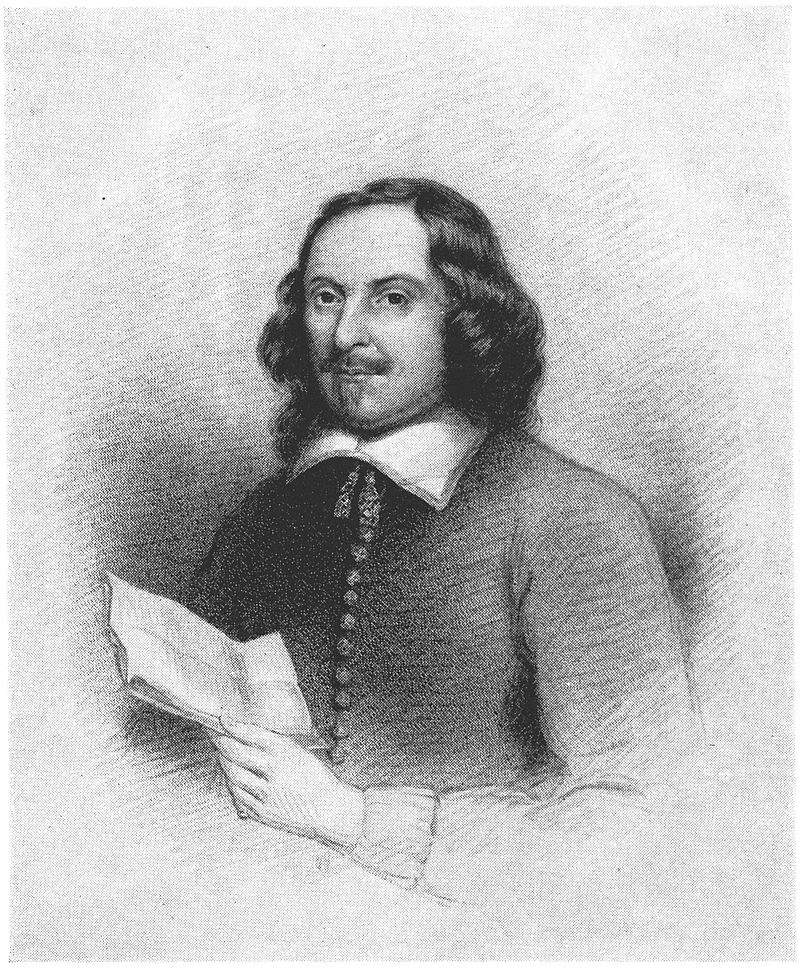
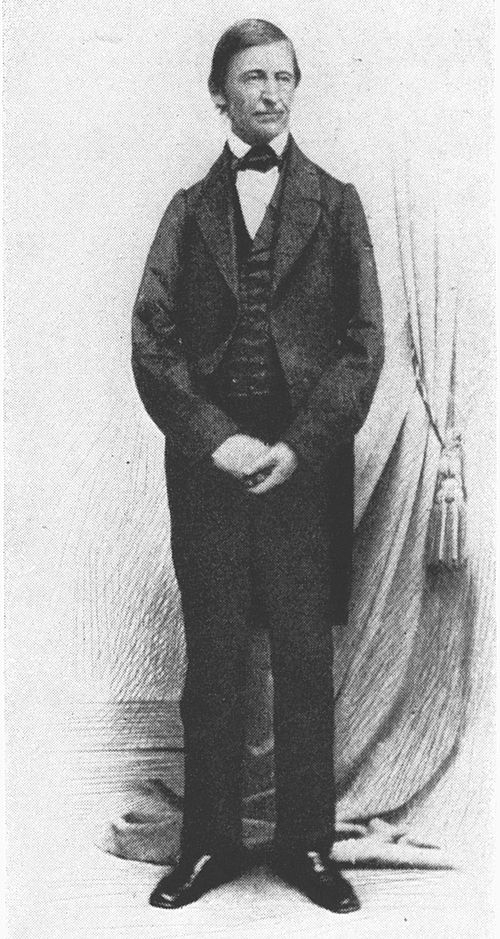
EDWARD WINSLOW, third Governor of Plymouth Colony. Great-grandfather of Edward Winslow,
builder of The Mayflower Society House. Painted during a visit to England. Winslow is the only
Pilgrim of whom there exists an authentic picture
Early in 1567 a number of ministers, despairing of getting the
desired changes, made up their minds to separate from the church
and hold religious services of their own. Robert Brown was one of
them and went about the country advocating this policy of separation.
Those who adopted it became known as Separatists or
Brownists. They did not believe in having bishops rule over them.
Some denied that the queen was head of the church. This was called
treason. These were the people who became Pilgrims. The Puritans
also questioned the spiritual authority of the bishops and claimed
the right to worship as they saw fit, but they did nothing in particular
about it.
The Separatists, or better, Independents, which describes them
accurately, established a little church in the hamlet of Scrooby,
near Lincoln, where a congregation listened to the eloquent preaching
of John Robinson. English laws provided imprisonment for
those who refused to attend the Established Church, or were present
at unlawful assemblies, with the further penalties, that the convicted
must conform within three months or leave the country. If
he refused, he should be deemed a felon and put to death without
the benefit of clergy. The little church at Scrooby could not continue
under these conditions. Some of the Separatists had given
their lives, some were in prison, and others were in exile. Brown
had fled the country, and so its members determined to cross to
Holland. Under existing laws a family could not migrate without
a license, and they were denied one. It was as dangerous to remain
as it was to attempt to leave secretly. Meetings were held, and
Separatists from Scrooby, Bristol, Exeter, Boston, and sundry other
places planned to flee.
In October 1607 they made their first attempt to leave from
Boston in a chartered ship. They were seized, searched, and imprisoned.
After a month all but seven of the principal men were
released.
The next year they arranged with a Dutch ship to meet them at
a port near Grimsby at the mouth of the Humber, but the cautious
skipper got scared and after taking a few of the women and children
aboard, cast off, leaving the husbands and a majority to be seized
by the sheriff and his men. Following this, there was no mass effort
to cross to Holland, but, with much difficulty and by departing
one or two at a time, all got over. After a short stay in Amsterdam
they made their way to Leyden. Here they were joined by other
refugees from England, until there were more than a thousand.
The Pilgrims remained in Leyden for eleven years (1609 to 1620).
Brewster became a printer, Robinson entered the University, and
all found work in different occupations. They labored hard and
continuously. They found in Holland peace and the religious
freedom they had left their English homes for, but there were other
factors which made them, after a decade, seriously consider leaving
Holland. They wished the protection of the English flag; they
were losing the English language, and their children were marrying
among the Dutch. After careful consideration they decided that
the Virginia Colony, extending from Florida to New York, offered
the best opportunity. Because of their separation from the Established
Church, the King would not guarantee them protection,
but agreed not to molest them, and under this agreement they
obtained a patent from the London Company to settle on the New
Jersey Coast.
It was necessary to secure financial aid, and this they obtained
from a group of London merchants, known as the Adventurers.
The contract was an oppressive one and became more so as the
colonists built their houses; but it cannot be called unfair, considering
the financial risk involved. It provided that for seven
years the income of the colony should go into a common fund and
from this the colonists would get their living. At the end of the period
the investment and profits, real and personal, should be equally
divided between the Adventurers and the Planters in accordance
with the number of shares each held. Its effect was to establish a
community life which, long before the seven years were up, resulted
in embarrassment and open disaffection, and a compromise between
the parties was effected by which the Adventurers were to be paid
the sum of eighteen hundred pounds sterling 26 November 1626.
Here was Communism pure and simple, and it was a monumental
failure and was given up after three years. If Communism cannot
succeed under these conditions, with the type of people the Pilgrims
were, speaking the same language, governed by the same laws, with
common history, tradition, and memories, how could Communism
possibly prove a success under far less favorable circumstances
today?
The conditions upon which the Pilgrims secured their transportation
to America indicate the exhausted state of their finances, and
they probably never would have given their assent to the conditions
imposed, if not absolutely forced to do so. The famous Captain John
Smith wrote in 1624 that the Adventurers who raised the money
to begin and supply the Plymouth plantation were about seventy
in number, some merchants, some handicraftsmen, some risking
great sums, some small, as their affection served. They dwelt mostly
about London, knit together by a voluntary combination in a society,
without constraint or penalty, aiming to do good and plant religion.
The sad intelligence conveyed by the Mayflower on her return to
London of the sufferings, sickness, and death, produced a disheartening
effect in the most zealous friends, and the necessary supplies
required by the infant colony were refused, though they had been
promised.
After the Pilgrims had secured financial aid the little band (July
1620) left Leyden and sailed from Delfts-haven in Holland in the
Speedwell, which they had bought for the purpose, to Southampton
where the Mayflower was awaiting them with friends. Two weeks
later the Mayflower and the Speedwell left Southampton for America.
The Mayflower of one hundred and eighty tons burden (the Queen
Mary of today is over eighty-three thousand tons) had been chartered
to transport a part of the Leyden congregation to America.
Before they were out of the English Channel the Speedwell began
leaking badly and they ran into Dartmouth for repairs. 2 September
they made a second start, but trouble developed and they returned
this time to Plymouth. Here they reorganized the expedition.
The Speedwell was left behind, some of her passengers were taken on
the Mayflower and the others left in England. On 16 September
1620 the Mayflower sailed again and ten weeks later, after a voyage
filled with hardships and peril, having been driven far off her course,
came to anchor in Cape Cod Harbor. When the Cape was sighted
it was decided to sail south for a permanent home, but before the
day was over they found themselves in dangerous shoals and roaring
breakers and turned back to settle beyond the limits of their patent.
Only about one half of the passengers on the Mayflower were
members of the Leyden congregation. Other motives, without
thought of religious dissent or separation from the Established Church
of England, had added many strangers to the company, and there
arose mutterings of discontent among them.
It became evident, therefore, that some means should be devised
to maintain law and order as they were out of the jurisdiction of
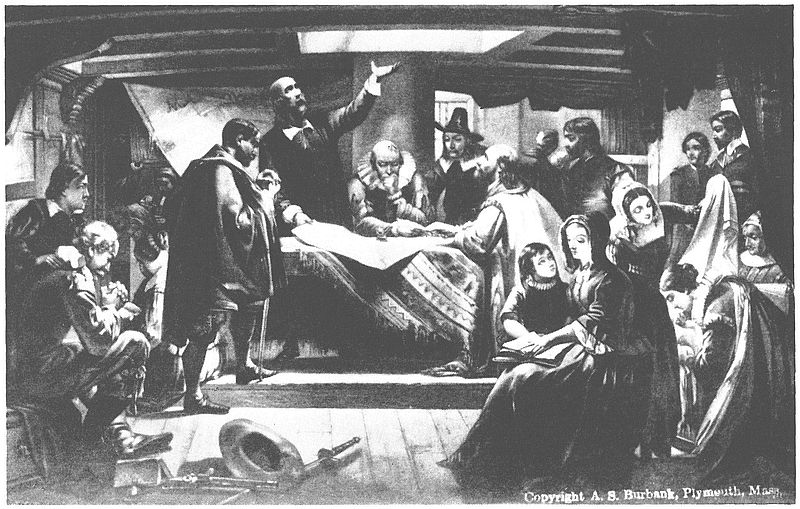
their patent. To accomplish this the members of the Pilgrim Company
met in the cabin of the Mayflower off the shores of Cape Cod
on 21 November 1620 and banded themselves together by the now
famous document known as the Mayflower Compact.
The Mayflower Compact is a great contribution to civil liberty
and democracy; it ranks with the Declaration of Independence and
the Constitution of the United States. Our democracy was based
on it from the landing of the Pilgrims. The Pilgrims established
what they planned. The Plymouth settlement was the start of religious
freedom. We owe them a great debt of gratitude. They were
unimportant people, and their departure attracted little or no attention.
Some were educated, others were not; some had means,
most little or nothing, but all had character and courage. We call
them ordinary people, but their accomplishment made history.
When they wrote and signed the Compact they gave the world a
new political idea for government by the people, and when, under
the Compact, they organized the government of Plymouth, they
laid the foundation of political liberty for this nation.
Students of governmental history the world over, as well as statesmen,
now know of the Mayflower Compact and discuss it. It cannot
receive too much publicity, and there is no better place to reprint
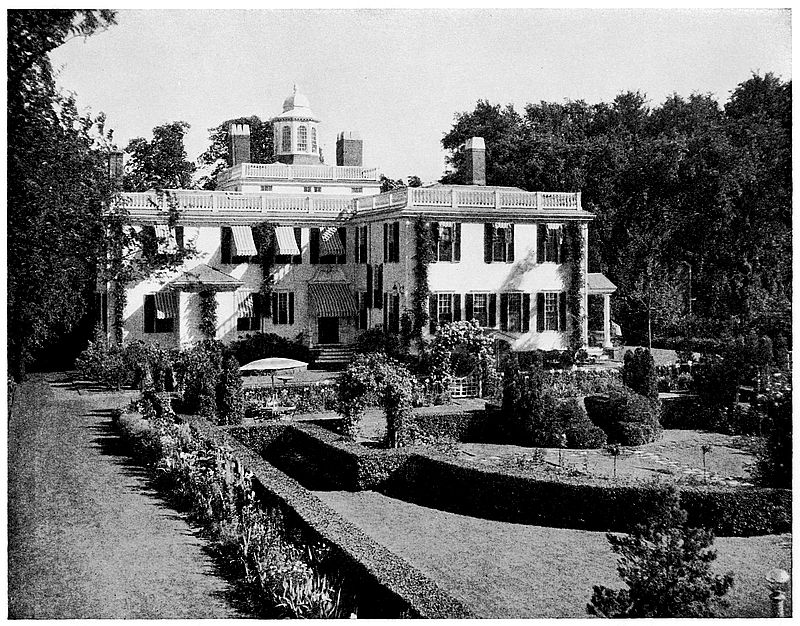
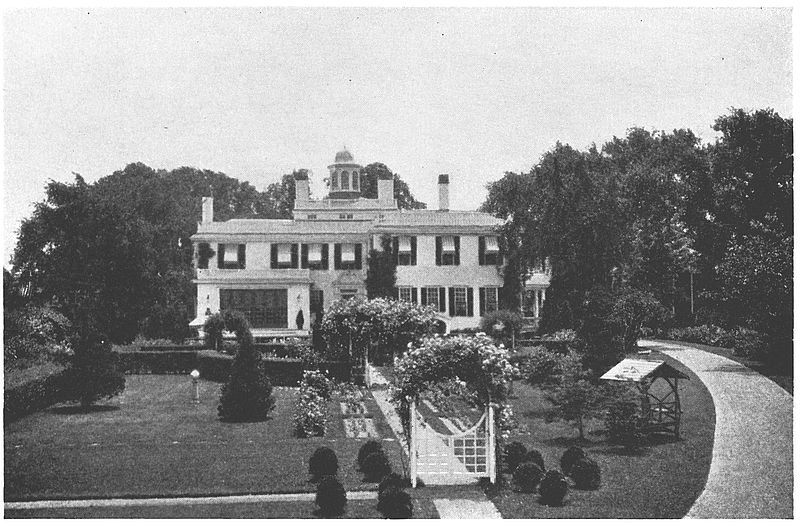
it than here in this story of the “House of Edward Winslow” where
it can be easily and frequently perused.
In no part of the world up to then did there exist a government
of just and equal laws. It is the first incident where a government
was formed by the governed, by their consent in writing at one
time. One hundred and fifty years later its principles really framed
the Declaration of Independence and the Constitution of the United
States, and our laws today are interwoven with the ideals of this
band of Pilgrims.
One month after the signing of the Compact, the exploring party
of eighteen men in the ship’s shallop that had left the ship 16 December,
landed at Plymouth. Plymouth was not just what they wanted,
but as Brewster said, it was the best they had seen. They returned
to the ship and on 26 December 1620 the Mayflower and her passengers
reached Plymouth. It was 31 March that the last of them
went ashore for good.
On 15 April 1621 the Mayflower sailed on her return trip, leaving
every one of the survivors of the Pilgrim Company behind. It was a
more striking picture than her departure from England. A situation
more discouraging for the Pilgrims could hardly be conceived.
Some interesting occurrences which happened on board the Mayflower
during the trip, are taken from the manuscript of “Prince’s
Annals,” in his handwriting. Prince had drawn his pen diagonally
across the passages, and they do not appear in his published work.
They were first printed in the April number 1847 the New England
Historical and Genealogical Register. It reads:
“In a mighty storme a lustie yonge man called John Howland came upon
some occasion above ye gratings, was with a seele of ye ship throwne into
ye sea; but it pleased God yt he caught hould of ye top saile halliards,
which hung overboard and rane out at length; yet he held his hould (though
he was sundrie fadomes under water) till he was hald up by ye same rope
to ye brink of ye water and then with a boat hook and other means got
into ye shipe again, and his life saved, and though he was somewhat ill
with it, yet he lived many years after, and became a profitable member
both of church and comonwelth.”
And the manuscript goes on to tell of a proud, very profane young
man, one of the seamen of husky and able body, which made him the
more haughty, who was always annoying the poor people in their
sickness by cursing them daily and telling them he hoped to help
cast half of them overboard before they came to their journey’s end
and if he ever, by any was gently reproved, he would curse and
swear most bitterly. But it pleased God to smite this young man
with a grievous disease, of which he died in a desperate manner and
so was himself the first to be thrown overboard.
John Carver, who had been chosen Governor, died the first winter,
and William Bradford succeeded him. The Colony grew slowly.
By 1630 it had but 300 persons in it, but it had paid the London
merchants. There is little question that the contract was burdensome
and oppressive. But as proof that the Pilgrims harbored no
resentment is this laudable act: the Plymouth Colony General Court
in 1660 ordered that twenty pounds should be sent to a Mr. Ling, one
of the Merchant Adventurers, “who had fallen to decay and had felt
great extremity of poverty, the same twenty pounds being bestowed
on him towards his relief and if it was not given voluntarily that
the amount that fell short ‘bee’ made up out of the ‘Countrey
stocke’ by the Treasurer.”
The Colony made a treaty with Massasoit, Chief of the Wampanoag
Indians, which lasted until broken by his son in 1675. By
1640 the population had increased to over 3000.
As for the Puritans, they became powerful in England and comprised
many men of wealth and culture and social standing. Little
bodies of them, encouraged by the example of the Pilgrims, began
to settle upon the shores of Massachusetts. In 1628 John Endicott
and a shipload took command of the place the Indians called Naumkeag
and gave it the Bible name of Salem, or Peace. When they arrived
they found Roger Conant and his followers, who were, after
several years of struggling, happily settled. Endicott practically
kicked them out. Within a few years all of Conant’s followers had
moved across the river and established new homes in what became
Beverly.
In 1629 a number of leading Puritans in England bought of the
Plymouth Company a large tract of land, bounded by the Charles
and Merrimac Rivers and stretching inland indefinitely. They got a
charter from Charles I and incorporated as the Governor and Company
of Massachusetts Bay. Under John Winthrop, a wise and
able man, they came over to Salem, bringing 1000 persons, with
horses and cattle, and during that year Charlestown, Chelsea, and a
small hilly peninsular, called by the Indians Shawmut and by the
English Trimountain, or Tremont, and soon changed to Boston, from
which the leading settlers had come, were settled. By 1634 nearly
4000 settlers had arrived from England, coming usually in congregations,
led by their minister and settled together in parishes or
townships until there were about twenty.
In 1636 it was voted to establish a college three miles from Boston
at a place called New Town, now Cambridge. A young clergyman,
John Harvard, bequeathed his books and half his estate and the
new college was called by his name.
The colonization of New England was a complicated affair. The
Massachusetts Bay Colony was the largest. South of it was the
Plymouth Colony, the oldest. Then there was Rhode Island and
Providence Plantation and the Connecticut Colony. In 1643 these
four Colonies formed a confederation for defense called the United
Colonies of New England. In 1692 King William arranged things
to his liking; he annexed the Plymouth Colony to the Massachusetts
Bay Colony, but let Connecticut and Rhode Island keep their
beloved charters, and so the Plymouth Colony forever after remained
a part of Massachusetts.
The establishment of the New England Confederacy, the division
of the ancient church, the annexation to the Massachusetts
Bay Colony, the loss of wealth and population, marked the end of
Plymouth as an independent Colony, but not of the great influence
which the Plymouth Colony and the Pilgrims have exerted, and, we
hope, will continue to exert with increasing force, in perpetuating,
as it originally established, our democratic form of government.