If he fail, yet go we under our opinion still that we have
better men.—Troilus and Cressida, i, 3.
After thinking it all over seriously, Miss
Esther had concluded that Mark Westcott
and Theodore Winthrop Brewster were the
most suitable candidates yet entered on the
books of her Matrimonial Bureau for the
hand of her artist-client, Lillian Hastings. It
had been difficult to choose between them,
for they were both distinctly eligible, but
after two or three days’ acquaintance, she had
discovered that Mark possessed more of the
traits which might develop into the character
of the traditional fairy godfather. In pursuance
of her plans, the wily lady one afternoon
invented an errand for one unsuspecting
youth.
“Mark,” she said, ingratiatingly, “wouldn’t
you like to go over to Lillian Hastings’s for
me?”
“Why, are you over there?”
“Don’t be saucy. I assumed that you could
understand English. I’ll try again. Cousin,
or, fair cousin, I would wish you, or, I would
request you, or, I would entreat you, not to
fear, not to tremble: but to go, or, to walk,
or, to amble withal, to the house, or the
home, or the studio of Miss Lillian Hastings,
and there with deep diplomacy acquaint thyself
with that which I desire. This having
done, I bid thee tell me true that which with
subtle art thou hast discovered.”
“Sure, I’ll go; but what is this tremendous
mission?”
“Lillian is painting a picture, and I want
to know if it is finished yet.”
“But where does the diplomacy come
in?”
“You see, I don’t want her to know that
I want to know, but when the picture is
finished, I’m going to have a party or something
for her.”
“What is the picture? How am I to
know it?”
“It’s a great big field with a cow in the
middle.”
“All right. I can tell it by the cow, but
how am I to know if it is finished?”
“That’s where you must use your
ingenuity. Take your time and lead the
conversation around by devious by-paths
until you find out.”
“All right; put me up a little luncheon
and I’ll stay all day.”
“You haven’t any diplomacy,” said Kenneth.
“I’ll go along with you and manage
the ingenious part.”
“No, no! You can’t go, Kenneth. I want
you this afternoon. I want you to take me
driving.”
“But you can’t go driving, Cousin Esther,”
broke in Lieutenant Adams. “You promised
to stay with me. I’ve got to have you.
Clear out, you two boys, and stay as long as
you like.”
In the few days of Putnam Adams’s stay
it had come about that the household obeyed
him unquestioningly. Miss Esther realized
that Kenneth’s going would interfere with
her plans, yet there was no escape from the
inevitable, and she docilely remained with
Putnam and watched the brothers as they
sauntered across the lawn.
They found Lillian at her easel, at work on
a large landscape.
“That’s the picture, now,” exclaimed
Mark, diplomatically.
“I told you you hadn’t any ingenuity,”
said Kenneth, “and besides that can’t be the
picture. There isn’t any cow in it!”
“There was a cow—” began Lillian.
“How did it get away?”
“I painted it out,” replied the artist.
“Then that’s the picture. I knew it was,”
said Mark.
“What picture?”
“We can’t tell you. We’re diplomats.
When will it be finished?”
“It’s almost finished now. I think it will
be done by Saturday.”
“Then that’s all right. I’ll tell Cousin
Esther,” said Mark.
“What does she want to know for?”
“We can’t tell you. That’s a surprise.
How can people be diplomats if other people
ask them questions all the time?”
“Hullo, who painted this head?” Kenneth
had discovered a portrait among a lot of
sketches.
“By Jove!” exclaimed Mark, “that looks
like the girls.”
“What girls?” asked Lillian.
“Our girls,” said Kenneth. “We’re engaged
to them, you know. Want to see ’em?”
“Yes, indeed. Where are they?”
The boys simultaneously drew from their
pockets two thin gold cases each containing
a miniature of a young woman.
“Why, these are pictures of the same
girl,” said Lillian.
“Not exactly,” explained Kenneth.
“We’ve each got one. You see they’re
twins.”
“I should think they were twins. I never
saw anything so much alike in my life.
How do you tell them apart?”
“We can’t,” said Mark. “At least we can
tell the girls apart, but not the pictures.
They got mixed up once and we’ve never
known which is which since. But it doesn’t
matter. They can tell us apart.”
“Yes, of course, they can tell which of
you they are engaged to.”
“Yes,” said Kenneth, “we have to depend
on them to sort us out. But sometimes
I think they fool us.”
“I know they do,” said Mark. “They
think it’s a great joke.”
“Are you to be married soon?” asked
Lillian.
“Yes, there’s to be a double wedding in the
fall. Great time—I wish you’d come to it.”
“I’d love to go. Is Miss Esther going?”
“Oh, I guess so. She came on to Roger’s
wedding, but she hasn’t said anything
about ours.”
“They’re awfully pretty girls. What are
their names?”
“Butler—Edna and Edwina. We call
them Ed for short.”
“How do they know which one you
mean?”
“Why, according to who says it. I
wouldn’t call Edna ‘Ed.’ ”
“You’d better not,” said Mark. “I’d
pound you if you did.”
“Where are they now?” asked Lillian,
interestedly.
“They are going on with mother this
week from Boston to the Adirondacks, and
Mark and I are to join them there later.”
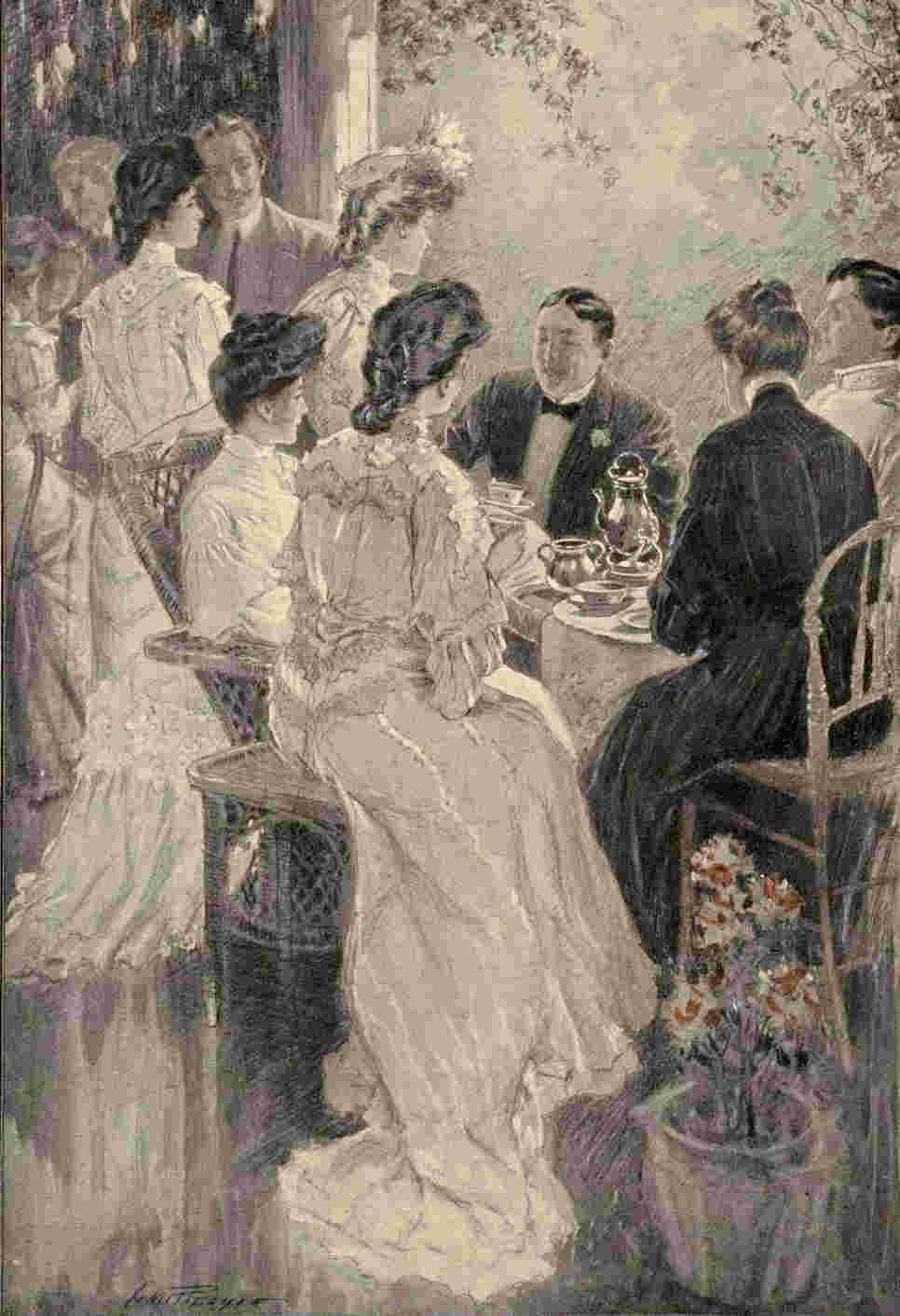
Just then Brewster and Helen Fairbanks
came into the studio.
“We’ve been walking miles and miles,”
said Helen, “and we’re going over to Miss
Esther’s for a cup of tea, and we want you
to come with us.”
“All right,” said Mark, “we’ll go. Just
wait a few minutes till Miss Hastings paints
a cow into her picture.”
“Oh, the cow can wait till to-morrow,”
said Lillian; “but won’t you show Miss
Fairbanks those two miniatures, or one at
least?”
The boys produced the lockets and
handed them to Helen. “What a beautiful
girl,” she said. “Is she your sister?”
“No—she isn’t one girl, she’s twins,
and she’s engaged to these two brothers
here,” said Lillian.
“Which is which?” asked Helen.
“Merciful powers!” exclaimed Kenneth,
“you haven’t mixed them up again, have
you? We just got them sorted out.”
“Why these are the Butler twins,” said
Brewster as he looked at the pictures.
“I’ve known them all their lives;—this is
Edna and this is Edwina.”
“How can you tell?” asked Mark, admiringly;
“but give me Edwina quick, while
you know.”
“Now I’m ready,” said Lillian, sticking
her brushes into an already crowded ginger
jar. “Come on, let’s go. It’s almost five.”
On the way to the Adams house they
passed Dr. Bushnell’s. Brewster turned in
at the gate. “Go on,” he said, “I’ll get the
book I promised Miss Fairbanks, and catch
you before you get to Miss Esther’s.”
That afternoon had proved an eventful
one for Miss Adams, and had completely
disarranged her Matrimonial Bureau.
She had been sitting on the east porch
with Putnam, when Nora announced the
arrival of three ladies.
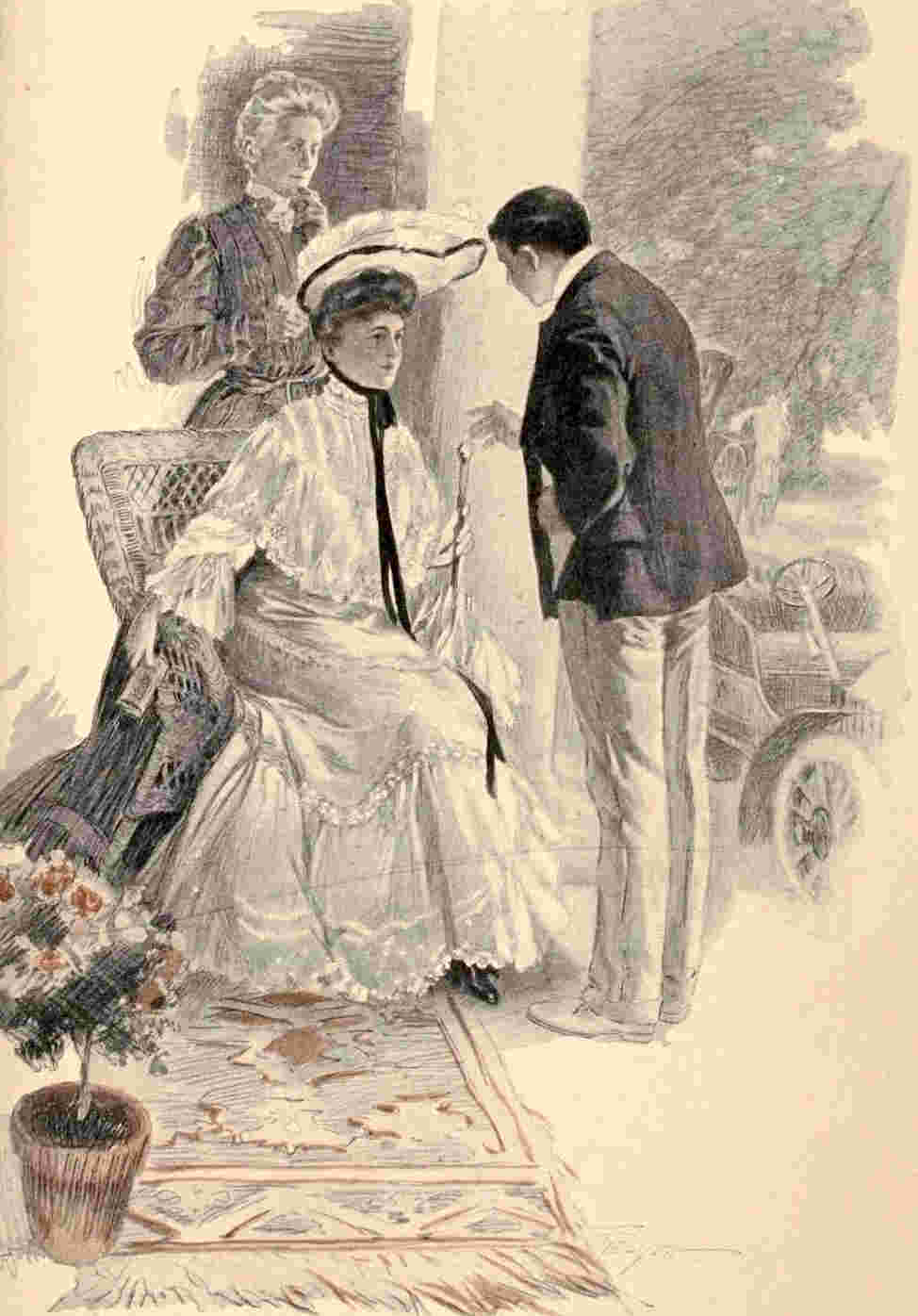
“Well, Emily Westcott!” exclaimed
Miss Esther, “I’m so glad to see you.
Where under the sun did you come from?”
“I’m on my way to Saranac, and just
stopped over for the night to see you and to
show you my new daughters. This is Edwina
Butler and this is Edna Butler. Where
are the boys?”
“I’m very glad to see you—all of you.
But why do you call these young ladies
your daughters?”
“Why, they’re engaged to Mark and
Kenneth. Haven’t they told you?”
“Mark and Kenneth?” said Miss Esther,
“Mark and Kenneth! but which of you is
which? How can they tell you apart?”
“They can’t,” said Edna Butler. “We
tell them.”
Miss Esther sat down. “Well, of all
things!” she said.
“Why are you so surprised?” asked Mrs.
Westcott. “The boys are old enough.
Mark is twenty-five—”
“Yes, yes, I know. And I’m very much
pleased,—very much pleased. I am sure,”
she added, turning to the young ladies,
“that you must be twins. You are, aren’t
you?”
“Yes, we are; I am Edwina. There’s no
way to tell us apart except by our first
names. Mark is my special property.”
“And Kenneth is mine,” said Edna.
“He has written so much about you and
this beautiful place that we’re perfectly delighted
to be here. He told us, too, about
numbers of new cousins he had found here.
Mayn’t we see them?”
“Yes, indeed,” said Miss Esther. “At
least we have one of them on exhibition.
Your boys have gone calling somewhere,
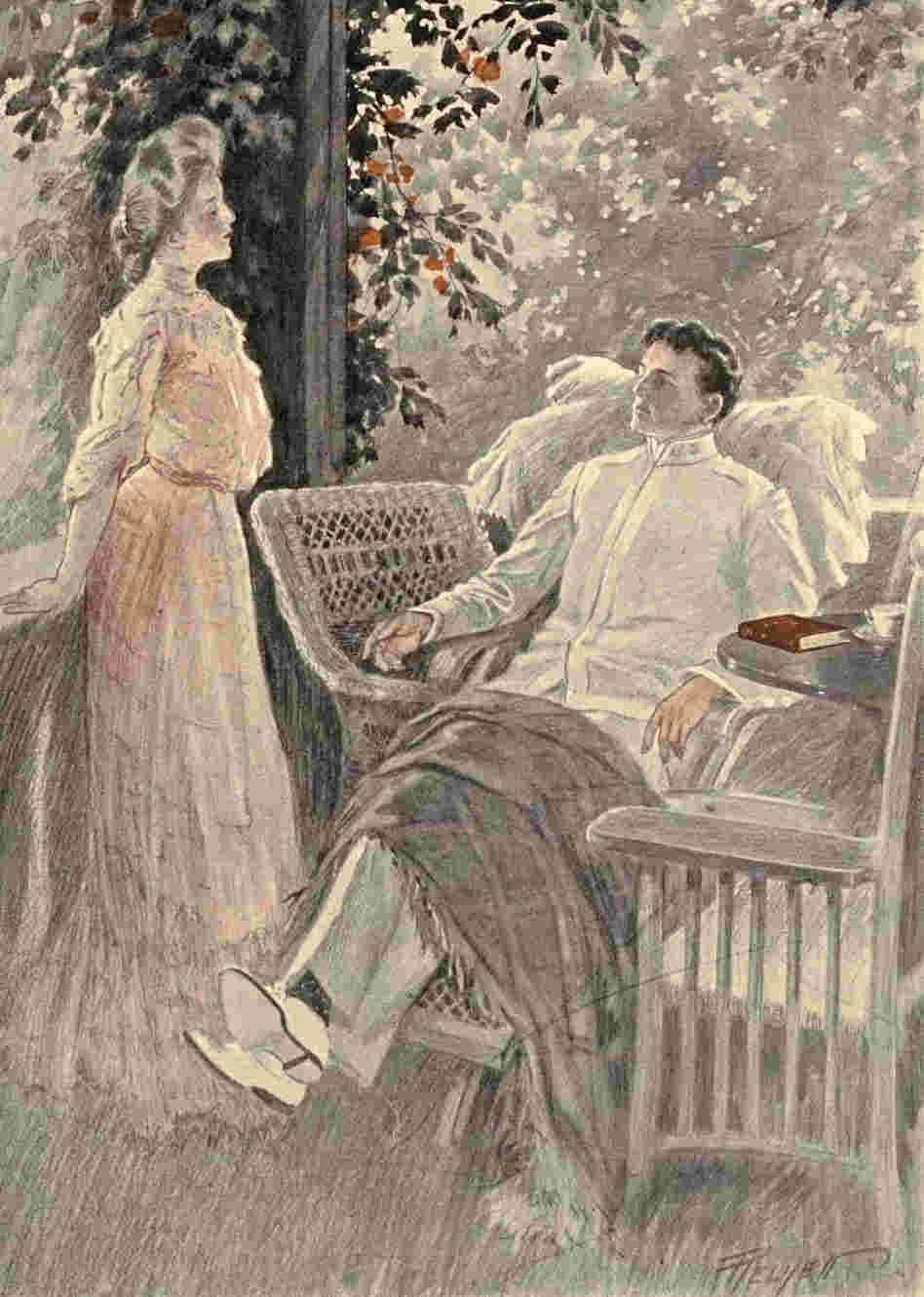
but one of the new cousins—Lieutenant
Adams—is on the east porch, laid up with
a broken leg. Come out and amuse him for
a while.”
She took the Butler twins to the east
porch, presented Lieutenant Adams, and
then returned to Mrs. Westcott. “Those
young people can take care of themselves,”
she said, “and you and I can have a good
old-time chat.”
“We’ve come out to get acquainted,”
announced Edna. “You may not know it,
but you are to be one of our new cousins,
Lieutenant Adams.”
“I’m very glad to hear that,” he said;
“but if I’m your cousin, you must call me
Putnam. What’s your name?”
“Mine’s Edna, and hers is Edwina. You
may use them, if you like.”
“I don’t know how I can remember which
belongs to which. Your gowns are exactly
alike. You ought to have some distinguishing
mark.”
“All right. Give me one of your gilt
buttons,” said Edna, “and I’ll wear it on
my chain.”
“Of course,” said Lieutenant Adams, cutting
off a button from his white duck coat,
which Edna gleefully attached to her long
chain.
“I want one, too,” said Edwina, “to put
on my chain.”
“Of course. Here’s one for you.”
Edwina strung the button on her chain.
“Now shut your eyes,” she said, “and count
ten.”
During the counting Putnam heard an
ostentatious rustle and two very similar
giggles. Then he announced “Ten!”
“Now look at us,” said one of them.
“Which am I?”
“That’s dead easy; you’re Edwina.”
“How can you tell?”
“Why, because one of you is so much
prettier than the other.”
“Which?” cried the twins together.
“Both,” said Putnam, gallantly.
“Well, if that doesn’t look like Winthrop
Brewster,” said Edwina, as she saw
a tall man in white flannels crossing the
lawn.
“It is,” said her sister.
“Of course it is,” said Putnam. “Do you
know him?”
“Yes, known him all our lives. Hullo,
Winthrop!”
“Well, Peaches Butler!” exclaimed Brewster
as he came up the steps. “How did you
get here? You see,” he explained to Putnam,
“that when I address these young
women together I have to refer to them in
the plural. When I meet only one of them
I call her Peach.”
From the library window Miss Esther
could hear the laughter on the east porch.
She had left Mrs. Westcott in her room, after
hearing from her the details of the boys’
engagements.
“Mark and Kenneth both out of it,” she
thought. “To be sure, I only needed one
of them, but I can’t have either, it seems.
I think the Jean and Putnam affair will turn
out as I have planned. Then, of course,
I must give Winthrop Brewster to Lillian.
That still leaves Helen. She is certainly
my most troublesome client. This being
a Matrimonial Bureau is harder work than
I thought it would be.”