Foresight is insight. It was due to Matthew Strang’s ignorance of life
and of himself that his marriage in no way turned out as he had
calculated. Oh, the fatal mistake of it, perceived as soon as it was too
late, though he shrank weakly from the perception, afraid to face the
chill, blank truth, hoping against hope that love would be the child of
marriage. Oh, the ghastliness of being chained to a loving woman he did
not love, bound by law and honor to simulate a responsive affection, and
to hide the deadly apathy which her caresses could not overcome. He
tried hard to love her, calling his own attention to her youth, her
freshness, her prettiness, her flashes of expression, making the most of
every hint of charm, seeing her through a wilful glamour, even
attempting to persuade himself that she was the woman of his dreams; all
the while his leaden heart coldly refusing itself to the hollow
pretence. Before the marriage he had almost felt on the point of love;
but it was only, he knew later, the self-disguise of cupidity and
mercenariness, though no doubt a measure of gratitude had helped to
becloud his vision. In his bachelor days he could never have imagined
such indifference to any woman. Sometimes he wondered if this was all
marriage meant to any man, but a wistful incredulity denied him the
consolation of acquiescence in a common lot. The testimony of mankind
was quite other, and his own yearning instinct refused to look upon his
union as typical. If only she had been a little more intellectual, less
limited to gossip about servants and prices! How he had deceived
himself, taking the sprightliness of a young girl in love, the
coquettish gayety, the evanescent brilliancy of a bird in the pairing
season, for the output of perennial intellect and good-humor! He had
lived so much alone with his dreams that he had fallen out of touch with
humanity, and particularly with feminine humanity. He had had no
standard of comparison by which to gauge her, and once united to her,
the habitual recluse could not accommodate himself to her constant
companionship.
What an irony their honey-moon in Paris, in Florence, the ardors of
artistic renascence yoked with the blankness of boredom! Despite
Rosina’s affectionate clinging to him, and her almost pathetic endeavor
to admire old churches and dingy picture-galleries, it was a relief to
both when she at last acquiesced in his happy idea of regarding his
rounds as “work,” and, under the convoy of Billy, beguiled the
expectation of fonder reunion by the more exhilarating spectacle of the
streets and the endless glories of the Bon Marché. And very soon she
wearied altogether of foreign places, clamoring to be settled in London,
where the language was not gibberish, and one could go a-marketing
without being bamboozled and cut off from bargaining. For after the
first fervors of the honey-moon she had developed that instinct for
petty economy which had amused and charmed him when he had gone shopping
with her in Halifax, but which now fretted him, seeming like a daily
reproach for all those great sums her acquisition of him had cost her.
He was glad that the due arrival of the second mysterious instalment
promised to the Nova-Scotian household relieved him of the painful
necessity of applying to her on its behalf. Unexpectedly enough this sum
was supplemented by a dividend of a hundred and fifteen dollars paid to
him, after he had forgotten all about the matter, by the trustee in
Halifax in settlement of his claim against the estate of the
Starsborough ship-builder.
In vain he tried to interest his wife in books, in the poems and essays,
in the study of French and German, into which he now threw himself with
a feverish desire for culture. In vain he tried to impart to her his
vision of nature, to get her to observe scenery and sunsets. Colors and
shades were only interesting to her as they occurred in dress materials.
Once when they stood by a sea-beach on a December afternoon under a
cold, gray sky, and Rosina complained of the dreariness of the
seascape, he had attempted to show her how beautiful it really was, how
much more interesting to the artistic eye than a crude sunlight effect;
how nearest the horizon it was grayish steel-blue, and then a still
amber, and then emerald green, and how just before the final fringe of
both there shone a band of sparkling amber, grayed by cloud-reflections.
But Rosina shivered, and refused to see anything but a chill green
waste.
She would not even allow him to arrange her furniture, and a pair of
colossal pink vases, garishly hand-painted with pastoral figures (picked
up “a bargain”), were a permanent pain to him, spoiling for him the
drawing-room of the little North London house with the rude whitewashed
studio, in which they had settled down after the birth of their first
child. The temporary lull that attended their installation in British
domesticity was succeeded by graver frictions when Rosina had finished
furnishing. They had no society; neither of the couple knew anybody in
London, and the husband shrank from making friends, constrained,
moreover, by his art to a solitary way of living. Rosina, who before her
child demanded her care had sat to him out of pure desire to be with
him, began to be jealous of the models who replaced her, declaring that
she had had no conception such goings-on were a part of art or she would
never have married him.
The only alleviation of his numb misery was his ability to paint without
pecuniary under-thought the picture with which he was to storm the
Academy, to throw all his individuality into it. The very seclusion of
his life favored this devotion to his ideals.
And these ideals were only partially those of his celibate. He had been
swaying to and fro under the opposite solicitations of Idealism and
Realism; now in a violent upheaval, his sympathy with modern subjects
and even with modern methods had been submerged.
On the Continent for the first time he came into contact with the Old
World. London had been to him as modern as America, repeating its ideas
and ideals, but in France, and more especially in Italy, the mere
variation of tongues helped to draw him into an earlier world,
co-operated with the appeal of ancient churches and streets and palaces,
and the countless treasure of ancient Art. The modern world grew
hateful to him, and he absorbed by affinity the ancient and the
mediæval. At bottom it was not so much the modern that repelled him as
real life, and it was not so much the past towards which he yearned as
towards that timeless realm wherein ideal beauty dwells. The past was at
least less real than the present. Real life was horrible, and marriage
had put the coping-stone on his dissatisfaction with it. From birth to
death it was embased by a sordid series of physical processes. Even the
much-vaunted love was hideous at root. Beauty itself was never really
perfect, and was transient at best, while the beautiful idea that lurked
in nearly every human face and figure had for the most part been left
embryonic. Only in Art could the imperfections of Nature be
corrected—and this was the Artist’s mission, not to imitate Nature, but
to transcend her; from her faulty individuals, frail and perishable, to
draw types of perfection, flawless, immortal, like that Venus de Milo,
which stood at the end of the Louvre passage, beautiful from every
standpoint, fixing in its pensive sweetness of spiritualized form his
dream of Ideal Womanhood; or like that mighty torso of winged Victory
that had achieved the last victory over its own mutilation. Real life
was Deacon Hailey and his mad mother and Billy and Rosina and his uncle
and the grimy denizens of the London slums and the blackguardly crowd at
the Fleet Street public-house and the lewd workmen in the Starsborough
ship-yard. But Art was Rosalind and Imogen, Hamlet and Ariel, Don
Quixote and Beatrix Esmond, and the love in Shelley’s lyrics, and the
music of Beethoven, and the pictures of Botticelli, and the cold white
statues of the Greeks—that imaginary world which man’s soul had called
into being to redress the balance of the Real. It was Art against Nature
throughout—the immortal shadows against the ephemeral realities.
“She cannot fade though thou hast not thy bliss,
Forever wilt thou love and she be fair.”
And so for the “real atmosphere” of Cornpepper he no longer cared: what
mattered the realities of space more than those of time to the soul,
emperor of its own fantasy? All this scientific precision after which he
had been hankering—was it not irrelevant to Art? The Beautiful was the
Ideal; to create the Ideal, the Real must be passed through the crucible
of the Artist’s soul. The Artist was the true creator. In him Nature’s
yearning to beget the Beautiful became conscious. She herself had
infinite failures—ugly moods, fogs, glooms, skies of iron, seas of tin.
And feeling all this instinctively rather than by a lucid excogitation,
he was now for the ideal, for the romantic, for the religious even, for
anything that was not real, that shut out the unbeautiful necessity, as
those glorious stained windows of cathedrals, blazing with saints, shut
out the crude daylight and the raw air of reality, filtering the garish
sunlight to that dim religious light in which the soul could see best.
Ah, how wisely the poor human soul had fenced itself in against the
bleak realities—even as the body had housed itself against the
inhospitalities of Nature—painting its windows with beautiful dreams,
with an incarnate Love that ruled the world, and an image of immaculate
Motherhood. And in a strange hybrid, hazy blend of Catholicism and
Hellenism, possible only to an artist who sees things by their sensuous
outsides, the Venus de Milo and the Madonna of the Italian masters were
to him more akin by beauty than divorced by dogma. In a sense they were
one—the highest types of Beauty conceivable by the Pagan and Christian
ages, so akin that when Botticelli came to draw Venus, as in his
“Nascita di Venere,” his brush fashioned a meek Miltonic Eve,
prefiguring the Virgin Mother, while Andrea del Sarto, in his
Annunziazone in the “Pitti,” had given the Virgin Mother almost the
brooding serenity of a Greek goddess. Ideal Womanhood, Ideal Womanhood,
this was what poor Matthew Strang seemed to find in either—ay, and even
in Perugino’s “Magdalen,” and the saying of Keats, “Beauty is Truth,
Truth Beauty,” seemed to him to be indeed all that mortals needed to
know.
But that Pagan serenity which had produced Greek art could not be his.
For him as for the ages the first sensuous joy in beauty was over. And
what appealed even more than the Greek marbles to the artist who had set
out from his native village with quick blood, worshipper of a beautiful
world, was that subtler art which expressed rather the inadequacy than
the perfection of life; the wistfulness of a Botticelli Madonna, the
unfathomable smile of a Leonardo portrait, the pensive melancholy of
Lorenzo di Credi’s “Unknown Youth” in the Uffizi, or the mystic
aspiration of the monk in that famous “Concerto di Musica,” and
inversely Raphael’s lovelier line than Nature’s, and Michael Angelo’s
with its more majestic sweep. He longed with that yearning, with which
the boy had looked up to the stars in the midnight forest, for God, for
Christ, for Apollo, for some dream of whiteness and beauty, for
something that persisted beneath all the purposeless generations of
which the Louvre held record in those cumbrous relics of vanished
civilization—Egyptian, Phœnician, Syrian, Babylonian, Persian,
Chaldean—those broken shafts of pillars that had upheld barbaric
temples, those friezes that had adorned the façades of palaces, those
blurred monuments perpetuating the victories of forgotten dust, those
faded bass-reliefs that had pleased the lustful eyes of nameless kings,
enthroned in their gigantic halls, those uncouth torsos of bulls and
sphinxes, emblems of a vaster, crueller life. Amid the flux of the
centuries the visibles of Art, the invisibles of Religion—were not
these the only true Realities?
Such had been Matthew Strang’s thoughts, as in a deep silence he walked
through the Louvre with Rosina, a silence that was at its deepest when
he responded to her chatter. She hated the slippery parquet and the dull
oil-colors under the glazed skylight, preferring the fresh coloring of
the copies, though she made fun of the copyists who sat so patiently on
their stools. What queer men, what funny, frumpy girls, what strange old
ladies! And, look! there was a young woman in widows’ weeds, painting
such a cute picture, and—gracious! there was quite a young girl copying
a naked man—weren’t they horrid, the French? She liked the attendants’
cocked hats with a dash of gilt, and enjoyed the desultory crowd of
perambulating spectators, that ranged from old gentlemen hobbling along
on sticks to artisans in red blouses and clayey boots. And wouldn’t Matt
come back into the jewelry and china departments, which were really
interesting? And wasn’t the heat unbearable? It was her restlessness
that made her husband quit this Paris which fascinated him, this
beautiful city, with whose artistic activity, divined from the mere
architecture of the École des Beaux Arts, he had had no opportunity to
get into intimate touch; for he could not even come across Herbert, whom
he had rather hoped to find still there, a cicerone to initiate him into
the art-coteries of Paris. In Florence, where they went for the winter,
Rosina was even more restless. The towered palaces, the Duomo, and the
gracious Campaniles, the gardens, the enchanting environs, and all the
stock wonders of the place, had none but a superficial interest for her;
they were exhausted at first sight; amid the marble calm of colonnades
she even regretted the liveliness of the Boulevards. And the climate,
too, was worse than that of Paris; her grumblings were perpetual. To
pass from the warm piazza or promenade to the biting wind of the narrow
streets was not only uncomfortable, but made it a problem how to dress.
And, indeed, Matt himself suffered keenly from the cold; though there
was a small brass heating apparatus in the centre of the gallery, it
scarcely did more than keep his colors from congealing. For he was
copying Botticelli’s “Virgin with the Child and Angels.” Yes, Botticelli
had become his master—Botticelli, whom at first sight in the National
Gallery he had rejected for insufficient draughtsmanship, but all of
whose naïve exaggerations, of hands or feet or necks, he now credited to
artistic intention, prepared to maintain from loving study of his
delicately luminous canvases and his blond ethereal frescos that the
Master’s drawing had only repudiated the bonds of the Real in quest of a
higher beauty, a more gracious harmony of curves, even as his coloring
had refined away that oleaginous quality which a Rubens found in human
flesh. To brood over a Madonna of Botticelli or of Filippo Lippi,
Matthew Strang would turn from the women of Rubens or the young men of
Titian or the children of Velasquez or Rembrandt’s old men. Though at
the sight of “Les Glaneurs” of Millet he felt a lurking sympathy in his
submerged self, he preferred that morning landscape of Corot, in which
bodiceless beauties dance round trees as half-dressed women never did in
any period of French history. He found a winter scene of Van Ostade’s
none the less charming because the figures were not enveloped, and the
lights were untruly set off by bituminous shadows. He was in the mood in
which even the gilded rose-nudity of the eighteenth century seemed
precious. Amid the infinitude of Art that surrounded him now,
Cornpepper’s cocksureness seemed to him as futile as it had already
appeared amid the infinity of Nature. And all the Masters were so akin
that evolution by revolution seemed less credible than in the smoky
atmosphere of Azure Art studios. Modern subject? Had they not all done
the contemporary, had the Dutch done anything else? Impressionism? In so
far as it meant a free brush-work, was not Rembrandt an Impressionist?
Was not Velasquez in his later manner?
His first picture, then, need not be revolutionary in technique, but it
must be more imaginative than the bulk of English work in the Academy of
his day, more emotional. Photography had reduced realism to absurdity,
had proved that Art lay in the transfusion of Nature through the
artist’s soul. And the essence of all art was emotion, feeling. The work
of Art was but the medium by which the artist passed on his emotion to
the spectator, his joy in beauty, his feeling for nature, his sadness,
his aspiration, even his view of life. Because emotion could be conveyed
by literature and music, there was no reason why these should have the
preference in cases where painting was equal to conveying it, too.
Without emotion a picture was null and void; technique by itself could
give works of craft, never works of Art. On the other hand, to have the
artistic emotion without the technique necessary to pass it on to the
spectator was to be artistic, but not an artist.
The choice of a subject gave him much harassing hesitation; it brought
delicious peace merely to make his final decision amid all the whirl of
ideas that pressed upon him. He would found his picture on those
beautiful lines in Matthew Arnold’s “Forsaken Merman.”
“Once she sat with you and me
On a red-gold throne in the heart of the sea,
And the youngest sat on her knee.
She combed its bright hair, and she tended it well,
When down swung the sound of a far-off bell.
She sighed, she look’d up through the clear green sea;
She said: ‘I must go, for my kinsfolk pray
In the little gray church on the shore to-day.
’Twill be Easter-time in the world—ah me!
And I lose my poor soul, Merman! here with thee.’ ”
The subject seemed to him made to his hand. It would enable him to
fulfil his young ambitious dream of reconciling the decorative with the
idea-picture; the composition should weave a beautiful pattern, and the
coloring a scheme of harmony, and yet the picture should make a distinct
emotional appeal. A woman, with a soul, throned amid a lower race, yet
yearning for the higher spiritual fervors—that was an idea which lent
itself beautifully to pictorial expression: a literary idea doubtless,
but yet a visual, too, so that there was no need even to label it with
the poet’s lines which had suggested it; it should be self-explanatory.
And what sensuous glow in the accessories—the clear, green sea-depths,
the red-gold throne, the child’s flowing hair! The thought of them was
like wine in his veins. He set to work eagerly on a large scale,
informed by his contemplation of the Old Masters with big ambitions—to
do, not the little lyrics that satisfied contemporary cocksureness, but
a great sustained poem.
What pleasures and pains the work brought him! The thrill of conception
was deadened by inadequacy of execution, to revive when some charm of
color and line flowered under happy accident. He had great joy in doing
the heart of the sea with its “deep, divine, dark dayshine”—it was his
sympathy with this marine fairy-land that had partly inspired his
readiness to do old Coble’s misleading ensign of the shark and the
sponge-diver. Around the red-gold throne of the Merman’s bride that
stood on the sand-strewn sea-bed the submarine flora bloomed in strange,
fantastic arabesques and subtle shades of amber and gray and white and
crimson, and through the green translucent water, spent sunbeams
quivered and gleamed, and vague tropical fish shot lovely notes of
color, and a sea-snake coiled its glittering mail; and there were
strange pied amorphous creatures and moss-like corallines and
red-branching madrepores and gleaming shells, and mother-o’-pearl
touched with purple and azure, yet all strictly subordinated to the two
central figures of the composition—the throned woman with her youngest
on her knee, which, despite the nudity and the strange accessories, took
on a curious likeness to the Madonna and Child. The canvas indeed showed
the influence upon him of those wistful Madonnas he had pored over so
wistfully; the cold, strange eyes of the golden-haired child were in the
imaginative vein of the poem, the form of the throned woman was inspired
by merely Pagan ideals of beauty; and yet the yearning in her uplifted
eyes for the world of prayer whose sound floated mystically down to her
was the same that showed in the eyes of the Holy Mother. But this
analogy was not consciously in the artist’s design, though it had
doubtless influenced his choice of subject, nor, though he had certainly
had in mind to suggest through her the yearning of humanity for a higher
world, did he connect his work with the school of Symbolists which was
just arising across the Channel, and which was capable of finding in the
dominant green of his sea the color-symbol of Resurrection. Even the
dead face which he had placed in a corner in the foreground, though it
might well seem symbolic of the tragedy lurking amid this sensuous
beauty, was in truth only the dead face of his father, and he had put it
in less for its symbolic significance or its realistic appositeness than
from an uncontrollable desire to have it there, as though thus to
dispossess his mind of that ancient haunting image which the continuous
thought of the sea had inevitably brought up again. He told himself it
was but natural some drowned face should bob ghastly in this submarine
paradise, but in reality he felt a morbid craving to put it there, to
have something in his picture for himself alone, that no one else in the
great wide world could possibly understand to the full.
For the rest the picture cost him infinite trouble, for his genius was
an incapacity for not taking infinite pains. The poetry of paint is
achieved by the prose of work, and as despite his Romanticism his
hankerings for the Real persisted, his ambitious conception entailed
much preliminary study, and the setting up in his studio of a little
sea-water aquarium, in the construction of which his ancient experience
at the Stepney bird-stuffing establishment in making cases of shells
with mosses and sea-weeds and coral came in unexpectedly useful. But he
could not get a satisfactory model for his principal figure, and
curiously enough her left hand gave him more vexation than anything else
in this complex composition. He could not settle its pose, scraped out
finger after finger with an old sailor’s knife, relic of his
mackerel-fishing voyage, specially ground down, painted out the whole
hand fourteen times, and at last in despair weakly solved the problem by
hiding the hand altogether. Two days later, working on the scales of the
sea-snake that basked sinuously at the woman’s feet, he suddenly had a
last furious dash at the refractory hand. This time it came right and
brought rejoicing. Sometimes he seemed at the mercy of these haphazard
inspirations; what came, came, quite irrespective of conscious will and
training. “Als ixh Xan” (as I can), the old Flemish motto which Van Eyck
put to his work, seemed to him apt for any painter.
When he began “The Merman’s Bride” he was already much more exigent
towards himself than in his younger days; self-criticism had checked
that fearless execution; by the time he had finished his picture, those
very months of steady work, rigorously revised, had raised his ideal
higher, so that though the actual picture pretty well corresponded with
his first conception, it was still far removed from his later standard.
The expression of the woman’s face seemed especially inadequate, and as
great actresses do not sit as models, and the artist has to imagine
emotional expression, he felt again, despite his Romanticism, that he
had missed the subtleties of reality. But every genus of art has to
sacrifice something, and sending-in day was drawing swiftly nigh, and he
had to lay down his brushes at last, and through his frame-maker
despatch the canvas to Burlington House, and await with what composure
he could the verdict that should bring him the recognition he had
struggled for during such long tedious years. Now that the absorbing
task was over, he had time to think of its reward, to dwell on the
thought of recognition, of Fame, the one thing on earth that still
loomed before him, enshrouded in vague, misty splendors. In a world of
illusions, this was the solid happiness it might yet be his to grasp.
This last illusion was not destined to be dissipated yet awhile. He was
sitting at the breakfast-table when he received a blue card inviting him
to take back his picture. Burning with revolt and despair, he had to
strive to appear calm, what time Rosina was unfolding a tale of woe
concerning the maid-of-all-work, whom she had detected throwing away
half-burned coals into the dust-hole. That, she reiterated monotonously,
explained the mysteriously rapid disappearance of the coals—over a ton
since quarter-day. An investigation of the dust-hole had revealed a
veritable coal-mine. It was one of the most curious characteristics of
Rosina that, with all her hardness, she flinched mentally before her
servants, pouring out her grievances against them when they were out of
ear-shot, so that her husband suffered vicariously for their sins of
omission or commission. Usually he listened to her silently with the
courteous deference he would have shown a guest, never provoked to an
angry retort save by her absurd objections to his models. He had
abandoned as hopeless the effort to unite their souls. But to-day he had
no option but to cap her tragic narrative by telling her of his
disappointment. The news excited her not to sympathy with his aspersed
art, but to reproachful alarm for his pecuniary future.
This was the last straw. He might have stood out against the Academy,
exhibiting elsewhere, and gradually building up an outside reputation;
but the pecuniary independence to enable him to do this, which had been
the main motive of his marriage, was the very thing that he now saw he
must abandon. In his secret paroxysms of resentment—more against
himself than against her—it became increasingly plain to him that he
could not live on her money; that were intolerable to his reawakened
manhood. He must make a financial success on his own account; he must
become independent of her at any cost to Art. His entire preconception
of his future had broken down, his marriage a failure from the financial
point of view as from every other. Instead of having emancipated himself
from the necessity of a monetary success, he had made life impossible
without it. Well, he would compromise; he would recoil to leap the
better; he would do what the public wanted, and then, having secured its
attention, he would do what he wanted.
He went to the Academy and to the Grosvenor Gallery, he studied the most
popular pictures of his day, and in a couple of large canvases—one
domestic, the other Biblical—set himself to outdo them in anecdotage
and obviousness of technique.
In a passion of irony he half parodied his own picture of “The Merman’s
Bride” in an idyllic interior called “Motherhood,” representing a mother
holding up a little girl, who in her turn nursed a doll. Rosina sat for
this to save expense, her own little girl being now weaned. The other
picture was a “Vashti,” and for the repudiated queen did Rosina pose
likewise, and with unwonted interest in her husband’s work.
Both pictures were cleverly painted, for Matthew Strang strove to atone
for his lack of interest in his subjects by painful impeccability of
technique, and to Rosina’s joy both won acceptance from the Hanging
Committee, though at the eleventh hour—on the Saturday night before
Varnishing Day—husband and wife were alike disappointed to receive an
intimation that, through lack of space, only the
smaller—“Motherhood”—could be hung.
Despite all his contempt for his picture and for the Academy, it was a
tingling sensation to move amid the crowd of artists on Varnishing Day,
and to see some whose serious faces he remembered noting on the platform
on that memorable “Gold Medal Night” pause before his picture in
admiration of the vigorous brush-work. This was a sign of success he was
destined to experience in far greater measure the following year, but
the keenness of the thrill could never be matched again.
And when “Motherhood” was mentioned in the papers, and in the early days
of the Exhibition he watched fashionably clad ladies gather in front of
it to commend the “sweetly pretty” child and its touching foreshadowing
of maternity, Matthew Strang found himself insensibly beginning to
partake in the general admiration; and with that strain of weakness
which London had exposed in him from the first, he was tickled by the
praise of these pretty women with their rustle of silks and their
atmosphere of scent and culture, and his American birth subtly lent
added spice to his sensation, in the thought of conquering with his rude
home-born genius these votaries of an elegant civilization. He was
quite annoyed when he heard of Morrison’s mot, that the doll was hit
off to the life, but the other two figures were wooden. But it was not
till “Motherhood” sold for two hundred pounds that the process of
corruption really began to set in.
The buyer—a provincial cotton-spinner in town for his holiday—wished
to sit for his portrait. The painter did not like to ask him to the
whitewashed studio. He told Rosina they must move to a better
neighborhood. The economical Rosina would not consent to quit a quarter
where rates and provisions were low, and where she had by this time
acquired several cronies equally martyred by their maids-of-all-work, so
ultimately he took a larger studio in a more fashionable district, going
to his work every day, like a clerk to his office, relieved from his
wife’s overpowering proximity, and from her personal vision of his
models coming and going, though her morbid suspicion was always ready to
flare up. Thus the estrangement had begun. People sent him cards, not
knowing he was married; after some embarrassed refusals he weakly
accepted, without explanation, an invitation to dinner—unable to
decline it gracefully, and knowing Rosina unsuited to the company—and
his reticence made subsequent explanation more and more difficult. After
a still greater success in the next Academy, with an only less
conventional picture, he was caught in a fashionable whirl of work and
social engagements, finding commission after commission thrust upon him,
driven to hasty production of imposing compositions to preserve his
place in the rapidly recurrent Academy and other Exhibitions, and always
postponing the time when he would start upon the real artistic work of
his life, when he should have accumulated enough money to give him a
couple of years of freedom for independent Art, for that fearless
expression of his own individuality which alone makes Art, which alone
adds aught to the world’s treasure of Beauty by contributing a new
individual vision of the Beautiful, and which, so far from being
demanded by the paying public, must be a revelation of unknown riches.
A plethora of portrait commissions was not conducive to personal Art;
people were much more clamorous for the likeness than in the days of
Sir Joshua before photography had been invented, and every artist’s best
portraits were always those unpaid, unchallenged portraits of his
parents and friends—unflattered, yet touched with the higher beauty of
truth. And portraits stood in the way of more complex work, though they
got one a cheap reputation as a stylist. But there was a great run on
Matthew Strang for portraits; almost as much as on one of his
fellow-sufferers for marbles. The public would scarcely have anything
else, and the voice of the public is the voice of the purse.
By fits and snatches he made attempts to express himself, but he never
had time to find out what “himself” was. Sometimes, in a reversion to
one of his earlier manners, he thought he wanted to express sensation,
to transfer to the spectator of his landscape the sensation the original
had given him, and from his country visits he would come back with
studies of strange blue moonlight effects on cliffs, or weird dark seas,
destined never to be worked up. He began a realistic picture of a winter
view from Primrose Hill, with brownish trees in the foreground and gray
in the background, and a white misty townlet to the left; but,
fluctuating again, he abandoned it for an attempt to do the lyric of the
brush, to express, as in balanced metres, harmonies of tree and sky and
water, and this, again, was thrown aside for the picture of “Ideal
Womanhood,” which, under the influence of a beautiful woman’s rebuke, he
had felt was the real “himself” it behooved him to express. But the
beautiful woman’s passage across his horizon had been momentary, and so
even this piece of imaginative art had been finished hurriedly under the
pressure of other work. And thus the years flew by like months, with
incredible velocity. He could not escape from the net-work of
engagements he had helped to weave, nor did he always desire to. There
was a circumlapping consolation about the applause of the public, though
it did not warm him. He found a bitter satisfaction, as of revenge, in
the smiles of society dames, though he did not court them. He took no
pleasure in the personal paragraphs and the notices of his work, though
he knew they were necessary to his prices, and though he had no more
liking for the severe estimates of the few who would have none of him.
The breach with his wife widened imperceptibly, half involuntarily,
though he was passively glad when she was not with him to complicate his
life with her bourgeois ways, with her vulgar outlook.
He was driven to a more pretentious studio, which had sometimes to be
the scene of responsive hospitalities, and which raised his prices. He
fell into a semi-bachelor life. Late evening parties, early morning
rides in the Park, visits for pleasure or portrait-painting or
decoration to country houses (where his early familiarity with rod and
gun gave him a valuable air of autochthonic aristocracy), excursions to
Goodwood, to Henley, sketching tours, all tended to separate him from
his wife, till at last an almost complete separation had grown up, so
gradually that, except for her spasms of jealousy, Rosina seemed almost
to have become reconciled to it in view of the popular success, the
inflow of money, and the eternal economy of Camden Town, and instead of
resenting his absence, to have come to welcoming his presence. When, on
rare gala occasions, he took her out, the places she loved were those
which no fashionable foot ever trod; and as the couple wandered—an
obscure matrimonial molecule among the holiday masses—he was not sorry
that his juvenile idea of fame as a blazoning vade mecum was only one
of the many illusions of youth. And so none of the scented chattering
crowd that gathered on Show Sunday before his pictures or his
refreshments had any inkling of the more legitimate ménage in the less
fashionable quarter. He absolved his occasional qualms of conscience by
lavishing his earnings on her, which she hoarded—though he knew it
not—partly from instinct, partly from a superstitious dread of a
catastrophe when his hand should fail or her shares fall to zero. Too
late he comprehended the hardness in money matters that had been at the
root of her resentment against the defalcating Frenchman, and it was to
spare her feelings, as well as to preserve peace, that he said never a
word to her about the great sums with which he gladdened the
Nova-Scotian household.
Not that Rosina knew much of his other affairs. In truth, she knew very
little of her husband’s life, nor by how vast a sweep it circumscribed
her own. She knew he had to be away from her a very great deal, that he
had to stay in the country to paint great people; she was vaguely aware
that the necessities of his profession made a wide sociality profitable.
She had been once or twice to peep at his studio, horrified by the
grandeur, and only consoled by the demonstration that its cost was
repaid in the prices, like the luxurious fittings of the shops in the
Holloway Road. But her imagination lacked the materials to construct a
vision of the whirlpool which had sucked him away from her; her reading
was limited to a weekly newspaper in which his name seldom appeared. And
he, in his mental isolation from her, found scant self-reproach for his
silence; reserve seemed more natural than communicativeness. She could
never know the doings of his soul, his thoughts were not her thoughts,
he had given up the attempt at communion, the effort to teach her to
know his real self; why should he be less reticent concerning his
outward movements, his superficial self? He was aloof from her
spiritually; beside this, his material separation from her was
insignificant. The children—a girl of seven and a boy of nearly
four—were no bonds of union. The elder, christened Clara, after
Rosina’s aunt, was sharp and lively enough, but given to passionate
sulking; the younger—called after his grandfather, David—was a
lymphatic, colorless youngster, sickly and rather slow-witted, with
something of Billy’s pathos in his large gray eyes. Their father had
tried hard to love them, as he had tried to love their mother, and had
taken a certain proprietary interest in their infantile graces, and in
the engaging ways of early childhood, but the claims of his Art left
them in the mother’s hands, and the older they grew the less he grew to
feel them his. Neither Clara nor David had as yet displayed any
scintilla of artistic instinct. When he went home he usually had
something for them in his pocket, as he would have had for the children
of an acquaintance, but they gave him no parental thrill.
The studio bell had tinkled so often that afternoon that Mr. Matthew
Strang refused to budge from the comfortable arm-chair in which he sat
smoking his cigarette and reading the Nineteenth Century after the
labors of the day. The model had sipped her tea, taken her silver, and
was gone to resume her well-earned place among the clothed classes, and
the hard-working artist was in no mood to open his door to the latest
bell-ringer.
Probably it was only another model to inquire if he had any work, or to
apprise him of a change of address or of wardrobe; or else it was a
soi-disant decayed artist, who had tramped all the way from
Camberwell, ignorant that his old patron had moved from the studio a
year ago; or mayhap it was a child. He had been much worried by children
lately, since he had picked up a couple in the gutter and placed them on
the “throne.” The dingy court where the fortunate twain resided had been
agitated from attic to cellar; the entire juvenile population had pulled
his bell in quest of easy riches; mothers had quarrelled with one
another over the chances of their young ones; the whole court had been
torn with intestine war.
Ting-a-ting—ting-a-ting—ting—ting—ting—
The person had rung again, more ferociously. Ah, it must be that
interminable Mrs. Filbert back again. Well, let her ring on, the old
jade. Rather an hour of tintinnabulation than ten minutes of her tongue.
Had his man been in, he might himself have been “out,” but he could
scarcely appear at the door and deny himself. Her shrill falsetto voice
resurged in the ear of memory, offering nude photos from Paris at
exorbitant prices, or lists of models full of inaccurate addresses, or
rare costumes, most of which could be picked up at any old clo’ shop. He
smiled, recalling one of these costumes—something like a fishing-net
with holes about an inch across. “This is Greek, and shows the figure.”
Certainly it showed the figure, he thought, smiling more broadly. And
now he remembered—she had threatened to bring her younger sister. “And
I have also a little sister. I don’t know if you paint pretty girls,”
here his memory inserted a giggle. “She sits for modern dress or the
head. Not for the figure. Of course she doesn’t mind a light costume,
something diaphanous. Though I’m not quite sure she has any time left.
She is always with Mr. Rapper, who does those pastels for the Goupil Art
Gallery. He is so very sweet to her. She goes to the theatre and dines
with him. I sit myself sometimes, though you mightn’t think so”
(giggle). “So of course she can’t sit in the evening, in case you want
her for black and white.” (“Just like a woman,” he reflected, cynically,
“too careless to take the trouble to discover that I am far too eminent
for black and white.”) “I know I’m dressed carelessly just now, I really
must be more careful” (giggle). “I have an Empire gown to sit in, very
sweet. I will bring it you to look at.”
Ting-a-ting-ting-a-ting-ting-ting-ting-ting-ting.
Yes, it was the sweet Empire gown she was bringing him if it was not her
sweeter sister. His experienced eye foresaw the Empire gown—something
cut by herself out of muslin, with an old yellow silk sash. He let the
last vibration of the bell-wire die away; the creature would know now he
was not in. The smoke curled in a blue-gray cloud about his head, as,
looking up from the page of the magazine, he gazed dreamily at his
half-finished picture, standing on the easel at the other extremity of
the great luxurious room, where the westering sun of June sent down a
flood of light that brightened the gleam of the gold frames of hanging
pictures, touched up rough sketches and preliminary studies standing
about, and lay in a splash of brilliancy among the sheets of music and
the dainty volumes of poetry and belles-lettres on the grand piano.
Suddenly, as his gaze rested with a suspicion of wistfulness on this
doubly artistic interior, in which the pictures were only pleasant spots
of color in a larger harmony, a harmony of rugs and flowers and tapestry
and picturesque properties and bric-à-brac, there shot up in his mind an
image of an ancient episode. He saw himself, a shy, homely figure,
standing in despairing bitterness on the threshold of an elegant
studio—though not so elegant nor so commodious as this—the studio of
the brilliant cousin whose life had intersected his own so many years
ago. His face changed, a sad smile hovered about the corners of his
mouth. Perhaps some unhappy young man was now outside his own less
hospitable door, growing hopeless as the echoes alone answered him. He
started up hastily, and hurrying into the passage drew back the handle
of the door. A slim, fashionably attired gentleman, who was just walking
off down the gravel pathway, turned, hearing the sound of the open door,
his handsome, clean-shaven, bronzed face radiating joyous amusement.
“You duffer!” he exclaimed.
The famous painter turned pale. His cigarette fell from his mouth, so
startled was he. That he should have just been thinking of Herbert
Strang seemed almost supernatural. But the nervous feeling was submerged
in a wave of happiness; to have Herbert again was an incredible bliss.
How lucky he had opened the door!
“Herbert!” he cried, seizing his cousin’s delicately gloved hands with
an affectionate impulsiveness worthy of Herbert’s mother.
Herbert surveyed him roguishly. “You’re a nice old pal to make me ring
three times. What’s going on inside?”
“Nothing at all,” laughed the painter, in effusive happiness. “Only tea,
and that’s cold. But come in.”
“You’re sure I’m not disturbing you,” said Herbert, mischievously.
“No, I’m all by myself.”
“It must be awfully convenient to have a back door,” murmured Herbert.
The painter shook his head. “You haven’t changed one bit,” he said, in
laughing reproach, as they moved within.
“Oh, but you have,” said Herbert, pausing in the doorway to take him by
the shoulders, and looking affectionately into his face. “Why, there’s
quite a dash of gray in your hair. You must have been killing yourself
with work.”
And, indeed, there were lines of premature age on the handsome face,
too, though the rather tall, sturdy figure was still alert and unbent.
The dark eyes had lost something of their old softness, the light of
dream was rarer in them, but the little tangle of locks on his forehead
still co-operated with the dark brown mustache and the smoothness of the
firm chin to suggest the artist behind the practical man of the world.
“You forget I’m getting old,” he replied, only half jocosely.
“What nonsense! Why, I’m several years older than you.”
“No, are you?”
“Of course I am. Don’t you remember I was your senior, instructing you
in the ways of this wicked world?”
“Well, you’re still looking a boy, anyhow,” said Mr. Strang.
“That’s what I want to look,” said Herbert, laughing. “It makes pretty
women pet you and hold your hand. Why, in Italy I was the envy of all
the cavaliers. Per Dio, this is a change!” he exclaimed, as he entered
the fashionable studio. “Do you remember the time you came to me and
wanted to borrow tenpence, or something? Ha, ha, ha! Not that I’m
surprised, old boy, not a bit. I’ve heard your name come up quite half a
dozen times in the few days I’ve been back in stony old London. No,
thanks, I’ll sit on the couch. It’s cooler there. And I won’t have any
cold tea in this frightfully hot weather. I’m still faithful to
soda-and-whiskey, if you’ve got any.”
“Lots,” said Mr. Strang. “A cigar?”
“Not before dinner, thanks. I don’t mind a cigarette. But I’m not
interrupting your work?”
“Don’t be ridiculous, old fellow. The idea of my turning you away!”
“Well, considering you nearly did it! But you’re a celebrity now. Your
time’s valuable.”
“Oh, but I’ve struck work for to-day.”
“What, with all this light left? This is indeed a change from the
tenpenny days.”
“Yes, I suppose one gets tired,” the painter sighed. “Do you like
Turkish or Egyptians?”
“In cigarettes Turkish, in women Egyptians,” he answered, laconically.
“But what a joke to find you tired of painting! You’re beginning to feel
like I felt, eh? That it’s one demnition grind. And I’m tired of
travelling, and wouldn’t mind doing a little painting now, ha, ha, ha!
How funnily things do turn out, to be sure. Why, you’ve changed inside
almost as much as outside,” he said, looking up languidly into his
host’s face, as he selected a cigarette from the box. “I wonder if I
should have recognized you if I had met you in the streets instead of
tracking the lion to his own den. I shouldn’t have thought half a dozen
years would have made such a difference.”
“Half a dozen years! It’s nearer ten since we met.”
“Nearer ten? Is it possible? Let me see. It must be quite seven years
since the governor died, poor old chap. We haven’t met since then, have
we?”
“No,” said the painter.
“No, of course; I’ve been careering about the world ever since. You know
he died in Egypt?”
“No, I didn’t know that,” said Mr. Strang. “I only heard of his death
from the dealer who took over the connection.”
“Yes, he had to go there pretty sharp for his lungs, and I was compelled
to leave Paris in my second year to go with him and the mater. But he
died happy. That blessed gold medal of mine made him sure the name of
Strang would be immortal in the history of Art. I always said there was
a certain pathos about the poor old gentleman. But perhaps his assurance
wasn’t so wrong after all, because you are going to make the name
glorious, aren’t you, you lucky beggar! And his own name, too; which
ought to make him happy, even in heaven.”
The great man smiled sadly, but he only said, “And your mother—how is
she? I’ve often wished to see her again.”
“Oh, she’s living now at Lyons with some distant relatives of hers. Of
course, she soon tired of gadding about with me. She sent me a cutting
about you once from a French paper. So you see how your fame has spread!
I’ve often been meaning to write to you, but you know how it is, always
moving about, and I always intended to look you up when I came to
London. I was here two years ago on a flying visit, but some paper said
you were in Rome. Yes, and I saw a colored reproduction of a picture of
yours, ‘Motherhood,’ decorating a miner’s cabin in the Rockies—the
Christmas supplement of the Illustrated London News, if I remember
aright. It was a mother nursing a little girl, while the kid herself
nursed a doll.”
The painter turned away and struck a match.
“And then there were a couple of years before your father died,” he
said. “The last time we met was at the Students’ Club in Seven Dials on
Gold Medal Night.”
“Yes, by Jove, you’re right,” said Herbert, thoughtfully. “If I didn’t
wish to avoid a platitude I should say that time flies. It’s been a
jolly good time, though, for me, with nothing to do except spend the
poor old governor’s savings, and a jolly big hole I’ve knocked in them,
too. And you haven’t come out of it so badly, eh? That’s a stunning
thing of yours in the Academy. Aren’t you glad I made you promise to
send a picture to it in those tenpenny times? I’ve just come from there.
Got your address from the catalogue. I congratulate you heartily. It’s
not the sort of thing I expected from you; but it’s well put in, and I
suppose it pays. It is astonishing,” he went on, after pausing to sip
from his glass, “how paltry English art looks to me after all these
years and seeing everything everywhere. The picture of the year is
exactly like the lid of a bon-bon box. There aren’t half a dozen things
in to-day’s show that I’d care to look at again. You’re in the
running, don’t look so glum, ha, ha, ha! Frankly, old man, your ‘Triumph
of Bacchus’ is jolly good work. You know I never cared much for subject,
but the modelling is A 1, and that sunlight effect is ripping! And what
a crowd there was before it! Phew! I nearly got suffocated trying to see
it, and I had to retire to the Architectural Room to cool. I don’t like
Cornpepper’s picture one bit, though he is an A.R.A.”
“You mean because he is,” said Matthew Strang, with melancholy
facetiousness.
“No, nothing of the kind; that rather prejudices me in his favor. You
mustn’t forget I prophesied it. You don’t mean to say you admire his
‘Ariadne in Naxos’? ‘Poached lady on greens,’ I marked it in my
catalogue. Do laugh! You look as dull and faded as an Old Master. I
think I shall have to restore you. Here, have some whiskey yourself.
You’re damned unsociable.”
“I rarely drink,” the host said, feebly.
“You used to drink my whiskey,” Herbert reminded him, and as he poured
himself out a little in deference to his brilliant cousin, he thought
how queerly things had inverted themselves.
“The Triumph of Bacchus,” said Herbert, laughing. “Now I’ve put in the
good spirit, I’ll exorcise the bad, as David did to Saul.” And crossing
over to the piano he played a lively air.
“I picked up that from a Spanish gypsy,” he said. “Not George Eliot’s.
But I’m sinking to puns. It’s the English climate. You’ve got no wit
here, and there isn’t even a word for esprit. Let’s examine your
pictures. Ha! Hum! I see you’ve got quite a number on your hands. I
suppose they must be the good ones. Ah! What do you call that thing—the
lady in blue and the harp?”
“ ‘Ideal Womanhood,’ ” answered the painter, adding, hastily: “It’s just
been returned from Australia. I lent it to an international exhibition.
They beguiled me with the prospect it would be bought by the
Government.”
“Ideal moonshine, I should call it,” laughed Herbert. “There never was
such moonlight on sea or land. And does the ideal woman play the harp on
snowy mountain-tops at midnight without a chaperon?”
“It’s supposed to be symbolic, you know, of her inspiring man to nobler
heights,” explained the artist, with an embarrassed air.
He wondered vaguely what had become of that beautiful woman—what was
her name?—whose casual words at a garden-party had driven him back for
a time into what he thought was the true path of his Art.
“Dear me. There’s quite a mystic feeling about it. Isn’t that the right
phrase? Do you know, I’m seriously thinking of becoming an art critic.
Yes, really! As I told you, I’ve had my fill of travelling, and now I’m
going to try and settle down here, and I rather like getting a
reputation for something or other. It makes real woman more interested
in one. The only thing I’m afraid of is, I know too much about the
subject, and have actually handled the brush. I’m going to paint, too,
but I’ve neglected to keep my hand in, so I’ve not much hopes of that.
Unless I came out as a stylist, who sees the world as he fails to paint
it. You’ve got several new men like that, I hear. There’s money in
myopia and diseases of the eye generally. And per Dio! how photography
has come along since I was one of the pioneers of its use in art!”
Matthew Strang shrugged his shoulders.
“What does it matter?” he said, wearily. “The whole thing’s a farce.”
“Here, I say, must I play another gypsy dance? I came here expecting to
find you a harmony in gold, and lo! you’re a discord in the blues.
What’s the matter with you? You’re jealous of Cornpepper. How is it they
haven’t made you an A.R.A. yet? Don’t you go out enough?”
The painter’s lips essayed a melancholy smile.
“I go out all I want to.”
“There are enough cards stuck over your mantel.”
“Yes, I have to go out a good deal in the season. It doesn’t pay to
offend patrons.”
“Or Ideal Womanhood. I reckon you’ll be making a fine marriage one of
these days when you’re an A.R.A., as you must be. Lady Bettina Modish,
or something of that sort, eh?”
“Won’t you have another cigarette?” said the painter, jerkily.
“Thanks. Oh, by-the-way, ha, ha, ha! What’s become of that woman, you
rogue?”
“What woman?”
“Real womanhood. The woman you were living with in Paris. Ha, ha, ha!
You didn’t think I knew that. But I met Cornpepper there on my return
from Egypt, and he told me he’d seen you going about with her. How we
laughed over our Methodist parson, who wanted art to be moral! What’s
the matter?”
The painter’s face had grown white and agitated.
“I’m sorry if I’ve said anything to annoy you,” Herbert protested.
“Perhaps I oughtn’t to have given Cornpepper away. But the affair is so
ancient. I didn’t know you’d mind a reference to it now.”
“The woman I was living with in Paris,” said Matthew Strang, hoarsely,
“was my wife.”
“Non—sense,” said Herbert, in low, long-drawn incredulity. But his
cousin’s face was only too convincing.
“She’s not alive now?” he asked.
The painter nodded his head hopelessly.
Herbert sprang to his feet.
“Good God!” he said. “You don’t mean to say you were such an ass as to
marry! No wonder you’re in the blues.”
Matthew Strang was silent. There was a painful pause.
“But you’ve kept it pretty dark,” Herbert said, at last. “Everybody
seems to look upon you as a bachelor.”
“I know,” replied the painter. “I’ve always lived a lonely life, and I
don’t speak about my affairs.”
“I’m sorry I touched upon them, then.”
“No. I can talk with you.”
“Thanks, old man.” And Herbert took his friend’s hand and pressed it
sympathetically. “You’re not living with her, anyhow, and that’s
something.”
“Oh, but I am living with her—at least, I go home sometimes. It’s not
quite my fault—it’s grown up gradually. She lives in Camden Town.”
“Alone?”
“Oh no! There’s Billy—that’s my young brother—to keep her company. And
then there’s the children.”
“What! kids as well?”
“Only two.”
Herbert looked glum. “I suppose she’s an impossible person,” he said.
“Do you mean to live with?”
“No, to be seen with.”
“We’ve never been out together in London,” replied the painter, simply.
“We drifted apart before I was asked out. Oh, but it’s no use going into
it—it’s all too sordid.”
“Poor chap!” said Herbert. “Well, you may rely on my respecting your
confidence. I suppose it is a secret?”
“It seems to be. I make none of it, except negatively. You will find
Mrs. Strang in the directory as a householder in Camden Town; she took
the house, as it happened. She has a little money of her own.”
Herbert smiled sadly. “That’s what I always say. The safest secret in
the world is the open secret. If you had hidden her away in Patagonia,
or tried to put her into a lunatic asylum, it would have been the talk
of the town. As you simply let her live quietly in the heart of London,
nobody’s provoked into inquisitiveness, and if anybody knows—as no
doubt an odd person does here and there—he doesn’t tell anybody else
because he doesn’t know it’s a secret. I shouldn’t be surprised to hear
the marriage was duly advertised in the first column of the Times.”
Mr. Matthew Strang’s smile faintly reflected his cousin’s. “No, we were
married in Nova Scotia,” he replied. “But what are you doing to-night?”
“How improbable life is,” mused Herbert. “Only yesterday I heard that
Jackson, the Cabinet Minister, has been secretly married these last
twenty years. What am I doing to-night? Oh, nothing particular. I
thought of dropping into a music-hall. I can’t stand the English
theatre. It’s so unintellectual.”
“Well, why not dine with me at the Limners’?”
“Sure you haven’t got any other engagement?” And Herbert peered
curiously at the large chalked-over engagement slate hung on the wall.
“Oh, I said I would dine en famille at Lady Conisbrooke’s, but I can
easily send a wire. As it isn’t a formal dinner-party, and as I’m rather
a privileged person with her, I dare say she’ll forgive me.”
“It’s awfully naughty of you,” said Herbert. “But then, there, you’re a
genius! And it would be jolly to dine together as in the days of auld
lang syne. I’ve got an awful lot to yarn about, and so have you. I’ll
rush to my rooms and dress.”
“Oh, why bother to dress? Though I must, if you don’t mind. I’ve got
to go on to one or two places. If you don’t mind waiting a few minutes
while I wash my brushes and put on my war-paint, we can go at once.
Unless you’re too fashionable to dine prematurely.”
“No, but I think I’d rather dress. It’s cooler in this frightful
weather. Shall I come back or meet you at the club?”
“As you like.”
“Well, you go on to the club, and I’ll be there just as quick as I can.
Oh, by-the-way, write out that wire, and I’ll send it for you.”
“Thanks; perhaps you had better, though I expect my man back in a few
minutes. He’s seeing about the delivery of a picture to the London
agents of the Liverpool Autumn Exhibition.”
When Herbert was gone Matthew Strang did not at once mount to his
dressing-room. The advent of this visitor from the past had stirred up
all its muddy depths, and the knowledge that he had a little time to
spare kept him brooding over it all, recalling the episodes of their
camaraderie; and blended with them, as faded scents with old letters,
he caught faint, elusive whiffs of that freshness of feeling and
aspiration which had impregnated them in those dear, divine days of
youth, when even his darkest hours were tinged with a rose-light of
dawn. Never again would he feel that glow, that fervor, those strange
stirrings of romance, that delicious sadness sweeter than all mirth,
when a perfect blue day could bring tears to the eyes, and the
melancholy patter of rain at twilight was like a dying fall of music,
and something strange and far away subtly interfused itself with the
loveliness of nature, with flowers and sunsets and summer nights, a
haunting grace, intangible, inexpressible, hinting somehow of divine
archetypes of beauty in some celestial universe.
No; even his spasmodic strivings to escape from the rut of false Art
were becoming fewer and farther between. Perhaps he was not a genius,
after all, he had begun to think. Why should he vex himself? That
sentiment of Constable at which he had winced when he first came across
it, “People may say what they like of my art, what I know is that it is
my art,” was losing its power to sting. The stirrings of his astral
self were subsiding. He felt himself hardening steadily into a mere
unit of the Club world of tired and successful men, who, having blunted
their emotions by heavy feeding of all their appetites, could no longer
feel the primal things, taking even their vices with the joyless
sobriety of virtue. And though he himself was temperate enough and had
not been unfaithful to Rosina, but only to the spirit of the marriage
contract, yet this same drought of feeling, this furred tongue of the
emotional being, was becoming unpleasantly familiar.
As he sat now moodily reviewing the situation he burst into a spasmodic,
bitter laugh. It had struck him for the first time that his life had
come to be not unlike his father’s—a life apart from his wife’s, with a
rare stay under the domestic roof, the wife the more amiable for his
absences. A sudden intuition seemed a flash-light on his father’s past.
He felt drawn to the dead sailor with a new sympathy. He rose in
agitation, extending his arms towards a visionary form.
“Father, father!” he cried aloud. “Did you suffer like me?”
“Did you call, sir?” And Claydon, his man-servant, who had come in
quietly through the back door, descended from the bedroom, where he had
been laying out his master’s things.
“Yes,” said his master. “Is my shaving-water ready? I’m going out a
little earlier than usual.”
“Yes, sir.” And the painter, recalled to reality, hastened to perform
his toilet. But his mind still ran in the grooves of the past, remote
from all the new interests and distractions of a brilliant career.
When he sprang from the hansom and walked through the door of the
Limners’ Club, he remembered that this was the very club he had come to
on his first day in London—nay, that the gray-headed, deferential
door-keeper was the very man whose majesty had chilled him. He wondered
now whether the old fellow ever connected the popular painter with the
homely, diffident youth who had inquired for Mr. Matthew Strang.
“Gentleman waiting for you, sir.”
Curious! Now it was Herbert that was waiting for Mr. Matthew Strang.
But the thought of the whirligig of time gave him no pleasure. In his
early struggles in London, when no one would buy his work, he had
gloated in anticipation over the humility of the dealers when he should
have made his position; now he had long since forgotten and forgiven
their contempt; how could they know he was worth taking up? There was
nothing but the palest shadow of satisfaction in the thought that they
would scour London in search of those despised pictures if they only
knew. He wondered sometimes if those early things of his would ever come
up into the light, whether the daughter of his ancient landlady still
treasured her mother’s wedding-present, and what had become of “The
Paradise of the Birds.”
A bluff graybeard in the hall shook his hand heartily. It was
Erle-Smith. Matthew Strang knew now that Erle-Smith, whom he had
imagined to pass his days encamped before the beatific vision, was a
jolly good fellow with sheaves of amusing anecdotes. But he remembered
the first time Erle-Smith had spoken to him—at a City banquet in the
beginnings of his fame.
“We oldsters will have to be looking to our laurels,” he had said,
placing his hand on the young man’s shoulder. After the banquet
Erle-Smith had given him a lift in his open carriage, and as they rolled
through the busy, flashing London night a voice in Matt’s breast kept
crying out, “This is Erle-Smith! Look! This is the great Erle-Smith I am
driving with. Why don’t you look, you stupid multitudes? Do you not know
this is Erle-Smith—Erle-Smith himself?” Oh, why did not some of the
people who knew Matthew Strang come along and see him driving with
Erle-Smith? Perhaps they did—there must surely be one acquaintance, at
least, among all those crowds, and he would tell the others. He had
scarcely been able to reply rationally to Erle-Smith’s conversation, so
intoxicated was he by the great man’s proximity. And now he himself was
a popular celebrity—shown with the finger—on the eve of Academic
honors; had he not, of all the younger men among the guests, been called
upon (with disconcerting unexpectedness) to respond to a toast at the
Academy Greenwich Dinner only last month? Was he not already on the
Council of minor artistic societies? Yes; doubtless he himself was
already the cause of like foolish flutterings in the breasts of youthful
hero-worshippers—he whose heart could no longer flutter, not even when
the youthful hero-worshipper was a woman and beautiful.
He dined with Herbert at a little table. His burst of communicativeness
had exhausted itself, and he was glad to let the returned traveller do
the bulk of the talking as well as of the dining. He himself ate little,
though the cuisine was excellent, and the cellar took high rank. Over
dinner Herbert bubbled over in endless reminiscences of the rare dishes
and vintages he had consumed, the operas and symphonies he had heard,
the women who had loved him—a veritable rhapsody of wine, woman, and
song. In an access of unmalicious bitterness, like that which had
overcome him on the threshold of Herbert’s studio, Matthew Strang felt
that Herbert was the real Master—the Master of life.
In the smoking-room other men gathered round. There was Grose, whose
colossal canvases were exhibited at a shilling a head with explanatory
pamphlets by high ecclesiastical authorities, and there was Thornbury,
who succeeded him in the same gallery with colossal nudes that needed no
explanation from ecclesiastical authorities.
Matthew introduced Herbert to Trapp, the realistic novelist, and Herbert
introduced Matthew to Sir Frederick Boyd, the composer, who related with
gusto a story of how he had exposed a cheat at Monte Carlo. A Scotch
landscape-painter asked Matthew to recommend him a model. Two Associates
joined the group. One was a vigorous painter who painted everything à
premier coup, the other was Cornpepper, externally unchanged, save for
a round beard.
He had long since cut himself adrift from the Azure Art Club, though he
still counted his disciples, whose experimental fumblings in development
of his methods he boasted of observing in sapient passivity. “Try it on
the dog,” he used to chuckle to his familiars. “I’ve done searching—let
my imitators search, and risk the bogs and the blind-alleys. If they do
strike a path, I’m on the spot instantly to lead them along it. That’s
the only way one can learn from one’s followers.” He used to tell with
glee how one of them had ruined a picture by putting it out in the rain
to mellow it. “Some of those modern

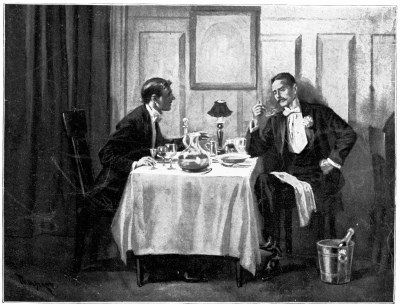 “MATT DINED WITH HERBERT AT A LITTLE TABLE”
stylists who are trying to discount Old Mastership will survive their
pictures,” was Cornpepper’s commentary on a phase of the newer art.
“They will leave masterpieces of invisibility.”
A good many changes had taken place in the Art world since Matthew
Strang had first had the felicity of drinking whiskey in Cornpepper’s
studio. The flowing tide was now with the decorative artists, of whom
the “Mack” of that evening had proved a pioneer; the Fishtown school of
photographic realism had lived long enough to be orthodox; the Azure Art
Club itself was half absorbed by the Academy, and a new formula of
revolt was momently expected on the horizon; some said it was to be
Primitive, others mysteriously whispered “spots”; to-night Herbert, with
mock seriousness, announced that he himself was about to lead a
movement, the originality of which consisted in seeing Nature through
stained glass. What weird magic a landscape gained when observed through
a green or pink window! But he found the men not so willing to talk of
principles as in the days of Cornpepper’s Bohemian parties, when Carrie
with the whiskey bottle stood for the sober club attendant with his tray
of liqueur brandies. The conversation was rigidly concrete, except for a
moment when Cornpepper nearly came to hot words with the photographic
painter who insisted that Nature was always beautiful. The little man,
glaring through his monocle and rasping the plush arm-chair with his
nails, insisted that this was sheer cant, one had only to look in the
glass to see how ugly Nature could sometimes be! Selection was the only
excuse for Art. Random transcripts from Nature were as foolish as the
excesses of the Neo-Japanese school, into which the Azure Art Gallery
had degenerated. But this lapse of Cornpepper’s into his early manner
was brief. Recovering himself, he told a malicious anecdote about an
artist who was taking to etching because his eyesight was failing, and
he explained the domesticity of British Art by the objection of artists’
wives to all models except babies. Everybody knew, he said, why
Carruthers had been driven to landscape and Christmas supplements.
“Depend upon it,” dogmatized the little man with his most owlish air of
wisdom, “the man who marries his model is lost. She will never tolerate
a model on the premises again.”
His fellow-Associate told a story of a stock-broker who had got himself
invited to the Greenwich dinner last year, and had asked Erle-Smith to
give him the sketch of passing barges which the great man had pencilled
on his sketch-book after dinner. “Erle-Smith good-naturedly gave it to
him. This year he was there again, and said with proud respect to
Erle-Smith, ‘I’ve still got that sketch.’ And produced it crumpled up
from his waistcoat pocket!”
“Yes, but did you hear Vanbrugh’s mot?” asked Trapp. “He said,
‘Naturally; being a financier he doubled it.’ ”
“Why, I said that!” cried Cornpepper, angrily.
“No doubt,” said Herbert. “It’s a well-known chestnut.”
“Then I pulled it out of the fire,” screamed Cornpepper.
Somebody exhibited another sketch, grotesquely indecorous, by a popular
painter of religious masterpieces, and the latest epigram on the divorce
case of the hour was repeated and enjoyed. But Matthew Strang’s laughter
held no merriment.
“Shall you be at the Academy soirée?” he asked Trapp, to turn the
conversation.
“No, I don’t care for crowds,” replied the realistic novelist.
The conversation rambled on. The composer drifted away, and a
full-fledged Academician took his place—an elderly, dandified figure
with a languid drawl, an aristocratic manner caught from his sitters,
and a shoulder-shrugging contempt for Continental Art; in despite of
which Matthew Strang protested mildly against the bad hanging at
Burlington House of a portrait by an eminent Frenchman. Cornpepper
talked of a sale at Christie’s at which most of the pictures had fetched
lower prices than was given for them by their last owners.
“It’s all a spec’,” said Herbert; “there’s no such thing as a fixed
value in a work of art. Everything depends on the artist’s pose. The
more the buyer gives for a picture the more he likes it. It’s a game of
brag. Set up a fine establishment—the dealer will pay. My old governor
was a good deal taken in by pretentious humbugs with pals in the press.”
As the Academician’s own establishment was notoriously finer than his
pictures—a fact of which the wandering Herbert was ignorant—Matthew
Strang hastened to speak of Tarmigan, who had been recalled to memory
by the catalogue of the aforesaid sale. “I’m afraid he’s gone under,
poor fellow,” he said. “I’ve tried to come across him, but he was always
a mysterious person.”
But Cornpepper continued to talk of the sale, of the fluctuations of
prices; of the impoverished condition of the market, so menacing to
young artists who had set up fashionable establishments on the strength
of their first sales; of the potentialities of America, that yet
undiscovered continent, till all the tide of secret bitterness welled up
in a flood from the depths of Matthew Strang’s soul. Money! Money!
Money! He had never really escaped from it. What a mirage Art was! Even
success only brought the same preoccupations with prices, it was all the
old sordidness over again on a higher plane. The ring of the gold was
the eternal undertone, bringing discord into every harmony. With a
public ignorant of what Art meant, conceiving it as something rigid like
science, not as the expression of the temperament, technique, and vision
of individual genius; with a public craving for pictorial platitudes;
Art could not be, and was not, produced, save by a martyr here and
there. Everywhere the counting of pieces and the shuffling of
bank-notes! The complacent Academician irritated him; he was tired of
reading of his marble halls, the vassals and serfs at his side, his
garden parties, his Belgravian palace erected on the ruins of a
forgotten bankruptcy. The fumes of expensive wines and cigars gave him a
momentary vertigo.
“For God’s sake, stop talking shop!” he burst out suddenly.
The astonished Cornpepper let his eye-glass fall.
“Have you gone crazy, Strang?” he asked, witheringly. “What do you join
an artists’ club for, if you don’t want to talk shop? Strikes me you’d
better get yourself put up for the Commercial Travellers’ Union.”
“That’s what we are,” retorted Matthew Strang.
The Scotch landscape-painter pacified them by proposing a game of
“shell-out,” and Herbert eagerly seconding the proposal it was carried
nem. con., and the group mounted to the billiard-room, where Matthew
Strang won half a crown before he went off to his nocturnal parties,
leaving his cousin still renewing with zest his olden experience of the
lighter side of British Art.
As a matter of habit Mr. Matthew Strang went, some weeks later, to the
Academy Soirée to add his handshake to the many suffered by the
presidential image of patience at the top of the stairs, and to help
appease the insatiable appetite of the crowd of Christians to whom lions
are thrown. It was part of his success to move through fluttering
drawing-rooms, and it imbittered him to feel that the average admirer
conceives the artist as living in a world of beautiful dreams, sweet
with the incense of perpetually swung censers, and knows nothing of the
artist’s agonies, or the craftsman’s sweatings, that go to the making of
beautiful things; sees always the completed design, and never the
workman scraping the paint or wetting the back of the canvas or tossing
sleeplessly under the weight of a ruined picture.
To-night, in the restless dissatisfaction that had grown upon him since
the reappearance of Herbert had undammed a flood of ancient memories,
this feeling possessed him more strongly than ever, inspiring a morbid
resentment of the chattering crew divided between hero-worship and
champagne-cup. There was almost a suspicion of a leonine snarl in the
stereotyped answer, “You are very kind to say so,” which he gave to the
grimacing persons who buttonholed him to bask in the radiance of his
success or to effuse honest admiration. Everybody seemed to him
ill-dressed, ill-mannered, and in ill-health. He thought he had never
seen so many cadaverous complexions, snag teeth, powder-tipped noses,
scraggy shoulders, glazed eyes (with pince-nez, monocle, or spectacles),
ungainly figures (squat or slim), queer costumes, bald heads, or
top-heavy hair-dressings; how horrible gentlefolk were, more uncouth
even than the denizens of the slums! Those one could imagine to be a
very different breed, cleaned and properly clothed, but these had had
every chance. How poorly humanity compared with cows and horses; what a
price man had paid for soul—and without always getting it. Surely, none
but custom-blinded eyes could gaze unblinking, unsmiling, at the
grotesque show of mankind, the quaint crania, the unsightly bodies; the
crowd struck him as the inventions of a comic draughtsman in a malicious
mood, the men in black and white, the ladies in color. And, indeed,
though he was not thinking of himself, his stalwart, well-proportioned
figure and his handsome head stood out notably from a serried batch of
degenerate physiques.
“So you are determined to cut me, Mr. Strang?”
The painter started violently as the laughing syllables, sounding far
more musical than the faint far-away strains of the band in the
Sculpture Room, vibrated above the endless buzz of the crowd that hemmed
him in.
He looked up. His moody fit vanished before the radiant apparition of a
beautiful woman in a shimmering amber gown from which her shoulders rose
dazzling. A jewelled butterfly fluttered at her breast. In the twinkling
of an eye—and that eye hers—he recanted his contempt for the Creator’s
draughtsmanship.
“I have bowed to you three times,” she said, and the twinkling of her
eye—large and gray and lambent—was supplemented by the smile that
hovered about the corners of her wide sweet mouth. “But you won’t take
any notice of me.”
“I beg your pardon,” he said, in flushed embarrassment, “I must have
been lost in thought.”
She shook her head bewitchingly.
“You don’t remember me. Celebrities never do remember people, though
people always remember celebrities.”
“I do remember you,” he protested, chords of memory vibrating
tremulously and melodiously. “I had the pleasure of meeting you at a
garden-party some years ago.”
“But you don’t remember my name?”
“I don’t think I caught it then,” he said, simply. “But I remember you
scolded me because my pictures were only beautiful.”
She laughed gayly.
“Ah, then I ought to apologize to you. I have changed my mind.”
“Now you don’t think they’re even that!”
“Far from it! What I mean is that I have come to think less of useful
things. You know I was a Socialist then. But let me introduce my friend
to you.”
“You have to introduce yourself first, Nor,” said a younger lady whom he
then perceived at her side.
He smiled.
“You are irrepressible, Olive,” said her friend. “Mr. Strang, let me
introduce myself then—Mrs. Wyndwood.”
He bowed, still smiling.
“Eleanor Wyndwood,” she added, “to explain my friend’s abbreviation,
which always puzzles strangers.”
“Everybody knows Nor stands for Eleanor,” remonstrated her friend. “Do
they suppose your name is Norval?”
Mrs. Wyndwood’s smile met the painter’s.
“And now, if my punctilious friend is satisfied, let me introduce Miss
Regan.”
Miss Regan gave him her hand cordially.
“Where are your pictures to be found, Mr. Strang?” she asked. “We
haven’t been to the Academy before, and we should so like to save the
shilling.”
“Oh, they’re not worth looking at,” he said, uncomfortably. He suddenly
felt ashamed of them. It was thus that he had felt more than two years
ago, when, over her strawberries and cream, Mrs. Wyndwood had lectured
him for artistic aloofness from the travail of the time, insisting that
it was the mission of all forms of Art to express the aspiration of the
century towards a higher and juster social life, towards the coming of
God’s kingdom on earth, and that it would be honester for him to plough
the land than to paint decorative pictures for the dining-rooms of
capitalists. He had scarcely taken in her point of view, more persuaded
by her presence than by her words, by some intangible radiation of
earnestness and goodness from the lovely face and the soulful gray
eyes, and less ashamed of the sinfulness of his own artistic standpoint
than of the often meretricious quality of his performance. She had been
the first woman to speak slightingly of his rôle in the world, and her
dispraise, co-operating, as it did, with his own discontent, had
impressed him more than all the praise, just as one unfavorable
newspaper critique rankled, while a hundred eulogies passed across
consciousness, scarcely ruffling its waves.
When the flux of the garden-party had drifted her off in the wake of
Gerard Brode, the handsome young Socialist, he had felt that he, too,
might have become a Socialist or a ploughboy, or even an honest painter,
under the inspiration of her enthusiastic eyes. He had thought of her
for several months, almost as a creature of dream, so swift and shadowy
had been her flitting across his horizon, and she had easily lent
herself to that conception of Ideal Womanhood which the world had not
yet destroyed, because the world had not created it. It was under the
impulsion of the eloquent play of light across her face that he had
conceived and painted that allegory of woman’s inspiration which
Herbert, unable to read in it the pathetic expression of the painter’s
dissatisfaction at once with real womanhood and his own work, had found
so amusing, and he was startled now to see how nearly he had reproduced
her traits in his conception of the figure on the mountain-top; not so
much, perhaps, in the features, in which the slight upward tilt of the
nose was omitted and the size of the ears diminished, as in the
clustering chestnut hair, with gold lights in it, and in the poise of
the head, the long, thin Botticelli hands, the small feet, and the
graceful curves of the rather tall form, and, above all, in the
expression that seemed to suffuse her face with spiritual effluence. The
first impression renewed itself in all its depth; he asked himself with
amazement how he could have let the waves of life wash it away so
completely that even Herbert’s inquiry about the picture had not
recalled her clearly to his memory.
“Oh, but I want to see your pictures,” she said. “There’s a ‘Triumph of
Bacchus,’ I hear. I saw the fresco—by Caracci, wasn’t it?—in the
Farnese Palace, in Rome, on our homeward journey. We’ve been in Russia,
Miss Regan and I, with Monsieur and Madame Dolkovitch, to see Podnieff
in his dairy-farm. Oh! he’s so charming—so simple and saintly. He
enables one to construct St. Francis of Assisi.”
“He makes very bad butter,” said Miss Regan.
“He is the greatest spiritual force in Russia,” Mrs. Wyndwood said,
sweetly. “And Dolkovitch is doing much to extend his influence in
England. I wish you knew Dolkovitch, Mr. Strang.”
“Why, would he make me do better pictures?” he asked, playfully,
struggling a little against the obsession of her sweet seriousness.
“I will reserve my opinion till I have seen your latest manner. Though I
confess I don’t find the title, ‘The Triumph of Bacchus,’ a hopeful
augury of noble work. But do tell me where it is—or must I consult the
catalogue? Miss Regan made me bring one.”
“It is in this very room.”
“Really?”
“Yes, it’s rather a compliment. The Academicians generally reserve the
big room—or at least the line—for their own works. But it is cruel of
you to leave me so soon.”
“How subtle, Nor,” said Miss Regan. “Of course he cannot be seen looking
at his own picture.”
“Do let us go where the crowd is thinner,” he pleaded.
“Than round your picture?” queried Miss Regan, naïvely.
“For shame, Olive,” laughed Mrs. Wyndwood. “I shall punish you by not
letting you see it. We are at your service, Mr. Strang. Show us what you
please.”
“May I not get you any refreshment?” he said, as they passed into the
smaller room, and into a perceptibly cooler atmosphere.
“No, thank you; this is refreshing enough,” said Mrs. Wyndwood, with a
sigh of relief.
“Mrs. Wyndwood means that she lives on air,” said her friend.
“Oh, Olive, I eat quite as much as you.”
“You used to before you developed this Dolkovitch phase, and began
understudying an angel.”
Matthew saw the opportunity for a commonplace compliment, but he did
not take it. The plane on which Mrs. Wyndwood existed demanded
reverential originality. Every word she said sounded magically musical,
and delightfully wise and witty. Olive’s remarks one merely smiled at,
though she, too, had a low voice, “that excellent thing in woman,” and
was considered handsome by those she did not annoy. She reminded the
painter of a Caryatid as she stood there, rather more sturdy than her
friend, and shorter, with stronger features and a firmer chin, but to
the full as graciously proportioned. She had dark hair and eyes, and a
warm coloring that reached its most vivid tint in the intense red of the
lips. Her dress was of a soft green-blue, cut high, with yellow roses at
the throat, and but for the painter’s preoccupation with her friend,
would have challenged his eye by subtle harmonies.
“There goes William Lodge, the poet,” cried Mrs. Wyndwood, suddenly.
“Impossible!” said Olive.
“But it is the poet,” insisted Mrs. Wyndwood.
“Impossible,” repeated Olive. “No man can be a poet with mutton-chop
whiskers.”
“What has the man’s appearance to do with his poetry?”
“Everything. Mutton chops and lyrics don’t rhyme—they’re like that
woman’s emeralds against her turquoise bodice. A poet’s publisher should
keep him out of sight—he damages sales. Look at the hook-nosed creature
there with the goggles and the green gown—who would believe that is
Mrs. Ashman Watford, who writes those dainty essays, and who, realizing
it, could ever help reading her between the lines?”
“Or who,” retorted Mrs. Wyndwood, “reading the essays, could help seeing
the beautiful soul behind the goggles?”
A tremor of sympathy traversed the painter’s form.
“I stand unreproved, Nor. You can afford to be magnanimous. But I
contend that beautiful souls have no right to get mixed up with hooked
noses. We ought to judge a soul by the body it keeps. If this country
ever becomes a republic, it will be due, not to democracy, but to
photography. You will agree with me, I know, Mr. Strang.”
He started, wondering what he was called upon to agree with.
“Beauty is truth, truth beauty,” he quoted, vaguely.
“But you never put truly ugly persons into pictures,” Miss Regan
persisted.
“No,” he admitted, “unless in portraits.”
“And not even then,” the girl retorted. “I’d far rather these portraits
came out of their frames and walked about, than promenade among the
originals as we are doing now.”
“Why, I don’t suppose there’s one original present,” Mrs. Wyndwood
remonstrated.
“Isn’t there?” queried Olive, in innocent accents. “I thought there were
a lot, judging by the want of resemblance.”
“You are not up to date,” said Matthew Strang, smilingly. “Likeness is
the last thing a portrait-painter goes for. Values, spots, passages,
color schemes, all sorts of things take precedence of the likeness in
their importance for art. The likeness is irrelevant to art. It concerns
only the sitter—art concerns the world. A friend of mine, who edits an
illustrated paper, which is the first to publish portraits of everybody
who becomes anybody, contends that the number of persons who know any
one man’s features is a negligible quantity. ‘All the public demands,’
he says, ‘is portraits.’ So you see your criticism leaves our withers
unwrung.”
“Oh, do produce your catalogue, Nor,” said Miss Regan, flying off at a
tangent for want of an answer. “I am dying to see the name of that
thing, stuck right up there on the ceiling.” Mrs. Wyndwood, after
protesting that nobody else was consulting a catalogue, which only made
Olive more eager, fished out the booklet from some obscure pocket, and
Olive turned the pages impatiently.
“It’s just like Miss Regan to want to look at the skied pictures,” her
friend murmured to the painter.
“Oh, the poor man!” cried Miss Regan. “Listen, this is what the picture
is called:
“ ‘Sweet Love—but oh! most dread desire of Love,
Life-thwarted. Linked in gyves I saw them stand,
Love shackled with Vain-Longing, hand to hand:
And one was eyed as the blue vault above:
But hope tempestuous like a fire-cloud hove
I’ the other’s gaze, even as in his whose wand
Vainly all night with spell-wrought power has spann’d
The unyielding caves of some deep treasure-trove.’
“Oh, the poor man! Fancy the indignity of having a long quotation
skied!”
“What lovely lines!” exclaimed Mrs. Wyndwood, ignoring the humorous
aspect which appealed to her companion. “Do they not express the idea
perfectly, Mr. Strang?”
“I am afraid I did not quite catch their significance,” he said,
flushing. The confession was not so candid as it sounded, for he had
been less intent on the quotation than on studying the sweetness of her
face, and watching the emotional heaving of the jewelled butterfly on
her beautiful bosom.
Olive Regan politely offered him the catalogue, and his flush grew
deeper as he seemed to read his personal tragedy in the poet’s images.
What ironical Providence had sent him the words just then?
“Oh! most dread desire of Love,
Life-thwarted.”
Perhaps it was that which made his life so unreal to him, which
explained its hollowness. He had never loved.
In a strange flash of imaginative insight, it seemed to him that the
room was full of lovers. Love was in the air; delicate rumors and
whispers of divine delight, of holy pain, fluttered tremulously. On all
sides couples moved, heart-bound, their beauty spiritualized, their very
ugliness transfigured. Love redeemed the creation.
He remembered that in the days when he had trodden the lonely London
pavements, hungry and heart-sick, jostled by hurrying crowds, he had yet
seemed to himself the only solid figure amid a throng of shadows
flitting to death and oblivion. In this tense instant he felt it was he
that had always been the shadow; the one shadow amid a world of
substantialities and solidities, a world that lived while he was
recording the forms and colors of life.
And even if he should ever love—and the thought set his heart
fluttering as he had imagined it could never flutter again—even if Love
should ever make existence real for him, was he not predestined to a
doom more terrible even than the apathy of loveless life?
“Linked in gyves I saw them stand,
Love shackled with Vain-Longing, hand to hand.”
Mrs. Wyndwood! She, too, was married. And in that thought he knew that
Love had begun for him. The unrest into which the first vision of her
had plunged him, and which time had stilled, had at last come to
understand itself. He loved, and his love was vain. They had come to
him, both at once—
“Love shackled with Vain-Longing, hand to hand.”
He returned the catalogue mechanically to Miss Regan.
“They’re Rossetti’s—fine, are they not?” said Mrs. Wyndwood.
The question dragged him up from abysses of dream. But even though he
felt he must be answering it, he lingered in luxurious agony over the
music of the question, its vibrations prolonging themselves in his ear.
“They are indeed exquisite,” he said, slowly, at last. “But do you think
there would be any ‘hope tempestuous’?”
“There is always hope,” said Mrs. Wyndwood, gently.
There seemed a sweet assurance in the unconscious words: he heard a
chime of golden bells floating up from some sea-buried city. Perhaps it
was only from the band in the Sculpture Room. But he felt he must not
attach himself further to the fascinating twain; his solicitude would be
too marked, and he was aware of many eyes drawn by their beauty.
But before he could speak, Mrs. Wyndwood went on, musingly:
“And after all, hope is better than fulfilment. There are blue hills on
the horizon which the child longs to go beyond; but happiness always
lies on the hither side, with the blue hills still beckoning.” Her eyes
filled with dreamy light. “It is as George Herbert so beautifully says:
“ ‘False glozing pleasures, casks of happiness,
Foolish night-fires, women’s and children’s wishes,
Chases in arras, gilded emptiness,
Shadows well-mounted, dreams in a career,
Embroider’d lies, nothing between two dishes,
These are the pleasures here.’ ”
How exquisitely she spoke the melancholy lines that seemed fraught with
all the pathos of the human destiny, her words rippling through the buzz
of platitudinarian trivialities he heard vaguely all around him, like a
silver stream through an unlovely country. She had suffered too. She,
too, had found life and its pleasures hollow; he saw that in the quiver
of the beautiful lip, in the wistful brightness of the eye. Straightway
his heart was full of tears for her. He longed to comfort her, to
sacrifice himself for her. Why could she not be happy?
He had a sense of jar when Miss Regan said:
“That’s rather a strange quotation for you, Nor.”
“Indeed?”
“ ‘Foolish night-fires, women’s and children’s wishes.’ He had a true
notion of our futility, that gentle old poet.”
“I am in no fighting mood to-night, Olive,” replied Mrs. Wyndwood,
gently.
“You don’t stand up for your sex?” the painter asked Miss Regan, in
surprise. She had that resourceful, self-sufficient air which he
associated with pioneers of female movements.
Olive shrugged her shapely shoulders. “Heaven forbid that I should be
the advocatus diaboli.”
The tossing of the crowd threw up a long-haired, long-bearded man with a
handsome leonine cast of features, who greeted the two ladies with an
air of camaraderie.
“Ah, nous voilà encore,” he cried, joyously, adding in good English,
though with a Russian accent, “Oh, Mrs. Wyndwood, you must see the
little picture of the Christ-child by a young follower of our
Nicolovitch. He is exiled three years already, and has established
himself on your hospitable shores. Ah, how it makes a spiritual ray
among your English platitudes! You will come too, Miss Regan?”
Olive, who had cast a droll glance towards the painter at the Russian’s
awkward allusion to British banality, shook her head. “No, thank you. I
hate children, and I am tired. You will find me here, Nor,” and she let
herself sink into a lounge.
Mrs. Wyndwood hesitated, as if about to introduce the two men, but the
leonine Dolkovitch swept her off, and she had only time to leave a
bewitching smile behind her.
“Won’t you go and see the child, Mr. Strang?” Olive asked.
He hesitated in his turn. But she would come back if he waited.
“I would rather stay with you if I may,” he replied, gallantly.
Olive looked sideways along the lounge.
“There is room,” she reported.
“Thank you.” He seated himself at her side, and stolidly regarded the
crowd and the opposite pictures.
Olive fanned herself silently at great length. The painter, stealing a
sudden glance at her, found her observing the human spectacle with an
air of infinite sadness.
“Do you like dogs?” she asked, unexpectedly.
“Yes,” he replied, startled, and with a vision of Sprat. “But I haven’t
kept one since I was a boy. But why?”
“I don’t know. That woman there made me think of them—that creature
they’re crowding round. Don’t you see that pasty-faced hag with the
false hair and the real diamonds? That’s Miss Craven St. Clair.”
“Well, what has she to do with dogs?”
“Oh, she’s a leading lady. Plays those erotic parts.”
He looked at her a little surprised by the adjective, and still
unenlightened.
“And what then?”
“Don’t you know all leading ladies keep dogs—to get extra paragraphs? I
hope you hate leading ladies. I do. They’re so virtuous, and you know
virtue is such a feeble vice. Nor has a dog, though she’s not a leading
lady. But rather a led lady. L—E—D, you know.”
“Do you mean led by the dog?”
“Yes, whenever she’s blind and the dog is sly,” she said, mysteriously,
adding quickly, “Nor’s dog isn’t all hers—it’s mine on alternate days.
He’s such a snob, is Roy—he’ll never go out with her if she’s frumpy.
He insists on swell dresses, dear old Roy.”
“Can she be frumpy?” he asked.
She flashed a quick look at him.
“No, she is very sweet and amusing,” she answered, gravely. “She is the
only woman I have ever been able to live with.”
“Do you live with her?”
“Of course—I chaperon her.”
Matthew smiled.
“What, don’t you think I’m old enough to chaperon a young widow?”
His heart leaped.
“I didn’t know she was a young widow.”
“Yes, she’s quite an old widow.”
“Have you lived together long?”
“Æons; we disagree so much.”
“In what way?”
“Our complexions go well with each other’s.”
“I should call that harmony, not disagreement.”
“Perhaps—in your technical nomenclature. But I call it disagreement.
Besides, we haven’t a thought in common. I am a—well, how shall I
define myself?” she looked up quizzingly, her fan to her lips. “I belong
to that class of women whose sex is a misfit. And she is—”
“And she is”—he repeated, in some suspense.
“She is the sort of woman who won’t renew the velvet edging on her
walking-dresses.”
“Now you puzzle me.”
“It is evident you know nothing of women, or have only observed
Englishwomen who mostly put up with braid. Velvet edging, which is an
American notion, saves frayed skirts, and wears out quicker than the
stuff. Look at her gown to-night—it trails; mine fits. She retains the
infantile habit of long clothes; I am ‘growd up’ and in short frocks.”
“I didn’t notice her gown.”
“Men never do. That’s why we wear so little of them.”
He was puzzled by a curious bitterness in her tone, as well as by a
perplexity as to her exact meaning. Her own frock was certainly
prudishly high.
“I don’t quite follow your definition, anyhow,” he said.
“No? I’ll try another. There are only two classes of women—those who
ought to have been born men, and those who ought never to have been born
at all. I am of the first, Nor’s of the second.”
He shook his head laughingly.
“Oh! but I won’t believe that of either.”
“If I expected to be believed I should have more hesitation in telling
the truth,” she replied, gravely. “We are both mistakes, but Nor is an
incorrigible one. You heard her say she’s dropped Socialism. She didn’t
tell you she’s dropped a power of money, too, in subscriptions to the
Cause. She probably thought equality would come about in three months,
and that she was merely disgorging in advance.”
“Is that why she looks so sad?”
“Dear me, no; money doesn’t trouble her.”
“What’s the matter, then?”
“She’s been married.”
“You mean she grieves?”
“Quite the contrary. But marriage brands.”
“You speak bitterly—yet you have no personal experience.”
“No, I was never tempted.”
Her frank brusquerie made him feel an old acquaintance.
“I cannot believe it,” he said, with a smile.
“Oh, if you call a proposal a temptation! I call it a bare hook.”
“You’re a man-hater, I see.”
“A woman-hater, if you will. Man I adore.”
“I don’t understand you,” he confessed again.
“Really? I am a very simple person. Omne ignotum pro magnifico. Women
I know and detest. Men I don’t know and admire. If I married one, I
should know him.”
“But you might find him better than you expected.”
“If I didn’t expect to find him better than I expected, I shouldn’t
marry him; so I should still be disappointed. You see I know just enough
about men to know that they are better left unknown. I quite agree with
Nor about the blue hills. It is better to keep one’s illusions. At
present I am happy in the thought that somewhere in the universe there
exists a fine man. Even the average man is less petty than the average
woman, so that the one fine man must be a Bayard indeed.”
He laughed.
“Then, if he came along and made you an offer of marriage—”
“I should close with it at once.”
“You are a droll girl,” he could not help saying. “You are the first of
your sex who has ever admitted to me that men are better than women.”
“Didn’t I tell you how sly we were? A man has one or two big sins, a
woman a bundle of little ones.”
“Ah, well,” he said, smiling. “Two of a trade, as a friend of mine
says.”
“Now I don’t understand you—or rather, your friend,” she said, flushing
a little.
“Oh, he’s rather brutal. He takes the Darwinian view of things, you
know. He says all women are in the same trade—man-hunting—so they run
one another down.”
“But I’m not running one another down. I’m running us down en bloc.
And, besides, that isn’t the Darwinian view at all. It’s the males who
always seek the females and develop the lively colors to attract them.
Don’t you remember Tennyson?—
“ ‘In the spring a fuller crimson comes upon the robin’s breast.’ ”
“Yes, but that’s only in the lower creation,” argued Matthew Strang.
“Do you make a distinction? But I am ready to agree with your
friend—since he isn’t here. We are man-hunters. What a pity, though,
that civilization has so reversed the order of natural selection that
the human female has to be picked instead of picking the male. See the
result!”
“I see what you mean. Man has degenerated physically.”
“And woman morally. We adore the beauties of your purse instead of your
person.”
“And so we develop brain to get purses with. Really, the effect is not
so bad.”
“Brains are cheap to-day; and they don’t improve the appearance, anyhow.
If people wore their brains outside—but who is this brutal friend of
yours who gauges my sex so well? Do I know him?”
“I shouldn’t think so. He’s just back from strange places.”
“So am I. What’s his name?”
“Herbert—Herbert Strang.”
“A brother?”
“A cousin.”
“He’s not an artist?”
He hesitated: “Yes—and no,” he said.
“Ah, two of a trade,” she said, slyly.
He smiled. “Oh, he’s gone out of the business. He’s become a critic.”
“Wise man!”
He glanced furtively every now and then to see if Mrs. Wyndwood was
returning. He was conducting the conversation with only the untroubled
surface of his mind, interested enough in his piquant companion, but
feeling her entirely as an interlude. Miss Regan perceived his
perturbation at last.
“Oh, don’t let me monopolize you, Mr. Strang. I am quite safe here till
Nor returns. There are so many people thirsting for you.”
“Oh, I’d rather stay with you,” he averred, disingenuously.
“Don’t be a mere man,” she returned, raising her dark eyebrows. “Even
your admirers think you more than that. It’s not fair for me to keep you
from them.”
He was rather in a quandary. He could not tell her he was waiting for
her friend.
To his relief, “Ah, I see them coming,” she said. “You’ll be off duty in
a moment. I must introduce you to Dolkovitch. He’s great fun. He will
invite you to his spiritual Sunday afternoons. Do you judge people by
their hat-racks?”
He stared at her.
“I mean when they’ve got company. Dolk’s hat-rack when he’s ‘at home’ is
lovely; I’d go miles to see it. Such curious curly, dusty, many-hued,
amorphous things on the pegs—a cosmopolitan congress, only the
chimney-pot unrepresented. Nor goes to meet the earnest people, but I go
to see their hats. Oh, M. Dolkovitch, do let me introduce Mr. Strang. He
is dying to know you.”
“De-lighted,” said Dolkovitch. “But I do not like this word ‘dying,’
Miss Regan.”
“Oh, I beg your pardon—I forgot,” said Olive. “Mr. Strang is living to
know you. M. Dolkovitch, like the ancient Greeks, Mr. Strang, doesn’t
like to think of death.”
“I can’t let you misrepresent him to a stranger, Olive,” said Mrs.
Wyndwood. “M. Dolkovitch is wide as the poles asunder from Pagan
thought, Mr. Strang. His teaching simply is that, as there is no death,
but merely upward evolution, the sooner the word is banished from our
vocabulary the better.”
Her voice raised the discussion to celestial heights.
“Never say die!” cried Miss Regan, enthusiastically. “Every dictionary
should be without it.”
“Just so,” said M. Dolkovitch, gravely. “Our European customs, Mr.
Strang, with regard to death are all in direct contradiction to our
creed. The spirit rises into more blessed states, and instead of
rejoicing in festive attire, we mourn for it, we put on black, and our
looks are black, and our hearses are black, and the horses they are of
black also.”
“I think it’s very proper,” said Miss Regan, decisively. “I love black
funerals. Colored funerals would make me feel sad.” She rose. “We are
going soon, Nor, aren’t we? You look tired.”
“Yes, we are going at once,” Mrs. Wyndwood breathed.
The Russian gave the painter his card, and hoped he would come and hear
more of the new gospel. Next Sunday afternoon spiritual people came from
four to seven.
Mr. Strang made a movement to accompany the ladies, but Mrs. Wyndwood
begged him not to trouble—M. Dolkovitch would see them to the carriage.
“Good-bye, then,” she said with an enchanting smile. “It was so good of
you to talk to us.”
Words failed him in reply. Fortunately, a little white-haired gentleman
bowed to her at that moment and distracted her attention.
“That was General Dale, Olive,” she said. “What a fine, soldierly walk!”
“Varied by ducking for bullets every moment,” remarked Miss Regan. “He
oughtn’t to know so many people. Not that I admire the military bearing.
It’s so unnatural and stiff. One sees the drill behind. Even those
little wooden soldiers I never liked. Good-bye, Mr. Strang.”
“Au revoir, I hope,” he said. Her, at least, he could answer.
He went to the “Sunday afternoon” at five o’clock, the earliest hour one
could decently go to a reception commencing at four. In the meantime he
had reread a great deal of Shelley, who seemed to have written a great
deal about Eleanor, as she became to her lover’s secret thought, though
her full name he learned was the Honorable Mrs. Wyndwood, and she was
the daughter-in-law of a Viscount, and connected by blood or marriage
with several pages of Debrett. In the hopelessness of his love these
ties were no separation; he did not think of anything but the blissful
pain of seeing her again. He had ridden every morning in the Row, but
neither of the friends had shown herself.
The reception was held in a flat half way up a bleak stone staircase in
the West Central district. He was so agitated that he forgot to note the
hat-rack, and his first glance at the company appalled him with the
sense of a cosmopolitan chaos, without form and void, over which no
light of Mrs. Wyndwood brooded. There were mystic oil-paintings on the
walls of the narrow room, and on the gray marble mantel-piece stood a
glass of water, in which floated vaguely the white of an egg.
The host introduced him to his wife—a tall, haggard, giraffe-necked
woman—who gave him a cup of tea, and passed him on to a nervously
peering Herr Grundau, who spoke to him of the revival of religion among
the University Burschen, and passed him on to Mademoiselle Brinskaïa,
a little yellow Polishwoman, with eyes like live coals, who had been
speaking every European language in turn with equal fluency, as she
knitted colored wools into some occult pattern.
“I have heard your name,” she told him in English that sounded almost
native, as he seated himself next to her in the cushioned window-seat.
“It is so good of you to say so,” he murmured, automatically, not
without the astonishment which from the first had pervaded him when
strangers professed knowledge of him, and which had never quite worn
off. He thought his peculiar name accounted for his notoriety.
“You’re not a spiritual artist,” she said, half interrogatively.
“An artist can only be artistic,” he replied, in vague self-defence.
“That’s all my eye and Betty Martin,” said Mademoiselle, knitting
indefatigably. Then she smiled. “You see I know your idioms.”
A gradual silence fell among the jabbering, gesticulating crowd. All
eyes were directed alternately towards the glass on the mantel-piece and
Mademoiselle Brinskaïa.
“It is settled,” Dolkovitch declared.
The Polish old maid rose solemnly, marched towards the fireplace, and
inspected the glass curiously, noting the shape which the egg-white had
taken.
“It is a porte-cochère,” she announced. “That means riches.”
There was a buzz of satisfaction and a little hand-clapping, the
blinking octogenarian who had broken the egg being cheerfully
complimented on his prospects.
The sibyl did not return to Matthew Strang’s side, and the vacant niche
was taken by a stout, elderly, motherly lady, who was introduced to him
as the Countess de Villiers, and who, regardless of the fact that his
eyes perpetually wandered towards the door, published her autobiography
to him, from her babyhood in Brazil to her maturity in Gibraltar. There
could be no close to her story, she volunteered, for she could never
die.
This drew Matthew’s attention even from the door.
“Do you mean metaphorically?” he said.
“No, literally. You could not kill me if you tried.”
“What! Not with a knife?”
“Neither with fire nor sword.”
“You know I wouldn’t try,” he said.
“If you are going to treat me facetiously I will not pursue the
subject,” she declared, the red blood mantling in her sallow cheek.
“I am quite serious,” he said, deprecatingly.
“A woman who can live without eating cannot die,” pursued the Countess,
mollified. “I was an invalid, and in my convalescence gradually worked
my way to the Truth, and by means of it I have lived fourteen weeks
without food. I worked down from five ounces a day to nothing, dropping
an ounce a day. And I didn’t lose a pound of flesh.”
“I have fasted, too,” he said, grimly. “But I never found any Truth
through it.” He reflected bitterly on the anxious competition of people
to give him food, now that he had plenty of his own. Was this the London
which he had tramped for work, famished and rebellious?
“You must be patient,” she answered, earnestly. “You must kill the man
in you; then you will have got rid of the mortal part. You will be pure
spirit, part of God. Existence is only God’s thoughts; everything good
is a God-idea, everything evil a man-idea. Jesus was the first
discoverer of the Truth, and only the man-idea in Him was crucified, the
mortal part. Only the evil part of us is mortal. I have suppressed the
man-idea in myself, therefore I cannot die.”
“But do you mean to say you will always live on?”
“Yes, though not necessarily on earth.”
“But what will happen—will you disappear?”
She frowned. “Oh, I know you are making fun of me; but I assure you many
eminent men have sat at my feet. Even Dolkovitch says I have a greater
grip of the Truth—the glorious Truth of immortality—than any other
woman in Europe, except Mademoiselle Brinskaïa and the clairvoyant
Princess Stevanovna. There is nothing miraculous. I don’t keep away from
society, I dance and paint, but throughout all I am struggling against
the bad-self.”
“What sort of things do you paint?” he asked, feeling for firmer ground.
“My vision!” she said, in rapt tones. “My assurance that the universe is
all living spirit.”
And all of a sudden a conviction came to him that she was right, that
there was no death, no room for death. Eleanor Wyndwood had arrived, and
in the light of her face the noisy, motley throng took meaning and
music. He rose eagerly, but she did not see him in his niche, and he sat
down again awkwardly. The Countess talked on, but he had forgotten even
to feign the listener. He could only see the gleam of a creamy dress in
rifts of the crowd, which thickened momently. Presently he was aware of
Miss Regan, who gave him an abrupt bow, and then crossing over to him
said, in vexed accents:
“I am very angry with you. How are you, Countess? Young as ever, I see.”
“What have I done?” inquired Matthew Strang.
“You’ve spoiled my hat-rack. There’s a chimney-pot on it. Life has so
few pleasures one can’t afford to be robbed.”
“Oh, please forgive me,” he said, half seriously.
“I sha’n’t—you’re too respectable.”
“Tell me something Bohemian, and I’ll do it,” he pleaded.
“Well, come to tea with me some five o’clock—with me and Nor, that is.”
“Is that very Bohemian?”
“No, I’m afraid not,” said Olive, glumly. Then, brightening up. “But
that’s only a beginning. And you haven’t got time to come, either. That
makes it a pleasure.”
“I shall be delighted to find time,” he said, looking his words. While
they were discussing dates, the Countess rose and stalked away.
“She looks offended,” he said.
“Poor old Countess!” said Olive, “she’s breaking up fast.”
“But she’s going to live forever.”
“I know. How sad! We came across her at Rome—the eternal lady in the
eternal city. She’s much grayer since then. Earthly immortality seems
almost as horrible as heavenly. Fancy living for ever and ever and ever.
No rest for the righteous! Oh, I do hope religion isn’t true. How’s your
friend?”
“Which friend?”
“The brutal friend!”
“You’re a queer girl,” he said, laughing in spite of himself.
“That’s tautology. All girls are queer. Did you ever know a woman
absolutely sane?”
He winced a little—shadows of his mother and his wife flashed past. She
answered herself, triumphantly.
“Of course not. We’ve all got bees in our bonnets. Men haven’t even got
bonnets. Except Highlanders. And they don’t wear the breeches. I beg
pardon, I should have said ‘unmentionables’ to a member of the
chimney-potted classes. But that always seems silly. It’s like spelling
‘damn’ in books with a ‘d’ and a blank. I have a lovely private swear.
Would you like to hear it?”
He laughed assent.
“Damakakaparatanasuta! The pink lady, who always forgets her bodice,
is looking shocked. She doesn’t know it’s Sanscrit, or something, and
means: ‘The foundation of the kingdom of righteousness.’ Don’t laugh, it
really does. There is a cousin of the Guicowar of Baroda over there—you
can ask him. Why, I have even got Nor to swear to swear it. It’s like
temperance champagne.”
“Ah! I’d better go over to her,” he said, snapping at the opportunity.
“Or else she’ll accuse me of cutting her again.”
He pushed a whit rudely through the teacup-balancing throng. But to his
horror he found Eleanor distributing farewells.
She smiled faintly at him, as her magnetic fingers touched his for a
moment.
“What wicked things have you been saying to Mademoiselle Brinskaïa?”
He looked at her in astonishment. “I’ve hardly said a word to her.”
She shook her head and passed towards the door. He spent some wretched
days, wondering if he had offended her, and what the little yellow woman
had been saying about him. He put the question as soon as he was seated
at the tea-table in the dainty drawing-room of the tiny Mayfair house
which the oddly assorted couple had taken for the season. Mrs. Wyndwood
would not say, but Miss Regan cried out:
“Don’t make such a mystery, Nor; you’ll make the man think he’s accused
of murder, or drinking his tea out of a saucer. The Polish priestess
says she doesn’t like your auras—voilà tout!”
“What are auras?” he asked, relieved and puzzled.
“The Latin for airs, of course,” laughed Olive. “It’s her mystical way
of saying you give yourself airs. Yes, you do. You’re disapproving of
our furniture now. But it’s through Nor’s objecting to furniture that
suited my complexion and vice versa. We compromised by getting furniture
in discord with both our complexions. The beautiful photos you see all
about you are mine—I mean my collection. They are actresses. I adore
beautiful women. After what you told me about the unimportance of the
likeness I shall consider them works of art. I have always thought that
actresses’ photographs are intended as a protection against the
curiosity of the public. But for them, actresses would be liable to be
recognized and mobbed in the streets. Great Heavens! I’ve forgotten the
scones.” And with this unexpected exclamation, Olive rushed out of the
room.
“She would insist on baking scones herself,” Mrs. Wyndwood explained
with an affectionate smile.
“She is deliciously odd,” he replied, laughing.
“Do you find her so? I’ve got used to her. There’s a monotony in the
variety. Behind it all I see always this one fact—she’s the noblest
creature in the world.”
He was touched by the enthusiastic tribute, so different from Olive’s
amused estimate of her friend.
“You must find it very pleasant to live with her,” he said.
“Yes, especially after”—But she shuddered, and did not complete the
sentence. He read in her face the tragedy of an unhappy marriage. His
eyes grew moist with pity; he felt a mad, fighting passion against the
inevitable past.
“Olive is so good,” she said, brokenly, “she was of my husband’s
family—an Irish branch—but she quarrelled with them all—her father,
her sisters—and came to live with me. Fortunately she is immensely rich
in her own right, and independent of them all.”
“Done to a turn!” cried Miss Regan, rushing in with the scones. “And I
feared I was King Alfred!”
At tea they talked Art.
It was an exquisite sensation to have these charming ladies treat him as
Sir Oracle. He was surprised to learn that in her girlhood Miss Regan
had displayed considerable talent for sculpture, but had “washed her
hands of the clay” on seeing the torso of Victory in the Louvre. He
remonstrated with her, insisting that technical skill came slowly, with
infinite labor. There were things he himself wanted to do—all sorts of
new things that he had never yet done. One day he would try to do
them—when he had time. Mrs. Wyndwood spoke contemptuously of technical
skill in comparison with soul, but here Olive mischievously took up the
cudgels for craftsmanship, and led the rather reluctant painter into an
eloquent exposition of the joys of technical mastery; of doing what you
would with your material. Mrs. Wyndwood at last caught the fire of his
enthusiasm, and astonished him by expressing his sense of the joy of Art
better than himself. Under the passion of her words he wondered that he
could ever have wasted his time on portraits for mere money, or on
scamped pictures for Exhibitions, when all these interesting problems
were waiting to be wrought out. Ah, but Miss Regan was wrong, he felt,
in thinking these problems the be-all and end-all of Art; it was soul
that was the essence of Art; Art had no raison d’être except as the
expression of soul, of the upward aspiration of the Spirit towards the
Good and the Beautiful and the True, a trinity that was mysteriously
one.
The sands of the season were running out, but Matthew Strang sifted them
for every grain of the gold of meetings with Eleanor Wyndwood. He was
shy of formal visits to the house, he did not venture on the
conventional course of asking her to sit to him, for he would not
consciously feed the flame of a passion that must be hopeless. But with
that curious illogicality which distinguishes man from the brute, he
called in accident to arrange their rendezvous, pursuing possibility
with a perseverance that made it probability.
He could not follow Eleanor to all her fashionable fastnesses as easily
as to the shrines of spirituality, for to be born well is still a
necessity of life in some circles; but they met often enough amid the
monotonous glitter which was the woman’s birthright and second nature to
the man. His eye perpetually sought her; in chattering drawing-rooms, in
cool gardens, on congested staircases, in whirling ballrooms; finding
every place dark and empty till she filled and illumined the scene. She
gleamed upon him as unreal and insubstantial as the figures he had once
noted in one of these ballrooms, completely girdled by electric lights,
which, robbing the dancers of shadows, made them fairy-like and
phantasmal. But he did not follow out the analogy or suspect it might be
his own love which was surrounding her with this spiritualizing electric
illumination. Each time he saw her he resolved never to see her again.
He could never tell her what was in his heart, never insult her
exquisite purity with the avowal of his love, even though that love were
clarified to unimagined ethereality by her stainless radiance of soul.
And each time the possibility of seeing her drew nigh again, he told
himself that he needed her for his Art—that she was drawing him up from
the slough of banality, that now for the first time his soul was really
opening out to the appeal of the higher beauty. Not that he had as yet
begun to express the higher beauty; he had simply abandoned the old. He
was too restless to work, to concentrate himself; he flitted between the
unfinished and the projected, painting in and painting out; he took long
rides in the middle of the day, to the amazement of his faithful
body-servant; he read emotional literature. Once an unconscious hostess
gave him Eleanor’s company at dinner. Mrs. Wyndwood was in stately
black, with a bunch of violets at her bosom. It was an enchanted meal.
They talked of poetry, and he seemed to be dining off poetry too. The
wines where special brands of nectar, laid down by the gods in the
golden age, the meats were ambrosia, the sweets honey-dew. A beauty as
of Hebe transfigured the faces of the neat-handed waiting-men. It seemed
only natural that the beautiful stately creature at his side should
overflow with quotations from religious poetry—was she not herself a
religious poem? His recent feverish readings had branded lines on his
own heart; he was able to answer her in lyric antiphony. His other
neighbor he simply forgot, though she was a bishop’s consort and a
patroness of the arts, with printed views on the genuineness of Old
Masters. There was an old picture of his own on the opposite wall, and
the fear lest Eleanor should raise her eyes to it was all the serpent in
his Paradise. His subconsciousness noted with pleasure, however, that
the painting had mellowed—a proof that his theory of colors was right.
He watched with furtive fascination the play of Eleanor’s beautiful
Botticelli hands, plying her knife and fork, as she explained how under
the influence of Dolkovitch she had drifted away from Socialism, whose
professors always laid too much stress on the needs of the body. But she
apologized for having spoken rudely of his “Triumph of Bacchus” from a
mere knowledge of its title; he had made her understand now that the
appeal of painting must always be sensuous, and that subject was only an
excuse for draughtsmanship and coloring, and she startled him by saying
she liked that picture of his on the opposite wall, which he had been
hoping had escaped her eye. It became at once glorified to his own.
After the ladies had retired, the gentlemen talked about a newly
invented torpedo, the finances of India, and the prospects of the
Conservatives; the conversation sounded almost indecent, and he was glad
Eleanor was not there to hear it. He took no part in the fatuous
discussion, contenting himself with watching Eleanor’s face amid the
wreaths of his cigar-smoke; even in the flesh the face had for him
something of this vaporous, elusive incorporeality.
In the drawing-room the inevitable Miss Regan claimed his attention.
Eleanor was playing Mendelssohn, and he would have liked to listen, but
Olive was less original.
“You have never honored our five-o’clocks again,” she said,
reproachfully.
He murmured that he was busy.
“That was the charm of your coming,” she reminded him. “One had the
sensation of beguiling you to play truant. But I suppose the tea was
bad. Nor would make it.”
“The tea was beautiful,” he said, smiling. “But aren’t we disturbing the
music?”
“On the contrary. Nor is giving us ‘Lieder ohne Wörte,’ and we have to
supply the words. I wonder what makes her play such old-fashioned
school-girl things. Then it must have been the scones.”
He shook his head and pursed his lips, and the music flowed on like a
lovely moonlit stream. He was drifting on the stream with Eleanor, as,
in those far-off days of young romance, he had dreamed of lovers
drifting. A mystic silver haze was shed from the moon that sailed softly
through the lambent starry sky, the whisper of the wind among the trees
and the quiet lapping of the water made a dulcet stillness that was
punctuated by the passionate “jug-jug” of the nightingale; mysterious
palaces of night glided along the banks behind dim gardens wafting
drowsy odors. The thought shook him that the world held such
lovers—lovers who were not brought together for a moment and hurled
apart in the accidental whirl of society atoms, lovers whose lips were
not eternally sundered, but lovers who were each other’s sunshine and
moonlight and music, daily, nightly, perennially. He alone was doomed to
eternal loneliness—nay, to that aggravated form of loneliness which is
shared with a life-long partner.
“I came across your cynical friend the other day.”
He started, becoming conscious that his eyes were full of sweet,
hopeless tears.
“Indeed,” he murmured automatically.
“Yes, the cousin you told me of.”
“Did I tell you of him?”
“Don’t you remember you told me he said all women are in the same trade?
Well, he is veritably a cynic of cynics, for he candidly informed me,
after I had been bantering and mystifying him with my foreknowledge of
him, that he had simply quoted Schopenhauer.”
“Where did you meet him?” he asked, a little interested.
“At the Dudley-Heatons’s reception a fortnight ago. I call him the
Minister of the Interior, he’s such an epicure—the politician, I mean,
not your cousin. There was Lord Fashborough there, the man who’s just
been appointed president of the Cruelty to Children Commission, and who
glittered with stars and orders like a comic-opera Begum. He it was
introduced your cousin—at my request, of course. Your cousin told me
the Begum and he had travelled together in Spain, when the Begum’s
appetite for bull-fights and cock-fights was insatiable. I have never
been in Spain, and two of my favorite illusions were destroyed at one
fell blow. It seems that they simply push reluctant, decrepit old horses
on to the horns of the bulls. And then the Spanish women! Your cousin
describes them as ugly and unwashed.”
He shuddered. Why would Miss Regan perversely obtrude the prose of life
upon his consciousness? He would not answer her—he tried to drift again
with the magic stream, but the spell was broken. He knew it was
Eleanor’s music that made the pictures, and that the odors came from the
flowers at Olive’s throat.
“He is painting Nor’s portrait,” she went on, indifferently.
He had to answer her now—in a stifled interrogative, masking a sudden
sharp agony and foreboding.
“What, Herbert?”
“Yes; he asked her to give him some sittings. He hasn’t altogether
become a critic, you see.”
“Who introduced him to her?”
“I did, of course.”
“But his request was rather hasty, wasn’t it?”
“Oh, it wasn’t the first time. We met him again at the Russian Embassy.”
“And how does Mrs. Wyndwood know he can paint?”
Olive laughed quietly. “Oh, he said so. He usually tells the truth, I
fancy. But he is an artist, isn’t he?”
“He was a Gold Medallist of the Royal Academy,” he answered, with
unaccustomed bitterness. A mad envy was consuming him. Why had he not
asked Mrs. Wyndwood to sit to him, seeing that her consent was so
facile? Was he always to stand by while the best of life was seized and
carried off by the bolder, the more reckless, nay, by the more unworthy?
The remembrance that Herbert had the right, and he had not, did not
dilute his bitterness, though it brought a hot flush to his cheek. Who
was he to see profanation in the juxtaposition of Eleanor with a man
like Herbert? However ignoble Herbert’s conception of womanhood, had not
he himself always found him lovable?
“Aren’t you friends?” Olive asked, divining alienation in his tone.
He felt remorseful. “Oh, we are great friends,” he answered, with
cordial warmth. “He was very kind to me when I first came to London.”
“He asked me to sit as well,” Olive pursued, satisfied.
Matthew Strang felt the tension in his brain relax.
“And are you going to?”
“No. I hate flattery. So I sacrificed Nor instead. Of course I shall go
and sit by her, though not with her. Curious, the subtleties of
language.”
“Then you will still chaperon her,” he said, with a joyous smile.
“I never neglect a pleasant duty,” she answered, placidly. “But we can
only give him a few sittings.”
“Ah!” he interrupted, with an involuntary exclamation of relief.
“We’re leaving town.”
He looked blank now. “Are you, indeed?”
“Of course. Why are you surprised? Didn’t you think we were proper? Nor
wanted the eternal Homburg or Switzerland, but I’m resolved to show her
England. Like most travelled cockneys, she thinks England’s the capital
of London, and I want to teach her geography, so we’re off to
Devonshire.”
“She will enjoy Devonshire scenery.”
“Yes, especially the Creamery. That’s what I’ve christened the little
God-forsaken village I discovered. So you know, if you ever want a cup
of tea, we shall have five-o’clocks going on there also. Patronize the
Creamery.”
“I will,” he said, with an instant resolution to take tea both in
Mayfair and in Devonshire.
“That’s right. We’ll send a coach-and-four to meet you. At least, you’ll
find it waiting at the station for passengers. Do you know whom I should
like to meet most of all men living?”
“Wagner? The Pope? The Czar?”
“Don’t be absurd. The Rev. Septimus Wheercastle. A local guide-book
says, ‘The Rev. Septimus Wheercastle speaks in very favorable terms of
the Undercliff.’ Isn’t it delicious? Imagine a gentleman in a white tie
patronizing an Undercliff! But, then, the clergy are always patronizing
the Almighty, so why not His works?”
“Hush,” he said, indicating the proximity of the Bishop.
“Isn’t he beautiful?” she asked, in an awed whisper. “What a privilege
never to be mistaken for a waiter! I am so proud of the bishops in my
family. We have a pair, with gaiters to match, both High Church
atheists; they are the joys of my life, they and the dowager duchess,
who wears kiss-curls and raves for blood. ‘Give me blood!’ she cries, as
she denounces modern society, stabbing her potato with her fork à la
Sarah Siddons.”
To Matthew Strang, who still had a vague reverence for duchesses, it was
troubling to see them through the eyes of relatives for whom they were
common clay. But this had always been his disappointment, the further he
penetrated into the arcana of aristocracy and into the ranks of the
distinguished—nobody ever seemed quite so imposing as his or her name
in the paper. Taken in the mass, aristocracy of birth or brain was
dazzling, overwhelming; but the individual was always amiably imperfect,
with the exception, of course, of the one perfect being in the universe,
Eleanor Wyndwood.
“You don’t think much of your family, Miss Regan,” he said, smiling.
“No, and they return the compliment. They don’t realize how near
Doomsday is for us aristocrats. We must disappear. We have played our
part.”
“What part?”
“Oh, I don’t know. I suppose the upper classes, the people of leisure,
existed to evolve culture. That can now be grafted on to the artisan,
and both the upper and the lower classes can disappear. We want the
amalgam now—culture without its vices, and work without its vulgarity.”
“Shall we ever get what we want?”
She smiled with ineffable sadness and weariness. “I sometimes think that
that makes life worth living. That and bishops. This is the only world
in which bishops could happen. There is some consolation, too, in Royal
Drawing-rooms and kangaroos. Do you think there is any other planet in
which ladies walk backward or animals hop? I wonder. When one feels
weary of the burden of existence, one thinks of the humor of Creation
and stays on. It is a delicious world.”
“Do you mean that you enjoy the imperfections of life?”
“I don’t know what I mean. I hate to see ill-fed people, and I hate to
see well-fed people. Unhappy people pain me and happy people irritate
me. What do I mean? Oh, I think I see it at last. It is the
unintelligent people that I hate to see unhappy, and the intelligent
people that I hate to see happy. People who have brains and are happy
can’t have souls. The fools ought to have creature comforts because they
are fools enough to value them before all else. How I envy my maid’s
capacity for envying me! Thank you, Mr. Strang, you have enabled me to
understand myself.”
The music stopped, but the player was at once monopolized by the bishop.
Fragments of their conversation reached the ears of the couple.
“She’s trying to convert him to Christianity,” Olive observed, gravely;
“didn’t I tell you she was the most unpractical creature? She’s always
leading forlorn hopes.”
“How is Herbert—my cousin—painting her?” he asked.
“Oh! he’s only had one sitting. She’s to be done à l’ordinaire, but
she had her hair dressed specially—such a waste of time—and was
manicured, and the man took as long manicuring her as if she had been
Briareus.”
“I mean, what will she wear?”
“Oh! a sentimental expression—the sort of look you see in a girl’s
face when she’s sitting on the stairs with her hand in a man’s.”
A shudder traversed her shoulders, crinkling the blue bodice that
covered them. “For the rest, she will be clothed in one of those creamy
low-necked gowns that become her so well.”
Before the evening was over Olive was induced to sing. Matthew Strang
was startled to find her choosing a love-song, and he was as astonished
by the passionate intensity of her vocalization as by the beauty of her
rich contralto voice.
“Ninon, Ninon,” she sang. “Que fais-tu de la vie—toi qui n’as pas
d’amour?” And the notes melted exquisitely in pity. The tears returned
to his eyes. It was his tragedy, it was Eleanor’s tragedy, it was
everybody’s tragedy. “Ninon, Ninon, que fais-tu de la vie?”
Very few days went by before he rang Mrs. Wyndwood’s bell. The mental
image of Eleanor sitting to Herbert was the motor that drove him to
call. He had only seen his volatile cousin once or twice since they had
dined together at the Limners’—Herbert Strang’s curious facility for
taking up and dropping people had persisted unchanged. But the couple
were destined to meet now, for victorias and hansoms hovered outside
Mrs. Wyndwood’s house, and Matthew Strang found that he had stumbled
upon a formal “At Home,” at which Herbert was fetching and carrying
strawberry-ices to perspiring beauty. The popular painter noted with a
novel thrill of alarm the boyish good looks of his friend, whose spruce,
smiling figure was so visibly the cynosure of feminine eyes. Happily for
his peace of mind, Eleanor was too busy welcoming her miscellaneous
visitors to allot much attention to Herbert, who seemed, indeed, amply
content with engaging the interest of half a dozen fair women, not
counting an occasional interlude of Miss Regan. Matthew Strang slowly
ploughed his way to the hostess, a cool-looking angel in white, through
the block of bonneted ladies, amid which an occasional man stood out
unpicturesque.
“You seem surprised to see me,” he said, in low tones, into which he
infused an intimate note.
“Yes, indeed,” said Eleanor, with a little frank laugh. “How did you
know it was my day?”
He smiled mysteriously, wondering the while if she could hear his heart
beat above the feminine babble.
“You ought not to have come,” pursued Eleanor, with a little pout that
made her face adorable. “We pay you the compliment of not asking you to
our tea-fights, and this is how you appreciate it.”
“Forgive me,” he said, intoxicatingly flattered. “I do appreciate it. I
didn’t know. I came for a cup of tea, with no idea of fighting for it.”
“Then let me give it you. Do you take sugar?”
And she handed him the cup, which he took with a hand that trembled.
Then a press of fresh people cut him off from her, and she made no
effort to keep him by her side. Gloom invaded his breast again. He had
to speak to some of the crowd, and he did his duty with ill grace. He
feared it would be too presumptuous to outstay the intrusive crew, so he
resolved to escape as soon as possible. But Herbert captured him with a
hearty hand-shake, and introduced him—with a certain proprietary
pride—to his bevy of dames, and he was perforce added to the applausive
circle in the centre of which Herbert quizzed the rest of the company
and the universe at large.
“Isn’t that Lily O’Reilly talking with Mrs. Wyndwood?” he said, catching
Olive’s passing eye.
“Sure, and it is that,” answered Olive, permitting the eye an unwonted
roguish twinkle. “She is talking about her new novel.”
“Wonderful woman,” soliloquized Herbert for the benefit of his galaxy.
“She is more read by the superfine critics than any other lady novelist
in London.”
“Oh, Mr. Strang,” protested Lady William Dallox, a petite, elegant
creature with an air of having stepped off a decorative panel, “why, the
critics all slate her awfully.”
“I know. But that’s her revenge—to threaten her reviewers with libel
actions, so that they have to read her to see if she deserved their
slatings.”
“You’re a saucy cynic, sir,” said Olive, laughingly.
“What is a cynic?” airily retorted Herbert. “An accurate observer of
life.”
“Beyond that definition cynicism cannot go,” said Olive, ceasing to
smile.
“What a pity!” said Herbert. “At any rate, it is true as far as it goes.
To call Miss O’Reilly’s hair chameleon-colored would be considered
cynical. Yet it is but accurate observation. The inaccurate observer of
life would call it auburn, not seeing that it is only auburn pro tem.,
and that it goes through as many editions as her books. Similarly, to
call her complexion hand-painted—”
“Would be rudeness,” interrupted Olive, more severely, “especially as I
heard her asking Mrs. Wyndwood to introduce to her the young man who
looked so much like the hero of one of her novels.”
“Ah, that puts another complexion on the matter,” said Herbert, lightly.
Under cover of the confusion of feminine compliment that greeted the
quick sally, Matthew Strang slipped away, leaden-hearted, from the sight
of the smiles and the sound of the laughter. Even had he been free, what
chance would he have had, pitted against his brilliant cousin? He knew
himself a silent man, scarcely speaking, unless abnormally moved, much
less scintillating. He had only one talent—one poor talent for
expressing the Beautiful to one sense—and this one talent he had
prostituted. Everything grew black to his morbid mood. The dying
afternoon, cool, sun-glinted, had no beauty for him; the speckless
grooms outside the door irritated him; the shining carriages dashing
along the great arteries of the West End, bearing their lolling
occupants to dress and dinner, stirred him to something of the same
revolt that he had felt when he had walked the metropolis of wealth and
fashion in broken boots. After all, he had never really entered this
circle of pleasure, it had always been a fairy-ring he could not step
into. Beautiful as his boots were externally, there had always been a
nail, a pebble inside; that adverse atom which, according to the
philosopher, suffices to destroy happiness. His had always been a life
of labor, of misery. He was still of the down-trodden classes, of those
whom fate, if not man, grinds down, whose lives slip by in a vain
yearning for the sun, who see happiness as a phantasm that is only solid
for others, and love as the mocking mirage of a beauty that is far
away. He was angry—so unreasonably angry that the unreason seemed a
reason for fresh anger with himself. And he was angry, not only with
himself, but with Herbert, with the world, aye, with Eleanor Wyndwood
and her idle, hare-brained visitors, reeking of the toilet-table,
chattering of poems, pictures, and symphonies.
The thought of his mother came up from dim recesses of memory—still
babbling in the asylum that was her haven of refuge after a life of
storm and stress and sorrow and weary watchings for a vagrant mate—and
he was jealous of Eleanor for her sake, jealous of her beauty, her
breeding, her wealth, her fine dresses, her carriage, her fashionable
visitors; jealous of all that made her different from his mother, of all
that made her life fuller, freer, higher, richer—of all, in fine, that
made him love her! Ah, God, how he loved her! He could scarcely keep
back the hysteric sobs that swelled at his throat. But they had always
been shut out from the sunshine, his mother and he. Happiness! oh, to
clasp it, to hold it tight! Nothing counted except happiness—ambition,
success, art, money, alike vain gauds, shadows. He walked past his
turning, and far beyond. Lights began to twinkle in the great tired
city; the summer evening brooded, fresh and cool, over the vast
stretches of dusty stone. When at last he reached his studio the sun had
set. He saw the pale rose-glow, mystically tender, at the end of the
long suburban avenue of green trees and yellow street-lamps; it spoke to
him of peace and rest and resignation, and some secret beauty behind
all.
Not many days later his restless feet took him again to the Mayfair
house. He would speak out—at some opportunity which the shrewd, kindly
Olive would not fail to afford him—he would tell Eleanor all she meant
to him, how she was becoming the pivot of his thought, how she and she
alone might inspire his art to higher purpose. He would not ask for
love, only for a noble friendship; he needed an understanding soul to
sympathize with his inmost self, his aspirations, his agonies. He had
always been hedged in by thick barriers of ice, through which no human
soul had ever pierced. No one knew what tinder for divine fires lay
awaiting the spark within, nor how cold and lonely he felt in his
glacial isolation.
But at first his visit threatened to be even more disappointing than the
last. Another man was taking tea—or rather, eating nougat with Mrs.
Wyndwood and Miss Regan—young and fascinating of feature, but with a
fatal air of the minor poet. And a poet, indeed, he proved to be: a poet
of considerable pretensions, who might win the bays if only he could get
over his unfortunate appearance, which seemed to tie him down to sugared
prettiness and elegant concetti. Matthew Strang had read one of his
dainty, gilt-edged volumes, wherein dapper lyrics posed in the centre of
broad-margined pages, and he wondered resentfully why Mrs. Wyndwood did
not lecture him into spirituality instead of feeding him with nougat,
which his poetry already resembled. But though Harold Lavender was
accommodating enough to go soon, Matthew Strang profited little by his
retirement from the field, for Eleanor seemed to be in a freakish mood,
as if the contagion of Olive had infected her, or the nougat had made
her terrestrial, and she played a lively second to her vivacious friend
in recapitulating the charms of their dog, Roy, a slumbrous Scotch
collie, that he had barely noted before, but which now became the climax
of creation.
“We’ve only hired him,” Mrs. Wyndwood explained. “Lady Arthur, to whom
the house belongs, asked us to take charge of him, so he’s in the
inventory. His father was a pedigree dog, and won five hundred guineas.”
“Yes, her ladyship had him catalogued completely, lest we should lose a
bit of him,” said Olive, rolling the animal over, and digging her
fingers affectionately into his fur and pulling his ears and his paws
and his tail to illustrate her recital of his perfections.
“Brown-and-white coat—the brown of an autumn filbert, with a collar and
shirt-front of white fur over skin as pink as rosebuds—look at
it—black gums and palate, with the whitest of teeth, canines, I
believe; a tail of russet and black and white that waves like a
palm-tree. Observe the little black ring; we identified him once by it,
though we had never noticed it before, had we, my beauty?”
Mrs. Wyndwood took up the ball. “He was lost, stolen, or strayed, and
information was lodged at a police-station that a collie with a black
ring round his tail had been found. We told the superintendent ours had
no such ring.”
“The inaccurate observation of life, you see, Mr. Strang,” broke in
Olive, “which, according to your cousin, delivers one from cynicism.”
“But cynicism has something to do with dogs, hasn’t it?” observed Mrs.
Wyndwood, smilingly.
“Yes,” said Olive. “We must get Mr. Strang to define cynicism as the
accurate observation of dogs. Don’t forget to tell him, Nor, when you
sit to him to-morrow.”
Matthew Strang moved uncomfortably on his seat, raging inwardly, and
scarcely knowing whether he was more jealous of Herbert or of Roy.
“Well, that superintendent must have been a cynic,” Mrs. Wyndwood went
on, “for he recommended us to go and look at the dog all the same. It
was a wild expedition—nearly eleven o’clock at night—we routed out a
nest of costers who lived over a stable, and were invaded by means of a
ladder. I felt like a robber Viking, all heart-beat and adventure. It
was glorious!”
“Yes; and Roy came bounding out and nearly toppled you over. And all the
little costers came crowding out of bed in their night-dresses, and you
gave Mrs. Coster a sovereign for them in mistake for a shilling.”
Mrs. Wyndwood went into a fit of mirth over the recollection. For once
her melodious laugh grated upon his ears. What in the world was there to
laugh about? It seemed all the most puerile nonsense. He could have
cried more easily.
“Remark his lively air,” said Olive. “His intuitive sympathy is
wonderful. He is sad when you weep, and merry when you frivol.”
The painter merely heard the dog panting like an impatient steam-engine.
“He wants a run, I think,” he observed, ungraciously.
“Aye, you should see him run!” cried Mrs. Wyndwood. “It makes one feel
young again to see him scampering up hill and down dale. Even a mudhill
delights him; it reminds him of his native moors, doesn’t it, Roy,
dear?”
Roy stared at her with large, unblinking eyes.
“But we are not dressed well enough to go out with him now,” said Olive.
“I told you what a snob he was, Mr. Strang. Shake paws with the
gentleman, dear. He’s smart enough even for your tastes. See how he
likes you, Mr. Strang. If he didn’t, the skin over his dear old nose
would snarl up into gathers and puckers and frills. There! That’s his
favorite attitude—on his hind-legs, with his fore-paws placably on a
beloved lap. Now he is happy. How simple life is for him! Lucky dog!”
“Ah, you forget that he, too, has his ideal, his unachieved aspiration,”
said Mrs. Wyndwood. “The disappointment of his life is that he can’t
catch birds. He snaps at everything that soars in air—even insects; it
exasperates him to find things hovering mockingly overhead in defiance
of gravity. He sits on his haunches and wails over the emptiness of
life.”
Matthew Strang gave Roy a kindlier pat. But the creature was still
stretched on the tapis of conversation, and Olive proceeded to a
whimsical account of the partition of Roy between Eleanor and herself,
as joint house-keepers. Since they could not bisect the collie, he
belonged to each on alternate days, so that if he were lost again, the
onus would rest on the mistress for the day.
By this time the painter could hardly refrain from kicking the dog, and
when Mrs. Wyndwood added that Roy was only eighteen months old, he rose
to go.
Mrs. Wyndwood’s expression changed.
“You’re not running away yet?” she said.
“I must,” he murmured, his ill-humor abating under the sweet seriousness
of her face.
“Why, you haven’t talked to us at all—we want to hear more about
technique.”
“Technique can’t be talked,” he said, still surly.
“We haven’t any materials for practical demonstrations,” said Olive,
“not even a black-board.”
“I should love to be an artist,” cried Mrs. Wyndwood. “To feel beauty
growing under one’s hand—what a sense of creative divinity. I never sit
to an artist without thinking what a privilege is his—— Now what
are you laughing at, Olive?”
“Nothing, except your subtle way of complimenting yourself on your good
looks. Now, if Mr. Strang will be good, and waste a little more valuable
time on two foolish women, I will pay him a compliment.”
He sat down, his curiosity stimulated, and Olive, producing a box of
Turkish cigarettes, asked if he objected to her smoking. Permission
being obtained, she got him to apply a light to her cigarette, and then
bade him smoke one himself. He was relieved to find Mrs. Wyndwood an
abstainer.
“There,” said Olive, puffing out a thin cloud, “that is the highest
compliment I can pay a man—to expose myself in all my horror. I smoke
neither for toothache nor neuralgia, but for sheer viciousness. See the
result of our visit to Podnieff—Nor picked up ideals, and I, smoke.
Perhaps they are the same thing in the long-run.”
Matthew Strang dissented vehemently. “Ideals are the only realities.”
“Nonsense, they are the only things that change,” retorted Miss Regan.
“The ideal woman of to-morrow will smoke shag and birdseye in long clay
pipes.”
Eleanor Wyndwood came to his assistance, and together they did battle
with Olive, who took up the most perverse Philistine positions and
fought as if for life, eluding, shuffling, dodging, equivocating,
turning, twisting, doubling upon herself with the most daring defiance
of consistency, and the most bizarre flashes of wit and argument. She
would snatch a victory by specious logic that could only hold for a
moment, and stand in as serenely mocking triumph upon a crumbling
sand-heap as if she knew herself upon a rock, and was not about to bound
off to the next sand-heap the instant the tide of reason swept this one
hopelessly away. The painter found a celestial knitting of soul in thus
fighting side by side with Eleanor; he did not blench even when she
quoted a quatrain from Harold Lavender to enforce her point. But the
shades of earth returned when she referred to Herbert Strang.
“Here is an example of a man who has absolutely nothing to gain from
Art—who doesn’t need it, who has means—to whose sceptical spirit the
applause of the world is indifferent. And yet the other morning—when
the sunshine called one to the joys of the dolce far niente—he sat
for hours toiling painfully at his Art, and fretting because he had
allowed his right hand to lose its cunning. He had neglected the Ideal,
but now his soul thirsts for it again, and the Ideal is avenged.”
Matthew Strang felt a malicious satisfaction in the thought that Herbert
was not getting on very well with the portrait. He had a sudden
curiosity to see it.
“You are really too simple, Nor,” said Olive, plaintively. “Can’t you
see the man’s only trying to spread out the sittings so as to have you
come there? I dare say he can paint as well as the present Mr. Strang.”
Eleanor flushed, hotly. “Oh, there’s no deception about his limitations.
I am almost sorry I consented.”
Matthew Strang’s heart leaped exultant. “He did let his gifts rust,” he
said, magnanimously. “But I dare say his old talent will come back after
a little practice. He had a fine color-sense in the old days.”
His magnanimity seemed to please both ladies, especially Olive, and the
discussion wound up suddenly in a congruity as unexpected as any of her
arguments.
“You were great chums then, weren’t you?” she asked.
“Yes; he was my cicerone in artistic society. I might almost say in
civilized society. I owe him a good deal.” He had no shame in hinting at
his humble origin to these two unconventional gentlewomen.
“Where is his studio?” he asked.
They told him; but Miss Regan seemed to be suddenly uneasy. A little
clock on the mantel-piece struck six silvery notes. He thought his
hostesses might want to dress elaborately for some dinner-party or the
theatre, so he tore himself away, and, jumping into a hansom, drove, on
the impulse of the moment, to Herbert’s studio.
Olive sighed wearily, and leaned her head upon her elbows, which were
planted on the tea-table. Eleanor stooped and kissed her.
“Lie down, dear, till dinner. The heat has been too much for you. You
look tired to death.”
“Heigho! I wish I was really. What’s the use of living, Nor, darling?”
“Oh, life is so beautiful!” exclaimed Eleanor, with shining eyes. “Think
of Art, think of Nature! Cheer up, Olive. The horrid season will soon be
over, and then hey for Devonshire!”
“And the Creamery,” added the girl, in hollow accents. “But let’s get
away at once, dear.”
“We must stay for a few things yet—we promised,” Mrs. Wyndwood reminded
her sweetly. “There’s the dance at Lady Surbiton’s, and the reception
of—”
Olive interrupted her with a burst of laughter that sounded hysterical
to her friend’s anxious ears. “Oh, it’s a mad, bad world! But there are
Lady Surbiton’s tea-gowns!”
“Do lie down, dear.”
“Why aren’t there convents for unbelievers, Nor? It’s an oversight. I’d
get me into a nunnery, but I should be suspected of piety. The hospitals
are overrun. They are as impossible as Ramsgate; and your nurse is
suspected of being a heroine. When will people understand that altruism
is a passion, and that nobody wants to be patted on the back for
gratifying instinct? When I did that month’s hard in the Dublin
Hospital—but that was before I knew you, dear—half my family thought
me mad, and the other half a saint. But I was only incapable, Nor,
dearest. I couldn’t dress ugly wounds as if I wasn’t feeling the pain of
them. No, I’m a failure. There’s nothing for it save suicide.”
“Or marriage,” said Mrs. Wyndwood, softly, laying her cheek to her
friend’s.
Olive moved her head away, shuddering violently. “I’d breed dogs
rather.” She rose to her feet and stretched her arms. “They are happy,
aren’t you, Roy?” She leaned down and pulled the collie’s jaws apart.
“Eating and sleeping, sleeping and eating. Why didn’t Evolution stop
with you, instead of going further and faring worse? But still there are
those birds, Roy. And on our side there’s Art and there’s Nature,
Eleanor Wyndwood says. Which Art is it going to be, by-the-way, Eleanor
Wyndwood—Poetry or Painting? But it’s two to one on Painting.”
“You’re feverish, darling,” said Eleanor, troubled. “Don’t talk at
random.”
“I’m talking straight, dear. Two Strangs to one Lavender. And what has
become of Spirit, dearest? That used to come before Art and Nature!”
“And who said it doesn’t still?” Eleanor answered, deprecatingly. Then,
with a passionate cry that set her beautiful bosom heaving, “My God,
Olive, why do you misjudge me? Can’t you understand earnest seeking?”
Tears came into her eyes and trickled down her face.
Olive kissed them away. “I’m a brute, Eleanor. The heat’s too much for
both of us. Good-night!”
“Going to lie down, dearest?”
“No; going to bed.”
Matthew Strang had rung several times before he could gain admittance to
his cousin’s studio. Herbert appeared in his shirt-sleeves, grinning and
yawning.
“Tit for tat,” he said. “But I’m awfully glad you came, old man. I was
just dreaming of you. By Jove, isn’t it hot?”
When Herbert said “old man,” in his caressing voice, Matthew became as
clay in the hands of the potter. It seemed so good to have the
friendship of this sunny being. He answered affectionately that it was
hot.
“You haven’t seen this den before?” said Herbert. “Not so swell as
yours. But then I’m hard up.”
Matthew smiled incredulously, for the studio was charming.
“You’re doing a portrait of Mrs. Wyndwood, I hear.”
“Who told you?”
“I was there this afternoon.”
“Yes? Did you see her friend Miss Regan?”
“She is always there.”
“I know. Isn’t she a jolly little girl?”
“She’s very odd,” said Matthew.
“Odd? You Philistine! She’s the most amusing girl in London. And so
unaffected! You can say anything to her—talk about anything. No beastly
prudishness. That’s what I like in a woman. The other day she was
complaining gravely that a woman couldn’t be a burglar because it would
land her in compromising situations. Therefore there never could be
thorough equality of the sexes, she maintained. Wasn’t it quaint? She
sits here smoking cigarettes while I paint that saintly friend of hers,
and all the while rattles on in the most delightful fashion. What a flow
of spirits! And, by Jove! the clever, biting things she says make your
hair curl. I’m not in it with her, though I try hard. I draw her out to
talk about her relations—it’s better than Thackeray. She’s no end of a
swell, you know.”
“I know.”
“And disgustingly rich. In short, she’d be intolerable if she wasn’t
herself. What an enviable lot! All the B’s—Beauty, Bullion, Blue Blood,
and Brilliancy. No wonder she’s light-hearted! They say she had an
eccentric dad, which accounts for her—a man who wasted one of his
fortunes on socialistic experiments! But she knows better than that.
Eccentricity in the parent is epigram in the child.”
“Which is an epigram,” said Matthew, laughing, and considerably relieved
by this outburst on his cousin’s part. “But your parents were not
eccentric.”
“Indeed? Don’t you see any eccentricity in the poor old governor’s
trying to make an artist out of me?”
“Where is that portrait?” asked Matthew, amused.
“Here it is, you duffer, staring you in the face on the easel all the
time. Don’t say you didn’t recognize it. Please don’t.”
“Now that I know who it is,” began Matthew, laughing.
“It is ghastly, old man, isn’t it? But that girl distracts me with her
talk.”
“What made you attempt it?” asked Matthew, candidly.
“I wanted to hear her talk.”
“Whom?”
“Miss Regan.”
Matthew felt a great wave of affection for his cousin.
“But why don’t you paint her?”
“She wouldn’t sit. I had to ask her friend, knowing she’d accompany her.
But I’m half sorry I undertook it now.”
“You’re certainly not doing her justice!”
There was still plenty of light. He took up the brush, and within a
quarter of an hour Mrs. Wyndwood’s sweetly spiritual face gleamed
unmistakably upon the canvas. Herbert watched with admiration those
sure, swift strokes, behind which lay so arduous a training, so
irrepressible an instinct.
“You seem to have her face by heart,” he said at last, with a suspicious
twinkle. “But don’t let me interrupt you.” And lighting a cigarette, he
threw himself on a lounge in an attitude that curiously recalled old
times to the painter.
Matthew Strang painted on lovingly till he could no longer see his
palette, then Herbert took him to his new club—the Epicurean—and gave
him a delightful dinner for his pains, and over the kümmel and the
coffee borrowed a hundred pounds from him so as not to sell out a stock
that was depreciated for the moment.
Herbert Strang had gone down to Devonshire to finish his portrait of
Mrs. Wyndwood, whose dress was still unrecognizable, and who was so
agreeably surprised by the face that she graciously consented to
continue the sittings at the “Creamery.” Matthew had arranged to join
him—on the excellent pretext of keeping his old friend company—but
before he left town for his holiday, Conscience began working hard,
ominously presageful of the complications that might spring up in the
solitudes of hills and waters. The inner voice whispered strenuously to
him to profit by Eleanor’s absence to fight down his impossible passion,
not intensify it unendurably by following in her train. Thoughts of his
wife began to haunt him—thoughts which, while he was only an absentee
husband, had been but pale shadows of remorse, dogging his few
unoccupied moments, but which, now that another woman had at last
enthroned herself in the vacant temple of his soul, assumed shapes more
solid and insistent. Home plucked at his heart, subtly transformed to
something more than an unpleasant recollection. In a spasm of
compunction and foreboding, he resolved to pay a visit to his wife to
strengthen himself against temptation. The idea, once conceived, drove
him to instant execution. Ere the train had drawn up at Camden Town he
had determined to elude temptation altogether by accompanying his own
family on its annual jaunt.
The visit began inauspiciously. When he had passed the ivy-clad turreted
church, which was the one picturesque object on the road from the
station, he was back in the old familiar mesh of gray streets, any one
like any other, with rows of shabby semi-genteel stone-fronted houses,
exactly alike, broken at corners by baker-shops and green-grocers. The
August afternoon was depressed, with misty, sputtering rain. A few
tradesmen’s carts rattled forlornly down the drab avenues of apathetic
houses. A diminutive barrel-organ wheezed a lively air. Never had his
street seemed so hopeless. His ardor grew chill.
He paused before the door of the little studio where he had painted his
first success—“Motherhood.” The discolored wood—set in the blankness
of a long brick wall—was scrawled over with chalk inscriptions and
sketches by the urchins of the neighborhood. The house was round the
corner, and, after a melancholy moment, he walked listlessly towards the
front gate, swung it on its creaking hinges, and mounted the chipped
stone steps, washed ashen-gray by the drippings of rain.
There was a new face, heavy and smudged, under the ill-adjusted cap of
the maid-of-all-work who opened the door, and as he entered the narrow
hall the sickly smell of boiled cabbage saluted his nostrils, and
justified him to himself. But he was grimly embarrassed at having to
explain himself to the girl.
“Is your mistress in?” he asked.
“Yes, sir. Will you wait in the drorin’-room, sir? What name, sir?”
He felt mortified and a whit ashamed. The servant’s ignorance was an
unconscious rebuke that counterbalanced the boiled cabbage.
“Oh, tell her Matthew,” he said, flushing. “She’ll know.”
“Yes, sir.” And the girl’s cap, stuck on askew for the edification of
unexpected company, disappeared down the kitchen stairs.
He would have liked to brush majestically past her, but delicacy
prevented so abrupt an intrusion upon his wife in the recesses of
domesticity. His coming was already sufficient surprise. A few hours ago
he himself had not foreseen that a swamping wave of moral emotion would
sweep him homeward. He walked about the room, morbidly fascinated by the
flashy vases with the hand-painted shepherds, and wondering what Rosina
would say if he made away with them, as decency demanded. To his bitter
amusement he heard her voice from the passage remonstrating with
Billy—in a very audible whisper—for the servant’s indiscretion in
admitting to the drawing-room a stranger who might do havoc among her
cherished possessions.
“Goodness knows what he may not pocket,” she grumbled, uneasily, as she
approached the door.
“It’s all right, Rosina,” he called out, coming into the passage. “It’s
only me.”
“Gracious!” ejaculated Mrs. Matthew Strang, angrily, putting her hand to
her heart. “What a turn you gave me! So you’re the Mr. Matthews! I
really do wish you wouldn’t come sneaking in and prying and ferreting
and frightening a body out of her wits.”
She stood there—no more pleasing than the vases—the features, that had
once threatened to be pretty, sharpened shrewishly, though the figure
had grown plumper except where the breasts had fallen. She did not look
her youth. The face was weary, the pale blue eyes had lost their
softness. She had hastily donned a cheap black cashmere dress trimmed
with jet. The painter was glad the usual effusion of affection was
wanting. Notwithstanding the pitch of reaction to which he was wrought
up, all his being shrank from the desecrating embrace of the woman he
did not love. Nevertheless he was conscious of an undercurrent of
astonishment. Longer intervals than this last had parted them, yet she
had never failed to exhibit amorous emotion, even though it took the
shape of jealous reproach. This afternoon there was a suggestion of
resentment in her greeting—for the first time he felt unwelcome. He was
puzzled, albeit relieved. But the secret of her mood did not leak out
yet; and in the meantime there was Billy, sulkily awaiting his famous
brother’s recognition. The young man looked whiter and thinner than on
Matthew’s last visit to the house.
“How glad he’ll be to come for a holiday with me,” thought the painter,
with a pang of joyful repentance. “He oughtn’t to live in London at all.
We’ll all go down to some pretty little village where I can paint if
necessary, and we’ll stay till the winter.” The cripple churlishly took
the hand which his brother extended. His palm burned.
“All right, Billy?” questioned Matthew, cheerfully.
“It doesn’t matter how I am,” snapped the younger man. “It’s months
since you’ve been nigh us.”
Rosina turned upon Billy. “Don’t you take my part—I can speak for
myself. You can’t expect to see your brother in the summer when all the
fashionable folks come up to London to be painted.”
Billy murmured something inarticulate, and looked doggedly at Matthew,
leaning on his crutch.
“I suppose I must ask you to walk in and take a chair, since you are
such a stranger,” said Mrs. Matthew Strang.
Her husband meekly retreated into the drawing-room, and sat down with
his back to the vases that adorned the mantel-piece. But now a new
horror caught his eye—nothing less than a framed oleograph of
“Motherhood,” which had found its way into the house in the days when
its wide popularity still gave him a certain interest in it not far
removed from pride. On his soul, tensely strung by Eleanor’s hand for
the high notes of imagination, this cheap domesticity now jarred
abominably. The picture glared at him, it loomed suddenly symbolic. It
was representative of Rosina and her influence. This was her height of
poetry, the top measure of her soul—the mother carrying the little girl
who carried the doll. The work he wanted to do—nay, the work he had
always wanted to do—that was what Eleanor stood for—the rare, the
fine, the ethereal. Years of insincere work had blunted and torpified
him—Eleanor had recreated his soul, had given him freshness of
feeling, and something of the early ardor of aspiration.
This passed through his mind before Billy had stumped in and taken a
chair opposite him. Rosina remained standing at the open door in an
attitude expressive of household duties plucking at her skirts.
The painter shifted nervously on his chair. There was a dead silence. It
permitted the tootling of a tin whistle to become audible, and gave the
painter the happy thought of asking after the children.
“Clara’s at school,” replied Rosina, ungraciously. “She’s the second
girl in her class, and could be top if she wasn’t so sulky.”
“And Davie?”
“Can’t you hear for yourself? He’s only too quiet as a rule, but since
you brought him that whistle he’s been unbearable. It’s the only thing
that rouses him. It was stopped up for a fortnight, and he went about
like a little ghost till Billy put it right. If he only had a notion of
music! Billy tried to teach him to play on it, but he’s got no head for
anything. There! did you ever hear such a squeal?”
“Oh! he’s such a baby yet,” said her husband, deprecatingly.
Then the conversation languished again, and Davie’s lugubrious whistle
held the field.
Billy drew vague designs on the carpet with his crutch. Matthew fidgeted
and at last got up. He was meditating how to turn the conversation into
a tenderer channel, and broach the holiday in common. Rosina maintained
her inconclusive attitude in the doorway.
“You’ve still got those vases,” Matthew said. There being no other
thought in the way, this thought escaped.
“Yes,” she rejoined; “but I don’t wonder at your asking; any day may see
the end of them, servants are growing that careless. Even as it is, they
only dust their outsides. If I didn’t wash them myself with tea-leaves
they’d be choked up in a month.”
She walked to the mantel-piece, and ran her forefinger down one of
them. The finger grew black as with anger; her brow darkened.
“Why, Amy is worse than Jane!” she cried, harshly. “I won’t stand any
more of her nonsense. Do you know what she did last week?” Here she
walked back to the door and shut it tightly, lest her words should reach
the kitchen. “She washed the colored things in the same water as the
whites. And then, after the wash, I missed a pair of Billy’s red socks,
and I hunted high and low for them, and made a fuss. The next day Billy
found them mysteriously mixed up with his flannels. I am convinced she
stole them, not knowing she had a sharp eye to deal with. I know they’ll
worry me into the grave, these servants. This morning I particularly
said to her, ‘Have you dusted the drawing-room?’ and she said, bold as
brass, ‘Yes, mum.’ And this is what she calls dusting.” She held up her
gloomy forefinger. Then, lowering her voice as if it might penetrate
even through the closed door, she hissed menacingly at the
brothers—“I’ll give her a piece of my mind, that I will. If she don’t
know when she’s got a good place, the great hulking brute, she shall
pack herself off this very afternoon. A charwoman I give her every
Monday to help her; two shillings I have to pay and her beer money, to
say nothing of the work I do with my own hands. Often and often I make
the beds myself, for there isn’t a girl in creation you can trust to
shake out the bedding, they leave it all lumpy. And what is the reward
for all my kindness? I hate them all; I wish their necks were screwed.”
“I wish they were,” said Billy, impatiently. “I’m sick of hearing about
them.”
Rosina turned upon him again. “And who asks you to stay here? I’m sure
I’m sick of hearing you grumbling and whining about the house.”
Billy’s eyes blazed. A red spot burned in each white cheek.
“Won’t you give me a cup of tea, Rosina?” interposed Matthew, gently.
“I dare say Amy has let the fire go out,” she snapped. “Ring the bell,
you’re nearest it.”
Matthew rang the bell, and Amy appeared.
“Can you make some tea, Amy?” Rosina inquired, in sweet, seductive
accents.
“Yes, mum.”
“My husband has just come from abroad,” she explained, deferentially and
apologetically, “and we sha’n’t be wanting any more at tea-time. We’ll
have tea a little earlier, and you can keep the water hot for Miss
Clara.”
“Yes, mum.” Amy disappeared.
“Did you see the smudge on her cheek?” asked Rosina, despairingly. “She
can’t even dust her face.”
While Rosina was speaking, her husband fretted under her conversation;
the awkward silence that ensued when she ceased made him wish she would
go on talking.
“How is business?” she asked, finding him dumb.
He suppressed a grimace. “Pretty fair. You know I’ve always got as much
to do as I care for.”
“You know what I’ve been thinking?” Rosina replied, in a softened and
more confidential tone. “You ought to make enough to be able to retire
one day. Why should you always live away from me?—it’s as bad as
marrying a drummer. At No. 49 there’s one—a commercial traveller they
call them in England—and his wife tells me—it’s the house with the
striped linen blinds—she doesn’t see him half a dozen times a year, and
you’re getting almost as scarce, particularly this year.” She dropped
into a chair, finally dismissing her tentative attitude.
This seemed a favorable opening at last, so her husband plunged into it.
“You haven’t been out of town yet?” he began.
Rosina bounded wrathfully from her chair.
“There! I knew that that was what you came to spy out. Isn’t it enough
that you’ve left your brother here to be a spy on all my comings and
goings? It’s rather me that ought to be setting a spy on you, God knows,
what with your studios and your models and your fashionable,
false-hearted women. Well, there he is to witness, anyhow. We have had
our fortnight at the sea-side. Haven’t we, Billy?”
Billy nodded.
“There! There’s your own brother to witness. We went last month, and
all to save you money, though I know you think I’m making a stocking.
They charged us so much last year for lodgings at Margate in August that
I made up my mind I wouldn’t be swindled any more, and so we went in
July. And we did save—it’s no use my denying it, with that spy of yours
ever at my tail—but I’ve had to spend twice as much in London, with
everything gone up in price. They’re asking a shilling a peck for
peas—you can go round and ask Delton, the green-grocer, if you don’t
believe me—it’s enough to ruin anybody. And then there was the rise in
coals in the spring on account of the strike—something frightful, and
such a lot of slag. And then poor Clara has been so poorly; I sent for
the doctor once, and then he would keep on coming to see her every
day—there was no getting rid of him, and that brother of yours hadn’t
the spunk to tell him straight out not to come any more. Goodness knows
what his bill has run up to. They’re simply blood-squeezers, these
doctors. So there! If you think you’ve caught me out, coming down on me
like a detective in my sea-side week, you’re nicely mistaken, Mr.
Slyboots. What are you glaring at me for? Looking for the brown? I’d
have given myself a coat of paint if I had known you were coming, though
I don’t pretend to be so clever at it as you, or your fine ladies
either, for the matter of that.”
As Rosina stood over him, breathlessly pouring forth her impassioned
defence of the position she took up in financial matters, Matthew Strang
felt he understood why men sometimes kill women. He had long since given
up attempting to make her understand that her thoughts were not his
thoughts, that, despite his hard training in the value of money, details
of expenditure had ceased to occupy his consciousness the moment the
pinch of need was become a thing of the past. He was inured to her
financial apologetics, her tedious justifications of what he (in his
ignorance that she was indeed hoarding money secretly, and, like all
women, saving on her house-keeping) never called into question. He had
steeled himself to a simulation of attention when she elaborately
accounted for every farthing he had given her, and, habituated to money
perpetually passing from his hands, he had never even reflected that her
style of living could not possibly exhaust the sums with which he
supplemented her own income; to his heedless mind a growing family
vaguely explained everything. But to-day the prosaic minutiæ, though
painfully familiar, set up an inward fume that, intensified by her
misconstruction of his visit and by her digs at Billy, approached
insanity. He controlled himself with a great effort.
“It is you that are mistaken, Rosina,” he rejoined, clinching his palms.
“I came merely to propose that you should take your holiday now. I
thought we might go somewhere together.”
“Well, then, you’re a bit too late,” she replied, with no diminution of
ill-temper. “And what’s come over you that you want my company all of a
sudden? I thought you couldn’t spare me a week ever. I reckon the truth
is that work’s got slack.”
“Nonsense, I told you my hands were full,” he said, losing his
self-control.
“That’s no reason why you should waste money on me. I can’t go twice to
the sea-side.”
“I didn’t want you to go twice. I didn’t know you had been.”
“I explained to you why I went,” she retorted, hotly. “They wanted three
guineas last year for a sitting-room and two poky bedrooms, and there
was no key to the chiffonier, and I’m sure the landlady nibbled at our
provisions.”
“But I would have gladly let you have a little extra if you wanted to go
in August.”
“I’d much rather you spent the money on the children. Clara wears out
her shoes frightfully—the expense turns my hair gray.”
“Then you wouldn’t care to go with me?”
“No; it would be sinful extravagance to go twice. Give me the money if
you’re so anxious to get rid of it.”
“Do be reasonable, Rosina. I dare say the children will enjoy another
week of—”
“The children! Much you care about the children. You haven’t asked to
see Davie yet, and as for Clara—” Rosina’s scornful accents dried up
suddenly. Her acute ear had caught the gentle clatter of the mounting
tray. She opened the door for Amy. “You’re sure the water was boiling?”
she inquired, pleasantly.
“Yes, mum.”
The mistress produced a little key from her bosom. “You will find a cake
in the cupboard under the dining-room sideboard. And bring up the
blue-bordered plates, the little ones, please.”
“Yes, mum.”
When the tea was duly served, Rosina resumed: “And as for Clara, I
didn’t even write to you she had been ailing. I knew you took so little
interest in the poor child. She might die and be buried for all you’d
know.”
“I can’t know if you don’t tell me,” he said, sulkily, stung by the germ
of truth in her words. “Why don’t you let Davie come up to me?—you
ought to have sent him up as soon as you knew I was here.”
Rosina threw open the door again with a jerk, and leaned over the
kitchen stairs. “Davie,” she bawled, “stop that dreadful noise, and come
up at once, do you hear? Your father is dying to see you.”
The painter bit his lips. An irrelevant memory rang in his brain with a
Russian accent. “I do not like this word, dying.” The face of Eleanor
Wyndwood swam up on the cabbage-scented air. The patter of Davie’s feet
was heard, toddling up the stairs.
The child stumbled shyly into the room, the tin whistle clasped
distrustfully to his breast—a pathetic, anæmic little figure with
flaxen curls and big gray eyes that easily brimmed over with tears. He
wore serge knickerbockers, and the rest of him aped the sailor,
picturesquely enough. The child paused near the door, clutching his
mother’s skirt.
“This way, my little man,” said Matthew, smiling encouragingly from the
green sofa that sprawled across the centre of the room. “Come to your
daddy.”
“Go to the gentleman, dear,” said Rosina, with withering sarcasm.
But the boy hung back, clutching her skirt and his whistle tighter.
“Don’t be afraid, Davie. I won’t take your whistle from you—don’t you
remember, I gave it you?” He held up a piece of Rosina’s home-made cake.
Thus adjured and enticed, Davie moved cautiously forward, waves of
returning recollection agitating the wee wan face.
A lump swelled in the father’s throat as he surveyed the weakling. The
poor child suddenly appeared to him the scape-goat for an unholy union.
Life had taught him from what fount of sacred love children should
spring.
While he was hoisting the child on his knee, responsive to that strong
appeal of feeble creatures, but with no specific stirrings of paternity,
Davie wistfully held up his disengaged hand for the cake, which he
grabbed as soon as it came within range of his little arm. His mouth was
too preoccupied with cake to return his father’s kiss, to which he
submitted passively.
The painter laid his hand tenderly on the flaxen hair.
“Did you enjoy yourself at Margate, Davie?”
Rosina uttered an exclamation of disgust.
“Well, I never! Who’ll you be cross-examining next? Perhaps you think
Billy and me are in a conspiracy; that I’ve gained over your spy. I’d
better go down-stairs so as not to influence the child’s evidence.”
And turning on her heel, she marched haughtily kitchenwards.
Matthew sighed wearily.
“What’s the matter with her, Billy?” he asked.
“Don’t ask me. She’s been as cross as two sticks ever since they’ve had
new curtains at No. 53 opposite. And the weather has been so muggy. And
your coming has upset her.”
“But she seems to have turned against you, too. You used to get on so
well together.”
“She’s so difficult to live with,” replied Billy, fretfully. “So
quarrelsome and discontented.”
“What is she discontented about?” Matthew asked, uneasily. “She’s got
plenty of money.”
“Oh, it isn’t the money,” replied Billy, morosely. “She’s lucky, is
Rosina. She has money of her own. Do you know, her little American
property has gone up a good deal lately. Her income is nearer nine
hundred than eight hundred dollars.”
“Indeed?” murmured his brother, dimly interested.
“Yes, old Coble wrote to her, telling her things were looking up, and he
was right. No, it isn’t Rosina that’s got cause of complaint about money
matters. She isn’t like me—she isn’t dependent on you for every
farthing.” His words rang bitterly, resentfully.
“But surely you don’t mind taking money from me, Billy?” he said, with
infinite gentleness.
“And why shouldn’t I mind taking money from a stranger?”
“A stranger!”
“Yes, you’re naught else. Do you think I don’t know of your goings-on,
your gaddings about to parties and banquets? Because Rosina don’t read
the papers, you mustn’t think I’m ignorant, too. I’ve got a heap of
things about you in my study, all cut out and pasted in books. I don’t
tell Rosina, because it would only make her discontented, but it riles
me, I tell you straight, to be left here, leading this wretched,
lonesome life. Why can’t I live with you?”
“You could live with me to-morrow if you liked, Billy. But don’t you see
you’d be just as wretched and lonesome? All day I should be at work, and
when I went out you couldn’t accompany me. I can’t foist my relatives on
the people who invite me out. They only want me—and that only as a
curiosity,” he added, with a bitter perception of how extrinsic he
really was to the charmed circles of Society; of how little affinity
there was between him and the bulk of those who gushed over his Art.
“But if you would only help me to get my work published, they’d make a
fuss over me, too. But you’ve never moved your little finger to help
me.”
“I got Wilson and Butler to read some of your MSS. I couldn’t do any
more. It isn’t my fault if they don’t think your work good enough.”
“Nonsense! I don’t believe they ever saw it. You only said they did to
pacify me.”
“Oh, Billy!” cried Matthew, in shocked reproach.
“Well, even if they did,” said Billy, tetchily, “they’re not
infallible. They’re prejudiced. They think two brothers can’t both be
clever. I’m sure my stories are as good as anything that appears in
their magazines, and a damned sight better. But there are any amount of
other editors that you come across, for I’ve seen your name printed with
theirs in the lists of guests at public dinners. But you go your own
way, and never spare a thought for me, eating my heart out here. I come
in handy to keep your wife company and to prevent her feeling deserted,
and you think that’s about all I’m good for.” His white face was worked
up to a flush of anger. He had the common delusion of the unsuccessful,
that the successful in any department can pull the ropes in every other.
Nor could he understand that Matthew disliked approaching people, and
people disliked being approached.
“Whatever you’re good for you’ll be,” said Matthew, soothingly. “If your
work is really first-class—it will come to the front in the long-run.”
He shrank from adding that he did not think it even second-class; it was
no use making the boy more miserable.
“Yes, but I can’t run—I’m a cripple!” Billy burst forth, passionately.
“Who knows whether I shall live to see the end of the long-run? Perhaps
they’ll give me a stone when I’m dead—but what’s the good of that to
me? You have everything that makes life worth living: you have love—you
have a wife whenever you choose to come; you have money, and heaps of
it, all earned by the sweat of your own brow; you have fame—your name
is in all the papers; you have fashionable folk courting and caressing
you. I dare say some fine-scented lady fixed that rose so beautifully in
your button-hole; I can smell her white fingers. It’s all roses and
sunshine for you. But you take jolly good care to keep ’em to yourself.”
The imbittered words carried no sting to the painter’s breast. But he
was sick at heart as he replied, gently:
“You don’t really mean what you’re saying, Billy. You know I’ve offered
to defray the cost of publication of ‘By Field and Flood’ if you’d only
let me.”
“Yes, but that’s making me more of a drag on you. Besides, you told me
it’s only the rotten houses that publish novels at the author’s
expense, and that the critics look askance on them. But if I could earn
enough on my short stories to pay for a book, I’d chance that.” His
voice took on a maundering, pitiful intonation. “I’m sure I’ve worked
hard enough, toiling at my desk and denying myself every pleasure in
life; you can’t say I don’t keep sober now. I never go beyond one glass
of ale at meal-times.”
“Yes, you’re very good, Billy. You’ve been good for a long time.”
“Good!” echoed Billy, in the same testy, lachrymose accents. “What’s the
good of being good? I wish I was dead. Why don’t you let me drink my
fits back again?” His breast heaved, he seemed on the point of sobs. The
painter sat in mute misery.
A blood-curdling shriek from the whistle destroyed the intolerable
situation. Davie, having finished munching his cake, had his mouth free
again for musical operations.
“Put your fingers over the holes, Davie,” said his father, “then it ’ll
play nicer.”
“It’s no use,” put in Billy, moodily. “I tried to teach him.”
“Look, I’ll move my fingers, Davie, and you shall blow, and we’ll play a
pretty tune together. No, don’t be alarmed. I’m not taking the whistle
away, only putting my fingers on it. See, you shall hold the end fast in
your mouth.”
The child blew spasmodically. His father mechanically played the first
tune that came into his fingers. A gleam of excited interest leaped into
the child’s eyes as he heard the notes varying mysteriously in a rough
jingle. But the painter broke off suddenly. He realized that he was
playing “Home, Sweet Home.” It was too ghastly.
“More, more!” panted Davie, imperatively.
Matthew Strang obediently started “Yankee Doodle,” and had to grant two
encores before the juvenile tyrant was robbed of breath and desire.
“What’s your name, my little man?” he asked, thoughtlessly, to make
conversation.
“Davie.”
“Davie what?”
“Davie Thrang.”
“Ah! and how old are you?”
“I’se nearly four,” replied Davie, adding in a burst of new confidence,
“when I come to my fourf birfday, mummy says she’ll gi’ me a penny every
week all to mythelf.”
“Really?” said the painter, with a sad smile. “A whole penny?”
Davie shook his head in vehement affirmation: “Yeth, and I am thinkin’
what I shall buy mummy wi’ my firth penny—appleth or a flower.”
A thrill shot down the painter’s spine. The poor, sickly infant appeared
suddenly lovable to him; for the first time, too, he realized the child
as an independent entity, with thoughts of its own at work in the queer
little brain. Whatever the quality of this little brain, Davie’s heart
was sound enough. And this heart was evidently entirely given to his
mother. The momentary prick of irrational jealousy that the discovery
caused the father was forgotten in softer feelings. His conception of
the mother rose with his conception of the child. She was the other side
of the relation, and there must be something beautiful in her to
correspond with the beauty of her child’s sentiment. The oleograph of
“Motherhood” caught his eye again; he saw how insincerely he had painted
it, from a mere intellectual idea, unfelt, unrealized; but he saw also
the secret of its popularity, each observer contributing the emotion the
painter had not felt. His eye dwelt upon it more tolerantly.
“Kiss me, Davie,” he said, “and you shall have a penny now to buy mummy
a flower.”
Davie readily put up his lips to clinch the bargain, and his father gave
him the coin. The boy regarded it wistfully.
“What do you say?” Billy put in, more amiably.
“Fank you,” said Davie.
“Thank you, da—” prompted Billy.
“Daddy,” wound up Davie, triumphantly. “There ain’t no flower-womans
now,” he added, dubiously. “They was a lot at Margit.”
“I’ll be a flower-woman, Davie,” said his father, cheerily. “Wouldn’t
you like to have this beautiful flower—this rose in my button-hole—for
your penny, to give to mummy?”
“Yeth—I wants it,” said Davie, clutching greedily for it.
“Gently, or all the lovely pink leaves will fall out. And you must give
me your penny, you know.”
Davie, with a perplexed air, vaguely conscious of commercial
transactions too complicated for his intellect, hesitatingly retendered
the penny, and, receiving the rose, was set down on the carpet. He ran
eagerly to the door, blowing one disconsolate, irrelevant blast on the
whistle, and then the brothers heard him tumble down the
oilcloth-covered stairs with three thuds, followed by shrill ululations.
They ran to the head of the stairs, but Rosina had already rushed forth
to pick up her child, and her soothing prattle, varied by scolding for
his careless hurry, made a duet with his howls.
“Where did you get that flower from? You’ve crumpled it all to pieces.”
She extracted it from the fingers that had closed upon it tenaciously
when the fall commenced.
“From the gen’leman. Him what I calls daddy. It’s for you, mummy.”
“Tell him he can keep it!”
Davie’s howls recommenced.
Matthew Strang’s heart contracted. He went half-way down the stairs to
where Rosina ministered to her bruised offspring.
“I didn’t send you the flower, Rosina,” he said, gently. “It’s a gift
from the child.”
“Oh, is it? Then he’s better-hearted than his father, that’s all I can
say. Thank you, my poor darling, thank you. Dry your little eyes, and
mummy shall take you out to see all the pretty shops.”
“Won’t you come up-stairs and finish your tea, Rosina?” Matthew pleaded.
“I’m busy,” she said, tartly. “I’m giving Clara her tea. She’s just come
home from school.”
“Let her bring her tea up-stairs; then she can talk to me.”
“I’ll tell her you’re here. I dare say she’ll remember you—she
generally gets something out of you.”
He bit his lips to keep back angry speech, and remounted to the
drawing-room. Clara came close upon his footsteps, and ran to offer her
lips. She was a tall child of seven, with a low forehead, dark hair and
eyebrows, a heavy jaw, and a high color—handsome after a rather Gallic
fashion. The painter always trod gingerly with her, knowing she had her
grandmother’s temper. Rosina, lacking the clew, was less delicate with
the girl, whose sullen phases irritated her immeasurably. This afternoon
Clara was conciliated by sixpence, and chatted amicably with her father
about her lessons. Presently her mother came up too, with Davie in her
train, and there was the outward spectacle of a happy family group
united at tea. The painter was emboldened to strengthen an idea that was
gradually forming in his mind by expressing it.
“Billy feels very lonely down in this part of the town,” he began,
timidly.
“And what must I feel?” Rosina snapped.
“Then why can’t we all live together, Rosina?” he said, more boldly.
“Are you beginning that again?” she asked, sharply. “You won’t come and
live here, will you?”
“You know it is impossible.”
“And you know it is impossible for me to move to your neighborhood. I’ve
told you a thousand times you can’t afford one of those big houses—it
would be ruinous; you’d have to keep a staff of servants to match, and
things would be coming to the house at extravagant prices from
aristocratic tradespeople, whereas here I go out and do my bit of
marketing, and pick up a bargain here and a bargain there; I’ve found
out a place in Holloway where I get the best meat a penny a pound
cheaper than anywhere in Camden Town, and it only means a penny tram
there and back. You don’t know how much I save you a year when you
suspect me of making a stocking for myself out of my sea-side allowance.
And even if you can afford such a house, rather give me the money and
let me put it by for the children.”
He made a despairing gesture. “We could get a small house,” he said. “I
could work harder for a year or two. Perhaps I could get a few more
rooms added to my studio. There’s a piece of ground I use at the back
for open-air studies.”
“And what would be the use of my living with you?” inquired Rosina,
brutally. “You don’t want me any more. I dare say you could come home at
night now if you wanted to.”
“Hush!” said her husband, flushing. “Clara, my dear, take Davie out and
buy him some candy. This penny is really his.”
“Yes, father.” And the joyous children disappeared.
“Poor orphans!” said Rosina. “Perhaps it’s just as well there won’t be
any more of them.”
Matthew Strang was startled, yet not quite surprised by the revelation
of his wife’s mood. She had never before so openly resented or dissented
from the situation that had gradually grown up—one of those strange,
complex, undefined situations of which life is so full, and which are
only able to exist by virtue of not being put into words.
He stirred the dregs of his tea with his spoon, painfully embarrassed.
“I shall talk to an architect I know,” he said at last, ignoring her
allusion. “The cost mightn’t be much, and it needn’t be all paid off at
once. Besides,” he added, with forced playfulness, “that extra hundred
dollars a year of yours must be used up somehow.”
Rosina turned eyes of flame upon the unhappy Billy. “I knew it!” she
said, cuttingly. “I knew you were here to spy upon me. So you have
sneaked about that, have you?”
Matthew lost his temper at last.
“Don’t be a fool, Rosina!” he said, roughly. “Do you think I care a pin
whether you spend a wretched hundred dollars more or less?”
“No; I dare say you would rather have a wife that would bring you to the
workhouse. They had the bailiffs in at No. 36A only yesterday. There’s a
wife there that would just suit you. The husband’s something in your way
of business, an author or a poet, and she’s a tall, stuck-up creature
who sits at the window in strange long gowns without stays, and reads
books to him and never goes to church. My! You should see her out
marketing—they swindle her at every turn; she doesn’t know a horse from
a ham sandwich. I don’t wonder they’ve come to a bad end—you should see
the dust on her Venetian blinds. I prophesied the crash last
winter—ask Billy if I didn’t. They took in their coals by the
hundred-weight. Don’t you fancy I don’t know that’s the sort of woman
you’re hankering after. Ever since my Davie was born, and you got mixed
up with those sort of creatures, you’ve been sorry you married me. Oh,
it’s no use denying it. You want a fine lady that would scorn to soil
her fingers with housework, and expect you to cover ’em with diamonds, a
creature that would faint at the sight of a black-beetle. But you were
glad enough to marry me once upon a time, when you hadn’t a dollar to
your name. They say you’re a fine painter, and who made you a fine
painter? Who took you abroad, and supported you while you were studying?
They think you’re a fine gentleman, and who made you a fine gentleman?
Oh yes, I know I’m not one of your fine ladies—but if I had been, where
would you have been now? In the bankruptcy court—perhaps back again in
the jail from which I dragged you.”
Matthew crimsoned furiously. Billy leaped in his chair.
“You fish-wife! How dare you say such things to my brother?” he cried,
choking with rage. “Matt in jail, indeed!”
“Let her talk,” said Matthew, wearily. “I see it was a mistake to have
come here at all.”
Rosina cast a glance of venomous triumph at her drooping husband. The
jail was a chance shot. In long, lonely, agonizing watches the resentful
suspicion had germinated and grown.
“It’s true,” she said, defiantly. “Let him deny it.”
“Why did you take a husband from jail?” retorted the painter, with a
flash of fire.
“I didn’t know it; I was tricked and bamboozled, and I had a heart in my
breast then, not a stone. If I had been a fine lady I might have been
more particular to examine your pedigree.”
A sense of guilt damped the man’s fire. The jail episode was not the
only thing he had concealed.
“If you’re sorry you married me we can separate,” he murmured.
“Separate—aren’t we separated enough? Do you mean you’d like a divorce?
Oh no, not for this child. So that you may marry one of your fine
ladies. Perhaps make an honest woman of her?”
“Rosina!” He sprang to his feet, thundering. The image of Eleanor
Wyndwood swept involuntarily before him, and he felt that this
coarse-tongued woman had profaned it.
She flinched before the cry, but parodied it daringly.
“Matthew!”
He flung from the room. Billy prodded frantically after him.
“Don’t go, Matt! Don’t go! You’ll never come back again.”
The piteous appeal sounded like a prophecy. He paused in the hall,
irresolute.
Rosina laughed hysterically. “You had better go with him, Billy, if
you’re so frightened. And good riddance to the pair of you. I’ve got my
bread and butter, thank God. My children sha’n’t starve, if their father
does desert them.”
“Let me go, Billy,” he said, hoarsely, shaking off the cripple’s clutch.
“I can’t breathe here. Come with me—write to me—do what you like.” He
opened the hall-door and closed it behind him, and dashed against his
children coming back through the gate, with their mouths full of
almond-rock. Clara caught at the skirts of his coat.
“Don’t go away again, father,” she mumbled, peevishly. “Mother cries for
you in the night, and I can’t get to sleep.”
He swayed as if struck by a bullet. Then he took the little girl’s
sticky hand, and suffered himself to be led back through the area door.
As Clara unlatched it he heard her mother sobbing hysterically above.
The servant’s foolish face peeped, white and scared, from the kitchen
door, and made his own scarlet with shame.
“Your mistress is ill,” he muttered, and ran hastily up-stairs.
Rosina detected his footstep, and the sobs changed back to frenzied
laughter. Then she controlled both by sheer pride, all the steel in her
springing back unsnapped from its bend, and she opposed a mocking smile
to his discomfited concern. The strength that had kept her silent for
years was now summoned to undo the effects of speech.
“What have you forgotten?” she asked, tauntingly. “Have you come back
for your good-bye kiss or your umbrella or what? Kisses, they’re off;
we’re an old married couple now, but I don’t want to stick to your
umbrella. It might be a present from somebody nice. Is there an
umbrella about, Billy? No? Dear me! Then it must be that rose. Ah, but
Davie gave me that.” She called down the stairs. “Wasn’t it you that
gave me the rose, Davie? Yes, and I’m not going to give it back. Don’t
be afraid, dear. Mummy won’t give away her darling’s present. Did ’um
bruise himself to give it to me? Poor Davie!”
There was a hectic flush on her cheek; her voice rang false. Matthew was
afraid.
“Well, good-bye,” she jerked, after a pause. “What are you waiting for?”
“Don’t go away,” whispered Billy, nervously, shattered by the scenes of
the afternoon. “Come to the study; she’ll cool down soon.”
The suggestion commended itself to Matthew. It seemed cowardly to leave
this hysteric couple to themselves. He descended the kitchen stairs once
more, and passed along the corridor that led to his old studio, now
turned into a workroom for Billy, and fitted up with bookshelves, whose
contents hid the whitewashed walls. A writing-table, littered with
papers, occupied the centre of the floor, and piles of manuscript showed
within a little angle cupboard, whose door swung open. There were
several reproductions of his brother’s works roughly stuck on the
wall—one a valuable engraving signed by the artist; and the “Triumph of
Bacchus” was already represented in two shapes—once by the half-page
cut out of “The Season’s Pictures,” and again by a full-page photograph
of it from the Graphic.
“It’s a shame they don’t make you an A.R.A., Matt,” said Billy. “Your
pictures get more advertisement for the Academy than almost anybody
else’s.”
“For God’s sake, don’t talk of that now,” said the painter, brokenly.
His eye noted curiously that ancient engraving of “The Angelus,”
miraculously preserved to be one of Billy’s treasures, by the world’s
refusal to give more than eighteenpence for it.
It was a poor representative of the original, but the other ornaments of
the study seemed to him tawdry in comparison. His taste had changed: the
picture attracted him now. Without analyzing—the turmoil of his mind
did not permit that—he had an impression of sincerity, of sympathetic
vision, of work done inevitably; not, like his own work, from
cleverness. Despair of his life and his Art mingled in one dark paroxysm
as he dropped upon a chair and laid his head upon the writing-table.
“Don’t, you may get your hair sticky,” said Billy. “I don’t think it’s
quite dry—I was just pasting it in before you came.”
He withdrew the album from under his brother’s head—the pious
compilation with which he fed at once his jealousy and his pride. “I
suppose you saw that little sketch of your life in ‘Our Celebrities’
this month?”
Matthew did not answer.
“It’s not quite accurate, you know,” went on Billy. “It says you’re a
bachelor, and that you were born in Canada, and so on. But that doesn’t
matter. There are always mistakes, and, of course, nobody knows about
Rosina. Listen! ‘The eldest child of a prosperous Canadian farmer, he
gave early evidence of talent, and was sent to England to study art, and
soon became the favorite pupil at Grainger’s well-known Art School in
central London, where he studied under Tarmigan, a frigid artist who at
one time enjoyed considerable repute. Later, Mr. Strang pursued his
studies in Paris and Rome, and, returning to London with ripened art,
sought and obtained the suffrages of the Academicians with his picture
entitled “Motherhood,” since so familiar to the public in countless
reproductions, and the herald of a career of uniform success. Next year
his classic picture—’ ”
“My God! Do you want to drive me mad?” roared the sick lion, raising his
head. “I know all about it.”
“You needn’t bully my head off,” said Billy, pettishly. “I asked you if
you’d seen it.”
“It’s copied from People of the Time,” groaned the painter. He
clinched his fists in a blind rage against the universe. This was what
the public read and believed about his life—his life, with its slow,
sick struggles, its inner and outer discords, its poignant pathos. And
this was what he read and believed about other men. Good God! What was
behind their lives, the lives of his fellows, whose smooth histories he
read in biographical summaries? The possibilities of the human tragedy
frightened him. Then the realities of the human farce seized him, and he
terrified Billy by a long peal of sardonic laughter.
The laughter ceased suddenly. “Go and see how she is,” he commanded the
shuddering Billy, and the poor cripple, now less frightened of Rosina
than of his brother, sped away as fast as his crutch could carry him.
Left alone, the painter looked abstractedly at “The Angelus,” and it
drifted his thoughts back to the time when he had tried to sell it for
bread. How happy were those times of youthful aspiration, when all
things were new and all things were true, and hunger itself was but a
sauce to eke out the scanty meal! What was starvation to this terrible
hunger for happiness, what the want of money to this want of something
to live for? Ah, money was nothing; money troubles were mental figments.
It was the cark of life that killed—money or no money. Oh, to be young
and free again; free to be a slave to Art! How hollow it all was—this
fame, this running about, this Society that welcomed him, as he had
truly told Billy, like a kind of monstrosity! He had been happier when
he had toiled in this little whitewashed studio, even after his mistaken
marriage. The lines of the poet in whom he had read most of late fell
from his lips like an original personal cry:
“Oh, I could lie down like a tired child,
And weep away this sordid life of care.”
And thus Billy found him, his head on the desk, his shoulders heaving
convulsively.
“Matt!” he cried, timidly.
“Well!” in muffled accents.
“She’s gone to her room and locked herself in. She says you’re not to
come near her any more ever.”
A long silence.
“But I dare say it’ll blow over, Matt. This is not the first time she’s
been taken like that, though you’ve not been here to bear it.”
A longer silence.
Billy cudgelled his brain to rouse his brother.
“I saw Ruth Hailey a month ago,” he said at last. This time he succeeded
in evoking an indifferent monosyllable.
“Yes?”
“Yes. She called here to see us—she was in London. She had got our
address from Abner Preep before leaving America. I gave her the address
of your studio, but she said she was uncertain whether she would have
time to look you up. She seems to be secretary to Mrs. Verder, the
Woman’s Rights woman, goes about with her everywhere. Linda Verder’s
lectures—you remember them at the St. James’s Hall in July. She’s in
Scotland now, and later on, Ruth writes to me (for I asked her to
correspond with me a little) they’re going to Paris for a course, under
the patronage of the American Embassy. They’ll stay in Paris some time,
as Linda Verder wants a rest badly, and has a lot of American friends
there. Then they go to Australia and New Zealand. Curious, isn’t it?”
“How did she look?”
“Ruth? Oh, she’s gone off a good deal, to my thinking. She must be
getting pretty old now—about as old as you, which is young for a man,
but old for a woman. But her eyes are fine, and there’s a sweetness—I
can’t describe it. She says she used to teach Sunday-school in the
States, and, though she enjoys travelling about, regrets having had to
give up her class. Fancy! She used to be such a smart girl, too, and I
should have thought the deacon had disgusted her with religion. You know
she won’t have anything to do with him.”
“Is he still alive?”
“Oh, he’s just as spry as ever. His father’s curled up his toes, though.
Old Hey had the old man from Digby to live with him, and they used to go
at it hammer and tongs.”
Billy could extract no further answer. But he would not let his brother
go that night, insisting he must sleep with him as usual in the spare
bed in his bedroom.
About nine o’clock Rosina sent a specially nice supper for two down to
the study. Matthew roused himself to eat a morsel to keep Billy company,
and then, before going to his sleepless couch in Billy’s room, bethought
himself of whiling away the time by answering some letters which had
been bulking his inner coat-pocket for days. One of these was a
reverential request for an autograph, addressed from a fine-sounding
country house, and backed by the compulsive seduction of a stamped
envelope.
His emotions were exhausted. He wrote apathetically, “Yours truly,
Matthew Strang,” writing very near the top of the note-paper for fear of
fraud, and cutting off the Camden Town heading.
The celebrity was at home for once.
The old-fashioned yellow coach, top-heavy with pyramidal luggage,
rattled along the Devonshire coast, striking its apex against
over-arching boughs, and Matthew Strang sat on the box-seat, forgetting
London in the prospect of Eleanor Wyndwood and in the view of white and
red houses scattered like wild-flowers about a steep green hill
overhanging the curve of a lovely bay.
For Rosina had continued obdurate and invisible; she had sent up
breakfast from the kitchen without appearing, and with an irritating air
of cooking for a gentleman-boarder, and he, fretful and anguished after
a wretched wakeful night, had fled, snarling even at Billy, who would
have stayed him further. The remembrance of her cantankerousness and of
his own ill-humor had accompanied him all the way to Devonshire, but the
sight of the sea—rolling vast and green and sun-dimpled—the wrinkled
unaging sea, had calmed him. His burdens fell from him. The last vapors
of London, the torpid miasma of the packed streets, the cabbage odors of
Camden Town, were blown afar; he drew deep breaths of the delicious
air.
How lucky it was Rosina had shied at the suggestion which he had thrown
out on the reckless impulse of a desperate moment! How could they
possibly live together any more? To draw the same atmosphere with her
was stifling; and at the thought his deep inspirations took on a new
voluptuousness of freedom regained. Decidedly he had not counted the
cost when the quixotic proposal sprang to his lips. For that atmosphere
meant death to his soul—nothing less; death to all his new stirrings
and yearnings—asphyxiation to his Art. Ah! the good salt air, let it
blow on his free forehead, let it play among his early-graying locks.
Let it whisper the brave dreams of youth till the nimble blood tingles
and the eyes are wet with tears. Let him feel the freshness of morning,
though the sun is hastening westward, and the best of the day is spent.
The coachman blows his horn, and the hills are filled with the echoes of
romance. Away with the clogging mists and the moral fogs of the town,
away with the moody vision of a narrow-souled virago in a gray house in
a drab labyrinth, and ho! for the enchanted cliffs and waters, where
loveliness broods like light over earth and sea, and a spirit that is
half a woman and half the soul of all beauty waits with swelling bosom
and kindling eyes. Oh, the bonny horses, the spanking quartette, how
they sweep round the curves and dash down the dales, and how gallantly
the ruddy-faced driver holds them in the hollow of his hand! What
delightful villages, primitive as the rough stone of which they are
built, what quaint old hostels and archaic streets steeped in the
mingled scent of the sea and the moors! Here be old-world orchards, here
be cosey cottages and sweet homely gardens, gay with nasturtiums and
hollyhocks and scarlet-runners, with roses and pansies.
Ta-ra! Ta-ra-ra-ra! Ta-ra! The driver airily salutes the afternoon. Over
the ferny walls of the Devonshire lanes, the outside passengers behold
the red crags perching picturesquely on the sea-front like petrified
monsters of an earlier era, and the trail of redder gold quivering
across the great water; the wind rises and flecks the shimmering green
as with a flock of skimming sea-birds. Oh, the beauty of the good round
earth, the beauty forgotten and blotted out in the reeking back streets
of great cities! Oh, gracious privilege of the artist, to seize a
moment of the flowing loveliness of all things; to pass it through the
alembic of his soul, and give it back transfigured and immortal.
“To feel Beauty growing under one’s hand.” The words were
Eleanor’s—they chimed celestially in his ears, not as words, but as
her words, stored up as in a phonograph with every dainty intonation,
but with their music sweetened rather than deadened. All she had ever
said to him he could recall as from a box of heavenly airs. Every
syllable had the golden cadence of poesie. To love her was to be young
again, fit for every high emprise, sensitive to every tremor of fantasy
and romance.
“Stiff collar-work that, sir.”
The driver’s tongue was clattering tirelessly—of his horses, which,
more sensible than men, wouldn’t touch a drop more than was good for
them; of his life on the box from boyhood, his easy-going content, his
pioneer daughter, the first in those parts to wear spectacles; his
pleasure in seeing gentlefolk come down to circulate the money, his
scorn of chapel-goers; but Matthew Strang’s private phonograph was
performing with equal indefatigability, and his spirit leaped
incessantly from one to the other, touched to a large geniality for
horn-blowing humanity.
The sun was sinking royally in the sea, like a Viking in his burning
vessel, when the coach obligingly drew up with a flourish of the horn
and a scattering of chickens and a barking of dogs at the farm where
Herbert had his headquarters. He was disappointed not to find Herbert
there to receive him, as he had telegraphed his advent; but just as he
was comfortably installed and was beginning to wonder whether he should
start dining alone, that ever-young gentleman galloped up, flushed with
health and sun and exercise, and, leaping from his horse, gave Matthew
such hearty greeting that the painter had a grateful sense of being
welcomed to an ancient seignorial home by a bluff and hospitable squire.
“I’ve been working at the portrait,” Herbert explained, ascending to his
room with his hand affectionately on the shoulder of Matthew, who was
thus forced to remount the stairs. “Of course I keep my painting kit at
their place. And a jolly old place it is, with the sea cleaning the
doorsteps, or pretty nearly. They’re beastly comfortable, with their
London servants and carriages, and they’ve a motherly old person who
seems a combination of cook and chaperon, and turns out delicious
dishes, and they’ve taken on a native girl to help them—a sweet simple
creature with cheeks like strawberries and cream. Do you remember the
lady who said strawberries and cream needed only to be forbidden to be
an ecstasy? These are forbidden. Oh, don’t look glum, I haven’t
indulged. Forbidden fruit is out of season. I’m tired of it. It’s
generally canned. And I have had too much of the foreign brands—ugh! I
can see the litter of broken tins. I’m developing a healthy taste for
the fresh-growing article, without any prohibitive tariff.”
Matthew turned to grasp his friend’s hand silently, as though sealing
some compact. He felt it was Eleanor whose magnetism had uplifted
Herbert to that reverence for womanhood he himself had always
entertained. It was impossible to live under her spell and remain
coarse. And, paradoxically enough, he was glad Herbert was living on a
higher plane—it strengthened him in his own purely spiritual devotion
to the beautiful friend of his soul. How stupid to have hesitated; how
commonplace and ignoble to have gone to see Rosina for fear of Eleanor’s
influence upon him. Like the old Roman, he had lost a day. And he had
uselessly harrowed his soul to boot.
And yet, perhaps, not altogether uselessly, he reflected consolingly.
The visit had laid the ghost of remorse; the full daylight had been
turned upon the situation; he had seen beyond reach of further doubt
that he was not to blame for it; that he was the victim of the blind
tragedy of circumstance. True, the full daylight had also revealed that
Rosina was taking the situation far more tragically than he had ever
allowed himself to suspect; it was pitiful, but it could not be helped.
His own mother had fared far worse, her living death had taught him
resentful resignation to the workings of fate. No, Rosina must be put on
one side. He had lost happiness; his Art at least must be saved.
Waiting for Herbert to change his clothes, he looked out of the
ivy-wreathed, diamond-paned casement, and saw a lonely white wraith of a
moon glimmering in the great spaces over the great lonely deep, and
heard the moan of the waves under the wind’s lash, and watched the
sunset dying in pale greens and pinks and saffrons; and so, in an
exalted mood, went down to dinner.
It was getting towards nine o’clock when the cousins lit their cigars
and strolled along the cliffs, their feet taking them westwards, where
phosphorescent streaks of light green lingered in the sky, sending out
thinner lucent shoots to join the eastern gray.
“I’ll show you the house—it’s not more than a mile,” Herbert
volunteered.
“We can’t call to-night,” said Matthew.
“What! Not with a madcap like Olive? You don’t mind my calling her
Olive, do you, old man?”
“No,” laughed Matthew.
“Well, then! If I may call her Olive, why mayn’t I call on her in the
evening? But that’s an argument rather in Olive’s vein, though it
appears to puzzle you—ha! ha! ha! But you mustn’t bring your London
etiquette down here with you, my boy,” he went on in a harangue tempered
by puffs—”you’d better send it back by the carrier to-morrow if you
packed it in your luggage by mistake. We’re in another world, and in an
earlier century. What a superficial view to think contemporaries live in
the same century! These people—as yet unsophisticated by the
tourist—are living in the seventeenth century A.D. at the latest;
they’d burn Olive for a witch if they knew her as I do, the droll elf,
with her masculine brain and her tricksy femininity. I think I’ve lived
in every place and time under the sun. I’ve been with fourteenth-century
brigands and sixth-century monks. And in Jerusalem with the Jews I was
back in the B.C. ages. I really think all the centuries live side by
side. There must have been A.D. people in the B.C. times, just as there
are B.C. people living in A.D. times. Fancy thinking these bucolics an
evolutionary advance on Pericles and Horace. Evolution must move like
those waves down below, sending scouts out here and there far in
advance of the general march of the waters, whenever there’s a hollow
curve in the coast. I’m a twenty-fifth century man myself, which makes
the nineteenth call me godless and immoral. But what were we talking
about?”
“Goodness knows. Oh, I know—”
“I’m aware you are goodness incarnate,” interpolated Herbert.
“I was saying we couldn’t call on Mrs. Wyndwood to-night.”
“Ah, but why shouldn’t Mrs. Wyndwood want a stroll after dinner as much
as we? I told her of your wire. What more natural than that they should
stroll eastward?” And Herbert smiled mysteriously, as one with
experience. “I told you we made our own etiquette—laws are for the
benefit of the community. We are the community, we four, the only
civilized beings in a loutish world. We began as a triumvirate, but your
coming has changed the form of government. You are the fourth party. We
are now—what shall I say?—a constitutional quartette.”
As Herbert rattled on, Matthew felt more and more the fascination of his
gay cousin, whose white teeth flashed as facetiously as in the days of
yore, and whose lissome figure was a continuous pleasure to the artistic
eye. Gratitude mingled with his admiration; but for Herbert’s ingenuity
he would never have been a citizen of the earthly paradise that was
opening before him. The smoke of his cigar rose like incense on the
solemn air, upon which the sound of the wind and the sea broke like a
hush. Under foot were gorse and bracken, mixed with sparse sprouts of
grass; overhead a rich yellow half-moon, partly hidden by scowling
clouds, but throwing a band of pale gold, that changed with the
deepening dusk to rippling silver, across the sombre bay, in whose
distant cliffs the lights of vague scattered villages twinkled
mysteriously, suggesting romantic windows of illumined hollow chambers
in the steep rock. And presently white figures were seen advancing
slowly to meet them, pausing each instant as if to drink in the beauty
of the night.
“Ah, there they are!” cried Herbert.
“No, there are three of them,” said Matthew, in disappointed tones.
“That’s the maid, carrying a reserve of wraps, you duffer! Don’t throw
away your cigar. There’s Olive herself with a cigarette, if my eyes do
not deceive me.”
But Matthew Strang’s cigar went out ere the two parties—sauntering more
slowly than before they had become unconscious of each other—were
startled to find themselves face to face. His heart was beating
furiously as if he were really startled by the apparition of a queenly
figure and a lovely flushed face on the background of the night. A smile
danced in the eyes and parted the red lips with an expression of more
eager welcome than had ever been accorded him in town; and there was a
more intimate pressure in the clasp of the warm hand, subtly heralding a
new phase in their friendship, in this disappearance of the conventional
stage properties of the fashionable human scene, in this isolation amid
the primitiveness of nature, and of a humanity simpler than their own;
while Miss Regan’s cigarette and her frank laugh and hand-shake
indicated less subtly, but no less pleasantly, the commencement of a
semi-Bohemian artistic period which loomed more agreeably to Matthew
than any of the periods Herbert had boasted of living in.
“Welcome to the Creamery,” said Olive, “or rather to the Ice-Creamery,
as we’ve had to call it lately.”
“Then why don’t you put on your wraps?” said Matthew, anxiously.
“Oh, it’s comparatively tropical to-night, and we had to give Primitiva
a pretext for accompanying us. This is Primitiva (née Rose) the
ex-post.” The pretty lass made a courtesy. “She was the post, you know,
when we first came. She used to bring letters from the post-office,
which is near you, and our first acquaintance with the post was to find
it in tears because it had lost a letter of ours. She had dropped it en
route.”
“Was it an important letter?” asked Matthew.
“That is very nearly a bull, Mr. Strang,” replied Olive. “However, as
the letter was picked up by a coast-guard, I am able to tell you it
wasn’t of the slightest importance—merely a request from Mr. Harold
Lavender to be allowed to dedicate his next book of poems to Nor. Still
it might have been important; it might have contained a P.O.M.”
“Do you mean a poem or a post-office order?” laughed Mrs. Wyndwood,
turning a flippant face towards Matthew’s, over which a cloud had come
like that now entirely over the moon.
“Neither,” said Olive, gravely; “a P.O.M., a proposal of marriage. But
wasn’t it odd to see the post crying? I fell in love with her at once. I
saw that such a quaint creature would do more good to me than to Her
Majesty’s service, and so, hey, presto! she was whisked from the
post-office and changed into a tire-woman.”
“And, oh! what a refreshing contrast with the London servant,” added
Mrs. Wyndwood. “Primitiva is really a servant, not a critic on the
hearth.”
“Yes,” said Olive, “she believes that all London ladies smoke, and
considers Nor eccentric for not indulging. And whatever I tell her is
gospel; she thinks I’m like George Washington—invariably truthful.”
“Then she thinks you eccentric, too,” said Herbert, smiling back.
Olive’s eyes danced; her lips quivered trying to keep back the smile of
response.
“Save your cynicism for town, sir,” she said. “Primitiva doesn’t think
anything of the kind. The world is not a whited sepulchre to her. It is
lucky I removed her from the sphere of your blighting influence.”
“Yes,” grumbled Herbert. “She’s our farmer’s daughter, Matt. And she
might have hovered about our dinner-table.”
“I couldn’t leave Marguerite in the way of Faust,” said Olive, plumply.
Matthew Strang winced; Miss Regan’s plain speaking grated upon him, and
he saw that Mrs. Wyndwood had lowered her eyes in like annoyance and had
commenced to walk homewards. And he resented this preoccupation with
Primitiva; he feared she was going to play the part of the dog, Roy.
Herbert hummed an operatic bar or two and broke off laughing: “I wish I
had Faust’s voice. A lovely tenor voice was apparently among the profits
of his bargain with the devil.”
Miss Regan laughed merrily. “Are you going back, Nor?” she called out.
“Yes,” said Mrs. Wyndwood. “We must say good-night.”
“Oh, we must see you home,” protested Matthew, as he moved to her side.
“There’s really no need,” she returned. “We sha’n’t meet anybody.”
“But it’s so dark,” said Matthew, for the moon still dallied behind its
cloud-rack, and threw only a faint wavering circle of light on the weird
water, though the stars were now clear enough.
“Then, come along!” cried Olive, bounding forwards, from Herbert’s side,
rather to his disgust. “Run straight home, Primitiva.” And, waving her
cigarette-tip in the darkness, she disappeared in the earth like a red
witch.
Herbert dashed after her down the cliff descent. The exhilaration of
their spirits caught Eleanor. She was swallowed down abruptly. Matthew
followed more cautiously, wondering. And then began a mad, unforgetable,
breakneck, joyous scramble in the darkness down the steepest and
craggiest of roughly worn paths, diversified by great sheer gaps without
foothold for a goat, down which they had to drop. At first Matthew tried
to steady and help himself by clutching at the vegetation and bushes
through which the path broke, but it was all blackberry-bushes and
prickly gorse, and his involuntary interjections were answered by peals
of mocking laughter from the invisible pioneer below.
“How do you like seeing us home?” she called up.
But Matthew was rapt far beyond the sting of taunts and
blackberry-bushes. Mrs. Wyndwood was only a few inches ahead of him;
every moment she turned to cheer him on, and her face was close to his,
and the divine darkness was filled with light and perfume. Twice or
thrice in this topsy-turvy harum-scarum descent she gave him a helping
hand, as one familiar with the ground, and he took it with no sense of
unmanliness. “Be careful here,” she said once, “or the brambles will
scratch your face,” and she looked up adorably from her insecure perch
below, holding the prickly net-work apart with her upper arm as he slid
cautiously towards her, blissfully conscious that this sharing of
common—if petty—peril was bringing them together beyond the reach of
ceremonial coldness for evermore. Sometimes the gray sea showed below
through the interstices on the left, and its dull boom mingled with the
gentle swish of the wind and the gurgle of a little water-fall. The last
twenty feet were the worst, and they were aggravated by the banter of
the couple safely below. Herbert had never caught up with Olive, who had
skeltered down like a wild-cat, leaving a trail of gay ejaculations; but
Mrs. Wyndwood herself had to be helped in the precipitous windings of
the base, with its tiny niches of crumbling stone at long intervals, and
now in sweet revenge Matthew held her hand to steady her from above,
while below Herbert waited with open arms for her final jump. An odd
recollection of his climbing down the steeple in Economy flashed through
his brain, as he himself half slipped, half leaped to the ground, hot
and red and breathless; and gratitude for the miraculous metamorphosis
in his fortunes added to the tenderness of his mood. How good it was to
be alive—there in the brave night, moneyed and famous and still young,
glowing with physical well-being—amid a joyous human company, with a
delightful friend and cousin, and two brilliant and beautiful ladies,
both members of that fashionable world which had once filled him with
envious bitterness, and one of them a woman whose presence made
everything magical. Rosina was very shadowy now.
They seemed in a great closed circle, walled by cliffs, with a roof
fretted by stars. Two glooming pools made dark patches in the lighter
soil, and they heard the stir of fish.
“A deserted stone quarry,” Olive explained.
“There are carp in the pools,” said Herbert.
“We live outside,” said Mrs. Wyndwood.
“It’s nearer over the cliff and more ladylike,” added Olive.
“It was hardly fair to Mr. Matthew Strang, though,” Eleanor remarked,
smiling. “We’ve all learned the way in the daylight. When you see it in
the morning, Mr. Strang, you’ll find it sometimes within a few inches
of the sheer precipice, and if you had caught hold of the bushes to stay
your fall you would have dropped them like a hornet’s nest. We ought to
have warned him—in the dark, too.”
“If we had warned him he would have fallen,” laughed Olive, gayly.
“Anybody could walk a four-inch plank over a precipice if he thought it
was on the ground. Ignorance is salvation. But you will have to come in,
Strangs, and brush yourselves before you go. What a nuisance your both
having the same name. When I insult Mr. Herbert I shall excite the
animosity of Mr. Matthew, and vice versa. I really think, Nor, we shall
have to call them by their Christian names.”
“Only when they’re together,” said Mrs. Wyndwood, smiling.
“We must always stick together, Matt,” cried Herbert, with jocose
enthusiasm. “Your hand, Matt.”
“We might call one the Painter,” began Mrs. Wyndwood, “and the other—”
“No, that’s ungrateful,” Olive remonstrated, “after the beautiful
success Mr. Herbert has made of you.”
“I meant Mr. Herbert,” replied Eleanor, roguishly, and for once Olive
had no retort ready.
“No, even taking the portrait into account, Matt’s the Painter,” said
Herbert, placing his hand lovingly on the shoulder of his friend, who
thrilled with a sense of his cousin’s large-heartedness. “Call me the
Playwright.”
“You are both Painters,” Miss Regan persisted. “But the problem is
solved—one is Mr. Herbert and the other Mr. Matthew.” She took
Eleanor’s arm and led the way to the house.
“Since when are you a playwright, Mr. Herbert?” asked Matthew, as they
fell a little into the rear.
“None of your sarcasm, you beggar. I’ve always been a playwright.
Don’t you remember my doing a burlesque for the Academy students? I’m
writing a comedy in the evenings—the lessee of the Folly is a friend of
mine—I must make some money now—there’s that hundred pounds I owe
you—and I know I’m not going to make it by painting.”
“But surely you will let me know if you want anything,” said Matthew,
with genuine concern, for there seemed something immoral in the idea of
Herbert feeling the pinch of need, to say nothing of his shock at
finding that his cousin had run through all that money. Herbert had,
indeed, several times hinted at his impecuniosity, but Matthew had never
taken him seriously.
Herbert shook his head. “I know you’re a brick, old chap, but a hundred
pounds is as much as I care to owe any one man.”
“But you don’t consider me any one man.”
“Ah! it’s awfully good of you to remember that I did as much for
you—comparatively speaking—in your tenpenny times, but still it isn’t
quite agreeable to find one’s bread on the waters after many days. I
never did like soaked bread, even in milk. The most I could do would be
to let you settle up every week with Primitiva’s father. But it’s really
halves, mind you, and when my comedy is produced, you’ll have to reckon
with me. They like what I’ve written—the women—they think it’ll make a
hit—I read them the night’s work after lunch the next day—of course, I
always lunch with them after the morning’s sitting. Ah, here we are!”
They had emerged from the sheltered quarry and met the smack of the salt
wind from the moaning sea-front. A lawn ran out to meet the pebbly
beach, from which it was separated by a low stone wall; the ancient
slate-roofed house stood out radiantly cheerful against the dusky
background of the night and the cliffs. Primitiva was at the door
looking out anxiously, and a man-servant shared her anxiety, or at least
her vigil.
“How delightful!” exclaimed Matthew.
“Yes, weren’t we lucky?” said Mrs. Wyndwood. “It’s an old family
residence. The owner kept it untenanted for thirty years, and has never
consented to let it before.”
The ladies took off their things while the men brushed themselves in the
hall, where, divided by a heavily carved barometer, a pair of faded
oil-paintings hung—a gentleman in a wig and a lady in a coif. These
reminded Miss Regan that Matthew must see how splendidly Herbert’s
portrait of Mrs. Wyndwood had turned out after all. “The rogue!” she
cried. “As soon as he thought the sittings were to cease, the picture
picked up wonderfully! And now he’s dilly-dallying with it again!”
So they wandered through the large rambling house with its old-fashioned
belongings till they reached the room which Herbert had been allowed to
use as a studio. Matthew saw with joy that Herbert had let the glorious
face and figure be as he himself had painted them in that spurt of
inspiration, and had confined his own attention to the minutiæ of the
dress, which was nearly finished. Olive held a lamp to it, awaiting his
praises. He had a moment of embarrassment.
“She is very beautiful,” he said, ambiguously, but rapturously. Then,
turning to Herbert, he added, heartily, “If your comedy is only as good,
old fellow—”
“It will be,” said Mrs. Wyndwood, enthusiastically. “Who should write
comedy if not a man like Mr. Strang—I mean Mr. Herbert—a man who has
seen the manners of men and cities? I should think he could do it even
better than he can paint.”
“But he has one disadvantage,” said Olive, gloomily. “He is witty.”
Herbert stood bowing with his hand on his breast in mock acknowledgment.
His boyish face looked flushed and handsome in the lamplight. Matthew
had a spasm of despair—a momentary sense of being an outsider.
“Don’t practise your footlights bow here,” said Olive. “No one has
called ‘author!’ ”
“ ‘Many are called, but few chosen,’ ” quoted Herbert.
“I wonder how I should come out under your brush?” said Eleanor,
turning to Matthew. His black fit vanished; he was taken back again into
the charmed circle. But the question remained awkward.
“Not more beautiful than this,” he murmured. “Perhaps you will give me
the pleasure. I am here to paint—partly, that is.”
“Perhaps in town; not here. I want to be out and about. Olive, we must
give them something before they go back through the cold night.”
Olive rang the bell and ordered refreshment. They adjourned to the
drawing-room, a spacious apartment, with strange heavy antique furniture
and curious bronzes and vases, the ensemble made more quaint by the
irrelevant presence of a grandfather’s chair, with its high, stiff
canvas back.
“I fished that up from the kitchen,” said Olive. “It’s jolly to sit
there and imagine one’s self an old crone nodding to one’s last sleep.”
She seated herself upon it forthwith, nid-nodding, and against the white
canvas her dark face shone, lovely and young and more provoking by the
suggestive contrast.
Herbert stood over her, fidgeting, his fingers drumming nervously on the
canvas awning.
She sprang up and threw back the lid of a mahogany instrument, and began
to play a joyous melody.
Matthew had seated himself in an arm-chair near the window. Eleanor, her
superb arms and neck bare, was opposite him, a wonderful white vision in
the soft-toned light. He caught her eyes and they smiled at him, the
friendly smile that means nothing and everything.
As Olive touched the keys, his breast grew tenderer; where had he heard
those tinkling harmonies before? His dead childhood came back to him for
a moment—it was a harpsichord, and the last person he had heard playing
it was Ruth Hailey. A vision of her girlish figure flitted before him,
then passed into the picture of the young woman with the sweet earnest
eyes that Billy had conjured up, then faded into the sweeter vision of
reality, as, through eyes still misty, he saw Eleanor’s bosom softly
rising and falling with the melody, the joyous soul of which sparkled in
her eager eyes. The tune grew merrier, madder. Herbert was at the
player’s side now; he was talking to her as her long, white fingers
darted among the keys. Suddenly the music jarred and stopped; Olive
leaped up and ran to the window and threw it open, and a cold wind swept
in, and the solemn sobbing of the waves.
“There it is,” she cried, “the great lonely blackness, roaring outside
like a wild beast in its lonely agony. We shut it out with our walls,
and hang them with pictures and plaques, but there it is all the same,
and all our tapestries cannot quite deaden its wail. Don’t you hear it
in the darkness, don’t you hear it crying out there—the pain of the
world?”
Mrs. Wyndwood sprang up in alarm and closed the window.
“Olive, Olive, calm yourself,” she said, tenderly, pressing the girl’s
face to her bosom.
Olive broke from her with a peal of laughter. “You look as if you had
seen a ghost, Nor. Are you afraid of the black night that you shut it
out? Are you out of tune with it already?”
“You exaggerate the pain of the world, dearest,” said Eleanor,
soothingly.
Herbert looked startled. “The pain of the world?” he said. “The futility
of the world, you mean. People eat and drink and go to theatres, and
over their graves the parson prates of infinities and immortalities.
Religion is too big for us. We’re like mice in a cathedral.”
“You are right.” Olive dropped wearily into the grandfather’s chair.
“God said, ‘Let man be,’ and nascitur ridiculus mus.”
Eleanor’s eyes kindled. “We are small most times,” she said. “But there
are moments when, as Wordsworth says:
“ ‘Through Love, through Hope, and Faith’s transcendent dower,
We feel that we are greater than we know.’
I’m not afraid, Olive. There! I open the window again. Come and
look—not at the black night, but up at the stars.”
Matthew’s soul melted in worship. He moved to her side and, refreshed by
the cool sea air, lifted his eyes to the far-sprinkled vault where the
moon had now suffused the dark clouds, which seemed to have grown light
and porous. The two infinities of sky and sea brooded together in the
night, ineffably solemn.
Olive would not budge. “The stars!” she shuddered. “Big, lonely worlds.”
Mrs. Wyndwood did not hear her. “Ah, there’s the Plough,” she said; “and
there’s the Polar Star in a straight line, and there’s Cassiopeia. And
that’s all I know. But, oh! surely they are havens of rest, where the
tears are wiped from all faces.” Her voice faltered, her face was rapt
as in prayer.
“Won’t you put something over your shoulders?” Matthew said, anxiously.
“No; it’s quite warm. Unless perhaps we take a turn up and down the
beach before you go; shall we? It looks so divine out there.”
He was startled and intoxicated by the proposal.
“Won’t you come, too, Olive? It’s nearly ten o’clock. We must be sending
them home to their farm, or Primitiva’s father will bar the door.
Already we have a reputation for witchcraft because our house shines
afar at eleven o’clock, a beacon of evil to all the neighboring hamlets.
In London we should just be preparing to go out.”
“I am tired, Nor. You can have a turn, if you like. You go, too, Mr.
Herbert.”
Herbert hesitated. “No, it wouldn’t be fair to leave you alone.”
“Does company prevent one from being alone?”
“I’ve got to have a turn in a moment, anyhow,” said Herbert, weakly.
“A return, alas!”
“We’ll leave them to fight it out.” And Mrs. Wyndwood laid her hand a
moment on Matthew’s shoulder, thrilling him. They went out under the
stars. She had taken only a light, fleecy wrap, beneath which the white
shoulders were half defined, half divined. They went across the lawn and
through the gate, and crunching lightly over the little pebbles, walked
towards where the surf bubbled white in the grayness. All was very
still, save for the eternal monotone of the sea. There were a few yellow
glimmers from the villages on the cliffs. Far to the east a light-house
sent watery rays across the night. They stood without speaking, in a
religious ecstasy, breathing in the salt air.
At last the delicious silence was broken by her more delicious voice.
“I am so glad you came,” she said, simply.
His breast swelled painfully.
“You are very good to me.”
“Oh, I mean your cousin will have company.”
“Is that all?” he said, audaciously.
“And then, he likes to be with Miss Regan.”
“Is that all?”
She smiled.
“You are too ambiguous. The plain truth is that your cousin prefers to
talk to Miss Regan alone, and I didn’t care about appearing a marplot.
You know the proverb.”
He was never shrewd. Harassed as he had been by his own affairs,
Herbert’s admiration of Olive had never struck him as a serious passion.
He conceived his cousin as a philandering person, a man of many
flirtations. But now the suggestion that came from Eleanor’s lips seemed
to throw a flood of light on everything, even on Herbert’s remark about
forbidden fruit. For once Herbert was veritably in love. In his relief
at the butterfly’s choice of a definite flower he forgot to resent Mrs.
Wyndwood’s reason for giving himself her company.
“Are you sure it isn’t you he admires?” he asked, merely for the
pleasure of her denial.
“Oh no! I’m an old, staid, prosaic, mature widow. My romance is over,”
she sighed.
She never looked more spiritual than thus in the moonlight. But he could
never bring himself to the conventional compliments. He asked, simply:
“And what about Miss Regan?”
“Ah! I should not tell you if I knew, and I don’t know. I don’t profess
to understand Miss Regan. I never knew any one so easy to live with and
so difficult to understand. But, as she doesn’t understand herself, I
don’t feel humiliated. Of course she has always had men at her feet, and
she has refused one of the most brilliant partis in the kingdom. I was
afraid she hated men, and I’m still uncertain. If she ever does marry I
think it will be to spite her relatives, to make them lament she has
thrown herself away. Did I tell you that she quarrelled with them all
and came to live with me?”
“Yes, you told me. And you were unhappy then?”
She passed her hand across her eyes, but did not speak.
“You are not unhappy now?”
She smiled. “Are you fishing for compliments?”
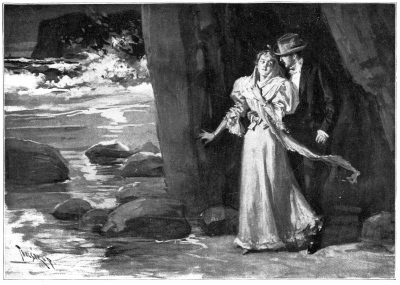 “ALL WAS VERY STILL SAVE FOR THE ETERNAL MONOTONE OF THE
SEA”
“ALL WAS VERY STILL SAVE FOR THE ETERNAL MONOTONE OF THE
SEA”
“Indeed not. Only I am so sorry for you.” His voice trembled.
“Let us walk along,” she said.
He obeyed. “You are not angry with me for being sorry?” he faltered.
“No, sympathy is always sweet. Though I do not deserve it, some people
will tell you.”
“What people?” he asked, fiercely.
“Olive’s people. They all say I saddened my husband’s last hours. He was
brought home dead from the hunting-field, you know. He had been—but,
no! de mortuis nil nisi bonum.”
“Tell me,” he said, softly.
She began to speak, then broke off. “No, why should I tell you?” she
said, gently.
“Because—because—I want to be your friend.”
Her bosom heaved. She caught her breath.
“It was a vile sporting-house.” She shuddered. “He left me with an oath
on his lips.”
Matthew Strang was at boiling-point. He ground the pebbles furiously
under his foot. Oh, the infamy of Society! That this lily should have
been handled roughly! It was sacrilege. And yet, in some subtle way, he
felt her more human than before. She, too—painful as it was to realize
it—had known the mire of life; she, too, this delicate flower of
womanhood! though it had left her unsullied, ethereal still. Then she
would understand what he had gone through, she would know how coarse and
unlovely life could be. He felt strangely nearer to her heart at this
moment; some icy partition had melted away.
She ceased walking, and put both hands over her face. The fleecy wrap
quivered on her shoulders. He waited in silent reverence.
“Perhaps I was inconsiderate,” she said at last, lifting her face
dimmed with tears, “not forbearing enough.”
“You angel!” he whispered.
“You’ll hear another story from his people. All—except Olive. They will
tell you that—that I am a—” she smiled wistfully—”a flirt.”
He had no words hot enough. He kicked a stone savagely. “The vile
slanderers!” he cried. “They are all tarred with the same brush. You’re
lucky to be done with them.”
“There was young Gerard Brode staying in the house, a mere boy up from
Oxford and bubbling over with Socialism. I was interested in his
theories and we had long talks, and I tried to convert Douglas—that was
my poor husband—and to persuade him that we ought to divide our
property with everybody; but he met me with coarse ribaldry, and said he
wasn’t going to divide his wife with any man, least of all a
whipper-snapper like Gerard Brode, and feeble taunts like that, and that
was the beginning of our dissensions.”
“Poor Mrs. Wyndwood!” he said, and felt it a sweet privilege to pity
her. “And so you spent your fortune on the movement.”
She smiled sadly. “Scarcely my fortune. Poor Douglas never lived to
inherit, and I wasn’t born with a gold spoon in my mouth, though it had
a crest on it. But who has been telling you about my indiscretions?” She
did not wait for an answer, adding: “But, there, you know all about me
now,” and her pathetic smile had a dazzling camaraderie, though it
flickered away as she wound up meditatively: “I wonder why I told you.
Shall we go in?”
“Not yet,” he pleaded, hastily. “Oh, if you knew how proud I am of your
confidences! That they should be made to me—to me! Oh, if you knew what
my life has been!” He felt choking.
“You terrify me,” she returned, lightly. “Nothing very dreadful, I
trust.”
“I am nothing, nobody.” He struggled with his voice. “I have slept in
the streets. I have consorted with the vilest.”
“All the more honor to you that you are fine.”
“Oh, if I had met you before! You would have inspired me, uplifted me.”
“No higher than you are.”
“Ah, you don’t understand. I have been so poor.”
“Poverty is not a crime.”
“I have been in prison.”
“You were innocent!” Her face shone.
“It was only for debt. I was the victim of a bankruptcy, and I have paid
it all off since. But the stain remains.”
“On the laws that put you there.”
He gulped down the great lump that made his throat dry and painful. “I
was born in a poor Nova-Scotian village. No one cared for Art.”
She stooped down and plucked up a sea-pink. “See! how sturdily it grows
among the stones!”
Now all the pent-up self-pity of the long, solitary years burst forth in
a great torrent, breaking through the proud, passionate reserve that no
living being had ever penetrated; his soul yielded up its secrets in a
strange blend of pride, self-depreciation, and yearning for the woman’s
sympathy.
“I have had to carry the hod, to climb the mast.”
“You climbed nearer heaven.”
“Ah, but I swabbed the deck.”
“You touched life at first hand. I have never envied you so much as now.
We never get near its secret, we idle rich.”
“You glorify my past for me. I see it now as a divine education. I have
been living for false ideals. Oh, if you could glorify my future!”
“I should be proud to inspire it!” The flash in her eyes passed to his.
“If I could see you every day, if I could tell you my hopes, my dreams.
But what am I asking? It is impossible. You are the beautiful Mrs.
Wyndwood, and I—”
“A genius, a Master! Towering over a humble slave!”
Her eyes, swimming in tears, but shining still, like stars through rain,
sought his in humble adoration. Never had he pictured such a look from
her. He shook, divining undreamed-of possibilities. For a moment he
forgot everything. He caught her hot hand and held it to his lips. In
that frenzy of divine fever, half fire, half tears, he felt again that
love rationalized life. An infinity of thought and emotion was
concentred in the instant; his long, sordid struggles, his craving for
happiness, the infinite yearning with which as a boy in a lonely forest
he had looked up at the stars. This was the secret of his yearning, this
the flash that illumined life. And underlying and intertangled with
everything, an astonishment at the vast sweep of life, the possibilities
it held. Last night Rosina and Camden Town; to-night Eleanor and the sea
and the stars.
She drew her hand away gently, though there was no rebuke in the
withdrawal, murmuring, “We must be going in,” and straightway the image
of Rosina arose sinister and vindictive, her voice raucous and strained
to a ghastly jocosity, crying, “Kisses, they’re off!” And then, as he
moved silently towards the house, thrilling with the memory of her hand
and her look, prisoned sobs still fluttering at his throat, he had a
sudden paradoxical intuition that if he spoke of his wife, as he had
been on the point of doing, something would go out of the magic of those
touches and glances, all spiritual though they were. The figure of
Rosina—sinister and vindictive—would stand between their souls,
troubling their most transcendental moments. Was not a man’s wife the
natural recipient of his confidences, the nurse of his Art? And then, if
Eleanor knew that he was ashamed of his wife, that he had always passed
as a bachelor, would she not deem him contemptible? The fine ethical
sense that had refused to despise him for material degradations, would
it not certainly scorn him for moral weaknesses? A great temptation took
him not to imperil by indiscreet speech the footing he had won. But his
soul had been moved to its depths. To be false—and with her!
“I have not told you all, Mrs. Wyndwood.”
“You can tell me nothing nobler.”
That was like an icy wind. He walked on storm-tossed. They came to a
jutting crag, skirted it, and the house rose radiant in the hollow of
the cliff. He had an aching vision of their living there together, she
and he, with all the dear domesticities of wedded union. His fancy
feigned them re-entering now their joint domain. The pretence left his
heart sick and empty. They walked across the lawn. “You would not call
me noble,” he said, coming to an abrupt stand-still, “if you knew that
I—”
He flinched under the sceptical, confident smile she threw over her
shoulder.
“That I am married.”
The half-mocking smile faded from the beautiful face, and with it the
color. She turned her head again towards the house, but she was not
moving forward.
He was glad he had not to meet her eyes. The sea broke solemnly with a
fused roar of irregular waves, and he wondered why the sound was so
continuous. A cricket’s chirp in the cliff-bushes seemed to him
extraordinarily loud. He looked up at the stars. Were the tears, indeed,
wiped from all eyes in those shining islands, he thought, or were they
only dead, lonely worlds? Or were they alive and full of unhappy people
like the star he stood on?
She spoke at last, with a catch in her breath and a strained smile in
her voice.
“Why should that make me think less of you?”
He caught only the celestial reassurance of her reply. How fine, how
sympathetic she was! But he hastened to immolate himself. Her unexpected
question had thrown him off the track; he forgot that his concealment
of his marriage was the only circumstance for which he had foreseen the
world’s blame, and he answered, desperately,
“Because I married for money.”
“For money,” she repeated, in a toneless voice.
He was cold and sick with shame. Despite her experience of the coarser
side of life, such a contingency was, he felt, quite beyond her
comprehension. That money played no part in her consciousness he would
have divined, even if her friend had not informed him of the fact in
their first talk. An impulse had driven him to humble himself, a
counter-instinct now spurred him to excuse himself.
“It was to pursue my art career,” he said, deprecatingly. Even now he
would not speak of the younger children he had had to support.
She turned her head again, and the smile was struggling back, and her
voice had an echo of the old enthusiastic ring.
“Then you married for Art, not for money!”
“Ah, do not comfort me! My God, how I am punished!”
She veered round now. Her tones were low and trembling with compassion.
“Is she a bad woman?”
“She is worse! She is a good woman. All her thoughts are on the
household; it is unbearable. Never a thought of anything but the kitchen
and cabbages.”
“Poor woman!” she said.
The prisoned sobs could hardly be choked back now.
“The world does not know. I have been ashamed of her. Now you see how
low I am, you cannot respect me.”
Her voice was almost a whisper.
“I respect you the more for what you have done in despite of her. You
have had a hard life.”
“Oh, have I not?” and a sob escaped at last.
“Compose yourself. We must go in.”
“You will be my friend all the same?”
“Yes, I will be your friend. Your confidences are safe in my keeping.
There is my hand.”
He took it again and held it fast, feeling its warm response. “You make
me so happy! Life will not be empty now.” He struggled with the lump in
his throat. “With your friendship, what can I not achieve? You shall
tell me what I am to strive for.”
“It is too great a responsibility. It was all very well to criticise. I
sha’n’t know what to say.”
“You need say nothing. I shall look into your eyes and read it there.”
He looked into them now, and they were not lowered. They were full of
sympathetic sweetness, glistening behind tears.
“I am afraid they are rather red,” she said, with a melancholy smile.
“If I am not careful they may betray your confidences.”
She moved forward in the direction of the water, and he, turning on his
heel, followed, wondering. By a salt pool near the rim of the billows
she bent down and bathed her face. To see her half kneeling in the
moonlight affected him like reading poetry; and as she washed off the
traces of the tears he had made her shed, it seemed to him as if their
spiritual friendship were being consecrated by some mystic baptism.
They went in. Olive had not moved from her indolent attitude in the
grandfather’s chair. Herbert was standing at the window-curtain.
“I’m so glad you’ve come in,” she said, yawning. “Mr. Herbert has been
sulking at having been left behind, and I have been snapping his head
off for not leaving me to myself.”
“Yes; Miss Regan speaks the truth for once,” said Herbert, audaciously.
“Oh, I am glad Primitiva is not here to have her ideal shattered.
Good-night—before you get ruder.”
“Good-night,” he responded, “before you get truthfuller.”
“Take care of him to-night, Mr. Matthew. He is irresponsible. Don’t go
by the cliff route.”
“Not I. Good-night, Miss Regan. Good-night, Mrs. Wyndwood.” And that
dear secret pressure thrilled his palm again.
In a few moments the two cousins were marching with measured step along
the winding road. Herbert had lit a cigar, but Matthew was busy enough
chewing the cud of his memories.
“Olive was rather strange to-night,” said Herbert, breaking the silence
of the cliff-tops.
“Not more than usual, surely?” answered Matthew.
“That’s your conventionality and your ignorance of women. I never found
her strange except to-night with her nonsense about the pain of the
world.”
“She’s talked to me like that before several times; she thinks people
with souls can’t be happy. I suppose it’s Mrs. Wyndwood’s influence over
her natural flippancy.”
“Ah, perhaps so. But why so formal, Matt? You have my permission to call
her Eleanor.”
“Thank you,” said Matthew, with a forced smile.
“I hope you enjoyed your tête-à-tête more than I did. Not that there
isn’t a certain fascination in sparring. But perhaps you fought, too.”
He returned a staccato “No.”
After a silence accentuated by the tramp, tramp of their automatic feet
as they swung along, he said: “I told her I was married.”
Herbert gave a long whistle. “The devil you did! And you don’t call that
fighting? What a knock-down blow!”
“What do you mean?” Matthew murmured.
“D’ you mean to say you don’t know the woman is in love with you?”
Matthew’s blood made delicious riot in his veins. He saw that strange
look of worship in her eyes again.
“Nonsense!” he jerked, thickly. “The Honorable Mrs. Wyndwood in love
with me!”
“I didn’t say the Honorable Mrs. Wyndwood. I said the woman. Trust me.
Behind all the titles and the purple and the fine linen—there’s flesh
and blood.”
“It is impossible. In love with me!”
“You may well be astonished, you duffer. To fix her affections on you
with me in the neighborhood! But women were always strange. And men were
deceivers ever.”
“All the more reason I shouldn’t deceive her. How glad I am I told her
the truth. I breathe easier, there’s a weight off my mind.”
“You selfish beggar! And now it’s all over between you, I suppose, and
our nice little constitutional quartette is broken up. And I thought it
was going to be so jolly when you came down. Heigho!”
“Don’t be afraid,” said Matthew, with a touch of bitterness.
“Eleanor—Mrs. Wyndwood and I are going to be better friends than
ever—thank God!”
“Thank whom? Don’t be blasphemous.”
“Thank God,” repeated Matthew, firmly.
“Oh, well, you were always a Methodist parson. But if I were a Jew, I
wouldn’t say grace over pork. Not a bad epigram that; I must get it into
my comedy.”
Matthew shuddered. Herbert’s tone was desecrating. “You don’t
understand,” he said.
“Don’t plume yourself on your superior intelligence, old man. Mine’s
quite equal to the study of Plato. It isn’t such Greek to me as you
imagine.”
“Well, whatever you think, you are quite wrong,” he replied, with
spirit. “Our friendship is on a different plane. It is based on our
common interest in Art—and Mrs. Wyndwood’s not the sort of woman you’ve
had experience of.”
“Well, that’s cool! How do you know what sort of women I’ve had
experience of? Besides, a woman is a woman. The world—our world, that
is—is full of Greek scholars who study Plato. Strictly under the rose.
Society is only an incarnate wink.”
“I should put that into the comedy,” sneered Matthew.
“It’s a quotation from it,” laughed Herbert. “Had you there, my boy.”
It nearly came to a quarrel. But Herbert good-naturedly said he must
save Matthew from himself, and he fervently hoped his cousin would not
confide in any more women. “You can’t syndicate a secret,” he said,
sternly.
At the house they had left, things were equally disturbed. Mrs. Wyndwood
retired at once to bed, throwing herself upon it in her clothes; and her
delicate white shoulders, which, like her emotions, had no need to be
covered up now, rose and fell spasmodically. After a while she got up,
bathed her eyes again, in fresh water this time, and went into Olive’s
room. Miss Regan was brushing her dusky tresses savagely. She had sent
her maid to bed.
“Nice hours,” she growled.
“You’ll catch cold, dear,” Eleanor replied, gently, for a window was
wide open at the bottom.
“Nonsense, Nor,” said Olive, petulantly. “I should like to sleep on the
beach.”
“What, in this costume?”
“One bathes in less. Still, while you’re here—”
She closed the window with a bang.
“Olive! You make my heart jump.”
“Really? I’m not a man.”
Mrs. Wyndwood colored painfully, then looked at her with brimming eyes
of reproach. “And this is my reward for leaving you tête-à-tête.”
“Leaving me tête-à-tête. I thought that was a by-product.”
Mrs. Wyndwood controlled her vexation. “I said just now I had never
known any one so easy to live with. Don’t make me change my opinion,
dear.”
“So you’ve been discussing me with Matthew! And what right have you to
discuss me with anybody? Oh, how hateful everybody is! I know what it
is. You’d like to see me brought down to your level.”
“Good-night, Miss Regan. You will apologize in the morning.”
“Don’t glare. The level of womanhood, if you like. You’ve loved a man.”
Eleanor’s face flushed. “That is the height of womanhood, Olive.”
“Oh yes—fine phrases! The height of womanhood!” She drew a comb
fiercely through her hair. “To hang on a man’s lips, to feel a foolish
sense of blankness when he isn’t there, and a great wave of joyful pain
when he heaves in sight again. To kiss his every little note! To think
of him and your trivial self as the centre of the universe, and to want
the planets to spin for your joint happiness—oh!” She pulled the comb
viciously through a knot.
“You describe it very accurately, Olive,” said her friend, maliciously.
“I’m quoting the novels. This passion that they crack up so much seems
nothing more than selfishness at compound interest.”
“Selfishness! When you yourself say it makes you yearn for the other
person’s happiness.”
“So that it may subserve yours.”
“You are a cynic.”
“What is a cynic? An accurate observer of life. Oh, you needn’t smile. I
know I’m quoting, but one can’t put quotation marks into one’s
conversation. You can’t face the facts of life, Nor. You like dull
people without insight.”
“I like you.”
“That’s too cheap. You like socialists and spiritualists and poets and
painters—the whole spawn of idealists. Bah! They ought to have a
month’s experience of a hospital.”
“The world isn’t a hospital ward, Olive. The people I like have the
truer insight.”
“What insight has your Matthew Strang?”
“He is as much yours as mine.”
“Don’t shuffle out of the question.”
“His insight expresses itself through his work. He doesn’t talk.”
“Is that a hit at his cousin?” queried Olive, savagely. “If so, it falls
remarkably flat, considering Herbert Strang paints as well as talks.”
“Olive, why will you put words into my mouth? You know how much I admire
Herbert Strang.”
“Ah, then you have more insight than I gave you credit for. You may even
understand that a cynic is only a disappointed idealist, a saint plus
insight. His soul is a palace of truth; society and its shams come to
the test, yield up their implicit falseness, and are scornfully
rejected. The stroke of wit is made with the sword of judgment. Its
shaft is the lightning of righteous indignation.”
Mrs. Wyndwood felt this might pass well enough for an analysis of
Olive’s own cynicism, but she had her doubts as to its applicability to
Herbert’s.
Olive puzzled her frequently, and shocked her not seldom, but she felt
instinctively that hers were the aberrations of a noble nature, while
the cynicisms of Herbert jarred upon her without such reassurance of
sweet bells jangled. Not that she doubted but that he, too, was much
more idealistic than he made himself out—did he not write charming
comedy love-scenes? Still he was a man who had seen the world, not a
crude girl like Olive, and in the face of Olive’s affectionate analysis
of Herbert—which she rightly divined owed less to reason than to the
growing love for him which she had long suspected in her turbulent
friend—Eleanor felt vaguely that while jarring notes may be struck from
the soundest keyboard, they may also be the index of an instrument
hopelessly out of tune. Of course Herbert was not that, she was sure; he
lacked Matthew’s idealism and manly beauty, but he was handsome, too, in
his daintier way, and charming and gifted, and probably the very husband
to put an end to Olive’s psychical growing-pains. All this mixture of
acute and feeble insight occupied Eleanor’s consciousness.
But all she said was, “Is that Emerson?”
“No, it’s me. Now go to bed and sleep on it.”
“I sha’n’t. I couldn’t sleep on anything so hard. Dear me, what a lot of
hair-pins you have! What nice ones! I must borrow some.”
“Take them all and go.”
“Not yet.”
“I shall blow out the candles,” snapped Olive.
“I love talking in the dark. I’m pining for feminine conversation to
soothe my overwrought nerves. How pretty that lace is!” Eleanor touched
her friend’s shoulder cajolingly. “What exquisite things you have!
Everything—from hair-pins to carving-knives—perfect after its kind,
like the animals that went into the ark. It will be difficult to give
you a wedding present.”
Olive laughed, despite herself.
“The only wedding present a woman wants is a husband.”
“You have had plenty of those presents offered you, dear.”
Olive shuddered violently. “Imagine existence with a Guardsman
or—worse!—with that doddering young Duke! Dulness without idealism.
Your Matthew Strang is endurable—he has at least the family idealism,
the Strang goodness, though he carries it so much more heavily than his
cousin. But a lifetime with a dull man—who wouldn’t understand a
joke—who would smile and smile and be a hypocrite! Oh, ye gods! I
should shriek! In a year I should be in a lunatic asylum, or the Divorce
Court. Oh, why do you women who have been through the mill egg us girls
on? Is it the same instinct that makes an ex-fag send his boy to Eton?
Or do you think it improves our health? I know you think me hysterical.”
Mrs. Wyndwood flushed.
“Your tongue runs away with you, Olive. You’d do better to say your
prayers. I’ll leave you to them.”
Olive laughed hilariously. “Aha! I thought that would get you to go. You
always will forget that I’ve been in a hospital. Say my prayers, eh? Let
me see, what shall I say? The one I used to say in the hospital, ‘O
Lord, I beseech Thee, let not this be counted unto me for righteousness,
for Thou knowest, O Lord, that I can’t help it.’ But that’s not
applicable now. Suppose I say just what’s in my heart, as the
theologians recommend.” She went down on her knees and said solemnly:
“O Lord, don’t you think you are sometimes a little hard upon us? Don’t
you think we are born into a very confusing world? It would be so easy
to do Thy will, to make Thy will our will, if we only knew what it was.
Don’t you think that half our life that might be devoted to Thy service
is wasted because of the mist through which we grope, bearing the
offering of our life in quest of we know not what Divine altar, and
blurring the road more thickly with our tears?” She sprang up. “How’s
that for an addition to the Liturgy, Nor?”
“I am disgusted,” said Mrs. Wyndwood, sternly. “Both blasphemous and
ungrammatical.”
Olive threw herself back on the bed, laughing unrestrainedly: “You
delightful, stupid old thing. Ha! ha! ha! Blasphemous and
ungrammatical! You Dissenting Hellenist! Sacrilege and Syntax! Ha! ha!
ha! No, you sha’n’t escape. You must abide the question. Tell me, O
friend of my soul, why do women who have been unhappily married want to
see other women victimized equally, like people who have been fooled in
a penny show and come out laughing to beguile the other people?”
“That’s not a fair analogy,” said Eleanor, more gently.
Olive looked up archly, her arms under her head.
“No, perhaps not in your case. I dare say you’re quite capable of
marrying again, yourself. The triumph of hope over experience. Quotation
marks, please. You’re looking awfully handsome, Nor, and that saucy tilt
of your nose spoils you for a saint. Speaking as an ex-sculptress, it’s
like a blunt pencil.” She sprang up remorsefully: “Oh, I’m a beast. I
apologize to your nose. I forgot the tip was a sore point.”
Mrs. Wyndwood drew back in sorrowful hauteur. “I shall never marry
again, Olive,” she said, solemnly. There was an under-tone of self-pity,
and her eyes were moist. She turned hastily and walked from the room
with a firm, stately step.
Olive watched the sweep of the gown till it reached the door. Then she
gave chase and renewed her apologies, and let Eleanor sob out sweet
reconciliation on her shoulder.
After which she opened the window, sat on the side of the bed, and
screwed up her ripe red lips to produce a perplexed whistle.
They fleeted the days delightfully, as men did in the golden world. They
rode together on the rolling moors, they drove through the Devonshire
lanes, they strolled through combe and copse, they climbed the tors,
they fished the leys, they swam in the sea, and when it was cloudy and
cold, and the wind wailed about the house like a woman in pain, they
listened to the comedy which Herbert wrote in those dreary days when the
ladies drove off to distant houses for lunch or tennis or croquet. For
they had not quite hidden their retreat or detached themselves from
their kind.
“There’s always scandal within a four-mile radius,” as Miss Regan put
it. “Is there on earth a greater piece of philanthropy than to give your
neighbors food for gossip? Man cannot live by bread alone.” Matthew
asked her in concern if his and Herbert’s visits were causing any talk.
“My dear Mr. Matthew,” she replied, scornfully, “even an actress cannot
escape scandal, especially if she goes into society. And truly society
is so corrupt, I have often wondered that actresses’ mothers allow them
to go into it!”
During one of these absences of the feminine element, when Herbert went
over to the house to put the last touches to the painted costume,
grumbling at the boredom of such finicking work, Matthew gladly relieved
him of the brush, and worked up the whole portrait, while Herbert lay
smoking and thinking out the comedy.
Partly out of bravado, partly to enjoy the series of lovely views of
dark-green sea and broken crags and nestling villages, the cousins
invariably arrived by the cliff-path, seeing the blackberries get riper
every day. Sometimes they found the ladies sitting reading on the top of
the cliff, which was furzy, with a road-side border of hemlock and
dandelions and blue orchids, amid which their dainty parasols showed
from afar like gigantic tropical flowers. Then while Matthew drowsed in
the light of the sun and of Eleanor, inhaling the odors of bracken and
thyme, lazily watching the white surf break far below, the brown
trawlers glide across the horizon, the swallows swarm on the beach, and
the wild ducks over the sea, Herbert and Olive would rattle away by the
hour, often in verbal duels. Matthew Strang thought he had never tasted
such pure intellectual joy. Art was often on the tapis; they classified
the skies—to-day a Constable, and yesterday a Turner, and to-morrow a
Corot. Herbert expounded glibly to the rapt Eleanor the Continental
ideas, descanting on Manet and Monet. Nature lay all around them like a
model to illustrate these theories, and Eleanor discovered all sorts of
shadows and subtle effects she had never noticed before, all with the
naïve joy of a child lighting on pretty treasures. She cried out that
Art taught people to see Nature. And the Impressionists were right. Look
over there! You couldn’t tell whether it was a pool or a pile of fish.
And the colors of things changed incessantly! Matthew would sometimes
put in a word when appealed to by her, but never when the subject was
music, concerning which he was as ignorant as the rest of the party was
learned. Once Herbert maintained that the musician was better off than
the painter, because his work remained, while pictures perished,
destroyed by the aniline and bitumen in their own colors. “Even Mona
Lisa’s smile will fade,” he said. “The artist lingers a little longer on
the stage than the actor. Pictures are but paltry things at best, and
few artists have brains or any large outlook upon life. They’re a petty,
quarrelsome clan.” Matthew did not deny it.
Olive cited sculpture as a more durable art than the musician’s, which
only lived when performed. Mrs. Wyndwood was convinced that the joy of
Art must be to the artist; she said she was fast acquiring a keen
interest in the subjective side of Art, and feeling a growing desire to
be an artist herself. The Spiritual was all very well, but it needed to
be expressed through the Beautiful.
Olive playfully suggested an expedition to the Latin Quarter; Mrs.
Wyndwood accepted it seriously and eagerly; she returned to the idea
again and again, both in public and in private. Why should they not go
to Paris for the winter, and Olive take up sculpture again, and initiate
her into the divine mysteries? To judge by the Strangs, artists must be
delightful creatures to live among, and sculpture seemed easier and
simpler than painting. Olive continued to play with the project. Herbert
sneered at the idea of Miss Regan’s return to the plaster of Paris.
Literature was, after all, the only art, he said. It contained
everything—music of words, painting of scenery, passion of drama. He
almost converted Mrs. Wyndwood. She quoted ecstatically, “L’univers a
été fait pour aboutir à un beau livre.” But a word from Matthew
restored the balance.
They talked of life, too, of fate, free-will, and knowledge absolute,
like Milton’s archangels. Herbert, as Lucifer, steadfastly took the
lowest views of human nature; now and then Olive’s eye, twinkling with
fun, met his as if in a secret understanding that Mrs. Wyndwood must be
shocked at all hazards. He fought for the doctrine that sin was a human
invention. “Let people have their fling. They exaggerate their powers of
sinning. They think they can draw on a boundless internal reservoir of
wickedness. As a matter of fact, their powers are singularly limited.
They have too much original goodness. For my part, alas! I have found
few opportunities of sinning.”
“And have you never found opportunities for remorse?” Mrs. Wyndwood
asked, scathingly.
“Alas! often, I tell you. Remorse for the sins I couldn’t do. The
remorse of your religious person is too often like the snivelling
repentance of the condemned criminal. That murderer felt a truer remorse
who was unexpectedly reprieved after indulging in an indigestible
breakfast.”
Olive laughed heartily. “That must go into the comedy.”
It had become their stock phrase. Then remembering her part in the
comedy was to score off Herbert, she capped his anecdote of the
condemned criminal by another about the politeness of a Frenchman, who,
ascending the scaffold, said to his neighbor in the tumbril, “Après
vous.”
Eleanor raised the talk to a more elevated plane, insisting on the value
of remorse, and of suffering generally. “I would not recall one of my
sufferings,” said she, with her simple earnestness. “If I didn’t suffer
I shouldn’t think I had grown.” And her eyes instinctively sought
Matthew’s, and he thought she was reminding him of the educative
efficacy of his own sufferings as well, and again Herbert’s philosophy
jarred.
And whatever she was saying or doing she always fell naturally into some
attitude that enchanted his eye by its unaffected grace; always wore an
expression whose sweetness and candor softened him in worship. Her
beauty—to a painter’s soul the miracle of miracles—she wore with a
royal unconsciousness; he could not understand it. She was so simple,
just like a human being. He saw her, not in her society drapings, but in
all moods and weathers, and she bore the test. On fishing days they
would draw up the boat in the centre of the nearest ley, where perch and
“rudd” abounded, the former avid of the gentles, the latter only less
eager for the paste, but demanding an iota of skill when hooked. Olive
would take no hand in this mild sport; she had given up hunting and
fishing, she said, when she rose in the ethical scale. Challenged as to
her readiness to eat meat and fish, she failed to see the relevancy of
the criticism. The reason she wouldn’t kill other creatures was not that
it gave them pain, but that it gave her pain; to eat them, on the
contrary, gave her pleasure. Mrs. Wyndwood, however, though not callous
enough to impale her own worms, was persuaded by Matthew to take a rod,
and beguiled numbers of perch, and admitted to a thrill of savage joy
each time she hauled up a leaping flash of silver. She was glad, though,
she said, that the poor little fishes had horny membranes for gills, so
that the hook should not hurt them; when it passed through the eye, she
trusted that the cornea was insensitive, too.
“But how would you feel,” Olive once remonstrated, “if, sitting at
dinner, just after swallowing a mouthful of mayonnaise, and in the
middle of a remark to your neighbor about the Rhine or the
Pre-Raphaelites, you were suddenly to find yourself rising towards the
ceiling, at the end of a rope fixed by a hook to your upper lip, and
arriving slowly but surely, despite your kicking and writhing, into a
stratum of air totally devoid of oxygen?”
Herbert Strang thought one would feel like a fish out of water, but
Matthew Strang eluded the point by drawing a pike across the track. The
bait of a captured roach had fetched the monster, whose struggles
interested even Olive, while Eleanor was wrought up to a wild enthusiasm
for Matthew’s prowess, and regretted that in Scotland she had always
refused to go to see the grouse-shooting.
“I hear they are doing badly this year,” Olive observed.
“Oh no, Olive,” cried Mrs. Wyndwood. “Didn’t we hear at the Archdeacon’s
yesterday that they were making excellent bags?”
“I meant the birds,” said Olive, dryly.
“Bother the birds! I should love to be a sportsman,” cried Eleanor,
exultantly landing her eleventh perch. They trooped like children to the
dinner-bell. “I can see how fascinating it must be. To actually feel
the struggle for existence; it brings you back to the primitive. You
touch reality; you remember you’re an animal.”
“Lunch always reminds me sufficiently of that,” said Olive.
“No,” Eleanor argued. “The napery and the flowers come between us and
the facts. How glorious it would be to be primitive!” Between Art and
Sport—with that charming impressionability of hers—she had drifted as
far from the spiritualities of Dolkovitch as, under the Russian’s
influence, from the Socialism of Gerard Brode.
Herbert, whose skill with the rod was not remarkable, diverged into an
account of his stay in a Servian fishing-village which was entirely
primitive, “so primitive,” he said, laughing, “that the wives do most of
the work.” He sketched the place with admirable literary touches.
“Sheepskin is their only wear,” he wound up. “In the winter they wear
the wool outside. In the summer they take off their skins and—no, not
sit in their bones, as Miss Regan is about to remark—but wear the wool
inside.”
Matthew was thus led on to relate juvenile sporting experiences on the
shores of the Bay of Fundy, and finally his one encounter with a bear in
the Cobequid forest, which put the seal on Mrs. Wyndwood’s new-born
ardor for sport. This tame picking-up of perch palled; they must go
mackerel-fishing, she insisted. And so Matthew Strang arranged with a
fisherman to go out to sea in his boat next day. But the sea ran high,
and to the undisguised relief of Herbert, who felt himself rather cut
out by his cousin in these unliterary expeditions, Primitiva arrived the
first thing in the morning with a note from Mrs. Wyndwood, saying she
had forgotten the lawn-meet at Colonel Chesham’s to inaugurate the
season of the local pack, and she would ride over to that in the hope of
catching sight of a bit of the hunt. There was a postscript from Olive,
saying: “And, of course, I must go to chaperon her among all those men.”
Nevertheless, they went out in the boat late that same afternoon, when
the ocean was calm again and quivering in the sun. Their course lay
along a track of diamonds which seemed to dance off the water like a
million elves of light. By the time they returned, the path of diamonds
had changed to one of red gold. Delicious was the ripping sound of the
living boat tearing the water, as it dipped gently from side to side,
its white sail bellying gracefully. The sunset was strange: one dull red
narrow bar crowned by a ball of molten gold radiating four hazy spokes
like mill-sails. The ball gradually sank in the sea. In the south the
white sickle of the moon grew yellower and yellower; in the east fleecy
strips of cloud reflected the dying day. The colors of the cliffs still
stood out vivid. The moment was poetic; the air was charged with amorous
electricity. The talk drifted into love and marriage.
They played with the subject, skimming it gracefully, touching it with
subtle lights, flashed and withdrawn, shooting out audacities with
ingenuous impersonality, all four the while tingling with
self-consciousness from crown to sole.
Herbert said that to a woman love is a complete romance, to a man a
collection of short stories. Olive maintained that the reverse was true.
“Oh, if man knew woman!” she cried. “And you who pretend to write
comedies!”
Mrs. Wyndwood admitted that Byron was right about love being all in all
to a woman. “Nine-tenths of unmarried women,” she said, looking at
Herbert, “have never had a proposal.”
“Nine-tenths of married women more likely,” Olive flashed back.
In Matthew’s opinion marriage was a failure. Mrs. Wyndwood sadly
acquiesced. They sought the remedy.
“Marriage may be a failure, but not friendship,” Olive pronounced.
Now it was Matthew’s eyes that Eleanor’s sought, and his involuntarily
met hers. There was exaltation in this secret glance, and mutual
reassurance.
“Unless,” pursued Olive, “the friendship is contracted between persons
of different sex.”
Mrs. Wyndwood’s eyes drooped; then opened full again to note how Matthew
took the addendum. The friends perceived themselves reddening in
simultaneous confession that Olive was not so very wrong; an indefinable
expression, half abashment, half radiance, flickered over Eleanor’s
features; her glance, swift, probing, challenging, dazzled him; his
whole frame trembled at the thought that this heavenly creature could
love him. Then he grew chill again, for she cried, as in the highest
spirits:
“Oh, look at the sun! How comic!”
It had, indeed, become a clown’s face, swollen and bulbous and crossed
with red bars.
The talk went on to Woman’s Rights, and Matthew mentioned that he had an
indirect relation to the subject, because a girl he used to know in
childhood had become Linda Verder’s secretary.
“Is she pretty?” Mrs. Wyndwood asked.
“I don’t know; I’ve never seen her.”
“But you said you used to know her.”
“Oh! you mean Ruth Hailey. She used to be pretty, but my brother tells
me she’s gone off.”
“Haven’t you seen her yourself?”
“Oh! not for years.”
“I sent Mrs. Verder a subscription some few years ago,” said Mrs.
Wyndwood, “but I have ceased to believe in Woman’s Rights.”
“Woman’s Rights are a husband and children,” said Herbert, with his eye
fixed on Olive.
“It is a mistake for the movement to be led by women,” pursued Mrs.
Wyndwood.
“Oh, was that why you resigned when Lord Boscombe left the Council?”
asked Olive, innocently.
Eleanor looked annoyed. “You mean, Mrs. Wyndwood,” Matthew hastened to
say, “that they lay themselves open to the imputation of being soured
spinsters.”
“Precisely,” she replied. “Besides, they are crying for the moon.”
“Or the man in it,” muttered Olive.
“No; that’s ungenerous to your sisters,” said Eleanor.
“Why demand generosity?” Olive retorted. “We are all in the same trade.”
And she smiled audaciously at Herbert. “Even Mrs. Verder didn’t take up
with this movement till she lost her husband, and I’ll wager this Ruth
Bailey is an old maid.”
“Ruth Hailey,” corrected Matthew, flushing painfully, he scarcely knew
why, perhaps from sympathy with the aspersed friend of his childhood.
“She is unmarried, but I am quite sure it must be from her own choice,
for she is very pretty.”
“You said she wasn’t,” said Mrs. Wyndwood, quickly.
He laughed confusedly. “I was thinking of the girl.”
The subject dropped.
Ere they got in the wind freshened and Matthew was busy with the sheet.
And now a proposition was broached which promised to bring a new
sensation into their comparatively sequestered existence. Light-hearted
discussions as to what they would do in the event of capsizing through
Matthew’s mishandling of the sail led to estimates of the distance they
could swim in their clothes. Mrs. Wyndwood could not swim at all, and
complained of the abrupt shelving of the beach, which gave her only a
few feet of splashing room, while Olive was sailing gloriously off in
search of the horizon. Herbert said that, like the man who was asked if
he could play the violin, he didn’t know if he could swim in his
clothes, because he had never tried, and, besides, he had his comedy in
his pocket, which was heavy enough to drag down a theatre. Olive said
she didn’t see that it made any difference whether a lady swam in her
clothes or not, especially if she was in evening dress. She claimed that
the cap and gown worn in the water were as heavy as men’s boating
flannels.
The upshot of the discussion was that Miss Regan challenged Mr. Matthew
Strang to a race in clothes, which, she insisted, must be new. “You
don’t go out getting capsized in old clothes,” she contended. “Boots you
needn’t have, nor a coat; people always have time to throw them off—in
books. I shall be clothed in a new yachting costume, superficially, of
course, to counteract your sheddings from above.”
“What waste!” remonstrated Eleanor.
“You who pretend to philanthropy!” mocked Herbert, mimicking her
intonation of “You who pretend to write comedies!”
“Waste? To learn to save my life! And don’t you see I shall forthwith
give away the spoiled costume to a poor creature who would never
otherwise have got it?” And Olive, who was quite serious, fell to
elaborating a facetious programme of “The Creamery Regatta.”
The regatta day duly arrived. Two bathing tents were erected on the
beach and decorated with flags. It was arranged that the competitors
should swim out leisurely together as far as they cared to go, then turn
and race for shore. Herbert was chosen referee; he offered to take them
out in a boat and then accompany them back, as a precaution, but Olive
laughed at him for an old woman. Eleanor, entering enthusiastically into
the fun, had ordered a silver cup from London, and was to present it to
the winner.
But the day opened badly, with fitful weather; a gray rain, and thunder
and lightning. They waited till the afternoon, when the sun burst out in
sudden fire, and in a moment the great stretch of gray cloud was
shrivelling off all around it like a burned cobweb. The eager combatants
dashed into their dressing-tents, and, emerging as lightly clad as was
compatible with the conditions, they plunged together into the great
sapphire sea. Olive’s yachting costume turned out to be a pair of
knickerbockers and a jacket, rather lighter than her ordinary bathing
costume, and Matthew had begged off his waistcoat, and was only hampered
by a white flannel shirt and trousers. The outward swim was an ecstasy;
the water was warm and sparkling with patches of molten silver breaking
up into little shining circles and reuniting; it sent a voluptuous
thrill to the palms to cleave its buoyant elasticity, and the forward
movement of the body was a rapture. Drawing in the balmy air with joyous
breaths, Matthew felt an immense gratitude for existence. There was
exhilaration in the mere proximity of Olive, with her lively snatches of
conversation. Her lovely flushed face and dripping hair went with him
like a mermaiden’s. The same thought struck her, for she began to sing
jerkily with her beautiful voice snatches of Heine’s ballad:
“Die schönste Jungfrau sitzet
Dort oben wunderbar,
Ihr gold’nes Geschmeide blitzet,
Sie kämmt ihr gold’nes Haar.”
“Yes, but you haven’t got golden hair,” the man laughed, joyously.
Farther and farther they swam into the vast shimmering blue, and ecstasy
made the pace brisker than they had meditated.
“Shall we start from here?” he asked, at last.
“No, not yet. I want a long race.”
They swam on. The brown trawling boats loomed plainer in the offing.
“Here?” said Matthew.
“No—a little farther, faint-heart!”
He turned on his back and propelled himself gently, gazing up in
luxurious content at the great circle of blue sky, cloud-mottled round
its rim. Olive, lying on her side, paddled lazily a little ahead.
“This is delicious!” she called back. “Clothes make no difference. But
fancy a clothed Lorelei!” And she began to sing again, with pauses for
breath:
“Den Schiffer im kleinen Schiffe
Ergreift es mit wildem Weh;
Er schaut nicht die Felsenriffe,
Er schaut nur hinauf in die Höh’.”
He threw the reply over his head: “You shall lure me no farther.” But
she mocked him, elated by the glory of motion, and witched him to follow
her till the shore was far.
At last they turned, trod water, Olive cried, “One, two, three,” and
they were off.
For some minutes they swam side by side, Olive making the pace, and
Matthew finding it no trouble to keep up with it; at last she made a
spurt and shot past him with a triumphant taunt; he allowed her to enjoy
some seconds of victory, then came up hand-over-hand and forged ahead.
He eased off and she overtook him; he spurted and she flagged; he let
her come up again and she came up with a sneer. Resolved to damp her
frolicsome spirits, he put on a powerful stroke and showed her a clean
pair of heels. She made a desperate effort and drew level with him
again. The instinct of victory was now aroused in the painter; he fixed
his eyes on the shore and settled steadily to the task of reaching it.
Very soon Olive was hopelessly in the rear. He still heard her vague
cries from afar. At last they died away entirely. He turned his head to
measure the interval. Olive was nowhere to be seen.
His heart contracted with a cold sick horror. He raced back with great
side strokes, shouting, “Miss Regan, Miss Regan, holloa!” The great
sparkling water stretched all around in deadly silent bareness, suddenly
become an evil enemy. He hoped desperately she was only swimming under
water for speed or to frighten him.
And then in a moment her head popped up to the right, and he saw from
the exhausted expression of the face and the spasmodic struggles of the
limbs that she had really gone under. In a few strokes he was at her
side. She still retained sufficient self-possession not to grab at him;
he supported her with one hand, then with the rest of his limbs he
struck out stoutly for home, she helping him with feeble movements.
After an interval of weakness and humility, she recovered somewhat and
smiled faintly.
“So you wouldn’t follow the Lorelei,” she spluttered, reproachfully.
“I am sorry I followed her so far,” he said, ruefully regarding the
distant shore.
Olive struggled for breath. “Prosaic man! I waited down there for you,
but I gave you up and came to the surface again.” She essayed sturdier
kicks.
“You only sank once?” he said.
“Yes; didn’t you hear me calling you to come?”
“I heard sounds, but I thought they were epigrams.”
“Brute! To hit a woman when she’s down. But I shall be better soon.... I
hope they can’t see us from shore.”
“Don’t talk! You brought Herbert an opera-glass to see we started fair.”
“Nonsense,” Olive gasped, indignantly.
“I distinctly remember it.”
“How dare you set up your memory against a drowning woman’s?”
He was glad to find her like herself, and not alarmed. Her strokes were
getting stronger now, but he still feared for the consequences if she
should suddenly lose her nerve. “What did you think of when you sank?”
he asked, lightly, to make her think the danger of sinking was over.
“Of Her—” she began, and stopped short. “Of her carryings-on at my
funeral, poor Nor. I was regretting I hadn’t made my will and left her
my nose.”
This sounded pure nonsense to her companion.
“I think I can go by myself now,” she added, after a long silence.
“Thank you so much for the use of your arm.”
“You are quite sure?” he said, anxiously.
“Yes. Of course, you have won.”
He removed his arm, but kept watchfully at her side. And his misgivings
were justified, for, after a slow twenty yards, her strokes became so
spent and irregular that he came to her assistance again, and she
accepted his support with a wan smile.
“It’s this soppy, clogging costume,” she said.
“You had better keep your breath in your lungs,” he said, not in rebuke,
but in hortation.
“I’ll inflate myself like an air-balloon,” she replied, humbly. “I am so
sorry to be such a nuisance.” And she turned upon her back and paddled
feebly in silence.
He did not answer, for his own nerve was giving way. The responsibility
weighed more than the burden, though that was heavy enough with the
double weight of superadded garments. He had a spasm of sickening
apprehension. His own strokes were getting jerkier; what if he should
fail to reach that strip of beach on which he dimly descried two
agitated figures! And in this tense, terrible moment the figures were
blotted out, he saw only the cliffs in the background and the white
sea-gulls overhead, and he was a boy again in the Bay of Fundy, swimming
in his clothes for dear life. The illusion was momentary, but it left
the memory. A sense of the tragic contrast between the ardent
Nova-Scotian lad, dreaming of pictures, and the popular London painter,
occupied his consciousness, while his limbs moved automatically
shoreward. Then he remembered that of the two who had struck out for
home on that memorable day the sailor had only put off the day of
drowning. And at the thought that ancient dead face swam up again in
front of him. Oh, it was horrible to die, to be dragged down out of the
sunlight, to leave a world which held Eleanor Wyndwood! What would
become of her? She would live to forget him; she would marry; another
man would hold her in his arms. Another man! Oh, direful thought,
bitterer than death! There was no need for his death ere another man
could possess her. She was only his friend; he had not wanted more than
her friendship. Oh, ghastly self-delusion! Olive’s sneer at the
friendship of the sexes rang in his brain, and that strange intoxicating
expression in Eleanor’s face—half abashment, half radiance—dispelled
the vision of his father’s. In a moment of delirium his lips touched her
warm cheek; it was her weight that was on his arm. What did it matter if
they had a gleam of happiness, he and Eleanor, both victims of an
unsatisfactory world? Was not the great, shining, mocking, remorseless
sea waiting to suck him down, indifferent to the aspirations and
agonizings of the long years? And then between his lips and hers the
dead stony face swam up again, and he turned on his back to escape it,
and found unexpected relief in the more reposeful attitude and in the
change of arm involved, for the left, which had supported Olive, had
grown numb. When, sufficiently rested, he turned again he saw with a
thrill of joy that the shore was perceptibly nearer. There were more
than two figures now; he made out Primitiva and the old cook. And
Herbert’s arm was round Mrs. Wyndwood’s waist, supporting her. A
powerful spurt brought him within clear hearing of Herbert’s hail.
“Shall I come out?”
Olive roused herself. “What for?” she sang out, lustily. “The race is
decided.”
“All right,” came the joyous reply. “I was sure Matt could manage it. I
wouldn’t spoil his chances of a medal.”
As they came nearer in he cheered them on with sportive ejaculations,
and confounded the beach because there wasn’t a single boat within half
a mile. When the couple scrambled on shore, shaking themselves like
spaniels, Mrs. Wyndwood dragged more heavily on Herbert’s sustaining
arm, and he saw that she had fainted. Almost at the same instant, by a
curious coincidence, the sun, upon which the clouds had gradually been
closing in, again disappeared, and the wail of the wind rang wilder
round the cliffs.
There was confusion in the household that afternoon. Mrs. Wyndwood soon
revived, but had to be put to bed, and Miss Regan, who was secretly
grateful for an excitement that kept her from assuming the invalid
herself, sat with her. The men hung about the house, anxious, and
receiving frequent reassuring bulletins by the lips of Primitiva.
Presently those pretty lips brought them an invitation to stay to seven
o’clock dinner, when Mrs. Wyndwood would try to come down to present the
cup. They need have no delicacy about the larder, for Colonel Chesham
had opportunely sent Mrs. Wyndwood a gift of grouse. They galloped over
the cliffs to get themselves into their dress-clothes. Meantime Mrs.
Wyndwood had fallen asleep, and at her bedside Olive Regan writhed in a
black paroxysm, asking herself why, having once gone down, she had
wanted to come up again.
The hostesses were a little late, but the reunion was gay beyond all
precedent. The last trappings of ceremony were thrown off. A Bohemian
merriment reigned, regardless of the liveried menial who alone sustained
the dignity of the dinner-table. Mrs. Wyndwood, looking a shade paler
and more spiritual, but no whit less beautiful than her wont, appeared
in a low white satin gown, with the same jewelled butterfly poised at
the bosom as on the night when Matthew had met her at the Academy
soirée. He fancied some occult significance in the circumstance. Olive
was in soft green that harmonized so suavely with her complexion as to
give her a less aggressive air than when she wore blue. There was a
fragrant tea-rose with a sprig of maiden-hair fern at her throat; and
the table was gay with many choice specimens of aster and hydrangea,
presents from Primitiva’s father. Outside the roar of the sea and the
wail of the wind emphasized the charm and comfort of the interior and
the gladness of being alive.
There was a wavering flush on Mrs. Wyndwood’s cheek and a shining
moisture in her eye as, before they sat down, she presented Matthew with
the cup, which Olive complained had been dashed from her lips.
Interrogated as to her sensations, she said she had a horrible feeling
of littleness in the midst of the great churn of waters and under the
naked sky. It did not seem the same sea she had been bestriding so
recklessly and voluptuously. She seemed to herself absolutely
unimportant—a mere atom in the blind wash of the waves, a straw they
would engulf, drift, or disgorge with equal indifference. It was this
thought that suddenly paralyzed her, and made her give up and go under;
when she came up, something not herself made her strain every sinew to
keep afloat.
“Something not ourselves that makes for life,” said Herbert.
She smiled.
“My last thought was of you,” she said, audaciously. “I determined to
send you a message by submarine cable.”
“I had the greatest ado to prevent Primitiva stripping and going out to
fetch you in,” he rejoined, laughing.
The incidents of the regatta continued to afford amusement from the
hors d’œuvres to the dessert. At the fish Olive sprang up suddenly
and rushed to the window. Her exclamation of “The regatta fireworks!”
drew them all after her.
Herbert uttered the long-drawn “Oh!” of the spectators of pyrotechnics.
It was, indeed, an extraordinary set-piece, this sunset, in affinity
with the fitful tempestuous day—a sky steel-blue again, with great
broad sulphur-edged clouds of black smoke; on the upper rim of this
smoke, white clouds; towards the horizon, over the inhabited hills, a
lovely pale-green light, and on the right of that a monstrous
sulphur-cloud, its base hidden below the horizon; the shadow of this
brilliant cloud darkening to a purple and crimson beauty on the
ever-stirring water, and the cloud itself infiltrating its pores more
and more with sulphur and deepening momently to old gold; over the green
light, patches of bright gold; the left extremity of the sulphur-cloud
coming to meet it in spots of smoky red; every little pool of rain or
brine on the beach crimsoning and purpling in responsive radiance.
They returned to their fish, but watched from their seats till the
beautiful sulphur-cloud faded into a pale bluish blot. Mrs. Wyndwood,
observing it all minutely with her recently acquired artistic vision,
said she had never realized before how many editions a sunset went
through; she wondered how artists arrested it long enough to paint it.
Herbert said sunsets were not fixed but faked. He resumed his badinage
of Olive for her failure to see her whole life defile pictorially before
her; and she apologized for her forgetfulness on the ground that she
hadn’t arrived at drowning point. A discussion on memory ensued. Mrs.
Wyndwood acknowledged possessing a good verbal memory—especially for
poetry. Herbert said that he could only remember ideas, so that he
carried away nothing from contemporary literature. Only the Continentals
had ideas; the English were a wooden race, “the wooden heads of Old
England,” he said, derisively; he was glad of his infusion of French
blood, there was no salt in English life—nothing but putrefying
Puritanism. Olive said, although she was a Celt, she could remember
neither ideas nor words. Herbert asked what was her earliest
recollection. After screwing up her forehead in earnest effort she
replied, honestly, “I forget,” and he cried “Bull!” Mrs. Wyndwood
proffered her own earliest recollection—of gliding in her mother’s arms
in a gondola, with a boatman crying Stali—and was curious to know
Matthew’s. He replied mirthfully that he didn’t remember, and covered
his discomposure with champagne. He could not expose to strangers that
memory of his mother scolding his father, shrieking, vociferating,
offering to throw up the position, threatening to shoot herself. Even
Mrs. Wyndwood would never know that—no one would ever really see the
scars on his soul. The thought of her, now babbling harmlessly, saner in
her insanity than in her sanity, came up like the skeleton at the feast.
He put her resolutely outside with the night and the wind that wailed
like a woman. But he heard them moaning: “Oh, the pain of the world!”
After dinner they walked along the shore towards the neighboring
village. It blew half a gale now, but the air was not cold and the
ladies took only wraps. The quartette looked upon this deserted beach as
a private promenade, an appanage of the house. They walked two and two,
Matthew and Miss Regan, Herbert and Mrs. Wyndwood. There was only a rim
of orange all along the horizon; the rollers thundered on the stones,
smashing themselves in flying spray; a fierce undertow kept the waves
sandy for half a mile out; there was just light enough to distinguish
where the paler green commenced. The darkness grew rapidly as they
walked; the last faint reflection of sunset faded on the gray sea. An
unusual silence possessed them after the exuberance of the evening. They
stopped now and again to shake the little pebbles out of their shoes.
All was black when they reached the village. The beach was full of
wickerwork crab-pots, and the headless divided forms of skate and
dog-fish loomed uncannily from the poles on which they hung. They were
the crab-fishers’ bait. Only a stray mongrel represented the village,
which already slept. The sea was mournful and gloomy; its pitchy
blackness, over which the sky hinged like a half-raised gray lid, was
relieved only by its own broken lines of foam, which sometimes rolled
in six deep, looking exactly like streaks of phosphorescence on a dark
wall, and adding weirdness to the forlorn desolation of the scene. There
was no other line of light either on sea or land; the lonesome sea
tossed sleeplessly in its agony, howling and crying.
They turned back, interchanging companions. During the walk Mrs.
Wyndwood suddenly asked Matthew if his wife knew where he was: he said,
“No”; sometimes his brother Billy did; Billy lived with her: his man
forwarded all letters from his studio. After a long pause he added that
practically he had been separated from his wife for years. Eleanor
murmured again, “Poor woman,” and he was too shame-stricken to look her
in the face, and to read that the sympathy was for him. They relapsed
into silence, and indeed conversation was difficult.
The night had grown wilder, the wind blew more fiercely, drenching their
faces with salt spray, whirling them round and round and almost lifting
them off their feet. But the clouds were driven off and the
star-sprinkled heaven was revealed, majestic.
Near the house Mrs. Wyndwood and Matthew Strang stopped to admire the
sublime spectacle, sheltering themselves from the gale in a niche in the
cliff; the other two had already gone round the craggy projection which
hid the house.
They watched the mad cavalry charge of creaming billows; watched them
break, thundering and throwing their spray heavenwards like a continuous
play of white fountains all along the line of march. To the right,
beyond the village whence they had come, where the cliff jutted out at
its lowest level, a ghostly fountain leaped again and again sheer over
the top of the cliff with a crashing and splashing that was succeeded by
the long-receding moan of the back-drawn wave soughing through the
rattling pebbles.
Her face, flushed with the passion of the storm, showed divinely in the
dim starlight; beneath her wrap her bosom, panting from the walk in the
teeth of the wind, heaved with excitement; the gale had dishevelled her
hair. They scarcely spoke; the organ-roll of the sea crashed
majestically like the bass in some savage symphony of the winds.
Now at last the moon leaped out, framed in a weird cloud-rack; the
moonlight played on her loveliness and made it wonderful.
She moved slightly forward. “The cliff is too damp to lean upon,” she
murmured.
Audaciously he slipped a trembling arm against the rock and let her form
rest against that. She scarcely seemed conscious of him; she was
watching the rampant, seething waters, volleying their white jets
skyward with a crash of cannon that outroared the wind; her scarlet lips
were parted eagerly; the dreamy light had gone from her eyes; they
flashed fire.
“Oh, I could dare to-night!” she cried.
The wind blew her tresses into his face; the perfume of them stung his
blood. Her loveliness was maddening him. So close! so close! Oh, to
shower mad kisses upon her lips, her eyes, her hair! What did it matter,
there on that wild beach alone with the elements! He had been so near
death; who would have recked if he had been dead now, tossed in that
welter of waters?
The waves broke with a thousand thunders, the white fountains flew at
the stars; they seemed alive, exultant, frenzied with the ecstasy of
glorious living. Oh, for life—simple, sublime—the keen, tingling,
savage life of Vikings and sea-robbers in the days before civilization,
in the full-blooded days when men loved and hated fiercely, strenuously,
wrenching through rapine and slaughter the women they coveted. Ah,
surely he had some of their blood; it ran in his veins like fire; he was
of their race, despite his dreamings. He was his father’s son, loving
the storm and the battle.
The wind wailed; it was like the cry of his tortured heart, his yearning
for happiness. It rose higher and higher. A bat flew between them and
the moon. Eleanor nestled to him involuntarily; her face was very near
to his. It gleamed seductively; there was no abashment, only alluring
loveliness; the fire in her eyes kindled him now not to the secondary
life of Art, but to the primary life of realities. Could she not hear
his heart beat? Yes, surely the storm of the elements had passed into
her blood, too. Her face was ardent, ecstatic. His arm held her tight.
Oh, to stake the world on a kiss!
The moon was hidden again; they were alone in the mad, dim night; the
complexities of Society were far away. They looked at each other, and
through her eyes he seemed to see heaven.
A star fell overhead. It drew her eyes away a moment to watch its fiery
curve. He felt the spell was broken. The wind shrieked with an eldritch
cry, like the mocking threnody of his thwarted hope. He had a shuddering
remembrance of Mad Peggy. And straightway he saw her weird figure
dashing round the crag in the darkness—a shawl over her head, and a
lovely face, at once radiant and frenzied, gleaming from between its
dusky folds. His heart almost stopped, a superstitious thrill froze his
hot blood. Never to be happy! Ah, God! never! never! To thirst and
thirst, and nothing ever to quench his thirst!
Mrs. Wyndwood started forward. “Oh, there you are, Olive!”
The figure threw passionate arms round her. “Comfort me, darling; I am
engaged.”
For the happier Herbert had spoken. And Olive had listened shyly,
humbly, with tears, full of an exquisite uplifting emotion, akin to the
exaltation of righteousness, at the thought of giving herself to this
man, of living her life with and for the one true soul in the world.
They stood close to the hoary rim of the black welter; dusky figures,
wind-rocked and spray-drenched, a little apart from each other, the
shining house in the background.
“And when did you begin to think of me—in that way?” she faltered.
“I never thought of you in any other. But that night when Matthew
arrived, when you sat nid-nodding in the grandfather’s chair, you
maddened me; you were adorable! the contrast was exquisite. To think of
you—a wilful little misanthrope—to think of that glorious, wayward
creature fading away till she suited the chair. Oh, it was too—”
He broke off. Passion robbed him of words. He moved nearer—she drew
back.
“Oh, but will you still”—she hesitated, shy of the word—”love me when
I do suit the chair?”
“I shall always see you as you were then.”
She laughed with a half-sob.
“And just then,” she confessed deliciously, fluttering even now like a
bird in the net, “I was beginning to get frightened of you. I felt you
growing upon me, shadowing the horizon like the roc in the Arabian
Nights. And the pain of the world was outside—in the great black
night—calling to me in my slough of luxury.”
“You witch! Veil those eyes or I shall kiss them.”
She retreated.
“And why were you frightened of me?” he asked, tenderly.
She said, humbly, in little shy jerks: “I felt like in the sea this
morning—one little atom, and the whole world against me, and my own
weakness most of all.... I had prided myself on my swimming, and here
was I being dragged under ... just like other girls ... a victim to the
same ridiculous passion.”
“You delightful, candid creature! With me as the object?”
“Don’t be flippant now, Herbert.” How delicious his name sounded; it
made amends for the rebuke! “You do understand me. Marriage is a second
birth—voluntary, this time. It means accepting the universe, which was
thrust upon one unasked.”
“It means making the best of it.”
“Oh, surely it means more. It means passing it on to others. But I
surrender. I cannot live without you.”
“Olive!”
He sprang to take her, but she eluded him. “Look! the moon is covered up
again.”
“I only want to see your face.”
“Don’t talk like other men, though I have fallen like other girls.”
“No, you are always yourself, Olive—I have dreamed of this moment. I
would not have it otherwise—except perhaps with you in the
grandfather’s chair and a poke bonnet.”
“Now you are yourself. This is such a conventional ending to a
holiday, we must preserve what originality we can.” She was recovering
her spirits.
“A conventional ending! Why, it’s a most romantic incongruous match. It
beats the comedy. I shall burn it.”
“No, let’s produce it—it wouldn’t cost much.”
“I am not worthy of you, Olive,” he said, with a quiver in his voice. “I
have nothing.”
“Oh! When you have my heart!”
“My queen of girls! But what of your relatives?”
A gleam of fun passed across her wet face. She had her droll look of
mischief.
“You are all of them. I was of age long ago—I am awfully old, you
know—you take me with your eyes open—”
“I can’t; yours dazzle me.”
“That’ll do for the comedy,” she laughed, gleefully. “Still, if you do
want me, there are only you and I to consider.”
“Only we two,” he murmured.
“We two,” she repeated, and her eyes were suffused with tender moisture.
There was a delicious silence. He tried to take her hand. This time she
abandoned it to him; a wave of moral emotion lifted her to the stars.
The wind wailed, the black sea crashed white at their feet, its whirling
brine blinded their eyes as with salt tears.
“Isn’t it curious?” she said, as they moved back a little, hand in hand.
“What, dearest?”
“That you and I should be made happier by our common perception of the
unhappiness of life?”
“Queer girl!” he thought. But he only squeezed her hand.
“The Catechism is right,” she went on, thoughtfully, proceeding to
misquote it. “The waves are too strong. It’s no use fighting against
your sex or your station. Do your duty in that state of life in which it
has pleased God to call you. But I would have that text taught to the
rich exclusively, not to the poor. The poor should be encouraged to
ascend; the rich should be taught contentment. Else their strength for
good is wasted fruitlessly.” And the electric current of love generated
by those close-pressed palms flashed to her soul the mission of a life
of noble work hand in hand.
Herbert scarcely heard her. The glow of her lovely face, the flashes of
feeling that passed over it, the tears that glistened on her
eyelashes—these absorbed his senses. Her generalizations were only a
vague, exquisite music. He lifted her hand and held it passionately to
his lips. She murmured, beseechingly:
“You will never disappoint me, Herbert?”
“My darling!” And he strove to draw her nearer and press his first kiss
upon those bewitching lips.
“Oh! there’s a star falling,” she cried, and slipped from his hold, a
beautiful Diana, virgin as the white spray and tameless as the night.
She had disappointed Herbert. He was puzzled. But as she disappeared
round the cliff in quest of the others, a smile of triumphant content
curled round his boyish lips.
“That’s the last touch of piquancy,” he murmured, as he chased her round
the crag.
Two days after Herbert’s engagement, Matthew Strang left Devonshire on
the plea of a death in the family.
A letter from Billy had indeed brought the news that Rosina’s father was
no more. Matthew had never thought untenderly of old Coble; the mountain
of a man had acted generously after his lights, and now that his genial
roar had passed into the eternal silence, the pathos of death softened
his son-in-law towards his memory and towards the bereaved daughter.
Nevertheless, Matthew’s plea was only a pretext. He had no intention of
intruding upon Rosina. After her recent reception of him he had no
reason to suppose a visit would be welcome. The letter from Billy had
included no message from her, except a request, superfluously and
irritatingly formal, that she should be allowed to give house-room to
her aunt Clara, who had gone to live with old Coble when his daughter
married. His reply to Billy contained warmly sympathetic reference to
the loss of old Coble, and expressed his joy at the prospect of
receiving Miss Coble.
His real reason for fleeing from Devonshire was his discovery of his
real feeling towards Mrs. Wyndwood. When the frenzy of the stormy night
had merged in the sober reflections of the mild morning, he shuddered to
think how near he had gone to forfeiting her respect, to insulting her
by the revelation of a dishonorable passion. To continue in her daily
society would have been too great a torment, aggravated, as it must have
been, by the sight of Herbert’s happiness. Perhaps the rude reminder of
his domestic shackles contained in Billy’s letter strengthened his
resolve to tear himself away. Courtesy compelled him to leave behind him
an invitation to the ladies to take tea one day at his studio, which
neither had ever seen. How could he snap abruptly the links he had
forged with this delightful twain?
He threw himself with ardor into work, trying to soothe his pain by
expressing it in Art, as a woman sheds it away in tears. He toiled at a
symbolic picture to illustrate Rossetti’s sonnet, “Love’s Fatality.”
“Love shackled with Vain-longing, hand to hand.”
He put the figures in a vague landscape, but did not study his models in
the open, for he now had a desire to produce that fatness of effect
suggested by a concentrated studio light instead of the dry flatness
which the open air always diffused. He no longer pinned himself to
technical theories, finding by experience that he only invented them
afterwards to justify the procedure his instinct dictated for any
particular picture. But his progress with “Love’s Fatality” was slow and
unsatisfactory. He was feeling about, as it were, for a new manner
worthy of her who inspired it. He wrote her once telling her that it was
on the easel, and reminding her and Miss Regan of their promise to visit
him on their return from Devonshire, and he had from her an
answer—elegantly indited on dainty, crested paper, delicately
scented—which he held often to his lips with a rankling, gnawing pain
of unsatisfied and unspoken desire. She wrote that she was very anxious
to see the picture, and also to be back in town, for she was weary of
the country with its monotony, its lack of the complex thrill of
civilization. Not that the town held much to enthral her. Fortunately
Olive had consented to the Paris project; the girl did not want to marry
before next summer, and rather hailed the idea of a farewell
quasi-bachelor Bohemian period of art and liberty. What she, Eleanor,
would do when she lost Olive Heaven only knew. And then came the wail of
world-weariness which his ear had caught already in the first stages of
their acquaintanceship. He interpreted it in the light of his own blank
unrest, but to imagine her hungering for him as he hungered for her was
impossible to his reverent passion. That she admired and liked him he
could not doubt; and in one or two instants of mutual electricity he had
dared to think that Herbert was right, and that she loved him. But his
diffidence could never cherish the hope for more than a few seconds; and
even if she indeed loved him, he felt that her delicacy, her finer, more
ethereal ethical sense would preserve her from the wistful images that
tortured him. It was the memory of her unhappy marriage to which her
sadness must be due; no doubt, too, her life lacked love, though she
might not be consciously aware of it.
When she at last came to see the picture, he was startled to find her
alone, and the bearer of a message of apology from Miss Regan. His
studio being, so to speak, a place of business, he was not unused to
receive ladies in connection with commissions, but his poor, agonized
heart—that had so ached to see her again—pulsed furiously with mad
hope as her stately figure, clad in widow-like black that set off her
beauty in novel lights, moved slowly about the great studio, admiring
pictures which he would have hidden from her in the days when he thought
of her more as a spiritual critic than a woman. Now, even though she
stood before him making remarks, he was too distraught to catch the
purport of her criticisms. He followed her about in a haze, a dream,
speaking, replying, and feeling all the while as if it was all part of a
game of make-believe, and in a moment the thin pretence would be thrown
off and she would be in his arms. But the moments passed, the haze
cleared, and he realized that he was entertaining a fashionable,
self-possessed lady, wrapped up in artistic interest, with no apparent
relation to the woman who had flushed with the passion of the sea and
the winds on that night of stress and storm.
His mind flew back from her bodily presence to picture her leaning
against his arm, and the memoried vision seemed incredible. She was
unapproachably demure in her black-silk gown. Over the shoulders she
wore a short black-velvet cape embroidered in jet, with a beaded fringe,
finished off with a filmy black lace reaching just below the waist. When
she threw it back, Matt saw the great puff sleeves of her gown and a
turned-down collar that combined with them to give an old-world feeling.
At her throat was a soft ruche of black chiffon. And from this monotone
of black the blond skin of the throat and face rose dazzling, crowned by
a small pink bonnet, of shamrock shape, entirely composed of roses, with
a lace-and-jet butterfly fluttering over it. Now and then she pointed
out something with a long black-gloved forefinger. Her left hand held a
dainty little book, that looked—like herself—poetry. How far away she
seemed, standing thus at his side! He was in a fever of chills and
heats.
She stopped longest before his unfinished picture of “Love’s Fatality.”
He heard her approving his conception of
“Love shackled with Vain-longing, hand to hand,”
but, even as her ravishing lips spoke golden words of praise, his vain
longing to kiss them admonished him how feebly his symbols expressed the
heart-sickness he was feeling. The longer he heard the music of her
lauding voice, the more those gray eyes kindled below the pink bonnet in
adoration of his genius, the more his disgust with the picture grew; and
when a chance word of hers reminded him that the subject had already
been treated in the last Academy, he determined to destroy his work the
moment she was gone, though he had always been aware of the little skied
picture which had drawn Miss Regan’s eccentric attention. The last
vestiges of his hope of her love died as she discussed “Love’s
Fatality,” with apparent unconsciousness that to him, at least, the
picture stood for something personal; her aloofness was exacerbating.
The heats of his fever died; only the chill was left.
He gave her some tea, and became gradually aware that she was abnormally
loquacious and vivacious. He remembered to ask after Miss Regan’s
health, and was told that Olive was bright and gay, with only rare
reactions of pessimism. Mrs. Wyndwood wondered dolefully again what she
would do when Olive was married. His heart, bolder than his lips, beat
“Come to me. Come to me.” But she did not seem to catch its appeal,
though his eyes spoke, too. In his embarrassment he turned over the
pages of the dainty little book she had laid down on the table. He
started at finding it a new volume of Harold Lavender’s poems, and when
on the fly-leaf he read “To Eleanor” his face twitched noticeably.
“Ah, that was the book Mr. Lavender wrote about in the letter that
Primitiva lost,” she said, quickly. “It’s just out to-day.”
“I see he calls you Eleanor,” he observed, tonelessly.
“Yes,” she responded, smiling, “that is a poetic license. Besides, it is
a screen. There are so many Eleanors.”
That sounded true to his bitter mood. There were indeed so many
Eleanors, all in contradiction. He kept turning over the leaves in
silent jealousy.
“Ah, that is a very pretty one you have there,” she said, lightly. “It
might suggest a subject to you. Read it aloud, it’s only ten lines.”
Fuming inwardly at the suggestion that the dapper poet of sugar-plums
and the hero of the nougat, whom he mentally classed with Roy as an
interloper, could afford him any inspiration, and further incensed by
the command to read the fellow’s verses, he gabbled through the little
poem, which extended over two deckle-edged, rough, creamy pages.
“ROSALIND READING AN OLD ROMANCE
“I watch her dainty rose-bud mouth,
That trembles with the exquisite
And wondrous tide that steals from it
Of song, redolent of the South;
While o’er her April countenance,
The music of the quaint romance,
The sweeter for a sense of pain,
Sends sun and shade; and lost in dream,
Her sweet eyes softly flash and gleam
With golden smiles and diamond rain.”
“I hope she read it better than that,” laughed Mrs. Wyndwood,
mirthfully.
“Well, she couldn’t make the fourth line scan anyhow,” he said.
“Oh, you mean ‘redolent.’ That’s another poetic license.”
“And Rosalind seems to be another,” he said, surlily.
“Oh no, I’m not Rosalind. I haven’t a dainty rose-bud mouth. Mine is a
full-grown rose at least.” And her laugh showed the white teeth gleaming
against the red lips.
Her arch laughing face so close to his across the little tea-table
tantalized him intolerably.
“It is a red, red rose,” he whispered, hoarsely, half rising and bending
over as if to survey it.
“Beware of the thorn!” she laughed, nervously, drawing back
involuntarily. “And to think that but for the coast-guard who found
Primitiva’s letter,” she rattled on hastily, “some other fair lady would
have had the honor of the dedication.”
“One of the other Eleanors, perhaps,” he said, sulkily, sinking back
into his chair.
“Poor Primitiva!” she cried, in unabated hilariousness and intensified
volubility. “Oh, she’s been such fun. You know Olive has brought her to
London. She begged her away from her father, to the excessive joy of
Primitiva, who has become her devoted slave. The other night Olive took
her to the theatre with us and would have her in the box. She had been
wrought up to a wild excitement, and when she got inside the theatre and
looked round at the festive company she drew a deep breath of rapture.
She said she liked it very much. Long before the orchestra struck up,
Olive discovered that Primitiva imagined she was already in complete
enjoyment of the play, and that to sit in the theatre was all in all.
Only one thing marred Primitiva’s pleasure. She was looking round
furtively for your cousin, and at last asked where Mr. Herbert sat;
not, it transpired, because of his position as Olive’s fiancé, but
because she had heard us talk of Herbert as writing a play, and imagined
he was an inseparable adjunct of the theatre. Of course, she doesn’t
know even now that there are more theatres than one. When the overture
struck up she was surprised and delighted by this unexpected addition to
the pleasures of the evening. The rising of the curtain was the climax
of her astonishment and her transport. The action of the piece—a
melodrama, purposely chosen for her behoof by our sportive friend,
experimenting upon her freshness—seized her from the start, and kept
her riveted. The fall of the first curtain, and the arrest of the
innocent man for the murder, left her weeping bitterly. ‘It isn’t real,
you little goose!’ Olive said, to pacify her. ‘Isn’t it?’ Primitiva
replied, opening her brimming trustful eyes to their widest. She gave a
little sobbing laugh. ‘And I thought they was all alive!’ Then she rose
to go, and was astonished to hear that there was more. Alas! it would
have been better had she gone. When the hero’s wife, visiting the hero
in prison, kissed him, Primitiva inquired if the actor and actress were
really married, and learning that they were not, was too disgusted to
sympathize any further with their misfortunes. It revolted her,”
concluded Mrs. Wyndwood, taking up her teacup with an air of preparing
for the resumption of sips, “that a man who was not a woman’s husband
should kiss her.” And her face gleamed more tantalizing than ever under
the roses of her bonnet.
His fingers dented the teaspoon they fidgeted with; it seemed
intolerable that his life should be spoiled by acceptance of the moral
stand-point of this simple creature. He with his artistic agonies and
his complex sorrows and his high imaginings to be squeezed into the same
moral moulds as Primitiva! He refused to see the humor of her. The girl
had no more interest for him than that irritating Roy. It was maddening
to have Eleanor sitting there in cold blood, the Honorable Mrs.
Wyndwood, an irreproachable widow in black, talking abstractly of
kisses. Then the tense string of expectation snapped; the apathy that he
felt in the presence of Rosina invaded him—he stirred his tea
listlessly, awaiting the moment of her departure. As she talked on,
loquacious to the end, prattling of Erle-Smith and Beethoven, and
Swinburne, his apathy quickened into impatience; he longed for her to be
gone. His hidden fingers played a tattoo on the side of his chair. She
bade him good-bye at last; she would not see him again for many months,
unless he came to Paris.
“I always run over to do the Salon,” he answered, indifferently.
When he had seen her, stately and stiff, to her carriage, and his
studio-door had shut him in again, he ripped up the canvas with his old
sailor’s knife in a paroxysm of fury. His eye caught the silver regatta
cup standing proudly upon the piano. He felt like dashing it down; then
it occurred to him how fine and bitter a revenge it would be upon her
and humanity at large to fill it with poison and drain it to the dregs.
But he only threw himself upon a couch in a passion of sobs, such as had
not shaken him since childhood. The great picturesque room, which the
autumn twilight had draped in dusk, was ineffably dreary without her;
his heart seemed full of dust, and tears were a blessed relief in the
drought. They probably saved him from ending his empty life there and
then.
He rallied, and began other pictures, but he could do nothing with them.
He refused commissions for portraits, hating the imposition of subject,
and fearful of exposing his restlessness to a stranger’s gaze. The
return of the world to town renewed social solicitations, but he felt he
was wearing his heart on his sleeve, and declined to parade it through
drawing-rooms. Despite this gain of time, the weeks passed without any
definite product. He was searching, but he could not find. One day he
would sit down and fix in charcoal some rough suggestions for a greater
symbolic picture than that which he had destroyed; but the next day he
would be working up his recollections of Devonshire night-scenery,
trying by a series of tentative touches on a toned canvas to evolve the
romantic mystery of those illumined villages niched in the cliffs, or of
the moon making a lovely rippling path across the dark lonely sea, as
Eleanor had made across his life; while a day or so after he would
discard these thinly painted shadowy night-pieces, and, painting
straight from the shoulder, “impasto” his canvas with brutal blobs of
paint that at a distance merged into the living flow of red sunlit
water.
And always this rankling, gnawing pain of unsatisfied and unspoken
desire. No man could work with that at his breast. And her rare letters
did not allay it, though they spoke no word of love, but were full of
enthusiasm for the free student life in Paris, the glorious
camaraderie, the fun of dining occasionally for a few centimes in tiny
crémeries, and going to the People’s Theatre off the Boulevard
Montparnasse, where they gave a bonus of cerises à l’eau de vie
between the pieces. Oh, if she had only been younger, less staled by
life! If she could only begin over again. If she only had the energy of
Olive, who started work at the Academy at the preternatural hour of
eight A.M. But she had lost the faculty of beginnings, she feared, and
she made but poor progress in sculpture. That was the undercurrent of
these gay letters, the characteristic note of despondency.
Rosina held out no hand of reconciliation. His only contact with her was
through Billy, who paid him one visit to escort “Aunt Clara” over the
studio. His wife had, it transpired, held forth so copiously and
continuously upon its glories that the poor creature had plucked up
courage to ask to see it, and Rosina, who had evidently concealed the
breach with her famous husband, had besought Billy to convoy her. And so
one day these two routed out the sick lion from the recesses of his den.
The appearance of Miss Clara Coble was as much a shock as a surprise to
Matthew Strang. In the nine years or so since she had assisted at his
wedding—an unimportant but not disagreeable personage, tall and
full-blooded as her brother, she had decayed lamentably. She was now an
ungainly old maid, stooping and hollow-eyed, with crows’ feet and
sharpened features. She had a nervous twitch of the eyelids, her head
drooped oddly, and her conversation was at times inconsecutive to the
verge of fatuity. From the day of her birth to the day of his death
Coble had thought of her as his little sister, and he never realized
the tragedy of her spinsterhood, of her starved nature, though under his
very eye she had peaked and pined in body and soul.
But it leaped to the painter’s eye at the first sight of her, and her
image remained in his brain, infinitely pathetic.
The ugliness that in earlier days would have averted his eyes in
artistic disgust, drew him now in human pity. He grew tenderer to Rosina
at the thought that she was harboring this wreck of femininity. It
rejoiced him to think how much “Aunt Clara” was enjoying this visit to
his grandeurs; he listened with pleased tolerance to her artless
babble—in her best days she had always had something of her brother’s
big simplicity—as she told tale after tale out of school, repeating the
colossal things her poor brother had said about his son-in-law’s genius
and wealth, recounting how Coble had thus become the indirect hero of
the Temperance Bar, and unconsciously revealing—what was more
surprising to the painter—the pride with which Rosina had always
written home (and still spoke to her aunt) about her husband and his
fashionable friends and successes. And poor Miss Coble expanded in the
atmosphere of the great man, which she had never hoped to breathe. Her
cadaverous cheek took a flush, she held her head straighter on her
shoulders. He felt that, after all, it was worth while being famous if
he could give such pleasure to simple souls by his mere proximity. The
fame he had sold his body and soul for was a joyless possession; happy
for him if it could yet give joy to others.
Billy told him that Ruth Hailey was in Paris at the Hotel Windsor with
Mrs. Verder, preparatory to the long Antipodean tour, and suggested that
he might call upon her when he went over to see the Salon if she was
still there. Matthew wrote down the address, but said he didn’t think he
should go over that year. Billy looked disappointed; he had been about
to suggest accompanying his brother. Life at Camden Town, he intimated
fretfully, had resumed its dead-alive routine, and he glanced towards
Miss Coble as if to imply that her advent had not brightened the
domestic table.
When the visitors left, Matthew put them into a cab and drove with them
a little way to purchase presents for the children. There was a doll
for Clara and a box of animals for Davie. To Rosina he did not venture
to send even a message. At a word from her he would have gone to her,
but he had no stomach to cope with her tantrums.
This new reminder of home left him more depressed than before. It was
impossible to concentrate himself upon his work, even in the presence of
models. They were an unprofitable expense, and he dismissed them and
brooded over the ruins of his life. Without Eleanor Art was impossible,
he felt. True Art he could not produce without her inspiration, and
false Art was falseness to her and a vile slavery.
Insomnia dogged his nights, and when he slept it was but to suffer under
harassing dreams fantastically compounded of his early struggles. These
dreams never touched his later life; many of them dealt oppressively
with the bird-shop, and he had often to clean endless shades with
chamois leather, smashing one after the other under the rebuking but
agonizingly unintelligible “Pop! Pop! Pop!” of “Ole Hey,” though he felt
sure Tommy, the young Micmac errand-boy, had cracked them beforehand.
And what added to the sleeper’s agony was that these breakages would
have to be made good to the Deacon from his scanty wage, or, worse, he
would be discharged and unable to send the monthly subsidy to Cobequid
Village. The anguish and anxiety were quite as harassing as though the
troubles were real.
He made one desperate excursion into Society—it was the delightful
dinner-party of a gifted fellow-artist whose cultured and beautiful wife
had always seemed to him the ideal hostess. And a pretty and guileless
girl, full of enthusiasm for Art and Nature and the life that was
opening out before her, fell to his escorting arm; she was visibly
overpowered by her luck and charmingly deferential; at first his
responsive smile was bitter, but his mood lightened under her engaging
freshness and the champagne he imbibed recklessly.
But the next morning’s reaction, aggravated by the headache of
indigestion, plunged him into more tenebrous glooms. But for the
unkindly fates he might have sat with such a wife, host and hostess of
such a gathering. He pictured Eleanor receiving his guests, and in his
factitious happiness he gathered the poor and the despised to his
hearth. The images of suicide resurged. He saw it on the
bills:—“Suicide of a Popular Painter.” Why not? The position was
hopeless; were it not best to throw it up? How the world would stare! No
one would understand the reason. Rosina would still remain unknown,
irrelevant to the situation. And his eyes filled with tears, in the
bitter luxury of woe.
But he did not commit suicide, and all that the world, or that minute
portion of it which talks Art, wondered at, was why Matthew Strang was
unrepresented when the Academy opened in May. It leaked out that he had
been ill, and there were sympathetic paragraphs which were not
altogether misinformed, for these sleepless or dream-tortured nights had
brought on nervous prostration and acute headaches. That ancient
blood-poisoning, too, had left its traces in his system, and when he was
worried and overwrought his body had to pay again the penalty of
unforgiven physical error.
Again, as in those far-off days, he thought of a sea-voyage to his
native village; it dwindled down to crossing the Channel. As the opening
of the Salon drew nearer and nearer, he felt more and more strongly that
he must not miss the Exhibition. It was part of a painter’s education.
There was no need to see Eleanor Wyndwood; by remaining on the
fashionable side of the river the chances were he would not even come
across her casually in the few days of his stay. No, there was nothing
to apprehend. And besides, it began to be increasingly borne in upon him
that it was his duty to look up Ruth Hailey; she had called upon him at
Camden Town, and etiquette demanded that he should return the call. What
had she and Rosina talked about? he wondered dully. If he did not go
soon, she might be off to Australia, and the opportunity of seeing his
ancient playmate would probably recur nevermore.
And so a bright May morning saw him arrive in the capital of Art,
breakfast hastily at the Grand Hotel, and—drive straight to the Latin
Quarter. Other climes, other thoughts, and the gayety of the Boulevards,
with their green trees and many-colored kiosks, had begun to steal into
his spirit, and his gloomy apprehension of danger to dissipate in the
crisp sunny air. Why should he not see Eleanor Wyndwood?
And then he discovered that he did not know her address, that she wrote
from the English Ladies’ Art Club; he hunted out the place, but the
concierge told him she was not there, and gave him the address of the
Academy most of the ladies attended, but this was the hour of
déjeuner, and monsieur would probably not find them there till the
afternoon. He grew downcast again, and, dismissing the cab, he sauntered
on foot towards the Academy, trying to kill time. He dropped into a tiny
restaurant close by to get a cup of coffee; it was decorated by studies
from the nude, evidently accepted in payment for dinners; and the
ceiling had a central decoration that reminded him of his own crude
workmanship in the sitting-room of that hotel in New Brunswick. He sat
down at a little table facing the only lady customer, a dashing
Frenchwoman, the warm coloring of whose handsome model’s face showed
between a great black-plumed hat and a light-blue bow, and who paused
between her spoonfuls of apple-stew to chant joyously, “Coucou, coucou,
fal la, la, la, la.” A decadent poet with a leonine name sipped
absinthe, a spectacled Dane held forth intermittently on the bad faith
of England towards Denmark at the commencement of the century, a Scotch
painter discoursed on fly-fishing, and exhibited a box of trout-flies,
and one or another paused from time to time to hum, “Coucou, coucou, fal
la, la, la, la,” in sympathy with the gay refrain. Hens fluttered and
clucked about the two sunlit tables, and a goat wandered around, willing
to eat.
Matthew Strang fed the hens and was taken by the humors of the quarter,
into which he had scarcely penetrated before, knowing mainly the other
side of the water. Perceiving him looking at her pictures, the stout
smiling proprietress, whose homely face, minus her characteristic smile,
flared in paint on a wall, protruding from a scarlet-striped bodice,
asked him in very loud tones if he would like to see her collection, and
straightway haled him up-stairs to her salon, which was hung thickly
with meritorious pictures, upon whose beauties she held a running
comment, astonishing Matthew by the intelligence of her criticisms.
“This represents a hawthorn, monsieur, which blossoms in the spring.
This was done by a Dane who is dead. The King of Denmark offered him a
commission, but he would not work for him, because he was a
revolutionary—in painting only, you understand, an Impressionist. That
is a copy of the one in the Luxembourg. I paid two hundred francs to
have it made, because I love the original so. Oh yes, it is a very good
copy. My landlord offered me four hundred for it, but I prefer to live
in a little apartment, surrounded by my pictures. As you say, I am an
amateur of pictures. There are more here in my bedroom,” and she ushered
him in, apologizing for the bed not being made. Then she told him her
history. She was a widow with an only son, who was beau garçon. Ah,
she was beautiful herself when she had twenty years. Her son was to be
an artist. Matthew Strang feelingly hoped the boy would become a great
artist; inwardly he wondered wistfully why he himself had not been
blessed with an art-loving mother. And then in a curious flash of
retrospective insight he recognized for the first time the essential
artistic elements in his mother’s character, stifled by a narrow
creed—her craving for the life of gay cities, her Pagan anger at Abner
Preep’s bow-legs! What a pity she had not been born in this freer
artistic atmosphere, which indeed her ancestors must have breathed,
though their blood had been crossed with German and Scotch, as if to
produce his own contradictory temperament. In London, he thought,
artistic connoisseurship was the last thing one would look for in small
shopkeepers. In a softer mood he repaired to the Academy, which was
entered through a pair of large folding doors that gave upon a stone
corridor. He passed through this passage and came out under a sloping
porch, with broken trellis-work at one side and an untidy tree. At the
top of a flight of stone steps that descended thence, he was stopped by
a block of young American fellows in soft felt hats, who motioned him to
stand still, and, to his astonishment and somewhat melancholy amusement,
he found himself part of a group about to be photographed by a pretty
young lady student in the sunny, dusty court-yard below.
The group she had posed stretched all down the steps, and consisted
mainly of models—male and female. There were Italian women, dusky and
smiling, some bareheaded, some hooded, and a few pressing
infants—literal olive-branches—to their bosoms. There was an Italian
girl of fourteen with a mustache, who was a flare of color in her green
velvet apron and gorgeous trailing head-dress. There were Frenchwomen
with coquettish straw hats, and a child in a Tam o’ Shanter; there was a
Corsican in a slouch-hat, with coal-black hair and a velvet jacket to
match, and a little Spanish boy in a white hat. Thrown in as by way of
artistic contrast with all this efflorescence of youth was a doddering,
pathetic old man with a spreading gray beard and flowing gray locks; and
there were young lady students of divers nationalities—Polish, Greek,
Dutch, and American—curiously interspersed in the motley group which
stretched right down the stone steps between the stone balustrades that
terminated in stone urns spouting disorderly twigs. Behind the pretty
photographer were the terra-cotta walls of the sculpture atelier, which,
high beyond her head, were replaced by long, green-glazed windows, into
which a pink lilac-bush, tiptoeing, tried to peep; around her were
stools, dumb-bells, damaged busts, a headless terra-cotta angel with
gaping trunk and iron stump, nursing a squash-faced cherub, and
dismantled packing-cases swarming with sportive black kittens; and
facing her a great blackened stone head of Medusa stared from a
red-brick pedestal, awful with spiders’ webs across the mouth and
athwart the hollow orbits and in the snaky hair covered with green moss;
and towering over her head and dominating the court-yard stood a
colossal classical statue, tarnished and mutilated, representing a huge
helmeted hero, broken-nosed and bleared, sustaining a heroine, as
armless but not so beautiful as the Venus de Milo, doing a backward
fall. But the sun shone on the dusty litter and the mess and the lumber,
and the lilac-bush blossomed beautifully, and over all was the joy of
youth and Art and the gayety of the spring. Matthew Strang felt an
ancient thrill pass through his sluggish veins. To be young and to
paint—what happiness! His eyes moistened in sympathy with the scene.
The models were redolent of Art—the very children breathed Art, the
babes sucked it in. Art was a republic, and everybody was equal in
it—the doughtiest professor and the meanest model, the richest amateur
and the penurious youth starving himself to be there. There was nothing
in the world but Art—it was the essence of existence. There were people
who lived for other things, but they did not count. Oh, the free brave
life! He was glad to be photographed as part and parcel of all this
fresh aspiration; it revivified him; he had a superstitious sense that
it was symbolic.
The group scattered, dismissed by the “Merci” of the pretty
photographer; and Matthew, descending the steps, asked her if Mrs.
Wyndwood worked in her atelier. She did not know, but she guessed from
his description it must be the aristocratic-looking lady who had dropped
in once or twice in Miss Regan’s company. Miss Regan came regularly
every morning at eight o’clock, but not at all in the afternoon, when
she worked at home. Miss Regan’s own studio was in an Impasse about ten
minutes away; probably her friend lived with her. Heartily thanking his
informant, he betook himself thither. He found the Impasse in a prosaic,
grimy street, amid which the charming, if battered bass-relief of Venus
with Cupids over its entrance, struck an unexpected note of poetry,
which was intensified by the little Ionic portico with classic bronze
figures between its pillars that faced him as he passed through the
corridor. Leafy trees and trellised plants added rusticity to the poetry
of the sunny, silent, deserted court-yard, so curiously sequestered amid
the surrounding squalor. The windows of many studios gave upon it, and
the backs of canvases showed from the glass annexes for plein air
study. But as he passed under the pretty, natural porch of embowering
foliage that led to the door of the studio he sought, his heart beat as
nervously at the thought of again facing the Hon. Mrs. Wyndwood as when,
in his young days, he had first saluted the magnificent uncle whose name
he bore. He had an inward shrinking: was it wise to expose himself to
the perturbation of another interview with this cold, stately creature,
the image of whom, passing graciously to her carriage, was still vivid
to him? But he could not go back now. He knocked at the door.
Eleanor opened the door—a radiant, adorable apparition in a big white
clay-smeared blouse with a huge serviceable pocket. He had never
imagined her thus; he was as taken aback by her appearance as she by his
presence. He stared at her in silence, as she stood there under the
overarching greenery, with gold flecks of sunlight on her hair. But both
recovered themselves in a moment; the sight of her in this homely
artistic costume knocked her off the pedestal of fashion and propriety
on which his mental vision had posed her; she became part of that brave
young democracy of Art he had just left; and there was a charming
camaraderie in the gay laugh with which, withdrawing her long white
hands beyond reach of his proffered glove, and exhibiting them piquantly
clay-covered, she cried, “Can’t shake.”
The seriousness of the imagined meeting vanished in a twinkling. He
looked at her dancing eyes, the sweet, red mouth smiling with a gleam of
lustrous teeth: he had an audacious inspiration.
“Well, then there’s nothing for it but—” he said, smiling back, and
finished the sentence by kissing her. Instantly her eyelids drooped,
half-closing; her lips responded passionately to his.
They were withdrawn in a moment before he could realize what he had
done, or the wonderful transformation in their relations.
“In the open air!” she cried, horrified, and ran within. He followed
her, closing the door; his heart beat tumultuously now. Nothing could
undo that moment. A wilderness of talk could not have advanced matters
so far.
Through the tall glass roof of the airy studio the sun streamed in rays
of dusty gold, dappling the imaginative clay models in their wet
wrappings, the busts, fountains, serpents, rock-work, witches, that
variegated the shelves, and lent an air of fantasy and poetry, extruding
the tedious commonplace of plebeian existence, and harmonizing with the
joyous aloofness of the scene in the court-yard its sense of existence
in and for itself, by souls attuned to Art and dedicate to loveliness.
Mrs. Wyndwood stood, saucily beautiful, leaning against a shelf, with
one hand in the pocket of her blouse, and rubbing the clay of the other
against the sides of what looked like a tin baking-dish filled with
plaster-pie. How harmonious was that tilt to her nose! He had never
noticed before how delightfully it turned up. She smiled roguishly.
“Imprudent creature! Suppose Olive had been in!”
The great moment was taken in a livelier key than he had ever dreamed.
“But you were out,” he said, trying to respond to her lightness,
though he trembled in every limb. He made a movement towards her. She
shrank back against the shelf.
“Don’t!” she cried, gayly, “you’ll spoil your gloves.”
He dabbled them magnificently in a heap of plaster of Paris and advanced
nearer.
“Now you’ll spoil my blouse,” she cried, moving hastily away to dip her
hands in a bowl of water.
He tore off the gloves and threw them on the floor.
“Is that a challenge?” she laughed, drying her hands, but the laughter
died in a gurgle. He had stopped her breath. She did not struggle, but
lay in his arms silent like a tired, lovely child—at rest, at last, her
happy face pressed to his. “Oh, my dear,” she murmured, cooingly. “And
all those months you never kissed me once!”
“I did not dare,” he answered, with a pang of remorse. “You gave me no
hint that you—that you cared for me.”
A beautiful blush blossomed and faded on her face. “But you should have
understood. I needed the touch.” And her face nestled closer against
his.
Even now it seemed dream-like that this marvellous happiness should be
his; that this fastidious complex creature of fashionable London whom he
had dared to love should be pillowing her perfumed head on the shoulder
of the man who in his laborious and wretched youth had wheeled a
bird-stuffer’s barrow through Whitechapel. His life lay behind him like
a steep, arduous hill rising to this celestial cloudland.
“If I had only known,” he said, brokenly. “Oh, how I loved you that
night of the storm!”
“And how I adored you,” she confessed deliciously. “You were so brave,
so manly that day. You saved Olive’s life, you saved her for me and for
Herbert. Oh, how noble! We none of us thanked you, it was all laughter
and badinage, but you were my hero, my true, great, strong, simple man.”
And her lips sought his humbly, her eyes swimming in tears.
“Let me kiss you now for your brave deed. Ah, how I was afraid when
Herbert, looking through his glass, cried out that something had
happened to Olive, that you had swum back for her. I felt my life
growing dark. Suppose I had lost you both.”
And her mobile face grew tragic at the thought. He held her tighter.
“Eleanor! It is so good to be with you!” he articulated in a hoarse
whisper that was half a sob.
Her tragic features lightened to a winsome, reproachful smile.
“And when I came to your studio, Matthew, you gave me ... tea!”
“If I had only known, if I had only dared!”
“You must dare with a woman.”
Her arms had been resting on his shoulders—she threw them around his
neck.
“Oh, my Master—now and ever.”
Conscience slipped into paradise. He unwound her arms.
“You forget my—secret.”
She moved her chin bewitchingly upward.
“You have sealed my lips.”
He kissed them again. “And you can love me despite that? I am not worthy
of such a sacrifice.”
Her bosom heaved beneath the blouse, her eyes kindled with the old
spiritual fire, her voice rang passionately.
“You are worthy! Life has been too cruel to you—you need a woman’s
heart to cherish you, you shall not be starved of the sunshine, you
shall work in happiness. Ah! that is what I have learned here in this
happy, liberal air. Art is the child of joyful labor—it is the sunshine
of life. You are sad, miserable, and it harrows my heart. Oh, if I can
bring joy and peace to the soul of a man like you, if I can indeed
inspire your Art, my wretched life will not have been wasted. You have
told me that I could, tell it me again.”
“You, and you only, can bring me joy and peace.”
She caressed his hair with a tender, protective hand. “My Matthew!” she
murmured.
“And you, Eleanor,” he faltered, tremulously; “I shall not make you
unhappy?”
“I shall be happier than I have ever been,” and her arms stole round him
again in simple trust.
“Ah, I was forgetting. Life owes you happiness, too. If I dared to
think I could bring you forgetfulness of the past!”
She shuddered. Her arms unlaced themselves of their own accord. She
dropped into a chair before the table and laid them across the
moulding-dish, and buried her head in her hands. He stood by helpless,
torn by emotions, waiting till the flood of bitter memories should have
spent itself, watching her shoulders quivering, and the sunlight lying
on her hair like a consecration.
“Oh, Douglas!” she was moaning. “Did I do you wrong? Did I do you wrong?
But I meant the best; I always meant the best, God knows. And you cannot
chide me now you are dead and cold, and it is all so long ago.”
He shivered nervously. Truly women were incomprehensible, he thought. No
man could follow the leaps and turns of their emotions. They were a
higher, more ethereal order of being. But he reverenced her for her
loyalty to the unworthy dead, her punctilious self-torture, even while
he envied the man who had been privileged to call her “wife.”
He touched her hair reverently—there where the sunshine rested.
“Don’t cry, dear Eleanor.”
A great burst of sobbing shook her. “Oh, life is so difficult!” He bent
down beside her, ineffably pitiful.
“We are going to make it easier for one another,” he said, gently. His
hair touched hers. She turned her tear-flecked face, and their lips met.
“We are going to begin over again,” he murmured. She stifled her sobs
like a soothed child, and sprang up with a smile struggling through
rain-clouds.
“Yes, with you I can begin over again, Master,” and she looked into his
face with her naïve, beseeching trustfulness.
“This is a new life already,” he said, touching her blouse. She gave a
laugh of childish joy.
“Yes! yes! This is a new life—the past is dead—this is my neophyte’s
robe. Ah, it changes one, this Paris, does it not? I am an artist, and
you are my Master. It is you who have awakened me to Art! Oh, I knew
this would happen. That wonderful old woman! She’s a fortune-teller in
Bethnal Green—the Duchess of Portsdown gave me her address—and after
you were so cold to me when I came to your studio in London, I went to
see her. Such a queer, wrinkled hag, and such a dingy, wretched room, up
such a dirty flight of stairs—oh, I was afraid! But she was marvellous!
She knew I was a widow—that I had been married unhappily—that I was a
fashionable lady—though I went in my oldest clothes, and hid my rings
in my purse for fear of their being stolen. Oh! by-the-way, where have I
put them?” He found them and she slipped them on. “And she said I should
love again and be loved. You should have seen her wicked old eyes as she
spoke of love—they were like live coals. And then she predicted that I
should marry again and lead a long and happy life with a dark man,
distinguished and rich, who should inspire me to a new faith. Isn’t it
marvellous?” She took his hand and smoothed the wrist caressingly.
“It is you who have inspired me to a new faith,” he answered,
tremulously. “It is you who have awakened me to Art. Do you know what
happened to me this morning when I went to seek you out? I, too, was
reborn.”
He told her the auspicious incident—how he had been photographed as
part of the fresh young art-life.
She clapped her jewelled hands.
“It is providential—foreordained. We are to be happy.”
“Happy!” He shivered with sudden foreboding. “Another prophetess
declared I was never to be happy,” he said, sadly. “To thirst, and to
thirst, and never to quench my thirst!”
“Oh, that is all superstitious nonsense!” she cried, vehemently. “You
must be happy; you shall be happy; the world must not lose your Art;
I will save it.”
Her face was glorified.
“But the cost to yourself,” he faltered.
“I will pay the price. You love me. For me to ruin your life—that
would be sin.”
She drew his head to her bosom and smoothed back the curly hair from his
forehead.
“My dear, my dear,” she murmured.
He gulped back the lump in his throat. “No, this is not sin. You have
redeemed me; I never felt so at peace with all things,” he said, in low,
religious tones. “Oh, we will shame the world—we will live high and
true. Our happiness shall radiate to all that sorrows and suffers. Our
home shall be the home of Art. It shall stand open to all the young
artists striving faithfully in poverty—it shall be a centre of
blessing. Suffering has made me morose, now I feel at one with my kind,
longing to do my truest work. Oh, God bless you, my dear.”
A startled look of alarm had come into her face. She loosed her embrace
of him.
“But, Matt! We cannot have a home.”
He had a chill of apprehension, which even the sweetness of that first
clipping of his name could not counteract.
“But we love each other!”
She waved her hands agitatedly. “The world would spurn me—”
“We will spurn the world.”
“Oh, but you are not thinking! Who would come to the house? How is it to
be a centre of blessing?”
“We will win the world’s respect. What! You and I! Are we not strong
enough? You, with your noble past—I, who come from nothing and have won
you.”
“You talk like a dreamer, a poet, and I love you for it. But you do not
know the world—how it ignores the realities of things.”
“Oh, I know the canting hypocrisy that puts its faith in shows, and
honors loveless marriage. I will teach it to respect a home of love, and
the work that is its fruit. You are right, happiness is the mother of
Art. Oh, how I shall work now, my dear!”
“You may overtop Raphael; you will never be a Royal Academician.”
“What has my private life to do with Art?”
“Nothing with Art, but everything with English Art. You will lose your
R.A.”
“I shall gain you.”
She shook her head.
“Why not gain both?”
“Ah, but you say it is impossible!”
“I do not say so. What need is there to wear our hearts upon our
sleeves?” She touched his sleeve now, insinuating caressing fingers.
“Darling, don’t you see how hard it would be for me to bear—I am not a
man. The worst of the scorn would be for me. Society is very hard upon
those who will not be unconventional in secret. I have not your courage
and strength. You will not shame me.”
He weakened.
“Oh, I am thoughtless,” he said, and stood miserable, unconscious of the
caressing fingers.
Then his brow lightened.
“Nobody knows I’m married. If we came back and set up house together,
people would think we had been married abroad.”
She put her hands to her face with a desperate gesture. “Oh, but I could
not bear Olive to know.”
His heart leaped. “Has Herbert told her I’m married?”
“No, she doesn’t know.”
“He is a fine fellow.”
“But she would be sure to learn it one day—it would leak out.”
“Then she would keep the secret.”
She shook her head. “You don’t know Olive,” she said from between her
palms. “She is hard on women. I would have sat to you ages ago, only I
was afraid of her sneers. I wouldn’t have her know for worlds. I used to
think her sexless.”
“But now that she is to be married—”
“She will be more conventional than ever.”
He tossed back his hair, impatiently. “Then we must dispense with
Olive.”
For a long time she did not reply. He thought his harshness towards her
friend had set her crying again. He gently forced her hands from her
face. It was flushed and pain-stricken.
“Forgive me. I have hurt you,” he said, in contrition.
“No, you do not understand. And Olive has been so good to me. She takes
charge of all my affairs—” She hesitated. “I don’t even know what my
income is, or”—with a pathetic engaging smile—”whether I have an
income at all. And I’m afraid I spend a great deal.”
He straightened his shoulders. “I am very glad of that. I will work for
you. I can wring gold from the world.” Rapid calculations flashed
through his mind—already he regretted his last year’s inactivity, the
destruction of his picture.
She was blushing adorably. “No, I could not take anything from you ...
if we lived apart. No, no.”
“Not from me? Oh, Eleanor. Then we must make our home together.”
“But don’t I tell you that is impossible?” she said, almost pettishly,
on the brink of tears. “The world would get to know the truth. There is
that Ruth Hailey you spoke of, who knows your brother, and who through
her connection with Linda Verder gets brought into contact with all
sorts of people. And your wife would hear of it, too. Unscrupulous
persons would egg her on to move. There would be blackmailing,
everything sordid and horrible.” She shuddered violently.... “Oh, you do
not know the world—you have lived with your eyes shut, fixed on inward
visions.”
He opened them now, startled to find himself lectured for want of
worldliness by this ethereal creature. She dissipated his uneasy
bewilderment by a swift transition, her face dimpled itself with
reassuring smiles. She pulled the little curly lock at his forehead with
a fascinating tug.
“Don’t be such a hot-headed Quixote, dear. There is time enough to plan
out the future. Circumstances may change—” Her face saddened. “The poor
creature may be taken ... and your idea may seem more plausible when I
have got used to it—you come with a rush and a crash—like those waves
that night.” She smiled wistfully. “And I am only a woman, and timid.
Can’t you see I have been frightened to death all this last half-hour?”
“Frightened of me?”
“No,” with a pathetic smile. “Frightened of Olive. Twenty times I
thought I caught her footsteps.”
“What if she does come! She won’t be surprised to see me here.”
“No, but I have a plan. It will be safest if she doesn’t know you’re in
Paris at all. You must leave me at once.”
His heart sank. “But when do I see you?”
“Next Sunday evening.”
“A whole week?” The sunlight seemed gone.
“On Sunday morning Olive goes to Brussels for a few days—she’s only
waiting to finish that statuette of Fate, isn’t it weird? All those
things there are Olive’s handiwork; how clever she is! I only do the
menial work of pouring in the plaster. It saves money, because—”
“Yes, yes,” he interrupted, impatiently. “And on Sunday evening?”
“You will call for me here—say about seven—you will take me to dinner,
somewhere quiet in this great free Paris.” She made a great circle with
her arms, as if enjoying the elbow-room. “And then—” she smiled
intoxicatingly, “then we can talk over the future.” Her eyes looked
heavenly promise. He caught her in his arms. This time she struggled
away.
“No, no! She may be back at any moment. I hear footsteps. You must go.”
She pushed him towards the door.
“Mayn’t I write?”
“No, Olive would see the letter.”
The footsteps passed by.
He looked back in reluctant farewell, as he fumbled at the door-handle.
She was close behind him.
She opened her arms, and his head was on her breast again. “Oh, my dear,
my dear,” she murmured, “it is hard to wait.”
Then she pushed him outside, her face grown spiritual again in its
anxiety, and she slammed the door, and he reeled like a drunken man.
Her last look haunted him—soulful, alluring, intoxicating. He was
almost sobbing with happiness. Heaven had been kind to him at last. The
balmy air of the court-yard fanned his brow. He walked on aimlessly, in
a beatific dream, past the beautiful Ionic portico, through the
corridor, into the street, no longer grimy, and so on to the Boulevards.
How happy the world was! How the sunshine streamed with its dancing
motes! How gay the kiosks with their dainty posters and the piquant
designs of great caricaturists laughing from the front pages of the
illustrated journals! How light-hearted those bourgeois drinking red
wine at the al fresco tables! What a jolly, bulbous-nosed old cabman
that was who hailed him, not knowing he had quicksilver in his veins,
and must needs give his limbs to lively motion. He sauntered on at
random, buoyant, treading on sunbeams, a song at his heart, breathing in
the sense of the spacious, airy city that sparkled in the spring
sunshine, mother of nimble spirits; he crossed the river, glittering in
a long sweep, with Notre Dame rising on its island in picturesque
antiquity; the book-stalls on the quays thrilled him with a remembrance
of the joys of reading; he strode on humming a merry tune, the bustle of
traffic was a musical accompaniment to it; he stopped at a great leafy
square, alive with pedestrians, to watch the limpid water leaping from a
beautiful fountain; around him were the seductive programmes of
theatres, eloquent of artistic acting, of fine comedy, of poetic
tragedy. He strolled along, absorbing noble buildings, and churches, and
splendid public monuments. How fair life was, how marvellously
compacted! Gladness was at the heart of all things.
The city passed into his soul as never before; its radiant message of
elegance, proportion, style, sanity, unity, lucidity, exquisite
sensibility to the material, balanced by an æsthetic delight in ideas,
and the spirit of gayety all over; henceforth, thanks to Eleanor, he
would be of it, following Art for the joy of Art, out of the happiness
of the soul, sun-clear, without stagnant vapors of discontent, those
fits of spleen bred of foggy, uncouth London; he would be fixed at last,
swinging steadily on a pivot of happiness, a lover of life and a
praiser thereof. All its sweetness had been diverted from him—it had
passed to others. Now at last he would be self-centred. He rambled on,
he crossed the Pont Passy, and saw the old city rising quaint and steep
in wooded terraces. Oh, love and life! Oh, life and love! Why had people
besmirched the Creation with soilures of cynicism, plaguing the air with
pessimistic laments, graceless grunts of swine nosing garbage?
What good times he had had himself, he who had won fame and gold while
still young! And how ungraciously he had accepted these gifts of the
gods, mewling and whining like a sulky child. Surely he deserved that
hell allotted in Dante for those who had wilfully lived in sadness. The
gracious romance of life—that was what his Art should henceforth
interpret. He began to dream beautiful masterpieces, and they reminded
him that he had come to see the Salon. He retraced his steps towards the
Champs Elysées, watching the endless procession of elegant equipages
rolling steadily to and from the Bois, with their panorama of luxurious
women. He entered the Salon; the pictures delighted him, the crowd
enraptured him, a young girl’s face stirred him to a mood of paternal
benediction; he met Edward Cornpepper, A.R.A., there, and felt the
little man was his dearest friend. Cornpepper introduced him to his
newly-acquired wife, who said the Exhibition was indecent.
“You are right, my dear, there isn’t a decent picture here,” Cornpepper
chuckled, grimacing to adjust his monocle, and feeling his round beard.
“Ichabod! The glory is departed from Paris. The only chaps who can paint
nowadays are the Neo-Teutonic school. The Frenchmen are played out—they
have even lost their taste. They bought a picture of mine last year, you
remember. I palmed off the rottenest thing I’d ever done on ’em. It’s in
the Luxembourg—you go and see it, old man, and you tell me if I’m not
right. Now, mind you do! Ta, ta, old fellow. Sorry you’re not in the
Academy this year—but it’s a good advertisement for you. I think I
shall be ill myself next year. But we mustn’t talk shop. Good-bye, old
man. Oh, by-the-way, I hear your cousin’s engaged to an heiress. It’s
true, is it? Lucky beggar, that Herbert! Better than painting, eh? Ha!
ha! ha! But I knew he’d never do anything. Didn’t he win the Gold Medal,
eh? Ho! ho! ho! Well, au revoir. Don’t forget the Luxembourg. You don’t
want to wait till I’m dead and in the Louvre, what? Thanks for a
pleasant chat, and wish you better.”
Matthew shook his hand for the third time with unabated affection. What
a clever fellow Cornpepper was, and what a pretty wife he had got!
He went to his hotel to dine. The court-yard was gay with lounging,
lolling visitors, the fountain in the centre leaped and sparkled with
changing colors, like an effervescence of the city. Far into the night
he sat out on the balcony of his gilt-skied, many-mirrored bedroom,
gazing at the beautiful Boulevards stretching serenely away in the
moonlight between their gigantic edifices.
How he lived through the rest of the week he never definitely
remembered. He would have willingly given the days away, but, as they
had to be filled up somehow, they left confused recollections of
theatres and ballets, of rencontres with random acquaintances, of riding
on tiny tram-cars to see the Zoological Garden in the Bois de Boulogne,
of wandering in a rag-fair, of reading modern French poetry, of visiting
the ateliers of French painters whom he knew, and sympathizing with
their grumbles against the Institute and the distribution of
decorations, while wondering inwardly why these overgrown school-boys
languished and died for lack of a bit of ribbon. What could a man want
in life but to paint and to love? State recognition? Bah! The artist was
always an Anarchist. He stood alone, self-centred.
He hobnobbed with students, too, in his new sympathy with youth and art,
and—a distinguished visitor—was taken through the great ateliers with
their rainbow-colored dados of palette-scrapings and the announcements
in every European language that new-comers must pay for drinks. He
gladly accepted a ticket for a students’ ball on the Saturday night; it
had been postponed for a few weeks through the death of a beloved
professor. He had heard much of these balls, but had never seen one, and
he counted upon it to while away that last intolerable night between him
and his happiness.
Several times during the week he had thought of going to see Ruth Hailey
in accordance with the duty that on the other side of the Channel had
seemed so pressing, but he shrank instinctively from the raking up of
memories of the old unhappy days at this joyous crisis; he was not in
the mood for extraneous emotion. Nevertheless on the Saturday afternoon,
partly for want of anything better to do, partly to keep up to himself
the pretence that she was at least one of the motives that brought him
to Paris, and partly to ascertain if she had spoken to people in England
about his wife, he set out to pay the long-projected visit. He would
feel how the ground lay, discover if she had innocently betrayed him to
anybody who might touch Mrs. Wyndwood’s circle—which might be awkward
if in a possible compromise Eleanor should ever decide to live with him
in ostensible marriage.
He had a dim, unformed idea of appealing to Ruth for silence, but he did
not really meditate invoking her sympathies; she was on the eve of
departing for the Antipodes—was perhaps already gone.
He found her hotel—it was in the Rue de Rivoli. A waiter took up his
name and forthwith brought back word that Mademoiselle would see
Monsieur Strang.
His heart was throbbing curiously as he mounted the stairs and stood
outside her door. The quick, irregular clack, clack of a type-writer
responded like an echo. He was ushered into a large plainly-furnished
sitting-room. His first vision was of a tall comely lady in a grayish
gown, writing at a table opposite the door; but this was effaced by the
slimmer figure of a younger woman approaching from the right, with a
smile of welcome and an extended hand. A moment later her smile had
faded, and her hand was on her heart, soothing its flutter. He was
shaken to his depths; behind all the bodily changes he saw the little
girl-friend of his childhood; and, indeed, the purity of her limpid,
truthful gaze was undimmed.
“Ruth!” he cried in alarm, moving forward as if to sustain her.
She drew herself up, rigid and frozen; then her face relaxed, suffused
by a wan smile and a returning flood of carmine. She held out her hand
with a nervous laugh.
“How are you, Mr. Strang? I thought it was Billy, and to see you instead
startled me.”
As he took the little hand and looked into her face, maturer than its
years, though it had not lost its olden charm, especially in the
complexion, which was marvellously pure and soft, registering every
slightest change of thought and feeling in dainty flickers of rose
across its delicate fairness, his soul was invaded by a rush of tender
memories, incongruously jostling in his brain: the thrills and raptures
of boyhood, the joys of coasting down the slopes, and snaring rabbits
and shooting partridges; the glow of skating; the delicious taste of the
home-made cakes; the songs and hymns of childhood, the firelight casting
shadows on the dusky walls, while his mother read the Bible; the drone
of the fusty-coated preacher in the little wooden meeting-house; the
thwacking of the dancers’ feet in the barn, the odors of hay and the
lowing of cattle; the gleam of the yellow-tipped mullein by the wayside
and the smell of the wild flowers in the woods; the note of the
whippoorwill in the forest at twilight; the long cranes floating over
the summer marshes; the buzz of fresh young voices in McTavit’s
school-room. All these came back—dear and desirable, steeped in tears,
softened by distance to a pensive beauty, like bawling choruses heard
from afar across still water, inextricably interwoven with all the
pieties of childhood, the simple sense of God and truth and honor and
righteousness.
He stood holding her hand, oblivious of the present, in a whirling chaos
of ancient images that melted his soul to childish tenderness, and
brought back to it the child’s clear, unquestioning perception of
spiritual ideas which had grown shadowy in the atmosphere of salons and
studios and fashionable churches, that stereoscopic vision of the saint
and the child which sees the spiritual solid. But Ruth disengaged her
fingers at last, blushing under the kindly smile of the comely lady.
“This is Mr. Matthew Strang, Linda,” she said. “Mr. Strang, let me
introduce you to Mrs. Verder.”
He bowed: “Oh, I have heard of Linda Verder,” he said, smiling.
“And I have heard more of Matthew Strang,” she replied, beamingly.
“That is scarcely possible,” he murmured.
She laughed with a bird-like trill. “Oh, I wasn’t alluding merely to
your public career, though our sweet Ruth has gotten a whole album full
of newspaper-cuttings about that. But it is of you yourself and your
childhood that I have heard so much. So you see I have the advantage
of you. But you will excuse me, I know; I have to go out. You needn’t
bother about those letters, dear. We’re nearly through with them.” And
with an affectionate nod to Ruth and a beneficent smile to Matthew, she
left the room. He was reddening: he was beginning to feel uncomfortable
under Mrs. Verder’s smiles, which in their insinuation of old
sweetheartship made it certain that Ruth had never mentioned his
marriage to her friend even; to hear that the forgotten Ruth had been
following his career all those years gave him an odd pathetic shiver.
She and Billy—and Heaven knew what others—were sunning themselves in
the mere reflected rays of that fame which had left him cold.
She stood away from him, shy and equally embarrassed, the blood ebbing
and flowing in the pure, soft cheek.
“Won’t you sit down?” she said at last.
“Oh, thank you!” he replied, and took a distant chair.
She sat down behind her type-writer, facing him. There was a silence.
She was the first to break it.
“I was so sorry to read you were ill.”
“Oh, it was nothing,” he murmured.
“I am so pleased we hadn’t left—we are sailing next Tuesday. It is so
good of you to come and see me, with the many claims that you must have
on your time.”
“It is a pleasure to be reminded of old times. I was sorry I missed you
the time you called at my house,” he said, awkwardly.
“I was very sorry, too.”
“But you know I work at my studio,” he explained, trying not to flush.
“There is no room at home.”
“Yes, I know. But I didn’t care to call there and interrupt your work.
Billy showed me the little room where you used to work in the olden
days. I thought it real nice of you to turn it into a study for him, and
to take care of him as you are doing. He sent me a story of his. No; it
wasn’t very good, poor fellow!” she added, seeing the question in his
face. “Rather too full of passionate love-making.”
“Not published?”
“No—in manuscript. I returned it to him type-written. He was
enraptured. He said it was like seeing himself in print.”
“Ah! we are not so used to the type-writer as you Americans.”
“It is coming in fast, though; even into your slow, old country, if you
consider it yours,” she added, slyly. “I am delighted to see how many
offices the new-fangled machine has crept into; in two years it will be
in every business office.”
“Why delighted? Have you or Mrs. Verder shares in the patent?”
“No, no,” she said, gently. “Don’t you see it is a new occupation for
women?”
He smiled.
“Ah, I remember. That’s your hobby.”
“Oh, not hobby, Mr. Strang, not hobby. It is my life-work. But I can’t
expect you to sympathize with these sordid, practical things,” she said,
smiling. “Your life is devoted to the gospel of the Beautiful.”
“Oh, but I do sympathize,” he cried, remorsefully. “I think it is very
fine of you.”
She shook her head, her smile fading.
“You don’t—you can’t. You are outside the circle of the material
worries of the poor; or, what is worse, the genteel. And nobody but a
woman can know the tragic pettiness of the life-struggle for single
girls—the stifled aspirations, the abortive longings, the tears in the
night. Christ would have understood. But He was not a man.”
He saw the blur of emotion veil her eyes ere she turned her head hastily
away. He felt his own sight growing dim; an understratum of his
consciousness admired the flow of her language, and divined platform
experiences. He had never before thought of her as clever.
She recovered herself in a moment, and resumed, playfully:
“No, if you were a black-and-white artist you would have sketched Mrs.
Verder with corkscrew ringlets and crying for trousers. We do want the
Franchise and the right to dress as we please, but these are only
incidental aspects of the movement for the independence of women, though
they lend themselves most readily to caricature. The woman of the future
is simply the working woman. All we really want is to make girls
economically independent of marriage; able to choose their mates from
love instead of selling themselves for a home.”
He could not meet her frank eyes; he was suddenly reminded of his own
marriage. What would this stainless soul think of him if she knew he had
sold himself, or—worse—if she knew why he had come to her this
afternoon? He murmured, surveying the carpet, that he knew life was hard
for girls, but that he hoped she at least had not been unhappy.
“I? Oh! I’ve been as happy as the next girl, though I’ve had my trials,”
she said, cheerily, between smiles and tears. “But I am grateful to God
for them, else I should never have learned to sympathize as I do, and I
should not have served the Master. My life might have been wasted in
mere happiness.”
Mere happiness! The phrase went through him like a sword.
“But you had no need to work for a living,” he said, dubiously.
“Indeed I had! I had nothing.”
“You had a father.”
“Of a kind. But I quarrelled with him. You heard that, of course.”
He had heard of it, of course, but her affairs had made trivial dints
upon his consciousness.
“Why did you quarrel with him?” he asked.
Her face became a crimson mask. She lowered her head.
“Oh—I beg your pardon,” he stammered in distress. “Of course I had no
right to ask.”
She was silent, her fingers nervously picking out letters on the
type-writer. Then her eyes met his unflinchingly again.
“No, in a way you have a right to ask,” she said, uneasily. “I don’t see
why I shouldn’t tell you—it’s so long ago. You know I became the
Deacon’s book-keeper?”
He nodded, wondering.
“He made me keep all his accounts. I learned all about his affairs.
Well, one day, looking over the books, I made a discovery.”
“Yes?”
She hesitated. Her face was still fiery. The image of the mumbling,
quid-chewing Deacon, with the roundabout methods of arriving at his
point, rose vivid to his memory. He remembered his childish strain to
understand “Ole Hey’s” good advice. Pop! Pop! Pop! It was like the
clack, clack, clack of the type-writer under Ruth’s nervous, unconscious
fingers. But what was this she was saying to the accompaniment of the
erratic automatic music?
“I discovered that he was cheating you, or rather your sister and Abner
Preep, that he had always bamboozled your father, that the mortgage was
more than paid off long before, aside from the work he had gotten out of
your brothers and sisters.” She paused, then hastened on with a lighter
tone. “So, of course, being a foolish, hot-headed girl, I wouldn’t stay
any longer in his house unless he repaid you, and equally of course he
refused, knowing I wouldn’t make a scandal, and so I went off to the
only relative I had in the world—my mother’s sister in Portland, Maine.
She was too poor to give me more than food and shelter. But my knowledge
of book-keeping soon got me a place in a store. And ever since I have
earned my own bread, Heaven be thanked.”
She was not looking at him now; her fingers were still lightly tapping
the letters into combinations that spelled only embarrassment. “Perhaps
I oughtn’t to have told you—but you won’t take action now, will you?”
“No, seeing that the money has been paid!” he cried, hoarsely, with a
sudden intuition. He sprang up agitatedly. “You sent us all that money
anonymously—from Maine!”
Her head drooped lower. “Oh, I felt I oughtn’t to say anything,” she
cried in vexation.
“But you did, didn’t you?”
“It was such a trifle, anyhow,” she said, deprecatingly.
“It was a fortune then—five hundred dollars!”
“I could do no less. There was no other call for the money I earned in
those first few years, while my aunt still lived. And I thought that
perhaps—” He came towards her. “That perhaps—that perhaps it might
help you in your career—my aunt corresponded with my poor mother’s
friends in Cobequid Village—I knew how you were slaving and sending
money to your folks.”
“God bless you, Ruth.”
“I hope it was a little help to you, Matt.” He thrilled under the name,
spoken for the first time. “I have often liked to think it was—that I
had a wee finger in the making of a great artist.”
Her words cut him to the heart. How could he tell her that her money had
come too late? He was about to murmur something, but she stopped him.
“No, don’t answer me for fear you should dispel my illusion. It has been
such a joy to me when I read about your rapid rise to say to myself:
‘Ah, perhaps we know something.’ But half the joy was in the secrecy;
now you have found me out, don’t take away the relics of my pleasure.”
“But why should you bother to read things about me?” he murmured, only
half sincerely, for another and more agitating suspicion was fast
germinating in his breast.
She flashed a quick glance up at him as he stood over her, then looked
down again indifferently, her sweet mouth quivering. “Oh, why should I
not be proud of knowing, if only in boyhood, the only great man our
township ever produced?”
But he had now been trained in woman’s looks. Rosina and Eleanor had
taught him much, and the thought that was borne in upon him now—the
conviction that Ruth, too, loved him, that she had always cherished her
childish affection, though his own had been swamped by his craving for
Art—was not the complacent conviction of a coxcomb. It was a chilling
agony. It pierced his breast like a jagged icicle. He had an appalling
sense as of responsibility for a ruined life. The image of “Aunt Clara”
flashed suddenly before him—careworn, faded, broken-down, unlovely. Was
that to be the end of Ruth—the sweet playmate, the great soul?
“And you, too, have done something in life,” he said, as if to reassure
himself, trying to curve his trembling lips to a smile.
She looked up frankly at him. “In so far as I have been able to help
Linda to help other girls.”
“And do you meditate—helping Linda all your life?”
“With God’s help.”
“Even,” he essayed to smile again, “even if you marry?”
“Oh, but I won’t marry,” she said, quickly, and kept her face bravely
raised to his, though the tell-tale rose was coming and going on her
transparent skin.
“Not even”—his smile was a ghastly caricature—”to spite the
caricaturists?”
She smiled a faint response. “Not even for that. Has not Linda
sacrificed herself on that altar? It’s true she’s a widow, but still—”
He could not help asking the question: “But why won’t you marry?”
“Because I don’t want to. Is that a woman’s reason?” And she smiled
again.
“Ruth!” he cried, frenziedly, in a strange mixture of emotions. “I am
not worthy to kneel to you!”
She opened her eyes, wondering: “Because I prefer celibacy? Because my
life is happy enough as it is; because, thanks to Mrs. Verder, it is
sufficiently filled with activity and movement?”
“Oh, if it is, if it is!” he cried, almost hysterically.
“Certainly it is. You men are all so mistaken about women. Marriage may
be a necessity for some women, but not for all—oh, thank God! not for
all. It may be harder for Linda, who has known a husband’s love—but for
me? Oh, I am perfectly happy.” She rose and moved away from him, and
began to walk restlessly up and down, talking rapidly. “It is perfectly
absurd, this making marriage and happiness synonyms. Novels end with
marriage, and that is called a happy ending. Good heavens! It is quite
as often an unhappy beginning! If you had seen the things I have seen,
heard the tales women have told me! Even the women you would imagine the
most enviable are full of worries. Why, look at your own wife, Mr.
Strang, who has everything to make her happy.” And her lips parted in a
faint smile.
He turned his face away. “Did she also tell you tales of woe?” he said,
with a forced laugh.
“Well, not precisely woe, but plenty of anxiety about the children, and
about the dishonesty of her helps, and she seemed rather poorly, too. I
hope you left her strong and well.”
“Thank you,” he murmured, flushing.
“How proud she is of you,” Ruth went on. “I was so glad to find that she
really appreciated you. I had often wondered. And it isn’t only on
account of your importance, Matthew Strang! She told me you were
goodness itself, which, of course, I knew, and that you had long wished
her to move to a better neighborhood, only she was afraid to put you to
expense. What a good woman she must be! And so pretty too!”
“Do you think so?” he muttered. His face was still averted.
“Yes, and I seem to remember her in your earliest pictures. She’s the
woman in ‘Motherhood,’ isn’t she?”
“I think she sat for the figure,” he said, hesitatingly. “I couldn’t
afford models then. I wish you weren’t going so soon. I should so like
to do a sketch of you—something to remember you by.”
She shook her head. “We have so much to do this week. I shouldn’t have
time.”
“I am sorry. Perhaps we shall never meet again,” he said in low tones.
“I never even had a photograph of you—I could do a sketch from that.”
“I don’t think I have any. You did a sketch of me once,” she reminded
him, “but I’m not going to give you that. That’s precious—an example
of your first manner.” The gay note in her voice sounded rather
strained. “Don’t you remember? You sent it me when you first went to
Halifax, please don’t remember how many years ago.”
But he did remember. And he remembered, too, how he had sent it her as a
slight return for the Arabian Nights. He had lost her gift (through
the carelessness of Jack Floss) very soon after, but she cherished his
still.
He moved to her side, watching her rummage among heaps of papers. He saw
the backs of two photographs, and picked them up. One was a portrait of
Linda Verder, the other of himself.
“Both public celebrities,” she said, with a little confused laugh. “I’ve
never attained to the shop-windows, so naturally I am scarcer.” She
continued her search, and at last turned up something. “Ah, there’s an
old one—or rather a young one. Me at sixteen! Goodness, to think I’ve
still got that!”
His flaccid nerves sent fresh moisture to his eyes as he gazed at the
simple picture of the sweet, delicate, girlish face, with large eyes
luminous with dreams, looking out shyly upon life in a sort of wistful
wonder and expectation, unconscious, unprophetic of the blank years when
eyes grow dim with sudden unsought tears.
His voice was broken as he said: “Thank you. This is the picture I would
most have wished to have. Henceforward I shall think of you, earnest,
truthful, aspiring ... as you have thought of me all these years. And
now I suppose I must not keep you any longer from your duties.”
“Oh, they are nothing. It is your time that is precious, I know. I am
rejoiced to have had this glimpse of you in your fame and happiness. I
shall always remember this afternoon. Good-bye, Mr. Strang.” She held
out her hand.
He put his, with the portrait, behind his back. “No, I won’t,” he said,
petulantly. “Not if you call me that.”
She dropped her hand with a sad smile.
“You see I belong to the rejected, Matt.”
He quivered as at a thrust.
“No, you are of the elect, of the saints of this earth.”
Her smile took on the wistfulness of her early portrait. They stood
looking at each other in a tender embarrassment.
“Oh, by-the-way, Matt, you will not mind my speaking of her ... she
belongs to me a little as well as to you, you know ... I went to see
your poor mother before I left for Europe.”
He shuddered.
“Did she recognize you?” he said, in a half-whisper.
She shook her head. Her face was drawn with the pain of the memory. “But
she is quite gentle, except when she quotes texts. They give her simple
housework to do—it provides a vent for her activity ... marriages are
not always happy, you see.” A wan smile flitted across her features. “I
shall go to see her again. Poor creature! I forgot her when I called you
happy. The thought of her must always sadden you.”
He would not trust his voice to reply. He transferred the photograph to
his left hand, and held out the right in silence. She put her hand into
his.
“Good-bye, Matt; perhaps forever.”
He struggled to speak.
“Good-bye, Ruth.” He bent nearer. “May I not kiss you ... for auld lang
syne?”
She withdrew her hand. Her voice was tremulous and low. “We are not
playmates now, Matt.”
He held up the photograph.
“Then I will kiss the girl I used to know.”
He pressed his lips reverentially to it.
She smiled sadly.
“Good-bye again, dear Matt. God bless you.”
He hurried from the room, overwhelmed with emotion. The door closed upon
him, and he leaned against the balustrade for a moment to recover
himself.
Clack! clack! clack! clack! clack!
It was the steady, business-like clatter of determined work. She had
taken up the burden of Duty again.
He half groped his way down the stairs. In this mist of tears all things
were obscured, even the image of Eleanor Wyndwood.
No, one thing was clear—the figure of the sweet Puritan woman with her
simple righteousness.
He emerged into the Rue de Rivoli with its pretentious architecture, its
glittering shop windows, its bustle of life; across the road the gardens
of the Tuileries stretched away in the sunshine; but the gentle figure
stood between him and Paris. He tried to shake her off, to think of the
transcendent raptures that awaited him on the morrow; he tried to see
Eleanor’s face steadily, but it was all wavering lines like a reflection
in storm-shaken water. He bethought himself of selecting the secluded
restaurant and hiring the private room for the dinner, but the figure of
Ruth resurged, blotting Eleanor’s out. He took out her photograph and
kissed it again. “She’s a little angel,” he cried, aloud. And then, from
that chaos of ancient memories, freshly stirred up, came like an echo
Mad Peggy’s cry, “She’s a little angel....” A girl passing him laughed
in his face, and he put away the portrait, flushing and chilled to the
marrow.
He told himself he must soak himself in Paris and forget her. He walked
towards the Grand Boulevards, trying vainly to absorb and assimilate the
gayety of the streets. He returned to his hotel and dressed, and dined
with dainty dishes and sparkling wines, such as Herbert himself would
have recommended. But the quivering roots of his being had been laid
bare; his soul vibrated with intangible memories, and the image of Ruth
still possessed his imagination—the candid eyes, the pure skin. As ever
his soul was touched through the concrete.
After dinner he wandered about the gay city, adding the red of his
cigar-tip to the feverish dusk athrob with a myriad stars above and a
myriad lights below; the soft spring air was charged with the
pleasurable hum of ceaseless pedestrians; the theatres and music-halls
and dancing places blazoned themselves upon the night; the great
restaurants flared within and without, their pavement tables thronged
with light-hearted men and pretty women, gossiping, laughing, clinking
glasses. Women, everywhere women. They looked out even from the
illustrated papers of the illumined kiosks. The shining city seemed to
waft an incense of pleasure up to the stars; to breathe out an aroma of
sinless voluptuousness that rose like a thank-offering for life. His
heart expanded to all this happiness; he felt himself being caught up by
the great joyous wave, and Eleanor Wyndwood’s face came back, radiant
and seductive. But Ruth Hailey was still at his side, and ever and anon
he saw her as in her later guise—stern, sorrowful, negativing; she
stood out against the whole city.
He seated himself before one of the innumerable little marble
guéridons. He was at the cross-roads of the great arteries dominated
by the fulgent façade of the Opera House, where he could watch the
perpetual currents of gladsome life. He observed the countless couples
with emotion, striving to concentrate himself on the thought of his
imminent happiness, when the love that sustained the world and made it
sustainable should be his at last; when he should become as other men,
living the natural life of the race and the sexes in sympathetic fusion.
But the figure of Ruth Hailey stood firm amid the swirling crowds, and
her pure eyes shamed his thought, and filled his breast with an aching
tenderness for the poor human atoms he had deserted—for Rosina, for
Billy, for “Aunt Clara”—for whom there was no happiness and no natural
life. He fought against this obsession of Ruth’s spirit, he struggled to
fix his vision on the glitter and the gayety, but he had to see her
standing like a rock or a tower, four-square against smiling,
treacherous seas.
But if he went back to Rosina in honorable acknowledged union, then
farewell to Society! To take her about with him was out of the
question; she would be more unhappy than he in those high glacial
latitudes of humanity. Well, what was Society to him? He could shake it
off as easily as the Micmac of his childhood shook off the clothes of
Christendom. To be shut out from Society were no privation for him. He
had the advantage of his fellow-artists, who sacrificed at its shrine
and were sacrificed to it. He could couch on fir boughs, he had lived on
bread and water. This constant concern with wines and cookery, with
couches and carriages; this gorging and gormandizing and
self-pampering—did it add dignity to life? Was it worth the hecatomb of
hearts and souls offered up for it—this low luxury of the higher
classes? Was not simplicity the note of greatness—in life as in Art?
And howsoever simple the complex comfort of their lives might seem to
those born to it, was it for artists to imitate this lowest side of the
upper classes, especially if it frittered away their Art? Was it for
Bohemia to ape Philistia, and for Art—the last of the rebels against
the platitudinization of life—to bow the knee and swear allegiance to
the vulgar ideals of fashion? They had drawn him even from boyhood,
these showy ideals; from the days when he had peered wistfully into the
cricket-ground at Halifax. But he was done with boyhood now.
Ah, but if he went back to Rosina—and the new thought struck a chill as
of graveyard damps—it was all over with his Art. That, just beginning
to revive under the inspiration of Eleanor Wyndwood, would be a sheer
impossibility under the daily oppression of Rosina with her kitchen
horizon. His imagination would be clogged with the vapors of cabbage.
And of the old bad work he had had enough. He would retire from Art as
from Society, and the Exhibitions should know him no more. He would go
out of the business; that was all it was, he told himself with a bitter
smile. His fame was a bauble, a bagatelle. For all it mattered to him it
might have been his dead uncle, Matthew Strang, whose name was on the
lips of strangers. There was still work in the world for an honest man
to do; he remembered again that his hands could wield more than the
brush; besides, he had a little capital now, Rosina had still her
income. Perhaps they would go back to Nova Scotia and buy a farm. They
would sow and reap, far from the glare of cities, and the sweet, simple
sun and rain would bless the work of their hands. His life would be
joyless, but perchance his soul would be at peace.
Yes, but to give up Art! Art, which was the meaning of his life!
Rosina’s life stood for nothing. It was out of all proportion to give up
his for hers. Had he not suffered enough? Had he not already expiated
his marriage, the hapless union he had entered into when distracted by
illness and disgrace and hunger, when perhaps his whole future had
hinged—such were the tragi-whimsical turns of life—on his reluctance
to change his last two dollars?
He rose and walked about restlessly through the glistening streets.
Everywhere restaurants, open-air tables, men, women. He wandered to
Montmartre. More restaurants, more couples, cafés, cabarets, queer
entertainments: Le Chat Noir, Le Rat Mort, the red sails of the famous
Mill turning tirelessly, lights, gayety, women, always women, of all
shades of prettiness and piquancy, with rosy cheeks and lips not always
painted, and eyes that could shine without bismuth. He walked back
through the Grand Boulevards—they were one flush of life.
But the reasoning was inexorable. He had sacrificed Rosina to his Art;
Art had slipped through his fingers, but Rosina remained none the less
sacrificed. Now his Art must be sacrificed to Rosina—the atonement was
logical. That was not a surrender, he told himself angrily, to Ruth
Hailey’s view of life—a view whose narrowness he and everybody around
him had outgrown. He refused to recognize, in the face of this radiant
Paris, that each human soul came into the world to sacrifice its
happiness to other human souls. That seemed to him a preposterous
paradox rather than a solution; a world of reciprocal whipping-boys was
an absurdity, and, at any rate, if such were the scheme of creation, it
did not work at all with the gross run of mankind, to say nothing of
animals. The only reason for going back to Rosina must be honestly to
fulfil his side of the bargain. She had done her part, he must do his.
That his return to her meant the ruin of his life and his life-work was
not her concern; these larger issues were too wide for her
comprehension; she loved her husband and she desired him. That was
enough. He owed himself to her, and to shirk his obligation was as
dishonorable as to disown a debt. He had paid off the Stasborough
store-keeper, although absolved by bankruptcy; he must be equally
honorable with Rosina, though his life had been bankrupted. Practically
his Art had always been sacrificed to her; it was her pettiness that had
driven him to produce in haste for the market, so as to escape
indebtedness to her; well, let the sacrifice be consummated.
He had come to the Place de la Concorde—it seemed a fairy-land of
romantic lights, a dance of fire-flies; it wooed him towards the calm
and solitude of the river. He leaned on the parapet and saw the sombre,
fire-shot water stretching away in marvellously solemn beauty, hushed
and lonely, its many-twinkling perspective of green and red and yellow
gleams palpitating in the air dim with a yearning poetry. He felt the
presence of Ruth Hailey at his side; she looked like the photograph now;
he held her little hand and gazed into her candid eyes. Good God! This
girl had loved him all those long years, and would be hopelessly
faithful even unto death.
But if he went back to Rosina, what of Eleanor Wyndwood? Would he spoil
her life, too? and more culpably than he had spoiled Ruth Hailey’s? He
sighed wearily; it was impossible to do wrong and have the result
simple. Life was so intercomplicated. But he had been honest with
Eleanor, thank heaven; she knew the truth about his life; he would be
honest with her to the end. He would tell her the truth now. The same
noble, uncalculating simplicity that had accorded him friendship, that
had been ready to give him love, would bear her triumphantly through the
new trial. He remembered her brave words: “If I did not suffer I should
think I had not grown.” Perhaps there would be consolation for both in
the thought that she remained unsullied before the world.
He crossed the river, and his mood changed. He got towards the Latin
Quarter, and wandered into the “Boule Miche” amid the students’
restaurants, where young humanity sat in its couples again, amorous and
gay; every place was full within and without, and there was the gurgle
of liquids with the sounds of singing and laughter; he was back again
amid the blithe, insouciant, easy-going life of the eternal
undergraduate, with the local variation of bocks; rakish young men
danced through the restaurants arm in arm in tipsy merriment; poets with
lack-lustre visages and tumbled hair imbibed vermouth, clinking glasses
with their mistresses; the smoky air vibrated with irresponsible gayety;
it was full of invitations to careless happiness, joyous levity,
forgetfulness of an austere view of life. Puritanism seemed a form of
dementia, asceticism a sunless folly. The atmosphere gained upon him. He
tossed off a bock, then walked recklessly past Mrs. Wyndwood’s studio.
The whole court-yard was in darkness, but he thought of to-morrow night,
and it glowed as with bonfires of joy. He resolved to sup famously. He
jumped into a victoria and drove to a fashionable restaurant. It was
near midnight; the theatres had emptied, but the streets were only the
fuller. He passed through rooms full of dazzling women in gorgeous
evening costumes, sipping champagne; women, always women: the city
blossomed with them like roses. He ordered some oysters and chablis, and
forgot to eat; opposite him a self-conscious celebrity of the
footlights, blazing with diamonds, held her court, surrounded by a bevy
of dandies; behind him a black-eyed demi-mondaine in red playfully
rapped her cavalier’s knuckles; at the next table the exuberant
liveliness of a supper party diverted him; he drank, drank, listening
greedily to the gay repartees. Life should be joy, joy, joy, he thought.
That was what modern life lacked, gray with problems, wrinkled with
thought. These people lived—lived in splendid insolence under the
midnight sun. There was a touch of bigness that appealed to him in their
arrogant vitality. Society was an organized insipidity, afraid of life.
The figure of Ruth Hailey rose rebuking; he paid the bill and went out.
But his heart cried, ached for happiness. Ah, no! He could not give up
so young; go into a living grave. He roved the Boulevards again. The
beautiful city solicited him, rouged and perfumed, clad in shining
garments, with star-gemmed hair. But the virginal figure of Ruth Hailey,
with sweet shy eyes, stood against the city. Paris seemed garish beside
her.
He was fluctuating again. It seemed as if the simple girl would draw him
away from all the joys of life. Was there no means of ridding himself of
her haunting presence? A grotesque mask looked out of a cab. Ah! the
fancy ball! He had forgotten. That would lay the ghost of his disordered
imagination. He felt in his pocket and found the ticket; he hastened to
the scene of revelry. A clatter of cabs and a blaze of lights—he had
arrived.
The first glimpse within was exhilarating, provoking, dazzling,
overwhelming; he had a confused sense of a hall of a thousand lights and
mirrors, reeking with scent and heat, reverberant with music and shrieks
and laughter, white with the whirling gleam of semi-nude women, and
motley with the rainbow hues and multiplied reflections of male
masqueraders; a mad, joyous orgy, the diabolical medley of a glittering,
tinselled pantomime and an opium-eater’s nightmare. Ah, here was
oblivion of Ruth Hailey at last, and he eagerly took up a position on a
raised platform that ran along the side of the gigantic ball-room,
trying to catch the contagion of the scene, and ready to rush into the
heart of the devil-may-care jollity. The gleeful, palpitating pageant—a
twisted, tangled kaleidoscopic rally of riotous color and flesh
tones—tore past him, dancing, leaping, shrieking, wantoning, clowning,
kissing, uncouth as the gargoyles of Notre Dame and brilliant as the
midnight Boulevard: Japanese figures and demons, gladiators in cuirasses
and bathing drawers, Gallic warriors in skins, brawny barbarians in
blankets, Amazons with brass breasts, a savage in a girdle of
fig-leaves, a real Samoan girl with coal-black hair in the convoy of her
Russian lover in a tall white hat, a boy as a German girl, and an
elderly woman as a gendarme with orange blossoms in her hair; one man
with a helmet crowned by a black cat, and another with a mock broken
head, reddened bandages, and a hideous stream of blood on his
shirt-front. And women—always women; a few masked, but most bare-faced,
shining with flowers and flesh; models of all sorts and conditions, some
with artistic dresses designed by their favorite students, some with
tarnished gaudery; blondes, brunettes of every nationality—French,
English, Greek, Italian, Creoles, Negresses, diversely dowered; frail
anæmic women, fervid gypsy-like women, saucily splendid women, soft
sleepy women with languorous black eyes, sweet lily-like women, big
blowzy women, tall febrile women, little demoniac women, all content to
take life as a flash of leaping flame flickering out to an early
darkness. And as they danced and laughed and romped and shouted, the fun
rose to hysterical frenzy; four masked men bore the queen of the models,
sinuous in complete fleshings, niched in an outspread gigantic fan;
before it a Druid and a Bacchante danced backward; behind it seethed a
vast picturesque procession of women mounted on their cavaliers’
shoulders, smoking cigarettes and waving lighted red and green lanterns;
at its sides girls pirouetted frantically, foot in mouth; the brazen
orchestra clanged—the procession defiled, frolicking, round and round
the hall, roaring a students’ marching chorus; a wave of hysteria ran
through the assembly, mighty, magnetic, compulsive; and Matthew Strang
waved his arms and shouted and sang with the best. Joy, joy, joy, this
was your true artistic interpretation of life. Away with this modern
morbidity! He was one in soul with all the great artists, all the
Masters who had had their royal way in life. O royal Eleanor! O rare
Eleanor! fit mate for a mighty artist! Then supper came, and he fought
for some in the balconies, amid the roar of voices, and the rattle of
knives, and the shouts for the maddened waiters, and the indescribable
exhalations of food and wine and smoke and hot air and scented flesh.
The half-deserted dancing floor was littered with champagne capsules,
bits of lanterns, ends of cigarettes, fragments of dresses, spangles,
morsels of fur. After supper the frolic grew more intoxicating, the
gayety more reckless; sweet demure-looking girls gave themselves to
high-kicking and lascivious movement; they obliged with the danse du
ventre; in a corner a woman turned somersaults from sheer
light-heeledness, a bashi-bazouk trundled a hoop through the centre of
the room, a band of fifty dancers with joined hands ran amuck among the
yelling crowd. Matthew Strang’s senses ached with the riot of color and
the rollick of figures and the efflorescence of femininity, and the
tohu-bohu of this witches’ sabbath. And then a strange ancient thought
struck him afresh—the same grotesque thought that after his father’s
death had weighed upon his childhood: very soon all these scintillating,
whirling figures would lie still and cold, frozen in death. They
suddenly became nothing but marionettes in a clock-work mechanism
destined to run down. And then the girlish form that had hovered mistily
in his neighborhood throughout all the tumultuous hours grew clear
again, and against this pandemoniac background the inexorable figure of
Ruth Hailey rose, simple and virginal, with sweet shy eyes.
When he came back to consciousness of the revellers, they had formed a
human amphitheatre, an inner circle lying on the ground, and the next
squatting, and the next kneeling, and the next half standing, and the
last but one erect, and the last of all surmounted by shouldered girls,
and in the centre of this human amphitheatre a beautiful young nude
model with ruddy brown hair struck graceful attitudes. The cold blue
light of dawn fell through a semicircular window overhead and mingled
weirdly with the yellowish electric light, lending a strange, wan,
unearthly hue to all these painted, perspiring faces.
The atmosphere seemed unbearably mephitic. He sallied shamefacedly into
the street. It was Sunday morning, stainless and fresh and blue. The
sunrise brooded over the sleeping gray-etched city in sacred splendor.
The sun was like a gigantic bowl of pure gold with a refracted cover
separated from it by a rift of cloud. Around it the sky was dappled with
lines and splashes and a ring or two of pale sulphur, ending to the
south in a narrow gulf of green. And all this loveliness of color was
spread on two amorphous islands of amber-gray in an ocean of pale-blue
sky, across which a few fleecy clouds sailed swan-like.
He had a perception of the divine, speaking through the silence of
beauty. And the world was asleep or at riot.
Ah! this should have been the message of his Art. Each morn the sunrise
spoke its flaming word unheard; it was the artist’s function to stir the
world to the perception of the sublimity and poetry that lay all around
unheeded; to uplift its eyes to the loveliness of realities, realities
solid as rocks, yet beautiful as dreams; visionary and tangible; the
great verities of sun and sea and forest, of righteousness and high
thinking; beautiful and elemental.
Too late! Too late! Art was over now. Not to his hand had the mission
been given; once he had thought to feel the sacred fire in his bosom;
but he knew now that the mission was not for him. He had failed.
The great streets stretched under the blue dawn bathed in sacred
freshness. The stir of night was passing into the stir of morning. The
sleepy yawn of returning revellers was met by the sleepy yawn of
early-risen artisans. Two horrible hags of rag-pickers, first astir of
Parisians, were resting their baskets on a bench; he heard them
rapturously recalling the excellence of the soup they had made from the
bones, picked clean by dogs, that they had gathered from the citizens’
ash-pans.
Ah, not all the world was gay. He had been surveying only the sparkling
bubbles and froth of Paris. Below flowed the sober, orderly, industrious
civic life, with its bottom dregs of misery. All the great cities were
full of dolorous figures, every by-way and alley swarmed with sickly
faces, pale fruits of a congested civilization. He had always kept his
eye on those happier than he; now he was reminded of how much more than
the man in the street he had drawn in the lottery of the fates. He
remembered the saying of a street scavenger he had come across in his
days of destitution. “I’m neither hungry nor dry, so what have I to
grumble about, mate?” What, indeed, had he, Matthew Strang, to grumble
about? There did not seem to be enough happiness to go round. Who was
he, to be selected for a special helping? Who was he more than his mate
the scavenger, more than any other of the human souls he had met in his
diversified career, more than his fellow-lodgers in the slums of Holborn
or Halifax, or his fellow-passengers on board The Enterprise, or the
blind woman who caned chairs in the basement of the house of the
Rotherhithe bird-stuffer? Why should he be happy?
It was like a new thought, luminous and arrestive. And then it flashed
upon him that all this glitter of gayety that had dazzled his covetous
eyes, even if it were not half an illusion, was infinitely subdivided;
each person could only have a minute share in the overwhelming total,
and even this quantum of joy must be alloyed with the inevitable
miseries of the human lot. This was the fallacy that in London, too, had
added the sting of envy to his unhappiness; he had lumped together all
the pleasure and splendor and happiness of the capital, forgetting that
though it could all be lacked by one man, it could not be possessed by
one. And to look at life from the outside was childish—it was like
reading paragraphs about people in the newspapers. How happy he himself
loomed in biographical summaries! Poor Rosina! Poor Aunt Clara! Poor
Billy! What happiness for these?
They were foolish, fretful creatures, all of them; in the jargon of the
drawing-rooms, bourgeois, vulgar, impossible, too low even for the
stigma of “suburban”; but their lives were as important to them as his
life to him. Each soul was the centre of its own world. If he could
understand them, and they could not understand him, the gain was to him.
He was strong, therefore he must supplement their weakness; not because
of any ethics or theology, simply because he was stronger. For sheer
pity he must give up his life to theirs; sacrifice his Art to their
happiness. He must adapt himself to their points of view, since they
could not adapt themselves to his; if for Rosina the world turned on the
price of beef, he must teach himself to be interested in the price of
beef. He had found it easy enough on the day when they had gone
a-marketing together at Halifax. He saw her as then, buoyant, youthful,
gay, even pretty; was it not he who had made her shrewish, sorrowful,
unlovely? How nobly reticent she had been about his neglect of her!
Coble had died thinking her ideally happy, boastfully proud of his
son-in-law. And after all, there was an excellent side to her economical
instincts; she did not long for diamonds and dinner-parties like the
wives of other artists; nay, wiser, perhaps, than he, she had known how
to content herself with her own station. Even Tarmigan must have
approved of her as an artist’s wife. Yes, he must go back to her and
his children, not out of any deference to the marriage-tie, but as
individual to individuals.
He arrived at his hotel. To his astonishment it was in full
illumination; he heard the strains of dance-music from within. He peeped
into the magnificent dining-room; it was become a ball-room, and sober
couples were waltzing. Women, always women; irreproachable this time;
elegant in shimmering silks. The world of fashion was dancing
there—dancing on behalf of a charity.
He wavered again; this was the world he was leaving forever, the world
of soft things, the world of thought and pleasant speech, the world of
art and books and music, the caressing world that praised pictures, and
the makers thereof: the world of Eleanor Wyndwood. But the fight was
over; in every sense, he told himself, the fight was over. He must go to
Eleanor and tell her that happiness was not for either; she would be
strong and fine, she would strengthen him in his obedience to the higher
voice. But oh—and her face swam up vivid again—would not the very
sight of her weaken him, shatter his resolve? And perhaps, too, the
sight of him would weaken even her. No, they must never meet again; that
was the simplest, the least painful for both.
He gave instructions that he was to leave by the first morning train; he
mounted to his room and packed up; then he wrote to Eleanor.
Dearest Eleanor,—Forgive me that I must cause you pain. I can only
hope it will prove to have saved you greater pain in the future.
But, my dear, I must not pretend it is from any unselfish desire to
save you from sacrificing yourself to my happiness, as you in your
generous nobility have been ready to do, that I have resolved never
to see you again. I am leaving Paris at once. When I tell you the
reason I know that it will ease your pain, and that your noble
nature will approve and forgive. I am going back to my wife. I have
thought it over and see that I have no option. I have been
forgetting that in return for her helping me to Art, I vowed to
love, cherish, and protect her. If I cannot love her—if I can only
love you, if the thought of you will always be like music to me,
though I must never see you again in the flesh—I must at least do
my best to make her happy. This is not only a farewell to you, it
is a farewell to Art. Without you to inspire it, my Art is dead. I
retire from the long contest broken-hearted.
Yours so truly,
Matthew Strang.
P.S.—I dared not trust myself to come and tell you this. It would
have been a useless trial for both of us. You will be happier
without me and all the suffering my selfish passion must have
brought upon you. Forget me. God bless you.
He descended to the court-yard and dropped the letter into the box. Then
he sat outside on his balcony and watched the great gleaming Boulevards
as they woke to the new day.
He was too early at the station, and the train tarried. The porters
leisurely wheeled in the luggage. Sleepy passengers straggled up, armed
with gayly illustrated papers broad with Gallic buffoonery.
Oh, the agony of that last quarter of an hour, when Paris beckoned him
with its finger of morning sunlight, when Art cried to him from a
thousand happy ateliers, calling him to come back and be happy in the
great work he felt he had been about to do at last; when Love shone like
a purple haze veiling the world in poetic dream, and sang to him like an
angel’s voice, and witched him back with the eyes and the hair and the
lips of Eleanor Wyndwood!
But the train was going at last, and he must take his seat in his
first-class compartment. It was his second defeat, his second farewell
to Art, bitterer, crueller by a thousand-fold than the first, when he
had sailed home again penniless, broken in soul and body. Then, at
least, home was a tender recollection. Now—! And he had been so near
the goal of happiness, the cup had been at his very lips. Never to be
happy—never, never! The sudden shriek of the engine sounded sardonic.
The train moved on, bearing Matthew Strang from all the sweetness and
savor of life. In the great ocean of existence wherein men struggle for
happiness he had gone down—like his father.
But, like his father, he had gone down wrapped in his flag.
The stage of the world is not adapted for heroic attitudes, unless the
curtain be dropped on the instant.
To pass, after a tedious day-long journey, from the vivid boulevards to
the gray dreariness of a poor London suburb on a Sunday evening was
already a chill to the artistic mind; to find that the wife into whose
arms he had come to fall in dramatic contrition was not only out, but
gone to church with Aunt Clara and little Clara, was to be further
reminded of the essentially inartistic character of life in general, and
of its especial narrowness in church-going districts.
But he stooped down to kiss little Davie, who, by reason of the
servant’s “Sunday out,” had opened the door and explained these things
to him. He saw that the child had a little wooden mannikin in his hand,
and was sucking it.
“Don’t suck that, Davie,” he said.
“There ain’t no paint to spoil,” Davie urged, gravely. “It’s all gone.”
Matthew carried both the little men down-stairs on his shoulder. In the
kitchen he found Billy moping by the fire—profiting by the absence of
the servant to enjoy the only fire Rosina’s economy permitted at this
season of the year—but sunk so deep in a black reverie that he did not
raise his head at the unwonted footsteps.
A wave of protective love, almost paternal, flooded Matthew’s soul; he
laid his hand on poor Billy’s head as in benediction. Nevermore would
they be parted, nevermore.
“Billy,” he said, softly.
The young man started violently, and looked up.
“I’ve come back, Billy,” he said, tenderly.
“So I see,” replied Billy, ungraciously.
He was stung to the quick, but he controlled his pain; he saw this was
part of his atonement.
“I’ve come to make it up with Rosina. I’m not going away again,” he went
on gently, his hand on Billy’s shoulder.
“And what’s the use of that?” Billy snapped. “Even if she makes it up
with you, she’ll break out again in a few days. I know her.”
He set down the child with a sigh, and drew a chair to his brother’s
side. Davie climbed trustfully on his knee. The kettle was singing, and
a plump gray cat purred in the fender.
“Besides,” Billy went on, “you’ve always said you couldn’t live here—it
was necessary to live at your studio.”
“I know; but I am giving up the studio.”
Billy turned whiter than usual.
“What’s happened?” he cried in alarm.
“Nothing in particular.”
“Then I suppose you are going to turn me out of my workroom?”
“No, no, Billy. I am giving up painting altogether.”
Billy’s eyes dilated in horror, as on the night when his mother had
dragged him out of bed to trudge the frozen fields.
“Are you mad?” he gasped.
Something of his awe sent a shiver through his brother.
“Perhaps I am,” said Matthew.
He fell silent.
Billy regarded him furtively. The minutes dragged on. Matthew looked at
his watch—getting on for seven. Eleanor Wyndwood would have been
dressing for him—he saw her matchless loveliness. Another few minutes,
and his kisses would have been on her lips—those lips that had lain on
his in what was already an enchanted, hazy dream rather than a waking
memory.
“Perhaps I am mad,” he muttered again, as he sat waiting for Rosina
instead. And then he caught sight of the little figure Davie was
sucking, and began to laugh boisterously.
Billy was terrified.
“You can have the studio back if you like,” he said, soothingly; the
cripple’s tones became protective in their turn. “I can write
anywhere—and, after all, what’s the use of my writing?—nobody will
take what I write.”
“I can write kisses,” interposed Davie, looking up proudly.
“What does he mean, Billy?” said Matthew.
“Oh, he used to put crosses at the end of the letter when Rosina wrote
to poor old Coble—kisses to his grandfather, you know.”
“He’s a angel now,” said Davie, gravely.
“What’s that you’re sucking?” Billy responded, sternly. “You know you
mustn’t.”
He took it away, and Davie set up a howl till pacified by a penny.
“It’s an image of a preacher, Matt,” Billy explained. “I forget his
name. He died last year—Rosina used to go and hear him. She said he
gave her great comfort. These images are sold in thousands. What a
ludicrous thing popular religion is!”
Matthew laughed, but there was a tear for Rosina in the laughter.
“By-the-way,” he said, suddenly, “did old Coble leave her any money?”
“Yes—but a few thousand dollars was all there was when his estate was
wound up. He couldn’t have expected to crack up, for he made no
provision whatever for Aunt Clara.”
“Then Rosina is keeping her?”
“Yes, I suppose so.”
“How does she reconcile that with her economy?” he thought, with an
added throb of tenderness. The kettle sang on; the cat purred; he had a
flash of hope—he might grow to love her yet. But he thought of Eleanor
Wyndwood, and the hope died. They would have been on their way now to
their restaurant—sitting close together, driving through the flashing
streets. Oh, was he not mad to be here?
“What are you doing all alone?” he thought. “My love, my first love and
my last, you who believed in me, who were ready to sacrifice yourself to
me?”
“Did you go to see Ruth Hailey?” asked Billy, suddenly.
Eleanor’s face vanished. He put his hand to his breast-pocket, and drew
out the portrait with the sweet, shy eyes.
“Yes,” he said, tremulously, “and she gave me this.”
Billy took the photograph and kissed it.
“God bless you!” he said.
Davie pricked up his ears.
“You’re not in love with her?” Matthew asked, lightly, with a sudden
apprehension.
“I?—I know better than to be in love with any woman,” said Billy,
sadly, as he returned the portrait. “Only in my stories can I love and
be loved.”
“It was she who sent us that mysterious money,” said Matthew, and told
him the story. Billy listened in surprise and emotion.
“God bless you, Ruth!” he said again.
“What is that God?” interrupted Davie.
The brothers looked at each other, embarrassed.
“Ask mummy; she’ll tell you,” said Matthew, at last.
“Mummy did tell me, but I can’t ’derstand.” He sat there wondering.
“When does God sleep?”
The sudden blare and boom of a Salvationist procession saved reply. The
blatant clangor passed, died. They waited for Rosina.
Presently they heard the returning church party descending into the
area, so as not to soil the white upper-steps. He had kissed her before
she was aware of his presence, as she stepped across the kitchen
threshold, red-edged prayer-book in hand. After that her sullenness was
only half-hearted. He said he had come to supper. By the time they had
sat down to it a reconciliation had been patched up. Warned by Billy’s
reception of his determination, he did not even break it to her yet.
Thus tamely passed off the great renunciation scene—the crisis of his
life—like everything else in his life, unlike what he had imagined
beforehand. Rosina did not even understand what this home-coming meant
to him. He pleaded that Davie, who did not want to go to sleep, should
be allowed to stay up to supper, but this request was not granted.
“Mummy, when does God go to sleep?” the persistent Davie remembered to
ask as she was leading him from the room.
“God never sleeps,” replied Rosina, sternly, and haled him to bed.
Matthew pondered the immense saying, so glibly spoken, as he waited for
her to return. “Aunt Clara,” pouch-eyed and wan, her head nodding
queerly with excitement at the great man’s presence, was laying the
supper in the warm kitchen, where the servant would not resume
possession till ten; little Clara was at her task of Bible reading.
Billy drowsed on his chair, exhausted. The fire glowed red; the cat was
still stretched in the warmth. Something in the scene thrilled him with
a sense of restful kinship with it, half sweet, half sad; a sense of
being more really at home than in delicate drawing-rooms; the old homely
kitchen far away on the borders of the forest sent out subtle links,
binding his childhood to the manhood that had come at last.
This half-and-half-ness was typical of the new life which began that
night, and which on the morrow was sealed and consecrated by the
characteristically self-deceptive message from Eleanor: “You are right.
We have chosen the highest.” It was a life full of petty pricks and
every-day worries. But if it was not so grandiosely heroic as he had
intended, neither was the consequence to his Art as he had foreseen.
He has not given up Art. Neither Rosina nor Billy would permit that
folly, and Eleanor’s brief letter had a postscript of inspiring protest.
He had meant to sacrifice Art and Happiness, but only the latter
sacrifice was accepted. For unhappiness drove him back to his
studio—where the “Angelus” hung now like an inspiration. From the
glooms and trials of the daily routine in this prosaic home, with its
faithful but narrow-souled mistress, who knew not what was passing in
her husband’s mind, nor at what cost he had made her happy, and who
would not even agree to live in some beautiful country spot which would
have softened life for him—from this depressing household, with its
unsprightly children, its cheerless pensioner, its querulous cripple
resenting the very hand that fed him, he escaped to the little
whitewashed studio to find in his Art oblivion of the burden of life.
And now, at last, his true life—work was begun. Removed from the
sapping cynicism of the Club conscience, from the drought of
drawing-room disbelief, from the miasma of fashionable conversation,
from the confusing cackle of critics; saved from the intrigue with Mrs.
Wyndwood, that would have distracted his soul and imposed an extra need
for money-making; withdrawn from the feverish rush of fashion and the
enervating consumption of superfluous food and drink; exempted from
keeping up a luxurious position purchased by scamped, soulless pictures;
able to work without the whims of sitters or patrons, without regard to
prices—for Rosina’s income, augmented by her very considerable
hoardings and by his balance, supplemented by the proceeds of the sale
of his studio effects and
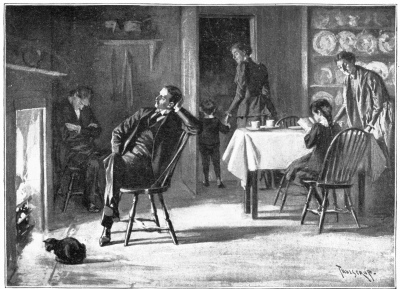 “SOMETHING IN THE SCENE THRILLED HIM WITH A SENSE OF
RESTFUL KINSHIP”
“SOMETHING IN THE SCENE THRILLED HIM WITH A SENSE OF
RESTFUL KINSHIP”
ancient pictures, the whole doubled by Rosina’s economic administration,
was amply sufficient for every rational need—Matthew Strang began at
last, without underthought of anything but Art, in this homely
environment to which his soul was native, to express his own inmost
individuality, to produce faithfully and finely the work it was in him
to do.
Solitary, silent, sorrowful, strong; not chattering about his ideas and
his aims, indifferent to fame or the voice of posterity, striving for
self-approbation and rarely obtaining it, touching and retouching,
breaking the rules of the schools in obedience to his own genius, he
toiled on in his humble studio, seeking the highest, with no man and no
woman to inspire, encourage, or praise. He had been saved from Love and
Happiness, and sent back into sympathy with all that works and suffers.
And thus the note that had trembled faintly and then died out in his
work was struck strong and sure at last—the note of soul. To his
accurate science and his genius for the decorative, which are two of the
factors of great Art, was now added the spiritual poetry which is the
last and rarest. For he was master of his soul at last.
He had absorbed life sufficiently—he had toiled and hungered; he had
feasted and made merry; he had sorrowed and endured; he had sinned and
suffered; he had known the lust of life and the pride of the eye; he had
known Love—the love of the soul and the love of the senses; he had
known the heartache of baffled ambition and the dust and ashes of
achievement. What he had wanted he had not got; by the time he had got
it he had not wanted it; whatever he had set out to do he had not done,
and whatever he had done he had not foreseen. And out of all this
travail of the soul was born his Art—strong, austere, simple.
In the five or six years since he died to the world he has finished as
many big pictures, and has made studies for others, besides a host of
minor things. He has not exhibited any of the larger pictures in the
Academy; three have been presented quietly to provincial and suburban
galleries where the People comes. Only one with some of the smaller
things has been sold for money, and this but to appease Rosina; it was
one more sacrifice of his individuality to hers. It is true there are
expenses for models and materials, and he has now two more children, but
it jars upon him to ask money for work that expresses and conceals the
tragic secrets of his inmost being. Nor does he care to have his
pictures shut away amid the other furniture of luxurious mansions.
Still, he has learned enough to know that life cannot be lived ideally.
And, moreover, the event has taught him again the contrariety of life;
for his eccentricity, leaking out slowly, has enhanced the fame to which
he is indifferent, and, aided by a legend of mysterious saturnine
seclusion, has raised his market value to such a point that he need only
sell an occasional picture. One dealer in particular is anxious to give
him his own price for a picture. Matthew Strang will probably part with
one to him some day, but he does not know that the dealer is acting for
Lady Thornton, the wealthy and celebrated society leader and convert,
though he knows and is glad that Eleanor Wyndwood found both happiness
and spiritual peace when, a few months after her friend Olive Regan’s
marriage to Herbert Strang, that ever-charming and impressionable lady
was led to the altar by the handsome and brilliant Sir Gilbert Thornton,
and went over with him to Roman Catholicism. With the same earnestness
with which she had passed from her native orthodoxy to the Socialism of
Gerard Brode, and thence to the spirituality of Dolkovitch, she had slid
by a natural transition from the sensuous art atmosphere of Matthew
Strang’s world into the sensuous spirituality of Catholicism as soon as
his influence had been replaced by the ascendency of another male mind.
He was not asked to the wedding, and the invitation to Olive’s, reaching
him in the days when the first darkness of isolation was upon him, he
had left unanswered.
And just as he has given his Art freely to the world, so, under the
inspiration of Tarmigan’s memory, he gives his services freely at
Grainger’s and other humble art-schools as encourager of every talent
that aspires under discouragement; teaching it to be itself and nothing
else, for the artist gives to the world and is not asked for, creating
the taste he satisfies, and Art is not Truth nor Beauty, but a
revelation of beautiful truth through the individual vision. It is the
artist’s reaction to the stimulus of his universe, whether his universe
be our common world seen for itself or through antecedent art, or a
private world of inward vision: for while the philosophers are
quarrelling about abstract truth, the artist answers Pilate’s question
through his own personality. The beauty which Matthew Strang’s art
reveals, though he experiments in many styles, with unequal results, is
mainly tragic. For others the gay, the flippant, the bright—let those
from whose temperament these things flow interpret the joyousness and
buoyancy and airy grace of existence. For others the empty
experimentation in line and color. It is all Art—in the house of Art
are many mansions. He has come to the last of the three stages of so
many artists, who pass from the fever to do everything, through a period
of intolerance for all they cannot do, into a genial acceptance of the
good in all schools. But, unassuming as he has always been, he is yet
sometimes shaken by righteous indignation when he sees tawdry art—art
that is the response to the stimulus of no universe but the artificial
studio-universe of models and posings and stage-properties—enthroned
and fêted at the banquet of life; and sometimes an unguarded word
flashes out before his pupils, but he always repents of his railings,
feeling it is his to work, not to judge; to do the one simple thing that
his hand findeth to do.
One of his pictures is of a woman looking out to sea with hopeless eyes;
there is a mocking glory of sunset in the sky. This is called “The Pain
of the World.” The title was due to Olive’s exclamation that night in
Devonshire. The figure is his mother’s, come back to him in his own
solitude—the image of her standing thus in the asylum at Halifax could
not be effaced from his soul; it had to find expression in his Art.
As he worked at it, with the brutal aloofness of the artist, studying
lights and shadows, values and effects, gradations and tones, he
wondered whether the artist were a cold-blooded monster, or a divinely
appointed alchemist sent to transmute the dross of the world’s pain to
the gold of Art for the world’s pleasure; a magician to cover up the
rawness of life, as kindly Nature covers up the naked earth with grass,
or throws the purple light of dream over all that is dead—over the
centuries that are past or our youth that is gone; a Redeemer, whose
beautiful perception of pathos and tragedy robs the grave of its
victory, and plucks Death of its sting, so that no man suffereth or
travaileth without contributing to the raw stuff of life of which Art is
woven by the souls dowered with the pangs and privileges of
Over-Consciousness. Each man, it sometimes seemed to him, dimly, had to
pay so much in sorrow and pain; and in return for that he drew from the
common human fund the comprehension of life and the consolation of Art,
new sympathies and new delights, music and books and pictures, that only
lived through the rich variety of human destinies; mystic atmospheres
and minor scales, meaningless to souls that had not suffered or
inherited the capacity to suffer. Some—generally the stupid—paid
little in pain and sorrow; and some—as in his own case—much. But so
long as the account showed a balance to the general good, it was not for
the soul that was sacrificed to complain. It was, perhaps, even a
privilege to subserve the common good. Life was so arranged that virtue
could not be sure of personal reward, and this uncertainty was just what
made virtue possible. Under no other scheme of things could the soul
enjoy the privilege of virtue. To have suffered, as he himself had done,
by the institution of marriage, both as child and husband; to have been
a victim to the general laws which safeguard human society; to have been
cut in two by the flaming swords of the cherubim, which turn every way
to keep the way of the Tree of Life—all this did not, he thought, give
him the right to blaspheme existence. And the artist at least extracted
a soul of good from all things evil.
Some such reflections—not clear, but all confused and blurred, for he
was no syllogism-building philosopher, but an artist whose profoundest
thought sprang always from the concrete image before him—came to him
again when he was working at his famous picture “The Persecutors,”
inspired by an episode in Billy’s life, though Billy does not know. It
is simply children tormenting an old man. The old man is one of the
world’s wrecks; the children know not what they do. But the pathos of
the picture is overwhelming; it purifies by pity and terror. This is the
profit to the world of Billy’s life.
Matthew Strang knows, with the same secret assurance that sent him out
to fight, and strengthened him in the long struggle, that this picture
will live, that the gods have answered his boyish prayer for
immortality. But at moments when Billy is moping or in pain, or when the
artist foresees the gabble of magazines and drawing-rooms about his
work, the chatter of fashionable parrots, and the analysis of his
“second manner” by glib, comfortable critics, he wonders whether the
picture or the immortality is worth the price.
But, stronger than those driven by their Over-Consciousness to express
in artistic shapes the futility of life, he does not dwell eternally on
the tears of things; and his picture simply entitled “A Woman” is
perhaps his masterpiece. For when he painted it that sunrise in Paris
was still vivid to him, and the light in Ruth Hailey’s eyes, and that
fire of love in Eleanor Wyndwood’s; these things were in the eternal
order, too, as truly as the ugliness and the sordid realities. The
simplest human life was packed with marvels of sensation and emotion,
haloed with dreams and divine illusions. To have been a child, to have
sung and danced, to have eaten and played, to have seen woods and
waters, to have grown to youth and to manhood, to have dreamed and
aspired, to have labored and hoped—all this happiness had been his
while he was looking for happiness, just as Art had been his in Nova
Scotia, while he had been struggling to get to it in England.
And so to-day he yearns to paint the poetry of the Real—not with the
false romantic glamour which had witched his youth, though even his
youth had had a hankering after the Real, just as his maturity retains a
love for the mystic. That gilded unreality to which his Art would have
gravitated, had he found happiness with the sentimental Eleanor in her
atmosphere of fashion, will be replaced by the beauty that even when
mystic is based on Truth. He needed no woman’s inspiration, nor the
stimulus of cultured cliques. Alone he faces the realities of life and
death without intervening veils of charming illusion, no longer craving
to filter the honest sunlight through stained cathedral windows or to
tarnish the simplicity of the grave with monumental angels. Aspiring now
to paint London, he wanders through the gray streets, as in his days of
hunger, but now the grotesque figures no longer seem outside the realm
of serious Art, or mere picturesque arrangements of line and color. To
his purged vision, that still lacks humor, they touch the mysteries and
the infinities, passing and disappearing like ghosts on a planet of
dream: solitude has brought him a sense of the universal life from which
they flow, and he fancies the function of Art should be to show the
whole in every part, the universal through the particular. And so he
longs to paint the beauty that lies unseen of grosser eyes, the poetry
of mean streets and every-day figures, to enrich and hallow life by
revealing some sweep of a great principle that purifies and atones.
In “The Old Maid” he has painted the portrait of “Aunt Clara” with Davie
on her knee, revealing the wistful, imprisoned, maternal instinct he
detected one day in her sunken eyes as she fondled his little Davie.
What makes this presentation of ugliness Art is not merely the breathing
brush-work, but the beauty of his own pity which the artist has added to
the Nature he copied. With the falsely aristocratic in Art or life he
has lost sympathy: to him to be honest and faithful is to belong to the
only aristocracy in the world—and the smallest. Sometimes he dreams of
some great Common Art—for all men, like the sky and the air, which
should somehow soften life for all. And dreaming thus he somewhat frets
against the many limitations of his own Art—as once in his callow
boyhood when he set out to write that dime novel—and against its lapsed
influence in modern life, wishing rather he had been a great poet or a
great musician. Only music and poetry, he feared while toiling at the
“Old Maid,” could express and inspire modern life; the impulse that had
raised the cathedral had been transformed into the impulse that built
the grand hotel, fitted throughout with electrical conveniences; in the
visible arts landscape and portraiture alone seemed to find response
from the modern mind, the one by its revelation of the beauty of the
world, the other by its increasing subtlety of psychological insight.
Painting had begun with religion, religion had led to technique, then
religion had drifted away from painting, and then technique had become a
religion. But technique ought not to be thought of separately except by
the student; to the artist the spiritual and the material came as one
conception, as metre comes with the poet’s thought. The spirit must be
brought back to painting—this modern accuracy of tones and forms was
but the channel for it. But it could no longer be conveyed through the
simple images of a popular creed to which all men vibrated: to-day there
was no such common chord for the artist to touch. Even this picture of
“The Old Maid” might be unintelligible without its title, and risked
denunciation as literary. And the greatest picture could be seen by but
few.
But repining is useless; there is only one thing he can do, and he must
do it—a small thing in the span of the cosmos and the sweep of the
ages, but to be done ere he goes down to the kindred dust. But before
death comes he has doubtless other things to suffer—all these spiritual
agonies have seared the body in which early privations and sickness had
already left the seeds of premature infirmity. His children are growing
up, too, bringing new fears and problems.
And yet his life is not all unhappy—work is his anodyne, and there is
an inner peace in the daily pain, because it is the pain that his soul
has chosen, in willing slavery to its own yoke.
But life is too long for ideals; the unending procession of the days
depresses the finest enthusiasm. Sometimes when the domestic horizon is
dark, or when his body is racked with pain, he rebels against the rôle
thrust upon him in the world’s workshop, and against the fate that
mocked at his free-will, and made of him a voluntary instrument for the
happiness of Rosina and Herbert, turning his every action to
undreamed-of issues; and then he longs for the life that he had found so
hollow, the life of gay talk, and rustling dresses, and wine, and woman,
and song. And in such moments as these—when the natural human instinct
for happiness, yearning sunward, breaks through all the strata of
laborious philosophy and experience—he remembers that men call him “The
Master,” and then he seems to hear the sardonic laughter of Mad Peggy,
as he asks himself what Master he has followed in his sacrifice, or what
Master, working imperturbably, moulds human life at his ironic,
inscrutable will.
| Typographical errors corrected by the etext transcriber: |
|---|
| Miss O’Reilly’s hair chamelon-colored=> Miss O’Reilly’s hair chameleon-colored {pg} |
| painter always trod giugerly=> painter always trod gingerly {pg 400} |