- ACQUILLEZ,
Fr., to take, to hold at bay, to gather. "Et s'il voit que
les chiens heussent acueili le change" (G. de F., p. 156)—"if he sees
that the hounds have taken the change." It also denotes: "owning to the
scent" (Senechal, p. 8; Roy Modus, xxix. v).
Twici says: "Les chevereaus ne sunt mie enchacez ne aquyllees," which
Dryden translates, "the roebuck is not chased nor hunted up," from
enquiller or aquiller, O. Fr. a form of accuellir, to push, put in
motion, excite. "The word in English which is nearest to it is 'to
imprime,' which was afterwards used for the unharbouring of the hart"
(Twici, p. 26).
In the old English translation of Twici (Vesp. B. XII.) aquylees is
construed "gadered," which is certainly one sense, but not the one here
required (Twici, p. 53).
The "Master of Game" translates ils accueillent in G. de. F., p. 112,
by "they run to them" (p. 111. See also Godefroy).
- AFFETED,
Mid. Eng., affaiten; O. Fr. affaitier, to trim, to fashion.
A well-affaited or affeted head, a well-fashioned or good-shaped head.
In speaking of stags' antlers, means regularly tinèd and well grown.
Affeted also meant trained or tamed, reclaimed, made gentle,
thoroughly manned. Affaiter is still in use in M. Fr., as a term of
falconry.
We find this word employed in this sense in the Vision of Piers Plowman
(1362): "And go affayte the Fawcons, wilde fowles to kill." And in O.
Fr. sporting literature one constantly reads of "Chiens bien, affaities"
(well-broken dogs); "oiseaux bien affaities" (well-trained hawks). Roy
Modus, lxxix.; Bormans, p. 52; La Chace dou Cerf, Jub. 157; T. M. vol.
ii. p. 933.
- ALAUNTES,
Allaunts, Canis Alanus; Fr. alans. Also spelt alande,
alaunt, allaundes, Aloundys (MS. Brit. Mus., Egerton, 1995). See
also Twici, p. 56.
A strong, ferocious dog, supposed to have been brought to Western Europe
by a Caucasian tribe called Alains or Alani. This tribe invaded Gaul in
the fourth century, settling there awhile, and then continued their
wanderings and overran Spain. It is from this country that the best
alans were obtained during the Middle Ages, and dogs that are used for
bull-or bear-baiting there are still called Alanos. Gaston de Foix,
living on the borders of this country, was in the best position to
obtain such dogs, and to know all about them. His description, which we
have here, tallies exactly with that written in a Spanish book, Libro
de la Montería, on hunting of the fourteenth century, written by
Alphonso XI.
Alauntes were used as war dogs, and it was said that when once they
seized their prey they would not loose their hold.
Cotgrave (Sherwood's App.) says that the mastiff resembles an Alan, and
also Wynn in his book on the "British Mastiff" (p. 45) says that he is
inclined to think that the Alan is the ancient name for mastiff, and
thinks it possible that the Phœnicians brought this breed to the
British Isles. He cannot have known the description given us of the Alan
by the "Master of Game," nor can he have been acquainted with the work
of Gaston Phœbus, for he says that the Alan is not mentioned among
any of the earlier dogs of France and Germany. There is ample evidence
that they existed
in France from very early days. Probably they were relics left there by
the Alani in their wanderings through Gaul. About the same period as our
MS. we find Alans mentioned by Chaucer, who in the "Knight's Tale"
describes Lycurgus seated on his throne, around which stand white
Alaunts as big as bulls wearing muzzles and golden collars.
The ancient Gallo-Latin name of veltrahus, or veltris, which in the
first instance denoted a large greyhound used for the chase of the bear
and wild boar, passed later to a different kind of dog used for the same
purpose. These veltres, viautres, or vautres were also known under
the name of Alan, and resembled the Great Dane or the German Boarhound
(De Noir., vol. ii. p. 295-7).
- ANTLER,
O. Fr. auntilor, antoiller, or andoiller, derived from a
Teutonic root; Anglo-Saxon andwlit; Frank. antlutt or antluzze;
Goth. andawleiz; O. Ger. antliz; face. Gaston Phœbus and Roy
Modus and other old French authors almost invariably use teste, or
head, when referring to a hart's antlers, but English writers did not
observe time-hallowed terms of venery so rigorously, and our author
frequently uses the jarring and, from every point of view, incorrect
term "horns" when speaking of the hart's attire or head. The substance
of deers' antlers is true bone, the proportion of their constituents
differing but very slightly from ordinary bones. The latter, when in a
healthy condition, consist of about one-third of animal matter or
gelatine, and two-thirds of earthy matter, about six-sevenths of which
is phosphate of lime and one-seventh carbonate of lime, with an
appreciable trace of magnesia. The antlers of deer consist of about
thirty-nine parts of animal matter and sixty-one parts of earthy matter
of the same kind and proportion as is found in common bone. Later on, a
more sportsmanlike regard for terms of venery is observable, and
Turbervile in one of his few original passages impresses upon his
fellow-sportsmen: "Note that
when you speake of a harts hornes, you must terme them the Head and not
the Hornes of a hart. And likewise of a bucke; but a Rowes hornes and a
Gotes hornes are tollerable termes in Venery" (1611, p. 239).
Up to the end of the seventeenth century it was customary when speaking
of a stag's head to refer only to the tines "on top," or the "croches"
or "troches," leaving unconsidered the brow, bez and trez tines, which
were called the stag's "rights," and which every warrantable hart was
supposed as a matter of course to possess. When referring to the number
of tines a head bore, it was invariably the rule to use only even
numbers, and to double the number of tines borne by the antler which had
most. Thus, a stag with three on each top was a head of "twelve of the
less" (or "lasse"); "twelve of the greater" when he had three and four
on top, or, counting the rights, six and seven tines, or, as a modern
Scotch stalker would call it, a thirteen-pointer. The extreme number of
tines a hart was supposed to bear was thirty-two.
- BERCELET,
barcelette, bercelette, is a corruption of the O. Fr.
berseret, a hunting dog, dim. of bersier, a huntsman; in Latin,
bersarius, French, berser, bercer, to hunt especially with the
bow. Bercel, biercel, meant a butt or target. Italian, bersaglio,
an archer's butt, whence bersagliere, archer or sharpshooter (Oxford,
and Godefroy Dict.).
Given the above derivation, it may be fairly accepted that bercelet
was a dog fitted to accompany a hunter who was going to shoot his
game—a shooting dog. The "Master of Game's" allusion also points to
this. He says some mastiffs (see Mastiff) become "berslettis, and
also to bring well and fast a wanlace about." We might translate this
sentence: "There are nevertheless some (mastiffs) that become shooting
dogs, and retrieve well and put up the game quickly" (see Appendix:
Wanlace).
Jesse conceives bracelettas and bercelettus to come from
brache, but that can scarcely be so, as we see the two words used
together, as the following quotations will show:
"Parler m'orez d'un buen brachet.
Qens ne rois n'ont tel berseret."
T. M. i. 14404.
When the fair Ysolt is parting from her lover Tristan she asks him to
leave her this same brachet, and says that no huntsman's shooting dog
will be kept with more honour:
"Husdent me lesse, ton brachet.
Ainz berseret à vénéor
N'ert gardeé à tel honor
Comme cist sera."
Ibid. i. 2660.
Jesse quotes Blount's "Antient Tenures": "In the 6th of John, Joan, late
wife of John King, held a serjeantry in Stanhow, in the county of
Norfolk, by the service of keeping 'Bracelettum deymerettum of our Lord
the King,'" and Jesse thinks these might have been a bitch pack of
deerhounds, overlooking the fact that it was only in later days that the
words brache and rache were used for bitch hounds. As deymerettum
meant fallow deer, the bracelettum or bercelettum deymerettum may be
taken, I think, to mean those hounds that were used for buck-shooting
(Jesse, ii. 21).
- BERNER,
bernar; O. Fr. bernier, brenier, a man who has the charge of
hounds, a huntsman, or, perhaps, would be more accurately described as a
kennelman. The word seems to have been derived from the French brenier
or bernier, one who paid his dues to his feudal lord in bran of which
bread was made for the lord's hounds. Brenage, brennage, or
bernage was the tenure on which land was held by the payment of bran,
and the refuse of all grains, for the feeding of hounds. Berner in its
first sense meant finder of bran, then feeder of
hounds. This word seems to have remained in use in England long after it
had disappeared from the language of French venery. Gaston no longer
uses the word berner, but has valet de chiens.
- BISSHUNTERS,
furhunters. Our MS. (p. 74) declares that no one would hunt
conies unless they were bisshunters, that is to say rabbits would not be
hunted for the sake of sport, but only for the sake of their skins.
Bisse, bys, byse was a fur much in vogue at the period of our MS., as
its frequent mention in contemporaneous records testifies.
- BLENCHES,
trick, deceit; O. N. blekkja (Strat.). Blanch, or blench, to
head back the deer in its flight. Blancher or blencher, a person or
thing placed to turn the deer in a particular direction.
- BOCE,
from the French bosse, O. Fr. boce, boss, hump or swelling.
Cotgrave says: "Boss, the first putting out of a Deere's head, formerly
cast, which our woodmen call, if it bee a red Deere's, the burle, or
seale, and, if a fallow Deeres, the button."
- BOUGHS,
bowes (brisées). When the huntsman went to harbour the deer he
broke little branches or twigs to mark the place where he noticed any
signs of a stag. Also, at times during the chase he was instructed to do
the same, placing the twigs pointing towards the direction the stag had
gone, so that if the hounds lost the scent he could bring them back to
his last markings, and put them on the line again. In harbouring the
stag a twig was broken off and placed in front of the slot with the end
pointing in the direction in which the stag was going; each time the
harbourer turned in another direction a twig was to be broken and placed
so as to show which way he took; sometimes the twig was merely bent and
left hanging on the tree, sometimes broken off and put into the ground
(in French this was called making brisées hautes or brisées basses).
When making his ring-walks round the covert the harbourer was told to
put a mark to every slot he came across; the slot of a stag was to be
marked by scraping a line behind the heel, of a hind by making a line in
front of the toe. If it was a fresh footing a branch or twig should be
placed as well as the marking, for a hind one twig, for a stag two. If
it be a stale trace no twig must be placed. Thus, if he returned later,
the hunter would know if any beast had broken from or taken to covert
since he harboured his stag in the morning. When the harbourer went to
"move" the stag with his limer he was to make marks with boughs and
branches so that the berners with their hounds should know which way to
go should they be some distance from the limer (Roy Modus, x. v; xii. r;
xiii. r; Du Fouilloux, 32 r). Blemish is the word used by Turbervile for
brisées (Turbervile, 1611, p. 95, 104, 114).
- CHANGE,
The change, in the language of stag hunting, was the
substitution of one deer for another in the chase. After the hounds have
started chasing a stag, the hunted animal will often find another stag
or a hind, and pushing it up with its horns or feet will oblige it to
get up and take his place, lying down himself in the spot where he found
the other, and keeping quiet, with his antlers close over his back, so
that the hounds will, if care is not taken, go off in chase of the
substitute. Sometimes a stag will go into a herd of deer and try to keep
with them, trying to shake off his pursuers, and thus give them the
change.
A hound that sticks to the first stag hunted, and refuses to be
satisfied with the scent of another deer, is called a staunch hound, one
who will not take the change, which was considered one of the most
desirable qualities in a staghound. G. de F., in speaking of the
different kinds of running hounds, says that there were some that, when
they came to the change, they would leave off speaking to the scent, and
would run silently until they found the scent of their stag again (G. de
F., p. 109).
- CURÉE,
Kyrre, Quyrreye, or Quarry. The ceremony of giving the hounds
their reward was thus called because it was originally given to the
hounds on the hide or cuir of the stag.
Twici, the huntsman of Edward II., says that after the stag is taken the
hounds should be rewarded with the neck and bowels and the liver. ("Et
il se serra mange sur le quir. E pur ceo est il apelee quyrreye.") When
the hounds receive their reward after a hare-hunt he calls it the
hallow. In the "Boke of St. Albans" we find the quarry given on the
skin, and it is only in the "Master of Game" that it is expressly stated
that a nice piece of grass was to be found on which the hounds' mess was
to be put, and the hide placed over it, hair-side upwards, the head
being left on it and held up by the antlers, and thus drawn away as the
hounds rush up to get their share. According to Turbervile, in his day
the reward was placed on the hide; at least he does not in his
original chapter on the breaking up of the deer notice any such
difference between the French and English customs. In France, it is as
well to expressly state, the curée was always given on the hide until
the seventeenth century, but after that it seems the hide was placed
over it just as described in our text (De Noirmont, vol. ii., p. 458).
Preceding the quarry came the ceremonial breaking up of the deer. The
stag was laid on its back with feet in the air, slit open, and skinned
by one of the chief huntsmen, who took a pride in doing it according to
laws of woodmanscraft. They took a pride in not turning up their sleeves
and performing everything so daintily that their garments should show no
bloodstains; nobles, and princes themselves, made it a point of honour
to be well versed in this art. After the skinning was done, it was
customary to give the huntsman who was "undoing" the deer a drink of
wine; "and he must drinke a good harty draught: for if he should break
up the dear before he drinke the Venison would stink and putrifie"
(Turb., 1611, p. 128).
In the "Master of Game" the limers were rewarded after the other hounds,
but they were never allowed to take their share with the pack.
The bowels or guts were often reserved, and put on a large wooden fork,
and the hounds were allowed to have this as a sort of dessert after they
had finished their portion. They were halloaed to by the huntsman whilst
he held the fork high in the air with cries of Tally ho! or Tiel
haut! or Lau, lau! This tit-bit was then thrown to them. This was
called giving them the forhu, from the word forthuer, to whoop or
holloa loudly. Probably our term of giving the hounds the holloa was
derived from this. It was done to accustom the hounds to rally round the
huntsman when excited by a similar halloaing when they were hunting, and
had lost the line of the hunted beast.
In some instances the daintiest morsels were reserved for the King or
chief personage, and for this purpose placed on a large wooden fork as
they were taken from the deer. The vein of the heart and the small
fillets attached to the loins (Turbervile says also the haunches, part
of the nombles and sides) should also be kept for the lord, but these
were generally recognised as the perquisites of the huntsmen, kennelmen,
foresters, or parkers.
- EXCREMENTS,
fumes, fewmets, obs. term for the droppings of deer. From
the Fr. fumées. G. de F. says that the droppings of all deer,
including fallow and roe deer, are to be called fumées. The "Master of
Game," no doubt following the custom then prevalent in England, says the
droppings of the hart only are to be called fumes,
and of the buck and the roebuck croties. The following names are given
to droppings by—
| Gaston de Foix |
and |
Master of Game |
| Of the | hart | } | Fumées. |
Of the | hart | — | Fumes. |
| " | buck | } |
" | buck | } | Croteys. |
| " | roebuck | } |
" | roebuck | } |
| " | bear | } | Laisses. |
" | wild boar | } | Lesses. |
| " | wild boar | } |
" | black beasts | } |
| " | wolf | } |
" | wolves | } |
| " | hare and conies | — | Crotes. |
" | hare and Conies | — | Croties. |
| " | fox | } | Fiantes. |
" | fox | — | The wagging. |
| " | badger | } |
" | grey or badger | — | The Wardrobe. |
| " | stinking beasts | } |
" | stinking beasts | — | The Drit. |
| " | otter | — | Spraintes. |
" | otter | — | Spraintes. |
Other forms of this term are: fewmets, fewmishing, crotels, crotisings,
freyn, fuants, billetings, and spraits.
- FENCE MONTH,
The month so called began, according to Manwood, fifteen
days before and ended fifteen days after midsummer. During this time
great care was taken that no men or stray dogs should be allowed to
wander in the forest, and no swine or cattle were allowed to feed within
the precincts, so that the deer should be absolutely undisturbed during
three or four weeks after the fawning season. He tells us that because
in this month there must be watch and ward kept with men and weapons for
the fence and defence of wild beasts, for that reason the same is called
fence or defence month (Man., p. 76, ed. 1598).
- FEWTE,
fuite, fute (M. E.), O. Fr. fuite (voie de cerf qui fuit),
track, trace, foot. Gawaine: feute. Will of Palerne (90): foute. Some
beasts were called of the sweet fute, and some of the stinking fute.
The lists of the beasts which should come under either heading vary
somewhat; some that are placed by the "Boke of St. Albans" under "Swete
fewte" coming under the other category in the MS. Harl., 2340.
| In "Boke of St. Albans." |
In Harl. MS. 2340, fol. 50b. |
| Beasts of "Swete fewte." |
| The Buck, the Doo, the Beere, the Reynd, the Elke, the Spycard,
the Otre, and the Martwn. |
The Buke, the Doo, the Ber, the Reyne der, the Elke, the Spycard. |
| Beasts of the "Stinking fewte." |
| The Roobucke, the Roo, the Fulmard, the Fyches, the Bauw, the
Gray, the Fox, the Squirrel, the Whitecat, the Otyr, the Stot,
the Pulcatt. |
The Fulmard, the Fechewe, the Catt, the Gray, the Fox, the Wesyll,
the Marteron, the Squirrel, the Whyterache, the Otyr, the Stote,
the Polcatte. |
In Roy Modus the beasts are also divided into bestes doulces and
bestes puans. The reasons for doing so are also given (fol. lxii.):
"Les bestes doulces sont: le cerf, la biche, le dain, le chevreul et le
lièvre. Et sont appelées doulces pour trois causes: La première si est
que d'elles ne vient nulle mauvais senteur; la seconde, elles ont poil
de couleur aimable, lequel est blond ou fauve; la tierce cause, ce ne
sont mie bestes mordans comme les autres cincq, car elles n'ont nulz
dens dessus; et pour ces raisons puent bien estre nommées bestes
doulces." Under the bestes puans are classed the wild boar, the wild
sow, the wolf, the fox, and the otter.
- FEWTERER,
the man that lets loose the greyhounds (Blome, p. 27); from
veltraria, a dog leader or courser; originally one who led the dogs
called veltres, viautres (see Veltres). In Gallo-Latin, Veltrahus.
It has been asserted that the word fewterer is a corruption of vautre
or viautre, a boarhound, but although both evidently owe their origin
to the same parent-word, fewterer can scarcely be derived from vautre,
a boarhound. It was only in the Middle Ages in France that the word
vautre, from originally meaning a powerful greyhound, was applied to a
large boarhound. Fewterers in England appear invariably as attendants on
greyhounds, not boarhounds. Another derivation has been also given from
fewte, foot or track, a fewterer being, according to this, a huntsman
who followed the track of the beast. But venator was the contemporary
designation for a huntsman, and as far as we can ascertain the fewterer
was always merely a dog-leader.
- FORLONGE,
forloyng, forlogne, from the Fr. fort loin. G. de F. says,
"flies far from the hounds," i.e. having well distanced them ("Fuit
de fort longe aux chiens, c'est a dire que il les ait bien esloinhés").
Hounds are said to be hunting the forlonge when the deer is some way in
front of them, or when some of the hounds have got away with the deer
and have outpaced the rest. As our MS. (p. 173) says, the forlogne
should be blown if the stag has run out of hearing of hound and horn,
but it should not be blown in a park. In old French hunting literature
it is an expression one constantly comes across.
Twici, writing almost a hundred years earlier than the Duke of York,
says: "The hart is moved and I do not know where the hart is gone, nor
the gentlefolk, and for this I blow in that manner. What chase do we
call this? We call that chase The chase of the forloyng."
Forloyneth: "When a hound meeteth a chase and goeth away with it far
before the rest then we say he forloyneth" (Turber., ed 1611, p. 245).
- FOX,
According to the laws of Canute the fox was neither reckoned as a
beast of venery nor of the forest. In Manwood's Forest Laws he is
classed as the third
beast of chase (p. 161), as he is also in Twety and Gyfford, and the
"Boke of St. Albans."
Although early records show that the English Kings kept their foxhounds,
we hear nothing of their having participated in this sport, but they
seem to have sent their hounds and huntsmen about the country to kill
foxes, probably as much for the value of the pelt as for relieving the
inhabitants of a thievish neighbour.
In Edward's I.'s Wardrobe Accounts, 1299-1300, appear some interesting
items of payments made to the huntsman for his wages and the keep of the
hounds and his one horse for carrying the nets. These allusions to
nets throw an interesting light on the fox-hunting of those days.
William de Blatherwyke, or, as he is also called, William de Foxhunte,
and William Fox-dog-keeper, had besides their wages an allowance made
to them for clothes and winter and summer shoes (see Appendix: Hunt
Officials). As only one horse was provided, and that to carry the nets,
the huntsman, we must presume, had to hunt on foot, not such an arduous
undertaking when we remember that the country was so much more thickly
wooded than at present, and that every possible precaution was taken to
prevent Reynard's breaking covert.
We see by our text (p. 65) that it was usual to course foxes with
greyhounds, and although the passages referring to this are translated
from G. de F. we know from many old records that this fox-coursing was
as usual in England at this time as in France.
In the earlier days hounds used for the chase of the fox one day,
probably hunted hare, or even buck or stag, on another—such as the
harriers, which, if we can believe Dr. Caius, were entered to any animal
from stag to stoat (see Appendix: Harriers). The first real pack of
foxhounds is said to be the one established by Thomas Fownes, Esq., of
Stepleton, in Dorsetshire (1730). They were purchased at an immense
price by Mr. Bowes, of Yorkshire. A very amusing description is given
in
"Cranbourne Chase" of the first day's hunting with them in their new
country. There must have been several packs entered to fox only about
the end of the eighteenth century, for an erstwhile Master of the
Cheshire Foxhounds had in his possession a horn with the following
inscription: "Thomas Boothby Esqre. Tooley Park Leicester. With this
horn he hunted the first pack of foxhounds then in England 5 years: born
in 1677 died 1752." This pack, which was purchased by "the great Mr.
Meynell" in 1782, had been hunted both in Hampshire and in Wiltshire
previously by the ancestors of Lord Arundel (Bad. Lib., "Hunting," p.
29).
- FRAYING-POST,
the tree a stag has rubbed his antlers or frayed against.
By the fraying-post the huntsman used to be able to judge if the stag he
wished to harbour was a warrantable stag or not. The greater the
fraying-post the larger the deer (Stuart, vol. ii. p. 551).
- FUES,
"not find his fues," not to find his line of flight, his scent;
Gaston says: "Ne puissent deffaire ses esteurses": literally, "cannot
unravel his turnings."
Fues, flight, fuite, track. Gaston calls these sometimes voyes.
Voyes was written later Foyes (Fouilloux).
Fue. "Se mettre a la fue" (var. fuie), (to take flight) (Borman, p.
89).
- GLADNESS,
glade. The original sense is a smooth, bare place, or perhaps
a bright, clear place in a wood.
- GREASE,
One of the important technical terms of venery, related to the
fat of game; for in the Middle Ages, when game was hunted to replenish
the larder as much as for sport, it entered largely into the economy of
even the highest households. The fat of the red deer and fallow deer was
called suet, occasionally tallow. That of the roebuck was
bevy-grease. Between that of the hare, boar,
wolf, fox, marten, otter, badger, and coney no difference was
made—it was called grease; and in one sense this general term was
also used for deer: "a deer of high grease," or "a hart in the pride of
grease," were phrases used for the season of the year when the stag and
the buck were fattest (see Appendix: Seasons of Hunting).
- GREASE TIME,
not Grace Time or Grass Time, as Strutt and others have
it. It did not include the whole season when the hart or buck could be
killed, but meant to indicate the time when they were fat and fittest
for killing. As pointed out already by Dryden (p. 25), the Excerpta
Historica (Lond. 1831) contains an interesting example of the use of
this word. This is a letter written (p. 356) about 1480 by Thomas
Stonor, Steward of the Manor of Thame. He was in Fleet Prison at the
time he writes to his brother in the country concerning some property of
his own in his brother's neighbourhood. "No more to youe at thys tyme
but ... more ovr I entende to kepe my gresse tyme in yat countre, where
fore I wolle yat no mane huntte tylle I have bene ther."
In the privy-purse expenses of Henry VIII. (1532) is an entry of a
payment for attendance on the king during the last grece-time.
Cavendish in his Life of Wolsey says: "My lord continued at Southwell
until the latter end of grease time." Both these passages refer to the
month of June. In the laws of Howel the Good, King of Wales, a fine of
12 kine was imposed on whoever kills a hart in grease time (kylleic)
of the kings.
Confusion arose occasionally owing to the similarity of the words as
formerly spelt, grass being sometimes spelt "grysse" (Dryden, p. 25).
Manwood, also, misinterprets Grease time. In the agreement between the
Earl of Winchester and the Baron of Dudley of 1247, in which their
respective rights of hunting in Charnwood Forest and Bradgate Park,
Leicestershire, were defined, and which agreement Shirley has given (in
a translation) in his "English Deer Parks," the time of the fallow buck
season
(tempus pinguedinis) or grease time or the fat season, is fixed
between the Feast of St. Peter ad Vincula (August 1) and the Exaltation
of Holy Cross (September 6, 14), while the time of the doe season
(tempus firmationis) was fixed between the Feast of St. Martin
(November 11) and the Purification of the Blessed Virgin (February 2).
- GREYHOUND,
Fr. levrier, Lat. leporarius. Under this name a whole
group of dogs were included, that were used for the chase of big and
small game. They were swift hounds, hunting chiefly and in most cases by
sight only. For in the Middle Ages the name greyhound, or levrier,
denoted such seemingly different dogs as the immense Irish wolfhound,
the Scotch deerhound, and the smaller, smooth-coated, elegant Italian
greyhound. The powerful greyhound used for the chase of stag, wolf, and
wild boar were known in France as levrier d'attache, and the smaller,
nervous harehound as petit levrier pour lievre. In our illustrations
we can see what are intended to be portraits of both the larger and the
smaller kinds, some being smooth -and some rough-coated. The bigger
hounds were considered capable of defending their masters against their
armed enemies, as is shown by numerous legends of the Middle Ages,
which, although they may not be strictly historical facts, showed the
reputation these dogs enjoyed in those days (Jesse, p. 19).
Greyhounds were the constant companions of their masters during journeys
and wars, and at home. In the houses they were allowed the greatest
liberty, and seem to have ranged at will in both living- and bed-rooms;
one sees them at the board when their owners are at meals, at the
fireside, and they even accompanied their masters as good Christians to
mass.
No hound seems to belong so peculiarly to the epoch of chivalry as the
greyhound, and indeed one can scarcely picture a knight without one. A
Welsh proverb declared that a gentleman might be known "by his hawk, his
horse, and his greyhound." By a law of Canute, a greyhound
was not to be kept by any person inferior to a gentleman ("Greyhounds,"
by a Sportsman, p. 28; and Dalziel, vol. i. p. 25).
Canis Gallicus was the name used by the Gauls for their coursing dogs,
which were most probably greyhounds, and Arian says they were called
Vertragia, from a Celtic word denoting swiftness. In Gallo-Latin the
name for a large greyhound was Veltrahus or veltris (De Noir., ii.
295). They were also called Veltres leporarii (Blane, p. 46). There is
some difference of opinion as to the derivation of our word greyhound.
In the early Anglo-Norman days they retained their French name of
levrier, or Latin leporarius. When our MS. was penned the English
word grei, gre, or grewhound was in general use; it is thought by
some to be derived from Grew hound or Greek hound, as they were supposed
to have been originally brought from Greece. Others, again, consider
that the name was simply taken from the prevalent colour of the common
greyhound. Jesse gives the most likely origin of the name. "Originally
it was most likely grehund, and meant the noble, great, choice, or
prize hound" (Jesse, ii. 71; and Dalziel, i. 23). Probably the Celtic
denomination for a dog, grech or greg, stands in close connection
with our word greyhound (Cupples, p. 230). White seems to have been the
favourite colour, and to say one had i levrier plus blanc que flors de
lis (Heruis de Mes, 107a, 44; Bangert, p. 172) would be the greatest
tribute to the beauty of one's hound. Co si sunt deus leveres nurit en
ma meisun, cume cisne sunt blauns (Horn, 613 f.).
When Froissart went home from Scotland he is depicted as riding a grey
horse and leading un blanc levrier, perhaps one of the four he took
from these isles and presented to the Comte de Foix at Orthéz, whose
names have been preserved to us as Tristan, Hector, Brun, and Rolland
(La Curne de la Palaye).
Greyhounds were used, as has already been mentioned, for all kind of
hunting and every kind of game, in conjunction
with limers who started the game for them. They were let slip as relays
to a pack of running or scenting hounds, and they were used by
themselves for coursing game in an open country, or were placed at the
passes where game was likely to run and were slipped to turn the game
back to the archer or to chase and pull down the wounded deer (see
Appendix: Stables). In our illustrations we see them in the pictures of
stag-, hare-, roe- and boar-hunting, to say nothing of badger-hunting,
for which one would have thought any other dog more suitable.
They seem always to have been held in couples except when following
their master and he not bent
upon the chase. The collars to which these couplings were attached were
often wonderful gems of the goldsmith's and silversmith's art. Such an
item appears in the Q. R. Wardrobe Acc. for 1400 (Wylie, iv. p. 196): "2
collars for greyhounds (leverer) le tissue white and green with
letters and silver turrets." Another one of "soy chekerey vert et noir
avec le tret (? turret) letters and bells of silver gilt."
The ancient doggerel in the Book of St. Albans, "Heded like a snake, and
necked like a drake. Foted like a cat. Tayled like a Rat, Syded lyke a
Teme. Chyned like a Beme" ("Boke of St. Albans," f. iv.), was preceded
by a very similar one written some time previously by Gace de la Buigne.
Of these verses G. de F. gives, twenty-eight years later, a prose
version, which our Master of Game has rendered into English.
- HARDEL,
hardeyl, to tie couples of hounds together. From the French word
harder, which has the same meaning: Harder les chiens, and harde,
the rope with which they are tied. It is derived from hart, hard,
art, a binder of willow or other pliable wood used for fastening
fagots together (Lit. and God.). The primitive way of tying hounds
together was by passing such a small flexible branch through the
couplings which bent back on itself,
both ends being held. "Les chiens ... seront enhardez par les couples
à genoivres ou à autre josne bois tors" (Roy Modus, f.
xlvii. recto). In France there used to be two hardes to each relay and
not more than eight hounds in every harde (D'Yauville). In England there
used to be about the same number. The term was still used in Blome's
time (1686), for he writes in his "Gentleman's Recreation": "The
huntsman on foot that hath the charge of the coupled hounds, and before
that must have hardled them, that is, with a slip, for the purpose
ready secured three or four couple together, that they may not break in
from him, to run into the cry of the Finders" (p. 88).
Harling was a word used in Devonshire, and as it meant tying the hound
together by means of a rope passed through the rings of the couples, it
is undoubtedly a corruption of the word hardeling. "Until
comparatively recent times the hounds in Devonshire were taken to the
meet and held in this manner until the time came to lay the pack on"
(Collyns).
Hardel, the technical O. E. term for binding together the four legs of
the roebuck, the head having been placed between the two forelegs, in
order to carry him whole into the kitchen.
- HARE,
Pliny records the fable that hares "are of many and various
sexes." Topsell remarks that "the Hebrews call the hare 'arnebet,' in
the feminine gender," which word gave occasion to an opinion that all
hares were females (pp. 264, 266).
"In the Gwentian code of Welch laws supposed to be of the eleventh
century, the hare is said not to be capable of any legal valuation,
being in one month male and in another female" (Twici, p. 22).
Certainly in many of the older writings on hares the pronouns "her" and
"him" are used indiscriminately in the same sentence. Sir Thomas Browne
in his treatise on vulgar errors asserts from his own observation that
the sex of the hare is changeable, and that the buck hare will sometimes
give birth to young. Up to the end of the eighteenth century there was a
widespread and firm belief in this fable (Brehm, ii. p. 626). Buffon
describes it as one of the animal's peculiar properties, and from the
structure of their parts of generation he argues that the notion has
arisen of hermaphrodite hares, that the males sometimes bring forth
young, and that some are alternately males and females and perform the
functions of either sex.
"Master of Game" (copying G. de F.) states that the hare carries her
young for a period of two months, but in reality the period of gestation
is only thirty days. Harting says that the adult hare will breed twice
or thrice in the year, but Brehm declares they breed as many as four
times, and but seldom five times (Encyclop. of Sport, vol. ii. p. 504;
Brehm, vol. ii. p. 626; G. de F. p. 47).
G. de F. (p. 43) says of a hare, "Elle oït bien, mais elle voit mal."
"Master of Game" translates this simply as She hath evil sight; but
does not say she hears well. The sense of hearing is most highly
developed in the hare, and every lightly breaking twig or falling leaf
will disturb her. It is said that of old when warreners wished to
prepare hares for the market they filled their ears with wax, so that,
not being continually disturbed by noises, they did not move about much,
and grew sleek and fat (Blome, p. 95). G. de F.'s assertion that the
hare "has evil sight" is also confirmed by Brehm, who, however, says
that they are endowed with a keen sense of smell, whereas G. de F. says
elle sent pou.
Attention has already been called to the Duke of York's statement that
"the hare hath great fear to run." This arose probably from the
similarity of the words peur and pouvoir in the MSS., for it should
read "hath great power to run," the principal MSS. which we have
examined showing pouvoir. Verard in his first edition of G. de F. also
has the same rendering as the Duke of
York, to which Lavallée draws attention as being one of the many
ludicrous mistakes in this edition (G. de F., xli.).
Our text calls the hare the most marvellous beast (p. 181), the reasons
given being because she "fumeth or croteth and rowngeth and beareth
tallow and grease." By "rowngeth" (Fr. ronger) it was meant that the
hare chewed the cud, as by the ancients it was generally supposed that
the hare was a ruminant. Although this is not the case, and the hare has
not a compound stomach, nevertheless this belief showed a close
observation of nature, for when a hare is seated she can bring up parts
of her food and give it a second mastication.
The hare and rabbit have little or no fat, but what they do possess is
called grease. Twici says: Il porte gresce (pp. 1 and 21).
"She has teeth above in the same wise as beneath" (p. 181) is another of
the peculiarities noticed in our text, which shows that the difference
in dentition that distinguishes the hare from all other rodents had been
remarked. Instead of two incisors in the upper jaw, the hare has four,
having two small rudimentary incisor teeth behind the two large front
ones, and five or six molars in the upper jaw, with two incisors and
five molars in the lower jaw (Brehm, ii. p. 627; Cornish, "Shooting,"
ii. p. 153).
It is difficult to know why the hare was considered a "melancholy"
beast, and how this curious reputation was kept up during the whole of
the Middle Ages. It was thought that eating the flesh of the hare
rendered one also subject to melancholy. G. de F. does not mention this,
and altogether his book is comparatively free of such superstitions, but
he says the flesh of the hare should not be given to the hounds after a
day's hunting, as it is indigestible: quar elle est fastieuse viande et
les fet vomir (p. 210). Therefore, when rewarding the hounds, they
should only have the tongue and the kidneys, with some bread soaked in
the blood of the hare.
In our MS., at the end of the chapter on the nature of the hare (p. 22),
the Duke of York says that he "trows no good hunter would slee them so,"
alluding to pockets, pursenets, and other poaching devices; and although
G. de F. gives six ways of taking the hare, he does not approve of such
methods for the true sportsman, but enters an amusing protest: "I would
that they who take hares thus should have them [the cords] round their
own necks" (p. 171). Snaring hares was never considered legitimate
sport. In hare-hunting proper, the hounds were taken into the fields to
find the hare, as at present; or hare-finders were sent out early in the
morning, and the tufts of grass or plants where the hare was likely to
be seated were beaten, and the hounds uncoupled only when the hare was
started. One of the chief differences in the sport between then and now
was that often, when the hare was once on foot, greyhounds were also
uncoupled, and our Plate, p. 182, shows greyhounds and running-hounds
hunting seemingly happily together. It must have been rather
discouraging for the old-fashioned, slow scenting-hound to have the hare
he has been diligently hunting suddenly "bitten" in front of him by the
swifter greyhound. Trencher-fed packs also existed as early as the
fourteenth century, and we read in Gace de la Buigne that the small
farmers would assemble together, bringing all told some forty hounds of
different breeds and sizes, immensely enjoying their sport, and
accounting for many hares.
- HARNESS,
means in our text "paraphernalia wherewith animals can be caught
or taken." It is frequently used in this sense by Gaston—Hayes et
autres Harnoys (p. 126). In Julien's note to this same sentence
occurring in Le bon Varlet, he says, autres harnois, autres engins,
instruments, procédés.
- HARRIER,
spelt in early documents with many variations—eirere,
heyreres, heyrer, hayrers. A hound which
is described in modern dictionaries as "resembling a foxhound but
smaller, used for hare-hunting" (Murray). This explanation would not
have been a correct one for our harriers of the fourteenth century, for
as far as we can gather they were used to hunt all kinds of game and by
no means only the hare. They were evidently a smaller kind of running
hound, for as our MS. says, there are some small and some large running
hounds, "and the small are called Kenettis (or small dogs—see
Kenet), and these hounds run well to all manner of game and they that
serve for all game men call them heirers" (p. III). And in chapter 36 we
see that heyrers were used to hunt up the deer in the forest, the
herthounds and greyhounds meanwhile being held in leash till a
warrantable deer was on foot, or till "the heyrer have well run and well
made the rascal void" (made the smaller deer clear out of that part of
the forest) (p. 191). Then the herthounds were to be uncoupled where the
most likely "ligging is for an hert, and seek." The herthounds then put
up the wary old stag and hunted him till he came to the tryst where the
King would be with his long bow or cross-bow, or till the hert was
pulled down by them or the greyhounds which had been slipped at him.
In the chapter on hare-hunting in our MS. the word harrier does not
occur; only hounds, greyhounds, and raches are mentioned. So when Henry
IV. paid for "La garde de nos chiens appelez hayrers" (Privy Seal, 20
Aug. 9th Henry, 1408, No. 5874), or Henry V. for the "Custodiam Canum
nostrum vocatorum hayreres" (Rot. Pat. I Henry V. 1413), it was not
because they were especially addicted to hare-hunting, but because they
kept these useful hounds to "harry" game.
In 1407 we find one Hugh Malgrave "servienti venatori' vocat' hayters
p' c'vo (cervo), which we
may accept as another proof that their office was to hunt the stag. The
Duke of York also repeatedly says that "heirers" run at all game (see
pp. III, 196, 197). In 1423 Hugh Malgrave still held the "office of the
hayrers" by grant
from Henry IV. In the curious legal Latin of the thirteenth century, we
find the word canes heirettes, and heyrettor (Wardrobe Accounts, 34
Ed. I.).
There are a great number of early records which show us that these
hounds were used then for hunting red and fallow deer, sometimes in
conjunction with greyhounds and sometimes without their aid.
Harriers were sometimes taken with buckhounds on hunting expeditions as
well as with greyhounds. In some of the documents harriers are simply
alluded to as canes currentes. As they were not a distinct breed, but
were included under the designation "raches," or running hounds, a
separate chapter is not given to them in our text, and neither Twici nor
the Dame of St. Albans mentions these hounds. Gradually we find the
spelling, although presenting still countless variations, bringing the
a more constantly than the e; the "heirers" become hayrers,
hareres, hariers, and after the sixteenth century harriers. It is
also probable that the word was originally derived from the Anglo-Saxon
Hergian, herian, to harry, to disturb, to worry; O. Fr. harrier,
herrier, herier, to harry; F. hare and harer, to set a dog on to
attack. The harrier, in fact, was a dog to "hare" the game. Although now
obsolete, we find this word used late in the seventeenth century.
"Let the hounds kill the fox themselves and worry and hare him as much
as they please" (Cox, "Gent. Rec.," p. 110). It is also in the sixteenth
century that one comes across the first allusions to their use in
hunting the hare.
- HART,
It is not necessary to dwell here at length upon the great esteem
in which the hart was held by all devotees to sport in Europe during the
Middle Ages. It was royal game, and belonged to the Prince or ruler of
the country, and the chase was their prerogative. Few unconnected with
the court were ever able to enjoy the chase of the stag unless in
attendance on or by special
licence granted by the sovereign. Those who had extensive property of
their own and had permission to erect a fence could, of course, keep
deer on it, but this did not enable them to enjoy the sport of real wild
deer hunting, or La chasse Royale as the French called it.
The stag was one of the five beasts of venery, and was, according to the
ancient French regulations, a beast of the sweet foot, although in the
list of beasts of sweet and stinking foot given in the "Boke of St.
Albans" the hart is included in neither category (see Appendix:
Fewte).
One of the first essentials for a huntsman in the Middle Ages was to
learn to know the different signs of a stag (according to German
venery there were seventy-two signs), so as to be able to "judge well."
These signs were those of the slot, the gait, the fraying-post,
the rack or entry (i.e. the place where the stag entered covert),
and the fumes. By recognising differences in these signs made by a
young stag, a hind, and a warrantable stag, he was enabled to find out
where the latter was harbouring, and by the slot and gait he could
recognise when the chased stag was approaching his end.
There were many things that the huntsman of old had to learn regarding
the stag before he could be considered as more than an apprentice—for
instance, how to speak of a hart in terms of venery. The terms used were
considered of the greatest importance, even to the manner in which the
colour of the stag was spoken of, brown, yellow, or dun being the only
permissible terms to distinguish the shade of colour. Special terms are
given for every kind of head, or antlers, a stag might bear.
The huntsman spoke of the stag's blenches and ruses when alluding to
the tricks of a deer when trying to rid himself of the hounds, of his
doubling and rusing to and fro upon himself when he retraced his
steps, of his beating up the river when he swam up-stream, and of
foiling down, when he went down-stream, or of going to soil when he
stood in water. When the deer lay down he was quat,
when he stood still in covert he was stalling. When he was tired he
"cast his chaule" i.e. drooped his head, a well-known sign when the
deer is done, as was his closed mouth when dead beat.
The hart was meved or moved, when he was started from his
resting-place; he was quested or hunted for, and sued or chased; his
resting-place was called his ligging or lair, his scent of line of
flight, his fues. He was spoken of as soule or soile (F. seule)
if unaccompanied by other deer, and in "herd with rascal and folly" if
keeping company with lesser deer.
Besides many other quaint terms of venery the following were the
designations given to the hart according to his age by:—
| "Master of Game." |
Twici, "Boke of St. Albans," Manwood, Turbervile. |
Blome; Cox's "Gentleman's Recreations." |
| 1st yr. | A calf. | A calf. | A hinde-calf or calf. |
| 2nd " | A bullock. | A brocket. | A knobler or knobber. |
| 3rd " | A brocket. | A spayer, spayard, or spayd. |
A brocket or brocke. |
| 4th " | A staggart. | A staggart or stag. |
A staggard. |
| 5th " | A hart of ten. | A hart. | A hart. |
Until he was a hart of ten our text tells us he was not considered a
chaseable or warrantable deer. By the above one will see that the
"Master of Game" is exceptional in calling a deer of the second year a
bullock, brocket being the usual term.
In old French literature we occasionally find the word broches used
for the tines of a deer's antlers; brochet would be the diminutive,
i.e. a small tine, and hence perhaps brocket, a young stag bearing
small tines. Any stag of ten or over if hunted by the king became a Hart
Royal, and if hunted and not taken, but driven out of the forest, a
proclamation was made to warn every one that no person should chase or
kill the said hart, and he was then a "Hart Royal proclaimed" (Man., p.
180).
All stags not chaseable, such as young or lean stags and hinds, were
classed as folly or rascal.
A young stag accompanying an old one was called his squire (F.
escuyer).
Hinds also were called by different names from the first to the third
year, but the "Master of Game" does not give these, nor do any of the
earliest works. Manwood, Blome, and Cox give the following terms: first
year, a calf; second year, a Hearse or brocket's sister; third year and
ever after, a hind. A somewhat similar term was employed in France to
denote a young stag between six months and a year old. Haire, also
spelt her (G. de Champgrand Baudrillard), and Harpaille, was the
term for a herd of young stags and hinds.
Hart's Age.—The fable that a stag can live a hundred years which the
"Master of Game" repeats (p. 34) after G. de F. was not of the latter's
invention, but one that had been current for many centuries before their
day.
- HORNS,
—When the "Master of Game" was written hunting horns were the
curved primitive shape of those made from the horns of animals, and most
of them probably were still made of the horns of cattle, while those
used by the richer gentry and nobles were fashioned from some rarer
animals' trophy, such as the ibex, or carved of ivory, and some were
made of precious metal. But whether of simple horn, ivory, or of wood,
they were decorated with gold or silver ferrules, rings, and
mouthpieces, and some being provided with a stopper, could be converted
into drinking horns. Unfortunately the "Master of Game" does not tell us
the material of which horns should be made. He simply says how they
should "be dryve." They were to be two spans long (1 ft. 6 in.),
slightly curved so that both ends were raised from three to four
fingers' breadth above the centre; the larger end or the bell was to be
as wide as possible, and the mouthpiece not too small. It was waxed
thickly or thinly, whichever the huntsman thought produced the best
sound. What effect the wax had can scarcely be judged, but it was
evidently considered an
improvement, as it is stated that for foresters "mene hornes and
unwexid" are good enough for them. Besides the hunter's horn five
different kinds of horns are mentioned in our MS.—the bugle, great
abbots, ruets, small foresters, and mean horns. The bugle was not the
trumpet we now understand by that name, but a simple curved horn, most
probably deriving its name from the bugle, as the wild ox was called;
although Dryden says from the German word bugel, a curve or bend.
Ruets may have been the name for a much curved or almost circular horn,
from French rouette, small wheel. The mean horns were probably the
medium-sized, shrill-sounding horns made out of wood or bark, known as
ménuels, menuiaux, moienel, menuier, &c. (Perc.
27,166 and 27,140).
A good length for a horn is mentioned as being "une paume et demie"
(Perceval, 31,750). It is uncertain whether this length and that given
by the "Master of Game" were measured round the inside of the bend or in
a straight line between the two extremities. The famous Borstall horn,
also known as Nigel's horn, is 2 feet 4 inches long on the convex and 23
inches on the concave bend; the inside measure of the bell end being 3
inches in diameter. The size of another noted horn, i.e. the Pusey
horn, is 2 feet ½ inch long, the circumference at the widest end being
12 inches. The general length of these horns seems to have been
somewhere between 18 inches and 2 feet. The above-mentioned specimens
were horns of tenure, the first being a hunting-, the second a
drinking-horn. The Borstall horn is said to have been given by Edward
the Confessor to one Nigel, in reward for his killing an immense wild
boar, and by this horn he and his successors for generations held lands
of the crown.
The curved horn remained in fashion in England till about the latter
half of the seventeenth century, then a straight one came into use about
1 ft. 6 in. to 2 ft. long, such as we see depicted in Blome. Of this
shape, but a few inches shorter, is the hunting-horn still in use in
England. The French hunting-horn was used in England in the eighteenth
century, but did not remain long in fashion.
- HUNTING CRIES,
We can see that the hunting cries and the language used
in speaking to the hounds when hunting in the days of the "Master of
Game" were still those brought into Britain by the Normans, and in most
instances the words can actually still be recognised as French. There
are only a few examples given by him as to the manner a huntsman should
speak to his hounds in the stag-hunting chapters, such as:—
Ho moy, ho moy, hole, hole, hole: To encourage the limer when drawing
for a stag (p. 166).
Cy va, cy va, cy va: To call the hounds when any signs of the stag
were seen (p. 167).
Le douce mon amy, le douce: "Softly, my friend, softly." To the hounds
when they were uncoupled near to where the stag was supposed to be
lying.
Sto arere, so howe, so howe: "Hark back," if the hounds were on a
wrong scent.
Hoo sto, ho sto, mon amy, ho sto: To harriers drawing for a stag.
Oyez, à Beaumont, oyez, assemble à Beaumont: "Hark to Beaumont, hark,
get to him." To the hound of that name who picks up the right line, and
to bring the other hounds to him.
It is in the hare-hunting chapter that we have more of the "fayre wordis
of venery," and here, if the "Master of Game" does not slavishly copy
Twici, yet he employs the same cries, with a slight difference only in
orthography. The "Boke of St. Albans" has also most of the following:—
Hoo arere: "Back there." When the hounds come too hastily out of the
kennel.
So moun amy atreyt: Until they come into the field;
these two are not given by Twici, but the following are identical in
both books:—
Hors de couple, avaunt sy avaunt, and thrice so howe: When the
hounds are uncoupled.
Sa sa cy avaunt, cy sa avaunt, sa cy avaunt (avaunt, sire, avaunt, in
Twici): Forward, sir, forward.
Here how, amy, how amy, and Swef, mon amy, swef: "Gently, my friend,
gently" (swef, from Latin swavis), when the hounds draw too fast
from the huntsman.
Oyez, à Beaumont (in Twici: Oyez, a Beaumont le vaillaunt que il
quide trover le coward od la courte cowe): "Hark to Beaumont the
valiant, who thinks to find the coward with the short tail."
La douce, la il ad este sohowe: "Softly, there—here he has been," if
the place where the hare has pastured is seen.
Illoeques, illoeques: "Here, here," if the hounds hunt well on the
line (see Appendix: Illoeques).
Ha sy toutz, cy est il venuz arere, so howe. Sa cy a este so howe. Sa
cy avaunt: "Here, he has gone back. Here he has been. Forward there."
When the hare has doubled.
La douce amy, il est venuz illoeques, sohowe: "Softly, friend, he is
here." When the hounds hunt well in fields or arable land.
La douce, amy, la est il venuz (pur lue segere sohow): "Softly,
friend, here he has come to seat himself" (Mid. Eng., sege—a seat.
Latin, sedere).
La douce, amy, la il est venuz (pur meyndir): "Here he has been to
feed" (meyndir, from Latin manducare, mandere).
The bracketed part of the last two cries are given in the MS. of Twety
and Gyff., and the following are only in the "Master of Game":—
Le valliant oyez, oyez who bo bowe, and then, Avaunt, assemble,
assemble, war war, a ha war, for running riot. How assamy assamy so
arere so howe bloues acoupler.
On seeing the pricking or footing of the hare: Le voye, le voye ("The
view, the view").
In France, Tallyho, or a very similar sounding word, was employed in
the early days when the huntsman was sure that the right stag had gone
away, whether he only knew it by his slot, &c., or whether he had viewed
him.
It was also a call to bring up the hounds when the stag had gone away,
and at the end of the curée, when the huntsman held part of the
entrails of the deer on a large wooden fork, and the hounds bayed it
(which was called the forhu), the huntsman called out Tallyho.
We only find Tallyho in comparatively recent English hunting
literature and songs—never, so far as I am aware, before the late
seventeenth century, and it does not occur at all constantly until the
eighteenth century. Neither Turbervile nor Blome nor Cox, in their books
on the various chases, mention such a word, though we find instruction
to the huntsman to say "Hark to him," "Hark forward," "Hark back," and
"To him, to him"; besides the inevitable "So how sohow." Neither in
Twici, "Master of Game," "Boke of St. Albans," Chaucer, or Shakespeare
can we find an invigorating Tallyho. It would almost appear as if it
were a seventeenth century importation from across the Channel, which is
quite possible, for Henry IV. of France sent in that century three of
his best huntsmen, Desprez, de Beaumont, and de Saint-Ravy, to the Court
of King James I. to teach the royal huntsmen how to hunt the stag in the
French way, English Court hunting having degenerated into coursing of
stags within the park palings.
Taïaut in France was used solely in the chase of red, fallow, or roe
deer.
- HUNTING MUSIC,
In the "Master of Game," as in all the earliest hunting
literature, much importance is placed on the huntsman's sounding his
horn in the proper manner in order, as Twici says, that "Each man
who is around you, who understands Hunting, can know in which point you
are in your sport by your blowing." The author of "Master of Game" (p.
170) says he will give us "a chapter which is all of blowing," but he
omitted to fulfil this promise, so that we have only such information as
we can gather in his chapters on stag and hare-hunting. The differences
in the signals were occasioned by the length of the sound or note, and
the intervals between each. Twici expresses these notes in syllables,
such as trout, trout, trourourout. The first of these would be
single notes, with an interval between them, blown probably with a
separate breath or wind for each; the latter would be three notes blown
without interval and with a single breath or wind. The principal sounds
on the hunting horn were named as follows:—
A Moot or Mote, a single note, which might be sounded long or short.
A Recheat. To recheat, Twici says, "blow in this manner,
trourourourout, trourourourout, trourourourout," therefore a
four-syllabled sound succeeded by an interval, blown three times. In the
"Master of Game" we find the recheat preceded or followed by a moot, the
most constantly recurring melody. When the limer has moved the stag, and
the huntsman sees him go away, he was to blow a moot and recheat. If the
stag is moved but not viewed, and the huntsman knows only by the slot
that it is his stag that has gone away, he is to recheat without the
moot, for that was only to be blown when the stag was seen. When the
hounds are at fault and any one finds the slot of the deer, he should
recheat "in the rightes and blow a long moot for the lymerer," or if he
thinks he sees the hunted stag, he should blow a moot and recheat, and
after that blow two moots for the hounds.
The Forlonge. A signal that the stag had got away far ahead of the
hounds or that these had distanced some or all of the huntsmen (see
Appendix: Forlonge).
The Perfect or Parfit. Twici says it began by "a
moot and then trourourout, trout, trout, trourourout, trourourout,
trourourout, trout, trout, trourourourout," "and then to commence by
another moot again, and so you ought to blow three times. And to
commence by a moot and to finish by a moot." This was only blown when
the hounds were hunting the right line (see Appendix: Parfet).
The Prise. Twici says, blow four moots for the taking of the deer.
According to the "Master of Game," "the prise or coupling up" was to be
blown by the chief personage of the hunt only, after the quarry. It was
only blown when the deer had been slain by strength, or hunted, and not
when shot or coursed. He was to blow four moots, wait a short interval
(half an Ave Maria), and blow another four notes a little longer than
the first four.
The Menée. Twici says the Menée should only be blown for the hart,
the boar, the wolf, and the male wolf, but he does not give us any
analysis of this melody. In the "Master of Game" we are told that the
Menée was blown at the hall-door on the return of the huntsmen. The
Master first blew four moots alone, then at the end of the four moots
the others joined him in blowing, and they all continued keeping time
together (see Appendix: Menée).
The Mort or Death was another sound of the horn, but we have no
description of the notes. Perhaps it is synonymous with the Prise.
The Stroke must have been another grouping of short and long notes,
but of this we have no record.
Hardouin de Fontaines Guerin wrote a poem on the chase chiefly
concerning the different manners of blowing such as obtained in his
native country the provinces of Anjou and Maine. The poem was
illustrated with fourteen miniatures showing the notes to be blown on as
many different occasions during stag-hunting.
The notes are written in little squares: □ denoting a long note;
■ a short note; □□ a note of two long
syllables; ■■ a note of two short syllables;
■□□ a note of one short and two long syllables;
and ■□□■■ a note of one short,
two long, and two short syllables. Of these six notes combinations were
made for all the signals to be blown.
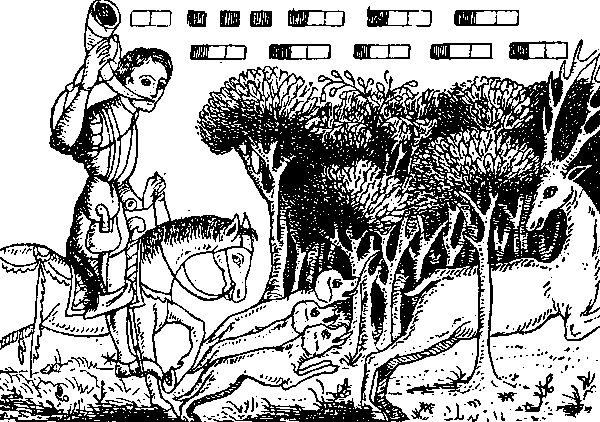
From Hardouin de Fontaines Guerin's Work, written in 1394
- ILLOEQUES,
"here in this place," from the L. illo loco. Sometimes it
is spelt illecques, iluec, illosques, &c. It is constantly met
with in Anglo-Norman, and the Provence dialects (Botman, pp. 90, 242; T.
M., pp. 31, 93, 142; Roy Modus, lxix.; and in the will of the Duke of
York, Nichols). It has been suggested that it is the origin of the
familiar yoicks. In the "Boke of St. Albans" in the verses on
hare-hunting it also occurs.
- JOPEYE,
synonymous with jupper, which, according to Cotgrave, is an
old word signifying "to whoot, showt, crie out alowd." The French word
juper, jupper, also spelt joppeir, had the same meaning, and we
find it employed
in the "Chace dou cerf" for a halloa in hunting in a similar way to
jopeye in our text:
"Et puis juppe ou corne i. lonc mot
Chaucuns en a joie qui l'ot."
In the sense it is used in our "Master of Game" (p. 185) it means to
halloa to the hounds, to encourage them with the voice.
- KENETTES,
small hounds. Kenet is a diminutive form of the
Norman-French kenet, and the O. F. chen, cienetes, chenet, a
dog: i veneour a ii cienetes, Ne mie grans mais petitetes, Et plus
blans que n'est flors d'espine (Percival, 22,895). Derived from the
Latin canis (see Appendix: Harriers).
- LIGGING,
a bed, a resting-place, a lair. From O. Eng. licgan,
licgean, Goth. ligan, lie, lie down. The ligging of the hart was
what we now call his lair, spelt also layer. In our MS. it is used for
the dwelling of a wild cat (p. 71).
This old expression is not entirely obsolete, but can be heard still
among the country people of the northern counties of England.
- LIMER,
lymer; the name given to a scenting-hound which was held in a
liam or leash whilst tracking the game. Limers never were any distinct
breed of hounds, but, of course, some breeds produced better limers than
others (De Noirmont, vol. ii. p. 350).
A dog used as a limer had to be keen on the scent, staunch on the line,
not too fast, and was taught to run mute, for if the exact whereabouts
of any game had to be discovered, it would have been impossible, if the
hound gave tongue or challenged while on the scent. A likely hound was
chosen from the kennel at an early age, G. de F. says at a year old (p.
157), and from that time accompanied his master, sleeping in his room,
and being
taught to obey him. He was continually taken out by his master with
collar and liam and encouraged to follow the scent of hinds and of stags
and other beasts, and punished should he venture to acknowledge the
scent of any animal he was not being entered to, or should he open on
finding or following the line.
In England as well as on the Continent the huntsman went out in the
early morning to track the game to be hunted to its lair, or den, before
the pack and huntsmen came into the field. Deer, wild boar, bear and
wolves were thus harboured by means of a limer. Twici makes the
apprentice huntsman ask: "Now I wish to know how many of the beasts are
moved by the lymer, and how many of the beasts are found by
braches?—Sir, all those which are chased are moved by a lymer, and all
those which are hunted up (enquillez) are found by the braches"
(Twici, p. 12; see Appendix: Acquillez).
Limers were not only employed when a warrantable stag was to be hunted
by hounds, but a huntsman going out with his bow or cross-bow would have
his brachet on a liam and let him hunt up the quarry he wished to shoot
(see Appendix: Bercelet). Also, the day before one of the large
battues for big game, the limers would be taken out to ascertain what
game there was in the district to be driven.
A liam, lyome, or lyame, was a rope made of silk or leather by which
hounds were led, from O. F. liamen, a strap or line, Latin ligamen.
This strap was fastened to the collar by a swivel, and both collar and
liams were often very gorgeous. We read of "A lyame of white silk with
collar of white vellat embrawdered with perles, the swivell of silver."
"Dog collors of crymson vellat with VI lyhams of white leather." "A
lieme of grene and white silke." "Three lyames and colors with tirrett
of silver and quilt" (Madden, "Expenses of Princess Mary").
A hound was said to carry his liam well when he just kept it at proper
tension, not straining it, for that would
show that he was of too eager temperament, and likely to overshoot the
line; if he trailed his liam on the ground, it showed that he was slack
or unwilling (D'Yauville).
As soon as the stag was "moved" the limer's work was over, but only for
the time being; his master led him away, the other hounds were
uncoupled, and the harbourer, mounting his horse and keeping his limer
with him, rode as close to the chase as he could, skirting below the
wind and being careful not to cross the line, but managing to be at hand
in case the stag should run in company or give the hounds the change. In
this case the huntsman had to check the hounds, and wait for the
harbourer and limer to come up and unravel the change, and put the pack
on the right scent once more.
The method of starting the stag with a limer was not done away with in
France until the eighteenth century, although in Normandy a change had
been made previously, and probably in England also. For our author says
that some sportsmen even in his time, when impatient, would uncouple a
few of the hounds in the covert, before the stag had been properly
started by the limer, which practice he, however, was not in favour of
except under the conditions he mentions.
This uncoupling of a few older hounds in covert to start the deer,
coupling them again as soon as the deer was on foot, was later called
tufting, and is still customary in Devon and Somerset.
The limer was not rewarded with the other hounds; he received his reward
from the hands of his master before or after the other hounds, and after
he had bayed the head of the stag.
When not quoting or translating the old text the more modern spelling of
limer has been used.
- MADNESS,
Old Eng. and Mid. Eng. Woodness, wodnesse, and wodnyss;
mad, wode. The seven different sorts of madnesses spoken of by the
"Master of Game"
are also mentioned in nearly all subsequent works on old hunting dealing
with "sicknesses of hounds." They are the hot burning madness, running
madness, dumb madness, lank madness, rheumatic madness or slavering
madness, falling madness, sleeping madness.
These are mentioned in Roy Modus, and the cure for rabies, of taking the
afflicted dog to the sea and letting nine waves wash over him, as well
as the cock cure mentioned in our English MS., were both taken by Gaston
from Roy Modus, or both derived them from some common source (Roy Modus,
fol. xlv. r).
The water cure is mentioned also by Albertus Magnus (Alb. Mag., 215, a
27).
It seems likely to have been to try the efficacy of this cure that King
Edward I. sent some of his hounds to Dover to bathe in the sea, the
following account for which is entered in his Wardrobe Accounts:
"To John le Berner, going to Dover to bathe six braches by the King's
order and for staying there for 21 days for his expense 3. 6d" (6 Edward
I. Quoted from MS. Philipps, 8676).
The means of recognising rabies by a cock is also mentioned in the
recipe of the eleventh century given by Avicenna (957-1037), and it
appears again in Vincentius Bellovacensis and is also to be found in
Alexander Neckham. Although the manner of using the cock for this
purpose varies, we see by the fact of its being mentioned in different
works preceding our MS. that the cock enjoyed some legendary renown for
at least a couple of centuries before Gaston (Werth, p. 55).
Nowadays only two varieties of rabies are recognised: furious and dumb
rabies. The numerous divisions of the old authors were based on
different stages of the disease and slight variations in the symptoms.
When a dog is attacked with rabies its owner often supposes that the dog
has a bone in its throat, so that a report of this condition is regarded
by veterinary surgeons with suspicion. This corresponds with the
description
in our text of dogs, with their mouths "somewhat gaping, as if they were
enosed in their throat."
- MASTIFF,
from F. metif, O. F. mestif, M. E. mastyf, mestiv,
mixed breed, a mongrel dog (Cent. Dict., Murray). Some etymologists have
suggested that the word mastiff was derived from masethieves, as these
dogs protected their master's houses and cattle from thieves (Manwood,
p. 113). Others again give mastinus, i.e. maison tenant, house-dog,
as the origin, but the first derivation given of mestif, mongrel, is
the one now generally recognised.
Although it will be quite evident to any one comparing the mastiff
depicted in our Plate, p. 122, with any picture of the British mastiff
that the two are very different types, we must not therefore conclude
that the artist was at fault, but that the French matin, which is what
our MS. describes and depicts, was by no means identical with our
present English breed of mastiffs, nor even with the old British mastiff
or bandog. The French matins were generally big, hardy dogs, somewhat
light in the body, with long heads, pointed muzzles, flattened forehead,
and semi-pendant ears; some were rough and others smooth coated.
Matins were often used for tackling the wild boar when run by other
hounds, so as to save the more valuable ones when the boar turned to
bay.
In this chase, as well as when they were used to protect their master's
flocks against wolves, huge iron spiked collars were fastened round the
dog's neck. These spiked collars were very formidable affairs; one of
very ancient make which I have measures inside nearly eight inches in
diameter, and the forty-eight spikes are an inch long, the whole
weighing without the padlock that fastened it together about two pounds.
In England the name Mastiff was not in general use till a much later
date, even as late as the end of the eighteenth century, Osbaldiston in
his Dictionary ignoring the term mastiff, and using, like a true Saxon,
the
old term bandog (Wynn, p. 72). In the seventeenth and eighteenth
centuries the terms were generally synonymous, and it seems quite
possible that the mastiff of the ancient forest laws was not our bandog,
but denoted, as in France, any large house-dog capable of defending his
master and his master's goods, watching his cattle, and, as frequently
necessary, powerful enough to attack the depredatory wolf or the wild
boar. These would in all likelihood be a very mixed breed, and
thoroughly justify the name mestif or mongrel.
Cotgrave in his French-English Dictionary gives the following:—
"Mastin, a mastiue or bandog; a great country curre; also a rude,
filthie, currish or cruell fellow."
We find the word matin in France used as a term of opprobrium, or a
name of contempt for any ugly or distorted body or a coarse person:
"C'es un matin, un vilain matin." Many interesting facts about the
mastiff have been collected by Jesse in his "History of the British
Dog," but he also makes the mistake of considering that the "Master of
Game" and Turbervile give us the description of the dogs then existing
in England, whereas these descriptions really relate only to French
breeds, although the characteristics may in many cases have tallied
sufficiently; but in others a dire confusion has resulted from blindly
copying from one another.
- MENÉE,
from Latin minare, something which is led, a following. This
word frequently occurs in the mediæval romances, and usually denoted
pursuit, either in battle or in the hunting field (Borman, p. 37).
There are various meanings attached to menée:—
The line of flight the stag or other game has taken, and Chacier la
menée seems to have meant hunting with horn and hound by scent on the
line of flight, in contradiction to the chase with the bow or cross-bow,
which was called berser (Le Roman des Loherains, 106, c. 30). In G.
de F. (p. 157) it is used in the same sense. The
meaning in which Gaston de Foix uses the word menée is explained
by him: Et puis se metre après, et chevauchier menée:
c'est à dire par où les chiens et le cerf vont (G. de F.,
pp. 43, 44, 171, 179). See also Chace dou Cerf and Hard. de Font.
Guer. Edit. Pichon).
The challenge of the hound when on the line. Page 171, we read that a
hunter should know whether the hounds have retrieved their stag by the
doubling of their menée, i.e. the hounds would make more noise as soon
as they found the scent or line of flight of the stag they were chasing.
Menée evidently meant the sound made by the hound when actually
following the scent, not when baying the game. Later the sense seems to
have been widened, and a musical hound was said to have la menée belle
(Salnove, p. 246).
A note sounded on a horn (see Appendix: Hunting Music). It was the
signal that the deer was in full flight. It appears to be used in Twici
to signify the horn-signal blown when the hounds are on the scent of
hart, boar or wolf, to press the hounds onwards (Twici, p. 23). This
author says one cannot blow the menée for the hare, because it is at one
time female and another male, and to this Dryden in his notes remarks
that Twici is perfectly right in saying a man ought not to blow the
menée for a hare; for as every one knows, it is but a rare occurrence
for a hare to go straight on end like a fox, for they commonly double
and run rings, in which case if the hounds were pressed, they would
over-run the scent and probably lose the hare. But he does not explain
why Twici says if it were always male the menée could be blown at it as
at other beasts, such as the hart, the boar, and the wolf. Is it that a
male hare will occasionally run a long, straight course of several
miles, but that the female runs smaller rings and more constantly
retraces her steps, and therefore the menée could never be blown at her?
Menée was also used in the sense of a signal on a horn.
The "Master of Game" says the menées should be sounded on the return
of the huntsman at the hall or cellar door (p. 179). There was a curious
old custom which occasioned the blowing of the horn in Westminster
Abbey. Two menées were blown at the high altar of the Abbey on the
delivery there of eight fallow deer which Henry III. had by charter
granted as a yearly gift to the Abbot of Westminster and his successors.
- METYNGE,
here evidently means meating or feeding. As the "Master of
Game" says: "or pasturing" as if the two words were synonymous, as
metinge also was Mid. Eng. for measure, it might have been a deer of
"high measure and pasturing." But anyhow the two were practically
identical, for as Twici says: "Harts which are of good pasture. For the
head grows according to the pasture; good or otherwise." See below:
Meute.
- MEUTE,
had several meanings in Old French venery.
The "Master of Game" translated G. de F.'s "grant cerf" as a hart of
high feeding or pasture. But he omitted to render the following passage:
"Et s'il est de bonne meute, allons le laisser courre." The "bonne
meute" is not translated by "high meating." It was an expression in use
to indicate whether the stag was in good company or not. If a
warrantable stag was accompanied by one or two large stags he was termed
"Un cerf de bonne mute" (or meute), but if hinds and young stags
(rascal) were with him he was designated as a "cerf de mauvaise mute."
In Roy Modus we read: "La première est de savoir s'il est de bonne
mute."
Perhaps meute when used in this sense was derived from the old Norman
word moeta, māēta, from mōt, meet, come together. There
was also an Old Eng. word metta or gemetta, companion.
Meute was also used in another sense which is translated by the
"Master of Game" as haunts, probably
the place the deer usually moves in. G. says: "Il prendra
congé de sa meute," and the "Master of Game" has: "he leaves his
haunts." If a deer was harboured in a good country for hunting he was
also called "En belle meute" (D'Yauville, voc. Meute).
It was in this sense that the "Sénéschal de Normandye" answers the
question of his royal mistress about the stag he himself had harboured
that morning; he tells her the stag was En belle meute et pays fort.
Meute, mute, a number of hounds, now called a pack or kennel of
hounds or a cry of hounds.
- MEW,
Mue, to shed, cast, or change. "The hart mews his horns," the
deer casts his head, or sheds his antlers. From the French muer, and
the Latin mutare, to change, of hawks to moult.
- MOVE,
Meu, Meue, mewe, meeve, old forms of move. To start a hart
signified to unharbour him, to start him from his lair.
G. de F. says: Allons le laisser courre; but the word meu or meve
was also used in Old French in the same way as in English.
Twici says: Ore vodroi ioe savoir quantez des betes sunt meuz de lymer,
e quanz des bestes sunt trouez des brachez.... Sire, touz ceaus qe sunt
enchaces; sunt meuz de lymer. E tous ceaus enquillez sunt trovez de
brachez. (Now I would wish to know how many beasts are moved by a lymer
and how many beasts are found by the braches.—Sir, all those which are
chased are moved by a lymer. And all those which are hunted up are found
by braches.) (Line 18; Tristan., i. 4337; Partonopeus de Blois, 607.)
- MUSE,
Meuse. An opening in a fence through which a hare or other
animal is accustomed to pass. An old proverb says: "'Tis as hard to find
a hare without a muse, as a woman without scuse."
"A hare will pass by the same muses until her death or escape" (Blome,
p. 92).
- NUMBLES,
M. E. nombles, noumbles; O. F. nombles. The parts of a
deer between the thighs, that is to say, the liver and kidneys and
entrails. Part, and sometimes the whole of the numbles were considered
the right of the huntsman; sometimes the huntsman only got the kidneys,
and the rest was put aside with the tit-bits reserved for the King or
chief personage (Turb., pp. 128-129). Numbles by loss of the initial
letter became umbles (Harrison, vol. i. p. 309), and was sometimes
written humbles, whence came "humble pie," now only associated with the
word humble. Humble pie was a pie made of the umbles or numbles of the
deer, and formerly at hunting feasts was set before the huntsman and his
followers.
- OTTER,
The Duke of York does not tell us anything of the chase of the
Otter, but merely refers one at the end of the chapter on "The Nature of
the Otter" to Milbourne, the King's Otter-hunter, for more information
and says, "as of all other vermin I speak not" (p. 73). The Otter was
evidently beneath his notice, as being neither regarded as a beast of
venery nor of the chase (Twety and Gyfford, Brit. Mus. MS. Vesp. B.
XII.). But the very fact that the King had an Otter-hunter shows that it
was a beast not altogether despised, although probably hunted more for
the value of its skin and for the protection of the fish than for the
sport.
The Milbourne referred to by the Duke of York can scarcely be any other
than the William Melbourne we find mentioned in Henry IV.'s reign as
"Valet of our Otter-hounds" (Privy Seal, 674/6456, Feb. 18, 1410).
- PARFET,
the perfect. Twici says: Une autre chasce il y ad qe homme
appele le parfet. Dunkes covient il qe vous corneez en autre maneree....
E isse chescun homme qest en
tour vous, que siet de vénerie puet conustre en quel point vous
estes en vostre dedut par vostre corneer (line 111).
From comparing the various places where the word parfait is employed
in connection with hunting, it may be concluded that to hunt the
"Parfet" was when the hounds were on the line of the right stag, to
sound the "Parfet" was to blow the notes that indicated the hounds
were hunting the right line. Dryden in his notes to Twici suggests that
the chase of the parfet was "in opposition to the chase of the
Forloyng," that is, when the pack run well together "jostling in close
array" (Twici, p. 43). But Perfect in the O. F. works seems to us to
invariably be used, as already said, to indicate that the hounds have
not taken the change, but are staunch to the right scent. Jacques de
Brézé says the stag he is hunting joins two great stags, but although
some of the hounds ran silent for awhile, they still continued staunch
to their line, and here he uses the word "parfait" (Sen. de Nor., p.
13).
Modus also uses it in this sense: Les chiens qui viennent chaçant après
le parfait (fol. xix. v). And what is most conclusive is the sense
given to it in our text: "Should blow to him again the parfyt so that he
were in his rightes and ellys nought," i.e. the parfyt should only be
blown if the hound was on the right line (p. 174).
- PARFYTIERES,
the name given in the "Master of Game" to the last relay of
hounds uncoupled during the chase of the stag. First came the "vaunt
chase," and then the "midel," and then the "parfytieres." They may
have been so called from being the last hounds to be uncoupled, being
those that completed or perfected the pack—i.e. perfecters, or this
relay may have derived its name from being composed of some of the
staunchest hounds from the kennel, those not likely to follow any but
the right line or the parfyt. It was customary in the old days to keep
some of the slower and staunchest hounds in the last relay, and to cast
them only when a
stag nearing its end rused and foiled, and sought by every means to
shake off his persecutors (see Appendix: Relays). G. de F. gives the
names of the three relays simply as La première bataille, la
seconde, and la tierce (p. 175).
- POMELED,
spotted, from O. F. pomelé, spotted like an apple. The
young of the roedeer are
born with a reddish brown coat with white spots, which the "Master of
Game" calls pomeled. This term was also frequently used in Ang.-N., O.
F., and in the dog-Latin of our ancient records to describe a
flea-bitten or dappled horse. "His hakenei that was all pomeli gris"
(Strat.). "Pommeli liardus, gris pommele, Uno equo liardo pomele"
(Obs. Ward. Acc. 28, Ed. I.). G. de F. does not use this word in
describing the young of the roe-deer, but says they are born
"eschaquettes" (p. 40).
- RACHES,
ratches or racches, a dog that hunts by scent. A.-S.
raecc, a hound, and O. F. and Ang.-N. brache, brachet, bracon,
braquet; Ger. bracken. Ang.-Lat., brachetus, bracketus.
Raches were scenting hounds hunting in a pack, later called "running
hounds," and then simply hounds. Although raches or brachets are
frequently mentioned in the O. F. and Ang.-N. metrical romances, and in
various early documents, we have never found any description of them,
but can only gather what they were from the uses they were put to. We
find that the bracco was used by the early German tribes to track
criminals, therefore they were scenting hounds. There is plenty of
evidence that they were used for stag, wild boar, and buck hunting
during the Middle Ages. They were coupled together and led by a berner
or bracennier or braconnier. Braconnier now means poacher, but this
is only the later meaning; originally braconnier was the leader of the
bracos, or huntsman (Daurel, p. 337; Bangert, p. 173; Dol. 9188).
We gather that these brachets of the early Middle Ages were small
hounds, sometimes entirely white, but generally white with black
markings. Sometimes they were mottled (bracet mautré). One description
of a braces corant says this hound was as white as a nut, with black
ears, a black mark on the right flank, and flecked with black
(Blancadin, 1271; Perc. 17,555, 22,585; Tristan M., 1475, 2261; Tyolet,
332).
In the early days in England we find that braches were used to hunt up
such smaller game as was not unharboured or dislodged by the limer.
Twici says: "Sire, touz ceaus qe sunt enchaces, sunt meuz de lymer. E
tous ceaus enquillez sunt trovez de brachez" (see Appendix:
Acquillez), i.e. All beasts that are enchased are moved by a limer,
and all those that are hunted up are found by braches (Twici, pp. 2,
12). Raches are mentioned in the "Boke of St. Albans" among the "Dyvers
manere of houndes," and the apprentice to venery is told he should
speak of "A mute of houndes, a kenell of rachys." He is also informed
that the hart, the buck, and the boar should be started by a limer, and
that all "other bestes that huntyd shall be sought for and found by
Ratches so free." John Hardyng in his Chronicle, speaking of an inroad
into Scotland by Edward IV., in whose reign he was yet living, said,
"And take Kennetes and Ratches with you and seeke oute all the forest
with houndes and hornes as Kynge Edwarde with the long shanks dide." In
the "Squyer of Low degree" we read that the huntsman came with his
bugles "and seven score raches at his rechase."
- RESEEYUOUR,
the word the most approaching this to be found in any
dictionary is under the head of receiver, M. E. receyvour, one who, or
that which receives. The reseeyuours were most likely those greyhounds
who received the game, i.e. pulled it down after it had been chased.
We see in our text that teasers and reseeyuours are mentioned
together (p. 198). The former
were light, swift greyhounds; these were probably slipped first; and the
latter (Shirley MS. spells resteynours) were the heavy greyhounds
slipped last, and capable of pulling down a big stag. De Noirmont tells
us: Ces derniers étaient surnommés receveours ou
receveurs (ii. p. 426, and G. de F., p. 177).
- RELAYS,
In the early days of venery the whole pack was not allowed to
hunt at the commencement of the chase. After the stag had been started
from his lair by a limer, some hounds were uncoupled and laid on, the
rest being divided off into relays, which were posted in charge of one
or more berners along the probable line of the stag, and were
uncoupled when the hunted stag and the hounds already chasing him had
passed. There were usually three relays, and two to four couples the
usual number in each relay, though the number of couples depended, of
course, on the size of the hunting establishment and the number of
hounds in the kennel. G. de F. calls these relays simply, première,
seconde, and tierce. The "Master of Game" calls the first lot of hounds
uncoupled the "finders" (p. 165), though this seems rather a misnomer,
as the harbourer with his limer (see Limer) found and started the
deer. The vauntchase for the first relay, and the midel speak for
themselves, but we have little clue to the origin of parfitieres for
the third relay. Were they so called because they perfected or completed
the chase, or because they were some of the staunchest hounds who could
be depended upon to follow the parfit, i.e. the right line of the stag
or animal hunted? (see Appendix: Parfet). Old authorities seem to have
differed in opinion as to whether the staunchest and slowest hounds
should have been put in the first cry or in the last (Roy Modus, fol.
xvi.; G. de F., p. 178; Lav., Chasse à Courre, pp. 297-8).
In the "Boke of St. Albans" we read of the vauntlay, relay, and
allay. The first was the name given to hounds if they were uncoupled
and thrown off between
the pack and the beast pursued, the relay were the hounds uncoupled
after the hounds already hunting had passed by; the allay is held:
"Till all the houndes that be behynd be cum therto
Than let thyn houndes all to geder goo
That is called an allay."
Instructions concerning when relays should be given always warn the
berner not to let slip the couples till some of the surest hounds have
passed on the scent, and till he be sure that the stag they are hunting
is the right one and not a substitute, i.e. one frightened and put up
by the hunted stag. The "Master of Game" is careful also to say: "Take
care that thou vauntlay not" (p. 169).
The discontinuing of relays seemed to have been begun first in Normandy
and probably about the same time in England.
In France the three relays of greyhounds which were used were called
Levriers d'estric—i.e. those which were first let slip; levriers de
flanc, those that attacked from the side; and levriers de tête, those
that bar the passage in front of the game or head it, terms that
correspond with our vauntlay, allay, and relay. In the "Master of
Game's" chapter on the wolf these relays of greyhounds are indicated (p.
59).
- RIOT,
The "Master of Game's" statement on p. 74 that no other wild beast
in England is called ryott save the coney only has called forth many
suggestions as to the origin of this name being applied to the rabbit,
and the connection between riot, a noise or brawl, and the rabbit. The
word riot is represented in M. E. and O. F. by riote, in Prov.
riota, Ital. riotta, and in all these languages it had the same
signification, i.e. a brawl, a dispute, an uproar, a quarrel (Skeat).
Diez conjectures the F. riote to stand for rivote, and refers to O.
H. G. riben, G. reiben, to grate, to rub (orig.
perhaps to rive, to rend). From German, sich an einem reiben, to mock,
to attack, to provoke one; lit. to rub oneself against one.
Rabbit, which is in O. Dutch robbe, has probably the same origin from
reiben.
The etymology and connection, if any, between the two words rabbit and
riot is difficult to determine. It is very probable that the rabbit was
called riot from producing a brawling when the hounds came across one.
The term "running riot" may well be derived from a hunting phrase.
- ROE,
The error regarding the October rut into which G. de F. and the
Duke of York fell was one to which the naturalists of much later times
subscribed, for it was left to Dr. Ziegler and to Dr. Bischoff, the
Professor of Physiology at Heidelberg, to demonstrate in 1843 the true
history of the gestation of the roe, which for more than a century had
been a hotly disputed problem. On that occasion it was shown with
scientific positiveness that the true rut of the roe takes place about
the end of July or first week in August, and that the ovum does not
reach the uterus for several months, so that the first development of
the embryo does not commence before the middle of December.
- RUNNING HOUNDS AND RACHES (F. chiens courants),
Under this heading we
include all such dogs as hunted by scent in packs, whatever the game
they pursued might be. They appear in the early records of our kings as
Canes de Mota, Canes currentes, and as Sousos (scenting hounds)
(Close Rolls 7 John; Mag. Rot. 4, John Rot. 10; 4 Henry III.), and are
mentioned specifically as cervericiis, deimericiis, as Heyrectorum
(harriers) or canes heirettes, and foxhounds as gupillerettis or
wulpericiis (Close Rolls, 15 John).
The Anglo-Saxon word Hundas, hound, was a general name for any dog;
the dog for the chase in Anglo-Saxon
times being distinguished by the prefix Ren, making ren hund.
Gradually the word dog superseded the word hound, and the latter was
only retained to designate a "scenting" dog. Dr. Caius, writing to Dr.
Gesner, remarks in his book: "Thus much also understand, that as in your
language Hunde is the common word, so in our naturall tounge dogge is
the universall, but Hunde is perticular and a speciall, for it
signifieth such a dogge onely as serveth to hunt" (Caius, p. 40). (See
Appendix: Raches.) Running hounds was a very literal translation of the
French chiens courants, and as the descriptive chapter given in our
text is as literal a rendering from G. de F. there is no information
that helps us to piece together the ancestry of the modern English
hound. We do not know what breed were in the royal kennels in the reign
of Henry IV., but probably some descendants of those brought to this
country by the Normans, about the origin of which breed nothing seems
known.
Keep of Hounds. The usual cost of the keep of a hound at the time of
our MS. was a halfpenny a day, of a greyhound three farthings, and of a
limer or bloodhound one penny a day.
However for the royal harthounds an allowance of three farthings a day
was made for each hound (Q. R. Acc. 1407), and we also find occasionally
that only a halfpenny a day was made for the keep of a greyhound. In
Edward I.'s reign a halfpenny a day was the allowance made for fox- and
otter-hounds (14, 15, 31, 32, 34, Edward I. Ward. Acc.), and sometimes
three farthings and sometimes a halfpenny a day for a greyhound. The
Master of Buckhounds was allowed a halfpenny a day each for his hounds
and greyhounds.
In the reign of Richard III. the Master of Harthounds was allowed 3s.
3d. a day "for the mete of forty dogs and twelve greyhounds and
threepence a day for three limers" (Rolls of Parl., vol. v. p. 16).
The "Boke of Curtasye" (fourteenth century, Percy
Society, iv. p. 26), gives us information which quite agrees with the
payments entered in the Wardrobe and other accounts of the King's
hunting establishment. And under the head of De Pistore we find the
baker is told to make loaves for the hounds:
"Manchet and chet to make brom bred hard
ffor chaundeler and grehoundes and huntes reward."
Chet, a word not in use since the seventeenth century, meant wheaten
bread of the second quality, made of flour more coarsely sifted than
that used for manchet, which was the finest quality.
Brom bread was oaten bread, and probably was very much the same as a
modern dog biscuit.
One of the ancient feudal rights was that of obtaining bran from the
vassals for the hounds' bread, known as the right of brennage, from
bren, bran.
Although bread was the staple food given to hounds, yet they were also
provided with meat. At the end of a day's hunting they received a
portion of the game killed (see Curée), and if this was not sufficient
or it was not the hunting season game was expressly killed for them. In
a decree from King John to William Pratell and the Bailiffs of Falke de
Breaut of the Isle of Ely, the latter are commanded to find bread and
paste for the hounds as they may require, "and to let them hunt
sometimes in the Bishops chase for the flesh upon which they are fed"
(Close Roll, 17 John). In an extract from the Wardrobe Accounts of 6
Edward I. we find a payment was made of 40s. by the King to one Bernard
King for his quarry for two years past on which the King's dogs had been
fed (MS. Phillipps, 8676).
We find also that "Pantryes, Chippinges and broken bread" were given to
the hounds, Chippings being frequently mentioned in the royal accounts
as well as meat for the hounds (Liber Niger Domus Ed. IV.; Collection of
Ordinances of the Royal Households; Jesse, ii. 125; Privy Purse Expenses
Henry VIII. 1529-1532).
The cost of the keep of some of the King's hounds were paid for out of
the exchequer, others were paid from the revenues and outgoings of
various counties, and an immense number were kept by subjects who held
land from the crown by serjeantry or in capite of keeping a stated
number of running hounds, greyhounds, and brachets, &c., for the King's
use (Blount's Ancient Tenures, Plac. Chron. 12, 13 Ed. I.; Issue Roll 25
Henry VI.; Domesday, tom. i. fol. 57 v).
We see by the early records of our kings that a pack of hounds did not
always remain stationary and hunt within easy reach of their kennels,
but were sent from one part of the kingdom to another to hunt where game
was most plentiful or where there was most vermin to be destroyed. As
early as Edward I.'s reign we find conveyances were sometimes provided
for hounds when they went on long journeys. Thomas de Candore or
Candovere and Robert le Sanser (also called Salsar), huntsmen of the
stag and buckhounds (Close Rolls 49 Henry III.; 6, 8 Ed. I.), were paid
for a horse-litter for fifty-nine days for the use of their sixty-six
hounds and five limers (Ward. Acc. 14, 15 Ed. I.). And as late as Henry
VIII.'s time the hounds seemed to travel about considerable distances,
as in the Privy Purse expenses of that King the cart covered with canvas
for the use of his hounds is a frequently recurring item.
- SCANTILON,
O. F. eschantillon, Mid. Eng. Scantilon, Mod. Eng.
scantling, mason's rule, a measure; the huntsman is continually told to
take a scantilon, that is, a measure, of the slot or footprint of the
deer, so as to be able to show it at the meet, that with this measure
and the examination of the droppings which the huntsman was also to
bring with him the Master of the Game could judge if the man had
harboured a warrantable deer (see Appendix: Slot and Trace).
- SEASONS OF HUNTING,
In mediæval times
the consideration for the larder played a far more important part in
fixing the seasons for hunting wild beasts than it did in later times,
the object being to kill the game when in the primest condition.
Beginning with the—
Red deer stag: according to Dryden's Twici, p. 24 (source not given),
the season began at the Nativity of St. John the Baptist (June 24), and
ended Holyrood Day (September 14). Our text of the "Master of Game"
nowhere expressly states when the stag-hunting begins or terminates, but
as he speaks of how to judge a hart from its fumes in the month of April
and May (p. 30), and further says that harts run best from the "entry of
May into St. John's tide" (p. 35), we might infer that they were hunted
from May on. He also says that the season for hind-hunting begins when
the season of the hart ends and lasteth till Lent. But as this part of
the book was a mere translation from G. de F. it is no certain guide to
the hunting seasons in England. The Stag-hunting season in France, the
cervaison, as it was called, began at the Sainte Croix de Mai (May
3rd) and lasted to la Sainte Croix de Septembre (Holyrood Day, Sept.
14), the old French saying being: "Mi Mai, mi teste, mi Juin, mi
graisse; à la Magdeleine venaison pleine" (July 22) (Menagier de Paris,
ii.). And although the stag was probably chiefly hunted in England
between Midsummer and the middle of September, when they are in the best
condition, and it was considered the best time to kill them, they were
probably hunted from May on in the early days in England as they were in
France. Had this not been customary we imagine the Duke of York would
have inserted one of his little interpolations in the text he was
translating, and stated that although the season began in May beyond
the sea, it only began later in England.
In Twety and Gyfford we read that the "tyme of grece, begynnyth alle way
atte the fest of the Nativyte of Saynt Johan baptist." Later on,
according to Dryden,
the season of the stag began two weeks after Midsummer (July 8).
Red deer hind, Holyrood Day (Sept. 14) to Candlemas (Feb. 2) (Twici,
p. 24; Man., p. 181). According to others the hind and the doe season
ends on Twelfth-day or Epiphany (Jan. 6).
Fallow deer buck. According to the Forest Laws the season began at the
Nativity of St. John (June 24) and ended on Holyrood Day (Sept. 14).
Dryden adds a second date, i.e. two weeks after Midsummer, to the
former, but does not quote the source.
Fallow doe was hunted from Holyrood Day (Sept. 14) to Candlemas (Feb.
2).
Roe deer buck was hunted from Easter to Michaelmas (Sept. 29).
Roe doe, Michaelmas to Candlemas.
Hare. According to the Forest Laws (Man., 176) the season commenced
Michaelmas (Sept. 29) and ended at Midsummer (June 24); Dryden in his
notes in Twici states that it commenced at Michaelmas and ended at
Candlemas (Feb. 2), while the "Boke of St. Albans" gives the same date
as the first-named in Manwood. According to the "Master of Game" the
hare seems to have enjoyed no close season, as G. de F.'s assertion that
the hunting of the hare "lasteth all the year" is also translated
without comment (p. 14): Et le peut chassier toute l'année, en quelque
temps que ce soit quar touzjours sa sayson dure (G de F., p. 204).
In Twety and Gyfford we also find that "The hare is alway in season to
be chasyd."
In the sixteenth century in France the hare-hunting season was from the
middle of September till the middle of April (Du Fouilloux, p. 51; De
Noir., ii. p. 476). In England the same season seems to have been
observed (Blome, p. 91).
Wild boar. According to the Forest Laws (Manwood and Twici), the boar
was hunted from Christmas Day to Candlemas (Feb. 2), but we have
evidence that boar-hunting
usually began earlier. The boar was in his prime condition when acorns,
beechmast, and chestnuts were plentiful, and was considered in season
from Michaelmas to St. Martin's Day (Roy Modus, xxxi.), and by some even
from Holyrood Day (Bornam, p. 100; Part, de Blois, 525).
The huntsmen of King John of England were sent to hunt in the forest of
Cnappe in order to take two or three boars a day in November. King
John's letter giving instructions on this point to one Rowland Bloet is
dated 8th November 1215 (Jesse, ii. 32).
Wolf. According to the Forest Laws, in the book already quoted, the
season during which the wolf was hunted began at Christmas and ended at
the Annunciation (March 25), but considering the destruction wrought by
this beast it is far more likely that it was hunted throughout the year.
Fox. According to the Forest Laws the season opened on Christmas Day
and ended on March 25, but nevertheless the fox was hunted early in the
autumn, for we have it on Twety and Gyfford's authority that "the sesoun
of the fox begynneth at the natyvite of owre Lady, and durryth til the
Annunciacion" (Sept. 8 to March 25).
The "Boke of St. Albans" gives the season of the fox and wolf from the
Nativity to the Annunciation of Our Lady and that of the boar from the
Nativity to the Purification of Our Lady. Manwood and other accepted
authorities quote the above as alluding to the Nativity of Christ,
whereas the Nativity of Our Lady, Sept. 8, was intended, thereby
creating some confusion.
According to the Wardrobe Accounts of Edward I. the foxhunting season began on 1st September
(Ward. Acc. Ed. I. 1299-1300).
No doubt one of the reasons why the fox was not hunted earlier in the
year was on account of the fur, which was of course of less use or value
if obtained in summer.
Otter. The Forest Laws give the season as from Shrove Tide (Feb. 22)
to Midsummer (June 24), but we find that in King John's reign the otter
was hunted in July (Close Rolls 14 John I.).
Martin, badger, and rabbit were hunted at all seasons of the year.
- SNARES,
No work dealing with the chase of wild animals in mediæval times
would be complete were it to omit all reference to snares, traps, gins,
pitfalls, and other devices to take game other than by hunting. The
"Master of Game" mentions the subject but briefly, saying, "Truly I trow
no good hunter would slay them so for no good," but "Gaston Phœbus"
contains seventeen short chapters in which the author as well as the
miniaturist describe the various contrivances then in use, although the
same disdain of these unsportsmanlike methods is expressed by G. de F.
that marks the Duke of York's pages. In the first edition of the present
work will be found descriptions of the principal snares used in the
Middle Ages.
- SPANIEL,
It is difficult to say at what date these dogs were first
introduced into our country; we only know that by the second half of the
sixteenth century spaniels were a common dog in England. In Dr. Caius's
time the breed was "in full being." He mentions land spaniels, setters,
and water spaniels, besides the small spaniels which were kept as pet
and lap dogs. That the breed was not then a recent importation we may
infer from the fact that, when speaking of the water spaniel and giving
the derivation of the name, Dr. Caius says: "Not that England wanted
suche kinde of dogges (for they are naturally bred and ingendered in
this country). But because they beare the general and common name of
these dogs synce the time when they were first brought over out of
Spaine."
The chapter in the "Master of Game" on this dog,
being translated from G. de F., unfortunately throws no light on the
history of the spaniel in England, although we imagine that, had there
been no such hounds in our island at the time, the Duke would have made
some such remark as he has in other parts of his book of their being a
"manner of" hound as "men have beyond the sea, but not as we have here
in England."
In his time the spaniel had enjoyed popularity in France for some two
centuries, and there was such continual communication between France and
England in the fourteenth and fifteenth centuries that it would have
been indeed strange if this most useful dog for the then favourite and
universal sport of hawking had not been brought to England long before
his time. We may conclude that the "gentle hounds for the hawk" of which
he speaks in his Prologue were not spaniels.
- SPAY,
The usual meaning of this word (castrating females) given in all
dictionaries is clearly inapplicable on this occasion (p. 174), where it
undoubtedly means killing a stag with a sword, probably derived from the
Italian spada. When the velvet was once off the antlers the stag at
bay was usually despatched with the bow, for it was then dangerous to
approach him close enough to do so with the sword. When achieved by bold
hunters, as it occasionally was, it was accounted a feat of skill and
courage.
- STABLES,
O. F. establie, a garrison, a station. Huntsmen and kennelmen
with hounds in leash, whose duty it was to take up a post or stand
assigned to them during the chase, were called stables. We have
Stabilitiones venationis that are mentioned in Domesday (i. fol. 56b
and fol. 252). In Ellis's introduction to Domesday he says:
"Stabilitio meant stalling the deer. To drive the Deer and other Game
from all quarters to the centre of a gradually contracted circle where
they were compelled
to stand, was stabilitio." Malmesbury, Scriptores, post Bedam, edit.
1596, p. 44, speaking of the mildness of Edward the Confessor's temper,
says, "Dum quadam vice venatum isset, et agrestis quidam Stabulata
illa, quibus in casses cervi urgentur, confudisset, ille sua nobili
percitus ira, per Deum, inquit, et matrem ejus tantundem tibi nocebo, si
potero" (Ellis, i. 112).
We see, however, at a later date from Twici and the "Master of Game"
that the watchers or stables they allude to were stationary—and did not
drive the game as described in above.
These stations of huntsmen and hounds were placed at intervals round the
quarter of the forest to be driven or hunted in with hounds to move the
game, so that the hounds could be slipped at any game escaping;
sometimes they were to make a noise, and thus blench or head the game
back. In French such a chase was called a Chasse à tître (Lav.
xxviii.), the word tître meaning net or tape, but in this case used
figuratively. Our "Master of Game" evidently placed these stations to
keep the game within the boundaries so as to force it to pass the stand
of the King. Twici describes these stations of huntsmen, using the word
establie. "The bounds are those which are set up of archers, and of
greyhounds (lefrers et de establie) and watchers, and on that account
I have blown one moot and recheated on the hounds. You hunter, do you
wish to follow the chase? Yes, if that beast should be one that is
hunted up (enquillee), or chased I will follow it. If so it should
happen that the hounds should be gone out of bounds then I wish to blow
a moot and stroke after my hounds to have them back" (Twici, p. 6).
It was the duty of certain tenants to attend the King's hunts and act as
part of the stable. In Hereford one person went from each house to the
stand or station in the wood at the time of the survey (Gen.
Introduction Domesday, Ellis, i. 195). From Shrewsbury the principal
burgesses who had horses attended the King when he
went hunting, and the sheriff sent thirty-six men on foot to the
deer-stand while the King remained there.
Stable-stand was the place where these stables were posted or "set,"
and the word was also used to denote the place where archers were posted
to shoot at driven game. Such stands were raised platforms in some drive
or on some boundary of the forest, sometimes erected between the
branches of a tree, so that the sportsman could be well hidden. A good
woodcut of what was probably intended to represent a "stand" is in the
first edition of Turbervile's "Arte of Vénerie," representing Queen
Elizabeth receiving her huntsman's report.
There is no mention made of raised stands in our text, but with or
without such erections the position taken up by the shooters to await
the game was called his standing or tryste, and a bower of branches
was made, to shelter the occupant from sun and rain, as well as to hide
him from the game. Such arbours were called Berceau or Berceil in
Old French, from the word berser, to shoot with a bow and arrow; they
were also called ramiers and folies, from rames or branches, and
folia, leaves, with which they were made or disguised (Noir., iii. p.
354).
Manwood tells us that Stable-stand was one of four "manners in which
if a man were found, in the forest, he could be arrested as a poacher or
trespasser," and says: "Stable-stand is where one is found at his
standing ready to shoot at any Deer, or standing close by a tree with
Greyhounds in his leash ready to let slip" (Man., p. 193).
- STANKES,
or layes; tanks or pools, large meers. Gaston says: Estancs et
autres mares ou marrhés (G. de F., p. 21). Stank house was a moated
house. A ditch or moat filled with water was called a tank.
- TACHE,
or tecche, Mid. Eng. for a habit, especially a bad habit, vice,
freak, caprice, behaviour, from the O. F. tache, a spot, a stain, or
blemish; also a disgrace, a blot on a man's good name. In the older use
it was
applied both to good as well as bad qualities, as in our text.
- TAW,
to makes hides into leather; tawer, the maker of white leather. In
the fourteenth and early fifteenth centuries, in the days of the strict
guilds, a sharp line was drawn between tawers and tanners, and a tawer
was not allowed to tan nor a tanner to taw (Wylie, vol. iii. p. 195). No
tawers were allowed to live in the Forest according to the ancient
forest laws.
"If any white Tawer live in a Forest, he shall be removed and pay a
Fine, for they are the common dressers of skins of stolen deer" (Itin.
Lanc. fol. 7, quoted by Manwood, p. 161).
- TEAZER,
or teaser. "A kind of mongrel greyhound whose business is to
drive away the deer before the Greyhounds are slipt," is the definition
given by Blome (p. 96). These dogs were used to hunt up the game also
when the deer was to be shot with the bow. The sportsmen would be
standing at their trysts or stable-stand in some alley or glade of the
wood, and the hounds be put into the covert or park "to tease them
forth."
- TRACE,
slot, or footprint of deer. In O. F. and Ang.-N. literature the
word trace seems to have been used indifferently for the track of the
stag, wild boar, or any game (Borman, notes 147, 236, 237). G. de F.
expressly says that the footprint of the deer should not be called
trace but voyes or piés (view or foot), yet the "Master of Game"
in his rendering says: "Of the hart ye shall say 'trace,'" so evidently
that was the proper sporting term in England at the time. When slot
entirely superseded the word trace amongst sportsmen it is difficult to
determine. Turbervile uses slot, and in the beginning of the seventeenth
century it seems the general term for the footprint of deer (Man., p.
180; Stuart Glossary, vol. ii.; Blome, p. 76). Slot, it may be
contended,
is as old a word as trace, but in Mid. Eng. it was employed as a general
term for a foot-track or marking of any animal. The trace or slot was
one of the signs of a stag, that is the mark by which an experienced
huntsman could recognise the age, size, and sex of the deer.
The old stag leaves a blunter print with a wider heel than a hind, but
it is difficult to distinguish the slot of a hind from that of a young
stag. Although the latter has invariably a bigger heel and makes deeper
marks with his dewclaws,
yet his toes are narrow and pointed, their edges are sharp, and the
distance between his steps is somewhat unequal, all of which may lead
his slotting to be mistaken for the tracks of a hind. "He has found what
he wanted," says Dr. Collyns, when speaking of the harbourer, "the
rounded track, the blunted toe point, the widespread mark, the fresh
slot, in short, of a stag" ("Chase of the Red Deer").
The huntsman of old used to consider that any slot into which four
fingers could be placed with ease belonged to a warrantable stag (some
declared a stag of ten). That would mean that the slot would be about
three inches wide, if not more. I believe two and a half inches is
considered a fair measurement for mark of the heel by Devonshire
stag-hunters, who alone in England concern themselves with the
differences in the slot, as they only chase the wild deer. No such
woodcraft is necessary for the chase of the carted deer, and as long as
the master and huntsman can distinguish the footprint of a deer from
that of any other animal, that is all that is required of them in this
matter. The stepping or gait of a stag is also a sign that was taken
into consideration. The old stag walks more equally, and generally
places the point of his hind feet in the heel of his fore feet. The gait
of a hind is more uncertain; it is said she misprints, that is sometimes
the hind foot will be placed beside the fore foot, sometimes inside or
in front of it. She is not even so regular in her gait as a young stag,
unless she is with fawn, when she will place her hind feet constantly
outside her fore feet. A hind walks with wide-spreading claws, so does a
young stag with his fore feet, but those of his hind feet will be
closed. The larger the print of the fore feet are in comparison to the
hind feet the older the stag.
The underneath edge of the claws round the hollow of the sole was called
the esponde (sponde, edge or border). In older stags they were blunter
and more worn, and in hinds and younger deer sharper, unless indeed the
stag inhabited a damp and mossy country, where the esponde would not
be so much worn down as if he lived on a rocky or stony ground. (G. de
F., 155, 129-145; Lav., p. 246; Stuart, p. 58; Fortescue, p. 133). And
thus did the woodmen of old study the book of nature, which told them
all they wished to know, and found for them better illustrations than
any art could give.
- TRYST,
in the language of sport, was the place or stand where the hunter
took up his position to await the game he wished to shoot. The game
might be driven to him by hounds, or he might so place himself as to
shoot as the game went to and from their lair to their pasturing (see
Appendix: Stables and Stable-stand). In French it was called shooting à
l'affut, from ad fustem, near the wood, because the shooter leant his
back to, or hid behind a tree, so that the game should not see him.
In our MS. we are told that Alaunts are good for hunting the wild boar
whether it be with greyhounds, at the "tryst," or with running hounds at
bay within the covert. The tryst here would be the place where a man
would be stationed to slip the dogs at the wild boar as soon as he broke
covert, or after the huntsman had wounded the boar with a shot from his
long or cross-bow (p. 118).
- VELTRES,
velteres, veltrai. A dog used for the chase, a hound.
Probably derived from the Gaelic words
ver, large or long, and traith, a step or course, vertragus being
the name by which according to Arian, the Gauls designated a swift hound
(Blanc, 52).
- WANLACE,
Winding in the chase (Halliwell). In the sentence in which this
word is used in the chapter on the Mastiff (p. 122) we are told that
some of these dogs "fallen to be berslettis and also to bring well and
fast a wanlace about." Which probably means that some of these dogs
become shooting dogs, and could hunt up the game to the shooter well and
fast by ranging or circling. Wanlasour is an obsolete name for one who
drives game (Strat.).
In Brit. Mus. MS. Lansdowne 285 there is an interesting reference to
setting the forest "with archers or with Greyhounds or with
Wanlassours."
- WILD BOAR,
These animals were denizens of the British forests from the
most remote ages, and probably were still numerous there at the time our
MS. was penned. For although the Duke of York has only translated one of
the eleven chapters relating to the natural history, chase, or capture
by traps of the wild boar, and does not give us any original remarks
upon the hunting of them, as he has of the stag and the hare, still it
was most likely because he considered these two the royal sport par
excellence, and not because there were none to hunt in England in his
day. If the latter had been the case, he would in all probability have
omitted even the chapter he does give us, as he has done with those
written by Gaston de Foix on the deer, the reindeer, and the ibex and
chamois (p. 160).
In some doggerel verses which are prefixed to "Le venery de Twety and
Gyfford" (in Vesp. B. XII.), the wild boar is classed as a beast of
venery. In the a "Boke of St. Albans" the wild boar is also mentioned as
a beast of venery.
When Fitzstephen wrote his description of London in
1174, he says wild boars as well as other animals frequented the forests
surrounding London, and it would certainly be a long time after this
before these animals could have been extirpated from the wild forests in
more remote parts of the country.
Sounder is the technical term for a herd of wild swine. "How many
herdes be there of bestes of venery? Sire of hertis, or bisses, of
bukkes and of doos. A soundre of wylde swyne. A bevy of Roos" (Twety and
Gyfford). In the French Twici we have also Soundre dez porcs.
Farrow (Sub.) was a term for a young pig, in Mid. Eng. farh, far,
Old Eng. fearh (Strat.). Farrow (verb) was the term used when sows
gave birth to young.
G. de F. says that wild boars can wind acorns as far as a bear can (p.
58), and turning to his chapter on bears, we find that he says that
bears will wind a feeding of acorns six leagues off!
Routing or rooting. A wild boar is said to root when he is feeding on
ferns or roots (Turb., pp. 153, 154).
Argus, as our MS. calls the dew-claws of the boar, were in the later
language of venery called the gards (Blome, p. 102). Twety and Gyfford
named the dew-claws of the stag os and of the boar ergos. "How many
bestis bere os, and how many ergos? The hert berith os above, the
boor and the buk berith ergos."
Grease, as the fat of the boar or sow was called, was supposed to bear
medicinal qualities. "And fayre put the grece whan it is take away, In
the bledder of the boore my chylde I yow pray, For it is a medecine: for
mony maner pyne" ("Boke of St. Albans").
- WILD CAT (Felis Catus),
which at one time was extremely common in
England, was included among the beasts of the chase. It is frequently
mentioned in royal grants giving liberty to enclose forest-land and
licence to hunt therein.
It was probably more for its skin than for diversion that the wild cat
was hunted, as its fur was much used for trimming dresses at one time.
The wild cat is believed to be now extinct, not only in England and
Wales, but in a great part of the South of Scotland. A writer in the new
edition of the Encyclopædia Britannica (art. "Cat") expresses the
opinion that the wild cat still exists in Wales and in the North of
England, but gives no proof of its recent occurrence there.
Harvie-Brown in his "Vertebrate Fauna of Argyll" (1892) defines the
limit of the range of the wild cat by a line drawn from Oban to
Inverness; northward and westward of this line, he states, the animal
still existed. But there is no doubt that of late years the cessation of
vermin trapping in many parts of Scotland, which has caused a marked
increase in the golden eagle, has had the same effect upon the wild cat.
The natural history chapter of the wild cat is taken by the Duke of York
from G. de F.; did we not know this, some confusion might have arisen
through the fact being mentioned that there are several kinds of wild
cat, whereas only one was known to the British Isles. G. de F. says
there were wild cats as large as leopards which went by the name of
loups-serviers or cat wolves, both of which names he declares to be
misnomers. He evidently refers to the Felis Lynx or Lynx vulgaris,
which he properly classes as a "manner of wild cat," although some of
the ancient writers have classed them as wolves (Pliny, Lib. viii. cap.
34).
- WOLF,
For a long time it was a popular delusion that wolves had been
entirely exterminated in England and Wales in the reign of the Saxon
King Edgar (956-957), but Mr. J. E. Harting has by his researches proved
beyond doubt that they existed some centuries later, and did not
entirely disappear until the reign of Henry VII. (1485-1509).
- WORMING A DOG,
This was supposed to be a preventive to the power of a
mad dog's bite. It was a superstition promulgated in very early times,
and seems to have been believed in until comparatively recent times. We
find it repeated in one book of venery after another, French, English,
and German: in England by our author, Turbervile, Markham, and others.
Pliny suggests this operation, and he quotes Columna as to the efficacy
of cutting off a dog's tail when he is very young (Pliny, chap. xli.).
G. de F. and the Duke of York are careful to say that they only give the
remedy for what it is worth, the latter saying: "Thereof make I no
affirmation," and further on: "Notwithstanding that men call it a worm
it is but a great vein that hounds have underneath their tongue" (p.
87).