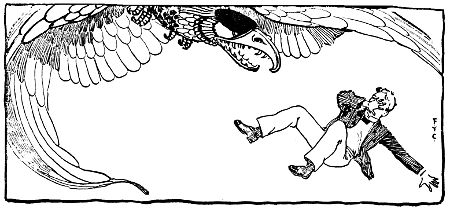
These things are quite improbable, to be
sure; but are they impossible?
Our big world rolls over as smoothly as
it did centuries ago, without a squeak to
show it needs oiling after all these years of
revolution. But times change because men
change, and because civilization, like John
Brown's soul, goes ever marching on.
The impossibilities of yesterday become
the accepted facts of to-day.
Here is a fairy tale founded upon the
wonders of electricity and written for children
of this generation. Yet when my
readers shall have become men and women
my story may not seem to their children
like a fairy tale at all.
Perhaps one, perhaps two—perhaps several
of the Demon's devices will be, by that
time, in popular use.
Who knows?
"In wonder all philosophy began; in
wonder it all ends; and admiration
fills up the interspace. But the first
wonder is the offspring of ignorance:
the last is the parent of adoration."
—Coleridge.
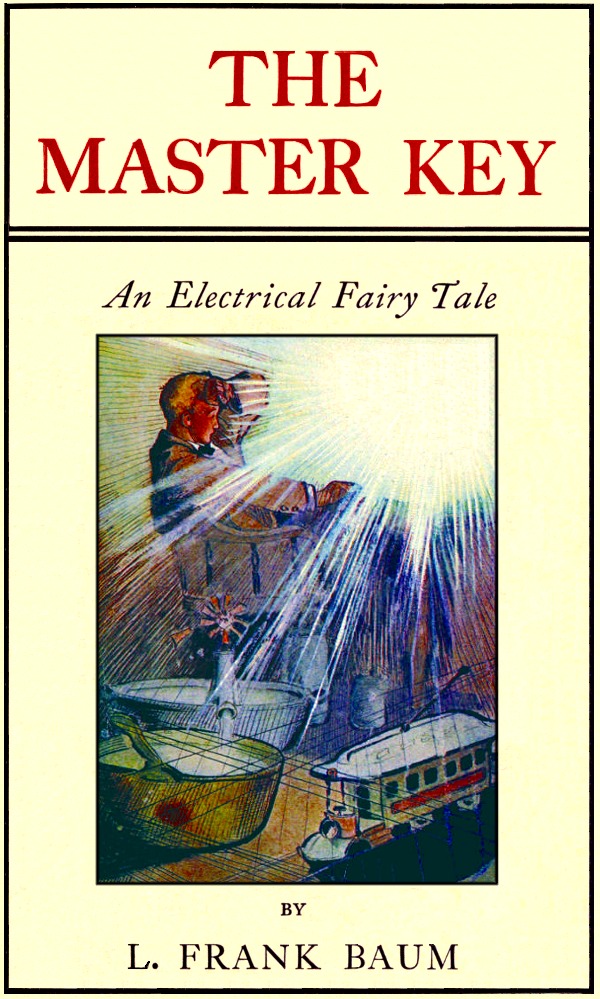
THE MASTER KEY
CHAPTER ONE
When
Rob became interested in electricity
his clear-headed father considered
the boy's fancy to be instructive as
well as amusing; so he heartily encouraged
his son, and Rob never lacked batteries,
motors or supplies of any sort that his experiments
might require.
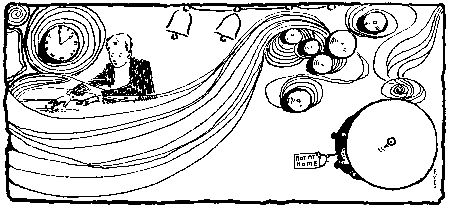
He fitted up the little back room in the
attic as his workshop, and from thence a
net-work of wires soon ran throughout the
house. Not only had every outside door its
electric bell, but every window was fitted
with a burglar alarm; moreover no one could
cross the threshold of any interior room without
registering the fact in Rob's workshop.
The gas was lighted by an electric fob; a
chime, connected with an erratic clock in the
boy's room, woke the servants at all hours
of the night and caused the cook to give
warning; a bell rang whenever the postman
dropped a letter into the box; there were
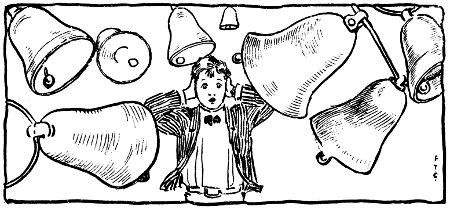
bells, bells, bells everywhere, ringing at the
right time, the wrong time and all the time.
And there were telephones in the different
rooms, too, through which Rob could call
up the different members of the family just
when they did not wish to be disturbed.
His mother and sisters soon came to vote
the boy's scientific craze a nuisance; but
his father was delighted with these evidences
of Rob's skill as an electrician, and
insisted that he be allowed perfect freedom
in carrying out his ideas.
"Electricity," said the old gentleman,
sagely, "is destined to become the motive
power of the world. The future advance
of civilization will be along electrical lines.
Our boy may become a great inventor and
astonish the world with his wonderful creations."
"And in the meantime," said the mother,
despairingly, "we shall all be electrocuted,
or the house burned down by crossed wires,
or we shall be blown into eternity by an
explosion of chemicals!"
"Nonsense!" ejaculated the proud
father. "Rob's storage batteries are not
powerful enough to electrocute one or set
the house on fire. Do give the boy a
chance, Belinda."
"And his pranks are so humiliating,"
continued the lady. "When the minister
called yesterday and rang the bell a big
card appeared on the front door on which
was printed the words: 'Busy; Call Again.'
Fortunately Helen saw him and let him in,
but when I reproved Robert for the act he
said he was just trying the sign to see if it
would work."
"Exactly! The boy is an inventor already.
I shall have one of those cards attached
to the door of my private office at
once. I tell you, Belinda, our son will be
a great man one of these days," said Mr.
Joslyn, walking up and down with pompous
strides and almost bursting with the
pride he took in his young hopeful.
Mrs. Joslyn sighed. She knew remonstrance
was useless so long as her husband
encouraged the boy, and that she would be
wise to bear her cross with fortitude.
Rob also knew his mother's protests
would be of no avail; so he continued to
revel in electrical processes of all sorts, using
the house as an experimental station to test
the powers of his productions.
It was in his own room, however,—his
"workshop"—that he especially delighted.
For not only was it the center of all his
numerous "lines" throughout the house,
but he had rigged up therein a wonderful
array of devices for his own amusement.
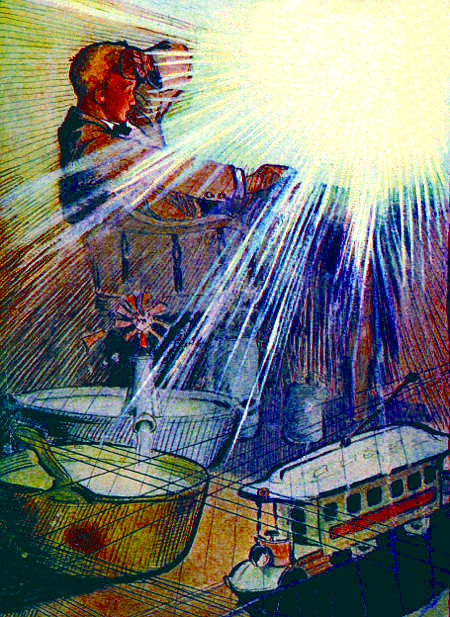
A trolley-car moved around a circular track
and stopped regularly at all stations; an engine
and train of cars moved jerkily up and
down a steep grade and through a tunnel;
a windmill was busily pumping water from
the dishpan into the copper skillet; a sawmill
was in full operation and a host of mechanical
blacksmiths, scissors-grinders, carpenters,
wood-choppers and millers were
connected with a motor which kept them
working away at their trades in awkward
but persevering fashion.
The room was crossed and recrossed with
wires. They crept up the walls, lined the
floor, made a grille of the ceiling and would
catch an unwary visitor under the chin or
above the ankle just when he least expected
it. Yet visitors were forbidden in so crowded
a room, and even his father declined to go
farther than the doorway. As for Rob, he
thought he knew all about the wires, and
what each one was for; but they puzzled
even him, at times, and he was often perplexed
to know how to utilize them all.
One day when he had locked himself in
to avoid interruption while he planned the
electrical illumination of a gorgeous pasteboard
palace, he really became confused
over the network of wires. He had a "switch-board,"
to be sure, where he could make
and break connections as he chose; but the
wires had somehow become mixed, and he
could not tell what combinations to use to
throw the power on to his miniature electric
lights.
So he experimented in a rather haphazard
fashion, connecting this and that wire
blindly and by guesswork, in the hope that
he would strike the right combination.
Then he thought the combination might be
right and there was a lack of power; so he
added other lines of wire to his connections,
and still others, until he had employed
almost every wire in the room.
A quick flash of light almost blinded Rob
Yet it would not work; and after pausing
a moment to try to think what was wrong
he went at it again, putting this and that
line into connection, adding another here
and another there, until suddenly, as he
made a last change, a quick flash of light
almost blinded him, and the switch-board
crackled ominously, as if struggling to carry
a powerful current.
Rob covered his face at the flash, but
finding himself unhurt he took away his
hands and with blinking eyes attempted to
look at a wonderful radiance which seemed
to fill the room, making it many times
brighter than the brightest day.
Although at first completely dazzled, he
peered before him until he discovered that
the light was concentrated near one spot,
from which all the glorious rays seemed to
scintillate.
He closed his eyes a moment to rest them;
then re-opening them and shading them
somewhat with his hands, he made out the
form of a curious Being standing with majesty
and composure in the center of the
magnificent radiance and looking down
upon him!
CHAPTER TWO
THE DEMON OF ELECTRICITY
Rob was a courageous boy, but a thrill
of fear passed over him in spite of his
bravest endeavor as he gazed upon the
wondrous apparition that confronted him.
For several moments he sat as if turned to
stone, so motionless was he; but his eyes
were nevertheless fastened upon the Being
and devouring every detail of his appearance.
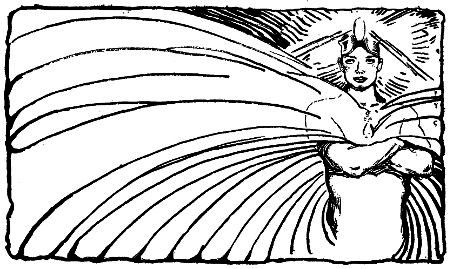
And how strange an appearance he presented!
His jacket was a wavering mass of white
light, edged with braid of red flames that
shot little tongues in all directions. The
buttons blazed in golden fire. His trousers
had a bluish, incandescent color, with
glowing stripes of crimson braid. His vest
was gorgeous with all the colors of the rainbow
blended into a flashing, resplendent
mass. In feature he was most majestic, and
his eyes held the soft but penetrating brilliance
of electric lights.
It was hard to meet the gaze of those
searching eyes, but Rob did it, and at once
the splendid apparition bowed and said in
a low, clear voice:
"I am here."
"I know that," answered the boy, trembling,
"but why are you here?"
"Because you have touched the Master
Key of Electricity, and I must obey the
laws of nature that compel me to respond
to your summons."
"I—I didn't know I touched the Master
Key," faltered the boy.
"I understand that. You did it unconsciously.
No one in the world has ever
done it before, for Nature has hitherto kept
the secret safe locked within her bosom."
Rob took time to wonder at this statement.
"Then who are you?" he inquired, at
length.
"The Demon of Electricity," was the
solemn answer.
"Good gracious!" exclaimed Rob, "a
demon!"
"Certainly. I am, in truth, the Slave
of the Master Key, and am forced to obey
the commands of any one who is wise and
brave enough—or, as in your own case,
fortunate and fool-hardy enough—to touch
it."
"I—I've never guessed there was such
a thing as a Master Key, or—or a Demon
of Electricity, and—and I'm awfully sorry
I—I called you up!" stammered the boy,
abashed by the imposing appearance of his
companion.
The Demon actually smiled at this speech,—a
smile that was almost reassuring.
"I am not sorry," he said, in kindlier
tone, "for it is not much pleasure waiting
century after century for some one to command
my services. I have often thought
my existence uncalled for, since you Earth
people are so stupid and ignorant that you
seem unlikely ever to master the secret of
electrical power."
"Oh, we have some great masters among
us!" cried Rob, rather nettled at this statement.
"Now, there's Edison—"
"Edison!" exclaimed the Demon, with a
faint sneer; "what does he know?"
"Lots of things," declared the boy.
"He's invented no end of wonderful
electrical things."
"You are wrong to call them wonderful,"
replied the Demon, lightly. "He
really knows little more than yourself about
the laws that control electricity. His inventions
are trifling things in comparison with
the really wonderful results to be obtained
by one who would actually know how to
direct the electric powers instead of groping
blindly after insignificant effects. Why,
I've stood for months by Edison's elbow,
hoping and longing for him to touch the
Master Key; but I can see plainly he will
never accomplish it."
"Then there's Tesla," said the boy.
The Demon laughed.
"There is Tesla, to be sure," he said.
"But what of him?"
"Why, he's discovered a powerful light,"
the Demon gave an amused chuckle, "and
he's in communication with the people in
Mars."
"What people?"
"Why, the people who live there."
"There are none."
This quiet statement almost took Rob's
breath away, and caused him to stare hard
at his visitor.
"It's generally thought," he resumed, in
an annoyed tone, "that Mars has inhabitants
who are far in advance of ourselves in
civilization. Many scientific men think the
people of Mars have been trying to signal
us for years, only we don't understand their
signals. And great novelists have written
about the Martians and their wonderful civilization,
and—"
"And they all know as much about that
little planet as you do yourself," interrupted
the Demon, impatiently. "The trouble
with you Earth people is that you delight
in guessing about what you can not know.
Now I happen to know all about Mars, because
I can traverse all space and have had
ample leisure to investigate the different
planets. Mars is not peopled at all, nor is
any other of the planets you recognize in
the heavens. Some contain low orders of
beasts, to be sure, but Earth alone has an
intelligent, thinking, reasoning population,
and your scientists and novelists would do
better trying to comprehend their own planet
than in groping through space to unravel
the mysteries of barren and unimportant
worlds."
Rob listened to this with surprise and disappointment;
but he reflected that the
Demon ought to know what he was talking
about, so he did not venture to contradict
him.
"It is really astonishing," continued the
Apparition, "how little you people have
learned about electricity. It is an Earth
element that has existed since the Earth
itself was formed, and if you but understood
its proper use humanity would be
marvelously benefited in many ways."
"We are, already," protested Rob; "our
discoveries in electricity have enabled us to
live much more conveniently."
"Then imagine your condition were you
able fully to control this great element," replied
the other, gravely. "The weaknesses
and privations of mankind would be converted
into power and luxury."
"That's true, Mr.—Mr.—Demon," said
the boy. "Excuse me if I don't get your
name right, but I understood you to say
you are a demon."
"Certainly. The Demon of Electricity."
"But electricity is a good thing, you
know, and—and—"
"Well?"
"I've always understood that demons
were bad things," added Rob, boldly.
"Not necessarily," returned his visitor.
"If you will take the trouble to consult
your dictionary, you will find that demons
may be either good or bad, like any other
class of beings. Originally all demons
were good, yet of late years people have
come to consider all demons evil. I do not
know why. Should you read Hesiod you
will find he says:
'Soon was a world of holy demons made,
Aerial spirits, by great Jove designed
To be on earth the guardians of mankind.'"
"But Jove was himself a myth," objected
Rob, who had been studying mythology.
The Demon shrugged his shoulders.
"Then take the words of Mr. Shakespeare,
to whom you all defer," he replied.
"Do you not remember that he says:
'Thy demon (that's thy spirit which keeps thee) is
Noble, courageous, high, unmatchable.'"
"Oh, if Shakespeare says it, that's all
right," answered the boy. "But it seems
you're more like a genius, for you answer
the summons of the Master Key of Electricity
in the same way Aladdin's genius
answered the rubbing of the lamp."
"To be sure. A demon is also a genius;
and a genius is a demon," said the Being.
"What matters a name? I am here to do
your bidding."
CHAPTER THREE
THE THREE GIFTS
Familiarity with any great thing
removes our awe of it. The great general
is only terrible to the enemy; the great
poet is frequently scolded by his wife; the
children of the great statesman clamber
about his knees with perfect trust and impunity;
the great actor who is called before
the curtain by admiring audiences is often
waylaid at the stage door by his creditors.
So Rob, having conversed for a time with
the glorious Demon of Electricity, began to
regard him with more composure and less
awe, as his eyes grew more and more accustomed
to the splendor that at first had
well-nigh blinded them.
When the Demon announced himself
ready to do the boy's bidding, he frankly
replied:
"I am no skilled electrician, as you
very well know. My calling you here was
an accident. So I don't know how to command
you, nor what to ask you to do."
"But I must not take advantage of your
ignorance," answered the Demon. "Also,
I am quite anxious to utilize this opportunity
to show the world what a powerful element
electricity really is. So permit me
to inform you that, having struck the Master
Key, you are at liberty to demand from
me three gifts each week for three successive
weeks. These gifts, provided they are
within the scope of electricity, I will grant."
Rob shook his head regretfully.
"If I were a great electrician I should
know what to ask," he said. "But I am too
ignorant to take advantage of your kind
offer."
"Then," replied the Demon, "I will
myself suggest the gifts, and they will be of
such a character that the Earth people will
learn the possibilities that lie before them
and be encouraged to work more intelligently
and to persevere in mastering those
natural and simple laws which control electricity.
For one of the greatest errors they
now labor under is that electricity is complicated
and hard to understand. It is
really the simplest Earth element, lying
within easy reach of any one who stretches
out his hand to grasp and control its powers."
Rob yawned, for he thought the Demon's
speeches were growing rather tiresome.
Perhaps the genius noticed this
rudeness, for he continued:
"I regret, of course, that you are a boy
instead of a grown man, for it will appear
singular to your friends that so thoughtless a
youth should seemingly have mastered the
secrets that have baffled your most learned
scientists. But that can not be helped, and
presently you will become, through my aid,
the most powerful and wonderful personage
in all the world."
"Thank you," said Rob, meekly. "It'll
be no end of fun."
"Fun!" echoed the Demon, scornfully.
"But never mind; I must use the material
Fate has provided for me, and make the
best of it."
"What will you give me first?" asked the
boy, eagerly.
"That requires some thought," returned
the Demon, and paused for several moments,
while Rob feasted his eyes upon the
gorgeous rays of color that flashed and vibrated
in every direction and surrounded
the figure of his visitor with an intense glow
that resembled a halo.
Then the Demon raised his head and
said:
"The thing most necessary to man is food
to nourish his body. He passes a considerable
part of his life in the struggle to procure
food, to prepare it properly, and in
the act of eating. This is not right. Your
body can not be very valuable to you if all
your time is required to feed it. I shall,
therefore, present you, as my first gift, this
box of tablets. Within each tablet are stored
certain elements of electricity which are
capable of nourishing a human body for a
full day. All you need do is to toss one into
your mouth each day and swallow it. It
will nourish you, satisfy your hunger and
build up your health and strength. The
ordinary food of mankind is more or less
injurious; this is entirely beneficial. Moreover,
you may carry enough tablets in your
pocket to last for months."
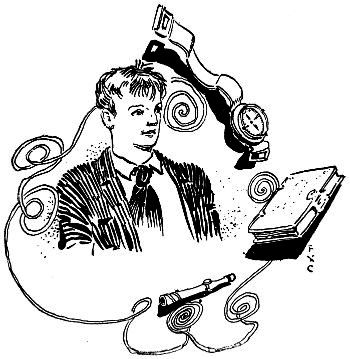
Here he presented Rob the silver box of
tablets, and the boy, somewhat nervously,
thanked him for the gift.
"The next requirement of man," continued
the Demon, "is defense from his enemies.
I notice with sorrow that men frequently
have wars and kill one another.
Also, even in civilized communities, man
is in constant danger from highwaymen,
cranks and policemen. To defend himself
he uses heavy and dangerous guns,
with which to destroy his enemies. This
is wrong. He has no right to take away
what he can not bestow; to destroy what
he can not create. To kill a fellow-creature
is a horrid crime, even if done in self-defense.
Therefore, my second gift to you
is this little tube. You may carry it within
your pocket. Whenever an enemy threatens
you, be it man or beast, simply point
the tube and press this button in the handle.
An electric current will instantly be directed
upon your foe, rendering him wholly unconscious
for the period of one hour. During
that time you will have opportunity to
escape. As for your enemy, after regaining
consciousness he will suffer no inconvenience
from the encounter beyond a slight
headache."
"That's fine!" said Rob, as he took the
tube. It was scarcely six inches long, and
hollow at one end.
"The busy lives of men," proceeded the
Demon, "require them to move about and
travel in all directions. Yet to assist them
there are only such crude and awkward machines
as electric trolleys, cable cars, steam
railways and automobiles. These crawl
slowly over the uneven surface of the earth
and frequently get out of order. It has grieved
me that men have not yet discovered what
even the birds know: that the atmosphere
offers them swift and easy means of traveling
from one part of the earth's surface to
another."
"Some people have tried to build air-ships,"
remarked Rob.
"So they have; great, unwieldy machines
which offer so much resistance to the air
that they are quite useless. A big machine
is not needed to carry one through the air.
There are forces in nature which may be
readily used for such purpose. Tell me,
what holds you to the Earth, and makes a
stone fall to the ground?"
"Attraction of gravitation," said Rob,
promptly.
"Exactly. That is one force I refer to,"
said the Demon. "The force of repulsion,
which is little known, but just as powerful,
is another that mankind may direct. Then
there are the Polar electric forces, attracting
objects toward the north or south poles.
You have guessed something of this by the
use of the compass, or electric needle. Opposed
to these is centrifugal electric force,
drawing objects from east to west, or in the
opposite direction. This force is created by
the whirl of the earth upon its axis, and is
easily utilized, although your scientific men
have as yet paid little attention to it.
"These forces, operating in all directions,
absolute and immutable, are at the disposal
of mankind. They will carry you through
the atmosphere wherever and whenever you
choose. That is, if you know how to control
them. Now, here is a machine I have
myself perfected."
The Demon drew from his pocket something
that resembled an open-faced watch,
having a narrow, flexible band attached to it.
"When you wish to travel," said he,
"attach this little machine to your left wrist
by means of the band. It is very light and
will not be in your way. On this dial are
points marked 'up' and 'down' as well
as a perfect compass. When you desire to
rise into the air set the indicator to the word
'up,' using a finger of your right hand to
turn it. When you have risen as high as
you wish, set the indicator to the point of
the compass you want to follow and you
will be carried by the proper electric force
in that direction. To descend, set the indicator
to the word 'down.' Do you understand?"
"Perfectly!" cried Rob, taking the machine
from the Demon with unfeigned delight.
"This is really wonderful, and I'm
awfully obliged to you!"
"Don't mention it," returned the Demon,
dryly. "These three gifts you may amuse
yourself with for the next week. It seems
hard to entrust such great scientific discoveries
to the discretion of a mere boy; but they
are quite harmless, so if you exercise proper
care you can not get into trouble through
their possession. And who knows what
benefits to humanity may result? One
week from to-day, at this hour, I will again
appear to you, at which time you shall receive
the second series of electrical gifts."
"I'm not sure," said Rob, "that I shall
be able again to make the connections that
will strike the Master Key."
"Probably not," answered the Demon.
"Could you accomplish that, you might
command my services forever. But, having
once succeeded, you are entitled to the
nine gifts—three each week for three weeks—so
you have no need to call me to do my
duty. I shall appear of my own accord."
"Thank you," murmured the boy.
The Demon bowed and spread his hands
in the form of a semi-circle. An instant
later there was a blinding flash, and when
Rob recovered from it and opened his eyes
the Demon of Electricity had disappeared.
CHAPTER FOUR
TESTING THE INSTRUMENTS
There is little doubt that had this
strange experience befallen a grown
man he would have been stricken with a fit
of trembling or a sense of apprehension, or
even fear, at the thought of having faced
the terrible Demon of Electricity, of having
struck the Master Key of the world's greatest
natural forces, and finding himself possessed
of three such wonderful and useful
gifts. But a boy takes everything as a
matter of course. As the tree of knowledge
sprouts and expands within him, shooting
out leaf after leaf of practical experience,
the succession of surprises dulls his faculty
of wonderment. It takes a great deal to
startle a boy.
Rob was full of delight at his unexpected
good fortune; but he did not stop to consider
that there was anything remarkably
queer or uncanny in the manner in which it
had come to him. His chief sensation was
one of pride. He would now be able to
surprise those who had made fun of his electrical
craze and force them to respect his
marvelous powers. He decided to say nothing
about the Demon or the accidental striking
of the Master Key. In exhibiting to his
friends the electrical devices he had acquired
it would be "no end of fun" to mark their
amazement and leave them to guess how he
performed his feats.
So he put his treasures into his pocket,
locked his workshop and went downstairs
to his room to prepare for dinner.
While brushing his hair he remembered
it was no longer necessary for him to eat
ordinary food. He was feeling quite hungry
at that moment, for he had a boy's ravenous
appetite; but, taking the silver box
from his pocket, he swallowed a tablet and
at once felt his hunger as fully satisfied as if
he had partaken of a hearty meal, while at
the same time he experienced an exhilarating
glow throughout his body and a clearness
of brain and gaiety of spirits which filled
him with intense gratification.
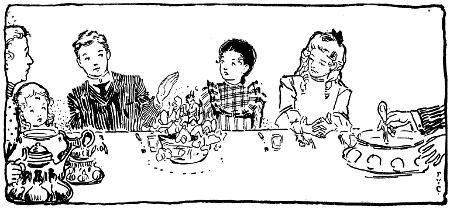
Still, he entered the dining-room when
the bell rang and found his father and
mother and sisters already assembled there.
"Where have you been all day, Robert?"
inquired his mother.
"No need to ask," said Mr. Joslyn, with
a laugh. "Fussing over electricity, I'll bet
a cookie!"
"I do wish," said the mother, fretfully,
"that he would get over that mania. It unfits
him for anything else."
"Precisely," returned her husband, dishing
the soup; "but it fits him for a great
career when he becomes a man. Why
shouldn't he spend his summer vacation in
pursuit of useful knowledge instead of romping
around like ordinary boys?"
"No soup, thank you," said Rob.
"What!" exclaimed his father, looking
at him in surprise, "it's your favorite
soup."
"I know," said Rob, quietly, "but I
don't want any."
"Are you ill, Robert?" asked his mother.
"Never felt better in my life," answered
Rob, truthfully.
Yet Mrs. Joslyn looked worried, and
when Rob refused the roast, she was really
shocked.
"Let me feel your pulse, my poor boy!"
she commanded, and wondered to find it so
regular.
In fact, Rob's action surprised them all.
He sat calmly throughout the meal, eating
nothing, but apparently in good health
and spirits, while even his sisters regarded
him with troubled countenances.
"He's worked too hard, I guess," said
Mr. Joslyn, shaking his head sadly.
"Oh, no; I haven't," protested Rob;
"but I've decided not to eat anything,
hereafter. It's a bad habit, and does more
harm than good."
"Wait till breakfast," said sister Helen,
with a laugh; "you'll be hungry enough
by that time."
However, the boy had no desire for food
at breakfast time, either, as the tablet sufficed
for an entire day. So he renewed
the anxiety of the family by refusing to join
them at the table.
"If this goes on," Mr. Joslyn said to
his son, when breakfast was finished, "I
shall be obliged to send you away for your
health."
"I think of making a trip this morning,"
said Rob, carelessly.
"Where to?"
"Oh, I may go to Boston, or take a run
over to Cuba or Jamaica," replied the boy.
"But you can not go so far by yourself,"
declared his father; "and there is no one
to go with you, just now. Nor can I spare
the money at present for so expensive a
trip."
"Oh, it won't cost anything," replied
Rob, with a smile.
Mr. Joslyn looked upon him gravely and
sighed. Mrs. Joslyn bent over her son
with tears in her eyes and said:
"This electrical nonsense has affected
your mind, dear. You must promise me to
keep away from that horrid workshop for a
time."
"I won't enter it for a week," he answered.
"But you needn't worry about
me. I haven't been experimenting with
electricity all this time for nothing, I can
tell you. As for my health, I'm as well
and strong as any boy need be, and there's
nothing wrong with my head, either. Common
folks always think great men are crazy,
but Edison and Tesla and I don't pay any
attention to that. We've got our discoveries
to look after. Now, as I said, I'm going
for a little trip in the interests of science.
I maybe back to-night, or I may be
gone several days. Anyhow, I'll be back
in a week, and you mustn't worry about
me a single minute."
"How are you going?" inquired his
father, in the gentle, soothing tone persons
use in addressing maniacs.
"Through the air," said Rob.
His father groaned.
"Where's your balloon?" inquired sister
Mabel, sarcastically.
"I don't need a balloon," returned the
boy. "That's a clumsy way of traveling, at
best. I shall go by electric propulsion."
"Good gracious!" cried Mr. Joslyn, and
the mother murmured: "My poor boy! my
poor boy!"
"As you are my nearest relatives," continued
Rob, not noticing these exclamations,
"I will allow you to come into the back
yard and see me start. You will then understand
something of my electrical powers."
They followed him at once, although with
unbelieving faces, and on the way Rob
clasped the little machine to his left wrist,
so that his coat sleeve nearly hid it.
When they reached the lawn at the back
of the house Rob kissed them all good-by,
much to his sisters' amusement, and turned
the indicator of the little instrument to the
word "up."
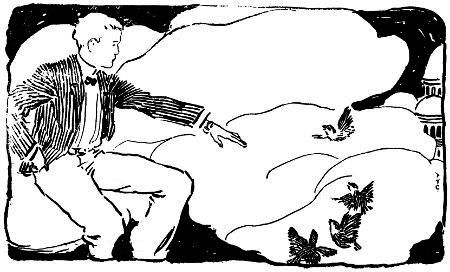
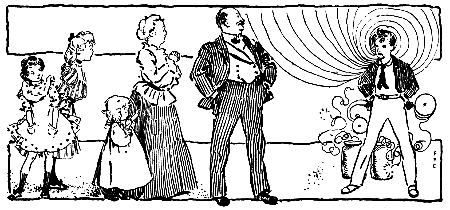
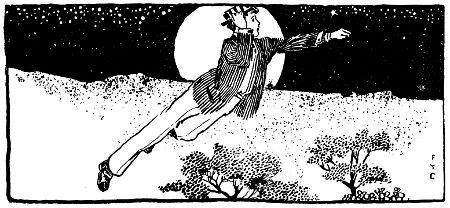
Immediately he began to rise into the
air.
"Don't worry about me!" he called
down to them. "Good-by!"
Mrs. Joslyn, with a scream of terror, hid
her face in her hands.
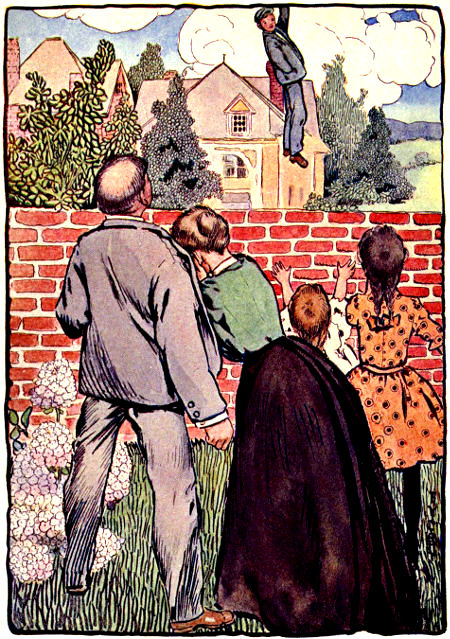
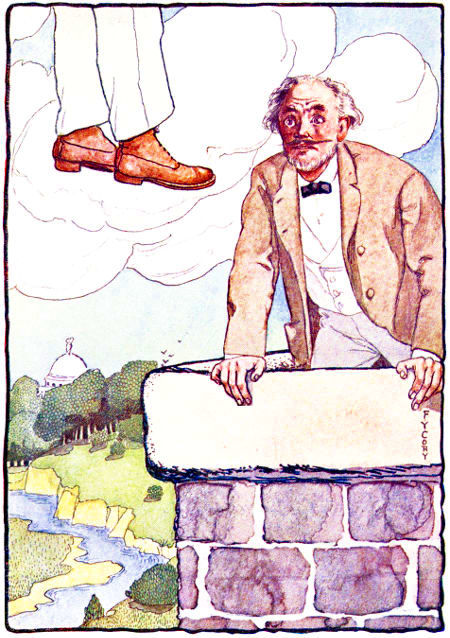
"He'll break his neck!" cried the astounded
father, tipping back his head to
look after his departing son.
"He'll break his neck!" cried the astounded father
"Come back! Come back!" shouted
the girls to the soaring adventurer.
"I will—some day!" was the far-away
answer.
Having risen high enough to pass over
the tallest tree or steeple, Rob put the indicator
to the east of the compass-dial and at
once began moving rapidly in that direction.
The sensation was delightful. He rode
as gently as a feather floats, without any
exertion at all on his own part; yet he
moved so swiftly that he easily distanced a
railway train that was speeding in the same
direction.
"This is great!" reflected the youth.
"Here I am, traveling in fine style, without
a penny to pay any one! And I've
enough food to last me a month in my coat
pocket. This electricity is the proper stuff,
after all! And the Demon's a trump, and
no mistake. Whee-ee! How small everything
looks down below there. The people
are bugs, and the houses are soap-boxes,
and the trees are like clumps of grass. I
seem to be passing over a town. Guess
I'll drop down a bit, and take in the sights."
He pointed the indicator to the word
"down," and at once began dropping
through the air. He experienced the sensation
one feels while descending in an elevator.
When he reached a point just above
the town he put the indicator to the zero
mark and remained stationary, while he
examined the place. But there was nothing
to interest him, particularly; so after a brief
survey he once more ascended and continued
his journey toward the east.
At about two o'clock in the afternoon he
reached the city of Boston, and alighting
unobserved in a quiet street he walked
around for several hours enjoying the sights
and wondering what people would think of
him if they but knew his remarkable powers.
But as he looked just like any other
boy no one noticed him in any way.
It was nearly evening, and Rob had wandered
down by the wharves to look at the
shipping, when his attention was called to
an ugly looking bull dog, which ran toward
him and began barking ferociously.
"Get out!" said the boy, carelessly, and
made a kick at the brute.
The dog uttered a fierce growl and sprang
upon him with bared teeth and flashing red
eyes. Instantly Rob drew the electric tube
from his pocket, pointed it at the dog and
pressed the button. Almost at the same moment
the dog gave a yelp, rolled over once
or twice and lay still.
"I guess that'll settle him," laughed the
boy; but just then he heard an angry shout,
and looking around saw a policeman running
toward him.
"Kill me dog, will ye—eh?" yelled the
officer; "well, I'll just run ye in for that
same, an' ye'll spend the night in the lock-up!"
And on he came, with drawn club in
one hand and a big revolver in the other.
"You'll have to catch me first," said
Rob, still laughing, and to the amazement
of the policeman he began rising straight
into the air.
"Come down here! Come down, or I'll
shoot!" shouted the fellow, flourishing his
revolver.
Rob was afraid he would; so, to avoid accidents,
he pointed the tube at him and
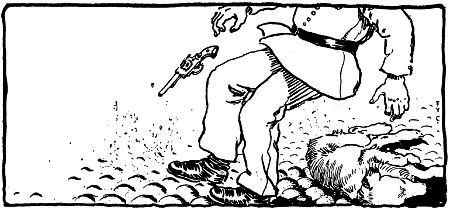
pressed the button. The red-whiskered policeman
keeled over quite gracefully and fell
across the body of the dog, while Rob continued
to mount upward until he was out of
sight of those in the streets.
"That was a narrow escape," he thought,
breathing more freely. "I hated to paralyze
that policeman, but he might have sent
a bullet after me. Anyhow, he'll be all
right again in an hour, so I needn't worry."
It was beginning to grow dark, and he
wondered what he should do next. Had he
possessed any money he would have descended
to the town and taken a bed at a
hotel, but he had left home without a single
penny. Fortunately the nights were warm
at this season, so he determined to travel all
night, that he might reach by morning some
place he had never before visited.
Cuba had always interested him, and he
judged it ought to lie in a southeasterly
direction from Boston. So he set the indicator
to that point and began gliding
swiftly toward the southeast.
He now remembered that it was twenty-four
hours since he had eaten the first electrical
tablet. As he rode through the air
he consumed another. All hunger at once
left him, while he felt the same invigorating
sensations as before.
After a time the moon came out, and
Rob amused himself gazing at the countless
stars in the sky and wondering if the Demon
was right when he said the world was the
most important of all the planets.
But presently he grew sleepy, and before
he realized what was happening he had
fallen into a sound and peaceful slumber,
while the indicator still pointed to the southeast
and he continued to move rapidly
through the cool night air.
CHAPTER FIVE
THE CANNIBAL ISLAND
Doubtless the adventures of the
day had tired Rob, for he slept
throughout the night as comfortably as if he
had been within his own room, lying upon
his own bed. When, at last, he opened his
eyes and gazed sleepily about him, he found
himself over a great body of water, moving
along with considerable speed.
"It's the ocean, of course," he said to
himself. "I haven't reached Cuba yet."
It is to be regretted that Rob's knowledge
of geography was so superficial; for, as he
had intended to reach Cuba, he should have
taken a course almost southwest from Boston,
instead of southeast. The sad result
of his ignorance you will presently learn,
for during the entire day he continued to
travel over a boundless waste of ocean,
without the sight of even an island to cheer
him.
The sun shone so hot that he regretted
he had not brought an umbrella. But he
wore a wide-brimmed straw hat, which
protected him somewhat, and he finally discovered
that by rising to a considerable distance
above the ocean he avoided the reflection
of the sun upon the water and also
came within the current of good breeze.
Of course he dared not stop, for there
was no place to land; so he calmly continued
his journey.
"It may be I've missed Cuba," he
thought; "but I can not change my course
now, for if I did I might get lost, and never
be able to find land again. If I keep on as
I am I shall be sure to reach land of some
sort, in time, and when I wish to return
home I can set the indicator to the northwest
and that will take me directly back to
Boston."
This was good reasoning, but the rash
youth had no idea he was speeding over the
ocean, or that he was destined to arrive
shortly at the barbarous island of Brava, off
the coast of Africa. Yet such was the case;
just as the sun sank over the edge of the
waves he saw, to his great relief, a large
island directly in his path.
He dropped to a lower position in the
air, and when he judged himself to be over
the center of the island he turned the indicator
to zero and stopped short.
The country was beautifully wooded,
while pretty brooks sparkled through the
rich green foliage of the trees. The island
sloped upwards from the sea-coast in all directions,
rising to a hill that was almost a
mountain in the center. There were two
open spaces, one on each side of the island,
and Rob saw that these spaces were occupied
by queer-looking huts built from brushwood
and branches of trees. This showed
that the island was inhabited, but as Rob
had no idea what island it was he wisely determined
not to meet the natives until he
had discovered what they were like and
whether they were disposed to be friendly.
So he moved over the hill, the top of
which proved to be a flat, grass-covered
plateau about fifty feet in diameter. Finding
it could not be easily reached from
below, on account of its steep sides, and
contained neither men nor animals, he
alighted on the hill-top and touched his
feet to the earth for the first time in twenty-four
hours.
The ride through the air had not tired
him in the least; in fact, he felt as fresh and
vigorous as if he had been resting throughout
the journey. As he walked upon the
soft grass of the plateau he felt elated,
and compared himself to the explorers of
ancient days; for it was evident that civilization
had not yet reached this delightful
spot.
There was scarcely any twilight in this
tropical climate and it grew dark quickly.
Within a few minutes the entire island,
save where he stood, became dim and indistinct.
He ate his daily tablet, and after
watching the red glow fade in the western
sky and the gray shadows of night settle
around him he stretched himself comfortably
upon the grass and went to sleep.
The events of the day must have deepened
his slumber, for when he awoke the
sun was shining almost directly over him,
showing that the day was well advanced.
He stood up, rubbed the sleep from his eyes
and decided he would like a drink of water.
From where he stood he could see several
little brooks following winding paths through
the forest, so he settled upon one that
seemed farthest from the brushwood villages,
and turning his indicator in that direction
soon floated through the air to a sheltered
spot upon the bank.
Kneeling down, he enjoyed a long, refreshing
drink of the clear water, but as he
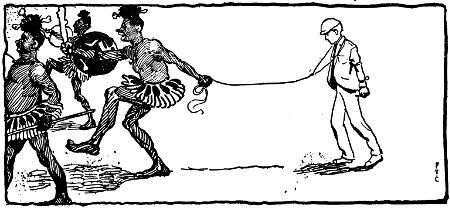
started to regain his feet a coil of rope was
suddenly thrown about him, pinning his
arms to his sides and rendering him absolutely
helpless.
At the same time his ears were saluted
with a wild chattering in an unknown
tongue, and he found himself surrounded by
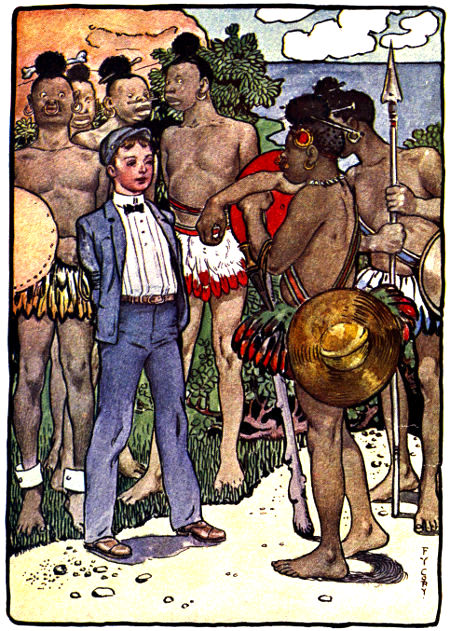
a group of natives of hideous appearance.
They were nearly naked, and bore spears
and heavy clubs as their only weapons.
Their hair was long, curly, and thick as
bushes, and through their noses and ears
were stuck the teeth of sharks and curious
metal ornaments.
These creatures had stolen upon Rob so
quietly that he had not heard a sound, but
now they jabbered loudly, as if much excited.
Finally one fat and somewhat aged native,
who seemed to be a chief, came close
to Rob and said, in broken English:
"How get here?"
"I flew," said the boy, with a grin.
The chief shook his head, saying:
"No boat come. How white man come?"
"Through the air," replied Rob, who
was rather flattered at being called a
"man."
The chief looked into the air with a puzzled
expression and shook his head again.
"White man lie," he said calmly.
Then he held further conversation with
his fellows, after which he turned to Rob
and announced:
"Me see white man many times. Come
in big boats. White men all bad. Make
kill with bang-sticks. We kill white man
with club. Then we eat white man. Dead
white man good. Live white man bad!"
This did not please Rob at all. The idea
of being eaten by savages had never occurred
to him as a sequel to his adventures. So
he said rather anxiously to the chief:
"Look here, old fellow; do you want to
die?"
"Me no die. You die," was the reply.
"You'll die, too, if you eat me," said
Rob. "I'm full of poison."
"Poison? Don't know poison," returned
the chief, much perplexed to understand
him.
"Well, poison will make you sick—awful
sick. Then you'll die. I'm full of it; eat it
every day for breakfast. It don't hurt white
men, you see, but it kills black men quicker
than the bang-stick."
The chief listened to this statement carefully,
but only understood it in part. After
a moment's reflection he declared:
"White man lie. Lie all time. Me
eat plenty white man. Never get sick;
never die." Then he added, with renewed
cheerfulness: "Me eat you, too!"
Before Rob could think of a further protest,
his captors caught up the end of the
rope and led him away through the forest.
He was tightly bound, and one strand of
rope ran across the machine on his wrist
and pressed it into his flesh until the pain
was severe. But he resolved to be brave,
whatever happened, so he stumbled along
after the savages without a word.
After a brief journey they came to a village,
where Rob was thrust into a brushwood
hut and thrown upon the ground,
still tightly bound.
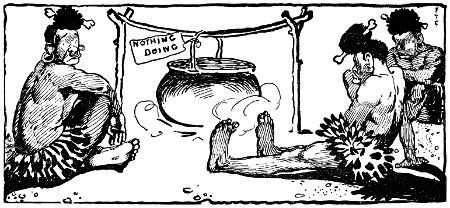
"We light fire," said the chief. "Then
kill little white man. Then eat him."
With this comforting promise he went
away and left Rob alone to think the matter
over.
"This is tough," reflected the boy, with
a groan. "I never expected to feed cannibals.
Wish I was at home with mother
and dad and the girls. Wish I'd never
seen the Demon of Electricity and his wonderful
inventions. I was happy enough before
I struck that awful Master Key. And
now I'll be eaten—with salt and pepper,
probably. Wonder if there'll be any gravy.
Perhaps they'll boil me, with biscuits, as
mother does chickens. Oh-h-h-h-h! It's
just awful!"
In the midst of these depressing thoughts
he became aware that something was hurting
his back. After rolling over he found
that he had been lying upon a sharp stone
that stuck out of the earth. This gave him
an idea. He rolled upon the stone again
and began rubbing the rope that bound him
against the sharp edge.
Outside he could hear the crackling of
fagots and the roar of a newly-kindled fire,
so he knew he had no time to spare. He
wriggled and pushed his body right and left,
right and left, sawing away at the rope,
until the strain and exertion started the perspiration
from every pore.
At length the rope parted, and hastily
uncoiling it from his body Rob stood up
and rubbed his benumbed muscles and tried
to regain his lost breath. He had not freed
himself a moment too soon, he found, for
hearing a grunt of surprise behind him he
turned around and saw a native standing in
the door of the hut.
Rob laughed, for he was not a bit afraid of
the blacks now. As the native made a rush
toward him the boy drew the electric tube
from his pocket, pointed it at the foe, and
pressed the button. The fellow sank to the
earth without even a groan, and lay still.
Then another black entered, followed by
the fat chief. When they saw Rob at liberty,
and their comrade lying apparently
dead, the chief cried out in surprise, using
some expressive words in his own language.
"If it's just the same to you, old chap,"
said Rob, coolly, "I won't be eaten to-day.
You can make a pie of that fellow on the
ground."
"No! We eat you," cried the chief, angrily.
"You cut rope, but no get away; no
boat!"
"I don't need a boat, thank you," said
the boy; and then, as the other native sprang
forward, he pointed the tube and laid him
out beside his first victim.
At this act the chief stood an instant in
amazed uncertainty. Then he turned and
rushed from the hut.
Laughing with amusement at the waddling,
fat figure, Rob followed the chief and
found himself standing almost in the center
of the native village. A big fire was blazing
merrily and the blacks were busy making
preparations for a grand feast.
Rob was quickly surrounded by a crowd
of the villagers, who chattered fiercely and
made threatening motions in his direction;
but as the chief cried out to them a warning
in the native tongue they kept a respectful
distance and contented themselves with
brandishing their spears and clubs.
"If any of your fellows come nearer,"
Rob said to the fat chief, "I'll knock 'em
over."
"What you make do?" asked the chief,
nervously.
"Watch sharp, and you'll see," answered
Rob. Then he made a mocking bow to the
circle and continued: "I'm pleased to have
met you fellows, and proud to think you
like me well enough to want to eat me; but
I'm in a bit of a hurry to-day, so I can't
stop to be digested." After which, as the
crowd broke into a hum of surprise, he
added: "Good-day, black folks!" and quickly
turned the indicator of his traveling machine
to the word "up."
Slowly he rose into the air, until his heels
were just above the gaping blacks; but there
he stopped short. With a thrill of fear he
glanced at the indicator. It was pointed
properly, and he knew at once that something
was wrong with the delicate mechanism
that controlled it. Probably the pressure
of the rope across its face, when he was
bound, had put it out of order. There he
was, seven feet in the air, but without the
power to rise an inch farther.
This short flight, however, had greatly
astonished the blacks, who, seeing his body
suspended in mid-air, immediately hailed
him as a god, and prostrated themselves upon
the ground before him.
The fat chief had seen something of white
men in his youth, and had learned to mistrust
them. So, while he remained as prostrate
as the rest, he peeped at Rob with one
of his little black eyes and saw that the boy
was ill at ease, and seemed both annoyed
and frightened.
So he muttered some orders to the man
next him, who wriggled along the ground
until he had reached a position behind Rob,
when he rose and pricked the suspended
"god" with the point of his spear.
"Ouch!" yelled the boy; "stop that!"
He twisted his head around, and seeing
the black again make a movement with the
spear, Rob turned his electric tube upon
him and keeled him over like a ten-pin.
The natives, who had looked up at his
cry of pain, again prostrated themselves,
kicking their toes against the ground in a
terrified tattoo at this new evidence of the
god's powers.
The situation was growing somewhat
strained by this time, and Rob did not
know what the savages would decide to do
next; so he thought it best to move away
from them, since he was unable to rise to a
greater height. He turned the indicator
towards the south, where a level space appeared
between the trees; but instead of
taking that direction he moved towards the
northeast, a proof that his machine had
now become absolutely unreliable. Moreover,
he was slowly approaching the fire,
which, although it had ceased blazing, was
a mass of glowing red embers.
In his excitement he turned the indicator
this way and that, trying to change the direction
of his flight, but the only result of
his endeavor was to carry him directly over
the fire, where he came to a full stop.
"Murder! Help! Fire and blazes!"
he cried, as he felt the glow of the coals beneath
him. "I'll be roasted, after all!
Here; help, Fatty, help!"
The fat chief sprang to his feet and came
to the rescue. He reached up, caught Rob
by the heels, and pulled him down to the
ground, away from the fire. But the next
moment, as he clung to the boy's feet, they
both soared into the air again, and, although
now far enough from the fire to escape
its heat, the savage, finding himself
lifted from the earth, uttered a scream of
horror and let go of Rob, to fall head over
heels upon the ground.
The other blacks had by this time regained
their feet, and now they crowded
around their chief and set him upright
again.
Rob continued to float in the air, just
above their heads, and now abandoned all
thoughts of escaping by means of his
wrecked traveling machine. But he resolved
to regain a foothold upon the earth
and take his chances of escape by running
rather than flying. So he turned the indicator
to the word "down," and very slowly
it obeyed, allowing him, to his great relief,
to sink gently to the ground.
CHAPTER SIX
THE BUCCANEERS
Once more the blacks formed a circle
around our adventurer, who
coolly drew his tube and said to the chief:
"Tell your people I'm going to walk
away through those trees, and if any one
dares to interfere with me I'll paralyze
him."
The chief understood enough English to
catch his meaning, and repeated the message
to his men. Having seen the terrible
effect of the electric tube they wisely fell
back and allowed the boy to pass.
He marched through their lines with a
fine air of dignity, although he was fearful
lest some of the blacks should stick a spear
into him or bump his head with a war-club.
But they were awed by the wonders
they had seen and were still inclined to believe
him a god, so he was not molested.
When he found himself outside the village
he made for the high plateau in the
center of the island, where he could be safe
from the cannibals while he collected his
thoughts. But when he reached the place
he found the sides so steep he could not
climb them, so he adjusted the indicator
to the word "up" and found it had still
enough power to support his body while he
clambered up the rocks to the level, grass-covered
space at the top.
Then, reclining upon his back, he gave
himself up to thoughts of how he might
escape from his unpleasant predicament.
"Here I am, on a cannibal island, hundreds
of miles from civilization, with no
way to get back," he reflected. "The
family will look for me every day, and finally
decide I've broken my neck. The Demon
will call upon me when the week is up and
won't find me at home; so I'll miss the
next three gifts. I don't mind that so much,
for they might bring me into worse scrapes
than this. But how am I to get away from
this beastly island? I'll be eaten, after all,
if I don't look out!"
These and similar thoughts occupied him
for some time, yet in spite of much planning
and thinking he could find no practical
means of escape.
At the end of an hour he looked over the
edge of the plateau and found it surrounded
by a ring of the black cannibals, who had
calmly seated themselves to watch his movements.
"Perhaps they intend to starve me into
surrender," he thought; "but they won't
succeed so long as my tablets hold out.
And if, in time, they should starve me, I'll be
too thin and tough to make good eating;
so I'll get the best of them, anyhow."
Then he again lay down and began to
examine his electrical traveling machine.
He did not dare take it apart, fearing he
might not be able to get it together again,
for he knew nothing at all about its construction.
But he discovered two little dents
on the edge, one on each side, which had
evidently been caused by the pressure of
the rope.
"If I could get those dents out," he
thought, "the machine might work."
He first tried to pry out the edges with
his pocket knife, but the attempt resulted
in failure. Then, as the sides seemed a
little bulged outward by the dents, he
placed the machine between two flat stones
and pressed them together until the little
instrument was nearly round again. The
dents remained, to be sure, but he hoped
he had removed the pressure upon the
works.
There was just one way to discover how
well he had succeeded, so he fastened the
machine to his wrist and turned the indicator
to the word "up."
Slowly he ascended, this time to a height
of nearly twenty feet. Then his progress
became slower and finally ceased altogether.
"That's a little better," he thought.
"Now let's see if it will go sidewise."
He put the indicator to "north-west,"—the
direction of home—and very slowly the
machine obeyed and carried him away
from the plateau and across the island.
The natives saw him go, and springing
to their feet began uttering excited shouts
and throwing their spears at him. But he
was already so high and so far away that
they failed to reach him, and the boy continued
his journey unharmed.
Once the branches of a tall tree caught
him and nearly tipped him over; but he
managed to escape others by drawing up
his feet. At last he was free of the island
and traveling over the ocean again. He
was not at all sorry to bid good-by to the
cannibal island, but he was worried about
the machine, which clearly was not in good
working order. The vast ocean was beneath
him, and he moved no faster than an
ordinary walk.
"At this rate I'll get home some time
next year," he grumbled. "However, I
suppose I ought to be glad the machine
works at all." And he really was glad.
All the afternoon and all the long summer
night he moved slowly over the water.
It was annoying to go at "a reg'lar jog-trot,"
as Rob called it, after his former
swift flight; but there was no help for it.
Just as dawn was breaking he saw in the
distance a small vessel, sailing in the direction
he was following, yet scarcely moving
for lack of wind. He soon caught up with
it, but saw no one on deck, and the craft
had a dingy and uncared-for appearance
that was not reassuring. But after hovering
over it for some time Rob decided
to board the ship and rest for a while. He
alighted near the bow, where the deck was
highest, and was about to explore the place
when a man came out of the low cabin and
espied him.
This person had a most villainous countenance,
and was dark-skinned, black-bearded
and dressed in an outlandish, piratical
costume. On seeing the boy he
gave a loud shout and was immediately
joined by four companions, each as disagreeable
in appearance as the first.
Rob knew there would be trouble the
moment he looked at this evil crew, and
when they drew their daggers and pistols
and began fiercely shouting in an unknown
tongue, the boy sighed and took the electric
tube from his coat pocket.
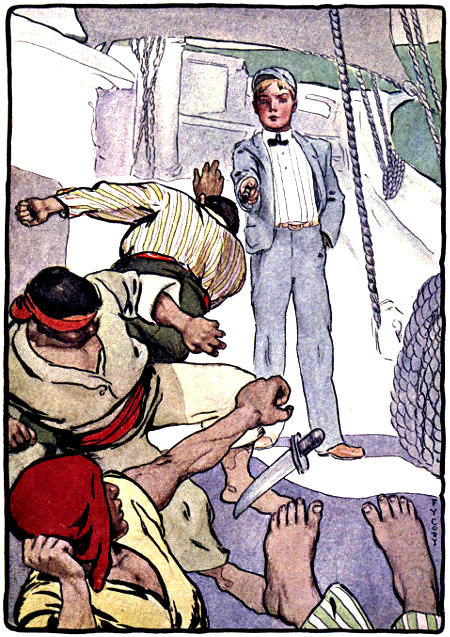
The buccaneers did not notice the movement,
but rushed upon him so quickly that
he had to press the button at a lively rate.
The tube made no noise at all, so it was a
strange and remarkable sight to see the
pirates suddenly drop to the deck and lie
motionless. Indeed, one was so nearly
upon him when the electric current struck
him that his head, in falling, bumped into
Rob's stomach and sent him reeling against
the side of the vessel.
It was a strange sight to see the pirates drop to the
deck and lie motionless
He quickly recovered himself, and seeing
his enemies were rendered harmless, the
boy entered the cabin and examined it
curiously. It was dirty and ill-smelling
enough, but the corners and spare berths
were heaped with merchandise of all kinds
which had been taken from those so unlucky
as to have met these cruel and desperate
men.
After a short inspection of the place he
returned to the deck and again seated himself
in the bow.
The crippled condition of his traveling
machine was now his chief trouble, and
although a good breeze had sprung up to fill
the sails and the little bark was making fair
headway, Rob knew he could never expect
to reach home unless he could discover a
better mode of conveyance than this.
He unstrapped the machine from his
wrist to examine it better, and while holding
it carelessly in his hand it slipped and
fell with a bang to the deck, striking upon
its round edge and rolling quickly past the
cabin and out of sight. With a cry of alarm
he ran after it, and after much search found
it lying against the bulwark near the edge
of a scupper hole, where the least jar of
the ship would have sent it to the bottom of
the ocean. Rob hastily seized his treasure,
and upon examining it found the fall had
bulged the rim so that the old dents scarcely
showed at all. But its original shape was
more distorted than ever, and Rob feared
he had utterly ruined its delicate mechanism.
Should this prove to be true, he
might now consider himself a prisoner of
this piratical band, the members of which,
although temporarily disabled, would soon
regain consciousness.
He sat in the bow, sadly thinking of his
misfortunes, until he noticed that one of the
men began to stir. The effect of the electric
shock conveyed by the tube was beginning
to wear away, and now the buccaneer
sat up, rubbed his head in a bewildered
fashion and looked around him. When he
saw Rob he gave a shout of rage and drew
his knife, but one motion of the electric
tube made him cringe and slip away to the
cabin, where he remained out of danger.
And now the other four sat up, groaning
and muttering in their outlandish speech;
but they had no notion of facing Rob's tube a
second time, so one by one they joined their
leader in the cabin, leaving the boy undisturbed.
By this time the ship had begun to pitch
and toss in an uncomfortable fashion, and
Rob noticed that the breeze had increased to
a gale. There being no one to look after
the sails, the vessel was in grave danger of
capsizing or breaking her masts. The
waves were now running high, too, and
Rob began to be worried.
Presently the captain of the pirates stuck
his head out of the cabin door, jabbered
some unintelligible words and pointed to
the sails. The boy nodded, for he understood
they wanted to attend to the rigging.
So the crew trooped forth, rather fearfully,
and began to reef the sails and put the ship
into condition to weather the storm.
Rob paid no further attention to them.
He looked at his traveling machine rather
doubtfully and wondered if he dared risk
its power to carry him through the air.
Whether he remained in the ship or trusted
to the machine, he stood a good chance of
dropping into the sea at any moment. So,
while he hesitated, he attached the machine
to his wrist and leaned over the bulwarks
to watch the progress of the storm.
He might stay in the ship until it foundered,
he thought, and then take his chances with
the machine. He decided to wait until a
climax arrived.
The climax came the next moment, for
while he leaned over the bulwarks the buccaneers
stole up behind him and suddenly
seized him in their grasp. While two of
them held his arms the others searched his
pockets, taking from him the electric tube
and the silver box containing his tablets.
These they carried to the cabin and threw
upon the heap of other valuables they had
stolen. They did not notice his traveling
machine, however, but seeing him now unarmed
they began jeering and laughing at
him, while the brutal captain relieved his
anger by giving the prisoner several malicious
kicks.
Rob bore his misfortune meekly, although
he was almost ready to cry with grief and
disappointment. But when one of the pirates,
to inflict further punishment on the
boy, came towards him with a heavy strap,
he resolved not to await the blow.
Turning the indicator to the word "up"
he found, to his joy and relief, that it would
yet obey the influence of the power of repulsion.
Seeing him rise into the air the
fellow made a grab for his foot and held
it firmly, while his companions ran to help
him. Weight seemed to make no difference
in the machine; it lifted the pirate as well
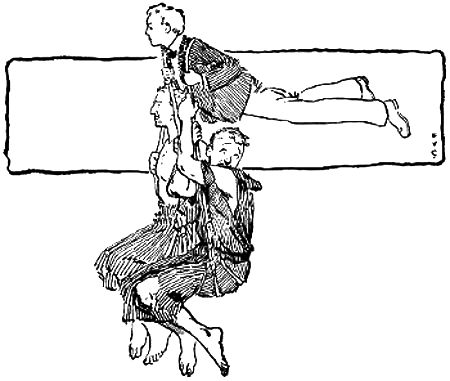
as Rob; it lifted another who clung to the
first man's leg, and another who clung to
him. The other two also caught hold,
hoping their united strength would pull
him down, and the next minute Rob was
soaring through the air with the entire
string of five buccaneers dangling from his
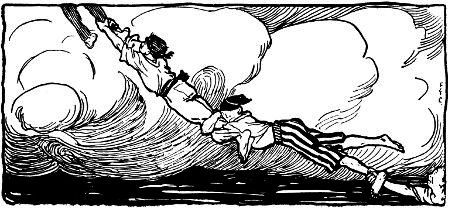
left leg.
At first the villains were too astounded to
speak, but as they realized that they were
being carried through the air and away from
their ship they broke into loud shouts of
dismay, and finally the one who grasped
Rob's leg lost his hold and the five plunged
downward and splashed into the sea.
Finding the machine disposed to work
accurately, Rob left the buccaneers to swim
to the ship in the best way they could, while
he dropped down to the deck again and recovered
from the cabin his box of tablets
and the electric tube. The fellows were just
scrambling on board when he again escaped,
shooting into the air with considerable
speed.
Indeed, the instrument now worked better
than at any time since he had reached
the cannibal island, and the boy was greatly
delighted.
The wind at first sent him spinning away
to the south, but he continued to rise until
he was above the air currents, and the storm
raged far beneath him. Then he set the
indicator to the northwest and breathlessly
waited to see if it would obey. Hurrah!
away he sped at a fair rate of speed, while
all his anxiety changed to a feeling of sweet
contentment.
His success had greatly surprised him,
but he concluded that the jar caused by dropping
the instrument had relieved the pressure
upon the works, and so helped rather
than harmed the free action of the electric
currents.
While he moved through the air with an
easy, gliding motion he watched with much
interest the storm raging below. Above
his head the sun was peacefully shining and
the contrast was strange and impressive.
After an hour or so the storm abated, or
else he passed away from it, for the deep
blue of the ocean again greeted his eyes.
He dropped downward until he was about
a hundred feet above the water, when he
continued his northwesterly course.
But now he regretted having interfered
for a moment with the action of the machine,
for his progress, instead of being
swift as a bird's flight, became slow and
jerky, nor was he sure that the damaged machine
might not break down altogether at
any moment. Yet so far his progress was
in the right direction, and he resolved to experiment
no further with the instrument,
but to let it go as it would, so long as it
supported him above the water. However
irregular the motion might be, it was sure,
if continued, to bring him to land in time,
and that was all he cared about just then.
When night fell his slumber was broken
and uneasy, for he wakened more than once
with a start of fear that the machine had
broken and he was falling into the sea.
Sometimes he was carried along at a swift
pace, and again the machine scarcely
worked at all; so his anxiety was excusable.
The following day was one of continued
uneasiness for the boy, who began to be
harrassed by doubts as to whether, after all,
he was moving in the right direction. The
machine had failed at one time in this respect
and it might again. He had lost all
confidence in its accuracy.
In spite of these perplexities Rob passed
the second night of his uneven flight in profound
slumber, being exhausted by the strain
and excitement he had undergone. When
he awoke at daybreak, he saw, to his profound
delight, that he was approaching
land.
The rising sun found him passing over a
big city, which he knew to be Boston.
He did not stop. The machine was so
little to be depended upon that he dared
make no halt. But he was obliged to alter
the direction from northwest to west, and
the result of this slight change was so great
a reduction in speed that it was mid-day before
he saw beneath him the familiar village
in which he lived.
Carefully marking the location of his
father's house, he came to a stop directly
over it, and a few moments later he managed
to land upon the exact spot in the back
yard whence he had taken his first successful
flight.
CHAPTER SEVEN
THE DEMON BECOMES ANGRY
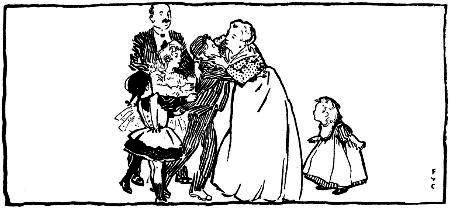
When Rob had been hugged and
kissed by his mother and sisters,
and even Mr. Joslyn had embraced him
warmly, he gave them a brief account of
his adventures. The story was received
with many doubtful looks and much grave
shaking of heads, as was quite natural under
the circumstances.
"I hope, my dear son," said his father,
"that you have now passed through enough
dangers to last you a lifetime, so that hereafter
you will be contented to remain at
home."
"Oh, Robert!" cried his mother, with
tears in her loving eyes, "you don't know
how we've all worried about you for the
past week!"
"A week?" asked Rob, with surprise.
"Yes; it's a week to-morrow morning
since you flew into the air and disappeared."
"Then," said the boy, thoughtfully,
"I've reached home just in time."
"In time for what?" she asked.
But he did not answer that question. He
was thinking of the Demon, and that on the
afternoon of this very day he might expect
the wise and splendid genius to visit him a
second time.
At luncheon, although he did not feel
hungry, he joined the family at table and
pleased his mother by eating as heartily
as of old. He was surprised to find how
good the food tasted, and to realize what a
pleasure it is to gratify one's sense of taste.
The tablets were all right for a journey, he
thought, but if he always ate them he would
be sure to miss a great deal of enjoyment,
since there was no taste to them at all.
At four o'clock he went to his workshop
and unlocked the door. Everything was
exactly as he had left it, and he looked at
his simple electrical devices with some
amusement. They seemed tame beside the
wonders now in his possession; yet he recollected
that his numerous wires had enabled
him to strike the Master Key, and therefore
should not be despised.
Before long he noticed a quickening in
the air, as if it were suddenly surcharged
with electric fluid, and the next instant, in
a dazzling flash of light, appeared the
Demon.
"I am here!" he announced.
"So am I," answered Rob. "But at one
time I really thought I should never see you
again. I've been—"
"Spare me your history," said the Demon,
coldly. "I am aware of your adventures."
"Oh, you are!" said Rob, amazed.
"Then you know—"
"I know all about your foolish experiences,"
interrupted the Demon, "for I have
been with you constantly, although I remained
invisible."
"Then you know what a jolly time I've
had," returned the boy. "But why do you
call them foolish experiences?"
"Because they were, abominably foolish!"
retorted the Demon, bitterly. "I entrusted
to you gifts of rare scientific interest—electrical
devices of such utility that their
general adoption by mankind would create a
new era in earth life. I hoped your use of
these devices would convey such hints to
electrical engineers that they would quickly
comprehend their mechanism and be able
to reproduce them in sufficient quantities to
supply the world. And how do you treat
these marvelous gifts? Why, you carry
them to a cannibal island, where even your
crude civilization has not yet penetrated!"
"I wanted to astonish the natives," said
Rob, grinning.
The Demon uttered an exclamation of
anger, and stamped his foot so fiercely that
thousands of electric sparks filled the air, to
disappear quickly with a hissing, crinkling
sound.
"You might have astonished those ignorant
natives as easily by showing them an
ordinary electric light," he cried, mockingly.
"The power of your gifts would
have startled the most advanced electricians
of the world. Why did you waste them
upon barbarians?"
"Really," faltered Rob, who was frightened
and awed by the Demon's vehement
anger, "I never intended to visit a cannibal
island. I meant to go to Cuba."
"Cuba! Is that a center of advanced
scientific thought? Why did you not take
your marvels to New York or Chicago; or,
if you wished to cross the ocean, to Paris or
Vienna?"
"I never thought of those places," acknowledged
Rob, meekly.
"Then you were foolish, as I said," declared
the Demon, in a calmer tone. "Can
you not realize that it is better to be considered
great by the intelligent thinkers of the
earth, than to be taken for a god by stupid
cannibals?"
"Oh, yes, of course," said Rob. "I wish
now that I had gone to Europe. But you're
not the only one who has a kick coming,"
he continued. "Your flimsy traveling machine
was nearly the death of me."
"Ah, it is true," acknowledged the Demon,
frankly. "The case was made of
too light material. When the rim was
bent it pressed against the works and impeded
the proper action of the currents.
Had you gone to a civilized country such
an accident could not have happened; but
to avoid possible trouble in the future I
have prepared a new instrument, having a
stronger case, which I will exchange for the
one you now have."
"That's very kind of you," said Rob,
eagerly handing his battered machine to the
Demon and receiving the new one in return.
"Are you sure this will work?"
"It is impossible for you to injure it,"
answered the other.
"And how about the next three gifts?"
inquired the boy, anxiously.
"Before I grant them," replied the Demon,
"you must give me a promise to keep
away from uncivilized places and to exhibit
your acquirements only among people of
intelligence."
"All right," agreed the boy; "I'm not
anxious to visit that island again, or any
other uncivilized country."
"Then I will add to your possessions
three gifts, each more precious and important
than the three you have already received."
At this announcement Rob began to
quiver with excitement, and sat staring
eagerly at the Demon, while the latter increased
in stature and sparkled and glowed
more brilliantly than ever.
CHAPTER EIGHT
ROB ACQUIRES NEW POWERS
"I have seen the folly of sending you
into the world with an offensive instrument,
yet with no method of defense,"
resumed the Demon, presently. "You have
knocked over a good many people with that
tube during the past week."
"I know," said Rob; "but I couldn't help
it. It was the only way I had to protect myself."
"Therefore my next gift shall be this
Garment of Protection. You must wear it
underneath your clothing. It has power to
accumulate and exercise electrical repellent
force. Perhaps you do not know what that
means, so I will explain more fully. When
any missile, such as a bullet, sword or lance,
approaches your person, its rush through
the air will arouse the repellent force of
which I speak, and this force, being more
powerful than the projective force, will arrest
the flight of the missile and throw it
back again. Therefore nothing can touch
your person that comes with any degree of
force or swiftness, and you will be safe from
all ordinary weapons. When wearing this
Garment you will find it unnecessary to use
the electric tube except on rare occasions.
Never allow revenge or animosity to influence
your conduct. Men may threaten, but
they can not injure you, so you must remember
that they do not possess your
mighty advantages, and that, because of
your strength, you should bear with them
patiently."
Rob examined the garment with much
curiosity. It glittered like silver, yet was
soft and pliable as lamb's wool. Evidently
the Demon had prepared it especially for
his use, for it was just Rob's size.
"Now," continued the Demon, more
gravely, "we approach the subject of an
electrical device so truly marvelous that even
I am awed when I contemplate the accuracy
and perfection of the natural laws which
guide it and permit it to exercise its functions.
Mankind has as yet conceived nothing
like it, for it requires full knowledge of
electrical power to understand even its possibilities."
The Being paused, and drew from an
inner pocket something resembling a flat
metal box. In size it was about four inches
by six, and nearly an inch in thickness.
"What is it?" asked Rob, wonderingly.
"It is an automatic Record of Events,"
answered the Demon.
"I don't understand," said Rob, with
hesitation.
"I will explain to you its use," returned
the Demon, "although the electrical forces
which operate it and the vibratory currents
which are the true records must remain unknown
to you until your brain has mastered
the higher knowledge of electricity. At
present the practical side of this invention
will be more interesting to you than a review
of its scientific construction.
"Suppose you wish to know the principal
events that are occurring in Germany
at the present moment. You first
turn this little wheel at the side until the
word 'GERMANY' appears in the slot at
the small end. Then open the top cover,
which is hinged, and those passing events in
which you are interested will appear before
your eyes."
The Demon, as he spoke, opened the
cover, and, looking within, the boy saw, as
in a mirror, a moving picture before him.
A regiment of soldiers was marching
through the streets of Berlin, and at its
head rode a body of horsemen, in the midst
of which was the Emperor himself. The
people who thronged the sidewalks cheered
and waved their hats and handkerchiefs
with enthusiasm, while a band of musicians
played a German air, which Rob could distinctly
hear.
While he gazed, spell-bound, the scene
changed, and he looked upon a great warship
entering a harbor with flying pennants.
The rails were lined with officers and men
straining their eyes for the first sight of their
beloved "Vaterland" after a long foreign
cruise, and a ringing cheer, as from a thousand
throats, came faintly to Rob's ear.
Again the scene changed, and within a
dingy, underground room, hemmed in by
walls of stone, and dimly lighted by a flickering
lamp, a body of wild-eyed, desperate
men were plighting an oath to murder the
Emperor and overthrow his government.
"Anarchists?" asked Rob, trembling
with excitement.
"Anarchists!" answered the Demon, with
a faint sneer, and he shut the cover of the
Record with a sudden snap.
"It's wonderful!" cried the boy, with a
sigh that was followed by a slight shiver.
"The Record is, indeed, proof within
itself of the marvelous possibilities of electricity.
Men are now obliged to depend
upon newspapers for information; but these
can only relate events long after they have
occurred. And newspaper statements are
often unreliable and sometimes wholly
false, while many events of real importance
are never printed in their columns. You
may guess what an improvement is this
automatic Record of Events, which is as reliable
as Truth itself. Nothing can be
altered or falsified, for the vibratory currents
convey the actual events to your vision,
even as they happen."
"But suppose," said Rob, "that something
important should happen while I'm
asleep, or not looking at the box?"
"I have called this a Record," replied
the Demon, "and such it really is, although
I have shown you only such events as are
in process of being recorded. By pressing
this spring you may open the opposite cover
of the box, where all events of importance
that have occurred throughout the world
during the previous twenty-four hours will
appear before you in succession. You may
thus study them at your leisure. The various
scenes constitute a register of the world's
history, and may be recalled to view as often
as you desire."
"It's—it's like knowing everything,"
murmured Rob, deeply impressed for perhaps
the first time in his life.
"It is knowing everything," returned the
Demon; "and this mighty gift I have decided
to entrust to your care. Be very careful
as to whom you permit to gaze upon
these pictures of passing events, for knowledge
may often cause great misery to the
human race."
"I'll be careful," promised the boy, as
he took the box reverently within his own
hands.
"The third and last gift of the present
series," resumed the Demon, "is one no
less curious than the Record of Events, although
it has an entirely different value. It
is a Character Marker."
"What's that?" inquired Rob.
"I will explain. Perhaps you know that
your fellow-creatures are more or less hypocritical.
That is, they try to appear good
when they are not, and wise when in reality
they are foolish. They tell you they are
friendly when they positively hate you, and
try to make you believe they are kind when
their natures are cruel. This hypocrisy
seems to be a human failing. One of your
writers has said, with truth, that among civilized
people things are seldom what they
seem."
"I've heard that," remarked Rob.
"On the other hand," continued the
Demon, "some people with fierce countenances
are kindly by nature, and many who
appear to be evil are in reality honorable
and trustworthy. Therefore, that you may
judge all your fellow-creatures truly, and
know upon whom to depend, I give you
the Character Marker. It consists of this
pair of spectacles. While you wear them
every one you meet will be marked upon
the forehead with a letter indicating his or
her character. The good will bear the letter
'G', the evil the letter 'E'. The wise will
be marked with a 'W' and the foolish with
an 'F'. The kind will show a 'K' upon
their foreheads and the cruel a letter 'C'.
Thus you may determine by a single look
the true natures of all those you encounter."
"And are these, also, electrical in their
construction?" asked the boy, as he took
the spectacles.
"Certainly. Goodness, wisdom and kindness
are natural forces, creating character.
For this reason men are not always to blame
for bad character, as they acquire it unconsciously.
All character sends out certain
electrical vibrations, which these spectacles
concentrate in their lenses and exhibit to the
gaze of their wearer, as I have explained."
"It's a fine idea," said the boy; "who
discovered it?"
"It is a fact that has always existed, but
is now utilized for the first time."
"Oh!" said Rob.
"With these gifts, and the ones you acquired
a week ago, you are now equipped
to astound the world and awaken mankind
to a realization of the wonders that may be
accomplished by natural forces. See that
you employ these powers wisely, in the interests
of science, and do not forget your
promise to exhibit your electrical marvels
only to those who are most capable of comprehending
them."
"I'll remember," said Rob.
"Then adieu until a week from to-day,
when I will meet you here at this hour and
bestow upon you the last three gifts which
you are entitled to receive. Good-by!"
"Good-by!" repeated Rob, and in a gorgeous
flash of color the Demon disappeared,
leaving the boy alone in the room with his
new and wonderful possessions.
CHAPTER NINE
THE SECOND JOURNEY
By this time you will have gained a
fair idea of Rob's character. He is,
in truth, a typical American boy, possessing
an average intelligence not yet regulated
by the balance-wheel of experience. The
mysteries of electricity were so attractive
to his eager nature that he had devoted
considerable time and some study to electrical
experiment; but his study was the superficial
kind that seeks to master only such
details as may be required at the moment.
Moreover, he was full of boyish recklessness
and irresponsibility and therefore difficult
to impress with the dignity of science
and the gravity of human existence. Life,
to him, was a great theater wherein he saw
himself the most interesting if not the most
important actor, and so enjoyed the play
with unbounded enthusiasm.
Aside from the extraordinary accident
which had forced the Electrical Demon into
his life, Rob may be considered one of those
youngsters who might possibly develop into
a brilliant manhood or enter upon an ordinary,
humdrum existence, as Fate should
determine. Just at present he had no
thought beyond the passing hour, nor would
he bother himself by attempting to look
ahead or plan for the future.
Yet the importance of his electrical possessions
and the stern injunction of the Demon
to use them wisely had rendered the
boy more thoughtful than at any previous
time during his brief life, and he became
so preoccupied at the dinner table that his
father and mother cast many anxious looks
in his direction.
Of course Rob was anxious to test his
newly-acquired powers, and decided to lose
no time in starting upon another journey.
But he said nothing to any of the family
about it, fearing to meet with opposition.
He passed the evening in the sitting-room,
in company with his father and mother and
sisters, and even controlled his impatience
to the extent of playing a game of carom
with Nell; but he grew so nervous and
impatient at last that his sister gave up the
game in disgust and left him to his own
amusement.
At one time he thought of putting on the
electric spectacles and seeing what the real
character of each member of his family
might be; but a sudden fear took possession
of him that he might regret the act
forever afterward. They were his nearest
and dearest friends on earth, and in his
boyish heart he loved them all and believed
in their goodness and sincerity. The possibility
of finding a bad character mark on
any of their familiar faces made him shudder,
and he determined then and there
never to use the spectacles to view the face
of a friend or relative. Had any one, at
that moment, been gazing at Rob through
the lenses of the wonderful Character
Marker, I am sure a big "W" would have
been found upon the boy's forehead.
When the family circle broke up, and all
retired for the night, Rob kissed his parents
and sisters with real affection before going
to his own room. But, on reaching his
cozy little chamber, instead of preparing
for bed Rob clothed himself in the Garment
of Repulsion. Then he covered the glittering
Garment with his best summer suit
of clothes, which effectually concealed it.
He now looked around to see what else
he should take, and thought of an umbrella,
a rain-coat, a book or two to read during
the journey, and several things besides; but
he ended by leaving them all behind.
"I can't be loaded down with so much
truck," he decided; "and I'm going into
civilized countries, this time, where I can
get anything I need."
However, to prevent a recurrence of the
mistake he had previously made, he tore a
map of the world and a map of Europe
from his geography, and, folding them up,
placed them in his pocket. He also took a
small compass that had once been a watch-charm,
and, finally, the contents of a small
iron bank that opened with a combination
lock. This represented all his savings,
amounting to two dollars and seventeen
cents in dimes, nickles and pennies.
"It isn't a fortune," he thought, as he
counted it up, "but I didn't need any
money the last trip, so perhaps I'll get
along somehow. I don't like to tackle
dad for more, for he might ask questions
and try to keep me at home."
By the time he had finished his preparations
and stowed all his electrical belongings
in his various pockets, it was nearly
midnight and the house was quiet. So Rob
stole down stairs in his stocking feet and
noiselessly opened the back door.
It was a beautiful July night and, in
addition to the light of the full moon, the
sky was filled with the radiance of countless
thousands of brilliant stars.
After Rob had put on his shoes he unfolded
the map, which was plainly visible
by the starlight, and marked the direction
he must take to cross the Atlantic and reach
London, his first stopping place. Then he
consulted his compass, put the indicator of
his traveling machine to the word "up,"
and shot swiftly into the air. When he
had reached a sufficient height he placed
the indicator to a point north of east and,
with a steady and remarkably swift flight,
began his journey.
"Here goes," he remarked, with a sense
of exaltation, "for another week of adventure!
I wonder what'll happen between
now and next Saturday."
CHAPTER TEN
HOW ROB SERVED A MIGHTY KING
The new traveling machine was a
distinct improvement over the old
one, for it carried Rob with wonderful
speed across the broad Atlantic.
He fell asleep soon after starting, and
only wakened when the sun was high in
the heavens. But he found himself whirling
along at a good rate, with the greenish
shimmer of the peaceful ocean waves spread
beneath him far beyond his range of vision.
Being in the track of the ocean steamers
it was not long before he found himself
overtaking a magnificent vessel whose
decks were crowded with passengers. He
dropped down some distance, to enable
him to see these people more plainly, and
while he hovered near he could hear the
excited exclamations of the passengers, who
focused dozens of marine glasses upon his
floating form. This inspection somewhat
embarrassed him, and having no mind to
be stared at he put on additional speed and
soon left the steamer far behind him.
About noon the sky clouded over, and
Rob feared a rainstorm was approaching.
So he rose to a point considerably beyond
the clouds, where the air was thin but remarkably
pleasant to inhale and the rays
of the sun were not so hot as when reflected
by the surface of the water.
He could see the dark clouds rolling beneath
him like volumes of smoke from a
factory chimney, and knew the earth was
catching a severe shower of rain; yet he
congratulated himself on his foresight in
not being burdened with umbrella or rain-coat,
since his elevated position rendered
him secure from rain-clouds.
But, having cut himself off from the
earth, there remained nothing to see except
the clear sky overhead and the tumbling
clouds beneath; so he took from his pocket
the Automatic Record of Events, and
watched with breathless interest the incidents
occurring in different parts of the
world. A big battle was being fought in
the Philippines, and so fiercely was it contested
that Rob watched its progress for
hours, with rapt attention. Finally a brave
rally by the Americans sent their foes to the
cover of the woods, where they scattered in
every direction, only to form again in a
deep valley hidden by high hills.
"If only I was there," thought Rob,
"I could show that captain where to find
the rebels and capture them. But I guess
the Philippines are rather out of my way,
so our soldiers will never know how near
they are to a complete victory."
The boy also found considerable amusement
in watching the course of an insurrection
in Venezuela, where opposing armies
of well-armed men preferred to bluster and
threaten rather than come to blows.
During the evening he found that an
"important event" was Madame Bernhardt's
production of a new play, and Rob
followed it from beginning to end with great
enjoyment, although he felt a bit guilty at
not having purchased a ticket.
"But it's a crowded house, anyway," he
reflected, "and I'm not taking up a reserved
seat or keeping any one else from seeing the
show. So where's the harm? Yet it seems
to me if these Records get to be common,
as the Demon wishes, people will all stay
at home and see the shows, and the poor
actors 'll starve to death."
The thought made him uneasy, and he
began, for the first time, to entertain a
doubt of the Demon's wisdom in forcing
such devices upon humanity.
The clouds had now passed away and
the moon sent her rays to turn the edges of
the waves into glistening showers of jewels.
Rob closed the lid of the wonderful Record
of Events and soon fell into a deep
sleep that held him unconscious for many
hours.
When he awoke he gave a start of surprise,
for beneath him was land. How
long it was since he had left the ocean behind
him he could not guess, but his first
thought was to set the indicator of the traveling
machine to zero and to hover over
the country until he could determine where
he was.
This was no easy matter. He saw green
fields, lakes, groves and villages; but these
might exist in any country. Being still at a
great elevation he descended gradually until
he was about twenty feet from the surface
of the earth, where he paused near the edge
of a small village.
At once a crowd of excited people assembled,
shouting to one another and pointing
towards him in wonder. In order to be prepared
for emergencies Rob had taken the
electric tube from his pocket, and now, as
he examined the dress and features of the
people below, the tube suddenly slipped
from his grasp and fell to the ground, where
one end stuck slantingly into the soft earth.
A man rushed eagerly towards it, but the
next moment he threw up his hands and fell
upon his back, unconscious. Others who
ran to assist their fallen comrade quickly
tumbled into a heap beside him.
A man rushed toward it, but the next moment he threw
up his hands and fell unconscious
It was evident to Rob that the tube had
fallen in such a position that the button was
being pressed continually and a current of
electric fluid issued to shock whoever came
near. Not wishing to injure these people
he dropped to the ground and drew the tube
from the earth, thus releasing the pressure
upon the button.
But the villagers had now decided that the
boy was their enemy, and no sooner had he
touched the ground than a shower of stones
and sticks rained about him. Not one
reached his body, however, for the Garment
of Repulsion stopped their flight and returned
them to rattle with more or less
force against those who had thrown them—"like
regular boomerangs," thought Rob.
To receive their own blows in this fashion
seemed so like magic to the simple folk
that with roars of fear and pain they ran
away in all directions.
"It's no use stopping here," remarked
Rob, regretfully, "for I've spoiled my welcome
by this accident. I think these people
are Irish, by their looks and speech, so
I must be somewhere in the Emerald Isle."
He consulted his map and decided upon
the general direction he should take to reach
England, after which he again rose into the
air and before long was passing over the
channel towards the shores of England.
Either his map or compass or his calculations
proved wrong, for it was high noon
before, having changed his direction a half
dozen times, he came to the great city of
London. He saw at a glance that it would
never do to drop into the crowded streets,
unless he wanted to become an object of
public curiosity; so he looked around for a
suitable place to alight.
Near by was a monstrous church that
sent a sharp steeple far into the air. Rob
examined this spire and saw a narrow opening
in the masonry that led to a small room
where a chime of bells hung. He crept
through the opening and, finding a ladder
that connected the belfry with a platform
below, began to descend.
There were three ladders, and then a
winding flight of narrow, rickety stairs to
be passed before Rob finally reached a
small room in the body of the church. This
room proved to have two doors, one connecting
with the auditorium and the other
letting into a side street. Both were
locked, but Rob pointed the electric tube at
the outside door and broke the lock in an
instant. Then he walked into the street as
composedly as if he had lived all his life in
London.
There were plenty of sights to see, you
may be sure, and Rob walked around until
he was so tired that he was glad to rest
upon one of the benches in a beautiful park.
Here, half hidden by the trees, he amused
himself by looking at the Record of Events.
"London's a great town, and no mistake,"
he said to himself; "but let's see
what the British are doing in South Africa
to-day."
He turned the cylinder to "South Africa,"
and, opening the lid, at once became interested.
An English column, commanded by
a brave but stubborn officer, was surrounded
by the Boer forces and fighting desperately
to avoid capture or annihilation.
"This would be interesting to King Edward,"
thought the boy. "Guess I'll hunt
him up and tell him about it."
A few steps away stood a policeman.
Rob approached him and asked:
"Where's the king to-day?"
The officer looked at him with mingled
surprise and suspicion.
"'Is Majesty is sojournin' at Marlb'ro
'Ouse, just now," was the reply. "Per'aps
you wants to make 'im a wissit," he continued,
with lofty sarcasm.
"That's it, exactly," said Rob. "I'm an
American, and thought while I was in London
I'd drop in on His Royal Highness
and say 'hello' to him."
The officer chuckled, as if much amused.
"Hamericans is bloomin' green," he remarked,
"so youse can stand for Hamerican,
right enough. No other wissitors is
such blarsted fools. But yon's the palace,
an' I s'pose 'is Majesty'll give ye a 'ot reception."
"Thanks; I'll look him up," said the
boy, and left the officer convulsed with
laughter.
He soon knew why. The palace was
surrounded by a cordon of the king's own
life guards, who admitted no one save those
who presented proper credentials.
"There's only one thing to do;" thought
Rob, "and that's to walk straight in, as I
haven't any friends to give me a regular introduction."
So he boldly advanced to the gate, where
he found himself stopped by crossed carbines
and a cry of "Halt!"
"Excuse me," said Rob; "I'm in a hurry."
He pushed the carbines aside and marched
on. The soldiers made thrusts at him with
their weapons, and an officer jabbed at his
breast with a glittering sword, but the Garment
of Repulsion protected him from these
dangers as well as from a hail of bullets that
followed his advancing figure.
He reached the entrance of the palace
only to face another group of guardsmen
and a second order to halt, and as these soldiers
were over six feet tall and stood
shoulder to shoulder Rob saw that he could
not hope to pass them without using his
electric tube.
Rob reached the entrance of the palace, only to face
another group of guardsmen
"Stand aside, you fellows!" he ordered.
There was no response. He extended
the tube and, as he pressed the button, described
a semi-circle with the instrument.
Immediately the tall guardsmen toppled
over like so many tenpins, and Rob stepped
across their bodies and penetrated to the reception
room, where a brilliant assemblage
awaited, in hushed and anxious groups, for
opportunity to obtain audience with the
king.
"I hope his Majesty isn't busy," said Rob
to a solemn-visaged official who confronted
him. "I want to have a little talk with
him."
"I—I—ah—beg pardon!" exclaimed the
astounded master of ceremonies. "What
name, please?"
"Oh, never mind my name," replied
Rob, and pushing the gentleman aside he
entered the audience chamber of the great
king.
King Edward was engaged in earnest consultation
with one of his ministers, and after
a look of surprise in Rob's direction and a
grave bow he bestowed no further attention
upon the intruder.
But Rob was not to be baffled now.
"Your Majesty," he interrupted, "I've
important news for you. A big fight is
taking place in South Africa and your soldiers
will probably be cut into mince meat."
The minister strode towards the boy
angrily.
"Explain this intrusion!" he cried.
"I have explained. The Boers are having
a regular killing-bee. Here! Take a
look at it yourselves."
He drew the Record from his pocket,
and at the movement the minister shrank
back as if he suspected it was an infernal
machine and might blow his head off; but
the king stepped quietly to the boy's side
and looked into the box when Rob threw
open the lid.
As he comprehended the full wonder of
the phenomenon he was observing Edward
uttered a low cry of amazement, but thereafter
he silently gazed upon the fierce battle
that still raged far away upon the African
veld. Before long his keen eye recognized
the troops engaged and realized their imminent
danger.
"They'll be utterly annihilated!" he
gasped. "What shall we do?"
"Oh, we can't do anything just now,"
answered Rob. "But it's curious to watch
how bravely the poor fellows fight for their
lives."
The minister, who by this time was also
peering into the box, groaned aloud, and
then all three forgot their surroundings in
the tragedy they were beholding.
Hemmed in by vastly superior numbers,
the English were calmly and stubbornly
resisting every inch of advance and
selling their lives as dearly as possible.
Their leader fell pierced by a hundred bullets,
and the king, who had known him
from boyhood, passed his hand across his
eyes as if to shut out the awful sight. But
the fascination of the battle forced him to
look again, and the next moment he cried
aloud:
"Look there! Look there!"
Over the edge of a line of hills appeared
the helmets of a file of English soldiers. They
reached the summit, followed by rank after
rank, until the hillside was alive with them.
And then, with a ringing cheer that came
like a faint echo to the ears of the three
watchers, they broke into a run and dashed
forward to the rescue of their brave comrades.
The Boers faltered, gave back, and
the next moment fled precipitately, while
the exhausted survivors of the courageous
band fell sobbing into the arms of their
rescuers.
Rob closed the lid of the Record with a
sudden snap that betrayed his deep feeling,
and the king pretended to cough behind his
handkerchief and stealthily wiped his eyes.
"'Twasn't so bad, after all," remarked
the boy, with assumed cheerfulness; "but
it looked mighty ticklish for your men at
one time."
King Edward regarded the boy curiously,
remembering his abrupt entrance and the
marvelous device he had exhibited.
"What do you call that?" he asked,
pointing at the Record with a finger that
trembled slightly from excitement.
"It is a new electrical invention," replied
Rob, replacing it in his pocket, "and so
constructed that events are reproduced at the
exact moment they occur."
"Where can I purchase one?" demanded
the king, eagerly.
"They're not for sale," said Rob. "This
one of mine is the first that ever happened."
"Oh!"
"I really think," continued the boy,
nodding sagely, "that it wouldn't be well
to have these Records scattered around.
Their use would give some folks unfair advantage
over others, you know."
"Certainly."
"I only showed you this battle because
I happened to be in London at the time
and thought you'd be interested."
"It was very kind of you," said Edward;
"but how did you gain admittance?"
"Well, to tell the truth, I was obliged
to knock over a few of your tall life-guards.
They seem to think you're a good thing
and need looking after, like jam in a cupboard."
The king smiled.
"I hope you haven't killed my guards,"
said he.
"Oh, no; they'll come around all right."
"It is necessary," continued Edward,
"that public men be protected from intrusion,
no matter how democratic they may be
personally. You would probably find it as
difficult to approach the President of the
United States as the King of England."
"Oh, I'm not complaining," said Rob.
"It wasn't much trouble to break through."
"You seem quite young to have mastered
such wonderful secrets of Nature," continued
the king.
"So I am," replied Rob, modestly;
"but these natural forces have really existed
since the beginning of the world, and
some one was sure to discover them in
time." He was quoting the Demon, although
unconsciously.
"You are an American, I suppose," said
the minister, coming close to Rob and staring
him in the face.
"Guessed right the first time," answered
the boy, and drawing his Character Marking
spectacles from his pocket, he put them
on and stared at the minister in turn.
Upon the man's forehead appeared the
letter "E".
"Your Majesty," said Rob, "I have
here another queer invention. Will you
please wear these spectacles for a few moments?"
The king at once put them on.
"They are called Character Markers,"
continued the boy, "because the lenses
catch and concentrate the character vibrations
radiating from every human individual
and reflect the true character of the person
upon his forehead. If a letter 'G' appears,
you may be sure his disposition is good; if
his forehead is marked with an 'E' his
character is evil, and you must beware of
treachery."
The king saw the "E" plainly marked
upon his minister's forehead, but he said
nothing except "Thank you," and returned
the spectacles to Rob.
But the minister, who from the first had
been ill at ease, now became positively
angry.
"Do not believe him, your Majesty!"
he cried. "It is a trick, and meant to deceive
you."
"I did not accuse you," answered the
king, sternly. Then he added: "I wish
to be alone with this young gentleman."
The minister left the room with an anxious
face and hanging head.
"Now," said Rob, "let's look over the
record of the past day and see if that fellow
has been up to any mischief."
He turned the cylinder of the Record to
"England," and slowly the events of the
last twenty-four hours were reproduced,
one after the other, upon the polished plate.
Before long the king uttered an exclamation.
The Record pictured a small room
in which were seated three gentlemen engaged
in earnest conversation. One of them
was the accused minister.
"Those men," said the king in a low
voice, while he pointed out the other two,
"are my avowed enemies. This is proof that
your wonderful spectacles indicated my minister's
character with perfect truth. I am
grateful to you for thus putting me upon
my guard, for I have trusted the man
fully."
"Oh, don't mention it," replied the boy,
lightly; "I'm glad to have been of service
to you. But it's time for me to go."
"I hope you will favor me with another
interview," said the king, "for I am much
interested in your electrical inventions. I
will instruct my guards to admit you at any
time, so you will not be obliged to fight
your way in."
"All right. But it really doesn't matter,"
answered Rob. "It's no trouble at all to
knock 'em over."
Then he remembered his manners and
bowed low before the king, who seemed to
him "a fine fellow and not a bit stuck up."
And then he walked calmly from the palace.
The people in the outer room stared at
him wonderingly and the officer of the
guard saluted the boy respectfully. But
Rob only smiled in an amused way as he
marched past them with his hands thrust
deep into his trousers' pockets and his straw
hat tipped jauntily upon the back of his
head.
CHAPTER ELEVEN
THE MAN OF SCIENCE
Rob passed the remainder of the day
wandering about London and amusing
himself by watching the peculiar ways
of the people. When it became so dark
that there was no danger of his being observed,
he rose through the air to the narrow
slit in the church tower and lay upon
the floor of the little room, with the bells
hanging all around him, to pass the night.
He was just falling asleep when a tremendous
din and clatter nearly deafened
him, and set the whole tower trembling.
It was the midnight chime.
Rob clutched his ears tightly, and when
the vibrations had died away descended by
the ladder to a lower platform. But even
here the next hourly chime made his ears
ring, and he kept descending from platform
to platform until the last half of a restless
night was passed in the little room at the
bottom of the tower.
When, at daylight, the boy sat up
and rubbed his eyes, he said, wearily:
"Churches are all right as churches; but
as hotels they are rank failures. I ought to
have bunked in with my friend, King Edward."
He climbed up the stairs and the ladders
again and looked out the little window in
the belfry. Then he examined his map
of Europe.
"I believe I'll take a run over to Paris,"
he thought. "I must be home again by
Saturday, to meet the Demon, so I'll have
to make every day count."
Without waiting for breakfast, since he
had eaten a tablet the evening before, he
crept through the window and mounted
into the fresh morning air until the great
city with its broad waterway lay spread out
beneath him. Then he sped away to the
southeast and, crossing the channel, passed
between Amiens and Rouen and reached
Paris before ten o'clock.
Near the outskirts of the city appeared a
high tower, upon the flat roof of which a
man was engaged in adjusting a telescope.
Upon seeing Rob, who was passing at no
great distance from this tower, the man
cried out:
"Approchez!—Venez ici!"
Then he waved his hands frantically in
the air, and fairly danced with excitement.
So the boy laughed and dropped down to
the roof where, standing beside the Frenchman,
whose eyes were actually protruding
from their sockets, he asked, coolly:
"Well, what do you want?"
The other was for a moment speechless.
He was a tall, lean man, having a bald head
but a thick, iron-gray beard, and his black
eyes sparkled brightly from behind a pair of
gold-rimmed spectacles. After attentively
regarding the boy for a time he said, in
broken English:
"But, M'sieur, how can you fly wizout ze—ze
machine? I have experiment myself
wiz some air-ship; but you—zere is nossing
to make go!"
The eyes of the Frenchman were actually protruding
from their sockets
Rob guessed that here was his opportunity
to do the Demon a favor by explaining
his electrical devices to this new acquaintance,
who was evidently a man of science.
"Here is the secret, Professor," he said,
and holding out his wrist displayed the traveling
machine and explained, as well as he
could, the forces that operated it.
The Frenchman, as you may suppose,
was greatly astonished, and to show how
perfectly the machine worked Rob turned
the indicator and rose a short distance above
the tower, circling around it before he rejoined
the professor on the roof. Then he
showed his food tablets, explaining how
each was stored with sufficient nourishment
for an entire day.
The scientist positively gasped for breath,
so powerful was the excitement he experienced
at witnessing these marvels.
"Eet is wonderful—grand—magnifique!"
he exclaimed.
"But here is something of still greater
interest," continued Rob, and taking the
Automatic Record of Events from his pocket
he allowed the professor to view the remarkable
scenes that were being enacted
throughout the civilized world.
The Frenchman was now trembling violently,
and he implored Rob to tell him
where he might obtain similar electrical machines.
"I can't do that," replied the boy, decidedly;
"but, having seen these, you may be
able to discover their construction for yourself.
Now that you know such things to be
possible and practical, the hint should be
sufficient to enable a shrewd electrician to
prepare duplicates of them."
The scientist glared at him with evident
disappointment, and Rob continued:
"These are not all the wonders I can exhibit.
Here is another electrical device that
is, perhaps, the most remarkable of any I
possess."
He took the Character Marking spectacles
from his pocket and fitted them to his
eyes. Then he gave a whistle of surprise
and turned his back upon his new friend.
He had seen upon the Frenchman's forehead
the letters "E" and "C."
"Guess I've struck the wrong sort of scientist,
after all!" he muttered, in a disgusted
tone.
His companion was quick to prove the
accuracy of the Character Marker. Seeing
the boy's back turned, he seized a long iron
bar that was used to operate the telescope,
and struck at Rob so fiercely that had he
not worn the Garment of Protection his
skull would have been crushed by the blow.
As it was, the bar rebounded with a force
that sent the murderous Frenchman sprawling
upon the roof, and Rob turned around
and laughed at him.
"It won't work, Professor," he said.
"I'm proof against assassins. Perhaps
you had an idea that when you had killed
me you could rob me of my valuable possessions;
but they wouldn't be a particle of
use to a scoundrel like you, I assure you!
Good morning."
Before the surprised and baffled scientist
could collect himself sufficiently to reply,
the boy was soaring far above his head and
searching for a convenient place to alight,
that he might investigate the charms of this
famed city of Paris.
It was indeed a beautiful place, with
many stately buildings lining the shady
boulevards. So thronged were the streets
that Rob well knew he would soon be the
center of a curious crowd should he alight
upon them. Already a few sky-gazers had
noted the boy moving high in the air, above
their heads, and one or two groups stood
pointing their fingers at him.
Pausing at length above the imposing
structure of the Hotel Anglais, Rob noticed
at one of the upper floors an open
window, before which was a small iron balcony.
Alighting upon this he proceeded to
enter, without hesitation, the open window.
He heard a shriek and a cry of "Au voleur!"
and caught sight of a woman's figure
as she dashed into an adjoining room,
slamming and locking the door behind her.
"I don't know as I blame her," observed
Rob, with a smile at the panic he
had created. "I s'pose she takes me for a
burglar, and thinks I've climbed up the
lightning rod."
He soon found the door leading into the
hallway and walked down several flights of
stairs until he reached the office of the
hotel.
"How much do you charge a day?" he
inquired, addressing a fat and pompous-looking
gentleman behind the desk.
The man looked at him in a surprised
way, for he had not heard the boy enter the
room. But he said something in French to
a waiter who was passing, and the latter
came to Rob and made a low bow.
"I speak ze Eengliss ver' fine," he said.
"What desire have you?"
"What are your rates by the day?"
asked the boy.
"Ten francs, M'sieur."
"How many dollars is that?"
"Dollar Americaine?"
"Yes; United States money."
"Ah, oui! Eet is ze two dollar, M'sieur."
"All right; I can stay about a day before
I go bankrupt. Give me a room."
"Certainement, M'sieur. Have you ze
luggage?"
"No; but I'll pay in advance," said Rob,
and began counting out his dimes and
nickles and pennies, to the unbounded
amazement of the waiter, who looked as if
he had never seen such coins before.
He carried the money to the fat gentleman,
who examined the pieces curiously,
and there was a long conference between
them before it was decided to accept them
in payment for a room for a day. But at
this season the hotel was almost empty, and
when Rob protested that he had no other
money the fat gentleman put the coins into
his cash box with a resigned sigh and the
waiter showed the boy to a little room at
the very top of the building.
Rob washed and brushed the dust from
his clothes, after which he sat down and
amused himself by viewing the pictures
that constantly formed upon the polished
plate of the Record of Events.
CHAPTER TWELVE
HOW ROB SAVED A REPUBLIC
While following the shifting scenes
of the fascinating Record Rob noted
an occurrence that caused him to give a low
whistle of astonishment and devote several
moments to serious thought.
"I believe it's about time I interfered
with the politics of this Republic," he said,
at last, as he closed the lid of the metal box
and restored it to his pocket. "If I don't
take a hand there probably won't be a Republic
of France very long and, as a good
American, I prefer a republic to a monarchy."
Then he walked down-stairs and found
his English-speaking waiter.
"Where's President Loubet?" he asked.
"Ze President! Ah, he is wiz his mansion.
To be at his residence, M'sieur."
"Where is his residence?"
The waiter began a series of voluble and
explicit directions which so confused the
boy that he exclaimed:
"Oh, much obliged!" and walked away
in disgust.
Gaining the street he approached a gendarme
and repeated his question, with no
better result than before, for the fellow
waved his arms wildly in all directions and
roared a volley of incomprehensible French
phrases that conveyed no meaning whatever.
"If ever I travel in foreign countries
again," said Rob, "I'll learn their lingo in
advance. Why doesn't the Demon get up a
conversation machine that will speak all
languages?"
By dint of much inquiry, however, and
after walking several miles following ambiguous
directions, he managed to reach
the residence of President Loubet. But
there he was politely informed that the
President was busily engaged in his garden,
and would see no one.
"That's all right," said the boy, calmly.
"If he's in the garden I'll have no trouble
finding him."
Then, to the amazement of the Frenchmen,
Rob shot into the air fifty feet or so,
from which elevation he overlooked a pretty
garden in the rear of the President's mansion.
The place was protected from ordinary
intrusion by high walls, but Rob descended
within the enclosure and walked up
to a man who was writing at a small table
placed under the spreading branches of a
large tree.
"Is this President Loubet?" he inquired,
with a bow.
The gentleman looked up.
"My servants were instructed to allow no
one to disturb me," he said, speaking in
excellent English.
"It isn't their fault; I flew over the wall,"
returned Rob. "The fact is," he added,
hastily, as he noted the President's frown,
"I have come to save the Republic; and I
haven't much time to waste over a bundle of
Frenchmen, either."
The President seemed surprised.
"Your name!" he demanded, sharply.
"Robert Billings Joslyn, United States
of America!"
"Your business, Monsieur Joslyn!"
Rob drew the Record from his pocket
and placed it upon the table.
"This, sir," said he, "is an electrical
device that records all important events. I
wish to call your attention to a scene enacted
in Paris last evening which may have
an effect upon the future history of your
country."
He opened the lid, placed the Record so
that the President could see clearly, and
then watched the changing expressions
upon the great man's face; first indifference,
then interest, the next moment eagerness
and amazement.
"Mon Dieu!" he gasped; "the Orleanists!"
Rob nodded.
"Yes; they've worked up a rather pretty
plot, haven't they?"
The President did not reply. He was
anxiously watching the Record and scribbling
notes on a paper beside him. His
face was pale and his lips tightly compressed.
Finally he leaned back in his chair and
asked:
"Can you reproduce this scene again?"
"Certainly, sir," answered the boy; "as
often as you like."
"Will you remain here while I send for
my minister of police? It will require but a
short time."
"Call him up, then. I'm in something
of a hurry myself, but now I've mixed up
with this thing I'll see it through."
Rob watched the changing expressions upon the
great man's face
The President touched a bell and gave an
order to his servant. Then he turned to
Rob and said, wonderingly:
"You are a boy!"
"That's true, Mr. President," was the
answer; "but an American boy, you must
remember. That makes a big difference, I
assure you."
The President bowed gravely.
"This is your invention?" he asked.
"No; I'm hardly equal to that. But the
inventor has made me a present of the Record,
and it's the only one in the world."
"It is a marvel," remarked the President,
thoughtfully. "More! It is a real
miracle. We are living in an age of wonders,
my young friend."
"No one knows that better than myself,
sir," replied Rob. "But, tell me, can you
trust your chief of police?"
"I think so," said the President, slowly;
"yet since your invention has shown me
that many men I have considered honest
are criminally implicated in this royalist
plot, I hardly know whom to depend
upon."
"Then please wear these spectacles during
your interview with the minister of police,"
said the boy. "You must say nothing,
while he is with us, about certain marks
that will appear upon his forehead; but
when he has gone I will explain those
marks so you will understand them."
The President covered his eyes with the
spectacles.
"Why," he exclaimed, "I see upon
your own brow the letters—"
"Stop, sir!" interrupted Rob, with a
blush; "I don't care to know what the letters
are, if it's just the same to you."
The President seemed puzzled by this
speech, but fortunately the minister of police
arrived just then and, under Rob's guidance,
the pictured record of the Orleanist
plot was reproduced before the startled eyes
of the official.
"And now," said the boy, "let us see if
any of this foolishness is going on just at
present."
He turned to the opposite side of the
Record and allowed the President and his
minister of police to witness the quick succession
of events even as they occurred.
Suddenly the minister cried, "Ha!" and,
pointing to the figure of a man disembarking
from an English boat at Calais, he said,
excitedly:
"That, your Excellency, is the Duke of
Orleans, in disguise! I must leave you for
a time, that I may issue some necessary orders
to my men; but this evening I shall
call to confer with you regarding the best
mode of suppressing this terrible plot."
When the official had departed, the President
removed the spectacles from his eyes
and handed them to Rob.
"What did you see?" asked the boy.
"The letters 'G' and 'W'."
"Then you may trust him fully," declared
Rob, and explained the construction
of the Character Marker to the interested
and amazed statesman.
"And now I must go," he continued,
"for my stay in your city will be a short
one and I want to see all I can."
The President scrawled something on a
sheet of paper and signed his name to it,
afterward presenting it, with a courteous
bow, to his visitor.
"This will enable you to go wherever
you please, while in Paris," he said. "I
regret my inability to reward you properly
for the great service you have rendered my
country; but you have my sincerest gratitude,
and may command me in any way."
"Oh, that's all right," answered Rob.
"I thought it was my duty to warn you,
and if you look sharp you'll be able to
break up this conspiracy. But I don't want
any reward. Good day, sir."
He turned the indicator of his traveling
machine and immediately rose into the air,
followed by a startled exclamation from the
President of France.
Moving leisurely over the city, he selected
a deserted thoroughfare to alight in, from
whence he wandered unobserved into the
beautiful boulevards. These were now
brilliantly lighted, and crowds of pleasure
seekers thronged them everywhere.
Rob experienced a decided sense of relief
as he mixed with the gay populace and enjoyed
the sights of the splendid city, for it
enabled him to forget, for a time, the responsibilities
thrust upon him by the possession
of the Demon's marvelous electrical
devices.
CHAPTER THIRTEEN
ROB LOSES HIS TREASURES
Our young adventurer had intended
to pass the night in the little bed at
his hotel, but the atmosphere of Paris
proved so hot and disagreeable that he decided
it would be more enjoyable to sleep
while journeying through the cooler air
that lay far above the earth's surface. So
just as the clocks were striking the midnight
hour Rob mounted skyward and turned the
indicator of the traveling machine to the
east, intending to make the city of Vienna
his next stop.
He had risen to a considerable distance,
where the air was remarkably fresh and exhilarating,
and the relief he experienced
from the close and muggy streets of Paris
was of such a soothing nature that he presently
fell fast asleep. His day in the metropolis
had been a busy one, for, like all
boys, he had forgotten himself in the delight
of sight-seeing and had tired his muscles
and exhausted his strength to an unusual
degree.
It was about three o'clock in the morning
when Rob, moving restlessly in his sleep,
accidently touched with his right hand the
indicator of the machine which was fastened
to his left wrist, setting it a couple of points
to the south of east. He was, of course,
unaware of the slight alteration in his
course, which was destined to prove of
serious importance in the near future. For
the boy's fatigue induced him to sleep far
beyond daybreak, and during this period of
unconsciousness he was passing over the
face of European countries and approaching
the lawless and dangerous dominions of the
Orient.
When, at last, he opened his eyes, he
was puzzled to determine where he was.
Beneath him stretched a vast, sandy plain,
and speeding across this he came to a land
abounding in luxuriant vegetation.
The centrifugal force which propelled
him was evidently, for some reason, greatly
accelerated, for the scenery of the country
he was crossing glided by him at so rapid a
rate of speed that it nearly took his breath
away.
"I wonder if I've passed Vienna in the
night," he thought. "It ought not to
have taken me more than a few hours to
reach there from Paris."
Vienna was at that moment fifteen hundred
miles behind him; but Rob's geography
had always been his stumbling block
at school, and he had not learned to gage
the speed of the traveling machine; so he
was completely mystified as to his whereabouts.
Presently a village having many queer
spires and minarets whisked by him like a
flash. Rob became worried, and resolved
to slow up at the next sign of habitation.
This was a good resolution, but Turkestan
is so thinly settled that before the boy
could plan out a course of action he had
passed the barren mountain range of Thian-Shan
as nimbly as an acrobat leaps a jumping-bar.
"This won't do at all!" he exclaimed,
earnestly. "The traveling machine seems
to be running away with me, and I'm missing
no end of sights by scooting along up
here in the clouds."
He turned the indicator to zero, and was
relieved to find it obey with customary
quickness. In a few moments he had
slowed up and stopped, when he found
himself suspended above another stretch of
sandy plain. Being too high to see the
surface of the plain distinctly he dropped
down a few hundred feet to a lower level,
where he discovered he was surrounded by
billows of sand as far as his eye could reach.
"It's a desert, all right," was his comment;
"perhaps old Sahara herself."
He started the machine again towards the
east, and at a more moderate rate of speed
skimmed over the surface of the desert.
Before long he noticed a dark spot ahead of
him which proved to be a large body of
fierce looking men, riding upon dromedaries
and slender, spirited horses and
armed with long rifles and crookedly shaped
simitars.
"Those fellows seem to be looking for
trouble," remarked the boy, as he glided
over them, "and it wouldn't be exactly
healthy for an enemy to get in their way.
But I haven't time to stop, so I'm not
likely to get mixed up in any rumpus with
them."
"Those fellows seem to be looking for trouble"
However, the armed caravan was scarcely
out of sight before Rob discovered he was
approaching a rich, wooded oasis of the
desert, in the midst of which was built the
walled city of Yarkand. Not that he had
ever heard of the place, or knew its
name; for few Europeans and only one
American traveler had ever visited it. But
he guessed it was a city of some importance
from its size and beauty, and resolved to
make a stop there.
Above the high walls projected many
slender, white minarets, indicating that the
inhabitants were either Turks or some race
of Mohammedans; so Rob decided to make
investigations before trusting himself to
their company.
A cluster of tall trees with leafy tops
stood a short distance outside the walls, and
here the boy landed and sat down to rest in
the refreshing shade.
The city seemed as hushed and still as
if it were deserted, and before him
stretched the vast plain of white, heated
sands. He strained his eyes to catch a
glimpse of the band of warriors he had
passed, but they were moving slowly and
had not yet appeared.
The trees that sheltered Rob were the
only ones without the city, although many
low bushes or shrubs grew scattering over
the space between him and the walls. An
arched gateway broke the enclosure at his
left, but the gates were tightly shut.
Something in the stillness and the intense
heat of the mid-day sun made the
boy drowsy. He stretched himself upon
the ground beneath the dense foliage of the
biggest tree and abandoned himself to the
languor that was creeping over him.
"I'll wait until that army of the desert
arrives," he thought, sleepily. "They
either belong in this city or have come to
capture it, so I can tell better what to dance
when I find out what the band plays."
The next moment he was sound asleep,
sprawling upon his back in the shade and
slumbering as peacefully as an infant.
And while he lay motionless three men
dropped in quick succession from the top of
the city wall and hid among the low bushes,
crawling noiselessly from one to another
and so approaching, by degrees, the little
group of trees.
They were Turks, and had been sent by
those in authority within the city to climb
the tallest tree of the group and discover if
the enemy was near. For Rob's conjecture
had been correct, and the city of Yarkand
awaited, with more or less anxiety, a threatened
assault from its hereditary enemies,
the Tatars.
The three spies were not less forbidding
in appearance than the horde of warriors
Rob had passed upon the desert. Their
features were coarse and swarthy, and their
eyes had a most villainous glare. Old fashioned
pistols and double-edged daggers
were stuck in their belts and their clothing,
though of gorgeous colors, was soiled and
neglected.
With all the caution of the American
savage these Turks approached the tree,
where, to their unbounded amazement,
they saw the boy lying asleep. His dress
and fairness of skin at once proclaimed him,
in their shrewd eyes, a European, and their
first thought was to glance around in search
of his horse or dromedary. Seeing nothing
of the kind near they were much puzzled
to account for his presence, and stood
looking down at him with evident curiosity.
The sun struck the polished surface of
the traveling machine which was attached
to Rob's wrist and made the metal glitter
like silver. This attracted the eyes of the
tallest Turk, who stooped down and stealthily
unclasped the band of the machine from
the boy's outstretched arm. Then, after a
hurried but puzzled examination of the little
instrument, he slipped it into the pocket of
his jacket.
Rob stirred uneasily in his sleep, and one
of the Turks drew a slight but stout rope
from his breast and with gentle but deft
movement passed it around the boy's wrists
and drew them together behind him. The
action was not swift enough to arouse the
power of repulsion in the Garment of Protection,
but it awakened Rob effectually, so
that he sat up and stared hard at his captors.
"What are you trying to do, anyhow?"
he demanded.
The Turks laughed and said something
in their own language. They had no
knowledge of English.
"You're only making fools of yourselves,"
continued the boy, wrathfully.
"It's impossible for you to injure me."
The three paid no attention to his words.
One of them thrust his hand into Rob's
pocket and drew out the electric tube. His
ignorance of modern appliances was so great
that he did not know enough to push the
button. Rob saw him looking down the
hollow end of the tube and murmured:
"I wish it would blow your ugly head
off!"
But the fellow, thinking the shining metal
might be of some value to him, put the tube
in his own pocket and then took from the
prisoner the silver box of tablets.
Rob writhed and groaned at losing his
possessions in this way, and while his hands
were fastened behind him tried to feel for
and touch the indicator of the traveling machine.
When he found that the machine
also had been taken, his anger gave way to
fear, for he realized he was in a dangerously
helpless condition.
The third Turk now drew the Record of
Events from the boy's inner pocket. He
knew nothing of the springs that opened
the lids, so, after a curious glance at it, he
secreted the box in the folds of his sash and
continued the search of the captive. The
Character Marking Spectacles were next abstracted,
but the Turk, seeing in them nothing
but spectacles, scornfully thrust them
back into Rob's pocket, while his comrades
laughed at him. The boy was now rifled
of seventeen cents in pennies, a broken
pocket knife and a lead-pencil, the last article
seeming to be highly prized.
After they had secured all the booty they
could find, the tall Turk, who seemed the
leader of the three, violently kicked at
the prisoner with his heavy boot. His surprise
was great when the Garment of Repulsion
arrested the blow and nearly overthrew
the aggressor in turn. Snatching a
dagger from his sash, he bounded upon the
boy so fiercely that the next instant the enraged
Turk found himself lying upon his
back three yards away, while his dagger
flew through the air and landed deep in the
desert sands.
"Keep it up!" cried Rob, bitterly. "I
hope you'll enjoy yourself."
The other Turks raised their comrade to
his feet, and the three stared at one another
in surprise, being unable to understand how
a bound prisoner could so effectually defend
himself. But at a whispered word from
the leader, they drew their long pistols and
fired point blank into Rob's face. The volley
echoed sharply from the city walls, but
as the smoke drifted slowly away the Turks
were horrified to see their intended victim
laughing at them.
Uttering cries of terror and dismay, the
three took to their heels and bounded towards
the wall, where a gate quickly opened
to receive them, the populace feeling sure
the Tatar horde was upon them.
Uttering cries of terror and dismay, the three Turks
took to their heels
Nor was this guess so very far wrong;
for as Rob, sitting disconsolate upon the
sand, raised his eyes, he saw across the
desert a dark line that marked the approach
of the invaders.
Nearer and nearer they came, while Rob
watched them and bemoaned the foolish
impulse that had led him to fall asleep in an
unknown land where he could so easily be
overpowered and robbed of his treasures.
"I always suspected these electrical inventions
would be my ruin some day," he
reflected, sadly; "and now I'm side-tracked
and left helpless in this outlandish country,
without a single hope of ever getting home
again. They probably won't be able to
kill me, unless they find my Garment of
Repulsion and strip that off; but I never
could cross this terrible desert on foot and,
having lost my food tablets, I'd soon starve
if I attempted it."
Fortunately, he had eaten one of the tablets
just before going to sleep, so there was
no danger of immediate starvation. But
he was miserable and unhappy, and remained
brooding over his cruel fate until a
sudden shout caused him to look up.
CHAPTER FOURTEEN
TURK AND TATAR
The Tatars had arrived, swiftly and
noiselessly, and a dozen of the warriors,
still mounted, were surrounding him.
His helpless condition aroused their curiosity,
and while some of them hastily cut
away his bonds and raised him to his feet,
others plied him with questions in their own
language. Rob shook his head to indicate
that he could not understand; so they led
him to the chief—an immense, bearded representative
of the tribe of Kara-Khitai, the
terrible and relentless Black Tatars of
Thibet. The huge frame of this fellow was
clothed in flowing robes of cloth-of-gold,
braided with jewels, and he sat majestically
upon the back of a jet-black camel.
Under ordinary circumstances the stern
features and flashing black eyes of this redoubtable
warrior would have struck a chill
of fear to the boy's heart; but now under
the influence of the crushing misfortunes he
had experienced, he was able to gaze with
indifference upon the terrible visage of the
desert chief.
The Tatar seemed not to consider Rob
an enemy. Instead, he looked upon him
as an ally, since the Turks had bound and
robbed him.
Finding it impossible to converse with
the chief, Rob took refuge in the sign language.
He turned his pockets wrong side
out, showed the red welts left upon his
wrists by the tight cord, and then shook his
fists angrily in the direction of the town.
In return the Tatar nodded gravely and
issued an order to his men.
By this time the warriors were busily
pitching tents before the walls of Yarkand
and making preparations for a formal siege.
In obedience to the chieftain's orders, Rob
was given a place within one of the tents
nearest the wall and supplied with a brace
of brass-mounted pistols and a dagger with
a sharp, zigzag edge. These were evidently
to assist the boy in fighting the
Turks, and he was well pleased to have
them. His spirits rose considerably when
he found he had fallen among friends, although
most of his new comrades had such
evil faces that it was unnecessary to put on
the Character Markers to judge their natures
with a fair degree of accuracy.
"I can't be very particular about the company
I keep," he thought, "and this gang
hasn't tried to murder me, as the rascally
Turks did. So for the present I'll stand
in with the scowling chief and try to get a
shot at the thieves who robbed me. If our
side wins I may get a chance to recover
some of my property. It's a slim chance,
of course, but it's the only hope I have
left."
That very evening an opportunity occurred
for Rob to win glory in the eyes of
his new friends. Just before sundown the
gates of the city flew open and a swarm of
Turks, mounted upon fleet horses and
camels, issued forth and fell upon their enemies.
The Tatars, who did not expect
the sally, were scarcely able to form an opposing
rank when they found themselves
engaged in a hand-to-hand conflict, fighting
desperately for their lives. In such a
battle, however, the Turks were at a disadvantage,
for the active Tatars slipped beneath
their horses and disabled them, bringing
both the animals and their riders to the
earth.
At the first onslaught Rob shot his pistol
at a Turk and wounded him so severely
that he fell from his horse. Instantly the
boy seized the bridle and sprang upon the
steed's back, and the next moment he had
dashed into the thickest part of the fray.
Bullets and blows rained upon him from all
sides, but the Garment of Repulsion saved
him from a single scratch.
When his pistols had been discharged
he caught up the broken handle of a spear,
and used it as a club, galloping into the
ranks of the Turks and belaboring them as
hard as he could. The Tatars cheered
and followed him, and the Turks were so
amazed at his miraculous escape from their
bullets that they became terrified, thinking
he bore a charmed life and was protected
by unseen powers.
This terror helped turn the tide of battle,
and before long the enemy was pressed
back to the walls and retreated through the
gates, which were hastily fastened behind
them.
In order to prevent a repetition of this
sally the Tatars at once invested the gates,
so that if the Turks should open them they
were as likely to let their foes in as to oppose
them.
While the tents were being moved up
Rob had an opportunity to search the battlefield
for the bodies of the three Turks
who had robbed him, but they were not
among the fallen.
"Those fellows were too cowardly to
take part in a fair fight," declared the boy;
but he was much disappointed, nevertheless,
as he felt very helpless without the
electric tube or the traveling machine.
The Tatar chief now called Rob to his
tent and presented him with a beautiful
ring set with a glowing pigeon's-blood ruby,
in acknowledgment of his services. This
gift made the boy feel very proud, and he
said to the chief:
"You're all right, old man, even if you
do look like a pirate. If you can manage
to capture that city, so I can get my electrical
devices back, I'll consider you a trump
as long as I live."
The chief thought this speech was intended
to express Rob's gratitude, so he
bowed solemnly in return.
During the night that followed upon the
first engagement of the Turks and Tatars,
the boy lay awake trying to devise some
plan to capture the city. The walls seemed
too high and thick to be either scaled or
broken by the Tatars, who had no artillery
whatever; and within the walls lay all the
fertile part of the oasis, giving the besieged
a good supply of water and provisions,
while the besiegers were obliged to subsist
on what water and food they had brought
with them.
Just before dawn Rob left his tent and
went out to look at the great wall. The
stars gave plenty of light, but the boy was
worried to find that, according to Eastern
custom, no sentries or guards whatever had
been posted and all the Tatars were slumbering
soundly.
The city was likewise wrapped in profound
silence, but just as Rob was turning
away he saw a head project stealthily over
the edge of the wall before him, and recognized
in the features one of the Turks who
had robbed him.
Finding no one awake except the boy
the fellow sat upon the edge of the wall,
with his feet dangling downward, and
grinned wickedly at his former victim. Rob
watched him with almost breathless eagerness.
After making many motions that conveyed
no meaning whatever, the Turk drew
the electric tube from his pocket and pointed
his finger first at the boy and then at the
instrument, as if inquiring what it was
used for. Rob shook his head. The
Turk turned the tube over several times
and examined it carefully, after which he
also shook his head, seeming greatly puzzled.
By this time the boy was fairly trembling
with excitement. He longed to recover this
valuable weapon, and feared that at any
moment the curious Turk would discover its
use. He held out his hand toward the tube,
and tried to say, by motions, that he would
show the fellow how to use it. The man
seemed to understand, but he would not let
the glittering instrument out of his possession.
Rob was almost in despair, when he happened
to notice upon his hand the ruby ring
given him by the chief. Drawing the jewel
from his finger he made offer, by signs, that
he would exchange it for the tube.
The Turk was much pleased with the
idea, and nodded his head repeatedly, holding
out his hand for the ring. Rob had little
confidence in the man's honor, but he
was so eager to regain the tube that he decided
to trust him. So he threw the ring to
the top of the wall, where the Turk caught
it skilfully; but when Rob held out his hand
for the tube the scoundrel only laughed at
him and began to scramble to his feet in order
to beat a retreat. Chance, however,
foiled this disgraceful treachery, for in his
hurry the Turk allowed the tube to slip from
his grasp, and it rolled off the wall and fell
upon the sand at Rob's very feet.
The robber turned to watch its fall and,
filled with sudden anger, the boy grabbed
the weapon, pointed it at his enemy, and
pressed the button. Down tumbled the
Turk, without a cry, and lay motionless at
the foot of the wall.
Rob's first thought was to search the
pockets of his captive, and to his delight
he found and recovered his box of food tablets.
The Record of Events and the traveling
machine were doubtless in the possession
of the other robbers, but Rob did not despair
of recovering them, now that he had the
tube to aid him.
Day was now breaking, and several of the
Tatars appeared and examined the body of
the Turk with grunts of surprise, for there
was no mark upon him to show how he had
been slain. Supposing him to be dead, they
tossed him aside and forgot all about him.
Rob had secured his ruby ring again, and
going to the chief's tent he showed the jewel
to the guard and was at once admitted. The
black-bearded chieftain was still reclining
upon his pillows, but Rob bowed before
him, and by means of signs managed to ask
for a band of warriors to assist him in assaulting
the town. The chieftain appeared
to doubt the wisdom of the enterprise, not
being able to understand how the boy could
expect to succeed; but he graciously issued
the required order, and by the time Rob
reached the city gate he found a large
group of Tatars gathered to support him,
while the entire camp, roused to interest in
the proceedings, stood looking on.
Rob cared little for the quarrel between
the Turks and Tatars, and under ordinary
circumstances would have refused to side
with one or the other; but he knew he could
not hope to recover his electrical machines
unless the city was taken by the band of warriors
who had befriended him, so he determined
to force an entrance for them.
Without hesitation he walked close to the
great gate and shattered its fastenings with
the force of the electric current directed
upon them from the tube. Then, shouting
to his friends the Tatars for assistance, they
rushed in a body upon the gate and dashed
it open.
The Turks had expected trouble when
they heard the fastenings of the huge gate
splinter and fall apart, so they had assembled
in force before the opening. As the Tatars
poured through the gateway in a compact
mass they were met by a hail of bullets,
spears and arrows, which did fearful execution
among them. Many were killed outright,
while others fell wounded to be trampled
upon by those who pressed on from
the rear.
Rob maintained his position in the front
rank, but escaped all injury through the
possession of the Garment of Repulsion.
But he took an active part in the fight and
pressed the button of the electric tube again
and again, tumbling the enemy into heaps
on every side, even the horses and camels
falling helplessly before the resistless current
of electricity.
The Tatars shouted joyfully as they witnessed
this marvelous feat and rushed forward
to assist in the slaughter; but the boy
motioned them all back. He did not wish
any more bloodshed than was necessary,
and knew that the heaps of unconscious
Turks around him would soon recover.
So he stood alone and faced the enemy,
calmly knocking them over as fast as they
came near. Two of the Turks managed to
creep up behind the boy, and one of them,
who wielded an immense simitar with a
two-edged blade as sharp as a razor, swung
the weapon fiercely to cut off Rob's head.
But the repulsive force aroused in the Garment
was so terrific that it sent the weapon
flying backwards with redoubled swiftness,
so that it caught the second Turk at the
waist and cut him fairly in two.
Thereafter they all avoided coming near
the boy, and in a surprisingly short time
the Turkish forces were entirely conquered,
all having been reduced to unconsciousness
except a few cowards who had run away
and hidden in the cellars or garrets of the
houses.
The Tatars entered the city with shouts
of triumph, and the chief was so delighted
that he threw his arms around Rob's neck
and embraced him warmly.
Then began the sack of Yarkand, the
fierce Tatars plundering the bazaars and
houses, stripping them of everything of
value they could find.
Rob searched anxiously among the bodies
of the unconscious Turks for the two men
who had robbed him, but neither could be
found. He was more successful later, for
in running through the streets he came upon
a band of Tatars leading a man with a rope
around his neck, whom Rob quickly recognized
as one of the thieves he was hunting
for. The Tatars willingly allowed him
to search the fellow, and in one of his pockets
Rob found the Record of Events.
He had now recovered all his property,
except the traveling machine, the one thing
that was absolutely necessary to enable him
to escape from this barbarous country.
He continued his search persistently, and
an hour later found the dead body of the
third robber lying in the square in the center
of the city. But the traveling machine
was not on his person, and for the first time
the boy began to give way to despair.
In the distance he heard loud shouts and
sound of renewed strife, warning him that
the Turks were recovering consciousness
and engaging the Tatars with great fierceness.
The latter had scattered throughout
the town, thinking themselves perfectly secure,
so that not only were they unprepared
to fight, but they became panic-stricken at
seeing their foes return, as it seemed, from
death to life. Their usual courage forsook
them, and they ran, terrified, in every direction,
only to be cut down by the revengeful
Turkish simitars.
Rob was sitting upon the edge of a marble
fountain in the center of the square when
a crowd of victorious Turks appeared and
quickly surrounded him. The boy paid no
attention to their gestures and the Turks
feared to approach him nearly, so they
stood a short distance away and fired volleys
at him from their rifles and pistols.
Rob glared at them scornfully, and seeing
they could not injure him the Turks desisted;
but they still surrounded him, and the
crowd grew thicker every moment.
Women now came creeping from their
hiding places and mingled with the ranks
of the men, and Rob guessed, from their
joyous chattering, that the Turks had regained
the city and driven out or killed the
Tatar warriors. He reflected, gloomily,
that this did not affect his own position in
any way, since he could not escape from
the oasis.
Suddenly, on glancing at the crowd, Rob
saw something that arrested his attention.
A young girl was fastening some article to
the wrist of a burly, villainous-looking Turk.
The boy saw a glitter that reminded him of
the traveling machine, but immediately
afterward the man and the girl bent their
heads over the fellow's wrist in such a way
that Rob could see nothing more.
While the couple were apparently examining
the strange device, Rob started to his
feet and walked toward them. The crowd
fell back at his approach, but the man and
the girl were so interested that they did not
notice him. He was still several paces away
when the girl put out her finger and touched
the indicator on the dial.
To Rob's horror and consternation the
big Turk began to rise slowly into the air,
while a howl of fear burst from the crowd.
But the boy made a mighty spring and
caught the Turk by his foot, clinging to it
with desperate tenacity, while they both
mounted steadily upward until they were
far above the city of the desert.
The Turk rose slowly into the air, with Rob clinging
to him with desperate tenacity
The big Turk screamed pitifully at first,
and then actually fainted away from fright.
Rob was much frightened, on his part, for
he knew if his hands slipped from their hold
he would fall to his death. Indeed, one
hand was slipping already, so he made a
frantic clutch and caught firmly hold of the
Turk's baggy trousers. Then, slowly and
carefully, he drew himself up and seized the
leather belt that encircled the man's waist.
This firm grip gave him new confidence,
and he began to breathe more freely.
He now clung to the body of the Turk
with both legs entwined, in the way he was
accustomed to cling to a tree-trunk when
he climbed after cherries at home. He had
conquered his fear of falling, and took time
to recover his wits and his strength.
They had now reached such a tremendous
height that the city looked like a speck on the
desert beneath them. Knowing he must act
quickly, Rob seized the dangling left arm
of the unconscious Turk and raised it until
he could reach the dial of the traveling
machine. He feared to unclasp the machine
just then, for two reasons: if it slipped from
his grasp they would both plunge downward
to their death; and he was not sure
the machine would work at all if in any
other position than fastened to the left wrist.
Rob determined to take no chances, so
he left the machine attached to the Turk
and turned the indicator to zero and then
to "East," for he did not wish to rejoin
either his enemies the Turks or his equally
undesirable friends the Tatars.
After traveling eastward a few minutes
he lost sight of the city altogether; so, still
clinging to the body of the Turk, he again
turned the indicator and began to descend.
When, at last, they landed gently upon a
rocky eminence of the Kuen-Lun mountains,
the boy's strength was almost exhausted,
and his limbs ached with the strain
of clinging to the Turk's body.
His first act was to transfer the traveling
machine to his own wrist and to see that
his other electrical devices were safely bestowed
in his pockets. Then he sat upon
the rock to rest until the Turk recovered
consciousness.
Presently the fellow moved uneasily,
rolled over, and then sat up and stared at
his surroundings. Perhaps he thought he
had been dreaming, for he rubbed his eyes
and looked again with mingled surprise
and alarm. Then, seeing Rob, he uttered
a savage shout and drew his dagger.
Rob smiled and pointed the electric tube
at the man, who doubtless recognized its
power, for he fell back scowling and trembling.
"This place seems like a good jog from
civilization," remarked the boy, as coolly
as if his companion could understand what
he said; "but as your legs are long and
strong you may be able to find your way.
It's true you're liable to starve to death,
but if you do it will be your own misfortune
and not my fault."
The Turk glared at him sullenly, but did
not attempt to reply.
Rob took out his box of tablets, ate one of
them and offered another to his enemy. The
fellow accepted it ungraciously enough, but
seeing Rob eat one he decided to follow his
example, and consumed the tablet with a
queer expression of distrust upon his face.
"Brave man!" cried Rob, laughingly;
"you've avoided the pangs of starvation for
a time, anyhow, so I can leave you with a
clear conscience."
Without more ado he turned the indicator
of the traveling machine and mounted into
the air, leaving the Turk sitting upon the
rocks and staring after him in comical bewilderment.
CHAPTER FIFTEEN
A BATTLE WITH MONSTERS
Our young adventurer never experienced
a more grateful feeling of relief
and security than when he found himself
once more high in the air, alone, and in undisputed
possession of the electrical devices
bestowed upon him by the Demon.
The dangers he had passed through since
landing at the city of the desert and the desperate
chance that alone had permitted him
to regain the traveling machine made him
shudder at the bare recollection and rendered
him more sober and thoughtful than
usual.
We who stick closely to the earth's surface
can scarcely realize how Rob could
travel through the air at such dizzy heights
without any fear or concern whatsoever. But
he had come to consider the air a veritable
refuge. Experience had given him implicit
confidence in the powers of the electrical instrument
whose unseen forces carried him
so swiftly and surely, and while the tiny,
watch-like machine was clasped to his wrist
he felt himself to be absolutely safe.
Having slipped away from the Turk and
attained a fair altitude, he set the indicator
at zero and paused long enough to consult
his map and decide what direction it was
best for him to take. The mischance that
had swept him unwittingly over the countries
of Europe had also carried him more
than half way around the world from his
home. Therefore the nearest way to reach
America would be to continue traveling to
the eastward.
So much time had been consumed at the
desert oasis that he felt he must now hasten
if he wished to reach home by Saturday
afternoon; so, having quickly come to a
decision, he turned the indicator and began
a swift flight into the east.
For several hours he traveled above the
great desert of Gobi, but by noon signs of a
more fertile country began to appear, and,
dropping to a point nearer the earth, he
was able to observe closely the country of
the Chinese, with its crowded population
and ancient but crude civilization.
Then he came to the Great Wall of China
and to mighty Peking, above which he hovered
some time, examining it curiously. He
really longed to make a stop there, but with
his late experiences fresh in his mind he
thought it much safer to view the wonderful
city from a distance.
Resuming his flight he presently came to
the gulf of Laou Tong, whose fair face was
freckled with many ships of many nations,
and so on to Korea, which seemed to him a
land fully a century behind the times.
Night overtook him while speeding across
the Sea of Japan, and having a great desire
to view the Mikado's famous islands, he put
the indicator at zero, and, coming to a full
stop, composed himself to sleep until morning,
that he might run no chances of being
carried beyond his knowledge during the
night.
You might suppose it no easy task to
sleep suspended in mid-air, yet the magnetic
currents controlled by the traveling
machine were so evenly balanced that Rob
was fully as comfortable as if reposing upon
a bed of down. He had become somewhat
accustomed to passing the night in the air
and now slept remarkably well, having no
fear of burglars or fire or other interruptions
that dwellers in cities are subject to.
One thing, however, he should have remembered:
that he was in an ancient and
little known part of the world and reposing
above a sea famous in fable as the home of
many fierce and terrible creatures; while
not far away lay the land of the dragon, the
simurg and other ferocious monsters.
Rob may have read of these things in
fairy tales and books of travel, but if so they
had entirely slipped his mind; so he slumbered
peacefully and actually snored a little,
I believe, towards morning.
But even as the red sun peeped curiously
over the horizon he was awakened by a
most unusual disturbance—a succession of
hoarse screams and a pounding of the air
as from the quickly revolving blades of
some huge windmill.
He rubbed his eyes and looked around.
Coming towards him at his right hand was
an immense bird, whose body seemed almost
as big as that of a horse. Its wide-open,
curving beak was set with rows of
pointed teeth, and the talons held against
its breast and turned threateningly outward
were more powerful and dreadful than a
tiger's claws.
While, fascinated and horrified, he watched
the approach of this feathered monster, a
scream sounded just behind him and the
next instant the stroke of a mighty wing
sent him whirling over and over through
the air.
He soon came to a stop, however, and
saw that another of the monsters had come
upon him from the rear and was now, with
its mate, circling closely around him, while
both uttered continuously their hoarse, savage
cries.
Rob wondered why the Garment of Repulsion
had not protected him from the
blow of the bird's wing; but, as a matter of
fact, it had protected him. For it was not
the wing itself but the force of the eddying
currents of air that had sent him whirling
away from the monster. With the indicator
at zero the magnetic currents and the
opposing powers of attraction and repulsion
were so evenly balanced that any violent atmospheric
disturbance affected him in the
same way that thistledown is affected by a
summer breeze. He had noticed something
of this before, but whenever a strong
wind was blowing he was accustomed to
rise to a position above the air currents.
This was the first time he had slept with the
indicator at zero.
The huge birds at once renewed their attack,
but Rob had now recovered his wits
sufficiently to draw the electric tube from
his pocket. The first one to dart towards
him received the powerful electric current
direct from the tube, and fell stunned and
fluttering to the surface of the sea, where
it floated motionless. Its mate, perhaps
warned by this sudden disaster, renewed its
circling flight, moving so swiftly that Rob
could scarcely follow it, and drawing nearer
and nearer every moment to its intended
victim. The boy could not turn in the air
very quickly, and he feared an attack in the
back, mistrusting the saving power of the
Garment of Repulsion under such circumstances;
so in desperation he pressed his
finger upon the button of the tube and
whirled the instrument around his head in
the opposite direction to that in which the
monster was circling. Presently the current
and the bird met, and with one last
scream the creature tumbled downwards to
join its fellow upon the waves, where they
lay like two floating islands.
Their presence had left a rank, sickening
stench in the surrounding atmosphere, so
Rob made haste to resume his journey and
was soon moving rapidly eastward.
He could not control a shudder at the recollection
of his recent combat, and realized
the horror of a meeting with such creatures
by one who had no protection from their
sharp beaks and talons.
"It's no wonder the Japs draw ugly
pictures of those monsters," he thought.
"People who live in these parts must pass
most of their lives in a tremble."
The sun was now shining brilliantly, and
when the beautiful islands of Japan came
in sight Rob found that he had recovered
his wonted cheerfulness. He moved along
slowly, hovering with curious interest over
the quaint and picturesque villages and
watching the industrious Japanese patiently
toiling at their tasks. Just before he reached
Tokio he came to a military fort, and for
nearly an hour watched the skilful maneuvers
of a regiment of soldiers at their morning
drill. They were not very big people,
compared with other nations, but they
seemed alert and well trained, and the boy
decided it would require a brave enemy to
face them on a field of battle.
Having at length satisfied his curiosity as
to Japanese life and customs Rob prepared
for his long flight across the Pacific Ocean.
By consulting his map he discovered that
should he maintain his course due east, as
before, he would arrive at a point in America
very near to San Francisco, which
suited his plans excellently.
Having found that he moved more swiftly
when farthest from the earth's surface, because
the air was more rarefied and offered
less resistance, Rob mounted upwards until
the islands of Japan were mere specks visible
through the clear, sunny atmosphere.
Then he began his eastward flight, the
broad surface of the Pacific seeming like a
blue cloud far beneath him.
CHAPTER SIXTEEN
SHIPWRECKED MARINERS
Ample proof of Rob's careless and
restless nature having been frankly
placed before the reader in these pages, you
will doubtless be surprised when I relate
that during the next few hours our young
gentleman suffered from a severe attack of
homesickness, becoming as gloomy and unhappy
in its duration as ever a homesick
boy could be.
It may have been because he was just
then cut off from all his fellow-creatures
and even from the world itself; it may have
been because he was satiated with marvels
and with the almost absolute control over
the powers which the Demon had conferred
upon him; or it may have been because
he was born and reared a hearty, healthy
American boy, with a disposition to battle
openly with the world and take his chances
equally with his fellows, rather than be
placed in such an exclusive position that no
one could hope successfully to oppose him.
Perhaps he himself did not know what
gave him this horrible attack of "the blues,"
but the truth is he took out his handkerchief
and cried like a baby from very loneliness
and misery.
There was no one to see him, thank
goodness! and the tears gave him considerable
relief. He dried his eyes, made an
honest struggle to regain his cheerfulness,
and then muttered to himself:
"If I stay up here, like an air-bubble in
the sky, I shall certainly go crazy. I suppose
there's nothing but water to look at
down below, but if I could only sight a ship,
or even see a fish jump, it would do me no
end of good."
Thereupon he descended until, as the
ocean's surface came nearer and nearer, he
discovered a tiny island lying almost directly
underneath him. It was hardly big enough
to make a dot on the biggest map, but a
clump of trees grew in the central portion,
while around the edges were jagged rocks
protecting a sandy beach and a stretch of
flower-strewn upland leading to the trees.
It looked very beautiful from Rob's elevated
position, and his spirits brightened at
once.
"I'll drop down and pick a bouquet,"
he exclaimed, and a few moments later his
feet touched the firm earth of the island.
But before he could gather a dozen of the
brilliant flowers a glad shout reached his
ears, and, looking up, he saw two men running
towards him from the trees.
They were dressed in sailor fashion, but
their clothing was reduced to rags and
scarcely clung to their brown, skinny bodies.
As they advanced they waved their
arms wildly in the air and cried in joyful
tones:
"A boat! a boat!"
Rob stared at them wonderingly, and had
much ado to prevent the poor fellows from
hugging him outright, so great was their joy
at his appearance. One of them rolled upon
the ground, laughing and crying by turns,
while the other danced and cut capers until
he became so exhausted that he sank down
breathless beside his comrade.
"How came you here?" then inquired
the boy, in pitying tones.
"We're shipwrecked American sailors
from the bark 'Cynthia Jane,' which went
down near here over a month ago," answered
the smallest and thinnest of the two.
"We escaped by clinging to a bit of wreckage
and floated to this island, where we
have nearly starved to death. Indeed, we
now have eaten everything on the island
that was eatable, and had your boat arrived
a few days later you'd have found us lying
dead upon the beach!"
Rob listened to this sad tale with real
sympathy.
"But I didn't come here in a boat," said
he.
The men sprang to their feet with white,
scared faces.
"No boat!" they cried; "are you, too,
shipwrecked?"
"No;" he answered. "I flew here
through the air." And then he explained
to them the wonderful electric traveling
machine.
But the sailors had no interest whatever
in the relation. Their disappointment was
something awful to witness, and one of
them laid his head upon his comrade's
shoulder and wept with unrestrained grief,
so weak and discouraged had they become
through suffering.
The disappointment of the sailors was something
awful to witness
Suddenly Rob remembered that he could
assist them, and took the box of concentrated
food tablets from his pocket.
"Eat these," he said, offering one to
each of the sailors.
At first they could not understand that
these small tablets would be able to allay
the pangs of hunger; but when Rob explained
their virtues the men ate them
greedily. Within a few moments they were
so greatly restored to strength and courage
that their eyes brightened, their sunken
cheeks flushed, and they were able to converse
with their benefactor with calmness
and intelligence.
Then the boy sat beside them upon the
grass and told them the story of his acquaintance
with the Demon and of all his
adventures since he had come into possession
of the wonderful electric contrivances.
In his present mood he felt it would be a
relief to confide in some one, and so these
poor, lonely men were the first to hear his
story.
When he related the manner in which
he had clung to the Turk while both ascended
into the air, the elder of the two
sailors listened with rapt attention, and
then, after some thought, asked:
"Why couldn't you carry one or both
of us to America?"
Rob took time seriously to consider this
idea, while the sailors eyed him with eager
interest. Finally he said:
"I'm afraid I couldn't support your
weight long enough to reach any other land.
It's a long journey, and you'd pull my
arms out of joint before we'd been up an
hour."
Their faces fell at this, but one of them
said:
"Why couldn't we swing ourselves over
your shoulders with a rope? Our two
bodies would balance each other and we
are so thin and emaciated that we do not
weigh very much."
While considering this suggestion Rob
remembered how at one time five pirates
had clung to his left leg and been carried
some distance through the air.
"Have you a rope?" he asked.
"No," was the answer; "but there are
plenty of long, tough vines growing on the
island that are just as strong and pliable as
ropes."
"Then, if you are willing to run the
chances," decided the boy, "I will make
the attempt to save you. But I must warn
you that in case I find I can not support the
weight of your bodies I shall drop one or
both of you into the sea."
They looked grave at this prospect, but
the biggest one said:
"We would soon meet death from starvation
if you left us here on the island; so, as
there is at least a chance of our being able
to escape in your company I, for one, am
willing to risk being drowned. It is easier
and quicker than being starved. And, as
I'm the heavier, I suppose you'll drop me
first."
"Certainly," declared Rob, promptly.
This announcement seemed to be an encouragement
to the little sailor, but he said,
nervously:
"I hope you'll keep near the water, for
I haven't a good head for heights—they
always make me dizzy."
"Oh, if you don't want to go," began
Rob, "I can easily——"
"But I do! I do! I do!" cried the little
man, interrupting him. "I shall die if you
leave me behind!"
"Well, then, get your ropes, and we'll
do the best we can," said the boy.
They ran to the trees, around the trunks
of which were clinging many tendrils of
greenish-brown vine which possessed remarkable
strength. With their knives they
cut a long section of this vine, the ends of
which were then tied into loops large enough
to permit the sailors to sit in them comfortably.
The connecting piece Rob padded
with seaweed gathered from the shore, to
prevent its cutting into his shoulders.
"Now, then," he said, when all was
ready, "take your places."
The sailors squatted in the loops, and Rob
swung the vine over his shoulders and turned
the indicator of the traveling machine to
"up."
As they slowly mounted into the sky the
little sailor gave a squeal of terror and clung
to the boy's arm; but the other, although
seemingly anxious, sat quietly in his place
and made no trouble.
"D—d—don't g—g—go so high!"
stammered the little one, tremblingly; "suppose
we should f—f—fall!"
"Well, s'pose we should?" answered
Rob, gruffly. "You couldn't drown until
you struck the water, so the higher we are
the longer you'll live in case of accident."
This phase of the question seemed to comfort
the frightened fellow somewhat; but, as
he said, he had not a good head for heights,
and so continued to tremble in spite of his
resolve to be brave.
The weight on Rob's shoulders was not
so great as he had feared, the traveling
machine seeming to give a certain lightness
and buoyancy to everything that came into
contact with its wearer.
As soon as he had reached a sufficient
elevation to admit of good speed he turned
the indicator once more to the east and began
moving rapidly through the air, the
shipwrecked sailors dangling at either side.
"This is aw—aw—awful!" gasped the
little one.
"Say, you shut up!" commanded the
boy, angrily. "If your friend was as big
a coward as you are I'd drop you both this
minute. Let go my arm and keep quiet,
if you want to reach land alive."
The fellow whimpered a little, but managed
to remain silent for several minutes.
Then he gave a sudden twitch and grabbed
Rob's arm again.
"S'pose—s'pose the vine should break!"
he moaned, a horrified look upon his face.
"I've had about enough of this," said
Rob, savagely. "If you haven't any sense
you don't deserve to live." He turned the
indicator on the dial of the machine and
they began to descend rapidly.
The little fellow screamed with fear, but
Rob paid no attention to him until the feet
of the two suspended sailors were actually
dipping into the waves, when he brought
their progress to an abrupt halt.
"Wh—wh—what are you g—g—going
to do?" gurgled the cowardly sailor.
"I'm going to feed you to the sharks—unless
you promise to keep your mouth
shut," retorted the boy. "Now, then; decide
at once! Which will it be—sharks or
silence?"
"I won't say a word—'pon my honor, I
won't!" said the sailor, shudderingly.
"All right; remember your promise and
we'll have no further trouble," remarked
Rob, who had hard work to keep from
laughing at the man's abject terror.
Once more he ascended and continued
the journey, and for several hours they rode
along swiftly and silently. Rob's shoulders
were beginning to ache with the continued
tugging of the vine upon them, but the
thought that he was saving the lives of
two unfortunate fellow-creatures gave him
strength and courage to persevere.
Night was falling when they first sighted
land; a wild and seemingly uninhabited
stretch of the American coast. Rob made
no effort to select a landing place, for he
was nearly worn out with the strain and
anxiety of the journey. He dropped his
burden upon the brow of a high bluff overlooking
the sea and, casting the vine from
his shoulders, fell to the earth exhausted
and half fainting.
CHAPTER SEVENTEEN
THE COAST OF OREGON
When he had somewhat recovered,
Rob sat up and looked around
him. The elder sailor was kneeling in
earnest prayer, offering grateful thanks for
his escape from suffering and death. The
younger one lay upon the ground sobbing
and still violently agitated by recollections
of the frightful experiences he had undergone.
Although he did not show his feelings
as plainly as the men, the boy was none
the less gratified at having been instrumental
in saving the lives of two fellow-beings.
The darkness was by this time rapidly
enveloping them, so Rob asked his companions
to gather some brushwood and
light a fire, which they quickly did. The
evening was cool for the time of year, and
the heat from the fire was cheering and
grateful; so they all lay near the glowing
embers and fell fast asleep.
The sound of voices aroused Rob next
morning, and on opening his eyes and gazing
around he saw several rudely dressed
men approaching. The two shipwrecked
sailors were still sound asleep.
Rob stood up and waited for the strangers
to draw near. They seemed to be fishermen,
and were much surprised at finding three
people asleep upon the bluff.
"Whar 'n thunder'd ye come from?"
asked the foremost fisherman, in a surprised
voice.
"From the sea," replied the boy. "My
friends here are shipwrecked sailors from
the 'Cynthia Jane.'"
"But how'd ye make out to climb the
bluff?" inquired a second fisherman; "no
one ever did it afore, as we knows on."
"Oh, that is a long story," replied the
boy, evasively.
The two sailors had awakened and now
saluted the new-comers. Soon they were
exchanging a running fire of questions and
answers.
"Where are we?" Rob heard the little
sailor ask.
"Coast of Oregon," was the reply.
"We're about seven miles from Port Orford
by land an' about ten miles by sea."
"Do you live at Port Orford?" inquired
the sailor.
"That's what we do, friend; an' if your
party wants to join us we'll do our best to
make you comf'table, bein' as you're shipwrecked
an' need help."
Just then a loud laugh came from another
group, where the elder sailor had
been trying to explain Rob's method of
flying through the air.
"Laugh all you want to," said the sailor,
sullenly; "it's true—ev'ry word of it!"
"Mebbe you think it, friend," answered
a big, good-natured fisherman; "but it's
well known that shipwrecked folks go crazy
sometimes, an' imagine strange things.
Your mind seems clear enough in other
ways, so I advise you to try and forget your
dreams about flyin'."
Rob now stepped forward and shook
hands with the sailors.
"I see you have found friends," he said
to them, "so I will leave you and continue
my journey, as I'm in something of a
hurry."
Both sailors began to thank him profusely
for their rescue, but he cut them short.
"That's all right. Of course I couldn't
leave you on that island to starve to death,
and I'm glad I was able to bring you away
with me."
"But you threatened to drop me into the
sea," remarked the little sailor, in a grieved
voice.
"So I did," said Rob, laughing; "but
I wouldn't have done it for the world—not
even to have saved my own life. Good-by!"
He turned the indicator and mounted
skyward, to the unbounded amazement of
the fishermen, who stared after him with
round eyes and wide open mouths.
"This sight will prove to them that the
sailors are not crazy," he thought, as he
turned to the south and sped away from the
bluff. "I suppose those simple fishermen
will never forget this wonderful occurrence,
and they'll probably make reg'lar heroes of
the two men who have crossed the Pacific
through the air."
He followed the coast line, keeping but a
short distance above the earth, and after an
hour's swift flight reached the city of San
Francisco.
His shoulders were sore and stiff from the
heavy strain upon them of the previous day,
and he wished more than once that he had
some of his mother's household liniment to
rub them with. Yet so great was his delight
at reaching once more his native land
that all discomforts were speedily forgotten.
Much as he would have enjoyed a day in
the great metropolis of the Pacific slope,
Rob dared not delay longer than to take a
general view of the place, to note its handsome
edifices and to wonder at the throng
of Chinese inhabiting one section of the
town.
These things were much more plainly and
quickly viewed by Rob from above than by
threading a way through the streets on foot;
for he looked down upon the city as a bird
does, and covered miles with a single glance.
Having satisfied his curiosity without attempting
to alight, he turned to the southeast
and followed the peninsula as far as
Palo Alto, where he viewed the magnificent
buildings of the university. Changing his
course to the east, he soon reached Mount
Hamilton, and, being attracted by the great
tower of the Lick Observatory, he hovered
over it until he found he had attracted the
excited gaze of its inhabitants, who doubtless
observed him very plainly through the
big telescope.
But so unreal and seemingly impossible
was the sight witnessed by the learned
astronomers that they have never ventured
to make the incident public, although long
after the boy had darted away into the east
they argued together concerning the marvelous
and incomprehensible vision. Afterward
they secretly engrossed the circumstance
upon their records, but resolved
never to mention it in public, lest their wisdom
and veracity should be assailed by the
skeptical.
Meantime Rob rose to a higher altitude,
and sped swiftly across the great continent.
By noon he sighted Chicago, and after a
brief inspection of the place from the air
determined to devote at least an hour to
forming the acquaintance of this most wonderful
and cosmopolitan city.
CHAPTER EIGHTEEN
A NARROW ESCAPE
The Auditorium Tower, where "the
weather man" sits to flash his reports
throughout the country, offered an
inviting place for the boy to alight. He
dropped quietly upon the roof of the great
building and walked down the staircase
until he reached the elevators, by means of
which he descended to the ground floor
without exciting special attention.
The eager rush and hurry of the people
crowding the sidewalks impressed Rob with
the idea that they were all behind time and
were trying hard to catch up. He found
it impossible to walk along comfortably
without being elbowed and pushed from
side to side; so a half hour's sight-seeing
under such difficulties tired him greatly. It
was a beautiful afternoon, and finding himself
upon the Lake Front, Rob hunted up
a vacant bench and sat down to rest.
Presently an elderly gentleman with a reserved
and dignified appearance and dressed
in black took a seat next to the boy and
drew a magazine from his pocket. Rob saw
that he opened it to an article on "The
Progress of Modern Science," in which
he seemed greatly interested.
After a time the boy remembered that he
was hungry, not having eaten a tablet in
more than twenty-four hours. So he took
out the silver box and ate one of the small,
round disks it contained.
"What are those?" inquired the old gentleman
in a soft voice. "You are too
young to be taking patent medicines."
"These are not medicines, exactly," answered
the boy, with a smile. "They are
Concentrated Food Tablets, stored with
nourishment by means of electricity. One
of them furnishes a person with food for an
entire day."
The old gentleman stared at Rob a moment
and then laid down his magazine and
took the box in his hands, examining the
tablets curiously.
"Are these patented?" he asked.
"No," said Rob; "they are unknown
to any one but myself."
"I will give you a half million dollars
for the recipe to make them," said the gentleman.
"I fear I must refuse your offer," returned
Rob, with a laugh.
"I'll make it a million," said the gentleman,
coolly.
Rob shook his head.
"Money can't buy the recipe," he said;
"for I don't know it myself."
"Couldn't the tablets be chemically analyzed,
and the secret discovered?" inquired
the other.
"I don't know; but I'm not going to
give any one the chance to try," declared
the boy, firmly.
The old gentleman picked up his magazine
without another word, and resumed his
reading.
For amusement Rob took the Record of
Events from his pocket and began looking
at the scenes reflected from its polished
plate.
Presently he became aware that the old
gentleman was peering over his shoulder
with intense interest. General Funston
was just then engaged in capturing the
rebel chief, Aguinaldo, and for a few moments
both man and boy observed the occurrence
with rapt attention. As the scene
was replaced by one showing a secret tunnel
of the Russian Nihilists, with the conspirators
carrying dynamite to a recess
underneath the palace of the Czar, the gentleman
uttered a long sigh and asked:
"Will you sell that box?"
"No," answered Rob, shortly, and put
it back into his pocket.
"I'll give you a million dollars to control
the sale in Chicago alone," continued
the gentleman, with an eager inflection in
his smooth voice.
"You seem quite anxious to get rid of
money," remarked Rob, carelessly. "How
much are you worth?"
"Personally?"
"Yes."
"Nothing at all, young man. I am not
offering you my own money. But with
such inventions as you have exhibited I
could easily secure millions of capital. Suppose
we form a trust, and place them upon
the market. We'll capitalize it for a hundred
millions, and you can have a quarter
of the stock—twenty-five millions. That
would keep you from worrying about grocery
bills."
"But I wouldn't need groceries if I had
the tablets," said Rob, laughing.
"True enough! But you could take life
easily and read your newspaper in comfort,
without being in any hurry to get down
town to business. Twenty-five millions
would bring you a cozy little income, if
properly invested."
"I don't see why one should read newspapers
when the Record of Events shows
all that is going on in the world," objected
Rob.
"True, true! But what do you say to
the proposition?"
"I must decline, with thanks. These
inventions are not for sale."
The gentleman sighed and resumed his
magazine, in which he became much absorbed.
Rob put on the Character Marking Spectacles
and looked at him. The letters "E",
"W" and "C" were plainly visible upon
the composed, respectable looking brow of
his companion.
"Evil, wise and cruel," reflected Rob,
as he restored the spectacles to his pocket.
"How easily such a man could impose
upon people. To look at him one would
think that butter wouldn't melt in his
mouth!"
He decided to part company with this
chance acquaintance and, rising from his
seat, strolled leisurely up the walk. A
moment later, on looking back, he discovered
that the old gentleman had disappeared.
He walked down State Street to the
river and back again, amused by the activity
displayed in this busy section of the city.
But the time he had allowed himself in Chicago
had now expired, so he began looking
around for some high building from the roof
of which he could depart unnoticed.
This was not at all difficult, and selecting
one of many stores he ascended by an
elevator to the top floor and from there
mounted an iron stairway leading to the flat
roof. As he climbed this stairway he found
himself followed by a pleasant looking
young man, who also seemed desirous of
viewing the city from the roof.
Annoyed at the inopportune intrusion,
Rob's first thought was to go back to the
street and try another building; but, upon
reflecting that the young man was not likely
to remain long and he would soon be alone,
he decided to wait. So he walked to the
edge of the roof and appeared to be interested
in the scenery spread out below him.
"Fine view from here, ain't it?" said
the young man, coming up to him and
placing his hand carelessly upon the boy's
shoulder.
"It is, indeed," replied Rob, leaning
over the edge to look into the street.
As he spoke he felt himself gently but
firmly pushed from behind and, losing his
balance, he plunged headforemost from the
roof and whirled through the intervening
space toward the sidewalk far below.
Terrified though he was by the sudden
disaster, the boy had still wit enough remaining
to reach out his right hand and
move the indicator of the machine upon his
left wrist to the zero mark. Immediately
he paused in his fearful flight and presently
came to a stop at a distance of less than fifteen
feet from the flagstones which had
threatened to crush out his life.
As he stared downward, trying to recover
his self-possession, he saw the old gentleman
he had met on the Lake Front standing
just below and looking at him with a
half frightened, half curious expression in
his eyes.
At once Rob saw through the whole plot
to kill him and thus secure possession of his
electrical devices. The young man upon
the roof who had attempted to push him to
his death was a confederate of the innocent
appearing old gentleman, it seemed, and
the latter had calmly awaited his fall to the
pavement to seize the coveted treasures from
his dead body. It was an awful idea, and
Rob was more frightened than he had ever
been before in his life—or ever has been
since.
But now the shouts of a vast concourse of
amazed spectators reached the boy's ears.
He remembered that he was suspended in
mid-air over the crowded street of a great
city, while thousands of wondering eyes
were fixed upon him.
So he quickly set the indicator to the word
"up," and mounted sky-ward until the
watchers below could scarcely see him.
Then he fled away into the east, even yet
shuddering with the horror of his recent
escape from death and filled with disgust at
the knowledge that there were people who
held human life so lightly that they were
willing to destroy it to further their own
selfish ends.
"And the Demon wants such people as
these to possess his electrical devices, which
are as powerful to accomplish evil when in
wrong hands as they are good!" thought
the boy, resentfully. "This would be a
fine world if Electric Tubes and Records of
Events and Traveling Machines could be
acquired by selfish and unprincipled persons!"
So unnerved was Rob by his recent experiences
that he determined to make no
more stops. However, he alighted at
nightfall in the country, and slept upon the
sweet hay in a farmer's barn.
But, early the next morning, before any
one else was astir, he resumed his journey,
and at precisely ten o'clock of this day,
which was Saturday, he completed his flying
trip around the world by alighting unobserved
upon the well-trimmed lawn of his
own home.
CHAPTER NINETEEN
ROB MAKES A RESOLUTION
When Rob opened the front door
he came face to face with Nell,
who gave an exclamation of joy and threw
herself into his arms.
"Oh, Rob!" she cried, "I'm so glad
you've come. We have all been dreadfully
worried about you, and mother—"
"Well, what about mother?" inquired
the boy, anxiously, as she paused.
"She's been very ill, Rob; and the doctor
said to-day that unless we heard from
you soon he would not be able to save her
life. The uncertainty about you is killing
her."
Rob stood stock still, all the eager joy of
his return frozen into horror at the thought
that he had caused his dear mother so much
suffering.
"Where is she, Nell?" he asked, brokenly.
"In her room. Come; I'll take you to
her."
Rob followed with beating heart, and
soon was clasped close to his mother's
breast.
"Oh, my boy—my dear boy!" she murmured,
and then for very joy and love she
was unable to say more, but held him tight
and stroked his hair gently and kissed him
again and again.
Rob said little, except to promise that he
would never again leave home without her
full consent and knowledge. But in his
mind he contrasted the love and comfort
that now surrounded him with the lonely
and unnatural life he had been leading and,
boy though he was in years, a mighty resolution
that would have been creditable to
an experienced man took firm root in his
heart.
He was obliged to recount all his adventures
to his mother and, although he made
light of the dangers he had passed through,
the story drew many sighs and shudders
from her.
When luncheon time arrived he met his
father, and Mr. Joslyn took occasion to reprove
his son in strong language for running
away from home and leaving them
filled with anxiety as to his fate. However,
when he saw how happy and improved
in health his dear wife was at her
boy's return, and when he had listened
to Rob's manly confession of error and expressions
of repentance, he speedily forgave
the culprit and treated him as genially as
ever.
Of course the whole story had to be repeated,
his sisters listening this time with
open eyes and ears and admiring their adventurous
brother immensely. Even Mr.
Joslyn could not help becoming profoundly
interested, but he took care not to show
any pride he might feel in his son's achievements.
When his father returned to his office Rob
went to his own bed-chamber and sat for a
long time by the window in deep thought.
When at last he aroused himself, he found
it was nearly four o'clock.
"The Demon will be here presently," he
said, with a thrill of aversion, "and I must
be in the workshop to receive him."
Silently he stole to the foot of the attic
stairs and then paused to listen. The house
seemed very quiet, but he could hear his
mother's voice softly humming a cradle-song
that she had sung to him when he was
a baby.
He had been nervous and unsettled and
a little fearful until then, but perhaps the
sound of his mother's voice gave him courage,
for he boldly ascended the stairs and
entered the workshop, closing and locking
the door behind him.
CHAPTER TWENTY
THE UNHAPPY FATE OF THE DEMON
Again the atmosphere quickened and
pulsed with accumulating vibrations.
Again the boy found himself aroused to
eager expectancy. There was a whirl in
the air; a crackling like distant musketry;
a flash of dazzling light—and the Demon
stood before him for the third time.
"I give you greetings!" said he, in a
voice not unkindly.
"Good afternoon, Mr. Demon," answered
the boy, bowing gravely.
"I see you have returned safely from
your trip," continued the Apparition, cheerfully,
"although at one time I thought
you would be unable to escape. Indeed,
unless I had knocked that tube from the
rascally Turk's hand as he clambered to the
top of the wall, I believe you would
have been at the Yarkand oasis yet—either
dead or alive, as chance might determine."
"Were you there?" asked Rob.
"To be sure. And I recovered the tube
for you, without which you would have been
helpless. But that is the only time I saw
fit to interfere in any way."
"I'm afraid I did not get a chance to give
many hints to inventors or scientists," said
Rob.
"True, and I have deeply regretted it,"
replied the Demon. "But your unusual
powers caused more astonishment and consternation
than you, perhaps, imagined;
for many saw you whom you were too busy
to notice. As a result several able electricians
are now thinking new thoughts along
new lines, and some of them may soon
give these or similar inventions to the
world."
"You are satisfied, then?" asked Rob.
"As to that," returned the Demon, composedly,
"I am not. But I have hopes
that with the addition of the three marvelous
devices I shall present you with to-day
you will succeed in arousing so much popular
interest in electrical inventions as to
render me wholly satisfied with the result
of this experiment."
Rob regarded the brilliant apparition
with a solemn face, but made no answer.
"No living person," continued the Demon,
"has ever before been favored with
such comforting devices for the preservation
and extension of human life as yourself.
You seem quite unappreciative, it is true;
but since our connection I have come to
realize that you are but an ordinary boy,
with many boyish limitations; so I do not
condemn your foolish actions too harshly."
"That is kind of you," said Rob.
"To prove my friendliness," pursued
the Demon, "I have brought, as the first
of to-day's offerings, this Electro-Magnetic
Restorer. You see it is shaped like a thin
metal band, and is to be worn upon the
brow, clasping at the back of the head.
Its virtues surpass those of either the fabulous
'Fountain of Youth,' or the 'Elixir
of Life,' so vainly sought for in past ages.
For its wearer will instantly become free
from any bodily disease or pain and will
enjoy perfect health and vigor. In truth,
so great are its powers that even the dead
may be restored to life, provided the blood
has not yet chilled. In presenting you with
this appliance, I feel I am bestowing upon
you the greatest blessing and most longed-for
boon ever bequeathed to suffering humanity."
Here he held the slender, dull-colored
metallic band toward the boy.
"Keep it," said Rob.
The Demon started, and gave him an
odd look.
"What did you say?" he asked.
"I told you to keep it," answered Rob.
"I don't want it."
The Demon staggered back as if he had
been struck.
"Don't want it!" he gasped.
"No; I've had enough of your infernal
inventions!" cried the boy, with sudden
anger.
He unclasped the traveling machine
from his wrist and laid it on the table beside
the Demon.
"There's the thing that's responsible for
most of my troubles," said he, bitterly.
"What right has one person to fly through
the air while all his fellow-creatures crawl
over the earth's surface? And why should
I be cut off from all the rest of the world
because you have given me this confounded
traveling machine? I didn't ask for it, and
I won't keep it a moment longer. Give it to
some one you hate more than you do me!"
The Demon stared aghast and turned his
glittering eyes wonderingly from Rob to the
traveling machine and back again, as if to
be sure he had heard and seen aright.
"And here are your food tablets," continued
the boy, placing the box upon the
table. "I've only enjoyed one square meal
since you gave them to me. They're all
right to preserve life, of course, and answer
the purpose for which they were made; but
I don't believe nature ever intended us to
exist upon such things, or we wouldn't have
the sense of taste, which enables us to enjoy
natural food. As long as I'm a human
being I'm going to eat like a human being,
so I've consumed my last Electrical Concentrated
Food Tablet—and don't you forget
it!"
The Demon sank into a chair, nerveless
and limp, but still staring fearfully at the
boy.
"And there's another of your unnatural
devices," said Rob, putting the Automatic
Record of Events upon the table beside the
other things. "What right have you to
capture vibrations that radiate from private
and secret actions and discover them to
others who have no business to know them?
This would be a fine world if every body
could peep into every one else's affairs,
wouldn't it? And here is your Character
Marker. Nice thing for a decent person to
own, isn't it? Any one who would take advantage
of such a sneaking invention as that
would be worse than a thief! Oh, I've used
them, of course, and I ought to be spanked
for having been so mean and underhanded;
but I'll never be guilty of looking through
them again."
The Demon's face was frowning and
indignant. He made a motion to rise, but
thought better of it and sank back in his
chair.
"As for the Garment of Protection," resumed
the boy, after a pause, "I've worn
it for the last time, and here it is, at your
service. I'll put the Electric Tube with it.
Not that these are such very bad things in
themselves, but I'll have none of your magical
contrivances. I'll say this, however: if
all armies were equipped with Electrical
Tubes instead of guns and swords the world
would be spared a lot of misery and unnecessary
bloodshed. Perhaps they will be,
in time; but that time hasn't arrived yet."
"You might have hastened it," said the
Demon, sternly, "if you had been wise
enough to use your powers properly."
"That's just it," answered Rob. "I'm
not wise enough. Nor is the majority of
mankind wise enough to use such inventions
as yours unselfishly and for the good
of the world. If people were better, and
every one had an equal show, it would be
different."
For some moments the Demon sat quietly
thinking. Finally the frown left his face
and he said, with animation:
"I have other inventions, which you may
use without any such qualms of conscience.
The Electro-Magnetic Restorer I offered
you would be a great boon to your race,
and could not possibly do harm. And, besides
this, I have brought you what I call
the Illimitable Communicator. It is a simple
electric device which will enable you,
wherever you may be, to converse with
people in any part of the world, without the
use of such crude connections as wires. In
fact, you may"——
"Stop!" cried Rob. "It is useless for
you to describe it, because I'll have nothing
more to do with you or your inventions. I
have given them a fair trial, and they've got
me into all sorts of trouble and made all my
friends miserable. If I was some high-up
scientist it would be different; but I'm just
a common boy, and I don't want to be anything
else."
"But, your duty—" began the Demon.
"My duty I owe to myself and to my
family," interrupted Rob. "I have never
cultivated science, more than to fool with
some simple electrical experiments, so I owe
nothing to either science or the Demon of
Electricity, so far as I can see."
"But consider," remonstrated the Demon,
rising to his feet and speaking in a
pleading voice, "consider the years that
must elapse before any one else is likely to
strike the Master Key! And, in the meanwhile,
consider my helpless position, cut
off from all interest in the world while I
have such wonderful inventions on my
hands for the benefit of mankind. If you
have no love for science or for the advancement
of civilization, do have some consideration
for your fellow-creatures, and for
me!"
"If my fellow-creatures would have as
much trouble with your electrical inventions
as I had, I am doing them a service by depriving
them of your devices," said the
boy. "As for yourself, I've no fault to find
with you, personally. You're a very decent
sort of Demon, and I've no doubt you
mean well; but there's something wrong
about our present combination, I'm sure.
It isn't natural."
The Demon made a gesture of despair.
"Why, oh why did not some intelligent
person strike the Master Key!" he moaned.
"That's it!" exclaimed Rob. "I believe
that's the root of the whole evil."
"What is?" inquired the Demon, stupidly.
"The fact that an intelligent person did
not strike the Master Key. You don't seem
to understand. Well, I'll explain. You're
the Demon of Electricity, aren't you?"
"I am," said the other, drawing himself
up proudly.
"Your mission is to obey the commands
of whoever is able to strike the Master Key
of Electricity."
"That is true."
"I once read in a book that all things
are regulated by exact laws of nature. If
that is so you probably owe your existence
to those laws." The Demon nodded.
"Doubtless it was intended that when
mankind became intelligent enough and advanced
enough to strike the Master Key,
you and all your devices would not only be
necessary and acceptable to them, but the
world would be prepared for their general
use. That seems reasonable, doesn't it?"
"Perhaps so. Yes; it seems reasonable,"
answered the Demon, thoughtfully.
"Accidents are always liable to happen,"
continued the boy. "By accident the Master
Key was struck long before the world of
science was ready for it—or for you. Instead
of considering it an accident and paying
no attention to it you immediately appeared
to me—a mere boy—and offered
your services."
"I was very anxious to do something,"
returned the Demon, evasively. "You've
no idea how stupid it is for me to live invisible
and unknown, while all the time I
have in my possession secrets of untold
benefit to the world."
"Well, you'll have to keep cool and bide
your time," said Rob. "The world wasn't
made in a minute, and while civilization is
going on at a pretty good pace, we're not
up to the Demon of Electricity yet."
"What shall I do!" groaned the Apparition,
wringing his hands miserably; "oh,
what shall I do!"
"Go home and lie down," replied Rob,
sympathetically. "Take it easy and don't
get rattled. Nothing was ever created without
a use, they say; so your turn will come
some day, sure! I'm sorry for you, old fellow,
but it's all your own fault."
"You are right!" exclaimed the Demon,
striding up and down the room, and causing
thereby such a crackling of electricity in
the air that Rob's hair became rigid enough
to stand on end. "You are right, and I
must wait—wait—wait—patiently and silently—until
my bonds are loosed by intelligence
rather than chance! It is a dreary
fate. But I must wait—I must wait—I
must wait!"
"I'm glad you've come to your senses,"
remarked Rob, drily. "So, if you've nothing
more to say—"
"No! I have nothing more to say. There
is nothing more to say. You and I are
two. We should never have met!" retorted
the Demon, showing great excitement.
"Oh, I didn't seek your acquaintance,"
said Rob. "But I've tried to treat you decently,
and I've no fault to find with you
except that you forgot you were a slave and
tried to be a master."
The Demon did not reply. He was busily
forcing the various electrical devices that
Rob had relinquished into the pockets of his
fiery jacket.
Finally he turned with an abrupt movement.
"Good-by!" he cried. "When mortal
eyes next behold me they will be those of
one fit to command my services! As for
you, your days will be passed in obscurity
and your name be unknown to fame. Good-by,—forever!"
The room filled with a flash of white light
so like a sheet of lightning that the boy
went reeling backwards, half stunned and
blinded by its dazzling intensity.
When he recovered himself the Demon
of Electricity had disappeared.
Rob's heart was very light as he left the
workshop and made his way down the attic
stairs.
"Some people might think I was a fool to
give up those electrical inventions," he reflected;
"but I'm one of those persons who
know when they've had enough. It strikes
me the fool is the fellow who can't learn a
lesson. I've learned mine, all right. It's
no fun being a century ahead of the times!"