E-text prepared by Emmy, Brian Wilsden, MWS, and the Online Distributed Proofreading Team ( http://www.pgdp.net ) from page images generously made available by Internet Archive ( https://archive.org )
For all girls who love to make pretty things.
Jane Eayre Fryer
THE MARY FRANCES SEWING BOOK or ADVENTURES AMONG THE THIMBLE PEOPLE By JANE EAYRE FRYER
Illustrated by
JANE ALLEN BOYER
THE JOHN C. WINSTON CO.
PHILADELPHIA
CAUTION
The entire contents of this book are protected by the
stringent new copyright law, and all persons are warned
not to attempt to reproduce the text, in whole or in part,
or any of the illustrations.
Copyright, 1913, by Jane Eayre Fryer
BY THE SAME AUTHOR THE MARY FRANCES COOK BOOK
――OR――
ADVENTURES AMONG THE KITCHEN PEOPLE
The Mary Frances Cook Book is the exceptionally
clever and fascinating story of a little girl who wanted to
learn to help her mother. Only it is much more than a
story. It tells in story form how Mary Frances learned
to cook. She wants to know what all the kitchen pots
and pans are for, so she asks them. And they tell her―the
pots and pans talk. The book gives recipes in the
simplest, plainest words. It describes every operation
clearly―just what Mary Frances did, and how she learned
to avoid mistakes. The book stimulates the imagination
and creates a desire to follow Mary Frances’ example.
8vo. Cloth, 170 pages. Over 200 colored illustrations
by Margaret G. Hays and Jane Allen Boyer.
PRICE $1.20 NET
PREFACE
Dear Girls:
Many of you already know Mary Frances’ old friends,
the Kitchen People, and have learned to love them. I
hope all of you will do so in time.
This book tells the story of Mary Frances’ new friends,
the Thimble People, who helped her spend a delightful
summer vacation at her Grandmother’s. It tells how she
met Sewing Bird, who was a real Fairy Lady, and the
other Thimble People; and how they taught her a lot of
fascinating secrets, and finally took her on a long
journey to Thimble Land, and brought her back safely,
after the most marvelous adventures. Because they
proved so helpful and friendly, she wants you to know
them, too.
The Thimble People, like the Kitchen People, are
peculiar in that they can be of little help to those who
dislike them; so that, unless you are prepared to be
fond of them, it is best not to seek their acquaintance.
Toward those who show indifference or dislike, they
behave in a most contrary manner. For example,
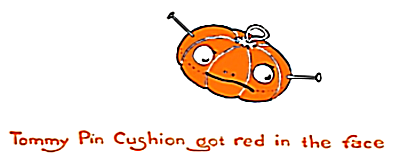
Tommy Pin Cushion is a regular porcupine, and
bristles right up instinctively at the least inkling of
dislike. But if he knows you like him, he will roll over
himself to help.
Another thing (and Mary Frances says to be very
particular on this point)―if any little girl, who really
wishes to learn to sew, will follow the lessons exactly
as given by the Thimble People, she can hardly fail to
win the Needle-of-Don’t-Have-to-Try for her very own.
In the hope that all will achieve this much-to-be-desired
end, this record of Mary Frances’ new adventures
is sent out to the girls of America with the best
wishes of
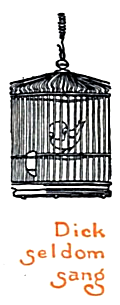
Mary Frances looked at the canary; but
Dick was very busily preening his feathers,
and Dick seldom sang.
“Cheer up!” gurgled again the sweet bird voice.
Mary Frances was certain this time that it was
not Dick.
Maybe it was a bird outside!
She looked out of the sewing-room window. No,
not a single feather was in sight. All the birds were
doubtless in their little nests, or hiding close in the
barn to keep themselves warm in such a rain.
“Dick!” said Mary Frances, “Dick, did you
speak?”
Dick only ducked his head again for a seed, and
snapped off the shell with his strong little bill.
“Peep! Peep! Peep!” sang a bird’s voice, as though
inviting Mary Frances to a game.
“I’ll play ‘Hide and Seek,’” thought the little girl.
“Dick, did you speak?”
“Where are you, Birdie?” she asked aloud; and,
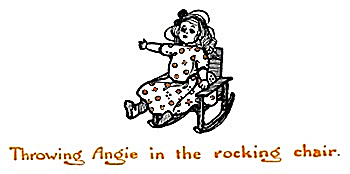
throwing Angie on the rocking chair, began to search.
Another soft little “Peep!” drew her near her
grandmother’s work-basket.
“Why!” she cried, “I could easily believe the voice
comes from Grandma’s basket!”
“Peep! Peep! Peep! Peep!” the bird voice answered
excitedly, as Mary Frances leaned over.
“Why! Why! Why!” she exclaimed. “If it
isn’t―if it isn’t Grandma’s Sewing Bird! You dear
little thing! Can you talk, too?” lifting her out. “I never
thought of you!”
Peep! Peep! Peep!
“Set me up
Upon the table,
Then I’ll sing
As I am able,
Chir! Chir!
Chirp! Chirp!”
answered Sewing Bird.
Mary Frances carried her over to the sewing table
and fastened her carefully to the edge, just as she had
seen her grandmother do.
Throwing Angie in the rocking chair.
The other Thimble People kept perfectly still,
wondering what would happen next.
“Do you know―you remind me of the Kitchen
Folks, Birdie,” said the little girl.
“The Thimble People!”
“The Kitchen Folks! The Kitchen Folks!
Of all the joyous, joyous jokes!
The Thimble People’s nearest kin―
Best friends we are―have always been,”
sang the little bird.
“The Thimble People!” exclaimed Mary Frances;
“why, who are they? Are there many Thimble
People? And what relation are they to the Kitchen
People? Will you tell me all about them? And will
they be my little friends?”
“Tut! Tut!
So many questions, little maid,
I cannot answer, I’m afraid―
But I can say, without a joke,
Your friends will be the Thimble Folk.”
Sang the little bird
“Oh, I’m so glad! My, I wouldn’t have missed
knowing them for anything. Why, I feel as though
I’ve known you for―for―ages!”
‘Except maybe a mouse’
“I was so afraid
You wouldn’t find me!
And then, of course,
You couldn’t mind me,
Chirp!”
“Oh,” said Mary Frances, “wouldn’t that have
been dreadful! I was so lonely and dreary that I
almost wanted to go home instead of staying here at
Grandma’s.”
“Are you alone
In the house,
Except maybe a mouse?
Cheerp!”
asked Sewing Bird.
“No,” said Mary Frances, “Katie’s in the kitchen,―but
she’s very busy, and won’t bother with me, and
my Grandma is out this afternoon, calling on some
old ladies.”
“Katie’s in the kitchen”
“Oh, you poor
Little lonely girl!
It sets my head
In quite a whirl;
Let me sit here
On this table,
And comfort you
As I am able.”
“Billy is a first-class scout”
“Well, you see, Sewing Bird,” began Mary Frances
gratefully, “Mother is never very strong, and Father
had to go to California on business; and he thought
wouldn’t it be nice to take Mother with him. So I’m
here at my dear Grandma’s for the long summer
vacation; and brother Billy is camping with the Boy
Scouts; Billy is a first-class scout, you know.”
“Yes,” said Sewing Bird, pretending to look wise,
“they have them in Thimble Land.”
“Have what?” asked Mary Frances.
“Why, Boy Scouts, of course―in Thimble Land!”
“Thimble Land!” said Mary Frances; “my, that
must be where the Thimble People come from! Where
is it?”
Pretending to look wise
“A long way there―
Perhaps you’ll go
Some day, if you will
Learn to know
That what we teach
Is sew! sew! sew!”
“Sew! Sew! Sew!”
“So! So! So!?”asked Mary Frances, looking
puzzled, “What’s so?”
“Sew! Sew! Sew!” sang Sewing Bird, looking
sharply at her with bright little eyes.
“Sew! Sew! Sew! Sew! Sew! Sew! Sew!”
“Sew!”
“Sew! Sew!” she fairly shrieked.
“Yes,” said Mary Frances wondering at her excitement,
“of course it’s so.”
“I mean sew
With a thimble;
I mean sew
And be nimble,”
sang Sewing Bird.
Mary Frances, looking puzzled
“Oh, ho,” laughed Mary Frances. “You mean
sew! How lovely! If I only knew how to really, truly
sew! I do, just a little.”
“If you’d like to learn to sew;
To baste and bind; tie a bow;
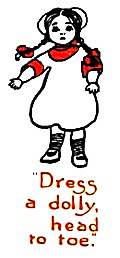
Dress a dolly, head to toe,
We can teach you how―”
“Dress a dolly, head to toe.”
“Can you, really? Really and truly?” cried Mary
Frances. “How perfectly dear! Oh, please do,
please begin! Angie, poor child, needs so many clothes.
When she went to the Tea Party, she spilled cocoa
all over herself, and it spoiled all her lovely, lovely
dress. It has always grieved me since. She’s so tattered
and forlorn. Will you teach me how to sew?”
“I will most gladly; and quite true,
I’ll tell you what you’d better do―
Get your Grandma every day
To let you have this room for play.”
“I will most gladly”
“Oh, yes, we’ll have the sewing-room for a play-room,
Sewing Bird; and you give me lessons! Must
they be secret―like the Kitchen People’s lessons?
And can you teach me? Oh, how happy I am! I
wonder if I can surprise my dear mother. Can I learn
to sew for my dolly this vacation?”
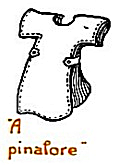
“A pinafore”
“Why, certainly, dear little Miss,
You can learn to make all this:
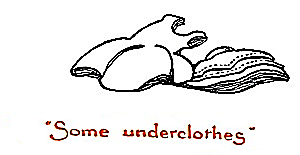
A pin-a-fore, some under-clothes,
A little ’kerchief for her nose;
Kimono, bloomers, little cap,
A nightie for her little nap;
A dress for morn, for afternoon,
A dress for parties, not too soon;
A little cape, a little bonnet―
Perhaps with roses fastened on it;―
A nice warm coat to keep from chill,
A dainty sack, in case she’s ill:
All this and more we’ll gladly teach,
If you will do and follow each―
will you?”
“I will,” laughed Mary Frances, “but each
what?”
“Some underclothes”
“Each little lesson, one by one,
Then, after each hard stitch is done,
Remember―‘patience brings reward!’”
“What’s ‘patience’?” asked the little girl.
“Why, ‘patience’? Patience is Mary Frances’
middle name―Mary P. Frances,―see?”
“My, isn’t that a nice name! Mary Patience
Frances. And what’s ‘reward’?” laughed the little
girl.
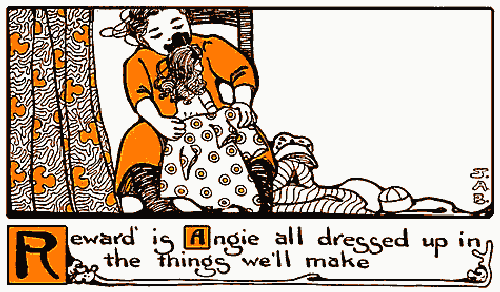
“‘Reward’? Reward,” said Sewing Bird, “is Angie
all dressed up in the things we’ll make.”
“Oh, I’d love to begin at once―can’t we?”
Sewing Bird gaily nodded her bright, shiny little
head.
“Goody! Goody! Won’t Mother be surprised?”
said Mary Frances. “I’ll run and get my little work-basket
that Grandma gave me.”
‘Reward’ is Angie all dressed up in
the things we’ll make
Chapter II Sewing Bird Begins to Teach
THEN Sewing Bird began:
“Little fingers, thin and nimble,
Fit to one, a little thimble;
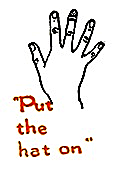
Right hand―finger, number two―
Put the hat on,―that will do.”
“Put the hat on”
Mary Frances put her thimble on the second finger
of her right hand.
“I knew that much, Sewing Bird,” she laughed.
“What else do you know,
If that much is so?
Chur! Chur! Chur!”
sang Sewing Bird, hopping up and down on one leg.
“Why, I know how to thread my needle,” said
Mary Frances, to whom the talking of Sewing Bird
seemed just as natural as the talking of Tea Kettle
and the other Kitchen People.
Sang Sewing Bird, hopping up and down.
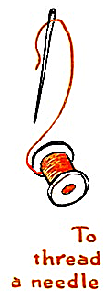
To thread a needle
“I know, too, that you should put the end of the
thread broken off next the spool through the eye of the
needle, so that it will not kink.”
“Very good,
And very true;―
What in your basket,
Pray, have you?”
asked Sewing Bird.
Then Mary Frances answered, “These are the
articles needed, my Grandma said,
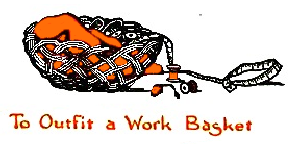
1.―To Outfit a Work Basket
1. Spools of cotton, white, Nos. 36, 40, 50, 60, 70, 80; also
one of red, No. 50. One spool of basting cotton.
2. One little strawberry emery bag to brighten and sharpen
needles.
3. Pins.
4. A piece of beeswax.
5. A tape measure.
6. A pair of scissors.
7. A paper of ground-down needles, Nos. 5’s―10’s.
8. Some unbleached muslin.
9. Thimble.
To Outfit a Work Basket
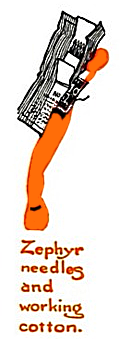
and, oh, look! here is a large piece of Java canvas, and
a package of blunt tapestry or zephyr needles, No. 19,
and some red D. M. C. working cotton, No. 8, that
Grandma put in here yesterday.”
Zephyr needles and working cotton.
“Good,” sang Sewing Bird,
“Oh, that is fine!
Is fine, indeed!
The zephyr needle
Is what we’ll need.”
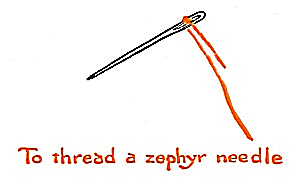
“Oh,” laughed Mary Frances, “I can thread
that―you turn the thread over the needle, double,
because a fuzzy end would not go through even this
long eye. Then hold it tight between the thumb and
finger, and push the needle over the double thread―this
way. Mother taught me that.”
“Needles and pins! Needles and pins!
This is where your lesson begins!
Now, thread your needle,
And knot your thread;
If you know how―
Please do as I’ve said.”
To thread a zephyr needle
“Yes,” laughed Mary Frances. “I know how to
knot my thread; I’ll show you, after I get this needle
threaded―now!”
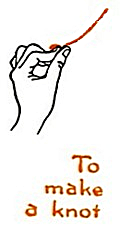
2.―Making a Knot
1. I wind the thread around the tip of the first finger of my
left hand.
2. I press it with my thumb and roll the thread downward
to the tip end of my finger―so!
3. Then I bring the second finger over the thread on the thumb.
4. Then draw the thread tight with the right hand as I hold
it.”
To make a knot
“Good! You’ll easily
Learn to sew!
How many stitches
Do you know?”
“Let me see,” pondered Mary Frances; “there are
basting, and running, and hemming!”
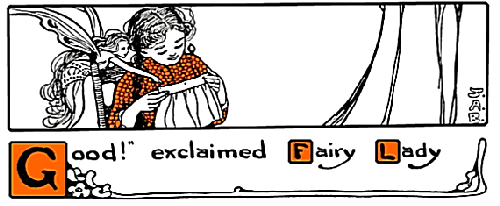
“Good!” exclaimed Sewing Bird, in a very nearly
human voice, but much more musical and softer.
“Good! Now I’ll name over all the principal
stitches:
“Good!” exclaimed Sewing Bird
Even and uneven basting
Running
Back-stitching
Half back-stitching
Overcasting
Overhanding
Catch-stitching
Button-hole stitch
Darning
Blanket stitch
“Are you home already?”
“My,” said Mary Frances. “I had no idea there
were that many! I wonder―will I ever learn them all?”
“Oh, yes!” Sewing Bird assured her, “if you come
for a lesson whenever you can.”
“Indeed I will!” said Mary Frances, “and how
I’ll thank you, dear little birdie.”
Just then the door opened.
“My dear little girl,” said Grandma, “how are you?
What a dull day!”
“Are you home already, Grandma?” asked Mary
Frances. “I had no idea it was time for you to
come.”
“Ah, my dear, you’ve not been lonely,” said Grandma―then
discovering Sewing Bird on the table,
“You’ve been playing with my old-fashioned sewing
bird, I see. Many a year this pretty little beak has
held Grandma’s long seams and hems while she
sewed them.”
“My dear little girl,” said Grandma
“I think she’s lovely!” exclaimed Mary Frances.
“I love her, too, dear,” said Grandma, a far-away
look coming in her eyes.
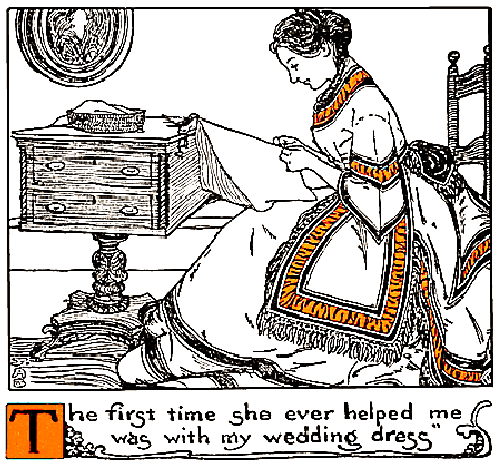
“The first time she ever helped me,” she added
softly, “was with my wedding dress. Yes, I love her,
too, dear.”
“Peep!” said a little bird voice.
“Dick,” said Grandma, shaking her finger, “Dick,
you surely aren’t jealous of the little sewing bird!”
The first time she ever helped me
was with my wedding dress”
Chapter III The Long and Short of Basting.
“GOOD-BYE, dear,” said Grandma, taking leave
of Mary Frances a day or two later. “You
may play in the garden while I’m gone, if you
want to.”
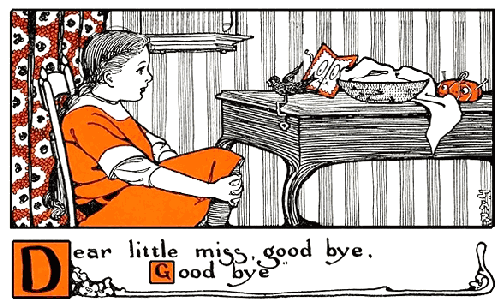
“Good bye, dear.”
“I think I’ll stay in, Grandma, if you don’t mind,”
answered Mary Frances, not quite daring to mention
her sewing lessons, “I have a sort of an engagement.”
“Well! Well!” laughed Grandma, “so grown up
already? You have been out every day lately―I
think perhaps you’ll like to play in the sewing-room.”
“I hope you’ll have a lovely time, Nanny,”
said Mary Frances as her grandma closed the
door.
“I wonder if Sewing Bird will be ready for the
lesson,” she thought as she skipped up the stairs to
the sewing-room.
“Sewing Bird! Sewing Bird!” she whispered.
“I hope you’ll have a lovely time”
“Oh, that’s the call
I love to hear;
I’m always ready―
Never fear!”
came the sweet singing voice of Sewing Bird.
Mary Frances was delighted.
“I’m so glad you remembered, dear little bird,”
said she. “Where are you?”
“Taking a rest,
In my dear little nest.
Chur! Chur!”
“Taking a rest in my dear little nest”
came the answer.
“Of course,―the basket’s your nest,” laughed
Mary Frances, carrying Sewing Bird to her place on
the table.
“I asked Grandma if I could have the sewing-room
for my play-room, and she said, ’Certainly, my dear,
you may―anything to keep you happy!’”
“Twitter, twitter, twitter, twit,” sang Sewing Bird―and
somehow Mary Frances knew she meant, “I’m
so happy, too.”
“Twitter, twitter, twitter, twit”
“I love to sit
And sing and sing―
But lesson time
Is on the wing:
Miss Never-Try
Never can do;
Miss Never-Begin
Never gets thru.”
“I love to sit And sing and sing”
“Oh, dear me! Sewing Bird, I want to begin right
away,” said Mary Frances. “I hope to get so much
done!”
“Well,” said Sewing Bird, “we will begin at once
with that pretty canvas and Turkey-red working cotton
(D. M. C. No. 8). You may cut some pieces of canvas
seven inches long and one and one-half inches wide.
Work on the sewing table―that will be easier.”
“Oh, I know,” guessed Mary Frances, “the Java
canvas is to learn the stitches on.”
“Yes,” said Sewing Bird, “you use one of these
pieces for each new stitch; the regular open spaces in
the canvas will help us so much.”
“I want to begin right away”
“My needle’s all ready from the last lesson,” said
Mary Frances, holding up her threaded needle, “and
my thread is knotted.”
“My needle’s all ready”
“Little Miss! little Miss!
Not so long a thread!
Measure it only
From your hand to your head.”
“Oh,” said Mary Frances, breaking off some thread.
“Thank you, I didn’t know that. I suppose it is easier
to use only an arm’s length of thread.”
“Yes,” said Sewing Bird. “Now, it would be well
to open the skein of cotton.”
Mary Frances did so.
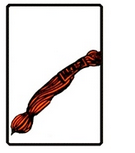
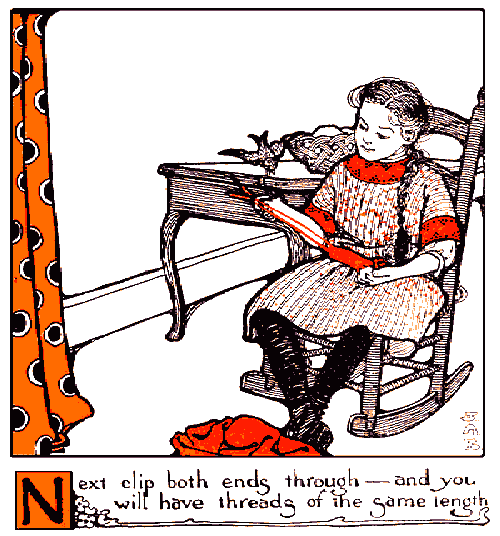
“Next clip both ends through―and you will have
several threads of the same length.”
“That’s so much easier,” said Mary Frances, “than
cutting it each time.”
“Now, for a new kind of puzzle,” said Sewing Bird.
“Take one piece of canvas already cut. For convenience
we will call the regular open spaces in the canvas,
‘holes.’”
“Yes,” said Mary Frances. “I understand, dear
Sewing Bird; but please tell me the puzzle.”
“Now, for a new kind of puzzle”
“A puzzle then it soon shall be,
A puzzle which ne’er puzzled me,
A puzzle which I’ll let you see―
Its name is
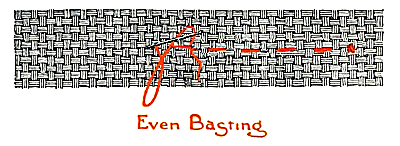
3.―Even Basting (On Canvas)
“A puzzle which I’ll let you see.”
Cut canvas 7 inches by 1-1/2 inches.
1. Thread needle and knot thread.
2. Count five holes down from upper right hand end of canvas
and four holes to the left.
3. Put needle in this hole, pointing downward.
4. Push needle toward the left under two threads, upward
through second hole; pull through.
5. Now, again, over two threads under two threads; pull
through.
6. Finish the row. Fasten thread by taking two stitches over
each other in the same holes at the end. Cut off the thread.
“That’s not much of a puzzle,” thought Mary
Frances, sewing carefully.
“Why is it called Even Basting?” asked Sewing
Bird.
“Because the stitches are of the same length,”
said Mary Frances.
Even Basting
“So wise you are―
Soon you will be
Quite a little bit
Too wise for me,”
sang Sewing Bird.
“Ho, ho!” laughed Mary Frances.
“Oh, I know why.”
“You may wonder why the knot and the finishing
threads are on the right side,” continued Sewing Bird.
“Oh, I know why,” exclaimed Mary Frances.
“Because basting stitches are used only to hold the
work in place until it is really sewed, then they are
easily pulled out if the knot and end are on the right
side.”
“Bless my feathers,
And bless my eye!
Soon you’ll know
As much as I!”
This pleased Mary Frances very much; but she
said, “I don’t know―for I have no idea what comes
next, my dear little teacher.”
“Soon you’ll know As much as I!”
“Oh, dear me!
Our time we’re wasting,
The next stitch is―
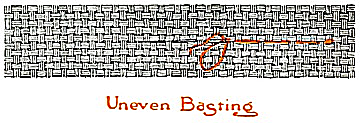
4.―Uneven Basting (On Canvas)
“That’s all for to-day”
1. Commence as in Even Basting.
2. Point needle downward, and bring it up through next hole.
3. Count three holes, put needle in downward and bring up
next hole―‘under one thread, over three’ to end of the row.
4. Finish as in Even Basting.
“That wasn’t very hard,” said Mary Frances,
holding up the canvas for Sewing Bird to see.
Then sang Sewing Bird:
“That’s all for to-day,―
Put things away;
And, now, little lady,
Good-day, good-day!”
Uneven Basting
As Mary Frances went down the stairs, she caught
the sound of her name. Her grandmother was talking.
“That’s a wonderful child,” she was saying. “She’s
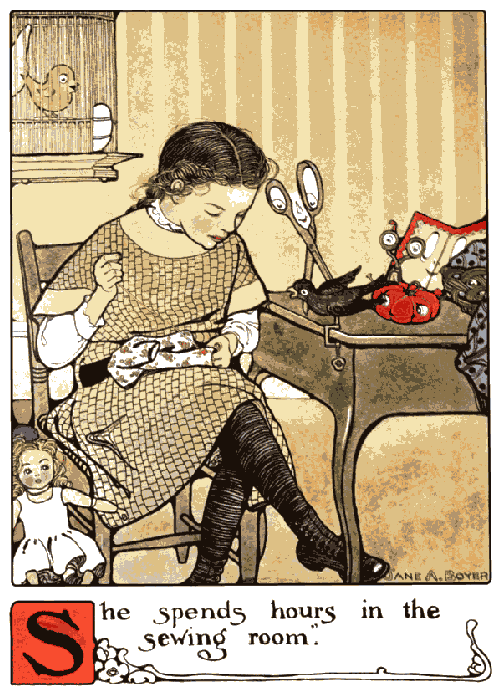
no bother at all. She spends hours in the sewing-room,
playing with her dolls, just as happy as can be!”
“Dear Nanny!” thought Mary Frances, “I wish
I could explain about everything―maybe the Thimble
People will let me some day.”
Next clip both ends through―and you
will have threads of the same length
Chapter IV Sewing Bird’s Secret
MARY FRANCES held up her canvas at the
beginning of the next lesson, saying:
“Now, I know which of these stitches is
which; and I believe I am ready to learn the next, my
little teacher!”
“The next,” said Sewing Bird, “is
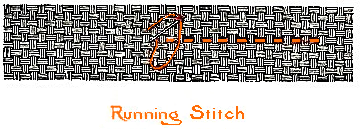
5.―Running Stitch on Canvas
“Ouch! That hurts my fingers”
1. From under side of canvas, point needle upward, bringing
knot on wrong side.
2. Point needle downward through next hole, and upward
through next. Pull through.
3. Finish row, by taking several in-and-out stitches on the
needle, then pulling through.
4. Turn to wrong side, and fasten by taking three stitches
in same hole―this is the ‘in-and-out-the-windows’ stitch.”
“Ouch!” cried Mary Frances. “That hurts my
fingers.”
“Of course, that is why we have thimbles.
Be sure to use the knighted soldier finger,―and push the
needle with its thimble cap,” said Sewing Bird.
Running Stitch
“Exactly right, And quite bewitching”
“This way?” asked Mary Frances, holding up her
little hand.
Then Sewing Bird answered with bright eyes sparkling,
“Exactly right,
And quite bewitching;
And needed much
In learning
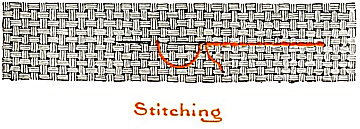
6.―Stitching (on Canvas)
(Also called Back-stitching)
1. Enter needle into canvas as for Running.
2. Take one running stitch, bringing needle out on right side.
3. Point needle downward through the hole to the right of
the one where the working cotton came out.
4. Push needle under two threads: pull through.
5. Repeat to end of row.
6. Fasten as in running stitch.
“Is that well done?” asked Mary Frances, holding
up her first two stitches.
Stitching
“Oh, my, no!” said Sewing Bird. “You’ve gotten
the thread all twisted. Please unthread your needle
and take out the work. Then try once more.”
“Dear me!” sighed Mary Frances
“Dear me!” sighed Mary Frances, “one can’t be
perfect before one learns!”
“Try! Try again!” sang Sewing Bird, flapping her
wings,
“It is the Thimble People’s pride
That they have ever, always, tried:
Whenever they fail,―this is no tale,
As you can easily guess,―
They twist the failure round about,
They twist and turn it inside out;
Then drop it down a big, black hole,
Discovered in back of the North Pole,―
And up it jumps―Success!”
“My, I wish my failures would do that! Maybe
they will,” mused Mary Frances, finishing the row of
stitching very carefully. “Oh, there comes Grandma
up the street!”
“Try! Try again!”
“Our lesson is
Now at an end,―
That’s all to-day,
My little friend,”
just then sang Sewing Bird.
“Our lesson is Now at an end”
“I forgot to ask,” said Mary Frances, “May I show
Grandma, or tell her about―about our lessons?”
“That I already
Should have shown;
I cannot sing
Where people grown
Can hear: if they hear now
Or even ever,
I may become
A Never-Never!”
“Oh, ho,” smiled Mary Frances, softly smoothing
the little bird. “I’m so glad I haven’t told. I am
certainly glad, dear little Teacher Bird―I don’t want
you to be a Never-Never,―whatever that is.”
“Oh, ho! I’m so glad I haven’t told”
“A secret let
Our secret be―
Too much for one,
Enough for two,
And not enough
For three,”
sang Sewing Bird wisely. Suddenly―
“Say no more,
Oh, say no more!
I hear your Grandma
At the door!”
fluttered the little bird; and Mary Frances quickly put
away her work.
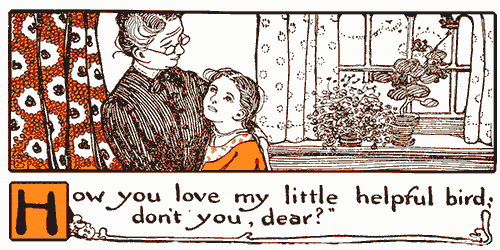
Grandma smiled when she saw Sewing Bird on the
table.
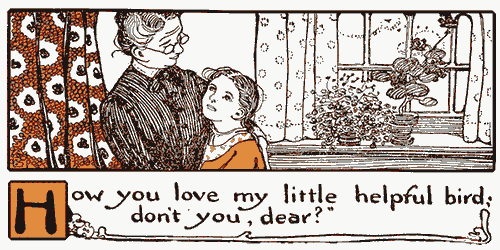
“How you love my little helpful bird, don’t you,
dear?” she asked.
“I love her with all my heart,” said Mary Frances.
How you love my little helpful bird,
don’t you, dear?”
Chapter V Sewing Bird Teases Dick Canary
MARY FRANCES heard this through the
sewing-room door:
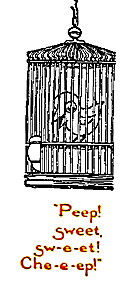
“Peep! sweet, sw-e-et! Che-e-ep!”
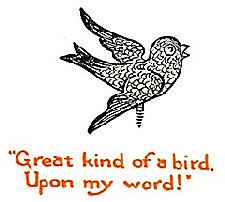
“Great kind of bird,
Upon my word!
Who cannot do a thing
But sing and eat,
And then sing sweet,
And then again sing-sing.”
“Peep! Sweet, sw-e-et! Che-e-ep!” sang Dick
Canary.
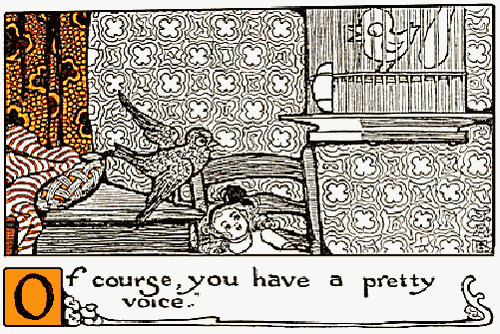
“Of course, you have a pretty voice;
Of course, you love to make a noise―
If this rhyme sounds a bit contrary,
It’s good enough for a canary;
But, Dick, what I’d really like to know,
Is this: why don’t you learn to sew?”
“Great kind of a bird, Upon my word!”
Then Mary Frances stepped in.
“Oh, Sewing Bird,” she said, “I didn’t think you
could be such a tease.”
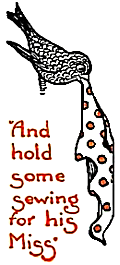
“And hold some sewing for his Miss”
“Good afternoon!
‘Tease,’ did you say?
I wasn’t teasing―
It was only play:
I thought perhaps that pretty bird
Would listen to a little word,
And hold some sewing for his Miss―
The way I can; See, Dick―like this!”
holding up a piece of goods in her glistening beak.
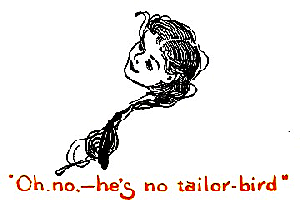
“Oh, no,” laughed Mary Frances. “I fear Dick
would never be able to understand such a useful use
of his bill―he’s no tailor-bird!”
“Oh, no,―he’s no tailor-bird”
“Of course, it
Truly must be so―
He certainly could
Not learn to sew;
I see that he
Is surely meant,
Only to be
An ornament,”
sang Sewing Bird. “But our next lesson―is your
canvas ready, child? Yes? This time I’m going to
count by threads instead of holes, when I give directions
for
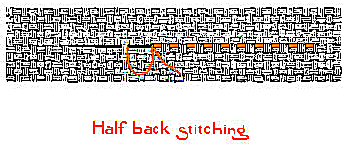
7.―Half Back Stitching on Canvas
“Curiosity,” smiled Mary Frances
1. Commence as in Stitching.
2. One running stitch, under two threads.
3. Point needle downward through hole to the right of hole
from which the cotton hangs; under three threads: pull through.
4. Repeat to end of row. Fasten.”
“There!” said Mary Frances, finishing the row.
“That seems like ‘two steps backward and one forward,’
or rather, ‘two forward and one backward.’”
“That’s about the way it is!” said Sewing Bird.
“But half back-stitching and back-stitching are both
very strong stitches. Why, when your grandma was
little, she stitched all seams by hand. Sewing machines
were a great cu-cur―”
“Curiosity,” smiled Mary Frances.
Half back stitching
“Peep―peep,” giggled Dick Canary.
“Peep― peep”
“Thank you, Miss Mary Frances,” said Sewing
Bird,
“Perhaps that little yellow bird
Thought I didn’t know the word;
It’s funny that it seems a joke
When anybody stops to choke―
Ahem! Ahem! Ahem! Ahack!
Pat-me-on-the-back!
Pat-me-on-the-back! Quick!”
“Better?” asked Mary Frances, smiling to herself,
and patting the little bird’s back.
After a minute she said, “Excuse me, but is―the
next stitch―is the next stitch a fancy one?”
“It is!” said Sewing Bird, “and is called
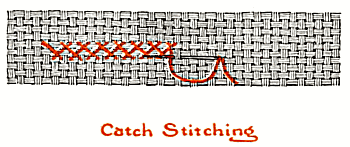
8.―Catch Stitching on Canvas
1. At left hand end of canvas, count four holes down and four
to the right.
2. From under side, point needle upward: pull through.
3. Count three holes down and three to the right. Point
needle down and under this, one hole to the left: pull through.
4. Count four holes to the right of first stitch. Point needle
down through next hole to the left: pull through.
Catch Stitching
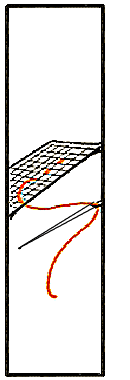
“Is that right?” asked Mary Frances.
“My, no,” said Sewing Bird. “That is all wrong.
Hold the work here near my beak. There, let the thread
hang this way:
“Now, pull it through. In taking the next
stitch, let the thread hang this way:
“There, that is better.”
“Oh, I see, now,” said Mary Frances. “Isn’t that
a beautiful stitch!”
“Yes,” said Sewing Bird,―then, suddenly,
“Beware! Beware!
Beware! Beware!
I hear your Grandma
On the stair―
Good-bye!”
“Of course, you have a pretty voice.”
Chapter VI The Stitch Grandma Learned
MARY FRANCES stopped on the stairs to
listen.
“Surely,” she thought, “Sewing Bird is
talking with some one. I wonder if it’s one of the
Thimble People. Oh, I do hope so!” and, as she
tripped into the sewing-room, she asked,
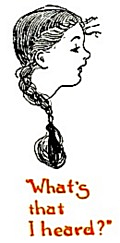
“What’s that I heard?”
“Oh, Sewing Bird, what’s that I heard as I came
up the stair? It really doesn’t matter much―for
Grandma wouldn’t care.”
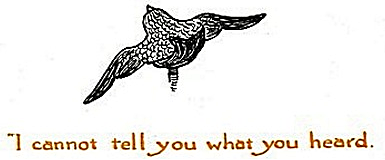
“I cannot tell you what you heard,
My dearest little Miss;
But listen to a wisdom-word,
For I can tell you this:
If many times you make up rhymes,
You may become a little bird,”
sang Sewing Bird.
“I cannot tell you what you heard.”
“Oh,” laughed Mary Frances. “Caught myself
making a rhyme;―but I don’t want to become a little
birdie, even though they are so dear,―besides, I don’t
have wings.”
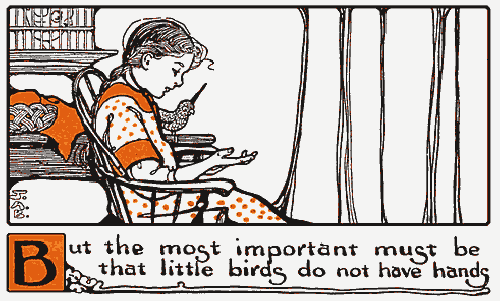
“No,” said Sewing Bird. “I don’t suppose you
do want to be a birdie―for many reasons;―but the
most important must be that little birds do not have
hands!”
“Hands are so wonderful!”
“Hands are so wonderful!” said Mary Frances,
“they can do so many things. They are pincers,
hammers, wedges, and yet they can do the most
dainty, delicate work.”
“Yes,” said Sewing Bird, “they come in
handy!”
“Oh, ho, hee-hee!” laughed Mary Frances.
“Chirp, chirp!” twittered Dick Canary.
“Oh, Dick! oh, Dick!
What lots of fun!
Do you pretend
To see a pun?”
asked Sewing Bird. “But now to learn
Hemming Stitch
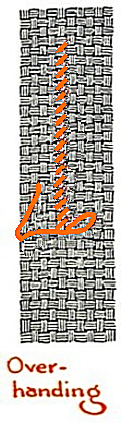
9.―Overhanding on Canvas
Overhanding
1. Count six holes down and four from right hand end. Put
needle in from under side: pull through.
2. Count one hole to the left. Find the hole above it. Point
needle downward through the upper hole―bring it up to right
side through the under hole.
3. Finish row and fasten thread on wrong side, by running
thread through the last few stitches.
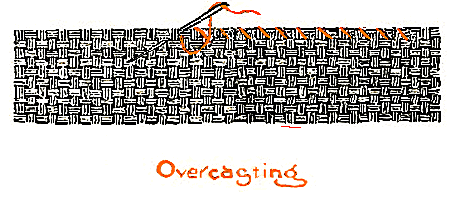
10.―Overcasting on Canvas
1. Count one hole from top of canvas and two in from
end.
2. Commence as for Overhanding.
3. Bring needle out two holes to the left of first stitch.
4. Fasten as in Overhanding.
Overcasting stitch is used to finish raw edges of material to
keep from fraying.
“The next stitch is the first stitch your grandmother
learned to make,” said Sewing Bird. “Her
little fingers got so tired and sore trying to make tiny
little bits of stitches on muslin, that you may be glad
you are to learn on canvas.”
Overcasting
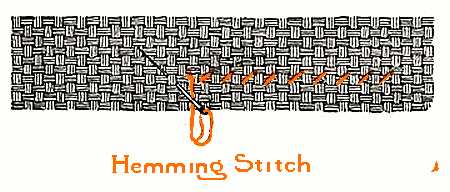
11.―Hemming Stitch on Canvas
1. Six rows from top―four over to left. Needle up from
wrong side: pull through.
2. On row of holes below, one hole to left, point needle down,
bring it up in first row of holes, two holes to the left of first stitch.
3. Hood canvas over the first finger. Finish row.
4. Fasten as in Overcasting.
“Is that all there is to hemming?” asked Mary
Frances happily.
“No, little Miss, that is just a ‘first beginning,’
as my grandmother used to say. Some day I hope
you will make hemming stitches so small that they
will scarcely show―on a dolly’s apron.”
“Oh, how perfectly lovely!” cried Mary Frances.
“I can scarcely wait! Will it be long?”
“That all depends, my little friend―”
“Upon me,” said Mary Frances. “I’ll work very
in-dus-tri-ous-ly, dear little teacher.”
But the most important must be
that little birds do not have hands
Chapter VII Blanket Stitch and Its Sister
“NOW, Sewing Bird,” began Mary Frances the
next lesson afternoon, “let’s not talk any, but―”
“Let us get right to our lesson,” said Sewing Bird,
“which is an edge-finishing stitch, named
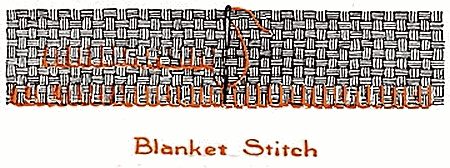
12.―Blanket Stitch
“Let us get to our lesson”
1. At left hand end of canvas four holes down and four to
right, from under side bring needle to right side.
2. Hold thread under thumb. One hole to the right, point
needle down, bringing it up in hole two threads below: pull
through. Finish row.
3. Fasten as in Overcasting.
4. Repeat this on lower edge of canvas.
“Good!” she said, as Mary Frances finished following
the directions, “Now, for a stitch many grown
women do not know how to make―a beautiful
stitch:
Blanket Stitch
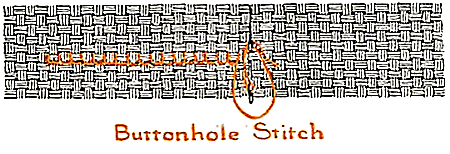
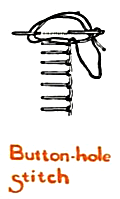
13.―Buttonhole Stitch on Canvas
“Oh look! dear Sewing Bird”
1. Five holes down―four from left hand end, from wrong
side, bring needle to right side.
2. Through hole below this, point needle down, and up
through the one from which the thread hangs. Do not pull
through.
3. Take hold of the two threads in the eye of the needle,
bring them toward you around under the point of the needle.
Let them rest there.
4. Pull needle through.
5. With left thumb on the stitch, pull the thread with the
right hand tightly down to the edge of the canvas.
6. Repeat to end of row.
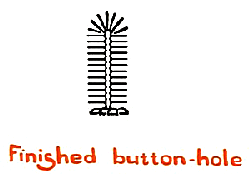
“Oh, look! dear Sewing Bird,” cried Mary Frances,
holding up her work, “I really do believe that is the
way Mother makes a button-hole! She said she would
show me how to do it very soon. How glad I am I
know that stitch!”
“Yes,” said Sewing Bird. “Won’t she be surprised!
You know eleven stitches now.”
“Why, so I do!” exclaimed Mary Frances, counting
her little samplers of work.
Buttonhole Stitch
“Now,” said Sewing Bird, “will you please cut a
piece of canvas eight inches long and four and one-half
inches wide, and make a sampler of all the stitches
you know. Will you write down the directions?”
“Yes,” said Mary Frances, getting pencil and paper.
Then Sewing Bird began:
14.―Canvas Sampler
“Yes” said Mary Frances
1. Begin six rows down, and five rows from right hand end
with a row of Uneven Basting.
2. A row each of even basting; Running Stitch; Stitching;
Catch Stitching; Buttonhole Stitching; Hemming,―each two
rows apart.
3. A row of Overhanding―five rows below that.
4. Blanket Stitch the upper edge.
5. Overcast the two ends.
6. Fold canvas back on row of overhanding at bottom of
samples.
“Will you bring the pretty sampler, finished, for
the next lesson?” asked Sewing Bird.
“I will―so gladly!” said Mary Frances.
“But there’s one stitch more,
There’s one stitch more!
If it hadn’t been so cross,
I’d have shown it before,”
added Sewing Bird.
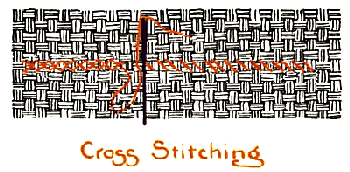
Cross Stitching
15.―Cross Stitching
1. Cut a canvas piece, five inches long and three inches wide.
2. At the right hand end from under side, two holes from
the edge, and eight holes down, point needle upward. Pull
through.
3. Point needle downward into hole above the hole to the
left of where thread hangs out, and bring it up through the hole
directly beneath.
4. Continue across the canvas.
5. Return on same row of stitches in same way, but work
from left to right, taking stitches in exactly the same holes as at
first. This will form a cross. The stitches must all be taken
in the same direction.
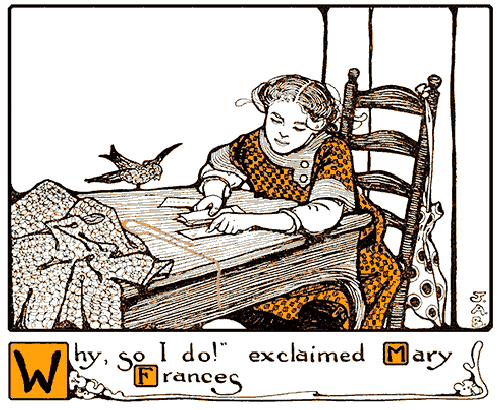
“Why, so I do!” exclaimed Mary Frances
Chapter VIII Sewing Bird Fairy Lady
MARY FRANCES worked very hard whenever
she could find a minute; and the next lesson
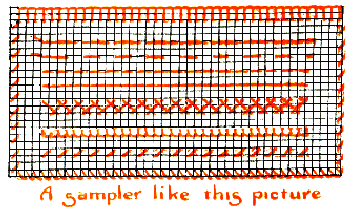
day she proudly showed Sewing Bird a sampler
like this picture:
“Oh, de-de- dum-dee! de-de- dee!”
“Oh, de-de-dum-dee! de-de-dee!
That sampler certainly pleases me.
You did it alone? Well, I declare!
What perfect stitches you have there!”
sang the little bird, hopping, fluttering, gurgling, and
spreading her wings joyously over Mary Frances’
work, very much the way a spring robin careens over
an early worm.
Mary Frances was very happy.
“Now, Sewing Bird, my dear teacher, please tell
me what I am to learn next?” asked Mary Frances,
finishing the row of cross stitching.
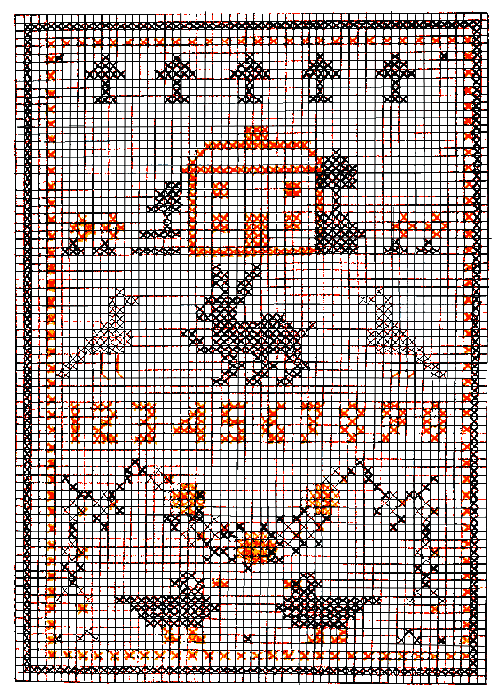
A sampler like this picture
“Indeed I will! Indeed I will!
Just watch a while my little bill;
And I to you will quickly tell,
And you will quickly do, and well,
This lesson coming next.”
“Won’t it be beautiful!”
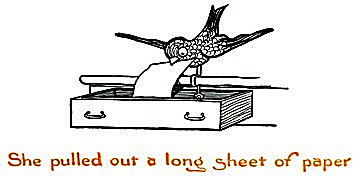
With these words, the little bird leaned over the
edge of the table and stuck her bill into the drawer
beneath. Then she pulled out a long sheet of paper.
“Oh,” gasped Mary Frances, “what is that, dear
teacher?”
“That,” said Sewing Bird, shaking her wings, “is
a model for you to follow in making,
16.―Grand Sampler on Canvas
Cut a piece of canvas twelve inches by nine inches, and
follow as exactly as you can the picture on the next page.
“Won’t it be beautiful!” exclaimed Mary Frances,
“I’ll do it in all the pretty colors―I have almost every
shade of mercerized working-cotton here.”
“Yes,” said Sewing Bird,
She pulled out a long sheet of paper
Illustration of Sampler
“Your Grandma took a prize
At Persimmon County Fair,
With a pretty sampler
Like the picture lying there;
If you work yours aright,
’Twill be a prettier thing,
That well may win a prize,
From our merry Thimble King.”
When Mary Frances opened her eyes
“All right!” laughed Mary Frances. “I’ll work
from time to time on the Grand Sampler. But, Sewing
Bird, will you tell me, please―are you―aren’t
you, a real fairy? You seem so like a fairy ‘come
true!’”
“Dear little Miss, I’ll give you
A secret to keep.
Put your hand over your eyes,
And don’t dare to peep!
Now, you may take away your hand―
Behold, a Lady from Thimble Land!”
The loveliest, sweetest fairy lady
“Now, dear, ready for the lesson”
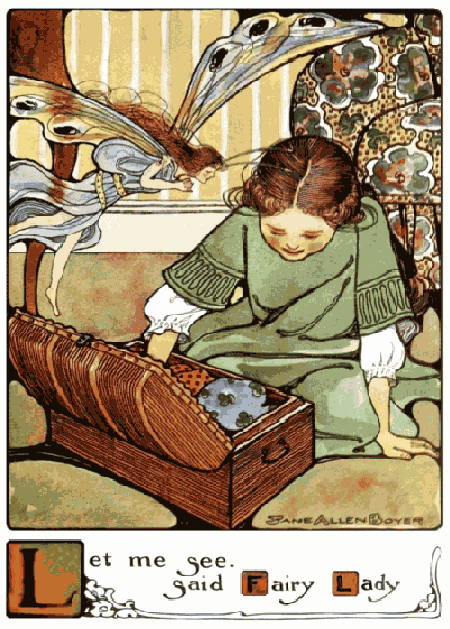
When Mary Frances opened her eyes, there sat
the loveliest, sweetest little fairy lady on the edge
of the table in place of Sewing Bird;―only Mary
Frances noticed her lips looked very much like the
bill of a bird.
“Oh, oh, oh, oh, oh!” gasped Mary Frances in
surprise. “Oh, really, truly, oh, me! Oh, dear!
How perfectly lovely! You lovely―”
“Now, Mary Frances, dear, ready for the lesson,”
smiled the little lady, in the same flute-like voice as
Sewing Bird’s.
“Miss Fairy,” said Mary Frances, trembling with
joy, “I will do my very best,―but, please, what may
I call you?”
“Just shut your eyes,
And not a word;
My name you have
So often heard;
It’s known to
But a very few,
But I will show
My name to you―”
When Mary Frances opened her eyes, there sat her
grandmother’s sewing bird.
There sat her Grandmother’s sewing bird
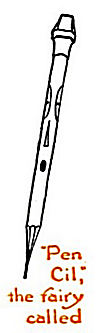
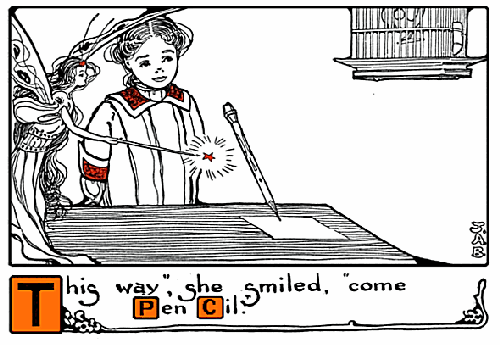
“Pen Cil,” the fairy called
“You dear little bird,” she exclaimed. “I know
now! You are the Fairy!―and I know!―the Fairy’s
name is Sewing Bird!”
“Just so! Just so! Just so! Just so!” sang Sewing
Bird,―
“Now quickly shut your eyes―and then
The Fairy Lady will come again!”
And again came Fairy Lady.
“Oh,” laughed Mary Frances, “dear Sewing Bird
Fairy Lady, please wait a minute,” and running out
of the room, she brought back her doll’s rocking chair
and put it on the table.
“Please be more comfortable!” she said.
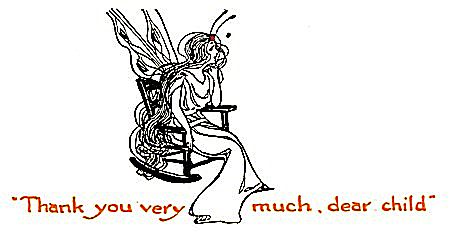
“Thank you very much, dear child!” said Fairy
Lady.
“Now, for work! Cut a piece of unbleached muslin,
nine inches long and five and one-half inches wide.”
“Good!” she exclaimed, as Mary Frances held up the
muslin properly cut.
“Pen Cil,” the fairy called.
“Thank you very much, dear child”
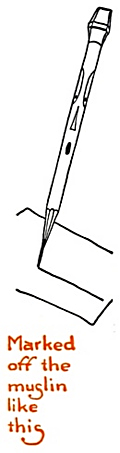
Marked off the muslin like this
With a bound, a yellow lead pencil which lay on
the machine, sprang over to the table and made a
funny little stiff bow to Sewing Bird Fairy Lady, who
picked up a big bodkin and, using it as a sceptre,
touched him, saying―
“Mark off the muslin as I told you.”
To Mary Frances’ amazement, Pen Cil marked off
the muslin like this:
“You may retire,” said Fairy Lady, “Thank you,―and
Mary Frances, child, you may sew the muslin
very much as you did the Canvas Sampler, with that
finer red D. M. C. cotton, No. 12.”
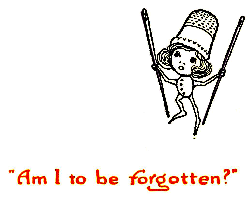
“Am I to be forgotten?” came a tinkling sound
from Mary Frances’ basket, as she started to sew.
“Who is that?” asked Mary Frances peeping over
the edge.
“I’m Thimble!” exclaimed a wee little voice, “and
the reason I always wear my helmet, is that I want
to wield my sword,” as Mary Frances lifted him out.
“I beg your Majesty’s pardon,” said the little
fellow turning to Sewing Bird Fairy Lady―“but perhaps
Miss Mary Frances doesn’t understand that all
needles are my swords!”
“Am I to be forgotten?”
“He thinks himself so brave a soldier,” laughed
Sewing Bird Fairy Lady―“when all the time he is
perfectly useless by himself.”
“But he is a great help,” said Mary Frances.
“I don’t see how I could sew without him.”
“Good!” said Fairy Lady. “But he’ll be prouder
than ever! That’s all for to-day―next lesson we will
make something for your dolly to use.”
“Oh, how lovely!” exclaimed Mary Frances, finishing
her last stitches. “What is it?”
“Oh, well! oh, well, O!
I best not tell, O!
But something she can use real well, O!
Now for to-day, farewell,
Farewell, O!”
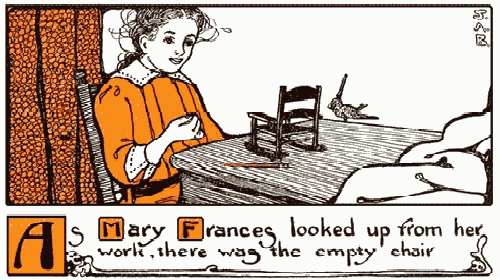
And as Mary Frances looked up from her work, there
was the empty rocking chair and her grandmothers’
sewing bird was sitting on its perch on the table.
As Mary Frances looked up from her
work, there was the empty chair
Chapter IX Magic and Mystery
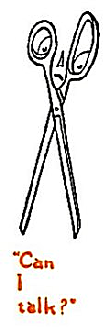
“Can I talk?”
“I’M Cross Patch, Cross Patch!
Nobody dares to lift the latch!
I’m Cross Patch, Cross Patch!
Click―ety―clatch!
Cross Patch!”
Mary Frances heard this outside the sewing room
door.
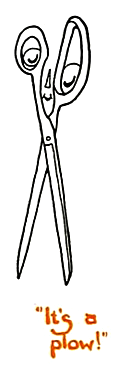
“My,” she thought, “that sounds like the scissors―I
really believe it is!” She peeped in, and this is what
she saw:
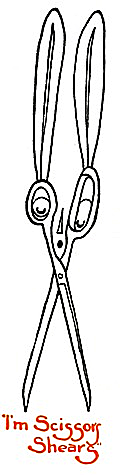
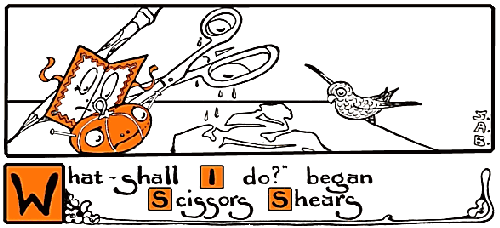
Scissors Shears was strutting on tip-toe up and down
the sewing table, closing up each time to take a step.
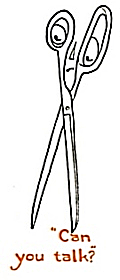
“Why,” said Mary Frances, slipping in, “can you
talk, too?”
“Can you talk?”
“I can even cut myself!”
“Can I talk?” exclaimed Scissors Shears in a growling
voice. “Can I talk? Yes, and walk, too! As
if I weren’t years older than that Sewing Bird―
Rip ’er up the back! Rip ’er up the back! That conceited
thing thinks she knows everything,―why I
could tell you all about how to cut out anything.
Why, I know all about cutting things out! I can even
cut myself!”
Click―click, came his legs together.
“Well, well,” laughed Mary Frances. “If that is
so, perhaps Sewing Bird will let you explain some things
to me.”
“It cuts me to the quick to be cut like this,” he
started again,―then Sewing Bird began to sing,
“If anything you’d like to do,
To prove yourself so very true―
Immediately to work―don’t brag!
Cut out
Pattern 1.―Doll’s Laundry Bag
Cut bag twelve inches long, and five inches wide.
“What goods, what goods?” asked Scissors
Shears, excitedly.
“Cut it out of that pretty calico on the table,”
said Sewing Bird.
That pretty calico on the table
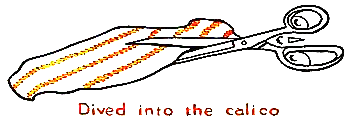
“Hurrah!” shouted Scissors Shears, and dived into
the calico.
“When you want me otherwise”
“There!” he exclaimed proudly. “Isn’t that perfect?”
“That’s very even,” said Mary Frances gravely,
trying to act as though she were an excellent judge.
“What next?” she asked Sewing Bird.
“When you want me otherwise
Than as a little bird,
Put your hand over your eyes,
And say this secret word:
Magic and Mystery,
Give my wish to me.”
Mary Frances did so; and there was Fairy Lady
once again in the doll’s rocking chair, who smiled and
said,
Dived into the calico
“Whenever you particularly want ‛this me’ to come,
all you have to do is to put your hands over your
eyes, and say to yourself quickly,
Magic and Mystery,
Give my wish to me,
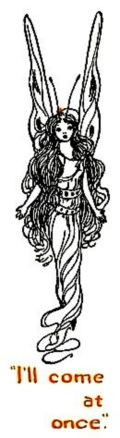
and I’ll come at once.”
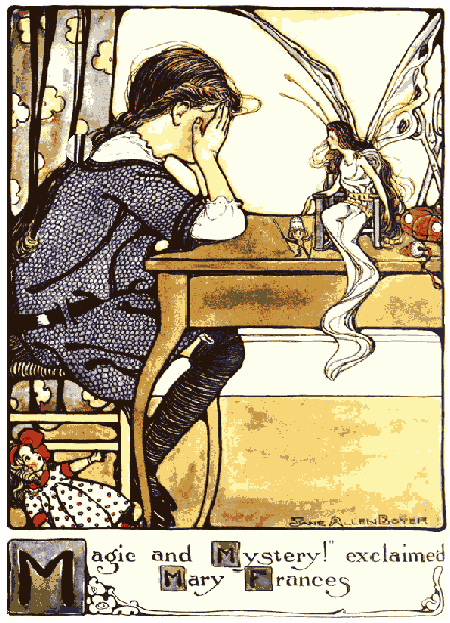
Magic and Mystery!” exclaimed Mary Frances
“I’ll come at once”
“Oh, how lovely!” said Mary Frances.
“And if you want me to turn into anything, you say
as fast as you can,
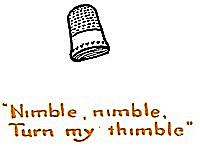
Nimble, nimble,
Turn my thimble,”
said Thimble, looking up at Mary Frances with a
comical smile.
“And if you want me to turn into some one else,
snap your fingers three times and say, faster yet,
Scissors-and-Shears,
Scissors-and-Shears,
Now change your ears,
Now change your ears.”
“I’ll do it now,” laughed Mary Frances, and when
she said,
“Nimble, nimble, Turn my thimble”
“Nimble, nimble,
Turn my thimble,”
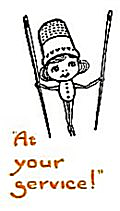
there sprang up the cutest little soldier, with needles
in his hands for swords.
“At your service!”
“Salute!” he shouted in a very thin silvery voice,
making a military bow to Fairy Lady.
“At your service!” he said, turning to Mary Frances,
who was looking on with amazement.
“Are you really my own thimble?” she asked,
looking at the second finger of her right hand.
“It’s me―I, I mean―I’m he―it, I mean―well,
anyhow, I’m Thimble, your Seamstress-ship,” he answered,
making another bow.
“Well, well,” said Mary Frances delightedly, “if
you are, you can obey my orders.
“Stand there!” pointing to the left side of Fairy
Lady. Then,
“Scissors-and-Shears,
Now change your ears,”
she repeated.
“Scissors and Shears, Now change your ears”
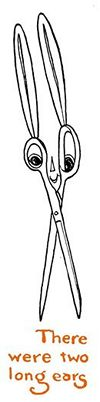
There were two long ears
Click! came the feet of the shears, and before Mary
Frances saw how it happened, there were two long ears
on the handles, looking comically like a rabbit’s.
“What long ears you have!” laughed the little
girl.
“The better to hear your directions, your Seamstress-ship,”
replied Scissors in a rather sharp voice,
clicking his way to the other side of the rocking
chair.
Then Fairy Lady said:
“Dear little Lady Seamstress, we are all from
Thimble Land―we are the Thimble People; there are
many more of us, oh, many more. It is our joy to be
able to help you learn to sew. Thimble and Scissors
Shears and the other Thimble People will come help us
when anything becomes very puzzling or difficult; but
all through these lessons you may call upon me at any
time; and I shall do my best to give you happy sewing
lessons.”
“Oh, thank you, dear Fairy Lady,” exclaimed Mary
Frances. “I am living in Fairyland, and it is real!”
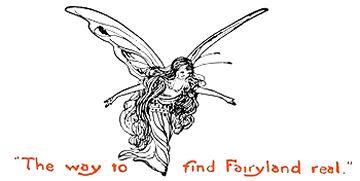
“The way to find Fairyland real.”
“The way to find Fairyland real,” smiled Fairy
Lady, “is to do your very best from day to day, and
to do it happily. The fairies always help the people who
try to do this.”
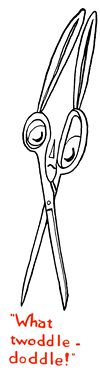
“What
twoddle-doddle!”
“Oh, pshaw!” exclaimed Scissors Shears in a cutting
tone, “what twoddle-doddle! Even if I don’t make
fine speeches, I know all about cutting.”
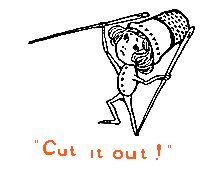
“Cut it out!” exclaimed Thimble, raising his sword-needle.
“Slang,” began Scissors Shears, crossly flapping his
ears back; but Fairy Lady leaned forward in her chair,
and, reaching out with her bodkin wand, touched him
on the ear, and down he fell flat at her feet.
Pushing him aside, she said, “I can control him
when I have my wand. If he’s ever rude, and you
want me, say the magic verse I taught you.”
“Oh, thank you,” said Mary Frances, smiling
to herself.
“I guess if I pulled his ears real hard, he’d be good
anyhow,” she thought, “but I’ll not let Sewing Bird
know. All rabbits are controlled by their ears, and
I’m sure he looks more like a rabbit than any other
animal I can think of.”
“Well,” smiled Fairy Lady, “we have the dolly’s
laundry bag all cut out: now, to learn,
“Cut it out!”
17.―Hemming on Muslin
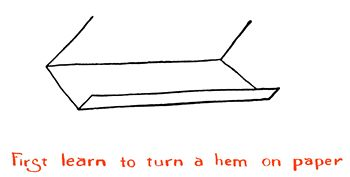
1. First learn to turn a hem on paper.
2. Cut the paper seven inches long and three and one-half
inches wide.
3. Draw a line one-quarter of an inch from lower edge of paper
and turn up and crease along this line.
4. One inch above that, draw a line. Turn up and crease
along that line.
5. Follow same directions on muslin. Baste and hem.
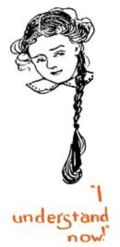
“I understand now!”
“Good!” she nodded, as Mary Frances held up the
folded paper. “You remember the hemming stitch
on canvas. This is the same kind of stitch; only, as
you have already observed, no doubt, it is a very zig-zag
stitch, and is taken from the single through the
folded part of the goods.
“Wait a minute, I’ll mark it to show you,” and
taking the pencil, she marked the paper as shown on
this page.
“Now try it on muslin.”
“Oh,” exclaimed Mary Frances. “I understand
now!”
First learn to turn a hem on paper
“Only one thing more,” said Fairy Lady, “the
way to hide the starting of the thread. You put the
needle in between the fold and the cloth, and tuck it
down. Then put it in, or ‘insert’ it, at 1, and push
it out at 2, and pull it through. Can you do it on the
ends of the laundry bag?”
“Yes, I think I can,” said Mary Frances.
“One minute,” said Fairy Lady, as Mary Frances
started.
“First, you must turn in the edges. Here is a
piece of paper the size of the laundry bag.
“On the longer edge, turn up and crease a quarter
of an inch fold as you did in preparing the paper hem.
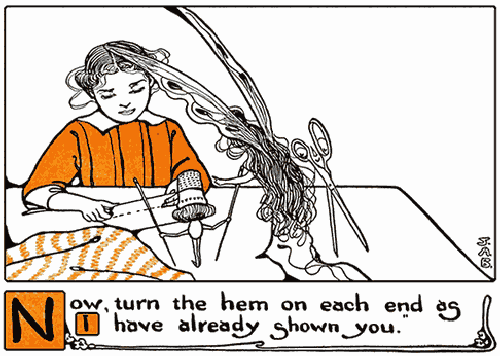
Now, turn the hem on each end as I have already shown
you.
“That’s it!―and that’s all for to-day’s lesson.
It was a tech-ni-cal lesson,” she said.
Now, turn the hem on each end as I have already shown
you.”
Chapter X A Doll’s Laundry Bag
“NOW, try it on the laundry bag itself,” smiled
Fairy Lady, who was waiting for Mary
Frances next Wednesday.
“Now, try it on the laundry bag”
“That’s hard to crease!” exclaimed the little girl,
laying the calico down on the table and pressing the
fold with her thumb nail.
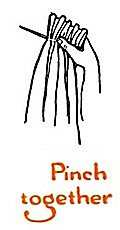
“Yes,” said Fairy Lady. “It is a good idea to
pinch it together between the thumb and forefinger,
to make the crease.”
“Oh, that is much better,” said Mary Frances,
and she soon had the little bag folded ready for sewing.
“What now?” smiled Fairy Lady.
“I begin to hem,” said Mary Frances, flourishing
her threaded needle.
“What number cotton are you using?” asked Fairy
Lady.
“Number twenty-four,” said Mary Frances.
“Ahem,” Thimble cleared his throat.
Pinch it together between thumb and forefinger
“A little too coarse,” said Fairy Lady. “I must
tell you something about needles and threads:
“There are several different kinds of
18.―Needles and Threads
Needles and
Sharps―long needles.
Betweens―short needles for heavy work.
Ground-downs―medium long. These do not break or bend
easily.
There are the long-eyed needles―worsted and darning needles.
Milliner’s very long needles.
Bodkins―long thick needles, for carrying tapes and cords.
Open a package of needles No. 5’s to 10’s. In the middle,
you will find needles
No. 5―for coarse work or sewing on buttons.
No. 6―for coarse work.
No. 7―for hemming towels.
No. 8―for stitching.
No. 9―for hemming muslin.
No. 10―for fine work.
Use
Needle
Cotton
For Tucking, Hemming, Running.
No. 9
No. 60, 70 or 80
For Stitching, Overhanding,
Overcasting. . . . . . . . . . . . . . .
No. 8
No. 50 or 60
Button-holes. . . . . . . . . . . . . . . . .
No. 7 or 8
No. 36, 40 or 50
Gathering and Basting . . . . . . . . .
No. 7 or 8
No. 36 or 40
Threads
“Oh,” murmured Mary Frances, “I didn’t know.”
“Of course you didn’t, dear little Seamstress,”
smiled Fairy Lady. “That’s why I’m here!”
“Thank you, Fairy Lady,” said Mary Frances.
“Thank you, Fairy Lady”
“Now, you may begin work on the laundry bag.”
Mary Frances smilingly basted the hems near the
edges with even basting stitches, and then began to
do the hemming.
Fairy Lady watched her intently all the while.
“There!” Mary Frances suddenly exclaimed. “I’ve
broken my thread. How do I join it?”
“I will show you this once,” said Fairy Lady.
“You do it in very much the same way as in starting
the work,” and she taught Mary Frances how to tuck
both ends of thread under the hem.
“When you finish, just fasten the thread by taking
two or three stitches in the fold. That’s a pretty good
looking hem for the first real hem on muslin,” said
Fairy Lady.
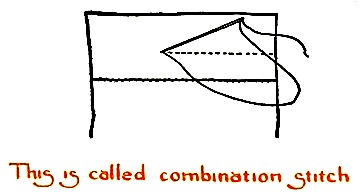
“Now, one-quarter of an inch above the hems, put
in a row of running stitches,―with once in a while
a back-stitch to strengthen it. This is called combination
stitch.”
This is called combination stitch
When Mary Frances had done this, she held up the
bag, and asked, “What shall I do next?”
“I’ll tell you more,
I’ll tell you more,
If you can tell
What that is for!”
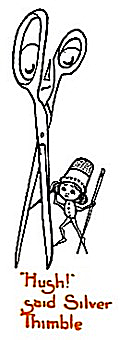
“Hush!” said Silver Thimble
“I know,” guessed Mary Frances. “It’s for a
casing to hold the drawing strings.”
“Oh, to my heart
That music rings,
For you to guess
It’s ‘drawing strings,’”
sang Fairy Lady.
“How could her heart draw strings,” asked Scissors
Shears of Thimble, in a whisper.
“Hush!” said Silver Thimble, raising his sword-needle.
“Snip!” snapped Scissors Shears. But Fairy Lady,
not noticing, continued the lesson.
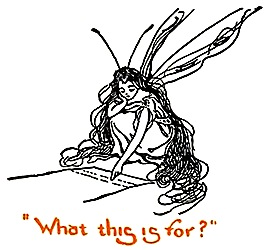
“What this is for?”
“Do you remember the overhanding stitch on canvas?
Yes? Now, those little ends of the bag above
the running stitches, are to be overhanded together.
You put the needle in straighter, and more toward
you―like this,” as she placed the needle in position.
“Now fold the two hemmed ends together, the right
sides facing each other.
“Baste along the longer edges with even basting.
Overhand these edges together.
“You would not always overhand the sides of a bag
together,―you could run it, or back-stitch, or combination
stitch it; but we want this unusually strong because
your dolly will have so many clothes to be stuffed
into it. I should say handkerchiefs, because this
bag is really a handkerchief bag, or a little laundry
bag.”
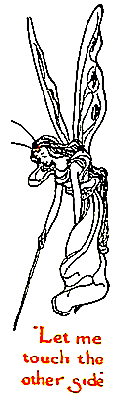
“My, how well you have done this side. Let me
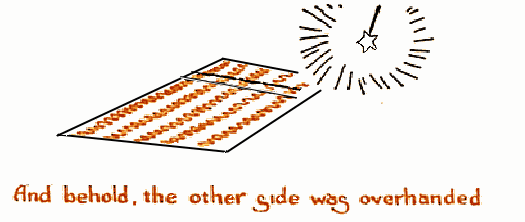
touch the other side with my bodkin wand―there!”
And behold, the other side was overhanded.
“That’s lovely, thank you, dear Fairy Lady!”
exclaimed Mary Frances, examining the perfectly
beautiful stitches. “How did―?”
And behold, the other side was overhanded
“Oh, that was done
In Thimble Land―
Done by the Fairy
Needle Band.”
laughed the little lady, well pleased at Mary Frances’
delight.
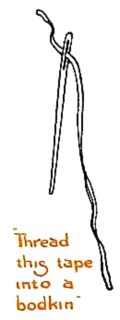
“Thread this tape into a bodkin”
“Now, thread this narrow tape into a bodkin, and
run it into the casing, all the way round; then tie the
ends together. Now, another piece (they are twelve
inches long) in the other end, and tie.”
“Oh, if it isn’t the dearest little bag I ever saw!”
exclaimed Mary Frances, drawing the top together.
“Isn’t it lovely! Look, Fairy Lady!”
But Fairy Lady had gone, and Sewing Bird sat
in her usual place on the table, singing:
“Oh, little Miss, dear little Miss,
There never was a joy like this:
To keep some one from being sad,
To make some dear one very glad.
Oh, little lady―”
Crash!
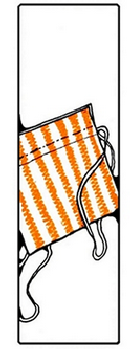
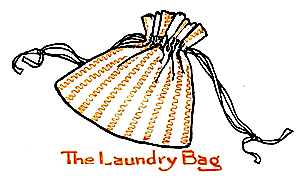
The Laundry Bag
Sewing Bird sat up stiff and hard and metallic.
“Good joke!” giggled Scissors Shears, who had
jumped on the floor to scare her.
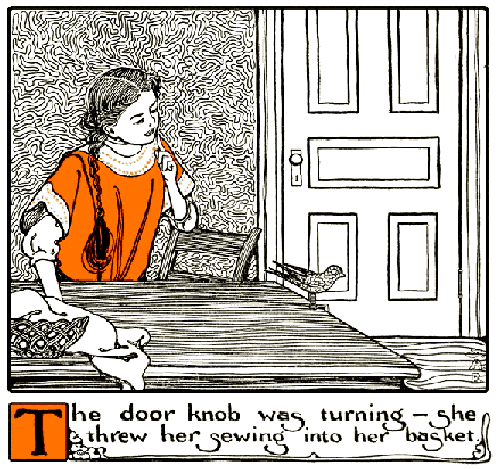
Mary Frances glanced at Sewing Bird, but the door knob
was turning, and she hastily threw her sewing into her basket.
“Bring a piece of white lawn for the next lesson,”
whispered Sewing Bird, throwing Mary Frances a kiss
with the tip of her wing.
The door knob was turning―she
threw her sewing into her basket.
Chapter XI Mr Silver Thimble and Mr Emery Bag
“GRANDMA,” asked Mary Frances, the next afternoon, “may I have this
little piece of white lawn?”
“May I have this little piece of lawn?”
“Why, certainly, dear,” said Grandma. “You are
such a good child. I am sure I never saw a little
girl who was so able to amuse herself.”
“My, I wish I could explain about my little friends,”
thought Mary Frances, but she answered, “I don’t get
very lonely when you are away, Nanny dear, because I
keep busy; and when you are here, we have such fun
together!”
“Heigho!” exclaimed Grandma, “I feel really
young again!”
“Why, certainly, dear.”
“I wonder if I could give her lessons”
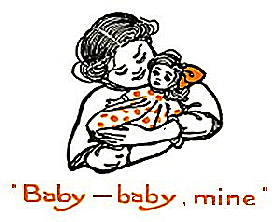
“Go to sleep! go to sleep!
Baby dear, baby dear, mine.
To and fro, I rock thee deep,
My arms a cradle for thy sleep;
Close your eyes, and don’t you peep,
Baby dear, baby dear, mine.
“I rock thee deep, but hold thee near,
Baby dear, Baby dear, mine.
Nothing can harm thee, never fear!
Mother-love is so very queer,
Nothing can make thee but my dear
Baby―baby mine,”
sang Mary Frances, rocking Angie in her arms.
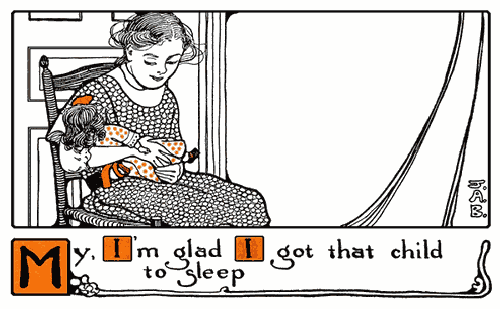
“My, I’m glad I got that child to sleep before my
sewing lesson,” she said.
“I hope she’ll be quiet all through the afternoon.
Every once in a while I’ve had to take her over to
Lottie’s to stay. I’ve put myself under ob-li-ga-tion
to Lottie, and I’ll have to make something for one
of her children―oh, I wonder if I could give her some
sewing lessons, the way I did Eleanor cooking lessons.
“How I wish Eleanor were here! I do miss her so!
“Baby―baby, mine”
“I’ll tip-toe in to my lesson with this child in my
arms, and put her carefully in the big rocking chair,
so as to have her near if she cries. Of course, I’m only
pretending she’s a tiny young thing―because I didn’t
bring my baby infant doll with me, and this is only
Angie. She’s really almost three years old; but my,
she certainly does love to be ‛babied’―and I’d certainly
get very lonesome if I didn’t do it―with Mother and
Father so far away―and Billy in camp!”
The big tears rolled down
The big tears rolled down her cheeks.
“Come, Mary Frances,” she said. “I feel like
shaking you. When you promised Father so faithfully
to be a woman, and your Grandma is such a darling!―Suppose
you read Mother’s last letter over:
Dear Little Big Mary Frances:
Only twenty times has Mother read over your sweet
letter. It was so dear, and brave. I am much better
than I was―thanks to such a loving family―and the
lovely “aps-mos-spere” here, as you used to say when
you were little.
What a beautiful country this is―your “Fatherland”
and mine. I want you to see some day the lovely
view I am now looking upon: mountains rising high
and peeping over this lovely stretch of country to look
into the Pacific Ocean, which sparkles like that ir-i-des-cent
feather in your dear Grandma’s bonnet.
Read Mother’s last letter
Father is calling me to come for a ride, and I must
drop a line to my Billy Boy―who is a good Scout, too.
Can you feel this kiss and this hug? I know you
can―for what are miles to us whose love for each other
flies through space?
Your loving Mother.
P. S.―Thank you so much for the picture of Jubey.
With Angie asleep in her arms
“My, I feel better,” said Mary Frances, drying
her tears. “But if it weren’t for my sewing lessons,
even with Grandma’s help, I’d not be a Scout. Billy
is a good Scout:―but now,―for the lesson,” and she
went to the sewing-room very softly, with Angie asleep
in her arms.
“Hee-ha!” she heard through the door, which was
a very tiny way open, “that’s the time!”
She thought it was the voice of Silver Thimble.
“I don’t care,” answered a new voice. “It’s too
much, to have to clean them all at once.”
“Oh, there are only two more. Come, I’m ready―it
is really excellent practice for a soldier!”
“It is really excellent practice”
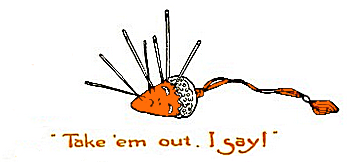
“Take ’em out, take ’em out, I say!”
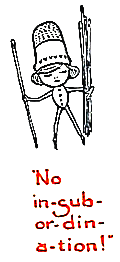
“No
in-sub- or-din- a-tion!”
Mary Frances feared to make a noise―but she
quietly pushed the door open a little wider and
saw Silver Thimble on one side of the table, and over
on the opposite side, the queerest little fellow.
“Looks like the picture of a porcupine,” thought
Mary Frances.
“It may be good practice for a soldier,” groaned
the queer little figure, “but pity the target! Besides,―one
at a time, please!”
“Emery Bag, what do you think you were made
for? I hope you realize it’s your duty to clean all the
rust and roughness off these needles as I run them
through you, so that the little Miss may sew more
easily,” lectured Thimble. “No in-sub-or-din-a-tion!
Stop and think! You know my family’s power,―you
know my family’s wealth. You realize, I hope, you
live in a land named for my aris-to-crat-ic ancestors―Thimble
Land!”
“Oh, ancestors go-to-China!” exclaimed Emery
Bag. “We live in the present, and I demand―I demand
justice. I leave it to anybody if it’s fair to have
twenty needles stuck into your heart at once!”
“Take ’em out, I say!”
“The idea of being such a coward!” retorted
Thimble. “Where’s your heart of steel you brag of
so often?”
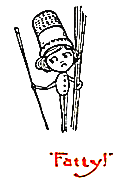
“Fatty!”
“It’s scarcely fair, you know,” came a new voice.
“You see, twenty needles at once are really more than
are needed.”
“Humph, Tommy Pin Cushion,” answered Silver
Thimble. “What you sticking your ’pinion in for?
It’s a wonder Sewing Bird hasn’t stuck her bill in!
Tommy Pin Cushion, you might just as well keep out
of this―everybody knows you’re stuck on yourself―Fatty!”
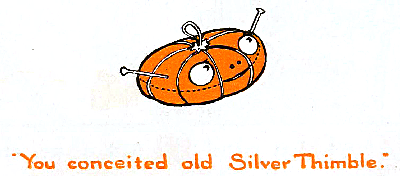
“You conceited old Silver Thimble,” came the
voice of Pin Cushion. “You will please address me
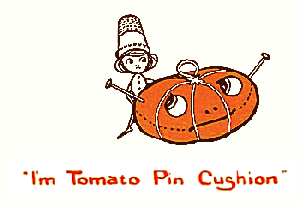
by my full name―‘Tomato-Pin-Cushion, Custodian-of-the-Sword-Needles’;―and
what’s more, if you don’t quickly remove all those needles
from poor Emery, you won’t get any more sword-needles to wield.
So there! You know Sewing Bird’s taking forty
winks; that’s why you don’t act in your best military
manner.”
Silver Thimble looked toward Sewing Bird, whose
eyes began to open, and quickly went toward Emery Bag.
Taking out the needles, one at a time, he ran
to Pin Cushion and quilted each into its place.
“You conceited old Silver Thimble.”
“There!” he exclaimed at length, “I’m certainly
glad I’ve ‘stacked all my arms’―my, I’m tired!”
As he leaned back to yawn, off fell his helmet and he
melted away.
“Serves him right,” murmured Emery Bag; “I
hope Fairy Lady won’t ask him to the sewing
party to-day,―she really arranges all these lessons.”
“Don’t fear! Don’t fear!
Mr. Emery Bag;
You’ve got Silv Thimble’s
Very last tag,”
sang Sewing Bird.
“Good!” thought Mary Frances. “Now, I’ll go
in.”
“My, I’m glad I got that child
to sleep”
Chapter XII Mary Frances’ Treasure Box
“GOOD-AFTERNOON, dear Thimble People,”
said the little girl, putting Angie on a
rocking chair.
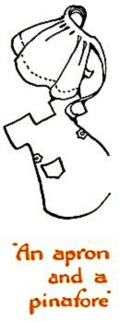
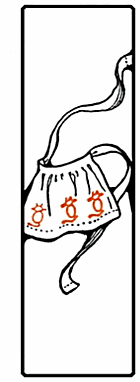
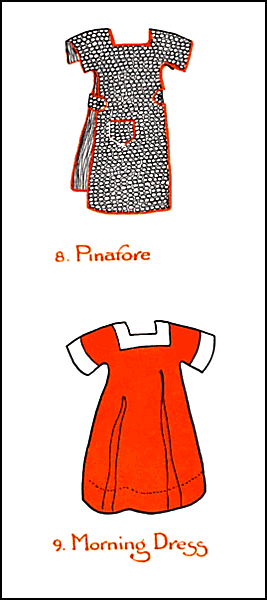
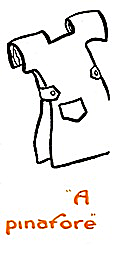
“An apron and a pinafore”
“Good-afternoon,” came many little voices, and
Sewing Bird began to sing:―
“Oh, do you know,
Oh, do you know
What we have planned
For us to sew?”
“I don’t,” laughed Mary Frances. “Please tell
me?”
“For your dear dolly we will make,
And every pains will try to take,
An apron, and a pinafore;
And later, other things galore;
Her wardrobe we so full will fill,
No one would care to pay her bill.”
“What we have planned For us to sew?”
“Magic and Mystery!” exclaimed Mary Frances,
putting her hands over her eyes; and Fairy Lady sat
in the doll’s rocking chair.
“Thank you
dear
Fairy
Lady”
“Oh,” said Mary Frances somewhat breathlessly,
“excuse me for calling you so suddenly, but I so
wanted to talk with another woman―” and then she
blushed, fearing she had offended the little bird.
“And not a bird,” smiled Fairy Lady. “I understand,”
she nodded, “a bird, be she ever so wise,
doesn’t understand the needs of a doll-child or the
heart of her mother.”
“Thank you, dear Fairy Lady,” replied Mary
Frances.
“And I know how brave you are while your
mother is away, Mary Frances, child,” continued Fairy
Lady, “but I’ve had orders from our King not to speak
of that―so we’ll get the material ready for dolly’s
apron.”
“Here is the lawn,” said Mary Frances. “Grandma
gave it to me.”
“Here is the lawn”
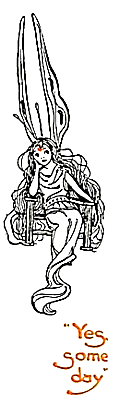
“Yes, some day”
“By the way,” said Fairy Lady. “Where will
you put these things as you make them? You must
keep them a secret, you know, until we finish the
lessons, or we’ll become Never-Nevers.”
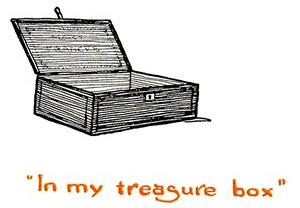
“I shall keep them in my treasure box. Mother
gave it to me a year ago. It has a little key and it
locks. Mother said all girls love to have a kind of a
secret place to keep treasures in.”
“Have you the box here?” asked Fairy Lady.
“Oh, yes,” smiled Mary Frances. “I keep it in my
trunk. It is made of tin, and very light.”
“Go and get it, please.”
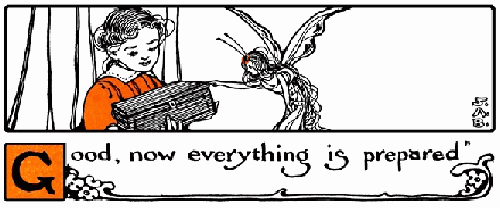
“Good,” laughed the sweet voice of Fairy Lady,
as Mary Frances brought in the treasure box. “Now,
everything is prepared.”
“May I tell about the lovely lessons, sometime?”
asked Mary Frances.
“Yes,” smiled Fairy Lady. “You may,―some
day. We do not want our help to be given to one
little girl only―so when we are all through, you can
form a Sewing Circle to which your girl friends may
belong, and you can teach them all you have learned.”
“In my treasure box”
“Oh, how perfectly lovely!” exclaimed Mary
Frances. “But won’t you help me any more then,―you,
and the dear, dear Thimble People?”
“You’ll have your mother then, you know,” explained
Fairy Lady.
“Oh, yes,” said Mary Frances happily. “She had
planned to teach me to sew this very summer―it
will be another grand surprise for her if I know how―when
she comes.”
“I wish afternoons were much longer,” smiled
Fairy Lady; “but we must do our lesson. Now, just
a word
19.―About Cloth, Weaving, and Spinning
Cotton cloth is made from the cotton plant; wool cloth from
sheep’s fleece; silk cloth from silk worm’s cocoon; linen cloth
from the flax plant.
The soft cotton is the warm coat for the cotton plant seed-baby.
The fleecy wool is the warm coat of the sheep, or the little
lambs. The web from the silk worm’s cocoon is the cradle in
which it sleeps. Linen is made from the stalks of the flax plant.
When these materials are spun, or twisted, into long threads,
we have spool cotton and silk, wool yarns, and linen thread, for
sewing. When the threads are woven or laced together into
cloth, the stronger threads run the length of the goods―they are
the warp threads. The weaker, or woof threads, run crosswise of
the goods.
“Good, now everything is prepared”
Chapter XIII Making a Doll’s Apron
“IN cutting any garment, wherever there will be
a pull upon the goods, what threads should bear
the strain?”
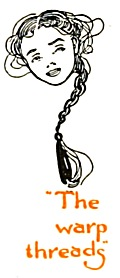
“The warp threads”
“The warp threads,” answered Mary Frances,
deeply interested.
“Good,” said Sewing Bird Fairy Lady, “the warp
threads, or lengthwise of the goods. Now, we are
ready for
Pattern 2.―Doll’s Apron
1. Cut a piece of lawn five inches, lengthwise of the goods;
and seven inches wide. You can pull out a thread and cut along
the line it makes, to get a perfectly straight edge.
2. Cut two strings each six inches long, lengthwise of the
goods, and one and one-half inches wide.
3. Cut a band four inches long, and two inches wide.
“How tall is your dolly?” she asked.
“How tall is your dolly?”
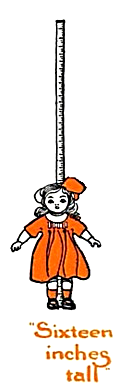
“Sixteen
inches
tall”
“I’ll have to measure,” said Mary Frances.
“Come,” she said, “Angie, dear, wake up! Mother
wants to see how big her dolly has grown.”
Angie was very good and stood quite still while
Mary Frances held her against the yardstick.
“Sixteen inches tall,” she said; “nearly half a
yard.”
“Then the apron will be just right,” smiled Fairy
Lady. “Now, I’ll give you directions.”
Making a Doll’s Apron (Pattern 2)
1. Fold the two five-inch sides together, to find center.
Clip a notch at the top.
2. Open. Turn an inch hem at the bottom, and baste it in
place. Hem with No. 9 needle, and No. 60 or 70 white cotton.
3. Turn a quarter inch hem on the sides. Baste and hem.
“Next you gather the top, and set the gathers
into the band; but first you must learn about
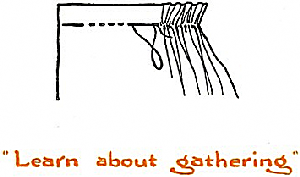
20.―Gathering
Gathering is done by the use of the running stitch.
1. Turn the goods over one-quarter of an inch from edge and
pinch a crease to mark a line to follow with the gathering stitches.
Open it up.
“Learn about gathering”
Fastening thread over and under the pin
2. Use a thread a little longer than the space to be gathered,
which is from the center notch to the side of the apron.
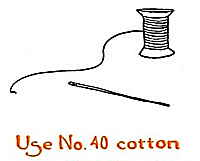
(Use No. 40 cotton for gathering the apron.)
3. Make a good-sized knot, put needle in downward on right
side of goods.
4. Sew on crease, taking several stitches before pulling needle
through. Aim to take up on the needle about half as many threads
of the goods as you skip, but do not trouble to count them.
5. When finished, make a knot in the end of the thread and
let it hang.
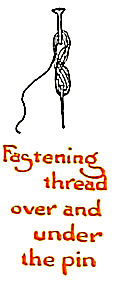
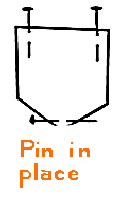
6. Put a pin in at the last stitch you took, and draw up the
work a little, fastening the thread over and under the pin.
Stroke the gathers.
“Stroking is done to make the gathers set more
evenly.”
21.―Stroking of Gathers
1. With right side toward you, begin at left hand edge.
2. Hold work between the thumb and first finger of left hand.
Keep thumb below gathering thread.
3. Put point of a blunt needle or eye of an ordinary needle
under a little plait of the goods and bring it up under the thumb,
draw needle down and pinch plait with thumb.
NOTE.―Stroking is not often done to very thin goods, lest
it be torn, but many small stitches are placed on the needle at
once and pinched together before pulling the thread through.
Use No. 40 cotton
“Now the apron is ready for
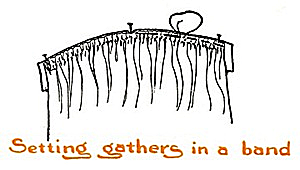
22.―Setting Gathers in a Band
1. Find the middle of the band and clip a tiny notch in edge
of each side.
2. Clip off each corner of band, to avoid thickness of
goods.
3. Pin the right hand end of the gathered piece one-quarter
of an inch from the right hand end of band.
Pinch together
4. Pin the center of the gathered piece to the center of the
band.
5. Pin the left hand end of the gathered piece one-quarter of
an inch from the left hand end of the band.
6. Tighten or loosen the gathering thread to the exact length
of the band and fasten under and over the pin.
7. With needle point, distribute, or spread, the gathers
evenly.
8. With gathers toward you, baste with small even basting
stitch just above the gathering thread.
9. With stitching stitch, sew the gathering to the band,
taking up one gather at a time. Fasten thread and cut off.
10. Turn up the band. Fold the opposite side over toward
you one-quarter of an inch from the edge. Crease. Do the same to
the ends of band.
11. Fold this over the gathers, bringing the folded edge just
over the stitching.
Setting gathers in a band
12. Pin the middle of the band to the middle of the stitching,
and the ends to the ends, exactly even.
13. Baste, with even basting.
14. Hem the gathers against the band, taking up one gather
at a time. Do not let the stitches show on right side.
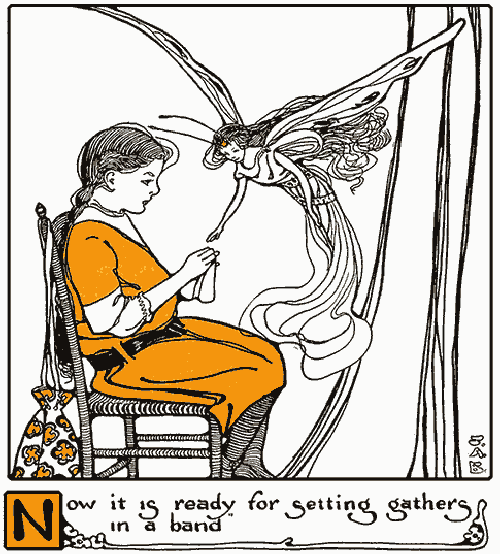
“Now it is ready for setting gathers
in a band”
Chapter XIV A Loan from the Thimble King
“DEAR me,” sighed Mary Frances. “How
will I ever get so much done? I didn’t
want to interrupt you, dear Fairy Lady,
but I’ve gotten, you see, no further than basting the
hem of dolly’s apron!”
“Dear me.”
Big tears trembled in the little girl’s eyes.
“Dear child,” smiled Fairy Lady. “We realize
how rapidly we’ll have to work in these lessons in order
to get through before your mother comes, so we are
ready to help.”
With this, she rapped three times on the sewing
table with her bodkin wand, whereat a little fellow of
queer appearance walked solemnly up to Mary Frances
and made a pompous bow.
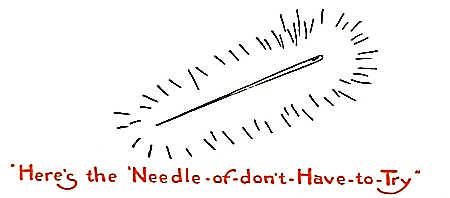
“There is but one needle in the world”
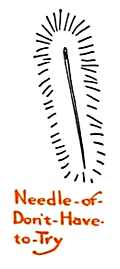
“There is but one needle in the world, your Seamstress-ship,”
he said, “which is called the Needle-of-Don’t-Have-to-Try,
and the King of the Thimble
People has sent it to you by your humble servant,”
glancing proudly about.
“Why,” said Mary Frances, scarcely daring to
breathe. “Why,―you, you are certainly my own
needle book!”
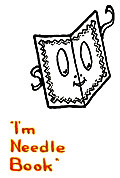
“Needle Book―that’s my name,―and here, dear
Mistress, is the Needle-of-Don’t-Have-to-Try.”
The little girl hesitated
Mary Frances saw a bright shiny light come from
between the opening leaves of Needle Book; then slowly,
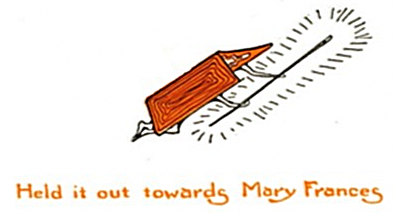
very slowly, with his tiny little hand, he pulled out
what seemed a needle of fire, and dropping on his
knees, held it out on both arms toward Mary Frances.
The little girl hesitated. Would it burn her?
“Do not fear,” smiled Fairy Lady. “It will not
harm you. The Needle-of-Don’t-Have-to-Try is
loaned to you on only one condition: which is, that
you will promise to sew some time every day between
lesson days.”
“Oh, I promise,” exclaimed Mary Frances. “I
do not, dear Sewing Bird Lady, I do not deserve such
beautiful kindness!”
She took the Needle-of-Don’t-Have-to-Try from
Needle Book.
Held it out towards Mary Frances
“Poor Pinny”
“I do thank you―very―gratefully,” she said, not
knowing exactly how to behave toward the ambassador
of the Thimble King.
“For shame, Tommy Pin Cushion!” exclaimed
Fairy Lady, who overheard him mimicking Needle
Book. “Don’t make fun! Never, never will you
be Bearer of the Needle-of-Don’t-Have-to-Try for the
King of Thimble Land.”
“I beg your pudden!” said Tommy Pin Cushion
to Needle Book, getting very red in the face.
To cut this pattern, fold
goods twice, as indicated
by dotted lines.
Pin pattern thus on
folded goods.
Arrow ⬌ means to
pin this edge of
pattern lengthwise
of goods.
Two rings O O mean
that these edges
must be placed on
folded edges of
goods.
All seams allowed.
ALL
PATTERNS
FIT
16 IN. DOLL
USE THESE PATTERNS FIRST
This pattern plate should remain permanently in book
so that tracings on tissue paper can be made from it as required.
“Yes,” smiled the delighted Fairy Lady.
Threaded the needle
Mary Frances found her thimble, and threaded the
glowing needle, although she feared it would scorch
the thread,―but it seemed like any other needle except
that she didn’t have to try twice to put in the thread.
“I wonder how it is different?” she thought as
she started to sew.
Then the most wonderful thing happened. She
found the needle darting ahead of her hand, making the
stitches just as fast as she could touch the eye with her
silver thimble.
In a minute the apron was hemmed.
In another minute the apron was gathered.
In another minute the strings were hemmed.
Then the Needle-of-Don’t-Have-to-Try stopped
dead still and wouldn’t move.
“Oh! ho!” cried Mary Frances. “What have I
done? What have I done?”
“Nothing, dear child,” said Fairy Lady. “But
the Needle-of-Don’t-Have-to-Try cannot do for you
anything you have not yet learned; so use your
own needle and set the gathers of the apron into the
band.”
In a minute the strings were hemmed
“Thank you very much,” said Mary Frances,
finishing the apron band.
“And now,” said Fairy Lady, “as to
Putting the Strings into the Band
1. Gather, or lay small plaits at the unhemmed end of strings,
and insert, or push them into the ends of the band.
2. Hem down.”
“Well done, dear child,” smiled Fairy Lady at
length.
Then quicker than Mary Frances could wink, she
turned into Sewing Bird, and began to sing,
“Oh, my! Oh, my! Oh, my! Oh, my!
It brings a twinkle to my eye!
The Needle-of-Don’t-Have-to-Try!
Dear little miss, good-bye,
Good-bye.”
“Dear little miss, good bye, Good bye”
Chapter XV Three Little Kittens
“THREE little kittens sitting in a row,
All on a dolly’s lap,
Tit, tat, toe!”
Three little kittens sitting in a row”
sang Sewing Bird when Mary Frances came for the
next lesson.
“Three in a row on a dolly’s lap?” said Mary
Frances. “Not my dolly’s, I guess―she couldn’t hold
three.”
Then sang Sewing Bird:
“Come riddle me this,
Come riddle me that,―
Your dolly can hold
A cat, and a cat, and a cat!”
“Why, how? oh, Magic and Mystery!” cried Mary
Frances eagerly.
“Why, how?”
Then came Fairy Lady.
“This way,” she smiled; “come, Pen Cil,” and
with a bound Pen Cil began to draw on the dolly’s
apron the picture of kittens given on this page.
(Any little girl can transfer this pattern to her own dolly’s
apron by using a carbon sheet.)
“Oh, how cute!” exclaimed Mary Frances. “Yes,
I think my dolly could hold three of those cats.”
Fairy Lady smilingly continued, “Now, with the
red working cotton and a canvas piece you may learn
23.―Kensington Outline Stitch
(Canvas 7 in. by 1-1/2 in.)
Outline stitch
1. Begin at the left hand end of a piece of canvas. Put
needle in from under side. Pull thread through.
2. Two threads over, put needle in downward and up through
the hole next to the left, holding work over forefinger of left hand.
Pull through.
3. Work from you, and always drop the thread on the same
side of the needle.
“Now, try it on muslin. You’ll need an embroidery
needle, because the large eye makes way for the
heavy cotton.”
Three Little Kittens
“Oh, I have one here in my basket, and some
quite-a-bit finer working cotton, in pink,―isn’t it
pretty?”
“I―I―put it there,” began Needle Book.
“Hush!” said Fairy Lady, holding up a finger.
“Now, little Miss, see if you can make that stitch on
muslin.”
Tumbled into the basket
“Very good, indeed.”
“Mary Frances! Mary Frances! Mary Frances!”
came Grandma’s voice from the hall.
With one leap, Fairy Lady changed to Sewing
Bird, and all the other Thimble People, who had been
standing on the sewing table, tumbled head-over-tin-cups
into the sewing basket.
“Yes, Grandma,” called Mary Frances, running out.
“Why, my dear,” puffed the old lady, climbing
the last of the stairs, “I am home very early, you
see. There was no regular meeting to-day because
almost all the members of the Ladies’ Guild went to
Daisy’s wedding. I’m home for some games with my
little girl.”
“Oh, Nanny-dear, will you play ‛Piddy-Pinny-Plump?’”
asked Mary Frances.
“Mary Frances!”
“Yes, indeed, girlie,” laughed Grandma.
“Goody!” exclaimed Mary Frances. “I’ll be ready
soon as ever I tidy up the sewing room.”
“I’m sorry, dear Thimble People,” she began.
Then she heard the sweet bird voice of Sewing Bird,
singing very softly,
“With outline stitch,
So pretty and neat,
Outline the kitties,
From head to feet;
“And have them done
When next we meet,
And they will look,
Sweet, sweet! Sweet, sweet!”
“This way,” she smiled, “come Pen Cil.”
Chapter XVI A Surprise from Mother
A SHARP ring at the door bell.
“A telegram for Miss Mary Frances”
“A telegram for Miss Mary Frances,”
said Katie coming into the dining-room.
“A telegram! And for you, Mary Frances. What
can it be!” exclaimed Grandma.
“Shall I sign for it, ma’am?” asked Katie.
“No,” said Grandma. “Mary Frances better learn
to sign for herself.”
There was a little look of excitement in Grandma’s
face, and a little pink spot in each cheek.
Trembling with wonder, Mary Frances gravely
wrote her name in the book. She opened the queer
looking envelope, with printing almost all over its
face, and read:
Telegram Miss Mary Frances:
Expect | by | Express | Mary | Marie | and | trunk. | Letter | follows. | |
Mother.
Wrote her name in the book
“Oh! Oh! Oh!” she cried. “I know, Nanny dear,
I know! Mary Marie is my dear new dolly. I do
wonder what she will be like! Isn’t Mother too sweet
and kind!”
“There’s the postman,” said Grandma, all laughter
and smiles. “I wonder if he―” but Mary Frances was
already at the door.
“A letter from Father!”
“Surely enough,” she cried. “A letter from
Father. I’ll read it to you, Grandma―” tearing open
the envelope:
Dear Mary Frances:―
Mother bought for you to-day the prettiest doll in San
Francisco, and she is going to send it by express, as soon
as she gets some shopping done for the young lady. She
will send a telegram when she starts Mary Marie on her
journey, and will write a letter of instruction as to her
health, wealth, and happiness.
Give our love to dear Grandma.
It is a delight to send the prettiest doll in San Francisco,
to the darlingest little girl in the whole wide world―at
least she is to her
Loving Father.
“There’s the postman.”
“Your Father meant that to reach here before
the telegram,” said Grandma.
“San Francisco is so far off,” said Mary Frances;
“but, oh, Grandma, isn’t it too lovely! Will Mary
Marie have light hair and blue eyes, or dark hair and
brown eyes, I wonder?”
“San Francisco is so far off”
“I wonder, too,” smiled Grandma.
“I know she’ll be pretty, for Mother has such
superb taste, as Father says.”
“Yes, dear,” smiled Grandma.
“Oh, I can hardly wait,” said the little girl, looking
out of the window.
“Come, dear, finish your breakfast.”
“May I tell Katie?”
“Yes,” nodded Grandma.
Katie was as delighted as Mary Frances.
“Katie is a wonder, Nanny,” said Mary Frances.
“She was telling me yesterday about all she could do
when she was little. When she was a mere child she
could cook a pair of pork chops beautifully, she told
me.”
“But Katie is only eighteen, now,” laughed,
Grandma.
Katie was delighted
“That seems awfully old to me,” said Mary Frances.
“You have a dear, sweet, heart”
“Katie loves animals, too, Grandma,” she went on,
“and so do I! Last summer, Nanny, when Father had
Josie Worrell and his horse plow our garden, I went
out and patted the horse’s nose. He was so pleased,
you should have seen him wag his tail.”
Grandma laughed again. “You have a dear,
sweet heart, little girlie,” she said; and taking Mary
Frances by the hand, went out on the veranda.
“Oh, Miss Mary Frances, here comes the expressman
carrying a box!” exclaimed Katie a few mornings
later.
“Katie, Katie, I’ll go to the door,” cried Mary
Frances running down stairs.
“The dear, blessed dolly!” she exclaimed, taking
the big package from the expressman. “Nanny, I can
hear her calling, almost.”
“We’ll have you out of the dark box soon, Mary
Marie, dear,” she whispered through an opening in
the wrapping paper.
“Here comes the expressman!”
“Come, Katie, you help; we’ll carry it where the
wrapping will make no trouble, out in the kitchen―and
I’ll bring the dolly for you to see, Nanny, dear, soon as
she’s unpacked.”
“You cut the string, Miss,” said Katie, “and I’ll pry
off the cover.”
Surely Mary Marie was a lovely doll
“Oh,” exclaimed Mary Frances. “I never, never
saw so much tissue paper―thirty, thirty-one, thirty-two,
thirty-three, thirty-four sheets―when will I get
to her! Oh, there she is! Isn’t she a darling, Katie!
And look, here’s her trunk!”
Surely Mary Marie was a lovely doll. She had
beautiful long curls tied with pink ribbon; and on her
feet were short stockings and slippers,―but her dress
was a very plain, simple, “slip” of lawn.
There was a note pinned on Mary Marie’s dress,
and a little key. The note read:
Dear Scout:
Please read my letter in the tray of Mary Marie’s
trunk before unpacking. Here is the key.
Mother.
“Oh, bring the trunk, please, Katie,” said Mary
Frances, “and I’ll carry Mary Marie.”
“I’ll pry off the cover”
Closed her eyes contentedly
“Come, dear,” she said. “Mother wants to take
you up to see Grandma and Angie, your sister.”
Mary Marie nestled back in Mary Frances’ arms,
and closed her eyes quite contentedly.
“What lovely long eye-lashes,” whispered Mary
Frances.
After showing the dolly to Grandma, she unlocked
the trunk and took out her mother’s letter.
“Oh, listen! Grandma, listen!” she burst out.
“I’ll read it to you!”
Dear Mary Frances:
This is Mary Marie. Isn’t she lovely? She is the
very doll I’ve been looking for, for my own dear daughter.
Father has told you something about Mary Marie, but
I want to add some particulars.
I have nothing to say about the care of her,―for I
know my little girl’s careful, neat ways so well. You
may be surprised when you unpack her trunk, to find no
dresses. Mother is sending you, instead, all kinds of
pretty goods which you may make up into dresses and
clothes for your new little daughter; and you will find all
kinds of laces and ribbons, and buttons, and hooks and
eyes―everything Mother could think Mary Frances or
Mary Marie could possibly want.
Unlocked the trunk
There is a set of toilet articles,―but I’ll not tell you
about the other things, for I know you are anxious to find
out for yourself.
A set of toilet articles
I wish I could be with you, dear, to teach you how
to make the pretty things; but I will, I hope, be able to
do that before so very long. Meantime, I want you to
use everything just as you wish. I’ve asked Grandma
to let you do exactly as you want to with these things, and
I ask you not to go to her with your sewing problems:
for the doctor said that Grandma must not strain her
eyes with any such work. I know you understand.
I hope, dear, Mary Marie will bring a little bit of
such pleasure to her Mother as her Mother has brought
to me.
With love, and a bear hug,
Mother.
P.S.―Expect to be home before long.
“Oh, isn’t it grand! Come on, Nanny, we’ll unpack
the trunk now!”
Soon the tray was out, and all the delightful contents
were spread in view.
Soon the tray was out
“Isn’t it wonderful!” said Grandma, almost as
much pleased and excited as the little girl herself.
These are some of the things they found in Mary
Marie’s trunk:
“We’ll unpack the trunk now.”
Chapter XVII Mary Marie’s Handkerchief
MARY FRANCES watched for the first chance
to show the Thimble People her mother’s presents.
“It’s a plow!”
When she knew her grandma was napping, she ran
breathlessly up to the sewing room, leaving Mary
Marie and her trunk outside the door.
“Oh, Thimble People,” she said, “listen! I can
scarcely wait to tell you about the delightful surprise
Mother has sent me. It is too beautiful―and you
can all share it with me! Guess what it is! Guess!”
“That’s easy!” said Scissors Shears excitedly,
“it’s a plow!”
“A plow!” exclaimed Emery Bag. “What a silly
thing! What put that in your head?”
“What else has a share, I’d like to know? Little
Miss said she’d ‘share it’―and I’ve heard of a plow-share―and
so there! Rip-him-up! I say, Rip-him-up-the-back!”
“Oh, Thimble People!”
Scissors Shears gave a kick toward Emery Bag.
“For shame!” said Mary Frances. “Now be good,
Scissors Shears; and all guess again.”
“Oh lovely beauty!”
“I give it up!” sighed Scissors Shears.
“I’ll tell you!” said Mary Frances. “No, I guess
I’ll show you! Now, Thimble People, look! look!”
she exclaimed, bringing in Mary Marie and holding
her up before Sewing Bird.
“Oh, lovely beauty!
Lovely thing!
And can it sing,
Oh, can it sing?”
“No,” laughed Mary Frances, “I don’t believe she can!”
“Oh, what’s her name?
Oh, what’s her name?
Oh, will she run
Or is she tame?”
asked Sewing Bird.
Holding her up before Sewing Bird
“Very impolite,” whispered Scissors Shears to
8. Pinafore
9. Morning Dress
INSERT 2
PATTERNS 8⋅9⋅
8. PINAFORE 9. MORNING DRESS
PINAFORE POCKET No 8
PINAFORE No 8 STRAP
MORNING DRESS SLEEVE BAND No 8
M. DRESS NECK BAND No 9
MORNING DRESS
PINAFORE
POCKET
☛ READ DIRECTIONS BEFORE CUTTING
This pattern plate should remain permanently in book
so that tracings on tissue paper can be made from it as required.
“Very impolite,” whispered Scissors Shears
Tommy Pin Cushion, “to call anybody, ‛What’s-her-name.’”
“This,” said Mary Frances, pretending she did not
hear, “this, Thimble People, is Mary Marie.”
“A sweet little dolly
Is Mary Marie!
As pretty a dolly
As ever could be.
“She’s not only sweet,
But tidy and neat
From the top of her head
To the soles of her feet;
“But she’s full of real woes―
From her head to her toes
She sadly needs stitching
And making of clothes,”
sang Sewing Bird.
“She’s not only sweet,
But timely and neat”
“She certainly does, dear Magic and Mystery,”
laughed Mary Frances. Then to Fairy Lady,―“and
I shall need your help so much! I’m simply too excited
to tell you rightly about all the rest of my perfectly
beautiful surprise―but I will try.”
Then she told of Mary Marie and her trunk.
“Bring in the trunk,―will you, please?” asked
Fairy Lady, who had come at once, in answer to the
magic word.
“I’m the richest Mother in the world”
“Yes, indeed!” said Mary Frances; “I’m the richest
mother, I guess, in the world, with such beautiful goods,
dear Thimble People―oh, such a wonderful lot!”
Then she brought in the trunk and spread out all
its pretty contents before the admiring eyes of the
Thimble People.
“It makes me sing
As on the wing,
Though now I’m not a birdie;
I’ll break in song
And sing so long
No one can say a wordie―
if I don’t look out,” sang Fairy Lady, “with such
lovely goods to use for our lesson! But to-day’s lesson,
little Miss, is to make a dolly’s handkerchief. You
must first learn
“It makes me sing”
24.―Hem-Stitching on Canvas
(Size: seven and one-half inches by two and one-half inches)
1. Draw out one group of threads one inch from edge of
canvas.
2. Turn a hem to meet open space and baste with white cotton.
3. Thread needle with red cotton and begin at right hand side
as for hemming, keeping the hem at the top.
4. Point needle toward you; put needle under one group of
cross threads and pull through.
5. Put needle back and under same group of threads, and point
it through the fold of the hem. Pull through.
To make
Pattern 3.―Doll’s Handkerchief
Cut square of linen
Cut a five-inch square of linen and prepare to do
HEM-STITCHING ON LINEN
1. One-half inch from the edge of the cloth, with the point
of a needle, pick out and draw a coarse thread; then draw several
more next to it.
2. Do the same to the other sides.
3. Now, turn a hem each side to meet the open space, and
baste.
4. Hem-stitch with number sixty cotton.
Hem-stitching
“If we were not here to help you, dear little Miss,
you’d have to wait until you were much bigger before
doing hem-stitching, for it is quite a strain on the
eyes.
“You may do the canvas hem-stitching; then use the
Needle-of-Don’t-Have-to-Try for making dolly’s handkerchief.
Otherwise, you could simply hem the edges
of the cloth, and learn about
25.―Sewing on Lace Edging
Needle-of- Don’t-Have- to-Try
If lace is to be put on quite full, measure the distance on which
it is to be sewed, and allow one and one-half times that distance in
lace.
1. Place the right side of the lace to the right side of the cloth.
Baste lightly, along one side. Overhand―beginning one-half
inch from end of lace.
2. To turn a corner, measure the width of the lace, and allow
twice the width, and pin a quarter of an inch beyond the corner.
Overhand around the corner. Finish and allow one-half an inch
on end of lace beyond sewing. Cut off.
NOTE.―Valenciennes Lace has a heavy thread woven in the
top on which the fullness may be drawn. A gathering thread
should be run in lace without such a thread.
4. To join the ends of lace you must learn about making
a fell.
Sewing on Lace Edging
“What is a fell?” asked Tommy Pin Cushion.
“A fell’s a fellow,” solemnly declared Scissors
Shears.
“For shame!” exclaimed Fairy Lady.
“Silly!”
“What does ‘fell’ mean?” persisted Tommy Pin
Cushion.
“It means he fell down,” said Scissors Shears.
“Silly!” exclaimed Needle Book. “How could
anybody ‘fell down?’”
“Down is entirely too soft to fell!” said Tommy
Pin Cushion.
“This is all foolish nonsense!” smiled Fairy
Lady. “Let’s proceed to make the felled
seam.”
“Excuse me!” exclaimed Scissors Shears, “but
how does a fell seem?”
“It seems you seem to seem not to be what you
seem to be!” laughed Tommy Pin Cushion.
“What’s that?” demanded Scissors Shears
sharply.
“A―a seemly fellow!” said Tommy Pin Cushion,
giggling.
Everybody laughed.
“What is a fell?”
“You interrupted me,” said Fairy Lady, “in telling
about
26.―Making a Fell
Cut two pieces of muslin, five inches long and two inches wide.
1. Place the two pieces together, one one-eighth of an inch
below the other. Baste with uneven basting.
2. Sew together with Combination Stitch. (Two running
stitches and a back stitch.)
“I did it with my little helmet”
3. Take out the basting, and open the pieces of cloth, and lay
the seam over so that the wider edge will be on the top.
4. Turn this in over the narrow edge, and hem.
Lace is joined in the same way.
“Oh, I see, Fairy Lady. That is so that no raw
edges will show,” exclaimed Mary Frances.
“Good!” smiled Fairy Lady. “Now, to hem-stitch
the handkerchief.”
“Where did I put that square of lovely linen?”
said Mary Frances. “Oh, I left it in the work basket.
Why―why, look, dear Fairy Lady, look―it is all cut
and hem-stitched.”
“How did this happen?” asked Fairy Lady.
“I did it with my little helmet,” answered a little
voice.
Making a Fell
“Thimble!” exclaimed Mary Frances.
“Thimble, what did you answer first for?” cried a
sharp voice. “I started it!”
“Oh, Scissors!” said Mary Frances.
“Oh, for shame,―to quarrel before our little
Miss―” began Tommy Pin Cushion.
“Oh, you turned good, have you, Tommy Pin
Cushion!” exclaimed Scissors Shears.
“We did have to try hard”
“I had the honor, your Seamstress-ship,” said
Tomato Pin Cushion, “to furnish the ‘Needle-of-Have-to-Try’ for this work.”
“Ha! Ha!” laughed Needle Book. “That’s a
joke.”
“We did have to try hard,” said Thimble, “to get
it done so soon.”
“I thank you all, dear Thimble People,” said Mary
Frances.
“Will you sew on the lace edging and bring it next
time?” asked Fairy Lady.
“I will,―” said Mary Frances, “Oh, I haven’t
shown you the outlined kitties. Aren’t they
good?”
“Splendid!” exclaimed Fairy Lady.
“Ha! Ha!”
“Those kittens always will be good
And never bother you for food;
You’ll never have to lay down laws
To make them wash their heads and paws;
Their whiskers, too, will stand out straight
As when they sit before the grate;
They won’t annoy you with their noise
Nor hide away your pretty toys;
But kittens quite as good as that
Were never kittens of a cat.”
“Oh, no,” laughed Mary Frances. “Jubey’d
never recognize them. She’d not know they were
kittens.”
“No,” said Mary Frances. “Not Jubey. She
never looks at Dick Canary.”
“Oh, I forgot,” said Fairy Lady, “I am a bird
without feathers, and Jubey wouldn’t care for a bird
that didn’t tickle her nose.”
A sweet little dolly
Is Mary Marie!”
Chapter XVIII A Nightie For Her Little Nap
“A CHARMING thing
To make Marie,
Will be a dainty
White nightie,”
sang Sewing Bird.
“White nightie”
“Oh, good!” exclaimed Mary Frances. “That
is just what she needs. I had to loan her Angie’s
best one; and Angie’s terribly cross. You see, I fear
she is a little jealous of my new dolly. I’ll not neglect
Angie, but you understand, dear Sewing Bird Lady,
that it is my duty to clothe this child―” anxiously―“Isn’t
that perfectly right?”
“What would she wear? What would she wear
Without a loving mother’s care?
She’d freeze with every winter’s breeze,
She’d die of shame if any tease;―
For every thinking body knows
No doll is glad without fine clothes.”
“Angie’s terribly cross”
“Thank you, Magic and Mystery,” said Mary
Frances.
“And,” smiled Fairy Lady, “the Thimble People
have been quite busy since last lesson―see?” She
pulled from under the cushion of the doll’s chair a
paper pattern.
“Oh, how lovely!” exclaimed Mary Frances, clapping
her hands. “A real pattern just such as Mother
uses when she makes my dresses? What is this pattern
to be used for?”
“For a dolly’s nightgown,” replied Fairy Lady,
smiling happily. “Now, the materials required are:
“Oh, how lovely!”
Three-quarters of a yard of lawn, or muslin. Long-cloth is
a very nice kind of muslin to use.
Three-quarters of a yard of lace ribbon beading.
One yard baby ribbon.
“Here they are!” said Mary Frances, hunting
among the treasures in Mary Marie’s trunk.
“They are perfectly all right,” smiled Fairy Lady.
“Even to a fairy?” laughed Mary Frances.
“Even to a fairy,” nodded Fairy Lady.
“Now, see if you can cut out
A paper pattern
Pattern 4.―Doll’s Nightgown
See Insert I
“If only―” he whispered
Follow the directions on the folded sheet.
To cut out―
1. Fold the lawn crosswise.
2. Lay edge of the pattern having the two rings (oo) on the
folded edge of the lawn.
3. Cut out, being careful to clip the little V-shaped notches
before removing the pattern.
NOTE.―Always clip a small gash in the corner under arm of
these kimono-style dresses.
It took Mary Frances some time to fold the goods
and pin the pattern on most carefully. So anxious
was she to begin cutting out that she didn’t notice
Scissors Shears looking at her most beseechingly.
“If only―” he whispered―“if only―” but Sewing
Bird Fairy Lady gave him an indignant push with her
bodkin wand.
“The little lady must learn how,” she said.
“Of course, of course,” said Scissors Shears in a
whisper, clicking off the words sharply, “but I want to
help―”
“You’ll help if you lend yourself―”
Lay edge of pattern on folded edge of lawn
“Lend myself,” said Scissors Shears. “Now I might
lend some one else. I could lend Bod Kin, for instance.”
“Bod Kin!” exclaimed Mary Frances, catching
the last words. “Is he a Thimble person?”
“Is he a Thimble person?”
“He was!” sighed Scissors Shears, letting several
tears fall.
“But,” explained Fairy Lady, “one day he refused
to do as the King commanded, and would not go through
the muslin―so the King changed him into a blunt-nosed
needle; and he has been compelled to be good ever
since, even without his own consent.”
“Poor Bod Kin!” said Scissors Shears, turning over
so sharply that everybody jumped,
“Poor Bod Kin,
He didn’t win;
It is a sin,
Thin as a pin,
Can’t make a din―
Poor old Bod Kin!
If I were he
And he were I,
He wouldn’t be he
And I wouldn’t be I.”
“Poor Bod Kin”
“Hee-hee,” tinkled the silvery voice of Silver
Thimble. “If you get too bright, you’ll try to cut things
out with one leg, Mr. Scissors.”
“Lend yourself!”
“Come,” said Fairy Lady, “Miss Mary Frances,
your Seamstress-ship, will you please begin to cut the
goods?”
“Lend yourself!” whispered Tomato Pin Cushion
to Scissors Shears.
“Tommy Pin Cushion, you’re stuck up!” clicked
Scissors Shears, walking across the sewing table.
“I’ll cut by the pattern most carefully, dear Sewing
Bird Lady,” said Mary Frances.
“Come,” taking Scissors Shears up quite carelessly.
“Just like a grown up lady,” she thought as she cut
out the little nightgown, and proudly held it up to the
view of the Thimble People.
“Beautiful!” they cried.
“Not so beautiful as it will be,” said Fairy Lady,
“when it
Has lace and ribbon,
And ribbon and lace,
Holding the lovely
Things in place.”
“Beautiful!”
“Oh,” said Mary Frances. “I can scarcely wait!”
“Well, then,” said Fairy Lady, “let us begin
by learning a neat method of putting two materials
together when the edges fray easily. It is called a
27.―French Seam
French Seam
1. Put the wrong sides of two pieces of goods against each other.
2. Baste about one-eighth of an inch from edge.
3. Sew with running stitch near the basting. Remove basting.
4. Turn the goods the other side out, and baste so as to
enclose the seam.
5. Stitch with half-backstitching.
“Now, let us see what the nightgown looks like?”
Mary Frances held it up.
“Good!” said the Fairy Lady. “Next you’ll learn
To Make Doll’s Nightgown.―(Pattern 4.)
1. Fold the two long halves together, and pin the notches
against each other.
2. Baste carefully along this edge, and try on dolly. Alter,
if necessary.
3. With running stitch, sew near the basting.
4. Turn to other side and baste seam carefully to enclose
the first seam―a French Seam.
5. Sew with half-backstitching. Turn to right side.
“Good!” said Fairy Lady
“Do you recognize the French Seam?”
“I’m the gratefulest child”
“Indeed I do,” smiled Mary Frances.
“You may use the Needle-of-Don’t-Have-to-Try for
this lesson,” said Fairy Lady, “because you’ve already
learned these stitches. Doesn’t it pay to work patiently
at first?”
“Oh, I’m the gratefulest child,” said Mary Frances,
taking from Needle Book the shining needle, which
seemed almost too precious to use, and beginning to
sew.
In a twinkle the French seams were neatly made.
“Now,” said Fairy Lady, “fold a three-quarter of
an inch hem at the bottom, and baste. Then hem it.”
The hemming the Needle-of-Don’t-Have-to-Try
quickly did.
“Ready,” continued Fairy Lady, “for
Finishing the Neck
Clip a half dozen little slashes in the edge of the neck, and
turn back to the right side of the goods one-quarter of an inch.
Baste.
Turn back one-quarter of an inch the end of the lace beading
for ribbon, and baste it over the turned back goods, beginning
in the center of the back.
To finish neck
Cut off the lace beading one-quarter of an inch beyond the
place it meets the beginning, and finish by turning it in one-quarter
of an inch. Hem beading down on lower edge.
Finish the Sleeves
in the same way, but it is not necessary to slash them. Then
sew by overhanding stitch, some Valenciennes lace in neck and
sleeves. Join ends of the lace by a fell.
Thread Bod Kin with ribbon
“Is that right?” asked Mary Frances at length.
“Good,” smiled Fairy Lady. “Now thread Bod
Kin with the pretty baby ribbon, and run it in and out
of the lace beading.”
“Not your fairy wand!” exclaimed Mary Frances,
hesitating to take hold of the bodkin wand Fairy Lady
was holding out to her.
“For those who try,” smiled Fairy Lady, “no
gift of the fairies is too good. Be sure to commence
to run the ribbon in at the center of the front,” she
added, as Mary Frances took up Bod Kin. “And
leave ends long enough to tie pretty big bows.”
“Isn’t it a darling!” exclaimed the little girl, holding
up the white nightgown. “Now to try it on Mary
Marie.”
To finish the sleeve
11. Underwaist 19. Guimpe
INSERT 3
PATTERNS 11⋅19
11. Underwaist 19. Guimpe
This pattern plate should remain permanently in book
so that tracings on tissue paper can be made from it as required.
“Draw the ribbon to fit her neck and arms,” said
Sewing Bird Fairy Lady, “and tie the bows.”
“Oh, dear me!”
“Sweet Mary Marie!” sighed Mary Frances, looking
at the lovely doll. “You ought to sleep well in
such a pretty nightie! Isn’t it beautiful!”
“Oh, dear me!”
Such a sigh!
Mary Frances looked up in surprise. Fairy Lady
was gazing at Mary Marie with a sad, wistful look.
“Why, dear Fairy Lady,” exclaimed Mary Frances,
“what’s the matter?”
“Nothing, my dear, so very queer,” said the Fairy
Lady smiling; “only that nightgown is just my size.”
“Oh,” exclaimed Mary Frances. “So it is! You
can have it, dear Fairy Lady. I’ll work and work to
make Mary Marie another. Do take it!”
“No, thank you, dear little Miss,” said Sewing
Bird Lady,
Sweet Mary Marie
“I’ve lovely fairy robes galore,
A thousand, and perhaps some more,―
But when I see your loving care,
I’d be your dolly―I declare
I really think I would;―but, there!
I hear your grandma on the stair―
Peep!”
“You ought to sleep well in such a pretty nightie!”
Chapter XIX Her Bath Robe
Sewing Bird stopped singing
“IF only in her nightie clad,
She took a cold, ’twould be too bad―
And so the dear child may not freeze,
And so the dear child may not sneeze,
A nice warm bath robe next will be
Our lesson finished―”
Sewing Bird stopped singing.
“Brought to she,” interrupted the tinkling voice of
Silver Thimble.
“Silv Thimble!” exclaimed Sewing Bird, “when
I need help, I’ll call upon you―”
“Magic and Mystery!” laughed Mary Frances.
“Oh, dear Fairy Lady,” said she. “Is it true―is
it true―a bath robe for Mary Marie?”
“Yes,” smiled Fairy Lady. “Here is
“Brought to she”
Pattern 5.―Doll’s Bath Robe
See Insert I
To cut out―
1. Cut in the same way as nightgown, using the pattern
marked BATH ROBE.
2. Remove pattern from material.
3. On the pattern, find the pinholes pricked along the neck
line.
“What goods shall I use?”
Cut down one row of these pinholes.
Fold the paper back along the other row of pinholes.
4. Spread open the bath robe.
Pin pattern in place on one thickness of material.
Cut along the V-shaped neck line.
Remove pattern.
5. Continue to cut the V-shaped neck to the bottom of the
robe.
This makes the front opening.
“Pin it to the goods. Cut it out most carefully.”
“But what goods shall I use, dear teacher?” asked
Mary Frances, searching in Mary Marie’s trunk.
“Oh, look, here is some lovely light blue eider-down
flannel.”
“Just the thing!” exclaimed Fairy Lady.
Continue V shaped opening to bottom
“Is there any ribbon to match?” peering over the
table edge to look into the trunk.
“I can’t bother with you”
“Too narrow,” as Mary Frances held some up.
“There!” pointing down into the tray of the trunk,
“that Dresden figured, pink and blue, inch wide ribbon
is beautiful, and there must be about a yard and
three-quarters of it.”
“Lovely!” exclaimed Mary Frances, putting it
with the flannel on the table. “Now, I’ll cut out the
bath robe.”
“Very important! Very important!” whispered
Tommy Pin Cushion as Scissors Shears came dancing,
first on one leg and then on the other, to the edge of
the table.
“I can’t bother with you,” whispered Scissors
Shears, looking cross-eyed at Tommy Pin Cushion,
“I’ve too much to go through,” glancing up to see if
Mary Frances noticed; but the little girl was smoothing
out and pinning the pattern in place, and did not
seem to hear.
“Oumph!” groaned Scissors Shears, as Mary
Frances cut into the thick fabric.
“Very important!”
“Bite into it hard, Scissors!” laughed Tommy Pin
Cushion, but Fairy Lady silenced him with a wave of
her wand.
“All cut out, and so well!” she said.
Scissors Shears looked pleased, as Mary Frances
laid him down on the table.
Then Fairy Lady told how
To Make Doll’s Bath Robe.―(pattern 5.)
1. Pin seams together, being certain to match notches.
Pin seams together
2. Baste. Try on doll. Alter, if necessary.
3. Stitch, or use combination stitch (two running stitches
and a back-stitch).
4. Overcast, or blanket-stitch the raw edges of the seams.
5. Fold inch wide ribbon, and slip it over the raw edges of the
bath robe―that is, the fronts and neck, and the sleeves.
6. To fit ribbon around curves, gather it a short distance on
the fuller edge.
When ready to cut ribbon, allow one-half inch for folding
under when finishing.
Hem ends down carefully.
7. With sewing silk to match the ribbon, sew it to the robe,
with small “in and out” stitches, slanting the needle slightly
each time. Pull needle through to wrong side, then through to right
side with each stitch―just as you did first stitches in canvas work.
8. Turn bottom of robe up one inch. Baste.
Catch-stitch with close stitches.
Slip ribbon over raw edges
Mary Frances worked quietly for some time.
“But how will my child fasten her bath robe?” she
asked at length.
“Oh,” said Fairy Lady. “That’s a good question!
Now learn,
28.―To Sew on Hooks and Eyes
Hook
No. 36 cotton, No. 7 needle. Two pieces muslin three inches
by three inches. Fold in half. Baste edges.
The Eye
1. Place the eye a little beyond the double edge of the muslin.
Hold firmly.
2. Overhand around the circles of the eye, beginning at the
further side. Try not to let stitches come out on other side of
the cloth.
3. Take three stitches at each side of the eye near edge of
the cloth to prevent its being lifted when the hook is pulled.
Fasten thread carefully in cloth near the eye.
The Hook
1. Put the hook into the eye, facing it upward.
2. Take the other piece of muslin and place double edge just
meeting the double edge of the first piece. Hold the hook down
on this piece of muslin where it should come. Mark the place
and now unfasten the hook from the eye.
and Eye
3. Hold hook firmly in place with left thumb and fingers,
and overhand the two circles of the hooks.
4. Put needle under the bent part of hook and take four
stitches in the same place, just under the bent part.
5. Fasten the thread by taking three stitches close beside
the hook, then take three stitches on the other side close to
hook. This secure fastening must be made because of the strain
which comes on this part of the hook.
Eye showing
NOTE: If the eye will show on a garment it is better.
29.―To Make Eyelet Loops
Use a piece of muslin three inches square. Fold in half, and
baste edges. No. 7 needle; No. 36 cotton.
1. Knot the thread.
2. One-half an inch from double edge, take four stitches about
one-quarter of an inch long, over each other; bring needle out at
lower end.
3. Turn the cloth and make blanket stitches over the four
stitches. It is more easily done if the eye, instead of the point
of the needle, is put through the long stitches.
4. When the stitches are filled with the blanket stitch, bring
needle to wrong side of goods near the last blanket stitch taken
and fasten securely.
Eyelet loop
“As we have so little time at a lesson, your Seamstress-ship,”
said Fairy Lady, “you will please practice
making the loops and putting on the hooks and
eyes during the week.
A lovely girdle
“A pretty cord for her waist is made by placing two
strands of heavy zephyr yarn together, and twisting
each end the opposite way. There, I see some charming
blue in the trunk! You may cut two pieces, each two
yards long, and place them together. I will hold them
at one end. You, at the other. Now, ready:
The ends in your hand, left you twist;
To the right, I turn mine with the wrist;
By the center, I hold the twisted strand:
Let go! A rope for dolly,―grand!
A knot in each end next we tie,
Then fringe each end, both you and I.
A girdle for a queen not neater,
No queen than dolly could be sweeter.”
“Isn’t that a lovely girdle!” exclaimed Mary
Frances.
“It is!” agreed Fairy Lady, “and now, with the
Needle-of-Don’t-Have-to-Try, finish the bath robe,
ready for tacking the girdle in place.”
Twisting each end opposite way
“It’s the loveliest thing I’ve ever made,” cried
Mary Frances, holding up the soft woolly robe to view,
“and it’s all finished for my darling Mary Marie,―except
the hook and eye.”
“It’s the loveliest thing!”
“Not quite,” said Sewing Bird Fairy Lady; “we
like to teach little girls to be neat,―and how can
Mary Marie hang up her clothes without
30.―Loops of Tape
Flat Loops
Flat loops are sewed to inside of coat or waist collar, or skirt
bands.
1. Cut narrow tape one-half an inch longer than the right
length for the space in which it is to be used.
2. Turn under the ends one-quarter of an inch, and baste in
place.
3. Hem down each end on three sides, the width of the
tape.
4. Sew with a double row of stitching across the tape just
beyond the hemming.
Towel Loops
Are used on towels and on inside of sleeves.
1. Fold tape to form a point.
Flat loops
2. Overhand the two ends together in center, for a distance
of three-quarters of an inch from the ends.
3. Turn back the two ends one-quarter of an inch, and baste
to the hemmed edge of towel, or muslin, and hem down.
4. Turn to right side. Hem down the cloth to the tape at the
lower edge of the hem. Fasten thread.
Towel loops
“Of course,” exclaimed Mary Frances. “Why,
my dear Sewing Bird Lady, I couldn’t be neat myself
without ‘hangers.’”
“Neither can Mary Marie,” sang Sewing Bird.
“Could she be sweet,
Could she be neat,
From her dear head
To her cute feet;
Without the stitches
Made with care,
Without a comb
For her fair hair,
Without some mending
Of her clothes,
Without clean hankies
For her nose,
Song Sewing Bird
Without a patient
Mother’s sewing?
But hark! Dear friend,
You must be going!
Peep-Peep!”
“Just the thing!” exclaimed Fairy Lady
Chapter XX Ma Chine
THE sun shone brightly into the sewing-room;
everything was neatly in place. Sewing Bird
was sitting on her perch on the sewing table.
Mary Frances’ work basket was at one end.
Sewing Bird on her perch
That is the way things looked as Mary Frances
peeped in the door to see what the Thimble People
might be doing.
She was just about to enter, when she saw a little
fluttering in the work basket.
“Oh, I do hope they’ll have some fun,” she thought.
Over the edge of the basket peeped the bright little
eyes of Silver Thimble. Then he tumbled out on the
sewing table.
“Why didn’t you step over, Silv?” asked Scissors
Shears, stepping over the side of the basket.
“I’ll take steps to find out why,” said Tommy
Pin Cushion, rolling over the side.
“You’ll take steps! Impossible!” exclaimed Emery Bag. “Why, Fatty,
I could get out of the basket as easily as that myself!” And out he
jumped.
Over the edge of the basket
“Ah, I’ve always been lead!”
Then out came Pen Cil, carrying a little piece of
paper.
“What’s that for?” asked Silver Thimble, pointing
to the paper.
“What do you ’spose, Tinkle?” he asked, loftily
looking down upon the little fellow―“to write on.”
“Oh, I ought to have known,” snickered Silver
Thimble. “You always do write!”
“I am the only one of you who does, though,”
and Pen Cil hopped on his one leg to the other end of
the table. Jumping up and down, he began:
“All ready for the grand presentation? Let’s
practice!”
“Not so fast! Not so fast! Mr. Pen Cil,” exclaimed
Needle Book. “I lead!”
“Oh, beg your pardon,” said Pen Cil. “I forgot!
I’m lead―ah, I’ve always been lead,” sighing.
“Ha! Ha!” laughed Tommy Pin Cushion, “tied
to his miss’s apron-strings!”
“But where are the rest of us?” called out Scissors
Shears.
“Ha! Ha!”
With that, out sprang all the needles and pins―even
a few safety pins Mary Frances had put in one
corner of her work box; all the buttons, and all the
other little findings; so many, Mary Frances couldn’t
see where they came from.
Then Sewing Bird, who had been looking on with
interest, began to sing:
“Now, listen here,
This must be clear:
This Presentation Party
Is for our little Mistress dear―
Look out, there, Mr. Smarty!”
as Scissors Shears nearly tumbled off the table.
“I will take
The lady’s place,
And you will pass
Before my face
As when she’s here,
Our Mistress dear,
At our Presentation Party
Out sprang all the small findings
“Now, I will make
My little speech,
Then you can follow
One and each―”
“Except,” interrupted Silver Thimble, “the tiny
Tom Thumb Thimble Folks,” drawing himself up to
his full height.
“Speech! Speech!”
“They only bow―
They all know how,”
said Sewing Bird.
“Now, all ready to hear the speech!”
“Speech! Speech!” cried the Thimble People.
Sewing Bird began:
“Our Mistress dear,
Your heart to cheer,
We’re going to give a party;
And we will evermore be true,
And everyone of us to you
Will pledge allegiance hearty.”
Sewing Bird began
13. Drawers 14. Rompers 15. Bloomers
INSERT 4
PATTERNS 13⋅14⋅15⋅
13. Drawers
14. Rompers
15. Bloomers
This pattern plate should remain permanently in book
so that tracings on tissue paper can be made from it as required.
“Next―”
“I’m Scissors Shears”
Then came Silver Thimble, bowing before Sewing Bird,
“I’m Silver Thimble,
Bright and nimble.”
Then Scissors Shears, bowing,
“I’m Scissors Shears,
With rather long ears.”
Then Tommy Pin Cushion,
“I’m Tomato Pin Cushion―
(Silv, stop your pushin’!)”
Then Emery Bag,
“I’m Emery Bag,
I never brag.”
“I’m Tomato Pin Cushion”
Then Needle Book,
“I’m Needle Book”
“I’m Needle Book,
Please take a look,
And do not look awry;
I hold within
Without a pin,
The Needle-of-Don’t-Have-to-Try.”
Then Pen Cil,
“I always do right.”
“That’s no rhyme!” exclaimed Scissors Shears.
“Well, it sounds better than
“I’m Pen Cil,
I present my bill.”
“Now,” said Sewing Bird,
“The little Tom Thumb Folks
Will all together bow―”
“Now,” said Sewing Bird
“Bow, wow, wow!” finished Tommy Pin Cushion,
and all the Thimble People laughed. Their laughing
sounded as if the button box had been
upset.
Then the needles and pins and buttons began to
bow and dance, making such a funny sight that Mary
Frances nearly laughed aloud.
“Won’t our mistress be pleased with all of us!”
exclaimed Tommy Pin Cushion. “Come, pets!” and
the needles and pins flew to him.
“Come, pets!” mimicked Emery Bag, and a few
needles left Tommy Pin Cushion to go to him.
“Piggy!” exclaimed Emery Bag, looking crossly
at Tommy Pin Cushion.
“Oh, no,” said Tommy. “I’m just softer-hearted
than you,―so they cling to me.”
“Tee-hee,” laughed Silver Thimble; “but―our
little Miss will be pleased with this party, for―
“We’re all here,
We’re all here;
Ready to see
Our Mistress dear.”
“Come, pets!”
Then came a whirring sound,
“Zee-zee-zee-zee
Zumm, zumm, zumm,
Zumm, zumm, zumm,
Zee-zumm, zee-zumm,
Zee-zumm, zee-zumm-m-m”
and Mary Frances noticed the Sewing Machine
wheels going around.
“Oh, my! Oh my!”
“Oh, my! Oh, my!” exclaimed Sewing Bird,
fluttering her wings and tugging to get away from the
table,
“What an awful mistake,
No song I can make―
We forgot Ma!”
“Forgot whom?” asked Tommy Pin Cushion.
“Forgot me,” zummed Sewing Machine. “All
theze dayz, my little onez, I’ve been hearing theze
lovely lezzons―but not one of you, no, not one, remembered
your Ma Chine! Zum! Zum!”
“Zee-zumm, zee-zumm-m-m”
“What shall we do?” whispered the Thimble
People.
“Listen to what
I zay, I zay!
I will take part
To-day, to-day!”
“I cannot bear
A thing like thiz,
I wished to help
Our little Mizz,
Zumm! Zumm!”
Magic and Mystery
Then all the Thimble People cried together,
“Oh, Miss Ma Chine, Oh, our Ma Chine, Forgive us all― Don’t make a scene!”
“Zum! Zeee-zeum,” began Ma Chine, when Mary
Frances stepped in the door.
“Listen to what I zay, I zay!”
“Magic and Mystery,” she said, smiling. “I
heard it all―all the lovely Presentation Party I
couldn’t bear to interrupt it―and I do thank you every
one, my dear little friends―and my new friend, Ma
Chine.”
“Zum-zum,” hummed Sewing Machine softly.
“Oh goody! goody!”
“Some day,” added Mary Frances, “when we have
time, we will have the Grand Presentation Party all
over again.”
“Oh, goody! goody! won’t it be grand!” cried the
Thimble People.
“To-day’s lesson,” began Fairy Lady, “is to make
a kimono for Mary Marie.”
Mary Frances gravely sat Mary Marie in a chair
and opened her trunk.
“That Japanese crepe is just right for the purpose,”
said Fairy Lady, “with this plain lavender three-quarter
inch ribbon for trimming.”
“Now comes
Pattern 6.―Doll’s Kimono
See Insert I
1. Cut out by pattern of bath robe.
2. Clip several little gashes in the edge of the neck, and turn
fronts and neck back on right side of goods one-quarter of an
inch. Crease flat.
Clip several gashes in neck
Do the same to the ends of the sleeves.
3. Lay three-quarter inch ribbon flat on top of the turned
edges of the kimono. Baste.
To fit ribbon around curves, gather it along the fuller edge.
Illustration: Pin band to bottom of sleeve
4. Overhand, run, or stitch down the edges along the front
opening of kimono and sleeves.
5. Hem, run, or stitch down the opposite edge of the ribbon.
6. Baste seams of kimono together on right side.
Try on. Make French seams.
7. Finish the bottom of kimono with a three-quarter inch
hem.
NOTE.―Instead of ribbon, trimming bands of plain lawn may
be used. If these are used, proceed in the following manner:
For neck and fronts, cut band exactly the same shape as the
opening of kimono, making the band one and a half inches wide.
Cut two sleeve bands each seven inches long and two inches
wide.
After turning in the edges of kimono opening, turn in the
edges of the trimming band one-quarter inch.
Lay it against kimono opening, fitting the neck carefully.
Fold sleeve bands in half, lengthwise. Crease well.
Open. Pin band flat against end of sleeve. Stitch one-quarter
inch from edge. Turn over and crease. Turn down
the other side of band one-quarter inch. Fold band along
the center crease. Bring turned-in edge of band over the edge
stitched to sleeve.
Baste. Hem or stitch down.
Fit ribbon around curves
Fairy Lady smiled
Fairy Lady gave these directions very slowly, and
Mary Frances followed them carefully. When she
came to stitching the band, Sewing Ma Chine said,
“Little Lady Seamstress, please just put that under
my foot, and it will be done in nearly no time.”
“Thank you, Ma Chine, but Mother wouldn’t
let me,” said Mary Frances.
“Oh, I’ll be responsible!” said Ma Chine, and as
Mary Frances set the little sleeve under the foot, she
began to whirl her wheels so rapidly, Mary Frances
couldn’t see them.
“Oh, thank you,” said the little girl. “Will you
do the front trimming band?”
“Yez, indeed,” said Ma Chine, singing “Zum-zum-zum!”
“Isn’t this delightful, Mary Marie!” exclaimed the
little girl. “What a lot of dear friends we have!”
Then Fairy Lady smiled. “The next is
Pattern 7.―Dressing Sack
See Insert I
1. Cut out by pattern of bath robe, making it only as long
as the row of pinholes marked Dressing Sack.
“I’ll be responsible”
2. Finish the fronts and neck, and sleeves by “pinking,” or
notching closely with the scissors; or,
3. Transfer the pattern for scallops given below.
To do this―With a soft lead pencil, trace scallops through
the tissue paper.
Turn the tissue over, and lay the picture of scallops against
the sleeves (and fronts), and trace over on the wrong side.
Feather Stitching
This will leave a penciled outline on the goods.
Instead of this method, the outline of the scallops may be
traced through tissue and “carbon” paper.
With embroidery cotton, work the scallops in blanket stitch.
The Dressing Sack may be finished with ribbon
or bands,
in just the same way as the kimono. Embroider the ribbon
or bands with
31.―Feather Stitching
To learn to make the stitch, use linen canvas 3 in. by 7 in.,
and blunt needle and heavy red working cotton.
1. Work toward you. Hold canvas over the left forefinger.
2. Five threads in and down at left hand corner, draw needle
through from underneath. Let thread hang.
3. Count one thread to right, point needle downward slanting
to hole directly beneath the hole needle first came through.
Pull through.
4. Repeat, inserting needle one hole to the left instead of
right. Always let thread fall under point of needle on right side
of canvas, before pulling it through.
Transfer pattern for scallops
“Now try it on the bands of the dressing sack.”
“Good!” as Mary Frances held up the samplers.
“Here is a puzzle, riddle, or conundrum:
“Mary Marie is feather-stitched―
Yet not a feather is on her.”
Mary Frances laughed. “I wonder how she’d
look in feathers,” she said―
Then Sewing Bird sang:
“She’d make a fine bird,
Upon my word,
She’d sing a sweet song,
And the only thing wrong―
Her feathers and song
Would be tightly glued on!”
“Oh, Sewing Bird!” laughed Mary Frances, shaking
her finger, “how did you know the voice of a
‘talking doll’ was ‘glued on’?”
How did you know the voice of a ‘talking doll’ was
‘glued on’?
Chapter XXI Aunt Maria Makes a Visit
“NOW, one thing more,―
A pinafore,
We’ll make for a doll
We almost adore.”
“A pinafore”
“A pinafore!―Sewing Bird Lady,” exclaimed Mary
Frances. “An apron for Mary Marie?”
“Yes,” smiled Fairy Lady, “a big apron which she
can use as a dress until you make her some dresses―then
she can use it as a ‘cover-me-up’ apron.”
“Oh, good!” said Mary Frances, “and, dear Fairy
Lady, I want to tell you―I’ve a lovely surprise! My
Aunt Maria is coming to see us.”
“Aunt Maria―oh, does she love sewing?”
“Indeed she does! She made a bed quilt when she
was―let me see,―maybe―I think―it was when she
was two years old.”
“Tee-hee!” giggled Tommy Pin Cushion.
“Tee-hee!”
“Oh, I beg your pardon,” he said, pretending he
had stepped on Scissors Shears’ toes.
“A-chooo!” said Needle Book, pretending to sneeze.
“A- chooo!”
“She must have been a wonderful child,” said Fairy
Lady.
“She was,” said Mary Frances, “and the loveliest
cook ever! She told me all about it! She almost knew
the Kitchen People.”
“Well, I’m glad such a delightful person is coming,
I’m sure,” said Fairy Lady, “but let us have as much
done as possible before she gets here. To do to-day’s
lesson, we have to learn the best way for
32.―Sewing on Buttons
1. Make a pinhole where the button is to be sewed. Thread
a No. 7 needle with No. 36 cotton―the cotton double,―and make
a knot.
2. From the right side put needle down through the cloth in
the pinhole mark, bringing the knot on the right side. The
knot is then hidden under the button.
3. Bring the needle partly through near the knot on the right
side.
4. Put the button on needle. Draw needle through.
5. Take a stitch down through the opposite hole, and put a
pin through this stitch.
Sewing on buttons
6. Sew through the holes, making a cross over the button and
pin.
7. Take out the pin. This will loosen the stitches.
8. Bring out the needle from under side of cloth, between the
button and cloth.
9. Wind the thread around the stitches under the button
three or four times. This allows for the thickness of the button
hole.
“A lady to see you Miss”
10. Fasten on the wrong side.
In sewing a button with a shank or loop, take several over
and over stitches with double thread.
If putting on a number of buttons, the button-holes should be
made first, and the place for buttons be marked through them.
“When does Aunt Maria arrive?” asked Fairy Lady.
“I don’t exactly know,” said Mary Frances.
“Oh, I hope―” began Scissors Shears;―then the
bell rang.
“A lady to see you, Miss,” said Katie, coming up-stairs.
“It’s Aunt Maria! It’s Aunt Maria!” exclaimed
Mary Frances, jumping down the stairs, two steps at
a time.
Wind thread around stitches
“Oh, dear Aunt Maria, how perfectly grand!”
kissing the old lady again and again. “Have you had
lunch? Grandma always takes an outing on Wednesday
afternoons, and she’ll be so sorry not to be home to
welcome you!”
“But I feel very welcome,” laughed Aunt Maria,
“and I have had lunch, thank you, my dear.”
“Then you can come right up-stairs,” said Mary
Frances, leading the way to the guest-room.
“Come right up-stairs”
After taking off her hat and smoothing her hair,
Aunt Maria began:
“What are you doing, child, all alone this afternoon―are
you often alone? You have no chance to cook
here, I imagine.”
“No, Aunt Maria,” said Mary Frances. “I’m
very busy, never-the-less.”
“Busy!” exclaimed Aunt Maria; “and what do
you do, pray?”
“S’sh! Aunt Maria―it’s another secret!”
“How lovely!” smiled the old lady.
“I’m―” standing on tip-toe to whisper into her
aunt’s ear―“I’m learning to sew.”
“No?” exclaimed Aunt Maria. “Why, my dear child,
how―how can you learn to sew? I know your grandma
cannot see to teach you―her eyes are too weak.”
“I feel very welcome”
“Aunt Maria,” whispered Mary Frances, “I’ve some
little friends who know all about sewing, who teach
me how―but it’s a ‘dead secret,’ and you must never,
never, never tell―hope you’ll die if you do―will you
promise―skull and cross-bones?”
“May I see some of your work?”
“Mercy! Child!” exclaimed the old lady, “what an
awful vow! But I’ll not tell, and if I give my word―”
“Oh, I am sure you won’t, Aunt Maria,―and―some
day I’ll be able to tell you all about it.”
“Is it a book―like the cooking lessons,―that
delightful secret? I won’t tell.”
“My!” thought Mary Frances. “Wouldn’t Sauce
Pan laugh!”
“Not exactly like that,” said Mary Frances aloud,
“and I know you’ll never-never tell, Aunt Maria,―but
it’s a very-very serious secret, for nobody knows―not
even Mother.”
“May I see some of your work, my dear?”
“I’ll bring some to show you,” she said. “Excuse
me, please.”
She stood on the threshold of the sewing room
a moment before entering. All the Thimble People
were jumping around in excitement.
“My! wouldn’t Sauce Pan laugh!”
“I tell you,” tinkled Silver Thimble, “it’s the
Aunt!”
“It’s not!” piped the thinnest little voice Mary
Frances had ever heard.
“It’s not!”
“Hello!” exclaimed Scissors Shears. “That’s little
Common Ordinary Pin! You don’t know! You
haven’t much of a head.”
“Maybe not,” answered the thin voice, “but we
have some fine points.”
“Ha! ha!” laughed Tommy Pin Cushion.
“And we’re not stuck on ourselves!”
“Ha! ha!” laughed Tommy Pin Cushion again.
“No,” exclaimed Scissors Shears, “you’re stuck
on Tommy Pin Cushion―such taste!”
Mary Frances went into the room.
“Oh,” said Fairy Lady, “I was afraid you might
not be alone.”
“Mary Frances!” came Aunt Maria’s voice from
nearby.
Every Thimble person fell down where he was,
and in a twinkle Fair Lady became Sewing Bird.
“I thought I wouldn’t trouble you to bring your
work to me, so I’ve followed you to the sewing room,” said
the old lady, “I thought I heard―I’m quite certain I heard
some one talking.”
“I was afraid you might not be alone”
17. Fur Lined Cape
27. Rain Coat
INSERT 5
PATTERNS 17⋅27⋅
17. Fur Lined Cape
27. Rain Coat
This pattern plate should remain permanently in book
so that tracings on tissue paper can be made from it as required.
“Goodness!”
“Oh, my!” thought Mary Frances.
“Goodness!” exclaimed Aunt Maria as they went
into the room. “Although I oughtn’t to say it―what
an untidy room! My dear child, my dear child, everything
ought to be put in place just as soon as you’ve
used it. It never pays to lay anything down out of
place. Here are needles and pins, scissors and needle-book,
emery bag, and what not―tumbled over the table,
and the work basket on its side! You’ll learn better,
though, child.”
There was a strange expression on the little girl’s face.
“It’s rude, Mary Frances, to smile when you’re
in fault,” continued the old lady.
“Excuse me, Aunt Maria,” said Mary Frances.
“I couldn’t help it.”
“Well, I expect it’s because you’re so glad to see
me,” said Aunt Maria, leaning back in her chair and
rocking.
Work basket on its side
“Oh Aunt Maria!”
“Never mind, we’ll look at your work. Very creditable,
very creditable indeed, child! Such excellent
stitches,” examining the little samplers, and finally
the bath robe and kimono. “You certainly do take
after me. To think that so spoiled a child should
develop into such an excellent character! ‘Blood will
tell!’ I’ve often said it―‘Blood will tell!’ What
pretty material! By the way, child, where do you
get the goods―if this is a secret?”
“Oh, Aunt Maria, Mother sent me this little trunk
full of these pretty things; and this lovely, lovely doll,
Mary Marie, to amuse myself with. She said she was
so sorry not to be able to show me how to sew, and hopes
to, when she comes home. Dear Mother! Won’t
she be surprised?”
“Indeed she will,” said the old lady, examining the
contents of the trunk. “But,” she sniffed, “I am
compelled to say less beautiful goods would have
answered the purpose. When I was a little girl―well,
never mind! Have you learned to make button-holes?”
“I can make the stitch, I think,” answered Mary
Frances, meekly.
“Indeed she will,”
“Well, I’ll teach you, child,” said Aunt Maria,
getting a piece of muslin ready. “Now, let us begin
to learn how to make
33.―Button-holes
Use Button-hole Scissors
All button-holes should be worked in a double fold of cloth.
Use for practice, a piece of muslin six inches long and four inches
wide. Fold through the center. Turn in and baste along edges.
(A) To Cut
With button-hole scissors, cut into the goods one quarter
of an inch from folded edge. Cut along a thread of the goods to
make it straight. Make opening a little longer than the button
is broad. For button-hole, use No. 40 cotton, No. 8 needle.
Barring and overcasting are often done with a finer thread than
that used for the button-holing.
(B) To Bar
1. Make a small knot in thread.
2. Put the goods over first finger, left hand―folded edge
toward you.
3. At the end of button-hole farthest from folded edge of
cloth, insert needle between the double cloth, bringing it out at
A. (See picture.)
4. Point needle down at B; bring it out at A.
5. Point needle down at C; bring it out at D. Do this twice.
6. Point needle down at B; bring it out at A.
(C) Overcasting
Overcast the edge on each side and end of the button-hole,
catching the long “barring” threads.
To Bar Overcasting
(D) Button-hole Stitch
Button-hole stitch
1. With goods over forefinger of left hand, at end of button-hole
farthest from the folded edge of the cloth, insert needle
between the muslin; pull through, leaving a small end of thread
between muslin.
2. At same corner of button-hole, bring needle half way
through. Taking both threads hanging from eye of needle between
thumb and finger of right hand, pass the thread under the point
of the needle, from right to left. Pull needle through, drawing
the thread firmly near the button-hole. This forms the purl,
which is well adapted to the constant wear upon the button-hole.
3. Repeat until needle is at first stitch taken.
(E) Finishing
Finished button-hole
1. Make barring stitches over the first barring stitches taken.
2. Put needle through these barring stitches, forming the
blanket or loop stitch,―make several loop stitches and bring
needle to wrong side.
3. Fasten thread by several small stitches.
NOTE.―If thread is too short to finish button-holing, fasten it
on wrong side of material. Enter the new thread on wrong side and
bring thread through last button-hole purl, or twisted edge.
Aunt Maria gave Mary Frances these directions
very slowly, making the little girl do each step as she
explained.
“My, that’s the hardest thing yet”
“No, not that way, child,” she would say.
“Sit up straight; place both feet firmly on the floor;
hold your sewing high; do not stoop over. That is
the correct position while sewing. Throw the thread
more carefully. No, not so long a thread―it will
tangle. Patience―child!”
“My,” exclaimed Mary Frances, “that’s the hardest
thing I’ve done yet. Am I very trying to teach?”
“Well,” said the old lady, “you might be more so―but
that’s a real respectable button-hole. But really,
child, I must again repeat my lesson to you about
neatness. Never leave your sewing room as I found it
to-day.”
“There’s Grandma!” exclaimed Mary Frances,
looking out the window. “Come, Aunt Maria, let’s
go down.”
“Is my necktie straight?” asked the old lady of
Mary Frances, taking her hand.
“Is my necktie straight?”
“She is an old Grunt!”
“My,” said Mary Frances, returning to the sewing
room, “aren’t they the dear old dears, talking
together! A cup of tea and those two old ladies―there’s
nothing under the sun they can’t think of―from
Noah-and-the-ark to Forever-more! I wonder
if I can finish Mary Marie’s pinafore. I’m going to
make Angie a lot of clothes like Mary Marie’s.”
“Will the Old Grunt be back?” Scissors Shears
was looking up at Mary Frances.
“Who?” asked Mary Frances.
“The Old Grunt,” said Scissors Shears, “fussin’
and gruntin’ over everything. We looked all right.
She scared us―if we hadn’t dropped where we were
she might have found out about us―and if she’d found
out about us―we’d been Never-Nevers.”
“You must not call names,” said Mary Frances,
gravely.
“She is an Old Grunt! So there! It was my work
to teach you to make button-holes, and I so wanted
to do it!” burst out Button-hole Scissors, excitedly.
He spread his funny little legs apart and looked up
at Mary Frances most forlornly.
“Be quiet!” exclaimed Mary Frances, “I’m
ashamed of you both! I know it’s an awful disappointment
to you, Button-hole Scissors, but, never
mind, you shall help me sometime.”
“Magic and Mystery, we must―”
“Yes,” said Fairy Lady, smiling, “we must finish
the pinafore. Here is
Pattern 8.―Doll’s Pinafore
See Insert II
To cut out―
The pinafore is not joined under arms
1. Fold goods lengthwise. Place edge of pattern having two
rings (oo) on this fold. Pin in place. Cut out.
2. Indicate place for straps and pocket by pricking with a
pin, through pattern and material. Remove pattern.
Run a red basting thread through the pinholes.
3. Cut four straps, and the pocket.
To make―
Note.―The pinafore is not joined under the arms; therefore,
1. Make a narrow hem along the sides of the front and back.
2. Make a three-quarter inch hem along the bottom of pinafore.
3. Make a tiny clip in the corners of the neck opening.
Turn down one-quarter inch along neck on right side.
4. Baste flat against this, one-half inch wide white linen tape.
In turning corners, turn the tape completely over.
5. Ends of sleeves, sides of sleeves, and sides and bottom
of pinafore finished in same way.
Turn tape completely over
Pocket
Pin in place
1. Make a quarter-inch hem at top of pocket.
2. Turn in edges one-eighth inch. Baste.
3. Pin in place shown on pattern. Hem, or stitch.
Straps
1. Turn in edges of straps one-eighth inch all around.
2. Baste two straps together, wrong sides facing each
other.
3. Overhand, or stitch together.
4. Pin in place as shown by red basting thread, and sew in
place through a button.
Or, a button may be sewed to the pinafore, and a button-hole
worked in each end of the straps.
(If this is done, hem a small piece of goods on the wrong side
of pinafore under the places for the buttons, so that the pulling
of the button will not tear the goods.)
Sew strap in place through a button
“And we’ll all help,―if you please.”
“Thank you, dear Thimble People,” said Mary
Frances, spreading the pretty gingham on the sewing
table. “Work very quickly―I haven’t many minutes.
I’m so tired, anyhow,” and she leaned back in her rocking
chair.
“I think you may”
“Mary Frances, Mary Frances, Mary Frances,
dear!” called Grandma’s voice.
“Oh,” thought Mary Frances, “I’ve been asleep.
It’s twilight, nearly.”
“Yes, Grandma,” she called. “I’ll come right
down.” And she looked on the table expecting to see
the gingham spread out, but it was nowhere to be
seen.
“Look at Mary Marie,” whispered Sewing Bird.
There sat the proud dolly with the gingham pinafore
all made and buttoned in place.
“How,―how?” stammered Mary Frances.
“We took her over
To Thimble Land;
Over to our
Fairyland,”
explained Sewing Bird.
“Can I go there some day?” asked Mary Frances.
“I think you may,
But not to-day;
Perhaps you’ll go
Another day!”
sang Sewing Bird.
There sat the proud dolly
“Oh, thank you, you dear!” said Mary Frances.
“Come, Mary Frances,” again called Grandma.
“Why, dear child,” she said, kissing the little girl,
“it’s nearly six o’clock, and we old ladies have been so
busy living in the past that we almost forgot the present―that’s
you.”
I’m learning to sew,” whispered Mary Frances
Chapter XXII A Ruined Dress
“SO the Old Grunt
had to go home,” said Scissors Shears, standing on one pointed toe.
“I don’t care a tinkle”
“Why?” asked Tommy Pin Cushion.
“I don’t care a tinkle,” exclaimed Silver Thimble,
“why she went―I’m only glad we’re to have the little
Miss to ourselves once more!”
“Humph!” exclaimed Ma Chine, “if Sewing Bird
were awake, little you’d speak in so cutting a way
about an old lady, Scissors!”
“Click! Click! Clickety-click! Rip-her-up-the-back!”
snapped Scissors Shears, making across the table.
“You old Thread Chewer, you!” he exclaimed,
“everybody knows you have wheels in your head!
You old Thread Chewer! You―! You! I double
dare you to―”
“Zumm! Zumm! Zumm!” Ma Chine began to whirl.
“Oh, what are the comical things going to do,”
thought Mary Frances at the door. “I do hope no
harm will be done! I’ll wait a minute and see.”
If Sewing Bird were awake
“Oh, my! Oh, me!”
“Oh, my!” moaned Scissors Shears. “Oh, me!
I’m almost undone!”
Suddenly Scissors Shears stumbled and fell flat
on the table, his feet being all entangled in the folds of
some pink lawn.
“Zumm! Zumm!” whirled Ma Chine. “Why
don’t you come? Come on, Sweet-tempered!”
“Sewing Bird, that’s true!” exclaimed Scissors
Shears, getting up, “Oh, the dear little Miss! Oh, what
a lesson! I’m so sorry I lost my temper!”
“What can he have done?” thought Mary Frances,
peeping in the door.
There on the sewing table was Scissors Shears
looking woefully upon a pretty little doll’s dress carefully
cut out and pinned together. All over it were
gashes and slashes where his sharp feet had cut into
the material.
All over it were gashes
“Good afternoon!” she said
“What shall I do,” began Scissors Shears, “oh,
Sewing Bird, what shall I do?―There’s no other goods!
I took such care to make that so perfect,―ready for
the little lady’s lesson to-day!”
“Come!” said Mary Frances to herself. “That’s
enough! Poor old Scissors Shears!―I’ll pretend not to
notice it.
“Good-afternoon!” she said going into the sewing
room, “I’ve changed my mind, dear Sewing Bird
Lady―I think I’d like to use some other goods rather
than that I left on the table for this lesson. I’ll just
throw this aside in a little bundle,”―pushing the ruined
dress aside,―“and may I use this pretty pink chambray
gingham to-day?”
“The very thing!” exclaimed Fairy Lady, “much
better than lawn, for a morning dress; and here is
Pattern 9.―Doll’s Morning Dress
See Insert II
1. Cut out in same way as pinafore.
2. For neck-band, use a six-inch square of white lawn.
“The very thing!”
Fold through the center. Fold again through the center.
3. Place neck-band pattern on the lawn, having the edges
which are marked with two rings (oo) each on a fold.
4. Pin in place. Cut out. Open. Make tiny clip in each
corner of the neck opening.
5. Cut sleeve-bands of white lawn, with double rings (oo)
on fold of cloth.
Edges marked oo each on a fold
To make―
1. Turn over opening of neck of dress one-eighth inch on
right side. Crease, without stretching. Baste.
2. Turn both edges of neck-band down one-eighth inch, on
same side of goods. Crease, without stretching.
3. Spread the dress open on the table.
Lay neck-band with turned-in edge against turned-in edge of
dress neck. Pin in place. Baste.
Stitch; or, overhand and hem, in place.
4. Turn up ends of sleeves, and sew sleeve-bands in place in
the same way.
5. Make placket by directions given on next page.
Make three button-holes on right hand side. Sew three buttons
on left hand side.
6. Join under-arms with French seams.
7. Make a three-quarter inch hem in bottom of dress.
“I’ll cut that out quickly,” said Mary Frances,
pinning the pattern on the goods.
Pin neck-band in place
“The back is just like the front”
“Mark the place where the pocket goes,” said Fairy
Lady.
“Why,” she exclaimed at length, holding up the
little dress, “the back is just like the front, and the
neck is too little for her head to slip through.”
“Exactly!” smiled Fairy Lady looking pleased.
“You are very observant.”
“That’s a lovely word!” thought Mary Frances.
“I’ll remember it.”
“You may now fold the dress lengthwise, and from
the neck, cut down the middle of the back four inches,
which will make the opening large enough for her head―and
learn about
34.―Making a Placket,
which is the finished opening of a dress or skirt.
1. Cut one piece of cloth like the dress―two inches wide,
and as long as the dress opening.
2. Cut another piece one inch wide and as long as the opening.
Fold in half the long way, and crease.
3. On the right hand side of the opening, face the raw edge
back on the wrong side with the narrow piece of cloth.
4. On the left hand side, sew the wider piece of cloth, as if
for facing,―but after turning in the edge, fold on the creased middle
fold, bringing edge exactly over the first sewing.
Extension Placket
Hemmed Placket
This is an Extension Placket.
This piece can be used without folding: then the edge must
be hemmed.
There should be two rows of stitching across the bottom of the
placket to strengthen it.
On this page are pictures of two other kinds of placket.
To make a Hemmed Placket, sew a narrow hem on left side,
and broad hem on right hand side. Fold broad hem over narrow,
and stitch in place across lower end.
A Tape Placket is very useful in making petticoats. Face
the opening with flat tape.
Fairy Lady handed Mary Frances a sheet of
paper.
“Where did this come from?” asked Mary Frances.
“It’s a fairy paper,” answered Fairy Lady. “That’s
all I can tell.”
“It is beautiful!” said Mary Frances, holding the
picture of the plackets in her hand, “Thank you.”
“Can you tell me what to do next?” asked Fairy
Lady.
“Yes,” answered Mary Frances, “I must work
in this order in making my dolly’s dresses:
Tape Placket.Tape folded.
18. Afternoon Dress
20. Party Dress (see INSERT 10)
INSERT 6
PATTERN 18·
18. AFTERNOON DRESS
This pattern plate should remain permanently in book
so that tracings on tissue paper can be made from it as required.
1. Basting of seams.
2. Fitting.
3. Altering, if necessary.
4. Sewing seams.
5. Facing the neck with the fitted facing.―Baste that on wrong
side; then turn to the right side; turn in, and hem down.
6. Facings on the sleeves in same way.
7. Pocket hemmed at top. Turned in, and basted in place;
stitched in place.
8. Buttons and button-holes.
“That’s your week’s work,” said Fairy Lady, “if
you finish it for the next lesson, I’ll be so proud.”
“And so will I!” laughed Mary Frances, resolving
to work hard. “Good-day, dear Thimble People.”
“I’ll help her if I dare,” said Scissors Shears.
“What could you do, now?” asked Tommy Pin
Cushion. “You’re in disgrace!”
“He could only undo,” said Needle Book.
“That will do!” said Sewing Bird.
“What shall I do?” began Scissor Shears
Chapter XXIII The Flannel Pet
“DON’T you want to go with Grandma to-day?”
asked her grandmother of Mary Frances.
“Where, Nanny?” inquired the little
girl.
“I dearly love monkeys”
“Well,” said Grandma, “I’m going to take a trolley
ride through the park.”
“Where the monkeys are?” inquired Mary Frances.
“Yes,” said Grandma. “I thought you’d like to
share my ‛afternoon out.’”
“I dearly love monkeys,” said Mary Frances.
“They crinkle up their faces so!”
“Come, then,” said Grandma, “get your hat!”
Mary Frances ran up-stairs. This is what she
heard:
“I do hope the little lady will have it finished!”
“What does she make to-day?”
“The flannel pet―”
“Oh, good!”
“Where the monkeys are?”
“That’s Silver Thimble,” thought Mary Frances.
“Why do you say ‘Oh, good’?” asked Scissors
Shears.
“Oh, good!”
“Because,” answered Silver Thimble, “I know
what fun she’ll have. I feel closer to my little Miss
than any of you others can.”
“Ha!” laughed Tommy Pin Cushion, “but not
love her better.”
“The dear things!” thought Mary Frances, “and
I was going to run away! What can a flannel pet be?
Is it a flannel cat, or rabbit, or dog?”
“Mary Frances!” called Grandma.
“Listen, Nanny,” said the little girl leaning over
the banister, “will you feel much disappointed, dear
Nanny, if I don’t go? I―I―”
“Why, no, my child!” said Grandma. Mrs. Bennett
is going with me, so I’ll have company, but I
thought you’d be lonely. Good-bye, dear,―take a
nap if you feel like it.”
“Good-bye, Nanny dear,” smiled Mary Frances,
throwing the old lady a kiss. “She really does spoil
me, I fear,” she thought. “I never had my own way
so exactly before.”
“Good-bye, Nannie dear”
She dressed Mary Marie
She dressed Mary Marie in the new morning dress.
“I certainly wish she had some petticoats,” thought
the little girl, taking her into the sewing room.
“Oh, what fun!
I see it’s done!
Quite in distress,
Without this dress,
Would be, you see,
Our Sweet Marie,”
sang Sewing Bird, admiring the morning dress.
“But the button-holes,” said Mary Frances, “are
pretty poor, I must say!”
“That’s because the Old Grunt taught you―”
began Scissors Shears.
“Oh, my!” exclaimed Mary Frances.
“I forgot! I forgot!” said Scissors Shears. “I did,
really and truly! your Seamstress-ship. Will you
please forgive me?”
“Scissors and Shears
Now, change your ears,”
laughed Mary Frances, and the funny little long-eared
fellow was on the table.
“I wish she had some petticoats”
“I like my ears”
“I’m sure I’ll not be able to use you to-day,” said
Mary Frances, “with those ears.”
“You tell me what to do,” said Scissors Shears,
wagging his ears back and forward. “I like my ears.
They do not help me work―but I can hear almost
anything with them. I can hear what Tommy Pin
Cushion is thinking.”
“Goodness!” exclaimed Tommy Pin Cushion. “You
must be most unhappy!”
Mary Frances laughed.
“What is to-day’s lesson?” she asked.
Sewing Bird began to sing:
“I see you haven’t guessed it yet―
It’s just a little flannel pet.
A period after pet. you’ll note;
It’s short for flannel petticoat.
Oh, de de dum dum!
De-dee-dee!
No one could guess it―
That I see.”
“Goodness! You must be most unhappy”
“Oh, thank you!”
“Oh, Magic and Mystery,” laughed Mary Frances,
“Mary Marie will be delighted! She seems so chilly
these days. I think she will soon be able to say a few
words. I tried to think she said ‘Ma-ma’ to me to-day.”
“It is lovely to help make things for so sweet a
child,” smiled Fairy Lady.
“That is a great compliment,” said Mary Frances,
“to her mother.”
“It isn’t only her lovely face,” said Fairy Lady;
“it’s her charming manners.”
“Oh, thank you!” said Mary Frances, “to a mother
who tries to teach the best to her child, that is most
pleasing to hear.”
“There is even more in seeing her mother’s manner
than in teaching her, I think,” said Fairy Lady.
Mary Frances blushed with pleasure.
“And now,” said Fairy Lady, “ready for
Pattern 10.―Doll’s Flannel Petticoat
Suggestions for material,―white woolen flannel.
1. Make a pattern of ordinary wrapping paper.
Use a ruler, making the pattern nine and one-half inches
long, and five inches wide.
Use a ruler
Felling on Flannel
2. Mark with two rings (oo) and an arrow (➸) as in
picture.
To cut out―
1. Place end of pattern having two rings, on a lengthwise
fold of material. Pin in place. Cut out.
To make―
(A) Leave one and one-half inches of the seam unsewed, for
making of placket.
Below this, join seam by
35.―Felling on Flannel
A fell is a seam hemmed down to prevent edges from raveling.
NOTE.―To learn to make a fell, use two pieces of flannel,
each six inches long, and three inches wide. Practise with these,
before attempting the fell on the petticoat.
1. Place the pieces of flannel together, one edge extending
one-eighth of an inch beyond the other.
2. Baste a narrow seam. Stitch.
3. Remove the bastings.
4. Turn to other side of goods. With a warm iron, press the
seam with wider side covering the narrower. Do not open it.
In felling flannel, do not turn the wider part of the seam in,
but leave it open, and baste down flat after pressing.
Catch-stitch it down instead of hemming.
(B) Make a Hemmed Placket.
Do not turn flannel twice; but, after pressing, catch-stitch
down over the raw edges.
To cut flannel petticoat pattern
(C) To Hem Petticoat.
1. Turn up one-quarter inch on wrong side, at bottom of skirt.
Baste, and press.
Remove bastings.
2. Turn up again on wrong side, three-quarters of an inch,
measuring and basting carefully. Press.
3. Feather-stitch in place along top of hem.
Remove bastings.
Feather stitch hem
(D) Gather the top of petticoat.
1. Cut a notch in the middle of the front of petticoat.
2. Thread needle with No. 40 cotton. Use cotton double.
Gather petticoat at top, commencing at notch, gather first
in one direction, then in the other.
3. Leave knots in each end of the threads.
Make thread a little shorter than the length of the flannel.
NOTE.―This petticoat is not to be sewed to a band; but is
attached later, to Doll’s Underwaist.
Mary Frances had the Needle-of-Don’t-Have-to-Try
in her hand, and soon finished the petticoat.
“Good!” exclaimed Fairy Lady. “Now comes
Pattern 11.―Doll’s Underwaist
See Insert III
To cut out―
1. Pin pattern with arrow edge on a lengthwise fold of lawn.
Pin on lengthwise fold of lawn
2. Cut two underwaists just alike.
3. Clip a small notch (V) in the exact center of the bottom
of each waist.
To make―
1. Baste the shoulder seams of one waist together. (a to a;
and b to b.)
Try on doll.
Alter if necessary.
Try on doll
2. Stitch one-quarter inch from the edge.
Open and flatten the seams.
3. Turn in edges along the back one-quarter inch. Baste.
Turn up bottom of waist one-quarter inch. Baste.
4. Clip several small gashes along the neck.
Turn in the edge of neck one-eighth of an inch. Baste.
Do the same to the armholes.
5. Do the same to the other waist.
6. Pin and baste the two waists together, wrong sides facing
each other. Overhand (or stitch) all edges together, except the
bottom, which is left open for the flannel petticoat.
7. To join flannel petticoat to underwaist―Insert gathers
of petticoat between the two waists. Pin notches together, and
baste in place. Hem down.
8. Sew three buttons on left side of back of waist: one at
the neck, one in the center, one at the bottom. Make the button-holes
on the other side of back of waist.
9. Sew one button at center front of waist, to fasten the
lawn petticoat.
Overhand all edges together
“Scissors Shears, do your best,” whispered Mary
Frances, cutting into the muslin for the dolly’s underwaist.
She felt Scissors Shears spring in her fingers.
“And now, not a word until it is finished!”
“What darlings!” she exclaimed, finally, holding
up the little underwaist and flannel petticoat.
“Are they finished?” asked Fairy Lady, leaning
forward in her rocking chair.
“Yes, all finished! If it hadn’t been for the Needle-of-Don’t-Have-to-Try,
I’d have been a week doing
them, I’m sure,” said Mary Frances.
“I’ll put them right on Mary Marie,” she added,
“she seems so cold.”
“How must it be,
How must it be,
To be beloved
As well as she?”
sang Sewing Bird.
“You are, dear Sewing Bird,” said Mary Frances.
“Oh, dear little Sewing Bird, indeed, you are!”
“Good!” exclaimed Fairy Lady
Chapter XXIV The White Pet
“WE’RE not through yet,―
There’s the white pet.
Let’s not forget―”
Sang Sewing Bird
“Oh, I know what the white pet is, Sewing Bird,”
interrupted Emery Bag. “It’s a white mouse! One
of my uncles had a whole side eaten out of him by one
of those sweet pets. I won’t forget!”
“Oh, my! oh, me!
Let that be wrote,
A mouse is not
A petticoat!”
sang Sewing Bird.
“Oh, you simple thing!” exclaimed Emery Bag.
“Why didn’t you say ‘petticoat,’ then?”
“One of my uncles had a side eaten out”
“If that is true Then this will do”
“If I take time
To make a rhyme,
A rhyme it then must be:
If words won’t rhyme
At any time―
I cut them short, you see,”
sang Sewing Bird.
Then Emery Bag:
“If that is true
Then this will do:
To Sewing Bird
Any old word
Will make a rhyme,
If shortened hyme.
Isn’t that beautiful?”
“What does ‘hyme’ mean?” cried Sewing Bird.
“I haven’t made up my mind, yet, what it means,”
said Emery Bag. “Sewing Bird, you’ve got an awfully
swelled head since―”
“What does ‘hyme’ mean?”
“Nobody without a heart of steel would dare say
such things to Sewing Bird. Isn’t he brave?” whispered
Tommy Pin Cushion.
“Reddy yourself!”
“A Brave’s an Indian. I’m not an Indian!”
retorted Emery Bag.
“Ready to fight any one!” said Tommy Pin Cushion.
“Reddy yourself!” exclaimed Emery Bag.
“Here!” exclaimed Scissors Shears. “Here is some
muslin on the table. I’ll cut out the white pet,―petty,―petticoat!
That’s parsed now, I guess!”
“It’s not fit!” replied Emery Bag.
“It’s not fight, you mean,” interrupted Scissors
Shears.
“It’s not fitted, you mean,” exclaimed Tommy
Pin Cushion.
“It’s not fit! I tell you!” again exclaimed Emery
Bag.
“Well, Red-in-the-face―, Brave,” interrupted Scissors
Shears, “what’s not fit?”
“It’s all in the fit,” sullenly muttered Emery Bag.
“How do you know?” exclaimed Tommy Pin
Cushion. “Did you ever have a fit?”
“Of course, I have! Whenever I have my cover
on!”
“Ready to fight anyone!”
Sang Emery Bag bowing
“Come what, come will,
Then, this is it:
It is not fit
To fit a fit;
If a fit fits you
And you fit a fit,
Put it on
As you would a mit:
Some say fight,
But I say fit;
If you want to make sure,
Come try it!
And this is double trouble―”
sang Emery Bag, bowing.
Everybody looked puzzled.
“It’s plain he’s in a fit,” exclaimed Scissors Shears.
“Rip-him-up-the-back!―If I don’t get to work, there’ll
be no petticoat to fit on Mary Marie,” and he dived
into the muslin.
“Where’s the pattern?” he asked, looking up.
“Oh, where’s the pattern, Sewing Bird?”
Then Sewing Bird began:
“Oh, woe, alas! Oh, woe is me!”
21. Coat (FRONT)
21. Coat (BACK)
INSERT 7 PATTERN 21 21. COAT
This pattern plate should remain permanently in book
so that tracings on tissue paper can be made from it as required.
“Magic and Mystery!”
“Oh, woe, alas!
Oh, woe is me!
Whenever they quarrel so,
Can’t you see―
Without this petty history―
No pattern is for you or me,
Without ‛Magic and Mystery!’
Oh, woe! and more alases!”
“Magic and Mystery!” exclaimed Mary Frances
standing in the doorway.
All the other Thimble People pretended to be
asleep.
“Thank you, my dear!” exclaimed Sewing Bird
Fairy Lady. “When they quarrel so, I cannot change
from Sewing Bird into Fairy Lady without help,―but
now,”―she added happily, “here is
Pattern 12.―Doll’s Lawn Petticoat
1. Cut a pattern of ordinary wrapping paper, making it
twelve inches long, and five and one-half inches wide.
2. Mark on one end, two rings (oo) and an arrow (➸).
3. To mark tuck―
“Thank you, my dear!”
At one end, measure up two and one-half inches from bottom
of pattern. Mark with a dot. Do same at other end.
Join these marks with a straight line.
Write along this line the word―TUCK.
One-quarter inch above this line, draw dotted line.
One-quarter inch below tuck line, draw dotted line.
Tracing wheel
To cut out―
1. Pin arrow end of pattern on a lengthwise fold of white
dimity or lawn. Cut out.
2. Marking tuck.―With a large pin, prick through pattern
and lawn, along the tucking lines, making holes about half an inch
apart; or, mark lines with a tracing wheel against a ruler.
3. Cut Band for Petticoat by Pattern 11.
See Insert III.
To make―
1. Join ends of petticoat with felled seam, making seam but
three inches long, leaving it open above that, in order to make
a placket.
2. In making a placket, use one-quarter of an inch hem on left
hand side, and one-half an inch hem on right hand side. Fold
broad hem over narrow; secure at lower end with two rows of
stitching.
3. Make the tuck.
36.―Making Tucks
(a) Crease material back along the middle row of pinholes.
To mark tuck
(b) Stitch tuck on upper side, sewing through the other rows
of pinholes.
Overhand lace to hem
NOTE.―In making several tucks, mark in the same way, and
proceed in a like manner; but remember to cut the material
sufficiently long to allow for the making.
4. Make a three-quarter inch hem at the bottom of petticoat.
5. Gather top in same way as flannel petticoat.
6. Set the gathers into petticoat band, as in making the
little “tie around” apron.
(See 21.―Setting Gathers in Band.)
7. Make button-holes in band: one in center front, cutting it
across the band; and one in each end of band, cutting it in
the direction of the length of the band.
8. Overhand half-inch lace edging to the hem. A half yard
of edging will be needed.
“And I’m going to shut my eyes and go to sleep
while you do it,” said Fairy Lady, leaning back in the
rocking chair.
She looked so beautiful, Mary Frances would have
liked to kiss her―then just to sit still, and look at her;
but she thought,
“When she is so dear and kind, and when all the
Thimble People want to help me so much, I ought
not to loiter.”
Make button-holes in band
“I’m here!” said a little tiny voice
“I’m here!” said a little tiny voice, and, to be sure,
it was Silver Thimble.
“And I!”―it was Needle Book.
“And I!”―Scissors Shears.
“And will you all help?” asked Mary Frances.
“I’m so glad!―and then I’ll have to do only the new
lesson?”
“Only the new,―and here’s the Needle-of-Don’t-Have-to-Try,”
said Needle Book.
“Why, everything’s nearly done!” exclaimed the
little girl in a few minutes. “What wonderful people
the Thimble People are!”
“And now,” smiled Fairy Lady, “ready for
Pattern 13.―Doll’s Drawers
See Insert IV
To cut out―
1. Pin arrow edge of pattern to lengthwise fold of goods,
clipping notches carefully.
2. Remove pattern, and cut another leg just like this
one.
3. Cut band by pattern of petticoat band.
To make―
1. Make a three-quarter inch hem at the bottom of each piece.
“Here’s the Needle-of-Don’t-Have-to-Try”
2. Make French seams, or a fell, from bottom of each piece
to notch.
3. Make one-eighth inch hem from notch on each side, to top.
4. Gather each piece at top.
5. Pin the end of one narrow hem to double notch (VV) in
top of other piece.
6. Pin the center of the then-double material to the center of
the band, spreading the fullness of the gathers to the hips and
back only―no fullness in front.
7. Make button-hole in right hand end of band.
Sew button on other end.
NOTE.―If trimming is desired,―cut two ruffles, each five
inches long, and one and one-half inches wide; and learn to make
37.―Whipped Ruffle
Whipped ruffle
1. Hem the lower edge of ruffles, and overhand lace on the hem.
2. Roll the upper edge of the muslin to the right side of
goods, as you have rolled paper edges. Do not fold it. Practice
rolling paper if the muslin seems difficult to manage.
3. With a No. 6 needle, and No. 40 cotton, overcast the rolled
edge, taking the stitches no deeper than the roll.
4. Draw ruffle up to size needed.
5. Fell the two ends of each ruffle together; and overhand
the ruffles to the legs of the drawers, sewing into each “whipping”
or overcasting stitch as nearly as possible.
NOTE.―Fine goods whip more easily than coarse.
Put into band
Mary Frances looked at Fairy Lady.
“She’s sound asleep,” she thought. “Won’t I
surprise her!”
“What, all finished?” laughed Fairy Lady.
“Where were you, dear Fairy Lady?” asked Mary
Frances.
“I was here―and tapes and tapes away;―away―away―away
in Fairy Thimble Land.”
“She’s sound asleep,―won’t I surprise her!”
Chapter XXV Can the Dolly Talk
“SAY, are you a really-person?
Say, I say, are you real? You look so swell and so beautiful,―can
you talk?―say, can you? I wonder if I can touch you, you pretty Mary Marie.”
“Can you talk?”
Scissors Shears took a step nearer the doll.
“My, I wish you could talk! I’d like you to hold
this muslin for me while I cut out your rompers.
What! You won’t talk? You just sit looking at
me―Stupid! You must think I want something to
do! Humph! I wouldn’t be a doll, no!
“I wouldn’t be a dolly, a dolly, a dolly!
I’d rather be a polly, a polly, a polly!
For a dolly can’t talk,
And a polly can talk;
And a dolly can’t walk,
And a polly can walk;
I wouldn’t be a dolly, a dolly, a dolly!
I’d rather be a polly, a polly, a polly.
“You just sit looking at me―Stupid!”
“‛Pretty Poll!’ she can say―‛Pretty Doll!’―try it! Say,
please try it, Mary Marie! Try it! I say! Doll, try it! If
you don’t, you’ll be sorry! Say ‛Pretty Doll!’ say it! I say;
or,―I’ll-cut-your-acquaintance;―then what’ll you do?
“Pretty Doll!”
“You won’t get your rompers―maybe;
“You won’t get your bloomers―maybe;
“You won’t get your pajompers―maybe.
“Oh, you make me tired, you pretty, proud, sweet,
lovely-looking thing! Speak, I say, speak! Say
‛Bow-wow-wow!’ if you can’t talk, or even say ‛Meow!’
“I’ll give it up, I guess. My, I should think she’d
be ashamed not to thank us at all for her fine clothes.”
“Please try it, Mary Marie”
“Look out there, don’t fall”
“Oh, she’s only a baby!” said Tommy Pin Cushion.
“Babies can’t talk!”
“Humph, I s’pose you know, ’cause you’re a cry-baby!”
exclaimed Scissors Shears.
“I’m not a cry-baby!” exclaimed Tommy Pin
Cushion.
“I’m not! Am I, Sewing Bird,―am I?” asked
Tommy Pin Cushion, the tears rolling down his fat
red cheeks.
“If you could see yourself, you’d know you are!”
snapped Scissors Shears.
“Look out there, don’t fall!” cried Yard Stick,
seeing Scissors Shears toppling dangerously on the
table edge.
“Oh, look out yourself,” snapped Scissors Shears,
“you’re just as likely to―”
“I always stand firmly on my three feet,” retorted
Yard Stick.
“It takes a whole yard to hold them―ha-ha!”
laughed Scissors Shears.
Then interrupted Sewing Bird, singing:
“I’m not a cry-baby!”
“Come, come!
You’re all in fun―
So why get mad,
And make all sad?
The little Miss may hear―
So, Tommy, dry up every tear,
And, Thimble, sheath your little spear,
And, Scissors, don’t you act so queer,
Or else your Mistress may appear.”
“Come, come! You’re all in fun―”
Just at that moment in stepped Mary Frances,
who had heard every word. The Thimble People
looked silly; but she pretended not to notice.
“Oh, my dear Magic and Mystery,” she said,
“to-day I had another letter from my mother, and
she says:
“‘Perhaps you can try to learn a few stitches from
the patterns I send you by mail, and you can send
me the samplers you make. They will be Sewing
Lessons by Mail, and we’ll pretend you are taking a
Correspondence Course.’
“Oh, Sewing Bird Fairy Lady,―if it doesn’t seem
a trifle dis-re-spect-a-ble,―I mean dis-re-spect-ful,
―my mother’s stitches aren’t as nice as mine!
Look!”
“Sewing Lessons by Mail”
Fairy Lady smiled thoughtfully
Mary Frances held up the sampler.
“I want to know what is the right thing to do,
Fairy Lady, I would love to surprise my dear mother
when I get home; and yet I don’t want to deceive
her by not telling her that I know something about
sewing. What shall I do?”
Fairy Lady smiled thoughtfully. “You might tell
her you have a little friend who―”
“Excuse me―friends!” corrected Silver Thimble.
“‛Friends,’” repeated Fairy Lady, “who taught
you a little about sewing. It would make your mother
happy, I should think.”
“Yes!” nodded Mary Frances. “Of course, that’s
right! And I will feel much nearer to my mother
then, and can tell her some day. Do you know,
Sewing Bird Fairy Lady―I would,―even as much
as I love my dear Grandma,―I would be ex-ceed-ing-ly
lonely without my Thimble People.”
“Lottie, who lives across the street,” she went on,
“is lots of fun. I want to teach her to sew some day―may
I, Fairy Lady?”
“Lottie is lots of fun”
“Oh, to be sure,” said Fairy Lady, “after you have
finished with us.”
“But I don’t want you to be Never-Nevers!” said
Mary Frances.
“Perhaps there’ll be a way,” suggested Fairy Lady.
“For Billy”
“How delightful!” exclaimed Mary Frances. “Oh,
I want to show you the pillow cover I bought to-day
for Billy.”
“How lovely!” exclaimed Scissors Shears, Silver
Thimble, Needle Book, Tommy Pin Cushion, and
Emery Bag, all at once.
“Yes, isn’t it? Let me read you his letter:”
Woodcraft Camp.
Dear Mary Frances:
Glad to hear Grandmother is well. Say, I wish you
knew how to sew! Some of the fellows have the swellest
sofa pillows on their cots. Maybe you’ll learn some
day. Mother wrote me about the lessons she wants to
give you by mail. It’s a rattling good idea. (I crossed
out “rattling” because we’re not encouraged to use slang.)
See you in September. So long!
Good-bye, Billy.
“How delightful!”
“So you see, Fairy Lady, it is almost absolutely
necessary for me to learn to sew.”
“How―?” began Needle Book
“On buttons,” said Needle Book.
Mary Frances laughed. “Yes, that was a necessity,
and I suppose the pillow is a luxury, but I am so
pleased that I can make it. See, it has a flag to be
worked in red, white, and blue.”
“How―?” began Needle Book.
“Why, same as I did the kittens on the doll’s
apron,” said Mary Frances.
“Of course!” smiled the Fairy Lady.
“And you don’t need help with it! Isn’t that
fine! The sooner we finish the lesson,―” began
Scissors Shears.
“Hush!” said Fairy Lady, holding up her bodkin wand.
Scissors Shears fell down. “Excuse me!” he
exclaimed.
“Oh, yes,” said Mary Frances. “What is to-day’s
lesson, please? I’m wasting time!”
“Excuse me!”
“Well,” smiled Fairy Lady, “it doesn’t matter so
much now,―for the King of Thimble Land sent you
this package, saying to read the instructions and to
ask me any questions you wish at next lesson, if you
do not understand―and he will give you the greatest
honor ever bestowed upon a little girl―he will―”
The metal Sewing Bird
“Lend you―even when not in lessons―the Needle-of-Don’t-Have-to-Try,”
finished Needle Book, bowing
before Mary Frances.
“Oh, please bear to His Majesty my gratefulest
gratitude!” said Mary Frances, wondering if that
were the right way to send a message to a King.
“Oh, my goodness!” screamed Fairy Lady, turning
almost white. “There’s a cat!” And she immediately
changed into the metal sewing bird on the edge of the
table.
“It’s only Jubey!” laughed Mary Frances, “Aunt
Maria sent her to me for fear I’d be lonely. I’ll never
let you come here again, Jubey,” she said, picking up
the kitten.
Then she opened the package from the King of
Thimble Land, and this is what she found:
Pattern 14.―Doll’s Rompers
See Insert IV
To cut out―
1. Fold goods crosswise. Lay pattern with edge having
two rings (oo) on the fold.
“It’s only Jubey!”
2. Pin in place. Cut out.
Fold lengthwise and crosswise
3. With a large pin, prick through the rows of pinholes marked
FRONT. Or use a tracing wheel.
4. Remove pattern.―Spread the rompers open on a table.
Cut one end of rompers off, along the rows of pinholes.
To cut Neck Band―
Cut a piece of white lawn ten inches long and five inches wide.
5. Fold lawn crosswise.
6. Fold lawn lengthwise. Pin.
7. Place pattern with both the edges having double rings
(oo) on folded edges of lawn.
Pin in place. Cut out.
To cut Belt―
Cut a piece of lawn fourteen inches long, and four inches
wide. Fold lengthwise, and crosswise.
8. Pin pattern with both edges having double rings (oo) on
a fold of lawn. Cut out.
9. Cut sleeve-band with double rings on crosswise fold of
lawn.
To make―
1. Turn in both edges of the neck-band one-eighth inch.
Baste.
2. Lay rompers flat upon table, and pin and sew neck-band
in place in the same way as in Morning Dress.
3. Fold rompers lengthwise. From the neck, cut a placket
down the fold five inches. Be certain to cut placket in the back of
the rompers. The back is longer from the neck line than the front.
Run elastic in the hem
4. Make placket as in Morning Dress. Fasten with buttons
and button-holes.
5. Join rompers under arms with French seam.
6. Join curved edges with French seam.
7. Make a half-inch hem at end of each leg. Leave the hem
open one-half inch at the top. Through this opening run a narrow
elastic. After joining ends of elastic, finish the hemming.
To make Belt
8. If desired, cut a pocket by the pattern of the pinafore-pocket.
(See Insert II.)
Sew in place on left side of rompers in position shown by
dotted lines on pattern.
9. To Make Belt.―Clip a tiny gash between the two
points at each end of belt. Turn in outer edges of belt one-quarter
inch.
Fold belt in half lengthwise. Stitch or overhand the edges.
Make button-hole in one end. Sew button on the other end.
Sew belt in place in middle of back of rompers―as shown on
pattern. Sew to the button-hole side of rompers.
Pattern 15.―Doll’s Bloomers
See Insert III
1. Cut by pattern of rompers,―making only as long as the line
marked BLOOMERS.
2. Make in same way as rompers.
3. Make a half-inch hem in the top. Run elastic in the hem
and fasten off in same way as ends of legs of rompers.
Tack strap under
22. Automobile Bonnet
24. Muff
24. Tippet
28. Polo Cap
INSERT 8
PATTERNS 22⋅24⋅28⋅
22. AUTOMOBILE BONNET
24. MUFF & TIPPET
28. POLO CAP
This pattern plate should remain permanently in book
so that tracings on tissue paper can be made from it as required.
Pattern 16.―Doll’s Leggings
See Insert IX
NOTE.―Make leggings of old kid gloves.
1. Cut two of each piece of pattern No. 16.
Pin three pieces not alike together.
2. Baste the three pieces not alike, together, matching two
single notches, and two double notches, making top and bottom of
legging even.
3. Stitch in a plain seam.
Sew little “shank” buttons on one side, and cut button-holes
in the other side, as indicated on pattern.
Do not attempt to work button-holes in kid.
4. Turn strap under and “tack” (sew with several stitches
over and over each other) in place on wrong side of opposite
piece, as indicated in pattern.
NOTE.―Always baste with right sides facing each other, in
making the leggings.
Yours for happy stitches,
His Nibs,
King of Fairy Thimble Land.
The little girl made everything the King sent.
The little girl made everything the King sent
Chapter XXVI A Fur-lined Cape For Parties
“Our livings of course”
“I CAN’T wait! I simply cawn’t!” Mary Frances
paused at the door. It was Scissors Shears
again.
“Pray, why ‛cawn’t’ you?” mimicked Tommy Pin
Cushion.
“Ah, don’t you know? To-day’s lesson is so ‛el-e-gan-tis-si-mus!’”
“What do we make―I mean what do we help
make?” asked Tommy Pin Cushion.
“Our livings, of course,” clicked Scissors Shears.
“Oh, you simple, silly old sharp-tongued―!”
“There, there, that will do!” said Scissors Shears;
“ask Sewing Bird.”
“What do we make, Sewing Bird, please?” asked
Tommy Pin Cushion. “I didn’t hear.”
“What do we make”
“A pretty thing
Of funny shape―
A dainty, party
Fur-lined cape,”
sang Sewing Bird.
“Use Jubey!”
“Oh, ho! Hee-hee!” laughed Scissors Shears. “I
bet we’ll have to use Jubey.”
“What for?” asked Tommy Pin Cushion.
“For the fur,” said Scissors Shears.
“I guess not, I guess not,” said Mary Frances
stepping into the room. “Use Jubey! I’d rather
Mary Marie would never have a fur-lined cape, Magic
and Mystery!”
“Of course,” said Fairy Lady. “Oh, of course!
By the way,―where is that cat?”
“She’s down-stairs,” said Mary Frances, “hunting
mice in the cellar. Grandma asked me to let her be
there.”
“That’s all right,” said Fairy Lady, “I feel a
little more comfortable to know she is more
interested in mice than in birds, at present. You
see, she seems to birds very much as lions do to
people.”
“Hunting mice in the cellar”
To make ‛near- ermine’
“I’ll take good care that she doesn’t come ups-tairs
again, dear Fairy Lady,” said Mary Frances.
“But do I really need fur for to-day’s lesson?”
“Have you any fur in Mary Marie’s trunk?” asked
Fairy Lady.
“No,” said Mary Frances. “That is one thing
that isn’t here.”
“What is that?” asked Fairy Lady, peering into
the trunk. “Is it very thick white outing flannel?”
“Yes,” said Mary Frances, holding up the soft,
fleecy material.
“Good!” laughed Fairy Lady. “Good! Now,
fetch a bottle of ink and a big toothpick.”
Bottle of ink and big toothpick
“What in the world?” thought the little girl.
“I will show you how to make ‛near-ermine’ fur,”
said Fairy Lady, dipping the broad end of the large
toothpick into the ink, and making black tail-like
marks on the flannelette.
“Oh, how sweet!” exclaimed Mary Frances.
“Isn’t it pretty?” said Fairy Lady. “This is for
the lining. What will the outside of the cape be?”
“Here is some heavy blue silk,” said Mary Frances.
“Lovely!” exclaimed Fairy Lady. “You can cut
out the cape, then pin it to the flannelette, and cut out
the lining. Then unpin it, and mark the lining like
this, to imitate ermine;―and here is another parcel
from the Thimble King.”
Mary Frances opened the package and read aloud:
Pattern 17.―Doll’s Fur-lined Cape
See Insert V
To cut out―
1. Pin pattern with the Straight Edge of FRONT on a lengthwise
edge of material. Cut out, carefully making all notches.
2. Cut another piece exactly like this.
3. Cut lining in exactly the same way.
4. Cut collar with the two ring (oo) edge of pattern on a
lengthwise fold of material.
5. Cut collar lining in same way.
Baste along edges
To make―
NOTE.―Make the outside of the cape first. The lining is
made in exactly the same way.
1. TO MAKE CAPE.―Pin the two pieces together with the
right sides facing each other.
2. Baste the long seam (having three single notches).
Open the cape.
3. Baste the shoulder seams, matching the notches carefully.
4. Try on doll. Alter cape, if necessary. Stitch seams.
5. Make the lining in the same way.
Mary Frances opened the package
Press open all seams.
6. Turn in outside edges of cape and lining one-quarter inch,
except at the neck. Baste. Press.
7. Pin lining in cape, wrong sides facing, carefully fitting seam
to seam. Overhand or stitch outside turned-in edges.
8. Baste collar and collar-lining together. Stitch an eighth-of-an-inch
seam along all edges except the neck-edge.
Turn inside-out. Baste along edges. Press.
9. Sew the collar to the cape, in same way as an apron band,
first pinning the double notches in the outside of the collar to the
double notches in the outside of the cape.
10. Fasten cape with a hook and eye.
“My, I do hope such finery won’t make Mary
Marie vain!” said Fairy Lady.
“No,” said Mary Frances, “I think it won’t.
I’ve explained to her that she must divide with all her
sisters-in-law, and step-sisters, her whole outfit. It
seems almost like a trousseau.”
“That’s true and sew!” exclaimed Scissors Shears.
My, I do hope such finery won’t make Mary Marie vain”
Chapter XXVII A “Dress-up” Dress
“GOOD-AFTERNOON, your Seamstress-ship,”
welcomed Sewing Bird.
“Good- afternoon”
“Good-afternoon, dear Thimble People,”
said Mary Frances. “I was so sorry that I had to
miss last week’s lesson! Grandma didn’t take her afternoon
out, and little Lottie was over here to play.”
“I know,” said Scissors Shears. “I heard you;
I had on my long ears.”
“You did!” laughed Mary Frances. “Well, did
you hear me promise to give her some little helps in
dressing her doll? I would dearly love to make something
for her doll―a dress, I think. She is just the
size of Mary Marie.”
“What’s her name?” asked Scissors Shears.
“The doll’s name, do you mean? Katy-did.”
“Good-afternoon, your Seamstress-ship”
“Oh, bless my bill!
Oh, what a name!
If Katy-did―
It is a shame,”
sang Sewing Bird.
“Katie-did what?”
“Katy did what?” asked Scissors Shears, staring
at Mary Frances.
“Katy-did Nice,” answered Mary Frances.
“You mean nicely, I think,” said Scissors Shears.
“No,” said Mary Frances. “Nice is Lottie’s last
name. The whole name of Lottie’s doll is―Katy-did
Nice. Can’t I make her a dress?”
“Well,” answered Sewing Bird, slowly, “if you do,
you may be asked about us; and if you answer the
question truly, we’ll never, never be able to do anything
more.”
“Never! Never!” exclaimed Mary Frances. “I’d
rather never make the dress for Katy-did Nice.”
“If you wait
And do not fret,
You’ll get your wishes
Even yet,”
sang Sewing Bird.
“Katie-did Nice”
“Oh, thank you, dear Magic and Mystery,” said
the little girl. “I will be patient,―indeed I will!”
“Well, then,” said Fairy Lady, “here is to-day’s
message, and gift from the King of Thimble Land.”
Mary Frances took the package. It was tied with
golden thread and fastened with a sunbeam.
“Press the sunbeam,” smiled Fairy Lady, “and
the package will open.”
Out fell
Pattern 18.―Doll’s Afternoon Dress
See Insert VI
First tuck
To Tuck Dress―
1. Cut the material twenty-four inches long, and eighteen
inches wide.
2. Find center by folding the goods crosswise. Crease.
3. Spread material open. Measure five and one-half inches
down on both sides of the crease.
Mark across the goods with pins―then with red bastings.
4. Fold material lengthwise. Crease well, between red
bastings.
Spread the material open. Run a blue basting thread down
this center crease.
5. Measure three-quarter inch from the blue basting to the
right, along the red bastings. Mark with pins.
Mark tucks each side center basting
6. Fold and crease from pin to pin, being careful to keep a
straight line.
7. Baste three-eighth of an inch from edge of fold, through
the double cloth.
8. Do same to left of center crease.
9. To make another tuck―Lay tuck already made, backward
toward center.
Then measure from edge of fold of tuck one and one-half
inches, along each red basting line. Mark with pins.
Cut four collar pieces
10. Make new tuck in same way as first tuck.
There should be two tucks each side of center crease.
11. Stitch tucks along the basting lines.
NOTE.―When tucking is finished, compare it with the pinholes
on pattern.
All these tucks are laid and creased to the bottom of
goods before cutting out dress.
To Cut Out Dress―
1. Fold goods crosswise. Pin pattern in place, with edge
having double rings on the fold. Cut out.
2. With a pin, prick through the dotted belt lines.
3. Cut four collar pieces. Pin arrow (➸) edge of collar
pattern on a lengthwise edge of goods.
4. Cut two belts, with double rings on a lengthwise fold of
material.
5. Cut two sleeve-bands by sleeve-band pattern of Morning
Dress (Pattern 9).
Two tucks each side center
6. To Cut Skirt Trimming Band.―Remove pattern from
dress. Spread open the skirt part. Lay it upon the plain trimming
material. Pin in place.
7. Cut off at edge of skirt. Make this band one and one-half
inches wide. Cut two such bands.
To Make Dress―
1. Join seams of skirt trimming-band.
2. Stitch sleeve-bands in place, as for Morning Dress.
3. Make placket and make button-holes, and sew on buttons.
4. Join underarm with French seams.
5. Face (right side of) bottom of dress with skirt trimming-band
in the following way:
“Facing” is making a false hem.
On the wrong side of the skirt, lay the skirt trimming-band
with the lower edge even with the bottom of the skirt.
Baste. Stitch one-quarter inch from edge.
Sew belt fast through a button
6. Remove bastings. Turn band over to right side.
Crease along the seam. Baste along the seam.
Turn in edge of trimming-band (or facing) one-quarter inch.
Baste band flat against dress. Stitch (or hem) in place.
7. Make each belt in same way as belt for rompers.
8. Make two collars in same way as collar for fur-lined cape.
Pattern 17.
9. Sew collars fast to dress, first pinning notch to the fold-crease
of the shoulder at the neck.
Attach collars to dress in same way as underwaist to flannel
petticoat.
Lay edge of skirt on trimming band
10. Pin belts in place shown on pattern. Fasten each belt
in two places only. On the point, which lies over a plait, sew
belt fast, through a button.
These belts hold the fullness of the dress, under arms, in place.
Best wishes to the little girl who “tries.”
King Thimble.
“Can you get along without our help?”
“How beautiful!” exclaimed Mary Frances.
“Please thank His Majesty, dear Thimble People.”
“Can you get along without our help, please?”
asked Scissors Shears.
“Well,” said Mary Frances, “the Needle-of-Don’t-Have-to-Try,
you know,―”
“But,” said Scissors Shears, hopping up and down,
“what I want to know is,―can you cut all that without
help? May I ask what goods you will use for the
afternoon dress?”
“This pretty red-dotted lawn,” said Mary Frances,
“and this fine white lawn for the guimpe!”
“Will you, may I ask, please,―will you leave the
lawn and pattern on the sewing table?”
“Oh, I know!” cried Mary Frances. “You want
to help by cutting them out, Scissors Shears―but I
will do my own making,―thank you.”
“How beautiful!”
When the afternoon dress was finished, Mary
Frances slipped it on Mary Marie, sat her in her rocking
chair, then stepped outside, and peeped in to see what the
Thimble People would do. In a minute, they gathered
in a circle around the pretty doll, and began singing:
“Proudie! Proudie!
Aren’t you a little Proudie!
Proudie! Proudie!
Aren’t you a little Proudie!”
Mary Marie looked pleased, but couldn’t say a
word.
Proudie! Proudie!
Aren’t you a little Proudie!”
Chapter XXVIII Mary Marie Has a Party Dress
“DEARIE me! Thimble People,” exclaimed
Mary Frances. “I’m so excited! I’m
so excited! Mary Marie has been invited
to a party.”
“Dearie me! Thimble People!”
“To a party!” exclaimed Scissors Shears. “To a
party,―excuse me, but don’t you mean, ‛by a party?’”
“How could you buy a party?” asked Tommy
Pin Cushion.
“It’s been known to be done,” answered Scissors
Shears.
“Will her mother let her go?” asked Silver Thimble
anxiously.
“Yes, indeed,” laughed Mary Frances. “If she
has a party dress―”
“What a guess!
Why, what a guess!
Next lesson is
A party dress!”
“Will her Mother let her go?”
sang Sewing Bird, hopping on one leg on the table,
and fluttering her wings,
“Mary Marie,
How sweet she’ll be
In finery:
Not spoiled she’ll be
By vanity,
Or finery.”
Fluttering her wings
“Just be her own sweet self, won’t you, dear?”
said Mary Frances, hugging the dolly close.
“If you were
As pretty as she,
You might be
Spoiled by finery,”
sang Tommy Pin Cushion, pointing to Scissors Shears.
“By the way, how’s business?”
“Dull! Fatty,” began Scissors Shears, “You―”
then, seeing Mary Frances’ look, he added lamely,
“Pretty is as pretty does, and beauty is only skin-deep.
If you lost your skin, Tommy, we’d knock all the stuffin’s
out o’ you!”
“Just be her own sweet self”
“Hush!” whispered Sewing Bird
“Hush!” whispered Sewing Bird,
“Now, let’s to work,
Now, let’s not shirk,
But sew with purpose hearty!
With love and fun,
Work is begun
On the dress for dolly’s party!”
“Oh, thank you,” exclaimed Mary Frances, opening
Mary Marie’s trunk. “What shall we use, Magic
and Mystery?”
“Let me see?” said Fairy Lady, flying down beside
the trunk.
Mary Frances was too surprised to say anything
when she saw the lovely gauzy wings spread out, and
Fairy Lady sailing down from the table.
“Oh,” said the little fairy in her bird-like voice,
“little Lady Seamstress, this is only a small surprise
compared to the lovely ones in store for you.”
“More yet, dear Fairy Lady?” asked Mary Frances,
her eyes opening in wonder. “Why, it seems to me―”
Fairy Lady sailing down from the table
Let me see. said Fairy Lady
“I must not tell you another word,” said the little
lady; “I shouldn’t have said even that!”
“What is it?”
“Oh, I wouldn’t have dared whisper that,”
said Tommy Pin Cushion to Emery Bag. “Why,
the King would have shaken the stuffing out of
me!”
“This,” exclaimed Fairy Lady, “is just the thing
to make a party dress for Mary Marie,” and she held
up a piece of most beautiful fabric.
“What is it?” asked Mary Frances. “I didn’t
see that in the trunk!”
“Didn’t you?” asked Fairy Lady.
Mary Frances held up the sparkling goods. It
was very, very fine, and thin, yet not veil-like. It
shone like spun glass, and was made of the colors of
the rainbow.
“How exquisite!” breathed the little girl. “Isn’t
it beautiful! Please, dear Fairy Lady, where did it
come from?”
“It came,” said Fairy Lady, “from your friend,
the King of Fairy Thimble Land.”
“Oh,” said Mary Frances. “Did you, dear Fairy
Lady, did you bring it?”
“I wouldn’t have dared whisper that!”
She held up a little satchel
“In this,” nodded Fairy Lady, and she held up a
little satchel that looked like Mary Frances’ mother’s
pearl earring.
“Will it go in such a tiny satchel?” asked the little
girl, in an awed voice.
“Yes,” smiled Fairy Lady, “but the pattern takes
up more room.”
“Did you carry that, too?” asked Mary Frances.
“Yes, in a little suit case,” said Fairy Lady.
“May I see the pattern?” asked Mary Frances.
She wondered how Fairy Lady would get back on
the table, but the little lady spread her wings again―this
time showing the lovely coloring and golden tips.
Flying high above the table, she came down and
settled herself in the doll’s rocking chair.
Then she spread open
Pattern 19.―Doll’s Guimpe (For Party Dress)
See Insert III
Suggestions for material.―Dimity or lace.
To cut out―
1. Pin pattern with edge having two rings (oo) on a crosswise
fold of goods. Cut out.
“Yes, in a little suit case”
2. Cut guimpe sleeve-band, with arrow lengthwise of material.
To make―
1. Gather end of each sleeve.
2. Fold sleeve-band through center, lengthwise. (See dotted
line on pattern.)
Sew sleeve-band in place
3. Sew sleeve-bands in place at ends of sleeves, in same way
as band of little “tie around apron.”
4. Join guimpe under arms with French seams.
5. Make a half-inch hem down each side of back.
6. Make a half-inch hem in bottom of guimpe. Through this
hem run a narrow tape, threaded into a bodkin.
7. Turn the narrowest hem possible in the neck. Do not attempt
to hem this with hemming stitches, but overhand it
closely.
8. Overhand narrow lace edging in the neck and sleeves.
9. Make three button-holes, and sew on buttons.
Pattern 20.―doll’s Party Dress
See Insert X
Suggestions for material.―Flowered dimity or lawn.
To cut out―
1. The skirt should be cut: five and one-half inches long―with
the lengthwise of the material.
Thirty-two inches wide―across the material.
2. To Cut Out the Waist―
Fold material crosswise. Pin pattern with edge having two
rings (oo) on the fold. Cut out. Remove pattern.
Through hem run a narrow tape
3. To Cut Neck.―Cut pattern along the row of pinholes,
marked FRONT.
Gather across the shoulder
Fold back along other row of pinholes.
Spread waist open on table.
Pin pattern in place on one end of waist. Cut neck by the
turned-in V-shaped outline.
To make―
1. Join skirt and make placket as in white lawn petticoat.
2. Make a three-quarter inch hem at the bottom.
Gather top, using two gathering threads. Begin each thread
in center top of skirt.
3. Fold waist lengthwise. Cut open the back from center of
square of neck. Make half-inch hems down the backs.
4. Make a narrow hem around the neck-opening.
5. Spread waist open on table. Cut a piece of baby ribbon
two and one-quarter inches long. Cut another piece one and
one-half inches long.
6. Fasten, by sewing through a bead, one end of each piece
of ribbon to one side of the V-shaped neck opening, in the place
shown by the pinholes in the pattern.
7. Fasten other end in same way, making the front neck
opening one and one-quarter inches wide at the top, and three-quarters
of an inch wide at the pointed end.
8. Join with French seam from notches to bottom of waist.
9. Hem armholes above the seams.
Gather across the shoulder fold, making the gathered goods
measure one inch across. Fasten thread.
Fasten ribbon by sewing through a bead
10. Cut a belt of half-inch-wide white tape, making it
eleven inches long.
Gather bottom of waist. Turn in ends of tape belt one-quarter
inch.
11. Baste gathers of waist flat to tape belt, having tape on
wrong side. Baste gathers of skirt flat to other edge of tape belt.
Stitch in place. Sew lace insertion, or ribbon beading over
the gathers on the right side.
12. Make button-holes, and sew on buttons.
13. Trim the hems around the neck-opening and armholes
with
38.―French Knots
French Knots
1. Thread embroidery needle with embroidery cotton. Make
knot. Draw needle through from wrong side.
2. With left hand, wrap cotton, where it comes through the
material, three times around the needle, holding needle with right
hand.
3. Holding the coiled thread firmly in place with left thumb,
insert needle-point downward, at place where it first came
through. Pull through to wrong side.
4. Push needle upward where next stitch is to be made.
Pull through to right side. Proceed as above.
“Won’t it be charming?” said Mary Frances.
“Oh, won’t Mary Marie be the happiest doll!”
Trim with french knots
“But how can you keep it a secret, if she goes to a
party?” asked Scissors Shears anxiously. “I don’t
want to be a Never-Never.”
“Oh,” said Mary Frances, “the party isn’t to be
given until next summer. She’s only invited―that’s
all.”
“Strike me pink!”
“Strike me pink!” exclaimed Tommy Pin Cushion.
“I was feeling scared white.”
“Shows how silly it is to worry,” said Emery Bag.
“I beg all your pardons,” said Mary Frances.
“I didn’t mean to be―to take advantage. I almost
forgot how long it is till next summer. I am very
sorry if I did wrong.”
“Gives you longer to finish the dress,” said Fairy
Lady. “There’s a good deal of work on it.”
“I’ll work very hard,” said Mary Frances, “and
I’ll be more careful what I say in the future.”
“We understand, of course we do,
That your kind heart is always true;
You wouldn’t do a thing that you
Would not have others do to you,”
Sang Sewing Bird
sang Sewing Bird,―and perhaps, the little bird smiled.
This is how the dress looked when Mary Frances
had finished it.
Mary Marie is going to a party”
Chapter XXIX Mary Marie Goes Automobiling
“OH, my feathers and oh, my eye!” Sewing Bird
was screaming, as Mary Frances came to
the sewing room door for the next lesson.
“Oh, my feathers and oh, my eye!”
“Why, what’s the matter, Sewing Bird?” asked
Mary Frances.
“Not for myself, but quite contrary―
’Twas for the sake of Dick Canary!”
sang Sewing Bird frantically.
“Why, what is the matter, dear little bird?” again
asked Mary Frances.
Sewing Bird replied:
“While I was sitting here in state,
Just what happened I’ll now relate:
“A gentle scratching at the door,
A gentle foot-step on the floor,
Then Jubey, black as a blackberry,
Looked up at pretty Dick Canary,
And what he said, to me seemed clear:―
‛Ah, bird, your voice is very dear!
Your feathers shine like purest gold
As in the sun they do unfold;
Oh, sing to me, you lovely thing,
Oh, sing and sing and sing and sing!’
“Why, what’s the matter?”
“Dick Canary hurt his throat”
“Then Dick Canary hurt his throat,
He sang so loud on every note.
“‛Now, people love to eat of chicken―
If I stole one, I’d get a lickin’,
And then you’d hear an awful scream―
“Why don’t you give that cat ice-cream?”
A chicken and a bird to me
Seem much alike―do they to thee?
How classic is your pretty voice,
I love to hear you make that noise.
Oh, sing to me, you lovely thing,
Oh, sing and sing and sing and sing.’
“Ah, bird, your voice is very dear!”
“He sang so loud on every note”
“Then Dick Canary hurt his throat,
He sang so loud on every note.
“‘Music has charm to soothe, I believe,
The wild instincts that in me breathe.
How horrible your lonely fate,
To be behind that golden gate.
If I for you undo the bars,
Perhaps you’ll soar beyond the stars.
Where go birds-souls―I really wonder―
It makes me sit and sit and ponder.
Oh, sing to me, you lovely thing,
Oh, sing and sing and sing and sing.’
“Then Dick Canary hurt his throat,
He sang so loud on every note.
“‛If I undo the bars for thee,
And from the cage thy sweet life free―
Well, folks love chicken, this I know―
Are you a chicken? Yes! I trow!’
“I heard you on the stair”
“Just then, I heard you on the stair,
Dear Miss, and cried out, then and there;
Not for myself―but quite contrary―
’Twas for the sake of Dick Canary.”
“Dick Canary seemed to like it”
“I met Jubey scudding into the kitchen,” laughed
Mary Frances, “frightened to death,―she looked.
I can’t understand how she got up-stairs, Magic and
Mystery. I said to her: ‛Jubey, you’ll get no
sympathy from me if you’ve been up-stairs.’”
“The strange part is,” said Fairy Lady, “that Dick
Canary seemed to like it.”
“‛Flattery sounds
Sweet to the ear,
Even from those
We ought to fear,’
my Grandma says,” replied Mary Frances.
“Oh, yes,” said Fairy Lady. “I do believe that
is so; now, for to-day’s plans.”
“This time,” said Mary Frances, rather shame-facedly,
“it is a real event. Mary Marie has been
invited to take an automobile ride with Lottie’s ten
children.”
“This time it is a real event”
“Oh, how delightful!” exclaimed Fairy Lady,
“and so opportune!”
“Opportune,” thought Mary Frances. “Opportune―that must mean ‛just
right.’”
“Yes,” nodded Fairy Lady, as though reading her
thoughts, “it is ‛just right’―for I have to-day the
Pattern 21.―Doll’s Automobile Coat
See Insert VII
“So opportune!”
To cut out―
1. Fold goods crosswise. Pin pattern with edge having two
rings (oo) on fold. Cut out.
2. Remove pattern. Spread coat open on a table.
3. Cut pattern along the one row of pinholes marked FRONT.
(See Directions on Insert VII.) Fold pattern backward along
the other row of pinholes.
4. Pin pattern in place on one end of coat.
5. Cut neck along the V-shaped lines.
Remove pattern.
6. Cut goods open from point of V-shaped neck, to bottom
of coat.
This makes the front-opening.
7. Cut two collars with edge of pattern having the two rings
(oo) on lengthwise fold of material.
8. Cut two cuffs with edge of pattern having two rings (oo)
on lengthwise fold of material.
“That must mean ‛just right’”
To make―
1. To face the front-openings:―
Spread coat open upon a piece of the material of which it is
made, right sides facing.
2. Baste along front-opening, and around the neck, through
the material underneath.
Cut open the underneath-material, along the opening of the
coat.
3. Cut underneath-material off, one and one-half inches from
edge of front-opening and around the neck.
4. Stitch facing in place one-quarter inch from edges. Remove
bastings. Turn facings over to wrong side. Baste edge, along
enclosed seam.
5. Closely notch, or “pink” the “raw” edges of facings.
To fasten coat
Baste facings down along notched edges. Press.
Stitch (or “tack”) facings down near the notched edges.
6. Baste facings on ends of sleeves, on wrong side of coat.
Stitch one-quarter inch from edge. Remove bastings.
7. Turn facings over to right side, and baste along the
turned edges. Turn down one-quarter inch at top, and stitch
down.
8. Join coat under arms with French seams.
9. Make collar as for Fur-lined Cape.
10. Matching notches carefully, baste collar on coat, and
sew in place as in making Fur-lined Cape.
11. Make a three-quarter inch hem at bottom of coat.
12. Fasten coat with two large buttons and button-holes.
Closely notch edges of facings
Pattern 22.―Doll’s Automobile Bonnet
See Insert VIII
To cut―
1. Fold goods lengthwise.
Pin pattern with edge having two rings (oo) on the fold.
Clip the notch carefully.
2. In cutting Bonnet Band and lining:―Pin pattern with
edge having two rings (oo) on a lengthwise fold of material.
Attach ribbon strings
To make―
1. One-quarter inch from edge, gather circular part of bonnet
from notch in center back to notch in center front. Gather other
side of circle.
2. Baste lining to Bonnet Band.
Stitch one-quarter inch from front edge.
3. Remove bastings. Open the band. Join ends in a plain
seam. Fold lining down inside band, and baste along the circular
seam. Stitch one-quarter inch from edge.
4. To Join Band to Bonnet:―Proceed just as in attaching
collar to Fur-lined Cape.
First pin single center-front notch of bonnet and of band
together.
Then the double notches.
Then single center-back notch of bonnet to seam of band.
Baste and sew in place, hemming down the lining.
Attach ribbon-strings at the double notches.
Gather from notch to notch
“This dear little coat”
NOTE.―Trim bonnet with bunch of ribbon-rosette flowers,
sewed on left side.
Fold back the bonnet band through the middle. (See dotted
line on pattern.)
“My dear Thimble People!” exclaimed Mary
Frances, after working a long while with the Needle-of-Don’t-Have-to-Try.
“Never did a child have such lovely friends―never! Look at this
dear little coat!”
“We love all children who are patient, and try to
do their best!” smiled Fairy Lady. “So many are
forgetful, or impolite and impatient.”
“I’m afraid I’m sometimes all of those,” said Mary
Frances.
“But in your very down-deep heart,
You never think the things that smart;
Your heart is really always kind―
Sometimes you’re wrong, and sometimes blind,―
But those who know you well, know this:
To make all right, you give a kiss―
Not just an ordinary kiss―
It says, ‛Please just forgive me this!’”
Trim bonnet with ribbon-rosette flowers
“And that is why you are loved so much!” Sewing
Bird sang.
Mary Frances took Mary Marie, all dressed in her
new automobile clothes, out to the automobile which
had just pulled up in front of the door. And Scissors
Shears, and Tommy Pin Cushion, and Emery Bag, and
Pen Cil, and Needle Book, and all the other Thimble
People, waved their cunning little hands.
Mary Frances took Mary Marie out to the automobile
Chapter XXX Mary Marie Goes in Bathing
“S’sh! s’sh!”
MARY FRANCES tip-toed into the sewing
room.
“S’sh! s’sh!” she said. “Oh, Thimble
People, I’ve,―oh, dear me! Oh, Magic and Mystery,―I’ve
got the bath-tub half full of water. It’s the ocean,
I have my sail-boat on it, and Mary Marie is going
in bathing―when I’ve finished my lesson. I just
dipped her feet in to see how she’d like it―I can’t
exactly say Grandma would approve―but Mother
would let me, I think.”
“Isn’t it strange? My grandmother―my
mother’s mother―doesn’t think exactly as her little
girl, my mother, does. Now, I generally always think
almost exactly what my mother thinks is right.”
“‛Generally always almost exactly,’” whispered
Scissors Shears to Tommy Pin Cushion. “That’s the
way I agree with Sewing Bird.”
“And you, Tommy Pin Cushion?” asked Emery Bag.
“And you, Tommy Pin Cushion?”
“And I―” began Tommy Pin Cushion.
“Hush up!” said Scissors Shears. “You’re always
stuck in! You keep quiet, nobody gets a chance to
talk for you!”
Tommy Pin Cushion got very red in the face.
“It―seems―to―me,―” he stammered.
“Yes, there you go again!” exclaimed Scissors
Shears. “Just as I said! Always forever trying to
stick your bill in―though I must say―you haven’t
much of a bill―I must say that!”
“Stop quarreling!” exclaimed Mary Frances.
“If Mary Marie goes in bathing,” said Fairy Lady,
“here is just the thing she’ll need:”
Pattern 23.―Doll’s Bathing Suit
Doll’s Bathing Suit
1. The Bathing Suit is made by the pattern of Rompers (see
Insert IV) and of
2. Doll’s Lawn Petticoat. (See Pattern 12.)
Cut skirt only five inches long, and do not make a tuck.
Suggestions for Material―
Red or blue flannel, trimmed with white braid.
NOTE.―The skirt may be gathered or plaited.
Make the opening of the rompers in front. Face the front
openings with a strip of lining material one-half inch wide.
Tommy Pin Cushion got red in the face
16. Leggings
25. Sun Bonnet
INSERT 9
PATTERNS 16⋅25⋅
16. Leggings
25. Sun Bonnet
This pattern plate should remain permanently in book
so that tracings on tissue paper can be made from it as required.
“This is splendid”
Make eyelets in the facings, and lace Bathing Suit together
through the eyelets.
“This is splendid!” exclaimed Mary Frances, as
she began to cut out the suit. “Grandma is to be
away several hours to-day. I would miss her terribly
if it were not for you, dear friends. We have
such fun―she and I―almost as much as Father
and I, or Mother and I, or Bill and I―or, just as
much as Lottie and I! But I want to get these
lovely things made for my dear Mary Marie before
Grandma comes back.”
“Then,” smiled Fairy Lady, “you must learn to
make:”
39.―Eyelets
For practice, use a folded and basted piece of muslin, as
for button-holes.
1. Pierce the cloth with a “stiletto,” or very large needle-punch,
breaking as few threads as possible.
2. Work the edges of the hole with over-and-over overhanding
stitches, close together as possible. Hold work over forefinger
of left hand.
NOTE.―In making a large eye-hole, mark a circle with running
stitch, cut out close inside the thread. Turn back the edges and
work closely with button-hole stitch.
Eyelets
“Oh,” exclaimed Mary Frances. “Now, when I
finish this, my Mary Marie can splash and splash―but
I’ll not get them done to-day,―even with the
Needle-of-Don’t-Have-to-Try!”
“Far better than We think or see”
“But you will finish them quite soon,” said Fairy
Lady, “I feel certain.”
“You do believe in me, dear little Lady,” said
Mary Frances.
“Faith in us
Makes us do, and be,
Far better than
We think or see,”
sang Sewing Bird.
“If she doesn’t get them done soon, Mary Marie
will lose her bath,” whispered Tommy Pin Cushion,
giggling, and he began to recite,―
“Oh, Missy, may I go in to swim?
Oh, yes, my darling rub-dub;
Hang your clothes on a towel-rack limb,
But don’t go near the bath-tub.”
Whispered Tommy Pin Cushion
“Tommy Pin Cushion!” exclaimed Mary Frances,
picking him up and putting him on the window sill.
“Excuse me!” spoke up the little fellow, looking
out of the window, “but here comes your grandmother.”
“I better run and let the water out of the bath-tub,”
said Mary Frances.
“Mary Marie didn’t get her bath!” exclaimed
Scissors Shears. “She didn’t get her bath!”
“Well, she went in bathing, anyhow,” said Tommy
Pin Cushion. “Didn’t you see? Both her feet were
wet!”
“That’s how wet you’d get if you went swimming,”
said Scissors Shears. “She’ll go in bathing when the
little Miss finishes her suit―maybe.”
“Mary Marie is going in bathing!”
Chapter XXXI Muffs and Caps and Prettiest Traps
“It means ‛au revoir,’ but not good-bye”
“THIS letter says,” explained Mary Frances,
“this letter says, oh, Thimble Friends,
that my mother and father are coming home
in two weeks,―and Billy, too. I must hurry to finish
my lessons. Oh, dear, dear! Why, what’s the matter,
Scissors Shears―and Tommy Pin Cushion―and
Emery Bag?”
“It means good-bye!” sobbed Scissors Shears.
“It means good-bye!” sobbed Tommy Pin Cushion.
“It means good-bye!” whimpered Emery Bag.
“It means ‛au revoir,’ but not good-bye,” sang
Sewing Bird.
“Oh, it do, do it?” said Scissors Shears, looking
sharply at Sewing Bird.
“Does it, Magic and Mystery?” asked Mary
Frances.
“It doesn’t mean good-bye,” answered Fairy Lady.
“But I can’t explain it until some time later.”
“It means good-bye!”
“My, I’m relieved!” said Mary Frances. “So―what
is to-day’s lesson, dear Fairy Lady?”
A Muff and Tippet
“For Mary Marie more lovely things
The Fairy Lady to you brings,―
A little muff, and tippet of fur,
A sweet little summer cap for her,
A dainty little cross-stitch bag―
But I must stop for fear I’ll brag,”
sang Fairy Lady. Then stooping, she drew these patterns
from under the rocking chair cushion:
Pattern 24.―Doll’s Muff and Tippet
See Insert VIII
Directions for making Doll’s Fur Muff and Tippet.
1. Cut tippet from heavy flannelette―arrow on lengthwise of
goods.
2. Mark with ink to imitate Ermine. Turn in edge one-quarter
of an inch. Baste.
3. Cut lining of silk.
4. From sheet-cotton cut a lining one-half of an inch smaller
than pattern edges.
Mark with ink
5. Baste lining to this. Turn edges of lining over this, and
baste.
Sew on hook and eye, at the neck.
6. Baste linings to outside, and “slip stitch” together.
40.―Slip Stitch
To Bind a Seam
Is like hemming stitch, but the needle is slipped along
about one-half of an inch―for each stitch. The needle is
put into the material directly below where your thread is last
brought out.
7. Cut and make muff in same way as tippet. Then, join
the ends of the outside in a plain seam. Open the seam, and
hem down the lining seam. Turn muff to right side.
Run through the muff a white cord.
Pattern 25.―Doll’s Sun Bonnet
See Insert IX
Cut out and make in same way as Automobile Bonnet.
Suggestions for material―Figured organdy, with lawn brim;
or, brim of white pique.
If pique is used for brim do not make brim double, but blanket-stitch
the outer edge, and bind the seam where attached to bonnet.
To Bind a Seam.―Cut a narrow bias strip of goods. Baste
it even with the seam on the wrong side. Stitch in place. Turn
it over the seam. Turn in the raw edge. Baste. Hem down.
This may be done with tape, which will not need edges turned in.
Slip stitch
Pattern 26.―Doll’s Work Bag
“I’ll excuse you for interrupting”
Use checked silk-gingham.
Cut same as Doll’s Laundry Bag. (Pattern I.)
On the ends of the bag, work in cross-stitch, the “bunny”
design given on this page.
Make bag in same way as Doll’s Laundry Bag.
“In the morning, before ’twas light,
Two little bunnies began to fight;
They fit all day and they fit all night:
That made each such a mad little bun?
Because both were in cross-stitch done,”
sang Scissors Shears.
“I’ll excuse you for interrupting,” said Fairy Lady,
“but when Mary Marie gets all these things,
“Oh! won’t she be grand!
Won’t she be grand!
There’s not a lady
In the land
Who can with her compare.”
Bunny design
Then Scissors Shears interrupted again,
“Alas! Alack!
If on my back
I wore such lovely, lovely clothes
I’d never freeze my little toes,
Nor wiggle up my little nose.”
“Enough of this fun”
“Oh,” laughed Tommy Pin Cushion,
“If I could wear such lovely garb,
I then would feel no deadly barb
Of arrows aiméd at my heart.
That’s a grand rhyme! Am I that smart?”
Then Sewing Bird,
“Enough of this fun
For to-day.
Away, you rascals―
Run away!
“Am I that smart?”
“but,
“Mary Frances, if you please,
Take the patterns, and make these
Pretty things―a lot of fun!
Let me see them when they’re done.”
She drew these patterns from under the cushion
Chapter XXXII Who Stole Mary Marie’s Clothes
MARY FRANCES stepped into
the sewing room. She had Mary Marie’s trunk under her arm.
“They’re gone! They’re gone!”
“Oh, did you finish the cute little muff and tippet,
and work bag, your Seamstress-ship?” asked Fairy
Lady.
“Yes, indeed,―I’ll show them to you,” said Mary
Frances, lifting the lid of the trunk.
“Oh, mercy!” she cried, “Oh, dear! Oh, my!
Oh―oh!”
“Why, what’s the matter?” asked Fairy Lady and
Scissors Shears in one breath.
“Why,―they’re gone! They’re gone! They’re
gone―the trunk is empty! Who could have stolen
them? Ou―ou―! Ou! Ou!”
“They’re gone!” sobbed Scissors Shears.
“They’re gone!” cried Emery Bag.
“They’ve went!” said Tommy Pin Cushion.
“They’re gone!” cried Emery Bag
“What shall we do?”
“What―shall―I―do? What―shall―I―do? What―shall―I―do?”
sobbed Mary Frances.
“What was in there?” asked Fairy Lady.
“Oh, that sweet little kimono and Mary Marie’s
bath robe, and―her―her―everything―they were all
in the trunk. Last night, when I finished her tippet,
I put that in. I’m sure I did! I wanted to show them
all to Mother, and now, I won’t have them. Oh, dear!
Mary Marie has on her nightie―that’s all that’s left of
her lovely, lovely things!”
“Perhaps you didn’t put them in the trunk,” suggested
Scissors Shears; “one can be mistaken about
such things.”
“I feel certain―sure,” said Mary Frances, “but
I’ll go look in my room again.”
“I’m so sorry,” said Fairy Lady, “I didn’t think
she’d mind so. We don’t want to hurt her feelings.”
“What shall we do?” asked Scissors Shears. “We
don’t dare tell her until the last lesson―the King
said―”
As Mary Frances neared the door she heard voices; but when
she stepped in, all was still. She was crying as hard as ever.
“I feel certain―sure”
“Will I, dear, dear Fairy Lady?”
“No,” she sobbed, “they’re not there! They are
all gone!”
Then suddenly remembering how everyone had
stopped talking, she began to be curious.
“Why!” she said, “can it be possible that you
know anything about them?”
They all looked guilty and waited for Fairy Lady
to answer.
“Listen, little Lady Seamstress,” said Fairy Lady,
“you will find them all again!”
Mary Frances began to dry her tears.
“Will I? Will I, dear, dear Fairy Lady? Why,―how?
They are not gone forever?”
“No,” smiled Fairy Lady, “they are not―they
are yours; and we will help you find them. We don’t
quite know where they are now; but if―
“Little Marie has lost her clothes,
And can’t tell where to find them;
Let them alone, and they’ll come home,
“With all their buttons behind them.”
“You will find them all again!”
“Oh, thank you, my dear friends,―when will
that be?” cried Mary Frances, brightening up.
“Not until to-morrow. Come early if you can―we
think we will get word from the Thimble King
to-morrow; but we must wait.”
“Is it a secret? Oh, I’m so relieved!” said Mary
Frances, “and Mary Marie will be all right in this
warm weather in only her nightie;―but I can borrow
one of Angie’s dresses! I forgot!―I’ll go put it on her.”
“What―shall―I―do? What―shall―I―do?”
Chapter XXXIII Mary Frances Visits Thimble Land
“TO-DAY I am to know all about where your
dresses went, my dear Mary Marie, and I’m
so excited I can hardly wait,” said Mary
Frances, hugging the dolly close to her as she went
into the sewing room.
“I am so excited!”
Sewing Bird did not look up at her, nor seem to
notice what she said.
“I wonder why Sewing Bird doesn’t glance at me,”
she thought. “Dear little bird, she may be tired. I’m
tired, too, really! Hu―hm,” she yawned, and leaned
back in her chair, holding her arms closely about Mary
Marie. “I believe I’ll just shut my eyes and wait
for Sewing Bird to ‛come to.’”
Everything was quiet for a while, then suddenly
a voice―the voice of Sewing Bird―
“She’s just in time!
A minute more―
She never could
Get in the door!”
“She’s just in time!”
Mary Frances looked at Sewing Bird.
“How do you do, Sewing Bird, dear,” she said.
“Come,” said Sewing Bird, “we must hurry.
Come!”
“Don’t you want to go?”
“We’re here!” laughed Mary Frances. “Why
‘hurry,’ or why ‘come’?”
“Don’t spend time talking,” exclaimed Sewing
Bird rather impatiently.
Mary Frances remembered it was the first time
she had ever spoken other than most gently to
her.
“If you do, you may think we’re there now.”
“Why, she must be crazy,” thought Mary Frances.
“What a way to talk!”
“No,” she said aloud, “I think we’re here now―but
when we’re there, we’re―”
“Don’t you want to go?” asked Sewing Bird.
“Of course!” said Mary Frances, although she’d
no notion where.
“Well, that’s good,” said the little bird.
“Of course!” said Mary Frances
“Good!” said Scissors Shears.
“Let’s be off”
“Let us be off,” said Sewing Bird.
“Off!” said Scissors Shears.
“Sounds as though we were off,” said Mary
Frances.
“Not yet,” said Sewing Bird. “Here!” And she
jumped up and pecked Mary Frances between her
shoulders.
The little girl had the strangest sensation. She
suddenly felt as light as air,―as though her body
weighed nothing. Her nose felt strange, and she
thought she ought to find her handkerchief.
“It was in my pocket, I am sure,” she said, and
started to find her pocket. Imagine her surprise
when she couldn’t find her hand.
“Why, where can it be?” she thought. “I’ll see
if I can move my arm!”
She raised one arm, and then the other, and away
she flew. Out the window―and across the blue sky―she,
nearly as blue as the sky itself, if she had
known it.
Away she flew
“How lovely!” she tried to say aloud, but what
she heard herself singing was:
“To float away,
Far, far away,
In clouds of blue
And every hue―
I flit my wing
And sing and sing!”
Then came another voice:
“I’m so glad, dear little friend,
My trouble now is at an end;
’Twas indeed my task of love
To turn you to a burnished dove.”
She looked around, and there was Sewing Bird
flying beside her, and another tiny little blue bird,
keeping close to Sewing Bird.
“What a dear little
Bird of blue!
Is she, dear friend,
A friend of you?”
she asked.
“What a dear little Bird of blue!”
“A friend she is
Indeed of me―
But more of you―
It’s Miss Marie!”
“She makes a beauteous bird”
“My dear sweet dolly,
I declare!
She makes a beauteous bird―
And rare!”
sang Mary Frances.
“Now, turn again
To the right wing―
To Thimble Land
We safely bring,”
sang Sewing Bird. And Mary Frances, the Dove;
and Mary Marie, the Blue Bird; and Sewing Bird
Fairy Lady stood before a golden gate.
“To Thimble Land
We safely bring”
“You’ll have to become a Thimble Person to enter,”
smiled Fairy Lady, and she touched Mary Frances’
right wing with her bodkin wand; and Mary Frances
felt herself stiffen and stiffen.
“She’s Bees Wax”
“What am I now, please?” she asked Fairy Lady.
“You’re a Work Basket,” said Fairy Lady.
“How curious it feels,” said Mary Frances. “And
Mary Marie―what is she?” she asked.
“She’s Bees Wax,” whispered Fairy Lady.
“Who’s there?” came a voice at the gate, and
before Mary Frances could look for Mary Marie,
“The pass-word?” came the same voice.
“P. P. B. S.,” answered Fairy Lady.
“What’s that mean, please?” asked Mary
Frances.
“Patience and Perseverance―Bring―Success,”
answered Fairy Lady.
“Enter,” said Big Thimble, opening the gates,
and Mary Frances and Mary Marie, and Fairy Lady
walked in.
Everybody was there! Scissors Shears, Silver
Thimble, Pen Cil, Needle Book, and all the others.
My! they were delighted to see them, and gathered
about, asking all kinds of questions.
“You’re a Work Basket”
“How does it seem to be a basket?” asked Scissors
Shears.
“It’s lovely to be able to speak”
“I feel just a little wooden,” said Mary Frances,
“and rather too large around for my arms,―but very
contented.”
“Oh, Bees Wax,” laughed Tommy Pin Cushion,
talking to Mary Marie, “you always had a waxen
look to me.”
“It is lovely to be able to speak,” said Bees Wax,
otherwise Mary Marie. “I would like to thank
Mamma, and you all―”
“Here comes His Majesty!” exclaimed Scissors
Shears. Everybody bowed toward the ground except
Fairy Lady, and Mary Frances Work Basket, and Mary
Marie Bees Wax.
Mary Frances looked up.
Coming between two huckleberry bushes (trees,
Mary Frances thought them) was an airship made of
golden basketry. Gracefully down it floated, with a
little zdud! zdud! sound, and in it sat―Mary Frances
knew him in a minute―the King of Fairy Thimble
Land!
His coat was of green and gold, but it was so glossy
and fine that Mary Frances thought it was spun of cobwebs. He held a
long golden needle in his hand.
“Oh, Bees Wax,” laughed Tommy Pin Cushion
Mary Frances was herself
again―but a very tiny self
“Attention!” roared the King
Mary Frances was herself again―but a very tiny self and fine that
Mary Frances thought it was spun of cobwebs. He held a long golden
needle in his hand.
“Where are they?” he asked.
“Your Majesty,” said Fairy Lady, “here they
are!”
“Oh,” said the King of Thimble Land to Mary
Frances Work Basket, and Mary Marie Bees Wax.
“Step up and bow!”
Mary Frances tried to kneel, thinking this was
proper, but the King touched her with his wand;
then he touched Bees Wax.
Mary Frances was herself again―but a very tiny
self―not so large as Sewing Bird Fairy Lady,―and
beside her was a little girl with golden curls, just half
as tall as Fairy Lady.
“Mother!” said the tiny little thing, smiling to
Mary Frances.
“Attention!” roared the King of Thimble Land.
“I beg your Majesty’s pardon,” said Mary Frances,
“but she’s never spoken to me before―and”―
“That will do,” said the King. “If a doll is more
important than I,―sew her up!”
“In what, Your Majesty?” asked Bod Kin.
“I beg your Majesty’s pardon”
“I didn’t mean it that way!”
“Oh, no, no!” exclaimed Mary Frances. “I didn’t
mean it that way!”
“You better not!” said the King. “But I understand,”―he
added, seeing Mary Frances look sad.
“You must know I understand how you feel,
“When you see
All her lost dresses,
On this tree,”
and he pointed to a little tree nearby. There were
all Mary Marie’s pretty lost clothes!
“You may take them with you,” said the King,
smiling.
“Never in all the years of Thimble History,” he
went on, “have we been so interested in any little
girl. I borrowed these to show some other little girls
what patience and perseverance will do.
“Now, I am going to bestow on you one of my loveliest
gifts; for I saw all your beautiful work, and the
Grand Sampler! A prize indeed, you shall have! From
to-day, the Needle-of-Don’t-Have-to-Try is yours―to
keep! We give one something like it to all good
girls who try to do their best, but yours is the Fairy
Needle-of-Don’t-Have-to-Try.
“You may take them with you”
“We’d love to keep you longer”
“And one more surprise! You may tell your
mother about us, and explain about the dolly’s clothes.
Please pack them all, attendants!”
“Here’s the suit case!” said Fairy Lady, handing
out Mary Marie’s little suit case, “and over there
is the trunk. Put the caps in the tray, remember!”
“You have saved us from being Never-Nevers,”
continued the King, “because you kept the secret
until you finished the lessons. And now, that you are
going―here is a bag of useful gifts for you to open when
you reach home. Pack the bag in the suit case,
attendants.”
“We’d love to keep you longer―you, and sweet
Mary Marie―but your Grandma has called you twice.
You may show her all the pretty things you’ve
made, when you get home. Let us know when you
want us again, unless you wish” (and the King laughed)
“to say forever―Good-bye. Who’ll say Good-bye
forever?” he asked.
“Oh, Your Majesty, not I!” said Mary Frances.
“Pack the bag in the suit case, attendants”
“Not I!” answered every one of the Thimble
People.
Mary Frances opened her eyes. Did Sewing Bird
or Dick Canary sing,
“Not I!”
Out the window―and across
the blue sky
Chapter XXXIV What Was in the Fairy Bag
THESE are the things Mary Frances found in
the bag in Mary Marie’s suit case when she got home:
Pattern 27.―Doll’s Rain Coat
See Insert V
Rain Coat
NOTE.―Make rain coat about an inch longer than cape.
To cut out―
1. Cut out by pattern of Fur-lined Cape.
In the fronts, cut open the Arm Flap Opening.
Do not cut a collar.
2. Cut hood, having arrow edge (➸) of pattern on
lengthwise fold of goods.
3. Cut four arm flaps.
To make―
1. Make in same way as Fur-lined Cape, but without a
lining. Press seams open.
2. Before joining shoulder seams, face fronts back as in making
Automobile Coat.
3. Pin two arm flaps together, right sides facing.
Pin two arm flaps together
Stitch one-eighth inch from all edges except the arrow edge
(➸). Turn inside out.
Baste along the stitched edges.
Stitch along the basted edges.
4. Sew to flap-opening in position shown by dotted lines
on pattern.
Draw up gathers to fit head
As in putting on a band, stitch first through a single thickness
of open edge of flap. Turn; baste and hem down other edge.
5. Overhand closely and blanket-stitch the under edge of
flap opening.
6. Make a very narrow hem around the circular edge of hood,
or line with plaid silk.
7. Three-quarter inch from edge of hood (see dotted line on
pattern) run a gathering thread of very coarse cotton. Do not
draw up the gathers.
8. Make a three-quarter inch hem in bottom of coat.
9. Matching double notches carefully, pin the hood to the
coat, with wrong sides facing each other.
Join hood to coat with French seam.
10. Try coat on doll. Draw up and fasten the gathers of hood
to fit head.
Pattern 28.―Doll’s Polo Cap
See Insert VIII
To cut―
(Material: white corduroy.)
1. Cut four pieces like pattern of Polo Cap.
To stitch facing
2. Cut a bias strip of goods, two and one-half inches wide,
twelve and one-half inches long.
To make―
1. Beginning at the point, baste sections of cap together,
right sides facing each other.
Match the notches.
Stitch each seam.
2. Join ends of bias strip or band, in a plain seam.
Scalloped edge of lace for sleeves
3. Turn in one edge of band one-quarter inch.
4. Turn cap wrong side out.
Baste other edge of band to the edge of cap, having the right
sides of band and cap facing.
In doing this work, stretch edge of bias band a little.
5. Stitch one-quarter inch from edge.
6. Turn band or facing up on wrong side.
Baste and hem in place.
(See dotted line on pattern.)
7. Turn cap right side out.
Turn up faced edge of cap on outside, nearly the full width.
Pattern 29.―Doll’s Wedding Dress
NOTE.―Cut and make a guimpe of lace. (Pattern 19.)
Do not use bands for sleeves, but cut sleeves narrower than
pattern, and place the scalloped edge of lace at ends of
sleeves.
Turn facing up on wrong side
To Cut Wedding Dress
See Insert X
1. Spread goods out on table.
2. Pin pattern for Front of Wedding Dress with arrow on
lengthwise of goods.
Bring folded edge over to basting
3. Pin pattern for Back of Wedding Dress on goods.
Place the shoulders of both patterns together. Cut out.
(See picture.)
4. Prick, with a pin, through lines showing the plaits, or use
a tracing wheel. Remove pattern, and run basting thread through
these pinholes.
Cut a separate train,―for lining of the train of wedding dress.
Cut it like the pattern of the train.
To make―
1. Baste lining train-section to train of dress, right sides
facing.
Stitch one-quarter inch from edge. Turn, and baste along
edges.
2. To Make Plaits―
Fold goods backward along the lines of basting nearest the
center-front and center-back. Baste.
Bring folded edge over to other line of basting.
3. Lay flat, and baste all the way to bottom of dress and
train. Press with a warm iron.
4. Stitch plaits down four inches from the waist line in front,
and three inches in back.
Pin shoulders together
5. Finish neck with a very narrow hem. Work French knots
around the hem.
6. Make a narrow hem from waist line in front, across the
shoulders, to waist line in back.
Spider’s Web
7. Join skirt with French seams.
8. Face the skirt, under arms, with an inch-wide bias facing.
9. Open plaits at bottom of dress.
10. Cut a bias facing one and one-quarter inches wide, for
bottom of dress. Baste facing on right side. Stitch one-quarter
inch from edge. Turn up on wrong side.
Baste. Turn in, and hem the facing on wrong side.
11. Turn in and hem the facing of train.
Pattern 30.―Ladies’ Work Bag
Cut bag ten inches wide, and twenty-eight inches long.
Make like Laundry Bag. Do not overhand seams, but make
French seams.
Or,
Use a large flowered handkerchief.
1. Fold handkerchief through the center, wrong side out.
2. Stitch through the center of the folded handkerchief.
3. Fold over on the stitching.
4. Stitch, or overhand the two folded edges which are lying
together.
5. On one side of handkerchief turn down one thickness of
goods. (Like an envelope flap.)
Ladies’ Work Bag
Ladies belt design
Do the same to the other side. “Tack” the center of the
upper part of the folded edge of the flap to the single thickness
lying just beneath. Do same to other side
6. Make a small “box” plait (or double plait) in each single
thickness of handkerchief at top.
7. Sew the plaits together, and fasten a loop between the
plaits.
Finish bag with two little cotton balls, sewed to the lowest
point.
This makes a many-pocketed bag, and would be a pleasing
Christmas gift to your mother.
Pattern 31.―Ladies’ Belt
1. Buy belting which is sold by the running yard.
2. Embroider the design given on this page upon the belt.
Trace design through carbon paper; or transfer by tracing
through tissue page, and turning the picture face-down on the
material; trace picture again on wrong side.
Pattern 32.―Babies’ Bib
NECK OF BIB
1. Buy smallest size “huck-a-back” towel.
2. Embroider on it the cross-stitch design given on this page.
3. Through tracing paper, copy outline of neck given on this
page. Cut out pattern.
4. Fold towel through center lengthwise.
Cut neck by pattern.
Cross stitch pattern
29. Wedding Dress
INSERT 10
PATTERNS 20⋅29⋅
20. PARTY DRESS
29. WEDDING DRESS
This pattern plate should remain permanently in book
so that tracings on tissue paper can be made from it as required.
5. Bind neck with cotton or linen tape, leaving ends long
enough to tie.
Pattern 33.―Girls’ Collar
1. Trace pattern of collar through tissue or transfer paper.
Cut out.
2. Place pattern with double ring (oo) edge on a lengthwise
fold of linen.
3. Trace design on collar.
4. Embroider scallops with close blanket stitches.
5. Embroider rings with close “over-and-under” stitches―Satin
Stitch.
41.―French Hemming on Damask
For folding table linen or damask, fold and crease a very
narrow hem, then fold the hem back on the right side, and overhand
the edge thus folded. Press open on right side.
NOTE.―Or, run through the hemmer of the sewing machine,
having the needle unthreaded, using a very fine stitch: proceed as
above.
42.―Darning Stockings
1. In learning to darn, it is well to use a piece of flexible card
board, three and one-half inches long by three inches wide.
2. With a large needle, puncture it three-quarters of an inch
from the top, and three-quarters of an inch from the bottom,
making holes one-eighth of an inch apart.
Girl's Collar pattern. CUT OUT NECK—THEN JOIN A TO A AND B TO B
3. Use zephyr, in a tapestry needle, and work as in picture on
this page.
4. Weave, with a contrasting shade of zephyr, in and out of
the long stitches already taken.
Cut a hole in a piece of muslin: draw edge together with the
fingers, and darn with cotton thread as above. Stockings are
darned in the same way. In actual darning never use a knot.
43.―Darning Woolen Goods
Darning Stitch
Darning is usually done by use of the running stitch. Use
fine thread―cotton is preferred, about the size of the weaving
threads of the goods. Draw the edges of the tear together, and
weave across the opening with the running stitch. If the tear is
very large, first baste a piece of goods like the garment under the
tear, and take the stitches into this. Sometimes a raveling
thread of the material is used to make an almost invisible darn.
44.―Patching on Gingham
1. Cut the hole to make a small square, clip corners, turn
edges back and baste.
2. Cut piece of goods three-quarters of an inch larger, on each
side, than the hole thus formed, being careful to match figures of
material. Clip corners off this piece and turn goods back on right
side one-quarter of an inch, and crease.
3. Pin and baste this under the hole, matching figures carefully,
and hem down, on right side and wrong side. Remove bastings.
GINGHAM FLANNEL Patching
NOTE.―Or a piece of goods may be cut one-quarter of an inch
larger than the hole on each side and edges turned back one-quarter
of an inch. Overhand each edge of the patch to each
edge of the hole.
45.―Patching on Flannel
This is done in the same way as the hemmed patch on gingham,
except that the edges are not turned in, but are catch-stitched
down on both right and wrong side, as shown in picture.
46.―Spider’s Web
An ornamental lace stitch.
Use a piece of muslin three inches by six inches for practice.
1. Fold it and baste edges. Thread a large needle with the
red cotton, as used in former lessons.
Draw or trace a figure like drawing shown on page 273.
2. From underside of muslin, enter needle at a; pull through;
point downward at b, upward at c, downward at d, upward at
e, downward at f.
3. On wrong side, bring needle to the center g, at the crossing
of the long stitches, and pull through to right side.
4. Holding muslin in left hand, point the threaded eye of the
needle toward you, under the thread ge; pull through; under
gd, and ga, under gf, and continue until web is formed. Fasten in
usual manner.
Doll’s Wedding Dress
Chapter XXXV Mary Frances at Home
MARY FRANCES came into her mother’s
room on the evening of the day they all reached home.
“Oh, Mother, I have the loveliest surprise for you!
Please shut your eyes and don’t peep. It will take
me some time to get it ready.”
“Oh, Mother, I have the loveliest surprise for you!”
“Yes, dear,” smiled her mother, “but I’m very
anxious to see!”
Mary Frances unlocked Mary Marie’s trunk, and
spread all the contents out on the bed.
“I’ll be back in one minute. Don’t you peep,
Mother, dear!” she begged as she ran out of the room.
She brought back Mary Marie, dressed in her party
dress and summer hat, and sat her up on the pillow.
“Now,” she cried, kissing her mother, “now, you
may look, Mother, dear!”
“Why, what in the world, my dear little girl?
Where did all these lovely clothes come from?”
“Why, what in the world, my dear little girl?”
“She spends hours in the
sewing room.”
Showed bundle of patterns
“I made them, Mother,―I mean―I, and the
Thimble People.”
“You made them!” exclaimed her mother; “not
that lovely kimono and bath robe, and those cunning
little bonnets, and that lovely automobile coat!”
“Every one!” cried Mary Frances, dancing up and
down.
“Why, dear,” said her mother, “I cannot believe
my eyes! I thought you did very, very well in the few
sewing lessons by mail, but I never dreamed―”
“If the Thimble People hadn’t helped me, Mother,
I never could have made them; and if you hadn’t
sent me the beautiful goods, and my dear, lovely
dolly, I couldn’t have done it! It had to be a secret
until I finished the lessons―I couldn’t tell Grandma,―and
I was crazy to tell you!”
“Who are the Thimble People?” asked her mother.
Then Mary Frances told all about her new friends.
When she finished, she showed the bundle of patterns
last given her by the Thimble King.
“We’ll make these together, Mother, dear―if
you say so?”
“I certainly do say so, dear,” said her mother.
“Who are the Thimble People?”
“I would like to take some lessons myself―such
delightful lessons; will you teach me?”
“I’ll do my best,―and―I just believe the Thimble
People will help!” said Mary Frances wisely;―
and she thought she surely saw Scissors Shears wink at
her.
“Now, you may look, Mother dear”
Transcriber’s Note.
1. There are many mis-matched double-quotes in the original book.
These have been corrected in this eBook.
2. Silently corrected simple spelling, grammar, and typographical
errors.
3. Retained anachronistic and non-standard spellings as printed.
4. ‘LIST of PATTERNS’ - Doll’s Nightgown page 130 corrected to page 127.