MARY FRANCES GETS DINNER
"OH, my dear Kitchen People, I'm so happy,
I don't know whether I'm myself or not!"
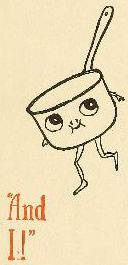
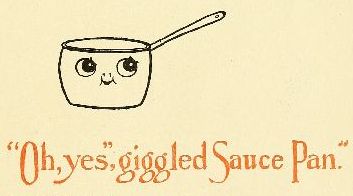
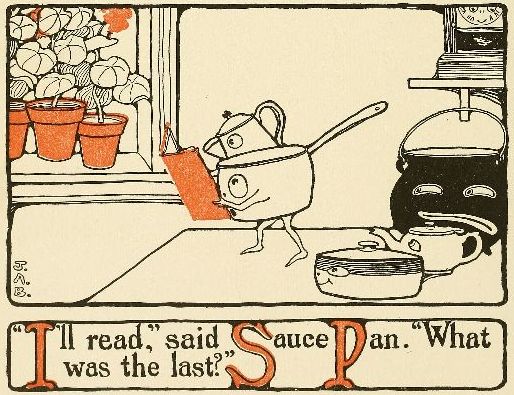
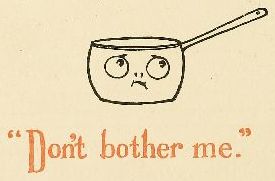
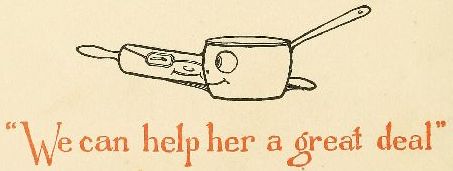
"You are!" solemnly declared Sauce
Pan,—"I mean you are our little 'Miss'—Miss Mary
Frances."
"My, I feel so relieved!" said Mary Frances.
"Since that is so, I'll tell you why I'm so excited!
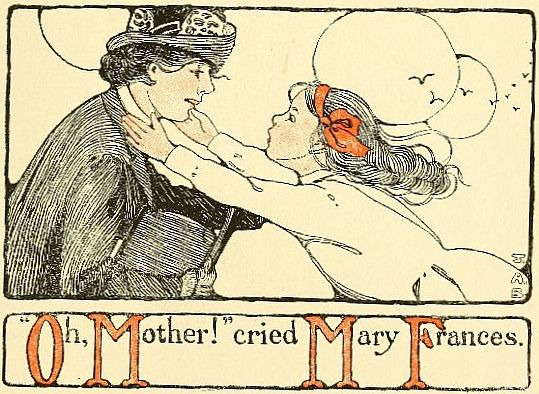
Mother is coming home to-day—and—I'm going to
get dinner. Isn't it lovely?"
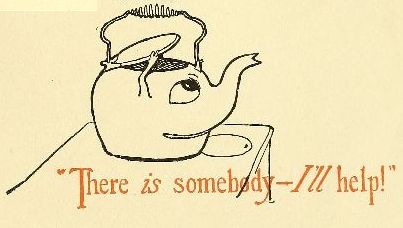
"Everybody," shouted Tea Kettle, "ready!"
With that, every utensil in the kitchen sprang to its
queer little feet.
"We're all quite ready, Mistress," said Tea Kettle,
trying to make a bow, but looking very clumsy and
ri-dic-u-lous, trying at the same time to keep water
from spilling out of his nose.
"Thank you, everybody," said Mary Frances,
very gravely, however. "I'll not need anyone just now
but Aunty Rolling Pin. Where is she?"
"She's out picking cherries to make a pumpkin
pie," said Sauce Pan in a loud whisper to Pie Plate.
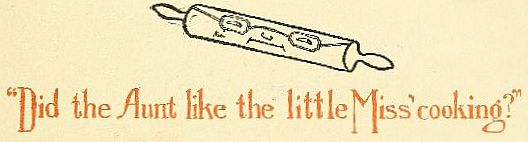
"Here I am, child," Aunty Rolling Pin's voice
answered. "I can't seem to roll out. Get out of my
way—you!"
With that, Knife, Fork and Spoon slid to the side
of the table, and she rolled to the edge.
"What is it, child?" she smiled.
"It's the grandest thing!" said Mary Frances.
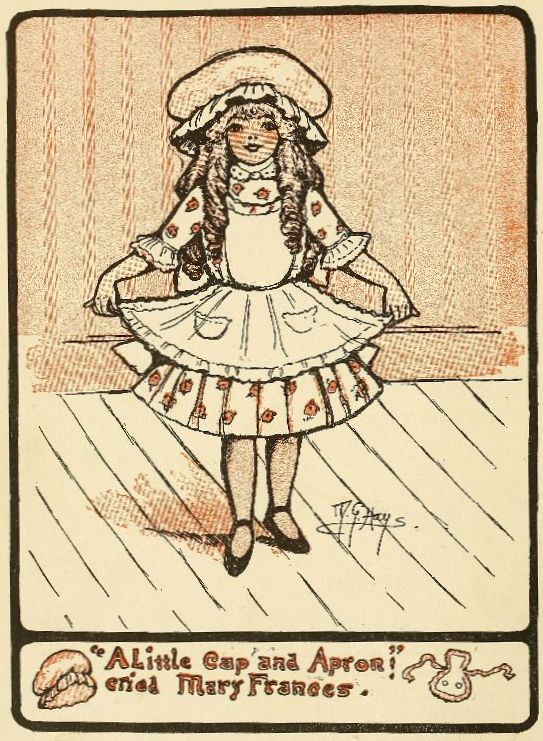
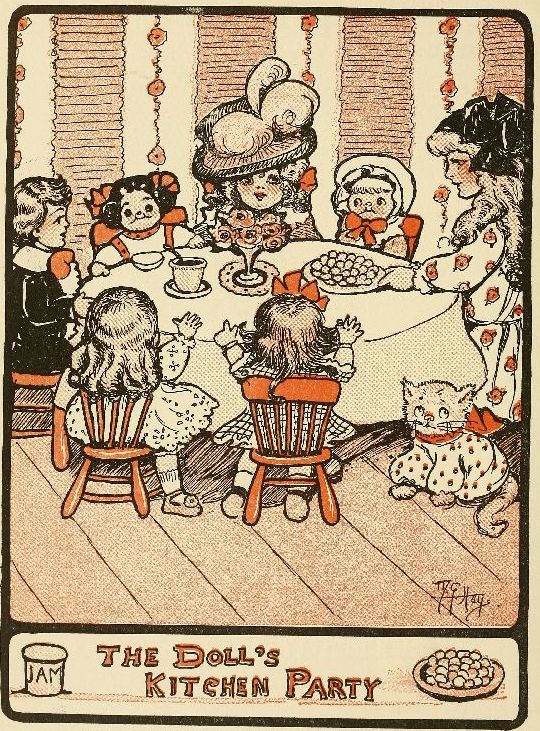
No. 33.—Queen of Hearts Tarts.
Spread cooked heart-shaped pastry shells with preserved
cherries. See No. 34.
"Tarts!" chuckled Aunty Rolling Pin. "Oh, my
handles! I'm so happy! Are the cherries ready,
child?" she asked, anxiously.
"Yes," said Mary Frances, "I am to use
No. 34.—Pastry.
| 1 cup flour |
| ¼ teaspoon salt |
| 1/3 cup lard |
| 1/3 cup cold water |
(Use as little water as possible.)
1. Sift salt and flour into a bowl.
2. Rub lard into flour with finger tips until like coarse powder.
3. Add half the cold water, stirring with a knife to form a stiff
ball. Keep this on one side of the bowl.
4. Stir in more water until the remaining flour forms a ball. Press
these balls together.
5. Roll out. Fit to pie plate. Trim off overhanging edges.
6. Bake in a hot oven.
"That's it!" exclaimed Aunty Rolling Pin, joyously.
"I was afraid there might not be 'shortening' or lard
enough in the recipe. The whole art of making good
pastry is in having one-third as much lard as flour,
and using as little water as possible.
"I was afraid, too, that your mother would not put
'pastry' in the book, for when flour or starch grains
are coated in fat they are too dry to 'swell' well in
cooking, and cannot burst open. They are not, I'm
sorry to say, a very di-ges-ti-ble food."
"I'm glad she did, though," said Mary Frances;
"she will not often let us eat 'pastry,' but I 'spect she
im-ag-ined how pleased I'd be. I wonder why pie tastes
so good, if it isn't good for us? My, how much I have
to do! Now I'm ready!"
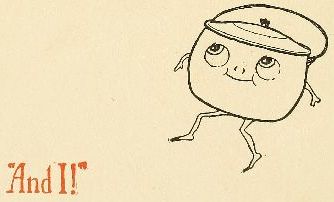
At these words, Middle-sized Bowl sprang upon
the table.
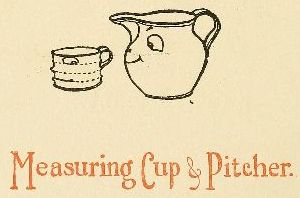
Measuring Cup dumped a cup of flour into it, and
ran toward the lard kettle, which was standing near.
"Is the salt in the flour?" asked Aunty Rolling
Pin, crit-i-cal-ly.
"Yes, ma'am," said Tea Spoon, "I put it in."
"Who'll measure the lard?" asked Mary Frances.
"I will!" and Measuring Cup threw it into Bowl.
"Well," laughed Mary Frances, "and what do
I do?"
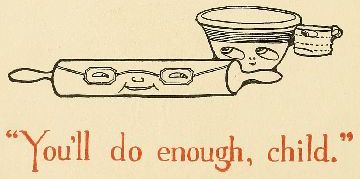
"You'll do enough, child," said Aunty Rolling Pin,
"before you get ready a whole big dinner, even with
our help."
"Well, really," said Mary Frances, "I 'spose I ought
to explain: These tarts are more 'specially for Billy
than for dinner. I promised him——"
"Oh, that's all right," said Aunty Rolling Pin;
"that only makes it nicer than ever!"
"Now," she went on, "rub the flour and lard
together. Cover the lard with the flour. Yes, that's
it! Now, rub them together until it seems like coarse
powder. You could use a knife instead, chopping the
lard all through."
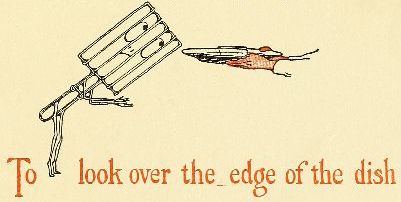
"That right?" asked Mary Frances, holding some
down for Aunty Rolling Pin to look at, since she
couldn't see over the edge of Bowl.
"Yes, that is right," she answered. "Now, you
may use a knife for stirring and pour just a little water
in—oh, mercy! child! (as Mary Frances was about
to throw in a quarter of a glass) not that way! Make
a little 'well' in the flour. Pour in about one tablespoon
of water. Mix well. Let that rest at one side
and do the same thing in another place, and then
another, finally stirring all together into one big ball.
"That's just right!" as Mary Frances lifted up the
paste.
"Now, sift a little flour on the board and—oh, how
many tarts are you going to make?"
"Six."
"All right. Cut the paste into five even pieces, and
with me (Mary Frances laughed, Aunty Rolling Pin
seemed so pleased) roll out each piece about one-eighth
of an inch thick. After cutting out, save all the left-over
trimmings to use for the last one. Plates ready?"
"All ready!" answered the little heart-shaped
Tart Plates.
"How do I make a pretty border?" asked Mary
Frances, cutting the trimmings from the edge of
Tart Plate with a knife held upright along the edge.
Fork came dancing from the edge of the table.
"Oh, I remember!" said Mary Frances, pressing
the prongs into the outer edge of the crust.
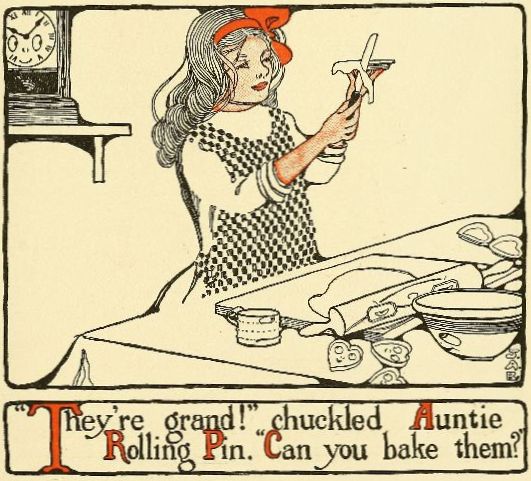
"They're grand!" chuckled Aunty Rolling Pin.
"Can you bake them? You need a very hot oven to
bake them."
"But the cherries!" said Mary Frances, glad to
think she had caught Aunty Rolling Pin in an oversight.
"Not until the pastry's cooked, child," said Aunty
Rolling Pin, with a smile.
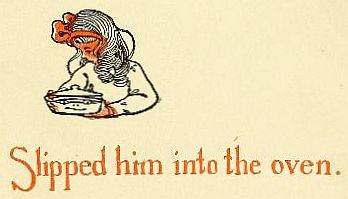
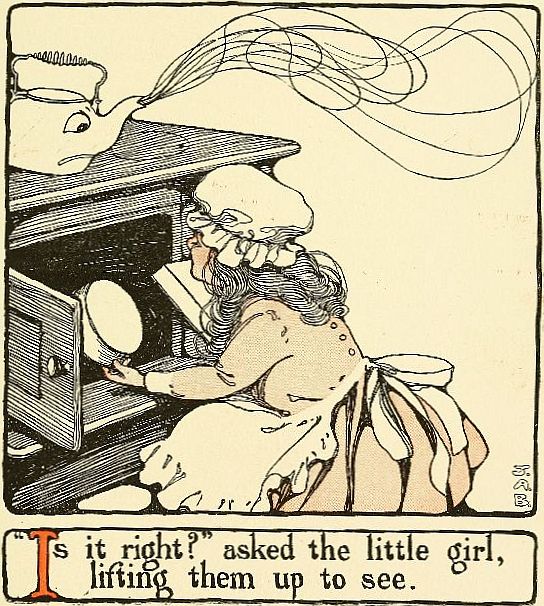
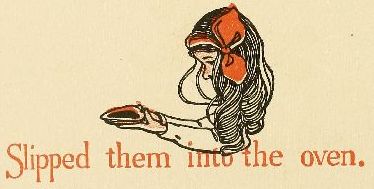
Mary Frances slipped the little plates into the oven,
and made room on the table to place the dinner as she
prepared it.
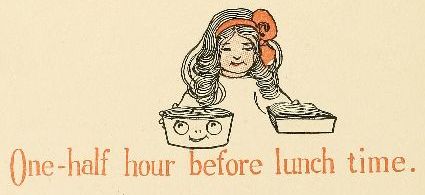
In a short fifteen minutes the tarts were ready.
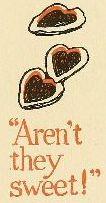
"Aren't they sweet!" the little girl exclaimed.
"My! I wish they were thought to be very good for
children!"
"What's for dinner?" asked Tea Kettle, anxiously.
"I'll tell you," said Mary Frances, "I've written
out the
Menu
Potato Soup
Pan-broiled Steak
Creamed Cabbage Mashed Potatoes
Tomato and Lettuce Salad
Banana Bread Pudding with Hard Sauce
Coffee
"Very elegant!—but that's a lot to do, isn't it?"
said Tea Kettle. "Perhaps, if you read over all the
new recipes, and we talk them over when its each one's
turn to commence, we can work better."
"Oh, thank you, Tea Kettle," said Mary Frances,
"that is a very bright idea." Tea Kettle glistened.
"I'll read them," continued Mary Frances, "as
they come in the book."
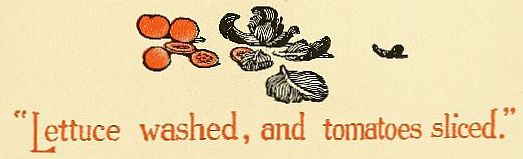
"I have the lettuce well washed, and the tomatoes
sliced. All I have to do is to dry the lettuce at dinner
time, and soon I can make the
No. 35.—Salad Dressing.
| 1 teaspoon salt |
| ¾ teaspoon mustard |
| 1½ tablespoons sugar |
| 2 teaspoons flour |
| ¾ cup sour cream (or milk) |
| 1 egg |
| 1 tablespoon vinegar |
| 1 teaspoon butter |
| A few grains of red pepper. |
1. Beat egg.
2. Mix mustard, sugar, flour, salt and pepper.
3. Add egg slowly, beating well at the same time.
4. Add milk. Beat.
5. Cook in a sauce pan placed in boiling water.
6. Stir until it thickens like cream. Remove from heat at once.
7. Add vinegar very slowly, beating all the while.
8. Stir in the butter.
Serve cold on lettuce or sliced tomatoes.
"If this is cooked too long, it will 'curdle' or the
be egg will become hard and separate," said Sauce Pan;
"but I'll be careful. Now I'm ready for work."
Mary Frances laughed. "Thank you, Sauce Pan,"
she said, as he began to move around, going hither
and thither.
"The next recipes are
No. 36.—Creamed New Cabbage.
1. Cut in half and wash well a young green cabbage.
2. Cut out and throw away the hard stem part.
3. Make ready a kettle of boiling water. Put in cabbage. Leave
uncovered.
4. When the water boils, throw in 1 teaspoon salt and ¼ teaspoon
baking soda (or bicarbonate of soda).
5. Boil gently about half hour, or until it begins to lose its bright
green color. Lift out with skimmer.
6. Pour over it White Sauce just before serving.
No. 37.—Bread Pudding.
1. Cut slices of stale bread into squares of about one half inch.
2. For 2 cups bread, allow
| 1 pint milk (2 cups) |
| 2 tablespoons sugar |
| 2 eggs |
| ¼ teaspoon vanilla |
3. Moisten bread with hot water.
4. Butter pudding dish.
5. Put into it the moistened bread.
6. Beat yolks of eggs; add sugar; add milk.
7. Pour this over the bread.
8. Beat whites of eggs. Add 2 tablespoons powdered sugar.
Beat well.
9. Spread this over top of pudding.
10. Bake in moderate oven one half hour.
11. Serve with Hard Sauce or cream.
No. 38.—Banana Bread Pudding.
Slice bananas over top of Bread Pudding before spreading on
whites of eggs (No. 37).
Serve with cream or Hard Sauce.
No. 39.—Hard Sauce.
| 4 tablespoons soft butter |
| ¾ cup powdered sugar |
| ½ teaspoon vanilla |
| beaten white of 1 egg |
1. Make bowl and spoon hot with boiling water.
2. "Cream" or rub butter and sugar together, adding sugar by
spoonfuls.
3. Add vanilla.
4. Beat in the white of egg.
5. Put in a cool place until needed.
"Yes," said Baking Dish, "that is very nice; but
if you use the yolk of the egg in the pudding, it will save
it, and make the pudding better."
"To save a yolk, all you have to do (it was little
Egg Beater) is to drop it into a cup and pour a little
cold water over the top, to prevent its drying. You
can use it next day, if you keep it cool."
"It is wonderful," said Mary Frances, "what you
Kitchen People know. If it weren't for your help, I'd
be afraid to try to get this dinner. I'd have to make
only one thing a day, as Mother meant me to do."
All the Kitchen People smiled happily.
"Is that the last recipe?" asked Frying Pan.
"No," said Mary Frances. "Why, who are you?"
"I'm Frying Pan, of the great Pan family, if you
please, Miss," answered he.
"Well! Well! Good friend," smiled Mary Frances,
looking at her book, "your turn has come!"
No. 40.—Pan-broiled Beefsteak.
1. Heat an empty frying pan to blue heat, or until it smokes.
No greasing is necessary.
2. Put in the steak.
3. Cook half minute.
4. Turn on other side.
5. Cook about 4 minutes.
6. Turn, and cook about 5 minutes longer.
7. Place on a hot platter, and spread with butter.
8. Sprinkle with a little pepper and salt, and 1 tablespoon finely
chopped parsley.
9. Squeeze over it a little lemon juice.
10. Cover with another platter.
11. Remove top platter just before serving.
Note.—Mutton or Lamb Chops are pan-broiled in the same way.
"That's it!" cried Frying Pan, delighted. "That's
as good as broiling, though it took people a long time
to find it out."
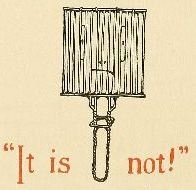
"It is not!" cried Gridiron Broiler angrily clicking
his wires. "It is not, Spider!"
"For shame!" said Mary Frances. "Don't call
names!"
"He isn't calling names," answered Frying Pan,
"that's my other name, Frying Pan Spider."
Then to Gridiron he added, "Come, don't let's
quarrel, you'll admit pan-broiling is very nearly as
good for chops as broiling over the coals in a broiler,
and quite as good for steaks—nearly."
"I was just getting ready to say," said Gridiron,
"you didn't mean 'quite.'"
"It's time to commence!" loudly struck in Mantel
Clock.
And then Mary Frances looked on in amazement.
In walked Basket with the potatoes for the potato
soup; up sprang Knife ready to pare them; over ran
Boiler Pan with some water.
"Why! Why!" exclaimed Mary Frances. "Why!"
"Yes!" said Tea Kettle, "we'll do everything in
the recipes you've already made. All you need to do
is to make the new recipes—with our help," which
Mary Frances did.
Whenever she'd make a mistake, some one of the
Kitchen People would correct and help her.
At six o'clock all the dinner was ready to serve,
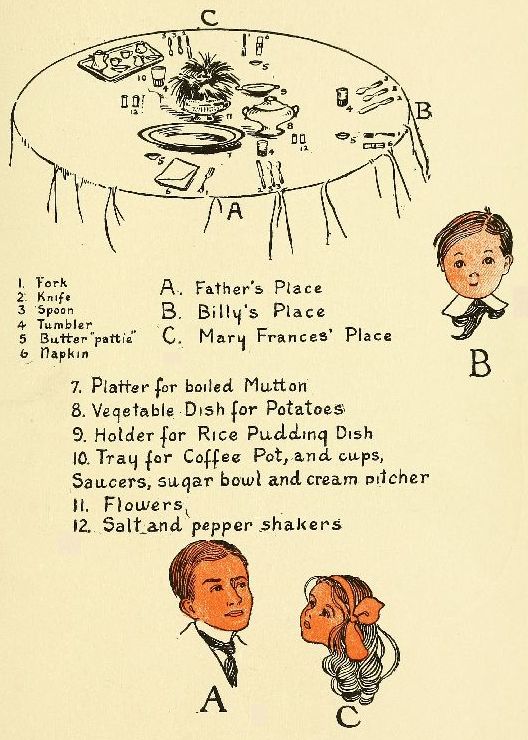
and the table was set.
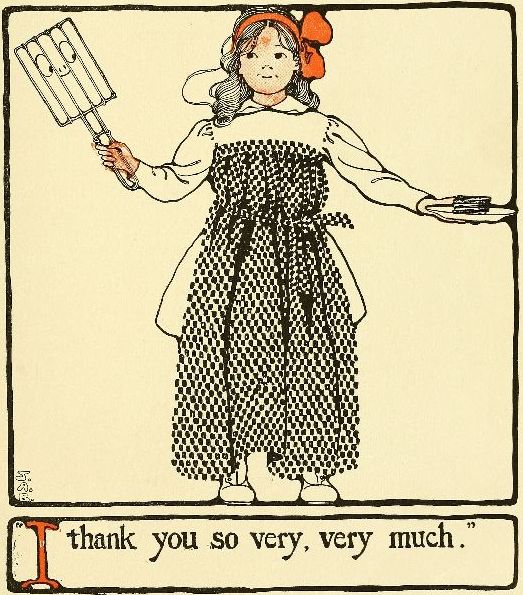
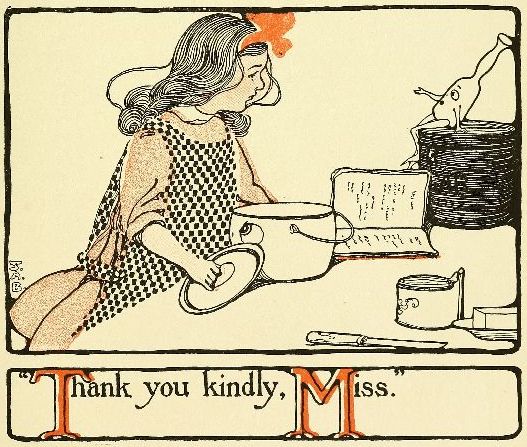
"Oh, thank you, dear Kitchen People," said the
beaming little girl; "this is the happiest time of my
life."