The Marvellous Adventures and Rare Conceits of Master Owlglass
Whole book · 123 sections
THE MARVELLOUS ADVENTURES AND RARE CONCEITS OF Master Tyll Owlglass. Newly collected, chronicled and set forth, in our English tongue ,
Transcriber's Note:
The cover image was created by the transcriber and is placed in the public domain.
THE
MARVELLOUS ADVENTURES
AND RARE CONCEITS OF
MASTER OWLGLASS.
By KENNETH R. H. MACKENZIE,
FELLOW OF THE SOCIETY OF ANTIQUARIES.
And Adorned with many most Diverting and Cunning Devices,
By ALFRED CROWQUILL.
LONDON:
TRÜBNER & CO. 60, PATERNOSTER ROW.
1860.
LONDON:
PRINTED BY WERTHEIMER AND CO.
CIRCUS PLACE, FINSBURY CIRCUS.
AM GANZEN RHEINE AUF UND AB
DER MENSCHEN GEDÄCHTNISS IST SEIN GRAB.
WHERE’ER THE WAVE OF RHINE DOTH LAVE.
MAN’S MEMORY IS STILL HIS GRAVE.
Fischart, p. 179.
PREFACE.
ix
“Wit, an’t be thy will, put me into good fooling! Those
wits that think they have thee do very oft prove fools; and I
that am sure I lack thee, may pass for a wise man: For what
says Quinapalus? Better a witty fool than a foolish wit.”
Clown in “Twelfth Night,” Act I., Scene 5.
Among the folkbooks of the German nation, not
one has obtained so general a circulation as that
now presented in an English form. It has been deemed
worthy, as by the Appendix may be perceived, of being
translated into French, Dutch, Danish, Polish, nay, even
Hebrew, and honoured by being reprinted on every
kind of paper, good and bad. A favourite among
the young for its amusing and quaint adventures, and a
study among those who strive, by the diligent comparison
of different eras of national literature, to arrive at a
due appreciation of national character, Eulenspiegel, or
Owlglass the boor (peasant), possesses a peculiar value
for the old. I well remember how, as a very little child,
I first made the friendship of the lithe though clumsy
hero; and to the present time do not feel that I can
say I have lost my interest in the humourous quips and
quiddities of the strolling vagabond. I little thought,
when I then read the German book, that it would be
my privilege to introduce him to other readers in my
own language.
The Gil Blas of German mediæval story, there is
deep instruction in the pungent jests and literal ways
xof the man who held up his mirror for owls to look
in, and each of whose tricks might form the groundwork
of a moral reflection. And for the early times
in which it appeared, there was not a little courage
in the author of it. Strange to say, this person appears
to have been a Franciscan friar, Thomas Murner, who,
in other matters, made not a little stir in his own day.
He visited this country, and wrote a book in defence of
our good King Hal the Bluff against that famous monk,
Luther; and he received some assistance in a substantial
gift from that monarch. An account of him will
be found in the Appendix; we have here only to deal
with the significance of the book itself.
Like the deep searching work of Rabelais, the book
is a satire, not upon human life only, but upon special
and dangerous topics. Very early editions contain the
story of how Eulenspiegel procured an old skull from a
churchyard, and turned the passion for worshipping
relics to profitable account;[1] and the priests and would-be
learned men of his time continually appear in
ludicrous, undignified, or humiliating positions. Rank
was not respected, nor was vice in high places passed by
with (so-called) discreet silence. Yet with all the graver
objects in the book, the immediate aim of amusement
was never forgotten; and, letting us into the secrets of
peasant life in Germany at an era when peasants had
little to rejoice over, we almost imagine that we can
hear the shouts of laughter with which the blunt outspoken
jokes of this sly clown were received. But
Mr. Hallam does justice to a higher appreciation of
this kind of literature among the better classes of the
time.
“They had a literary public, as we may call it,”
xisays this distinguished writer,[2] “not merely in their
courts and universities, but in their respectable middle
class, the burghers of the free cities, and perhaps in the
artizans whom they employed. Their reading was almost
always with a serious end: but no people so successfully
cultivated the art of moral and satirical fable.
These in many instances spread with great favour
through Cisalpine Europe. Among the works of this
kind, in the fifteenth century, two deserve mention; the
Eulenspiegel, popular afterwards in England by the
name of Howleglass, and a superior and better known
production,[3] the Narrenschiff, or Ship of Fools, by
Sebastian Brandt of Strasburg.... It is a metrical satire
on the follies of every class, and may possibly have
suggested to Erasmus his Encomium Moriæ. But the
idea was not absolutely new; the theatrical company
established at Paris under the name of Enfans de Sans
Souci, as well as the ancient office of jester or fool in
our courts and castles, implied the same principle of
satirising mankind with ridicule so general, that every
man should feel more pleasure from the humiliation of
his neighbours than pain from his own.... The influence
such books of simple fiction and plain moral
would possess over a people, may be judged by the
delight they once gave to children, before we had learnt
to vitiate the healthy appetite of ignorance by premature
refinements and stimulating variety.”[4]
xiiYet with all the repute which the book must have had
among the boors and country louts of what people
choose, with doubtful taste or insight, to call the “dark
ages,” Owlglass, if it had not contained within itself
great vitality, might have lain in the obscurity which
surrounds many a contemporary work. Of the three
great philosophers then extant, I have somewhere read
a kind of parallel, that Rabelais in his work satirised
fantastically, and with peculiar reference to the more
educated and scholarly readers of his time. Erasmus,
on the other part, struck at the monks with vigorous
hand in other fashion; while both Brandt and Murner
took a more popular form in their compositions: yet,
while Brandt is now scarce remembered, Eulenspiegel
remains, a striking and applicable book, setting forth,
indeed, in a good light, the truth everywhere, that “the
letter killeth but the spirit giveth life.” In this may
be found the reason of its wonderful popularity in Germany—in
this is the secret of its constant reproduction in
so many languages.
The fool in idle hour claims our attentive ear, charms,
instructs, enchains the mind, when the sonorous voice
and weighty arguments of the preacher would have no
greater effect than the production of a yawn, or, at most,
a fugitive repentance. The fact of the subjection of
the letter to the spirit must be borne in mind throughout.
Mighty times were those when, by sturdy hands
and wise pates, the world was ridding itself of the rule
of monks and literal interpreters of the universe and
of the duties of society. Yet Murner, as has been
mentioned, fought against Luther; nor, indeed, could
Rabelais or Erasmus perceive, save somewhat dimly,
whither their words tended. Perhaps, in secret, they
saw, in fitful glimpses, the truth that history proceeds
according to progressive laws of development; and
xiiiwhen the monks, who at one time had done good service,
were no longer useful to mankind, they decayed
from inherent fitlessness, and so vanished, overcome
by the light of such lamps as these.
A remarkable feature in the adventures of Owlglass
must not be passed over without notice, viz., the very
few allusions anywhere made to the occult sciences, or
to similar subjects. In the story of the invisible picture
there is one slight reference to alchymy; and in that
where he is led forth to the gallows, the multitude regard
Owlglass as a magician, who will rescue himself
by the aid of demons. But so real is the character
everywhere, that not even by the many editors has any
tale been introduced connecting the hero with such
matters. Yet the absence of such a colouring displays
a greater skill and a deeper purpose in the author;
from the tendency of the age in which it was written,
any mention of occult science would have been excusable,
nay, almost natural. If we remember that the era
of its publication was rife with magicians, astrologers,
and alchymists; that Cornelius Agrippa very shortly
afterwards found it necessary to protest against the abuse
of such subjects in his treatise “Of the Uncertainty and
Vanity of the Sciences and Arts,” that Trithemius was
then Abbot of the Benedictine Monastery of Spanheim:
all these considerations would have caused no surprise
at the introduction of scenes of enchantment, or, at
least, an employment of them allusively or by implication.
But no; true to its mission of a folk-book, filled
with the manners and customs of its time, Owlglass
is thoroughly worldly, and for us, therefore, possesses
greater interest and value.
It may be interesting for a moment to set side by
side the jester exhibited in the pages of Shakspere and
the good Master Owlglass. Historical Owlglass there
xivcertainly was at some time of the fourteenth century,
his tomb yet standing at Möllen, as will be seen; but the
pranks of many excellent jesters were all centred in the
book telling of Owlglass; so that he has been overlaid
with jokes, not in his own power to perform. Indeed,
in the present edition, from a respect I have for chronology,
I have been obliged to extrude two or three which
would have involved anachronisms. However, they were
somewhat dull, and therefore need not be regretted.
The first English version of Owlglass (as to which see
the Appendix, p. 220) having been published early in the
sixteenth century, in a “little dumpy quarto,” by Master
William Copland, its fame might, without much difficulty,
have infiltrated the country parts of England; and, if
we regard the clowns of Shakspere, Touchstone, in “As
You Like It,” for example, it might appear that Shakspere
had seen this Black Letter of William Copland:
yet, while the humour of Owlglass consists in his stolid
performance of the exact words commanded him, there
is clearly a quite other appreciation of wit in the English
writer. It is, in fact, the polished foil beside the homely
cudgel—both effective weapons, but one of them far
more glittering, swift, and murderous. The cudgel may
be warded off by a less skilful hand, the glancing steel
hath made a wound, and been withdrawn in the very
flash of its own rapidity. Dogberry and Verges, Costard
perhaps, nay, even Sir Toby Belch, have points of character
more resembling Owlglass than do the clowns of
our great poet. The Fool in King Lear, has some kin
to him, but is infinitely wiser. Indeed, we might perhaps
rather class Bardolph, Pistol, and Nym, humourists in
their way, with Master Owlglass than the subtle wits
Shakspere brings upon the stage. Yet has Owlglass an
existence beyond and outside all question of contrast, all
opinion of similarity. Gervinus, in his comprehensive
xvHistory of German Fiction[5] has well defined Owlglass
to be “the personified quip and crank” (der personificirte
Schwank). In fact, he is a Gothic Diogenes set in a
Teutonic frame, living, moving, and having his being in
an atmosphere as peculiarly distinct in its grotesque and
massive proportions, as was the earlier Hellenic age, in
its union of elegance and power. No previous time could
have produced such an out-birth, and, with all our modern
tendencies towards humour, fostered by the constant
study of our quainter dramatists, another Owlglass would
be a distortion, if not an impossibility.
That, even in grave England, and with quaint Ben
Jonson, Master Owlglass was a favourite, we may see
from two allusions which he makes to him; one in the
“Poetaster,” Act the Third, Scene the Fourth, where
Tucca exclaims: “What, do you laugh, Owlglass?”
And again in the “Masque of the Fortunate Isles,” produced
in 1626, Ben Jonson introduces Howleglass;
and Johphiel says to Merefool:—
A most unjustifiable libel, by the way, is committed
here, for Owlglass was always a “proper” gentleman,
having no crook-back or ape-like appearance.[7]
One of the most thoughtful and philosophic writers of
our day, Mr. Carlyle, has a few noteworthy sentences
regarding this strange book, which we shall do well to
transfer to these pages:—
“Lastly, in a third class, we find in full play that
spirit of broad drollery, of rough saturnine humour,
which the Germans claim as a special characteristic;
among these, we must not omit to mention the
Schiltbürger correspondent to our own Wise Men of
Gotham; still less the far-famed Tyll Eulenspiegel (Tyll
Owlglass), whose rogueries and waggeries belong in the
fullest sense to this era.
“This last is a true German work; for both the man,
Tyll Eulenspiegel, and the book which is his history,
were produced there. Nevertheless, Tyll’s fame has
gone abroad into all lands; thus, the narrative of his
exploits has been published in innumerable editions,
even with all manner of learned glosses, and translated
into Latin, English, French, Dutch, Polish; nay, in
several languages, as in his own, an Eulenspiegelerei and
Espiéglerie, or dog’s trick, so named after him, still by
consent of lexicographers, keeps his memory alive. We
xviimay say, that to few mortals has it been granted to earn
such a place in universal history as Tyll; for now, after
five centuries, when Wallace’s birth-place is unknown
even to the Scots; and the admirable Crichton still
more rapidly is grown a shadow; and Edward Longshanks
sleeps unregarded save by a few antiquarian
English, Tyll’s native village is pointed out with pride
to the traveller, and his tombstone, with a sculptured
pun on his name,—namely, an Owl and a Glass,—still
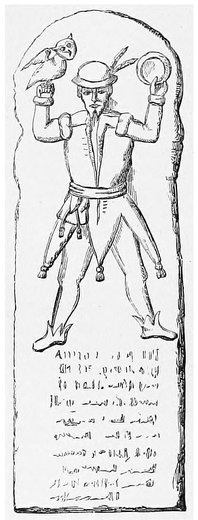
stands, or pretends to stand, at Möllen, near Lübeck,
where, since 1350, his once nimble bones have been at
rest. Tyll, in the calling he had chosen, naturally led a
wandering life, as place after place became too hot for
him; by which means he saw into many things with his
own eyes; having been not only over all Westphalia and
Saxony, but even in Poland, and as far as Rome. That
in his old days, like other great men, he became an
autobiographer, and in trustful winter evenings, not on
paper, but on air, and to the laughter-lovers of Möllen,
composed this work himself, is purely a hypothesis;
certain only that it came forth originally in the dialect
of this region, namely, the Platt-Deutsch; and was
therefrom translated, probably about a century afterwards,
into its present High German, as Lessing conjectures,
by one Thomas Murner, who, on other grounds, is
not unknown to antiquaries. For the rest, write it who
might, the book is here, ‘abounding,’ as a wise critic
remarks, ‘in inventive humour, in rough merriment, and
broad drollery, not without a keen rugged shrewdness
of insight; which properties must have made it irresistibly
captivating to the popular sense; and with all
its fantastic extravagancies, and roguish crotchets, in
many points instructive.’”[8]
xviiiMr. Carlyle then cites one adventure, that of the
Easter Play, which has not been included in the present
version; for although it illustrates well enough the interior
of a parson’s household of the fourteenth century,
there is a smack of profanity about it which it is well
to avoid. And, indeed, it is due to the reader of this
volume, to inform him, that our present chronicle differs
in one material point from all former editions. While
it has been my object everywhere to tell the story of
Owlglass in a quaint and simple manner, modern good
taste required a special duty at the chronicler’s hands:
viz., that of purification and modification, for it may
readily be believed that a book written of the fourteenth
century, for the sixteenth century, would abound with
homely wit, not quite consonant with the ideas of the
nineteenth. Therefore several stories of a somewhat
indelicate, and generally pointless, character have been
omitted, and their place supplied with matter obtained
by a collation of several editions in the German,
French, and Flemish languages.
And another aim which I have had in view has been,
where good taste and opportunity admitted, to apply, in
a veiled manner, the axioms and quips of our knight-errant
of roguery, to subjects and follies not banished
from our own more polite age. The reader will thus
be able to judge in how far this modern Owlglass differs
from its predecessors. In no instance, however, have I
permitted myself to lose sight of the object in view, which
was to give as good a picture of the original as might be,
and that in spirit rather than in letter. This spirit has
been so justly estimated by M. Robin, a clever and dashing
French critic, whose sad death may still be remembered
by a few, that, at the risk of adding too much to
this preface, I subjoin an epitome of his remarks:—
“It is quite true,” says he, “that glory is nothing but
xixvanity. I have seen in the sepulchral silence of libraries,
names quite unknown, on the backs of gigantic volumes,
the librarians could tell me nothing of these, except that
they were the authors of these books. I have seen, on
the pavement of ancient churches, pompous epitaphs,
and heraldic arms, and the nails of the peasant’s shoe
tread them under foot. Be then in life a man of learning,
knowing every language, be a noble of Spain, a
Knight of the Golden Fleece, Viceroy of Mexico or
Peru, say you have the right of keeping your hat on in
the presence of the King, yet it will scarcely be known
that you have lived, while a vaurien, a man who had
neither hearth nor home, a practical joker, a drunkard,
having the devil in his purse, living from hand to mouth,
sleeping to-day in the streets, and to-morrow in the bed
of his host, whom he never pays, and understanding too
well the buffoonery of life ever to have thought of glory;
as soon as this man is dead, and ignobly buried, he
enters at once into immortality, bequeathing to the
people a name which they will never forget, and, to the
Attic language of the moderns, a word of which they
stood much in need. Who can boast of having invented
a word? Very few of the greatest writers can arrogate
to themselves this most rare glory. But to leave one’s
name to the most grave and self-sufficient language in
Europe, to force it to say espiègle, because one’s name was
Ulenspiegel; and to pass fifty years in practical joking
and laughter; to be able to call oneself the father of the
great family of Mystificators, surely this is no common
fate, and doubtless the contemplator of it will cry out:
‘Where doth Immortality dwell? Poor author, it was
well worth thy pains to wear out thy brain in writing
folios! Unfortunate hidalgo, it was well worth the trouble
of being puffed up with pride at a long name unpronounceable
xxin a breath, that this name should be forgotten,
and that the name of a boorish jester should be
transmitted almost intact to the most distant posterity.”
The best test of the worth of a book, whether it be
several centuries old, or, as it were, a production of our
own day, is the proportion of times that it has been
reproduced or imitated. Singularly enough, while, in
most continental languages, such translations and imitations
have been frequent, in two instances only has this
celebrated folk-book appeared in an English dress;
first, as has been already stated, in Black Letter, in 1528–1530,
and again in a modified form in 1720. With a
description of these two editions I will not trouble the
reader here, as in the Appendix at the end an accurate
account of them will be found; and I will merely add,
in this place, that of the Black Letter translation only
two copies are known to exist, both in the British Museum;
and that of the second, a copy of which is now
in my own possession, I have only been able to find
one other, which is in the Douce Collection in the
Bodleian.
It was originally in contemplation to reprint the scarce
Black Letter edition; but, on a careful examination, I
found this an impossibility, as the contents, for reasons
already hinted at, would have shocked good taste; nor,
in point of fact, would that edition have offered so
great a variety as in this volume has been presented;
which may be understood when it is explained, that of
all kinds of stories, good and bad, the Black Letter
gives but forty-eight; while in the present chronicle
there are—such questionable adventures being omitted—no
less than one hundred and eleven. Although
the idea of such reprint was thus abandoned, there
appeared no reason, however, why the old-fashioned
xxiform should not be adopted in the telling of the tale.
For this and any other faults which the reader may
detect I hold myself responsible; and I may mention,
that so careful have I been to imitate the style of the
time in which it is supposed to be written, that I have
even followed the confusion between the use of the
“thee” and “thou” and “you” and “ye” common in
early books, especially at the transition era of the
Stuarts.
The edition which I have adopted as a guide or clue-line,
is the Low German original of 1519 in the excellent
and exhaustive work of Dr. Lappenberg; and I
need not here especially refer to any other, save that of
M. Octave Delepierre, long time a zealous antiquary,
who argues for a Flemish origin for our hero, an origin
in which, giving every meed of praise to that gentleman
for the singular ingenuity and complete localization
which his book exhibits, I need scarcely say that I cannot
coincide. Nay, it may even be suspected that he
himself is but in jest with his argument.
I have also to draw the notice of the reader to the
Appendices at the end of this volume, which enter into
the bibliographical and other history of the book, and
to mention that I am greatly indebted to the Rev.
Dr. Bandinel, the venerable Librarian of the Bodleian
Library at Oxford, and also to my friends, the Rev. Alfred
Hackman, M.A., Precentor of Christ Church, and the
Rev. John S. Sidebotham, M.A., Chaplain of New College,
and Preacher at St. Martin’s, Carfax, Oxford, for
much valuable assistance in searching for Eulenspiegel
literature amidst the treasures contained in that valuable
library.
This is all, I think, which need here be said touching
the task I have here completed; for the reader need not
xxiibe asked to appreciate the artistic skill of my friend
and coadjutor, Mr. Alfred Crowquill. If the reader
does but experience in the perusal of this singular book—practically
the first English edition of it—one tithe
of the pleasure I have had in preparing it, all that was
to be accomplished will have been duly fulfilled.
2. Introduction to the Literature of Europe, vol. i. p. 235 (Library
ed.); vol. i. p. 240 (Cabinet ed.).
3. Matter of doubt to the present writer whether it be thus superior;
in any case, it would be scarcely so interesting to people now-a-days.
But see the Appendix.
4. Bouterwek, in his “History of German Poetry and Eloquence”
(Geschichte der deutschen Poesie und Beredsamkeit), vol. ix. p. 336,
confirms the observations of Hallam, and lends additional testimony
to the popularity of the Eulenspiegel. Adolf Rosen von Kreutzheim,
in the Preface to his poem, the Esel-König (Ass-King), alludes
to the general dispersion of Eulenspiegel, Marcolphus, Katziporo, and
other works, and abuses them in set terms as shameful, mischievous,
and dangerous.
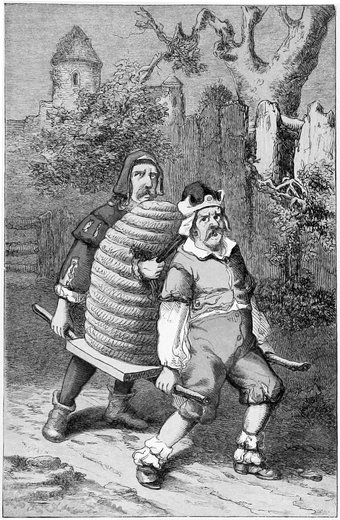
xxivXI.—How Owlglass crept into a bee-hive; how two thieves came by night to steal honey; what honey they did steal; and how Owlglass made it come to pass, that the thieves did fight one with the other, and did leave the bee-hive standing
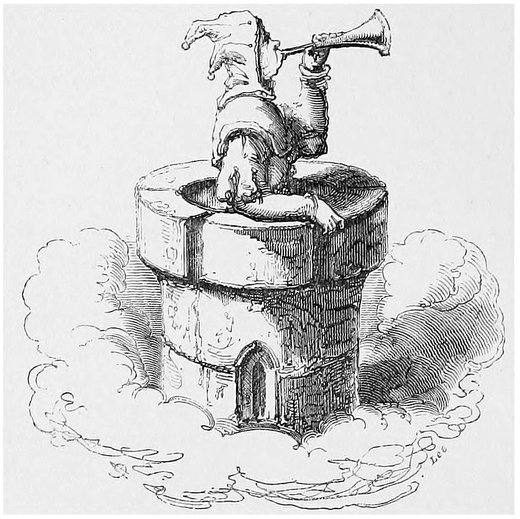
XXII.—How that Owlglass did hire him to the Count of Anhalt to blow the horn on a tower; and when that enemies did approach, then blew he not, and when that they came not, then blew he
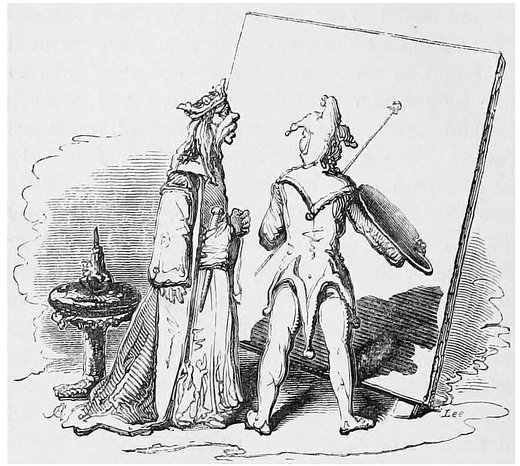
XXVIII.—How that Owlglass painted the forbears of the Landgrave of Hessen, and told him that an if he were ignobly born, he might not behold his painting
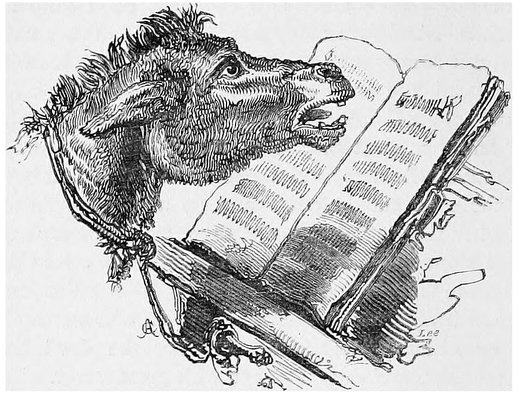
XXXI.—How that Owlglass conferred with the rector and masters of the University of Prague in Bohemia, and how he did make answer unto their questions, and therein came off most wisely
XLVIII.—How that Owlglass served a shoemaker, and how that he inquired of him what shapes he should cut; and the master answered him, and said: “Great and small, as the herdsman driveth forth to field.” Therefore cut he oxen, cows, calves, sheep and pigs
LI.—This chapter is a special chapter, telling how that a bootmaker sought to beguile Owlglass by greasing his boots, and how that Owlglass looked through the window, and brake it
LV.—How that Owlglass assembled all the tailors throughout the whole land of Saxony, by proclaiming that he would teach them a mighty useful thing, that would get bread both for them and their children
LXXIII.—How that at Greifswald good Master Owlglass came unto the Rector of the University, and proclaimed himself to be a master in all languages, save in one only, to wit, the Spanish tongue
LXXXIII.—How that Owlglass spake unto twelve blind men, and persuaded them that he had unto them given twelve shillings, and how that they spent the money and came evilly off thereafter
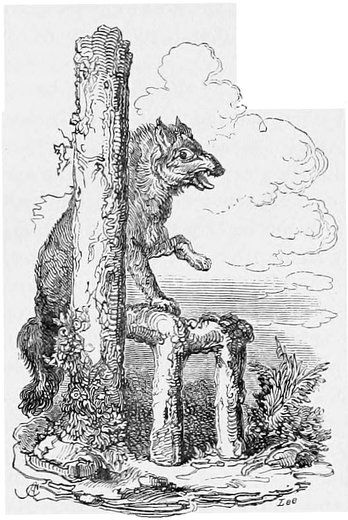
xxixLXXXVI.—How that Owlglass did cause the host of the inn at Eisleben to be beset with great terror, by showing unto him a wolf, of the which he professed no fear
CVI.—How that Owlglass in three parts did divide all that belonged unto him; and the one part gave he freely unto his friends, and another thereof humbly to the town council of Möllen, and the third part unto the priest there
CX.—How in after time our most excellent Owlglass was esteemed so worthy that he was made a holy Saint; and on the day of All Fools in April do the folk alway keep his memory, as also when they do a foolish thing, the which maketh him continually esteemed of great and small
With what joy and
inward content
do I not greet
ye, my masters,
bringing with
me for your
sweet delectation
and delightful
comfort
the history, the
which I have
most diligently
written, and out
of many learned and wise books gathered together, and
which indeed telleth of the merry jests, rare conceits,
and subtile cony-catching of that renowned Master Tyll
Owlglass, who in the Brunswick land was born. And
2i’ faith, ye do owe me not a little grace and thankfulness
for that which I have now finished,—but an if my pains
had been a thousandfold greater than they have been,
I would not have spared myself. This is mine answer
unto ye. And my desire hath been, that ye shall most
merrily sit ye round the fire and laugh until that your
sides shall ache, and your inner man be shaken with the
continual reverberation of your delighted spirit. For an
ill heart is such an one that doth never rejoice, but
trembleth ever and anon at the wonders with the which
we be encompassed, so do ye now, without any other
speech from me, accept this little book, and therein
read, and ponder well the deeds of this noble master,
who from low estate and boorish condition rose to be
the companion of princes and dukes, and, by his infinitude
of rare parts, remaineth well known and beloved of
all men in divers countries and lands all over the fair
domain of Christendom. And now do I bid ye farewell,
and leave ye with a companion less tedious than am I,
and in the reading of his life will ye not lose your
labour, that know I well.
The First Adventure. How Tyll Owlglass was born and was in one day three times christened.
As verily all creatures must have a beginning of their
lives, so that they may come into this world to abide
therein, so also must it be with the famous Master
Owlglass, who lived in Germany many years, and of
whom many notable adventures are told and noised
about all over that country. In the land of Brunswick,
in the deep wood named Melme, lieth a village named
Kneitlingen, and there was born the pious child Owlglass.
3And the name of his father was Nicolaus,
commonly said Claus, Owlglass, and his mother’s name
was Anna Wertbeck. It fortuned, that when the child
was born that they made a great feast, and sent the
child to be christened in the village of Amptlen; hard
by the castle of Amptlen, which was after destroyed by
the people of Magdeburg. And when the child was
baptised, he was called Tyll Owlglass. Truly, however,
after that the feast had come to an end, the godfathers
and godmothers of the child having eaten and drunken
right lustily (for it was the custom of that place most
heartily to do these things), set forth on their way homeward,
and the sun being hot, they were tired and they
minded not their steps to be careful of them, and so it
came to pass, that one of them carrying the child caught
her foot upon a stone and fell into a ditch, so child and
all were quickly covered with mud. But as weeds
cannot so easily come to harm, the child was not hurt,
but only thus christened in the mire.
When they got home, the child was washed clean in
hot water. Thus was Owlglass in one day three times
christened, first in the church, then in the mud of the
ditch, and at last in warm water. So is it always shown
with great and famous persons, that, in their infancy,
strange and most wonderful things do foreshow their
future greatness.
The Second Adventure. How that Owlglass when that he was a child did give a marvellous answer to a man that asked the way.
4
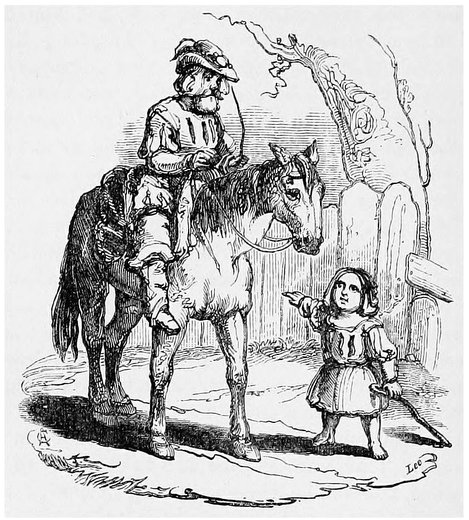
Upon a time went the father and mother of Owlglass
forth, and left Owlglass within the house. Then
came a man riding by, and he rode his horse half into
the house in the doorway, and asked: “Is there nobody
within?” Then answered the child: “Yea, there is a man
and a half, and the head of a horse.” Then asked the
man: “Where is thy father?” and the child made answer
and said: “My father is of ill making worse; and my
mother is gone for scathe or shame.” And the man said
to the child: “How understandest thou that?” And then
the child said: “My father is making of ill worse, for he
plougheth the field and maketh great holes, that men
should fall therein when they ride. And my mother is
gone to borrow bread, and when she giveth it again and
giveth less it is a shame, and when she giveth it and
giveth more it is scathe.” Then said the man: “Which
is the way to ride?” And the child answered and said:
“There where the geese go.” And then rode the man his
5way to the geese, and when he came to the geese they
flew into the water; then wist he not whither to ride, but
turned again to the child and said: “The geese be flown
into the water, and thus wot I not what to do nor
whither to ride.” Then answered the child: “Ye must
ride where the geese go and not where they swim.” Then
departed the man and rode his way, and marvelled of
the answer of the child. Thus from the mouths of babes
cometh forth wisdom and ready conceit.
The Third Adventure. How all the boors did cry out shame upon Owlglass for his knavery; and how he rode upon a horse behind his father.
Now when Owlglass had come to an age to run about,
he began playing divers tricks and knavish actions
among the boys of his village; and he fought and tumbled
about upon the grass, that he looked more like a
monkey than a boy. But when it came to pass that he
was four years old, his malice waxed greater and greater,
so that his father was ever being disputed with by the
neighbours, who cried out shame upon Owlglass, as
being so great a knave; and though it happened that
his father did scold him with many words, Owlglass did
always excuse himself by knavish answers. Thereat the
father thought he would quickly learn the verity of these
sayings of the neighbours, and at a time when the
boors were all walking in the streets, he did set his son
Owlglass behind him on his horse. Then, also, he commanded
Owlglass that he should be most quiet and
silent. What, then, did the pious and good child? He
did silently play tricks and mocked the people, whereon
they did most loudly cry out upon Owlglass: “Fie upon
the little malicious knave!”
6Now as Owlglass spake never a word in all this time, his
father did not know how it came to pass that the people
did cry out so loudly; and Owlglass complained to him,
and said: “Hearest thou, father! Here sit I silently behind
thee upon thy horse and say no word, and yet the people
cry out against me for my knavery.” Then the father
sayeth but little, and taketh Owlglass and setteth him
upon the horse in front of him. Then did Owlglass
open his mouth wide, and did stretch forth his tongue,
in mockery of the people. And the people did run
forth, crying: “Out upon the little knave!” Yet did
not the father see the knavery, but said: “Alas for thee,
that thou shouldst have been born in an unhappy hour!”
So much did he love Owlglass, that he then departed
out of the land of Brunswick, and he did abide in the
land of Magdeburg, hard by the river Saale.
In a little time thereafter, so sorrowful was he, that he
gave up the ghost, and left his wife and child in great
poverty. Thus it is that great men are often persecuted
and smitten with many blows in their own land, nor do
they find good comfort therein! Owlglass, although he
knew not any handicraft, did grow up and wax older in
knavery; and when that he was sixteen years old, did
excel in tricks, quips, and quiddities.
The Fourth Adventure. How Owlglass did learn to dance upon a rope, and did fall therefrom into the river Saale.
It hath been said of old time, by the wise and cunning:
“When that the cat is out of the house, then play the
mice.” Thus fared it with Owlglass after that his father
was dead. His mother had become old and full of
years, and she could no longer have the mastery over
Owlglass, and he did learn many greatly knavish conceits.
7And his mother was sorely troubled of Owlglass,
and bore not with his knavery.
Now it fortuned, that the house where Owlglass and
his mother did live, lay hard by the river Saale, and
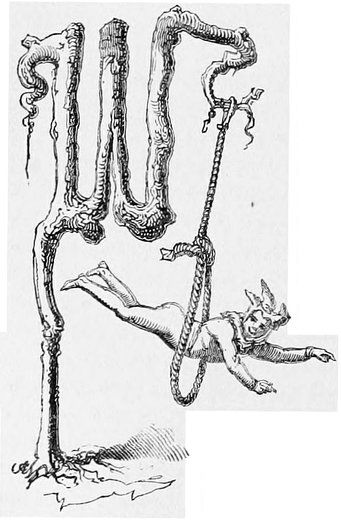
Owlglass did go up into the garret of the house, and
there did learn to dance upon a rope, until that his
mother did find him going to and fro upon the rope,
and did so belabour him with a cudgel, that he fled
through the window of the garret on to the roof, where
she could not follow him. And this often came to pass,
until he grew older, and she became weak and of no
strength to have power over him. Then thought he, it
was time that he should in open day render it manifest
unto all, how great was his perfection in the art of dancing
upon the rope, and he did stretch the rope across the
river Saale, from one house even unto a house which lay
over against them on the other side. And when that the
people beheld such unwonted sport, they did run together,
old and young, in a great crowd, and did marvel
much that Owlglass should go hither and thither in so
sure a manner upon the rope.
Happiness is, however, but for the few, and seldom
doth evil fortune fail to sow sorrowful seeds in the midst
of joyous doings; and thus fortuned it, that the mother
of Owlglass did hear the shouting of the people at the
feats of Owlglass, and that she might reprove with heavy
punishment the knavery of her son, she hastened to the
place where the rope was tied, and cut it through with a
knife secretly. Then did good Master Owlglass plump
into the water with much mockery and despite; and all
the people did laugh greatly thereat, and Owlglass was
vexed, so that he could speak no word; nor did he fear
the bath and the peril of drowning as much as the jests
of the people, who ran after him, blessing the bath with
much outcry. Thus did Master Owlglass come evilly
off in his first undertaking.
The Fifth Adventure. How Owlglass did move two hundred young people, that they did give unto him their shoes, with the which he made rare sport upon his rope.
8
In no long space of time thereafter, Owlglass did desire
to avenge him, concerning the mockery which befel
him after the bath, therefore did he tie the rope across
unto another house, and once again told the people that
he would dance to and fro upon the rope. Soon did
the people come together in great multitude, and there
were in that place both old and young; then Owlglass
spake unto the young people, and said that he would
show unto them a most rare device upon the rope with
their shoes. Then did they believe him, and with that
put their shoes off their feet and gave them unto Owlglass,
and he did put them all together upon a string
and went up on to the rope; and all the people thought
that he was going to make some wonderful stroke
therewith. But the boys were sad, and would fain have
received their shoes again.
When, therefore, Owlglass was sitting upon the rope
and had ended his trickery, he cried out with a loud
voice and spake these words: “Be ye now every one in
readiness, and let him seek his shoes again;” and he
cut the string and threw all the shoes upon the ground,
in such wise that one shoe fell upon another into a great
heap, and none could be distinguished. Then did the
people, old and young, come in great crowds, and caught
a shoe here and another there; and one spake and said
this was his shoe, whereat another did make answer that
it was his; and then fell they to fisticuffs, and with great
blows they pulled out the hairs from their heads: one
lay on the ground, and the other belaboured him with
sturdy strokes; and one wept with a loud voice while
9another did laugh, and a third screamed like a peacock.
Thus went things forward, until the old men began also
to give many stripes to the crowd.
But Owlglass, sitting upon his rope, laughed until his
stomach shook again, and cried out: “Right merry may
ye be! Seek ye your shoes again in that wise in which
I sought my way forth from the bath.” Then did he
come down from his rope, and left them in contention;
nor did he again come forth, for fear of the people, but
abode at home with his mother. Thereover did his
mother greatly rejoice, and thought that now he was a
wise and gentle person, and soon, therefore, would things
go better with them all. Yet knew she not of his
knavery, and wherefore he dared not go out. But the
wisdom of Owlglass was great; for it is better to abide
in darkness with a whole skin, than live in a palace of
light and be beaten with many stripes. Thus did, therefore,
our great example of wit and judgment.
The Sixth Adventure. How that Owlglass his mother did move him that he should learn a handicraft.
The mother of Owlglass was right glad that her son
was so still, and chid him only for that he would
learn no handicraft. Yet answered he never a word
unto all her reproofs, the which she was never tired of
bestowing upon him. At last he opened his mouth and
spake unto her, saying: “Dear mother, as it happeneth
that one beginneth action, so also is the ending thereof.”
For he knew in his wisdom, that if he had begun with
knavish doings, and should turn therefrom and live
honestly, yet in the world would no one give heed unto
him, but the rather regard him as a greater knave than
before, esteeming him to be a hypocrite as well as a
10knave. “That believe I right truly,” answered his
mother; “and thus have I seen no bread in my house
these four weeks gone by, nor have I had thereof any.”
“That toucheth not my speech,” said Owlglass. “But
with Saint Nicolaus must the poor man fast upon his
even; and if perchance he should have bread, he may
feast right merrily with Saint Martin on his day. Therefore
will we also eat.”
The Seventh Adventure. How Owlglass did deceive a baker at Strasfurt, and gat bread for his mother.
Then thought Owlglass: “God help us, how shall I
compass it that my mother may be rendered quiet?
Where shall I get me bread for her needs?” Thus went
he forth from the village where they abode, and departed
on the way towards the town of Strasfurt, and there
beheld he a baker’s shop. Then went he in unto the
baker, and asked him, saying: “Would he for a crown
send bread unto his lord?” Then named he the name
of a lord who abode in that town, and also the place
where he lay, that the baker might send with Owlglass a
boy to carry the bread and receive the money therefor.
Thereat answered the baker, that he would do everything
that he commanded, and Owlglass gave him a sack
wherein to count the loaves; but this sack had a secret
hole, not to be seen. The baker sent with him a lad to
receive the money.
Now when Owlglass had gat him a bow-shot from the
house of the baker, he privily let a wheaten loaf fall
down into the mire, and thereat set he the bag down and
said unto the baker’s lad: “Alas! the bread which is
thus made dirty I can never bring in unto my lord. Run
quickly home and get for it another loaf, and I will wait
11here till that thou dost come again.” Then hasted the
good lad to his master’s house, and did get another loaf
for him; but Owlglass secretly hid himself in a house
outside the town until that a cart came by, which did
receive him and his bag; and he returned unto the house
of his mother.
When that the lad came back unto the place where
Owlglass had let the loaf fall, he found that he was beguiled;
and he went back and told his master, who
speedily ran unto the inn where lay the worshipful lord
of whom Owlglass spake, and he asked the serving-men
of that lord for Owlglass; but they knew him not.
Then the baker perceived that he was cheated of his
bread, and so returned home. But Owlglass gave the
bread to his mother, and bade her to feast with Saint
Martin. Thus can a great man ever overcome the
besetting evils of life.
The Eighth Adventure. How Owlglass with other children, was forced to eat fat soup, and gat blows likewise.
There was in the village where Owlglass lived with
his mother, a custom that when anyone killed a pig,
the neighbour’s children came to him in his house to eat
a soup or broth, which was called the butcher-broth.
Now there lived in this village a farmer who was avaricious,
and yet he dared not to refuse the children the
soup; then thought he of a cunning way by which he
might make them sick of the soup-eating; and he cut
into it the sour crumb of the bread.
When the boys and girls came, Owlglass also was
among them, and he let them come in, and closed the
doors and poured out the soup, and the broth was more
than the children could eat; when one of them was full
12and was going away, the farmer had a rod with the which
he struck him, so that each child was forced to eat more
than it wished. The host knew well of the knavery of
Owlglass, and therefore when that he was beating another
child he always bestowed some hearty strokes upon him.
And this did he for so long, as that they had ended all
the eating, and that they felt like the dogs after grass-grazing.
Thereafter would no one go unto the stingy farmer’s
house to eat the butcher-broth.
The Ninth Adventure. How Owlglass brought it about that the stingy farmer’s poultry drew for baits.
The next day, when he that had beaten the children
went forth, Owlglass met him, and he said unto
Owlglass: “Dear Owlglass, when wilt thou come again to
eat the butcher-soup at my house?” “Yea, that will I,”
answered Owlglass, “when thy poultry draw for baits, and
four and four together fight for a little bread.” Then said
the other: “Wilt thou be so long?” But Owlglass said:
“An if I came ere the time of the fat soup hath come?”
Then he went on his way and thought over it until the
time that the man’s poultry ran about the streets; then
had Owlglass some twenty strings tied together at the
midst, and at either end of the string was a morsel of
bread hanging. These took he and threw to the poultry.
When then the fowls here and there picked up and
swallowed the bread, they could not keep hold, for at
the other end another fowl was pulling, so that they were
contending, and thus from the size of the bread they
could not get rid of it, and so stood more than thirty
fowls one over against the other and in throttling ran a
wager.
The Tenth Adventure. How Owlglass was again moved of his mother to depart to a foreign land, that he might learn a handicraft.
13
After that Owlglass had played a bitter knavery somewhere,
so that he might not dare show himself, he
sat at home with his mother; and she, with many words,
continually chid him, in that he would learn no craft to
get money thereby. And she spake unto him saying,
that he should depart into a foreign land, that he might
there profit somewhat. But his mother had just killed
a pig and so long as our good master Owlglass knew
that any of it remained he would not quit. The
mother of Owlglass thereat scolded him, until that he
agreed to set forth, and made a small bundle of clothes
and food, and, at length, went his way. Soon our wise
master felt hungry, and thereat took forth from his wallet
the provision he had, and did eat until there was none left.
Thereafter did he not tarry long on thought, but when
that it was dark, came again to the house of his mother.
Then went he up to the garret and lay among the straw,
where he slept lustily until the day had broken, then
wake he up by reason of a noise he did hear in the
neighbour’s court. And Owlglass did look forth, and
beheld a fox stealing the poultry from the roosting place.
Then could Owlglass no longer keep silent, but cried
with a loud voice: “Alas! thou cunning thief, an if I were
not in a far country from this, it would go hard with thee
but I would kill thee.” Then heard the mother of Owlglass
what he said, and came and marvelled not a little
at beholding him.
The Eleventh Adventure. How Owlglass crept into a bee-hive, how two thieves came by night to steal honey, what honey they did steal, and how Owlglass made it to come to pass, that the thieves did fight one with the other, and did leave the bee-hive standing.
14
Upon a time went Owlglass with his mother to the
dedication of the church.[9] And at the feast there he
drank so much, did our good Owlglass, that he was tired,
and he sought a place where he might lie down to sleep
in peace. Then found he a yard where stood many
bee-hives, and some were empty, and into one of these
crept he privily and thought to sleep awhile; behold he
slept from midday till midnight, and his mother thought
surely that he had departed homeward again, as she nowhere
could see him. That same night came two thieves
and they had it in mind to steal a hive of honey, and
they conferred together, in that they heard it said that
the heaviest is also the best.
HOW OWLGLASS CATCHETH THE THIEVES.
Then did they lift up one after the other to see the
which might be the most heavy, and at last came they to
the one in which lay good master Owlglass; and it was
the heaviest of all. Then spake the one to the other,
saying: “Here is the best among the bee-hives.” So
took they that one and carried it away, but wist not
what good burden they bare. Good Master Owlglass,
feeling the motion, thereupon awoke up, and heard
what they said about stealing honey; and he rejoiced in
himself to think what honey they had stolen. It was
15now so dark that ye could not see your hand before ye,
an if ye even held it up to your eyes. Then put Owlglass
his hand from out of the bee-hive, and caught hold of the
foremost thief by the hair and pulled it until he roared.
And the thief was very angry at the one who was behind,
and thought it was he who had plucked him by the hair.
Then spake the one who was behind him, saying: “Dost
thou dream, or goest thou to sleep? How could I pluck
thee by the hair? Hardly, is it possible for me to hold
the bee-hive with both my hands.” Then laughed Owlglass
within himself at what the thief said, and thought
that the game would go better in a while after, and
waited till they had got a fine distance further forward.
Then put he out his hand again, and plucked the hindmost
smartly by the hair; and the hindmost man
became yet more angry and said: “Thou sayest I pluck
thee by the hair and I bear the bee-hive till I break my
neck, and now thou pluckest me by the hair thyself.” Then
answered the foremost: “I pull thee by the hair? thou liest
in thy throat. I cannot see my way before my face, and
yet sayest thou: I pluck thine hair, quotha!” Thus with
many revilings did they carry the hive along. And, as
they were thus quarreling the one with the other in great
choler and wrath, Owlglass plucked the foremost one by
the hair again, and that so hard that he knocked his head
against the hive. Thereat grew he angry, and let down
the hive, and took his fellow by the head. That did
also the other, and did manfully resist the blows of his
comrade. Then fought they until they fell down in the
dark and neither of them could behold the other, for the
darkness continued very thick. Thus lost they their way
and fled asunder with a great cry, and the bee-hive
stood in the place where they had left it. Then Owlglass
lay down again at ease to sleep until dawn; and when that
it was light he thanked his stars that by this adventure it
16was shown him that he should see the world. And then
gat he up from out of the bee-hive and did take a road,
which lay before him, having a good heart that by his
wit, wisdom, and knavery, he would live a merry and
happy life in his time, and not die unhonoured of those
that should come after him.
9. Feasts of the Dedication. These feasts, common in Germany,
were also not uncommon, even to the present century, in parts of
England. They were held in the churchyard on the anniversary of
the day of the parish church being dedicated for divine service. See
in Tom Brown’s School Days (p. 30), a recent eloquent country-book,
for a mention of this as applying to Berkshire.
The Twelfth Adventure. How Owlglass for little money did have a singing bird for his dinner.
In no long time thereafter, came Owlglass to Würzburg
and there entered he into a good inn. Now the host
of the inn had a singing bird hanging up in the house by
the which he set great price, for it could sing divers
merry ditties and songs of marvellous choiceness. Then
said Owlglass unto him: “What take ye for this bird!”
Then the host, who was of a miserly mind, answered him
a great sum, the which Owlglass would not give him, yet
at last they agreed that Owlglass should have the bird
for four shillings. Then spake Owlglass: “Take ye the
bird and roast it for my dinner, I would fain have a bit
of him.” Thereat marvelled the host, and did much pity
the bird; but his miserly love overcame him. Then was
the bird killed, plucked, and made ready. When that it
was roasted, the landlord brought it on a dish to Owlglass;
then spake Owlglass, and commanded the host
that he should cut him therefrom a piece for six pennies;
for he had not said he would pay for a whole bird, but
only for a part thereof which he was fain to eat. Thereat
marvelled the host still more, yet what could he say
thereupon. He that is wise sayeth but little when the
beguiler is nigh at hand, so the host held his tongue and
the knave Owlglass departed thence in haste.
The Thirteenth Adventure. How Owlglass did eat the roasted chicken from off the spit.
17
In the land of Brunswick there lieth a village, within the
government of Magdeburg, and the name of it is
called Budenstadt; thither came Owlglass and did present
himself unto the priest there, and the priest, thinking our
wise and pious master Owlglass a good and proper fellow,
did then hire him for a servant in his house, but
little did he know him. And the priest spake unto him,
saying that he should have a good time of it and a good
service. Also should he have meat and drink as good
as his maid-servant, and all that he did should be done
with half labour. Then did Master Owlglass agree with
him, and said that he would do according to his word.
Then he saw that the cook had but one eye. On that
day took she two young chickens and she put them on
the spit to roast over the fire. And she bade Owlglass
turn, and so he did; and when the chickens were roasted,
he brake one away off from the spit, and did eat it without
any bread, for he remembered well what the priest
had told him as to faring as well as himself and the
maid-servant, and he thought it might be that he would
lose his part of the dinner. And when that it was dinner-time,
there came into the kitchen the one-eyed cook-maid
to baste the chickens. Then beheld she but one
chicken on the spit. Then spake she to Owlglass:
“Behold, there were two chickens on the spit, and now
there is but one, and tell me now where is the fellow
that was beside it.” Then answered Owlglass: “Woman,
do but open your other eye, and you will behold the
other chicken on the spit.” Now when he thus spake of
the want of her eye, she waxed wroth, and ran unto the
18priest, and said unto him that he might look how his
new serving-man was doing. That she had put two
chickens on the spit, and lo! there was but one at this
time. And she said: “Then he mocked me, and said that
I had but one eye.” Thereat went the priest into the
kitchen, and spake unto Owlglass, saying: “Hearest thou,
Owlglass! wherefore didst thou mock my serving-maid?
I see well that only one chicken is now upon the spit,
and yet know I truly that there were two. Where then
is now the other?” Then said Owlglass: “It is yet thereon;
open both your eyes, and you will well see that there be
the twain upon the spit. So said I also to thy maid,
and thereat grew she quite angry and wroth.” Then the
priest laughed, and said: “The serving-maid cannot open
both her eyes, for in good truth she hath but one.” Owlglass
made answer to the priest, saying: “That sayest
thou, not I.” But then said the priest: “Yet it is so; but
the one chicken is in any wise gone.” Owlglass spake
then and said: “That chicken have I eaten myself, according
unto thy words. For ye said unto me that I
should fare as well as your maid-servant; and much grief
would it have caused me had ye eaten the chickens
without me, and made your words vain and a lie.
Therefore for your honour’s sake have I eaten the chicken,
that ye might not fall into evil reputation for speaking
that which is untruth.” Then the priest was content and
said: “Dear serving-man, I care not for the roasted
chicken; but after this time do ye always according to
the will of my cook.” And Owlglass said: “Yea, holy
father and worshipful master, be it so done as you will.”
Then whatsoever the cook-maid commanded Owlglass
that he should do, that did he but in the half. An if she
did bid him to bring a pail of water from the well, he
brought but the half thereof, and if he should fetch two
faggots from the wood pile then brought he but one.
19And so did he, and she saw well that it was all performed
in that she might be spited thereat. Then spake
the priest once again unto him, and said: “Lo, my well
beloved serving-man Owlglass, let me tell ye that my
maid doth complain right grievously of thee.” Thereat
said Owlglass: “Yea, master, yet have I never done
except according unto thy words. For thou didst say,
that all I did should be done with but half labour. Well
would your serving maid desire to see with both eyes
and yet hath she but one—which is but half-seeing, and
therefore did I but half-labour.” And thereat was the
priest right merry, and laughed much; but his servant was
full of wrath, and said: “Master, an if ye keep yon
knavish rogue any longer then will I depart from ye.”
Thus came it that the priest was fain to send Owlglass away,
yet forgat he him not; and it fortuned that the parish
clerk died, so he made Owlglass clerk in his room. Thus,
by foolishness and little knaveries, do men come in this
world to dignities and honours.
The Fourteenth Adventure. How that Owlglass did publish abroad that he would fly from off the roof of the town-house at Magdeburg.
After that Owlglass had some time been clerk of
the parish at Budenstadt, came he into the great and
famous town of Magdeburg, and there did he fix upon
the church doors letters of great import, so that the
name of Owlglass became well known and noised
abroad through the streets of that city of Magdeburg;
and it was in the mouths of all the gossips, that the
noble Master Owlglass did purpose the doing of some
marvellous strange feat. And so it came to pass, that
when the people were all full of great wonder, that Owlglass
spake unto them, saying: “I will flee down through
20the air from the roof of the town-house.” Thereat was
there a great outcry through the city; and both young
and old did in great multitude crowd unto the market-place,
that by them might this most marvellous wonder
be seen; for, in the memory of man, had not any person
ever done so strange a thing before, nor had without
wings so fled down through the air from that high
place.
Then came Owlglass and stood upon the roof of the
town-house, and did make motion with his arms, waving
them hither and thither, as if he would flee down. And
all the people gazed at his motion in great marvel, for
they thought he would flee down presently. Thereat
laughed Owlglass right merrily, and said unto the people:
“Truly thought I, that nowhere in the world was there a
fool so great as am I. Yet here in this city do I well
see that ye are almost every one of ye fools; for when
that ye did say that I could flee down from where I
stand, then believed I ye not. I am not a goose, nor a
bird, nor have I either feathers or wings to flee with,
without the which can nobody flee. Therefore manifestly
now do ye well see, that it is a deceit and a lie.”
Then came he down away from the roof of the town-house
in the same manner that he had gone up, and left
the people standing. And some of them laughed, and
others said: “Although he is both knave and fool, yet
hath he spoken the truth.” Thus is it with many besides
the people of Magdeburg, who rush eagerly to believe
that the which they might see is most plainly untrue;
while what is possible and within their means to make
them good sport, and serve them with good service, that
neglect they with great scorn and contempt.
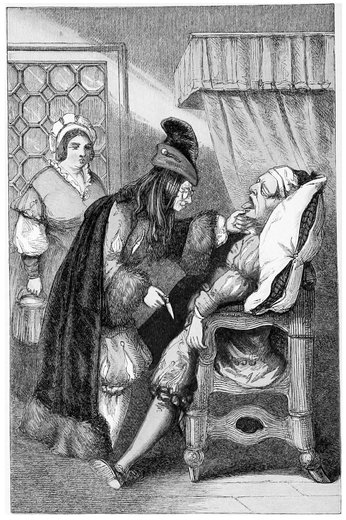
The Fifteenth Adventure. How Owlglass did cure the sick folks in the hospital at Nürnberg in one day, and what came thereafter.
21
On a time came Owlglass to Nürnberg, where he did
again set upon the church doors letters of great import,
in the which he did publish abroad that he was a learned
physician, more learned than in the world had yet been
known; and that in all sicknesses, whosoever should
turn to him should have content and his health again.
Now in the hospital at the town were there a multitude
of people, who lay sick unto death, and of them
did the master of that house crave in great truth to be
relieved. Right verily would this benevolent man have
given them their health and made them whole, and, if
he could, have got ridden of them in the house. Then
went he unto Owlglass, the learned physician, and spake
with him, asking him whether he could, as in his letters
he set forth, work such marvellous cures. And Owlglass
answered and said: “Yea, if that the hospital-master
would give unto him two hundred pieces.” Then upon
that conference did the master agree and promise him
the money; and Owlglass said unto him, that he would
not receive from him one penny, if the people did not
all, within a few days, leave the hospital of their own
desiring and action. Thereat was the master of the
hospital very content, and gave unto Owlglass twenty
pieces as a hansell.
Thereafter went Owlglass into the hospital, and took
with him two servants; and he asked of each person
that was sick, what it was that he lay sick of, and they
answered. And at the last he said unto each, that he
should not betray the secret which he should then tell
unto them, and that swore they all. Then he spake
22unto each secretly, saying: “If that I should make ye
whole, and give back unto all health and strength, then
must I needs burn one of ye into powder, the which to
mingle with your drink and give you to swallow, and
with that will ye be made whole. Now I will take from
among ye the one that is most sick, and him will I burn
to powder. And I will stand at the door of the hospital,
with the master of the hospital near at hand, and
I will cry with a loud voice: ‘He that is not sick, let him
now go forth from the house quickly.’ And that one
which is last within the hospital door, him will I take.
Forget ye not that in your sleep.”
Thus it came to pass, that all did remember his words;
and when he stood with the master at the door, the sick
and lame, and halt and dying, all came forth in haste,
for none would be that one who should be burned in
fire. So the hospital was quite empty, for many which
had not for ten years arisen from their beds, now found
their legs and departed thence.
Then did Owlglass demand from the master of the
hospital that he should receive his reward, and the
master with gracious thanks did present it unto him; then
rode he forth from that city, and returned not again. In
three days thereafter, came all the sick folk back again
unto the hospital, and complained sorely of their sickness.
Then said the master: “What will ye? Have I
not brought unto ye a physician of skill, who did marvellously
make you whole, that ye could all depart
hence?” Then the sick folk discovered to the master
the knavery that Owlglass had done, in that he had
threatened them, that the last that should depart should
be burned. So the master of the hospital perceived
that he had been beguiled of Owlglass, and the sick
folk abode in the house: yet was the money lost.
Owlglass still was a great physician, for he had for three
days cured them; and how many learned doctors are
there who cure not in any wise?
HOW OWLGLASS TURNETH DOCTOR.
The Sixteenth Adventure. How Owlglass bought bread according to the proverb: “To him that hath bread is bread given.”
23
Trusty faith giveth bread. And now that Owlglass
had deceived the hospital-master, came he unto Halberstadt,
and went round about the market, and saw that it
was cold and winter time. Thought he, cold and hard
is the winter, thereto bloweth a strong wind, and thou
hast often heard that to him that hath bread is bread
given. Then for a few pence buyeth Owlglass bread,
borroweth also a table, and sitteth down in the front of
St. Stephen’s Dome. There held he up his knavery so
long until a dog came by, the which caught me up a loaf
from the table, and ran toward the cathedral court. While
Owlglass ran after the dog, there passed by a sow with
ten young pigs; these overthrew the table, and each,
seizing a loaf, departed.
Then laughed Owlglass and said: “Now do I see that
the words are not true: ‘To him that hath bread is
bread given;’ for mine is taken.” Thereat he departed
from Halberstadt unto Brunswick.
The Seventeenth Adventure. How Owlglass became a doctor, and did cure many folk.
The City of Frankfort is a great and handsome city,
and in it do dwell many worshipful burghers, whose
riches are many, and they eat and drink much, as is the
custom with citizens; thus it fortunes that they are often
24ill. No marvel therefore that in Frankfort abide many
doctors, who gain much money. Owlglass when that he
came there, by his ready wit soon perceived the better
part to take, and hired himself to be a doctor’s man, and
soon it was meet that he should go with his master to
visit the patients. The good Owlglass would much have
desired to know something of the names on the bottles
which stood in the house of his master; but that could
he not do, and therefore of all that his master did he
could learn nothing but that when people were sick, they
should drink warm water and be blooded. It fortuned
in no long time thereafter, that his master had on a
sudden to take a journey, in such wise that he had no
time to tell the patients thereof. Then spake he unto
Owlglass saying: “Go thou about the city unto the sick,
and say unto them that in no long time shall I return
unto them.”
25Yet the cunning Master Owlglass followed not his
master’s saying, but put on his head the wig of his
master, and on his shoulders he bare his mantle. Then,
with a grave and noble demeanour, he departed unto the
houses of the sick patients who sent for him. When that
he arrived, he sat gravely down with a serious face, felt
their pulses, and after much heavy thought, he ordered
them always to be blooded and to drink warm water.
Thereafter he departed from them.
Then, marvellous to tell, all his patients grew wondrously
well in no long time, and they paid him much
money for his pains. When that his master returned,
the knavery of Owlglass was soon discovered, and he was
fain to depart. Yet such was the wisdom of good
Master Owlglass, that it is related that his master thereafter
followed no other art than had been thus invented
by Owlglass; and after that time the doctor became
famous, and wrote a large book upon the virtue of warm
water and blood-letting.
The Eighteenth Adventure. How that Owlglass became a drawer of teeth and cured all by a wondrous pill.
As Owlglass was going along the road, he met upon
the highway, a man whose face was overcome with
misery. Owlglass thereat gazed upon him for a season,
and after some time spake unto him these words:
“Worthy fellow! thou dost seem so wrapped in melancholic
humour, would’st tell me what aileth thee?” “Everything
in the wide world,” the other made answer: “for I
have no money, which is the joy of all worldly business;
for it maketh learned, maketh noble, maketh lovely,
and merry. Also, maketh it an end of hunger and thirst
which now sorely assail me.” Then Owlglass bethought
26himself for a while, and presently took up from the next
field some clay, whereof he made little pills, which he
then wrapped in pieces of paper, and said to his
comrade: “Be of good cheer, friend! Soon will we have
money. Lo, in yonder city, the towers of which we can
now see, are there fools in number great. Enter thou in
before me, and there go forward till thou seest the best inn
in the town, and therein do thou stay. At dinner stay
thou as long as thou canst and be merry; yet after a
while do thou cry out in great agony, as if thou hadst
the tooth-ache. Then will I not be far from thee; and
when I come in, be thou ready, and make answer to
everything I say: ‘Yea.’ But do not thou let it be
perceived that thou knowest me.”
Then did the twain go forward into the town, and as
Owlglass had commanded, so all things came to pass.
Owlglass told the people that he was a dentist of great
skill, and they called him to the man who was ill. Then
took he from his pocket the pills which he had made of
the clay, and laid one in the man’s mouth. “Art not
thou well now”? said he unto him. “Yea, truly,” answered
the other, “all the pain is gone.” Then all the
people in the inn came round the doctor in great multitude,
and demanded that he should sell unto them his pills.
And Owlglass sold what he had for a great sum of money,
and an he had had clay enough he could have sold many
more. Then shared he the gain with his comrade, and
they departed hastily from that place.
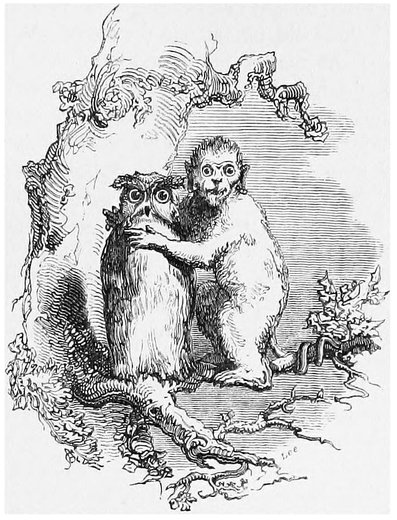
The Nineteenth Adventure. How that Owlglass did at Brunswick hire him to a baker, and did there bake owls and monkeys.
It fortuned upon a time that Owlglass came into
Brunswick city, and unto an inn where bakers met
together; and hard by lived a baker, who called upon
27Owlglass to enter into his house, and made inquiry of
him, as to the business he might follow. Then answered
Owlglass to the baker, and spake, for our noble and well
beloved master of jests was wily, and, indeed, all things
unto all men: “I am a baker’s man.” Thereat said the
baker: “Even now have I not any man in my house to
serve me; wilt thou come to me, for I have need of thee?”
Owlglass at that answered: “Yea.” And when that he
had been with him two days, the baker commanded him
to bake at eventide, for that he could not help him until
the morning. Then said Owlglass: “But what would ye
have me to bake?” Thereat waxed the baker wroth, for
he was a man soon hot i’ the head, and he made answer
in scorn, and said: “Art a baker’s man, and askest thou
what ye should bake? What do ye bake? Owls and
monkeys bake ye?” And thereafter gat he him to bed.
28Then departed Owlglass into the bake-room, and made
the dough into nought but the shape of owls and monkeys,
and these did he bake in the oven. At morning
time arose the master baker, and went into the bake-room
to aid his man. Then cometh he, and findeth
neither rolls nor loaves, but rather a goodly mass of owls
and monkeys. And he opened his mouth in great rage
and said unto Owlglass: “What is it that thou hast
baken?” And Owlglass did answer him and said:
“Verily have I done that which thou didst tell me to
do.” And the baker, in great wroth, said: “What shall
I do with this foolish knave? Such bread will no one
have?” And therewith took he him by the head, and said
unto him: “Pay me for the dough thou hast spoiled!”
Then said Owlglass: “And if I pay ye for the dough, will
the goods be mine?” And the master answered: “What
care I for such bread?” So Owlglass paid the baker for his
dough, and he took the owls and monkeys in a basket,
and he carried them away unto the inn, the sign of which
was the Wild Man. And Owlglass thought within himself:
“Thou hast often heard it said, that to Brunswick
canst thou bring nothing novel or strange, but therefrom
mayst thou draw great profit for thy pains.” And it was
Saint Nicholas’ even. Then stood Owlglass with his
store hard by the church gate; and he sold all his owls
and monkeys at great price, and therefrom drew he a
much greater profit than what he had paid unto the baker
for his dough. This was noised about, and soon came
it heard of the baker, who waxed very angry thereupon,
and he ran unto Saint Nicolas’ Church, and would have
demanded either his share, or the charges of baking.
But Owlglass had already departed with the money, and
the baker might look far and wide for him. This feat
29of our good exemplar showeth plainly, that there is
nothing so vain or foolish in this world, but that it hath
profit contained within it for those who study to arrive
thereat.
The Twentieth Adventure. How Owlglass did again hire him unto a baker, and how he bolted meal in the moon’s light.
Thereafter departed Owlglass, and wandered
hither and thither in the land; and at last came he
toward Oltzen, and entered into the village there. And
when he was besought of the people to say what trade
he exercised, he told them that he was a baker. Then
did a master baker in the village hire him; and when
that Owlglass was with him present in his house, his
master did make ready that he should bake, and he
spake unto Owlglass, and did enjoin him that he should
bolt the meal, so that it might be prepared against the
morning. Then Owlglass answered, and said: “Master,
I would fain have a candle, that I may see with, and so
diligently do your bidding.” “Nay,” answered the
baker; “but that will I not do. No candle shalt thou
have, nor have I at any time given unto my serving-men
any such candle. Always did they bolt the meal in the
moon’s light, and verily must thou likewise do this.
And this charge I thee to do.” And Owlglass made
answer, saying: “An if your former servants did bolt the
meal in the moon’s light, truly then will I also do it.”
At that was the master content, and he gat him to bed
for a short while.
Thereafter taketh good Master Owlglass the bag, and
he openeth the window and putteth forth the bag, until
the moon’s light doth shine thereupon, and then letteth
he all the meal fall out on the ground where that the
30moon shone. And in the morning cometh the master,
who desireth to bake, and he findeth Owlglass still
casting out the meal. And the baker marvelled much
when that he beheld Owlglass, for Owlglass was white
with the meal. Then said the master, who was full of
anger: “What do ye here, ye knave? Think ye that yon
meal cost me nought, that ye throw it in the dirt there?”
Then answered Owlglass: “Did not ye command me
that I should, without a candle, bolt the meal in the
moon’s shine, and have not I fulfilled this according to
your words?” Then said the baker: “I said you should
bolt the meal by the moon’s light.” And Owlglass answered
him: “Be then of good cheer, master; verily thy
meal is bolted both in and by the moon’s light, and with
much pains and weariness have I done this labouring.
Nor is there much lost thereby; scarce a handful.
Soon will I gather it up again, and the meal will not be
in any wise made the worse.” Thereat sayeth the baker:
“In that time that thou dost gather up the meal, will it
grow too late to make the dough, and then fall to baking.”
Then said Owlglass: “Behold, master, I know a piece of
counsel, how we may bake as soon as our neighbour
yonder. His dough lieth ready in the trough, and I will
go thither and quickly fetch it, and carry our meal
thither in place thereof.” Thereat grew the master of
Owlglass right angry, and said unto him: “May the evil
one have thee! Get thee to the gallows-tree, thou
knave, and fetch thee thence the first thing that thou
dost find; and let the neighbour’s dough lie where it
be.” “Yea,” answered Owlglass.
Then departed he out of the house and went unto the
gallows-tree, and there lay the skull of a thief, which
had fallen down. This took Owlglass and bare it unto
his master, and brought it into his house and said:
“Here bring I from the gallows-tree the first thing that
31I did find. Wherefore would ye have this? Of a truth
know I not what may be the best thing it is fit for.” And
then the baker spake in anger, and said: “Lo! bringest
thou me nothing more than this?” Then Owlglass
answered and said: “If that any other thing had been
there, I would also have brought it for thee; but no
other thing was lying there.” Then waxed the baker
more wroth, and said unto Owlglass: “Behold, thou hast
robbed the law and the gallows; that will I tell unto
the burghmaster, and thou shalt answer it.”
And the baker departed from out of the house to the
market-place, and Owlglass followed him. So hastily,
howsoever, went the baker, that he looked not round,
and knew not that Owlglass was following him. Then
stood the baker before the burghmaster, who was on the
market-place, and he began to make complaint against
Owlglass. And Owlglass was lithe and nimble, and
when that the baker began his words, he stood hard by
and opened his eyes very wide. And when the baker
beheld Owlglass, he clean forgat, in his anger, what it
might be that he would make complaint of, and said to
Owlglass, with great malice: “What wilt thou have?”
Owlglass made answer to him: “I desire not to have
anything, than that I should behold what complaint you
make against me to the burghmaster. And that I might
see your words, do I open mine eyes very wide, for
words are most difficult to see.” Then said the baker:
“Get out of my sight, thou knavish beguiler, I desire
nought else!” Owlglass then said: “If that I should
get out of thy sight, then needs must I get my body into
thine eyes; and if ye shut your eyes, must I come
through thy nostrils.” Then went the burghmaster on
his way, for he perceived that it was but foolishness;
and he left them both standing. And when Owlglass
saw that, he followed the baker, and spake unto him,
32saying: “Master, when shall we bake? It is time now,
for the sun shineth no more.” Then departed he, and
left the baker standing in the market-place.
The Twenty and First Adventure. Telleth of what manner of thinking was Owlglass, and how he formed his life according unto principles of virtue and goodness.
Of our most noble and beloved Master Owlglass,
have I now told ye not a few truthful and diverting
histories and adventures; but, yet have I not said any
word in respect of his ways of thinking, gathered by
great experience out of many lands, in his continual travel
to and fro, up and down in his country. Now he loved
much to be always among friends and in company, and
as long as he lived were there three things, which with
great avoidance he did always run from and leave undone.
The first thing was, that he never did ride a
horse which was gray, but at all times a bay horse, for
the gray horse did mind him of an ass, the which animal
held he in great scorn. The second thing which he
could not bear to be with him was the company of little
children, for that wheresoever he found them, there was
more care taken of them than of his own noble person.
The third thing was, that he would never lie in an inn
where that he found an old mild host; for a host that
was old and mild held Owlglass in but little esteem, and
was thereto also for the most part nought but a
fool.
Every morn when that he rose up from his bed, he
blessed himself against healthy victual, great happiness,
and strong drink, in which three blessings none can deny
that he was a wise man. And when it fortuned that he
passed by an apothecary’s house, did he bless himself
33against healthy victual, for it mote truly be a healthy
place whence victual might issue; yet it was a sign of
sickness before. Good fortune was it when a stone fell
from the house top and struck him not down; for then
might he of a truth cry, with great praise: “If that I
had myself been standing on that place, so would it
have fallen upon me and killed me;” and such fortune
would he most willingly not have. The strong drink
against which he blessed himself, was water, for it be so
strong as soon to drive round great mill-wheels, and
to the good fellow that drinketh thereof cometh death.
It was also told of Owlglass that he wept always when
that he did go down a hill, and he laughed when he
climbed one. For truly wist he, in the descending, that
soon would he come again unto a mountain, while in
climbing knew he that soon would he come again to the
top, whence to pass down into the valley. In fine
weather, or at a time when summer began, then did he
also weep with many tears, and when that winter
approached, laughed he. And ye that read herein may,
in your wisdom, answer the reason why he did this thing.
The Twenty and Second Adventure. How that Owlglass did hire him to the Count of Anhalt to blow the horn on a tower, and when that enemies did approach, then blew he not; and when that they came not, then blew he.
34
Not long thereafter, came Owlglass unto the Count
of Anhalt, and he did hire him unto the count as
a tower watchman. And the count at that time had
enemies in great multitude, so that he had with him
in number not small, both horsemen and foot folk,
unto whom he must needs give meat and drink every day.
And Owlglass sat up on the tower, and he was clean
forgat of them that should give him provision. And on
that day it came to pass, that the enemy did, in strong
force, come unto the town and castle of the count’s
grace, and they took therefrom all the cattle, and drave
them off. Owlglass then lay still upon the tower, and
he looked through the window and made not any
outcry, either in that he blew, or in that he did cry aloud.
But it did come unto the ears of the count that he heard
the enemy, and with his folk he quickly gat him forth,
and pursued them and drave them before his face.
Then saw some of the folk, that Owlglass lay in the
window of the tower, and laughed. Thereat did the
count cry out unto him: “Wherefore liest thou on the
tower and art so still?” And Owlglass made answer
unto the count, saying: “Ere dinner time do I not with
35grace and comfort ever delight in crying out.” Then
cried the count back unto him: “Wilt thou, when the
enemy cometh, blow thy horn?” Thereat said Owlglass:
“Enemies dare I not blow, or would the field be
full, and with the cows would they depart. And if I blew
enemies a second time, in such multitude would they
come, that they would fight with thee, and overcome
thee even in thine own gate.” Therewith ended they
their conference. Then departed the count in great
haste after his enemies, and contended with them with
much strife; and Owlglass was again forgotten as he lay
upon his tower.
But the count was greatly content with his prowess, and
with him brought back from the field of battle a goodly
heap of pork, the which did they thereafter cut up, and
some roasted they and other did they boil. And Owlglass
would most willingly have had thereof as he sat on
his tower. Then did he begin to plan how that he might
get thereof, and he did watch when that it should be
dinner time. And when that it had become dinner time,
he began to blow his horn, and to cry with a loud voice:
“The foe cometh! The foe cometh!” Then the count gat
him up with his arms, and put on his harness, and took his
weapons, and departed quickly forth from the castle into
the field. Thereat rejoiced our noble Master Owlglass,
and quickly did he get him down from the tower, and
came unto the count’s table, and took therefrom boiled
and roast, in the which delighted he, and he returned
back on his steps, and gat him to the tower. And,
when that the horsemen and foot folk came again unto
the castle, and of enemies had found not a hair, then
murmured they one to the other, saying: “This hath
the watchman done to mock us with great scorn and
knavery.” And the count cried aloud unto Owlglass,
and said unto him: “Wherefore hast thou become
36foolish and mad?” And Owlglass said: “If that hunger
and thirst drive mad, then do I not marvel at my madness.”
Thereat said the count: “Why didst thou blow
on thy horn for enemies, and there were none?” Then
spake Owlglass, and made answer unto the count,
saying: “Whereas it fortuned that no enemies were present,
I thought in my mind that it would be well to blow
on my horn, for that they might come.” Then said the
count unto him: “Thou goest about to deceive us with
knavish beguiling. When that the enemy cometh, thou
wilt not blow; yet when no enemy is nigh at hand, then
blowest thou. Of a truth, it is a matter of treachery.”
Therewith relieved he Owlglass of lying in the tower,
and appointed thereunto another watchman.
Then came it to pass, that Owlglass should run with
the foot folk to strive in battle with the enemy. And
thereat was good Master Owlglass moved to anger, and
cast about in his mind to discover how he might be
relieved, and obtain other service. And when the
count’s folk departed out from the castle to fight with
the foe, then was Owlglass always the last man; and
when they returned back unto the castle, was he truly
likewise the first man to enter therein. Then spake the
count unto him, saying: “How shall I understand this
thing? Wherefore art thou always last to depart from
the castle, and the first to return back again?” And
Owlglass answered and said: “Let not thine anger fall
upon me, noble lord; for when that thou and all thy
people sat and ate and drank, with great feasting, then
lay I upon the tower and fasted so that I fainted thereby,
and lost much strength. If therefore ye should be
minded, that I should be the first in the field to encounter
the foe, I pray thee that ye do let me eat now
that with strength may I be filled, and then will I do it,
and ye shall perceive that I shall be the first against the
37enemy and the last to depart from him.” “I mark well,”
spake the count, “that thou wilt be a long time in doing
this thing, and as long as thou didst sit on the tower.”
Thereat said Owlglass: “That which belongeth of
right unto a man do others take from him most willingly.”
And the count said: “Long shalt thou not be
my servant,” and therewith gave him leave to depart.
And thereat rejoiced Owlglass, for he cared not every
day to fight with the enemy.
The Twenty and Third Adventure. How that Owlglass did have golden shoes struck unto his horse’s feet.
Owlglass was one of those men that the fame of
his holy doings came unto the ears of many great
lords. The princes, also, loved him much, and did give
unto him garments, horses, money, and provision. And
he came unto the King of Denmark, who said unto him,
that he should do for him a wondrous strange thing,
having his horse shod with the best shoes that could be
found. Then answered Owlglass to the king, and spake
unto him and asked him: “If that he should believe
him?” And the king answered and said: “Yea, and if
he did according unto his word, it should come to
pass as he had promised him.” Then Owlglass did
ride his horse unto the goldsmith’s house, and there had
golden shoes, with nails of silver, struck unto his horse’s
feet, and gat him home again unto the king’s presence,
and asked him if that he would pay for the shoeing of
his horse? The king said: “Yea, that would be right
truly;” and said unto his treasurer, and commanded
him, that he should pay for the shoeing of the horse of
Owlglass. The treasurer thought that it had been done
38by a blacksmith. And Owlglass led him unto the goldsmith’s
house, and the goldsmith demanded of him one
hundred golden marks therefor. The treasurer would
not pay this; but went and told the king thereof. Then
sent the king for Owlglass, and said unto him: “Owlglass,
how dear hast thou made this horse shoeing to
be? If that all my horses were shod as thou hast had
thine, soon should I have to sell my country and my
people!” Then Owlglass answered and spake unto him:
“My gracious lord and king, thou didst say I should
have my horse to be shod with the best shoes, and have
I not done according unto thy words, for would ye
have better shoeing than silver and gold.” Then said
the king: “Thou art my dearest servant, thou dost that
I tell thee to do.” And the king laughed at the merry
jest, and did pay the hundred marks. Then Owlglass
brake off the golden shoes from his horse’s feet, and had
shoes of iron struck on, and he abode with the king
unto the day of his death.
The Twenty and Fourth Adventure. How that Owlglass did have a great contention before the King of Poland with two other fools.
While that the noble Prince Casimir, King of
Poland, yet lived, there came unto him at his
court, good Master Owlglass. And Casimir (blessed be
his memory!) did have two fools there, who, in knavery,
could not be overcome. And the king of Poland had
heard much said of Owlglass, that, in truth, he was not
in any way to be quipped or deceived. Nor did Owlglass
agree with the fools of the king, and that beheld the
king right soon. Then spake the king unto Owlglass
and the two fools, saying: “Behold! unto that one of ye
39the which can wish the greatest wish will I give a coat and
twenty gold pieces thereto, and this shall be within my
presence.” Then said the first fool: “I would have
that heaven were nothing but paper, and the sea nothing
but ink, that therewith might I in figures write down
how much money I would have, and that it came unto
me.” The second spake, saying: “I would have as
many towers and castles as there be stars in heaven, so
that therein might I hold all the money that my fellow
here would have.” Then was it time that Owlglass
should speak, and the king thought that in truth he
could not wish anything greater. But Owlglass opened
his mouth and spake, saying: “I, in truth, would desire
that after ye two have made me your heir, that the
king would yet on this day hang ye both.” Thereat
laughed the king right merrily, and Owlglass won the
coat and the twenty gold pieces, with the which he
departed in joy.
The Twenty and Fifth Adventure. How Owlglass did make confession to a priest, and took from him a silver box.
On a time it happened that Owlglass thought to go to
confession, for his sins were many, and therewith
was his soul sore laden, so that he meditated much on
the badness of his ways. Then came he to the church,
where sate the priest in the confessional, and before him
stood a silver box, by which he set great store. Then
Owlglass began a long speech, in the which he told the
good priest his heavy sins, so great in number; and at
last, the saying of Owlglass was so long, that the priest
did lean back and slept, for he was weary of the
knaveries of Owlglass. Then Owlglass took the box
away, and did put it in pouch.
40When that the priest again awoke he did rub his eyes
with his fingers, and spake unto Owlglass, saying:
“Where stood we, my son?” Then answered Owlglass,
and said unto the priest: “We stood at the eighth commandment,
father.” Then said the priest: “Speak on,
my son; fear not, nor in any wise conceal what lieth
upon thy conscience.” Then continued Owlglass, saying:
“Alas! holy father, on a time I did steal a silver
box from a person, and I will now give it unto thee.”
Then said the priest: “Nay, my son, stolen goods will I
not have; give the box unto him that owneth it.”
“That would I already do,” answered Owlglass; “but
he refused me, saying that he would not receive it.”
Thereat spake the priest, and said: “Then canst thou
keep it with a good conscience; go in peace, thy sins
are forgiven thee.”
Then Owlglass departed, and sold the box unto a Jew
for several pieces of silver. But the priest slept not
again in confession; and thus Owlglass gat for others
more sins forgiven than before, which did great good
unto all men.
The Twenty and Sixth Adventure. How that Owlglass was forbidden the dukedom of Lunenburg, and how he did cut open his horse and stand therein.
In the land of Lunenburg, near unto Zell, did Owlglass
work some great knavery on a time. Therefore did
the Duke of Lunenburg forbid him the land; and he
gave commandment to his servants, if that Owlglass
should be found therein they should seize him, and,
without any mercy or shrift, hang him up. Yet did not
Owlglass in any manner forsake the land, or in his journeyings
avoid it, so as to come round through any other
41country; but when that it came in his way to be convenient
to pass through Lunenburg, did he nevertheless
ride or walk through it when he would.
Thus it came to pass on a time, that Owlglass had
much reason to ride through Lunenburg, and it fortuned
that as he was riding along, he saw the duke with many
folk riding the same way. Then thought he within himself:
“Lo! it is the duke; and if that thou dost hasten
away to fly from before his face, then with their horses will
they soon come up with thee, and they will take thee;
then will the duke with great anger come and command
them to hang thee up unto a tree.” Then did he confer
within himself what thing it were best that he should
do; and he gat him down from his horse, and took a
knife, and quickly cut open the horse’s belly, casting
forth the entrails, and then gat he in and stood within
the four legs in the midst. Then when the duke came
riding by with his horsemen, and gat to the place where
sat Owlglass in his horse’s belly, then the servants of the
duke spake unto him, saying: “Behold, gracious lord,
here sitteth Owlglass within his horse.” Thereat did
the duke ride up to Owlglass, and say unto him: “Art
thou there, Owlglass? What bringeth thee into my country
when that I did warn thee with great punishment
not to come thither? Did I not say, if ye came therein
I would have thee hanged on a tree?” Then said Owlglass
to the duke: “Noble and gracious lord, I pray
thee that thou wilt be pleased to spare my life, for I
have not done so evilly as to be punished with death.”
Then said the duke unto Owlglass: “Come thee hither
unto me, and do thou make thy innocence plain unto
me, or what meanest thou that thou dost so stand in the
belly of thy horse?” And Owlglass answered, and said:
“Most high and gracious lord! have I not heard it
always said of all that from old time between his own
42four posts is a man safe? Now do I stand in such wise
between my four posts, as ye can see; for I feared the
displeasure with the which I knew in my heart that ye
would visit me,” Then did the duke laugh right merrily,
and said unto Owlglass: “Yea, this time will I
excuse thee. But wilt thou henceforward stay far away
from my land, nor enter it at any time?” And Owlglass
answered and said: “Gracious lord, so mote it be as ye
would have.” Thereat rode the duke away from him,
saying: “Stay as ye now be.” But Owlglass leaped
quickly forth from his horse’s skin, and spake unto the
dead horse: “I thank thee, my good beast, for thou
hast preserved my neck from great danger of the halter,
and through thy death am I made alive. From a hunted
donzel hast thou changed me into a gentleman; therefore,
lie thou there, for it is better that the crows eat
thee than that they should tear me.” Then departed
he out of the land on foot.
The Twenty and Seventh Adventure. How that Owlglass did buy an inheritance in land from a boor, and how he sate therein in a cart.
In no long time thereafter came Owlglass again into the
land of Lunenburg, and he tarried in a village near
unto Zell, until the time came in the which the Duke
should again ride that way. And it came to pass that a
boor did come by Owlglass as he went along to plough
his land. And by that time had Owlglass gotten him another
horse, and a cart therewith, and he came unto the
boor, and spake unto him, saying: “Whose land is this
that thou ploughest?” Then answered the boor and
said: “Truly is it mine, and I did have it in inheritance
from my forbears.” Thereat said Owlglass unto the
43boor: “What money wilt thou have for as much earth
as would fill my cart?” Then said the boor: “Truly
will I have a shilling therefor.” And Owlglass gave
unto him what he demanded, and filled his cart therewith,
and crept into it, and drove his cart into Zell unto
the castle there, unto the Aller water. And when that it
came to pass that the duke rode by, did he behold
Owlglass as he sate in the cart with the earth up to his
shoulders. Then spake the duke unto Owlglass, and
said unto him: “How comest thou here again? Have
I not forbidden thee to come into my land, and did
not I say thou shouldst suffer death? And now, after
that I pardoned thee when thou didst stand in thy
horse, thou dost again tempt my wrath with thee?”
Then spake Owlglass unto the duke in answer, saying:
“My gracious lord, I am not in your land but in mine
own, wherein do I sit; and I bought it of a boor for a
shilling, and rightfully could he sell it, for from his forbears
hath he inherited it. So is this truly my land.”
Then spake the duke, and laughed the while: “Depart
ye now straightway with thy land out of my land, and
come not again, or will I have thee hung up, with thy
horse and thy cart beside.” Then leaped Owlglass on
to his horse from out of the cart, and left the cart with
his land standing before the castle.
The Twenty and Eighth Adventure. How that Owlglass painted the forbears of the Landgrave of Hessen, and told him that an if he were ignobly born, he might not behold his painting.
Many marvellous things did Owlglass bring to pass
in the land of Hessen. After that he had journeyed
up and down in the country of Saxony, and his
44fame had spread so abroad that no longer dare he work
his knaveries and beguilings in that land, came our
worshipful Master forth from Saxony, and did enter into
the land of Hessen, and came therein unto Marburg,
unto the Landgrave where that he kept his court. Then
inquired the landgrave of Owlglass, what manner of
man he was and what he could do. Then answered
Owlglass, and said: “Lord, I know the arts, and that
manner of man am I, and your humble servant.”
Thereat rejoiced the landgrave greatly, for he thought
that Owlglass was an alchymist, and in alchymy had the
landgrave much delight. Then spake he unto him, saying:
“Art thou an alchymist?” And Owlglass answered:
“Nay, that am I not, in good sooth, for of dross make not
I gold, but rather quite the other thing. Yet am I a
painter, the equal unto whom can be nowhere found in
any country, for my work is far better than the work of
any other painter.” Then said the landgrave: “Come,
let us now look upon some of thy work.” And Owlglass
said: “Yea, my lord.” And he had with him some
paintings cunningly devised, the which he had brought
out of Flanders. These took he from his wallet, and
displayed them before that prince. These pleased the
lord much, and he said unto Owlglass: “Worshipful sir
painter, what money will ye have if that ye would paint
on the wall of our castle hall the story of the family of
the landgraves of Hessen, and how that through them I
became friendly unto and with the King of Hungary,
and other lords and princes, and how long the land of
Hessen hath been established? And that must ye tell
me in the wise that will be most costly and precious.”
Then answered Owlglass: “Behold, most gracious prince,
if that ye would have it so rarely done, it might truly
cost not less than four hundred marks.” Then answered
the landgrave, and said unto Owlglass: “Master, an if
45you do but make it rarely, the money shall not fail, nor
will we forget to reward thee as ye shall deserve.” Then
did Owlglass consent to become the painter of the picture;
and thereat gave the landgrave unto Owlglass one
hundred marks so that he might buy colours therewith.
But when that Owlglass came with three servants he
had found, to see what the work was which was to be
done, he gat him unto the landgrave, and spake unto
him, and entreated him, saying: “Behold, noble prince,
I would crave a grace from ye, which I would ask
that ye should grant unto me.” Then spake the landgrave:
“Yea, that I will grant thee. Speak on.” And
Owlglass answered, and said: “The grace I crave
from thee is, that, while my work is going forward, no
one shall enter without that they ask of me whether
they may enter therein.” And therewith the landgrave
granted Owlglass the grace he desired. Then conferred
Owlglass with his men, and said unto them, that they
must take an oath unto him not to betray him; and so
did they. And he said unto them, that they need not
do any kind of labour, but they might play at tables
and chess and other merry pastimes. And thereat were
the men content; nor was it greatly marvellous that in
such wise they should be, for Owlglass did promise to
pay them for serving him after this manner.
46
Then it came to pass, after some three or four weeks
had gone by, that the landgrave craved much to see
in what measure the painting of Owlglass was ready, and
whether, of a truth, it did resemble the ensamples which
Owlglass had shewn unto him, which were so goodly and
fair. Thereat gat he him to Owlglass, and said unto
him: “Alas, most worshipful master, I would fain come
into the hall and see in what measure my picture doth
grow ready.” Then Owlglass spake unto the landgrave,
and answered him, and said: “Yea, and that shall ye
also do. But I must tell unto thee a marvellous secret
which doth touch all my painting, in that no one, if he
be ignobly born, or not according unto the ordinance
of Holy Church, can behold my painting to see it.”
The landgrave said thereafter: “Truly that is a marvellous
thing.” Yet, my masters, ye may perceive in that
the landgrave was an alchymist, so had he also more
belief in such affairs than cometh unto the lot of all
men. And then went he with Owlglass into the hall,
and there had Owlglass hanged up a white cloth, that
he should have painted. And with a white wand did
he point to the wall when that he had with his hand
put the cloth somewhat aside, and then spake he to the
landgrave, and said unto him: “Most noble landgrave,
look upon this painting, so marvellous well done and
with fair colours, and behold here in this corner he that
was first lord of Hessen and earl of the land. And
47here perceive ye one that was an earl of Rome thereunto,
and he had a princess and a wife, who was
duchess of Bavaria and a daughter of the mild and
good Justinian, who afterwards became emperor. And
look ye, noble lord; of them was born Adolphus.
And of Adolphus came William the Swart; and this
William had a son Ludwig, who was named the Pious;
and so forward until that we come down unto your
lordship’s grace. And I know well that there is no
person living that can reprove my work, so curiously
have I made it, and with such fair and goodly colours.”
Yet saw the lord nought before his face but the white
wall, and he thought unto himself: “Though I see nothing
but the wall, yet will I say nought unto the master,
else will he know full well that I am not nobly born,
but basely and vilely.” Therefore said the landgrave
unto Owlglass: “Learned and cunning master painter,
your work pleaseth me marvellously well, yet is my understanding
very small therein.” Therefore departed he
out of the hall.
And when that he did come unto the princess his
wife, she spake unto him, and asked him, saying: “How
goeth it with the master painter? Ye have seen his
work and devices, and how are ye pleased therewith?
Truly have I but small belief in him; for he seemeth
unto me a rare and most cunning knave and beguiler.”
And the landgrave answered her: “I have shrewd trust
in him; and therein is displayed great cunning and
mastery: I like it well. Would it please thee also to look
thereon?” And she said: “Yea, that it would.” And
the landgrave said: “Then, with the master’s consent,
shall ye do it.” Then sent she for Owlglass, and said
unto him, that she did desire to behold his painting.
And that did Owlglass grant unto her; but he told her
likewise the marvellous secret which did hang upon
48his painting. And they entered in, and with the princess
came eight maidens of her women and her woman-fool,
which did everywhere be in her company. And Owlglass
put back the cloth with his hand, and with his
wand told them the same story which he had told unto
the landgrave. Yet perceived they nothing; but being
ashamed, spake not any word, neither praising nor blaming
the picture. But then did the woman-fool open her
mouth, and spake, and said unto Owlglass: “Worshipful
master, an if it be that I am basely born, yet see I nothing
of thy device upon the wall.” And Owlglass
thought: “Now goeth the matter not so rarely on as
before; for if the fools speak truth, then truly must I
depart hence:” and laughed thereat within himself.
Thereafter departed the princess, and went unto her
lord and husband, and he spake unto her, and asked
her how that the work liked[10] her. And she answered
and said: “Most gracious lord, it liketh me as well as it
did you, and truly is most rare. But my woman-fool it
liketh not; and she saith that she cannot see any painting
there at all. And she and my maidens think that there
lieth hid some knavish practice therein.” Thereat began
the landgrave to take counsel within himself, if it might
be that he was beguiled; but he sent word unto Owlglass
that he should make ready his work, for that all his
court was coming to behold the picture, and that if any
among them fortuned to be base-born, then should
their lands be escheated unto the landgrave. Thereat
gat him Owlglass unto his fellows and discharged them,
and gave them money, and they departed. And then
went he unto the treasurer, and of him gat he other
hundred marks; and then went he forth from the castle,
and so departed on his way.
And it came to pass that on the morrow the landgrave
49demanded where that his painter might be—but
he had departed. Thereat went he with all his lords
into the hall where that the master had exercised his
cunning device, but there saw they no painting; so they
spake no words, but kept their mouths shut. Thereat
said the landgrave, for he beheld the sign which Owlglass
did always write where that he had worked any
knavery, which was that he wrote up the device of an
owl and a glass: “Now do we know that we are beguiled;
and with Owlglass have we but little for to be
moved, but rather for the two hundred marks, but the
loss thereof can we likewise bear. But a great knave is
he, and must henceforth remain far from our lands.”
Thus did our noble Master Owlglass everywhere
teach wisdom unto the lieges; but from Marburg had he
gat him forth, nor would he again have to do with the
painter’s mastery.
The Twenty and Ninth Adventure. How that Owlglass was for little money well entertained of two innkeepers.
It fortuned that in a village were there two innkeepers,
who did with great hatred pursue each other, and
they could not bear to live in friendship, or as neighbours
should. And if it came to pass, that the one did
have in his house more custom than the other, then was
there much anger and envy therefrom, and they grew
ever more enemies thereafter.
On a time it came to pass, that Owlglass came thither,
although thereby he ran great danger. And he entered
into the house of one of these twain, and he spake unto
the host, and asked of him, whether for twelve pennies
he might have wine? “Yea,” answered the host, “that
he might in good truth;” and went and brought him
50speedily a measure of wine. Thereafter asked Owlglass
again, whether he might for twelve pennies have beef
and salad? “Yea,” said the host; and brought beef
and salad, the which did Owlglass eat with rare enjoyment.
And as he was eating, the cook carried a fowl
by on a plate, and Owlglass saw it, and he called for the
host, and asked him, if for twelve pennies he might have
a part thereof? “Most truly,” said the host. And behold
his measure of wine was empty, and Owlglass
moreover called the host unto him, and said: “Can I
for twelve pennies again have wine?” “Yea,” answered
the host, and rejoiced in his good visitor, and brought
him a fresh measure of wine. And Owlglass was full
and fairly provisioned within, and he prepared to depart,
and rose up, and he laid twelve pennies on the
table, and then he would have departed out of the door.
Thereat the host held him back, and said unto him, that
the money was not enough, and that he must pay four
times as much. “What mean ye?” said Owlglass. “Did
not I ask ye every time, if that I might have for twelve
pennies that which I required? And now would ye
have much more? How mean ye? There is my debt,
and is it to be laid unto my charges that ye have
not understood me?” Then saw the host that it was
most plain he had been beguiled; and he spake unto
Owlglass, that he would forgive him the debt and
add thereto the present of a piece of money, if that he
would go unto his neighbour hard by and there work
the same thing. Then Owlglass put the piece of money
in his doublet, and laughed, and said unto the host:
“Verily have I already done thus at your neighbour’s
house, and he it was that did give me a piece of money
an if I would but come to you.” And therewith departed
our well beloved brother Owlglass, and the host
marvelled with great marvel.
The Thirtieth Adventure. How that Owlglass did tell his master how he might scape giving pork unto his neighbours.
51
On a time Owlglass was servant unto a boor, who was
a man of great avarice, and did never like to give
unto others anything he might have. Now it fortuned
that he killed a pig, and as he had received from others
pieces of bacon when that they killed, so now would
they expect that he would give unto them in return.
Then he spake unto Owlglass, saying: “Truly art thou
of a quick wit and ready invention. Tell me how shall
I escape giving unto my neighbours.” Thereat said
Owlglass: “In truth, nothing is more easy. Behold,
when it is night-time hang thy pig without thy door
upon a hook, and when that it cometh unto midnight
take it secretly away, and make great complaint that it
hath been stolen.” And the boor did according unto
the words of Owlglass, for he was content.
When that he came in the night to take his pig
secretly away, he found it not, and did cry out woundily
that robbers had taken it. And truly our good Master
Owlglass had conveyed the pig away himself. And
when he heard the boor cry, he came up to him,
and asked what might have happened. And the boor
answered Owlglass, and said: “The thieves have come
and taken away my pig.” Then answered Owlglass:
“Excellently spake! So tell thou unto all thy neighbours.”
But the other said: “Nay; but the matter hath
not ended as I desired. The pig hath truly been stolen.”
And Owlglass answered him: “An if ye speak thus well,
all the town will believe you. Most excellent, by my
halidom!” And although the boor would have persuaded
52Owlglass of the truth, did that great master only laugh.
And thereafter did he tell unto the neighbours what
he had advised; and no one would believe the boor.
The Thirty and First Adventure. How that Owlglass conferred with the rector and masters of the University of Prague in Bohemia, and how he did make answer unto their questions, and therein came off most wisely.
And Owlglass departed and came unto the city of
Prague in Bohemia, and there he set letters upon
the church-doors, and therein said unto all that might
read, that of a truth was he a most famous master,
and one that could make answer unto all questions.
And the rector and masters of the university heard that
this learned man had come; and they were troubled
thereat, and they took counsel how that they might put
such questions unto him as he could not resolve, and thus
might they cause him to be cast forth from the town
with much mockery and shame. And so did they agree.
And they sent the bedell of the university unto the inn
where Owlglass lay, and charged the host that he should
bring his guest into the chamber of the rector and
masters; and he promised to do this thing. And they
charged Owlglass that the next day he should give
answers unto the questions which they had writ down,
and if he could not answer, then should he be declared
unworthy. And Owlglass answered, and said: “Tell
the most learned rector and masters that I will do it
straightway as they do require of me; and I trust to
prove myself a pious man as from old time have I done.”
And on the next day the rector and masters and
students of the university assembled together, and Owlglass
53came with his host and some few of the citizens,
so that all might proceed with good content. And when
that he had entered into the assembly, they signified
unto him that he should stand upon the stool, and make
reply unto the questions so demanded of him. Then
the rector opened his mouth, and spake unto Owlglass,
and asked him, how many gallons of water there
were in the sea; and he charged him to speak the
truth and to conceal nothing from him, for an if he
could not answer, then would he punish him as an ignorant
beguiler, and cast him forth. And Owlglass thereupon
answered him and said: “Four hundred and
eighty million seven hundred and thirty thousand two
hundred and sixty-four gallons and two-thirds of good
measure. An ye will not believe what I say, cause ye
the rivers and lakes and streams which run therein to
stand still, and I will mete it, and if it prove not as I
say, then will I confess that I am unwise.” And the
rector could not do this thing, and therefore he was
obliged to admit the answer of Owlglass; and he next
asked him this following question: “Tell me how many
days have passed by from Adam’s time until this present
hour?” And Owlglass spake unto him, saying: “Most
worshipful master rector, the number is not great; only
seven have so passed—Sunday, Monday, Tuesday, Wednesday,
Thursday, Friday, and Saturday; and when that
they have passed, then begin other seven days, and so will
it go forward until the end of the world.” Then said the
rector: “Now answer me exactly, and say where is the
middle of the world?” Then Owlglass answered: “That
is here where we now stand; and if ye believe me not,
do ye take a cord and mete it, and if it be a hair’s
breadth less, then will I stand ashamed.” Then the
rector waxed wroth, and asked Owlglass the fourth
question: “How far is it from earth to heaven?” And
54Owlglass made answer: “When that one speaketh in
heaven it is easy to hear it down here; therefore get
ye one of ye up thither, and I will cry aloud, and if ye
hear me not, then will I confess my wrong.” And the
rector waxed tired of questioning Owlglass, and asked
him: “How great was heaven?” And Owlglass said
unto him: “It is a thousand fathoms wide, and a thousand
cubits high; and if ye believe me not, take the
sun and moon and stars from heaven, and mete it, and
ye will find I am right therein.”
And, my masters, I charge ye to tell me, what could
the worthy folks answer unto Owlglass? In all things
was he too cunning for them; and by knavery had he
beguiled them all. Then did he strip off his long coat,
and departed from Prague.
The Thirty and Second Adventure. How that Owlglass did on a time mix him up in a marriage strife, and did soon end it with great renown.
It came to pass on a time, that Owlglass entered into
a town where much wine was made, and where the
folk of the town did oftentimes drink themselves
drunken thereupon. And, my masters, well do you
know that when on a time ye have peeped into the glass,
so that ye have been not as it would like me an if ye
always were; and after that ye come home, ye do not
find that your wives receive ye in so goodly and
excellent a wise as at other times, so happened it that
our noble and beloved Master Owlglass, as he was passing
along the street to get him to the inn where he lay,
did hear a brawling within a house hard by, as of people
disputing the one with the other in great anger. So our
good friend therewith stood still, and he hearkened, and
55perceived that it was the wife of a cobbler who, unto
her husband, the which had come back from the winehouse
well drunken, was reading the evening blessing, the
which doeth such great and excellent good unto all
husbands. And with many words contended they until
that it was supper time; then the husband took his wife
by the head, and said unto her: “Wilt thou cook for
me my supper?” And she said: “Nay, that would she
not,” and then went they to quarreling again with much
contention. At last said the cobbler: “I would have
that the devil should come and fly away with thee!”
And when that Owlglass heard these words, he took up
a large stone which lay in the street, and threw it at the
window, so that the frame and glass all fell together, and
brake with a loud noise. And the twain who were contending
within, thought in truth that the devil had
come thither, and were stricken with great terror. But
Owlglass gat him away, for that he might not have the
charges of the broken window demanded of him. Yet
went the story forth with great renown, and even unto
this day do the town folk believe that the devil appeared
in shape like unto a great stone; and if that ye believe
not my saying, get ye thither and ask it of them
yourselves.
The Thirty and Third Adventure. How that Owlglass did cause an ass to read certain words out of a book at the great university of Erfurt.
Now after that Owlglass had departed, and had gat
him away, it came to pass that he journeyed until
he entered the city of Erfurt, at the which place is a most
learned university. And our well-beloved Master
Owlglass, like unto some wise men of our days, could not
56hide his wisdom under a bushel; but wheresoever it fortuned
for him to sojourn, there must he teach the people
some cunning thing. And after that he had come unto
Erfurt, he gat him unto a notary, and with fine writing
had he letters marvellously done in goodly and fair
manuscript, setting forth therein his wondrous parts.
And such letters of challenge he set upon the church
doors. And the great fame of Owlglass had come unto
Erfurt, where the rector and learned doctors had heard
not a little of his knavish beguilings and conceits;
thereat conferred they together as to how they might so
enjoin him to do a thing the which he might not be able
to perform, but have great shame thereby, and that they
themselves might not be deceived and mocked. And
then they agreed that they would give unto Owlglass an
ass to be his scholar, the which he should teach that he
might in time become a reader and a wise beast, for
of asses were there great plenty in that university.
57Thereat went they unto Owlglass, and they spake
unto him, saying: “Worshipful master, well know we
that you have set letters of art upon the doors of the
church, by the which ye say ye can teach unto any
beast, both that he shall learn to write and to read;
now, therefore, have the doctors of the university
resolved, in that among us be no lack of asses, that ye
shall receive one to be a scholar and student under thee,
and that he shall learn to read. Will ye have him to be
a scholar, and receive him and therewith, when that ye
have taught him, a great reward?” Then answered
Owlglass and said: “Yea, that will I; but thereunto
must I have time, for an ass is an animal not wise nor
easy to be taught.” So they conferred together, and
agreed that he was to be allowed twenty years in the
which to teach him. Then thought Owlglass in his own
mind: “So there are three of us unto this bargain. If
that the rector should die, then am I free. And if it
should come to pass that I should die, then can I break
the contract. But if my scholar should not live, then
am I also quit.” And he agreed with them, and of the
money he received some in part. Then he gat him into
the inn of the town, and the master of the house was a
man of singular mind. And for his scholar did Owlglass
hire him a stable, and he gat him a great old book,
and laid it into the manger before him, and between
each leaf of the book he laid oats, and the ass soon
beheld that, and he turned over the leaves with his
tongue to eat the oats, and when that the oats were all
gone, he cried out with a loud voice: “E, A—E, A!”
And when that Owlglass perceived this, he rose up
and gat him unto the rector, and came into his presence,
and said unto him: “Worshipful master rector,
when will it please ye to come unto me to see how my
disciple doth get forward with his book?” Then said
58the rector: “Doth he agree unto that which thou
teachest him?” And Owlglass answered him, and said:
“Truly he is a difficult disciple, and one that loveth not
his book; yet have I brought it about that by much
labour he pronounceth two vowel sounds very well, that
is to say, E and A. Will it not make ye pleasure to
come and hear him?” And all this time had the good
scholar fasted. And when that Owlglass came with the
rector, and some of the doctors of the university, he
took a book and laid it in the manger before him, and
when that the ass beheld it, he turned over the leaves
backward and forward, hither and thither, with his
tongue to find the oats, but, as he found nothing
therein, he cried with a loud voice: “E, A—E, A!”
Then said Owlglass: “Behold, most learned doctors,
my disciple doth now pronounce well, although yet
somewhat broadly, the two vowels E and A, and that
can he do. I have great hope of him that he will soon
get farther.” In no long time after died the rector; and
then Owlglass abode no longer with his disciple, but
with his money departed, thinking that in truth it would
demand great industry to make all the asses in Erfurt
wise. Therefore he did it not; and they be all asses in
that city unto this day.
The Thirty and Fourth Adventure. How that Owlglass did kill a hog, and answered for his evil doing unto the burghmaster.
Now it fortuned, that Owlglass once came unto a
village, and did hire him unto a boor to be his
serving man. And this boor rejoiced greatly in all the
wise sayings of Owlglass; and in no long time was Owlglass
the best man in the house. And it came to pass
59upon one even that the boor made complaint unto Owlglass,
and said unto him that he had an evil neighbour
who endeavoured with all his might to afflict him in
all ways that he might, and who, as the old saw saith,
would have given an eye that the boor might be blind.
Then Owlglass thought within him: “That will I soon
repay with marvellous heavy interest. And so that my
master doth thereat have joy and goodly satisfaction,
then shall I be content.” And when that he entered
into the farm-yard on the next morning to depart about
his labour, Owlglass beheld that the neighbour’s hog had
broken into that place, and was rolling on the dunghill
in the yard; and hard upon the dunghill was there a
pond of water, which stood still, and was covered with
green. Then took Owlglass a cudgel and did strike the
hog therewith, until that the hog ran into the pool and
was therein drowned. But privily had the neighbour
watched Owlglass, and beheld that which was done;
and he cried aloud, and ran unto Owlglass, and demanded
money for the hog which he had thus lost.
And as Owlglass heeded him not, he came unto his
master and desired the same thing. But the master of
Owlglass said: “Truly, therewith have I nought to do.
My servant man did this thing; go ye therefore unto the
burghmaster and speak thereof unto him, and let my
man answer it.” Thereat the owner of the hog gat him
unto the burghmaster, and complained unto him of what
Owlglass had done. Then the burghmaster sent for
Owlglass, and spake unto him, and demanded that he
should answer it.
And Owlglass did rise up early in the morning,
and he saddled a horse, and gave him to eat, and then
departed, and gat him unto the house of the burghmaster.
And the burghmaster, at that time, fortuned to be at his
breakfast, and had before him a porringer of barley
60broth. And the burghmaster questioned Owlglass how
that it had come to pass that he had killed the hog.
Then Owlglass answered cunningly, and told him how
that the hog brake his way into the yard and wallowed
upon the dunghill; and, moreover, he told him how he
had struck the hog, that he departed into the pool, and
was there drowned. But the burghmaster was a man of
slow understanding,—as is in truth not a thing marvellous
strange amid people set in authority,—and he demanded
of Owlglass that he should tell him the story more
plainly. Whereat replied Owlglass and said: “Most
worshipful sir, I will set forth unto you this thing very
plain and easy to be comprehended of you. Look you,
suppose ye that ye were yourself the hog, and your
porringer of barley the pool, and suppose that I came
after this wise, and with my hand smote you thus”—and
therewith fetched Owlglass the burghmaster a great blow
over the head—“thou mightest fall therein.” Thereat
cried the burghmaster aloud, and would have held
Owlglass; but he ran forth and leapt upon his horse and
departed thence with great haste.
The Thirty and Fifth Adventure. How that Owlglass at Nugenstädten, in the land of Thuringia, did wash the women’s furs.
61
Now after that did Owlglass come
into the land of Thuringia, into the
village of Nugenstädten, and there
he entered and besought the inn-folk
that he should receive a night’s
lodging. Thereat came the hostess
unto him, and asked
him, saying: “What
manner of trade followest
thou?”
And Owlglass answered
and said unto
her: “Truly am I of
no trade, but do in all
things accustom myself
to speak the truth.”
Then said the hostess:
“Such do I most gladly
receive into my house,
and truth-speakers
are welcome.” And
Owlglass looked round him, and he perceived that the
hostess did squint; therefore he said: “Squint-wife,
squint-wife, where doth it please ye that I shall sit, and
where would ye have me to lay my staff and wallet?”
Thereat waxed the hostess very wroth, and said unto
him: “May nought good ever happen unto thee; in all
my life did no one ever say unto me that I squinted!” But
Owlglass answered and said unto her: “Dear hostess, be
62not angry with me, for an if I do speak the truth, then
must I do it at all times, and in all things.” And thereat
was her wrath turned away, and she, being merry, laughed
and was content.
Now after that Owlglass had abode that night in her
inn, they conferred together, and he told her that he
could wash old furs so that they became new again.
Thereat rejoiced the hostess greatly, and begged that he
would do this, and she would tell all her neighbours that
they should also bring their furs to be washed. And
Owlglass said: “Yea, verily, that would he do.” Then
all the women in the village brought unto Owlglass their
furs, that they might be washed. And Owlglass said
unto them: “Ye must have milk.” And all the
women desired greatly to have new furs, and they each
gat them home, and brought unto Owlglass all the milk
that they had there. And Owlglass set two cauldrons
upon the fire, and he poured the milk into them, and
then put the furs into the milk, and they were boiled
therein.
And it came to pass, that when he thought that they
had boiled enough, he said unto the women: “Now
must ye bring me young white elm twigs, and peel ye
them, and when that ye come again unto me, I will take
out the furs, for then will they be boiled enough, and I
will wring them; yet must I have wood to do this.”
And the women departed right joyfully to fetch the
wood, and the children ran with them, and sang and
danced, and said: “O beautiful new fur cloaks! O
beautiful new fur cloaks!” Then stood Owlglass and
laughed, and said: “Wait ye yet a while, the furs be not
right yet.” And while they were gone for the twigs,
Owlglass piled more wood on the fire, and left the furs
boiling, and departed out of the village. And yet hath
he not returned to wash the furs. When that the
63women folk came back, they began to quarrel, and strive
one with the other, for each would have her fur first
forth from the cauldron; but when that they looked
how they were proceeding, lo! they were all boiled to
rags and fell to pieces. And Owlglass rejoiced that he
had so happily gone forth.
The Thirty and Sixth Adventure. Telleth how that Owlglass journeyed about the land with a saint’s head, and did beguile many therewith.
Now the malice of Owlglass had been so great that
everywhere was he known, and his knavery noised
abroad, so that where he once came at any time, to that
place durst he not go again, unless it mote be that he
disguised himself in strange appearance that others
might not know him. And although, with his idleness,
he could never have much content, yet from his youth
up had he always been one that loved good living, and
by his divers beguilings he always had by him good store
of money. But by his knavishness he had fallen into
such evil repute, that nowhere might he get money, and
he began to see the bottom of his money-pouch oftener
than it pleased him to do. So he began to consider
within himself, how that he might without labour get
more money, for he knew that often more money is
gained by idle courses than by hard work. Then thought
he that he would become a pardoner, and journey to
and fro with a holy relic, therewith to persuade the
people that they should give him money. Therefore he
gat him the long gown of a priest’s scholar, and went
unto the sexton, who gave unto him a skull; therewith
he departed unto the silversmith, who set it about fairly
with brave workmanship in silver. Then came he into
64the land of Pomerania, where have I also been, my
masters. And there are the people right honest and
good, brave men and true, believing that which ye say
unto them; and their piety is as great as their faith.
Yet in that land Owlglass found that the priests cared
more for drinking than preaching; and when that a
church feast, a wedding, or any other assembly came to
pass in a village, then did Owlglass go unto the priest,
and entreat of him that he might preach, and shew
unto the boors the holy relic which he bare with him;
and Owlglass promised to give unto the priest half of
whatever offerings the village folk made thereto. The
unlearned priest was content enough if that he might
only receive money thereby.
And when that there were many folk in the church,
Owlglass gat him up into the pulpit, and spake somewhat
to them of the old covenant and of the new covenant,
of the ark and the golden vessels where lay the
holy bread. Thereafter spake he of the head of the holy
Saint Brandonus, he that was a sanctified man, and that
to his honour was it now resolved, that a church should
be builded, and that with money not got by knavery;
nor would he receive aught from any that loved not
their husbands. Then gave he the head unto the peasants
to kiss, and it might have been the head of a thief for
what Owlglass knew; and after that he blessed them,
and gat him down, and went to the altar, and there
began he to sing, and ring the bells. Then came all the
women, good and bad, unto him with their offerings;
and the bad came twice and thrice, and he received all,
nor turned away any. And the women believed in his
saying, and thought that one that came not should be
reproved. And any woman who had no money brought
unto him a golden ring, and they strove together which
should offer more often than another, for therewith was
65their virtue confirmed. And many offered so that all
folks might behold it, for charity covereth a multitude
of sins. Thus did Owlglass get the fairest offering which
in that land had been offered, and all the women of the
land held Owlglass in great reverence for his piety.
And Owlglass knew how to practise malice with gain.
Nor do the folks even unto this day omit with much
openness to give unto charitable uses a trifle from
their substance, and their names are written in great
letters; and some that respect charity have an awe for
them, but a few there be that think ye should work
goodness in secret.
The Thirty and Seventh Adventure. How that Owlglass did make the town-watch of Nürnberg to fall into the water which is called the Pegnitz.
Owlglass was most wise in knavery. And when
that he had journeyed far and wide with the holy
head of Saint Brandonus, and had beguiled the people,
so that he felt it in his pocket as a heavier weight than
it lay upon his soul, he came unto Nürnberg, where he
purposed to make good cheer with the money which the
head gat for him. And after that he had lain there for
a while, he could no longer live unless that he committed
some vile knavery; therefore he looked round
as to what he might do. And, behold, it came to
pass that the town watchmen slept in a great watch-box,
beneath the town-hall, in their armour, and
this saw Owlglass. Now Owlglass had learned all
the highways and byways at Nürnberg, and he craftily
took heed of the small bridge which is called the Hangman’s
Bridge, and which leads between the Pig-market
and the Little House, where of a night it is ill to pass;
66and many a one who hath gone thereby to fetch a measure
of wine, hath had too great a drink of water.
Thereafter waited Owlglass with his knavery, until the
people had begun to sleep—and truly watchmen sleep
always early; and when that it was quite still brake he
craftily from the bridge three planks, and cast them into
the Pegnitz, and then departed on his way to the town-hall,
and there ’gan he to swear, and with an old knife
which he had he struck the stones of the street, that
fire flew far round. Now the watch awoke thereat, and
they heard him, and gat them up, and followed after
him. So Owlglass fled before them, and ran in the way
which led to the Pig-market, and when he came unto
the bridge he helped himself diligently across as best he
might where that he brake away the planks; and after
that he had come thereover, he lifted up his voice, and
cried unto them: “Ho! ho! ye shamefaced knaves!
where be ye that ye follow not?” And thereat were the
watchmen angry, and they pursued him yet faster, and
each desired to be the first to catch the mocking beguiler.
Then fell they one after the other into the
Pegnitz; and it fortuned that the hole was so narrow,
that they dashed their teeth out as they fell against the
other side. Then spake Owlglass unto them, and said:
“Ho! ho! come ye not forward yet? To-morrow follow after
me yet more hastily.” And one there was of them who
brake his leg, and another his arm, and the third knocked
a hole in his skull; thus no one came off without some
hurt. Now, after that Owlglass had thus accomplished
his knavery, he abode no longer in the town of Nürnberg,
but gat him forth, and departed; for he was sore
afraid, that, if it should be discovered, the lords of the
city of Nürnberg might cause him to suffer therefor.
The Thirty and Eighth Adventure. How that Owlglass did at Bamberg eat for money.
67
On a time, did Owlglass receive money through his
cunning, when that he had departed from Nürnberg
and came unto Bamberg, where that he found that he
was an hungered. And in that city of Bamberg entered
he into an inn, and the hostess thereof was a good soul
and a merry, and she bade him welcome with gay
words, for by his clothes perceived she that he was a
guest of rare quality. When that the time came in the
morning that they should eat, she spake unto Owlglass,
and asked him, saying: “Whether would he sit at table
to eat, or have a portion for so much money?” And
Owlglass answered, and said unto her “I am a poor
man and a needy.” Then entreated he her, that she
should, for God his sake, give unto him to eat. Thereat
said the hostess: “Friend, an if I gave unto thee to eat,
I should lose thereby, for the flesher and the baker
will demand to have money of me for their wares.
Therefore, for eating must I also receive money.” Then
said Owlglass: “Alas! my dear woman, to eat for money
doth also content me: tell me now how much shall I
eat for?” And the woman spake unto him, saying:
“At the gentles’ table, four and twenty pence; and the
next table thereunto, for eighteen pence; and with my
serving people, twelve pence.” Then answered Owlglass
unto her words, and said: “Hostess, the table for four
and twenty pence is the most, and will best convene
unto me.” Therefore sat he down to the gentles’ table,
and did eat as much as ever he could. And when that
he had eaten and drunken very heartily, he said unto
the hostess, and besought her that she would settle with
68him, for that by poverty it was necessary he should
depart. Then answered she unto Owlglass, saying:
“Gentle guest, an if ye give unto me twenty-four pence,
ye may, in God’s name, depart whither it please ye.”
But thereat said Owlglass: “Nay, but ye should give
unto me twenty-four pence, for ye said unto me, that for
four and twenty pence should I eat; and therefore
apprehended I, that ye meant to cause that I should
earn money, and most heavily did I earn it, for if life
and strength had touched the matter, then could I not
have eaten more. Therefore pray I ye, render unto me
my hard earnings.” Then said the hostess: “Friend,
thou speakest truly, for thou hast eaten as much as any
three could have done; but that I should give unto thee
money cometh not within my thought. Yet, in so far
as toucheth the dinner, that will I excuse thee; go
therewith in peace; but I give ye no money, be ye
assured. Nor will I demand it of ye; but come not
hitherward again, for if that I should with every guest
have such, little would come therefrom but loss to me.”
Then departed Owlglass, and little thanks gat he.
The Thirty and Ninth Adventure. How that Owlglass did make a wager with a Jew about a horse, and did deceive him.
In no long time thereafter came Owlglass into Mechlenburg,
and there he gat him a horse of excellent
goodness. And as he would have departed on his way
thence, and rode by an inn, the horse would no longer
go forward, for it had an evil habit that at every inn
would it stop. Thereat said Owlglass: “In truth, thou
canst also drink thee a measure of liquor, for it is hot;”
and therefore he gat down from the horse, and tied him
69up unto the gateway. Then entered he into the inn,
and the guest-chamber thereof, and there sat several
guests within, making merry. At the table there sat a
Jew, who was a dealer in horses; and the Jew had perceived
the horse of Owlglass as he came up unto the
house. And he spake unto Owlglass, saying: “Wilt
thou sell thy horse, and what wouldst thou have in
money therefor?” Then Owlglass answered, and said
unto the Jew: “This horse canst thou not buy, Jew; it
is a Mechlenburg horse, and of a most rare breed, and
three hundred nobles would scarce pay for it.” Then
said the Jew: “Nay, but what think ye, gracious sir, for
twenty nobles would I buy thee such a horse. Wilt
thou set a wager upon it?” “Most contemptible son of
Moses,” said Owlglass, “thou couldst not. He hath not
one fault, and is as gentle as a tender lamb.” “Well,”
answered the Jew: “wilt thou take twenty nobles therefor?”
Then Owlglass spake unto him, and said: “Look
you, Hebrew Jew, an if thou wilt take three strokes from
my riding-whip, then will I give thee the horse, and he
shall be fairly thine own.” Thereat said the Jew: “Ye
would fain jest with me, noble sir; may I trust your
word?” And Owlglass said: “Hast thou not heard
it?” Then cried the Jew: “Yea; and the gentlefolk
yonder will be witnesses thereunto.” Then said Owlglass:
“Good: when wilt thou have the three strokes?
Wilt thou have it that I begin now at this place and
time?” Thereupon the Jew answered Owlglass, and
said: “An if that I must have them, it may as well now
be as at any other time.” Then Owlglass commanded
that the Jew should be tied up, and said unto him:
“Now do thou remember. Thou hast to receive from
me three strokes, and when thou hast received them,
then shalt thou truly become possessor of my horse.”
Then he took his whip, and lifted it, and came down
70with a great stroke upon the back of the Jew, so that he
cried aloud with marvellous pain. Then said Owlglass:
“Son of Abraham, art thou content, or wilt thou straightway
receive the next stroke?” And the Jew answered,
and said: “Gracious sir, the other will I have now; but
I entreat thee, for pity’s sake, not to strike me so sore.”
And Owlglass spake unto him, and said: “Then make
thou thyself ready:” and therewith gave he unto the Jew
a yet sorer stroke. The poor Jew thereat bit his tongue
woundily with the pain, and cried to Owlglass that he
should speedily give him the third stroke. Then said Owlglass:
“Nay; but for the third stroke mayest thou stay a
while, so long as thou receivest it not is the horse mine.
Behold, here are the witnesses.” Thereat, although the
Jew scarce could stand with the pain, he entreated
Owlglass that he should then give him the third stroke;
but Owlglass would not. Then lamented the Jew, and
Owlglass gave unto him a measure of wine; but he
ceased not to complain in that he had been beguiled of
Owlglass. Yet was the Jew justly served, in that, with
small pains and labour, he would have received the
horse of Owlglass.
O most worthy teacher of wisdom unto the ignorant
and sinful, why camest thou not in the days in which I
do here chronicle thy marvellous deeds?
The Fortieth Adventure. How Owlglass did have much money for an old hat.
Money remaineth not always with any of us, my
masters; and so truly did Owlglass find, when that
he was in the town of Cologne. And he was so poor,
that of all his money he possessed only four shillings;
71and on his head he wore an old hat, with three corners,
and thereat did all people laugh. Then Owlglass
thought that he would therewith have rare sport and
profit. And as he was going along the street of the
town, he beheld two officers of the soldiers; and he knew
that they had pouches well lined with gold pieces. And
they laughed at his hat. Then spake Owlglass unto
them: “Behold, ye do laugh at my hat. Verily will I
shew unto ye that in no wise is it to be accounted
nought, but hath great virtue; and to content you
therein, I bid ye both dine with me on this day.” And
the soldiers consented, and so gat them with Owlglass.
When that they came unto the gate of the best inn,
Owlglass said: “What say ye? where shall we dine?”
Then they answered and said: “Let us enter herein and
dine, if that ye have a good pouch of money?” And
Owlglass said: “Be of good cheer, that maketh no
matter, let us enter therein.” Then entered they; and
Owlglass secretly conferred with the hostess, and gave
her the four shillings, therewith to satisfy her for the
dinner.
And when that the dinner was served, the officers
waxed merry, for it was a very excellent dinner, and they
were content. Thereafter did Owlglass say unto the
hostess: “What money dost thou want to satisfy thee
for thy dinner?” And she answered and said: “Four
shillings.” “Four shillings, sayest thou?” answered Owlglass,
and therewith he took his little hat and he turned
it four times about upon his finger, and asked her if
that she were content. And she said: “Yea; and
fair thanks unto ye likewise.” And therewith departed
she. But the officers, when that they beheld it, said:
“But how marvellous is this thing!” And they were
most astonished. “Alas! my masters,” said Owlglass
unto them: “do not ye now see how great is the value
72of the hat? With the money that more than twenty
times hath been offered me therefor, should I be rich.”
Then said one of his guests: “If that I offered unto
thee a good sum, would not ye sell it? For poor soldiers
as be we, so great a marvel would be accounted very useful
unto us, for then should we never die of hunger.” And
Owlglass was persuaded, and he gave them the hat for
four hundred marks. And the next day, he who bought it
desired to make trial of it; and he went unto the inn
and had a great banquet made ready, and he assembled
his friends together to eat thereof. Then when the time
came for paying the host, he sought to pay the charges by
turning the hat about; but the host understood it not.
And so the soldier had to pay many marks therefor;
and when he looked after Owlglass he found him not.
The Forty and First Adventure. How that Owlglass journeyed unto Rome to see the Pope, and how his Holiness considered that Owlglass was an heretic.
It hath been every where seen, that Owlglass was a
most knavish wight. And when it had come to pass
that he had worked these such deceiving actions, he
thought of the old proverb which saith:
“If that thou a knave wouldst see,
At Rome eftsoon thou’lt fitted be.”
And Owlglass was aweary of his own devices, and
thereat wished that he might find another like unto him.
So departed he, and he journeyed forward, and at last
came unto Rome. There entered he into an inn, which
a widow kept, and she saw that he was a goodly man to
look upon, and she spake unto him, and asked him of
what country was he. And Owlglass told her that he
73was of the land of Saxony, and that he had come unto
Rome because that he craved to confer with the Pope
touching a certain business. Then answered the widow
and said unto him: “The Pope canst thou see, but as
to speaking with him that mayest thou not do. I have
been bred and born in this place, and of gentle birth
also, yet have I never spoken with the Pope. How
then, think ye, that ye will do this thing? Truly would
I give a hundred ducats an if that I could have speech
of him.” And Owlglass answered and said: “My good
hostess an if I gat ye speech of him would ye give me
the hundred ducats?” The woman said: “Marry that
would I,” and straightway promised them unto him.
But she thought that it could never be that Owlglass
would do this thing; for she knew that it was a heavy
and long labour to bring it about. But Owlglass said
unto her that if he did cause it to come to pass, then
would he demand the hundred ducats; and therewith
were they both content.
And Owlglass tarried until it fortuned that the Sunday
came round, on which the Pope read the mass in the
chapel called Jerusalem, in the church of the holy
Saint John Lateran, the which he did once in every
four weeks. Then gat him Owlglass to the chapel,
and thrust himself in as near as might be unto the Pope’s
person, and stood there; and when that the host was
lifted up, or a blessing given from the altar, then did
Owlglass turn his back thereunto, the which was a thing
not fit to be done. And thereafter was the Pope told
of this, that a very proper handsome man had stood at
the mass and so acted. Then said his Holiness that
such a thing was an abomination, and that he feared the
man who had done so was in unbelief and an heretic.
If that this were not punished, it would be a great
scandal. Then sent the Pope for Owlglass, and the
74messengers came unto him and carried him before the
Pope. Then said the Pope unto Owlglass: “What
manner of man art thou?” And Owlglass answered and
said: “I am a good Christian.” Then said the Pope:
“What belief hast thou?” To which Owlglass made
reply: “That he was of the same belief as his hostess,”
and named her by name, and she was a woman well-known.
And the Pope commanded that she should be
brought to him; and he asked her, saying: “What belief
hast thou, woman?” And she made answer unto the Pope
and said: “I am a thorough Christian, and a believer
in that which the Holy Church ordaineth is to be believed,
and no other belief have I.” In the which the
good woman did marvellously resemble divers other
excellent Christians, which take from the mouth of ignorance
the confirming grace of wisdom.
Then stood Owlglass by, and with much humility, did
seem to be very pious, and said: “Most gracious Father!
this true faith hold I also, and that most firmly, and am
a good Christian man.” Then said the Pope unto him:
“Wherefore dost thou turn thy back to the altar?” And
Owlglass answered and said: “That did I, forasmuch as
I am a grievous sinner, and one not worthy to behold
the altar, as I have not received absolution for my
crimes.” Thereat was the Pope content, and giving him
absolution, he let Owlglass go; and he returned unto his
inn, and demanded the hundred ducats, the which the
widow gave unto him. Yet found not Owlglass the
knave he sought, and himself was not a whit more
honest than before; so that his Roman journey did him
no great good.
HOW OWLGLASS MAKETH THE COCK THE SECURITY FOR THE HENS.
The Forty and Second Adventure. How that Owlglass without money bought poultry at Quedlingburg, and for security gave unto the farmer’s wife the cock.
75
In all things of old time were the people not so
knavish as is now the case, especially they that are
of the boors. On a time came Owlglass unto Quedlingburg,
while that it was the weekly market day therein.
And Owlglass had little provision; for when that it happened
that he had money, in like manner that he wan
it, it departed from him again. So he took counsel
within himself, how that he might have good provision.
And there sate upon the market a woman, and before
her had she a large basket of live poultry, all hens; and
among them was a cock. And Owlglass spake unto her
saying: “How much wilt thou have for thy poultry?”
And the woman made answer unto him, and said:
“Truly mayest thou have them for a couple of
St. Stephen’s pennies.” Then said Owlglass: “Wilt thou
not give them cheaper?” But the woman said unto him:
“Nay”; and then took Owlglass the basket, and departed
therewith unto the town gate. Thereat ran the
woman after him, and said unto him: “Merchant, how
shall I understand thee? Wilt thou not pay me for the
poultry?” Then said Owlglass: “Yea, most cheerily.
I am the secretary of my lord’s lady.” “That ask I
not,” said the woman; “it brooks not me what noble
people thou mayest serve. If that thou wilt have the
poultry, then do thou pay me therefor, and with my
lord or my lady have I nought to do. My father taught
me that with noble folk should I nor buy nor sell, nor
lend nor borrow. Therefore pay thou me that which I
76demand from thee. Dost hear me?” And Owlglass
said unto the woman: “Woman, thou art of little faith;
if that all folk were like unto thee, the rich needy
would not long have their needs answered. But so that
ye may, indeed, have surety, give I ye the cock, the
which will I fetch when that I bring ye the money and
the basket.” Then took the good woman the cock, and
bethought her that of a truth was she rarely secured to
receive her money. But in all vain hopes can there be
no happiness; for Owlglass returned not again, nor had
she satisfaction in any wise. And unto such as make
themselves so greatly sure, is it given to be disappointed,
wherefore when that Owlglass approacheth unto ye, do
ye straightway deliver up unto him that which he
demandeth, lest with wily ways he doth beguile ye of
much more. And Owlglass thereafter departed thence,
and the good wife still kept her security.
The Forty and Third Adventure. How that Owlglass, with a knavish confession, did beguile the priest at Riesenburg of his horse.
Never was Owlglass unready to commit a vile piece
of knavery, when that there was opportunity thereunto.
Now there abode at Riesenburg the priest thereof,
and he had a maid serving-woman, who was of a comely
countenance, and thereto also a horse of much beauty,
of the which he was greatly fond. And at that time was
the Duke of Brunswick at Riesenburg, and had, by
the agency of many persons, besought the priest that he
should let him have the horse, and for him would he
pay many more times than the value. But the priest at
all times denied the prince the favour, nor would in
77any wise grant him his desire, for he loved his horse,
and with violence might the horse not be taken.
And it came to pass, that this thing was told unto
Owlglass, and he understood it well; and he went
unto the duke, and said unto him: “Gracious lord,
what wilt thou give unto me if that I bring unto thee
the priest his horse?” “If that thou canst do it,”
answered the duke, “will I give unto thee the coat
which now I wear.” And the coat was of red satin, set
and broidered with pearls. And Owlglass accepted
this, and gat him away, and departed from Wolfenbüttel
unto the village of Riesenburg, and there entered into
the priest’s house; for they were well known the twain
each to each, for of old times had Owlglass abode with
him and been welcome. And after that he had been
there some three days, he did bear himself in such wise,
that he seemed to be sick unto the death; and he laid
himself down, and prepared for his end. And the priest
and his serving-maid were greatly vexed thereat, and
grieved over him. Thereafter grew Owlglass so ill, that
the priest said unto him, that, in truth, for his soul’s
comfort, it was meet and fit that he should make confession.
And Owlglass grew mightily inclined thereunto,
but he begged the priest that he should make
inquiry of him most acutely. Then said the priest unto
him, that he should discover his soul unto him, and
confess, for that in his lifetime had he wrought much
evil. And Owlglass made answer, that in his lifetime
had he only done one thing evil the which he regretted,
and that would he not confess unto him; but if they
brought unto him another priest, then would he confess,
for he was afraid that the priest might be wroth with
him.
Now when that the priest heard this thing, he thought
that truly was there somewhat hidden under the words
78of Owlglass, the which he craved much to know; for
priests are greatly more inquisitive than other men.
Therefore he opened his mouth, and said unto Owlglass:
“Dear Owlglass, the distance is great, and it would
take me a long time to find another priest; and if that
ye did give up the ghost while that I sought thee such
an one, both thou and I would have a heavy sin to
answer. Therefore be not afraid, and confess unto me
thy sin; and so heavy also it be, will I absolve thee.
An if I should grow angry thereover, what doth that
matter unto thee, for thy confession may I not tell unto
another?” Then answered Owlglass, and said unto
him: “Verily, then will I confess unto thee, for the sin
is not so heavy that I may not tell it; but only I feared
thee, for it concerneth thyself.” Thereat waxed the
priest the more anxious to hear what Owlglass said, and
he opened his ears to hear him, and said unto him,
that if he had stolen aught from him, or wrought him
any evil, let him only confess, and he would give him
content, nor visit it upon him in any wise. Then said
Owlglass unto him: “Alas! reverend sir, well know I
that ye will be an angered with me. Yet I feel that
soon shall I depart out of this world, and, therefore,
must I relieve my soul of this confession. And of that
which I did, most reverend sir, must ye shrive me. For
I have in thy church kissed thy servant woman, the
which I know to be an offence of much gravity against
the Church, and against all dignity likewise.” Thereat
asked the priest of Owlglass, how often that it might
have happened. And Owlglass answered, and said:
“But five times.” Then did the priest give unto Owlglass
absolution; and he took a stick and departed
unto the serving woman, and told her that which Owlglass
said. But she answered that it was not so. But
the priest said unto her, that Owlglass had confessed it
79unto him. Thereat said she: “Nay,” and he: “Yea”; and
with no more ado, took her and gave unto her a sound
beating, until that she was black and blue all over. The
while lay Owlglass in bed, and laughed, and thought:
“Bravely doth thy purpose go forward, and ere long
will thy harvest season approach.”
And he lay still all that night, and when that it was
morning he arose, and said: “Now am I whole, and
well will it be if I depart unto another country. What
have I to pay thee?” And the priest was right glad to
be ridden of his guest, and he took his money, when
that they reckoned. And the woman-servant was glad
also. Then said Owlglass unto the priest: “Wherefore
hast thou revealed to another my confession? Truly
will I now go unto Halberstadt before my lord the
Bishop, and lay a complaint against thee, for that thou
hast been unfaithful in thy office.” Then did the priest
tremble, and think how he might content Owlglass that
he should not complain; and he entreated him and
asked what he should give him to be silent thereupon,
and would he have twenty pieces to say no word more?
But Owlglass said: “An if ye gave unto me one hundred
pieces, would I not do this, and verily will I
straightway depart thither.” And the priest humbly,
and with tears, besought him to refrain, and that he
would give him whatever he would have. Thereat said
Owlglass: “Give then unto me thy horse, and I will say
no more; but the horse will I have.” But the priest
loved his beast, and desired not to give it away, and he
would rather have given unto Owlglass every penny that
he had; but Owlglass demanded that he should have
the horse, and would hear no word. So the priest gave
unto Owlglass the horse, and he departed therewith, and
he came unto Wolfenbüttel, and there upon the bridge
stood the duke, and beheld the coming of Owlglass. Then
80took the duke the coat from off his back and gave it
unto him, and received the horse. And the duke
rejoiced greatly over Owlglass his cunning in beguiling
the priest, and made pleasant sport with the tale; and
he gave unto our noble Master Owlglass another horse;
and the priest was wroth at losing his horse, and he
often did comfort himself by beating the maid sorely,
until that she departed from him. So lost the priest
both horse and maid.
The Forty and Fourth Adventure. How that Owlglass did hire him to a smith, and what he did while with him.
And it fortuned that on a time came Owlglass unto
Rostock, in the land of Mechlenburg, and hired
him unto a smith there. The smith had a favourite
saying, when that he would have the bellows blown:
“Ha! ho! follow ye with the bellows!” Then stood
Owlglass and blew, and the smith spake unto him,
saying: “Ha! ho! follow ye with the bellows!” And he
gat him into the court thereafter. Then came Owlglass
behind him with the bellows on his back, and laid it
down beside him, and said: “Master, behold I have
done thy bidding! Where would you have me to put
it?” Then the master looked upon him and beheld
what he had done, and said: “My good man! so did
I not mean it. Go thou in again and put it back where
it stood.” And Owlglass did as his master bade him,
and placed it again where it had been before. But the
master thought within himself how he might pay him
handsomely for this knavery; and he resolved that for
five days he would rise every night at midnight to begin
labour in the forge. And he wakened all his men, and
81they began to labour. Then said Owlglass his comrade
unto him: “What is this thing that now we labour at
midnight? Wherefore is it; of old did our master not
this thing?” And Owlglass said: “Wilt thou that I
shall ask of him wherefore it is?” And his fellow said:
“Yea;” and then Owlglass asked him. And the smith
made answer unto him, and said: “It is my rule that at
first my men shall not, for eight days, lie on my bed
more than half the night.” And Owlglass held his peace,
and his companion dared not to speak.
And it came to pass the next night that Owlglass and
his fellow were again awakened by the master; and the
other man went down and fell to work. Then took up
Owlglass the bed, and, with cords, bound it upon his
back, and when that the iron was hot, he cometh down
82unto the forge, and taketh a hammer, and beginneth to
smite the iron, so that the sparks flew into the bed and
burned holes therein. Thereat said the smith: “What
is’t thou dost? Why didst not thou leave the bed
lying in that place where that it should lie?” Then
answered Owlglass and spake unto the smith, saying:
“Master, be not angry; my rule is it that half the night
will I lie upon the bed, and the other half shall it lie
upon me.” Then the master waxed wroth, and said
unto Owlglass: “Go thou lay the bed where thou
tookest it from;” and furthermore said he: “Marry,
thou knave, get thee up out of my house, and may I
never see thee more, for evil is the day in which I
beheld thee.” And Owlglass said “Yea,” unto the
master’s commands, and he went and laid back the bed
upon its place. Then gat he a ladder, and climbed up
into the garret, and he broke through the roof, and
mounted up and drew the ladder after him, and so gat
him up out of the house as his master told him, and
thereafter descended he unto the street, and left the
ladder, and so departed. And the smith heard the
noise that he made, and ran up stairs, and lo! there was
a great hole in the roof.
Then grew he yet more angry, and sought his pike,
and departed in haste, and ran after Owlglass. But the
other man held him, and said: “Nay, master, do not
this thing, for behold, he did but that which thou didst
command him. Thou didst say: ‘Get thee up out of
my house,’ and that hath he done, for he hath departed
through this hole in the roof.” And the smith was
persuaded; and was not that the best thing? What booted
it unto him; he could not longer lay hands upon Owlglass,
for he had departed thence. So he fell to mending
his roof, and the fellow of Owlglass said: “With
such comrades, can but little be won. And he that
83knoweth not Owlglass, let him only have to do with
him, he shall surely know him well in no long time.”
The Forty and Fifth Adventure. How that Owlglass did cause all the tools, hammers, and tongs of a smith to be as one mass of iron.
Now when that Owlglass departed away from the
smith, it came near unto the winter season, and
the weather was very cold. And it did freeze hard, and
all things soever waxed very dear, and at great price
could you alone get victual, so that serving-men went
with scant lining to their stomachs. Like unto many
others, Owlglass was without money in his pouch, and
he came unto a village, where was another smith. Now
Owlglass craved not again to become a smith’s man;
but great hunger and thirst and cold drave him thereto,
and merciless masters be they. So went he unto the
smith, but the smith would have none of him, by reason
of little work which there was; yet did Owlglass
beseech him, so that at last the smith took him. And
Owlglass promised that he would eat whatever that the
smith set before him. Now the smith was a knave, and
thought in himself, he shall not eat me until that I am
poor.
And it came to pass in the morning, that they fell to
labour, and laboured very hard until that it was dinner
time. Then took the smith Owlglass, and led him unto
the court unto the lime-pit, and he said unto him:
“Thou didst promise to eat that which I set before
thee. Now take, eat, and make thee good cheer.” But
he departed into the house, and ate roast and boiled.
Then Owlglass abode without, and thought within himself:
“Unto many hast thou wrought great knaveries,
84thou art repaid in that coin which thou didst pass to
others. Yet shall master smith dearly pay for this
deceitful practise.” And after the dinner hour did
Owlglass return in silence unto his labour, and said
nought at all, and so went it until supper time. Then
had the smith pity for Owlglass, and gave unto him
some supper, and said unto him: “Rise ye up early in
the morning, and do ye begin in good time. Then
shall ye knock together what ye shall find, and make me
a round number of horse nails. The maid may stand
at the bellows until that I come unto thee.” Then did
Owlglass go to rest, and when that it was morning he
rose up early, and thought: “Now shall he pay for the
dinner.” So he took the tongs and hammers, fire-irons,
sand-ladles, and everything that he could find, which
was of iron, and hammered it into one mass in the fire.
The same did he with the horse-nails; and when that
he heard the master coming, departed he.
And when that the smith came in and found the
pretty business, he waxed wroth, and asked the maid
how it came that this was so, and where might his man be?
And the maid answered and said: “He hath gone forth
without the door.” The smith said: “Like unto a
knave hath he gone; and if that I wist whither that he
went, I would beat him with heavy stripes.” Then said
the maid: “Before he departed, he wrote somewhat
over the door.” Then went the smith and beheld that
Owlglass had, as his fashion was, painted over the door
an owl and a glass, the which signified his name. Then
knew the smith thereby who his man had been, and was
glad that Owlglass had done him no worse knavery
than that he had practised. But Owlglass returned not
again unto that village, or that master. And the smith
had heavy work to make his tools again as they
should be.
The Forty and Sixth Adventure. How that Owlglass did speak a word of truth unto a smith, his wife, man, and maid, each one before the house.
85
Unto Wismar came Owlglass upon a holy day, and
when he passed by over against the smithy, he
then beheld before the smithy door a good wife
standing dressed in her best clothes, and with her was
her maid, and she was the smith’s wife. And Owlglass
went and lay at the inn opposite that night, and in the
night time he brake from off his horse’s feet all his
shoes, and the next day went over unto the smithy.
On this wise came he to know them. And when that
he approached unto the smithy, lo! they perceived that
he was Owlglass; and the good wife, and her maid,
came forth before the house door, so that they might
behold that which Owlglass said and did. And Owlglass
lifted up his voice, and spake unto the smith
saying: “Wilt thou now shoe these my horse’s feet?”
And the smith answered him “Yea”; and it pleased
the smith that he should talk with so wonderful a man
as was Owlglass. After that they had talked and conferred
together awhile, the smith said unto him: “Behold
now, if that thou canst unto me say a word of
truth, then will I give unto thee a shoe therefor.”
And Owlglass answered: “Yea”; and thus spake unto
him:
“An if hammer and iron and coals have ye,
And wind enow in the bellows free,
Brave smith of might then can ye be.”
Then said the smith: “That word is truth,” and gave unto
him a shoe. Then did the apprentice put the shoe on
86the horse’s foot; and he spake unto Owlglass and said:
“That an if Owlglass would say unto him also such a word
of verity, he would likewise bestow upon him a shoe.”
Then answered Owlglass: “Yea”; and said unto him:
“The master and the man they two,
If that work they fain would do,
Hard labour should they never rue.”
“True is thy saying,” answered the smith’s man, and
gave him a shoe. Thereat marvelled the good wife, and
her maid; and they came unto him, and conferred with
him, and the good wife said unto him: “That an if he
said also to her words of true meaning, she would give
unto him a shoe.” And thereat answered Owlglass,
and said: “Yea”; and spake thus:
“Good wife, good wife, eye that’s bright,
Sparkling with such knavish light,
Loves a trysting place at night.”
Then said the good wife: “Marry but thou sayest truth,”
and therewith gave him a shoe. Then would the maid
fain have a true word also spoken unto her; and if that
Owlglass did it, she would give him a shoe. And he said:
“When that thou dost dine on veal,
Eat with care, or thou shalt feel
Tooth-ache pangs thee over-steal.”
And the maid said thereat: “O and alas! how true is
that saying,” and gave him a shoe. Then departed
Owlglass from that place with his horse well shod. But
if any of us, my masters, went unto a blacksmith, I fear
me greatly we should have no satisfaction, or horseshoes,
for telling truths unto him. This sheweth that of
old time were the people wiser than now.
The Forty and Seventh Adventure. How that Owlglass, at Frankfort-on-the-Main, did with guile delude two Jews of rings.
87
On a time came Owlglass unto the city of Frankfort-on-the-Main,
and it was yearly market day when
that he entered therein. And in that town dwelt many
Jews, and those that dwelt not there, dwelt in other
places; and some have come out thence, and go not
thither again. Then did Owlglass send for two rich
Jews, and he spake unto them, saying: “That he would
have two pair of ear-rings of them, beset with precious
stones; but they must all be of one pattern and size,
nor one in the least larger or smaller than the other.”
And it was for a noble lady that he said he would have
them. Then the Jews brought a great number of costly
rings, and Owlglass dealt with each alone, and of each
did he have a pair. But unto the first he gave back a
ring, and said: “That he should take it unto the goldsmith
and have it made a little larger.” And this
the Jew agreed should be done, and departed with the
ring, and promised that he would return ere long; but
he left the other ring with Owlglass. And Owlglass did
likewise with the second Jew, and kept one of the twain
rings. And the Jews departed each alone. Then had
Owlglass wan him a pair of ear-rings, and therewith did
he go forth from Frankfort, and came not again. But
the Jews were beguiled; yet cared not Owlglass a jot
therefor.
The Forty and Eighth Adventure. How that Owlglass served a shoemaker, and how that he inquired of him what shapes he should cut; and the master answered him, and said: “Great and small, as the herdsman driveth forth to field.” Therefore cut he oxen, cows, calves, sheep, and pigs.
88
Now in a place where Owlglass sojourned on a time,
was there a shoemaker, who loved rather to walk
about in the market than to labour, and he hired Owlglass
for his servant, and he bade Owlglass cut out the
shapes himself. Then said Owlglass unto him: “Master,
what would you have me to cut?” And the shoemaker
answered him, and said: “Cut ye out great and small,
as the herdsman driveth forth to field.” And Owlglass
spake unto him, and said: “Yea, master, that will I.”
And therewith departed the master unto the market.
Then fell Owlglass to work, and began to cut out pigs,
and oxen, and calves, and sheep, and goats, and all
kind of cattle. When that it was night, the master
returned him home again, and fain would see what his
serving-man had done; then found he these animals cut
out of the leather. Thereat grew he angry, and said
unto Owlglass: “What is it that thou hast done, so to
cut and destroy my leather?” And Owlglass said:
“Dear master, I have done it as thou wouldst most
desire it should be.” The master answered, and said:
“Nay, thou liest; I would not have thee to destroy the
leather; that did I not command thee that thou shouldst
do.” Then answered Owlglass to him: “Master, wherefore
be ye angry? Ye commanded me that I should
cut the leather great and small, like as the herdsman
driveth forth to field; and most truly to be seen is it
89that I have thus done.” Then said the master: “Nay,
but I meant ye should cut out shoes great and small.”
Thereupon said Owlglass: “Had ye said that unto me
so that I understood it, then would I have done it with
great joy; and yet would I do it.” Then agreed Owlglass
and his master, the one with the other; and he
forgave him the leather he had cut up, for Owlglass promised
him that he would do him content thereafter, and
as he told him that would he do.
Then did the shoemaker cut a number of soles for
shoes, and laid them before Owlglass, and said unto him:
“Look ye, sew ye them little and great as they be altogether.”
And Owlglass said: “Yea” thereunto, and began
to sew them. Then tarried the master awhile, and departed
not forth, for he desired to see how Owlglass did
sew. For well knew he that which he had told him,
and he craved to behold how he would do according to
his words. And Owlglass took a small shoe and a great
shoe, and with his needle and thread he sewed them
together. And thereat stole the master secretly up to
him, and he perceived that which he did. Then said
he unto Owlglass: “Thou art truly a man after mine
own heart; thou doest that which I desire thee to do.”
And Owlglass answered, and said unto him: “He that
doeth his master’s bidding will receive no stripes.”
Then said the master: “Yea, my good servant, my
words were so, but my meaning was other. What
I meaned was, that thou shouldst first make a pair of
small shoes, and then make a pair of large, or the great
first and the small ones after; but thou sewest them
altogether, according to my words and not my meaning.”
And then waxed he wroth, and took the leather which
was cut up, and said: “Now take thee other leather,
and cut me new shoes on one last.”
Thereafter thought he no more about the matter, and
90departed forth to walk. And when that he had been
out for more than an hour, he remembered him that he
had told Owlglass to cut all on one last; and he hastened
him home to see what was done. And Owlglass had
sate him still the while, and taken a small last, and cut
all the shoes thereunto. So that when the master came,
he found he had cut it all according to the little last;
and he said unto him: “What dost thou mean, that
thou hast on the one last cut me all these shoes? How
can the great sole belong to the little shoe?” And
Owlglass said unto him: “That will I do after, and the
other will I cut.” Then said the master: “But thou
takest only one last, and makest them all for one foot;
what dost thou expect can I do with thy work?” Then
answered Owlglass unto him: “Of a truth, master, thou
didst bid me to cut them over one last only, and that
have I done.” Thereat said the master: “If that I had
much to do with thee, should I have to run with thee to
the hangman;” and he furthermore said unto him:
“Pay thou me for the leather thou hast marred.” Then
said Owlglass: “If that I have marred thy leather, the
currier can he not make more?” Then arose he, and
stood in the door, and turning himself round unto the
master, said: “If that I come not again, have I yet
been with thee. Farewell.” And he departed from that
city.
The Forty and Ninth Adventure. How that Owlglass bought eggs and had them tightly packed.
On a time Owlglass came into a village in Swabia,
where abode a man very stupid, who with lard and
eggs drave a trade. And Owlglass did become serving-man
unto him, and much business did for his master,
91by the which he gained greatly. In this wise and after
this manner was it that Owlglass did all that his master
required. His master sent him unto the market, that he
might cheaply buy and dearly sell; for according to
such modes grow all merchants rich. And it came to
pass on a day, that Owlglass had bought so much, that
his baskets, panniers, and chests were all full of lard
and butter and eggs, and yet craved he to buy much more.
Then lifted he up his voice, and spake unto his master,
saying: “Behold, master, between each egg is there a
great room; might it not be, that we might get more in
if that, like unto cabbages, we trod them closer together?”
And the stupid egg-merchant perceived that to be most
true; and then bid he the folk which helped him to
tread the eggs close together. And so did they; but, lo!
then were their feet all yellow, and the eggs were soon
broken to pieces. Then did the master of Owlglass cry
out upon his man, and despatched him hastily to do
business elsewhere; for the egg-trade did he not understand.
Yet was the story soon noised abroad; and
thenceforward laughed the people, and called the Swabians
yellow-feet, the which name remaineth even unto
days of this chronicler.
The Fiftieth Adventure. How that Owlglass made a soup for a boor, and put therein shoemaker’s oil; for that, in his nobility, he thought it good enow for the boor.
Now after these knaveries came Owlglass unto Stade,
and there he again hired him unto a shoemaker.
And when that he began the first day to work, his
master went unto market, and of a boor bought a load
of wood, and then came home, and commanded that the
92boor should have a soup given unto him. But he
found no one at home; for the goodwife and the maid
had gone forth, and Owlglass was alone within the
house; and he was sewing shoes. And the master was
obliged again to go to the market. So spake he to
Owlglass, and said, that he should make ready a soup
for the boor; for that had he promised him into their
bargain. And Owlglass answered: “Yea;” then the
boor unloaded the wood, and came into the house. But
when that Owlglass sought in the cupboard, and had
made ready the soup, he found nothing to flavour it
save shoemaker’s oil; so he took the bottle, and poured
therefrom a goodly measure into the soup, and a fine
flavour was there then therein. And when that the boor
began to eat, he tasted that it was very evil; but he was
an hungered, and he soon ate up the soup. In no long
time thereafter came the shoemaker home, and asked
the boor how the soup tasted. And the boor answered
him: “That it was good all but one thing, and that was,
that it savoured woundily of new shoes.” Then departed
the boor. And the shoemaker laughed, and said unto
Owlglass: “What didst thou put in the soup thou gavest
to the boor?” And Owlglass answered, and said: “Thou
commandest me that I should take that I found and
put in the soup; and I found nought but the shoemaker’s
oil. Therefore put I that in.” And the shoemaker
said: “It is well, and quite good enough to give
for a bargain to a boor.” And so were the two knaves
contented; but as two of a trade never can agree together,
in no long time parted they, and Owlglass continued
his journey.
The Fifty and First Adventure. This chapter is a special chapter, telling how that a bootmaker sought to beguile Owlglass by greasing his boots, and how that Owlglass looked through the window, and brake it.
93
Christopher was the name of a bootmaker, who,
in Brunswick, lived upon the Cabbage-market. Unto
him on a time went Owlglass, that he might have his
boots greased. And when that he came into the house,
he opened his mouth, and said: “Master, an if ye will
smear me these boots well and throughly, I will pay
your demand, so that I have them by Monday.” And
the master answered, and said: “Yea, truly shall ye
have them.” Then departed Owlglass from the house,
and thought no longer thereupon; for when wise men
say things shall be done, it is the fool’s fault if they be
not. And after that he had gone his way, the bootmaker’s
man said: “Behold, master, have a care; for
that is Owlglass, and to all men doth he work knavery.
Do, therefore, that he said, or he will work ye a vile turn.”
Then answered the master, and said: “What would he
have?” And the man said: “He said, smear me these
boots and throughly. Therefore do ye according to his
words, and smear ye them within and without.” Then
answered the master unto him, and said: “That will I
do.” So did he, in truth.
And on the Monday cometh Owlglass, and he saith
unto them: “Have ye my boots ready?” And the
master had hung them upon a hook in his shop, and
answered unto him, and said, as he pointed unto them:
“Behold, there have ye your boots as they hang.” And
Owlglass looked, and saw that they were so smeared
94within and without; and he laughed, and said: “How
good and pious a master bootmaker have I found, that
he doth smear me my boots throughly. And what may
ye desire to have for your pains?” Then spake the
master: “An old penny will I have.” Then did Owlglass
give him an old penny he had by him, and departed
from the house; and then laughed the master
and his man, and said one to the other: “How may he
take that? Surely now hath he been made a fool!”
That heard our good Master Owlglass; and he put his
head within the window so that it brake, and head and
shoulders followed after, to the great wonderment of all
thereby. And Owlglass said unto the bootmaker:
“Master, what lard used ye? Tell me if it be lard from
a sow or a boar?” Thereat was the master amazed
with his man, and at last perceived that Owlglass lay in
the window, and he had broken it. Then the bootmaker
grew angry, and said: “The genius of evil take
thee! What meanest thou? With this lapstone will I
break thy head!” Then said Owlglass: “Honourable
sir, be not angry. It is but a simple answer I would
have. Which is it from which ye have taken the lard,
from a sow or a boar?” And the master wished his
window whole. But he answered never a word; and
thereat said Owlglass: “If that ye will not tell me, I
must depart to foreign lands to have it certified, and of
another must I learn whether it be of a sow or a boar.”
Therewith departed Owlglass.
Then waxed the master wroth with his man, and said
unto him: “That counsel gavest thou me; now give me
other counsel how that my window may be whole.”
But the servant was dumb. So said the master: “Which
hath been the greatest fool among these, and who shall
pay the damage?” But the comrade held his tongue;
and the master continued: “Who is it that hath mocked
95the other? How shall my window be made whole? I
have always heard it said: He that is heavy laden with
a fool may soon rejoice to lose his pack from his shoulders;
and if I had done that might I have kept my
window, nor would I have cared an if it had been in
that wise.” Therefore departed the apprentice, and
bootmaker Christopher paid for his broken window
himself.
The Fifty and Second Adventure. Telleth how that Owlglass at Einbeck became a brewer’s man, and did seethe a dog which was called Hops.
Owlglass tarried not at any time in doing his evil
knavery. And he came unto Einbeck after a time,
and in that town did he hire him unto a brewer to be
his man. Then came it to pass, that the brewer his
master desired to go unto a wedding; and he spake
unto Owlglass, and said unto him: “Do thou brew with
the maid while I am away from hence, and to-morrow
will I return to help thee in thy labour. Yet, above all,
do ye not forget to put hops into the beer, so that it
shall savour strongly thereof, and be a most desirable
thing to buy.” And Owlglass answered and said unto
his master, that would he diligently perform unto his
content. Then did the brewer with his wife depart out
of the door to the wedding. Then began Owlglass to
brew the beer; and the serving-woman taught him what
he should do, forasmuch as she understood it better
than he did. And when it came to be time that the
hops should be put therein, the maid said unto him:
“Lo! my dear fellow-servant, thou canst boil the hops
alone as well as while I am with thee. Therefore do
thou boil them, and I will go for an hour unto the
dance.” And Owlglass said: “Yea;” and thought
96within himself: “When that she hath departed out of
the way, then canst thou better do thy knavery. What
shall it be that thou wilt do unto this brewer?”
Now the brewer had in his house a great dog, whose
name was Hops; and when the water was hot, took
Owlglass the poor beast, and threw him into the vat,
and boiled him therein, so that the flesh was boiled
from off the bones, and the skin and hair was sodden
altogether. Thereafter thought the maid, that it was
time she should return home unto Owlglass, for the
hops must have been seethed enough. She entered in
unto him, and spake unto him: “Lo! my brother, now
have the hops seethed enough; draw off.” Then took
she a sieve and strained the beer, but found nought
therein; then said she unto Owlglass: “Hast thou also
put therein the hops, as I said unto ye? I find nought
therein.” But Owlglass said: “Thou wilt find all at
the bottom.” And the woman took a shovel, and found
the bones of the dog at the bottom. Then cried she
aloud: “What is this thing thou hast put therein?
The evil one defend me from this beer!” And Owlglass
answered: “What our master commanded me that
did I. I seethed therein Hops our dog.”
It fortuned that the brewer then entered in unto them,
and he had drunken himself drunk at the wedding; and
he said unto them: “Ha! ha! what is it that ye do,
my children?” Then answered the maid, and said unto
him: “Lo! I did but go for half an hour unto the
dance, and bade this our new man to seethe the hops
in the beer; and he hath taken our dog, and hath
seethed him. Behold, ye may see his bones.” Then
spake Owlglass, and said: “Truly did I nothing more
than ye enjoined me to do. Ye said that Hops should
I seethe, and that have I done. But ye are ungrateful
when that I am obedient. Had ye servants which ever
did that which ye commanded as I have done, would ye
surely have great content.” Then departed he, and was
wroth that they thanked him not.
HOW OWLGLASS BOILETH HOPS.
The Fifty and Third Adventure. How that Owlglass hired him unto a tailor, and sewed so secretly that it was not seen of any one.
97
And when that Owlglass approached unto Berlin, he
there hired him unto a tailor of that town. Then
said his master unto him, as he sate in the workshop:
“If that thou sewest for me, sew for me after that wise
that it shall be seen of no one.” To him answered
Owlglass: “Yea;” and with that took his work, and
crept him under the counter, and put his work across
his knee, and began there to sew. The tailor stood
thereby, and looked upon him, and said unto him:
“What doest thou? Of a truth that is a marvellous
way to sew thy coat.” And Owlglass answered: “Master,
said ye not that I should sew in such wise as that it
should be seen of no one, and can any one behold me
where I sew?” Then said the tailor: “Nay; but, my
dear serving-man, sew ye no longer after that wise, but
begin to sew that all may see.”
So fared they on for a matter of three days; and it
fortuned one night, that a peasant’s great over-coat,
such as in that country is called a wolf, lay unfinished
in the shop. This took the tailor, and gave it unto
Owlglass, and said unto him: “Here, take the wolf and
make it ready, and thereafter mayest thou get thee to
bed.” Then answered Owlglass: “Yea; and if ye go
will I right quickly do it as ye enjoin.” Then departed
98the master; and Owlglass took the coat, and he cut it
up, and made first a wolf’s head, and then legs and
body, and with sticks set it upright on the bench, so that
it looked like unto a wolf, and then gat he him unto bed.
And when that it was day, the master gat him up, and
awakened Owlglass also, and found the wolf standing in
the shop. And he marvelled with great wonderment at
this doing of Owlglass; and he said unto him when that
he came: “I’ the prince of mischief’s name, what is this
thing thou hast done?” And Owlglass answered, and
said: “A wolf have I made, as ye enjoined me.” Then
said the tailor: “Such a wolf would I not have; but a
peasant’s great coat. That called I a wolf.” Thereat
answered Owlglass, and spake unto the tailor, saying:
“Dear master, that knew not I. An ye had said unto
me, that ye would have a peasant’s coat, then would I
have made it; but ye said I should make a wolf, and,
lo! have I not done it? And with greater content
would I have made a coat than a wolf.” And the tailor
forgave him; for as it was ended, what should he do?
And after four days had passed, was the tailor fain
again to sleep, and yet he judged that it was too soon
for his man to get him to bed. And there lay a coat in
the shop, the which had been finished, all save the
arms, which should be sewed on. This took he, and
gave it unto Owlglass, saying: “Whip me these arms to
the coat, and then mayest thou sleep.” And Owlglass
answered: “Yea;” and therewith departed the tailor.
Then did Owlglass light two candles, and he hung the
coat on a hook, and made him a whip with whipcord,
and ’gan to whip the sleeves, so that he might get them
unto the coat. Yet stirred they not. And when that his
candles were burned down, gat he two more, and lighted
them, and burned candles through the whole night. At
last arose the master, and came unto Owlglass into the
99shop, and said unto him: “What mystery play ye here?”
And Owlglass answered gravely, and said: “No mystery
is this, but hard labour; for the whole night through
have I stood here, and whipped me these sleeves with
whipcord, yet move they not unto the coat. Better had
it been if that ye had bid me sleep; for ye surely knew
that I must lose my labour.” Then answered the tailor,
and said: “Lay ye that to my charge? Am I ever to be
finding ye brains to understand that which I say? Didst
not see that I meant that ye should sew the sleeves on
to the coat?” Answered straightway unto him Owlglass:
“Nay; but, in the evil one’s name, how can ye think
that it be my fault, that when ye say one thing I should
understand ye to mean another thing? If that I had
known what ye would have done, would I not have
sewn the sleeves on, and then slept an hour or twain?
Now may ye sit ye down, for I will get me unto my
bed.” Thereat said the tailor: “Not so; I will not
receive into my house folk that lazy be and sleep.”
Then did they strive together in anger; and the tailor
would have payment of Owlglass for the candles he had
burned, but this would not Owlglass give him; therefore
took he that which belonged unto him, and departed.
The Fifty and Fourth Adventure. How that Owlglass caused three tailors to fall from their board, and then would have persuaded the people that the wind had blown them down.
On the market at Brandenburg, Owlglass abode in an
inn for a matter of fourteen days. And hard by
there dwelt a tailor, and on his board had he three of
100his men sitting at work. And when that Owlglass passed
by over against them, they did nothing but mock him,
and throw rags after him. And all this time kept
Owlglass silence; and one day when that it was a full
market-day, did he secretly the night before saw through
the posts which held up the board, and so left them
standing. In the morning did the men put the board
on the posts, and sate them down as usual, and sewed.
At the time when that the swineherd blew his horn that
every one might drive forth his swine, came the tailor’s
swine forth likewise, and ran under the window, and
against the posts began to rub themselves; then came
down the three tailors, and fell upon the ground, and
sorely hurt themselves. And when Owlglass marked
that they fell, he cried with a loud voice: “Behold, ye
people, of what light account are tailors, when that by
the wind three are blown down from the board!” These
words of Owlglass heard the whole market, and the
people therein. Then ran all the market-place in great
haste, and laughed, and mocked the tailors with great
scorn; and then did the tailors abuse each one the
other with much evil language, for they wist not how it
had come to pass that they had fallen. At last did they
behold that the posts were sawed through, and knew
well that it was Owlglass. Then did they set new posts
in the ground, but mocked him no longer.
The Fifty and Fifth Adventure. How that Owlglass assembled all the tailors throughout the whole land of Saxony, by proclaiming that he would teach them a mighty useful thing, that would get bread both for them and their children.
101
On a time, Owlglass made proclamation in the whole
of the Wendic Union, and in the land of Saxony,
that is, in Holstein, Pommern, Stettin, and Mecklenburg,
and likewise in Lübeck, Hamburg, in the Sound, and at
Wismar; and in his letters said, that truly the tailors in
those parts should come unto him, for tidings of great
joy and content did he bring, and a cunning and rare
art would he disclose unto them, by the which they
should have great comfort and gain, and their children
after them. And he said, that they should come unto
him into the town of Rostock, and so should assemble
together. Then did they all make answer unto Owlglass,
that for so great an art would they willingly come, and
learn that art of which he spake.
And so came they all together upon occasion to
Rostock; and the folks were all amazed as to why so
great a number of tailors came and abode in that town.
When that Owlglass also heard that they had approached
and entered into the town, he was right glad; and he
let them grow in multitude until that among these tailors
were a goodly number of men. Thereafter spake they
unto Owlglass, and said unto him, that, according unto
his word, they had come together, and that they would
fain learn of him what that art was which they should
be taught, and the which should benefit both them and
their children. Then besought they him that he should
soon teach them; and rarely would they recompence
102him therefor. And Owlglass answered, and said unto
them: “Yea; do ye all together come into a field, so
that all may hear.” And according unto his saying did
they.
Then gat him Owlglass up into a house, which
overlooked the field, and there looked he forth from a
window; and he lifted up his voice, and said unto
them: “Honourable artificers in the tailoring trade, I
bid ye mark and perceive, that when ye have by ye
scissors, ellwand, thread, thimble, needle, and a smoothing-iron,
the which ye call a goose, then have ye enough
tools for your business; and to get them, therein is no
art, for common is it, and cometh of itself. But do ye
steadfastly learn of me this art, and bear ye me in mind
when that ye do it. When that ye take a thread, forget
ye not at the end thereof that is contrary unto that
which ye thread in the needle to make a knot, or, in
good sooth, ye will make many a stitch in vain.” Thereat
did one tailor look upon his neighbour; and they each
one said unto the other: “Lo! was not this a thing
well known unto all of us, and of old time a rule among
us?” Then did they ask him whether he had anything
further to tell them. “Verily! for phantasy’s sake would
not we have come twelve weary miles, or despatched
from one to the other messengers of speed; and this
art ye have told us have we known these thousand years.”
Then answered Owlglass unto the tailors, and said unto
them: “That which hath been known these thousand
years is marked of no man; and when that people are
bidden to think upon it, do they not in any wise thank
the speaker.” Therefore might they depart again unto
where they had come from. Then were the tailors
who had come from afar very wroth with Owlglass, and
would fain have come to him, and beaten him; but he
was nimble and escaped them. Then conferred they
103one with the other, and laughed, and said: “Truly was
it their own fault that they were thus befooled; for
knew they not of old what a slippery fellow was this
same Owlglass?”
The Fifty and Sixth Adventure. How that Owlglass beat wool upon a saint’s day, and that very high.
And when that Owlglass came unto Stendal, he gave
it out, that he was a woolstapler, and hired himself
unto a master in that town. Then upon a Sunday
spake the master unto him, saying: “Mark ye, my good
fellow, upon a Monday do ye commonly keep holiday,
and that love I not in any man who cometh into my
house; for here must all diligently labour.” And Owlglass
made answer: “That pleaseth me right well,
master.” So he gat him up early on the Monday, and
laboured hard, and the same thing did he on Tuesday;
and that pleased the master exceedingly. And on the
Wednesday there fell a saint’s day, the which was a
holy day and should be kept; yet gat Owlglass to his
labour again, and ’gan to work and beat his wool, so
that ye might hear him right down the street. The
master arose from his bed when that he heard the noise,
and cried unto Owlglass with a loud voice: “Be ye
still; be ye still; to-day is a holy day, and we may not
labour.” Then said Owlglass: “Dear master, said ye
not on Sunday, that ye loved not that one should be
idle on a holy day; but ye said, that I should work the
whole week through.” And the woolstapler answered
him: “Nay; but I meant not that. Leave thy labour
now, and that which thou wouldst have earned to-day
will I pay thee.” And this fitted Owlglass right well;
104and he kept the holy day, and at eventide he supped
with his master. Then conferred they; and the master
said unto him, that the wool contented him not, and he
bade Owlglass, that he should beat it up a little higher.
And Owlglass said: “Yea;” and in the morning he
arose from his bed early, and fixed up the frame to the
beam, and gat him a ladder, and mounted thereupon,
and with his rod beat the wool, so that all the town
could hear the noise. The while lay the master in bed,
and he perceived right certainly that Owlglass was not
beating the wool as he should do; therefore he gat up,
and went, and looked upon him. And he spake unto
him jestingly: “By my troth, and if ye stood upon the
roof so would ye be yet higher; and little would it rede
whether ye stood on the ladder or the roof.” And
therewith departed he unto the church. Thereupon
did Owlglass take the frame, and climbed up on the
roof, and there beat the wool. That saw his master
from the street as he came along; and he cried aloud
unto him, and came running: “Ha! ho! what do ye
there upon the roof? Is that a thing ye should do, to
beat the wool upon the roof?” And Owlglass said:
“Truly did I according unto thy words. For thou didst
say, that it would be better upon the roof than the
ladder, for that the roof was higher than the beam.”
And the woolstapler said: “Play ye no more of your
knaveries; get ye forth from my house, nor do ye again
come hither.” Thereat departed Owlglass, and lamented
that he could never earn any thanks.
The Fifty and Seventh Adventure. How that Owlglass was hired by a furrier, and did sleep among the skins.
105
On a time did Owlglass take service with a furrier,
and when that it was night, he bade Owlglass get
him to work and hang out the skins. But Owlglass
loved not the labour, and would fain have escaped therefrom.
And he spake unto his master, saying: “How
is this that with so ill savour this smelleth. I’ faith,
I cannot bear it!” And the furrier answered him and
said: “Verily, it seemeth unto me that of this trade
knowest thou nought. For an if thou hadst slept only
four nights among the furs, then wouldst thou no longer
mark their ill savour.” Then said Owlglass: “Four
nights will I sleep among the skins, master, and then
shall I not mark it.” So the furrier gat him to bed.
And behold, Owlglass took the skins which were prepared,
and which hung upon the wall, and he took also
the skins which were dry; and lastly, took he the wet skins;
and he cast them together upon the floor of the loft,
and crept in among them and slept until the morning.
When that it was day, then rose up his master, and he
beheld that the skins were taken from the wall; and
he ran unto the loft, and spake unto Owlglass to inquire
of him what it might fortune that he knew about the
skins. And he perceived not Owlglass; but lo! his
eyes fell upon the skins, which, wet and dry, lay together
in a heap one with the other. Thereat was he
strangely moved, and with a weeping voice called the
maid and the women folk; and these cries did cause
Owlglass to awake, and he looked forth from among
the skins, and said: “Honoured master, what may it be
106that doth move ye so to cry out and to clamour?” Then
did the furrier marvel greatly, and knew not what might
be in the heap of skins.
And he opened his mouth, and said unto Owlglass:
“Where art thou?” And Owlglass to him answered:
“Behold, here am I.” Then said the master: “That
good fortune may never come unto thee! Hast taken
me the dry furs from the wall, and the wet from the
lime-pit, and cast me them together in this heap, so that
they be spoiled. What wilt thou with this phantasy?”
But the wise and prudent Master Owlglass answered him
and said: “How, master, be ye not angry! for an if ye
be angry for that I have slept one night amidst the skins,
what will ye be when that I have slept the four nights
ye enjoined me; for ye said that I knew nought of the
labour.” Then said the furrier: “Now liest thou like
unto a false and ready knave! I bid thee not carry
together the wet and the dry, and sleep amid them after
this wise!” Then sought the furrier for a stick, and
tried to beat Owlglass. But then went Owlglass towards
the door to depart thence; and as he went he met the
wife of the furrier, and the maid servant, and they would
fain have held him. But he said unto them: “Peace
be with ye, good friends, let me hasten for a chirurgeon,
for my master hath fallen, and his leg hath broken!”
Then they let him go, and ran up the stairs unto the
master; but he came running down at a great pace, and
overthrew the maid and his good wife, and they all
stumbled and fell together. Yet our good master had
speedily departed, and gotten him thence with all haste.
The Fifty and Eighth Adventure. How that Owlglass on a time, at Berlin, did make wolves.
107
Of a cunning and wily
mind are the Swabians,
and where they
come and find not
victual, ye may approve
it of a certainty that
other folk will starve. Yet
are they more lovers of
the beer jug, and of
drinking, than thoughtful
of their labour, so comes it
likewise that their business
lieth but sadly. Now
it happened on a time
that at Berlin lived a
furrier, and he was in
Swabia born, and in his
art was he most handy,
and had much business,
and thereto was rich, with
a good workshop, by the
which he had gained
much, as he served those which held lands, and moneys,
and houses, and goodly titles. And it came to pass
that one winter season a great and noble prince, with
all his court, desired to hunt; and they commanded the
furrier to prepare for them not a few wolf skins to wear.
Of this was Owlglass told, so he gat him unto the
108furrier, and besought him that he would give unto him
work, that he might have money and food. At that
time, also, did the master lack people, and was right
glad that Owlglass had come unto him; and he spake
unto him, and asked him, if that he would make such
wolves. And Owlglass answered: “That he was of the
land of Saxony, and knew well how to make them.”
Then said the furrier unto him: “Truly art thou well
come unto me, and I bid thee stay. And touching the
reward of thy pains will we agree, and thou shalt abide
with me, and have a good time while that thou stayest.”
Owlglass answered and said unto the furrier: “Yea,
master, I do bethink me that thou art right honest and
true; and I crave nothing so much as that ye shall
know me for what manner of man I am, when that ye
behold my labour. But I work not in fellowship with
other men; but ever alone in mine own company.”
Then did the furrier allot unto Owlglass a small
chamber wherein he abode; and he received from the
furrier the metage of certain furs, and the wolves’ skins.
Then took Owlglass the wolves’ skins as they were, and
cut them, and made of them a number of wolves; and
these he stuffed full of hay, and gat feet made of sticks,
and they stood up in manner as if they lived. And
when that he had thus cut up all the furs, and made an
end of his labours, he cried aloud to his master: “Ho!
master, come hither; truly have I ended my labour,
and made the wolves.” And the master answered and
said: “Yea, my good man, verily have I yet much
labour to do! Be thou diligent, and continue as thou
art.” Then turned he about to go thence, and he
beheld the wolves standing in the chamber, and he
lifted up his voice thereat, and cried aloud in great
anger: “What is this that thou hast done! Thou bird
of unhappy fortune! what evil hast thou wrought unto
109me? For this will I have thee cast into gaol, and thou
shalt suffer therefor.” Then answered Owlglass and
said: “Master, call ye that my reward and my thanks.
Ye commanded me that I should make wolves, and
wolves have I also made. Had ye but said that I should
make wolf furs, then had I understood ye, and also have
done it with great joy. In the beginning should ye have
explained carefully unto one that is a stranger that which
ye would have. And, indeed, had it appeared unto me
that I should have gained no greater thanks than that
which hath been given me, then would I not have
wrought thy work in any wise.” Then departed Owlglass
from Berlin, and gat him into the city of Leipzig.
The Fifty and Ninth Adventure. How that Owlglass, being servant unto a great lord, did fetch for him wine and beer together in a most delectable manner.
Once again did Owlglass take service with a noble
lord, and became unto him body servant. And it
fortuned, that this master of his loved good cheer,—the
which is a thing not rare among all manner of men,—and
especially loved he a cup of generous wine, or a
deep draught of good beer.
It came to pass, that on a time Owlglass and his
master journeyed together, and lay at an inn. And the
day was hot, and they twain were faint, for they had
ridden hard. Then spake the lord unto his serving-man
Owlglass, and said: “Go thou and find mine host
the landlord of this inn, and fetch him unto me.” That
did Owlglass on that instant; for well knew he, that
when the master drank the man was seldom dry. And
his lord spake unto the host, and said unto him: “Lo!
110we have come far, and the sun hath burned us so that
we be dry, and would have some drink.” And the host
answered him: “Verily, in all the wide world, and the
Duchy of Mecklenburg to boot, is there no such liquor
as in my cellar. Therefore have ye come unto the best
place to slake your thirst.” Then commanded the
master, that Owlglass should depart with the host; and
he said unto him: “I know not the which is best, therefore
do thou bring me good store of both wine and beer,
and bring ye them together.” And Owlglass said: “Yea;”
and departed with the host. Then the host meted unto
him both of wine and of beer; and Owlglass said unto
himself: “If that I faint then loseth my master his good
servant; therefore, that I may truly serve him, will I first
drink, for peradventure I shall not have strength to
bring the liquor unto my lord.” Therefore drank he
merrily the half of the wine and the half of the beer, and
remembered his lord’s words, that they should be together;
therefore mingled he the wine and the beer in
one measure, and gave unto his lord to drink. And
when that the lord found how delectable was the mixture,
he waxed very wroth, and said unto Owlglass:
“What is this that thou hast done, and what vile liquor
is this?” “Truly, my lord,” quoth honest Owlglass, “it
is wine and beer mingled together, as ye enjoined me
to bring unto ye.” But his master perceived it was a
knavery, and bade Owlglass to depart from his sight;
for, of a truth, was his beguiling most evilly done. But
sorrowfully departed Owlglass, for he thought that he
wrought no harm in doing the thing which was commanded
unto him. Indeed, my masters, often times falleth the
evil temper of the one upon the other; and for the too
exact enactment of the commands of the master is
the man chidden.
The Sixtieth Adventure. How that Owlglass for a tanner prepared leather with stools and benches, at the good city of Brunswick on the Dam.
111
Now it fortuned that as Owlglass journeyed from
Leipzig, he came unto Brunswick to a tanner
there, who made ready the leather for the shoemaker.
And it was winter time, and he said unto himself: “Now
shalt thou stay the winter through with this tanner.”
Then agreed they together, and he hired himself unto
him. And after that eight days had gone by, it came to
pass that the tanner desired to depart unto a feast, and
he commanded Owlglass the while that he should make
ready some leather. For he said unto him: “The
cauldron of leather prepare ye.” And Owlglass asked
him: “What shall I do it with? and where shall I find
wood for the fire?” And the tanner answered and said
unto him: “Wherefore ask ye such an idle question?
If that I had no wood upon the wood-heap, have I
yet store of stools and benches enough in the house,
with the which thou mayest prepare the leather.” And
Owlglass answered: “Yea;” and then departed the
tanner. Then did Owlglass take a cauldron, and hung
it over the fire, and put one skin of leather after another
therein, and boiled the leather until it was so soft that
ye might, with two fingers, rend it in twain. And when
that Owlglass found this he took a hatchet, and therewith
hewed in pieces every stool and bench the which
were in the house, and he put them in the fire under
the cauldron, and boiled the leather yet more until that
he looked therein again, and lo! these stools and
benches were all burned up. Then took he the leather
out of the cauldron, and put it in a heap, and departed
112out of the house and the city, and continued his
journeying.
But the tanner thought not a jot upon the matter, but
ate and drank, and gat him to bed, and slept. Next
morning ’gan he to think it was time he should see what
labour had been fulfilled of his man; therefore he arose,
and went unto the workshop, and found the heap of
leather so marred, and neither stool or bench in the
place. Then grew he right angry, and went unto his
wife, and said unto her: “Behold, I fear our man that
we hired was Owlglass, that great knave, cheat, and
beguiler; for it is his custom to do everything that is
told according to the words spoken unto him. And
now hath he departed, and marred me all the leather,
and burned me up every stool and bench the which
stood in our house.” Then wept his wife, and spake
unto him, saying: “Get ye after him with all speed, and
bring him back hither.” But the tanner said: “Nay,
that will I not do. I have had of him enough.” And
perchance was this saying true.
The Sixty and First Adventure. How that Owlglass was groom unto a noble lord, and what knavery he wrought unto his lord’s horse, Rosimond.
On a time it fortuned, that with a lord of great wealth
and much land, our noble Master Owlglass took
service. Now this most noble gentleman, when that he
entered into the lord his household, was made to be
groom of the horses; and his lord commanded and
enjoined him, that he should have a great care of the
horses, and in especial he desired Owlglass to dress and
tend a horse of a milk-white skin and gentle blood,
113named Rosimond. And this horse did his lord love
better than any other steed; for that it was of a disposition
most rare. Yet did Owlglass none the less
bethink him of a knavery the which he might do unto
this lord; for from a deceitful beguiling could he at no
time refrain. But he answered his lord when that he
charged him; and spake unto him, saying: “Yea, my
good lord and master; all that ye bid me to do will I
with great diligence perform.” And therewith departed
his lord from him, and rejoiced with great content that
he had obtained for himself so excellent a groom.
In no long time thereafter were all the horses put
forth into the fields, there to graze, and to exercise themselves
after the manner of horses. Then gat Owlglass
unto his lord, and stood before him, and said: “Of a
truth, master, well know I that of thy horses there is
not one that thou lovest so well as thou dost the milk-white
steed Rosimond.” And thereto said his master:
“Yea.” “Then of that steed,” answered Owlglass, “have
I had special care. Yet I fear me, master, that by thy
answer unto me, he will not be long to live.” Then said
his master: “If that be so, and my beloved steed is not
long to live, go thou, my trusty groom, and get ye me
his skin, that I may have it.” For Rosimond’s skin was
of a most rare beauty. Thereat answered Owlglass:
“Yea;” and gat him to the field where Rosimond was
grazing, and pursued him. But the horse was very fleet,
and fled before Owlglass; and it was eventide ere Owlglass
caught him. Then when he had thus caught him,
he took a knife and killed Rosimond, and took his skin,
and brought it unto his lord. And when that he brought
it unto him, he said unto Owlglass: “How cometh this?
Verily, the whole day hast thou been away, and surely
in a less time than a whole day couldst thou have taken
off the skin.” And Owlglass excused himself, saying:
114“Lo! my good lord, most truly sayest thou that in less
than a whole day could I have taken off the skin; yet
had I great labour in the matter, for Rosimond fled
before me, and was fleet of foot. Now have I brought
the skin, as thou didst enjoin me.” Then waxed the
master of Owlglass very wroth, and cried aloud unto
him: “Thou knave, was not my horse Rosimond dead
then? Didst thou kill my horse?” To him quoth
Owlglass: “Yea, truly killed I the horse; for so cruel
am I not, that I should take the skin off a living horse.
For in torture-chambers do they only such things, either
unto man or unto beast.” Then wept the lord greatly
for his beloved horse; and he would have killed Owlglass,
but that Owlglass fled, saying: “I did but according
to the words of my master; for I said unto him,
that I feared me that the horse would not live any long
while; and then commanded he that I should take his
skin, the which I have done, and my kind heart hath
injured me, in that I did not skin the horse ere I killed
it.” Then departed Owlglass in great haste, and came
not again into that lord’s house.
The Sixty and Second Adventure. How that Owlglass beguiled the drawer at the town-house cellar of Lübeck, and did for a can of wine give him a can of water.
When that Owlglass came unto Lübeck, he took
great heed to commit no knavery; for in that
town are the folk very strict upon such as beguile or
deceive. Therefore was our good master sadly perplexed
and unhappy, for that in no wise could he gratify
the feelings of his heart and content himself as he was
wont to do. And at that time there lived in the town
115of Lübeck a drawer, named Lamprecht, who kept the
cellar at the town house; and he was a man very proud,
who believed that no person in Lübeck,—yea, no person
in the whole world,—was so wise and so important and
so discerning as he. Nor did he at any time think that
he might not say it of himself; and when that he said it,
he used to add, that one that would beguile him must
of a morning rise very early. For this reason were the
citizens very wroth with him, and held him as an enemy.
Now when that Owlglass heard of the arrogance of
this man, he could no longer keep hidden the knave
which he was; and he thought within himself, that he
would soon shew that he was an even master in craft
and cunning with him. Therefore took he two cans of
the same size and form; the one he carried openly in
his hand, and it was empty; but the other bare he
secretly under his cloak, and it was filled with water.
Then departed he unto the wine-cellar, and there had a
measure of wine meted unto him, and then deftly took
forth the can with water and set it down, and put the
wine-can within his cloak. And Owlglass lifted up his
voice, and said unto the drawer: “Worshipful master
drawer, what costeth this wine?” And he answered, and
said unto him: “Truly, it is tenpence the measure.”
Then said Owlglass: “The wine is marvellous costly.
I have no more than sixpence. Can I have it for that
money?” Then waxed the drawer very wroth, and said:
“Wilt thou dare to value the wine of my lords the town
council? Here have we a fixed sum; and he that liketh
not the price, may let the wine stay in the butt.” Therewith
taketh he in his wrath the can with the water in it;
and Owlglass said unto him: “See thou, an if ye will
not have the sixpence, therefore I am content ye shall
pour it back.” Then the drawer poured the water into
the butt, for he thought that it was the wine; and he
116said unto him: “What a foolish knave art thou? Thou
hast wine meted unto thee, but thou carest not to pay
therefor.” Then took Owlglass the empty can, and
departed, and said: “Verily do I see that thou art a
fool; and there is no one so cunning and wise in this
world, that may not by a fool be beguiled. Aye, and
that too if he were a drawer!” Then he returned forth
from the cellar, and he thought himself safe.
The Sixty and Third Adventure. How that Owlglass ’scaped hanging by his cunning, and would have hanged himself for a crown, yet did not.
When that Owlglass came
forth into day from the
cellar, the drawer, Lamprecht,
did bethink him of
the words which Owlglass
spake, and he ran hastily
for a police officer, and
they pursued Owlglass, and
in no long time took him
in the street as he went
forward. The officer seized
him, and they examined
our noble
Master Owlglass, and
found upon him the
two cans, and of them one contained
the wine of the which he had
beguiled the drawer, and the other
was empty. And, O and alas! that the pen of this
chronicler should write so sad a thing of the virtuous
117Master Owlglass!—they held him for a thief, and took
him first and carried him and cast him into the city
prison, and there lay he. And then assembled the
council of the town, and they conferred together
touching the offence of Master Owlglass, and it was
agreed amongst them that he had committed a grave
crime, for the doing and enactment of which it was
fitting that he should be hanged up until that he was
dead. Yet did some aver that it was nought else but a
subtle device and knavery, and that the drawer should
have, with more care, avoided the over-reaching with
the which he had been visited; so that, indeed, the
fault, in so much as it touched Master Owlglass, was but
an impudent action. But the many who, with great
hatred, hated Master Owlglass, carried it that it was flat
robbery, so with their voices outweighed the rest, and he
was decreed to die.
And when the day came on the which he should
be hanged up, there was a great assembly of people in the
city, for my good masters (as in this town of ours in the
which this book is imprinted and published), there are
ever lying in wait evil and cruel persons who, if it so
chance, that they themselves be not in fear of the gallows’
tree, will always hastily run and see another die the
death they would not command should be done to their
dogs. They came upon horses and on foot, and so
great an uproar was there, that at last the council was
greatly vexed that they had resolved to put him to
death; for in good truth this deed was not sufficient to
be worthy of the gallows. And some desired to look
upon him to see how so marvellous a man would take
his end. Others considered that he was a magician, and
with the aid of evil demons would rescue and save himself,
and of a truth did all hope that after some wise he
would come off alive. But all this time, as he was led
118forth, remained Owlglass silent and still, and held his
peace; and the multitude marvelled, for they thought he
would have despaired greatly. And when that he was
come unto the gallows’ tree, he opened his mouth and
spake, and besought the town council that as he was a
dying man, and one that would never again speak, that
they would grant unto him one grace, and he would not
ask them for his life, nor for money, nor for anything the
which should cost them a penny; nay, but that by it he
might, in good sooth, save them a sum, and the charges
of the town being heavy, it would relieve them.
And then stood the council altogether, and marvelled
what this might be; and they conferred together, and
agreed that, indeed, they would grant him that he
desired, if that it proved not against the things he had
himself said unto them. Then spake Owlglass unto the
town council, and said: “Indeed, it shall be manifest
unto ye that it runneth not counter unto my words. It is
but a little matter the which can easily be told unto ye,
and give me now your hands, that it may be granted.”
Thereat did they according to his words. Then said good
Master Owlglass, the prisoner: “Noble and worshipful
councillors of Lübeck! I have said unto ye, that for as
much as ye have condemned me to death, I should
truly suffer death as ye have decreed. But a grievous
and heavy debt lieth upon the city, the which every
man should strive to lighten according unto his means;
and to do this will I also aid as best I may. This day
have ye brought me out to be hanged up; but see ye
the halter wherewith ye would hang me is a new one,
and ye must be at charges therefor unto two crowns.
Now, if I say unto ye that I will, an if ye give me a
crown, go and fetch an old rope, and therewith hang
myself, will ye make no little profit; for my good friend
the hangman, will not be at the pains to hang me, and
119ye will save his fee, and all these men with the which ye
guard me, may freely depart unto their homes. Therefore
I pray ye that ye will give unto me the money, and
at mine ease, when that I have nought else to do, will I
hang myself, in good faith, with an old rope.” Then
said the chief magistrate: “Of a truth the knave is right,
and we would do well to let him do this as he saith.”
And they granted his wish, and he departed thence; but
in all his life was he never at his ease sufficient to fulfil
his saying. But oft he meditated thereupon, intending
to do it; yet the best intents are oft not to be
discharged.
The Sixty and Fourth Adventure. How that Owlglass, at Helmstadt, caused a great pocket to be made.
A knavery did once Owlglass perform with a
pocket. For in the town of Helmstadt there lived a
pocket-maker, and unto him came Owlglass, and spake
unto him, saying: “Wilt thou make for me a great
pocket?” Then answered the pocket-maker: “Yea,
that will I. How great will thou have it to be?” And
Owlglass said unto him: “So that it be great enough I
shall be content therewith.” And at that time was it
the set fashion to wear great pockets of hair, broad and
deep. Then did the pocket-maker make for Owlglass
such a great pocket as he would have him to do. And
when Owlglass came and looked upon it, he said: “Lo!
this pocket is not great enough. This is but a pocket-kin.
Make for me one the which shall be large enough.
Of a truth will I pay thee well all thy labour.” Then
took the pocket-maker the skin of an ox, and made the
pocket so great that one might have put a calf of one
120year old within it, and it would tax one man’s strength
to lift it. Thereafter came Owlglass again unto the house
of the pocket-maker, and looked upon it, but it liked
him not, and again said he: “This pocket is not great
enough. If that thou wilt make me a pocket great
enough, will I now give thee two crowns on the business.”
And the pocket-maker answered him: “Yea;” and took
the two crowns, and made another pocket; and thereunto
took he three ox-hides, and it was so heavy that
two men would have had to bear it upon a frame, and
within might ye have put great store of corn. But when
Owlglass looked again upon the work of the master, he
spake unto him, saying: “Lo! my good master, this
pocket is great enough, but the pocket I would crave is
not this one; therefore will I not have it. But an if ye would
fashion for me such a pocket that when I take from it
one penny I shall ever leave therein twain, I would most
willingly pay thee for thy labour.” And therewith
departed Owlglass, and left the man with his three
pockets and the two crowns. Yet in leather had the
work cost hard upon ten crowns.
The Sixty and Fifth Adventure. How that Owlglass, at Erfurt, beguiled a butcher.
When that Owlglass came unto the town of Erfurt,
he forgat not to work some piece of knavery. And
soon was he well-known of the students and townsfolk.
One day he was going through the market-place, over
against a butcher’s shop, and the butcher cried aloud
unto him that he should buy somewhat of him that he
might carry it home. Then answered Owlglass unto the
butcher, and said unto him: “What wilt thou that I
shall take with me?” And the butcher said: “What
121shalt thou take, sayest thou? Why, truly, a good piece
of beef!” Then said Owlglass: “Yea,” and took such
a piece and departed. Then ran the butcher, and pursued
him, and said unto him: “Nay; but do thou now
pay me for this meat!” Thereat spake Owlglass unto
him, saying: “Of money didst thou say nothing at all
unto me. Thou didst say unto me with great kindness
and courtesy, that I should take something, and when
I asked thee what it should be, thou didst single out the
beef; and that took I. And I can, by thy neighbours,
prove that it was after that wise that thou gavest unto
me the beef.” Then came the other butchers, neighbours
of the one who had controversy with Owlglass, and they
confirmed our noble master from hatred of their neighbour,
and said: “Yea, that it was as the butcher had
said unto the young man.” For when that folk came to
buy in the shambles, this butcher would always cry aloud
unto the customers that they should buy always of him.
Therefore did the neighbours help good Master Owlglass
unto his piece of beef. And while that the butcher was
arguing and contending with anger and strife on this
matter, Owlglass put the beef within his cloak and
departed; thus left he them to contend together as long
as it delighted them.
The Sixty and Sixth Adventure. Telleth how that good Master Owlglass again beguiled the butcher at Erfurt, by pleasing him with a most grateful jingle.
122
In less than a week after, came Owlglass again unto the
shambles. And the same butcher spake once more to
Owlglass, and mocked him, and said: “Come hither again,
and for thyself get a piece of beef.” And unto such comforting
words answered Owlglass: “Yea;” and would
have taken a good piece of meat; but the butcher in haste
took hold of his meat, and kept it. Then said Owlglass
unto him: “Bide a while, and let the meat lie; I will
pay thee for it.” And the butcher laid the meat again
upon the bench. Then said Owlglass unto him: “Hear
me what I say. If that I speak such a word unto thee
as shall content thee, will that be payment for this meat,
and I will not touch it in any wise?” And the butcher
said: “Lo! thou mightest say words unto me that would
content me most greatly, or words that would not agree;
yet if thou sayest such words as shall be pleasant, then
canst thou take the meat.” Then spoke Owlglass after
this wise:
“Be merry this day, and drink good wine;
Thy meat will be paid for,—the money thine.”
“Truly this is a brave saying,” said the butcher; “but
123I would rather have the doing. This likes me not. Say
on.” Thereat spake Owlglass once more:
“The good wife scolds nor prates to-day;
Be happy therefore whilst thou may.”
“Nay, nay,” said the butcher; “how can that be when
that I have no wife. Thy saying likes me not. Say on.”
Then laughed Owlglass, and said:
“The butcher best likes to be paid,
So money-bag be now my aid.”
Then cried the butcher: “Such words are brave and
true words. Behold, thou speakest sensibly, and the
saying like I well.” Thereat said Owlglass: “Behold,
then, the meat is mine. Good friends that stand around,
is it not true that I have now fulfilled my part?” And
with much clamour said they: “Yea;” and Owlglass
took the meat, and departed. But the butcher stood
still, and knew not what to say unto them; for the
neighbours mocked him, and turned him to scorn. And
if thereat he was vexed, truly was it no great wonder.
The Sixty and Seventh Adventure. Touching the faults of the which our noble Master Owlglas had a few; for he was human, and in all human things is imperfection.
My worthy masters, truly must ye have seen how
virtuous, how wise, how kind, how excellent a man
was our noble Master Owlglass; so that as a mirror of
honesty and simplicity ye mote admire him. But, alas!
this present chronicler hath, with grief and sorrow, to
confess, that even in this great man was there error;
and it behoveth a true historian justly to set forth the
124imperfections of men as much as their marvellous excellencies.
And thus, with scrupulous care, say I now,
that Master Owlglass had, with his many noble qualities,
the error of a short memory. Most strange is this
defect in so great a person: yet is it true, that if he
received money to pay to another, he forgat it; if he
owed money to another, he forgat it; and in eating and
drinking most of all was his memory treacherous and
failing.
He sate at meat once in a noble house, where the
folk were making excellent cheer, and where, for more
than six hours, sate they eating and drinking; and Owlglass
was with them, for he marked not the time. Yet,
at last, it was meet they should rise up from the table,
and depart each to his home. Then departed Owlglass
also; and as he went, he passed by a house where they
sate at supper, and the master of that house entreated
him, that he should enter in unto them and eat. And
so did he; for he had forgotten altogether, that for six
hours he had dined. Then most excellently played he
the guest at the table; and one that knew he had come
from the feast spake unto him, saying: “Lo! my beloved
Master Owlglass, how cometh it that ye eat so well now,
having lately at the banquet so lustily eaten?” And
Owlglass answered: “Did I so? That have I forgotten;
for I have the misfortune to carry with me a belly that
lacketh memory in every wise.”
The Sixty and Eighth Adventure. How that Owlglass at Dresden became a carpenter, and for his pains earned little thanks.
125
Soon departed Owlglass, and came unto Dresden,
near unto the Bohemian forest, upon the Elbe water,
and there proclaimed that he was a carpenter. And it
fortuned, that a master carpenter in the town heard of
him, and hired him to be his journeyman; for his man
had departed from him, and he lacked some one to be
man unto him. And as in this world of ours, my masters,
there be pleasure and gadding about and weddings as
well as woe and buryings, so fortuned it, that at that
time there was in the town such a wedding, and thereunto
was the master carpenter bidden. And he spake
unto Owlglass, saying: “Good fellow of mine, unto this
wedding must I go, and to-day shall I not return home
again. Do thou, therefore, labour diligently, and bind
me these four table boards most cunningly together with
glue.” And Owlglass answered, and said unto him:
“Yea; but which of these belong together?” Then
laid the master the table boards together as he would
have them joined, and gat him forth with his wife unto
the wedding.
Then did our Owlglass, that pious man, diligently go
to work, and, after his manner of doing all things wrong,
took the four table boards, and bored holes in them,
and laid them one upon the other. Then set he the
glue-pot on the fire, and heated it, and with the brush
glued all the boards together, and carried them up
stairs unto the top of the house, and put them forth out
of the window to dry, and then kept he holiday all the
eventide. And at night cometh the master home, and
126well had he drunken at the festival. Then spake he
unto Owlglass, and said unto him: “How hast thou
laboured during the day?” And Owlglass answered,
and said: “Lo! my good master, verily have I done
that which thou didst bid me to do, and joined the
boards together with glue, and then made I an early
holiday at eventide.” And therewith was his master
right well pleased and content; and he said unto his
wife: “In good sooth is this a most excellent serving-man,
and he doth with great diligence fulfil that which I
have commanded him. Therefore must we hold him in
great honour and esteem.” These words spoken, he gat
him to bed.
And when that it was day he arose, and so did also
Owlglass; and the master bade Owlglass that he should
bring unto him the table that he had made. Then went
Owlglass unto the loft, and brought down the boards
all glued together and marred. And when that the
master saw how the work was spoiled, he said unto
Owlglass: “Where didst thou learn the art of carpenter’s
work?” And Owlglass answered, and said: “Wherefore
ask ye me this thing?” Then said the master:
“Forasmuch as thou hast marred me much costly wood
in thy labour.” When that Owlglass heard this he was
greatly moved, and said: “Nay; but, master, I did only
that which ye commanded, and if that I marred the wood,
it is thy fault, not mine.” Then was the master right
wroth, and said unto him: “Thou knave, get ye forth
from my house, and be gone from my workshop; for of
thy work have I no profit.” Thus departed Owlglass,
and very little thanks earned he for his labour.
The Sixty and Ninth Adventure. How that Owlglass did hire himself unto the master of a saw mill.
127
As Owlglass journeyed
on from
place to place, it
fortuned that he
passed hard by a
saw-mill, at a time
when the men
were diverting
themselves,
and eating their
suppers, the
which a maiden
servant had brought unto them. Owlglass then
conferred with the men, and told them of his many
marvellous adventures, the which he was not unmindful
of extolling. Thereat came the master, and listened with
an attentive ear. Now, it happened, that the manners
of Owlglass pleased the master of the saw-mills much,
and he took great delight in his merry jests. Then
Owlglass told him he was a carpenter, and had also
worked in saw-pits, which caused the master to move
him to tarry, for he might have as much work there as it
pleased him to do. Thereat did Owlglass consent unto
him; and in order that the bargain might at once be
128shewn of effect, he sate himself down, and did eat of the
supper; nor did he seem after that in any wise strange
at that house, but did eat with so much appetite, that in
truth it appeared unto all as if he had eaten of that fare
all his life.
Thereafter did they depart unto their work again, and
Owlglass had to carry heavy oaken stems up unto the
saw-mill, the which did not agree with him in the wise
that meat and drink always did. Soon, therefore, was
he aweary of this labour, and he cast about in his mind
how cunningly he might become quit thereof. So when
it came to pass that his work-fellows set a huge block of
oak over the pit, and began to saw it, drawing the saw
each way, Owlglass spake unto them, saying: “What is
that I see ye do? Wherefore pull ye the saw so as if
each would have it alone. In my country, every man
hath his own labour; but ye labour not to do any good
purpose in pulling away the saw each from the other.
But I will shew unto you a simple way by which ye can
profitably labour.” Therewith took he the axe in his hand
and brake the saw in two pieces, and said unto them:
“Now can ye each labour in comfort without getting
into anger.” Then ran the workmen unto the master to
tell him how Owlglass brake the saws; and when the
master came to demand money for his saws, had Owlglass
departed thence.
The Seventieth Adventure. How that Owlglass became a maker of spectacles, and perceived that trade was very bad.
129
Angry and contentious were
the monarchs and electors, and
there was no Roman Cæsar
or king all this while. And it
came to pass, that the Count
of Supplenburg was chosen to
be Roman king;
yet were there
others who with
might desired to
enter into the
empire. Therefore
was it, that
the newly chosen
Roman king had
to sit down before
Frankfort
with a large army
for the space of
six months, and
there lie in wait for some one to beat him off. And
as with him abode there much folk, both foot and horse,
Owlglass bethought him within himself: “Lo! now
among the king’s people shall thy affairs be most profitably
advanced; and now will I get me up, and among
the many strange lords which be there, will I make
happy fortune; for of money will these gentles bestow
not a little upon me.” Then did he according to his
130words, and gat him up, and departed on his way.
And all the great folk of all countries came together
there. And in the Wetterau by Friedberg it came to
pass, that the Bishop of Trier, with his folk, encountered
our noble Master Owlglass by the way, as he
journeyed on toward Frankfort. Now Owlglass was
curiously apparelled; and the bishop—who, like unto
most meddling priests, delighted much in prying
into all matters—asked of Owlglass what manner of
man he was, and in what way he earned his living.
Then opened Owlglass his mouth, and spake unto the
bishop, and said unto him: “Most reverend lord and
father, a maker of spectacles am I, and from Brabant
do I fare. And in that country do people so clearly
see, that I can by my trade win nothing. Therefore do
I journey in search of work, the which I might do because
trade is bad.” Then said the bishop: “Of a
truth believe I not that which thou sayest unto me.
For thy trade should wax greater and greater every day,
for as much as people now grow more shortsighted, and
see less and less that which is before them. Thus do
folk require many spectacles.” To him replied our
noble master after this wise: “Yea, my noble lord; but
there is one thing that destroyeth our handicraft, and
that would I tell you, but that you would with great
scorn reject my saying, and with anger visit me.”
And the bishop answered, saying: “Nay, to the crying
out of the people are we well used. Say freely on that
which thou wouldst say.” Then said Owlglass: “Noble
and reverend lord, one thing is there the which doth mar
our handicraft altogether, and I fear me greatly, that,
with all obeisance unto thee, it will utterly ruin and
destroy it. For that ye and other great lords, popes,
cardinals, bishops, Cæsars, kings, princes, counsellors,
governors, and judges, now look rather through your
131fingers, than after any other wise. And thus think ye
your sight long and true, and therefore buy ye not of such
poor artizans as we be. And of old time read we, that
men which are reputed learned did with much diligence
read, study, and explore the mysteries of wisdom, so
that their eyes grew faint and weak, in order that thereby
no evil might arise unto the people; and at that time
was our trade yet good. In the like manner did the
parsons most carefully read and study; but now is every
one so learned, that, without looking upon any book,
doth he know everything, and by his inward wisdom perceiveth
he all that he would know. Thus is our trade
marred. Now run I from one land unto another, and
nowhere can I find any work; for even hath this reached
so far into the hearts of men, that the very boors do
ape and imitate their betters, and would be so wondrous
wise.” Without gloss perceived the bishop good Master
Owlglass his text, and spake unto him fair words, and
said: “Behold now, come thou with us unto Frankfort,
and there will we mend thy trade, and recompence thee
richly for thy pains, and to thee shall be given our dress
and arms; for truly art thou worthy to be with us.”
Thus did the bishop reward Owlglass, and chose the
vagabond for his fellow, and in right fellowship were
they the twain; and from the Church, the which Owlglass
despised, gat he at last great comfort. For that
which now with great contempt we put away, may anon
be of great worth and advantage. So he abode with
the bishop until the count was confirmed emperor, and
then departed again into Saxony.
The Seventy and First Adventure. How that Owlglass of a boor at the fair of Gerau took leather.
132
In the town of Gerau was there a fair, and from all the
country side and parts both far and near, came folk
in great multitude exceeding many, to buy and to sell
and to chaffer. All manner of ware might ye behold
there; but (O good fortune!) in especial was there no
lack of leather, and almost every boor which came unto
that place bought of leather a roll or twain. But the
crowd of folk pushing hither and thither, each contending
and striving with each, was so great, that it was
133hard to tell which owned any special roll of the good
leather they had bought.
And among the good folk which came unto that
place was our worthy and trusty Master Owlglass, and
he came with the crowd, and was greatly contented
therewith. And, behold, there came before him a boor
with a roll of leather; and Owlglass perceived what an
excellent knavery could be practised. So took he a
needle and thread with speed, and deftly sewed a corner
of the leathern roll unto his own doublet. In no short
space of time did he with his hands pluck by force the
piece of leather from the boor, and turned him about,
and departed another way among the folk. Thereat marvelled
the boor with great marvel, and stood still; but
in a little while thereafter departed he after Owlglass,
and took him, and said: “Thou knave, thou hast from
me stolen my leather.” But Owlglass answered, and
said unto him gently: “Nay, friend, thou art unjust
towards me. Seest thou not that the leather is mine,
for it is sewed unto my coat, so that none may steal it.
And hadst thou done so likewise, then couldst thou not
have lost thy leather.” And the boor believed the words
of Owlglass, and departed elsewhere to seek the leather
he had lost.
The Seventy and Second Adventure. How that at Hildesheim Owlglass did hire himself unto merchant to be his cook, and what tricks he played unto him.
As thou goest down that street at Hildesheim which
leadeth from the Haymarket, dwelt, on a time, a rich
merchant, and he did come forth unto the gate, and would
have entered into his garden. And he passed along, and
134behold, he found Owlglass lying in a green field, and he
greeted him and spake unto him, and would have known
of him what manner of man he was, and in what wise he
earned his bread. Then with hidden knavery answered
Owlglass unto him, and said: “I am a cook, yet have I
now no service.” And the merchant said unto him: “If
that thou would be pious and diligent, would I myself
hire thee, and give unto thee new clothes; for my wife
doth every day most bitterly cry out touching the cooking.”
Then did Owlglass, with great sincerity, promise
and vow unto him obedience. Thereafter hired him
the merchant, and asked him what his name might be?
And Owlglass answered, and said: “Pan-cra-ti-us.”
The merchant said: “Of a truth is this name very long;
behold, one cannot with brief time speak it. Thy name
shall be Crazy.” And Owlglass answered: “Yea, most
excellent master, so mote it be, for it is all one to me,
what I am called.” Then did the merchant approve
him, and said to him: “Behold, thou art a servant in
whom I can have pleasure. Follow me, therefore, and
we will get unto my garden before the town, and there
gather herbs, and carry home with us young chickens,
for on the next Sunday have I guests coming, and I
would fain give unto them good cheer.” Owlglass followed
him unto the garden, and there cut they
rosemary, to make a stuffing for the chickens, after the
Italian mode; and they took of onions, and of other
herbs good store, and thereto of eggs, and departed,
and came home again.
And when the good wife looked upon the strangely
apparelled Owlglass, she said unto her husband, and
asked him: “What manner of man have ye here?
Would ye waste our bread on such a fellow?” And
the merchant straightway answered and said: “Be content
good wife; to thee shall he be obedient. Lo! he
135is a good cook.” And the wife replied unto him:
“Yea, good man, I am content, and goodly messes shall
he cook for us.” Then said the merchant: “To-morrow
shall ye see how bravely he can cook.” And he
called Owlglass, and said unto him: “Crazy!” Then
spake Owlglass: “Master!” “Go thou and take the
meat sack, and follow me unto the shambles, for I would
buy meat for the dinner.” Then followed Owlglass his
master, and the meat was bought accordingly. Then
the merchant enjoined Owlglass, and said unto him:
“Behold, take thou the meat and set it me down where
it may slowly become cooked, in a cool place, so that
it be not burned. And the other meat set me down
likewise.” Owlglass answered: “Yea,” and rose up
early the next morning, and some of the meat put he
unto the fire to roast; but the other put he upon the
spit, and laid it in the cellar between two butts of
Einbeck beer, so that it could not be burned.
And when the friends of the merchant entered,
among them was the town clerk, and many other worthy
folk; and the merchant went unto Owlglass, and said
unto him: “How doth the meat fare? Hast thou done
as I told thee.” “Yea,” said Owlglass, “that have I.
For no cooler place in all thy house could I find than
the cellar, and there lieth the meat upon a spit between
two casks of Einbeck beer.” “But is it not ready then?”
asked the merchant. “Nay,” said Owlglass, “I wist not
that ye would have it.”
And then came the guests, and the merchant told
them how Owlglass had put the meat in the cellar; and
thereat laughed they greatly at the merry jest, and so
was Owlglass excused. But the good wife was not content
therewith by reason of the guests, and besought her
husband that he would let him go, for well saw she that
he was a knave. Then said the merchant: “Dear wife,
136behold! I fain would have his services to assist me when
that I go unto the town of Goslar; be patient, and when
that I return thence will I bid him depart in God’s
name.” And they sate and made good cheer, and
drank good wine, and had much comfort; and at eventide
the merchant called for Owlglass, and said unto
him: “Toll, prepare thou the coach and smear it right
well, for to-morrow will we depart unto Goslar, and with
us doth ride that good priest, Master Henry Hamenstede,
for there abideth he, and will go with us.” Then said
Owlglass unto his master: “Yea, he would do his bidding.”
And he inquired of him, saying: “What manner
of unction shall I use to smear the coach withal?” The
merchant cast down a shilling for him to take, and said
unto him: “Go ye straightway and buy ye cart grease,
and that unction will serve thee as well as any other.”
And the obedient Owlglass did, therefore, according
unto the words of his master.
When that all men had gat them to bed, stood our
Master Owlglass and smeared the coach within and
without with the cart grease the which he had bought,
and on that spot where his master sate smeared he the
most. In the morning arose his master, and came with
the priest unto the coach, and commanded that he
should put the horses unto the coach; and that also
did Owlglass. And then departed they in the coach;
and as they went forward, the grease with the which
Owlglass had greased the seat began to smell with no
sweet savour, and the priest opened his mouth, and
spake unto the merchant, saying: “Lo! what is this?
There is a savour in this coach which savoureth not of
a goodly savour. And when that I would hold me unto
the sides of the coach, for as much as it jolteth and
jarreth me, then are my hands covered over with grease,
the which love I not.” Then commanded they Owlglass
137that he should stop, and then told they him that of
a truth were they smeared all over with grease, and with
grievous anger visited they our good master.
Then cometh by a peasant with a load of straw,
going unto the market; of him bought they sundry
bundles, and they wiped the coach, and all their clothes,
and again gat them in. And the merchant spake with
great anger unto Owlglass, and said unto him: “Thou
evil and most beguiling knave, what is this thing which
thou hast done? Get ye unto the town gallows with all
speed.” And Owlglass did as he was commanded, and
when that he came unto the gallows tree, he stayed the
coach, and unharnessed the horses thereof. Then cried
138the merchant unto Owlglass, with a loud voice: “What
is this other thing which thou hast done, thou knave?”
And Owlglass said: “Of a truth bid ye me drive unto
the town gallows, and there stand we. I thought that
here would ye rest.” Then looked the merchant and
perceived the place where they stood, and the gallows
thereby. What could these worthy men do? Was it
not the best to laugh thereat as they might. So laughed
they; but the merchant said unto Owlglass: “Now do
thou drive straight forward, and look not round in any
wise.” Then drew Owlglass the pole from out of the
carriage, and drave the horses forward.
And it came to pass, when that they had driven some
small distance, that the fore-part of the coach was from
the hinder part loosened, and the merchant and the
priest sate within, and abode standing on the road.
They cried aloud unto Owlglass, but he would not look
round, but departed with the fore-part of the coach and
the horse, and cast not his eyes behind to see what had
happened. And though they pursued him, was it a
long time ere they came up with him. Then would the
merchant have killed him, but the priest would not
have this done. And when that the journey was ended,
said the merchant’s wife unto him: “What manner of
voyage hast thou had?” And the merchant answered
unto her: “Marvellous strange hath it been; yet have
we returned back again with safety.” Then called he
Owlglass, and said unto him: “Hear me what I say,
fellow voyager. This night mayest thou yet remain here
with me, and thou mayest also bravely eat and drink.
To-morrow morn do thou rise up and clear me the house
that I may be quit of thee and of thy company. For a
knave art thou wheresoever thou wert born.” Then
said the poor and worthy Master Owlglass: “Dear
139heart of me! all that is required of me that do I, but no
one giveth me thanks therefor. Yet my service contenteth
me not, then according as thou commandest will
I in the morning clear the house and get me hence.”
“Yea, so do thou,” said the merchant.
The next day arose the merchant, and said unto
Owlglass: “Do thou eat and drink until thy stomach is
contented, and then get forth from this house, so that I
look not upon thy face again, when that I come from
the church.” But Owlglass held his peace. And when
that the merchant had departed from the house, he
began to clear the house, and stools, benches, tables, and
all that he could drag forth took he and cast it in the
street. The wares of the merchant likewise cast he
forth, and the neighbours marvelled greatly what it should
signify that all the goods were thus brought out from the
house. And one that was a friend of the merchant
departed and told him, so with great wrath ran he unto
his house, and sware more than in the church he had
prayed. And then said he unto Owlglass: “How
cometh it that yet ye are here? Did I not command thee
to go hence?” “Yea, master,” quoth honest Master
Owlglass, “I would fain only have fulfilled your command,
for ye enjoined me that I should clear the house,
the which am I not performing? And truly am I glad
ye are returned, for some matters are too heavy for me,
and I would crave your help.” “Let all things lie,” said
the master, “I have been at more charges for them
than that they should be cast into the mire. And thou,
get thee unto the evil one, and let me not see thee more.”
And Owlglass lamented and said: “Alas! is it not a
marvellous strange thing that everywhere do I what I
am told; yet am I ever chidden for my pains? In an
unfortunate hour must I have come into the world.”
140Then departed he, and left the merchant to carry back
into his house his chattels and merchandise. Thereat
laughed the neighbours with great content.
The Seventy and Third Adventure. How that at Greifswald good Master Owlglass came unt the Rector of the University, and proclaimed himself to be a master in all languages, save in one only, to wit, the Spanish tongue.
Now unto the good town of Greifswald, on that
stormy sea which is called the Baltic, came Owlglass
on a time. And when that he arrived set he upon
the church doors letters, and upon the University gates
also, proclaiming therein, that of all languages, save one
only was he the master, and he could understand every
tongue save one, to wit, the Spanish. Thereat marvelled
the people with great marvel.
When that the Rector saw the letters which Owlglass had
set upon the university gate, he called together his masters,
and they conferred together; and then was it agreed
amongst them, that Owlglass should be bidden to come
before them, and that if he could do that which he said,
then would they do him high honour, and entertain,
and endue him with all the dignities of their venerable
college; but if that he might be a deceiver, then would
they with great indignity visit him, and command him
to depart out of their town. So appointed they a day
for this to be done. And Owlglass accepted the challenge
which the rector and masters sent him; and the
town was busy all the time with gossips here and gossips
there, talking of the marvellous professor which had
come. And, after the manner of gossips, did they make
141two where before was one; and of the foreign master
was great conference and noise.
When that the day had come for this wonderful disputation
and examination, there assembled together the
rector and the masters, the chief councillors of the town
and the most considerable citizens; and then entered
to them Owlglass, who was attired in like manner unto
them, with gown and grave look. And the rector bade
him, that he should sit on a stool in the midst of the
assembly, over against him. And Owlglass signified
unto him, that now would he fain be examined. Then
arose the rector, and, with much gravity, spake unto
him, and addressed him in the Latin tongue. And Owlglass
said to him: “Most noble rector, but one language
in the world have I not learned, the which language
is Spanish; and now that thou speakest unto me, it
appeareth unto me that thy words savour of that
tongue.” Then the rector said unto him, that truly
was Latin like unto Spanish, yet was it not Spanish,
and, therefore, should he have known. But Owlglass
said: “Nay; but if any tongue were like unto Spanish,
then shut he his ears; for that it was great shame unto
the Christian world, that yet should in Spain such vile
unbelievers be as the Moors and their black king.” So
by reason of his fervour excused they Owlglass. Then
stood up the rector, and spake unto him in the Greek
language. And Owlglass answered, that unto him it
sounded like Spanish. And the rector said unto him:
“If that thou knowest all languages, then must thou
truly also know the Greek tongue.” “That,” quoth
Owlglass, “is the reason why unto me it sounded like
unto Spanish. For of old time were the Greek nations
idol worshippers, and bowed down unto senseless stocks
and stones; and shame were it that Christian man should
142speak such a tongue.” Then did the assembly praise
Owlglass with great praise.
A third time arose the learned rector, and spake unto
Owlglass; and this time spake he Italian. And Owlglass
said unto him: “Behold, that too is like Spanish, and I
must hold my peace.” And the rector told unto him
that it was Italian. “Shame should it be,” said Owlglass,
“that I should speak the language of brigands
and robbers.” And again praised the assembly the
wisdom of the new professor. And the rector spake
unto him in the French. “Marvellous like unto Spanish,”
cried Owlglass. “Nay, but it is the French,” said the
rector. “Then marvel I no longer,” said Owlglass; “for
the French would everywhere continually have more
land; and the mountains which lie betwixt France,
Navarre, and Spain, would they fain have cast into the
sea.” Then spake the rector to him in English. “That
tongue likes me not; I fear me it is Spanish,” quoth
Master Owlglass. The rector told him that it was
English. “Let me hear no more on’t,” answered he;
“for in England is mist and fog and snow, so that there
be no marvel if that it sound like Spanish or any other.
Give me,” he said unto the rector, “the honest German
tongue, for that must for ever be a noble tongue and a
useful.” And the assembly had great content with
Owlglass; for they perceived, that truly he was a master
of languages, and understood not the words so much as
the intent, and that he judged of the lands by the
tongues used by the inhabitants thereof. For truly,
my masters, all languages are like each unto the
other; for in every one will ye find liars, cozeners,
knaves, cutpurses, deceivers, and beguilers, in number
a great multitude. So with honour departed
Owlglass.
The Seventy and Fourth Adventure. How that Owlglass did at Wismar become a horse-dealer, and beguiled a merchant.
143
By the water at Wismar most knavishly did Owlglass
beguile a horse-dealer. For unto that place came a
horse-dealer, and he bought no horse unless by a certain
thing he learned whether the horse was long to live.
And thus did he: when that he had bargained and the
price was fixed, he seized the horse by the tail, and
marked, by the plucking of the tail, whether he would
long live or no. For if the horse had a long tail, and
he plucked him thereby, and the hair was weak, then
judged he the horse would not long live. Then bought
he not that horse. An if the tail were firm in the horse,
then did he buy it, and believed truly that it would
long live and had a hardy body. For this was a common
saying at Wismar, and in it believed all people which
abode there. Of this saying heard Owlglass, and upon
it meditated he a great knavery; for he held it to be a
thing most grave, that all error should from the folk be
taken, for Owlglass would have no beguiler of the people
but himself; and, my masters, was not this our good
master an exemplar unto many which even unto this
day have followed in his footsteps?
In the black art was our master also well grounded;
therefore with rosin and blood made he a tail unto a
horse, the which had no tail, and therewith gat he him
to market, and there did he bid to the folk dear enough
so that none would buy it. And the merchant, which
plucked the horses by the tail, after that came by, and
Owlglass offered it unto him at cheap rate, in all good
144conscience. Then the merchant looked upon the horse
that it was fair, and in truth worth the money which
Owlglass demanded therefor. So he came thither, and
desired to pluck it by the tail. Now Owlglass had so
wrought the tail, that if peradventure the dealer so
plucked, the tail would therewith stay within his hand,
and it should seem as if he had plucked it forth. And
so also it came to pass. Then stood the merchant with
the tail, and was abashed; and Owlglass cried with a
loud voice: “Behold the knave, he hath plucked my
horse by the tail, and lo! he hath plucked it out, and
my horse hath he marred.” Then ran the townsfolk,
and held the merchant, and would not let him depart
until that he had satisfied Owlglass with ten crowns for
the damage unto the horse. Then Owlglass went on
his way rejoicing.
The Seventy and Fifth Adventure. How that Owlglass wrought a great knavery upon a pipemaker at Lüneburg.
145
At Lüneburg abode a pipemaker, and he once had
been a pedlar, and, with a pack, had trudged many
a league; and this man fortuned to sit drinking his
beer. And to him entered Owlglass, and much company
found he there. And in jest did the pipemaker
bid Owlglass to dine with him, and said unto him:
“To-morrow do thou come unto meat with me, and eat
that which thou wouldst have, an thou art able.” And
Owlglass answered: “Yea;” and took his words to be serious,
and the next day came unto the pipemaker’s house,
and would have entered in and eaten at his table. But
there found he that above and below was the door
bolted and the windows shut. Then Owlglass walked
up and down before the house a few times, until that
the dinner-hour came; but the door was fast shut all
this time, and he perceived that he had been beguiled
of the pipemaker. So he departed from that place,
and said not a word, but held his peace. And it came
to pass, that on the next day Owlglass beheld the pipemaker
in the market-place, and he stood before him,
and spake unto him, saying: “Thou dost bid guests
unto the feast, and when that they come, find they the
door fast closed, so that they cannot enter therein.”
Then answered the pipemaker unto Owlglass, and said
unto him: “Behold, I bid thee to be my guest, but
with certain words; for I said unto thee that thou
146shouldst eat with me, an thou wert able; but that couldst
thou not, for when that thou camest were the doors
shut, and thou mightst not enter therein.” “Truly,”
quoth Master Owlglass, “we live and learn. That wist
not I before, so have thou my thanks.” And the pipemaker
laughed, and said: “Yet shalt thou not fast this
day. Go thou unto my house, and, behold, there wilt
thou find boiled and roast, and the doors are open.
Enter therein and eat, and in no long time will I follow
thee; and thou shalt be alone, and no other guest but
thee will I have.” And Owlglass meditated within himself,
and said, privily: “Bravely goeth this forward.”
Then gat he him unto the pipemaker’s house, and findeth
it as the master said unto him. And the pipemaker’s
wife stood cooking by the fire. Then said Owlglass
unto her: “Behold, thy good man is at the market, and
hath received a great fish as a gift, and he desireth that
thou shouldst depart unto him, and help him to carry
it home. Meanwhile will I turn the spit for thee.” The
good wife answered Owlglass, and said: “Alas! good
Master Owlglass, that will I do; and with my maid will
I get me quickly unto him, and soon return.” And
Owlglass said: “Peace go with thee.” Then departed
the good wife and her maid unto the market, and as
they went forward met they the pipemaker coming towards
his house; and he said unto them: “What do ye
here?” And they answered, and said: “Owlglass came
unto us, and bade us hasten unto thee upon the market,
for thou hast had a large fish given unto thee, and thou
wouldst have help to carry it home. And Owlglass hath
remained in the house, and turneth the spit.” And the
pipemaker waxed very wroth, and said unto his wife:
“Here is a knavery. Why didst thou not stay within; for
he hath not done this without thereby signifying some
deceitful work. Behold, I have no fish.” Then turned
147they, and altogether came unto the house; and while
they were conferring together, Owlglass had shut both
door and windows, and that found they when that they
came unto the house. Then spake the pipemaker unto
his wife: “Now seest thou what manner of fish thou
shouldest fetch?”
Then beat they upon the door. Thereat came Owlglass
behind the door, and said: “Beat ye the door no
longer, for to no one will I open it. The host said unto
me, that I should be alone within the house, and no
other guest would he have but myself. Therefore depart
ye, and after dinner come hither again.” The
pipemaker said: “It is true, I said according unto thy
words, but I meant not that it should be thus.” And the
pipemaker said unto his wife: “I’ good faith, let him
now eat and drink, for I have in my pate that which
shall reward him for his knavery.”
So the three departed, and abode in a neighbour’s
house until that Owlglass had made an end of eating
and drinking. Then set Owlglass to his labour, and
boiled the meat, and roasted the roast, and set it upon a
dish, and brought a stool unto the table, and with great
content ate and drank and made good cheer; and he
drank health unto his worthy host, the pipemaker. And
when he had filled himself, then arose he and opened
the door, and set the dishes unto the fire again. Then
entered in the pipemaker, his wife and maid; and he
said unto Owlglass: “After this wise, the which thou
hast done, do not honest folk.” But Owlglass answered
and said: “How might it be that I should do otherwise?
For, behold, thou didst say I should be alone
and the only guest; and if that I had let more guests
in, shame would it have been to me, for my host would
have brooked it not.” And therewith departed he.
Then looked the pipemaker upon him as he went, and
148said: “Be not afraid, this matter will I richly repay
unto thee, thou knave!” Thereat said Owlglass: “He
is the best man who is ever the master.” Then in that
same hour went the pipemaker unto the hangman, who
also gat money by carting dead horses; and he said
unto him: “At the inn lieth a pious man, named Owlglass,
and this night hath his horse died. This would
he have carted away.” And the pipemaker showed
the hangman the house where lodged Owlglass. And
the hangman perceived that it was the pipemaker, and
agreed with him that he would do it, and took his cart
and went unto the house. Then said Owlglass unto
him: “What wouldst thou have?” And the hangman
answered Owlglass, and said unto him: “Lo! the
pipemaker hath been with me, and said unto me that
thy horse was dead and should be carried away. Is it
truly so?” But Owlglass mocked him, and bade him
carry the pipemaker unto the gallows. Then was the
hangman wroth, and departed unto the pipemaker’s
house, and made complaint, and with six shillings did
the pipemaker satisfy him. But Owlglass saddled his
horse and rode forth from the town.
The Seventy and Sixth Adventure. How that an old woman mocked the good Master Owlglass when that at Gerdau he lost his pocket.
Of old time lived there at Gerdau, in the Lüneburg
country, an aged and venerable couple, who for
fifty years lived there together, being good man and
wife; and had goodly sons and daughters, the which
had grown to ripe age. And it came to pass, that the
priest of the town was a merry good-humoured wight,
149who loved jolly company; and wherever there was a
cup of wine to be quaffed, there would he fain be.
With his parishioners had he so fitted it, that every boor
in the country side did at least receive him and his
cook once in each year; and then stayed he some day
or twain, and made excellent cheer. Now, the two old
people had for many a year kept neither dedication, nor
christening, or any feast at which the priest could have
content for his fair round belly; and thereat was he
greatly moved and vexed. Therefore he meditated
much within himself, how that he might bring it about
that they should give a feast.
Then sendeth he unto the boor a messenger, and
asketh how long that it had been since he had by Holy
Church been married unto his good wife? To him answered
the boor: “Reverend father, so long is it ago,
that I have forgotten how many years it hath been.”
And the priest rejoined unto him: “That such forgetfulness
was an evil thing for the salvation of his soul,
and he should strive to remember that thing.” Then did
the boor confer with his wife, and considered the matter;
yet could they not find the true time to tell it unto
the priest. Therefore came they both unto the priest,
and were greatly troubled, and entreated of him that
he should give unto them some wholesome counsel
wherewithal they might comfort themselves. Then said
the priest unto them: “Forasmuch as ye know not the
time at the which ye were married, will it be best that
next Sunday I marry you again, and then will ye be
comforted. Therefore do ye prepare a feast, and kill
an ox, and a sheep, and a pig, and bid your children
and good friends to rejoice with ye on that day, and
with all favour give unto them good cheer; and I promise
ye that I also will be with ye.” Then said the
boor: “In good sooth, reverend father, is thy counsel
150most comforting unto the spirit. It shall go hard, but
I will have a feast which shall be fitting unto the day;
for it would not be well that after fifty years we should
be put forth from the marriage state.” These words
spoken, he departed unto his house, and failed not to
do as the priest had advised him.
And the priest bid unto the feast several of his own
friends, other priests and dignitaries of the most Holy
Church. Among these was the Dean of Epsdorf, who
in his stables had always a horse or twain, the which
were not to be despised; and, like unto other priests,
he loved good cheer. And with him had Owlglass
served some time. And the dean said unto him: “Sit
ye upon my young horse and ride with me, and to that
are ye right welcome.” To that agreed Owlglass. And
when that they were right merry, and did eat and drink
with marvellous content, the old woman, the which was
the bride, sat at the head of the table. And after so
much labour was she tired; so she gat up and departed
out of her house, at the back, down to the river Gerdau,
and therein bathed she her feet. By this time did the
Dean of Epsdorf and Owlglass set forth to ride home;
and when that they approached unto her, Owlglass
caused his horse to prance and curvet, that the bride
might have content thereof; and so lustily did he this,
that his girdle came unfastened, and his side-pocket
fell down upon the ground. And when that the
woman beheld this, she rose up and took the pocket,
and sat down thereupon by the water. So it came to
pass, that when Owlglass had got about a field’s length
from the place where the woman sate, he found that he
had lost his pocket, and therefore turneth he about and
cometh again unto Gerdau, and he saith unto the
woman: “Hast thou seen an old pocket anywhere
upon the ground?” And the woman said: “Aye, upon
151my wedding-day did I find an old rusty pocket, and that
have I yet unto this hour.” And Owlglass said unto
her: “Thy wedding-day? Oho! long since was it
that thou wast a bride! truly must it be an old rusty
pocket, such an one will not I have!” Then said the
woman: “Is it this?” but would not give it unto him;
and so cunning might he be, yet gat he not his pocket,
and he was fain to leave it behind him; and at Gerdau
it is unto this day, and thither mayest thou travel if that
thou desirest to look upon it.
The Seventy and Seventh Adventure. How that Owlglass gained money by a horse.
152
On a time was Owlglass very poor; and of all his
possessions there remained unto him nought but
his horse; and he was sorely troubled in his mind, how
it might be that he should get him food, lodging, and
raiment. Then came he unto a village where there was a
fair, and he gat him unto the chief inn, and in the stable
lodged he the horse, and he bade the host bring him
food to eat, and good cheer of wine. And according
unto his words was it done.
And when he had eaten and drunk, and was no
longer hungry, he bethought him how that he might get
him some money. Therefore went he into the market-place,
and there cried with a loud voice, that he had
brought with him the most marvellous horse which had
ever been seen, and that its tail was where its head
should be, and in the place of its tail was its head. And
this horse would he for little money show unto the village
folk. Then came they unto him in great multitude,
and each gave unto him some money according to his
wealth; and he let them into the stable, and required of
them that they should not in any wise betray him, and
this promised they unto him. Then did he display
unto them the horse, and lo! his tail was tied unto the
manger, and his head looked forth the other way. Then
laughed the village folk at the merry jest of Owlglass,
and forgave him the money he had taken from them.
Thus gat he store of money, and departed on his way
with great content.
The Seventy and Eighth Adventure. How that at Oltzen Owlglass did beguile a boor of a piece of green cloth, and caused him to confess that it was blue.
153
Of roast and boiled was Owlglass most woundily
fond at all times, seasons, and occasions; and for
that hunger pinched and griped him, by reason that
honest bread he would never eat, it so befel, that to eat
he must seek diligently for what he would have. Now
it came to pass, that while the fairing was going forward
in the good little town of Oltzen, whither from the
Wend country came many, and also from divers other
towns, it came to pass, I say, that the great and beloved
Master Owlglass bent thitherward his steps, with intent
to sell of his ware, which be fool-making and coney-catching,
like any other honest merchant of them all.
And truly do ye know, that all goods be most difficult
to sell, and such ware as Master Owlglass possessed not
less than other kind; so it behoved him to walk hither
and thither, that he might have occasions to display
that wit and honesty, for the which he was so famous.
Thereafter as he was, with weary steps—believing
that honest trade had departed clean out of this mad
and strange world in which we be—purposing to turn
away, he beheld a country boor, of loutish mien, chaffering
and cheapening with a peddling huckster vagabond,
for a piece of green cloth, the which the boor gat, and
therewith set forth toward home. “Fine work be this,”
thought Owlglass unto himself, “that loutish boors
should thus chaffer and cheapen cloth, the which for
their betters was woven! Here be thou arbiter, and of
wrongs redresser.” And within himself took he counsel
154how that cloth he might himself have, for, as being the
compeer of princes and bishops, it would the better
grace his good and fair personage and trappings. Therefore
he sought out the name of the village unto which
the boor was departed, and went and took unto him a
hedge parson, and one other, a loose fellow, and gat him
with them forth from the city, on that road whereby the
boor should go; and bidding the twain to swear in
faith and by’r lady to all he might say unto the country
boor, set them in order upon the road, removed some
little space the one from the other, and in such wise
lay in wait for the coming of good master green-cloth
boor.
In no long time came that worthy trudging along the
road, with great rejoicing within his heart; for it seemed
unto him most brave, that in good green cloth he should
attire himself, like unto such as did with reviling and
hard words take service from him; and he was, in very
truth, right merry at heart, for he loved the colour green,
as do all country wights. Unto him approached Owlglass,
and opened his mouth, and spake unto him, saying:
“Lo! what a fine blue cloth hast thou there. Of
a truth it is azure, like the darkening sky which hangeth
above our heads in marvellous mystery. Nay, but such
a blue cloth is rarely woven. Prithee, whence didst thou
get it?” And the boor answered, and said unto Owlglass:
“Ne’er a blue cloth be this at all, but a swart green,
the which I bought in the fair of Oltzen.” Then said
Owlglass: “Nay, but it is blue; and thereon will I set
twenty silver marks, and let the first man that cometh
by between us twain determine and end the contention.”
Thereat said the boor: “Nay, if that thou be beside
thyself and wilt lose thy money, have with thee. I am
content.” So they agreed thereupon.
With a good swinging trot cometh the first of Owlglass’s
155fellows trudging along the road, for he spied that
the boor had made agreement with Owlglass. And the
boor said unto the voyager: “Hold thou an instant;
we have here a contention betwixt us upon the colour
of this cloth. Say thou the truth if that it be blue or
green, and we will therewith be content.” Then the
man spake unto them, saying: “It is, of a truth, as fine
blue cloth as ever eyes of mine beheld.” But the boor
would not agree thereunto, and said: “Nay, but ye are
two beguilers, cheats, and cozeners; green it is, but ye
have agreed to deceive me.” But unto him quoth the
wily Owlglass: “Lo! now that it may be perceived of
me, that in this matter I am as innocent as any spotless
lamb of the flock unto which I pertain, and that right
and truth is on my side, let us make fresh agreement.
See, hither, with measured steps, cometh a most reverend
priest, who in pious meditation beguileth the weariness
of travel. Let him be judge betwixt us, and by his
word be we bound; for if Holy Church bind us not,
then will no ties constrain us within virtuous paths.”
And with such speech was the boor content.
Then when the priest (right good exemplar of all his
tribe!) drew nigh unto them, Owlglass spake unto him,
and said: “Reverend father, upon thy devout thoughts
may we for a brief space intrude the base matters of
this outer world; and we beseech thee, determine between
this boor and myself what be the colour of this
cloth.” “Nay, son,” quoth the reverend man, “but
that can ye for yourselves most easily behold.” Thereat
said the boor: “Yea, reverend father; but here have we
two that would with knavery constrain me to believe a
thing the which is contrary to reason and justice.” And
unto him answered the priest, and said: “What have I
to do with your contentions? So many things there be
in this world which, contrary to reason and justice, find
156hot believers, men heated and molten in the furnace of
vanity and self-conceit; and would ye contend over
the hue and dye of a cloth? What care I if it be black
or white? That with your own eyes can ye see.” “But,
reverend sir,” quoth Master Bumpkin, “do ye, in the
plenitude of your kindness, judge betwixt us, and say
what be the colour of this cloth.” Then the priest said:
“That ye twain may be at peace, and have no grief or
ill-will at heart, or vain rejoicing one above the other,
will I say that which ye may so easily see. The cloth is
a deep blue.” And the boor marvelled thereat; but
Owlglass turned round unto him, and said: “Lo!
hearest thou what the good priest sayeth? O Holy
and Excellent Church, in the which such true and
faithful men be! O noble and worthy cause, which is
upheld by such instruments of acute and keen temper!
Behold, boor, the cloth is mine; and unto the Church
must I pay somewhat of its value, as by decree of ecclesiastic
it hath been awarded me.” Then the boor looked
upon the three with much amazement, and said these
words: “O’ my halidom! an if this man were not an
ordained and sanctified priest, I would fain believe that
ye were all liars, intending to cozen me of my cloth with
conspiration and deceit, being three thorough-going
knaves; but as I perceive that ye be a priest, I must
put faith in ye whether ye be knave or no.”
Then he gave the cloth unto Owlglass; but if that he
had known jack-priests as well as thou and I, he had not
left it. Yet such is the world’s way; when the parson
doeth justice, the boor must trudge home in ragged
frock.
The Seventy and Ninth Adventure. How that Owlglass most strangely gat a potful of money.
157
Nay but wiles and deceits be many in this world!
Nor can it grow better, or wiser, or nobler, unless
the sayings which men, in the fulness of their hearts and
their wine-cups, publish abroad, be regarded and reflected
in the deeds they do the next morning. It fortuned that
Owlglass had been carousing with companions, who,
indeed, were neither worse nor better than was he himself
in proper person; but who, for that he discharged the
expenses of the tippling, was extolled to the skies by
ruined gamesters, cunning and lying boon companions,—noble
pothouse friends, whose faces, marred and scored
like the table whereon, in grimy circlets, pot and glass
lovingly stand together, would, in after days, look grimly
forth from the tablets of memory, and brand the soul of
any man but such a philosopher as was Owlglass. And
elated and ennobled, besmouched and bemired, by their
commendation, he descended from the throne of the
wine-chamber, and set forth to come homeward, where
he lay that night. Philosophy was in his heart beaming
with placid face upon the world; from his countenance
looked forth universal love of brother to brother, in
bond, apparently as firm as that of Church, in truth,
as rotten at the core, and Owlglass, in such thoughts as
fumy wine bestoweth, was for a while no longer the
roving knave, cheat, and cozener, but a true man filled
full of impotent benevolence, clasping the world in
drunken joy.
Therefore, master mine, marvel not if that in mazy
glory, our good friend and brother journeyed on, and
forgat what place it was where he should lie. And while
158that the stars ’gan to blink down upon him, he found
that he had departed clean forth from the village, and
was nigh unto another. “Nay,” quoth he, “but here
must I find me a lodging, for I am aweary, and my steps
be short and leaden.” So he shook away from himself
the loathly praise and glorifyings of reeling brethren of
the wine-pot, and diligently sought in that village for
some house where he might sleep. But of a truth it
was late, and no friendly door stood wide to let him
enter. Coming at last unto the village end, he beheld a
twinkling light, and he took counsel within him what he
should do. Then crept he up privily unto the casement,
and lay in wait thereby, and looked in and beheld how
a boor did count the money, the which he had taken at
the mart for a lusty yoke of oxen he had sold. “Nay,”
thought Owlglass, “here be we close by the threshold of
avarice, for i’ faith why should a man sit in the midst of
the night to count and finger the greasy coin, the which
by chaffering he hath obtained? Could he not i’ the
morning’s light full as happily have set forth the gain?”
Money waxeth neither with counting nor with handling;
and yet men tire not in the reckoning thereof.
Better bid farewell unto a shiny Edward shovel-groat, say
I, and let it work its office in many and divers pouches,
than mar its silver beauty with the hot hands of a miser.
For if that money be a great instrument of wicked wills;
yet on its course it encourageth much and great good,
and the evil that it doth is weighed down in the balance
by a hundredfold of happiness. Put ye but a penny
forth, my masters, in a faithful device, it will bud, and
blossom, and fructify, and ripen, to the harvest of a
thousand pound; but an if ye bestow it in evil design,
it dieth in the hands where ye laid it, nor enricheth
any, save the unsated innkeeper or the lurking thief.
And that avarice is punished by its own miserly griping
159after gain, shall ye presently perceive set forth in the
true chronicle of Master Owlglass, his doings and life.
For hard by the boor sate his little son; and in children,
mark me, with all their innocence, there be the seeds of
greed; nay, the seeds of every vice and virtue under
heaven.
Now he beheld how that his father, with trembling
hands, and by a farthing candle, did count the moneys
he had received, and the child lusted to become
possessed of a penny, and besought that he should
bestow it upon him. “Nay,” quoth the other roughly,
“this must never be. What can a child like thee desire
to have money for? Hast not food, and lodging, and
raiment, bestowed on thee, and wouldst thou have money
beside. Go to!” And he refused the child the gift which
he beseeched of him. Yet the child would not be
discouraged, but again besought his father, who denied
him, and waxed wroth, and spake unto him saying:
“If that thou dost seek to obtain of me aught of this, I
will give it unto the black man without the casement,
and put it forth to interest after that wise.” Yet he wist
not that in the darkness of the night lay Owlglass hidden.
Yet did the child, with speech and gesture,
entreat a penny of his father. So, with violent hand, the
father swept from the table all the fair marks he had
received, and in an earthen pot bestowed them and held
it forth through the casement, and said: “Here, black
man, do thou take the money.” For he would affright
the child. And Owlglass put forth his hand and took
the pot of money; and like an evil doer fled forth unto
the fields therewith rejoicing with an aching heart at the
fortune which had thus come unto him.
The Eightieth Adventure. How that Owlglass ran great peril of his neck for receiving the pot of money, yet gat fifteen shillings in stead of a hanging.
160
When that Owlglass had, with nimble legs, gat forth
with the pot of money into the fields, and looked
about, lo! there was not any man which followed after
him, and thus guilt was its own constable, lashing the
trembling culprit, and driving him forth to seek a bed in
the fields, with stubble for a pillow. Marvel not that
none did with hue and cry pursue good Master Owlglass;
for it came to pass that when the boor had found his pot
of money taken, he cried aloud with a great voice, and
spake unto such as from their drowsy pillows would
with sleepy head give heed unto his speech. But for as
much as it was well-known to the worthies which abode in
that village, that good master peasant was a miserly hunks,
they cared not at all when that he cried aloud that a thief
had taken his treasure, and fled with it into the night.
Thus did none follow Owlglass until the day dawned,
and then search was diligently made, for in truth men’s
hearts, lacking charity in the night season, do sometimes
become strangely moved in the face of morning,—and
search being made, they encompassed Master Owlglass,
and set upon him, and took him and carried him before
my good justice of that village, who was a right worthy
and true judge. Then the miserly boor stood forth, and
said: “Last night while that I sate in my chamber and
counted my moneys, this knave lay in wait under the
casement thereof, and when that to fright my child, I
put forth my pot of money, he with rascally guile took it
from me, and fled away therewith. And that he had the
161money that can he not deny, for when that we took him,
he had it in his pouch.” Then the judge said unto
Owlglass: “What hast thou to answer unto this man?
Dost thou confess and make restitution unto him, for
this be a hanging matter, and thou art like to be food for
the crows?” Thereat Owlglass answered and said:
“Nay, but I entreat ye that of this boor I may have
some answers touching this matter.” The judge said:
“Speak on.” Then said Owlglass: “Lo! didst thou
not open the window and say aloud: ‘Here black
man, do thou take the money?’” “Yea,” quoth the
boor. “And was not the night dark?” “In good
sooth it was,” answered the boor. “And in dark night
are not all men black?” “I’ faith that is true,” said the
boor. “Then I being a black man, may it content
your worship’s reverence, was bidden to take this boor’s
pot of money, the which I graciously received, and for
the which I bestow the thanks of a poor man upon
him.” “Of a truth, thou speakest wisely,” observed the
judge, “and for such deed can I not hang thee; and
for as much as thou art a proper man and of a quick
wit, do I free thee, and bestow upon thee these fifteen
shillings; but be thou very heedful to depart forth from
this our village, and come not again by day or by night.”
Then the boor departed homeward and thought it had
been better to have bestowed a penny upon his little lad,
than lose the goodly marks by such a rare coney-catcher
as was Owlglass. Yet for this cared Owlglass not a whit;
but set forth with full pouch and merry mood to the
next country; and praised the judge for the just and
true judgment he had given.
The Eighty and First Adventure. How with good luck Owlglass told many that he had lost his money-girdle, and thereby came unto a warm fire.
162
Now the winter season came, and with white mantle
hid the earth, and it was bitter cold. Yet it fortuned
that Owlglass had urgent reason to travel, for his
occasions never happened to keep him in one place or
city for any time. And as the night drew near, Owlglass
came unto a village, and there entered into the inn and
the chamber where the guests and village gossips sate
talking around the fire. Our noble master was covered
over with sleet and snow, and the frost had bitten him
sore and his garments held within them icy proofs of
the wintry season; yet for as much as the boors concealed
the fire he could not warm himself. Thereat he
cried out lustily for good master host that he should
bring him some wine, the which was readily done. And
Owlglass opened his mouth and spake unto the host
after this wise: “Good mine host, I beseech thee do
thou allot unto me a candle in a lanthorn, and one
which should go forth with me unto the road, for there
lieth by the way, a money-girdle, the which I have lost;
and though I sought it diligently, yet by reason of the
darkness of the night, could I not discover it.” But the
host answered: “Nay, but this night seek not after it,
for where it lieth shall we find it to-morrow at sun-rise,
and there will be no harm come thereunto.” And he
said this, for that he was wily, and would have sought it
himself, and taken it. And the boors which were
talking about the fire, pricked me up their ears, and one
by one departed out of the inn that they might
seek the money-girdle, so that at last the chimney nook
163was empty, and Master Owlglass might, with comfort,
drink his wine in the warmth, while the others delved
and digged in the snow abroad. When that they were
all departed thence, Owlglass discovered the pleasant
jest unto the host, and they laughed hugely, and drank
in the ingle a most joyous cup thereupon.
The Eighty and Second Adventure. How that Owlglass did at Bremen of the market-women buy milk, and cause it to be poured altogether into one tun.
A pleasant jest wrought Owlglass at Bremen. At
one season when that he came thither, he stood on
the market, and he beheld that the boors’ women brought
great store of milk thereto; and therewith he ’gan to
think what a merry piece of knavery he might perform.
Therefore he tarried awhile until a day on which the
market was very full, and much milk was brought
thither, and he fetched him a great tun, the which he
set upon the market-place, and cried aloud unto the
boors’ women that they should turn unto him, for he
would buy their milk, and they should pour it into the
tun. And every good wife of the which he took milk
he bade write the measure and price therefor, upon
a paper, and then sit down, for he would pay the money
when that the tun was filled.
So the boors’ wives sat in a circle around Owlglass,
and waited for their money, and rejoiced greatly at
such a noble milk merchant (for they knew him not);
and it came to pass, that after a while there was not any
other good wife who had milk to sell. Then Owlglass
opened his mouth and spake unto the women, and said
unto them these words: “To-day have I not any money
164in pouch. And such of ye as cannot abide and give
me credit for a matter of fourteen days, would do best to
take forth her milk again:” and having thus maliciously
ended his speech, he hasted to go away from the market-place.
Thereafter contended the boors’ wives with
much anger, and each would fain take her milk out of
the tun first, and in their quarrelings the milk was
spilled on the ground and on their clothes, and in their
eyes; and it did most certainly appear as if milk from
the clouds had been rained down. And all the townspeople
beheld the merry conceit, and they were greatly
contented with the wit of Master Owlglass.
The Eighty and Third Adventure. How that Owlglass spake unto twelve blind men, and persuaded them that he had unto them given twelve shillings; and how that they spent the money and came evilly off thereafter.
And, it came to pass, that as Owlglass journeyed
hither and thither up and down in the land, like an
uneasy spirit as he was, he came again unto Hanover,
and there he wrought not a few strange things. Therefore
one day as he sate upon his horse beyond the city
gate and rode a good way, there came along the road
twelve blind men, the which he encountered. When
that he beheld them he cried aloud unto them: “God give
ye grace, blind men, whence come ye?” Then the company
of blind men stood still and perceived that he sate
upon a horse, and by that they judged him to be an
honest gentleman—for respect is always due to one who
is a cavalier; and who rides must needs be honest—so
they took off their hats and saluted him, and spake unto
him, saying: “Lo! noble and worshipful sir, good kind
Christian gentleman, we have been within this city of
165Hanover; there had a rich man given up the ghost,
and at his funeral feast were alms and baked meats
bestowed upon us and other poor men, as be we. Yet
for as much as frost and snow be on the ground, we were
right sorely pinched with the cold.” Then answered
Owlglass, and said unto them: “Ye say truly that it is
cold; I fear me that of frost ye will utterly perish. Now
look you, here be twelve shillings, enter ye again into
the city, and get ye unto such an inn, [and he told them
what inn they should seek], and spend ye these twelve
shillings for God his grace and my sake, until that the
winter be gone by, and ye be able to again set forth in
comfort upon your voyage.”
Then the blind men stood in great honour and worship
of the noble gentleman’s person, and bowed themselves
before him, and gave him their thanks for his
guerdon. For each blind man believed that his neighbour
had received the money, to wit, in the manner
that the first thought the second had it, and the second
the third, and the third the fourth; and after this wise
were they all hoodwinked, for not one stiver had Owlglass
bestowed upon them. Thereafter they turned
back, and gat them unto the hostel of the which Owlglass
had told them; and when they had entered in,
they spake unto the host, and told him how that it had
come to pass that a good charitable gentleman had
encountered them by the way, and had bestowed upon
them twelve shillings, that they might eat and rejoice
during the hard winter, until that spring should come
again.
Now the host was a man greedy of gain, and he
thought no more upon that saying, but how he might
get the money; and he received them, and never did
he dream within his stupid sconce to ask which had
the money in pouch of them all. But he spake unto
166them, saying: “Dear and beloved brethren, ye shall
here receive satisfaction, and your afflictions shall be
comforted.” And he made haste to kill and hew down
oxen and calves; and he made ready meats boiled and
roast, and set them before the blind men, who fell to
right gladly; and this feasting went forward every day,
until he thought that they had eaten the value of the
twelve shillings.
Then he spake unto them, and said: “Dear brethren,
ye have eaten the value of the twelve shillings, methinks,
let us therefore reckon.” And the blind men
answered: “Yea;” and spake each unto his fellow, that
he should take forth the twelve shillings, that good
master host should be rewarded. But the one had it
not, neither had the other; moreover they found that
not a penny had any man of their company. And the
blind folk sate still and scratched their pates, but found
not the twelve shillings anywhere behind their ears; and
they perceived that they had been beguiled. Then the
host saw likewise that he had been cozened of his charges,
and he sate there, and pondered what he should do. For
he thought within himself: “Here be a company of blind
rascals, and if that thou permittest them to depart, then
dost thou lose thy charges; and if that thou keepest
them will they eat yet more, and then thou wilt be at
double cost.” So with no more ado he claps me the
blind company of dear brethren into the pig-stye, and
there may they make fine cheer with hay and straw.
At this time, Owlglass ’gan to think,—for with all his
malice he had a good heart:—“Nay, but thy blind men
must very nigh have eaten up the provision thou madest
for them, and therefore go thou and seek news of them.”
And he saddled his horse and disguised himself, and
rode unto Hanover, and came unto the inn where
the blind men lay. Thereupon, as he came into the
167court, and would have bound his horse up in the stable,
he looked, and behold the blind men lay in the pig-stye.
Thereat he gat him into the house, and spake unto the
host, and said unto him: “What is this thing which
thou hast done unto these blind men? Wherefore be
they amidst the dirt and mire of the pig-stye? Have
ye no bowels of mercy when ye see the vile fare they
eat?” And the host answered him: “Nay, but I wish
that in the water they lay all perished, if only my charges
were paid.” Therewith telleth he unto Owlglass the
whole story of the matter. Owlglass said unto him:
“How, sir host, could ye not have a surety for this
debt?” “Alas!” quoth the host, “right gladly would
I have a surety if that it could be—and if that a certain
surety be found, I would set free these poor men forthwith.”
Thereat said Owlglass unto him: “See now, I
will go and in this city make quest, if that I can find
some charitable man that will do this thing for thee.”
So Owlglass gat him forth, and came unto the priest
of the parish, and said unto him: “Most reverend and
learned sir, hast thou a will to do a Christian kindness?
For lo! I must expound unto thee, that mine host of
the inn where I lie is possessed of an evil spirit within
the past night, and he beggeth hard that ye would exorcise
him, and cast out the evil demon.” The priest
answered, and said: “Yea, that I will most cheerfully;
for is it not mine office? Yet must we tarry a day or
two; for with such things is haste greatly to be avoided.”
Then quoth Owlglass: “I will go fetch his wife, that ye
may repeat this thing unto her.” The priest replied:
“Yea, bring her unto me, I warrant she shall be content.”
Then departed Owlglass, and gat him to the host, and
said: “I have found for thee a surety in good master
parson of the parish. Give me now thy wife to bear
me company unto him; for he will give her satisfaction.”
168Thereat was the host right glad, and bade his wife
immediately resort with Owlglass unto the priest; and
when they came thither, Owlglass said: “Behold, reverend
sir, here is the woman, wife unto the host of the
which I spake anon. Assure her now as before thou
didst assure me.” And the priest said: “Yea, my good
woman; be thou content. For is it not mine office to
do deeds of charity? That which thy husband seeketh
shall be in a short time performed within these few
days.” And the woman was content, and returned
again unto her husband, and said unto him, that the
priest would perform the payment duly; and then was
the host glad, and let the blind men depart, and rewarded
Owlglass for his pains; and this last set forth
on his journey, and tarried no longer in Hanover.
The third day after this, the woman went again to
master parson, and demanded of him, that he should
pay the twelve shillings. And he asked her, if her husband
had said this thing unto her; and she said: “Yea.”
Thereat he observed, “that such was the way with evil
spirits; they would always have money.” But the woman
said: “There be no evil spirits here; pay ye the charges,
and therewith are we ended.” The priest quoth thereat:
“I was admonished that your good man was possessed
of an evil spirit, the which he would fain have cast forth;
now this will I do, but of money know I nothing.” To
him straightway answered the goodwife: “Nay, but this
is the fashion with liars and shufflers; when that money
is to be paid, they would with knavery escape. If that
my husband be of an evil spirit beset, ye shall surely be
advised thereof,” and therewith ran speedily unto her
husband, and told him what the parson said.
After this took the host halberts and pikes, and ran
with a company unto the parsonage. And when the
parson beheld it, he cried aloud, and assembled his
169neighbours, and said unto them: “Do you, I charge ye,
help me against this madman, who of an evil demon is
sore possessed.” And the host said unto him: “Priest,
remember thy surety, and do now pay me.” But the
priest stood and blessed himself, and payed not at all.
Then would the host have with a goodly staff stricken
the priest, but that the boors came and parted the twain
with great difficulty. But, so long as the host lived, he
was ever seeking payment from the priest; and the
priest affirmed that he had an evil spirit, and of that
would he free him, but of money owed he unto him not
a doit.
Thus fell out the end of the excellent adventure of
Owlglass with the blind men, the host, and the parson.
The Eighty and Fourth Adventure. How that in a city of Saxony Owlglass sowed knaves.
Knaves abound in many places; there be knaves of
every degree: there be black knaves, white knaves,
copper-coloured knaves, red knaves, and yellow knaves.
There be knaves which ride in coaches and waggons;
there be knaves on horseback; there be knaves on foot.
There be knaves of high degree; there be knaves of
low estate. There be knaves in Holy Church, devout
knaves, which cheat heaven in their prayers, and earth
in their tithes; there be knaves out of Holy Church,
which, for wise reasons, do simulate a contempt thereof;
there be knaves which buy, and there be knaves which
sell; there be knaves which, with honest mien, declare
themselves no better than they be, for thou in thy vanity
condemnest them not, but thinkest them better than
their speech declareth, and yet be these very knaves,
sorry knaves, and shallow knaves. There be knaves
which bear rule, and there be knaves over which rule
170is borne; there be knaves which bow the knee to
knavish kings, princes, and lords; and there be knaves
which set foot forth against all rulers, princes, and
governors. There be knaves which help ye with seeming
good fellowship, and there be knaves which, by opposing
ye, do ye true service; there be knaves which amuse
ye; there be knaves which laugh in turn at that which
ye do: lo! indeed, not in this world can ye find any
place which is devoid of knaves, creeping like caterpillars
through your gardens, and destroying your fairest
flowers, to fatten and batten, and crawl and die like
other things.
Knaves sit smiling by your own hearthstone, deluding
ye with love and fair service—your children be knaves,
your fathers were knaves;—for in this world are secrets
hidden—and, indeed, are we unto ourselves not true,
but knaves altogether, excusing, palliating, concealing,
hugging, with not a little fear and trembling, our favourite
vices, or our evil desires. O what a discourse of knavery
would a history of our mad world be, what quaking
terrors of evil doings, what fierce self-destructions, what
insane flight from self-condemning would be unfolded!
Let us rejoice, my masters, that a little spice of honesty
leaveneth the whole lump and maketh life endurable,
our meat not poison, our porridge not altogether rat’s-bane.
And truly this chronicle affirmeth, averreth, and
with loud voice saith, that an if such words as these had
been set down in courteous phrase, and not hurled from
the priest’s pulpit or babbled from the fool’s booth, ye
had not received, but had denied utterly the gracious
assent which I do perceive sitteth upon your heart;
thus, therefore, like all other things, is this chronicle but
a knavish matter.
Of a truth, it may be most certainly believed, that to
such a world it was necessary and fit, that a pitying eye
171and brain should see, and purpose despatch, from highest
heaven to insulted earth a Prince of peace and justice.
But in this chronicle, as in this world, is all honesty
discarded; for the world is so turned topside t’ other
way, that it may not be that we should distinguish
gentle from simple, wise from foolish, honest man from
knave. “Yet be of good cheer,” saith One who is higher
than any of us; “I have overcome the world.”
Yet in one little town of Saxony espied Owlglass,
when that he was therein, that not within its walls there
could be a knave; yet might this be, for that he was
strange unto the devices and nature of the folk which
dwelt therein; and he fell into a deep contemplation
and musing upon such a marvellous matter. And he
took his way beside of the river Weser, the more at
ease to reflect thereover. For while that he abode in
that city, beheld he all that was done by the folk therein;
and so strangely honest appeared their dealings, that he
was tired and sick at heart with folk among whom he
could not have any profit. And as he took his way along
the bank of the Weser, he looked, and, behold! of pebbles
shiny and clear, rolled in mass by the stream, was there
a goodly heap; and he bethought how that of old some
wondrous one did, by casting stones over his shoulders,
produce men and women, the which in knavery excelled
greatly. “Nay,” quoth he thereat; “why should not in this
place a like marvel happen?” and with no more ado,
he catcheth me up a sackful of these so shining stones,
and entereth with great joy and content into the city.
Then in that street which is hard by over against the
town-house, he beginneth to sow his crop of marvellous
nature; but the people came running unto him and
inquired of him, and fain would know what it might be
that he was doing. “Why,” quoth noble Master Owlglass,
“in this town here be ye so woundily honest, that
172for fear ye should be altogether without praise for your
virtue, I sow ye a crop of knaves.” With that, my masters,
ye should have heard the outcry and hallabaloo
which the burghers did make. “Nay, nay!” they cried,
“this city be, indeed, so crammed with an abundance of
knaves that an if ye sow not honest folk, we shall surely
perish.” But Owlglass said: “That may not be, for in
this town have grown virtues so long that ye must change
the crop, or let the ground be for awhile fallow.” Then
they laid hands upon him and took him, and bade him
answer his deeds before the town council. And the
town council admonished him, and would have none of
his crop, and bade him therewith carry his seed-sack
out of their bounds. So Owlglass gat him forth, and
entered into another city; but the fame of what he bare
had been noised abroad, and so entirely did they detest
knavery, and loathe cheats, that neither to eat nor to
drink nor to tarry for rest would they permit Owlglass.
Aweary of such ware, at last he entered into a ship, and
would have departed by water, but the seed brake the
bottom through, and he was nigh drowned; so into the
River Weser returned the stones he had taken; and
unto this day, whenever that any man is seized of great
virtue, they give unto him water of the Weser to drink,
the which strangely promoteth chousing, coney-catching,
and gulling.
Thus endeth a great feat of our modern Deucalion.
The Eighty and Fifth Adventure. How that in the good city of Hamburg Owlglass hired him unto a barber and went through the casement unto his service.
173
On a time came Owlglass unto Hamburg and there
stood upon the Hop-market, and gazed hither
and thither as he was wont to do. And unto him
came up a barber, and spake unto him and said:
“Lo! what seekest thou, and whence comest thou?”
Then Owlglass said: “Of a truth, I come now straightway
from the last place in the which I abode.” Upon
this saith the barber: “What art thou for a workman?”
And Owlglass said: “I am a barber, an it please ye.”
Thereat the master hired him, and spake unto him
saying: “Mark me, dost thou see yon house over against
us with the casement down unto the ground.” “Yea,”
quoth the man. “Then do thou straightway enter in
there, and soon will I follow,” said the master. “Most
truly,” said our worthy Owlglass. Then he gat him unto
the house, and brake the casement all in pieces, and
entered in thereby, and saluted the barber’s wife,
who sate spinning within, and spake courteous words
and said: “God bless this handiwork.” But the barber’s
wife was afeared, and cried: “What labour and
handiwork be this that thou dost, breaking me the casement
after this wise? The foul fiend seize thee, loon!”
“Nay,” quoth Owlglass, “impute not the marring of the
casement unto me, except as diligent service, for your
good man bade me enter in thereby, and I ever perform
that which is enjoined me.” Then the woman said:
“Truly, a faithful servant is he who marreth his master’s
substance!” But Owlglass said: “Should not a servant
174perform his master’s bidding?” With that, during such
conference betwixt the twain, cometh the master, and
looked upon the broken casement. And he said unto
Owlglass: “What is this? Couldst thou not enter by my
house door, and leave me the casement whole? What
be the cause that thou shouldst thus enter by a window.”
“Nay,” answered Owlglass, “beloved master, ye bade
me look upon the tall window and there enter in; and I
did but according to thy words.” Thereat was the
master content, for he considered within himself: “I
can but from the money of his hiring take what will pay
the charges of making my casement whole.”
Thereafter they went forward in comfort for some
days. Then did the barber enjoin Owlglass that he
should take a razor, and he instructed him, and said:
“Now do thus evenly with the edge grind me the back, so
that no notches be.” And Owlglass answered: “Yea,
most willingly.” And after a season had gone past, the
barber cometh privily behind Owlglass to see after what
manner he was performing his labour, and Owlglass had
ground the back as sharp as the edge, and marred the
work altogether. So the master spake unto him saying:
“What vile thing is this that thou dost?” And the
other to him answered: “I do not any vile thing? But
only according to thy words; didst not bid me to grind
the back evenly with the edge? And so do I.” Then
did the master wax very wroth, and said unto him: “Lo!
get thee forth hence, and return in manner that thou didst
come.” Owlglass answered him: “Yea,” and taking his
bundle, springeth me forth through the casement again,
and breaketh it, and so departeth. And though the barber
was lithe and active, as be the fashion with barbers, yet
could he never seize Owlglass, who, indeed, was a
match for a good fleet runner.
The Eighty and Sixth Adventure. How that Owlglass did cause the host of the inn at Eisleben to be beset with great terror, by showing unto him a wolf, of the which he professed no fear.
175
In Eisleben there dwelt an
innkeeper who was mocker
of others, and who thought
that of all great
hosts he was the
exemplar and flower.
Unto him came
Owlglass in the winter
time; and he
abode in the inn
with him while that
the snow was on
the ground. And
while that the night
was dark, there
came three merchants
from Saxony
unto the inn, who
would fain come
unto Nürnberg. The host, who was swift of speech,
spake unto them, and, with ready words, said: “Whence
come ye folk so late, and why have ye tarried so long
by the way?” And the merchants answered him, and
said: “Behold, master host! be not wroth with us by
reason of our lateness; a wolf did lie in wait for us by
the way and attacked us, and with him had we to contend
and beat him off; from that cause is it that we be
so late with thee.” And when that the host heard their
176words, he mocked them, and said unto them: “Great
shame is it that ye do let yourselves be stayed by a
wolf—for if that I met two wolves in the field, I would
alone contend with them and slay them; little account
would I make of such a pair! And there were of ye
folk three people, and by a single wolf were ye affrighted.”
And thus continued the host to mock them
the whole even through until that they gat them to
bed.
All this while sate Owlglass by the fire, and heard
what was said. And when that the night was far spent,
in the which this host so despised the merchants, they
gat them to bed and Owlglass lay with them in one
chamber; and then conferred the merchants one with
the other, as to how it might be brought about that the
host should be rightly recompenced for his mockery and
scorn, so that they might make him to hold his peace,
for that afterwards they might take their ease in the inn.
Then did Owlglass open his mouth, and spake unto them,
saying: “Lo! an it please ye, beloved friends, truly do
I mark that our host is nought but a vain speaker.
Now, if that ye are content to hear me what I would say
unto ye, I will so do that never more shall he speak unto
ye of the wolf.” Thereat rejoiced the merchants
with great content, and did promise him money, the
which should be given unto him; and his reckoning,
likewise would they pay. Then he bade them depart
freely unto their business; but as they returned, he
would have them lie at that same inn, and he would
then also be there present, and he would cause the
host to hold his peace, thereafter in the matter of the
wolf. To that agreed they, and gat them ready for their
voyage on the next day, and paid their charges and
those of Owlglass likewise, and they all rode away therefrom,
and the host called after them with mockery:
177“Be ye sure, ye merchants, that no wolf doth beset ye
by the way.” But they answered, and said unto him:
“Great thanks do we give unto thee; and if the wolves
devour us, then come we not hither again.”
Then did Owlglass ride unto the hunt, and chased the
wolves, and by God his grace killed he one, and this
one did he put in the ice until that it froze hard. And
when that it was about the season that the merchants
should again come unto Eisleben unto the inn, Owlglass
took the dead wolf within a sack, and gat him unto
the inn according unto his promise, and there found he
the three merchants. At supper time did the host yet
mock the three merchants about the wolf; but they
said that of a truth it had so happened unto them as
they had said unto him. But the host continued to
speak words of vain import, and declared unto them,
that if he did meet two wolves in the field, he would
shake the one by the head until that he died, and then
would cut the other in pieces.
Thus went all conversation forward, until that they
departed unto bed. Yet kept Owlglass silence, and
spake no word until they had entered into their chamber
and shut the door. Then he opened his mouth,
and said unto them: “Lo! gentlemen and good friends,
do ye still keep watch for a space, and put ye not out
the light.” And when the host had gat him to bed with
all his folk, Owlglass crept privily from the chamber,
and bare with him the dead wolf, the which was
frozen hard, and carried it into the kitchen, and with
sticks supported it that it stood upright; then did
he open its mouth wide, and therein set two children’s
shoes, and thereafter gat he him unto the chamber
where he abode with the merchants. In no long time
thereafter cried he aloud for the host. Then did the host
hear him, for yet was he not asleep; and he called unto
178him and demanded what he would have. Then they
cried aloud unto him: “Alas! worthy master host, send
unto us the maid or the man, for of thirst shall we else
die!”
When that the merchants cried aloud after this manner,
the host waxed very wroth, and said: “Even thus
is it ever with the folk from Saxony, for by day and by
night are they always bibbing.” Then he called the
maid, and bade her that she should arise and give them
drink in their chamber. So the maid arose and went
unto the fire, and would have taken a light; then beheld
she the wolf, and looked straight into his jaws, and
she was affrighted, and let the light which she had taken
fall, and fled away into the court; for she believed nought
else but that the wolf had devoured the children. But
with a loud voice did Owlglass and the merchants yet cry
for drink. Then thought the host that the maid had
gone to sleep, and called the man, and he arose and
would have taken a light; then beheld he the wolf, and
he believed at once that the wolf had devoured the maid,
and he fled and gat him unto the cellar. Thereat said
Owlglass unto the merchants: “Be ye but patient! soon
will ye have rare sport withal.” And he called the
third time to know where the maid and man might be,
for that they perished of thirst; therefore besought they
the host that he should take a light and bring them to
drink with his own hand, for that they could not come
forth from their chamber.
The host was thereat very wroth, and believed in his
heart that the man had slept as he went, and he said:
“Of a truth these Saxons, with their continual drinking,
cause me to have much labour!” Yet he arose and
lighted a candle in the kitchen, and with that beheld
he the wolf as he stood by the hearth, bearing the shoes
between his jaws. Then fled he unto the merchants
179in the chamber, and cried aloud with fear: “Come
hither to help me, beloved friends! By the hearth
here standeth a terrible raging beast, the which hath
eaten me the children, and maid, and man.” Then
went the merchants and Owlglass with him; and the
man came forth from the cellar, and the maid returned
from the court, and his wife brought the children out of
the chamber, and lo! they were all alive. Thereupon
went Owlglass unto the wolf, and with his foot cast it
down, and it lay quite still.
Then spake Owlglass unto the host, and said: “Behold!
this wolf is a dead beast, and dost thou thereat
cry out so lustily? What a craven man are ye? Think ye
that a dead wolf will bite ye, and cause your people to
flee into corners? Yet last night were ye so brave, that
one wolf, the which was alive, would not have contented
ye to strive withal? and with two such beasts would ye
have fought in the field. But with thee is it in words,
what with most others lieth only in the mind.” And
the host heard these words of Owlglass, and perceived
that he had been beguiled, and crept into his chamber,
and was ashamed that he should by a dead wolf have
been so cozened. But the merchants laughed hugely
at the excellent wit and merry conceit of our prince of
good fellows, honest Master Owlglass, and right willingly
paid for his provisions with their own, and rode with
him upon their way. Since that time, however, hath not
the landlord extolled his own bravery in like manner.
The Eighty and Seventh Adventure. How that Owlglass paid his host with the ring of his money.
180
One day Owlglass entered at Cologne into an inn,
and it came to pass, that the provision was put unto
the fire to cook when that it was very late, and the time
for dinner came soon thereupon. And Owlglass loved
good cheer, and therefore was he wroth thereat, for he
loved fasting no more than a pious friar. This perceived
the host, and spake unto him, saying: “He that
cannot bide until that dinner be ready, may eat that he
hath.” Then gat Owlglass a small loaf, and that did he
eat; and thereafter sate down by the hearth at the fire,
and he smelled the savour of the meat upon the spit, and
it satisfied him. And when dinner-time came, the table
was set and the meat brought up, and the host sate with
the guests at the table, but Owlglass abode in the kitchen
by the fire. Then said the host unto him: “Wilt thou
not sit at meat with us?” “Nay,” quoth Owlglass, “I
care not to eat; with the savour of the roast am I
filled.”
Then the host held his peace, and continued to eat
with the guests, and after dinner they paid him and
departed this way and that way; yet abode Owlglass
by the fire. To him entered the host with his pay-table,
and would have of him two Cologne pence for
his dinner. And Owlglass said unto him: “Sir host,
are ye that kind of man which demandeth pay of one
who hath not eaten?” Then was the host angry, and
said “he should pay, for an if he had not eaten of the
meat, had not he confessed himself filled with the savour
thereof?” Then took Owlglass forth a Cologne penny and
181threw it on the table, and said unto the host: “Hearest
thou the sound of that penny?” “Yea,” quoth the host.
And Owlglass quickly took up his penny again, and put
it into his pouch, and said: “As much reward the sound
of my penny is unto thee, even so much have I profited of
the savour of thy meat.” And when the landlord would
have received the penny of him, Owlglass denied it unto
him, and mocked him with much scorn, and departed
thence over the Rhine water, and gat him back again
into Saxony.
The Eighty and Eighth Adventure. How that Owlglass at Lübeck did escape from a house when that the watch would have taken him for his debts.
Master Owlglass, like unto most other great and
glorious personages, esteemed money but lightly;
and he could not bear to look upon the same piece of
coin oftener than twice—once when that he received it
and put it in his pouch, and again when that he took it
forth to spend it in joyous company. Therefore marvel
ye not when that I say unto ye, that Master Owlglass
did oftentimes make debts, the which he could not pay.
And it fortuned, that on a time when that he was abiding
in that good town of Lübeck, that he had not a penny,
and the officers of the watch did go about to catch him,
and cast him into gaol until that he paid every person
to whom he owed aught. But he kept within his house,
and went not forth but at eventide, when that darkness
had with its black mantle covered the town. Yet on
one evening he perceived that they had surrounded the
house where he lay, and would have entered and have
taken him. And he beheld, that for him was only one
182thing possible to be done—that he should in a church
find sanctuary. Now, in that same house lay an old
woman who was sick unto death, and sorely afflicted.
Unto her went Owlglass, and took her hand, and did,
with a most grave countenance, say unto her: “Behold,
is it not time that thou shouldst think of thy soul, and
make thee ready to depart; for near unto death dost
thou lie.” And therewith sent he unto the priest of the
parish, that he should come, that she might confess unto
him, and receive extreme unction from his holy hands.
Then when the host entered in at the door, did the
watch arrive from the guardhouse, and beheld it, and
they prostrated themselves before it; and then Owlglass,
while that they saw him not, departed out of that house,
and thereafter gat him unto the church, where he lay
until even, and then departed he out of the town.
The Eighty and Ninth Adventure. How that Owlglass at Stassfurt of a dog took the skin, the which he gave unto his hostess for her charges.
On a time it came to pass, that Owlglass entered into
an inn, and there found the hostess quite alone.
And this hostess had a little dog, of the which she was
greatly enamoured; and ever mote it be, that, when she
had nought to do, this dog must lie in her lap. And
Owlglass stood by the fire, and drank from the beer-can.
Now it was the custom with that hostess, that when she
drank beer, she did always, in a small dish, give thereof
unto the dog. So when that Owlglass drank, the dog
arose, and came unto him, and would, by leaps and
look, have entreated him for some beer. That saw the
hostess, and she said unto Owlglass: “Behold, beloved
guest, do thou give him to drink in the dish of thy beer
183for so would he signify unto thee.” And Owlglass said
unto her: “That will I do cheerfully.” Then departed
the hostess to perform whatever business she had about
the house; and Owlglass gave him to drink in the dish,
and therein put likewise a little piece of meat; and when
that the dog had eaten thereof, goeth he to the fire and
lieth sleeping thereby. Then said Owlglass unto the
hostess: “Let us now reckon our charges.” And he
asked her: “Good, my hostess, if that a guest eat of thy
meat and drink of thy beer, yet hath not any coin, would
ye also unto such an one give credit?” Then thought
the woman not of the dog, but had great suspicion of his
own worthy person (the which, as ye know, my masters,
was most unjust!); therefore she answered quickly
unto him: “Master traveller, here must I have money,
or a pledge in place thereof.” And Owlglass said unto
her: “Truly am I right content therewith for mine own
part; let the other look to it for his.”
Then departed the hostess again, and Owlglass took
the dog beneath his cloak, and went into the stable, and
there took he his skin off, and entered again into the
house, carrying it privily beneath his coat. Then called
he the hostess again, and took out his money, and said:
“Lo! let us now reckon.” And the hostess reckoned
up the charges. Then did Owlglass lay down half the
reckoning upon the table, and said: “There have ye
my part.” And the hostess asked of him: “Who then
shall pay the rest? Have ye not eaten and drank alone
in my house?” But he said unto her: “Nay, but I had
another with me, who ate of thy meat and drank of thy
beer. Yet hath he no money, but a pledge can he give
thee, the which is his coat; and therewith will he pay
the other half.” And the hostess said: “What guest
mean ye?” Then Owlglass drew forth the dog’s skin,
and spake unto her saying: “Behold, mine hostess,
184here have ye the best coat that he hath.” Then was the
hostess moved, and saw that it was the skin of her dog;
and she waxed wroth, and said unto Owlglass: “May
the evil thing be upon ye ever! Wherefore didst thou
take the skin from off my dog?” And Owlglass answered
her, and said: “Woman, this is thine own fault, for thou
didst demand either money or a pledge. And thou thyself
didst desire that thy dog should drink, and I said
unto ye the guest had no money; and thus, as he had
nought else to give ye, take ye now his skin for the beer
the which he drank.” Then waxed the hostess yet more
wroth, and commanded and enjoined him to go out of
her house. “Nay,” quoth Owlglass, “out of thy house
will I not go, but ride.” And therewith did he saddle
his horse, and rode forth, and said unto her: “Hostess,
do thou keep the pledge until that thou dost receive the
money; and once again will I visit thee, to see if that
thou hast had it redeemed. Farewell.”
The Ninetieth Adventure. How that our noble master gave assurance unto the same hostess, that Owlglass lay upon the wheel.
Hear ye now that which Owlglass did on another
day at Stassfurt. It fortuned, that thither he came
again to lie in the same inn; and he took other clothes,
and so disguised himself, and came thither, and entered
in unto the court there, and lo! he perceived in that
place a great wheel. Now did a knavery enter into his
sconce therewith, and he lay down upon it, and gave the
hostess a good day. And he inquired of her, if that she
had heard aught said of the famous Master Owlglass?
And she straightway answered him, and said: “Why
should I desire to hear tidings of the knave? Truly,
185his name hath an ill savour in my nostrils!” And he
said unto her: “Woman, what hath he done unto ye
that ye should speak so bitterly concerning him?” And
she answered, and said: “Truly should I speak bitterly
of him. Came he not hither, and stripped me the skin
of my dog from off his back, and gave me the skin for
the beer, the which he drank; for, of a truth, should he
have had shame to consort with a dog as a guest, and
thereafter take off his skin in such wise?” And Owlglass
spake unto her, saying: “Hostess, that was not
well done.” And the hostess said: “Aye, and unto a
knave’s death will he also come.” Then said Owlglass
to her: “It goes not well with him even now, for he
lieth upon the wheel.” And thereat said she: “As the
labour so the hire. God be praised for all good things.”
And Owlglass stood up, and said unto her: “I am
Owlglass; have ye forgotten me? Farewell, I depart
hence.”
The Ninety and First Adventure. How that Owlglass caused a Hollander from a plate to take an apple, the which evilly ended for the eater.
Honest and true was the payment the which Owlglass
gave unto a Hollander at the village of
Andorf, in an inn at that place, where that they abode,
and whither many merchants of Holland did resort.
Now Owlglass was somewhat sick, and did not care to
eat meat, and in place thereof did seethe him soft eggs.
Now when that the guests sate at table, came Owlglass
and brought the eggs with him, and the Hollander
looked upon him as a boor, and said: “How is this,
boor; dost not like the fare the which our host giveth
unto us, and must eggs be seethed for thee?” Therewith
186taketh he the twain eggs, and breaketh them, and
the one after the other doth he swallow; thereafter
layeth he the shells before Owlglass, and saith unto him:
“Lo! do thou lick the vessel, forth have I taken the
yolk.” And at this merry jest of the Hollander laughed
the guests, and Owlglass with them.
But the same evening went Owlglass forth, and bought
him a handsome apple, of the which did he scoop out
the inside, and filled the same with flies and gnats.
Then set he the apple to the fire to roast, and thereafter
peeled it, and with sweet honey did cover the outside.
And at night, when that all the guests once again sat at
table to supper, came Owlglass with the apple on the
187plate, and turned his back upon the table as if he would
have fetched some other thing. And when the Hollander
saw it, he put forth his hand, and plucked the
plate unto him, and took the apple, and swallowed it.
Thereupon was he grievously sick, and did vomit forth
the apple and all that in his stomach was beside, so
that the host and all the guests thought that Owlglass
had put poison therein. Then said Owlglass: “Nay,
therein is no poison; it is but an apple to cleanse the
stomach; an he had but said unto me that he would
have eaten the apple, would I have warned him; for in
the eggs which I seethed were there not any flies or
gnats, but within the apple lay there a goodly company.”
Thereafter was the Hollander well enough again, and he
opened his mouth, and spake unto Owlglass, saying:
“Of a truth do thou eat roast or boiled, whatever thou
wilt; even if thou hadst quails like unto those the which
ate the children of Israel in the wilderness, would I not
eat with thee.”
The Ninety and Second Adventure. How that Owlglass caused a woman to break in pieces the whole of her wares in the market-place at Bremen.
Now that so happily had Owlglass, unto his great
comfort and content, brought to pass this knavery,
departed he again, and journeyed unto the Bishop at
Bremen, who loved Owlglass much; and by reason of
his great wit and continual jests, did hold him in great
honour. And he caused the bishop oftentimes to laugh
right merrily, so that he gave unto Owlglass a house, in
the which he had free provisions granted unto him by
the bishop. When that he arrived there, Owlglass did
as if he were tired, and desired to give up his knaveries,
188and was fain to enter unto the church there to pray. At
that mocked the bishop—as bishops have done before
that time and since—at the resolve of Owlglass—yet
would he not be persuaded, but gat him unto the
church, and prayed until that time that he could not any
longer bear the quips and quiddities, the which were
put upon him by the bishop. And privily had Owlglass
with a market woman agreed, and she was the wife of a
potter, and in the market-place sat she with pots and
pans to sell: then did Owlglass pay unto the woman the
price of all her ware, and enjoined her what she should
do when that he gave unto her a sign.
Thereafter departed Owlglass, and came unto the
bishop, as if he had come from the church, and the
bishop reviled and mocked Master Owlglass, in that he
was so pious and not any longer the same man. At last
Owlglass said unto the bishop: “Gracious prince and
reverend father! do ye now grant me to come unto the
market-place, and there sitteth a potter’s wife, and a
wager will I set with you, that without my speaking unto
her, or making a sign unto her with mine eye I will
cause, by magical words, the which I will mutter, that
she shall arise up and take a stick and herself break in
pieces all her ware.” Then said the bishop unto Owlglass:
“Such a thing would I fain behold.” Therefore
with him made the bishop a wager of thirty pieces of
gold that the woman did it not. And Owlglass did
accept the wager, and with the bishop gat him unto the
market-place. Then did Owlglass shew unto the bishop
the woman where she sate, and they departed, and sate
upon the house of the town council hard by. Then
’gan Owlglass to make incantation and conjuration, at
the which stirred the potter’s wife not a whit, and in
good sooth the bishop rejoiced that he had most truly
won his wager. At last gave Owlglass the sign unto the
189woman, the which they had agreed, thereupon arose she
up and taking a stick, doth soundly belabour the ware,
and breaketh it all in pieces very small. And with much
content laughed the bishop; yet was vexed in the matter
of the thirty pieces of gold, the which he had manifestly
lost unto Master Owlglass. And when that they came
again unto the bishop’s court, did he confer privily with
Owlglass, and said unto him: “If that he would discover
unto him after what manner he had so brought it to
pass that the woman should, after that wise, have broken
her wares in pieces, then would he pay unto him the
thirty pieces of gold.” Then answered Owlglass unto
the bishop, and said unto him: “Yea, gracious lord, that
will I most cheerfully do.” And therewith said unto
him: “Most simple was this matter in every particular,
for I paid unto the woman the price of her wares before
that she brake them, and I made agreement with her
beside.”
Then laughed the bishop right merrily, and paid unto
him the thirty pieces of gold, requiring of him that he
should not disclose unto any one that which had
come to pass. And if he kept his counsel, the bishop
promised him that he would help him to a good fat ox
thereto. “Yea,” quoth Master Owlglass, and thereafter
departed thence. Now when that the bishop sate at
meat with his knights and gentlefolk, he opened his
mouth and said unto them: “That he had learned an
art whereby he might cause the potter’s wife to break in
sunder all her ware.” Then the knights and gentlefolk
craved much to know how this was done, and desired
much to see the same performed; and this sheweth that
in all times are men rather desirous to know how a
mystery may be unfolded than patiently to follow it and
wait until it doth itself give unto them the explication
they would have. Then said the bishop: “Lo! an if
190ye will each of ye give unto me a good fat ox for my
kitchen, will I teach ye all this art.”
And it came to pass that it was the autumn season
when the oxen were at the best. Then thought each noble
knight and gentleman: “This will not be a great charge
unto me, truly then will I do it for in this art to become
learned.” Thus did the bishop have of them sixteen
fat oxen, and such was their price, that thereby was the
bishop recompenced some three-fold for the thirty pieces
of gold which he had paid unto Owlglass. And at this
time came Owlglass riding thither upon his horse, and
he said unto the bishop: “Of this booty is the half
mine.” And the bishop answered, and said unto him:
“If that thou dost hold thy promise unto me, will I
faithfully perform unto thee our contract; do thou leave
me that which I have won.” Then gave the bishop unto
Owlglass a good fat ox, the which, with great reverence,
did Owlglass receive from him. Thereupon did the
bishop, discover unto his knights and gentlefolk in
what manner they could perform the same marvellous
thing, according to that wise by which he had learned
it himself; for that Owlglass had paid unto the woman
the price of her wares ere she brake them.
Then sate the noble knights and gentlemen silently
upon their stools, and perceived that with cunning they
had been beguiled; nor could they in any wise murmur
thereat. So one scratched his head, and his neighbour
sought for comfort in his neck, and they were sorely
troubled for the loss of their oxen. But it could not be
otherwise answered, and therefore comforted they themselves
in that unto their gracious lord the profit had
fallen; yet grieved they for their foolishness. But
Owlglass rejoiced thereat, and departed with his booty.
Thus may ye see, my masters, that when a wise man like
unto Owlglass, with a bishop sitteth under one cap, ye
191may expect not a little knavery to come thereof!
Therefore take heed and let not knaves approach near
unto holy bishops of the Church, lest they be defiled, and
much mischief come unto the commonwealth thereafter.
The Ninety and Third Adventure. How that Owlglass sold a horse, the which would not go over trees.
On a time had Owlglass a horse, the which he would
fain sell, and one came unto him, and looked upon
it, and desired to buy it. And this buyer spake unto
Owlglass saying: “Hath this horse any fault with him,
the which thou oughtest to reveal unto me; and if that
he hath shall it be no break to the bargain, I will yet
buy him of thee, and in good money pay thee the price
192therefor.” And Owlglass answered and said unto him:
“Verily I say unto you, that I find no scathe in him,
but this one, the which I confess openly, over the trees
will he not go.” And the merchant said: “I crave not
that he should go over the trees, and therefore will I
pay thee the price, if thou wilt let me have him for an
easy penny.” Then answered Owlglass and said: “Of
a truth for a penny canst thou not have him; but for
five pieces of gold mayest thou receive him from me,”
and they twain agreed the purchase. And when that he
would have ridden the horse forth from the town, came
he unto the town bridge, over the which would the horse
not go, for it was a wooden bridge, and built of trees.
And he returned again unto Owlglass, and would have
his money back; but Owlglass said unto him: “That
most clearly had he told him the fault the which was in
the horse.” And the merchant gat him unto the judge,
who said: “Most certainly should Owlglass give back
unto him the money.” Then summoned they Owlglass,
but he came not; neither at any time would he make
restitution for that he had said the horse would not go
over trees.
The Ninety and Fourth Adventure. How that of a horse-dealer Owlglass bought a horse, and only paid half of the money therefor.
When that Owlglass came unto the town of Hildesheim
he encountered there a horse-dealer, who,
for twenty-five pieces of silver, did offer him a good
horse. And they marketed together for twenty-four
pieces; and Owlglass said unto him: “Lo! the half of
it will I pay thee straightway, and the rest shall I remain
indebted unto thee. Thus will I now give unto thee
193twelve pieces of silver.” And the horse-dealer (for he
knew him not) said unto him: “Agreed; take thou the
horse.” And Owlglass took him.
And some three months fled by; then came the
horse-dealer unto him, and demanded the twelve pieces
of silver. Then said Owlglass unto him: “Behold, did
we not agree that I should remain indebted unto thee
for these twelve pieces of silver?” Thereat the other answered
him, and they strove together, and came unto the
house where the judge sate, and entered in, and would
therewith have it appointed how the matter should
stand. And then did Owlglass say he would remain
faithful unto his bargain, according as he had bought
the horse; and said unto the judge: “For twenty and
four pieces of silver bought I the horse, and I paid him
twelve thereof in good money; the other twelve agreed
we that I should remain indebted unto him. If now
that I do give him the money shall I falsify my word;
and that have I never yet done, but always performed
the thing which was commanded unto or required of
me. And so let it be.” Then was the suit before the
judge withdrawn; and so stands the business, as if it
were in the Chancery Court, unto this day.
The Ninety and Fifth Adventure. How that in the land of Brunswick Owlglass turned shepherd.
194
Owlglass was a man that, with all his endeavours,
could never grow rich, the which is a marvel, considering
how it is that so many knaves prosper right
well; and here was one that in honesty could never be
approached, and yet was poor. Now he took counsel
within himself, and said: “I have heard it said, that
peradventure if one turneth shepherd, by the cunning of
the patriarch Jacob one may grow rich.” And he also
had heard it said, that in the Duke of Brunswick’s service
all men grew rich in no long season. So he gat
him unto the duke; and when that he had come unto
him he spake unto him, saying: “Most gracious duke,
do thou, with thy marvellous goodness, appoint me that
I shall be a shepherd in thy service for some years; for
I would fain have money, that in mine old age I may
live; and for my service I desire no other recompence.”
And the duke did grant the post unto him for ten
years. Then was Owlglass an excellent shepherd; and
when that he heard that in any part of the duke’s
country there was good grazing land, then wrote he
straightway letters unto that land, and told the people
195thereof that he would bring thither his master’s cattle to
graze. And in great terror did the farmer boors assemble,
and did, for fear that the cattle should eat up all
their substance, make collection, and send unto him five
and twenty pieces of gold to go elsewhere. Then thought
Owlglass: “A most fair thing is this;” and wrote unto
another city, and thence also came money unto him;
and this went forward so long, until the duke himself
asked Owlglass how that his post prospered. “Truly,”
quoth he, “I have a fair inheritance thereby, and a coat
of delicate workmanship; for there is no office so little,
that by it one may not have profit.” “Nay,” answered
the duke; “I must unto this see myself.” Hence comes
it that dukes, princes, kings, emperors, and all their
lackeys, do continually take into their own hands the
work and labour of lesser men; for the duke said unto
Owlglass, he himself would do this thing; and Owlglass
answered him, saying: “No office is so little, that the
hangman may not from it draw an inheritance. For the
great be in marvellous peril alway.”
The Ninety and Sixth Adventure. How that without money Owlglass bought a pair of shoes.
Now it fortuned, that on a time Owlglass was at
Erfurt, and there went through the Shoemaker’s
street; and a woman called loudly unto him, that he
should come unto her and buy a good pair of shoes.
Then came he straightway unto her, and took a shoe,
and put it on his foot; then took he up its fellow, and
put it upon the other foot, and said unto her: “Lo!
they do suit me marvellous well,” and therewith ran
off. Then made the woman a great outcry, and said:
196“Stop me yonder thief, ye good folk!” And they would
have held him. “Nay,” said he, “good people, now do
we run for a wager; therefore let me go, and then shall
I win a pair of shoes.” Thus came he off with the
pair of shoes; but so ill made were they, that he gave
them unto the servant at the inn where that he lay.
The Ninety and Seventh Adventure. How that Owlglass sold unto the furriers at Leipzig a live cat, the which was sewed into the skin of a hare; and how rare sport came thereof.
In no long space of time was Owlglass ever ready with
a knavish device. This proved he to be a great
truth when that he was at Leipzig, among the furriers
on Easter Even when altogether they held their feast.
And it came to pass that most willingly would they have
had some kind of game to make them a hunt therewith.
Of this heard Owlglass, and in his knavery he bethought
him: “The furrier at Berlin gave thee nought for thy
labour, therefore shall these men pay thee thy pains.”
With that departed he into his inn, where he lay, and
there found he that the host had a fine fat cat. This
took Owlglass, and under his frock he carried it off; and
then gat he him to the cook and besought him that he
should give unto him the skin of a hare. For therewith
would he play off a knavery of great and merry conceit.
The cook gave unto him the skin which he demanded of
him; and then he took needle and thread and sewed up
the cat therewith in the skin. After did our master put on
a boor’s frock, and gat him to the town-house, and stood
over against it. But his hare held he concealed under his
coat until that a furrier came by. Then said Owlglass
to the furrier: “Would his honour buy a good hare?” and
then shewed it unto him, where that he held it under
his frock. And the furrier and Owlglass conferred
together; and they agreed that he should give unto him
four silver bits for the hare, and six pennies for the old
sack, in the which Owlglass had put the hare. Then the
furrier carried the hare into the house of their alderman,
and they rejoiced with great merriment, and were content
in that they had got such a good live hare, for the
furrier was right proud of getting such an one. Then did
all the furriers feel and punch the hare to see how fat he
was; and not that year, did they all agree had they seen
such an one—the which was very true! And at the
time they would hold their games, they fetched dogs and
let the hare run in the garden, for they would have a
hunt.
HOW OWLGLASS SOLD PUSS.
197Now when that the hare could run no more, it leaped
up into a tree, and cried out Miaow, for most willingly
would it again have been at home. And when that the
furriers beheld this, they cried aloud: “Brethren,
brethren, come let us pursue the wicked knave, which
hath beguiled us, and strike him dead!” And so would
it have been if Owlglass had not put on other clothes, so
that they knew him not. But now, my worshipful masters,
hence came the proverb: “The cat hath leaped up
into the tree.” Yet were the furriers beguiled, and so
remained.
The Ninety and Eighth Adventure. How that Owlglass hired himself unto a boor.
It came to pass on a time that Owlglass served a boor;
and the boor did desire that they twain should, with
a horse and cart, get them unto the forest to cut wood.
And Owlglass sate upon the horse’s back, while his
master sate behind him upon the shafts of the cart.
198Then ran a hare across the road whither they journeyed;
and the master, when that he beheld it, said: “Lo! my
man, turn we back again upon this day; for it is a most
evil fortune when that a hare doth run across the way.
To-day will we do some other thing.” So they gat
themselves home again.
On the next day departed they as before unto the
forest; and Owlglass spake unto his master, and said
unto him: “A wolf hath run across the road, master;
what shall we do?” “Ha! sayest thou so?” quoth the
boor. “Drive forth, drive forth; great good fortune is
it when that a wolf doth cross thy road.” So Owlglass
drave the horse into the forest; and when that they gat
thither, they took the horse out of the traces, and left
the cart standing, while they gat them to their labour.
And when that they had done, the boor despatched
Owlglass, and bade him fetch the horse and cart, that
they might load and get them home once more.
Now when that the excellent Owlglass came before
the forest, he beheld the horse lying dead, and the wolf
was inside thereof devouring him with great appetite.
And at this sight was Owlglass secretly glad, and ran
back and said unto the boor: “Come hither, boor
come hither! the good fortune is within the horse!”
Thereat said the boor unto him: “What dost thou
mean?” Yet Owlglass hastened him, and said: “Do
thou lose no time; but get thee forward, or thou wilt have
lost the good fortune.” When that they came thither,
lo! the wolf lay within the carcase of the horse, and
eagerly tore and devoured him. Then said Owlglass:
“Boor! an if ye had gone into the forest yesterday,
when that the hare crossed our path, would your horse
have been whole! But I crave not to abide with one
that on signs and omens setteth his trust. Farewell!”
And so departed.
The Ninety and Ninth Adventure. How that Owlglass gat him to the High School of Paris.
199
Once Owlglass gat him as far as Paris, that learned
city, at a season when the examination for licentiate
was going forward. And he went in and stood over
against the one who on the stool sate and looked upon
him. Then the learned doctor said unto him: “What
wouldst thou have! Dost thou desire to say aught unto
me?” Then Owlglass took counsel within himself, and
said: “Yea, most learned, I have a most difficult question
I would desire resolved. Thus: Is it better for a
man to do that which he knoweth, or to learn that
which he knoweth not? Make the doctors the books,
or the books the doctors?” And at this question
marvelled everyone, and disputed thereupon; and the
greater number thought that it was better that a man
should do that which he knoweth, than that he
should first learn that which he knoweth not. Then
said Owlglass: “Then what fools must all of ye here be,
in that ye ever crave to learn that which ye know not,
and what ye know, that do none of ye.” Then departed
he with great scorn of pedants and scholars.
The Hundredth Adventure. How Owlglass would fain have been an innkeeper at Rouen, but was beguiled by a one-eyed man, and again, in turn, cozened him.
In the town of Rouen, it fortuned that there was a
certain tax to be taken from those who desired to
keep an inn, which was named the Sign-tax, for to set
200up a sign you must give a crown, and of this tax a
one-eyed man was the receiver. Owlglass thought to
keep an inn, but could never have permission from this
man to put up a sign unless he would give him a piece
of gold, for that they had had a quarrel at some time
before. But at last he was obliged to give a piece of
gold, and he set his mind to make the receiver sorry
for having taken it. So soon, therefore, as he might
set up a sign, Owlglass had a one-eyed man painted,
to whom another man was giving a piece of gold, and
underneath he had written, “Au Borgne qui prend.”[11]
Those who beheld that sign, and who knew the story,
laughed much thereat; and when it came unto the
ears of the tax-receiver, he was very angry, and went
and laid his complaint before the judge. Owlglass was
cited to come to answer the complaint, the which he
did at once, and confessed that he had set up the sign
in shame of the man who had so cheated him; upon
which the judge commanded the other to be sworn,
who then said it was true he had taken so much
money, and offered to return it. This he was ordered
to do; and Owlglass was commanded to alter his sign,
but all that he did was to paint out the p in the writing,
which thus read: “Au Borgne qui rend;”[12] for in sooth
it was not easy to discover in the painting whether the
man was giving or taking the gold-piece. Thus Owlglass
satisfied justice, and the judge would not hear
the second complaint.
The Hundred and First Adventure. How in Berlin Owlglass was an officer, and collected taxes of the boors.
201
When, unto his shame, Owlglass forgat his noble
and virtuous estate, and became a tax-officer, he
was on a time sent forth unto a village, to demand
money of a boor, who either loved not to pay money,
or was poor and could not. And as Owlglass with his
little lance went forth, the following matter came to
pass. For as an evil and wicked office bringeth shame
unto the mind, so also leadeth it every man into bad
company; therefore marvel ye not when that I say unto
ye that the Devil, that prince of evil and darkness,
encountered Owlglass as he ran. And his high estate
had the devil put off, and appeared in the likeness of a
boor, yet did Master Owlglass perceive right well who
it was. Then ’gan they to confer together, and walked
together on the way. The boor said unto him: “Thou
goest about to receive money, let us now make fellowship;
for I go to find a concealed treasure, and of that
will I give thee half, and do thou the same with me.”
Now Owlglass had heard it said of old time, that the
devil knoweth full well of many a hidden treasure, so
he agreed with him, and they departed together. And
it came to pass, that as they went through a village,
they heard a child crying and screaming. Then came
its mother by, and said unto it: “Hold thy peace, wilt
thou? May the foul fiend take thee!” Thereat said
Owlglass unto the devil: “Lo! hearest thou, there hast
thou a child given unto thee?” The devil said: “My
good friend, the mother meaneth not that she saith; I
dare not take it, for it is but spoken in choler.” Then
202went they forward unto the field, and came unto a herd
of swine; and lo! a great fat sow had departed from
the herd, and the swineherd pursued it, and cried
aloud, as he ran: “May the devil take thee!” That
heard Owlglass, and for as much as he loved bacon,
would fain have received his share, and said unto the
devil: “Lo! dost thou not hear? Now hast thou a fat
sow given unto thee. Put forth thine hand and take it,
for it is thine. With thee will I have no further fellowship.”
Then said the devil: “Worthy Master Owlglass,
what could I do with a sow? Nor hath he any grave
intent to give it unto me; and if that I took it, the poor
swineherd would have to pay for it. Nay, I will await
something better than this.” For the devil was tenderhearted;
but Owlglass thought upon the treasure.
Thereafter came they unto the court-yard of the boor
of whom Owlglass was to receive the money; and he
stood in the barn and thrashed the corn. When that
he looked up and beheld Owlglass, he opened his
mouth, and spake unto him, saying: “Art thou there
again? The devil take thee, for I would fain never see
thee again.” Thereat said the devil unto Owlglass:
“Now dost thou see? He meaneth this thing most
devoutly; do thou, therefore, come with me, for of a
truth have I found my treasure, the which was hidden.”
But Owlglass answered, and said unto the devil: “Nay,
but now will we reckon with each other; for I said unto
thee that I would no longer have fellowship with thee,
and now do I fulfil my saying; therefore do thou
nothing contrary to law.” Therewith cited he the
devil before the judge, and bade him hold his hand
not to touch him, for was he not a government officer?
I know not, my good masters, whether the devil,—who
is contrary unto all law, and existeth contrary thereunto,—had
no great love for judges, or whether they were so
203steeped in evil-doing that even the foul fiend held them
in contempt; yet most true it is, that he came not unto
Owlglass his citation. Thereafter grew Owlglass greater
in virtue, and left off his evil ways, and laid down his
office.
The Hundred and Second Adventure. How that in his latter days Owlglass became a pious monk, and what came thereof.
Unto all men is
there appointed a
time when that
their manifold and
heavy sins sit upon
their remorse-laden
souls, and they groan
for mercy, and writhe
under the pangs of repentance.
And though
Owlglass had, throughout
his life, been a
virtuous man (as I
have clearly manifested
unto ye, my masters!)
yet after he had
journeyed hither and
thither in all lands,
there came unto him
a gallows-repentance; and he bethought him how that
he unto a convent might depart, taking the vows of
poverty, and there end his days, and cast forth all
204that old leaven of his evil-doings, and be a pious and
a good man henceforth, so that his soul should not be
lost. Therefore he gat him unto the Abbot of the convent
at Marienthal, and entreated of him that he would
receive him as a brother, and unto the convent would
he in his testament give all that he had. Now, the which
was not a most marvellous thing, the abbot with such
fools was greatly contented, and therefore spake he unto
Owlglass, and said: “For that thou hast yet some gear
of valuable treasure, art thou welcome unto me. But,
seest thou, some office must thou have, for among our
fraternity is no one without somewhat to do; every one
among us hath an employment, and therefore must thou
too labour.” And Owlglass answered, and said: “Yea,
reverend father, that would I cheerfully do.” Thereat said
the abbot: “Then, with God’s grace, as thou lovest not
much labour, do I receive thee, and be thou our gatekeeper.
So wilt thou stay within thy chamber, and wilt
have neither sorrow nor great work, only to fetch thy provision
and beer from the cellar, and to lock and unlock
the gate.” And the pious Owlglass said: “Reverend
father abbot! God give you guerdon therefore, that ye
do so kindly consider the infirmities of a poor old man,
borne down with the weight of his sins and broken with
sickness, of a truth will I perform everything that ye do
enjoin me.” Then said the abbot: “Behold, do ye now
receive of me the keys, but let not every one enter
herein, or will the convent soon grow poor, for the
robbers will waste our substance, and eat up all our
provision; therefore do thou let but few in, scarcely
more than the third or fourth.” And Owlglass answered,
and said: “Yea, reverend sir, I will do your bidding
as ye command me.” Then did he never let more
than the fourth person enter into the convent, it recked
not whether they belonged unto the convent or no.
205And a complaint came unto the abbot of this action
of Owlglass, and he called him and spake unto him
after this wise: “What a vile and doubly condemned
knave art thou, that thou wilt not let such enter in that
unto the convent do belong.” “Reverend Lord Abbot,”
answered Owlglass, “lo! unto the fourth have I let them
enter, according as thou didst signify unto me. Thy
words have I fulfilled with great diligence.” “Like unto
a knave hast thou fulfilled those words of mine,” said the
abbot, and would fain have again been free of him.
Then the abbot appointed another door-keeper, for he
marked well that Owlglass would not hold from his
ancient beguilings. And he gave unto him another
office, and bade him count the monks in order as they
gat them down unto matins, and he spake unto him,
saying: “And behold, if thou dost overlook one of them
then must thou get thee hence.” Then said Owlglass to
the abbot: “Verily is this a heavy business; yet an if
none other hath command to do it, must I fulfil it as
well as may be.”
Thereafter brake he privily by night some boards from
the staircase, by the which the monks came down unto
the chapel. Now the Prior of that convent was an old
man and a pious, and ever was he the first the which
entered into the chapel to be at matins. And he came
unto the stairs and sought the steps the which by Owlglass
had been broken away, and found them not, but
fell through and brake his leg. Then cried he out with
a loud voice, so that all the other monks ran with great
haste unto that place to see what had come to pass, and
fell one after the other over the prior. Then did Owlglass
get him unto the abbot, and said unto him: “Most
reverend sir! I have fulfilled mine office as thou wouldst
have from me.” Therewith gave Owlglass unto the
206abbot the piece of wood, the tally on the which he had
nicked down the number of the monks as he stood
thereby. And the abbot said unto him: “Like unto a
most vile knave hast thou fulfilled my command; get
thee now straightway forth from this place.” So Owlglass
departed, and put from him his monk’s frock, and
came unto Möllen, where he thereafter lay sick and
died.
The Hundred and Third Adventure. How that when at Möllen Owlglass lay sick, his mother came unto him.
In sickness and in health hath a man but one ever
kind friend, who in him can see no fault, whose
good counsel abideth within his heart, and bitter sore is
it when he followeth not the words spake unto him with
such noble and truthful intent; yet such was the action
of Owlglass. For when that in his youth his mother
would have restrained him from his knavery, would he
not be persuaded. Now at Möllen lay he grievously
sick, and not one of his noble friends, unto the which he
had caused such great laughter, cared to come nigh
unto him; yet came his mother, who with fear and
trembling had, in her solitude and desolate home,
marked the courses of our noble master; and she
besought him, saying: “Soon wilt thou depart unto the
land of darkness and shadow, the which men traverse
with shuddering, quaking with fear for the evil they have
done, for of a truth is no man good, no man worthy of
grace! Therefore do thou, I pray of thee, bequeath
unto me of thy substance, that in my old age and decrepitude
I may have some comfort; for I perish of sadness
207and sorrow, the which killeth more than an empty
stomach, and destroyeth more than the bitterness of
winter frost.”
And, as he lay sick before her, did his evil youth rise
up against him, and proclaim him a cunning and
deceitful knave. Then took he his mother’s hand
between his twain, and opened his mouth and said unto
her: “Lo! evil gotten riches reward not any man,
neither canst thou on them place thy comfort. Now in
this world is it a rule, the which none doth, that of him
which hath anything should you take of his substance,
and to him that hath not allot ye a part. Yet is my
good fortune so great that my treasure is hidden where
no man can find it. If that thou canst discover aught
that is mine take it and use it freely. But an if thou
findest it not, be not grieved, for my treasure is subtle
and lieth most privily concealed.” Then understood
his mother the words which he spake unto her, and
cared not any more to receive from him aught that by
guile and cunning he had received of others. Yet may
we perceive, in another place, what that treasure was,
and how eagerly men strove thereafter.
The Hundred and Fourth Adventure. How that when Owlglass was sick unto death, he made confession of three things, the which it sorely troubled him he had not done.
Sorrow and trouble had Owlglass for his manifold
wickedness; but the mood in which he spake unto
his mother, remained not upon him any while. For as
the tree falleth so doth it lie, and in so much joyous
company hath Master Owlglass spent his life, that now
208at the end of it can he not send forth the remembrance
of it, and a smack of his ancient knavery cometh back
unto him. When those which were around him perceived
that he was near unto his end, they besought
and moved him to confess his transgressions unto the
priest. And that would he not do until an old nun of
marvellous wisdom came and entreated him. Then he
opened his mouth and spake unto her, saying: “Nay,
but I die not sweetly, for death is bitter indeed, and
unto me cometh with a face of woe; and why should I
confess unto any man in secret? For what I have done,—knowing
that in my manhood I have perfected many
and divers things,—is perceived by me to be noised
abroad over many lands and countries, and unto not a
few is it well known, and of me converse they continually;
and unto the end of time shall the inheritance of
my life come unto others that arise after me. Of a
truth do I not think so scurvily of the world. But an
if I have done therein any good, it shall not be remembered;
and if man receive it not, then will the Almighty
Lord record it within the glorious book he hath of his
creatures. And yet of my evil doings will there be
constant report, so that without confession shall they be
multiplied. Three sorrows have I, the which I have
not done and performed, and the which could have
been accomplished by me.”
HOW OWLGLASS REBUKED THE PRIEST’S COVETOUSNESS.
And the holy nun answered him, and said: “Dear
heart! be ye content; for an if it might be an evil thing
that ye would do, have ye in the thought concerning it
wrought more than half thereof. But what be these
things, evil or good?” And Owlglass answered, and
said: “The first of these things is, that when I beheld
a man walking in the street, and his coat hung below
his mantle, I followed after him, and I thought that the
209coat would have fallen from off him; then would I fain
have rolled it up, and did I not do it. For when that
I approached unto him, I was grievously vexed that I
could not cut off his coat as far as it hung down beneath
the mantle. And this thing, the which I did not,
troubled me most sorely. Unto this add I the second
thing, the which is, that when I behold a man who
sitteth, and with a knife thrust between his jaws, doth
pick his teeth, then would I gladly jerk the knife into
his wizen, for that thereby he might not again mar his
teeth. And the last thing that I have not done is, that
when a pack of old women sate conferring together,
and gossiping away the character, conduct, and interests
of those which be fools enow to look upon them
with awe and reverence, I could not sew their mouths
up, hath troubled me sorely.” Then said the old nun
unto him: “Meanest thou that, and wouldst thou do it
unto me?” “Yea,” quoth the dying knave. “Then
would I give unto thee thy viaticum, and assoilzie thee,—and
that thou shouldst get thee unto the foul fiend,
the which owneth thee, and all like unto thee!” “Nay,”
answered Owlglass, “an if thou dost this, thou dost
condemn the whole human race, for be we not every
one of us fools or knaves?” But she tarried no
longer with him, the which he deemed not civil, for
with others, until that he was bidden to depart, remained
he always.
The Hundred and Fifth Adventure. Saith, How that to a greedy priest Owlglass confessed his sins, and paid him handsomely for his pains.
And it came to pass, that when the nun had departed
from him, he still thought that with this world he
would leave not a moment without profit; therefore
210when that they brought a priest unto him, lost he not
any time in rehearsing unto him his sins, and likewise
giving unto him such a lesson as in this true and
veracious chronicle will now be set forth. For the
greed of priests be very great, and ever delight they in
clutching from the poor such money as would otherwise
fill their ill-lined bodies with good meat and drink,
and cover their pinched limbs with a fair doublet. So
when that this priest came unto Owlglass, perceived he
that an adventurous man had our master been, and in
his time had made not a little provision for his purse,
and could, therefore, pay unto his confessor a goodly
sum. And unto him did he therefore speak, beseeching
him to think of the peace of his soul, and that he
should pay money for masses, the which should be said
and sung for him. Thereunto answered Owlglass, that
it was well said of him, and he bade him to come again
that afternoon, and he would make provision therefor.
Then departed the priest, and came not again until
even; and our good master made preparation, and gat
a large vessel and filled it with pitch; and on the top
of the pitch laid he some crown-pieces, and ducats,
and other money, so as to hide the pitch from the eyes
of the priest. Then confessed Owlglass his sins, and
the priest gave him absolution, and then would have
received the money of him. And Owlglass said unto
him: “Lo! in yonder vessel lieth store of treasure, put
in thine hand and pluck forth a handful; but do thou
see that thou dip not too deep.” Yet was the priest
greedy, and hearkened not unto the words of Owlglass,
but dipped his hand deep into the vessel, and behold!
when he brought it forth again was it with pitch all
defiled. Thereat was Master Owlglass greatly benefited,
so that strength returned unto him, and he rose up
211from his bed and said unto him: “Dost thou not
see! I required of thee that thou shouldst not dip too
deep into the vessel; but thou wouldst not hearken
unto my words, for on the top lay the treasure, the
which was thine.” And he laughed and made sport
of the priest’s greed. Then was the priest wroth, and
departed, and would with such a knave have no more
to do.
The Hundred and Sixth Adventure. How that Owlglass in three parts did divide all that belonged unto him; and the one part gave he freely unto his friends, and another thereof humbly to the town council of Möllen, and the third part unto the priest there.
Now when that Owlglass lay sick, every day grew he
weaker, and knew that his death was approaching;
therefore he made his will, and in three parts did he
divide his wealth,—the one part gave he unto his friends,
and the other unto the town council of Möllen, to pay
the debts which lay upon the town, and the third part
unto the priest of that place. But he made one stipulation,
and caused them to promise that they would
bury him in the holy earth of the churchyard, and after
a Christian wise sing and say a mass and vigil for his
sinful soul; and then, after four weeks, should they open
the chest in the which lay his treasure, and the which
chest was with three most excellent locks shut, and
unto each gave Owlglass one key, and they accepted
the trust of him, and then bidding them all farewell
and enjoyment of the wealth he left unto them, he
gently gave up the ghost, and so from this world departed
one of the best and noblest men the which
212Germany had ever seen; nor since that time hath
there been any like unto him in rarity of wit or
subtlety of heart. And though there be no lack of
fools and knaves who chouse and cozen, yet do none of
them perform such chousing and cozening to the glory
and advantage of true wisdom, in manner and form as
did Owlglass.
And after the four weeks were gone by, and all things
had been duly accomplished according to the promise
made unto him, came the council and the priest and the
friends of Owlglass to open the treasure, and enter upon
the enjoyment thereof. And, behold! when they opened
the chest, found they nought but stones. Then grew
they angry, and strove together; and each believed that
the other had from the chest taken the treasure. But it
was not so; for of a truth understood they not until
afterward, that all treasure is indeed of no greater
account than stones. For a lusty frame and a cheerful
heart be the best of riches.
The Hundred and Seventh Adventure. How that at Möllen Owlglass died, and the swine did cast down the coffin when that the good priests sang the vigil.
Now after that time that Owlglass had given up the
ghost, the people entered in unto the hospital
where he lay, and took him, and put him in a coffin,
and set it upon tressels. Then came the good priests
to sing a vigil round his coffin, and they lifted up their
voices and sang. But as they sang came the swine of
the master of that hospital, and entered in unto the room
where lay Owlglass, and they ran underneath the coffin,
and cast it down. Then came the nuns and monks, and
213much folk likewise, and would have driven forth the
swine, but that could they not do; and the swine leaped
and ran, and upset the nuns and monks, so that it was a
most lamentable sight to look upon. Afterwards gat
the swine forth into the street, and the nuns entered in,
and laid Owlglass within his coffin again; and they bare
him forth unto the graveyard to bury him.
The Hundred and Eighth Adventure. How that our for ever prized Master Owlglass was buried.
And at the burying of Owlglass was there a most
wondrous strange thing. For when that they all
stood in the graveyard round the coffin in the which he
lay, they took ropes to let it down into the grave, and, of
these twain ropes, brake the one which was under his
feet, and the coffin fell down, and stood on end. Thus
stood Owlglass in his grave. And the folks around
marvelled greatly thereat, and said: “Nay, let him stand
an if he will; for in his life wrought he many great
marvels, and he will be strange in death likewise.” Then
they filled the grave with earth, and above his head set
a stone, and on it did they cunningly hew the likeness
of an owl, who within his claws bare a glass, and upon
the stone set the words which stand written in the
chapter which here followeth.
The Hundred and Ninth Adventure. Telleth what stood upon his gravestone. [13]
214
EPITAPHIUM.
This stone dare none to overthrow,
For Owlglass upright stands below.
Anno MCCCL.
13. This device is faithfully copied from that in the edition of
1519.
The Hundred and Tenth Adventure. How in after time our most excellent Owlglass was esteemed so worthy that he was made a holy Saint; and on the day of All Fools in April do the folk alway keep his memory, as also when they do a foolish thing, the which maketh him continually esteemed of great and small.
215
That which is accomplished of a great man must at
some season bring him honour and glory; therefore
be not astonished at the matter which came to pass when
that Cardinal Raymundus lay at Möllen great number of
years after. For in those parts did many bear in mind
the virtues of the illustrious Owlglass; and the cardinal
himself went and looked upon the gravestone of Owlglass,
and had report made unto him of his doings and
sayings. And, for as much as the people of Möllen
gave great glory unto his memory, the good cardinal
wrote unto the Holy Father at Rome; and unto the
great content and delight of the townsfolk of Möllen,
Master Owlglass was made a Saint, and beareth rule
over all manner of chousings, beguilings, cozenings,
cheatings, and knaveries having fellowship with Saint
Nicholas; and when that a man goeth about to do
a foolish thing, remembereth he that holy man, Saint
Owlglass, and doth call upon his name—and of
a verity is Saint Owlglass, of all the saints that be
in the calendar, that one which hath the government
of the greatest number of devout folks here on
earth. For fools be there many; and upon the first
day of that fair month of April, the weather of which is
as various as were the adventures of the holy saint—upon
the first of April, I say, do all men honour him,
and indeed every day; for in that hour in the which
they accomplish any idle vain work, do they increase
his glory. So that Saint Owlglass doth receive the continual
esteem of both great and small.
The Hundred and Eleventh, and Last, Adventure. Reciteth a few grave reflections of this present chronicler.
216
That thing which a man maketh his own, and
causeth aye to be his beloved work, be it evil or
good, will beset him for ever, nor, save in the prickings
and movings of his trembling conscience, and
timorous spirit, will he acknowledge his own desperate
courses, the which seemed fair to enjoy, but turn unto
the apples of Sodom and Gomorrah i’ the mouth; and
like unto the red-hot ploughshare, over the which the
hardened criminal walketh, doth the sin all done in life
sear the aspen soul, which quivereth in terror at evil
doing. And verily when that I look me back over the
book, my good master, which now I present unto thee,
do I perceive right well that deep meaning and truthful
lesson which can be gathered by the careful reading of
such a life as that one of good Master Owlglass. It hath
been said unto us, that we should not do evil that good
may arise therefrom; yet from such actions and enactments
as those of our master came forth good, for we
are taught therein to know the wisdom of the saying of
Solon unto that ancient King Crœsus, that until the end
be perceived ye should esteem no man happy. And
what profit had Master Owlglass of his knaveries? A
life of continual change and hurrying to and fro upon
the face of the earth—of carking care, and, oftentimes,
pinching hunger and parching thirst. For whatsoever
he wrought was a thing spoiled thereafter, and his
knavery and wickedness at not any season brought
him content. Lo! do we not live in other times; but
yet those very same things which lay so heavy upon
217Owlglass, sit yet openly among us, in defiance of the
judgment which the voice of the righteous man pronounceth
against them. O that folly, knavery, and
injustice, could be rooted up from the fair soil of this
world, and cast forth unto the burning! This book
was brought forth with not a little travail, for while it
should cause the merry laugh upon the cheek of old and
young, peradventure it may enter into the hearts of some,
and they may read that lesson which we do all merit.
If that Master Owlglass had not been a knave and a
beguiler, might he not, with his rare wit and ingenious
brain, have waxed strong in good and noble things?
Therefore strive we to understand the intent of his life,
and use those talents with the which God hath endowed
us, to the greater glory and honour of the Giver; for truly
hath it been here clearly set forth how the fool’s cap
doth extinguish all light of use, beauty, or excellency.
APPENDIX A. Bibliographical Notes for the Literary History of Eulenspiegel. — 17th Century, without particular date. — 18th Century, without particular date.
219
In the foregoing volume, as has been announced in the
preface, the edition followed in chief has been the
oldest Low German quarto, printed at Strasburg in the
year 1519. This is the one with which the Franciscan
Friar, Doctor Thomas Murner, has been identified; and,
as all reasonable surmise and possible evidence indicate
him to be the author of the original Eulenspiegel, we have
no reason to believe that any older edition will ever be
discovered, although there is a rumour of a Low German
edition of 1483. The title page is as follows:—“Ein
kurtzweilig lesen von Dil Ulen | -spiegel geboren, vsz. dē
land zū Brunszwick. Wie er | seī lebē volbracht hat. &
evt (?) seiner geschichten.” Underneath Owlglass on horseback
with owl and glass. It consists of one hundred and
thirty paged leaves in small quarto, and contains twenty-five
sheets, marked A–Z, and a–b iiii; but the number
of pages in a sheet varies from four to six and eight. The
number of stories contained in the edition is ninety-six,
and, with the exception of nine stories, each is provided
with a rudely-executed woodcut, in all of which Eulenspiegel
is represented in the ordinary dress of the period,
his head uncovered, and without the fool’s dress which
it has been the custom since to bestow upon him.
Panzer was only acquainted with one copy of this edition
mentioned in Wenker’s Catalogue, Strasburg, 1783,
p. 215, No. 3175. This is preserved in the Ducal Library
of Gotha, and no other is known to exist. It is now
readily accessible to the student, being reprinted by
Dr. Lappenberg (Dr. Thomas Murner’s Ulenspiegel.
Leipzig, T. O. Weigel, 1854).
2. In 1520–30, we meet with another edition, the
title of which we here transcribe: “Ayn Kurtz Wylich |
lesen van Tyel Ulenspiegel: geboren | vyss dem land
Brunzwyck. Wat he seltzamer boitzen be | dreuen hait
syn dage, lüstich tzo lesen.” Printed by Servais Kruffter,
220in quarto, in old Gothic letters; thirteen sheets, A-N,
with 104 unnumbered pages. This edition is known
from two imperfect copies, which, however, restore, when
collated, the whole. The first twelve sheets are in the
Imperial Library of Vienna, and the Royal Library of
Berlin has the last eleven. This edition differs from all
others by possessing no preface. There are seventy-eight
stories; and the one which appears second in this
edition (which has been taken from the English Black
Letter) first makes its appearance as an Eulenspiegel, as
do Adventures 93 and 95.
3. A Dutch edition is first found about this time
(1520–30), printed at Antwerp by Michiel Van Hoochstraten.
The following is the title page:
(Picture of the
“Vlenspieghel.
(Picture of the
Owl.)
Van Vlēspieghels leuen.
Mirror.)
En̄ schimpelicke werckē, en̄ wōderlijcke auontueren
die | hi hadde want he en liet hem gheen boeuerie
verdrieten.”
The sheets run to K ij., and forty leaves in small quarto.
The only known copy is at Copenhagen, in the Royal
Library, and wants two leaves. Forty-six, perhaps forty-eight,
stories (counting two for the missing leaves) are
contained in this edition, but they are not numbered.
4. 1528–1530. The two editions now to be described
are perhaps more interesting to English readers
than any others, and deserve careful examination. Of
the English “Howleglas” two copies only remain, of
different editions and presumed years. At the time when
Dr. Lappenberg, in 1854, completed his bibliographical
list, one of these copies only had reached the British
Museum. They are both imperfect; but, fortunately,
what is wanting in one copy is completed in the other.
The title is as follows:
“Here beginneth a merrye Jest of a man that was
called Howleglas, and of many marueylous thinges and
Jestes that he dyd in his lyfe, in Eastlande and in many
other places.”
Occupying nearly the whole of the remainder of the
quarto page is a rude woodcut of a king upon his throne
with two people standing before, alluding evidently to
the story of the King of Poland’s Jester and Eulenspiegel.[14]221The colophon of the earliest edition, which
has no date, but to which 1528 is assigned by the British
Museum Catalogue (Dr. Lappenberg dates it at 1540–1556),
is as follows: “Imprynted at London in Tame
Street at the Vintre on the thre Craned wharfe by Wyllyam
Copland (⸪).”
The book begins immediately at the back of the title
with the following preface:
“For the great desyryng and praying of my good
frandes. And I ye first writer of this boke might not
denye thē. Thus haue I compled & gathered much
knauyshnes & falsnes of one Howleglas made and done
within his lyfe, whiche Howleglas dyed ye yeare of our
lorde God .M.CCCC. & .L.[15] Nowe I desyre to be pardoned
both before ghostly & worldly, afore highe &
lowe afore noble and unnoble. And right lowly I requyre
all those yt shall reade or heare this presēte Jeste
(my ignoraūce to excuse). This fable is not but only to
renewe ye mindes of men or women, of all degrees frō
ye use of sadnesse to passe the tyme, with laughter or
myrthe. And for because ye simple knowyng persons
shuld beware if folkes can see. Me thinke it is better to
passe the tyme with such a mery Jeste and laughe there
at and doo no synne: than for to wepe and do synne.”
The number of adventures in the English Howleglas
is forty-six; but they are not numbered, one being a copy
of verses (given in Appendix D), and forming an additional
chapter, making forty-seven. Of this copy, Signature
D is missing; otherwise, excepting the corner of a
leaf, it is perfect. Signatures are from A–M, worked in
sheets of eight pages, equal to fifty-two pages, of which
the last is a blank. It belonged at one time to Garrick,
and, with other portions of his library, was transferred
to the Museum, where it will be found with the Press-mark
C. 21. c.
Of this book a second copy exists, as above mentioned,
also in the British Museum. It is a later edition (1530),
but differing in nothing from the one already described.
It is, however, very imperfect, wanting Signature B and
the page marked K iiii, as well as all subsequent pages,
222comprising L and M. This has been completed from
the other copy. On the fly-leaf is the following note,
which I copy:
“Such is the rarity of this volume, that only one other
copy is known, viz., that in the British Museum, which
is of another edition, and is also slightly imperfect
(Note by the writer of the fly-leaf comment: On a more
accurate inspection of the above volume, I have discovered
that it wants an entire sheet, viz. c[d]), wanting
the corner of a leaf. This copy was purchased at the
Roxburgh sale by the late Mr. Heber, whose note will
be seen on the fly-leaf immediately preceding the title.”
Mr. Heber’s note is: “1812. Roxburgh sale £14 5 0.
Mem. to examine the Museum copy.”
In 1842, it was marked in Lilly’s Catalogue; and the
date placed upon it by the Museum authorities is sixth
of October, 1857, with the press-mark 12316 c.
The only record of any other copy of this English
Howleglas, also referred to in the preface, is in a paper
of Mr. Halliwell’s in the Papers of the Shakspere Society
(vol. iv. p. 18, 26–28), where that gentleman describes
the library of a certain Captain Cox, quoting from an
account of Queen Elizabeth’s entertainments at Kenilworth,
made by Laneham, clerk and keeper of the
Council Chamber door.
That same Captain Cox is represented by Ben Jonson
in the “Masque of Owls, at Kenelworth, presented by
the Ghost of Captain Cox, mounted on his Hobbyhorse
1626,” and is made to say:
“This Captain Cox, by St. Mary,
Was at Bullen with King Ha—ry;
And (if some do not vary)
Had a goodly library,
By which he was discerned
To be one of the learned,
To entertain the queen here,
When last she was seen here.”
It has been stated, that Owlglass also existed as a
Miracle Play; but this statement does not seem to refer
to more than the Easter Play, to which reference has
been made in the Preface.
5. 1532. This year we find the first French edition,
223stated to be translated from Flemish into French (probably
from the Antwerp edition) printed at Paris, the
title being as follows:—
Between four flowerets there is first an owl then the
word: “Ulenspiegel,” and after it a round glass. Next:
“De sa vie de ses oeuures | Et merueilleuses aduentures
par luy faictes | et des gran- | des fortunes quil a
eux, lequel par milles fallaces ne se lais | sa tromper.
Nouuellement translate et corrige de Flamant | en
Francoys.” The colophon is thus: “Imprime nouuellement
a Paris en l’an Mil*ccccc*xxxii*.” Sheets run to
K iiij b in quarto, without pagination, and the type all
Gothic. The only known copy exists in the Royal
Library at Stuttgart.
6. In the same year, 1532, an edition appeared at
Erfurt, printed by Melcher Sachsen. The following is
the title: “Von Vlenspiegel eins bau | ren sun (son)
des lands Braunschweick, wie | er sein leben volbracht
hat, gar mit | seltzamen sachen.” Ten sheets in quarto,
leaves in number 84, without pagination; the last being
blank. There are 102 stories, with 86 woodcuts, some
little merit belonging to the first few—the later ones
having been considerably worn. Only four copies,
nearly all defective, are known of this edition; one was
bought for the private library of the King of Prussia, at
the sale of the collection of the Viennese antiquary
Matth. Kuppitsch, and presented by his Majesty to the
Royal University Library of Berlin. There is another
in the Royal Library of München.
7. Another edition, in every respect similar to the
Erfurt edition of 1532, was printed between 1533–7; but
from the last pages being lost, it is impossible to say by
whom, where, or in what year. The copy is at the
Royal Library of Berlin. The missing leaves are perfected
in manuscript; and it ends with a strange note, to
the effect that it was printed at Augsburg by Simon
Gymell, and “translated from the old Saxon tongue into
good German,” in the year 1498. No such person is
known to have existed at Augsburg at that time, and the
words between inverted commas, first appear in 1539, in
the Cologne edition.
8. In 1538, an edition was again issued, in every way
224similar to that of 1532, by Melchior Sachsen at Erfurt.
Copies at Berlin, in the collections of Herr von Meusebach,
and Professor J. A. Nasser.
9. Shortly after the 1532 edition of Erfurt, another
quarto edition in forty pages was issued in French, by
Alain Lotrian, at Paris. There are forty-six stories and
twenty-six woodcuts. The copy examined by Dr. Lappenberg
belonged to the Ducal Library at Wolfenbüttel,
and contains an autograph of Duke Julius of Brunswick and
Lüneburg, dated, July 17, 1567. The title is as follows,
after four flowers, with the owl in the centre, and the looking-glass,
and between them the word Vlenspiegel: “De sa
vie & de ces oeuues[16] | Et merueilleuses aduentures par
luy faictes et des gran- | des fortunes quil a euz, lequel par
milles fallaces ne se lais | sa tromper. Nouuellement
translate et corrige de Flamant | en Francoys.” Colophon:
“Cy finist les faictz et merueilleuses aduētures |
de Thiel Vlespiegle lequel a este translate de | langage
Flameng en Francoys, et nouuelle- | ment imprime a
Paris par Alain Lotrian demou- | rant en la rue neufue
nostre dame a l’enseigne de l’es | cu de France.”
10. 1539. Ulenspiegel | De sa vie de ses oeuures, |
et merueilleuses auentures par luy faictes: et des
grandes fortunes quil a eu: leq̄l par nulles fallaces ne
se laissa trom- | per: nouuellemēt translate & corrige de
flamēnt en francoys.
Colophon: Imprime nouuellement a Anuers en l’an
M.CCCCC*XXXIX.
The only copy known is in the Library at Wolfenbüttel.
This edition almost coincides with that of Alain
Lotrian, with some very trifling variations.
11. 1539. A German edition was this year published
with the following title: “EYn wunderbairlich | vnd
seltzame History, vonn Dyll Ulnspi | gel, bürtig auss
dem land Brunschweig, wie er sein leben | verbracht hat,
newlich aufs Sachsischer sprach vff | Teutsch verdolmetscht,
seer kurtz- | weilig zu lesenn, myt schö | nen
figuren.”
Colophon: “Gedruckt zu Cöln für Sanct Lupus, bey
Ian von Ach. Im Iar Dusent Funffhundert Neunund
dreissig.”
225One copy of it is to be found in the private Library of
the king of Würtemburg at Stuttgart. The text is
divided into one hundred stories, each with its own
heading. The signatures of the sheets run from A to S,
each containing four leaves. The name of the printer
was found by Dr. Lappenberg as Ian van Aich. One
other copy is known to be in the Royal Library at
München.
12. 1539. “Wunderbarliche, vnnd seltzame Historyen
Tyll Vlnspiegels, ausz dem land zu Braunschweig bürtig,
new auss Sachsischer sprach auff gut hochdeutsch verdolmetscht.
Straszburg, Jac. Frölich. Mit Holzschnitten.
1539.” This is in quarto, and is mentioned in a catalogue
of a collection of books which were to be
publicly sold on 25th January, 1847, at Frankfort-on-the-Main.
Lappenberg, who gives us this information,
appears unable to give any more.
13. 1540. “Eyn wunderbarliche | vnd seltzame History,
von Dyll Vln | spiegel, burtig ausz dem land Brunschweig,
wie | er sein Leben verbracht hatt, newlich
ausz | Sächsischer sprach auff gut Teutsch | verdolmetschet,
seer kurtzweilig zu lesen, mit schönen |
figuren.” Colophon: “Gedruckt zu Augspurg, durch
Alexander Weissenhorn | Im Iar Tausend Fünffhundert
| und fiertzig.”
This edition, in quarto, runs as far as S iii, seventy-three
pages, without pagination. The book contains one
hundred adventures (numbered) and is a reprint, word
for word, of the Cologne edition of 1539 (see No. 11, ante,
p. 224). There are forty woodcuts in all. A copy exists
in the Ducal Library at Wolfenbüttel.
14. 1541. Under this year an Augsburg edition, now
at Lemberg, is mentioned in San-Marte’s Gross-Polens
National Sagen (pp. 203 and 207).
15. 1543. “Wunderbarliche, Vnnd | seltzame historyen,
Tyll Vienspiegels | ausz dem land zu Brunschweig
bürtig, newlich ausz Säch- | sischer sprach auff
gut Hochdeutsch verdolmetscht.” Colophon: “Getrukt
zu Straszburg, bey Jacob Frölich, | in M.D.XLIII Iar.”
Woodcuts and pagination similar in almost every
respect to the edition of 1519. A copy is in the Royal
Library at Göttingen from the Gebauer collection.
22616. 1545. “Seltzame vnnd | Wunderbarliche History-
| en Dyll Vlenspiegels, eines Baw | ren son.
Bürtig ausz dem landt zu Braun- | schweig. Newlich
ausz Sächsischer | sprach auff gut Hochdeutsch |
verdolmetscht, sehr kurtzwei- | lig, mit schönen Fi- |
guren.” On the title page is a woodcut of Eulenspiegel
on horseback; in the left-hand, his owl; in his right, the
mirror; upon his head, a hat with three feathers. Beneath:
“M.D.XLV.” Colophon: “Gedruckt zu | Franckfurt
am | Mayn, durch Her- | man Gülfferichen, in | der
Schnurgas- | senn zum | Krug.”
Signatures to D iiii., one hundred and nine numbered
pages, and one without pagination, in small octavo.
There are one hundred and two stories, and some of the
woodcuts are new.
17. 1551. “Seltzame unnd | wunderbarliche Historien
| Tyll Vlenspiegels, eines Bawren Son | Bürtig auss
dem land zu Braunschweiyg | Newlich ausz Sachszischer
Sprach auff gut Hochdeutsch verteutscht, sehr |
kurtzweilig zu lesen mit schö | nen Figuren.” Colophon:
“Zu Strassburg | In Jahr | M.D.L.I.” This is preserved
in the Grand Ducal library of Darmstadt; it is in octavo,
sheets A–O without pagination; the stories are 102 in
number, each with a woodcut.
18. 1554. “Eyn wunderbarlich.... History von Dyll
Ulenspegel, Cöln. 4to. 1554.” Preserved at the Royal
State Library at München.
19. 1558. “Triumphus | humanae | stultitiae, vel Tylus
Saxo nunc primum Latinitate dona | tus ab Joanne
Nemio. Vltraiecti. | Harmannus Borculous excudebat.
| Anno 1558.”
Five sheets and a half in 8vo. This translation was
made by the rector of the school at Herzogenbusch,
and is in iambics. The copy examined by Dr. Lappenberg
is preserved in the Town Library at Lübeck, and
another exists at Göttingen.
20. 1559. “Les avantures joyeuses et faitz merveilleux
de Tiel Vlespiegle, ensemble les grandes fortunes à luy
avenues en diverses régions, lequel par falace ne se
laissait aucunement tromper: Le tout traduit d’allemand
en françoys. Livre fort récréatif pour réveiller les bons
espritz. Lyon, par Jean Savgrain, 1559.”
227One hundred and nine pages, in 16mo. Brunet mentions
several copies of this edition.
21. 1557–1563. “Wunderbarlich | vnnd seltzame Historien
| Tyl Eulenspiegels, eines Bawren | Son, bürtig
ausz dem Land zu Braunschweig. Newlich ausz Sächsischer
sprach, auff gut | hoch deutsch verdeutscht,
sehr | kurtzweilig, mit schö | nen figuren. Gedruckt
zu Franckfurdt | am Mayn | durch Wey- | gand Han.”
Signatures to Q, 127 pages, and one page without
number, in small octavo. This is the earliest edition
where Vlenspiegle becomes Eulenspiegel. Copies preserved
at the Royal Library at Berlin, and the University
library at Jena.
22. 1563. Another edition of the version of Nemius
appeared in this year, and is preserved at Halle.
23. 1567. “Noctvae Specvlum. | Omnes res me- |
morabiles, varias qve | et admirabiles, Tyli Saxonici
| machinationes complectens, planè novo more
nunc primum ex idiomate Germanico latinitate donatum
adiectis insuper elegantissimis iconibus veras omnium
historiarū species ad venum adumbrantibus, ante hac
nunquam visis aut editis. Avthore Ægidio Periandro,
Bruxellensi, Brabantino. Cum Gratia et privilegio ad decennium,
Francofvrti ad Mœnum, M.D.LXVII.” At the
end: “Impressum Francofurti ad Mœnum, apud Georgium
Corvinum, sumptibus Sigismundi Feyrabendt &
Simonis Huteri.”
Signatures A-Z, 210 pages, with 103 woodcuts.
Copies at Dresden, Göttingen, München, Hamburg, and
two copies in the British Museum (Press-marks 243. a. 11
of the King’s Library, and 1080. d. 33). The book is in
elegiac verse, and was composed by Giles Omma, who
was known as Aegidius Periander.
24. About 1571, a Danish translation of Eulenspiegel
is mentioned. See Nyerup Morskabs laesning, p. 269.
25. 1566–1571. We next have to record the title of
a very remarkable versified edition, by John Fischart,
as follows: “Eulenspiegel Rei | mensweisz. | Ein newe
Be- | schreibung vnnd Le- | gendt desz kurtzweiligen
Le- | bens | vnd seltzamen Thaten | Thyll Eulenspiegels
mit | schönen neuwen Figuren be- | zieret vn
nu zum ersten male in artige Rei-| men durch J[ohann]
228F[ischart] G[ennant] M[entzer] gebracht, | nützlich vnd
lustig zu | lesen. Cum Gratia & Privilegio. Getruckt
zu Franckfurt.” Colophon:—“Getruckt zu Frankfurt am
Mayn, | durch Johannen Schmidt, in Verlegung | Hieronymi
Feyrabends, vnd | Bernard Jobin.”
This edition is in octavo, with 16 unpaged leaves and
307 numbered pages, and 98 woodcuts. The year 1571
is assigned to it by Ebert. In this versified edition,
Fischart applied much of the satire of the book to the
events and customs of his time, and he appears to have
been well acquainted with the editions which had preceded
him, and his knowledge of Rabelais, of whom he
was the German translator, was also very great, but he
did not know Eulenspiegel to be the work of Murner.
Many copies of this edition exist; amongst others, the
British Museum contains one, the press-mark of which is
11517. a.
26. 1571. “Evlenspiegels Wunderbarliche, abendtheurische
vnd gar seltzame Historien, Geschichte, bossen
vnd Fatzwerck, jetzt auffs neuwe mit schönen artlichen
Figuren zugericht, so vormals im Deutschen nie gesehen.
Getruckt zu Frankfurt am Mayn. M.D.LXXI.” At the
end: “Getruckt zu Frankfurt am Mayn durch | Johannem
Schmidt, in Verlegung Hieronymi Feyerabends
Anno M.D.LXXI.”
Twenty-one and a half sheets in octavo, without
pagination.
27. 1567–1574. “De sa vie [et] des ses oeuures, |
Et merueilleuses aduentures par luy faictes. Et de
grandes fortu- | nes quil a eues, lequel par milles fallaces
ne se laissa tromper. Nou | uellement corrige &
translate de Flament en Francoys. viii. c. A Paris
pour la vesue Jean Borfons, demourant en la rue |
neuue Nostre Dame, a lenseigne sainct Nicolas.”
Thirty-two unnumbered pages, in quarto. This edition
is almost identical with that of Alain Lotrian. A
copy exists in the Ducal library at Wolfenbüttel.
28. 1571. “Les aventures joyeuses et faits merveilleux
de Tiel Vlespiegle, trad. du Flamand. Orleans.” An
edition in duodecimo.
29. 1571. “Eulenspiegels Historien, mit newen Figuren
zugericht. Frankfurt.”
229A duodecimo edition mentioned by Celsii, Elenchus
librorum ab āo 1500–1602 editorum, II. 221.
30. 1571. “L’histoire joyeuse et recreative de Tiel
Vlespiegle; nouvellement reueu et traduit du flameng
en françois. Orleans, par Eloy Gibier.”
No date is assigned to this book; but it has been seen
by Brunet bound up with “Le Voyage de Panurge,”
issued in 1571. One hundred and seventy pages, in
16mo.
31. 1575. “Ulen Spiegel. | Van Ulespieghels leuen
Ende schimpe- | lijcke wercken ende wonderlijcke
auonturen.... Thantwerpen. Ghedruckt by my Jan van
Ghelen in den witten Hasewint, 1575. Met Gratie ende
Privilegie. Mit Figg.”
A quarto in the library of Dr. Jacob Grimm; this
appears to be the edition prohibited by Philip II. and
the Duke of Alba, in 1579.
32 and 33. 1578–9. “Histoire joyeuse et recreative
de Tiel Vlespiegle, ou est traité de ses faits et merveilleuses
avantures et de grandes fortunes, quil a avés.
Traduit de Flamand en françois. Anvers. 1579.”
An octavo spoken of by Von Murr, Journal xiv. 353.
34. 1580. “Ulen Spiegel—Van Ulenspieghels leuen
En | schijmpelijcke wercken ende wonderlijcke auonturen
| die hi hadde, want hie en liet hem gheē Boeuerije
verdrieten | seer playsant en ghenuechlijck om
lesen. | Ghedruckt Thantwerpen, | Opede Camerpoortbrugghe
in den Schilt van Basele by my | Jan van
Ghelen de Jonghe, ghesworen Drucker der Con. Ma.
Met Gratie en Privilegie.”
Title-page in black and red, and the name of the
book in old Teutonic letters. Thirty-two pages, in
quarto. Signatures A-H ij. Copy at Göttingen.
36. An edition, bearing the date of the year 1588,
is mentioned in the Catalogue of the Kiel Library, but
is not to be found there now.
37. 1592. An edition of this year, uniform with a
Flemish edition of Dr. John Faust, is mentioned by Tross,
in Naumann’s Serapeum, vol. xi. p. 159.
23038, 39. 1612–1613. “Historie van Thyl | UUlenspieghel
| van syn schalke boeverijen die | hy bedreuen
heest | seer ghenoechlije [om te lesen] met schoone
figuren. Tot Rotterdam | By Jacob van der Hoeven
Op de | Delffe vart. 1613.”
Small octavo sheets A-F, forty-eight pages. Preserved
in the Royal Library at Berlin. Another Dutch
edition, the title of which need not be recapitulated,
was also published about this time.
40. 1618. “Wunderbarliche und seltzame Historia |
Tyllen Eulen- | spiegels, eines Bawren Son, | aus dem
Land zu Braunschweig bür- | tig. Newlich aus Sächsischer
Sprache auff | gut Hochteutsch verdolmetschet
sehr | kurtzweilig zu lesen. Jetzundt wider frisch
gesotten vnd new gebacken. Gedruckt im Jahr
M.D.C.XVIII.”
Thirteen sheets in small octavo, without pagination.
The stories, 102 in number, with woodcuts. Preserved
in a book, together with a song-book printed by Jacob
Singe, and with which the Eulenspiegel is uniform, at
the Town Library at Bremen.
41. 1636. This edition is not in the list of Dr. Lappenberg.
The copy I have examined is in the British
Museum (press mark 12315 c), and the title is as follows:
“L’histoire de | Tiel Vlespiegle | contenant ses faits |
merueilleux, & les grandes fortunes | quil a euës durant
sa vie. | Nouuellement traduit de Flammand en
François.” (Beneath this a woodcut representing in a
rude way Eulenspiegel with the glass in the right hand
and the owl in the left, on horseback), a Paris, chez Iean
Promé, en sa boutique au coin de la ruë Dauphine. 1636.
16mo. The stories are forty-six in number and the
epitaph is thus given:—
“Vlespiegle est icy gisant,
Son corp est icy mis en terre,
Pour-ce on aduise le passant,
Q’aucen ne change cette pierre.”
The pagination is only on one side, and extends to
thirty-five, signatures A-E iij, and the rude woodcut at
the commencement is repeated at the end. The chapters
are not numbered, and the following prologue is printed
at the back of the title: “Ayant esgard aux prieres
231d’aucuns miens familiers, ausquels ie n’ay osé bounement
refuser, amy Lecteur, i’ay acteur du present Liure,
amasse & compilé les plaisantes tromperies mocqueries
& finesses, dont usa en sa vie Tiel Vlespiegle, lequel
depuis mourut l’an mil trois cent cinquante. En quoy
toutes fois ie demande d’estre excusé à l’endroit de
toutes personnes, tant Spirituels, que Temporels, Nobles
que Roturiers; attendu le dessein que i’ay tousiours eu
de n’offencer aucun, l’ayant composé, non point au
mespris de la gloire de Dieu, ou pour inuenter menteries
& enseigner malice; mais seulement pour recreer &
resueiller les esprit eunuyez, afin aussi que les simples se
puissent garder de telles tromperies au temps aduenir.”
The copy in the Museum is well bound in a dark
coloured calf.
42. 1637. “Wonderbaerliche ende seltsame historie
van Thijl Ulenspiegel, van zijne schalke, listighe
bootsen ende boeverijen, gedruckt by broer Jansz.”
Broer Jansz is known as the printer of the earliest
Amsterdam newspaper, in 1628.
43. 1640 (?). “Het aerdig leven | van | Thijl Ulenspiegel
| Waer in verhallt worden niet alleenelyk veel
aerdige en kluchtige Poetsen en Boeveryen, maer ook
besonderlyk syn wondere aventueren, die hem geduerende
syn Leuen gebeurt zyn, zoo hier, als in andere
Landen. T’Antwerpen. By J. H. Heyliger, op de groote
Merkt in de Pauw.”
Sheets A-D 2. Sixty-one sides without pagination, in
octavo, with rough woodcuts. This edition varies considerably
from all others, although founded upon the
edition of Broer Jansz. New adventures and scenes
are introduced, and the tone of the book much altered.
44. 1655. “La vie de Tiel Vlespiegle de ses faicts
merveilleux et finesses par luy faictes, & des grandes
fortunes qu’il a euës, lequel par nulles fallaces ne se
laissa tromper. Nouuellement corrigée & translatée de
Flamand en François. A Troyes. Chez Nicholas
Oudot, demeurant en la ruë Nostre Dame au Chappon
d’Or Couronné.” Signatures A-E, in small 8vo. In the
public Library of Ponikau at Halle.
45. 1657–63. In a volume, entitled “Recueil des
plus illustres proverbes, mis en lumière par Jacq.
232Lagniet”—the Life of Eulenspiegel is given as the
fourth book. Brunet, Manuel, Tom. III. s. v. Lagniet.
46. 1663. A French translation in “Les œuvres de
Bruscambille. Rouen.” Copy preserved in the Royal
Library of Göttingen.
47. 1675. Tyll Eulenspiegel is referred to by Koch,
as published this year without place.
48. 1677. “La vie de Til Eulenspiegel, a Troyes.” An
octavo, preserved at Göttingen.
49. 1683. This edition was not known to Dr. Lappenberg
when his work appeared. The title page is as
follows: “La vie | de | Tiel Ulespiegle | De ses farces
& merveilleuses finesses, par luy | faites, & des grandes
fortunes qu’il | a euës, lequel par milles fallaces | ne se
laissa tromper. | Nouvellement corrigée & translatée de
Flamen en François, avec des belles figures. | (Here a
figure of an owl in a looking-glass). A Paris |
Chez Pierre Clinchet, à l’enseigne du Dauphin |
M.DC.LXXXIII.” In the British Museum (Press mark,
12315 a), small octavo, bound in paper. The woodcuts
in this edition are of the rudest kind and the prologue
the same as that in the edition of 1636. The stories
are forty-six in number, and the epitaph; the number of
pages are eighty-eight. Signatures A-F iij. It seems
to be a close reprint of the edition above mentioned,
No. 44.
50. 1690. “Historia Tillen Eulenspiegels.” An octavo,
named in Heise’s Bücher-Catalog. Hamburg, 1827.
Vol. I.
51. 1696. “Underlig oc selsom Historie om Tiile
Ugelspegel, een Bondes Soen, barnfoed udi Lande
Brunszwig, saare Kortvillig at laese, af Tydsken paa
danske udsat. Sidste Gang prentet i dette Aar.” At the
end is the date of the year, 1696. Thirteen sheets in
octavo.
52. 1699. “La vie | de Tiel Ulespiegle | De ses
faits merveilleux, des grandes fortunes qu’il a | eues,
lequel par aucunes fallace [sic] ne se laissa surprendre
ni tromper. A Troyes | Chez Jacques Oudot, demeurant
en la rue | du Temple, 1699. Avec permission.”
A small octavo, signatures A-C (query F), forty-eight
pages, without numbers. The copy described
233by Lappenberg is preserved in the Imperial Library of
Paris.
53, 54. Without date, but belonging to the seventeenth
century are two octavo editions mentioned in a catalogue
published at Halle in 1846, p. 379.
55. An undated Dutch edition of this period in
octavo has the following title: “Wonderlijke Levensgeschiedniss
van Thyl Uilenspiegel, behelzende zijn
schalkachtig en avonteurlijk leven, op nieuw verbeterd
en vermeerderd, met zeldzaamheden welke noch
nimmer bekent zijn geweest. Tweede Druck. Rotterdam.”
This is a second edition.
56. An edition without date appeared at Amsterdam
about this time in octavo. “Wonderbarelyke en zeldzame
Historien van Thyl Uilenspiegel, van zyn schalke,
listige potsen en Boeveryen, di hy, zoo in zyn dood,
als ook in zyn leven bedreven heest. Zeer tydkordig
en geneuglyk om te lezen voor oude en jonge lieden.”
57. A Rotterdam edition, with following title page, is
in the Bodleian (Douce, v. 58): “Wonderbaarlyke en
Zeldzaame | Historie | van | Thyl | Ulenspiegel, | en
van Zyn Schalke, Listig Bootzen en | Boerveryen, | die
hy en zyn leven | bedreef. | Zeer tydkörtig en genoeglyk
om te leezen | Verciert met Figuuren en zyn Lyk-Ceel.
| Te Rotterdam. | By Johannes Scheffers, Boek- |
Drukker in de Prinsestraat.” Duodecimo, eighty-eight
numbered pages, and eight without pagination. Rough
woodcuts, and typography in black letter, except the
headings of chapters, and the last eight pages. This
edition is not mentioned by Dr. Lappenberg.
58. Without date: “La vie de Tiel Vlespiegle de ses
faicts et merveilles & des grandes fortunes qu’il a eues,
lequel par milles fallacies ne se laissa surprendre n’y
tromper. A Troyes et se vend a Paris chez Antoine de
Rafflé, Imprimeur Marchand libraire, Rue de petit Pont,
à l’Image S. Antoine.” Signatures A-D, small octavo.
Preserved in the Royal Library of Dresden, and in the
public Library of Ponikau at Halle.
59. A Rouen edition, without date, not mentioned by
Lappenberg: “Tiel Vlespiegle de sa vie ..... ne se
234laissa tromper. A Rouen chez Loys Costé, rue
Escuyere aux trois croix Couronnées.” Printed in double
columns in quarto, without pagination, and bound in a
volume, preserved in the British Museum (press mark,
12513 5, g), together with a number of publications by
Loys Costé and others, comprising Melusine, Geoffrey
a la grand Dent, Richard sans paour, Florimont, and
Oliuier de Castille.
60, 61, 62. At this time several Polish translations seem
to have appeared. See San Marte Gross-Polens Nationalsagen.
Bromberg, 1842. p. 203.
63. 1701. “Tiel Wliespiegle, de sa vie, de ses faits et
merveilleuses finesses par lui faites, et des grandes fortunes
qu’il a eues, lequel par les fallaces, ne se laissa
tromper, traduit du flamand. Rouen. Besogne, 1701.” An
octavo, on which see Brunet.
64. 1702. “Histoire de la vie de Tiel Wlepiegle,
Contenant ses faits et finesses .... ne s’étant jamais
laissé tromper par aucune personne. Amsterdam, chez
Nicolas Chevalier.” A duodecimo, in the Royal Library
at München, and in the possession of Herr Regierungsrath
Blumenbach, of Hanover; as also in the British
Museum, press mark, 12315 a.
65. 1702. “Histoire de la vie de Tiel Wlespiegle.
Contenant ses faits et finesses, ses aventures, et les
grandes fortunes qu’il a euës, ne s’etant jamais laissé
tromper par aucune personne. Nouvelle Traduction
de l’Alemand en François: où l’on a ajouté à cette
edition, plusieurs pieces qui n’ont point encore paru en
François jusques à present. A Middelbourg chez Ric.
Parmenter. MDCCII.” A duodecimo, at the Royal
Library at Dresden.
66. 1703. The same title at Amsterdam, printed by
Pierre Marteau, MDCCIII. 247 pages, and eight leaves,
in duodecimo. In this edition, several adventures are
added, which appear in the German Rogue (vide infra,
No. 71). Copies in the British Museum (press mark
1079 b, 18); at the Royal Library at Dresden, and the
Town Library at Hamburg.
67. “La | Vie de Tiel | Ulespiegle | (see edition of
2351699, supra). Troyes, chez la veuve Jacques Oudot.
1705. Avec permission.” In small octavo, with two rude
cuts. Signatures extend from A-D ij, over fifty-four
pages. Flemish names, as in some other editions, take
the place of German. This edition is in the library of
Dr. Lappenberg.
68. 1713. “Wunderliche und seltsame Historien Tillen
Eulenspiegels, eines Bauren Sohn, aus dem Lande zu
Braunschweig bürtig; neulich aus Sächsischer Sprache
auf gut Hochteutsch verdollmetscht, &c., &c. Anitzo
wieder aufs neue aufgelegt. Gedruckt in diesem Jahre
(13) Mit Holzschnitten.” Small octavo. Referred to in
the Catalogue of the “Bibliothek der Maatschappij van
Nederlandsche Letterkunde, te Leiden,” vol. ii. p. 336.
69. 1714. “La Vie de Tiel Ulespiegle de ses faits ...
tromper. A Troyes, 1714.” Duodecimo.
70. 1714. “Wunderliche & Seltzame Historien von
Tyll Eulenspiegel.... Kurtzweilig zu lesen. Hamburg
gedruckt auffm Schaarsteinweg.” Octavo, sixty-three
woodcuts, numbered to 100 chapters, except that, by the
omission of chap. 79, there are really only ninety-nine.
This is the commonly received text constantly reprinted.
71. 1720. “The | German Rogue, | or the | Life and
Merry | Adventures, | Cheats, Stratagems | & | Contrivances
| of Tiel Eulespiegel. Let none Eulespiegle’s
Artifices blame, | For Rogues of ev’ry Country are the
same. | Made English From the High Dutch. London:
Printed in the Year MDCCXX.” This edition is the
only other version ever made of the work presented in
this volume. It differs widely, however, from the popular
German Owlglass; many stories are introduced
which the original editions did not contain, and the
taste for tales of the Decameron class has been consulted
in the compilation of it. Dr. Lappenberg, in his bibliographical
section, assigns to it the date of 1709; but the
only two copies I have seen, one of which is in my possession,
give the date 1720 as above. It is an octavo and of
extreme rarity, the British Museum contains no copy of
it; the only other copy is in the Douce Collection at
the Bodleian Library, Oxford. That which I have was
formerly the property of Mr. Bernard Quaritch, who
236priced it at £2 12s. 6d. A note on the fly-leaf states the
rarity of the book, and that the annotator never met
with another; and Mr. Thoms says, that he only saw
the one in Douce’s Collection. The number of pages
is 111, and of chapters forty-four. Signatures B-P 4,
with title and preface. The rarity of the book is not
much to be regretted; for its contents are not in any way
of a nature fitted for quotation or great remark.
72. 1736. “Lustige Historien oder Merckwürdiges
Leben, Thaten und Reisen des Weltbekandten Tyll
Eulenspiegels. Mit vielen Historischen, Politischen, und
Moralischen Anmerckungen, Auch allerhand Tugend-,
Staats und Sitten-Lehren, Nach aller Ständen durch und
durch, bei jeder Historie, erläutert und beschrieben
(Dresden bei Hilscher).” An octavo, preserved at the
Royal Libraries of Dresden and Göttingen.
73. 1774. “Wonderbaerlyke en zeldzame Historie
van Thyl Ulenspiegel, van zyn Schalke..... Zeer teydkortig
en geneuglijk on te lezen. Vor Oude en Jonge
Lieden. Te Amsterdam, by Joannes Kannewet.” A
small octavo, of eighty-eight numbered pages, and four
pages without numbers, preserved at München.
74. A popular romance on Owlglass appeared in two
volumes in 1779 and 1784.
75. A Danish translation was published in 1787 at
Copenhagen; twelve sheets in octavo without pagination.
76. 1794. “Leben und Sonderbare Thaten Till
Eulenspiegels.” An octavo of 136 pages.
77. 1795. The same, republished at Prague and
Vienna.
78. In the Bodleian at Oxford (Douce Collection,
p. 280, press-mark TT iii) is a French Eulenspiegel,
entitled, “Histoire | Plaisante | de | Tiel Ulespiegel |
Contenant les faits & subtilités dont | il s’est servi. |
Revue et Corrigée de Nouveau. | A Limoges, | Chez
F. Chapoulard, Imprimeur-Libraire, | place de Banc.”
It is an octavo of twenty-nine pages, and the number of
adventures far from complete. It is printed on very
bad paper, and evidently with a view to cheapness.
23779. “Wonderbaarlyke | en zeldame | Historie | van
| Thyl Ulenspiegel, &c. Te Leyden. By P. van Leeuwen.
In the de Pieters Choorsteg.” Chiefly curious
from a cut on the title, representing Eulenspiegel holding
a mirror up for an owl to look in, with the inscription
above it, “Broeder myn.” Ninety pages duodecimo,
with the ordinary adventures and rude cuts. Preserved
in the Bodleian.
80, 81. Several stories of Eulenspiegel were translated
into Jew-German, and printed at Frankfort-on-the-Main,
in octavo, according to Wolf, “Bibliotheca Hebraica,”
vol. iii., p. 86, 1727. Another Hebrew-German edition
appears referred to in the same work, vol. ii., p. 1255,
1721.
82. Flögel mentions, in 1789, an old Polish version
(p. 473): “Sowizrzal Krotochwilny Smiezny Poczatek,
zywot y dokonanie iego.” Without year or place, in
octavo.
83. “La Vie | joyeuse et récréative de Thiel Ulespiègle ... qu’il
a eues. A Douai. Chez Deregnaucourt.
Imprimeur-Libraire, rue Jacques, no. 45.” Three sheets
of forty-eight pages in duodecimo, in the Imperial Library
at Paris.
84, 85. Of the eighteenth century. “Historien von
dem wunderlichen & seltsamen Till Eulenspiegel. Hamburg.”
Twelve sheets in octavo. Another edition published
by Solbrig of Leipzig.
86, 87. 1804 and 1806. Two Dutch editions, published
at Amsterdam and Deventer.
88. 1807. A German Leipzig edition.
89. 1819. Dutch book of the Eulenspiegel character,
but not containing the same Adventures. “Het | Leven
| van den | Jongen | Ulenspiegel, &c. Te Amsterdam.
By B. Koene, Boekdrukker in de Boomstraat.” 12mo.
in ninety-six pages, in the Bodleian (v. 58, Douce Collection).
90, 91. A quarto edition, consisting of fifty-five plates,
published by Ramberg at Hanover. In the Museum
(press-mark, 554 b 40). At Rotterdam in the same year
an edition in Dutch appeared, which contained several
adventures differing from the common version.
92. 1830. Baron von Halberg in this year published
238a versified edition in octavo at Crefeld. In the Museum,
with the press-mark 11526 d.
93–96. “Der ganz neue wiedererstandene Till Eulenspiegel,”
in 100 chapters, with 102 woodcuts. “München,
1833, 1836–7, 1844.” This edition has been used in
the preparation of this volume.
97, 98. “Avantures de Tiel Ulespiegle et ses bon mots,
finesses et amusantes inventions. Par Joseph Octave
Delepierre. Bruges. 1835.” Ninety pages in octavo.
Only fifty copies of this edition printed.—1840. “Les
Aventures de Tiel Ulespiegle. Par Delepierre.” An
octavo of 222 pages. This edition of M. Delepierre
affirms with amusing mock gravity the entirely Flemish
origin of Owlglass, and the names are ingeniously altered
to suit Flemish localities. Use has been made of the
edition in this version.
99, 100, 101. In the years 1838 and 1839, several editions
appeared, one of them that of Cornelius, which,
together with the 1519 edition and the preceding, has
been consulted in this edition.
102. 1841. An edition belonging to Dr. Simrock’s Collection
of German Folkbooks, at Berlin.
103. “Tyll Eulenspiegel’s wunderbare und seltsame
Historien. Von Carl Frölich. Reutlingen, 1849.”
104. 1854. Dr. Thomas Murner’s Ulenspiegel. By
Dr. J. M. Lappenberg. Leipzig, Weigel. This is the best
and completest edition yet published of Owlglass, and
one which has formed the groundwork of the translation
now published.
Several editions have appeared since, but none of
them possessing value sufficient to render notice necessary;
the only one which need be mentioned being—
105. “Histoire Joyeuse et Récréative de Tiel L’Espiègle.
Nouvelle Edition. Avec une étude littéraire sur Tiel
L’Espiègle par Pr. van Duyse. Gand, 1858.”
We have thus, without referring to the numerous badly
printed versions of the illustrious Eulenspiegel, given
here a complete review of all the editions of this remarkable
book, which, from its length, will serve to show how
popular it has been from its very first appearance.
In connection with Eulenspiegel literature, it may be
interesting in this place to give a description of a curious
239work, of which three copies are preserved in the Bodleian
Library at Oxford (Douce Collection, Catalogue, page
290 A. Press-marks, R 328, 90), and which, by the kind
permission of Dr. Bandinel, and of my friend, the Rev.
A. Hackman, M.A., Precentor of Christ Church, I have
been permitted to examine. It is entitled—
“The | French | Rogue. | Being a pleasant | History
| of | His Life and Fortunes | adorned with variety of
other | Adventures | of no less Rarity | With | Epigrams
| suitable to each Stratagem | London: | Printed by
T. N. for Samuel Lowndes, | and are to be sold at his
Shop, over against | Exeter House in the Strand, 1672.”
The two copies which I saw are well preserved, especially
the one marked “R 90,” which is bound up with
the letters of Monsieur De Bergerac. The book is a
small 12mo, with 197 pages and two pages of advertisements.
The Signature A is formed of title page and six
sides (without pagination) of preface and lines to the
author. It is one of those dull books so common about
that time, and contains the adventures and travels of a
personage who, like Owlglass, but without his wit, cheats
and robs those whom he encounters. He journeys over
France, and becomes a member of a society of thieves,
and swears to abide by certain rules of their order, tedious
to be recapitulated here. The book is curious as an
example of the taste of the time. The chapters are
twenty-nine in number, and, as the title page says, epigrams
appropriate to the adventures are inserted. Other
works, ancient and modern, akin to Eulenspiegel literature,
will be found in a subsequent Appendix.
APPENDIX B. The historical Eulenspiegel and his gravestone.
240
It is scarcely necessary to enter
upon the question of the historical
Eulenspiegel. That there
was such a person seems unquestionable.
The names of his
parents were Saxon names, not
unfrequent, and the name of
Ulenspiegel appears as early as
1337, being the name of a
widow living at Brunswick, and
again in 1473, in conjunction
with another name. The widow
Ulenspeygel has even been supposed
to be the mother of our
hero. But what little is known
of him, is more easily to be read
in the book itself than gathered
from other records.
Among the objects of interest
which remain to the present
time, a testimony of the real existence
of Eulenspiegel, is the
gravestone at Möllen, the place
assigned to him as his last resting-place,
both by historical tradition
and in the folk-book. Caspar Abel, who in
1729–32 published a collection of old German chronicles,
gives one which he describes as having been the
property of the family of Hetling, at Halberstadt, and
which seems to have been written about 1486. In this
chronicle, mention is made under the year 1350 of the
ravages of the Black Death at Braunschweig, and it
continues: “Thereof died Ulenspeygel at Möllen, among
the Gheyseler brethren” (“Dosulffest sterff Ulenspeygel
to Möllen unde de Gheyseler Broder kemen an”). Yet it
241is necessary to remark, that this statement, later than
the first presumed edition of 1486—of which little is
known—is not supported by any other Saxon chronicle
of the fifteenth century. The next reference to the
grave at Möllen, is in Reimar Rock’s Lübscher Chronik,
in the following jest concerning the Cardinal Raymond;
being the original hint, indeed, which I have amplified
in the present book, in adventure the hundredth
and tenth: “The Cardinal abode in the first night at
Möllen. And when he comprehended the German
speech, and heard of the holy-living saint Ulenspegel,
an if there had been money in store—after which do
all Italians and Spaniards thirst—Ulenspegel could
have been entered on the Pope his calendar.” This
jest, as Dr. Lappenberg well notices, is at any rate a
proof, that at this time the grave was often sought out
by visitors. Michael Heberer, in his voyage to Sweden
and Denmark, in 1592, describes the gravestone, but
not in the way depicted in our cut. He makes no
mention of the figure, but only of the owl and glass;
and the same description occurs in Merian (Topographie
von Nieder Sachsen) as being there in 1614.
But in 1631, in the manuscript Chronicles of Dethlev
Dreyer, a description of the stone, nearly as it now
stands, is given; but a basket of owls is mentioned,
so it could scarcely be the same. Dreyer and Zeiller
(Reiszbuch durch Hoch und Nieder Teutschland, 1674),
both speak of the gravestone having been renewed and
fenced off from the attacks of boys, and other wilful
destroyers of antiquities. But the most interesting account
is given by Zacharias Conrad von Uffenbach,
who visited Möllen in the year 1710, and I shall, therefore,
offer a translation of it:—
“We first,” says the writer, “examined at the church,
which stands upon a slight hill, just by where one goeth
up by steps into the churchyard, near the door, the
little hut in which the gravestone of Eulenspiegel is set
up and leans against the wall of the church. Formerly
it had lain in the churchyard not far from the church,
under the elm tree, which still stands in its place, but
as by bad boys it was often damaged and went hard to
be destroyed by rain and weather, a most worthy and
242benevolent magistrate of this town, a long time ago,
had it placed against the wall of the church, and a small
house erected round about it, and closed in, with only an
open window, or hole, in front. The stone is more
than four ells high, and only about one broad. There
is not alone an owl and glass sculptured on the two
sides, as Merian or Zeiller says in Topog. Sax. infer.
p. 184, but the noble [vornehmes] likeness of Eulenspiegel
is upon it in the size of life, although not quite
equal to his stature and tallness, and the above-named
things are in his hands. That he wears bells, may not
arise from the fact that he plays the part of a wise fool
or a jesting knave [Schalksknecht], but that in those
times the bells were greatly in the fashion, and even
worn by great lords (as see in Observat. Hallens. ad rem
liter. spectant. Germanicas concerning Schellen-Moritz).
The inscription on the lower part of the stone, is somewhat
damaged by rain and carelessness; so that it is
somewhat difficult to be read by those who know it
not. In the wood of the hut very many Owlglasses
[Eulenspiegels, used in the sense of rogues] have cut
their names.”
The expression, that the figure was the size of life, but
not quite equal to the stature and tallness of Eulenspiegel,
cannot be otherwise understood than that the figure was
not entirely cut in the stone, but perhaps only to the knee.
It would seem, however, that the figure was repeatedly
replaced, for the one now existing differs from the account
given by Uffenbach. It stands upright at the
wall of the tower, with a wooden shed round it, the
lower part of which hides the inscription. Other relics
of this apostle of knavery are mentioned by Uffenbach,
such as an old shirt of mail, preserved in the council
chamber at Möllen. His sword, beaker, and money-pouch,
all of a later period, are also shown. With the
beaker, a very narrow and deep one, a sorry joke is
connected, that he had it so made because his mother
bade him never to dip his nose too deep in a glass.
In respect of the gravestone, it is yet to be mentioned,
that in a little descriptive work which appeared some
years ago, the figure is attributed to a certain knight,
Tilodictus Ulenspegel, who, in Westphalian annals of
243the fourteenth century, is not unknown. Yet for the
sake of romance, and also from historical probability,
it is best to adhere to the story which remains to us.
The inscription on the stone is as follows:—
“Anno 1350 is dŭss
-en vp gehauē ty-
le vlenspegel ligt
her vnder begrauen
marcket wol vnd
dencket dran. wat
ick gwest sivp .. e
... de her vor ...
... an moten mi
glick wer.....”
“Anno 1350 is this sculptured, Tyle Ulenspegel lies
here under buried. Mark well and think thereover
what I have been....” (rest too fragmentary). But
to be restored thus:
“Gedenk daran
Wat ick gwest sivp ... e
... de her vor (uber)
(Gh) an moten mi
glich wer (den).”
“Think thereover, what I have been ... who passeth
by may to me become alike.”
At Damme, in Belgium, there is another gravestone
with which tradition connects our hero, but unsatisfactorily.
A writer in Meyer’s “Conversations Lexicon,”
vol. ix. p. 331, thinks this gravestone is that of Eulenspiegel’s
father, who might have died at the date of
it, 1301.
APPENDIX C. Of Dr. Thomas Murner, the author of Eulenspiegel.
244
As the author of Eulenspiegel, and also as a not unknown
man in his own country, as well as in England,
it may be not unwelcome to print here a few brief notes
concerning Thomas Murner. He was born at Ehenheim,
south of Strasburg, the 24th December, 1475, his father
being a cobbler at that place. He was educated in a
school of the Franciscans at Strasburg, and seems afterwards
to have visited, in the capacity of travelling student,
the Universities of Paris, Freiburg, Rostock, Prague,
Vienna, and Cracow, and in his nineteenth year (1494) appears
already to have taken orders. In 1499 he published
his first work, his Invectiva contra Astrologos, and another
piece, the Tractatus perutilis de phitonico contractu, and
thenceforward lived a life of extreme literary activity.
Having similar tastes to Sebastian Brandt, author of the
“Ship of Fools,” we find Murner printing similar works—works
of a satirical kind, such as the Narrenbeschwerung
(“Conjuration of Fools”), the Schelmenzunft (“Knave
Corporation”), and the Gäuchmatt, in which the various
classes of society are bitterly treated, but in a way not
interesting to modern persons. The most memorable
thing which can connect Murner with England, is the
part he took in the dispute between Henry the Eighth
and Luther; and a book which he published under the
title of “Is the King of England a liar or is Luther?”
(Ob der Kunig usz Engelland ein lügner sey oder der
Luther?), obtained favour for him from Henry.
The following letter from Sir Thomas More to Cardinal
Wolsey, dated the 26th August, 1523, will tell the
story of Murner’s visit to this country better than any
other mode of narrating it. Cardinal Wolsey was then
staying at Easthampstead. The spelling, which is quite
intelligible enough, has been left in its original state, to
give the reader an idea of the unsettled condition of
English at that time.
245“It may ferther lyke Your Good Grace to be advertised
that one Thomas Murner, a Frere of Saynt Francisce,
which wrote a booke against Luther in defence of the
Kinges boke, was out of Almaigne sent into England, by the
meane of a simple[17] person, an Almaign namyng hymselfe
servaunt un to the Kinges Grace, and afferming un to
Murner, that the King had gevyn hym in charge to
desyre Murner to cum over to hym in to England, and
by occasion ther of he is cummen over and has now
bene here a good while. Wher fore the Kinges Grace,
pitiyng that he was so deceived, and having tendre
respecte to the goode zele that he bereth toward the
feith, and his good hart and mynd toward His Highnes,
requyreth Your Grace that it may lyke you to cause hym
have in reward one hundred pownde, and that he may
retourn home, wher his presence is very necessary; for
he is one of the chiefe stays agaynst the faction of
Luther in that parties, agaynst whom he hath wrytten
many bokis in the Almayng tong; and now, sith the
cumming hither, he hath translated into Latyn, the boke
that he byfore made in Almaign, in defence of the
Kinges boke. He is Doctour of Divinite and of bothe
Lawes, and a man for wryting and preching of great
estimation in his cuntre.
“Hit may like Your Grace ferther to wite, that the
same simple person, which caused Murner to cum in to
England, is now cummen to the Court, and hath brought
with him a Barons son of Almaygn, to whom he hath also
persuaded, that the Kinges Grace wold be glad to have
hym in his service. He hath also brought lettres from
Duke Ferdinand un to the Kinge’s Grace, which lettres
J send un to Your Grace, wherin he desireth the Kinge’s
Highnes to take in to his service, and to reteyne, with
some convenient yerely pention Ducem Mechelburgensem;
of which request the Kinges Grace greatly
merveileth, and veryly thinketh that this simple felow,
which brought the lettres, lykewise as he caused Murner
to cum hither, and persuaded the Barons sone that the
King would be glad to have his service, so hath by some
simple ways brought the Duke of Mechelborough in the
mynd, that the Kings Grace wold, at the contemplation
246of Duke Ferdinandis lettres, be content to reteign the
Duke of Mechelborough with a yerly pention. The
felow hath brought also fro the Duke of Mechelborough
lettres of credence written in the Duche tong. He bare
hym selfe in Almaign for the Kinge’s servaunt, and bosted
that he had a yerely pention of fiftie markes, and that
the King had sent him thither to take upp servauntes
for hym; and now he saith, he is servaunt un to the
Empereurs Majeste, and is going into Spaigne, with
lettres to hym; and in dede he hath diverse lettres to
his Magestie, and so it was easie for hym to gete, if he
entend to deceive and mocke; as the Kinges Grace
thinketh that he doth. For His Grace never saw hym
byfore, but he understandeth now, that before this tyme
he was in England, when th Empereur was here,[18] and
slew a man and escaped his way. Wherfor His Grace
requyreth Yours to give hym your prudent advice, as
well in a convenient answere to be made both to Duke
Ferdinand and the Duke of Mechelborough, as also in
what wyse hit shal be convenient to ordre this simple
felowe, that so hath deceived menne in the Kinges
name.”
However agreeable to the vanity, and useful to the
cause, of the King, the book is a somewhat dreary book
to read now; and save that it consists of a long dialogue
between the King, Luther, and Murner, there need be
little more said of it. Those who wish to read it will find it
in its original German in that valuable collection of
Middle Age literature made by Scheible, and entitled
Das Kloster (the Convent) Volume IV. pp. 893–982.
The dispute continued to give a tone to his life henceforth,
and all his later years were spent in empty and
angry controversy. Indeed, we lose sight of him altogether
in the year 1530; and it has been suspected that
he was murdered at Lucerne, though we hear the last of
him at Strasburg. His death was certainly before
1537.
17. “Simple” is here used in the sense of “cunning,” “bad.”
18. Charles V. was in England from the 26th of May, when he
landed at Dover, till the 1st of July, 1522.
APPENDIX D. The verses inserted by William Copland in the English black-letter Howleglas of 1528.
247
How Howleglas came to a scoler to make verses with hym to that
vse of reason. And howe that Howleglas began, as after shal
folowe:—
APPENDIX E. The Bakâla legend of the Valacqs analogous to Owlglass.
249
The most interesting fiction with which I have met,
approaching in intention and construction to the
German Eulenspiegel, is a legend current among the
Wallachians, entitled “Bakâla.” The hero goes through
a few adventures savouring much of the wily malice of
Owlglass; but there are only thirteen of these adventures
in all. The first introduces us to Bakâla, at the
death of his father, who leaves a single cow behind him.
The question arises between Bakâla and his two elder
brothers, as to which is to become possessor of the cow.
They agree at last to build three sheds, and, placing
the cow in the middle, give her the opportunity of
deciding the ownership. Bakâla builds his shed of a
grassy material, which the cow perceives, and instead
of entering the sheds of stone built by Bakâla’s brethren,
enters his, and thus becomes his property. He then
sells his cow to a tree, which agitated by the wind,
appears to bargain with him. His brethren mock at
him for a fool in selling the cow to a tree; and next
day, when payment is to be made, the cow has broken
loose and departed, and when Bakâla asks for the
money, there being no wind, the tree is silent. Then
Bakâla cuts down the tree and finds a pot of money in
the roots; thereof he takes the agreed price, and goes
home, and his brethren are astonished at his receiving
money from a tree. The two brothers plague him until
he tells them the whole story as to the treasure, which
they go and take. Bakâla is then sent to borrow a fruit
measure from a neighbour, who asks him what he wants
it for, and Bakâla tells him that it is to measure his
money. So the neighbour follows him, and peeps
through the window. This is seen by the inmates of the
house, and Bakâla is told to go and kill him, which he
does; the brothers only meaning that Bakâla should
250give him a beating. When they find, however, that
Bakâla has killed him, they are obliged to depart from
that place.
An adventure by which Bakâla becomes possessed
of a sack of incense, obtains him a gift from the
Almighty (who, as in the ancient miracle-plays, is
brought into the story) of a marvellous bagpipe, which
causes every one to dance. When a shepherd the
sheep dance; and his master, who is watching him, is
obliged to dance also; and afterwards his master’s wife
dances herself to death. Other mischief Bakâla also
contrives to do. After cutting the tails of his master’s
dogs off, and killing the youngest child by washing it and
hanging it up to dry, the master resolves to depart; for
he is bound by a treaty to Bakâla. But Bakâla gets into
the sack, which the master prepares to carry books in,
and is discovered at last. Then the master and his son
conspire to drown Bakâla; but he overhears them, and
the son gets drowned instead. Bakâla appears here to
be analogous to the Old Man of the Sea, of whom
Sindbad cannot rid himself. At last the contract
between them, to the effect that either on breaking it
should forfeit a long strip of skin in the back, has to be
completed by Bakâla on the body of his master, who
has broken it by the attempt to drown his servant. And
as the master’s back is sore, he takes the book-wallet
and departs. This story, as our authority, Schott, says
(Walachische Mährchen, p. 362), reminds us of the agreement
between Apollo and Marsyas. Then he sets a
bride free from a disagreeable bridegroom by a
stratagem, and after acting the bride’s part himself,
escapes.
The last story in the series is worthy of translation
entire, therefore here it is:—
“How Bakâla findeth a fellow, and thereafter is not
any other news heard of him.—After that Bakâla had in
such wise departed from the bridegroom, he gat, whence I
know not, a sack filled with sawdust. No longtime had
he journeyed, when he encountered by the way another
man, who likewise bare a sack. Then did they greet
each other, and after awhile proposed that they should
251change sacks. And so did they; then they hasted
to open the sacks, and in that which Bakâla had received
lay nought but flint stones, and what the other received
that do we know. For a time they looked upon their
prizes with great wonder; but thereupon laughed
hugely. ‘Truly,’ quoth Bakâla, ‘we have beguiled each
other!’ ‘That is truth indeed!’ cried the other. And
great content had these twain one of the other, and
embraced thereupon, and made agreement that thereafter
would they journey everywhere in company. From
that time hath no more been heard of Bakâla.”
Schott, in his work, finds analogy between the various
adventures of Bakâla, and the course of the sun through
the months of the year; but it is foreign to our present
purpose to enter upon such a speculation. Yet, as a
curious exemplification of the love of trickery to be
found among all races, this Wallachian Owlglass is
worthy of mention.
APPENDIX F. Works akin to the Eulenspiegel literature.
252
Although the Eulenspiegel folk-book has become
the best known of the special class of books in
which the middle age took such pleasure, there are many
other compositions of a kindred nature worthy of mention,
and of these I shall here describe the most important.
The first on which any remark is necessary is the
celebrated legend of Salomon and Marcolphus, which,
in Latin, German, Anglo-Saxon, and French, has survived
to the present time. Marcolphus is a jester in a more
sober sense than is Owlglass; the jests of the former,
though some of them are analogous to those of the latter,
rarely touch upon the humourous. They are capable of
application to far more serious things, to matters of
speculative philosophy and science. Luther, for instance,
applied a story of Marcolphus in reproof of
persons who shut their eyes to the good, but afterwards
were compelled, whether they would or no, to behold
the evil.[29] But the Marcolphus legend is an exemplification
rather of the combats of wit and wisdom common
to the earlier part of the middle age, than a vivid
reflex, as is the Owlglass, of the manners and customs of
the time to which it belongs. One story borrowed from
the Marcolphus, or from Morlini, at an early period,
appears in Owlglass, being the second adventure in this
edition, p. 3.
The Narrenschiff (“Ship of Fools”) of Sebastian Brandt
was published in 1494. It is also called the Welt Spiegel,
or “World Mirror,” and it enjoyed a great and deserved
reputation in its time, but was far too pedantic and tiresome
253to survive to the present age, or be profitable now.
A few remarks upon it, extracted from Hallam, will be
found in the Preface.
Murner himself published a satirical work in 1517,
entitled the Schelmenzunft (“Corporation of Knaves”),
but from a want of entirety it has fallen into little repute.
So also the Gäuchmatt has been forgotten, while Owlglass,
published in the same year (1519), will live a companion
to many.
Similar books had preceded Master Owlglass, but not
with the same success, although from them the frequent
editors of the latter abstracted stories to add to the
deeds of the wandering knave; from the legend of the
“Priest Amis,” for instance, Murner took the story of
the invisible picture, the reading ass, the wise university
examination at Prague, and the history of the pardoner
with the holy head of Saint Brandonus. Another work,
the “Priest of Kalenberg,” preceded Owlglass, having
appeared before the year 1494 at Vienna, being written
by Villip Frankfurter; the only copy known is preserved
in the Hamburg Town Library. The “Priest of Kalenberg”
is mentioned by Sebastian Brandt in the “Ship of
Fools;” and Murner, in his Narrenbeschwerung, tells a
story concerning him. The book is alluded to by
Fischart in the preface to his Eulenspiegel, as having
been a great success. The latest edition of the “Priest
of Kalenberg” appeared under the title of Der geistliche
Eulenspiegel, oder der Pfarrer vom Kalenberg, nebst
Schwänken einiger anderen lustigen Gesellen (“The Clerical
Eulenspiegel, or the Parson of Kalenberg, with the
quips of some other merry fellows”). Leipzig, 1818.
Another book which supplied the editors of Eulenspiegel
with materials for its extension was the Jests of
Gonella, Court Fool to the Margrave Nicolaus of Este
(†1441), and to his son Borso, the Duke of Ferrara
(†1471); indeed, it is far from unlikely that Murner
himself was acquainted with it, as it was published in
1506 at Bologna. So rare is this work, that in an
appendix Dr. Lappenberg has reprinted it.
The “Jests of Poggio Bracciolini” (1381–1459), a
man to whom we owe the recovery of Quintilian, eight
orations of Cicero, twelve comedies of Plautus, and
254other classics, also furnished Murner with matter for the
Eulenspiegel. In fact, Murner and his successors must
have very diligently sought out all the literature of the
class likely to serve their purpose in adding to the adventures
of their own hero. Thus several stories are adapted
from the “Cento Novelle Antiche” (printed at Bologna,
1525), from Morlini (Naples, 1520), from Bebel, and
from François Villon.
There are a few books later than Eulenspiegel
having a family resemblance to it; of these the Schimpf
und Ernst (“Abuse and Seriousness”) of John Pauli
Pfedersheimer, published in 1522, is the most noted.
The following is the title of the first edition: “Schimpf
vn̄ | Ernst | heiset | das Buch mit namē | durchlaufft e
d’ welthandlung mit | ernstlichen vnd kurtzweiligen
exem- | plen, parabolen vnd hystorien | nützlich vnd gut
zu besse- | rung der menschen.” This title is in an oblong
tablet surrounded with woodcuts. Below is Herodias
bringing the head of John the Baptist to her father;
to the right is Adam and Eve; to the left, Bishop Martin;
and at the top is St. George with the dragon.
Sheets run from A-X iiii, 124 pages in folio, double
columns. Colophon: “Getruckt zu Strassburg von Johannes
| Grieninger, vnd volendet vff vnser lieben frawentag
der geburt, | in dem iar nach der geburt Christi
vnsers herren. Tausend | fünf hundert vnd zwei vnd
zwantzig.” Then follows sheet Y, with six pages of
contents. Copies in the Royal Libraries at Dresden,
Berlin, and München. Forty-nine editions are specified
by Lappenberg in “Ulenspiegel” (pp. 368–378), besides
several translations. Pauli, in turn, has borrowed from
Eulenspiegel, and that he understood the spirit of the
book is plain from a reference he makes to it.
Another work akin to the Owlglass is the popular
folk-book of Friar Rush, which is sufficiently well known
to need no further description here. Mr. Thoms has
reprinted it in his “Collection of Early Prose Romances.”
Claus Narr von Ranstedt is another successor to Eulenspiegel.
This worthy was court-fool to the Elector of
Saxony from 1486 to 1532; thus a contemporary to
Murner, who, indeed, mentions him in the treatise,
“Whether the King of England be a liar or Dr. Luther?”
255The earliest edition appears to be of 1572, and its
author was Master Wolfgang Büttner, Priest of Volfferstet.
In the preface, Büttner sneers at Eulenspiegel,
and asks why the pure words and good sayings of this
good man should not be preferred and esteemed rather
than the shameless stories of Owlglass.
Noteworthy also is a book containing the adventures
of Hans Clauert of Trebbin, who in a humble manner,
yet not without humour, follows in the footsteps of Owlglass.
The only edition of it which I have seen is an
undated folk-book, published in the series of Otto
Wigand at Leipzig. This hero goes to Hungary and
other places; but his adventures contain none of the
satiric intention evident in the Owlglass. With these
elucidatory remarks touching Owlglass, and the literature
of which his adventures form the completest
example, I bid the reader
A HEARTY FAREWELL.
29. The curious reader will find this duly set forth in Mr. Kemble’s
critical history of the Salomon and Marcolphus tale (Salomon and
Saturnus, p. 70). And in the preface to Dr. Luther’s “Table Talk,”
where this application is made, Stangwald complains of the great
number of people who prefer Marcolphus, Eulenspiegel, and such
books, to these Colloquia Lutheri.
TRANSCRIBER’S NOTES
Illustrations listed as coloured in the list of Illustrations were scanned in
color but were actually greyscale like the others.
Changed “Then said then” to “Then said the” on p. 138.
All book titles and colophons are rendered as printed.
Silently corrected typographical errors.
Retained anachronistic and non-standard spellings as printed.