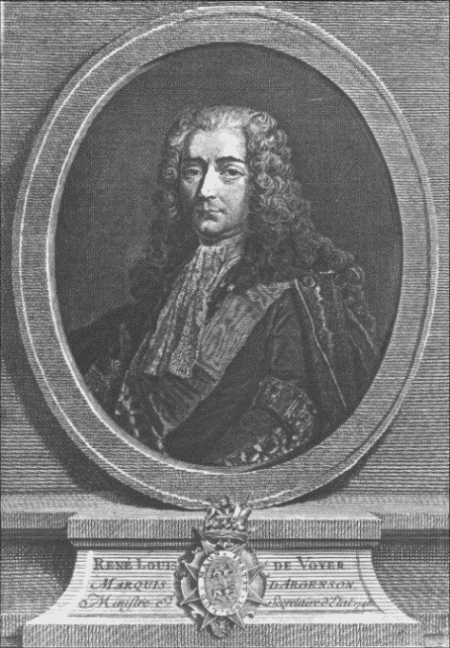
At the end of 1740, d'Argenson had succeeded his brother as chancellor
of the Orleans household;[257] in November 1744, he was invited to accept
a place in the Government as Minister of Foreign Affairs.[258] His
brother, Count d'Argenson, was already Minister of War, and since the
dismissal of Amelot in April, had been signing the despatches of the
Foreign Office.
The appointment of a man without any diplomatic experience or high
official knowledge to what was, in the circumstances of the moment,
the most important position in the Ministry, might well, at any other
period, have given occasion for remark. At this time, however, the
Government was peculiarly constituted; its policy was dictated by
Marshal de Noailles, who had no official position; and
all that was required of the new Minister was not
plans or policies of action, but the dutiful deference and docility of
his predecessor. The eyes of Noailles would have opened widely could he
have read some of the pages which the new Secretary had already devoted
to the principles and conduct of French foreign policy.
D'Argenson's ministry lasted rather more than two years, and came
to a close in January 1747. The period was an eventful one; and our
knowledge of it is derived from diplomatic correspondence in every
capital in Europe. The evidence has been digested in several important
works, notably the elaborate study in four volumes by the Duc de
Broglie,[259] and the comprehensive monograph by M. Edgar Zevort.
These works are valuable and authoritative, but their conclusiveness
may be disputed. There are many suggestions with which any one who has
made a close personal study of d'Argenson may find it difficult to
agree; while the divergencies of detail, and sometimes of conclusion,
between the two writers, the admirably chosen series of documents given
by M. Zevort, and, above all, a careful acquaintance with d'Argenson's
own Journal for ten years before, suggest the necessity and afford
ample scope for some independent criticism. It would seem, indeed,
that these works have been undertaken primarily with a view to the
general history of France; and that no adequate effort has been made to
determine d'Argenson's real share in
the events for which he bears the official
responsibility. There is only too good reason to know that in many
critical conjunctures, the foreign policy of France was only pursued
because the Foreign Minister was powerless to avert it. Indeed there
is reasonable ground for suspecting that no pains have been spared in
comprehending everything but the Marquis d'Argenson himself; and that,
if the perusal of his official despatches had been illumined by the
study of his unofficial memoirs, the character of his action might have
been explained more naturally than by the suggestion of stupidity or
confusion of mind.
It is true that M. Zevort endeavours to illustrate d'Argenson's
political principles from his own "Essai de l'exercice du tribunal
européen par la France seule;" but it may very well be doubted whether
this piece possesses the importance which has been attached to it. It
was written shortly after, or possibly before, the fall of Chauvelin,
and at least seven years before d'Argenson's accession to the Ministry.
In November 1737, when it appeared in manuscript, France was at
peace, Fleury was still Minister, the war between Spain and England
had not broken out, the old House of Austria was not yet extinct, and
Frederick was still Prince Royal of Prussia. In the interval the face
of Europe had wholly changed. Moreover the "Essai" consists of no more
than half-a-dozen widely printed pages, placed at the end of the 1764
edition of the "Considérations,"[260] and omitted
altogether from that of 1784. It contains a few
loose remarks about Russia and the northern powers, with some views
upon Spain and Austria which are the commonplaces of d'Argenson's
Journal. Almost the only remarkable feature are some significant
words upon the position of England, which show that the shadow of
1763 was already falling across the path of France.[261] Indeed the
piece appears to be really nothing more than a brief academic essay,
written, as we learn from the title-page of the manuscripts in the
Library of the Arsenal, as a note upon St. Pierre's "Projet de la Paix
Perpétuelle."[262] That the author regarded it as of small importance is
clear from his failure to exhibit in his Journal any further affection
for its leading idea, the exercise of international arbitration by
France alone; his subsequent criticism of Fleury is little more than a
consistent denial of it; and we can point to at least one passage where
its central principle is categorically rejected.[263] It is true that the
conception of a benevolent arbitration exercised by France remained as
a shadowy and distant ideal before d'Argenson's mind; but that it had
ever any serious influence upon his practical ideas of policy there is
no evidence to suggest. Even if it be admitted, with M. Zevort, that
these were "the ideas, some ingenious, others chimerical, almost all
beyond realisation, which d'Argenson nourished in 1737," it may be
denied, with some distinctness, that "he brought them to the ministry
in 1744."[264]
It is not here, but in the pages of his Journal for ten years before,
that we must search for the secret of d'Argenson's thought. It is
true that the running commentary upon foreign politics which is here
continued from time to time[265] is, upon a first or a casual reading, as
bewildering as many have found it; but it will appear upon study and
reflection, that the writer's views, many-sided as they are, revolve
about half-a-dozen leading principles, which perpetually recur, are
immediately recognised, and from which the author never materially
swerves. These principles are based upon profound thought and mature
research; and the divergence of view which is superficially apparent
is due to their constant adaptation to the circumstances of the moment
as affected by fortune or failure, success or reverse. There is no man
to whom inconsequence of mind has been more speciously imputed than to
d'Argenson, and surely none who has deserved it less.
The ideas which d'Argenson did bring to the Ministry must be set forth
as briefly as clearness will allow.
He held that in the dealings of a great nation, the profoundest
principle of policy was simple straightforwardness, and that France was
in a condition which enabled her to apply that principle with effect.
Her legitimate expansion was already complete; she had nothing further
to gain by aggression; and her statesmen should be henceforth as
careful for the extension of her prosperity as they
had hitherto been for the extension of her borders.
It was necessary to allay the inveterate distrust awakened in Europe by
the designs of Louis XIV., and by the junction of the Bourbon houses.
The alliance with Spain was of doubtful advantage; and it was the
interest of France, while remaining on the most friendly terms with
that power, to discountenance, and if necessary to repress, the Spanish
ambitions in Italy. At the same time, every support should be given to
Spain in her resistance to the commercial aggrandisement of England.
While abstaining from aggression, France, in accordance with her
traditional policy, should lose no opportunity of destroying the power
of the House of Austria in Germany; the death of the Emperor Charles
VI. should be made the occasion for a partition of the Austrian
dominions;[266] and the influence, and if need be, the arms of France,
should be used in favour of the various pretenders.
Every effort should be made to strengthen the position of the smaller
powers, le tiers parti, as a counterpoise to the influence of Hapsburgs
and Bourbons alike; the movements of Sardinia, Bavaria, Saxony, Poland
and Prussia in the direction of independence, should receive the
encouragement of France.
The designs of Russia should be held in check
by an defensive alliance with Sweden and Denmark.
As regards England, France should make no attempt to force the
Pretender upon an unwilling people; but she should resolutely resist
the efforts of England to establish a commercial monopoly, and declare
war rather than allow the seizure of the Spanish colonies in America.
The means were to be found in the withdrawal of Holland from English
influence, support of the colonial policy of Spain, and above all, the
restoration of the French marine in view of a great maritime war.
Not the least admirable object which a statesman could embrace would
be the expulsion of the Austrians from Italy, and the surrender of
the whole peninsula to an Italian confederation. The project in
truth was an ideal one; but it was commended by its apparent ease of
execution—already proved by M. Chauvelin[267]—and by the severity of
the blow it would inflict upon Austria.
Behind all was the fact that the French provinces were in a critical
condition; and every livre spent in war, and every man lost in battle,
were spent and lost at the expense of the provinces. The paramount need
of France was ten years of peace, retrenchment, and reform.
Such are the main principles of d'Argenson's political theory. In his
Journal for ten years past it is possible to watch them, not in a very
meagre reduction to their lowest terms, but as in process of growth,
and of adaptation to an ever-changing
variety of mood and circumstance. This variety of view, at first the
source of continual embarrassment, becomes at last our surest guide;
for it reveals the most intimate turn of d'Argenson's thought; and
it enables us to divine the aspect from which a particular question
is likely to be regarded, his probable choice between alternative
courses, and the principles upon which the difficulties of the moment
are likely to be resolved. One further reflection the Journal suggests.
The tenacity with which these leading principles are maintained is only
equalled by their rapidity of adaptation and clearness of grasp; nor
can we avoid the suspicion that if the action of the French Foreign
Minister should appear to be characterised by a strange inconsequence,
the cause is to be sought elsewhere than simply in his own bewilderment
and confusion.
Before proceeding to consider that question, a word remains to be said
about a few of the men with whom d'Argenson was soon to be engaged.
He was already well known in the diplomatic circle at Paris, and with
two, at least, of its leading members he was upon intimate terms. One
of them was the Marquis de Valori, the French envoy at Berlin, whom
d'Argenson had introduced to Voltaire as early as 1739;[268] the other
was the ambassador of Holland, M. van Hoey. Van Hoey was a man after
d'Argenson's own heart. He sought, in sympathy with his friend, to
raise the tone of politics, its huckstering pettiness of means
and motives, by a certain philosophy of his own,
a philosophy which is not more visionary than most things good, nor
more ridiculous than most things noble, but with which the man of the
world will refuse to meddle, and at which "le peuple petit-maître," in
d'Argenson's words,[269] will go on laughing to the end of time. Before
the minister had attained his present position, Van Hoey had esteemed
his person and valued his advice; and in the previous year (1743) he
had even transmitted to the Hague a long account of a conversation with
"un seigneur," whom no one who has read a hundred pages of d'Argenson's
writing will have any difficulty in identifying.[270]
There was another personage in the forefront of politics, whose career
d'Argenson had not watched in vain. The Prince Royal of Prussia had
gone far since the spring of 1739, when the friend of Voltaire was
privileged to receive his letters. Time had made little impression upon
d'Argenson's first estimate of him. He admired his devotion and his
strength of character; and he had even some kindness for that 'splendid
mendacity' to which Anti-Machiavel had been converted by events. It was
to no childish sentiment of hero-worship that his regard was due; but
to a firm and surely reasonable conviction that Frederick was strong
enough to afford to be honest, that such a man did not make engagements
which he would be glad to repudiate, or break his word when he could
possibly help it. He felt that now, as at Frederick's
accession,[271]
his interests were coincident with
those of France; and that the King of Prussia had only to be treated
with honesty and supported well, to prove the soundest ally in Europe.
On the 15th of November, 1744, a proclamation was issued[272] directing a
general thanksgiving for the capture of Fribourg, the recovery of the
King, and the successes of the late campaign. Three days afterwards
d'Argenson became Minister of Foreign Affairs.
The fall of Fribourg closed the events of the year in Alsace. Thither
in August the King had hurried from Flanders upon hearing that as
Frederick had predicted, the Austrians, under Prince Charles of
Lorraine, had crossed the Rhine and were ravaging French territory.
Louis had no sooner arrived than he was stricken down with fever at
Metz; while, through the culpable negligence of his generals Noailles
and Coigny, the Prince of Lorraine had been allowed to escape and
to join the resistance to Frederick, who had again drawn the sword
against Maria Theresa, and had fulfilled his promise of the Treaty
of Frankfort (1st June, 1744) by a dashing descent upon Bohemia. His
communications were threatened by the return of Prince Charles; Prague
was evacuated by the Prussians, and Frederick withdrew with all his
forces into Silesia. He was weary of the war, which had long been
utterly objectless; he saw clearly enough that its further prolongation
could only postpone what it could not prevent, the
eventual triumph of Maria Theresa; he would have
been glad to escape upon any terms which would leave him in possession
of his hard won conquest. On the 26th of November he wrote to Louis
XV., suggesting that negotiations for peace should be set on foot,
demanding nothing for himself, and proposing as a basis the cession of
Upper Austria, and the recognition of the Emperor by Maria Theresa.[273]
To this overture d'Argenson drafted a reply (December 17th). France,
rivalling Frederick in disinterestedness, would be content to provide
equitably for her allies, would renounce her own conquests in Flanders,
and accept the mediation of Saxony. Over this draft was written, "N'
a point servi." D'Argenson, taken aback, and feeling it necessary to
make sure of his ground, requested the King to inform him definitely of
his attitude on the question of peace. In reply he received (December
23rd), a memorandum,[274] in which the King expressed his desire for
peace, deprecated any positive negotiation, and declared that the most
direct way of realising his desire would be by "the most vigorous war."
On the same day Louis wrote to Frederick,[275] discussing the proposals
of the latter, and marking not the least eagerness to second his
pacific designs.
D'Argenson was by no means blind to the meaning of the King's
memorandum. "If the King was animated by the desire for peace, he was
still more so by the love of glory;"[276] he had just
made his first campaign under the auspices of
Madame de Châteauroux; and he looked forward to recovering in Flanders
the easy laurels which had been snatched from him in the previous
year.[277]
D'Argenson feared for the result. His view of the interest of
France was wise and clear. The attempt to humble the House of Austria
had failed;[278] "peace, no matter how it came, was now the principal
object;"[279] the best means of securing it was "to stand upon the
defensive in every quarter with foresight and success."[280] In this way
the Queen of Hungary would be convinced of the hopelessness of her
plans of vengeance, and the opinion of the peace party in the several
courts would have time to make itself felt.[281]
Accordingly, "a few days after" receiving the King's memorandum,
d'Argenson presented to him a memoir, his reference to which is of the
first importance. He proposed that France should confine herself to "a
simple defensive in Flanders, not only for fear of raising a dangerous
storm in that quarter, but in order to throw more weight upon the two
other theatres of war, Germany and Italy. It was in these directions
that the chief objects lay; and so far from being able to carry all
before us, we were not even sure of holding our ground. It was in
Germany that the Queen of Hungary was concentrating her principal
forces, while she left to the maritime powers the task of defending the
Low Countries. In Italy we required to be superior to the Spaniards, in
order to direct
them well."[282] So far as d'Argenson personally is
concerned, the above appears to be the most valuable record to be found
in his ministerial memoirs.
On the 26th of December and the 4th and 8th of January, three letters
were written by Frederick,[283] which show that events are moving
rapidly. He declares that if negotiations are to be undertaken, it must
be done at once;[284] that he has himself to deal with twenty thousand
Hungarians in Upper Silesia;[285] that a strong detachment of Prince
Charles's army is on the confines of Bavaria;[286] and that events of
gravity are only to be averted by the reinforcement of the army of
the Lower Rhine, and the despatch of immediate and effective succour
to the Emperor and the Bavarian army. "At the present moment, these
two positions appear to me of capital importance. They are no slight
reverses of which we are running the risk, but the frustration of all
our present measures, and even of those for the coming campaign."
(January 8, 1745).[287]
The reception which awaited these representations is significant. In
the first days of January, an Austrian force, after repulsing a weak
French detachment, established itself upon Bavarian territory.[288] At
that very moment the Emperor, in reply to his prayers and entreaties,
received a letter[289](January 2nd), in which the French King, with
manifest impatience, declared himself unable to satisfy his demands.
Upon the 9th Louis, in
a reply to Frederick, asserted that there was
no reason to believe that an Austrian advance was imminent,[290]
and declined to pursue further the steps taken in the direction of peace. The letter is described as "très froide et très maladroite" (Zevort).[291]
The inference implied throughout the preceding appears explicitly in a
letter to Frederick of the 19th of January. Drafted by d'Argenson, it was
revised and signed by Louis XV. The two hands and the two policies
are apparent in every line. "Our union, our strength and our efforts,"
d'Argenson wrote, "give us promise of victory and peace." Under the
hand of the King it became "must give us victory." As to Bavaria and
the Lower Rhine, "I am thinking of these two objects;" Louis appended,
"without forgetting Flanders." To the last line this odd dualism is
continued.[292]
This letter was written on the 19th of January. On the following
day a new chapter was opened with the death of the Emperor Charles
VII., after an illness of twenty-four hours.[293] So far, two months of
d'Argenson's ministry have elapsed. Their history has revealed one fact
with impressive clearness. Upon the question of peace and the question
of war, there is a radical divergence of principle and policy between
the French Government and the French Minister. The King will listen
to no overtures which may thwart his desire of overrunning Flanders.
D'Argenson is earnestly
desirous of peace, to be secured by a strong
defensive campaign in Germany. Which was the wiser will soon appear.
The death of the Emperor (January 20, 1745) was perhaps one of the most
terrible blows which French policy has ever sustained. It came at a
moment when fortune had turned to the side of the Austrians, and when
every step lost by France was a tenfold gain to Maria Theresa.
Louis XV. had been disposed for war; he found that he had no longer
the power to choose. It is true that for the French ministry there
were two conceivable courses; but only one was practically open. It
was conceivably possible to make terms with Maria Theresa, and to use
the death of the Emperor as an excuse for withdrawing from the war.
Such doubtless was the view of the trampled German populations and of
the tax-burdened householder of the faubourgs; but it could only be
maintained by sacrificing every principle of honour and policy, and by
ignoring the only considerations which would weigh for a moment either
with Louis XV. or Maria Theresa.
For the French King the course was marked out with terrible clearness.
He had combined with other powers to rend the inheritance of a
defenceless woman; and now, when that woman had faced him, uncrowned
but veritably imperial, to beg forgiveness on his knees—the very
thought was impossible. Nor could the King of France yet bow before
his former vassal of Lorraine. Even if his enemy deigned to listen to
him, he
would have to take or leave humiliating terms; and it would
be a cold return for that generous jubilation with which his people
had greeted him a year before. But not only were his own honour and
popularity concerned; there was another motive, to which he perhaps
may have been less sensible. To accept a peace upon any such terms as
Maria Theresa would be willing to grant would have been to inflict a
blow upon the future of French foreign policy, from which it might not
recover for half a century or more. The last would have been seen of
French influence in Central Europe: the upstart of Brandenburg would be
swept into the sea: two centuries of effort might be totally erased:
and Maria Theresa would resume the throne from which Charles V. had
descended. If not to the King, to d'Argenson at least, such a prospect
was at once conclusive.[294]
And when looked at from Vienna, peace was equally distant. As well seek
to recall a falcon striking its prey as to breathe of peace to Maria
Theresa. A statesman to her finger-tips, she saw at once that the two
objectives of the next campaign were Frankfort and Breslau. Her armies
were already on the plains of Breslau: her armies were within striking
distance of Frankfort: if but for a few months the breeze would hold,
the Flemish towns might fall to whom they pleased. And the path of
victory was the path of vengeance. She regarded the man who had failed
to wrong her, not, as is said, with the spleen of a woman,
but with the proud wrath of a queen; she had not
forgotten that he had driven her from her capital, and forced her
to throw herself on the generosity of the men her own fathers had
oppressed; nor would she have been slow to tender him the bitter cup
from which she had drunk.
She might indeed have listened to him upon one condition—the
abandonment of Frederick to her vengeance. In June last she had sworn
that she would never lower her sword against the man who had torn up
the Treaty of Breslau, until her generals could dictate terms to him
from Breslau. Proposals on behalf of Frederick—she would have trampled
upon them, as she trampled upon the Treaty of Hanover in August, when
presented to her by her ally of England. In a word, the French King had
to choose between indelible dishonour and the disdainful rejection of
his terms.
If these reasons were decisive to the King, they were not less so to
d'Argenson himself.[295] No man longed so much as he for peace; but he
was not prepared to purchase it with the humiliation of his country,
and with the undreamed aggrandisement of that hated House against
which, all his life, he had consistently inveighed. The provinces were
henceforth to be beaten with scorpions; for the efforts of France had
been as nothing to that which the new enterprise would involve. Yet
cost what it might, the effort must be made; and d'Argenson was at
one with the Council[296] in the hope that by a single brilliant and
advantageous
campaign, France and Frederick might establish a position from which an
honourable peace could be obtained.
The first necessity was to restore to their cause the moral basis which
had been struck from beneath it by the death of the Emperor. Henceforth
the pretext—for it proved to be little more—was to vindicate the
liberty of election, and to support a candidate acceptable to the
Electors. For the candidature of the Empire, the choice fell upon
Augustus III., Elector of Saxony and King of Poland, who at this very
time (January, 1745) was negotiating a secret treaty with Maria Theresa.
At this juncture, whatever may be said of it afterwards, the Government
acted with promptitude and determination. Before ten days had elapsed,
the position which seemed to Frederick "une crise terrible" had been
faced, the débris of a great policy had been swept to one side, and
before a courier could go and come between Paris and Berlin, the new
measures contemplated by the French Government were announced to
Frederick.
In a letter of the 31st of January—if not before it—d'Argenson
declared that "at the present moment the very idea of peace must be
forgotten," and the most strenuous steps must be taken to secure the
alliance of the King of Poland.[297] This policy was reiterated in
letters of the 1st and 4th of February;[298] and from now until the eve
of the election at Frankfort, a desperate effort was maintained
to induce Augustus to abandon Austria,
and to declare himself a candidate for the Empire.
The conduct of the negotiations fell into the hands of d'Argenson.
His own share in the policy is difficult to determine. He knew there
was really no choice; but he could not help seeing that on every side
it was beset with difficulties. It was true that the King of Poland
could scarcely resist the magnificent prize held out to him; and it
was not to be supposed that mere personal animosities could obliterate
every consideration of interest and honour. In that view the Minister
concurred with the Council; and he was supported by Valori,[299] the
French envoy at Berlin, who was deputed to approach the Court of
Dresden. To French statesmen the opinion was just and natural enough.
Yet d'Argenson at least, though he viewed them undaunted, was by no
means blind to the difficulties in the way. The jealousy of Russia in
regard to Poland, the formidable rage of the Queen of Hungary, and
above all, his hatred and jealousy of the King of Prussia, would all
combine to deter Augustus from committing himself in the interest of
France. Indeed so small was d'Argenson's confidence of success, that he
was unwilling to follow the Council in their resolution to subsidise
the King of Poland, and to guarantee to him by treaty an accession
of territory to be obtained at the cost of Maria Theresa.[300] However
unpromising, the negotiation had to be begun; there
was no alternative; and if it came to nothing more,
it would at least give time for the development of a campaign, and for
the armies of France and Prussia to achieve a position which would
serve as the basis of an honourable peace.[301]
If at Paris the plan seemed practicable enough, at Berlin it was
regarded from a very different standpoint. French statesmen could
consider nothing but the strength of their four armies, the excellence
of their intentions, and the splendour of the position to which
Augustus would be raised by the arms of France and Prussia. To
Frederick the matter presented itself in a less encouraging light. He
knew his neighbour of Saxony; he knew that Augustus had no resources
of his own; that his ministers were in sympathy with Austria and in
the pay of England; and that what might leave Paris as the offer of
an empire would reach Dresden as nothing more than an invitation to
Augustus to throw over a sound alliance, to place himself at the mercy
and become the tool of a covert enemy and a doubtful friend, and in a
word, to resume the position from which Charles VII. had been happily
liberated by death. Frederick saw at once that the French policy
was foredoomed, and he did his best to impress upon the cabinet the
fruitlessness of its task.[302] Finding his representations received as
merely the suggestions of prejudice and jealousy, he had no alternative
but to give way; and on the 13th of February[303] he announces that he
has "buried his resentment,"
and sanctioned the departure of Valori for Dresden.
Frederick was perfectly confident that Valori could only fail;[304] and
he felt that any apparent success which he might gain, would be by
no means useless in another direction in which his own efforts were
actively engaged.[305]
If the hopes of France were illusory and her policy unsound, they were
certainly not more so than the course which Frederick had himself
adopted. On the 26th of January, before any definite communication
had reached him from the French Government, he had instructed his
representatives to sound the ministers at London and the Hague;[306]
for a consideration received he offered to withdraw from the war,
and to co-operate in the election of the Grand Duke. His agents were
instructed to press these proposals.
That Frederick could have had any real confidence in these measures,
it is difficult to believe. It is true that in England the Hanoverian
party was no longer in power; but George II. was bent upon the war,
and Carteret's influence was still supreme; moreover, popular feeling,
while demanding a change in the direction of the war, was by no means
in favour of its abandonment. Whatever the dispositions of the English
ministry, from Maria Theresa there was nothing to hope. Indeed the
whole plan was a counsel of despair. Frederick had everything to gain
and absolutely nothing to offer; he had incensed the whole of the
Austrian party; and if there were no motives of
interest to aid him, he could scarcely trust
to motives of charity. Indeed the whole situation is summed up in
some words of Chesterfield to the Prussian minister at the Hague: "I
understand," he said, "the truth is you ask everything and you offer
nothing, for Silesia is no longer yours, since you have yourselves torn
up the treaty which gave it you."[307]
It is easy to see the very natural motives which actuated Frederick
in the adoption of his policy.[308] On the 31st of January, before
the measures contemplated by the French Government had yet been
communicated to him, he wrote to Louis XV. describing the position of
their cause in Germany in terms of very real concern. He spoke of the
utter dejection into which their allies had been plunged by the death
of the Emperor, and of the favourable positions secured by the Austrian
party; and he declared that only by the immediate reinforcement of
the French army in Bavaria could the young Elector be prevented from
"throwing himself into the arms of the Queen of Hungary."
It was probably with some surprise and not a little relief that he
received the news of the French determination to continue the war.[309]
He was already, as we have seen, in communication with London and the
Hague; but he could not help feeling how slender was his hope in the
intervention of the maritime powers; and he was wise enough to know
that peace, when it came, would
be the less precarious for being secured by a
successful campaign.
That this was his feeling in the matter is clear from the attitude
he maintained towards France during the next two months. While
hoping desperately for the intervention of England, he neglected no
opportunity of concerting measures for the future of the war. Until
the re-opening of the campaign in Flanders, Louis XV. was besieged
with letters, memoirs, requisitions of all sorts, demonstrating
with unfaltering precision the critical positions which had to be
maintained, and insisting upon the only measures by which the French
policy could be carried to success, and the French allies preserved
from ruin. He made it clear[310] that a majority in the Electoral
Diet could only be secured, and the influence of the Austrian party
destroyed, by the most vigorous action on the part of the two French
armies in Bavaria and on the Main.
It had not remained for the King of Prussia to indicate the only
means by which the French policy could be executed or excused. Even
before the death of the Emperor, as we have seen, d'Argenson had
been convinced that the readiest way of obtaining peace was not by a
brilliant invasion of Flanders, but by a strong defensive campaign
in Germany.[311] He now saw that every consideration in favour of his
policy had gained tenfold in weight; and about the middle of February,
probably upon hearing of Valori's difficulties
at Dresden, he presented to the king a certain
memoir setting forth a plan for the future campaign.
This memoir is of the last importance.[312] It strikes the key-note of
d'Argenson's conduct during the year 1745; it illustrates, as nothing
else can do, his real position in the Ministry; and it alone can
explain his subsequent attitude with regard to Frederick and Prussia.
As this document is very rare, and as it only exists by a fortunate
accident, it will be advisable to reproduce it entirely as it stands;
its meaning is too precious to be even prejudiced by an attempt at
translation. No apology will be found necessary for its inclusion here.
It runs:
"SIRE,—Depuis deux mois[313] je suis assez au fait de
la combinaison de nos forces sur les quatre théâtres de guerre où
V.M. a des armées présentement prêtes à entrer en campagne, pour
critiquer les positions relativement à la politique et pour vous
donner mon avis.
"Les Pays-Bas, où V.M. va commander son armée, ne sont pas l'objet
principal de cette guerre; je crains que les flatteurs et les
gens intéressés à faire paraître des opérations militaires plus
brillantes que solides, n'ayent conseillé à préférer ce côté-là à
d'autres. Vous y occuperez, il est vrai, les forces des puissances
maritimes, et quelques-unes de l'Autriche; mais ce n'est qu'une
diversion; et l'on ne recourt aux diversions que quand on ne peut
aller directement à l'objet principal.
"Si V.M. y a des grands succès, je veux qu'elle puisse pénétrer
sous peu en Hollande, et qu'elle châtie par là les Hollandais de
leur ingrate témérité; mais cela ne nous donnera pas la paix;
et pour comparer le présent au passé, c'est convertir la belle
position que nous donna la paix de Nimègue en
la vaine entreprise du feu roi en 1672 quand il pénétra en
Hollande.
"L'année dernière, Votre Majesté ayant débuté par des conquêtes
en Flandre, il fallut retourner en Allemagne. Alors c'était le
passage du Rhin par le prince Charles qui y obligeait; cette
année-ci ce sera l'élévation du grand-duc comme empereur qui y
forcera.
"L'objet principal est l'Allemagne; tout en dépend, même
l'établissement de l'infant don Philippe en Italie. Pour parvenir
à la paix, Votre Majesté a trois objets à soutenir: (1) de
maintenir le roi de Prusse en Silésie; (2) d'empêcher l'élection
du grand-duc, et de procurer l'élection de la couronne impériale
au roi de Pologne avec une grande facilité; sans quoi, il n'en
acceptera même l'idée; (3) un établissement pour don Philippe,
quel qu'il puisse être. Pour cet effet, il faut que nous nous
soutenions puissants en Allemagne, et que nous tâchions d'y donner
la main au roi de Prusse.
"Les quatre théâtres de guerre, où opèrent nos quatre armées,
sont celle de Flandre, celle de Mein, celle de Souabe, et celle
d'Italie.
"Je serais d'avis que V.M. ne fît qu'une défensive en Flandre,
sous les ordres du comte de Saxe, qui s'y entend si bien, ainsi
qu'il a paru à la fin de la dernière campagne.
"En Italie encore une défensive, malgré ce qu'en pourront dire
les Espagnols, pour bien assurer les Gênois, les mettre à l'abri
de toute attaque, défendre par là le roi de Naples, et tenir en
échec le roi de Sardaigne, qui même ne pourra se soutenir à la
longue, s'il n'est point soutenu des Autrichiens; et si l'on
trouve jour à entamer le Piémont, qu'on y avance autant qu'on
pourra; qu'on avance dans le Milanais et le Plaisantin, si l'on
peut; mais qu'en Allemagne nous faisions nos plus grands efforts.
"Que Votre Majesté se porte incessamment à Strasbourg avec son
équipage de guerre, pour aller ensuite commander celle des deux
armées, qui promettra d'avoir le plus de succès et de sécurité
pour la personne sacrée de Votre Majesté.
"Celle du Mein, sous les ordres du Maréchal de Maillebois,
a commencé à pousser l'ennemi. Je serais d'avis qu'on lui
continuerât ce généralât. Elle pourra aller jusqu'en Westphalie
et à Hanovre. Celle de Bavière doit être rassemblée
incessamment, avec des magasins à vos dépens, puisque l'électorât
de Bavière n'en peut fournir. Il faut la mettre en état de faire
le siège d'Ingolstadt, resserrer nos quartiers, et allant du Leck
à Passau elle pénétrera en Autriche et donnera la main au roi de
Prusse.
"Comptez, Sire,[314] que ce puissant allié sortira de sa défensive;
qu'il ira en Bohême, en Moravie, et même en Autriche, s'il se
peut, quand nous lui montrerons si bonne exemple. Avec cela Votre
Majesté soutiendra ses alliances et même les augmentera. Le
Palatin, la Hesse, la Bavière nous seconderont; et la Saxe même,
assurée de nos succès, n'hésitera plus d'accepter la couronne
impériale. Au moins retarderons-nous cette élection, et elle
sera le scéau de la paix. Si au contraire, nous n'envisageons
que la Flandre comme objet principal, et que nous négligeons
l'Allemagne, nous perdrons tous nos alliés, les unes après les
autres, et notre ennemi sera élu empereur sous nos yeux."[315]
There are many striking suggestions to be found in this memoir; but it
may be scrutinised in vain for any evidence of that doubt, hesitation,
looseness of grasp, by which d'Argenson's conduct is too readily
explained; while, on the contrary, we have only to read it in the light
of the measures actually taken by the French Government to detect the
real foundation for those charges: and to know how much weight it is
necessary to attach to them in so far as they concern the Marquis
d'Argenson.
We have only to read the above memoir with any of those prepared by
Frederick, and to sketch the chain of circumstances which took Louis to
Fontenoy, to be in possession of all the threads of
the long complication of 1745.
In a memoir of the 6th of March,[316] Frederick represents that if
the election of the Grand Duke is to be prevented, a majority in
the Electoral College must be regained; if that is to be done, the
communications between Hanover and the three ecclesiastical Electorates
must be severed by the vigour of the army of Maillebois; and the
decisive movement must come from the army of Bavaria, which, under
vigorous command, must capture Passau, march upon Vienna, and by
drawing off the Austrian troops, throw open Moravia to the Prussian
army. He does not mince the meaning of his proposals.
"If another course is taken in this war, the King of France will
reduce his allies to the necessity of withdrawing from it as best they
can; for there must be a prompt end to this, and the matter must be
decided one way or the other before the imperial election."[317]
Frederick's communications
with the French Court are one long reiteration of this demand. Never
did a man plead more eloquently the cause of reason and manliness; and
never was eloquence more desperately sincere.
The action, not of the French Minister, but of the French Government,
is almost incredible. They had deliberately embarked upon a great
policy, and they deliberately refused to take a single step by which it
could be realised. All that depended on d'Argenson indeed, was done
as strenuously as man could do it. He exhausted
himself in efforts to win over the King of Poland, trampling down
or shutting his eyes to the obstacles which faced him; and he never
relaxed in his entreaties to Frederick to second his efforts at
Dresden.
"Will your Majesty consider that by this alliance, if it
should ever take place, we should become absolute masters of the
situation."[318]
... "If your Majesty cannot lay aside the feelings which
alienate him from the King of Poland, I see only the prospect[319] of a
long war, the Grand Duke Emperor, and the Empire turned against us,
whatever efforts we may make."[320]
D'Argenson might beg and entreat, and write despatches: but he was
powerless to enforce his words with the weight of his little finger.[321]
On the 10th of March he drafted a reply to Frederick, in which he
undertook that the army of Bavaria should be reinforced and should push
the war with vigour. The reply never went to Berlin; it remains marked
with the words "n'a pas servi."[322] Indeed the French policy was already
decided. For no political reason whatever, the King had set his heart
upon a campaign in Flanders; and to that desire his own interest, the
interest of his allies, and every statesmanlike consideration must
of necessity yield. He was not likely to meet with resistance from
Noailles, still less from Count d'Argenson or Maurepas; and the Foreign
Minister stood alone in fruitless opposition to this brilliant piece of
political fatuity.
The effects of it were apparent already. The arms
of France were paralysed in Germany in order that troops might be
concentrated in Flanders; the army of Bavaria could not be reinforced;
little could be done for the army of the Main; and d'Argenson, while
persistently demanding ready co-operation in his overtures at Dresden,
was obliged to evade and trifle with the equally persistent demands of
Frederick. His position was a very thankless one; and it would have
been as ridiculous as it at first would seem, had it been of his own
choosing. That it was not, there is ample evidence to prove.
From this anomalous disposition of the French Government the four
decisive events of the year 1745 descend in lineal succession. Each
was a political disaster of the first magnitude; every one of them was
richly deserved, and not one was really attributable to the Minister
who has ordinarily borne the burden and the blame. Those events
are—first, the loss of Bavaria; second, the Convention of Hanover;
third, the election of Francis I.; and fourth, the Treaty of Dresden.
It was on the 21st of January that the young prince Maximilian
succeeded to the Electorate of Bavaria; on the 19th of April he signed
a convention with Maria Theresa.[323]
The Emperor on his death-bed had adjured his son to rely on the support
of France;[324] and Chavigny, the French minister at Munich, was
ready to assure him that he would never do so in
vain.[325] The Austrian troops were already in Bavaria; repeated warnings
were given both by Frederick and Chavigny of the critical position
of the young Elector; and every means of persuasion was exhausted by
Chavigny in order to secure the reinforcement of the Bavarian army.
The French Government were deaf to his representations; the Council
rejected d'Argenson's despatches;[326] d'Argenson himself was at last
irritated at the reiteration of demands with which he had no power
to comply.[327] Chavigny had to pacify the Elector with promises and
assurances, in default of troops.
In the meanwhile no effort was spared by Maria Theresa to detach the
Elector from the League of Frankfort.[328] Her diplomatic agents were
Colloredo and Count Batthiany. Colloredo negotiated at Munich with
humiliating terms of peace; Batthiany advanced upon Munich with an army
eleven thousand strong, before which Ségur, with a small French force,
had withdrawn to the Bavarian frontier. Accordingly, Chavigny and the
Elector fled to Augsburg, where, on the 19th of April, a treaty of
peace, dictated by the Austrian envoy, was signed by Maximilian.
The event of the 19th of April was the signal for what M. de Broglie
himself calls "the breakup and rout of all that in a greater or
less degree was still holding to France."[329] The Prince of Hesse, the
Elector Palatine, the Duke of Wurtemburg,
and the Electors of Trèves and Mayence were at no pains to conceal
their view that the French cause in Germany was lost; while the Elector
of Saxony, Augustus himself, the very man upon whom for three months
the efforts of French diplomacy had been centred, made haste to summon
the troops of France to withdraw from the soil of the Empire, where
there remained no excuse for their continued presence.[330]
Such was the disaster d'Argenson had foreseen and endeavoured vainly
to avert. He is said[331] to have cherished with blind fatuity an
unfounded faith in the fidelity of Bavaria. That faith was more than
justified, if we are to believe Chavigny, who said that up to the very
day when the unhappy Elector was forced to abandon his capital to the
Austrians, he remained firmly attached to the French alliance.[332] The
truth is this: that not only at Munich, but at Dresden and Frankfort,
d'Argenson's action must appear ridiculous; because, while prosecuting
his negotiations with energy and enthusiasm, he was unable, through no
fault of his own, to give them the weight of a single cannon-shot. In a
word, the bold policy of the 31st of January, while actively prosecuted
by the French Minister, was tacitly abandoned by the French Government.
Of that fact Frederick needed no further evidence than the Convention
of Augsburg. His mind was made up. He saw at once that the real object
of that Government was, not the
protection of German liberties, not the election of the King of
Poland, not a decisive war and an honourable peace, but simply a
holiday campaign in Flanders. He was utterly exasperated by the vain
selfishness of the French policy, while his impatience at its continued
tenderness for Saxony mounted to the brim.
"We are on the eve of a new war," he wrote to Louis XV., a fortnight
after the loss of Bavaria, "and what I want to know is this: Is Your
Majesty going to declare himself for a prince who is giving auxiliaries
to the enemies of France, or for the man whose diversion disentangled
Alsace; does Your Majesty prefer the artifices of a crafty and secret
enemy to the frankness of an honest friend, who has drawn upon himself
the whole burden of the war, and whose provinces are now only being
ravaged in order to secure the sweets of tranquillity to the subjects
who live under French dominion. In a word, I must know if the justice,
the honour, the generosity of Your Majesty can consent to leave me
without the real assistance which He is bound by treaties to render,
and to sacrifice me to a prince who has dethroned Your Majesty's
father-in-law, a prince who is sold to the enemies of France, and who
is only awaiting the favourable moment to give vent to his hatred and
animosity against her."[333]
He gives the French king to understand that for the purposes of the
common cause, the siege of Babylon will be as useful as the siege of
Tournay;[334]
and in despair of producing any effect, he concludes:
"It is simply in the force of his own arms and in the fortune of
battles that the King of Prussia puts his greatest trust, in the hope
that the goodness of his cause and the valour of his troops will never
fail him."[335]
He sees but one remedy for the crisis produced by the loss of
Bavaria—the immediate invasion of Hanover by Conti, with the army of
the Main.[336]
This advice was a marvel of astuteness. He saw that with the
abandonment of France he had nothing further to hope from the war;
and that his only resource lay in bringing pressure to bear upon the
maritime powers, and extricating himself as best he could. He proceeded
to do so, needless to say, without the least compunction. To Frederick,
the difference between the open rupture of an alliance and the tacit
abandonment of an ally, was one for a casuist and not for a statesman.
Events deepened his determination. Decided by the fall of Bavaria,
Augustus on the 18th of May had ratified the Treaty of Warsaw arranged
in January with Maria Theresa;[337] and on the 4th of June, a combined
army of Austrians and Saxons strayed into the "trap" which Frederick
had spread for them at Friedbourg.[338] On the 11th of May, Louis XV.
had reaped the utterly vain glory of Fontenoy; and shortly afterwards
Conti, upon the Main, received orders to detach twenty thousand men for
the army of Flanders.[339] The Statesman at
Vienna seized the opportunity to unite her armies
in Bavaria and Franconia, and Conti, menaced by superior forces,
withdrew with his troops beyond the Rhine.[340] There was not a Frenchman
left in Germany; and the army of the Empress closed round Frankfort.
At the end of an ironical letter of compliment to the French king,
Frederick writes (August 25th):
"It is a pity that in such a fine picture there should be one blot to
spoil it a little. I speak of the retreat of the Prince of Conti. It
is he who crowns the Grand Duke, and places Your Majesty's allies in a
desperate and fatal position."[341]
From that position Frederick was determined to escape; but his success
would have been more than doubtful, were it not that at this very
moment, a critical conjunction of untoward events softened the obduracy
of George II. The French advance in the Low Countries, the clamour of
the peace party, and above all, the sweeping success of the gallant
Prince Charles Edward, forced King George to listen to terms.[342] If the
English troops were to be withdrawn from the Continent, Hanover could
not be left at the mercy of Frederick; and only by the suspension of
arms in Silesia, could a force be drafted from the Austrian army to
relieve the English in the defence of Flanders. A determined effort was
made to induce Maria Theresa to consent to a pacification. She would
have nothing whatever to do with the traitor of Brandenburg; nor would
she listen to any proposal which would
involve the withdrawal of a single man from the
Silesian frontier.[343] In the meanwhile time pressed; Charles Edward was
marching on Edinburgh; and on the 26th of August, the King of England
signed the Convention of Hanover, guaranteeing, for himself and his
allies, the suspension of the war and the maintenance of Frederick in
Silesia.[344]
If Maria Theresa had rejected, three weeks before, the proposals
presented to her by her ally of England, she was not more likely to
recognise the Convention signed by England upon her behalf. On the very
day when Robinson, the English envoy at Vienna, endeavoured to obtain
her acceptance of a treaty which snatched her enemy from her grasp,
she received the news[345] that the long conflict she had maintained so
manfully had ended at last in triumph, and that her husband, the Grand
Duke of Tuscany, had been elected Emperor at Frankfort.
This election took place on the 3rd of September. It shattered once
for all the diplomatic combinations which the labour and enthusiasm of
d'Argenson had endeavoured singly to sustain. To crown the catastrophe,
he was abandoned by the man to whom everything had been sacrificed;
for the King of Poland, a few days before, declared in favour of the
Austrian candidate.[346] At the very moment of this palpable collapse of
French influence in Germany, the air became heavy with rumours of the
withdrawal of Frederick from the French alliance.
It is no easy matter to determine d'Argenson's real share in these
events; but it seems clear that whatever tone be assumed in regard to
it, it cannot be that of harsh contempt.
At a terrible crisis in the beginning of the year, he had acquiesced
in the adoption of a daring policy; he had discerned the measures by
which alone that policy could be realised; and he had endeavoured,
in conjunction with the greatest of the French allies, to enforce
them upon his colleagues. He had seen those measures, one by one,
deliberately and wantonly rejected; and the policy which could only
be maintained by a couple of armies was left him to support without a
single man. Inevitably his time was spent in apprehending disaster, in
futile attempts to hamper its approach, and in transparent efforts,
when it came at last, to give it the appearance of success.[347] In a
constitutional government he might have resigned his place, declining
the responsibility for measures which he had no power to control. As
the minister of Louis XV., such a course was impossible. He might again
have refused to pursue his negotiations at Dresden and in the several
Electorates; but to have done so would have been to deprive the French
intervention of its only possible pretext. A third course would have
been to shrug his shoulders, tear up the policy of January last, and
accept his share in the unprincipled by-play which was the only form
that French diplomacy in Germany could reasonably take. He had simply
to choose between
acting like a knave, and looking like a fool. The
qualities requisite for the former part he had never been able to
acquire; and he had a profound faith that knavishness was the very last
attribute of a statesman. In short, his only resource was to believe,
in spite of himself, that there still remained some serious possibility
of success, to shut his eyes to ominous circumstances, and to clutch at
every shred of hope. By dint of trying to persuade others, he succeeded
at last in persuading himself. He lost sight of the fact which had once
been clear to him, that to Frederick mere protestations of confidence,
with nothing to support them, were not worth the paper they were
written on; and he clung to the belief that the suave indecisions of
the Court of Dresden were more than a diplomatic veil for an absolute
refusal. So it was that when the disasters he had foreseen occurred in
due course, he found that it was less easy to accept than to apprehend
the inevitable; and the Treaty of Hanover and the election at Frankfort
came to him as a cruel blow. In a sorrowful letter to Marshal de
Belleisle he says:
"I have received your letter. As to what you say
of me, I must say nothing, and with good reason; I fear your praises
more than any man's, for I know your sincerity. Nevertheless, I cannot
believe that I have the least capacity for affairs, where, up to the
present, I have had so little success."[348]
Knowing as we do in how slight a degree d'Argenson was himself
responsible for these disasters,
we can only be impressed by the touching readiness
with which he was content to accept the blame. For eight months he had
been in as thankless a position as was ever occupied by mortal man. His
representations had been neglected; his despatches had been revised or
rejected by the Council; deprived of means, his enterprises had been
doomed to failure; and it was only by his own enthusiasm and devotion
that they had been maintained so long as they were. If on occasion he
had been blindly credulous, there were occasions when only by blind
credulity could his position be maintained at all.
It was by a courier from the headquarters of Prince Charles's army
that the news of the treaty which guaranteed to Frederick a suspension
of arms was conveyed to Maria Theresa.[349] She at once communicated
with Count Brühl, the all-powerful favourite at Dresden. Immediately
afterwards (September 10th), the Saxon minister placed in the hands of
the French agent a draft of the Convention of Hanover, and gave him
to understand that if France desired to be avenged upon her faithless
ally, she would not be repulsed at Vienna.[350]
The French Ministry was at once placed in possession of this startling
news; and it was resolved, by a majority of the Council, that
negotiations should be opened at Dresden with Maria Theresa.[351] The
feeling against Frederick was at fever-heat.
D'Argenson's time had come at last. He had opposed without success
the resolution of the Council; but his own credit had fallen with the
defection of the man whose fidelity he had guaranteed. Nevertheless, he
knew that persuasion was the least of his resources; and he resolved
that it should be no fault of his if anything came of the overtures of
the Empress.
His position is clear. It was not for nothing that for twenty years
he had studied and thought upon public affairs; he was as deeply
versed in the interests of the kingdom as the rest were skilled in the
intrigue of the Court. The meaning of the Austrian proposals was not
mistaken for an instant. Maria Theresa, roused by the thought that her
enemy was escaping, had resolved to sacrifice her lesser hate; and
by making terms with France, even at the cost of some of her Belgian
provinces, to set free an army, forty thousand strong, for service in
Silesia. D'Argenson knew the meaning of that; it would be all over with
Frederick II.
The prospect suggested two questions. In the first place: Was it just?
Had Frederick deserved the fate to which the French Council were ready
to abandon him? D'Argenson had only to recall his correspondence with
Prussia during the spring, the loss of Bavaria, and the retreat of
Conti, to satisfy himself that if France had at last been abandoned
by Prussia, she had only herself to blame. But there was a further
consideration. Was it wise? and to that question d'Argenson
alone in the French Ministry was capable of desiring or conceiving the
answer. To the rest, to Noailles or Maurepas or Count d'Argenson, the
paltry personality of the month or of the moment, the time-killing,
time-winning shuffle or shift, was the decisive factor in politics.
D'Argenson's statesmanship had a broader base. It had regard, not to
the interest of his place or to the opinion of de Pompadour, but to
the interest of his country and the tradition of Richelieu. He alone
could weigh the gravity of the course the Council undertook so lightly.
He alone could see that so long as the Prussians remained in Breslau,
France would be sure of a powerful ally, and the right hand of Austria
would be paralysed in Europe; while, upon the other hand, if Frederick
were compelled to bow before fate and Maria Theresa, the heiress of
Austria would draw the sword of Charles V. against her own enemy and
the enemy of her House. Months before, d'Argenson had revealed his
feeling in one of those master-sayings of depth and directness, which
only tend to strengthen the belief that his history deserves to be
re-written. At a not dissimilar crisis he declared:
"We must not listen, we must not even permit a word of such a thing. If
the Low Countries were offered to me, I should believe them too dearly
bought at such a price as this. You have to make it clearly understood
that His Majesty is resolved never to stand by and see this prince
despoiled of what has been ceded to him by his treaty with the Queen
of Hungary at Breslau in 1742; and that
His Majesty would prefer to surrender the dearest interests of his
realm than ever consent to allow this prince to be deprived of Silesia
and the county of Glatz."[352]
It is the saying of a man who is not easy to understand, but who is
worth the trouble which the attempt involves. To put his attitude in
a word, he regarded Silesia as strategically the most valuable of the
French provinces. He would have preferred almost to sacrifice Lorraine.
The Council, in arriving at the above resolution, had reckoned without
the minister who was to carry it into effect. At this juncture
d'Argenson found that the very circumstances which had paralysed his
efforts in the beginning of the year were telling powerfully in his
favour; for the anarchy prevailing in the French Government was such
that the only means of positive action open to any of the ministers
was in the frustration of his colleagues' designs. To that task
d'Argenson addressed himself with right good will. In transmitting his
instructions to Vaulgrenant, the French envoy at Dresden, he allowed
him to understand that if he could only succeed in failing, his failure
would not go unforgiven.[353] The Austrian majority in the Council
were by no means unanimous; and their different resolutions were
communicated to Vaulgrenant without the faintest attempt to reconcile
them.[354]
"I agree that the matter is one of some difficulty," wrote
d'Argenson; "M. de Vaulgrenant will get out of it as best he can."[355]
Above
all, he made the ambassador clearly understand
that he was to listen to no proposal which would tend to deprive
Frederick of Silesia, well knowing that with that object only had the
Empress been induced to treat at all.[356] In fact, Vaulgrenant could not
possibly mistake the tone which the minister desired him to assume.
In this enterprise d'Argenson found a powerful ally in the man whom,
in the beginning of the year, he had endeavoured vainly to assist.
Frederick had achieved one of his master-strokes. Upon hearing of the
Convention of Hanover, Maria Theresa had formed a daring design. She
resolved to ignore the approach of winter, and to concentrate her
troops in Saxon territory for a direct descent upon Brandenburg. The
plan was concerted secretly with Augustus, and the Saxon army would act
with the Austrians.[357] At the close of the regular campaign Frederick
had returned to Berlin. His sword had clicked again in the scabbard,
his hand had fallen nerveless from the hilt, when suddenly a stray word
let fall at a dinner-table by Count Brühl was conveyed carefully to
Berlin; tensely the fingers closed upon the hilt, the sword leapt forth
again bare and terrible, and at the end of a three-weeks' campaign,
which we cannot even read of now without dancing eyes and tingling
blood, the lion of Brandenburg entered Dresden.
It was through streets strewn with the red work that the Austrian
envoy, on the verge of desperation, made his way to the house of
Vaulgrenant,[358]
whom he found but moderately willing to listen
to proposals in doubtful favour with the ministry at home, and to
the prejudice of the man who might sleep that night in the capital
of his fallen enemy. The conference was without result; it was never
resumed.[359] Through the combined efforts of d'Argenson and Frederick
the whole negotiation had come to nothing; and Maria Theresa had no
alternative but to sign with Frederick the Treaty of Dresden. By this
treaty the Convention of Hanover was confirmed. Frederick was free to
withdraw from the war, and he was again recognised as sovereign of
Silesia.
This was the last great blow which French policy sustained during the
year 1745. Frederick had broken finally with France. Months before,
when the position had first been suggested by the news of the Treaty
of Hanover, d'Argenson had conceived his policy in regard to it. He
knew better than any man the real causes of Frederick's defection; and
deplore it as he might, he saw no reason for enlisting Prussia among
the enemies of France. He had expressed his thought in a letter to
Belleisle:—[360]
"We must leave him alone; he will remain neutral; he will deceive the
Queen of Hungary as he deceives everybody else; he will continue to
cause her uneasiness until the general peace, and it is his interest to
do so; he will oblige her always to keep an army in the neighbourhood
of Silesia.... We can retain his alliance by interest, or at
least by a certain understanding which prevents him
hurting us, and which will be useful to us in many ways." "In fact, as
he told the Prussian ambassador as soon as the Treaty of Dresden was
known, he regarded Prussia as henceforth the political centre of French
interests in the Empire and in the north."[361]
So concludes this study of the position really occupied by d'Argenson
with regard to the political events of 1745. It is not without reason
that it has been dwelt upon at length; for the period embraced seems
immeasurably the more important of d'Argenson's ministry. The principal
events of the following year are really no more than episodes, loose,
and comparatively of little weight. In 1745 however, we have a long and
connected series of incidents, affording an extended view of the rival
policies; and furthermore, we are brought directly into contact with
the great political question of the day, the question suggested by the
growing change in the relations of the German powers.
Moreover, it is upon his action during this period that the severity
of criticism in regard to d'Argenson's ministry is mainly based. To
accept that criticism as conclusive, it would have been necessary to
obliterate every impression suggested by his life before and after.
There was no alternative but to examine it; and if we have sometimes
been compelled to challenge the positions of MM. de Broglie and Zevort,
it is with a diffidence due to authorities so distinguished. Yet no
diffidence need
disguise the result. So far as d'Argenson
personally is concerned, each historian supplies the material for
questioning the conclusions of the other: and at the same time for
conceiving a third, in harmony with d'Argenson's known character
and opinions. So far as we can see, neither writer has examined
these events with reference to any general scheme of policy in
d'Argenson's own mind; the forms that happened to be impressed upon
that policy by the accidents or circumstances of the moment appear
to have been mistaken for the policy itself—a process which, for a
man in d'Argenson's position, would efface the distinction between
statesmanship and imbecility. Moreover, he has frequently been held
responsible for events over which he had no control whatever; and in
M. de Broglie's case, failure to appreciate or sympathise with him
is aggravated by personal opposition to his measures; and about the
whole account of his ministry, equable as it is, there are unwelcome
suggestions of Marshal de Noailles.
It is unpleasant to seem to speak so lightly of those to whom one
owes so much; and it is no further necessary. The conclusion remains
that during this period d'Argenson had a clear and statesmanlike
policy; that thwarted and crossed at every turn, he did what little he
could to realise it; that he was forced by the defection of his own
government into a false and even ridiculous position; and that, in the
circumstances, he acquitted himself as worthily as any man could be
expected to do.
In the following year, 1746,[362] the course of French foreign politics
is fortunately plain and simple. D'Argenson's position is clearly
marked, and it has been treated with what appears to be substantial
justice.[363]
The year presents three striking episodes. It opens with a strange
attempt and a still stranger failure, it is distinguished by at least
one marked success, and it closes with a curious comedy of intrigue of
which the dénouement was d'Argenson's disgrace.
It was not the chance or the exigency of the moment that led to the
famous Negotiation of Turin. We can scarcely say how long d'Argenson
had dreamed of the liberation of Italy;[364] but for years past he had
clung to the idea with something of the fervour of a religious faith.
It was the one indulgence in the luxuries of idealism of which he
refused to deprive himself. The hope was an inspiring one, and not a
year had elapsed since his accession to the ministry, when he began his
famous attempt to realise it.
The key to the position was held by the King of Sardinia. Sardinia, in
alliance with Austria and in the pay of England, was the great barrier
against the Bourbon advance in Italy. To seduce Charles Emmanuel from
the cause of Maria Theresa would have been to cripple the Austrian
power in Italy; to induce him to turn his arms against his late ally
would have ensured her expulsion from the peninsula. There was only one
danger to be
feared. In Spain, with the Italian branches of the
Spanish Bourbons, the House of Savoy had a deadly enemy; and d'Argenson
had predicted years before[365] that the whole project might be ruined
by the resistance of the Court of Madrid. He was only reassured by
the reflection that in her foreign relations, Spain was ultimately
dependent upon France, and that a French minister of firmness and
courage would be able to bend her to his will.
In September, 1745, d'Argenson approached the Sardinian Government with
certain remarkable proposals. He suggested a territorial re-arrangement
of Northern Italy, the expulsion of the Austrians from the peninsula
by the combined forces of France, Spain, and Sardinia, and the
constitution of the various states as an Italian confederation. These
overtures were coldly received, the Piedmontese minister representing
that their practical effect would be to draw down upon Sardinia the
vengeance of Austria and of the whole Empire. The defeat of Bassignano,
the progress of the Bourbon arms, and the danger which menaced the city
of Alessandria, modified the dispositions of Turin. The negotiations
were resumed; and proceeded so far that on the 26th of December the
partition of territory designed by d'Argenson was accepted by the
Sardinian Government, though the idea of an Italian Confederation was
still repulsed. On the return of Champeaux,[366] the French agent, from
Turin, arrangements were rapidly made for the conclusion of the treaty;
and
on the 20th of January, Champeaux again set out
from Paris as minister plenipotentiary, charged to obtain a final
settlement within two days. Coincidently the Spanish Government was
apprised of the negotiation, and its adhesion was required within the
same time. Meanwhile, at the instance of Montgardin, the Sardinian
envoy, d'Argenson wrote to Marshal de Maillebois, in command of the
French army in Italy, acquainting him with the situation, and warning
him to remain upon the defensive until the conclusion of the treaty.
While the preliminaries were being signed at Turin, the reverses of
Prince Charles Edward freed the English Government from a pressing
embarrassment; and on the very day (December 26th), the conclusion of
the Treaty of Dresden enabled Maria Theresa to detach thirty thousand
men for the army of Italy. The Sardinian ministers began to repent of
the haste with which they had listened to the French overtures; they
saw that they had embarked upon a desperate venture, in which it would
be folly to persist; and henceforth their only care was to obtain an
armistice which might enable them to relieve Alessandria and to improve
their military position. Finding that in the proposals upon which
Champeaux was demanding a final answer, the preliminaries of the 26th
of December had been extended, they refused to accept the extension,
and they demanded that in case the Spanish Government failed to accede
to the treaty, the menace with which Louis XV. had tried to influence
it should be made a definite
stipulation, and the French troops
withdrawn from Italy at the end of two months.
The news of the proposed treaty was received at Madrid with passionate
outcries. So far from consenting within forty-eight hours, Philip V.
addressed to his nephew an indignant letter of remonstrance; and a
special ambassador was despatched to Paris with orders to check the
progress of the negotiation. At first the treaty had been kept an
absolute secret between d'Argenson and the King; but it was now a
subject of popular rumour, and it became necessary to communicate it to
the Council.
A storm of opposition was at once let loose, and feeling the King's
resolution wavering, d'Argenson resolved upon a decisive step. On the
17th of February, relying upon the good faith of the Court of Turin, he
signed the armistice between France and Sardinia.
Meanwhile the Sardinian plans were complete. The great Austrian
reinforcement was approaching Mantua; the Piedmontese army was ready
to march, while Maillebois, trusting to his instructions, remained
inactive, and without a suspicion of the event which was preparing.
He was soon undeceived. His son, who was in charge of the armistice,
received a letter warning him not to approach Turin unless he was
prepared to make the concessions demanded by the King of Sardinia,
to raise the siege of Alessandria, and to declare the armistice
immediately. This Maillebois was unable to do; he was supplied with
passports, and informed that on the following morning (March 5th) the
Piedmontese army would be put in motion. A few days afterwards eleven
French battalions were surprised at Asti, and their surrender opened to
the Sardinian troops the road to Alessandria.
Exactly two days before, the prolonged resistance of the Spanish Court
yielded to the determination of d'Argenson; and Philip V. and Elisabeth
Farnese accepted the Treaty of Turin. They were soon to hear that the
plan they had striven so obstinately to frustrate had been destroyed by
the perfidy of Sardinia itself.
The news of the fall of Asti created consternation at Paris; and a
host of d'Argenson's enemies, headed by Noailles and Maurepas, were
only too eager to fasten the blame upon the Foreign Minister. The King
was carried away by the tide of reaction; and after the fashion of
weak men, he rushed to the opposite extreme. Everything was done to
propitiate Spain. Noailles was charged with a special mission to the
Spanish Court, where he used his opportunities to decry the Minister;
and most fatal step of all, the commander in Italy, Maillebois, was
instructed, for the rest of the campaign, to yield the initiative to
the Spanish generals. The two armies were divided by jealousies and
suspicions; the Austro-Sardinians pushed their advantage; and by the
end of the year the French were driven to the borders of Provence and
the Austrians entered Genoa.
Such was the famous fiasco of Turin. The project was doomed from
the beginning. The whole history of diplomacy could afford no more
intricate
play of cross-purposes. Not one of the parties to the
negotiation understood the position of the rest; and it was only by
a masterly comprehension of its own that the Sardinian Government
escaped with success. Upon the conditions of the attempt and the causes
of its failure it is unnecessary further to enlarge. For the present
purposes it is principally important as perhaps the one event in the
whole course of d'Argenson's ministry for which his responsibility is
clear and decided; and it is the one event which plainly reveals his
greatness and weakness as a practical statesman, and displays the very
qualities and defects a previous knowledge of him might have led us
to expect. That matter may be dealt with more conveniently when our
impressions of his ministry have to be reviewed.
It was one of d'Argenson's political convictions that French influence
in Germany was to be best established by refraining from provocation
of the German powers. Throughout the winter of 1745 he was engaged in
a series of tedious negotiations with the various Electoral Courts,
designed to secure the neutrality of the Empire. His plans were
successful; and he was able, with the co-operation of Frederick and
of Maurice de Saxe, to banish the war entirely from Germany, and to
confine it to Italy and Flanders. The conduct of these measures has
secured the commendation of his most critical historian.
There remains to be considered a curious series of events, which
serves to illustrate the peculiar
relations subsisting in the French Government, and the embarrassments
by which statesmanship was beset.
In July, 1746, Philip V. of Spain died; and the event was followed
immediately afterwards by the death of his daughter, the Dauphine of
France. The new king, Ferdinand, was strongly desirous that the young
French prince should espouse the sister of the late Dauphine; and the
proposal was supported by a powerful party at the French Court, at the
head of which were Noailles and Maurepas. The project was distasteful
to Louis XV., and it was rejected, ostensibly upon religious grounds.
It is suggested that d'Argenson's qualms were occasioned, not by an
access of unwonted scrupulosity, but by the hope of repairing the
disaster of Turin by the betrothal of the Dauphin to a daughter of
the King of Sardinia.[367] Louis was favourable to the scheme, and
negotiations were actively begun; but the determination of Sardinia to
press her advantage in Italy led to their suspension.
It was then resolved to demand in marriage the daughter of Augustus
III. of Saxony. The enterprise proceeded with singular rapidity, and
d'Argenson is proud to record it as the most striking of his diplomatic
successes. Yet on the very day on which the marriage was celebrated at
Dresden, the apparent author of it was disgraced.
The reason is as remarkable as the fact itself. Throughout the
negotiation there were two policies at work, one of which was entirely
unknown to the
French minister. D'Argenson had conceived certain
bold and statesmanlike views with regard to the position of Saxony. He
hoped to bring about an understanding between Saxony and Prussia, and
by the combined influence of France and Prussia, to make the crown of
Poland hereditary in the Saxon house. By so doing it might be possible
to withdraw Augustus III. from his blind dependence upon Vienna and
St. Petersburg. The first step in the realisation of this plan must
be the ruin of the Saxon minister, Count Brühl, a sworn partisan of
Austria. The other policy was that of Count Brühl himself. He proposed
to take advantage of the French overtures in order to bring about an
understanding between France and Austria, and so to use their combined
forces for the destruction of the rising power of Prussia. The first
step in furtherance of the scheme must be the ruin of the Marquis
d'Argenson, a firm ally of Prussia.
In fact, the negotiation of Dresden resolved itself into a personal
duel between Count Brühl and d'Argenson. It ended, as we know, in
the triumph of the former, through the intervention of his great
compatriot, Maurice de Saxe.[368] The victor of Raucoux had recognised
a strong personal interest in the proposal to make his niece Dauphine
of France; and unknown to d'Argenson, he had exerted his powerful
influence in favour of it both at Versailles and Dresden. Having
nothing further to gain from the war, he was easily persuaded to second
Brühl's scheme for the mediation of Saxony; and
being given to understand by the Saxon minister
that the real obstacle in the way of an arrangement was the "faux
système"[369] pursued by the d'Argensons, he resolved to do his best to
compass their fall. On the 10th of December he wrote to Brühl:
"People here are beginning to suspect that the d'Argensons have no
sincere desire for peace. There is a shell planted; and if we apply the
fuse, they will be blown into the air.... I have sounded the Marquis
with regard to that question you spoke of last. He is unwilling to
listen to any proposals on behalf of the Court of Vienna, and talks
upon that matter in a very strange fashion."[370]
Maurice proceeded to apply the fuse. He won over Madame de Pompadour,
between whom and the Foreign Minister there was no love lost;[371] and
he engaged his friend and d'Argenson's enemy, Noailles, to use his
influence with the King. Accordingly on the 15th of December Noailles
submitted to Louis XV. a famous memoir,[372] in which d'Argenson's
ministry is elaborately represented as one long disaster: his portrait
being drawn with a bitterness of party spirit and personal animosity
but thinly disguised by an affectation of disinterestedness. D'Argenson
was by no means unaware of the intrigues against him; but he would
not stoop to defend himself. He thought that his position had been
strengthened by the successful negotiation of the Saxon marriage, of
which he imagined he had the sole honour; and he
believed himself secure in the confidence of the King. The latter, who
seems to have regarded d'Argenson with unusual esteem, succumbed to
the importunities of the Favourite, the Courts of Saxony and Spain,
the all-powerful Maurice de Saxe, the Council of ministers, and every
one whom d'Argenson, to relieve his soul or to protect the public, had
found it necessary to offend; and on the very day on which what seemed
to be a brilliant diplomatic stroke was consummated at Dresden, the man
who imagined himself the author of it was dismissed.
The immediate cause of his fall was his obstinate refusal to traffic
with Austria, or to sacrifice what generations of experience had
taught him to regard as the interest of France to the fortuitous
prepossessions of a foreign adventurer.[373]
We can form no just estimate of d'Argenson's capacity as a statesman
without some clear ideas of his position as a minister. He had entered
office burdened with two disabilities, the cause of which it has been
the most important of duties to lay bare. He had no aptitude for
court intrigue; he had no power of confronting opposition and sternly
frowning it down. Unable to win, he neglected the courtiers; unable
to coerce his enemies in the Ministry, he was only too happy to avoid
them. He was forced to rely upon the value of his services, and upon
the esteem and confidence of the King. That he managed to secure that
confidence, and to preserve it even at the moment of
his fall, there is ample evidence to show. Relying
upon the royal support, he did not hesitate to enforce those principles
of policy which research and reflection had led him to embrace.
He determined, so far as possible, to make his will felt; and the
incapacity with which he was charged by Noailles and the anti-Prussian
party in the Council was really incapacity to accept proposals at
variance with every statesmanlike tradition. Without regard for the
consequences to himself, he acted for what he thought to be the public
interest—a process which no French statesman could then pursue without
offending innumerable susceptibilities, and uniting every one, from
the reigning favourite to the most insignificant chargé d'affaires,
in a league of enmity against him. They all combined to convict him
of incapacity and indiscretion; he passed among the courtiers as
"Dunce d'Argenson";[374] and his eccentricities of manner gave occasion
to caricatures which were carefully gathered up by that consummate
chronicler of the unimportant, the Duc de Luynes. The persecution was
too bitter to be inspired merely by contempt; and we have only to read
the letters of Noailles and Saxe to know that they were directed, not
to the dismissal of an incapable minister, but to the removal of a
statesman who barred their path.[375]
In his public life, d'Argenson is distinguished rather for what he
might have done than for anything he did. In 1745 he was, as it has
been necessary to show, in no sense responsible for the
policy of France; while throughout the year 1746
his position was being undermined in all directions. There was,
however, at least one transaction for which his responsibility is
clear and undivided. His conduct of the Negotiation of Turin displays
in brief the character of the man, and the peculiar qualities of his
statesmanship. It reveals one capital defect, the defect of one who has
been long accustomed to look upon the world through his own eyes. He
made a fatal mistake in attributing his own motives to the Sardinian
Government, and in imagining that it would consent for a national ideal
to hazard its present and material interests. He did not see that in
offering the King of Sardinia the hegemony of the Italian states, he
was inviting him to accept the desperate part which had been played
by Frederick in Silesia; and that, though the reward would indeed be
brilliant, it was far too distant and uncertain to be readily sought
by the Government of Turin. The defect, grave as it was, proceeded
chiefly from lack of the experience, which a man like d'Argenson can
only gain through the terrible bitterness of a first disappointment.
We have only to consider the incident further to see that no man
ever compassed disaster with so many of the qualities which make for
success. The scheme was distinguished by grandeur of conception, and
in pursuing it the author gave proof of decision and intrepidity.
Incidentally he achieved one triumph of which any statesman might be
proud. His dealings with Spain were a monument of reasoned daring and
determination; and the acceptance of the Treaty of Turin by Elisabeth
Farnese is the most striking tribute that could have been paid to
d'Argenson's political capacity. It is true that he was carried away by
an enthusiasm which a longer experience would certainly have chastened;
and that he courted disaster by endeavouring to accomplish in three
weeks the work of thirty, or a hundred and thirty, years. Yet his
callow temerity was not ignoble; and French diplomacy can boast of few
more honourable failures.
France owes to d'Argenson one lasting debt. He strove, as gallantly
as ever man could, to arrest the disintegration of French policy.
His determination to adhere to the anti-Austrian tradition embroiled
him with his colleagues in the Ministry, and became the occasion of
his fall; while it has been made the principal ground of impeachment
by certain writers of his own country. He is charged with having
sacrificed the substantial interests of France to his blind prejudice
in favour of Prussia; and with having refused to recognise the new
problems created by the decline of the Austrian House. Such criticism
must not pass unchallenged.
It cannot be too clearly remembered that to French statesmen in 1745
the decline of Austria had not yet begun.[376] Fondly had they dreamed of
the ruin of her dominion; they woke up to find that in the person of
Maria Theresa the Hapsburg dynasty had renewed its youth. The Austrian
succession had been maintained in arms; and it
would never even have been questioned had it not been for Frederick's
seizure of Silesia. As to Frederick himself we have to beware of
misconceptions; for in much of French criticism with regard to him we
recognise the impressions of 1763—or even of 1870. No one suspected
what was in the man, and it was not until December, 1745, that people
began to think of him as "the Great." Only three months before the
campaign in Saxony, which won from his people and wrung from his
enemies that noble salutation, he was described by the oldest of
his admirers, d'Argenson himself, as "a man who might have been
great."[377]
It was not until after the Treaty of Dresden that he
ceased to be looked upon as merely an able and unscrupulous prince who
had wantonly provoked the resentment of his neighbours, and who had
only to be abandoned by his one ally to receive the punishment his
insolence had deserved. When, in the previous September, the Empress,
at the cost of some of her Flemish provinces, offered to purchase the
withdrawal of France, neither she nor d'Argenson mistook for a moment
the real meaning of the proposal. In all human probability Frederick
would have been doomed. Those who suggest that the "traitor of Hanover"
should have been abandoned to his fate, forget the sublime capacity
for vengeance with which men like Frederick are endowed. If such a man
had yielded to the Empress the sword of Prussia, it would have been to
receive it back as
the sword of the Empire. The Imperial troops,
headed by the Prussians and commanded by the victor of Friedbourg,
would have marched to wrest from the common enemy his ill-gotten
provinces of Flanders and Lorraine; France might have taken the place
of Saxony, and the pride of Paris been bitterly rebuked a hundred years
before the time. D'Argenson may not have seen all this; but he was a
statesman and a thinker, and he was wise enough to know that such cheap
successes as the Empress offered him are often the very dearest of all.
With an admirable moral courage, he maintained that nothing Frederick
could do, no treason he might contrive, could lessen the interest
of France in maintaining him in Silesia; and he would not allow the
resentments of a month to obscure the tradition or the teaching of a
century.
In maintaining his policy, d'Argenson had to struggle against the
irresistible current which was carrying the Monarchy to destruction.
Since the death of Louis XIV., private convenience had been the only
criterion of national interest. Dubois and Fleury, for their own
purposes, had dismantled the tradition of French foreign policy; and
though an effort had been made to re-establish it by Chauvelin and his
pupil d'Argenson, their work could not long stand against the forces of
disintegration. After d'Argenson's withdrawal no further attempt was
made, and he lived to see the complete surrender of those cherished
principles he had striven so bravely to maintain. D'Argenson admired
and reverenced Richelieu; and he has been laughed at
for aspiring to be his worthy successor.[378] Banished from power until the age of fifty,
he could never attain the eminence of his master. He could only defend
for the last time the policy which that master had bequeathed to France.
His defence was in vain. The collapse abroad heralded the collapse at
home. It was only in 1789 that the French Monarchy surrendered its
charter to the French People. It had resigned it, thirty-three years
before, into the hands of Maria Theresa.